EP1650226A1 - Aminated complex-type sugar chain derivatives and process for the production thereof - Google Patents
Aminated complex-type sugar chain derivatives and process for the production thereof Download PDFInfo
- Publication number
- EP1650226A1 EP1650226A1 EP04771127A EP04771127A EP1650226A1 EP 1650226 A1 EP1650226 A1 EP 1650226A1 EP 04771127 A EP04771127 A EP 04771127A EP 04771127 A EP04771127 A EP 04771127A EP 1650226 A1 EP1650226 A1 EP 1650226A1
- Authority
- EP
- European Patent Office
- Prior art keywords
- glycopeptide
- complex
- type
- oligosaccharide
- linked
- Prior art date
- Legal status (The legal status is an assumption and is not a legal conclusion. Google has not performed a legal analysis and makes no representation as to the accuracy of the status listed.)
- Withdrawn
Links
Images


Classifications
-
- C—CHEMISTRY; METALLURGY
- C07—ORGANIC CHEMISTRY
- C07H—SUGARS; DERIVATIVES THEREOF; NUCLEOSIDES; NUCLEOTIDES; NUCLEIC ACIDS
- C07H13/00—Compounds containing saccharide radicals esterified by carbonic acid or derivatives thereof, or by organic acids, e.g. phosphonic acids
-
- A—HUMAN NECESSITIES
- A61—MEDICAL OR VETERINARY SCIENCE; HYGIENE
- A61K—PREPARATIONS FOR MEDICAL, DENTAL OR TOILETRY PURPOSES
- A61K47/00—Medicinal preparations characterised by the non-active ingredients used, e.g. carriers or inert additives; Targeting or modifying agents chemically bound to the active ingredient
- A61K47/50—Medicinal preparations characterised by the non-active ingredients used, e.g. carriers or inert additives; Targeting or modifying agents chemically bound to the active ingredient the non-active ingredient being chemically bound to the active ingredient, e.g. polymer-drug conjugates
- A61K47/51—Medicinal preparations characterised by the non-active ingredients used, e.g. carriers or inert additives; Targeting or modifying agents chemically bound to the active ingredient the non-active ingredient being chemically bound to the active ingredient, e.g. polymer-drug conjugates the non-active ingredient being a modifying agent
- A61K47/54—Medicinal preparations characterised by the non-active ingredients used, e.g. carriers or inert additives; Targeting or modifying agents chemically bound to the active ingredient the non-active ingredient being chemically bound to the active ingredient, e.g. polymer-drug conjugates the non-active ingredient being a modifying agent the modifying agent being an organic compound
- A61K47/549—Sugars, nucleosides, nucleotides or nucleic acids
Definitions
- the present invention relates to 1-amino-complex-type asparagine-linked oligosaccharide derivatives (hereinafter referred to as "aminated complex-type oligosaccharide derivatives”) and glycopeptides.
- oligosaccharide refers to a compound comprising monosaccharides which are linked to one another by a glycosyl bond in the form of a chain as shown in FIG. 1.
- Oligosaccharides linked to a peptide are generally divided into two types according to the mode of linkage thereof to amino acids. These two types are asparagine-linked type (N-linked type) comprising an olgisaccharide linked to the side chain of asparagine (Asn), and the mucin-type (0-linked type) comprising an oligosaccharide linked to the side-chain hydroxyl group of serine (Ser) or threonine (Thr).
- N-linked type comprising an olgisaccharide linked to the side chain of asparagine (Asn)
- mucin-type 0-linked type
- Thr oligosaccharide linked to the side-chain hydroxyl group of serine
- Thr threonine
- All the asparagine-linked oligosaccharides have a basic skeleton comprising five sugar residues and are divided into the subgroups of the high mannose type, complex type and hybrid type according to the kind of the sugar residue at the non-reducing terminal of the oligosaccharide linked as shown in FIG. 2.
- Such oligosaccharides are attached to a peptide (protein), covering the surface of the molecule thereof to thereby adjust the solubility of the peptide (protein), impart resistance to protease and retard metabolism in the blood, further acting to maintain the three-dimensional structure of the peptide (protein).
- glycopeptide which is human erythropoietin (EPO).
- This glycopeptide has a complex-type asparagine-linked oligosaccharide, and is an erythroid differentiation hormone acting on erythroid precursor cells to promote the proliferation and differentiation thereof and thus having the function of maintaining the number of erythrocytes in peripheral blood.
- EPO erythropoietin
- glycopeptides glycopeptides
- proteins various peptides (proteins) for use as pharmaceuticals
- peptide (protein) preparations are readily decomposed and metabolized in blood with a protease (peptidase), consequently failing to maintain a sufficient concentration in blood.
- An object of the present invention is to provide an aminated complex-type oligosaccharide derivative which can be maintained at a sufficient concentration in blood and a glycopeptide.
- the present invention provides the following.
- the aminated complex-type oligosaccharide derivative of the present invention is a compound obtained by replacing the hydroxyl group attached to the carbon atom at the 1-position of a complex-type asparagine-linked oligosaccharide with one of -NH- (CO)-CH 2 X, -NH- (CO) - -(CH 2 ) b -CH 2 X, isothiocyanate group, -NH- (CO) a - (CH 2 ) b -CO 2 H and -NH-(CO) a -(CH 2 ) b -CHO wherein X is a halogen atom, a is 0 or 1, and b is an integer of 1 to 4.
- Examples of complex-type asparagine-linked oligosaccharides are those of the formula (6) wherein R 4 and R 5 are each a hydrogen atom and a group of the formulae(2) to (5), and may be the same or different, except for the case where both R 4 and R 5 are hydrogen or the formula (5), and the case where one of R 4 and R 5 is a hydrogen atom, with the formula (5) serving as the other thereof.
- the complex-type asparagine-linked oligosaccharide can be prepared, for example, according to WO 03/008431.
- a process for cleaving the oligosaccharide from a glycoprotein using an enzyme or chemically is cleaving the oligosaccharide from a glycoprotein using an enzyme or chemically.
- the enzyme to be used is glycopeptidase A or N-glycanase. Hydrazine decomposition is usable for preparing the oligosaccharide by the chemical cleavage process.
- the aminated complex-type oligosaccharide derivative of the present invention is a compound obtained by replacing the hydroxyl group attached to the carbon atom at the 1-position of a complex-type asparagine-linked oligosaccharide with one of -NH-(CO)-CH 2 X, -NH-(CO)- (CH 2 ) b -CH 2 X, isothiocyanate group, -NH- (CO) a - (CH 2 ) b -CO 2 H and -NH-(CO) a -(CH 2 ) b -CHO wherein X is a halogen atom, a is 0 or 1, and b is an integer of 1 to 4.
- the compound can be represented, for example, by the formula (1).
- the halogen atom mentioned is, for example, fluorine, chlorine, bromine or iodine atom.
- R 1 to R 3 are the same as above.
- the aminated complex-type oligosaccharide derivative can be prepared by a known process, for example, by reacting a compound having -NH- (CO) - (CH 2 ) b -CH 2 X, isothiocyanate group, -NH- (CO) a - (CH 2 ) b- CO 2 H and -NH-(CO) a -(CH 2 ) b -CHO wherein X is a halogen atom, a is 0 or 1, and b is an integer of 1 to 4 with an aminated complex-type oligosaccharide derivative.
- the desired derivative can be obtained by reacting a 1-amino-complex-type asparagine-linked oligosaccharide with bromoacetic acid in a solvent in the presence of a condensation agent.
- the solvent to be used is one capable of dissolving 1-amino-complex-type asparagine-linked oligosaccharide and bromoacetic acid therein, such as water, DMF, etc.
- useful condensation agents are 1-mesitylenesulfonyl-3-nitro-1,2,4-triazole (MSNT), dicyclohexylcarbodiimide (DCC), diisopropylcarbodiimide (DIPCDI), etc.
- the reaction is conducted usually at 0 to 80°C, preferably 10 to 60°C, more preferably 15 to 35°C, usually for 30 minutes to 5 hours. On completion of the reaction, the reaction mixture is purified by a suitable known method [e.g., by high performance liquid column chromatography (HPLC)].
- HPLC high performance liquid column chromatography
- the glycopeptide of the invention having a 1-amino-complex-type asparagine-linked oligosaccharide incorporated therein is a glycopeptide comprising a peptide composed of desired amino acids bonded to one another by a peptide linkage, and the 1-amino-complex-type asparagine-linked oligosaccharide bonded to the peptide at the thiol group of the peptide.
- peptide refers to a compound formed from two or more amino acids of the same kind or different kinds by the combination of the carboxyl group of one of the acids with the amino group of another by an acid amide bond, namely, by a peptide linkage (-CO-NH-), upon dehydration.
- oligopeptides Relatively small compounds comprising up to about 10 amino acids are termed oligopeptides, and larger compounds of this type are termed polypeptides.
- Polypeptides includes proteins.
- Peptides can be prepared by solid-phase synthesis, liquid-phase synthesis or synthesis from cells, or can be obtained as naturally occurring peptides as by separation or extraction.
- the glycopeptide of the invention having a 1-amino-complex-type asparagine-linked oligosaccharide incorporated therein can be prepared by reacting an aminated complex-type oligosaccharide with a peptide having a thiol group.
- the reaction is conducted usually at 0 to 80°C, preferably at 10 to 60°C, more preferably at 15 to 35°C, usually for 30 minutes to 5 hours.
- the reaction mixture is purified suitably by a known method [for example, by high performance liquid column chromatography (HPLC)].
- an aminated complex-type oligosaccharide is reacted with a peptide having a thiol group in a phosphate buffer at room temperature.
- the product is purified by HPLC, whereby a glycopeptide of the invention can be obtained which has a 1-amino-complex-type asparagine-linked oligosaccharide incorporated therein.
- an aminated complex-type oligosaccharide derivative is reacted by the above process with a peptide-linked oligosaccharide having a thiol group which has a saccharide or an oligosaccharide bonded thereto in advance, whereby a glycopeptide can be obtained which has a 1-amino-complex-type asparagine-linked oligosaccharide incorporated therein and having a plurality of saccharides or oligosaccharides.
- an aminated complex-type oligosaccharide derivative is reacted with a glycopeptide having a thiol group which has a saccharide or an oligosaccharide bonded thereto in advance, and the saccharide or oligosaccharide bonded in advance is cleaved, whereby a glycopeptide can be obtained which has a 1-amino-complex-type asparagine-linked oligosaccharide attached thereto.
- the saccharide or oligosaccharide bonded in advance be cleaved, for example, using an enzyme.
- the cleavage enzyme may be one useful for cleaving a saccharide or the reducing terminal of an oligosaccharide from a peptide (i.e., a sugar hydrolase).
- the enzyme to be used is, for example, PNGase F.
- the reaction is conducted usually at 0 to 80°C, preferably at 10 to 60°C, more preferably at 15 to 35°C, usually for 30 minutes to 5 hours. After the completion of the reaction, the reaction mixture is purified suitably by a known method [for example, by high performance liquid column chromatography (HPLC)].
- glycopeptide of the invention having a 1-amino-complex-type asparagine-linked oligosaccharide incorporated therein is superior to naturally occurring complex-type asparagine-linked glycopeptide in resistance to sugar hydrolase (less prone to hydrolysis).
- the glycopeptide of the invention therefore exhibits improved stability in blood and prolonged life therein.
- glycopeptide of the invention having an aminated complex-type oligosaccharide derivative incorporated therein is uniform in amino acid sequence of the peptide, the linkage position of the oligosaccharide, or structure or kind of oligosaccharide, so that when the glycopeptide is in the form of physiologically active molecules, (e.g., an antibody), the physiologically active molecules are uniform in physiological activity.
- physiologically active molecules e.g., an antibody
- the 1-amino complex-type oligosaccharide derivative can be selectively bonded to the thiol group of the peptide, and in other words the compex-type asparagine-linked oligosaccharide can be selectively introduced into a desired position of the peptides.
- Glycopeptide having a high molecular weight (for example, of at least 10,000) can be prepared by the process of the invention for preparing the glycopeptide having an aminated complex-type oligosaccharide derivative incorporated therein.
- the process of the invention for preparing the glycopeptide having an aminated complex-type oligosaccharide derivative incorporated therein is adapted to introduce a desired complex-type asparagine-linked oligosaccharide into an optional position without collapsing the folding of the glycopeptide.
- HMPA-PEGA resin Into a solid-phase synthesis column was placed 370 mg of HMPA-PEGA resin, which was thoroughly washed with CH 2 Cl 2 and DMF for reaction.
- Fmoc-Arg(OtBu)-OH, 1-mesitylenesulfonyl-3-nitro-1,2,4-triazole (MSNT) and N-methylimidazole were dissolved in CH 2 Cl 2 , and the solution was stirred for 5 minutes and thereafter placed into the solid-phase synthesis column containing the resin, followed by stirring at room temperature for 3 hours.
- the resin was thereafter washed with methylene chloride, isopropanol and DMF and dried.
- the unreacted hydroxyl group on the solid phase was thereafter acetylated using a 20% DMF solution of acetic anhydride for 20 minutes for capping.
- the resin was washed with DMF and stirred along with a 20% piperidine/DMF solution for 20 minutes to remove the protective Fmoc group, whereby resin-Arg-NH 2 was obtained.
- the product was washed with DMF and dried.
- the resin was washed and thereafter stirred along with a 95% aqueous solution of TFA at room temperature for 3 hours to cut off the resin.
- the resin was filtered off.
- the reaction mixture was concentrated in a vacuum at room temperature, thereafter dissolved in water and freeze-dried.
- HMPA-PEGA resin Into a solid-phase synthesis column was placed 370 mg of HMPA-PEGA resin, which was thoroughly washed with CH 2 Cl 2 and DMF for reaction.
- Fmoc-Ser(OtBu)-OH, 1-mesitylenesulfonyl-3-nitro-1,2,4-triazole (MSNT) and N-methylimidazole were dissolved in CH 2 Cl 2 , and the solution was stirred for 5 minutes and thereafter placed into the solid-phase synthesis column containing the resin, followed by stirring at room temperature for 3 hours.
- the resin was thereafter washed with methylene chloride, isopropanol and DMF and dried.
- the unreacted hydroxyl group on the solid phase was thereafter acetylated using a 20% DMF solution of acetic anhydride for 20 minutes for capping.
- the resin was washed with DMF and stirred along with a 20% piperidine/DMF solution for 20 minutes to remove the protective Fmoc group, whereby resin-Ser-NH 2 was obtained.
- the product was washed with DMF and dried.
- Fmoc-Ser(OtBu)-OH was used with HOBt ⁇ H 2 O and DIPCDI for condensation.
- Fmoc-asparagine-linked disialooligosaccharide obtained in Reference Example 2 was dissolved in a 1:1 solvent mixture of DMSO and DMF, and the solution, HATU and DIPEA were stirred at room temperature for 24 hours for condensation.
- the resulting resin was washed with DMF and thereafter stirred along with 10% acetic anhydride/2-propanol:methanol for 20 minutes for capping.
- the resin was washed with 2-propanol and DMF, and thereafter stirred along with 20% piperidine/DMF for 20 minutes to remove the protective Fmoc group.
- the resin was washed with DMF.
- the resin was washed and thereafter stirred along with a 95% aqueous solution of TFA at room temperature for 3 hours to cut off the resin.
- the resin was filtered off.
- the reaction mixture was concentrated in a vacuum at room temperature, thereafter dissolved in water and freeze-dried.
- the resulting product was dissolved in an aqueous solution of sodium hydroxide having a pH of 11 to hydrolyze the benzyl ester, followed by neutralization with acetic acid.
- the product was purified by HPLC to obtain the desired product, i.e., HOOC-Ser-Ser-Asn(disialooligo)-Cys-Leu-Leu-Ala-NH 2 .
- the aminated disialooligosaccharide (crude, 5 mg) obtained in Reference Example 6 was dissolved in 100 ⁇ l of water, and 2 mg of ammonium hydrogencarbonate was added to the solution.
- a solution of 6.2 mg of bromoacetic acid in DMF (100 ⁇ l) and 4.6 mg of DCC were added to the mixture, followed by reaction at room temperature.
- the concentrate was then purified by gel permeation column chromatography (Sephadex G25, 1.5 cm ⁇ 30 cm, water, flow rate 1.0 ml/min.) to obtain 4 mg of bromoacetylated disialooligosaccharide in a yield of 77%.
- a 1 mg quantity of the peptide-linked disialooligosaccharide prepared in Reference Example 4 and 1 mg of bromoacetylated disialooligosaccharide obtained in Example 1 were dissolved in 200 ⁇ l of 100 mM phosphate buffer, PNGase F (5 U) which is an enzyme for cleaving asparagine-linked oligosaccharide from asparagine was added to the solution, and the mixture was reacted at room temperature.
- the product was purified by HPLC to obtain the desired product, i.e., a peptide-linked disialooligosaccharide comprising cysteine and a disialooligosaccharide attached thereto.
- a 1 mg quantity of the peptide-linked disialooligosaccharide obtained in Example 3 was dissolved in 200 ⁇ l of 100 mM phosphate buffer, PNGase F (5 U), which is an enzyme for cleaving asparagine from asparagine-linked oligosaccharides, was added to the solution, and the mixture was reacted at room temperature to measure the time taken for the cleavage of disialooligosaccharide from the peptide. The cleavage time was 6 hours.
- a 1 mg quantity of the peptide-linked disialooligosaccharide obtained in Reference Example 4 was dissolved in 200 ⁇ l of 100 mM phosphate buffer, PNGase F (5 U), which is an enzyme for cleaving asparagine from asparagine-linked oligosaccharides, was added to the solution, and the mixture was reacted at room temperature to measure the time taken for the cleavage of disialooligosaccharide from the peptide. The cleavage time was 30 minutes.
- a 43.9 ⁇ g quantity of Anti-CD20 chimera antibody (mutant) (product of Medical Biological Laboratories Co., Ltd., an antibody having an amino acid sequence wherein asparagine at the 297th position was replaced with cysteine by the mutation technique) and 100 ⁇ g of the bromoacetylated disialooligosaccharide of Example 1 were dissolved in 300 ⁇ l of 100 mM phosphate buffer, followed by incubation at room temperature. The reaction mixture obtained was purified by protein A column chromatography and gel permeation column chromatography to obtain an antibody comprising cysteine and disialooligosaccharide linked thereto.
- mutant product of Medical Biological Laboratories Co., Ltd., an antibody having an amino acid sequence wherein asparagine at the 297th position was replaced with cysteine by the mutation technique
- the antibody was identified by electrophoresis [10% SDS-PAGE (with 2-mercaptethanol), molecular weight marker: product of BIO-RAD, prestained SDS-PAGE standard broad range (Catalogue No. 161-0318)] and MASS.
- FIG. 3 shows the result.
- the present invention provides a novel aminated complex-type oligosaccharide derivative which can be maintained at a sufficient concentration in blood, and a glycopeptide.
Landscapes
- Chemical & Material Sciences (AREA)
- Health & Medical Sciences (AREA)
- Life Sciences & Earth Sciences (AREA)
- Organic Chemistry (AREA)
- General Health & Medical Sciences (AREA)
- Biochemistry (AREA)
- Molecular Biology (AREA)
- Engineering & Computer Science (AREA)
- Genetics & Genomics (AREA)
- Biotechnology (AREA)
- Epidemiology (AREA)
- Animal Behavior & Ethology (AREA)
- Pharmacology & Pharmacy (AREA)
- Public Health (AREA)
- Veterinary Medicine (AREA)
- Medicinal Chemistry (AREA)
- Bioinformatics & Cheminformatics (AREA)
- Peptides Or Proteins (AREA)
- Polysaccharides And Polysaccharide Derivatives (AREA)
- Preparation Of Compounds By Using Micro-Organisms (AREA)
- Saccharide Compounds (AREA)
Abstract

Description
- The present invention relates to 1-amino-complex-type asparagine-linked oligosaccharide derivatives (hereinafter referred to as "aminated complex-type oligosaccharide derivatives") and glycopeptides.
- Many of peptides (proteins) present in the living body have oligosacchrides. The term the "oligosaccharide" refers to a compound comprising monosaccharides which are linked to one another by a glycosyl bond in the form of a chain as shown in FIG. 1.
- Oligosaccharides linked to a peptide (protein) are generally divided into two types according to the mode of linkage thereof to amino acids. These two types are asparagine-linked type (N-linked type) comprising an olgisaccharide linked to the side chain of asparagine (Asn), and the mucin-type (0-linked type) comprising an oligosaccharide linked to the side-chain hydroxyl group of serine (Ser) or threonine (Thr). All the asparagine-linked oligosaccharides have a basic skeleton comprising five sugar residues and are divided into the subgroups of the high mannose type, complex type and hybrid type according to the kind of the sugar residue at the non-reducing terminal of the oligosaccharide linked as shown in FIG. 2.
- Such oligosaccharides are attached to a peptide (protein), covering the surface of the molecule thereof to thereby adjust the solubility of the peptide (protein), impart resistance to protease and retard metabolism in the blood, further acting to maintain the three-dimensional structure of the peptide (protein).
- Typical of the above is a glycopeptide (glycoprotein) which is human erythropoietin (EPO). This glycopeptide (glycoprotein) has a complex-type asparagine-linked oligosaccharide, and is an erythroid differentiation hormone acting on erythroid precursor cells to promote the proliferation and differentiation thereof and thus having the function of maintaining the number of erythrocytes in peripheral blood.
Extensive research has been made on the correlation between the oligosaccharide structure on peptides (proteins) and physiological activity to find that EPO having no oligosaccharide bonded thereto exhibits physiological activity in vitro but fails to exhibit physiological activity in vivo. - Although research has been made not only on such glycopeptides (glycoproteins) but also on various peptides (proteins) for use as pharmaceuticals, a problem still remains to be solved in that peptide (protein) preparations are readily decomposed and metabolized in blood with a protease (peptidase), consequently failing to maintain a sufficient concentration in blood.
- An object of the present invention is to provide an aminated complex-type oligosaccharide derivative which can be maintained at a sufficient concentration in blood and a glycopeptide.
- The present invention provides the following.
- 1. An aminated complex-type oligosaccharide derivative.
- 2. An aminated complex-type oligosaccharide derivative of the formula (1)


- 3. An aminated complex-type oligosaccharide derivative of the above wherein R1 is a -NH-halogenated acetyl group.
- 4. A glycopeptide comprising the above aminated complex-type oligosaccharide derivative of and a thiol group of an amino acid bonded thereto.
- 5. A process for preparing a glycopeptide characterized by bonding a thiol group of an amino acid to the above aminated complex-type oligosaccharide derivative.
- 6. A glycopeptide comprising the above aminated complex-type oligosaccharide derivative and a thiol group of an amino acid bonded thereto, the glycopeptide being an antibody.
- 7. A process for preparing a glycopeptide characterized by cleaving a saccharide of a glycopeptide from an amino acid and subsequently bonding the above aminated complex-type oligosaccharide derivative to the resulting peptide.
- 8. A glycopeptide prepared by cleaving a saccharide of a glycopeptide from an amino acid and subsequently bonding the above aminated complex-type oligosaccharide derivative to the resulting peptide, the glycopeptide prepared being an antibody.
- The aminated complex-type oligosaccharide derivative of the present invention is a compound obtained by replacing the hydroxyl group attached to the carbon atom at the 1-position of a complex-type asparagine-linked oligosaccharide with one of -NH- (CO)-CH2X, -NH- (CO) - -(CH2)b-CH2X, isothiocyanate group, -NH- (CO)a- (CH2)b-CO2H and -NH-(CO)a-(CH2)b-CHO wherein X is a halogen atom, a is 0 or 1, and b is an integer of 1 to 4.
- Examples of complex-type asparagine-linked oligosaccharides are those of the formula (6)

- The complex-type asparagine-linked oligosaccharide can be prepared, for example, according to WO 03/008431. Alternatively usable is a process for cleaving the oligosaccharide from a glycoprotein using an enzyme or chemically. The enzyme to be used is glycopeptidase A or N-glycanase. Hydrazine decomposition is usable for preparing the oligosaccharide by the chemical cleavage process.
- The aminated complex-type oligosaccharide derivative of the present invention is a compound obtained by replacing the hydroxyl group attached to the carbon atom at the 1-position of a complex-type asparagine-linked oligosaccharide with one of -NH-(CO)-CH2X, -NH-(CO)- (CH2)b-CH2X, isothiocyanate group, -NH- (CO)a- (CH2)b-CO2H and -NH-(CO)a-(CH2)b-CHO wherein X is a halogen atom, a is 0 or 1, and b is an integer of 1 to 4. The compound can be represented, for example, by the formula (1). The halogen atom mentioned is, for example, fluorine, chlorine, bromine or iodine atom.

- In the above formula, R1 to R3 are the same as above.
- The aminated complex-type oligosaccharide derivative can be prepared by a known process, for example, by reacting a compound having -NH- (CO) - (CH2)b-CH2X, isothiocyanate group, -NH- (CO) a- (CH2)b-CO2H and -NH-(CO)a-(CH2)b-CHO wherein X is a halogen atom, a is 0 or 1, and b is an integer of 1 to 4 with an aminated complex-type oligosaccharide derivative. More specifically, when R1 is -NH-bromoacetyl group, the desired derivative can be obtained by reacting a 1-amino-complex-type asparagine-linked oligosaccharide with bromoacetic acid in a solvent in the presence of a condensation agent. The solvent to be used is one capable of dissolving 1-amino-complex-type asparagine-linked oligosaccharide and bromoacetic acid therein, such as water, DMF, etc. Examples of useful condensation agents are 1-mesitylenesulfonyl-3-nitro-1,2,4-triazole (MSNT), dicyclohexylcarbodiimide (DCC), diisopropylcarbodiimide (DIPCDI), etc. It is desirable to use 1 to 10 moles of the condensation agent per mole of the 1-amino-complex-type asparagine-linked oligosaccharide. It is also desirable to use 1 to 10 moles of bromoacetic acid per mole of the 1-amino-complex-type asparagine-linked oligosaccharide. The reaction is conducted usually at 0 to 80°C, preferably 10 to 60°C, more preferably 15 to 35°C, usually for 30 minutes to 5 hours. On completion of the reaction, the reaction mixture is purified by a suitable known method [e.g., by high performance liquid column chromatography (HPLC)].
- The glycopeptide of the invention having a 1-amino-complex-type asparagine-linked oligosaccharide incorporated therein is a glycopeptide comprising a peptide composed of desired amino acids bonded to one another by a peptide linkage, and the 1-amino-complex-type asparagine-linked oligosaccharide bonded to the peptide at the thiol group of the peptide.
- The term "peptide" as used herein refers to a compound formed from two or more amino acids of the same kind or different kinds by the combination of the carboxyl group of one of the acids with the amino group of another by an acid amide bond, namely, by a peptide linkage (-CO-NH-), upon dehydration. Relatively small compounds comprising up to about 10 amino acids are termed oligopeptides, and larger compounds of this type are termed polypeptides. Polypeptides includes proteins.
- Peptides can be prepared by solid-phase synthesis, liquid-phase synthesis or synthesis from cells, or can be obtained as naturally occurring peptides as by separation or extraction.
- The glycopeptide of the invention having a 1-amino-complex-type asparagine-linked oligosaccharide incorporated therein can be prepared by reacting an aminated complex-type oligosaccharide with a peptide having a thiol group. The reaction is conducted usually at 0 to 80°C, preferably at 10 to 60°C, more preferably at 15 to 35°C, usually for 30 minutes to 5 hours. After the completion of the reaction, the reaction mixture is purified suitably by a known method [for example, by high performance liquid column chromatography (HPLC)]. Stated more specifically, an aminated complex-type oligosaccharide is reacted with a peptide having a thiol group in a phosphate buffer at room temperature. After the completion of the reaction, the product is purified by HPLC, whereby a glycopeptide of the invention can be obtained which has a 1-amino-complex-type asparagine-linked oligosaccharide incorporated therein.
- Furthermore, an aminated complex-type oligosaccharide derivative is reacted by the above process with a peptide-linked oligosaccharide having a thiol group which has a saccharide or an oligosaccharide bonded thereto in advance, whereby a glycopeptide can be obtained which has a 1-amino-complex-type asparagine-linked oligosaccharide incorporated therein and having a plurality of saccharides or oligosaccharides.
- Furthermore, an aminated complex-type oligosaccharide derivative is reacted with a glycopeptide having a thiol group which has a saccharide or an oligosaccharide bonded thereto in advance, and the saccharide or oligosaccharide bonded in advance is cleaved, whereby a glycopeptide can be obtained which has a 1-amino-complex-type asparagine-linked oligosaccharide attached thereto. At this time, it is desired that the saccharide or oligosaccharide bonded in advance be cleaved, for example, using an enzyme. Although the cleavage may be effected before or after the aminated complex-type oligosaccharide derivative is introduced into the peptide, it is desirable to effect the cleavage simultaneously with the introduction of the derivative. The cleavage enzyme may be one useful for cleaving a saccharide or the reducing terminal of an oligosaccharide from a peptide (i.e., a sugar hydrolase). The enzyme to be used is, for example, PNGase F. The reaction is conducted usually at 0 to 80°C, preferably at 10 to 60°C, more preferably at 15 to 35°C, usually for 30 minutes to 5 hours. After the completion of the reaction, the reaction mixture is purified suitably by a known method [for example, by high performance liquid column chromatography (HPLC)].
- The glycopeptide of the invention having a 1-amino-complex-type asparagine-linked oligosaccharide incorporated therein is superior to naturally occurring complex-type asparagine-linked glycopeptide in resistance to sugar hydrolase (less prone to hydrolysis). The glycopeptide of the invention therefore exhibits improved stability in blood and prolonged life therein.
- The glycopeptide of the invention having an aminated complex-type oligosaccharide derivative incorporated therein is uniform in amino acid sequence of the peptide, the linkage position of the oligosaccharide, or structure or kind of oligosaccharide, so that when the glycopeptide is in the form of physiologically active molecules, (e.g., an antibody), the physiologically active molecules are uniform in physiological activity.
- Using the process of the invention for preparing the glycopeptide having an aminated complex-type oligosaccharide derivative incorporated therein, the 1-amino complex-type oligosaccharide derivative can be selectively bonded to the thiol group of the peptide, and in other words the compex-type asparagine-linked oligosaccharide can be selectively introduced into a desired position of the peptides.
- Glycopeptide having a high molecular weight (for example, of at least 10,000) can be prepared by the process of the invention for preparing the glycopeptide having an aminated complex-type oligosaccharide derivative incorporated therein.
- The process of the invention for preparing the glycopeptide having an aminated complex-type oligosaccharide derivative incorporated therein is adapted to introduce a desired complex-type asparagine-linked oligosaccharide into an optional position without collapsing the folding of the glycopeptide.
-
- FIG. 1 is a diagram showing an example of an oligosaccharide structure.
- FIG. 2 is a diagram showing the classification of asparagine-linked oligosaccharides.
- FIG. 3 is a diagram showing the electrophoresis of Anti-CD20 chimera antibody (mutant) and the same antibody as modified with an oligosaccharide.
- The present invention will be described below in greater detail with reference to Reference Examples and Examples, to which the invention is not limited.
- A 500 mg quantity of roughly purified SGP (sialylglycopeptide) and 10 mg (319 µmols) of sodium azide were dissolved in 25 ml of tris-hydrochloric acid-calcium chloride buffer solution (0.05 mol/l of TRIZMA BASE, 0.01 mol/l of calcium chloride, pH=7.5). To the solution was added a solution of 50 mg of actinase E (protease, product of Kaken Seiyaku) in 5 ml of tris-hydrochloric acid-calcium chloride buffer solution, followed by standing at 37 °C. The solution was freeze-dried 115 hours later. The residue was purified by gel filtration column chromatography twice, giving 252 mg of the desired asparagine-linked disialooligosaccharide.
1H-NMR (30°C) δ 5.13(s, 1H, Man4-H-1), 5.07(d, 1H, J=9.5Hz, GlcNAc1-H-1), 4.95(s, 1H, Man4-H-1), 4.77(s, 1H, Man3-H-1), 4.61(d, 1H, J=7.6Hz, GlcNAc2-H-1), 4.60(d, 2H, J=7.6Hz, GlcNAc5, 5-H-1), 4.44(d, 2H, J=8.0Hz, Ga16, 6-H-1), 4.25(bd, 1H, Man3-H-2), 4.20(bdd, 1H, Man4-H-2), 4.12(bd, 1H, Man4-H-2), 2.94(dd, 1H, J=4.5Hz, 17.2Hz, Asn-βCH), 2.85(dd, 1H, J=7.0Hz, 17.2Hz, Asn-βCH), 2.67, 2.66(dd, 2H, J=4.6Hz, 12.4Hz, NeuAc7, 7-H-3eq), 2.07(s, 3H, Ac), 2.06(s, 6H, Ac×2), 2.02(s, 6H, Ac×2), 2.01(s, 3H, Ac), 1.71(dd, 2H, J=12.4Hz, 12.4Hz, NeuAc7, 7-H-3ax)
- An 80 mg quantity (0.034 mmol) of the asparagine-linked disialooligosaccharide obtained in Reference Example 1 was dissolved in a solution of 2.7 ml of distilled water and 4.1 ml of acetone, and to the solution were added 34.7 mg (0.103 mmol) of 9-fluorenylmethyl-N-succinimidyl carbonate (Fmoc-OSn) and 11.5 mg (0.137 mmol) of sodium hydrogencarbonate. The mixture was stirred at room temperature for 2 hours. After the completion of reaction was recognized by TLC, the resulting solution was concentrated in a vacuum to remove acetone. The residue was applied to a column (ODS column) filled with a silica gel having octadecylsilyl group attached thereto) for purification, affording 60.1 mg of the desired product, i.e., Fmoc-asparagine-linked disialooligosaccharide in a yield of 68%.
1H-NMR (30°C)
8.01(2H, d, J=7.5Hz, Fmoc), 7.80(2H, d, J=7.5Hz, Fmoc), 7.60(2H, dd, J=7.5Hz, Fmoc), 7.53(2H, dd, J=7.5Hz, Fmoc), 5.23(1H, s, Man4-H1), 5.09(1H, d, J=9.4Hz, GlcNAc1-H1), 5.04(1H, s, Man4-H1), 4.86(1H, s, Man3-H1), 4.70~4.66(m, GlcNAc2-H1 GlcNAc5, 5-H1), 4.54(2H, d, J=7.9Hz, Gal6, 6-H1), 4.44(1H, d, FmocCH), 4.34(1H, bd, Man3-H2), 4.29, (1H, bd, Man4-H2), 4.20 (1H, bd, Man4-H2), 2.77(2H, dd, NeuAc7, 7-H3eq), 2. 80 (1H, bdd, Asn-βCH), 2 . 62 (1H, bdd, Asn-βCH) , 2.14 (18H, s×6, -Ac), 1.80(2H, dd, NeuAc7, 7-H3ax)
- Into a solid-phase synthesis column was placed 370 mg of HMPA-PEGA resin, which was thoroughly washed with CH2Cl2 and DMF for reaction.
- Fmoc-Arg(OtBu)-OH, 1-mesitylenesulfonyl-3-nitro-1,2,4-triazole (MSNT) and N-methylimidazole were dissolved in CH2Cl2, and the solution was stirred for 5 minutes and thereafter placed into the solid-phase synthesis column containing the resin, followed by stirring at room temperature for 3 hours. The resin was thereafter washed with methylene chloride, isopropanol and DMF and dried. The unreacted hydroxyl group on the solid phase was thereafter acetylated using a 20% DMF solution of acetic anhydride for 20 minutes for capping. The resin was washed with DMF and stirred along with a 20% piperidine/DMF solution for 20 minutes to remove the protective Fmoc group, whereby resin-Arg-NH2 was obtained. The product was washed with DMF and dried.
- The resulting resin, and glutamic acid (Glu), glutamic acid (Glu), glutamine (Gln), tyrosine (Tyr), cysteine (Cys), Serine (Ser), threonine (Thr), tyrosine (Tyr), arginine (Arg) and valine (Val) were similarly subjected to condensation, followed by removal of the protective Fmoc group to obtain resin-Arg-Glu-Glu-Gln-Tyr-Cys-Ser-Thr-Tyr-Arg-Val-NH2).
- Used as the amino acids of glutamic acid (Glu), glutamine (Gln), tyrosine (Tyr), cysteine (Cys), Serine (Ser), threonine (Thr), arginine (Arg) and valine (Val) were each Fmoc-AA-Opfp (AA=amino acid) wherein the carboxyl group was pfp-esterified, and 3,4-dihydro-4-oxo-1,2,3-benzotriazin-3-yl (Dhbt) was used for condensation. All condensation reactions were conducted in a DMF solution.
- The resin was washed and thereafter stirred along with a 95% aqueous solution of TFA at room temperature for 3 hours to cut off the resin. The resin was filtered off. The reaction mixture was concentrated in a vacuum at room temperature, thereafter dissolved in water and freeze-dried.
- Into a solid-phase synthesis column was placed 370 mg of HMPA-PEGA resin, which was thoroughly washed with CH2Cl2 and DMF for reaction.
- Fmoc-Ser(OtBu)-OH, 1-mesitylenesulfonyl-3-nitro-1,2,4-triazole (MSNT) and N-methylimidazole were dissolved in CH2Cl2, and the solution was stirred for 5 minutes and thereafter placed into the solid-phase synthesis column containing the resin, followed by stirring at room temperature for 3 hours. The resin was thereafter washed with methylene chloride, isopropanol and DMF and dried. The unreacted hydroxyl group on the solid phase was thereafter acetylated using a 20% DMF solution of acetic anhydride for 20 minutes for capping. The resin was washed with DMF and stirred along with a 20% piperidine/DMF solution for 20 minutes to remove the protective Fmoc group, whereby resin-Ser-NH2 was obtained. The product was washed with DMF and dried.
- Next, Fmoc-Ser(OtBu)-OH was used with HOBt·H2O and DIPCDI for condensation.
- Subsequently, Fmoc-asparagine-linked disialooligosaccharide obtained in Reference Example 2 was dissolved in a 1:1 solvent mixture of DMSO and DMF, and the solution, HATU and DIPEA were stirred at room temperature for 24 hours for condensation. The resulting resin was washed with DMF and thereafter stirred along with 10% acetic anhydride/2-propanol:methanol for 20 minutes for capping. The resin was washed with 2-propanol and DMF, and thereafter stirred along with 20% piperidine/DMF for 20 minutes to remove the protective Fmoc group. The resin was washed with DMF.
- The resulting resin, and cysteine (Cys), leucine (Leu), leucine (Leu) and alanine (Ala) were similarly subjected to condensation, followed by removal of the protective Fmoc group to obtain resin-Ser-Ser-Asn(disialooligo)-Cys-Leu-Leu-Ala-NH2.
- Used as the amino acids of cysteine (Cys), leucine (Leu) and alanine (Ala) were each Fmoc-AA-Opfp (AA=amino acid) wherein the carboxyl group was pfp-esterified, and 3,4-dihydro-4-oxo-1,2,3-benzotriazin-3-yl (Dhbt) was used for condensation. All condensation reactions were conducted in a DMF solution.
- The resin was washed and thereafter stirred along with a 95% aqueous solution of TFA at room temperature for 3 hours to cut off the resin. The resin was filtered off. The reaction mixture was concentrated in a vacuum at room temperature, thereafter dissolved in water and freeze-dried. The resulting product was dissolved in an aqueous solution of sodium hydroxide having a pH of 11 to hydrolyze the benzyl ester, followed by neutralization with acetic acid. The product was purified by HPLC to obtain the desired product, i.e., HOOC-Ser-Ser-Asn(disialooligo)-Cys-Leu-Leu-Ala-NH2. (YMC-Pack A-314S-5 ODS 300×6.0 mm, developing solvents 0.1% TFA aqueous solution, B: 0.1% TFA acetonitrile:water=90:10, gradient A 100% 0.60 ml/min → B 100% 0.60 ml/min 60 min).
- SGP (100 mg) was dissolved in 50 mM phosphate buffer, 7.0 in pH, and PNGase F (BioLabs Inc., 1 U) was added to the solution, followed by incubation at 37°C for 24 hours. The completion of reaction was confirmed by TLC (IPA:1 M NH4OAc = 1:1), and the reaction mixture was thereafter lyophilized. The lyophilized product was purified by gel permeation column chromatography (Sephadex G25, 1.5 cm × 30 cm, water, flow rate 1.0 ml/min.) to obtain 74 mg of disialooligosaccharide.
1H-NMR (400MHz, D2O)
δ 5.28(bd, 1H, GlcNAc1-H-1a), 5.23(s, 1H, Man4-H-1), 5.03(s, 1H, Man4'-H-1), 4.86(s, 1H, Man3-H-1), 4.70(m, 3H, GlcNAc2,5,5'-H-1), 4.53(d, 2H, Gal,6'-H-1), 4.34(bs, 1H, Man3-H-2), 4.28(bd, 1H, Man4-H-2), 4.20(bd, 1H, Man4'-H-2), 2.76(bdd, 2H, NeuAc7,7' -H-3eq), 2.17(s, 3H, Ac), 2.16(s, 6H, Ac X2), 2.13(s, 6H, Ac×3), 1.80(dd, 2H, NeuAc7,7'-H-3ax)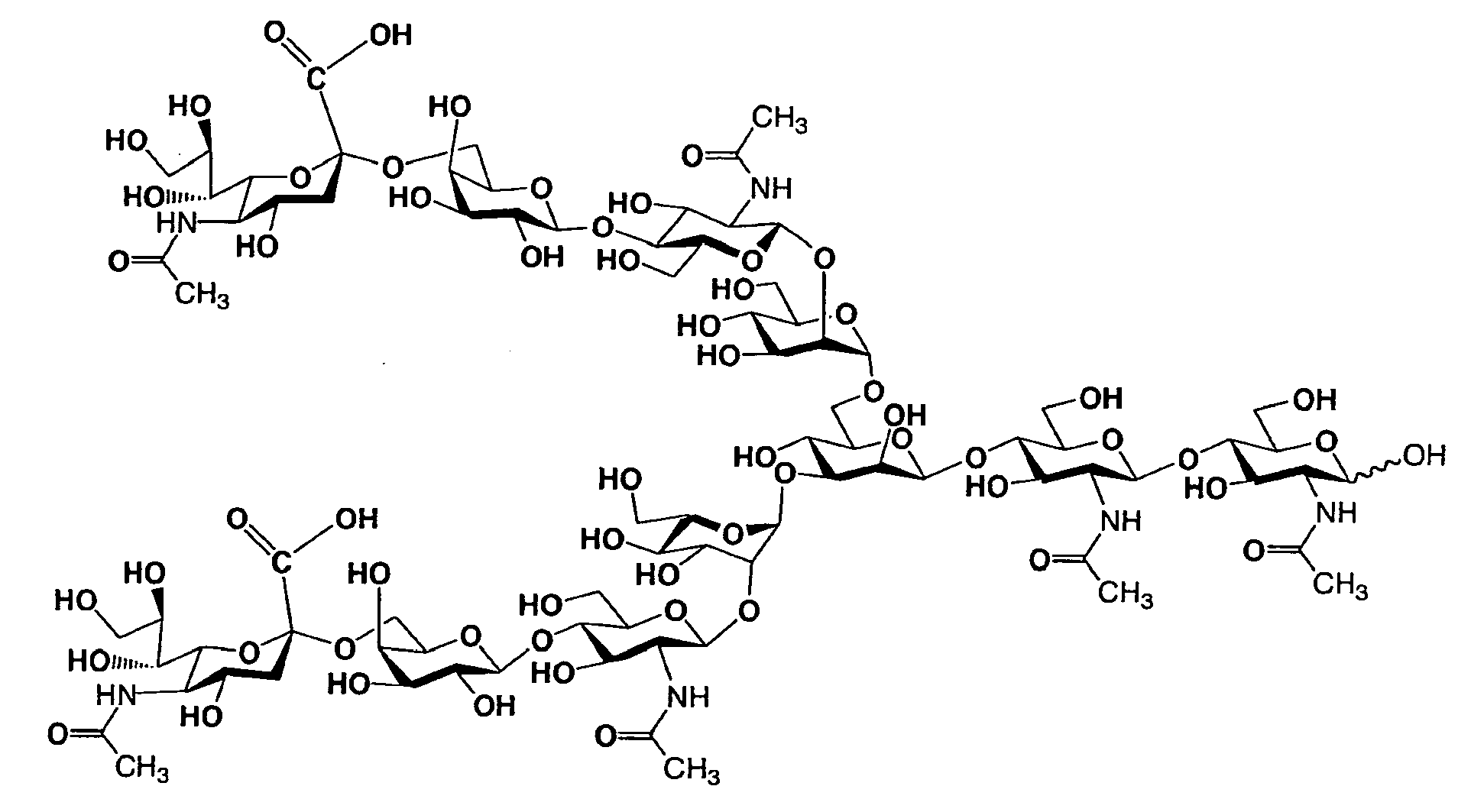
- The disialooligosaccharide (10 mg) obtained in Reference Example 5 was dissolved in a saturated aqueous solution of ammonium hydrogencarbonate to prepare a solution having a concentration of 30 mM. The solution was reacted at room temperature and held saturated at all times. The reaction was continued for 7 days, and when the reaction was found to have been almost completed by TLC (IPA:1 M NH4OAc = 1:1), the reaction mixture was freeze-dried as it was. Freeze-drying was repeated 3 times to remove the ammonium hydrogencarbonate and obtain 9 mg of disialooligosaccharide as aminated in a crude state.
1H-NMR (400MHz, D2O)
δ 5.22(s, 1H, Man4-H-1), 5.03(s, 1H, Man4'-H-1), 4.86(s, 1H, Man3-H-1), 4.69(m, 3H, GlcNAc2,5,5'-H-1), 4.53(d, 2H, Ga16,6'-H-1), 4.34(bs, 1H, Man3-H-2), 4.28(bd, 1H, Man4-H-2), 4.23(bd, 1H, GlcNAc1-H-1), 4.20(bd, 1H, Man4'-H-2), 2.76(bdd, 2H, NeuAc7,7'-H-3eq), 2.17(s, 3H, Ac), 2.16(s, 6H, Ac × 2), 2.12(s, 6H, Ac×3), 1.80(dd, 2H, NeuAc7,7'-H-3ax)
- The aminated disialooligosaccharide (crude, 5 mg) obtained in Reference Example 6 was dissolved in 100 µl of water, and 2 mg of ammonium hydrogencarbonate was added to the solution. A solution of 6.2 mg of bromoacetic acid in DMF (100 µl) and 4.6 mg of DCC were added to the mixture, followed by reaction at room temperature. The completion of reaction was confirmed by TLC (IPA:1 M NH4OAC = 2:1) 1.5 hours later, the reaction mixture was neutralized with sodium hydrogencarbonate, filtered and concentrated in a vacuum. The concentrate was then purified by gel permeation column chromatography (Sephadex G25, 1.5 cm × 30 cm, water, flow rate 1.0 ml/min.) to obtain 4 mg of bromoacetylated disialooligosaccharide in a yield of 77%.
1H-NMR (400MHz, D2O)
δ 5.22(s, 1H, Man4-H-1), 5.16(bd, 1H, GlcNAc1-H-1), 5.03(s, 1H, Man4'-H-1), 4.86(s, 1H, Man3-H-1), 4.70(m, 3H, GlcNAc2,5,5'-H-1), 4.53(d, 2H, Ga16,6'-H-1), 4.34(bs, 1H, Man3-H-2), 4.28(bd, 1H, Man4-H-2), 4.20(bd, 1H, Man4'-H-2), 2.77(bdd, 2H, NeuAc7,7'-H-3eq), 2.17(s, 3H, Ac), 2.15 (s, 6H, Ac×2), 2.12(s, 6H, Ac×2), 2.10(s, 3H, Ac), 1.80(dd, 2H, NeuAc7,7'-H-3ax)
- A 2 mg quantity of the bromoacetylated disialooligosaccharide obtained in Example 1 and 1.8 mg of the peptide chain (Arg-Glu-Glu-Gln-Tyr-Cys-Ser-Thr-Tyr-Arg-Val) prepared in Reference Example 3 were dissolved in 170 µl of 100 mM phosphate buffer, 7.0 in pH, and the solution was incubated at room temperature. Disappearance of the materials was confirmed by HPLC, whereupon the reaction mixture was directly purified by HPLC [column: Mightysil-GP (5 □m), 10 mm diam. × 250 mm, gradient: 0.1% trifluoroacetic acid/water 100% to 0.1% trifluoroacetic acid acetonitrile/water = 90/10 75%; 60 min. linear, flow rate 2.5 ml] to obtain 2 mg of peptide-linked disialooligosaccharide in a yield of 64%.
1H-NMR (400MHz, D2O)
δ 7.18(4H, Ph), 6.89(4H, Ph), 5.22(s, 1H, Man4-H-1), 5.14(bd, 1H, GlcNAc1-H-1), 5.04(s, 1H, Man4'-H-1), 4.86(s, 1H, Man3-H-1), 4.69-4.63(m, 5H, GlcNAc2,5,5'-H-1, Tyr-αH, Cys-αH), 4.55-4.52(m, 4H, Gal6, 6' -H-1, Gln- αH, Ser- αH) , 4.44-4.38(m, 4H, Glu-αH×2, Arg-Hα, Thr-αH), 4.34(bs, 1H, Man3-H-2), 4.28(m, 3H, Man4-H-2, Thr-βH), 4.23(d, 1H, J=5.9Hz, Val-αH), 4.20(bd, 1H, Man4'-H-2), 4.15(1H, Arg- αH) , 3.30, 3.25 (each 2H, Arg-δCH2), 3.14-2.99(6H, Cys-βH, Tyr-βH×2), 2.76(bdd, 2H, NeuAc7,7'-H-3eq), 2.57 (2H, Gln-γCH2). 2.49, 2.35 (each 2H, Glu-γCH2), 2.23-2.10(m, 3H, Val-βH, Gln-βH) , 2.16(s, 3H, Ac), 2.15(s, 6H, Ac×2), 2.12(s, 6H, Ac×2), 2.10-1.98(m, 6H, Glu-βH×2, Arg-βH), 2.07(s, 3H, Ac), 1.92-1.57(m, 8H, NeuAc7,7'-H-3ax, Arg-βH, Arg-γCH2×2), 1.23(d, 3H, Thr-γCH3), 1.04(d, 6H, Val-γCH3)
- A 1 mg quantity of the peptide-linked disialooligosaccharide prepared in Reference Example 4 and 1 mg of bromoacetylated disialooligosaccharide obtained in Example 1 were dissolved in 200 µl of 100 mM phosphate buffer, PNGase F (5 U) which is an enzyme for cleaving asparagine-linked oligosaccharide from asparagine was added to the solution, and the mixture was reacted at room temperature. The product was purified by HPLC to obtain the desired product, i.e., a peptide-linked disialooligosaccharide comprising cysteine and a disialooligosaccharide attached thereto. (YMC-Pack A-314 S-5 ODS 300 × 6.0 mm, developer solvents: 0.1% TFA aqueous solution B : 0.1% TFA acetonitrile: water = 90 : 10 gradient A 100% 0.60 ml/min. → B 100% 0.60 ml/min 60 min.)

- A 1 mg quantity of the peptide-linked disialooligosaccharide obtained in Example 3 was dissolved in 200 µl of 100 mM phosphate buffer, PNGase F (5 U), which is an enzyme for cleaving asparagine from asparagine-linked oligosaccharides, was added to the solution, and the mixture was reacted at room temperature to measure the time taken for the cleavage of disialooligosaccharide from the peptide. The cleavage time was 6 hours.
- A 1 mg quantity of the peptide-linked disialooligosaccharide obtained in Reference Example 4 was dissolved in 200 µl of 100 mM phosphate buffer, PNGase F (5 U), which is an enzyme for cleaving asparagine from asparagine-linked oligosaccharides, was added to the solution, and the mixture was reacted at room temperature to measure the time taken for the cleavage of disialooligosaccharide from the peptide. The cleavage time was 30 minutes.
- These results indicate that the peptide-linked disialooligosaccharide of Example 4 is higher than the peptide-linked disialooligosaccharide of the naturally bonded type (Reference Example 4) in resistance to sugar hydrolase.
- A 43.9 µg quantity of Anti-CD20 chimera antibody (mutant) (product of Medical Biological Laboratories Co., Ltd., an antibody having an amino acid sequence wherein asparagine at the 297th position was replaced with cysteine by the mutation technique) and 100 µg of the bromoacetylated disialooligosaccharide of Example 1 were dissolved in 300 µl of 100 mM phosphate buffer, followed by incubation at room temperature. The reaction mixture obtained was purified by protein A column chromatography and gel permeation column chromatography to obtain an antibody comprising cysteine and disialooligosaccharide linked thereto. The antibody was identified by electrophoresis [10% SDS-PAGE (with 2-mercaptethanol), molecular weight marker: product of BIO-RAD, prestained SDS-PAGE standard broad range (Catalogue No. 161-0318)] and MASS. FIG. 3 shows the result.
- The present invention provides a novel aminated complex-type oligosaccharide derivative which can be maintained at a sufficient concentration in blood, and a glycopeptide.
Claims (8)
- An aminated complex-type oligosaccharide derivative.
- An aminated complex-type oligosaccharide derivative of the formula (1)


- An aminated complex-type oligosaccharide derivative as defined in claim 2 wherein R1 is a -NH-halogenated acetyl group.
- A glycopeptide comprising an aminated complex-type oligosaccharide derivative of and a thiol group of an amino acid bonded thereto.
- A process for preparing a glycopeptide characterized by bonding a thiol group of an amino acid to an aminated complex-type oligosaccharide derivative.
- A glycopeptide as defined in claim 4 wherein the glycopeptide is an antibody.
- A process for preparing a glycopeptide characterized by cleaving a saccharide of a glycopeptide from an amino acid and subsequently bonding an aminated complex-type oligosaccharide derivative to the resulting peptide.
- A glycopeptide prepared by cleaving a saccharide of a glycopeptide from an amino acid and subsequently bonding an aminated complex-type oligosaccharide derivative to the resulting peptide, the glycopeptide prepared being an antibody.
Priority Applications (1)
| Application Number | Priority Date | Filing Date | Title |
|---|---|---|---|
| EP13178002.5A EP2657255A1 (en) | 2003-07-28 | 2004-07-27 | Aminated complex-type sugar chain derivatives and process for the production thereof |
Applications Claiming Priority (2)
| Application Number | Priority Date | Filing Date | Title |
|---|---|---|---|
| JP2003202594 | 2003-07-28 | ||
| PCT/JP2004/011036 WO2005010053A1 (en) | 2003-07-28 | 2004-07-27 | Aminated complex-type sugar chain derivatives and process for the production thereof |
Publications (2)
| Publication Number | Publication Date |
|---|---|
| EP1650226A1 true EP1650226A1 (en) | 2006-04-26 |
| EP1650226A4 EP1650226A4 (en) | 2011-06-15 |
Family
ID=34100593
Family Applications (2)
| Application Number | Title | Priority Date | Filing Date |
|---|---|---|---|
| EP04771127A Withdrawn EP1650226A4 (en) | 2003-07-28 | 2004-07-27 | COMPLEX-TYPE SUGAR-CHAIN AMINO DERIVATIVES AND METHOD OF MAKING SAME |
| EP13178002.5A Withdrawn EP2657255A1 (en) | 2003-07-28 | 2004-07-27 | Aminated complex-type sugar chain derivatives and process for the production thereof |
Family Applications After (1)
| Application Number | Title | Priority Date | Filing Date |
|---|---|---|---|
| EP13178002.5A Withdrawn EP2657255A1 (en) | 2003-07-28 | 2004-07-27 | Aminated complex-type sugar chain derivatives and process for the production thereof |
Country Status (10)
| Country | Link |
|---|---|
| US (1) | US7851618B2 (en) |
| EP (2) | EP1650226A4 (en) |
| JP (1) | JP4607017B2 (en) |
| KR (1) | KR100731875B1 (en) |
| CN (2) | CN1829742B (en) |
| AU (1) | AU2004259306B2 (en) |
| CA (1) | CA2533849C (en) |
| SG (1) | SG144945A1 (en) |
| TW (1) | TWI325430B (en) |
| WO (1) | WO2005010053A1 (en) |
Cited By (4)
| Publication number | Priority date | Publication date | Assignee | Title |
|---|---|---|---|---|
| AU2008264750B2 (en) * | 2007-06-19 | 2012-07-05 | Glytech, Inc. | GLP-1 peptide having sugar chain attached thereto |
| EP2684899A4 (en) * | 2011-03-10 | 2014-09-17 | Glytech Inc | METHOD FOR PRODUCING A GLYCOPEPTIDE COMPRISING A SIALYLE SWEET CHAIN, SIALYLE ADDED GRAIN CHAIN AMINO ACID DERIVATIVE EMPLOYED IN SAID METHOD, AND GLYCOPEPTIDE |
| WO2014167537A1 (en) * | 2013-04-12 | 2014-10-16 | Glycom A/S | Synthesis of sialylated/fucosylated oligosaccharides |
| CN104334737A (en) * | 2013-04-19 | 2015-02-04 | 株式会社糖锁工学研究所 | Method for producing activated sugar-chain derivative, and activated sugar-chain derivative |
Families Citing this family (15)
| Publication number | Priority date | Publication date | Assignee | Title |
|---|---|---|---|---|
| JP5004464B2 (en) * | 2005-12-02 | 2012-08-22 | 大塚化学株式会社 | Glycosylated liposomes |
| KR101534881B1 (en) | 2007-07-31 | 2015-07-07 | 가부시키가이샤 도우사 고가쿠 겐큐쇼 | Method for producing peptide |
| JP5604297B2 (en) | 2008-06-17 | 2014-10-08 | 株式会社糖鎖工学研究所 | Glycosylated GLP-1 peptide |
| EP2330114B1 (en) | 2008-08-19 | 2017-08-16 | Glytech, Inc. | Glycoprotein production method and screening method |
| RU2012122162A (en) | 2009-10-30 | 2013-12-10 | Глитек,Инк. | GLYCOLIZED FORM ANALOGUE OF ANTIGENIC GLP-1 |
| JP6211418B2 (en) | 2011-09-04 | 2017-10-11 | 株式会社糖鎖工学研究所 | Glycosylated polypeptide and pharmaceutical composition containing the polypeptide |
| CA2847334C (en) | 2011-09-04 | 2020-09-01 | Glytech, Inc. | Glycosylated polypeptide and drug composition containing said polypeptide |
| US20140377807A1 (en) | 2011-09-26 | 2014-12-25 | Glytech, Inc. | Method for producing polypeptide fragment with high efficiency, which is suitable for ncl method |
| US9708413B2 (en) | 2012-11-22 | 2017-07-18 | Glytech, Inc. | Glycosylated linker, compound containing glycosylated linker moiety and physiologically active substance moiety or salt thereof, and methods for producing said compound or salt thereof |
| MY171183A (en) | 2013-03-29 | 2019-09-30 | Glytech Inc | Polypeptide glycosylated with sialylated sugar chain |
| SG11201508032RA (en) | 2013-03-30 | 2015-10-29 | Glytech Inc | (sugar chain)-polypeptide complex |
| JP6342968B2 (en) * | 2016-07-25 | 2018-06-13 | 株式会社伏見製薬所 | Method for producing sugar derivative and novel sugar derivative |
| WO2018226961A1 (en) * | 2017-06-09 | 2018-12-13 | Shanghai Yanfeng Jinqiao Automotive Trim Systems Co. Ltd. | Vehicle interior component |
| JP7275049B2 (en) | 2017-12-27 | 2023-05-17 | 協和キリン株式会社 | IL-2 variants |
| JPWO2023145812A1 (en) * | 2022-01-31 | 2023-08-03 |
Family Cites Families (5)
| Publication number | Priority date | Publication date | Assignee | Title |
|---|---|---|---|---|
| EP0413675B1 (en) | 1989-08-16 | 1995-05-03 | Oxford Glycosystems Ltd. | Method for producing synthetic N-linked glycoconjugates |
| US5280113A (en) * | 1989-08-16 | 1994-01-18 | Monsanto Company | Method for producing synthetic N-linked glycoconjugates |
| US5663254A (en) * | 1995-05-22 | 1997-09-02 | The Johns Hopkins University | Synthesis of high mannose glycopolymers |
| DE60032370T2 (en) * | 1999-08-19 | 2007-10-11 | Kirin Beer K.K. | YEAST VARIANTS AND METHOD FOR THE PRODUCTION OF GLYCOPROTEIN-CONTAINING SUGAR CHAINS FROM THE MAMMALIAN TYPE |
| EP2481746A1 (en) | 2001-06-19 | 2012-08-01 | Otsuka Chemical Co., Ltd. | Process for producing sugar chain asparagine derivative |
-
2004
- 2004-07-27 US US10/565,799 patent/US7851618B2/en not_active Expired - Lifetime
- 2004-07-27 EP EP04771127A patent/EP1650226A4/en not_active Withdrawn
- 2004-07-27 TW TW093122362A patent/TWI325430B/en not_active IP Right Cessation
- 2004-07-27 SG SG200805518-8A patent/SG144945A1/en unknown
- 2004-07-27 KR KR1020067001505A patent/KR100731875B1/en not_active Expired - Fee Related
- 2004-07-27 CN CN2004800214255A patent/CN1829742B/en not_active Expired - Fee Related
- 2004-07-27 WO PCT/JP2004/011036 patent/WO2005010053A1/en not_active Ceased
- 2004-07-27 AU AU2004259306A patent/AU2004259306B2/en not_active Expired
- 2004-07-27 EP EP13178002.5A patent/EP2657255A1/en not_active Withdrawn
- 2004-07-27 JP JP2005512111A patent/JP4607017B2/en not_active Expired - Lifetime
- 2004-07-27 CA CA2533849A patent/CA2533849C/en not_active Expired - Fee Related
- 2004-07-27 CN CN2009102637367A patent/CN101798586B/en not_active Expired - Fee Related
Non-Patent Citations (5)
| Title |
|---|
| BARAN E ET AL: "STUDIES ON SYNTHESIS OF S-GLYCOSIDIC BOND BETWEEN CYSTEINE AND GLUCOSE OR GALACTOSE", POLISH JOURNAL OF CHEMISTRY, POLISH CHEMICAL SOCIETY, XX, vol. 52, no. 5, 1 January 1978 (1978-01-01), pages 941-946, XP001018324, * |
| LOTE C J ET AL: "Identification of digalactosylcysteine in a glycopeptide isolated from urine by a new preparative technique", FEBS LETTERS, ELSEVIER, AMSTERDAM, NL, vol. 16, no. 2, 1 August 1971 (1971-08-01) , pages 81-85, XP025600150, ISSN: 0014-5793, DOI: DOI:10.1016/0014-5793(71)80337-X [retrieved on 1971-08-01] * |
| See also references of WO2005010053A1 * |
| Tadashi Suzuki ET AL: "Cytoplasmic peptide:N-glycanase (PNGase) in eukaryotic cells: occurrence, primary structure, and potential functions", The FASEB Journal, 1 May 2002 (2002-05-01), pages 635-641, XP055071115, Retrieved from the Internet: URL:http://www.fasebj.org/content/16/7/635.full.pdf#page=1&view=FitH [retrieved on 2013-07-12] * |
| YAMAMOTO N ET AL: "Convenient synthesis of a glycopeptide analogue having a complex type disialyl-undecasaccharide", TETRAHEDRON LETTERS, ELSEVIER, AMSTERDAM, NL, vol. 45, no. 16, 12 April 2004 (2004-04-12), pages 3287-3290, XP004498999, ISSN: 0040-4039, DOI: DOI:10.1016/J.TETLET.2004.02.137 * |
Cited By (10)
| Publication number | Priority date | Publication date | Assignee | Title |
|---|---|---|---|---|
| AU2008264750B2 (en) * | 2007-06-19 | 2012-07-05 | Glytech, Inc. | GLP-1 peptide having sugar chain attached thereto |
| AU2008264750C1 (en) * | 2007-06-19 | 2013-01-10 | Glytech, Inc. | GLP-1 peptide having sugar chain attached thereto |
| EP2684899A4 (en) * | 2011-03-10 | 2014-09-17 | Glytech Inc | METHOD FOR PRODUCING A GLYCOPEPTIDE COMPRISING A SIALYLE SWEET CHAIN, SIALYLE ADDED GRAIN CHAIN AMINO ACID DERIVATIVE EMPLOYED IN SAID METHOD, AND GLYCOPEPTIDE |
| US9073978B2 (en) | 2011-03-10 | 2015-07-07 | Glytech, Inc. | Method for producing glycopeptide having sialyl sugar chain, sialyl sugar chain-added amino acid derivative to be used in same, and glycopeptide |
| RU2586524C2 (en) * | 2011-03-10 | 2016-06-10 | Глитек, Инк. | Process for preparation of glycopeptide having sialylated sugar chain, and method for producing sialyl glycoasparagine |
| WO2014167537A1 (en) * | 2013-04-12 | 2014-10-16 | Glycom A/S | Synthesis of sialylated/fucosylated oligosaccharides |
| CN104334737A (en) * | 2013-04-19 | 2015-02-04 | 株式会社糖锁工学研究所 | Method for producing activated sugar-chain derivative, and activated sugar-chain derivative |
| EP2987863A4 (en) * | 2013-04-19 | 2017-04-19 | Glytech, Inc. | Method for producing activated sugar-chain derivative, and activated sugar-chain derivative |
| US9879097B2 (en) | 2013-04-19 | 2018-01-30 | Glytech, Inc. | Method for producing activated sugar chain derivative and activated sugar chain derivative produced therefrom |
| CN104334737B (en) * | 2013-04-19 | 2019-02-22 | 株式会社糖锁工学研究所 | Production method of activated sugar chain derivative and activated sugar chain derivative |
Also Published As
| Publication number | Publication date |
|---|---|
| EP1650226A4 (en) | 2011-06-15 |
| CN1829742B (en) | 2010-06-09 |
| CN101798586A (en) | 2010-08-11 |
| WO2005010053A1 (en) | 2005-02-03 |
| TWI325430B (en) | 2010-06-01 |
| EP2657255A1 (en) | 2013-10-30 |
| KR20060037395A (en) | 2006-05-03 |
| SG144945A1 (en) | 2008-08-28 |
| AU2004259306B2 (en) | 2008-12-18 |
| JP4607017B2 (en) | 2011-01-05 |
| JPWO2005010053A1 (en) | 2006-09-07 |
| TW200508245A (en) | 2005-03-01 |
| CN101798586B (en) | 2013-11-06 |
| US7851618B2 (en) | 2010-12-14 |
| AU2004259306A1 (en) | 2005-02-03 |
| CN1829742A (en) | 2006-09-06 |
| KR100731875B1 (en) | 2007-06-25 |
| CA2533849A1 (en) | 2005-02-03 |
| CA2533849C (en) | 2013-07-02 |
| US20070060543A1 (en) | 2007-03-15 |
Similar Documents
| Publication | Publication Date | Title |
|---|---|---|
| US7851618B2 (en) | Aminated complex-type sugar chain derivatives and process for the production thereof | |
| US8399656B2 (en) | Process for preparing glycopeptides having asparagine-linked oligosaccharides, and the glycopeptides | |
| Hamzavi et al. | Modulation of the pharmacokinetic properties of PNA: preparation of galactosyl, mannosyl, fucosyl, N-acetylgalactosaminyl, and N-acetylglucosaminyl derivatives of aminoethylglycine peptide nucleic acid monomers and their incorporation into PNA oligomers | |
| CN104936613B (en) | Sugar chain addition connexon, the compound or its salt containing sugar chain addition connexon and physiological activator and its manufacturing method | |
| US9073978B2 (en) | Method for producing glycopeptide having sialyl sugar chain, sialyl sugar chain-added amino acid derivative to be used in same, and glycopeptide | |
| EP2190857A1 (en) | Glycoproteins and glycosylated cells and a method for the preparation of the same | |
| JPH10273500A (en) | Complex glycopeptide and method for producing the same | |
| JP2008150464A (en) | Method for adding sugar chain to core material | |
| Barchi Jr et al. | Glycosylation of the active sequence ser-ile-lys-val-ala-val from the α1 chain of laminin reduces tumor cell attachment activity | |
| Kunz | O-and N-glycopeptides: synthesis of selectively deprotected building blocks | |
| Kihlberg | Glycopeptide synthesis | |
| JP2000290296A (en) | Calcitonin derivative | |
| JPH10147598A (en) | Glycosyl calcitonin derivatives, their preparation and intermediates |
Legal Events
| Date | Code | Title | Description |
|---|---|---|---|
| PUAI | Public reference made under article 153(3) epc to a published international application that has entered the european phase |
Free format text: ORIGINAL CODE: 0009012 |
|
| 17P | Request for examination filed |
Effective date: 20060201 |
|
| AK | Designated contracting states |
Kind code of ref document: A1 Designated state(s): AT BE BG CH CY CZ DE DK EE ES FI FR GB GR HU IE IT LI LU MC NL PL PT RO SE SI SK TR |
|
| DAX | Request for extension of the european patent (deleted) | ||
| RAP1 | Party data changed (applicant data changed or rights of an application transferred) |
Owner name: OTSUKA CHEMICAL CO., LTD. Owner name: KAJIHARA, YASUHIRO |
|
| A4 | Supplementary search report drawn up and despatched |
Effective date: 20110512 |
|
| 17Q | First examination report despatched |
Effective date: 20110719 |
|
| RAP1 | Party data changed (applicant data changed or rights of an application transferred) |
Owner name: GLYTECH, INC. Owner name: KAJIHARA, YASUHIRO |
|
| RIN1 | Information on inventor provided before grant (corrected) |
Inventor name: FUKAE, KAZUHIRO, OTSUKA CHEMICAL CO., LTD. Inventor name: KAJIHARA, YASUHIRO |
|
| STAA | Information on the status of an ep patent application or granted ep patent |
Free format text: STATUS: THE APPLICATION IS DEEMED TO BE WITHDRAWN |
|
| 18D | Application deemed to be withdrawn |
Effective date: 20141007 |