EP1650198A1 - Alkoxytetrazol-1-ylbenzaldehyde compound and process for producing the same - Google Patents
Alkoxytetrazol-1-ylbenzaldehyde compound and process for producing the same Download PDFInfo
- Publication number
- EP1650198A1 EP1650198A1 EP04747826A EP04747826A EP1650198A1 EP 1650198 A1 EP1650198 A1 EP 1650198A1 EP 04747826 A EP04747826 A EP 04747826A EP 04747826 A EP04747826 A EP 04747826A EP 1650198 A1 EP1650198 A1 EP 1650198A1
- Authority
- EP
- European Patent Office
- Prior art keywords
- tetrazole
- alkoxy
- formula
- alkyl group
- tetrazol
- Prior art date
- Legal status (The legal status is an assumption and is not a legal conclusion. Google has not performed a legal analysis and makes no representation as to the accuracy of the status listed.)
- Withdrawn
Links
- 0 *C(C=O)c(cc1)ccc1-[n]1nnnc1* Chemical compound *C(C=O)c(cc1)ccc1-[n]1nnnc1* 0.000 description 2
- YQNRPEFJKQVSNX-UHFFFAOYSA-N COc(cc1)c(C=O)cc1-[n]1nnnc1C(F)(F)F Chemical compound COc(cc1)c(C=O)cc1-[n]1nnnc1C(F)(F)F YQNRPEFJKQVSNX-UHFFFAOYSA-N 0.000 description 1
- CUBHTBKFUPYNSU-UHFFFAOYSA-N COc1ccc(C=O)cc1-[n]1nnnc1C(F)(F)F Chemical compound COc1ccc(C=O)cc1-[n]1nnnc1C(F)(F)F CUBHTBKFUPYNSU-UHFFFAOYSA-N 0.000 description 1
Classifications
-
- C—CHEMISTRY; METALLURGY
- C07—ORGANIC CHEMISTRY
- C07D—HETEROCYCLIC COMPOUNDS
- C07D257/00—Heterocyclic compounds containing rings having four nitrogen atoms as the only ring hetero atoms
- C07D257/02—Heterocyclic compounds containing rings having four nitrogen atoms as the only ring hetero atoms not condensed with other rings
- C07D257/04—Five-membered rings
Definitions
- the present invention relates to novel alkoxy-(tetrazol-1-yl)benzaldehyde compounds and processes for producing the same.
- An alkyl group represented by A 2 in which hydrogen atom(s) are substituted by fluorine atom(s) is preferably, in terms of availability, a C 1-4 linear alkyl group in which all hydrogen atoms are substituted by fluorine atoms, and more preferably a C 1-2 alkyl group in which all hydrogen atoms are substituted by fluorine atoms.
- Preferable and specific examples are trifluoromethyl, pentafluoroethyl, and like groups.
- a methoxy group is particularly preferable for A 1 .
- a hydrogen atom or a methyl, ethyl or trifluoromethyl group is particularly preferable for A 2 .
- examples of 1-(alkoxyphenyl)-1 H -tetrazole compounds represented by Formula (1) are 1-(2-alkoxyphenyl)-1 H -tetrazole compounds represented by Formula (3), 1-(3-alkoxyphenyl)-1 H -tetrazole compounds represented by Formula (5), 1-(4-alkoxyphenyl)-1 H -tetrazole compounds represented by Formula (7), etc.
- 1-(2-Alkoxyphenyl)-1 H -tetrazole compounds represented by Formula (3) may be prepared according to any process. Specific examples are 1-(2-methoxyphenyl)-1 H -tetrazole, 1-(2-ethoxyphenyl)-1 H -tetrazole, 1-(2-propoxyphenyl)-1 H -tetrazole, 1-(2-isopropoxyphenyl)-1 H -tetrazole, 1-(2-butoxyphenyl)-1 H- tetrazole, 1-[2-(but-2-oxy)phenyl]-1 H -tetrazole, 1-[2-(2-methylprop-1-oxy)phenyl]-1 H -tetrazole, 1-[2-(2-methylprop-2-oxy)phenyl]-1 H -tetrazole, 1-(2-methoxyphenyl)-5-methyl-1 H- tetrazole, 1-(2-ethoxyphenyl)-5-methyl-1 H -tetrazole,
- 1-(2-methoxyphenyl)-1 H -tetrazole, 1-(2-methoxyphenyl)-5-methyl-1 H -tetrazole, 1-(2-methoxyphenyl)-5-ethyl-1 H -tetrazole, and 1-(2-methoxyphenyl)-5-trifluoromethyl-1 H -tetrazole are particularly preferable.
- 1-(3-methoxyphenyl)-1 H -tetrazole, 1-(3-methoxyphenyl)-5-methyl-1 H -tetrazole, 1-(3-methoxyphenyl)-5-ethyl-1 H -tetrazole, and 1-(3-methoxyphenyl)-5-trifluoromethyl-1 H -tetrazole are particularly preferable.
- 1-(4-Alkoxyphenyl)-1 H -tetrazole compounds represented by Formula (7) may be prepared according to any process. Specific examples are 1-(4-methoxyphenyl)-1 H -tetrazole, 1-(4-ethoxyphenyl)-1 H -tetrazole, 1-(4-propoxyphenyl)-1 H -tetrazole, 1-(4-isopropoxyphenyl)-1 H -tetrazole, 1-(4-butoxyphenyl)-1 H- tetrazole, 1-[4-(but-2-oxy)phenyl]-1 H -tetrazole, 1-[4-(2-methylprop-1-oxy)phenyl]-1 H -tetrazole, 1-[4-(2-methylprop-2-oxy)phenyl]-1 H -tetrazole, 1-(4-methoxyphenyl)-5-methyl-1 H- tetrazole, 1-(4-ethoxyphenyl)-5
- 1-(4-methoxyphenyl)-1 H -tetrazole, 1-(4-methoxyphenyl)-5-methyl-1 H -tetrazole, 1-(4-methoxyphenyl)-5-ethyl-1 H -tetrazole, and 1-(4-methoxyphenyl)-5-trifluoromethyl-1 H -tetrazole are particularly preferable.
- the amount of hexamethylenetetramine is preferably 1.0 to 3.0 mol, and more preferably 1.2 to 2.0 mol, per mol of 1-(alkoxyphenyl)-1 H- tetrazole compound of Formula (1).
- Sulfonic acid solvents usable in the present invention are not limited insofar as water is not contained therein.
- Preferable sulfonic acid solvents are those that can dissolve 1-(alkoxyphenyl)-1 H -tetrazole compounds of Formula (1).
- Specific examples are methanesulfonic acid, ethanesulfonic acid, trifluoromethanesulfonic acid, pentafluoroethanesulfonic acid, etc.
- solvents may be used either singly as homosolvents or in suitable combinations as mixed solvents.
- the amount of sulfonic acid solvent is preferably 1 to 15 ml, and more preferably 5 to 10 ml, per gram of 1-(alkoxyphenyl)-1 H -tetrazole compound of Formula (1).
- the reaction system is cooled to room temperature, and then either water is introduced into the reaction system or the reaction solution is introduced into water for hydrolysis.
- the amount of water is preferably 1 to 15 ml, and more preferably 5 to 15 ml, per gram of 1-(alkoxyphenyl)-1 H- tetrazole compound of Formula (1).
- the temperature for hydrolysis is preferably about 0 to about 30°C, and more preferably about 0 to about 15°C.
- the hydrolysis time is preferably about 15 minutes to about 2 hours, and more preferably about 30 minutes to about 1 hour.
- examples of alkoxy-(tetrazol-1-yl)benzaldehyde compounds represented by Formula (2) include 4 -alkoxy-3-(tetrazol-1-yl)benzaldehyde compounds represented by Formula (4), 2-alkoxy-4-(tetrazol-1-yl)benzaldehyde compounds represented by Formula (6), 2-alkoxy-5-(tetrazol-1-yl)benzaldehyde compounds represented by Formula (8), etc.
- an aldehyde group is present preferably in an ortho or para position relative to A 1 .
- alkoxy-(tetrazol-1-yl)benzaldehyde compounds can be safely and efficiently produced by formylating 1-(alkoxyphenyl)-1 H -tetrazole compounds.
- the reaction solution was then extracted with dichloromethane (60 ml x 3), and the organic phase thus obtained was washed with 10% aqueous sodium hydroxide solution (90 ml x 1) and water (90 ml x 1), and dried over anhydrous magnesium sulfate for 1 hour. After drying, filtration and solvent evaporation were performed, and the crude product thus obtained was subjected to crystallization in a mixed solvent containing 6 ml of dichloromethane and 9 ml of isopropyl alcohol while cooling in an ice bath. After filtration and drying, 0.97 g of 4-methoxy-3-(tetrazol-1-yl)benzaldehyde was obtained as a white solid (yield: 27.9%).
- reaction solution was then extracted with dichloromethane (20 ml ⁇ 3), and the organic phase thus obtained was washed with 10% aqueous sodium hydroxide solution (20 ml x 1) and water (20 ml x 1), and dried over anhydrous magnesium sulfate for 1 hour. After drying, filtration and solvent evaporation were performed, and the crude product thus obtained was recrystallized in a mixed solvent containing 0.5 ml of dichloromethane and 1 ml of toluene. After filtration and drying, 171 mg of 2-methoxy-4-(5-methyltetrazol-1-yl)benzaldehyde was obtained as a white solid (yield: 14.9%).
- the reaction solution was then extracted with dichloromethane (60 ml x 3), and the organic phase thus obtained was washed with 10% aqueous sodium hydroxide solution (90 ml x 1) and water (90 ml x 1), and dried over anhydrous magnesium sulfate for 1 hour. After drying, filtration and solvent evaporation were performed, and the crude product thus obtained was subjected to crystallization in a mixed solvent containing 5 ml of dichloromethane and 5 ml of toluene while cooling in an ice bath. After filtration and drying, 1.61 g of 2-methoxy-5-(tetrazol-1-yl)benzaldehyde was obtained as a white solid (yield: 46.3%).
- reaction solution was then extracted with dichloromethane (60 ml x 3), and the organic phase thus obtained was washed with 10% aqueous sodium hydroxide solution (90 ml x 1) and water (90 ml x 1), and dried over anhydrous magnesium sulfate for 1 hour. After drying, filtration and solvent evaporation were performed, and the crude product thus obtained was subjected to crystallization in a mixed solvent containing 3 ml of dichloromethane and 12 ml of isopropyl alcohol while cooling in an ice bath.
- reaction solution was then extracted with chloroform (150 ml x 2), and the organic phase thus obtained was washed with 10% aqueous sodium hydroxide solution (150 ml x 1) and water (150 ml x 1), and dried over anhydrous magnesium sulfate for 1 hour. After drying, filtration and solvent evaporation were performed, and the crude product thus obtained was subjected to crystallization in 75 ml of isopropyl alcohol while cooling in an ice bath. After filtration and drying, 11.66 g of 2-methoxy-5-(5-trifluoromethyltetrazol-1-yl)benzaldehyde was obtained as a white solid (yield: 69.7%).
- reaction solution was then extracted with chloroform (50 ml x 3), and the organic phase thus obtained was washed with 10% aqueous sodium hydroxide solution (80 ml x 1) and water (80 ml x 1), and dried over anhydrous magnesium sulfate for 1 hour. After drying, filtration and solvent evaporation were performed, and the crude product thus obtained was purified by column chromatography (silica gel, chloroform), resulting in 1.01 g of 2-ethoxy-5-(5-trifluoromethyltetrazol-1-yl)benzaldehyde as a white solid (yield: 22.8%).
Landscapes
- Chemical & Material Sciences (AREA)
- Organic Chemistry (AREA)
- Pharmaceuticals Containing Other Organic And Inorganic Compounds (AREA)
- Plural Heterocyclic Compounds (AREA)
Abstract


Description
- The present invention relates to novel alkoxy-(tetrazol-1-yl)benzaldehyde compounds and processes for producing the same.
- Use of alkoxy-(tetrazol-1-yl)benzaldehyde compounds as pharmaceutical intermediates has been reported. For example, 2-methoxy-5-(5-methyltetrazol-1-yl)benzaldehyde is known to be of use as an important intermediate for a pharmaceutical that mainly serves as an analgesic or an anti-inflammatory agent (EP 0829480A2). Moreover, 2-methoxy-5-(5-trifluoromethyltetrazol-1-yl)benzaldehyde is known to be of use as an important intermediate for a pharmaceutical that mainly serves as an analgesic (WO 96/29326).
- Formylation reactions for aromatic compounds have been researched for a long period of time, and there are a variety of reported processes. Typical examples are (1) a process that uses dimethylformamide and phosphorus oxychloride (Org. Synth. Coll. Vol. 4, 1963, p. 539); (2) a process that uses dimethylformamide and trifluoromethanesulfonic anhydride (J. Chem. Soc., Chem. Commun., 1990, p. 1571); (3) a process that uses hexamethylenetetramine and trifluoroacetic acid (J. Org. Chem., vol. 37, 1972, p. 3972); (4) a process that uses imidazole and trifluoroacetic anhydride (Tetrahedron, vol. 36, 1980, p. 2505); (5) a process that uses carbon monoxide, hydrochloric acid and aluminium(III) chloride (Org. React., vol. 5, 1960, p. 290); and (6) a process that uses zinc(II) cyanide, hydrochloric acid and aluminium(III) chloride (Chem. Rev., vol. 63, 1963, p. 526).
- However, when 1-(alkoxyphenyl)-1H-tetrazole compounds are subjected to formylation reactions according to processes (1) to (4) above, the reactions hardly progress. Processes (5) and (6) may be hazardous when used for commercial production because in process (5) toxic carbon monoxide is used, and in process (6) hydrogen cyanide is generated in the reaction system.
- Therefore, formylation reactions for 1-(alkoxyphenyl)-1H-tetrazole compounds do not progress or are hazardous when prior-art processes are used. Prior-art processes are thus not industrially advantageous.
- An object of the present invention is to provide a process for safely and efficiently producing an alkoxy-(tetrazol-1-yl)benzaldehyde compound by formylating a 1-(alkoxyphenyl)-1H-tetrazole compound.
- Other objects and characteristics of the present invention will become evident by the disclosure provided hereinbelow.
- The inventors conducted extensive research to achieve the object described above, and found that alkoxy-(tetrazol-1-yl)benzaldehyde compounds can be safely and efficiently produced by subjecting 1-(alkoxyphenyl)-1H-tetrazole compounds to a reaction with hexamethylenetetramine in a sulfonic acid solvent and then to hydrolysis, and the inventors accomplished the present invention.
- In particular, the present invention provides alkoxy-(tetrazol-1-yl)benzaldehyde compounds and processes for producing the same as described below.
- 1. A process for producing an alkoxy-(tetrazol-1-yl)benzaldehyde compound represented by Formula (2):

the process comprising reacting a 1-(alkoxyphenyl)-1H-tetrazole compound represented by Formula (1):
- 2. The process according to Item 1, wherein the sulfonic acid solvent is a mixed solvent of methanesulfonic acid and trifluoromethanesulfonic acid.
- 3. The process according to Item 1 or 2, wherein hexamethylenetetramine is used in an amount of 1.0 to 3.0 mol per mol of the 1-(alkoxyphenyl)-1H-tetrazole compound.
- 4. The process according to any one of Items 1 to 3, wherein A1 is a methoxy group, and A2 is a hydrogen atom, methyl group, ethyl group or trifluoromethyl group.
- 5. A process for producing a 4-alkoxy-3-(tetrazol-1-yl)benzaldehyde compound represented by Formula (4):

the process comprising reacting a 1-(2-alkoxyphenyl)-1H-tetrazole compound represented by Formula (3):
- 6. A process for producing a 2-alkoxy-4-(tetrazol-1-yl)benzaldehyde compound represented by Formula (6):

the process comprising reacting a 1-(3-alkoxyphenyl)-1H-tetrazole compound represented by Formula (5):
- 7. A process for producing a 2-alkoxy-5-(tetrazol-1-yl)benzaldehyde compound represented by Formula (8):

the process comprising reacting a 1-(4-alkoxyphenyl)-1H-tetrazole compound represented by Formula (7):
- 8. An alkoxy-(tetrazol-1-yl)benzaldehyde compound represented by Formula (2):


- 9. The alkoxy-(tetrazol-1-yl)benzaldehyde compound according to Item 8, wherein the aldehyde group is in an ortho or para position relative to A1.
- 10. A 4-alkoxy-3-(tetrazol-1-yl)benzaldehyde compound represented by Formula (4):

- 11. A 2-alkoxy-4-(tetrazol-1-yl)benzaldehyde compound represented by Formula (6):

- The present invention is described below in detail.
- A1 and A2 in Formulas (1) to (8) presented above are described first.
- The alkyl moiety of an alkoxy group represented by A1 may be linear or branched. When branched, the number and position(s) of branch(es) are not limited. For the reaction to progress smoothly, the alkyl moiety preferably has 1 to 10 carbon atoms, and more preferably 1 to 4 carbon atoms. Preferable and specific examples of alkoxy groups are methoxy, ethoxy, n-propoxy, isopropoxy, butoxy, but-2-oxy, 2-methylprop-1-oxy, 2-methylprop-2-oxy, and like groups.
- An alkyl group represented by A2 may be linear or branched. When branched, the number and position(s) of branch(es) are not limited. For the reaction to progress smoothly, the alkyl group preferably has 1 to 10 carbon atoms, and more preferably 1 to 3 carbon atoms. Preferable and specific examples are methyl, ethyl, n-propyl, isopropyl, and like groups.
- An alkyl group represented by A2 in which hydrogen atom(s) are substituted by fluorine atom(s) is preferably, in terms of availability, a C1-4 linear alkyl group in which all hydrogen atoms are substituted by fluorine atoms, and more preferably a C1-2 alkyl group in which all hydrogen atoms are substituted by fluorine atoms. Preferable and specific examples are trifluoromethyl, pentafluoroethyl, and like groups.
- In the present invention, a methoxy group is particularly preferable for A1. A hydrogen atom or a methyl, ethyl or trifluoromethyl group is particularly preferable for A2.
- In the present invention, examples of 1-(alkoxyphenyl)-1H-tetrazole compounds represented by Formula (1) are 1-(2-alkoxyphenyl)-1H-tetrazole compounds represented by Formula (3), 1-(3-alkoxyphenyl)-1H-tetrazole compounds represented by Formula (5), 1-(4-alkoxyphenyl)-1H-tetrazole compounds represented by Formula (7), etc.
- 1-(2-Alkoxyphenyl)-1H-tetrazole compounds represented by Formula (3) may be prepared according to any process. Specific examples are 1-(2-methoxyphenyl)-1H-tetrazole, 1-(2-ethoxyphenyl)-1H-tetrazole, 1-(2-propoxyphenyl)-1H-tetrazole, 1-(2-isopropoxyphenyl)-1H-tetrazole, 1-(2-butoxyphenyl)-1H-tetrazole, 1-[2-(but-2-oxy)phenyl]-1H-tetrazole, 1-[2-(2-methylprop-1-oxy)phenyl]-1H-tetrazole, 1-[2-(2-methylprop-2-oxy)phenyl]-1H-tetrazole, 1-(2-methoxyphenyl)-5-methyl-1H-tetrazole, 1-(2-ethoxyphenyl)-5-methyl-1H-tetrazole, 1-(2-propoxyphenyl)-5-methyl-1H-tetrazole, 1-(2-isopropoxyphenyl)-5-methyl-1H-tetrazole, 1-(2-butoxyphenyl)-5-methyl-1H-tetrazole, 1-[2-(but-2-oxy)phenyl]-5-methyl-1H-tetrazole, 1-[2-(2-methylprop-1-oxy)phenyl]-5-methyl-1H-tetrazole, 1-[2-(2-methylprop-2-oxy)phenyl]-5-methyl-1H-tetrazole, 1-(2-methoxyphenyl)-5-ethyl-1H-tetrazole, 1-(2-ethoxyphenyl)-5-ethyl-1H-tetrazole, 1-(2-propoxyphenyl)-5-ethyl-1H-tetrazole, 1-(2-isopropoxyphenyl)-5-ethyl-1H-tetrazole, 1-(2-butoxyphenyl)-5-ethyl-1H-tetrazole, 1-[2-(but-2-oxy)phenyl]-5-ethyl-1H-tetrazole, 1-[2-(2-methylprop-1-oxy)phenyl]-5-ethyl-1H-tetrazole, 1-[2-(2-methylprop-2-oxy)phenyl]-5-ethyl-1H-tetrazole, -1-(2-methoxyphenyl)-5-propyl-1H-tetrazole, 1-(2-ethoxyphenyl)-5-propyl-1H-tetrazole, 1-(2-propoxyphenyl)-5-propyl-1H-tetrazole, 1-(2-isopropoxyphenyl)-5-propyl-1H-tetrazole 1-(2-butoxyphenyl)-5-propyl-1H-tetrazole, 1-[2-(but-2-oxy)phenyl]-5-propyl-1H-tetrazole, 1-[2-(2-methylprop-1-oxy)phenyl]-5-propyl-1H-tetrazole, 1-[2-(2-methylprop-2-oxy)phenyl]-5-propyl-1H-tetrazole, 1-(2-methoxyphenyl)-5-isopropyl-1H-tetrazole, 1-(2-ethoxyphenyl)-5-isopropyl-1H-tetrazole, 1-(2-propoxyphenyl)-5-isopropyl-1H-tetrazole, 1-(2-isopropoxyphenyl)-5-isopropyl-1H-tetrazole, 1-(2-butoxyphenyl)-5-isopropyl-1H-tetrazole 1-[2-(but-2-oxy)phenyl]-5-isopropyl-1H-tetrazole, 1-[2-(2-methylprop-1-oxy)phenyl]-5-isopropyl-1H-tetrazole, 1-[2-(2-methylprop-2-oxy)phenyl]-5-isopropyl-1H-tetrazole, 1-(2-methoxyphenyl)-5-trifluoromethyl-1H-tetrazole, 1-(2-ethoxyphenyl)-5-trifluoromethyl-1H-tetrazole, 1-(2-propoxyphenyl)-5-trifluoromethyl-1H-tetrazole, 1-(2-isopropoxyphenyl)-5-trifluoromethyl-1H-tetrazole, 1-(2-butoxyphenyl)-5-trifluoromethyl-1H-tetrazole, 1-[2-(but-2-oxy)phenyl]-5-trifluoromethyl-1H-tetrazole, 1-[2-(2-methylprop-1-oxy)phenyl]-5-trifluoromethyl-1H-tetrazole, 1-[2-(2-methylprop-2-oxy)phenyl]-5-trifluoromethyl-1H-tetrazole, 1-(2-methoxyphenyl)-5-pentafluoroethyl-1H-tetrazole, 1-(2-ethoxyphenyl)-5-pentafluoroethyl-1H-tetrazole 1-(2-propoxyphenyl)-5-pentafluoroethyl-1H-tetrazole 1-(2-isopropoxyphenyl)-5-pentafluoroethyl-1H-tetrazole, 1-(2-butoxyphenyl)-5-pentafluoroethyl-1H-tetrazole, 1-[2-(but-2-oxy)phenyl]-5-pentafluoroethyl-1H-tetrazole, 1-[2-(2-methylprop-1-oxy)phenyl]-5-pentafluoroethyl-1H-tetrazole, and 1-[2-(2-methylprop-2-oxy)phenyl]-5-pentafluoroethyl-1H-tetrazole. Among these examples, 1-(2-methoxyphenyl)-1H-tetrazole, 1-(2-methoxyphenyl)-5-methyl-1H-tetrazole, 1-(2-methoxyphenyl)-5-ethyl-1H-tetrazole, and 1-(2-methoxyphenyl)-5-trifluoromethyl-1H-tetrazole are particularly preferable.
- 1-(3-Alkoxyphenyl)-1H-tetrazole compounds represented by Formula (5) may be prepared according to any process. Specific examples are 1-(3-methoxyphenyl)-1H-tetrazole, 1-(3-ethoxyphenyl)-1H-tetrazole, 1-(3-propoxyphenyl)-1H-tetrazole, 1-(3-isopropoxyphenyl)-1H-tetrazole, 1-(3-butoxyphenyl)-1H-tetrazole, 1-[3-(but-2-oxy)phenyl]-1H-tetrazole, 1-[3-(2-methylprop-1-oxy)phenyl]-1H-tetrazole, 1-[3-(2-methylprop-2-oxy)phenyl]-1H-tetrazole, 1-(3-methoxyphenyl)-5-methyl-1H-tetrazole, 1-(3-ethoxyphenyl)-5-methyl-1H-tetrazole, 1-(3-propoxyphenyl)-5-methyl-1H-tetrazole, 1-(3-isopropoxyphenyl)-5-methyl-1H-tetrazole, 1-(3-butoxyphenyl)-5-methyl-1H-tetrazole, 1-[3-(but-2-oxy)phenyl]-5-methyl-1H-tetrazole, 1-[3-(2-methylprop-1-oxy)phenyl]-5-methyl-1H-tetrazole, 1-[3-(2-methylprop-2-oxy)phenyl]-5-methyl-1H-tetrazole, 1-(3-methoxyphenyl)-5-ethyl-1H-tetrazole, 1-(3-ethoxyphenyl)-5-ethyl-1H-tetrazole, 1-(3-propoxyphenyl)-5-ethyl-1H-tetrazole, 1-(3-isopropoxyphenyl)-5-ethyl-1H-tetrazole, 1-(3-butoxyphenyl)-5-ethyl-1H-tetrazole, 1-[3-(but-2-oxy)phenyl]-5-ethyl-1H-tetrazole, 1-[3-(2-methylprop-1-oxy)phenyl]-5-ethyl-1H-tetrazole, 1-[3-(2-methylprop-2-oxy)phenyl]-5-ethyl-1H-tetrazole, 1-(3-methoxyphenyl)-5-propyl-1H-tetrazole, 1-(3-ethoxyphenyl)-5-propyl-1H-tetrazole, 1-(3-propoxyphenyl)-5-propyl-1H-tetrazole, 1-(3-isopropoxyphenyl)-5-propyl-1H-tetrazole, 1-(3-butoxyphenyl)-5-propyl-1H-tetrazole, 1-[3-(but-2-oxy)phenyl]-5-propyl-1H-tetrazole, 1-[3-(2-methylprop-1-oxy)phenyl]-5-propyl-1H-tetrazole, 1-[3-(2-methylprop-2-oxy)phenyl]-5-propyl-1H-tetrazole, 1-(3-methoxyphenyl)-5-isopropyl-1H-tetrazole, 1-(3-ethoxyphenyl)-5-isopropyl-1H-tetrazole, 1-(3-propoxyphenyl)-5-isopropyl-1H-tetrazole, 1-(3-isopropoxyphenyl)-5-isopropyl-1H-tetrazole, 1-(3-butoxyphenyl)-5-isopropyl-1H-tetrazole, 1-[3-(but-2-oxy)phenyl]-5-isopropyl-1H-tetrazole, 1-[3-(2-methylprop-1-oxy)phenyl]-5-isopropyl-1H-tetrazole, 1-[3-(2-methylprop-2-oxy)phenyl]-5-isopropyl-1H-tetrazole, 1-(3-methoxyphenyl)-5-trifluoromethyl-1H-tetrazole, 1-(3-ethoxyphenyl)-5-trifluoromethyl-1H-tetrazole, 1-(3-propoxyphenyl)-5-trifluoromethyl-1H-tetrazole, 1-(3-isopropoxyphenyl)-5-trifluoromethyl-1H-tetrazole, 1-(3-butoxyphenyl)-5-trifluoromethyl-1H-tetrazole, 1-[3-(but-2-oxy)phenyl]-5-trifluoromethyl-1H-tetrazole, 1-[3-(2-methylprop-1-oxy)phenyl]-5-trifluoromethyl-1H-tetrazole, 1-[3-(2-methylprop-2-oxy)phenyl]-5-trifluoromethyl-1H-tetrazole, 1-(3-methoxyphenyl)-5-pentafluoroethyl-1H-tetrazole, 1-(3-ethoxyphenyl)-5-pentafluoroethyl-1H-tetrazole, 1-(3-propoxyphenyl)-5-pentafluoroethyl-1H-tetrazole, 1-(3-isopropoxyphenyl)-5-pentafluoroethyl-1H-tetrazole, 1-(3-butoxyphenyl)-5-pentafluoroethyl-1H-tetrazole, 1-[3-(but-2-oxy)phenyl]-5-pentafluoroethyl-1H-tetrazole, 1-[3-(2-methylprop-1-oxy)phenyl]-5-pentafluoroethyl-1H-tetrazole, and 1-[3-(2-methylprop-2-oxy)phenyl]-5-pentafluoroethyl-1H-tetrazole. Among these examples, 1-(3-methoxyphenyl)-1H-tetrazole, 1-(3-methoxyphenyl)-5-methyl-1H-tetrazole, 1-(3-methoxyphenyl)-5-ethyl-1H-tetrazole, and 1-(3-methoxyphenyl)-5-trifluoromethyl-1H-tetrazole are particularly preferable.
- 1-(4-Alkoxyphenyl)-1H-tetrazole compounds represented by Formula (7) may be prepared according to any process. Specific examples are 1-(4-methoxyphenyl)-1H-tetrazole, 1-(4-ethoxyphenyl)-1H-tetrazole, 1-(4-propoxyphenyl)-1H-tetrazole, 1-(4-isopropoxyphenyl)-1H-tetrazole, 1-(4-butoxyphenyl)-1H-tetrazole, 1-[4-(but-2-oxy)phenyl]-1H-tetrazole, 1-[4-(2-methylprop-1-oxy)phenyl]-1H-tetrazole, 1-[4-(2-methylprop-2-oxy)phenyl]-1H-tetrazole, 1-(4-methoxyphenyl)-5-methyl-1H-tetrazole, 1-(4-ethoxyphenyl)-5-methyl-1H-tetrazole, 1-(4-propoxyphenyl)-5-methyl-1H-tetrazole, 1-(4-isopropoxyphenyl)-5-methyl-1H-tetrazole, 1-(4-butoxyphenyl)-5-methyl-1H-tetrazole, 1-[4-(but-2-oxy)phenyl]-5-methyl-1H-tetrazole, 1-[4-(2-methylprop-1-oxy)phenyl]-5-methyl-1H-tetrazole, 1-[4-(2-methylprop-2-oxy)phenyl]-5-methyl-1H-tetrazole, 1-(4-methoxyphenyl)-5-ethyl-1H-tetrazole, 1-(4-ethoxyphenyl)-5-ethyl-1H-tetrazole, 1-(4-propoxyphenyl)-5-ethyl-1H-tetrazole, 1-(4-isopropoxyphenyl)-5-ethyl-1H-tetrazole, 1-(4-butoxyphenyl)-5-ethyl-1H-tetrazole, 1-[4-(but-2-oxy)phenyl]-5-ethyl-1H-tetrazole, 1-[4-(2-methylprop-1-oxy)phenyl]-5-ethyl-1H-tetrazole, 1-[4-(2-methylprop-2-oxy)phenyl]-5-ethyl-1H-tetrazole, 1-(4-methoxyphenyl)-5-propyl-1H-tetrazole, 1-(4-ethoxyphenyl)-5-propyl-1H-tetrazole, 1-(4-propoxyphenyl)-5-propyl-1H-tetrazole, 1-(4-isopropoxyphenyl)-5-propyl-1H-tetrazole, 1-(4-butoxyphenyl)-5-propyl-1H-tetrazole, 1-[4-(but-2-oxy)phenyl]-5-propyl-1H-tetrazole, 1-[4-(2-methylprop-1-oxy)phenyl]-5-propyl-1H-tetrazole, 1-[4-(2-methylprop-2-oxy)phenyl]-5-propyl-1H-tetrazole, 1-(4-methoxyphenyl)-5-isopropyl-1H-tetrazole, 1-(4-ethoxyphenyl)-5-isopropyl-1H-tetrazole, 1-(4-propoxyphenyl)-5-isopropyl-1H-tetrazole, 1-(4-isopropoxyphenyl)-5-isopropyl-1H-tetrazole, 1-(4-butoxyphenyl)-5-isopropyl-1H-tetrazole, 1-[4-(but-2-oxy)phenyl]-5-isopropyl-1H-tetrazole, 1-[4-(2-methylprop-1-oxy)phenyl]-5-isopropyl-1H-tetrazole, 1-[4-(2-methylprop-2-oxy)phenyl]-5-isopropyl-1H-tetrazole, 1-(4-methoxyphenyl)-5-trifluoromethyl-1H-tetrazole, 1-(4-ethoxyphenyl)-5-trifluoromethyl-1H-tetrazole, 1-(4-propoxyphenyl)-5-trifluoromethyl-1H-tetrazole, 1-(4-isopropoxyphenyl)-5-trifluoromethyl-1H-tetrazole, 1-(4-butoxyphenyl)-5-trifluoromethyl-1H-tetrazole, 1-(4-(but-2-oxy)phenyl]-5-trifluoromethyl-1H-tetrazole, 1-[4-(2-methylprop-1-oxy)phenyl]-5-trifluoromethyl-1H-tetrazole, 1-[4-(2-methylprop-2-oxy)phenyl]-5-trifluoromethyl-1H-tetrazole, 1-(4-methoxyphenyl)-5-pentafluoroethyl-1H-tetrazole, 1-(4-ethoxyphenyl)-5-pentafluoroethyl-1H-tetrazole, 1-(4-propoxyphenyl)-5-pentafluoroethyl-1H-tetrazole, 1-(4-isopropoxyphenyl)-5-pentafluoroethyl-1H-tetrazole, 1-(4-butoxyphenyl)-5-pentafluoroethyl-1H-tetrazole, 1-[4-(but-2-oxy)phenyl]-5-pentafluoroethyl-1H-tetrazole, 1-[4-(2-methylprop-1-oxy)phenyl]-5-pentafluoroethyl-1H-tetrazole, and 1-[4-(2-methylprop-2-oxy)phenyl]-5-pentafluoroethyl-1H-tetrazole. Among these examples, 1-(4-methoxyphenyl)-1H-tetrazole, 1-(4-methoxyphenyl)-5-methyl-1H-tetrazole, 1-(4-methoxyphenyl)-5-ethyl-1H-tetrazole, and 1-(4-methoxyphenyl)-5-trifluoromethyl-1H-tetrazole are particularly preferable.
- In the process for producing an alkoxy-(tetrazol-1-yl)benzaldehyde compound of the present invention, the amount of hexamethylenetetramine is preferably 1.0 to 3.0 mol, and more preferably 1.2 to 2.0 mol, per mol of 1-(alkoxyphenyl)-1H-tetrazole compound of Formula (1).
- Sulfonic acid solvents usable in the present invention are not limited insofar as water is not contained therein. Preferable sulfonic acid solvents are those that can dissolve 1-(alkoxyphenyl)-1H-tetrazole compounds of Formula (1). Specific examples are methanesulfonic acid, ethanesulfonic acid, trifluoromethanesulfonic acid, pentafluoroethanesulfonic acid, etc. Such solvents may be used either singly as homosolvents or in suitable combinations as mixed solvents. Among such sulfonic acid solvents, particularly preferable is a mixed solvent in which methanesulfonic acid : trifluoromethanesulfonic acid = 1 : 0.6-1.5 (volume ratio). The amount of sulfonic acid solvent is preferably 1 to 15 ml, and more preferably 5 to 10 ml, per gram of 1-(alkoxyphenyl)-1H-tetrazole compound of Formula (1).
- The reaction of a 1-(alkoxyphenyl)-1H-tetrazole compound of Formula (1) with hexamethylenetetramine is carried out in a sulfonic acid solvent with heating. Excessively low reaction temperatures slow the reaction, and excessively high reaction temperatures result in the generation of large amounts of by-products. Therefore, the reaction temperature is preferably about 50 to about 150°C, and more preferably about 80 to about 100°C. The reaction time is about 1 to about 8 hours, and more preferably about 2 to about 5 hours.
- After reaction, the reaction system is cooled to room temperature, and then either water is introduced into the reaction system or the reaction solution is introduced into water for hydrolysis. The amount of water is preferably 1 to 15 ml, and more preferably 5 to 15 ml, per gram of 1-(alkoxyphenyl)-1H-tetrazole compound of Formula (1). The temperature for hydrolysis is preferably about 0 to about 30°C, and more preferably about 0 to about 15°C. The hydrolysis time is preferably about 15 minutes to about 2 hours, and more preferably about 30 minutes to about 1 hour.
- Thereafter, extraction, separation, drying, solvent evaporation or like ordinary procedures are performed to obtain a crude product. Purification by crystallization, recrystallization, column chromatography, or the like can then be performed to obtain the alkoxy-(tetrazol-1-yl)benzaldehyde compound represented by Formula (2).
- In the present invention, examples of alkoxy-(tetrazol-1-yl)benzaldehyde compounds represented by Formula (2) include 4 -alkoxy-3-(tetrazol-1-yl)benzaldehyde compounds represented by Formula (4), 2-alkoxy-4-(tetrazol-1-yl)benzaldehyde compounds represented by Formula (6), 2-alkoxy-5-(tetrazol-1-yl)benzaldehyde compounds represented by Formula (8), etc. In alkoxy-(tetrazol-1-yl)benzaldehyde compounds represented by Formula (2), an aldehyde group is present preferably in an ortho or para position relative to A1.
- According to the present invention, alkoxy-(tetrazol-1-yl)benzaldehyde compounds can be safely and efficiently produced by formylating 1-(alkoxyphenyl)-1H-tetrazole compounds.
- Examples are given below to illustrate the invention in more detail, but the scope of the invention is not limited to these examples.
-

- Three grams of 1-(2-methoxyphenyl)-1H-tetrazole (17.0 mmol), 15 ml of methanesulfonic acid, 15 ml of trifluoromethanesulfonic acid, and 4.77 g of hexamethylenetetramine (34.0 mmol) were introduced into a 100 ml flask, and heated to 100°C for reaction for 3 hours. After reaction, the reaction solution was cooled to room temperature, introduced into 30 ml of water cooled in an ice bath, and stirred at 5°C for 30 minutes. The reaction solution was then extracted with dichloromethane (60 ml x 3), and the organic phase thus obtained was washed with 10% aqueous sodium hydroxide solution (90 ml x 1) and water (90 ml x 1), and dried over anhydrous magnesium sulfate for 1 hour. After drying, filtration and solvent evaporation were performed, and the crude product thus obtained was subjected to crystallization in a mixed solvent containing 6 ml of dichloromethane and 9 ml of isopropyl alcohol while cooling in an ice bath. After filtration and drying, 0.97 g of 4-methoxy-3-(tetrazol-1-yl)benzaldehyde was obtained as a white solid (yield: 27.9%).
Melting point: 156.8 to 158.7°C
IR (KBr, cm-1) : 3155, 1688, 1607, 1516, 1468, 1439, 1292, 1258, 1221, 1180, 1153, 1088, 1009, 901, 820, 671, 662, 640
1H-NMR (CDCl3): δ 9.98 (s, 1H), 9.17 (s, 1H), 8.36 (d, J = 2.0 Hz, 1H), 8.04 (dd, J = 8.6 Hz, 2.0 Hz, 1H), 7.27 (d, J = 8.6 Hz, 1H), 4.06 (s, 3H)
13C-NMR (CDCl3):δ 188.91, 154.89, 142.78, 132.13, 130.32, 126.38, 123.62, 112.64, 56.97
Elemental analysis: - Value calculated for C9H8N4O2: C, 52.94%; H, 3.95%; N, 27.44%
- Value found: C, 52.92%; H, 3.57%; N, 26.91%
-

- 100 mg of 1-(2-methoxyphenyl)-5-methyl-1H-tetrazole (0.526 mmol), 0.5 ml of methanesulfonic acid, 0.5 ml of trifluoromethanesulfonic acid, and 111 mg of hexamethylenetetramine (0.789 mmol) were introduced into a 10 ml flask, and heated to 100°C for reaction for 3 hours. After reaction, the reaction solution was cooled to room temperature, introduced into 1 ml of water cooled in an ice bath, and stirred at 5°C for 30 minutes. The reaction solution was then extracted with dichloromethane (5 ml x 3), and the organic phase thus obtained was washed with 10% aqueous sodium hydroxide solution (10 ml x 1) and water (10 ml x 1), and dried over anhydrous magnesium sulfate for 1 hour. After drying, filtration and solvent evaporation were performed, and the crude product thus obtained was purified by column chromatography (silica gel, dichloromethane), resulting in 68 mg of 4-methoxy-3-(5-methyltetrazol-1-yl)benzaldehyde as a white solid (yield: 59.3%). Melting point: 156.9 to 157.4°C IR (KBr, cm-1): 2998, 2805, 1689, 1605, 1508, 1290, 1271, 1252, 1180, 1011, 824
1H-NMR (CDCl3) : δ 9.94 (s, 1H), 8.10 (dd, J = 8.5 Hz, 2.0 Hz, 1H), 7.91 (d, J = 2.0 Hz, 1H), 7.25 (d, J = 8.5 Hz, 1H), 3.93 (s, 3H), 2.45 (s, 3H)
13C-NMR (CDCl3): δ 188.90, 158.16, 153.15, 134.09, 130.04, 129.42, 123.11, 112.56, 56.67, 9.12
Elemental analysis: - Value calculated for C10H10N4O2: C, 55.04%; H, 4.62%; N, 25.68%
- Value found: C, 55.11%; H, 4.45%; N, 25.41%
-

- Three grams of 1-(2-methoxyphenyl)-5-trifluoromethyl-1H-tetrazole (12.3 mmol), 15 ml of methanesulfonic acid, 15 ml of trifluoromethanesulfonic acid, and 3.45 g of hexamethylenetetramine (24.6 mmol) were introduced into a 100 ml flask, and heated to 100°C for reaction for 3 hours. After reaction, the reaction solution was cooled to room temperature, introduced into 30 ml of water cooled in an ice bath, and stirred at 5°C for 30 minutes. The reaction solution was then extracted with dichloromethane (60 ml x 3), and the organic phase thus obtained was washed with 10% aqueous sodium hydroxide solution (90 ml x 1) and water (90 ml x 1), and dried over anhydrous magnesium sulfate for 1 hour. After drying, filtration and solvent evaporation were performed, and the crude product thus obtained was subjected to crystallization in a mixed solvent containing 9 ml of isopropyl alcohol and 9 ml of diisopropyl ether while cooling in an ice bath. After filtration and drying, 2.14 g of 4-methoxy-3-(5-trifluoromethyltetrazol-1-yl)benzaldehyde was obtained as a white solid (yield: 62.2%). Melting point: 78.5 to 79.6°C
IR (KBr, cm-1): 1699, 1611, 1530, 1512, 1460, 1304, 1287, 1256, 1177, 1144, 1105, 1045, 1030, 1011, 901, 826, 756, 679, 638
1H-NMR (CDCl3): δ 9.95 (s, 1H), 8.15 (dd, J = 8.5 Hz, 2.0 Hz, 1H), 7.94 (s, 1H), 7.26 (d, J = 8.5 Hz, 1H), 3.92 (s, 3H)
13C-NMR (CDCl3): δ 188.43, 158.08, 147.72, 147.30, 146.88, 146.46, 135.11, 129.66, 128.54, 122.05, 121.61, 118.90, 116.21, 113.50, 112.48, 56.70
Elemental analysis: - Value calculated for C10H7F3N4O2: C, 44.13%; H, 2.59%; N, 20.58% Value found: C, 43.82%; H, 2.56%; N, 20.41%
-

- One gram of 1-(3-methoxyphenyl)-5-methyl-1H-tetrazole (5.26 mmol), 5 ml of methanesulfonic acid, 5 ml of trifluoromethanesulfonic acid, and 1.12 g of hexamethylenetetramine (7.89 mmol) were introduced into a 20 ml flask, and heated to 100°C for reaction for 3.5 hours. After reaction, the reaction solution was cooled to room temperature, introduced into 15 ml of water cooled in an ice bath, and stirred at 5°C for 30 minutes. The reaction solution was then extracted with dichloromethane (20 ml × 3), and the organic phase thus obtained was washed with 10% aqueous sodium hydroxide solution (20 ml x 1) and water (20 ml x 1), and dried over anhydrous magnesium sulfate for 1 hour. After drying, filtration and solvent evaporation were performed, and the crude product thus obtained was recrystallized in a mixed solvent containing 0.5 ml of dichloromethane and 1 ml of toluene. After filtration and drying, 171 mg of 2-methoxy-4-(5-methyltetrazol-1-yl)benzaldehyde was obtained as a white solid (yield: 14.9%). Melting point: 131.7 to 132.0°C
IR (KBr, cm-1): 3072, 2876, 1684, 1609, 1470, 1396, 1306, 1283, 1240, 1011, 881
1H-NMR (CDCl3) : δ 10.05 (s, 1H), 8.02 (d, J = 8.1 Hz, 1H), 7.21 (d, J = 1.7 Hz, 1H), 7.09 (d, J = 8.1 Hz, 1H), 4.01 (s, 3H), 2.68 (s, 3H)
13C-NMR (CDCl3): δ 187.90, 162.22, 151.19, 139.19, 129.95, 125.48, 115.48, 108.30, 56.38, 10.38
Elemental analysis: - Value calculated for C10H10N4O2: C, 55.04%; H, 4.62%; N, 25.68%
- Value found: C, 54.43%; H, 4.21%; N, 25.29%
-

- Three grams of 1-(4-methoxyphenyl)-1H-tetrazole (17.0 mmol), 15 ml of methanesulfonic acid, 15 ml of trifluoromethanesulfonic acid, and 4.78 g of hexamethylenetetramine (34.0 mmol) were introduced into a 100 ml flask, and heated to 100°C for reaction for 3 hours. After reaction, the reaction solution was cooled to room temperature, introduced into 30 ml of water cooled in an ice bath, and stirred at 5°C for 30 minutes. The reaction solution was then extracted with dichloromethane (60 ml x 3), and the organic phase thus obtained was washed with 10% aqueous sodium hydroxide solution (90 ml x 1) and water (90 ml x 1), and dried over anhydrous magnesium sulfate for 1 hour. After drying, filtration and solvent evaporation were performed, and the crude product thus obtained was subjected to crystallization in a mixed solvent containing 5 ml of dichloromethane and 5 ml of toluene while cooling in an ice bath. After filtration and drying, 1.61 g of 2-methoxy-5-(tetrazol-1-yl)benzaldehyde was obtained as a white solid (yield: 46.3%).
Melting point: 170.7 to 171.7°C
IR (KBr, cm-1): 3125, 1674, 1611, 1506, 1468, 1398, 1281, 1260, 1217, 1186, 1096, 1009, 841
1H-NMR (CDCl3): δ 10.59 (s, 1H), 8.97 (s, 1H), 8.04 (d, J = 2.9 Hz, 1H), 7.98 (dd, J = 9.0 Hz, 2.9 Hz, 1H), 7.22 (d, J = 9.0 Hz, 1H), 4.04 (s, 3H)
Elemental analysis: - Value calculated for C9H8N4O2: C, 52.94%; H, 3.95%; N, 27.44%
- Value found: C, 52.69%; H, 3.76%; N, 27.37%
-

- 500 mg of 1-(4-methoxyphenyl)-5-methyl-1H-tetrazole (2.63 mmol), 2.5 ml of methanesulfonic acid, 2.5 ml of trifluoromethanesulfonic acid, and 554 mg of hexamethylenetetramine (3.94 mmol) were introduced into a 10 ml flask, and heated to 100°C for reaction for 2 hours. After reaction, the reaction solution was cooled to room temperature, introduced into 5 ml of water cooled in an ice bath, and stirred at 5°C for 30 minutes. The reaction solution was then extracted with dichloromethane (10 ml x 3), and the organic phase thus obtained was washed with 10% aqueous sodium hydroxide solution (10 ml x 1) and water (10 ml x 1), and dried over anhydrous magnesium sulfate for 1 hour. After drying, filtration and solvent evaporation were performed, and the crude product thus obtained was purified by column chromatography (silica gel, ethyl acetate:n-hexane = 1:1), resulting in 290 mg of 2-methoxy-5-(5-methyltetrazol-1-yl)benzaldehyde as a white solid
(yield: 50.6%).
Melting point: 131.9 to 133.5°C
IR (KBr, cm-1): 3010, 2870, 1683, 1616, 1523, 1502, 1393, 1279, 1184, 1018, 843, 633, 536
1H-NMR (CDCl3): δ 10.48 (s, 1H), 7.87 (d, J = 2.9 Hz, 1H), 7.69 (d, J = 9.0 Hz, 2.9 Hz, 1H), 7.20 (d, J = 9.0 Hz, 1H), 4.04 (s, 3H), 2.60 (s, 3H)
13C-NMR (CDCl3): δ 187.80, 162.34, 151.52, 131.74, 126.90, 125.19, 124.01, 113.37, 56.39, 9.77
Elemental analysis: - Value calculated for C10H10N4O2: C, 55.04%; H, 4.62%; N, 25.68%
- Value found: C, 55.06%; H, 4.56%; N, 24.97%
-
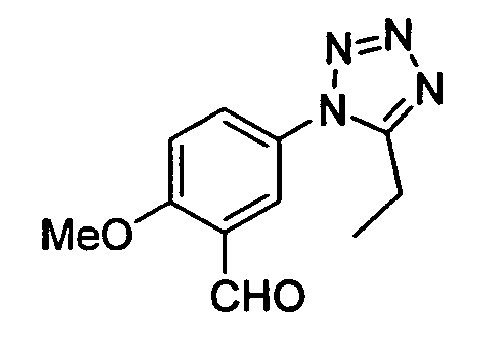
- Three grams of 1-(4-methoxyphenyl)-5-ethyl-1H-tetrazole (14.7 mmol), 15 ml of methanesulfonic acid, 15 ml of trifluoromethanesulfonic acid, and 4.13 g of hexamethylenetetramine (29.4 mmol) were introduced into a 100 ml flask, and heated to 100°C for reaction for 3 hours. After reaction, the reaction solution was cooled to room temperature, introduced into 30 ml of water cooled in an ice bath, and stirred at 5°C for 30 minutes. The reaction solution was then extracted with dichloromethane (60 ml x 3), and the organic phase thus obtained was washed with 10% aqueous sodium hydroxide solution (90 ml x 1) and water (90 ml x 1), and dried over anhydrous magnesium sulfate for 1 hour. After drying, filtration and solvent evaporation were performed, and the crude product thus obtained was subjected to crystallization in a mixed solvent containing 3 ml of dichloromethane and 12 ml of isopropyl alcohol while cooling in an ice bath. After filtration and drying, 1.28 g of 2-methoxy-5-(5-ethyltetrazol-1-yl)benzaldehyde was obtained as a white solid (yield: 37.5%). Melting point: 137.5 to 138.4°C
IR (KBr, cm-1) : 1682, 1612, 1501, 1452, 1396, 1279, 1246, 1182, 1173, 1117, 1055, 1015, 843, 652, 534
1H-NMR (CDCl3) : δ 10.49 (s, 1H), 7.85 (d, J = 2.7 Hz, 1H) , 7.66 (dd, J = 9.0 Hz, 2.7 Hz, 1H), 7.19 (d, J = 9.0 Hz, 1H), 4.04 (s, 3H), 2.88 (q, J = 7.6 Hz, 2H), 1.37 (t, J = 7.6 Hz, 3H)
13C-NMR (CDCl3): δ 187.54, 162.19, 155.86, 131.81, 126.59, 124.97, 124.16, 113.31, 56.36, 17.41, 11.51
Elemental analysis: - Value calculated for C11H12N4O2: C, 56.89%; H, 5.21%; N, 24.12%
- Value found: C, 56.58%; H, 5.26%; N, 24.11%
-

- Two grams of 1-(4-methoxyphenyl)-5-trifluoromethyl-1H-tetrazole (8.19 mmol), 20 ml of methanesulfonic acid, and 1.38 g of hexamethylenetetramine (9.83 mmol) were introduced into a 50 ml flask, and heated to 100°C for reaction for 3 hours. After reaction, the reaction solution was cooled to room temperature. 20 ml of water cooled in an ice bath was added to the reaction solution, and the reaction solution was then stirred at 5°C for 30 minutes. The reaction solution was then extracted with toluene (20 ml x 2), and the organic phase thus obtained was washed with 10% aqueous sodium hydroxide solution (20 ml x 1) and water (20 ml x 1), and dried over anhydrous magnesium sulfate for 1 hour. After drying, filtration and solvent evaporation were performed, and the crude product thus obtained was purified by column chromatography (silica gel, ethyl acetate:n-hexane = 1:1), resulting in 0.61 g of 2-methoxy-5-(5-trifluoromethyltetrazol-1-yl)benzaldehyde as a white solid (yield: 27.4%).
Melting point: 117.0 to 117.3°C
IR (KBr, cm-1): 1684, 1612, 1533, 1499, 1456, 1396, 1319, 1283, 1250, 1205, 1161, 1109, 1051, 1034, 1016, 839, 652
1H-NMR (CDCl3): δ 9.95 (s, 1H), 8.15 (dd, J = 8.5 Hz, 2.0 Hz, 1H), 7.94 (d, J = 2.0 Hz, 1H), 7.25 (d, J = 8.5 Hz, 1H), 3.92 (s, 3H) 13C-NMR (CDCl3): δ 187.21, 163.08, 146.62, 146.19, 145.78, 145.36, 131.85, 125.34, 125.19, 125.16, 121.71, 119.01, 116.31, 113.61, 113.25, 56.52
Elemental analysis: - Value calculated for C10H7F3N4O2: C, 44.13%; H, 2.59%; N, 20.58%
- Value found: C, 44.43%; H, 2.59%; N, 20.53%
-

- Fifteen grams of 1-(4-methoxyphenyl)-5-trifluoromethyl-1H-tetrazole (61.4 mmol), 37.5 ml of methanesulfonic acid, 37.5 ml of trifluoromethanesulfonic acid, and 17.22 g of hexamethylenetetramine (122.8 mmol) were introduced into a 300 ml flask, and heated to 100°C for reaction for 2 hours. After reaction, the reaction solution was cooled to room temperature, introduced into 75 ml of water cooled in an ice bath, and stirred at 5°C for 30 minutes. The reaction solution was then extracted with chloroform (150 ml x 2), and the organic phase thus obtained was washed with 10% aqueous sodium hydroxide solution (150 ml x 1) and water (150 ml x 1), and dried over anhydrous magnesium sulfate for 1 hour. After drying, filtration and solvent evaporation were performed, and the crude product thus obtained was subjected to crystallization in 75 ml of isopropyl alcohol while cooling in an ice bath. After filtration and drying, 11.66 g of 2-methoxy-5-(5-trifluoromethyltetrazol-1-yl)benzaldehyde was obtained as a white solid (yield: 69.7%).
Melting point: 117.0 to 117.3°C
IR (KBr, cm-1): 1684, 1612, 1533, 1499, 1456, 1396, 1319, 1283, 1250, 1205, 1161, 1109, 1051, 1034, 1016, 839, 652
1H-NMR (CDCl3): δ 9.95 (s, 1H), 8.15 (dd, J = 8.5 Hz, 2.0 Hz, 1H), 7.94 (d, J = 2.0 Hz, 1H), 7.25 (d, J = 8.5 Hz, 1H), 3.92 (s, 3H) 13C-NMR (CDCl3): δ 187.21, 163.08, 146.62, 146.19, 145.78, 145.36, 131.85, 125.34, 125.19, 125.16, 121.71, 119.01, 116.31, 113.61, 113.25, 56.52
Elemental analysis: - Value calculated for C10H7F3N4O2: C, 44.13%; H, 2.59%; N, 20.58%
- Value found: C, 44.43%; H, 2.59%; N, 20.53%
-

- Four grams of 1-(4-ethoxyphenyl)-5-trifluoromethyl-1H-tetrazole (15.5 mmol), 10 ml of methanesulfonic acid, 10 ml of trifluoromethanesulfonic acid, and 4.34 g of hexamethylenetetramine (31.0 mmol) were introduced into a 100 ml flask, and heated to 100°C for reaction for 2 hours. After reaction, the reaction solution was cooled to room temperature, introduced into 20 ml of water cooled in an ice bath, and stirred at 5°C for 30 minutes. The reaction solution was then extracted with chloroform (50 ml x 3), and the organic phase thus obtained was washed with 10% aqueous sodium hydroxide solution (80 ml x 1) and water (80 ml x 1), and dried over anhydrous magnesium sulfate for 1 hour. After drying, filtration and solvent evaporation were performed, and the crude product thus obtained was purified by column chromatography (silica gel, chloroform), resulting in 1.01 g of 2-ethoxy-5-(5-trifluoromethyltetrazol-1-yl)benzaldehyde as a white solid (yield: 22.8%).
Melting point: 87.9 to 88.4°C
IR (KBr, cm-1): 3075, 2941, 2889, 1692, 1609, 1533, 1501, 1447, 1389, 1321, 1285, 1271, 1246, 1211, 1171, 1155, 1118, 1038, 816, 669
1H-NMR (CDCl3) : δ 10.51 (s, 1H), 7.94 (d, J = 2.7 Hz, 1H), 7.66 (dd, J = 8.8 Hz, 2.7 Hz, 1H), 7.23 (d, J = 8.8 Hz, 1H), 4.30 (q, J = 7.0 Hz, 2H), 1.57 (d, J = 7.0 Hz, 3H)
13C-NMR (CDCl3): δ 187.66, 162.81, 146.79, 146.39, 145.97, 145.55, 131.91, 125.24, 121.84, 119.14, 116.44, 113.97, 113.73, 65.25, 14.43
Elemental analysis: - Value calculated for C11H9F3N4O2: C, 46.16%; H, 3.17%; N, 19.58%
- Value found: C, 45.99%; H, 3.05%; N, 20.08%
Claims (11)
- A process for producing an alkoxy-(tetrazol-1-yl)benzaldehyde compound represented by Formula (2):

the process comprising reacting a 1-(alkoxyphenyl)-1H-tetrazole compound represented by Formula (1):
- The process according to claim 1, wherein the sulfonic acid solvent is a mixed solvent of methanesulfonic acid and trifluoromethanesulfonic acid.
- The process according to claim 1, wherein hexamethylenetetramine is used in an amount of 1.0 to 3.0 mol per mol of the 1-(alkoxyphenyl)-1H-tetrazole compound.
- The process according to claim 1, wherein A1 is a methoxy group, and A2 is a hydrogen atom, methyl group, ethyl group or trifluoromethyl group.
- A process for producing a 4-alkoxy-3-(tetrazol-1-yl)benzaldehyde compound represented by Formula (4):

the process comprising reacting a 1-(2-alkoxyphenyl)-1H-tetrazole compound represented by Formula (3):
- A process for producing a 2-alkoxy-4-(tetrazol-1-yl)benzaldehyde compound represented by Formula (6):

the process comprising reacting a 1-(3-alkoxyphenyl)-1H-tetrazole compound represented by Formula (5):
- A process for producing a 2-alkoxy-5-(tetrazol-1-yl)benzaldehyde compound represented by Formula (8):

the process comprising reacting a 1-(4-alkoxyphenyl)-1H-tetrazole compound represented by Formula (7):
- An alkoxy-(tetrazol-1-yl)benzaldehyde compound represented by Formula (2):
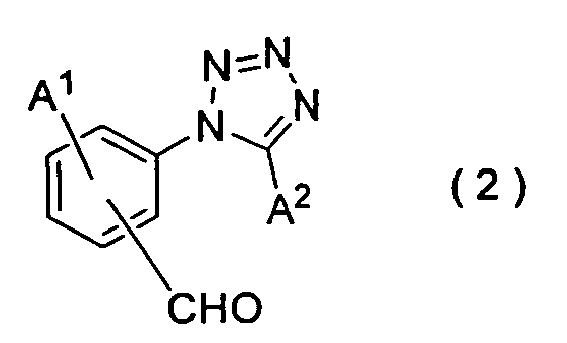

- The alkoxy-(tetrazol-1-yl)benzaldehyde compound according to claim 8, wherein the aldehyde group is in an ortho or para position relative to A1.
- A 4-alkoxy-3-(tetrazol-1-yl)benzaldehyde compound represented by Formula (4):

- A 2-alkoxy-4-(tetrazol-1-yl)benzaldehyde compound represented by Formula (6):

Applications Claiming Priority (2)
| Application Number | Priority Date | Filing Date | Title |
|---|---|---|---|
| JP2003285266 | 2003-08-01 | ||
| PCT/JP2004/010437 WO2005012267A1 (en) | 2003-08-01 | 2004-07-15 | Alkoxytetrazol-1-ylbenzaldehyde compound and process for producing the same |
Publications (2)
| Publication Number | Publication Date |
|---|---|
| EP1650198A1 true EP1650198A1 (en) | 2006-04-26 |
| EP1650198A4 EP1650198A4 (en) | 2007-11-21 |
Family
ID=34113874
Family Applications (1)
| Application Number | Title | Priority Date | Filing Date |
|---|---|---|---|
| EP04747826A Withdrawn EP1650198A4 (en) | 2003-08-01 | 2004-07-15 | Alkoxytetrazol-1-ylbenzaldehyde compound and process for producing the same |
Country Status (7)
| Country | Link |
|---|---|
| US (1) | US7579480B2 (en) |
| EP (1) | EP1650198A4 (en) |
| JP (1) | JP4710608B2 (en) |
| KR (1) | KR100785395B1 (en) |
| CN (1) | CN100402508C (en) |
| CA (1) | CA2531573C (en) |
| WO (1) | WO2005012267A1 (en) |
Families Citing this family (3)
| Publication number | Priority date | Publication date | Assignee | Title |
|---|---|---|---|---|
| JP2006137691A (en) * | 2004-11-11 | 2006-06-01 | Toyo Kasei Kogyo Co Ltd | Method for producing 2-alkoxy-5-tetrazolyl-benzaldehyde compound |
| US8326408B2 (en) * | 2008-06-18 | 2012-12-04 | Green George H | Method and apparatus of neurological feedback systems to control physical objects for therapeutic and other reasons |
| JP6137197B2 (en) | 2012-12-17 | 2017-05-31 | 三菱化学株式会社 | Gallium nitride substrate and method of manufacturing nitride semiconductor crystal |
Family Cites Families (6)
| Publication number | Priority date | Publication date | Assignee | Title |
|---|---|---|---|---|
| IS4208A (en) * | 1993-09-22 | 1995-03-23 | Glaxo Group Limited | 3- (tetrazolyl-benzyl) amino-piperadidine derivatives |
| ES2229259T3 (en) | 1995-01-12 | 2005-04-16 | Glaxo Group Limited | PIPERIDINE DERIVATIVES WITH TAQUIQUININA ANTAGONIST ACTIVITY. |
| GB9505692D0 (en) * | 1995-03-21 | 1995-05-10 | Glaxo Group Ltd | Chemical compounds |
| MX9706944A (en) * | 1996-09-12 | 1998-08-30 | Pfizer | Quinuclidines substituted with tetrazolyl as antagonist of the substance p. |
| ATE439838T1 (en) * | 1998-09-29 | 2009-09-15 | Merck & Co Inc | RADIOM LABELED NEUROKININ-1 RECEPTOR ANTAGONISTS |
| AU2001272770A1 (en) | 2000-07-19 | 2002-01-30 | Chugai Seiyaku Kabushiki Kaisha | Process for the preparation of a benzofuran derivative |
-
2004
- 2004-07-15 CA CA2531573A patent/CA2531573C/en not_active Expired - Fee Related
- 2004-07-15 KR KR1020067002250A patent/KR100785395B1/en not_active Expired - Fee Related
- 2004-07-15 WO PCT/JP2004/010437 patent/WO2005012267A1/en not_active Ceased
- 2004-07-15 EP EP04747826A patent/EP1650198A4/en not_active Withdrawn
- 2004-07-15 US US10/565,801 patent/US7579480B2/en not_active Expired - Fee Related
- 2004-07-15 CN CNB2004800207209A patent/CN100402508C/en not_active Expired - Fee Related
- 2004-07-15 JP JP2005512482A patent/JP4710608B2/en not_active Expired - Fee Related
Also Published As
| Publication number | Publication date |
|---|---|
| US7579480B2 (en) | 2009-08-25 |
| CA2531573C (en) | 2010-04-13 |
| KR100785395B1 (en) | 2007-12-13 |
| EP1650198A4 (en) | 2007-11-21 |
| JP4710608B2 (en) | 2011-06-29 |
| CA2531573A1 (en) | 2005-02-10 |
| KR20060059994A (en) | 2006-06-02 |
| CN1826329A (en) | 2006-08-30 |
| JPWO2005012267A1 (en) | 2006-09-14 |
| US20070060630A1 (en) | 2007-03-15 |
| CN100402508C (en) | 2008-07-16 |
| WO2005012267A1 (en) | 2005-02-10 |
Similar Documents
| Publication | Publication Date | Title |
|---|---|---|
| TW200821283A (en) | Process and intermediates for preparing integrase inhibitors | |
| SG187565A1 (en) | Process for preparing benzofuran derivatives substituted at position 5 | |
| US20150321983A1 (en) | A process for the preparation of ospemifene | |
| CN102120734B (en) | Method for preparing 2-(N-alkyl)aminobenzothiazole derivatives by using active alcohol as alkylating reagent | |
| CA2531573C (en) | Alkoxy-(tetrazol-1-yl)benzaldehyde compound and process for producing the same | |
| CN113105357A (en) | Synthesis method and application of novel p-aryl azophenol derivative | |
| JP2001513108A (en) | Preparation process of nicotinic acid | |
| HU208533B (en) | Process for selective etherification of ascorbinic acid derivatives | |
| WO2012062109A1 (en) | Methods for preparation of pharmaceutical intermediates of aliskiren | |
| JP4975738B2 (en) | 2-alkenyl-3-aminothiophene derivative and method for producing the same | |
| CN109096139B (en) | Preparation method of alpha-carbonyl amide derivative | |
| CA2613689A1 (en) | Process for the preparation of 1-[cyano (4-hydroxyphenyl)methyl]cyclohexanol compounds | |
| KR100683274B1 (en) | Process for preparing substituted benzopyran compound | |
| US20070265452A1 (en) | Method for Preparing 2-Alkoxy-5-Tetrazolyl-Benzaldehyde Compound | |
| CN109651179B (en) | 2- (2-aminobenzoyl) benzoic acid derivatives and process for preparing the same | |
| KR100466797B1 (en) | Benzoazepin derivatives and process for production thereof using indium | |
| KR100740325B1 (en) | Compound for Synthesizing Substituted Benzopyran Compound | |
| KR100716274B1 (en) | Compound for Synthesizing Substituted Benzopyran Compound | |
| KR100760015B1 (en) | Intermediates for the synthesis of benzopyran compounds | |
| JPH11335329A (en) | Alpha-(alkoxyoxalyl)fatty acid ester and alpha-alkyl or alkenylacrylic esters and synthesis of phenidones using the same | |
| JP2008100951A (en) | Method for producing 2-cyclopentadecenone | |
| Liu et al. | 4-(Nitro)-diphenylammonium triflate (NDPAT) catalysed esterification of carboxylic acids with alcohols | |
| JP2010083798A (en) | METHOD FOR PRODUCING omega-HYDROXY LONG-CHAIN FATTY ACID DERIVATIVE | |
| US20060217554A1 (en) | Processes for producing pyrazoloacridone derivative and synthetic intermediate thereof | |
| JP2003089692A (en) | Method for producing 4,5-disubstituted-1,2,3-triazole |
Legal Events
| Date | Code | Title | Description |
|---|---|---|---|
| PUAI | Public reference made under article 153(3) epc to a published international application that has entered the european phase |
Free format text: ORIGINAL CODE: 0009012 |
|
| 17P | Request for examination filed |
Effective date: 20051222 |
|
| AK | Designated contracting states |
Kind code of ref document: A1 Designated state(s): AT BE BG CH CY CZ DE DK EE ES FI FR GB GR HU IE IT LI LU MC NL PL PT RO SE SI SK TR |
|
| DAX | Request for extension of the european patent (deleted) | ||
| A4 | Supplementary search report drawn up and despatched |
Effective date: 20071023 |
|
| 17Q | First examination report despatched |
Effective date: 20081218 |
|
| RAP1 | Party data changed (applicant data changed or rights of an application transferred) |
Owner name: TOYO BOSEKI KABUSHIKI KAISHA |
|
| GRAP | Despatch of communication of intention to grant a patent |
Free format text: ORIGINAL CODE: EPIDOSNIGR1 |
|
| RAP1 | Party data changed (applicant data changed or rights of an application transferred) |
Owner name: TOYOBO CO., LTD. |
|
| STAA | Information on the status of an ep patent application or granted ep patent |
Free format text: STATUS: THE APPLICATION IS DEEMED TO BE WITHDRAWN |
|
| 18D | Application deemed to be withdrawn |
Effective date: 20130201 |