EP1649855A1 - Medicinal composition - Google Patents

Medicinal composition Download PDF

Info

Publication number
EP1649855A1
EP1649855A1 EP04747897A EP04747897A EP1649855A1 EP 1649855 A1 EP1649855 A1 EP 1649855A1 EP 04747897 A EP04747897 A EP 04747897A EP 04747897 A EP04747897 A EP 04747897A EP 1649855 A1 EP1649855 A1 EP 1649855A1
Authority
EP
European Patent Office
Prior art keywords
benzothiepin
dihydrothieno
trioxo
trifluoro
methyl
Prior art date
Legal status (The legal status is an assumption and is not a legal conclusion. Google has not performed a legal analysis and makes no representation as to the accuracy of the status listed.)
Withdrawn
Application number
EP04747897A
Other languages
German (de)
French (fr)
Inventor
Tsuyoshi Kyowa Hakko Kogyo Co. Ltd. YAMAGATA
Shiro Kyowa Hakko Kogyo Co. Ltd. SHIRAKURA
Current Assignee (The listed assignees may be inaccurate. Google has not performed a legal analysis and makes no representation or warranty as to the accuracy of the list.)
KH Neochem Co Ltd
Original Assignee
Kyowa Hakko Kogyo Co Ltd
Priority date (The priority date is an assumption and is not a legal conclusion. Google has not performed a legal analysis and makes no representation as to the accuracy of the date listed.)
Filing date
Publication date
Application filed by Kyowa Hakko Kogyo Co Ltd filed Critical Kyowa Hakko Kogyo Co Ltd
Publication of EP1649855A1 publication Critical patent/EP1649855A1/en
Withdrawn legal-status Critical Current

Links

Classifications

    • AHUMAN NECESSITIES
    • A61MEDICAL OR VETERINARY SCIENCE; HYGIENE
    • A61KPREPARATIONS FOR MEDICAL, DENTAL OR TOILETRY PURPOSES
    • A61K45/00Medicinal preparations containing active ingredients not provided for in groups A61K31/00 - A61K41/00
    • A61K45/06Mixtures of active ingredients without chemical characterisation, e.g. antiphlogistics and cardiaca
    • AHUMAN NECESSITIES
    • A61MEDICAL OR VETERINARY SCIENCE; HYGIENE
    • A61KPREPARATIONS FOR MEDICAL, DENTAL OR TOILETRY PURPOSES
    • A61K31/00Medicinal preparations containing organic active ingredients
    • A61K31/33Heterocyclic compounds
    • A61K31/38Heterocyclic compounds having sulfur as a ring hetero atom
    • AHUMAN NECESSITIES
    • A61MEDICAL OR VETERINARY SCIENCE; HYGIENE
    • A61PSPECIFIC THERAPEUTIC ACTIVITY OF CHEMICAL COMPOUNDS OR MEDICINAL PREPARATIONS
    • A61P13/00Drugs for disorders of the urinary system
    • A61P13/08Drugs for disorders of the urinary system of the prostate
    • AHUMAN NECESSITIES
    • A61MEDICAL OR VETERINARY SCIENCE; HYGIENE
    • A61PSPECIFIC THERAPEUTIC ACTIVITY OF CHEMICAL COMPOUNDS OR MEDICINAL PREPARATIONS
    • A61P13/00Drugs for disorders of the urinary system
    • A61P13/10Drugs for disorders of the urinary system of the bladder
    • AHUMAN NECESSITIES
    • A61MEDICAL OR VETERINARY SCIENCE; HYGIENE
    • A61PSPECIFIC THERAPEUTIC ACTIVITY OF CHEMICAL COMPOUNDS OR MEDICINAL PREPARATIONS
    • A61P43/00Drugs for specific purposes, not provided for in groups A61P1/00-A61P41/00

Definitions

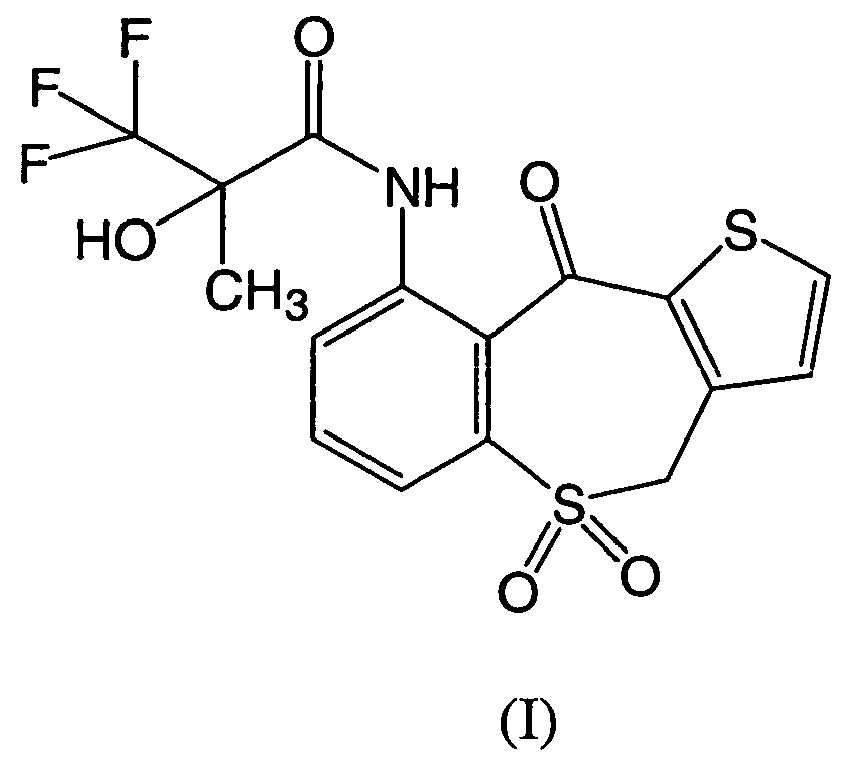
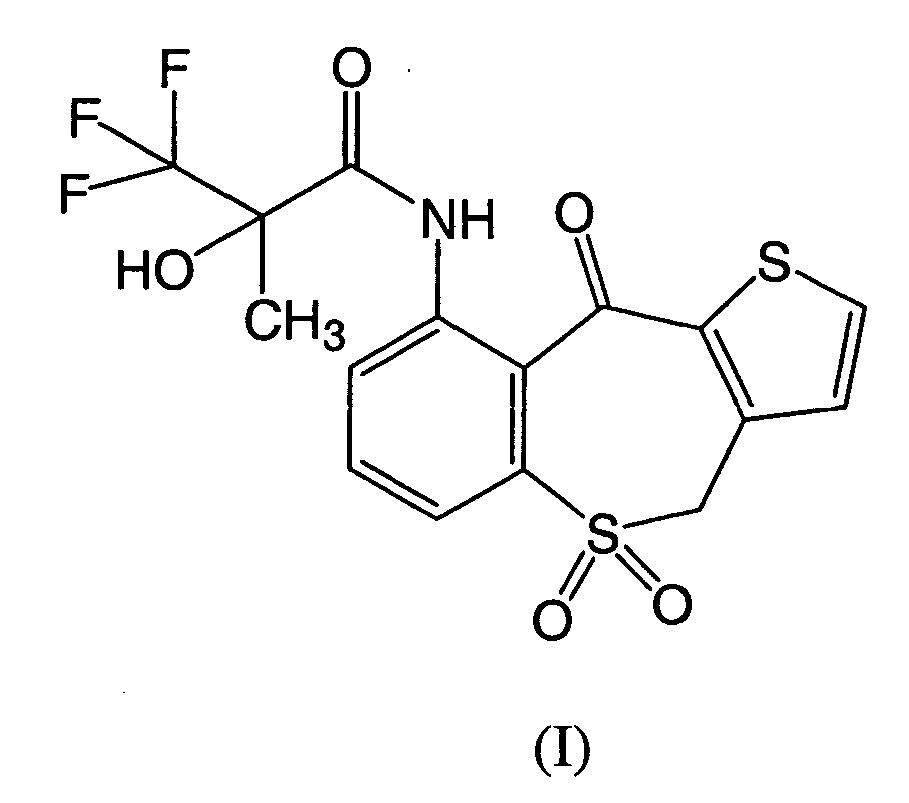
  • the present invention relates to a pharmaceutical composition which comprises 3,3,3-trifluoro-2-hydroxy-2-methyl-N-(5,5,10-trioxo-4,10-dihydrothieno[3,2-c][1]benzothiepin-9-yl)propanamide (hereinafter referred to as Compound (I), if desired) or a pharmaceutically acceptable salt thereof, and an ⁇ 1 -adrenoceptor antagonist.
  • Compound (I) 3,3,3-trifluoro-2-hydroxy-2-methyl-N-(5,5,10-trioxo-4,10-dihydrothieno[3,2-c][1]benzothiepin-9-yl)propanamide
  • Compound (I) 3,3,3-trifluoro-2-hydroxy-2-methyl-N-(5,5,10-trioxo-4,10-dihydrothieno[3,2-c][1]benzothiepin-9-yl)propanamide
  • Benign prostatic hyperplasia is benign adenoma derived from a transitional zone of the prostate that is present surrounding the urethra.
  • Patients with benign prostatic hyperplasia complain of bladder outlet obstructive symptoms and/or bladder irritative symptoms.
  • bladder outlet obstructive symptoms include a delayed initiation of micturition, straining, a weak urinary stream, an intermittent urinary stream, dribbling after urination, prolongation of voiding time and overflow incontinence.
  • bladder irritative symptoms include urinary frequency at daytime or nighttime, urinary urgency, a feeling of incomplete emptying, and a reduced voided volume per micturition. The pathogenesis of theses symptoms underlies functional and mechanical obstruction in urethras caused by hypertrophied prostate.
  • the treatments for benign prostatic hyperplasia are surgical operation such as transurethral resection of prostate, and medication of typically an ⁇ 1- adrenoceptor antagonist.
  • the surgical operation for treatment of benign prostatic hyperplasia has some problems: the surgical application is limited since most patients are elderly; the cost of operation is expensive; and the continuation or recurrence of obstructive and irritative symptoms are observed even after surgery.
  • the pharmacological treatment may be mainly used in elderly patients, or patients with mild or moderate benign prostatic hyperplasia.
  • Noradrenaline released from the terminal of sympathetic nerves acts to constrict the smooth muscles of a prostate and a urethra, thereby increasing the urethral resistance to decrease the urine flow on urination.
  • Noradrenaline released from a central nervous system, a peripheral nervous system and a glandular system shows various physiological activities in vivo, and a blocker of ⁇ 1 -adrenoceptor, one of the receptors of adrenaline, is used for treatment of benign prostatic hyperplasia.
  • a blocker of ⁇ 1 -adrenoceptor one of the receptors of adrenaline
  • an ⁇ 1 -adrenoceptor antagonist is insufficient for ameliorating bladder irritative symptoms though it may be moderately effective for the obstructive symptoms of benign prostatic hyperplasia.
  • the increase in the urethral resistance due to functional obstruction and mechanical obstruction may further cause secondary histological and functional changes in a detrusor, a sensory nervous system and an autonomic nervous system, and induce complicated disease conditions of bladder irritative symptoms and obstructive symptoms.
  • a detrusor a sensory nervous system and an autonomic nervous system
  • bladder irritative symptoms and obstructive symptoms Associated with such functional changes in the detrusor and nervous systems thereof, patients with benign prostatic hyperplasia often show idiopathic detrusor overactivity.
  • Compound (I) or a pharmaceutically acceptable salt thereof is effective in the treatment of urinary incontinence (WO98/46587), and that Compound (I) or a pharmaceutically acceptable salt thereof has a A-type potassium channel opening activity and is effective in the treatment of bladder irritative symptoms accompanied by benign prostatic hyperplasia (WO02/078633 and WO02/078712).
  • An object of the present invention is to provide a pharmaceutical composition which comprises Compound (I) or a pharmaceutically acceptable salt thereof and an ⁇ 1- adrenoceptor antagonist, or the like.
  • the present invention relates to the following (1) to (21):
  • the pharmaceutically acceptable salt of Compound (I) includes, for example, pharmaceutically acceptable acid addition salts, metal salts, ammonium salts, organic amine addition salts, amino acid addition salts and the like.
  • the pharmaceutically acceptable acid addition salts of Compound (I) include inorganic acid salts such as hydrochlorides, sulfates, hydrobromides, nitrates and phosphates; and organic acid salts such as acetates, mesylates, succinates, maleates, fumarates, citrates and tartrates.
  • the pharmaceutically acceptable metal salts include alkali metal salts such as sodium salts and potassium salts; alkaline earth metal salts such as magnesium salts and calcium salts; and aluminum salts and zinc salts.
  • the pharmaceutically acceptable ammonium salts include ammonium salts, tetramethylammonium salts and the like.
  • the pharmaceutically acceptable organic amine addition salts include salts with morpholine, piperidine and the like.
  • the pharmaceutically acceptable amino acid addition salts include addition salts with glycine, phenylalanine, lysine, aspartic acid, glutamic acid and the like.
  • Compound (I) can be produced according to the method described in WO98/4658 or a similar method thereof.
  • stereoisomers for example, tautomers, enantiomers and the like
  • All possible isomers and mixtures thereof including above-mentioned stereoisomers can be used as the pharmaceutical composition, the therapeutic agent for bladder irritative symptoms accompanied by benign prostatic hyperplasia, the kit, the kit for treating bladder irritative symptoms accompanied by benign prostatic hyperplasia and the method for treating bladder irritative symptoms accompanied by benign prostatic hyperplasia of the present invention.
  • Compound (I) of the present invention includes all possible isomers and mixtures thereof including above-mentioned stereoisomers.
  • a salt of Compound (I) it may be purified as it is when it is produced in the form of the salt, and when it is produced in the form of a free form, it may be dissolved or suspended in a suitable solvent, and added with an acid or a base, followed by isolation and purification.
  • Compound (I) and pharmaceutically acceptable salts thereof may exist in the form of adducts with water or various solvents, and such adducts can also be used as the pharmaceutical composition, the therapeutic agent for bladder irritative symptoms accompanied by benign prostatic hyperplasia, the kit, the kit for treating bladder irritative symptoms accompanied by benign prostatic hyperplasia and the method for treating bladder irritative symptoms accompanied by benign prostatic hyperplasia of the present invention, and such adducts are included in Compound (I) and pharmaceutically acceptable salts thereof of the present invention.
  • the ⁇ 1 -adrenoceptor antagonist includes tamsulosin, prazosin, terazosin, urapidil, doxazosin, alfzosin, naftopidil, maftopidil, abanoxil and indolamin, as well as stereoisomers (for example, enantiomers and the like) thereof, pharmaceutically acceptable salts thereof and hydrates thereof. One or more of these may be used herein either singly or as combined.
  • the pharmaceutically acceptable salts of the compounds are, for example, the salts mentioned hereinabove for the pharmaceutically acceptable salts of Compound (I).
  • Compound (I) or a pharmaceutically acceptable salt thereof and the ⁇ 1 -adrenoceptor antagonist used in the pharmaceutical composition or the therapeutic agent for bladder irritative symptoms accompanied by benign prostatic hyperplasia of the present invention may be administered alone or in combination as preparations containing their active ingredients. Particularly, a combination of two or more preparations is preferable. When the preparations are used or administered in combination, they may be used or administered together or separately at an interval.
  • the dose ratio (weight/weight) of Compound (I) or a pharmaceutically acceptable salt thereof to the ⁇ 1- adrenoceptor antagonist may be suitably determined, depending on the combination with the ⁇ 1 -adrenoceptor antagonist to be used and the efficacy of the ⁇ 1- adrenoceptor antagonist.
  • the specific ratio is from 1/500 (Compound (I) or a pharmaceutically acceptable salt thereof/ ⁇ 1 -adrenoceptor antagonist) to 5000/1, more preferably from 1/300 to 1000/1, even more preferably from 1/200 to 500/1, still more preferably from 1/100 to 100/1.
  • a first component comprising Compound (I) or a pharmaceutically acceptable salt thereof
  • a second component comprising an ⁇ 1 -adrenoceptor antagonist
  • each component can be administered together or separately at an interval to one subject by the same route or different routes.
  • the kit comprises two or more containers (for example, vials, bags) and the contents.
  • the material and the shape of the containers are not limited, but the containers must prevent the contents, i.e. the components, from degrading due to external temperature or light during the storage, and should be made from a material that does not elute its chemical constituents.
  • the first component and the second component are administerable dosage forms so as to be administered through different routes (for example, tubes) or the same route. Specifically mentioned are a kit of tablets, injections, and the like.
  • the method for treating bladder irritative symptoms accompanied by benign prostatic hyperplasia of the present invention may be carried out in the same manner as that for the use or administration of Compound (I) or a pharmaceutically acceptable salt thereof and an ⁇ 1- adrenoceptor antagonist used in the pharmaceutical composition or the therapeutic agent for bladder irritative symptoms accompanied by benign prostatic hyperplasia described above. That is, Compound (I) or a pharmaceutically acceptable salt thereof and an ⁇ 1- adrenoceptor antagonist are formulated into preparations containing the respective active ingredients therein, and for example, they are administered as single preparation or as a combination of preparations, preferably, they are administered as a combination of two or more preparations. When preparations are administered in combinnation, they may be administered together or separately at an interval, and the kit described above may be used for administration.
  • mice Female SD rats of 8 to 9 weeks of age (supplied by Charles River Japan) were used in the test. Five to seven animals of these rats were housed in metal cages and given commercially available chow and water ad libtum, in an animal room maintained at room temperature from 19°C to 25°C and humidity from 30% to 70% under illumination for 12 hours (7:00 a.m. - 7:00 p.m.) per day.
  • the rats were subjected to operation of partial urethral obstruction.
  • Each animal was anesthetized by intraperitoneal administration of 50 mg/kg pentobarbital sodium (Tokyo Kasei), and the midline incision of the skin and muscle was made in the lower abdomen.
  • a polyethylene tube PE-20, Becton Dickinson
  • the polyethylene tube was removed to induce partial urethral obstruction.
  • the incised part was sutured with a surgical silk thread.
  • An antibiotic ampicillin (Sigma) was intramusclarly injected (150 mg/kg, once a day, for 3 days).
  • the rats with bladder hypertrophy were subjected to intravesical implantation of catheter. Under anesthesia with pentobarbital sodium, the bladder was exposed by an abdominal midline incision. A polyethylene tube (PE-50, Becton Dickinson), one end of which was blunted not to damage the bladder tissue, was filled with a physiological saline (Otsuka Pharmaceutical Factory) and inserted into the bladder via the bladder apex. The intravesical catheter was fixed with a surgical silk suture. The other end of the catheter was tunneled subcutaneously, drawn out from the dorsal neck, plugged and then fixed to the skin with a suture.
  • PE-50 Polyethylene tube
  • Becton Dickinson Becton Dickinson
  • a cystometry test was performed.
  • the rats were housed in a Bollman cage (Natsume Seisakusho) and a three-way stopcock was connected to the intravesical catheter, one end of the stopcock was connected to a pressure transducer (Nihon Kohden) and the other end was connected to a 50-mL syringe (Terumo) set in an infusion pump (KD Scientific) for physiological saline infusion.
  • the intravesical pressure was measured with a polygraph system (RMP-6008, Nihon Kohden) via a pressure transducer and a strain pressure amplifier (AP-621G, Nihon Kohden), and recorded on a thermal array recorder (RTA-1200, Nihon Kohden).
  • Compound (Ia) was suspended in a 0.5 w/v (weight/volume) % methyl cellulose solution at a concentration of 1 mg/ml. The suspension was further diluted with a 0.5 w/v % methyl cellulose solution to prepare solution for administration [solution for Compound (Ia) administration] at a concentration of 0.01 mg/ml. The solution was orally administered to the rats at a volume of 1 ml/kg.
  • Tamsulosin hydrochloride was dissolved in a 0.5 w/v % methyl cellulose solution at a concentration of 0.03 mg/ml (solution for tamsulosin administration), and the solution was orally administered to the rats at a volume of 1 ml/kg.
  • Compound (Ia) solution and the tamsulosin solution were simultaneously and orally administered to the rats, both at a volume of 1 ml/kg each.
  • the periods of 1, 3 and 5 hours after the administration were used as the measuring time after the administration of the vehicle or drug.
  • a physiological saline was infused into the bladder of each rat.
  • Micturition contractions and premicturition contractions were measured as an index of voiding function and detrusor overactivity, respectively.
  • the average of all micturition contraction values observed during each 30-minute measurement period was designated as the amplitude of micturition contraction, and the average of the maximum premicturition contraction between respective micturition contractions were designated as the amplitude of premicturition contractions at each measurement point.
  • the number of premicturition contractions for 2 minutes just before voiding was counted, and this is referred to as frequency of premicturition contractions.
  • Table 1 Effect of Combination of Compound (la) and Tamsulosin on amplitude of premicturition contractions in rats with bladder hypertrophy control Compound (Ia) 0.01 mg/kg, p.o. Tamsulosin 0.03 mg/kg, p.o.
  • Compound (Ia) and tamsulosin inhibited premicturition contractions (amplitude and frequency of premicturition contractions).
  • Combined administration of Compound (Ia) and tamsulosin resulted in enhanced inhibition of premicturition contractions (amplitude and frequency of pre-micturition contractions).
  • Administration of Compound (Ia) alone, administration of tamsulosin alone, and combined administration of Compound (Ia) and tamsulosin all did not affect micturition contractions, or that is, they did not have any influence on voiding function itself.
  • the pharmaceutical composition or the therapeutic agent for bladder irritative symptoms accompanied by benign prostatic hyperplasia of the present invention may be used, administered or produced in a single preparation or a combination of preparations so far as the preparations are formulated so as to contain the respective active ingredients, Compound (I) or a pharmaceutically acceptable salt thereof and an ⁇ 1 -adrenoceptor antagonist.
  • the pharmaceutical composition or the therapeutic agent for bladder irritative symptoms accompanied by benign prostatic hyperplasia has a unit dose form suitable to oral administration such as tablets or capsule, or has a unit dose form suitable to parenteral administration such as injections.
  • preparations are used or administered as a combination of preparations, they may be used or administered together or separately at an interval.
  • preparations may be produced in any ordinary method using any other pharmaceutically acceptable diluent, excipient, disintegrator, lubricant, binder, surfactant, water, physiological saline, vegetable oil solubilizer, isotonizing agent, preservative and antioxidant, in addition to the respective active ingredients.
  • excipients such as lactose, disintegrators such as starch, lubricants such as magnesium stearate, binders such as hydroxypropyl cellulose, surfactants such as fatty acid ester, and plasticizers such as glycerin can be used according to any ordinary manner.
  • carriers such as distilled water, salt solution, glucose solution or a mixture of salt water and glucose solution, solubilizers, isotonizing agents, preservatives, and antioxidants can be used according to any ordinary manner.
  • the dose and the administration frequency thereof may vary depending on the dosage form, the age, the body weight and the condition of patients.
  • Compound (I) or a pharmaceutically acceptable salt thereof and an ⁇ 1 -adrenoceptor antagonist are preferably administered in a dose described below per day:
  • Capsules having the following compositions were prepared according to an ordinary method.
  • An injection having the following compositions is prepared according to an ordinary method.
  • Tablets having the following composition are prepared according to an ordinary method.
  • Tamsulosin hydrochloride 0.4 g
  • lactose (303.6 g) and potato starch 68 g
  • a 10% aqueous hydroxypropyl cellulose solution 200 g
  • the resulting mixture is kneaded according to an ordinary manner, then granulated and dried to give granules to be tabletted.
  • 8.0 g of magnesium stearate is added thereto, and using a tabletting machine with 8 mm diameter punch and die (RT-15 Model, Kikusui Seisakusho), the resulting mixture is tabletted to give tablets (containing 0.2 mg of the active ingredient per tablet).
  • Formulation Tamuslosin hydrochloride 0.2 mg Lactose 151.8 mg
  • Example 5 Tablets (single preparation of Compound (Ia) and tamsulosin hydrochloride)
  • Tablets having the following composition are prepared according to an ordinary method.
  • the present invention provides a pharmaceutical composition which comprises 3,3,3-trifluoro-2-hydroxy-2-methyl-N-(5,5,10-trioxo-4,10-dihydrothieno[3,2-c][1]benzothiepin-9-yl)propanamide or a pharmaceutically acceptable salt thereof, and an ⁇ 1 -adrenoceptor antagonist.

Landscapes

  • Health & Medical Sciences (AREA)
  • Life Sciences & Earth Sciences (AREA)
  • Chemical & Material Sciences (AREA)
  • Veterinary Medicine (AREA)
  • Public Health (AREA)
  • Medicinal Chemistry (AREA)
  • General Health & Medical Sciences (AREA)
  • Animal Behavior & Ethology (AREA)
  • Pharmacology & Pharmacy (AREA)
  • Epidemiology (AREA)
  • General Chemical & Material Sciences (AREA)
  • Organic Chemistry (AREA)
  • Nuclear Medicine, Radiotherapy & Molecular Imaging (AREA)
  • Engineering & Computer Science (AREA)
  • Chemical Kinetics & Catalysis (AREA)
  • Bioinformatics & Cheminformatics (AREA)
  • Urology & Nephrology (AREA)
  • Pharmaceuticals Containing Other Organic And Inorganic Compounds (AREA)
  • Medicines That Contain Protein Lipid Enzymes And Other Medicines (AREA)
  • Acyclic And Carbocyclic Compounds In Medicinal Compositions (AREA)

Abstract

The present invention provides a pharmaceutical composition which is useful in the treatment for bladder irritative symptoms accompanied by benign prostatic hyperplasia and the like, and comprises 3,3,3-trifluoro-2-hydroxy-2-methyl-N-(5,5,10-trioxo-4,10-dihydrothieno[3,2-c] [1]benzothiepin-9-yl)propanamide or a pharmaceutically acceptable salt thereof, and an α1-adrenoceptor antagonist.
Description

    Technical Field
  • The present invention relates to a pharmaceutical composition which comprises 3,3,3-trifluoro-2-hydroxy-2-methyl-N-(5,5,10-trioxo-4,10-dihydrothieno[3,2-c][1]benzothiepin-9-yl)propanamide (hereinafter referred to as Compound (I), if desired) or a pharmaceutically acceptable salt thereof, and an α1-adrenoceptor antagonist.
  • Background Art
  • Benign prostatic hyperplasia is benign adenoma derived from a transitional zone of the prostate that is present surrounding the urethra. Patients with benign prostatic hyperplasia complain of bladder outlet obstructive symptoms and/or bladder irritative symptoms. Examples of bladder outlet obstructive symptoms include a delayed initiation of micturition, straining, a weak urinary stream, an intermittent urinary stream, dribbling after urination, prolongation of voiding time and overflow incontinence. Examples of bladder irritative symptoms include urinary frequency at daytime or nighttime, urinary urgency, a feeling of incomplete emptying, and a reduced voided volume per micturition. The pathogenesis of theses symptoms underlies functional and mechanical obstruction in urethras caused by hypertrophied prostate.
  • Today, the treatments for benign prostatic hyperplasia are surgical operation such as transurethral resection of prostate, and medication of typically an α1-adrenoceptor antagonist. The surgical operation for treatment of benign prostatic hyperplasia has some problems: the surgical application is limited since most patients are elderly; the cost of operation is expensive; and the continuation or recurrence of obstructive and irritative symptoms are observed even after surgery. In general, the pharmacological treatment may be mainly used in elderly patients, or patients with mild or moderate benign prostatic hyperplasia.
  • Activation of a sympathetic nervous system participates in the urethral obstruction accompanied by benign prostatic hyperplasia. Noradrenaline released from the terminal of sympathetic nerves acts to constrict the smooth muscles of a prostate and a urethra, thereby increasing the urethral resistance to decrease the urine flow on urination.
  • Noradrenaline released from a central nervous system, a peripheral nervous system and a glandular system shows various physiological activities in vivo, and a blocker of α1-adrenoceptor, one of the receptors of adrenaline, is used for treatment of benign prostatic hyperplasia. In general, however, an α1-adrenoceptor antagonist is insufficient for ameliorating bladder irritative symptoms though it may be moderately effective for the obstructive symptoms of benign prostatic hyperplasia.
  • The increase in the urethral resistance due to functional obstruction and mechanical obstruction may further cause secondary histological and functional changes in a detrusor, a sensory nervous system and an autonomic nervous system, and induce complicated disease conditions of bladder irritative symptoms and obstructive symptoms. Associated with such functional changes in the detrusor and nervous systems thereof, patients with benign prostatic hyperplasia often show idiopathic detrusor overactivity.
  • Various potassium channels is present on sensory nerves and detrusor muscles of urinary bladder, and act to control nervous excitation and detrusor contraction [The Journal of Physiology, Vol. 494, No. 1, pp. 1-16 (1996); Current Drug Targets, Vol. 2, No. 1, pp. 1-20 (2001); Acta Physiologica Scandinavica, Vol. 173, No. 3, pp. 323-333 (2001)]. Hyperexcitability of sensory neurons and increases in detrusor contractions are involved in bladder irritative symptoms accompanied by benign prostatic hyperplasia, and also participate in the development of detrusor overactivity.
  • Heretofore, it is known that Compound (I) or a pharmaceutically acceptable salt thereof is effective in the treatment of urinary incontinence (WO98/46587), and that Compound (I) or a pharmaceutically acceptable salt thereof has a A-type potassium channel opening activity and is effective in the treatment of bladder irritative symptoms accompanied by benign prostatic hyperplasia (WO02/078633 and WO02/078712).
  • Disclosure of the Invention
  • An object of the present invention is to provide a pharmaceutical composition which comprises Compound (I) or a pharmaceutically acceptable salt thereof and an α1-adrenoceptor antagonist, or the like.
  • The present invention relates to the following (1) to (21):
    1. (1) A pharmaceutical composition which comprises (a) 3,3,3-trifluoro-2-hydroxy-2-methyl-N-(5,5,10-trioxo-4,10-dihydrothieno[3,2-c][1]benzothiepin-9-yl)propanamide represented by Formula (I):
      Figure imgb0001
      or a pharmaceutically acceptable salt thereof, and (b) an α1-adrenoceptor antagonist.
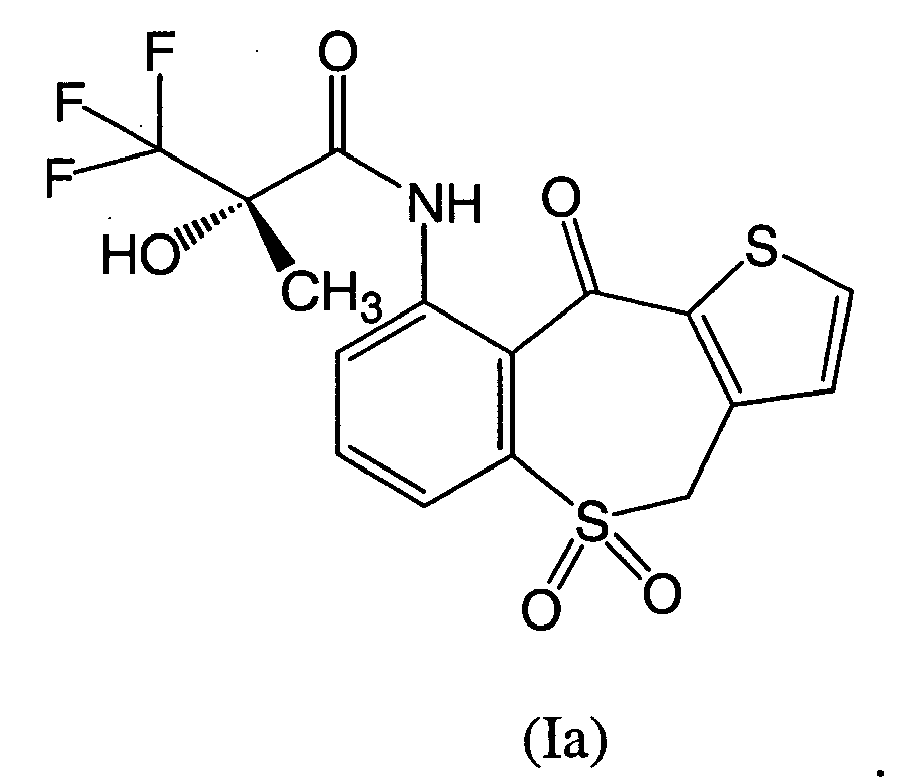
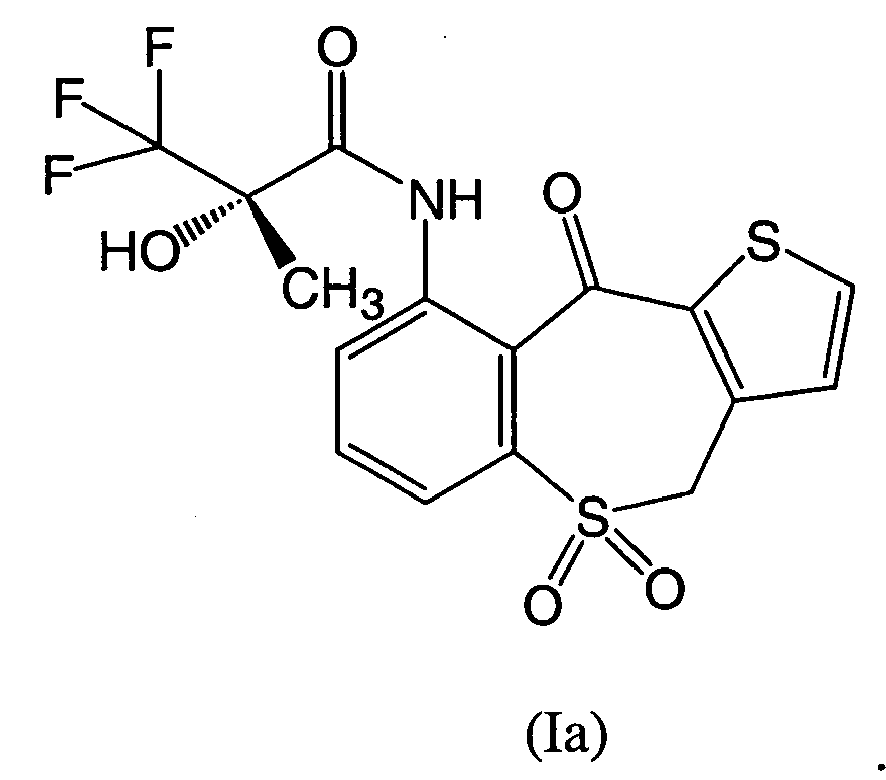
    2. (2) The pharmaceutical composition according to (1), wherein 3,3,3-trifluoro-2-hydroxy-2-methyl-N-(5,5,10-trioxo-4,10-dihydrothieno[3,2-c][1]benzothiepin-9-yl)propanamide is (S)-(+)-3,3,3-trifluoro-2-hydroxy-2-methyl-N-(5,5,10-trioxo-4,10-dihydrothieno[3,2-c][1]benzothiepin-9-yl)propanamide represented by Formula (Ia) :
      Figure imgb0002
    3. (3) The pharmaceutical composition according to (1) or (2), wherein the α1-adrenoceptor antagonist is/are selected from any one of or more than one of the following: tamsulosin, prazosin, terazosin, urapidil, doxazosin, alfzosin, naftopidil, maftopidil, abanoxil and indolamin, and pharmaceutically acceptable salts thereof.
    4. (4) A therapeutic agent for bladder irritative symptoms accompanied by benign prostatic hyperplasia, which comprises, as active ingredients, (a) 3,3,3-trifluoro-2-hydroxy-2-methyl-N-(5,5,10-trioxo-4,10-dihydrothieno[3,2-c][1]benzothiepin-9-yl)propanamide represented by Formula (I):
      Figure imgb0003
      or a pharmaceutically acceptable salt thereof, and (b) an α1-adrenoceptor antagonist, which may be administered together or separately at an interval.
    5. (5) The therapeutic agent for bladder irritative symptoms accompanied by benign prostatic hyperplasia according to (4), wherein 3,3,3-trifluoro-2-hydroxy-2-methyl-N-(5,5,10-trioxo-4,10-dihydrothieno[3,2-c] [1]benzothiepin-9-yl)propanamide is (S)-(+)-3,3,3-trifluoro-2-hydroxy-2-methyl-N-(5,5,10-trioxo-4,10-dihydrothieno[3,2-c] [1]benzothiepin-9-yl)propanamide represented by Formula (Ia):
      Figure imgb0004
    6. (6) The therapeutic agent for bladder irritative symptoms accompanied by benign prostatic hyperplasia according to (4) or (5), wherein the α1-adrenoceptor antagonist is/are selected from any one of or more than one of the following: tamsulosin, prazosin, terazosin, urapidil, doxazosin, alfzosin, naftopidil, maftopidil, abanoxil and indolamin, and pharmaceutically acceptable salts thereof.
    7. (7) A kit which comprises (a) a first component containing 3,3,3-trifluoro-2-hydroxy-2-methyl-N-(5,5,10-trioxo-4,10-dihydrothieno[3,2-c] [1]benzothiepin-9-yl)propanamide represented by Formula (I):
      Figure imgb0005
      or a pharmaceutically acceptable salt thereof, and (b) a second component containing an α1-adrenoceptor antagonist.
    8. (8) The kit according to (7), wherein 3,3,3-trifluoro-2-hydroxy-2-methyl-N-(5,5,10-trioxo-4,10-dihydrothieno[3,2-c][1]benzothiepin-9-yl)propanamide is (S)-(+)-3,3,3-trifluoro-2-hydroxy-2-methyl-N-(5,5,10-trioxo-4,10-dihydrothieno[3,2-c][1]benzothiepin-9-yl)propanamide represented by Formula (Ia):
      Figure imgb0006
    9. (9) The kit according to (7) or (8), wherein the α1-adrenoceptor antagonist is/are selected from any one of or more than one of the following: tamsulosin, prazosin, terazosin, urapidil, doxazosin, alfzosin, naftopidil, maftopidil, abanoxil and indolamin, and pharmaceutically acceptable salts thereof.
    10. (10) A kit for treating bladder irritative symptoms accompanied by benign prostatic hyperplasia, which comprises (a) a first component containing 3,3,3-trifluoro-2-hydroxy-2-methyl-N-(5,5,10-trioxo-4,10-dihydrothieno[3,2-c][1]benzothiepin-9-yl)propanamide represented by Formula (I) :
      Figure imgb0007
      or a pharmaceutically acceptable salt thereof, and (b) a second component containing an α1-adrenoceptor antagonist.
    11. (11) The kit for treating bladder irritative symptoms accompanied by benign prostatic hyperplasia according to (10), wherein 3,3,3-trifluoro-2-hydroxy-2-methyl-N-(5,5,10-trioxo-4,10-dihydrothieno[3,2-c][1]benzothiepin-9-yl)propanamide is (S)-(+)-3,3,3-trifluoro-2-hydroxy-2-methyl-N-(5,5,10-trioxo-4,10-dihydrothieno[3,2-c][1]benzothiepin-9-yl)propanamide represented by Formula (Ia):
      Figure imgb0008
    12. (12) The kit for treating bladder irritative symptoms accompanied by benign prostatic hyperplasia according to (10) or (11), wherein the α1-adrenoceptor antagonist is/are selected from any one of or more than one of the following: tamsulosin, prazosin, terazosin, urapidil, doxazosin, alfzosin, naftopidil, maftopidil, abanoxil and indolamin, and pharmaceutically acceptable salts thereof.
    13. (13) 3,3,3-Trifluoro-2-hydroxy-2-methyl-N-(5,5,10-trioxo-4,10-dihydrothieno [3,2-c] [1] benzothiepin-9-yl) propanamide represented by Formula (I):
      Figure imgb0009
      or a pharmaceutically acceptable salt thereof, which may be administered together or separately at an interval with an α1-adrenoceptor antagonist.
    14. (14) 3,3,3-Trifluoro-2-hydroxy-2-methyl-N-(5,5,10-trioxo-4,10-dihydrothieno[3,2-c] [1]benzothiepin-9-yl)propanamide or a pharmaceutically acceptable salt thereof according to (13), wherein 3,3,3-trifluoro-2-hydroxy-2-methyl-N-(5,5,10-trioxo-4,10-dihydrothieno[3,2-c][1]benzothiepin-9-yl)propanamide is (S)-(+)-3,3,3-trifluoro-2-hydroxy-2-methyl-N-(5,5,10-trioxo-4,10-dihydrothieno[3,2-c][1]benzothiepin-9-yl)propanamide represented by Formula (Ia):
      Figure imgb0010
    15. (15) 3,3,3-Trifluoro-2-hydroxy-2-methyl-N-(5,5,10-trioxo-4,10-dihydrothieno[3,2-c] [1]benzothiepin-9-yl)propanamide or a pharmaceutically acceptable salt thereof according to (13) or (14), wherein the α1-adrenoceptor antagonist is/are selected from any one of or more than one of the following: tamsulosin, prazosin, terazosin, urapidil, doxazosin, alfzosin, naftopidil, maftopidil, abanoxil and indolamin, and pharmaceutically acceptable salts thereof.
    16. (16) A pharmaceutical composition which comprises, as an active ingredient, 3,3,3-trifluoro-2-hydroxy-2-methyl-N-(5,5,10-trioxo-4,10-dihydrothieno[3,2-c][1]benzothiepin-9-yl)propanamide represented by Formula (I):
      Figure imgb0011
      or a pharmaceutically acceptable salt thereof, which may be administered together or separately at an interval with an α1-adrenoceptor antagonist.
    17. (17) The pharmaceutical composition according to (16), wherein 3,3,3-trifluoro-2-hydroxy-2-methyl-N-(5,5,10-trioxo-4,10-dihydrothieno[3,2-c][1]benzothiepin-9-yl)propanamide is (S)-(+)-3,3,3-trifluoro-2-hydroxy-2-methyl-N-(5,5,10-trioxo-4,10-dihydrothieno[3,2-c][1]benzothiepin-9-yl)propanamide represented by Formula (Ia):
      Figure imgb0012
    18. (18) The pharmaceutical composition according to (16) or (17), wherein the α1-adrenoceptor antagonist is/are selected from any one of or more than one of the following: tamsulosin, prazosin, terazosin, urapidil, doxazosin, alfzosin, naftopidil, maftopidil, abanoxil and indolamin, and pharmaceutically acceptable salts thereof.
    19. (19) A method for treating bladder irritative symptoms accompanied by benign prostatic hyperplasia, which comprises administering (a) 3,3,3-trifluoro-2-hydroxy-2-methyl-N-(5,5,10-trioxo-4,10-dihydrothieno[3,2-c][1]benzothiepin-9-yl)propanamide represented by Formula (I):
      Figure imgb0013
      or a pharmaceutically acceptable salt thereof, and (b) an α1-adrenoceptor antagonist, which may be administered together or separately at an interval.
    20. (20) The method for treating bladder irritative symptoms accompanied by benign prostatic hyperplasia according to (19), wherein 3,3,3-trifluoro-2-hydroxy-2-methyl-N-(5,5,10-trioxo-4,10-dihydrothieno[3,2-c][1]benzothiepin-9-yl)propanamide is (S)-(+)-3,3,3-trifluoro-2-hydroxy-2-methyl-N-(5,5,10-trioxo-4,10-dihydrothieno[3,2-c][1]benzothiepin-9-yl)propanamide represented by Formula (Ia):
      Figure imgb0014
    21. (21) The method for treating bladder irritative symptoms accompanied by benign prostatic hyperplasia according to (19) or (20), wherein the α1-adrenoceptor antagonist is/are selected from any one of or more than one of the following: tamsulosin, prazosin, terazosin, urapidil, doxazosin, alfzosin, naftopidil, maftopidil, abanoxil and indolamin, and pharmaceutically acceptable salts thereof.
  • The pharmaceutically acceptable salt of Compound (I) includes, for example, pharmaceutically acceptable acid addition salts, metal salts, ammonium salts, organic amine addition salts, amino acid addition salts and the like.
  • The pharmaceutically acceptable acid addition salts of Compound (I) include inorganic acid salts such as hydrochlorides, sulfates, hydrobromides, nitrates and phosphates; and organic acid salts such as acetates, mesylates, succinates, maleates, fumarates, citrates and tartrates. The pharmaceutically acceptable metal salts include alkali metal salts such as sodium salts and potassium salts; alkaline earth metal salts such as magnesium salts and calcium salts; and aluminum salts and zinc salts. The pharmaceutically acceptable ammonium salts include ammonium salts, tetramethylammonium salts and the like. The pharmaceutically acceptable organic amine addition salts include salts with morpholine, piperidine and the like. The pharmaceutically acceptable amino acid addition salts include addition salts with glycine, phenylalanine, lysine, aspartic acid, glutamic acid and the like.
  • A production method of Compound (I) is described.
  • Compound (I) can be produced according to the method described in WO98/4658 or a similar method thereof.
  • There may be stereoisomers (for example, tautomers, enantiomers and the like) for Compound (I). All possible isomers and mixtures thereof including above-mentioned stereoisomers can be used as the pharmaceutical composition, the therapeutic agent for bladder irritative symptoms accompanied by benign prostatic hyperplasia, the kit, the kit for treating bladder irritative symptoms accompanied by benign prostatic hyperplasia and the method for treating bladder irritative symptoms accompanied by benign prostatic hyperplasia of the present invention. Compound (I) of the present invention includes all possible isomers and mixtures thereof including above-mentioned stereoisomers.
  • To obtain a salt of Compound (I), it may be purified as it is when it is produced in the form of the salt, and when it is produced in the form of a free form, it may be dissolved or suspended in a suitable solvent, and added with an acid or a base, followed by isolation and purification.
  • Compound (I) and pharmaceutically acceptable salts thereof may exist in the form of adducts with water or various solvents, and such adducts can also be used as the pharmaceutical composition, the therapeutic agent for bladder irritative symptoms accompanied by benign prostatic hyperplasia, the kit, the kit for treating bladder irritative symptoms accompanied by benign prostatic hyperplasia and the method for treating bladder irritative symptoms accompanied by benign prostatic hyperplasia of the present invention, and such adducts are included in Compound (I) and pharmaceutically acceptable salts thereof of the present invention.
  • The α1-adrenoceptor antagonist includes tamsulosin, prazosin, terazosin, urapidil, doxazosin, alfzosin, naftopidil, maftopidil, abanoxil and indolamin, as well as stereoisomers (for example, enantiomers and the like) thereof, pharmaceutically acceptable salts thereof and hydrates thereof. One or more of these may be used herein either singly or as combined. The pharmaceutically acceptable salts of the compounds are, for example, the salts mentioned hereinabove for the pharmaceutically acceptable salts of Compound (I).
  • Compound (I) or a pharmaceutically acceptable salt thereof and the α1-adrenoceptor antagonist used in the pharmaceutical composition or the therapeutic agent for bladder irritative symptoms accompanied by benign prostatic hyperplasia of the present invention may be administered alone or in combination as preparations containing their active ingredients. Particularly, a combination of two or more preparations is preferable. When the preparations are used or administered in combination, they may be used or administered together or separately at an interval.
  • The dose ratio (weight/weight) of Compound (I) or a pharmaceutically acceptable salt thereof to the α1-adrenoceptor antagonist may be suitably determined, depending on the combination with the α1-adrenoceptor antagonist to be used and the efficacy of the α1-adrenoceptor antagonist. For example, the specific ratio is from 1/500 (Compound (I) or a pharmaceutically acceptable salt thereof/α1-adrenoceptor antagonist) to 5000/1, more preferably from 1/300 to 1000/1, even more preferably from 1/200 to 500/1, still more preferably from 1/100 to 100/1.
  • When the preparations are administered in combination, for example, for example, (a) a first component comprising Compound (I) or a pharmaceutically acceptable salt thereof, and (b) a second component comprising an α1-adrenoceptor antagonist are separately prepared as described above, and made into a kit. By utilizing such a kit, each component can be administered together or separately at an interval to one subject by the same route or different routes.
  • The kit comprises two or more containers (for example, vials, bags) and the contents. The material and the shape of the containers are not limited, but the containers must prevent the contents, i.e. the components, from degrading due to external temperature or light during the storage, and should be made from a material that does not elute its chemical constituents. The first component and the second component are administerable dosage forms so as to be administered through different routes (for example, tubes) or the same route. Specifically mentioned are a kit of tablets, injections, and the like.
  • The method for treating bladder irritative symptoms accompanied by benign prostatic hyperplasia of the present invention may be carried out in the same manner as that for the use or administration of Compound (I) or a pharmaceutically acceptable salt thereof and an α1-adrenoceptor antagonist used in the pharmaceutical composition or the therapeutic agent for bladder irritative symptoms accompanied by benign prostatic hyperplasia described above. That is, Compound (I) or a pharmaceutically acceptable salt thereof and an α1-adrenoceptor antagonist are formulated into preparations containing the respective active ingredients therein, and for example, they are administered as single preparation or as a combination of preparations, preferably, they are administered as a combination of two or more preparations. When preparations are administered in combinnation, they may be administered together or separately at an interval, and the kit described above may be used for administration.
  • The efficacy of treatment of bladder irritative symptoms accompanied by benign prostatic hyperplasia by the combined administration of Compound (I) or a pharmaceutically acceptable salt thereof and an α1-adrenoceptor antagonist will be described specifically with reference to Test Example. In the following Test Example, (S)-(+)-3,3,3-trifluoro-2-hydroxy-2-methyl-N-(5,5,10-trioxo-4,10-dihydrothieno[3,2-c][1]benzothiepin-9-yl)propanamide (hereinafter referred to as Compound (Ia), if desired) was used as Compound (I).
  • Test Example: Inhibitory Activity on Detrusor Overactivity
  • The experiment was carried out according to the method by Malmgren, et al. [J. Urol., Vol. 142, pp. 1134-1138 (1989)].
  • Female SD rats of 8 to 9 weeks of age (supplied by Charles River Japan) were used in the test. Five to seven animals of these rats were housed in metal cages and given commercially available chow and water ad libtum, in an animal room maintained at room temperature from 19°C to 25°C and humidity from 30% to 70% under illumination for 12 hours (7:00 a.m. - 7:00 p.m.) per day.
  • The rats were subjected to operation of partial urethral obstruction. Each animal was anesthetized by intraperitoneal administration of 50 mg/kg pentobarbital sodium (Tokyo Kasei), and the midline incision of the skin and muscle was made in the lower abdomen. A polyethylene tube (PE-20, Becton Dickinson) was inserted into urethra from the urethral orifice to the bladder neck. After the proximal urethra was separated from connective tissues and ligated using double suture, the polyethylene tube was removed to induce partial urethral obstruction. The incised part was sutured with a surgical silk thread. An antibiotic ampicillin (Sigma) was intramusclarly injected (150 mg/kg, once a day, for 3 days).
  • Six weeks after the operation of the partial urethral obstruction, the rats with bladder hypertrophy were subjected to intravesical implantation of catheter. Under anesthesia with pentobarbital sodium, the bladder was exposed by an abdominal midline incision. A polyethylene tube (PE-50, Becton Dickinson), one end of which was blunted not to damage the bladder tissue, was filled with a physiological saline (Otsuka Pharmaceutical Factory) and inserted into the bladder via the bladder apex. The intravesical catheter was fixed with a surgical silk suture. The other end of the catheter was tunneled subcutaneously, drawn out from the dorsal neck, plugged and then fixed to the skin with a suture.
  • Four to seven days after the surgery for implantation of intravesical catheter, a cystometry test was performed. The rats were housed in a Bollman cage (Natsume Seisakusho) and a three-way stopcock was connected to the intravesical catheter, one end of the stopcock was connected to a pressure transducer (Nihon Kohden) and the other end was connected to a 50-mL syringe (Terumo) set in an infusion pump (KD Scientific) for physiological saline infusion. The intravesical pressure was measured with a polygraph system (RMP-6008, Nihon Kohden) via a pressure transducer and a strain pressure amplifier (AP-621G, Nihon Kohden), and recorded on a thermal array recorder (RTA-1200, Nihon Kohden). Sixty to 90 minutes after the completion of the preparation for the measurement, a room temperature physiological saline was continuously infused into the urinary bladder for 30 minutes at a flow rate of 10 mL/h to confirm the occurrence of micturition contractions and premicturition contractions (detrusor overactivity). Thirty minutes after the cessation of the first saline infusion, the saline was again infused intravesically for 30 minutes, and this period is for determination of the data before drug administration. Compound (Ia) was suspended in a 0.5 w/v (weight/volume) % methyl cellulose solution at a concentration of 1 mg/ml. The suspension was further diluted with a 0.5 w/v % methyl cellulose solution to prepare solution for administration [solution for Compound (Ia) administration] at a concentration of 0.01 mg/ml. The solution was orally administered to the rats at a volume of 1 ml/kg. Tamsulosin hydrochloride was dissolved in a 0.5 w/v % methyl cellulose solution at a concentration of 0.03 mg/ml (solution for tamsulosin administration), and the solution was orally administered to the rats at a volume of 1 ml/kg. For investigating the effect of the combined administration, Compound (Ia) solution and the tamsulosin solution were simultaneously and orally administered to the rats, both at a volume of 1 ml/kg each. The periods of 1, 3 and 5 hours after the administration were used as the measuring time after the administration of the vehicle or drug. During a duration of 15 minutes before and after each measuring time (45 to 75 minutes, 165 to 195 minutes and 285 to 315 minutes after the drug administration), a physiological saline was infused into the bladder of each rat.
  • Micturition contractions and premicturition contractions were measured as an index of voiding function and detrusor overactivity, respectively. The average of all micturition contraction values observed during each 30-minute measurement period was designated as the amplitude of micturition contraction, and the average of the maximum premicturition contraction between respective micturition contractions were designated as the amplitude of premicturition contractions at each measurement point. The number of premicturition contractions for 2 minutes just before voiding was counted, and this is referred to as frequency of premicturition contractions. The values of both contractions and frequency were read from intravesical pressure waveforms recorded on a chart using a digitizer (KW4620, Graphtec Corporation) controlled by a computer (PC-9801NS/R, NEC), and saved as a DAT-format file or a WJ2-format file. The data files were imported into Excel 2000 (Microsoft). The amplitude and frequency of premicturition contractions, and the amplitude of micturition contractions were expressed as relative values when the values before the drug administration were defined as 100, and the average ± standard error was calculated for each group.
  • The values (%) of amplitude of premicturition contractions after vehicle or drug administration are shown in Table 1, the values (%) of frequency of premicturition contractions are shown in Table 2, and the values (%) of amplitude of micturition contractions are shown in Table 3. Table 1 : Effect of Combination of Compound (la) and Tamsulosin on amplitude of premicturition contractions in rats with bladder hypertrophy
    control Compound (Ia) 0.01 mg/kg, p.o. Tamsulosin 0.03 mg/kg, p.o. Compound (Ia) + Tamsulosin
    Before administration 100.0 ± 0.0 100.0 ± 0.0 100.0 ± 0.0 100.0 ± 0.0
    After 1 hour 107.1 ± 13.3 62.3 ± 7.7** 62.0 ± 5.2** 45.9 ± 6.8**
    After 3 hours 107.1 ± 12.3 62.8 ± 7.6** 75.2 ± 5.5* 45.6 ± 6,7***'‡‡
    After 5 hours 113.6 ± 9.6 65.6 ± 7.5*** 88.3 ± 7.2* 42.9 ± 4.4***,†,‡‡‡
    *P<0.05, **P<0.01, ***P<0.001 (compared with control group)
    P<0.05 (compared with Compound (Ia) administration group)
    ‡‡P<0.01, ‡‡‡P<0.001 (compared with tamsulosin administration group) (n=9-10; Student's t-test or Aspin-Welch test)
    Table 2 : Effect of Combination of Compound (I) and Tamsulosin on frequency of premicturition contraction in rats with bladder hypertrophy
    control Compound (Ia) 0.01 mg/kg, p.o. Tamsulosin 0.03 mg/kg, p.o. Compound (Ia) + Tamsulosin
    Before administration 100.0 ± 0.0 100.0 ± 0.0 100.0 ± 0.0 100.0 ± 0.0
    After 1 hour 107.9 ± 16.5 52.3 ± 7.3 ** 57.8 ± 7.5* 26.3 ± 5.4**,†,‡‡
    After 3 hours 136.4 ± 27.0 46.2 ± 8,1** 73.2 ± 5.3* 26.0 ± 9.5 **' ‡‡‡
    After 5 hours 103.3 ± 15.3 42.4 ± 6.0** 78.4 ± 7.0 20.1 ± 4.0**,†,‡‡‡
    *P<0.05, **P<0.01, ***P<0.001 (compared with control group)
    tP<0.05 (compared with Compound (la) administration group)
    ‡‡P<0.01, ‡‡‡P<0.001 (compared with tamsulosin administration group) (n=9-10; Student's t-test or Aspin-Welch test)
    Table 3 : Effect of Compound (Ia) and Tamsulosin on amplitude of micturition contractions in rats with bladder hypertrophy
    control Compound (Ia) 0.01 mg/kg, p.o. Tamsulosin 0.03 mg/kg, p.o. Compound (la) + Tamsulosin
    Before administration 100.0 ± 0.0 100.0 ± 0.0 100.0 ± 0.0 100.0 ± 0.0
    After 1 hour 106.5 ± 5.1 109.5 ± 2.2 108.5 ± 6.4 106.3 ± 6.4
    After 3 hours 103.2 ± 2.8 105.5 ± 3.8 108.1 ± 6.0 106.0 ± 3.8
    After 5 hours 100.2 ± 2.6 96.7 ± 2.4 104.7 ± 6.4 102.8 ± 1.6
  • According to the results of Test Example, Compound (Ia) and tamsulosin inhibited premicturition contractions (amplitude and frequency of premicturition contractions). Combined administration of Compound (Ia) and tamsulosin resulted in enhanced inhibition of premicturition contractions (amplitude and frequency of pre-micturition contractions). Administration of Compound (Ia) alone, administration of tamsulosin alone, and combined administration of Compound (Ia) and tamsulosin all did not affect micturition contractions, or that is, they did not have any influence on voiding function itself.
  • According to the above results, it is thought that a combination of Compound (I) or a pharmaceutically acceptable salt thereof and an α1-adrenoceptor antagonist may be useful for the treatment of bladder irritative symptoms accompanied by benign prostatic hyperplasia.
  • As described above, the pharmaceutical composition or the therapeutic agent for bladder irritative symptoms accompanied by benign prostatic hyperplasia of the present invention may be used, administered or produced in a single preparation or a combination of preparations so far as the preparations are formulated so as to contain the respective active ingredients, Compound (I) or a pharmaceutically acceptable salt thereof and an α1-adrenoceptor antagonist. Preferably, the pharmaceutical composition or the therapeutic agent for bladder irritative symptoms accompanied by benign prostatic hyperplasia has a unit dose form suitable to oral administration such as tablets or capsule, or has a unit dose form suitable to parenteral administration such as injections. When preparations are used or administered as a combination of preparations, they may be used or administered together or separately at an interval.
  • These preparations may be produced in any ordinary method using any other pharmaceutically acceptable diluent, excipient, disintegrator, lubricant, binder, surfactant, water, physiological saline, vegetable oil solubilizer, isotonizing agent, preservative and antioxidant, in addition to the respective active ingredients.
  • In preparing tablets and capsules, for example, excipients such as lactose, disintegrators such as starch, lubricants such as magnesium stearate, binders such as hydroxypropyl cellulose, surfactants such as fatty acid ester, and plasticizers such as glycerin can be used according to any ordinary manner.
  • In preparing injections, for example, carriers such as distilled water, salt solution, glucose solution or a mixture of salt water and glucose solution, solubilizers, isotonizing agents, preservatives, and antioxidants can be used according to any ordinary manner.
  • When Compound (I) or a pharmaceutically acceptable salt thereof and an α1-adrenoceptor antagonist are used or administered as a combination of preparations for the object described above, the dose and the administration frequency thereof may vary depending on the dosage form, the age, the body weight and the condition of patients. In general, Compound (I) or a pharmaceutically acceptable salt thereof and an α1-adrenoceptor antagonist are preferably administered in a dose described below per day:
    • Compound (I) or a pharmaceutically acceptable salt thereof can be administered orally or parenterally as injection or the like. Its dose may be from 0.01 to 900 mg/60 kg/day, preferably from 0.1 to 200 mg/60 kg/day, per an adult. The dose of an α1-adrenoceptor antagonist may be from 0.01 to 500 mg/60 kg/day, preferably from 0.2 to 100 mg/60 kg/day, per an adult.
  • Embodiments of the present invention are described below with reference to the following Examples, which, however do not restrict the scope of the invention.
  • Best Modes for Carrying Out the Invention Example 1: Tablets (Compound (Ia))
  • Tablets having the following compositions were prepared according to an ordinary method.
  • Compound (Ia) (250 g), mannitol (1598.5 g), sodium starch glycolate (100 g), light silicic anhydride (10 g), magnesium stearate (40 g) and yellow iron oxide (1.5 g) were mixed according to an ordinary method. The resulting mixture was compressed using a tableting machine with 8 mm diameter punch and die (Purepress Correct-12, Kikusui Seisakusho) to prepare tablets (containing 25 mg of the active ingredient per tablet). Formulation
    Compound (Ia) 25 mg
    Mannitol 159.85 mg
    Sodium starch glycolate 10 mg
    Light silicic anhydride 1 mg
    Magnesium stearate 4 mg
    Yellow iron oxide 0.15 mg
    200 mg
  • Example 2: Capsules (Compound (Ia))
  • Capsules having the following compositions were prepared according to an ordinary method.
  • Compound (Ia) (500 g), lactose (300 g), light silicic anhydride (100 g) and sodium lauryl sulfate (100 g) were mixed according to an ordinary manner. The resulting mixture was encapsulated in hard capsules No. 1 (content: 100 mg/capsule) using a capsule filler (LZ-64, Zanasi) to prepare capsules (containing 50 mg of the active ingredient per capsule). Formulation
    Compound (Ia) 50 mg
    Lactose 30 mg
    Light silicic anhydride 10 mg
    Sodium lauryl sulfate 10 mg
    100 mg
  • Example 3: Injection (Compound (Ia))
  • An injection having the following compositions is prepared according to an ordinary method.
  • Compound (Ia) (1 g) and D-mannitol (5 g) are added to and mixed with distilled water for injection, and an aqueous hydrochloric acid solution and an aqueous sodium hydroxide solution are added thereto to control pH of the resulting solution to 6. Then, distilled water for injection is added thereto to make the content 1000 ml in total. Under a germ-free condition, 2 ml of the resulting mixture is put into each glass, and an injection was thus obtained (containing 2 mg of the active ingredient per vial) . Formulation
    Compound (Ia) 2 mg
    D-mannitol 10 mg
    Aqueous hydrochloric acid solution proper quantity
    Aqueous sodium hydroxide solution proper quantity
    Distilled water for injection proper quantity
    2.00 ml
  • Example 4: Tablets (tamsulosin hydrochloride)
  • Tablets having the following composition are prepared according to an ordinary method.
  • Tamsulosin hydrochloride (0.4 g), lactose (303.6 g) and potato starch (68 g) are mixed, and a 10% aqueous hydroxypropyl cellulose solution (200 g) is added to the mixture. The resulting mixture is kneaded according to an ordinary manner, then granulated and dried to give granules to be tabletted. 8.0 g of magnesium stearate is added thereto, and using a tabletting machine with 8 mm diameter punch and die (RT-15 Model, Kikusui Seisakusho), the resulting mixture is tabletted to give tablets (containing 0.2 mg of the active ingredient per tablet). Formulation
    Tamuslosin hydrochloride 0.2 mg
    Lactose 151.8 mg
    Potato starch 34 mg
    Hydroxypropyl cellulose 10 mg
    Magnesium stearate 4 mg
    200 mg
  • Example 5: Tablets (single preparation of Compound (Ia) and tamsulosin hydrochloride)
  • Tablets having the following composition are prepared according to an ordinary method.
  • Compound (Ia) (40 g), tamsulosin hydrochloride (0.4 g), lactose (289.6 g) and potato starch (56 g) are mixed, and a 10% aqueous hydroxypropyl cellulose solution (120 g) is added to the mixture. The resulting mixture is kneaded according to an ordinary manner, then granulated and dried to give granules to be tabletted. 2 g of magnesium stearate is added thereto, and using a tabletting machine with 8 mm diameter punch and die (RT-15 Model, Kikusui Seisakusho), the resulting mixture is tabletted to give tablets (containing 20 mg of compound (Ia) and 0.2 mg of tamsulosin hydrochloride per tablet). Formulation
    Compound (Ia) 20 mg
    Tamsulosin hydrochloride 0.2 mg
    Lactose 144.8 mg
    Potato starch 28 mg
    Hydroxypropyl cellulose 6 mg
    Magnesium stearate 1 mg
    200 mg
  • Industrial Applicability
  • The present invention provides a pharmaceutical composition which comprises 3,3,3-trifluoro-2-hydroxy-2-methyl-N-(5,5,10-trioxo-4,10-dihydrothieno[3,2-c][1]benzothiepin-9-yl)propanamide or a pharmaceutically acceptable salt thereof, and an α1-adrenoceptor antagonist.

Claims (21)

  1. A pharmaceutical composition which comprises (a) 3,3,3-trifluoro-2-hydroxy-2-methyl-N-(5,5,10-trioxo-4,10-dihydrothieno[3,2-c][1]benzothiepin-9-yl)propanamide represented by Formula (I):
    Figure imgb0015
    or a pharmaceutically acceptable salt thereof, and (b) an α1-adrenoceptor antagonist.
  2. The pharmaceutical composition according to Claim 1, wherein 3,3,3-trifluoro-2-hydroxy-2-methyl-N-(5,5,10-trioxo-4,10-dihydrothieno[3,2-c][1]benzothiepin-9-yl)propanamide is (S)-(+)-3,3,3-trifluoro-2-hydroxy-2-methyl-N-(5,5,10-trioxo-4,10-dihydrothieno[3,2-c][1]benzothiepin-9-yl)propanamide represented by Formula (Ia):
    Figure imgb0016
  3. The pharmaceutical composition according to Claim 1 or 2, wherein the α1-adrenoceptor antagonist is/are selected from any one of or more than one of the following: tamsulosin, prazosin, terazosin, urapidil, doxazosin, alfzosin, naftopidil, maftopidil, abanoxil and indolamin, and pharmaceutically acceptable salts thereof.
  4. A therapeutic agent for bladder irritative symptoms accompanied by benign prostatic hyperplasia, which comprises, as active ingredients, (a) 3,3,3-trifluoro-2-hydroxy-2-methyl-N-(5,5,10-trioxo-4,10-dihydrothieno[3,2-c][1]benzothiepin-9-yl)propanamide represented by Formula (I) :
    Figure imgb0017
    or a pharmaceutically acceptable salt thereof, and (b) an α1-adrenoceptor antagonist, which may be administered together or separately at an interval.
  5. The therapeutic agent for bladder irritative symptoms accompanied by benign prostatic hyperplasia according to Claim 4, wherein 3,3,3-trifluoro-2-hydroxy-2-methyl-N-(5,5,10-trioxo-4,10-dihydrothieno[3,2-c] [1]benzothiepin-9-yl)propanamide is (S)-(+)-3,3,3-trifluoro-2-hydroxy-2-methyl-N-(5,5,10-trioxo-4,10-dihydrothieno[3,2-c] [1]benzothiepin-9-yl)propanamide represented by Formula (Ia):
    Figure imgb0018
  6. The therapeutic agent for bladder irritative symptoms accompanied by benign prostatic hyperplasia according to Claim 4 or 5, wherein the α1-adrenoceptor antagonist is/are selected from any one of or more than one of the following: tamsulosin, prazosin, terazosin, urapidil, doxazosin, alfzosin, naftopidil, maftopidil, abanoxil and indolamin, and pharmaceutically acceptable salts thereof.
  7. A kit which comprises (a) a first component containing 3,3,3-trifluoro-2-hydroxy-2-methyl-N-(5,5,10-trioxo-4,10-dihydrothieno[3,2-c][1]benzothiepin-9-yl)propanamide represented by Formula (I):
    Figure imgb0019
    or a pharmaceutically acceptable salt thereof, and (b) a second component containing an α1-adrenoceptor antagonist.
  8. The kit according to Claim 7, wherein 3,3,3-trifluoro-2-hydroxy-2-methyl-N-(5,5,10-trioxo-4,10-dihydrothieno[3,2-c][1]benzothiepin-9-yl)propanamide is (S)-(+)-3,3,3-trifluoro-2-hydroxy-2-methyl-N-(5,5,10-trioxo-4,10-dihydrothieno[3,2-c][1]benzothiepin-9-yl)propanamide represented by Formula (Ia):
    Figure imgb0020
  9. The kit according to Claim 7 or 8, wherein the α1-adrenoceptor antagonist is/are selected from any one of or more than one of the following: tamsulosin, prazosin, terazosin, urapidil, doxazosin, alfzosin, naftopidil, maftopidil, abanoxil and indolamin, and pharmaceutically acceptable salts thereof.
  10. A kit for treating bladder irritative symptoms accompanied by benign prostatic hyperplasia, which comprises (a) a first component containing 3,3,3-trifluoro-2-hydroxy-2-methyl-N-(5,5,10-trioxo-4,10-dihydrothieno[3,2-c] [1]benzothiepin-9-yl)propanamide represented by Formula (I) :
    Figure imgb0021
    or a pharmaceutically acceptable salt thereof, and (b) a second component containing an α1-adrenoceptor antagonist.
  11. The kit for treating bladder irritative symptoms accompanied by benign prostatic hyperplasia according to Claim 10, wherein 3,3,3-trifluoro-2-hydroxy-2-methyl-N-(5,5,10-trioxo-4,10-dihydrothieno[3,2-c][1]benzothiepin-9-yl)propanamide is (S)-(+)-3,3,3-trifluoro-2-hydroxy-2-methyl-N-(5,5,10-trioxo-4,10-dihydrothieno[3,2-c][1]benzothiepin-9-yl)propanamide represented by Formula (Ia) :
    Figure imgb0022
  12. The kit for treating bladder irritative symptoms accompanied by benign prostatic hyperplasia according to Claim 10 or 11, wherein the α1-adrenoceptor antagonist is/are selected from any one of or more than one of the following: tamsulosin, prazosin, terazosin, urapidil, doxazosin, alfzosin, naftopidil, maftopidil, abanoxil and indolamin, and pharmaceutically acceptable salts thereof.
  13. 3,3,3-Trifluoro-2-hydroxy-2-methyl-N-(5,5,10-trioxo-4,10-dihydrothieno[3,2-c] [1]benzothiepin-9-yl)propanamide represented by Formula (I):
    Figure imgb0023
    or a pharmaceutically acceptable salt thereof, which may be administered together or separately at an interval with an α1-adrenoceptor antagonist.
  14. 3,3,3-Trifluoro-2-hydroxy-2-methyl-N-(5,5,10-trioxo-4,10-dihydrothieno[3,2-c][1]benzothiepin-9-yl)propanamide or a pharmaceutically acceptable salt thereof according to Claim 13, wherein 3,3,3-trifluoro-2-hydroxy-2-methyl-N-(5,5,10-trioxo-4,10-dihydrothieno[3,2-c][1]benzothiepin-9-yl)propanamide is (S)-(+)-3,3,3-trifluoro-2-hydroxy-2-methyl-N-(5,5,10-trioxo-4,10-dihydrothieno[3,2-c][1]benzothiepin-9-yl)propanamide represented by Formula (Ia):
    Figure imgb0024
  15. 3,3,3-Trifluoro-2-hydroxy-2-methyl-N-(5,5,10-trioxo-4,10-dihydrothieno[3,2-c][1]benzothiepin-9-yl)propanamide or a pharmaceutically acceptable salt thereof according to Claim 13 or 14, wherein the α1-adrenoceptor antagonist is/are selected from any one of or more than one of the following: tamsulosin, prazosin, terazosin, urapidil, doxazosin, alfzosin, naftopidil, maftopidil, abanoxil and indolamin, and pharmaceutically acceptable salts thereof.
  16. A pharmaceutical composition which comprises, as an active ingredient, 3,3,3-trifluoro-2-hydroxy-2-methyl-N-(5,5,10-trioxo-4,10-dihydrothieno[3,2-c][1]benzothiepin-9-yl)propanamide represented by Formula (I):
    Figure imgb0025
    or a pharmaceutically acceptable salt thereof, which may be administered together or separately at an interval with an α1-adrenoceptor antagonist.
  17. The pharmaceutical composition according to Claim 16, wherein 3,3,3-trifluoro-2-hydroxy-2-methyl-N-(5,5,10-trioxo-4,10-dihydrothieno[3,2-c] [1]benzothiepin-9-yl)propanamide is (S)-(+)-3,3,3-trifluoro-2-hydroxy-2-methyl-N-(5,5,10-trioxo-4,10-dihydrothieno[3,2-c] [1]benzothiepin-9-yl)propanamide represented by Formula (Ia) :
    Figure imgb0026
  18. The pharmaceutical composition according to Claim 16 or 17, wherein the α1-adrenoceptor antagonist is/are selected from any one of or more than one of the following: tamsulosin, prazosin, terazosin, urapidil, doxazosin, alfzosin, naftopidil, maftopidil, abanoxil and indolamin, and pharmaceutically acceptable salts thereof.
  19. A method for treating bladder irritative symptoms accompanied by benign prostatic hyperplasia, which comprises administering (a) 3,3,3-trifluoro-2-hydroxy-2-methyl-N-(5,5,10-trioxo-4,10-dihydrothieno[3,2-c][1]benzothiepin-9-yl)propanamide represented by Formula (I) :
    Figure imgb0027
    or a pharmaceutically acceptable salt thereof, and (b) an α1-adrenoceptor antagonist, which may be administered together or separately at an interval.
  20. The method for treating bladder irritative symptoms accompanied by benign prostatic hyperplasia according to Claim 19, wherein 3,3,3-trifluoro-2-hydroxy-2-methyl-N-(5,5,10-trioxo-4,10-dihydrothieno[3,2-c] [1] benzothiepin-9-yl)propanamide is (S)-(+)-3,3,3-trifluoro-2-hydroxy-2-methyl-N-(5,5,10-trioxo-4,10-dihydrothieno[3,2-c][1]benzothiepin-9-yl)propanamide represented by Formula (Ia):
    Figure imgb0028
  21. The method for treating bladder irritative symptoms accompanied by benign prostatic hyperplasia according to Claim 19 or 20, wherein the α1-adrenoceptor antagonist is/are selected from any one of or more than one of the following: tamsulosin, prazosin, terazosin, urapidil, doxazosin, alfzosin, naftopidil, maftopidil, abanoxil and indolamin, and pharmaceutically acceptable salts thereof.
EP04747897A 2003-07-16 2004-07-16 Medicinal composition Withdrawn EP1649855A1 (en)

Applications Claiming Priority (2)

Application Number Priority Date Filing Date Title
JP2003197661 2003-07-16
PCT/JP2004/010533 WO2005007155A1 (en) 2003-07-16 2004-07-16 Medicinal composition

Publications (1)

Publication Number Publication Date
EP1649855A1 true EP1649855A1 (en) 2006-04-26

Family

ID=34074345

Family Applications (1)

Application Number Title Priority Date Filing Date
EP04747897A Withdrawn EP1649855A1 (en) 2003-07-16 2004-07-16 Medicinal composition

Country Status (5)

Country Link
US (1) US20060148885A1 (en)
EP (1) EP1649855A1 (en)
JP (1) JPWO2005007155A1 (en)
CA (1) CA2532806A1 (en)
WO (1) WO2005007155A1 (en)

Cited By (1)

* Cited by examiner, † Cited by third party
Publication number Priority date Publication date Assignee Title
CN112611817A (en) * 2020-12-13 2021-04-06 南京奥赛斯生物科技有限公司 HPLC method for separating naftopidil and enantiomer thereof

Families Citing this family (2)

* Cited by examiner, † Cited by third party
Publication number Priority date Publication date Assignee Title
TW200827367A (en) * 2006-10-26 2008-07-01 Kyowa Hakko Kogyo Kk A therapeutic agent for irritable bowel syndrome
WO2009131200A1 (en) * 2008-04-25 2009-10-29 協和発酵キリン株式会社 Therapeutic agent for irritable bowel syndrome

Family Cites Families (4)

* Cited by examiner, † Cited by third party
Publication number Priority date Publication date Assignee Title
JPS6426517A (en) * 1987-07-21 1989-01-27 Sankyo Co Remedy for dysuria
HUP0002461A3 (en) * 1997-04-15 2003-01-28 Kyowa Hakko Kogyo Kk Tricyclic benzothiepin a benzoxepin derivatives and pharmaceutical compositions thereof
EP1380299A4 (en) * 2001-03-30 2009-05-06 Kyowa Hakko Kirin Co Ltd Remedies for vesical stimulation in association with prostatauxe
EP1372639A4 (en) * 2001-03-30 2006-03-15 Kyowa Hakko Kogyo Kk TREATMENT AGENT FOR BLADDER IRRITATION SYMPTOMS ACCOMPANIED WITH BENIGN PROSTATIC HYPERPLASIA

Non-Patent Citations (1)

* Cited by examiner, † Cited by third party
Title
See references of WO2005007155A1 *

Cited By (1)

* Cited by examiner, † Cited by third party
Publication number Priority date Publication date Assignee Title
CN112611817A (en) * 2020-12-13 2021-04-06 南京奥赛斯生物科技有限公司 HPLC method for separating naftopidil and enantiomer thereof

Also Published As

Publication number Publication date
JPWO2005007155A1 (en) 2006-08-31
US20060148885A1 (en) 2006-07-06
CA2532806A1 (en) 2005-01-27
WO2005007155A1 (en) 2005-01-27

Similar Documents

Publication Publication Date Title
KR100399658B1 (en) A pharmaceutical composition comprising phenylacetylglutamine and phenylacetylisoglutamine
JP4466370B2 (en) Overactive bladder treatment
JPH09505809A (en) Inhibition of smooth muscle migration and proliferation by hydroxycarbazole compounds
KR0151389B1 (en) Renal disease treatment
WO2015127558A1 (en) Methods and uses for inducing or facilitating micturition in a patient in need thereof
JP4609877B2 (en) Chronic rejection inhibitor
US20060148885A1 (en) Medicinal composition
US20060160887A1 (en) Medicinal composition
US7122173B2 (en) Agent for the treatment of bladder irritative symptoms accompanied by benign prostatic hyperplasia
JP2025011312A (en) Method for preventing precipitation of injection solutions containing p-boronophenylalanine
EP1728508B1 (en) Medicine for prevention or treatment of frequent urination or urinary incontinence
CN115715191B (en) Therapeutic agent for urination symptom
TW201601715A (en) Agent for improving bladder-urethera dyssynergia
US20040248932A1 (en) Use of aryl- and heteroaryl-substituted tetrahydroisoquinolines in the treatment of chronic and neuropathic pain, migraine headaches, and urge, stress and mixed urinary incontinence
EA006448B1 (en) Therapeutic agent for bladder irritative symptoms associated with benign prostatic hyperplasia
JP2007055900A (en) Pharmaceutical composition for the treatment and prevention of inflammatory diseases
US11154561B2 (en) Preventative or therapeutic agent for pulmonary hypertension including crude drug component
KR20050092519A (en) COMBINATIONS OF ATORVASTATIN AND α1 ADRENERGIC RECEPTOR ANTAGONISTS

Legal Events

Date Code Title Description
PUAI Public reference made under article 153(3) epc to a published international application that has entered the european phase

Free format text: ORIGINAL CODE: 0009012

17P Request for examination filed

Effective date: 20060202

AK Designated contracting states

Kind code of ref document: A1

Designated state(s): AT BE BG CH CY CZ DE DK EE ES FI FR GB GR HU IE IT LI LU MC NL PL PT RO SE SI SK TR

DAX Request for extension of the european patent (deleted)
STAA Information on the status of an ep patent application or granted ep patent

Free format text: STATUS: THE APPLICATION HAS BEEN WITHDRAWN

18W Application withdrawn

Effective date: 20080417