EP1649756A1 - Modified cocoa product and process for its manufacture - Google Patents
Modified cocoa product and process for its manufacture Download PDFInfo
- Publication number
- EP1649756A1 EP1649756A1 EP04025278A EP04025278A EP1649756A1 EP 1649756 A1 EP1649756 A1 EP 1649756A1 EP 04025278 A EP04025278 A EP 04025278A EP 04025278 A EP04025278 A EP 04025278A EP 1649756 A1 EP1649756 A1 EP 1649756A1
- Authority
- EP
- European Patent Office
- Prior art keywords
- cocoa
- liquor
- process according
- reduced
- product
- Prior art date
- Legal status (The legal status is an assumption and is not a legal conclusion. Google has not performed a legal analysis and makes no representation as to the accuracy of the status listed.)
- Granted
Links
- 235000009470 Theobroma cacao Nutrition 0.000 title claims abstract description 168
- 238000000034 method Methods 0.000 title claims abstract description 46
- 230000008569 process Effects 0.000 title claims abstract description 35
- 238000004519 manufacturing process Methods 0.000 title abstract 2
- 244000240602 cacao Species 0.000 title 1
- 244000299461 Theobroma cacao Species 0.000 claims abstract description 168
- 150000003904 phospholipids Chemical class 0.000 claims abstract description 70
- 230000002829 reductive effect Effects 0.000 claims abstract description 31
- 235000013361 beverage Nutrition 0.000 claims abstract description 19
- WTJKGGKOPKCXLL-RRHRGVEJSA-N phosphatidylcholine Chemical compound CCCCCCCCCCCCCCCC(=O)OC[C@H](COP([O-])(=O)OCC[N+](C)(C)C)OC(=O)CCCCCCCC=CCCCCCCCC WTJKGGKOPKCXLL-RRHRGVEJSA-N 0.000 claims description 18
- 239000000203 mixture Substances 0.000 claims description 15
- 239000000843 powder Substances 0.000 claims description 15
- XLYOFNOQVPJJNP-UHFFFAOYSA-N water Substances O XLYOFNOQVPJJNP-UHFFFAOYSA-N 0.000 claims description 15
- 230000020176 deacylation Effects 0.000 claims description 12
- 238000005947 deacylation reaction Methods 0.000 claims description 12
- 102000004190 Enzymes Human genes 0.000 claims description 11
- 108090000790 Enzymes Proteins 0.000 claims description 11
- BWHMMNNQKKPAPP-UHFFFAOYSA-L potassium carbonate Chemical compound [K+].[K+].[O-]C([O-])=O BWHMMNNQKKPAPP-UHFFFAOYSA-L 0.000 claims description 11
- 230000003113 alkalizing effect Effects 0.000 claims description 8
- ZIIUUSVHCHPIQD-UHFFFAOYSA-N 2,4,6-trimethyl-N-[3-(trifluoromethyl)phenyl]benzenesulfonamide Chemical compound CC1=CC(C)=CC(C)=C1S(=O)(=O)NC1=CC=CC(C(F)(F)F)=C1 ZIIUUSVHCHPIQD-UHFFFAOYSA-N 0.000 claims description 7
- 108010064785 Phospholipases Proteins 0.000 claims description 7
- 102000015439 Phospholipases Human genes 0.000 claims description 7
- PORPENFLTBBHSG-MGBGTMOVSA-N 1,2-dihexadecanoyl-sn-glycerol-3-phosphate Chemical compound CCCCCCCCCCCCCCCC(=O)OC[C@H](COP(O)(O)=O)OC(=O)CCCCCCCCCCCCCCC PORPENFLTBBHSG-MGBGTMOVSA-N 0.000 claims description 6
- JZNWSCPGTDBMEW-UHFFFAOYSA-N Glycerophosphorylethanolamin Natural products NCCOP(O)(=O)OCC(O)CO JZNWSCPGTDBMEW-UHFFFAOYSA-N 0.000 claims description 6
- 238000001035 drying Methods 0.000 claims description 6
- 150000008104 phosphatidylethanolamines Chemical class 0.000 claims description 6
- 150000003905 phosphatidylinositols Chemical class 0.000 claims description 6
- 239000003795 chemical substances by application Substances 0.000 claims description 5
- RYCNUMLMNKHWPZ-SNVBAGLBSA-N 1-acetyl-sn-glycero-3-phosphocholine Chemical compound CC(=O)OC[C@@H](O)COP([O-])(=O)OCC[N+](C)(C)C RYCNUMLMNKHWPZ-SNVBAGLBSA-N 0.000 claims description 4
- 108010051152 Carboxylesterase Proteins 0.000 claims description 4
- 102000013392 Carboxylesterase Human genes 0.000 claims description 4
- 108010058834 acylcarnitine hydrolase Proteins 0.000 claims description 4
- 229910000027 potassium carbonate Inorganic materials 0.000 claims description 4
- 235000013336 milk Nutrition 0.000 claims description 3
- 239000008267 milk Substances 0.000 claims description 3
- 210000004080 milk Anatomy 0.000 claims description 3
- 230000007071 enzymatic hydrolysis Effects 0.000 claims description 2
- 238000006047 enzymatic hydrolysis reaction Methods 0.000 claims description 2
- 239000000047 product Substances 0.000 description 45
- 229920002472 Starch Polymers 0.000 description 43
- 235000019698 starch Nutrition 0.000 description 42
- 239000008107 starch Substances 0.000 description 41
- 150000002632 lipids Chemical class 0.000 description 17
- VLKZOEOYAKHREP-UHFFFAOYSA-N n-Hexane Chemical compound CCCCCC VLKZOEOYAKHREP-UHFFFAOYSA-N 0.000 description 15
- 239000011159 matrix material Substances 0.000 description 14
- ASWBNKHCZGQVJV-HSZRJFAPSA-N 1-hexadecanoyl-sn-glycero-3-phosphocholine Chemical compound CCCCCCCCCCCCCCCC(=O)OC[C@@H](O)COP([O-])(=O)OCC[N+](C)(C)C ASWBNKHCZGQVJV-HSZRJFAPSA-N 0.000 description 11
- 229920000856 Amylose Polymers 0.000 description 10
- 229940088598 enzyme Drugs 0.000 description 10
- 239000008187 granular material Substances 0.000 description 9
- 230000008961 swelling Effects 0.000 description 8
- 210000004027 cell Anatomy 0.000 description 6
- 230000000694 effects Effects 0.000 description 5
- 239000000796 flavoring agent Substances 0.000 description 5
- 235000019634 flavors Nutrition 0.000 description 5
- 238000002386 leaching Methods 0.000 description 5
- 239000007787 solid Substances 0.000 description 5
- 238000003860 storage Methods 0.000 description 5
- 230000002255 enzymatic effect Effects 0.000 description 4
- 150000002327 glycerophospholipids Chemical class 0.000 description 4
- 239000004615 ingredient Substances 0.000 description 4
- KWYUFKZDYYNOTN-UHFFFAOYSA-M Potassium hydroxide Chemical compound [OH-].[K+] KWYUFKZDYYNOTN-UHFFFAOYSA-M 0.000 description 3
- 239000012736 aqueous medium Substances 0.000 description 3
- 235000021588 free fatty acids Nutrition 0.000 description 3
- 238000000227 grinding Methods 0.000 description 3
- 230000002427 irreversible effect Effects 0.000 description 3
- 239000000787 lecithin Substances 0.000 description 3
- 229940072033 potash Drugs 0.000 description 3
- 235000015320 potassium carbonate Nutrition 0.000 description 3
- 238000003825 pressing Methods 0.000 description 3
- JLPULHDHAOZNQI-ZTIMHPMXSA-N 1-hexadecanoyl-2-(9Z,12Z-octadecadienoyl)-sn-glycero-3-phosphocholine Chemical compound CCCCCCCCCCCCCCCC(=O)OC[C@H](COP([O-])(=O)OCC[N+](C)(C)C)OC(=O)CCCCCCC\C=C/C\C=C/CCCCC JLPULHDHAOZNQI-ZTIMHPMXSA-N 0.000 description 2
- 239000004382 Amylase Substances 0.000 description 2
- 102000013142 Amylases Human genes 0.000 description 2
- 108010065511 Amylases Proteins 0.000 description 2
- IJGRMHOSHXDMSA-UHFFFAOYSA-N Atomic nitrogen Chemical compound N#N IJGRMHOSHXDMSA-UHFFFAOYSA-N 0.000 description 2
- LFQSCWFLJHTTHZ-UHFFFAOYSA-N Ethanol Chemical compound CCO LFQSCWFLJHTTHZ-UHFFFAOYSA-N 0.000 description 2
- -1 acylglycerols Chemical class 0.000 description 2
- 238000005054 agglomeration Methods 0.000 description 2
- 230000002776 aggregation Effects 0.000 description 2
- 235000019418 amylase Nutrition 0.000 description 2
- 238000004458 analytical method Methods 0.000 description 2
- 230000015572 biosynthetic process Effects 0.000 description 2
- 230000003247 decreasing effect Effects 0.000 description 2
- 230000001419 dependent effect Effects 0.000 description 2
- 230000008030 elimination Effects 0.000 description 2
- 238000003379 elimination reaction Methods 0.000 description 2
- 239000003995 emulsifying agent Substances 0.000 description 2
- 239000000284 extract Substances 0.000 description 2
- 238000000605 extraction Methods 0.000 description 2
- 238000001914 filtration Methods 0.000 description 2
- 235000013305 food Nutrition 0.000 description 2
- 239000011521 glass Substances 0.000 description 2
- 238000011065 in-situ storage Methods 0.000 description 2
- 235000010445 lecithin Nutrition 0.000 description 2
- 238000000386 microscopy Methods 0.000 description 2
- 238000002156 mixing Methods 0.000 description 2
- 230000004048 modification Effects 0.000 description 2
- 238000012986 modification Methods 0.000 description 2
- 230000007935 neutral effect Effects 0.000 description 2
- 230000035515 penetration Effects 0.000 description 2
- 235000011181 potassium carbonates Nutrition 0.000 description 2
- 230000002035 prolonged effect Effects 0.000 description 2
- 229940083466 soybean lecithin Drugs 0.000 description 2
- 241000894007 species Species 0.000 description 2
- 239000000126 substance Substances 0.000 description 2
- 239000000725 suspension Substances 0.000 description 2
- IIZPXYDJLKNOIY-JXPKJXOSSA-N 1-palmitoyl-2-arachidonoyl-sn-glycero-3-phosphocholine Chemical compound CCCCCCCCCCCCCCCC(=O)OC[C@H](COP([O-])(=O)OCC[N+](C)(C)C)OC(=O)CCC\C=C/C\C=C/C\C=C/C\C=C/CCCCC IIZPXYDJLKNOIY-JXPKJXOSSA-N 0.000 description 1
- RZVAJINKPMORJF-UHFFFAOYSA-N Acetaminophen Chemical compound CC(=O)NC1=CC=C(O)C=C1 RZVAJINKPMORJF-UHFFFAOYSA-N 0.000 description 1
- 229920000945 Amylopectin Polymers 0.000 description 1
- 239000004215 Carbon black (E152) Substances 0.000 description 1
- 206010013647 Drowning Diseases 0.000 description 1
- 102000002322 Egg Proteins Human genes 0.000 description 1
- 108010000912 Egg Proteins Proteins 0.000 description 1
- 244000068988 Glycine max Species 0.000 description 1
- 235000010469 Glycine max Nutrition 0.000 description 1
- 229930186217 Glycolipid Natural products 0.000 description 1
- 108090001060 Lipase Proteins 0.000 description 1
- 102000004882 Lipase Human genes 0.000 description 1
- 239000004367 Lipase Substances 0.000 description 1
- 108090001030 Lipoproteins Proteins 0.000 description 1
- 102000004895 Lipoproteins Human genes 0.000 description 1
- 229920000881 Modified starch Polymers 0.000 description 1
- 239000004368 Modified starch Substances 0.000 description 1
- 244000046052 Phaseolus vulgaris Species 0.000 description 1
- 235000010627 Phaseolus vulgaris Nutrition 0.000 description 1
- OAICVXFJPJFONN-UHFFFAOYSA-N Phosphorus Chemical compound [P] OAICVXFJPJFONN-UHFFFAOYSA-N 0.000 description 1
- 108010001267 Protein Subunits Proteins 0.000 description 1
- VYPSYNLAJGMNEJ-UHFFFAOYSA-N Silicium dioxide Chemical compound O=[Si]=O VYPSYNLAJGMNEJ-UHFFFAOYSA-N 0.000 description 1
- 239000003513 alkali Substances 0.000 description 1
- 102000004139 alpha-Amylases Human genes 0.000 description 1
- 108090000637 alpha-Amylases Proteins 0.000 description 1
- 229940024171 alpha-amylase Drugs 0.000 description 1
- 239000012080 ambient air Substances 0.000 description 1
- 230000002579 anti-swelling effect Effects 0.000 description 1
- KGBXLFKZBHKPEV-UHFFFAOYSA-N boric acid Chemical compound OB(O)O KGBXLFKZBHKPEV-UHFFFAOYSA-N 0.000 description 1
- 239000004327 boric acid Substances 0.000 description 1
- 238000000339 bright-field microscopy Methods 0.000 description 1
- 238000011088 calibration curve Methods 0.000 description 1
- 239000001913 cellulose Substances 0.000 description 1
- 229920002678 cellulose Polymers 0.000 description 1
- 239000003153 chemical reaction reagent Substances 0.000 description 1
- WORJEOGGNQDSOE-UHFFFAOYSA-N chloroform;methanol Chemical compound OC.ClC(Cl)Cl WORJEOGGNQDSOE-UHFFFAOYSA-N 0.000 description 1
- 235000019219 chocolate Nutrition 0.000 description 1
- 239000000470 constituent Substances 0.000 description 1
- 239000013068 control sample Substances 0.000 description 1
- 230000000368 destabilizing effect Effects 0.000 description 1
- 150000001982 diacylglycerols Chemical class 0.000 description 1
- 235000013345 egg yolk Nutrition 0.000 description 1
- 210000002969 egg yolk Anatomy 0.000 description 1
- 238000010828 elution Methods 0.000 description 1
- ZKQFHRVKCYFVCN-UHFFFAOYSA-N ethoxyethane;hexane Chemical compound CCOCC.CCCCCC ZKQFHRVKCYFVCN-UHFFFAOYSA-N 0.000 description 1
- 238000000855 fermentation Methods 0.000 description 1
- 230000004151 fermentation Effects 0.000 description 1
- 239000012065 filter cake Substances 0.000 description 1
- 239000012467 final product Substances 0.000 description 1
- 235000012041 food component Nutrition 0.000 description 1
- 239000005417 food ingredient Substances 0.000 description 1
- 230000002538 fungal effect Effects 0.000 description 1
- 230000001295 genetical effect Effects 0.000 description 1
- 238000010438 heat treatment Methods 0.000 description 1
- 238000006703 hydration reaction Methods 0.000 description 1
- 229930195733 hydrocarbon Natural products 0.000 description 1
- 150000002430 hydrocarbons Chemical class 0.000 description 1
- 230000007062 hydrolysis Effects 0.000 description 1
- 238000006460 hydrolysis reaction Methods 0.000 description 1
- 230000003301 hydrolyzing effect Effects 0.000 description 1
- 230000002209 hydrophobic effect Effects 0.000 description 1
- 230000006872 improvement Effects 0.000 description 1
- 230000002779 inactivation Effects 0.000 description 1
- 238000011534 incubation Methods 0.000 description 1
- 229910052500 inorganic mineral Inorganic materials 0.000 description 1
- 230000003993 interaction Effects 0.000 description 1
- 238000002955 isolation Methods 0.000 description 1
- 229940067606 lecithin Drugs 0.000 description 1
- 235000019421 lipase Nutrition 0.000 description 1
- 239000007788 liquid Substances 0.000 description 1
- 230000007774 longterm Effects 0.000 description 1
- 239000002609 medium Substances 0.000 description 1
- 230000000813 microbial effect Effects 0.000 description 1
- 238000007431 microscopic evaluation Methods 0.000 description 1
- 239000011707 mineral Substances 0.000 description 1
- 235000010755 mineral Nutrition 0.000 description 1
- 235000019426 modified starch Nutrition 0.000 description 1
- MEFBJEMVZONFCJ-UHFFFAOYSA-N molybdate Chemical compound [O-][Mo]([O-])(=O)=O MEFBJEMVZONFCJ-UHFFFAOYSA-N 0.000 description 1
- 150000002759 monoacylglycerols Chemical class 0.000 description 1
- 230000000877 morphologic effect Effects 0.000 description 1
- 229910052757 nitrogen Inorganic materials 0.000 description 1
- 150000007524 organic acids Chemical class 0.000 description 1
- 235000005985 organic acids Nutrition 0.000 description 1
- 230000036961 partial effect Effects 0.000 description 1
- 239000002245 particle Substances 0.000 description 1
- 239000001814 pectin Substances 0.000 description 1
- 229920001277 pectin Polymers 0.000 description 1
- 235000010987 pectin Nutrition 0.000 description 1
- 229910052698 phosphorus Inorganic materials 0.000 description 1
- 239000011574 phosphorus Substances 0.000 description 1
- 230000010287 polarization Effects 0.000 description 1
- 150000008442 polyphenolic compounds Polymers 0.000 description 1
- 238000002360 preparation method Methods 0.000 description 1
- 102000004169 proteins and genes Human genes 0.000 description 1
- 108090000623 proteins and genes Proteins 0.000 description 1
- 238000000746 purification Methods 0.000 description 1
- 239000005297 pyrex Substances 0.000 description 1
- 239000002994 raw material Substances 0.000 description 1
- 238000011084 recovery Methods 0.000 description 1
- 230000000306 recurrent effect Effects 0.000 description 1
- 230000009467 reduction Effects 0.000 description 1
- 230000004044 response Effects 0.000 description 1
- 230000002441 reversible effect Effects 0.000 description 1
- 150000003839 salts Chemical class 0.000 description 1
- 230000002000 scavenging effect Effects 0.000 description 1
- 238000007789 sealing Methods 0.000 description 1
- 238000000926 separation method Methods 0.000 description 1
- 239000000741 silica gel Substances 0.000 description 1
- 229910002027 silica gel Inorganic materials 0.000 description 1
- 235000002639 sodium chloride Nutrition 0.000 description 1
- 239000002904 solvent Substances 0.000 description 1
- 238000001291 vacuum drying Methods 0.000 description 1
- 235000015112 vegetable and seed oil Nutrition 0.000 description 1
- 239000008158 vegetable oil Substances 0.000 description 1
- 239000011782 vitamin Substances 0.000 description 1
- 235000013343 vitamin Nutrition 0.000 description 1
- 229940088594 vitamin Drugs 0.000 description 1
- 229930003231 vitamin Natural products 0.000 description 1
Images

Classifications
-
- A—HUMAN NECESSITIES
- A23—FOODS OR FOODSTUFFS; TREATMENT THEREOF, NOT COVERED BY OTHER CLASSES
- A23G—COCOA; COCOA PRODUCTS, e.g. CHOCOLATE; SUBSTITUTES FOR COCOA OR COCOA PRODUCTS; CONFECTIONERY; CHEWING GUM; ICE-CREAM; PREPARATION THEREOF
- A23G1/00—Cocoa; Cocoa products, e.g. chocolate; Substitutes therefor
- A23G1/30—Cocoa products, e.g. chocolate; Substitutes therefor
- A23G1/56—Liquid products; Solid products in the form of powders, flakes or granules for making liquid products, e.g. for making chocolate milk, drinks and the products for their preparation, pastes for spreading or milk crumb
-
- A—HUMAN NECESSITIES
- A23—FOODS OR FOODSTUFFS; TREATMENT THEREOF, NOT COVERED BY OTHER CLASSES
- A23G—COCOA; COCOA PRODUCTS, e.g. CHOCOLATE; SUBSTITUTES FOR COCOA OR COCOA PRODUCTS; CONFECTIONERY; CHEWING GUM; ICE-CREAM; PREPARATION THEREOF
- A23G1/00—Cocoa; Cocoa products, e.g. chocolate; Substitutes therefor
- A23G1/0003—Processes of manufacture not relating to composition or compounding ingredients
- A23G1/0006—Processes specially adapted for manufacture or treatment of cocoa or cocoa products
- A23G1/0009—Manufacture or treatment of liquids, creams, pastes, granules, shreds or powders
-
- A—HUMAN NECESSITIES
- A23—FOODS OR FOODSTUFFS; TREATMENT THEREOF, NOT COVERED BY OTHER CLASSES
- A23G—COCOA; COCOA PRODUCTS, e.g. CHOCOLATE; SUBSTITUTES FOR COCOA OR COCOA PRODUCTS; CONFECTIONERY; CHEWING GUM; ICE-CREAM; PREPARATION THEREOF
- A23G1/00—Cocoa; Cocoa products, e.g. chocolate; Substitutes therefor
- A23G1/02—Preliminary treatment, e.g. fermentation of cocoa
-
- A—HUMAN NECESSITIES
- A23—FOODS OR FOODSTUFFS; TREATMENT THEREOF, NOT COVERED BY OTHER CLASSES
- A23L—FOODS, FOODSTUFFS OR NON-ALCOHOLIC BEVERAGES, NOT OTHERWISE PROVIDED FOR; PREPARATION OR TREATMENT THEREOF
- A23L5/00—Preparation or treatment of foods or foodstuffs, in general; Food or foodstuffs obtained thereby; Materials therefor
- A23L5/20—Removal of unwanted matter, e.g. deodorisation or detoxification
- A23L5/25—Removal of unwanted matter, e.g. deodorisation or detoxification using enzymes
Definitions
- This invention relates to a cocoa product improving wettability in powdered beverages.
- it relates to a modified cocoa product in which the content of phospholipids is highly reduced.
- the invention also relates to methods of producing such cocoa products.
- cocoa matrices i.e. nibs, liquor, or powder
- Typical cocoa liquor contains >50% fat, 12% protein residues, 9% cellulose, 6% polyhydroxyphenols, 7% starch (amylose; amylopectin 70:30; w/w), 4% pectins, 2% water, organic acids, and a range of minor constituents such as phospho- and glycolipids.
- Cocoa alkalization practices mostly proceed on a know-how basis.
- alkalization consists in mixing defined volumes of aqueous alkali with a cocoa product.
- Such a treatment modifies flavor and color attributes by increasing the natural pH value in cocoa.
- the addition of alkalizing solution provokes known (e.g. color and flavor) and unknown changes in the cocoa matrix.
- Different types of alkalized liquors are pressed to obtain a particular cocoa powder for target food products.
- excess water is used to obtain a wet alkalized cocoa liquor variant. For unknown reasons, such a variant happens to produce excellent wettability effects on the reconstitution of powdered and agglomerated cocoa drinks in aqueous media.
- improved wettability is hypothesized to depend on several criteria: the extent of functional changes induced by wet alkalization in cocoa starch granules, the subsequent behavior of modified starch during agglomeration of different ingredients that constitute the powdered beverage and also, factor-dependent effects in the final matrix of agglomerated powder containing several interacting ingredients.
- starch granules exothermically absorb water at ambient temperature. This water uptake is reversible. A sufficient temperature increase triggers an endothermic process that leads to starch swelling, concomitant leaching of amylose, and irreversible gelatinization. In principle, the occurrence of the aforementioned process is possible in cocoa liquor due to the presence of about 7 wt-% of native starch.
- cocoa products contain endogenous phospholipids.
- Wettability should be understood to mean the ability of the cocoa-based powder to dissolve in foodgrade liquids within a reasonable period of time. Wettability is the drowning period measured in seconds for an appropriate amount of powdered beverage that is added as a single dose into an aqueous medium such as milk of specified volume of defined freshness, temperature and composition.
- cocoa product means a product obtained from cocoa beans after roasting and grinding. Examples for such cocoa products are cocoa liquor and cocoa powder.
- cocoa contains enough native (endogenous) phospholipids to interact with starch in situ, especially during factor-dependent effects of alkalization, agglomeration with other ingredients and storage of the final product.
- the molar concentration of phospholipids in cocoa is much higher compared to starch based on equi-ponderal amounts. Cocoa fermentation frees these phospholipids from their carrier lipoproteins for uncontrolled phospholipid-starch interactions. Free phospholipids and their amphipathic, i.e., hydro- and lipophilic nature are believed to enhance the penetration of ambient moisture into the cocoa matrix. Increased moisture is hypothesized to trigger uncontrolled anti-wettability effects during a recurrent exposure of instant cocoa beverages to ambient air and subsequent storage.
- the anti-wettability effects are manifold involving native phospholipids and the starch matrix both present in the cocoa product. They are presumed to be related to insufficient cocoa starch swelling and insufficient amylose leaching and starch retrogradation. In addition, moisture penetration and starch retrogradation are likely to cause uncohesiveness in the matrix of agglomerated particles that combine cocoa with other food ingredients. Such destablized agglomerates are prone to splitting into hydrophobic sub-units, especially during handling.
- the invention provides cocoa products, compositions containing said products, beverages containing the compositions and a process of producing a cocoa product.
- a cocoa product is characterized by its reduced content of phospholipids such as endogenous phospholipids.
- a composition is characterized by containing a cocoa product as defined above.
- a beverage is characterized by containing the above composition.
- a process for producing a cocoa product having improved wettability factors by decreasing the phospholipid content of the cocoa product.
- a process of producing a cocoa liquor having an improved phospholipid content comprising the steps of providing a cocoa liquor; subjecting the moisturized cocoa liquor to a deacylation treatment; alkalizing the cocoa liquor with an alkalization agent and drying the alkalized cocoa liquor.
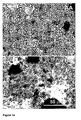
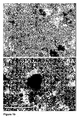
- Figures 1a to 1c show bright field microscopic pictures of starch changes in alkalized deacylated cocoa liquor and alkalized non-deacylated cocoa liquor.
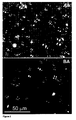
- Figure 2 shows a polarisation light microscopic picture in the matrix of alkalized, deacylated and non-deacylated cocoa liquor.
- a cocoa product having improved wettability factors and functionality comprises benefits related to starch changes due to reduced content of phospholipids.
- Such starch modifications are due by enhanced starch swelling, enhanced amylose leaching from the matrix in starch granules and the formation of complexes between amylose and appropriate lipids.
- lipid classes that are known to form complexes with amylose and at the same time, that are available in the matrix to interact with leached amylose.
- free fatty acids account for the most available, lysophospholipids (lyso-PC in particular) for the most active or preferable, and traces of monoacylglycerols and diacylglycerols for useful lipid classes.
- lipids are obtainable from exogenous sources. For instance, lecithins and lyso-lecithins and a range of emulsifiers and synthetic lipids are known to interact with amylose. Such lipids are miscible with moisturized modified cocoa liquor after amylose leaching.
- amylose-lipid complexes involves minimizing starch retrogradation in cocoa.
- Such complexes form in situ and delay retrogradation of the native starch.
- the cocoa product of the present invention has a reduced content of phospholipids such endogenous phospholipids. It has been shown in practice, that the content of phospholipids in the cocoa product of the present invention should be reduced by at least 50%. A preferred range lies between 60 and 90%.
- the improved wettability characteristics of the cocoa product of the invention are associated with a reduced amount of phospholipids naturally contained in the cocoa product.
- the phospholipids contained comprise phosphatidylcholine, phosphatidylinositol, phosphatidylethanolamine, phosphatidic acid and the lysophospholipids derived therefrom.
- the data in the following table 1 show the major differences in the molar phospholipid composition of standard cocoa and cocoa variants according to the present invention.
- the cocoa product of the present invention shows a molar ratio of phosphatidylcholine to lyso-phosphatidylcholine which is remarkably different from that of standard cocoa products.
- the molar ratio of phosphatidylcholine (PC) to lyso-PC (LPC) is in a range of 3:1 to 1:3 in the cocoa product of the present invention.
- This is in contrast to standard cocoa, wherein the molar ratio of phosphatidylcholine (PC) to lyso-PC (LPC) is higher than 3:1, in some cases at least 5:1.
- the molar ratio of phosphatidylcholine (PC) to lyso-phosphatidylcholine (LPC) is reduced to 1:1.
- hexane-defatted cocoa solids used are useful for authentication of modified and non-modified cocoa variants.
- Hexane-based defatting removes most free lipids such as acylglycerols, from the cocoa matrix.
- defatting removes soybean lecithin, which is added to powdered beverages for instantizing purposes.
- Table 1 Phospholipids in hexane-defatted cocoa solids before and after modification Phospholipids Hexane-defatted cocoa solids a) Standard Variant Variant Variant Variant Variant 1 2 3 4 Lyso-PC (LPC) [MW 515] 0.62 0.76 0.54 0.58 0.68 Phosphatidylcholine (PC) [MW 770] 3.12 0.91 0.68 0.62 0.65 Phosphatidylinositol (PI) [MW 835] 1.54 0.51 0.39 0.40 0.38 Phosphatidylethanolamine (PE) [MW 725] 0.43 0.22 0.16 0.17 0.18 Phosphatidic acid (PA) [MW 685] 1.33 0.61 0.48 0.38 0.39 Sum [mmol/kg] 7.04 3.01 2.25 2.15 2.28 PC:LPC Ratio 5.0 1.2 1.3 1.1 1.0 a) Standard, original cocoa liquor; Variants 1 to 4 are phospholipid reduced, modified cocoa
- the content of endogenous phosphatidylcholine can be less than 1 mmol/kg, preferably less than 0.5 mmol/kg, most preferred 0.25 mmol/kg in hexane-defatted cocoa liquor.
- the cocoa product is a cocoa liquor.
- the cocoa product is a cocoa powder obtained from the cocoa liquor according to techniques well known in the art, such as grinding, pressing, etc.
- alkalization of cocoa liquor is consistent with obtaining desirable color and flavour attributes. It has been further shown in the present invention that an alkalized cocoa product also contributes to wettability improvement.
- a particularly preferred cocoa product is a cocoa powder having a highly reduced phospholipid content and being alkalized.
- the composition of the present invention contains a cocoa product as described above.
- the cocoa product is preferably a cocoa powder which is alkalized and having a highly reduced phospholipid content.
- composition of the invention may contain further ingredients such as sugar, soybean lecithin, salts, vitamins, minerals and flavours.
- the composition is instantized to be readily dissolvable in a suitable medium such as an aqueous medium.
- the beverage of the present invention is a drink containing the above instantized composition.
- the beverage further comprises milk in which the composition is present in a dissolved state.
- the cocoa product of the invention provides improved wettability factors in powdered beverages.
- alkalized cocoa liquor reduced in phospholipid content remarkably improves wettability in instant cocoa beverage powders during prolonged storage comprising defined exposure to ambient moisture.
- the process of the present invention provides a cocoa product having specified wettability and authentication attributes in powdered instant compositions during long-term storage.
- the process of the invention comprises the step of reducing the endogenous phospholipid content of the cocoa product.
- Other phospholipids f.e. in emulsifiers such as lecithin, may be present in addition.
- the process of reducing the phospholipid content of the cocoa product encompasses any process with which the phospholipid level in commercial cocoa liquor variants can be decreased and standardized and with which the phospholipid classes can be derivatized to obtain inactive analogues. Examples of such a process consist in enzymatical and chemical methods.
- Reduction of the phospholipid content can be made by hydrolysis of the phospholipids, i.e., glycero-phospholipids using an appropriate deacylation treatment.
- the phospholipid content is reduced by enzymatic deacylation of the phospholipids.
- any enzyme can be used capable of removing the O-acyl fatty acid moieties from most species in the phospholipids.
- a phospholipase is used.
- An appropriate enzyme can be any commercial phospholipase such as a genetically engineered lipase, for example carboxylic ester hydrolase used at functional conditions.
- the process of the present invention preferably further comprises the step of alkalizing the phospholipid reduced cocoa product.
- Alkalizing can be carried out according to known techniques.
- the phospholipid reduced cocoa product may be treated with a potash solution at increased temperature.
- the alkalized phospholipid reduced cocoa product can be dried to obtain an alkalized phospholipid reduced liquor. Subsequent grinding and pressing the cocoa liquor results in a phospholipid reduced cocoa powder.
- the cocoa powder produced according to the process of the present invention exhibits defined starch properties and wettability effects in instantized cocoa powder beverage products.
- a process of producing a cocoa liquor having a reduced phospholipid content comprises the following steps:
- cocoa liquor to be treated according to the process of the present invention there are no specific limitations as to the use of the cocoa liquor to be treated according to the process of the present invention.
- An example of a suitable cocoa liquor is a raw cocoa liquor obtainable from commercial sources in which the original pH value is close to 5.5.
- the cocoa liquor Before carrying out the deacylation treatment, the cocoa liquor may be moisturized for example by adding 0-20% water.
- the deacylation treatment can be carried out in usual manner including an enzyme or chemical treatment.
- the deacylation treatment is carried out in the presence of an enzyme.
- the enzyme to be used in the deacylation treatment can be any enzyme suitable for cleaving the glycero-phospholipids.
- a suitable enzyme is a carboxylic ester hydrolase, for example genetical phospholipase A 1 such as Lecitase Ultra® (Novozymes A/S, DK).
- Ultra® which is an aqueous preparation containing microbial carboxylic ester hydrolase, is described by the manufacturer to modify egg yolk and degum vegetable oils by hydrolyzing glycero-phospholipids to lyso-derivatives and free fatty acids.
- the claimed enzymatic activity proceeds between 50 to 55°C at pH 4.5 to 6.0.
- the enzyme is preferably used in an amount of 10 to 500 mg in 100 g moisturized cocoa liquor, with a particularly preferred range of 100 to 250 mg.
- the enzyme After incubation with the phospholipase the enzyme is thermally inactivated according to the manufacturer's instructions. In case of Ultra® the inactivation occurs at temperatures above 65°C.
- the subsequent alkalization of the reduced phospholipid cocoa liquor is carried out with an alkalization agent such as potassium carbonate (potash).
- an alkalization agent such as potassium carbonate (potash).
- the phospholipid reduced cocoa liquor is completed with a potash solution at a temperature ranging from 80 to 130°C.
- a typical classical alkalization of liquor is as follows: A known amount of phospholipase treated cocoa liquor is brought to 82°C using a Winkworth® jacketed cell fitted with two blade rotors and kept at the same temperature, followed by adding an appropriate amount of an alkalization solution, which usually contains 47 parts of K 2 CO 3 and 53 parts of water by weight.
- the temperature is brought to 125°C to evaporate excess moisture from the liquor, after which the mixing blades and heating are turned off.
- the liquor dried to less than 2% residual moisture, preferably to at least 1.5% residual moisture, is cooled to ambient temperature and may then be used for common processing steps such as pressing, which are well known in the field of cocoa industry.
- amylase is commonly used.
- An example for a suitable amylase is fungal ⁇ -amylase.
- Drying of the phospholipid reduced, alkalized cocoa liquor can be performed in vacuum or non-vacuum cookers. Vacuum drying usually proceeds at temperatures less than 100°C while non-vacuum cookers need temperatures of up to 130°C.
- the dried, alkalized cocoa liquor is additionally milled, if needed, and pressed according to common techniques.
- the cocoa product is defatted by means of methods known in the art.
- defatting is an extraction using apolar hydrocarbon solvents such as hexane.
- cocoa product of the present invention as well as the cocoa products obtained by the process of the present invention have been shown to maximize starch swelling and minimize retrogradation of starch. Further, the combination of reducing phospholipid content and subsequent alkalization results in improving the cocoa starch behaviour such as free fat scavenging by amylose-leached starch "ghosts" and minimizing retrogradation that maintains starch hydrophilic.
- cocoa starch granules and the parent cocoa matrix are subject to irreversible and relevant changes due to enzymatic deacylation of most phospholipids at 50°C and subsequent exposure to water at increased temperatures.
- polarization light microscopy shows a major loss of birefringence in the matrix of deacylated and alkalized cocoa variant "BA” compared to non-deacylated standard "AA” in Figure 2.
- the loss of birefringence and hence, the lost capacity to refract light are attributed to perturbed crystallinity in starch granules due to irreversible changes such as starch gelatinization followed by swelling in variant "BA".
- a twin-blade mixer (Winkworth®) fitted with a jacketed cell was used for cocoa liquor processing. Exactly 300 g of cocoa liquor were weighed into the cell kept at 49.5 ⁇ 0.5°C and liquefied. The melted liquor was moisturized with 12.4 g water, followed by adding 500 mg Ultra® and tightly sealing the cell to avoid moisture loss. The enzymatic process proceeded for 60 min at 50°C and 95 rpm. After phospholipolysis, the cell was unsealed and the enzyme inactivated by keeping the liquor for 30 min at 82°C and 95 rpm.
- the subsequent alkalization step consisted in dissolving 47 parts of potassium carbonate in 53 parts of water by weight, followed by adding 9 g of this solution into the liquor at 82°C and 95 rpm. Finally, the operating temperature was brought to 125°C and the liquor dried for 60 min at 95 rpm in the unsealed cell. In addition, the above process was repeated in the absence of Ultra® to obtain a control sample using another 300 g portion of fresh cocoa liquor.
- cocoa liquor and control (Ex. 1) were defatted at 50°C to decrease the level of neutral lipids for improved recoveries of endogenous PL from the cocoa matrix and its microscopic evaluation.
- the following defatting procedure was applied: One volume (e.g. 50 g) of cocoa liquor is brought to 50°C, weighed into a 250 mL glass beaker pre-heated to 50°C and completed with two volumes of hexane (i.e. about 100 mL) that was previously brought to 50°C. The resulting suspension is stirred for one min at 50°C using a spatula.
- the suspension is passed through a No.602 filter paper sheet that is kept in an appropriate Büchner type of Pyrex®-glass filter-holder pre-heated to 50°C.
- the Büchner filtration procedure is assisted using a vacuum water pump.
- the resulting filter cake is resuspended in two volumes of hexane as above, after which the filtration procedure is repeated to obtain desolvantized and defatted cocoa solids.
- Such solids typically retain 2 to 7 % residual fat and endogenous PL.
- TL were extracted using the method of Folch et al [A simple method for the isolation and purification of total lipids from animal tissues, 1957, J Biol Chem 226: 497-509].
- 10 g defatted cocoa liquor was suspended in two volumes of water and extracted using 19 volumes chloroform-MeOH 2:1 (v/v).
- the extract was Büchner-filtered and partitioned against 0.2 volumes 0.88% KCl. Lipids in the lower-phase were concentrated to dryness and weighed.
- the plate was dried for 5 min at 180°C, cooled to room temperature and reacted with a molybdate dip-in reagent for 30 min.
- the lipid-bound phosphorus visualized as polymorphic blue-tinted spots at 20°C and relative humidity >50%.
- PC phosphatidylcholine
- LPC lyso-PC
- PI phosphatidylinositol
- PE phosphatidylethanolamine
- PA phosphatidic acid
Landscapes
- Life Sciences & Earth Sciences (AREA)
- Engineering & Computer Science (AREA)
- Chemical & Material Sciences (AREA)
- Food Science & Technology (AREA)
- Polymers & Plastics (AREA)
- Microbiology (AREA)
- Health & Medical Sciences (AREA)
- Nutrition Science (AREA)
- Biotechnology (AREA)
- Confectionery (AREA)
- Preparation Of Fruits And Vegetables (AREA)
Abstract
Description
- This invention relates to a cocoa product improving wettability in powdered beverages. In particular, it relates to a modified cocoa product in which the content of phospholipids is highly reduced. The invention also relates to methods of producing such cocoa products.
- It is current practice to improve color and flavor attributes in cocoa matrices, i.e. nibs, liquor, or powder by increasing the natural pH value of about 5.5 by alkalizing. Typical cocoa liquor contains >50% fat, 12% protein residues, 9% cellulose, 6% polyhydroxyphenols, 7% starch (amylose; amylopectin 70:30; w/w), 4% pectins, 2% water, organic acids, and a range of minor constituents such as phospho- and glycolipids.
- Cocoa alkalization practices mostly proceed on a know-how basis. In principle, alkalization consists in mixing defined volumes of aqueous alkali with a cocoa product. Such a treatment modifies flavor and color attributes by increasing the natural pH value in cocoa. The addition of alkalizing solution provokes known (e.g. color and flavor) and unknown changes in the cocoa matrix. Different types of alkalized liquors are pressed to obtain a particular cocoa powder for target food products. In special cases, excess water is used to obtain a wet alkalized cocoa liquor variant. For unknown reasons, such a variant happens to produce excellent wettability effects on the reconstitution of powdered and agglomerated cocoa drinks in aqueous media. In this context, improved wettability is hypothesized to depend on several criteria: the extent of functional changes induced by wet alkalization in cocoa starch granules, the subsequent behavior of modified starch during agglomeration of different ingredients that constitute the powdered beverage and also, factor-dependent effects in the final matrix of agglomerated powder containing several interacting ingredients.
- In general, starch granules exothermically absorb water at ambient temperature. This water uptake is reversible. A sufficient temperature increase triggers an endothermic process that leads to starch swelling, concomitant leaching of amylose, and irreversible gelatinization. In principle, the occurrence of the aforementioned process is possible in cocoa liquor due to the presence of about 7 wt-% of native starch.
- In addition, it is well known that cocoa products contain endogenous phospholipids. For instance, Fincke-A and Knopp-M (1977) Phosphatide content of cocoa products and raw materials of the chocolate industry, Gordian 77:288-292 found that phospholipids averaged 3.7 g/kg, i.e. about 4.9 mmol/kg in fifteen different cocoa liquors (coefficient of variation 11 %).
- Published papers indicate that endogenous phospholipids impair starch swelling in general. Becker-A, Hill-SE, Mitchell-JR (2001), Relevance of amylose-lipid complexes to the behaviour of thermally processed starches, Starch/Stärke 53:121-130 showed that phospholipid-amylose-complexes form insoluble films on the surface of starch granules. Such films delay water transport into the granules and prevent starch swelling. In this context, anti-swelling effects are thought to occur in starch during wet alkalization of cocoa liquor in the presence of excess phospholipids. Non-swelling starch is thought to be an anti-wettability factor in instant cocoa beverages. In theory, such starch is unable to scavenge migrating fat in powdered cocoa matrix. In addition, minimized starch swelling and excess phospholipids could contribute to enhanced retrogradation, as reported by Singh-N, Singh-J, Kaur-L, Sodhi-NS, Gill-BS (2003) Morphological, thermal and rheological properties of starches from different botanical sources, Food Chem 81:219-231. Retrograded starch and its hydrophobicity are presumed to be additional anti-wettability factors.
- For the purpose of this specification, the term "wettability" should be understood to mean the ability of the cocoa-based powder to dissolve in foodgrade liquids within a reasonable period of time. Wettability is the drowning period measured in seconds for an appropriate amount of powdered beverage that is added as a single dose into an aqueous medium such as milk of specified volume of defined freshness, temperature and composition.
- The term " cocoa product", as used in this specification, means a product obtained from cocoa beans after roasting and grinding. Examples for such cocoa products are cocoa liquor and cocoa powder.
- There are reasons to hypothesize that cocoa contains enough native (endogenous) phospholipids to interact with starch in situ, especially during factor-dependent effects of alkalization, agglomeration with other ingredients and storage of the final product. In theory, the molar concentration of phospholipids in cocoa is much higher compared to starch based on equi-ponderal amounts. Cocoa fermentation frees these phospholipids from their carrier lipoproteins for uncontrolled phospholipid-starch interactions. Free phospholipids and their amphipathic, i.e., hydro- and lipophilic nature are believed to enhance the penetration of ambient moisture into the cocoa matrix. Increased moisture is hypothesized to trigger uncontrolled anti-wettability effects during a recurrent exposure of instant cocoa beverages to ambient air and subsequent storage.
- The anti-wettability effects are manifold involving native phospholipids and the starch matrix both present in the cocoa product. They are presumed to be related to insufficient cocoa starch swelling and insufficient amylose leaching and starch retrogradation. In addition, moisture penetration and starch retrogradation are likely to cause uncohesiveness in the matrix of agglomerated particles that combine cocoa with other food ingredients. Such destablized agglomerates are prone to splitting into hydrophobic sub-units, especially during handling.
- It is therefore an object of the invention to improve the cocoa product for obtaining defined and non-fluctuating wettability effects in powdered cocoa beverages.
- It is another object of the invention to provide a cocoa product having defined functional properties in instant beverages exposed to destabilizing factors such as ambient moisture and prolonged storage.
- The invention provides cocoa products, compositions containing said products, beverages containing the compositions and a process of producing a cocoa product.
- According to a first aspect of the invention, a cocoa product is characterized by its reduced content of phospholipids such as endogenous phospholipids.
- According to a second aspect of the invention, a composition is characterized by containing a cocoa product as defined above.
- According to a third aspect of the invention, a beverage is characterized by containing the above composition.
- According to a fourth aspect of the present invention, a process is provided for producing a cocoa product having improved wettability factors by decreasing the phospholipid content of the cocoa product.
- According to a fifth aspect of the present invention a process of producing a cocoa liquor having an improved phospholipid content is provided comprising the steps of providing a cocoa liquor; subjecting the moisturized cocoa liquor to a deacylation treatment; alkalizing the cocoa liquor with an alkalization agent and drying the alkalized cocoa liquor.
- The sub-claims define specific embodiments of the present invention.
- Figures 1a to 1c show bright field microscopic pictures of starch changes in alkalized deacylated cocoa liquor and alkalized non-deacylated cocoa liquor.
- Figure 2 shows a polarisation light microscopic picture in the matrix of alkalized, deacylated and non-deacylated cocoa liquor.
- It has been found that a cocoa product having improved wettability factors and functionality comprises benefits related to starch changes due to reduced content of phospholipids. Such starch modifications are due by enhanced starch swelling, enhanced amylose leaching from the matrix in starch granules and the formation of complexes between amylose and appropriate lipids.
- The term "appropriate lipids" means lipid classes that are known to form complexes with amylose and at the same time, that are available in the matrix to interact with leached amylose. In the cocoa product of the invention, free fatty acids account for the most available, lysophospholipids (lyso-PC in particular) for the most active or preferable, and traces of monoacylglycerols and diacylglycerols for useful lipid classes.
- In addition, "appropriate lipids" are obtainable from exogenous sources. For instance, lecithins and lyso-lecithins and a range of emulsifiers and synthetic lipids are known to interact with amylose. Such lipids are miscible with moisturized modified cocoa liquor after amylose leaching.
- In particular, the formation of amylose-lipid complexes involves minimizing starch retrogradation in cocoa. Such complexes form in situ and delay retrogradation of the native starch.
- The cocoa product of the present invention has a reduced content of phospholipids such endogenous phospholipids. It has been shown in practice, that the content of phospholipids in the cocoa product of the present invention should be reduced by at least 50%. A preferred range lies between 60 and 90%.
- As shown above, the improved wettability characteristics of the cocoa product of the invention are associated with a reduced amount of phospholipids naturally contained in the cocoa product. The phospholipids contained comprise phosphatidylcholine, phosphatidylinositol, phosphatidylethanolamine, phosphatidic acid and the lysophospholipids derived therefrom.
- The data in the following table 1 show the major differences in the molar phospholipid composition of standard cocoa and cocoa variants according to the present invention. The cocoa product of the present invention shows a molar ratio of phosphatidylcholine to lyso-phosphatidylcholine which is remarkably different from that of standard cocoa products. In particular, the molar ratio of phosphatidylcholine (PC) to lyso-PC (LPC) is in a range of 3:1 to 1:3 in the cocoa product of the present invention. This is in contrast to standard cocoa, wherein the molar ratio of phosphatidylcholine (PC) to lyso-PC (LPC) is higher than 3:1, in some cases at least 5:1.
- In a preferred embodiment of the present invention, the molar ratio of phosphatidylcholine (PC) to lyso-phosphatidylcholine (LPC) is reduced to 1:1.
- The hexane-defatted cocoa solids used are useful for authentication of modified and non-modified cocoa variants. Hexane-based defatting removes most free lipids such as acylglycerols, from the cocoa matrix. In addition, defatting removes soybean lecithin, which is added to powdered beverages for instantizing purposes.
Table 1: Phospholipids in hexane-defatted cocoa solids before and after modification Phospholipids Hexane-defatted cocoa solids a) Standard Variant Variant Variant Variant 1 2 3 4 Lyso-PC (LPC) [MW 515] 0.62 0.76 0.54 0.58 0.68 Phosphatidylcholine (PC) [MW 770] 3.12 0.91 0.68 0.62 0.65 Phosphatidylinositol (PI) [MW 835] 1.54 0.51 0.39 0.40 0.38 Phosphatidylethanolamine (PE) [MW 725] 0.43 0.22 0.16 0.17 0.18 Phosphatidic acid (PA) [MW 685] 1.33 0.61 0.48 0.38 0.39 Sum [mmol/kg] 7.04 3.01 2.25 2.15 2.28 PC:LPC Ratio 5.0 1.2 1.3 1.1 1.0 a) Standard, original cocoa liquor; Variants 1 to 4 are phospholipid reduced, modified cocoa liquor. - According to the invention, the content of endogenous phosphatidylcholine can be less than 1 mmol/kg, preferably less than 0.5 mmol/kg, most preferred 0.25 mmol/kg in hexane-defatted cocoa liquor.
- According to a preferred embodiment of the invention, the cocoa product is a cocoa liquor. In another preferred embodiment of the invention, the cocoa product is a cocoa powder obtained from the cocoa liquor according to techniques well known in the art, such as grinding, pressing, etc.
- As already mentioned beforehand, alkalization of cocoa liquor is consistent with obtaining desirable color and flavour attributes. It has been further shown in the present invention that an alkalized cocoa product also contributes to wettability improvement. A particularly preferred cocoa product is a cocoa powder having a highly reduced phospholipid content and being alkalized.
- The composition of the present invention contains a cocoa product as described above. The cocoa product is preferably a cocoa powder which is alkalized and having a highly reduced phospholipid content.
- The composition of the invention may contain further ingredients such as sugar, soybean lecithin, salts, vitamins, minerals and flavours. In a particularly preferred embodiment, the composition is instantized to be readily dissolvable in a suitable medium such as an aqueous medium.
- The beverage of the present invention is a drink containing the above instantized composition. In a preferred embodiment the beverage further comprises milk in which the composition is present in a dissolved state.
- According to the invention, the cocoa product of the invention provides improved wettability factors in powdered beverages. In particular, alkalized cocoa liquor reduced in phospholipid content remarkably improves wettability in instant cocoa beverage powders during prolonged storage comprising defined exposure to ambient moisture.
- The process of the present invention provides a cocoa product having specified wettability and authentication attributes in powdered instant compositions during long-term storage.
- The process of the invention comprises the step of reducing the endogenous phospholipid content of the cocoa product. Other phospholipids, f.e. in emulsifiers such as lecithin, may be present in addition.
- The process of reducing the phospholipid content of the cocoa product encompasses any process with which the phospholipid level in commercial cocoa liquor variants can be decreased and standardized and with which the phospholipid classes can be derivatized to obtain inactive analogues. Examples of such a process consist in enzymatical and chemical methods.
- Reduction of the phospholipid content can be made by hydrolysis of the phospholipids, i.e., glycero-phospholipids using an appropriate deacylation treatment.
- In a preferred embodiment of the present invention the phospholipid content is reduced by enzymatic deacylation of the phospholipids.
- In essence, any enzyme can be used capable of removing the O-acyl fatty acid moieties from most species in the phospholipids. Preferably, a phospholipase is used. An appropriate enzyme can be any commercial phospholipase such as a genetically engineered lipase, for example carboxylic ester hydrolase used at functional conditions.
- The process of the present invention preferably further comprises the step of alkalizing the phospholipid reduced cocoa product. Alkalizing can be carried out according to known techniques. For example, the phospholipid reduced cocoa product may be treated with a potash solution at increased temperature.
- After alkalization the alkalized phospholipid reduced cocoa product can be dried to obtain an alkalized phospholipid reduced liquor. Subsequent grinding and pressing the cocoa liquor results in a phospholipid reduced cocoa powder. The cocoa powder produced according to the process of the present invention exhibits defined starch properties and wettability effects in instantized cocoa powder beverage products.
- A process of producing a cocoa liquor having a reduced phospholipid content comprises the following steps:
- providing a cocoa liquor;
- subjecting the moisturized cocoa liquor to a deacylation treatment;
- alkalizing the cocoa liquor with an alkalization agent and
- drying the alkalized cocoa liquor.
- There are no specific limitations as to the use of the cocoa liquor to be treated according to the process of the present invention. An example of a suitable cocoa liquor is a raw cocoa liquor obtainable from commercial sources in which the original pH value is close to 5.5.
- Before carrying out the deacylation treatment, the cocoa liquor may be moisturized for example by adding 0-20% water.
- The deacylation treatment can be carried out in usual manner including an enzyme or chemical treatment. Preferably, the deacylation treatment is carried out in the presence of an enzyme.
- The enzyme to be used in the deacylation treatment can be any enzyme suitable for cleaving the glycero-phospholipids. A suitable enzyme is a carboxylic ester hydrolase, for example genetical phospholipase A1 such as Lecitase Ultra® (Novozymes A/S, DK).
- In principle, Ultra® which is an aqueous preparation containing microbial carboxylic ester hydrolase, is described by the manufacturer to modify egg yolk and degum vegetable oils by hydrolyzing glycero-phospholipids to lyso-derivatives and free fatty acids. The claimed enzymatic activity proceeds between 50 to 55°C at pH 4.5 to 6.0.
- The enzyme is preferably used in an amount of 10 to 500 mg in 100 g moisturized cocoa liquor, with a particularly preferred range of 100 to 250 mg.
- According to the invention, however, the above behavior of Ultra® was modified in the cocoa liquor moisturized with 0.1 to 10 %, preferably 2 to 7 %, and even more preferably 3.5 to 5.5 % water. Consequently, most species in the glycero-phospholipid classes hydrolyzed to free fatty acids and non-lipid residues .
- After incubation with the phospholipase the enzyme is thermally inactivated according to the manufacturer's instructions. In case of Ultra® the inactivation occurs at temperatures above 65°C.
- The subsequent alkalization of the reduced phospholipid cocoa liquor is carried out with an alkalization agent such as potassium carbonate (potash). Generally, the phospholipid reduced cocoa liquor is completed with a potash solution at a temperature ranging from 80 to 130°C.
- A typical classical alkalization of liquor is as follows: A known amount of phospholipase treated cocoa liquor is brought to 82°C using a Winkworth® jacketed cell fitted with two blade rotors and kept at the same temperature, followed by adding an appropriate amount of an alkalization solution, which usually contains 47 parts of K2CO3 and 53 parts of water by weight.
- The temperature is brought to 125°C to evaporate excess moisture from the liquor, after which the mixing blades and heating are turned off. The liquor dried to less than 2% residual moisture, preferably to at least 1.5% residual moisture, is cooled to ambient temperature and may then be used for common processing steps such as pressing, which are well known in the field of cocoa industry.
- It has been shown that in some instances, e.g. after elimination of most phospholipids, a partial enzymatic hydrolysis of starch can be additionally carried out in the process of the invention. For this purpose, an amylase is commonly used. An example for a suitable amylase is fungal α-amylase.
- Drying of the phospholipid reduced, alkalized cocoa liquor can be performed in vacuum or non-vacuum cookers. Vacuum drying usually proceeds at temperatures less than 100°C while non-vacuum cookers need temperatures of up to 130°C.
- In order to obtain a cocoa powder the dried, alkalized cocoa liquor is additionally milled, if needed, and pressed according to common techniques.
- If desired, the cocoa product is defatted by means of methods known in the art. One example of defatting is an extraction using apolar hydrocarbon solvents such as hexane.
- The cocoa product of the present invention as well as the cocoa products obtained by the process of the present invention have been shown to maximize starch swelling and minimize retrogradation of starch. Further, the combination of reducing phospholipid content and subsequent alkalization results in improving the cocoa starch behaviour such as free fat scavenging by amylose-leached starch "ghosts" and minimizing retrogradation that maintains starch hydrophilic.
- Remarkably, cocoa starch granules and the parent cocoa matrix are subject to irreversible and relevant changes due to enzymatic deacylation of most phospholipids at 50°C and subsequent exposure to water at increased temperatures.
- The final consequences of starch changes in deacylated cocoa liquor after alkalization at 125°C are further visualized and authenticated in Figures 1-a to 1-c. In particular, bright field microscopy after re-hydration at room temperature shows typical cocoa starch granules as readily discernible spheroid units in non-deacylated and alkalized liquor variant "AA" (white arrows). These units are much less discernible in deacylated "BA" for one major reason: the original starch granules collapsed to polymorphic "ghosts" due to previous amylose leaching and elimination of excess water by drying. These amylose-leached "ghosts" are expected to scavenge migrating fat in the cocoa matrix.
- Remarkably, polarization light microscopy shows a major loss of birefringence in the matrix of deacylated and alkalized cocoa variant "BA" compared to non-deacylated standard "AA" in Figure 2. The loss of birefringence and hence, the lost capacity to refract light are attributed to perturbed crystallinity in starch granules due to irreversible changes such as starch gelatinization followed by swelling in variant "BA".
- The following examples are to illustrate the invention and are not intended to limit its scope in any manner.
- A twin-blade mixer (Winkworth®) fitted with a jacketed cell was used for cocoa liquor processing. Exactly 300 g of cocoa liquor were weighed into the cell kept at 49.5 ± 0.5°C and liquefied. The melted liquor was moisturized with 12.4 g water, followed by adding 500 mg Ultra® and tightly sealing the cell to avoid moisture loss. The enzymatic process proceeded for 60 min at 50°C and 95 rpm. After phospholipolysis, the cell was unsealed and the enzyme inactivated by keeping the liquor for 30 min at 82°C and 95 rpm. The subsequent alkalization step consisted in dissolving 47 parts of potassium carbonate in 53 parts of water by weight, followed by adding 9 g of this solution into the liquor at 82°C and 95 rpm. Finally, the operating temperature was brought to 125°C and the liquor dried for 60 min at 95 rpm in the unsealed cell. In addition, the above process was repeated in the absence of Ultra® to obtain a control sample using another 300 g portion of fresh cocoa liquor.
- Processed cocoa liquor and control (Ex. 1) were defatted at 50°C to decrease the level of neutral lipids for improved recoveries of endogenous PL from the cocoa matrix and its microscopic evaluation. The following defatting procedure was applied: One volume (e.g. 50 g) of cocoa liquor is brought to 50°C, weighed into a 250 mL glass beaker pre-heated to 50°C and completed with two volumes of hexane (i.e. about 100 mL) that was previously brought to 50°C. The resulting suspension is stirred for one min at 50°C using a spatula. The suspension is passed through a No.602 filter paper sheet that is kept in an appropriate Büchner type of Pyrex®-glass filter-holder pre-heated to 50°C. The Büchner filtration procedure is assisted using a vacuum water pump. The resulting filter cake is resuspended in two volumes of hexane as above, after which the filtration procedure is repeated to obtain desolvantized and defatted cocoa solids. Such solids typically retain 2 to 7 % residual fat and endogenous PL.
- TL were extracted using the method of Folch et al [A simple method for the isolation and purification of total lipids from animal tissues, 1957, J Biol Chem 226: 497-509]. In principle, 10 g defatted cocoa liquor was suspended in two volumes of water and extracted using 19 volumes chloroform-MeOH 2:1 (v/v).
- The extract was Büchner-filtered and partitioned against 0.2 volumes 0.88% KCl. Lipids in the lower-phase were concentrated to dryness and weighed.
- Individual total lipid extracts (250 µg) were deposited on 10x20cm HPTLC silica gel plates Merck # 1.05642 previously impregnated with 2 % boric acid in ethanol. Neutral lipids were removed from the spotted lipids by one fold elution using hexane-diethylether 60:40 (v/v) as mobile phase. The chromatogram was dried with a stream of nitrogen, followed by HPTLC separation of PL into their individual classes using chloroform-EtOH-MeOH-triethylamine-water 30:25:10:35:8 (v/v) as the mobile phase. The plate was dried for 5 min at 180°C, cooled to room temperature and reacted with a molybdate dip-in reagent for 30 min. The lipid-bound phosphorus visualized as polymorphic blue-tinted spots at 20°C and relative humidity >50%. The chromogenic response of PL spots was measured at λ =595 nm using a Desaga CD-60 Densitometer. Nanomolar concentrations of individual PL classes were calculated using the peak area units and standard calibration curves for phosphatidylcholine (PC), lyso-PC (LPC), phosphatidylinositol (PI), phosphatidylethanolamine (PE) and phosphatidic acid (PA) of soybean origin.
- Samples of the alkalized deacylated cocoa liquor were used for microscopy analysis.
Claims (28)
- A cocoa product improving wettability in powdered beverages, having a reduced content of endogenous phospholipids.
- The cocoa product according to claim 1 wherein the content of endogenous phospholipids is reduced by at least 50%.
- The cocoa product according to claim 1 or 2 wherein the content of phospholipids is reduced in a range of 60 to 90%.
- The cocoa product according to any one of claims 1 to 3 wherein the endogenous phospholipids comprise phosphatidylcholine, phosphatidylinositol, phosphatidylethanolamine, phosphatidic acid and lysophospholipids derived therefrom.
- A cocoa product wherein the molar ratio of phosphatidylcholine to lyso-phosphatidylcholine is in a range of 3:1 to 1:3.
- The cocoa product according to claim 5 wherein the molar ratio of phosphatidylcholine to lyso-phosphatidylcholine is approximatively 1:1.
- The cocoa product according to any one of claims 1 to 6 which is a cocoa liquor or a cocoa powder.
- The cocoa product according to claim 7 which is alkalized.
- A composition containing a cocoa product according to claim 8.
- The composition according to claim 9 which is instantized.
- A beverage containing the composition according to claim 10.
- The beverage according to claim 11 further comprising milk.
- A process of producing a cocoa product having improved wettability factors comprising reducing the phospholipid content of the cocoa product.
- The process according to claim 13 wherein the phospholipid content is enzymatically or chemically reduced.
- The process according to claim 13 or 14 wherein the phospholipid content is reduced by enzymatic hydrolysis of the phospholipids.
- The process according to claim 15 wherein a carboxylic ester hydrolase such as a phospholipase is used.
- The process according to any one of claims 13 to 16 further comprising the step of alkalizing the phospholipid reduced cocoa product and the step of drying the alkalized phospholipid reduced cocoa product to obtain an alkalized phospholipid reduced cocoa liquor.
- A process of producing a cocoa liquor having a reduced phospholipid content comprising the steps of:- providing a cocoa liquor;- subjecting the moisturized cocoa liquor to a deacylation treatment;- alkalizing the cocoa liquor with an alkalization agent and- drying the alkalized cocoa liquor.
- The process according to claim 18 wherein the deacylation treatment is carried out enzymatically.
- The process according to claim 19 wherein a phospholipase is used.
- The process according to claim 20 wherein the cocoa liquor is moisturized with 0.1 to 12 % water.
- The process according to any of claims 18 to 21 wherein the enzyme is thermally inactivated after the deacylation treatment.
- The process according to any one of claims 18 to 22 wherein potassium carbonate is used as an alkalization agent.
- The process according to claim 23 wherein the alkalization is carried out at a temperature ranging from 80 to 130°C.
- The process according to any one of claims 18 to 24 wherein the alkalized cocoa liquor is dried in vacuum or non-vacuum cookers.
- The process according to any one of claims 18 to 25 wherein the dried, alkalized cocoa liquor is ground and pressed to obtain cocoa powder.
- The process according to any one of claims 18 to 26 wherein the cocoa product is defatted.
- A cocoa product, having a content of endogenous phosphatidylcholine of less than 1.0 mmol/kg.
Priority Applications (20)
| Application Number | Priority Date | Filing Date | Title |
|---|---|---|---|
| ES04025278T ES2349125T3 (en) | 2004-10-25 | 2004-10-25 | MODIFIED COCOA BASED PRODUCT AND PROCESS FOR MANUFACTURING. |
| DK04025278.5T DK1649756T3 (en) | 2004-10-25 | 2004-10-25 | Modified cocoa product and process for its preparation |
| SI200431507T SI1649756T1 (en) | 2004-10-25 | 2004-10-25 | Modified cocoa product and process for its manufacture |
| DE602004029050T DE602004029050D1 (en) | 2004-10-25 | 2004-10-25 | Modified cocoa product and process for its preparation |
| PT04025278T PT1649756E (en) | 2004-10-25 | 2004-10-25 | Modified cocoa product and process for its manufacture |
| EP04025278A EP1649756B1 (en) | 2004-10-25 | 2004-10-25 | Modified cocoa product and process for its manufacture |
| AT04025278T ATE480149T1 (en) | 2004-10-25 | 2004-10-25 | MODIFIED COCOA PRODUCT AND METHOD FOR PRODUCING SAME |
| PL04025278T PL1649756T3 (en) | 2004-10-25 | 2004-10-25 | Modified cocoa product and process for its manufacture |
| US11/577,937 US8197877B2 (en) | 2004-10-25 | 2005-06-29 | Modified cocoa product and process for its manufacture |
| AU2005299116A AU2005299116B2 (en) | 2004-10-25 | 2005-06-29 | Modified cocoa product and process for its manufacture |
| CA2585026A CA2585026C (en) | 2004-10-25 | 2005-06-29 | Modified cocoa product and process for its manufacture |
| MX2007004888A MX2007004888A (en) | 2004-10-25 | 2005-06-29 | Modified cocoa product and process for its manufacture. |
| RU2007119386/13A RU2007119386A (en) | 2004-10-25 | 2005-06-29 | MODIFIED COCOA PRODUCT AND METHOD FOR PRODUCING IT |
| BRPI0516771-0A BRPI0516771B1 (en) | 2004-10-25 | 2005-06-29 | Cocoa product to improve dissolving capacity in powdered beverages, production process, composition, beverage and cocoa liquor production process |
| PCT/EP2005/006979 WO2006045354A1 (en) | 2004-10-25 | 2005-06-29 | Modified cocoa product and process for its manufacture |
| MYPI20053050A MY144737A (en) | 2004-10-25 | 2005-07-05 | Modified cocoa products and process for its manufacture |
| ARP050104438A AR051233A1 (en) | 2004-10-25 | 2005-10-24 | MODIFIED COCOA PRODUCTS AND PROCEDURE FOR MANUFACTURING |
| NO20072579A NO332450B1 (en) | 2004-10-25 | 2007-05-21 | Cocoa product with improved wettability in powdered beverages, compositions containing it, beverages and process for making cocoa product. |
| ZA200704259A ZA200704259B (en) | 2004-10-25 | 2007-05-24 | Modified cocoa product and process for its manufacture |
| CY20101100960T CY1110864T1 (en) | 2004-10-25 | 2010-10-26 | MODIFIED COCOA PRODUCT AND ITS METHOD OF PREPARATION |
Applications Claiming Priority (1)
| Application Number | Priority Date | Filing Date | Title |
|---|---|---|---|
| EP04025278A EP1649756B1 (en) | 2004-10-25 | 2004-10-25 | Modified cocoa product and process for its manufacture |
Publications (2)
| Publication Number | Publication Date |
|---|---|
| EP1649756A1 true EP1649756A1 (en) | 2006-04-26 |
| EP1649756B1 EP1649756B1 (en) | 2010-09-08 |
Family
ID=34927092
Family Applications (1)
| Application Number | Title | Priority Date | Filing Date |
|---|---|---|---|
| EP04025278A Expired - Lifetime EP1649756B1 (en) | 2004-10-25 | 2004-10-25 | Modified cocoa product and process for its manufacture |
Country Status (20)
| Country | Link |
|---|---|
| US (1) | US8197877B2 (en) |
| EP (1) | EP1649756B1 (en) |
| AR (1) | AR051233A1 (en) |
| AT (1) | ATE480149T1 (en) |
| AU (1) | AU2005299116B2 (en) |
| BR (1) | BRPI0516771B1 (en) |
| CA (1) | CA2585026C (en) |
| CY (1) | CY1110864T1 (en) |
| DE (1) | DE602004029050D1 (en) |
| DK (1) | DK1649756T3 (en) |
| ES (1) | ES2349125T3 (en) |
| MX (1) | MX2007004888A (en) |
| MY (1) | MY144737A (en) |
| NO (1) | NO332450B1 (en) |
| PL (1) | PL1649756T3 (en) |
| PT (1) | PT1649756E (en) |
| RU (1) | RU2007119386A (en) |
| SI (1) | SI1649756T1 (en) |
| WO (1) | WO2006045354A1 (en) |
| ZA (1) | ZA200704259B (en) |
Cited By (3)
| Publication number | Priority date | Publication date | Assignee | Title |
|---|---|---|---|---|
| EP2186420A1 (en) | 2008-11-18 | 2010-05-19 | Kraft Foods R & D, Inc. | High-fat cocoa product, a process for its manufacture and its application in confections |
| EP2241190A1 (en) | 2009-04-17 | 2010-10-20 | Kraft Foods R & D, Inc. | Process for producing high flavour cocoa |
| KR20180109854A (en) * | 2016-02-03 | 2018-10-08 | 후지세유 그룹 혼샤 가부시키가이샤 | Cocoa butter |
Families Citing this family (4)
| Publication number | Priority date | Publication date | Assignee | Title |
|---|---|---|---|---|
| WO2002094123A2 (en) | 2001-05-18 | 2002-11-28 | Danisco A/S | Method of preparing a dought with an enzime |
| CN102533440B (en) | 2004-07-16 | 2017-09-19 | 杜邦营养生物科学有限公司 | With the method for enzymatic oil-degumming |
| SG11201900920PA (en) * | 2016-08-09 | 2019-02-27 | Cargill Inc | Compositions comprising cocoa butter |
| US11524268B2 (en) | 2016-11-09 | 2022-12-13 | Pepsico, Inc. | Carbonated beverage makers, methods, and systems |
Citations (7)
| Publication number | Priority date | Publication date | Assignee | Title |
|---|---|---|---|---|
| US3459557A (en) * | 1965-09-28 | 1969-08-05 | Morinaga Confectionery Co Ltd | Process for manufacture of readily dispersible cocoa powder |
| US4608267A (en) * | 1983-11-29 | 1986-08-26 | Thomas J. Lipton Inc. | Lecithin-containing food product |
| DE3716227A1 (en) * | 1987-05-14 | 1988-12-08 | Rudolf Dr Rapp | Process for producing cocoa powder agglomerates |
| EP0379023A1 (en) * | 1989-01-16 | 1990-07-25 | Jacobs Suchard AG | Process for making chocolate powder, and this chocolate powder |
| EP0455386A1 (en) * | 1990-04-21 | 1991-11-06 | United Biscuits (Uk) Limited | Fat based food products |
| US5753296A (en) * | 1993-08-03 | 1998-05-19 | Immunopath Profile, Inc. | Product and process of making hypoallergenic chocolate compositions |
| US20040071858A1 (en) * | 2002-10-15 | 2004-04-15 | Cargill, Inc. | Dispersible cocoa products |
Family Cites Families (2)
| Publication number | Priority date | Publication date | Assignee | Title |
|---|---|---|---|---|
| US4849132A (en) * | 1986-05-16 | 1989-07-18 | Asahi Denka Kogyo Kabushiki Kaisha | Surfactant composition having improved functions |
| US5800850A (en) * | 1995-07-07 | 1998-09-01 | Nestec S.A. | Process for reducing spoilage of sterilized liquid products |
-
2004
- 2004-10-25 EP EP04025278A patent/EP1649756B1/en not_active Expired - Lifetime
- 2004-10-25 PL PL04025278T patent/PL1649756T3/en unknown
- 2004-10-25 DK DK04025278.5T patent/DK1649756T3/en active
- 2004-10-25 SI SI200431507T patent/SI1649756T1/en unknown
- 2004-10-25 PT PT04025278T patent/PT1649756E/en unknown
- 2004-10-25 AT AT04025278T patent/ATE480149T1/en active
- 2004-10-25 ES ES04025278T patent/ES2349125T3/en not_active Expired - Lifetime
- 2004-10-25 DE DE602004029050T patent/DE602004029050D1/en not_active Expired - Lifetime
-
2005
- 2005-06-29 WO PCT/EP2005/006979 patent/WO2006045354A1/en not_active Ceased
- 2005-06-29 AU AU2005299116A patent/AU2005299116B2/en not_active Ceased
- 2005-06-29 RU RU2007119386/13A patent/RU2007119386A/en not_active Application Discontinuation
- 2005-06-29 MX MX2007004888A patent/MX2007004888A/en active IP Right Grant
- 2005-06-29 US US11/577,937 patent/US8197877B2/en not_active Expired - Fee Related
- 2005-06-29 CA CA2585026A patent/CA2585026C/en not_active Expired - Fee Related
- 2005-06-29 BR BRPI0516771-0A patent/BRPI0516771B1/en not_active IP Right Cessation
- 2005-07-05 MY MYPI20053050A patent/MY144737A/en unknown
- 2005-10-24 AR ARP050104438A patent/AR051233A1/en not_active Application Discontinuation
-
2007
- 2007-05-21 NO NO20072579A patent/NO332450B1/en not_active IP Right Cessation
- 2007-05-24 ZA ZA200704259A patent/ZA200704259B/en unknown
-
2010
- 2010-10-26 CY CY20101100960T patent/CY1110864T1/en unknown
Patent Citations (7)
| Publication number | Priority date | Publication date | Assignee | Title |
|---|---|---|---|---|
| US3459557A (en) * | 1965-09-28 | 1969-08-05 | Morinaga Confectionery Co Ltd | Process for manufacture of readily dispersible cocoa powder |
| US4608267A (en) * | 1983-11-29 | 1986-08-26 | Thomas J. Lipton Inc. | Lecithin-containing food product |
| DE3716227A1 (en) * | 1987-05-14 | 1988-12-08 | Rudolf Dr Rapp | Process for producing cocoa powder agglomerates |
| EP0379023A1 (en) * | 1989-01-16 | 1990-07-25 | Jacobs Suchard AG | Process for making chocolate powder, and this chocolate powder |
| EP0455386A1 (en) * | 1990-04-21 | 1991-11-06 | United Biscuits (Uk) Limited | Fat based food products |
| US5753296A (en) * | 1993-08-03 | 1998-05-19 | Immunopath Profile, Inc. | Product and process of making hypoallergenic chocolate compositions |
| US20040071858A1 (en) * | 2002-10-15 | 2004-04-15 | Cargill, Inc. | Dispersible cocoa products |
Cited By (8)
| Publication number | Priority date | Publication date | Assignee | Title |
|---|---|---|---|---|
| EP2186420A1 (en) | 2008-11-18 | 2010-05-19 | Kraft Foods R & D, Inc. | High-fat cocoa product, a process for its manufacture and its application in confections |
| EP2241190A1 (en) | 2009-04-17 | 2010-10-20 | Kraft Foods R & D, Inc. | Process for producing high flavour cocoa |
| CN101862017A (en) * | 2009-04-17 | 2010-10-20 | 卡夫食品研发公司 | The method for preparing the high flavour cocoa |
| CN101862017B (en) * | 2009-04-17 | 2013-03-27 | 卡夫食品研发公司 | Process for producing high flavour cocoa |
| US8715766B2 (en) | 2009-04-17 | 2014-05-06 | Kraft Foods R&D, Inc. | Process for producing high flavour cocoa |
| KR20180109854A (en) * | 2016-02-03 | 2018-10-08 | 후지세유 그룹 혼샤 가부시키가이샤 | Cocoa butter |
| EP3412153A4 (en) * | 2016-02-03 | 2019-10-02 | Fuji Oil Holdings Inc. | COCOA BUTTER |
| KR102555744B1 (en) | 2016-02-03 | 2023-07-14 | 후지세유 그룹 혼샤 가부시키가이샤 | cocoa butter |
Also Published As
| Publication number | Publication date |
|---|---|
| DE602004029050D1 (en) | 2010-10-21 |
| NO20072579L (en) | 2007-07-11 |
| CY1110864T1 (en) | 2015-06-10 |
| SI1649756T1 (en) | 2010-11-30 |
| AU2005299116A1 (en) | 2006-05-04 |
| EP1649756B1 (en) | 2010-09-08 |
| ATE480149T1 (en) | 2010-09-15 |
| BRPI0516771B1 (en) | 2015-06-09 |
| US20090226562A1 (en) | 2009-09-10 |
| ES2349125T3 (en) | 2010-12-28 |
| AR051233A1 (en) | 2006-12-27 |
| CA2585026A1 (en) | 2006-05-04 |
| ZA200704259B (en) | 2009-01-28 |
| NO332450B1 (en) | 2012-09-17 |
| DK1649756T3 (en) | 2010-11-15 |
| US8197877B2 (en) | 2012-06-12 |
| CA2585026C (en) | 2013-03-12 |
| RU2007119386A (en) | 2008-11-27 |
| AU2005299116B2 (en) | 2011-07-21 |
| MY144737A (en) | 2011-10-31 |
| WO2006045354A1 (en) | 2006-05-04 |
| BRPI0516771A (en) | 2008-09-23 |
| PL1649756T3 (en) | 2011-03-31 |
| PT1649756E (en) | 2010-09-27 |
| MX2007004888A (en) | 2007-06-14 |
Similar Documents
| Publication | Publication Date | Title |
|---|---|---|
| Bertolo et al. | Yeast (Saccharomyces cerevisiae): evaluation of cellular disruption processes, chemical composition, functional properties and digestibility | |
| NO332450B1 (en) | Cocoa product with improved wettability in powdered beverages, compositions containing it, beverages and process for making cocoa product. | |
| EP2870252B1 (en) | Methods using patatin | |
| CN102448326A (en) | Acidic Emulsified Liquid Seasoning Containing Sesame | |
| AU2011350878B2 (en) | Food containing milk ceramide, and process for production thereof | |
| US7201934B2 (en) | Dispersible cocoa products | |
| CN101445766A (en) | Preparation method of cacao flavor, products obtained thereby and usage thereof | |
| EA026685B1 (en) | Method of preparing an edible oil-in-water emulsion and emulsion so obtained | |
| JPH04135456A (en) | Collection of lysolecithin containing highly concentrated lysophosphatidylchloline | |
| US20050220978A1 (en) | Dispersible protein composition | |
| JP4997087B2 (en) | Cakes | |
| Lee et al. | Processing suitability of a rice and pine nut (Pinus koraiensis) beverage | |
| CN109329685A (en) | A kind of anti-alcohol and liver-protection beverage and preparation method thereof | |
| JP4963180B2 (en) | Method for producing composition, noodle quality improver, and method for producing noodle quality improver | |
| JPH069487B2 (en) | Kneaded product or beverage containing stable aspartame | |
| Rahayu et al. | Enzymatic properties of microbial solid starters on coconut oil recovery | |
| EP0562140A1 (en) | Method of preparing a modified wheat flour | |
| RU2021731C1 (en) | Method for preparation of cocoa-products in the form of grated, powdered cocoa and coconut oil | |
| JP2003049190A (en) | Powdered fat containing new highly-branched cyclic dextrin, method for producing the same, and food and drink given by utilizing the same | |
| JP3059126U (en) | Capsules with royal jelly | |
| CN100512679C (en) | Health-care food for delaying senility and regulating blood fat and its production | |
| Martins et al. | Bioactive Potential and Flavor Profile of Brewers’ Spent Yeast Peptides | |
| JP2006006186A (en) | Phosphatidylserine mixture for chocolate and chocolate containing the mixture | |
| CN119403452A (en) | Coffee Drinks | |
| JPH09224584A (en) | Egg yolk phospholipid composition |
Legal Events
| Date | Code | Title | Description |
|---|---|---|---|
| PUAI | Public reference made under article 153(3) epc to a published international application that has entered the european phase |
Free format text: ORIGINAL CODE: 0009012 |
|
| AK | Designated contracting states |
Kind code of ref document: A1 Designated state(s): AT BE BG CH CY CZ DE DK EE ES FI FR GB GR HU IE IT LI LU MC NL PL PT RO SE SI SK TR |
|
| AX | Request for extension of the european patent |
Extension state: AL HR LT LV MK |
|
| 17P | Request for examination filed |
Effective date: 20061026 |
|
| AKX | Designation fees paid |
Designated state(s): AT BE BG CH CY CZ DE DK EE ES FI FR GB GR HU IE IT LI LU MC NL PL PT RO SE SI SK TR |
|
| 17Q | First examination report despatched |
Effective date: 20071109 |
|
| GRAP | Despatch of communication of intention to grant a patent |
Free format text: ORIGINAL CODE: EPIDOSNIGR1 |
|
| GRAS | Grant fee paid |
Free format text: ORIGINAL CODE: EPIDOSNIGR3 |
|
| GRAA | (expected) grant |
Free format text: ORIGINAL CODE: 0009210 |
|
| AK | Designated contracting states |
Kind code of ref document: B1 Designated state(s): AT BE BG CH CY CZ DE DK EE ES FI FR GB GR HU IE IT LI LU MC NL PL PT RO SE SI SK TR |
|
| REG | Reference to a national code |
Ref country code: GB Ref legal event code: FG4D |
|
| REG | Reference to a national code |
Ref country code: CH Ref legal event code: EP |
|
| REG | Reference to a national code |
Ref country code: PT Ref legal event code: SC4A Free format text: AVAILABILITY OF NATIONAL TRANSLATION Effective date: 20100917 |
|
| REG | Reference to a national code |
Ref country code: IE Ref legal event code: FG4D |
|
| REF | Corresponds to: |
Ref document number: 602004029050 Country of ref document: DE Date of ref document: 20101021 Kind code of ref document: P |
|
| PGFP | Annual fee paid to national office [announced via postgrant information from national office to epo] |
Ref country code: MC Payment date: 20100929 Year of fee payment: 7 |
|
| REG | Reference to a national code |
Ref country code: DK Ref legal event code: T3 |
|
| REG | Reference to a national code |
Ref country code: RO Ref legal event code: EPE |
|
| REG | Reference to a national code |
Ref country code: NL Ref legal event code: T3 |
|
| REG | Reference to a national code |
Ref country code: SE Ref legal event code: TRGR Ref country code: GR Ref legal event code: EP Ref document number: 20100402810 Country of ref document: GR |
|
| REG | Reference to a national code |
Ref country code: ES Ref legal event code: FG2A Effective date: 20101215 |
|
| REG | Reference to a national code |
Ref country code: SK Ref legal event code: T3 Ref document number: E 8044 Country of ref document: SK |
|
| REG | Reference to a national code |
Ref country code: EE Ref legal event code: FG4A Ref document number: E004782 Country of ref document: EE Effective date: 20101112 |
|
| REG | Reference to a national code |
Ref country code: HU Ref legal event code: AG4A Ref document number: E009429 Country of ref document: HU |
|
| REG | Reference to a national code |
Ref country code: PL Ref legal event code: T3 |
|
| PLBE | No opposition filed within time limit |
Free format text: ORIGINAL CODE: 0009261 |
|
| STAA | Information on the status of an ep patent application or granted ep patent |
Free format text: STATUS: NO OPPOSITION FILED WITHIN TIME LIMIT |
|
| 26N | No opposition filed |
Effective date: 20110609 |
|
| REG | Reference to a national code |
Ref country code: DE Ref legal event code: R097 Ref document number: 602004029050 Country of ref document: DE Effective date: 20110609 |
|
| PG25 | Lapsed in a contracting state [announced via postgrant information from national office to epo] |
Ref country code: MC Free format text: LAPSE BECAUSE OF NON-PAYMENT OF DUE FEES Effective date: 20111031 |
|
| PGFP | Annual fee paid to national office [announced via postgrant information from national office to epo] |
Ref country code: LU Payment date: 20121031 Year of fee payment: 9 |
|
| PGFP | Annual fee paid to national office [announced via postgrant information from national office to epo] |
Ref country code: EE Payment date: 20130916 Year of fee payment: 10 Ref country code: RO Payment date: 20130912 Year of fee payment: 10 Ref country code: BG Payment date: 20130917 Year of fee payment: 10 Ref country code: GR Payment date: 20130916 Year of fee payment: 10 |
|
| PGFP | Annual fee paid to national office [announced via postgrant information from national office to epo] |
Ref country code: DK Payment date: 20131010 Year of fee payment: 10 |
|
| PGFP | Annual fee paid to national office [announced via postgrant information from national office to epo] |
Ref country code: IE Payment date: 20131010 Year of fee payment: 10 Ref country code: SK Payment date: 20131004 Year of fee payment: 10 Ref country code: SE Payment date: 20131011 Year of fee payment: 10 Ref country code: BE Payment date: 20131014 Year of fee payment: 10 |
|
| PGFP | Annual fee paid to national office [announced via postgrant information from national office to epo] |
Ref country code: FI Payment date: 20131010 Year of fee payment: 10 Ref country code: SI Payment date: 20130916 Year of fee payment: 10 |
|
| PGFP | Annual fee paid to national office [announced via postgrant information from national office to epo] |
Ref country code: CY Payment date: 20130910 Year of fee payment: 10 |
|
| REG | Reference to a national code |
Ref country code: DK Ref legal event code: EBP Effective date: 20141031 |
|
| REG | Reference to a national code |
Ref country code: SE Ref legal event code: EUG |
|
| REG | Reference to a national code |
Ref country code: EE Ref legal event code: MM4A Ref document number: E004782 Country of ref document: EE Effective date: 20141031 |
|
| REG | Reference to a national code |
Ref country code: GR Ref legal event code: ML Ref document number: 20100402810 Country of ref document: GR Effective date: 20150505 |
|
| PG25 | Lapsed in a contracting state [announced via postgrant information from national office to epo] |
Ref country code: BE Free format text: LAPSE BECAUSE OF NON-PAYMENT OF DUE FEES Effective date: 20141031 |
|
| REG | Reference to a national code |
Ref country code: SK Ref legal event code: MM4A Ref document number: E 8044 Country of ref document: SK Effective date: 20141025 |
|
| REG | Reference to a national code |
Ref country code: IE Ref legal event code: MM4A |
|
| PG25 | Lapsed in a contracting state [announced via postgrant information from national office to epo] |
Ref country code: BG Free format text: LAPSE BECAUSE OF NON-PAYMENT OF DUE FEES Effective date: 20150630 Ref country code: SI Free format text: LAPSE BECAUSE OF NON-PAYMENT OF DUE FEES Effective date: 20141026 Ref country code: CY Free format text: LAPSE BECAUSE OF NON-PAYMENT OF DUE FEES Effective date: 20141025 Ref country code: SE Free format text: LAPSE BECAUSE OF NON-PAYMENT OF DUE FEES Effective date: 20141026 Ref country code: RO Free format text: LAPSE BECAUSE OF NON-PAYMENT OF DUE FEES Effective date: 20141025 Ref country code: FI Free format text: LAPSE BECAUSE OF NON-PAYMENT OF DUE FEES Effective date: 20141025 Ref country code: EE Free format text: LAPSE BECAUSE OF NON-PAYMENT OF DUE FEES Effective date: 20141031 Ref country code: SK Free format text: LAPSE BECAUSE OF NON-PAYMENT OF DUE FEES Effective date: 20141025 Ref country code: LU Free format text: LAPSE BECAUSE OF NON-PAYMENT OF DUE FEES Effective date: 20131025 |
|
| REG | Reference to a national code |
Ref country code: SI Ref legal event code: KO00 Effective date: 20150611 |
|
| PG25 | Lapsed in a contracting state [announced via postgrant information from national office to epo] |
Ref country code: GR Free format text: LAPSE BECAUSE OF NON-PAYMENT OF DUE FEES Effective date: 20150505 |
|
| PGFP | Annual fee paid to national office [announced via postgrant information from national office to epo] |
Ref country code: TR Payment date: 20131025 Year of fee payment: 10 |
|
| REG | Reference to a national code |
Ref country code: FR Ref legal event code: PLFP Year of fee payment: 12 |
|
| PG25 | Lapsed in a contracting state [announced via postgrant information from national office to epo] |
Ref country code: DK Free format text: LAPSE BECAUSE OF NON-PAYMENT OF DUE FEES Effective date: 20141031 Ref country code: IE Free format text: LAPSE BECAUSE OF NON-PAYMENT OF DUE FEES Effective date: 20141025 |
|
| PGFP | Annual fee paid to national office [announced via postgrant information from national office to epo] |
Ref country code: ES Payment date: 20150915 Year of fee payment: 12 |
|
| PGFP | Annual fee paid to national office [announced via postgrant information from national office to epo] |
Ref country code: PL Payment date: 20150914 Year of fee payment: 12 Ref country code: FR Payment date: 20150908 Year of fee payment: 12 |
|
| PGFP | Annual fee paid to national office [announced via postgrant information from national office to epo] |
Ref country code: CH Payment date: 20151012 Year of fee payment: 12 Ref country code: DE Payment date: 20151020 Year of fee payment: 12 Ref country code: GB Payment date: 20151021 Year of fee payment: 12 Ref country code: IT Payment date: 20151026 Year of fee payment: 12 |
|
| PGFP | Annual fee paid to national office [announced via postgrant information from national office to epo] |
Ref country code: HU Payment date: 20150924 Year of fee payment: 12 Ref country code: AT Payment date: 20150928 Year of fee payment: 12 Ref country code: NL Payment date: 20151012 Year of fee payment: 12 Ref country code: CZ Payment date: 20151008 Year of fee payment: 12 Ref country code: PT Payment date: 20151026 Year of fee payment: 12 |
|
| REG | Reference to a national code |
Ref country code: DE Ref legal event code: R119 Ref document number: 602004029050 Country of ref document: DE |
|
| REG | Reference to a national code |
Ref country code: CH Ref legal event code: PL |
|
| REG | Reference to a national code |
Ref country code: NL Ref legal event code: MM Effective date: 20161101 |
|
| REG | Reference to a national code |
Ref country code: AT Ref legal event code: MM01 Ref document number: 480149 Country of ref document: AT Kind code of ref document: T Effective date: 20161025 |
|
| GBPC | Gb: european patent ceased through non-payment of renewal fee |
Effective date: 20161025 |
|
| REG | Reference to a national code |
Ref country code: FR Ref legal event code: ST Effective date: 20170630 |
|
| PG25 | Lapsed in a contracting state [announced via postgrant information from national office to epo] |
Ref country code: DE Free format text: LAPSE BECAUSE OF NON-PAYMENT OF DUE FEES Effective date: 20170503 Ref country code: GB Free format text: LAPSE BECAUSE OF NON-PAYMENT OF DUE FEES Effective date: 20161025 Ref country code: CH Free format text: LAPSE BECAUSE OF NON-PAYMENT OF DUE FEES Effective date: 20161031 Ref country code: CZ Free format text: LAPSE BECAUSE OF NON-PAYMENT OF DUE FEES Effective date: 20161025 Ref country code: FR Free format text: LAPSE BECAUSE OF NON-PAYMENT OF DUE FEES Effective date: 20161102 Ref country code: LI Free format text: LAPSE BECAUSE OF NON-PAYMENT OF DUE FEES Effective date: 20161031 |
|
| PG25 | Lapsed in a contracting state [announced via postgrant information from national office to epo] |
Ref country code: NL Free format text: LAPSE BECAUSE OF NON-PAYMENT OF DUE FEES Effective date: 20161101 Ref country code: PT Free format text: LAPSE BECAUSE OF NON-PAYMENT OF DUE FEES Effective date: 20170426 Ref country code: HU Free format text: LAPSE BECAUSE OF NON-PAYMENT OF DUE FEES Effective date: 20161026 Ref country code: AT Free format text: LAPSE BECAUSE OF NON-PAYMENT OF DUE FEES Effective date: 20161025 |
|
| PG25 | Lapsed in a contracting state [announced via postgrant information from national office to epo] |
Ref country code: IT Free format text: LAPSE BECAUSE OF NON-PAYMENT OF DUE FEES Effective date: 20161025 |
|
| PG25 | Lapsed in a contracting state [announced via postgrant information from national office to epo] |
Ref country code: PL Free format text: LAPSE BECAUSE OF NON-PAYMENT OF DUE FEES Effective date: 20161025 |
|
| PG25 | Lapsed in a contracting state [announced via postgrant information from national office to epo] |
Ref country code: ES Free format text: LAPSE BECAUSE OF NON-PAYMENT OF DUE FEES Effective date: 20161026 |
|
| REG | Reference to a national code |
Ref country code: ES Ref legal event code: FD2A Effective date: 20181123 |
|
| PG25 | Lapsed in a contracting state [announced via postgrant information from national office to epo] |
Ref country code: TR Free format text: LAPSE BECAUSE OF NON-PAYMENT OF DUE FEES Effective date: 20161025 |