EP1648924B1 - Dipeptide transglutaminase inhibitors and methods of using the same - Google Patents
Dipeptide transglutaminase inhibitors and methods of using the same Download PDFInfo
- Publication number
- EP1648924B1 EP1648924B1 EP04736919A EP04736919A EP1648924B1 EP 1648924 B1 EP1648924 B1 EP 1648924B1 EP 04736919 A EP04736919 A EP 04736919A EP 04736919 A EP04736919 A EP 04736919A EP 1648924 B1 EP1648924 B1 EP 1648924B1
- Authority
- EP
- European Patent Office
- Prior art keywords
- compound according
- following formula
- cbz
- oxo
- norleucine
- Prior art date
- Legal status (The legal status is an assumption and is not a legal conclusion. Google has not performed a legal analysis and makes no representation as to the accuracy of the status listed.)
- Expired - Lifetime
Links
- 238000000034 method Methods 0.000 title claims abstract description 38
- 108060008539 Transglutaminase Proteins 0.000 title claims abstract description 13
- 102000003601 transglutaminase Human genes 0.000 title claims abstract description 13
- 239000003112 inhibitor Substances 0.000 title description 29
- 108010016626 Dipeptides Proteins 0.000 title description 3
- 150000001875 compounds Chemical class 0.000 claims abstract description 135
- 208000037265 diseases, disorders, signs and symptoms Diseases 0.000 claims abstract description 22
- 125000000217 alkyl group Chemical group 0.000 claims abstract description 18
- 239000003814 drug Substances 0.000 claims abstract description 18
- -1 9-fluorenylmethyl Chemical group 0.000 claims abstract description 16
- 210000000056 organ Anatomy 0.000 claims abstract description 15
- 206010028980 Neoplasm Diseases 0.000 claims abstract description 14
- 201000010099 disease Diseases 0.000 claims abstract description 13
- 230000037390 scarring Effects 0.000 claims abstract description 13
- 206010016654 Fibrosis Diseases 0.000 claims abstract description 11
- 230000004761 fibrosis Effects 0.000 claims abstract description 11
- 201000011510 cancer Diseases 0.000 claims abstract description 10
- 239000008194 pharmaceutical composition Substances 0.000 claims abstract description 8
- 125000000999 tert-butyl group Chemical group [H]C([H])([H])C(*)(C([H])([H])[H])C([H])([H])[H] 0.000 claims abstract description 7
- 230000002401 inhibitory effect Effects 0.000 claims abstract description 6
- 238000002360 preparation method Methods 0.000 claims abstract description 6
- 125000001797 benzyl group Chemical group [H]C1=C([H])C([H])=C(C([H])=C1[H])C([H])([H])* 0.000 claims abstract description 5
- 230000004770 neurodegeneration Effects 0.000 claims abstract description 5
- 208000023275 Autoimmune disease Diseases 0.000 claims abstract description 4
- 208000037976 chronic inflammation Diseases 0.000 claims abstract description 4
- 208000037893 chronic inflammatory disorder Diseases 0.000 claims abstract description 4
- XEKOWRVHYACXOJ-UHFFFAOYSA-N Ethyl acetate Chemical compound CCOC(C)=O XEKOWRVHYACXOJ-UHFFFAOYSA-N 0.000 claims description 36
- 210000003734 kidney Anatomy 0.000 claims description 32
- YCWQAMGASJSUIP-YFKPBYRVSA-N 6-diazo-5-oxo-L-norleucine Chemical compound OC(=O)[C@@H](N)CCC(=O)C=[N+]=[N-] YCWQAMGASJSUIP-YFKPBYRVSA-N 0.000 claims description 28
- 229960005538 6-diazo-5-oxo-L-norleucine Drugs 0.000 claims description 28
- NMHMNPHRMNGLLB-UHFFFAOYSA-N phloretic acid Chemical compound OC(=O)CCC1=CC=C(O)C=C1 NMHMNPHRMNGLLB-UHFFFAOYSA-N 0.000 claims description 28
- WYURNTSHIVDZCO-UHFFFAOYSA-N Tetrahydrofuran Chemical compound C1CCOC1 WYURNTSHIVDZCO-UHFFFAOYSA-N 0.000 claims description 22
- XLYOFNOQVPJJNP-UHFFFAOYSA-N water Substances O XLYOFNOQVPJJNP-UHFFFAOYSA-N 0.000 claims description 21
- ZMANZCXQSJIPKH-UHFFFAOYSA-N Triethylamine Chemical compound CCN(CC)CC ZMANZCXQSJIPKH-UHFFFAOYSA-N 0.000 claims description 18
- 108700039882 Protein Glutamine gamma Glutamyltransferase 2 Proteins 0.000 claims description 17
- 102100038095 Protein-glutamine gamma-glutamyltransferase 2 Human genes 0.000 claims description 17
- 229940024606 amino acid Drugs 0.000 claims description 17
- 235000001014 amino acid Nutrition 0.000 claims description 17
- 150000001413 amino acids Chemical group 0.000 claims description 16
- CPELXLSAUQHCOX-UHFFFAOYSA-N Hydrogen bromide Chemical compound Br CPELXLSAUQHCOX-UHFFFAOYSA-N 0.000 claims description 14
- 229910001868 water Inorganic materials 0.000 claims description 14
- YLQBMQCUIZJEEH-UHFFFAOYSA-N tetrahydrofuran Natural products C=1C=COC=1 YLQBMQCUIZJEEH-UHFFFAOYSA-N 0.000 claims description 11
- 208000035475 disorder Diseases 0.000 claims description 9
- 229960002989 glutamic acid Drugs 0.000 claims description 8
- 206010023421 Kidney fibrosis Diseases 0.000 claims description 7
- 229910000042 hydrogen bromide Inorganic materials 0.000 claims description 7
- QMMFVYPAHWMCMS-UHFFFAOYSA-N Dimethyl sulfide Chemical compound CSC QMMFVYPAHWMCMS-UHFFFAOYSA-N 0.000 claims description 6
- NQTADLQHYWFPDB-UHFFFAOYSA-N N-Hydroxysuccinimide Chemical compound ON1C(=O)CCC1=O NQTADLQHYWFPDB-UHFFFAOYSA-N 0.000 claims description 6
- 238000002054 transplantation Methods 0.000 claims description 6
- LQQKDSXCDXHLLF-UHFFFAOYSA-N 1,3-dibromopropan-2-one Chemical compound BrCC(=O)CBr LQQKDSXCDXHLLF-UHFFFAOYSA-N 0.000 claims description 5
- NMPVEAUIHMEAQP-UHFFFAOYSA-N alpha-bromo-acetaldehyde Natural products BrCC=O NMPVEAUIHMEAQP-UHFFFAOYSA-N 0.000 claims description 5
- KDXKERNSBIXSRK-UHFFFAOYSA-N lysine Chemical compound NCCCCC(N)C(O)=O KDXKERNSBIXSRK-UHFFFAOYSA-N 0.000 claims description 5
- 125000003088 (fluoren-9-ylmethoxy)carbonyl group Chemical group 0.000 claims description 4
- 208000030507 AIDS Diseases 0.000 claims description 4
- DHMQDGOQFOQNFH-UHFFFAOYSA-N Glycine Chemical compound NCC(O)=O DHMQDGOQFOQNFH-UHFFFAOYSA-N 0.000 claims description 4
- ZDXPYRJPNDTMRX-VKHMYHEASA-N L-glutamine Chemical group OC(=O)[C@@H](N)CCC(N)=O ZDXPYRJPNDTMRX-VKHMYHEASA-N 0.000 claims description 4
- 239000004472 Lysine Substances 0.000 claims description 4
- 201000004681 Psoriasis Diseases 0.000 claims description 4
- 208000007536 Thrombosis Diseases 0.000 claims description 4
- 125000003178 carboxy group Chemical group [H]OC(*)=O 0.000 claims description 4
- ZDXPYRJPNDTMRX-UHFFFAOYSA-N glutamine Chemical group OC(=O)C(N)CCC(N)=O ZDXPYRJPNDTMRX-UHFFFAOYSA-N 0.000 claims description 4
- 208000015122 neurodegenerative disease Diseases 0.000 claims description 4
- 230000002062 proliferating effect Effects 0.000 claims description 4
- 125000006527 (C1-C5) alkyl group Chemical group 0.000 claims description 3
- 206010061218 Inflammation Diseases 0.000 claims description 3
- 150000008575 L-amino acids Chemical group 0.000 claims description 3
- 150000003842 bromide salts Chemical class 0.000 claims description 3
- 239000003937 drug carrier Substances 0.000 claims description 3
- 230000004054 inflammatory process Effects 0.000 claims description 3
- 210000004185 liver Anatomy 0.000 claims description 3
- 125000002496 methyl group Chemical group [H]C([H])([H])* 0.000 claims description 3
- 229960001153 serine Drugs 0.000 claims description 3
- MTCFGRXMJLQNBG-REOHCLBHSA-N (2S)-2-Amino-3-hydroxypropansäure Chemical compound OC[C@H](N)C(O)=O MTCFGRXMJLQNBG-REOHCLBHSA-N 0.000 claims description 2
- AHIIUAOAHAZNJT-UHFFFAOYSA-N 1,3,4,5-tetramethyl-4-sulfanylimidazolidine-2-thione Chemical compound CC1N(C)C(=S)N(C)C1(C)S AHIIUAOAHAZNJT-UHFFFAOYSA-N 0.000 claims description 2
- WHUUTDBJXJRKMK-UHFFFAOYSA-N Glutamic acid Natural products OC(=O)C(N)CCC(O)=O WHUUTDBJXJRKMK-UHFFFAOYSA-N 0.000 claims description 2
- 239000004471 Glycine Substances 0.000 claims description 2
- ONIBWKKTOPOVIA-BYPYZUCNSA-N L-Proline Chemical compound OC(=O)[C@@H]1CCCN1 ONIBWKKTOPOVIA-BYPYZUCNSA-N 0.000 claims description 2
- QNAYBMKLOCPYGJ-REOHCLBHSA-N L-alanine Chemical compound C[C@H](N)C(O)=O QNAYBMKLOCPYGJ-REOHCLBHSA-N 0.000 claims description 2
- WHUUTDBJXJRKMK-VKHMYHEASA-N L-glutamic acid Chemical compound OC(=O)[C@@H](N)CCC(O)=O WHUUTDBJXJRKMK-VKHMYHEASA-N 0.000 claims description 2
- AGPKZVBTJJNPAG-WHFBIAKZSA-N L-isoleucine Chemical compound CC[C@H](C)[C@H](N)C(O)=O AGPKZVBTJJNPAG-WHFBIAKZSA-N 0.000 claims description 2
- OUYCCCASQSFEME-QMMMGPOBSA-N L-tyrosine Chemical compound OC(=O)[C@@H](N)CC1=CC=C(O)C=C1 OUYCCCASQSFEME-QMMMGPOBSA-N 0.000 claims description 2
- ONIBWKKTOPOVIA-UHFFFAOYSA-N Proline Natural products OC(=O)C1CCCN1 ONIBWKKTOPOVIA-UHFFFAOYSA-N 0.000 claims description 2
- MTCFGRXMJLQNBG-UHFFFAOYSA-N Serine Natural products OCC(N)C(O)=O MTCFGRXMJLQNBG-UHFFFAOYSA-N 0.000 claims description 2
- 125000002015 acyclic group Chemical group 0.000 claims description 2
- 229960003767 alanine Drugs 0.000 claims description 2
- 235000004279 alanine Nutrition 0.000 claims description 2
- 125000003275 alpha amino acid group Chemical group 0.000 claims description 2
- 125000004122 cyclic group Chemical group 0.000 claims description 2
- LJSQFQKUNVCTIA-UHFFFAOYSA-N diethyl sulfide Chemical compound CCSCC LJSQFQKUNVCTIA-UHFFFAOYSA-N 0.000 claims description 2
- 235000013922 glutamic acid Nutrition 0.000 claims description 2
- 239000004220 glutamic acid Substances 0.000 claims description 2
- 229960002449 glycine Drugs 0.000 claims description 2
- 210000002216 heart Anatomy 0.000 claims description 2
- 229960000310 isoleucine Drugs 0.000 claims description 2
- AGPKZVBTJJNPAG-UHFFFAOYSA-N isoleucine Natural products CCC(C)C(N)C(O)=O AGPKZVBTJJNPAG-UHFFFAOYSA-N 0.000 claims description 2
- 210000004072 lung Anatomy 0.000 claims description 2
- 229960003646 lysine Drugs 0.000 claims description 2
- 229960005190 phenylalanine Drugs 0.000 claims description 2
- COLNVLDHVKWLRT-UHFFFAOYSA-N phenylalanine Natural products OC(=O)C(N)CC1=CC=CC=C1 COLNVLDHVKWLRT-UHFFFAOYSA-N 0.000 claims description 2
- COLNVLDHVKWLRT-QMMMGPOBSA-N phenylalanine group Chemical group N[C@@H](CC1=CC=CC=C1)C(=O)O COLNVLDHVKWLRT-QMMMGPOBSA-N 0.000 claims description 2
- 229960002429 proline Drugs 0.000 claims description 2
- 229920006395 saturated elastomer Polymers 0.000 claims description 2
- 229960004441 tyrosine Drugs 0.000 claims description 2
- OUYCCCASQSFEME-UHFFFAOYSA-N tyrosine Natural products OC(=O)C(N)CC1=CC=C(O)C=C1 OUYCCCASQSFEME-UHFFFAOYSA-N 0.000 claims description 2
- 208000015943 Coeliac disease Diseases 0.000 abstract description 4
- 206010039073 rheumatoid arthritis Diseases 0.000 abstract description 4
- 201000008482 osteoarthritis Diseases 0.000 abstract description 3
- KTLIYLZKAKXBTG-UHFFFAOYSA-N CS(C)(C)(C)C=1NC=CN=1 Chemical group CS(C)(C)(C)C=1NC=CN=1 KTLIYLZKAKXBTG-UHFFFAOYSA-N 0.000 abstract 1
- 150000003862 amino acid derivatives Chemical class 0.000 abstract 1
- 125000000539 amino acid group Chemical group 0.000 abstract 1
- 229910052739 hydrogen Inorganic materials 0.000 description 113
- OKKJLVBELUTLKV-UHFFFAOYSA-N Methanol Chemical compound OC OKKJLVBELUTLKV-UHFFFAOYSA-N 0.000 description 111
- 239000000203 mixture Substances 0.000 description 55
- IAZDPXIOMUYVGZ-UHFFFAOYSA-N Dimethylsulphoxide Chemical compound CS(C)=O IAZDPXIOMUYVGZ-UHFFFAOYSA-N 0.000 description 42
- 238000009472 formulation Methods 0.000 description 40
- HEDRZPFGACZZDS-MICDWDOJSA-N Trichloro(2H)methane Chemical compound [2H]C(Cl)(Cl)Cl HEDRZPFGACZZDS-MICDWDOJSA-N 0.000 description 37
- 239000004480 active ingredient Substances 0.000 description 29
- 239000000243 solution Substances 0.000 description 29
- DDRJAANPRJIHGJ-UHFFFAOYSA-N creatinine Chemical compound CN1CC(=O)NC1=N DDRJAANPRJIHGJ-UHFFFAOYSA-N 0.000 description 28
- 101710123874 Protein-glutamine gamma-glutamyltransferase Proteins 0.000 description 26
- 241001465754 Metazoa Species 0.000 description 22
- 230000000694 effects Effects 0.000 description 18
- HQKMJHAJHXVSDF-UHFFFAOYSA-L magnesium stearate Chemical compound [Mg+2].CCCCCCCCCCCCCCCCCC([O-])=O.CCCCCCCCCCCCCCCCCC([O-])=O HQKMJHAJHXVSDF-UHFFFAOYSA-L 0.000 description 18
- 238000006243 chemical reaction Methods 0.000 description 16
- YMWUJEATGCHHMB-UHFFFAOYSA-N Dichloromethane Chemical compound ClCCl YMWUJEATGCHHMB-UHFFFAOYSA-N 0.000 description 15
- LFQSCWFLJHTTHZ-UHFFFAOYSA-N Ethanol Chemical compound CCO LFQSCWFLJHTTHZ-UHFFFAOYSA-N 0.000 description 15
- 239000007787 solid Substances 0.000 description 15
- 229940109239 creatinine Drugs 0.000 description 14
- 102000004190 Enzymes Human genes 0.000 description 12
- 108090000790 Enzymes Proteins 0.000 description 12
- XSQUKJJJFZCRTK-UHFFFAOYSA-N Urea Chemical compound NC(N)=O XSQUKJJJFZCRTK-UHFFFAOYSA-N 0.000 description 12
- 0 *C(CC[C@@](C(O)=O)N)=O Chemical compound *C(CC[C@@](C(O)=O)N)=O 0.000 description 11
- 102000008186 Collagen Human genes 0.000 description 11
- 108010035532 Collagen Proteins 0.000 description 11
- 241000700159 Rattus Species 0.000 description 11
- 230000015572 biosynthetic process Effects 0.000 description 11
- 210000004027 cell Anatomy 0.000 description 11
- 229920001436 collagen Polymers 0.000 description 11
- 230000005764 inhibitory process Effects 0.000 description 11
- 238000011282 treatment Methods 0.000 description 11
- DTQVDTLACAAQTR-UHFFFAOYSA-N Trifluoroacetic acid Chemical compound OC(=O)C(F)(F)F DTQVDTLACAAQTR-UHFFFAOYSA-N 0.000 description 10
- 239000002775 capsule Substances 0.000 description 10
- 238000004132 cross linking Methods 0.000 description 10
- 230000001404 mediated effect Effects 0.000 description 10
- 238000013059 nephrectomy Methods 0.000 description 10
- 239000003826 tablet Substances 0.000 description 10
- QTBSBXVTEAMEQO-UHFFFAOYSA-N Acetic acid Chemical compound CC(O)=O QTBSBXVTEAMEQO-UHFFFAOYSA-N 0.000 description 9
- 235000019359 magnesium stearate Nutrition 0.000 description 9
- 229910052757 nitrogen Inorganic materials 0.000 description 9
- 239000000047 product Substances 0.000 description 9
- 238000010186 staining Methods 0.000 description 9
- 210000002700 urine Anatomy 0.000 description 9
- GUBGYTABKSRVRQ-QKKXKWKRSA-N Lactose Natural products OC[C@H]1O[C@@H](O[C@H]2[C@H](O)[C@@H](O)C(O)O[C@@H]2CO)[C@H](O)[C@@H](O)[C@H]1O GUBGYTABKSRVRQ-QKKXKWKRSA-N 0.000 description 8
- CSCPPACGZOOCGX-WFGJKAKNSA-N acetone d6 Chemical compound [2H]C([2H])([2H])C(=O)C([2H])([2H])[2H] CSCPPACGZOOCGX-WFGJKAKNSA-N 0.000 description 8
- 239000004615 ingredient Substances 0.000 description 8
- 239000008101 lactose Substances 0.000 description 8
- 235000018102 proteins Nutrition 0.000 description 8
- 102000004169 proteins and genes Human genes 0.000 description 8
- 108090000623 proteins and genes Proteins 0.000 description 8
- 238000003786 synthesis reaction Methods 0.000 description 8
- AQRLNPVMDITEJU-UHFFFAOYSA-N triethylsilane Chemical compound CC[SiH](CC)CC AQRLNPVMDITEJU-UHFFFAOYSA-N 0.000 description 8
- 238000010348 incorporation Methods 0.000 description 7
- 239000007788 liquid Substances 0.000 description 7
- 229920000036 polyvinylpyrrolidone Polymers 0.000 description 7
- 235000013855 polyvinylpyrrolidone Nutrition 0.000 description 7
- 150000003839 salts Chemical class 0.000 description 7
- 210000002966 serum Anatomy 0.000 description 7
- 239000002904 solvent Substances 0.000 description 7
- 239000000725 suspension Substances 0.000 description 7
- NFZZAUJDSJWLTQ-UHFFFAOYSA-M 1,3-dimethyl-2-[(2-oxopropyl)thio]imidazolium chloride Chemical compound [Cl-].CC(=O)CSC=1N(C)C=C[N+]=1C NFZZAUJDSJWLTQ-UHFFFAOYSA-M 0.000 description 6
- CSCPPACGZOOCGX-UHFFFAOYSA-N Acetone Chemical compound CC(C)=O CSCPPACGZOOCGX-UHFFFAOYSA-N 0.000 description 6
- IJGRMHOSHXDMSA-UHFFFAOYSA-N Atomic nitrogen Chemical compound N#N IJGRMHOSHXDMSA-UHFFFAOYSA-N 0.000 description 6
- WVDDGKGOMKODPV-UHFFFAOYSA-N Benzyl alcohol Chemical compound OCC1=CC=CC=C1 WVDDGKGOMKODPV-UHFFFAOYSA-N 0.000 description 6
- 108091003079 Bovine Serum Albumin Proteins 0.000 description 6
- RTZKZFJDLAIYFH-UHFFFAOYSA-N Diethyl ether Chemical compound CCOCC RTZKZFJDLAIYFH-UHFFFAOYSA-N 0.000 description 6
- 102000016359 Fibronectins Human genes 0.000 description 6
- 108010067306 Fibronectins Proteins 0.000 description 6
- PEDCQBHIVMGVHV-UHFFFAOYSA-N Glycerine Chemical compound OCC(O)CO PEDCQBHIVMGVHV-UHFFFAOYSA-N 0.000 description 6
- WHNWPMSKXPGLAX-UHFFFAOYSA-N N-Vinyl-2-pyrrolidone Chemical compound C=CN1CCCC1=O WHNWPMSKXPGLAX-UHFFFAOYSA-N 0.000 description 6
- 229940098773 bovine serum albumin Drugs 0.000 description 6
- 239000004202 carbamide Substances 0.000 description 6
- 229940069328 povidone Drugs 0.000 description 6
- 230000009145 protein modification Effects 0.000 description 6
- 238000000746 purification Methods 0.000 description 6
- KIDHWZJUCRJVML-UHFFFAOYSA-N putrescine Chemical compound NCCCCN KIDHWZJUCRJVML-UHFFFAOYSA-N 0.000 description 6
- 210000001519 tissue Anatomy 0.000 description 6
- UXVMQQNJUSDDNG-UHFFFAOYSA-L Calcium chloride Chemical compound [Cl-].[Cl-].[Ca+2] UXVMQQNJUSDDNG-UHFFFAOYSA-L 0.000 description 5
- KCXVZYZYPLLWCC-UHFFFAOYSA-N EDTA Chemical compound OC(=O)CN(CC(O)=O)CCN(CC(O)=O)CC(O)=O KCXVZYZYPLLWCC-UHFFFAOYSA-N 0.000 description 5
- 239000007983 Tris buffer Substances 0.000 description 5
- 238000004458 analytical method Methods 0.000 description 5
- 210000004369 blood Anatomy 0.000 description 5
- 239000008280 blood Substances 0.000 description 5
- 239000000872 buffer Substances 0.000 description 5
- 239000001110 calcium chloride Substances 0.000 description 5
- 229910001628 calcium chloride Inorganic materials 0.000 description 5
- 239000003153 chemical reaction reagent Substances 0.000 description 5
- 238000002474 experimental method Methods 0.000 description 5
- 239000011734 sodium Substances 0.000 description 5
- LENZDBCJOHFCAS-UHFFFAOYSA-N tris Chemical compound OCC(N)(CO)CO LENZDBCJOHFCAS-UHFFFAOYSA-N 0.000 description 5
- YBJHBAHKTGYVGT-ZKWXMUAHSA-N (+)-Biotin Chemical compound N1C(=O)N[C@@H]2[C@H](CCCCC(=O)O)SC[C@@H]21 YBJHBAHKTGYVGT-ZKWXMUAHSA-N 0.000 description 4
- IAZDPXIOMUYVGZ-WFGJKAKNSA-N Dimethyl sulfoxide Chemical compound [2H]C([2H])([2H])S(=O)C([2H])([2H])[2H] IAZDPXIOMUYVGZ-WFGJKAKNSA-N 0.000 description 4
- CSNNHWWHGAXBCP-UHFFFAOYSA-L Magnesium sulfate Chemical compound [Mg+2].[O-][S+2]([O-])([O-])[O-] CSNNHWWHGAXBCP-UHFFFAOYSA-L 0.000 description 4
- 239000005700 Putrescine Substances 0.000 description 4
- FAPWRFPIFSIZLT-UHFFFAOYSA-M Sodium chloride Chemical compound [Na+].[Cl-] FAPWRFPIFSIZLT-UHFFFAOYSA-M 0.000 description 4
- 229940098113 Transglutaminase inhibitor Drugs 0.000 description 4
- 239000002253 acid Substances 0.000 description 4
- 238000003556 assay Methods 0.000 description 4
- 230000002860 competitive effect Effects 0.000 description 4
- 238000007906 compression Methods 0.000 description 4
- 230000006835 compression Effects 0.000 description 4
- 238000011161 development Methods 0.000 description 4
- 238000003818 flash chromatography Methods 0.000 description 4
- 238000011534 incubation Methods 0.000 description 4
- CTSLXHKWHWQRSH-UHFFFAOYSA-N oxalyl chloride Chemical compound ClC(=O)C(Cl)=O CTSLXHKWHWQRSH-UHFFFAOYSA-N 0.000 description 4
- 201000001474 proteinuria Diseases 0.000 description 4
- 239000008213 purified water Substances 0.000 description 4
- 210000003491 skin Anatomy 0.000 description 4
- HPALAKNZSZLMCH-UHFFFAOYSA-M sodium;chloride;hydrate Chemical compound O.[Na+].[Cl-] HPALAKNZSZLMCH-UHFFFAOYSA-M 0.000 description 4
- CCSGGWGTGOLEHK-OBJOEFQTSA-N 5-[(3as,4s,6ar)-2-oxo-1,3,3a,4,6,6a-hexahydrothieno[3,4-d]imidazol-4-yl]-n-(5-aminopentyl)pentanamide Chemical compound N1C(=O)N[C@@H]2[C@H](CCCCC(=O)NCCCCCN)SC[C@@H]21 CCSGGWGTGOLEHK-OBJOEFQTSA-N 0.000 description 3
- WEVYAHXRMPXWCK-UHFFFAOYSA-N Acetonitrile Chemical compound CC#N WEVYAHXRMPXWCK-UHFFFAOYSA-N 0.000 description 3
- 208000024827 Alzheimer disease Diseases 0.000 description 3
- 241000283707 Capra Species 0.000 description 3
- 101000666165 Cavia cutleri Protein-glutamine gamma-glutamyltransferase 2 Proteins 0.000 description 3
- RWSOTUBLDIXVET-UHFFFAOYSA-N Dihydrogen sulfide Chemical class S RWSOTUBLDIXVET-UHFFFAOYSA-N 0.000 description 3
- ZMXDDKWLCZADIW-UHFFFAOYSA-N N,N-Dimethylformamide Chemical compound CN(C)C=O ZMXDDKWLCZADIW-UHFFFAOYSA-N 0.000 description 3
- SJRJJKPEHAURKC-UHFFFAOYSA-N N-Methylmorpholine Chemical compound CN1CCOCC1 SJRJJKPEHAURKC-UHFFFAOYSA-N 0.000 description 3
- VYPSYNLAJGMNEJ-UHFFFAOYSA-N Silicium dioxide Chemical compound O=[Si]=O VYPSYNLAJGMNEJ-UHFFFAOYSA-N 0.000 description 3
- QAOWNCQODCNURD-UHFFFAOYSA-N Sulfuric acid Chemical compound OS(O)(=O)=O QAOWNCQODCNURD-UHFFFAOYSA-N 0.000 description 3
- 239000012267 brine Substances 0.000 description 3
- 235000011148 calcium chloride Nutrition 0.000 description 3
- 239000007963 capsule composition Substances 0.000 description 3
- 238000013270 controlled release Methods 0.000 description 3
- 239000012043 crude product Substances 0.000 description 3
- 239000006185 dispersion Substances 0.000 description 3
- 238000011049 filling Methods 0.000 description 3
- 239000000499 gel Substances 0.000 description 3
- 239000007903 gelatin capsule Substances 0.000 description 3
- 239000011521 glass Substances 0.000 description 3
- 238000010191 image analysis Methods 0.000 description 3
- 239000007924 injection Substances 0.000 description 3
- 238000002347 injection Methods 0.000 description 3
- 239000000543 intermediate Substances 0.000 description 3
- 230000002427 irreversible effect Effects 0.000 description 3
- 238000002844 melting Methods 0.000 description 3
- 230000008018 melting Effects 0.000 description 3
- VLKZOEOYAKHREP-UHFFFAOYSA-N n-Hexane Chemical compound CCCCCC VLKZOEOYAKHREP-UHFFFAOYSA-N 0.000 description 3
- 239000003921 oil Substances 0.000 description 3
- 230000003204 osmotic effect Effects 0.000 description 3
- 125000006239 protecting group Chemical group 0.000 description 3
- 239000011541 reaction mixture Substances 0.000 description 3
- 238000002415 sodium dodecyl sulfate polyacrylamide gel electrophoresis Methods 0.000 description 3
- 229920003109 sodium starch glycolate Polymers 0.000 description 3
- 229940079832 sodium starch glycolate Drugs 0.000 description 3
- 239000008109 sodium starch glycolate Substances 0.000 description 3
- 239000002594 sorbent Substances 0.000 description 3
- 238000003756 stirring Methods 0.000 description 3
- 239000000829 suppository Substances 0.000 description 3
- 238000005550 wet granulation Methods 0.000 description 3
- WZUVPPKBWHMQCE-XJKSGUPXSA-N (+)-haematoxylin Chemical compound C12=CC(O)=C(O)C=C2C[C@]2(O)[C@H]1C1=CC=C(O)C(O)=C1OC2 WZUVPPKBWHMQCE-XJKSGUPXSA-N 0.000 description 2
- XHBVTVQMOWJOFQ-UHFFFAOYSA-N 1,3,4,5-tetramethylimidazolidine-2-thione Chemical compound CC1C(C)N(C)C(=S)N1C XHBVTVQMOWJOFQ-UHFFFAOYSA-N 0.000 description 2
- IIZPXYDJLKNOIY-JXPKJXOSSA-N 1-palmitoyl-2-arachidonoyl-sn-glycero-3-phosphocholine Chemical compound CCCCCCCCCCCCCCCC(=O)OC[C@H](COP([O-])(=O)OCC[N+](C)(C)C)OC(=O)CCC\C=C/C\C=C/C\C=C/C\C=C/CCCCC IIZPXYDJLKNOIY-JXPKJXOSSA-N 0.000 description 2
- NLXLAEXVIDQMFP-UHFFFAOYSA-N Ammonia chloride Chemical class [NH4+].[Cl-] NLXLAEXVIDQMFP-UHFFFAOYSA-N 0.000 description 2
- 235000003911 Arachis Nutrition 0.000 description 2
- 244000105624 Arachis hypogaea Species 0.000 description 2
- CPELXLSAUQHCOX-UHFFFAOYSA-M Bromide Chemical compound [Br-] CPELXLSAUQHCOX-UHFFFAOYSA-M 0.000 description 2
- HEDRZPFGACZZDS-UHFFFAOYSA-N Chloroform Chemical compound ClC(Cl)Cl HEDRZPFGACZZDS-UHFFFAOYSA-N 0.000 description 2
- XDTMQSROBMDMFD-UHFFFAOYSA-N Cyclohexane Chemical compound C1CCCCC1 XDTMQSROBMDMFD-UHFFFAOYSA-N 0.000 description 2
- FBPFZTCFMRRESA-FSIIMWSLSA-N D-Glucitol Natural products OC[C@H](O)[C@H](O)[C@@H](O)[C@H](O)CO FBPFZTCFMRRESA-FSIIMWSLSA-N 0.000 description 2
- 102000010834 Extracellular Matrix Proteins Human genes 0.000 description 2
- 108010037362 Extracellular Matrix Proteins Proteins 0.000 description 2
- WZUVPPKBWHMQCE-UHFFFAOYSA-N Haematoxylin Natural products C12=CC(O)=C(O)C=C2CC2(O)C1C1=CC=C(O)C(O)=C1OC2 WZUVPPKBWHMQCE-UHFFFAOYSA-N 0.000 description 2
- 101000653235 Homo sapiens Protein-glutamine gamma-glutamyltransferase K Proteins 0.000 description 2
- DGAQECJNVWCQMB-PUAWFVPOSA-M Ilexoside XXIX Chemical compound C[C@@H]1CC[C@@]2(CC[C@@]3(C(=CC[C@H]4[C@]3(CC[C@@H]5[C@@]4(CC[C@@H](C5(C)C)OS(=O)(=O)[O-])C)C)[C@@H]2[C@]1(C)O)C)C(=O)O[C@H]6[C@@H]([C@H]([C@@H]([C@H](O6)CO)O)O)O.[Na+] DGAQECJNVWCQMB-PUAWFVPOSA-M 0.000 description 2
- KFZMGEQAYNKOFK-UHFFFAOYSA-N Isopropanol Chemical compound CC(C)O KFZMGEQAYNKOFK-UHFFFAOYSA-N 0.000 description 2
- 241000283973 Oryctolagus cuniculus Species 0.000 description 2
- ISWSIDIOOBJBQZ-UHFFFAOYSA-N Phenol Chemical compound OC1=CC=CC=C1 ISWSIDIOOBJBQZ-UHFFFAOYSA-N 0.000 description 2
- NBIIXXVUZAFLBC-UHFFFAOYSA-N Phosphoric acid Chemical compound OP(O)(O)=O NBIIXXVUZAFLBC-UHFFFAOYSA-N 0.000 description 2
- NQRYJNQNLNOLGT-UHFFFAOYSA-N Piperidine Chemical compound C1CCNCC1 NQRYJNQNLNOLGT-UHFFFAOYSA-N 0.000 description 2
- 102100030944 Protein-glutamine gamma-glutamyltransferase K Human genes 0.000 description 2
- CDBYLPFSWZWCQE-UHFFFAOYSA-L Sodium Carbonate Chemical compound [Na+].[Na+].[O-]C([O-])=O CDBYLPFSWZWCQE-UHFFFAOYSA-L 0.000 description 2
- 229920002472 Starch Polymers 0.000 description 2
- 102000004142 Trypsin Human genes 0.000 description 2
- 108090000631 Trypsin Proteins 0.000 description 2
- 238000002835 absorbance Methods 0.000 description 2
- 230000004913 activation Effects 0.000 description 2
- 150000001412 amines Chemical class 0.000 description 2
- 235000019445 benzyl alcohol Nutrition 0.000 description 2
- 238000001574 biopsy Methods 0.000 description 2
- 229960002685 biotin Drugs 0.000 description 2
- 235000020958 biotin Nutrition 0.000 description 2
- 239000011616 biotin Substances 0.000 description 2
- 210000001124 body fluid Anatomy 0.000 description 2
- 239000010839 body fluid Substances 0.000 description 2
- VHRGRCVQAFMJIZ-UHFFFAOYSA-N cadaverine Chemical compound NCCCCCN VHRGRCVQAFMJIZ-UHFFFAOYSA-N 0.000 description 2
- 239000000969 carrier Substances 0.000 description 2
- 239000005018 casein Substances 0.000 description 2
- 235000021240 caseins Nutrition 0.000 description 2
- 239000001913 cellulose Substances 0.000 description 2
- 229920002678 cellulose Polymers 0.000 description 2
- 235000010980 cellulose Nutrition 0.000 description 2
- 238000004587 chromatography analysis Methods 0.000 description 2
- 230000001054 cortical effect Effects 0.000 description 2
- 238000007907 direct compression Methods 0.000 description 2
- 239000000839 emulsion Substances 0.000 description 2
- 150000002148 esters Chemical class 0.000 description 2
- 210000002744 extracellular matrix Anatomy 0.000 description 2
- 238000001640 fractional crystallisation Methods 0.000 description 2
- 239000012634 fragment Substances 0.000 description 2
- 238000004108 freeze drying Methods 0.000 description 2
- 239000008187 granular material Substances 0.000 description 2
- BCQZXOMGPXTTIC-UHFFFAOYSA-N halothane Chemical compound FC(F)(F)C(Cl)Br BCQZXOMGPXTTIC-UHFFFAOYSA-N 0.000 description 2
- 229960003132 halothane Drugs 0.000 description 2
- 238000004128 high performance liquid chromatography Methods 0.000 description 2
- 230000001969 hypertrophic effect Effects 0.000 description 2
- 238000011065 in-situ storage Methods 0.000 description 2
- 239000000787 lecithin Substances 0.000 description 2
- 235000010445 lecithin Nutrition 0.000 description 2
- 229940067606 lecithin Drugs 0.000 description 2
- 229910052943 magnesium sulfate Inorganic materials 0.000 description 2
- 238000004519 manufacturing process Methods 0.000 description 2
- 239000000155 melt Substances 0.000 description 2
- 239000002808 molecular sieve Substances 0.000 description 2
- 239000013642 negative control Substances 0.000 description 2
- 235000019198 oils Nutrition 0.000 description 2
- 230000003287 optical effect Effects 0.000 description 2
- 239000008363 phosphate buffer Substances 0.000 description 2
- 229920000642 polymer Polymers 0.000 description 2
- 229920000136 polysorbate Polymers 0.000 description 2
- 239000000843 powder Substances 0.000 description 2
- 230000008569 process Effects 0.000 description 2
- 230000002829 reductive effect Effects 0.000 description 2
- 238000000926 separation method Methods 0.000 description 2
- 229910052708 sodium Inorganic materials 0.000 description 2
- URGAHOPLAPQHLN-UHFFFAOYSA-N sodium aluminosilicate Chemical compound [Na+].[Al+3].[O-][Si]([O-])=O.[O-][Si]([O-])=O URGAHOPLAPQHLN-UHFFFAOYSA-N 0.000 description 2
- WXMKPNITSTVMEF-UHFFFAOYSA-M sodium benzoate Chemical compound [Na+].[O-]C(=O)C1=CC=CC=C1 WXMKPNITSTVMEF-UHFFFAOYSA-M 0.000 description 2
- 239000004299 sodium benzoate Substances 0.000 description 2
- 235000010234 sodium benzoate Nutrition 0.000 description 2
- 239000011780 sodium chloride Substances 0.000 description 2
- 239000000600 sorbitol Substances 0.000 description 2
- 238000001228 spectrum Methods 0.000 description 2
- 229940032147 starch Drugs 0.000 description 2
- 239000008107 starch Substances 0.000 description 2
- 235000019698 starch Nutrition 0.000 description 2
- 238000012360 testing method Methods 0.000 description 2
- VZGDMQKNWNREIO-UHFFFAOYSA-N tetrachloromethane Chemical compound ClC(Cl)(Cl)Cl VZGDMQKNWNREIO-UHFFFAOYSA-N 0.000 description 2
- 239000002562 thickening agent Substances 0.000 description 2
- 238000004809 thin layer chromatography Methods 0.000 description 2
- ONDSBJMLAHVLMI-UHFFFAOYSA-N trimethylsilyldiazomethane Chemical compound C[Si](C)(C)[CH-][N+]#N ONDSBJMLAHVLMI-UHFFFAOYSA-N 0.000 description 2
- 239000012588 trypsin Substances 0.000 description 2
- 230000003827 upregulation Effects 0.000 description 2
- 239000003039 volatile agent Substances 0.000 description 2
- 238000005406 washing Methods 0.000 description 2
- 239000008215 water for injection Substances 0.000 description 2
- CBRHCZSUVRLBBK-LURJTMIESA-N (2S)-2-amino-7-diazo-6-oxoheptanoic acid Chemical compound OC(=O)[C@@H](N)CCCC(=O)C=[N+]=[N-] CBRHCZSUVRLBBK-LURJTMIESA-N 0.000 description 1
- 125000006273 (C1-C3) alkyl group Chemical group 0.000 description 1
- 125000004178 (C1-C4) alkyl group Chemical group 0.000 description 1
- CTPDSKVQLSDPLC-UHFFFAOYSA-N 2-(oxolan-2-ylmethoxy)ethanol Chemical compound OCCOCC1CCCO1 CTPDSKVQLSDPLC-UHFFFAOYSA-N 0.000 description 1
- BMYNFMYTOJXKLE-UHFFFAOYSA-N 3-azaniumyl-2-hydroxypropanoate Chemical compound NCC(O)C(O)=O BMYNFMYTOJXKLE-UHFFFAOYSA-N 0.000 description 1
- CSDQQAQKBAQLLE-UHFFFAOYSA-N 4-(4-chlorophenyl)-4,5,6,7-tetrahydrothieno[3,2-c]pyridine Chemical compound C1=CC(Cl)=CC=C1C1C(C=CS2)=C2CCN1 CSDQQAQKBAQLLE-UHFFFAOYSA-N 0.000 description 1
- YRNWIFYIFSBPAU-UHFFFAOYSA-N 4-[4-(dimethylamino)phenyl]-n,n-dimethylaniline Chemical compound C1=CC(N(C)C)=CC=C1C1=CC=C(N(C)C)C=C1 YRNWIFYIFSBPAU-UHFFFAOYSA-N 0.000 description 1
- HRPVXLWXLXDGHG-UHFFFAOYSA-N Acrylamide Chemical compound NC(=O)C=C HRPVXLWXLXDGHG-UHFFFAOYSA-N 0.000 description 1
- 244000144730 Amygdalus persica Species 0.000 description 1
- 206010002091 Anaesthesia Diseases 0.000 description 1
- 108090001008 Avidin Proteins 0.000 description 1
- 108010039209 Blood Coagulation Factors Proteins 0.000 description 1
- 102000015081 Blood Coagulation Factors Human genes 0.000 description 1
- 229910014263 BrF3 Inorganic materials 0.000 description 1
- CCIBGDNXMPNUHL-UHFFFAOYSA-N CC(C(O)=O)NC(CNC(OCc1ccccc1)=O)=O Chemical compound CC(C(O)=O)NC(CNC(OCc1ccccc1)=O)=O CCIBGDNXMPNUHL-UHFFFAOYSA-N 0.000 description 1
- MJQPHKLSQQKVDD-UHFFFAOYSA-N CC(CNN=C=C)=O Chemical compound CC(CNN=C=C)=O MJQPHKLSQQKVDD-UHFFFAOYSA-N 0.000 description 1
- WRTKOTMBZPCOTM-UHFFFAOYSA-N CC(c1ccccc1C1CO)=SC1C=C Chemical compound CC(c1ccccc1C1CO)=SC1C=C WRTKOTMBZPCOTM-UHFFFAOYSA-N 0.000 description 1
- JGLMVXWAHNTPRF-CMDGGOBGSA-N CCN1N=C(C)C=C1C(=O)NC1=NC2=CC(=CC(OC)=C2N1C\C=C\CN1C(NC(=O)C2=CC(C)=NN2CC)=NC2=CC(=CC(OCCCN3CCOCC3)=C12)C(N)=O)C(N)=O Chemical compound CCN1N=C(C)C=C1C(=O)NC1=NC2=CC(=CC(OC)=C2N1C\C=C\CN1C(NC(=O)C2=CC(C)=NN2CC)=NC2=CC(=CC(OCCCN3CCOCC3)=C12)C(N)=O)C(N)=O JGLMVXWAHNTPRF-CMDGGOBGSA-N 0.000 description 1
- YQVSEEOMJZHQAR-VXKWHMMOSA-N CS(C)(CC(CC[C@@H](C(O)=O)NC([C@H](Cc1ccccc1)NC(OCc1ccccc1)=O)=O)=O)Br Chemical compound CS(C)(CC(CC[C@@H](C(O)=O)NC([C@H](Cc1ccccc1)NC(OCc1ccccc1)=O)=O)=O)Br YQVSEEOMJZHQAR-VXKWHMMOSA-N 0.000 description 1
- NNQRYUFTBXCMSJ-UHFFFAOYSA-O C[S+](C)CC(CCC(C(O)=O)NC(C(CO)NC(OCc1ccccc1)=O)=O)=O Chemical compound C[S+](C)CC(CCC(C(O)=O)NC(C(CO)NC(OCc1ccccc1)=O)=O)=O NNQRYUFTBXCMSJ-UHFFFAOYSA-O 0.000 description 1
- OYPRJOBELJOOCE-UHFFFAOYSA-N Calcium Chemical compound [Ca] OYPRJOBELJOOCE-UHFFFAOYSA-N 0.000 description 1
- 241000700199 Cavia porcellus Species 0.000 description 1
- VEXZGXHMUGYJMC-UHFFFAOYSA-M Chloride anion Chemical compound [Cl-] VEXZGXHMUGYJMC-UHFFFAOYSA-M 0.000 description 1
- 206010053567 Coagulopathies Diseases 0.000 description 1
- 102000001187 Collagen Type III Human genes 0.000 description 1
- 108010069502 Collagen Type III Proteins 0.000 description 1
- CKLJMWTZIZZHCS-UHFFFAOYSA-N D-OH-Asp Natural products OC(=O)C(N)CC(O)=O CKLJMWTZIZZHCS-UHFFFAOYSA-N 0.000 description 1
- YXHKONLOYHBTNS-UHFFFAOYSA-N Diazomethane Chemical compound C=[N+]=[N-] YXHKONLOYHBTNS-UHFFFAOYSA-N 0.000 description 1
- 239000001856 Ethyl cellulose Substances 0.000 description 1
- ZZSNKZQZMQGXPY-UHFFFAOYSA-N Ethyl cellulose Chemical compound CCOCC1OC(OC)C(OCC)C(OCC)C1OC1C(O)C(O)C(OC)C(CO)O1 ZZSNKZQZMQGXPY-UHFFFAOYSA-N 0.000 description 1
- 241000282326 Felis catus Species 0.000 description 1
- KRHYYFGTRYWZRS-UHFFFAOYSA-M Fluoride anion Chemical compound [F-] KRHYYFGTRYWZRS-UHFFFAOYSA-M 0.000 description 1
- 238000005033 Fourier transform infrared spectroscopy Methods 0.000 description 1
- WQZGKKKJIJFFOK-GASJEMHNSA-N Glucose Natural products OC[C@H]1OC(O)[C@H](O)[C@@H](O)[C@@H]1O WQZGKKKJIJFFOK-GASJEMHNSA-N 0.000 description 1
- VEXZGXHMUGYJMC-UHFFFAOYSA-N Hydrochloric acid Chemical compound Cl VEXZGXHMUGYJMC-UHFFFAOYSA-N 0.000 description 1
- CKLJMWTZIZZHCS-UWTATZPHSA-N L-Aspartic acid Natural products OC(=O)[C@H](N)CC(O)=O CKLJMWTZIZZHCS-UWTATZPHSA-N 0.000 description 1
- CKLJMWTZIZZHCS-REOHCLBHSA-N L-aspartic acid Chemical compound OC(=O)[C@@H](N)CC(O)=O CKLJMWTZIZZHCS-REOHCLBHSA-N 0.000 description 1
- KDXKERNSBIXSRK-YFKPBYRVSA-N L-lysine Chemical compound NCCCC[C@H](N)C(O)=O KDXKERNSBIXSRK-YFKPBYRVSA-N 0.000 description 1
- 241000124008 Mammalia Species 0.000 description 1
- AFVFQIVMOAPDHO-UHFFFAOYSA-N Methanesulfonic acid Chemical compound CS(O)(=O)=O AFVFQIVMOAPDHO-UHFFFAOYSA-N 0.000 description 1
- 229920003094 Methocel™ K4M Polymers 0.000 description 1
- 229920000168 Microcrystalline cellulose Polymers 0.000 description 1
- 241000551546 Minerva Species 0.000 description 1
- 229920000881 Modified starch Polymers 0.000 description 1
- FFKZOUIEAHOBHW-UHFFFAOYSA-N N,4-dimethyl-N-nitrosobenzenesulfonamide Chemical compound O=NN(C)S(=O)(=O)C1=CC=C(C)C=C1 FFKZOUIEAHOBHW-UHFFFAOYSA-N 0.000 description 1
- 239000007832 Na2SO4 Substances 0.000 description 1
- CTQNGGLPUBDAKN-UHFFFAOYSA-N O-Xylene Chemical compound CC1=CC=CC=C1C CTQNGGLPUBDAKN-UHFFFAOYSA-N 0.000 description 1
- MOJNKVWQJKPXCT-KRWDZBQOSA-N O=C([C@H](Cc1ccccc1)NC(OCc1ccccc1)=O)ON(C(CC1)=O)C1=O Chemical compound O=C([C@H](Cc1ccccc1)NC(OCc1ccccc1)=O)ON(C(CC1)=O)C1=O MOJNKVWQJKPXCT-KRWDZBQOSA-N 0.000 description 1
- WODDCBZXZYKNAI-PMACEKPBSA-N OC([C@H](CCC(CBr)=O)NC([C@H](Cc1ccccc1)NC(OCc1ccccc1)=O)=O)=O Chemical compound OC([C@H](CCC(CBr)=O)NC([C@H](Cc1ccccc1)NC(OCc1ccccc1)=O)=O)=O WODDCBZXZYKNAI-PMACEKPBSA-N 0.000 description 1
- 235000019502 Orange oil Nutrition 0.000 description 1
- 235000006040 Prunus persica var persica Nutrition 0.000 description 1
- KAESVJOAVNADME-UHFFFAOYSA-N Pyrrole Chemical class C=1C=CNC=1 KAESVJOAVNADME-UHFFFAOYSA-N 0.000 description 1
- 241000700157 Rattus norvegicus Species 0.000 description 1
- PMZURENOXWZQFD-UHFFFAOYSA-L Sodium Sulfate Chemical compound [Na+].[Na+].[O-]S([O-])(=O)=O PMZURENOXWZQFD-UHFFFAOYSA-L 0.000 description 1
- DTQVDTLACAAQTR-UHFFFAOYSA-M Trifluoroacetate Chemical compound [O-]C(=O)C(F)(F)F DTQVDTLACAAQTR-UHFFFAOYSA-M 0.000 description 1
- 229920004890 Triton X-100 Polymers 0.000 description 1
- 239000013504 Triton X-100 Substances 0.000 description 1
- CDZSEXWJMHXTIH-UHFFFAOYSA-N [1-[(5-bromo-2-hydroxyphenyl)methyl]piperidin-1-ium-3-yl]-piperidin-1-ylmethanone;2-hydroxy-2-oxoacetate Chemical compound OC(=O)C(O)=O.OC1=CC=C(Br)C=C1CN1CC(C(=O)N2CCCCC2)CCC1 CDZSEXWJMHXTIH-UHFFFAOYSA-N 0.000 description 1
- 238000009825 accumulation Methods 0.000 description 1
- 239000002671 adjuvant Substances 0.000 description 1
- 150000008431 aliphatic amides Chemical class 0.000 description 1
- 229910000147 aluminium phosphate Inorganic materials 0.000 description 1
- 238000001949 anaesthesia Methods 0.000 description 1
- 230000037005 anaesthesia Effects 0.000 description 1
- 230000033115 angiogenesis Effects 0.000 description 1
- 239000003963 antioxidant agent Substances 0.000 description 1
- 235000006708 antioxidants Nutrition 0.000 description 1
- 229960005261 aspartic acid Drugs 0.000 description 1
- 239000012298 atmosphere Substances 0.000 description 1
- QVGXLLKOCUKJST-UHFFFAOYSA-N atomic oxygen Chemical compound [O] QVGXLLKOCUKJST-UHFFFAOYSA-N 0.000 description 1
- 150000003851 azoles Chemical class 0.000 description 1
- 210000002469 basement membrane Anatomy 0.000 description 1
- 238000003287 bathing Methods 0.000 description 1
- 230000008827 biological function Effects 0.000 description 1
- OHJMTUPIZMNBFR-UHFFFAOYSA-N biuret Chemical compound NC(=O)NC(N)=O OHJMTUPIZMNBFR-UHFFFAOYSA-N 0.000 description 1
- 230000000903 blocking effect Effects 0.000 description 1
- 230000023555 blood coagulation Effects 0.000 description 1
- 239000003114 blood coagulation factor Substances 0.000 description 1
- 229940019700 blood coagulation factors Drugs 0.000 description 1
- NRDQFWXVTPZZAZ-UHFFFAOYSA-N butyl carbonochloridate Chemical compound CCCCOC(Cl)=O NRDQFWXVTPZZAZ-UHFFFAOYSA-N 0.000 description 1
- 239000011575 calcium Substances 0.000 description 1
- 229910052791 calcium Inorganic materials 0.000 description 1
- 125000004432 carbon atom Chemical group C* 0.000 description 1
- 150000001735 carboxylic acids Chemical class 0.000 description 1
- 230000015556 catabolic process Effects 0.000 description 1
- 230000021164 cell adhesion Effects 0.000 description 1
- 230000001413 cellular effect Effects 0.000 description 1
- 238000001311 chemical methods and process Methods 0.000 description 1
- 239000003795 chemical substances by application Substances 0.000 description 1
- 230000035602 clotting Effects 0.000 description 1
- 239000002131 composite material Substances 0.000 description 1
- 210000002808 connective tissue Anatomy 0.000 description 1
- 238000007796 conventional method Methods 0.000 description 1
- NKLPQNGYXWVELD-UHFFFAOYSA-M coomassie brilliant blue Chemical compound [Na+].C1=CC(OCC)=CC=C1NC1=CC=C(C(=C2C=CC(C=C2)=[N+](CC)CC=2C=C(C=CC=2)S([O-])(=O)=O)C=2C=CC(=CC=2)N(CC)CC=2C=C(C=CC=2)S([O-])(=O)=O)C=C1 NKLPQNGYXWVELD-UHFFFAOYSA-M 0.000 description 1
- 238000005520 cutting process Methods 0.000 description 1
- 210000000805 cytoplasm Anatomy 0.000 description 1
- 210000000172 cytosol Anatomy 0.000 description 1
- 230000001086 cytosolic effect Effects 0.000 description 1
- CSMFSDCPJHNZRY-UHFFFAOYSA-M decyl sulfate Chemical compound CCCCCCCCCCOS([O-])(=O)=O CSMFSDCPJHNZRY-UHFFFAOYSA-M 0.000 description 1
- 230000007850 degeneration Effects 0.000 description 1
- 238000006731 degradation reaction Methods 0.000 description 1
- 239000008367 deionised water Substances 0.000 description 1
- 230000001419 dependent effect Effects 0.000 description 1
- 230000008021 deposition Effects 0.000 description 1
- 238000001212 derivatisation Methods 0.000 description 1
- 238000001514 detection method Methods 0.000 description 1
- 239000008121 dextrose Substances 0.000 description 1
- 238000010586 diagram Methods 0.000 description 1
- XXTZHYXQVWRADW-UHFFFAOYSA-N diazomethanone Chemical compound [N]N=C=O XXTZHYXQVWRADW-UHFFFAOYSA-N 0.000 description 1
- 230000029087 digestion Effects 0.000 description 1
- IJKVHSBPTUYDLN-UHFFFAOYSA-N dihydroxy(oxo)silane Chemical compound O[Si](O)=O IJKVHSBPTUYDLN-UHFFFAOYSA-N 0.000 description 1
- AASUFOVSZUIILF-UHFFFAOYSA-N diphenylmethanone;sodium Chemical compound [Na].C=1C=CC=CC=1C(=O)C1=CC=CC=C1 AASUFOVSZUIILF-UHFFFAOYSA-N 0.000 description 1
- 208000037765 diseases and disorders Diseases 0.000 description 1
- 239000002552 dosage form Substances 0.000 description 1
- 229940079593 drug Drugs 0.000 description 1
- 238000001035 drying Methods 0.000 description 1
- 239000007904 elastic gelatin capsule Substances 0.000 description 1
- 210000002889 endothelial cell Anatomy 0.000 description 1
- 150000002118 epoxides Chemical class 0.000 description 1
- 235000019325 ethyl cellulose Nutrition 0.000 description 1
- 229920001249 ethyl cellulose Polymers 0.000 description 1
- 230000005284 excitation Effects 0.000 description 1
- 239000000796 flavoring agent Substances 0.000 description 1
- 235000019634 flavors Nutrition 0.000 description 1
- 125000002642 gamma-glutamyl group Chemical group 0.000 description 1
- 239000007789 gas Substances 0.000 description 1
- 125000000404 glutamine group Chemical group N[C@@H](CCC(N)=O)C(=O)* 0.000 description 1
- 150000004820 halides Chemical class 0.000 description 1
- 229940116364 hard fat Drugs 0.000 description 1
- 239000000710 homodimer Substances 0.000 description 1
- 239000001866 hydroxypropyl methyl cellulose Substances 0.000 description 1
- 235000010979 hydroxypropyl methyl cellulose Nutrition 0.000 description 1
- 229920003088 hydroxypropyl methyl cellulose Polymers 0.000 description 1
- UFVKGYZPFZQRLF-UHFFFAOYSA-N hydroxypropyl methyl cellulose Chemical compound OC1C(O)C(OC)OC(CO)C1OC1C(O)C(O)C(OC2C(C(O)C(OC3C(C(O)C(O)C(CO)O3)O)C(CO)O2)O)C(CO)O1 UFVKGYZPFZQRLF-UHFFFAOYSA-N 0.000 description 1
- 238000003364 immunohistochemistry Methods 0.000 description 1
- 239000012535 impurity Substances 0.000 description 1
- 238000000338 in vitro Methods 0.000 description 1
- 238000001727 in vivo Methods 0.000 description 1
- 208000027866 inflammatory disease Diseases 0.000 description 1
- 238000002329 infrared spectrum Methods 0.000 description 1
- 239000007972 injectable composition Substances 0.000 description 1
- 239000002198 insoluble material Substances 0.000 description 1
- 238000007918 intramuscular administration Methods 0.000 description 1
- 238000010255 intramuscular injection Methods 0.000 description 1
- 239000007927 intramuscular injection Substances 0.000 description 1
- 238000001990 intravenous administration Methods 0.000 description 1
- PGLTVOMIXTUURA-UHFFFAOYSA-N iodoacetamide Chemical compound NC(=O)CI PGLTVOMIXTUURA-UHFFFAOYSA-N 0.000 description 1
- 238000004255 ion exchange chromatography Methods 0.000 description 1
- 239000012948 isocyanate Substances 0.000 description 1
- 229960004592 isopropanol Drugs 0.000 description 1
- 210000002510 keratinocyte Anatomy 0.000 description 1
- 230000003907 kidney function Effects 0.000 description 1
- 239000004310 lactic acid Substances 0.000 description 1
- 229940080428 lactose 200 mg Drugs 0.000 description 1
- 239000010410 layer Substances 0.000 description 1
- 230000000670 limiting effect Effects 0.000 description 1
- 239000012280 lithium aluminium hydride Substances 0.000 description 1
- 238000001819 mass spectrum Methods 0.000 description 1
- 239000000463 material Substances 0.000 description 1
- 230000035800 maturation Effects 0.000 description 1
- 238000005259 measurement Methods 0.000 description 1
- 210000004379 membrane Anatomy 0.000 description 1
- 239000012528 membrane Substances 0.000 description 1
- 230000002503 metabolic effect Effects 0.000 description 1
- 229910052751 metal Inorganic materials 0.000 description 1
- 239000002184 metal Chemical class 0.000 description 1
- 229940016286 microcrystalline cellulose Drugs 0.000 description 1
- 235000019813 microcrystalline cellulose Nutrition 0.000 description 1
- 239000008108 microcrystalline cellulose Substances 0.000 description 1
- 150000007522 mineralic acids Chemical class 0.000 description 1
- 238000002156 mixing Methods 0.000 description 1
- 230000004048 modification Effects 0.000 description 1
- 238000012986 modification Methods 0.000 description 1
- 210000003205 muscle Anatomy 0.000 description 1
- TZBAVQKIEKDGFH-UHFFFAOYSA-N n-[2-(diethylamino)ethyl]-1-benzothiophene-2-carboxamide;hydrochloride Chemical compound [Cl-].C1=CC=C2SC(C(=O)NCC[NH+](CC)CC)=CC2=C1 TZBAVQKIEKDGFH-UHFFFAOYSA-N 0.000 description 1
- TYRGLVWXHJRKMT-QMMMGPOBSA-N n-benzyloxycarbonyl-l-serine-betalactone Chemical compound OC(=O)[C@H](C)NC(=O)OCC1=CC=CC=C1 TYRGLVWXHJRKMT-QMMMGPOBSA-N 0.000 description 1
- 150000002823 nitrates Chemical class 0.000 description 1
- 231100000252 nontoxic Toxicity 0.000 description 1
- 230000003000 nontoxic effect Effects 0.000 description 1
- 229940054534 ophthalmic solution Drugs 0.000 description 1
- 239000002997 ophthalmic solution Substances 0.000 description 1
- 239000010502 orange oil Substances 0.000 description 1
- 239000012044 organic layer Substances 0.000 description 1
- 239000001301 oxygen Substances 0.000 description 1
- 229910052760 oxygen Inorganic materials 0.000 description 1
- 239000012188 paraffin wax Substances 0.000 description 1
- 238000007911 parenteral administration Methods 0.000 description 1
- 230000007170 pathology Effects 0.000 description 1
- 239000008188 pellet Substances 0.000 description 1
- VLTRZXGMWDSKGL-UHFFFAOYSA-N perchloric acid Chemical class OCl(=O)(=O)=O VLTRZXGMWDSKGL-UHFFFAOYSA-N 0.000 description 1
- 102000013415 peroxidase activity proteins Human genes 0.000 description 1
- 108040007629 peroxidase activity proteins Proteins 0.000 description 1
- 150000002978 peroxides Chemical class 0.000 description 1
- 239000000546 pharmaceutical excipient Substances 0.000 description 1
- 239000007981 phosphate-citrate buffer Substances 0.000 description 1
- 229920003023 plastic Polymers 0.000 description 1
- 239000004033 plastic Substances 0.000 description 1
- 229920000768 polyamine Polymers 0.000 description 1
- 229920001184 polypeptide Polymers 0.000 description 1
- 239000001267 polyvinylpyrrolidone Substances 0.000 description 1
- 239000013641 positive control Substances 0.000 description 1
- 159000000001 potassium salts Chemical class 0.000 description 1
- 229920001592 potato starch Polymers 0.000 description 1
- 102000004196 processed proteins & peptides Human genes 0.000 description 1
- 108090000765 processed proteins & peptides Proteins 0.000 description 1
- NOZLSXZNDWXMTA-UHFFFAOYSA-N propan-2-one sulfane Chemical class S.CC(C)=O NOZLSXZNDWXMTA-UHFFFAOYSA-N 0.000 description 1
- 230000000069 prophylactic effect Effects 0.000 description 1
- 125000001436 propyl group Chemical class [H]C([*])([H])C([H])([H])C([H])([H])[H] 0.000 description 1
- 230000004845 protein aggregation Effects 0.000 description 1
- 230000002797 proteolythic effect Effects 0.000 description 1
- 239000002510 pyrogen Substances 0.000 description 1
- 230000009467 reduction Effects 0.000 description 1
- 210000002254 renal artery Anatomy 0.000 description 1
- 210000002796 renal vein Anatomy 0.000 description 1
- 238000011160 research Methods 0.000 description 1
- 238000004007 reversed phase HPLC Methods 0.000 description 1
- 238000012552 review Methods 0.000 description 1
- 230000028327 secretion Effects 0.000 description 1
- 238000012764 semi-quantitative analysis Methods 0.000 description 1
- 238000007493 shaping process Methods 0.000 description 1
- 238000010008 shearing Methods 0.000 description 1
- 239000000741 silica gel Substances 0.000 description 1
- 229910002027 silica gel Inorganic materials 0.000 description 1
- 239000000377 silicon dioxide Substances 0.000 description 1
- 229910000029 sodium carbonate Inorganic materials 0.000 description 1
- 229910052938 sodium sulfate Inorganic materials 0.000 description 1
- 239000012453 solvate Substances 0.000 description 1
- 230000007480 spreading Effects 0.000 description 1
- 238000003892 spreading Methods 0.000 description 1
- 230000006641 stabilisation Effects 0.000 description 1
- 229910001220 stainless steel Inorganic materials 0.000 description 1
- 239000010935 stainless steel Substances 0.000 description 1
- 239000007858 starting material Substances 0.000 description 1
- 239000011550 stock solution Substances 0.000 description 1
- 238000007920 subcutaneous administration Methods 0.000 description 1
- 239000000126 substance Substances 0.000 description 1
- 239000000758 substrate Substances 0.000 description 1
- 150000003871 sulfonates Chemical class 0.000 description 1
- 150000003467 sulfuric acid derivatives Chemical class 0.000 description 1
- CSMFSDCPJHNZRY-UHFFFAOYSA-N sulfuric acid monodecyl ester Natural products CCCCCCCCCCOS(O)(=O)=O CSMFSDCPJHNZRY-UHFFFAOYSA-N 0.000 description 1
- 238000001356 surgical procedure Methods 0.000 description 1
- 239000000375 suspending agent Substances 0.000 description 1
- 208000024891 symptom Diseases 0.000 description 1
- 239000006188 syrup Substances 0.000 description 1
- 235000020357 syrup Nutrition 0.000 description 1
- 239000007916 tablet composition Substances 0.000 description 1
- 238000003419 tautomerization reaction Methods 0.000 description 1
- CZDYPVPMEAXLPK-UHFFFAOYSA-N tetramethylsilane Chemical compound C[Si](C)(C)C CZDYPVPMEAXLPK-UHFFFAOYSA-N 0.000 description 1
- 229940124597 therapeutic agent Drugs 0.000 description 1
- 230000001225 therapeutic effect Effects 0.000 description 1
- 150000004867 thiadiazoles Chemical class 0.000 description 1
- 230000008719 thickening Effects 0.000 description 1
- RTKIYNMVFMVABJ-UHFFFAOYSA-L thimerosal Chemical compound [Na+].CC[Hg]SC1=CC=CC=C1C([O-])=O RTKIYNMVFMVABJ-UHFFFAOYSA-L 0.000 description 1
- 229960004906 thiomersal Drugs 0.000 description 1
- 150000003585 thioureas Chemical class 0.000 description 1
- 239000003106 tissue adhesive Substances 0.000 description 1
- 210000005239 tubule Anatomy 0.000 description 1
- 239000008096 xylene Substances 0.000 description 1
Images














Classifications
-
- C—CHEMISTRY; METALLURGY
- C07—ORGANIC CHEMISTRY
- C07K—PEPTIDES
- C07K5/00—Peptides containing up to four amino acids in a fully defined sequence; Derivatives thereof
- C07K5/04—Peptides containing up to four amino acids in a fully defined sequence; Derivatives thereof containing only normal peptide links
- C07K5/06—Dipeptides
- C07K5/06008—Dipeptides with the first amino acid being neutral
- C07K5/06017—Dipeptides with the first amino acid being neutral and aliphatic
- C07K5/06026—Dipeptides with the first amino acid being neutral and aliphatic the side chain containing 0 or 1 carbon atom, i.e. Gly or Ala
-
- A—HUMAN NECESSITIES
- A61—MEDICAL OR VETERINARY SCIENCE; HYGIENE
- A61P—SPECIFIC THERAPEUTIC ACTIVITY OF CHEMICAL COMPOUNDS OR MEDICINAL PREPARATIONS
- A61P17/00—Drugs for dermatological disorders
-
- A—HUMAN NECESSITIES
- A61—MEDICAL OR VETERINARY SCIENCE; HYGIENE
- A61P—SPECIFIC THERAPEUTIC ACTIVITY OF CHEMICAL COMPOUNDS OR MEDICINAL PREPARATIONS
- A61P31/00—Antiinfectives, i.e. antibiotics, antiseptics, chemotherapeutics
- A61P31/12—Antivirals
-
- A—HUMAN NECESSITIES
- A61—MEDICAL OR VETERINARY SCIENCE; HYGIENE
- A61P—SPECIFIC THERAPEUTIC ACTIVITY OF CHEMICAL COMPOUNDS OR MEDICINAL PREPARATIONS
- A61P35/00—Antineoplastic agents
-
- A—HUMAN NECESSITIES
- A61—MEDICAL OR VETERINARY SCIENCE; HYGIENE
- A61P—SPECIFIC THERAPEUTIC ACTIVITY OF CHEMICAL COMPOUNDS OR MEDICINAL PREPARATIONS
- A61P37/00—Drugs for immunological or allergic disorders
-
- A—HUMAN NECESSITIES
- A61—MEDICAL OR VETERINARY SCIENCE; HYGIENE
- A61P—SPECIFIC THERAPEUTIC ACTIVITY OF CHEMICAL COMPOUNDS OR MEDICINAL PREPARATIONS
- A61P7/00—Drugs for disorders of the blood or the extracellular fluid
- A61P7/02—Antithrombotic agents; Anticoagulants; Platelet aggregation inhibitors
-
- C—CHEMISTRY; METALLURGY
- C07—ORGANIC CHEMISTRY
- C07K—PEPTIDES
- C07K5/00—Peptides containing up to four amino acids in a fully defined sequence; Derivatives thereof
- C07K5/04—Peptides containing up to four amino acids in a fully defined sequence; Derivatives thereof containing only normal peptide links
- C07K5/06—Dipeptides
- C07K5/06008—Dipeptides with the first amino acid being neutral
- C07K5/06017—Dipeptides with the first amino acid being neutral and aliphatic
- C07K5/06034—Dipeptides with the first amino acid being neutral and aliphatic the side chain containing 2 to 4 carbon atoms
-
- C—CHEMISTRY; METALLURGY
- C07—ORGANIC CHEMISTRY
- C07K—PEPTIDES
- C07K5/00—Peptides containing up to four amino acids in a fully defined sequence; Derivatives thereof
- C07K5/04—Peptides containing up to four amino acids in a fully defined sequence; Derivatives thereof containing only normal peptide links
- C07K5/06—Dipeptides
- C07K5/06008—Dipeptides with the first amino acid being neutral
- C07K5/06017—Dipeptides with the first amino acid being neutral and aliphatic
- C07K5/0606—Dipeptides with the first amino acid being neutral and aliphatic the side chain containing heteroatoms not provided for by C07K5/06086 - C07K5/06139, e.g. Ser, Met, Cys, Thr
- C07K5/06069—Ser-amino acid
-
- C—CHEMISTRY; METALLURGY
- C07—ORGANIC CHEMISTRY
- C07K—PEPTIDES
- C07K5/00—Peptides containing up to four amino acids in a fully defined sequence; Derivatives thereof
- C07K5/04—Peptides containing up to four amino acids in a fully defined sequence; Derivatives thereof containing only normal peptide links
- C07K5/06—Dipeptides
- C07K5/06008—Dipeptides with the first amino acid being neutral
- C07K5/06078—Dipeptides with the first amino acid being neutral and aromatic or cycloaliphatic
-
- C—CHEMISTRY; METALLURGY
- C07—ORGANIC CHEMISTRY
- C07K—PEPTIDES
- C07K5/00—Peptides containing up to four amino acids in a fully defined sequence; Derivatives thereof
- C07K5/04—Peptides containing up to four amino acids in a fully defined sequence; Derivatives thereof containing only normal peptide links
- C07K5/06—Dipeptides
- C07K5/06086—Dipeptides with the first amino acid being basic
-
- C—CHEMISTRY; METALLURGY
- C07—ORGANIC CHEMISTRY
- C07K—PEPTIDES
- C07K5/00—Peptides containing up to four amino acids in a fully defined sequence; Derivatives thereof
- C07K5/04—Peptides containing up to four amino acids in a fully defined sequence; Derivatives thereof containing only normal peptide links
- C07K5/06—Dipeptides
- C07K5/06104—Dipeptides with the first amino acid being acidic
-
- C—CHEMISTRY; METALLURGY
- C07—ORGANIC CHEMISTRY
- C07K—PEPTIDES
- C07K5/00—Peptides containing up to four amino acids in a fully defined sequence; Derivatives thereof
- C07K5/04—Peptides containing up to four amino acids in a fully defined sequence; Derivatives thereof containing only normal peptide links
- C07K5/06—Dipeptides
- C07K5/06139—Dipeptides with the first amino acid being heterocyclic
-
- C—CHEMISTRY; METALLURGY
- C07—ORGANIC CHEMISTRY
- C07K—PEPTIDES
- C07K5/00—Peptides containing up to four amino acids in a fully defined sequence; Derivatives thereof
- C07K5/04—Peptides containing up to four amino acids in a fully defined sequence; Derivatives thereof containing only normal peptide links
- C07K5/06—Dipeptides
- C07K5/06139—Dipeptides with the first amino acid being heterocyclic
- C07K5/06165—Dipeptides with the first amino acid being heterocyclic and Pro-amino acid; Derivatives thereof
-
- A—HUMAN NECESSITIES
- A61—MEDICAL OR VETERINARY SCIENCE; HYGIENE
- A61K—PREPARATIONS FOR MEDICAL, DENTAL OR TOILETRY PURPOSES
- A61K38/00—Medicinal preparations containing peptides
Definitions
- the present invention provides compounds and methods for using the same in medicine.
- the present invention provides compounds and methods for inhibiting human diseases and/or processes wherein transglutaminase-mediated protein modification occurs, such as fibrosis, scarring and cancer.
- Transglutaminases are an important class of protein crosslinking enzymes that catalyse protein aggregation reactions in blood coagulation ( Greenberg, C.S., et al., 1991, FASEB J. 5, 3071-3077 ), skin maturation ( Thacher, S. M. & Rice, R. H., 1985, Cell 40, 685-695 ) and the clotting of seminal secretions ( Dubbink, H.J., et al., 1999, Lab. Invest. 79, 141-150 ).
- the most widespread member of the family is the cellular form of the enzyme, tissue transglutaminase (tTGase), which is expressed in varying amounts in many cell types.
- tTGases are calcium-dependent enzymes that catalyse the formation of crosslinks proteins via ⁇ ( ⁇ -glutamyl) isopeptide bonds and the incorporation of polyamines at certain glutamine residues ( Greenberg, C.S., et al., 1991, FASEB J. 5, 3071-3077 ).
- tTGase is unique in the transglutaminase family of enzymes in that is able to bind and hydrolyze GTP and ATP ( Achyuthan, K. E. & Greenberg, C. S., 1987, J. Biol. Chem. 262, 1901-1906 ), and to bind to fibronectin ( Achyuthan, K. E., et al., 1995, J. Immunol. Methods 180, 67-79 ).
- Tissue TGase is predominantly located in the cytosol, although tTGase has also been reported to exist in the nucleus ( Lesort, M., et al., 1998, J. Biol. Chem. 273, 11991-11994 ), at the cell surface and in the extracellular matrix ( Martinez, J., et al., 1994, Biochemistry 33, 2538-2545 ).
- the enzyme is highly expressed in endothelial cells ( Greenberg, C. S., et al., 1987, Blood 20, 702-709 ) and its activity at the surface of such cells is thought to enhance basement membrane stabilisation, cell spreading and cell adhesion ( Martinez, J., et al., 1994, Biochemistry 33, 2538-2545 ; Greenberg, C.
- Protein modification mediated by tissue transglutaminases has been implicated in the pathology and aetiology of numerous diseases and processes (see review by Aeschlimann & Thomazy, 2000, Connective Tissue Research 41(1):1-27 ).
- tTGase-mediated protein modification has been shown in occur in fibrosis and scarring ( Johnson et al., 1999, J. Am. Soc. Neph. 10:2146-2157 ), neurodegenerative diseases including Huntingdon's disease and Alzheimer's disease ( Citron et al., 1999, J. Biol. Chem. 276:3295-3301 ), coeliac disease ( Marzari et al., 2001, J. Immunol.
- Tissue TGase has also been implicated in a number of diseases involving angiogenesis, such as the development of solid tumours and rheumatoid arthritis ( Folkman, J., 1995, Nat. Med. 1, 27-3 1 ).
- tTGase represents a potential target in the development of new treatments of such diseases and disorders.
- transglutaminase inhibitor compounds include competitive amine inhibitors, competitive glutamine inhibitors and irreversible inhibitors.
- Competitive amine inhibitors include dansylcadaverines ( Lorand et al., 1966, Biochenm. Biophys. Res. Commun. 25, 629 ; Lorand et al., 1968, Biochemistry 7, 1214 ) and N- phenyl- N '-( ⁇ -aminnoalkyl)thioureas ( Lee et al., 1985, J. Biol. Chem. 260, 14689 ).
- Competitive glutamine inhibitors include aliphatic amides ( Gross & Folk, 1973, J. Biol. Chem.
- Irreversible inhibitors include iodoacetamide ( Gross & Folk, 1973, J. Biol. Chem. 248, 6534 ; Folk & Cole, 1966, J. Biol. Chem. 241, 5518 ), phenol-containing halomethyl ketones ( Folk & Gross, 1971, J. Biol. Chem. 246, 6683 ), alkyl isocyanates ( Gross et al., 1975, J. Biol. Chem.
- the present invention seeks to provide novel transglutaminase inhibitor compounds suitable for use as therapeutic agents.
- X is an L -amino acid group.
- X is selected from the group consisting of phenylalanine, glutamine (including N-substituted derivatives thereof, such as N-substituted piperidinyl and propyl derivatives), isoleucine, alanine, glycine, tyrosine, proline, serine, lysine and glutamic acid.
- preferred compounds of the invention include N -benzyloxycarbonyl- L- glutamyl- ⁇ -isopropylamide-6-dimethyl-sulfonium-5-oxo- L -norleucine bromide salt and N -benzyloxycarbonyl- L -glutamyl-y-piperidinamide-6-dimethylsulfonium-5-oxo- L -norleucine bromide salt.
- 'n' is 2.
- 'R 1 ' is benzyl
- 'R 2 ' represents -S + R 7 R 8 , wherein R 7 and R 8 each independently represent lower alkyl.
- lower alkyl means linear or branched, cyclic or acyclic, C 1 -C 5 alkyl, which may be saturated or unsaturated.
- Lower alkyl groups which R 3 , R 4 , R 5 , R 6 , R 7 and/or R 8 may represent include C 1 -C 4 alkyl, C 1 -C 3 alkyl, C 1 -C 2 alkyl, C 2 -C 5 alkyl, C 3 -C 5 alkyl, C 1 -C 5 alkyl, C 2 -C 4 alkyl, C 2 -C 3 alkyl and C 3 -C 4 alkyl.
- Preferred lower alkyl groups which R 3 , R 4 , R 5 , R 6 , R 7 and/or R 8 may represent include C 1 , C 2 , C 3 , C 4 and C 5 alkyl.
- R 3 , R 4 , R 5 , R 6 , R 7 and/or R 8 are -CH 3 or -CHCH 2 . More preferably, R 3 , R 4 , R 5 , R 6 , R 7 and/or R 8 are -CH 3 .
- the compound is selected from the group consisting of:
- Salts which may be mentioned include: acid addition salts, for example, salts formed with inorganic acids such as hydrochloric, hydrobromic, sulfuric and phosphoric acid, with carboxylic acids or with organo-sulfonic acids; base addition salts; metal salts formed with bases, for example, the sodium and potassium salts.
- the compounds of formula I may be counterbalanced by counter-anions.
- exemplary counter-anions include, but are not limited to, halides (e.g . fluoride, chloride and bromide), sulfates (e.g . decylsulfate), nitrates, perchlorates, sulfonates (e.g . methane-sulfonate) and trifluoroacetate.
- halides e.g . fluoride, chloride and bromide
- sulfates e.g . decylsulfate
- nitrates e.g . perchlorates
- sulfonates e.g . methane-sulfonate
- trifluoroacetate e.g. methane-sulfonate
- the compound is a bromide salt.
- Compounds of formula I may also contain one or more asymmetric carbon atoms and may therefore exhibit optical and/or diastereoisomerism.
- Diastereoisomers may be separated using conventional techniques, e.g . chromatography or fractional crystallisation.
- the various stereoisomers may be isolated by separation of a racemic or other mixture of the compounds using conventional, e.g . fractional crystallisation or HPLC, techniques.
- the desired optical isomers may be made by reaction of the appropriate optically active starting materials under conditions which will not cause racemisation or epimerisation, or by derivatisation, for example with a homochiral acid followed by separation of the diastereomeric esters by conventional means ( e.g . HPLC, chromatography over silica). All stereoisomers are included within the scope of the invention.
- the compounds of the first aspect of the invention comprise L-amino acid groups.
- a second aspect of the invention provides a pharmaceutical formulation comprising a compound according to the first aspect of the invention and a pharmaceutically acceptable carrier.
- 'pharmaceutically acceptable carrier we include a substantially nontoxic, pyrogen-free excipient or adjuvant.
- the formulation according to the second aspect of the invention may conveniently be presented in unit dosage form and may be prepared by any of the methods well known in the art of pharmacy. Such methods include the step of bringing into association the active ingredient (i . e . a compound according to the first aspect of the invention) with the carrier which constitutes one or more accessory ingredients.
- the formulations are prepared by uniformly and intimately bringing into association the active ingredient with liquid carriers or finely divided solid carriers or both, and then, if necessary, shaping the product.
- Formulations in accordance with the present invention suitable for oral administration may be presented as discrete units such as capsules, cachets or tablets, each containing a predetermined amount of the active ingredient; as a powder or granules; as a solution or a suspension in an aqueous liquid or a non-aqueous liquid; or as an oil-in-water liquid emulsion or a water-in-oil liquid emulsion.
- the active ingredient may also be presented as a bolus, electuary or paste. It will be appreciated by those skilled in the art that the compounds for oral administration should preferably be formulated so as to be protected in the gut and to permit bioadsorption.
- Formulations suitable for parenteral administration include aqueous and non-aqueous sterile injection solutions which may contain anti-oxidants, buffers, bacteriostats and solutes which render the formulation isotonic with the blood of the intended recipient; and aqueous and non-aqueous sterile suspensions which may include suspending agents and thickening agents.
- the formulations may be presented in unit-dose or multi-dose containers, for example sealed ampoules and vials, and may be stored in a freeze-dried (lyophilised) condition requiring only the addition of the sterile liquid carrier, for example water for injections, immediately prior to use.
- Extemporaneous injection solutions and suspensions may be prepared from sterile powders, granules and tablets of the kind previously described.
- Preferred unit dosage formulations are those containing a daily dose or unit, daily sub-dose or an appropriate fraction thereof, of an active ingredient.
- a third aspect of the invention provides a method of making a compound according to the first aspect of the invention comprising the following steps:
- N - ⁇ -protected amino acid N -hydroxy-succinimide esters are commercially available, for example from Novabiochem (Calbiochem), Laufelfingen, Switzerland and Bachem (UK) Ltd, St Helens, UK.
- DON 6-Diazo-5-oxo-L-norleucine
- Sigma-Aldrich Cat. No. D2141
- DON may be synthesised, for example as described in Coutts & Saint (1998) Tetrahedron Lett. 39:3243 .
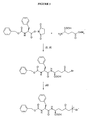
- step (a) comprises reacting the N - ⁇ -protected amino acid N- hydroxy-succinimide or para -nitrophenyl ester with 6-diazo-5-oxo-L-norleucine in the presence of tetrahydrofuran (THF), water and triethylamine followed by reacting the products thereof with hydrogen bromide in the presence of ethyl acetate.
- THF tetrahydrofuran
- step (a) comprises reacting the N - ⁇ -protected amino acid N- hydroxy-succinimide or para -nitrophenyl ester with 6-diazo-5-oxo-L-norleucine in the presence of tetrahydrofuran (THF), water and triethylamine followed by reacting the products thereof with hydrogen bromide in the presence of ethyl acetate.
- THF tetrahydrofuran
- the N - ⁇ -protected amino acid N -hydroxy-succinimide or para -nitrophenyl ester is a N - ⁇ -CBZ-protected amino acid N -hydroxy-succinimide or para -nitrophenyl ester selected from the group consisting of N - ⁇ -CBZ- L -phenylalanine N -hydroxy-succinimide ester, N - ⁇ -CBZ- L- glutamine N -hydroxy-succinimide ester, N - ⁇ -CBZ- L -isoleucine N- hydroxy-succinimide ester, N - ⁇ -CBZ- L -alaninal N -hydroxy-succinimide ester, N - ⁇ -CBZ-L-glycine N -hydroxy-succinimide ester, N - ⁇ -CBZ- L- proline N -hydroxy-succinimide ester, N - ⁇ -CBZ- L- proline
- a fourth aspect of the invention provides a method of treating a subject in need of treatment with a transglutaminase inhibitor comprising administering to said subject a compound according to the first aspect of the invention or a pharmaceutical formulation according to the second aspect of the invention.
- the compound according to the first aspect of the invention or a pharmaceutical formulation according to the second aspect of the invention is administered in an amount sufficient to inhibit, at least in part, tTGase-mediated protein modification ( i . e . cross-linking). More preferably, the compound or formulation is administered in an amount sufficient to inhibit tTGase-mediated protein cross-linking by at least 10%, for example, at least 20%, 30%, 40%, 50%, 60%, 70%, 80%, 90% or 95%. Most preferably, the compound or formulation is administered in an amount sufficient to inhibit completely tTGase-mediated protein cross-linking.
- TGase-mediated protein modification may be measured by methods known in the art. For example, detection of the isodipeptide s(y-glutamyl)lysine in body fluids can be used as an indirect measure of the frequency of crosslinking in diseases which involve this protein cross link. Hence, a reduction of the isodipeptide in the body fluid provides an indirect measure of reduced protein crosslinking (see Nemes et al., 2002, Minerva Biotechnology 14, 183 ).
- tissue biopsy may be taken and analysed, for example by ion exchange or reversed phase HPLC after proteolytic digestion of the material ( Griffin & Wilson, 1984, Mol. Cell Biochem. 58:37- 49 ), or by staining biopsy sections and analysing by immunohistochemistry (Skill et al ., 2001, 81:705-716).
- the subject has a disease/disorder selected from the group consisting of fibrosis, scarring, neurodegenerative diseases (such as Huntingdon's disease and Alzheimer's disease), autoimmune diseases (such as coeliac disease), thrombosis, proliferative disorders ( i . e . cancer), AIDS, psoriasis and inflammation (such as chronic inflammatory diseases, e . g . of the joints, including rheumatoid arthritis and osteoarthritis).
- a disease/disorder selected from the group consisting of fibrosis, scarring, neurodegenerative diseases (such as Huntingdon's disease and Alzheimer's disease), autoimmune diseases (such as coeliac disease), thrombosis, proliferative disorders ( i . e . cancer), AIDS, psoriasis and inflammation (such as chronic inflammatory diseases, e . g . of the joints, including rheumatoid arthritis and osteoarthritis).
- the fourth aspect of the invention provides a method for treating fibrosis and/or renal scarring in a subject comprising administering to said subject a compound according to the first aspect of the invention or a pharmaceutical formulation according to the second aspect of the invention in an amount sufficient to inhibit fibrosis and/or renal scarring.
- renal scarring we mean loss of renal architecture and cell depletion in the glomeruli and renal tubules accompanied by the increased accumulation and deposition of extracellular matrix components, such as collagen.
- treatment may be prophylactic and/or therapeutic.
- the compounds and formulations of the invention may be used to slow and/or to prevent the onset of a disease/disorder in the subject being treated.
- the compounds and formulations of the invention may be used to reduce or eradicate the symptoms of a disease/disorder in the subj ect being treated.
- the compound or formulation of the first and second aspects of the invention may be administered by any route known or developed in the art.
- the compound or formulation may be administered by parenteral injection (e . g . intravenous, subcutaneous or intramuscular), by inhalation or nasal administration, or orally.
- the compound or formulation is administered systemically, for example intravenously.
- the compound or formulation is administered topically, e . g . at or near a target site where TGase-mediated protein modification is to be inhibited.
- Treatment with a compound or formulation according to the invention may consist of a single dose or a plurality of doses over a period of time.
- the compound or formulation is administered repeatedly.
- Compounds and formulations of the invention may also be administered by a surgically implanted device that releases the compound or formulation directly to the required site, for example in the vicinity of a solid tumour.
- a subject treated using the method according to the fourth aspect of the invention may be any mammal.
- the subject is human.
- the subject is a dog, cat, horse, or other domestic or farm mammalian animal.
- the subject has cancer.
- the method is for treating fibrosis and/or scarring in the subj ect.
- a fifth aspect of the invention provides a compound according to the first aspect of the invention for use in medicine.
- a sixth aspect of the invention provides the use of a compound according to the first aspect of the invention in the preparation of a medicament for inhibiting a transglutaminase, for example a tissue transglutaminase.
- the medicament is for treating a disease/disorder selected from the group consisting of fibrosis, scarring ( e.g . renal scarring or hypertrophic scarring of the skin), neurodegenerative diseases (such as Huntingdon's disease and Alzheimer's disease), autoimmune diseases (such as coeliac disease), thrombosis, proliferative disorders ( i . e . cancer), AIDS, psoriasis and inflammation (such as chronic inflammatory diseases, e . g . of the joints, including rheumatoid arthritis and osteoarthritis).
- fibrosis e.g . renal scarring or hypertrophic scarring of the skin
- neurodegenerative diseases such as Huntingdon's disease and Alzheimer's disease
- autoimmune diseases such as coeliac disease
- thrombosis thrombosis
- proliferative disorders i . e . cancer
- AIDS psoriasis and inflammation
- chronic inflammatory diseases e . g
- the medicament is for treating (including inhibiting and/or preventing) fibrosis and/or scarring, and in particular renal scarring and hypertrophic scarring of the skin.
- the medicament is for treating a proliferative disorder, especially cancers manifesting themselves as solid tumours.
- a seventh aspect of the invention provides a method for preventing or treating rejection of a transplanted organ comprising contacting the organ with a compound according to the first aspect of the invention or a formulation according to the second aspect of the invention.
- the invention provides the use of a compound according to the first aspect of the invention in the preparation of a medicament for preventing or treating rejection of a transplanted organ.
- the organ is a heart, lung, kidney or liver.
- the organ is a kidney. Kidneys that are to be transplanted often show some upregulation of tissue transglutaminase and possibly other transglutaminases. Moreover, kidneys which are rejected after transplantation often exhibit excessive scarring and upregulation of transglutaminase activity and crosslinking ( Abo-Zenah et al., 2001, J. Am. Soc. Nephrol. 12, 4454A ). Such tissue degeneration and subsequent organ rejection may be prevented by treating the kidney (or other organ) with a transglutaminase inhibitor.
- the compound or formulation may be delivered before, during and/or after transplantation of the organ.
- the organ is treated prior to transplantation, for example by perfusing and/or bathing with a solution containing a compound according to the first aspect of the invention.
- the organ is treated during and/or after transplantation into a patient.
- the compound or formulation is delivered at or near the site of the transplant, for example by local administration.
- Reagents and conditions for each step are as follows:
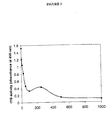
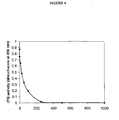
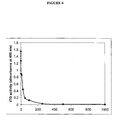
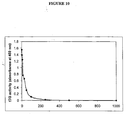
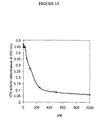
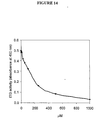
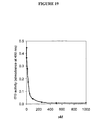
- Figures 2 to 21 show the effect of increasing concentrations of exemplary compounds of the invention (and prior art compound 1,3-dimethyl-2-(2-oxopropylsulfanyl)-3H-1,3-diazol-1-ium-chloride) on the inhibition of guinea pig liver transglutaminase (tTG), as measured by an enzyme-linked sorbent assay (ELSA) (see Example 2, below).
- concentration of the test compound test is given in ⁇ M, along the x-axis.
- Figure 22 shows SDS-PAGE data demonstrating inhibition of tTGase-mediated crosslinking of fibronectin following treatment with exemplary compounds of the invention (see Example 3).
- 'tTG' tissue transglutaminase, 'degr.
- fragments' degradation fragments
- 'Fn' fibronectin
- 'Polymers' cross-linked fibronectin polymers
- '281' N- Benzyloxycarbonyl- L -phenylalanyl-6-dimethylsulfonium-5-oxo- L- norleucine bromide salt
- '285'/'Rob285' N -Benzyloxycarbonyl- L- glutaminyl-6-dimethyl-sulfonium-5-oxo- L -norleucine bromide salt.
- Figure 23 shows (a) representative Masson's Trichrome stained sections at 100x magnification and (b) collagen III stained sections at 200x magnification from kidneys of rats treated for 84 days with inhibitor N- Benzyloxycarbonyl- L -phenylalanyl-6-dimethylsulfonium-5-oxo- L -norleucine bromide salt (designated 'SNx + 281') or 1,3-dimethyl-2-(2-oxopropylsulfanyl)-3H-1,3-diazol-1-ium-chloride (designated 'SNx + 283').
- SNx indicates animals in which a subtotal nephrectomy has been performed.
- mice either had PBS (SNx) or TGase inhibitor compound 281 or 283 (SNx+281 and SNX+283, respectively) instilled into their kidney.
- SNc' refers to sham operated animals and 'SNx' refers to animals which have had PBS instilled into their kidneys. Five animals per group were used (see Example 4).
- Figure 24 shows Quantative Image Analysis of (a) Masson's Trichrome staining and (b) collagen III staining in the kidney sections from 90 day animals following treatment with inhibitor N -Benzyloxycarbonyl- L- phenylalanyl-6-dimethylsulfonium-5-oxo- L -norleucine bromide salt (designated 'SNx + 281') and 1,3-dimethyl-2-(2-oxopropylsulfanyl)-3H-1,3-diazol-1-ium-chloride (designated 'SNx + 283').
- 'Snc' and 'SNx' are referred to as in legend to Figure 12 above. Five animals per group were used (see Example 4).
- Figure 25 shows the inhibition of TGase activity in kidneys of rats treated with compounds having TGase inhibitor activity.
- Figure 25 (a) is a histogram showing semi-quantative analysis of in situ TGase activity in cryostat sections taken from kidneys of SNx rats treated for 28 days with the inhibitors N -Benzyloxycarbonyl- L -phenylalanyl-6-dimethyl-sulfonium-5-oxo- L -norleucine bromide salt (designated 'SNx + 281') and 1,3-dimethyl-2-(2-oxopropylsulfanyl)-3H-1,3-diazol-1-ium-chloride (designated 'Sox+283').
- 'SNc' refers to control kidneys obtained from animals on which a sham operation was performed without subtotal nephrectomy.
- 'SNx' refers to subtotal nephrectomy. Inhibitors were delivered to the kidney by mini-pumps (see Example 5).
- Figure 25 (b) is a histogram showing TGase activity measured by 14 C-putrescine incorporation into N, N'-dimethyl casein at day 84 in kidney homogenates of SNx rats treated with the inhibitors N -Benzyloxycarbonyl- L -phenylalanyl-6-di-methyl-sulfonium-5-oxo- L -norleucine bromide salt (designated 'SNx + 281') and 1,3-dimethyl-2-(2-oxopropylsulfanyl)-3H-1,3-diazol-1-ium-chloride (designated 'SNx+283'). Five animals per group were used (see Example 4).
- Figure 26 shows the effect on renal function in rats of 84 days treatment with the inhibitors N -Benzyloxycarbonyl- L -phenylalanyl-6-dimethylsulfonium-5-oxo- L -norleucine bromide salt (designated 'SNx + 281') and 1,3-dimethyl-2-(2-oxopropylsulfanyl)-3H-1,3-diazol-1-ium-chloride (designated 'Sox+283'), as determined using measurements of (a) proteinuria and (b) creatinine clearance.
- 'SNc' refers to control kidneys obtained from animals on which a sham operation was performed without subtotal nephrectomy.
- 'SNx' refers to subtotal nephrectomy. Five animals per group were used (see Example 4).
- Tetrahydrofuran was freshly distilled from sodium benzophenone ketyl before use.
- Ether was distilled from lithium aluminium hydride and stored over sodium wire.
- Methanol and ethanol were distilled and stored over 5 A molecular sieves.
- N,N -dimethylformamide was distilled from calcium hydride and stored over 5 A molecular sieves.
- Chloroform, dichloromethane and acetone were dried over granular calcium chloride. Solvents used for flash column chromatography were distilled before use.
- Flash chromatography was carried out using Fluka silica gel 60, 220-240 mesh size. Thin layer chromatography was carried out using Whatman silica gel 60A F254 pre-coated glass plates.
- the bromomethyl ketone was dissolved in the minimum amount of dry methanol to achieve solution. Methyl sulfide (2.5-7.5 eqv.) was added and the solution left in a tightly stoppered flask for 24-48 h. until the reaction was judged complete by TLC. Purification was achieved by dissolving the residue in deionised water and extracting the organic soluble impurities with ethyl acetate. Freeze drying the aqueous portion afforded the product salts as colourless solids in typically 80-90% yields.
- Compound '5' is made by reaction of commercially available N - ⁇ -CBZ- L -phenylalanine N -hydroxy-succinimide ester (Novabiochem Cat. No. 04-12-0573) and L -aspartic acid ⁇ - t -butyl ester (Novabiochem Cat. No. 04-12-5000) in water/THF (1:1) in the presence of 1.5 equivalents of triethylamine.
- the acid was prepared from 6-diazo- N -(9-fluorenylmethyloxycarbonyl)-5-oxo- L -norleucine ethyl ester (2.53 g, 6 mmol) by the method of Coutts et al . Yield after flash column chromatography (ethyl acetate 100%) 1.64 g, 66%.
- the diazoketone (0.5 g, 1.15 mmol) was deprotected with piperidine as previously described to give the amino acid as a pale yellow solid (57.2 mg, 54%).
- m.p. 122-124°C (Lit. m.p. 125-126°C) ⁇ max (KBr)/cm -1 3436, 2108, 1630 ( Weygand et al., Chem. Ber. 91, 1037-40 ).
- exemplary compounds of the invention in the inhibition of transglutaminase was verified by studying the dose-dependency of their effects on the activity of purified guinea pig liver transglutaminase (gp1TGase), using an enzyme-linked sorbent assay (ELSA) based on biotinylated cadaverine (BTC) incorporation into N,N' -dimethyl casein (DMC).
- ELSA enzyme-linked sorbent assay
- BTC biotinylated cadaverine
- TGase guinea pig liver TG
- ELSA enzyme-linked sorbent assay
- BTC biotin cadaverine
- DMC N, N'-dimethylcasein
- Microtitre plates (96-well) were coated with 100 ⁇ l of 10 mg/ml DMC in 10 mM Tris pH 7.4 overnight at 4°C. The following day, plates were washed twice with TBS-Tween pH 7.4, once with TBS pH7.4, and a reaction mix was prepared that contained 5 mM CaCl 2 , 5 mM DTT and 0.132 mM BTC in 50 mM Tris pH 7.4.
- TGase inhibitors were initially prepared as 100 mM stock solutions in H 2 O and diluted to the appropriate final concentration in the same reaction solution.
- Negative control samples for TGase activity consisted of mixes that did not contain BTC, and where 10 mM EDTA was substituted for 5 mM CaCl 2 .
- Incorporated BTC was detected by incubation with 100 ⁇ l per well of Extravidin peroxidase (EXAP) solution, diluted 1 in 5000 in blocking buffer for 1 hour at 37°C. Plates were washed as before and prior to development, plates were preincubated for 5 minutes in 0.05M phosphate-citrate buffer pH5.0 containing 0.014% (v/v) H 2 O 2 . The solution was removed and replaced with 100 ⁇ l per well of the same buffer containing 75 ⁇ g/ml tetramethylbenzidine (TMB). The developing reaction was allowed to proceed at room temperature for 5-15 minutes and was terminated by the addition of 50 ⁇ l of 1N H 2 SO 4 . The absorbance of the resulting colour was measured on a microtitre plate reader at 450 nm.
- EXAP Extravidin peroxidase
- the data shown indicate a representative experiment using eight replicate samples.
- the mean absorbance 450nm ⁇ SD is shown.
- Male Wistar rat of approximately 300g weight was anaesthetised using 5% halothane and maintained at 3% for the duration of the surgical procedure.
- the rat was subjected to a 5/6th subtotal nephrectomy (SNx) by ligation of the left renal artery and vein followed by complete nephrectomy of the left kidney.
- the right kidney had both the upper and lower poles ligated followed by excision of both poles.
- a 9-cm cannula (0.32mm bore) was sealed on one end and fenestrated between 3 and 12 mm from the sealed end. This was then inserted through the parenchyma (cut to cut / pole to pole) of the kidney so that the blunt end was just visible through one of the cut ends.
- the cannula was passed through the muscle wall, which was then stitched using reabsorbable sutures. The cannula was then attached to the regulator of a 2 ml osmotic minipump (Azlet osmotic minipump (2m14), Charles Rivers, UK) that was loaded (primed for 15 hrs at RT) with either PBS (SNx) or TGase inhibitor 281 or 283 (SNx+281 and SNx+283, respectively) at a concentration of 50 mM (delivery 1.5 ⁇ l per hour).
- a 2 osmotic minipump Azlet osmotic minipump (2m14), Charles Rivers, UK
- the pump was then positioned subcutaneously on the right upper flank of the animal and the skin sutured. The animal was then switched onto oxygen and allowed to partially regain consciousness before being returned to the cage. The pump was changed every 28 days under halothane anaesthesia. After 83 days, the animal was placed in a metabolic cage to collect a 24-hour urine sample. The animal was then anaesthetised, the remnant kidney recovered and a terminal blood sample collected.
- Tissue samples were sectioned and then underwent Masson's Trichrome staining (Johnson et al ., 1997, 99 :2950-2960) or collagen III staining.
- paraffin embedded sections (4 ⁇ m) were first dewaxed and hydrated by standard protocol (xylene 10 min, 100% ethanol 5 min, 90% ethanol 5 min,75% ethanol 5 min, 50% ethanol 5 min, water 10 min) washed in PBS for 10 min and any endogenous peroxides quenched by treatment with 3% H2O2 in methanol for 10 min. After washing in PBS for 10 min sections were treated with the epitope revealing agent TUF (ID Labs Inc. Cat no BP1122) on a water bath at 92 C for 10 min then allowed to cool to room temperature.
- TUF epitope revealing agent
- Sections were washed with PBS for 10 min and then trypsin (Zymed Labs Cat No 00-3008) digested (trypsin diluted 1:3) for 10 min at 37 C followed by two washes in PBS for 5 min each. Sections were then blocked in goat serum (Vector Labs Cat No S1000) incubated at 37 C for 30 min.
- the primary collagen III antibody Goat anti-human type III collagen, Soutem Biotech Assocs diluted 1 in 10 in 0.1% bovine serum albumin [BSA] in PBS
- BSA bovine serum albumin
- the secondary antibody (rabbit anti goat which is biotinylated from DAKO Cat No E0466) diluted 1 in 400 in 0.1%BSA/PBS is then added and incubated for 30 min at 37 C.
- the sections are then washed twice in 0.1% Nonidet in PBS and the sections then incubated with the Avidin Biotin Enzyme complex (ABC) kit (Vector Labs Cat No PK-6102) according to the manufacturers instructions for 30min at T 37° C.
- the samples are then washed twice in PBS and the reagent substrate, 3-amino-9-ethyl carbozole (AEC [Vector Labs Cat No SK4200]) added to allow colour development (approx 5-30min).
- haematoxylin diluted 1 in 10 from Thermo Shandon, Gill-2 haematoxylin Cat No 6765007
- haematoxylin diluted 1 in 10 from Thermo Shandon, Gill-2 haematoxylin Cat No 6765007
- Figure 23 shows (a) representative Masson's Trichrome stained sections and (b) collagen III stained sections from kidneys of animals in which inhibitor compound 281 (designated 'SNx + 281') and compound 283 (designated 'SNx + 283') were instilled (see Johnson et al., 1999, J. Am. Soc. Nephrol. 10:2146-2157 for method used to induce subtotal nephrectomy).
- Figure 24 shows quantative image analysis of (a) Masson's Trichrome stain and (b) collagen III stain in kidney sections from 90 day animals following treatment with inhibitor compounds 281 (designated 'SNx + 281') and 283 (designated 'SNx + 283'). Snc and SNx are referred to as above.
- analysis was performed by systematically acquiring adjacent overlapping cortical fields at 100 x magnification such that 5 fields encompassed more than 80% of the cortex. Each field was then subject to 3 phase analysis using image analysis and the area of blue (collagen), red (cytoplasm) and white (lumen) determined ensuring greater than 95% coverage.
- the scarring index was determined by expressing the blue phase as a fraction of the cytoplasmic. Five animals per group were used and data expressed a mean values +/- S.E.M.
- the composite diagram showing staining in Figure 12(a) shows 1 field from each animal.
- For Collagen III staining the relative amounts of collagen III present (stained brown) were determined by systematically acquiring data from 10 overlapping cortical fields at 200x magnification and expressed as Mean values ⁇ SEM.
- Rat kidneys treated in vivo with TGase inhibitors were snap-frozen in liquid nitrogen and 14 ⁇ m sections were cut using a cryostat and allowed to air-dry. Sections were rehydrated for 10 minutes at room temperature in a solution of 5% (w/v) rabbit serum, 10 mM EDTA, 0.01% (v/v) Triton X-100 in 50 mM Tris pH7.4, containing EXAP (diluted 1 in 200) to block endogenous biotin.
- SNc refers to control kidneys obtained from animals undergoing a sham operation with subtotal nephrectomy.
- SNx refers to subtotal nephrectomy.
- Inhibitors were delivered to the kidney by mini pumps as outlined above. Data are mean values +/- SEM taken from 5 separate kidneys.
- Table 3 shows levels of proteinurea, creatinine clearance, serum creatinine, urine creatinine and urine urea in 90 day SNx rats in which inhibitor compounds 283 and 281 were instilled into the kidneys.
- Proteinuria (mg/24 h) Creatinine clearance (ml/min) Serum creatinine (mM/L) Mean SE Mean SE Mean SE Control (SNc) 129 14 1.72 0.18 46 0.6 SNx 672 140 0.44 0.2 224 36 SNx + 283 835 93 0.86 0.05 114 16 SNx + 281 503 63 0.94 0.09 208 106
- Proteinuria, creatinine clearance, serum clearance, urine creatinine and urine urea were carried out by standard clinical chemistry techniques ( Johnson et al., 1997, J. Clin. Invest. 99:2950-2960 ). Creatinine and urea were measured by the standard auto analysesr technique and proteinura by the Biuret method (Johnson et al., supra ). Data represent mean values ⁇ SE, taken from 5 animals per group.
- Proteinuria and creatinine clearance data are shown in histogram form in Figure 26 (a) and (b) , respectively.
- Active ingredient 100 mg Lactose 200 mg Starch 50 mg Polyvinylpyrrolidone 5 mg Magnesium stearate 4 mg 359 mg
- Tablets are prepared from the foregoing ingredients by wet granulation followed by compression.
- Active ingredient 0.5 g Sodium chloride, analytical grade 0.9 g Thiomersal 0.001 g Purified water to 100 ml pH adjusted to 7.5
- formulations A and B are prepared by wet granulation of the ingredients with a solution of povidone, followed by addition of magnesium stearate and compression.
- formulations D and E are prepared by direct compression of the admixed ingredients.
- the lactose used in formulation E is of the direction compression type.
- the formulation is prepared by wet granulation of the ingredients (below) with a solution of povidone followed by the addition of magnesium stearate and compression.
- mg/tablet Active Ingredient 500 Hydroxypropylmethylcellulose 112 (Methocel K4M Premium) ® Lactose B.P. 53 Povidone B.P.C. 28 Magnesium Stearate 7 700
- Drug release takes place over a period of about 6-8 hours and was complete after 12 hours.
- a capsule formulation is prepared by admixing the ingredients of Formulation D in Example C above and filling into a two-part hard gelatin capsule.
- Formulation B ( infra ) is prepared in a similar manner.
- Capsules are prepared by melting the Macrogel 4000 BP, dispersing the active ingredient in the melt and filling the melt into a two-part hard gelatin capsule.
- Capsules are prepared by dispersing the active ingredient in the lecithin and arachis oil and filling the dispersion into soft, elastic gelatin capsules.
- the following controlled release capsule formulation is prepared by extruding ingredients a, b, and c using an extruder, followed by spheronisation of the extrudate and drying. The dried pellets are then coated with release-controlling membrane (d) and filled into a two-piece, hard gelatin capsule.
- mg/capsule (a) Active ingredient 250 (b) Microcrystalline Cellulose 125 (c) Lactose BP 125 (d) Ethyl Cellulose 13 513
- Active ingredient 0.200 g Sterile, pyrogen free phosphate buffer (pH7.0) to 10 ml
- the active ingredient is dissolved in most of the phosphate buffer (35-40°C), then made up to volume and filtered through a sterile micropore filter into a sterile 10 ml amber glass vial (type 1) and sealed with sterile closures and overseals.
- the active ingredient is dissolved in the glycofurol.
- the benzyl alcohol is then added and dissolved, and water added to 3 ml.
- the mixture is then filtered through a sterile micropore filter and sealed in sterile 3 ml glass vials (type 1).
- the sodium benzoate is dissolved in a portion of the purified water and the sorbitol solution added.
- the active ingredient is added and dispersed.
- the glycerol is dispersed the thickener (dispersible cellulose). The two dispersions are mixed and made up to the required volume with the purified water. Further thickening is achieved as required by extra shearing of the suspension.
- Witepsol H15 is melted in a steam-jacketed pan at 45 ⁇ C maximum.
- the active ingredient is sifted through a 200 ⁇ m sieve and added to the molten base with mixing, using a silverson fitted with a cutting head, until a smooth dispersion is achieved. Maintaining the mixture at 45°C, the remaining Witepsol H15 is added to the suspension and stirred to ensure a homogenous mix.
- the entire suspension is passed through a 250 ⁇ m stainless steel screen and, with continuous stirring, is allowed to cool to 40°C. At a temperature of 38°C to 40°C 2.02 g of the mixture is filled into suitable plastic moulds. The suppositories are allowed to cool to room temperature.
Landscapes
- Chemical & Material Sciences (AREA)
- Organic Chemistry (AREA)
- Health & Medical Sciences (AREA)
- Life Sciences & Earth Sciences (AREA)
- Medicinal Chemistry (AREA)
- General Health & Medical Sciences (AREA)
- Proteomics, Peptides & Aminoacids (AREA)
- Molecular Biology (AREA)
- Genetics & Genomics (AREA)
- Biophysics (AREA)
- Biochemistry (AREA)
- Nuclear Medicine, Radiotherapy & Molecular Imaging (AREA)
- General Chemical & Material Sciences (AREA)
- Pharmacology & Pharmacy (AREA)
- Public Health (AREA)
- Veterinary Medicine (AREA)
- Animal Behavior & Ethology (AREA)
- Chemical Kinetics & Catalysis (AREA)
- Engineering & Computer Science (AREA)
- Bioinformatics & Cheminformatics (AREA)
- Communicable Diseases (AREA)
- Dermatology (AREA)
- Hematology (AREA)
- Diabetes (AREA)
- Immunology (AREA)
- Oncology (AREA)
- Virology (AREA)
- Pharmaceuticals Containing Other Organic And Inorganic Compounds (AREA)
- Acyclic And Carbocyclic Compounds In Medicinal Compositions (AREA)
- Enzymes And Modification Thereof (AREA)
- Organic Low-Molecular-Weight Compounds And Preparation Thereof (AREA)
- Medicines That Contain Protein Lipid Enzymes And Other Medicines (AREA)
- Peptides Or Proteins (AREA)
Abstract
Description
- The present invention provides compounds and methods for using the same in medicine. In particular, the present invention provides compounds and methods for inhibiting human diseases and/or processes wherein transglutaminase-mediated protein modification occurs, such as fibrosis, scarring and cancer.
- Transglutaminases (TGases) are an important class of protein crosslinking enzymes that catalyse protein aggregation reactions in blood coagulation (Greenberg, C.S., et al., 1991, FASEB J. 5, 3071-3077), skin maturation (Thacher, S. M. & Rice, R. H., 1985, ) and the clotting of seminal secretions (Dubbink, H.J., et al., 1999, Lab. Invest. 79, 141-150). The most widespread member of the family is the cellular form of the enzyme, tissue transglutaminase (tTGase), which is expressed in varying amounts in many cell types. Like the well-characterised plasma TGase (blood coagulation factor XIIIa) (Greenberg, C.S., et al., 1991, FASEB J. 5, 3071-3077) and keratinocyte TGase (Thacher, S. M. & Rice, R. H., 1985, ), tTGases are calcium-dependent enzymes that catalyse the formation of crosslinks proteins via ε(γ-glutamyl) isopeptide bonds and the incorporation of polyamines at certain glutamine residues (Greenberg, C.S., et al., 1991, FASEB J. 5, 3071-3077). However, tTGase is unique in the transglutaminase family of enzymes in that is able to bind and hydrolyze GTP and ATP (Achyuthan, K. E. & Greenberg, C. S., 1987, J. Biol. Chem. 262, 1901-1906), and to bind to fibronectin (Achyuthan, K. E., et al., 1995, J. Immunol. Methods 180, 67-79).
- Tissue TGase is predominantly located in the cytosol, although tTGase has also been reported to exist in the nucleus (Lesort, M., et al., 1998, J. Biol. Chem. 273, 11991-11994), at the cell surface and in the extracellular matrix (Martinez, J., et al., 1994, Biochemistry 33, 2538-2545). The enzyme is highly expressed in endothelial cells (Greenberg, C. S., et al., 1987, ) and its activity at the surface of such cells is thought to enhance basement membrane stabilisation, cell spreading and cell adhesion (Martinez, J., et al., 1994, Biochemistry 33, 2538-2545; Greenberg, C. S., et al., 1987, Blood 20, 702-709; Kinsella, M. G. & Wight, T. N., 1990, J. Biol. Chem. 265, 17891-17896; Jones, R.A., et al., 1997, J. Cell Sci. 110, 2461-2472; Gaudry C. A., et al., 1999, Exp. Cell Res. 252, 104-113). However, the overall significance of the high amount of enzyme in this cell type and its biological function is poorly understood.
- Protein modification mediated by tissue transglutaminases has been implicated in the pathology and aetiology of numerous diseases and processes (see review by Aeschlimann & Thomazy, 2000, Connective Tissue Research 41(1):1-27). For example, tTGase-mediated protein modification has been shown in occur in fibrosis and scarring (Johnson et al., 1999, J. Am. Soc. Neph. 10:2146-2157), neurodegenerative diseases including Huntingdon's disease and Alzheimer's disease (Citron et al., 1999, J. Biol. Chem. 276:3295-3301), coeliac disease (Marzari et al., 2001, J. Immunol. 166:4170-4176), thrombosis (Ariens et al. 2002, ), cancer (Van Groningen et al., 1995, Int. J. Cancer 60:383-387; Mehta, 1994, J. Cancer 58:400-406; Mehta et al., 2002, J. Natl. Cancer Inst. 94:1652-1654), AIDS (Amendola et al., 2002, J. Immunol. Methods 265:149-159), psoriasis and inflammatory diseases of the joints (Johnson et al., 2001, Am. J. Pathol. 159:149-163). Tissue TGase has also been implicated in a number of diseases involving angiogenesis, such as the development of solid tumours and rheumatoid arthritis (Folkman, J., 1995, Nat. Med. 1, 27-3 1).
- Hence, tTGase represents a potential target in the development of new treatments of such diseases and disorders.
- Several classes of transglutaminase inhibitor compounds are known in the art, including competitive amine inhibitors, competitive glutamine inhibitors and irreversible inhibitors. Competitive amine inhibitors include dansylcadaverines (Lorand et al., 1966, Biochenm. Biophys. Res. Commun. 25, 629; Lorand et al., 1968, Biochemistry 7, 1214) and N-phenyl-N'-(ω-aminnoalkyl)thioureas (Lee et al., 1985, J. Biol. Chem. 260, 14689). Competitive glutamine inhibitors include aliphatic amides (Gross & Folk, 1973, J. Biol. Chem. 248, 1301), dipeptides (Gross & Folk, 1973, J. Biol. Chem. 248, 6534) and polypeptides (Gorman & Folk, 1984, J. Biol. Chem. 259, 9007). Irreversible inhibitors include iodoacetamide (Gross & Folk, 1973, J. Biol. Chem. 248, 6534; Folk & Cole, 1966, J. Biol. Chem. 241, 5518), phenol-containing halomethyl ketones (Folk & Gross, 1971, J. Biol. Chem. 246, 6683), alkyl isocyanates (Gross et al., 1975, J. Biol. Chem. 250, 7693), α-halomethylcarbonyl inhibitors (Reinhardt, 1980, Appl. Biochem. 2, 495), dihydroisoazoles (
US 4,912,120 ), azoles, azolium salts (US 4,968,713 , thiadiazoles (Keillor, 2001, Biorg. Med. Chem. 9, 3231), and epoxides (Keillor, 2002, Biorg. Med. Chem. 10, 355). - More recently, Pluira et al. (1992) J. Enzyme.Inhibition 6, 181-94 reported irreversible inhibition of transglutaminases by sulfonium methylketones (see also
US 4,912,120 ). - The present invention seeks to provide novel transglutaminase inhibitor compounds suitable for use as therapeutic agents.
- According to a first aspect of the invention, there is provided a compound of Formula I:

- 'X' represents an α-amino acid group wherein the α-amino group of the amino acid is bound to the R1-O-CO- group and the carboxy group of the amino acid is bound to the R2-CH2-CO-(CH2)n-CH(CO2H)-NH- group;
- 'n' is an integer between 1 and 4;
- 'R1' represents benzyl, t-butyl or 9-fluorenylmethyl; and
- 'R2' represents

- Advantageously, X is an L-amino acid group.
- Preferably, X is selected from the group consisting of phenylalanine, glutamine (including N-substituted derivatives thereof, such as N-substituted piperidinyl and propyl derivatives), isoleucine, alanine, glycine, tyrosine, proline, serine, lysine and glutamic acid. Thus, preferred compounds of the invention include N-benzyloxycarbonyl-L-glutamyl-γ-isopropylamide-6-dimethyl-sulfonium-5-oxo-L-norleucine bromide salt and N-benzyloxycarbonyl-L-glutamyl-y-piperidinamide-6-dimethylsulfonium-5-oxo-L-norleucine bromide salt.
- In a preferred embodiment of the first aspect of the invention, 'n' is 2.
- Advantageously, 'R1' is benzyl.
- Conveniently, 'R2' represents

- Preferably, 'R2' represents -S+R7R8, wherein R7 and R8 each independently represent lower alkyl.
- The term "lower alkyl" means linear or branched, cyclic or acyclic, C1-C5 alkyl, which may be saturated or unsaturated. Lower alkyl groups which R3, R4, R5, R6, R7 and/or R8 may represent include C1-C4 alkyl, C1-C3 alkyl, C1-C2 alkyl, C2-C5 alkyl, C3-C5 alkyl, C1-C5 alkyl, C2-C4 alkyl, C2-C3 alkyl and C3-C4 alkyl. Preferred lower alkyl groups which R3, R4, R5, R6, R7 and/or R8 may represent include C1, C2, C3, C4 and C5 alkyl.
- Preferably, R3, R4, R5, R6, R7 and/or R8 are -CH3 or -CHCH2. More preferably, R3, R4, R5, R6, R7 and/or R8 are -CH3.
- In a preferred embodiment of the first aspect of the invention, the compound is selected from the group consisting of:

- (a) N-Benzyloxycarbonyl-L-phenylalanyl-6-dimethylsulfonium-5-oxo-L-norleucine ("Compound 281")

- (b) N-Benzyloxycarbonyl-L-glutasminyl-6-dimethylsulfonium-5-oxo-L-norleucine ("Compound 285")

- (c) N-Benzyloxycarbonyl-L-isoleucinal-6-dimethylsulfonium-5-oxo-L-norleucine ("Compound 286")

- (d) N-Benzyoxycarbonyl-L-phenylalanyl-7-dimethyl-sulfonium-6-oxo-heptanoic acid ("Compound 288")

- (e) N-Benzyloxycarbonyl-L-phenylalanyl-L-5-dimethylsulfonium-4-oxo-norvaline ("Compound 289")

- (f) N-Benzyloxycarbonyl-L-alaninal-6-dimethylsulfonium-5-oxo-L-norleucine ("Compound 291")
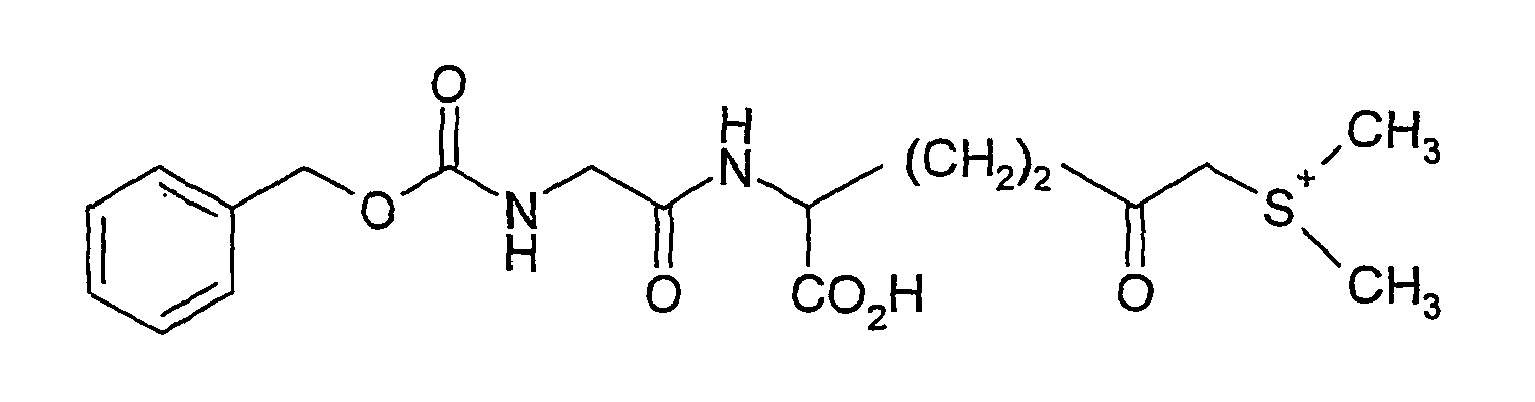
- (g) N-Benzyloxycarbonyl-L-glycinal-6-dimethylsulfonium-5-oxo-L-norleucine ("Compound 292")

- (h) N-Benzyloxycarbonyl-L-tyrosinal-6-dimethylsulfonium-5-oxo-L-norleucine ("Compound 293")

- (i) N-Benzyloxycarbonyl-L-prolinyl-6-dimethylsulfonium-5-oxo-L-norleucine ("Compound 294")

- (j) N-Benzyloxycarbonyl-L-serinyt-6-dimethylsulfonium-5-axo-L-norleucine ("Compound 295")

- (k) N-Benzyloxycarbonyl-L-glutaminyl-6-dimethylsulfonium-5-oxo-L-norleucine ("Compound 296")

- (l) N-α-Benzyloxycarbonyl-N-ε-trifluoroacetate-L-lysinyl-6-dimethylsulfonium-5-oxo-L-norleucine ("Compound 297")

- (m) N-α-Benzyloxycarbonyl-γ-piperidinyl-L-glutaminyl-6-dimethylsulfonium-5-oxo-L-norleucine ("Compouod 298")

- (n) N-α-Benzyloxycarbonyl-γ-propyl-L-glutaminyl-6-dimethylsulfonium-5-oxo-L-norleucine ("Compound 299")

- (o) N-Benzyloxycarbonyl-L-phenylalanyl-6-diethylsulfonium-5-oxo-L-norleucine ("
Compound 300")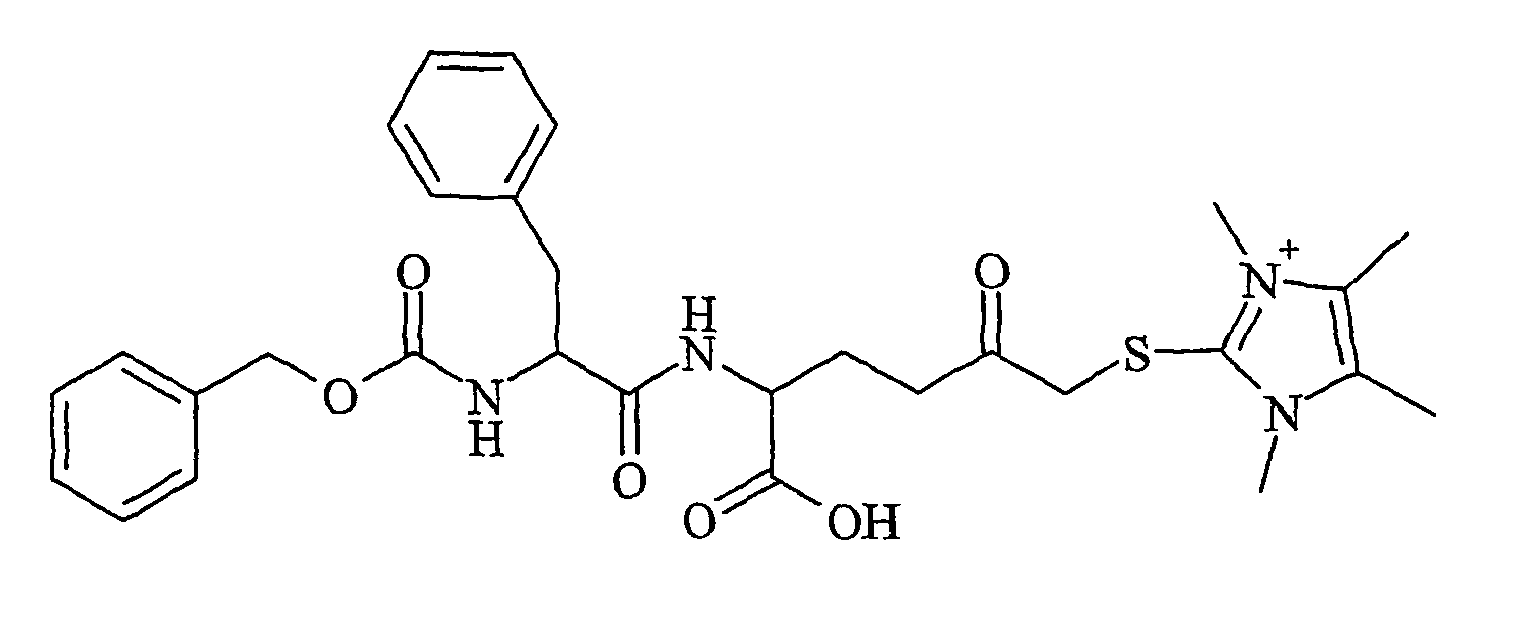
- (p) N-α-Benzyloxycarbonyl-L-phenylalanyl-6-tetra-methylmercaptoimidazole-5-oxo-L-norleucine ("Compound 301")

- (q) N-9-Fluorenylmethyloxycarbonyl-L-phenylalanyl-6-dimethylsulfonium-5-oxo-L-norleucine ("Compound 302")

- (r) N-α-tert-butyloxycarbonyl-L-phenylalanyl-6-dimethylsulfonium-5-oxo-L-norleucine ("Compound 303")

- (s) N-α-Benzyloxycarbonyl-L-prolinyl-6-tetra-methylmercaptoimidazole-5-oxo-L-norleucine ("Compound 304")
- It will be appreciated by persons skilled in the art that pharmaceutically, and/or veterinarily, acceptable derivatives of the compounds of formula I, such as salts and solvates, are also included within the scope of the invention. Salts which may be mentioned include: acid addition salts, for example, salts formed with inorganic acids such as hydrochloric, hydrobromic, sulfuric and phosphoric acid, with carboxylic acids or with organo-sulfonic acids; base addition salts; metal salts formed with bases, for example, the sodium and potassium salts.
- Thus, the compounds of formula I may be counterbalanced by counter-anions. Exemplary counter-anions include, but are not limited to, halides (e.g. fluoride, chloride and bromide), sulfates (e.g. decylsulfate), nitrates, perchlorates, sulfonates (e.g. methane-sulfonate) and trifluoroacetate. Other suitable counter-anions will be well known to persons skilled in the art.
- Preferably, the compound is a bromide salt.
- It will be further appreciated by skilled persons that the compounds of formula I may exhibit tautomerism. All tautomeric forms and mixtures thereof are included within the scope of the invention.
- Compounds of formula I may also contain one or more asymmetric carbon atoms and may therefore exhibit optical and/or diastereoisomerism. Diastereoisomers may be separated using conventional techniques, e.g. chromatography or fractional crystallisation. The various stereoisomers may be isolated by separation of a racemic or other mixture of the compounds using conventional, e.g. fractional crystallisation or HPLC, techniques. Alternatively the desired optical isomers may be made by reaction of the appropriate optically active starting materials under conditions which will not cause racemisation or epimerisation, or by derivatisation, for example with a homochiral acid followed by separation of the diastereomeric esters by conventional means (e.g. HPLC, chromatography over silica). All stereoisomers are included within the scope of the invention.
- Preferably, the compounds of the first aspect of the invention comprise L-amino acid groups.
- A second aspect of the invention provides a pharmaceutical formulation comprising a compound according to the first aspect of the invention and a pharmaceutically acceptable carrier.
- By 'pharmaceutically acceptable carrier' we include a substantially nontoxic, pyrogen-free excipient or adjuvant.
- The formulation according to the second aspect of the invention may conveniently be presented in unit dosage form and may be prepared by any of the methods well known in the art of pharmacy. Such methods include the step of bringing into association the active ingredient (i.e. a compound according to the first aspect of the invention) with the carrier which constitutes one or more accessory ingredients. In general, the formulations are prepared by uniformly and intimately bringing into association the active ingredient with liquid carriers or finely divided solid carriers or both, and then, if necessary, shaping the product.
- Formulations in accordance with the present invention suitable for oral administration may be presented as discrete units such as capsules, cachets or tablets, each containing a predetermined amount of the active ingredient; as a powder or granules; as a solution or a suspension in an aqueous liquid or a non-aqueous liquid; or as an oil-in-water liquid emulsion or a water-in-oil liquid emulsion. The active ingredient may also be presented as a bolus, electuary or paste. It will be appreciated by those skilled in the art that the compounds for oral administration should preferably be formulated so as to be protected in the gut and to permit bioadsorption.
- Formulations suitable for parenteral administration include aqueous and non-aqueous sterile injection solutions which may contain anti-oxidants, buffers, bacteriostats and solutes which render the formulation isotonic with the blood of the intended recipient; and aqueous and non-aqueous sterile suspensions which may include suspending agents and thickening agents. The formulations may be presented in unit-dose or multi-dose containers, for example sealed ampoules and vials, and may be stored in a freeze-dried (lyophilised) condition requiring only the addition of the sterile liquid carrier, for example water for injections, immediately prior to use. Extemporaneous injection solutions and suspensions may be prepared from sterile powders, granules and tablets of the kind previously described.
- Preferred unit dosage formulations are those containing a daily dose or unit, daily sub-dose or an appropriate fraction thereof, of an active ingredient.
- A third aspect of the invention provides a method of making a compound according to the first aspect of the invention comprising the following steps:
- (a) reacting an N-α-protected (e.g. CBZ, FMOC or BOC protected) amino acid N-hydroxy-succinimide or para-nitrophenyl ester with 6-diazo-5-oxo-L-norleucine, and treating the resulting coupled product with hydrogen bromide; and
- (b) reacting the bromomethyl ketone produced in step (a) with dimethyl sulphide, diethyl sulphide or 1,3,4,5-tetra-methyl mercapto-imidazoline-2-thione.
- N-α-protected amino acid N-hydroxy-succinimide esters are commercially available, for example from Novabiochem (Calbiochem), Laufelfingen, Switzerland and Bachem (UK) Ltd, St Helens, UK.
- 6-Diazo-5-oxo-L-norleucine (DON) is also commercially available (Sigma-Aldrich, Cat. No. D2141). Alternatively, DON may be synthesised, for example as described in Coutts & Saint (1998) Tetrahedron Lett. 39:3243.
- Preferably, step (a) comprises reacting the N-α-protected amino acid N-hydroxy-succinimide or para-nitrophenyl ester with 6-diazo-5-oxo-L-norleucine in the presence of tetrahydrofuran (THF), water and triethylamine followed by reacting the products thereof with hydrogen bromide in the presence of ethyl acetate.
- Advantageously, the N-α-protected amino acid N-hydroxy-succinimide or para-nitrophenyl ester is a N-α-CBZ-protected amino acid N-hydroxy-succinimide or para-nitrophenyl ester selected from the group consisting of N-α-CBZ-L-phenylalanine N-hydroxy-succinimide ester, N-α-CBZ-L-glutamine N-hydroxy-succinimide ester, N-α-CBZ-L-isoleucine N-hydroxy-succinimide ester, N-α-CBZ-L-alaninal N-hydroxy-succinimide ester, N-α-CBZ-L-glycine N-hydroxy-succinimide ester, N-α-CBZ-L-proline N-hydroxy-succinimide ester, N-α-CBZ-L-serine N-hydroxysuccinimide ester, N-α-CBZ-L-tyrosine N-hydroxysuccinimide ester, N-α-CBZ-L-glutamic acid N-hydroxysuccinmide ester, N-α-CBZ-L-lysine N-hydroxysuccinimide ester and N-α-CBZ-L-tyrosine para-nitrophenyl ester.
- A fourth aspect of the invention provides a method of treating a subject in need of treatment with a transglutaminase inhibitor comprising administering to said subject a compound according to the first aspect of the invention or a pharmaceutical formulation according to the second aspect of the invention.
- Preferably, the compound according to the first aspect of the invention or a pharmaceutical formulation according to the second aspect of the invention is administered in an amount sufficient to inhibit, at least in part, tTGase-mediated protein modification (i.e. cross-linking). More preferably, the compound or formulation is administered in an amount sufficient to inhibit tTGase-mediated protein cross-linking by at least 10%, for example, at least 20%, 30%, 40%, 50%, 60%, 70%, 80%, 90% or 95%. Most preferably, the compound or formulation is administered in an amount sufficient to inhibit completely tTGase-mediated protein cross-linking.
- TGase-mediated protein modification may be measured by methods known in the art. For example, detection of the isodipeptide s(y-glutamyl)lysine in body fluids can be used as an indirect measure of the frequency of crosslinking in diseases which involve this protein cross link. Hence, a reduction of the isodipeptide in the body fluid provides an indirect measure of reduced protein crosslinking (see Nemes et al., 2002, Minerva Biotechnology 14, 183).
- Alternatively, a tissue biopsy may be taken and analysed, for example by ion exchange or reversed phase HPLC after proteolytic digestion of the material (Griffin & Wilson, 1984, Mol. Cell Biochem. 58:37- 49), or by staining biopsy sections and analysing by immunohistochemistry (Skill et al., 2001, 81:705-716).
- More preferably, the subject has a disease/disorder selected from the group consisting of fibrosis, scarring, neurodegenerative diseases (such as Huntingdon's disease and Alzheimer's disease), autoimmune diseases (such as coeliac disease), thrombosis, proliferative disorders (i.e. cancer), AIDS, psoriasis and inflammation (such as chronic inflammatory diseases, e.g. of the joints, including rheumatoid arthritis and osteoarthritis).
- Most preferably, the fourth aspect of the invention provides a method for treating fibrosis and/or renal scarring in a subject comprising administering to said subject a compound according to the first aspect of the invention or a pharmaceutical formulation according to the second aspect of the invention in an amount sufficient to inhibit fibrosis and/or renal scarring.
- By "renal scarring" we mean loss of renal architecture and cell depletion in the glomeruli and renal tubules accompanied by the increased accumulation and deposition of extracellular matrix components, such as collagen.
- It will be appreciated by those skilled in the art that treatment may be prophylactic and/or therapeutic. For example, the compounds and formulations of the invention may be used to slow and/or to prevent the onset of a disease/disorder in the subject being treated. Alternatively, or in addition, the compounds and formulations of the invention may be used to reduce or eradicate the symptoms of a disease/disorder in the subj ect being treated.
- It will be further appreciated by those skilled in the art that the compound or formulation of the first and second aspects of the invention, respectively, may be administered by any route known or developed in the art. Thus, the compound or formulation may be administered by parenteral injection (e.g. intravenous, subcutaneous or intramuscular), by inhalation or nasal administration, or orally.
- Preferably, the compound or formulation is administered systemically, for example intravenously. Alternatively, the compound or formulation is administered topically, e.g. at or near a target site where TGase-mediated protein modification is to be inhibited.
- Treatment with a compound or formulation according to the invention may consist of a single dose or a plurality of doses over a period of time. Advantageously, the compound or formulation is administered repeatedly.
- Compounds and formulations of the invention may also be administered by a surgically implanted device that releases the compound or formulation directly to the required site, for example in the vicinity of a solid tumour.
- It will be appreciated by persons skilled in the art that a subject treated using the method according to the fourth aspect of the invention may be any mammal. Preferably, the subject is human. Alternatively, the subject is a dog, cat, horse, or other domestic or farm mammalian animal.
- In a preferred embodiment of the method according to the fourth aspect of the invention, the subject has cancer. In alternative preferred embodiments, the method is for treating fibrosis and/or scarring in the subj ect.
- A fifth aspect of the invention provides a compound according to the first aspect of the invention for use in medicine.
- A sixth aspect of the invention provides the use of a compound according to the first aspect of the invention in the preparation of a medicament for inhibiting a transglutaminase, for example a tissue transglutaminase.
- In a preferred embodiment, the medicament is for treating a disease/disorder selected from the group consisting of fibrosis, scarring (e.g. renal scarring or hypertrophic scarring of the skin), neurodegenerative diseases (such as Huntingdon's disease and Alzheimer's disease), autoimmune diseases (such as coeliac disease), thrombosis, proliferative disorders (i.e. cancer), AIDS, psoriasis and inflammation (such as chronic inflammatory diseases, e.g. of the joints, including rheumatoid arthritis and osteoarthritis).
- Advantageously, the medicament is for treating (including inhibiting and/or preventing) fibrosis and/or scarring, and in particular renal scarring and hypertrophic scarring of the skin.
- Preferably, the medicament is for treating a proliferative disorder, especially cancers manifesting themselves as solid tumours.
- A seventh aspect of the invention provides a method for preventing or treating rejection of a transplanted organ comprising contacting the organ with a compound according to the first aspect of the invention or a formulation according to the second aspect of the invention. Thus, the invention provides the use of a compound according to the first aspect of the invention in the preparation of a medicament for preventing or treating rejection of a transplanted organ.
- Preferably, the organ is a heart, lung, kidney or liver.
- Most preferably, the organ is a kidney. Kidneys that are to be transplanted often show some upregulation of tissue transglutaminase and possibly other transglutaminases. Moreover, kidneys which are rejected after transplantation often exhibit excessive scarring and upregulation of transglutaminase activity and crosslinking (Abo-Zenah et al., 2001, J. Am. Soc. Nephrol. 12, 4454A). Such tissue degeneration and subsequent organ rejection may be prevented by treating the kidney (or other organ) with a transglutaminase inhibitor.
- It will be appreciated that the compound or formulation may be delivered before, during and/or after transplantation of the organ. Thus, in one embodiment, the organ is treated prior to transplantation, for example by perfusing and/or bathing with a solution containing a compound according to the first aspect of the invention.
- In an alternative embodiment, the organ is treated during and/or after transplantation into a patient. Advantageously, the compound or formulation is delivered at or near the site of the transplant, for example by local administration.
- Preferred, non-limiting examples which embody certain aspects of the invention will now be described, with reference to the following figures in which:
-
Figure 1 shows a synthesis route for the production of an exemplary compound according to the first aspect of the invention, namely N-Benzyloxycarbonyl-L-phenylalanyl-6-dimethylsulfonium-5-oxo-L-norleucine bromide salt ('Compound 281'). In step (i) the N-α-CBZ-protected amino acid N-hydroxysuccinimide ester is reacted with 6-diazo-5-oxo-L-norleucine (DON) to produce Z-phenylalaninyl bromomethyl ketone, which is then reacted with dimethylsulphide to produce N-benzyloxycarbonyl-L-phenylalanyl-6-dimethylsulfonium-5-oxo-L-norleucine bromide salt. - Reagents and conditions for each step are as follows:
- (i) Triethylamine (TEA), THF,
H 20; - (ii) HBr, ethyl acetate; and
- (iii) Dimethyl sulphide.
-
Figures 2 to 21 show the effect of increasing concentrations of exemplary compounds of the invention (andprior art compound 1,3-dimethyl-2-(2-oxopropylsulfanyl)-3H-1,3-diazol-1-ium-chloride) on the inhibition of guinea pig liver transglutaminase (tTG), as measured by an enzyme-linked sorbent assay (ELSA) (see Example 2, below). The concentration of the test compound test is given in µM, along the x-axis. The compounds tested are as follows:Figure Compound tested 2 N-Benzyloxycarbonyl-L-phenylalanyl-6-dimethylsulfonium-5-oxo-L-norleucine bromide salt ("Compound 281") 3 1,3-dimethyl-2-(2-oxopropylsulfanyl)-3H-1,3-diazol-1-ium-chloride ("Compound 283") 4 N-Benzyloxycarbonyl-L-glutaminyl-6-dimethylsulfonium-5-oxo-L-norleucine bromide salt ("Compound 285") 5 N-Benzyloxycarbonyl-L-isoleucinal-6-dimethylsulfonium-5-oxo-L-norleucine bromide salt ("Compound 286") 6 N-Benzyoxycarbonyl-L-phenylalanyl-7-dimethyl-sulfonium-6-oxo-heptanoic acid bromide salt ("Compound 287") 7 N-Benzyloxycarbonyl-L-phenylalanyl-L-5-dimethylsulfonium-4-oxo-norvaline bromide salt ("Compound 289") 8 N-Benzyloxycarbonyl-L-alaninal-6-dimethylsulfonium-5-oxo-L-norleucine bromide salt ("Compound 291") 9 N-Benzyloxycarbonyl-L-glycinal-6-dimethylsulfonium-5-oxo-L-norleucine bromide salt ("Compound 292") 10 N-Benzyloxycarbonyl-L-tyrosinal-6-dimethylsulfonium-5-oxo-L-norleucine bromide salt ("Compound 293") 11 N-Benzyloxycarbonyl-L-prolinyl-6-dimethylsulfonium-5-oxo-L-norleucine bromide salt ("Compound 294") 12 N-Benzyloxycarbonyl-L-serinyl-6-dimethylsulfonium-5-oxo-L-norleucine bromide salt ("Coinpound 295") 13 N-Benzyloxycarbonyl-L-glutaminyl-6-dimethylsulfonium-5-oxo-L-norleucine bromide salt ("Compound 296") 14 N-α-Benzyloxycarbonyl-N-ε-trifluoroacetate-L-lysinyl-6-dimethylsulfonium-5-oxo-L-norleucine bromide salt ("Compound 297") 15 N-α-Benzyloxycarbonyl-γ-piperidinyl-L-glutaminyl-6-dimethylsulfonium-5-oxo-L-norleucine bromide salt ("Compound 298") 16 N-α-Benzyloxycarbonyl-γ-propyl-L-glutaminyl-6-dimethylsulfonium-5-oxo-L-norleucine bromide salt ("Compound 299") 17 N-Benzyloxycarbonyl-L-phenylalanyl-6-diethylsulfonium-5-oxo-L-norleucine bromide salt ("Compound 300") 18 N-Benzyloxycarbonyl-L-phenylalanyl-6-tetra-methylmercaptoimidazole-5-oxo-L-norleucine bromide salt ("Compound 301") 19 N-9-Fluorenylmethyloxycarbonyl-L-phenylalanyl-6-dimethylsulfonium-5-oxo-L-norleucine bromide salt ("Compound 302") 20 N-α-tert-butyloxycarbonyl-L-phenylalanyl-6-dimethylsulfonium-5-oxo-L-norleueine bromide salt ("Compound 303") 21 N-Benzyloxycarbonyl-L-prolinyl-6-tetra-methylmercaptoimidazole-5-oxo-L-norleucine bromide salt ("Compound 304") -
Figure 22 shows SDS-PAGE data demonstrating inhibition of tTGase-mediated crosslinking of fibronectin following treatment with exemplary compounds of the invention (see Example 3). Key: 'tTG' = tissue transglutaminase, 'degr. fragments' = degradation fragments, 'Fn' = fibronectin, 'Polymers' = cross-linked fibronectin polymers, '281' = N-Benzyloxycarbonyl-L-phenylalanyl-6-dimethylsulfonium-5-oxo-L-norleucine bromide salt, '285'/'Rob285' = N-Benzyloxycarbonyl-L-glutaminyl-6-dimethyl-sulfonium-5-oxo-L-norleucine bromide salt. -
Figure 23 shows (a) representative Masson's Trichrome stained sections at 100x magnification and (b) collagen III stained sections at 200x magnification from kidneys of rats treated for 84 days with inhibitor N-Benzyloxycarbonyl-L-phenylalanyl-6-dimethylsulfonium-5-oxo-L-norleucine bromide salt (designated 'SNx + 281') or 1,3-dimethyl-2-(2-oxopropylsulfanyl)-3H-1,3-diazol-1-ium-chloride (designated 'SNx + 283'). SNx indicates animals in which a subtotal nephrectomy has been performed. These animals either had PBS (SNx) orTGase inhibitor compound 281 or 283 (SNx+281 and SNX+283, respectively) instilled into their kidney. 'SNc' refers to sham operated animals and 'SNx' refers to animals which have had PBS instilled into their kidneys. Five animals per group were used (see Example 4). -
Figure 24 shows Quantative Image Analysis of (a) Masson's Trichrome staining and (b) collagen III staining in the kidney sections from 90 day animals following treatment with inhibitor N-Benzyloxycarbonyl-L-phenylalanyl-6-dimethylsulfonium-5-oxo-L-norleucine bromide salt (designated 'SNx + 281') and 1,3-dimethyl-2-(2-oxopropylsulfanyl)-3H-1,3-diazol-1-ium-chloride (designated 'SNx + 283'). 'Snc' and 'SNx' are referred to as in legend toFigure 12 above. Five animals per group were used (see Example 4). -
Figure 25 shows the inhibition of TGase activity in kidneys of rats treated with compounds having TGase inhibitor activity.Figure 25 (a) is a histogram showing semi-quantative analysis of in situ TGase activity in cryostat sections taken from kidneys of SNx rats treated for 28 days with the inhibitors N-Benzyloxycarbonyl-L-phenylalanyl-6-dimethyl-sulfonium-5-oxo-L-norleucine bromide salt (designated 'SNx + 281') and 1,3-dimethyl-2-(2-oxopropylsulfanyl)-3H-1,3-diazol-1-ium-chloride (designated 'Sox+283'). Data show emission from Leica confocal laser microscope from TRITC-extravidin bound to TGase incorporated biotin cadaverine. 'SNc' refers to control kidneys obtained from animals on which a sham operation was performed without subtotal nephrectomy. 'SNx' refers to subtotal nephrectomy. Inhibitors were delivered to the kidney by mini-pumps (see Example 5).Figure 25 (b) is a histogram showing TGase activity measured by 14C-putrescine incorporation into N, N'-dimethyl casein at day 84 in kidney homogenates of SNx rats treated with the inhibitors N-Benzyloxycarbonyl-L-phenylalanyl-6-di-methyl-sulfonium-5-oxo-L-norleucine bromide salt (designated 'SNx + 281') and 1,3-dimethyl-2-(2-oxopropylsulfanyl)-3H-1,3-diazol-1-ium-chloride (designated 'SNx+283'). Five animals per group were used (see Example 4). -
Figure 26 shows the effect on renal function in rats of 84 days treatment with the inhibitors N-Benzyloxycarbonyl-L-phenylalanyl-6-dimethylsulfonium-5-oxo-L-norleucine bromide salt (designated 'SNx + 281') and 1,3-dimethyl-2-(2-oxopropylsulfanyl)-3H-1,3-diazol-1-ium-chloride (designated 'Sox+283'), as determined using measurements of (a) proteinuria and (b) creatinine clearance. 'SNc' refers to control kidneys obtained from animals on which a sham operation was performed without subtotal nephrectomy. 'SNx' refers to subtotal nephrectomy. Five animals per group were used (see Example 4). - Melting points were determined on a Gallenkamp melting point apparatus and are uncorrected. IR spectra were recorded on a Perkin-Elmer 1600 series FT-IR instrument. 1H spectra were recorded on a JEOL E-270 instrument at 270 Mz. 13C spectra were recorded on the same instrument at 67.8 MHz. All NMR samples were prepared in deuteriochloroform unless otherwise stated. Chemical shifts are reported relative to the internal standard tetramethylsilane and quoted as ppm. Mass spectra were recorded on a micromass platform ESI - MS machine.
- Tetrahydrofuran (THF) was freshly distilled from sodium benzophenone ketyl before use. Ether was distilled from lithium aluminium hydride and stored over sodium wire. Methanol and ethanol were distilled and stored over 5 A molecular sieves. N,N-dimethylformamide was distilled from calcium hydride and stored over 5 A molecular sieves. Chloroform, dichloromethane and acetone were dried over granular calcium chloride. Solvents used for flash column chromatography were distilled before use.
- Flash chromatography was carried out using Fluka silica gel 60, 220-240 mesh size. Thin layer chromatography was carried out using Whatman silica gel 60A F254 pre-coated glass plates.
- The intermediate 6-diazo-5-oxo-L-norleucine, DON, was prepared as previously described in Coutts & Saint (1998) Tetrahedron Lett. 39:3243.
- The following intermediates were synthesised:


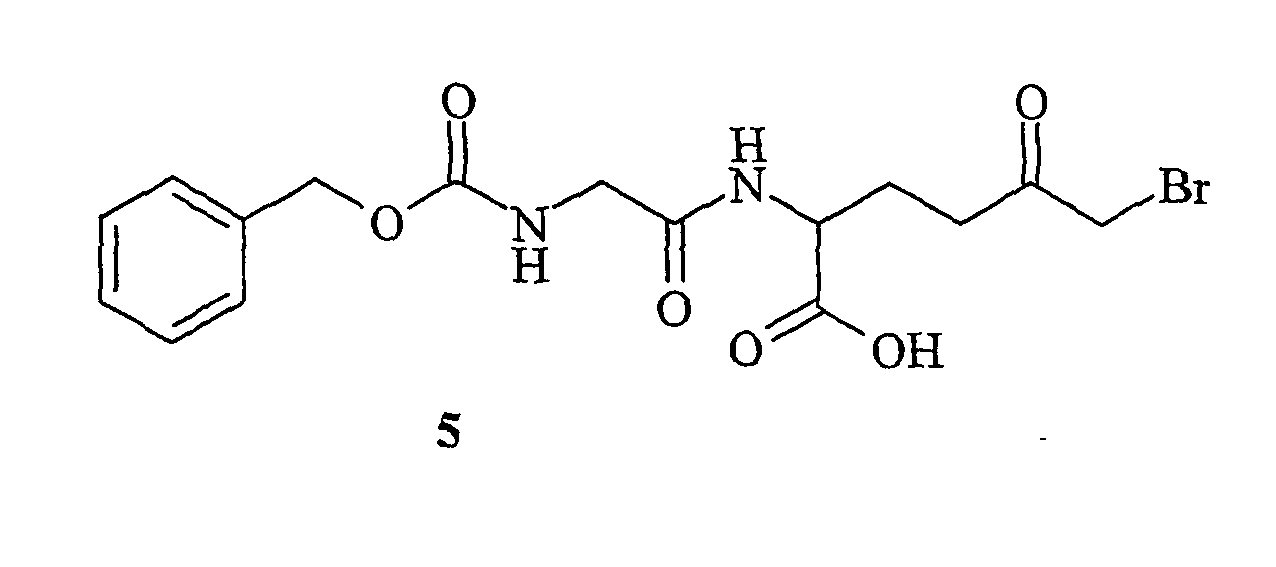


- To an ice-cold solution of the appropriate N-α-protected (CBZ, FMOC or BOC) amino acid N-hydroxysuccinimide ester and DON (1 eqv.) in a 1:1 mixture of THF/water (0.5M) was added triethylamine (1.5 eqv.). The reaction mixture was stirred for 2 h. at 0°C and the solvent removed under high vacuum at room temperature. The residue was dissolved in ethyl acetate and treated with a 1:1 mixture of HBr and acetic acid dropwise until gas evolution ceased. The resulting mixture was stirred for a further 10 min. and ethyl acetate added and the organic layer washed with water (x3) brine (x1) and dried over MgSO4. Removal of the solvent in vacuo afforded a colourless solid which was recrystallised from an appropriate solvent to give the product in typically 70-80% yield.
- (a) N-α-Benzyloxycarbonyl-L-phenylalanyl-6-bromo-5-oxo-L-norleucine
N-α-Benzyloxycarbonyl-L-phenylalanyl-6-bromo-5-oxo-L-norleucine(see '1' above) was prepared from DON and N-α-CBZ-L-phenylalanine N-hydroxysuccinimide ester (Novabiochem cat. no. 04-12-0573) (seeFigure 1 )
m.p. 132-133°C (ethyl acetate), (Found: C, 54.42; H, 5.14; N, 5.44. C23H25BrN2O6 requires C, 54.66; H, 4.99; N, 5.54%.); νmax (KBr)/cm-1 3294, 1719, 1689, 1655; δH (d6 acetone) 1.9, 2.2 and 2.7 (4 H, m), 2.9-3.2 (2 H, m), 4.2 (2 H, s), 4.5 (2 H, m), 5.0 (2 H, s), 6.6 (1 H, d), 7.3 (10 H, ArH), 7.6 (1 H, d); δC (d6 acetone) 27.0, 36.0, 36.3, 38.6, 51.8, 57.2, 66.7, 127.3, 128.5, 128.6, 129.1, 129.2, 130.2, 137.9,153.5,172.4,173.7,201.0. - (b) N-α-Benzyloxycarbonyl-L-glutaminyl-6-bromo-5-oxo-L-norleucine
N-α-Benzyloxycarbonyl-L-glutaminyl-6-bromo-5-oxo-L-norleucine (see '2' above) was prepared from DON and N-α-CBZ-L-glutamine N-hydroxysuccinimide ester (Bachem cat. no. C-1625)
m.p. 161-163°C (iso-propanol, dec.), νmax (KBr)/cm-1 3423, 3346, 1702, 1684, 1638; δH (d4 methanol) 1.8, 1.9, 2.2 and 2.6 (8 H, m), 3.9 (2 H, s), 4.1 (1 H, m), 4.3 (1 H, m), 5.0 (2 H, s), 7.3 (5 H, ArH), 7.6 (1 H, d); δC (d3 methanol) 26.8, 28.9, 32.5, 35.6, 36.5, 52.6, 55.9, 67.7, 128.8, 129.0, 129.5, 130.2, 136.9, 154.5, 171.9, 174.5, 202.6. MS: m/z Calcd for C19H24BrN3O7: 485 (M-Br = 406). Observed 406. - (c) N-α-Benzyloxycarbonyl-L-isoleucinyl-6-bromo-5-oxo-L-norleucine
N-α-Benzyloxycarbonyl-L-isoleucinyl-6-bromo-5-oxo-L-norleucine (see '3' above) was prepared from DON and N-α-CBZ-L-isoleucine N-hydroxysuccinimide ester (Novabiochem cat. No. 04-12-0560)
m.p. 182-184°C (ethyl acetate, dec.), νmax (KBr)/cm-1 3296, 1720, 1684, 1660; δH (d3 methanol) 0.9, 1.2 and 1.5 (6 H, m), 1.9, 2.2 and 2.7 (4 H, m), 3,9 (1 H d), 4.0 (2 H, s), 4.4 (2 H, m), 5.1 (2 H, s), 7.3 (5 H, ArH); δC (d3 methanol) 11.2, 15.9, 25.9, 26.8, 35.6, 36.4, 37.9, 52.3, 61.1, 67.6, 128.7, 129.0, 129.5, 138.1, 154.6, 174.4, 174.5, 202.8. MS: m/z Calcd for C20H27BrN2O6: 470 (M-Br = 391). Observed 473, 471, 391. - (d) N-α-Benzyloxycarbonyl-L-alaninyl-6-bromo-5-oxo-L-norleucine
N-α-Benzyloxycarbonyl-L-alaninyl-6-bromo-5-oxo-L-norleucine (see '4' above) was prepared from DON and N-α-CBZ-L-alanine N-hydroxysuccinimide ester (Novabiochem cat. No. 04-12-0512)
m.p. 82-85°C (DCM/ether, dec.), νmax (KBr)/cm-1 3294, 1719, 1686, 1660; δH (d6 acetone) 1.4(3 H, d), 1.9, 2.2 and 2.6 (4 H, m), 4.1, (2 H s), 4.2 (2 H, m), 4.4 (1 H, m), 5.1 (2 H, s), 7.3 (5 H, ArH); δC (d6 acetone) 26.3, 28.9, 34.5, 51.3, 51.9, 66.7, 68.6, 128.7, 129.0, 129.5, 138.1, 154.6, 173.2, 174.4,202.6. MS: m/z Calcd for C17H21BrN2O6: 428 (M-Br= 349). Observed 429, 349. - (e) N-α-Benzyloxycarbonyl-L-glycinyl-6-bromo-5-oxo-L-norleucine
N-α-Benzyloxycarbonyl-L-glycinyl-6-bromo-5-oxo-L-norleucine (see '5' above) was prepared from DON and N-α-CBZ-L-glycine N-hydroxysuccinimide ester (Novabiochem cat. No. 04-12-0511) and used without further purification. - (f) N-α-Benzyloxycarbonyl-L-tyrosinyl-6-bromo-5-oxo-L-norleucine
N-α-Benzyloxycarbonyl-L-tyrosinyl-6-bromo-5-oxo-L-norleucine (see '6' above) was prepared from DON and N-α-CBZ-L-tyrosine 4-nitrophenyl ester (Fluka cat. No. 97300) and used without further purification. - (g) N-α-Benzyloxycarbonyl-L-prolinyl-6-bromo-5-oxo-L-norleucine
N-a-Benzyloxycarbonyl-L-prolinyl-6-bromo-5-oxo-L-norleucine (see '7' above) was prepared from DON and N-α-CBZ-L-proline N-hydroxysuccinimide ester (Novabiochem cat. no. 04-12-0577).
m.p. 129-131°C, νmax (KBr)/cm-1 3241, 1725, 1690, 1664; δH (d3 methanol) 1.9, 2.2, 2.5 and 2.8 (8 H, m), 3.5 (2 H, m), 4.0 (2 H, s), 4.3 (1 H, m), 4.5 (1 H, m), 5.0 (2 H, s), 7.3 (5 H, ArH); δC (d3 methanol) 21.0, 23.2, 27.6, 31.7, 32.6, 48.6, 57.9, 64.4, 124.9, 125.1, 125.4, 125.9, 134.3, 153.0, 170.9, 171.5, 199.2
MS: m/z Calcd for C19H23BrN2O6: 455 (M+Na =477, M+H = 457). Observed 477, 457. - (h) N-α-Benzyloxycarbonyl-L-serinyl-6-bromo-5-oxo-L-norleucine
N-α-Benzyloxycarbonyl-L-serinyl-(O-t-butyl)-6-bromo-5-oxo-L-norleucine (see '8' above) was prepared from DON and N-α-CBZ-L-serine (O-t-butyl) N-hydroxysuccinimide ester (Novabiochem cat. no. 04-12-0585).
νmax (film)/cm-1 3240, 1719,1664; δH (CDCl3) 1.1 (9 H, s), 1.9, 2.3, and 2.7 (4 H, m), 3.4 (2 H, m), 3.9 (2 H, s), 4.3 (1 H, m), 4.6 (1 H, m), 5.1 (2 H, s), 7.3 (5 H, ArH); δC (CDCl3) 26.4, 27.2, 34.2, 35.5, 51.4, 53.4, 61.5, 67.2, 74.3, 128.2, 128.5, 135.7, 156.3, 171.1, 175.4, 201.0
MS: m/z Calcd for C21H29BrN2O7: 501 (M+Na = 523, 525). Observed 523, 525.
N-α-Benzyloxycarbonyl-L-serinyl-6-bromo-5-oxo-L-norleucine (see '9' above) was prepared via removal of the t-butyl protecting group using trifluoroacetic acid and triethylsilane as reagents, Mehta et al. (1992) Tetrahedron Lett., 33, 5441. The crude product obtained was used without further purification.
νmax (film)/cm-1 3409, 3242, 1720,1668; δH (d3 methanol) 1.9, 2.3, and 2.7 (4 H, m), 3.4 (2 H, m), 4.0 (2 H, s), 4.2 (1 H, m), 4.5 (1 H, m), 5.1 (2 H, s), 7.3 (5 H, ArH); δC (d3 methanol) 26.4, 35.6, 36.4, 52.6, 57.7, 61.5, 67.8, 128.8, 129.0, 129.1, 129.4, 129.5, 138.1, 158.5, 173.0, 173.8, 202.9 - (i) N-α-Benzyloxycarbonyl-L-glutaminyl-6-bromo-5-oxo-L-norleucine
N-α-Benzyloxycarbonyl-L-glutaminyl-(O-t-butyl)-6-bromo-5-oxo-L-norleucine (see '10' above) was prepared from DON and N-α-CBZ-L-glutamic acid (O-t-butyl) N-hydroxysuccinimide ester (Novabiochem cat. no. 04-12-0551).
νmax (film)/cm-1 3240, 1722, 1714, 1700, 1664; δH (CDCl3) 1.3 (9 H, s), 1.9, 2.3, and 2.7 (8 H, m), 3.8 (2 H, m), 3.9 (2 H, s), 4.2 (1 H, m), 4.5 (1 H, m), 5.0 (2 H, s), 7.3 (5 H, ArH); δC (CDCl3) 25.8, 27.9, 31.5, 34.4, 35.5, 51.4, 54.2, 61.5, 67.1, 81.3, 127.9, 128.0, 128.1, 128.5, 136.0, 156.4, 172.3, 173.0, 174.3, 201.3
MS: m/z Calcd for C23H31BrN2O8: 543 (M+Na = 565, 567). Observed 565, 567.
N-α-Benzyloxycarbonyl-L-glutaminyl-6-bromo-5-oxo-L-norleucine trifluoroacetic acid salt (see '11' above) was prepared via removal of the t-butyl protecting group using trifluoroacetic acid and triethylsilane as reagents, Mehta et al. (1992) Tetrahedron Lett., 33, 5441. The crude product obtained was used without further purification.
νmax (film)/cm-1 3404, 3242, 1720, 1700,1680; δH (d3 methanol) 1.9,2.2, 2.3, 2.4, and 2.7 (8 H, m), 4.0 (2 H, s), 4.1 (1 H, m), 4.4 (1 H, m), 5.1 (2 H, s), 7.3 (5 H, ArH); δC (d3 methanol) 26.7, 28.3, 31.1, 35.7, 36.4, 52.5, 55.7, 67.7, 128.7, 129.0, 129.5, 138.1, 158.4, 174.5, 174.6, 176.5, 202.8 - (j) N-α-Benzyloxycarbonyl-L-lysinyl-6-bromo-5-oxo-L-norleucine
N-α-Benzyloxycarbonyl-L-lysinyl-(N'-BOC)-6-bromo-5-oxo-L-norleucine (see '12' above) was prepared from DON and N-α-CBZ-L-lysine (N'-BOC) N-hydroxysuccinimide ester (Novabiochem cat. no. 04-12-0526).
δH (CDCl3) 1.4, 1.6 and 1.8 (6 H, s), 1.9, 2.1, and 2.7 (4 H, m), 2.9 (2 H, m), 3.8 (2 H, s), 4.1 (1 H, m), 4.4 (1 H, m), 5.0 (2 H, s), 7.3 (5 H, ArH); δC (CDCl3) 17.9, 22.3, 25.7, 28.3, 31.5, 34.8, 35.6, 51.4, 53.4, 54.8, 58.1, 66.9, 79.4, 127.8, 127.9, 128.0, 128.4, 136.1, 156.5, 172.9, 174.0, 175.5, 201.5
N-α-Benzyloxycarbonyl-L-lysinyl-6-bromo-5-oxo-L-norleucine trifluoroacetic acid salt (see '13' above) was prepared via removal of the t-butyl protecting group using trifluoroacetic acid and triethylsilane as reagents, Mehta et al. (1992) Tetrahedron Lett., 33, 5441. The crude product obtained was used without further purification. - (k) N-α-Benzyloxycarbonyl-γ-piperidinyl-L-glutaminyl-6-bromo-5-oxo-L-norleucine
N-α-Benzyloxycarbonyl-γ-piperidinyl-L-glutamic acid (see '14' above) was prepared using the methods of Molina, T.M., et al (1993) Tetrahedron 49, 3801-3808, Blas, J., et al (2000) Tetrahedron Lett. 41, 4567-4571 and Antonjuk, D.J., et al (1984) J. Chem. Perkin Trans. 1 1989-2003.
νmax (film)/cm-1 3312, 2940, 1722, 1715, 1698, 1664; δH (CDCl3) 1.5 (6 H, m), 2.0, 2.2, 2.4 and 2.6 (4 H, m), 3.3 (2 H, m), 3.5 (2 H, m), 4.3 (1 H, q), 5.1 (2 H, s), 6.0 (1 H, d), 7.3 (5 H, ArH); δC (CDCl3) 24.1, 25.3, 26.2, 28.3, 29.5, 43.2, 46.8, 53.5, 66.7, 127.8, 127.9, 128.4, 136.2, 156.1, 171.5, 174.0.
N-α-Benzyloxycarbonyl-γ-piperidinyl-glutaminyl-6-bromo-5-oxo-L-norleucine (see '15' above) was prepared from DON and N-α-Benzyloxycarbonyl-γ-piperidinyl-L-glutamic acid using N-hydroxysuccinimide ester activation.
νmax (film)/cm-1 3325, 2938, 1719, 1689, 1664; δH (d6 DMSO) 1.4 and 1.5 (6 H, m), 1.8, 2.0, 2.3 and 2.6 (8 H, m), 3.3 (2 H, m), 3.4 (2 H, m), 4.0 (2 H, s), 4.2 (1 H, m), 4.3 (1 H, m), 5.0 (2 H, s), 7.3 (5 H, ArH); δC (d6 DMSO) 24.1, 25.3, 26.1, 28.8, 33.8, 35.4, 36.8, 41.9, 45.7, 47.6, 54.1, 65.4, 67.5, 127.7, 127.8, 128.3, 137.0, 155.9, 169.6, 173.1,173.3 200.9. - (l) N-α-Benzyloxycarbonyl-y-propyl-L-glutaminyl-6-bromo-5-oxo-L-norleucine
N-α-Benzyloxycarbonyl-γ-propyl-L-glutamic acid (see '16' above) was prepared using the methods of Molina, T.M., et al (1993) Tetrahedron 49, 3801-3808, Blas, J., et al (2000) Tetrahedron Lett. 41, 4567-4571 and Antonjuk, D.J., et al (1984) J. Chem. Perkin Trans. 1 1989-2003.
νmax (film)/cm-1 3328, 2965, 1706, 1702, 1698, 1653; δH (CDCl3) 0.8 (3 H, t), 1.4 (2 H, m), 2.0 and 2.2 (4 H, m), 3.1 (2 H, m), 4.3 (1 H, q), 5.1 (2 H, s), 6.0 (1 H, d), 6.5 (1 H, m), 7.3 (5 H, ArH); δC (CDCl3) 11.2, 22.4, 28.6, 32.4, 41.6, 53.4, 67.1, 127.9, 128.1, 128.2, 128.5, 136.0, 156.6, 173.4, 173.9.
N-α-Benzyloxycarbonyl-γ-propyl-glutaminyl-6-bromo-5-oxo-L-norleucine (see '17' above) was prepared from DON and N-α-Benzyloxycarbonyl-γ-propyl-L-glutamic acid using N-hydroxysuccinimide ester activation.
νmax (film)/cm-1 3325, 2938, 1719, 1689, 1664; δH (d6 DMSO) 1.4 and 1.5 (6 H, m), 1.8, 2.0, 2.3 and 2.6 (8 H, m), 3.3 (2 H, m), 3.4 (2 H, m), 4.0 (2 H, s), 4.2 (1 H, m), 4.3 (1 H, m), 5.0 (2 H, s), 7.3 (5 H, ArH); δC (d6 DMSO) 11.7, 23.5, 25.2, 26.0, 28.8, 33.0, 34.7, 38.1, 52.0, 56.0, 67.7, 128.7, 128.8, 129.3, 137.0, 155.9, 169.6, 174.7, 174.8 200.8. - (m) N-α-9-Fluorenylmethyloxycarbonyl-L-phenylalanyl-6-bromo-5-oxo-L-norleucine
N-α-9-Fluorenylmethyloxycarbonyl-L-phenyalanyl-6-bromo-5-oxo-L-norleucine (see '18' above) was prepared from DON and N-α-FMOC-L-phenylalanine N-hydroxysuccinimide ester (Bachem cat. no. B-1415).
m.p. 142-143°C, νmax (KBr)/cm-1 3354, 1714, 1700, 1686; δH (d6 DMSO) 1.9, 2.2 and 2.7 (4 H, m), 2.9-3.1 (2 H, m), 4.2 -4.4 (5 H, m), 7.3 (9 H, ArH), 7.6 (2 H, ArH), 7.8 (2 H, ArH); δC (d6 DMSO) 25.5, 35.5, 36.6, 37.4, 46.6, 50.9, 56.1, 64.4, 120.0, 124.8, 125.1, 127.2, 127.5, 127.6, 128.7, 129.3, 137.0, 140.7, 143.7, 155.9, 171.9, 173.1, 200.7 - (n) N-α-tert-butyloxycarbonyl-L-phenylalanyl-6-bromo-5-oxo-L-norleucine
N-α-tert-butyloxycarbonyl-L-phenyalanyl-6-bromo-5-oxo-L-norleucine (see '19' above) was prepared from DON and N-α-BOC-L-phenylalanine N-hydroxysuccinimide ester (Novabiochem cat. no. 04-12-0074).
νmax (film)/cm-1 3380, 2930, 1722,1699, 1684; δH (d3 methanol) 1.2 (9 H, s), 1.8, 2.1 and 2.6 (4 H, m), 2.7-3.0 (2 H, m), 4.0 (2 H, s), 4.2 (1 H, m), 4.3 (2 H, m), 4.8 (2 H, s), 7.1 (5 H, ArH); δC (d3 methanol) 27.0, 28.7, 35.6, 36.4, 39.0, 52.4, 57.3, 80.6, 127.7, 129.4, 130.4, 138.2, 157.6, 174.4, 174,5, 202.7 - Sulfonium salts of the above intermediates were prepared using a modification of procedures previously reported by Pliura et al. (1992) J. Enzyme Inhibition 6, 2768 and Shaw (1988) Biol. Chem., 263, 2768.
- The bromomethyl ketone was dissolved in the minimum amount of dry methanol to achieve solution. Methyl sulfide (2.5-7.5 eqv.) was added and the solution left in a tightly stoppered flask for 24-48 h. until the reaction was judged complete by TLC. Purification was achieved by dissolving the residue in deionised water and extracting the organic soluble impurities with ethyl acetate. Freeze drying the aqueous portion afforded the product salts as colourless solids in typically 80-90% yields.


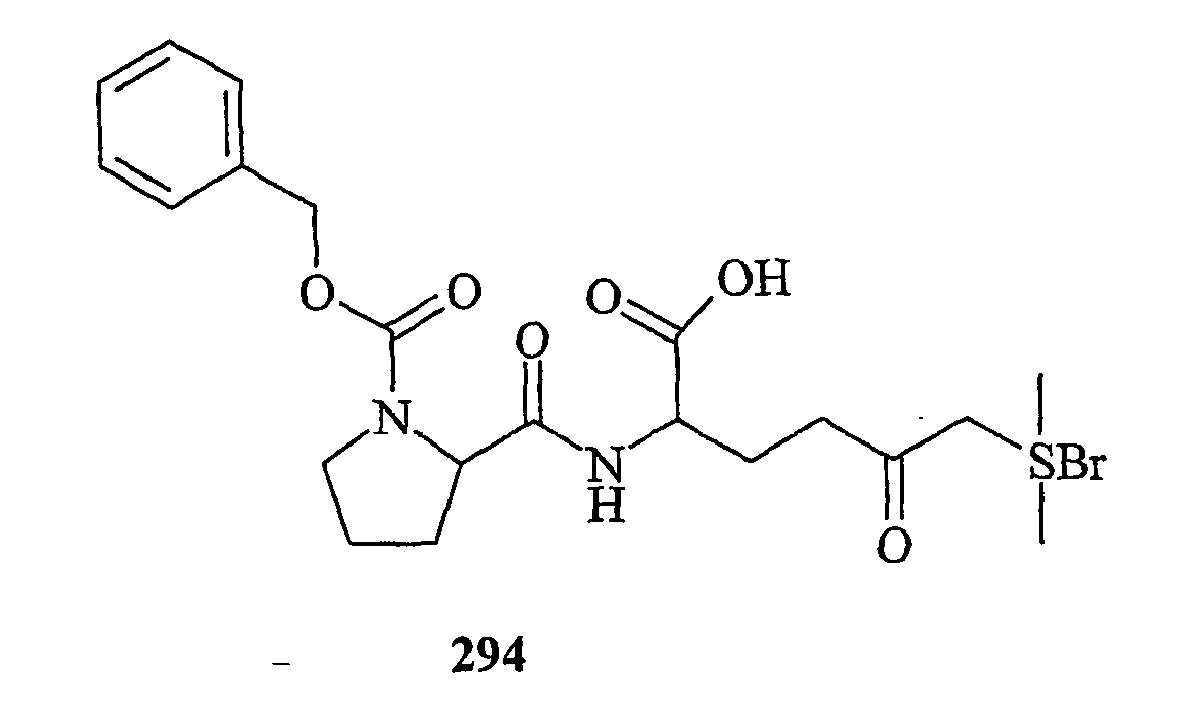


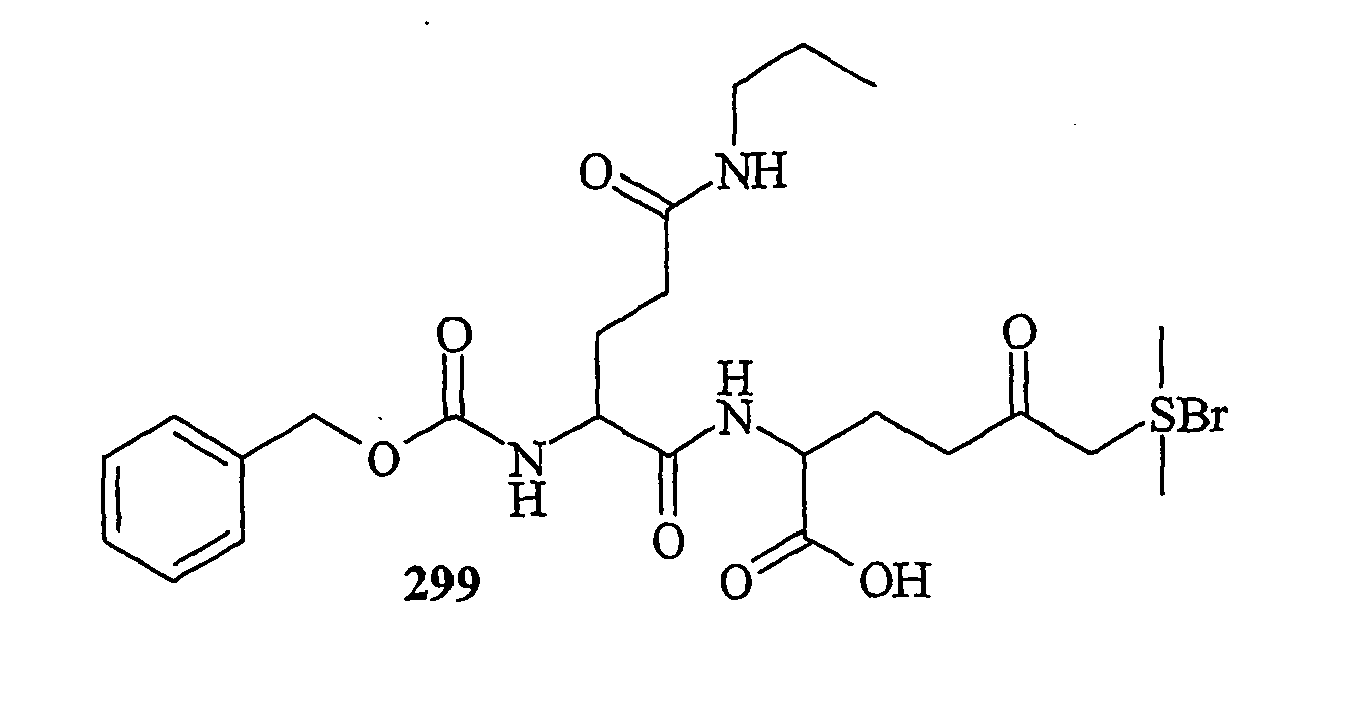


- (a) N-Benzyloxycarbonyl-L-phenylalanyl-6-dimethylsulfonium-5-oxo-L-norleucine bromide salt (see '281' above)
m.p. 90-92°C, (Found: C, 52.89; H, 4.89; N, 5.05. C25H31BrN2O6S requires C, 52.91; H, 5.51; N, 4.94%.); νmax (KBr)/cm-1 3296, 1715, 1700, 1661; δH (d6 acetone) 1.9, 2.2 and 2.7 (4 H, m), 2.9-3.1 (2 H, m), 3.2 (6 H, s), 4.6 (2 H, m), 5.0 (2 H, s), 5.4 (1 H, d), 7.3 (10 H, ArH), 7.4 (1 H, d); δC (d6 acetone) 25.2, 36.1, 38.5, 41.8, 51.9, 56.3, 60.6, 66.3, 128.4, 128.6, 129.0, 129.2, 130.3, 138.2, 138.6, 153.3, 168.7, 173.2, 202.0. - (b) N-Benzyloxycarbonyl-L-glutaminyl-6-dimethylsulfonium-5-oxo-L-norleucine bromide salt (see '285' above)
m.p. 100°C (dec.), νmax (KBr)/cm-1 3423, 3346, 1702, 1684, 1638; δH (DMSO-D6) 1.7, 1.9, 2.1 and 2.6 (8 H, m), 2.8 (6 H, s), 3.3 (1 H, br), 3.9 (2 H, s), 4.2 (1 H, m), 4.7 (2 H, m), 5.0 (2 H, s), 6.7 (1 H, s), 7.3 (5 H, ArH), 7.4 (1 H, d), 8.2 (1 H, d); δC (DMSO-D6) 24.5, 25.2, 27.7, 31.5, 37.5, 50.6, 53.5, 54.3, 65.4, 127.6, 127.8, 128.3, 128.4, 136.9, 155.9, 172.0, 172.9, 173.8, 201.4. MS: m/z Calcd for C21H30BrN3O7S: 547.09878 (M-Br = 468.18045). Observed 468.17769. - (c) N-Benzyloxycarbonyl-L-isoleucinal-6-dimethylsulfonium-5-oxo-L-norleucine bromide salt (see '286' above)
m.p. 111-114°C (dec.), νmax (KBr)/cm-1 3424, 1717, 1700, 1664; δH (DMSO-D6) 0.9, 1.2 and 1.5 (6 H, m), 1.9, 2.2 and 2.7 (4 H, m), 3.2 (6 H, s), 3,9 (1 H d), 4.1 (2 H, s), 4.4 (1 H, m), 5.1 (2 H, s), 7.3 (5 H, ArH); δC (DMSO-D6) 11.2, 15.9, 25.9, 26.8, 35.6, 36.4, 37.9, 52.3, 61.1, 67.6, 128.7, 129.0, 129.5, 138.1, 154.6, 174.4, 174.5, 202.8. MS: m/z Calcd for C22H33BrN2O6S: 532 (M-Br = 453). Observed 453. - (d) N-Benzyloxycarbonyl-L-alaninal-6-dimethylsulfonium-5-oxo-L-norleucine bromide salt (see '291' above)
m.p. 100-102 °C (dec.), νmax (KBr)/cm-1 3426, 1716, 1698, 1660; δH (d6 DMSO) 1.2 (3 H, d), 1.8, 2.0 and 2.7 (4 H, m), 2.9 (6H, s), 4.0, (1 H, m), 4.2 (1 H, m), 4.8 (2 H, m), 5.0 (2 H, s), 7.3 (5 H, ArH); δC (d6 DMSO) 24.5, 37.4, 49.8, 50.6, 52.0, 53.5, 65.3, 66.3, 127.7, 127.8, 128.3, 137.0, 155.7, 172.8, 172.9, 201.4. MS: m/z Calcd for C19H27BrN2O6S: 490 (M-Br = 411). Observed 411. - (e) N-Benzyloxycarbonyl-L-glycinal-6-dimethylsulfonium-5-oxo-L-norleucine bromide salt (see '292' above)
m.p. 96-99 °C (dec.), νmax (KBr)/cm-1 3424, 1714, 1701, 1663; δH (d6 DMSO) 1.8, 2.1 and 2.6 (4 H, m), 2.9 (6H, s), 3.6, (2 H, m), 4.3 (1 H, m), 4.7 (2 H, d), 5.0 (2 H, s), 7.3 (5 H, ArH); δC (d6 DMSO) 24.5, 37.4, 43.2, 50.6, 53.5, 65.4, 66.3, 127.6, 127.8, 128.3, 137.0, 156.5, 169.2, 172.9, 201.4. MS: mlz Calcd for C18H25BrN2O6S: 476 (M-Br = 397). Observed 397. - (f) N-Benzyloxycarbonyl-L-tyrosinal-6-dimethylsulfonium-5-oxo-L-norleucine bromide salt (see '293' above)
m.p. 111-113 °C (dec.), νmax (KBr)/cm-1 3426, 1716, 1700, 1666; δH (d6 DMSO) 1.9 and 2.1 (2 H, m), 2.6 (4 H, m), 2.9 (6H, s), 4.2, (2 H s), 4.7 (2 H, d), 4.9 (2 H, d), 6.7 (2H, d, ArH), 7.1 (2 H, d, ArH), 7.3 (5 H, ArH); δC (d6 DMSO) 24.4, 24.8, 36.5, 37.5, 50.8, 53.5, 56.3, 65.2, 114.8, 127.3, 127.7, 128.0, 128.3, 130.1, 137.0, 155.7, 172.0, 172.9, 201.4. MS: m/z Calcd for C25H31BrN2O7S: 582 (M-Br = 503). Observed 503. - (g) N-Benzyloxycarbonyl-L-prolinyl-6-dimethylsulfonium-5-oxo-L-norleucine bromide salt (see '294' above)
m.p. 93-97°C (dec.), νmax (KBr)/cm-1 3244, 2952, 1720, 1693, 1669; δH (d3 methanol) 1.9 (4 H, m), 2.2 (2 H, m), 2.7 (2 H, m), 2.8 (6 H, s), 3.6 (2 H, m), 4.3 (1 H, m), 4.5 (1 H, m), 4.8 (2 H, m), 5.1 (2 H, s), 7.3 (5 H, ArH); δC (d3 methanol) 25.3, 25.4, 26.3, 28.1, 31.1, 38.2, 52.1, 55.9, 67.6, 128.6, 129.1, 129.6, 138.2, 158.5, 174.4, 174.7, 201.8. MS: m/z Calcd for C21H29BrN2O6S: 517 (M-Br = 437). Observed 437. - (h) N-Benzyloxycarbonyl-L-serinyl-6-dimethylsulfonium-5-oxo-L-norleucine bromide salt (see '295' above)
m.p. 105°C (dec.), νmax (KBr)/cm-1 3242, 2950, 1719, 1700, 1664; δH (d3 methanol) 1.9 (2 H, m), 2.3 (2 H, m), 2.9 (6 H, s), 3.8 (2 H, m), 4.2 (1 H, m), 4.4 (1 H, m), 4.8 (2 H, m), 5.1 (2 H, s), 7.3 (5 H, ArH); δC (d3 methanol) 24.6, 25.4, 26.3, 31.6, 32.5, 38.0, 48.3, 51.8, 61.6, 68.0, 128.4, 128.8, 129.1, 129.6, 138.2, 156.7, 174.3, 175.3, 201.8. MS: m/z Calcd for C19H27BrN2O7S: 507 (M-Br = 427). Observed 427. - (i) N-Benzyloxycarbonyl-L-glutaminyl-6-dimethylsulfonium-5-oxo-L-norleucine bromide salt (see '296' above)
m.p. 102-106°C (dec.), νmax (KBr)/cm-1 3329, 2926, 1719, 1698, 1664; δH (d3 methanol) 1.9, 2.1, 2.4 and 2.7 (8 H, m), 2.9 (6 H, s), 4.1 (1 H, m), 4.5 (1 H, m), 4.8 (2 H, m), 5.1 (2 H, s), 7.3 (5 H, ArH); δC (d3 methanol) 25.3, 25.4, 26.3, 28.1, 31.1, 38.2, 52.1, 55.9, 67.6, 128.6, 129.1, 129.6, 138.2, 158.5, 174.4, 174.7, 201.8. MS: m/z Calcd for C21H29BrNZO8S: 549 (M-Br = 469). Observed 469. - (j) N-α-Benzyloxycarbonyl-N-ε-trifluoroacetate-L-lysinyl-6-dimethylsulfonium-5-oxo-L-norleucine bromide salt (see '297' above)
m.p. 110°C (dec.), νmax (KBr)/cm-1 3334, 1722, 1688; δH (d3 methanol) 1.4 and 1.7 (6 H, m), 1.9, 2.1 and 2.7 (6 H, m), 2.9 (6 H, s), 4.1 (1 H, m), 4.4 (1 H, m), 4.8 (2 H, m), 5.1 (2 H, s), 7.3 (5 H, ArH).
MS: m/z Calcd for C24H35BrF3N3O8S: 662 (M-Br-F3C2O2H = 468). Observed 468. - (k) N-α-Benzyloxycarbonyl-γ-piperidinyl-L-glutaminyl-6-dimethylsulfonium-5-oxo-L-norleucine bromide salt (see '298' above)
m.p. 92-94°C (dec.), νmax (KBr)/cm-1 3415, 2933, 1719, 1700, 1664, 1618; δH (d3 methanol) 1.5, 1.7 (6 H, m), 2.0, 2.3 and 2.7 (4 H, m), 2.9 (6 H, s), 3.4 and 3.5 (4 H, m), 4.1 (1 H, m), 4.5 (1 H, m), 4.8 (2 H, m), 5.1 (2 H, s), 7.3 (5 H, ArH); δC (d3 methanol) 22.3, 22.4, 23.2, 24.5, 25.4, 25.6, 27.1, 35.2, 38.2, 41.1, 44.8, 49.0, 53.0, 64.6, 125.7, 126.1, 126.6, 155.4, 169.5, 171.2, 171.8, 199.0. MS: m/z Calcd for C26H38BrN3O7S: 616 (M-Br+H = 537). Observed 537. - (l) N-α-Benzyloxycarbonyl-γ-propyl-L-glutaminyl-6-dimethylsulfonium-5-oxo-L-norleucine bromide salt (see '299' above)
m.p. 82-85°C (dec.), νmax (KBr)/cm-1 3414, 2927, 1720, 1698, 1668, 1636; δH (d3 methanol) 0.9 (3 H, t), 1.5 (2 H, q), 1.9, 2.1 and 2.3 (4 H, m), 2.9 (6 H, s), 3.2 (2 H, t), 4.1 (1 H, m), 4.5 (1 H, m), 4.8 (2 H, m), 5.1 (2 H, s), 7.3 (5 H, ArH); δC (d3 methanol) 11.7, 23.5, 25.4, 26.0, 28.9, 33.0, 34.7, 38.1, 42.3, 52.0, 56.0, 67.7, 128.7, 128.8, 129.1, 129.6, 138.2, 158.4, 174.4, 174.6, 174.9, 201.8. MS: mlz Calcd for C24H36BrN3O7S: 590 (M-Br+H = 511). Observed 511. - (m) N-Benzyloxycarbonyl-L-phenylalanyl-6-diethylsulfonium-5-oxo-L-norleucine bromide salt (see '300' above)
m.p. 86-89°C (dec.), νmax (KBr)/cm-1 3296, 2932, 1716, 1700, 1661, 1636; δH (d3 methanol) 1.4 (6 H, t), 1.9, 2.3 and 2.7 (4 H, m), 2.9-3.1 (2 H, m), 3.4 (4 H, q), 4.4 (1 H, m), 4.5 (1 H, m), 4.9 (2 H, m), 5.0 (2 H, s), 7.3 (5 H, ArH); δC (d3 methanol) 9.4, 26.5, 34.9, 35.1, 38.2, 38.8, 52.0, 57.9, 67.5, 127.8, 128.5, 129.0, 129.4, 129.5, 130.3, 138.4, 158.3, 174.2, 174.4, 174.9, 201.6. MS: m/z Calcd forC27H35BrN2O6S: 594 (M-Br 515) observed 515 - (n) N-Benzyloxycarbonyl-L-phenylalanyl-6-tetra-methylmercaptoimidazole-5-oxo-L-norleucine bromide salt
N-α-Benzyloxycarbonyl-L-phenylalanyl-6-tetra-methylmercaptoimidazole-5-oxo-L-norleucine bromide salt (see '301' above) was prepared from N-α-Benzyloxycarbonyl-L-phenylalanyl-6-bromo-5-oxo-L-norleucine and 1,3,4,5-tetramethylimidazoline-2-thione, which was prepared by the method of Kuhn and Kratz (1993) Synthesis, 561, using the method of Freund et al. (1994) Biochemistry, 33, 10109.
m.p. 116-118°C (dec.), νmax (KBr)/cm-1 3414, 3237, 1720, 1657, 1638, 1617; δH (d3 methanol) 1.7, 2.2 and 2.5 (4 H, m), 2.3 (6 H, s), 2.9-3.1 (2 H, m), 3.9 (6 H, s), 4.3 (2 H, m), 4.8 (2 H, m), 5.0 (2 H, s), 7.2 (5 H, ArH), 7.3 (5 H, ArH); δC (d3 methanol) 9.1, 26.9, 34.3, 38.7, 39.3, 46.5, 51.9, 58.0, 67.5, 127.8, 129.1, 129.5, 129.6, 130.3, 130.9, 138.9, 138.3, 138.4, 158.2, 174.2, 174.4, 201.8. MS: m/z Calcd for C30H37BrN4O6S: 661 (M-Br+H = 582). Observed 582. - (o) N-9-Fluorenylmethyloxycarbonyl-L-phenylalanyl-6-dimethylsulfonium-5-oxo-L-norleucine bromide salt (see '302' above)
m.p. 95-98°C (dec.), νmax (KBr)/cm-1 3415, 3310, 2926, 1720, 1648; δH (d6 DMSO) 1.8, 2.1 and 2.7 (4 H, m), 2.8 (6 H, s), 2.9-3.0 (2 H, m), 4.1-4.3 (5 H, m), 4.7 (2 H, m), 7.3 (9 H, ArH), 7.6 (2 H, ArH), 7.8 (2 H, ArH). MS: m/z Calcd for C32H35BrN2O6S: 654 (M-Br575) Observed 575 - (p) N-α-tert-butyloxycarbonyl-L-phenylalanyl-6-dimethylsulfonium-5-oxo-L-norleucine bromide salt (see '303' above)
m.p. 105-109°C (dec.), νmax (KBr)/cm-1 3413, 2930, 1720, 1663; δH (d6 DMSO) 1.3 (9 H, s), 1.8, 2.1 and 2.7 (4 H, m), 2.8 (6 H, s), 2.9-3.0 (2 H, m), 4.2 (2 H, m), 4.7 (2 H, m), 7.3 (5 H, ArH). MS: mlz Calcd for C22H33BrN2O6S: 531 (M-Br 453) observed 453 - (q) N-Benzyloxycarbonyl-L-prolinyl-6-tetra-methylmercaptoimidazole-5-oxo-L-norleucine bromide salt
N-α-Benzyloxycarbonyl-L-prolinyl-6-tetra-methylmercaptoimidazole-5-oxo-L-norleucine bromide salt (see '304' above) was prepared from N-α-Benzyloxycarbonyl-L-prolinyl-6-bromo-5-oxo-L-norleucine and 1,3,4,5-tetramethylimidazoline-2-thione, which was prepared by the method of Kuhn and Kratz (1993) Synthesis, 561, using the method of Freund et al. (1994) Biochemistry, 33, 10109.
m.p. 110°C (dec.), νmax (KBr)/cm-1 3426, 2927, 1700, 1630, 1638, 1617; δH (d3 methanol) 1.7-2.1 (4 H, m), 2.2 (2 H, m), 2.3 (6 H, s), 2.6 (2 H, m), 3.3 (2 H, m), 3.7 (6 H, s), 3.9 (2 H, m), 4.2 (1 H, m), 4.3 (1 H, m), 5.0 (2 H, m), 7.3 (5 H, ArH); δC (d3 methanol) 8.7, 23.9, 25.2, 31.1, 33.7, 36.4, 40.4, 44.0, 46.6, 59.5, 65.8, 127.5, 127.8, 128.2, 128.9, 129.0, 136.9, 153.9, 172.1, 173.0, 202.9. MS: m/z Calcd for C26H35BrN4O6S: 610 (M-Br 531) observed 531 -

- Compound '5' is made by reaction of commercially available N-α-CBZ-L-phenylalanine N-hydroxy-succinimide ester (Novabiochem Cat. No. 04-12-0573) and L-aspartic acid β-t-butyl ester (Novabiochem Cat. No. 04-12-5000) in water/THF (1:1) in the presence of 1.5 equivalents of triethylamine.
- (a) N-Benzyloxycarbonyl-L-phenylalanyl-L-2-amino-5-diazo-4-oxo-norvaline tert-butyl ester (see '6' above)
N-Methylmorpholine (0.63 ml, 5.75 mmol) followed by n-butyl chloroformate (0.74 ml, 5.75 mmol) were added to a cold (-78°C) solution of N-α-benzyloxycarbonyl-L-phenylalanyl-aspartic acid β-t-butyl ester (see '5' above) (2.35g, 5 mmol) in THF (100 ml) in an atmosphere of nitrogen. The reaction was stirred for 0.5 h. and an ethereal solution of diazomethane, prepared from N-methyl-N-nitroso-4-toluenesulfonamide (6.23 g, 29 mmol), was added, dropwise, and the reaction left to warm to room temperature overnight. Saturated ammonium chloride solution (100 ml) was added and the mixture stirred vigorously for 5 min., then the layers were separated. Removal of the solvent in vacuo gave a solid residue which was recrystallised from cyclohexane/DCM to yield the product as a pale yellow solid (1.91 g, 77%).
m.p. 122-124°C, (Found: C, 62.88; H, 6.38; N, 11.01. C26H30N4O6 requires C, 63.15; H, 6.11; N, 11.33%.); νmax (KBr)/cm-1 3296, 2105, 1736, 1689, 1655; δH (CDCl3) 1.4 (9 H, s), 2.8 and 3.2 (2 H, m), 3.6 (2 H, s), 4.4 (1 H, m), 4.6 (1 H, m), 5.1 (2 H, s), 5.2 (1 H, d), 6.9 (1 H, d), 7.3 (10H, ArH); δC (CDCl3) 27.8, 36.2, 38.3, 49.6, 55.8, 67.2, 82.8, 127.3, 128.5, 128.6, 129.1, 129.2, 130.2, 136.0, 136.6, 153.5, 169.4, 170.7, 191.5. - (b) N-Benzyloxycarbonyl-L-phenylalanyl-L-2-amino-5-bromo-4-oxo-norvaline tert-butyl ester (see '7' above)
To a cold (0°C) solution of N-benzyloxycarbonyl-L-phenylalanyl-L-2-amino-5-diazo-4-oxo-norvaline tert-butyl ester (see '6' above) (1 g, 2 mmol) in ethyl acetate (40 ml) was added a 1:1 solution of 48% HBr/acetic acid (2 ml) dropwise. The mixture was stirred for a further 10 min. and the organic was washed with water (10 ml x3), brine (10ml) and dried over MgSO4. Removal of the solvent in vacuo gave a solid residue which was recrystallised from cyclohexane to give a white solid (0.915 g, 84%).
m.p. 126-127°C; νmax (KBr)/cm-1 3294, 1738, 1690, 1654; δH (CDCl3) 1.4 (9 H, s), 2.8 and 3.2 (2 H, m), 3.6 (2 H, s), 3.8 (2 H, s), 4.4 (1 H, m), 4.6 (1 H, m), 5.1 (2 H, s), 5.6 (1 H, d), 6.9 (1 H, d), 7.3 (10H, ArH); δC (CDCl3) 27.8, 33.7, 38.2, 41.4, 49.3, 55.9, 82.9, 127.3, 128.5, 128.6, 129.1, 129.2, 130.2, 136.0, 136.6, 153.5, 169.4, 170.7, 199.8. - (c) N-Benzyloxycarbonyl-L-phenylalanyl-L-2-amino-5-bromo-4-oxo-norvaline (see '8' above)
To a solution of the t-butyl ester (see '7' above) (0.55 g, 1 mmol) in DCM (10 ml) was added trifluoroacetic acid (0.95 ml, 12.5 mmol) and triethylsilane (0.4 ml, 2.5 mmol). The reaction was stirred for 1.5 h. and the volatiles removed under vacuum. The resulting residue was triturated with ether to give the product as a colourless solid (0.38 g 78%),
m.p. 134-136°C, (Found: C, 53.57; H, 4.70; N, 5.65. C22H23BrN2O6 requires C, 53.78; H, 4.72; N, 5.70 %.); νmax (KBr)/cm-1 3295, 1718, 1689, 1654; δH (CDCl3) 2.8 and 3.2 (2 H, m), 3.3 (2 H, m), 3.7 (2 H, s), 4.5 (1 H, m), 4.7 (1 H, m), 5.1 (2 H, s), 5.8 (1 H, d), 5.9 (1 H, d), 6.8 (1 H, br), 7.3 (10H, ArH); δC (CDCl3) 33.7, 38.2, 41.4, 49.3, 55.9, 67.2, 127.0, 127.8, 128.1, 128.4, 129.3, 136.1, 136.6, 156.5, 171.4 176.7,200.1. - (d) N-Benzyloxycarbonyl-L-phenylalanyl-L-2-amino-5-dimethylsulfonium-4-oxo-norvaline bromide salt (see '289' above)
The sulfonium salt, N-benzyloxycarbonyl-L-phenylalanyl-L-2-amino-5-dimethyl-sulfonium-4-oxo-norvaline bromide, was prepared as described above from bromomethyl ketone (see '8' above) (0.1 g, 0.2 mmol) and methyl sulfide (0.11 ml, 1.5 mmol). Freeze-drying afforded the product as a colourless hygroscopic solid (20 mg, 18%).
m.p. 98°C (dec.); νmax (KBr)/cm-1 1716, 1689, 1669; δH (d4 methanol) 2.8 and 3.2 (2 H, m), 3.2 (6 H, s), 3.8 (2 H, s), 4.7 (1 H, m), 4.9 (1 H, m), 5.1 (2 H, s), 5.9 (1 H, d), 6.5 (1 H, d), 7.3 (10 H, ArH). δC (d4 methanol) 25.4, 38.8, 43.9, 49.8, 57.8, 67.5, 68.1, 127.8, 128.5, 128.9, 129.5, 130.3, 136.1, 136.6, 158.3, 173.1, 174.1, 200.1.
MS: m/z Calc. for C24H29Br N2O6S 552 (M-Br=473) Observed : 473 - The acid was prepared from 6-diazo-N-(9-fluorenylmethyloxycarbonyl)-5-oxo-L-norleucine ethyl ester (2.53 g, 6 mmol) by the method of Coutts et al. Yield after flash column chromatography (
ethyl acetate 100%) 1.64 g, 66%. - To a cold (0°C) solution of the acid (0.94 g, 2.3 mmol) in DCM (24 ml) was added oxalyl chloride ( 1.725 ml of a 2M solution in DCM, 3 3.45 mmol) dropwise. The reaction was warmed to room temperature and stirring continued for a further 40 min. The reaction was again cooled to 0°C and oxalyl chloride (1.725 ml of a 2M solution in DCM, 3.45 mmol) added dropwise. The reaction was warmed to room temperature and stirring continued for a further 2 h. The volatiles were removed under reduced pressure to give a yellow solid. The solid was dissolved in THF/acetonitrile (1:1 24 ml) and cooled in an ice bath under a blanket of nitrogen. To the solution was added trimethylsilyldiazomethane (4.6 ml of a 2M solution in hexane, 9.2 mmol) dropwise and the reaction stirred at 0°C for 11/2 h. To the mixture was added saturated ammonium chloride solution and the phases separated. The organic was washed with 10% Na2CO3 (5 ml, x3), brine (5 ml) and dried over Na2SO4. Removal of the solvent in vacuo gave an orange oil which was purified by flash column chromatography (3:2 petrol/ethyl acetate) to afford the product as a pale yellow solid (0.65 g, 65%).
m.p 123-124°C (CCl4, dec.) νmax (KBr)/cm-1 3354, 2103, 1739, 1686, 1635; δH (CDCl3) 1.3 (3 H, t), 1.7, 1.9 and 2.3 (6 H, m), 4.2 (3 H, m), 4.4 (3 H, m), 5.2 (1 H, s), 5.4 (1 H, d), 7.3 (4 H, m, ArH), 7.6 (2 H, ArH), 7.8 (2 H, m, ArH); δC (CDCl3) 14.1, 20.6, 32.0, 40.1, 47.1, 53.5, 54.5, 61.6, 67.0, 120.0, 125.1, 127.0, 127.7, 141.2, 143.8, 155.9, 172.2, 192.4. - The diazoketone (0.5 g, 1.15 mmol) was deprotected with piperidine as previously described to give the amino acid as a pale yellow solid (57.2 mg, 54%).
m.p. 122-124°C (Lit. m.p. 125-126°C) νmax (KBr)/cm-1 3436, 2108, 1630 (Weygand et al., Chem. Ber. 91, 1037-40). - The dipeptide was prepared by the method previously described to give a colourless solid (93 mg, 66%).
m.p. 108-110 °C (ethyl acetate), νmax (KBr)/cm-1 3296, 1715, 1700, 1661; δH (d3 methanol) 1.6, 1.8 and 2.6 (6 H, m), 2.9-3.1 (2 H, m), 4.1 (2 H, s), 4.4 (2 H, m) 5.0 (2 H, s), 7.3 (10 H, ArH), 7.4 (1 H, d); δC (d3 methanol) 21.0, 31.8, 39.7, 53.2, 57.7, 56.3, 67.5, 127.7, 128.6, 128.9, 129.4, 130.4, 138.1, 138.5, 158.2, 174.2, 174.8, 203.4.. MS: m/z Calcd for C24H27BrN2O6: 518 (M-Br = 439). Observed 519, 439. - The sulfonium salt was prepared as previously described, to give a colourless hygroscopic solid (48 mg, 57%).
m.p. 94-96 °C (dec.), νmax (KBr)/cm-1 3296, 1715, 1700, 1661; δH (d6 acetone) 1.7, 1.9 and 2.7 (6 H, m), 2.8-3.1 (2 H, m), 2.9 (6 H, s), 4.4 (2 H, m), 4.9 (2 H, d), 5.0 (2 H, s), 7.3 (10 H, ArH); δC (d6 acetone) 20.5, 25.3, 31.7, 39.0, 41.6, 53.1, 53.2, 57.7, 67.5, 127.7, 128.5, 128.9, 129.4, 129.5, 130.4, 138.2, 138.5, 158.2, 174.3, 174.7, 202.3.. MS: m/z Calcd for C26H33BrN2O6S: 580 (M-Br = 501). Observed 501. - The efficacy of exemplary compounds of the invention in the inhibition of transglutaminase was verified by studying the dose-dependency of their effects on the activity of purified guinea pig liver transglutaminase (gp1TGase), using an enzyme-linked sorbent assay (ELSA) based on biotinylated cadaverine (BTC) incorporation into N,N'-dimethyl casein (DMC).
- Experiments were performed as follows:
- Inhibition of guinea pig liver TG (TGase) was tested using an enzyme-linked sorbent assay (ELSA) based on the incorporation of biotin cadaverine (BTC) into N, N'-dimethylcasein (DMC). Microtitre plates (96-well) were coated with 100 µl of 10 mg/ml DMC in 10 mM Tris pH 7.4 overnight at 4°C. The following day, plates were washed twice with TBS-Tween pH 7.4, once with TBS pH7.4, and a reaction mix was prepared that contained 5 mM CaCl2, 5 mM DTT and 0.132 mM BTC in 50 mM Tris pH 7.4. The mix was prepared so that the appropriate final concentrations would be achieved upon addition of 10 µl of 200 µg/ml TGase to 990 µl of mix to start the reaction. TGase inhibitors were initially prepared as 100 mM stock solutions in H2O and diluted to the appropriate final concentration in the same reaction solution. Negative control samples for TGase activity consisted of mixes that did not contain BTC, and where 10 mM EDTA was substituted for 5 mM CaCl2.
- Following addition of TGase, 100 µl of solution was pipetted into 8 replicate wells per sample, and the reaction was allowed to proceed for 1 hour at 37°C. The reaction was terminated by removal of the solution and the addition of 100 µl of 10 mM EDTA in PBS pH7.4. Plates were again washed twice with TBS-Tween pH 7.4, once with TBS pH 7.4, and blocked by incubation with 100 µl per well of 3%(w/v) bovine serum albumin (BSA) in PBS pH7.4 for 1 hour at room temperature. Incorporated BTC was detected by incubation with 100 µl per well of Extravidin peroxidase (EXAP) solution, diluted 1 in 5000 in blocking buffer for 1 hour at 37°C. Plates were washed as before and prior to development, plates were preincubated for 5 minutes in 0.05M phosphate-citrate buffer pH5.0 containing 0.014% (v/v) H2O2. The solution was removed and replaced with 100 µl per well of the same buffer containing 75 µg/ml tetramethylbenzidine (TMB). The developing reaction was allowed to proceed at room temperature for 5-15 minutes and was terminated by the addition of 50 µl of 1N H2SO4. The absorbance of the resulting colour was measured on a microtitre plate reader at 450 nm.
- The data shown indicate a representative experiment using eight replicate samples. The mean absorbance 450nm ± SD is shown.
- The effect of exemplary compounds of the invention (and control compounds) on tissue transglutaminase activity in vitro are shown in
Figures 2 to 21 . -
- 1. Preactivate TGase in 3mM DTT (where applicable) on ice for 1hr.
- 2. Crosslink TGase with fibronectin in 40Mm Tris/100mM NaCl at 50 µg/ml final concentration each, according to Table 1 below. Include non-activated Tgase/ preactivated Tgase controls in the presence and absence of the inhibitors to investigate potential homodimer formation.
- 3. Incubate at 37°C for 2hr to allow crosslink formation to take place.
- 4. Solubilise crosslink in 2x Laemmli buffer. Vortex and spin down insoluble material.
- 5.
Load 20 µg of total protein (Tgase+ Fn) on a 7% acrylamide SDS PAGE gel. Run gel at 100 mV until dye escapes from the bottom of the gel. - 6. Stain with coomassie brilliant blue for 1 hr at RT.
- 7. De-stain in 30% methanol/10% acetic acid at RT.

- SDS-PAGE data showing tTGase-mediated crosslinking of fibronectin following treatment with exemplary compounds of the invention is shown in
Figure 22 . - Male Wistar rat of approximately 300g weight was anaesthetised using 5% halothane and maintained at 3% for the duration of the surgical procedure. The rat was subjected to a 5/6th subtotal nephrectomy (SNx) by ligation of the left renal artery and vein followed by complete nephrectomy of the left kidney. The right kidney had both the upper and lower poles ligated followed by excision of both poles. A 9-cm cannula (0.32mm bore) was sealed on one end and fenestrated between 3 and 12 mm from the sealed end. This was then inserted through the parenchyma (cut to cut / pole to pole) of the kidney so that the blunt end was just visible through one of the cut ends. This was then sealed in position using tissue glue on both ends of the kidney such that the fenestrated area was within the remnant kidney. The cannula was passed through the muscle wall, which was then stitched using reabsorbable sutures. The cannula was then attached to the regulator of a 2 ml osmotic minipump (Azlet osmotic minipump (2m14), Charles Rivers, UK) that was loaded (primed for 15 hrs at RT) with either PBS (SNx) or
TGase inhibitor 281 or 283 (SNx+281 and SNx+283, respectively) at a concentration of 50 mM (delivery 1.5 µl per hour). The pump was then positioned subcutaneously on the right upper flank of the animal and the skin sutured. The animal was then switched onto oxygen and allowed to partially regain consciousness before being returned to the cage. The pump was changed every 28 days under halothane anaesthesia. After 83 days, the animal was placed in a metabolic cage to collect a 24-hour urine sample. The animal was then anaesthetised, the remnant kidney recovered and a terminal blood sample collected. - Tissue samples were sectioned and then underwent Masson's Trichrome staining (Johnson et al., 1997, 99:2950-2960) or collagen III staining.
- For collagen III staining, paraffin embedded sections (4µm) were first dewaxed and hydrated by standard protocol (xylene 10 min, 100
% ethanol 5 min, 90% ethanol 5 min,75% ethanol 5 min, 50% ethanol 5 min, water 10 min) washed in PBS for 10 min and any endogenous peroxides quenched by treatment with 3% H2O2 in methanol for 10 min. After washing in PBS for 10 min sections were treated with the epitope revealing agent TUF (ID Labs Inc. Cat no BP1122) on a water bath at 92 C for 10 min then allowed to cool to room temperature. Sections were washed with PBS for 10 min and then trypsin (Zymed Labs Cat No 00-3008) digested (trypsin diluted 1:3) for 10 min at 37 C followed by two washes in PBS for 5 min each. Sections were then blocked in goat serum (Vector Labs Cat No S1000) incubated at 37 C for 30 min. The primary collagen III antibody (Goat anti-human type III collagen, Soutem Biotech Assocs diluted 1 in 10 in 0.1% bovine serum albumin [BSA] in PBS) is then added and incubated overnight at 4 C in a humidity chamber. The samples are then washed twice with 0.1% Nonidet in PBS for 5 min followed by two washes in PBS for 5 min. The secondary antibody (rabbit anti goat which is biotinylated from DAKO Cat No E0466) diluted 1 in 400 in 0.1%BSA/PBS is then added and incubated for 30 min at 37 C. The sections are then washed twice in 0.1% Nonidet in PBS and the sections then incubated with the Avidin Biotin Enzyme complex (ABC) kit (Vector Labs Cat No PK-6102) according to the manufacturers instructions for 30min at T 37° C. The samples are then washed twice in PBS and the reagent substrate, 3-amino-9-ethyl carbozole (AEC [Vector Labs Cat No SK4200]) added to allow colour development (approx 5-30min). After washing twice with water for 5 min and then twice with PBS for 5 min the samples are counterstained with haematoxylin (diluted 1 in 10 from Thermo Shandon, Gill-2 haematoxylin Cat No 6765007) for 5 min, washed twice with water for 5 min, washed with PBS once and then sections mounted using glycergel prior to viewing under a light microscope. -
Figure 23 shows (a) representative Masson's Trichrome stained sections and (b) collagen III stained sections from kidneys of animals in which inhibitor compound 281 (designated 'SNx + 281') and compound 283 (designated 'SNx + 283') were instilled (see Johnson et al., 1999, J. Am. Soc. Nephrol. 10:2146-2157 for method used to induce subtotal nephrectomy). -
Figure 24 shows quantative image analysis of (a) Masson's Trichrome stain and (b) collagen III stain in kidney sections from 90 day animals following treatment with inhibitor compounds 281 (designated 'SNx + 281') and 283 (designated 'SNx + 283'). Snc and SNx are referred to as above. For Masson's Trichrome staining, analysis was performed by systematically acquiring adjacent overlapping cortical fields at 100 x magnification such that 5 fields encompassed more than 80% of the cortex. Each field was then subject to 3 phase analysis using image analysis and the area of blue (collagen), red (cytoplasm) and white (lumen) determined ensuring greater than 95% coverage. The scarring index was determined by expressing the blue phase as a fraction of the cytoplasmic. Five animals per group were used and data expressed a mean values +/- S.E.M. The composite diagram showing staining inFigure 12(a) shows 1 field from each animal. For Collagen III staining the relative amounts of collagen III present (stained brown) were determined by systematically acquiring data from 10 overlapping cortical fields at 200x magnification and expressed as Mean values ± SEM. - Rat kidneys treated in vivo with TGase inhibitors were snap-frozen in liquid nitrogen and 14 µm sections were cut using a cryostat and allowed to air-dry. Sections were rehydrated for 10 minutes at room temperature in a solution of 5% (w/v) rabbit serum, 10 mM EDTA, 0.01% (v/v) Triton X-100 in 50 mM Tris pH7.4, containing EXAP (diluted 1 in 200) to block endogenous biotin. Following rehydration, slides were washed twice in PBS pH7.4, and sections were incubated for 1 hour at 37°C with a reaction mix containing 5 mM CaCl2, 5 mM DTT and 0.5 mM BTC in 50 mM Tris pH 7.4. Negative controls consisted of mixes that did not contain BTC, and where 10 mM EDTA was substituted for 5 mM CaCl2. A positive control was also included that contained 20 µg/ml TGase. Following incubation, slides were washed once in PBS pH 7.4 containing 10 mM EDTA, fixed in ice-cold acetone for 5 minutes and allowed to air-dry. Dried sections were blocked in 3%(w/v) BSA in PBS pH7.4 overnight at 4°C, and incorporated BTC was revealed by incubation with Streptavidin-Cy5, diluted 1 in 100 in the same buffer for 2 hours at 37°C. Slides were viewed on a Leica TCSNT confocal microscope equipped with excitation and emission filters for Cy5, and emitted fluorescence was quantified with the software supplied by the manufacturer.
Figure 25a shows semi-quantitative analysis of the emission from Leica confocal laser microscope from TRITC-extravidin bound to TGase incorporated biotin cadaverine in cryostat sections taken from kidneys of SNx rats treated for 28 days with theinhibitors - A second method of assaying TGase activity, 14C putrescine incorporation into N,N'-dimethylcasein using tissue homogenates of kidneys from SNx rats treated with the inhibitors for 84 days, confirmed the effect of treatment with
compounds Figure 25b ). - Putrescine incorporation experiments were performed as described in Skill et al., 2001, Lab. Invest 81:705-716 and Lorand et al., 1972, Anal Biochem 50:623-631
- Table 3 shows levels of proteinurea, creatinine clearance, serum creatinine, urine creatinine and urine urea in 90 day SNx rats in which inhibitor compounds 283 and 281 were instilled into the kidneys.
TABLE 3 Experiment Group Proteinuria
(mg/24 h)Creatinine clearance
(ml/min)Serum creatinine
(mM/L)Mean SE Mean SE Mean SE Control (SNc) 129 14 1.72 0.18 46 0.6 SNx 672 140 0.44 0.2 224 36 SNx + 283 835 93 0.86 0.05 114 16 SNx + 281 503 63 0.94 0.09 208 106 Experiment Group Urine creatinine
(mM/L)Serum urea
(mM/L)Urine urea
(mM/L)Mean SE Mean SE Mean SE Control (SNc) 12399 2538 6.22 1.1 1160 226 SNx 2551 695 31.4 4.6 244 29 SNx + 283 3138 185 16.3 2.2 272 20 SNx + 281 3999 560 22.32 4.5 372 50 - Proteinuria, creatinine clearance, serum clearance, urine creatinine and urine urea were carried out by standard clinical chemistry techniques (Johnson et al., 1997, J. Clin. Invest. 99:2950-2960). Creatinine and urea were measured by the standard autoanalyser technique and proteinura by the Biuret method (Johnson et al., supra). Data represent mean values ± SE, taken from 5 animals per group.
- Proteinuria and creatinine clearance data are shown in histogram form in
Figure 26 (a) and(b) , respectively. - The following examples illustrate pharmaceutical formulations according to the invention in which the active ingredient is a compound of the invention.
-
Active ingredient 100 mg Lactose 200 mg Starch 50 mg Polyvinylpyrrolidone 5 mg Magnesium stearate 4 mg 359 mg - Tablets are prepared from the foregoing ingredients by wet granulation followed by compression.
-
Active ingredient 0.5 g Sodium chloride, analytical grade 0.9 g Thiomersal 0.001 g Purified water to 100 ml pH adjusted to 7.5 - The following formulations A and B are prepared by wet granulation of the ingredients with a solution of povidone, followed by addition of magnesium stearate and compression.
-
mg/tablet mg/tablet Active ingredient 250 250 Lactose B.P. 210 26 Povidone B.P. 15 9 Sodium Starch Glycolate 20 12 Magnesium Stearate 5 3 500 300 -
mg/tablet mg/tablet Active ingredient 250 250 Lactose 150 - Avicel PH 101® 60 26 Povidone B.P. 15 9 Sodium Starch Glycolate 20 12 Magnesium Stearate 5 3 500 300 -
mg/tablet Active ingredient 100 Lactose 200 Starch 50 Povidone 5 Magnesium stearate 4 359 - The following formulations, D and E, are prepared by direct compression of the admixed ingredients. The lactose used in formulation E is of the direction compression type.
-
mg/capsule Active Ingredient 250 Pre-gelatinised Starch NF15 150 400 -
mg/capsule Active Ingredient 250 Lactose 150 Avicel ®100 500 - The formulation is prepared by wet granulation of the ingredients (below) with a solution of povidone followed by the addition of magnesium stearate and compression.
mg/tablet Active Ingredient 500 Hydroxypropylmethylcellulose 112 (Methocel K4M Premium)® Lactose B.P. 53 Povidone B.P.C. 28 Magnesium Stearate 7 700 - Drug release takes place over a period of about 6-8 hours and was complete after 12 hours.
- A capsule formulation is prepared by admixing the ingredients of Formulation D in Example C above and filling into a two-part hard gelatin capsule. Formulation B (infra) is prepared in a similar manner.
-
mg/capsule (a) Active ingredient 250 (b) Lactose B.P. 143 (c) Sodium Starch Glycolate 25 (d) Magnesium Stearate 2 420 -
mg/capsule (a) Active ingredient 250 (b) Macrogol 4000 BP 350 600 - Capsules are prepared by melting the Macrogel 4000 BP, dispersing the active ingredient in the melt and filling the melt into a two-part hard gelatin capsule.
-
mg/capsule Active ingredient 250 Lecithin 100 Arachis Oil 100 450 - Capsules are prepared by dispersing the active ingredient in the lecithin and arachis oil and filling the dispersion into soft, elastic gelatin capsules.
- The following controlled release capsule formulation is prepared by extruding ingredients a, b, and c using an extruder, followed by spheronisation of the extrudate and drying. The dried pellets are then coated with release-controlling membrane (d) and filled into a two-piece, hard gelatin capsule.
mg/capsule (a) Active ingredient 250 (b) Microcrystalline Cellulose 125 (c) Lactose BP 125 (d) Ethyl Cellulose 13 513 -
Active ingredient 0.200 g Sterile, pyrogen free phosphate buffer (pH7.0) to 10 ml - The active ingredient is dissolved in most of the phosphate buffer (35-40°C), then made up to volume and filtered through a sterile micropore filter into a sterile 10 ml amber glass vial (type 1) and sealed with sterile closures and overseals.
-
Active ingredient 0.20 g Benzyl Alcohol 0.10 g Glucofurol 75® 1.45 g Water for Injection q.s. to 3.00 ml - The active ingredient is dissolved in the glycofurol. The benzyl alcohol is then added and dissolved, and water added to 3 ml. The mixture is then filtered through a sterile micropore filter and sealed in sterile 3 ml glass vials (type 1).
-
Active ingredient 0.2500 g Sorbitol Solution 1.5000 g Glycerol 2.0000 g Dispersible Cellulose 0.0750 g Sodium Benzoate 0.0050 g Flavour, Peach 17.42.3169 0.0125 ml Purified Water q.s. to 5.0000 ml - The sodium benzoate is dissolved in a portion of the purified water and the sorbitol solution added. The active ingredient is added and dispersed. In the glycerol is dispersed the thickener (dispersible cellulose). The two dispersions are mixed and made up to the required volume with the purified water. Further thickening is achieved as required by extra shearing of the suspension.
-
mg/suppository Active ingredient (63 µm) 250 Hard Fat, BP (Witepsol H15 - Dynamit Nobel) 1770 2020 - One fifth of the Witepsol H15 is melted in a steam-jacketed pan at 45□C maximum. The active ingredient is sifted through a 200 µm sieve and added to the molten base with mixing, using a silverson fitted with a cutting head, until a smooth dispersion is achieved. Maintaining the mixture at 45°C, the remaining Witepsol H15 is added to the suspension and stirred to ensure a homogenous mix. The entire suspension is passed through a 250 µm stainless steel screen and, with continuous stirring, is allowed to cool to 40°C. At a temperature of 38°C to 40°C 2.02 g of the mixture is filled into suitable plastic moulds. The suppositories are allowed to cool to room temperature.
-
mg/pessary Active ingredient 250 Anhydrate Dextrose 380 Potato Starch 363 Magnesium Stearate 7 1000 - The above ingredients are mixed directly and pessaries prepared by direct compression of the resulting mixture.
or -S+R7R8, wherein R7 and R8 each independently represent lower alkyl
or a pharmaceutically and/or veterinarily acceptable derivative thereof.
Claims (44)
- A compound having the following formula I:
 'X' represents an α-amino acid group wherein the α-amino group of the amino acid is bound to the R1-O-CO- group and the carboxy group of the amino acid is bound to the R2-CH2-CO-(CH2)n-CH(CO2H)-NH- group;'n' is an integer between 1 and 4;'R1' represents benzyl, t-butyl or 9-fluorenylmethyl; and'R2' representswherein R3, R4, R5 and R6 each independently represent lower alkyl
or -S+R7R8, wherein R7 and R8 each independently represent lower alkyl
or a pharmaceutically and/or veterinarily acceptable derivative thereof
wherein lower alkyl represents linear or branched, cyclic or acyclic, C1-C5 alkyl, which may be saturated or unsaturated. - A compound according to Claim 1 wherein X is an L-amino acid group.
- A compound according to Claim 1 or 2 wherein X is selected from the group consisting of phenylalanine, glutamine (or an N-substituted derivative thereof), isoleucine, alanine, glycine, tyrosine, proline, serine, lysine and glutamic acid.
- A compound according to any one of the preceding claims wherein In' is 2.
- A compound according to any one of the preceding claims wherein R1 is benzyl.
- A compound according to any one of the preceding claims wherein R2 represents

- A compound according to any one of the preceding claims wherein R2 represents -S+R7R8, wherein R7 and R8 each independently represent lower alkyl.
- A compound according to any one of the preceding claims wherein R3, R4, R5, R6, R7 and/or R8 are-CH3 or -CHCH2.
- A compound according to Claim 1 having the following formula:

- A compound according to Claim 1 having the following formula:

- A compound according to Claim 1 having the following formula:

- A compound according to Claim 1 having the following formula:

- A compound according to Claim 1 having the following formula:

- A compound according to Claim 1 having the following formula:

- A compound according to Claim 1 having the following formula:

- A compound according to Claim 1 having the following formula:

- A compound according to Claim 1 having the following formula:
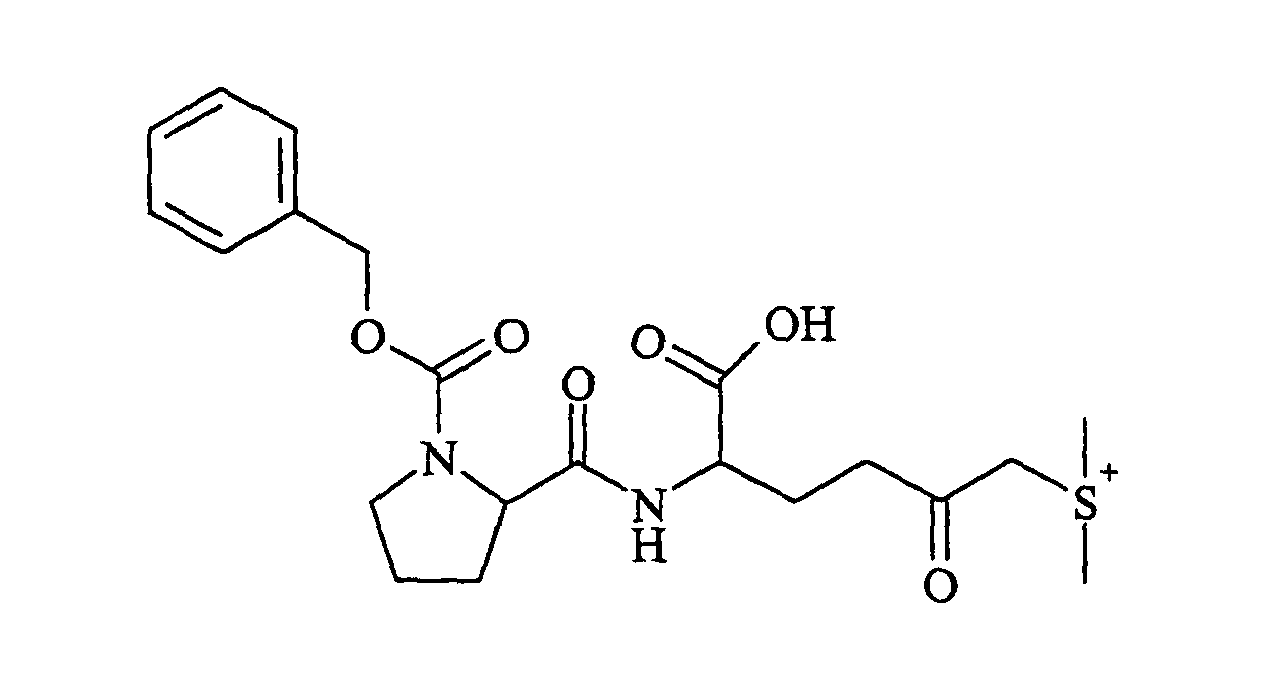
- A compound according to Claim 1 having the following formula:

- A compound according to Claim 1 having the following formula:

- A compound according to Claim 1 having the following formula:

- A compound according to Claim 1 having the following formula:

- A compound according to Claim 1 having the following formula:

- A compound according to Claim 1 having the following formula:

- A compound according to Claim 1 having the following formula:

- A compound according to Claim 1 having the following formula:

- A compound according to Claim 1 having the following formula:

- A compound according to Claim 1 having the following formula:

- A compound according to any one of Claims 1 to 27 in the form of a bromide salt.
- A pharmaceutical formulation comprising a compound according to any one of Claims 1 to 28 and a pharmaceutically acceptable carrier.
- A method for making a compound according to any one of Claims 1 to 28 comprising the following steps:(a) reacting an N-α-protected (e.g. CBZ, FMOC or BOC protected) amino acid N-hydroxy-succinimide or para-nitrophenyl ester with 6-diazo-5-oxo-L-norleucine, and treating the resulting coupled product with hydrogen bromide; and(b) reacting the bromomethyl ketone produced in step (a) with dimethyl sulphide, diethyl sulphide or 1,3,4,5-tetra-methyl mercapto-imidazoline-2-thione.
- A method according to Claim 30 wherein the N-α-protected amino acid N-hydroxysuccinimide ester is CBZ, FMOC or BOC protected.
- A method according to Claim 30 or 31 wherein step (a) comprises reacting an N-α-protected amino acid N-hydroxy-succinimide or para-nitrophenyl ester with 6-diazo-5-oxo-L-norleucine in the presence of tetrahydrofuran (THF), water and triethylamine followed by reacting the products thereof with hydrogen bromide in the presence of ethyl acetate.
- A method according to Claim 31 or 32 wherein the N-α-CBZ-protected amino acid N-hydroxy-succinimide ester is selected from the group consisting of N-α-CBZ-L-phenylalanine N-hydroxy-succinimide ester, N-α-CBZ-L-glutamine N-hydroxy-succinimide ester, N-α-CBZ-L-isoleucine N-hydroxy-succinimide ester, N-α-CBZ-L-alaninal N-hydroxy-succinimide ester, N-α-CBZ-L-glycine N-hydroxysuccinimide ester, N-α-CBZ-L-proline N-hydroxy-succinimide ester, N-α-CBZ-L-serine N-hydroxysuccinimide ester, N-α-CBZ-L-tyrosine N-hydroxysuccinimide ester, N-α-CBZ-L-glutamic acid N-hydroxysuccinimide ester, N-α-CBZ-L-lysine N-hydroxysuccinimide ester and N-α-CBZ-L-tyrosine para-nitrophenyl ester.
- A compound according to any one of Claims 1 to 28 for use in medicine.
- Use of a compound according to any one of Claims 1 to 28 in the preparation of a medicament for inhibiting a transglutaminase
- The use according to Claim 35 wherein the transglutaminase is a tissue transglutaminase.
- The use according to Claim 35 or 36 wherein the medicament is for treating a disease/disorder selected from the group consisting of fibrosis, scarring, neurodegenerative diseases, autoimmune diseases, thrombosis, proliferative disorders, AIDS, psoriasis and inflammation (such as chronic inflammatory diseases).
- The use according to any one of Claims 35 to 37 wherein the medicament is for treating cancer.
- The use according to any one of Claims 35 to 37 wherein the medicament is for treating fibrosis and/or scarring.
- The use according to Claim 39 wherein the medicament is for treating renal scarring.
- Use of a compound according to any one of Claims 1 to 28 in the preparation of a medicament for preventing or treating rejection of a transplanted organ.
- A use according to Claim 41 wherein the organ is a heart, lung, kidney or liver.
- A use according to Claim 41 or 42 wherein the organ is treated prior to transplantation.
- A use according to any one of Claims 41 to 43 wherein the organ is treated during and/or after transplantation into a patient.
Priority Applications (1)
| Application Number | Priority Date | Filing Date | Title |
|---|---|---|---|
| PL04736919T PL1648924T3 (en) | 2003-06-19 | 2004-06-16 | Dipeptide transglutaminase inhibitors and methods of using the same |
Applications Claiming Priority (2)
| Application Number | Priority Date | Filing Date | Title |
|---|---|---|---|
| GBGB0314262.7A GB0314262D0 (en) | 2003-06-19 | 2003-06-19 | Novel compounds and methods of using the same |
| PCT/GB2004/002569 WO2004113363A2 (en) | 2003-06-19 | 2004-06-16 | Dipeptide transglutaminase inhibitors and methods of using the same |
Publications (2)
| Publication Number | Publication Date |
|---|---|
| EP1648924A2 EP1648924A2 (en) | 2006-04-26 |
| EP1648924B1 true EP1648924B1 (en) | 2008-07-30 |
Family
ID=27636894
Family Applications (1)
| Application Number | Title | Priority Date | Filing Date |
|---|---|---|---|
| EP04736919A Expired - Lifetime EP1648924B1 (en) | 2003-06-19 | 2004-06-16 | Dipeptide transglutaminase inhibitors and methods of using the same |
Country Status (9)
| Country | Link |
|---|---|
| US (1) | US7723307B2 (en) |
| EP (1) | EP1648924B1 (en) |
| AT (1) | ATE402949T1 (en) |
| CA (1) | CA2529938A1 (en) |
| DE (1) | DE602004015464D1 (en) |
| ES (1) | ES2314402T3 (en) |
| GB (1) | GB0314262D0 (en) |
| PL (1) | PL1648924T3 (en) |
| WO (1) | WO2004113363A2 (en) |
Families Citing this family (10)
| Publication number | Priority date | Publication date | Assignee | Title |
|---|---|---|---|---|
| GB0515003D0 (en) | 2005-07-21 | 2005-08-31 | Univ Aston | Medical devices and coatings therefor |
| GB2490547A (en) * | 2011-05-06 | 2012-11-07 | Univ Aston | Tissue transglutaminase inhibitors for use in the treatment of angiogenesis |
| PT2794618T (en) | 2011-12-20 | 2017-01-17 | Sanofi Sa | Isothiazolopyridine-2-carboxamides and their use as pharmaceuticals |
| GB201209096D0 (en) | 2012-05-24 | 2012-07-04 | Medical Res Council Technology | Compounds |
| CA2994165A1 (en) * | 2015-07-31 | 2017-02-09 | The Johns Hopkins University | Methods for cancer and immunotherapy using glutamine analogues, including don |
| DK3328827T3 (en) * | 2015-07-31 | 2023-10-02 | Univ Johns Hopkins | PRODUCTION OF GLUTAMINE ANALOGUES |
| US10842763B2 (en) | 2015-07-31 | 2020-11-24 | The Johns Hopkins University | Methods for cancer and immunotherapy using prodrugs of glutamine analogs |
| CN106074488B (en) * | 2016-06-08 | 2018-07-27 | 天津大学 | Benzene methoxycarbonyl group-Pidolidone is in the purposes for preparing BLyS antagonists |
| EP3924330A4 (en) | 2019-02-11 | 2022-11-09 | Dracen Pharmaceuticals, Inc. | Method of preparing a don prodrug from l-glutamic acid |
| CN116601140A (en) | 2020-10-02 | 2023-08-15 | 羿尊生物医药股份有限公司 | For subcutaneous administration containing (S)-2-((S)-2-acetylamino-3-(1H-indol-3-yl)propionylamino)-6-diazo-5-oxohexyl Freeze-dried composition of isopropyl ester and use thereof |
Family Cites Families (6)
| Publication number | Priority date | Publication date | Assignee | Title |
|---|---|---|---|---|
| US4912120A (en) * | 1986-03-14 | 1990-03-27 | Syntex (U.S.A.) Inc. | 3,5-substituted 4,5-dihydroisoxazoles as transglutaminase inhibitors |
| US4968713A (en) * | 1989-07-31 | 1990-11-06 | Merck & Co., Inc. | Certain imidazole compounds as transglutaminase inhibitors |
| US5077285A (en) * | 1989-07-31 | 1991-12-31 | Merck & Co., Inc. | Imidazole compounds and their use as transglutaminase inhibitors |
| WO1994010296A1 (en) * | 1992-11-03 | 1994-05-11 | Oklahoma Medical Research Foundation | Transglutaminase gene |
| ES2193615T3 (en) | 1995-10-25 | 2003-11-01 | Senju Pharma Co | .NIVER OF ANGIOGENESIS. |
| JP2002501532A (en) | 1997-05-30 | 2002-01-15 | メルク エンド カンパニー インコーポレーテッド | Novel angiogenesis inhibitors |
-
2003
- 2003-06-19 GB GBGB0314262.7A patent/GB0314262D0/en not_active Ceased
-
2004
- 2004-06-16 PL PL04736919T patent/PL1648924T3/en unknown
- 2004-06-16 DE DE602004015464T patent/DE602004015464D1/en not_active Expired - Lifetime
- 2004-06-16 US US10/561,425 patent/US7723307B2/en not_active Expired - Fee Related
- 2004-06-16 WO PCT/GB2004/002569 patent/WO2004113363A2/en not_active Ceased
- 2004-06-16 ES ES04736919T patent/ES2314402T3/en not_active Expired - Lifetime
- 2004-06-16 AT AT04736919T patent/ATE402949T1/en not_active IP Right Cessation
- 2004-06-16 EP EP04736919A patent/EP1648924B1/en not_active Expired - Lifetime
- 2004-06-16 CA CA002529938A patent/CA2529938A1/en not_active Abandoned
Also Published As
| Publication number | Publication date |
|---|---|
| GB0314262D0 (en) | 2003-07-23 |
| PL1648924T3 (en) | 2009-05-29 |
| EP1648924A2 (en) | 2006-04-26 |
| ATE402949T1 (en) | 2008-08-15 |
| WO2004113363A3 (en) | 2005-02-24 |
| CA2529938A1 (en) | 2004-12-29 |
| WO2004113363A2 (en) | 2004-12-29 |
| DE602004015464D1 (en) | 2008-09-11 |
| ES2314402T3 (en) | 2009-03-16 |
| US7723307B2 (en) | 2010-05-25 |
| US20080200511A1 (en) | 2008-08-21 |
Similar Documents
| Publication | Publication Date | Title |
|---|---|---|
| US5677297A (en) | Benzazepine-, benzoxazepine- and benzothiazepine-n-acetic acid derivatives, process for their preparation and pharmaceutical compositions containing them | |
| US6492402B1 (en) | Thrombin inhibitors | |
| SK23394A3 (en) | New isosteric peptides | |
| SK282529B6 (en) | The mercaptoalkanoyl and acylmercaptoalkanoyl derivatives of oxazepine, thiazine and thiazepine, a process for its preparation, an intermediate for its manufacture and a pharmaceutical composition containing it | |
| HU226979B1 (en) | Bicyclic lactam inhibitor of interleukin-1-beta converting enzyme and pharmaceutical compositions containing them | |
| US7723307B2 (en) | Amino acid derivatives and pharmaceutical uses thereof | |
| US4499079A (en) | Carboxy and substituted carboxy alkanoyl and cycloalkanoyl peptides | |
| HU211943A9 (en) | Trifluoromethylketone derivatives, processes for preparation thereof and use thereof | |
| US5206343A (en) | Oligopetides with cyclic proline-analogous amino acids | |
| WO1995007291A1 (en) | Kininogen inhibitors | |
| EP0313969B1 (en) | Tripeptide derivatives and antiplasmin agents containing the same | |
| WO2019099481A1 (en) | Deuterated tetrapeptides that target mitochondria | |
| EP0206807A2 (en) | Novel amino acid derivatives | |
| PT1157040E (en) | Low molecular weight peptide derivatives as inhibitors of the laminin/nidogen interaction | |
| WO2012153125A1 (en) | Novel compounds and methods for use in medicine | |
| US10092620B2 (en) | Uses of cyclic peptides for treating and preventing atherosclerosis | |
| CA2022111A1 (en) | Imidazole compounds and their use as transglutaminase inhibitors | |
| RU2312856C2 (en) | Peptidylarginals and methods for treatment of disseminated intravascular coagulation syndrome | |
| WO2024092154A1 (en) | Methods and compositions for the treatment of neurodegenerative disease | |
| AU2002331654A1 (en) | Peptide arginals and methods for treating disseminated intravascular coagulation | |
| PT96325A (en) | METHOD FOR PREPARING NEW AMIDES WITH INHIBITORY ACTION OF RENIN AND PHARMACEUTICAL COMPOSITIONS CONTAINING THEM | |
| NO300504B1 (en) | Compound and therapeutic composition comprising this |
Legal Events
| Date | Code | Title | Description |
|---|---|---|---|
| PUAI | Public reference made under article 153(3) epc to a published international application that has entered the european phase |
Free format text: ORIGINAL CODE: 0009012 |
|
| 17P | Request for examination filed |
Effective date: 20060112 |
|
| AK | Designated contracting states |
Kind code of ref document: A2 Designated state(s): AT BE BG CH CY CZ DE DK EE ES FI FR GB GR HU IE IT LI LU MC NL PL PT RO SE SI SK TR |
|
| DAX | Request for extension of the european patent (deleted) | ||
| RAP1 | Party data changed (applicant data changed or rights of an application transferred) |
Owner name: ASTON UNIVERSITY |
|
| GRAP | Despatch of communication of intention to grant a patent |
Free format text: ORIGINAL CODE: EPIDOSNIGR1 |
|
| GRAS | Grant fee paid |
Free format text: ORIGINAL CODE: EPIDOSNIGR3 |
|
| GRAA | (expected) grant |
Free format text: ORIGINAL CODE: 0009210 |
|
| RIN1 | Information on inventor provided before grant (corrected) |
Inventor name: GRIFFIN, MARTIN,SCHOOL OF LIFE & HEALTH SCIENCES Inventor name: COUTTS, IAN G.,THE NOTTINGHAM TRENT UNIVERSITY Inventor name: SAINT, ROBERT E.,THE NOTTINGHAM TRENT UNIVERSITY |
|
| AK | Designated contracting states |
Kind code of ref document: B1 Designated state(s): AT BE BG CH CY CZ DE DK EE ES FI FR GB GR HU IE IT LI LU MC NL PL PT RO SE SI SK TR |
|
| REG | Reference to a national code |
Ref country code: GB Ref legal event code: FG4D |
|
| REG | Reference to a national code |
Ref country code: CH Ref legal event code: EP |
|
| REG | Reference to a national code |
Ref country code: CH Ref legal event code: NV Representative=s name: KIRKER & CIE S.A. |
|
| REF | Corresponds to: |
Ref document number: 602004015464 Country of ref document: DE Date of ref document: 20080911 Kind code of ref document: P |
|
| REG | Reference to a national code |
Ref country code: IE Ref legal event code: FG4D |
|
| REG | Reference to a national code |
Ref country code: SE Ref legal event code: TRGR |
|
| PG25 | Lapsed in a contracting state [announced via postgrant information from national office to epo] |
Ref country code: NL Free format text: LAPSE BECAUSE OF FAILURE TO SUBMIT A TRANSLATION OF THE DESCRIPTION OR TO PAY THE FEE WITHIN THE PRESCRIBED TIME-LIMIT Effective date: 20080730 Ref country code: PT Free format text: LAPSE BECAUSE OF FAILURE TO SUBMIT A TRANSLATION OF THE DESCRIPTION OR TO PAY THE FEE WITHIN THE PRESCRIBED TIME-LIMIT Effective date: 20081230 |
|
| PG25 | Lapsed in a contracting state [announced via postgrant information from national office to epo] |
Ref country code: SI Free format text: LAPSE BECAUSE OF FAILURE TO SUBMIT A TRANSLATION OF THE DESCRIPTION OR TO PAY THE FEE WITHIN THE PRESCRIBED TIME-LIMIT Effective date: 20080730 Ref country code: FI Free format text: LAPSE BECAUSE OF FAILURE TO SUBMIT A TRANSLATION OF THE DESCRIPTION OR TO PAY THE FEE WITHIN THE PRESCRIBED TIME-LIMIT Effective date: 20080730 Ref country code: AT Free format text: LAPSE BECAUSE OF FAILURE TO SUBMIT A TRANSLATION OF THE DESCRIPTION OR TO PAY THE FEE WITHIN THE PRESCRIBED TIME-LIMIT Effective date: 20080730 Ref country code: BG Free format text: LAPSE BECAUSE OF FAILURE TO SUBMIT A TRANSLATION OF THE DESCRIPTION OR TO PAY THE FEE WITHIN THE PRESCRIBED TIME-LIMIT Effective date: 20081030 |
|
| REG | Reference to a national code |
Ref country code: ES Ref legal event code: FG2A Ref document number: 2314402 Country of ref document: ES Kind code of ref document: T3 |
|
| PG25 | Lapsed in a contracting state [announced via postgrant information from national office to epo] |
Ref country code: BE Free format text: LAPSE BECAUSE OF FAILURE TO SUBMIT A TRANSLATION OF THE DESCRIPTION OR TO PAY THE FEE WITHIN THE PRESCRIBED TIME-LIMIT Effective date: 20080730 |
|
| PG25 | Lapsed in a contracting state [announced via postgrant information from national office to epo] |
Ref country code: DK Free format text: LAPSE BECAUSE OF FAILURE TO SUBMIT A TRANSLATION OF THE DESCRIPTION OR TO PAY THE FEE WITHIN THE PRESCRIBED TIME-LIMIT Effective date: 20080730 Ref country code: EE Free format text: LAPSE BECAUSE OF FAILURE TO SUBMIT A TRANSLATION OF THE DESCRIPTION OR TO PAY THE FEE WITHIN THE PRESCRIBED TIME-LIMIT Effective date: 20080730 |
|
| PG25 | Lapsed in a contracting state [announced via postgrant information from national office to epo] |
Ref country code: RO Free format text: LAPSE BECAUSE OF FAILURE TO SUBMIT A TRANSLATION OF THE DESCRIPTION OR TO PAY THE FEE WITHIN THE PRESCRIBED TIME-LIMIT Effective date: 20080730 Ref country code: CZ Free format text: LAPSE BECAUSE OF FAILURE TO SUBMIT A TRANSLATION OF THE DESCRIPTION OR TO PAY THE FEE WITHIN THE PRESCRIBED TIME-LIMIT Effective date: 20080730 Ref country code: SK Free format text: LAPSE BECAUSE OF FAILURE TO SUBMIT A TRANSLATION OF THE DESCRIPTION OR TO PAY THE FEE WITHIN THE PRESCRIBED TIME-LIMIT Effective date: 20080730 |
|
| REG | Reference to a national code |
Ref country code: PL Ref legal event code: T3 |
|
| PLBE | No opposition filed within time limit |
Free format text: ORIGINAL CODE: 0009261 |
|
| STAA | Information on the status of an ep patent application or granted ep patent |
Free format text: STATUS: NO OPPOSITION FILED WITHIN TIME LIMIT |
|
| 26N | No opposition filed |
Effective date: 20090506 |
|
| PGFP | Annual fee paid to national office [announced via postgrant information from national office to epo] |
Ref country code: IT Payment date: 20090616 Year of fee payment: 6 Ref country code: PL Payment date: 20090513 Year of fee payment: 6 Ref country code: SE Payment date: 20090605 Year of fee payment: 6 |
|
| PGFP | Annual fee paid to national office [announced via postgrant information from national office to epo] |
Ref country code: ES Payment date: 20090709 Year of fee payment: 6 |
|
| PG25 | Lapsed in a contracting state [announced via postgrant information from national office to epo] |
Ref country code: MC Free format text: LAPSE BECAUSE OF NON-PAYMENT OF DUE FEES Effective date: 20090630 |
|
| PG25 | Lapsed in a contracting state [announced via postgrant information from national office to epo] |
Ref country code: GR Free format text: LAPSE BECAUSE OF FAILURE TO SUBMIT A TRANSLATION OF THE DESCRIPTION OR TO PAY THE FEE WITHIN THE PRESCRIBED TIME-LIMIT Effective date: 20081031 |
|
| EUG | Se: european patent has lapsed | ||
| PG25 | Lapsed in a contracting state [announced via postgrant information from national office to epo] |
Ref country code: IT Free format text: LAPSE BECAUSE OF NON-PAYMENT OF DUE FEES Effective date: 20100616 |
|
| PG25 | Lapsed in a contracting state [announced via postgrant information from national office to epo] |
Ref country code: LU Free format text: LAPSE BECAUSE OF NON-PAYMENT OF DUE FEES Effective date: 20090616 |
|
| PG25 | Lapsed in a contracting state [announced via postgrant information from national office to epo] |
Ref country code: HU Free format text: LAPSE BECAUSE OF FAILURE TO SUBMIT A TRANSLATION OF THE DESCRIPTION OR TO PAY THE FEE WITHIN THE PRESCRIBED TIME-LIMIT Effective date: 20090131 |
|
| REG | Reference to a national code |
Ref country code: ES Ref legal event code: FD2A Effective date: 20110715 |
|
| PG25 | Lapsed in a contracting state [announced via postgrant information from national office to epo] |
Ref country code: ES Free format text: LAPSE BECAUSE OF NON-PAYMENT OF DUE FEES Effective date: 20110705 |
|
| PG25 | Lapsed in a contracting state [announced via postgrant information from national office to epo] |
Ref country code: TR Free format text: LAPSE BECAUSE OF FAILURE TO SUBMIT A TRANSLATION OF THE DESCRIPTION OR TO PAY THE FEE WITHIN THE PRESCRIBED TIME-LIMIT Effective date: 20080730 |
|
| PG25 | Lapsed in a contracting state [announced via postgrant information from national office to epo] |
Ref country code: ES Free format text: LAPSE BECAUSE OF NON-PAYMENT OF DUE FEES Effective date: 20100617 Ref country code: CY Free format text: LAPSE BECAUSE OF FAILURE TO SUBMIT A TRANSLATION OF THE DESCRIPTION OR TO PAY THE FEE WITHIN THE PRESCRIBED TIME-LIMIT Effective date: 20080730 |
|
| PG25 | Lapsed in a contracting state [announced via postgrant information from national office to epo] |
Ref country code: PL Free format text: LAPSE BECAUSE OF NON-PAYMENT OF DUE FEES Effective date: 20100616 |
|
| REG | Reference to a national code |
Ref country code: PL Ref legal event code: LAPE |
|
| PGFP | Annual fee paid to national office [announced via postgrant information from national office to epo] |
Ref country code: IE Payment date: 20120612 Year of fee payment: 9 |
|
| PG25 | Lapsed in a contracting state [announced via postgrant information from national office to epo] |
Ref country code: SE Free format text: LAPSE BECAUSE OF NON-PAYMENT OF DUE FEES Effective date: 20100617 |
|
| REG | Reference to a national code |
Ref country code: IE Ref legal event code: MM4A |
|
| PG25 | Lapsed in a contracting state [announced via postgrant information from national office to epo] |
Ref country code: IE Free format text: LAPSE BECAUSE OF NON-PAYMENT OF DUE FEES Effective date: 20130616 |
|
| REG | Reference to a national code |
Ref country code: FR Ref legal event code: PLFP Year of fee payment: 13 |
|
| PGFP | Annual fee paid to national office [announced via postgrant information from national office to epo] |
Ref country code: DE Payment date: 20160614 Year of fee payment: 13 Ref country code: GB Payment date: 20160615 Year of fee payment: 13 Ref country code: CH Payment date: 20160629 Year of fee payment: 13 |
|
| PGFP | Annual fee paid to national office [announced via postgrant information from national office to epo] |
Ref country code: FR Payment date: 20160628 Year of fee payment: 13 |
|
| REG | Reference to a national code |
Ref country code: DE Ref legal event code: R119 Ref document number: 602004015464 Country of ref document: DE |
|
| REG | Reference to a national code |
Ref country code: CH Ref legal event code: PL |
|
| GBPC | Gb: european patent ceased through non-payment of renewal fee |
Effective date: 20170616 |
|
| REG | Reference to a national code |
Ref country code: FR Ref legal event code: ST Effective date: 20180228 |
|
| PG25 | Lapsed in a contracting state [announced via postgrant information from national office to epo] |
Ref country code: CH Free format text: LAPSE BECAUSE OF NON-PAYMENT OF DUE FEES Effective date: 20170630 Ref country code: LI Free format text: LAPSE BECAUSE OF NON-PAYMENT OF DUE FEES Effective date: 20170630 Ref country code: DE Free format text: LAPSE BECAUSE OF NON-PAYMENT OF DUE FEES Effective date: 20180103 Ref country code: GB Free format text: LAPSE BECAUSE OF NON-PAYMENT OF DUE FEES Effective date: 20170616 |
|
| PG25 | Lapsed in a contracting state [announced via postgrant information from national office to epo] |
Ref country code: FR Free format text: LAPSE BECAUSE OF NON-PAYMENT OF DUE FEES Effective date: 20170630 |