EP1648896B1 - 7-substituted 3-nitro-pyrazolo [1,5-a] pyrimidines - Google Patents
7-substituted 3-nitro-pyrazolo [1,5-a] pyrimidines Download PDFInfo
- Publication number
- EP1648896B1 EP1648896B1 EP04741222A EP04741222A EP1648896B1 EP 1648896 B1 EP1648896 B1 EP 1648896B1 EP 04741222 A EP04741222 A EP 04741222A EP 04741222 A EP04741222 A EP 04741222A EP 1648896 B1 EP1648896 B1 EP 1648896B1
- Authority
- EP
- European Patent Office
- Prior art keywords
- phenyl
- nitro
- pyrazolo
- pyrimidin
- alkyl
- Prior art date
- Legal status (The legal status is an assumption and is not a legal conclusion. Google has not performed a legal analysis and makes no representation as to the accuracy of the status listed.)
- Expired - Lifetime
Links
- -1 7-substituted 3-nitro-pyrazolo [1,5-a] pyrimidines Chemical class 0.000 title claims abstract description 20
- 125000000217 alkyl group Chemical group 0.000 claims abstract description 36
- 125000001997 phenyl group Chemical group [H]C1=C([H])C([H])=C(*)C([H])=C1[H] 0.000 claims abstract description 21
- 150000003839 salts Chemical class 0.000 claims abstract description 21
- 125000000753 cycloalkyl group Chemical group 0.000 claims abstract description 17
- 125000001072 heteroaryl group Chemical group 0.000 claims abstract description 14
- 125000003545 alkoxy group Chemical group 0.000 claims abstract description 11
- 125000000304 alkynyl group Chemical group 0.000 claims abstract description 7
- 125000003118 aryl group Chemical group 0.000 claims abstract description 7
- 125000002541 furyl group Chemical group 0.000 claims abstract description 7
- 125000004076 pyridyl group Chemical group 0.000 claims abstract description 7
- 125000000335 thiazolyl group Chemical group 0.000 claims abstract description 7
- 125000001544 thienyl group Chemical group 0.000 claims abstract description 7
- 125000003342 alkenyl group Chemical group 0.000 claims abstract description 6
- RQOQEROSNVPEBI-UHFFFAOYSA-N n-ethyl-n-[3-(3-nitropyrazolo[1,5-a]pyrimidin-7-yl)phenyl]methanesulfonamide Chemical compound CCN(S(C)(=O)=O)C1=CC=CC(C=2N3N=CC(=C3N=CC=2)[N+]([O-])=O)=C1 RQOQEROSNVPEBI-UHFFFAOYSA-N 0.000 claims abstract description 5
- 125000002971 oxazolyl group Chemical group 0.000 claims abstract description 4
- 229910052760 oxygen Inorganic materials 0.000 claims abstract description 4
- 125000000714 pyrimidinyl group Chemical group 0.000 claims abstract description 4
- 229910052717 sulfur Inorganic materials 0.000 claims abstract description 4
- 125000004306 triazinyl group Chemical group 0.000 claims abstract description 4
- 150000001875 compounds Chemical class 0.000 claims description 77
- JWGYPTNGYXOXPV-UHFFFAOYSA-N 4-nitro-1h-pyrazol-5-amine Chemical compound NC=1NN=CC=1[N+]([O-])=O JWGYPTNGYXOXPV-UHFFFAOYSA-N 0.000 claims description 42
- 239000000203 mixture Substances 0.000 claims description 31
- 229910052739 hydrogen Inorganic materials 0.000 claims description 14
- 208000013738 Sleep Initiation and Maintenance disease Diseases 0.000 claims description 13
- 239000001257 hydrogen Substances 0.000 claims description 13
- 125000004435 hydrogen atom Chemical group [H]* 0.000 claims description 13
- 125000002496 methyl group Chemical group [H]C([H])([H])* 0.000 claims description 12
- 206010022437 insomnia Diseases 0.000 claims description 11
- 201000010099 disease Diseases 0.000 claims description 10
- 208000037265 diseases, disorders, signs and symptoms Diseases 0.000 claims description 10
- 125000001495 ethyl group Chemical group [H]C([H])([H])C([H])([H])* 0.000 claims description 10
- 125000004108 n-butyl group Chemical group [H]C([H])([H])C([H])([H])C([H])([H])C([H])([H])* 0.000 claims description 10
- 125000004123 n-propyl group Chemical group [H]C([H])([H])C([H])([H])C([H])([H])* 0.000 claims description 10
- 206010039897 Sedation Diseases 0.000 claims description 9
- 230000007958 sleep Effects 0.000 claims description 9
- 238000000034 method Methods 0.000 claims description 8
- 125000001449 isopropyl group Chemical group [H]C([H])([H])C([H])(*)C([H])([H])[H] 0.000 claims description 7
- 208000019901 Anxiety disease Diseases 0.000 claims description 6
- 206010021118 Hypotonia Diseases 0.000 claims description 6
- 230000036506 anxiety Effects 0.000 claims description 6
- 125000001559 cyclopropyl group Chemical group [H]C1([H])C([H])([H])C1([H])* 0.000 claims description 6
- 230000036640 muscle relaxation Effects 0.000 claims description 6
- 125000001494 2-propynyl group Chemical group [H]C#CC([H])([H])* 0.000 claims description 5
- 125000004172 4-methoxyphenyl group Chemical group [H]C1=C([H])C(OC([H])([H])[H])=C([H])C([H])=C1* 0.000 claims description 5
- 239000003814 drug Substances 0.000 claims description 5
- ANJDNYOULHETFG-UHFFFAOYSA-N 1-[3-(3-nitropyrazolo[1,5-a]pyrimidin-7-yl)phenyl]pyrrolidin-2-one Chemical compound C=1C=NC2=C([N+](=O)[O-])C=NN2C=1C(C=1)=CC=CC=1N1CCCC1=O ANJDNYOULHETFG-UHFFFAOYSA-N 0.000 claims description 4
- VDLAQSNXOCWCBC-UHFFFAOYSA-N 3-nitro-7-[2-(trifluoromethyl)phenyl]pyrazolo[1,5-a]pyrimidine Chemical compound C=1C=NC2=C([N+](=O)[O-])C=NN2C=1C1=CC=CC=C1C(F)(F)F VDLAQSNXOCWCBC-UHFFFAOYSA-N 0.000 claims description 4
- SGHZHHURRAVYMJ-UHFFFAOYSA-N 3-nitro-7-[3-(trifluoromethyl)phenyl]pyrazolo[1,5-a]pyrimidine Chemical compound C=1C=NC2=C([N+](=O)[O-])C=NN2C=1C1=CC=CC(C(F)(F)F)=C1 SGHZHHURRAVYMJ-UHFFFAOYSA-N 0.000 claims description 4
- OQDSTHYCKSRXJE-UHFFFAOYSA-N 3-nitro-7-[4-(trifluoromethyl)phenyl]pyrazolo[1,5-a]pyrimidine Chemical compound C=1C=NC2=C([N+](=O)[O-])C=NN2C=1C1=CC=C(C(F)(F)F)C=C1 OQDSTHYCKSRXJE-UHFFFAOYSA-N 0.000 claims description 4
- JQUNKDYABYWJMD-UHFFFAOYSA-N 3-nitro-7-phenylpyrazolo[1,5-a]pyrimidine Chemical compound C=1C=NC2=C([N+](=O)[O-])C=NN2C=1C1=CC=CC=C1 JQUNKDYABYWJMD-UHFFFAOYSA-N 0.000 claims description 4
- BSKRDHJSCGPYHC-UHFFFAOYSA-N 3-nitro-7-pyridin-2-ylpyrazolo[1,5-a]pyrimidine Chemical compound C=1C=NC2=C([N+](=O)[O-])C=NN2C=1C1=CC=CC=N1 BSKRDHJSCGPYHC-UHFFFAOYSA-N 0.000 claims description 4
- GQJYSOZASNUIJM-UHFFFAOYSA-N 3-nitro-7-pyridin-3-ylpyrazolo[1,5-a]pyrimidine Chemical compound C=1C=NC2=C([N+](=O)[O-])C=NN2C=1C1=CC=CN=C1 GQJYSOZASNUIJM-UHFFFAOYSA-N 0.000 claims description 4
- BWBQUMHXNLYBPX-UHFFFAOYSA-N 3-nitro-7-pyridin-4-ylpyrazolo[1,5-a]pyrimidine Chemical compound C=1C=NC2=C([N+](=O)[O-])C=NN2C=1C1=CC=NC=C1 BWBQUMHXNLYBPX-UHFFFAOYSA-N 0.000 claims description 4
- LWMWOVOYJMKBLA-UHFFFAOYSA-N 3-nitro-7-thiophen-2-ylpyrazolo[1,5-a]pyrimidine Chemical compound C=1C=NC2=C([N+](=O)[O-])C=NN2C=1C1=CC=CS1 LWMWOVOYJMKBLA-UHFFFAOYSA-N 0.000 claims description 4
- KSUDOYVYUOKBGP-UHFFFAOYSA-N 4-methoxy-n-[3-(3-nitropyrazolo[1,5-a]pyrimidin-7-yl)phenyl]-n-propylbenzenesulfonamide Chemical compound C=1C=CC(C=2N3N=CC(=C3N=CC=2)[N+]([O-])=O)=CC=1N(CCC)S(=O)(=O)C1=CC=C(OC)C=C1 KSUDOYVYUOKBGP-UHFFFAOYSA-N 0.000 claims description 4
- VBMXULMQUSOTQP-UHFFFAOYSA-N 4-methoxy-n-methyl-n-[3-(3-nitropyrazolo[1,5-a]pyrimidin-7-yl)phenyl]benzenesulfonamide Chemical compound C1=CC(OC)=CC=C1S(=O)(=O)N(C)C1=CC=CC(C=2N3N=CC(=C3N=CC=2)[N+]([O-])=O)=C1 VBMXULMQUSOTQP-UHFFFAOYSA-N 0.000 claims description 4
- YBJIMPJNWYGNEO-UHFFFAOYSA-N 7-(furan-2-yl)-3-nitropyrazolo[1,5-a]pyrimidine Chemical compound C=1C=NC2=C([N+](=O)[O-])C=NN2C=1C1=CC=CO1 YBJIMPJNWYGNEO-UHFFFAOYSA-N 0.000 claims description 4
- 206010002091 Anaesthesia Diseases 0.000 claims description 4
- 230000037005 anaesthesia Effects 0.000 claims description 4
- 206010015037 epilepsy Diseases 0.000 claims description 4
- 230000001939 inductive effect Effects 0.000 claims description 4
- JADSDQRFVKGFSK-UHFFFAOYSA-N n-[3-(3-nitropyrazolo[1,5-a]pyrimidin-7-yl)phenyl]-n-prop-2-ynylmethanesulfonamide Chemical compound C#CCN(S(=O)(=O)C)C1=CC=CC(C=2N3N=CC(=C3N=CC=2)[N+]([O-])=O)=C1 JADSDQRFVKGFSK-UHFFFAOYSA-N 0.000 claims description 4
- IVMXYYGNLUTVAX-UHFFFAOYSA-N n-[3-(3-nitropyrazolo[1,5-a]pyrimidin-7-yl)phenyl]-n-prop-2-ynylpropane-2-sulfonamide Chemical compound CC(C)S(=O)(=O)N(CC#C)C1=CC=CC(C=2N3N=CC(=C3N=CC=2)[N+]([O-])=O)=C1 IVMXYYGNLUTVAX-UHFFFAOYSA-N 0.000 claims description 4
- JGLMOIWGDOVJPI-UHFFFAOYSA-N n-[3-(3-nitropyrazolo[1,5-a]pyrimidin-7-yl)phenyl]-n-propylacetamide Chemical compound CCCN(C(C)=O)C1=CC=CC(C=2N3N=CC(=C3N=CC=2)[N+]([O-])=O)=C1 JGLMOIWGDOVJPI-UHFFFAOYSA-N 0.000 claims description 4
- ULUSSLBTEFSPFN-UHFFFAOYSA-N n-[3-(3-nitropyrazolo[1,5-a]pyrimidin-7-yl)phenyl]-n-propylbenzenesulfonamide Chemical compound C=1C=CC(C=2N3N=CC(=C3N=CC=2)[N+]([O-])=O)=CC=1N(CCC)S(=O)(=O)C1=CC=CC=C1 ULUSSLBTEFSPFN-UHFFFAOYSA-N 0.000 claims description 4
- AYAHJXWWEGVSSZ-UHFFFAOYSA-N n-[3-(3-nitropyrazolo[1,5-a]pyrimidin-7-yl)phenyl]-n-propylethanesulfonamide Chemical compound CCCN(S(=O)(=O)CC)C1=CC=CC(C=2N3N=CC(=C3N=CC=2)[N+]([O-])=O)=C1 AYAHJXWWEGVSSZ-UHFFFAOYSA-N 0.000 claims description 4
- GZXBONKYCDYRTF-UHFFFAOYSA-N n-[3-(3-nitropyrazolo[1,5-a]pyrimidin-7-yl)phenyl]-n-propylmethanesulfonamide Chemical compound CCCN(S(C)(=O)=O)C1=CC=CC(C=2N3N=CC(=C3N=CC=2)[N+]([O-])=O)=C1 GZXBONKYCDYRTF-UHFFFAOYSA-N 0.000 claims description 4
- MOYBQDVSWCZPDX-UHFFFAOYSA-N n-butyl-4-methoxy-n-[3-(3-nitropyrazolo[1,5-a]pyrimidin-7-yl)phenyl]benzenesulfonamide Chemical compound C=1C=CC(C=2N3N=CC(=C3N=CC=2)[N+]([O-])=O)=CC=1N(CCCC)S(=O)(=O)C1=CC=C(OC)C=C1 MOYBQDVSWCZPDX-UHFFFAOYSA-N 0.000 claims description 4
- LTEAOTFMSAYDAA-UHFFFAOYSA-N n-butyl-n-[3-(3-nitropyrazolo[1,5-a]pyrimidin-7-yl)phenyl]acetamide Chemical compound CCCCN(C(C)=O)C1=CC=CC(C=2N3N=CC(=C3N=CC=2)[N+]([O-])=O)=C1 LTEAOTFMSAYDAA-UHFFFAOYSA-N 0.000 claims description 4
- SGLXDAZFGPLHFE-UHFFFAOYSA-N n-butyl-n-[3-(3-nitropyrazolo[1,5-a]pyrimidin-7-yl)phenyl]benzenesulfonamide Chemical compound C=1C=CC(C=2N3N=CC(=C3N=CC=2)[N+]([O-])=O)=CC=1N(CCCC)S(=O)(=O)C1=CC=CC=C1 SGLXDAZFGPLHFE-UHFFFAOYSA-N 0.000 claims description 4
- QDSYKTWFSCPDET-UHFFFAOYSA-N n-butyl-n-[3-(3-nitropyrazolo[1,5-a]pyrimidin-7-yl)phenyl]ethanesulfonamide Chemical compound CCCCN(S(=O)(=O)CC)C1=CC=CC(C=2N3N=CC(=C3N=CC=2)[N+]([O-])=O)=C1 QDSYKTWFSCPDET-UHFFFAOYSA-N 0.000 claims description 4
- QPFQAVMZFZLBPL-UHFFFAOYSA-N n-butyl-n-[3-(3-nitropyrazolo[1,5-a]pyrimidin-7-yl)phenyl]propane-2-sulfonamide Chemical compound CCCCN(S(=O)(=O)C(C)C)C1=CC=CC(C=2N3N=CC(=C3N=CC=2)[N+]([O-])=O)=C1 QPFQAVMZFZLBPL-UHFFFAOYSA-N 0.000 claims description 4
- YONDXLUEARPVGY-UHFFFAOYSA-N n-ethyl-n-[3-(3-nitropyrazolo[1,5-a]pyrimidin-7-yl)phenyl]acetamide Chemical compound CCN(C(C)=O)C1=CC=CC(C=2N3N=CC(=C3N=CC=2)[N+]([O-])=O)=C1 YONDXLUEARPVGY-UHFFFAOYSA-N 0.000 claims description 4
- LVECDKCYHWOZHX-UHFFFAOYSA-N n-ethyl-n-[3-(3-nitropyrazolo[1,5-a]pyrimidin-7-yl)phenyl]propane-2-sulfonamide Chemical compound CC(C)S(=O)(=O)N(CC)C1=CC=CC(C=2N3N=CC(=C3N=CC=2)[N+]([O-])=O)=C1 LVECDKCYHWOZHX-UHFFFAOYSA-N 0.000 claims description 4
- AFOZMFRIYIZUKW-UHFFFAOYSA-N n-methyl-n-[3-(3-nitropyrazolo[1,5-a]pyrimidin-7-yl)phenyl]acetamide Chemical compound CC(=O)N(C)C1=CC=CC(C=2N3N=CC(=C3N=CC=2)[N+]([O-])=O)=C1 AFOZMFRIYIZUKW-UHFFFAOYSA-N 0.000 claims description 4
- HAEYDNGNLZALQV-UHFFFAOYSA-N n-methyl-n-[3-(3-nitropyrazolo[1,5-a]pyrimidin-7-yl)phenyl]benzenesulfonamide Chemical compound C=1C=CC(C=2N3N=CC(=C3N=CC=2)[N+]([O-])=O)=CC=1N(C)S(=O)(=O)C1=CC=CC=C1 HAEYDNGNLZALQV-UHFFFAOYSA-N 0.000 claims description 4
- IFQTVZIEMVNKNM-UHFFFAOYSA-N n-methyl-n-[3-(3-nitropyrazolo[1,5-a]pyrimidin-7-yl)phenyl]ethanesulfonamide Chemical compound CCS(=O)(=O)N(C)C1=CC=CC(C=2N3N=CC(=C3N=CC=2)[N+]([O-])=O)=C1 IFQTVZIEMVNKNM-UHFFFAOYSA-N 0.000 claims description 4
- UIAFQVLHNXRPJX-UHFFFAOYSA-N n-methyl-n-[3-(3-nitropyrazolo[1,5-a]pyrimidin-7-yl)phenyl]propane-2-sulfonamide Chemical compound CC(C)S(=O)(=O)N(C)C1=CC=CC(C=2N3N=CC(=C3N=CC=2)[N+]([O-])=O)=C1 UIAFQVLHNXRPJX-UHFFFAOYSA-N 0.000 claims description 4
- 208000019116 sleep disease Diseases 0.000 claims description 4
- 238000011282 treatment Methods 0.000 claims description 4
- OWDRNRONVBSLCS-UHFFFAOYSA-N n-[3-(3-nitropyrazolo[1,5-a]pyrimidin-7-yl)phenyl]-n-propylpropane-2-sulfonamide Chemical compound CCCN(S(=O)(=O)C(C)C)C1=CC=CC(C=2N3N=CC(=C3N=CC=2)[N+]([O-])=O)=C1 OWDRNRONVBSLCS-UHFFFAOYSA-N 0.000 claims description 3
- KCSZKOBGLTVVCH-UHFFFAOYSA-N n-butyl-n-[3-(3-nitropyrazolo[1,5-a]pyrimidin-7-yl)phenyl]methanesulfonamide Chemical compound CCCCN(S(C)(=O)=O)C1=CC=CC(C=2N3N=CC(=C3N=CC=2)[N+]([O-])=O)=C1 KCSZKOBGLTVVCH-UHFFFAOYSA-N 0.000 claims description 3
- DWIIKFUNNGGWHW-UHFFFAOYSA-N n-ethyl-n-[3-(3-nitropyrazolo[1,5-a]pyrimidin-7-yl)phenyl]benzenesulfonamide Chemical compound C=1C=CC(C=2N3N=CC(=C3N=CC=2)[N+]([O-])=O)=CC=1N(CC)S(=O)(=O)C1=CC=CC=C1 DWIIKFUNNGGWHW-UHFFFAOYSA-N 0.000 claims description 3
- VMDBRFHVMWRDGM-UHFFFAOYSA-N n-methyl-n-[3-(3-nitropyrazolo[1,5-a]pyrimidin-7-yl)phenyl]methanesulfonamide Chemical compound CS(=O)(=O)N(C)C1=CC=CC(C=2N3N=CC(=C3N=CC=2)[N+]([O-])=O)=C1 VMDBRFHVMWRDGM-UHFFFAOYSA-N 0.000 claims description 3
- 125000006528 (C2-C6) alkyl group Chemical group 0.000 claims description 2
- 125000002941 2-furyl group Chemical group O1C([*])=C([H])C([H])=C1[H] 0.000 claims description 2
- 125000004105 2-pyridyl group Chemical group N1=C([*])C([H])=C([H])C([H])=C1[H] 0.000 claims description 2
- 125000000175 2-thienyl group Chemical group S1C([*])=C([H])C([H])=C1[H] 0.000 claims description 2
- 125000003349 3-pyridyl group Chemical group N1=C([H])C([*])=C([H])C([H])=C1[H] 0.000 claims description 2
- 125000000339 4-pyridyl group Chemical group N1=C([H])C([H])=C([*])C([H])=C1[H] 0.000 claims description 2
- 125000004199 4-trifluoromethylphenyl group Chemical group [H]C1=C([H])C(=C([H])C([H])=C1*)C(F)(F)F 0.000 claims description 2
- 239000002253 acid Substances 0.000 claims description 2
- 238000004519 manufacturing process Methods 0.000 claims description 2
- 125000000956 methoxy group Chemical group [H]C([H])([H])O* 0.000 claims description 2
- 230000008569 process Effects 0.000 claims description 2
- 125000004414 alkyl thio group Chemical group 0.000 claims 1
- 239000012458 free base Substances 0.000 claims 1
- 230000000694 effects Effects 0.000 abstract description 7
- 230000005764 inhibitory process Effects 0.000 abstract description 7
- 238000002360 preparation method Methods 0.000 abstract description 6
- 230000000147 hypnotic effect Effects 0.000 abstract description 5
- BTCSSZJGUNDROE-UHFFFAOYSA-N gamma-aminobutyric acid Chemical compound NCCCC(O)=O BTCSSZJGUNDROE-UHFFFAOYSA-N 0.000 abstract description 3
- 230000001773 anti-convulsant effect Effects 0.000 abstract description 2
- 239000001961 anticonvulsive agent Substances 0.000 abstract description 2
- 125000000623 heterocyclic group Chemical group 0.000 abstract description 2
- 230000010534 mechanism of action Effects 0.000 abstract description 2
- 239000000932 sedative agent Substances 0.000 abstract description 2
- 230000001624 sedative effect Effects 0.000 abstract description 2
- 125000003282 alkyl amino group Chemical group 0.000 abstract 2
- 125000002924 primary amino group Chemical group [H]N([H])* 0.000 abstract 2
- 229940083082 pyrimidine derivative acting on arteriolar smooth muscle Drugs 0.000 abstract 2
- 229940075993 receptor modulator Drugs 0.000 abstract 2
- OGNSCSPNOLGXSM-UHFFFAOYSA-N (+/-)-DABA Natural products NCCC(N)C(O)=O OGNSCSPNOLGXSM-UHFFFAOYSA-N 0.000 abstract 1
- 101100294106 Caenorhabditis elegans nhr-3 gene Proteins 0.000 abstract 1
- 101100516554 Caenorhabditis elegans nhr-5 gene Proteins 0.000 abstract 1
- 102000005915 GABA Receptors Human genes 0.000 abstract 1
- 108010005551 GABA Receptors Proteins 0.000 abstract 1
- 102000004300 GABA-A Receptors Human genes 0.000 abstract 1
- 108090000839 GABA-A Receptors Proteins 0.000 abstract 1
- 230000003444 anaesthetic effect Effects 0.000 abstract 1
- 229960003965 antiepileptics Drugs 0.000 abstract 1
- 238000004166 bioassay Methods 0.000 abstract 1
- 229960003692 gamma aminobutyric acid Drugs 0.000 abstract 1
- 229940125725 tranquilizer Drugs 0.000 abstract 1
- 239000003204 tranquilizing agent Substances 0.000 abstract 1
- 230000002936 tranquilizing effect Effects 0.000 abstract 1
- YMWUJEATGCHHMB-UHFFFAOYSA-N Dichloromethane Chemical compound ClCCl YMWUJEATGCHHMB-UHFFFAOYSA-N 0.000 description 375
- 239000010410 layer Substances 0.000 description 114
- XEKOWRVHYACXOJ-UHFFFAOYSA-N Ethyl acetate Chemical compound CCOC(C)=O XEKOWRVHYACXOJ-UHFFFAOYSA-N 0.000 description 93
- QTBSBXVTEAMEQO-UHFFFAOYSA-N Acetic acid Chemical compound CC(O)=O QTBSBXVTEAMEQO-UHFFFAOYSA-N 0.000 description 78
- CSNNHWWHGAXBCP-UHFFFAOYSA-L Magnesium sulfate Chemical compound [Mg+2].[O-][S+2]([O-])([O-])[O-] CSNNHWWHGAXBCP-UHFFFAOYSA-L 0.000 description 76
- HEDRZPFGACZZDS-MICDWDOJSA-N Trichloro(2H)methane Chemical compound [2H]C(Cl)(Cl)Cl HEDRZPFGACZZDS-MICDWDOJSA-N 0.000 description 50
- 239000007787 solid Substances 0.000 description 41
- XLYOFNOQVPJJNP-UHFFFAOYSA-N water Substances O XLYOFNOQVPJJNP-UHFFFAOYSA-N 0.000 description 41
- UIIMBOGNXHQVGW-UHFFFAOYSA-M Sodium bicarbonate Chemical compound [Na+].OC([O-])=O UIIMBOGNXHQVGW-UHFFFAOYSA-M 0.000 description 40
- 239000002904 solvent Substances 0.000 description 40
- 229960000583 acetic acid Drugs 0.000 description 39
- 239000012362 glacial acetic acid Substances 0.000 description 39
- 239000003921 oil Substances 0.000 description 39
- 239000012044 organic layer Substances 0.000 description 39
- 238000005160 1H NMR spectroscopy Methods 0.000 description 38
- 238000004821 distillation Methods 0.000 description 38
- 238000004128 high performance liquid chromatography Methods 0.000 description 38
- 229910052943 magnesium sulfate Inorganic materials 0.000 description 38
- 235000019341 magnesium sulphate Nutrition 0.000 description 38
- 230000002829 reductive effect Effects 0.000 description 38
- OKKJLVBELUTLKV-UHFFFAOYSA-N Methanol Chemical compound OC OKKJLVBELUTLKV-UHFFFAOYSA-N 0.000 description 36
- 239000000243 solution Substances 0.000 description 28
- IAZDPXIOMUYVGZ-WFGJKAKNSA-N Dimethyl sulfoxide Chemical compound [2H]C([2H])([2H])S(=O)C([2H])([2H])[2H] IAZDPXIOMUYVGZ-WFGJKAKNSA-N 0.000 description 26
- 102000005962 receptors Human genes 0.000 description 26
- 108020003175 receptors Proteins 0.000 description 26
- LFQSCWFLJHTTHZ-UHFFFAOYSA-N Ethanol Chemical compound CCO LFQSCWFLJHTTHZ-UHFFFAOYSA-N 0.000 description 15
- VYPSYNLAJGMNEJ-UHFFFAOYSA-N Silicium dioxide Chemical compound O=[Si]=O VYPSYNLAJGMNEJ-UHFFFAOYSA-N 0.000 description 13
- 239000008194 pharmaceutical composition Substances 0.000 description 12
- 238000012360 testing method Methods 0.000 description 11
- 239000003480 eluent Substances 0.000 description 10
- 239000003446 ligand Substances 0.000 description 9
- 239000000741 silica gel Substances 0.000 description 9
- 229910002027 silica gel Inorganic materials 0.000 description 9
- GWEVSGVZZGPLCZ-UHFFFAOYSA-N Titan oxide Chemical compound O=[Ti]=O GWEVSGVZZGPLCZ-UHFFFAOYSA-N 0.000 description 8
- 230000006698 induction Effects 0.000 description 8
- HQKMJHAJHXVSDF-UHFFFAOYSA-L magnesium stearate Chemical compound [Mg+2].CCCCCCCCCCCCCCCCCC([O-])=O.CCCCCCCCCCCCCCCCCC([O-])=O HQKMJHAJHXVSDF-UHFFFAOYSA-L 0.000 description 8
- 239000004408 titanium dioxide Substances 0.000 description 8
- 229960004010 zaleplon Drugs 0.000 description 8
- HUNXMJYCHXQEGX-UHFFFAOYSA-N zaleplon Chemical compound CCN(C(C)=O)C1=CC=CC(C=2N3N=CC(=C3N=CC=2)C#N)=C1 HUNXMJYCHXQEGX-UHFFFAOYSA-N 0.000 description 8
- DNIAPMSPPWPWGF-UHFFFAOYSA-N Propylene glycol Chemical compound CC(O)CO DNIAPMSPPWPWGF-UHFFFAOYSA-N 0.000 description 6
- 238000006243 chemical reaction Methods 0.000 description 6
- 230000001404 mediated effect Effects 0.000 description 6
- 229920000168 Microcrystalline cellulose Polymers 0.000 description 5
- 229940049706 benzodiazepine Drugs 0.000 description 5
- 230000027455 binding Effects 0.000 description 5
- AAOVKJBEBIDNHE-UHFFFAOYSA-N diazepam Chemical compound N=1CC(=O)N(C)C2=CC=C(Cl)C=C2C=1C1=CC=CC=C1 AAOVKJBEBIDNHE-UHFFFAOYSA-N 0.000 description 5
- 229960003529 diazepam Drugs 0.000 description 5
- 238000001727 in vivo Methods 0.000 description 5
- 239000012528 membrane Substances 0.000 description 5
- 239000008108 microcrystalline cellulose Substances 0.000 description 5
- 229940016286 microcrystalline cellulose Drugs 0.000 description 5
- 235000019813 microcrystalline cellulose Nutrition 0.000 description 5
- LDIJKUBTLZTFRG-UHFFFAOYSA-N pyrazolo[1,5-a]pyrimidine Chemical class N1=CC=CN2N=CC=C21 LDIJKUBTLZTFRG-UHFFFAOYSA-N 0.000 description 5
- PEDCQBHIVMGVHV-UHFFFAOYSA-N Glycerine Chemical compound OCC(O)CO PEDCQBHIVMGVHV-UHFFFAOYSA-N 0.000 description 4
- GUBGYTABKSRVRQ-QKKXKWKRSA-N Lactose Natural products OC[C@H]1O[C@@H](O[C@H]2[C@H](O)[C@@H](O)C(O)O[C@@H]2CO)[C@H](O)[C@@H](O)[C@H]1O GUBGYTABKSRVRQ-QKKXKWKRSA-N 0.000 description 4
- 241001465754 Metazoa Species 0.000 description 4
- 150000001557 benzodiazepines Chemical class 0.000 description 4
- 239000002775 capsule Substances 0.000 description 4
- 229940075614 colloidal silicon dioxide Drugs 0.000 description 4
- OFBIFZUFASYYRE-UHFFFAOYSA-N flumazenil Chemical compound C1N(C)C(=O)C2=CC(F)=CC=C2N2C=NC(C(=O)OCC)=C21 OFBIFZUFASYYRE-UHFFFAOYSA-N 0.000 description 4
- 229960004381 flumazenil Drugs 0.000 description 4
- 239000008101 lactose Substances 0.000 description 4
- 235000019359 magnesium stearate Nutrition 0.000 description 4
- 239000000244 polyoxyethylene sorbitan monooleate Substances 0.000 description 4
- 235000010482 polyoxyethylene sorbitan monooleate Nutrition 0.000 description 4
- 229940068968 polysorbate 80 Drugs 0.000 description 4
- 229920000053 polysorbate 80 Polymers 0.000 description 4
- 230000036280 sedation Effects 0.000 description 4
- 230000009870 specific binding Effects 0.000 description 4
- 239000000454 talc Substances 0.000 description 4
- 229910052623 talc Inorganic materials 0.000 description 4
- 0 *C1[n]2ncc([N+]([O-])=O)c2N=CC1 Chemical compound *C1[n]2ncc([N+]([O-])=O)c2N=CC1 0.000 description 3
- 241000699670 Mus sp. Species 0.000 description 3
- ZMXDDKWLCZADIW-UHFFFAOYSA-N N,N-Dimethylformamide Chemical compound CN(C)C=O ZMXDDKWLCZADIW-UHFFFAOYSA-N 0.000 description 3
- 239000000872 buffer Substances 0.000 description 3
- 229940079593 drug Drugs 0.000 description 3
- 239000000796 flavoring agent Substances 0.000 description 3
- 229910052736 halogen Inorganic materials 0.000 description 3
- 150000002367 halogens Chemical class 0.000 description 3
- 239000003326 hypnotic agent Substances 0.000 description 3
- 239000007788 liquid Substances 0.000 description 3
- FYKCSOFPFJWWRW-UHFFFAOYSA-N n-[3-(3-nitropyrazolo[1,5-a]pyrimidin-7-yl)phenyl]-n-prop-2-ynylacetamide Chemical compound C#CCN(C(=O)C)C1=CC=CC(C=2N3N=CC(=C3N=CC=2)[N+]([O-])=O)=C1 FYKCSOFPFJWWRW-UHFFFAOYSA-N 0.000 description 3
- BNKKFPRRLOAPQU-UHFFFAOYSA-N n-ethyl-4-methoxy-n-[3-(3-nitropyrazolo[1,5-a]pyrimidin-7-yl)phenyl]benzenesulfonamide Chemical compound C=1C=CC(C=2N3N=CC(=C3N=CC=2)[N+]([O-])=O)=CC=1N(CC)S(=O)(=O)C1=CC=C(OC)C=C1 BNKKFPRRLOAPQU-UHFFFAOYSA-N 0.000 description 3
- 239000008188 pellet Substances 0.000 description 3
- 125000001424 substituent group Chemical group 0.000 description 3
- 210000001519 tissue Anatomy 0.000 description 3
- 229960001475 zolpidem Drugs 0.000 description 3
- ZAFYATHCZYHLPB-UHFFFAOYSA-N zolpidem Chemical compound N1=C2C=CC(C)=CN2C(CC(=O)N(C)C)=C1C1=CC=C(C)C=C1 ZAFYATHCZYHLPB-UHFFFAOYSA-N 0.000 description 3
- FTLYMKDSHNWQKD-UHFFFAOYSA-N (2,4,5-trichlorophenyl)boronic acid Chemical compound OB(O)C1=CC(Cl)=C(Cl)C=C1Cl FTLYMKDSHNWQKD-UHFFFAOYSA-N 0.000 description 2
- KWOLFJPFCHCOCG-UHFFFAOYSA-N Acetophenone Chemical compound CC(=O)C1=CC=CC=C1 KWOLFJPFCHCOCG-UHFFFAOYSA-N 0.000 description 2
- 235000005979 Citrus limon Nutrition 0.000 description 2
- 244000131522 Citrus pyriformis Species 0.000 description 2
- 229920002785 Croscarmellose sodium Polymers 0.000 description 2
- IAZDPXIOMUYVGZ-UHFFFAOYSA-N Dimethylsulphoxide Chemical compound CS(C)=O IAZDPXIOMUYVGZ-UHFFFAOYSA-N 0.000 description 2
- 108010010803 Gelatin Proteins 0.000 description 2
- 206010019133 Hangover Diseases 0.000 description 2
- CBIAWPMZSFFRGN-UHFFFAOYSA-N Indiplon Chemical compound CC(=O)N(C)C1=CC=CC(C=2N3N=CC(=C3N=CC=2)C(=O)C=2SC=CC=2)=C1 CBIAWPMZSFFRGN-UHFFFAOYSA-N 0.000 description 2
- WHNWPMSKXPGLAX-UHFFFAOYSA-N N-Vinyl-2-pyrrolidone Chemical compound C=CN1CCCC1=O WHNWPMSKXPGLAX-UHFFFAOYSA-N 0.000 description 2
- DBMJMQXJHONAFJ-UHFFFAOYSA-M Sodium laurylsulphate Chemical compound [Na+].CCCCCCCCCCCCOS([O-])(=O)=O DBMJMQXJHONAFJ-UHFFFAOYSA-M 0.000 description 2
- DPXJVFZANSGRMM-UHFFFAOYSA-N acetic acid;2,3,4,5,6-pentahydroxyhexanal;sodium Chemical compound [Na].CC(O)=O.OCC(O)C(O)C(O)C(O)C=O DPXJVFZANSGRMM-UHFFFAOYSA-N 0.000 description 2
- 208000004793 anterograde amnesia Diseases 0.000 description 2
- 230000000949 anxiolytic effect Effects 0.000 description 2
- 239000000969 carrier Substances 0.000 description 2
- 239000003795 chemical substances by application Substances 0.000 description 2
- 229960001681 croscarmellose sodium Drugs 0.000 description 2
- 229960000913 crospovidone Drugs 0.000 description 2
- 235000010947 crosslinked sodium carboxy methyl cellulose Nutrition 0.000 description 2
- 238000011161 development Methods 0.000 description 2
- 239000003937 drug carrier Substances 0.000 description 2
- 235000019634 flavors Nutrition 0.000 description 2
- 125000001153 fluoro group Chemical group F* 0.000 description 2
- 239000008273 gelatin Substances 0.000 description 2
- 229920000159 gelatin Polymers 0.000 description 2
- 235000019322 gelatine Nutrition 0.000 description 2
- 235000011852 gelatine desserts Nutrition 0.000 description 2
- 235000011187 glycerol Nutrition 0.000 description 2
- 230000036541 health Effects 0.000 description 2
- 239000001866 hydroxypropyl methyl cellulose Substances 0.000 description 2
- 235000010979 hydroxypropyl methyl cellulose Nutrition 0.000 description 2
- 229920003088 hydroxypropyl methyl cellulose Polymers 0.000 description 2
- UFVKGYZPFZQRLF-UHFFFAOYSA-N hydroxypropyl methyl cellulose Chemical compound OC1C(O)C(OC)OC(CO)C1OC1C(O)C(O)C(OC2C(C(O)C(OC3C(C(O)C(O)C(CO)O3)O)C(CO)O2)O)C(CO)O1 UFVKGYZPFZQRLF-UHFFFAOYSA-N 0.000 description 2
- 238000000338 in vitro Methods 0.000 description 2
- 238000011534 incubation Methods 0.000 description 2
- COHYTHOBJLSHDF-BUHFOSPRSA-N indigo dye Chemical compound N\1C2=CC=CC=C2C(=O)C/1=C1/C(=O)C2=CC=CC=C2N1 COHYTHOBJLSHDF-BUHFOSPRSA-N 0.000 description 2
- COHYTHOBJLSHDF-UHFFFAOYSA-N indigo powder Natural products N1C2=CC=CC=C2C(=O)C1=C1C(=O)C2=CC=CC=C2N1 COHYTHOBJLSHDF-UHFFFAOYSA-N 0.000 description 2
- 239000004179 indigotine Substances 0.000 description 2
- 229950003867 indiplon Drugs 0.000 description 2
- 238000011866 long-term treatment Methods 0.000 description 2
- 230000037023 motor activity Effects 0.000 description 2
- HXRAMSFGUAOAJR-UHFFFAOYSA-N n,n,n',n'-tetramethyl-1-[(2-methylpropan-2-yl)oxy]methanediamine Chemical compound CN(C)C(N(C)C)OC(C)(C)C HXRAMSFGUAOAJR-UHFFFAOYSA-N 0.000 description 2
- 230000009871 nonspecific binding Effects 0.000 description 2
- OQJFBUOFGHPMSR-UHFFFAOYSA-N ocinaplon Chemical compound C=1C=CC=NC=1C(=O)C(=C1N=CC=2)C=NN1C=2C1=CC=NC=C1 OQJFBUOFGHPMSR-UHFFFAOYSA-N 0.000 description 2
- 229950010328 ocinaplon Drugs 0.000 description 2
- 229940098462 oral drops Drugs 0.000 description 2
- 230000000144 pharmacologic effect Effects 0.000 description 2
- 229940057838 polyethylene glycol 4000 Drugs 0.000 description 2
- 235000013809 polyvinylpolypyrrolidone Nutrition 0.000 description 2
- 229920000523 polyvinylpolypyrrolidone Polymers 0.000 description 2
- 239000008213 purified water Substances 0.000 description 2
- 229940085605 saccharin sodium Drugs 0.000 description 2
- 210000000278 spinal cord Anatomy 0.000 description 2
- 230000001225 therapeutic effect Effects 0.000 description 2
- 231100000419 toxicity Toxicity 0.000 description 2
- 230000001988 toxicity Effects 0.000 description 2
- 238000005303 weighing Methods 0.000 description 2
- GBBSUAFBMRNDJC-MRXNPFEDSA-N (5R)-zopiclone Chemical compound C1CN(C)CCN1C(=O)O[C@@H]1C2=NC=CN=C2C(=O)N1C1=CC=C(Cl)C=N1 GBBSUAFBMRNDJC-MRXNPFEDSA-N 0.000 description 1
- FZMFPCLBMUFJGR-AATRIKPKSA-N (e)-3-(dimethylamino)-1-(furan-2-yl)prop-2-en-1-one Chemical compound CN(C)\C=C\C(=O)C1=CC=CO1 FZMFPCLBMUFJGR-AATRIKPKSA-N 0.000 description 1
- BWERGHWJEBQNQV-SOFGYWHQSA-N (e)-3-(dimethylamino)-1-pyridin-2-ylprop-2-en-1-one Chemical compound CN(C)\C=C\C(=O)C1=CC=CC=N1 BWERGHWJEBQNQV-SOFGYWHQSA-N 0.000 description 1
- MZLRFUCMBQWLNV-FNORWQNLSA-N (e)-3-(dimethylamino)-1-pyridin-3-ylprop-2-en-1-one Chemical compound CN(C)\C=C\C(=O)C1=CC=CN=C1 MZLRFUCMBQWLNV-FNORWQNLSA-N 0.000 description 1
- NXYSVZGMDFMOJJ-AATRIKPKSA-N (e)-3-(dimethylamino)-1-thiophen-2-ylprop-2-en-1-one Chemical compound CN(C)\C=C\C(=O)C1=CC=CS1 NXYSVZGMDFMOJJ-AATRIKPKSA-N 0.000 description 1
- ZJWZUAJHRPZUSK-UHFFFAOYSA-N 1-[3-[3-(dimethylamino)prop-2-enoyl]phenyl]pyrrolidin-2-one Chemical compound CN(C)C=CC(=O)C1=CC=CC(N2C(CCC2)=O)=C1 ZJWZUAJHRPZUSK-UHFFFAOYSA-N 0.000 description 1
- SVUOLADPCWQTTE-UHFFFAOYSA-N 1h-1,2-benzodiazepine Chemical compound N1N=CC=CC2=CC=CC=C12 SVUOLADPCWQTTE-UHFFFAOYSA-N 0.000 description 1
- QKNYBSVHEMOAJP-UHFFFAOYSA-N 2-amino-2-(hydroxymethyl)propane-1,3-diol;hydron;chloride Chemical compound Cl.OCC(N)(CO)CO QKNYBSVHEMOAJP-UHFFFAOYSA-N 0.000 description 1
- HUTKDPINCSJXAA-UHFFFAOYSA-N 3-(dimethylamino)-1-phenylprop-2-en-1-one Chemical compound CN(C)C=CC(=O)C1=CC=CC=C1 HUTKDPINCSJXAA-UHFFFAOYSA-N 0.000 description 1
- 229920001817 Agar Polymers 0.000 description 1
- 208000000044 Amnesia Diseases 0.000 description 1
- 208000031091 Amnestic disease Diseases 0.000 description 1
- COVZYZSDYWQREU-UHFFFAOYSA-N Busulfan Chemical compound CS(=O)(=O)OCCCCOS(C)(=O)=O COVZYZSDYWQREU-UHFFFAOYSA-N 0.000 description 1
- 102000004310 Ion Channels Human genes 0.000 description 1
- 206010022998 Irritability Diseases 0.000 description 1
- 241000699666 Mus <mouse, genus> Species 0.000 description 1
- ZSXGLVDWWRXATF-UHFFFAOYSA-N N,N-dimethylformamide dimethyl acetal Chemical compound COC(OC)N(C)C ZSXGLVDWWRXATF-UHFFFAOYSA-N 0.000 description 1
- 229940121985 Non-benzodiazepine hypnotic Drugs 0.000 description 1
- 229920002472 Starch Polymers 0.000 description 1
- FEWJPZIEWOKRBE-UHFFFAOYSA-N Tartaric Acid Chemical class [H+].[H+].[O-]C(=O)C(O)C(O)C([O-])=O FEWJPZIEWOKRBE-UHFFFAOYSA-N 0.000 description 1
- 239000007983 Tris buffer Substances 0.000 description 1
- 150000007513 acids Chemical class 0.000 description 1
- 230000009471 action Effects 0.000 description 1
- 230000004913 activation Effects 0.000 description 1
- 230000002411 adverse Effects 0.000 description 1
- 239000000443 aerosol Substances 0.000 description 1
- 239000008272 agar Substances 0.000 description 1
- 150000001298 alcohols Chemical class 0.000 description 1
- 230000006986 amnesia Effects 0.000 description 1
- 238000004458 analytical method Methods 0.000 description 1
- 229940125681 anticonvulsant agent Drugs 0.000 description 1
- 239000002249 anxiolytic agent Substances 0.000 description 1
- 238000013459 approach Methods 0.000 description 1
- 239000000010 aprotic solvent Substances 0.000 description 1
- 239000007864 aqueous solution Substances 0.000 description 1
- 125000006615 aromatic heterocyclic group Chemical group 0.000 description 1
- 230000001174 ascending effect Effects 0.000 description 1
- 229940125717 barbiturate Drugs 0.000 description 1
- WPYMKLBDIGXBTP-UHFFFAOYSA-N benzoic acid group Chemical group C(C1=CC=CC=C1)(=O)O WPYMKLBDIGXBTP-UHFFFAOYSA-N 0.000 description 1
- 239000011230 binding agent Substances 0.000 description 1
- 230000033228 biological regulation Effects 0.000 description 1
- 244000309464 bull Species 0.000 description 1
- HFDGGXUVSFYTLN-UHFFFAOYSA-N c1ncc2[nH]ccnc12 Chemical class c1ncc2[nH]ccnc12 HFDGGXUVSFYTLN-UHFFFAOYSA-N 0.000 description 1
- 125000004432 carbon atom Chemical group C* 0.000 description 1
- 210000001638 cerebellum Anatomy 0.000 description 1
- RNFNDJAIBTYOQL-UHFFFAOYSA-N chloral hydrate Chemical compound OC(O)C(Cl)(Cl)Cl RNFNDJAIBTYOQL-UHFFFAOYSA-N 0.000 description 1
- 229960002327 chloral hydrate Drugs 0.000 description 1
- 125000001309 chloro group Chemical group Cl* 0.000 description 1
- 231100000749 chronicity Toxicity 0.000 description 1
- 239000003086 colorant Substances 0.000 description 1
- 238000012875 competitive assay Methods 0.000 description 1
- 230000002860 competitive effect Effects 0.000 description 1
- 238000013329 compounding Methods 0.000 description 1
- 238000002425 crystallisation Methods 0.000 description 1
- 230000008025 crystallization Effects 0.000 description 1
- WZHCOOQXZCIUNC-UHFFFAOYSA-N cyclandelate Chemical compound C1C(C)(C)CC(C)CC1OC(=O)C(O)C1=CC=CC=C1 WZHCOOQXZCIUNC-UHFFFAOYSA-N 0.000 description 1
- 125000000113 cyclohexyl group Chemical group [H]C1([H])C([H])([H])C([H])([H])C([H])(*)C([H])([H])C1([H])[H] 0.000 description 1
- 125000001511 cyclopentyl group Chemical group [H]C1([H])C([H])([H])C([H])([H])C([H])(*)C1([H])[H] 0.000 description 1
- 230000003247 decreasing effect Effects 0.000 description 1
- 239000003085 diluting agent Substances 0.000 description 1
- 125000002147 dimethylamino group Chemical group [H]C([H])([H])N(*)C([H])([H])[H] 0.000 description 1
- 239000002552 dosage form Substances 0.000 description 1
- 239000000839 emulsion Substances 0.000 description 1
- 230000002397 epileptogenic effect Effects 0.000 description 1
- 238000001704 evaporation Methods 0.000 description 1
- 238000002474 experimental method Methods 0.000 description 1
- 235000013355 food flavoring agent Nutrition 0.000 description 1
- 150000002334 glycols Chemical class 0.000 description 1
- 239000003979 granulating agent Substances 0.000 description 1
- 125000005842 heteroatom Chemical group 0.000 description 1
- 150000005234 imidazo[1,2-a]pyridines Chemical class 0.000 description 1
- 125000002883 imidazolyl group Chemical group 0.000 description 1
- 238000001802 infusion Methods 0.000 description 1
- 238000007918 intramuscular administration Methods 0.000 description 1
- 238000007912 intraperitoneal administration Methods 0.000 description 1
- 238000001990 intravenous administration Methods 0.000 description 1
- 238000010253 intravenous injection Methods 0.000 description 1
- 125000001786 isothiazolyl group Chemical group 0.000 description 1
- 125000000842 isoxazolyl group Chemical group 0.000 description 1
- 238000000670 ligand binding assay Methods 0.000 description 1
- 239000000314 lubricant Substances 0.000 description 1
- 230000006386 memory function Effects 0.000 description 1
- 230000002503 metabolic effect Effects 0.000 description 1
- 150000007522 mineralic acids Chemical class 0.000 description 1
- 210000003205 muscle Anatomy 0.000 description 1
- 229940035363 muscle relaxants Drugs 0.000 description 1
- 239000003158 myorelaxant agent Substances 0.000 description 1
- UXWJJVRASIHSQS-MDZDMXLPSA-N n-[3-[(e)-3-(dimethylamino)prop-2-enoyl]phenyl]-n-ethylacetamide Chemical compound CCN(C(C)=O)C1=CC=CC(C(=O)\C=C\N(C)C)=C1 UXWJJVRASIHSQS-MDZDMXLPSA-N 0.000 description 1
- YHVRDWYXATVZOS-UHFFFAOYSA-N n-[3-[3-(dimethylamino)prop-2-enoyl]phenyl]-4-methoxy-n-propylbenzenesulfonamide Chemical compound C=1C=C(OC)C=CC=1S(=O)(=O)N(CCC)C1=CC=CC(C(=O)C=CN(C)C)=C1 YHVRDWYXATVZOS-UHFFFAOYSA-N 0.000 description 1
- LDPDWRXIYKJNMJ-UHFFFAOYSA-N n-[3-[3-(dimethylamino)prop-2-enoyl]phenyl]-n-ethyl-4-methoxybenzenesulfonamide Chemical compound C=1C=C(OC)C=CC=1S(=O)(=O)N(CC)C1=CC=CC(C(=O)C=CN(C)C)=C1 LDPDWRXIYKJNMJ-UHFFFAOYSA-N 0.000 description 1
- QJDQKOGLUAXUCT-UHFFFAOYSA-N n-[3-[3-(dimethylamino)prop-2-enoyl]phenyl]-n-ethylbenzenesulfonamide Chemical compound C=1C=CC=CC=1S(=O)(=O)N(CC)C1=CC=CC(C(=O)C=CN(C)C)=C1 QJDQKOGLUAXUCT-UHFFFAOYSA-N 0.000 description 1
- BUIZMQRVIADAFT-UHFFFAOYSA-N n-[3-[3-(dimethylamino)prop-2-enoyl]phenyl]-n-ethylethanesulfonamide Chemical compound CCS(=O)(=O)N(CC)C1=CC=CC(C(=O)C=CN(C)C)=C1 BUIZMQRVIADAFT-UHFFFAOYSA-N 0.000 description 1
- RGXYPRROGRWMEP-UHFFFAOYSA-N n-[3-[3-(dimethylamino)prop-2-enoyl]phenyl]-n-ethylmethanesulfonamide Chemical compound CCN(S(C)(=O)=O)C1=CC=CC(C(=O)C=CN(C)C)=C1 RGXYPRROGRWMEP-UHFFFAOYSA-N 0.000 description 1
- HEKWQHDAHSYFGI-UHFFFAOYSA-N n-[3-[3-(dimethylamino)prop-2-enoyl]phenyl]-n-ethylpropane-2-sulfonamide Chemical compound CC(C)S(=O)(=O)N(CC)C1=CC=CC(C(=O)C=CN(C)C)=C1 HEKWQHDAHSYFGI-UHFFFAOYSA-N 0.000 description 1
- CWHTXVLCGAQQRA-UHFFFAOYSA-N n-[3-[3-(dimethylamino)prop-2-enoyl]phenyl]-n-methylacetamide Chemical compound CN(C)C=CC(=O)C1=CC=CC(N(C)C(C)=O)=C1 CWHTXVLCGAQQRA-UHFFFAOYSA-N 0.000 description 1
- WDLUGRGKLIBDGR-UHFFFAOYSA-N n-[3-[3-(dimethylamino)prop-2-enoyl]phenyl]-n-methylbenzenesulfonamide Chemical compound CN(C)C=CC(=O)C1=CC=CC(N(C)S(=O)(=O)C=2C=CC=CC=2)=C1 WDLUGRGKLIBDGR-UHFFFAOYSA-N 0.000 description 1
- OLXRJPUYIHBBLC-UHFFFAOYSA-N n-[3-[3-(dimethylamino)prop-2-enoyl]phenyl]-n-methylethanesulfonamide Chemical compound CCS(=O)(=O)N(C)C1=CC=CC(C(=O)C=CN(C)C)=C1 OLXRJPUYIHBBLC-UHFFFAOYSA-N 0.000 description 1
- DJVZMUGNWSLKRF-UHFFFAOYSA-N n-[3-[3-(dimethylamino)prop-2-enoyl]phenyl]-n-methylmethanesulfonamide Chemical compound CN(C)C=CC(=O)C1=CC=CC(N(C)S(C)(=O)=O)=C1 DJVZMUGNWSLKRF-UHFFFAOYSA-N 0.000 description 1
- AISZBGAMRJLACI-UHFFFAOYSA-N n-[3-[3-(dimethylamino)prop-2-enoyl]phenyl]-n-methylpropane-2-sulfonamide Chemical compound CC(C)S(=O)(=O)N(C)C1=CC=CC(C(=O)C=CN(C)C)=C1 AISZBGAMRJLACI-UHFFFAOYSA-N 0.000 description 1
- SACGZIQRMLNMCF-UHFFFAOYSA-N n-[3-[3-(dimethylamino)prop-2-enoyl]phenyl]-n-prop-2-ynylacetamide Chemical compound CN(C)C=CC(=O)C1=CC=CC(N(CC#C)C(C)=O)=C1 SACGZIQRMLNMCF-UHFFFAOYSA-N 0.000 description 1
- RTZVPQMEGNWODJ-UHFFFAOYSA-N n-[3-[3-(dimethylamino)prop-2-enoyl]phenyl]-n-prop-2-ynylmethanesulfonamide Chemical compound CN(C)C=CC(=O)C1=CC=CC(N(CC#C)S(C)(=O)=O)=C1 RTZVPQMEGNWODJ-UHFFFAOYSA-N 0.000 description 1
- WKBXFGAWSFHVQX-UHFFFAOYSA-N n-[3-[3-(dimethylamino)prop-2-enoyl]phenyl]-n-prop-2-ynylpropane-2-sulfonamide Chemical compound CC(C)S(=O)(=O)N(CC#C)C1=CC=CC(C(=O)C=CN(C)C)=C1 WKBXFGAWSFHVQX-UHFFFAOYSA-N 0.000 description 1
- MVMQLKOUBVWBKU-UHFFFAOYSA-N n-[3-[3-(dimethylamino)prop-2-enoyl]phenyl]-n-propylacetamide Chemical compound CCCN(C(C)=O)C1=CC=CC(C(=O)C=CN(C)C)=C1 MVMQLKOUBVWBKU-UHFFFAOYSA-N 0.000 description 1
- OQELIHMAORNBGE-UHFFFAOYSA-N n-[3-[3-(dimethylamino)prop-2-enoyl]phenyl]-n-propylbenzenesulfonamide Chemical compound C=1C=CC=CC=1S(=O)(=O)N(CCC)C1=CC=CC(C(=O)C=CN(C)C)=C1 OQELIHMAORNBGE-UHFFFAOYSA-N 0.000 description 1
- MINNAXDICVPPAK-UHFFFAOYSA-N n-[3-[3-(dimethylamino)prop-2-enoyl]phenyl]-n-propylethanesulfonamide Chemical compound CCCN(S(=O)(=O)CC)C1=CC=CC(C(=O)C=CN(C)C)=C1 MINNAXDICVPPAK-UHFFFAOYSA-N 0.000 description 1
- JMSLNQKULWAMRI-UHFFFAOYSA-N n-[3-[3-(dimethylamino)prop-2-enoyl]phenyl]-n-propylmethanesulfonamide Chemical compound CCCN(S(C)(=O)=O)C1=CC=CC(C(=O)C=CN(C)C)=C1 JMSLNQKULWAMRI-UHFFFAOYSA-N 0.000 description 1
- IBNIIRPSRGZSDP-UHFFFAOYSA-N n-[3-[3-(dimethylamino)prop-2-enoyl]phenyl]-n-propylpropane-2-sulfonamide Chemical compound CCCN(S(=O)(=O)C(C)C)C1=CC=CC(C(=O)C=CN(C)C)=C1 IBNIIRPSRGZSDP-UHFFFAOYSA-N 0.000 description 1
- QGXVKEDRXFLWLA-UHFFFAOYSA-N n-butyl-n-[3-[3-(dimethylamino)prop-2-enoyl]phenyl]-4-methoxybenzenesulfonamide Chemical compound C=1C=C(OC)C=CC=1S(=O)(=O)N(CCCC)C1=CC=CC(C(=O)C=CN(C)C)=C1 QGXVKEDRXFLWLA-UHFFFAOYSA-N 0.000 description 1
- DADDXYJHGSJHBG-UHFFFAOYSA-N n-butyl-n-[3-[3-(dimethylamino)prop-2-enoyl]phenyl]acetamide Chemical compound CCCCN(C(C)=O)C1=CC=CC(C(=O)C=CN(C)C)=C1 DADDXYJHGSJHBG-UHFFFAOYSA-N 0.000 description 1
- ZSRNRVKAXKEGQW-UHFFFAOYSA-N n-butyl-n-[3-[3-(dimethylamino)prop-2-enoyl]phenyl]benzenesulfonamide Chemical compound C=1C=CC=CC=1S(=O)(=O)N(CCCC)C1=CC=CC(C(=O)C=CN(C)C)=C1 ZSRNRVKAXKEGQW-UHFFFAOYSA-N 0.000 description 1
- KHHWSXAYFRFGEB-UHFFFAOYSA-N n-butyl-n-[3-[3-(dimethylamino)prop-2-enoyl]phenyl]ethanesulfonamide Chemical compound CCCCN(S(=O)(=O)CC)C1=CC=CC(C(=O)C=CN(C)C)=C1 KHHWSXAYFRFGEB-UHFFFAOYSA-N 0.000 description 1
- HIONNZZFVNQTOR-UHFFFAOYSA-N n-butyl-n-[3-[3-(dimethylamino)prop-2-enoyl]phenyl]methanesulfonamide Chemical compound CCCCN(S(C)(=O)=O)C1=CC=CC(C(=O)C=CN(C)C)=C1 HIONNZZFVNQTOR-UHFFFAOYSA-N 0.000 description 1
- CQUZMBRUHUOPCL-UHFFFAOYSA-N n-butyl-n-[3-[3-(dimethylamino)prop-2-enoyl]phenyl]propane-2-sulfonamide Chemical compound CCCCN(S(=O)(=O)C(C)C)C1=CC=CC(C(=O)C=CN(C)C)=C1 CQUZMBRUHUOPCL-UHFFFAOYSA-N 0.000 description 1
- UYRAIFMZSZDUCF-UHFFFAOYSA-N n-ethyl-n-[3-(3-nitropyrazolo[1,5-a]pyrimidin-7-yl)phenyl]ethanesulfonamide Chemical compound CCS(=O)(=O)N(CC)C1=CC=CC(C=2N3N=CC(=C3N=CC=2)[N+]([O-])=O)=C1 UYRAIFMZSZDUCF-UHFFFAOYSA-N 0.000 description 1
- 125000001624 naphthyl group Chemical group 0.000 description 1
- 210000002569 neuron Anatomy 0.000 description 1
- QJGQUHMNIGDVPM-UHFFFAOYSA-N nitrogen group Chemical group [N] QJGQUHMNIGDVPM-UHFFFAOYSA-N 0.000 description 1
- 239000006186 oral dosage form Substances 0.000 description 1
- 150000007524 organic acids Chemical class 0.000 description 1
- 238000011422 pharmacological therapy Methods 0.000 description 1
- 229920000136 polysorbate Polymers 0.000 description 1
- 239000000843 powder Substances 0.000 description 1
- 239000003755 preservative agent Substances 0.000 description 1
- 230000002265 prevention Effects 0.000 description 1
- 102000004169 proteins and genes Human genes 0.000 description 1
- 108090000623 proteins and genes Proteins 0.000 description 1
- 125000000168 pyrrolyl group Chemical group 0.000 description 1
- 238000000163 radioactive labelling Methods 0.000 description 1
- 230000036385 rapid eye movement (rem) sleep Effects 0.000 description 1
- 230000035484 reaction time Effects 0.000 description 1
- 238000011160 research Methods 0.000 description 1
- 230000000717 retained effect Effects 0.000 description 1
- 230000004799 sedative–hypnotic effect Effects 0.000 description 1
- 238000010898 silica gel chromatography Methods 0.000 description 1
- 235000017557 sodium bicarbonate Nutrition 0.000 description 1
- 229910000030 sodium bicarbonate Inorganic materials 0.000 description 1
- 238000013222 sprague-dawley male rat Methods 0.000 description 1
- 235000019698 starch Nutrition 0.000 description 1
- 238000003756 stirring Methods 0.000 description 1
- 238000007920 subcutaneous administration Methods 0.000 description 1
- 125000003107 substituted aryl group Chemical group 0.000 description 1
- 235000000346 sugar Nutrition 0.000 description 1
- 150000008163 sugars Chemical class 0.000 description 1
- 239000000725 suspension Substances 0.000 description 1
- 230000007428 synaptic transmission, GABAergic Effects 0.000 description 1
- 239000003826 tablet Substances 0.000 description 1
- 235000002906 tartaric acid Nutrition 0.000 description 1
- 125000001425 triazolyl group Chemical group 0.000 description 1
- LENZDBCJOHFCAS-UHFFFAOYSA-N tris Chemical compound OCC(N)(CO)CO LENZDBCJOHFCAS-UHFFFAOYSA-N 0.000 description 1
- 239000003981 vehicle Substances 0.000 description 1
- 208000016254 weariness Diseases 0.000 description 1
- 229960000820 zopiclone Drugs 0.000 description 1
Classifications
-
- C—CHEMISTRY; METALLURGY
- C07—ORGANIC CHEMISTRY
- C07D—HETEROCYCLIC COMPOUNDS
- C07D487/00—Heterocyclic compounds containing nitrogen atoms as the only ring hetero atoms in the condensed system, not provided for by groups C07D451/00 - C07D477/00
- C07D487/02—Heterocyclic compounds containing nitrogen atoms as the only ring hetero atoms in the condensed system, not provided for by groups C07D451/00 - C07D477/00 in which the condensed system contains two hetero rings
- C07D487/04—Ortho-condensed systems
-
- A—HUMAN NECESSITIES
- A61—MEDICAL OR VETERINARY SCIENCE; HYGIENE
- A61P—SPECIFIC THERAPEUTIC ACTIVITY OF CHEMICAL COMPOUNDS OR MEDICINAL PREPARATIONS
- A61P21/00—Drugs for disorders of the muscular or neuromuscular system
- A61P21/02—Muscle relaxants, e.g. for tetanus or cramps
-
- A—HUMAN NECESSITIES
- A61—MEDICAL OR VETERINARY SCIENCE; HYGIENE
- A61P—SPECIFIC THERAPEUTIC ACTIVITY OF CHEMICAL COMPOUNDS OR MEDICINAL PREPARATIONS
- A61P25/00—Drugs for disorders of the nervous system
-
- A—HUMAN NECESSITIES
- A61—MEDICAL OR VETERINARY SCIENCE; HYGIENE
- A61P—SPECIFIC THERAPEUTIC ACTIVITY OF CHEMICAL COMPOUNDS OR MEDICINAL PREPARATIONS
- A61P25/00—Drugs for disorders of the nervous system
- A61P25/08—Antiepileptics; Anticonvulsants
-
- A—HUMAN NECESSITIES
- A61—MEDICAL OR VETERINARY SCIENCE; HYGIENE
- A61P—SPECIFIC THERAPEUTIC ACTIVITY OF CHEMICAL COMPOUNDS OR MEDICINAL PREPARATIONS
- A61P25/00—Drugs for disorders of the nervous system
- A61P25/20—Hypnotics; Sedatives
-
- A—HUMAN NECESSITIES
- A61—MEDICAL OR VETERINARY SCIENCE; HYGIENE
- A61P—SPECIFIC THERAPEUTIC ACTIVITY OF CHEMICAL COMPOUNDS OR MEDICINAL PREPARATIONS
- A61P25/00—Drugs for disorders of the nervous system
- A61P25/22—Anxiolytics
Definitions
- This invention is directed to agents with affinity for GABA A receptor, more specifically to pyrazolo[1,5-a] pyrimidines.
- GABA A receptor ( ⁇ -aminobutyric acid A ) is a pentameric protein which forms a membrane ion channel. GABA A receptor is implicated in the regulation of sedation, anxiety, muscle tone, epileptogenic activity and memory functions. These actions are due to defined subunits of GABA A receptor, particularly the ⁇ 1 - and ⁇ 2 -subunits.
- Sedation is modulated by the ⁇ 1-subunit.
- Zolpidem is characterized by a high affinity for the ⁇ 1-receptors and its sedative and hypnotic action is mediated by these receptors in vivo.
- the hypnotic action of zaleplon is also mediated by the ⁇ 1-receptors.
- the anxiolytic action of diazepam is mediated by the enhancement of GABAergic transmission in a population of neurons expressing the ⁇ 2 -receptors. This indicates that the ⁇ 2 -receptors are highly specific targets for the treatment of anxiety.
- Muscle relaxation in diazepam is mainly mediated by ⁇ 2 -receptors, since these receptors exhibit a highly specific expression in spinal cord.
- diazepam The anticonvulsant effect of diazepam is partly due to ⁇ 1 -receptors.
- diazepam a memory-impairing compound, anterograde amnesia is mediated by ⁇ 1 -receptors.
- GABA A receptor and its ⁇ 1 - and ⁇ 2 -subunits have been widely reviewed by H. Möhler et al.(J. Pharmacol. Exp. Ther., 300, 2-8, 2002 ); H. Möhler et al.(Curr. Opine Pharmacol., 1, 22-25, 2001 ); U. Rudolph et al.(Nature, 401, 796-800, 1999 ); and D. J. Nutt et al. (Br. J. Psychiatry, 179, 390-396, 2001 ).
- Diazepam and other classical benzodiazepines are extensively used as anxiolytic agents, hypnotic agents, anticonvulsants and muscle relaxants. Their side effects include anterograde amnesia, decrease in motor activity and potentiation of ethanol effects.
- the compounds of this invention are ligands of ⁇ 1 - and ⁇ 2 -GABA A receptor for their clinical application in sleep disorders, preferably insomnia, anxiety and epilepsy.
- Insomnia is a highly prevalent disease. Its chronicity affects 10% of the population and 30% when transitory insomnia is computed as well. Insomnia describes the trouble in getting to sleep or staying asleep and is associated with hangover effects the next day such as weariness, lack of energy, low concentration and irritability. The social and health impact of this complaint is important and results in evident socioeconomic repercussions.
- non-benzodiazepine hypnotics such as pyrrolo[3,4-b]pyrazines (zopiclone), imidazo[1,2-a] pyridines (zolpidem) and, finally, pyrazolo[1,5-a] pyrimidines (zaleplon).
- pyrrolo[3,4-b]pyrazines imidazo[1,2-a] pyridines
- zaleplon pyrazolo[1,5-a] pyrimidines
- two new pyrazolo[1,5-a] pyrimidines, indiplon and ocinaplon have entered into development, the latter with rather anxiolytic action. All these compounds show a rapid sleep induction and have less hangover effects the next day, lower potential for abuse and lower risk of rebound insomnia than benzodiazepines.
- the present invention is directed to new 7-substituted 3-nitro-pyrazolo[1,5-a]pyrimidines which are active versus GABA A receptor and, particularly, versus its ⁇ 1 - and ⁇ 2 -subunits. Consequently, the compounds of this invention are useful in the treatment and prevention of all those diseases mediated by ⁇ 1 - and ⁇ 2 -GABA A receptor.
- Non-limitative examples of such diseases are sleep disorders, preferably insomnia, anxiety and epilepsy.
- Non-limitative examples of the relevant indications of the compounds of this invention are all those diseases or conditions that need an induction of sleep, such as insomnia or anesthesia, an induction of sedation or an induction of muscle relaxation.
- the present invention relates to novel 7-substituted 3-nitro-pyrazolo[1,5-a]pyrimidines of general formula (I): wherein R 1 is selected from the group consisting of phenyl, pyridyl, pyrimidinyl, triazinyl, N-oxide-pyridyl, thienyl, furyl, thiazolyl and oxazolyl, each R 1 being optionally substituted with an R 2 group; R 2 is selected from the group consisting of alkyl(C 1 -C 6 ), cycloalkyl(C 3 -C 6 ), alkenyl(C 2 -C 6 ), alkynyl(C 2 -C 6 ), alkoxy(C 1 -C 6 ), CF 3 , CN, SO 2 -R 3 , NO 2 , NH-R 3 , NR 3 R 4 , COR 5 , CO-NHR 5 , COOR 5 , R 3 and R 4
- the present invention relates to novel pyrazolo[1,5-a]pyrimidines of formula (I) wherein R 1 is (i), (ii), (iii), (iv): phenyl, 2-trifluoromethylphenyl, 3-trifluoromethylphenyl, 4-trifluoromethylphenyl, furan-2-yl, thiophen-2-yl, pyridin-2-yl, pyridin-3-yl and pyridin-4-yl.
- R 5 is selected from alkyl (C 1 -C 6 ), cycloalkyl(C 3 -C 6 ) and alkynyl(C 2 -C 6 ) and in (iii) and (iv) R 7 is H and n is 1 or 2.
- R 5 is selected from the group consisting of methyl, ethyl, n-propyl, i-propyl, n-butyl, cyclopropyl and 2-propynyl; and R 6 is selected from the group consisting of methyl, ethyl, n-propyl, i-propyl, n-butyl, phenyl and 4-methoxy-phenyl; in (iii) and (iv) R 7 is hydrogen and n is 1; when X is NR 8 , R 8 is selected from the group consisting of hydrogen, methyl and CN.
- aryl preferably includes phenyl and naphthyl.
- Heteroaryl means 5- or 6-membered aromatic heterocyclic groups containing 1, 2, or 3 heteroatoms which independently of each other are selected from N, O and S. Examples for heteroaryl groups are pyridyl, pyrimidinyl, triazinyl, pyrrolyl, imidazolyl, thiazolyl, isothiazolyl, oxazolyl, isoxazolyl, furyl, thienyl, triazolyl.
- Monosubstituted phenyl means that the phenyl group carries one substituent which is selected from alkyl(C 1 -C 6 ), alkoxy(C 1 -C 6 ), halogen, and CF 3 .
- Substituted phenyl and substituted heteroaryl means that the phenyl or heteroaryl group carries 1, 2 or 3 substituents which independently of each other are selected from alkyl(C 1 -C 6 ), alkoxy(C 1 -C 6 ), halogen, and CF 3 .
- Substituted heteroaryl includes groups carrying said substituent(s) at a nitrogen heteroatom.
- Halogen means fluoro, chloro, bromo, iodo and preferably fluoro and chloro.
- Alkyl groups (also in alkoxy, NH-alkyl etc.) include straight chain and branched groups and preferably have 1 to 4 carbon atoms.
- Preferred cycloalkyl groups are cyclopropyl, cyclopentyl and cyclohexyl.
- pharmaceutically acceptable salt used herein encompasses any salt formed from organic and inorganic acids, such as hydrobromic, hydrochloric, phosphoric, nitric, sulfuric, acetic, adipic, aspartic, benzenesulfonic, benzoic, citric, ethanesulfonic, formic, fumaric, glutamic, lactic, maleic, malic, malonic, mandelic, methanesulfonic, 1,5-naphthalendisulfonic, oxalic, pivalic, propionic, p-toluenesulfonic, succinic, tartaric acids and the like.
- organic and inorganic acids such as hydrobromic, hydrochloric, phosphoric, nitric, sulfuric, acetic, adipic, aspartic, benzenesulfonic, benzoic, citric, ethanesulfonic, formic, fumaric, glutamic, lactic, maleic, mal
- Another embodiment of the present invention is to provide a process for preparing the compounds of formula (I) and their pharmaceutically acceptable salts.
- Another embodiment of the present invention is the use of the compounds of formula (I) or a pharmaceutically acceptable salt thereof for preparing a pharmaceutical composition for treating or preventing diseases associated with GABA A receptor modulation.
- Another embodiment of the present invention is the use of the compounds of formula (I) or a pharmaceutically acceptable salt thereof for preparing a pharmaceutical composition for treating or preventing diseases associated with ⁇ 1 -GABA A receptor modulation.
- Another embodiment of the present invention is the use of the compounds of formula (I) or a pharmaceutically acceptable salt thereof for preparing a pharmaceutical composition for treating or preventing diseases associated with ⁇ 2 -GABA A receptor modulation.
- Another embodiment of the present invention is the use of the compounds of formula (I) or a pharmaceutically acceptable salt thereof for preparing a pharmaceutical composition for treating or preventing anxiety.
- Another embodiment of the present invention is the use of the compounds of formula (I) or a pharmaceutically acceptable salt thereof for preparing a pharmaceutical composition for treating or preventing epilepsy.
- Another embodiment of the present invention is the use of the compounds of formula (I) or a pharmaceutically acceptable salt thereof for preparing a pharmaceutical composition for treating or preventing sleep disorders.
- Another embodiment of the present invention is the use of the compounds of formula (I) or a pharmaceutically acceptable salt thereof for preparing a pharmaceutical composition for treating or preventing insomnia.
- Another embodiment of the present invention is the use of the compounds of formula (I) or a pharmaceutically acceptable salt thereof for preparing a pharmaceutical composition for inducing sedation-hypnosis.
- Another embodiment of the present invention is the use of the compounds of formula (I) or a pharmaceutically acceptable salt thereof for preparing a pharmaceutical composition for inducing anesthesia.
- Another embodiment of the present invention is the use of the compounds of formula (I) or a pharmaceutically acceptable salt thereof for preparing a pharmaceutical composition for modulating the necessary time to induce sleep and its duration.
- Another embodiment of the present invention is the use of the compounds of formula (I) or a pharmaceutically acceptable salt thereof for preparing a pharmaceutical composition for inducing muscle relaxation.
- Another embodiment of the present invention is to provide a pharmaceutical composition containing a compound of formula (I) or a pharmaceutically acceptable salt thereof in association with therapeutically inert carriers.
- compositions include those suitable for oral, rectal and parenteral (including subcutaneous, intramuscular, and intravenous) administration, although the most suitable route will depend on the nature and severity of the condition being treated.
- the most preferred route of the present invention is the oral route.
- the compositions may be conveniently presented in unit dosage form, and prepared by any of the methods well known in the art of pharmacy.
- the active compound can be combined with a pharmaceutical carrier according to conventional pharmaceutical compounding techniques.
- the carrier may take a wide variety of forms depending on the form of the preparation desired for administration, e.g. oral or parenteral (including intravenous injections or infusions)
- oral or parenteral including intravenous injections or infusions
- any of the usual pharmaceutical media may be employed.
- Usual pharmaceutical media include, for example, water, glycols, oils, alcohols, flavoring agents, preservatives, coloring agents, and the like in the case of oral liquid preparations (such as for example, suspensions, solutions, emulsions and elixirs); aerosols; or carriers such as starches, sugars, microcrystalline cellulose, diluents, granulating agents, lubricants, binders, disintegrating agents and the like, in the case of oral solid preparations (such as for example, powders, capsules, and tablets) with the oral solid preparations being preferred over the oral liquid preparations.
- oral liquid preparations such as for example, suspensions, solutions, emulsions and elixirs
- aerosols or carriers such as starches, sugars, microcrystalline cellulose, diluents, granulating agents, lubricants, binders, disintegrating agents and the like
- oral solid preparations such as for example, powders, capsules, and tablets
- tablets and capsules represent the most advantageous oral dosage unit form, in which case solid pharmaceutical carriers are employed. If desired, tablets may be coated by standard aqueous or nonaqueous techniques.
- a suitable dosage range for use is from about 0.01 mg to about 100,00 mg total daily dose, given as a once daily administration or in divided doses if required.
- the compounds of general formula (I) may be prepared according to the reaction shown in Scheme 1. where R 1 is as described above and Q is an appropriate leaving group consisting of dimethylamino, methylthio or methoxy.
- the reaction between 4-nitro-2H-pyrazol-3-ylamine (III) and appropriately substituted 1-(aryl) or (heteroaryl)-2-propen-1-one (II) is carried out in an inert polar protic or aprotic solvent such as glacial acetic acid, ethanol, methanol, dimethylformamide or dimethylsulfoxide at a temperature ranging from 50° to 130°C.
- the crude resulting from evaporating the organic layer to dryness may be purified by one of the following methods: (a) Silica gel chromatography using ethyl acetate or dichloromethane/methanol as eluent; and (b) Crystallization in a suitable solvent (for example, ethyl acetate, ethanol, methanol, etc.).
- the intermediate of formula (II) when Q is dimethylamino may be obtained by reaction between the corresponding acetophenone and N,N-dimethylformamide dimethylacetal or Bredereck's reagent (tert-butoxybis(dimethylamino)methane) as described by J. M. Domagala et al (J. Heterocyclic Chem., 26(4), 1147-58, 1989 ); and K. Sawada et al (Chem. Pharm. Bull., 49(7), 799-813, 2001 ).
- R 1 is a substituted aryl group
- the reaction sequence leading to the intermediate of formula (II) is shown in Scheme 2, R 5 , R 6 , R 7 and n being as described above.
- Ligand-binding assays Determination of the affinity of test compounds for ⁇ 1 - and ⁇ 2 -GABA A receptors.
- the resulting pellet was resuspended under the same conditions and centrifuged again.
- the final pellet obtained was resuspended on a minimum volume and kept at -80°C overnight. On the next day, the process was repeated until the final pellet was resuspended at a ratio of 1:10 (v/v).
- the affinity of the compounds was determined by competitive tests using radiolabeled flumazenil as ligand. The methods described by S. Arbilla et al. (Eur. J. Pharmacol., 130, 257-263, 1986 ); and Y. Wu et al. (Eur. J. Pharmacol., 278, 125-132, 1995 ) were used.
- the membranes containing the study receptors, flumazenil (radiolabeling at a final concentration of 1 nM) and ascending concentrations of test compounds (in a total volume of 500 ⁇ l in 50 nM [ph 7.4] Tris HCI buffer) were incubated. Simultaneously, the membranes were only incubated with the radiolabeled flumazenil (total binding, 100%) and in the presence of an elevated concentration of unradiolabeled flumazenil (non-specific binding, % estimate of radiolabeled ligand). The reactions started on adding the radiolabeled ligand followed by incubation for 60 minutes at 0°C. At the end of the incubation period, the tubes were filtered using a Brandel Mod.
- M-48R harvester washed three times with cold test buffer.
- the harvester was fitted with a GF/B filter that retained the membranes containing the receptors and the radiolabeled ligand which had been bound to the receptors. Then the filters were removed and left till dry. Once dried, the filters were cut, placed in vials with scintillation liquid and left under stirring overnight. The next day the filters were counted using a Packard Mod. Tricarb scintillation counter.
- % specific binding X - N / T - N ⁇ 100
- X amount of bound ligand for every concentration of compound.
- T total binding, maximum amount bound to the radiolabeled ligand.
- N Non-specific binding, amount of radiolabeled ligand bound in a non-specific way irrespective of the receptor used.
- Table 1 Affinity for ⁇ 1 -GABA A receptor Compound K i (nM)
- Example 1 88.6
- Example 2 96.8
- Example 3 110.0
- Example 5 38.6
- Example 8 623.0
- Example 15 11.1
- Example 18 28.3
- Example 25 101.7
- Example 31 48.5
- Example 32 31.0
- Example 34 165.2 Example 35 41.2 Zaleplon 198.9 Table 2.
- mice The in vivo effects of these compounds were assessed by a predictive sedation-hypnosis test in mice ( D. J. Sanger et al., Eur. J. Pharmacol., 313, 35-42, 1996 ; and G. Griebel et al., Psychopharmacology, 146, 205-213, 1999 ). Groups of 5-8 male CD1 mice, weighing 22-26 g at the time of test, were used. The test compounds were administered in single equimolecular intraperitoneal doses, suspended in 0.25% agar with one drop of Tween in a volume of 10 ml/kg. Control animals received the vehicle alone.
- Example 1 Compound of Example 1 5.0 mg Colloidal silicon dioxide 0.6 mg Croscarmellose sodium 12.0 mg Talc 4.0 mg Magnesium stearate 1.5 mg Polysorbate 80 1.0 mg Lactose 75.0 mg Hydroxypropyl methylcellulose 3.0 mg Polyethylene glycol 4000 0.5 mg Titanium dioxide E171 1.5 mg Microcrystalline cellulose q.s. to 125.0 mg
- Example 1 Compound of Example 1 10.0 mg Colloidal silicon dioxide 0.6 mg Crospovidone 12.0 mg Talc 4.0 mg Magnesium stearate 1.5 mg Lauryl sulfate sodium 1.5 mg Lactose 77.0 mg Gelatin 28.5 mg Titanium dioxide E171 1.5 mg Indigotin E132 0.02 mg Microcrystalline cellulose q.s. to 155.0 mg
- Example 28 Compound of Example 28 5.0 mg Colloidal silicon dioxide 0.6 mg Crospovidone 12.0 mg Talc 4.0 mg Magnesium stearate 1.5 mg Lauryl sulfate sodium 1.5 mg Lactose 77.0 mg Gelatin 28.5 mg Titanium dioxide E171 1.5 mg Indigotin E132 0.02 mg Microcrystalline cellulose q.s. to 155.0 mg
Landscapes
- Health & Medical Sciences (AREA)
- Chemical & Material Sciences (AREA)
- Organic Chemistry (AREA)
- Pharmacology & Pharmacy (AREA)
- Animal Behavior & Ethology (AREA)
- Veterinary Medicine (AREA)
- Public Health (AREA)
- Chemical Kinetics & Catalysis (AREA)
- General Chemical & Material Sciences (AREA)
- Medicinal Chemistry (AREA)
- Nuclear Medicine, Radiotherapy & Molecular Imaging (AREA)
- Bioinformatics & Cheminformatics (AREA)
- Engineering & Computer Science (AREA)
- Life Sciences & Earth Sciences (AREA)
- Neurology (AREA)
- General Health & Medical Sciences (AREA)
- Biomedical Technology (AREA)
- Neurosurgery (AREA)
- Pain & Pain Management (AREA)
- Anesthesiology (AREA)
- Orthopedic Medicine & Surgery (AREA)
- Physical Education & Sports Medicine (AREA)
- Nitrogen Condensed Heterocyclic Rings (AREA)
- Pharmaceuticals Containing Other Organic And Inorganic Compounds (AREA)
- Plural Heterocyclic Compounds (AREA)
Abstract
Description
- This invention is directed to agents with affinity for GABAA receptor, more specifically to pyrazolo[1,5-a] pyrimidines.
- GABAA receptor (γ-aminobutyric acidA) is a pentameric protein which forms a membrane ion channel. GABAA receptor is implicated in the regulation of sedation, anxiety, muscle tone, epileptogenic activity and memory functions. These actions are due to defined subunits of GABAA receptor, particularly the α1- and α2-subunits.
- Sedation is modulated by the α1-subunit. Zolpidem is characterized by a high affinity for the α1-receptors and its sedative and hypnotic action is mediated by these receptors in vivo. Similarly, the hypnotic action of zaleplon is also mediated by the α1-receptors.
- The anxiolytic action of diazepam is mediated by the enhancement of GABAergic transmission in a population of neurons expressing the α2-receptors. This indicates that the α2-receptors are highly specific targets for the treatment of anxiety.
- Muscle relaxation in diazepam is mainly mediated by α2-receptors, since these receptors exhibit a highly specific expression in spinal cord.
- The anticonvulsant effect of diazepam is partly due to α1-receptors. In diazepam, a memory-impairing compound, anterograde amnesia is mediated by α1-receptors.
- GABAA receptor and its α1- and α2-subunits have been widely reviewed by H. Möhler et al.(J. Pharmacol. Exp. Ther., 300, 2-8, 2002); H. Möhler et al.(Curr. Opine Pharmacol., 1, 22-25, 2001); U. Rudolph et al.(Nature, 401, 796-800, 1999); and D. J. Nutt et al. (Br. J. Psychiatry, 179, 390-396, 2001).
- Diazepam and other classical benzodiazepines are extensively used as anxiolytic agents, hypnotic agents, anticonvulsants and muscle relaxants. Their side effects include anterograde amnesia, decrease in motor activity and potentiation of ethanol effects.
- In this context, the compounds of this invention are ligands of α1- and α2-GABAA receptor for their clinical application in sleep disorders, preferably insomnia, anxiety and epilepsy.
- Insomnia is a highly prevalent disease. Its chronicity affects 10% of the population and 30% when transitory insomnia is computed as well. Insomnia describes the trouble in getting to sleep or staying asleep and is associated with hangover effects the next day such as weariness, lack of energy, low concentration and irritability. The social and health impact of this complaint is important and results in evident socioeconomic repercussions.
- Pharmacological therapy in the management of insomnia firstly included barbiturates and chloral hydrate, but these drugs elicit numerous known adverse effects, for example, overdose toxicity, metabolic induction, and enhanced dependence and tolerance. In addition, they affect the architecture of sleep by decreasing above all the duration and the number of REM sleep stages. Later, benzodiazepines meant an important therapeutic advance because of their lower toxicity, but they still showed serious problems of dependence, muscle relaxation, amnesia and rebound insomnia following discontinuation of medication.
- The latest known therapeutic approach has been the introduction of non-benzodiazepine hypnotics, such as pyrrolo[3,4-b]pyrazines (zopiclone), imidazo[1,2-a] pyridines (zolpidem) and, finally, pyrazolo[1,5-a] pyrimidines (zaleplon). Later, two new pyrazolo[1,5-a] pyrimidines, indiplon and ocinaplon, have entered into development, the latter with rather anxiolytic action. All these compounds show a rapid sleep induction and have less hangover effects the next day, lower potential for abuse and lower risk of rebound insomnia than benzodiazepines. The mechanism of action of these compounds is the alosteric activation of GABAA receptor through its binding to benzodiazepine binding site (C. F. P. George, The Lancet, 358, 1623-1626, 2001). While benzodiazepines are unspecific ligands at GABAA receptor binding site, zolpidem and zaleplon show a greater selectivity for α1-subunit. Notwithstanding that, these drugs still affect the architecture of sleep and may induce dependence in long-term treatments.
- In
US patent documents No. 4,626,538 andNo. 6,399,621 , andEuropean Patent No. 129,847 - Research for new active compounds in the management of insomnia answers an underlying health need, because even recently introduced hypnotics still affect the architecture of sleep and may induce dependence in long-term treatments.
- It is therefore desirable to focus on the development of new hypnotic agents with a lower risk of side effects.
- Thus, the present invention is directed to new 7-substituted 3-nitro-pyrazolo[1,5-a]pyrimidines which are active versus GABAA receptor and, particularly, versus its α1- and α2-subunits. Consequently, the compounds of this invention are useful in the treatment and prevention of all those diseases mediated by α1- and α2-GABAA receptor. Non-limitative examples of such diseases are sleep disorders, preferably insomnia, anxiety and epilepsy. Non-limitative examples of the relevant indications of the compounds of this invention are all those diseases or conditions that need an induction of sleep, such as insomnia or anesthesia, an induction of sedation or an induction of muscle relaxation.
- The present invention relates to novel 7-substituted 3-nitro-pyrazolo[1,5-a]pyrimidines of general formula (I):

R1 is selected from the group consisting of phenyl, pyridyl, pyrimidinyl, triazinyl, N-oxide-pyridyl, thienyl, furyl, thiazolyl and oxazolyl, each R1 being optionally substituted with an R2 group;
R2 is selected from the group consisting of alkyl(C1-C6), cycloalkyl(C3-C6), alkenyl(C2-C6), alkynyl(C2-C6), alkoxy(C1-C6), CF3, CN, SO2-R3, NO2, NH-R3, NR3R4, COR5, CO-NHR5, COOR5,
R5 is selected from the group consisting of hydrogen, alkyl(C1-C6), alkenyl(C2-C6), alkynyl(C2-C6) and cycloalkyl(C3-C6);
R6 is selected from the group consisting of alkyl(C1-C6), cycloalkyl(C3-C6), alkoxy(C1-C6), NH-alkyl(C1-C6), N(dialkyl(C1-C6)), alkyl(C1-C6)-O-alkyl(C1-C6), alkyl(C1-C6)-NH-alkyl(C1-C6), alkyl(C1-C6)-N(dialkyl(C1-C6)), phenyl, monosubstituted phenyl, furyl, thienyl, thiazolyl and pyridyl;
R7 is selected from the group consisting of hydrogen, alkyl(C1-C6), cycloalkyl(C3-C6), aryl and substituted or unsubstituted heteroaryl;
R8 is selected from the group consisting of hydrogen, alkyl(C1-C6), CF3, CN, CO-R9 and SO2-R9;
R9 is selected from the group consisting of hydrogen, alkyl(C1-C6), phenyl, substituted phenyl and substituted or unsubstituted heteroaryl;
X is O, S or NR8; and
n is integer 1, 2 or 3;
and their pharmaceutically acceptable salts. - In particular, the present invention relates to novel pyrazolo[1,5-a]pyrimidines of formula (I) wherein R1 is (i), (ii), (iii), (iv):

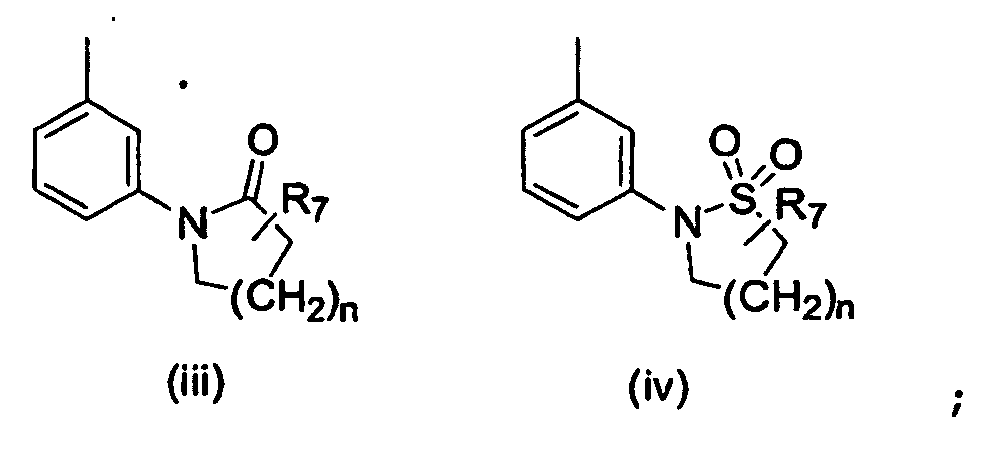
- Preferably, in (i) and (ii) R5 is selected from alkyl (C1-C6), cycloalkyl(C3-C6) and alkynyl(C2-C6) and in (iii) and (iv) R7 is H and n is 1 or 2.
More particularly, in (i) and (ii) R5 is selected from the group consisting of methyl, ethyl, n-propyl, i-propyl, n-butyl, cyclopropyl and 2-propynyl; and R6 is selected from the group consisting of methyl, ethyl, n-propyl, i-propyl, n-butyl, phenyl and 4-methoxy-phenyl; in (iii) and (iv) R7 is hydrogen and n is 1; when X is NR8, R8 is selected from the group consisting of hydrogen, methyl and CN. - The term "aryl" preferably includes phenyl and naphthyl. "Heteroaryl" means 5- or 6-membered aromatic heterocyclic groups containing 1, 2, or 3 heteroatoms which independently of each other are selected from N, O and S. Examples for heteroaryl groups are pyridyl, pyrimidinyl, triazinyl, pyrrolyl, imidazolyl, thiazolyl, isothiazolyl, oxazolyl, isoxazolyl, furyl, thienyl, triazolyl.
- Monosubstituted phenyl means that the phenyl group carries one substituent which is selected from alkyl(C1-C6), alkoxy(C1-C6), halogen, and CF3.
- Substituted phenyl and substituted heteroaryl means that the phenyl or heteroaryl group carries 1, 2 or 3 substituents which independently of each other are selected from alkyl(C1-C6), alkoxy(C1-C6), halogen, and CF3. Substituted heteroaryl includes groups carrying said substituent(s) at a nitrogen heteroatom.
- Halogen means fluoro, chloro, bromo, iodo and preferably fluoro and chloro.
- Alkyl groups (also in alkoxy, NH-alkyl etc.) include straight chain and branched groups and preferably have 1 to 4 carbon atoms.
- Preferred cycloalkyl groups are cyclopropyl, cyclopentyl and cyclohexyl.
- The term "pharmaceutically acceptable salt" used herein encompasses any salt formed from organic and inorganic acids, such as hydrobromic, hydrochloric, phosphoric, nitric, sulfuric, acetic, adipic, aspartic, benzenesulfonic, benzoic, citric, ethanesulfonic, formic, fumaric, glutamic, lactic, maleic, malic, malonic, mandelic, methanesulfonic, 1,5-naphthalendisulfonic, oxalic, pivalic, propionic, p-toluenesulfonic, succinic, tartaric acids and the like.
- The preferred compounds of the present invention are shown below:
- N-ethyl-N-[3-(3-nitro-pyrazolo[1,5-a]pyrimidin-7-yl)-phenyl]-acetamide;
- N-methyl-N-[3-(3-nitro-pyrazolo[1,5-a]pyrimidin-7-yl)-phenyl]-acetamide;
- N-[3-(3-nitro-pyrazolo[1,5-a]pyrimidin-7-yl)-phenyl]-N-(n-propyl)-acetamide;
- N-(n-butyl)-N-[3-(3-nitro-pyrazolo[1,5-a]pyrimidin-7-yl)-phenyl]-acetamide;
- N-[3-(3-nitro-pyrazolo[1,5-a]pyrimidin-7-yl)-phenyl]-N-(2-propynyl)-acetamide;
- 3-nitro-7-phenyl-pyrazolo[1,5-a]pyrimidine;
- 3-nitro-7-(2-trifluoromethyl-phenyl)-pyrazolo[1,5-a]pyrimidine;
- 3-nitro-7-(3-trifluoromethyl-phenyl)-pyrazolo[1,5-a]pyrimidine;
- 3-nitro-7-(4-trifluoromethyl-phenyl)-pyrazolo[1,5-a] pyrimidine;
- 7-furan-2-yl-3-nitro-pyrazolo[1,5-a]pyrimidine;
- 3-nitro-7-thiophen-2-yl-pyrazolo[1,5-a]pyrimidine;
- 3-nitro-7-pyridin-2-yl-pyrazolo[1,5-a]pyrimidine;
- 3-nitro-7-pyridin-3-yl-pyrazolo[1,5-a]pyrimidine;
- 3-nitro-7-pyridin-4-yl-pyrazolo[1,5-a]pyrimidine;
- N-ethyl-N-[3-(3-nitro-pyrazolo[1,5-a]pyrimidin-7-yl)-phenyl]-methanesulfonamide;
- N-ethyl-N-[3-(3-nitro-pyrazolo[1,5-a]pyrimidin-7-yl)-phenyl]-4-methoxy-benzenesulfonamide;
- N-ethyl-N-[3-(3-nitro-pyrazolo[1,5-a]pyrimidin-7-yl)-phenyl]-benzenesulfonamide;
- N-methyl-N-[3-(3-nitro-pyrazolo[1,5-a]pyrimidin-7-yl)-phenyl]-methanesulfonamide;
- N-(n-butyl)-N-[3-(3-nitro-pyrazolo[1,5-a]pyrimidin-7-yl)-phenyl]-4-methoxy-benzenesulfonamide;
- N-[3-(3-nitro-pyrazolo[1,5-a]pyrimidin-7-yl)-phenyl]-N-(n-propyl)-4-methoxy-benzenesulfonamide;
- N-methyl-N-[3-(3-nitro-pyrazolo[1,5-a]pyrimidin-7-yl)-phenyl]-4-methoxy-benzenesulfonamide;
- N-(n-butyl)-N-[3-(3-nitro-pyrazolo[1,5-a]pyrimidin-7-yl)-phenyl]-4-benzenesulfonamide;
- N-[3-(3-nitro-pyrazolo[1,5-a]pyrimidin-7-yl)-phenyl]-N-(n-propyl)-benzenesulfonamide;
- N-methyl-N-[3-(3-nitro-pyrazolo[1,5-a]pyrimidin-7-yl)-phenyl]-4-benzenesulfonamide;
- N-[3-(3-nitro-pyrazolo[1,5-a]pyrimidin-7-yl)-phenyl]-N-(n-propyl)-methanesulfonamide;
- N-n-butyl)-N-[3-(3-nitro-pyrazolo[1,5-a]pyrimidin-7-yl)-phenyl]-methanesulfonamide;
- 1-[3-(3-nitro-pyrazolo[1,5-a]pyrimidin-7-yl)-phenyl]-pyrrolidin-2-one;
- N-[3-(3-nitro-pyrazolo[1,5-a]pyrimidin-7-yl)-phenyl]-N-(prop-2-inyl)-methanesulfonamide;
- N-[3-(3-nitro-pyrazolo[1,5-a]pyrimidin-7-yl)-phenyl]-N-(n-propyl)-ethanesulfonamide;
- N-[3-(3-nitro-pyrazolo[1,5-a]pyrimidin-7-yl)-phenyl]-N-(n-ethyl)-ethanesulfonamide;
- N-[3-(3-nitro-pyrazolo[1,5-a]pyrimidin-7-yl)-phenyl]-N-(n-prop-2-inyl)-propane-2-sulfonamide;
- N-[3-(3-nitro-pyrazolo[1,5-a]pyrimidin-7-yl)-phenyl]-N-methyl-ethanesulfonamide;
- N-[3-(3-nitro-pyrazolo[1,5-a]pyrimidin-7-yl)-phenyl]-N-(n-butyl)-ethanesulfonamide;
- 7-(3-(2-isothiazolydinyl-1,1-dioxide)-phenyl)-3-nitro-pyrazolo[1,5-a]pyrimidine;
- N-[3-(3-nitro-pyrazolo[1,5-a]pyrimidin-7-yl)-phenyl]-N-methyl-propane-2-sulfonamide;
- N-[3-(3-nitro-pyrazolo[1,5-a]pyrimidin-7-yl)-phenyl]-N-ethyl-propane-2-sulfonamide;
- N-[3-(3-nitro-pyrazolo[1,5-a]pyrimidin-7-yl)-phenyl]-N-(n-butyl)-propane-2-sulfonamide; and
- N-[3-(3-nitro-pyrazolo[1,5-a]pyrimidin-7-yl)-phenyl]-N-(n-propyl)-propane-2-sulfonamide.
- Another embodiment of the present invention is to provide a process for preparing the compounds of formula (I) and their pharmaceutically acceptable salts.
- Another embodiment of the present invention is the use of the compounds of formula (I) or a pharmaceutically acceptable salt thereof for preparing a pharmaceutical composition for treating or preventing diseases associated with GABAA receptor modulation.
- Another embodiment of the present invention is the use of the compounds of formula (I) or a pharmaceutically acceptable salt thereof for preparing a pharmaceutical composition for treating or preventing diseases associated with α1-GABAA receptor modulation.
- Another embodiment of the present invention is the use of the compounds of formula (I) or a pharmaceutically acceptable salt thereof for preparing a pharmaceutical composition for treating or preventing diseases associated with α2-GABAA receptor modulation.
- Another embodiment of the present invention is the use of the compounds of formula (I) or a pharmaceutically acceptable salt thereof for preparing a pharmaceutical composition for treating or preventing anxiety.
- Another embodiment of the present invention is the use of the compounds of formula (I) or a pharmaceutically acceptable salt thereof for preparing a pharmaceutical composition for treating or preventing epilepsy.
- Another embodiment of the present invention is the use of the compounds of formula (I) or a pharmaceutically acceptable salt thereof for preparing a pharmaceutical composition for treating or preventing sleep disorders.
- Another embodiment of the present invention is the use of the compounds of formula (I) or a pharmaceutically acceptable salt thereof for preparing a pharmaceutical composition for treating or preventing insomnia.
- Another embodiment of the present invention is the use of the compounds of formula (I) or a pharmaceutically acceptable salt thereof for preparing a pharmaceutical composition for inducing sedation-hypnosis.
- Another embodiment of the present invention is the use of the compounds of formula (I) or a pharmaceutically acceptable salt thereof for preparing a pharmaceutical composition for inducing anesthesia.
- Another embodiment of the present invention is the use of the compounds of formula (I) or a pharmaceutically acceptable salt thereof for preparing a pharmaceutical composition for modulating the necessary time to induce sleep and its duration.
- Another embodiment of the present invention is the use of the compounds of formula (I) or a pharmaceutically acceptable salt thereof for preparing a pharmaceutical composition for inducing muscle relaxation.
- Another embodiment of the present invention is to provide a pharmaceutical composition containing a compound of formula (I) or a pharmaceutically acceptable salt thereof in association with therapeutically inert carriers.
- The compositions include those suitable for oral, rectal and parenteral (including subcutaneous, intramuscular, and intravenous) administration, although the most suitable route will depend on the nature and severity of the condition being treated. The most preferred route of the present invention is the oral route. The compositions may be conveniently presented in unit dosage form, and prepared by any of the methods well known in the art of pharmacy.
- The active compound can be combined with a pharmaceutical carrier according to conventional pharmaceutical compounding techniques. The carrier may take a wide variety of forms depending on the form of the preparation desired for administration, e.g. oral or parenteral (including intravenous injections or infusions) In preparing the compositions for oral dosage form any of the usual pharmaceutical media may be employed. Usual pharmaceutical media include, for example, water, glycols, oils, alcohols, flavoring agents, preservatives, coloring agents, and the like in the case of oral liquid preparations (such as for example, suspensions, solutions, emulsions and elixirs); aerosols; or carriers such as starches, sugars, microcrystalline cellulose, diluents, granulating agents, lubricants, binders, disintegrating agents and the like, in the case of oral solid preparations (such as for example, powders, capsules, and tablets) with the oral solid preparations being preferred over the oral liquid preparations.
- Because of their ease of administration, tablets and capsules represent the most advantageous oral dosage unit form, in which case solid pharmaceutical carriers are employed. If desired, tablets may be coated by standard aqueous or nonaqueous techniques.
- A suitable dosage range for use is from about 0.01 mg to about 100,00 mg total daily dose, given as a once daily administration or in divided doses if required.
- The compounds of general formula (I) may be prepared according to the reaction shown in Scheme 1.

- The intermediate of formula (II) when Q is dimethylamino may be obtained by reaction between the corresponding acetophenone and N,N-dimethylformamide dimethylacetal or Bredereck's reagent (tert-butoxybis(dimethylamino)methane) as described by J. M. Domagala et al (J. Heterocyclic Chem., 26(4), 1147-58, 1989); and K. Sawada et al (Chem. Pharm. Bull., 49(7), 799-813, 2001). Specifically, when R1 is a substituted aryl group, the reaction sequence leading to the intermediate of formula (II) is shown in Scheme 2, R5, R6, R7 and n being as described above.

- The intermediate 4-nitro-2H-pyrazol-3-ylamine (III) is obtained as described by M. E. C. Biffin et al. (J. Chem. Soc. (C) 2159-2162, 1968); M. E. C. Biffin et al. (Aust. J. Chem. 26, 1041-1047, 1967); and M. E. C. Biffin et al. (Tetrahedron Lett., 21, 2029-2031, 1967) following the reaction sequences shown in Scheme 3.


- From the compounds of general formula (I) it is possible to obtain their pharmaceutically acceptable salts by treatment with the corresponding acids.
- The applicants have discovered that the compounds of the present invention have a high affinity for α1- and α2-GABAA receptors as shown in Tables 1 and 2. These in vitro results are consistent with those in vivo results obtained in sedation-hypnosis tests (Table 3). In accordance with the results obtained, certain compounds of the present invention have surprisingly evidenced pharmacological activity both in vitro and in vivo, which has been similar to or higher than that of prior-art compounds. All these results support!their use in diseases or conditions modulated by α1- and α2-GABAA receptors, such as insomnia or anesthesia, in which an induction of sleep, an induction of sedation or an induction of muscle relaxation are needed.
The pharmacological activity of the compounds of the present invention has been determined as shown below. - Male Sprague-Dawley rats weighing 200-250 g at the time of experiment were used. After decapitation of the animal, the cerebellum (tissue that mostly contains α1-GABAA receptor) and spinal cord (tissue that mostly contains α2-GABAA receptor) were removed. The membranes were prepared according to the method by J. Lameh et al.(Prog. Neuro-Psychopharmacol. Biol. Psychiatry, 24, 979-991, 2000). Once the tissues weighed, they were suspended in 50 mM Tris HCl buffer, pH 7.7, (1:40 v/v), homogenized and then centrifuged at 20000 g for 10 min at 7°C. The resulting pellet was resuspended under the same conditions and centrifuged again. The final pellet obtained was resuspended on a minimum volume and kept at -80°C overnight. On the next day, the process was repeated until the final pellet was resuspended at a ratio of 1:10 (v/v).
The affinity of the compounds was determined by competitive tests using radiolabeled flumazenil as ligand. The methods described by S. Arbilla et al. (Eur. J. Pharmacol., 130, 257-263, 1986); and Y. Wu et al. (Eur. J. Pharmacol., 278, 125-132, 1995) were used. The membranes containing the study receptors, flumazenil (radiolabeling at a final concentration of 1 nM) and ascending concentrations of test compounds (in a total volume of 500 µl in 50 nM [ph 7.4] Tris HCI buffer) were incubated. Simultaneously, the membranes were only incubated with the radiolabeled flumazenil (total binding, 100%) and in the presence of an elevated concentration of unradiolabeled flumazenil (non-specific binding, % estimate of radiolabeled ligand). The reactions started on adding the radiolabeled ligand followed by incubation for 60 minutes at 0°C. At the end of the incubation period, the tubes were filtered using a Brandel Mod. M-48R harvester and then washed three times with cold test buffer. The harvester was fitted with a GF/B filter that retained the membranes containing the receptors and the radiolabeled ligand which had been bound to the receptors. Then the filters were removed and left till dry. Once dried, the filters were cut, placed in vials with scintillation liquid and left under stirring overnight. The next day the filters were counted using a Packard Mod. Tricarb scintillation counter. - For analysis of the results the percentage of specific binding for every concentration of test compound was calculated as follows:

where,
X: amount of bound ligand for every concentration of compound.
T: total binding, maximum amount bound to the radiolabeled ligand.
N: Non-specific binding, amount of radiolabeled ligand bound in a non-specific way irrespective of the receptor used. - Every concentrations of compound were tested in duplicate and their mean values were used to determine the experimental values of % specific binding versus the concentration of compound. The values thus attained were fitted to a equation for competitive assays (SigmaPlot, SPSS Inc.) and the IC50 values (concentration of compound able to inhibit by 50% the specific binding) were calculated. Inhibition constants (Ki) were calculated from the IC50 values according to Cheng-Prusoff's formula (Y. Cheng y W. H. Prusoff, Biochem. Pharmacol., 22(23), 3099-3108, 1973). Alternatively, the affinity data for subunit α2 are expressed as % inhibition at the concentrations of 10-5M and 10-7M. The results of these tests are given in Tables 1 and 2.
Table 1. Affinity for α1-GABAA receptor Compound Ki (nM) Example 1 88.6 Example 2 96.8 Example 3 110.0 Example 5 38.6 Example 8 623.0 Example 15 11.1 Example 18 28.3 Example 25 101.7 Example 28 11.7 Example 31 48.5 Example 32 31.0 Example 34 165.2 Example 35 41.2 Zaleplon 198.9 Table 2. Affinity for α2-GABAA receptor Compound Ki (nM) Example 1 499.6 Example 2 711.4 Example 3 680.4 Example 5 111.8 Example 15 295.8 Example 18 988.7 Example 25 764.1 Zaleplon 1302.5 Compound % Inhibition 10-5M % Inhibition 10-7M Example 28 96.4 29.0 Example 31 81.3 4.2 Example 32 89.0 21.0 Example 34 86.9 4.3 Example 35 91.5 18.9 Zaleplon 78.4 --- - The in vivo effects of these compounds were assessed by a predictive sedation-hypnosis test in mice (D. J. Sanger et al., Eur. J. Pharmacol., 313, 35-42, 1996; and G. Griebel et al., Psychopharmacology, 146, 205-213, 1999).
Groups of 5-8 male CD1 mice, weighing 22-26 g at the time of test, were used. The test compounds were administered in single equimolecular intraperitoneal doses, suspended in 0.25% agar with one drop of Tween in a volume of 10 ml/kg. Control animals received the vehicle alone. Using an Actisystem DAS16 (Panlab, S.L., Spain) the crossings (number of counts) were recorded for each mouse at 5-min intervals during a period of 30 minutes after dosing. The inhibition percentage of crossings of treated animals versus control animals (the first 5 min were discarded) was calculated. The results of this test are given in Table 3.Table 3. Determination of sedation-hypnosis in mice. Compound % Inhibition Motor Activity Example 1 77.25 Example 2 77.25 Example 3 61.68 Example 5 79.06 Example 8 69.08 Example 18 68.55 Example 25 61.06 Example 28 94.19 Example 31 94.31 Example 32 91.57 Example 34 64.23 Example 35 91.21 Zaleplon 47.17 - The present invention is illustrated by the following examples which are not intended to be limitative thereof.
- A mixture of 0.52 g (4.06 mmol) of 4-nitro-2H-pyrazol-3-ylamine and 1.057 g (4.06 mmol) of N-[3-[3-(dimethylamino)-1-oxo-2-propenyl]phenyl]-N-ethyl-acetamide in 40 ml of glacial acetic acid was refluxed for 8 hours and then the solvent was removed by reduced pressure distillation. To the resulting residue were added 40 ml of dichloromethane and 20 ml of saturated sodium bicarbonate solution. The two layers were separated, and the aqueous layer was washed with 15 ml of dichloromethane. The organic layers were washed with 20 ml of water and dried over magnesium sulfate. The dichloromethane layer was evaporated to dryness to yield an oil which, in the presence of ethyl acetate, gave 225 mg of N-ethyl-N-[3-(3-nitro-pyrazolo[1,5-a]pyrimidin-7-yl)-phenyl]-acetamide as a yellow solid (yield 17%; m.p. 176-178°C).
- 1H NMR(400 MHz, CDCl3) : δ 1.17 (3H, t, J= 6.8 Hz), 1.94 (3H, s), 3.82 (2H, q, J= 6.8 Hz), 7.31 (1H, d, J= 4.4 Hz), 7.47(1H, d, J= 7.6 Hz), 7.69 (1H, t, J= 7.6 Hz), 7.91 (1H, s), 7.96 (1H, d, J= 7.6 Hz), 8.82 (1H, s), 9.01 (1H, d, J= 4.4 Hz).
HPLC = 96.5% - A mixture of 0.074 g (0.58 mmol) of 4-nitro-2H-pyrazol-3-ylamine and 0.160 g (0.58 mmol) of N-[3-[3-(dimethylamino)-1-oxo-2-propenyl]phenyl]-N-methylacetamide in 15 ml of glacial acetic acid was refluxed for 8 hours and then the solvent was removed by reduced pressure distillation. To the resulting residue were added 20 ml of dichloromethane and 10 ml of saturated sodium bicarbonate solution. The two layers were separated, and the aqueous layer was washed with 10 ml of dichloromethane. The organic layers were washed with 10 ml of water and dried over magnesium sulfate. The dichloromethane layer was evaporated to dryness to yield an oil which was chromatographied over silica gel (eluent: dichloromethane/methanol), giving 37 mg of N-metyl-N-[3-(3-nitro-pyrazolo[1,5-a]pyrimidin-7-yl)-phenyl]-acetamide as a yellowish-white solid (yield 29%).
- 1H NMR(400 MHz, CDCl3): δ 1.95 (3H, s), 3.35 (3H, s), 7.30 (1H, d, J= 4.8 Hz), 7.5 (1H, d J= 7.6 Hz), 7.68 (1H, t, J= 7.6 Hz), 7.93 (2H, m), 8.82 (1H, s), 9.01 (1H, d, J= 4.4 Hz).
MS (ES) m/z = 312 (MH+)
HPLC = 93% - A mixture of 0.051 g (0.4 mmol) of 4-nitro-2H-pyrazol-3-ylamine and 0.1 g (0.4 mmol) of N-[3-[3-(dimethylamino)-1-oxo-2-propenyl] phenyl]-N-(n-propyl)-acetamide in 5 ml of glacial acetic acid was refluxed for 8 hours and then the solvent was removed by reduced pressure distillation. To the resulting residue were added 4 ml of dichloromethane and 5 ml of saturated sodium bicarbonate solution. The two layers were separated, and the aqueous layer was washed with 5 ml of dichloromethane. The organic layers were washed with 5 ml of water and dried over magnesium sulfate. The dichloromethane layer was evaporated to dryness to yield an oil which, in the presence of ethyl acetate, gave 39 mg of N-[3-(3-nitro-pyrazolo[1,5-a]pyrimidin-7-yl)-phenyl]-N-(n-propyl)-acetamide as a yellow solid (yield 20%).
- 1H NMR(400 MHz, CDCl3): δ 0.84(3H, t, J= 7.6 Hz), 1.51 (2H, m), 1.87 (3H, s), 3.65 (2H, t, J= 7.6 Hz), 7.23 (1H, d, J= 4.4 Hz), 7.39 (1H, d J= 7.6 Hz), 7.61 (1H, t, J= 7.6 Hz), 7.83 (1H, s), 7.87 (1H, d, J= 7.6 Hz), 8.87 (1H, s), 8.93 (1H, d, J= 4.4 Hz).
HPLC = 80% - A mixture of 0.067 g (0.52 mmol) of 4-nitro-2H-pyrazol-3-ylamine and 0.150 g (0.52 mmol) of N-(n-butyl)-N-[3-[3-(dimethylamino)-1-oxo-2-propenyl]phenyl]-acetamide in 5 ml of glacial acetic acid was refluxed for 8 hours and then the solvent was removed by reduced pressure distillation. To the resulting residue were added 4 ml of dichloromethane and 5 ml of saturated sodium bicarbonate solution. The two layers were separated, and the aqueous layer was washed with 5 ml of dichloromethane. The organic layers were washed with 5 ml of water and dried over magnesium sulfate. The dichloromethane layer was evaporated to dryness to yield an oil which was chromatographied over silica gel (eluent: dichloromethane/methanol), giving 35 mg of N-(n-butyl)-N-[3-(3-nitro-pyrazolo[1,5-a]pyrimidin-7-yl)-phenyl]-acetamide as a yellowish-white solid (yield 19%).
- 1H NMR(400 MHz, CDCl3): δ 0.82 (3H, t, J= 7.6 Hz), 1.25 (2H, m), 1.45 (2H, m), 1.86 (3H, s), 3.68 (2H, t, J= 7.6 Hz), 7.27 (1H, d, J= 4.4 Hz), 7.4 (1H, d, J= 8 Hz), 7.62 (1H, t, J= 8 Hz), 7.85 (1H, s), 7.88 (1H, d, J= 8 Hz), 8.73 (1H, s), 8.93 (1H, d, J= 4.4 Hz).
MS (ES) m/z = 354 (MH+)
HPLC = 83% - A mixture of 0.079 g (0.62 mmol) of 4-nitro-2H-pyrazol-3-ylamine and 0.168 g (0.62 mmol) of N-[3-[3-(dimethylamino)-1-oxo-2-propenyl]phenyl]-N-(2-propynyl)-acetamide in 13 ml of glacial acetic acid was refluxed for 8 hours and then the solvent was removed by reduced pressure distillation. To the resulting residue were added 10 ml of dichloromethane and 10 ml of saturated sodium bicarbonate solution. The two layers were separated, and the aqueous layer was washed with 10 ml of dichloromethane. The organic layers were washed with 10 ml of water and dried over magnesium sulfate. The dichloromethane layer was evaporated to dryness to yield an oil which, in the presence of ethyl acetate, gave 58 mg of N-[3-(3-nitro-pyrazolo[1,5-a]pyrimidin-7-yl)-phenyl]-N-(2-propynyl)-acetamide as a yellow solid (yield 28%).
- 1H NMR(400 MHz, CDCl3) : δ 1.98 (3H, s), 2.25 (1H, s), 2.25 (2H, s) 7.31 (1H, d, J= 4.4 Hz), 7.60 (1H, d J= 7.6 Hz), 7.71 (1H, t, J= 7.6 Hz), 8.01-8.03 (2H, m), 8.83 (1H, s), 9.01 (1H, d, J= 4.4 Hz).
MS (ES) m/z = 336 (MH+)
HPLC = 97.7% - A mixture of 0.100 g (0.78 mmol) of 4-nitro-2H-pyrazol-3-ylamine and 0.137 g (0.78 mmol) of 3-dimethylamino-1-phenyl-propenone in 6 ml of glacial acetic acid was refluxed for 8 hours and then the solvent was removed by reduced pressure distillation. To the resulting residue were added 10 ml of dichloromethane and 10 ml of saturated sodium bicarbonate solution. The two layers were separated, and the aqueous layer was washed with 10 ml of dichloromethane. The organic layers were washed with 10 ml of water and dried over magnesium sulfate. The dichloromethane layer was evaporated to dryness to yield an oil which was chromatographied over silica gel (eluent: dichloromethane/methanol), giving 32 mg of 3-nitro-7-phenyl-pyrazolo[1,5-a]pyrimidine as a yellowish-white solid (yield 17%).
1H NMR(400 MHz, CDCl3): δ 7.62-7.65 (3H, m), 7.66 (1H, d, J= 4.8 Hz), 8.03-8.05 (2H, m), 9.05 (1H, d, J= 4.8 Hz), 9.09 (1H, s).
HPLC = 85% - A mixture of 0.100 g (0.78 mmol) of 4-nitro-2H-pyrazol-3-ylamine and 0.189 g (0.78 mmol) of 3-dimethylamino-1-(2-trifluoromethyl-phenyl)-propenone in 6 ml of glacial acetic acid was refluxed for 8 hours and then the solvent was removed by reduced pressure distillation. To the resulting residue were added 10 ml of dichloromethane and 10 ml of saturated sodium bicarbonate solution. The two layers were separated, and the aqueous layer was washed with 10 ml of dichloromethane. The organic layers were washed with 10 ml of water and dried over magnesium sulfate. The dichloromethane layer was evaporated to dryness to yield an oil which was chromatographied over silica gel (eluent: dichloromethane/methanol), giving 134 mg of 3-nitro-7-(2-trifluoromethyl-phenyl)-pyrazolo[1,5-a]pyrimidine as a yellowish-white solid (yield 56%; m.p. 195-197°C).
- 1H NMR(400 MHz, CDCl3): δ 7.19 (1H, d, J= 4.8 Hz), 7.51-7.54 (1H, m), 7.78-7.80 (1H, m), 7.91-7.94 (1H, m), 8.73 (1H, s), 9.02 (1H, d, J= 4.4 Hz).
HPLC = 89.4% - A mixture of 0.100 g (0.78 mmol) of 4-nitro-2H-pyrazol-3-ylamine and 0.189 g (0.78 mmol) of 3-dimethylamino-1-(3-trifluoromethyl-phenyl)-propenone in 6 ml of glacial acetic acid was refluxed for 8 hours and then the solvent was removed by reduced pressure distillation. To the resulting residue were added 10 ml of dichloromethane and 10 ml of saturated sodium bicarbonate solution. The two layers were separated, and the aqueous layer was washed with 10 ml of dichloromethane. The organic layers were washed with 10 ml of water and dried over magnesium sulfate. The dichloromethane layer was evaporated to dryness to yield an oil which was chromatographied over silica gel (eluent: dichloromethane/methanol), giving 131 mg of 3-nitro-7-(3-trifluoromethyl-phenyl)-pyrazolo[1,5-a]pyrimidine as a yellowish-white solid (yield 54.5%; m.p. 159-161°C).
- 1H NMR(400 MHz, CDCl3) : δ 7.32 (1H, d, J= 4.8 Hz), 7.77 (1H, t, J= 7.6 Hz), 7.91 (1H, d, J= 7.6 Hz), 8.22 (1H, d, J= 7.6 Hz), 8.23 (1H, s), 8.84 (1H, s), 9.02 (1H, d, J= 4.4 Hz).
HPLC = 88.5% - A mixture of 0.100 g (0.78 mmol) of 4-nitro-2H-pyrazol-3-ylamine and 0.189 g (0.78 mmol) of 3-dimethylamino-1-(4-trifluoromethyl-phenyl)-propenone in 6 ml of glacial acetic acid was refluxed for 8 hours and then the solvent was removed by reduced pressure distillation. To the resulting residue were added 10 ml of dichloromethane and 10 ml of saturated sodium bicarbonate solution. The two layers were separated, and the aqueous layer was washed with 10 ml of dichloromethane. The organic layers were washed with 10 ml of water and dried over magnesium sulfate. The dichloromethane layer was evaporated to dryness to yield an oil which was chromatographied over silica gel (eluent: dichloromethane/methanol), giving 168 mg of 3-nitro-7-(4-trifluoromethyl-phenyl)-pyrazolo[1,5-a]pyrimidine as a yellowish-white solid (yield 70%; m.p. 191-193°C).
- 1H NMR(400 MHz, CDCl3): δ 7.29 (1H, d, J= 4.8 Hz), 7.88 (2H, d, J= 8 Hz), 8.12 (2H, d, J=8 Hz), 8.84 (1H, s), 9.02 (1H, d, J= 4.4 Hz).
HPLC = 86.9% - A mixture of 0.100 g (0.78 mmol) of 4-nitro-2H-pyrazol-3-ylamine and 0.129 g (0.78 mmol) of 3-dimethylamino-1-furan-2-yl-propenone in 6 ml of glacial acetic acid was refluxed for 8 hours and then the solvent was removed by reduced pressure distillation. To the resulting residue were added 10 ml of dichloromethane and 10 ml of saturated sodium bicarbonate solution. The two layers were separated, and the aqueous layer was washed with 10 ml of dichloromethane. The organic layers were washed with 10 ml of water and dried over magnesium sulfate. The dichloromethane layer was evaporated to dryness to yield an oil which was chromatographied over silica gel (eluent: dichloromethane/ methanol), giving 152 mg of 7-furan-2-yl-3-nitro-pyrazolo[1,5-a]pyrimidine as a yellowish-white solid (yield 85%; m.p. 235-237°C).
- 1H NMR(400 MHz, CDCl3) : δ 6.79 (1H, dd, J= 4.8 and 1.6 Hz), 7.64 (1H, d, J= 4.4 Hz), 7.81 (1H, d, J= 1.2 Hz), 8.26 (1H, d, J= 3.2 Hz), 8.87 (1H, s), 8.94 (1H, d, J= 4.8 Hz).
HPLC = 93.2% - A mixture of 0.100 g (0.78 mmol) of 4-nitro-2H-pyrazol-3-ylamine and 0.142 g (0.78 mmol) of 3-dimethylamino-1-thiophen-2-yl-propenone in 6 ml of glacial acetic acid was refluxed for 8 hours and then the solvent was removed by reduced pressure distillation. To the resulting residue were added 10 ml of dichloromethane and 10 ml of saturated sodium bicarbonate solution. The two layers were separated, and the aqueous layer was washed with 10 ml of dichloromethane. The organic layers were washed with 10 ml of water and dried over magnesium sulfate. The dichloromethane layer was evaporated to dryness to yield an oil which, in the presence of ethyl acetate, gave 91 mg of 3-nitro-7-thiophen-2-yl-pyrazolo[1,5-a]pyrimidine as a yellow solid (yield 47%; m.p. 235-,237°C).
- 1H NMR(400 MHz, CDCl3): δ 7.34 (1H, dd, J= 3.6 and 1.2 Hz), 7.56 (1H, d, J= 4.8 Hz), 7.88 (1H, dd, J= 5 and 1.2 Hz), 8.41 (1H, dd, J= 4 and 1.2 Hz), 8.90 (1H, d, J= 4.8 Hz), 8.91 (1H, s).
MS (ES) m/z = 247 (MH+)
HPLC = 93.3% - A mixture of 0.100 g (0.78 mmol) of 4-nitro-2H-pyrazol-3-ylamine and 0.138 g (0.78 mmol) of 3-dimethylamino-1-pyridin-2-yl-propenone in 6 ml of glacial acetic acid was refluxed for 8 hours and then the solvent was removed by reduced pressure distillation. To the resulting residue were added 10 ml of dichloromethane and 10 ml of saturated sodium bicarbonate solution. The two layers were separated, and the aqueous layer was washed with 10 ml of dichloromethane. The organic layers were washed with 10 ml of water and dried over magnesium sulfate. The dichloromethane layer was evaporated to dryness to yield an oil which, in the presence of ethyl acetate, gave 45 mg of 3-nitro-7-pyridin-2-yl-pyrazolo[1,5-a]pyrimidine as a yellow solid (yield 24%).
- 1H NMR(400 MHz, CDCl3) : δ 7.55 (1H, dd, J= 4.8 and 2.4 Hz), 7.98 (1H, t, J= 7.6 Hz), 8.07 (1H, d, J= 4.8 Hz), 8.86 (1H, d, J= 4.8 Hz), 8.89 (1H, s), 8.95 (1H, d, J= 8 Hz), 9.06 (1H, d, J= 4 Hz).
MS (ES) m/z = 242 (MH+)
HPLC = 98.4% - A mixture of 0.100 g (0.78 mmol) of 4-nitro-2H-pyrazol-3-ylamine and 0.138 g (0.78 mmol) of 3-dimethylamino-1-pyridin-3-yl-propenone in 6 ml of glacial acetic acid was refluxed for 8 hours and then the solvent was removed by reduced pressure distillation. To the resulting residue were added 10 ml of dichloromethane and 10 ml of saturated sodium bicarbonate solution. The two layers were separated, and the aqueous layer was washed with 10 ml of dichloromethane. The organic layers were washed with 10 ml of water and dried over magnesium sulfate. The dichloromethane layer was evaporated to dryness to yield an oil which, in the presence of ethyl acetate, gave 99 mg of 3-nitro-7-pyridin-3-yl-pyrazolo[1,5-a]pyrimidine as a yellow solid (yield 47%; m.p. 302-303°C).
- 1H NMR(400 MHz, CDCl3): δ 7.65-7.69 (1H, m), 7.78 (1H, d, J= 4.4 Hz), 8.45-8.48 (1H, m), 8.81 (1H, dd, J= 4.8 and 1.6 Hz), 9.01 (1H, d, J= 4.8 Hz), 9.11 (1H, s), 9.16 (1H, dd, J= 2.4 and 0.8 Hz).
HPLC = 94.1% - A mixture of 0.105 g (0.82 mmol) of 4-nitro-2H-pyrazol-3-ylamine and 0.144 g (0.82 mmol) of 3-dimethylamino-1-pyridin-4-yl-propenone in 8 ml of glacial acetic acid was refluxed for 8 hours and then the solvent was removed by reduced pressure distillation. To the resulting residue were added 10 ml of dichloromethane and 10 ml of saturated sodium bicarbonate solution. The two layers were separated, and the aqueous layer was washed with 10 ml of dichloromethane. The organic layers were washed with 10 ml of water and dried over magnesium sulfate. The dichloromethane layer was evaporated to dryness to yield an oil which was chromatographied over silica gel (eluent: dichloromethane/methanol), giving 68 mg of 3-nitro-7-pyridin-4-yl-pyrazolo[1,5-a]pyrimidine as a yellow solid (yield 34%; m.p. 241-244°C).
- 1H NMR(400 MHz, CDCl3): δ 7.7 (1H, d, J= 4.4 Hz), 7.98-8.00 (2H, m), 8.84-8.86 (2H, m), 9.10 (1H, d, J= 4.4 Hz), 9. 11 (1H, s).
MS (ES) m/z = 242 (MH+)
HPLC = 83.6 % - A mixture of 0.0086 g (0.068 mmol) of 4-nitro-2H-pyrazol-3-ylamine and 0.02 g (0.068 mmol) of N-[3-[3-(dimethylamino)-1-oxo-2-propenyl]phenyl]-N-ethyl-methanesulfonamide in 1.5 ml of glacial acetic acid was refluxed for 8 hours and then the solvent was removed by reduced pressure distillation. To the resulting residue were added 10 ml of dichloromethane and 10 ml of saturated sodium bicarbonate solution. The two layers were separated, and the aqueous layer was washed with 10 ml of dichloromethane. The organic layers were washed with 10 ml of water and dried over magnesium sulfate. The dichloromethane layer was evaporated to dryness to yield an oil which, in the presence of ethyl acetate, gave 15 mg of N-ethyl-N-[3-(3-nitro-pyrazolo[1,5-a]pyrimidin-7-yl)-phenyl]-methanesulfonamide as a yellow solid (yield 61%).
- 1H NMR(400 MHz, DMSO-d6 ): δ 1.23 (3H, t, J= 6.8 Hz), 2.96 (3H, s), 3.83 (2H, q, J= 7.2 Hz), 7.31 (1H, d, J= 4.4 Hz), 7.62 (1H, d, J= 7.6 Hz), 7.67 (1H, t, J= 7.6 Hz), 7.98 (1H, d, J= 7.6 Hz), 8.05 (1H, s), 8.82 (1H, s), 9.01 (1H, d, J= 4.4 Hz).
MS (ES) m/z = 362 (MH+)
HPLC = 92.1% - A mixture of 0.1 g (0.79 mmol) of 4-nitro-2H-pyrazol-3-ylamine and 0.305 g (0.068 mmol) of N-[3-[3-(dimethylamino)-1-oxo-2-propenyl]phenyl]-N-ethyl-4-methoxy-benzenesulfonamide in 5 ml of glacial acetic acid was refluxed for 8 hours and then the solvent was removed by reduced pressure distillation. To the resulting residue were added 10 ml of dichloromethane and 10 ml of saturated sodium bicarbonate solution. The two layers were separated, and the aqueous layer was washed with 10 ml of dichloromethane. The organic layers were washed with 10 ml of water and dried over magnesium sulfate. The dichloromethane layer was evaporated to dryness to yield an oil which, in the presence of ethyl acetate, gave 117 mg of N-ethyl-N-[3-(3-nitro-pyrazolo[1,5-a]pyrimidin-7-yl)-phenyl]-4-methoxy-benzenesulfonamide as a yellow solid (yield 33%; m.p. 209-211°C).
- 1H NMR(400 MHz, DMSO-d6 ): δ 1.00 (3H, t, J= 7.2 Hz), 3.59 (2H, q, J= 7.2 Hz), 3.83 (1H, s), 7.10-7.13 (2H, m), 7.35(1H, d, J= 7.6 Hz), 7.54-7.56 (2H, m), 7.60 (1H, d, J= 4.4 Hz), 7.62 (1H, t, J= 8 Hz), 7.78 (1H, s), 8.00 (1H, d, J= 8 Hz), 9.05 (1H, d, J= 4.4 Hz) 9.06 (1H, s).
HPLC = 90.4% - A mixture of 0.121 g (0.958 mmol) of 4-nitro-2H-pyrazol-3-ylamine and 0.340 g (0.958 mmol) of N-[3-[3-(dimethylamino)-1-oxo-2-propenyl]phenyl]-N-ethylbenzene-sulfonamide in 5 ml of glacial acetic acid was refluxed for 8 hours and then the solvent was removed by reduced pressure distillation. To the resulting residue were added 10 ml of dichloromethane and 10 ml of saturated sodium bicarbonate solution. The two layers were separated, and the aqueous layer was washed with 10 ml of dichloromethane. The organic layers were washed with 10 ml of water and dried over magnesium sulfate. The dichloromethane layer was evaporated to dryness to yield an oil which, in the presence of ethyl acetate, gave 150 mg of N-ethyl-N-[3-(3-nitro-pyrazolo[1,5-a]pyrimidin-7-yl)-phenyl]-benzene-sulfonarnide as a yellow solid (yield 38%; m.p. 189-191°C).
- 1H NMR(400 MHz, DMSO-d6 ): δ 1.01 (3H, t, J= 7.2 Hz), 3.62 (2H, q, J= 7.2 Hz), 7.36 (1H, d, J= 7.2 Hz), 7.57 (1H, d, J= 4.8 Hz), 7.60-7.64 (5H, m), 7.71-7.73 (1H, m), 7.76 (1H, s), 8.00 (1H, d, J= 7.6 Hz), 9.04 (1H, d, J= 4.8 Hz), 9.07 (1H, s).
HPLC = 98.9% - A mixture of 0.076 g (0.60 mmol) of 4-nitro-2H-pyrazol-3-ylamine and 0.160 g (0.60 mmol) of N-[3-[3-(dimethylamino)-1-oxo-2-propenyl]phenyl]-N-methyl-methanesulfonamide in 5 ml of glacial acetic acid was refluxed for 8 hours and then the solvent was removed by reduced pressure distillation. To the resulting residue were added 10 ml of dichloromethane and 10 ml of saturated sodium bicarbonate solution. The two layers were separated, and the aqueous layer was washed with 10 ml of dichloromethane. The organic layers were washed with 10 ml of water and dried over magnesium sulfate. The dichloromethane layer was evaporated to dryness to yield an oil which, in the presence of ethyl acetate, gave 107 mg of N-methyl-N-[3-(3-nitro-pyrazolo[1,5-a]pyrimidin-7-yl)-phenyl]-4-methanesulfonamide as a yellow solid (yield 54%).
- 1H NMR(400 MHz, DMSO-d6 ): δ 2.93 (3H, s,), 3.42 (3H, s), 7.31 (1H, d, J= 4.8 Hz), 7.64-7.65 (2H, m), 7.91-7.93 (1H, m), 8.08 (1H, s), 8.81 (1H, s), 8.99 (1H, d, J= 4.8 Hz).
MS (ES) m/z = 348 (MH+)
HPLC = 91.7% - A mixture of 0.049 g (0.38 mmol) of 4-nitro-2H-pyrazol-3-ylamine and 0.160 g (0.52 mmol) of N-(n-butyl)-N-[3-[3-(dimethylamino)-1-oxo-2-propenyl]phenyl]-4-methoxy-benzenesulfonamide in 5 ml of glacial acetic acid was refluxed for 8 hours and then the solvent was removed by reduced pressure distillation. To the resulting residue were added 10 ml of dichloromethane and 10 ml of saturated sodium bicarbonate solution. The two layers were separated, and the aqueous layer was washed with 10 ml of dichloromethane. The organic layers were washed with 10 ml of water and dried over magnesium sulfate. The dichloromethane layer was evaporated to dryness to yield an oil which, in the presence of ethyl acetate, gave 90 mg of N-(n-butyl)-N-[3-(3-nitro-pyrazolo[1,5-a]pyrimidin-7-yl)-phenyl]-4-methoxy-benzenesulfonamide as a yellow solid (yield 49%; m.p. 189-190°C).
- 1H NMR(400 MHz, DMSO-d6 ): δ 0.82 (3H, t, J= 7.2 Hz), 1.26-1.33 (4H, m), 3.54 (2H, t, J= 6.4 Hz), 3.83 (3H, s), 7.11 (2H, d, J= 6.8 Hz), 7.35 (1H, d J= 7.2 Hz), 7.54 (2H, d, J= 6.8 Hz), 7.58 (1H, d, J= 4.8 Hz), 7.62 (1H, t, J= 8 Hz), 7.77 (1H, s), 7.99 (1H, d, J= 7.2 Hz), 9.04 (1H, d, J= 4.4 Hz), 9.05 (1H, s).
MS (ES) m/z = 482 (MH+)
HPLC = 98.4% - A mixture of 0.067 g (0.52 mmol) of 4-nitro-2H-pyrazol-3-ylamine and 0.210 g (0.52 mmol) of N-[3-[3-(dimethylamino)-1-oxo-2-propenyl]phenyl]-N-(n-propyl)-4-methoxy-benzene-sulfonamide in 5 ml of glacial acetic acid was refluxed for 8 hours and then the solvent was removed by reduced pressure distillation. To the resulting residue were added 10 ml of dichloromethane and 10 ml of saturated sodium bicarbonate solution. The two layers were separated, and the aqueous layer was washed with 10 ml of dichloromethane. The organic layers were washed with 10 ml of water and dried over magnesium sulfate. The dichloromethane layer was evaporated to dryness to yield an oil which, in the presence of ethyl acetate, gave 139 mg of N-[3-(3-nitro-pyrazolo[1,5-a]pyrimidin-7-yl)-phenyl]-N-(n-propyl)-4-methoxy-benzenesulfonamide as a yellow solid (yield 57%; m.p. 184-185°C).
- 1H NMR(400 MHz, DMSO-d6 ): δ 0.84 (3H, t, J= 7.2 Hz), 1.32-1.37 (2H, m), 3.50 (2H, t, J= 7.2 Hz), 3.83 (3H, s), 7.11 (2H, d, J= 6.8 Hz), 7.36 (1H, d J= 7.2 Hz), 7.53 (2H, d, J= 6.8 Hz), 7.58 (1H, d, J= 4.8 Hz), 7.62 (1H, t, J= 8 Hz), 7.77 (1H, s), 7.99 (1H, d, J= 7.6 Hz), 9.04 (1H, d, J= 4.8 Hz), 9.05 (1H, s).
MS (ES) m/z = 468 (MH+)
HPLC = 98.9 % - A mixture of 0.027 g (0.21 mmol) of 4-nitro-2H-pyrazol-3-ylamine and 0.80 g (0.21 mmol) of N-methyl-N-[3-[3-(dimethylamino)-1-oxo-2-propenyl]phenyl]-9-methoxy-benzene-sulfonamide in 5 ml of glacial acetic acid was refluxed for 8 hours and then the solvent was removed by reduced pressure distillation. To the resulting residue were added 10 ml of dichloromethane and 10 ml of saturated sodium bicarbonate solution. The two layers were separated, and the aqueous layer was washed with 10 ml of dichloromethane. The organic layers were washed with 10 ml of water and dried over magnesium sulfate. The dichloromethane layer was evaporated to dryness to yield an oil which, in the presence of ethyl acetate, gave 50 mg of N-methyl-N-[3-(3-nitro-pyrazolo[1,5-a]pyrimidin-7-yl)-phenyl]-4-methoxy-benzenesulfonamide as a yellow solid (yield 53%; m.p. 205-206°C).
- 1H NMR(400 MHz, DMSO-d6 ): δ 3.15 (3H, s), 3.83 (3H, s), 7.11 (2H, d, J= 6.8 Hz), 7.36 (1H, d J= 7.2 Hz), 7.49 (2H, d, J= 6.8 Hz), 7.59 (1H, d, J= 4.8 Hz), 7.60 (1H, t, J= 7.8 Hz), 7.84 (1H, s), 7.96(1H, d, J= 7.6 Hz), 9.04 (1H, d, J= 4.4 Hz), 9.07 (1H, s).
MS (ES) m/z = 440 (MH+)
HPLC = 97% - A mixture of 0.103 g (0.80 mmol) of 4-nitro-2H-pyrazol-3-ylamine and 0.31 g (0.52 mmol) of N-(n-butyl)-N-[3-[3-(dimethylamino)-1-oxo-2-propenyl]phenyl]-benzenesulfonamide in 5 ml of glacial acetic acid was refluxed for 8 hours and then the solvent was removed by reduced pressure distillation. To the resulting residue were added 10 ml of dichloromethane and 10 ml of saturated sodium bicarbonate solution. The two layers were separated, and the aqueous layer was washed with 10 ml of dichloromethane. The organic layers were washed with 10 ml of water and dried over magnesium sulfate. The dichloromethane layer was evaporated to dryness to yield an oil which, in the presence of ethyl acetate, gave 185 mg of N-(n-butyl)-N-[3-(3-nitro-pyrazolo[1,5-a]pyrimidin-7-yl)-phenyl]-benzenesulfonamide as a yellow solid (yield 51%; m.p. 159-160°C).
- 1H NMR(400 MHz, DMSO-d6 ): δ 0.82 (3H, t, J= 7.2 Hz), 1.26-1.33 (4H, m), 3.57 (2H, t, J= 6.4 Hz), 7.38 (1H, d J= 8 Hz), 7.55 (1H, d, J= 4.8 Hz), 7.59-7.63 (5H, m), 7.70-7.72 (1H, m), 7.75 (1H, s), 7.99 (1H, d, J= 8 Hz), 9.03 (1H, d, J= 4.8 Hz), 9.05 (1H, s).
MS (ES) m/z = 452 (MH+)
HPLC = 100% - A mixture of 0.117 g (0.91 mmol) of 4-nitro-2H-pyrazol-3-ylamine and 0.340 g (0.91 mmol) of N-[3-[3-(dimethylamino)-1-oxo-2-propenyl]phenyl]-N-(n-propyl)-benzenesulfonamide in 5 ml of glacial acetic acid was refluxed for 8 hours and then the solvent was removed by reduced pressure distillation. To the resulting residue were added 10 ml of dichloromethane and 10 ml of saturated sodium bicarbonate solution. The two layers were separated, and the aqueous layer was washed with 10 ml of dichloromethane. The organic layers were washed with 10 ml of water and dried over magnesium sulfate. The dichloromethane layer was evaporated to dryness to yield an oil which, in the presence of ethyl acetate, gave 154 mg of N-[3-(3-nitro-pyrazolo[1,5-a]pyrimidin-7-yl)-phenyl]-N-(n-propyl)-benzenesulfonamide as a yellow solid (yield 39%; m.p. 154-156°C).
- 1H NMR(400 MHz, DMSO-d6 ) : δ 0.84 (3H, t, J= 7.2 Hz), 1.3-1.39 (2H, m), 3.53 (2H, t, J= 6.8 Hz), 7.38 (1H, d J= 8 Hz), 7.56 (1H, d, J= 4.8 Hz), 7.60-7.64 (5H, m), 7.71-7.74 (1H, m), 7.75 (1H, s), 8.00 (1H, d, J= 8.4 Hz), 9.04 (1H, d, J= 4.8 Hz), 9.06 (1H, s).
MS (ES) m/z = 438 (MH+)
HPLC = 100% - A mixture of 0.78 g (0.61 mmol) of 4-nitro-2H-pyrazol-3-ylamine and 0.21 g (0.52 mmol) of N-methyl-N-[3-[3-(dimethylamino)-1-oxo-2-propenyl]phenyl]-benzenesulfonamide in 5 ml of glacial acetic acid was refluxed for 8 hours and then the solvent was removed by reduced pressure distillation. To the resulting residue were added 10 ml of dichloromethane and 10 ml of saturated sodium bicarbonate solution. The two layers were separated, and the aqueous layer was washed with 10 ml of dichloromethane. The organic layers were washed with 10 ml of water and dried over magnesium sulfate. The dichloromethane layer was evaporated to dryness to yield an oil which, in the presence of ethyl acetate, gave 108 mg of N-methyl-N-[3-(3-nitro-pyrazolo [1,5-a]pyrimidin-7-yl)-phenyl]-benzenesulfonamide as a yellow solid (yield 43%; m.p. 177-179°C).
- 1H NMR(400 MHz, DMSO-d6 ): δ 3.19 (3H, s), 7.39 (1H, d, J= 8 Hz), 7.57-7.63 (6H, m), 7.71 (1H, t, J= 6.8 Hz), 7.82 (1H, s), 7.95 (1H, d, J= 8 Hz), 9.04 (1H, d, J= 4.8 Hz), 9.07 (1H, s).
MS (ES) m/z = 409 (MH+)
HPLC = 98.2% - A mixture of 0.078 g (0.61 mmol) of 4-nitro-2H-pyrazol-3-ylamine and 0.19 g (0.61 mmol) of N-[3-[3-(dimethylamino)-1-oxo-2-propenyl]phenyl]-N-(n-propyl)-methanesulfonamide in 5 ml of glacial acetic acid was refluxed for 8 hours and then the solvent was removed by reduced pressure distillation. To the resulting residue were added 10 ml of dichloromethane and 10 ml of saturated sodium bicarbonate solution. The two layers were separated, and the aqueous layer was washed with 10 ml of dichloromethane. The organic layers were washed with 10 ml of water and dried over magnesium sulfate. The dichloromethane layer was evaporated to dryness to yield an oil which, in the presence of ethyl acetate, gave 118 mg of N-[3-(3-nitro-pyrazolo[1,5-a]pyrimidin-7-yl)-phenyl]-N-(n-propyl)-methanesulfonamide as a yellow solid (yield 53%; m.p. 165-167°C).
- 1H NMR(400 MHz, DMSO-d6 ): δ 0.90 (3H, t, J= 7.2 Hz), 1.42-1.47 (2H, m), 3.07 (3H, s), 3.68 (2H, t, J= 7.2 Hz), 7.67-7.72 (2H, m), 7.75 (1H, d, J= 4.4 Hz), 8.05-8.08 (1H, m), 8.09 (1H, s), 9.10 (1H, d, J= 4.4 Hz), 9.14 (1H, s).
MS (ES) m/z = 376 (MH+)
HPLC = 98.3% - A mixture of 0.079 g (0.61 mmol) of 4-nitro-2H-pyrazol-3-ylamine and 0.20 g (0.61 mmol) of N-(n-butyl)-N-[3-[3-(dimethylamino)-1-oxo-2-propenyl]phenyl]-methanesulfonamide in 5 ml of glacial acetic acid was refluxed for 8 hours and then the solvent was removed by reduced pressure distillation. To the resulting residue were added 10 ml of dichloromethane and 10 ml of saturated sodium bicarbonate solution. The two layers were separated, and the aqueous layer was washed with 10 ml of dichloromethane. The organic layers were washed with 10 ml of water and dried over magnesium sulfate. The dichloromethane layer was evaporated to dryness to yield an oil which, in the presence of ethyl acetate, gave 135 mg of N-(n-butyl)-N-[3-(3-nitro-pyrazolo[1,5-a]pyrimidin-7-yl)-phenyl]-methanesulfonamide as a yellow solid (yield 56%; m.p. 153-155°C).
- 1H NMR(400 MHz, DMSO-d6 ): δ 0.84 (3H, t, J= 6.8 Hz), 1.28-1.39 (4H, m), 3.03 (3H, s), 3.68 (2H, t, J= 6.8 Hz), 7.63-7.69 (2H, m), 7.71 (1H, d, J= 4.8 Hz), 8.01-8.06 (1H, m), 8.07 (1H, s), 9.07 (1H, d, J= 4.4 Hz), 9.09 (1H, s).
MS (ES) m/z = 390 (MH+)
HPLC = 95.1% - A mixture of 0.100 g (0.78 mmol) of 4-nitro-2H-pyrazol-3-ylamine and 0.202 g (0.78 mmol) of 1-[3-(3-dimethylamino-acryloyl)-phenyl]-pyrrolidin-2-one in 8 ml of glacial acetic acid was refluxed for 8 hours and then the solvent was removed by reduced pressure distillation. To the resulting residue were added 10 ml of dichloromethane and 10 ml of saturated sodium bicarbonate solution. The two layers were separated, and the aqueous layer was washed with 10 ml of dichloromethane. The organic layers were washed with 10 ml of water and dried over magnesium sulfate. The dichloromethane layer was evaporated to dryness to yield an oil which was chromatographied over silica gel (eluent: dichloromethane/methanol), giving 73 mg of 1-[3-(3-nitro-pyrazolo[1,5-a]pyrimidin-7-yl)-phenyl]-pyrrolidin-2-one as a yellow solid (yield 29%; m.p. 226-228°C).
- 1H NMR(400 MHz, CDCl3): δ 2.21-2.25 (2H, m), 2.66 (2H, t, J= 8 Hz), 3.94 (2H, t, J= 7.2 Hz), 7.30 (1H, d, J= 4.4 Hz), 7.6 (1H, t, J= 8 Hz), 7.72-7.77 (2H, m), 8.47-8.48 (1H, m), 8.82 (1H, s), 8. 97 (1H, d, J= 4.4 Hz).
MS (ES) m/z = 324 (MH+)
HPLC = 100% - 0.042 g (0.33 mmol) of 4-nitro-2H-pyrazol-3-ylamine and 0.1 g (0.33 mmol) of N-[3-[3-(dimethylamino)-1-oxo-2-propenyl] phenyl]-N-(n-prop-2-inyl)-methane-sulfonamide dissolved in 5 ml of glacial acetic acid were refluxed for 8 hours and then the solvent was removed by reduced pressure distillation. To the resulting residue were added 4 ml of dichloromethane and 5 ml of saturated sodium bicarbonate. The two layers were separated, and the aqueous layer was washed with 5 ml of dichloromethane. The organic layers were washed with 5 ml of water and dried over magnesium sulfate. The dichloromethane layer was evaporated to dryness to yield an oil which, in the presence of ethyl acetate, gave 62 mg of N-[3-(3-nitro-pyrazolo[1,5-a]pyrimidin-7-yl)-phenyl]-N-(prop-2-inyl)-methane-sulfonamide as a yellow solid (yield 51%).
- 1H NMR(400 MHz, CDCl3): δ 2.55 (1H, t, J= 2.4 Hz), 3.11 (3H, s), 4.54 (2H, s), 7.31 (1H, d, J= 4.8 Hz), 7.67 (1H, t, J= 8 Hz), 7.89-7.92 (1H, m), 7.99-8.02 (1H, m), 8.26-8.28 (1H, m), 8.83 (1H, s), 9 (1H, d, J= 4.4 Hz).
MS (ES) m/z = 372 (MH+)
HPLC = 88.5% - 0.028 g (0.26 mmol) of 4-nitro-2H-pyrazol-3-ylamine and 0.07 g (0.26 mmol) of N-[3-[3-(dimethylamino)-1-oxo-2-propenyl]phenyl]-N-(n-propyl)-ethanesulfonamide dissolved in 5 ml of glacial acetic acid were refluxed for 8 hours and then the solvent was removed by reduced pressure distillation. To the resulting residue were added 4 ml of dichloromethane and 5 ml of saturated sodium bicarbonate. The two layers were separated, and the aqueous layer was washed with 5 ml of dichloromethane. The organic layers were washed with 5 ml of water and dried over magnesium sulfate. The dichloromethane layer was evaporated to dryness to yield an oil which, in the presence of ethyl acetate, gave 24 mg of N-[3-(3-nitro-pyrazolo[1,5-a] pyrimidin-7-yl)-phenyl]-N-(propyl)-ethanesulfonamide as a yellow solid (yield 29%).
- 1H NMR(400 MHz, CDCl3): δ 0.94 (3H, t, J= 7.6 Hz), 1.42 (3H, T, J= 7.6 Hz), 1.54-1.60 (2h, m), 3.06-3.12 (2H, q, J= 7.6 Hz), 3.74 (2H, T, J= 7.6 Hz), 7.31 (1H, d, J= 4.4 Hz), 7.61-7.67 (2H, m), 7.95-7.98 (1H, m), 8.06-8.07 (1H, m),8.83 (1H, s), 8.98-8.99 (1H, d, J= 4.4 Hz).
MS (ES) m/z = 390 (MH+)
HPLC = 96.1% - 0.029 g (0.23 mmol) of 4-nitro-2H-pyrazol-3-ylamine and 0.07 g (0.23 mmol) of N-[3-[3-(dimethylamino)-1-oxo-2-propenyl]phenyl]-N-(ethyl)-ethanesulfonamide dissolved in 5 ml of glacial acetic acid were refluxed for 8 hours and then the solvent was removed by reduced pressure distillation. To the resulting residue were added 4 ml of dichloromethane and 5 ml of saturated sodium bicarbonate. The two layers were separated, and the aqueous layer was washed with 5 ml of dichloromethane. The organic layers were washed with 5 ml of water and dried over magnesium sulfate. The dichloromethane layer was evaporated to dryness to yield an oil which, in the presence of ethyl acetate, gave 21 mg of N-[3-(3-nitro-pyrazolo[1,5-a] pyrimidin-7-yl)-phenyl]-N-(n-ethyl)-ethanesulfonamide as a yellow solid (yield 25%)
- 1H NMR (400 MHz, CDCl3) : δ 1.22 (3H, t, J= 7.2 Hz), 1.4 (6H, d, J= 7.2 Hz), 3.28 (1H, m), 3.86 (2H, t, J= 6.8 Hz), 7.31 (1H, d, J= 4.4 Hz), 7.63-7.65 (2H, m), 7.94-7.97 (1H, m), 8.06-8.08 (1H, m), 8.82 (1H, s), 8.98-8.99 (1H, d, J= 4.4 Hz).
MS (ES) m/z = 376 (MH+)
HPLC = 96.4% - 0.048 g (0.37 mmol) of 4-nitro-2H-pyrazol-3-ylamine and 0.125 g (0.37 mmol) of N-[3-[3-(dimethylamino)-1-oxo-2-propenyl]phenyl]-N-(n-prop-2-inyl)-propane-2-sulfonamide dissolved in 5 ml of glacial acetic acid were refluxed for 8 hours and then the solvent was removed by reduced pressure distillation. To the resulting residue were added 4 ml of dichloromethane and 5 ml of saturated sodium bicarbonate. The two layers were separated, and the aqueous layer was washed with 5 ml of dichloromethane. The organic layers were washed with 5 ml of water and dried over magnesium sulfate. The dichloromethane layer was evaporated to dryness to yield an oil which, in the presence of ethyl acetate, gave 37 mg of N-[3-(3-nitro-pyrazolo[1,5-a] pyrimidin-7-yl)-phenyl]-N-(n-prop-2-inyl)-propane-2-sulfonamide as a yellow solid (yield 25%).
- 1H NMR (400 MHz, CDCl3): δ 1.43 (6H, d, J= 6.4 Hz), 2.43 (1H, s), 3.44-3.5 (1H, m), 4.55 (2H, s), 7.31 (1H, d, J= 4.8 Hz), 7.65 (1H, t, J= 7.6 Hz), 7.80-7.82 (1H, m), 7.99 (1H, d, J= 7.6 Hz), 8.21 (1H, s),8.83(1H, s), 8.99 (1H, d, J= 4.4 Hz).
MS (ES) m/z = 400 (MH+)
HPLC = 100% - 0.043 g (0.34 mmol) of 4-nitro-2H-pyrazol-3-ylamine and 0.1 g (0.34 mmol) of N-[3-[3-(dimethylamino)-1-oxo-2-propenyl] phenyl]-N-methyl-ethanesulfonamide dissolved in 5 ml of glacial acetic acid were refluxed for 8 hours and then the solvent was removed by reduced pressure distillation. To the resulting residue were added 4 ml of dichloromethane and 5 ml of saturated sodium bicarbonate. The two layers were separated, and the aqueous layer was washed with 5 ml of dichloromethane. The organic layers were washed with 5 ml of water and dried over magnesium sulfate. The dichloromethane layer was evaporated to dryness to yield an oil which, in the presence of ethyl acetate, gave 38 mg of N-[3-(3-nitro-pyrazolo[1,5-a]pyrimidin-7-yl)-phenyl]-N-(methyl)-ethanesulfonamide as a yellow solid (yield 31%).
- 1H NMR (400 MHz, CDCl3): δ 1.41 (3H, t, J= 7.2 Hz), 3.11 (2H, q, J= 7.6 Hz), 3.44 (3H, s), 7.3 (1H, d, J= 4.4 Hz), 7.59-7.67 (2H, m), 7.88-7.92 (1H, m), 8.08-8.09 (1H, m), 8.83 (1H, s), 8.99 (1H, d, J= 4.8 Hz).
MS (ES) m/z = 362 (MH+)
HPLC = 96.1% - 0.026 g (0.21 mmol) of 4-nitro-2H-pyrazol-3-ylamine and 0.07 g (0.21 mmol) of N-[3-[3-(dimethylamino)-1-oxo-2-propenyl]phenyl]-N-(n-butyl)-ethanesulfonamide dissolved in 5 ml of glacial acetic acid were refluxed for 8 hours and then the solvent was removed by reduced pressure distillation. To the resulting residue were added 4 ml of dichloromethane and 5 ml of saturated sodium bicarbonate. The two layers were separated, and the aqueous layer was washed with 5 ml of dichloromethane. The organic layers were washed with 5 ml of water and dried over magnesium sulfate. The dichloromethane layer was evaporated to dryness to yield an oil which, in the presence of ethyl acetate, gave 34 mg of N-[3-(3-nitro-pyrazolo[1,5-a] pyrimidin-7-yl)-phenyl]-N-(n-butyl)-ethanesulfonamide as a yellow solid (yield 41%).
- 1H NMR (400 MHz, CDCl3): δ 0.91 (3H, t, J= 7.2 Hz), 1.34-1.43 (5H, m), 1.49-1.52 (2H, m), 3.09 (2H, q, J= 7.2 Hz), 3.78 (2H, t, J= 7.2 Hz), 7.31 (1H, d, J= 4.4 Hz), 7.61-7.67 (2H, m), 7.95-7.98 (1H, m), 8.06 (1H, s),8.23 (1H, s), 8.99 (1H, d, J= 4.4 Hz).
MS (ES) m/z = 404 (MH+)
HPLC = 99.1% - 0.043 g (0.34 mmol) of 4-nitro-2H-pyrazol-3-ylamine and 0.1 g (0.34 mmol) of 3-dimethylamino-1-[3-(1,1-dioxoisothiazolydin-2-yl)-phenyl]-propenone dissolved in 5 ml of glacial acetic acid were refluxed for 8 hours and then the solvent was removed by reduced pressure distillation. To the resulting residue were added 4 ml of dichloromethane and 5 ml of saturated sodium bicarbonate. The two layers were separated, and the aqueous layer was washed with 5 ml of dichloromethane. The organic layers were washed with 5 ml of water and dried over magnesium sulfate. The dichloromethane layer was evaporated to dryness to yield an oil which, in the presence of ethyl acetate, gave 64 mg of 7-[3-(2-isothiazolydinyl-1,1-dioxide)-phenyl)-3-nitro-pyrazolo[1,5-a]pyrimidine as a yellow solid (yield 52%).
- 1H NMR (400 MHz, DMSO-d6 ) : δ 2.47-2.51 (2H, m), 3.61 (2H, t, J= 7.2 Hz), 3.86 (2H, t, J= 6.4 Hz), 7.55 (1H, d, J= 7.6 Hz), 7.67 (1H, t, J= 8 Hz), 7.7 (1H, d, J= 4.4 Hz), 7.78-7.81 (2H, m), 9.1 (1H, d, J= 4 Hz), 9.14 (1H, s).
MS (ES) m/z = 360 (MH+)
HPLC = 86.9% - 0.062 g (0.48 mmol) of 4-nitro-2H-pyrazol-3-ylamine and 0.15 g (0.48 mmol) of N-[3-[3-(dimethylamino)-1-oxo-2-propenyl]phenyl]-N-methyl-propane-2-sulfonamide dissolved in 5 ml of glacial acetic acid were refluxed for 8 hours and then the solvent was removed by reduced pressure distillation. To the resulting residue were added 4 ml of dichloromethane and 5 ml of saturated sodium bicarbonate. The two layers were separated, and the aqueous layer was washed with 5 ml of dichloromethane. The organic layers were washed with 5 ml of water and dried over magnesium sulfate. The dichloromethane layer was evaporated to dryness to yield an oil which, in the presence of ethyl acetate, gave 122 mg of N-[3-(3-nitro-pyrazolo[1,5-a] pyrimidin-7-yl)-phenyl]-N-methyl-propane-2-sulfonamide as a yellow solid (yield 67%).
- 1H NMR (400 MHz, CDCl3): δ 1.39 (6H, d, J= 7.2 Hz), 3.36-3.341 (1H, m), 3.46 (3H, s), 7.3 (1H, d, J= 4.4 Hz), 7.59-7.67 (2H, m), 7.85-7.88 (1H, m), 8.10-8.12 (1H, m), 8.82 (1H, s), 8.97-8.99 (1H, d, J= 4.4 Hz).
MS (ES) m/z = 376 (MH+)
HPLC = 91.6% - 0.067 g (0.52 mmol) de 4-nitro-2H-pyrazol-3-ylamine and 0.17 g (0.52 mmol) of N-[3-[3-(dimethylamino)-1-oxo-2-propenyl]phenyl]-N-ethyl-propane-2-sulfonamide dissolved in 5 ml of glacial acetic acid were refluxed for 8 hours and then the solvent was removed by reduced pressure distillation. To the resulting residue were added 4 ml of dichloromethane and 5 ml of saturated sodium bicarbonate. The two layers were separated, and the aqueous layer was washed with 5 ml of dichloromethane. The organic layers were washed with 5 ml of water and dried over magnesium sulfate. The dichloromethane layer was evaporated to dryness to yield an oil which, in the presence of ethyl acetate, gave 97 mg of N-[3-(3-nitro-pyrazolo[1,5-a]pyrimidin-7-yl)-phenyl]-N-ethyl-propane-2-sulfonamide as a yellow solid (yield 47%).
- 1H NMR (400 MHz, CDCl3): δ 1.22 (3H, t, J= 7.2 Hz), 1.4 (6H, d, J= 7.2 Hz), 3.28 (1H, m), 3.86 (2H, t, J= 6.8 Hz), 7.31 (1H, d, J= 4.4 Hz), 7.63-7.65 (2H, m), 7.94-7.97 (1H, m), 8.06-8.08 (1H, m), 8.82 (1H, s), 8.98-8.99 (1H, d, J= 4.4 Hz).
MS (ES) m/z = 390 (MH+)
HPLC = 93.9% - 0.032 g (0.26 mmol) of 4-nitro-2H-pyrazol-3-ylamine and 0.09 g (0.26 mmol) of N-[3-[3-(dimethylamino)-1-oxo-2-propenyl]phenyl]-N-(n-butyl)-propane-2-sulfonamide dissolved in 5 ml of glacial acetic acid were refluxed for 8 hours and then the solvent was removed by reduced pressure distillation. To the resulting residue were added 4 ml of dichloromethane and 5 ml of saturated sodium bicarbonate. The two layers were separated, and the aqueous layer was washed with 5 ml of dichloromethane. The organic layers were washed with 5 ml of water and dried over magnesium sulfate. The dichloromethane layer was evaporated to dryness to yield an oil which, in the presence of ethyl acetate, gave 49 mg of N-[3-(3-nitro-pyrazolo[1,5-a]pyrimidin-7-yl)-phenyl]-N-(n-butyl)-propane-2-sulfonamide as a yellow solid (yield 46%).
- 1H NMR(400 MHz, CDCl3): δ 0.89(3H, t, J= 7.6 Hz), 1.36 (2H, m), 1.40 (2H, d, J= 6.8 Hz), 1.51 (2H, m), 3.27 (1H, m), 3.80 (2H, t, J= 7.6 Hz), 7.31 (1H, d, J= 4.4 Hz), 7.63-7.65 (2H, m), 7.94-7.96 (1H, m), 8.09(1H, m), 8.82 (1H, s), 8.89 (1H, d, J= 4.4 Hz).
MS (ES) m/z = 418 (MH+)
HPLC = 100% - 0.064 g (0.50 mmol) of 4-nitro-2H-pyrazol-3-ylamine and 0.17 g (0.50 mmol) of N-[3-[3-(dimethylamino)-1-oxo-2-propenyl]phenyl]-N-(n-propyl)-propane-2-sulfonamide dissolved in 5 ml of glacial acetic acid were refluxed for 8 hours and then the solvent was removed by reduced pressure distillation. To the resulting residue were added 4 ml of dichloromethane and 5 ml of saturated sodium bicarbonate. The two layers were separated, and the aqueous layer was washed with 5 ml of dichloromethane. The organic layers were washed with 5 ml of water and dried over magnesium sulfate. The dichloromethane layer was evaporated to dryness to yield an oil which, in the presence of ethyl acetate, gave 116 mg of N-[3-(3-nitra-pyrazala[1,5-a]pyrimidin-7-yl)-phenyl]-N-(n-propyl)-propane-2-sulfonamide as a yellow solid (yield 57%).
- 1H NMR (400 MHz, CDCl3): δ 0.93 (3H, t, J= 7.6 Hz), 1.4 (6H, d, J= 7.2 Hz), 1.53-1.58 (2H, m), 3.26-3.29 (1H, m), 3.76 (2H, t, J= 7.6 Hz), 7.31 (1H, d, J= 4.8 Hz), 7.63-7.65 (2H, m), 7.94-7.96 (1H, m), 8.08-8.09 (1H, m), 8.82 (1H, s).
MS (ES) m/z = 404 (MH+)
HPLC = 94.5% -
Compound of Example 1 5.0 mg Colloidal silicon dioxide 0.6 mg Croscarmellose sodium 12.0 mg Talc 4.0 mg Magnesium stearate 1.5 mg Polysorbate 80 1.0 mg Lactose 75.0 mg Hydroxypropyl methylcellulose 3.0 mg Polyethylene glycol 4000 0.5 mg Titanium dioxide E171 1.5 mg Microcrystalline cellulose q.s. to 125.0 mg -
Compound of Example 1 10.0 mg Colloidal silicon dioxide 0.6 mg Crospovidone 12.0 mg Talc 4.0 mg Magnesium stearate 1.5 mg Lauryl sulfate sodium 1.5 mg Lactose 77.0 mg Gelatin 28.5 mg Titanium dioxide E171 1.5 mg Indigotin E132 0.02 mg Microcrystalline cellulose q.s. to 155.0 mg -
Compound of Example 1 0.5 g Propylene glycol 10.0 g Glycerin 5.0 g Saccharin sodium 0.1 g Polysorbate 80 1.0 g Lemon flavor 0.2 g Ethanol 25.0 mL Purified water q.s. to 100.0 mL -
Compound of Example 28 2.5 mg Colloidal silicon dioxide 0.6 mg Croscarmellose sodium 12.0 mg Talc 4.0 mg Magnesium stearate 1.5 mg Polysorbate 80 1.0 mg Lactose 75.0 mg Hydroxypropyl methylcellulose 3.0 mg Polyethylene glycol 4000 0.5 mg Titanium dioxide E171 1.5 mg Microcrystalline cellulose q.s. to 125.0 mg -
Compound of Example 28 5.0 mg Colloidal silicon dioxide 0.6 mg Crospovidone 12.0 mg Talc 4.0 mg Magnesium stearate 1.5 mg Lauryl sulfate sodium 1.5 mg Lactose 77.0 mg Gelatin 28.5 mg Titanium dioxide E171 1.5 mg Indigotin E132 0.02 mg Microcrystalline cellulose q.s. to 155.0 mg -
Compound of Example 28 0.25 g Propylene glycol 10.0 g Glycerin 5.0 g Saccharin sodium 0.1 g Polysorbate 80 1.0 g Lemon flavor 0.2 g Ethanol 25.0 mL Purified water q.s. to 100.0 mL
Claims (25)
- A compound of formula (I):

R1 is selected from the group consisting of phenyl, pyridyl, pyrimidinyl, triazinyl, N-oxide-pyridyl, thienyl, furyl, thiazolyl and oxazolyl, each R1 being optionally substituted with an R2 group;
R2 is selected from the group consisting of alkyl(C1-C6), cycloalkyl(C3-C6), alkenyl(C2-C6), alkynyl(C2-C6), alkoxy(C1-C6), CF3, CN, SO2-R3, NO2, NH-R3, NR3R4, COR5, CO-NHR5, COOR5,
R5 is selected from the group consisting of hydrogen, alkyl(C1-C6), alkenyl(C2-C6), alkynyl(C2-C6) and cycloalkyl(C3-C6);
R6 is selected from the group consisting of alkyl(C1-C6), cycloalkyl(C3-C6), alkoxy(C1-C6), NH-alkyl(C1-C6), N(dialkyl(C1-C6)), alkyl(C1-C6)-O-alkyl(C1-C6), alkyl(C1-C6)-NH-alkyl(C1-C6), alkyl(C1-C6)-N(dialkyl(C1-C6)), phenyl, monosubstituted phenyl, furyl, thienyl, thiazolyl and pyridyl;
R7 is selected from the group consisting of hydrogen, alkyl(C1-C6), cycloalkyl(C3-C6), aryl and substituted or unsubstituted heteroaryl;
R8 is selected from the group consisting of hydrogen, alkyl(C1-C6), CF3, CN, CO-R9 and SO2-R9;
R9 is selected from the group consisting of hydrogen, alkyl(C1-C6), phenyl, substituted phenyl and substituted or unsubstituted heteroaryl;
X is O, S or NR8; and
n is an integer 1, 2 or 3;
and their pharmaceutically acceptable salts. - A compound according to claim 1, wherein R1 is

- A compound according to claim 2, wherein R5 is selected from the group consisting of methyl, ethyl, n-propyl, i-propyl, n-butyl, cyclopropyl and 2-propynyl; and R6 is selected from the group consisting of methyl, ethyl, n-propyl, n-butyl, phenyl and 4-methoxy-phenyl.
- A compound according to claim 1, wherein R1 is

- A compound according to claim 4, wherein R5 is selected from the group consisting of methyl, ethyl, n-propyl, i-propyl, n-butyl, cyclopropyl and 2-propynyl; and R6 is selected from the group consisting of methyl, ethyl, n-propyl, n-butyl, phenyl and 4-methoxy-phenyl
- A compound according to claim 1, wherein R1 is

- A compound according to claim 6, wherein R5 is selected from the group consisting of methyl, ethyl, n-propyl, i-propyl, n-butyl, cyclopropyl and 2-propynyl; R6 is selected from the group consisting of methyl, ethyl, n-propyl, n-butyl, phenyl and 4-methoxy-phenyl; and R8 is selected from the group consisting of hydrogen, methyl and CN.
- A compound according to claim 1, wherein R1 is

- A compound according to claim 8, wherein R5 is selected from the group consisting of methyl, ethyl, n-propyl, i-propyl, n-butyl, cyclopropyl and 2-propynyl; and R6 is selected from the group consisting of methyl, ethyl, n-propyl, i-propyl, n-butyl, phenyl and 4-methoxy-phenyl.
- A compound according to claim 1, wherein R1 is

- A compound according to claim 10, wherein n is 1 and R7 is hydrogen.
- A compound according to claim 1, wherein R1 is

- A compound according to claim 12, wherein n is 1 and R7 is hydrogen.
- A compound according to claim 1, wherein R1 is selected from the group consisting of phenyl, 2-trifluoromethylphenyl, 3-trifluoromethylphenyl, 4-trifluoromethylphenyl, furan-2-yl, thiophen-2-yl, pyridin-2-yl, pyridin-3-yl and pyridin-4-yl.
- A compound according to claims 2 and 3, wherein said compound is selected from the group consisting of:N-ethyl-N-[3-(3-nitro-pyrazolo[1,5-a]pyrimidin-7-yl)-phenyl]-acetamide;N-methyl-N-[3-(3-nitro-pyrazolo[1,5-a]pyrimidin-7-yl)-phenyl]-acetamide;N-[3-(3-nitro-pyrazolo[1,5-a]pyrimidin-7-yl)-phenyl]-N-(n-propyl)-acetamide;N-(n-butyl)-N-[3-(3-nitro-pyrazolo[1,5-a]pyrimidin-7-yl)-phenyl]-acetamide; andN-[3-(3-nitro-pyrazolo[1,5-a]pyrimidin-7-yl)-phenyl]-N-(2-propinyl)-acetamide.
- A compound according to claims 8 and 9, wherein said compound is selected from the group consisting of:N-ethyl-N-[3-(3-nitro-pyrazolo[1,5-a]pyrimidin-7-yl)-phenyl]-methanesulfonamide;N-ethyl-N-[3-(3-nitro-pyrazolo[1,5-a]pyrimidin-7-y1)-phenyl]-4-methoxy-benzenesulfonamide;N-ethyl-N-[3-(3-nitro-pyrazolo[1,5-a]pyrimidin-7-yl)-phenyl]-benzenesulfonamide;N-methyl-N-[3-(3-nitro-pyrazolo[1,5-a]pyrimidin-7-yl)-phenyl]-methanesulfonamide;N-(n-butyl)-N-[3-(3-nitro-pyrazolo[1,5-a]pyrimidin-7-yl)-phenyl]-4-methoxy-benzenesulfonamide;N-[3-(3-nitro-pyrazolo[1,5-a]pyrimidin-7-yl)-phenyl]-N-(n-propyl)-4-methoxy-benzenesulfonamide;N-methyl-N-[3-(3-nitro-pyrazolo[1,5-a]pyrimidin-7-yl)-phenyl]-4-methoxy-benzenesulfonamide;N-(n-butyl)-N-[3-(3-nitro-pyrazolo[1,5-a]pyrimidin-7-yl)-phenyl]-4-benzenesulfonamide;N-[3-(3-nitro-pyrazolo[1,5-a]pyrimidin-7-yl)-phenyl]-N-(n-propyl)-benzenesulfonamide;N-methyl-N-[3-(3-nitro-pyrazolo[1,5-a]pyrimidin-7-yl)-phenyl]-4-benzenesulfonamide;N-[3-(3-nitro-pyrazolo[1,5-a]pyrimidin-7-yl)-phenyl]-N-(n-propyl)-methanesulfonamide;N-(n-butyl)-N-[3-(3-nitro-pyrazolo[1,5-a]pyrimidin-7-yl)-phenyl]-methanesulfonamide;N-[3-(3-nitro-pyrazolo[1,5-a]pyrimidin-7-yl)-phenyl]-N-(prop-2-inyl)-methanesulfonamide;N-[3-(3-nitro-pyrazolo[1,5-a]pyrimidin-7-yl)-phenyl]-N-(n-propyl)-ethanesulfonamide;N-[3-(3-nitro-pyrazolo[1,5-a]pyrimidin-7-yl)-phenyl]-N-(n-ethyl)-ethanesulfonamide;N-[3-(3-nitro-pyrazolo[1,5-a]pyrimidin-7-yl)-phenyl]-N-(n-prop-2-inyl)-propane-2-sulfonamide;N-[3-(3-nitro-pyrazolo[1,5-a]pyrimidin-7-yl)-phenyl]-N-methyl-ethanesulfonamide;N-[3-(3-nitro-pyrazolo[1,5-a]pyrimidin-7-yl)-phenyl]-N-(n-butyl)-ethanesulfonamide;N-[3-(3-nitro-pyrazolo[1,5-a]pyrimidin-7-yl)-phenyl]-N-methyl-propane-2-sulfonamide;N-[3-(3-nitro-pyrazolo[1,5-a]pyrimidin-7-yl)-phenyl]-N-ethyl-propane-2-sulfonamide;N-[3-(3-nitro-pyrazolo[1,5-a]pyrimidin-7-yl)-phenyl]-N-(n-butyl)-propane-2-sulfonamide; andN-[3-(3-nitro-pyrazolo[1,5-a]pyrimidin-7-yl)-phenyl]-N-(n-propyl)-propane-2-sulfonamide.
- A compound according to claims 10 and 11, wherein said compound is 1-[3-(3-nitro-pyrazolo[1,5-a]pyrimidin-7-yl)-phenyl]-pyrrolidin-2-one.
- A compound according to claims 12 and 13, wherein said compound is 7-(3-(2-isothiazolydinyl-1,1-dioxide)-phenyl)-3-nitro-pyrazolo[1,5-a]pyrimidine.
- A compound according to claim 14, wherein said compound is selected from the group consisting of:3-nitro-7-phenyl-pyrazolo[1,5-a]pyrimidine;3-nitro-7-(2-trifluoromethyl-phenyl)-pyrazolo[1,5-a]pyrimidine;3-nitro-7-(3-trifluoromethyl-phenyl)-pyrazolo[1,5-a]pyrimidine;3-nitro-7-(4-trifluoromethyl-phenyl)-pyrazolo[1,5-a]pyrimidine;7-furan-2-yl-3-nitro-pyrazolo[1,5-a]pyrimidine;3-nitro-7-thiophen-2-yl-pyrazolo[1,5-a]pyrimidine;3-nitro-7-pyridin-2-yl-pyrazolo[1,5-a]pyrimidine;3-nitro-7-pyridin-3-yl-pyrazolo[1,5-a]pyrimidine; and3-nitro-7-pyridin-4-yl-pyrazolo[1,5-a]pyrimidine;
- A process for preparing a compound of formula (I) or a pharmaceutically acceptable salt thereof, according to claim 1, comprising reacting intermediate (II) :


- A process according to claim 20, comprising utilizing the intermediate of formula (II) where Q is selected from the group consisting of dimethylamino, methylthio and methoxy.
- A composition comprising a compound of claim 1 in association with a therapeutically inert carrier.
- The use of a compound of claim 1 for preparing a medicament for treating or preventing diseases associated with GABAA receptor modulation.
- The use of claim 23 wherein the diseases are associated with α1-GABAA or α2-GABAA receptor modulation.
- The use of a compound of claim 1 for preparing a medicament for treating or preventing anxiety, epilepsy, sleep disorders, insomnia, for inducing sedation-hypnosis, anesthesia or muscle relaxation or for modulating the necessary time to include sleep and its duration.
Applications Claiming Priority (3)
| Application Number | Priority Date | Filing Date | Title |
|---|---|---|---|
| ES200301747A ES2222814B1 (en) | 2003-07-24 | 2003-07-24 | 3-NITRO-PIRAZOLO (1,5-A) PYRIMIDINS 7-REPLACED AND RELATED COMPOSITIONS AND METHODS. |
| ES200401696A ES2245893B1 (en) | 2003-07-24 | 2004-07-12 | IMPROVEMENTS IN THE OBJECT OF THE INVENTION PATENT N.P200301747 REFERRING TO "3-NITRO-PIRAZOLO (1,5-A) 7-REPLACED PYRIMIDINES AND RELATED COMPOSITIONS AND METHODS". |
| PCT/EP2004/008207 WO2005014596A1 (en) | 2003-07-24 | 2004-07-22 | 7-substituted 3-nitro-pyrazolo `1,5-a! pyrimidines |
Publications (2)
| Publication Number | Publication Date |
|---|---|
| EP1648896A1 EP1648896A1 (en) | 2006-04-26 |
| EP1648896B1 true EP1648896B1 (en) | 2008-02-13 |
Family
ID=34137683
Family Applications (1)
| Application Number | Title | Priority Date | Filing Date |
|---|---|---|---|
| EP04741222A Expired - Lifetime EP1648896B1 (en) | 2003-07-24 | 2004-07-22 | 7-substituted 3-nitro-pyrazolo [1,5-a] pyrimidines |
Country Status (15)
| Country | Link |
|---|---|
| US (1) | US20070043064A1 (en) |
| EP (1) | EP1648896B1 (en) |
| JP (1) | JP2006528607A (en) |
| KR (1) | KR20060030907A (en) |
| AT (1) | ATE386040T1 (en) |
| AU (1) | AU2004263277A1 (en) |
| BR (1) | BRPI0412837A (en) |
| CA (1) | CA2532431A1 (en) |
| DE (1) | DE602004011780D1 (en) |
| HR (1) | HRP20060008A2 (en) |
| MX (1) | MXPA06000774A (en) |
| NO (1) | NO20060586L (en) |
| TW (1) | TWI252851B (en) |
| UY (1) | UY28439A1 (en) |
| WO (1) | WO2005014596A1 (en) |
Families Citing this family (3)
| Publication number | Priority date | Publication date | Assignee | Title |
|---|---|---|---|---|
| WO2005108401A1 (en) * | 2004-04-29 | 2005-11-17 | Dov Pharmaceutical, Inc. | 2-pyridinyl[7-(substituted-pyridin-4-yl) pyrazolo[1,5-a]pyrimidin-3-yl]methanones |
| EP1884516A1 (en) * | 2006-08-04 | 2008-02-06 | Ferrer Internacional, S.A. | Pyrazolo[1,5-a]pyrimidines, processes, uses and compositions |
| GB201223308D0 (en) | 2012-12-21 | 2013-02-06 | Univ Sunderland | Enzyme inhibitors |
Family Cites Families (8)
| Publication number | Priority date | Publication date | Assignee | Title |
|---|---|---|---|---|
| BE792533A (en) * | 1971-12-09 | 1973-06-08 | Int Chem & Nuclear Corp | NEW PYRAZOLO (1.5A) PYRIMIDINES AND THEIR PREPARATION PROCESS |
| US4626538A (en) * | 1983-06-23 | 1986-12-02 | American Cyanamid Company | [7-(3-disubstituted amino)phenyl]pyrazolo[1,5-a]pyrimidines |
| EP0264773A1 (en) * | 1986-10-16 | 1988-04-27 | American Cyanamid Company | 4,5-dihydro and 4,5,6,7-tetrahydropyrazolo[1,5-a]pyrimidines |
| DE4333705C2 (en) * | 1993-10-02 | 2003-10-30 | Guenter Ege | Arylmethyl-substituted pyrazolo-azines, in particular 3-arylmethylpyrazolo [1,5-a] pyrimidines and process for the preparation of 8-arylmethylpyrazolo [5,1-c] [1,2,4] triazines |
| US5538977A (en) * | 1995-03-17 | 1996-07-23 | American Cyanamid Company | 3-Substituted-7-[3-(imidazol-1-yl)phenyl]-pyrazolo[1,5-a]pyrimidines |
| AU4203500A (en) * | 1999-04-06 | 2000-10-23 | Du Pont Pharmaceuticals Company | Pyrazolopyrimidines as crf antagonists |
| US6399621B1 (en) * | 1999-08-10 | 2002-06-04 | American Cyanamid Company | N-methyl-N-(3-{3-[2-thienylcarbonyl]-pyrazol-[1, 5-α]-pyrimidin-7-yl}phenyl)acetamide and compositions and methods related thereto |
| DE10153344A1 (en) * | 2001-10-29 | 2003-05-15 | Gruenenthal Gmbh | Medicaments for treating e.g. epilepsy, schizophrenia, neurodegenerative diseases or especially pain, comprising new or known pyrazolo-pyrimidine or thiazolo-pyrimidine compounds |
-
2004
- 2004-07-15 TW TW093121112A patent/TWI252851B/en not_active IP Right Cessation
- 2004-07-22 WO PCT/EP2004/008207 patent/WO2005014596A1/en not_active Ceased
- 2004-07-22 EP EP04741222A patent/EP1648896B1/en not_active Expired - Lifetime
- 2004-07-22 CA CA002532431A patent/CA2532431A1/en not_active Abandoned
- 2004-07-22 AU AU2004263277A patent/AU2004263277A1/en not_active Abandoned
- 2004-07-22 HR HR20060008A patent/HRP20060008A2/en not_active Application Discontinuation
- 2004-07-22 JP JP2006520795A patent/JP2006528607A/en not_active Abandoned
- 2004-07-22 AT AT04741222T patent/ATE386040T1/en not_active IP Right Cessation
- 2004-07-22 MX MXPA06000774A patent/MXPA06000774A/en not_active Application Discontinuation
- 2004-07-22 DE DE602004011780T patent/DE602004011780D1/en not_active Expired - Lifetime
- 2004-07-22 BR BRPI0412837-0A patent/BRPI0412837A/en not_active IP Right Cessation
- 2004-07-22 KR KR1020067001168A patent/KR20060030907A/en not_active Ceased
- 2004-07-22 US US10/563,104 patent/US20070043064A1/en not_active Abandoned
- 2004-07-26 UY UY28439A patent/UY28439A1/en unknown
-
2006
- 2006-02-06 NO NO20060586A patent/NO20060586L/en not_active Application Discontinuation
Also Published As
| Publication number | Publication date |
|---|---|
| KR20060030907A (en) | 2006-04-11 |
| TWI252851B (en) | 2006-04-11 |
| JP2006528607A (en) | 2006-12-21 |
| ATE386040T1 (en) | 2008-03-15 |
| WO2005014596A1 (en) | 2005-02-17 |
| UY28439A1 (en) | 2004-11-08 |
| MXPA06000774A (en) | 2006-04-18 |
| EP1648896A1 (en) | 2006-04-26 |
| HRP20060008A2 (en) | 2006-07-31 |
| CA2532431A1 (en) | 2005-02-17 |
| DE602004011780D1 (en) | 2008-03-27 |
| TW200504074A (en) | 2005-02-01 |
| US20070043064A1 (en) | 2007-02-22 |
| NO20060586L (en) | 2006-02-06 |
| AU2004263277A1 (en) | 2005-02-17 |
| BRPI0412837A (en) | 2006-09-26 |
Similar Documents
| Publication | Publication Date | Title |
|---|---|---|
| RU2486188C2 (en) | IMIDAZO[1,2-b]PYRIDAZINE COMPOUNDS (VERSIONS), METHOD FOR PREPARING IMIDAZO[1,2-b]PYRIDAZINE COMPOUNDS (VERSIONS), PHARMACEUTICAL COMPOSITION AND DRUG PREPARATION FOR TREATING AND/OR PREVENTING DISEASES RELATED TO GABA RECEPTOR INHIBITION | |
| JP2022506887A (en) | Nitrogen-containing condensed heterocyclic SHP2 inhibitor compound, production method and use | |
| WO2018090939A1 (en) | 8,9-dihydroimidazole[1,2-a]pyrimido[5,4-e]pyrimidine-5(6h)-ketone compound | |
| EP1648897B1 (en) | N- [3-(3-substituted-pyrazolo[1,5-a] pyrimidin-7-yl) phenyl]-sulfonamides, and compositions, and methods related thereto | |
| CN103459388A (en) | Novel furanone derivative | |
| JP5010591B2 (en) | Halogenated pyrazolo [1,5-A] pyrimidines, methods, use as GABA-A receptor ligands, compositions and intermediates | |
| EP2059521B1 (en) | Pyrazolo[1,5-a]pyrimidines, processes, uses and compositions | |
| US20070043064A1 (en) | 7-Substituted 3-nitro-pyrazo[1,5-a] pyrimidines | |
| EP1973907B1 (en) | Imidazo (1,2-a)pyridin-3-yl-acetic acid hydrazides, processes for their preparation and pharmaceutical uses thereof | |
| ES2222814B1 (en) | 3-NITRO-PIRAZOLO (1,5-A) PYRIMIDINS 7-REPLACED AND RELATED COMPOSITIONS AND METHODS. | |
| HK1083844B (en) | N- [3-(3-substituted-pyrazolo[1,5-a] pyrimidin-7-yl) phenyl]-sulfonamides, and compositions, and methods related thereto | |
| WO2006084835A1 (en) | N-(3-(imidazo [1,5-a]pyrimidin-4-yl)phenyl]-sulfonamides and n-[3-(imidazo[1,5-a]pyrimidin-4-yl)-phenyl]-carboxamides and their use as gabaa receptor modulators | |
| CN121226319A (en) | Alkenyl-substituted piperidine compounds and their pharmaceutical compositions, preparation methods and uses | |
| HK1123792B (en) | Imidazo (1,2-a)pyridin-3-yl-acetic acid hydrazides, processes for their preparation and pharmaceutical uses thereof | |
| HK1127917B (en) | Imidazo [1,2-b] pyridazines, their processes of preparation and their use as gaba receptor ligands | |
| HK1129105B (en) | Pyrazolo[1,5-a] pyrimidines, processes, uses and compositions |
Legal Events
| Date | Code | Title | Description |
|---|---|---|---|
| PUAI | Public reference made under article 153(3) epc to a published international application that has entered the european phase |
Free format text: ORIGINAL CODE: 0009012 |
|
| 17P | Request for examination filed |
Effective date: 20060124 |
|
| AK | Designated contracting states |
Kind code of ref document: A1 Designated state(s): AT BE BG CH CY CZ DE DK EE ES FI FR GB GR HU IE IT LI LU MC NL PL PT RO SE SI SK TR |
|
| REG | Reference to a national code |
Ref country code: HK Ref legal event code: DE Ref document number: 1083692 Country of ref document: HK |
|
| 17Q | First examination report despatched |
Effective date: 20060918 |
|
| DAX | Request for extension of the european patent (deleted) | ||
| GRAP | Despatch of communication of intention to grant a patent |
Free format text: ORIGINAL CODE: EPIDOSNIGR1 |
|
| RIC1 | Information provided on ipc code assigned before grant |
Ipc: A61P 25/22 20060101ALI20070221BHEP Ipc: C07D 487/04 20060101AFI20070221BHEP Ipc: A61K 31/519 20060101ALI20070221BHEP |
|
| GRAS | Grant fee paid |
Free format text: ORIGINAL CODE: EPIDOSNIGR3 |
|
| RIN1 | Information on inventor provided before grant (corrected) |
Inventor name: GUGLIETTA, ANTONIO Inventor name: ANGLADA, LUIS Inventor name: PALOMER, ALBERT Inventor name: PRINCEP, MARTA |
|
| GRAA | (expected) grant |
Free format text: ORIGINAL CODE: 0009210 |
|
| AK | Designated contracting states |
Kind code of ref document: B1 Designated state(s): AT BE BG CH CY CZ DE DK EE ES FI FR GB GR HU IE IT LI LU MC NL PL PT RO SE SI SK TR |
|
| REG | Reference to a national code |
Ref country code: GB Ref legal event code: FG4D |
|
| REG | Reference to a national code |
Ref country code: CH Ref legal event code: EP |
|
| REG | Reference to a national code |
Ref country code: IE Ref legal event code: FG4D |
|
| REF | Corresponds to: |
Ref document number: 602004011780 Country of ref document: DE Date of ref document: 20080327 Kind code of ref document: P |
|
| PG25 | Lapsed in a contracting state [announced via postgrant information from national office to epo] |
Ref country code: FI Free format text: LAPSE BECAUSE OF FAILURE TO SUBMIT A TRANSLATION OF THE DESCRIPTION OR TO PAY THE FEE WITHIN THE PRESCRIBED TIME-LIMIT Effective date: 20080213 Ref country code: ES Free format text: LAPSE BECAUSE OF FAILURE TO SUBMIT A TRANSLATION OF THE DESCRIPTION OR TO PAY THE FEE WITHIN THE PRESCRIBED TIME-LIMIT Effective date: 20080524 |
|
| NLV1 | Nl: lapsed or annulled due to failure to fulfill the requirements of art. 29p and 29m of the patents act | ||
| PG25 | Lapsed in a contracting state [announced via postgrant information from national office to epo] |
Ref country code: AT Free format text: LAPSE BECAUSE OF FAILURE TO SUBMIT A TRANSLATION OF THE DESCRIPTION OR TO PAY THE FEE WITHIN THE PRESCRIBED TIME-LIMIT Effective date: 20080213 |
|
| PG25 | Lapsed in a contracting state [announced via postgrant information from national office to epo] |
Ref country code: SI Free format text: LAPSE BECAUSE OF FAILURE TO SUBMIT A TRANSLATION OF THE DESCRIPTION OR TO PAY THE FEE WITHIN THE PRESCRIBED TIME-LIMIT Effective date: 20080213 Ref country code: BE Free format text: LAPSE BECAUSE OF FAILURE TO SUBMIT A TRANSLATION OF THE DESCRIPTION OR TO PAY THE FEE WITHIN THE PRESCRIBED TIME-LIMIT Effective date: 20080213 Ref country code: PL Free format text: LAPSE BECAUSE OF FAILURE TO SUBMIT A TRANSLATION OF THE DESCRIPTION OR TO PAY THE FEE WITHIN THE PRESCRIBED TIME-LIMIT Effective date: 20080213 |
|
| PG25 | Lapsed in a contracting state [announced via postgrant information from national office to epo] |
Ref country code: SK Free format text: LAPSE BECAUSE OF FAILURE TO SUBMIT A TRANSLATION OF THE DESCRIPTION OR TO PAY THE FEE WITHIN THE PRESCRIBED TIME-LIMIT Effective date: 20080213 Ref country code: SE Free format text: LAPSE BECAUSE OF FAILURE TO SUBMIT A TRANSLATION OF THE DESCRIPTION OR TO PAY THE FEE WITHIN THE PRESCRIBED TIME-LIMIT Effective date: 20080513 Ref country code: DK Free format text: LAPSE BECAUSE OF FAILURE TO SUBMIT A TRANSLATION OF THE DESCRIPTION OR TO PAY THE FEE WITHIN THE PRESCRIBED TIME-LIMIT Effective date: 20080213 Ref country code: PT Free format text: LAPSE BECAUSE OF FAILURE TO SUBMIT A TRANSLATION OF THE DESCRIPTION OR TO PAY THE FEE WITHIN THE PRESCRIBED TIME-LIMIT Effective date: 20080714 Ref country code: CZ Free format text: LAPSE BECAUSE OF FAILURE TO SUBMIT A TRANSLATION OF THE DESCRIPTION OR TO PAY THE FEE WITHIN THE PRESCRIBED TIME-LIMIT Effective date: 20080213 Ref country code: NL Free format text: LAPSE BECAUSE OF FAILURE TO SUBMIT A TRANSLATION OF THE DESCRIPTION OR TO PAY THE FEE WITHIN THE PRESCRIBED TIME-LIMIT Effective date: 20080213 |
|
| PG25 | Lapsed in a contracting state [announced via postgrant information from national office to epo] |
Ref country code: RO Free format text: LAPSE BECAUSE OF FAILURE TO SUBMIT A TRANSLATION OF THE DESCRIPTION OR TO PAY THE FEE WITHIN THE PRESCRIBED TIME-LIMIT Effective date: 20080213 |
|
| EN | Fr: translation not filed | ||
| PLBE | No opposition filed within time limit |
Free format text: ORIGINAL CODE: 0009261 |
|
| STAA | Information on the status of an ep patent application or granted ep patent |
Free format text: STATUS: NO OPPOSITION FILED WITHIN TIME LIMIT |
|
| 26N | No opposition filed |
Effective date: 20081114 |
|
| PG25 | Lapsed in a contracting state [announced via postgrant information from national office to epo] |
Ref country code: DE Free format text: LAPSE BECAUSE OF FAILURE TO SUBMIT A TRANSLATION OF THE DESCRIPTION OR TO PAY THE FEE WITHIN THE PRESCRIBED TIME-LIMIT Effective date: 20080514 |
|
| REG | Reference to a national code |
Ref country code: CH Ref legal event code: PL |
|
| GBPC | Gb: european patent ceased through non-payment of renewal fee |
Effective date: 20080722 |
|
| PG25 | Lapsed in a contracting state [announced via postgrant information from national office to epo] |
Ref country code: MC Free format text: LAPSE BECAUSE OF NON-PAYMENT OF DUE FEES Effective date: 20080731 |
|
| PG25 | Lapsed in a contracting state [announced via postgrant information from national office to epo] |
Ref country code: FR Free format text: LAPSE BECAUSE OF FAILURE TO SUBMIT A TRANSLATION OF THE DESCRIPTION OR TO PAY THE FEE WITHIN THE PRESCRIBED TIME-LIMIT Effective date: 20081205 Ref country code: BG Free format text: LAPSE BECAUSE OF FAILURE TO SUBMIT A TRANSLATION OF THE DESCRIPTION OR TO PAY THE FEE WITHIN THE PRESCRIBED TIME-LIMIT Effective date: 20080513 Ref country code: EE Free format text: LAPSE BECAUSE OF FAILURE TO SUBMIT A TRANSLATION OF THE DESCRIPTION OR TO PAY THE FEE WITHIN THE PRESCRIBED TIME-LIMIT Effective date: 20080213 |
|
| PG25 | Lapsed in a contracting state [announced via postgrant information from national office to epo] |
Ref country code: GB Free format text: LAPSE BECAUSE OF NON-PAYMENT OF DUE FEES Effective date: 20080722 Ref country code: CH Free format text: LAPSE BECAUSE OF NON-PAYMENT OF DUE FEES Effective date: 20080731 Ref country code: LI Free format text: LAPSE BECAUSE OF NON-PAYMENT OF DUE FEES Effective date: 20080731 |
|
| PG25 | Lapsed in a contracting state [announced via postgrant information from national office to epo] |
Ref country code: IE Free format text: LAPSE BECAUSE OF NON-PAYMENT OF DUE FEES Effective date: 20080722 Ref country code: CY Free format text: LAPSE BECAUSE OF FAILURE TO SUBMIT A TRANSLATION OF THE DESCRIPTION OR TO PAY THE FEE WITHIN THE PRESCRIBED TIME-LIMIT Effective date: 20080213 |
|
| PG25 | Lapsed in a contracting state [announced via postgrant information from national office to epo] |
Ref country code: IT Free format text: LAPSE BECAUSE OF FAILURE TO SUBMIT A TRANSLATION OF THE DESCRIPTION OR TO PAY THE FEE WITHIN THE PRESCRIBED TIME-LIMIT Effective date: 20080213 |
|
| PG25 | Lapsed in a contracting state [announced via postgrant information from national office to epo] |
Ref country code: HU Free format text: LAPSE BECAUSE OF FAILURE TO SUBMIT A TRANSLATION OF THE DESCRIPTION OR TO PAY THE FEE WITHIN THE PRESCRIBED TIME-LIMIT Effective date: 20080814 Ref country code: LU Free format text: LAPSE BECAUSE OF NON-PAYMENT OF DUE FEES Effective date: 20080722 |
|
| PG25 | Lapsed in a contracting state [announced via postgrant information from national office to epo] |
Ref country code: TR Free format text: LAPSE BECAUSE OF FAILURE TO SUBMIT A TRANSLATION OF THE DESCRIPTION OR TO PAY THE FEE WITHIN THE PRESCRIBED TIME-LIMIT Effective date: 20080213 |
|
| PG25 | Lapsed in a contracting state [announced via postgrant information from national office to epo] |
Ref country code: GR Free format text: LAPSE BECAUSE OF FAILURE TO SUBMIT A TRANSLATION OF THE DESCRIPTION OR TO PAY THE FEE WITHIN THE PRESCRIBED TIME-LIMIT Effective date: 20080514 |
|
| REG | Reference to a national code |
Ref country code: HK Ref legal event code: WD Ref document number: 1083692 Country of ref document: HK |