EP1648134A1 - Network service selection and authentication and stateless auto-configuration in an IPv6 access network - Google Patents
Network service selection and authentication and stateless auto-configuration in an IPv6 access network Download PDFInfo
- Publication number
- EP1648134A1 EP1648134A1 EP20050019729 EP05019729A EP1648134A1 EP 1648134 A1 EP1648134 A1 EP 1648134A1 EP 20050019729 EP20050019729 EP 20050019729 EP 05019729 A EP05019729 A EP 05019729A EP 1648134 A1 EP1648134 A1 EP 1648134A1
- Authority
- EP
- European Patent Office
- Prior art keywords
- nsp
- messages
- authentication
- prefix
- information option
- Prior art date
- Legal status (The legal status is an assumption and is not a legal conclusion. Google has not performed a legal analysis and makes no representation as to the accuracy of the status listed.)
- Granted
Links
Images


Classifications
-
- H—ELECTRICITY
- H04—ELECTRIC COMMUNICATION TECHNIQUE
- H04L—TRANSMISSION OF DIGITAL INFORMATION, e.g. TELEGRAPHIC COMMUNICATION
- H04L63/00—Network architectures or network communication protocols for network security
- H04L63/08—Network architectures or network communication protocols for network security for authentication of entities
-
- H—ELECTRICITY
- H04—ELECTRIC COMMUNICATION TECHNIQUE
- H04L—TRANSMISSION OF DIGITAL INFORMATION, e.g. TELEGRAPHIC COMMUNICATION
- H04L12/00—Data switching networks
- H04L12/28—Data switching networks characterised by path configuration, e.g. LAN [Local Area Networks] or WAN [Wide Area Networks]
- H04L12/2854—Wide area networks, e.g. public data networks
- H04L12/2856—Access arrangements, e.g. Internet access
- H04L12/2858—Access network architectures
- H04L12/2859—Point-to-point connection between the data network and the subscribers
-
- H—ELECTRICITY
- H04—ELECTRIC COMMUNICATION TECHNIQUE
- H04L—TRANSMISSION OF DIGITAL INFORMATION, e.g. TELEGRAPHIC COMMUNICATION
- H04L61/00—Network arrangements, protocols or services for addressing or naming
- H04L61/50—Address allocation
- H04L61/5007—Internet protocol [IP] addresses
- H04L61/5014—Internet protocol [IP] addresses using dynamic host configuration protocol [DHCP] or bootstrap protocol [BOOTP]
-
- H—ELECTRICITY
- H04—ELECTRIC COMMUNICATION TECHNIQUE
- H04L—TRANSMISSION OF DIGITAL INFORMATION, e.g. TELEGRAPHIC COMMUNICATION
- H04L69/00—Network arrangements, protocols or services independent of the application payload and not provided for in the other groups of this subclass
- H04L69/16—Implementation or adaptation of Internet protocol [IP], of transmission control protocol [TCP] or of user datagram protocol [UDP]
-
- H—ELECTRICITY
- H04—ELECTRIC COMMUNICATION TECHNIQUE
- H04L—TRANSMISSION OF DIGITAL INFORMATION, e.g. TELEGRAPHIC COMMUNICATION
- H04L69/00—Network arrangements, protocols or services independent of the application payload and not provided for in the other groups of this subclass
- H04L69/16—Implementation or adaptation of Internet protocol [IP], of transmission control protocol [TCP] or of user datagram protocol [UDP]
- H04L69/167—Adaptation for transition between two IP versions, e.g. between IPv4 and IPv6
-
- H—ELECTRICITY
- H04—ELECTRIC COMMUNICATION TECHNIQUE
- H04L—TRANSMISSION OF DIGITAL INFORMATION, e.g. TELEGRAPHIC COMMUNICATION
- H04L69/00—Network arrangements, protocols or services independent of the application payload and not provided for in the other groups of this subclass
- H04L69/16—Implementation or adaptation of Internet protocol [IP], of transmission control protocol [TCP] or of user datagram protocol [UDP]
- H04L69/168—Implementation or adaptation of Internet protocol [IP], of transmission control protocol [TCP] or of user datagram protocol [UDP] specially adapted for link layer protocols, e.g. asynchronous transfer mode [ATM], synchronous optical network [SONET] or point-to-point protocol [PPP]
Definitions
- the present invention relates to an IPv6 access network, in particular, relates to a method for network service selection and authentication based on RS (Router Solicitation)/RA (Router Advisement) messages in an access network, a solution for IPv6 stateless auto-configuration in an access network, and related devices thereof.
- RS Radio Solicitation
- RA Raster Advisement
- IPv6 With the rapid development of the Internet, IPv6 is becoming more and more mature. Because IPv6 provides such a vast number of available addresses, nearly every electrical device in the world could be connected to the Internet and the access network will become an "always-on" network. At the same time, the character of Plug & Play is becoming more important. The mechanism of IPv6 stateless auto-configuration can not only be used for realizing Plug & Play, but also be used for making the network more flexible. However, directly applying IPv6 stateless auto-configuration into access work that can be operated will cause severe security and other problems, which will be discussed as follows.
- FIG. 1 shows an IPv6 access network architecture. All terminals in the subscriber network are IPv6 nodes, and the access node is operated as a layer3 device that combines the functions of an IPv6 router and some management functions.
- a router (or a layer3 access node) sends out, to a directly attached link, two kinds of Router Advertisement (RA) messages: (1) periodic unsolicited Router Advertisement messages; (2) Router Advertisement messages in response to Router Solicitations (RS).
- the RS/RA messages are encapsulated in ICMPv6 packets.
- ICMPv6 packets Within the RA messages, global IP prefixes are carried.
- IPv6 address IPv6 prefix+ interface identifier.
- IPv6 stateless auto-configuration is designed for the open friendly network environment without taking this into consideration from telecommunication operators' viewpoints, directly applying the standard IPv6 stateless configuration into access network that can be operated will cause many problems. For example, in a standard IPv6 router, any unauthenticated user's terminal could automatically obtain its global IPv6 prefix from RA messages and form its IPv6 address, thereby enjoying the network services. Besides, if the access node is a standard IPv6 router, since no status information has been maintained in the access node, it is hard to support anti-spoofing filter. Some effective mechanisms should be provided first so as to apply the IPv6 stateless configuration to operators' access network.
- NSSA Network Service Selection & Authentication
- LCP Link Control Protocol
- PPP model firstly, Link Control Protocol (LCP) is used to establish the PPP link. Then network service selection and authentication is done.
- LCP Link Control Protocol
- This model has some disadvantages: in future IPv6 access network, there may be more terminals within a subscriber network and they want to access the same NSP, and each terminal must establish a PPP session with the same NSP.
- PPP model could not take advantage of multicast streams, for multicast packets will be duplicated inside every PPP tunnel. Obviously, a lot of bandwidth is spoiled.
- PPPv6 could not provide global IPv6 address for the subscribers, so DHCPv6 or stateless address auto-configuration scheme is still needed to configure the global IPv6 addresses and other configuration information. Obviously, this will add the complexity to the network architecture.
- Terminals in a subscriber network use their link-local IPv6 addresses to communicate with the web portal located in the access provider network. From the web portal, the user is able to select a desired NSP and provide necessary authentication information.
- This model can be used in a network environment where terminals are all PCs, but an IPv6 network in the future will include terminals that cannot contact with web portal (e.g., IP phones).
- DHCPv6 has a "User Class" option, which can be used to contain a username, a desired NSP, and user's authentication information.
- a DHCPv6 server is located in the same subnet as terminals, or a DHCPv6 relay agent is implemented in an access node used to relay DHCPv6 messages to the corresponding DHCPv6 server, then the authentication is done.
- DHCPv6 clients must be realized in the terminals.
- the mechanism of stateless auto-configuration e.g. Router Solicitation and Router Advertisement messages
- IEEE 802.1x is now a very popular authentication mechanism for clients connected to an IEEE 802 network. It just can be used for layer 2 authentication and layer 2 network service selections. Since in our network architecture, the access node is a layer 3 device, other mechanisms are still needed for layer 3 network service selection (e.g., to relay the service selection and authentication information to a desired NSP). On successful authentication, Router Solicitation and Router Advertisement messages must be used for other configuration (e.g., global address configuration) in stateless auto-configuration. This model has lower efficiency in our network architecture with IPv6 stateless auto-configuration mechanism.
- Every terminal in a subscriber network can enjoy at the same time services provided by different NSP.
- the interface between an access node and a subscriber network will advertise IPv6 prefix information from different NSPs, so how to make selection among these prefix information is a problem that should be solved.
- how to relay various data of a subscriber network quickly and correctly to corresponding NSP networks by the access node is also a problem necessarily to be solved when applying IPv6 stateless auto-configuration into access network.
- one problem to be solved lies in how to realize IPv6 stateless auto-configuration in access network and design an effective solution to make IPv6 access network with IPv6 stateless auto-configuration more manageable for the operator.
- 1) stateless auto-configuration can be easily used in IPv6 access network without introducing any potential problems; 2) NSP selection can be easily done by this solution.
- IPv6 stateless auto-configuration cannot provide operators with any method for control, and there is no solution that can be operated for applying IPv6 stateless auto-configuration in access network.
- the invention proposes an effective solution, which enables IPv6 access network to support IPv6 stateless auto-configuration.
- the basic ideas are as follows:
- the present invention provides a method for IPv6 stateless auto-configuration in access network, characterized in that,
- the present invention also provides an IPv6 terminal, including a process module, a network interface module and a store module, characterized in that, the terminal receives RA messages from an access node over the network interface module, the messages includes a NSP Information option which includes an address of NSP edge router and NSP name; besides, in the RA messages, the NSP Information option and the corresponding Prefix Information option always exists in pairs, the process module processes the RA messages and stores the address of NSP edge router and NSP name in the store module, if a terminal want to visit a NSP, the process module searches in the RA messages to find whether there is the NSP Information option and the corresponding Prefix Information option belonging to the NSP, the process module of the terminal gets the prefix belonging to the NSP through the RA messages, and obtains its global IPv6 address by appending its interface identifier to the prefix.
- the terminal receives RA messages from an access node over the network interface module, the messages includes a NSP Information option which includes an address of NSP edge router
- the present invention further provides an IPv6 access node, including a process module, a network interface module and a store module, characterized in that, the process module generates RA messages in accordance with an IPv6 address and a NSP name stored in the store module, the RA messages contain a NSP Information option which includes the IPv6 address of a NSP edge router and a NSP name; in the RA messages, the NSP Information option and the corresponding IPv6 Prefix Information option always exist in pairs, and the access node sends the RA messages over the network interface module to a subscriber network, the access node sends the RA messages to the subscriber network over the network interface module by the NSP Information option and the Prefix Information option pair.
- the process module generates RA messages in accordance with an IPv6 address and a NSP name stored in the store module
- the RA messages contain a NSP Information option which includes the IPv6 address of a NSP edge router and a NSP name; in the RA messages, the NSP Information
- the technical problem to be solved thereof lies in proposing a new effective method for the NSSA problem.
- the present invention proposes an effective solution for making the network service selection and authentication more effective by utilizing Router Solicitation/Router Advertisement (RS/RA) messages.
- RS/RA Router Solicitation/Router Advertisement
- the present invention provides a method for NSP service selection and authentication in an IPv6 access network, characterized in that, terminals in a subscriber network send RS messages to an access node, the RS messages includes a NSSA Information option, which contains user's information for the network service selection and authentication; the access node extracts user information from the NSSA Information option, and communicates with a corresponding AAA server for authentication; upon authentication, NSP prefix is obtained, and the access node sends out the obtained NSP information and prefix information to the subscriber network with the NSP Information option and the Prefix Information option in RA messages.
- the NSP Information option contains the address of NSP edge router and the NSP name, and the NSP Information option and the corresponding Prefix Information option in the RA messages exist in pairs.
- the present invention further provides an IPv6 terminal, including a process module, a network interface module and a store module, characterized in that, the process module generates RS messages, the RS messages contain a NSSA Information option, which includes users' NSSA information, and the terminal sends the RA messages over the network interface module to an access node; the RA messages that said terminal received over the network interface module from the access node contain a NSP Information option which includes the address of a NSP edge router and a NSP name, the NSP Information option and the corresponding Prefix Information option in the RA messages exist in pairs, and the process module processes the RA messages and stores the address of NSP edge router and the NSP name to the store module.
- the process module generates RS messages
- the RS messages contain a NSSA Information option, which includes users' NSSA information
- the terminal sends the RA messages over the network interface module to an access node
- the RA messages that said terminal received over the network interface module from the access node contain a NSP Information option which
- the present invention further provides an IPv6 access node, including a process module, a network interface module and a store module, characterized in that, the access node receives RS messages from a terminal over a network interface, the process module extracts user information from a NSSA Information option of the received RS messages, and communicates with a corresponding AAA server for authentication, and the NSSA Information option contains user information for NSSA; upon authentication, the process module generates RA messages in accordance with the NSP information and the Prefix information obtained and stored in the store module, the RA messages contain a NSP Information option and a Prefix Information option, the NSP Information option contains the address of a NSP edge router and a NSP name, the NSP Information option and the corresponding Prefix Information option in the RA messages exist in pairs, and the access node sends the NSP information and the Prefix information to a subscriber network through the RA messages over the network interface module.
- the access node receives RS messages from a terminal over a network interface
- the process module
- Figure 3 is a diagram showing a user terminal and an access node of the IPv6 access network architecture in Figure 1, wherein, terminal 31 in the subscriber network and access node 32 receive/send RS and RA messages over network interface modules 311 and 321.
- process modules 312 and 322 and store modules 313 and 323 takes its own operation respectively.
- RA messages belong to neighbor discovery protocol (NDP), which is essential in IPv6.
- NDP neighbor discovery protocol
- Type 0 Routing Header can be used to address packet-forwarding problem in an access network.
- the format of Type 0 Routing Header is following.
- RFC2460 The detail of this format can be referred to RFC2460.
- an intermediate router address i.e., the address of NSP edge router. So there is only one "Address” field in Routing Header; the field “Hdr Ext Len” (length of this extension header) is set to 2.”Segments left” is set to 1. And in specific use of type 0 Routing Header, field “Address [1]” is set to the IPv6 address of the packet's final destination.
- NSP Information option is defined to deliver the IPv6 address of NSP edge router to terminals. This option must be used along with the corresponding Prefix Information option in RA messages, thus the terminals can easily know the desired prefix and IPv6 address of desired NSP edge router.
- the format of this new option is following.
- the NSP Information option can only appear in router advertisement packets, and other messages containing the option MUST be silently ignored.
- the access node In a subscriber network, if there is no terminal that wants to visit a specified NSP, the access node will not obtain any IPv6 prefix from that NSP. If there are some nodes that enjoy the service from a specified NSP, process module 322 of the access node will obtain an appropriate IPv6 prefix from the corresponding NSP over network interface module 321, and stores it in store module 323, and the access node will periodically send out the corresponding RA messages by the process module 322 over the network interface module 321.
- the DHCPv6 relay agent in the access node can relay the message to the DHCP server (AAA server providing a uthentication, a uthorization, and a ccounting) located in the desired NSP1 to do authentication.
- the DHCP server AAA server providing a uthentication, a uthorization, and a ccounting
- step 26 on successful authentication, an appropriate prefix is allocated to this subscriber's network by the NSP1.
- the assignment of this prefix is notified to the access node (e.g., through DHCPv6 Prefix Delegation option), and is stored by the store module 323.
- the access node sends out RA messages to the subscriber network through NSP Information option and Prefix Information option pair over the network interface module 321.
- the process module 322 generates the RA messages containing the IPv6 address of the NSP edge router, NSP name, and the allocated prefix information;
- step 27 once the terminal gets the prefix from the desired NSP, the process module 312 can obtain its global IPv6 address by appending its interface identifier to the prefix.
- any packets originated from the terminal can use Type 0 Routing Header with the desired NSP edge router's address to enjoy service from the desired NSP.
- access node should support anti-spoofing, which means to check whether the packets from an IPv6 address could enjoy the services from the specified NSP by using longest prefix mapping with the prefix allocated to this subscriber network.
- each subscriber network just makes an authentication with a desired NSP.
- the following terminals just look into the RA's NSP Information option and Prefix Information option pair to get the appropriate prefix assigned by the desired NSP. This can be called "one time authentication per subscriber network per NSP", which promotes the speed of auto-configuration, reduces the NSP selection and authentication traffic in the network and also the authentication requests to the corresponding DHCP server (AAA server).
- AAA server DHCP server
- NSP may require its subscriber network to do periodic authentication.
- the preferable time of this prefix can be set to an appropriate time (e.g., 1 day).
- the expiration of an address's preferable time for a terminal will trigger a DHCPv6 Renew message to the corresponding authentication server and request to extend the preferable time of the prefix.
- "User Class" option must be included.
- the invention makes the implementation of IPv6 stateless auto-configuration in an access network possible.
- the new NSP Information option the method of "one time authentication per subscriber network per NSP", and the use of IPv6 Routing Header promote the efficiency of IPv6 stateless auto-configuration, and also reduce the NSP selection and authentication traffic.
- Periodic authentication provides a method for the NSP to control its service, and thus the network is more robust.
- IPv6 nodes All the terminals in a subscriber network are IPv6 nodes, and the access nodes are operated as layer3 devices that combine the functions of IPv6 router and some management functions.
- a router or layer3 access node sends, periodically or in response to Router Solicitation (RS), Router Advertisement (RA) messages out its advertising interfaces.
- RS Router Solicitation
- RA Router Advertisement
- a terminal When the interface of an IPv6 terminal becomes enabled, the terminal may be unwilling to wait for the next unsolicited RA message to locate default routers or learn prefixes.
- a terminal should transmit up to MAX_RTR_SOLICITATIONS (It is defined in RFC2461. MAX_RTR_SOLICITATIONS is 3 transmissions.)
- Router Solicitation (RS) messages each separated by at least RTR_SOLICITATION_INTERVAL (It is defined in RFC2461.
- RTR_SOLICITATION_INTERVAL is 4 seconds.) seconds. According to this scheme, we can use RS/RA messages for network service selection and authentication.
- NSSA Information option can be defined to deliver user's information for NSSA.
- RA messages there may be some different prefixes that come from different NSPs.
- the NSP information e.g., the NSP name of this prefix
- the NSP information must be also included in the NSSA Information option.
- NSSA Network Service Selection and Authentication
- NSP Information option in RA messages should be used along with Prefix Information option to identify the prefix assigned by a specified NSP.
- NSP Information option and Prefix Information option must exist in pairs.
- RA messages may contain multiple pairs of this kind for different prefix from different NSPs.
- FIG. 4 shows the RS/RA solution for network service selection and authentication in IPv6 stateless address configuration.
- An IPv6 user terminal maintains the NSP information for its desired NSP (e.g., NSP name) by process module 312, and the NSP information being stored in store module 313.
- the process module 322 extracts the user's information from NSSA Information option, and communicates with a corresponding AAA server to authenticate.
- the access node requests the prefix delegation from the corresponding NSP edge router, obtains the corresponding NSP information by process module 322, and stores it in store module 323. Then, the access node generates RA messages by the process module 322 and sends it with NSP Information option and Prefix Information option to subscriber network over the network interface module 321.
- prefix allocation is assumed to be done by the NSP's edge router. In other cases, for example, prefix allocation may be done along the authentication with RADIUS through Framed-IP-Prefix attribute, thus step 4 and step 5 may be omitted.
- the RS messages generated by the terminal's process module 312 and sent out over the network interface module 311 can carry user's information for network service selection and authentication, and the RA messages generated by the process module 322 and sent out over the network interface module 321 can send the NSP information along with the Prefix Information option, network service selection and authentication can be easily and efficiently done along with RS/RA messages.
- the terminal can select the appropriate prefix to form its global IPv6 address with the information in the NSP Information option and Prefix Information option by the process module 312.
- process module 312 When the interface of an IPv6 terminal (network interface module 311) becomes enabled, process module 312 will send out a RS message to obtain a global prefix. To take good use of this feature, the invention provides an efficient solution for network service selection and authentication, which does not introduce any other messages' exchange between the terminals and the access node.
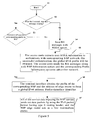
- Figure 5 shows IPv6 stateless auto-configuration flow for NSP service selection and authentication based on RS/RA messages.
- a terminal wants to visit a desired NSP, in step 52, it waits for 1 second to see whether any RA message comes. If there is no RA message, the flow proceeds to step 54, and if some RA messages come, the process module 312 reviews in the RA messages to find whether there are the desired NSP and the corresponding prefix (and stores these information in store module 313).
- step 56 If there are the desired NSP and the corresponding prefix, the flow proceeds to step 56, and if there is no desired NSP and the corresponding prefix, the flow proceeds to step 54; in step 54, user's terminal sends out the RS information carrying NSSA option by the process module 312 over the network interface module 311; in step 55, process module 322 of the access node extracts user's NSSA information from the NSSA option in RS messages to authenticate with corresponding NSP network. On successful authentication, the global IPv6 prefix will be obtained and be stored in the store module 323.
- the access node sends out the RA messages along with NSP Information option and the matching Prefix Information option over network interface module 321 to subscriber network by the process module; in step 56, the terminal obtains the prefix of the corresponding NSP and the address of the edge router(store it in the store module 323) to form global IPv6 address: Prefix+Interface identifier; in step 57, all of the service data enjoying the NSP service sends out data packets by using the IPv6 packet format having type 0 routing header, and the NSP edge router acts as a first intermediate router.
Landscapes
- Engineering & Computer Science (AREA)
- Computer Networks & Wireless Communication (AREA)
- Signal Processing (AREA)
- Computer Security & Cryptography (AREA)
- Computer Hardware Design (AREA)
- Computing Systems (AREA)
- General Engineering & Computer Science (AREA)
- Data Exchanges In Wide-Area Networks (AREA)
- Small-Scale Networks (AREA)
Abstract
Description
- The present invention relates to an IPv6 access network, in particular, relates to a method for network service selection and authentication based on RS (Router Solicitation)/RA (Router Advisement) messages in an access network, a solution for IPv6 stateless auto-configuration in an access network, and related devices thereof.
- With the rapid development of the Internet, IPv6 is becoming more and more mature. Because IPv6 provides such a vast number of available addresses, nearly every electrical device in the world could be connected to the Internet and the access network will become an "always-on" network. At the same time, the character of Plug & Play is becoming more important. The mechanism of IPv6 stateless auto-configuration can not only be used for realizing Plug & Play, but also be used for making the network more flexible. However, directly applying IPv6 stateless auto-configuration into access work that can be operated will cause severe security and other problems, which will be discussed as follows.
- Figure 1 shows an IPv6 access network architecture. All terminals in the subscriber network are IPv6 nodes, and the access node is operated as a layer3 device that combines the functions of an IPv6 router and some management functions.
- In the standard IPv6 stateless configuration, a router (or a layer3 access node) sends out, to a directly attached link, two kinds of Router Advertisement (RA) messages: (1) periodic unsolicited Router Advertisement messages; (2) Router Advertisement messages in response to Router Solicitations (RS). The RS/RA messages are encapsulated in ICMPv6 packets. Within the RA messages, global IP prefixes are carried. Thus all the terminal interfaces on this link can obtain the IPv6 prefixes to form their global IPv6 addresses by appending their own interface identifier to the IPv6 prefixes, i.e., IPv6 address=IPv6 prefix+ interface identifier.
- Because IPv6 stateless auto-configuration is designed for the open friendly network environment without taking this into consideration from telecommunication operators' viewpoints, directly applying the standard IPv6 stateless configuration into access network that can be operated will cause many problems. For example, in a standard IPv6 router, any unauthenticated user's terminal could automatically obtain its global IPv6 prefix from RA messages and form its IPv6 address, thereby enjoying the network services. Besides, if the access node is a standard IPv6 router, since no status information has been maintained in the access node, it is hard to support anti-spoofing filter. Some effective mechanisms should be provided first so as to apply the IPv6 stateless configuration to operators' access network.
- In future IPv6 access network, different terminals in a subscriber network can simultaneously enjoy different services from different Network Service Provider (NSP). Thus, how to effectively realize NSSA (Network Service Selection & Authentication) from multiple NSPs in IPv6 access network should be taken into consideration. In IPv4 access network, NSSA is done for each terminal, which is not an effective mechanism for IPv6 access network. With respect to the models of Network Service Selection & Authentication, traditionally there are four kinds of models, i.e., PPP model, Web portal model, DHCP model and 802.1x model. However, the efficiency of applying these four models to the IPv6 stateless auto-configuration access network is not good enough. The present invention will depict these four models in a simple way:
- In PPP model, firstly, Link Control Protocol (LCP) is used to establish the PPP link. Then network service selection and authentication is done. This model has some disadvantages: in future IPv6 access network, there may be more terminals within a subscriber network and they want to access the same NSP, and each terminal must establish a PPP session with the same NSP. In addition, PPP model could not take advantage of multicast streams, for multicast packets will be duplicated inside every PPP tunnel. Obviously, a lot of bandwidth is spoiled. In addition, PPPv6 could not provide global IPv6 address for the subscribers, so DHCPv6 or stateless address auto-configuration scheme is still needed to configure the global IPv6 addresses and other configuration information. Obviously, this will add the complexity to the network architecture.
- Terminals in a subscriber network use their link-local IPv6 addresses to communicate with the web portal located in the access provider network. From the web portal, the user is able to select a desired NSP and provide necessary authentication information. This model can be used in a network environment where terminals are all PCs, but an IPv6 network in the future will include terminals that cannot contact with web portal (e.g., IP phones).
- DHCPv6 has a "User Class" option, which can be used to contain a username, a desired NSP, and user's authentication information. To realize this model, there are two schemes: a DHCPv6 server is located in the same subnet as terminals, or a DHCPv6 relay agent is implemented in an access node used to relay DHCPv6 messages to the corresponding DHCPv6 server, then the authentication is done. In this model, DHCPv6 clients must be realized in the terminals. After completing service selection and authentication, the mechanism of stateless auto-configuration (e.g. Router Solicitation and Router Advertisement messages) should be used for configuration of terminals in the network.
- IEEE 802.1x is now a very popular authentication mechanism for clients connected to an IEEE 802 network. It just can be used for layer 2 authentication and layer 2 network service selections. Since in our network architecture, the access node is a
layer 3 device, other mechanisms are still needed forlayer 3 network service selection (e.g., to relay the service selection and authentication information to a desired NSP). On successful authentication, Router Solicitation and Router Advertisement messages must be used for other configuration (e.g., global address configuration) in stateless auto-configuration. This model has lower efficiency in our network architecture with IPv6 stateless auto-configuration mechanism. - The above four models have corresponding disadvantages, thus an effective method for Network Service Selection and Authentication adaptive to IPv6 stateless auto-configuration access network is necessarily to be designed.
- Further, every terminal in a subscriber network can enjoy at the same time services provided by different NSP. The interface between an access node and a subscriber network will advertise IPv6 prefix information from different NSPs, so how to make selection among these prefix information is a problem that should be solved. Besides, how to relay various data of a subscriber network quickly and correctly to corresponding NSP networks by the access node is also a problem necessarily to be solved when applying IPv6 stateless auto-configuration into access network.
- With respect to an aspect of the present invention, one problem to be solved lies in how to realize IPv6 stateless auto-configuration in access network and design an effective solution to make IPv6 access network with IPv6 stateless auto-configuration more manageable for the operator. Through this, 1) stateless auto-configuration can be easily used in IPv6 access network without introducing any potential problems; 2) NSP selection can be easily done by this solution.
- Operators want to control his/her network, but the IPv6 stateless auto-configuration cannot provide operators with any method for control, and there is no solution that can be operated for applying IPv6 stateless auto-configuration in access network.
- The invention proposes an effective solution, which enables IPv6 access network to support IPv6 stateless auto-configuration. The basic ideas are as follows:
- 1) One time authentication per subscriber network per NSP. Because the user owns his subscriber network, the terminals in his network are friendly to each other. Once there is a terminal that has fulfilled its NSP selection and authentication, it's not necessary for any other terminals to do authentication with the same NSP.
- 2) Definition of a new option, i.e., NSP Information option, for RA messages. This new option must be used along with an appropriate Prefix Information option containing the prefix allocated by the NSP, to deliver NSP Information (e.g., edge router address and NSP name) to the terminals. Each terminal can easily find an appropriate prefix in RA messages to transfer its packets to a desired NSP.
- 3) To use Type 0 Routing Header to transfer packets to a correct NSP network. The use of Type 0 Routing Header enables the access node to select an appropriate path quickly and relay the data to the corresponding NSP network.
- 4) Periodic authentication. It makes networks more secure.
- Thus, the present invention provides a method for IPv6 stateless auto-configuration in access network, characterized in that,
- a. an access node sends RA messages, including NSP Information option and Prefix Information option, to a subscriber network. The said NSP Information option includes an IPv6 address of NSP edge router and a NSP name. In RA messages, NSP Information option and the corresponding IPv6 Prefix Information option always exists in pairs,
- b. in the subscriber network, a terminal that wants to visit a NSP searches in the RA messages to find whether there is the NSP Information option and the corresponding Prefix Information option belonging to the said NSP,
- c. the terminal gets the prefix belonging to the NSP through the RA messages, and its global IPv6 address can be obtained by appending its interface identifier to the prefix.
- The present invention also provides an IPv6 terminal, including a process module, a network interface module and a store module, characterized in that,
the terminal receives RA messages from an access node over the network interface module, the messages includes a NSP Information option which includes an address of NSP edge router and NSP name; besides, in the RA messages, the NSP Information option and the corresponding Prefix Information option always exists in pairs, the process module processes the RA messages and stores the address of NSP edge router and NSP name in the store module,
if a terminal want to visit a NSP, the process module searches in the RA messages to find whether there is the NSP Information option and the corresponding Prefix Information option belonging to the NSP,
the process module of the terminal gets the prefix belonging to the NSP through the RA messages, and obtains its global IPv6 address by appending its interface identifier to the prefix. - The present invention further provides an IPv6 access node, including a process module, a network interface module and a store module, characterized in that,
the process module generates RA messages in accordance with an IPv6 address and a NSP name stored in the store module, the RA messages contain a NSP Information option which includes the IPv6 address of a NSP edge router and a NSP name; in the RA messages, the NSP Information option and the corresponding IPv6 Prefix Information option always exist in pairs, and the access node sends the RA messages over the network interface module to a subscriber network,
the access node sends the RA messages to the subscriber network over the network interface module by the NSP Information option and the Prefix Information option pair. - With respect to another aspect of the present invention, the technical problem to be solved thereof lies in proposing a new effective method for the NSSA problem.
- As to the problem, the present invention proposes an effective solution for making the network service selection and authentication more effective by utilizing Router Solicitation/Router Advertisement (RS/RA) messages. The basic ideas therein are depicted as follows.
- 1) RS/RA messages are mandatory in an IPv6 network. The information for NSSA can be piggyback on these messages.
- 2) To define a new option (i.e., NSSA Information option) for RS messages. This new option can be used to deliver the user's information in RS messages for network service selection and user authentication. NSP Information option in RA messages can be used along with Prefix Information option to identify the prefix assigned by a specified NSP.
- Therefore, the present invention provides a method for NSP service selection and authentication in an IPv6 access network, characterized in that,
terminals in a subscriber network send RS messages to an access node, the RS messages includes a NSSA Information option, which contains user's information for the network service selection and authentication;
the access node extracts user information from the NSSA Information option, and communicates with a corresponding AAA server for authentication;
upon authentication, NSP prefix is obtained, and the access node sends out the obtained NSP information and prefix information to the subscriber network with the NSP Information option and the Prefix Information option in RA messages. The NSP Information option contains the address of NSP edge router and the NSP name, and the NSP Information option and the corresponding Prefix Information option in the RA messages exist in pairs. - The present invention further provides an IPv6 terminal, including a process module, a network interface module and a store module, characterized in that,
the process module generates RS messages, the RS messages contain a NSSA Information option, which includes users' NSSA information, and the terminal sends the RA messages over the network interface module to an access node;
the RA messages that said terminal received over the network interface module from the access node contain a NSP Information option which includes the address of a NSP edge router and a NSP name, the NSP Information option and the corresponding Prefix Information option in the RA messages exist in pairs, and the process module processes the RA messages and stores the address of NSP edge router and the NSP name to the store module. - The present invention further provides an IPv6 access node, including a process module, a network interface module and a store module, characterized in that,
the access node receives RS messages from a terminal over a network interface, the process module extracts user information from a NSSA Information option of the received RS messages, and communicates with a corresponding AAA server for authentication, and the NSSA Information option contains user information for NSSA;
upon authentication, the process module generates RA messages in accordance with the NSP information and the Prefix information obtained and stored in the store module, the RA messages contain a NSP Information option and a Prefix Information option, the NSP Information option contains the address of a NSP edge router and a NSP name, the NSP Information option and the corresponding Prefix Information option in the RA messages exist in pairs, and the access node sends the NSP information and the Prefix information to a subscriber network through the RA messages over the network interface module. -
- Figure 1 shows an IPv6 access network architecture;
- Figure 2 is a flow chart illustrating stateless auto-configuration of an access network according to the present invention.
- Figure 3 is a diagram showing a user terminal and an access node of the IPv6 access network architecture in Figure 1.
- Figure 4 shows a RS/RA solution for network service selection and authentication in IPv6 stateless address configuration according to the present invention.
- Figure 5 is a flow chart showing the stateless auto-configuration in an access network adopting the RS/RA solution for NSSA according to the present invention.
- Figure 3 is a diagram showing a user terminal and an access node of the IPv6 access network architecture in Figure 1, wherein, terminal 31 in the subscriber network and
access node 32 receive/send RS and RA messages overnetwork interface modules process modules store modules - RA messages belong to neighbor discovery protocol (NDP), which is essential in IPv6.
-

- How to forward IP packets from subscriber network to the correct NSP is a very important problem in an access network. Among IPv6 extension headers, the Routing header is used by an IPv6 source to list one or more intermediate nodes to be "visited" on the way to a packet's destination. Type 0 Routing Header can be used to address packet-forwarding problem in an access network. The format of Type 0 Routing Header is following.

- The detail of this format can be referred to RFC2460. In our solution, we just specify an intermediate router address (i.e., the address of NSP edge router). So there is only one "Address" field in Routing Header; the field "Hdr Ext Len" (length of this extension header) is set to 2."Segments left" is set to 1. And in specific use of type 0 Routing Header, field "Address [1]" is set to the IPv6 address of the packet's final destination.
- In order to use type 0 Routing Header, terminals must know the IPv6 address of NSP edge router. Here, a new option, called NSP Information option, is defined to deliver the IPv6 address of NSP edge router to terminals. This option must be used along with the corresponding Prefix Information option in RA messages, thus the terminals can easily know the desired prefix and IPv6 address of desired NSP edge router. The format of this new option is following.

-
-
Type 6 - Length 8-bit unsigned integer. The length of the option (including the type and length fields) is in units of 8 octets. The value 0 is invalid. Nodes MUST silently discard an NDP packet that contains an option with length zero.
- Reserved This 16-bit field is unused. It MUST be initialized to zero by the sender and MUST be ignored by the receiver.
- NSP Edge Router Address the IPv6 address of a NSP edge router.
- NSP Name This field has a variable length, but it must guarantee that the whole length of this option is in units of 8 octets. Terminals use this field to identify the prefix of the desired NSP.
- Description The NSP Information option provides terminals with the IPv6 address of NSP edge router and NSP name. This option is advertised along with the corresponding IPv6 Prefix Information option. In RA message, NSP Information option is always followed by Prefix Information option; in another word, in access network, NSP Information option and Prefix Information option must exist in pairs. All IPv6 packets originated from the terminal that is enjoying this NSP's service must use the address of edge router in their Routing Headers.
- The NSP Information option can only appear in router advertisement packets, and other messages containing the option MUST be silently ignored.
- In a subscriber network, if there is no terminal that wants to visit a specified NSP, the access node will not obtain any IPv6 prefix from that NSP. If there are some nodes that enjoy the service from a specified NSP,
process module 322 of the access node will obtain an appropriate IPv6 prefix from the corresponding NSP overnetwork interface module 321, and stores it instore module 323, and the access node will periodically send out the corresponding RA messages by theprocess module 322 over thenetwork interface module 321. - Once there is a terminal (e.g., PC1) that wants to visit a specified NSP (e.g., NSP1 in Figure 1), it must do following steps to fulfill its stateless configuration (Figure 2),
- (1) in
step 21,process module 312 of PC1 waits for MAX_RTR_SOLICITATION_DELAY(MAX_RTR_SOLICITATION_DELAY is 1 second, which is defined in RFC2461) to see whether any RA messages comes.- a) If RA messages are received over the
network interface module 311,process module 312 of PC1 tries to find whether there is a prefix belonging to the desired NSP (NSP1) in the RA messages (step 22).- i) If there is a prefix belonging to NSP1, this means that another terminal has made authentication with NSP1 and it's not necessary to do NSP selection and authentication with NSP1 again. Go to step 27;
- ii) If there is none, go to step 25.
- b) In
step 23, if there is no RA message, the terminal actively sends out Router Solicitation messages over thenetwork interface module 311 by theprocess module 312. If there are RA messages, do the same action as that in step- (1) a) i). After MAX_RTR_SOLICITATIONS (MAX_RTR_SOLICITATIONS is 3 transmissions, which is defined in RFC2461) RS messages, if there is still no RA message, go to step (25).
- (2) In
step 25, do NSP service selection and authentication. The NSP service selection and authentication may adopt several of ways, e.g., basing on 802.1x or the manner of DHCP authentication. In case of DHCP service selection and authentication, for example, theprocess module 312 of PC1 can trigger Dynamic Host Configuration Protocol for IPv6 (DHCPv6) client to do NSP selection and authentication with "User Class" option. This option could contain the username, the desired NSP (here NSP is NSP1), and the user's authentication information. To make the authentication far away from attack, DHCPv6's "Authentication" option could be used. Within this step, the link-local IPv6 address can be used as its source address and All_DHCP_Relay_Agents_and_Servers multicast address as its destination address.
- a) If RA messages are received over the
- The DHCPv6 relay agent in the access node can relay the message to the DHCP server (AAA server providing authentication, authorization, and accounting) located in the desired NSP1 to do authentication.
- In
step 26, on successful authentication, an appropriate prefix is allocated to this subscriber's network by the NSP1. The assignment of this prefix is notified to the access node (e.g., through DHCPv6 Prefix Delegation option), and is stored by thestore module 323. Then the access node sends out RA messages to the subscriber network through NSP Information option and Prefix Information option pair over thenetwork interface module 321. Theprocess module 322 generates the RA messages containing the IPv6 address of the NSP edge router, NSP name, and the allocated prefix information; - In
step 27, once the terminal gets the prefix from the desired NSP, theprocess module 312 can obtain its global IPv6 address by appending its interface identifier to the prefix. - In
step 28, any packets originated from the terminal can use Type 0 Routing Header with the desired NSP edge router's address to enjoy service from the desired NSP. Of course, in order to make the network more robust, access node should support anti-spoofing, which means to check whether the packets from an IPv6 address could enjoy the services from the specified NSP by using longest prefix mapping with the prefix allocated to this subscriber network. - In this solution, each subscriber network just makes an authentication with a desired NSP. The following terminals just look into the RA's NSP Information option and Prefix Information option pair to get the appropriate prefix assigned by the desired NSP. This can be called "one time authentication per subscriber network per NSP", which promotes the speed of auto-configuration, reduces the NSP selection and authentication traffic in the network and also the authentication requests to the corresponding DHCP server (AAA server).
- In order to make the network more robust, NSP may require its subscriber network to do periodic authentication. For this purpose, when the prefix is firstly assigned to the subscriber network, the preferable time of this prefix can be set to an appropriate time (e.g., 1 day). And the expiration of an address's preferable time for a terminal will trigger a DHCPv6 Renew message to the corresponding authentication server and request to extend the preferable time of the prefix. Within this message, "User Class" option must be included.
- The invention makes the implementation of IPv6 stateless auto-configuration in an access network possible. The new NSP Information option, the method of "one time authentication per subscriber network per NSP", and the use of IPv6 Routing Header promote the efficiency of IPv6 stateless auto-configuration, and also reduce the NSP selection and authentication traffic.
- Periodic authentication provides a method for the NSP to control its service, and thus the network is more robust.
- All the terminals in a subscriber network are IPv6 nodes, and the access nodes are operated as layer3 devices that combine the functions of IPv6 router and some management functions.
- As mentioned above, in a standard IPv6 stateless configuration, a router (or layer3 access node) sends, periodically or in response to Router Solicitation (RS), Router Advertisement (RA) messages out its advertising interfaces. Thus all the terminals can obtain the IPv6 prefixes to form their global IPv6 addresses by appending their interface identifier to the IPv6 prefixes.
- When the interface of an IPv6 terminal becomes enabled, the terminal may be unwilling to wait for the next unsolicited RA message to locate default routers or learn prefixes. To obtain RA messages quickly, a terminal should transmit up to MAX_RTR_SOLICITATIONS (It is defined in RFC2461. MAX_RTR_SOLICITATIONS is 3 transmissions.) Router Solicitation (RS) messages each separated by at least RTR_SOLICITATION_INTERVAL (It is defined in RFC2461. RTR_SOLICITATION_INTERVAL is 4 seconds.) seconds. According to this scheme, we can use RS/RA messages for network service selection and authentication. A new option (i.e., NSSA Information option) can be defined to deliver user's information for NSSA. In RA messages, there may be some different prefixes that come from different NSPs. To provide convenience for the terminal to do correct selection of prefix, the NSP information (e.g., the NSP name of this prefix) must be also included in the NSSA Information option.
-

- Only Source Link-Layer Address option can be used in RS's Options field. In order to deliver user's information for NSP selection and authentication, Network Service Selection and Authentication (NSSA) Information option must be defined,

- Type 7.
- Length 8-bit unsigned integer. The length of the option (including the type and length fields) is in units of 8 octets. The value 0 is invalid. Nodes MUST silently discard an ND packet that contains an option with length zero.
- NSSA Data This field has a variable length, but it must guarantee that the whole length of this option is in units of 8 octets. It is used to contain user's information (e.g., username, the desired NSP, and the user's other authentication information) for network service selection and authentication in RS messages. The syntax of the field could be username@nsp.com:password or be other cipher text. To make the information far away from attack or steal, IPv6 Encapsulating Security Payload (ESP) Header or other enciphering methods can be adopted to ensure the security of user's information.
- Description When this option exists in RS messages, it is used to deliver the user's information for network service selection and user authentication.
- NSP Information option in RA messages should be used along with Prefix Information option to identify the prefix assigned by a specified NSP. In other words, in RA messages, NSP Information option and Prefix Information option must exist in pairs. Thus RA messages may contain multiple pairs of this kind for different prefix from different NSPs.
- Figure 4 shows the RS/RA solution for network service selection and authentication in IPv6 stateless address configuration. An IPv6 user terminal maintains the NSP information for its desired NSP (e.g., NSP name) by
process module 312, and the NSP information being stored instore module 313. Theprocess module 322 extracts the user's information from NSSA Information option, and communicates with a corresponding AAA server to authenticate. On successful authentication, the access node requests the prefix delegation from the corresponding NSP edge router, obtains the corresponding NSP information byprocess module 322, and stores it instore module 323. Then, the access node generates RA messages by theprocess module 322 and sends it with NSP Information option and Prefix Information option to subscriber network over thenetwork interface module 321. - In Figure4, prefix allocation is assumed to be done by the NSP's edge router. In other cases, for example, prefix allocation may be done along the authentication with RADIUS through Framed-IP-Prefix attribute, thus step 4 and step 5 may be omitted.
- By defining NSSA Information option, the RS messages generated by the terminal's
process module 312 and sent out over thenetwork interface module 311 can carry user's information for network service selection and authentication, and the RA messages generated by theprocess module 322 and sent out over thenetwork interface module 321 can send the NSP information along with the Prefix Information option, network service selection and authentication can be easily and efficiently done along with RS/RA messages. The terminal can select the appropriate prefix to form its global IPv6 address with the information in the NSP Information option and Prefix Information option by theprocess module 312. - When the interface of an IPv6 terminal (network interface module 311) becomes enabled,
process module 312 will send out a RS message to obtain a global prefix. To take good use of this feature, the invention provides an efficient solution for network service selection and authentication, which does not introduce any other messages' exchange between the terminals and the access node. - In short, our solution for network service selection and authentication is piggyback on the RS/RA messages. It's very simple.
- Figure 5 shows IPv6 stateless auto-configuration flow for NSP service selection and authentication based on RS/RA messages.
- In a subscriber network, if a terminal wants to visit a desired NSP, in
step 52, it waits for 1 second to see whether any RA message comes. If there is no RA message, the flow proceeds to step 54, and if some RA messages come, theprocess module 312 reviews in the RA messages to find whether there are the desired NSP and the corresponding prefix (and stores these information in store module 313). If there are the desired NSP and the corresponding prefix, the flow proceeds to step 56, and if there is no desired NSP and the corresponding prefix, the flow proceeds to step 54;
instep 54, user's terminal sends out the RS information carrying NSSA option by theprocess module 312 over thenetwork interface module 311;
instep 55,process module 322 of the access node extracts user's NSSA information from the NSSA option in RS messages to authenticate with corresponding NSP network. On successful authentication, the global IPv6 prefix will be obtained and be stored in thestore module 323. The access node sends out the RA messages along with NSP Information option and the matching Prefix Information option overnetwork interface module 321 to subscriber network by the process module;
instep 56, the terminal obtains the prefix of the corresponding NSP and the address of the edge router(store it in the store module 323) to form global IPv6 address: Prefix+Interface identifier;
instep 57, all of the service data enjoying the NSP service sends out data packets by using the IPv6 packet format having type 0 routing header, and the NSP edge router acts as a first intermediate router.
Claims (14)
- A method for Network Service Provider, abbreviated NSP, service selection and authentication in an Internet Protocol version 6, abbreviated IPv6, access network, characterized in that,
a terminal in a subscriber network sends Router Solicitation, abbreviated RS, messages with a Network Service Selection and Authentication, abbreviated NSSA, Information option which contains user's information for network service selection and authentication, to an access node;
the access node extracts user's information from the NSSA Information option in the RS messages, and communicates with the corresponding Authentication, Authorization, and Accounting, abbreviated AAA, server for authentication;
upon authentication, a NSP prefix is obtained, and the access node sends the obtained NSP information and the prefix information to the subscriber network by the NSP Information option and the Prefix Information option in the Router Advisement, abbreviated RA, messages, and the NSP information option contains the address of a NSP edge router and a NSP name and exists in pair with the corresponding Prefix Information option in the RA messages. - A method as claimed in claim 1, characterized in that, the user's information for network service selection and authentication contains the user's name, the desired NSP and other authentication information of the user.
- A method for Internet Protocol version 6, abbreviated IPv6, stateless auto-configuration in an access work, characterized in that,a. an access node sends Router Advisement, abbreviated RA, messages including a Network Service Provider, abbreviated NSP, Information option and a Prefix Information option pair to a subscriber network, the NSP Information option includes IPv6 address of a NSP edge router and a NSP name, and the NSP Information option always exists in pair with corresponding IPv6 Prefix Information option in the RA messages,b. in the subscriber network, a terminal who wants to visit a NSP finds whether there are the NSP Information option and the corresponding Prefix Information option belonging to the NSP in the RA messages,c. the terminal obtains the prefix belonging to the NSP through the RA messages, and obtain a global IPv6 address by appending its interface identifier to the prefix.
- A method as claimed in claim 3, characterized in that, when a terminal wants to visit a NSP, if there is no RA message, the terminal sends Router Solicitation messages initiatively to obtain RA messages.
- A method as claimed in claim 4, characterized in that, when a terminal wants to visit a NSP, if there is no RA message, the terminal makes NSP service selection and authentication if there is still no RA message after the terminal initiatively sends out Router Solicitation messages,
upon authentication, the prefix belonging to the NSP is allocated and notified to the access node by the NSP. - A method as claimed in claim 3, characterized in that, packets originated from the terminal can use a routing header with IPv6 address of the said NSP edge router.
- A method as claimed in claim 6, characterized in that,
the routing header only set the IPv6 address of the NSP edge router to be an intermediate router address. - A method as claimed in claim 3, characterized in that, the access node check whether the packets from an IPv6 address could enjoy services from the corresponding NSP by using longest prefix mapping with the prefix allocated to the subscriber network.
- A method as claimed in claim 5, characterized in that, Dynamic Host Configuration Protocol-, abbreviated DHCP-, based service selection and authentication is adopted in the NSP service selection and authentication.
- A method as claimed in claim 9, characterized in that,
the NSP can require the subscriber network for periodic authentication, i.e., when the prefix is firstly assigned to the subscriber network, the preferable time of this prefix can be set to an appropriate time, and the expiration of an address's preferable time for a terminal will trigger a DHCP version 6, abbreviated v6, Renew message to the corresponding authentication server and request to extend the preferable time of the prefix. - An Internet Protocol version 6, abbreviated IPv6, terminal, including a process module, a network interface module and a store module, characterized in that,
the process module generates Router Solicitation, abbreviated RS, messages with Network Service Selection and Authentication, abbreviated NSSA, Information option which contains user's information for network service selection and authentication, and the terminal sends the RS messages to an access node over the network interface module;
Router Advisement, abbreviated RA, messages that the terminal receives from the access node over the network interface module contain Network Service Provider, abbreviated NSP, Information option which includes the address of a NSP edge router and a NSP name and exists in pair with corresponding Prefix Information option in the RA messages, and the process module processes the RA messages and stores the address of the NSP edge router and the NSP name to the store module. - An Internet Protocol version 6, abbreviated IPv6, access node, including a process module, a network interface module and a store module, characterized in that,
the access node receives Router Solicitation, abbreviated RS, messages over the network interface module, the process module extracts user's information from a Network Service Selection and Authentication, abbreviated NSSA, Information option of the received RS messages, and contacts with a corresponding Authentication, Authorization, and Accounting, abbreviated AAA, server to make authentication, the NSSA Information option containing user's information for network service selection and authentication,;
upon authentication, the obtained information related to the Network Service Provider, abbreviated NSP, is stored in the store module, the process module generates, based on the information related to the NSP, Router Advisement, abbreviated RA, messages containing NSP Information option and Prefix Information option, the NSP Information option contains the address of a NSP edge router and a NSP name and exists in pair with the corresponding Prefix Information option in the RA messages, and the access node sends the NSP information and the prefix information to the subscriber network over the network interface module by the RA messages. - An Internet Protocol version 6, abbreviated IPv6, terminal, including a process module, a network interface module and a store module, characterized in that,
the terminal receives Router Advisement, abbreviated RA, messages over the network interface module from an access node, the RA messages include a Network Service Provider, abbreviated NSP, Information option containing the address of a NSP edge router and a NSP name, the NSP Information option exists in pair with the corresponding Prefix Information option in the RA messages, and the process module process the RA messages and stores the address of the NSP edge router and the NSP name to the store module,
when the terminal wants to visit a NSP, the process module finds whether there are the NSP Information option and the corresponding Prefix Information option belonging to the NSP,
the process module of the terminal obtains the prefix belonging to the NSP through the RA messages and obtains the global IPv6 address by appending its interface identifier to the prefix. - An Internet Protocol version 6, abbreviated IPv6, access node, including a process module, a network interface module and a store module, characterized in that,
the process module generates Router Advisement, abbreviated RA, messages in accordance with IPv6 addresses and Network Service Provider, abbreviated NSP, names stored in the store module, the RA messages contain a NSP Information option containing an IPv6 address of a NSP edge router and a NSP name; in the RA messages, the NSP Information option always exists in pair with the corresponding IPv6 Prefix Information option,
and the access node sends out the RA messages over the network interface module to the subscriber network through the NSP Information option and the Prefix Information option pair.
Applications Claiming Priority (1)
| Application Number | Priority Date | Filing Date | Title |
|---|---|---|---|
| CNB200410067089XA CN100474839C (en) | 2004-10-12 | 2004-10-12 | Network service selection and authentication in IPv6 access network, and automatic configuration without status |
Publications (2)
| Publication Number | Publication Date |
|---|---|
| EP1648134A1 true EP1648134A1 (en) | 2006-04-19 |
| EP1648134B1 EP1648134B1 (en) | 2007-12-19 |
Family
ID=36146887
Family Applications (1)
| Application Number | Title | Priority Date | Filing Date |
|---|---|---|---|
| EP20050019729 Expired - Lifetime EP1648134B1 (en) | 2004-10-12 | 2005-09-10 | Network service selection and authentication and stateless auto-configuration in an IPv6 access network |
Country Status (6)
| Country | Link |
|---|---|
| US (1) | US8887234B2 (en) |
| EP (1) | EP1648134B1 (en) |
| JP (1) | JP4652944B2 (en) |
| CN (1) | CN100474839C (en) |
| AT (1) | ATE381843T1 (en) |
| DE (1) | DE602005003897D1 (en) |
Cited By (3)
| Publication number | Priority date | Publication date | Assignee | Title |
|---|---|---|---|---|
| EP2234343A4 (en) * | 2008-01-03 | 2011-02-09 | Huawei Tech Co Ltd | METHOD, DEVICE AND SYSTEM FOR SELECTING SERVICE NETWORK |
| EP2200350A4 (en) * | 2007-09-29 | 2012-04-25 | Zte Corp | Realization method for selecting network service provider by terminal |
| CN103401847A (en) * | 2009-07-08 | 2013-11-20 | 中兴通讯股份有限公司 | Counterfeit judging method |
Families Citing this family (39)
| Publication number | Priority date | Publication date | Assignee | Title |
|---|---|---|---|---|
| KR100723864B1 (en) * | 2005-11-12 | 2007-05-31 | 한국전자통신연구원 | Method and apparatus for preventing network attack using information contained in packet |
| DE102006017940B4 (en) * | 2006-04-18 | 2009-12-17 | Fraunhofer-Gesellschaft zur Förderung der angewandten Forschung e.V. | Process for the preparation of a compound |
| US8625609B2 (en) * | 2006-05-19 | 2014-01-07 | Futurewei Technologies Inc. | Using DHCPv6 and AAA for mobile station prefix delegation and enhanced neighbor discovery |
| JP4675842B2 (en) * | 2006-07-03 | 2011-04-27 | パナソニック株式会社 | IP address management system, IP address management method and program |
| CN1929482B (en) * | 2006-09-20 | 2010-08-04 | 华为技术有限公司 | Method and device for network service authentication |
| KR100745724B1 (en) * | 2006-09-29 | 2007-08-03 | 한국전자통신연구원 | How to recognize the service of a router in an IPv6 environment |
| KR101203472B1 (en) * | 2006-10-13 | 2012-11-21 | 삼성전자주식회사 | Method for supporting mobility of mobile terminal based on prefix binding and system thereof |
| CN101179603B (en) * | 2006-11-09 | 2011-06-08 | 上海贝尔阿尔卡特股份有限公司 | Method and device for controlling user network access in IPv6 network |
| US8045558B2 (en) | 2007-04-23 | 2011-10-25 | Cisco Technology, Inc. | Extensions to IPv6 neighbor discovery protocol for automated prefix delegation |
| US8065515B2 (en) * | 2007-04-23 | 2011-11-22 | Cisco Technology, Inc. | Autoconfigured prefix delegation based on distributed hash |
| CN101350807B (en) * | 2007-07-20 | 2012-04-04 | 华为技术有限公司 | Multi-address space mobile network architecture, host information registration and data sending method |
| CN101394333B (en) * | 2007-09-17 | 2016-01-20 | 华为技术有限公司 | Method, device and network system for forwarding message |
| US8914445B2 (en) * | 2007-10-17 | 2014-12-16 | Futurewei Technologies, Inc. | System and method for diameter prefix authorization |
| CN101547383B (en) * | 2008-03-26 | 2013-06-05 | 华为技术有限公司 | Access authentication method, access authentication system and related equipment |
| US20100125894A1 (en) * | 2008-11-19 | 2010-05-20 | At&T Intellectual Property I, L.P. | Systems, methods and computer program products that facilitate remote access of devices in a subscriber network |
| US8619797B2 (en) * | 2009-05-12 | 2013-12-31 | Futurewei Technologies, Inc. | Using internet protocol version six (IPv6) tunnel for access identifier transport |
| CN101902482B (en) * | 2010-08-23 | 2013-04-10 | 中国电信股份有限公司 | Method and system for realizing terminal security admission control based on IPv6 (Internet Protocol Version 6) automatic configuration |
| US8832238B2 (en) | 2011-09-12 | 2014-09-09 | Microsoft Corporation | Recording stateless IP addresses |
| CN103095667B (en) * | 2011-11-08 | 2015-03-11 | 华为技术有限公司 | Authorization message passing method, trunk equipment and server |
| US8918634B2 (en) | 2012-02-21 | 2014-12-23 | International Business Machines Corporation | Network node with network-attached stateless security offload device employing out-of-band processing |
| CN103812845A (en) * | 2012-11-15 | 2014-05-21 | 中兴通讯股份有限公司 | Service discovery method and device based on 6LoWPAN (IPv6 overLow-Power Wireless Personal Area Networks) |
| CN103051739A (en) * | 2012-12-11 | 2013-04-17 | 中兴通讯股份有限公司 | Network terminal and IP (Internet Protocol) address configuration method thereof |
| CN103916484B (en) * | 2012-12-31 | 2017-07-21 | 华为技术有限公司 | The method and apparatus for configuring IP address |
| CN103167058A (en) * | 2013-04-02 | 2013-06-19 | 深圳市共进电子股份有限公司 | Method for acquiring Internet protocol version 6 (IPv6) prefix by adopting internet control message protocol version 6 (ICMPv6) to generate client address |
| US9497083B1 (en) * | 2013-06-10 | 2016-11-15 | Palo Alto Networks, Inc. | Discovering network nodes |
| CN103312622A (en) * | 2013-07-04 | 2013-09-18 | 深圳市共进电子股份有限公司 | Internet Protocol version 6 (IPv6) access authentication method |
| CN103561122B (en) * | 2013-10-23 | 2017-01-18 | 华为终端有限公司 | IPv6 address collocation method, IPv6 client and server |
| US10129202B2 (en) * | 2014-11-25 | 2018-11-13 | Cisco Technology, Inc. | Optimizing global IPv6 address assignments |
| CN105282266A (en) * | 2015-06-30 | 2016-01-27 | 清华大学 | IPV6 address generating and analyzing methods and systems |
| EP3501134B1 (en) | 2016-08-19 | 2021-07-07 | Telefonaktiebolaget LM Ericsson (publ) | Distinguishing reference signals in a beam-based communication system |
| CN109005252A (en) * | 2018-08-24 | 2018-12-14 | 赛尔网络有限公司 | A kind of IPv6 address generating method, equipment, system and the medium of fictitious host computer |
| CN110401730B (en) * | 2019-07-25 | 2021-06-29 | 华为技术有限公司 | IP address generation method and device |
| CN113765791B (en) * | 2020-06-02 | 2023-01-13 | 华为技术有限公司 | Method, node and system for determining processing capacity |
| US11425044B2 (en) * | 2020-10-15 | 2022-08-23 | Cisco Technology, Inc. | DHCP layer 2 relay in VXLAN overlay fabric |
| CN115701181A (en) * | 2021-07-31 | 2023-02-07 | 贵州白山云科技股份有限公司 | Node scheduling method, device, medium and equipment |
| WO2023069394A1 (en) * | 2021-10-18 | 2023-04-27 | Cisco Technology, Inc. | Collection of segment routing ipv6 (srv6) network telemetry information |
| KR20240057379A (en) * | 2022-10-24 | 2024-05-02 | 성균관대학교산학협력단 | Apparatus and method for providing basic support for IPv6 networks operating over 5G vehicle-to-everything communications |
| CN118233431A (en) * | 2022-12-21 | 2024-06-21 | 中兴通讯股份有限公司 | Configuration method, client, address configuration module, system and medium |
| CN120201008B (en) * | 2025-03-26 | 2026-01-02 | 沈阳强信通信技术有限公司 | IPv6 network management method based on stateless address management system |
Citations (2)
| Publication number | Priority date | Publication date | Assignee | Title |
|---|---|---|---|---|
| WO2003102711A2 (en) * | 2002-05-30 | 2003-12-11 | Motorola Inc | Attachment of user equipment to a selected access interface of router equipment of an internet service provider |
| WO2005072276A2 (en) * | 2004-01-22 | 2005-08-11 | Kabushiki Kaisha Toshiba | Serving network selection and multihoming using ip access network |
Family Cites Families (9)
| Publication number | Priority date | Publication date | Assignee | Title |
|---|---|---|---|---|
| JP4020576B2 (en) * | 2000-09-14 | 2007-12-12 | 株式会社東芝 | Packet transfer method, mobile terminal device and router device |
| US7286671B2 (en) * | 2001-11-09 | 2007-10-23 | Ntt Docomo Inc. | Secure network access method |
| CN1431836A (en) | 2002-01-07 | 2003-07-23 | 财团法人资讯工业策进会 | Transparent IPv6 Internet Roaming Proxy Device |
| JP4161782B2 (en) | 2002-04-18 | 2008-10-08 | 松下電器産業株式会社 | Mobile node and mobile communication method |
| KR100424614B1 (en) * | 2002-04-27 | 2004-03-27 | 삼성전자주식회사 | Internet protocol based communication system and host address setting and source address selection method thereof |
| KR100429901B1 (en) * | 2002-05-08 | 2004-05-03 | 한국전자통신연구원 | Method for assigning IP address using agent in zero configuration network |
| US7280505B2 (en) * | 2002-11-13 | 2007-10-09 | Nokia Corporation | Method and apparatus for performing inter-technology handoff from WLAN to cellular network |
| JP4480963B2 (en) * | 2002-12-27 | 2010-06-16 | 富士通株式会社 | IP connection processing device |
| CN100459610C (en) | 2003-09-24 | 2009-02-04 | 中国科学院计算技术研究所 | Method for realizing dynamic domain name assignment service for roaming communication in mobile internet network |
-
2004
- 2004-10-12 CN CNB200410067089XA patent/CN100474839C/en not_active Expired - Lifetime
-
2005
- 2005-09-10 DE DE200560003897 patent/DE602005003897D1/en not_active Expired - Lifetime
- 2005-09-10 AT AT05019729T patent/ATE381843T1/en not_active IP Right Cessation
- 2005-09-10 EP EP20050019729 patent/EP1648134B1/en not_active Expired - Lifetime
- 2005-09-15 US US11/226,215 patent/US8887234B2/en not_active Expired - Fee Related
- 2005-10-06 JP JP2005293503A patent/JP4652944B2/en not_active Expired - Fee Related
Patent Citations (2)
| Publication number | Priority date | Publication date | Assignee | Title |
|---|---|---|---|---|
| WO2003102711A2 (en) * | 2002-05-30 | 2003-12-11 | Motorola Inc | Attachment of user equipment to a selected access interface of router equipment of an internet service provider |
| WO2005072276A2 (en) * | 2004-01-22 | 2005-08-11 | Kabushiki Kaisha Toshiba | Serving network selection and multihoming using ip access network |
Non-Patent Citations (3)
| Title |
|---|
| PATRIK FLYKT CHARLES E PERKINS NOKIA THOMAS EKLUND XELERATED NETWORKS: "AAA for IPv6 Network Access draft-perkins-aaav6-05.txt", IETF STANDARD-WORKING-DRAFT, INTERNET ENGINEERING TASK FORCE, IETF, CH, no. 5, 1 March 2002 (2002-03-01), XP015004814, ISSN: 0000-0004 * |
| SALMAN ASADULLAH ADEEL AHMED CIPRIAN POPOVICIU CISCO SYSTEMS: "ISP IPv6 Deployment Scenarios in Broadband Access Networks", IETF STANDARD-WORKING-DRAFT, INTERNET ENGINEERING TASK FORCE, IETF, CH, August 2004 (2004-08-01), XP015010354, ISSN: 0000-0004 * |
| TROAN R DROMS CISCO SYSTEMS O: "IPv6 Prefix Options for Dynamic Host Configuration Protocol (DHCP) version 6", IETF STANDARD, INTERNET ENGINEERING TASK FORCE, IETF, CH, December 2003 (2003-12-01), XP015009415, ISSN: 0000-0003 * |
Cited By (4)
| Publication number | Priority date | Publication date | Assignee | Title |
|---|---|---|---|---|
| EP2200350A4 (en) * | 2007-09-29 | 2012-04-25 | Zte Corp | Realization method for selecting network service provider by terminal |
| EP2234343A4 (en) * | 2008-01-03 | 2011-02-09 | Huawei Tech Co Ltd | METHOD, DEVICE AND SYSTEM FOR SELECTING SERVICE NETWORK |
| CN103401847A (en) * | 2009-07-08 | 2013-11-20 | 中兴通讯股份有限公司 | Counterfeit judging method |
| CN103401847B (en) * | 2009-07-08 | 2016-12-28 | 中兴通讯股份有限公司 | A kind of counterfeit determination methods |
Also Published As
| Publication number | Publication date |
|---|---|
| EP1648134B1 (en) | 2007-12-19 |
| ATE381843T1 (en) | 2008-01-15 |
| JP2006115499A (en) | 2006-04-27 |
| CN1761233A (en) | 2006-04-19 |
| CN100474839C (en) | 2009-04-01 |
| US8887234B2 (en) | 2014-11-11 |
| DE602005003897D1 (en) | 2008-01-31 |
| JP4652944B2 (en) | 2011-03-16 |
| US20060080728A1 (en) | 2006-04-13 |
Similar Documents
| Publication | Publication Date | Title |
|---|---|---|
| EP1648134B1 (en) | Network service selection and authentication and stateless auto-configuration in an IPv6 access network | |
| KR100750370B1 (en) | Address acquisition | |
| US7688792B2 (en) | Method and apparatus for supporting wireless data services on a TE2 device using an IP-based interface | |
| KR100987553B1 (en) | Method for switching IP packets between client networks and IP provider networks by access network | |
| US7016353B2 (en) | Method and system for dynamically assigning IP addresses in wireless networks | |
| US6775276B1 (en) | Method and system for seamless address allocation in a data-over-cable system | |
| US20020165972A1 (en) | Methods and apparatus for use in reducing traffic over a communication link used by a computer network | |
| US20090285215A1 (en) | Internet Protocol Version Six (IPv6) Addressing and Packet Filtering in Broadband Networks | |
| US7706374B2 (en) | Method for assigning IP address to terminal device and communication system | |
| US8243681B2 (en) | Methods and apparatus for broadcast optimization in mobile IP | |
| US20130227156A1 (en) | Ipv6 address generation to trigger a virtual leased line service | |
| Astic et al. | A hierarchical topology discovery service for IPv6 networks | |
| JP3994412B2 (en) | Network system, network identifier setting method, network connection point, network identifier setting program, and recording medium | |
| US20040019664A1 (en) | Method and system for discovering a network element in a network such as an agent in an IP network | |
| KR100470071B1 (en) | Apparatus of authentication server with combine information management for WLAN interworking system | |
| Jeon et al. | Transmission of IP over Ethernet over IEEE 802.16 Networks | |
| Jain et al. | Role and Issues of IPV4 and IPV6 | |
| Hughes | IPv6 Core Protocols | |
| Jeon et al. | RFC 5692: Transmission of IP over Ethernet over IEEE 802.16 Networks | |
| Bokor | INTRODUCTION TO THE WORLD OF IPV6 NETWORKS | |
| Headquarters | Implementing IPv6 Addressing and Basic Connectivity |
Legal Events
| Date | Code | Title | Description |
|---|---|---|---|
| PUAI | Public reference made under article 153(3) epc to a published international application that has entered the european phase |
Free format text: ORIGINAL CODE: 0009012 |
|
| AK | Designated contracting states |
Kind code of ref document: A1 Designated state(s): AT BE BG CH CY CZ DE DK EE ES FI FR GB GR HU IE IS IT LI LT LU LV MC NL PL PT RO SE SI SK TR |
|
| AX | Request for extension of the european patent |
Extension state: AL BA HR MK YU |
|
| 17P | Request for examination filed |
Effective date: 20060220 |
|
| AKX | Designation fees paid |
Designated state(s): AT BE BG CH CY CZ DE DK EE ES FI FR GB GR HU IE IS IT LI LT LU LV MC NL PL PT RO SE SI SK TR |
|
| RAP1 | Party data changed (applicant data changed or rights of an application transferred) |
Owner name: ALCATEL LUCENT |
|
| GRAP | Despatch of communication of intention to grant a patent |
Free format text: ORIGINAL CODE: EPIDOSNIGR1 |
|
| GRAS | Grant fee paid |
Free format text: ORIGINAL CODE: EPIDOSNIGR3 |
|
| GRAA | (expected) grant |
Free format text: ORIGINAL CODE: 0009210 |
|
| AK | Designated contracting states |
Kind code of ref document: B1 Designated state(s): AT BE BG CH CY CZ DE DK EE ES FI FR GB GR HU IE IS IT LI LT LU LV MC NL PL PT RO SE SI SK TR |
|
| REG | Reference to a national code |
Ref country code: GB Ref legal event code: FG4D |
|
| REG | Reference to a national code |
Ref country code: IE Ref legal event code: FG4D |
|
| REG | Reference to a national code |
Ref country code: CH Ref legal event code: EP |
|
| REF | Corresponds to: |
Ref document number: 602005003897 Country of ref document: DE Date of ref document: 20080131 Kind code of ref document: P |
|
| PG25 | Lapsed in a contracting state [announced via postgrant information from national office to epo] |
Ref country code: CH Free format text: LAPSE BECAUSE OF FAILURE TO SUBMIT A TRANSLATION OF THE DESCRIPTION OR TO PAY THE FEE WITHIN THE PRESCRIBED TIME-LIMIT Effective date: 20071219 Ref country code: SE Free format text: LAPSE BECAUSE OF FAILURE TO SUBMIT A TRANSLATION OF THE DESCRIPTION OR TO PAY THE FEE WITHIN THE PRESCRIBED TIME-LIMIT Effective date: 20080319 Ref country code: LI Free format text: LAPSE BECAUSE OF FAILURE TO SUBMIT A TRANSLATION OF THE DESCRIPTION OR TO PAY THE FEE WITHIN THE PRESCRIBED TIME-LIMIT Effective date: 20071219 |
|
| PG25 | Lapsed in a contracting state [announced via postgrant information from national office to epo] |
Ref country code: LV Free format text: LAPSE BECAUSE OF FAILURE TO SUBMIT A TRANSLATION OF THE DESCRIPTION OR TO PAY THE FEE WITHIN THE PRESCRIBED TIME-LIMIT Effective date: 20071219 Ref country code: PL Free format text: LAPSE BECAUSE OF FAILURE TO SUBMIT A TRANSLATION OF THE DESCRIPTION OR TO PAY THE FEE WITHIN THE PRESCRIBED TIME-LIMIT Effective date: 20071219 Ref country code: NL Free format text: LAPSE BECAUSE OF FAILURE TO SUBMIT A TRANSLATION OF THE DESCRIPTION OR TO PAY THE FEE WITHIN THE PRESCRIBED TIME-LIMIT Effective date: 20071219 Ref country code: FI Free format text: LAPSE BECAUSE OF FAILURE TO SUBMIT A TRANSLATION OF THE DESCRIPTION OR TO PAY THE FEE WITHIN THE PRESCRIBED TIME-LIMIT Effective date: 20071219 Ref country code: SI Free format text: LAPSE BECAUSE OF FAILURE TO SUBMIT A TRANSLATION OF THE DESCRIPTION OR TO PAY THE FEE WITHIN THE PRESCRIBED TIME-LIMIT Effective date: 20071219 Ref country code: LT Free format text: LAPSE BECAUSE OF FAILURE TO SUBMIT A TRANSLATION OF THE DESCRIPTION OR TO PAY THE FEE WITHIN THE PRESCRIBED TIME-LIMIT Effective date: 20071219 |
|
| NLV1 | Nl: lapsed or annulled due to failure to fulfill the requirements of art. 29p and 29m of the patents act | ||
| REG | Reference to a national code |
Ref country code: CH Ref legal event code: PL |
|
| PG25 | Lapsed in a contracting state [announced via postgrant information from national office to epo] |
Ref country code: AT Free format text: LAPSE BECAUSE OF FAILURE TO SUBMIT A TRANSLATION OF THE DESCRIPTION OR TO PAY THE FEE WITHIN THE PRESCRIBED TIME-LIMIT Effective date: 20071219 |
|
| PG25 | Lapsed in a contracting state [announced via postgrant information from national office to epo] |
Ref country code: IS Free format text: LAPSE BECAUSE OF FAILURE TO SUBMIT A TRANSLATION OF THE DESCRIPTION OR TO PAY THE FEE WITHIN THE PRESCRIBED TIME-LIMIT Effective date: 20080419 Ref country code: ES Free format text: LAPSE BECAUSE OF FAILURE TO SUBMIT A TRANSLATION OF THE DESCRIPTION OR TO PAY THE FEE WITHIN THE PRESCRIBED TIME-LIMIT Effective date: 20080330 Ref country code: CZ Free format text: LAPSE BECAUSE OF FAILURE TO SUBMIT A TRANSLATION OF THE DESCRIPTION OR TO PAY THE FEE WITHIN THE PRESCRIBED TIME-LIMIT Effective date: 20071219 |
|
| PG25 | Lapsed in a contracting state [announced via postgrant information from national office to epo] |
Ref country code: SK Free format text: LAPSE BECAUSE OF FAILURE TO SUBMIT A TRANSLATION OF THE DESCRIPTION OR TO PAY THE FEE WITHIN THE PRESCRIBED TIME-LIMIT Effective date: 20071219 Ref country code: BE Free format text: LAPSE BECAUSE OF FAILURE TO SUBMIT A TRANSLATION OF THE DESCRIPTION OR TO PAY THE FEE WITHIN THE PRESCRIBED TIME-LIMIT Effective date: 20071219 Ref country code: RO Free format text: LAPSE BECAUSE OF FAILURE TO SUBMIT A TRANSLATION OF THE DESCRIPTION OR TO PAY THE FEE WITHIN THE PRESCRIBED TIME-LIMIT Effective date: 20071219 |
|
| PG25 | Lapsed in a contracting state [announced via postgrant information from national office to epo] |
Ref country code: PT Free format text: LAPSE BECAUSE OF FAILURE TO SUBMIT A TRANSLATION OF THE DESCRIPTION OR TO PAY THE FEE WITHIN THE PRESCRIBED TIME-LIMIT Effective date: 20080519 |
|
| EN | Fr: translation not filed | ||
| PLBE | No opposition filed within time limit |
Free format text: ORIGINAL CODE: 0009261 |
|
| STAA | Information on the status of an ep patent application or granted ep patent |
Free format text: STATUS: NO OPPOSITION FILED WITHIN TIME LIMIT |
|
| PG25 | Lapsed in a contracting state [announced via postgrant information from national office to epo] |
Ref country code: DK Free format text: LAPSE BECAUSE OF FAILURE TO SUBMIT A TRANSLATION OF THE DESCRIPTION OR TO PAY THE FEE WITHIN THE PRESCRIBED TIME-LIMIT Effective date: 20071219 Ref country code: DE Free format text: LAPSE BECAUSE OF FAILURE TO SUBMIT A TRANSLATION OF THE DESCRIPTION OR TO PAY THE FEE WITHIN THE PRESCRIBED TIME-LIMIT Effective date: 20080320 |
|
| 26N | No opposition filed |
Effective date: 20080922 |
|
| PG25 | Lapsed in a contracting state [announced via postgrant information from national office to epo] |
Ref country code: GR Free format text: LAPSE BECAUSE OF FAILURE TO SUBMIT A TRANSLATION OF THE DESCRIPTION OR TO PAY THE FEE WITHIN THE PRESCRIBED TIME-LIMIT Effective date: 20080320 |
|
| PG25 | Lapsed in a contracting state [announced via postgrant information from national office to epo] |
Ref country code: FR Free format text: LAPSE BECAUSE OF FAILURE TO SUBMIT A TRANSLATION OF THE DESCRIPTION OR TO PAY THE FEE WITHIN THE PRESCRIBED TIME-LIMIT Effective date: 20081010 Ref country code: BG Free format text: LAPSE BECAUSE OF FAILURE TO SUBMIT A TRANSLATION OF THE DESCRIPTION OR TO PAY THE FEE WITHIN THE PRESCRIBED TIME-LIMIT Effective date: 20080319 Ref country code: MC Free format text: LAPSE BECAUSE OF NON-PAYMENT OF DUE FEES Effective date: 20080930 Ref country code: EE Free format text: LAPSE BECAUSE OF FAILURE TO SUBMIT A TRANSLATION OF THE DESCRIPTION OR TO PAY THE FEE WITHIN THE PRESCRIBED TIME-LIMIT Effective date: 20071219 |
|
| PG25 | Lapsed in a contracting state [announced via postgrant information from national office to epo] |
Ref country code: CY Free format text: LAPSE BECAUSE OF FAILURE TO SUBMIT A TRANSLATION OF THE DESCRIPTION OR TO PAY THE FEE WITHIN THE PRESCRIBED TIME-LIMIT Effective date: 20071219 Ref country code: IE Free format text: LAPSE BECAUSE OF NON-PAYMENT OF DUE FEES Effective date: 20080910 |
|
| PG25 | Lapsed in a contracting state [announced via postgrant information from national office to epo] |
Ref country code: HU Free format text: LAPSE BECAUSE OF FAILURE TO SUBMIT A TRANSLATION OF THE DESCRIPTION OR TO PAY THE FEE WITHIN THE PRESCRIBED TIME-LIMIT Effective date: 20080620 Ref country code: LU Free format text: LAPSE BECAUSE OF NON-PAYMENT OF DUE FEES Effective date: 20080910 |
|
| PG25 | Lapsed in a contracting state [announced via postgrant information from national office to epo] |
Ref country code: TR Free format text: LAPSE BECAUSE OF FAILURE TO SUBMIT A TRANSLATION OF THE DESCRIPTION OR TO PAY THE FEE WITHIN THE PRESCRIBED TIME-LIMIT Effective date: 20071219 |
|
| PG25 | Lapsed in a contracting state [announced via postgrant information from national office to epo] |
Ref country code: IT Free format text: LAPSE BECAUSE OF NON-PAYMENT OF DUE FEES Effective date: 20080930 |
|
| REG | Reference to a national code |
Ref country code: FR Ref legal event code: CA Effective date: 20150521 |
|
| REG | Reference to a national code |
Ref country code: FR Ref legal event code: CA Effective date: 20150521 |
|
| PGFP | Annual fee paid to national office [announced via postgrant information from national office to epo] |
Ref country code: GB Payment date: 20190906 Year of fee payment: 15 |
|
| GBPC | Gb: european patent ceased through non-payment of renewal fee |
Effective date: 20200910 |
|
| PG25 | Lapsed in a contracting state [announced via postgrant information from national office to epo] |
Ref country code: GB Free format text: LAPSE BECAUSE OF NON-PAYMENT OF DUE FEES Effective date: 20200910 |