EP1647446A2 - Slide-out operating mechanism for expandable vehicle room - Google Patents
Slide-out operating mechanism for expandable vehicle room Download PDFInfo
- Publication number
- EP1647446A2 EP1647446A2 EP05022245A EP05022245A EP1647446A2 EP 1647446 A2 EP1647446 A2 EP 1647446A2 EP 05022245 A EP05022245 A EP 05022245A EP 05022245 A EP05022245 A EP 05022245A EP 1647446 A2 EP1647446 A2 EP 1647446A2
- Authority
- EP
- European Patent Office
- Prior art keywords
- slide
- shaft
- out system
- pinion
- relative
- Prior art date
- Legal status (The legal status is an assumption and is not a legal conclusion. Google has not performed a legal analysis and makes no representation as to the accuracy of the status listed.)
- Withdrawn
Links
- 230000007246 mechanism Effects 0.000 title claims description 9
- 239000000463 material Substances 0.000 claims description 2
- 230000013011 mating Effects 0.000 claims 1
- 230000000452 restraining effect Effects 0.000 claims 1
- 230000001360 synchronised effect Effects 0.000 abstract description 3
- 239000004699 Ultra-high molecular weight polyethylene Substances 0.000 description 1
- XAGFODPZIPBFFR-UHFFFAOYSA-N aluminium Chemical compound [Al] XAGFODPZIPBFFR-UHFFFAOYSA-N 0.000 description 1
- 229910052782 aluminium Inorganic materials 0.000 description 1
- 230000004048 modification Effects 0.000 description 1
- 238000012986 modification Methods 0.000 description 1
- 229920000785 ultra high molecular weight polyethylene Polymers 0.000 description 1
- 238000003466 welding Methods 0.000 description 1
Images






Classifications
-
- B—PERFORMING OPERATIONS; TRANSPORTING
- B60—VEHICLES IN GENERAL
- B60P—VEHICLES ADAPTED FOR LOAD TRANSPORTATION OR TO TRANSPORT, TO CARRY, OR TO COMPRISE SPECIAL LOADS OR OBJECTS
- B60P3/00—Vehicles adapted to transport, to carry or to comprise special loads or objects
- B60P3/32—Vehicles adapted to transport, to carry or to comprise special loads or objects comprising living accommodation for people, e.g. caravans, camping, or like vehicles
- B60P3/34—Vehicles adapted to transport, to carry or to comprise special loads or objects comprising living accommodation for people, e.g. caravans, camping, or like vehicles the living accommodation being expansible, collapsible or capable of rearrangement
Definitions
- This invention relates to slide-out room systems in recreational vehicles.
- a lighter-duty system is required in some applications that still gives appropriate support, laterally and vertically, and sufficient driving force and stability, and also provides lighter weight, a lower profile, and which is less expensive.
- the system should be easy to install, adjust, and service.
- two spaced apart slide units each have a slide plate that is supported on a base by a slide block that is fixed to the base and captures the slide plate laterally while permitting the slide plate to slide in and out relative to the slide block.
- This provides a lightweight, low profile, and relatively inexpensive slide system.
- This system supports the room laterally by virtue of the connection between the slide plate and the base, and also does not overload the pinions since the slide plate is supported by the base and by the slide block.
- the motor drive unit is mounted between the two slide units and engages the end of each drive shaft with a pin-in-slot connection so that each drive shaft is axially slidable relative to the motor unit, while the motor unit maintains driving engagement with the drive shaft.
- At least one of the drive shafts has a connection with the pinion such that the drive shaft can be infinitely adjusted in angular position relative to the pinion so as to synchronize the two spaced apart slide units. This is accomplished in the invention by utilizing a lead screw at that end of one of the shafts, that can be turned to any angular position relative to the drive shaft and locked in that position with a lock nut.
- the axial relative motion produced by turning the screw relative to the shaft is permitted by an axially sliding, rotary engaged connection between the opposite end of the shaft and the motor output shaft.
- This mechanism not only provides for infinite adjustment of the synchronization between the two slide units so that both ends of the room open and close at the same time, to maintain parallelism between the inside and outside walls of the slide-out and the outside wall of the recreational vehicle, but also makes servicing the slide-out unit relatively easy.
- the lead screw By screwing the lead screw all the way into the shaft, the effective length of the shaft can be sufficiently shortened so as to enable removal of the shaft, with consequent easy removal of the motor and removal of the other shaft possible.
- disassembly of the slide-out unit was often difficult because of the limited space available in which to work.
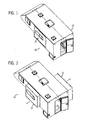
- Figs. 1 and 2 illustrate a camper 10 incorporating the invention, in this case a truck camper, for being piggybacked on a pick-up truck.
- Fig. 1 illustrates the camper with its slide-out rooms 12 and 14 retracted and in Fig. 2 they are extended.
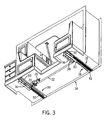
- Fig. 3 illustrates a bottom view of the room 14, which is a dinette, with the slide-out system 16 attached to the bottom of the room.
- Fig. 4 illustrates the opening in the side of the camper 10 for the slide-out room 14, with the slide-out system 16 attached to the floor of the stationary room.
- the system 16 includes two spaced apart slide units 18 and 20, two drive shafts 22 and 24, and a motor drive unit 26.
- Fig. 6 illustrates the slide unit 30 on the opposite side of the camper from the unit 16, which contains similar components that may be of different sizes.
- each slide unit 18 or 20 includes a base member 34 having two spaced apart base flange members 36 each connected at its inside edge to an upright panel member 38 that is connected at its upper edge to a slide mounting flange member 40.
- the flange member 40 connects the upper edges of the upright panels 38.
- a slide block 42 preferably made of a highly lubricious material such as ultra high molecular weight polyethylene, is bolted to the upper flange 40 of the base 34 and has dovetail portions 46 that are received in close sliding contact with track 48, which may, for example, be extruded aluminum.
- the track 48 has an open top side for the slide block to extend through it into the track 48 and has sides that are angled inwardly to match the angled sides of the dovetail portions 46 of the slide block 42.
- This provides a form fit between the block 42 and track 48 so that the track 48 is captured relative to the slide block 42 laterally, vertically and in all directions perpendicular to the direction of extension and retraction but can slide transversely (in and out sideways relative to the camper).
- the overlapping length of the slide block 42 and track 48 is also relatively great relative to the width, being several multiples of the overlapping width, which yields good stability along the direction of extension and retraction.
- the track 48 is bolted or otherwise fastened to a slide plate 50 that is a shallow trough that opens upwardly with flanges at its sides.
- the flanges at the sides of the slide plate 50 are bolted to the bottom or floor of the slide-out room.
- a gear rack 52 is welded or otherwise fastened to the bottom of the slide plate 50 parallel with the track 48, laterally outward of the track 48.
- stop bolt 54 extends transversely (in the in-and-out direction) parallel to the track 48 and rack 52, and is threaded in fasteners that are mounted to the slide plate 50 by welding or other suitable connection.
- the adjusting bolt 54 is for limiting extension of the slide-out room and a similar adjusting bolt and associated structure (not shown) could be provided for limiting retraction of the slide-out room if desired.
- the retraction limiting bolt may not be needed if the slide-out room itself is used as the stop on retraction.
- the ends of the stop bolt 54 (and of the retraction limiting bolt if provided) stop against a stop member 80 that is bolted to the side of the base member 34 by two bolts.
- the stop bolt 54 (and the retraction limiting bolt if provided) and the stop member 80 are provided on each slide unit 18 and 20.
- a means for adjusting the synchronization between the two slide-out units is provided, which also provides for easy servicing of the slide system.
- a pinion 60 is journalled by a bearing at the outer end of each base member 34.
- the pinions 60 are each laterally outward of the slide blocks 42 that are attached to the same base unit as the respective pinion.
- the synchronization mechanism 65 At one end of the drive shaft 22/24, as illustrated in Fig. 10 at the front end of the drive shaft 24, is the synchronization mechanism 65.
- the pinion is driven through a stub shaft 62 that is pinned, for example with a quick release pin 64, in the bore of a cap member 66 (Figs.
- acme screw threaded shank 68 that has an acme screw threaded shank 68 extending from the opposite end of it.
- the shank 68 is threaded into a female threaded member 70 or nut, that is welded to the end of shaft 24, or otherwise affixed to shaft 24.
- a female threaded lock member 72 is also threaded onto the shank 68, between the threaded member 70 and the head or cap 66, and the member 72 can be tightened against the member 70 to lock the angular position of the shank 68 relative to the shaft 22.
- a set screw 74 is also preferably provided in the threaded member 72 to lock its angular position relative to the shank 68.
- camper side walls can sometimes be not completely square
- the slide unit at one end of the room may be extended a different distance than the slide unit at the other end of the room when the inside seals of the slide-out room are seated against the camper side wall.
- one slide unit may be retracted a different distance than the other slide unit.
- the gaskets either on the inside or the outside, be compressed all of the way around the room to create a seal. Therefore, the two slide units must be synchronized so that when extended and retracted, the slide-out room interior or exterior walls will be seated against the stationary camper side walls.
- the set screw 74 is loosened and the locking member 72 is backed-off from the threaded member 70. This enables the shaft 22 to be turned relative to the pinion 60 and vice versa, so that the extension or retraction position of one slide plate 50 of the slide unit 18 can be synchronized relative to the position of the other slide plate 50 of the slide unit 20.
- the locking member 72 is tightened against the threaded member 70 and locked in place by tightening the set screw 74. This locks the shaft 22 relative to the pinion 60 so that they turn together when a torque is imparted to the shaft 22 by the motor drive unit 26.
- the motor drive unit 26 is bolted to the stationary camper floor with a bracket 71 and stub shafts 73 and 75 extend from opposite sides of a gear box of the motor drive unit 26.
- the shafts 73 and 75 are the output shafts of the motor drive unit 26 and each is received in the respective inner bore of the shaft 22 and the shaft 24.
- the turning of the synchronization unit 65 relative to the shaft 22 causes some axial motion of the shaft 24 along its axis, and this is permitted by the sliding of the end of the shaft 24 relative to the stub shaft 75, while maintaining a rotary driving connection with the pin 76 in the slots 78.
- the synchronization mechanism 65 also enables easy disassembly of the shafts and motor drive unit from the slide system.
- the pin 64 (Fig. 10), which is preferably a quick release pin, is removed and the set screw 74 is loosened.
- Locking member 72 is then turned so as to back away from threaded member 70 as far as possible and cap 66 and shank 68 are turned as far as possible into the threaded member 70. This shortens the effective length of the shaft 24 so that there is room to remove it from being between the stub shaft 62 and the stub shaft 75.
- the bracket 71 can be unbolted from the floor of the camper to remove the motor drive unit 26, which also results in the release and removal of the shaft 22.
Landscapes
- Engineering & Computer Science (AREA)
- Health & Medical Sciences (AREA)
- Public Health (AREA)
- Transportation (AREA)
- Mechanical Engineering (AREA)
- Transmission Devices (AREA)
- Lock And Its Accessories (AREA)
- Body Structure For Vehicles (AREA)
Abstract
Description
- This invention relates to slide-out room systems in recreational vehicles.
- Slide-out systems in recreational vehicles have become extremely popular. A well-known and successful slide-out system is disclosed in U. S. Patent No. 5,758,918 which issued June 2, 1998. This is a system in which two spaced apart telescoping rails support the slide-out room and are moved in and out by a rack and pinion system in which two pinion gears connected by a shaft mesh with two racks, one for each telescoping rail, and rollers are provided on opposite sides of each rack to support the rail. The pinions are powered by an electric motor operating through a gear box reduction.
- This type of system is well suited to a heavy-duty application. A lighter-duty system, however, is required in some applications that still gives appropriate support, laterally and vertically, and sufficient driving force and stability, and also provides lighter weight, a lower profile, and which is less expensive. In addition, the system should be easy to install, adjust, and service.
- The present invention provides such a system. In the present invention, two spaced apart slide units each have a slide plate that is supported on a base by a slide block that is fixed to the base and captures the slide plate laterally while permitting the slide plate to slide in and out relative to the slide block.
- This provides a lightweight, low profile, and relatively inexpensive slide system. This system supports the room laterally by virtue of the connection between the slide plate and the base, and also does not overload the pinions since the slide plate is supported by the base and by the slide block.
- In another aspect of the invention, the motor drive unit is mounted between the two slide units and engages the end of each drive shaft with a pin-in-slot connection so that each drive shaft is axially slidable relative to the motor unit, while the motor unit maintains driving engagement with the drive shaft. At least one of the drive shafts has a connection with the pinion such that the drive shaft can be infinitely adjusted in angular position relative to the pinion so as to synchronize the two spaced apart slide units. This is accomplished in the invention by utilizing a lead screw at that end of one of the shafts, that can be turned to any angular position relative to the drive shaft and locked in that position with a lock nut. The axial relative motion produced by turning the screw relative to the shaft is permitted by an axially sliding, rotary engaged connection between the opposite end of the shaft and the motor output shaft.
- This mechanism not only provides for infinite adjustment of the synchronization between the two slide units so that both ends of the room open and close at the same time, to maintain parallelism between the inside and outside walls of the slide-out and the outside wall of the recreational vehicle, but also makes servicing the slide-out unit relatively easy. By screwing the lead screw all the way into the shaft, the effective length of the shaft can be sufficiently shortened so as to enable removal of the shaft, with consequent easy removal of the motor and removal of the other shaft possible. In prior art slide-out mechanisms, disassembly of the slide-out unit was often difficult because of the limited space available in which to work.
- These and other advantages of the invention will appear in the detailed description which follows. In the description, reference is made to the accompanying drawings which illustrate a preferred embodiment of the invention.
- Fig. 1 is a perspective view of a camper, which as illustrated in this view is a truck camper for the rear of a pickup truck, that incorporates the invention;
- Fig. 2 is a perspective view of the camper of Fig. 1 with its slide-outs extended;
- Fig. 3 is a bottom perspective view of the dinette slide-out on the right side of Fig. 2 removed from the camper and shown from the inside bottom, with the slide-out system attached to the bottom of the slide-out and detached from the stationary floor of the camper;
- Fig. 4 is a view of the opening in the right side of the camper with the slide-out room removed and the slide-out system attached to the stationary floor of the camper;
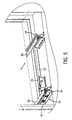
- Fig. 5 is a detail view the system as viewed from inside the camper;
- Fig. 6 is a detail perspective view of the front slide-out unit of the slide-out system shown in Fig. 5, shown extended;
- Fig. 7 is a perspective view of the slide-out system of Fig. 5 removed from the camper;
- Fig. 8 is a side plan view of the system of Fig. 7;
- Fig. 9 is a perspective view from outside of the camper showing the front slide-out unit and the connection between the drive shaft and the front slide-out unit;
- Fig. 10 is a plan view of Fig. 9 as viewed from outside the camper;
- Fig. 11 is a perspective view like Fig. 9, from a different angle;
- Fig. 12 is a perspective view showing components of the joint between the drive shaft and the front slide unit;
- Fig. 13 is a view like Fig. 10, but from the inside (relative to the camper) end of the slide unit;
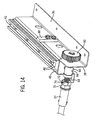
- Fig. 14 is a view of the front slide unit with the slide plate assembly removed;
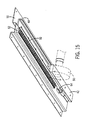
- Fig. 15 is a view of the slide plate assembly alone, but engaged with a slide block and showing the drive gear in phantom;
- Fig. 16 is another perspective view of Fig. 15 from a different angle, and not showing the drive gear in phantom;
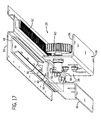
- Fig. 17 is a bottom perspective view of the slide unit without the drive shaft attached;
- Fig. 18 is a perspective view of the slide unit of Fig. 17 from a different angle; and
- Fig. 19 is a perspective detail view of the connection between the motor drive unit and the drive shafts.
- Figs. 1 and 2 illustrate a
camper 10 incorporating the invention, in this case a truck camper, for being piggybacked on a pick-up truck. Fig. 1 illustrates the camper with its slide-outrooms room 14, which is a dinette, with the slide-outsystem 16 attached to the bottom of the room. Fig. 4 illustrates the opening in the side of thecamper 10 for the slide-outroom 14, with the slide-outsystem 16 attached to the floor of the stationary room. Thesystem 16 includes two spaced apartslide units drive shafts motor drive unit 26. Fig. 6 illustrates the slide unit 30 on the opposite side of the camper from theunit 16, which contains similar components that may be of different sizes. - The
slide units slide unit base member 34 having two spaced apartbase flange members 36 each connected at its inside edge to anupright panel member 38 that is connected at its upper edge to a slidemounting flange member 40. Theflange member 40 connects the upper edges of theupright panels 38. - Referring particularly to Fig. 10, a
slide block 42, preferably made of a highly lubricious material such as ultra high molecular weight polyethylene, is bolted to theupper flange 40 of thebase 34 and hasdovetail portions 46 that are received in close sliding contact withtrack 48, which may, for example, be extruded aluminum. Thetrack 48 has an open top side for the slide block to extend through it into thetrack 48 and has sides that are angled inwardly to match the angled sides of thedovetail portions 46 of theslide block 42. This provides a form fit between theblock 42 andtrack 48 so that thetrack 48 is captured relative to theslide block 42 laterally, vertically and in all directions perpendicular to the direction of extension and retraction but can slide transversely (in and out sideways relative to the camper). The overlapping length of theslide block 42 andtrack 48 is also relatively great relative to the width, being several multiples of the overlapping width, which yields good stability along the direction of extension and retraction. - As illustrated in Fig. 17, the
track 48 is bolted or otherwise fastened to aslide plate 50 that is a shallow trough that opens upwardly with flanges at its sides. The flanges at the sides of theslide plate 50 are bolted to the bottom or floor of the slide-out room. Agear rack 52 is welded or otherwise fastened to the bottom of theslide plate 50 parallel with thetrack 48, laterally outward of thetrack 48. In the space between thetrack 48 and therack 52, stopbolt 54 extends transversely (in the in-and-out direction) parallel to thetrack 48 andrack 52, and is threaded in fasteners that are mounted to theslide plate 50 by welding or other suitable connection. The adjustingbolt 54 is for limiting extension of the slide-out room and a similar adjusting bolt and associated structure (not shown) could be provided for limiting retraction of the slide-out room if desired. The retraction limiting bolt may not be needed if the slide-out room itself is used as the stop on retraction. Referring to Figs. 6 and 8, the ends of the stop bolt 54 (and of the retraction limiting bolt if provided) stop against astop member 80 that is bolted to the side of thebase member 34 by two bolts. Preferably, the stop bolt 54 (and the retraction limiting bolt if provided) and thestop member 80 are provided on eachslide unit - Referring to Fig. 10, a means for adjusting the synchronization between the two slide-out units is provided, which also provides for easy servicing of the slide system. A
pinion 60 is journalled by a bearing at the outer end of eachbase member 34. Thepinions 60 are each laterally outward of theslide blocks 42 that are attached to the same base unit as the respective pinion. At one end of thedrive shaft 22/24, as illustrated in Fig. 10 at the front end of thedrive shaft 24, is thesynchronization mechanism 65. As illustrated in Fig. 13, the pinion is driven through astub shaft 62 that is pinned, for example with aquick release pin 64, in the bore of a cap member 66 (Figs. 9-14) that has an acme screw threadedshank 68 extending from the opposite end of it. Theshank 68 is threaded into a female threadedmember 70 or nut, that is welded to the end ofshaft 24, or otherwise affixed toshaft 24. A female threadedlock member 72 is also threaded onto theshank 68, between the threadedmember 70 and the head orcap 66, and themember 72 can be tightened against themember 70 to lock the angular position of theshank 68 relative to theshaft 22. Aset screw 74 is also preferably provided in the threadedmember 72 to lock its angular position relative to theshank 68. The components of thesynchronizing mechanism 65 are illustrated separated in Fig. 12. - Since camper side walls can sometimes be not completely square, the slide unit at one end of the room may be extended a different distance than the slide unit at the other end of the room when the inside seals of the slide-out room are seated against the camper side wall. Likewise, when retracted, one slide unit may be retracted a different distance than the other slide unit. However, it is desirable that the gaskets, either on the inside or the outside, be compressed all of the way around the room to create a seal. Therefore, the two slide units must be synchronized so that when extended and retracted, the slide-out room interior or exterior walls will be seated against the stationary camper side walls.
- To accomplish this, the
set screw 74 is loosened and the lockingmember 72 is backed-off from the threadedmember 70. This enables theshaft 22 to be turned relative to thepinion 60 and vice versa, so that the extension or retraction position of oneslide plate 50 of theslide unit 18 can be synchronized relative to the position of theother slide plate 50 of theslide unit 20. Once the proper relative extensions of the twoslide plates 50 are determined, the lockingmember 72 is tightened against the threadedmember 70 and locked in place by tightening theset screw 74. This locks theshaft 22 relative to thepinion 60 so that they turn together when a torque is imparted to theshaft 22 by themotor drive unit 26. - Referring to Fig. 19, the
motor drive unit 26 is bolted to the stationary camper floor with abracket 71 andstub shafts motor drive unit 26. Theshafts motor drive unit 26 and each is received in the respective inner bore of theshaft 22 and theshaft 24. There is an axial sliding fit between thestub shaft 73 andshaft 22 and thestub shaft 75 and theshaft 24, and apin 76 fixed to eachstub shaft slots 78 in the ends of therespective shafts synchronization unit 65 relative to theshaft 22 causes some axial motion of theshaft 24 along its axis, and this is permitted by the sliding of the end of theshaft 24 relative to thestub shaft 75, while maintaining a rotary driving connection with thepin 76 in theslots 78. - The
synchronization mechanism 65 also enables easy disassembly of the shafts and motor drive unit from the slide system. To disassemble these components, the pin 64 (Fig. 10), which is preferably a quick release pin, is removed and theset screw 74 is loosened. Lockingmember 72 is then turned so as to back away from threadedmember 70 as far as possible andcap 66 andshank 68 are turned as far as possible into the threadedmember 70. This shortens the effective length of theshaft 24 so that there is room to remove it from being between thestub shaft 62 and thestub shaft 75. Once theshaft 24 is removed, thebracket 71 can be unbolted from the floor of the camper to remove themotor drive unit 26, which also results in the release and removal of theshaft 22. - A preferred embodiment of the invention has been described in considerable detail. Many modifications and variations to the preferred embodiment described will be apparent to a person of ordinary skill in the art. Therefore, the invention should not be limited to the embodiment described.
Claims (13)
- A slide-out system to expand and contract the living space of a recreational vehicle by extending and retracting a slide-out room of the vehicle relative to a stationary portion of the vehicle, the slide-out system having a first member that is affixed to the stationary portion of the vehicle, a second member that is affixed to the slide-out room and is slidable relative to the first member, the second member being movable relative to the first member by a pinion that is journalled to the first member and meshes with a rack that is affixed to the second member, the improvement wherein a sliding connection is established between the second member and the first member by a slide block and a mating track, the track being open at one side so as to receive the slide block and the slide block extending into the track through the open side of the track, the slide block being made of a lubricious material that has a form fit with the track, the form fit permitting relative sliding movement between the slide block and the track in the direction of extension and retraction of the room and restraining against relative movement in directions perpendicular to the direction of extension and retraction, the slide block being affixed to one of the members and the track being affixed to the other of the members.
- The slide-out system of claim 1, wherein two said slide units are provided spaced apart with a shaft extending between the two slide units that drives the pinion of each slide unit.
- The slide-out system of claim 2, wherein the racks of the two slide units are laterally outward of the slide blocks of the slide units.
- The slide-out system of any preceding claim, wherein the second member is a slide plate.
- The slide-out system of claim 4, wherein the slide plate is a shallow trough having side flanges.
- The slide-out system of any preceding claim, wherein the first member is a base unit having one flange attached to the stationary portion of the vehicle, an upright flange extending from the one flange, and another flange along a top edge of the upright flange that is attached to the slide-out room.
- The slide-out system of any preceding claim, further comprising at lest one stop member attached to the second member and a stop member attached to the first member, said member attached to the second member abutting the stop member attached to the first member at a limit of at least one of retraction and extension.
- The slide-out system of any preceding claim, further comprising a synchronizing mechanism, the synchronizing mechanism comprising a screw coaxial with the shaft that attaches at least one of the pinions to the shaft and a jam nut for locking the angular position of the synchronizing screw to the shaft.
- The slide-out system of claim 8, wherein the synchronizing screw is pinned to a stub shaft of the pinion.
- The slide-out system of claim 9, wherein the shaft is slip fit onto a drive shaft of a motor drive unit and driven by the drive shaft with an axial sliding connection that imparts torque from the motor shaft to the pinion shaft and permits axial movement of the pinion shaft relative to the motor shaft.
- A slide-out system to expand and contract the living space of a recreational vehicle by extending and retracting a slide-out room of the vehicle relative to a stationary portion of the vehicle, the slide-out system having at least two slide units spaced apart with at least one shaft extending between the two slide units that drives a pinion of each slide unit, each slide unit including a first member that is affixed to the stationary portion of the vehicle, a second member that is affixed to the slide-out room and is slidable relative to the first member, the second member being movable relative to the first member by a pinion, said pinion being journalled to the first member and meshing with a rack that is affixed to the second member, the improvement comprising a synchronizing mechanism having a screw coaxial with at least one of the shafts that attaches at least one of the pinions to the shaft and a jam nut for locking the angular position of the synchronizing screw to the at least one of the shafts.
- The slide-out system of claim 11, wherein the synchronizing screw is pinned to a stub shaft of the at least one of the pinions.
- The slide-out system of claim 11 or 12, wherein the at least one of the shafts is slip fit onto a drive shaft of a motor drive unit and driven by the drive shaft with an axial sliding connection that imparts torque from the motor drive shaft to the pinion shaft and permits axial movement of the pinion shaft relative to the motor shaft.
Applications Claiming Priority (1)
| Application Number | Priority Date | Filing Date | Title |
|---|---|---|---|
| US61804004P | 2004-10-12 | 2004-10-12 |
Publications (2)
| Publication Number | Publication Date |
|---|---|
| EP1647446A2 true EP1647446A2 (en) | 2006-04-19 |
| EP1647446A3 EP1647446A3 (en) | 2007-10-24 |
Family
ID=35432802
Family Applications (1)
| Application Number | Title | Priority Date | Filing Date |
|---|---|---|---|
| EP05022245A Withdrawn EP1647446A3 (en) | 2004-10-12 | 2005-10-12 | Slide-out operating mechanism for expandable vehicle room |
Country Status (3)
| Country | Link |
|---|---|
| US (1) | US7229123B2 (en) |
| EP (1) | EP1647446A3 (en) |
| CA (1) | CA2523521C (en) |
Cited By (4)
| Publication number | Priority date | Publication date | Assignee | Title |
|---|---|---|---|---|
| EP2343214A1 (en) * | 2010-01-06 | 2011-07-13 | Lippert Components Manufacturing, Inc. | Retractable room actuation assembly for recreational vehicle |
| US9694733B2 (en) | 2009-01-21 | 2017-07-04 | Lippert Components Manufacturing, Inc. | Retractable room actuation assembly for recreational vehicle |
| CN108883719A (en) * | 2015-12-15 | 2018-11-23 | 普罗特克有限两合公司 | Caravan |
| DE102019134494A1 (en) * | 2019-12-16 | 2021-06-17 | Reinhold König | Mobile enclosed space |
Families Citing this family (22)
| Publication number | Priority date | Publication date | Assignee | Title |
|---|---|---|---|---|
| US7374218B2 (en) * | 2004-03-23 | 2008-05-20 | Lippert Components, Inc. | Slide-out member with embedded gear rack for use in slide-out room mechanisms |
| US7614675B2 (en) * | 2004-11-29 | 2009-11-10 | Actuant Corporation | Integrated slide-out drive system |
| CA2635504C (en) * | 2007-06-19 | 2011-09-27 | Valid Manufacturing Ltd. | Vehicle slide-out room drive |
| US20090309382A1 (en) * | 2008-03-25 | 2009-12-17 | Moore Charles R | Slide-Out Mechanism |
| US8573666B2 (en) * | 2009-01-21 | 2013-11-05 | Lippert Components Manufacturing | Retractable room actuation assembly for recreational vehicle |
| US20100219652A1 (en) * | 2009-02-27 | 2010-09-02 | Reske Craig J | Slide-Out Mechanism With Adhesive Connections |
| US20110057474A1 (en) * | 2009-09-04 | 2011-03-10 | Raymond Bruce Cunningham | Accommodation unit |
| US8959843B2 (en) | 2012-11-12 | 2015-02-24 | Eco-Built Homes, LLC | Telescoping frame system for portable home or other structure |
| US8844212B1 (en) | 2013-05-18 | 2014-09-30 | Eco-Built Homes, LLC | Telescoping frame system for portable home or other structure |
| US8555558B1 (en) | 2012-11-12 | 2013-10-15 | Eco-Built Homes LLC | Telescoping frame system for portable home or other structure |
| US9221378B2 (en) | 2012-11-20 | 2015-12-29 | AL-KO Kober A.G. | Slide-out room mechanism for a vehicle |
| CN107429540A (en) | 2014-12-22 | 2017-12-01 | 维米尔制造公司 | Positionable Bracket Components |
| JP6749995B2 (en) * | 2015-03-31 | 2020-09-02 | エックスエル・アイピー・ベー・フェー | Slide out room and operating mechanism and their components |
| DE102018210330A1 (en) * | 2018-06-25 | 2020-01-02 | Protec Gmbh & Co. Kg | Motorhome with a seal arranged between the body and a sliding room expansion module |
| US10967777B2 (en) * | 2018-08-02 | 2021-04-06 | Lippert Components, Inc. | Lift assist device for flush floor slide-out room |
| US11421761B2 (en) * | 2018-12-20 | 2022-08-23 | Lippert Components, Inc. | Motor stop for a through-frame slide out system |
| US10927929B2 (en) * | 2019-02-05 | 2021-02-23 | David H. Vroom | Preventing torque-caused impair of a sliding support mechanism |
| US10480627B1 (en) * | 2019-02-05 | 2019-11-19 | David H. Vroom | Sliding support mechanism with improved reliability and serviceability |
| US11241994B2 (en) | 2019-10-10 | 2022-02-08 | Joseph Lee Pollon | Expandable vehicle |
| CA3180349A1 (en) | 2022-05-16 | 2023-11-16 | Jaeger-Unitek Sealing Solutions, Inc. | Integrated wear bar |
| US12522124B1 (en) * | 2024-07-13 | 2026-01-13 | Xinfang Zhang | Cantilevered vehicle box slide-out system |
| CN119636557B (en) * | 2025-01-23 | 2025-08-15 | 五星(山西)房车有限公司 | Combined guide rail suspended type vehicle box body sliding-out system |
Citations (1)
| Publication number | Priority date | Publication date | Assignee | Title |
|---|---|---|---|---|
| US5758918A (en) | 1995-11-27 | 1998-06-02 | Versa Technologies, Inc. | Vehicle room slide-out operating mechanism |
Family Cites Families (14)
| Publication number | Priority date | Publication date | Assignee | Title |
|---|---|---|---|---|
| US5154469A (en) * | 1991-06-26 | 1992-10-13 | Morrow Floyd L | Mobile, multiuse, expandable rooms |
| US6601896B1 (en) * | 1995-11-27 | 2003-08-05 | Actuant Corporation | Bedroom slide out actuator with adjustable height |
| US5833296A (en) * | 1995-11-27 | 1998-11-10 | Versa Technologies, Inc. | Motor-operated slide-out drive system with releasable brake |
| US5860686A (en) * | 1996-01-11 | 1999-01-19 | Kwikee Products Co., Inc. | Vehicle with adjustable occupancy space |
| US5706612A (en) * | 1997-01-08 | 1998-01-13 | Peterson Industries, Inc. | Self leveling flush slide-out floor |
| US5902001A (en) * | 1997-03-25 | 1999-05-11 | Applied Power, Inc. | Expandable room flat floor system utilizing notched inner rails and ramped outer rails |
| US5984396A (en) * | 1997-04-11 | 1999-11-16 | Applied Power, Inc. | Drop room flat floor system for a vehicle having an expandable room section |
| US6293611B1 (en) * | 1998-01-20 | 2001-09-25 | Actuant Corporation | Flush floor slide-out room support system |
| US6109683A (en) * | 1998-01-20 | 2000-08-29 | Applied Power Inc. | Flush floor slide-out room support system |
| US6619714B2 (en) * | 1999-12-10 | 2003-09-16 | Actuant Corporation | Expandable room with flat floor |
| US6702353B1 (en) * | 2000-11-27 | 2004-03-09 | Rbw Industries, Inc. | Remotely actuated brake for slide-out mechanism |
| US6402216B1 (en) * | 2001-01-02 | 2002-06-11 | Vt Holdings Ii, Inc. | Above-floor travel tilt retractable room support |
| US6729677B2 (en) * | 2002-02-20 | 2004-05-04 | Edwin S. Gurdjian | Full body slide and integrated chassis |
| US7614675B2 (en) * | 2004-11-29 | 2009-11-10 | Actuant Corporation | Integrated slide-out drive system |
-
2005
- 2005-10-11 US US11/247,669 patent/US7229123B2/en not_active Expired - Lifetime
- 2005-10-12 CA CA2523521A patent/CA2523521C/en not_active Expired - Fee Related
- 2005-10-12 EP EP05022245A patent/EP1647446A3/en not_active Withdrawn
Patent Citations (1)
| Publication number | Priority date | Publication date | Assignee | Title |
|---|---|---|---|---|
| US5758918A (en) | 1995-11-27 | 1998-06-02 | Versa Technologies, Inc. | Vehicle room slide-out operating mechanism |
Cited By (8)
| Publication number | Priority date | Publication date | Assignee | Title |
|---|---|---|---|---|
| US9694733B2 (en) | 2009-01-21 | 2017-07-04 | Lippert Components Manufacturing, Inc. | Retractable room actuation assembly for recreational vehicle |
| US10093219B2 (en) | 2009-01-21 | 2018-10-09 | Lippert Components Manufacturing, Inc. | Retractable room actuation assembly for recreational vehicle |
| US10471878B2 (en) | 2009-01-21 | 2019-11-12 | Lippert Components Manufacturing, Inc. | Retractable room actuation assembly for recreational vehicle |
| US11059413B2 (en) | 2009-01-21 | 2021-07-13 | Lippert Components Manufacturing, Inc. | Retractable room actuation assembly for recreational vehicle |
| EP2343214A1 (en) * | 2010-01-06 | 2011-07-13 | Lippert Components Manufacturing, Inc. | Retractable room actuation assembly for recreational vehicle |
| CN108883719A (en) * | 2015-12-15 | 2018-11-23 | 普罗特克有限两合公司 | Caravan |
| DE102019134494A1 (en) * | 2019-12-16 | 2021-06-17 | Reinhold König | Mobile enclosed space |
| DE102019134494B4 (en) | 2019-12-16 | 2022-11-17 | Reinhold König | Mobile enclosed space |
Also Published As
| Publication number | Publication date |
|---|---|
| US20060076798A1 (en) | 2006-04-13 |
| EP1647446A3 (en) | 2007-10-24 |
| CA2523521C (en) | 2011-12-13 |
| US7229123B2 (en) | 2007-06-12 |
| CA2523521A1 (en) | 2006-04-12 |
Similar Documents
| Publication | Publication Date | Title |
|---|---|---|
| US7229123B2 (en) | Camper slide-out system | |
| US6805391B2 (en) | Synchronized slide-out mechanism | |
| US6896307B2 (en) | Variable height slide-out mechanism | |
| US6497449B2 (en) | Surface mount slide-out system | |
| AU722211B2 (en) | Motor-operated slide-out drive system with releasable brake | |
| US7150483B2 (en) | Flush floor slide-out mechanisms and systems | |
| US10933813B2 (en) | Telescoping bed platform | |
| US5984396A (en) | Drop room flat floor system for a vehicle having an expandable room section | |
| CA2190988C (en) | Vehicle room slide-out operating mechanism | |
| US7614675B2 (en) | Integrated slide-out drive system | |
| US6428073B1 (en) | Vehicle with slide-out room | |
| US11427129B2 (en) | Telescoping bed platform | |
| EP3030456B1 (en) | Manual override for slide-out room system having wall-mounted drive mechanism | |
| US20020023393A1 (en) | Twin motor drive for a slide-out room | |
| US20030205911A1 (en) | In-floor slide-out room support system | |
| US6948754B2 (en) | Slide-out operating mechanism | |
| US7204536B2 (en) | Pivot out room for vehicle | |
| US6866317B2 (en) | Vehicle with variable interior volume | |
| US20110254305A1 (en) | Slide-out | |
| WO1998056613A1 (en) | Rail-type vehicle room slide-out operating mechanism including a combined inner rail drive and support assembly | |
| US20090309382A1 (en) | Slide-Out Mechanism |
Legal Events
| Date | Code | Title | Description |
|---|---|---|---|
| PUAI | Public reference made under article 153(3) epc to a published international application that has entered the european phase |
Free format text: ORIGINAL CODE: 0009012 |
|
| AK | Designated contracting states |
Kind code of ref document: A2 Designated state(s): AT BE BG CH CY CZ DE DK EE ES FI FR GB GR HU IE IS IT LI LT LU LV MC NL PL PT RO SE SI SK TR |
|
| AX | Request for extension of the european patent |
Extension state: AL BA HR MK YU |
|
| PUAL | Search report despatched |
Free format text: ORIGINAL CODE: 0009013 |
|
| AK | Designated contracting states |
Kind code of ref document: A3 Designated state(s): AT BE BG CH CY CZ DE DK EE ES FI FR GB GR HU IE IS IT LI LT LU LV MC NL PL PT RO SE SI SK TR |
|
| AX | Request for extension of the european patent |
Extension state: AL BA HR MK YU |
|
| AKX | Designation fees paid | ||
| STAA | Information on the status of an ep patent application or granted ep patent |
Free format text: STATUS: THE APPLICATION IS DEEMED TO BE WITHDRAWN |
|
| 18D | Application deemed to be withdrawn |
Effective date: 20080425 |
|
| REG | Reference to a national code |
Ref country code: DE Ref legal event code: 8566 |