EP1646620B1 - Substituted piperidines as histamine h3 receptor ligands - Google Patents
Substituted piperidines as histamine h3 receptor ligands Download PDFInfo
- Publication number
- EP1646620B1 EP1646620B1 EP04763339A EP04763339A EP1646620B1 EP 1646620 B1 EP1646620 B1 EP 1646620B1 EP 04763339 A EP04763339 A EP 04763339A EP 04763339 A EP04763339 A EP 04763339A EP 1646620 B1 EP1646620 B1 EP 1646620B1
- Authority
- EP
- European Patent Office
- Prior art keywords
- piperidinyl
- oxy
- cyclobutyl
- methylethyl
- phenyl
- Prior art date
- Legal status (The legal status is an assumption and is not a legal conclusion. Google has not performed a legal analysis and makes no representation as to the accuracy of the status listed.)
- Expired - Lifetime
Links
- 102000004384 Histamine H3 receptors Human genes 0.000 title abstract description 9
- 108090000981 Histamine H3 receptors Proteins 0.000 title abstract description 9
- 150000003053 piperidines Chemical class 0.000 title description 3
- 239000003446 ligand Substances 0.000 title description 2
- 238000000034 method Methods 0.000 claims abstract description 51
- -1 piperidine ether derivatives Chemical class 0.000 claims abstract description 33
- 238000011282 treatment Methods 0.000 claims abstract description 28
- 238000002360 preparation method Methods 0.000 claims abstract description 13
- 208000012902 Nervous system disease Diseases 0.000 claims abstract description 5
- 208000025966 Neurological disease Diseases 0.000 claims abstract description 5
- 150000001875 compounds Chemical class 0.000 claims description 217
- 150000002500 ions Chemical class 0.000 claims description 74
- 125000000217 alkyl group Chemical group 0.000 claims description 45
- 125000001449 isopropyl group Chemical group [H]C([H])([H])C([H])(*)C([H])([H])[H] 0.000 claims description 26
- 125000003118 aryl group Chemical group 0.000 claims description 20
- 150000003839 salts Chemical class 0.000 claims description 20
- 125000005843 halogen group Chemical group 0.000 claims description 18
- 125000004169 (C1-C6) alkyl group Chemical group 0.000 claims description 17
- 230000009467 reduction Effects 0.000 claims description 15
- 125000003545 alkoxy group Chemical group 0.000 claims description 13
- 229910052736 halogen Inorganic materials 0.000 claims description 13
- 150000002367 halogens Chemical class 0.000 claims description 13
- 125000000623 heterocyclic group Chemical group 0.000 claims description 12
- 239000003814 drug Substances 0.000 claims description 11
- 125000001997 phenyl group Chemical group [H]C1=C([H])C([H])=C(*)C([H])=C1[H] 0.000 claims description 11
- 125000002023 trifluoromethyl group Chemical group FC(F)(F)* 0.000 claims description 11
- 125000005913 (C3-C6) cycloalkyl group Chemical group 0.000 claims description 10
- 125000004093 cyano group Chemical group *C#N 0.000 claims description 10
- 125000001072 heteroaryl group Chemical group 0.000 claims description 10
- 230000002829 reductive effect Effects 0.000 claims description 9
- 239000008194 pharmaceutical composition Substances 0.000 claims description 8
- AAZFNAXFFSBIIO-UHFFFAOYSA-N tert-butyl 5-[4-(1-propan-2-ylpiperidin-4-yl)oxypiperidin-1-yl]pyridine-2-carboxylate Chemical compound C1CN(C(C)C)CCC1OC1CCN(C=2C=NC(=CC=2)C(=O)OC(C)(C)C)CC1 AAZFNAXFFSBIIO-UHFFFAOYSA-N 0.000 claims description 8
- HCSPMMJLAZYFCT-UHFFFAOYSA-N 5-[4-(1-cyclobutylpiperidin-4-yl)oxypiperidin-1-yl]-2-(trifluoromethyl)pyrimidine Chemical compound C1=NC(C(F)(F)F)=NC=C1N1CCC(OC2CCN(CC2)C2CCC2)CC1 HCSPMMJLAZYFCT-UHFFFAOYSA-N 0.000 claims description 7
- 125000001995 cyclobutyl group Chemical group [H]C1([H])C([H])([H])C([H])(*)C1([H])[H] 0.000 claims description 7
- 125000004674 methylcarbonyl group Chemical group CC(=O)* 0.000 claims description 7
- 125000003349 3-pyridyl group Chemical group N1=C([H])C([*])=C([H])C([H])=C1[H] 0.000 claims description 6
- 125000002206 pyridazin-3-yl group Chemical group [H]C1=C([H])C([H])=C(*)N=N1 0.000 claims description 6
- 125000004528 pyrimidin-5-yl group Chemical group N1=CN=CC(=C1)* 0.000 claims description 6
- 125000001424 substituent group Chemical group 0.000 claims description 6
- 125000004178 (C1-C4) alkyl group Chemical group 0.000 claims description 4
- 125000004191 (C1-C6) alkoxy group Chemical group 0.000 claims description 4
- 125000004454 (C1-C6) alkoxycarbonyl group Chemical group 0.000 claims description 4
- 125000004738 (C1-C6) alkyl sulfinyl group Chemical group 0.000 claims description 4
- 125000004739 (C1-C6) alkylsulfonyl group Chemical group 0.000 claims description 4
- 125000006700 (C1-C6) alkylthio group Chemical group 0.000 claims description 4
- NRYGWLNOBIXJSR-UHFFFAOYSA-N 1-[4-[4-(1-cyclobutylpiperidin-4-yl)oxypiperidin-1-yl]phenyl]ethanone Chemical compound C1=CC(C(=O)C)=CC=C1N1CCC(OC2CCN(CC2)C2CCC2)CC1 NRYGWLNOBIXJSR-UHFFFAOYSA-N 0.000 claims description 4
- CKAFQVKVZGKTDU-UHFFFAOYSA-N 1-[6-[4-(1-cyclobutylpiperidin-4-yl)oxypiperidin-1-yl]pyridin-3-yl]ethanone Chemical compound N1=CC(C(=O)C)=CC=C1N1CCC(OC2CCN(CC2)C2CCC2)CC1 CKAFQVKVZGKTDU-UHFFFAOYSA-N 0.000 claims description 4
- FHFVWWQXKNQESI-UHFFFAOYSA-N 3-[4-(1-propan-2-ylpiperidin-4-yl)oxypiperidin-1-yl]-6-(trifluoromethyl)pyridazine Chemical compound C1CN(C(C)C)CCC1OC1CCN(C=2N=NC(=CC=2)C(F)(F)F)CC1 FHFVWWQXKNQESI-UHFFFAOYSA-N 0.000 claims description 4
- OBYBVWBWVBQDEC-UHFFFAOYSA-N 5-[4-(1-cyclobutylpiperidin-4-yl)oxypiperidin-1-yl]-n-methylpyridine-2-carboxamide Chemical compound C1=NC(C(=O)NC)=CC=C1N1CCC(OC2CCN(CC2)C2CCC2)CC1 OBYBVWBWVBQDEC-UHFFFAOYSA-N 0.000 claims description 4
- QELYONVDPGLLTR-UHFFFAOYSA-N 5-[4-(1-propan-2-ylpiperidin-4-yl)oxypiperidin-1-yl]-2-(trifluoromethyl)pyrimidine Chemical compound C1CN(C(C)C)CCC1OC1CCN(C=2C=NC(=NC=2)C(F)(F)F)CC1 QELYONVDPGLLTR-UHFFFAOYSA-N 0.000 claims description 4
- 125000005947 C1-C6 alkylsulfonyloxy group Chemical group 0.000 claims description 4
- 125000003435 aroyl group Chemical group 0.000 claims description 4
- 125000005533 aryl carboxamido group Chemical group 0.000 claims description 4
- 125000005421 aryl sulfonamido group Chemical group 0.000 claims description 4
- 125000004391 aryl sulfonyl group Chemical group 0.000 claims description 4
- 125000005279 aryl sulfonyloxy group Chemical group 0.000 claims description 4
- 125000004104 aryloxy group Chemical group 0.000 claims description 4
- 125000001589 carboacyl group Chemical group 0.000 claims description 4
- 239000003937 drug carrier Substances 0.000 claims description 4
- 229910052739 hydrogen Inorganic materials 0.000 claims description 4
- 239000001257 hydrogen Substances 0.000 claims description 4
- 125000002887 hydroxy group Chemical group [H]O* 0.000 claims description 4
- 125000000449 nitro group Chemical group [O-][N+](*)=O 0.000 claims description 4
- 125000004043 oxo group Chemical group O=* 0.000 claims description 4
- 229910052760 oxygen Inorganic materials 0.000 claims description 4
- 125000004307 pyrazin-2-yl group Chemical group [H]C1=C([H])N=C(*)C([H])=N1 0.000 claims description 4
- QLZASUPJZXESTL-UHFFFAOYSA-N 3-[4-(1-cyclobutylpiperidin-4-yl)oxypiperidin-1-yl]-6-(trifluoromethyl)pyridazine Chemical compound N1=NC(C(F)(F)F)=CC=C1N1CCC(OC2CCN(CC2)C2CCC2)CC1 QLZASUPJZXESTL-UHFFFAOYSA-N 0.000 claims description 3
- ROFRIKRDIUUGLL-UHFFFAOYSA-N 3-methyl-5-[4-[4-(1-propan-2-ylpiperidin-4-yl)oxypiperidin-1-yl]phenyl]-1,2,4-oxadiazole Chemical compound C1CN(C(C)C)CCC1OC1CCN(C=2C=CC(=CC=2)C=2ON=C(C)N=2)CC1 ROFRIKRDIUUGLL-UHFFFAOYSA-N 0.000 claims description 3
- NGOKAJIBXGBPOT-UHFFFAOYSA-N 4-[4-(1-cyclobutylpiperidin-4-yl)oxypiperidin-1-yl]-2,5-difluorobenzonitrile Chemical compound C1=C(C#N)C(F)=CC(N2CCC(CC2)OC2CCN(CC2)C2CCC2)=C1F NGOKAJIBXGBPOT-UHFFFAOYSA-N 0.000 claims description 3
- NGGWOMNGFFBIFB-UHFFFAOYSA-N 4-[4-(1-cyclobutylpiperidin-4-yl)oxypiperidin-1-yl]-2-fluorobenzonitrile Chemical compound C1=C(C#N)C(F)=CC(N2CCC(CC2)OC2CCN(CC2)C2CCC2)=C1 NGGWOMNGFFBIFB-UHFFFAOYSA-N 0.000 claims description 3
- VCTFYNBGWHVGSZ-UHFFFAOYSA-N 5-[4-(1-cyclobutylpiperidin-4-yl)oxypiperidin-1-yl]pyridine-2-carbonitrile Chemical compound C1=NC(C#N)=CC=C1N1CCC(OC2CCN(CC2)C2CCC2)CC1 VCTFYNBGWHVGSZ-UHFFFAOYSA-N 0.000 claims description 3
- AFVFQIVMOAPDHO-UHFFFAOYSA-N Methanesulfonic acid Chemical compound CS(O)(=O)=O AFVFQIVMOAPDHO-UHFFFAOYSA-N 0.000 claims description 3
- 229910052757 nitrogen Inorganic materials 0.000 claims description 3
- 239000000546 pharmaceutical excipient Substances 0.000 claims description 3
- 125000002914 sec-butyl group Chemical group [H]C([H])([H])C([H])([H])C([H])(*)C([H])([H])[H] 0.000 claims description 3
- 238000002560 therapeutic procedure Methods 0.000 claims description 3
- DDHAOEHMWHNXMW-UHFFFAOYSA-N 1-[4-[4-(1-cyclobutylpiperidin-4-yl)oxypiperidin-1-yl]-2,5-difluorophenyl]ethanone Chemical compound C1=C(F)C(C(=O)C)=CC(F)=C1N1CCC(OC2CCN(CC2)C2CCC2)CC1 DDHAOEHMWHNXMW-UHFFFAOYSA-N 0.000 claims description 2
- NMQKODJYPGFWOV-UHFFFAOYSA-N 1-[4-[4-(1-cyclobutylpiperidin-4-yl)oxypiperidin-1-yl]-3-fluorophenyl]ethanone Chemical compound FC1=CC(C(=O)C)=CC=C1N1CCC(OC2CCN(CC2)C2CCC2)CC1 NMQKODJYPGFWOV-UHFFFAOYSA-N 0.000 claims description 2
- KTEDTUDAJHHPMC-UHFFFAOYSA-N 1-[4-[4-[1-(cyclopropylmethyl)piperidin-4-yl]oxypiperidin-1-yl]phenyl]ethanone Chemical compound C1=CC(C(=O)C)=CC=C1N1CCC(OC2CCN(CC3CC3)CC2)CC1 KTEDTUDAJHHPMC-UHFFFAOYSA-N 0.000 claims description 2
- OFSOWRWVXOGACO-QGZVFWFLSA-N 1-[4-[4-[1-[(2r)-butan-2-yl]piperidin-4-yl]oxypiperidin-1-yl]phenyl]ethanone Chemical compound C1CN([C@H](C)CC)CCC1OC1CCN(C=2C=CC(=CC=2)C(C)=O)CC1 OFSOWRWVXOGACO-QGZVFWFLSA-N 0.000 claims description 2
- OFSOWRWVXOGACO-KRWDZBQOSA-N 1-[4-[4-[1-[(2s)-butan-2-yl]piperidin-4-yl]oxypiperidin-1-yl]phenyl]ethanone Chemical compound C1CN([C@@H](C)CC)CCC1OC1CCN(C=2C=CC(=CC=2)C(C)=O)CC1 OFSOWRWVXOGACO-KRWDZBQOSA-N 0.000 claims description 2
- TYCOBGWRHMHZRO-UHFFFAOYSA-N 1-[5-[4-(1-cyclobutylpiperidin-4-yl)oxypiperidin-1-yl]pyridin-2-yl]ethanone Chemical compound C1=NC(C(=O)C)=CC=C1N1CCC(OC2CCN(CC2)C2CCC2)CC1 TYCOBGWRHMHZRO-UHFFFAOYSA-N 0.000 claims description 2
- CQOHFZPAHVRWNK-UHFFFAOYSA-N 4-[4-(1-cyclobutylpiperidin-4-yl)oxypiperidin-1-yl]-n-methylbenzamide Chemical compound C1=CC(C(=O)NC)=CC=C1N1CCC(OC2CCN(CC2)C2CCC2)CC1 CQOHFZPAHVRWNK-UHFFFAOYSA-N 0.000 claims description 2
- HPUNGTVILPJQDG-UHFFFAOYSA-N 5-[4-(1-cyclobutylpiperidin-4-yl)oxypiperidin-1-yl]-n-ethylpyridine-2-carboxamide Chemical compound C1=NC(C(=O)NCC)=CC=C1N1CCC(OC2CCN(CC2)C2CCC2)CC1 HPUNGTVILPJQDG-UHFFFAOYSA-N 0.000 claims description 2
- PTGRQFAOWCPNOU-UHFFFAOYSA-N 5-[4-(1-cyclobutylpiperidin-4-yl)oxypiperidin-1-yl]-n-methylpyrazine-2-carboxamide Chemical compound C1=NC(C(=O)NC)=CN=C1N1CCC(OC2CCN(CC2)C2CCC2)CC1 PTGRQFAOWCPNOU-UHFFFAOYSA-N 0.000 claims description 2
- JYAQKCCNFKDLJR-UHFFFAOYSA-N 5-[4-(1-cyclobutylpiperidin-4-yl)oxypiperidin-1-yl]-n-propan-2-ylpyridine-2-carboxamide Chemical compound C1=NC(C(=O)NC(C)C)=CC=C1N1CCC(OC2CCN(CC2)C2CCC2)CC1 JYAQKCCNFKDLJR-UHFFFAOYSA-N 0.000 claims description 2
- NCWCDKYOVWQMFL-UHFFFAOYSA-N 5-[4-(1-cyclobutylpiperidin-4-yl)oxypiperidin-1-yl]-n-propylpyridine-2-carboxamide Chemical compound C1=NC(C(=O)NCCC)=CC=C1N1CCC(OC2CCN(CC2)C2CCC2)CC1 NCWCDKYOVWQMFL-UHFFFAOYSA-N 0.000 claims description 2
- KNYMTEQKMUCWSG-UHFFFAOYSA-N 5-[4-[4-(1-cyclobutylpiperidin-4-yl)oxypiperidin-1-yl]-2-fluorophenyl]-3-methyl-1,2,4-oxadiazole Chemical compound CC1=NOC(C=2C(=CC(=CC=2)N2CCC(CC2)OC2CCN(CC2)C2CCC2)F)=N1 KNYMTEQKMUCWSG-UHFFFAOYSA-N 0.000 claims description 2
- KVAUYGITJXIYNL-INIZCTEOSA-N 5-[4-[4-[1-[(2s)-butan-2-yl]piperidin-4-yl]oxypiperidin-1-yl]-2-fluorophenyl]-3-methyl-1,2,4-oxadiazole Chemical compound C1CN([C@@H](C)CC)CCC1OC1CCN(C=2C=C(F)C(C=3ON=C(C)N=3)=CC=2)CC1 KVAUYGITJXIYNL-INIZCTEOSA-N 0.000 claims description 2
- WSFSSNUMVMOOMR-UHFFFAOYSA-N Formaldehyde Chemical compound O=C WSFSSNUMVMOOMR-UHFFFAOYSA-N 0.000 claims description 2
- 125000003342 alkenyl group Chemical group 0.000 claims description 2
- 125000000304 alkynyl group Chemical group 0.000 claims description 2
- 229910002091 carbon monoxide Inorganic materials 0.000 claims description 2
- 125000000392 cycloalkenyl group Chemical group 0.000 claims description 2
- 238000004519 manufacturing process Methods 0.000 claims description 2
- UXYSVECFZJVXGI-UHFFFAOYSA-N n-cyclobutyl-5-[4-(1-propan-2-ylpiperidin-4-yl)oxypiperidin-1-yl]pyridine-2-carboxamide Chemical compound C1CN(C(C)C)CCC1OC1CCN(C=2C=NC(=CC=2)C(=O)NC2CCC2)CC1 UXYSVECFZJVXGI-UHFFFAOYSA-N 0.000 claims description 2
- SZTIHZLYNVEXDI-UHFFFAOYSA-N n-methyl-5-[4-(1-propan-2-ylpiperidin-4-yl)oxypiperidin-1-yl]pyridine-2-carboxamide Chemical compound C1=NC(C(=O)NC)=CC=C1N1CCC(OC2CCN(CC2)C(C)C)CC1 SZTIHZLYNVEXDI-UHFFFAOYSA-N 0.000 claims description 2
- BDHFUVZGWQCTTF-UHFFFAOYSA-M sulfonate Chemical compound [O-]S(=O)=O BDHFUVZGWQCTTF-UHFFFAOYSA-M 0.000 claims description 2
- KVNZOLNEBSJBLH-UHFFFAOYSA-N 1-[4-[4-(1-cyclobutylpiperidin-4-yl)oxypiperidin-1-yl]-2-fluorophenyl]ethanone Chemical compound C1=C(F)C(C(=O)C)=CC=C1N1CCC(OC2CCN(CC2)C2CCC2)CC1 KVNZOLNEBSJBLH-UHFFFAOYSA-N 0.000 claims 1
- URIFVQONQHSSBL-UHFFFAOYSA-N 2-[4-(1-cyclobutylpiperidin-4-yl)oxypiperidin-1-yl]-4-(trifluoromethyl)pyrimidine Chemical compound FC(F)(F)C1=CC=NC(N2CCC(CC2)OC2CCN(CC2)C2CCC2)=N1 URIFVQONQHSSBL-UHFFFAOYSA-N 0.000 claims 1
- ABHPBERICQJSJR-UHFFFAOYSA-N 2-[4-(1-cyclobutylpiperidin-4-yl)oxypiperidin-1-yl]-5-(trifluoromethyl)pyrazine Chemical compound C1=NC(C(F)(F)F)=CN=C1N1CCC(OC2CCN(CC2)C2CCC2)CC1 ABHPBERICQJSJR-UHFFFAOYSA-N 0.000 claims 1
- NWZOOQCNQDPLMG-UHFFFAOYSA-N 2-[4-(1-cyclobutylpiperidin-4-yl)oxypiperidin-1-yl]-5-(trifluoromethyl)pyridine Chemical compound N1=CC(C(F)(F)F)=CC=C1N1CCC(OC2CCN(CC2)C2CCC2)CC1 NWZOOQCNQDPLMG-UHFFFAOYSA-N 0.000 claims 1
- WFXQYBYRKJNSDD-UHFFFAOYSA-N 2-[4-(1-propan-2-ylpiperidin-4-yl)oxypiperidin-1-yl]-4-(trifluoromethyl)pyrimidine Chemical compound C1CN(C(C)C)CCC1OC1CCN(C=2N=C(C=CN=2)C(F)(F)F)CC1 WFXQYBYRKJNSDD-UHFFFAOYSA-N 0.000 claims 1
- NWAPROAXKWOBIW-UHFFFAOYSA-N 2-[4-(1-propan-2-ylpiperidin-4-yl)oxypiperidin-1-yl]-5-(trifluoromethyl)pyrazine Chemical compound C1CN(C(C)C)CCC1OC1CCN(C=2N=CC(=NC=2)C(F)(F)F)CC1 NWAPROAXKWOBIW-UHFFFAOYSA-N 0.000 claims 1
- MSJAQVJXNRYRAK-UHFFFAOYSA-N 2-[4-(1-propan-2-ylpiperidin-4-yl)oxypiperidin-1-yl]-5-(trifluoromethyl)pyridine Chemical compound C1CN(C(C)C)CCC1OC1CCN(C=2N=CC(=CC=2)C(F)(F)F)CC1 MSJAQVJXNRYRAK-UHFFFAOYSA-N 0.000 claims 1
- XGAVRTOMAILQTP-UHFFFAOYSA-N 2-[4-[4-(1-cyclobutylpiperidin-4-yl)oxypiperidin-1-yl]phenyl]-1,3-oxazole Chemical compound C1CCC1N1CCC(OC2CCN(CC2)C=2C=CC(=CC=2)C=2OC=CN=2)CC1 XGAVRTOMAILQTP-UHFFFAOYSA-N 0.000 claims 1
- RPNWZOMJXSNVPC-UHFFFAOYSA-N 2-[4-[4-(1-cyclobutylpiperidin-4-yl)oxypiperidin-1-yl]phenyl]-5-phenyl-1,3,4-oxadiazole Chemical compound C1CCC1N1CCC(OC2CCN(CC2)C=2C=CC(=CC=2)C=2OC(=NN=2)C=2C=CC=CC=2)CC1 RPNWZOMJXSNVPC-UHFFFAOYSA-N 0.000 claims 1
- GOSOVICNNIVEIE-UHFFFAOYSA-N 2-[4-[4-(1-propan-2-ylpiperidin-4-yl)oxypiperidin-1-yl]phenyl]-1,3-oxazole Chemical compound C1CN(C(C)C)CCC1OC1CCN(C=2C=CC(=CC=2)C=2OC=CN=2)CC1 GOSOVICNNIVEIE-UHFFFAOYSA-N 0.000 claims 1
- DAOBUCDSENCWMD-UHFFFAOYSA-N 2-methyl-4-[4-[4-(1-propan-2-ylpiperidin-4-yl)oxypiperidin-1-yl]phenyl]-1,3-oxazole Chemical compound C1CN(C(C)C)CCC1OC1CCN(C=2C=CC(=CC=2)C=2N=C(C)OC=2)CC1 DAOBUCDSENCWMD-UHFFFAOYSA-N 0.000 claims 1
- UIZQIELRPQDSJC-UHFFFAOYSA-N 2-methyl-5-[4-[4-(1-propan-2-ylpiperidin-4-yl)oxypiperidin-1-yl]phenyl]-1,3-oxazole Chemical compound C1CN(C(C)C)CCC1OC1CCN(C=2C=CC(=CC=2)C=2OC(C)=NC=2)CC1 UIZQIELRPQDSJC-UHFFFAOYSA-N 0.000 claims 1
- HJJIQURPKIAODK-UHFFFAOYSA-N 2-phenyl-5-[4-[4-(1-propan-2-ylpiperidin-4-yl)oxypiperidin-1-yl]phenyl]-1,3,4-oxadiazole Chemical compound C1CN(C(C)C)CCC1OC1CCN(C=2C=CC(=CC=2)C=2OC(=NN=2)C=2C=CC=CC=2)CC1 HJJIQURPKIAODK-UHFFFAOYSA-N 0.000 claims 1
- DHQDHXWCKMNJNC-UHFFFAOYSA-N 3-[4-[4-(1-cyclobutylpiperidin-4-yl)oxypiperidin-1-yl]phenyl]-5-methyl-1,2,4-oxadiazole Chemical compound O1C(C)=NC(C=2C=CC(=CC=2)N2CCC(CC2)OC2CCN(CC2)C2CCC2)=N1 DHQDHXWCKMNJNC-UHFFFAOYSA-N 0.000 claims 1
- UGDZIRZIWHRWAJ-UHFFFAOYSA-N 3-methyl-5-[4-[4-(1-propan-2-ylpiperidin-4-yl)oxypiperidin-1-yl]phenyl]-1,2-oxazole Chemical compound C1CN(C(C)C)CCC1OC1CCN(C=2C=CC(=CC=2)C=2ON=C(C)C=2)CC1 UGDZIRZIWHRWAJ-UHFFFAOYSA-N 0.000 claims 1
- UUYLVLYSXAEWAC-UHFFFAOYSA-N 3-tert-butyl-5-[4-(1-cyclobutylpiperidin-4-yl)oxypiperidin-1-yl]pyridine-2-carboxylic acid Chemical compound N1=C(C(O)=O)C(C(C)(C)C)=CC(N2CCC(CC2)OC2CCN(CC2)C2CCC2)=C1 UUYLVLYSXAEWAC-UHFFFAOYSA-N 0.000 claims 1
- VPMYIUDGEAIUTP-UHFFFAOYSA-N 4-[4-(1-cyclobutylpiperidin-4-yl)oxypiperidin-1-yl]-3-fluorobenzonitrile Chemical compound FC1=CC(C#N)=CC=C1N1CCC(OC2CCN(CC2)C2CCC2)CC1 VPMYIUDGEAIUTP-UHFFFAOYSA-N 0.000 claims 1
- DFFWIGMYIGIENQ-UHFFFAOYSA-N 4-[4-(1-cyclobutylpiperidin-4-yl)oxypiperidin-1-yl]-n,n-dimethylbenzamide Chemical compound C1=CC(C(=O)N(C)C)=CC=C1N1CCC(OC2CCN(CC2)C2CCC2)CC1 DFFWIGMYIGIENQ-UHFFFAOYSA-N 0.000 claims 1
- PRDOOZACFSRFIG-UHFFFAOYSA-N 4-[4-(1-cyclobutylpiperidin-4-yl)oxypiperidin-1-yl]-n-propan-2-ylpyridine-2-carboxamide Chemical compound C1=NC(C(=O)NC(C)C)=CC(N2CCC(CC2)OC2CCN(CC2)C2CCC2)=C1 PRDOOZACFSRFIG-UHFFFAOYSA-N 0.000 claims 1
- UOQYAQNAXCHNMB-UHFFFAOYSA-N 4-[4-(1-cyclobutylpiperidin-4-yl)oxypiperidin-1-yl]benzonitrile Chemical compound C1=CC(C#N)=CC=C1N1CCC(OC2CCN(CC2)C2CCC2)CC1 UOQYAQNAXCHNMB-UHFFFAOYSA-N 0.000 claims 1
- RIRWRSQXDDJXDS-UHFFFAOYSA-N 4-[4-(1-propan-2-ylpiperidin-4-yl)oxypiperidin-1-yl]benzonitrile Chemical compound C1CN(C(C)C)CCC1OC1CCN(C=2C=CC(=CC=2)C#N)CC1 RIRWRSQXDDJXDS-UHFFFAOYSA-N 0.000 claims 1
- MYSLAYIJSIMHPI-UHFFFAOYSA-N 4-[4-[4-(1-cyclobutylpiperidin-4-yl)oxypiperidin-1-yl]phenyl]-2-methyl-1,3-oxazole Chemical compound O1C(C)=NC(C=2C=CC(=CC=2)N2CCC(CC2)OC2CCN(CC2)C2CCC2)=C1 MYSLAYIJSIMHPI-UHFFFAOYSA-N 0.000 claims 1
- WRVCCZJOIMVDLO-UHFFFAOYSA-N 5-[2-fluoro-4-[4-(1-propan-2-ylpiperidin-4-yl)oxypiperidin-1-yl]phenyl]-3-methyl-1,2,4-oxadiazole Chemical compound C1CN(C(C)C)CCC1OC1CCN(C=2C=C(F)C(C=3ON=C(C)N=3)=CC=2)CC1 WRVCCZJOIMVDLO-UHFFFAOYSA-N 0.000 claims 1
- IPUJOUZRKYPXEE-UHFFFAOYSA-N 5-[3-fluoro-4-[4-(1-propan-2-ylpiperidin-4-yl)oxypiperidin-1-yl]phenyl]-3-methyl-1,2,4-oxadiazole Chemical compound C1CN(C(C)C)CCC1OC1CCN(C=2C(=CC(=CC=2)C=2ON=C(C)N=2)F)CC1 IPUJOUZRKYPXEE-UHFFFAOYSA-N 0.000 claims 1
- VZWXNFZHESJZJB-UHFFFAOYSA-N 5-[4-(1-cyclobutylpiperidin-4-yl)oxypiperidin-1-yl]-2-(trifluoromethyl)pyridine Chemical compound C1=NC(C(F)(F)F)=CC=C1N1CCC(OC2CCN(CC2)C2CCC2)CC1 VZWXNFZHESJZJB-UHFFFAOYSA-N 0.000 claims 1
- XJEPQSJUJGUALZ-UHFFFAOYSA-N 5-[4-(1-cyclobutylpiperidin-4-yl)oxypiperidin-1-yl]-n,n-dimethylpyridine-2-carboxamide Chemical compound C1=NC(C(=O)N(C)C)=CC=C1N1CCC(OC2CCN(CC2)C2CCC2)CC1 XJEPQSJUJGUALZ-UHFFFAOYSA-N 0.000 claims 1
- OZTNTKSMTWBVOO-UHFFFAOYSA-N 5-[4-(1-cyclobutylpiperidin-4-yl)oxypiperidin-1-yl]-n-cyclopentylpyridine-2-carboxamide Chemical compound C=1C=C(N2CCC(CC2)OC2CCN(CC2)C2CCC2)C=NC=1C(=O)NC1CCCC1 OZTNTKSMTWBVOO-UHFFFAOYSA-N 0.000 claims 1
- LSBZCSFRBDDGEW-UHFFFAOYSA-N 5-[4-(1-cyclobutylpiperidin-4-yl)oxypiperidin-1-yl]-n-ethylpyrazine-2-carboxamide Chemical compound C1=NC(C(=O)NCC)=CN=C1N1CCC(OC2CCN(CC2)C2CCC2)CC1 LSBZCSFRBDDGEW-UHFFFAOYSA-N 0.000 claims 1
- ATOPCLOOPXLHRH-UHFFFAOYSA-N 5-[4-(1-cyclobutylpiperidin-4-yl)oxypiperidin-1-yl]-n-propan-2-ylpyrazine-2-carboxamide Chemical compound C1=NC(C(=O)NC(C)C)=CN=C1N1CCC(OC2CCN(CC2)C2CCC2)CC1 ATOPCLOOPXLHRH-UHFFFAOYSA-N 0.000 claims 1
- IVXTYRKHGLBEQQ-UHFFFAOYSA-N 5-[4-(1-cyclobutylpiperidin-4-yl)oxypiperidin-1-yl]-n-propylpyrazine-2-carboxamide Chemical compound C1=NC(C(=O)NCCC)=CN=C1N1CCC(OC2CCN(CC2)C2CCC2)CC1 IVXTYRKHGLBEQQ-UHFFFAOYSA-N 0.000 claims 1
- SPMPUGBVHRRNCF-UHFFFAOYSA-N 5-[4-(1-propan-2-ylpiperidin-4-yl)oxypiperidin-1-yl]-2-(trifluoromethyl)pyridine Chemical compound C1CN(C(C)C)CCC1OC1CCN(C=2C=NC(=CC=2)C(F)(F)F)CC1 SPMPUGBVHRRNCF-UHFFFAOYSA-N 0.000 claims 1
- JACHNXIOXWLFPA-UHFFFAOYSA-N 5-[4-(1-propan-2-ylpiperidin-4-yl)oxypiperidin-1-yl]-n-propylpyrazine-2-carboxamide Chemical compound C1=NC(C(=O)NCCC)=CN=C1N1CCC(OC2CCN(CC2)C(C)C)CC1 JACHNXIOXWLFPA-UHFFFAOYSA-N 0.000 claims 1
- AMINSDCALBKJPO-UHFFFAOYSA-N 5-[4-(1-propan-2-ylpiperidin-4-yl)oxypiperidin-1-yl]-n-propylpyridine-2-carboxamide Chemical compound C1=NC(C(=O)NCCC)=CC=C1N1CCC(OC2CCN(CC2)C(C)C)CC1 AMINSDCALBKJPO-UHFFFAOYSA-N 0.000 claims 1
- GOOSIVJXJMIPGH-UHFFFAOYSA-N 5-[4-(1-propan-2-ylpiperidin-4-yl)oxypiperidin-1-yl]pyridine-2-carbonitrile Chemical compound C1CN(C(C)C)CCC1OC1CCN(C=2C=NC(=CC=2)C#N)CC1 GOOSIVJXJMIPGH-UHFFFAOYSA-N 0.000 claims 1
- CPDLJNPQUZXFNW-UHFFFAOYSA-N 5-[4-[4-(1-cyclobutylpiperidin-4-yl)oxypiperidin-1-yl]phenyl]-1,3-oxazole Chemical compound C1CCC1N1CCC(OC2CCN(CC2)C=2C=CC(=CC=2)C=2OC=NC=2)CC1 CPDLJNPQUZXFNW-UHFFFAOYSA-N 0.000 claims 1
- WWACPUSEWNXLOI-UHFFFAOYSA-N 5-[4-[4-(1-cyclobutylpiperidin-4-yl)oxypiperidin-1-yl]phenyl]-2-methyl-1,3-oxazole Chemical compound O1C(C)=NC=C1C1=CC=C(N2CCC(CC2)OC2CCN(CC2)C2CCC2)C=C1 WWACPUSEWNXLOI-UHFFFAOYSA-N 0.000 claims 1
- ADIJLFIFZGBNGC-UHFFFAOYSA-N 5-[4-[4-(1-cyclobutylpiperidin-4-yl)oxypiperidin-1-yl]phenyl]-3-methyl-1,2,4-oxadiazole Chemical compound CC1=NOC(C=2C=CC(=CC=2)N2CCC(CC2)OC2CCN(CC2)C2CCC2)=N1 ADIJLFIFZGBNGC-UHFFFAOYSA-N 0.000 claims 1
- PCPXRHYUBGEHCY-UHFFFAOYSA-N 5-[4-[4-(1-cyclobutylpiperidin-4-yl)oxypiperidin-1-yl]phenyl]-3-methyl-1,2-oxazole Chemical compound O1N=C(C)C=C1C1=CC=C(N2CCC(CC2)OC2CCN(CC2)C2CCC2)C=C1 PCPXRHYUBGEHCY-UHFFFAOYSA-N 0.000 claims 1
- DIJBHZWEWUWOAM-UHFFFAOYSA-N 5-[4-[4-(1-propan-2-ylpiperidin-4-yl)oxypiperidin-1-yl]phenyl]-1,3-oxazole Chemical compound C1CN(C(C)C)CCC1OC1CCN(C=2C=CC(=CC=2)C=2OC=NC=2)CC1 DIJBHZWEWUWOAM-UHFFFAOYSA-N 0.000 claims 1
- KFXSJSMMCNODKD-UHFFFAOYSA-N 6-[4-(1-cyclobutylpiperidin-4-yl)oxypiperidin-1-yl]-2-methylquinoline Chemical compound C1=CC2=NC(C)=CC=C2C=C1N(CC1)CCC1OC(CC1)CCN1C1CCC1 KFXSJSMMCNODKD-UHFFFAOYSA-N 0.000 claims 1
- JRQSNKPGEINCQH-UHFFFAOYSA-N 6-[4-(1-cyclobutylpiperidin-4-yl)oxypiperidin-1-yl]-n,n-dimethylpyridine-2-carboxamide Chemical compound CN(C)C(=O)C1=CC=CC(N2CCC(CC2)OC2CCN(CC2)C2CCC2)=N1 JRQSNKPGEINCQH-UHFFFAOYSA-N 0.000 claims 1
- HLLCDQHMSDEHMH-UHFFFAOYSA-N 6-[4-(1-cyclobutylpiperidin-4-yl)oxypiperidin-1-yl]-n,n-dimethylpyridine-3-carboxamide Chemical compound N1=CC(C(=O)N(C)C)=CC=C1N1CCC(OC2CCN(CC2)C2CCC2)CC1 HLLCDQHMSDEHMH-UHFFFAOYSA-N 0.000 claims 1
- RIICEMDMFFRMLJ-UHFFFAOYSA-N 6-[4-(1-cyclobutylpiperidin-4-yl)oxypiperidin-1-yl]-n-methylpyridine-2-carboxamide Chemical compound CNC(=O)C1=CC=CC(N2CCC(CC2)OC2CCN(CC2)C2CCC2)=N1 RIICEMDMFFRMLJ-UHFFFAOYSA-N 0.000 claims 1
- KMCYUGUWBCHOIW-UHFFFAOYSA-N 6-[4-(1-cyclobutylpiperidin-4-yl)oxypiperidin-1-yl]-n-methylpyridine-3-carboxamide Chemical compound N1=CC(C(=O)NC)=CC=C1N1CCC(OC2CCN(CC2)C2CCC2)CC1 KMCYUGUWBCHOIW-UHFFFAOYSA-N 0.000 claims 1
- LJTSRHKIGMXQDC-UHFFFAOYSA-N 6-[4-(1-cyclobutylpiperidin-4-yl)oxypiperidin-1-yl]pyridine-3-carbonitrile Chemical compound N1=CC(C#N)=CC=C1N1CCC(OC2CCN(CC2)C2CCC2)CC1 LJTSRHKIGMXQDC-UHFFFAOYSA-N 0.000 claims 1
- AVOZZVLYLYELCB-UHFFFAOYSA-N 6-[4-(1-propan-2-ylpiperidin-4-yl)oxypiperidin-1-yl]pyridine-3-carbonitrile Chemical compound C1CN(C(C)C)CCC1OC1CCN(C=2N=CC(=CC=2)C#N)CC1 AVOZZVLYLYELCB-UHFFFAOYSA-N 0.000 claims 1
- JOFRHNWHKZPKDZ-UHFFFAOYSA-N [4-[4-(1-cyclobutylpiperidin-4-yl)oxypiperidin-1-yl]phenyl]-cyclopropylmethanone Chemical compound C=1C=C(N2CCC(CC2)OC2CCN(CC2)C2CCC2)C=CC=1C(=O)C1CC1 JOFRHNWHKZPKDZ-UHFFFAOYSA-N 0.000 claims 1
- JCKVAAYIHWPGAQ-UHFFFAOYSA-N [4-[4-(1-cyclobutylpiperidin-4-yl)oxypiperidin-1-yl]phenyl]-morpholin-4-ylmethanone Chemical compound C=1C=C(N2CCC(CC2)OC2CCN(CC2)C2CCC2)C=CC=1C(=O)N1CCOCC1 JCKVAAYIHWPGAQ-UHFFFAOYSA-N 0.000 claims 1
- KZRVFYGOPLIDJO-UHFFFAOYSA-N [4-[4-(1-cyclobutylpiperidin-4-yl)oxypiperidin-1-yl]phenyl]-piperidin-1-ylmethanone Chemical compound C=1C=C(N2CCC(CC2)OC2CCN(CC2)C2CCC2)C=CC=1C(=O)N1CCCCC1 KZRVFYGOPLIDJO-UHFFFAOYSA-N 0.000 claims 1
- GNVXKYSXNJNKBX-UHFFFAOYSA-N [4-[4-(1-cyclobutylpiperidin-4-yl)oxypiperidin-1-yl]phenyl]-pyrrolidin-1-ylmethanone Chemical compound C=1C=C(N2CCC(CC2)OC2CCN(CC2)C2CCC2)C=CC=1C(=O)N1CCCC1 GNVXKYSXNJNKBX-UHFFFAOYSA-N 0.000 claims 1
- FZRHHTUCFXJAFI-UHFFFAOYSA-N [4-[4-(1-cyclobutylpiperidin-4-yl)oxypiperidin-1-yl]pyridin-2-yl]-piperidin-1-ylmethanone Chemical compound C=1C(N2CCC(CC2)OC2CCN(CC2)C2CCC2)=CC=NC=1C(=O)N1CCCCC1 FZRHHTUCFXJAFI-UHFFFAOYSA-N 0.000 claims 1
- FNTNLMBORYGRLS-UHFFFAOYSA-N [4-[4-(1-propan-2-ylpiperidin-4-yl)oxypiperidin-1-yl]phenyl]-pyrrolidin-1-ylmethanone Chemical compound C1CN(C(C)C)CCC1OC1CCN(C=2C=CC(=CC=2)C(=O)N2CCCC2)CC1 FNTNLMBORYGRLS-UHFFFAOYSA-N 0.000 claims 1
- MDBWDZDHNBZHAT-UHFFFAOYSA-N [5-[4-(1-cyclobutylpiperidin-4-yl)oxypiperidin-1-yl]pyridin-2-yl]-morpholin-4-ylmethanone Chemical compound C=1C=C(N2CCC(CC2)OC2CCN(CC2)C2CCC2)C=NC=1C(=O)N1CCOCC1 MDBWDZDHNBZHAT-UHFFFAOYSA-N 0.000 claims 1
- GRDYXXYFSQKKSE-UHFFFAOYSA-N [5-[4-(1-cyclobutylpiperidin-4-yl)oxypiperidin-1-yl]pyridin-2-yl]-piperidin-1-ylmethanone Chemical compound C=1C=C(N2CCC(CC2)OC2CCN(CC2)C2CCC2)C=NC=1C(=O)N1CCCCC1 GRDYXXYFSQKKSE-UHFFFAOYSA-N 0.000 claims 1
- HYUKECZEOCKEJR-UHFFFAOYSA-N [5-[4-(1-propan-2-ylpiperidin-4-yl)oxypiperidin-1-yl]pyridin-2-yl]-pyrrolidin-1-ylmethanone Chemical compound C1CN(C(C)C)CCC1OC1CCN(C=2C=NC(=CC=2)C(=O)N2CCCC2)CC1 HYUKECZEOCKEJR-UHFFFAOYSA-N 0.000 claims 1
- WZILLJZURONJHE-UHFFFAOYSA-N [6-[4-(1-cyclobutylpiperidin-4-yl)oxypiperidin-1-yl]pyridin-2-yl]-morpholin-4-ylmethanone Chemical compound C=1C=CC(N2CCC(CC2)OC2CCN(CC2)C2CCC2)=NC=1C(=O)N1CCOCC1 WZILLJZURONJHE-UHFFFAOYSA-N 0.000 claims 1
- UNRCYAPNIYNHBN-UHFFFAOYSA-N [6-[4-(1-cyclobutylpiperidin-4-yl)oxypiperidin-1-yl]pyridin-2-yl]-pyrrolidin-1-ylmethanone Chemical compound C=1C=CC(N2CCC(CC2)OC2CCN(CC2)C2CCC2)=NC=1C(=O)N1CCCC1 UNRCYAPNIYNHBN-UHFFFAOYSA-N 0.000 claims 1
- PNKDJPPSXLPAPP-UHFFFAOYSA-N [6-[4-(1-cyclobutylpiperidin-4-yl)oxypiperidin-1-yl]pyridin-3-yl]-morpholin-4-ylmethanone Chemical compound C=1C=C(N2CCC(CC2)OC2CCN(CC2)C2CCC2)N=CC=1C(=O)N1CCOCC1 PNKDJPPSXLPAPP-UHFFFAOYSA-N 0.000 claims 1
- GHAFJBHGFVJJJP-UHFFFAOYSA-N [6-[4-(1-cyclobutylpiperidin-4-yl)oxypiperidin-1-yl]pyridin-3-yl]-pyrrolidin-1-ylmethanone Chemical compound C=1C=C(N2CCC(CC2)OC2CCN(CC2)C2CCC2)N=CC=1C(=O)N1CCCC1 GHAFJBHGFVJJJP-UHFFFAOYSA-N 0.000 claims 1
- CMRNUIXHXSMEOR-UHFFFAOYSA-N [6-[4-(1-propan-2-ylpiperidin-4-yl)oxypiperidin-1-yl]pyridin-2-yl]-pyrrolidin-1-ylmethanone Chemical compound C1CN(C(C)C)CCC1OC1CCN(C=2N=C(C=CC=2)C(=O)N2CCCC2)CC1 CMRNUIXHXSMEOR-UHFFFAOYSA-N 0.000 claims 1
- SVPTZBIAAIFIFC-UHFFFAOYSA-N [6-[4-(1-propan-2-ylpiperidin-4-yl)oxypiperidin-1-yl]pyridin-3-yl]-pyrrolidin-1-ylmethanone Chemical compound C1CN(C(C)C)CCC1OC1CCN(C=2N=CC(=CC=2)C(=O)N2CCCC2)CC1 SVPTZBIAAIFIFC-UHFFFAOYSA-N 0.000 claims 1
- CHERQXMQEAQFJY-UHFFFAOYSA-N cyclobutyl-[4-[4-(1-cyclobutylpiperidin-4-yl)oxypiperidin-1-yl]phenyl]methanone Chemical compound C=1C=C(N2CCC(CC2)OC2CCN(CC2)C2CCC2)C=CC=1C(=O)C1CCC1 CHERQXMQEAQFJY-UHFFFAOYSA-N 0.000 claims 1
- 125000004435 hydrogen atom Chemical class [H]* 0.000 claims 1
- QILNFCMWIBRWQY-UHFFFAOYSA-N morpholin-4-yl-[4-[4-(1-propan-2-ylpiperidin-4-yl)oxypiperidin-1-yl]phenyl]methanone Chemical compound C1CN(C(C)C)CCC1OC1CCN(C=2C=CC(=CC=2)C(=O)N2CCOCC2)CC1 QILNFCMWIBRWQY-UHFFFAOYSA-N 0.000 claims 1
- WXIMYZVGLKMNAG-UHFFFAOYSA-N morpholin-4-yl-[5-[4-(1-propan-2-ylpiperidin-4-yl)oxypiperidin-1-yl]pyridin-2-yl]methanone Chemical compound C1CN(C(C)C)CCC1OC1CCN(C=2C=NC(=CC=2)C(=O)N2CCOCC2)CC1 WXIMYZVGLKMNAG-UHFFFAOYSA-N 0.000 claims 1
- GXTCWTVLXNVDMS-UHFFFAOYSA-N morpholin-4-yl-[6-[4-(1-propan-2-ylpiperidin-4-yl)oxypiperidin-1-yl]pyridin-2-yl]methanone Chemical compound C1CN(C(C)C)CCC1OC1CCN(C=2N=C(C=CC=2)C(=O)N2CCOCC2)CC1 GXTCWTVLXNVDMS-UHFFFAOYSA-N 0.000 claims 1
- OTNJYEXAJZHNST-UHFFFAOYSA-N morpholin-4-yl-[6-[4-(1-propan-2-ylpiperidin-4-yl)oxypiperidin-1-yl]pyridin-3-yl]methanone Chemical compound C1CN(C(C)C)CCC1OC1CCN(C=2N=CC(=CC=2)C(=O)N2CCOCC2)CC1 OTNJYEXAJZHNST-UHFFFAOYSA-N 0.000 claims 1
- PAWBYYQCAFLOHS-UHFFFAOYSA-N n,n-dimethyl-4-[4-(1-propan-2-ylpiperidin-4-yl)oxypiperidin-1-yl]benzamide Chemical compound C1CN(C(C)C)CCC1OC1CCN(C=2C=CC(=CC=2)C(=O)N(C)C)CC1 PAWBYYQCAFLOHS-UHFFFAOYSA-N 0.000 claims 1
- WDKCEXSVRWYUOZ-UHFFFAOYSA-N n,n-dimethyl-5-[4-(1-propan-2-ylpiperidin-4-yl)oxypiperidin-1-yl]pyridine-2-carboxamide Chemical compound C1CN(C(C)C)CCC1OC1CCN(C=2C=NC(=CC=2)C(=O)N(C)C)CC1 WDKCEXSVRWYUOZ-UHFFFAOYSA-N 0.000 claims 1
- MHVUXGVDKORTRT-UHFFFAOYSA-N n,n-dimethyl-6-[4-(1-propan-2-ylpiperidin-4-yl)oxypiperidin-1-yl]pyridine-2-carboxamide Chemical compound C1CN(C(C)C)CCC1OC1CCN(C=2N=C(C=CC=2)C(=O)N(C)C)CC1 MHVUXGVDKORTRT-UHFFFAOYSA-N 0.000 claims 1
- WDISMCWTDBBNQT-UHFFFAOYSA-N n-(3-chloropropyl)-4-[4-(1-cyclobutylpiperidin-4-yl)oxypiperidin-1-yl]benzamide Chemical compound C1=CC(C(=O)NCCCCl)=CC=C1N1CCC(OC2CCN(CC2)C2CCC2)CC1 WDISMCWTDBBNQT-UHFFFAOYSA-N 0.000 claims 1
- UZVBSDUHUUHONV-UHFFFAOYSA-N n-(3-chloropropyl)-4-[4-(1-propan-2-ylpiperidin-4-yl)oxypiperidin-1-yl]benzamide Chemical compound C1CN(C(C)C)CCC1OC1CCN(C=2C=CC(=CC=2)C(=O)NCCCCl)CC1 UZVBSDUHUUHONV-UHFFFAOYSA-N 0.000 claims 1
- MYHZUDYMGKMQAX-UHFFFAOYSA-N n-(3-chloropropyl)-5-[4-(1-cyclobutylpiperidin-4-yl)oxypiperidin-1-yl]pyridine-2-carboxamide Chemical compound C1=NC(C(=O)NCCCCl)=CC=C1N1CCC(OC2CCN(CC2)C2CCC2)CC1 MYHZUDYMGKMQAX-UHFFFAOYSA-N 0.000 claims 1
- OMFRAPKJGYLTSN-UHFFFAOYSA-N n-(3-chloropropyl)-5-[4-(1-propan-2-ylpiperidin-4-yl)oxypiperidin-1-yl]pyridine-2-carboxamide Chemical compound C1CN(C(C)C)CCC1OC1CCN(C=2C=NC(=CC=2)C(=O)NCCCCl)CC1 OMFRAPKJGYLTSN-UHFFFAOYSA-N 0.000 claims 1
- BUSOVOXDHSICQV-UHFFFAOYSA-N n-[4-[4-(1-cyclobutylpiperidin-4-yl)oxypiperidin-1-yl]-2-fluorophenyl]acetamide Chemical compound C1=C(F)C(NC(=O)C)=CC=C1N1CCC(OC2CCN(CC2)C2CCC2)CC1 BUSOVOXDHSICQV-UHFFFAOYSA-N 0.000 claims 1
- FNXLPVLFENLGPL-UHFFFAOYSA-N n-cyclobutyl-5-[4-(1-cyclobutylpiperidin-4-yl)oxypiperidin-1-yl]pyrazine-2-carboxamide Chemical compound C=1N=C(N2CCC(CC2)OC2CCN(CC2)C2CCC2)C=NC=1C(=O)NC1CCC1 FNXLPVLFENLGPL-UHFFFAOYSA-N 0.000 claims 1
- OILDYEFUQWAPOR-UHFFFAOYSA-N n-cyclobutyl-5-[4-(1-propan-2-ylpiperidin-4-yl)oxypiperidin-1-yl]pyrazine-2-carboxamide Chemical compound C1CN(C(C)C)CCC1OC1CCN(C=2N=CC(=NC=2)C(=O)NC2CCC2)CC1 OILDYEFUQWAPOR-UHFFFAOYSA-N 0.000 claims 1
- OOVKDQRQOQCPOO-UHFFFAOYSA-N n-cyclopentyl-5-[4-(1-propan-2-ylpiperidin-4-yl)oxypiperidin-1-yl]pyridine-2-carboxamide Chemical compound C1CN(C(C)C)CCC1OC1CCN(C=2C=NC(=CC=2)C(=O)NC2CCCC2)CC1 OOVKDQRQOQCPOO-UHFFFAOYSA-N 0.000 claims 1
- QJXAQBMDKOLYST-UHFFFAOYSA-N n-ethyl-5-[4-(1-propan-2-ylpiperidin-4-yl)oxypiperidin-1-yl]pyrazine-2-carboxamide Chemical compound C1=NC(C(=O)NCC)=CN=C1N1CCC(OC2CCN(CC2)C(C)C)CC1 QJXAQBMDKOLYST-UHFFFAOYSA-N 0.000 claims 1
- GGEHLEBWIWSBGV-UHFFFAOYSA-N n-ethyl-5-[4-(1-propan-2-ylpiperidin-4-yl)oxypiperidin-1-yl]pyridine-2-carboxamide Chemical compound C1=NC(C(=O)NCC)=CC=C1N1CCC(OC2CCN(CC2)C(C)C)CC1 GGEHLEBWIWSBGV-UHFFFAOYSA-N 0.000 claims 1
- SSJREEDCZHFEQX-UHFFFAOYSA-N n-methyl-4-[4-(1-propan-2-ylpiperidin-4-yl)oxypiperidin-1-yl]benzamide Chemical compound C1=CC(C(=O)NC)=CC=C1N1CCC(OC2CCN(CC2)C(C)C)CC1 SSJREEDCZHFEQX-UHFFFAOYSA-N 0.000 claims 1
- SBAJKGNKECHQLO-UHFFFAOYSA-N n-methyl-5-[4-(1-propan-2-ylpiperidin-4-yl)oxypiperidin-1-yl]pyrazine-2-carboxamide Chemical compound C1=NC(C(=O)NC)=CN=C1N1CCC(OC2CCN(CC2)C(C)C)CC1 SBAJKGNKECHQLO-UHFFFAOYSA-N 0.000 claims 1
- IOQBTAGFXCOVBM-UHFFFAOYSA-N n-methyl-6-[4-(1-propan-2-ylpiperidin-4-yl)oxypiperidin-1-yl]pyridine-2-carboxamide Chemical compound CNC(=O)C1=CC=CC(N2CCC(CC2)OC2CCN(CC2)C(C)C)=N1 IOQBTAGFXCOVBM-UHFFFAOYSA-N 0.000 claims 1
- GSQDXTKDSCWWSI-UHFFFAOYSA-N n-methyl-6-[4-(1-propan-2-ylpiperidin-4-yl)oxypiperidin-1-yl]pyridine-3-carboxamide Chemical compound N1=CC(C(=O)NC)=CC=C1N1CCC(OC2CCN(CC2)C(C)C)CC1 GSQDXTKDSCWWSI-UHFFFAOYSA-N 0.000 claims 1
- LJUWHMUQZWBGNP-UHFFFAOYSA-N n-propan-2-yl-4-[4-(1-propan-2-ylpiperidin-4-yl)oxypiperidin-1-yl]pyridine-2-carboxamide Chemical compound C1=NC(C(=O)NC(C)C)=CC(N2CCC(CC2)OC2CCN(CC2)C(C)C)=C1 LJUWHMUQZWBGNP-UHFFFAOYSA-N 0.000 claims 1
- PIVFUODYKBDZEU-UHFFFAOYSA-N n-propan-2-yl-5-[4-(1-propan-2-ylpiperidin-4-yl)oxypiperidin-1-yl]pyrazine-2-carboxamide Chemical compound C1=NC(C(=O)NC(C)C)=CN=C1N1CCC(OC2CCN(CC2)C(C)C)CC1 PIVFUODYKBDZEU-UHFFFAOYSA-N 0.000 claims 1
- CNKZAIVQKQHFOE-UHFFFAOYSA-N n-propan-2-yl-5-[4-(1-propan-2-ylpiperidin-4-yl)oxypiperidin-1-yl]pyridine-2-carboxamide Chemical compound C1=NC(C(=O)NC(C)C)=CC=C1N1CCC(OC2CCN(CC2)C(C)C)CC1 CNKZAIVQKQHFOE-UHFFFAOYSA-N 0.000 claims 1
- 229960003966 nicotinamide Drugs 0.000 claims 1
- 239000011570 nicotinamide Substances 0.000 claims 1
- AUBBRVUNRJLGEZ-UHFFFAOYSA-N piperidin-1-yl-[4-[4-(1-propan-2-ylpiperidin-4-yl)oxypiperidin-1-yl]phenyl]methanone Chemical compound C1CN(C(C)C)CCC1OC1CCN(C=2C=CC(=CC=2)C(=O)N2CCCCC2)CC1 AUBBRVUNRJLGEZ-UHFFFAOYSA-N 0.000 claims 1
- QMOMUMPSIFUPEN-UHFFFAOYSA-N piperidin-1-yl-[4-[4-(1-propan-2-ylpiperidin-4-yl)oxypiperidin-1-yl]pyridin-2-yl]methanone Chemical compound C1CN(C(C)C)CCC1OC1CCN(C=2C=C(N=CC=2)C(=O)N2CCCCC2)CC1 QMOMUMPSIFUPEN-UHFFFAOYSA-N 0.000 claims 1
- CQTJKHGWRKCPHV-UHFFFAOYSA-N piperidin-1-yl-[5-[4-(1-propan-2-ylpiperidin-4-yl)oxypiperidin-1-yl]pyridin-2-yl]methanone Chemical compound C1CN(C(C)C)CCC1OC1CCN(C=2C=NC(=CC=2)C(=O)N2CCCCC2)CC1 CQTJKHGWRKCPHV-UHFFFAOYSA-N 0.000 claims 1
- 239000000203 mixture Substances 0.000 abstract description 62
- NQRYJNQNLNOLGT-UHFFFAOYSA-N tetrahydropyridine hydrochloride Natural products C1CCNCC1 NQRYJNQNLNOLGT-UHFFFAOYSA-N 0.000 abstract description 8
- 208000020016 psychiatric disease Diseases 0.000 abstract description 3
- 230000000926 neurological effect Effects 0.000 abstract description 2
- OKKJLVBELUTLKV-UHFFFAOYSA-N Methanol Chemical compound OC OKKJLVBELUTLKV-UHFFFAOYSA-N 0.000 description 429
- BAVYZALUXZFZLV-UHFFFAOYSA-N Methylamine Chemical compound NC BAVYZALUXZFZLV-UHFFFAOYSA-N 0.000 description 318
- YMWUJEATGCHHMB-UHFFFAOYSA-N Dichloromethane Chemical compound ClCCl YMWUJEATGCHHMB-UHFFFAOYSA-N 0.000 description 256
- XEKOWRVHYACXOJ-UHFFFAOYSA-N Ethyl acetate Chemical compound CCOC(C)=O XEKOWRVHYACXOJ-UHFFFAOYSA-N 0.000 description 125
- RTZKZFJDLAIYFH-UHFFFAOYSA-N Diethyl ether Chemical compound CCOCC RTZKZFJDLAIYFH-UHFFFAOYSA-N 0.000 description 114
- YXFVVABEGXRONW-UHFFFAOYSA-N Toluene Chemical compound CC1=CC=CC=C1 YXFVVABEGXRONW-UHFFFAOYSA-N 0.000 description 96
- QGZKDVFQNNGYKY-UHFFFAOYSA-N Ammonia Chemical compound N QGZKDVFQNNGYKY-UHFFFAOYSA-N 0.000 description 92
- IAZDPXIOMUYVGZ-UHFFFAOYSA-N Dimethylsulphoxide Chemical compound CS(C)=O IAZDPXIOMUYVGZ-UHFFFAOYSA-N 0.000 description 91
- BWHMMNNQKKPAPP-UHFFFAOYSA-L potassium carbonate Chemical compound [K+].[K+].[O-]C([O-])=O BWHMMNNQKKPAPP-UHFFFAOYSA-L 0.000 description 87
- 239000000243 solution Substances 0.000 description 87
- HEDRZPFGACZZDS-MICDWDOJSA-N Trichloro(2H)methane Chemical compound [2H]C(Cl)(Cl)Cl HEDRZPFGACZZDS-MICDWDOJSA-N 0.000 description 82
- 238000006243 chemical reaction Methods 0.000 description 76
- 238000005160 1H NMR spectroscopy Methods 0.000 description 73
- YZTXFXXGWSOOIE-UHFFFAOYSA-N 1-cyclobutyl-4-piperidin-4-yloxypiperidine Chemical compound C1CCC1N1CCC(OC2CCNCC2)CC1 YZTXFXXGWSOOIE-UHFFFAOYSA-N 0.000 description 72
- 239000007787 solid Substances 0.000 description 72
- VYPSYNLAJGMNEJ-UHFFFAOYSA-N Silicium dioxide Chemical compound O=[Si]=O VYPSYNLAJGMNEJ-UHFFFAOYSA-N 0.000 description 71
- CSNNHWWHGAXBCP-UHFFFAOYSA-L Magnesium sulfate Chemical compound [Mg+2].[O-][S+2]([O-])([O-])[O-] CSNNHWWHGAXBCP-UHFFFAOYSA-L 0.000 description 70
- 229910000069 nitrogen hydride Inorganic materials 0.000 description 58
- 235000019439 ethyl acetate Nutrition 0.000 description 53
- 239000002904 solvent Substances 0.000 description 53
- KDLHZDBZIXYQEI-UHFFFAOYSA-N Palladium Chemical compound [Pd] KDLHZDBZIXYQEI-UHFFFAOYSA-N 0.000 description 52
- 239000011541 reaction mixture Substances 0.000 description 51
- 239000000741 silica gel Substances 0.000 description 50
- 229910002027 silica gel Inorganic materials 0.000 description 50
- 239000012458 free base Substances 0.000 description 49
- CSCPPACGZOOCGX-UHFFFAOYSA-N Acetone Chemical compound CC(C)=O CSCPPACGZOOCGX-UHFFFAOYSA-N 0.000 description 48
- VEXZGXHMUGYJMC-UHFFFAOYSA-N Hydrochloric acid Chemical compound Cl VEXZGXHMUGYJMC-UHFFFAOYSA-N 0.000 description 46
- 239000000047 product Substances 0.000 description 45
- 229910000027 potassium carbonate Inorganic materials 0.000 description 42
- IAZDPXIOMUYVGZ-WFGJKAKNSA-N Dimethyl sulfoxide Chemical compound [2H]C([2H])([2H])S(=O)C([2H])([2H])[2H] IAZDPXIOMUYVGZ-WFGJKAKNSA-N 0.000 description 40
- XLYOFNOQVPJJNP-UHFFFAOYSA-N water Substances O XLYOFNOQVPJJNP-UHFFFAOYSA-N 0.000 description 40
- XKRFYHLGVUSROY-UHFFFAOYSA-N Argon Chemical compound [Ar] XKRFYHLGVUSROY-UHFFFAOYSA-N 0.000 description 38
- 238000001704 evaporation Methods 0.000 description 38
- 230000008020 evaporation Effects 0.000 description 38
- UIIMBOGNXHQVGW-UHFFFAOYSA-M Sodium bicarbonate Chemical class [Na+].OC([O-])=O UIIMBOGNXHQVGW-UHFFFAOYSA-M 0.000 description 37
- 229910001868 water Inorganic materials 0.000 description 36
- 238000004587 chromatography analysis Methods 0.000 description 35
- 229910052943 magnesium sulfate Inorganic materials 0.000 description 35
- ZMANZCXQSJIPKH-UHFFFAOYSA-N Triethylamine Chemical compound CCN(CC)CC ZMANZCXQSJIPKH-UHFFFAOYSA-N 0.000 description 31
- 238000012799 strong cation exchange Methods 0.000 description 31
- ZMXDDKWLCZADIW-UHFFFAOYSA-N N,N-Dimethylformamide Chemical compound CN(C)C=O ZMXDDKWLCZADIW-UHFFFAOYSA-N 0.000 description 28
- HPALAKNZSZLMCH-UHFFFAOYSA-M sodium;chloride;hydrate Chemical class O.[Na+].[Cl-] HPALAKNZSZLMCH-UHFFFAOYSA-M 0.000 description 28
- LFQSCWFLJHTTHZ-UHFFFAOYSA-N Ethanol Chemical compound CCO LFQSCWFLJHTTHZ-UHFFFAOYSA-N 0.000 description 27
- MFRIHAYPQRLWNB-UHFFFAOYSA-N sodium tert-butoxide Chemical compound [Na+].CC(C)(C)[O-] MFRIHAYPQRLWNB-UHFFFAOYSA-N 0.000 description 26
- JPGVTCZHQVDLFZ-UHFFFAOYSA-N 4-piperidin-4-yloxy-1-propan-2-ylpiperidine Chemical compound C1CN(C(C)C)CCC1OC1CCNCC1 JPGVTCZHQVDLFZ-UHFFFAOYSA-N 0.000 description 23
- WEVYAHXRMPXWCK-UHFFFAOYSA-N Acetonitrile Chemical compound CC#N WEVYAHXRMPXWCK-UHFFFAOYSA-N 0.000 description 23
- RYHBNJHYFVUHQT-UHFFFAOYSA-N 1,4-Dioxane Chemical compound C1COCCO1 RYHBNJHYFVUHQT-UHFFFAOYSA-N 0.000 description 22
- 239000003921 oil Substances 0.000 description 22
- 239000012267 brine Substances 0.000 description 21
- VLKZOEOYAKHREP-UHFFFAOYSA-N n-Hexane Chemical compound CCCCCC VLKZOEOYAKHREP-UHFFFAOYSA-N 0.000 description 20
- 229910052786 argon Inorganic materials 0.000 description 19
- QTBSBXVTEAMEQO-UHFFFAOYSA-N Acetic acid Chemical compound CC(O)=O QTBSBXVTEAMEQO-UHFFFAOYSA-N 0.000 description 18
- 210000004027 cell Anatomy 0.000 description 18
- 229910052763 palladium Inorganic materials 0.000 description 18
- 239000003054 catalyst Substances 0.000 description 17
- UTDIXFSPTJESFX-UHFFFAOYSA-N tert-butyl 4-piperidin-4-yloxypiperidine-1-carboxylate Chemical compound C1CN(C(=O)OC(C)(C)C)CCC1OC1CCNCC1 UTDIXFSPTJESFX-UHFFFAOYSA-N 0.000 description 17
- NTYJJOPFIAHURM-UHFFFAOYSA-N Histamine Chemical compound NCCC1=CN=CN1 NTYJJOPFIAHURM-UHFFFAOYSA-N 0.000 description 16
- 229910021529 ammonia Inorganic materials 0.000 description 16
- VZTDIZULWFCMLS-UHFFFAOYSA-N ammonium formate Chemical compound [NH4+].[O-]C=O VZTDIZULWFCMLS-UHFFFAOYSA-N 0.000 description 16
- 238000004895 liquid chromatography mass spectrometry Methods 0.000 description 16
- 238000001819 mass spectrum Methods 0.000 description 16
- TYJJADVDDVDEDZ-UHFFFAOYSA-M potassium hydrogencarbonate Chemical class [K+].OC([O-])=O TYJJADVDDVDEDZ-UHFFFAOYSA-M 0.000 description 16
- HEMHJVSKTPXQMS-UHFFFAOYSA-M Sodium hydroxide Chemical compound [OH-].[Na+] HEMHJVSKTPXQMS-UHFFFAOYSA-M 0.000 description 15
- 239000012044 organic layer Substances 0.000 description 15
- 238000000746 purification Methods 0.000 description 14
- 238000006722 reduction reaction Methods 0.000 description 14
- ALPNOHOFARYXFG-UHFFFAOYSA-N tert-butyl 4-pyridin-4-yloxypiperidine-1-carboxylate Chemical compound C1CN(C(=O)OC(C)(C)C)CCC1OC1=CC=NC=C1 ALPNOHOFARYXFG-UHFFFAOYSA-N 0.000 description 14
- WYURNTSHIVDZCO-UHFFFAOYSA-N tetrahydrofuran Substances C1CCOC1 WYURNTSHIVDZCO-UHFFFAOYSA-N 0.000 description 13
- CYPYTURSJDMMMP-WVCUSYJESA-N (1e,4e)-1,5-diphenylpenta-1,4-dien-3-one;palladium Chemical compound [Pd].[Pd].C=1C=CC=CC=1\C=C\C(=O)\C=C\C1=CC=CC=C1.C=1C=CC=CC=1\C=C\C(=O)\C=C\C1=CC=CC=C1.C=1C=CC=CC=1\C=C\C(=O)\C=C\C1=CC=CC=C1 CYPYTURSJDMMMP-WVCUSYJESA-N 0.000 description 12
- DTQVDTLACAAQTR-UHFFFAOYSA-N Trifluoroacetic acid Chemical compound OC(=O)C(F)(F)F DTQVDTLACAAQTR-UHFFFAOYSA-N 0.000 description 12
- 208000037265 diseases, disorders, signs and symptoms Diseases 0.000 description 12
- 229920006395 saturated elastomer Polymers 0.000 description 12
- 238000003756 stirring Methods 0.000 description 12
- 239000000284 extract Substances 0.000 description 11
- 239000007832 Na2SO4 Substances 0.000 description 10
- PMZURENOXWZQFD-UHFFFAOYSA-L Sodium Sulfate Chemical compound [Na+].[Na+].[O-]S([O-])(=O)=O PMZURENOXWZQFD-UHFFFAOYSA-L 0.000 description 10
- 238000005984 hydrogenation reaction Methods 0.000 description 10
- 229920005989 resin Polymers 0.000 description 10
- 239000011347 resin Substances 0.000 description 10
- 229910052938 sodium sulfate Inorganic materials 0.000 description 10
- 230000003595 spectral effect Effects 0.000 description 10
- ZEMZPXWZVTUONV-UHFFFAOYSA-N 2-(2-dicyclohexylphosphanylphenyl)-n,n-dimethylaniline Chemical group CN(C)C1=CC=CC=C1C1=CC=CC=C1P(C1CCCCC1)C1CCCCC1 ZEMZPXWZVTUONV-UHFFFAOYSA-N 0.000 description 9
- HSVLDONTNWZJBX-UHFFFAOYSA-N 5-(4-bromo-2-fluorophenyl)-3-methyl-1,2,4-oxadiazole Chemical compound CC1=NOC(C=2C(=CC(Br)=CC=2)F)=N1 HSVLDONTNWZJBX-UHFFFAOYSA-N 0.000 description 9
- MNNQIBXLAHVDDL-UHFFFAOYSA-N 5-bromopyridine-2-carboxylic acid Chemical compound OC(=O)C1=CC=C(Br)C=N1 MNNQIBXLAHVDDL-UHFFFAOYSA-N 0.000 description 9
- 239000002585 base Substances 0.000 description 9
- 239000000843 powder Substances 0.000 description 9
- 238000010992 reflux Methods 0.000 description 9
- 229910000030 sodium bicarbonate Inorganic materials 0.000 description 9
- 239000012279 sodium borohydride Substances 0.000 description 9
- 229910000033 sodium borohydride Inorganic materials 0.000 description 9
- 239000000725 suspension Substances 0.000 description 9
- KMYDFNDFCUPNSQ-LBPRGKRZSA-N 1-[(2s)-butan-2-yl]-4-piperidin-4-yloxypiperidine Chemical compound C1CN([C@@H](C)CC)CCC1OC1CCNCC1 KMYDFNDFCUPNSQ-LBPRGKRZSA-N 0.000 description 8
- VPDIHEIVLHHEPA-UHFFFAOYSA-N 4-piperidin-4-yloxy-1-propan-2-ylpiperidine;dihydrochloride Chemical compound Cl.Cl.C1CN(C(C)C)CCC1OC1CCNCC1 VPDIHEIVLHHEPA-UHFFFAOYSA-N 0.000 description 8
- USHCECDZCXYARM-UHFFFAOYSA-N 5-[4-(1-cyclobutylpiperidin-4-yl)oxypiperidin-1-yl]pyrazine-2-carbonyl chloride;hydrochloride Chemical compound Cl.C1=NC(C(=O)Cl)=CN=C1N1CCC(OC2CCN(CC2)C2CCC2)CC1 USHCECDZCXYARM-UHFFFAOYSA-N 0.000 description 8
- WTDHULULXKLSOZ-UHFFFAOYSA-N Hydroxylamine hydrochloride Chemical compound Cl.ON WTDHULULXKLSOZ-UHFFFAOYSA-N 0.000 description 8
- AGTIJKLADGVFEL-UHFFFAOYSA-N acetic acid;ditert-butyl-(2-phenylphenyl)phosphane;palladium Chemical compound [Pd].CC(O)=O.CC(C)(C)P(C(C)(C)C)C1=CC=CC=C1C1=CC=CC=[C-]1 AGTIJKLADGVFEL-UHFFFAOYSA-N 0.000 description 8
- 239000012131 assay buffer Substances 0.000 description 8
- 239000000706 filtrate Substances 0.000 description 8
- 229960001340 histamine Drugs 0.000 description 8
- 239000002609 medium Substances 0.000 description 8
- WDNUUFNTOFLJRA-UHFFFAOYSA-M tert-butyl 4-(1-benzylpyridin-1-ium-4-yl)oxypiperidine-1-carboxylate;bromide Chemical compound [Br-].C1CN(C(=O)OC(C)(C)C)CCC1OC(C=C1)=CC=[N+]1CC1=CC=CC=C1 WDNUUFNTOFLJRA-UHFFFAOYSA-M 0.000 description 8
- NGNBDVOYPDDBFK-UHFFFAOYSA-N 2-[2,4-di(pentan-2-yl)phenoxy]acetyl chloride Chemical compound CCCC(C)C1=CC=C(OCC(Cl)=O)C(C(C)CCC)=C1 NGNBDVOYPDDBFK-UHFFFAOYSA-N 0.000 description 7
- WKBOTKDWSSQWDR-UHFFFAOYSA-N Bromine atom Chemical compound [Br] WKBOTKDWSSQWDR-UHFFFAOYSA-N 0.000 description 7
- OKKJLVBELUTLKV-MZCSYVLQSA-N Deuterated methanol Chemical compound [2H]OC([2H])([2H])[2H] OKKJLVBELUTLKV-MZCSYVLQSA-N 0.000 description 7
- PXGOKWXKJXAPGV-UHFFFAOYSA-N Fluorine Chemical compound FF PXGOKWXKJXAPGV-UHFFFAOYSA-N 0.000 description 7
- 239000012448 Lithium borohydride Substances 0.000 description 7
- 150000001412 amines Chemical class 0.000 description 7
- 239000005557 antagonist Substances 0.000 description 7
- IKOBNRGCSHDXFP-UHFFFAOYSA-N azetidin-1-yl-(5-bromopyridin-2-yl)methanone Chemical compound N1=CC(Br)=CC=C1C(=O)N1CCC1 IKOBNRGCSHDXFP-UHFFFAOYSA-N 0.000 description 7
- 239000011324 bead Substances 0.000 description 7
- GDTBXPJZTBHREO-UHFFFAOYSA-N bromine Substances BrBr GDTBXPJZTBHREO-UHFFFAOYSA-N 0.000 description 7
- 229910052794 bromium Inorganic materials 0.000 description 7
- 239000012043 crude product Substances 0.000 description 7
- 208000035475 disorder Diseases 0.000 description 7
- 238000001914 filtration Methods 0.000 description 7
- 229910052731 fluorine Inorganic materials 0.000 description 7
- 239000011737 fluorine Substances 0.000 description 7
- 239000012528 membrane Substances 0.000 description 7
- 125000002496 methyl group Chemical group [H]C([H])([H])* 0.000 description 7
- YJVFFLUZDVXJQI-UHFFFAOYSA-L palladium(ii) acetate Chemical compound [Pd+2].CC([O-])=O.CC([O-])=O YJVFFLUZDVXJQI-UHFFFAOYSA-L 0.000 description 7
- 239000000377 silicon dioxide Substances 0.000 description 7
- 235000017557 sodium bicarbonate Nutrition 0.000 description 7
- GBAJDPJECJPPSP-UHFFFAOYSA-N tert-butyl 5-bromopyridine-2-carboxylate Chemical compound CC(C)(C)OC(=O)C1=CC=C(Br)C=N1 GBAJDPJECJPPSP-UHFFFAOYSA-N 0.000 description 7
- 239000003981 vehicle Substances 0.000 description 7
- AIEGIFIEQXZBCP-UHFFFAOYSA-N 2-chloro-5-(trifluoromethyl)pyrazine Chemical compound FC(F)(F)C1=CN=C(Cl)C=N1 AIEGIFIEQXZBCP-UHFFFAOYSA-N 0.000 description 6
- XPJJLSXRKUWDTO-UHFFFAOYSA-N 5-[4-(1-cyclobutylpiperidin-4-yl)oxypiperidin-1-yl]pyridine-2-carboxylic acid;2,2,2-trifluoroacetic acid Chemical compound OC(=O)C(F)(F)F.C1=NC(C(=O)O)=CC=C1N1CCC(OC2CCN(CC2)C2CCC2)CC1 XPJJLSXRKUWDTO-UHFFFAOYSA-N 0.000 description 6
- GIFDWXWNFKZVEI-UHFFFAOYSA-N 5-bromo-2-(trifluoromethyl)pyrimidine Chemical compound FC(F)(F)C1=NC=C(Br)C=N1 GIFDWXWNFKZVEI-UHFFFAOYSA-N 0.000 description 6
- KQRHFAPOFNDZHY-UHFFFAOYSA-N 5-bromo-n,n-dimethylpyridine-2-carboxamide Chemical compound CN(C)C(=O)C1=CC=C(Br)C=N1 KQRHFAPOFNDZHY-UHFFFAOYSA-N 0.000 description 6
- ZHCFLPPPBCZADJ-UHFFFAOYSA-N 6-[4-(1-cyclobutylpiperidin-4-yl)oxypiperidin-1-yl]pyridine-3-carboxylic acid;hydrochloride Chemical compound Cl.N1=CC(C(=O)O)=CC=C1N1CCC(OC2CCN(CC2)C2CCC2)CC1 ZHCFLPPPBCZADJ-UHFFFAOYSA-N 0.000 description 6
- WWTUTYGXBBXUPH-UHFFFAOYSA-N 6-[4-(1-propan-2-ylpiperidin-4-yl)oxypiperidin-1-yl]pyridine-3-carboxylic acid;hydrochloride Chemical compound Cl.C1CN(C(C)C)CCC1OC1CCN(C=2N=CC(=CC=2)C(O)=O)CC1 WWTUTYGXBBXUPH-UHFFFAOYSA-N 0.000 description 6
- WFDIJRYMOXRFFG-UHFFFAOYSA-N Acetic anhydride Chemical compound CC(=O)OC(C)=O WFDIJRYMOXRFFG-UHFFFAOYSA-N 0.000 description 6
- ZAMOUSCENKQFHK-UHFFFAOYSA-N Chlorine atom Chemical compound [Cl] ZAMOUSCENKQFHK-UHFFFAOYSA-N 0.000 description 6
- KCXVZYZYPLLWCC-UHFFFAOYSA-N EDTA Chemical compound OC(=O)CN(CC(O)=O)CCN(CC(O)=O)CC(O)=O KCXVZYZYPLLWCC-UHFFFAOYSA-N 0.000 description 6
- SECXISVLQFMRJM-UHFFFAOYSA-N N-Methylpyrrolidone Chemical compound CN1CCCC1=O SECXISVLQFMRJM-UHFFFAOYSA-N 0.000 description 6
- 239000002253 acid Substances 0.000 description 6
- 239000012298 atmosphere Substances 0.000 description 6
- HONIICLYMWZJFZ-UHFFFAOYSA-N azetidine Chemical compound C1CNC1 HONIICLYMWZJFZ-UHFFFAOYSA-N 0.000 description 6
- FJDQFPXHSGXQBY-UHFFFAOYSA-L caesium carbonate Chemical compound [Cs+].[Cs+].[O-]C([O-])=O FJDQFPXHSGXQBY-UHFFFAOYSA-L 0.000 description 6
- 239000000460 chlorine Substances 0.000 description 6
- 229910052801 chlorine Inorganic materials 0.000 description 6
- 238000004440 column chromatography Methods 0.000 description 6
- 229960001484 edetic acid Drugs 0.000 description 6
- 239000007788 liquid Substances 0.000 description 6
- 239000012074 organic phase Substances 0.000 description 6
- CTSLXHKWHWQRSH-UHFFFAOYSA-N oxalyl chloride Chemical compound ClC(=O)C(Cl)=O CTSLXHKWHWQRSH-UHFFFAOYSA-N 0.000 description 6
- 238000011176 pooling Methods 0.000 description 6
- 239000002244 precipitate Substances 0.000 description 6
- 239000012321 sodium triacetoxyborohydride Substances 0.000 description 6
- 229940124597 therapeutic agent Drugs 0.000 description 6
- FYSNRJHAOHDILO-UHFFFAOYSA-N thionyl chloride Chemical compound ClS(Cl)=O FYSNRJHAOHDILO-UHFFFAOYSA-N 0.000 description 6
- 238000009901 transfer hydrogenation reaction Methods 0.000 description 6
- LWIHDJKSTIGBAC-UHFFFAOYSA-K tripotassium phosphate Chemical compound [K+].[K+].[K+].[O-]P([O-])([O-])=O LWIHDJKSTIGBAC-UHFFFAOYSA-K 0.000 description 6
- NDYMQOUYJJXCKJ-UHFFFAOYSA-N (4-fluorophenyl)-morpholin-4-ylmethanone Chemical compound C1=CC(F)=CC=C1C(=O)N1CCOCC1 NDYMQOUYJJXCKJ-UHFFFAOYSA-N 0.000 description 5
- ZDPAWHACYDRYIW-UHFFFAOYSA-N 1-(4-fluorophenyl)ethanone Chemical compound CC(=O)C1=CC=C(F)C=C1 ZDPAWHACYDRYIW-UHFFFAOYSA-N 0.000 description 5
- DCOWZMBJKOCJFL-UHFFFAOYSA-N 1-(cyclopropylmethyl)-4-piperidin-4-yloxypiperidine Chemical compound C1CC(OC2CCNCC2)CCN1CC1CC1 DCOWZMBJKOCJFL-UHFFFAOYSA-N 0.000 description 5
- KMYDFNDFCUPNSQ-GFCCVEGCSA-N 1-[(2r)-butan-2-yl]-4-piperidin-4-yloxypiperidine Chemical compound C1CN([C@H](C)CC)CCC1OC1CCNCC1 KMYDFNDFCUPNSQ-GFCCVEGCSA-N 0.000 description 5
- YEDUAINPPJYDJZ-UHFFFAOYSA-N 2-hydroxybenzothiazole Chemical compound C1=CC=C2SC(O)=NC2=C1 YEDUAINPPJYDJZ-UHFFFAOYSA-N 0.000 description 5
- KUNURROGBCFQQW-UHFFFAOYSA-N 4-(4-bromophenyl)-2-methyl-1,3-oxazole Chemical compound O1C(C)=NC(C=2C=CC(Br)=CC=2)=C1 KUNURROGBCFQQW-UHFFFAOYSA-N 0.000 description 5
- UEEAPQSHLNOYBM-UHFFFAOYSA-N 5-(4-bromo-3-fluorophenyl)-3-methyl-1,2,4-oxadiazole Chemical compound CC1=NOC(C=2C=C(F)C(Br)=CC=2)=N1 UEEAPQSHLNOYBM-UHFFFAOYSA-N 0.000 description 5
- AVXXUFMZRHQRTK-UHFFFAOYSA-N 5-(4-bromophenyl)-3-methyl-1,2,4-oxadiazole Chemical compound CC1=NOC(C=2C=CC(Br)=CC=2)=N1 AVXXUFMZRHQRTK-UHFFFAOYSA-N 0.000 description 5
- AQVDUOLTCUJMLT-UHFFFAOYSA-N 5-[4-(1-propan-2-ylpiperidin-4-yl)oxypiperidin-1-yl]pyrazine-2-carbonyl chloride;hydrochloride Chemical compound Cl.C1CN(C(C)C)CCC1OC1CCN(C=2N=CC(=NC=2)C(Cl)=O)CC1 AQVDUOLTCUJMLT-UHFFFAOYSA-N 0.000 description 5
- RGCWILDWLYOGAD-UHFFFAOYSA-N 5-[4-(1-propan-2-ylpiperidin-4-yl)oxypiperidin-1-yl]pyridine-2-carboxylic acid Chemical compound C1CN(C(C)C)CCC1OC1CCN(C=2C=NC(=CC=2)C(O)=O)CC1 RGCWILDWLYOGAD-UHFFFAOYSA-N 0.000 description 5
- ZCYVEMRRCGMTRW-UHFFFAOYSA-N 7553-56-2 Chemical compound [I] ZCYVEMRRCGMTRW-UHFFFAOYSA-N 0.000 description 5
- 229960000583 acetic acid Drugs 0.000 description 5
- VZSOKKXBYCTKHS-UHFFFAOYSA-N azetidin-1-yl-(4-fluorophenyl)methanone Chemical compound C1=CC(F)=CC=C1C(=O)N1CCC1 VZSOKKXBYCTKHS-UHFFFAOYSA-N 0.000 description 5
- 238000001816 cooling Methods 0.000 description 5
- 201000010099 disease Diseases 0.000 description 5
- 238000010438 heat treatment Methods 0.000 description 5
- 150000003840 hydrochlorides Chemical class 0.000 description 5
- NPZTUJOABDZTLV-UHFFFAOYSA-N hydroxybenzotriazole Substances O=C1C=CC=C2NNN=C12 NPZTUJOABDZTLV-UHFFFAOYSA-N 0.000 description 5
- 239000011630 iodine Substances 0.000 description 5
- 229910052740 iodine Inorganic materials 0.000 description 5
- 239000010410 layer Substances 0.000 description 5
- HAMGRBXTJNITHG-UHFFFAOYSA-N methyl isocyanate Chemical compound CN=C=O HAMGRBXTJNITHG-UHFFFAOYSA-N 0.000 description 5
- BCYGKMDWQBWUSC-UHFFFAOYSA-N n-(4-bromo-2-fluorophenyl)acetamide Chemical compound CC(=O)NC1=CC=C(Br)C=C1F BCYGKMDWQBWUSC-UHFFFAOYSA-N 0.000 description 5
- LXNAVEXFUKBNMK-UHFFFAOYSA-N palladium(II) acetate Substances [Pd].CC(O)=O.CC(O)=O LXNAVEXFUKBNMK-UHFFFAOYSA-N 0.000 description 5
- 239000013612 plasmid Substances 0.000 description 5
- 102000005962 receptors Human genes 0.000 description 5
- 108020003175 receptors Proteins 0.000 description 5
- SHOHMTMCXNMYIY-UHFFFAOYSA-N tert-butyl 4-(1-cyclobutylpiperidin-4-yl)oxypiperidine-1-carboxylate Chemical compound C1CN(C(=O)OC(C)(C)C)CCC1OC1CCN(C2CCC2)CC1 SHOHMTMCXNMYIY-UHFFFAOYSA-N 0.000 description 5
- HBYDLEQCUVKFSK-UHFFFAOYSA-N tert-butyl 4-[1-(cyclopropylmethyl)piperidin-4-yl]oxypiperidine-1-carboxylate Chemical compound C1CN(C(=O)OC(C)(C)C)CCC1OC1CCN(CC2CC2)CC1 HBYDLEQCUVKFSK-UHFFFAOYSA-N 0.000 description 5
- JZCGFUPRXOWOIM-UHFFFAOYSA-N tert-butyl 5-[4-(1-cyclobutylpiperidin-4-yl)oxypiperidin-1-yl]pyridine-2-carboxylate Chemical compound C1=NC(C(=O)OC(C)(C)C)=CC=C1N1CCC(OC2CCN(CC2)C2CCC2)CC1 JZCGFUPRXOWOIM-UHFFFAOYSA-N 0.000 description 5
- CKPDNXTYNWLNNX-UHFFFAOYSA-N 1-[4-[4-(1-cyclobutylpiperidin-4-yl)oxypiperidin-1-yl]phenyl]ethanone;hydrochloride Chemical compound Cl.C1=CC(C(=O)C)=CC=C1N1CCC(OC2CCN(CC2)C2CCC2)CC1 CKPDNXTYNWLNNX-UHFFFAOYSA-N 0.000 description 4
- LAPKDKRJQXERIR-UHFFFAOYSA-N 2-(4-bromophenyl)-1,3-oxazole Chemical compound C1=CC(Br)=CC=C1C1=NC=CO1 LAPKDKRJQXERIR-UHFFFAOYSA-N 0.000 description 4
- JKMHFZQWWAIEOD-UHFFFAOYSA-N 2-[4-(2-hydroxyethyl)piperazin-1-yl]ethanesulfonic acid Chemical compound OCC[NH+]1CCN(CCS([O-])(=O)=O)CC1 JKMHFZQWWAIEOD-UHFFFAOYSA-N 0.000 description 4
- ABHMPAWKQNLCMU-UHFFFAOYSA-N 3-[4-(1-cyclobutylpiperidin-4-yl)oxypiperidin-1-yl]-6-(trifluoromethyl)pyridazine;hydrochloride Chemical compound Cl.N1=NC(C(F)(F)F)=CC=C1N1CCC(OC2CCN(CC2)C2CCC2)CC1 ABHMPAWKQNLCMU-UHFFFAOYSA-N 0.000 description 4
- UDJUUPQLUPNFOW-UHFFFAOYSA-N 3-methyl-5-[4-[4-(1-propan-2-ylpiperidin-4-yl)oxypiperidin-1-yl]phenyl]-1,2,4-oxadiazole;hydrochloride Chemical compound Cl.C1CN(C(C)C)CCC1OC1CCN(C=2C=CC(=CC=2)C=2ON=C(C)N=2)CC1 UDJUUPQLUPNFOW-UHFFFAOYSA-N 0.000 description 4
- IKFBKJNQPHJZKI-UHFFFAOYSA-N 4-[4-(1-cyclobutylpiperidin-4-yl)oxypiperidin-1-yl]benzonitrile;hydrochloride Chemical compound Cl.C1=CC(C#N)=CC=C1N1CCC(OC2CCN(CC2)C2CCC2)CC1 IKFBKJNQPHJZKI-UHFFFAOYSA-N 0.000 description 4
- XINBBNMDFLFMAG-UHFFFAOYSA-N 5-[4-(1-cyclobutylpiperidin-4-yl)oxypiperidin-1-yl]-n-methylpyridine-2-carboxamide;hydrochloride Chemical compound Cl.C1=NC(C(=O)NC)=CC=C1N1CCC(OC2CCN(CC2)C2CCC2)CC1 XINBBNMDFLFMAG-UHFFFAOYSA-N 0.000 description 4
- CMIUMTGRKRXNRO-UHFFFAOYSA-N 5-bromo-n-cyclobutylpyridine-2-carboxamide Chemical compound N1=CC(Br)=CC=C1C(=O)NC1CCC1 CMIUMTGRKRXNRO-UHFFFAOYSA-N 0.000 description 4
- DMSHUVBQFSNBBL-UHFFFAOYSA-N 5-bromopyridine-2-carbonitrile Chemical compound BrC1=CC=C(C#N)N=C1 DMSHUVBQFSNBBL-UHFFFAOYSA-N 0.000 description 4
- RKIUKJAJVVYRNI-UHFFFAOYSA-N 6-[4-(1-cyclobutylpiperidin-4-yl)oxypiperidin-1-yl]pyridine-3-carbonitrile;hydrochloride Chemical compound Cl.N1=CC(C#N)=CC=C1N1CCC(OC2CCN(CC2)C2CCC2)CC1 RKIUKJAJVVYRNI-UHFFFAOYSA-N 0.000 description 4
- 208000024827 Alzheimer disease Diseases 0.000 description 4
- NLXLAEXVIDQMFP-UHFFFAOYSA-N Ammonium chloride Substances [NH4+].[Cl-] NLXLAEXVIDQMFP-UHFFFAOYSA-N 0.000 description 4
- IJGRMHOSHXDMSA-UHFFFAOYSA-N Atomic nitrogen Chemical group N#N IJGRMHOSHXDMSA-UHFFFAOYSA-N 0.000 description 4
- 0 CC(C(C1C)C([O+]C2CC(C)(*)CN(*)C*C2)=CC=I)C1N* Chemical compound CC(C(C1C)C([O+]C2CC(C)(*)CN(*)C*C2)=CC=I)C1N* 0.000 description 4
- CTQNGGLPUBDAKN-UHFFFAOYSA-N O-Xylene Chemical group CC1=CC=CC=C1C CTQNGGLPUBDAKN-UHFFFAOYSA-N 0.000 description 4
- KEAYESYHFKHZAL-UHFFFAOYSA-N Sodium Chemical compound [Na] KEAYESYHFKHZAL-UHFFFAOYSA-N 0.000 description 4
- 125000001797 benzyl group Chemical group [H]C1=C([H])C([H])=C(C([H])=C1[H])C([H])([H])* 0.000 description 4
- MUALRAIOVNYAIW-UHFFFAOYSA-N binap Chemical compound C1=CC=CC=C1P(C=1C(=C2C=CC=CC2=CC=1)C=1C2=CC=CC=C2C=CC=1P(C=1C=CC=CC=1)C=1C=CC=CC=1)C1=CC=CC=C1 MUALRAIOVNYAIW-UHFFFAOYSA-N 0.000 description 4
- 239000013078 crystal Substances 0.000 description 4
- KMBSDQLXYYUBAS-UHFFFAOYSA-N di(cyclobutyl)methanone Chemical compound C1CCC1C(=O)C1CCC1 KMBSDQLXYYUBAS-UHFFFAOYSA-N 0.000 description 4
- 238000007865 diluting Methods 0.000 description 4
- 238000001035 drying Methods 0.000 description 4
- 239000000463 material Substances 0.000 description 4
- MUMZUERVLWJKNR-UHFFFAOYSA-N oxoplatinum Chemical compound [Pt]=O MUMZUERVLWJKNR-UHFFFAOYSA-N 0.000 description 4
- YBYRMVIVWMBXKQ-UHFFFAOYSA-N phenylmethanesulfonyl fluoride Chemical compound FS(=O)(=O)CC1=CC=CC=C1 YBYRMVIVWMBXKQ-UHFFFAOYSA-N 0.000 description 4
- IBBMAWULFFBRKK-UHFFFAOYSA-N picolinamide Chemical compound NC(=O)C1=CC=CC=N1 IBBMAWULFFBRKK-UHFFFAOYSA-N 0.000 description 4
- 229910003446 platinum oxide Inorganic materials 0.000 description 4
- 125000006239 protecting group Chemical group 0.000 description 4
- 238000002821 scintillation proximity assay Methods 0.000 description 4
- 239000012312 sodium hydride Substances 0.000 description 4
- 229910000104 sodium hydride Inorganic materials 0.000 description 4
- KDYFGRWQOYBRFD-UHFFFAOYSA-N succinic acid Chemical compound OC(=O)CCC(O)=O KDYFGRWQOYBRFD-UHFFFAOYSA-N 0.000 description 4
- CXNIUSPIQKWYAI-UHFFFAOYSA-N xantphos Chemical compound C=12OC3=C(P(C=4C=CC=CC=4)C=4C=CC=CC=4)C=CC=C3C(C)(C)C2=CC=CC=1P(C=1C=CC=CC=1)C1=CC=CC=C1 CXNIUSPIQKWYAI-UHFFFAOYSA-N 0.000 description 4
- FBZVZUSVGKOWHG-UHFFFAOYSA-N 1,1-dimethoxy-n,n-dimethylethanamine Chemical compound COC(C)(OC)N(C)C FBZVZUSVGKOWHG-UHFFFAOYSA-N 0.000 description 3
- OZVHWEBXGRMQJH-UHFFFAOYSA-N 1-[4-[4-(1-cyclobutylpiperidin-4-yl)oxypiperidin-1-yl]phenyl]propan-1-one Chemical compound C1=CC(C(=O)CC)=CC=C1N1CCC(OC2CCN(CC2)C2CCC2)CC1 OZVHWEBXGRMQJH-UHFFFAOYSA-N 0.000 description 3
- GZSMPZFTPWGZAV-UHFFFAOYSA-N 1-[4-[4-(1-propan-2-ylpiperidin-4-yl)oxypiperidin-1-yl]phenyl]ethanone Chemical compound C1CN(C(C)C)CCC1OC1CCN(C=2C=CC(=CC=2)C(C)=O)CC1 GZSMPZFTPWGZAV-UHFFFAOYSA-N 0.000 description 3
- UBEMYQSQAZIVLV-UHFFFAOYSA-N 2-[4-(1-cyclobutylpiperidin-4-yl)oxypiperidin-1-yl]-5-(trifluoromethyl)pyrazine;hydrochloride Chemical compound Cl.C1=NC(C(F)(F)F)=CN=C1N1CCC(OC2CCN(CC2)C2CCC2)CC1 UBEMYQSQAZIVLV-UHFFFAOYSA-N 0.000 description 3
- HTDNHDDZLMDMIY-UHFFFAOYSA-N 2-[4-(1-cyclobutylpiperidin-4-yl)oxypiperidin-1-yl]-5-(trifluoromethyl)pyridine;hydrochloride Chemical compound Cl.N1=CC(C(F)(F)F)=CC=C1N1CCC(OC2CCN(CC2)C2CCC2)CC1 HTDNHDDZLMDMIY-UHFFFAOYSA-N 0.000 description 3
- PRKHVHYZMHTCCW-UHFFFAOYSA-N 2-[4-(1-propan-2-ylpiperidin-4-yl)oxypiperidin-1-yl]-5-(trifluoromethyl)pyrazine;hydrochloride Chemical compound Cl.C1CN(C(C)C)CCC1OC1CCN(C=2N=CC(=NC=2)C(F)(F)F)CC1 PRKHVHYZMHTCCW-UHFFFAOYSA-N 0.000 description 3
- LJLGCPFGTPLYKW-UHFFFAOYSA-N 2-[4-(1-propan-2-ylpiperidin-4-yl)oxypiperidin-1-yl]-5-(trifluoromethyl)pyridine;hydrochloride Chemical compound Cl.C1CN(C(C)C)CCC1OC1CCN(C=2N=CC(=CC=2)C(F)(F)F)CC1 LJLGCPFGTPLYKW-UHFFFAOYSA-N 0.000 description 3
- YWBIOYGLRGIJRT-UHFFFAOYSA-N 3-(4-bromophenyl)-5-methyl-1,2,4-oxadiazole Chemical compound O1C(C)=NC(C=2C=CC(Br)=CC=2)=N1 YWBIOYGLRGIJRT-UHFFFAOYSA-N 0.000 description 3
- WFHPXSHLCFHEIA-UHFFFAOYSA-N 4,6,11-tris(2-methylpropyl)-1,4,6,11-tetraza-5-phosphabicyclo[3.3.3]undecane Chemical compound C1CN(CC(C)C)P2N(CC(C)C)CCN1CCN2CC(C)C WFHPXSHLCFHEIA-UHFFFAOYSA-N 0.000 description 3
- JAJHZYFRRMYUHQ-UHFFFAOYSA-N 4-[4-(1-cyclobutylpiperidin-4-yl)oxypiperidin-1-yl]-n-methylbenzamide;hydrochloride Chemical compound Cl.C1=CC(C(=O)NC)=CC=C1N1CCC(OC2CCN(CC2)C2CCC2)CC1 JAJHZYFRRMYUHQ-UHFFFAOYSA-N 0.000 description 3
- QLAQUBGLUFWISV-UHFFFAOYSA-N 4-[4-(1-propan-2-ylpiperidin-4-yl)oxypiperidin-1-yl]benzonitrile;hydrochloride Chemical compound Cl.C1CN(C(C)C)CCC1OC1CCN(C=2C=CC(=CC=2)C#N)CC1 QLAQUBGLUFWISV-UHFFFAOYSA-N 0.000 description 3
- AMEFLMGJPXJPAL-UHFFFAOYSA-N 4-[4-[4-(1-cyclobutylpiperidin-4-yl)oxypiperidin-1-yl]phenyl]-2-methyl-1,3-oxazole;hydrochloride Chemical compound Cl.O1C(C)=NC(C=2C=CC(=CC=2)N2CCC(CC2)OC2CCN(CC2)C2CCC2)=C1 AMEFLMGJPXJPAL-UHFFFAOYSA-N 0.000 description 3
- SREMRWROVICXLS-UHFFFAOYSA-N 4-fluoro-n-methylbenzamide Chemical compound [CH2]NC(=O)C1=CC=C(F)C=C1 SREMRWROVICXLS-UHFFFAOYSA-N 0.000 description 3
- BBYDXOIZLAWGSL-UHFFFAOYSA-N 4-fluorobenzoic acid Chemical compound OC(=O)C1=CC=C(F)C=C1 BBYDXOIZLAWGSL-UHFFFAOYSA-N 0.000 description 3
- FXALQOQOIRCHAT-UHFFFAOYSA-N 5-(4-bromophenyl)-2-methyl-1,3-oxazole Chemical compound O1C(C)=NC=C1C1=CC=C(Br)C=C1 FXALQOQOIRCHAT-UHFFFAOYSA-N 0.000 description 3
- AKCVUKKYCZTWKS-UHFFFAOYSA-N 5-(4-bromophenyl)-3-methyl-1,2-oxazole Chemical compound O1N=C(C)C=C1C1=CC=C(Br)C=C1 AKCVUKKYCZTWKS-UHFFFAOYSA-N 0.000 description 3
- CQKKXHNPCSSZQV-UHFFFAOYSA-N 5-[4-(1-cyclobutylpiperidin-4-yl)oxypiperidin-1-yl]-2-(trifluoromethyl)pyridine;hydrochloride Chemical compound Cl.C1=NC(C(F)(F)F)=CC=C1N1CCC(OC2CCN(CC2)C2CCC2)CC1 CQKKXHNPCSSZQV-UHFFFAOYSA-N 0.000 description 3
- PBVCZVKHAXPFBV-UHFFFAOYSA-N 5-[4-(1-cyclobutylpiperidin-4-yl)oxypiperidin-1-yl]-n,n-dimethylpyridine-2-carboxamide;hydrochloride Chemical compound Cl.C1=NC(C(=O)N(C)C)=CC=C1N1CCC(OC2CCN(CC2)C2CCC2)CC1 PBVCZVKHAXPFBV-UHFFFAOYSA-N 0.000 description 3
- ODNBELFUTACOMM-UHFFFAOYSA-N 5-[4-(1-cyclobutylpiperidin-4-yl)oxypiperidin-1-yl]pyridine-2-carbonitrile;hydrochloride Chemical compound Cl.C1=NC(C#N)=CC=C1N1CCC(OC2CCN(CC2)C2CCC2)CC1 ODNBELFUTACOMM-UHFFFAOYSA-N 0.000 description 3
- VYVCDJLNYGWMON-UHFFFAOYSA-N 5-[4-(1-cyclobutylpiperidin-4-yl)oxypiperidin-1-yl]pyridine-2-carboxylic acid Chemical compound C1=NC(C(=O)O)=CC=C1N1CCC(OC2CCN(CC2)C2CCC2)CC1 VYVCDJLNYGWMON-UHFFFAOYSA-N 0.000 description 3
- HRWXOXIMBVGMKK-UHFFFAOYSA-N 5-[4-(1-propan-2-ylpiperidin-4-yl)oxypiperidin-1-yl]-2-(trifluoromethyl)pyridine;hydrochloride Chemical compound Cl.C1CN(C(C)C)CCC1OC1CCN(C=2C=NC(=CC=2)C(F)(F)F)CC1 HRWXOXIMBVGMKK-UHFFFAOYSA-N 0.000 description 3
- WKVOUBGPBARDGW-UHFFFAOYSA-N 5-[4-(1-propan-2-ylpiperidin-4-yl)oxypiperidin-1-yl]pyridine-2-carbonitrile;hydrochloride Chemical compound Cl.C1CN(C(C)C)CCC1OC1CCN(C=2C=NC(=CC=2)C#N)CC1 WKVOUBGPBARDGW-UHFFFAOYSA-N 0.000 description 3
- OHYCXPXWHPWYFX-UHFFFAOYSA-N 5-bromo-n-methylpyridine-2-carboxamide Chemical compound CNC(=O)C1=CC=C(Br)C=N1 OHYCXPXWHPWYFX-UHFFFAOYSA-N 0.000 description 3
- CTTUUANFEYLGOX-UHFFFAOYSA-N 6-[4-(1-cyclobutylpiperidin-4-yl)oxypiperidin-1-yl]-2-methylquinoline;hydrochloride Chemical compound Cl.C1=CC2=NC(C)=CC=C2C=C1N(CC1)CCC1OC(CC1)CCN1C1CCC1 CTTUUANFEYLGOX-UHFFFAOYSA-N 0.000 description 3
- AVXLHCSGBQJTKY-UHFFFAOYSA-N 6-[4-(1-propan-2-ylpiperidin-4-yl)oxypiperidin-1-yl]pyridine-3-carbonitrile;hydrochloride Chemical compound Cl.C1CN(C(C)C)CCC1OC1CCN(C=2N=CC(=CC=2)C#N)CC1 AVXLHCSGBQJTKY-UHFFFAOYSA-N 0.000 description 3
- IKHGUXGNUITLKF-UHFFFAOYSA-N Acetaldehyde Chemical compound CC=O IKHGUXGNUITLKF-UHFFFAOYSA-N 0.000 description 3
- VHUUQVKOLVNVRT-UHFFFAOYSA-N Ammonium hydroxide Chemical compound [NH4+].[OH-] VHUUQVKOLVNVRT-UHFFFAOYSA-N 0.000 description 3
- QGWNDRXFNXRZMB-UUOKFMHZSA-K GDP(3-) Chemical compound C1=NC=2C(=O)NC(N)=NC=2N1[C@@H]1O[C@H](COP([O-])(=O)OP([O-])([O-])=O)[C@@H](O)[C@H]1O QGWNDRXFNXRZMB-UUOKFMHZSA-K 0.000 description 3
- JGFZNNIVVJXRND-UHFFFAOYSA-N N,N-Diisopropylethylamine (DIPEA) Chemical compound CCN(C(C)C)C(C)C JGFZNNIVVJXRND-UHFFFAOYSA-N 0.000 description 3
- XJAZJAMTOJDHJX-UHFFFAOYSA-N OC(=O)CCC(O)=O.C1=NC(C(=O)NC)=CN=C1N1CCC(OC2CCN(CC2)C2CCC2)CC1 Chemical compound OC(=O)CCC(O)=O.C1=NC(C(=O)NC)=CN=C1N1CCC(OC2CCN(CC2)C2CCC2)CC1 XJAZJAMTOJDHJX-UHFFFAOYSA-N 0.000 description 3
- 239000007983 Tris buffer Substances 0.000 description 3
- KBCMJGKBEVLUDZ-UHFFFAOYSA-N [4-[4-(1-cyclobutylpiperidin-4-yl)oxypiperidin-1-yl]phenyl]-morpholin-4-ylmethanone;hydrochloride Chemical compound Cl.C=1C=C(N2CCC(CC2)OC2CCN(CC2)C2CCC2)C=CC=1C(=O)N1CCOCC1 KBCMJGKBEVLUDZ-UHFFFAOYSA-N 0.000 description 3
- 230000002378 acidificating effect Effects 0.000 description 3
- 235000011114 ammonium hydroxide Nutrition 0.000 description 3
- 239000008346 aqueous phase Substances 0.000 description 3
- 238000003556 assay Methods 0.000 description 3
- 239000000872 buffer Substances 0.000 description 3
- 229910000024 caesium carbonate Inorganic materials 0.000 description 3
- 239000004106 carminic acid Substances 0.000 description 3
- 239000000544 cholinesterase inhibitor Substances 0.000 description 3
- 238000010549 co-Evaporation Methods 0.000 description 3
- 230000001419 dependent effect Effects 0.000 description 3
- 238000010511 deprotection reaction Methods 0.000 description 3
- 230000000694 effects Effects 0.000 description 3
- QGWNDRXFNXRZMB-UHFFFAOYSA-N guanidine diphosphate Natural products C1=2NC(N)=NC(=O)C=2N=CN1C1OC(COP(O)(=O)OP(O)(O)=O)C(O)C1O QGWNDRXFNXRZMB-UHFFFAOYSA-N 0.000 description 3
- 238000004128 high performance liquid chromatography Methods 0.000 description 3
- 239000003395 histamine H3 receptor antagonist Substances 0.000 description 3
- 150000002431 hydrogen Chemical class 0.000 description 3
- 230000007062 hydrolysis Effects 0.000 description 3
- 238000006460 hydrolysis reaction Methods 0.000 description 3
- FMKOJHQHASLBPH-UHFFFAOYSA-N isopropyl iodide Chemical compound CC(C)I FMKOJHQHASLBPH-UHFFFAOYSA-N 0.000 description 3
- NXPHGHWWQRMDIA-UHFFFAOYSA-M magnesium;carbanide;bromide Chemical compound [CH3-].[Mg+2].[Br-] NXPHGHWWQRMDIA-UHFFFAOYSA-M 0.000 description 3
- 125000002950 monocyclic group Chemical group 0.000 description 3
- GKYGXQKQANFYFB-UHFFFAOYSA-N n-(3-chloropropyl)-4-[4-(1-cyclobutylpiperidin-4-yl)oxypiperidin-1-yl]benzamide;hydrochloride Chemical compound Cl.C1=CC(C(=O)NCCCCl)=CC=C1N1CCC(OC2CCN(CC2)C2CCC2)CC1 GKYGXQKQANFYFB-UHFFFAOYSA-N 0.000 description 3
- NFYRXLMVJKVEAR-UHFFFAOYSA-N n-[4-[4-(1-cyclobutylpiperidin-4-yl)oxypiperidin-1-yl]-2-fluorophenyl]acetamide;hydrochloride Chemical compound Cl.C1=C(F)C(NC(=O)C)=CC=C1N1CCC(OC2CCN(CC2)C2CCC2)CC1 NFYRXLMVJKVEAR-UHFFFAOYSA-N 0.000 description 3
- 239000008188 pellet Substances 0.000 description 3
- 229910000160 potassium phosphate Inorganic materials 0.000 description 3
- 235000011009 potassium phosphates Nutrition 0.000 description 3
- 239000002243 precursor Substances 0.000 description 3
- 239000007790 solid phase Substances 0.000 description 3
- 239000007858 starting material Substances 0.000 description 3
- 239000003826 tablet Substances 0.000 description 3
- 239000004149 tartrazine Substances 0.000 description 3
- 125000005931 tert-butyloxycarbonyl group Chemical group [H]C([H])([H])C(OC(*)=O)(C([H])([H])[H])C([H])([H])[H] 0.000 description 3
- VCGRFBXVSFAGGA-UHFFFAOYSA-N (1,1-dioxo-1,4-thiazinan-4-yl)-[6-[[3-(4-fluorophenyl)-5-methyl-1,2-oxazol-4-yl]methoxy]pyridin-3-yl]methanone Chemical compound CC=1ON=C(C=2C=CC(F)=CC=2)C=1COC(N=C1)=CC=C1C(=O)N1CCS(=O)(=O)CC1 VCGRFBXVSFAGGA-UHFFFAOYSA-N 0.000 description 2
- UKSZBOKPHAQOMP-SVLSSHOZSA-N (1e,4e)-1,5-diphenylpenta-1,4-dien-3-one;palladium Chemical compound [Pd].C=1C=CC=CC=1\C=C\C(=O)\C=C\C1=CC=CC=C1.C=1C=CC=CC=1\C=C\C(=O)\C=C\C1=CC=CC=C1 UKSZBOKPHAQOMP-SVLSSHOZSA-N 0.000 description 2
- WYECURVXVYPVAT-UHFFFAOYSA-N 1-(4-bromophenyl)ethanone Chemical compound CC(=O)C1=CC=C(Br)C=C1 WYECURVXVYPVAT-UHFFFAOYSA-N 0.000 description 2
- GSKMWMFOQQBVMI-UHFFFAOYSA-N 2-bromo-5-(trifluoromethyl)pyridine Chemical compound FC(F)(F)C1=CC=C(Br)N=C1 GSKMWMFOQQBVMI-UHFFFAOYSA-N 0.000 description 2
- 125000004105 2-pyridyl group Chemical group N1=C([*])C([H])=C([H])C([H])=C1[H] 0.000 description 2
- AZNKQIFEMQHORS-UHFFFAOYSA-N 3-chloro-6-(trifluoromethyl)pyridazine Chemical compound FC(F)(F)C1=CC=C(Cl)N=N1 AZNKQIFEMQHORS-UHFFFAOYSA-N 0.000 description 2
- QCQCHGYLTSGIGX-GHXANHINSA-N 4-[[(3ar,5ar,5br,7ar,9s,11ar,11br,13as)-5a,5b,8,8,11a-pentamethyl-3a-[(5-methylpyridine-3-carbonyl)amino]-2-oxo-1-propan-2-yl-4,5,6,7,7a,9,10,11,11b,12,13,13a-dodecahydro-3h-cyclopenta[a]chrysen-9-yl]oxy]-2,2-dimethyl-4-oxobutanoic acid Chemical compound N([C@@]12CC[C@@]3(C)[C@]4(C)CC[C@H]5C(C)(C)[C@@H](OC(=O)CC(C)(C)C(O)=O)CC[C@]5(C)[C@H]4CC[C@@H]3C1=C(C(C2)=O)C(C)C)C(=O)C1=CN=CC(C)=C1 QCQCHGYLTSGIGX-GHXANHINSA-N 0.000 description 2
- AEKVBBNGWBBYLL-UHFFFAOYSA-N 4-fluorobenzonitrile Chemical compound FC1=CC=C(C#N)C=C1 AEKVBBNGWBBYLL-UHFFFAOYSA-N 0.000 description 2
- YYROPELSRYBVMQ-UHFFFAOYSA-N 4-toluenesulfonyl chloride Chemical compound CC1=CC=C(S(Cl)(=O)=O)C=C1 YYROPELSRYBVMQ-UHFFFAOYSA-N 0.000 description 2
- FZBNWYMJWPBFAS-UHFFFAOYSA-N 5-(trifluoromethyl)-1h-pyrazin-2-one Chemical compound FC(F)(F)C1=CNC(=O)C=N1 FZBNWYMJWPBFAS-UHFFFAOYSA-N 0.000 description 2
- DCQNAFOCXVCDLB-UHFFFAOYSA-N 5-[3-[(4-iodophenyl)methoxy]propyl]-1h-imidazole Chemical compound C1=CC(I)=CC=C1COCCCC1=CN=CN1 DCQNAFOCXVCDLB-UHFFFAOYSA-N 0.000 description 2
- RPFAUCIXZGMCFN-UHFFFAOYSA-N 5-bromo-2-(trifluoromethyl)pyridine Chemical compound FC(F)(F)C1=CC=C(Br)C=N1 RPFAUCIXZGMCFN-UHFFFAOYSA-N 0.000 description 2
- ORIQLMBUPMABDV-UHFFFAOYSA-N 6-chloropyridine-3-carbonitrile Chemical compound ClC1=CC=C(C#N)C=N1 ORIQLMBUPMABDV-UHFFFAOYSA-N 0.000 description 2
- 102220554136 APC membrane recruitment protein 1_E42A_mutation Human genes 0.000 description 2
- DLFVBJFMPXGRIB-UHFFFAOYSA-N Acetamide Chemical compound CC(N)=O DLFVBJFMPXGRIB-UHFFFAOYSA-N 0.000 description 2
- 239000004229 Alkannin Substances 0.000 description 2
- 102220625593 Anaphase-promoting complex subunit 2_E40A_mutation Human genes 0.000 description 2
- 102000004190 Enzymes Human genes 0.000 description 2
- 108090000790 Enzymes Proteins 0.000 description 2
- QUSNBJAOOMFDIB-UHFFFAOYSA-N Ethylamine Chemical compound CCN QUSNBJAOOMFDIB-UHFFFAOYSA-N 0.000 description 2
- 241000400611 Eucalyptus deanei Species 0.000 description 2
- 239000004230 Fast Yellow AB Substances 0.000 description 2
- NYHBQMYGNKIUIF-UUOKFMHZSA-N Guanosine Chemical compound C1=NC=2C(=O)NC(N)=NC=2N1[C@@H]1O[C@H](CO)[C@@H](O)[C@H]1O NYHBQMYGNKIUIF-UUOKFMHZSA-N 0.000 description 2
- XKMLYUALXHKNFT-UUOKFMHZSA-N Guanosine-5'-triphosphate Chemical compound C1=2NC(N)=NC(=O)C=2N=CN1[C@@H]1O[C@H](COP(O)(=O)OP(O)(=O)OP(O)(O)=O)[C@@H](O)[C@H]1O XKMLYUALXHKNFT-UUOKFMHZSA-N 0.000 description 2
- 239000007995 HEPES buffer Substances 0.000 description 2
- TWRXJAOTZQYOKJ-UHFFFAOYSA-L Magnesium chloride Chemical compound [Mg+2].[Cl-].[Cl-] TWRXJAOTZQYOKJ-UHFFFAOYSA-L 0.000 description 2
- YNAVUWVOSKDBBP-UHFFFAOYSA-N Morpholine Chemical compound C1COCCN1 YNAVUWVOSKDBBP-UHFFFAOYSA-N 0.000 description 2
- 239000004235 Orange GGN Substances 0.000 description 2
- 241000283973 Oryctolagus cuniculus Species 0.000 description 2
- 208000002193 Pain Diseases 0.000 description 2
- OFBQJSOFQDEBGM-UHFFFAOYSA-N Pentane Chemical compound CCCCC OFBQJSOFQDEBGM-UHFFFAOYSA-N 0.000 description 2
- 239000004793 Polystyrene Substances 0.000 description 2
- JUJWROOIHBZHMG-UHFFFAOYSA-N Pyridine Chemical compound C1=CC=NC=C1 JUJWROOIHBZHMG-UHFFFAOYSA-N 0.000 description 2
- 239000004231 Riboflavin-5-Sodium Phosphate Substances 0.000 description 2
- FAPWRFPIFSIZLT-UHFFFAOYSA-M Sodium chloride Chemical compound [Na+].[Cl-] FAPWRFPIFSIZLT-UHFFFAOYSA-M 0.000 description 2
- NINIDFKCEFEMDL-UHFFFAOYSA-N Sulfur Chemical group [S] NINIDFKCEFEMDL-UHFFFAOYSA-N 0.000 description 2
- 239000005864 Sulphur Chemical group 0.000 description 2
- DKGAVHZHDRPRBM-UHFFFAOYSA-N Tert-Butanol Chemical compound CC(C)(C)O DKGAVHZHDRPRBM-UHFFFAOYSA-N 0.000 description 2
- YZCKVEUIGOORGS-NJFSPNSNSA-N Tritium Chemical compound [3H] YZCKVEUIGOORGS-NJFSPNSNSA-N 0.000 description 2
- 108010006886 Vitrogen Proteins 0.000 description 2
- 239000004234 Yellow 2G Substances 0.000 description 2
- 125000001931 aliphatic group Chemical group 0.000 description 2
- 150000001408 amides Chemical class 0.000 description 2
- 125000006242 amine protecting group Chemical group 0.000 description 2
- 239000012300 argon atmosphere Substances 0.000 description 2
- QVGXLLKOCUKJST-UHFFFAOYSA-N atomic oxygen Chemical group [O] QVGXLLKOCUKJST-UHFFFAOYSA-N 0.000 description 2
- WPYMKLBDIGXBTP-UHFFFAOYSA-N benzoic acid group Chemical group C(C1=CC=CC=C1)(=O)O WPYMKLBDIGXBTP-UHFFFAOYSA-N 0.000 description 2
- AGEZXYOZHKGVCM-UHFFFAOYSA-N benzyl bromide Chemical compound BrCC1=CC=CC=C1 AGEZXYOZHKGVCM-UHFFFAOYSA-N 0.000 description 2
- 210000004556 brain Anatomy 0.000 description 2
- 239000002775 capsule Substances 0.000 description 2
- STNNHWPJRRODGI-UHFFFAOYSA-N carbonic acid;n,n-diethylethanamine Chemical compound [O-]C([O-])=O.CC[NH+](CC)CC.CC[NH+](CC)CC STNNHWPJRRODGI-UHFFFAOYSA-N 0.000 description 2
- 210000003169 central nervous system Anatomy 0.000 description 2
- 238000005119 centrifugation Methods 0.000 description 2
- 239000003610 charcoal Substances 0.000 description 2
- 239000003153 chemical reaction reagent Substances 0.000 description 2
- 230000007278 cognition impairment Effects 0.000 description 2
- 208000010877 cognitive disease Diseases 0.000 description 2
- 238000002425 crystallisation Methods 0.000 description 2
- KZZKOVLJUKWSKX-UHFFFAOYSA-N cyclobutanamine Chemical compound NC1CCC1 KZZKOVLJUKWSKX-UHFFFAOYSA-N 0.000 description 2
- 230000003226 decolorizating effect Effects 0.000 description 2
- 238000005516 engineering process Methods 0.000 description 2
- 229940088598 enzyme Drugs 0.000 description 2
- 125000004672 ethylcarbonyl group Chemical group [H]C([H])([H])C([H])([H])C(*)=O 0.000 description 2
- 238000011049 filling Methods 0.000 description 2
- 150000004675 formic acid derivatives Chemical class 0.000 description 2
- 125000005842 heteroatom Chemical group 0.000 description 2
- 238000000338 in vitro Methods 0.000 description 2
- 239000000411 inducer Substances 0.000 description 2
- 239000012948 isocyanate Substances 0.000 description 2
- 150000002513 isocyanates Chemical class 0.000 description 2
- JJWLVOIRVHMVIS-UHFFFAOYSA-N isopropylamine Chemical compound CC(C)N JJWLVOIRVHMVIS-UHFFFAOYSA-N 0.000 description 2
- 235000019341 magnesium sulphate Nutrition 0.000 description 2
- BDAGIHXWWSANSR-UHFFFAOYSA-N methanoic acid Natural products OC=O BDAGIHXWWSANSR-UHFFFAOYSA-N 0.000 description 2
- 238000002156 mixing Methods 0.000 description 2
- FUZZWVXGSFPDMH-UHFFFAOYSA-N n-hexanoic acid Natural products CCCCCC(O)=O FUZZWVXGSFPDMH-UHFFFAOYSA-N 0.000 description 2
- 210000005036 nerve Anatomy 0.000 description 2
- 208000015122 neurodegenerative disease Diseases 0.000 description 2
- 230000003957 neurotransmitter release Effects 0.000 description 2
- 229940078552 o-xylene Drugs 0.000 description 2
- 239000001301 oxygen Substances 0.000 description 2
- XHXFXVLFKHQFAL-UHFFFAOYSA-N phosphoryl trichloride Chemical compound ClP(Cl)(Cl)=O XHXFXVLFKHQFAL-UHFFFAOYSA-N 0.000 description 2
- NROKBHXJSPEDAR-UHFFFAOYSA-M potassium fluoride Chemical compound [F-].[K+] NROKBHXJSPEDAR-UHFFFAOYSA-M 0.000 description 2
- 239000003755 preservative agent Substances 0.000 description 2
- WGYKZJWCGVVSQN-UHFFFAOYSA-N propylamine Chemical compound CCCN WGYKZJWCGVVSQN-UHFFFAOYSA-N 0.000 description 2
- 102000004169 proteins and genes Human genes 0.000 description 2
- 108090000623 proteins and genes Proteins 0.000 description 2
- 125000004550 quinolin-6-yl group Chemical group N1=CC=CC2=CC(=CC=C12)* 0.000 description 2
- 239000004172 quinoline yellow Substances 0.000 description 2
- XKMLYUALXHKNFT-UHFFFAOYSA-N rGTP Natural products C1=2NC(N)=NC(=O)C=2N=CN1C1OC(COP(O)(=O)OP(O)(=O)OP(O)(O)=O)C(O)C1O XKMLYUALXHKNFT-UHFFFAOYSA-N 0.000 description 2
- 238000006268 reductive amination reaction Methods 0.000 description 2
- 239000002151 riboflavin Substances 0.000 description 2
- 102220005146 rs35262412 Human genes 0.000 description 2
- 201000000980 schizophrenia Diseases 0.000 description 2
- 239000002002 slurry Substances 0.000 description 2
- KDYFGRWQOYBRFD-UHFFFAOYSA-L succinate(2-) Chemical compound [O-]C(=O)CCC([O-])=O KDYFGRWQOYBRFD-UHFFFAOYSA-L 0.000 description 2
- 239000004173 sunset yellow FCF Substances 0.000 description 2
- PWQLFIKTGRINFF-UHFFFAOYSA-N tert-butyl 4-hydroxypiperidine-1-carboxylate Chemical compound CC(C)(C)OC(=O)N1CCC(O)CC1 PWQLFIKTGRINFF-UHFFFAOYSA-N 0.000 description 2
- VZCYOOQTPOCHFL-UHFFFAOYSA-N trans-butenedioic acid Natural products OC(=O)C=CC(O)=O VZCYOOQTPOCHFL-UHFFFAOYSA-N 0.000 description 2
- 238000001890 transfection Methods 0.000 description 2
- LENZDBCJOHFCAS-UHFFFAOYSA-N tris Chemical compound OCC(N)(CO)CO LENZDBCJOHFCAS-UHFFFAOYSA-N 0.000 description 2
- 229910052722 tritium Inorganic materials 0.000 description 2
- 239000013598 vector Substances 0.000 description 2
- 239000000080 wetting agent Substances 0.000 description 2
- QIQWRCNAPQJQLL-COALEZEGSA-N (z)-but-2-enedioic acid;5-[(1r,2r)-2-(5,5-dimethylhex-1-ynyl)cyclopropyl]-1h-imidazole Chemical compound OC(=O)\C=C/C(O)=O.CC(C)(C)CCC#C[C@@H]1C[C@H]1C1=CN=CN1 QIQWRCNAPQJQLL-COALEZEGSA-N 0.000 description 1
- QACMXJJLQXUOPQ-UHFFFAOYSA-N 1,2-dichloroethane;3-(ethyliminomethylideneamino)-n,n-dimethylpropan-1-amine Chemical compound ClCCCl.CCN=C=NCCCN(C)C QACMXJJLQXUOPQ-UHFFFAOYSA-N 0.000 description 1
- VWJSSJFLXRMYNV-UHFFFAOYSA-N 1-(3,4-difluorophenyl)ethanone Chemical compound CC(=O)C1=CC=C(F)C(F)=C1 VWJSSJFLXRMYNV-UHFFFAOYSA-N 0.000 description 1
- QIJNVLLXIIPXQT-UHFFFAOYSA-N 1-(4-fluorophenyl)propan-1-one Chemical compound CCC(=O)C1=CC=C(F)C=C1 QIJNVLLXIIPXQT-UHFFFAOYSA-N 0.000 description 1
- UXSNZYGTQTXRAD-UHFFFAOYSA-N 1-(6-chloropyridin-3-yl)ethanone Chemical compound CC(=O)C1=CC=C(Cl)N=C1 UXSNZYGTQTXRAD-UHFFFAOYSA-N 0.000 description 1
- DFPYXQYWILNVAU-UHFFFAOYSA-N 1-hydroxybenzotriazole Chemical compound C1=CC=C2N(O)N=NC2=C1.C1=CC=C2N(O)N=NC2=C1 DFPYXQYWILNVAU-UHFFFAOYSA-N 0.000 description 1
- QKWWDTYDYOFRJL-UHFFFAOYSA-N 2,2-dimethoxyethanamine Chemical compound COC(CN)OC QKWWDTYDYOFRJL-UHFFFAOYSA-N 0.000 description 1
- MWVMYAWMFTVYED-UHFFFAOYSA-N 2,3,4,5-tetrahydro-1h-3-benzazepine Chemical compound C1CNCCC2=CC=CC=C21 MWVMYAWMFTVYED-UHFFFAOYSA-N 0.000 description 1
- DLKNOGQOOZFICZ-UHFFFAOYSA-N 2,4,5-trifluorobenzonitrile Chemical compound FC1=CC(F)=C(C#N)C=C1F DLKNOGQOOZFICZ-UHFFFAOYSA-N 0.000 description 1
- LJFDXXUKKMEQKE-UHFFFAOYSA-N 2,4-difluorobenzonitrile Chemical compound FC1=CC=C(C#N)C(F)=C1 LJFDXXUKKMEQKE-UHFFFAOYSA-N 0.000 description 1
- FKJSFKCZZIXQIP-UHFFFAOYSA-N 2-bromo-1-(4-bromophenyl)ethanone Chemical compound BrCC(=O)C1=CC=C(Br)C=C1 FKJSFKCZZIXQIP-UHFFFAOYSA-N 0.000 description 1
- FZRBTBCCMVNZBD-UHFFFAOYSA-N 2-chloro-4-(trifluoromethyl)pyrimidine Chemical compound FC(F)(F)C1=CC=NC(Cl)=N1 FZRBTBCCMVNZBD-UHFFFAOYSA-N 0.000 description 1
- HBAHZZVIEFRTEY-UHFFFAOYSA-N 2-heptylcyclohex-2-en-1-one Chemical compound CCCCCCCC1=CCCCC1=O HBAHZZVIEFRTEY-UHFFFAOYSA-N 0.000 description 1
- 229940080296 2-naphthalenesulfonate Drugs 0.000 description 1
- BTBFCBQZFMQBNT-UHFFFAOYSA-N 3,4-difluorobenzonitrile Chemical compound FC1=CC=C(C#N)C=C1F BTBFCBQZFMQBNT-UHFFFAOYSA-N 0.000 description 1
- UBHYDQAARZKHEZ-RFLHHMENSA-N 3-(1h-imidazol-5-yl)propyl n'-[2-(4-iodanylphenyl)ethyl]carbamimidothioate Chemical compound C=1C=C([125I])C=CC=1CC/N=C(/N)SCCCC1=CN=CN1 UBHYDQAARZKHEZ-RFLHHMENSA-N 0.000 description 1
- RRRCPCOJPQLWEP-UHFFFAOYSA-N 3-hydroxytriazolo[4,5-b]pyridine Chemical compound C1=CN=C2N(O)N=NC2=C1.C1=CN=C2N(O)N=NC2=C1 RRRCPCOJPQLWEP-UHFFFAOYSA-N 0.000 description 1
- JHNLZOVBAQWGQU-UHFFFAOYSA-N 380814_sial Chemical compound CS(O)(=O)=O.O=P(=O)OP(=O)=O JHNLZOVBAQWGQU-UHFFFAOYSA-N 0.000 description 1
- LSQARZALBDFYQZ-UHFFFAOYSA-N 4,4'-difluorobenzophenone Chemical compound C1=CC(F)=CC=C1C(=O)C1=CC=C(F)C=C1 LSQARZALBDFYQZ-UHFFFAOYSA-N 0.000 description 1
- OSWFIVFLDKOXQC-UHFFFAOYSA-N 4-(3-methoxyphenyl)aniline Chemical compound COC1=CC=CC(C=2C=CC(N)=CC=2)=C1 OSWFIVFLDKOXQC-UHFFFAOYSA-N 0.000 description 1
- PTSJMGCVSAOHFZ-UHFFFAOYSA-N 4-(4-piperidin-4-yloxypiperidin-1-yl)benzonitrile;hydrochloride Chemical compound Cl.C1=CC(C#N)=CC=C1N1CCC(OC2CCNCC2)CC1 PTSJMGCVSAOHFZ-UHFFFAOYSA-N 0.000 description 1
- KVCQTKNUUQOELD-UHFFFAOYSA-N 4-amino-n-[1-(3-chloro-2-fluoroanilino)-6-methylisoquinolin-5-yl]thieno[3,2-d]pyrimidine-7-carboxamide Chemical compound N=1C=CC2=C(NC(=O)C=3C4=NC=NC(N)=C4SC=3)C(C)=CC=C2C=1NC1=CC=CC(Cl)=C1F KVCQTKNUUQOELD-UHFFFAOYSA-N 0.000 description 1
- GZRMNMGWNKSANY-UHFFFAOYSA-N 4-bromo-2-fluoroaniline Chemical compound NC1=CC=C(Br)C=C1F GZRMNMGWNKSANY-UHFFFAOYSA-N 0.000 description 1
- MJDRFCPNHLHNON-UHFFFAOYSA-N 4-bromo-2-fluorobenzamide Chemical compound NC(=O)C1=CC=C(Br)C=C1F MJDRFCPNHLHNON-UHFFFAOYSA-N 0.000 description 1
- ZQQSRVPOAHYHEL-UHFFFAOYSA-N 4-bromo-2-fluorobenzoic acid Chemical compound OC(=O)C1=CC=C(Br)C=C1F ZQQSRVPOAHYHEL-UHFFFAOYSA-N 0.000 description 1
- VKCJLZDBTNZHSV-UHFFFAOYSA-N 4-bromo-3-fluorobenzamide Chemical compound NC(=O)C1=CC=C(Br)C(F)=C1 VKCJLZDBTNZHSV-UHFFFAOYSA-N 0.000 description 1
- RMYOGXPGIDWJLU-UHFFFAOYSA-N 4-bromo-3-fluorobenzoic acid Chemical compound OC(=O)C1=CC=C(Br)C(F)=C1 RMYOGXPGIDWJLU-UHFFFAOYSA-N 0.000 description 1
- KCHIZOZPSSURRB-UHFFFAOYSA-N 4-bromo-n'-hydroxybenzenecarboximidamide Chemical compound ON=C(N)C1=CC=C(Br)C=C1 KCHIZOZPSSURRB-UHFFFAOYSA-N 0.000 description 1
- WYFAYBOCPXUDJA-UHFFFAOYSA-N 4-bromo-n-(2,2-dimethoxyethyl)benzamide Chemical compound COC(OC)CNC(=O)C1=CC=C(Br)C=C1 WYFAYBOCPXUDJA-UHFFFAOYSA-N 0.000 description 1
- ZRWNRAJCPNLYAK-UHFFFAOYSA-N 4-bromobenzamide Chemical compound NC(=O)C1=CC=C(Br)C=C1 ZRWNRAJCPNLYAK-UHFFFAOYSA-N 0.000 description 1
- DENKGPBHLYFNGK-UHFFFAOYSA-N 4-bromobenzoyl chloride Chemical compound ClC(=O)C1=CC=C(Br)C=C1 DENKGPBHLYFNGK-UHFFFAOYSA-N 0.000 description 1
- 125000004800 4-bromophenyl group Chemical group [H]C1=C([H])C(*)=C([H])C([H])=C1Br 0.000 description 1
- RPHHYRNGCJYQSP-UHFFFAOYSA-N 4-bromopyridine-2-carboxylic acid Chemical compound OC(=O)C1=CC(Br)=CC=N1 RPHHYRNGCJYQSP-UHFFFAOYSA-N 0.000 description 1
- PVMNPAUTCMBOMO-UHFFFAOYSA-N 4-chloropyridine Chemical compound ClC1=CC=NC=C1 PVMNPAUTCMBOMO-UHFFFAOYSA-N 0.000 description 1
- XGAFCCUNHIMIRV-UHFFFAOYSA-N 4-chloropyridine;hydron;chloride Chemical compound Cl.ClC1=CC=NC=C1 XGAFCCUNHIMIRV-UHFFFAOYSA-N 0.000 description 1
- VNDHYTGVCGVETQ-UHFFFAOYSA-N 4-fluorobenzamide Chemical compound NC(=O)C1=CC=C(F)C=C1 VNDHYTGVCGVETQ-UHFFFAOYSA-N 0.000 description 1
- ZQDJTPILMLUUAM-UHFFFAOYSA-N 4-piperidin-1-ylbenzimidazol-2-one Chemical class C12=NC(=O)N=C2C=CC=C1N1CCCCC1 ZQDJTPILMLUUAM-UHFFFAOYSA-N 0.000 description 1
- 125000000339 4-pyridyl group Chemical group N1=C([H])C([H])=C([*])C([H])=C1[H] 0.000 description 1
- OISYVFVUDOSQRB-UHFFFAOYSA-N 5-(4-fluorophenyl)-1,3-oxazole Chemical compound C1=CC(F)=CC=C1C1=CN=CO1 OISYVFVUDOSQRB-UHFFFAOYSA-N 0.000 description 1
- ILDRNIDSVAZBMZ-UHFFFAOYSA-N 5-(trifluoromethyl)pyrazin-2-amine Chemical compound NC1=CN=C(C(F)(F)F)C=N1 ILDRNIDSVAZBMZ-UHFFFAOYSA-N 0.000 description 1
- ZYZLTJOFSDJRDX-UHFFFAOYSA-N 5-[2-fluoro-4-[4-(1-propan-2-ylpiperidin-4-yl)oxypiperidin-1-yl]phenyl]-3-methyl-1,2,4-oxadiazole;hydrochloride Chemical compound Cl.C1CN(C(C)C)CCC1OC1CCN(C=2C=C(F)C(C=3ON=C(C)N=3)=CC=2)CC1 ZYZLTJOFSDJRDX-UHFFFAOYSA-N 0.000 description 1
- WHZALXYNSAOWMK-UHFFFAOYSA-N 5-[3-fluoro-4-[4-(1-propan-2-ylpiperidin-4-yl)oxypiperidin-1-yl]phenyl]-3-methyl-1,2,4-oxadiazole;hydrochloride Chemical compound Cl.C1CN(C(C)C)CCC1OC1CCN(C=2C(=CC(=CC=2)C=2ON=C(C)N=2)F)CC1 WHZALXYNSAOWMK-UHFFFAOYSA-N 0.000 description 1
- KIVNYPBHILIXPB-UHFFFAOYSA-N 5-[4-(1-cyclobutylpiperidin-4-yl)oxypiperidin-1-yl]pyrazine-2-carboxylic acid;hydrochloride Chemical compound Cl.C1=NC(C(=O)O)=CN=C1N1CCC(OC2CCN(CC2)C2CCC2)CC1 KIVNYPBHILIXPB-UHFFFAOYSA-N 0.000 description 1
- ZEZKXPQIDURFKA-UHFFFAOYSA-N 5-bromo-2-iodopyrimidine Chemical compound BrC1=CN=C(I)N=C1 ZEZKXPQIDURFKA-UHFFFAOYSA-N 0.000 description 1
- ZNKKYYNWFKHNHZ-UHFFFAOYSA-N 5-methylcyclohexa-1,3-diene Chemical compound CC1CC=CC=C1 ZNKKYYNWFKHNHZ-UHFFFAOYSA-N 0.000 description 1
- XPJXYJODHFOEEY-UHFFFAOYSA-N 6-(4-piperidin-4-yloxypiperidin-1-yl)pyridine-3-carbonitrile;hydrochloride Chemical compound Cl.N1=CC(C#N)=CC=C1N1CCC(OC2CCNCC2)CC1 XPJXYJODHFOEEY-UHFFFAOYSA-N 0.000 description 1
- SQRYQSKJZVQJAY-UHFFFAOYSA-N 6-bromo-2-methylquinoline Chemical compound C1=C(Br)C=CC2=NC(C)=CC=C21 SQRYQSKJZVQJAY-UHFFFAOYSA-N 0.000 description 1
- ZLKMOIHCHCMSFW-UHFFFAOYSA-N 6-chloropyridine-2-carboxylic acid Chemical compound OC(=O)C1=CC=CC(Cl)=N1 ZLKMOIHCHCMSFW-UHFFFAOYSA-N 0.000 description 1
- CYJRNFFLTBEQSQ-UHFFFAOYSA-N 8-(3-methyl-1-benzothiophen-5-yl)-N-(4-methylsulfonylpyridin-3-yl)quinoxalin-6-amine Chemical compound CS(=O)(=O)C1=C(C=NC=C1)NC=1C=C2N=CC=NC2=C(C=1)C=1C=CC2=C(C(=CS2)C)C=1 CYJRNFFLTBEQSQ-UHFFFAOYSA-N 0.000 description 1
- QTBSBXVTEAMEQO-UHFFFAOYSA-M Acetate Chemical compound CC([O-])=O QTBSBXVTEAMEQO-UHFFFAOYSA-M 0.000 description 1
- 229920001817 Agar Polymers 0.000 description 1
- 108010001478 Bacitracin Proteins 0.000 description 1
- 241000894006 Bacteria Species 0.000 description 1
- 208000020925 Bipolar disease Diseases 0.000 description 1
- COVZYZSDYWQREU-UHFFFAOYSA-N Busulfan Chemical compound CS(=O)(=O)OCCCCOS(C)(=O)=O COVZYZSDYWQREU-UHFFFAOYSA-N 0.000 description 1
- 241000283707 Capra Species 0.000 description 1
- WWZKQHOCKIZLMA-UHFFFAOYSA-N Caprylic acid Natural products CCCCCCCC(O)=O WWZKQHOCKIZLMA-UHFFFAOYSA-N 0.000 description 1
- 208000006545 Chronic Obstructive Pulmonary Disease Diseases 0.000 description 1
- KRKNYBCHXYNGOX-UHFFFAOYSA-K Citrate Chemical compound [O-]C(=O)CC(O)(CC([O-])=O)C([O-])=O KRKNYBCHXYNGOX-UHFFFAOYSA-K 0.000 description 1
- 208000028698 Cognitive impairment Diseases 0.000 description 1
- 229910021595 Copper(I) iodide Inorganic materials 0.000 description 1
- MIKUYHXYGGJMLM-GIMIYPNGSA-N Crotonoside Natural products C1=NC2=C(N)NC(=O)N=C2N1[C@H]1O[C@@H](CO)[C@H](O)[C@@H]1O MIKUYHXYGGJMLM-GIMIYPNGSA-N 0.000 description 1
- NYHBQMYGNKIUIF-UHFFFAOYSA-N D-guanosine Natural products C1=2NC(N)=NC(=O)C=2N=CN1C1OC(CO)C(O)C1O NYHBQMYGNKIUIF-UHFFFAOYSA-N 0.000 description 1
- 206010012289 Dementia Diseases 0.000 description 1
- 206010012335 Dependence Diseases 0.000 description 1
- FEWJPZIEWOKRBE-JCYAYHJZSA-N Dextrotartaric acid Chemical compound OC(=O)[C@H](O)[C@@H](O)C(O)=O FEWJPZIEWOKRBE-JCYAYHJZSA-N 0.000 description 1
- YQYJSBFKSSDGFO-UHFFFAOYSA-N Epihygromycin Natural products OC1C(O)C(C(=O)C)OC1OC(C(=C1)O)=CC=C1C=C(C)C(=O)NC1C(O)C(O)C2OCOC2C1O YQYJSBFKSSDGFO-UHFFFAOYSA-N 0.000 description 1
- 241000588724 Escherichia coli Species 0.000 description 1
- IAYPIBMASNFSPL-UHFFFAOYSA-N Ethylene oxide Chemical compound C1CO1 IAYPIBMASNFSPL-UHFFFAOYSA-N 0.000 description 1
- 229940123583 Factor Xa inhibitor Drugs 0.000 description 1
- BDAGIHXWWSANSR-UHFFFAOYSA-M Formate Chemical compound [O-]C=O BDAGIHXWWSANSR-UHFFFAOYSA-M 0.000 description 1
- VZCYOOQTPOCHFL-OWOJBTEDSA-N Fumaric acid Chemical compound OC(=O)\C=C\C(O)=O VZCYOOQTPOCHFL-OWOJBTEDSA-N 0.000 description 1
- 208000018522 Gastrointestinal disease Diseases 0.000 description 1
- 101150111468 H3 gene Proteins 0.000 description 1
- CPELXLSAUQHCOX-UHFFFAOYSA-N Hydrogen bromide Chemical compound Br CPELXLSAUQHCOX-UHFFFAOYSA-N 0.000 description 1
- 206010065390 Inflammatory pain Diseases 0.000 description 1
- CKLJMWTZIZZHCS-REOHCLBHSA-N L-aspartic acid Chemical compound OC(=O)[C@@H](N)CC(O)=O CKLJMWTZIZZHCS-REOHCLBHSA-N 0.000 description 1
- WHUUTDBJXJRKMK-VKHMYHEASA-N L-glutamic acid Chemical compound OC(=O)[C@@H](N)CCC(O)=O WHUUTDBJXJRKMK-VKHMYHEASA-N 0.000 description 1
- JVTAAEKCZFNVCJ-UHFFFAOYSA-M Lactate Chemical compound CC(O)C([O-])=O JVTAAEKCZFNVCJ-UHFFFAOYSA-M 0.000 description 1
- GDBQQVLCIARPGH-UHFFFAOYSA-N Leupeptin Natural products CC(C)CC(NC(C)=O)C(=O)NC(CC(C)C)C(=O)NC(C=O)CCCN=C(N)N GDBQQVLCIARPGH-UHFFFAOYSA-N 0.000 description 1
- 239000006137 Luria-Bertani broth Substances 0.000 description 1
- 229920001367 Merrifield resin Polymers 0.000 description 1
- 208000019695 Migraine disease Diseases 0.000 description 1
- 229940121948 Muscarinic receptor antagonist Drugs 0.000 description 1
- QKDDJDBFONZGBW-UHFFFAOYSA-N N-Cyclohexy-4-(imidazol-4-yl)-1-piperidinecarbothioamide Chemical compound C1CC(C=2NC=NC=2)CCN1C(=S)NC1CCCCC1 QKDDJDBFONZGBW-UHFFFAOYSA-N 0.000 description 1
- AYCPARAPKDAOEN-LJQANCHMSA-N N-[(1S)-2-(dimethylamino)-1-phenylethyl]-6,6-dimethyl-3-[(2-methyl-4-thieno[3,2-d]pyrimidinyl)amino]-1,4-dihydropyrrolo[3,4-c]pyrazole-5-carboxamide Chemical compound C1([C@H](NC(=O)N2C(C=3NN=C(NC=4C=5SC=CC=5N=C(C)N=4)C=3C2)(C)C)CN(C)C)=CC=CC=C1 AYCPARAPKDAOEN-LJQANCHMSA-N 0.000 description 1
- 229910002651 NO3 Inorganic materials 0.000 description 1
- 206010028735 Nasal congestion Diseases 0.000 description 1
- 206010028980 Neoplasm Diseases 0.000 description 1
- 102000019315 Nicotinic acetylcholine receptors Human genes 0.000 description 1
- 108050006807 Nicotinic acetylcholine receptors Proteins 0.000 description 1
- NHNBFGGVMKEFGY-UHFFFAOYSA-N Nitrate Chemical compound [O-][N+]([O-])=O NHNBFGGVMKEFGY-UHFFFAOYSA-N 0.000 description 1
- 208000008589 Obesity Diseases 0.000 description 1
- 229910019142 PO4 Inorganic materials 0.000 description 1
- 229910019213 POCl3 Inorganic materials 0.000 description 1
- 208000018737 Parkinson disease Diseases 0.000 description 1
- BELBBZDIHDAJOR-UHFFFAOYSA-N Phenolsulfonephthalein Chemical compound C1=CC(O)=CC=C1C1(C=2C=CC(O)=CC=2)C2=CC=CC=C2S(=O)(=O)O1 BELBBZDIHDAJOR-UHFFFAOYSA-N 0.000 description 1
- 239000004743 Polypropylene Substances 0.000 description 1
- 208000024777 Prion disease Diseases 0.000 description 1
- XBDQKXXYIPTUBI-UHFFFAOYSA-M Propionate Chemical compound CCC([O-])=O XBDQKXXYIPTUBI-UHFFFAOYSA-M 0.000 description 1
- 229910019020 PtO2 Inorganic materials 0.000 description 1
- 206010039085 Rhinitis allergic Diseases 0.000 description 1
- 229920002536 Scavenger resin Polymers 0.000 description 1
- 208000006011 Stroke Diseases 0.000 description 1
- QAOWNCQODCNURD-UHFFFAOYSA-L Sulfate Chemical compound [O-]S([O-])(=O)=O QAOWNCQODCNURD-UHFFFAOYSA-L 0.000 description 1
- QAOWNCQODCNURD-UHFFFAOYSA-N Sulfuric acid Chemical compound OS(O)(=O)=O QAOWNCQODCNURD-UHFFFAOYSA-N 0.000 description 1
- 108700019146 Transgenes Proteins 0.000 description 1
- 241000209140 Triticum Species 0.000 description 1
- 235000021307 Triticum Nutrition 0.000 description 1
- HCHKCACWOHOZIP-UHFFFAOYSA-N Zinc Chemical compound [Zn] HCHKCACWOHOZIP-UHFFFAOYSA-N 0.000 description 1
- BQWQGEBNCNNFCI-RXMQYKEDSA-N [(2r)-butan-2-yl] methanesulfonate Chemical compound CC[C@@H](C)OS(C)(=O)=O BQWQGEBNCNNFCI-RXMQYKEDSA-N 0.000 description 1
- BQWQGEBNCNNFCI-YFKPBYRVSA-N [(2s)-butan-2-yl] methanesulfonate Chemical compound CC[C@H](C)OS(C)(=O)=O BQWQGEBNCNNFCI-YFKPBYRVSA-N 0.000 description 1
- ZBIKORITPGTTGI-UHFFFAOYSA-N [acetyloxy(phenyl)-$l^{3}-iodanyl] acetate Chemical compound CC(=O)OI(OC(C)=O)C1=CC=CC=C1 ZBIKORITPGTTGI-UHFFFAOYSA-N 0.000 description 1
- PXAJQJMDEXJWFB-UHFFFAOYSA-N acetone oxime Chemical compound CC(C)=NO PXAJQJMDEXJWFB-UHFFFAOYSA-N 0.000 description 1
- 125000002777 acetyl group Chemical group [H]C([H])([H])C(*)=O 0.000 description 1
- 230000004913 activation Effects 0.000 description 1
- 239000011149 active material Substances 0.000 description 1
- 125000002252 acyl group Chemical group 0.000 description 1
- YKIOKAURTKXMSB-UHFFFAOYSA-N adams's catalyst Chemical compound O=[Pt]=O YKIOKAURTKXMSB-UHFFFAOYSA-N 0.000 description 1
- 239000000654 additive Substances 0.000 description 1
- 239000002671 adjuvant Substances 0.000 description 1
- 239000008272 agar Substances 0.000 description 1
- 238000013019 agitation Methods 0.000 description 1
- 239000000556 agonist Substances 0.000 description 1
- 230000029936 alkylation Effects 0.000 description 1
- 238000005804 alkylation reaction Methods 0.000 description 1
- 201000010105 allergic rhinitis Diseases 0.000 description 1
- 238000010976 amide bond formation reaction Methods 0.000 description 1
- 239000003708 ampul Substances 0.000 description 1
- 230000003444 anaesthetic effect Effects 0.000 description 1
- 238000004458 analytical method Methods 0.000 description 1
- 239000003242 anti bacterial agent Substances 0.000 description 1
- 239000007864 aqueous solution Substances 0.000 description 1
- 125000003710 aryl alkyl group Chemical group 0.000 description 1
- 229940009098 aspartate Drugs 0.000 description 1
- 208000006673 asthma Diseases 0.000 description 1
- 125000003725 azepanyl group Chemical group 0.000 description 1
- 125000002393 azetidinyl group Chemical group 0.000 description 1
- 229960003071 bacitracin Drugs 0.000 description 1
- 229930184125 bacitracin Natural products 0.000 description 1
- CLKOFPXJLQSYAH-ABRJDSQDSA-N bacitracin A Chemical compound C1SC([C@@H](N)[C@@H](C)CC)=N[C@@H]1C(=O)N[C@@H](CC(C)C)C(=O)N[C@H](CCC(O)=O)C(=O)N[C@@H]([C@@H](C)CC)C(=O)N[C@@H]1C(=O)N[C@H](CCCN)C(=O)N[C@@H]([C@@H](C)CC)C(=O)N[C@H](CC=2C=CC=CC=2)C(=O)N[C@@H](CC=2N=CNC=2)C(=O)N[C@H](CC(O)=O)C(=O)N[C@@H](CC(N)=O)C(=O)NCCCC1 CLKOFPXJLQSYAH-ABRJDSQDSA-N 0.000 description 1
- 230000001580 bacterial effect Effects 0.000 description 1
- 229940077388 benzenesulfonate Drugs 0.000 description 1
- SRSXLGNVWSONIS-UHFFFAOYSA-M benzenesulfonate Chemical compound [O-]S(=O)(=O)C1=CC=CC=C1 SRSXLGNVWSONIS-UHFFFAOYSA-M 0.000 description 1
- 125000003785 benzimidazolyl group Chemical group N1=C(NC2=C1C=CC=C2)* 0.000 description 1
- 125000004604 benzisothiazolyl group Chemical group S1N=C(C2=C1C=CC=C2)* 0.000 description 1
- 125000004603 benzisoxazolyl group Chemical group O1N=C(C2=C1C=CC=C2)* 0.000 description 1
- 125000000499 benzofuranyl group Chemical group O1C(=CC2=C1C=CC=C2)* 0.000 description 1
- 125000005874 benzothiadiazolyl group Chemical group 0.000 description 1
- 125000001164 benzothiazolyl group Chemical group S1C(=NC2=C1C=CC=C2)* 0.000 description 1
- 125000004196 benzothienyl group Chemical group S1C(=CC2=C1C=CC=C2)* 0.000 description 1
- 125000004541 benzoxazolyl group Chemical group O1C(=NC2=C1C=CC=C2)* 0.000 description 1
- GONOPSZTUGRENK-UHFFFAOYSA-N benzyl(trichloro)silane Chemical compound Cl[Si](Cl)(Cl)CC1=CC=CC=C1 GONOPSZTUGRENK-UHFFFAOYSA-N 0.000 description 1
- 125000001584 benzyloxycarbonyl group Chemical group C(=O)(OCC1=CC=CC=C1)* 0.000 description 1
- 125000002619 bicyclic group Chemical group 0.000 description 1
- 230000027455 binding Effects 0.000 description 1
- 239000011230 binding agent Substances 0.000 description 1
- 230000003115 biocidal effect Effects 0.000 description 1
- 230000004071 biological effect Effects 0.000 description 1
- 101150038738 ble gene Proteins 0.000 description 1
- AEILLAXRDHDKDY-UHFFFAOYSA-N bromomethylcyclopropane Chemical compound BrCC1CC1 AEILLAXRDHDKDY-UHFFFAOYSA-N 0.000 description 1
- 239000006172 buffering agent Substances 0.000 description 1
- 201000011510 cancer Diseases 0.000 description 1
- 150000003857 carboxamides Chemical class 0.000 description 1
- 210000003710 cerebral cortex Anatomy 0.000 description 1
- SFZULDYEOVSIKM-UHFFFAOYSA-N chembl321317 Chemical compound C1=CC(C(=N)NO)=CC=C1C1=CC=C(C=2C=CC(=CC=2)C(=N)NO)O1 SFZULDYEOVSIKM-UHFFFAOYSA-N 0.000 description 1
- 239000003638 chemical reducing agent Substances 0.000 description 1
- 239000003795 chemical substances by application Substances 0.000 description 1
- 210000002932 cholinergic neuron Anatomy 0.000 description 1
- 125000000259 cinnolinyl group Chemical group N1=NC(=CC2=CC=CC=C12)* 0.000 description 1
- UCAIEVHKDLMIFL-UHFFFAOYSA-N clobenpropit Chemical compound C1=CC(Cl)=CC=C1CNC(=N)SCCCC1=CNC=N1 UCAIEVHKDLMIFL-UHFFFAOYSA-N 0.000 description 1
- 230000019771 cognition Effects 0.000 description 1
- 230000037411 cognitive enhancing Effects 0.000 description 1
- 239000003086 colorant Substances 0.000 description 1
- 239000002299 complementary DNA Substances 0.000 description 1
- LSXDOTMGLUJQCM-UHFFFAOYSA-M copper(i) iodide Chemical compound I[Cu] LSXDOTMGLUJQCM-UHFFFAOYSA-M 0.000 description 1
- 210000004748 cultured cell Anatomy 0.000 description 1
- 239000004148 curcumin Substances 0.000 description 1
- 125000001511 cyclopentyl group Chemical group [H]C1([H])C([H])([H])C([H])([H])C([H])(*)C1([H])[H] 0.000 description 1
- ACQBHJXEAYTHCY-UHFFFAOYSA-N cyclopropyl-[4-[3-(1H-imidazol-5-yl)propoxy]phenyl]methanone Chemical compound C=1C=C(OCCCC=2NC=NC=2)C=CC=1C(=O)C1CC1 ACQBHJXEAYTHCY-UHFFFAOYSA-N 0.000 description 1
- DEZRYPDIMOWBDS-UHFFFAOYSA-N dcm dichloromethane Chemical compound ClCCl.ClCCl DEZRYPDIMOWBDS-UHFFFAOYSA-N 0.000 description 1
- 230000006735 deficit Effects 0.000 description 1
- 239000008367 deionised water Substances 0.000 description 1
- 230000008021 deposition Effects 0.000 description 1
- 125000005959 diazepanyl group Chemical group 0.000 description 1
- 230000029087 digestion Effects 0.000 description 1
- XHFGWHUWQXTGAT-UHFFFAOYSA-N dimethylamine hydrochloride Natural products CNC(C)C XHFGWHUWQXTGAT-UHFFFAOYSA-N 0.000 description 1
- IQDGSYLLQPDQDV-UHFFFAOYSA-N dimethylazanium;chloride Chemical compound Cl.CNC IQDGSYLLQPDQDV-UHFFFAOYSA-N 0.000 description 1
- UXGNZZKBCMGWAZ-UHFFFAOYSA-N dimethylformamide dmf Chemical compound CN(C)C=O.CN(C)C=O UXGNZZKBCMGWAZ-UHFFFAOYSA-N 0.000 description 1
- LOKCTEFSRHRXRJ-UHFFFAOYSA-I dipotassium trisodium dihydrogen phosphate hydrogen phosphate dichloride Chemical compound P(=O)(O)(O)[O-].[K+].P(=O)(O)([O-])[O-].[Na+].[Na+].[Cl-].[K+].[Cl-].[Na+] LOKCTEFSRHRXRJ-UHFFFAOYSA-I 0.000 description 1
- 239000007884 disintegrant Substances 0.000 description 1
- 239000012153 distilled water Substances 0.000 description 1
- CETRZFQIITUQQL-UHFFFAOYSA-N dmso dimethylsulfoxide Chemical compound CS(C)=O.CS(C)=O CETRZFQIITUQQL-UHFFFAOYSA-N 0.000 description 1
- 239000002552 dosage form Substances 0.000 description 1
- 239000008157 edible vegetable oil Substances 0.000 description 1
- 238000007345 electrophilic aromatic substitution reaction Methods 0.000 description 1
- 238000010828 elution Methods 0.000 description 1
- 239000003995 emulsifying agent Substances 0.000 description 1
- 239000000839 emulsion Substances 0.000 description 1
- 150000002084 enol ethers Chemical class 0.000 description 1
- 206010015037 epilepsy Diseases 0.000 description 1
- 238000010931 ester hydrolysis Methods 0.000 description 1
- CCIVGXIOQKPBKL-UHFFFAOYSA-M ethanesulfonate Chemical compound CCS([O-])(=O)=O CCIVGXIOQKPBKL-UHFFFAOYSA-M 0.000 description 1
- 150000002170 ethers Chemical class 0.000 description 1
- HWJHWSBFPPPIPD-UHFFFAOYSA-N ethoxyethane;propan-2-one Chemical compound CC(C)=O.CCOCC HWJHWSBFPPPIPD-UHFFFAOYSA-N 0.000 description 1
- JWIWLXNNAFOYEC-UHFFFAOYSA-N ethyl 6-(4-piperidin-4-yloxypiperidin-1-yl)pyridine-3-carboxylate Chemical compound N1=CC(C(=O)OCC)=CC=C1N1CCC(OC2CCNCC2)CC1 JWIWLXNNAFOYEC-UHFFFAOYSA-N 0.000 description 1
- HOKKFGZITHEOIX-UHFFFAOYSA-N ethyl 6-[4-(1-cyclobutylpiperidin-4-yl)oxypiperidin-1-yl]pyridine-3-carboxylate Chemical compound N1=CC(C(=O)OCC)=CC=C1N1CCC(OC2CCN(CC2)C2CCC2)CC1 HOKKFGZITHEOIX-UHFFFAOYSA-N 0.000 description 1
- AECTVHORBFVDKG-UHFFFAOYSA-N ethyl 6-[4-(1-propan-2-ylpiperidin-4-yl)oxypiperidin-1-yl]pyridine-3-carboxylate Chemical compound N1=CC(C(=O)OCC)=CC=C1N1CCC(OC2CCN(CC2)C(C)C)CC1 AECTVHORBFVDKG-UHFFFAOYSA-N 0.000 description 1
- XKJSLLAPZCBKEP-UHFFFAOYSA-N ethyl 6-[4-[1-[(2-methylpropan-2-yl)oxycarbonyl]piperidin-4-yl]oxypiperidin-1-yl]pyridine-3-carboxylate Chemical compound N1=CC(C(=O)OCC)=CC=C1N1CCC(OC2CCN(CC2)C(=O)OC(C)(C)C)CC1 XKJSLLAPZCBKEP-UHFFFAOYSA-N 0.000 description 1
- ILDJJTQWIZLGPO-UHFFFAOYSA-N ethyl 6-chloropyridine-3-carboxylate Chemical compound CCOC(=O)C1=CC=C(Cl)N=C1 ILDJJTQWIZLGPO-UHFFFAOYSA-N 0.000 description 1
- MVEAAGBEUOMFRX-UHFFFAOYSA-N ethyl acetate;hydrochloride Chemical compound Cl.CCOC(C)=O MVEAAGBEUOMFRX-UHFFFAOYSA-N 0.000 description 1
- 239000013604 expression vector Substances 0.000 description 1
- 239000000945 filler Substances 0.000 description 1
- 239000000796 flavoring agent Substances 0.000 description 1
- 239000012530 fluid Substances 0.000 description 1
- 238000001943 fluorescence-activated cell sorting Methods 0.000 description 1
- 239000006260 foam Substances 0.000 description 1
- 239000012909 foetal bovine serum Substances 0.000 description 1
- 235000019253 formic acid Nutrition 0.000 description 1
- 125000002541 furyl group Chemical group 0.000 description 1
- 239000012362 glacial acetic acid Substances 0.000 description 1
- 239000011521 glass Substances 0.000 description 1
- 229930195712 glutamate Natural products 0.000 description 1
- 239000008187 granular material Substances 0.000 description 1
- 239000001963 growth medium Substances 0.000 description 1
- 229940029575 guanosine Drugs 0.000 description 1
- 208000006454 hepatitis Diseases 0.000 description 1
- 231100000283 hepatitis Toxicity 0.000 description 1
- 210000001320 hippocampus Anatomy 0.000 description 1
- 239000000938 histamine H1 antagonist Substances 0.000 description 1
- 230000000742 histaminergic effect Effects 0.000 description 1
- 238000000265 homogenisation Methods 0.000 description 1
- 238000007327 hydrogenolysis reaction Methods 0.000 description 1
- QYRFJLLXPINATB-UHFFFAOYSA-N hydron;2,4,5,6-tetrafluorobenzene-1,3-diamine;dichloride Chemical class Cl.Cl.NC1=C(F)C(N)=C(F)C(F)=C1F QYRFJLLXPINATB-UHFFFAOYSA-N 0.000 description 1
- 239000005457 ice water Substances 0.000 description 1
- 150000002460 imidazoles Chemical class 0.000 description 1
- 125000002883 imidazolyl group Chemical group 0.000 description 1
- 238000001727 in vivo Methods 0.000 description 1
- 238000011534 incubation Methods 0.000 description 1
- 125000003453 indazolyl group Chemical group N1N=C(C2=C1C=CC=C2)* 0.000 description 1
- 125000003387 indolinyl group Chemical group N1(CCC2=CC=CC=C12)* 0.000 description 1
- 125000001041 indolyl group Chemical group 0.000 description 1
- 230000006698 induction Effects 0.000 description 1
- 230000001939 inductive effect Effects 0.000 description 1
- 208000027866 inflammatory disease Diseases 0.000 description 1
- 230000005764 inhibitory process Effects 0.000 description 1
- 238000002347 injection Methods 0.000 description 1
- 239000007924 injection Substances 0.000 description 1
- 125000004594 isoindolinyl group Chemical group C1(NCC2=CC=CC=C12)* 0.000 description 1
- 125000002183 isoquinolinyl group Chemical group C1(=NC=CC2=CC=CC=C12)* 0.000 description 1
- 125000001786 isothiazolyl group Chemical group 0.000 description 1
- 125000000842 isoxazolyl group Chemical group 0.000 description 1
- 208000017169 kidney disease Diseases 0.000 description 1
- GDBQQVLCIARPGH-ULQDDVLXSA-N leupeptin Chemical compound CC(C)C[C@H](NC(C)=O)C(=O)N[C@@H](CC(C)C)C(=O)N[C@H](C=O)CCCN=C(N)N GDBQQVLCIARPGH-ULQDDVLXSA-N 0.000 description 1
- 108010052968 leupeptin Proteins 0.000 description 1
- CIPMKIHUGVGQTG-VFFZMTJFSA-N leupeptin hemisulfate Chemical compound OS(O)(=O)=O.CC(C)C[C@H](NC(C)=O)C(=O)N[C@@H](CC(C)C)C(=O)N[C@H](C=O)CCCN=C(N)N.CC(C)C[C@H](NC(C)=O)C(=O)N[C@@H](CC(C)C)C(=O)N[C@H](C=O)CCCN=C(N)N CIPMKIHUGVGQTG-VFFZMTJFSA-N 0.000 description 1
- DLEDOFVPSDKWEF-UHFFFAOYSA-N lithium butane Chemical compound [Li+].CCC[CH2-] DLEDOFVPSDKWEF-UHFFFAOYSA-N 0.000 description 1
- 235000015250 liver sausages Nutrition 0.000 description 1
- 238000011068 loading method Methods 0.000 description 1
- 239000007937 lozenge Substances 0.000 description 1
- 229910001629 magnesium chloride Inorganic materials 0.000 description 1
- VZCYOOQTPOCHFL-UPHRSURJSA-N maleic acid Chemical compound OC(=O)\C=C/C(O)=O VZCYOOQTPOCHFL-UPHRSURJSA-N 0.000 description 1
- 210000004962 mammalian cell Anatomy 0.000 description 1
- 239000003550 marker Substances 0.000 description 1
- 230000007074 memory dysfunction Effects 0.000 description 1
- CZNGTXVOZOWWKM-UHFFFAOYSA-N methyl 4-bromobenzoate Chemical compound COC(=O)C1=CC=C(Br)C=C1 CZNGTXVOZOWWKM-UHFFFAOYSA-N 0.000 description 1
- CVVMLRFXZPKILB-UHFFFAOYSA-N methyl 5-chloropyrazine-2-carboxylate Chemical compound COC(=O)C1=CN=C(Cl)C=N1 CVVMLRFXZPKILB-UHFFFAOYSA-N 0.000 description 1
- NQMRYBIKMRVZLB-UHFFFAOYSA-N methylamine hydrochloride Chemical compound [Cl-].[NH3+]C NQMRYBIKMRVZLB-UHFFFAOYSA-N 0.000 description 1
- VKHAHZOOUSRJNA-GCNJZUOMSA-N mifepristone Chemical compound C1([C@@H]2C3=C4CCC(=O)C=C4CC[C@H]3[C@@H]3CC[C@@]([C@]3(C2)C)(O)C#CC)=CC=C(N(C)C)C=C1 VKHAHZOOUSRJNA-GCNJZUOMSA-N 0.000 description 1
- 229960003248 mifepristone Drugs 0.000 description 1
- 206010027599 migraine Diseases 0.000 description 1
- 208000027061 mild cognitive impairment Diseases 0.000 description 1
- 150000007522 mineralic acids Chemical class 0.000 description 1
- 239000007758 minimum essential medium Substances 0.000 description 1
- XONPDZSGENTBNJ-UHFFFAOYSA-N molecular hydrogen;sodium Chemical compound [Na].[H][H] XONPDZSGENTBNJ-UHFFFAOYSA-N 0.000 description 1
- 239000003068 molecular probe Substances 0.000 description 1
- 125000002757 morpholinyl group Chemical group 0.000 description 1
- 201000006417 multiple sclerosis Diseases 0.000 description 1
- 239000000472 muscarinic agonist Substances 0.000 description 1
- 239000003149 muscarinic antagonist Substances 0.000 description 1
- CGVKLEZGYMOURQ-UHFFFAOYSA-N n-(3-chloropropyl)-4-[4-(1-propan-2-ylpiperidin-4-yl)oxypiperidin-1-yl]benzamide;hydrochloride Chemical compound Cl.C1CN(C(C)C)CCC1OC1CCN(C=2C=CC(=CC=2)C(=O)NCCCCl)CC1 CGVKLEZGYMOURQ-UHFFFAOYSA-N 0.000 description 1
- MBIUDWZMVVHLSQ-UHFFFAOYSA-N n-(3-chloropropyl)-5-[4-(1-cyclobutylpiperidin-4-yl)oxypiperidin-1-yl]pyridine-2-carboxamide;hydrochloride Chemical compound Cl.C1=NC(C(=O)NCCCCl)=CC=C1N1CCC(OC2CCN(CC2)C2CCC2)CC1 MBIUDWZMVVHLSQ-UHFFFAOYSA-N 0.000 description 1
- RPVWQQUNOXYPGV-UHFFFAOYSA-N n-(3-chloropropyl)-5-[4-(1-propan-2-ylpiperidin-4-yl)oxypiperidin-1-yl]pyridine-2-carboxamide;hydrochloride Chemical compound Cl.C1CN(C(C)C)CCC1OC1CCN(C=2C=NC(=CC=2)C(=O)NCCCCl)CC1 RPVWQQUNOXYPGV-UHFFFAOYSA-N 0.000 description 1
- MZRVEZGGRBJDDB-UHFFFAOYSA-N n-Butyllithium Substances [Li]CCCC MZRVEZGGRBJDDB-UHFFFAOYSA-N 0.000 description 1
- OCLNWKWOQXMNRF-UHFFFAOYSA-N n-cyclobutyl-5-[4-(1-cyclobutylpiperidin-4-yl)oxypiperidin-1-yl]pyridine-2-carboxamide Chemical compound C=1C=C(N2CCC(CC2)OC2CCN(CC2)C2CCC2)C=NC=1C(=O)NC1CCC1 OCLNWKWOQXMNRF-UHFFFAOYSA-N 0.000 description 1
- WOOWBQQQJXZGIE-UHFFFAOYSA-N n-ethyl-n-propan-2-ylpropan-2-amine Chemical compound CCN(C(C)C)C(C)C.CCN(C(C)C)C(C)C WOOWBQQQJXZGIE-UHFFFAOYSA-N 0.000 description 1
- PSZYNBSKGUBXEH-UHFFFAOYSA-M naphthalene-1-sulfonate Chemical compound C1=CC=C2C(S(=O)(=O)[O-])=CC=CC2=C1 PSZYNBSKGUBXEH-UHFFFAOYSA-M 0.000 description 1
- KVBGVZZKJNLNJU-UHFFFAOYSA-M naphthalene-2-sulfonate Chemical compound C1=CC=CC2=CC(S(=O)(=O)[O-])=CC=C21 KVBGVZZKJNLNJU-UHFFFAOYSA-M 0.000 description 1
- KVBGVZZKJNLNJU-UHFFFAOYSA-N naphthalene-2-sulfonic acid Chemical compound C1=CC=CC2=CC(S(=O)(=O)O)=CC=C21 KVBGVZZKJNLNJU-UHFFFAOYSA-N 0.000 description 1
- 125000001624 naphthyl group Chemical group 0.000 description 1
- 125000004593 naphthyridinyl group Chemical group N1=C(C=CC2=CC=CN=C12)* 0.000 description 1
- 201000003631 narcolepsy Diseases 0.000 description 1
- 208000004296 neuralgia Diseases 0.000 description 1
- 208000021722 neuropathic pain Diseases 0.000 description 1
- 239000002687 nonaqueous vehicle Substances 0.000 description 1
- 230000009871 nonspecific binding Effects 0.000 description 1
- 238000007339 nucleophilic aromatic substitution reaction Methods 0.000 description 1
- 230000000269 nucleophilic effect Effects 0.000 description 1
- 235000020824 obesity Nutrition 0.000 description 1
- 230000003287 optical effect Effects 0.000 description 1
- 150000007524 organic acids Chemical class 0.000 description 1
- 239000003960 organic solvent Substances 0.000 description 1
- 125000001715 oxadiazolyl group Chemical group 0.000 description 1
- 125000002971 oxazolyl group Chemical group 0.000 description 1
- 230000003647 oxidation Effects 0.000 description 1
- 238000007254 oxidation reaction Methods 0.000 description 1
- MUJIDPITZJWBSW-UHFFFAOYSA-N palladium(2+) Chemical compound [Pd+2] MUJIDPITZJWBSW-UHFFFAOYSA-N 0.000 description 1
- 238000007911 parenteral administration Methods 0.000 description 1
- 230000002093 peripheral effect Effects 0.000 description 1
- 239000003208 petroleum Substances 0.000 description 1
- 230000000144 pharmacologic effect Effects 0.000 description 1
- 229960003531 phenolsulfonphthalein Drugs 0.000 description 1
- UYWQUFXKFGHYNT-UHFFFAOYSA-N phenylmethyl ester of formic acid Natural products O=COCC1=CC=CC=C1 UYWQUFXKFGHYNT-UHFFFAOYSA-N 0.000 description 1
- NBIIXXVUZAFLBC-UHFFFAOYSA-K phosphate Chemical compound [O-]P([O-])([O-])=O NBIIXXVUZAFLBC-UHFFFAOYSA-K 0.000 description 1
- 239000010452 phosphate Substances 0.000 description 1
- 239000002953 phosphate buffered saline Substances 0.000 description 1
- 125000004193 piperazinyl group Chemical group 0.000 description 1
- 125000003386 piperidinyl group Chemical group 0.000 description 1
- 229920001155 polypropylene Polymers 0.000 description 1
- 229920002223 polystyrene Polymers 0.000 description 1
- 229920002102 polyvinyl toluene Polymers 0.000 description 1
- 239000011698 potassium fluoride Substances 0.000 description 1
- 235000003270 potassium fluoride Nutrition 0.000 description 1
- 230000002265 prevention Effects 0.000 description 1
- 238000011321 prophylaxis Methods 0.000 description 1
- 238000000159 protein binding assay Methods 0.000 description 1
- 239000013014 purified material Substances 0.000 description 1
- 125000003373 pyrazinyl group Chemical group 0.000 description 1
- 125000003226 pyrazolyl group Chemical group 0.000 description 1
- 125000002098 pyridazinyl group Chemical group 0.000 description 1
- UMJSCPRVCHMLSP-UHFFFAOYSA-N pyridine Natural products COC1=CC=CN=C1 UMJSCPRVCHMLSP-UHFFFAOYSA-N 0.000 description 1
- 125000004076 pyridyl group Chemical group 0.000 description 1
- 125000000714 pyrimidinyl group Chemical group 0.000 description 1
- 125000000719 pyrrolidinyl group Chemical group 0.000 description 1
- 125000000168 pyrrolyl group Chemical group 0.000 description 1
- 125000002294 quinazolinyl group Chemical group N1=C(N=CC2=CC=CC=C12)* 0.000 description 1
- 125000002943 quinolinyl group Chemical group N1=C(C=CC2=CC=CC=C12)* 0.000 description 1
- 125000001567 quinoxalinyl group Chemical group N1=C(C=NC2=CC=CC=C12)* 0.000 description 1
- 102000016914 ras Proteins Human genes 0.000 description 1
- 108010014186 ras Proteins Proteins 0.000 description 1
- 238000012950 reanalysis Methods 0.000 description 1
- 238000001953 recrystallisation Methods 0.000 description 1
- 230000001105 regulatory effect Effects 0.000 description 1
- 208000037803 restenosis Diseases 0.000 description 1
- 239000011369 resultant mixture Substances 0.000 description 1
- 238000011808 rodent model Methods 0.000 description 1
- YGSDEFSMJLZEOE-UHFFFAOYSA-M salicylate Chemical compound OC1=CC=CC=C1C([O-])=O YGSDEFSMJLZEOE-UHFFFAOYSA-M 0.000 description 1
- 229960001860 salicylate Drugs 0.000 description 1
- 238000007789 sealing Methods 0.000 description 1
- XGVXKJKTISMIOW-ZDUSSCGKSA-N simurosertib Chemical compound N1N=CC(C=2SC=3C(=O)NC(=NC=3C=2)[C@H]2N3CCC(CC3)C2)=C1C XGVXKJKTISMIOW-ZDUSSCGKSA-N 0.000 description 1
- 208000019116 sleep disease Diseases 0.000 description 1
- 230000016160 smooth muscle contraction Effects 0.000 description 1
- 239000003195 sodium channel blocking agent Substances 0.000 description 1
- 239000011780 sodium chloride Substances 0.000 description 1
- 238000010186 staining Methods 0.000 description 1
- 238000010561 standard procedure Methods 0.000 description 1
- 238000004659 sterilization and disinfection Methods 0.000 description 1
- 208000023516 stroke disease Diseases 0.000 description 1
- 239000000126 substance Substances 0.000 description 1
- 201000009032 substance abuse Diseases 0.000 description 1
- 231100000736 substance abuse Toxicity 0.000 description 1
- 208000011117 substance-related disease Diseases 0.000 description 1
- 239000001384 succinic acid Substances 0.000 description 1
- 125000000472 sulfonyl group Chemical group *S(*)(=O)=O 0.000 description 1
- RAHZWNYVWXNFOC-UHFFFAOYSA-N sulfur dioxide Inorganic materials O=S=O RAHZWNYVWXNFOC-UHFFFAOYSA-N 0.000 description 1
- 239000006228 supernatant Substances 0.000 description 1
- 239000000829 suppository Substances 0.000 description 1
- 239000004094 surface-active agent Substances 0.000 description 1
- 239000000375 suspending agent Substances 0.000 description 1
- 230000002889 sympathetic effect Effects 0.000 description 1
- 238000002636 symptomatic treatment Methods 0.000 description 1
- 230000016978 synaptic transmission, cholinergic Effects 0.000 description 1
- 238000003786 synthesis reaction Methods 0.000 description 1
- 239000006188 syrup Substances 0.000 description 1
- 235000020357 syrup Nutrition 0.000 description 1
- 239000002278 tabletting lubricant Substances 0.000 description 1
- 229940095064 tartrate Drugs 0.000 description 1
- KDHKSEPUCLOQCE-UHFFFAOYSA-N tert-butyl 4-(1-propan-2-ylpiperidin-4-yl)oxypiperidine-1-carboxylate Chemical compound C1CN(C(C)C)CCC1OC1CCN(C(=O)OC(C)(C)C)CC1 KDHKSEPUCLOQCE-UHFFFAOYSA-N 0.000 description 1
- HUTUONVUCLJWST-UHFFFAOYSA-M tert-butyl 4-(1-propan-2-ylpyridin-1-ium-4-yl)oxypiperidine-1-carboxylate;iodide Chemical compound [I-].C1=C[N+](C(C)C)=CC=C1OC1CCN(C(=O)OC(C)(C)C)CC1 HUTUONVUCLJWST-UHFFFAOYSA-M 0.000 description 1
- ADBROXSIUINEIC-UHFFFAOYSA-N tert-butyl 4-[1-(4-cyanophenyl)piperidin-4-yl]oxypiperidine-1-carboxylate Chemical compound C1CN(C(=O)OC(C)(C)C)CCC1OC1CCN(C=2C=CC(=CC=2)C#N)CC1 ADBROXSIUINEIC-UHFFFAOYSA-N 0.000 description 1
- SGAWTMFFPGUVRV-UHFFFAOYSA-N tert-butyl 4-[1-(5-cyanopyridin-2-yl)piperidin-4-yl]oxypiperidine-1-carboxylate Chemical compound C1CN(C(=O)OC(C)(C)C)CCC1OC1CCN(C=2N=CC(=CC=2)C#N)CC1 SGAWTMFFPGUVRV-UHFFFAOYSA-N 0.000 description 1
- OEQVTSSLMQEZSE-HNNXBMFYSA-N tert-butyl 4-[1-[(2s)-butan-2-yl]piperidin-4-yl]oxypiperidine-1-carboxylate Chemical compound C1CN([C@@H](C)CC)CCC1OC1CCN(C(=O)OC(C)(C)C)CC1 OEQVTSSLMQEZSE-HNNXBMFYSA-N 0.000 description 1
- WHRNULOCNSKMGB-UHFFFAOYSA-N tetrahydrofuran thf Chemical compound C1CCOC1.C1CCOC1 WHRNULOCNSKMGB-UHFFFAOYSA-N 0.000 description 1
- 125000003718 tetrahydrofuranyl group Chemical group 0.000 description 1
- 125000003039 tetrahydroisoquinolinyl group Chemical group C1(NCCC2=CC=CC=C12)* 0.000 description 1
- 125000001412 tetrahydropyranyl group Chemical group 0.000 description 1
- WROMPOXWARCANT-UHFFFAOYSA-N tfa trifluoroacetic acid Chemical compound OC(=O)C(F)(F)F.OC(=O)C(F)(F)F WROMPOXWARCANT-UHFFFAOYSA-N 0.000 description 1
- 230000001225 therapeutic effect Effects 0.000 description 1
- 125000001113 thiadiazolyl group Chemical group 0.000 description 1
- 125000000335 thiazolyl group Chemical group 0.000 description 1
- 125000001544 thienyl group Chemical group 0.000 description 1
- RMVRSNDYEFQCLF-UHFFFAOYSA-N thiophenol Substances SC1=CC=CC=C1 RMVRSNDYEFQCLF-UHFFFAOYSA-N 0.000 description 1
- 210000001519 tissue Anatomy 0.000 description 1
- JOXIMZWYDAKGHI-UHFFFAOYSA-N toluene-4-sulfonic acid Chemical compound CC1=CC=C(S(O)(=O)=O)C=C1 JOXIMZWYDAKGHI-UHFFFAOYSA-N 0.000 description 1
- 125000002088 tosyl group Chemical group [H]C1=C([H])C(=C([H])C([H])=C1C([H])([H])[H])S(*)(=O)=O 0.000 description 1
- 239000003558 transferase inhibitor Substances 0.000 description 1
- 125000001425 triazolyl group Chemical group 0.000 description 1
- ITMCEJHCFYSIIV-UHFFFAOYSA-N triflic acid Chemical compound OS(=O)(=O)C(F)(F)F ITMCEJHCFYSIIV-UHFFFAOYSA-N 0.000 description 1
- 125000004044 trifluoroacetyl group Chemical group FC(C(=O)*)(F)F 0.000 description 1
- MWKJTNBSKNUMFN-UHFFFAOYSA-N trifluoromethyltrimethylsilane Chemical compound C[Si](C)(C)C(F)(F)F MWKJTNBSKNUMFN-UHFFFAOYSA-N 0.000 description 1
- 238000009827 uniform distribution Methods 0.000 description 1
- 238000003260 vortexing Methods 0.000 description 1
- 238000010792 warming Methods 0.000 description 1
- 238000010626 work up procedure Methods 0.000 description 1
- 229910052725 zinc Inorganic materials 0.000 description 1
- 239000011701 zinc Substances 0.000 description 1
Classifications
-
- C—CHEMISTRY; METALLURGY
- C07—ORGANIC CHEMISTRY
- C07D—HETEROCYCLIC COMPOUNDS
- C07D401/00—Heterocyclic compounds containing two or more hetero rings, having nitrogen atoms as the only ring hetero atoms, at least one ring being a six-membered ring with only one nitrogen atom
- C07D401/14—Heterocyclic compounds containing two or more hetero rings, having nitrogen atoms as the only ring hetero atoms, at least one ring being a six-membered ring with only one nitrogen atom containing three or more hetero rings
-
- A—HUMAN NECESSITIES
- A61—MEDICAL OR VETERINARY SCIENCE; HYGIENE
- A61P—SPECIFIC THERAPEUTIC ACTIVITY OF CHEMICAL COMPOUNDS OR MEDICINAL PREPARATIONS
- A61P1/00—Drugs for disorders of the alimentary tract or the digestive system
-
- A—HUMAN NECESSITIES
- A61—MEDICAL OR VETERINARY SCIENCE; HYGIENE
- A61P—SPECIFIC THERAPEUTIC ACTIVITY OF CHEMICAL COMPOUNDS OR MEDICINAL PREPARATIONS
- A61P11/00—Drugs for disorders of the respiratory system
- A61P11/06—Antiasthmatics
-
- A—HUMAN NECESSITIES
- A61—MEDICAL OR VETERINARY SCIENCE; HYGIENE
- A61P—SPECIFIC THERAPEUTIC ACTIVITY OF CHEMICAL COMPOUNDS OR MEDICINAL PREPARATIONS
- A61P11/00—Drugs for disorders of the respiratory system
- A61P11/16—Central respiratory analeptics
-
- A—HUMAN NECESSITIES
- A61—MEDICAL OR VETERINARY SCIENCE; HYGIENE
- A61P—SPECIFIC THERAPEUTIC ACTIVITY OF CHEMICAL COMPOUNDS OR MEDICINAL PREPARATIONS
- A61P25/00—Drugs for disorders of the nervous system
-
- A—HUMAN NECESSITIES
- A61—MEDICAL OR VETERINARY SCIENCE; HYGIENE
- A61P—SPECIFIC THERAPEUTIC ACTIVITY OF CHEMICAL COMPOUNDS OR MEDICINAL PREPARATIONS
- A61P25/00—Drugs for disorders of the nervous system
- A61P25/04—Centrally acting analgesics, e.g. opioids
-
- A—HUMAN NECESSITIES
- A61—MEDICAL OR VETERINARY SCIENCE; HYGIENE
- A61P—SPECIFIC THERAPEUTIC ACTIVITY OF CHEMICAL COMPOUNDS OR MEDICINAL PREPARATIONS
- A61P25/00—Drugs for disorders of the nervous system
- A61P25/08—Antiepileptics; Anticonvulsants
-
- A—HUMAN NECESSITIES
- A61—MEDICAL OR VETERINARY SCIENCE; HYGIENE
- A61P—SPECIFIC THERAPEUTIC ACTIVITY OF CHEMICAL COMPOUNDS OR MEDICINAL PREPARATIONS
- A61P25/00—Drugs for disorders of the nervous system
- A61P25/14—Drugs for disorders of the nervous system for treating abnormal movements, e.g. chorea, dyskinesia
- A61P25/16—Anti-Parkinson drugs
-
- A—HUMAN NECESSITIES
- A61—MEDICAL OR VETERINARY SCIENCE; HYGIENE
- A61P—SPECIFIC THERAPEUTIC ACTIVITY OF CHEMICAL COMPOUNDS OR MEDICINAL PREPARATIONS
- A61P25/00—Drugs for disorders of the nervous system
- A61P25/20—Hypnotics; Sedatives
-
- A—HUMAN NECESSITIES
- A61—MEDICAL OR VETERINARY SCIENCE; HYGIENE
- A61P—SPECIFIC THERAPEUTIC ACTIVITY OF CHEMICAL COMPOUNDS OR MEDICINAL PREPARATIONS
- A61P25/00—Drugs for disorders of the nervous system
- A61P25/24—Antidepressants
-
- A—HUMAN NECESSITIES
- A61—MEDICAL OR VETERINARY SCIENCE; HYGIENE
- A61P—SPECIFIC THERAPEUTIC ACTIVITY OF CHEMICAL COMPOUNDS OR MEDICINAL PREPARATIONS
- A61P25/00—Drugs for disorders of the nervous system
- A61P25/28—Drugs for disorders of the nervous system for treating neurodegenerative disorders of the central nervous system, e.g. nootropic agents, cognition enhancers, drugs for treating Alzheimer's disease or other forms of dementia
-
- A—HUMAN NECESSITIES
- A61—MEDICAL OR VETERINARY SCIENCE; HYGIENE
- A61P—SPECIFIC THERAPEUTIC ACTIVITY OF CHEMICAL COMPOUNDS OR MEDICINAL PREPARATIONS
- A61P25/00—Drugs for disorders of the nervous system
- A61P25/30—Drugs for disorders of the nervous system for treating abuse or dependence
-
- A—HUMAN NECESSITIES
- A61—MEDICAL OR VETERINARY SCIENCE; HYGIENE
- A61P—SPECIFIC THERAPEUTIC ACTIVITY OF CHEMICAL COMPOUNDS OR MEDICINAL PREPARATIONS
- A61P27/00—Drugs for disorders of the senses
- A61P27/02—Ophthalmic agents
- A61P27/14—Decongestants or antiallergics
-
- A—HUMAN NECESSITIES
- A61—MEDICAL OR VETERINARY SCIENCE; HYGIENE
- A61P—SPECIFIC THERAPEUTIC ACTIVITY OF CHEMICAL COMPOUNDS OR MEDICINAL PREPARATIONS
- A61P27/00—Drugs for disorders of the senses
- A61P27/16—Otologicals
-
- A—HUMAN NECESSITIES
- A61—MEDICAL OR VETERINARY SCIENCE; HYGIENE
- A61P—SPECIFIC THERAPEUTIC ACTIVITY OF CHEMICAL COMPOUNDS OR MEDICINAL PREPARATIONS
- A61P3/00—Drugs for disorders of the metabolism
- A61P3/04—Anorexiants; Antiobesity agents
-
- A—HUMAN NECESSITIES
- A61—MEDICAL OR VETERINARY SCIENCE; HYGIENE
- A61P—SPECIFIC THERAPEUTIC ACTIVITY OF CHEMICAL COMPOUNDS OR MEDICINAL PREPARATIONS
- A61P37/00—Drugs for immunological or allergic disorders
- A61P37/08—Antiallergic agents
-
- A—HUMAN NECESSITIES
- A61—MEDICAL OR VETERINARY SCIENCE; HYGIENE
- A61P—SPECIFIC THERAPEUTIC ACTIVITY OF CHEMICAL COMPOUNDS OR MEDICINAL PREPARATIONS
- A61P43/00—Drugs for specific purposes, not provided for in groups A61P1/00-A61P41/00
-
- C—CHEMISTRY; METALLURGY
- C07—ORGANIC CHEMISTRY
- C07D—HETEROCYCLIC COMPOUNDS
- C07D211/00—Heterocyclic compounds containing hydrogenated pyridine rings, not condensed with other rings
- C07D211/04—Heterocyclic compounds containing hydrogenated pyridine rings, not condensed with other rings with only hydrogen or carbon atoms directly attached to the ring nitrogen atom
- C07D211/06—Heterocyclic compounds containing hydrogenated pyridine rings, not condensed with other rings with only hydrogen or carbon atoms directly attached to the ring nitrogen atom having no double bonds between ring members or between ring members and non-ring members
- C07D211/36—Heterocyclic compounds containing hydrogenated pyridine rings, not condensed with other rings with only hydrogen or carbon atoms directly attached to the ring nitrogen atom having no double bonds between ring members or between ring members and non-ring members with hetero atoms or with carbon atoms having three bonds to hetero atoms with at the most one bond to halogen, e.g. ester or nitrile radicals, directly attached to ring carbon atoms
- C07D211/40—Oxygen atoms
- C07D211/44—Oxygen atoms attached in position 4
- C07D211/46—Oxygen atoms attached in position 4 having a hydrogen atom as the second substituent in position 4
-
- C—CHEMISTRY; METALLURGY
- C07—ORGANIC CHEMISTRY
- C07D—HETEROCYCLIC COMPOUNDS
- C07D413/00—Heterocyclic compounds containing two or more hetero rings, at least one ring having nitrogen and oxygen atoms as the only ring hetero atoms
- C07D413/14—Heterocyclic compounds containing two or more hetero rings, at least one ring having nitrogen and oxygen atoms as the only ring hetero atoms containing three or more hetero rings
Definitions
- the present invention relates to novel piperidine ether derivatives having pharmacological activity, processes for their preparation, to compositions containing them and to their use in the treatment of neurological and psychiatric disorders.
- WO 03/24450 (Eisai Co. Ltd) describes a series of heterocyclic cholinesterase inhibitors which are claimed to be useful in the treatment of prion diseases.
- WO 03/24456 (Eisai Co. Ltd) describes a series of heterocyclic cholinesterase inhibitors which are claimed to be useful in the treatment and prevention of migraine.
- WO 03/84948 (Eisai Co. Ltd) describe a series of nitrogenous heterocyclic compounds as sodium channel blockers which are claimed to be useful in the treatment of pain.
- WO 99/37304 Rhone-Poulenc Rorer Pharmaceuticals Inc
- WO 01/07436 ventis Pharmaceuticals Products Inc
- WO 03/103669 and WO 03/088967 both Schering Corp
- WO 02/32893 and WO 02/72570 both Schering Corp
- WO 02/72570 both Schering Corp
- WO 99/24422 (Neurosearch AS) describe a series of aza ring ether derivatives as nicotinic acetylcholine receptor modulators which are claimed to be useful in the treatment of pain, inflammatory disease, disease caused by smooth muscle contractions or substance abuse.
- WO 97/38665 (Merck & Co Inc) describe a series of piperidine derivatives as famesyl Ras-protein transferase inhibitors which are claimed to be useful in the treatment of cancer, vascularisation, hepatitis, restenosis and kidney disease.
- WO 03/031432 discloses substituted piperidines useful in the treatment of disorders related to histamine H3 receptor.
- the histamine H3 receptor is predominantly expressed in the mammalian central nervous system (CNS), with minimal expression in peripheral tissues except on some sympathetic nerves ( Leurs et al., (1998), Trends Pharmacol. Sci. 19, 177-183 ). Activation of H3 receptors by selective agonists or histamine results in the inhibition of neurotransmitter release from a variety of different nerve populations, including histaminergic and cholinergic neurons ( Schlicker et al., (1994), Fundam. Clin. Pharmacol. 8, 128-137 ).
- H3 antagonists can facilitate neurotransmitter release in brain areas such as the cerebral cortex and hippocampus, relevant to cognition ( Onodera et al., (1998), In: The Histamine H3 receptor, ed Leurs and Timmerman, pp255-267, Elsevier Science B.V .).
- H3 antagonists e.g. thioperamide, clobenpropit, ciproxifan and GT-2331
- rodent models including the five choice task, object recognition, elevated plus maze, acquisition of novel task and passive avoidance
- novel H3 antagonists such as the current series could be useful for the treatment of cognitive impairments in diseases such as Alzheimer's disease and related neurodegenerative disorders.
- the present invention provides, in a first aspect, a compound of formula (I) or a pharmaceutically acceptable salt thereof: wherein:
- aryl, heteroaryl and heterocyclyl groups of R 1 may be optionally substituted by one or more (e.g. 1, 2 or 3) substituents which may be the same or different, and which are selected from the group consisting of halogen, hydroxy, cyano, nitro, oxo, haloC 1-6 alkyl, polyhaloC 1-6 alkyl, haloC 1-6 alkoxy, polyhaloC 1-6 alkoxy, C 1-6 alkyl, C 1-6 alkoxy, C 1-6 alkylthio, C 1-6 alkoxyC 1-6 alkyl, C 3-7 cycloalkylC 1-6 alkoxy, C 1-6 alkanoyl, C 1-6 alkoxycarbonyl, C 1-6 alkylsulfonyl, C 1-6 alkylsulfinyl, C 1-6 alkylsulfonyloxy, C 1-6 alkylsulfonyloxy, C 1-6 alkylsulfonyl
- aryl, heteroaryl and heterocyclyl groups of R 1 may be optionally substituted by one or more (e.g. 1, 2 or 3) substituents which may be the same or different, and which are selected from the group consisting of halogen, hydroxy, cyano, nitro, oxo, haloC 1-6 alkyl, polyhaloC 1-6 alkyl, haloC 1-6 alkoxy, polyhaloC 1-6 alkoxy, C 1-6 alkyl, C 1-6 alkoxy, C 1-6 alkylthio, C 1-6 alkoxyC 1-6 alkyl, C 3-7 cycloalkylC 1-6 alkoxy, C 1-6 alkoxycarbonyl, C 1-6 alkylsulfonyl, C 1-6 alkylsulfinyl, C 1-6 alkylsulfonyloxy, C 1-6 alkylsulfonylC 1-6 alkyl, C
- R 1 represents heteroaryl,-aryl-X-aryl, -aryl-X-heteroaryl, -aryl-X-heterocyclyl, -heteroaryl-X-heteroaryl, -heteroaryl-X-aryl or-heteroaryl-X-heterocyclyl.
- Alkyl groups may be straight chain or branched and the groups alkoxy and alkanoyl shall be interpreted similarly.
- the term 'halogen' is used herein to describe, unless otherwise stated, a group selected from fluorine, chlorine, bromine or iodine and the term 'polyhalo' is used herein to refer to a moiety containing more than one (e.g. 2-5) of said halogen atoms.
- aryl includes single and fused rings wherein at least one ring is aromatic, for example, phenyl, naphthyl and tetrahydronaphthalenyl.
- heterocyclyl is intended to mean a 4-7 membered monocyclic saturated or partially unsaturated aliphatic ring or a 4-7 membered saturated or partially unsaturated aliphatic ring fused to a benzene ring containing 1 to 3 heteroatoms selected from oxygen, nitrogen or sulphur.
- monocyclic rings include pyrrolidinyl, azetidinyl, piperidinyl, piperazinyl, morpholinyl, tetrahydrofuranyl, tetrahydropyranyl, diazepanyl and azepanyl.
- benzofused heterocyclic rings include indolinyl, isoindolinyl, 2,3,4,5-tetrahydro-1 H -3-benzazepine or tetrahydroisoquinolinyl.
- heteroaryl is intended to mean a 5-6 membered monocyclic aromatic or a fused 8-10 membered bicyclic aromatic ring containing 1 to 3 heteroatoms selected from oxygen, nitrogen and sulphur.
- monocyclic aromatic rings include thienyl, furyl, pyrrolyl, triazolyl, imidazolyl, oxazolyl, thiazolyl, oxadiazolyl, isothiazolyl, isoxazolyl, thiadiazolyl, pyrazolyl, pyrimidyl, pyridazinyl, pyrazinyl and pyridyl.
- fused aromatic rings include benzofused aromatic rings such as quinolinyl, isoquinolinyl, quinazolinyl, quinoxalinyl, cinnolinyl, naphthyridinyl, indolyl, indazolyl, pyrrolopyridinyl, benzofuranyl, benzothienyl, benzimidazolyl, benzoxazolyl, benzisoxazolyl, benzothiazolyl, benzisothiazolyl, benzoxadiazolyl, benzothiadiazolyl and the like.
- benzofused aromatic rings such as quinolinyl, isoquinolinyl, quinazolinyl, quinoxalinyl, cinnolinyl, naphthyridinyl, indolyl, indazolyl, pyrrolopyridinyl, benzofuranyl, benzothienyl, benzimidazolyl, benzo
- R 1 represents
- R 1 represents
- R 1 represents pyrid-3-yl optionally substituted by a -CONR 15 R 16 group (e.g. 6-CON(H)(Me) or 6-CON(H)(Et)), -phenyl-1,2,4-oxadiazol-5-yl optionally substituted by a C 1-6 alkyl (e.g. methyl) group (e.g. 3-methyl-1,2,4-oxadiazol-5-yl), phenyl optionally substituted by a -COR 15 (e.g. 4-COMe) group, pyridazin-3-yl optionally substituted by a polyhaloC 1-6 alkyl (e.g.
- a -CONR 15 R 16 group e.g. 6-CON(H)(Me) or 6-CON(H)(Et)
- -phenyl-1,2,4-oxadiazol-5-yl optionally substituted by a C 1-6 alkyl (e.g. methyl) group (e.g. 3-
- 6-CF 3 pyrazin-2-yl optionally substituted by a polyhaloC 1-6 alkyl (e.g. 5-CF 3 ) or pyrimidin-5-yl optionally substituted by a polyhaloC 1-6 alkyl (e.g. 2-CF 3 ) group.
- R 1 represents pyrid-3-yl optionally substituted by a -CONR 15 R 16 group (e.g. 6-CON(H)(Me) or 6-CON(H)(Et)), -phenyl-1,2,4-oxadiazol-5-yl optionally substituted by a C 1-6 alkyl (e.g. methyl) group (e.g. 3-methyl-1,2,4-oxadiazol-5-yl), phenyl optionally substituted by a -COR 15 (e.g. 4-COMe) group, pyridazin-3-yl optionally substituted by a polyhaloC 1-6 alkyl (e.g. 6-CF 3 ) group or pyrimidin-5-yl optionally substituted by a polyhaloC 1-6 alkyl (e.g. 2-CF 3 ) group.
- a -CONR 15 R 16 group e.g. 6-CON(H)(Me) or 6-CON(H)(Et)
- m and n represent 0.
- p and q represent 1.
- R 2 represents C 3-8 alkyl (e.g. 1-methylpropyl or isopropyl), C 3-6 cycloalkyl (e.g. cyclobutyl) or -C 1-4 alkyl-C 3-6 cycloalkyl (e.g. -CH 2 -cyclopropyl), more preferably R 2 represents C 3-8 alkyl (e.g. 1-methylpropyl or isopropyl) or C 3-6 cycloalkyl (e.g. cyclobutyl), especially isopropyl or cyclobutyl.
- C 3-8 alkyl e.g. 1-methylpropyl or isopropyl
- C 3-6 cycloalkyl e.g. cyclobutyl
- isopropyl or cyclobutyl especially isopropyl or cyclobutyl.
- Preferred compounds according to the invention include examples E1-E120 as shown below, or a pharmaceutically acceptable salt thereof.
- Most preferred compounds according to the invention include:
- a pharmaceutically acceptable acid addition salt can be formed by reaction of a compound of formula (I) with a suitable inorganic or organic acid (such as hydrobromic, hydrochloric, sulfuric, nitric, phosphoric, succinic, maleic, formic, acetic, propionic, fumaric, citric, tartaric, lactic, benzoic, salicylic, glutamaic, aspartic, p-toluenesulfonic, benzenesulfonic, methanesulfonic, ethanesulfonic, naphthalenesulfonic such as 2-naphthalenesulfonic, or hexanoic acid), optionally in a suitable solvent such as an organic solvent, to give the salt which is usually isolated for example by crystallisation and filtration.
- a suitable inorganic or organic acid such as hydrobromic, hydrochloric, sulfuric, nitric, phosphoric, succinic, maleic, formic, acetic,
- a pharmaceutically acceptable acid addition salt of a compound of formula (I) can comprise or be for example a hydrobromide, hydrochloride, sulfate, nitrate, phosphate, succinate, maleate, formate, acetate, propionate, fumarate, citrate, tartrate, lactate, benzoate, salicylate, glutamate, aspartate, p-toluenesulfonate, benzenesulfonate, methanesulfonate, ethanesulfonate, naphthalenesulfonate (e.g. 2-naphthalenesulfonate) or hexanoate salt.
- a hydrobromide hydrochloride, sulfate, nitrate, phosphate, succinate, maleate, formate, acetate, propionate, fumarate, citrate, tartrate, lactate, benzoate, salicylate, glutamate, aspartate, p-tol
- Certain compounds of formula (I) are capable of existing in stereoisomeric forms. It will be understood that the invention encompasses all geometric and optical isomers of these compounds and the mixtures thereof including racemates. Tautomers also form an aspect of the invention.
- the present invention also provides a process for the preparation of a compound of formula (1) or a pharmaceutically acceptable salt thereof, which process comprises:
- Process (a) typically comprises the use of a suitable base, such as potassium carbonate in a suitable solvent such as dimethylsulfoxide, 1-methyl-2-pyrrolidinone or N,N-dimethylformamide at elevated temperature.
- a suitable catalyst system such as tris(dibenzylideneacetone)dipalladium(0) and 2-dicyclohexylphosphino-2'-(N,N-dimethylamino)biphenyl; or bis(dibenzylideneacetone)palladium and 2-dicyclohexylphosphino-2'-(N,N-dimethylamino)biphenyl; or tris(dibenzylideneacetone)dipalladium(0) and xantphos; or acetato(2'-di-t-butylphosphin-1,1'-biphenyl-2-yl)palladium (II); or palladium(II)
- Process (b) typically comprises the use of a suitable base such as potassium carbonate in a solvent such as N,N-dimethylformamide or acetonitrile.
- a suitable base such as potassium carbonate
- a solvent such as N,N-dimethylformamide or acetonitrile.
- Process (c) typically comprises the use of standard reductive amination conditions with a reducing agent such as sodium triacetoxy borohydride in a suitable solvent such as dichloromethane or hydrogenation in the presence of a suitable catalyst such as palladium.
- a reducing agent such as sodium triacetoxy borohydride
- a suitable solvent such as dichloromethane or hydrogenation in the presence of a suitable catalyst such as palladium.
- Process (d) is typically carried out under suitable reductive conditions e.g. using lithium borohydride in combination with ammonium formate and a palladium catalyst in a solvent such as methanol.
- the process may also be carried out in a stepwise manner by reduction with sodium borohydride in a suitable solvent such as methanol followed by transfer hydrogenation, e.g. using palladium in the presence of ammonium formate in a solvent such as methanol.
- the reduction may be carried out by hydrogenation over a catalyst such as platinum oxide in a solvent such as ethanol optionally at elevated temperature and pressure.
- Suitable amine protecting groups include sulfonyl (e.g. tosyl), acyl (e.g. acetyl, 2',2',2'-trichloroethoxycarbonyl, benzyloxycarbonyl or t-butoxycarbonyl) and arylalkyl (e.g. benzyl), which may be removed by hydrolysis (e.g. using an acid such as hydrochloric acid) or reductively (e.g.
- Suitable amine protecting groups include trifluoroacetyl (-COCF 3 ) which may be removed by base catalysed hydrolysis or a solid phase resin bound benzyl group, such as a Merrifield resin bound 2,6-dimethoxybenzyl group (Ellman linker), which may be removed by acid catalysed hydrolysis, for example with trifluoroacetic acid.
- Process (f) may be performed using conventional interconversion procedures such as epimerisation, oxidation, reduction, alkylation, nucleophilic or electrophilic aromatic substitution, ester hydrolysis or amide bond formation.
- step (i) typically comprises the use of a suitable base such as potassium carbonate or sodium hydride in a solvent such as dimethylsulfoxide optionally at elevated temperature.
- a suitable base such as potassium carbonate or sodium hydride
- a solvent such as dimethylsulfoxide optionally at elevated temperature.
- step (ii) is typically carried out in a suitable solvent such as dichloromethane or acetonitrile optionally at elevated temperature.
- a suitable solvent such as dichloromethane or acetonitrile optionally at elevated temperature.
- Step (iii) is carried out under reductive conditions e.g. using lithium borohydride in combination with ammonium formate and a palladium catalyst in a solvent such as methanol.
- Step (iii) may also be carried out in a stepwise manner by reduction with sodium borohydride in a suitable solvent such as methanol followed by transfer hydrogenation, e.g. using palladium in the presence of ammonium formate in a solvent such as methanol.
- the reduction may be carried out by hydrogenation over a catalyst such as platinum oxide in a solvent such as ethanol optionally at elevated temperature and pressure.
- Step (iv) is a deprotection reaction where the conditions are dependent upon the nature of the group P 1 .
- Removal of a P 1 tert-butoxycarbonyl group can be performed under acidic conditions, e.g. using trifluoroacetic acid in a suitable solvent such as ethyl acetate, or HCl in dioxane.
- step (i) is typically carried out in a solvent such as dichloromethane optionally at elevated temperature.
- a suitable leaving group such as a halogen atom (e.g. bromine)
- step (i) is typically carried out in a solvent such as dichloromethane optionally at elevated temperature.
- Step (ii) is carried out under suitable reductive conditions.
- the reduction may be carried out in a stepwise manner by reduction with sodium borohydride in a suitable solvent such as methanol followed by hydrogenation in the presence of a palladium catalyst and then transfer hydrogenation, e.g. using palladium in the presence of ammonium formate in a solvent such as methanol.
- the reduction may also be carried out with sodium borohydride in a suitable solvent such as methanol followed by transfer hydrogenation, e.g. using palladium in the presence of ammonium formate in a solvent such as methanol.
- the reduction may also be carried out using lithium borohydride in combination with ammonium formate and a palladium catalyst in a solvent such as methanol, followed by hydrogenation in the presence of a suitable catalyst such as palladium.
- step (iii) typically involves reaction with R 2 -L 3 in a suitable solvent such as dichloromethane or acetonitrile optionally at elevated temperature.
- a suitable solvent such as dichloromethane or acetonitrile optionally at elevated temperature.
- Step (iv) is a deprotection reaction where the conditions are dependent upon the nature of the group P 1 .
- Removal of a P 1 tert-butoxycarbonyl group can be performed under acidic conditions, e.g. using trifluoroacetic acid in a suitable solvent such as ethyl acetate, or HCl in dioxane.
- a compound of formula (VII) may be reduced directly to give a compound of formula (XI) by hydrogenation over a catalyst such as platinum oxide in a solvent such as ethanol optionally in the presence of an acid such as acetic acid and optionally at elevated temperature and pressure.
- step (i) typically comprises the use of a suitable base such as potassium carbonate or sodium hydride in a solvent such as dimethylsulfoxide optionally at elevated temperature.
- a suitable base such as potassium carbonate or sodium hydride
- a solvent such as dimethylsulfoxide optionally at elevated temperature.
- step (ii) is typically carried out in a solvent such as dichloromethane optionally at elevated temperature.
- a suitable leaving group such as a halogen atom (e.g. bromine)
- step (ii) is typically carried out in a solvent such as dichloromethane optionally at elevated temperature.
- Step (iii) is carried out under reductive conditions e.g. using lithium borohydride in combination with ammonium formate and a palladium catalyst in a solvent such as methanol, followed by hydrogenation in the presence of a suitable catalyst such as palladium.
- the reduction may also be carried out in a stepwise manner by reduction with sodium borohydride in a suitable solvent such as methanol followed by hydrogenation in the presence of a palladium catalyst and then transfer hydrogenation, e.g. using palladium in the presence of ammonium formate in a solvent such as methanol.
- the reduction may also be carried out with sodium borohydride in a suitable solvent such as methanol followed by transfer hydrogenation, e.g. using palladium in the presence of ammonium formate in a solvent such as methanol.
- a compound of formula (VII) a may be reduced directly to give a compound of formula (XI) a by hydrogenation over a catalyst such as platinum oxide in a solvent such as ethanol optionally in the presence of an acid such as acetic acid and optionally at elevated temperature and pressure.
- a catalyst such as platinum oxide in a solvent such as ethanol optionally in the presence of an acid such as acetic acid and optionally at elevated temperature and pressure.
- step (iv) typically comprises the use of a suitable base, such as potassium carbonate in a suitable solvent such as dimethylsulfoxide or N,N-dimethylformamide at elevated temperature.
- a suitable base such as potassium carbonate
- a suitable solvent such as dimethylsulfoxide or N,N-dimethylformamide at elevated temperature.
- step (iv) may be carried out with a suitable catalyst system such as tris(dibenrylideneacetone)dipalladium(0) and 2-dicyclohexylphosphino-2'-(N,N-dimethylamino)biphenyl; bis(dibenzylideneacetone)palladium and 2-dicyclohexylphosphino-2'-(N,N-dimethylamino)biphenyl; or tris(dibenzylideneacetone)dipalladium(0) and xantphos; or acetato(2'-di-t-butylphosphino-1,1'-biphenyt-2-y1)palladium II; or palladium(II) acetate and BINAP; or palladium(II) acetate and 2,8,9-triisobutyl-2,5,8,9-tetraaza-1-phosphabicyclo[3.3.3]undecane, in
- Step (v) is a deprotection reaction where the conditions are dependent upon the nature of the group P 1 .
- Removal of a P 1 tert-butoxycarbonyl group can be performed under acidic conditions e.g. using trifluoroacetic acid in a suitable solvent such as ethyl acetate, or HCl in dioxane.
- step (i) typically comprises the use of suitable base such as potassium carbonate or sodium hydride in a solvent such as dimethylsulfoxide optionally at elevated temperature.
- suitable base such as potassium carbonate or sodium hydride
- step (ii) is typically carried out in a suitable solvent such as dichloromethane optionally at elevated temperature.
- a suitable solvent such as dichloromethane optionally at elevated temperature.
- Compounds of formula (I) and their pharmaceutically acceptable salts have affinity for the histamine H3 receptor and are believed to be of potential use in the treatment of neurological diseases including Alzheimer's disease, dementia, age-related memory dysfunction, mild cognitive impairment, cognitive deficit, epilepsy, neuropathic pain, inflammatory pain, Parkinson's disease, multiple sclerosis, stroke and sleep disorders including narcolepsy; psychiatric disorders including schizophrenia (particularly cognitive deficit of schizophrenia), attention deficit hypereactivity disorder, depression (particularly bipolar disorder) and addiction; and other diseases including obesity, asthma, allergic rhinitis, nasal congestion, chronic obstructive pulmonary disease and gastro-intestinal disorders.
- neurological diseases including Alzheimer's disease, dementia, age-related memory dysfunction, mild cognitive impairment, cognitive deficit, epilepsy, neuropathic pain, inflammatory pain, Parkinson's disease, multiple sclerosis, stroke and sleep disorders including narcolepsy; psychiatric disorders including schizophrenia (particularly cognitive deficit of schizophrenia), attention deficit hypereactivity disorder, depression (particularly bipolar disorder) and addiction
- the invention also provides a compound of formula (I) or a pharmaceutically acceptable salt thereof, for use as a therapeutic substance in the treatment or prophylaxis of the above disorders, in particular neurodegenerative disorders including Alzheimer's disease.
- the invention provides the use of a compound of formula (I) or a pharmaceutically acceptable salt thereof in the manufacture of a medicament for use in the treatment of the above disorders.
- the compounds of formula (I) are usually formulated in a standard pharmaceutical composition.
- Such compositions can be prepared using standard procedures.
- the present invention further provides a pharmaceutical composition for use in the treatment of the above disorders which comprises the compound of formula (I) or a pharmaceutically acceptable salt thereof and a pharmaceutically acceptable carrier.
- the present invention further provides a pharmaceutical composition which comprises the compound of formula (I) or a pharmaceutically acceptable salt thereof and a pharmaceutically acceptable carrier.
- Compounds of formula (I) may be used in combination with other therapeutic agents, for example histamine H1 antagonists or medicaments claimed to be useful as either disease modifying or symptomatic treatments of Alzheimer's disease.
- Suitable examples of such other therapeutic agents may be agents known to modify cholinergic transmission such as 5-HT 6 antagonists, M1 muscarinic agonists, M2 muscarinic antagonists or acetylcholinesterase inhibitors.
- the compounds may be administered either sequentially or simultaneously by any convenient route.
- the invention thus provides, in a further aspect, a combination comprising a compound of formula (I) or a pharmaceutically acceptable derivative thereof together with a further therapeutic agent or agents.
- compositions comprising a combination as defined above together with a pharmaceutically acceptable carrier or excipient comprise a further aspect of the invention.
- the individual components of such combinations may be administered either sequentially or simultaneously in separate or combined pharmaceutical formulations.
- a pharmaceutical composition of the invention which may be prepared by admixture, suitably at ambient temperature and atmospheric pressure, is usually adapted for oral, parenteral or rectal administration and, as such, may be in the form of tablets, capsules, oral liquid preparations, powders, granules, lozenges, reconstitutable powders, injectable or infusible solutions or suspensions or suppositories. Orally administrable compositions are generally preferred.
- Tablets and capsules for oral administration may be in unit dose form, and may contain conventional excipients, such as binding agents, fillers, tabletting lubricants, disintegrants and acceptable wetting agents.
- the tablets may be coated according to methods well known in normal pharmaceutical practice.
- Oral liquid preparations may be in the form of, for example, aqueous or oily suspension, solutions, emulsions, syrups or elixirs, or may be in the form of a dry product for reconstitution with water or other suitable vehicle before use.
- Such liquid preparations may contain conventional additives such as suspending agents, emulsifying agents, non-aqueous vehicles (which may include edible oils), preservatives, and, if desired, conventional flavourings or colorants.
- fluid unit dosage forms are prepared utilising a compound of the invention or pharmaceutically acceptable salt thereof and a sterile vehicle.
- the compound depending on the vehicle and concentration used, can be either suspended or dissolved in the vehicle.
- the compound can be dissolved for injection and filter sterilised before filling into a suitable vial or ampoule and sealing.
- adjuvants such as a local anaesthetic, preservatives and buffering agents are dissolved in the vehicle.
- the composition can be frozen after filling into the vial and the water removed under vacuum.
- Parenteral suspensions are prepared in substantially the same manner, except that the compound is suspended in the vehicle instead of being dissolved, and sterilisation cannot be accomplished by filtration.
- the compound can be sterilised by exposure to ethylene oxide before suspension in a sterile vehicle.
- a surfactant or wetting agent is included in the composition to facilitate uniform distribution of the compound.
- the composition may contain from 0.1% to 99% by weight, preferably from 10 to 60% by weight, of the active material, depending on the method of administration.
- the dose of the compound used in the treatment of the aforementioned disorders will vary in the usual way with the seriousness of the disorders, the weight of the sufferer, and other similar factors.
- suitable unit doses may be 0.05 to 1000 mg, more suitably 1.0 to 200 mg, and such unit doses may be administered more than once a day, for example two or three a day. Such therapy may extend for a number of weeks or months.
- Step 1 4-[(1- ⁇ tert-Butoxycarbonyl ⁇ -4-piperidinyl)oxy]-1-(1-methylethyl)pyridinium iodide
- EDC (8.86g) was added to a solution of 4-fluorobenzoic acid (5.0g), morpholine (3.72ml), HOBT (4.82g) and triethylamine (12.41 ml) in DMF (300ml) and stirred at room temperature for 18h. After removal of the solvent by evaporation, the residue was redissolved in DCM (100ml) and washed with saturated sodium hydrogen carbonate solution (2 ⁇ 50ml) and brine (50ml) before drying over MgSO 4 to give the title compound (D7) (6.63g).
- Descriptions 8-11 were prepared from 4-fluorobenzoic acid and the appropriate amine using the procedure described in Description 7.
- Description A Amine Mass Spectrum (ES + ) D8 MeNH- MeNH 2 [MH] + 154 D9 Me 2 N- Me 2 NH [MH] + 168 D10 [MH] + 194 D11 [MH] + 208
- Trifluoromethanesulfonic acid (6.6ml) was added to a flask containing iodobenzene diacetate (12.2g) and MeCN (200ml) at rt. After 25min a solution of 4'-bromoacetophenone (5g) in MeCN (50ml) was added and the resultant mixture heated at reflux for 6h. The reaction was allowed to cool to rt before the solvent was evaporated and the residue partitioned between saturated aqueous sodium hydrogen carbonate (150ml) and EtOAc (150ml). The organic phase was washed with saturated brine (150ml), dried (MgSO 4 ) and evaporated to give an orange solid.
- the product of D17 step 1 was suspended in Eaton's reagent (200ml), the reaction mixture was purged with argon and heated to 240°C for 9h. The reaction mixture was then allowed to cool and stirred for 65h at rt. The crude mixture was poured over ice (1L) and stirred for 1h. The aqueous mixture was extracted into EtOAc (2 ⁇ 250ml), dried (MgSO 4 ) and evaporated to give a grey powder. This crude solid was dissolved in THF (300ml) and EtOH (300ml), and Hunig's base (21.1ml) was added. MP-carbonate resin (40.1g) and PS-thiophenol resin (69.7g) were suspended in the reaction mixture, which was stirred for 24h.
- the product of D18 step 1 was added to a solution of EDC (1.10g), dimethylamine hydrochloride (0.46g), HOBT (0.50g) and triethylamine (2.10ml) in DMF (70ml) and stirred at rt for 18h. After removal of the solvent by evaporation, the residue was redissolved in DCM (50ml) and washed with saturated sodium hydrogen carbonate (2 ⁇ 25ml), brine (25ml) and dried (Na 2 SO 4 ) to give the crude carboxamide. Purification by chromatography [silica gel, eluting with ethyl acetate/hexanes, 0-100%] gave the title compound (D18) (0.58g).
- Descriptions 19-26 were prepared from 5-bromo-2-pyridinecarboxylic acid (Description 18, step 1) and the appropriate amine using the procedure of Description 18, step 2.
- Description A Amine Mass Spectrum (ES + ) D19 MeNH- MeNH 2 [MH] + 216 D20 EtNH- EtNH 2 [MH] + 230 D21 n-PrNH- n-PrNH 2 [MH] + 244 D22 i-PrNH- i-PrNH 2 [MH] + 244 D23 [MH] + 270 D24 [MH] + 256 D25 [MH] + 270 D26 [MH] + 272
- Step 1 Ethyl 6- ⁇ 4-[(1- ⁇ [(1,1-dimethylethyl)oxy]carbonyl ⁇ -4-piperidinyl)oxy]-1-piperidinyl ⁇ -3-pyridinecarboxylate
- Step 3 Ethyl 6- ⁇ 4-[(1-cyclobutyl-4-piperidinyl)oxy]-1-piperidinyl ⁇ -3-pyridinecarboxylate
- Step 4 6-(4- ⁇ [1-(Cyclobutyl)-4-piperidinyl]oxy ⁇ -1-piperidinyl)-3-pyridinecarboxylic acid hydrochloride
- Step 1 Ethyl 6- ⁇ 4-[(1-isopropyl-4-piperidinyl)oxy]-1-piperidinyl ⁇ -3-pyridinecarboxylate
- Step 2 6-(4- ⁇ [1-(Isopropyl)-4-piperidinyl]oxy ⁇ -1-piperidinyl)-3-pyridinecarboxylic acid hydrochloride
- Step 1 Methyl 5- ⁇ 4-[(1-cyctobutyl-4-piperidinyl)oxy]-1-piperidinyl ⁇ -2-pyrazine carboxylate
- Step 2 5- ⁇ 4-[(1-Cyclobutyl-4-piperidinyl)oxy]-1-piperidinyl ⁇ -2-pyrazinecarboxylic acid hydrochloride
- Step 3 5- ⁇ 4-[(1-Cyclobutyl-4-piperidinyl)oxy]-1-piperidinyl ⁇ -2-pyrazinecarbonyl chloride hydrochloride
- the title compound (D30) was prepared from 1-isopropyl-4-(4-piperidinyloxy)piperidine (free base from D2) according to the procedures of Description 29 steps 1-3.
- Descriptions 31-34 were prepared from 6-chloro-2-pyridinecarboxylic acid and the appropriate amine (2eq.) with EDC (1.3eq.), HOBT (1.0eq.), DIPEA (3eq.) in DCM as solvent using a similar procedure to that of Description 18 step 2 Description
- EDC 1.3eq.
- HOBT 1.0eq.
- DIPEA 3eq.
- a Amine Mass Spectrum (ES + ) D31 MeNH- MeNH 2 171/173 D32 Me 2 N- Me 2 NH 185/187 D33 211/213 D34 227/229
- Descriptions 35 and 36 were prepared from 4-bromo-2-pyridinecarboxylic acid and isopropylamine and piperidine respectively, with EDC (1.3eq.), HOBT (1.0eq.), triethylamine (4eq.) in DMF as solvent using a similar procedure to that of Description 18 step 2.
- Step 1 ter t-Butyl 4-( ⁇ 1-[(1 S )-1-methylpropyl]-4-piperidinyl ⁇ oxy)-1-piperidinecarboxylate
- Step 2 1-[(1 S )-1-Methylpropyl]-4-(4-piperidinyloxy)piperidine
- step 1 The product of D43, step 1 (1.73g) was dissolved in methanol (50ml) and 4M HCl in dioxane (50ml) was added and the reaction stirred at rt for 7h. The reaction mixture was then evaporated to a minimum, dissolved in DCM (100ml) and washed with saturated potassium carbonate solution (3 x 50ml). The organic layer was dried (MgSO 4 ) and concentrated to give the title compound (D43) as a yellow oil (0.97g).
- the title compound (D44) was prepared from tert -butyl 4-(4-piperidinyloxy)-1-piperidinecarboxylate (D4) (3.1g) and (1 S )-1-methylpropyl methanesulfonate ( Bums et al., J Am. Chem. Soc., 1997, 119, 2125 ) (2.0g) according to the procedures of Description 43 Steps 1 and 2, and was obtained as a yellow oil (1.1g).
- reaction solution was evaporated to dryness and the residue was partitioned between ethyl acetate and saturated potassium carbonate solution.
- the organic layer was separated and washed with saturated potassium carbonate solution and brine and then dried (MgSO 4 ).
- MgSO 4 saturated potassium carbonate solution
- the residue was dissolved in MeOH (100ml) and treated with ammonium formate (12g) and the mixture was briefly degassed.
- 10% Pd/C (60% wet paste; 4g) was then added and the mixture was heated at gentle reflux under an atmosphere of argon for 3h. The mixture was then cooled and filtered through celite. The filtrate was evaporated to dryness and the residue was partitioned between ethyl acetate and saturated potassium carbonate solution.
- the title compound (D52) was prepared in a similar manner to Description 41 from 1-isopropyl-4-(4-piperidinyloxy)piperidine (free base from D2) (0.377g) and 1,1-dimethylethyl 5-bromo-2-pyridinecarboxylate (D40) (0.43g). The compound was isolated as a pale yellow solid (0.39g). MS electrospray (+ion) 426 (M+Na + ), 404 (MH + ).
- the title compound (D54) was prepared from 5-bromo-2-pyridinecarboxylic acid (product of Description 18, step 1) and cyclobutylamine using the procedure of Description 18, step 2.
- Step 1 tert -Butyl 4- ⁇ [1-(5-cyano-2-pyridinyl)-4-piperidinyl]oxy ⁇ -1-piperidinecarboxylate
- Step 3 6- ⁇ 4-[(1-Cyclobutyl-4-piperidinyl)oxy]-1-piperidinyl ⁇ -3-pyridinecarbonitrile hydrochloride
- Step 1 4- ⁇ 4-[(1- tert -Butoxycarbonyl-4-piperidinyl)oxy]-1-piperidinyl ⁇ benzonitrile
- tert -Butyl 4-(4-piperidinyloxy)-1-piperidinecarboxylate (D4) (0.340g) was reacted with 4-fluorobenzonitrile (0.218g) in DMSO (10ml) containing potassium carbonate (0.331g) for 5h at 120°C. The reaction was then evaporated to a minimum volume and the residue redissolved in EtOAc (50ml) and washed with saturated sodium hydrogen carbonate (3 ⁇ 30ml) and saturated brine (30ml). Evaporation of the dried (MgSO 4 ) organic layer provided the subtitle compound as a pale yellow solid (0.422g).
- Step 3 4- ⁇ 4-[(1-Cyclobutyl-4-piperidinyl)oxy]-1-piperidinyl ⁇ benzonitrile hydrochloride
- Examples 7-14 were prepared in a similar manner to Example 6 from either 1-isopropyl-4-(4-piperidinyloxy)piperidine (free base from D2) or 1-cyclobutyl-4-(4-piperidinyloxy) piperidine (D6) and the appropriate 4-fluorobenzamide (D7-D11). All compounds displayed 1 H NMR and mass spectral data that were consistent with structure.
- reaction mixture was diluted with toluene (5ml), and Argonaut MP-NCO resin (1g) was added and the mixture stirred for 1h at 55°C.
- the reaction mixture was loaded directly onto silica and purified by chromatography [silica gel, eluting with (10% NH 3 in MeOH)/DCM, 0-10%].
- the purified residue was evaporated from toluene and dissolved in DCM (5ml) to which was added HCl (1m), 1 M in diethyl ether). Evaporation of the solvent gave the title compound (E16) (0.056g).
- reaction was heated to 60°C for 6h, then a further charge of acetato(2'-di- tert -butylphosphino-1,1'-biphenyl-2-yl)palladium(II) (0.004g) was added followed by heating at 70°C for a further 16h.
- the reaction mixture was diluted with toluene (5ml), and Argonaut MP-NCO resin (1g) was added and the mixture stirred for 1h. After evaporation, the crude residue was diluted with MeOH (5ml) and passed through an SCX cartridge [10g, MeOH (80ml) then 2N NH 3 in MeOH (80ml)].
- Examples 18-28 were prepared in a similar manner to Example 17 from either 1-isopropyl-4-(4-piperidinyloxy)piperidine (free base from D2) or 1-cyclobutyl-4-(4-piperidinyloxy) piperidine (D6) and the appropriate 4-bromophenyl precursor (D12-D17 or commercially available). All compounds displayed 1 H NMR and mass spectral data that were consistent with structure.
- Examples 29-30 were prepared in a similar manner to Example 6 from either 1-isopropyl-4-(4-piperidinyloxy)piperidine (free base from D2) or 1-cyclobutyl-4-(4-piperidinyloxy) piperidine (D6) and commercially available 5-(4-fluorophenyl)-oxazole. All compounds displayed 1 H NMR and mass spectral data that were consistent with structure.
- Example A Mass Spectrum (ES + ) E29 [MH] + 382 E30 i-Pr [MH] + 370
- Examples 32-37 were prepared in a similar manner to Example 31 from either 1-isopropyl-4-(4-piperidinyloxy)piperidine (free base from D2) or 1-cyclobutyl-4-(4-piperidinyloxy) piperidine (D6) and the appropriate 2-pyridine-carboxamide precursor (D18 and D24-D26). All compounds displayed 1 H NMR and mass spectral data that were consistent with structure.
- Oxalyl chloride (29.0g) was added dropwise with stirring to a suspension of 5- ⁇ 4-[(1-cyclobutyl-4-piperidinyl)oxy]-1-piperidinyl ⁇ -2-pyridinecarboxylic acid trifluoroacetate (D42) (32.0g) in DCM (800ml) containing DMF (3 drops) at rt. The resulting solution was stirred at rt for 1.5h and then evaporated to dryness. The residue was then re-evaporated twice from DCM to afford a dark green oily solid which was then re-suspended in DCM (300ml) and added dropwise over 30min to a 2M solution of methylamine in THF (137ml) at 0-5°C.
- Examples 39-46 were prepared in a similar manner to Example 38 from either 1-isopropyl-4-(4-piperidinyloxy)piperidine (free base from D2) or 1-cyclobutyl-4-(4-piperidinyloxy) piperidine (D6) and the appropriate 2-pyridine-carboxamide precursor (D20-23).
- the free base compounds were converted into hydrochloride salts and displayed 1 H NMR and mass spectral data that were consistent with structure.
- Oxalyl chloride (1.87g) was added dropwise with stirring to a suspension of 5- ⁇ 4-[(1-cyclobutyl-4-piperidinyl)oxy]-1-piperidinyl ⁇ -2-pyridinecarboxylic acid trifluoroacetate (D42) (2.5g) in DCM (100ml) containing DMF (1 drop) at rt. The resulting solution was stirred at rt for 1.5h and then evaporated to dryness. The residue was then re-evaporated twice from DCM to afford the acid chloride as a dark green oily solid.
- Examples 50-57 were prepared in a similar manner to Description 18 step 2 from either 6-(4- ⁇ [1-(isopropyl)-4-piperidinyl]oxy ⁇ -1-piperidinyl)-3-pyridinecarboxylic acid hydrochloride (D28) or 6-(4-[(1-cyclobutyl-4-piperidinyl)oxy]-1-piperidinyl)-3-pyridinecarboxylic acid hydrochloride (D27) and the appropriate amine with EDC (1.3eq.), HOBT (1.0eq.), triethylamine (6eq.) in DMF/DCM (1:1; vol:vol). All compounds displayed 1 H NMR and mass spectral data that were consistent with structure.
- Examples 58-65 were prepared in a similar manner to Example 38 from either 1-isopropyl-4-(4-piperidinyloxy)piperidine (free base from D2) or 1-cyclobutyl-4-(4-piperidinyloxy) piperidine (D6) and the appropriate 6-pyridine-carboxamide (D31-34). The reactions were carried out at 210°C for 30min. All compounds displayed 1 H NMR and mass spectral data that were consistent with structure.
- Examples 66-69 were prepared in a similar manner to Example 38 from either 1-isopropyl-4-(4-piperidinyloxy)piperidine (free base from D2) or 1-cyclobutyl-4-(4-piperidinyloxy)piperidine (D6) and the appropriate 2-pyridine-carboxamide (D35-D36). All compounds displayed 1 H NMR and mass spectral data that were consistent with structure.
- Examples 71-74 were prepared in a similar manner to Example 70 by reaction of 5- ⁇ 4-[(1-cyclobutyl-4-piperidinyl)oxy]-1-piperidinyl ⁇ -2-pyrazinecarbonyl chloride hydrochloride (D29) with 3 molar equivalents of the appropriate amine.
- the isolated free base product was converted into the butanedioate salt.
- Examples 75-79 were prepared in a similar manner to Example 70 by reaction of 5- ⁇ 4-[(1-isopropyl-4-piperidinyl)oxy]-1-piperidinyl ⁇ -2-pyrazinecarbonyl chloride hydrochloride (D30) with 3 molar equivalents of the appropriate amine.
- the isolated free base compounds were converted into the corresponding butanedioate salts. All compounds displayed 1 H NMR and mass spectral data that were consistent with structure.
- Examples 91-92 were prepared by reacting1-cyclobutyl-4-(4-piperidinyloxy)piperidine (D6) (1.0mmol), and the appropriate 4-fluorophenyl ketone (1.6mmol) in the presence of potassium carbonate (2.1 mmol) in DMSO (1.5ml) in a microwave reactor at 160°C for 15min using a similar procedure to that of Example 90.
- Examples 99-100 were prepared in a similar manner to Example 86 from either 1-isopropyl-4-(4-piperidinyloxy)piperidine (free base from D2) or 1-cyclobutyl-4-(4-piperidinyloxy) piperidine (D6) and 2-chloro-4-trifluoromethylpyrimidine.
- Compounds displayed 1 H NMR and mass spectral data that were consistent with structure.
- the title compound (E106) was obtained in a similar manner to Example 15 from 1-isopropyl-4-(4-piperidinyloxy)piperidine (free base from D2) and 1-(4-fluorobenzoyl)-azetidine (D48) followed by treatment of the free base azetidine product with HCl.
- a membrane preparation containing histamine H3 receptors may be prepared in accordance with the following procedures:
- DNA encoding the human histamine H3 gene was cloned into a holding vector, pCDNA3.1 TOPO (InVitrogen) and its cDNA was isolated from this vector by restriction digestion of plasmid DNA with the enzymes BamH1 and Not-1 and ligated into the inducible expression vector pGene (InVitrogen) digested with the same enzymes.
- the GeneSwitch TM system (a system where in transgene expression is switched off in the absence of an inducer and switched on in the presence of an inducer) was performed as described in US Patent nos: 5.364,791 ; 5,874,534 ; and 5,935,934 .
- Ligated DNA was transformed into competent DH5 ⁇ E. coli host bacterial cells and plated onto Luria Broth (LB) agar containing Zeocin TM (an antibiotic which allows the selection of cells expressing the sh ble gene which is present on pGene and pSwitch) at 50 ⁇ g ml -1 . Colonies containing the re-ligated plasmid were identified by restriction analysis.
- DNA for transfection into mammalian cells was prepared from 250ml cultures of the host bacterium containing the pGeneH3 plasmid and isolated using a DNA preparation kit (Qiagen Midi-Prep) as per manufacturers guidelines (Qiagen).
- CHO K1 cells previously transfected with the pSwitch regulatory plasmid (InVitrogen) were seeded at 2x10e6 cells per T75 flask in Complete Medium, containing Hams F12 (GIBCOBRL, Life Technologies) medium supplemented with 10% v/v dialysed foetal bovine serum, L-gtutamine, and hygromycin (100 ⁇ g ml -1 ), 24 hours prior to use.
- Plasmid DNA was transfected into the cells using Lipofectamine plus according to the manufacturers guidelines (In Vitrogen). 48 hours post transfection cells were placed into complete medium supplemented with 500 ⁇ g ml -1 Zeocin TM . 10-14 days post selection 10nM Mifepristone (In Vitrogen), was added to the culture medium to induce the expression of the receptor.
- Receptor bound antibody was detected by incubation of the cells for 60 minutes on ice with a goat anti rabbit antibody, conjugated with Alexa 488 fluorescence marker (Molecular Probes). Following two further washes with Sorting Medium, cells were filtered through a 50 ⁇ m Filcon TM (BD Biosciences) and then analysed on a FACS Vantage SE Flow Cytometer fitted with an Automatic Cell Deposition Unit. Control cells were non-induced cells treated in a similar manner. Positively stained cells were sorted as single cells into 96-well plates, containing Complete Medium containing 500 ⁇ g ml -1 Zeocin TM and allowed to expand before reanalysis for receptor expression via antibody and ligand binding studies. One clone, 3H3, was selected for membrane preparation.
- the cell pellet is resuspended in 10 volumes of buffer A2 containing 50mM N-2-hydroxyethylpiperazine-N'-2-ethanesulfonic acid (HEPES) (pH 7.40) supplemented with 10e-4M leupeptin (acetyl-leucyl-leucyl-arginal; Sigma L2884), 25 ⁇ g/ml bacitracin (Sigma B0125). 1mM ethylenediamine tetra-acetic acid (EDTA), 1mM phenylmethylsulfonyl fluoride (PMSF) and 2x10e-6M pepstain A (Sigma).
- HEPES N-2-hydroxyethylpiperazine-N'-2-ethanesulfonic acid
- EDTA ethylenediamine tetra-acetic acid
- PMSF phenylmethylsulfonyl fluoride
- 2x10e-6M pepstain A Sigma.
- the cells are then homogenised by 2 x 15 second bursts in a 1 litre glass Waring blender, followed by centrifugation at 500g for 20 minutes. The supernatant is then spun at 48,000g for 30 minutes. The pellet is resuspended in 4 volumes of buffer A2 by vortexing for 5 seconds, followed by homogenisation in a Dounce homogeniser (10-15 strokes). At this point the preparation is aliquoted into polypropylene tubes and stored at -70°C.
- the compounds of Examples E1-E113 were tested in the histamine H3 functional antagonist assay and exhibited pK i values > 7.5.
- the compounds of Examples E1-E58, E60-E65, E67, E69-E98 and E101-E113 exhibited pK i values > 8.0.
- the compounds of E2-E13, E15-E17, E21-E49, E54-E57, E62, E70-E82, E84-E86, E88-E98, E101-E102, E104-E113 exhibited pK i values ⁇ 9.0.
- the compounds of E17, E38, E48, E82 and E88 exhibited pK i values > 9.5.
Landscapes
- Health & Medical Sciences (AREA)
- Organic Chemistry (AREA)
- Chemical & Material Sciences (AREA)
- Bioinformatics & Cheminformatics (AREA)
- Engineering & Computer Science (AREA)
- Life Sciences & Earth Sciences (AREA)
- General Health & Medical Sciences (AREA)
- Nuclear Medicine, Radiotherapy & Molecular Imaging (AREA)
- General Chemical & Material Sciences (AREA)
- Pharmacology & Pharmacy (AREA)
- Chemical Kinetics & Catalysis (AREA)
- Animal Behavior & Ethology (AREA)
- Medicinal Chemistry (AREA)
- Public Health (AREA)
- Veterinary Medicine (AREA)
- Biomedical Technology (AREA)
- Neurosurgery (AREA)
- Neurology (AREA)
- Pulmonology (AREA)
- Psychiatry (AREA)
- Pain & Pain Management (AREA)
- Diabetes (AREA)
- Immunology (AREA)
- Obesity (AREA)
- Psychology (AREA)
- Hematology (AREA)
- Addiction (AREA)
- Child & Adolescent Psychology (AREA)
- Anesthesiology (AREA)
- Ophthalmology & Optometry (AREA)
- Hospice & Palliative Care (AREA)
- Pharmaceuticals Containing Other Organic And Inorganic Compounds (AREA)
- Plural Heterocyclic Compounds (AREA)
- Hydrogenated Pyridines (AREA)
Abstract
Description
- The present invention relates to novel piperidine ether derivatives having pharmacological activity, processes for their preparation, to compositions containing them and to their use in the treatment of neurological and psychiatric disorders.
-
WO 03/24450 WO 03/24456 WO 03/84948 WO 99/37304 WO 01/07436 WO 03/103669 WO 03/088967 WO 02/32893 WO 02/72570 WO 99/24422 WO 97/38665 WO 03/031432 - The histamine H3 receptor is predominantly expressed in the mammalian central nervous system (CNS), with minimal expression in peripheral tissues except on some sympathetic nerves (Leurs et al., (1998), Trends Pharmacol. Sci. 19, 177-183). Activation of H3 receptors by selective agonists or histamine results in the inhibition of neurotransmitter release from a variety of different nerve populations, including histaminergic and cholinergic neurons (Schlicker et al., (1994), Fundam. Clin. Pharmacol. 8, 128-137). Additionally, in vitro and in vivo studies have shown that H3 antagonists can facilitate neurotransmitter release in brain areas such as the cerebral cortex and hippocampus, relevant to cognition (Onodera et al., (1998), In: The Histamine H3 receptor, ed Leurs and Timmerman, pp255-267, Elsevier Science B.V.). Moreover, a number of reports in the literature have demonstrated the cognitive enhancing properties of H3 antagonists (e.g. thioperamide, clobenpropit, ciproxifan and GT-2331) in rodent models including the five choice task, object recognition, elevated plus maze, acquisition of novel task and passive avoidance (Giovanni et al., (1999), Behav. Brain Res. 104, 147-155). These data suggest that novel H3 antagonists such as the current series could be useful for the treatment of cognitive impairments in diseases such as Alzheimer's disease and related neurodegenerative disorders.
- The present invention provides, in a first aspect, a compound of formula (I) or a pharmaceutically acceptable salt thereof:

- R1 represents aryl, heteroaryl,-aryl-X-aryl, -aryl-X-heteroaryl, -aryl-X-heterocyclyl,-heteroaryl-X-heteroaryl, -heteroaryl-X-aryl or -heteroaryl-X-heterocyclyl;
- wherein said aryl, heteroaryl and heterocyclyl groups of R1 may be optionally substituted by one or more (e.g. 1, 2 or 3) substituents which may be the same or different, and which are selected from the group consisting of halogen, hydroxy, cyano, nitro, oxo, haloC1-6 alkyl, polyhaloC1-6 alkyl, haloC1-6 alkoxy, polyhaloC1-6 alkoxy, C1-6 alkyl, C1-6 alkoxy, C1-6 alkylthio, C1-6 alkoxyC1-6 alkyl, C3-7 cycloalkylC1-6 alkoxy, C1-6 alkanoyl, C1-6 alkoxycarbonyl, C1-6 alkylsulfonyl, C1-6 alkylsulfinyl, C1-6 alkylsulfonyloxy, C1-6 alkylsulfonylC1-6 alkyl, C1-6 alkylsulfonamidoC1-6 alkyl, C1-6 alkylamidoC1-6 alkyl, aryl, arylsulfonyl, arylsulfonyloxy, aryloxy, arylsulfonamido, arylcarboxamido, aroyl, or a group -COR15, -COOR15, NR15R16, -CONR15R16, -NR15COR16, -NR15SO2R16 or -SO2NR15R16, wherein R15 and R16 independently represent hydrogen, C1-6 alkyl, haloC1-6 alkyl, polyhaloC1-6 alkyl or C3-6 cycloalkyl or together form a heterocyclic ring;
- X represents a bond, O, CO, SO2, OCH2 or CH2O;
- R2 represents C3-8 alkyl, C3-6 alkenyl, C3-6 alkynyl, C3-6 cycloalkyl, C5-6 cycloalkenyl or -C1-4alkyl-C3-6 cycloalkyl;
- wherein said C3-6 cycloalkyl groups of R2 may be optionally substituted by one or more (e.g. 1, 2 or 3) substituents which may be the same or different, and which are selected from the group consisting of halogen, C1-4 alkyl or trifluoromethyl groups;
- each R3 and R4 group independently represents C1-4 alkyl;
- m and n independently represents 0, 1 or 2;
- p and q independently represents 1 or 2;
- or a pharmaceutically acceptable salt thereof.
- Specific compounds of formula (I) which may be mentioned are those wherein said aryl, heteroaryl and heterocyclyl groups of R1 may be optionally substituted by one or more (e.g. 1, 2 or 3) substituents which may be the same or different, and which are selected from the group consisting of halogen, hydroxy, cyano, nitro, oxo, haloC1-6 alkyl, polyhaloC1-6 alkyl, haloC1-6 alkoxy, polyhaloC1-6 alkoxy, C1-6 alkyl, C1-6 alkoxy, C1-6 alkylthio, C1-6 alkoxyC1-6 alkyl, C3-7 cycloalkylC1-6 alkoxy, C1-6 alkanoyl, C1-6 alkoxycarbonyl, C1-6 alkylsulfonyl, C1-6 alkylsulfinyl, C1-6 alkylsulfonyloxy, C1-6 alkylsulfonylC1-6 alkyl, C1-6 alkylsulfonamidoC1-6 alkyl, C1-6 alkylamidoC1-6 alkyl, arylsulfonyl, arylsulfonyloxy, aryloxy, arylsulfonamido, arylcarboxamido, aroyl, or a group NR15R16, -CONR15R16, -NR15COR16, -NR15SO2R16 or -SO2NR15R16, wherein R15 and R16 independently represent hydrogen, C1-6 alkyl or together form a heterocyclic ring.
- Specific compounds of formula (I) which may be mentioned are those wherein said aryl, heteroaryl and heterocyclyl groups of R1 may be optionally substituted by one or more (e.g. 1, 2 or 3) substituents which may be the same or different, and which are selected from the group consisting of halogen, hydroxy, cyano, nitro, oxo, haloC1-6 alkyl, polyhaloC1-6 alkyl, haloC1-6 alkoxy, polyhaloC1-6 alkoxy, C1-6 alkyl, C1-6 alkoxy, C1-6 alkylthio, C1-6 alkoxyC1-6 alkyl, C3-7 cycloalkylC1-6 alkoxy, C1-6 alkoxycarbonyl, C1-6 alkylsulfonyl, C1-6 alkylsulfinyl, C1-6 alkylsulfonyloxy, C1-6 alkylsulfonylC1-6 alkyl, C1-6 alkylsulfonamidoC1-6 alkyl, C1-6 alkylamidoC1-6 alkyl, aryl, arylsulfonyl, arylsulfonyloxy, aryloxy, arylsulfonamido, arylcarboxamido, aroyl, or a group NR15R16, -CONR15R16,-NR15COR16, -NR15SO2R16 or -SO2NR15R16, wherein R15 and R16 independently represent hydrogen, C1-6 alkyl or C3-6 cycloalkyl or together form a heterocyclic ring.
- In one particular aspect of the present invention, there is provided a compound of formula (I) as defined above wherein R1 represents heteroaryl,-aryl-X-aryl, -aryl-X-heteroaryl, -aryl-X-heterocyclyl, -heteroaryl-X-heteroaryl, -heteroaryl-X-aryl or-heteroaryl-X-heterocyclyl.
- Alkyl groups, whether alone or as part of another group, may be straight chain or branched and the groups alkoxy and alkanoyl shall be interpreted similarly. The term 'halogen' is used herein to describe, unless otherwise stated, a group selected from fluorine, chlorine, bromine or iodine and the term 'polyhalo' is used herein to refer to a moiety containing more than one (e.g. 2-5) of said halogen atoms.
- The term "aryl" includes single and fused rings wherein at least one ring is aromatic, for example, phenyl, naphthyl and tetrahydronaphthalenyl.
- The term "heterocyclyl" is intended to mean a 4-7 membered monocyclic saturated or partially unsaturated aliphatic ring or a 4-7 membered saturated or partially unsaturated aliphatic ring fused to a benzene ring containing 1 to 3 heteroatoms selected from oxygen, nitrogen or sulphur. Suitable examples of such monocyclic rings include pyrrolidinyl, azetidinyl, piperidinyl, piperazinyl, morpholinyl, tetrahydrofuranyl, tetrahydropyranyl, diazepanyl and azepanyl. Suitable examples of benzofused heterocyclic rings include indolinyl, isoindolinyl, 2,3,4,5-tetrahydro-1H-3-benzazepine or tetrahydroisoquinolinyl.
- The term "heteroaryl" is intended to mean a 5-6 membered monocyclic aromatic or a fused 8-10 membered bicyclic aromatic ring containing 1 to 3 heteroatoms selected from oxygen, nitrogen and sulphur. Suitable examples of such monocyclic aromatic rings include thienyl, furyl, pyrrolyl, triazolyl, imidazolyl, oxazolyl, thiazolyl, oxadiazolyl, isothiazolyl, isoxazolyl, thiadiazolyl, pyrazolyl, pyrimidyl, pyridazinyl, pyrazinyl and pyridyl. Suitable examples of such fused aromatic rings include benzofused aromatic rings such as quinolinyl, isoquinolinyl, quinazolinyl, quinoxalinyl, cinnolinyl, naphthyridinyl, indolyl, indazolyl, pyrrolopyridinyl, benzofuranyl, benzothienyl, benzimidazolyl, benzoxazolyl, benzisoxazolyl, benzothiazolyl, benzisothiazolyl, benzoxadiazolyl, benzothiadiazolyl and the like.
- Preferably, R1 represents
- aryl (e.g. phenyl) optionally substituted by a cyano, -CONR15R16 (e.g.-CON(H)(Me), -CONMe2 or -CON(H)(chloropropyl)), -COR15 (e.g. -COMe, -COEt, -CO-cyclopropyl or -CO-cyclobutyl), halogen (e.g. fluorine) or -NR15COR16 (e.g. -NHCOMe) group;
- heteroaryl (e.g. pyrid-2-yl, pyrid-3-yl, pyrid-4-yl, pyrazin-2-yl, pyridazin-3-yl, pyrimidin-5-yl or quinolin-6-yl) optionally substituted by a cyano, C1-6 alkyl (e.g. methyl), polyhaloC1-6 alkyl (e.g. -CF3), -CONR15R16 (e.g. -CON(H)(Me), -CONMe2, -CON(H)(Et), -CON(H)(Pr), -CON(H)(chloropropyl), -CON(H)(i-Pr), -CON(H)(cyclobutyl) or-CON(H)(cyclopentyl), -COR15 (e.g. -COMe) or -COOR15 (e.g. -COOt-Bu) group;
- aryl-X-heterocyclyl (e.g. -phenyl-CO-morpholinyl, -phenyl-CO-piperidinyl or-phenyl-CO-pyrrolidinyl);
- aryl-X-heteroaryl (e.g. -phenyl-oxazolyl, -phenyl-isoxazolyl or -phenyl-oxadiazolyl) optionally substituted by a halogen (e.g. fluorine), C1-6 alkyl (e.g. methyl) or aryl (e.g. phenyl) group; or
- heteroaryl-X-heterocyclyl (e.g. -pyrid-2-yl-CO-pyrrolidinyl, -pyrid-2-yl-CO-piperidinyl, -pyrid-2-yl-CO-morpholinyl, -pyrid-3-yl-CO-pyrrolidinyl, -pyrid-3-yl-CO-piperidinyl or -pyrid-3-yl-CO-morpholinyl).
- More preferably, R1 represents
- aryl (e.g. phenyl) optionally substituted by a cyano, -CONR15R16 (e.g.-CON(H)(Me), -COR15 (e.g. -COMe, -COEt, -CO-cyclopropyl or -CO-cyclobutyl), halogen (e.g. fluorine) or -NR15COR16 (e.g. -NHCOMe) group;
- heteroaryl (e.g. pyrid-2-yl, pyrid-3-yl, pyrazin-2-yl, pyridazin-3-yl, pyrimidin-5-yl or quinolin-6-yl) optionally substituted by a cyano (e.g. 5-cyano-2-pyridyl or 6-cyano-3-pyridyl), C1-6 alkyl (e.g. methyl), polyhaloC1-6 alkyl (e.g. -CF3), -CONR15R16 (e.g.-CON(H)(Me), -CONMe2, -CON(H)(Et), -CON(H)(Pr), -CON(H)(i-Pr) or-CON(H)(cyclobutyl)) or -COR15 (e.g. -COMe) group;
- aryl-X-heterocyclyl (e.g. -phenyl-CO-morpholinyl);
- aryl-X-heteroaryl (e.g. -phenyl-oxazolyl, -phenyl-isoxazol-5-yl or -phenyl-1,2,4-oxadiazol-5-yl) optionally substituted by a halogen (e.g. fluorine), C1-6 alkyl (e.g. methyl) or aryl (e.g. phenyl) group; or
- heteroaryl-X-heterocyclyl (e.g. -pyrid-3-yl-CO-piperidinyl or-pyrid-3-yl-CO-morpholinyl).
- Most preferably, R1 represents pyrid-3-yl optionally substituted by a -CONR15R16 group (e.g. 6-CON(H)(Me) or 6-CON(H)(Et)), -phenyl-1,2,4-oxadiazol-5-yl optionally substituted by a C1-6 alkyl (e.g. methyl) group (e.g. 3-methyl-1,2,4-oxadiazol-5-yl), phenyl optionally substituted by a -COR15 (e.g. 4-COMe) group, pyridazin-3-yl optionally substituted by a polyhaloC1-6 alkyl (e.g. 6-CF3) group, pyrazin-2-yl optionally substituted by a polyhaloC1-6 alkyl (e.g. 5-CF3) or pyrimidin-5-yl optionally substituted by a polyhaloC1-6 alkyl (e.g. 2-CF3) group.
- Especially preferably, R1 represents pyrid-3-yl optionally substituted by a -CONR15R16 group (e.g. 6-CON(H)(Me) or 6-CON(H)(Et)), -phenyl-1,2,4-oxadiazol-5-yl optionally substituted by a C1-6 alkyl (e.g. methyl) group (e.g. 3-methyl-1,2,4-oxadiazol-5-yl), phenyl optionally substituted by a -COR15 (e.g. 4-COMe) group, pyridazin-3-yl optionally substituted by a polyhaloC1-6 alkyl (e.g. 6-CF3) group or pyrimidin-5-yl optionally substituted by a polyhaloC1-6 alkyl (e.g. 2-CF3) group.
- Preferably, m and n represent 0.
- Preferably, p and q represent 1.
- Preferably, R2 represents C3-8 alkyl (e.g. 1-methylpropyl or isopropyl), C3-6 cycloalkyl (e.g. cyclobutyl) or -C1-4alkyl-C3-6 cycloalkyl (e.g. -CH2-cyclopropyl), more preferably R2 represents C3-8 alkyl (e.g. 1-methylpropyl or isopropyl) or C3-6 cycloalkyl (e.g. cyclobutyl), especially isopropyl or cyclobutyl.
- Preferred compounds according to the invention include examples E1-E120 as shown below, or a pharmaceutically acceptable salt thereof.
- Most preferred compounds according to the invention include:
- 1-(1-Methylethyl)-4-({1-[4-(3-methyl-1,2,4-oxadiazol-5-yl)phenyl]-4-piperidinyl}oxy)piperidine (E17);
- 5-{4-[(1-Cyclobutyl-4-piperidinyl)oxy]-1-piperidinyl}-N-methyl-2-pyridinecarboxamide (E38);
- 1-(4-{4-[(1-Cyclobutyl-4-piperidinyl)oxy]-1-piperidinyl}phenyl)ethanone (E48);
- 3-{4-[(1-Cyclobutyl-4-piperidinyl)oxy]-1-piperidinyl}-6-(trifluoromethyl)pyridazine (E82); or
- 5-{4-[(1-Cyclobutyl-4-piperidinyl)oxy]-1-piperidinyl}-2-(trifluoromethyl)pyrimidine (E88) or a pharmaceutically acceptable salt thereof.
- A pharmaceutically acceptable acid addition salt can be formed by reaction of a compound of formula (I) with a suitable inorganic or organic acid (such as hydrobromic, hydrochloric, sulfuric, nitric, phosphoric, succinic, maleic, formic, acetic, propionic, fumaric, citric, tartaric, lactic, benzoic, salicylic, glutamaic, aspartic, p-toluenesulfonic, benzenesulfonic, methanesulfonic, ethanesulfonic, naphthalenesulfonic such as 2-naphthalenesulfonic, or hexanoic acid), optionally in a suitable solvent such as an organic solvent, to give the salt which is usually isolated for example by crystallisation and filtration. A pharmaceutically acceptable acid addition salt of a compound of formula (I) can comprise or be for example a hydrobromide, hydrochloride, sulfate, nitrate, phosphate, succinate, maleate, formate, acetate, propionate, fumarate, citrate, tartrate, lactate, benzoate, salicylate, glutamate, aspartate, p-toluenesulfonate, benzenesulfonate, methanesulfonate, ethanesulfonate, naphthalenesulfonate (e.g. 2-naphthalenesulfonate) or hexanoate salt.
- Certain compounds of formula (I) are capable of existing in stereoisomeric forms. It will be understood that the invention encompasses all geometric and optical isomers of these compounds and the mixtures thereof including racemates. Tautomers also form an aspect of the invention.
- The present invention also provides a process for the preparation of a compound of formula (1) or a pharmaceutically acceptable salt thereof, which process comprises:
- (a) reacting a compound of formula (II)

- (b) reacting a compound of formula (III)

- (c) reacting a compound of formula (III) as defined above with a compound of formula H-R2'=O under reductive conditions, wherein R2' is as defined above for R2 or a group convertible thereto; or
- (d) preparing a compound of formula (I) wherein p represents 1 which comprises reduction of a compound of formula (IV)

- (e) deprotecting a compound of formula (I) or converting groups which are protected; and optionally thereafter
- (f) interconversion to other compounds of formula (I).
- Process (a) typically comprises the use of a suitable base, such as potassium carbonate in a suitable solvent such as dimethylsulfoxide, 1-methyl-2-pyrrolidinone or N,N-dimethylformamide at elevated temperature. Alternatively, process (a) may be carried out with a suitable catalyst system such as tris(dibenzylideneacetone)dipalladium(0) and 2-dicyclohexylphosphino-2'-(N,N-dimethylamino)biphenyl; or bis(dibenzylideneacetone)palladium and 2-dicyclohexylphosphino-2'-(N,N-dimethylamino)biphenyl; or tris(dibenzylideneacetone)dipalladium(0) and xantphos; or acetato(2'-di-t-butylphosphin-1,1'-biphenyl-2-yl)palladium (II); or palladium(II) acetate and BINAP, or palladium(II) acetate and 2,8,9-triisobutyl-2,5,8,9-tetraaza-1-phosphabicyclo[3.3.3]undecane, in the presence of a suitable base such as sodium t-butoxide, caesium carbonate or potassium phosphate in a solvent such as o-xylene, dioxane or toluene, under an inert atmosphere, optionally at an elevated temperature.
- Process (b) typically comprises the use of a suitable base such as potassium carbonate in a solvent such as N,N-dimethylformamide or acetonitrile.
- Process (c) typically comprises the use of standard reductive amination conditions with a reducing agent such as sodium triacetoxy borohydride in a suitable solvent such as dichloromethane or hydrogenation in the presence of a suitable catalyst such as palladium.
- Process (d) is typically carried out under suitable reductive conditions e.g. using lithium borohydride in combination with ammonium formate and a palladium catalyst in a solvent such as methanol. The process may also be carried out in a stepwise manner by reduction with sodium borohydride in a suitable solvent such as methanol followed by transfer hydrogenation, e.g. using palladium in the presence of ammonium formate in a solvent such as methanol. Alternatively, the reduction may be carried out by hydrogenation over a catalyst such as platinum oxide in a solvent such as ethanol optionally at elevated temperature and pressure.
- In process (e), examples of protecting groups and the means for their removal can be found in T. W. Greene 'Protective Groups in Organic Synthesis' (J. Wiley and Sons, 1991). Suitable amine protecting groups include sulfonyl (e.g. tosyl), acyl (e.g. acetyl, 2',2',2'-trichloroethoxycarbonyl, benzyloxycarbonyl or t-butoxycarbonyl) and arylalkyl (e.g. benzyl), which may be removed by hydrolysis (e.g. using an acid such as hydrochloric acid) or reductively (e.g. hydrogenolysis of a benzyl group or reductive removal of a 2',2',2'-trichloroethoxycarbonyl group using zinc in acetic acid) as appropriate. Other suitable amine protecting groups include trifluoroacetyl (-COCF3) which may be removed by base catalysed hydrolysis or a solid phase resin bound benzyl group, such as a Merrifield resin bound 2,6-dimethoxybenzyl group (Ellman linker), which may be removed by acid catalysed hydrolysis, for example with trifluoroacetic acid.
- Process (f) may be performed using conventional interconversion procedures such as epimerisation, oxidation, reduction, alkylation, nucleophilic or electrophilic aromatic substitution, ester hydrolysis or amide bond formation.
- Compounds of formula (II) wherein p represents 1 may be prepared in accordance with the following procedure:

- When L4 represents a suitable leaving group such as a halogen atom (e.g. chlorine), step (i) typically comprises the use of a suitable base such as potassium carbonate or sodium hydride in a solvent such as dimethylsulfoxide optionally at elevated temperature.
- When L3 represents a suitable leaving group such as a halogen atom (e.g. bromine, iodine), step (ii) is typically carried out in a suitable solvent such as dichloromethane or acetonitrile optionally at elevated temperature.
- Step (iii) is carried out under reductive conditions e.g. using lithium borohydride in combination with ammonium formate and a palladium catalyst in a solvent such as methanol. Step (iii) may also be carried out in a stepwise manner by reduction with sodium borohydride in a suitable solvent such as methanol followed by transfer hydrogenation, e.g. using palladium in the presence of ammonium formate in a solvent such as methanol. Alternatively, the reduction may be carried out by hydrogenation over a catalyst such as platinum oxide in a solvent such as ethanol optionally at elevated temperature and pressure.
- Step (iv) is a deprotection reaction where the conditions are dependent upon the nature of the group P1. Removal of a P1 tert-butoxycarbonyl group can be performed under acidic conditions, e.g. using trifluoroacetic acid in a suitable solvent such as ethyl acetate, or HCl in dioxane.
- Compounds of formula (II) wherein p represents 1 may also be prepared in accordance with the following procedure:

- When L5 represents a suitable leaving group such as a halogen atom (e.g. bromine), step (i) is typically carried out in a solvent such as dichloromethane optionally at elevated temperature.
- Step (ii) is carried out under suitable reductive conditions. The reduction may be carried out in a stepwise manner by reduction with sodium borohydride in a suitable solvent such as methanol followed by hydrogenation in the presence of a palladium catalyst and then transfer hydrogenation, e.g. using palladium in the presence of ammonium formate in a solvent such as methanol. The reduction may also be carried out with sodium borohydride in a suitable solvent such as methanol followed by transfer hydrogenation, e.g. using palladium in the presence of ammonium formate in a solvent such as methanol. The reduction may also be carried out using lithium borohydride in combination with ammonium formate and a palladium catalyst in a solvent such as methanol, followed by hydrogenation in the presence of a suitable catalyst such as palladium.
- When L3 represents a suitable leaving group such as a halogen atom (e.g. bromine, iodine), step (iii) typically involves reaction with R2-L3 in a suitable solvent such as dichloromethane or acetonitrile optionally at elevated temperature. Alternatively, the reaction may be carried out with a compound R2=O using reductive amination conditions such as sodium triacetoxyborohydride in a suitable solvent such as dichloromethane, or hydrogenation in the presence of a suitable catalyst such as palladium.
- Step (iv) is a deprotection reaction where the conditions are dependent upon the nature of the group P1. Removal of a P1 tert-butoxycarbonyl group can be performed under acidic conditions, e.g. using trifluoroacetic acid in a suitable solvent such as ethyl acetate, or HCl in dioxane.
- Alternatively, a compound of formula (VII) may be reduced directly to give a compound of formula (XI) by hydrogenation over a catalyst such as platinum oxide in a solvent such as ethanol optionally in the presence of an acid such as acetic acid and optionally at elevated temperature and pressure. The reduction may also be carried out in the presence of a compound of formula R2=O to give a compound of formula (IX).
- Compounds of formula (III) wherein q represents 1 may be prepared in accordance with the following procedure:

- When L4 represents a suitable leaving group such as a halogen atom (e.g. chlorine), step (i) typically comprises the use of a suitable base such as potassium carbonate or sodium hydride in a solvent such as dimethylsulfoxide optionally at elevated temperature.
- When L5 represents a suitable leaving group such as a halogen atom (e.g. bromine), step (ii) is typically carried out in a solvent such as dichloromethane optionally at elevated temperature.
- Step (iii) is carried out under reductive conditions e.g. using lithium borohydride in combination with ammonium formate and a palladium catalyst in a solvent such as methanol, followed by hydrogenation in the presence of a suitable catalyst such as palladium. The reduction may also be carried out in a stepwise manner by reduction with sodium borohydride in a suitable solvent such as methanol followed by hydrogenation in the presence of a palladium catalyst and then transfer hydrogenation, e.g. using palladium in the presence of ammonium formate in a solvent such as methanol. The reduction may also be carried out with sodium borohydride in a suitable solvent such as methanol followed by transfer hydrogenation, e.g. using palladium in the presence of ammonium formate in a solvent such as methanol.
- Alternatively, a compound of formula (VII)a may be reduced directly to give a compound of formula (XI)a by hydrogenation over a catalyst such as platinum oxide in a solvent such as ethanol optionally in the presence of an acid such as acetic acid and optionally at elevated temperature and pressure.
- When L1 represents a suitable leaving group such as a halogen atom (e.g. fluorine or chlorine), step (iv) typically comprises the use of a suitable base, such as potassium carbonate in a suitable solvent such as dimethylsulfoxide or N,N-dimethylformamide at elevated temperature. Alternatively, step (iv) may be carried out with a suitable catalyst system such as tris(dibenrylideneacetone)dipalladium(0) and 2-dicyclohexylphosphino-2'-(N,N-dimethylamino)biphenyl; bis(dibenzylideneacetone)palladium and 2-dicyclohexylphosphino-2'-(N,N-dimethylamino)biphenyl; or tris(dibenzylideneacetone)dipalladium(0) and xantphos; or acetato(2'-di-t-butylphosphino-1,1'-biphenyt-2-y1)palladium II; or palladium(II) acetate and BINAP; or palladium(II) acetate and 2,8,9-triisobutyl-2,5,8,9-tetraaza-1-phosphabicyclo[3.3.3]undecane, in the presence of a suitable base such as sodium t-butoxide, caesium carbonate or potassium phosphate in a solvent such as o-xylene, dioxane or toluene, under an inert atmosphere, optionally at an elevated temperature.
- Step (v) is a deprotection reaction where the conditions are dependent upon the nature of the group P1. Removal of a P1 tert-butoxycarbonyl group can be performed under acidic conditions e.g. using trifluoroacetic acid in a suitable solvent such as ethyl acetate, or HCl in dioxane.
- Compounds of formula (IV) may be prepared in accordance with the following procedure:

- When L4 represents a suitable leaving group such as a halogen atom (e.g. chlorine), step (i) typically comprises the use of suitable base such as potassium carbonate or sodium hydride in a solvent such as dimethylsulfoxide optionally at elevated temperature.
- When L3 represents a suitable leaving group such as a halogen atom (e.g. bromine or iodine), step (ii) is typically carried out in a suitable solvent such as dichloromethane optionally at elevated temperature.
- Compounds of formula (V), (V)a, (VI), (VI)a, (XIII) and R1-L1, R2-L2 and R2-L3 are either known in the literature or can be prepared by analogous methods.
- Compounds of formula (I) and their pharmaceutically acceptable salts have affinity for the histamine H3 receptor and are believed to be of potential use in the treatment of neurological diseases including Alzheimer's disease, dementia, age-related memory dysfunction, mild cognitive impairment, cognitive deficit, epilepsy, neuropathic pain, inflammatory pain, Parkinson's disease, multiple sclerosis, stroke and sleep disorders including narcolepsy; psychiatric disorders including schizophrenia (particularly cognitive deficit of schizophrenia), attention deficit hypereactivity disorder, depression (particularly bipolar disorder) and addiction; and other diseases including obesity, asthma, allergic rhinitis, nasal congestion, chronic obstructive pulmonary disease and gastro-intestinal disorders.
- Thus the invention also provides a compound of formula (I) or a pharmaceutically acceptable salt thereof, for use as a therapeutic substance in the treatment or prophylaxis of the above disorders, in particular neurodegenerative disorders including Alzheimer's disease.
- In another aspect, the invention provides the use of a compound of formula (I) or a pharmaceutically acceptable salt thereof in the manufacture of a medicament for use in the treatment of the above disorders.
- When used in therapy, the compounds of formula (I) are usually formulated in a standard pharmaceutical composition. Such compositions can be prepared using standard procedures.
- Thus, the present invention further provides a pharmaceutical composition for use in the treatment of the above disorders which comprises the compound of formula (I) or a pharmaceutically acceptable salt thereof and a pharmaceutically acceptable carrier.
- The present invention further provides a pharmaceutical composition which comprises the compound of formula (I) or a pharmaceutically acceptable salt thereof and a pharmaceutically acceptable carrier.
- Compounds of formula (I) may be used in combination with other therapeutic agents, for example histamine H1 antagonists or medicaments claimed to be useful as either disease modifying or symptomatic treatments of Alzheimer's disease. Suitable examples of such other therapeutic agents may be agents known to modify cholinergic transmission such as 5-HT6 antagonists, M1 muscarinic agonists, M2 muscarinic antagonists or acetylcholinesterase inhibitors. When the compounds are used in combination with other therapeutic agents, the compounds may be administered either sequentially or simultaneously by any convenient route.
- The invention thus provides, in a further aspect, a combination comprising a compound of formula (I) or a pharmaceutically acceptable derivative thereof together with a further therapeutic agent or agents.
- The combinations referred to above may conveniently be presented for use in the form of a pharmaceutical formulation and thus pharmaceutical formulations comprising a combination as defined above together with a pharmaceutically acceptable carrier or excipient comprise a further aspect of the invention. The individual components of such combinations may be administered either sequentially or simultaneously in separate or combined pharmaceutical formulations.
- When a compound of formula (I) or a pharmaceutically acceptable derivative thereof is used in combination with a second therapeutic agent active against the same disease state the dose of each compound may differ from that when the compound is used alone. Appropriate doses will be readily appreciated by those skilled in the art.
- A pharmaceutical composition of the invention, which may be prepared by admixture, suitably at ambient temperature and atmospheric pressure, is usually adapted for oral, parenteral or rectal administration and, as such, may be in the form of tablets, capsules, oral liquid preparations, powders, granules, lozenges, reconstitutable powders, injectable or infusible solutions or suspensions or suppositories. Orally administrable compositions are generally preferred.
- Tablets and capsules for oral administration may be in unit dose form, and may contain conventional excipients, such as binding agents, fillers, tabletting lubricants, disintegrants and acceptable wetting agents. The tablets may be coated according to methods well known in normal pharmaceutical practice.
- Oral liquid preparations may be in the form of, for example, aqueous or oily suspension, solutions, emulsions, syrups or elixirs, or may be in the form of a dry product for reconstitution with water or other suitable vehicle before use. Such liquid preparations may contain conventional additives such as suspending agents, emulsifying agents, non-aqueous vehicles (which may include edible oils), preservatives, and, if desired, conventional flavourings or colorants.
- For parenteral administration, fluid unit dosage forms are prepared utilising a compound of the invention or pharmaceutically acceptable salt thereof and a sterile vehicle. The compound, depending on the vehicle and concentration used, can be either suspended or dissolved in the vehicle. In preparing solutions, the compound can be dissolved for injection and filter sterilised before filling into a suitable vial or ampoule and sealing. Advantageously, adjuvants such as a local anaesthetic, preservatives and buffering agents are dissolved in the vehicle. To enhance the stability, the composition can be frozen after filling into the vial and the water removed under vacuum. Parenteral suspensions are prepared in substantially the same manner, except that the compound is suspended in the vehicle instead of being dissolved, and sterilisation cannot be accomplished by filtration. The compound can be sterilised by exposure to ethylene oxide before suspension in a sterile vehicle. Advantageously, a surfactant or wetting agent is included in the composition to facilitate uniform distribution of the compound.
- The composition may contain from 0.1% to 99% by weight, preferably from 10 to 60% by weight, of the active material, depending on the method of administration. The dose of the compound used in the treatment of the aforementioned disorders will vary in the usual way with the seriousness of the disorders, the weight of the sufferer, and other similar factors. However, as a general guide suitable unit doses may be 0.05 to 1000 mg, more suitably 1.0 to 200 mg, and such unit doses may be administered more than once a day, for example two or three a day. Such therapy may extend for a number of weeks or months.
- The following Descriptions and Examples illustrate the preparation of compounds of the invention. An Emrys™ Optimizer microwave reactor was employed for reactions carried out with microwave heating. Commercial scavenger resins used were obtained from Argonaut Technologies. The resins, and molarity of the solid phase reagents were used as supplied. Varian Mega BE (10g) SCX columns or Isolute Flash SCX-2 (20g) columns were used for the work-up of reactions. Crude mixtures were applied to the column, nonpolar materials were washed off with methanol, and the desired amines were eluted with ammonia in methanol.
- To 1-tert-butoxycarbonyl-4-hydroxypiperidine (2g) in DMSO (20ml) was added potassium carbonate (2g) followed by 4-chloropyridine (1.3g). The reaction was heated to 70°C for 3h, then cooled and diluted with EtOAc (50ml). The mixture was washed with saturated brine (4x) then evaporated and chromatographed (silica gel; eluting with EtOAc/MeOH, 0-50% MeOH) to give the title compound (D1) as a gum (1.5g).
- Sodium hydride (20.88g) was suspended in DMSO (600ml) under argon and 4-chloropyridine hydrochloride (31.0g), suspended in DMSO (150ml), was added slowly over 45min. The reaction was then stirred for 10min. 1-tert-Butoxycarbonyl-4-hydroxypiperidine (35g), dissolved in DMSO (150ml), was added over 15min and the reaction was stirred at rt overnight. Saturated sodium hydrogen carbonate solution (150ml) was then added, slowly, and the reaction stirred for 20min. The mixture was evaporated to a minimum, redissolved in ethyl acetate (600ml) and washed with saturated sodium hydrogen carbonate (150ml)/water (150ml), followed by water (5 x 250ml). The organic layer was treated with decolourising charcoal powder (15g) and dried (MgSO4) for 45 min. The solution was filtered and evaporated to give a yellow solid which was triturated with hexane and then dried at 50°C overnight to give the title compound (D1) as a pale yellow solid (38.0g). MS electrospray (+ve ion) 279 (MH+). 1H NMR δ (CDCl3): 8.43 (2H, d, J=4.8Hz), 6.87 (2H, d, J=4.8Hz), 4.57 (1H, m), 3.68 (2H, m), 3.37 (2H, m), 1.90 (2H, m), 1.78 (2H, m), 1.47 (9H, s).
- tert-Butyl 4-(4-pyridinyloxy)-1-piperidinecarboxylate (D1) (0.5g) in DCM (5ml) was treated with isopropyl iodide (2ml). After 2 days the reaction was evaporated from toluene (2x) and then triturated with diethyl ether. The residue was dissolved in MeOH (10ml) containing solid ammonium formate (0.2g), and lithium borohydride (2ml, 1M solution in THF) was added slowly, under an argon stream, with rapid stirring. Then palladium on carbon (0.2g, 10% Pd/C) was added as a slurry in water (2ml), and further lithium borohydride (2ml, 1M solution in THF) was added dropwise. After 2h the reaction was diluted with EtOAc and saturated sodium hydrogen carbonate, and filtered through celite. The EtOAc layer was separated and evaporated to a gum which was dissolved in a small volume of EtOAc and treated with an excess of 95% TFA/water. After 2h toluene was added and the reaction evaporated and then re-evaporated from toluene. The residue was dissolved in EtOAc and treated with HCl (1ml, 1M in diethyl ether). Filtration of the precipitate gave the title compound (D2) (0.5g).
- tert-Butyl 4-(4-pyridinyloxy)-1-piperidinecarboxylate (D1) (5.2g) was treated with isopropyl iodide (21.6ml) and the resulting solution was heated in an oil bath at 90°C for 2.5h. The mixture was cooled and then evaporated to dryness from toluene (2× 30ml). The residue was triturated with diethyl ether (2× 150ml). The residue was dissolved in DCM and precipitated out of solution using diethyl ether. Drying the residue under vacuum provided the subtitle compound as a foam (8.4g). MS electrospray (+ve ion) 322 (MH+). 1H NMR δ CDCl3: 1.47 (9H, s), 1.70 and 1.72 (6H, 2s), 1.78 (2H, m), 2.07 (2H, m), 3.40 (2H, m), 3.80 (2H, m), 5.07 (1H, m), 5.16 (1H. m), 7.68 (2H, d J=7.6 Hz) and 9.02 (2H, d, J=7.6 Hz).
- The product of D2, Method B, Step 1 (0.50g) was dissolved in ethanol (20ml) and hydrogenated over PtO2 at 50psi for 6 days. The catalyst was filtered and the filtrate was evaporated to dryness. The residue was partitioned between saturated potassium carbonate solution and ethyl acetate. The organic extract was separated, washed with saturated potassium carbonate solution and brine, then dried (MgSO4) and concentrated to leave the subtitle compound as a colourless oil (0.198g). MS electrospray (+ve ion) 327 (MH+). 1H NMR δ CDCl3: 1.03 and 1.04 (6H, 2s), 1.45 (9H, s), 1.52-1.92 (8H, m), 2.25 (2H, m), 2.75 (3H, m), 3.05 (2H, m), 3.40 (1H, m), 3.54 (1H, m), and 3.80 (2H, m).
- The product of D2, Method B, Step 1 (8.4g) was dissolved in methanol (100ml) and treated portionwise with granular sodium borohydride (3.2g) under an argon atmosphere. The reaction solution was stirred at rt for 1h and then acetone (20ml) was added and stirring was continued for a further 15min. The reaction solution was evaporated to dryness and the residue was partitioned between ethyl acetate and saturated potassium carbonate solution. The organic layer was separated and washed with saturated potassium carbonate solution and brine. After drying (MgSO4) the solution was evaporated, re-dissolved in MeOH (100ml) and treated with ammonium formate (12g). The mixture was briefly degassed then 10% Pd/C (60% wet paste; 4g) was added and the mixture was heated at gentle reflux under an atmosphere of argon for 3h. The mixture was cooled and filtered through celite. The filtrate was evaporated to dryness and the residue was partitioned between ethyl acetate and saturated potassium carbonate solution. The organic layer was separated and washed with saturated potassium carbonate solution and brine and then dried (MgSO4) and concentrated. The residue was purified by column chromatography (silica gel, step gradient eluting with 10% NH3 in MeOH/DCM, 0-20%] which afforded the title compound as a gum (4g). MS electrospray (+ve ion) 327 (MH+).
- The product of D2, Method B, Step 2 (3.8g) was dissolved in a small quantity of MeOH (15ml) and treated with 4N HCl in dioxane (35ml). After 30min the reaction was warmed to 50°C for 2h, then cooled and evaporated from toluene (2× 50ml). The residue was triturated with diethyl ether and then dried under vacuum to give the title di-hydrochloride salt (D2). This material was dissolved in the minimum amount of distilled water (circa 15ml) and excess solid potassium carbonate was carefully added portionwise. Ethyl acetate (50ml) was added and after warming and agitation excess magnesium sulfate was also added until there was no visible aqueous phase. The mixture was filtered and the solids washed with EtOAc (20ml) and DCM (30ml). The combined organics were treated with further magnesium sulfate to remove residual water, filtered and evaporated to provide 1-isopropyl-4-(4-piperidinyloxy) piperidine (free base compound) as a viscous oil (1.3g). MS electrospray (+ve ion) 227 (MH+). 1H NMR δ CDCl3: 1.03 (6H, d), 1.42 (2H, m), 1.59 (3H, m), 1.87 (4H, m), 2.22 (2H, m), 2.59 (2H, m), 2.68 (1H, m), 2.76 (2H, m), 3.08 (2H, m) and 3.41 (2H, m).
- To tert-butyl 4-(4-pyridinyloxy)-1-piperidinecarboxylate (D1) (25.47g) in DCM (200ml) was added benzyl bromide (21.91ml). After 4 days the reaction was evaporated and a small volume of DCM added until all solids had dissolved. Diethyl ether was then added and the resultant precipitate was filtered off to give the title compound (D3) as a solid (32.68g).
- tert-Butyl 4-(4-pyridinyloxy)-1-piperidinecarboxylate (D1) (37.5g) was dissolved in DCM (400ml). Benzyl bromide (32.26 ml) was added and the reaction was stirred at rt for 4h. The reaction mixture was evaporated to a minimum and the crude residue was redissolved in a minimum quantity of DCM. Diethyl ether was added to the stirred DCM solution until the product precipitated. The pale pink solid was isolated by filtration and dried at 50°C under high vacuum overnight to give the title compound (D3) (60.0g). MS electrospray (+ve ion) 369 (M+). 1H NMR δ (CDCl3): 9.20 (2H, d, J=7.5Hz), 7.58 (2H, m), 7.50 (2H, d, J=7.5Hz), 7.41 (3H, m), 6.04 (2H, s), 5.00 (1H, m), 3.71 (2H, m), 3.38 (2H, m), 2.03 (2H, m), 1.74 (2H, m), 1.47 (9H, s).
- To 1-benzyl-4-[(1-tert-butoxycarbonyl-4-piperidinyl)oxy]pyridinium bromide (D3) (15g) in MeOH (500ml) was slowly added lithium borohydride (100ml, 2M solution in THF) under a stream of argon whilst the temperature was kept below 30°C. After 2h formic acid was added (30ml) until pH-4. Ammonium formate (50g) in MeOH (100ml) was added as a slurry followed by palladium on carbon (2g, 10% Pd/C). After 2 days the reaction was filtered and evaporated, redissolved in EtOAc (400ml) and washed with saturated sodium hydrogen carbonate solution and brine. The organic layer was dried (MgSO4), evaporated, and redissolved in MeOH (200ml). Acetic acid (20ml) was added followed by Pd on carbon (2g, 10% Pd/C), and the reaction hydrogenated at rt for 16h followed by 80°C for 2h. The reaction mixture was filtered, evaporated, redissolved in EtOAc (300ml) and washed with saturated sodium hydrogen carbonate solution, followed by brine, before being dried (MgSO4) and evaporated to give the title compound (D4) as an oil (1.75g).
- 1-Benzyl-4-[(1-tert-butoxycarbonyl-4-piperidinyl)oxy]pyridinium bromide (D3) (60g) was stirred in methanol (500ml) under argon and sodium borohydride (pellets, 20.2g) was added portionwise over 40min. The reaction was stirred for a further 45min and then acetone (65ml) was added and the reaction stirred for 1h 20min. The resulting solution was then treated using either Step 1 or Step 2 below.
- Step 1: 10%Pd/C (paste, 20g) was added to the solution above and the mixture was hydrogenated at atmospheric pressure for 2h. The reaction was then filtered, evaporated, redissolved in ethyl acetate (500ml) and washed with saturated sodium hydrogen carbonate solution (3 x 300ml) and brine (300ml). The organic layer was dried (MgSO4) and evaporated to give a yellow oil (41g). The oil was dissolved in methanol (700ml) and ammonium formate (69.4g) was added followed by 10%Pd/C (paste, 20g). The reaction was heated to 55°C (bath temperature) (when internal temperature achieved 30°C effervescence was observed), maintained at 55°C for 1 h and then at 60°C for 30min. The reaction was filtered and concentrated. The residue was re-dissolved in ethyl acetate (700ml) and washed with saturated potassium carbonate solution (3 x 300ml), dried (MgSO4) and evaporated to give an oil which crystallised on standing to give the title compound (D4) as a white solid (26.0g). MS electrospray (+ve ion) 285 (MH+). 1H NMR δ (COCl3): 3.79 (2H, m), 3.65-3.38 (2H, m), 3.06 (4H, m), 2.60 (2H, m), 1.91-1.67 (4H, m), 1.59-1.31 (13H, m).
- Step 2: An aliquot of the above solution (20ml; approx 2.1 g enol ether) was treated with decolourising charcoal powder (2g) for 2h. The mixture was filtered and evaporated. The residue was redissolved in ethyl acetate (30ml) and washed with saturated sodium hydrogen carbonate solution (3 x 20ml) and brine (20ml). The organic layer was dried (MgSO4) and evaporated to give a white solid (1.5g). The solid was dissolved in methanol (25ml) and ammonium formate (2.54g) was added followed by 10%Pd/C (paste, 0.7g). The reaction was heated to 55°C (bath temperature) (when internal temperature achieved 30°C effervescence was observed), maintained at 55°C for 1h and then at 60°C for 30min. The reaction was filtered and concentrated. The residue was re-dissolved in ethyl acetate (50ml) and washed with saturated potassium carbonate solution (3 x 30ml), dried (MgSO4) and evaporated to give an oil which crystallised on standing to give the title compound (D4) as a white solid (0.83g). MS electrospray (+ve ion) 285 (MH+). 1H NMR δ (CDCl3): 3.79 (2H, m), 3.65-3.38 (2H, m),3.06 (4H, m), 2.60 (2H, m), 1.91-1.67 (4H, m), 1.59-1.31 (13H, m).
- To tert-butyl 4-(4-piperidinyloxy)piperidinecarboxylate (D4) (7.0g) and triethylamine (6.9ml) in DCM (300ml) was added cyclobutyl ketone and after 5min sodium triacetoxyborohydride (10.46g) was added. After 16h the reaction was washed with a solution of saturated potassium carbonate (2x200ml) and brine (200ml). The organic layer was dried (MgSO4) and evaporated to give the title compound (D5) as a white solid (8.11g).
- tert-Butyl 4-[(1-cyclobutyl-4-piperidinyl)oxy]piperidinecarboxylate (D5) (8.11g) was stirred in a solution of HCl (200ml, 4M in dioxan) and MeOH (200ml) for 3h. The solvent was removed by evaporation and the residue treated with saturated potassium carbonate solution (250ml) and extracted into DCM (3x300ml). The combined organic extracts were dried (MgSO4) and evaporated to give the title compound (D6) as a pale yellow oil which crystallised upon standing (5.31g).
- EDC (8.86g) was added to a solution of 4-fluorobenzoic acid (5.0g), morpholine (3.72ml), HOBT (4.82g) and triethylamine (12.41 ml) in DMF (300ml) and stirred at room temperature for 18h. After removal of the solvent by evaporation, the residue was redissolved in DCM (100ml) and washed with saturated sodium hydrogen carbonate solution (2×50ml) and brine (50ml) before drying over MgSO4 to give the title compound (D7) (6.63g).
- Descriptions 8-11 were prepared from 4-fluorobenzoic acid and the appropriate amine using the procedure described in Description 7.

Description A Amine Mass Spectrum (ES+) D8 MeNH- MeNH2 [MH]+ 154 D9 Me2N- Me2NH [MH]+ 168 D10 

[MH]+ 194 D11 

[MH]+ 208 - 4-Bromophenacyl bromide (21.3g) and acetamide (11.3g) were heated together at 130°C under argon. After 2.5h the reaction mixture was allowed to cool, and partitioned between water (150ml) and Et2O (150ml). The organic phase was washed with aqueous NaOH (0.5N), aqueous HCl (0.5M) and saturated brine (100ml of each), dried (MgSO4) and evaporated to give a brown solid which was recrystallised from hexanes to give the title compound (D12) as an orange solid (4.1g). LCMS electrospray (+ve) 239 (MH+).
- Trifluoromethanesulfonic acid (6.6ml) was added to a flask containing iodobenzene diacetate (12.2g) and MeCN (200ml) at rt. After 25min a solution of 4'-bromoacetophenone (5g) in MeCN (50ml) was added and the resultant mixture heated at reflux for 6h. The reaction was allowed to cool to rt before the solvent was evaporated and the residue partitioned between saturated aqueous sodium hydrogen carbonate (150ml) and EtOAc (150ml). The organic phase was washed with saturated brine (150ml), dried (MgSO4) and evaporated to give an orange solid. The crude product was purified by column chromatography (silica gel, 50% EtOAc in hexanes) to give the title compound (D13) as a pate yellow solid (3.5g). LCMS electrospray (+ve) 239 (MH+).
- A solution of n-BuLi (81ml of a 1.6M solution in hexanes) was added to a solution of acetone oxime (4.85g) in THF (100ml) at 0°C. The reaction mixture was allowed to warm to rt over 1h. A solution of methyl 4-bromobenzoate (9.4g) in THF (30ml) was then added to the reaction mixture and allowed to stir for 24h. Water (50ml) was added to the reaction, the organics were separated and evaporated to give a brown oil, which was further evaporated from toluene (2×25ml). The crude product was purified by column chromatography (silica gel, 10-25% gradient of EtOAc in hexanes) to give the title compound (D14) as a pale yellow solid (5.4g). LCMS electrospray (+ve) 239 (MH+).
- 4-Bromophenylcarbonitrile (10.2g), hydroxylamine hydrochloride (7.8g) and triethylamine (11.3g) were dissolved in EtOH (250ml) and the reaction mixture was heated at reflux for 3h, after which it was evaporated to form a white precipitate of the desired amidoxime, which was filtered and washed with water (25ml). The filtrate was extracted into EtOAc (2×25ml), and the combined organic extracts were dried (Na2SO4) and evaporated to give a second crop of the subtitle compound (combined yield = 11.1g). LCMS electrospray (+ve) 216 (MH+).
- The product from D15 step 1 was suspended in acetic anhydride and heated to 100°C for 4h, then 120°C for 3h. After cooling the reaction mixture was evaporated to give a brown solid. This was partitioned between saturated aqueous sodium hydrogen carbonate and EtOAc. The organic phase was washed with saturated brine, dried (Na2SO4) and evaporated to give a yellow solid. The crude product was purified by column chromatography (silica gel, 10-100% gradient of EtOAc in hexanes) to give the title compound (D15) as a white solid (6.2g). LCMS electrospray (+ve) 240 (MH+).
- 4-Bromobenzamide (5.3g) and N,N-dimethylacetamide dimethylacetal (35ml) were heated together at 125°C for 2h. The reaction was allowed to cool to rt and the liquid evaporated to give a pale yellow solid. Hydroxylamine hydrochloride (2.2g) in 1N NaOH solution (36ml) was added, followed by dioxane (36ml) then AcOH (48ml). The reaction mixture was stirred at rt for 30min then heated at 90°C for 3h. The reaction was allowed to cool to rt and saturated aqueous K2CO3 solution (100ml) was added followed by DCM (200ml) before filtering. The organic phase was separated from the mixture, then saturated brine (100ml) was added and the aqueous phase was extracted into EtOAc (200ml). The combined organic phases were dried (Na2SO4) and evaporated to give a brown solid. The crude product was purified by column chromatography (silica gel, step gradient 10-50% EtOAc in hexanes) to give the title compound (D16) as a white solid (2.9g). LCMS electrospray (+ve) 240 (MH+).
- Potassium carbonate (8.0g) was added to a solution of 2,2-dimethoxyethylamine in water (90ml) and acetone (40ml) at rt. The reaction mixture was cooled in an ice-water bath and 4-bromobenzoyl chloride (16.4g) dissolved in acetone (70ml) was added dropwise over 90min. The stirred reaction mixture was allowed to warm to rt. After a further 2h the reaction mixture was extracted into EtOAc (3×75ml), the combined organics were washed with saturated aqueous sodium hydrogen carbonate, dried (MgSO4) and evaporated to give the amide as an off white solid (18.5g). LCMS electrospray (+ve) 289 (MH+).
- The product of D17 step 1 was suspended in Eaton's reagent (200ml), the reaction mixture was purged with argon and heated to 240°C for 9h. The reaction mixture was then allowed to cool and stirred for 65h at rt. The crude mixture was poured over ice (1L) and stirred for 1h. The aqueous mixture was extracted into EtOAc (2×250ml), dried (MgSO4) and evaporated to give a grey powder. This crude solid was dissolved in THF (300ml) and EtOH (300ml), and Hunig's base (21.1ml) was added. MP-carbonate resin (40.1g) and PS-thiophenol resin (69.7g) were suspended in the reaction mixture, which was stirred for 24h. The suspension was filtered and the solid phase resins washed with 1:1 THF:EtOH (3×600ml), and the combined organics evaporated to give the title compound (D17) as a white solid (9.0g). LCMS electrospray (+ve) 225 (MH+).
- 5-Bromo-2-pyridinecarbonitrile (5.0g) was heated at reflux in conc. HCl (75ml) for 4.5h. The reaction was allowed to cool to room temperature and the precipitate filtered to give the subtitle compound as a white solid (3.5g). The filtrate was extracted into diethyl ether (3×200ml), and the solvent was evaporated to give a second crop of the subtitle compound (1.30g).
- The product of D18 step 1 was added to a solution of EDC (1.10g), dimethylamine hydrochloride (0.46g), HOBT (0.50g) and triethylamine (2.10ml) in DMF (70ml) and stirred at rt for 18h. After removal of the solvent by evaporation, the residue was redissolved in DCM (50ml) and washed with saturated sodium hydrogen carbonate (2×25ml), brine (25ml) and dried (Na2SO4) to give the crude carboxamide. Purification by chromatography [silica gel, eluting with ethyl acetate/hexanes, 0-100%] gave the title compound (D18) (0.58g).
- Descriptions 19-26 were prepared from 5-bromo-2-pyridinecarboxylic acid (Description 18, step 1) and the appropriate amine using the procedure of Description 18, step 2.

Description A Amine Mass Spectrum (ES+) D19 MeNH- MeNH2 [MH]+ 216 D20 EtNH- EtNH2 [MH]+ 230 D21 n-PrNH- n-PrNH2 [MH]+ 244 D22 i-PrNH- i-PrNH2 [MH]+ 244 D23 

[MH]+ 270 D24 

[MH]+ 256 D25 

[MH]+ 270 D26 

[MH]+ 272 - tert-Butyl 4-(4-piperidinyloxy)-1-piperidinecarboxylate (D4) (1.7g), potassium carbonate (1.5g) and ethyl 6-chloro-3-pyridinecarboxylate (1.0 g) were heated at 60°C under argon overnight. The reaction mixture was evaporated and redissolved in DCM (100 ml) and washed with saturated sodium hydrogen carbonate (3 x 50ml), dried (MgSO4) and evaporated to give a crude product which was chromatographed [silica gel, eluting with (10%NH3 in MeOH/DCM, 0-10%] to give the subtitle compound (1.43 g).
- The product of D27 step 1 (1.43g) was stirred in 30%TFA/DCM (65ml) overnight. The reaction was evaporated, redissolved in DCM (100ml) and washed with saturated sodium hydrogen carbonate (3 x 70ml), dried (Na2SO4) and evaporated. After drying under high vacuum the subtitle compound was obtained as a white solid (1.04g).
- The product of D27 step 2 (0.52g) was treated with cyclobutyl ketone (0.24ml) and sodium triacetoxyborohydride in DCM in the presence of triethylamine (0.30ml) following the procedure of Description 5 to give the subtitle compound (0.40g)
- The product of D27 step 3 (0.2g) was dissolved in dioxane (15ml) and concentrated hydrochloric acid (3.5ml) was added and the reaction heated at 100°C overnight. The reaction mixture was then evaporated (co-evaporated with toluene x 3) to give the title compound (D27) (0.18g).
- The product of D27 step 2 (0.52g) was dissolved in acetonitrile (4ml) with isopropyl iodide (0.3ml) and potassium carbonate (0.22g) and heated at 120°C for 45min. The reaction was evaporated, redissolved in DCM (50ml) and washed with saturated sodium hydrogen carbonate (3x 30ml), brine (30ml) then dried (Na2SO4) to give the subtitle compound (0.45g).
- The product of D28 step 1 (0.45g) was dissolved in dioxane (30ml) and concentrated hydrochloric acid (7ml) was added and the reaction heated at 100°C overnight. The reaction mixture was evaporated (co-evaporated with toluene (x 3) to give the title compound (D28) (0.41g).
- 1-Cyclobutyl-4-(4-piperidinyloxy)piperidine (D6) (0.5g), methyl 5-chloro-2-pyrazinecarboxylate (0.43g) and potassium carbonate (0.58g) in acetonitrile (4.5ml) was heated at 120°C in the microwave for 5min. The reaction mixture was then loaded onto an SCX column (10g) and washed with methanol (100ml) then eluted with 2M ammonia in methanol (100ml) and evaporated the give the subtitle compound (0.70g).
- The product of D29 step 1 (0.65g) was dissolved in concentrated hydrochloric acid (30ml) and heated at 100°C for 1.5h. The reaction was then evaporated to a minimum and dried under high vacuum to give the subtitle compound (0.67g).
- The product of D29 step 2 (0.67g) was dissolved in thionyl chloride (10ml) and heated under reflux for 2.5h. The reaction mixture was then evaporated (co-evaporated with DCM x 3) to give the title compound (D29) (0.7g).
- The title compound (D30) was prepared from 1-isopropyl-4-(4-piperidinyloxy)piperidine (free base from D2) according to the procedures of Description 29 steps 1-3.
- Descriptions 31-34 were prepared from 6-chloro-2-pyridinecarboxylic acid and the appropriate amine (2eq.) with EDC (1.3eq.), HOBT (1.0eq.), DIPEA (3eq.) in DCM as solvent using a similar procedure to that of Description 18 step 2

Description A Amine Mass Spectrum (ES+) D31 MeNH- MeNH2 171/173 D32 Me2N- Me2NH 185/187 D33 

211/213 D34 

227/229 - Descriptions 35 and 36 were prepared from 4-bromo-2-pyridinecarboxylic acid and isopropylamine and piperidine respectively, with EDC (1.3eq.), HOBT (1.0eq.), triethylamine (4eq.) in DMF as solvent using a similar procedure to that of Description 18 step 2.

Description A Amine Mass Spectrum (ES+) D35 

243/245 D36 

268/270 - 2-Amino-5-trifluoromethylpyrazine (Miesel,
US 4 293 552 ) was converted into 5-trifluoromethylpyrazin-2-one (Fitzjohn,EP 408196 - A mixture of potassium fluoride (1.77g) and cuprous iodide (5.79g) was stirred and heated together using a heat gun under vacuum (~1 mm) for 20min. After cooling, dimethyl formamide (20ml) and N-methyl pyrrolidinone (20ml) were added followed by (trifluoromethyl)trimethylsilane (4.1 ml) and 5-bromo-2-iodopyrimidine (6.5g). The mixture was stirred at rt for 5h and then the brown solution was poured into 6N ammonia solution. The product was extracted into ethyl acetate and the extracts were washed with saturated aqueous sodium hydrogen solution and brine and then dried (Na2SO4) and evaporated. Chromatography on silica gel (elution with 20-50% dichloromethane in pentane) gave the title compound (D38) as a white solid (2.4g). 1H NMR (CDCl3): 8.97 (2H, s).
- 5-Bromo-2-cyanopyridine (95.0g, 0.519 mol) was added portionwise with stirring over 2min to concentrated hydrochloric acid (650ml) at rt. The solution was stirred at rt for 25min and then it was heated to 110°C for 4.5h under an atmosphere of argon. The solution was then allowed to cool to rt over 4h and the resulting white crystals were filtered and washed with de-ionised water (4 x 200ml). The solid was then suspended in toluene (500ml) and the mixture evaporated to dryness. This was repeated with more toluene (500ml) and the resulting white powder was dried under vacuum at 50°C for 18h to give the title compound (D39) (74.4g). MS electrospray (-ve ion) 200 and 202 (M-H-). 1H NMR δ (DMSO-d6): 13.40 (1H, br.s), 8.82 (1H, d, J=2.5Hz), 8.25 (1H, dd, J=8, 2.5Hz), 7.98 (1H, d, J=8Hz).
- A suspension of 5-bromo-2-pyridinecarboxylic acid (D39) (68.0g) in tert-butanol (680ml) and pyridine (190ml) was stirred vigorously at rt for 0.5h under argon. 4-Toluenesulfonyl chloride (153.7g) was then added portionwise over 10min to give a thick white mixture which gradually dissolved over 2h to give a dark brown solution. After 4.5h at rt the reaction mixture was poured slowly with stirring onto a saturated aqueous solution of sodium hydrogen carbonate (136g) in water (1l). Stirring was continued for 18h at rt. The product was then extracted into diethyl ether (2x1l) and the combined extracts were dried (MgSO4), filtered and concentrated to give a solid. This was treated with toluene (1l) and the mixture was evaporated to dryness. This was repeated twice more with toluene (2x1l) to give a pink solid which was dried in vacuo overnight to give 80.0g of product. Recrystallisation from acetone/ water gave the pure title compound (D40) (66.8g). MS electrospray (+ve ion) 281 (MNa+). 1H NMR δ CDCl3: 8.79 (1H, s), 7.90 (2H, s), 1.64 (9H, s).
- 1,1-Dimethylethyl 5-bromo-2-pyridinecarboxylate (D40) (20.6g), 1-cyclobutyl-4-(4-piperidinyloxy)piperidine (D6) (19.0g), (±)-BINAP (2.98g) and caesium carbonate (130.0g) in dry toluene (325ml) were degassed and placed under an atmosphere of argon. Pd(OAc)2 (1.08g) was then added and the mixture was heated at 105°C under argon for 18h. Further (±)-BINAP (1.0g) and Pd(OAc)2 (0.36g) were then added and heating was continued for 3h. The mixture was the cooled, diluted with ethyl acetate (500ml) and filtered through a pad of celite. The filtrate was evaporated to dryness and the residue was purified by chromatography [silica gel, eluting with 0 - 4% (2M NH3 in methanol) in DCM] to afford the title compound (D41) (21.05g). MS electrospray (+ve ion) 416 (MH+). 1H NMR δ CDCl3: 8.36 (1H, d, J=3.2Hz), 7.90 (1H, d, J=8.8 Hz), 7.12 (1H, dd, J=8.8, 3.2 Hz), 3.65 (3H, m), 3.46 (1H, m), 3.15 (2H, m), 2.67 (3H, m), 1.81-2.08 (9H, m), 1.54-1.76 (16H, m).
- 1,1-Dimethylethyl 5-{4-[(1-cyclobutyl-4-piperidinyl)oxy]-1-piperidinyl}-2-pyridinecarboxylate (D41) (19.96g) was dissolved in 95:5 TFA:water (200ml) and the resulting solution was stirred at rt for 2h. It was then evaporated to dryness and the residue was treated with toluene and re-evaporated. This process was repeated five more times to ensure removal of TFA. The resulting tan coloured solid was triturated with diethyl ether, filtered and then dried overnight at 40°C to afford the tri-TFA salt (D42) (32.11g, 95%). MS electrospray (+ve ion) 360 (MH+). 1H NMR δ (DMSO-d6): 9.50 (1H, br.s), 8.36 (1H, d, J=1.2Hz), 7.90 (1H, d, J=7.6Hz), 7.46 (1H, dd, J=7.6, 1.2Hz), 3.58-3.90 (5H, m), 3.36 (1H, d, J=11.6 Hz), 3.18 (3H, m), 2.72-2.90 (2H, m), 2.17 (5H, m), 1.91 (3H, m), 1.62-1.81 (3H, m), 1.50 (3H, m).
- tert-Butyl 4-(4-piperidinyloxy)-1-piperidinecarboxylate (D4) (3.1g), (1R)-1-methylpropyl methanesulfonate (Bums et al., J Am. Chem. Soc., 1997, 119, 2125) (2.0g), and potassium carbonate (1.8g) were dissolved in acetonitrile (20ml)/DMF(15ml) and heated at 95°C overnight. The reaction mixture was then filtered through a plug of potassium carbonate. The filtrate was evaporated, redissolved in ethyl acetate (100ml) and washed with saturated potassium carbonate solution (3 x 70ml), dried (MgSO4), and then purified by chromatography [silica gel, eluting with (10%NH3 in MeOH/DCM, 0-10%] to give the subtitle compound (1.73 g).
- The product of D43, step 1 (1.73g) was dissolved in methanol (50ml) and 4M HCl in dioxane (50ml) was added and the reaction stirred at rt for 7h. The reaction mixture was then evaporated to a minimum, dissolved in DCM (100ml) and washed with saturated potassium carbonate solution (3 x 50ml). The organic layer was dried (MgSO4) and concentrated to give the title compound (D43) as a yellow oil (0.97g).
- The title compound (D44) was prepared from tert-butyl 4-(4-piperidinyloxy)-1-piperidinecarboxylate (D4) (3.1g) and (1S)-1-methylpropyl methanesulfonate (Bums et al., J Am. Chem. Soc., 1997, 119, 2125) (2.0g) according to the procedures of Description 43 Steps 1 and 2, and was obtained as a yellow oil (1.1g).
- tert-Butyl 4-(4-pyridinyloxy)-1-piperidinecarboxylate (D1) (5g) was treated with (bromomethyl)cyclopropane (15g) and the resulting solution was heated in an oil bath at 90°C for 2h. The mixture was cooled and then evaporated to dryness from toluene (2x 30ml) and the residue triturated with diethyl ether (2x80ml). The residue was dissolved in methanol (100ml) and treated portionwise with granular sodium borohydride (3g) under an argon atmosphere. The reaction solution was stirred at rt for 1h and then acetone (20ml) was added and stirring was continued for a further 15min. The reaction solution was evaporated to dryness and the residue was partitioned between ethyl acetate and saturated potassium carbonate solution. The organic layer was separated and washed with saturated potassium carbonate solution and brine and then dried (MgSO4). After evaporation the residue was dissolved in MeOH (100ml) and treated with ammonium formate (12g) and the mixture was briefly degassed. 10% Pd/C (60% wet paste; 4g) was then added and the mixture was heated at gentle reflux under an atmosphere of argon for 3h. The mixture was then cooled and filtered through celite. The filtrate was evaporated to dryness and the residue was partitioned between ethyl acetate and saturated potassium carbonate solution. The organic layer was separated and washed with saturated potassium carbonate solution and brine and then dried (MgSO4). The solution was filtered and evaporated to afford the crude title compound (D45) as a gum (4g). MS electrospray (+ve ion) 384 (MNa2 +), 361 (MNa+), 340 (MH2 +) and 338 (M+).
- tert-Butyl 4-{[1-(cyclopropylmethyl)-4-piperidinyl]oxy}-1-piperidinecarboxylate (D45) (5.3g) was dissolved in methanol (100ml) and 4N HCl in dioxane (100ml) was added. The reaction was stirred at rt for 2.5h. The reaction mixture was then evaporated and partitioned between DCM (100ml) and saturated potassium carbonate (70ml). The DCM layer was washed with saturated potassium carbonate (2 x 70ml), dried (MgSO4) and evaporated to give the title compound (D46) as a pale yellow oil (3.43g). MS electrospray (+ve ion) 239 (MH+)
- 4-Bromo-2-fluoroaniline (1g) in EtOAc (10ml) was treated with acetic anhydride (1ml). After 30min the reaction was warmed to 50°C for 2h. The reaction was then cooled and diluted with EtOAc, washed with saturated sodium hydrogen carbonate and brine and evaporated. Purification by column chromatography [silica gel, step gradient 0-20% EtOAc/Petroleum ether] afforded the title compound (D47) as a solid (0.8g). MS electrospray (+ve ion) 232 and 234 (MH+).
- The title compound (D48) was prepared from 4-fluorobenzoic acid and azetidine in a similar manner to Description 7. MS electrospray (+ve ion) 180 (MH+)
- The title compound (D49) was prepared from 5-bromo-2-pyridinecarboxylic acid (product of Description 18, step 1) and azetidine using the procedure of Description 18, step 2. MS electrospray (+ve ion) 240, 242 (MH+)
- 4-Bromo-2-fluorobenzoic acid (5.27g) was heated at reflux in thionyl chloride (50ml) for 4h and then allowed to cool. The mixture was evaporated in vacuo and the residue re-evaporated with DCM (2x) to give the acid chloride as a light brown oil. This was added dropwise to vigorously stirred, ice-cooled concentrated aqueous ammonia (50ml) and when addition was complete the mixture was stirred for 5min and then extracted (3x) with EtOAc. The combined organic extracts were washed with water and brine, dried (Na2SO4) and evaporated to give 4-bromo-2-fluorobenzamide as a white solid (4.72g). This material and N,N-dimethylacetamide dimethylacetal (17ml) were heated together at 120°C for 2h. The reaction was allowed to cool to rt and the liquid evaporated in vacuo to give a brown gum which was partitioned between saturated aqueous sodium hydrogen carbonate and EtOAc. The organic extract was washed with water and brine, dried (Na2SO4) and evaporated to a gum. This was purified by chromatography (silica gel, eluant hexane/EtOAc) to give the acylamidine intermediate as a gum which solidified in vacuo (4.15g). Hydroxylamine hydrochloride (1.32g) in 1N NaOH solution (23.5ml) was added, followed by dioxane (23.5ml) then AcOH (30ml). The reaction mixture was stirred at rt for 30min then heated at 90°C for 3h. The reaction was allowed to cool to rt and poured into water. The pH was adjusted to ~9 by addition of solid NaHCO3 and the precipitated product was collected by filtration, washed on the filter with water and dried at 40°C in vacuo to give the title compound (D50) as a greyish-brown solid (2.82g). LCMS electrospray (+ve) 257 and 259 (MH+).
- 4-Bromo-3-fluorobenzoic acid (10.09g) was heated at reflux in thionyl chloride (100ml) for 4h and then allowed to cool. The mixture was evaporated in vacuo and the residue re-evaporated with DCM (2x) to give the acid chloride as a light brown oil. This was added dropwise to vigorously stirred, ice-cooled concentrated aqueous ammonia (100ml) and the precipitated product was collected by filtration, washed on the filter with water and dried at 40°C in vacuo to give 4-bromo-3-fluorobenzamide as a white solid (9.13g). This material and N,N-dimethylacetamide dimethylacetal (27ml) were heated together at 120°C for 2h. The reaction was allowed to cool to rt and the liquid evaporated in vacuo to give a brown gum which was partitioned between saturated aqueous sodium hydrogen carbonate and EtOAc. The organic extract was washed with water and brine, dried and evaporated to give the acylamidine intermediate as a gum which solidified in vacuo, overnight (12.3 g). This intermediate was treated with a solution of hydroxylamine hydrochloride (4.16g) in 1M aqueous NaOH (74.2ml), dioxane (75ml) and glacial acetic acid (95ml). The reaction mixture was first stirred at rt for 30min then heated at 90°C for 3h. On cooling a first crop of crystals was filtered off and dried in vacuo at 50°C to give the title compound (D51) (5.5g). The filtrate afforded a second crop of crystals (2.1g). LCMS electrospray (+ve) 257 and 259 (MH+).
- The title compound (D52) was prepared in a similar manner to Description 41 from 1-isopropyl-4-(4-piperidinyloxy)piperidine (free base from D2) (0.377g) and 1,1-dimethylethyl 5-bromo-2-pyridinecarboxylate (D40) (0.43g). The compound was isolated as a pale yellow solid (0.39g). MS electrospray (+ion) 426 (M+Na+), 404 (MH+). 1H NMR δ (CDCl3): 8.36 (1H, d, J=2.8Hz), 7.90 (1H, d, J=8.8Hz), 7.12 (1H, dd, J=8.8, 2.8Hz), 3.68-3.62 (3H, m), 3.43 (1H, ddd, J= 12.4, 8.4, 3.8Hz), 3.15 (2H, ddd, J=12.4, 8.8, 3.2Hz), 2.8-2.74 (2H, m), 2.71 (1H, sep, J=6.4Hz), 2.28-2.22 (2H, m), 1.95-1.85 (4H, m), 1.75-1.68 (2H, m), 1.68-1.56 (2H, m), 1.62 (9H, s) and 1.04 (6H, d, J=6.4Hz).
- The title compound (D53) was prepared in a similar manner to Description 42 from tert-butyl 5-(4-{[1-(1-methylethyl)-4-piperidinyl]oxy}-1-piperidinyl)2-pyridinecarboxylate (D52). The compound was isolated as a bright yellow solid (0.33g). MS electrospray (+ion) 348 (MH+). 1H NMR δ (DMSO-d6): 9.38-9.25 (1H, br s, OH), 8.37 (1H, app tr, J=2.8Hz), 7.94 (1H, d, J=9.2Hz), 7.55 (1H, dd, J=9.2, 2.0Hz), 3.78-3.68 (4H, m), 3.51-3.37 (2H, m), 3.29-3.18 (3H, m), 3.09-2.95 (2H, m), 3.12 (1H, br d, J=11.6Hz), 1.98-1.84 (4H, m), 1.66-1.48 (3H, m) and 1.26 (6H, d, J=6.4Hz).
- The title compound (D54) was prepared from 5-bromo-2-pyridinecarboxylic acid (product of Description 18, step 1) and cyclobutylamine using the procedure of Description 18, step 2.
-

- 1-Isopropyl-4-(4-piperidinyloxy)piperidine dihydrochloride (D2) (0.25g) in DMSO (3ml) was treated with 2-chloro-5-cyano-pyridine (0.23g) and potassium carbonate (0.23g). The reaction was heated to 100°C for 3h then cooled and diluted with EtOAc and saturated sodium hydrogen carbonate solution. The EtOAc layer was separated, evaporated, and an aliquot processed on a mass directed autoprep HPLC system. The fractions with the correct mass were combined, evaporated from toluene, and dissolved in a small volume of EtOAc before addition of HCl (1ml, 1 M in diethyl ether). The precipitate was filtered and washed with diethyl ether before being dried under vacuum to give the title compound (E1) as a solid (23mg). LCMS electrospray (+ve ion) 329 (MH+); 1H NMR δ(CD3OD) 1.37 (6H, m), 1.84 (3H, m), 2.06 (4H, m), 2.3 (1H, m), 3.21 (3H, m), 3.5 (2H, m), 3.78 (3H, m), 3.97 (3H, m), 7.52 (1H, br d, J=14.5Hz), 8.09 (1H, m), and 8.48 (1H, d, J= 1.8Hz).
-
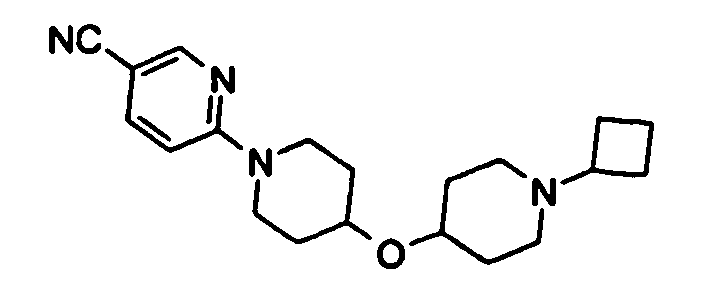
- tert-Butyl 4-(4-piperidinyloxy)-1-piperidinecarboxylate (D4) (0.118g) was reacted with 2-chloro-5-cyano-pyridine (0.0573g) in DMSO (5ml) containing potassium carbonate (0.069g) for 4h at 60°C. The reaction was then evaporated to a minimum volume and the residue redissolved in DCM (20ml) and washed with saturated sodium hydrogen carbonate solution. Evaporation of the dried (MgSO4) organic layer provided the subtitle compound as an oil which crystallised on standing (0.191g).
- To the product of E2 step 1 (0.191g) in DCM (5ml) was added HCl in dioxan (5ml, 4M) and the mixture was stirred overnight. Evaporation of the solvent from DCM gave the subtitle compound (0.141g).
- To the product of E2 step 2 (0.141g) in DCM (5ml) was added triethylamine (0.205ml) and cyclobutyl ketone (0.073ml), and after 5min sodium triacetoxyborohydride (0.208g) was added. After 2 days the reaction was diluted with DCM (10ml) and washed with a solution of potassium carbonate (2x10ml) and brine (10ml). The organic layer was dried (MgSO4) and evaporated and the residue chromatographed [silica gel, eluting with (10%NH3 in MeOH)/DCM, 0-10%]. The residue was evaporated from toluene and dissolved in DCM to which was added HCl (0.5ml, 1M in diethyl ether). This was evaporated and co-evaporated from acetone (3x) and then triturated from acetone - diethyl ether to give the title compound (E2) (0.063g). LCMS electrospray (+ve ion) 341 (MH+), 1H NMR δ(CD3OD) 1.4 (2H, m), 1.6-2 (7H, m), 2.12 (2H, m), 2.3 (2H, m), 2.79 (2H, m), 3.11 (1H,br d, J=2.8 Hz), 3.35 (3H, m), 3.7 (4H, m), 4.0 (2H, m), 6.95 (1H, dd, J=2.8 and 9.2 Hz), 7.82 (1H, m) and 8.46 (1H, br s).
-

- tert-Butyl 4-(4-piperidinyloxy)-1-piperidinecarboxylate (D4) (0.340g) was reacted with 4-fluorobenzonitrile (0.218g) in DMSO (10ml) containing potassium carbonate (0.331g) for 5h at 120°C. The reaction was then evaporated to a minimum volume and the residue redissolved in EtOAc (50ml) and washed with saturated sodium hydrogen carbonate (3×30ml) and saturated brine (30ml). Evaporation of the dried (MgSO4) organic layer provided the subtitle compound as a pale yellow solid (0.422g).
- To the product of E3 step 1 (0.422g) in methanol (10ml) was added HCl in dioxan (10ml, 4M). After 3h evaporation of the solvent gave the subtitle compound (0.466g).
- To the product of E3 step 2 (0.150g) in DCM (10ml) was added triethylamine (0.077ml) and cyclobutyl ketone (0.070ml), and after 5min sodium triacetoxyborohydride (0.197g) was added. After 18h the reaction was diluted with DCM (10ml) and washed with K2CO3 solution (3x20ml). The organic layer was dried (MgSO4) and evaporated and the residue chromatographed [silica gel, eluting with (10%NH3 in MeOH)/DCM, 0-10%]. The free base product was evaporated from toluene and dissolved in DCM (5ml) to which was added HCl (1ml, 1M in diethyl ether). This was evaporated and co-evaporated from acetone (3x) and then recrystallised from acetone to give the title compound (E3) (0.063g). MS electrospray (+ion) 340 (MH+). 1H NMR δ (DMSO-d6): 10.75 (1H, s), 7.56 (2H, d, J=8.8Hz), 7.03 (2H, d, J=8.8Hz), 4.57-3.46 (6H, m, obscured by H2O), 3.38-3.04 (4H, m), 2.75 (2H, m), 2.32 (2H, m), 2.20-1.57 (9H, m), 1.49 (2H, m).
-

- 1-Isopropyl-4-(4-piperidinyloxy)piperidine dihydrochloride (D2) (0.25g) in DMSO (3ml) was treated with 4-fluorobenzonitrile (0.2g) and potassium carbonate (0.23g). The reaction was heated to 100°C for 3h then cooled and diluted with EtOAc and saturated sodium hydrogen carbonate solution. The EtOAc layer was separated, evaporated, and an aliquot processed on a mass directed autoprep HPLC system. The fractions with the correct mass were combined, evaporated from toluene, and dissolved in a small volume of EtOAc before addition of HCl (1ml, 1M in diethyl ether). The precipitate was filtered and washed with diethyl ether before being dried under vacuum to give the title compound (E4) as a solid (28mg). LCMS electrospray (+ve ion) 328 (MH+); 1H NMR δ (DMSO-d6) 1.23 (6H, m), 1.46 (2H, m), 1.88 (3H, m), 2.06 (2H, m), 3.05 (2H, m), 3.14 (3H, m), 3.42 (2H, m), 3.72 (3H, m), 4.2 (2H, obscured by H2O), 7.02 (2H, d, J=8.8Hz), 7.55 (2H, d, J=8.8Hz).
-

- 1-Cyclobutyl-4-(4-piperidinyloxy)piperidine (D6) (0.250g), 4-(4-fluorobenzoyl)-morpholine (D7) (0.330g) and anhydrous potassium carbonate (0.290g) were added to a 5ml Personal Chemistry microwave vial, to which DMSO (3ml) was added. The vial was sealed and heated at 230°C for 30min in an Emrys™ Optimizer microwave reactor. The crude reaction mixture was passed through an SCX cartridge (20g, MeOH (80ml) then 2N NH3 in MeOH (80ml). Purification by chromatography [silica gel, eluting with (10%NH3 in MeOH)/DCM, 0-10%] and treatment of the free base product dissolved in DCM (5ml) with HCl (1ml, 1M in diethyl ether), followed by evaporation and co-evaporation from acetone (3x) gave the title compound (E5) as a crystalline solid (0.125g). MS electrospray (+ion) 428 (MH+).1H NMR δ (DMSO-d6): 9.7 (1H, s), 7.25 (d, 2H, J=8.4), 6.95 (2H, dd, J= 7.2, 1.6), 3.75-3.30 (20H, m, obscured by H2O), 3.20-3.13 (1H, m), 3.08-2.95 (2H, m), 2.91-2.68 (2H, m), 2.30-2.05 (2H, m), 1.96-1.82 (3H, m), 1.81-1.45 (3H, m)
-

- 1-Cyclobutyl-4-(4-piperidinyloxy)piperidine (D6) (0.100g), 4-fluoro-N-methyl benzamide (D8) (0.088g) and anhydrous potassium carbonate (0.121g) were added to a 5ml Personal Chemistry microwave vial, to which DMSO (2ml) was added. The vial was sealed and heated at 230°C for 30min in an Emrys™ Optimizer microwave reactor. The crude reaction mixture was passed through an SCX cartridge [20g, MeOH (80ml) then 2N NH3 in MeOH (80ml)]. Purification by chromatography [silica gel, eluting with (10%NH3 in MeOH)/DCM, 0-10%] and treatment of the free base product dissolved in DCM (5ml) with HCl (1ml, 1M in diethyl ether), followed by evaporation and co-evaporation from acetone (3x) gave the title compound (E6) as a crystalline solid (0.074g). MS electrospray (+ion) 372 (MH+). 1H NMR δ (DMSO-d6): 8.17 (1H, s), 7.72 (dd, 2H, J=9.2, 2.8), 7.04 (2H, s), 4.32-2.81 (11H, m, obscured by H2O). 2.74 (3H, s), 2.34 (2H, m), 2.15 (2H, m), 2.00-1.40 (10H, m)
- Examples 7-14 were prepared in a similar manner to Example 6 from either 1-isopropyl-4-(4-piperidinyloxy)piperidine (free base from D2) or 1-cyclobutyl-4-(4-piperidinyloxy) piperidine (D6) and the appropriate 4-fluorobenzamide (D7-D11). All compounds displayed 1H NMR and mass spectral data that were consistent with structure.

Example A R Mass Spectrum (ES+) E7 
i-Pr [MH]+ 416 E8 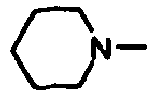
i-Pr [MH]+ 414 E9 
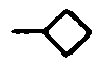
[MH]+ 426 E10 
i-Pr [MH]+ 400 E11 

[MH]+ 412 E12 Me2N- i-Pr [MH]+ 374 E13 Me2N- 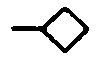
[MH]+ 386 E14 MeNH- i-Pr [MH]+ 360 -

- 1-Cyclobutyl-4-(4-piperidinyloxy)piperidine (D6) (0.100g), 1-(4-fluorobenzoyl)-azetidine (D48) (0.098g) and anhydrous potassium carbonate (0.121g) were added to a 5ml Personal Chemistry microwave vial, to which DMSO (2ml) was added. The vial was sealed and heated at 230°C for 30min in an Emrys™ Optimizer microwave reactor. The crude reaction mixture was passed through an SCX cartridge [20g, MeOH (80ml) then 2N NH3 in MeOH (80ml)]. Purification by chromatography [silica gel, eluting with (10%NH3 in MeOH)/DCM, 0-10%] and treatment of the free base azetidine product dissolved in DCM (5ml) with HCl (1ml, 1M in diethyl ether), followed by evaporation and co-evaporation from acetone (3x) gave the title compound (E15) as a crystalline solid (0.090g). 1H NMR δ (DMSO-d6): 10.8 (1H, m), 8.27 (1H, s), 7.74 (dd, 2H, J= 9.5 ,2.8), 7.05 (2H, s), 4.10-3.44 (6H, m, obscured by H2O), 3.40-3.25 (3H, m), 3.19-3.00 (3H, m), 2.89-2.64 (2H, m), 2.42-2.26 (2H, m), 2.12-2.10 (2H, m), 2.08-1.81 (7H, m), 1.79-1.60 (4H, m), 1.60-1.40 (2H, m).
-

- Sodium tert-butoxide (0.064g) was added to a solution of 1-cyclobutyl-4-(4-piperidinyloxy)piperidine (D6) (0.105g), 4-(4-bromophenyl)-2-methyl-oxazole (D12) (0.095g) and acetato(2'-di-tert-butylphosphino-1,1'-biphenyl-2-yl)palladium (II) (0.004g) in toluene (2ml). The reaction was heated to 60°C for 4h, then at 40°C for 1.5h, then at 55°C for a further 16h. The reaction mixture was diluted with toluene (5ml), and Argonaut MP-NCO resin (1g) was added and the mixture stirred for 1h at 55°C. The reaction mixture was loaded directly onto silica and purified by chromatography [silica gel, eluting with (10% NH3 in MeOH)/DCM, 0-10%]. The purified residue was evaporated from toluene and dissolved in DCM (5ml) to which was added HCl (1m), 1 M in diethyl ether). Evaporation of the solvent gave the title compound (E16) (0.056g). MS electrospray (+ion) 396 (MH+). 1H NMR δ (DMSO-d6): 10.71 (1H, s), 8.14 (1H, m), 7.75-7.43 (4H, m), 4.05-3.50 (6H, m, obscured by H2O), 3.38-3.10 (4H, m), 2.91-2.66 (2H, m), 2.45 (3H, s), 2.35 (2H, m), 2.20-1.58 (11H, m).
-

- Sodium tert-butoxide (0.058g) was added to a solution of 1-isopropyl-4-(4-piperidinyloxy)piperidine (free base from D2) (0.10g), 5-(4-bromophenyl)-3-methyl-1,2,4-oxadiazole (D16) (0.096g) and acetato(2'-di-tert-butylphosphino-1,1'-biphenyl-2-yl)palladium(II) (0.004g) in toluene (3ml). The reaction was heated to 60°C for 6h, then a further charge of acetato(2'-di-tert-butylphosphino-1,1'-biphenyl-2-yl)palladium(II) (0.004g) was added followed by heating at 70°C for a further 16h. The reaction mixture was diluted with toluene (5ml), and Argonaut MP-NCO resin (1g) was added and the mixture stirred for 1h. After evaporation, the crude residue was diluted with MeOH (5ml) and passed through an SCX cartridge [10g, MeOH (80ml) then 2N NH3 in MeOH (80ml)]. Purification by chromatography [silica gel, eluting with (10%NH3 in MeOH)/DCM, 0-10%] and treatment of the free base product dissolved in DCM (5ml) with HCl (1ml, 1M in diethyl ether), followed by evaporation afforded the title compound (E17) (0.054g). MS electrospray (+ion) 385 (MH+). 1H NMR δ (DMSO-d6): 10.05 (1H, m), 7.87 (2H, d, J=8.4Hz), 7.10 (2H, d, J=7.6Hz), 3.90-3.61 (4H, m, obscured by H2O), 3.47-3.28 (2H, m), 3.18 (3H, m), 3.06-2.87 (2H, m), 2.35 (3H, s), 2.12-1.70 (6H, m), 1.51 (2H, m), 1.25 (6H, m).
- Examples 18-28 were prepared in a similar manner to Example 17 from either 1-isopropyl-4-(4-piperidinyloxy)piperidine (free base from D2) or 1-cyclobutyl-4-(4-piperidinyloxy) piperidine (D6) and the appropriate 4-bromophenyl precursor (D12-D17 or commercially available). All compounds displayed 1H NMR and mass spectral data that were consistent with structure.

Example A R Mass Spectrum (ES+) E18 
i-Pr [MH]+ 384 E19 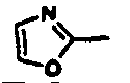
i-Pr [MH]+ 370 E20 
i-Pr [MH]+ 384 E21 

[MH]+ 382 E22 

[MH]+ 396 E23 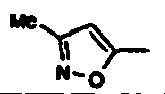
i-Pr [MH]+ 384 E24 

[MH]+ 396 E25 

[MH]+ 397 E26 
i-Pr [MH]+ 447 E27 

[MH]+ 459 E28 
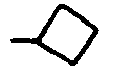
[MH]+ 397 - Examples 29-30 were prepared in a similar manner to Example 6 from either 1-isopropyl-4-(4-piperidinyloxy)piperidine (free base from D2) or 1-cyclobutyl-4-(4-piperidinyloxy) piperidine (D6) and commercially available 5-(4-fluorophenyl)-oxazole. All compounds displayed 1H NMR and mass spectral data that were consistent with structure.

Example A R Mass Spectrum (ES+) E29 

[MH]+ 382 E30 
i-Pr [MH]+ 370 -
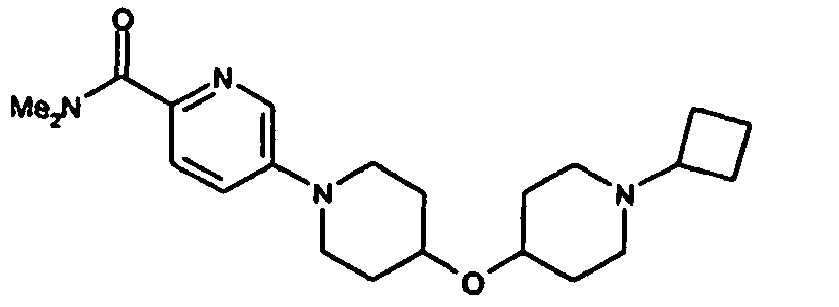
- Palladium (II) acetate (0.002g) and sodium tert-butoxide (0.050g) were added to an argon-filled round bottom flask, followed by toluene (2ml). 1-Cyclobutyl-4-(4-piperidinyloxy)piperidine (D6) (0.100g), 5-bromo-N,N-dimethyl-2-pyridinecarboxamide (D18) and 2,8,9-triisobutyl-2,5,8,9-tetraaza-1-phosphabicyclo[3.3.3]undecane (0.005g) were added and the reaction mixture heated at 80°C for 2h. The crude reaction mixture was passed through an SCX cartridge [20g, MeOH (80ml) then 2N NH3 in MeOH (80ml)]. Chromatography [silica gel, eluting with (10% NH3 in MeOH)/DCM, 0-10%] and treatment of the free base product dissolved in DCM (5ml) with HCl (1ml, 1M in diethyl ether), followed by evaporation gave the title compound (E31) (0.085g). MS electrospray (+ion) 387 (MH+). 1H NMR δ (DMSO-d6): 10.92 (1H, m), 8.29 (1H, s), 7.53 (2H, m),4.59-3.49 (5H, m, obscured by H2O), 3.31 (1H, m), 3.15 (3H, m), 3.07 (3H, s), 3.01 (3H, s), 2.78 (2H, m), 2.33 (3H, m), 2.20-1.42 (11H, m).
- Examples 32-37 were prepared in a similar manner to Example 31 from either 1-isopropyl-4-(4-piperidinyloxy)piperidine (free base from D2) or 1-cyclobutyl-4-(4-piperidinyloxy) piperidine (D6) and the appropriate 2-pyridine-carboxamide precursor (D18 and D24-D26). All compounds displayed 1H NMR and mass spectral data that were consistent with structure.

Example A R Mass Spectrum (ES+) E32 -CONMe2 i-Pr [MH]+ 375 E33 
i-Pr [MH]+ 401 E34 
i-Pr [MH]+ 415 E35 

[MH]+ 427 E36 
i-Pr [MH]+ 417 E37 

[MH]+ 429 -

- 1-Cyclobutyl-4-(4-piperidinyloxy)piperidine (D6) (0.150g), 5-bromo-N-methyl-2-pyridinecarboxamide (D19) (0.203g) and anhydrous potassium carbonate (0.174g) were added to a 5ml Personal Chemistry microwave vial, to which DMSO (2ml) was added. The vial was sealed and heated at 250°C for 30min in an Emrys™ Optimizer microwave reactor. The crude mixture was diluted with MeOH (5ml) and passed through an SCX cartridge [10g, MeOH (80ml) then 2N NH3 in MeOH (80ml)]. The eluted mixture was evaporated, then chromatography [silica gel, eluting with (10%NH3 in MeOH)/DCM, 0-10%] and treatment of the free base product dissolved in DCM (5ml) with HCl (1ml, 1M in diethyl ether), followed by evaporation gave the title compound (E38) (0.015g). MS electrospray (+ion) 373 (MH+). 1H NMR δ (CDCl3): 8.16 (1H, d, J=2.8Hz), 8.02 (1H, d, J=8.8Hz), 7.76 (1H, d, J=5.6Hz), 7.21 (1H, dd, J=8.8Hz, J=2.8Hz), 3.64 (3H, m), 3.46 (1H, m), 3.13 (2H, m), 2.99 (3H, d, J=5.2Hz), 2.68 (3H, m), 2.09-1.78 (10H, m), 1.74-1.52 (6H, m, obscured by H2O).
- Oxalyl chloride (29.0g) was added dropwise with stirring to a suspension of 5-{4-[(1-cyclobutyl-4-piperidinyl)oxy]-1-piperidinyl}-2-pyridinecarboxylic acid trifluoroacetate (D42) (32.0g) in DCM (800ml) containing DMF (3 drops) at rt. The resulting solution was stirred at rt for 1.5h and then evaporated to dryness. The residue was then re-evaporated twice from DCM to afford a dark green oily solid which was then re-suspended in DCM (300ml) and added dropwise over 30min to a 2M solution of methylamine in THF (137ml) at 0-5°C. The resulting mixture was stirred at 0-5°C for 1.5h and then evaporated to dryness. The residue was partitioned between saturated aqueous sodium hydrogen carbonate solution (100ml) and DCM (500ml). The organic layer was separated and the aqueous layer re-extracted with DCM (4x100ml). The combined organic extracts were dried (MgSO4) filtered and evaporated to leave the crude product (21g). This was purified by silica chromatography eluting with 0-4% (2M NH3 in methanol) in DCM. This purified material (14.15g) was dissolved in DCM (300ml) and washed with saturated aqueous potassium carbonate (50ml). The aqueous phase was re-extracted with DCM (2×50ml) and the combined organic extracts were dried (MgSO4) and evaporated. Crystallisation from hot diethyl ether/ ethyl acetate afforded the title compound (E38A) as white crystals (8.35g). mp = 109.7°C. MS electrospray (+ve ion) 373 (MH+). 1H NMR δ CDCl3: 8.16 (1H, d, J=3.2Hz), 8.01 (1H, d, J=8.8Hz), 7.75 (1H, m), 7.20 (1H, dd, J=8.8, 3.2Hz), 3.63 (3H, m), 3.47 (1H, m), 3.12 (2H, m), 3.00 (3H, d, J=4.8Hz), 2.67 (3H, m), 1.80-2.06 (9H, m), 1.67 (7H, m),
- Examples 39-46 were prepared in a similar manner to Example 38 from either 1-isopropyl-4-(4-piperidinyloxy)piperidine (free base from D2) or 1-cyclobutyl-4-(4-piperidinyloxy) piperidine (D6) and the appropriate 2-pyridine-carboxamide precursor (D20-23). The free base compounds were converted into hydrochloride salts and displayed 1H NMR and mass spectral data that were consistent with structure.

Example A R Mass Spectrum (ES+) E39 EtNH- i-Pr [MH]+ 375 E40 EtNH- 
[MH]+ 387 E41 n-PrNH- i-Pr [MH]+ 389 E42 n-PrNH- 
[MH]+ 401 E43 i-PrNH- i-Pr [MH]+ 389 E44 i-PrNH- 
[MH]+ 401 E45 
i-Pr [MH]+ 415 E46 

[MH]+ 427 -

- Oxalyl chloride (1.87g) was added dropwise with stirring to a suspension of 5-{4-[(1-cyclobutyl-4-piperidinyl)oxy]-1-piperidinyl}-2-pyridinecarboxylic acid trifluoroacetate (D42) (2.5g) in DCM (100ml) containing DMF (1 drop) at rt. The resulting solution was stirred at rt for 1.5h and then evaporated to dryness. The residue was then re-evaporated twice from DCM to afford the acid chloride as a dark green oily solid. A portion of the oil (0.62g) was then re-suspended in DCM (5ml) and added dropwise over 15min to a 2M solution of ethylamine in THF (7.5ml) at 0-5°C. The resulting mixture was stirred at rt for 2.0h and then loaded directly onto silica (20g cartridge) and chromatographed [silica gel, eluting with 10% NH3 in MeOH/DCM, 0-10%]. Pooling of pure fractions afforded the title compound (E40A) as a pale brown powder (0.14g). MS electrospray (+ve ion) 387 (MH+). 1H NMR δ (CDCl3): 8.16 (1H, d, J=2.8Hz), 8.02 (1H, d, J=8.8Hz), 7.75 (1H, m), 7.21 (1H, dd, J=2.8Hz, J=8.8Hz), 3.65 (3H, m), 3.48 (3H, m), 3.11 (2H, m), 2.68 (3H, m), 1.87-1.55 (16H, m), 1.25 (3H, t).
-

- A portion of the acid chloride from Example 40A (0.62g) was suspended in DCM (5ml) and added dropwise over 15min to a solution of propylamine (1.24ml) in DCM (5ml) at 0-5°C. The resulting mixture was stirred at rt for 2.0h and then loaded directly onto silica (20g cartridge) and chromatographed [silica gel, eluting with 10%NH3 in MeOH/DCM, 0-10%]. Pooling of pure fractions afforded the title compound (E42A) as a pale brown powder (0.25g). MS electrospray (+ve ion) 401 (MH+). 1H NMR δ (CDCl3): 8.28 (1H, d, J=2.8Hz), 8.00 (1H, d, J=8.8Hz), 7.81 (1H, m), 7.16 (1H, dd, J=2.8Hz, J=8.8Hz), 3.63 (3H, m), 3.33 (3H, m), 3.13 (2H, m), 2.68 (3H, m), 2.06-1.54 (18H, m), 0.96 (3H, t).
-

- A portion of the acid chloride from Example 40 (0.62g) was suspended in DCM (5ml) and added dropwise over 15min to a solution of isopropylamine (1.24ml) in DCM (5ml) at 0-5°C. The resulting mixture was stirred at rt for 2.0h and then loaded directly onto silica (20g cartridge) and chromatographed [silica gel, eluting with 10%NH3 in MeOH/DCM, 0-10%]. Pooling of pure fractions afforded the title compound (E44A) as a pale brown powder (0.20g). MS electrospray (+ve ion) 401 (MH+). 1H NMR δ (CDCl3): 8.15 (1H, d, J=2.8Hz), 8.02 (1H, d, J=8.8Hz), 7.63 (1H, d, J=8.1Hz), 7.21(1H, dd, J=2.8Hz, J=8.8Hz), 4.27 (1H, m), 3.62 (3H, m), 3.45 (1H, m), 3.12 (2H, m), 2.68 (3H, m), 2.07-1.53 (16H, m), 1.25 (6H, d, J=6.6Hz).
-
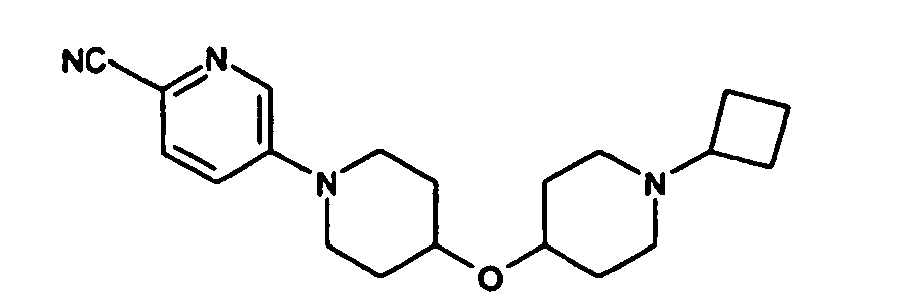
- 1-Cyclobutyl-4-(4-piperidinyloxy)piperidine (D6) (0.210g), 5-bromo-2-pyridinecarbonitrile (0.194g) and anhydrous potassium carbonate (0.244g) were added to a 5ml Personal Chemistry microwave vial, to which DMSO (2ml) was added. The vial was sealed and heated at 140°C for 15min in an Emrys™ Optimizer microwave reactor. The reaction mixture was evaporated to dryness, DCM (10ml) was added followed by Argonaut MP-NCO resin (1.0g) and the mixture allowed to stir for 16h. The crude mixture was passed through an SCX cartridge (10g, eluting with MeOH (80ml) then 2N NH3 in MeOH (80ml). The eluted mixture was evaporated and re-evaporated from toluene (20ml). Chromatography [silica gel, eluting with (10%NH3 in MeOH)/DCM, 0-10%] and treatment of the free base product dissolved in DCM (5ml) with HCl (1ml, 1M in diethyl ether), followed by evaporation gave the title compound (E47) (0.10g). MS electrospray (+ion) 341 (MH+). 1H NMR δ (DMSO-d6): 10.38 (1H, s), 8.42 (1H, m), 7.72 (1H, d, J=9.2Hz), 7.38 (1H, m), 3.91-3.48 (6H, m), 3.31-3.10 (3H, m), 2.89-2.62 (2H, m), 2.38-1.41 (14H, m).
-

- 4'-Bromoacetophenone (0.102g), tris(dibenzylideneacetone)dipalladium(0) (0.025g) and 2-dicyclohexylphosphino-2'-(N,N-dimethylamino)biphenyl (0.059g) were added to degassed dioxane (5ml). After 15 min 1-cyclobutyl-4-(4-piperidinyloxy)piperidine (D6) (0.10g) and sodium tert-butoxide (0.061g) were added and the reaction mixture heated at 80°C for 3h, then heated at 100°C for 1h. After diluting with MeOH (5ml) the crude mixture was passed through an SCX cartridge [10g, MeOH (80ml) then 2N NH3 in MeOH (80ml)]. Chromatography [silica gel, eluting with (10%NH3 in MeOH)/DCM, 0-10%] and treatment of the free base product in DCM (5ml) with HCl (1ml, 1M in diethyl ether), followed by evaporation gave the title compound (E48) (0.10g). MS electrospray (+ion) 357 (MH+).1H NMR δ (DMSO-d6): 7.80 (2H, dd, J=8.8, 1.2), 7.00 (2H, dd, J=8.8, 2.8), 3.78-3.46 (5H, m), 3.35-3.07 (4H, m), 2.87-2.64 (2H, m), 2.43 (3H, s), 2.41-2.39 (2H, m), 2.20-2.10 (2H, m), 2.08-1.81 (5H, m), 1.78-1.60 (3H, m), 1.57-1.42 (2H, m).
- 4-Fluoroacetophenone (0.21g), 1-cyclobutyl-4-(4-piperidinyloxy)piperidine (D6) (0.25g), and potassium carbonate (0.29g) in DMSO (1.5ml) were heated in a microwave reactor at 160°C for 15min. The reaction was then poured directly onto an SCX column (10g) and washed with MeOH (60ml) and then eluted with 2M ammonia in MeOH solution (60ml). After evaporation the residue was purified by chromatography [silica gel (20g cartridge), eluting with 10%NH3 in MeOH/DCM, 0-10%]. Pure fractions were evaporated to give the title compound (E48A) as a pale yellow solid (0.38g). MS electrospray (+ve ion) 357 (MH+). 1H NMR δ (CDCl3): 7.87 (2H, d, J=9.0Hz), 6.86 (2H, d, J=9.0Hz), 3.68 (3H, m), 3.46 (1H, m), 3.14 (2H, m), 2.68 (3H, m), 2.51 (3H, s), 2.05-1.55 (16H, m, obscured by H20).
-

- 5-Bromo-2-trifluoromethylpyridine (F. Cottet and M. Schlosser, Eur. J. Org. Chem., 2002, 327) (0.187g), tris(dibenzylideneacetone)dipalladium(0) (0.034g) and 2-dicyclohexylphosphino-2'-(N,N-dimethylamino)biphenyl (0.091g) were added to degassed dioxane (4ml). After 15 min 1-cyclobutyl-4-(4-piperidinyloxy)piperidine (D6) (0.150g) and sodium tert-butoxide (0.095g) were added and the reaction mixture heated at 100°C for 3h, then stirred at rt for 16h. Argonaut MP-NCO resin (0.4g) was added and the mixture allowed to stir for 1h. After diluting with MeOH (5ml) the crude mixture was passed through an SCX cartridge [10g, MeOH (80ml) then 2N NH3 in MeOH (80ml)]. Chromatography [silica gel, eluting with (10%NH3 in MeOH)/DCM, 0-10%] and treatment of the free base product dissolved in DCM (5ml) with HCl (1ml, 1M in diethyl ether), followed by evaporation afforded the title compound (E49) (0.10g). MS electrospray (+ion) 384 (MH+). 1H NMR δ (DMSO-d6): 10.75 (1H, s), 8.43 (1H, m), 7.62 (1H, d, J=8.8Hz), 7.44 (1H, d, 9.2Hz), 4.32-3.44 (5H, m, obscured by H2O), 3.35-3.06 (4H, m), 2.88-2.62 (2H, m), 2.42-1.40 (14H, m).
- Examples 50-57 were prepared in a similar manner to Description 18 step 2 from either 6-(4-{[1-(isopropyl)-4-piperidinyl]oxy}-1-piperidinyl)-3-pyridinecarboxylic acid hydrochloride (D28) or 6-(4-[(1-cyclobutyl-4-piperidinyl)oxy]-1-piperidinyl)-3-pyridinecarboxylic acid hydrochloride (D27) and the appropriate amine with EDC (1.3eq.), HOBT (1.0eq.), triethylamine (6eq.) in DMF/DCM (1:1; vol:vol). All compounds displayed 1H NMR and mass spectral data that were consistent with structure.

Example A R Mass Spectrum (ES+) E50 MeNH- i-Pr [MH]+ 361 E51 Me2N- i-Pr [MH]+ 375 E52 
i-Pr [MH]+ 401 E53 
i-Pr [MH]+ 417 E54 MeNH- 
[MH]+ 373 E55 Me2N- 
[MH]+ 387 E56 
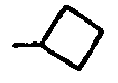
[MH]+ 413 E57 

[MH]+ 429 - Examples 58-65 were prepared in a similar manner to Example 38 from either 1-isopropyl-4-(4-piperidinyloxy)piperidine (free base from D2) or 1-cyclobutyl-4-(4-piperidinyloxy) piperidine (D6) and the appropriate 6-pyridine-carboxamide (D31-34). The reactions were carried out at 210°C for 30min. All compounds displayed 1H NMR and mass spectral data that were consistent with structure.

Example A R Mass Spectrum (ES+) E58 MeNH- i-Pr [MH]+ 361 E59 MeNH- Me2N- i-Pr [MH]+ 375 E60 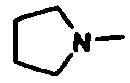
i-Pr [MH]+ 401 E61 
i-Pr [MH]+ 417 E62 MeNH- 
[MH]+ 373 E63 Me2N- 
[MH]+ 387 E64 

[MH]+ 413 E65 

[MH]+ 429 - Examples 66-69 were prepared in a similar manner to Example 38 from either 1-isopropyl-4-(4-piperidinyloxy)piperidine (free base from D2) or 1-cyclobutyl-4-(4-piperidinyloxy)piperidine (D6) and the appropriate 2-pyridine-carboxamide (D35-D36). All compounds displayed 1H NMR and mass spectral data that were consistent with structure.

Example A R Mass Spectrum (ES+) E66 i-PrNH- i-Pr [MH]+ 389 E67 i-PrNH- 
[MH]+ 401 E68 
i-Pr [MH]+ 415 E69 

[MH]+ 427 -

- 5-{4-[(1-Cyclobutyl-4-piperidinyl)oxy]-1-piperidinyl}-2-pyrazinecarbonyl chloride hydrochloride (D29) (0.1g) and methylamine hydrochloride (0.05g) were stirred in DCM (5ml). Triethylamine (0.2ml) was added and the reaction stirred at rt overnight. The reaction mixture was diluted with DCM (15ml) and washed with saturated sodium hydrogen carbonate (2 x 10m), brine (10ml) and dried (MgSO4). The DCM solution was then loaded directly onto silica (10g cartridge) and chromatographed [silica gel, eluting with 10%NH3 in MeOH/DCM, 0-10%]. The purified free base was evaporated from toluene then dissolved in acetone and treated with 1.0 molar equivalent of succinic acid as a solution in ethanol. The solution was concentrated and then evaporated from acetone (x 3) to give the title compound (E70) as a white solid (0.01g). MS electrospray (+ve ion) 374 (MH+). 1H NMR δ (DMSO-d6): 8.57 (1H, d, J=1.2Hz), 8.32 (1H, m), 8.27 (1H, d, J=1.2Hz), 4.07 (2H, m), 3.71 (1H, m), 3.58-3.18 (5H, m), 2.84 (1H, m), 2.75 (3H, d, J=4.8Hz), 2.67 (2H, m), 2.39 (4H, s, succinate), 2.00 (2H, m), 1.85 (6H, m), 1.63 (2H, m), 1.43 (4H, m).
- Examples 71-74 were prepared in a similar manner to Example 70 by reaction of 5-{4-[(1-cyclobutyl-4-piperidinyl)oxy]-1-piperidinyl}-2-pyrazinecarbonyl chloride hydrochloride (D29) with 3 molar equivalents of the appropriate amine. In the case of Example 71 the isolated free base product was converted into the butanedioate salt.

Example A Mass Spectrum 1H NMR (ES+) E71 EtNH- [MH]+ 388 δ (DMSO-d6) 8.57 (1H, s), 8.35 (1H, t), 8.26 (1H, s), 4.07 (2H, m), 3.71 (1H, m), 3.57-3.14 (5H, m), 2.80 (1H, m), 2.67 (2H, m), 2.08-1.71 (10H, m), 1.68-1.36 (6H, m), 1.09 (3H, t). E72 n-PrNH- [MH]+ 402 δ (CDCl3) 8.83 (1H, s), 7.96 (1H,s), 7.48 (1H, t), 4.01 (2H, m), 3.71 (1H, m), 3.42 (5H, m), 2.66 (3H, m), 2.07-1.80 (11H, m), 1.75-1.50 (7H, m), 0.98 (3H, t). E73 i-PrNH- [MH]+ 402 δ (CDCl3) 8.83 (1H, s), 7.95 (1H,s), 7.27 (1H, m), 4.28 (1H, m), 4.01 (2H, m), 3.71 (1H, m), 3.45 (3H, m), 2.66 (3H, m), 2.10-1.78 (9H, m), 1.76-1.50 (7H, m), 1.26 (6H, d, J=6.8Hz). E74 
[MH]+ 414 δ (CDCl3) 8.81 (1H, s), 7.96 (1H,s), 7.58 (1H, d, J=8.4Hz), 4.63 (1H, m), 4.02 (2H, m), 3.71 (1H, m), 3.47 (3H, m), 2.66 (3H, m), 2.41 (2H, m), 2.07-1.44 (20H, m). - Examples 75-79 were prepared in a similar manner to Example 70 by reaction of 5-{4-[(1-isopropyl-4-piperidinyl)oxy]-1-piperidinyl}-2-pyrazinecarbonyl chloride hydrochloride (D30) with 3 molar equivalents of the appropriate amine. In the case of Examples 75, 78 and 79, the isolated free base compounds were converted into the corresponding butanedioate salts. All compounds displayed 1H NMR and mass spectral data that were consistent with structure.

Example A Mass Spectrum (ES+) E75 MeNH- [MH]+ 362 E76 EtNH- [MH]+ 376 E77 n-PrNH- [MH]+ 390 E78 i-PrNH- [MH]+ 390 E79 
[MH]+ 402 -
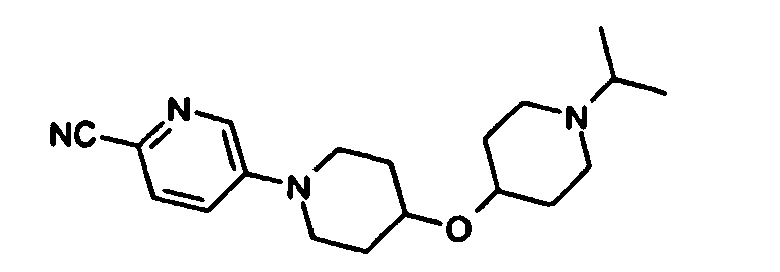
- The title compound (E80) was prepared in a similar manner to Example 47 from 1-isopropyl-4-(4-piperidinyloxy)piperidine (free base from D2) and 5-bromo-2-pyridinecarbonitrile MS electrospray (+ion) 329 (MH+).
-

- The title compound (E81) was prepared in a similar manner to Example 49 from 1-isopropyl-4-(4-piperidinyloxy)piperidine (free base from D2) and 5-bromo-2-trifluoromethylpyridine MS electrospray (+ion) 372 (MH+).
-

- 3-Chloro-6-(trifluoromethyl)pyridazine (A.J. Goodman, S.P. Stanforth and B. Tarbit, Tetrahedron, 1999, 55(52), 15067-15070) (0.09g), 1-cyclobutyl-4-(4-piperidinyloxy)piperidine (D6) (0.10g), and potassium carbonate (0.11g) in DMSO (2ml) were heated in the microwave at 120°C for 5min. The reaction was poured directly onto an SCX column (10g) and washed with MeOH (60ml) and then eluted with 2M ammonia in MeOH solution (60ml). After evaporation the residue was purified by chromatography [silica gel (10g cartridge), eluting with 10%NH3 in MeOH/DCM, 0-10%]. Pure fractions were evaporated and the free base was dissolved in DCM and converted into the HCl salt with excess 1M HCl in diethyl ether. After evaporation of solvent the title compound (E82) was obtained as a pale brown solid (0.16g). MS electrospray (+ve ion) 385 (MH+). 1H NMR δ (DMSO-d6): 11.09 (1H, s), 7.80 (1H, d, J=9.6Hz), 7.48 (1H, d, J=9.6Hz), 4.10 (2H, m), 3.95-3.38 (5H, m), 3.33-3.04 (2H, m), 2.90-2.65 (2H, m), 2.38 (2H, m), 2.10-1.57 (10H, m), 1.50 (2H, m).
-

- The title compound (E83) was prepared in a similar manner to Example 82 from 1-isopropyl-4-(4-piperidinyloxy)piperidine (free base from D2) and 3-chloro-6-(trifluoromethyl)pyridazine. MS electrospray (+ion) 373 (MH+).
-

- 2-Chloro-5-(trifluoromethyl)pyrazine (D37) (0.09g), 1-cyclobutyl-4-(4-piperidinyloxy)piperidine (D6) (0.10g), and potassium carbonate (0.11g) in DMSO (2ml) were heated in a microwave reactor at 120°C for 5 min. The reaction was poured directly onto an SCX column (10g), washed with MeOH (60ml) and then eluted with 2M ammonia in MeOH solution (60ml). After evaporation the residue was purified by chromatography [silica gel (10g cartridge), eluting with 10%NH3 in MeOH/DCM. 0-10%]. Pure fractions were evaporated and the free base was dissolved in DCM and converted into the HCl salt with excess 1M HCl in diethyl ether. Evaporation of solvent afforded the title compound (E84) as a pale brown solid (0.17g). MS electrospray (+ve ion) 385 (MH+). 1H NMR δ (DMSO-d6): 10.94 (1H, s), 8.46 (2H, s), 4.06 (2H, m), 3.90-3.38 (5H, m), 3.35-3.06 (2H, m), 2.90-2.65 (2H, m), 2.38 (2H, m), 2.20-1.60 (10H, m), 1.48 (2H, m).
-

- The title compound (E85) was prepared in a similar manner to Example 84 from 1-isopropyl-4-(4-piperidinyloxy)piperidine (free base from D2) and 2-chloro-5-(trifluoromethyl)pyrazine. MS electrospray (+ion) 373 (MH+).
-
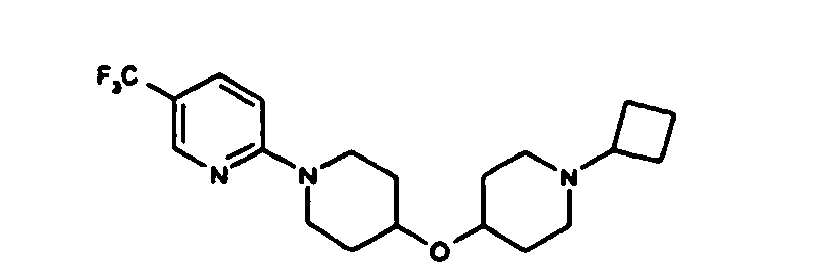
- 2-Bromo-5-(trifluoromethyl)pyridine (0.11g), 1-cyclobutyl-4-(4-piperidinyloxy)piperidine (D6) (0.10g), and potassium carbonate (0.11g) in DMSO (2ml) were heated in a microwave reactor at 120°C for 5min. The reaction was poured directly onto an SCX column (10g), washed with MeOH (60ml) and then eluted with 2M ammonia in MeOH solution (60ml). After evaporation the residue was purified by chromatography [silica gel (10g cartridge), eluting with 10%NH3 in MeOH/DCM, 0-10%]. Pure fractions were evaporated and the free base was dissolved in DCM and converted into the HCI salt with excess 1M HCl in diethyl ether. Evaporation of solvent afforded the title compound (E86) as a pale brown solid (0.12g). MS electrospray (+ve ion) 384 (MH+). 1H NMR δ (DMSO-d6): 10.94 (1H, s), 8.31 (1H, s), 7.80 (1H, d, J=9.2Hz),7.03 (1H, d, J=9.2Hz), 3.97 (2H, m), 3.90-3.06 (7H, m), 2.87-2.66 (2H, m), 2.38 (2H, m), 2.20-1.60 (10H, m), 1.42 (2H, m).
-

- The title compound (E87) was prepared in a similar manner to Example 86 from 1-isopropyl-4-(4-piperidinyloxy)piperidine (free base from D2) and 2-bromo-5-(trifluoromethyl)pyridine. MS electrospray (+ion) 372 (MH+).
-

- 5-Bromo-2-(trifluoromethyl)pyrimidine (D38) (0.18g), 1-cyclobutyl-4-(4-piperidinyloxy)piperidine (D6) (0.15g), 2-dicyclohexylphosphino-2'-(N,N-dimethylamino)biphenyl (0.09g), tris(dibenzylidineacetone)dipalladium (0.054g), and sodium tert-butoxide (0.095g) in dioxane (2ml) were heated at 120°C in a microwave reactor for 5min. The reaction was poured directly onto an SCX column (10g) and washed with MeOH (60ml) and then eluted with 2M ammonia in MeOH solution (60ml). After evaporation the residue was purified by chromatography [silica gel (10g cartridge), eluting with 10%NH3 in MeOH/DCM, 0-10%]. Fractions containing the required product were evaporated and repurified by mass directed autoprep HPLC to give the formate salt of the product. The formate salt was dissolved in MeOH (10ml) and treated with excess MP carbonate resin (2.89mmoles/g loading;1.0g) for 1h, filtered and evaporated to give the title compound (E88) as a white solid (0.068g). MS electrospray (+ve ion) 385 (MH+). 1H NMR δ (CDCl3): 8.39 (2H, s), 3.69 (1H, m), 3.62 (2H, m), 3.48 (1H, m), 3.22 (2H, m), 2.66 (3H, m), 2.08-1.80 (10H, m), 1.79-1.56 (6H, m).
-

- The title compound (E89) was prepared in a similar manner to Example 88 from 1-isopropyl-4-(4-piperidinyloxy)piperidine (free base from D2) and 5-bromo-2-(trifluoromethyl)pyrimidine (D38). MS electrospray (+ion) 373 (MH+). 1H NMR δ (CDCl3): 8.93 (2H, s), 3.71 (1H, m), 3.61 (2H, m), 3.43 (1H, m), 3.23 (2H, m), 2.73 (3H, m), 2.26 (2H, m), 1.90 (4H, m), 1.75 (2H, m), 1.62 (2H, m), 1.04 (6H, d, J=6.4Hz).
-

- 1-(4-Fluorophenyl)-1-propanone (0.24g), 1-cyclobutyl-4-(4-piperidinyloxy)piperidine (D6) (0.25g), and potassium carbonate (0.29g) in DMSO (1.5 ml) were heated in a microwave reactor at 160°C for 15min. The reaction was poured directly onto an SCX column (10g) and washed with MeOH (60 ml) and then eluted with 2M ammonia in MeOH solution (60ml). After evaporation the residue was purified by chromatography [silica gel (20g cartridge), eluting with 10% NH3 in MeOH/DCM, 0-10%]. Pure fractions were evaporated to give the title compound (E90) as a pale yellow solid (0.32g). MS electrospray (+ve ion) 371 (MH+). 1H NMR δ (CDCl3): 7.87 (2H, d, J=8.8Hz), 6.88 (2H, d, J=9.2Hz), 3.68 (3H, m), 3.48 (1H, m), 3.13 (2H, m), 2.90 (2H, q, J=7.2Hz), 2.66 (3H, m), 2.06-1.55 (16H, m), 1.20 (3H, t, J=7.2Hz).
- Examples 91-92 were prepared by reacting1-cyclobutyl-4-(4-piperidinyloxy)piperidine (D6) (1.0mmol), and the appropriate 4-fluorophenyl ketone (1.6mmol) in the presence of potassium carbonate (2.1 mmol) in DMSO (1.5ml) in a microwave reactor at 160°C for 15min using a similar procedure to that of Example 90.

Example R Mass Spectrum 1H NMR (ES+) E91 
[MH]+ 383 δ (CDCl3): 7.94 (2H, d, J=9.2Hz), 6.89 (2H, d, J=8.8Hz), 3.69 (3H ,m), 3.46 (1H, m), 3.13 (2H, m), 2.62 (4H, m), 2.07-1:80 (7H, m), 1.75-1.54 (9H, m), 1.17 (2H, m), 0.94 (2H, m). E92 
[MH]+ 397 δ (CDCl3): 7.80 (2H, d, J=9.2Hz), 6.86 (2H, d, J=8.8Hz), 3.93 (1H, m), 3.65 (3H ,m), 3.45 (1H, m), 3.11 (2H, m), 2.67 (3H, m), 2.40 (2H, m), 2.26 (2H, m), 2.06-1.78 (11H, m), 1.73-1.52 (7H, m). -

- The title compound (E93) was prepared in a similar manner to Example 90 by reacting 1-cyclobutyl-4-(4-piperidinyloxy)piperidine (D6) (1mmol), 1-(6-chloro-3-pyridinyl)ethanone (1.6mmol) and potassium carbonate (2.1mmol) in DMSO (1.5ml) in a microwave at 120°C for 15min. MS electrospray (+ion) 358 (MH+). 1H NMR δ (CDCl3): 8.71 (1H, m), 8.01 (1H, dd, J=2.4Hz, J=8.8Hz), 6.64 (1H, d, J=9.2Hz), 4.07 (2H, m), 3.69 (1H, m), 3.40 (3H, m), 2.65 (3H, m), 2.49 (3H, s), 2.06-1.54 (16H, m).
-

- A solution of 1-cyclobutyl-4-(4-piperidinyloxy)piperidine (D6) (0.16g) in degassed dioxane (2.5ml) was treated with 6-bromo-2-methyl-quinoline (0.15g), 2-dicyclohexylphosphino-2'-(N,N-dimethylamino)biphenyl (0.06g), tris(dibenzylidineacetone)dipalladium (0.03g), and sodium tert-butoxide (0.13g). The mixture was heated at 120°C in a microwave reactor for 5min. The crude product was dissolved in methanol (30ml) and applied to an SCX column which was flushed with methanol and then eluted with 10%NH3 in methanol. After evaporation the residue was purified by chromatography [silica gel, eluting with (10% NH3 in MeOH)/DCM. 0-10%]. Pooling of pure fractions afforded the free base product which was treated with HCl in diethyl ether to give the title compound (E94) as a solid (0.19g). MS electrospray (+ve ion) 380 (MH+). 1H NMR δ (methanol-d4): 8.75-8.78 (1H, d, J=8.0Hz), 8.00-8.02 (2H, m), 7.76-7.78 (1H, d, J=8.0Hz), 7.61 (1H, s), 3.97-4.0 (1H, m), 3.68-3.90 (5H, m), 3.48-3.55 (1H, m), 3.0-3.10 (2H, m), 2.9 (3H, s), 2.8-2.89 (1H, m), 1.67-2.4 (15H, m).
-

- The title compound (E95) was prepared as described in Description 52. MS electrospray (+ve ion) 404 (MH+).
-

- The title compound (E96) was prepared as described in Description 41.
-

- 1-Isopropyl-4-(4-piperidinyloxy)piperidine (free base from D2) (0.5g), 4-fluoroacetophenone (0.81 ml) and potassium carbonate (1.22g) in acetonitrile (5ml) were heated at 120°C in a microwave reactor for 45min. The reaction mixture was then loaded onto an SCX column (10g) and washed with methanol (100ml) then eluted with 2M ammonia in methanol (100ml). After evaporation the residue was purified by chromatography [silica gel, eluting with 10%NH3 in MeOH/DCM, 0-10%]. Pooling of pure fractions containing the faster running component afforded the title compound (E97) (0.075g). MS electrospray (+ve ion) 345 (MH+). 1H NMR δ (CDCl3): 7.85 (2H, d, J=9.0Hz), 6.86 (2H, d, J=9.0), 3.65 (3H, m), 3.51 (1H, m), 3.15 (2H, m), 2.86 (3H, m), 2.51 (3H, s), 2.42 (2H, m), 1.95 (4H, m), 1.66 (4H, m), 1.12 (6H, d, J=6.5Hz).
-

- 1-Cyclobutyl-4-(4-piperidinyloxy)piperidine (D6) (0.15g), N-(4-bromo-2-fluorophenyl)acetamide (D47) (0.14g), sodium tert-butoxide (0.086g), and acetato(2'-di-t-butylphosphino-1,1'-biphenyl-2-yl)palladium(II) (0.006g) were heated in toluene (3ml) at 55°C overnight. The reaction mixture was then treated with isocyanate resin (PS, Argonaut, 1.0g) and stirred at 55°C for 2h. The reaction was filtered and chromatographed [silica gel (10g cartridge), eluting with 10%NH3 in MeOH/DCM, 0-10%]. Pure fractions were evaporated and the free base was dissolved in DCM and converted into the HCl salt with excess 1M HCl in diethyl ether and then evaporated to give the title compound (E98) as a pale yellow solid (0.018g). MS electrospray (+ve ion) 390 (MH+). 1H NMR δ (DMSO-d6): 10.18 (1H, s), 9.43 (1H, s), 7.49 (1H, m), 6.88-6.77 (2H, m), 3.80-3.27 (4H, m), 3.18-2.65 (7H, m), 2.33-1.46 (17H, m).
- Examples 99-100 were prepared in a similar manner to Example 86 from either 1-isopropyl-4-(4-piperidinyloxy)piperidine (free base from D2) or 1-cyclobutyl-4-(4-piperidinyloxy) piperidine (D6) and 2-chloro-4-trifluoromethylpyrimidine. Compounds displayed 1H NMR and mass spectral data that were consistent with structure.
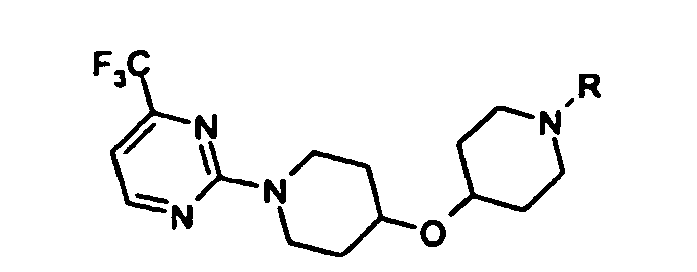
Example R Mass Spectrum (ES+) E99 
[MH]+ 373 E100 
[MH]+ 385 -

- 4-Fluoroacetophenone (0.15ml), 1-[(1S)-1-methylpropyl]-4-(4-piperidinyloxy)piperidine (D43) (0.20g), and potassium carbonate (0.23g) in DMSO (2ml) were heated in a microwave reactor at 160°C for 5min. The reaction was then poured directly onto an SCX column (10g) and washed with MeOH (60ml) then eluted with 2M ammonia in MeOH solution (60ml). After evaporation the residue was purified by chromatography [silica gel (20g cartridge), eluting with 10%NH3 in MeOH/DCM, 0-10%]. Pure fractions were evaporated and the resultant oil was co-evaporated from acetone (3x) and dried under high vacuum to give the title compound (E101) as a yellow crystalline solid (0.16g). MS electrospray (+ve ion) 359 (MH+). 1H NMR δ (CDCl3): 7.86 (2H, d, J=9.2Hz), 6.86 (2H, d, J=8.8), 3.68 (3H, m), 3.40 (1H, m), 3.12 (2H, m), 2.72 (2H, m), 2.51 (3H, s), 2.46 (1H, m), 2.32 (1H, m), 2.21 (1H, m), 1.89 (4H, m), 1.72-1.48 (5H, m), 1.26 (1H, m), 0.96 (3H, d, J=6.8Hz), 0.88 (3H, t, J=7.2Hz). [α]D 29.2°C = +1.428 (c 0.14, methanol).
-

- 4-Fluoroacetophenone (0.15ml), 1-[(1R)-1-methylpropyl]-4-(4-piperidinyloxy)piperidine (D44) (0.20g), and potassium carbonate (0.23g) in DMSO (2ml) were heated in a microwave reactor at 160°C for 5min. The reaction mixture was then poured directly onto an SCX column (10g) and washed with MeOH (60ml) and then eluted with 2M ammonia in MeOH solution (60ml). After evaporation the residue was purified by chromatography [silica gel (20g cartridge), eluting with 10%NH3 in MeOH/DCM, 0-10%]. Pure fractions were evaporated and the resultant oil was co-evaporated from acetone (3 x) and dried under high vacuum to give an oil which was triturated with diethyl ether, and dried under high vacuum at 30°C to give the title compound (E102) as a yellow crystalline solid (0.15g). MS electrospray (+ve ion) 359 (MH+). 1H NMR δ (CDCl3): 7.86 (2H, d, J=9.2Hz), 6.86 (2H, d, J=8.8), 3.68 (3H, m), 3.40 (1H, m), 3.12 (2H, m), 2.72 (2H, m), 2.51 (3H, s), 2.46 (1H, m), 2.32 (1H. m), 2.21 (1H, m), 1.89 (4H, m), 1.72-1.48 (5H, m), 1.26 (1H, m), 0.96 (3H, d, J=6.8Hz), 0.88 (3H, t, J=7.2Hz). [α]D 29.2°C = -1.818 (c 0.165, methanol).
-

- 4-Fluoroacetophenone (0.15g), 1-cyclopropylmethyl-4-(4-piperidinyloxy)piperidine (D46) (0.20g), and potassium carbonate (0.23g) in DMSO (2.0ml) were heated in a microwave reactor at 160°C for 5min. The reaction was then poured directly onto an SCX column (10g) and washed with MeOH (60ml) and then eluted with 2M ammonia in MeOH solution (60ml). After evaporation the residue was purified by chromatography [silica gel (20g cartridge), eluting with 10%NH3 in MeOH/DCM, 0-10%]. Pure fractions were evaporated to give the title compound (E103) as a pale yellow crystalline solid (0.17g). MS electrospray (+ve ion) 357 (MH+). 1H NMR δ (CDCl3): 7.86 (2H, d, J=8.8Hz), 6.86 (2H, d, J=9.2Hz), 3.70 (3H, m), 3.47 (1H, m), 3.12 (2H, m), 2.88 (2H, m), 2.51 (3H, s), 2.22 (4H, m), 1.91 (4H, m), 1.66 (4H, m), 0.87 (1H, m), 0.51 (2H, m), 0.09 (2H, m).
-

- A portion of the acid chloride from Example 40 (0.62g) was suspended in DCM (5ml) and added dropwise over 15min to a solution of cyclobutylamine (1.29ml) in DCM (5ml) at 0-5°C. The resulting mixture was stirred at rt for 2.0h and then loaded directly onto silica (20g cartridge) and chromatographed [silica gel, eluting with 10%NH3 in MeOH/DCM, 0-10%]. Pooling of pure fractions afforded the title compound (E104)as a pale brown solid (0.21g). MS electrospray (+ve ion) 413 (MH+). 1H NMR δ (CDCl3): 8.16 (1H, d, J=2.8Hz), 8.01 (1H, d, J=8.8Hz), 7.91 (1H, d, J=8.0Hz), 7.20(1H, dd, J=2.8Hz, J=8.8Hz), 4.58 (1H. m), 3.63 (3H, m), 3.45 (1H, m), 3.11 (2H, m), 2.66 (3H, m), 2.41 (2H, m), 2.10-1.53 (20H, m).
-

- The title compound (E105) was prepared in a similar manner to Example 38 from 1-isopropyl-4-(4-piperidinyloxy)piperidine (free base from D2) and 5-bromo-N-cyclobutyl-2-pyridinecarboxamide (D54). MS electrospray (+ve ion) 401 (MH+).
-

- The title compound (E106) was obtained in a similar manner to Example 15 from 1-isopropyl-4-(4-piperidinyloxy)piperidine (free base from D2) and 1-(4-fluorobenzoyl)-azetidine (D48) followed by treatment of the free base azetidine product with HCl.
-

- Reaction of 1-cyclobutyl-4-(4-piperidinyloxy)piperidine (D6) and 2-(1-azetidinylcarbonyl)-5-bromopyridine (D49) following the method described in Example 31 followed by treatment of the free base azetidine product with HCl afforded the title compound (E107).
-
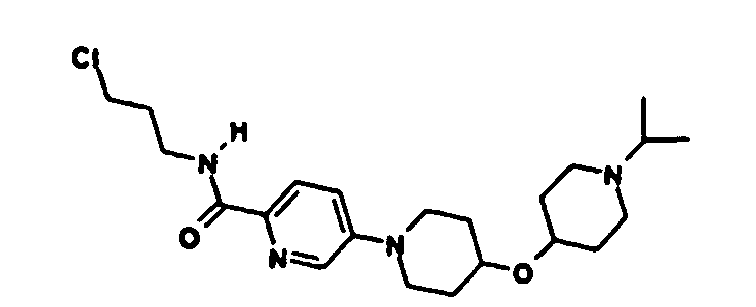
- Reaction of 1-isopropyl-4-(4-piperidinyloxy)piperidine (free base from D2) and 2-(1-azetidinylcarbonyl)-5-bromopyridine (D49) following the method described in Example 31 followed by treatment of the free base azetidine product with HCl afforded the title compound (E108).
-

- 1-Cyclobutyl-4-(4-piperidinyloxy)piperidine (D6) (0.20g), 3,4-difluoroacetophenone (0.197g) and anhydrous potassium carbonate (0.116g) in DMSO (2ml) were heated at 160°C for 15min in an Emrys™ Optimizer microwave reactor. The crude reaction mixture was passed through an SCX cartridge [20g, eluting with MeOH (80ml) then 2N NH3 in MeOH (80ml)]. Purification by chromatography [silica gel, eluting with (2N NH3 in MeOH)/DCM, 0-20%] afforded the title compound (E109) as a crystalline solid (0.125g). MS electrospray (+ion) 375 (MH+). 1H NMR δ (CDCl3): 7.65 (1H, dd, J=8.4, 2.0Hz), 7.60 (1H, dd, J=14.0, 2.0Hz), 6.92 (1H, t, J=8.4Hz), 3.66-3.58 (1H, m), 3.52-3.40 (3H, m), 2.99 (2H, ddd, J=12.0, 8.8, 2.8Hz), 2.70-2.61 (3H, m), 2.52 (3H, s), 2.04-1.84 (9H, m) and 1.78-1.59 (7H, m obscured by H2O).
-

- Sodium tert-butoxide (0.113g) was added to a solution of 1-cyclobutyl-4-(4-piperidinyloxy)piperidine (D6) (0.223g), 5-(4-bromo-2-fluorophenyl)-3-methyl-1,2,4-oxadiazole (D50) (0.20g) and acetato(2'-di-tert-butylphosphino-1,1'-biphenyl-2-yl)palladium(II) (0.017g) in toluene (10ml). The reaction was heated to 85°C overnight, then a further charge of acetato(2'-di-tert-butylphosphino-1,1'-biphenyl-2-yl)palladium(II) (0.017g) was added followed by heating at 85°C for a further 5h. The crude mixture was passed through an SCX cartridge [10g, eluting with MeOH (80ml) then 2N NH3 in MeOH (80ml)]. Purification by chromatography [silica gel, eluting with (2N NH3 in MeOH)/DCM, 0-20%] afforded the title compound (E110) (0.180g). MS electrospray (+ion) 415 (MH+). 1H NMR δ (CDCl3): 7.89 (1H, t, J=8.4Hz), 6.71 (1H, dd, J=8.8, 2.4Hz), 6.62 (1H, dd, J=14.8, 2.4Hz), 3.69-3.64 (3H, m), 3.49 (2H, br s), 3.12 (2H, ddd, J=12.4, 8.8, 3.6Hz), 2.78-2.63 (3H, m), 2.46 (3H, s), 2.10-2.02 (3H, m), 1.93-1.88 (6H, m) and 1.71-1.62 (6H, m, obscured by H2O).
-

- 5-{4-[(1-Cyclobutyl-4-piperidinyl)oxy]-1-piperidinyl}-2-pyridinecarbonitrile (free base from E47) (0.155g) was dissolved in THF (4ml) and cooled to 0°C under argon. MeMgBr (3.1ml of a 3M solution in Et2O, 20 equivalents) was added and the reaction mixture allowed to warm to rt and stirred until all the starting material was consumed (monitored by LC/MS). The reaction was quenched by the addition of saturated ammonium chloride solution (5ml), filtered through celite and evaporated. Purification by chromatography [silica gel, eluting with (2N NH3 in MeOH)/DCM, 0-10%] afforded the title compound (E111) as a crystalline solid (0.089g). MS electrospray (+ion) 357 (MH+). 1H NMR δ (CDCl3): 8.27 (1H, d, J=3.0Hz), 7.94 (1H, d, J=9.0Hz), 7.15 (1H, dd, J=9.0, 3.0Hz), 3.7-3.61 (4H, m), 3.21 (2H, ddd, J=12.4, 8.4, 3.2Hz), 2.93 (1H, br s), 2.8-2.74 (2H, m), 2.64 (3H, s), 2.41 (2H, br s), 2.22 (2H, br s), 2.12-2.08 (4H, m), 1.97-1.90 (2H, m) and 1.85-1.65 (6H, m).
-

- 1-Isopropyl-4-(4-piperidinyloxy)piperidine (free base from D2) (0.25g) and 5-(4-bromo-3-fluorophenyl)-3-methyl-1,2,4-oxadiazole (D51) (0.31g) in dry toluene (10ml) were charged with acetato(2'-di-t-butylphosphino-1,1'-biphenyl-2-yl)palladium (II) (60mg) and sodium tert-butoxide (0.15g). The reaction mixture was heated at 90°C under a blanket of argon overnight. After cooling the reaction was diluted with MeOH (10ml) and then poured directly onto an SCX column (10g) and washed with MeOH (60ml) and then eluted with 2M ammonia in MeOH solution (60ml). After evaporation the residue was purified by chromatography [silica gel (20g cartridge), eluting with 10% NH3 in MeOH/DCM, 0-10%]. Pure fractions were evaporated to give the free base compound which was dissolved in dry DCM (2ml) and treated with 1M HCl in diethyl ether (1ml).
- The solvents were evaporated to dryness and the hydrochloride salt was crystallised from ethanol to give the title compound (E112) as a white crystalline solid (29mg). (MS electrospray (+ve ion) 403 (MH+). 1H NMR δ (methanol-d4): 7.81-7.84 (1H, br d, J=8.4Hz), 7.70-7.74 (1H, br d, J=13.6Hz), 7.14 -7.19 (1H, m), 3.96-3.98 (1H, m), 3.65-3.80 (2H, m), 3.47-3.58 (4H, m), 3.05-3.13, (3H, m), 2.4 (3H, s), 1.9-2.32 (6H, m), 1.71-1.76 (3H, m), 1.34-1.38 (6H, m).
-

- 5-(4-Bromo-2-fluoro-phenyl)-3-methyl-(1,2,4)oxadiazole (D50) (0.31g) dissolved in dry and degassed dioxane (3ml) was charged with tris(dibenzylideneacetone)dipalladium(0) (40mg) and 2-dicyclohexylphosphino-2'-(N,N-dimethylamino)biphenyl (70mg). The dark solution was stirred at rt under argon for 15min, followed by the addition 1-isopropyl-4-piperidinyloxy)piperidine (free base from D2) (0.25g) in dioxane (1ml) and potassium phosphate (0.41g). The reaction mixture was stirred at 95°C for 2h and after cooling the crude reaction mixture was worked up as described for Example 112. The title compound (E113) was isolated as the hydrochloride salt (13mg). MS electrospray (+ve ion) 403 (MH+). 1H NMR δ (methanol-d4): 7.87-7.92 (1H, dd, J=8.8Hz), 6.89-6.92 (1H, m), 6.80-6.85 (1H, m), 3.97-3.98 (1H, m), 3.70-3.80 (4H, m), 3.43-3.54 (2H, m), 3.05-3.20 (3H, m), 2.39 (3H, s), 1.96-2.32 (6H, m), 1.66-1.69 (3H, m), 1.35-1.38 (6H, m).
-

- 1-Cyclobutyl-4-(4-piperidinyloxy)piperidine (D6) (0.20g), 3,4-difluorobenzonitrile (0.175g) and anhydrous potassium carbonate (0.232g) in DMSO (2ml) were heated at 80°C for 5min in an Emrys™ Optimizer microwave reactor. The crude reaction mixture was passed through an SCX cartridge [20g, eluting with MeOH (80ml) then 2N NH3 in MeOH (80ml)]. Evaporation of the ammonia fractions gave the title compound (E114) as a crystalline solid (0.225g). MS electrospray (+ion) 358 (MH+). 1H NMR δ (CDCl3): 7.34 (1H, dd, J=8.4, 2.0Hz), 7.25 (1H, dd, J=14.0, 2.0Hz), 6.91 (1H, t, J=8.4Hz), 3.64-3.56 (1H, m), 3.49-3.43 (4H, m), 3.18-3.12 (1H, m), 3.00 (2H, ddd, J=12.4, 8.8, 3.6Hz), 2.83-2.78 (1H, m), 2.75-2.62 (3H, m), 2.07-1.89 (7H, m obscured by H2O) and 1.77-1.71 (6H, m).
-

- 1-Cyclobutyl-4-(4-piperidinyloxy)piperidine (D6) (0.10g), 2,4-difluorobenzonitrile (0.098g) and anhydrous potassium carbonate (0.116g) in 1-methyl-2-pyrrolidinone (2ml) were heated at 60°C for 1.5min in an Emrys™ Optimizer microwave reactor. The crude reaction mixture was passed through an SCX cartridge [20g, eluting with MeOH (80ml) then 2N NH3 in MeOH (80ml)]. Evaporation of the ammonia fractions gave the title compound (E115) (130mg). MS electrospray (+ion) 358 (MH+). 1H NMR δ (CDCl3): 7.55 (1H, dd, J=7.6, 1.2Hz), 6.60 (1H, dd, J= 8.8, 1.2Hz), 6.52 (1H, dd, J=13.2, 2.4Hz), 3.61-3.58 (2H, m), 3.50-3.40 (2H, m), 3.24-3.09 (2H, m), 2.81-2.58 (5H, m), 2.13-1.78 (7H, m), 1.77-1.49 (7H, m)
-

- 4-{4-[(1-Cyclobutyl-4-piperidinyl)oxy]-1-piperidinyl}-2-fluorobenzonitrile (E115) (0.20g), was dissolved in THF (5ml) and cooled to 0°C under argon. MeMgBr (3.7ml of a 3M solution in Et2O, 20 equivalents) was added and the reaction mixture allowed to warm to rt and stirred until all the starting material was consumed (monitored by LC/MS). Reaction was quenched by the addition of saturated ammonium chloride solution (5ml), filtered through celite and evaporated. Purification by chromatography [silica gel, eluting with (2N NH3 in MeOH)/DCM, 0-10%] afforded the title compound (E116) as a white solid (0.090g). MS electrospray (+ion) 375 (MH+). 1H NMR δ (CDCl3): 7.81 (1H, t, J=8.8Hz), 6.62 (1H, dd, J=10.0, 2.4Hz), 6.46 (1H, dd, J=15.2, 2.4Hz), 3.71-3.58 (4H, m), 2.99 (2H, ddd, J=12.4, 8.8, 3.2Hz), 2.88-2.77 (3H, m), 2.55 (3H, d, J=5.2Hz), 2.38-2.20 (1H, br s), 2.20-2.09 (1H, m) and 1.99-1.60 (14H, m).
-

- 1-Cyclobutyl-4-(4-piperidinyloxy)piperidine (D6) (0.200g), 2,4,5-trifluorobenzonitrile (0.198g) and anhydrous potassium carbonate (0.232g) in DMSO (2ml) were heated at 80°C for 5min in an Emrys™ Optimizer microwave reactor. The crude reaction mixture was passed through an SCX cartridge [20g, eluting with MeOH (80ml) then 2N NH3 in MeOH (80ml)]. Evaporation of the ammonia fractions gave the title compound (E117) as a crystalline solid (0.33g). MS electrospray (+ion) 376 (MH+). 1H NMR δ (CDCl3): 7.18-7.13 (1H, app q, J=6.0Hz), 6.30 (1H, dd, H=11.2, 7.2Hz), 3.64 (1H, app sept, J=4Hz), 3.51-3.45 (3H, m), 3.16 (2H, ddd, J=12.0, 8.4, 3.6Hz), 2.75-2.62 (3H, m), 2.07-1.99 (4H, m), 1.97-1.85 (6H, m) and 1.80-1.60 (6H, m).
-

- 4-{4-[(1-Cyclobutyl-4-piperidinyl)oxy]-1-piperidinyl}-2,5-difluorobenzonitrile (E117) (0.315g) was dissolved in THF (10m) and cooled to 0°C under argon. MeMgBr (5.3m) of a 3M solution in Et2O, 20 equivalents) was added and the reaction mixture allowed to warm to rt and stirred until all the starting material was consumed (monitored by LC/MS). The reaction was quenched by the addition of saturated ammonium chloride solution (10ml), filtered through celite and evaporated. Purification by chromatography [silica gel, eluting with (2N NH3 in MeOH)/DCM, 0-10%] gave the title compound (E118) as a white solid (0.13g). MS electrospray (+ion) 393 (MH+). 1H NMR δ (CDCl3): 7.55 (1H, q, J=7.2, 13.8Hz), 6.56 (1H, q, J=7.2, 13.0Hz), 3.62 (1H, m), 3.05 (2H, m), 3.50 (3H, m), 2.87-2.61 (3H, m), 3.50 (3H, d, J=5.2Hz), 2.22-1.89 (9H, m), 1.79-1.60 (7H, m).
-

- Sodium tert-butoxide (0.113g) was added to a solution of 1-[(1 S}-1-methylpropyl]-4-(4-piperidinyloxy)piperidine (D43) (0.225g), 5-(4-bromo-2-fluorophenyl)-3-methyl-1,2,4-oxadiazole (D50) (0.20g) and acetato(2'-di-tert-butylphosphino-1,1'-biphenyl-2-yl)palladium(11) (0.017g) in toluene (10ml). The reaction was heated to 85°C overnight, then a further charge of acetato(2'-di-tert-butylphosphino-1,1'-biphenyl-2-yl)palladium(II) (0.017g) was added followed by heating at 85°C for a further 5h. The crude mixture was passed through an SCX cartridge [10g, eluting with MeOH (80ml) then 2N NH3 in MeOH (80ml)]. Purification by chromatography [silica gel, eluting with (2N NH3 in MeOH)/DCM, 0-20%] afforded the title compound (E119) (0.084g). MS electrospray (+ion) 417 (MH+). 1H NMR δ (CDCl3): 7.89 (1H, t, J=8.8Hz), 6.71 (1H, dd, J=9.2, 2.4Hz), 6.62 (1H, dd, J=14.4, 2.4Hz), 3.69-3.64 (3H, m), 3.48-3.39 (1H, m), 3.18 (2H, ddd, J=12.8, 8.8, 3.6Hz), 2.80-2.69 (2H, m), 2.46 (3H, s), 2.40-2.32 (1H, m), 2.29-2.0 (1H, m), 1.96-1.86 (4H, m), 1.73-1.56 (6H, m, obscured by H2O), 1.27 (1H, app sept, J=7.6Hz), 0.97 (3H, d, J=6.4Hz) and 0.89 (3H, t, J=7.6Hz).
-

- DMF (3 drops) was added to a suspension of 5-(4-{[1-(1-methylethyl)-4-piperidinyl]oxy}-1-piperidinyl)-2-pyridinecarboxylic acid (D53) (0.33g) and oxalyl chloride (1ml) in DCM (5ml) at rt. The reaction mixture was stirred for 1h, after which time the mixture was evaporated to give the crude acid chloride as a dark green solid. This was dissolved in DCM (15ml) and added dropwise to a cooled (5°C) solution of methylamine (5ml of a 2M solution in THF) over a period of 1h. After the addition was completed the reaction was allowed to stir for a further 15min and then evaporated to dryness. The crude amide was dissolved in saturated sodium hydrogen carbonate solution (5ml) and extracted into DCM (3×10ml). The organic phase was washed with saturated brine (10ml), dried (MgSO4) and evaporated. Purification by chromatography [silica gel, eluting with (2N NH3 in MeOH)/DCM, 0-20%] followed by evaporation afforded a mixture of free base and HCl salt. The mixture was dissolved in DCM (5ml) and washed with saturated potassium carbonate solution (15ml), dried (MgSO4) and evaporated to give the title compound (E120) as a pale yellow crystalline solid (0.15g). MS electrospray (+ion) 361 (MH+). 1H NMR δ (CDCl3): 8.08 (1H, d, J=2.8Hz), 7.94 (1H, d, J=8.8Hz), 7.68 (1H, d, J=4.8Hz), 7.13 (1H, dd, J=8.8, 2.8Hz), 3.60-3.53 (3H, m), 3.37 (1H, ddd, J=12.4, 8.4, 3.8Hz), 3.05 (2H, ddd, J=12.4, 8.8, 3.2Hz), 2.93 (3H, d, J=4.8Hz), 2.74-2.69 (2H, m), 2.66 (1H, sep, J=6.4Hz), 2.22-2.16 (2H, m), 1.90-1.78 (4H, m), 1.67-1.49 (4H, m) and 0.97 (6H, d, J=6.4Hz).
-
- BINAP
- 2,2'-bis(diphenylphosphino)-1,1'-binaphthyl
- DCM
- dichloromethane
- DMF
- N,N-dimethylformamide
- DIPEA
- diisopropylethylamine
- DMSO
- dimethylsulfoxide
- EDC
- 1-(3-dimethylaminopropyl)-3-ethylcarbodiimide hydrochloride
- EtOAc
- ethyl acetate
- HOAT
- 1-hydroxy-7-azabenzotriazole
- HOBT
- 1-hydroxybenzotriazole
- h
- hour
- min
- minutes
- rt
- room temperature
- TFA
- trifluoroacetic acid
- THF
- tetrahydrofuran
- SCX
- strong cation exchange
- MP-NCO
- macroporous polystyrene isocyanate resin
- A membrane preparation containing histamine H3 receptors may be prepared in accordance with the following procedures:
- DNA encoding the human histamine H3 gene (Huvar, A. et al. (1999) Mol. Pharmacol. 55(6), 1101-1107) was cloned into a holding vector, pCDNA3.1 TOPO (InVitrogen) and its cDNA was isolated from this vector by restriction digestion of plasmid DNA with the enzymes BamH1 and Not-1 and ligated into the inducible expression vector pGene (InVitrogen) digested with the same enzymes. The GeneSwitch™ system (a system where in transgene expression is switched off in the absence of an inducer and switched on in the presence of an inducer) was performed as described in
US Patent nos: 5.364,791 ;5,874,534 ; and5,935,934 . Ligated DNA was transformed into competent DH5α E. coli host bacterial cells and plated onto Luria Broth (LB) agar containing Zeocin™ (an antibiotic which allows the selection of cells expressing the sh ble gene which is present on pGene and pSwitch) at 50µg ml-1. Colonies containing the re-ligated plasmid were identified by restriction analysis. DNA for transfection into mammalian cells was prepared from 250ml cultures of the host bacterium containing the pGeneH3 plasmid and isolated using a DNA preparation kit (Qiagen Midi-Prep) as per manufacturers guidelines (Qiagen).
CHO K1 cells previously transfected with the pSwitch regulatory plasmid (InVitrogen) were seeded at 2x10e6 cells per T75 flask in Complete Medium, containing Hams F12 (GIBCOBRL, Life Technologies) medium supplemented with 10% v/v dialysed foetal bovine serum, L-gtutamine, and hygromycin (100µg ml-1), 24 hours prior to use. Plasmid DNA was transfected into the cells using Lipofectamine plus according to the manufacturers guidelines (In Vitrogen). 48 hours post transfection cells were placed into complete medium supplemented with 500µg ml-1 Zeocin™.
10-14 days post selection 10nM Mifepristone (In Vitrogen), was added to the culture medium to induce the expression of the receptor. 18 hours post induction cells were detached from the flask using ethylenediamine tetra-acetic acid (EDTA; 1:5000; InVitrogen), following several washes with phosphate buffered saline pH 7.4 and resuspended in Sorting Medium containing Minimum Essential Medium (MEM), without phenol red, and supplemented with Earles salts and 3% Foetal Clone II (Hyclone). Approximately 1x 10e7 cells were examined for receptor expression by staining with a rabbit polyclonal antibody, 4a, raised against the N-terminal domain of the histamine H3 receptor, incubated on ice for 60 minutes, followed by two washes in sorting medium. Receptor bound antibody was detected by incubation of the cells for 60 minutes on ice with a goat anti rabbit antibody, conjugated with Alexa 488 fluorescence marker (Molecular Probes). Following two further washes with Sorting Medium, cells were filtered through a 50µm Filcon™ (BD Biosciences) and then analysed on a FACS Vantage SE Flow Cytometer fitted with an Automatic Cell Deposition Unit. Control cells were non-induced cells treated in a similar manner. Positively stained cells were sorted as single cells into 96-well plates, containing Complete Medium containing 500µg ml-1 Zeocin™ and allowed to expand before reanalysis for receptor expression via antibody and ligand binding studies. One clone, 3H3, was selected for membrane preparation. - All steps of the protocol are carried out at 4°C and with pre-cooled reagents. The cell pellet is resuspended in 10 volumes of buffer A2 containing 50mM N-2-hydroxyethylpiperazine-N'-2-ethanesulfonic acid (HEPES) (pH 7.40) supplemented with 10e-4M leupeptin (acetyl-leucyl-leucyl-arginal; Sigma L2884), 25µg/ml bacitracin (Sigma B0125). 1mM ethylenediamine tetra-acetic acid (EDTA), 1mM phenylmethylsulfonyl fluoride (PMSF) and 2x10e-6M pepstain A (Sigma). The cells are then homogenised by 2 x 15 second bursts in a 1 litre glass Waring blender, followed by centrifugation at 500g for 20 minutes. The supernatant is then spun at 48,000g for 30 minutes. The pellet is resuspended in 4 volumes of buffer A2 by vortexing for 5 seconds, followed by homogenisation in a Dounce homogeniser (10-15 strokes). At this point the preparation is aliquoted into polypropylene tubes and stored at -70°C.
- Compounds of the invention may be tested for in vitro biological activity in accordance with the following assays:
- For each compound being assayed, in a white walled clear bottom 96 well plate, is added:-
- (a) 10µl of test compound (or 10µl of iodophenpropit (a known histamine H3 antagonist) at a final concentration of 10mM) diluted to the required concentration in 10% DMSO;
- (b) 10µl 125I 4-[3-(4-iodophenylmethoxy)propyl]-1H-imidazolium (iodoproxyfan) (Amersham; 1.85MBq/µl or 50µCi/ml; Specific Activity ~2000Ci/mmol) diluted to 200pM in assay buffer (50mM Tris(hydroxymethyl)aminomethane buffer (TRIS) pH 7.4, 0.5mM ethylenediamine tetra-acetic acid (EDTA)) to give 20pM final concentration; and
- (c) 80µl bead/membrane mix prepared by suspending Scintillation Proximity Assay (SPA) bead type WGA-PVT at 100mg/ml in assay buffer followed by mixing with membrane (prepared in accordance with the methodology described above) and diluting in assay buffer to give a final volume of 80µl which contains 7.5µg protein and 0.25mg bead per well- mixture was pre-mixed at room temperature for 60 minutes on a roller. The plate is shaken for 5 minutes and then allowed to stand at room temperature for 3-4 hours prior to reading in a Wallac Microbeta counter on a 1 minute normalised tritium count protocol. Data is analysed using a 4-parameter logistic equation.
- For each compound being assayed, in a white walled clear bottom 96 well plate, is added:-
- (a) 10µl of test compound (or 10µl of guanosine 5'- triphosphate (GTP) (Sigma) as non-specific binding control) diluted to required concentration in assay buffer (20mM N-2-Hydroxyethylpiperazine-N'-2-ethanesulfonic acid (HEPES) + 100mM NaCl + 10mM MgCl2, pH7.4 NaOH);
- (b) 60µl bead/membrane/GDP mix prepared by suspending wheat germ agglutinin-polyvinyltoluene (WGA-PVT) scintillation proximity assay (SPA) beads at 100mg/ml in assay buffer followed by mixing with membrane (prepared in accordance with the methodology described above) and diluting in assay buffer to give a final volume of 60µl which contains 10µg protein and 0.5mg bead per well - mixture is pre-mixed at 4°C for 30 minutes on a roller and just prior to addition to the plate, 10µM final concentration of guanosine 5' diphosphate (GDP) (Sigma; diluted in assay buffer) is added;
The plate is incubated at room temperature to equilibrate antagonist with receptor/beads by shaking for 30 minutes followed by addition of: - (c) 10µl histamine (Tocris) at a final concentration of 0.3µM; and
- (d) 20µl guanosine 5' [γ35-S] thiotriphosphate, triethylamine salt (Amersham; radioactivity concentration = 37kBq/µl or 1mCi/ml; Specific Activity 1160Ci/mmol) diluted to 1.9nM in assay buffer to give 0.38nM final.
The plate is then incubated on a shaker at room temperature for 30 minutes followed by centrifugation for 5 minutes at 1500 rpm. The plate is read between 3 and 6 hours after completion of centrifuge run in a Wallac Microbeta counter on a 1 minute normalised tritium count protocol. Data is analysed using a 4-parameter logistic equation. Basal activity used as minimum i.e. histamine not added to well. - The compounds of Examples E1-E113 were tested in the histamine H3 functional antagonist assay and exhibited pKi values > 7.5. In particular, the compounds of Examples E1-E58, E60-E65, E67, E69-E98 and E101-E113 exhibited pKi values > 8.0. More particularly, the compounds of E2-E13, E15-E17, E21-E49, E54-E57, E62, E70-E82, E84-E86, E88-E98, E101-E102, E104-E113 exhibited pKi values ≥ 9.0. Most particularly, the compounds of E17, E38, E48, E82 and E88 exhibited pKi values > 9.5.
Claims (16)
- A compound of formula (I) or a pharmaceutically acceptable salt thereof:
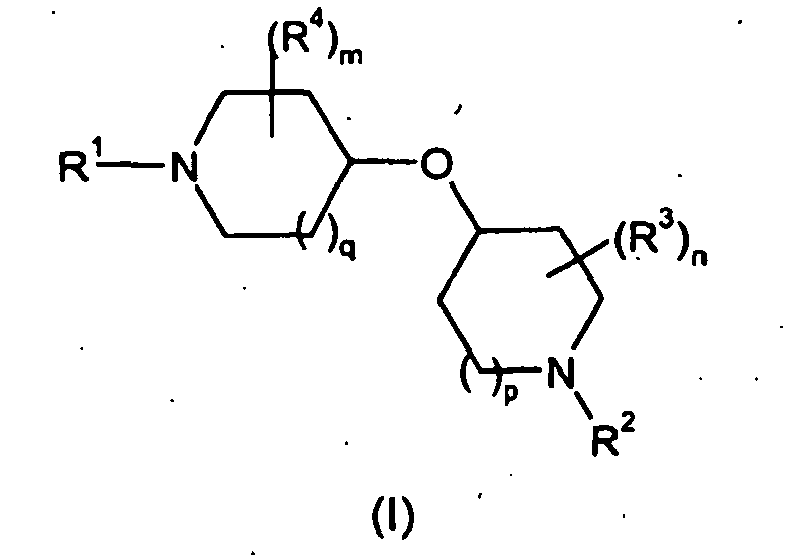 R1 represents aryl, heteroaryl,-aryl-X-aryl -aryl-X-heteroaryl, -aryl-X-heterocyclyl, -heteroaryl-X-heteroaryl, -heteroaryl-X-aryl or -heteroaryl-X-heterocyclyl;wherein said aryl, heteroaryl and heterocyclyl groups of R1 may be optionally substituted by one or more (e.g. 1, 2 or 3) substituents which may be the same or different, and which are selected from the group consisting of halogen, hydroxy, cyano, nitro, oxo, haloC1-6 alkyl, polyhaloC1-6 alkyl, haloC1-6 alkoxy, polyhaloC1-6 alkoxy, C1-6 alkyl, C1-6 alkoxy, C1-6 alkylthio, C1-6 alkoxyC1-6 alkyl, C3-7 cycloalkylC1-6 alkoxy, C1-6 alkanoyl, C1-6 alkoxycarbonyl, C1-6 alkylsulfonyl, C1-6 alkylsulfinyl, C1-6 alkylsulfonyloxy, C1-6 alkylsulfonylC1-6 alkyl, C1-6 alkylsulfonamidoC1-6 alkyl, C1-6 alkylamidoC1-6 alkyl, aryl, arylsulfonyl, arylsulfonyloxy, aryloxy, arylsulfonamido, arylcarboxamido, aroyl, or a group -COR15, -COOR15, NR15R16, -CONR15R16, -NR15COR16, -NR15SO2R16 or -SO2NR15R16, wherein R15 and R16 independently represent hydrogen, C1-6 alkyl, haloC1-6 alkyl, polyhaloC1-6 alkyl or C3-6 cycloalkyl or together form a heterocyclic ring;X represents a bond, O, CO, SO2, OCH2 or CH2O;R2 represents C3-8 alkyl, C3-6 alkenyl, C3-6 alkynyl, C3-6 cycloalkyl, C5-6 cycloalkenyl or -C1-4alkyl-C3-6 cycloalkyl;wherein said C3-6 cycloalkyl groups of R2 may be optionally substituted by one or more (e.g. 1, 2 or 3) substituents which may be the same or different, and which are selected from the group consisting of halogen, C1-4 alkyl or trifluoromethyl groups;each R3 and R4 group independently represents C1-4 alkyl;m and n independently represent 0, 1 or 2; andp and q independently represent 1 or 2.
- A compound of formula (I) as defined in claim 1 wherein R1 represents- aryl optionally substituted by a cyano, -CONR15R16, -COR15, halogen or -NR15COR16;- heteroaryl optionally substituted by a cyano, C1-6 alkyl, polyhaloC1-6 alkyl, -CONR15R16, -COR15 or -COOR15 group;- aryl-X-heterocyclyl;- aryl-X-heteroaryl optionally substituted by a halogen, C1-6 alkyl or aryl; or- heteroaryl-X-heterocyclyl.
- A compound of formula (I) as defined in claim 2 wherein R1 represents pyrid-3-yl optionally substituted by a -CONR15R16 group, -phenyl-1,2,4-oxadiazol-5-yl optionally substituted by a C1-6 alkyl group, phenyl optionally substituted by a -COR15 group, pyridazin-3-yl optionally substituted by a polyhaloC1-6 alkyl group, pyrazin-2-yl optionally substituted by a polyhaloC1-6 alkyl group or pyrimidin-5-yl optionally substituted by a polyhaloC1-6 alkyl group.
- A compound of formula (I) as defined in claim 3 wherein R1 represents pyrid-3-yl optionally substituted by a 6-CON(H)(Me) or 6-CON(H)(Et) group, 3-methyl-1,2,4-oxadiazol-5-yl, phenyl optionally substituted by a 4-COMe group, pyridazin-3-yl optionally substituted by a 6-CF3 group or pyrimidin-5-yl optionally substituted by a 2-CF3 group.
- A compound of formula (I) as defined in any one of claims 1 to 4 wherein m and n represent 0.
- A compound of formula (I) as defined in any one of claims 1 to 5 wherein p and q represent 1.
- A compound of formula (I) as defined in any one of claims 1 to 6 wherein R2 represents C3-8 alkyl, C3-6 cycloalkyl or -C1-4alkyl-C3-6 cycloalkyl.
- A compound of formula (I) as defined in claim 7 wherein R2 represents 1-methylpropyl, isopropyl, cyclobutyl or -CH2-cyclopropyl.
- A compound of formula (I) as defined in claim 8 wherein R2 represents isopropyl or cyclobutyl.
- A compound as defined in claim 1 which is:6-(4-{[1-(1-methylethyl)-4-piperidinyl]oxy}-1-piperidinyl)-3-pyridinecarbonitrile;6-{4-[(1-Cyclobutyl-4-piperidinyl)oxy]-1-piperidinyl}-3-pyridinecarbonitrile;4-{4-[(1-Cyclobutyl-4-piperidinyl)oxy]-1-piperidinyl}benzonitrile;4-(4-{[1-(1-Methylethyl)-4-piperidinyl]oxy}-1-piperidinyl)benzonitrile;4-[(4-{4-[(1-Cyclobutyl-4-piperidinyl)oxy]-1-piperidinyl}phenyl)carbonyl]morpholine;4-{4-[(1-Cyclobutyl-4-piperidinyl)oxy]-1-piperidinyl}-N-methylbenzamide;4-{[4-(4-{[1-(1-Methylethyl)-4-piperidinyl]oxy}-1-piperidinyl)phenyl]carbonyl}morpholine;1-(1-Methylethyl)-4-({1-[4-(1-piperidinylcarbonyl)phenyl]-4-piperidinyl}oxy)piperidine;1-Cyclobutyl-4-({1-[4-(1-piperidinylcarbonyl)phenyl]-4-piperidinyl}oxy)piperidine;1-(1-Methylethyl)-4-({1-[4-(1-pyrrolidinylcarbonyl)phenyl]-4-piperidinyl}oxy)piperidine;1-Cyclobutyl-4-({1-[4-(1-pyrrolidinylcarbonyl)phenyl]-4-piperidinyl}oxy)piperidine;N,N-Dimethyl-4-(4-{[1-(1-methylethyl)-4-piperidinyl]oxy}-1-piperidinyl)benzamide;4-{4-[(1-Cyclobutyl-4-piperidinyl)oxy]-1-piperidinyl}-N,N-dimethylbenzamide;N-Methyl-4-(4-{[1-(1-methylethyl)-4-piperidinyl]oxy}-1-piperidinyl)benzamide;N-(3-Chloropropyl)-4-{4-[(1-cyclobutyl-4-piperidinyl)oxy]-1-piperidinyl}benzamide;1-Cyclobutyl-4-({1-[4-(2-methyl-1,3-oxazol-4-yl)phenyl]-4-piperidinyl}oxy)piperidine;1-(1-Methylethyl)-4-({1-[4-(3-methyl-1,2,4-oxadiazol-5-yl)phenyl]-4-piperidinyl}oxy)piperidine;1-(1-Methylethyl)-4-({1-[4-(2-methyl-1,3-oxazol-4-yl)phenyl]-4-piperidinyl}oxy)piperidine;1-(1-Methylethyl)-4-({1-[4-(1,3-oxazol-2-yl)phenyl]-4-piperidinyl}oxy)piperidine;1-(1-Methylethyl)-4-({1-[4-(2-methyl-1,3-oxazol-5-yl)phenyl]-4-piperidinyl}oxy)piperidine;1-Cyclobutyl-4-({1-[4-(1,3-oxazol-2-yl)phenyl]-4-piperidinyl}oxy)piperidine;1-Cyclobutyl-4-({1-[4-(2-methyl-1,3-oxazol-5-yl)phenyl]-4-piperidinyl}oxy)piperidine;1-(1-Methylethyl)-4-({1-[4-(3-methyl-5-isoxazolyl)phenyl]-4-piperidinyl}oxy)piperidine;1-Cyclobutyl-4-({1-[4-(3-methyl-5-isoxazolyl)phenyl]-4-piperidinyl}oxy)piperidine;1-Cyclobutyl-4-({1-[4-(5-methyl-1,2,4-oxadiazol-3-yl)phenyl]-4-piperidinyl}oxy)piperidine;1-(1-Methylethyl)-4-({1-[4-(5-phenyl-1,3,4-oxadiazol-2-yl)phenyl]-4-piperidinyl}oxy)piperidine;1-Cyclobutyl-4-({1-[4-(5-phenyl-1,3,4-oxadiazol-2-yl)phenyl]-4-piperidinyl}oxy)piperidine;1-Cyclobutyl-4-({1-[4-(3-methyl-1,2,4-oxadiazol-5-yl)phenyl]-4-piperidinyl}oxy)piperidine;1-Cyclobutyl-4-({1-[4-(1,3-oxazol-5-yl)phenyl]-4-piperidinyl}oxy)piperidine;1-(1-Methylethyl)-4-({1-[4-(1,3-oxazol-5-yl)phenyl]-4-piperidinyl}oxy)piperidine;5-{4-[(1-Cyclobutyl-4-piperidinyl)oxy]-1-piperidinyl}-N,N-dimethyl-2-pyridinecarboxamide;N,N-Dimethyl-5-(4-{[1-(1-methylethyl)-4-piperidinyl]oxy}-1-piperidinyl)-2-pyridinecarboxamide;5-(4-{[1-(1-Methylethyl)-4-piperidinyl]oxy}-1-piperidinyl)-2-(1-pyrrolidinylcarbonyl)pyridine;5-(4-{[1-(1-Methylethyl)-4-piperidinyl]oxy}-1-piperidinyl)-2-(1-piperidinylcarbonyl)pyridine;5-{4-[(1-Cyclobutyl-4-piperidinyl)oxy]-1-piperidinyl}-2-(1-piperidinylcarbonyl)pyridine;4-{[5-(4-{[1-(1-Methylethyl)-4-piperidinyl]oxy}-1-piperidinyl)-2-pyridinyl]carbonyl}morpholine;4-[(5-{4-[(1-Cyclobutyl-4-piperidinyl)oxy]-1-piperidinyl}-2-pyridinyl)carbonyl]morpholine;5-{4-[(1-Cyclobutyl-4-piperidinyl)oxy]-1-piperidinyl}-N-methyl-2-pyridinecarboxamide;N-Ethyl-5-(4-{[1-(1-methylethyl)-4-piperidinyl]oxy}-1-piperidinyl)-2-pyridinecarboxamide;5-{4-[(1-Cyclobutyl-4-piperidinyl)oxy]-1-piperidinyl}-N-ethyl-2-pyridinecarboxamide;5-(4-{[1-(1-Methylethyl)-4-piperidinyl]oxy}-1-piperidinyl)-N-propyl-2-pyridinecarboxamide;5-{4-[(1-Cyclobutyl-4-piperidinyl)oxy]-1-piperidinyl}-N-propyl-2-pyridinecarboxamide;N-(1-Methylethyl)-5-(4-{[1-(1-methylethyl)-4-piperidinyl]oxy}-1-piperidinyl)-2-pyridinecarboxamide;5-{4-[(1-Cyclobutyl-4-piperidinyl)oxy]-1-piperidinyl}-N-(1-methylethyl)-2-pyridinecarboxamide;N-Cyclopentyl-5-(4-{[1-(1-methylethyl)-4-piperidinyl]oxy}-1-piperidinyl)-2-pyridinecarboxamide;5-{4-[(1-Cyclobutyl-4-piperidinyl)oxy]-1-piperidinyl}-N-cyclopentyl-2-pyridinecarboxamide;5-{4-[(1-Cyclobutyl-4-piperidinyl)oxy]-1-piperidinyl}-2-pyridinecarbonitrile;1-(4-{4-[(1-Cyclobutyl-4-piperidinyl)oxy]-1-piperidinyl}phenyl)ethanone;5-{4-[(1-Cyclobutyl-4-piperidinyl)oxy]-1-piperidinyl}-2-(trifluoromethyl)pyridine;N-Methyl-6-(4-{[1-(1-methylethyl)-4-piperidinyl]oxy}-1-piperidinyl)-3-pyridinecarboxamide;N, N-Dimethyl-6-(4-{[1-(1-methylethy)-4-piperidinyl]oxy}-1-piperidinyl)-3-pyridinecarboxamide;2-(4-{[1-(1-Methylethyl)-4-piperidinyl]oxy}-1-piperidinyl)-5-(1-pyrrolidinylcarbonyl)pyridine;4-{[6-(4-{[1-(1-Methylethyl)-4-piperidinyl]oxy}-1-piperidinyl)-3-pyridinyl]carbonyl}morpholine;6-{4-[(1-Cyclobutyl-4-piperidinyl)oxy]-1-piperidinyl}-N-methyl-3-pyridinecarboxamide;6-{4-[(1-Cyclobutyl-4-piperidinyl)oxy]-1-piperidinyl}-N,N-dimethyl-3-pyridinecarboxamide;2-{4-[(1-Cyclobutyl-4-piperidinyl)oxy]-1-piperidinyl}-5-(1-pyrrolidinylcarbonyl)pyridine;4-[(6-{4-[(1-Cyclobutyl-4-piperidinyl)oxy]-1-piperidinyl}-3-pyridinyl)carbonyl]morpholine;N-Methyl-6-(4-{[1-(1-methylethyl)-4-piperidinyl]oxy}-1-piperidinyl)-2-pyridinecarboxamide;N,N-Dimethyl-6-(4-{[1-(1-methylethyl)-4-piperidinyl]oxy}-1-piperidinyl)-2-pyridinecarboxamide;2-(4-{[1-(1-Methylethyl)-4-piperidinyl]oxy}-1-piperidinyl)-6-(1-pyrrolidinylcarbonyl)pyridine;4-{[6-(4-{[1-(1-Methylethyl)-4-piperidinyl]oxy}-1-piperidinyl)-2-pyridinyl]carbonyl}morpholine;6-{4-[(1-Cyclobutyl-4-piperidinyl)oxy]-1-piperidinyl}-N-methyl-2-pyridinecarboxamide;6-{4-[(1-Cyclobutyl-4-piperidinyl)oxy]-1-piperidinyl}-N,N-dimethyl-2-pyridinecarboxamide;2-{4-[(1-Cyclobutyl-4-piperidinyl)oxy]-1-piperidinyl}-6-(1-pyrrolidinylcarbonyl)pyridine;4-[(6-{4-[(1-Cyclobutyl-4-piperidinyl)oxy]-1-piperidinyl}-2-pyridinyl)carbonyl]morpholine;N-(1-Methylethyl)-4-(4-{[1-(1-methylethyl)-4-piperidinyl]oxy}-1-piperidinyl)-2-pyridinecarboxamide;4-{4-[(1-Cyclobutyl-4-piperidinyl)oxy]-1-piperidinyl}-N-(1-methylethyl)-2-pyridinecarboxamide;4-(4-{[1-(1-Methylethyl)-4-piperidinyl]oxy}-1-piperidinyl)-2-(1-piperidinylcarbonyl)pyridine;4-{4-[(1-Cyclobutyl-4-piperidinyl)oxy]-1-piperidinyl}-2-(1-piperidinylcarbonyl)pyridine;5-{4-[(1-Cyclobutyl-4-piperidinyl)oxy]-1-piperidinyl}-N-methyl-2-pyrazinecarboxamide;5-{4-[(1-Cyclobutyl-4-piperidinyl)oxy]-1-piperidinyl}-N-ethyl-2-pyrazinecarboxamide;5-{4-[(1-Cyclobutyl-4-piperidinyl)oxy]-1-piperidinyl}-N-propyl-2-pyrazinecarboxamide;5-{4-[(1-Cyclobutyl-4-piperidinyl)oxy]-1-piperidinyl}-N-(1-methylethyl)-2-pyrazinecarboxamide;N-Cyclobutyl-5-{4-[(1-cyclobutyl-4-piperidinyl)oxy]-1-piperidinyl}-2-pyrazinecarboxamide;N-Methyl-5-(4-{[1-(1-methylethyl)-4-piperidinyl]oxy}-1-piperidinyl)-2-pyrazinecarboxamide;N-Ethyl-5-(4-{[1-(1-methylethyl)-4-piperidinyl]oxy}-1-piperidinyl)-2-pyrazinecarboxamide;5-(4-{[1-(1-Methylethyl)-4-piperidinyl]oxy}-1-piperidinyl)-N-propyl-2-pyrazinecarboxamide;N-(1-Methylethyl)-5-(4-{[1-(1-methylethyl)-4-piperidinyl]oxy}-1-piperidinyl)-2-pyrazinecarboxamide;N-Cyclobutyl-5-(4-{[1-(1-methylethyl)-4-piperidinyl]oxy}-1-piperidinyl)-2-pyrazinecarboxamide;5-(4-{[1-(1-Methylethyl)-4-piperidinyl]oxy}-1-piperidinyl)-2-pyridinecarbonitrile;5-(4-{[1-(1-Methylethyl)-4-piperidinyl]oxy}-1-piperidinyl)-2-(trifluoromethyl)pyridine;3-{4-[(1-Cyclobutyl-4-piperidinyl)oxy]-1-piperidinyl}-6-(trifluoromethyl)pyridazine;3-(4-{[1-(1-Methylethyl)-4-piperidinyl]oxy}-1-piperidinyl)-6-(trifluoromethyl)pyridazine;2-{4-[(1-Cyclobutyl-4-piperidinyl)oxy]-1-piperidinyl}-5-(trifluoromethyl)pyrazine;2-(4-{[1-(1-Methylethyl)-4-piperidinyl]oxy}-1-piperidinyl)-5-(trifluoromethyl)pyrazine;2-{4-[(1-Cyclobutyl-4-piperidinyl)oxy]-1-piperidinyl}-5-(trifluoromethyl)pyridine;2-(4-{[1-(1-Methylethyl)-4-piperidinyl]oxy}-1-piperidinyl)-5-(trifluoromethyl)pyridine;5-{4-[(1-Cyclobutyl-4-piperidinyl)oxy]-1-piperidinyl}-2-(trifluoromethyl)pyrimidine;5-(4-{[1-(1-Methylethyl)-4-piperidinyl]oxy}-1-piperidinyl)-2-(trifluoromethyl)pyrimidine;1-(4-{4-[(1-Cycloputyl-4-piperidinyl)oxy]-1-piperidinyl}phenyl)-1-propanone;(4-{4-[(1-Cyclobutyl-4-piperidinyl)oxy]-1-piperidinyl}phenyl)(cyclopropyl)methanone;Cyclobutyl-(4-{4-[(1-cyclobutyl-4-piperidinyl)oxy]-1-piperidinyl}phenyl)methanone;1-(6-{4-[(1-Cyclobutyl-4-piperidinyl)oxy]-1-piperidinyl}-3-pyridinyl)ethanone;6-{4-[(1-Cyclobutyl-4-piperidinyl)oxy]-1-piperidinyl}-2-methylquinoline;1,1-Dimethylethyl-5-(4-{[1-(1-methylethyl)-4-piperidinyl]oxy}-1-piperidinyl)-2-pyridinecarboxylate;1,1-Dimethylethyl-5-{4-[(1-cyclobutyl-4-piperidinyl)oxy]-1-piperidinyl}-2-pyridinecarboxylate;1-[4-(4-{[1-(1-Methylethyl)-4-piperidinyl]oxy}-1-piperidinyl)phenyl]ethanorie;N-(4-{4-[(1-Cyclobutyl-4-piperidinyl)oxy]-1-piperidinyl}-2-fluorophenyl)acetamide;2-(4-{[1-(1-Methylethyl)-4-piperidinyl]oxy}-1-piperidinyl)-4-(trifluoromethyl)pyrimidine;2-{4-[(1-Cyclobutyl-4-piperidinyl)oxy]-1-piperidinyl}-4-(trifluoromethyl)pyrimidine;1-{4-[4-({1-[(1S)-1-Methylpropyl]-4-piperidinyl}oxy)-1-piperidinyl]phenyl}ethanone;1-{4-[4-({1-[(1R)-1-Methylpropyl]-4-piperidinyl}oxy)-1-piperidinyl]phenyl}ethanone;1-[4-(4-{[1-(Cyclopropylmethyl)-4-piperidinyl]oxy}-1-piperidinyl)phenyl]ethanone;N-Cyctobutyl-5-{4-[(1-cyclobutyl-4-piperidinyl)oxy]-1-piperidinyl}-2-pyridinecarboxamide;N-Cyclobutyl-5-(4-{[1-(1-methylethyl)-4-piperidinyl]oxy}-1-piperidinyl)-2-pyridinecarboxamide;N-(3-Chloropropyl)-4-(4-{[1-(1-methylethyl)-4-piperidinyl]oxy}-1-piperidinyl)benzamide;N-(3-Chloropropyl)-5-{4-[(1-cyclobutyl-4-piperidinyl)oxy]-1-piperidinyl}-2-pyridinecarboxamide;N-(3-Chloropropyl)-5-(4-{[1-(1-methylethyl)-4-piperidinyl]oxy}-1-piperidinyl)-2-pyridinecarboxamide;1-(4-{4-[(1-Cyclobutyl-4-piperidinyl)oxy]-1-piperidinyl}-3-fluorophenyl)ethanone;1-Cyclobutyl-4-({1-[3-fluoro-4-(3-methyl-1,2,4-oxadiazol-5-yl)phenyl]-4-piperidinyl}oxy)piperidine;1-(5-{4-[(1-Cyclobutyl-4-piperidinyl)oxy]-1-piperidinyl}-2-pyridinyl)ethanone;1-[2-Fluoro-4-(3-methyl-1,2,4-oxadiazol-5-yl)phenyl]-4-{[1-(1-methylethyl)-4-piperidinyl]oxy}piperidine;1-[3-Fluoro-4-(3-methyl-1,2,4-oxadiazol-5-yl)phenyl]-4-{[1-(1-methylethyl)-4-piperidinyl]oxy}piperidine;4-{4-[(1-Cyclobutyl-4-piperidinyl)oxy]-1-piperidinyl}-3-fluorobenzonitrile;4-{4-[(1-Cyclobutyl-4-piperidinyl)oxy]-1-piperidinyl}-2-fluorobenzonitrile;1-(4-{4-[(1-Cyclobutyl-4-piperidinyl)oxy]-1-piperidinyl}-2-fluorophenyl)ethanone;4-{4-[(1-Cyclobutyl-4-piperidinyl)oxy]-1-piperidinyl}-2,5-difluorobenzonitrile;1-(4-{4-[(1-Cyclobutyl-4-piperidinyl)oxy]-1-piperidinyl}-2,5-difluorophenyl)ethanone;1-[3-Fluoro-4-(3-methyl-1,2,4-oxadiazol-5-yl)phenyl]-4-({1-[(1S)-1-methylpropyl]-4-piperidinyl}oxy)piperidine; orN-Methyl-5-(4-{[1-(1-methylethyl)-4-piperidinyl]oxy}-1-piperidinyl)-2-pyridinecarboxamide;or a pharmaceutically acceptable salt thereof.
- A compound as defined in claim 1 which is
1-(1-Methylethyl)-4-({1-[4-(3-methyl-1,2,4-oxadiazol-5-yl)phenyl]-4-piperidinyl}oxy)piperidine;
5-{4-[(1-Cyclobutyl-4-piperidinyl)oxy]-1-piperidinyl}-N-methyl-2-pyridinecarboxamide;
1-(4-{4-[(1-Cyclobutyl-4-piperidinyl)oxy]-1-piperidinyl}phenyl)ethanone;
3-{4-[(1-Cyclobutyl-4-piperidinyl)oxy]-1-piperidinyl}-6-(trifluoromethyl)pyridazine; or
5-{4-[(1-Cyclobutyl-4-piperidinyl)oxy]-1-piperidinyl}-2-(trifluoromethyl)pyrimidine;
or a pharmaceutically acceptable salt thereof. - A pharmaceutical composition which comprises the compound of formula (I) as defined in any one of claims 1 to 11 or a pharmaceutically acceptable salt thereof and a pharmaceutically acceptable carrier or excipient.
- A compound as defined in any one of claims 1 to 11 for use in therapy.
- A compound as defined in any one of claims 1 to 11 for use in the treatment of neurological diseases.
- Use of a compound as defined in any one of claims 1 to 11 in the manufacture of a medicament for the treatment of neurological diseases.
- A process for the preparation of a compound of formula (I) or a pharmaceutically acceptable salt thereof, which process comprises:(a) reacting a compound of formula (II)
 (b) reacting a compound of formula (III)
 (c) reacting a compound of formula (III) as defined above with a compound of formula H-R2'=O under reductive conditions, wherein R2' is as defined in claim 1 for R2 or a group convertible thereto; or(d) preparing a compound of formula (I) wherein p represents 1 which comprises reduction of a compound of formula (IV)
 (e) deprotecting a compound of formula (I) or converting groups which are protected; and optionally thereafter(f) interconversion to other compounds of formula (I).
Applications Claiming Priority (3)
| Application Number | Priority Date | Filing Date | Title |
|---|---|---|---|
| GB0316893A GB0316893D0 (en) | 2003-07-18 | 2003-07-18 | Novel compounds |
| GB0411167A GB0411167D0 (en) | 2004-05-19 | 2004-05-19 | Novel compounds |
| PCT/EP2004/008061 WO2005014571A1 (en) | 2003-07-18 | 2004-07-16 | Substituted piperidines as histamine h3 receptor ligands |
Publications (2)
| Publication Number | Publication Date |
|---|---|
| EP1646620A1 EP1646620A1 (en) | 2006-04-19 |
| EP1646620B1 true EP1646620B1 (en) | 2007-08-15 |
Family
ID=34137741
Family Applications (1)
| Application Number | Title | Priority Date | Filing Date |
|---|---|---|---|
| EP04763339A Expired - Lifetime EP1646620B1 (en) | 2003-07-18 | 2004-07-16 | Substituted piperidines as histamine h3 receptor ligands |
Country Status (9)
| Country | Link |
|---|---|
| US (1) | US20060247227A1 (en) |
| EP (1) | EP1646620B1 (en) |
| JP (1) | JP2006528147A (en) |
| AR (1) | AR045999A1 (en) |
| AT (1) | ATE370135T1 (en) |
| DE (1) | DE602004008291T2 (en) |
| ES (1) | ES2291913T3 (en) |
| TW (1) | TW200514781A (en) |
| WO (1) | WO2005014571A1 (en) |
Families Citing this family (20)
| Publication number | Priority date | Publication date | Assignee | Title |
|---|---|---|---|---|
| WO2007010350A1 (en) * | 2005-07-19 | 2007-01-25 | Pfizer Products Inc. | Synthesis of therapeutic diphenyl ethers |
| WO2007016496A2 (en) | 2005-08-02 | 2007-02-08 | Neurogen Corporation | Dipiperazinyl ketones and related analogues |
| CA2687931C (en) | 2007-05-31 | 2016-05-24 | Boehringer Ingelheim International Gmbh | Ccr2 receptor antagonists and uses thereof |
| US20100249098A1 (en) * | 2007-09-28 | 2010-09-30 | Schering Corporation | Oxypiperidine derivatives and methods of use thereof |
| ES2551557T3 (en) | 2008-12-19 | 2015-11-19 | Boehringer Ingelheim International Gmbh | Cyclic pyrimidin-4-carboxamides as CCR2 receptor antagonists for the treatment of inflammations, asthma and COPD |
| PL2513093T3 (en) | 2009-12-17 | 2015-03-31 | Centrexion Therapeutics Corp | New CCR2 receptor antagonists and their application |
| WO2011141474A1 (en) | 2010-05-12 | 2011-11-17 | Boehringer Ingelheim International Gmbh | Novel ccr2 receptor antagonists, method for producing the same, and use thereof as medicaments |
| EP2569295B1 (en) | 2010-05-12 | 2014-11-19 | Boehringer Ingelheim International GmbH | New ccr2 receptor antagonists, method for producing the same, and use thereof as medicaments |
| EP2571870B1 (en) | 2010-05-17 | 2015-01-21 | Boehringer Ingelheim International GmbH | Ccr2 antagonists and uses thereof |
| CN102260277B (en) | 2010-05-24 | 2013-07-24 | 中国科学院上海药物研究所 | Novel benzoxazine oxazolidinone compound and preparation method and application thereof |
| US9018212B2 (en) | 2010-05-25 | 2015-04-28 | Boehringer Ingelheim International Gmbh | Pyridazine carboxamides as CCR2 receptor antagonists |
| JP5721242B2 (en) | 2010-06-01 | 2015-05-20 | ベーリンガー インゲルハイム インターナショナル ゲゼルシャフト ミット ベシュレンクテル ハフツング | Novel CCR2 antagonist |
| HUE052110T2 (en) | 2010-07-29 | 2021-04-28 | Rigel Pharmaceuticals Inc | Ampk-activating heterocyclic compounds and methods for using the same |
| JP5786258B2 (en) | 2011-07-15 | 2015-09-30 | ベーリンガー インゲルハイム インターナショナル ゲゼルシャフト ミット ベシュレンクテル ハフツング | Novel and selective CCR2 antagonist |
| CN104114538B (en) * | 2012-01-16 | 2016-04-13 | 葛兰素史克知识产权发展有限公司 | therapeutic use |
| WO2013151982A1 (en) | 2012-04-03 | 2013-10-10 | Arena Pharmaceuticals, Inc. | Methods and compounds useful in treating pruritus, and methods for identifying such compounds |
| EP2647377A1 (en) | 2012-04-06 | 2013-10-09 | Sanofi | Use of an h3 receptor antagonist for the treatment of alzheimer's disease |
| MX383744B (en) | 2015-07-02 | 2025-03-14 | Centrexion Therapeutics Corp | (4-((3<i>R</i>,4<i>R</i>)-3-METHOXYTETRAHYDRO-PYRAN-4-YLAMINO)PIPERIDIN-1-YL)(5-METHYL-6-(((2<i>R</i>,6S)-6-(P-TOLYL)TETRAHYDRO-2H-PYRAN-2-YL)METHYLAMINO)PYRIMIDIN-4YL)METHANONE CITRATE |
| WO2017095758A1 (en) * | 2015-12-01 | 2017-06-08 | Merck Sharp & Dohme Corp. | Homobispiperidinyl derivatives as liver x receptor beta agonists, compositions, and their use |
| JP7820560B2 (en) * | 2022-03-31 | 2026-02-25 | 廣州必貝特醫藥股▲ふん▼有限公司 | 1,4-Diheterocyclyl-substituted aromatic or heteroaromatic ring compounds and uses thereof |
Family Cites Families (4)
| Publication number | Priority date | Publication date | Assignee | Title |
|---|---|---|---|---|
| PE20020507A1 (en) * | 2000-10-17 | 2002-06-25 | Schering Corp | NON-IMIDAZOLE COMPOUNDS AS ANTAGONISTS OF THE HISTAMINE H3 RECEPTOR |
| CA2436083A1 (en) * | 2001-02-08 | 2002-09-19 | Schering Corporation | Use of dual h3/m2 antagonists in the treatment of cognition deficit disorders |
| WO2003031432A1 (en) * | 2001-10-12 | 2003-04-17 | Novo Nordisk A/S | Substituted piperidines and their use for the treatment of diseases related to the histamine h3 receptor |
| AU2003242252A1 (en) * | 2002-06-07 | 2003-12-22 | Kyowa Hakko Kogyo Co., Ltd. | Bicyclic pyrimidine derivatives |
-
2004
- 2004-07-16 AT AT04763339T patent/ATE370135T1/en not_active IP Right Cessation
- 2004-07-16 US US10/564,931 patent/US20060247227A1/en not_active Abandoned
- 2004-07-16 JP JP2006520762A patent/JP2006528147A/en active Pending
- 2004-07-16 AR ARP040102526A patent/AR045999A1/en unknown
- 2004-07-16 WO PCT/EP2004/008061 patent/WO2005014571A1/en not_active Ceased
- 2004-07-16 TW TW093121228A patent/TW200514781A/en unknown
- 2004-07-16 ES ES04763339T patent/ES2291913T3/en not_active Expired - Lifetime
- 2004-07-16 DE DE602004008291T patent/DE602004008291T2/en not_active Expired - Fee Related
- 2004-07-16 EP EP04763339A patent/EP1646620B1/en not_active Expired - Lifetime
Also Published As
| Publication number | Publication date |
|---|---|
| AR045999A1 (en) | 2005-11-23 |
| ES2291913T3 (en) | 2008-03-01 |
| WO2005014571A1 (en) | 2005-02-17 |
| TW200514781A (en) | 2005-05-01 |
| JP2006528147A (en) | 2006-12-14 |
| ATE370135T1 (en) | 2007-09-15 |
| DE602004008291D1 (en) | 2007-09-27 |
| DE602004008291T2 (en) | 2008-05-08 |
| EP1646620A1 (en) | 2006-04-19 |
| US20060247227A1 (en) | 2006-11-02 |
Similar Documents
| Publication | Publication Date | Title |
|---|---|---|
| EP1615909B1 (en) | Piperazine derivatives and their use for the treatment of neurological and psychiatric diseases | |
| EP1610786B1 (en) | 4-(4-(heterocyclylalkoxy phenyl)-1-(heterocyclyl-carbonyl)piperidine derivatives and related compounds as histamine h3 antagonists for the treatment of neurological diseases such as alzheimer's | |
| US8492375B2 (en) | 1-benzoyl substituted diazepine derivatives as selective histamine H3 receptor agonists | |
| DE602004008291T2 (en) | SUBSTITUTED PIPERIDINES AS HISTAMINE H3 RECEPTOR LIGANDS | |
| EP1802307B1 (en) | Pyrrolidine derivatives as histamine receptors ligands | |
| EP1789410B1 (en) | Methylene dipiperidine derivatives | |
| KR101383538B1 (en) | Piperidine derivatives as nk3 receptor antagonists | |
| JP2008509955A (en) | Tetrahydrobenzazepines as antagonists and / or inverse agonists of histamine H3 receptors | |
| KR20070113225A (en) | Fused Thiazole Derivatives Having Affinity for the Histamine H3 Receptor | |
| JP2007535548A (en) | 3-Piperidinylisochroman-5-ol as a dopamine agonist | |
| HK1090634B (en) | Piperazine derivatives and their use for the treatment of neurological and psychiatric diseases | |
| ZA200507920B (en) | Piperazine derivatives and their use for the treatment of neurological and psychiatric diseases |
Legal Events
| Date | Code | Title | Description |
|---|---|---|---|
| PUAI | Public reference made under article 153(3) epc to a published international application that has entered the european phase |
Free format text: ORIGINAL CODE: 0009012 |
|
| 17P | Request for examination filed |
Effective date: 20060111 |
|
| AK | Designated contracting states |
Kind code of ref document: A1 Designated state(s): AT BE BG CH CY CZ DE DK EE ES FI FR GB GR HU IE IT LI LU MC NL PL PT RO SE SI SK TR |
|
| AX | Request for extension of the european patent |
Extension state: HR LT LV |
|
| 17Q | First examination report despatched |
Effective date: 20060712 |
|
| RAX | Requested extension states of the european patent have changed |
Extension state: LT Payment date: 20060111 Extension state: HR Payment date: 20060111 Extension state: LV Payment date: 20060111 |
|
| GRAP | Despatch of communication of intention to grant a patent |
Free format text: ORIGINAL CODE: EPIDOSNIGR1 |
|
| GRAS | Grant fee paid |
Free format text: ORIGINAL CODE: EPIDOSNIGR3 |
|
| GRAA | (expected) grant |
Free format text: ORIGINAL CODE: 0009210 |
|
| AK | Designated contracting states |
Kind code of ref document: B1 Designated state(s): AT BE BG CH CY CZ DE DK EE ES FI FR GB GR HU IE IT LI LU MC NL PL PT RO SE SI SK TR |
|
| AX | Request for extension of the european patent |
Extension state: HR LT LV |
|
| REG | Reference to a national code |
Ref country code: GB Ref legal event code: FG4D |
|
| REG | Reference to a national code |
Ref country code: CH Ref legal event code: EP |
|
| REG | Reference to a national code |
Ref country code: IE Ref legal event code: FG4D |
|
| REF | Corresponds to: |
Ref document number: 602004008291 Country of ref document: DE Date of ref document: 20070927 Kind code of ref document: P |
|
| LTIE | Lt: invalidation of european patent or patent extension |
Effective date: 20070815 |
|
| PG25 | Lapsed in a contracting state [announced via postgrant information from national office to epo] |
Ref country code: BG Free format text: LAPSE BECAUSE OF FAILURE TO SUBMIT A TRANSLATION OF THE DESCRIPTION OR TO PAY THE FEE WITHIN THE PRESCRIBED TIME-LIMIT Effective date: 20071115 Ref country code: NL Free format text: LAPSE BECAUSE OF FAILURE TO SUBMIT A TRANSLATION OF THE DESCRIPTION OR TO PAY THE FEE WITHIN THE PRESCRIBED TIME-LIMIT Effective date: 20070815 Ref country code: FI Free format text: LAPSE BECAUSE OF FAILURE TO SUBMIT A TRANSLATION OF THE DESCRIPTION OR TO PAY THE FEE WITHIN THE PRESCRIBED TIME-LIMIT Effective date: 20070815 |
|
| NLV1 | Nl: lapsed or annulled due to failure to fulfill the requirements of art. 29p and 29m of the patents act | ||
| ET | Fr: translation filed | ||
| PG25 | Lapsed in a contracting state [announced via postgrant information from national office to epo] |
Ref country code: LI Free format text: LAPSE BECAUSE OF FAILURE TO SUBMIT A TRANSLATION OF THE DESCRIPTION OR TO PAY THE FEE WITHIN THE PRESCRIBED TIME-LIMIT Effective date: 20070815 Ref country code: PL Free format text: LAPSE BECAUSE OF FAILURE TO SUBMIT A TRANSLATION OF THE DESCRIPTION OR TO PAY THE FEE WITHIN THE PRESCRIBED TIME-LIMIT Effective date: 20070815 Ref country code: AT Free format text: LAPSE BECAUSE OF FAILURE TO SUBMIT A TRANSLATION OF THE DESCRIPTION OR TO PAY THE FEE WITHIN THE PRESCRIBED TIME-LIMIT Effective date: 20070815 Ref country code: CH Free format text: LAPSE BECAUSE OF FAILURE TO SUBMIT A TRANSLATION OF THE DESCRIPTION OR TO PAY THE FEE WITHIN THE PRESCRIBED TIME-LIMIT Effective date: 20070815 |
|
| REG | Reference to a national code |
Ref country code: CH Ref legal event code: PL |
|
| REG | Reference to a national code |
Ref country code: ES Ref legal event code: FG2A Ref document number: 2291913 Country of ref document: ES Kind code of ref document: T3 |
|
| PG25 | Lapsed in a contracting state [announced via postgrant information from national office to epo] |
Ref country code: GR Free format text: LAPSE BECAUSE OF FAILURE TO SUBMIT A TRANSLATION OF THE DESCRIPTION OR TO PAY THE FEE WITHIN THE PRESCRIBED TIME-LIMIT Effective date: 20071116 Ref country code: DK Free format text: LAPSE BECAUSE OF FAILURE TO SUBMIT A TRANSLATION OF THE DESCRIPTION OR TO PAY THE FEE WITHIN THE PRESCRIBED TIME-LIMIT Effective date: 20070815 |
|
| PG25 | Lapsed in a contracting state [announced via postgrant information from national office to epo] |
Ref country code: SK Free format text: LAPSE BECAUSE OF FAILURE TO SUBMIT A TRANSLATION OF THE DESCRIPTION OR TO PAY THE FEE WITHIN THE PRESCRIBED TIME-LIMIT Effective date: 20070815 Ref country code: PT Free format text: LAPSE BECAUSE OF FAILURE TO SUBMIT A TRANSLATION OF THE DESCRIPTION OR TO PAY THE FEE WITHIN THE PRESCRIBED TIME-LIMIT Effective date: 20080115 Ref country code: CZ Free format text: LAPSE BECAUSE OF FAILURE TO SUBMIT A TRANSLATION OF THE DESCRIPTION OR TO PAY THE FEE WITHIN THE PRESCRIBED TIME-LIMIT Effective date: 20070815 |
|
| PLBE | No opposition filed within time limit |
Free format text: ORIGINAL CODE: 0009261 |
|
| STAA | Information on the status of an ep patent application or granted ep patent |
Free format text: STATUS: NO OPPOSITION FILED WITHIN TIME LIMIT |
|
| PG25 | Lapsed in a contracting state [announced via postgrant information from national office to epo] |
Ref country code: SE Free format text: LAPSE BECAUSE OF FAILURE TO SUBMIT A TRANSLATION OF THE DESCRIPTION OR TO PAY THE FEE WITHIN THE PRESCRIBED TIME-LIMIT Effective date: 20071115 Ref country code: RO Free format text: LAPSE BECAUSE OF FAILURE TO SUBMIT A TRANSLATION OF THE DESCRIPTION OR TO PAY THE FEE WITHIN THE PRESCRIBED TIME-LIMIT Effective date: 20070815 |
|
| 26N | No opposition filed |
Effective date: 20080516 |
|
| PGFP | Annual fee paid to national office [announced via postgrant information from national office to epo] |
Ref country code: DE Payment date: 20080731 Year of fee payment: 5 Ref country code: ES Payment date: 20080715 Year of fee payment: 5 |
|
| PGFP | Annual fee paid to national office [announced via postgrant information from national office to epo] |
Ref country code: IT Payment date: 20080724 Year of fee payment: 5 Ref country code: FR Payment date: 20080707 Year of fee payment: 5 |
|
| PGFP | Annual fee paid to national office [announced via postgrant information from national office to epo] |
Ref country code: GB Payment date: 20080616 Year of fee payment: 5 |
|
| PGFP | Annual fee paid to national office [announced via postgrant information from national office to epo] |
Ref country code: BE Payment date: 20080730 Year of fee payment: 5 |
|
| PG25 | Lapsed in a contracting state [announced via postgrant information from national office to epo] |
Ref country code: MC Free format text: LAPSE BECAUSE OF NON-PAYMENT OF DUE FEES Effective date: 20080731 |
|
| PG25 | Lapsed in a contracting state [announced via postgrant information from national office to epo] |
Ref country code: EE Free format text: LAPSE BECAUSE OF FAILURE TO SUBMIT A TRANSLATION OF THE DESCRIPTION OR TO PAY THE FEE WITHIN THE PRESCRIBED TIME-LIMIT Effective date: 20070815 |
|
| PG25 | Lapsed in a contracting state [announced via postgrant information from national office to epo] |
Ref country code: SI Free format text: LAPSE BECAUSE OF FAILURE TO SUBMIT A TRANSLATION OF THE DESCRIPTION OR TO PAY THE FEE WITHIN THE PRESCRIBED TIME-LIMIT Effective date: 20070815 |
|
| PG25 | Lapsed in a contracting state [announced via postgrant information from national office to epo] |
Ref country code: IE Free format text: LAPSE BECAUSE OF NON-PAYMENT OF DUE FEES Effective date: 20080716 Ref country code: CY Free format text: LAPSE BECAUSE OF FAILURE TO SUBMIT A TRANSLATION OF THE DESCRIPTION OR TO PAY THE FEE WITHIN THE PRESCRIBED TIME-LIMIT Effective date: 20070815 |
|
| BERE | Be: lapsed |
Owner name: GLAXO GROUP LTD Effective date: 20090731 |
|
| GBPC | Gb: european patent ceased through non-payment of renewal fee |
Effective date: 20090716 |
|
| REG | Reference to a national code |
Ref country code: FR Ref legal event code: ST Effective date: 20100331 |
|
| PG25 | Lapsed in a contracting state [announced via postgrant information from national office to epo] |
Ref country code: FR Free format text: LAPSE BECAUSE OF NON-PAYMENT OF DUE FEES Effective date: 20090731 |
|
| PG25 | Lapsed in a contracting state [announced via postgrant information from national office to epo] |
Ref country code: GB Free format text: LAPSE BECAUSE OF NON-PAYMENT OF DUE FEES Effective date: 20090716 |
|
| PG25 | Lapsed in a contracting state [announced via postgrant information from national office to epo] |
Ref country code: DE Free format text: LAPSE BECAUSE OF NON-PAYMENT OF DUE FEES Effective date: 20100202 Ref country code: BE Free format text: LAPSE BECAUSE OF NON-PAYMENT OF DUE FEES Effective date: 20090731 |
|
| PG25 | Lapsed in a contracting state [announced via postgrant information from national office to epo] |
Ref country code: LU Free format text: LAPSE BECAUSE OF NON-PAYMENT OF DUE FEES Effective date: 20080716 Ref country code: HU Free format text: LAPSE BECAUSE OF FAILURE TO SUBMIT A TRANSLATION OF THE DESCRIPTION OR TO PAY THE FEE WITHIN THE PRESCRIBED TIME-LIMIT Effective date: 20080216 |
|
| PG25 | Lapsed in a contracting state [announced via postgrant information from national office to epo] |
Ref country code: TR Free format text: LAPSE BECAUSE OF FAILURE TO SUBMIT A TRANSLATION OF THE DESCRIPTION OR TO PAY THE FEE WITHIN THE PRESCRIBED TIME-LIMIT Effective date: 20070815 |
|
| REG | Reference to a national code |
Ref country code: ES Ref legal event code: FD2A Effective date: 20090717 |
|
| PG25 | Lapsed in a contracting state [announced via postgrant information from national office to epo] |
Ref country code: ES Free format text: LAPSE BECAUSE OF NON-PAYMENT OF DUE FEES Effective date: 20090717 |
|
| PG25 | Lapsed in a contracting state [announced via postgrant information from national office to epo] |
Ref country code: IT Free format text: LAPSE BECAUSE OF NON-PAYMENT OF DUE FEES Effective date: 20090716 |