EP1645687A1 - Printing paper - Google Patents
Printing paper Download PDFInfo
- Publication number
- EP1645687A1 EP1645687A1 EP04746612A EP04746612A EP1645687A1 EP 1645687 A1 EP1645687 A1 EP 1645687A1 EP 04746612 A EP04746612 A EP 04746612A EP 04746612 A EP04746612 A EP 04746612A EP 1645687 A1 EP1645687 A1 EP 1645687A1
- Authority
- EP
- European Patent Office
- Prior art keywords
- pulp
- discoloration
- pulps
- paper
- papers
- Prior art date
- Legal status (The legal status is an assumption and is not a legal conclusion. Google has not performed a legal analysis and makes no representation as to the accuracy of the status listed.)
- Withdrawn
Links
- 238000007639 printing Methods 0.000 title claims abstract description 28
- 239000003638 chemical reducing agent Substances 0.000 claims abstract description 23
- 239000007800 oxidant agent Substances 0.000 claims abstract description 22
- 150000002894 organic compounds Chemical class 0.000 claims abstract description 21
- 150000001875 compounds Chemical class 0.000 claims description 20
- 239000000203 mixture Substances 0.000 claims description 9
- 239000012279 sodium borohydride Substances 0.000 claims description 7
- 229910000033 sodium borohydride Inorganic materials 0.000 claims description 7
- DZLFLBLQUQXARW-UHFFFAOYSA-N tetrabutylammonium Chemical compound CCCC[N+](CCCC)(CCCC)CCCC DZLFLBLQUQXARW-UHFFFAOYSA-N 0.000 claims description 4
- 238000002845 discoloration Methods 0.000 abstract description 54
- 229920001131 Pulp (paper) Polymers 0.000 abstract description 30
- -1 semichemical pulps Polymers 0.000 abstract description 15
- 239000000654 additive Substances 0.000 abstract description 9
- 230000000996 additive effect Effects 0.000 abstract description 6
- 239000000123 paper Substances 0.000 description 80
- 238000000034 method Methods 0.000 description 30
- 229920005610 lignin Polymers 0.000 description 29
- 238000004061 bleaching Methods 0.000 description 23
- OSVXSBDYLRYLIG-UHFFFAOYSA-N dioxidochlorine(.) Chemical compound O=Cl=O OSVXSBDYLRYLIG-UHFFFAOYSA-N 0.000 description 18
- 230000000052 comparative effect Effects 0.000 description 14
- 238000005562 fading Methods 0.000 description 14
- 238000011282 treatment Methods 0.000 description 14
- 239000013256 coordination polymer Substances 0.000 description 13
- 239000002904 solvent Substances 0.000 description 13
- AZQWKYJCGOJGHM-UHFFFAOYSA-N 1,4-benzoquinone Chemical compound O=C1C=CC(=O)C=C1 AZQWKYJCGOJGHM-UHFFFAOYSA-N 0.000 description 10
- 239000004155 Chlorine dioxide Substances 0.000 description 10
- 239000002253 acid Substances 0.000 description 10
- 238000012360 testing method Methods 0.000 description 10
- QIGBRXMKCJKVMJ-UHFFFAOYSA-N Hydroquinone Chemical compound OC1=CC=C(O)C=C1 QIGBRXMKCJKVMJ-UHFFFAOYSA-N 0.000 description 9
- 239000003795 chemical substances by application Substances 0.000 description 9
- 150000002430 hydrocarbons Chemical group 0.000 description 9
- 230000008569 process Effects 0.000 description 9
- 239000013585 weight reducing agent Substances 0.000 description 9
- VTYYLEPIZMXCLO-UHFFFAOYSA-L Calcium carbonate Chemical compound [Ca+2].[O-]C([O-])=O VTYYLEPIZMXCLO-UHFFFAOYSA-L 0.000 description 8
- 235000019398 chlorine dioxide Nutrition 0.000 description 8
- 230000001678 irradiating effect Effects 0.000 description 8
- 239000000463 material Substances 0.000 description 8
- 239000000126 substance Substances 0.000 description 7
- XLYOFNOQVPJJNP-UHFFFAOYSA-N water Substances O XLYOFNOQVPJJNP-UHFFFAOYSA-N 0.000 description 7
- MHAJPDPJQMAIIY-UHFFFAOYSA-N Hydrogen peroxide Chemical compound OO MHAJPDPJQMAIIY-UHFFFAOYSA-N 0.000 description 6
- 230000008901 benefit Effects 0.000 description 6
- 238000006243 chemical reaction Methods 0.000 description 6
- 235000019441 ethanol Nutrition 0.000 description 6
- 239000000945 filler Substances 0.000 description 6
- 239000002023 wood Substances 0.000 description 6
- 239000003513 alkali Substances 0.000 description 5
- 238000004040 coloring Methods 0.000 description 5
- 239000000835 fiber Substances 0.000 description 5
- 239000002655 kraft paper Substances 0.000 description 5
- 229910021645 metal ion Inorganic materials 0.000 description 5
- 239000007787 solid Substances 0.000 description 5
- 239000002250 absorbent Substances 0.000 description 4
- 230000002745 absorbent Effects 0.000 description 4
- 150000001298 alcohols Chemical class 0.000 description 4
- 125000003118 aryl group Chemical group 0.000 description 4
- 229910000019 calcium carbonate Inorganic materials 0.000 description 4
- 239000003623 enhancer Substances 0.000 description 4
- WQYVRQLZKVEZGA-UHFFFAOYSA-N hypochlorite Chemical compound Cl[O-] WQYVRQLZKVEZGA-UHFFFAOYSA-N 0.000 description 4
- 150000001451 organic peroxides Chemical class 0.000 description 4
- 150000002978 peroxides Chemical class 0.000 description 4
- 238000004513 sizing Methods 0.000 description 4
- ZAMOUSCENKQFHK-UHFFFAOYSA-N Chlorine atom Chemical compound [Cl] ZAMOUSCENKQFHK-UHFFFAOYSA-N 0.000 description 3
- LFQSCWFLJHTTHZ-UHFFFAOYSA-N Ethanol Chemical compound CCO LFQSCWFLJHTTHZ-UHFFFAOYSA-N 0.000 description 3
- DIZPMCHEQGEION-UHFFFAOYSA-H aluminium sulfate (anhydrous) Chemical compound [Al+3].[Al+3].[O-]S([O-])(=O)=O.[O-]S([O-])(=O)=O.[O-]S([O-])(=O)=O DIZPMCHEQGEION-UHFFFAOYSA-H 0.000 description 3
- 150000001408 amides Chemical class 0.000 description 3
- 210000000988 bone and bone Anatomy 0.000 description 3
- 125000004432 carbon atom Chemical group C* 0.000 description 3
- 230000008859 change Effects 0.000 description 3
- 239000000460 chlorine Substances 0.000 description 3
- 238000007796 conventional method Methods 0.000 description 3
- 238000011161 development Methods 0.000 description 3
- 239000006185 dispersion Substances 0.000 description 3
- 230000000694 effects Effects 0.000 description 3
- 230000007613 environmental effect Effects 0.000 description 3
- XPFVYQJUAUNWIW-UHFFFAOYSA-N furfuryl alcohol Chemical compound OCC1=CC=CO1 XPFVYQJUAUNWIW-UHFFFAOYSA-N 0.000 description 3
- 238000005984 hydrogenation reaction Methods 0.000 description 3
- 150000002500 ions Chemical class 0.000 description 3
- QSHDDOUJBYECFT-UHFFFAOYSA-N mercury Chemical compound [Hg] QSHDDOUJBYECFT-UHFFFAOYSA-N 0.000 description 3
- 229910052753 mercury Inorganic materials 0.000 description 3
- 238000012545 processing Methods 0.000 description 3
- 150000004053 quinones Chemical class 0.000 description 3
- 230000009467 reduction Effects 0.000 description 3
- 229920005989 resin Polymers 0.000 description 3
- 239000011347 resin Substances 0.000 description 3
- 239000011122 softwood Substances 0.000 description 3
- 230000006641 stabilisation Effects 0.000 description 3
- 238000011105 stabilization Methods 0.000 description 3
- 229920003169 water-soluble polymer Polymers 0.000 description 3
- 229910052724 xenon Inorganic materials 0.000 description 3
- FHNFHKCVQCLJFQ-UHFFFAOYSA-N xenon atom Chemical compound [Xe] FHNFHKCVQCLJFQ-UHFFFAOYSA-N 0.000 description 3
- 150000005208 1,4-dihydroxybenzenes Chemical class 0.000 description 2
- DLFVBJFMPXGRIB-UHFFFAOYSA-N Acetamide Chemical compound CC(N)=O DLFVBJFMPXGRIB-UHFFFAOYSA-N 0.000 description 2
- ZHNUHDYFZUAESO-UHFFFAOYSA-N Formamide Chemical compound NC=O ZHNUHDYFZUAESO-UHFFFAOYSA-N 0.000 description 2
- 229920000881 Modified starch Polymers 0.000 description 2
- KFSLWBXXFJQRDL-UHFFFAOYSA-N Peracetic acid Chemical compound CC(=O)OO KFSLWBXXFJQRDL-UHFFFAOYSA-N 0.000 description 2
- 239000004372 Polyvinyl alcohol Substances 0.000 description 2
- 241000183024 Populus tremula Species 0.000 description 2
- 229920002472 Starch Polymers 0.000 description 2
- LSNNMFCWUKXFEE-UHFFFAOYSA-N Sulfurous acid Chemical compound OS(O)=O LSNNMFCWUKXFEE-UHFFFAOYSA-N 0.000 description 2
- 125000001931 aliphatic group Chemical group 0.000 description 2
- 125000004453 alkoxycarbonyl group Chemical group 0.000 description 2
- 125000004448 alkyl carbonyl group Chemical group 0.000 description 2
- 239000007900 aqueous suspension Substances 0.000 description 2
- 125000002029 aromatic hydrocarbon group Chemical group 0.000 description 2
- 125000005129 aryl carbonyl group Chemical group 0.000 description 2
- 125000005161 aryl oxy carbonyl group Chemical group 0.000 description 2
- QVGXLLKOCUKJST-UHFFFAOYSA-N atomic oxygen Chemical compound [O] QVGXLLKOCUKJST-UHFFFAOYSA-N 0.000 description 2
- 239000003054 catalyst Substances 0.000 description 2
- 229920006319 cationized starch Polymers 0.000 description 2
- 229920002678 cellulose Polymers 0.000 description 2
- 239000001913 cellulose Substances 0.000 description 2
- 229910052801 chlorine Inorganic materials 0.000 description 2
- 238000006731 degradation reaction Methods 0.000 description 2
- ZUOUZKKEUPVFJK-UHFFFAOYSA-N diphenyl Chemical group C1=CC=CC=C1C1=CC=CC=C1 ZUOUZKKEUPVFJK-UHFFFAOYSA-N 0.000 description 2
- 231100000676 disease causative agent Toxicity 0.000 description 2
- 150000002148 esters Chemical class 0.000 description 2
- 238000009897 hydrogen peroxide bleaching Methods 0.000 description 2
- 238000004519 manufacturing process Methods 0.000 description 2
- 230000007246 mechanism Effects 0.000 description 2
- 235000019426 modified starch Nutrition 0.000 description 2
- 239000001301 oxygen Substances 0.000 description 2
- 229910052760 oxygen Inorganic materials 0.000 description 2
- 150000004965 peroxy acids Chemical class 0.000 description 2
- 229920002401 polyacrylamide Polymers 0.000 description 2
- 229920002451 polyvinyl alcohol Polymers 0.000 description 2
- 238000004076 pulp bleaching Methods 0.000 description 2
- 239000013055 pulp slurry Substances 0.000 description 2
- 230000005855 radiation Effects 0.000 description 2
- 235000019698 starch Nutrition 0.000 description 2
- 125000001424 substituent group Chemical group 0.000 description 2
- 239000000454 talc Substances 0.000 description 2
- 229910052623 talc Inorganic materials 0.000 description 2
- 239000002699 waste material Substances 0.000 description 2
- JNIQBPHJIAOMQU-FSIIMWSLSA-N (2s,3s,4s,5r)-2,3,4,5-tetrahydroxy-6-oxoheptanoic acid Chemical compound CC(=O)[C@H](O)[C@@H](O)[C@H](O)[C@H](O)C(O)=O JNIQBPHJIAOMQU-FSIIMWSLSA-N 0.000 description 1
- WOAHJDHKFWSLKE-UHFFFAOYSA-N 1,2-benzoquinone Chemical compound O=C1C=CC=CC1=O WOAHJDHKFWSLKE-UHFFFAOYSA-N 0.000 description 1
- LJGHYPLBDBRCRZ-UHFFFAOYSA-N 3-(3-aminophenyl)sulfonylaniline Chemical compound NC1=CC=CC(S(=O)(=O)C=2C=C(N)C=CC=2)=C1 LJGHYPLBDBRCRZ-UHFFFAOYSA-N 0.000 description 1
- YNJSNEKCXVFDKW-UHFFFAOYSA-N 3-(5-amino-1h-indol-3-yl)-2-azaniumylpropanoate Chemical compound C1=C(N)C=C2C(CC(N)C(O)=O)=CNC2=C1 YNJSNEKCXVFDKW-UHFFFAOYSA-N 0.000 description 1
- 239000005995 Aluminium silicate Substances 0.000 description 1
- LSNNMFCWUKXFEE-UHFFFAOYSA-M Bisulfite Chemical compound OS([O-])=O LSNNMFCWUKXFEE-UHFFFAOYSA-M 0.000 description 1
- 229920002134 Carboxymethyl cellulose Polymers 0.000 description 1
- 101710121765 Endo-1,4-beta-xylanase Proteins 0.000 description 1
- 229920002488 Hemicellulose Polymers 0.000 description 1
- UFHFLCQGNIYNRP-UHFFFAOYSA-N Hydrogen Chemical compound [H][H] UFHFLCQGNIYNRP-UHFFFAOYSA-N 0.000 description 1
- CBENFWSGALASAD-UHFFFAOYSA-N Ozone Chemical compound [O-][O+]=O CBENFWSGALASAD-UHFFFAOYSA-N 0.000 description 1
- 229920002873 Polyethylenimine Polymers 0.000 description 1
- VYPSYNLAJGMNEJ-UHFFFAOYSA-N Silicium dioxide Chemical compound O=[Si]=O VYPSYNLAJGMNEJ-UHFFFAOYSA-N 0.000 description 1
- QAOWNCQODCNURD-UHFFFAOYSA-L Sulfate Chemical compound [O-]S([O-])(=O)=O QAOWNCQODCNURD-UHFFFAOYSA-L 0.000 description 1
- GWEVSGVZZGPLCZ-UHFFFAOYSA-N Titan oxide Chemical compound O=[Ti]=O GWEVSGVZZGPLCZ-UHFFFAOYSA-N 0.000 description 1
- 238000010521 absorption reaction Methods 0.000 description 1
- 125000002777 acetyl group Chemical group [H]C([H])([H])C(*)=O 0.000 description 1
- 238000005903 acid hydrolysis reaction Methods 0.000 description 1
- 238000010306 acid treatment Methods 0.000 description 1
- 230000002378 acidificating effect Effects 0.000 description 1
- 150000007513 acids Chemical class 0.000 description 1
- 239000013543 active substance Substances 0.000 description 1
- 229910052783 alkali metal Inorganic materials 0.000 description 1
- 150000001340 alkali metals Chemical class 0.000 description 1
- 229910052784 alkaline earth metal Inorganic materials 0.000 description 1
- 235000012211 aluminium silicate Nutrition 0.000 description 1
- 125000005428 anthryl group Chemical group [H]C1=C([H])C([H])=C2C([H])=C3C(*)=C([H])C([H])=C([H])C3=C([H])C2=C1[H] 0.000 description 1
- 239000002518 antifoaming agent Substances 0.000 description 1
- XKRFYHLGVUSROY-UHFFFAOYSA-N argon Substances [Ar] XKRFYHLGVUSROY-UHFFFAOYSA-N 0.000 description 1
- 229910052786 argon Inorganic materials 0.000 description 1
- 239000002585 base Substances 0.000 description 1
- 125000003236 benzoyl group Chemical group [H]C1=C([H])C([H])=C(C([H])=C1[H])C(*)=O 0.000 description 1
- 235000010290 biphenyl Nutrition 0.000 description 1
- 239000004305 biphenyl Chemical group 0.000 description 1
- MMCOUVMKNAHQOY-UHFFFAOYSA-N carbonoperoxoic acid Chemical compound OOC(O)=O MMCOUVMKNAHQOY-UHFFFAOYSA-N 0.000 description 1
- 239000001768 carboxy methyl cellulose Substances 0.000 description 1
- 235000010948 carboxy methyl cellulose Nutrition 0.000 description 1
- 239000008112 carboxymethyl-cellulose Substances 0.000 description 1
- 229910001902 chlorine oxide Inorganic materials 0.000 description 1
- 239000004927 clay Substances 0.000 description 1
- 239000011248 coating agent Substances 0.000 description 1
- 238000000576 coating method Methods 0.000 description 1
- 239000003086 colorant Substances 0.000 description 1
- 238000010411 cooking Methods 0.000 description 1
- 150000001924 cycloalkanes Chemical class 0.000 description 1
- 230000003247 decreasing effect Effects 0.000 description 1
- 230000000593 degrading effect Effects 0.000 description 1
- 230000017858 demethylation Effects 0.000 description 1
- 238000010520 demethylation reaction Methods 0.000 description 1
- VTIIJXUACCWYHX-UHFFFAOYSA-L disodium;carboxylatooxy carbonate Chemical compound [Na+].[Na+].[O-]C(=O)OOC([O-])=O VTIIJXUACCWYHX-UHFFFAOYSA-L 0.000 description 1
- GRWZHXKQBITJKP-UHFFFAOYSA-N dithionous acid Chemical class OS(=O)S(O)=O GRWZHXKQBITJKP-UHFFFAOYSA-N 0.000 description 1
- 239000000975 dye Substances 0.000 description 1
- 239000000839 emulsion Substances 0.000 description 1
- 238000005516 engineering process Methods 0.000 description 1
- 230000002708 enhancing effect Effects 0.000 description 1
- 150000002170 ethers Chemical class 0.000 description 1
- 125000003754 ethoxycarbonyl group Chemical group C(=O)(OCC)* 0.000 description 1
- 125000004672 ethylcarbonyl group Chemical group [H]C([H])([H])C([H])([H])C(*)=O 0.000 description 1
- 238000011156 evaluation Methods 0.000 description 1
- 230000005281 excited state Effects 0.000 description 1
- 238000000605 extraction Methods 0.000 description 1
- 230000002349 favourable effect Effects 0.000 description 1
- IVJISJACKSSFGE-UHFFFAOYSA-N formaldehyde;1,3,5-triazine-2,4,6-triamine Chemical compound O=C.NC1=NC(N)=NC(N)=N1 IVJISJACKSSFGE-UHFFFAOYSA-N 0.000 description 1
- 125000002485 formyl group Chemical group [H]C(*)=O 0.000 description 1
- 239000011521 glass Substances 0.000 description 1
- 238000007646 gravure printing Methods 0.000 description 1
- 238000000227 grinding Methods 0.000 description 1
- 230000005283 ground state Effects 0.000 description 1
- 229910052736 halogen Inorganic materials 0.000 description 1
- 150000002367 halogens Chemical class 0.000 description 1
- 239000011121 hardwood Substances 0.000 description 1
- 231100000086 high toxicity Toxicity 0.000 description 1
- 239000001257 hydrogen Substances 0.000 description 1
- 229910052739 hydrogen Inorganic materials 0.000 description 1
- 239000000852 hydrogen donor Substances 0.000 description 1
- 230000006872 improvement Effects 0.000 description 1
- 229910001410 inorganic ion Inorganic materials 0.000 description 1
- NLYAJNPCOHFWQQ-UHFFFAOYSA-N kaolin Chemical compound O.O.O=[Al]O[Si](=O)O[Si](=O)O[Al]=O NLYAJNPCOHFWQQ-UHFFFAOYSA-N 0.000 description 1
- 229910052743 krypton Inorganic materials 0.000 description 1
- 125000001160 methoxycarbonyl group Chemical group [H]C([H])([H])OC(*)=O 0.000 description 1
- 239000012046 mixed solvent Substances 0.000 description 1
- 125000001624 naphthyl group Chemical group 0.000 description 1
- 125000005185 naphthylcarbonyl group Chemical group C1(=CC=CC2=CC=CC=C12)C(=O)* 0.000 description 1
- 230000007935 neutral effect Effects 0.000 description 1
- 238000007645 offset printing Methods 0.000 description 1
- 235000013808 oxidized starch Nutrition 0.000 description 1
- 125000006678 phenoxycarbonyl group Chemical group 0.000 description 1
- 125000001997 phenyl group Chemical group [H]C1=C([H])C([H])=C(*)C([H])=C1[H] 0.000 description 1
- WVDDGKGOMKODPV-ZQBYOMGUSA-N phenyl(114C)methanol Chemical compound O[14CH2]C1=CC=CC=C1 WVDDGKGOMKODPV-ZQBYOMGUSA-N 0.000 description 1
- 239000000049 pigment Substances 0.000 description 1
- 229920003023 plastic Polymers 0.000 description 1
- 229920000768 polyamine Polymers 0.000 description 1
- 239000002243 precursor Substances 0.000 description 1
- 150000003138 primary alcohols Chemical class 0.000 description 1
- 125000001453 quaternary ammonium group Chemical group 0.000 description 1
- 230000009257 reactivity Effects 0.000 description 1
- 230000003014 reinforcing effect Effects 0.000 description 1
- 229910052703 rhodium Inorganic materials 0.000 description 1
- 239000010948 rhodium Substances 0.000 description 1
- MHOVAHRLVXNVSD-UHFFFAOYSA-N rhodium atom Chemical compound [Rh] MHOVAHRLVXNVSD-UHFFFAOYSA-N 0.000 description 1
- 229920006395 saturated elastomer Polymers 0.000 description 1
- 229940045872 sodium percarbonate Drugs 0.000 description 1
- PFUVRDFDKPNGAV-UHFFFAOYSA-N sodium peroxide Chemical compound [Na+].[Na+].[O-][O-] PFUVRDFDKPNGAV-UHFFFAOYSA-N 0.000 description 1
- 239000004575 stone Substances 0.000 description 1
- 239000000725 suspension Substances 0.000 description 1
- 229920003002 synthetic resin Polymers 0.000 description 1
- 239000000057 synthetic resin Substances 0.000 description 1
- DHCDFWKWKRSZHF-UHFFFAOYSA-L thiosulfate(2-) Chemical compound [O-]S([S-])(=O)=O DHCDFWKWKRSZHF-UHFFFAOYSA-L 0.000 description 1
- OGIDPMRJRNCKJF-UHFFFAOYSA-N titanium oxide Inorganic materials [Ti]=O OGIDPMRJRNCKJF-UHFFFAOYSA-N 0.000 description 1
- 238000012546 transfer Methods 0.000 description 1
Classifications
-
- D—TEXTILES; PAPER
- D21—PAPER-MAKING; PRODUCTION OF CELLULOSE
- D21C—PRODUCTION OF CELLULOSE BY REMOVING NON-CELLULOSE SUBSTANCES FROM CELLULOSE-CONTAINING MATERIALS; REGENERATION OF PULPING LIQUORS; APPARATUS THEREFOR
- D21C9/00—After-treatment of cellulose pulp, e.g. of wood pulp, or cotton linters ; Treatment of dilute or dewatered pulp or process improvement taking place after obtaining the raw cellulosic material and not provided for elsewhere
- D21C9/001—Modification of pulp properties
-
- D—TEXTILES; PAPER
- D21—PAPER-MAKING; PRODUCTION OF CELLULOSE
- D21H—PULP COMPOSITIONS; PREPARATION THEREOF NOT COVERED BY SUBCLASSES D21C OR D21D; IMPREGNATING OR COATING OF PAPER; TREATMENT OF FINISHED PAPER NOT COVERED BY CLASS B31 OR SUBCLASS D21G; PAPER NOT OTHERWISE PROVIDED FOR
- D21H25/00—After-treatment of paper not provided for in groups D21H17/00 - D21H23/00
- D21H25/04—Physical treatment, e.g. heating, irradiating
-
- D—TEXTILES; PAPER
- D21—PAPER-MAKING; PRODUCTION OF CELLULOSE
- D21H—PULP COMPOSITIONS; PREPARATION THEREOF NOT COVERED BY SUBCLASSES D21C OR D21D; IMPREGNATING OR COATING OF PAPER; TREATMENT OF FINISHED PAPER NOT COVERED BY CLASS B31 OR SUBCLASS D21G; PAPER NOT OTHERWISE PROVIDED FOR
- D21H17/00—Non-fibrous material added to the pulp, characterised by its constitution; Paper-impregnating material characterised by its constitution
- D21H17/63—Inorganic compounds
Definitions
- the present invention relates to bulky printing papers with reduced loss of brightness, i.e. reduced discoloration, especially printing papers well-suited for books.
- An effective way to utilize papermaking pulp derived from forest resources is to prepare paper containing the highest possible proportions of mechanical pulp (hereinafter referred to as MP) having a high yield of about 90% or more, such as stone groundwood pulp, refined ground wood pulp, pressurized groundwood pulp, thermomechanical pulp, chemithermomechanical pulp and bleached chemithermomechanical pulp rather than chemical pulp (hereinafter referred to as CP) having a process yield of about 50% such as kraft pulp, alkaline pulp and sulfite pulp. It is also desirable to improve the utilization ratio of deinked pulp (hereinafter referred to as DIP) made by defiberizing paper once used.
- DIP deinked pulp
- the weight reduction of paper here means weight reduction of paper retaining the thickness, i.e. low-density (bulky) paper.
- MPs having stiffer fibers such as groundwood pulps obtained by grinding wood with grinders or thermomechanical pulps obtained by fibrillating wood with refiners are also more effective for density reduction than CPs prepared by extracting lignin (a reinforcing component in fibers with chemicals); especially, ground wood pulps greatly contribute to density reduction.
- MPs are more preferred for an effective utilization of resources and achieving weight reduction of paper, but there is a serious problem of change in brightness over a period of time, i.e., the problem of discoloration, especially in high-brightness papers.
- Deinked pulps also help save wood resources by increasing their proportions, but they show a similar discoloration quality to that of MPs because waste papers are pulped without separating MPs and there are few cases in which they are definitely sorted by paper quality into woodfree papers, newspapers, magazines, dodgers, coated papers, etc. before they are pulped. For this reason, carefully sorted waste papers should be used to include deinked pulps into woodfree papers.
- Discoloration of pulp over a period of time is a common issue for any type of pulp including CP, semichemical pulp (hereinafter referred to as SCP), MP and DIP.
- SCP semichemical pulp
- MP and DIP.
- the extent of discoloration is mainly because of the presence of residual amounts of lignin or modified lignin in pulp, and the discoloration tends to advance as the residual amount of lignin or modified lignin increases.
- discoloration takes place most rapidly in MP containing large amounts of residual lignin or modified lignin, followed by SCP, and then CP.
- Discoloration in DIP is greatly influenced by the MP content or other factors.
- lignin is oxidized to produce a hydroquinone as modified lignin.
- This hydroquinone is readily oxidized via a reaction shown in Scheme 1 to give a quinone, resulting in coloration.
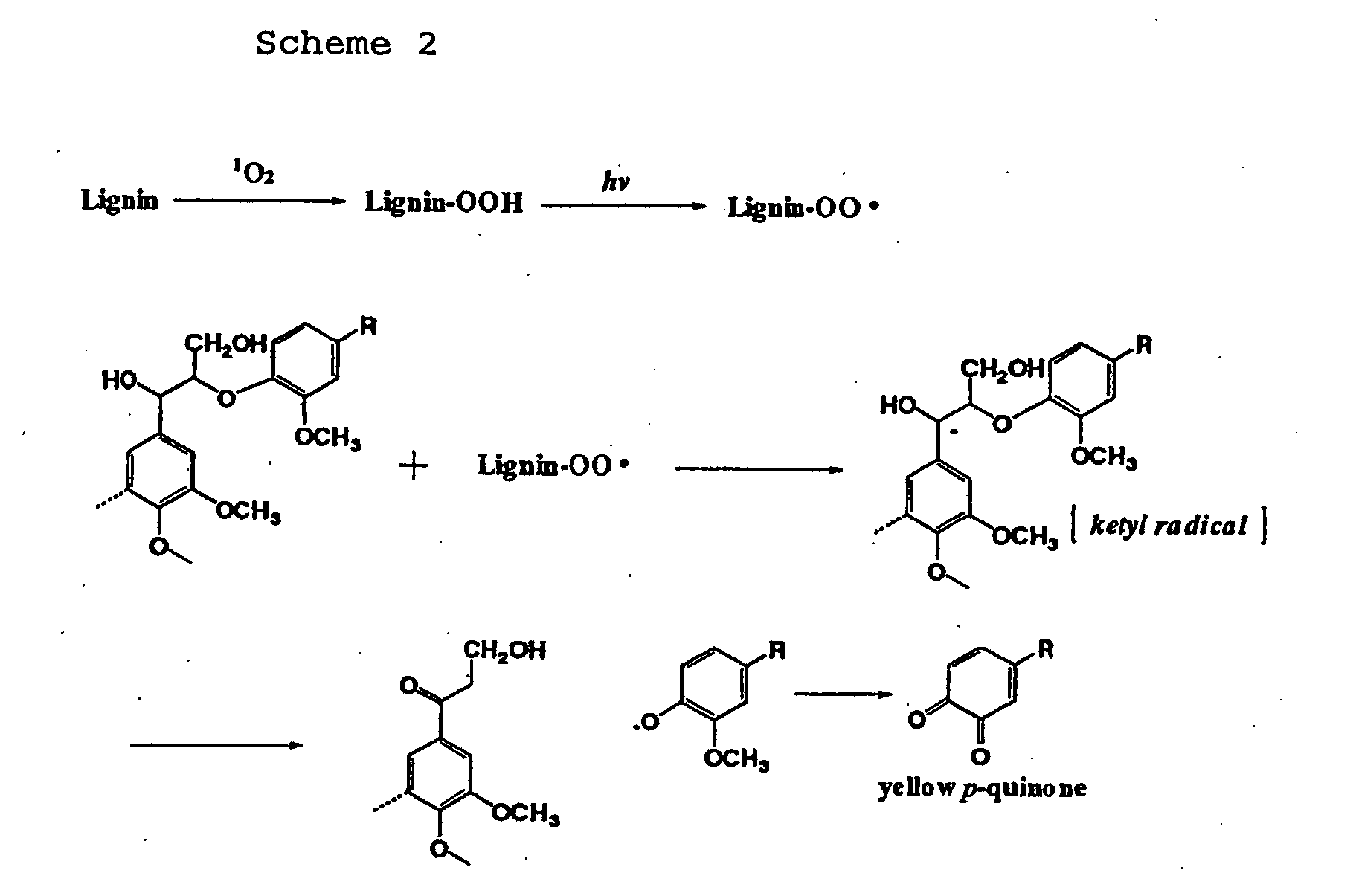
- the lignin remaining unoxidized in the pulp is also excited by UV light and oxidatively degraded via the reaction shown in Scheme 2 to freshly produce a quinone compound, resulting in coloration.
- conventional methods for improving discoloration in pulp normally comprise degrading or removing causative agents of discoloration such as lignin or modified lignin by adding a bleaching chemical or alkaline chemical during the pulp bleaching process.
- the mechanism of discoloration in MP is the same as that of the lignin-induced discoloration in pulp described above, but discoloration in MP is more severe than in CP and SCP because of the presence of higher residual amount of lignin and modified lignin than in CP and SCP.
- a major cause of the strong coloration in MP is that lignin is oxidized during hydrogen peroxide-bleaching to produce a hydroquinone, which is readily oxidized into a quinone. Discoloration becomes more severe in MP having higher brightness because more hydroquinone is produced at higher degrees of bleaching.
- the lignin remaining unoxidized in MP is also excited by UV light and oxidatively degraded to newly produce a quinone compound, resulting in coloration.
- the quinone compound the main factor behind severe discoloration in MP
- the quinone compound could be degraded in advance
- the discoloration in MP would be greatly reduced and many benefits can be expected such as (1) quality stabilization of current paper products containing MP, (2) enrichment in MP in current paper products with limited content of MP due to the discoloration in MP, thereby providing bulky and light weight paper products, (3) the possibility of the development of new products containing MP, etc.
- Discoloration also occurs in CP though it is less serious than in MP. As in MP if discoloration in CP could also be reduced, such benefits as quality stabilization of CP-based paper products and the possibility of the development of new products would become possible.
- a conventional method for improving discoloration in CP was proposed in which causative agents of discoloration such as lignin or hexenuronic acid are degraded / removed with chemicals or the like. In this method, however, large amounts of chemicals or the like must be used to degrade/remove lignin and these treatments cause problems such as yield loss in bleached pulp or strength loss in pulp fibers. Large amounts of acids are required to remove hexenuronic acid, which also invites the problem of strength loss in pulp fibers. If the quinone compound could be degraded in advance, such benefits as quality stabilization of CP-based paper products and the possibility of the development of new products would be expected.
- a bleaching process has been patented, characterized in that an alkali is added latterly in the first reaction stage of successive chlorine dioxide stages when a pulp derived from a lignocellulose material is bleached according to a bleaching sequence consisting of chlorine and/or chlorine dioxide stage - alkali/oxygen stage -chlorine dioxide stage -chlorine dioxide stage and wherein, the ratio of chlorine dioxide at the first to the second stages is 40/60 to 70/30 (see patent document 1).
- a multi-stage bleaching process has also been patented, comprising the steps of treating a pulp derived from a lignocellulose material with chlorine, alkaline extraction, and then a hypochlorite, characterized in that 1.0% or more of an alkali is added on the basis of the bone dry weight of the pulp during the hypochlorite-bleaching stage and the pulp is treated at a temperature of 60°C or more (see patent document 2).
- a technique has been disclosed, which is characterized in that a pulp bleached in a sequence including at least one chlorine bleaching stage is treated with xylanase and further bleached in a bleaching sequence including a hypochlorite stage and a chlorine dioxide stage (see patent document 3).
- a process for preparing a pulp with high degree of brightness comprising further bleaching a bleached pulp derived from a lignocellulose material through a sequence of a hyposulfite bleaching stage under high temperature and high alkali conditions and a chlorine dioxide bleaching stage, wherein the second chlorine dioxide bleaching stage is performed at a chlorine dioxide concentration of 1% by weight to 3% by weight on the basis of the bone dry weight of the pulp in a chlorine dioxide/alkali ratio of 1/0.05 to 1/0.3 and at a high temperature (see patent document 4).
- a technique has been disclosed wherein a suspension of a cellulose pulp prepared by the sulfate process or alkaline process is heated and treated at about 85 to 150°C and a pH of about 2 to 5 to remove at least about 50% of hexenuronic acid in the cellulose pulp, thereby decreasing the Kappa number of the pulp by 2 to 9 units (see patent document 5).
- An object of the present invention is to obtain printing papers with reduced discoloration by using a pulp with improved discoloration, thereby providing printing papers with remarkably improved discoloration characterized by (1) reduced brightness change, i.e. reduced discoloration; (2) weight reduction especially by including a larger quantity of MP; (3) achieving resource conservation and environmental friendliness by including higher proportions of MP or DIP, etc..
- printing papers with remarkably improved discoloration can be obtained by including a pulp consisting of one member or a mixed pulp of two or more members of bleached or unbleached mechanical pulps, semichemical pulps, chemical pulps and deinked pulps irradiated with UV and/or visible light in the presence of at least one additive selected from the group consisting of reducing agents, oxidizing agents and hydrogen-donating organic compounds.
- Printing papers with remarkably improved discoloration can also be obtained by irradiating, a printing paper or a precursor thereof in the production process, with UV and/or visible light in the presence of at least one additive selected from the group consisting of reducing agents, oxidizing agents and hydrogen-donating organic compounds.
- Discoloration of paper is greatly reduced by providing a method for improving discoloration comprising preparing a paper containing a pulp irradiated with UV /visible light in the presence of at least one compound selected from the group consisting of reducing agents, oxidizing agents and hydrogen-donating organic compounds or irradiating prepared paper with UV / visible light in the same manner, and especially such benefits as environmental friendliness are achieved because light and bulky papers can be prepared from smaller amounts of wood resources by treating MP having a high yield or MP-containing papers.
- Pulps used in printing papers of the present invention include raw pulps such as bleached or unbleached mechanical pulps, semichemical pulps, chemical pulps and deinked pulps derived from wood. Either one member or a mixture of two or more members of these pulps may be used.
- the term "bleached” here means that the pulp has gone through e.g., a normal multi-stage bleaching process or a short sequence bleaching process in contrast to unbleached pulps.
- the present invention is preferably directed to bleached mechanical pulps because the invention works very effectively in the case of pulps showing significant discoloration,
- Compounds that can be used to improve discoloration of pulp used in the present invention include known reducing agents, oxidizing agents and hydrogen-donating organic compounds commonly used as bleaching/decoloring agents.
- the pulps are treated in the presence of at least one compound among these groups.
- Such reducing agents include, for example, sulfite or bisulfite ion, hydrosulfites, borohydride compounds, etc.
- the borohydride compounds are normally represented by general formula (1) or (2) below.
- the metal ion includes monovalent metal ions such as alkali metals, divalent metal ions such as alkali earth metals, and trivalent metal ions; and the organic ion may be any stable ion, especially a quaternary ammonium ion.
- Substituents for R include aliphatic hydrocarbon groups preferably containing 1 to 20, more preferably 1 to 10 carbon atoms, aromatic hydrocarbon groups preferably 6 to 20, more preferably 6 to 14 carbon atoms, alkyl-substituted hydrocarbon groups preferably containing 7 to 40, more preferably 7 to 24 carbon atoms, etc. When two or more substituents for R exist, R may be the same or different.
- Especially preferred borohydride compounds for use in the present invention are sodium borohydride or tetrabutylammonium borohydride. Sodium borohydride or tetrabutylammonium borohydride or mixtures thereof can also be used.
- Preferred oxidizing agents are peroxides.
- peroxides both organic peroxides and inorganic peroxides can be used.
- Organic peroxides that can be used are compounds represented by general formula (3) below:
- R and R' may be the same or different and represent a hydrocarbon group, alkylcarbonyl group, arylcarbonyl group, alkoxycarbonyl group, aryloxycarbonyl group, formyl group or hydrogen.
- the hydrocarbon group includes aromatic hydrocarbon groups such as phenyl, naphthyl, biphenyl and anthryl groups; aliphatic hydrocarbon groups; and substituted forms thereof; and the alkylcarbonyl group includes acetyl, ethylcarbonyl and propionylcarbonyl groups and substituted forms thereof.
- the arylcarbonyl group includes benzoyl, naphthylcarbonyl and biphenylcarbonyl groups and substituted forms thereof.
- the alkoxycarbonyl group includes methoxycarbonyl and ethoxycarbonyl groups and substituted forms thereof.
- the aryloxycarbonyl group includes phenoxycarbonyl, naphthoxycarbonyl and biphenyloxycarbonyl groups and substituted forms thereof.
- Specific examples of these organic peroxides include, for example, peracids such as perbenzoic acid and derivatives thereof, peracetic acid and performic acid; esters of these peracids; and percarbonic acid and esters thereof.
- Inorganic peroxides include hydrogen peroxide, sodium percarbonate, sodium peroxide, etc.
- Other oxidizing agents. include those containing no halogens such as ozone and oxygen.
- Preferred hydrogen-donating organic compounds are alcohols and amides, among which preferred alcohols are primary alcohols represented by general formula (4) below, specifically including ethyl alcohol, benzyl alcohol, furfuryl alcohol, etc.
- Preferred amides are formamide and acetamide.
- any compound having hydrogen-donating ability can be used as hydrogen donor organic compounds without being limited to the alcohols and amides mentioned above.
- R C H 2 O H wherein R represents a hydrocarbon group or a substituted hydrocarbon group.
- the reducing agents, oxidizing agents and hydrogen-donating organic compounds may be used alone in the absence of a solvent, but should desirably be used as a dispersion or solution in a solvent transparent to UV / visible light.
- solvents include water, alcohols, linear or cyclic alkanes, ethers, etc. as single solvents or mixed solvents thereof, preferably water.
- the amount of any of the reducing agents, oxidizing agents and hydrogen-donating organic compounds to be used is not specifically limited so far as it is at or below the saturated concentration of the compound in the solvent, but suitably 0.01 to 40% (weight/volume), more preferably 0.1 to 20% in the solvent.
- the amount of any of the reducing agents, oxidizing agents and hydrogen-donating organic compounds to be used is 0.05 to 50% solids by weight, more preferably 0.1 to 25% solids by weight on the basis of pulp solids.
- the UV and/or visible light is not specifically limited, but desirably used at a wavelength of about 180 to 800 nm, preferably 200 to 500 nm. This is because lignin, para-quinone and ortho-quinone have maximum absorption wavelength of 280 nm, 360 nm and 390 to 410 nm, respectively.
- Suitable light sources include common light sources such as low-pressure mercury lamps, high-pressure mercury lamps, xenon lamps and black lights; as well as various excimer lamps and various lasers. For mass processing, the common light sources mentioned above are preferably used. In view of high-speed processing; it is desirable to use laser light sources.
- the laser light sources are not specifically limited and the laser light may be pulsed or continuous, but it is preferable to use excimer lasers (ArF excimer laser, KrF excimer laser, XeCl excimer laser, XeF excimer laser, etc.), argon ion laser, krypton ion laser, the second and third harmonics of YAG lasers, etc.
- excimer lasers ArF excimer laser, KrF excimer laser, XeCl excimer laser, XeF excimer laser, etc.
- argon ion laser argon ion laser
- krypton ion laser the second and third harmonics of YAG lasers, etc.
- the irradiation intensity is not specifically limited, but suitably 0.1 mJ/cm 2 /pulse to 1.0 kJ/cm 2 /pulse for pulsed radiation and 0.1 mW/cm 2 to 10 kW/cm 2 for continuous radiation.
- the irradiation temperature is not specifically limited either, but preferably -80 to 100°C, more preferably 0 to 80°C.
- the irradiation time is appropriately determined taking into account the masses of potential coloring materials contained in raw pulps, the types and concentrations of additives or solvents, and the type and intensity of the irradiating UV light and/or visible light, but normally 1 to 60 minutes will suffice.
- the pulps used in printing papers of the present invention can be irradiated with UV and/or visible light in the presence of at least one compound selected from reducing agents, oxidizing agents and hydrogen-donating organic compounds in any manner without limitation.
- a method according to a preferred embodiment comprises 1) providing a solvent which contains at least one compound selected from reducing agents, oxidizing agents and hydrogen-donating organic compounds and which is transparent to UV and/or visible light, 2) dispersing a raw pulp in the solvent and then 3) irradiating the dispersion with UV and/or visible light.
- the aqueous suspension of pulp issuing from the bleaching step is combined / mixed with at least one compound selected from reducing agents, oxidizing agents and hydrogen-donating organic compounds and then irradiated with UV and/or visible light.
- An alternative method comprises 1) forming a raw pulp into a sheet or a thin layer, 2) then impregnating it with a solvent containing at least one compound selected from reducing agents, oxidizing agents and hydrogen-donating organic compounds, and then 3) irradiating it with UV and/or visible light.
- the aqueous suspension of pulp having gone through bleaching and issuing from the bleaching step is dewatered through an apparatus such as a pulp sheet machine into a pulp sheet, which is then impregnated with at least one compound selected from reducing agents, oxidizing agents and hydrogen-donating organic compounds and irradiated with UV and/or visible light.
- Another possible method comprises 1) preparing a printing paper in a paper machine using raw pulp and papermaking fillers and various papermaking chemicals, 2) then impregnating or coating it with a solvent containing at least one compound selected from reducing agents, oxidizing agents and hydrogen-donating organic compounds, and then 3) irradiating it with UV and/or visible light.
- the present invention takes advantage of the phenomenon in which these quinones are further electronically excited from the ground state into the excited state by UV and/or visible light, and as a result, converted into a more reactive state, thereby enhancing the reaction with the coexisting of at least one compound selected from reducing agents, oxidizing agents and hydrogen-donating organic compounds to promote the degradation reaction of the coloring materials or the hydrogenation reaction of multiple bonds; or conversely, the phenomenon in which at least one compound selected from reducing agents, oxidizing agents and hydrogen-donating organic compounds is converted into a more active substance by irradiation with UV and/or visible light, thereby improving the reactivity with the coloring materials to enhance the degradation reaction of the coloring materials or the hydrogenation reaction of multiple bonds.
- the method previously proposed for reducing discoloration by incorporating an additive such as a thiol compound into paper made from MP had the problem of unpleasant odor and high toxicity in addition to the problem that it did not provide a radical improvement because it merely promoted the reaction of quinones into hydroquinones and caused discoloration again by UV light once the additives had been consumed.
- the present invention not only completely resolves all these problems by adopting a unique means, i.e. irradiation with UV and/or visible light in the presence of at least one compound selected from reducing agents, oxidizing agents and hydrogen-donating organic compounds, but also has a remarkable advantage due to environmental friendliness.
- the amount of the pulp having undergone the discoloration-improving treatment to be included into printing papers of the present invention is not specifically limited, and the whole sheet of paper once prepared may also undergo the discoloration-improving treatment as described above. However, to increase efficiency, it is more preferable to perform the discoloration-improving treatment on only MP or DIP containing MP because discoloration is more significant in MP than CP.
- Printing papers of the present invention can contain paper strength enhancers.
- Exemplary paper strength enhancers include starches, modified starches, polyacrylamide, polyvinyl alcohol, polyamide-polyamine resins, urea-formalin resins, melamine-formalin resins, polyethylene imines, etc.
- the amount of the paper strength enhancers to be contained is preferably 0.1% by weight or more and 2% by weight or less on the basis of the bone dry weight of pulp.
- printing papers of the present invention use other raw pulps such as chemical pulps including bleached softwood kraft pulps (NBKPs) or unbleached kraft pulps (NUKPs), bleached hardwood kraft pulps (LBKPs) or unbleached kraft pulps (LUKPs), etc.; mechanical pulps (MPs) including groundwood pulps (GPs), thermomechanical pulps (TMPs), chemithermomechanical pulps (CTMPs), etc.; and deinked pulps (DIPs) alone or in combination and mixed at any ratio.
- the pH during the papermaking process may be acidic or neutral or alkaline.
- Printing papers of the present invention can contain fillers.
- Fillers that can be used include known fillers such as white carbon, talc, kaolin, clay, heavy calcium carbonate, light calcium carbonate, titanium oxide, synthetic resin fillers, etc.
- printing papers of the present invention can further contain aluminum sulfate, sizing agents, yield improvers, freeness improvers, colorants, dyes, antifoaming agents or the like.
- Non-coated printing papers of the present invention may or may not be coated with a finishing agent containing no pigment.
- Non-coated printing papers of the present invention are desirably coated with a finishing agent based on a water-soluble polymer for the purpose of improving surface strength or sizing performance.
- Suitable water-soluble polymers include commonly used finishing agents such as starches, oxidized starches, modified starches, carboxymethylcellulose, polyacrylamide, polyvinyl alcohol, etc. alone or as mixtures thereof.
- the finishing agents can also contain paper strength enhancers designed to improve water resistance or surface strength and external sizing additives designed to provide sizing performance.
- finishing agents can be applied with coaters such as two-roll size press coaters, gate roll coaters, blade metering coaters, rod metering coaters, etc., but film transfer coaters such as gate roll coaters are preferable because the finishing agents remain on the paper surface to control the increase in density.
- the finishing agents are preferably applied in an amount of 0.1 g/m 2 or more and 3 g/m 2 or less per side.
- papers with reduced discoloration and reduced brightness change can be obtained by including a pulp having undergone a discoloration improving treatment or performing a discoloration improving treatment on paper after it is prepared.
- excellent bulky and light weight papers capable of effectively utilizing forest resources can be obtained because a larger quantity of MP can be included in high brightness papers that were previously difficult to blend with MP due to the problem of discoloration by adding bulkier MP having higher yield than CP after it is selectively subjected to a discoloration improving treatment.
- Papers of the present invention can be used not only for books, but also for offset printing, relief printing, gravure printing, newspaper printing; and as electro-photographic papers, or base papers for coated papers, inkjet recording papers, thermosensitive papers, pressure sensitive papers or the like.
- a paper having a basis weight of 46 g/m 2 was prepared in an oriented sheet former (Kumagai Riki Kogyo Co.) from a mixed pulp slurry consisting of 10 parts of BCTMP (1) (bleached chemithermomechanical pulp available from Millar Western, ISO brightness 85%, freeness CSF 250 ml) and 90 parts of LBKP (freeness CSF 400 ml) containing 0.9% (based on pulp) of aluminum sulfate, 0.5% of cationized starch as an internal additive (trade name: Cato 3210 available from Nippon Scientific Co., Ltd.), and a blend of light calcium carbonate and talc in a ratio of 6:4 in an amount corresponding to an ash content of 6% in the paper.
- BCTMP (1) bleacheched chemithermomechanical pulp available from Millar Western, ISO brightness 85%, freeness CSF 250 ml
- LBKP freeness CSF 400 ml
- cationized starch as an internal additive
- Example 2 A similar procedure as in Example 1 was carried out, except that a mixture of 30 parts of BCTMP (1) and 70 parts of LBKP was used.
- BCTMP (1) was replaced by BCTMP (2) (Millar Western, ISO brightness 70%, softwood 25%, aspen 75%).
- a pulp dispersion of BCTMP (1) (Millar Western, ISO brightness 85%, freeness 250 ml C.S.F.) broken at a concentration of 2% was combined with 20% of sodium borohydride (w/v) based on pulp and then introduced into a transparent plastic bag and irradiated with UV light from a low-pressure mercury lamp (Photoscience Japan Corporation, AY-1, 244 w/m 2 ) for 12 hours and washed with water.
- a low-pressure mercury lamp Photoscience Japan Corporation, AY-1, 244 w/m 2
- a paper having a basis weight of 46 g/m 2 was prepared in an oriented sheet former (Kumagai Riki Kogyo Co.) from a mixed pulp slurry consisting of 10 parts of this BCTMP (1) irradiated with UV light and 90 parts of LBKP (freeness 4000 ml C.S.F.) containing 0.9% (based on pulp) of aluminum sulfate, 0.5% of cationized starch as an internal additive and light calcium carbonate in an amount corresponding to an ash content of 6% in the paper.
- This sample was evaluated by the fading test.
- Example 4 A similar procedure as in Example 4 was carried out except that a mixture of 30 parts of BCTMP (1) irradiated with UV light and 70 parts of LBKP was used.
- Example 4 The same procedure as in Example 4 was performed except that BCTMP (2) (Millar Western, ISO brightness 70%, softwood 25%, aspen 75%) irradiated with UV light was used in the pulp mixture.
- BCTMP (2) (Millar Western, ISO brightness 70%, softwood 25%, aspen 75%) irradiated with UV light was used in the pulp mixture.
- a paper was prepared in an oriented sheet former in the same manner as in Example 1 from 100 parts of LBKP.with the internal chemicals and fillers without using BCTMP. This sample was evaluated by the fading test.
- the sample prepared in the oriented sheet former in Example 1 was directly evaluated by the fading test.
- the sample prepared in the oriented sheet former in Example 2 was directly evaluated by the fading test.
- the sample prepared in the oriented sheet former in Example 3 was directly evaluated by the fading test.
- the presence of bulky MP helps add bulk and greatly reduces the density as compared with Comparative example 1, leading to weight reduction because the same paper thickness is achieved at a lower basis weight.
- Comparative examples 2-4 also show weight reduction as compared with Comparative example 1 using no MP, but suffer from severe discoloration.
- the examples of the present invention are well-suited for making book papers because of greatly reduced discoloration and a combination of weight reduction by including MP and the anti-fading treatment, and they also contribute to resource saving because they can contain MP having high yield.
Landscapes
- Life Sciences & Earth Sciences (AREA)
- Engineering & Computer Science (AREA)
- Wood Science & Technology (AREA)
- Paper (AREA)
Abstract
Printing papers with reduced discoloration are obtained by using a pulp with improved discoloration. Printing papers with remarkably improved discoloration can be obtained by including a pulp consisting of one member or a mixed pulp of two or more members of bleached or unbleached mechanical pulps, semichemical pulps, chemical pulps and deinked pulps irradiated with UV and/or visible light in the presence of at least one additive selected from the group consisting of reducing agents, oxidizing agents and hydrogen-donating organic compounds.
Description
- The present invention relates to bulky printing papers with reduced loss of brightness, i.e. reduced discoloration, especially printing papers well-suited for books.
- An effective way to utilize papermaking pulp derived from forest resources (in view of the growing concerns of environmentalists), is to prepare paper containing the highest possible proportions of mechanical pulp (hereinafter referred to as MP) having a high yield of about 90% or more, such as stone groundwood pulp, refined ground wood pulp, pressurized groundwood pulp, thermomechanical pulp, chemithermomechanical pulp and bleached chemithermomechanical pulp rather than chemical pulp (hereinafter referred to as CP) having a process yield of about 50% such as kraft pulp, alkaline pulp and sulfite pulp. It is also desirable to improve the utilization ratio of deinked pulp (hereinafter referred to as DIP) made by defiberizing paper once used.
- On the other hand, weight reduction is a major quality requirement for paper. The weight reduction of paper here means weight reduction of paper retaining the thickness, i.e. low-density (bulky) paper. To prepare such low-density (bulky) paper, MPs having stiffer fibers such as groundwood pulps obtained by grinding wood with grinders or thermomechanical pulps obtained by fibrillating wood with refiners are also more effective for density reduction than CPs prepared by extracting lignin (a reinforcing component in fibers with chemicals); especially, ground wood pulps greatly contribute to density reduction. Thus, MPs are more preferred for an effective utilization of resources and achieving weight reduction of paper, but there is a serious problem of change in brightness over a period of time, i.e., the problem of discoloration, especially in high-brightness papers. Deinked pulps also help save wood resources by increasing their proportions, but they show a similar discoloration quality to that of MPs because waste papers are pulped without separating MPs and there are few cases in which they are definitely sorted by paper quality into woodfree papers, newspapers, magazines, dodgers, coated papers, etc. before they are pulped. For this reason, carefully sorted waste papers should be used to include deinked pulps into woodfree papers. Thus, it is favorable to include the highest possible proportions of MP or DIP in view of the resources problem, and the inclusion of MP would also contribute to weight reduction of paper, but involves the problem of discoloration over a period of time, which is a serious problem especially in the case of paper used in books that are stored and displayed at bookstores for a long period.
- Discoloration of pulp over a period of time is a common issue for any type of pulp including CP, semichemical pulp (hereinafter referred to as SCP), MP and DIP. The extent of discoloration is mainly because of the presence of residual amounts of lignin or modified lignin in pulp, and the discoloration tends to advance as the residual amount of lignin or modified lignin increases. Thus, discoloration takes place most rapidly in MP containing large amounts of residual lignin or modified lignin, followed by SCP, and then CP. Discoloration in DIP is greatly influenced by the MP content or other factors.
- During bleaching of pulp, lignin is oxidized to produce a hydroquinone as modified lignin. This hydroquinone is readily oxidized via a reaction shown in Scheme 1 to give a quinone, resulting in coloration. The lignin remaining unoxidized in the pulp is also excited by UV light and oxidatively degraded via the reaction shown in Scheme 2 to freshly produce a quinone compound, resulting in coloration. Thus, conventional methods for improving discoloration in pulp normally comprise degrading or removing causative agents of discoloration such as lignin or modified lignin by adding a bleaching chemical or alkaline chemical during the pulp bleaching process.
- The mechanism of discoloration in MP is the same as that of the lignin-induced discoloration in pulp described above, but discoloration in MP is more severe than in CP and SCP because of the presence of higher residual amount of lignin and modified lignin than in CP and SCP. A major cause of the strong coloration in MP is that lignin is oxidized during hydrogen peroxide-bleaching to produce a hydroquinone, which is readily oxidized into a quinone. Discoloration becomes more severe in MP having higher brightness because more hydroquinone is produced at higher degrees of bleaching. The lignin remaining unoxidized in MP is also excited by UV light and oxidatively degraded to newly produce a quinone compound, resulting in coloration. Thus, the main factor behind severe discoloration in MP is the quinone compound, and if this quinone compound could be degraded in advance, the discoloration in MP would be greatly reduced and many benefits can be expected such as (1) quality stabilization of current paper products containing MP, (2) enrichment in MP in current paper products with limited content of MP due to the discoloration in MP, thereby providing bulky and light weight paper products, (3) the possibility of the development of new products containing MP, etc.
- In order to solve this problem of discoloration in MP, many proposals have been made, and a method using a water-soluble UV absorbent and a photostabilizer in combination has been recently proposed (see non-patent document 1). A method in which the aromatic ring contained in lignin in MP is reduced was also shown (see non-patent document 2).
However, UV absorbents or the like have the disadvantage that their effect does not last for a long period because they are also lost because of UV light. On the other hand, when a rhodium catalyst was used for reducing the lignin aromatic ring, it took a long period, such as 5 days to partially hydrogenate the aromatic ring in the hydrogenation reaction of the aromatic ring of the lignin isolated from wood at room temperature in an aqueous alcohol solution, and this catalyst seems very difficult to directly react with the lignin present in pulp fibers because it is used as an emulsion. Thus, all of these conventional methods have disadvantages such as insufficient anti-fading effect, long processing time, lack of economy or practicability, etc. at present. - Discoloration also occurs in CP though it is less serious than in MP. As in MP if discoloration in CP could also be reduced, such benefits as quality stabilization of CP-based paper products and the possibility of the development of new products would become possible.

- As an example of prior art, a document shows that discoloration is improved better at higher temperatures with higher hydrogen peroxide concentrations being maintained for longer reaction periods during the hydrogen peroxide-bleaching stage under alkaline conditions (see non-patent document 3). A bleaching process has been patented, characterized in that an alkali is added latterly in the first reaction stage of successive chlorine dioxide stages when a pulp derived from a lignocellulose material is bleached according to a bleaching sequence consisting of chlorine and/or chlorine dioxide stage - alkali/oxygen stage -chlorine dioxide stage -chlorine dioxide stage and wherein, the ratio of chlorine dioxide at the first to the second stages is 40/60 to 70/30 (see patent document 1). A multi-stage bleaching process has also been patented, comprising the steps of treating a pulp derived from a lignocellulose material with chlorine, alkaline extraction, and then a hypochlorite, characterized in that 1.0% or more of an alkali is added on the basis of the bone dry weight of the pulp during the hypochlorite-bleaching stage and the pulp is treated at a temperature of 60°C or more (see patent document 2). A technique has been disclosed, which is characterized in that a pulp bleached in a sequence including at least one chlorine bleaching stage is treated with xylanase and further bleached in a bleaching sequence including a hypochlorite stage and a chlorine dioxide stage (see patent document 3). A process for preparing a pulp with high degree of brightness has been disclosed, comprising further bleaching a bleached pulp derived from a lignocellulose material through a sequence of a hyposulfite bleaching stage under high temperature and high alkali conditions and a chlorine dioxide bleaching stage, wherein the second chlorine dioxide bleaching stage is performed at a chlorine dioxide concentration of 1% by weight to 3% by weight on the basis of the bone dry weight of the pulp in a chlorine dioxide/alkali ratio of 1/0.05 to 1/0.3 and at a high temperature (see patent document 4).
- It has become known from recent new findings that not only conventional lignin and modified lignin but also hexenuronic acid are responsible for discoloration in ECF or TCF bleached pulp. This hexenuronic acid is produced by demethylation from methylglucuronic acid in hemicellulose during the cooking step. This hexenuronic acid is said to be responsible for discoloration in pulp. An acid treatment at relatively high temperatures was proposed to remove the hexenuronic acid. According to this method, the hexenuronic acid and modified lignin are removed by acid hydrolysis by treating unbleached pulp at high temperatures under acid conditions. For example, a technique has been disclosed wherein a suspension of a cellulose pulp prepared by the sulfate process or alkaline process is heated and treated at about 85 to 150°C and a pH of about 2 to 5 to remove at least about 50% of hexenuronic acid in the cellulose pulp, thereby decreasing the Kappa number of the pulp by 2 to 9 units (see patent document 5).
- One of the applicants of the present invention, National Institute of Advanced Industrial Science and Technology, already filed three patent applications relating to pulp bleaching methods involving irradiation with UV and/or visible light. Specifically, a technique is disclosed involving irradiation with UV and/or visible light in bleaching pulp using a reducing agent (see patent document 6). Another technique is disclosed involving irradiation with UV and/or visible light in the presence of an organic peroxide represented by ROOR' as an oxidizing agent (see patent document 7). Still another technique is disclosed combining the use of hydrogen peroxide and UV and/or visible light (see patent document 8). The present invention relates to the making of printing papers using a pulp with improved discoloration by applying the techniques of the inventions of these prior applications to bleached pulp.
-
- Non-patent document 1: Yuan, Z., et al., J. Pulp Paper Sci., 28 (5), 159 (2002).
- Non-patent document 2: Hu, T. Q., et al., J. Pulp Paper Sci., 25(9), 312 (1999).
- Non-patent document 3: The Bleaching of Pulp, P382, P384, TAPPI PRESS (1979), N. Hartler, TAPPI 43 (11) 903 (1960).
- Patent document 1: JPB No. Hei 7-6147.
- Patent document 2: Japanese Patent No. 2115315.
- Patent document 3: JPA No. Hei 6-101185.
- Patent document 4: JPA No. Hei 9-105091.
- Patent document 5: JPA No. Hei 10-508346.
- Patent document 6: Japanese Patent No. 3371228.
- Patent document 7: Japanese Patent No. 3368336
- Patent document 8: JPA No. 2002-88673.
- An object of the present invention is to obtain printing papers with reduced discoloration by using a pulp with improved discoloration, thereby providing printing papers with remarkably improved discoloration characterized by (1) reduced brightness change, i.e. reduced discoloration; (2) weight reduction especially by including a larger quantity of MP; (3) achieving resource conservation and environmental friendliness by including higher proportions of MP or DIP, etc..
- As a result of careful studies, we found that printing papers with remarkably improved discoloration can be obtained by including a pulp consisting of one member or a mixed pulp of two or more members of bleached or unbleached mechanical pulps, semichemical pulps, chemical pulps and deinked pulps irradiated with UV and/or visible light in the presence of at least one additive selected from the group consisting of reducing agents, oxidizing agents and hydrogen-donating organic compounds. Printing papers with remarkably improved discoloration can also be obtained by irradiating, a printing paper or a precursor thereof in the production process, with UV and/or visible light in the presence of at least one additive selected from the group consisting of reducing agents, oxidizing agents and hydrogen-donating organic compounds.
- Discoloration of paper is greatly reduced by providing a method for improving discoloration comprising preparing a paper containing a pulp irradiated with UV /visible light in the presence of at least one compound selected from the group consisting of reducing agents, oxidizing agents and hydrogen-donating organic compounds or irradiating prepared paper with UV / visible light in the same manner, and especially such benefits as environmental friendliness are achieved because light and bulky papers can be prepared from smaller amounts of wood resources by treating MP having a high yield or MP-containing papers.
- Pulps used in printing papers of the present invention include raw pulps such as bleached or unbleached mechanical pulps, semichemical pulps, chemical pulps and deinked pulps derived from wood. Either one member or a mixture of two or more members of these pulps may be used. The term "bleached" here means that the pulp has gone through e.g., a normal multi-stage bleaching process or a short sequence bleaching process in contrast to unbleached pulps. The present invention is preferably directed to bleached mechanical pulps because the invention works very effectively in the case of pulps showing significant discoloration,
- Compounds that can be used to improve discoloration of pulp used in the present invention include known reducing agents, oxidizing agents and hydrogen-donating organic compounds commonly used as bleaching/decoloring agents. The pulps are treated in the presence of at least one compound among these groups.
- Such reducing agents include, for example, sulfite or bisulfite ion, hydrosulfites, borohydride compounds, etc. The borohydride compounds are normally represented by general formula (1) or (2) below.
-

wherein n = an integer from 1 to 4, m = an integer from 1 to 3, M = a metal ion, organic ion or inorganic ion, R = a hydrocarbon group or substituted hydrocarbon group or
wherein n = an integer from 1 to 3, R = a hydrocarbon group or substituted hydrocarbon group.
In general formula (1) above, the metal ion includes monovalent metal ions such as alkali metals, divalent metal ions such as alkali earth metals, and trivalent metal ions; and the organic ion may be any stable ion, especially a quaternary ammonium ion. Substituents for R include aliphatic hydrocarbon groups preferably containing 1 to 20, more preferably 1 to 10 carbon atoms, aromatic hydrocarbon groups preferably 6 to 20, more preferably 6 to 14 carbon atoms, alkyl-substituted hydrocarbon groups preferably containing 7 to 40, more preferably 7 to 24 carbon atoms, etc. When two or more substituents for R exist, R may be the same or different. Especially preferred borohydride compounds for use in the present invention are sodium borohydride or tetrabutylammonium borohydride. Sodium borohydride or tetrabutylammonium borohydride or mixtures thereof can also be used. - Preferred oxidizing agents are peroxides. As for peroxides, both organic peroxides and inorganic peroxides can be used. Organic peroxides that can be used are compounds represented by general formula (3) below:
-

wherein R and R' may be the same or different and represent a hydrocarbon group, alkylcarbonyl group, arylcarbonyl group, alkoxycarbonyl group, aryloxycarbonyl group, formyl group or hydrogen.
The hydrocarbon group includes aromatic hydrocarbon groups such as phenyl, naphthyl, biphenyl and anthryl groups; aliphatic hydrocarbon groups; and substituted forms thereof; and the alkylcarbonyl group includes acetyl, ethylcarbonyl and propionylcarbonyl groups and substituted forms thereof. The arylcarbonyl group includes benzoyl, naphthylcarbonyl and biphenylcarbonyl groups and substituted forms thereof. The alkoxycarbonyl group includes methoxycarbonyl and ethoxycarbonyl groups and substituted forms thereof. The aryloxycarbonyl group includes phenoxycarbonyl, naphthoxycarbonyl and biphenyloxycarbonyl groups and substituted forms thereof. Specific examples of these organic peroxides include, for example, peracids such as perbenzoic acid and derivatives thereof, peracetic acid and performic acid; esters of these peracids; and percarbonic acid and esters thereof.
Inorganic peroxides include hydrogen peroxide, sodium percarbonate, sodium peroxide, etc. Other oxidizing agents. include those containing no halogens such as ozone and oxygen. - Preferred hydrogen-donating organic compounds are alcohols and amides, among which preferred alcohols are primary alcohols represented by general formula (4) below, specifically including ethyl alcohol, benzyl alcohol, furfuryl alcohol, etc. Preferred amides are formamide and acetamide. However, any compound having hydrogen-donating ability can be used as hydrogen donor organic compounds without being limited to the alcohols and amides mentioned above.

wherein R represents a hydrocarbon group or a substituted hydrocarbon group. - In the pulp treatment used for printing papers of the present invention, the reducing agents, oxidizing agents and hydrogen-donating organic compounds may be used alone in the absence of a solvent, but should desirably be used as a dispersion or solution in a solvent transparent to UV / visible light. Such solvents include water, alcohols, linear or cyclic alkanes, ethers, etc. as single solvents or mixed solvents thereof, preferably water.
- The amount of any of the reducing agents, oxidizing agents and hydrogen-donating organic compounds to be used is not specifically limited so far as it is at or below the saturated concentration of the compound in the solvent, but suitably 0.01 to 40% (weight/volume), more preferably 0.1 to 20% in the solvent. The amount of any of the reducing agents, oxidizing agents and hydrogen-donating organic compounds to be used is 0.05 to 50% solids by weight, more preferably 0.1 to 25% solids by weight on the basis of pulp solids.
- The UV and/or visible light is not specifically limited, but desirably used at a wavelength of about 180 to 800 nm, preferably 200 to 500 nm. This is because lignin, para-quinone and ortho-quinone have maximum absorption wavelength of 280 nm, 360 nm and 390 to 410 nm, respectively. Suitable light sources include common light sources such as low-pressure mercury lamps, high-pressure mercury lamps, xenon lamps and black lights; as well as various excimer lamps and various lasers. For mass processing, the common light sources mentioned above are preferably used. In view of high-speed processing; it is desirable to use laser light sources. The laser light sources are not specifically limited and the laser light may be pulsed or continuous, but it is preferable to use excimer lasers (ArF excimer laser, KrF excimer laser, XeCl excimer laser, XeF excimer laser, etc.), argon ion laser, krypton ion laser, the second and third harmonics of YAG lasers, etc.
- The irradiation intensity is not specifically limited, but suitably 0.1 mJ/cm2/pulse to 1.0 kJ/cm2/pulse for pulsed radiation and 0.1 mW/cm2 to 10 kW/cm2 for continuous radiation. The irradiation temperature is not specifically limited either, but preferably -80 to 100°C, more preferably 0 to 80°C. The irradiation time is appropriately determined taking into account the masses of potential coloring materials contained in raw pulps, the types and concentrations of additives or solvents, and the type and intensity of the irradiating UV light and/or visible light, but normally 1 to 60 minutes will suffice.
- The pulps used in printing papers of the present invention can be irradiated with UV and/or visible light in the presence of at least one compound selected from reducing agents, oxidizing agents and hydrogen-donating organic compounds in any manner without limitation. A method according to a preferred embodiment comprises 1) providing a solvent which contains at least one compound selected from reducing agents, oxidizing agents and hydrogen-donating organic compounds and which is transparent to UV and/or visible light, 2) dispersing a raw pulp in the solvent and then 3) irradiating the dispersion with UV and/or visible light. Specifically when the solvent is water, the aqueous suspension of pulp issuing from the bleaching step is combined / mixed with at least one compound selected from reducing agents, oxidizing agents and hydrogen-donating organic compounds and then irradiated with UV and/or visible light. An alternative method comprises 1) forming a raw pulp into a sheet or a thin layer, 2) then impregnating it with a solvent containing at least one compound selected from reducing agents, oxidizing agents and hydrogen-donating organic compounds, and then 3) irradiating it with UV and/or visible light. Specifically when the solvent is water, the aqueous suspension of pulp having gone through bleaching and issuing from the bleaching step is dewatered through an apparatus such as a pulp sheet machine into a pulp sheet, which is then impregnated with at least one compound selected from reducing agents, oxidizing agents and hydrogen-donating organic compounds and irradiated with UV and/or visible light.
- Another possible method comprises 1) preparing a printing paper in a paper machine using raw pulp and papermaking fillers and various papermaking chemicals, 2) then impregnating or coating it with a solvent containing at least one compound selected from reducing agents, oxidizing agents and hydrogen-donating organic compounds, and then 3) irradiating it with UV and/or visible light.
- Although the anti-fading mechanism of pulp treated by the methods described above has not been known in detail, we assume the following. That is, potential coloring materials contained in pulp, such as lignin in MP, are oxidatively degraded by irradiating with UV and/or visible light during bleaching to produce a hydroquinone. Unmodified lignin remaining unoxidized during bleaching produces various quinones. The present invention takes advantage of the phenomenon in which these quinones are further electronically excited from the ground state into the excited state by UV and/or visible light, and as a result, converted into a more reactive state, thereby enhancing the reaction with the coexisting of at least one compound selected from reducing agents, oxidizing agents and hydrogen-donating organic compounds to promote the degradation reaction of the coloring materials or the hydrogenation reaction of multiple bonds; or conversely, the phenomenon in which at least one compound selected from reducing agents, oxidizing agents and hydrogen-donating organic compounds is converted into a more active substance by irradiation with UV and/or visible light, thereby improving the reactivity with the coloring materials to enhance the degradation reaction of the coloring materials or the hydrogenation reaction of multiple bonds.
- The method previously proposed for reducing discoloration by incorporating an additive such as a thiol compound into paper made from MP had the problem of unpleasant odor and high toxicity in addition to the problem that it did not provide a radical improvement because it merely promoted the reaction of quinones into hydroquinones and caused discoloration again by UV light once the additives had been consumed. However, the present invention not only completely resolves all these problems by adopting a unique means, i.e. irradiation with UV and/or visible light in the presence of at least one compound selected from reducing agents, oxidizing agents and hydrogen-donating organic compounds, but also has a remarkable advantage due to environmental friendliness.
- Another attempt to reduce discoloration by applying a UV absorbent on the paper surface was effective only on the surface, but not effective in reducing discoloration on areas where the UV absorbent was not applied; for e.g. the trimmed edges of the leaves of a book. In papers of the present invention, discoloration on the edges can also be reduced by performing a discoloration-improving treatment on the whole sheet of paper or the whole of the pulp.
- The amount of the pulp having undergone the discoloration-improving treatment to be included into printing papers of the present invention is not specifically limited, and the whole sheet of paper once prepared may also undergo the discoloration-improving treatment as described above. However, to increase efficiency, it is more preferable to perform the discoloration-improving treatment on only MP or DIP containing MP because discoloration is more significant in MP than CP.
- Printing papers of the present invention can contain paper strength enhancers. Exemplary paper strength enhancers include starches, modified starches, polyacrylamide, polyvinyl alcohol, polyamide-polyamine resins, urea-formalin resins, melamine-formalin resins, polyethylene imines, etc. The amount of the paper strength enhancers to be contained is preferably 0.1% by weight or more and 2% by weight or less on the basis of the bone dry weight of pulp.
- In addition to the pulps having undergone the discoloration-improving treatment, printing papers of the present invention use other raw pulps such as chemical pulps including bleached softwood kraft pulps (NBKPs) or unbleached kraft pulps (NUKPs), bleached hardwood kraft pulps (LBKPs) or unbleached kraft pulps (LUKPs), etc.; mechanical pulps (MPs) including groundwood pulps (GPs), thermomechanical pulps (TMPs), chemithermomechanical pulps (CTMPs), etc.; and deinked pulps (DIPs) alone or in combination and mixed at any ratio. The pH during the papermaking process may be acidic or neutral or alkaline.
- Printing papers of the present invention can contain fillers. Fillers that can be used include known fillers such as white carbon, talc, kaolin, clay, heavy calcium carbonate, light calcium carbonate, titanium oxide, synthetic resin fillers, etc.
- If desired, printing papers of the present invention can further contain aluminum sulfate, sizing agents, yield improvers, freeness improvers, colorants, dyes, antifoaming agents or the like.
- Printing papers of the present invention may or may not be coated with a finishing agent containing no pigment. Non-coated printing papers of the present invention are desirably coated with a finishing agent based on a water-soluble polymer for the purpose of improving surface strength or sizing performance. Suitable water-soluble polymers include commonly used finishing agents such as starches, oxidized starches, modified starches, carboxymethylcellulose, polyacrylamide, polyvinyl alcohol, etc. alone or as mixtures thereof. In addition to the water-soluble polymers, the finishing agents can also contain paper strength enhancers designed to improve water resistance or surface strength and external sizing additives designed to provide sizing performance. The finishing agents can be applied with coaters such as two-roll size press coaters, gate roll coaters, blade metering coaters, rod metering coaters, etc., but film transfer coaters such as gate roll coaters are preferable because the finishing agents remain on the paper surface to control the increase in density. The finishing agents are preferably applied in an amount of 0.1 g/m2 or more and 3 g/m2 or less per side.
- Thus, papers with reduced discoloration and reduced brightness change can be obtained by including a pulp having undergone a discoloration improving treatment or performing a discoloration improving treatment on paper after it is prepared. Especially, excellent bulky and light weight papers capable of effectively utilizing forest resources can be obtained because a larger quantity of MP can be included in high brightness papers that were previously difficult to blend with MP due to the problem of discoloration by adding bulkier MP having higher yield than CP after it is selectively subjected to a discoloration improving treatment. Papers of the present invention can be used not only for books, but also for offset printing, relief printing, gravure printing, newspaper printing; and as electro-photographic papers, or base papers for coated papers, inkjet recording papers, thermosensitive papers, pressure sensitive papers or the like.
- The following examples illustrate the present invention in detail without, however, limiting the scope of the invention thereto. The papers prepared in the examples and comparative examples were tested for their quality under the following items. The evaluation methods are as follows.
- Basis weight: determined according to JIS P 8124:1998.
- Paper thickness and density: determined according to JIS P 8118:1998.
- ISO brightness: determined according to JIS P 8148.
- Fading test: ISO brightness was determined by a xenon lamp weather meter (Suga Test Instruments Co., Ltd.) after irradiating samples with UV light generated from a xenon lamp for 1.0 hour. Test conditions included a black panel temperature of 63°C, humidity of 50%, and an irradiation intensity of 70 W.
- A paper having a basis weight of 46 g/m2 was prepared in an oriented sheet former (Kumagai Riki Kogyo Co.) from a mixed pulp slurry consisting of 10 parts of BCTMP (1) (bleached chemithermomechanical pulp available from Millar Western, ISO brightness 85%, freeness CSF 250 ml) and 90 parts of LBKP (freeness CSF 400 ml) containing 0.9% (based on pulp) of aluminum sulfate, 0.5% of cationized starch as an internal additive (trade name: Cato 3210 available from Nippon Scientific Co., Ltd.), and a blend of light calcium carbonate and talc in a ratio of 6:4 in an amount corresponding to an ash content of 6% in the paper. This sample was immersed in an aqueous 6% sodium borohydride solution (w/v) and then placed on a glass plate. At this point, the impregnant content of sodium borohydride was 18% solids by weight on the basis of the weight of pulp solids. This was irradiated with KrF excimer laser at 40 mJ/cm2/pulse, 5 Hz for 40 minutes. After completion of laser irradiation, the sample was washed with water and dried in a cylinder dryer, and then evaluated by the fading test.
- A similar procedure as in Example 1 was carried out, except that a mixture of 30 parts of BCTMP (1) and 70 parts of LBKP was used.
- A similar procedure as in Example 2 was carried out except that BCTMP (1) was replaced by BCTMP (2) (Millar Western, ISO brightness 70%, softwood 25%, aspen 75%).
- A pulp dispersion of BCTMP (1) (Millar Western, ISO brightness 85%, freeness 250 ml C.S.F.) broken at a concentration of 2% was combined with 20% of sodium borohydride (w/v) based on pulp and then introduced into a transparent plastic bag and irradiated with UV light from a low-pressure mercury lamp (Photoscience Japan Corporation, AY-1, 244 w/m2) for 12 hours and washed with water. Then, a paper having a basis weight of 46 g/m2 was prepared in an oriented sheet former (Kumagai Riki Kogyo Co.) from a mixed pulp slurry consisting of 10 parts of this BCTMP (1) irradiated with UV light and 90 parts of LBKP (freeness 4000 ml C.S.F.) containing 0.9% (based on pulp) of aluminum sulfate, 0.5% of cationized starch as an internal additive and light calcium carbonate in an amount corresponding to an ash content of 6% in the paper. This sample was evaluated by the fading test.
- A similar procedure as in Example 4 was carried out except that a mixture of 30 parts of BCTMP (1) irradiated with UV light and 70 parts of LBKP was used.
- The same procedure as in Example 4 was performed except that BCTMP (2) (Millar Western, ISO brightness 70%, softwood 25%, aspen 75%) irradiated with UV light was used in the pulp mixture.
- A paper was prepared in an oriented sheet former in the same manner as in Example 1 from 100 parts of LBKP.with the internal chemicals and fillers without using BCTMP. This sample was evaluated by the fading test.
- The sample prepared in the oriented sheet former in Example 1 was directly evaluated by the fading test.
- The sample prepared in the oriented sheet former in Example 2 was directly evaluated by the fading test.
- The sample prepared in the oriented sheet former in Example 3 was directly evaluated by the fading test.
-
Table 1 Brightness in fading test Basis Weight (g/m2) Thickness (µm) Density (g/cm3) 0 hour 1 hour Comparative example 1 79.7 78.5 45.8 69 0.66 Comparative example 2 78.3 72.1 45.8 75 0.61 Comparative example 3 77.4 64.7 46.2 79 0.58 Comparative example 4 70.3 59.6 45.7 80 0.57 Example 1 78.3 76.3 45.8 75 0.61 Example 2 78 75.6 46.2 79 0.58 Example 3 76.4 73.7 45.7 80 0.57 Example 4 78.3 76.3 45.8 75 0.61 Example 5 78.0 75.6 46.2 79 0.58 Example 6 76.8 73.7 45.7 80 0.57
Claims (4)
- A printing paper containing a pulp irradiated with UV and/or visible light in the presence of at least one compound selected from the group consisting of reducing agents, oxidizing agents and hydrogen-donating organic compounds.
- A printing paper irradiated with UV and/or visible light in the presence of at least one compound selected from the group consisting of reducing agents, oxidizing agents and hydrogen-donating organic compounds.
- The printing paper of claim 1 containing a pulp irradiated with UV and/or visible light using sodium borohydride or tetrabutylammonium borohydride or a mixture thereof as a reducing agent.
- The printing paper of claim 2 irradiated with UV and/or visible light using sodium borohydride or tetrabutylammonium borohydride or a mixture thereof as a reducing agent.
Applications Claiming Priority (2)
| Application Number | Priority Date | Filing Date | Title |
|---|---|---|---|
| JP2003186737A JP4666450B2 (en) | 2003-06-30 | 2003-06-30 | Printing paper manufacturing method |
| PCT/JP2004/009143 WO2005001198A1 (en) | 2003-06-30 | 2004-06-29 | Printing paper |
Publications (1)
| Publication Number | Publication Date |
|---|---|
| EP1645687A1 true EP1645687A1 (en) | 2006-04-12 |
Family
ID=33549700
Family Applications (1)
| Application Number | Title | Priority Date | Filing Date |
|---|---|---|---|
| EP04746612A Withdrawn EP1645687A1 (en) | 2003-06-30 | 2004-06-29 | Printing paper |
Country Status (6)
| Country | Link |
|---|---|
| US (1) | US20060237153A1 (en) |
| EP (1) | EP1645687A1 (en) |
| JP (1) | JP4666450B2 (en) |
| CN (1) | CN1826447A (en) |
| CA (1) | CA2541819A1 (en) |
| WO (1) | WO2005001198A1 (en) |
Cited By (1)
| Publication number | Priority date | Publication date | Assignee | Title |
|---|---|---|---|---|
| EP2398963A4 (en) * | 2009-02-20 | 2014-01-22 | Laminating Papers Oy | PROCESS FOR THE PRODUCTION OF AN IMPREGNATED FIBROUS FABRIC HAVING BRANDS, PLATE COATED WITH IMPREGNATED FIBROUS FABRIC, AND USE OF THE FIBROUS FABRIC IMPREGNATED IN A CONCRETE CASTING MOLD |
Families Citing this family (8)
| Publication number | Priority date | Publication date | Assignee | Title |
|---|---|---|---|---|
| US8246780B2 (en) | 2005-09-19 | 2012-08-21 | Nalco Company | Methods for enhancing brightness and resistance to thermal yellowing of bleached kraft pulp and paper |
| US7914646B2 (en) * | 2006-07-21 | 2011-03-29 | Nalco Company | Compositions and processes for paper production |
| JP4868907B2 (en) * | 2006-03-27 | 2012-02-01 | 大王製紙株式会社 | Printing paper |
| US9932709B2 (en) | 2013-03-15 | 2018-04-03 | Ecolab Usa Inc. | Processes and compositions for brightness improvement in paper production |
| CN102838900A (en) * | 2012-09-21 | 2012-12-26 | 山西大学 | Aqueous degradable environment-friendly ink and decoloring agent thereof |
| JP6297253B2 (en) * | 2012-10-10 | 2018-03-20 | 北越紀州製紙株式会社 | White paperboard |
| US11027560B2 (en) | 2017-01-27 | 2021-06-08 | Hewlett-Packard Development Company, L.P. | Printing systems |
| CN114516234A (en) * | 2022-01-04 | 2022-05-20 | 河南印爱文化艺术有限公司 | Antifouling printing method for paper |
Family Cites Families (8)
| Publication number | Priority date | Publication date | Assignee | Title |
|---|---|---|---|---|
| US4294654A (en) * | 1980-03-21 | 1981-10-13 | International Paper Company | Delignification and bleaching of lignocellulosic pulp via photo-oxygenation |
| JPS59501168A (en) * | 1982-06-24 | 1984-07-05 | スコツト・ペ−パ−・カンパニ− | Ozone bleaching of cellulose materials |
| JPH01229895A (en) * | 1988-03-09 | 1989-09-13 | Kammerer Gmbh | Method for increasing regeneration or stability of whiteness of strip paper and yellowing-resistant support material |
| JP2593392B2 (en) * | 1992-10-20 | 1997-03-26 | 本州製紙株式会社 | Pulp bleaching method |
| US5360515A (en) * | 1993-08-25 | 1994-11-01 | The Research Foundation Of The State University Of New York | Method for reducing thermal and light-induced brightness reversion in lignin-containing pulps |
| JP3787612B2 (en) * | 2000-06-20 | 2006-06-21 | 独立行政法人産業技術総合研究所 | Pulp bleaching method |
| JP3371228B2 (en) * | 2000-06-20 | 2003-01-27 | 独立行政法人産業技術総合研究所 | Pulp bleaching method |
| JP3368336B2 (en) * | 2000-06-20 | 2003-01-20 | 独立行政法人産業技術総合研究所 | Pulp bleaching method |
-
2003
- 2003-06-30 JP JP2003186737A patent/JP4666450B2/en not_active Expired - Lifetime
-
2004
- 2004-06-29 EP EP04746612A patent/EP1645687A1/en not_active Withdrawn
- 2004-06-29 US US10/562,788 patent/US20060237153A1/en not_active Abandoned
- 2004-06-29 WO PCT/JP2004/009143 patent/WO2005001198A1/en not_active Ceased
- 2004-06-29 CA CA002541819A patent/CA2541819A1/en not_active Abandoned
- 2004-06-29 CN CNA2004800207590A patent/CN1826447A/en active Pending
Non-Patent Citations (1)
| Title |
|---|
| See references of WO2005001198A1 * |
Cited By (1)
| Publication number | Priority date | Publication date | Assignee | Title |
|---|---|---|---|---|
| EP2398963A4 (en) * | 2009-02-20 | 2014-01-22 | Laminating Papers Oy | PROCESS FOR THE PRODUCTION OF AN IMPREGNATED FIBROUS FABRIC HAVING BRANDS, PLATE COATED WITH IMPREGNATED FIBROUS FABRIC, AND USE OF THE FIBROUS FABRIC IMPREGNATED IN A CONCRETE CASTING MOLD |
Also Published As
| Publication number | Publication date |
|---|---|
| CA2541819A1 (en) | 2005-01-06 |
| JP4666450B2 (en) | 2011-04-06 |
| US20060237153A1 (en) | 2006-10-26 |
| WO2005001198A1 (en) | 2005-01-06 |
| CN1826447A (en) | 2006-08-30 |
| JP2005023438A (en) | 2005-01-27 |
Similar Documents
| Publication | Publication Date | Title |
|---|---|---|
| JP2987642B2 (en) | Paper and paper manufacturing method | |
| US4915785A (en) | Single stage process for bleaching of pulp with an aqueous hydrogen peroxide bleaching composition containing magnesium sulphate and sodium silicate | |
| US5035772A (en) | Method for treating bleached lignin containing cellulose pulp by reducing α-carbonyl and γ-carbonyl groups and converting short-wave quanta to long-wave light quanta | |
| FI84634B (en) | FOERFARANDE FOER FRAMSTAELLNING AV KEMIMEKANISK ELLER SEMIKEMISK FIBERMASSA I EN EN-FAS IMPREGNERINGSPROCESS. | |
| US20060237153A1 (en) | Printing papers | |
| EP1790771A1 (en) | Pulp bleaching processes | |
| CN1043914C (en) | Method for reducing heat- and light-induced brightness reversal of lignin-containing pulps | |
| EP1568819A1 (en) | Method for improving the discoloration resistance of pulp and pulp improved in discoloration resistance | |
| JP2007270382A (en) | High brightness chemical pulp and method for producing the same | |
| JP3556463B2 (en) | Fluorescence elimination method of waste paper pulp containing fluorescent dye | |
| JP2008248425A (en) | Method for improving fading characteristic of mechanical pulp | |
| JP4799774B2 (en) | Printing paper | |
| JP3794254B2 (en) | Neutral paper | |
| US4244777A (en) | Bleaching stilbene yellow dyed wood pulp | |
| JPH0849187A (en) | Offset printing coated paper | |
| JPS6312788A (en) | Pulp treatment method | |
| JP2004204370A (en) | Method for producing mechanical pulp | |
| Becher et al. | Improved bonding in groundwood furnishes | |
| Yoon et al. | Ultraviolet Microscopic Study on Lignin Distribution in the Fiber Cell Wall of BCTMP | |
| JP2008248417A (en) | Hardwood mechanical pulp | |
| JP2006207068A (en) | Method for producing mercerized pulp and bulky paper containing the same | |
| JP2006104587A (en) | Highly white-colored chemical pulp and method for producing the same | |
| JP2005042241A (en) | Non-coated printing paper |
Legal Events
| Date | Code | Title | Description |
|---|---|---|---|
| PUAI | Public reference made under article 153(3) epc to a published international application that has entered the european phase |
Free format text: ORIGINAL CODE: 0009012 |
|
| 17P | Request for examination filed |
Effective date: 20060127 |
|
| AK | Designated contracting states |
Kind code of ref document: A1 Designated state(s): FI SE |
|
| DAX | Request for extension of the european patent (deleted) | ||
| RBV | Designated contracting states (corrected) |
Designated state(s): FI SE |
|
| STAA | Information on the status of an ep patent application or granted ep patent |
Free format text: STATUS: THE APPLICATION HAS BEEN WITHDRAWN |
|
| 18W | Application withdrawn |
Effective date: 20090226 |