EP1645520A1 - A top-up container assembly comprising a dispensing cap, and a dishwashing product comprised in the container assembly - Google Patents
A top-up container assembly comprising a dispensing cap, and a dishwashing product comprised in the container assembly Download PDFInfo
- Publication number
- EP1645520A1 EP1645520A1 EP05019967A EP05019967A EP1645520A1 EP 1645520 A1 EP1645520 A1 EP 1645520A1 EP 05019967 A EP05019967 A EP 05019967A EP 05019967 A EP05019967 A EP 05019967A EP 1645520 A1 EP1645520 A1 EP 1645520A1
- Authority
- EP
- European Patent Office
- Prior art keywords
- valve
- container assembly
- housing
- translucent
- dispensing cap
- Prior art date
- Legal status (The legal status is an assumption and is not a legal conclusion. Google has not performed a legal analysis and makes no representation as to the accuracy of the status listed.)
- Withdrawn
Links
Images
Classifications
-
- B—PERFORMING OPERATIONS; TRANSPORTING
- B65—CONVEYING; PACKING; STORING; HANDLING THIN OR FILAMENTARY MATERIAL
- B65D—CONTAINERS FOR STORAGE OR TRANSPORT OF ARTICLES OR MATERIALS, e.g. BAGS, BARRELS, BOTTLES, BOXES, CANS, CARTONS, CRATES, DRUMS, JARS, TANKS, HOPPERS, FORWARDING CONTAINERS; ACCESSORIES, CLOSURES, OR FITTINGS THEREFOR; PACKAGING ELEMENTS; PACKAGES
- B65D47/00—Closures with filling and discharging, or with discharging, devices
- B65D47/04—Closures with discharging devices other than pumps
- B65D47/20—Closures with discharging devices other than pumps comprising hand-operated members for controlling discharge
- B65D47/2018—Closures with discharging devices other than pumps comprising hand-operated members for controlling discharge comprising a valve or like element which is opened or closed by deformation of the container or closure
- B65D47/2031—Closures with discharging devices other than pumps comprising hand-operated members for controlling discharge comprising a valve or like element which is opened or closed by deformation of the container or closure the element being formed by a slit, narrow opening or constrictable spout, the size of the outlet passage being able to be varied by increasing or decreasing the pressure
Definitions
- the present invention relates to a top-up container assembly comprising a dispensing cap with a valve, and dishwashing cleaning products comprising the top-up container assembly.
- Plastic bottles comprising a spout for dispensing a liquid or a viscous composition are well known in the art, especially in the field of dishwashing cleaning products. These bottles are typically so-called “top-up" bottles.
- a user In order to dispense the composition, a user typically needs to open a cap to expose the spout, then invert and squeeze the bottle to dispense the composition.
- One problem with spouts is that, because of the spout's opening, the product flows out upon inversion of the bottle, even when the bottle is not squeezed.
- Another problem is that it is difficult to control the amount of product to be dispensed from the bottle.
- Another problem is mess. Bottles with spouts tend to leave product around the rim of the spout. As a result, the bottle does not only looks messy, but the product also dries and forms a crust. If the crust is allowed to build up, then it eventually blocks the spout. All these problems lead to consumer dissati
- valves e.g. slit valves
- top-down containers or tubes which hold a liquid or viscous composition.
- Top-down containers or tubes are products which rest on their dispensing cap, when they are stored on a horizontal surface.
- KetchupTM products are products which rest on their dispensing cap, when they are stored on a horizontal surface.
- KetchupTM products are products which rest on their dispensing cap, when they are stored on a horizontal surface.
- KetchupTM products KetchupTM products.
- One company producing such dispensing caps is Seaquist Closures.
- valves for dispensing the composition.
- the product marketed under the name of Sqezy from Buck chemicals is a "top-down" container comprising a colored translucent cap with a slit valve (the valve not being visible through the cap).
- the spout is replaced by a valve, a user may not readily notice the difference. A user may even believe the bottle is defective, as with valves, there is no visible opening.
- squeeze-bottles equipped with a valve require a higher squeeze pressure for dispensing the composition, versus squeeze-bottles equipped with a spout. It is therefore important for a user to readily notice which type of product is being bought, or used (with spout or valve).
- the present invention overcomes these problems.
- the present invention relates to a top-up container assembly (1) comprising a container (20) having a bottom surface (22), and a top surface (21) located away from said bottom surface (22), said top surface (21) having an opening (23); and a dispensing cap (30) attached to said top surface (21) of said bottle (20), said dispensing cap (30) comprising a housing (31) and a valve (32), wherein at least a portion of said housing (31) is transparent and/or translucent, and wherein said valve (32) is visually distinctive from said housing (31), to enable a user of said top-up container assembly (1) to see the valve (32) through the housing (31).
- the present invention relates to the use of a dispensing cap (30) for dispensing a dishwashing cleaning composition.
- the present invention relates to a dishwashing cleaning product.
- the present invention relates to a method of cleaning dishware.
- the present invention relates to a top-up container assembly (1) comprising a container (20) and a dispensing cap (30).
- top-up it is meant that the container assembly has a top and a bottom surface, at least a portion of said bottom surface being in contact with a horizontal flat surface when said container assembly is put on that horizontal flat surface.
- the top surface of the container assembly is located away from said bottom surface, and does not contact the horizontal flat surface, when the container assembly is put on that horizontal surface.
- the container (20) of the present invention may be a bottle or a stand-up pouch where the container is a bottle it is preferably a squeeze-bottle having flexible walls.
- the container has a bottom surface (22) and a top surface (21) located away from said bottom surface (22), and an opening (23) in said top surface (21). At least a portion of said bottom surface (22) is in contact with a horizontal flat surface when said container (20) is put on that horizontal flat surface.
- the container (20) useful herein has a hollow body for holding a liquid or gel composition, and is typically formed of plastic, preferably a polymer or resin such as polyethylene, polypropylene, polyethylene terephthalate, polycarbonate, polystyrene, ethyl vinyl alcohol, polyvinyl alcohol, thermoplastic elastomer, and combinations thereof, although other materials known in the art may also be used.
- plastic preferably a polymer or resin such as polyethylene, polypropylene, polyethylene terephthalate, polycarbonate, polystyrene, ethyl vinyl alcohol, polyvinyl alcohol, thermoplastic elastomer, and combinations thereof, although other materials known in the art may also be used.
- Such containers (20) will typically hold from 100 mL to 2 L of liquid, preferably from 150 mL to 1.2 L of liquid, and more preferably from 200 mL to 1 L of liquid, and are well known for holding liquid consumer products.
- Such containers are widely available from many packaging suppliers.
- the container may be flexibly deformed, but that it is not resilient in the sense that it recovers its original shape when the deforming pressure is removed.
- such containers are formed from plastic film or films which are sealed together at the edge in order to form a closed container.
- the container is provided with an opening which is sealed around the closure.
- the plastic film is made from polyethylene, polypropylene, polyester or laminate thereof and has a thickness of from 50 to 250 micrometers.
- a dispensing cap (30) is attached to the top surface (21) of the bottle (20).
- the dispensing cap (30) may be formed as either integral with, or separate from the bottle (20). If formed separately, the dispensing cap (30) may attach to the bottle (20) via methods known in the art such as by employing a transition piece, corresponding threaded male and female members, pressurized and non-pressurized seals, locking and snap-on parts, and/or other methods known in the art.
- the dispensing cap (30) is attached to the bottle (20) via a transition piece and/or with corresponding threaded male and female members which allow easy refilling.
- the dispensing cap (30) comprises a housing (31), and a valve (32).
- the housing (31) preferably comprises a body (33), and a closing lid (34) which is hinged along an axis (A) to said body (33).
- the body (33) comprises an opening into which the valve (32) can be fitted in a leak-tight manner.
- the body (33) further comprises a ring (36) which fits into the body's (33) opening, wherein the valve (32) can be fitted in a leak-tight manner.
- the dispensing cap (30) may further comprise a collar (35) which surrounds the bottom (22) portion of the housing (31) or the body (33).
- the housing (31), body (33), closing lid (34), ring (36) and collar (35) are typically formed of plastic, preferably a polymer or resin such as polyethylene, polypropylene, polyethylene terephthalate, polycarbonate, polystyrene, ethyl vinyl alcohol, polyvinyl alcohol, thermoplastic elastomer, and combinations thereof, although other materials known in the art may also be used. Most preferably, they are formed of polypropylene.
- the preferred valve (32) is a slit valve (32) having a pair of slits (37) intersecting at the center of the valve (32). Although one pair of slits (37) is preferred, more slits (37) may be present.
- the valve (32) is preferably formed of silicone or a thermoplastic elastomer. When the bottle (20) is squeezed, the valve (32) opens when the pressure differential across the valve (32) exceeds a predetermined amount (e.g. when the container assembly's (1) interior pressure increases to a predetermined amount relative to standard atmospheric pressure outside the container assembly (1)).
- the valve (32) may be formed as a unitary part of the dispensing cap (30), or may be mounted in a separate assembly (e.g.
- a ring (36) as described hereinabove that is permanently or releasably attached to the dispensing cap (30).
- Suitable valves for the dispensing cap (30) of the present invention are readily available on the market, e.g. from Seaquist Closures.
- An essential aspect of the present invention is that at least a portion of the housing (31) is transparent and/or translucent, and that the valve (32) is visually distinctive from the housing (31).
- the valve (32) can be seen through at least a portion of the housing (31), either from the side, from the top, or both.
- the valve (32) may be seen either only through a portion of the closing lid (34) (from the side, from the top, or both), or only through the side of at least a portion of the dispensing cap's (1) body (33), or both.
- valve (32) is clearly visible through the housing (31), or that a user can see a haze of different shades and/or colors (valve versus housing), whereby the user is able to distinguish the valve (32) from the housing (31).
- This also enables a user to easily distinguish dispensing caps having a valve (32) from dispensing caps having a spout.
- at least 5%, more preferably at least 10%, even more preferably at least 20%, and up to 100% of the housing (31) material is transparent and/or translucent.
- the housing (31) comprises a body (33) and a closing lid (34), preferably at least 5%, more preferably at least 10%, even more preferably at least 20%, and up to 100% of the body (33) and/or closing lid (34) material is transparent and/or translucent. If a ring (36), as described above, is used in the housing (31), it is preferred that the ring (36) is entirely transparent and/or translucent.
- the valve (32) is preferably not transparent nor translucent.
- the valve (32) is of a different color, more preferably of a contrasting color than the housing (31), body (33) or closing lid (34).
- the valve (32) is colored while the housing (31), body (33) or closing lid (34), are not colored.
- the collar (35) is visually distinctive from the housing (31).
- the collar (35) is not transparent, nor translucent, and of a different color, preferably of a contrasting color than the housing (31), body (33) or closing lid (34).
- the collar (35) is in the same color as the valve (32).
- the material has a light transmission of at least 35% in the visible spectrum (from 400 nanometers in the violet to 700 nanometers in the red end of the visible spectrum).
- the light transmission of a material can be measured using commercially available hazemeters or spectrophotometers.
- One test method for measuring the light transmission of a material is described in Standard Test Method D-1003 (ASTM D-1003) from the American Society for Testing and Materials, In this test method, a unidirectional perpendicular light beam is directed onto the material, and a photo detector measures the total light transmitted by the specimen after it enters an integrating sphere.
- the present invention relates to the use of the dispensing cap (30) described hereinabove, for dispensing a dishwashing cleaning composition.
- the present invention relates to a dishwashing cleaning product comprising the container assembly (1) described hereinabove, and a dishwashing cleaning composition contained in the top-up container assembly (1).
- the dishwashing cleaning composition can be in the form of a liquid or a gel, and typically includes also a solvent, and preferably one or more optional ingredients known in the art of dishwashing, such as enzymes, viscosity modifiers, diamines, carboxylic acids, polymeric suds stabilizers, builders, magnesium ions, chelating agents, hydrophobic block polymers, or organic and inorganic salts.
- optional ingredients known in the art of dishwashing, such as enzymes, viscosity modifiers, diamines, carboxylic acids, polymeric suds stabilizers, builders, magnesium ions, chelating agents, hydrophobic block polymers, or organic and inorganic salts.
- the dishwashing cleaning composition will further preferably comprise one or more detersive adjuncts selected from the following: soil release polymers, polymeric dispersants, polysaccharides, abrasives, bactericides and other antimicrobials, tarnish inhibitors, dyes or pigments, buffers, antifungal or mildew control agents, insect repellents, perfumes, hydrotropes, thickeners, processing aids, suds boosters, brighteners, anti-corrosive aids, stabilizers, antioxidants, a pH controlling agent, a reducing or oxidizing bleach, an odor control agent, antioxidants and free radical inhibitors, and a mixture thereof.
- the dishwashing cleaning product will further preferably comprise instructions for using the dishwashing cleaning product.
- the present invention also relates to a method of cleaning dishware, using the dishwashing cleaning product described hereinabove.
- the method comprises at least the steps of inverting the dishwashing cleaning product, and then squeezing the bottle (20) such that the valve (32) opens and the dishwashing cleaning composition is dispensed from the top-up container assembly (1).
- the composition may be applied to the dishware neat or in dilute form.
- the dishware may be cleaned singly by applying the composition to the dishware and optionally but preferably subsequently rinsing before drying.
- the composition can be mixed with water in a suitable vessel, for example a basin, sink or bowl and thus a number of dishes can be cleaned using the same composition and water (dishwater).
- the product can be used in dilute form in a suitable vessel as a soaking medium for, typically extremely dirty, dishware.
- the dishware can be optionally, although preferably, rinsed before allowing to dry. Drying may take place passively by allowing for the natural evaporation of water or actively using any suitable drying equipment, for example a cloth or towel.
Landscapes
- Engineering & Computer Science (AREA)
- Mechanical Engineering (AREA)
- Closures For Containers (AREA)
Abstract
Description
- The present invention relates to a top-up container assembly comprising a dispensing cap with a valve, and dishwashing cleaning products comprising the top-up container assembly.
- Plastic bottles comprising a spout for dispensing a liquid or a viscous composition are well known in the art, especially in the field of dishwashing cleaning products. These bottles are typically so-called "top-up" bottles. In order to dispense the composition, a user typically needs to open a cap to expose the spout, then invert and squeeze the bottle to dispense the composition. One problem with spouts is that, because of the spout's opening, the product flows out upon inversion of the bottle, even when the bottle is not squeezed. Another problem is that it is difficult to control the amount of product to be dispensed from the bottle. Another problem is mess. Bottles with spouts tend to leave product around the rim of the spout. As a result, the bottle does not only looks messy, but the product also dries and forms a crust. If the crust is allowed to build up, then it eventually blocks the spout. All these problems lead to consumer dissatisfaction.
- The use of valves (e.g. slit valves) for improved/controlled dispensing of a liquid or a viscous composition is also well known. Such valves are typically used in so-called "top-down" containers or tubes, which hold a liquid or viscous composition. Top-down containers or tubes are products which rest on their dispensing cap, when they are stored on a horizontal surface. One example is Ketchup™ products. Recently, and only for aesthetic reasons, colored, transparent or translucent dispensing caps comprising a valve have been developed. One company producing such dispensing caps is Seaquist Closures.
- In the area of dishwashing, the use of valves for dispensing the composition is also known. For example, the product marketed under the name of Sqezy from Buck chemicals, is a "top-down" container comprising a colored translucent cap with a slit valve (the valve not being visible through the cap). However, when in a certain type of "top-up" bottle which is typically marketed with a spout (such as most dishwashing products), the spout is replaced by a valve, a user may not readily notice the difference. A user may even believe the bottle is defective, as with valves, there is no visible opening. Also, squeeze-bottles equipped with a valve require a higher squeeze pressure for dispensing the composition, versus squeeze-bottles equipped with a spout. It is therefore important for a user to readily notice which type of product is being bought, or used (with spout or valve). The present invention overcomes these problems.
- It is therefore an object of the invention to provide containers with a dispensing cap comprising a valve, which are easily distinguishable from containers with a dispensing cap comprising a spout.
- It is another object of the present invention, to provide containers with a dispensing cap wherein the valve is always visible, even when the dispensing cap is in a closed state.
- According to a first aspect, the present invention relates to a top-up container assembly (1) comprising a container (20) having a bottom surface (22), and a top surface (21) located away from said bottom surface (22), said top surface (21) having an opening (23); and a dispensing cap (30) attached to said top surface (21) of said bottle (20), said dispensing cap (30) comprising a housing (31) and a valve (32), wherein at least a portion of said housing (31) is transparent and/or translucent, and wherein said valve (32) is visually distinctive from said housing (31), to enable a user of said top-up container assembly (1) to see the valve (32) through the housing (31).
- According to a second aspect, the present invention relates to the use of a dispensing cap (30) for dispensing a dishwashing cleaning composition.
- According to a third aspect, the present invention relates to a dishwashing cleaning product.
- According to a fourth aspect, the present invention relates to a method of cleaning dishware.
-
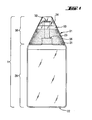
- Fig. 1 shows a side view of a top-up container assembly according to the present invention.
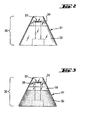
- Fig. 2 shows a side view of a dispensing cap according to the present invention.
- Fig. 3 shows a side view of a another dispensing cap according to the present invention
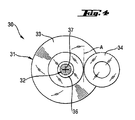
- Fig. 4 shows a top view of a dispensing cap according to the present invention.
- In a first embodiment, the present invention relates to a top-up container assembly (1) comprising a container (20) and a dispensing cap (30). With "top-up", it is meant that the container assembly has a top and a bottom surface, at least a portion of said bottom surface being in contact with a horizontal flat surface when said container assembly is put on that horizontal flat surface. The top surface of the container assembly is located away from said bottom surface, and does not contact the horizontal flat surface, when the container assembly is put on that horizontal surface.
- The container (20) of the present invention may be a bottle or a stand-up pouch where the container is a bottle it is preferably a squeeze-bottle having flexible walls. The container has a bottom surface (22) and a top surface (21) located away from said bottom surface (22), and an opening (23) in said top surface (21). At least a portion of said bottom surface (22) is in contact with a horizontal flat surface when said container (20) is put on that horizontal flat surface. The container (20) useful herein has a hollow body for holding a liquid or gel composition, and is typically formed of plastic, preferably a polymer or resin such as polyethylene, polypropylene, polyethylene terephthalate, polycarbonate, polystyrene, ethyl vinyl alcohol, polyvinyl alcohol, thermoplastic elastomer, and combinations thereof, although other materials known in the art may also be used. Such containers (20) will typically hold from 100 mL to 2 L of liquid, preferably from 150 mL to 1.2 L of liquid, and more preferably from 200 mL to 1 L of liquid, and are well known for holding liquid consumer products. Such containers are widely available from many packaging suppliers.
- By stand-up pouch it is meant that the container may be flexibly deformed, but that it is not resilient in the sense that it recovers its original shape when the deforming pressure is removed. Preferably such containers are formed from plastic film or films which are sealed together at the edge in order to form a closed container. The container is provided with an opening which is sealed around the closure. Most preferably the plastic film is made from polyethylene, polypropylene, polyester or laminate thereof and has a thickness of from 50 to 250 micrometers.
- A dispensing cap (30) is attached to the top surface (21) of the bottle (20). The dispensing cap (30) may be formed as either integral with, or separate from the bottle (20). If formed separately, the dispensing cap (30) may attach to the bottle (20) via methods known in the art such as by employing a transition piece, corresponding threaded male and female members, pressurized and non-pressurized seals, locking and snap-on parts, and/or other methods known in the art. Preferably, the dispensing cap (30) is attached to the bottle (20) via a transition piece and/or with corresponding threaded male and female members which allow easy refilling. The dispensing cap (30) comprises a housing (31), and a valve (32).
- The housing (31) preferably comprises a body (33), and a closing lid (34) which is hinged along an axis (A) to said body (33). The body (33) comprises an opening into which the valve (32) can be fitted in a leak-tight manner. Preferably, the body (33) further comprises a ring (36) which fits into the body's (33) opening, wherein the valve (32) can be fitted in a leak-tight manner. The dispensing cap (30) may further comprise a collar (35) which surrounds the bottom (22) portion of the housing (31) or the body (33). The housing (31), body (33), closing lid (34), ring (36) and collar (35) are typically formed of plastic, preferably a polymer or resin such as polyethylene, polypropylene, polyethylene terephthalate, polycarbonate, polystyrene, ethyl vinyl alcohol, polyvinyl alcohol, thermoplastic elastomer, and combinations thereof, although other materials known in the art may also be used. Most preferably, they are formed of polypropylene.
- The preferred valve (32) is a slit valve (32) having a pair of slits (37) intersecting at the center of the valve (32). Although one pair of slits (37) is preferred, more slits (37) may be present. The valve (32) is preferably formed of silicone or a thermoplastic elastomer. When the bottle (20) is squeezed, the valve (32) opens when the pressure differential across the valve (32) exceeds a predetermined amount (e.g. when the container assembly's (1) interior pressure increases to a predetermined amount relative to standard atmospheric pressure outside the container assembly (1)). The valve (32) may be formed as a unitary part of the dispensing cap (30), or may be mounted in a separate assembly (e.g. a ring (36) as described hereinabove) that is permanently or releasably attached to the dispensing cap (30). Suitable valves for the dispensing cap (30) of the present invention, are readily available on the market, e.g. from Seaquist Closures.
- An essential aspect of the present invention is that at least a portion of the housing (31) is transparent and/or translucent, and that the valve (32) is visually distinctive from the housing (31). With this, it is meant that the valve (32) can be seen through at least a portion of the housing (31), either from the side, from the top, or both. This includes that the valve (32) may be seen either only through a portion of the closing lid (34) (from the side, from the top, or both), or only through the side of at least a portion of the dispensing cap's (1) body (33), or both. This also includes that the valve (32) may be seen through the entire housing (31) from the side and from the top. This also includes that the valve (32) is clearly visible through the housing (31), or that a user can see a haze of different shades and/or colors (valve versus housing), whereby the user is able to distinguish the valve (32) from the housing (31). This also enables a user to easily distinguish dispensing caps having a valve (32) from dispensing caps having a spout. Preferably at least 5%, more preferably at least 10%, even more preferably at least 20%, and up to 100% of the housing (31) material is transparent and/or translucent. When the housing (31) comprises a body (33) and a closing lid (34), preferably at least 5%, more preferably at least 10%, even more preferably at least 20%, and up to 100% of the body (33) and/or closing lid (34) material is transparent and/or translucent. If a ring (36), as described above, is used in the housing (31), it is preferred that the ring (36) is entirely transparent and/or translucent. The valve (32) is preferably not transparent nor translucent.
- In order to improve the visual distinctiveness, it is preferred that the valve (32) is of a different color, more preferably of a contrasting color than the housing (31), body (33) or closing lid (34). Preferably, the valve (32) is colored while the housing (31), body (33) or closing lid (34), are not colored.
- When the dispensing cap (30) comprises a collar (35), it is preferred that the collar (35) is visually distinctive from the housing (31). Preferably the collar (35) is not transparent, nor translucent, and of a different color, preferably of a contrasting color than the housing (31), body (33) or closing lid (34). Most preferably, the collar (35) is in the same color as the valve (32).
- With transparent or translucent, it is meant that the material has a light transmission of at least 35% in the visible spectrum (from 400 nanometers in the violet to 700 nanometers in the red end of the visible spectrum).The light transmission of a material can be measured using commercially available hazemeters or spectrophotometers. One test method for measuring the light transmission of a material, is described in Standard Test Method D-1003 (ASTM D-1003) from the American Society for Testing and Materials, In this test method, a unidirectional perpendicular light beam is directed onto the material, and a photo detector measures the total light transmitted by the specimen after it enters an integrating sphere.
- In a second embodiment, the present invention relates to the use of the dispensing cap (30) described hereinabove, for dispensing a dishwashing cleaning composition. In a third embodiment, the present invention relates to a dishwashing cleaning product comprising the container assembly (1) described hereinabove, and a dishwashing cleaning composition contained in the top-up container assembly (1).
- The dishwashing cleaning composition can be in the form of a liquid or a gel, and typically includes also a solvent, and preferably one or more optional ingredients known in the art of dishwashing, such as enzymes, viscosity modifiers, diamines, carboxylic acids, polymeric suds stabilizers, builders, magnesium ions, chelating agents, hydrophobic block polymers, or organic and inorganic salts. The dishwashing cleaning composition will further preferably comprise one or more detersive adjuncts selected from the following: soil release polymers, polymeric dispersants, polysaccharides, abrasives, bactericides and other antimicrobials, tarnish inhibitors, dyes or pigments, buffers, antifungal or mildew control agents, insect repellents, perfumes, hydrotropes, thickeners, processing aids, suds boosters, brighteners, anti-corrosive aids, stabilizers, antioxidants, a pH controlling agent, a reducing or oxidizing bleach, an odor control agent, antioxidants and free radical inhibitors, and a mixture thereof.
The dishwashing cleaning product will further preferably comprise instructions for using the dishwashing cleaning product. - In a fourth embodiment, the present invention also relates to a method of cleaning dishware, using the dishwashing cleaning product described hereinabove. The method comprises at least the steps of inverting the dishwashing cleaning product, and then squeezing the bottle (20) such that the valve (32) opens and the dishwashing cleaning composition is dispensed from the top-up container assembly (1).
- The composition may be applied to the dishware neat or in dilute form. Thus the dishware may be cleaned singly by applying the composition to the dishware and optionally but preferably subsequently rinsing before drying. Alternatively, the composition can be mixed with water in a suitable vessel, for example a basin, sink or bowl and thus a number of dishes can be cleaned using the same composition and water (dishwater). In a further alternative process the product can be used in dilute form in a suitable vessel as a soaking medium for, typically extremely dirty, dishware. As before the dishware can be optionally, although preferably, rinsed before allowing to dry. Drying may take place passively by allowing for the natural evaporation of water or actively using any suitable drying equipment, for example a cloth or towel.
Claims (26)
- A top-up container assembly (1) comprising:- a container (20) having a bottom surface (22), and a top surface (21) located away from said bottom surface (22), said top surface having an opening (23); and- a dispensing cap (30) attached to said top surface (21) of said container (20), said dispensing cap (30) comprising a housing (31) and a valve (32),characterized in that at least a portion of said housing (31) is transparent and/or translucent, and said valve (32) is visually distinctive from said housing (31), to enable a user of said top-up container assembly (1) to see the valve (32) through the housing (31).
- A top-up container assembly according to claim 1, wherein the container is selected from a bottle or a stand-up pouch.
- The top-up container assembly (1) according to any preceding claim, wherein said housing (31) comprises a body (33), and a closing lid (34), said closing lid (34) being hinged along an axis (A) to said body (33), wherein:- at least a portion of said closing lid (34) is transparent and/or translucent, to enable a user of said top-up container assembly (1) to see the valve (32) through said closing lid (34) when said closing lid (34) is closing said dispensing cap (30); and/or- at least a portion of said body (33) is transparent and/or translucent, to enable a user of said top-up container assembly (1) to see the valve (32) through said body (33).
- The top-up container assembly (1) according to any preceding claim, wherein 5% to 100% of the dispensing cap (30) material is transparent and/or translucent.
- The top-up container assembly (1) according to any preceding claim, wherein- 5% to 100% of the closing lid (34) material is transparent and/or translucent; and/or- 5% to 100% of the body (33) material is transparent and/or translucent.
- The top-up container assembly (1) according to any preceding claim, wherein said valve (32) is a slit valve (32).
- The top-up container assembly (1) according to any preceding claim, wherein said valve (32) and said housing (31) are of a different color.
- The top-up container assembly (1) according to claims 3-7, wherein said valve (32) and said closing lid (34) are of a different color.
- The top-up container assembly (1) according to claims 3-8, wherein said valve (32) and said body (33) are of a different color.
- The top-up container assembly (1) according to any preceding claim, wherein said dispensing cap (30) further comprises a transparent and/or translucent ring (36) wherein the valve (32) is positioned.
- The top-up container assembly (1) according to claims 3-10, wherein the dispensing cap (30) further comprises a collar (35) around said body (33), said collar (35) being visually distinctive from said housing (31),
- The top-up container assembly (1) according to claim 11, wherein the collar (35) and the valve (32) are of the same color.
- A dishwashing cleaning product comprising:- a top-up container assembly (1) according to any preceding claim, and- a dishwashing cleaning composition contained in said top-up container assembly (1).
- A dishwashing cleaning product according to claim 13, wherein said product further comprises instructions for use.
- A method of cleaning dishware with the dishwashing cleaning product of claims 13-14, said method comprising the steps of:- inverting the dishwashing cleaning product; and- squeezing the bottle (20) to open the valve (32), and to dispense the dishwashing cleaning composition from the top-up container assembly (1).
- Use of a dispensing cap (30) comprising a housing (31) and a valve (32), at least a portion of said housing (31) being transparent and/or translucent, and the valve (32) being visually distinctive from said housing (31), to enable a user of said dispensing cap (30) to see the valve (32) through the housing (31), for dispensing a dishwashing cleaning composition.
- The use according to claim 16, wherein said housing (31) comprises a body (33), and a closing lid (34), said closing lid (34) being hinged along an axis (A) to said body (33), wherein- at least a portion of said closing lid (34) is transparent and/or translucent, to enable a user of said top-up container assembly (1) to see the valve (32) through said closing lid (34) when said closing lid (34) is closing the dispensing cap (30); and/or- at least a portion of said body (33) is transparent and/or translucent, to enable a user of said top-up container assembly (1) to see the valve (32) through said body (33).
- The use according to claims 16-17, wherein 5% to 100% of the housing (31) material is transparent and/or translucent.
- The use according to claims 17-18, wherein- 5% to 100% of the closing lid (34) material is transparent and/or translucent; and/or- 5% to 100% of the body (33) material is transparent and/or translucent.
- The use according to claims 16-19, wherein said valve (32) is a slit valve (32).
- The use according to claims 16-20, wherein said valve (32) and said housing (31) are of a different color.
- The use according to claims 17-21, wherein said valve (32) and said closing lid (34) are of a different color.
- The use according to claims 17-22, wherein said valve (32) and said body (33) are of a different color.
- The use according to claims 16-23, wherein said dispensing cap (30) further comprises a transparent and/or translucent ring (36) wherein the valve (32) is positioned.
- The use according to claims 16-24, wherein the dispensing cap (30) further comprises a collar (35) around the body (33), said collar (35) being visually distinctive from said housing (31).
- The use according to claim 25, wherein the collar (35) and the valve (32) are of the same color.
Priority Applications (1)
| Application Number | Priority Date | Filing Date | Title |
|---|---|---|---|
| EP05019967A EP1645520A1 (en) | 2004-10-11 | 2005-09-14 | A top-up container assembly comprising a dispensing cap, and a dishwashing product comprised in the container assembly |
Applications Claiming Priority (2)
| Application Number | Priority Date | Filing Date | Title |
|---|---|---|---|
| EP04077801 | 2004-10-11 | ||
| EP05019967A EP1645520A1 (en) | 2004-10-11 | 2005-09-14 | A top-up container assembly comprising a dispensing cap, and a dishwashing product comprised in the container assembly |
Publications (1)
| Publication Number | Publication Date |
|---|---|
| EP1645520A1 true EP1645520A1 (en) | 2006-04-12 |
Family
ID=36046577
Family Applications (1)
| Application Number | Title | Priority Date | Filing Date |
|---|---|---|---|
| EP05019967A Withdrawn EP1645520A1 (en) | 2004-10-11 | 2005-09-14 | A top-up container assembly comprising a dispensing cap, and a dishwashing product comprised in the container assembly |
Country Status (1)
| Country | Link |
|---|---|
| EP (1) | EP1645520A1 (en) |
Cited By (1)
| Publication number | Priority date | Publication date | Assignee | Title |
|---|---|---|---|---|
| US7874466B2 (en) | 2006-11-07 | 2011-01-25 | The Procter & Gamble Company | Package comprising push-pull closure and slit valve |
Citations (4)
| Publication number | Priority date | Publication date | Assignee | Title |
|---|---|---|---|---|
| GB1474620A (en) * | 1974-09-18 | 1977-05-25 | Blendax Werke Schneider Co | Tube closure |
| US5033655A (en) * | 1989-02-15 | 1991-07-23 | Liquid Molding Systems Inc. | Dispensing package for fluid products and the like |
| EP0885813A2 (en) * | 1997-06-20 | 1998-12-23 | Yoshino Kogyosho Co., Ltd. | Container with a slit valve |
| US6672487B1 (en) * | 2002-06-07 | 2004-01-06 | Owens-Illinois Closure Inc. | Fluid dispensing closure, package and method of manufacture |
-
2005
- 2005-09-14 EP EP05019967A patent/EP1645520A1/en not_active Withdrawn
Patent Citations (4)
| Publication number | Priority date | Publication date | Assignee | Title |
|---|---|---|---|---|
| GB1474620A (en) * | 1974-09-18 | 1977-05-25 | Blendax Werke Schneider Co | Tube closure |
| US5033655A (en) * | 1989-02-15 | 1991-07-23 | Liquid Molding Systems Inc. | Dispensing package for fluid products and the like |
| EP0885813A2 (en) * | 1997-06-20 | 1998-12-23 | Yoshino Kogyosho Co., Ltd. | Container with a slit valve |
| US6672487B1 (en) * | 2002-06-07 | 2004-01-06 | Owens-Illinois Closure Inc. | Fluid dispensing closure, package and method of manufacture |
Cited By (1)
| Publication number | Priority date | Publication date | Assignee | Title |
|---|---|---|---|---|
| US7874466B2 (en) | 2006-11-07 | 2011-01-25 | The Procter & Gamble Company | Package comprising push-pull closure and slit valve |
Similar Documents
| Publication | Publication Date | Title |
|---|---|---|
| US20060076370A1 (en) | Top-up container assembly comprising a dispensing cap, and a dishwashing product comprising the container assembly | |
| EP2024249B1 (en) | Method for treating fabrics | |
| US5226538A (en) | Filled package exhibiting a substantially colorless transparent appearance | |
| US4741459A (en) | Combined closure and measuring device | |
| US10131473B2 (en) | Inverted bottle dispensing systems and methods | |
| US20070270325A1 (en) | Gel compositions contained in bottom dispensing containers | |
| US20070267444A1 (en) | Concentrated compositions contained in bottom dispensing containers | |
| US20140231452A1 (en) | Dispensing Container and Method | |
| CN104981413B (en) | Allocation containers and methods | |
| CN1938197A (en) | Container | |
| US5707590A (en) | Detergent container with thermo-chromatic level indicator | |
| JP7622044B2 (en) | Dispensing Closures | |
| CA2970590A1 (en) | Use of a first film and a second film to improve seal strength of a water-soluble unit dose article | |
| EP1645520A1 (en) | A top-up container assembly comprising a dispensing cap, and a dishwashing product comprised in the container assembly | |
| KR20090003800U (en) | Portable water bottle with detachable structure | |
| AU2005233085B2 (en) | Container | |
| CN215099298U (en) | Cleaner leak-proof seal package assembly | |
| US20020131655A1 (en) | Method and system of flexible packaging for containment of liquid and gaseous fluids | |
| BR102017022451A2 (en) | IMPROVEMENT INTRODUCED IN FLIP-TOP COVER. | |
| KR20040040309A (en) | bottle cap assembly for simultaneously dissolve additives | |
| WO2010063582A1 (en) | Multi-coloured laundry products |
Legal Events
| Date | Code | Title | Description |
|---|---|---|---|
| PUAI | Public reference made under article 153(3) epc to a published international application that has entered the european phase |
Free format text: ORIGINAL CODE: 0009012 |
|
| AK | Designated contracting states |
Kind code of ref document: A1 Designated state(s): AT BE BG CH CY CZ DE DK EE ES FI FR GB GR HU IE IS IT LI LT LU LV MC NL PL PT RO SE SI SK TR |
|
| AX | Request for extension of the european patent |
Extension state: AL BA HR MK YU |
|
| 17P | Request for examination filed |
Effective date: 20061011 |
|
| 17Q | First examination report despatched |
Effective date: 20061121 |
|
| AKX | Designation fees paid |
Designated state(s): AT BE BG CH CY CZ DE DK EE ES FI FR GB GR HU IE IS IT LI LT LU LV MC NL PL PT RO SE SI SK TR |
|
| R17P | Request for examination filed (corrected) |
Effective date: 20061005 |
|
| RBV | Designated contracting states (corrected) |
Designated state(s): AT BE BG CH CY CZ DE DK EE ES FI FR GB GR HU IE IS IT LI LT LU LV MC NL PL PT RO SE SI SK TR |
|
| STAA | Information on the status of an ep patent application or granted ep patent |
Free format text: STATUS: THE APPLICATION IS DEEMED TO BE WITHDRAWN |
|
| 18D | Application deemed to be withdrawn |
Effective date: 20090304 |