EP1641465B1 - Combinations of an aryl aniline beta-2 adrenergic receptor agonist and a corticosteroid - Google Patents
Combinations of an aryl aniline beta-2 adrenergic receptor agonist and a corticosteroid Download PDFInfo
- Publication number
- EP1641465B1 EP1641465B1 EP04809361A EP04809361A EP1641465B1 EP 1641465 B1 EP1641465 B1 EP 1641465B1 EP 04809361 A EP04809361 A EP 04809361A EP 04809361 A EP04809361 A EP 04809361A EP 1641465 B1 EP1641465 B1 EP 1641465B1
- Authority
- EP
- European Patent Office
- Prior art keywords
- hydroxy
- compound
- alkyl
- ethyl
- ethylamine
- Prior art date
- Legal status (The legal status is an assumption and is not a legal conclusion. Google has not performed a legal analysis and makes no representation as to the accuracy of the status listed.)
- Expired - Lifetime
Links
- -1 aryl aniline Chemical compound 0.000 title claims description 180
- 239000003246 corticosteroid Substances 0.000 title claims description 13
- 239000000048 adrenergic agonist Substances 0.000 title abstract description 10
- 229940126157 adrenergic receptor agonist Drugs 0.000 title abstract description 10
- 102000016966 beta-2 Adrenergic Receptors Human genes 0.000 title abstract 3
- 108010014499 beta-2 Adrenergic Receptors Proteins 0.000 title abstract 3
- PAYRUJLWNCNPSJ-UHFFFAOYSA-N N-phenyl amine Natural products NC1=CC=CC=C1 PAYRUJLWNCNPSJ-UHFFFAOYSA-N 0.000 title description 9
- 150000001875 compounds Chemical class 0.000 claims abstract description 542
- 239000008194 pharmaceutical composition Substances 0.000 claims abstract description 26
- 239000003814 drug Substances 0.000 claims abstract description 22
- 201000010099 disease Diseases 0.000 claims abstract description 18
- 208000037265 diseases, disorders, signs and symptoms Diseases 0.000 claims abstract description 18
- 230000000694 effects Effects 0.000 claims abstract description 17
- 239000001257 hydrogen Substances 0.000 claims description 166
- 229910052739 hydrogen Inorganic materials 0.000 claims description 166
- 125000004435 hydrogen atom Chemical group [H]* 0.000 claims description 140
- 239000000203 mixture Substances 0.000 claims description 135
- 125000000217 alkyl group Chemical group 0.000 claims description 98
- 125000003118 aryl group Chemical group 0.000 claims description 76
- IJGRMHOSHXDMSA-UHFFFAOYSA-N Atomic nitrogen Chemical group N#N IJGRMHOSHXDMSA-UHFFFAOYSA-N 0.000 claims description 72
- 125000001072 heteroaryl group Chemical group 0.000 claims description 58
- 125000005843 halogen group Chemical group 0.000 claims description 54
- 125000000623 heterocyclic group Chemical group 0.000 claims description 54
- 150000003839 salts Chemical class 0.000 claims description 54
- 125000001424 substituent group Chemical group 0.000 claims description 54
- 229910052757 nitrogen Chemical group 0.000 claims description 48
- 125000001997 phenyl group Chemical group [H]C1=C([H])C([H])=C(*)C([H])=C1[H] 0.000 claims description 45
- QUSNBJAOOMFDIB-UHFFFAOYSA-N Ethylamine Chemical compound CCN QUSNBJAOOMFDIB-UHFFFAOYSA-N 0.000 claims description 35
- 125000000753 cycloalkyl group Chemical group 0.000 claims description 35
- 238000009472 formulation Methods 0.000 claims description 34
- 125000006273 (C1-C3) alkyl group Chemical group 0.000 claims description 33
- 125000002887 hydroxy group Chemical group [H]O* 0.000 claims description 28
- 125000004093 cyano group Chemical group *C#N 0.000 claims description 25
- 108060003345 Adrenergic Receptor Proteins 0.000 claims description 24
- 102000017910 Adrenergic receptor Human genes 0.000 claims description 24
- 125000003342 alkenyl group Chemical group 0.000 claims description 24
- 125000000304 alkynyl group Chemical group 0.000 claims description 24
- 125000004169 (C1-C6) alkyl group Chemical group 0.000 claims description 23
- UFHFLCQGNIYNRP-UHFFFAOYSA-N Hydrogen Chemical compound [H][H] UFHFLCQGNIYNRP-UHFFFAOYSA-N 0.000 claims description 23
- 239000002253 acid Substances 0.000 claims description 22
- 125000004429 atom Chemical group 0.000 claims description 21
- 125000000449 nitro group Chemical group [O-][N+](*)=O 0.000 claims description 20
- 239000012453 solvate Substances 0.000 claims description 19
- 125000004432 carbon atom Chemical group C* 0.000 claims description 17
- 125000001495 ethyl group Chemical group [H]C([H])([H])C([H])([H])* 0.000 claims description 17
- 125000002023 trifluoromethyl group Chemical group FC(F)(F)* 0.000 claims description 16
- LGFPFBZHAODPHC-LJAQVGFWSA-N 8-hydroxy-5-[(1r)-1-hydroxy-2-[2-[4-(4-methoxy-3-phenylanilino)phenyl]ethylamino]ethyl]-1h-quinolin-2-one Chemical compound COC1=CC=C(NC=2C=CC(CCNC[C@H](O)C=3C=4C=CC(=O)NC=4C(O)=CC=3)=CC=2)C=C1C1=CC=CC=C1 LGFPFBZHAODPHC-LJAQVGFWSA-N 0.000 claims description 14
- 125000004076 pyridyl group Chemical group 0.000 claims description 13
- 125000005842 heteroatom Chemical group 0.000 claims description 12
- SVJCOENLCSINIL-PMERELPUSA-N 3-[5-[4-[2-[[(2r)-2-hydroxy-2-(8-hydroxy-2-oxo-1h-quinolin-5-yl)ethyl]amino]ethyl]anilino]-2-methoxyphenyl]benzonitrile Chemical compound COC1=CC=C(NC=2C=CC(CCNC[C@H](O)C=3C=4C=CC(=O)NC=4C(O)=CC=3)=CC=2)C=C1C1=CC=CC(C#N)=C1 SVJCOENLCSINIL-PMERELPUSA-N 0.000 claims description 10
- CVAIFLZSLRWKRW-NDEPHWFRSA-N 8-hydroxy-5-[(1r)-1-hydroxy-2-[2-[4-(4-methoxy-3-pyridin-3-ylanilino)phenyl]ethylamino]ethyl]-1h-quinolin-2-one Chemical compound COC1=CC=C(NC=2C=CC(CCNC[C@H](O)C=3C=4C=CC(=O)NC=4C(O)=CC=3)=CC=2)C=C1C1=CC=CN=C1 CVAIFLZSLRWKRW-NDEPHWFRSA-N 0.000 claims description 10
- 241000124008 Mammalia Species 0.000 claims description 10
- 125000001309 chloro group Chemical group Cl* 0.000 claims description 10
- 125000000956 methoxy group Chemical group [H]C([H])([H])O* 0.000 claims description 10
- 229910052760 oxygen Inorganic materials 0.000 claims description 10
- 229910052717 sulfur Inorganic materials 0.000 claims description 10
- 125000005605 benzo group Chemical group 0.000 claims description 9
- NINIDFKCEFEMDL-UHFFFAOYSA-N Sulfur Chemical group [S] NINIDFKCEFEMDL-UHFFFAOYSA-N 0.000 claims description 8
- QVGXLLKOCUKJST-UHFFFAOYSA-N atomic oxygen Chemical group [O] QVGXLLKOCUKJST-UHFFFAOYSA-N 0.000 claims description 8
- 239000001301 oxygen Substances 0.000 claims description 8
- 239000011593 sulfur Chemical group 0.000 claims description 8
- FNXIJFDPJNNYRS-LJAQVGFWSA-N 5-[(1r)-2-[2-[4-[3-(3-chlorophenyl)-4-methoxyanilino]phenyl]ethylamino]-1-hydroxyethyl]-8-hydroxy-1h-quinolin-2-one Chemical compound COC1=CC=C(NC=2C=CC(CCNC[C@H](O)C=3C=4C=CC(=O)NC=4C(O)=CC=3)=CC=2)C=C1C1=CC=CC(Cl)=C1 FNXIJFDPJNNYRS-LJAQVGFWSA-N 0.000 claims description 7
- CJOMMFVMZGNTNI-LJAQVGFWSA-N 4-[(1r)-1-hydroxy-2-[2-[4-(4-methoxy-3-phenylanilino)phenyl]ethylamino]ethyl]-2-(hydroxymethyl)phenol Chemical compound C1([C@@H](O)CNCCC2=CC=C(C=C2)NC2=CC=C(C(=C2)C=2C=CC=CC=2)OC)=CC=C(O)C(CO)=C1 CJOMMFVMZGNTNI-LJAQVGFWSA-N 0.000 claims description 6
- BBKQWNRTHAAOCF-PMERELPUSA-N 5-[(1r)-2-[2-[4-[3-[3-(aminomethyl)phenyl]-4-methoxyanilino]phenyl]ethylamino]-1-hydroxyethyl]-8-hydroxy-1h-quinolin-2-one Chemical compound COC1=CC=C(NC=2C=CC(CCNC[C@H](O)C=3C=4C=CC(=O)NC=4C(O)=CC=3)=CC=2)C=C1C1=CC=CC(CN)=C1 BBKQWNRTHAAOCF-PMERELPUSA-N 0.000 claims description 6
- 208000006545 Chronic Obstructive Pulmonary Disease Diseases 0.000 claims description 6
- 208000006673 asthma Diseases 0.000 claims description 6
- 125000002924 primary amino group Chemical group [H]N([H])* 0.000 claims description 6
- 125000006413 ring segment Chemical group 0.000 claims description 6
- DRZXKXOBOODCLQ-PMERELPUSA-N 3-[3-[4-[2-[[(2r)-2-hydroxy-2-(8-hydroxy-2-oxo-1h-quinolin-5-yl)ethyl]amino]ethyl]anilino]phenyl]benzonitrile Chemical compound C([C@H](O)C=1C=2C=CC(=O)NC=2C(O)=CC=1)NCCC(C=C1)=CC=C1NC(C=1)=CC=CC=1C1=CC=CC(C#N)=C1 DRZXKXOBOODCLQ-PMERELPUSA-N 0.000 claims description 5
- FYXBZOFYWHUPHB-VWLOTQADSA-N 4-[(1r)-2-[2-[4-(4-ethoxyanilino)phenyl]ethylamino]-1-hydroxyethyl]-2-(hydroxymethyl)phenol Chemical compound C1=CC(OCC)=CC=C1NC(C=C1)=CC=C1CCNC[C@H](O)C1=CC=C(O)C(CO)=C1 FYXBZOFYWHUPHB-VWLOTQADSA-N 0.000 claims description 5
- COPATRABLBBGEU-VWLOTQADSA-N 5-[(1r)-2-[2-[4-(4-ethoxyanilino)phenyl]ethylamino]-1-hydroxyethyl]-8-hydroxy-1h-quinolin-2-one Chemical compound C1=CC(OCC)=CC=C1NC(C=C1)=CC=C1CCNC[C@H](O)C1=CC=C(O)C2=C1C=CC(=O)N2 COPATRABLBBGEU-VWLOTQADSA-N 0.000 claims description 5
- 229910052799 carbon Inorganic materials 0.000 claims description 5
- 125000003178 carboxy group Chemical group [H]OC(*)=O 0.000 claims description 5
- DZCJGTXLXBKUKQ-PMERELPUSA-N n-[5-[(1r)-2-[2-[4-(4-ethoxy-3-phenylanilino)phenyl]ethylamino]-1-hydroxyethyl]-2-hydroxyphenyl]formamide Chemical compound C1([C@@H](O)CNCCC2=CC=C(C=C2)NC2=CC=C(C(=C2)C=2C=CC=CC=2)OCC)=CC=C(O)C(NC=O)=C1 DZCJGTXLXBKUKQ-PMERELPUSA-N 0.000 claims description 5
- PIWVSFCIQGQMCM-VWLOTQADSA-N n-[5-[(1r)-2-[2-[4-(4-ethoxyanilino)phenyl]ethylamino]-1-hydroxyethyl]-2-hydroxyphenyl]formamide Chemical compound C1=CC(OCC)=CC=C1NC(C=C1)=CC=C1CCNC[C@H](O)C1=CC=C(O)C(NC=O)=C1 PIWVSFCIQGQMCM-VWLOTQADSA-N 0.000 claims description 5
- 125000000876 trifluoromethoxy group Chemical group FC(F)(F)O* 0.000 claims description 5
- 125000003545 alkoxy group Chemical group 0.000 claims description 4
- 125000001544 thienyl group Chemical group 0.000 claims description 4
- 125000004209 (C1-C8) alkyl group Chemical group 0.000 claims description 3
- LZZOJKLDFNTQBD-LJAQVGFWSA-N 5-[(1r)-2-[2-[4-[3-(2-chlorophenyl)anilino]phenyl]ethylamino]-1-hydroxyethyl]-8-hydroxy-1h-quinolin-2-one Chemical compound C([C@H](O)C=1C=2C=CC(=O)NC=2C(O)=CC=1)NCCC(C=C1)=CC=C1NC(C=1)=CC=CC=1C1=CC=CC=C1Cl LZZOJKLDFNTQBD-LJAQVGFWSA-N 0.000 claims description 3
- XOTFMQVONSEWJB-LJAQVGFWSA-N 5-[(1r)-2-[2-[4-[3-(3-chlorophenyl)anilino]phenyl]ethylamino]-1-hydroxyethyl]-8-hydroxy-1h-quinolin-2-one Chemical compound C([C@H](O)C=1C=2C=CC(=O)NC=2C(O)=CC=1)NCCC(C=C1)=CC=C1NC(C=1)=CC=CC=1C1=CC=CC(Cl)=C1 XOTFMQVONSEWJB-LJAQVGFWSA-N 0.000 claims description 3
- NAAAMDLFTKRKIT-PMERELPUSA-N 5-[(1r)-2-[2-[4-[3-[4-(aminomethyl)phenyl]anilino]phenyl]ethylamino]-1-hydroxyethyl]-8-hydroxy-1h-quinolin-2-one Chemical compound C1=CC(CN)=CC=C1C1=CC=CC(NC=2C=CC(CCNC[C@H](O)C=3C=4C=CC(=O)NC=4C(O)=CC=3)=CC=2)=C1 NAAAMDLFTKRKIT-PMERELPUSA-N 0.000 claims description 3
- RKZAXZSOHSHISQ-NDEPHWFRSA-N 8-hydroxy-5-[(1r)-1-hydroxy-2-[2-[4-(3-pyridin-3-ylanilino)phenyl]ethylamino]ethyl]-1h-quinolin-2-one Chemical compound C([C@H](O)C=1C=2C=CC(=O)NC=2C(O)=CC=1)NCCC(C=C1)=CC=C1NC(C=1)=CC=CC=1C1=CC=CN=C1 RKZAXZSOHSHISQ-NDEPHWFRSA-N 0.000 claims description 3
- KWXLZNXMJLPLML-NDEPHWFRSA-N 8-hydroxy-5-[(1r)-1-hydroxy-2-[2-[4-(4-methoxy-3-pyridin-4-ylanilino)phenyl]ethylamino]ethyl]-1h-quinolin-2-one Chemical compound COC1=CC=C(NC=2C=CC(CCNC[C@H](O)C=3C=4C=CC(=O)NC=4C(O)=CC=3)=CC=2)C=C1C1=CC=NC=C1 KWXLZNXMJLPLML-NDEPHWFRSA-N 0.000 claims description 3
- KVBHGBPGFGLEBB-MHZLTWQESA-N 8-hydroxy-5-[(1r)-1-hydroxy-2-[2-[4-(4-methoxy-3-thiophen-3-ylanilino)phenyl]ethylamino]ethyl]-1h-quinolin-2-one Chemical compound COC1=CC=C(NC=2C=CC(CCNC[C@H](O)C=3C=4C=CC(=O)NC=4C(O)=CC=3)=CC=2)C=C1C=1C=CSC=1 KVBHGBPGFGLEBB-MHZLTWQESA-N 0.000 claims description 3
- XYVDXJWYNBOXGP-LJAQVGFWSA-N 8-hydroxy-5-[(1r)-1-hydroxy-2-[2-[4-[3-(2-methoxyphenyl)anilino]phenyl]ethylamino]ethyl]-1h-quinolin-2-one Chemical compound COC1=CC=CC=C1C1=CC=CC(NC=2C=CC(CCNC[C@H](O)C=3C=4C=CC(=O)NC=4C(O)=CC=3)=CC=2)=C1 XYVDXJWYNBOXGP-LJAQVGFWSA-N 0.000 claims description 3
- KHWMPYQHTRVARE-LJAQVGFWSA-N 8-hydroxy-5-[(1r)-1-hydroxy-2-[2-[4-[3-(4-hydroxyphenyl)-4-methoxyanilino]phenyl]ethylamino]ethyl]-1h-quinolin-2-one Chemical compound COC1=CC=C(NC=2C=CC(CCNC[C@H](O)C=3C=4C=CC(=O)NC=4C(O)=CC=3)=CC=2)C=C1C1=CC=C(O)C=C1 KHWMPYQHTRVARE-LJAQVGFWSA-N 0.000 claims description 3
- 239000003937 drug carrier Substances 0.000 claims description 3
- DYDZPCGUFFYCPJ-DEOSSOPVSA-N 4-[(1r)-1-hydroxy-2-[2-[4-(4-methoxyanilino)phenyl]ethylamino]ethyl]-2-(hydroxymethyl)phenol Chemical compound C1=CC(OC)=CC=C1NC(C=C1)=CC=C1CCNC[C@H](O)C1=CC=C(O)C(CO)=C1 DYDZPCGUFFYCPJ-DEOSSOPVSA-N 0.000 claims description 2
- PNZAXIDLAKAMRG-PMERELPUSA-N 5-[(1r)-2-[2-[4-(4-ethoxy-3-phenylanilino)phenyl]ethylamino]-1-hydroxyethyl]-8-hydroxy-1h-quinolin-2-one Chemical compound CCOC1=CC=C(NC=2C=CC(CCNC[C@H](O)C=3C=4C=CC(=O)NC=4C(O)=CC=3)=CC=2)C=C1C1=CC=CC=C1 PNZAXIDLAKAMRG-PMERELPUSA-N 0.000 claims description 2
- IZVZIUJQBUGSLL-LJAQVGFWSA-N 8-hydroxy-5-[(1r)-1-hydroxy-2-[2-[4-(3-phenylanilino)phenyl]ethylamino]ethyl]-1h-quinolin-2-one Chemical compound C([C@H](O)C=1C=2C=CC(=O)NC=2C(O)=CC=1)NCCC(C=C1)=CC=C1NC(C=1)=CC=CC=1C1=CC=CC=C1 IZVZIUJQBUGSLL-LJAQVGFWSA-N 0.000 claims description 2
- 238000004519 manufacturing process Methods 0.000 claims description 2
- 238000013160 medical therapy Methods 0.000 claims description 2
- BFBGMBKWKSFKEV-LJAQVGFWSA-N n-[2-hydroxy-5-[(1r)-1-hydroxy-2-[2-[4-(3-phenylanilino)phenyl]ethylamino]ethyl]phenyl]formamide Chemical compound C([C@H](O)C=1C=C(NC=O)C(O)=CC=1)NCCC(C=C1)=CC=C1NC(C=1)=CC=CC=1C1=CC=CC=C1 BFBGMBKWKSFKEV-LJAQVGFWSA-N 0.000 claims description 2
- CYCWKKKGVOKMAD-DEOSSOPVSA-N n-[2-hydroxy-5-[(1r)-1-hydroxy-2-[2-[4-(4-methoxyanilino)phenyl]ethylamino]ethyl]phenyl]formamide Chemical compound C1=CC(OC)=CC=C1NC(C=C1)=CC=C1CCNC[C@H](O)C1=CC=C(O)C(NC=O)=C1 CYCWKKKGVOKMAD-DEOSSOPVSA-N 0.000 claims description 2
- 150000002431 hydrogen Chemical group 0.000 claims 9
- PKTWFFHSTPILMD-LJAQVGFWSA-N 2-(hydroxymethyl)-4-[(1r)-1-hydroxy-2-[2-[4-(3-phenylanilino)phenyl]ethylamino]ethyl]phenol Chemical compound C1=C(O)C(CO)=CC([C@@H](O)CNCCC=2C=CC(NC=3C=C(C=CC=3)C=3C=CC=CC=3)=CC=2)=C1 PKTWFFHSTPILMD-LJAQVGFWSA-N 0.000 claims 1
- 238000000034 method Methods 0.000 abstract description 107
- 239000000543 intermediate Substances 0.000 abstract description 58
- 229940124597 therapeutic agent Drugs 0.000 abstract description 17
- 230000008569 process Effects 0.000 abstract description 13
- YMWUJEATGCHHMB-UHFFFAOYSA-N Dichloromethane Chemical compound ClCCl YMWUJEATGCHHMB-UHFFFAOYSA-N 0.000 description 242
- OKKJLVBELUTLKV-UHFFFAOYSA-N Methanol Chemical compound OC OKKJLVBELUTLKV-UHFFFAOYSA-N 0.000 description 201
- XEKOWRVHYACXOJ-UHFFFAOYSA-N Ethyl acetate Chemical compound CCOC(C)=O XEKOWRVHYACXOJ-UHFFFAOYSA-N 0.000 description 165
- 238000003786 synthesis reaction Methods 0.000 description 151
- 230000015572 biosynthetic process Effects 0.000 description 150
- 239000000243 solution Substances 0.000 description 140
- IAZDPXIOMUYVGZ-WFGJKAKNSA-N Dimethyl sulfoxide Chemical compound [2H]C([2H])([2H])S(=O)C([2H])([2H])[2H] IAZDPXIOMUYVGZ-WFGJKAKNSA-N 0.000 description 116
- RTZKZFJDLAIYFH-UHFFFAOYSA-N Diethyl ether Chemical compound CCOCC RTZKZFJDLAIYFH-UHFFFAOYSA-N 0.000 description 101
- WEVYAHXRMPXWCK-UHFFFAOYSA-N Acetonitrile Chemical compound CC#N WEVYAHXRMPXWCK-UHFFFAOYSA-N 0.000 description 99
- HEMHJVSKTPXQMS-UHFFFAOYSA-M Sodium hydroxide Chemical compound [OH-].[Na+] HEMHJVSKTPXQMS-UHFFFAOYSA-M 0.000 description 99
- 238000006243 chemical reaction Methods 0.000 description 93
- YXFVVABEGXRONW-UHFFFAOYSA-N Toluene Chemical compound CC1=CC=CC=C1 YXFVVABEGXRONW-UHFFFAOYSA-N 0.000 description 90
- XLYOFNOQVPJJNP-UHFFFAOYSA-N water Substances O XLYOFNOQVPJJNP-UHFFFAOYSA-N 0.000 description 87
- WYURNTSHIVDZCO-UHFFFAOYSA-N Tetrahydrofuran Chemical compound C1CCOC1 WYURNTSHIVDZCO-UHFFFAOYSA-N 0.000 description 83
- 239000003921 oil Substances 0.000 description 75
- 235000019198 oils Nutrition 0.000 description 75
- KDLHZDBZIXYQEI-UHFFFAOYSA-N Palladium Chemical compound [Pd] KDLHZDBZIXYQEI-UHFFFAOYSA-N 0.000 description 72
- 235000019439 ethyl acetate Nutrition 0.000 description 65
- 230000002829 reductive effect Effects 0.000 description 64
- 238000005160 1H NMR spectroscopy Methods 0.000 description 60
- VEXZGXHMUGYJMC-UHFFFAOYSA-N Hydrochloric acid Chemical compound Cl VEXZGXHMUGYJMC-UHFFFAOYSA-N 0.000 description 59
- 235000002639 sodium chloride Nutrition 0.000 description 59
- 239000007787 solid Substances 0.000 description 59
- LFQSCWFLJHTTHZ-UHFFFAOYSA-N Ethanol Chemical compound CCO LFQSCWFLJHTTHZ-UHFFFAOYSA-N 0.000 description 52
- 230000008878 coupling Effects 0.000 description 51
- 238000005859 coupling reaction Methods 0.000 description 51
- 238000010168 coupling process Methods 0.000 description 50
- 239000000047 product Substances 0.000 description 50
- CSNNHWWHGAXBCP-UHFFFAOYSA-L Magnesium sulfate Chemical compound [Mg+2].[O-][S+2]([O-])([O-])[O-] CSNNHWWHGAXBCP-UHFFFAOYSA-L 0.000 description 49
- VLKZOEOYAKHREP-UHFFFAOYSA-N n-Hexane Chemical class CCCCCC VLKZOEOYAKHREP-UHFFFAOYSA-N 0.000 description 42
- DTQVDTLACAAQTR-UHFFFAOYSA-N Trifluoroacetic acid Chemical compound OC(=O)C(F)(F)F DTQVDTLACAAQTR-UHFFFAOYSA-N 0.000 description 41
- 239000012071 phase Substances 0.000 description 41
- IXCSERBJSXMMFS-UHFFFAOYSA-N hydrogen chloride Substances Cl.Cl IXCSERBJSXMMFS-UHFFFAOYSA-N 0.000 description 40
- 229910000041 hydrogen chloride Inorganic materials 0.000 description 40
- PMZURENOXWZQFD-UHFFFAOYSA-L Sodium Sulfate Chemical compound [Na+].[Na+].[O-]S([O-])(=O)=O PMZURENOXWZQFD-UHFFFAOYSA-L 0.000 description 39
- KFZMGEQAYNKOFK-UHFFFAOYSA-N Isopropanol Chemical compound CC(C)O KFZMGEQAYNKOFK-UHFFFAOYSA-N 0.000 description 38
- VYPSYNLAJGMNEJ-UHFFFAOYSA-N Silicium dioxide Chemical group O=[Si]=O VYPSYNLAJGMNEJ-UHFFFAOYSA-N 0.000 description 38
- 229910052938 sodium sulfate Inorganic materials 0.000 description 37
- 239000002904 solvent Substances 0.000 description 33
- ZMXDDKWLCZADIW-UHFFFAOYSA-N N,N-Dimethylformamide Chemical compound CN(C)C=O ZMXDDKWLCZADIW-UHFFFAOYSA-N 0.000 description 31
- UIIMBOGNXHQVGW-UHFFFAOYSA-M Sodium bicarbonate Chemical compound [Na+].OC([O-])=O UIIMBOGNXHQVGW-UHFFFAOYSA-M 0.000 description 31
- 239000000843 powder Substances 0.000 description 31
- 239000007832 Na2SO4 Substances 0.000 description 30
- 239000012267 brine Substances 0.000 description 27
- HPALAKNZSZLMCH-UHFFFAOYSA-M sodium;chloride;hydrate Chemical compound O.[Na+].[Cl-] HPALAKNZSZLMCH-UHFFFAOYSA-M 0.000 description 27
- FAPWRFPIFSIZLT-UHFFFAOYSA-M Sodium chloride Chemical compound [Na+].[Cl-] FAPWRFPIFSIZLT-UHFFFAOYSA-M 0.000 description 26
- MFRIHAYPQRLWNB-UHFFFAOYSA-N sodium tert-butoxide Chemical compound [Na+].CC(C)(C)[O-] MFRIHAYPQRLWNB-UHFFFAOYSA-N 0.000 description 26
- 229910052943 magnesium sulfate Inorganic materials 0.000 description 24
- 238000010898 silica gel chromatography Methods 0.000 description 24
- IAZDPXIOMUYVGZ-UHFFFAOYSA-N Dimethylsulphoxide Chemical compound CS(C)=O IAZDPXIOMUYVGZ-UHFFFAOYSA-N 0.000 description 22
- BWHMMNNQKKPAPP-UHFFFAOYSA-L potassium carbonate Chemical compound [K+].[K+].[O-]C([O-])=O BWHMMNNQKKPAPP-UHFFFAOYSA-L 0.000 description 22
- 239000000725 suspension Substances 0.000 description 22
- ZMANZCXQSJIPKH-UHFFFAOYSA-N Triethylamine Chemical compound CCN(CC)CC ZMANZCXQSJIPKH-UHFFFAOYSA-N 0.000 description 21
- 239000000706 filtrate Substances 0.000 description 21
- QTBSBXVTEAMEQO-UHFFFAOYSA-N Acetic acid Chemical compound CC(O)=O QTBSBXVTEAMEQO-UHFFFAOYSA-N 0.000 description 20
- 210000004027 cell Anatomy 0.000 description 20
- 238000003556 assay Methods 0.000 description 19
- 238000004007 reversed phase HPLC Methods 0.000 description 19
- YLQBMQCUIZJEEH-UHFFFAOYSA-N tetrahydrofuran Natural products C=1C=COC=1 YLQBMQCUIZJEEH-UHFFFAOYSA-N 0.000 description 19
- 238000002360 preparation method Methods 0.000 description 18
- 235000019502 Orange oil Nutrition 0.000 description 16
- 239000007983 Tris buffer Substances 0.000 description 16
- 239000010502 orange oil Substances 0.000 description 16
- 239000012044 organic layer Substances 0.000 description 16
- 229920006395 saturated elastomer Polymers 0.000 description 16
- 239000000741 silica gel Substances 0.000 description 16
- 229910002027 silica gel Inorganic materials 0.000 description 16
- BGAGGXVJRUDTEP-DHUJRADRSA-N 5-[(1r)-1-hydroxy-2-[2-[4-(4-methoxy-3-phenylanilino)phenyl]ethylamino]ethyl]-8-phenylmethoxy-1h-quinolin-2-one Chemical compound C1=2NC(=O)C=CC=2C([C@@H](O)CNCCC2=CC=C(C=C2)NC2=CC=C(C(=C2)C=2C=CC=CC=2)OC)=CC=C1OCC1=CC=CC=C1 BGAGGXVJRUDTEP-DHUJRADRSA-N 0.000 description 15
- 239000002002 slurry Substances 0.000 description 15
- 239000000126 substance Substances 0.000 description 15
- QCQCHGYLTSGIGX-GHXANHINSA-N 4-[[(3ar,5ar,5br,7ar,9s,11ar,11br,13as)-5a,5b,8,8,11a-pentamethyl-3a-[(5-methylpyridine-3-carbonyl)amino]-2-oxo-1-propan-2-yl-4,5,6,7,7a,9,10,11,11b,12,13,13a-dodecahydro-3h-cyclopenta[a]chrysen-9-yl]oxy]-2,2-dimethyl-4-oxobutanoic acid Chemical compound N([C@@]12CC[C@@]3(C)[C@]4(C)CC[C@H]5C(C)(C)[C@@H](OC(=O)CC(C)(C)C(O)=O)CC[C@]5(C)[C@H]4CC[C@@H]3C1=C(C(C2)=O)C(C)C)C(=O)C1=CN=CC(C)=C1 QCQCHGYLTSGIGX-GHXANHINSA-N 0.000 description 14
- 229940123932 Phosphodiesterase 4 inhibitor Drugs 0.000 description 14
- 238000001914 filtration Methods 0.000 description 14
- 239000006260 foam Substances 0.000 description 14
- 239000004615 ingredient Substances 0.000 description 14
- 239000002587 phosphodiesterase IV inhibitor Substances 0.000 description 14
- 125000006239 protecting group Chemical group 0.000 description 14
- 239000011541 reaction mixture Substances 0.000 description 14
- KCXVZYZYPLLWCC-UHFFFAOYSA-N EDTA Chemical compound OC(=O)CN(CC(O)=O)CCN(CC(O)=O)CC(O)=O KCXVZYZYPLLWCC-UHFFFAOYSA-N 0.000 description 13
- 125000001797 benzyl group Chemical group [H]C1=C([H])C([H])=C(C([H])=C1[H])C([H])([H])* 0.000 description 13
- 239000003054 catalyst Substances 0.000 description 13
- 239000002245 particle Substances 0.000 description 13
- CSCPPACGZOOCGX-UHFFFAOYSA-N Acetone Chemical compound CC(C)=O CSCPPACGZOOCGX-UHFFFAOYSA-N 0.000 description 12
- MUALRAIOVNYAIW-UHFFFAOYSA-N binap Chemical group C1=CC=CC=C1P(C=1C(=C2C=CC=CC2=CC=1)C=1C2=CC=CC=C2C=CC=1P(C=1C=CC=CC=1)C=1C=CC=CC=1)C1=CC=CC=C1 MUALRAIOVNYAIW-UHFFFAOYSA-N 0.000 description 12
- UORVGPXVDQYIDP-UHFFFAOYSA-N borane Chemical compound B UORVGPXVDQYIDP-UHFFFAOYSA-N 0.000 description 12
- GKIPXFAANLTWBM-UHFFFAOYSA-N epibromohydrin Chemical compound BrCC1CO1 GKIPXFAANLTWBM-UHFFFAOYSA-N 0.000 description 12
- 125000004433 nitrogen atom Chemical group N* 0.000 description 12
- 150000002924 oxiranes Chemical class 0.000 description 12
- 229910052763 palladium Inorganic materials 0.000 description 12
- 230000002685 pulmonary effect Effects 0.000 description 12
- 229910000030 sodium bicarbonate Inorganic materials 0.000 description 12
- WBHQBSYUUJJSRZ-UHFFFAOYSA-M sodium bisulfate Chemical compound [Na+].OS([O-])(=O)=O WBHQBSYUUJJSRZ-UHFFFAOYSA-M 0.000 description 12
- 229910000342 sodium bisulfate Inorganic materials 0.000 description 12
- 238000003756 stirring Methods 0.000 description 12
- 238000012360 testing method Methods 0.000 description 12
- RYHBNJHYFVUHQT-UHFFFAOYSA-N 1,4-Dioxane Chemical compound C1COCCO1 RYHBNJHYFVUHQT-UHFFFAOYSA-N 0.000 description 11
- 239000012043 crude product Substances 0.000 description 11
- 239000010410 layer Substances 0.000 description 11
- 239000012299 nitrogen atmosphere Substances 0.000 description 11
- 229910000027 potassium carbonate Inorganic materials 0.000 description 11
- LISFMEBWQUVKPJ-UHFFFAOYSA-N quinolin-2-ol Chemical compound C1=CC=C2NC(=O)C=CC2=C1 LISFMEBWQUVKPJ-UHFFFAOYSA-N 0.000 description 11
- XTHFKEDIFFGKHM-UHFFFAOYSA-N Dimethoxyethane Chemical compound COCCOC XTHFKEDIFFGKHM-UHFFFAOYSA-N 0.000 description 10
- TWRXJAOTZQYOKJ-UHFFFAOYSA-L Magnesium chloride Chemical compound [Mg+2].[Cl-].[Cl-] TWRXJAOTZQYOKJ-UHFFFAOYSA-L 0.000 description 10
- 102000011017 Type 4 Cyclic Nucleotide Phosphodiesterases Human genes 0.000 description 10
- 108010037584 Type 4 Cyclic Nucleotide Phosphodiesterases Proteins 0.000 description 10
- 239000000872 buffer Substances 0.000 description 10
- HQKMJHAJHXVSDF-UHFFFAOYSA-L magnesium stearate Chemical compound [Mg+2].CCCCCCCCCCCCCCCCCC([O-])=O.CCCCCCCCCCCCCCCCCC([O-])=O HQKMJHAJHXVSDF-UHFFFAOYSA-L 0.000 description 10
- HJORMJIFDVBMOB-UHFFFAOYSA-N rolipram Chemical compound COC1=CC=C(C2CC(=O)NC2)C=C1OC1CCCC1 HJORMJIFDVBMOB-UHFFFAOYSA-N 0.000 description 10
- 229950005741 rolipram Drugs 0.000 description 10
- 239000011780 sodium chloride Substances 0.000 description 10
- 238000011282 treatment Methods 0.000 description 10
- MSYGAHOHLUJIKV-UHFFFAOYSA-N 3,5-dimethyl-1-(3-nitrophenyl)-1h-pyrazole-4-carboxylic acid ethyl ester Chemical compound CC1=C(C(=O)OCC)C(C)=NN1C1=CC=CC([N+]([O-])=O)=C1 MSYGAHOHLUJIKV-UHFFFAOYSA-N 0.000 description 9
- GUBGYTABKSRVRQ-QKKXKWKRSA-N Lactose Natural products OC[C@H]1O[C@@H](O[C@H]2[C@H](O)[C@@H](O)C(O)O[C@@H]2CO)[C@H](O)[C@@H](O)[C@H]1O GUBGYTABKSRVRQ-QKKXKWKRSA-N 0.000 description 9
- OIPILFWXSMYKGL-UHFFFAOYSA-N acetylcholine Chemical compound CC(=O)OCC[N+](C)(C)C OIPILFWXSMYKGL-UHFFFAOYSA-N 0.000 description 9
- 239000005557 antagonist Substances 0.000 description 9
- 239000012298 atmosphere Substances 0.000 description 9
- 238000004128 high performance liquid chromatography Methods 0.000 description 9
- 239000008101 lactose Substances 0.000 description 9
- 239000007788 liquid Substances 0.000 description 9
- 238000000746 purification Methods 0.000 description 9
- FVAUCKIRQBBSSJ-UHFFFAOYSA-M sodium iodide Chemical compound [Na+].[I-] FVAUCKIRQBBSSJ-UHFFFAOYSA-M 0.000 description 9
- XDBHWPLGGBLUHH-UHFFFAOYSA-N (3-cyanophenyl)boronic acid Chemical compound OB(O)C1=CC=CC(C#N)=C1 XDBHWPLGGBLUHH-UHFFFAOYSA-N 0.000 description 8
- ONIVGWWTHRIXHL-UHFFFAOYSA-N 4-methoxy-3-phenylaniline;hydrochloride Chemical compound Cl.COC1=CC=C(N)C=C1C1=CC=CC=C1 ONIVGWWTHRIXHL-UHFFFAOYSA-N 0.000 description 8
- 238000009739 binding Methods 0.000 description 8
- 239000003795 chemical substances by application Substances 0.000 description 8
- 239000003480 eluent Substances 0.000 description 8
- 239000003112 inhibitor Substances 0.000 description 8
- 239000012528 membrane Substances 0.000 description 8
- 239000012074 organic phase Substances 0.000 description 8
- HXITXNWTGFUOAU-UHFFFAOYSA-N phenylboronic acid Chemical compound OB(O)C1=CC=CC=C1 HXITXNWTGFUOAU-UHFFFAOYSA-N 0.000 description 8
- 125000000714 pyrimidinyl group Chemical group 0.000 description 8
- 125000004191 (C1-C6) alkoxy group Chemical group 0.000 description 7
- XDTMQSROBMDMFD-UHFFFAOYSA-N Cyclohexane Chemical compound C1CCCCC1 XDTMQSROBMDMFD-UHFFFAOYSA-N 0.000 description 7
- WQZGKKKJIJFFOK-GASJEMHNSA-N Glucose Natural products OC[C@H]1OC(O)[C@H](O)[C@@H](O)[C@@H]1O WQZGKKKJIJFFOK-GASJEMHNSA-N 0.000 description 7
- 229960000583 acetic acid Drugs 0.000 description 7
- 230000027455 binding Effects 0.000 description 7
- 125000004573 morpholin-4-yl group Chemical group N1(CCOCC1)* 0.000 description 7
- 239000006199 nebulizer Substances 0.000 description 7
- 239000002953 phosphate buffered saline Substances 0.000 description 7
- 235000011152 sodium sulphate Nutrition 0.000 description 7
- LENZDBCJOHFCAS-UHFFFAOYSA-N tris Chemical compound OCC(N)(CO)CO LENZDBCJOHFCAS-UHFFFAOYSA-N 0.000 description 7
- CYPYTURSJDMMMP-WVCUSYJESA-N (1e,4e)-1,5-diphenylpenta-1,4-dien-3-one;palladium Chemical compound [Pd].[Pd].C=1C=CC=CC=1\C=C\C(=O)\C=C\C1=CC=CC=C1.C=1C=CC=CC=1\C=C\C(=O)\C=C\C1=CC=CC=C1.C=1C=CC=CC=1\C=C\C(=O)\C=C\C1=CC=CC=C1 CYPYTURSJDMMMP-WVCUSYJESA-N 0.000 description 6
- 125000004178 (C1-C4) alkyl group Chemical group 0.000 description 6
- DJMOXMNDXFFONV-UHFFFAOYSA-N 1,3-dimethyl-7-[2-(n-methylanilino)ethyl]purine-2,6-dione Chemical compound C1=NC=2N(C)C(=O)N(C)C(=O)C=2N1CCN(C)C1=CC=CC=C1 DJMOXMNDXFFONV-UHFFFAOYSA-N 0.000 description 6
- OISVCGZHLKNMSJ-UHFFFAOYSA-N 2,6-dimethylpyridine Chemical compound CC1=CC=CC(C)=N1 OISVCGZHLKNMSJ-UHFFFAOYSA-N 0.000 description 6
- OWYLDGZCEYWIJH-LJAQVGFWSA-N 3-[5-[4-[2-[[(2r)-2-hydroxy-2-(8-hydroxy-2-oxo-1h-quinolin-5-yl)ethyl]amino]ethyl]anilino]-2-methoxyphenyl]benzamide Chemical compound COC1=CC=C(NC=2C=CC(CCNC[C@H](O)C=3C=4C=CC(=O)NC=4C(O)=CC=3)=CC=2)C=C1C1=CC=CC(C(N)=O)=C1 OWYLDGZCEYWIJH-LJAQVGFWSA-N 0.000 description 6
- IMPPGHMHELILKG-UHFFFAOYSA-N 4-ethoxyaniline Chemical compound CCOC1=CC=C(N)C=C1 IMPPGHMHELILKG-UHFFFAOYSA-N 0.000 description 6
- MVYPGJMOODJFAZ-UHFFFAOYSA-N 5-acetyl-8-phenylmethoxy-1h-quinolin-2-one Chemical compound C1=2NC(=O)C=CC=2C(C(=O)C)=CC=C1OCC1=CC=CC=C1 MVYPGJMOODJFAZ-UHFFFAOYSA-N 0.000 description 6
- LGFPFBZHAODPHC-UHFFFAOYSA-N 8-hydroxy-5-[1-hydroxy-2-[2-[4-(4-methoxy-3-phenylanilino)phenyl]ethylamino]ethyl]-1h-quinolin-2-one Chemical compound COC1=CC=C(NC=2C=CC(CCNCC(O)C=3C=4C=CC(=O)NC=4C(O)=CC=3)=CC=2)C=C1C1=CC=CC=C1 LGFPFBZHAODPHC-UHFFFAOYSA-N 0.000 description 6
- WFDIJRYMOXRFFG-UHFFFAOYSA-N Acetic anhydride Chemical compound CC(=O)OC(C)=O WFDIJRYMOXRFFG-UHFFFAOYSA-N 0.000 description 6
- LYCAIKOWRPUZTN-UHFFFAOYSA-N Ethylene glycol Chemical compound OCCO LYCAIKOWRPUZTN-UHFFFAOYSA-N 0.000 description 6
- CTQNGGLPUBDAKN-UHFFFAOYSA-N O-Xylene Chemical group CC1=CC=CC=C1C CTQNGGLPUBDAKN-UHFFFAOYSA-N 0.000 description 6
- HEDRZPFGACZZDS-MICDWDOJSA-N Trichloro(2H)methane Chemical compound [2H]C(Cl)(Cl)Cl HEDRZPFGACZZDS-MICDWDOJSA-N 0.000 description 6
- 239000000443 aerosol Substances 0.000 description 6
- 239000000556 agonist Substances 0.000 description 6
- 239000000739 antihistaminic agent Substances 0.000 description 6
- 229910000085 borane Inorganic materials 0.000 description 6
- 125000001246 bromo group Chemical group Br* 0.000 description 6
- FJDQFPXHSGXQBY-UHFFFAOYSA-L caesium carbonate Chemical compound [Cs+].[Cs+].[O-]C([O-])=O FJDQFPXHSGXQBY-UHFFFAOYSA-L 0.000 description 6
- 229910000024 caesium carbonate Inorganic materials 0.000 description 6
- 230000003197 catalytic effect Effects 0.000 description 6
- NXQGGXCHGDYOHB-UHFFFAOYSA-L cyclopenta-1,4-dien-1-yl(diphenyl)phosphane;dichloropalladium;iron(2+) Chemical compound [Fe+2].Cl[Pd]Cl.[CH-]1C=CC(P(C=2C=CC=CC=2)C=2C=CC=CC=2)=C1.[CH-]1C=CC(P(C=2C=CC=CC=2)C=2C=CC=CC=2)=C1 NXQGGXCHGDYOHB-UHFFFAOYSA-L 0.000 description 6
- 238000010511 deprotection reaction Methods 0.000 description 6
- 229960001760 dimethyl sulfoxide Drugs 0.000 description 6
- 125000002496 methyl group Chemical group [H]C([H])([H])* 0.000 description 6
- 230000036515 potency Effects 0.000 description 6
- FPGGTKZVZWFYPV-UHFFFAOYSA-M tetrabutylammonium fluoride Chemical compound [F-].CCCC[N+](CCCC)(CCCC)CCCC FPGGTKZVZWFYPV-UHFFFAOYSA-M 0.000 description 6
- UTMRKCQYCLEKDL-UHFFFAOYSA-N (2-oxo-1h-quinolin-8-yl) acetate Chemical compound C1=CC(=O)NC2=C1C=CC=C2OC(=O)C UTMRKCQYCLEKDL-UHFFFAOYSA-N 0.000 description 5
- IIZPXYDJLKNOIY-JXPKJXOSSA-N 1-palmitoyl-2-arachidonoyl-sn-glycero-3-phosphocholine Chemical compound CCCCCCCCCCCCCCCC(=O)OC[C@H](COP([O-])(=O)OCC[N+](C)(C)C)OC(=O)CCC\C=C/C\C=C/C\C=C/C\C=C/CCCCC IIZPXYDJLKNOIY-JXPKJXOSSA-N 0.000 description 5
- LIJFFIKZSBNEFB-UHFFFAOYSA-N 3-(2-methoxy-5-nitrophenyl)benzonitrile Chemical compound COC1=CC=C([N+]([O-])=O)C=C1C1=CC=CC(C#N)=C1 LIJFFIKZSBNEFB-UHFFFAOYSA-N 0.000 description 5
- LFWLLSFPVLCZLM-QNGWXLTQSA-N 5-[(1r)-2-[2-[4-[3-[3-[(benzylamino)methyl]phenyl]-4-methoxyanilino]phenyl]ethylamino]-1-hydroxyethyl]-8-hydroxy-1h-quinolin-2-one Chemical compound COC1=CC=C(NC=2C=CC(CCNC[C@H](O)C=3C=4C=CC(=O)NC=4C(O)=CC=3)=CC=2)C=C1C(C=1)=CC=CC=1CNCC1=CC=CC=C1 LFWLLSFPVLCZLM-QNGWXLTQSA-N 0.000 description 5
- SKADTYBOPRWKKH-PMERELPUSA-N 5-[(1r)-2-[2-[4-[3-[4-(aminomethyl)phenyl]-4-methoxyanilino]phenyl]ethylamino]-1-hydroxyethyl]-8-hydroxy-1h-quinolin-2-one Chemical compound COC1=CC=C(NC=2C=CC(CCNC[C@H](O)C=3C=4C=CC(=O)NC=4C(O)=CC=3)=CC=2)C=C1C1=CC=C(CN)C=C1 SKADTYBOPRWKKH-PMERELPUSA-N 0.000 description 5
- PJVZAXRWCFBQFH-UHFFFAOYSA-N 5-acetyl-8-hydroxy-1h-quinolin-2-one Chemical compound N1C(=O)C=CC2=C1C(O)=CC=C2C(=O)C PJVZAXRWCFBQFH-UHFFFAOYSA-N 0.000 description 5
- DUQYTUCUEXQTRC-XIFFEERXSA-N 8-hydroxy-5-[(1r)-1-hydroxy-2-[2-[4-[4-methoxy-3-[3-[(propan-2-ylamino)methyl]phenyl]anilino]phenyl]ethylamino]ethyl]-1h-quinolin-2-one Chemical compound COC1=CC=C(NC=2C=CC(CCNC[C@H](O)C=3C=4C=CC(=O)NC=4C(O)=CC=3)=CC=2)C=C1C1=CC=CC(CNC(C)C)=C1 DUQYTUCUEXQTRC-XIFFEERXSA-N 0.000 description 5
- 208000020446 Cardiac disease Diseases 0.000 description 5
- 241000700199 Cavia porcellus Species 0.000 description 5
- 208000019693 Lung disease Diseases 0.000 description 5
- 208000012902 Nervous system disease Diseases 0.000 description 5
- 208000006399 Premature Obstetric Labor Diseases 0.000 description 5
- 229930006000 Sucrose Natural products 0.000 description 5
- CZMRCDWAGMRECN-UGDNZRGBSA-N Sucrose Chemical compound O[C@H]1[C@H](O)[C@@H](CO)O[C@@]1(CO)O[C@@H]1[C@H](O)[C@@H](O)[C@H](O)[C@@H](CO)O1 CZMRCDWAGMRECN-UGDNZRGBSA-N 0.000 description 5
- 239000004480 active ingredient Substances 0.000 description 5
- 239000013543 active substance Substances 0.000 description 5
- 125000002252 acyl group Chemical group 0.000 description 5
- 150000001412 amines Chemical class 0.000 description 5
- 239000008121 dextrose Substances 0.000 description 5
- 238000003818 flash chromatography Methods 0.000 description 5
- 239000012458 free base Substances 0.000 description 5
- 208000019622 heart disease Diseases 0.000 description 5
- JMMWKPVZQRWMSS-UHFFFAOYSA-N isopropanol acetate Natural products CC(C)OC(C)=O JMMWKPVZQRWMSS-UHFFFAOYSA-N 0.000 description 5
- 229940011051 isopropyl acetate Drugs 0.000 description 5
- GWYFCOCPABKNJV-UHFFFAOYSA-N isovaleric acid Chemical compound CC(C)CC(O)=O GWYFCOCPABKNJV-UHFFFAOYSA-N 0.000 description 5
- 239000000787 lecithin Substances 0.000 description 5
- 235000010445 lecithin Nutrition 0.000 description 5
- 229940067606 lecithin Drugs 0.000 description 5
- 229910001629 magnesium chloride Inorganic materials 0.000 description 5
- 235000019359 magnesium stearate Nutrition 0.000 description 5
- PIBWKRNGBLPSSY-UHFFFAOYSA-L palladium(II) chloride Chemical compound Cl[Pd]Cl PIBWKRNGBLPSSY-UHFFFAOYSA-L 0.000 description 5
- 239000000546 pharmaceutical excipient Substances 0.000 description 5
- 239000003380 propellant Substances 0.000 description 5
- 238000010992 reflux Methods 0.000 description 5
- 235000017557 sodium bicarbonate Nutrition 0.000 description 5
- 239000012279 sodium borohydride Substances 0.000 description 5
- 229910000033 sodium borohydride Inorganic materials 0.000 description 5
- 239000005720 sucrose Substances 0.000 description 5
- 239000004094 surface-active agent Substances 0.000 description 5
- 125000001981 tert-butyldimethylsilyl group Chemical group [H]C([H])([H])[Si]([H])(C([H])([H])[H])[*]C(C([H])([H])[H])(C([H])([H])[H])C([H])([H])[H] 0.000 description 5
- ZSZCXAOQVBEPME-UHFFFAOYSA-N 2-(4-bromophenyl)ethanamine Chemical compound NCCC1=CC=C(Br)C=C1 ZSZCXAOQVBEPME-UHFFFAOYSA-N 0.000 description 4
- IQFHGSFDGGJWSJ-UHFFFAOYSA-N 2-(4-iodophenyl)ethanamine Chemical compound NCCC1=CC=C(I)C=C1 IQFHGSFDGGJWSJ-UHFFFAOYSA-N 0.000 description 4
- PKTWFFHSTPILMD-UHFFFAOYSA-N 2-(hydroxymethyl)-4-[1-hydroxy-2-[2-[4-(3-phenylanilino)phenyl]ethylamino]ethyl]phenol Chemical compound C1=C(O)C(CO)=CC(C(O)CNCCC=2C=CC(NC=3C=C(C=CC=3)C=3C=CC=CC=3)=CC=2)=C1 PKTWFFHSTPILMD-UHFFFAOYSA-N 0.000 description 4
- SCYLMWMDVDCROC-UHFFFAOYSA-N 3-(5-amino-2-methoxyphenyl)benzonitrile Chemical compound COC1=CC=C(N)C=C1C1=CC=CC(C#N)=C1 SCYLMWMDVDCROC-UHFFFAOYSA-N 0.000 description 4
- QUWDYMFCEDKOMS-UHFFFAOYSA-N 3-[3-(aminomethyl)phenyl]-4-methoxyaniline Chemical compound COC1=CC=C(N)C=C1C1=CC=CC(CN)=C1 QUWDYMFCEDKOMS-UHFFFAOYSA-N 0.000 description 4
- BEEKZKGPUBPOPQ-PMERELPUSA-N 4-[(1r)-2-[2-[4-(4-ethoxy-3-phenylanilino)phenyl]ethylamino]-1-hydroxyethyl]-2-(hydroxymethyl)phenol Chemical compound C1([C@@H](O)CNCCC2=CC=C(C=C2)NC2=CC=C(C(=C2)C=2C=CC=CC=2)OCC)=CC=C(O)C(CO)=C1 BEEKZKGPUBPOPQ-PMERELPUSA-N 0.000 description 4
- FYXBZOFYWHUPHB-UHFFFAOYSA-N 4-[2-[2-[4-(4-ethoxyanilino)phenyl]ethylamino]-1-hydroxyethyl]-2-(hydroxymethyl)phenol Chemical compound C1=CC(OCC)=CC=C1NC(C=C1)=CC=C1CCNCC(O)C1=CC=C(O)C(CO)=C1 FYXBZOFYWHUPHB-UHFFFAOYSA-N 0.000 description 4
- DXMDTEWUJRKKKO-UHFFFAOYSA-N 4-methoxy-3-[3-[(propan-2-ylamino)methyl]phenyl]aniline Chemical compound COC1=CC=C(N)C=C1C1=CC=CC(CNC(C)C)=C1 DXMDTEWUJRKKKO-UHFFFAOYSA-N 0.000 description 4
- HEDRZPFGACZZDS-UHFFFAOYSA-N Chloroform Chemical compound ClC(Cl)Cl HEDRZPFGACZZDS-UHFFFAOYSA-N 0.000 description 4
- 101100135868 Dictyostelium discoideum pde3 gene Proteins 0.000 description 4
- 239000006144 Dulbecco’s modified Eagle's medium Substances 0.000 description 4
- PEDCQBHIVMGVHV-UHFFFAOYSA-N Glycerine Chemical compound OCC(O)CO PEDCQBHIVMGVHV-UHFFFAOYSA-N 0.000 description 4
- 101001033280 Homo sapiens Cytokine receptor common subunit beta Proteins 0.000 description 4
- RKUNBYITZUJHSG-UHFFFAOYSA-N Hyosciamin-hydrochlorid Natural products CN1C(C2)CCC1CC2OC(=O)C(CO)C1=CC=CC=C1 RKUNBYITZUJHSG-UHFFFAOYSA-N 0.000 description 4
- 206010061218 Inflammation Diseases 0.000 description 4
- 241001465754 Metazoa Species 0.000 description 4
- YNAVUWVOSKDBBP-UHFFFAOYSA-N Morpholine Chemical compound C1COCCN1 YNAVUWVOSKDBBP-UHFFFAOYSA-N 0.000 description 4
- 229940121948 Muscarinic receptor antagonist Drugs 0.000 description 4
- 229940123263 Phosphodiesterase 3 inhibitor Drugs 0.000 description 4
- GLUUGHFHXGJENI-UHFFFAOYSA-N Piperazine Chemical compound C1CNCCN1 GLUUGHFHXGJENI-UHFFFAOYSA-N 0.000 description 4
- 108010021119 Trichosanthin Proteins 0.000 description 4
- QATYQNLGEIONRB-UHFFFAOYSA-N [3-(2-methoxy-5-nitrophenyl)phenyl]methanamine Chemical compound COC1=CC=C([N+]([O-])=O)C=C1C1=CC=CC(CN)=C1 QATYQNLGEIONRB-UHFFFAOYSA-N 0.000 description 4
- 229940125715 antihistaminic agent Drugs 0.000 description 4
- 125000005002 aryl methyl group Chemical group 0.000 description 4
- 239000012131 assay buffer Substances 0.000 description 4
- WQZGKKKJIJFFOK-VFUOTHLCSA-N beta-D-glucose Chemical compound OC[C@H]1O[C@@H](O)[C@H](O)[C@@H](O)[C@@H]1O WQZGKKKJIJFFOK-VFUOTHLCSA-N 0.000 description 4
- 150000001642 boronic acid derivatives Chemical class 0.000 description 4
- BPKIGYQJPYCAOW-FFJTTWKXSA-I calcium;potassium;disodium;(2s)-2-hydroxypropanoate;dichloride;dihydroxide;hydrate Chemical compound O.[OH-].[OH-].[Na+].[Na+].[Cl-].[Cl-].[K+].[Ca+2].C[C@H](O)C([O-])=O BPKIGYQJPYCAOW-FFJTTWKXSA-I 0.000 description 4
- 239000011203 carbon fibre reinforced carbon Substances 0.000 description 4
- 238000005119 centrifugation Methods 0.000 description 4
- 239000000812 cholinergic antagonist Substances 0.000 description 4
- 229960001334 corticosteroids Drugs 0.000 description 4
- 125000000113 cyclohexyl group Chemical group [H]C1([H])C([H])([H])C([H])([H])C([H])(*)C([H])([H])C1([H])[H] 0.000 description 4
- 150000002148 esters Chemical class 0.000 description 4
- 239000012091 fetal bovine serum Substances 0.000 description 4
- 125000001153 fluoro group Chemical group F* 0.000 description 4
- 125000000524 functional group Chemical group 0.000 description 4
- 239000007789 gas Substances 0.000 description 4
- 239000007903 gelatin capsule Substances 0.000 description 4
- BRZYSWJRSDMWLG-CAXSIQPQSA-N geneticin Chemical compound O1C[C@@](O)(C)[C@H](NC)[C@@H](O)[C@H]1O[C@@H]1[C@@H](O)[C@H](O[C@@H]2[C@@H]([C@@H](O)[C@H](O)[C@@H](C(C)O)O2)N)[C@@H](N)C[C@H]1N BRZYSWJRSDMWLG-CAXSIQPQSA-N 0.000 description 4
- ZTQSADJAYQOCDD-UHFFFAOYSA-N ginsenoside-Rd2 Natural products C1CC(C2(CCC3C(C)(C)C(OC4C(C(O)C(O)C(CO)O4)O)CCC3(C)C2CC2O)C)(C)C2C1C(C)(CCC=C(C)C)OC(C(C(O)C1O)O)OC1COC1OCC(O)C(O)C1O ZTQSADJAYQOCDD-UHFFFAOYSA-N 0.000 description 4
- 102000055647 human CSF2RB Human genes 0.000 description 4
- 230000004054 inflammatory process Effects 0.000 description 4
- 210000004072 lung Anatomy 0.000 description 4
- 239000000463 material Substances 0.000 description 4
- LXCFILQKKLGQFO-UHFFFAOYSA-N methylparaben Chemical compound COC(=O)C1=CC=C(O)C=C1 LXCFILQKKLGQFO-UHFFFAOYSA-N 0.000 description 4
- 125000002950 monocyclic group Chemical group 0.000 description 4
- PZCSJBQJENRLHD-LJAQVGFWSA-N n-[2-hydroxy-5-[(1r)-1-hydroxy-2-[2-[4-(4-methoxy-3-phenylanilino)phenyl]ethylamino]ethyl]phenyl]formamide Chemical compound C1([C@@H](O)CNCCC2=CC=C(C=C2)NC2=CC=C(C(=C2)C=2C=CC=CC=2)OC)=CC=C(O)C(NC=O)=C1 PZCSJBQJENRLHD-LJAQVGFWSA-N 0.000 description 4
- 239000000041 non-steroidal anti-inflammatory agent Substances 0.000 description 4
- 229940021182 non-steroidal anti-inflammatory drug Drugs 0.000 description 4
- 239000008188 pellet Substances 0.000 description 4
- 239000002570 phosphodiesterase III inhibitor Substances 0.000 description 4
- 125000000587 piperidin-1-yl group Chemical group [H]C1([H])N(*)C([H])([H])C([H])([H])C([H])([H])C1([H])[H] 0.000 description 4
- 229920001223 polyethylene glycol Polymers 0.000 description 4
- 125000001436 propyl group Chemical group [H]C([*])([H])C([H])([H])C([H])([H])[H] 0.000 description 4
- LVTJOONKWUXEFR-FZRMHRINSA-N protoneodioscin Natural products O(C[C@@H](CC[C@]1(O)[C@H](C)[C@@H]2[C@]3(C)[C@H]([C@H]4[C@@H]([C@]5(C)C(=CC4)C[C@@H](O[C@@H]4[C@H](O[C@H]6[C@@H](O)[C@@H](O)[C@@H](O)[C@H](C)O6)[C@@H](O)[C@H](O[C@H]6[C@@H](O)[C@@H](O)[C@@H](O)[C@H](C)O6)[C@H](CO)O4)CC5)CC3)C[C@@H]2O1)C)[C@H]1[C@H](O)[C@H](O)[C@H](O)[C@@H](CO)O1 LVTJOONKWUXEFR-FZRMHRINSA-N 0.000 description 4
- 230000004044 response Effects 0.000 description 4
- 239000000377 silicon dioxide Substances 0.000 description 4
- DYHSDKLCOJIUFX-UHFFFAOYSA-N tert-butoxycarbonyl anhydride Chemical compound CC(C)(C)OC(=O)OC(=O)OC(C)(C)C DYHSDKLCOJIUFX-UHFFFAOYSA-N 0.000 description 4
- 125000000335 thiazolyl group Chemical group 0.000 description 4
- 239000012485 toluene extract Substances 0.000 description 4
- JWZZKOKVBUJMES-UHFFFAOYSA-N (+-)-Isoprenaline Chemical compound CC(C)NCC(O)C1=CC=C(O)C(O)=C1 JWZZKOKVBUJMES-UHFFFAOYSA-N 0.000 description 3
- GCTFTMWXZFLTRR-GFCCVEGCSA-N (2r)-2-amino-n-[3-(difluoromethoxy)-4-(1,3-oxazol-5-yl)phenyl]-4-methylpentanamide Chemical compound FC(F)OC1=CC(NC(=O)[C@H](N)CC(C)C)=CC=C1C1=CN=CO1 GCTFTMWXZFLTRR-GFCCVEGCSA-N 0.000 description 3
- DEVSOMFAQLZNKR-RJRFIUFISA-N (z)-3-[3-[3,5-bis(trifluoromethyl)phenyl]-1,2,4-triazol-1-yl]-n'-pyrazin-2-ylprop-2-enehydrazide Chemical compound FC(F)(F)C1=CC(C(F)(F)F)=CC(C2=NN(\C=C/C(=O)NNC=3N=CC=NC=3)C=N2)=C1 DEVSOMFAQLZNKR-RJRFIUFISA-N 0.000 description 3
- LVGUZGTVOIAKKC-UHFFFAOYSA-N 1,1,1,2-tetrafluoroethane Chemical compound FCC(F)(F)F LVGUZGTVOIAKKC-UHFFFAOYSA-N 0.000 description 3
- NMUFTXMBONJQTC-UHFFFAOYSA-N 3-bromo-4-methoxyaniline Chemical compound COC1=CC=C(N)C=C1Br NMUFTXMBONJQTC-UHFFFAOYSA-N 0.000 description 3
- CJOMMFVMZGNTNI-UHFFFAOYSA-N 4-[1-hydroxy-2-[2-[4-(4-methoxy-3-phenylanilino)phenyl]ethylamino]ethyl]-2-(hydroxymethyl)phenol Chemical compound C1=C(C=2C=CC=CC=2)C(OC)=CC=C1NC(C=C1)=CC=C1CCNCC(O)C1=CC=C(O)C(CO)=C1 CJOMMFVMZGNTNI-UHFFFAOYSA-N 0.000 description 3
- CPELXLSAUQHCOX-UHFFFAOYSA-M Bromide Chemical compound [Br-] CPELXLSAUQHCOX-UHFFFAOYSA-M 0.000 description 3
- JQUCWIWWWKZNCS-LESHARBVSA-N C(C1=CC=CC=C1)(=O)NC=1SC[C@H]2[C@@](N1)(CO[C@H](C2)C)C=2SC=C(N2)NC(=O)C2=NC=C(C=C2)OC(F)F Chemical compound C(C1=CC=CC=C1)(=O)NC=1SC[C@H]2[C@@](N1)(CO[C@H](C2)C)C=2SC=C(N2)NC(=O)C2=NC=C(C=C2)OC(F)F JQUCWIWWWKZNCS-LESHARBVSA-N 0.000 description 3
- 241000700198 Cavia Species 0.000 description 3
- 229940126062 Compound A Drugs 0.000 description 3
- 229920002261 Corn starch Polymers 0.000 description 3
- VZCYOOQTPOCHFL-OWOJBTEDSA-N Fumaric acid Chemical compound OC(=O)\C=C\C(O)=O VZCYOOQTPOCHFL-OWOJBTEDSA-N 0.000 description 3
- DHMQDGOQFOQNFH-UHFFFAOYSA-N Glycine Chemical compound NCC(O)=O DHMQDGOQFOQNFH-UHFFFAOYSA-N 0.000 description 3
- NLDMNSXOCDLTTB-UHFFFAOYSA-N Heterophylliin A Natural products O1C2COC(=O)C3=CC(O)=C(O)C(O)=C3C3=C(O)C(O)=C(O)C=C3C(=O)OC2C(OC(=O)C=2C=C(O)C(O)=C(O)C=2)C(O)C1OC(=O)C1=CC(O)=C(O)C(O)=C1 NLDMNSXOCDLTTB-UHFFFAOYSA-N 0.000 description 3
- CPELXLSAUQHCOX-UHFFFAOYSA-N Hydrogen bromide Chemical class Br CPELXLSAUQHCOX-UHFFFAOYSA-N 0.000 description 3
- 229920000168 Microcrystalline cellulose Polymers 0.000 description 3
- LVDRREOUMKACNJ-BKMJKUGQSA-N N-[(2R,3S)-2-(4-chlorophenyl)-1-(1,4-dimethyl-2-oxoquinolin-7-yl)-6-oxopiperidin-3-yl]-2-methylpropane-1-sulfonamide Chemical compound CC(C)CS(=O)(=O)N[C@H]1CCC(=O)N([C@@H]1c1ccc(Cl)cc1)c1ccc2c(C)cc(=O)n(C)c2c1 LVDRREOUMKACNJ-BKMJKUGQSA-N 0.000 description 3
- 102000004861 Phosphoric Diester Hydrolases Human genes 0.000 description 3
- 108090001050 Phosphoric Diester Hydrolases Proteins 0.000 description 3
- NQRYJNQNLNOLGT-UHFFFAOYSA-N Piperidine Chemical compound C1CCNCC1 NQRYJNQNLNOLGT-UHFFFAOYSA-N 0.000 description 3
- 239000002202 Polyethylene glycol Substances 0.000 description 3
- 229920002472 Starch Polymers 0.000 description 3
- GUGOEEXESWIERI-UHFFFAOYSA-N Terfenadine Chemical compound C1=CC(C(C)(C)C)=CC=C1C(O)CCCN1CCC(C(O)(C=2C=CC=CC=2)C=2C=CC=CC=2)CC1 GUGOEEXESWIERI-UHFFFAOYSA-N 0.000 description 3
- 125000004453 alkoxycarbonyl group Chemical group 0.000 description 3
- 150000003973 alkyl amines Chemical class 0.000 description 3
- 230000001387 anti-histamine Effects 0.000 description 3
- 229940121363 anti-inflammatory agent Drugs 0.000 description 3
- 239000002260 anti-inflammatory agent Substances 0.000 description 3
- 239000007864 aqueous solution Substances 0.000 description 3
- GZUXJHMPEANEGY-UHFFFAOYSA-N bromomethane Chemical class BrC GZUXJHMPEANEGY-UHFFFAOYSA-N 0.000 description 3
- 239000002775 capsule Substances 0.000 description 3
- MOIPGXQKZSZOQX-UHFFFAOYSA-N carbonyl bromide Chemical compound BrC(Br)=O MOIPGXQKZSZOQX-UHFFFAOYSA-N 0.000 description 3
- 239000000969 carrier Substances 0.000 description 3
- IJOOHPMOJXWVHK-UHFFFAOYSA-N chlorotrimethylsilane Chemical compound C[Si](C)(C)Cl IJOOHPMOJXWVHK-UHFFFAOYSA-N 0.000 description 3
- 238000004587 chromatography analysis Methods 0.000 description 3
- KRKNYBCHXYNGOX-UHFFFAOYSA-N citric acid Chemical compound OC(=O)CC(O)(C(O)=O)CC(O)=O KRKNYBCHXYNGOX-UHFFFAOYSA-N 0.000 description 3
- 229940125900 compound 59 Drugs 0.000 description 3
- JNGZXGGOCLZBFB-IVCQMTBJSA-N compound E Chemical compound N([C@@H](C)C(=O)N[C@@H]1C(N(C)C2=CC=CC=C2C(C=2C=CC=CC=2)=N1)=O)C(=O)CC1=CC(F)=CC(F)=C1 JNGZXGGOCLZBFB-IVCQMTBJSA-N 0.000 description 3
- 239000008120 corn starch Substances 0.000 description 3
- 229940099112 cornstarch Drugs 0.000 description 3
- KFGVRWGDTLZAAO-UHFFFAOYSA-N cyclopenta-1,3-diene dicyclohexyl(cyclopenta-1,3-dien-1-yl)phosphane iron(2+) Chemical compound [Fe++].c1cc[cH-]c1.C1CCC(CC1)P(C1CCCCC1)c1ccc[cH-]1 KFGVRWGDTLZAAO-UHFFFAOYSA-N 0.000 description 3
- 231100000673 dose–response relationship Toxicity 0.000 description 3
- 229940079593 drug Drugs 0.000 description 3
- BJXYHBKEQFQVES-NWDGAFQWSA-N enpatoran Chemical compound N[C@H]1CN(C[C@H](C1)C(F)(F)F)C1=C2C=CC=NC2=C(C=C1)C#N BJXYHBKEQFQVES-NWDGAFQWSA-N 0.000 description 3
- 239000012530 fluid Substances 0.000 description 3
- 229960000289 fluticasone propionate Drugs 0.000 description 3
- WMWTYOKRWGGJOA-CENSZEJFSA-N fluticasone propionate Chemical compound C1([C@@H](F)C2)=CC(=O)C=C[C@]1(C)[C@]1(F)[C@@H]2[C@@H]2C[C@@H](C)[C@@](C(=O)SCF)(OC(=O)CC)[C@@]2(C)C[C@@H]1O WMWTYOKRWGGJOA-CENSZEJFSA-N 0.000 description 3
- FVIZARNDLVOMSU-UHFFFAOYSA-N ginsenoside K Natural products C1CC(C2(CCC3C(C)(C)C(O)CCC3(C)C2CC2O)C)(C)C2C1C(C)(CCC=C(C)C)OC1OC(CO)C(O)C(O)C1O FVIZARNDLVOMSU-UHFFFAOYSA-N 0.000 description 3
- NSILVESQCSUIAJ-UHFFFAOYSA-M hexocyclium methyl sulfate Chemical compound COS([O-])(=O)=O.C1C[N+](C)(C)CCN1CC(O)(C=1C=CC=CC=1)C1CCCCC1 NSILVESQCSUIAJ-UHFFFAOYSA-M 0.000 description 3
- 150000002430 hydrocarbons Chemical group 0.000 description 3
- 150000003840 hydrochlorides Chemical class 0.000 description 3
- IKGLACJFEHSFNN-UHFFFAOYSA-N hydron;triethylazanium;trifluoride Chemical compound F.F.F.CCN(CC)CC IKGLACJFEHSFNN-UHFFFAOYSA-N 0.000 description 3
- 238000007913 intrathecal administration Methods 0.000 description 3
- 238000001990 intravenous administration Methods 0.000 description 3
- 229940039009 isoproterenol Drugs 0.000 description 3
- 239000012280 lithium aluminium hydride Substances 0.000 description 3
- 235000019341 magnesium sulphate Nutrition 0.000 description 3
- 238000005259 measurement Methods 0.000 description 3
- 239000002609 medium Substances 0.000 description 3
- 235000019813 microcrystalline cellulose Nutrition 0.000 description 3
- 239000008108 microcrystalline cellulose Substances 0.000 description 3
- 229940016286 microcrystalline cellulose Drugs 0.000 description 3
- 229940078552 o-xylene Drugs 0.000 description 3
- 235000013855 polyvinylpyrrolidone Nutrition 0.000 description 3
- NLKNQRATVPKPDG-UHFFFAOYSA-M potassium iodide Chemical compound [K+].[I-] NLKNQRATVPKPDG-UHFFFAOYSA-M 0.000 description 3
- 125000002755 pyrazolinyl group Chemical group 0.000 description 3
- 238000000611 regression analysis Methods 0.000 description 3
- 238000011160 research Methods 0.000 description 3
- WRIKHQLVHPKCJU-UHFFFAOYSA-N sodium bis(trimethylsilyl)amide Chemical compound C[Si](C)(C)N([Na])[Si](C)(C)C WRIKHQLVHPKCJU-UHFFFAOYSA-N 0.000 description 3
- 235000009518 sodium iodide Nutrition 0.000 description 3
- RSIJVJUOQBWMIM-UHFFFAOYSA-L sodium sulfate decahydrate Chemical compound O.O.O.O.O.O.O.O.O.O.[Na+].[Na+].[O-]S([O-])(=O)=O RSIJVJUOQBWMIM-UHFFFAOYSA-L 0.000 description 3
- 239000007921 spray Substances 0.000 description 3
- 239000008107 starch Substances 0.000 description 3
- 235000019698 starch Nutrition 0.000 description 3
- 229940032147 starch Drugs 0.000 description 3
- 125000005931 tert-butyloxycarbonyl group Chemical group [H]C([H])([H])C(OC(*)=O)(C([H])([H])[H])C([H])([H])[H] 0.000 description 3
- 125000003396 thiol group Chemical group [H]S* 0.000 description 3
- FAQYAMRNWDIXMY-UHFFFAOYSA-N trichloroborane Chemical compound ClB(Cl)Cl FAQYAMRNWDIXMY-UHFFFAOYSA-N 0.000 description 3
- 239000008215 water for injection Substances 0.000 description 3
- HDTRYLNUVZCQOY-UHFFFAOYSA-N α-D-glucopyranosyl-α-D-glucopyranoside Natural products OC1C(O)C(O)C(CO)OC1OC1C(O)C(O)C(O)C(CO)O1 HDTRYLNUVZCQOY-UHFFFAOYSA-N 0.000 description 2
- ASGMFNBUXDJWJJ-JLCFBVMHSA-N (1R,3R)-3-[[3-bromo-1-[4-(5-methyl-1,3,4-thiadiazol-2-yl)phenyl]pyrazolo[3,4-d]pyrimidin-6-yl]amino]-N,1-dimethylcyclopentane-1-carboxamide Chemical compound BrC1=NN(C2=NC(=NC=C21)N[C@H]1C[C@@](CC1)(C(=O)NC)C)C1=CC=C(C=C1)C=1SC(=NN=1)C ASGMFNBUXDJWJJ-JLCFBVMHSA-N 0.000 description 2
- UAOUIVVJBYDFKD-XKCDOFEDSA-N (1R,9R,10S,11R,12R,15S,18S,21R)-10,11,21-trihydroxy-8,8-dimethyl-14-methylidene-4-(prop-2-enylamino)-20-oxa-5-thia-3-azahexacyclo[9.7.2.112,15.01,9.02,6.012,18]henicosa-2(6),3-dien-13-one Chemical compound C([C@@H]1[C@@H](O)[C@@]23C(C1=C)=O)C[C@H]2[C@]12C(N=C(NCC=C)S4)=C4CC(C)(C)[C@H]1[C@H](O)[C@]3(O)OC2 UAOUIVVJBYDFKD-XKCDOFEDSA-N 0.000 description 2
- AOSZTAHDEDLTLQ-AZKQZHLXSA-N (1S,2S,4R,8S,9S,11S,12R,13S,19S)-6-[(3-chlorophenyl)methyl]-12,19-difluoro-11-hydroxy-8-(2-hydroxyacetyl)-9,13-dimethyl-6-azapentacyclo[10.8.0.02,9.04,8.013,18]icosa-14,17-dien-16-one Chemical compound C([C@@H]1C[C@H]2[C@H]3[C@]([C@]4(C=CC(=O)C=C4[C@@H](F)C3)C)(F)[C@@H](O)C[C@@]2([C@@]1(C1)C(=O)CO)C)N1CC1=CC=CC(Cl)=C1 AOSZTAHDEDLTLQ-AZKQZHLXSA-N 0.000 description 2
- ABJSOROVZZKJGI-OCYUSGCXSA-N (1r,2r,4r)-2-(4-bromophenyl)-n-[(4-chlorophenyl)-(2-fluoropyridin-4-yl)methyl]-4-morpholin-4-ylcyclohexane-1-carboxamide Chemical compound C1=NC(F)=CC(C(NC(=O)[C@H]2[C@@H](C[C@@H](CC2)N2CCOCC2)C=2C=CC(Br)=CC=2)C=2C=CC(Cl)=CC=2)=C1 ABJSOROVZZKJGI-OCYUSGCXSA-N 0.000 description 2
- SZUVGFMDDVSKSI-WIFOCOSTSA-N (1s,2s,3s,5r)-1-(carboxymethyl)-3,5-bis[(4-phenoxyphenyl)methyl-propylcarbamoyl]cyclopentane-1,2-dicarboxylic acid Chemical compound O=C([C@@H]1[C@@H]([C@](CC(O)=O)([C@H](C(=O)N(CCC)CC=2C=CC(OC=3C=CC=CC=3)=CC=2)C1)C(O)=O)C(O)=O)N(CCC)CC(C=C1)=CC=C1OC1=CC=CC=C1 SZUVGFMDDVSKSI-WIFOCOSTSA-N 0.000 description 2
- GHYOCDFICYLMRF-UTIIJYGPSA-N (2S,3R)-N-[(2S)-3-(cyclopenten-1-yl)-1-[(2R)-2-methyloxiran-2-yl]-1-oxopropan-2-yl]-3-hydroxy-3-(4-methoxyphenyl)-2-[[(2S)-2-[(2-morpholin-4-ylacetyl)amino]propanoyl]amino]propanamide Chemical compound C1(=CCCC1)C[C@@H](C(=O)[C@@]1(OC1)C)NC([C@H]([C@@H](C1=CC=C(C=C1)OC)O)NC([C@H](C)NC(CN1CCOCC1)=O)=O)=O GHYOCDFICYLMRF-UTIIJYGPSA-N 0.000 description 2
- VIJSPAIQWVPKQZ-BLECARSGSA-N (2s)-2-[[(2s)-2-[[(2s)-2-[[(2s)-2-[[(2s)-2-[[(2s)-2-acetamido-5-(diaminomethylideneamino)pentanoyl]amino]-4-methylpentanoyl]amino]-4,4-dimethylpentanoyl]amino]-4-methylpentanoyl]amino]propanoyl]amino]-5-(diaminomethylideneamino)pentanoic acid Chemical compound NC(=N)NCCC[C@@H](C(O)=O)NC(=O)[C@H](C)NC(=O)[C@H](CC(C)C)NC(=O)[C@H](CC(C)(C)C)NC(=O)[C@H](CC(C)C)NC(=O)[C@H](CCCNC(N)=N)NC(C)=O VIJSPAIQWVPKQZ-BLECARSGSA-N 0.000 description 2
- STBLNCCBQMHSRC-BATDWUPUSA-N (2s)-n-[(3s,4s)-5-acetyl-7-cyano-4-methyl-1-[(2-methylnaphthalen-1-yl)methyl]-2-oxo-3,4-dihydro-1,5-benzodiazepin-3-yl]-2-(methylamino)propanamide Chemical compound O=C1[C@@H](NC(=O)[C@H](C)NC)[C@H](C)N(C(C)=O)C2=CC(C#N)=CC=C2N1CC1=C(C)C=CC2=CC=CC=C12 STBLNCCBQMHSRC-BATDWUPUSA-N 0.000 description 2
- QFLWZFQWSBQYPS-AWRAUJHKSA-N (3S)-3-[[(2S)-2-[[(2S)-2-[5-[(3aS,6aR)-2-oxo-1,3,3a,4,6,6a-hexahydrothieno[3,4-d]imidazol-4-yl]pentanoylamino]-3-methylbutanoyl]amino]-3-(4-hydroxyphenyl)propanoyl]amino]-4-[1-bis(4-chlorophenoxy)phosphorylbutylamino]-4-oxobutanoic acid Chemical compound CCCC(NC(=O)[C@H](CC(O)=O)NC(=O)[C@H](Cc1ccc(O)cc1)NC(=O)[C@@H](NC(=O)CCCCC1SC[C@@H]2NC(=O)N[C@H]12)C(C)C)P(=O)(Oc1ccc(Cl)cc1)Oc1ccc(Cl)cc1 QFLWZFQWSBQYPS-AWRAUJHKSA-N 0.000 description 2
- IWZSHWBGHQBIML-ZGGLMWTQSA-N (3S,8S,10R,13S,14S,17S)-17-isoquinolin-7-yl-N,N,10,13-tetramethyl-2,3,4,7,8,9,11,12,14,15,16,17-dodecahydro-1H-cyclopenta[a]phenanthren-3-amine Chemical compound CN(C)[C@H]1CC[C@]2(C)C3CC[C@@]4(C)[C@@H](CC[C@@H]4c4ccc5ccncc5c4)[C@@H]3CC=C2C1 IWZSHWBGHQBIML-ZGGLMWTQSA-N 0.000 description 2
- UDQTXCHQKHIQMH-KYGLGHNPSA-N (3ar,5s,6s,7r,7ar)-5-(difluoromethyl)-2-(ethylamino)-5,6,7,7a-tetrahydro-3ah-pyrano[3,2-d][1,3]thiazole-6,7-diol Chemical compound S1C(NCC)=N[C@H]2[C@@H]1O[C@H](C(F)F)[C@@H](O)[C@@H]2O UDQTXCHQKHIQMH-KYGLGHNPSA-N 0.000 description 2
- HUWSZNZAROKDRZ-RRLWZMAJSA-N (3r,4r)-3-azaniumyl-5-[[(2s,3r)-1-[(2s)-2,3-dicarboxypyrrolidin-1-yl]-3-methyl-1-oxopentan-2-yl]amino]-5-oxo-4-sulfanylpentane-1-sulfonate Chemical compound OS(=O)(=O)CC[C@@H](N)[C@@H](S)C(=O)N[C@@H]([C@H](C)CC)C(=O)N1CCC(C(O)=O)[C@H]1C(O)=O HUWSZNZAROKDRZ-RRLWZMAJSA-N 0.000 description 2
- MPDDTAJMJCESGV-CTUHWIOQSA-M (3r,5r)-7-[2-(4-fluorophenyl)-5-[methyl-[(1r)-1-phenylethyl]carbamoyl]-4-propan-2-ylpyrazol-3-yl]-3,5-dihydroxyheptanoate Chemical compound C1([C@@H](C)N(C)C(=O)C2=NN(C(CC[C@@H](O)C[C@@H](O)CC([O-])=O)=C2C(C)C)C=2C=CC(F)=CC=2)=CC=CC=C1 MPDDTAJMJCESGV-CTUHWIOQSA-M 0.000 description 2
- CAYQIZIAYYNFCS-UHFFFAOYSA-N (4-chlorophenyl)boronic acid Chemical compound OB(O)C1=CC=C(Cl)C=C1 CAYQIZIAYYNFCS-UHFFFAOYSA-N 0.000 description 2
- DMJHEIDWSIAXCS-UHFFFAOYSA-N (4-phenylmethoxyphenyl)boronic acid Chemical compound C1=CC(B(O)O)=CC=C1OCC1=CC=CC=C1 DMJHEIDWSIAXCS-UHFFFAOYSA-N 0.000 description 2
- YQOLEILXOBUDMU-KRWDZBQOSA-N (4R)-5-[(6-bromo-3-methyl-2-pyrrolidin-1-ylquinoline-4-carbonyl)amino]-4-(2-chlorophenyl)pentanoic acid Chemical compound CC1=C(C2=C(C=CC(=C2)Br)N=C1N3CCCC3)C(=O)NC[C@H](CCC(=O)O)C4=CC=CC=C4Cl YQOLEILXOBUDMU-KRWDZBQOSA-N 0.000 description 2
- STPKWKPURVSAJF-LJEWAXOPSA-N (4r,5r)-5-[4-[[4-(1-aza-4-azoniabicyclo[2.2.2]octan-4-ylmethyl)phenyl]methoxy]phenyl]-3,3-dibutyl-7-(dimethylamino)-1,1-dioxo-4,5-dihydro-2h-1$l^{6}-benzothiepin-4-ol Chemical compound O[C@H]1C(CCCC)(CCCC)CS(=O)(=O)C2=CC=C(N(C)C)C=C2[C@H]1C(C=C1)=CC=C1OCC(C=C1)=CC=C1C[N+]1(CC2)CCN2CC1 STPKWKPURVSAJF-LJEWAXOPSA-N 0.000 description 2
- UCTWMZQNUQWSLP-VIFPVBQESA-N (R)-adrenaline Chemical compound CNC[C@H](O)C1=CC=C(O)C(O)=C1 UCTWMZQNUQWSLP-VIFPVBQESA-N 0.000 description 2
- 229930182837 (R)-adrenaline Natural products 0.000 description 2
- RKUNBYITZUJHSG-FXUDXRNXSA-N (S)-atropine Chemical compound C1([C@@H](CO)C(=O)O[C@H]2C[C@H]3CC[C@@H](C2)N3C)=CC=CC=C1 RKUNBYITZUJHSG-FXUDXRNXSA-N 0.000 description 2
- KZPYGQFFRCFCPP-UHFFFAOYSA-N 1,1'-bis(diphenylphosphino)ferrocene Chemical compound [Fe+2].C1=CC=C[C-]1P(C=1C=CC=CC=1)C1=CC=CC=C1.C1=CC=C[C-]1P(C=1C=CC=CC=1)C1=CC=CC=C1 KZPYGQFFRCFCPP-UHFFFAOYSA-N 0.000 description 2
- YFMFNYKEUDLDTL-UHFFFAOYSA-N 1,1,1,2,3,3,3-heptafluoropropane Chemical compound FC(F)(F)C(F)C(F)(F)F YFMFNYKEUDLDTL-UHFFFAOYSA-N 0.000 description 2
- KKHFRAFPESRGGD-UHFFFAOYSA-N 1,3-dimethyl-7-[3-(n-methylanilino)propyl]purine-2,6-dione Chemical compound C1=NC=2N(C)C(=O)N(C)C(=O)C=2N1CCCN(C)C1=CC=CC=C1 KKHFRAFPESRGGD-UHFFFAOYSA-N 0.000 description 2
- KQZLRWGGWXJPOS-NLFPWZOASA-N 1-[(1R)-1-(2,4-dichlorophenyl)ethyl]-6-[(4S,5R)-4-[(2S)-2-(hydroxymethyl)pyrrolidin-1-yl]-5-methylcyclohexen-1-yl]pyrazolo[3,4-b]pyrazine-3-carbonitrile Chemical compound ClC1=C(C=CC(=C1)Cl)[C@@H](C)N1N=C(C=2C1=NC(=CN=2)C1=CC[C@@H]([C@@H](C1)C)N1[C@@H](CCC1)CO)C#N KQZLRWGGWXJPOS-NLFPWZOASA-N 0.000 description 2
- ONBQEOIKXPHGMB-VBSBHUPXSA-N 1-[2-[(2s,3r,4s,5r)-3,4-dihydroxy-5-(hydroxymethyl)oxolan-2-yl]oxy-4,6-dihydroxyphenyl]-3-(4-hydroxyphenyl)propan-1-one Chemical compound O[C@@H]1[C@H](O)[C@@H](CO)O[C@H]1OC1=CC(O)=CC(O)=C1C(=O)CCC1=CC=C(O)C=C1 ONBQEOIKXPHGMB-VBSBHUPXSA-N 0.000 description 2
- GBBSAMQTQCPOBF-UHFFFAOYSA-N 2,4,6-trimethyl-1,3,5,2,4,6-trioxatriborinane Chemical compound CB1OB(C)OB(C)O1 GBBSAMQTQCPOBF-UHFFFAOYSA-N 0.000 description 2
- FQMZXMVHHKXGTM-UHFFFAOYSA-N 2-(1-adamantyl)-n-[2-[2-(2-hydroxyethylamino)ethylamino]quinolin-5-yl]acetamide Chemical compound C1C(C2)CC(C3)CC2CC13CC(=O)NC1=CC=CC2=NC(NCCNCCO)=CC=C21 FQMZXMVHHKXGTM-UHFFFAOYSA-N 0.000 description 2
- NKCTXWJKFFORDT-UHFFFAOYSA-N 2-(4-aminophenyl)-3-methyl-1h-pyrazol-5-one Chemical compound CC1=CC(=O)NN1C1=CC=C(N)C=C1 NKCTXWJKFFORDT-UHFFFAOYSA-N 0.000 description 2
- HZAXFHJVJLSVMW-UHFFFAOYSA-N 2-Aminoethan-1-ol Chemical compound NCCO HZAXFHJVJLSVMW-UHFFFAOYSA-N 0.000 description 2
- UKFTXWKNVSVVCJ-UHFFFAOYSA-N 2-[(6-hydrazinylpyridazin-3-yl)-(2-hydroxyethyl)amino]ethanol;hydron;dichloride Chemical class Cl.Cl.NNC1=CC=C(N(CCO)CCO)N=N1 UKFTXWKNVSVVCJ-UHFFFAOYSA-N 0.000 description 2
- PYRKKGOKRMZEIT-UHFFFAOYSA-N 2-[6-(2-cyclopropylethoxy)-9-(2-hydroxy-2-methylpropyl)-1h-phenanthro[9,10-d]imidazol-2-yl]-5-fluorobenzene-1,3-dicarbonitrile Chemical compound C1=C2C3=CC(CC(C)(O)C)=CC=C3C=3NC(C=4C(=CC(F)=CC=4C#N)C#N)=NC=3C2=CC=C1OCCC1CC1 PYRKKGOKRMZEIT-UHFFFAOYSA-N 0.000 description 2
- FMKGJQHNYMWDFJ-CVEARBPZSA-N 2-[[4-(2,2-difluoropropoxy)pyrimidin-5-yl]methylamino]-4-[[(1R,4S)-4-hydroxy-3,3-dimethylcyclohexyl]amino]pyrimidine-5-carbonitrile Chemical compound FC(COC1=NC=NC=C1CNC1=NC=C(C(=N1)N[C@H]1CC([C@H](CC1)O)(C)C)C#N)(C)F FMKGJQHNYMWDFJ-CVEARBPZSA-N 0.000 description 2
- YSUIQYOGTINQIN-UZFYAQMZSA-N 2-amino-9-[(1S,6R,8R,9S,10R,15R,17R,18R)-8-(6-aminopurin-9-yl)-9,18-difluoro-3,12-dihydroxy-3,12-bis(sulfanylidene)-2,4,7,11,13,16-hexaoxa-3lambda5,12lambda5-diphosphatricyclo[13.2.1.06,10]octadecan-17-yl]-1H-purin-6-one Chemical compound NC1=NC2=C(N=CN2[C@@H]2O[C@@H]3COP(S)(=O)O[C@@H]4[C@@H](COP(S)(=O)O[C@@H]2[C@@H]3F)O[C@H]([C@H]4F)N2C=NC3=C2N=CN=C3N)C(=O)N1 YSUIQYOGTINQIN-UZFYAQMZSA-N 0.000 description 2
- TVTJUIAKQFIXCE-HUKYDQBMSA-N 2-amino-9-[(2R,3S,4S,5R)-4-fluoro-3-hydroxy-5-(hydroxymethyl)oxolan-2-yl]-7-prop-2-ynyl-1H-purine-6,8-dione Chemical compound NC=1NC(C=2N(C(N(C=2N=1)[C@@H]1O[C@@H]([C@H]([C@H]1O)F)CO)=O)CC#C)=O TVTJUIAKQFIXCE-HUKYDQBMSA-N 0.000 description 2
- JMUDXQVNBZCQRF-UHFFFAOYSA-N 2-bromo-1-methoxy-4-nitrobenzene Chemical compound COC1=CC=C([N+]([O-])=O)C=C1Br JMUDXQVNBZCQRF-UHFFFAOYSA-N 0.000 description 2
- XWKFPIODWVPXLX-UHFFFAOYSA-N 2-methyl-5-methylpyridine Natural products CC1=CC=C(C)N=C1 XWKFPIODWVPXLX-UHFFFAOYSA-N 0.000 description 2
- DOLQYFPDPKPQSS-UHFFFAOYSA-N 3,4-dimethylaniline Chemical compound CC1=CC=C(N)C=C1C DOLQYFPDPKPQSS-UHFFFAOYSA-N 0.000 description 2
- QBWKPGNFQQJGFY-QLFBSQMISA-N 3-[(1r)-1-[(2r,6s)-2,6-dimethylmorpholin-4-yl]ethyl]-n-[6-methyl-3-(1h-pyrazol-4-yl)imidazo[1,2-a]pyrazin-8-yl]-1,2-thiazol-5-amine Chemical compound N1([C@H](C)C2=NSC(NC=3C4=NC=C(N4C=C(C)N=3)C3=CNN=C3)=C2)C[C@H](C)O[C@H](C)C1 QBWKPGNFQQJGFY-QLFBSQMISA-N 0.000 description 2
- 125000004179 3-chlorophenyl group Chemical group [H]C1=C([H])C(*)=C([H])C(Cl)=C1[H] 0.000 description 2
- JJYPMNFTHPTTDI-UHFFFAOYSA-N 3-methylaniline Chemical compound CC1=CC=CC(N)=C1 JJYPMNFTHPTTDI-UHFFFAOYSA-N 0.000 description 2
- 125000003349 3-pyridyl group Chemical group N1=C([H])C([*])=C([H])C([H])=C1[H] 0.000 description 2
- YKLGSFACDTUTPG-UHFFFAOYSA-N 4-(4-fluorophenyl)sulfonylaniline Chemical compound C1=CC(N)=CC=C1S(=O)(=O)C1=CC=C(F)C=C1 YKLGSFACDTUTPG-UHFFFAOYSA-N 0.000 description 2
- CVDXFPBVOIERBH-JWQCQUIFSA-N 4-[(4ar,10bs)-9-ethoxy-8-methoxy-2-methyl-3,4,4a,10b-tetrahydro-1h-benzo[c][1,6]naphthyridin-6-yl]-n,n-di(propan-2-yl)benzamide Chemical compound N([C@@H]1CCN(C)C[C@@H]1C=1C=C(C(=CC=11)OC)OCC)=C1C1=CC=C(C(=O)N(C(C)C)C(C)C)C=C1 CVDXFPBVOIERBH-JWQCQUIFSA-N 0.000 description 2
- 125000004203 4-hydroxyphenyl group Chemical group [H]OC1=C([H])C([H])=C(*)C([H])=C1[H] 0.000 description 2
- 125000000339 4-pyridyl group Chemical group N1=C([H])C([H])=C([*])C([H])=C1[H] 0.000 description 2
- 125000001054 5 membered carbocyclic group Chemical group 0.000 description 2
- YAZGRGWALDJBJN-WBCKFURZSA-N 5-[(1r)-1-[tert-butyl(dimethyl)silyl]-2-[2-[4-(4-methoxy-3-phenylanilino)phenyl]ethylamino]ethyl]-8-phenylmethoxy-1h-quinolin-2-one Chemical compound C1=2NC(=O)C=CC=2C([C@H](CNCCC2=CC=C(C=C2)NC2=CC=C(C(=C2)C=2C=CC=CC=2)OC)[Si](C)(C)C(C)(C)C)=CC=C1OCC1=CC=CC=C1 YAZGRGWALDJBJN-WBCKFURZSA-N 0.000 description 2
- VKLKXFOZNHEBSW-UHFFFAOYSA-N 5-[[3-[(4-morpholin-4-ylbenzoyl)amino]phenyl]methoxy]pyridine-3-carboxamide Chemical compound O1CCN(CC1)C1=CC=C(C(=O)NC=2C=C(COC=3C=NC=C(C(=O)N)C=3)C=CC=2)C=C1 VKLKXFOZNHEBSW-UHFFFAOYSA-N 0.000 description 2
- XFJBGINZIMNZBW-CRAIPNDOSA-N 5-chloro-2-[4-[(1r,2s)-2-[2-(5-methylsulfonylpyridin-2-yl)oxyethyl]cyclopropyl]piperidin-1-yl]pyrimidine Chemical compound N1=CC(S(=O)(=O)C)=CC=C1OCC[C@H]1[C@@H](C2CCN(CC2)C=2N=CC(Cl)=CN=2)C1 XFJBGINZIMNZBW-CRAIPNDOSA-N 0.000 description 2
- 125000004008 6 membered carbocyclic group Chemical group 0.000 description 2
- GDUANFXPOZTYKS-UHFFFAOYSA-N 6-bromo-8-[(2,6-difluoro-4-methoxybenzoyl)amino]-4-oxochromene-2-carboxylic acid Chemical compound FC1=CC(OC)=CC(F)=C1C(=O)NC1=CC(Br)=CC2=C1OC(C(O)=O)=CC2=O GDUANFXPOZTYKS-UHFFFAOYSA-N 0.000 description 2
- 125000001960 7 membered carbocyclic group Chemical group 0.000 description 2
- 229930000680 A04AD01 - Scopolamine Natural products 0.000 description 2
- GUBGYTABKSRVRQ-XLOQQCSPSA-N Alpha-Lactose Chemical compound O[C@@H]1[C@@H](O)[C@@H](O)[C@@H](CO)O[C@H]1O[C@@H]1[C@@H](CO)O[C@H](O)[C@H](O)[C@H]1O GUBGYTABKSRVRQ-XLOQQCSPSA-N 0.000 description 2
- QGZKDVFQNNGYKY-UHFFFAOYSA-O Ammonium Chemical compound [NH4+] QGZKDVFQNNGYKY-UHFFFAOYSA-O 0.000 description 2
- 206010002091 Anaesthesia Diseases 0.000 description 2
- 229930003347 Atropine Natural products 0.000 description 2
- KZMGYPLQYOPHEL-UHFFFAOYSA-N Boron trifluoride etherate Chemical compound FB(F)F.CCOCC KZMGYPLQYOPHEL-UHFFFAOYSA-N 0.000 description 2
- 108091003079 Bovine Serum Albumin Proteins 0.000 description 2
- WKBOTKDWSSQWDR-UHFFFAOYSA-N Bromine atom Chemical compound [Br] WKBOTKDWSSQWDR-UHFFFAOYSA-N 0.000 description 2
- 206010006458 Bronchitis chronic Diseases 0.000 description 2
- COVZYZSDYWQREU-UHFFFAOYSA-N Busulfan Chemical compound CS(=O)(=O)OCCCCOS(C)(=O)=O COVZYZSDYWQREU-UHFFFAOYSA-N 0.000 description 2
- 239000004255 Butylated hydroxyanisole Substances 0.000 description 2
- OJRUSAPKCPIVBY-KQYNXXCUSA-N C1=NC2=C(N=C(N=C2N1[C@H]3[C@@H]([C@@H]([C@H](O3)COP(=O)(CP(=O)(O)O)O)O)O)I)N Chemical compound C1=NC2=C(N=C(N=C2N1[C@H]3[C@@H]([C@@H]([C@H](O3)COP(=O)(CP(=O)(O)O)O)O)O)I)N OJRUSAPKCPIVBY-KQYNXXCUSA-N 0.000 description 2
- UHNRLQRZRNKOKU-UHFFFAOYSA-N CCN(CC1=NC2=C(N1)C1=CC=C(C=C1N=C2N)C1=NNC=C1)C(C)=O Chemical compound CCN(CC1=NC2=C(N1)C1=CC=C(C=C1N=C2N)C1=NNC=C1)C(C)=O UHNRLQRZRNKOKU-UHFFFAOYSA-N 0.000 description 2
- BQXUPNKLZNSUMC-YUQWMIPFSA-N CCN(CCCCCOCC(=O)N[C@H](C(=O)N1C[C@H](O)C[C@H]1C(=O)N[C@@H](C)c1ccc(cc1)-c1scnc1C)C(C)(C)C)CCOc1ccc(cc1)C(=O)c1c(sc2cc(O)ccc12)-c1ccc(O)cc1 Chemical compound CCN(CCCCCOCC(=O)N[C@H](C(=O)N1C[C@H](O)C[C@H]1C(=O)N[C@@H](C)c1ccc(cc1)-c1scnc1C)C(C)(C)C)CCOc1ccc(cc1)C(=O)c1c(sc2cc(O)ccc12)-c1ccc(O)cc1 BQXUPNKLZNSUMC-YUQWMIPFSA-N 0.000 description 2
- OYPRJOBELJOOCE-UHFFFAOYSA-N Calcium Chemical compound [Ca] OYPRJOBELJOOCE-UHFFFAOYSA-N 0.000 description 2
- OKTJSMMVPCPJKN-UHFFFAOYSA-N Carbon Chemical compound [C] OKTJSMMVPCPJKN-UHFFFAOYSA-N 0.000 description 2
- 229940126657 Compound 17 Drugs 0.000 description 2
- 229940126639 Compound 33 Drugs 0.000 description 2
- 229940127007 Compound 39 Drugs 0.000 description 2
- IVOMOUWHDPKRLL-KQYNXXCUSA-N Cyclic adenosine monophosphate Chemical compound C([C@H]1O2)OP(O)(=O)O[C@H]1[C@@H](O)[C@@H]2N1C(N=CN=C2N)=C2N=C1 IVOMOUWHDPKRLL-KQYNXXCUSA-N 0.000 description 2
- 229920000858 Cyclodextrin Polymers 0.000 description 2
- 102000004127 Cytokines Human genes 0.000 description 2
- 108090000695 Cytokines Proteins 0.000 description 2
- FBPFZTCFMRRESA-FSIIMWSLSA-N D-Glucitol Natural products OC[C@H](O)[C@H](O)[C@@H](O)[C@H](O)CO FBPFZTCFMRRESA-FSIIMWSLSA-N 0.000 description 2
- OKKJLVBELUTLKV-MZCSYVLQSA-N Deuterated methanol Chemical compound [2H]OC([2H])([2H])[2H] OKKJLVBELUTLKV-MZCSYVLQSA-N 0.000 description 2
- 206010014561 Emphysema Diseases 0.000 description 2
- 241000400611 Eucalyptus deanei Species 0.000 description 2
- RRSNDVCODIMOFX-MPKOGUQCSA-N Fc1c(Cl)cccc1[C@H]1[C@@H](NC2(CCCCC2)[C@@]11C(=O)Nc2cc(Cl)ccc12)C(=O)Nc1ccc(cc1)C(=O)NCCCCCc1cccc2C(=O)N(Cc12)C1CCC(=O)NC1=O Chemical compound Fc1c(Cl)cccc1[C@H]1[C@@H](NC2(CCCCC2)[C@@]11C(=O)Nc2cc(Cl)ccc12)C(=O)Nc1ccc(cc1)C(=O)NCCCCCc1cccc2C(=O)N(Cc12)C1CCC(=O)NC1=O RRSNDVCODIMOFX-MPKOGUQCSA-N 0.000 description 2
- 108010010803 Gelatin Proteins 0.000 description 2
- VPNYRYCIDCJBOM-UHFFFAOYSA-M Glycopyrronium bromide Chemical compound [Br-].C1[N+](C)(C)CCC1OC(=O)C(O)(C=1C=CC=CC=1)C1CCCC1 VPNYRYCIDCJBOM-UHFFFAOYSA-M 0.000 description 2
- NTYJJOPFIAHURM-UHFFFAOYSA-N Histamine Chemical compound NCCC1=CN=CN1 NTYJJOPFIAHURM-UHFFFAOYSA-N 0.000 description 2
- ZTVIKZXZYLEVOL-MCOXGKPRSA-N Homatropine Chemical compound O([C@H]1C[C@H]2CC[C@@H](C1)N2C)C(=O)C(O)C1=CC=CC=C1 ZTVIKZXZYLEVOL-MCOXGKPRSA-N 0.000 description 2
- STECJAGHUSJQJN-GAUPFVANSA-N Hyoscine Natural products C1([C@H](CO)C(=O)OC2C[C@@H]3N([C@H](C2)[C@@H]2[C@H]3O2)C)=CC=CC=C1 STECJAGHUSJQJN-GAUPFVANSA-N 0.000 description 2
- FYYHWMGAXLPEAU-UHFFFAOYSA-N Magnesium Chemical compound [Mg] FYYHWMGAXLPEAU-UHFFFAOYSA-N 0.000 description 2
- 102000018697 Membrane Proteins Human genes 0.000 description 2
- 108010052285 Membrane Proteins Proteins 0.000 description 2
- GZHFODJQISUKAY-UHFFFAOYSA-N Methantheline Chemical compound C1=CC=C2C(C(=O)OCC[N+](C)(CC)CC)C3=CC=CC=C3OC2=C1 GZHFODJQISUKAY-UHFFFAOYSA-N 0.000 description 2
- STECJAGHUSJQJN-UHFFFAOYSA-N N-Methyl-scopolamin Natural products C1C(C2C3O2)N(C)C3CC1OC(=O)C(CO)C1=CC=CC=C1 STECJAGHUSJQJN-UHFFFAOYSA-N 0.000 description 2
- OPFJDXRVMFKJJO-ZHHKINOHSA-N N-{[3-(2-benzamido-4-methyl-1,3-thiazol-5-yl)-pyrazol-5-yl]carbonyl}-G-dR-G-dD-dD-dD-NH2 Chemical compound S1C(C=2NN=C(C=2)C(=O)NCC(=O)N[C@H](CCCN=C(N)N)C(=O)NCC(=O)N[C@H](CC(O)=O)C(=O)N[C@H](CC(O)=O)C(=O)N[C@H](CC(O)=O)C(N)=O)=C(C)N=C1NC(=O)C1=CC=CC=C1 OPFJDXRVMFKJJO-ZHHKINOHSA-N 0.000 description 2
- QOVYHDHLFPKQQG-NDEPHWFRSA-N N[C@@H](CCC(=O)N1CCC(CC1)NC1=C2C=CC=CC2=NC(NCC2=CN(CCCNCCCNC3CCCCC3)N=N2)=N1)C(O)=O Chemical compound N[C@@H](CCC(=O)N1CCC(CC1)NC1=C2C=CC=CC2=NC(NCC2=CN(CCCNCCCNC3CCCCC3)N=N2)=N1)C(O)=O QOVYHDHLFPKQQG-NDEPHWFRSA-N 0.000 description 2
- 208000025966 Neurological disease Diseases 0.000 description 2
- 229910002666 PdCl2 Inorganic materials 0.000 description 2
- OFBQJSOFQDEBGM-UHFFFAOYSA-N Pentane Chemical compound CCCCC OFBQJSOFQDEBGM-UHFFFAOYSA-N 0.000 description 2
- 244000025272 Persea americana Species 0.000 description 2
- 235000008673 Persea americana Nutrition 0.000 description 2
- 239000004698 Polyethylene Substances 0.000 description 2
- ZLMJMSJWJFRBEC-UHFFFAOYSA-N Potassium Chemical compound [K] ZLMJMSJWJFRBEC-UHFFFAOYSA-N 0.000 description 2
- 239000008156 Ringer's lactate solution Substances 0.000 description 2
- PNUZDKCDAWUEGK-CYZMBNFOSA-N Sitafloxacin Chemical compound C([C@H]1N)N(C=2C(=C3C(C(C(C(O)=O)=CN3[C@H]3[C@H](C3)F)=O)=CC=2F)Cl)CC11CC1 PNUZDKCDAWUEGK-CYZMBNFOSA-N 0.000 description 2
- CDBYLPFSWZWCQE-UHFFFAOYSA-L Sodium Carbonate Chemical compound [Na+].[Na+].[O-]C([O-])=O CDBYLPFSWZWCQE-UHFFFAOYSA-L 0.000 description 2
- 239000004809 Teflon Substances 0.000 description 2
- 229920006362 Teflon® Polymers 0.000 description 2
- HDTRYLNUVZCQOY-WSWWMNSNSA-N Trehalose Natural products O[C@@H]1[C@@H](O)[C@@H](O)[C@@H](CO)O[C@@H]1O[C@@H]1[C@H](O)[C@@H](O)[C@@H](O)[C@@H](CO)O1 HDTRYLNUVZCQOY-WSWWMNSNSA-N 0.000 description 2
- HCHKCACWOHOZIP-UHFFFAOYSA-N Zinc Chemical compound [Zn] HCHKCACWOHOZIP-UHFFFAOYSA-N 0.000 description 2
- LJOOWESTVASNOG-UFJKPHDISA-N [(1s,3r,4ar,7s,8s,8as)-3-hydroxy-8-[2-[(4r)-4-hydroxy-6-oxooxan-2-yl]ethyl]-7-methyl-1,2,3,4,4a,7,8,8a-octahydronaphthalen-1-yl] (2s)-2-methylbutanoate Chemical compound C([C@H]1[C@@H](C)C=C[C@H]2C[C@@H](O)C[C@@H]([C@H]12)OC(=O)[C@@H](C)CC)CC1C[C@@H](O)CC(=O)O1 LJOOWESTVASNOG-UFJKPHDISA-N 0.000 description 2
- MXZNUGFCDVAXLG-CHWSQXEVSA-N [(2S)-1-[(2R)-3-methyl-2-(pyridine-4-carbonylamino)butanoyl]pyrrolidin-2-yl]boronic acid Chemical compound CC(C)[C@@H](NC(=O)c1ccncc1)C(=O)N1CCC[C@@H]1B(O)O MXZNUGFCDVAXLG-CHWSQXEVSA-N 0.000 description 2
- LNUFLCYMSVYYNW-ZPJMAFJPSA-N [(2r,3r,4s,5r,6r)-2-[(2r,3r,4s,5r,6r)-6-[(2r,3r,4s,5r,6r)-6-[(2r,3r,4s,5r,6r)-6-[[(3s,5s,8r,9s,10s,13r,14s,17r)-10,13-dimethyl-17-[(2r)-6-methylheptan-2-yl]-2,3,4,5,6,7,8,9,11,12,14,15,16,17-tetradecahydro-1h-cyclopenta[a]phenanthren-3-yl]oxy]-4,5-disulfo Chemical compound O([C@@H]1[C@@H](COS(O)(=O)=O)O[C@@H]([C@@H]([C@H]1OS(O)(=O)=O)OS(O)(=O)=O)O[C@@H]1[C@@H](COS(O)(=O)=O)O[C@@H]([C@@H]([C@H]1OS(O)(=O)=O)OS(O)(=O)=O)O[C@@H]1[C@@H](COS(O)(=O)=O)O[C@H]([C@@H]([C@H]1OS(O)(=O)=O)OS(O)(=O)=O)O[C@@H]1C[C@@H]2CC[C@H]3[C@@H]4CC[C@@H]([C@]4(CC[C@@H]3[C@@]2(C)CC1)C)[C@H](C)CCCC(C)C)[C@H]1O[C@H](COS(O)(=O)=O)[C@@H](OS(O)(=O)=O)[C@H](OS(O)(=O)=O)[C@H]1OS(O)(=O)=O LNUFLCYMSVYYNW-ZPJMAFJPSA-N 0.000 description 2
- PSLUFJFHTBIXMW-WYEYVKMPSA-N [(3r,4ar,5s,6s,6as,10s,10ar,10bs)-3-ethenyl-10,10b-dihydroxy-3,4a,7,7,10a-pentamethyl-1-oxo-6-(2-pyridin-2-ylethylcarbamoyloxy)-5,6,6a,8,9,10-hexahydro-2h-benzo[f]chromen-5-yl] acetate Chemical compound O([C@@H]1[C@@H]([C@]2(O[C@](C)(CC(=O)[C@]2(O)[C@@]2(C)[C@@H](O)CCC(C)(C)[C@@H]21)C=C)C)OC(=O)C)C(=O)NCCC1=CC=CC=N1 PSLUFJFHTBIXMW-WYEYVKMPSA-N 0.000 description 2
- SMNRFWMNPDABKZ-WVALLCKVSA-N [[(2R,3S,4R,5S)-5-(2,6-dioxo-3H-pyridin-3-yl)-3,4-dihydroxyoxolan-2-yl]methoxy-hydroxyphosphoryl] [[[(2R,3S,4S,5R,6R)-4-fluoro-3,5-dihydroxy-6-(hydroxymethyl)oxan-2-yl]oxy-hydroxyphosphoryl]oxy-hydroxyphosphoryl] hydrogen phosphate Chemical compound OC[C@H]1O[C@H](OP(O)(=O)OP(O)(=O)OP(O)(=O)OP(O)(=O)OC[C@H]2O[C@H]([C@H](O)[C@@H]2O)C2C=CC(=O)NC2=O)[C@H](O)[C@@H](F)[C@@H]1O SMNRFWMNPDABKZ-WVALLCKVSA-N 0.000 description 2
- WLLIXJBWWFGEHT-UHFFFAOYSA-N [tert-butyl(dimethyl)silyl] trifluoromethanesulfonate Chemical compound CC(C)(C)[Si](C)(C)OS(=O)(=O)C(F)(F)F WLLIXJBWWFGEHT-UHFFFAOYSA-N 0.000 description 2
- 125000002777 acetyl group Chemical group [H]C([H])([H])C(*)=O 0.000 description 2
- 230000009471 action Effects 0.000 description 2
- 230000004913 activation Effects 0.000 description 2
- OIRDTQYFTABQOQ-KQYNXXCUSA-N adenosine Chemical compound C1=NC=2C(N)=NC=NC=2N1[C@@H]1O[C@H](CO)[C@@H](O)[C@H]1O OIRDTQYFTABQOQ-KQYNXXCUSA-N 0.000 description 2
- 102000030621 adenylate cyclase Human genes 0.000 description 2
- 108060000200 adenylate cyclase Proteins 0.000 description 2
- 239000000783 alginic acid Substances 0.000 description 2
- 235000010443 alginic acid Nutrition 0.000 description 2
- 229920000615 alginic acid Polymers 0.000 description 2
- 229960001126 alginic acid Drugs 0.000 description 2
- 150000004781 alginic acids Chemical class 0.000 description 2
- SHGAZHPCJJPHSC-YCNIQYBTSA-N all-trans-retinoic acid Chemical compound OC(=O)\C=C(/C)\C=C\C=C(/C)\C=C\C1=C(C)CCCC1(C)C SHGAZHPCJJPHSC-YCNIQYBTSA-N 0.000 description 2
- HDTRYLNUVZCQOY-LIZSDCNHSA-N alpha,alpha-trehalose Chemical compound O[C@@H]1[C@@H](O)[C@H](O)[C@@H](CO)O[C@@H]1O[C@@H]1[C@H](O)[C@@H](O)[C@H](O)[C@@H](CO)O1 HDTRYLNUVZCQOY-LIZSDCNHSA-N 0.000 description 2
- PAZJSJFMUHDSTF-UHFFFAOYSA-N alprenolol Chemical compound CC(C)NCC(O)COC1=CC=CC=C1CC=C PAZJSJFMUHDSTF-UHFFFAOYSA-N 0.000 description 2
- 229960002213 alprenolol Drugs 0.000 description 2
- VSCWAEJMTAWNJL-UHFFFAOYSA-K aluminium trichloride Chemical compound Cl[Al](Cl)Cl VSCWAEJMTAWNJL-UHFFFAOYSA-K 0.000 description 2
- VZTDIZULWFCMLS-UHFFFAOYSA-N ammonium formate Chemical compound [NH4+].[O-]C=O VZTDIZULWFCMLS-UHFFFAOYSA-N 0.000 description 2
- 230000037005 anaesthesia Effects 0.000 description 2
- 239000003242 anti bacterial agent Substances 0.000 description 2
- 229940088710 antibiotic agent Drugs 0.000 description 2
- 229960005475 antiinfective agent Drugs 0.000 description 2
- 239000004599 antimicrobial Substances 0.000 description 2
- 238000013459 approach Methods 0.000 description 2
- XRWSZZJLZRKHHD-WVWIJVSJSA-N asunaprevir Chemical compound O=C([C@@H]1C[C@H](CN1C(=O)[C@@H](NC(=O)OC(C)(C)C)C(C)(C)C)OC1=NC=C(C2=CC=C(Cl)C=C21)OC)N[C@]1(C(=O)NS(=O)(=O)C2CC2)C[C@H]1C=C XRWSZZJLZRKHHD-WVWIJVSJSA-N 0.000 description 2
- RKUNBYITZUJHSG-SPUOUPEWSA-N atropine Chemical compound O([C@H]1C[C@H]2CC[C@@H](C1)N2C)C(=O)C(CO)C1=CC=CC=C1 RKUNBYITZUJHSG-SPUOUPEWSA-N 0.000 description 2
- 229960000396 atropine Drugs 0.000 description 2
- HUMNYLRZRPPJDN-UHFFFAOYSA-N benzaldehyde Chemical compound O=CC1=CC=CC=C1 HUMNYLRZRPPJDN-UHFFFAOYSA-N 0.000 description 2
- KGNDCEVUMONOKF-UGPLYTSKSA-N benzyl n-[(2r)-1-[(2s,4r)-2-[[(2s)-6-amino-1-(1,3-benzoxazol-2-yl)-1,1-dihydroxyhexan-2-yl]carbamoyl]-4-[(4-methylphenyl)methoxy]pyrrolidin-1-yl]-1-oxo-4-phenylbutan-2-yl]carbamate Chemical compound C1=CC(C)=CC=C1CO[C@H]1CN(C(=O)[C@@H](CCC=2C=CC=CC=2)NC(=O)OCC=2C=CC=CC=2)[C@H](C(=O)N[C@@H](CCCCN)C(O)(O)C=2OC3=CC=CC=C3N=2)C1 KGNDCEVUMONOKF-UGPLYTSKSA-N 0.000 description 2
- 239000011230 binding agent Substances 0.000 description 2
- DMVOXQPQNTYEKQ-UHFFFAOYSA-N biphenyl-4-amine Chemical group C1=CC(N)=CC=C1C1=CC=CC=C1 DMVOXQPQNTYEKQ-UHFFFAOYSA-N 0.000 description 2
- ILAHWRKJUDSMFH-UHFFFAOYSA-N boron tribromide Chemical compound BrB(Br)Br ILAHWRKJUDSMFH-UHFFFAOYSA-N 0.000 description 2
- GDTBXPJZTBHREO-UHFFFAOYSA-N bromine Substances BrBr GDTBXPJZTBHREO-UHFFFAOYSA-N 0.000 description 2
- 229910052794 bromium Inorganic materials 0.000 description 2
- 206010006451 bronchitis Diseases 0.000 description 2
- 230000000178 bronchoprotective effect Effects 0.000 description 2
- 235000019282 butylated hydroxyanisole Nutrition 0.000 description 2
- 229940043253 butylated hydroxyanisole Drugs 0.000 description 2
- CZBZUDVBLSSABA-UHFFFAOYSA-N butylated hydroxyanisole Chemical compound COC1=CC=C(O)C(C(C)(C)C)=C1.COC1=CC=C(O)C=C1C(C)(C)C CZBZUDVBLSSABA-UHFFFAOYSA-N 0.000 description 2
- 238000013262 cAMP assay Methods 0.000 description 2
- RYYVLZVUVIJVGH-UHFFFAOYSA-N caffeine Chemical compound CN1C(=O)N(C)C(=O)C2=C1N=CN2C RYYVLZVUVIJVGH-UHFFFAOYSA-N 0.000 description 2
- 239000011575 calcium Substances 0.000 description 2
- 229910052791 calcium Inorganic materials 0.000 description 2
- BMLSTPRTEKLIPM-UHFFFAOYSA-I calcium;potassium;disodium;hydrogen carbonate;dichloride;dihydroxide;hydrate Chemical class O.[OH-].[OH-].[Na+].[Na+].[Cl-].[Cl-].[K+].[Ca+2].OC([O-])=O BMLSTPRTEKLIPM-UHFFFAOYSA-I 0.000 description 2
- 125000002837 carbocyclic group Chemical group 0.000 description 2
- 239000003153 chemical reaction reagent Substances 0.000 description 2
- 208000007451 chronic bronchitis Diseases 0.000 description 2
- 239000003086 colorant Substances 0.000 description 2
- 239000012230 colorless oil Substances 0.000 description 2
- 229940125904 compound 1 Drugs 0.000 description 2
- 229940125797 compound 12 Drugs 0.000 description 2
- 229940126543 compound 14 Drugs 0.000 description 2
- 229940125758 compound 15 Drugs 0.000 description 2
- 229940126142 compound 16 Drugs 0.000 description 2
- 229940125782 compound 2 Drugs 0.000 description 2
- 229940125810 compound 20 Drugs 0.000 description 2
- 229940126086 compound 21 Drugs 0.000 description 2
- 229940126208 compound 22 Drugs 0.000 description 2
- 229940125833 compound 23 Drugs 0.000 description 2
- 229940125961 compound 24 Drugs 0.000 description 2
- 229940125846 compound 25 Drugs 0.000 description 2
- 229940125851 compound 27 Drugs 0.000 description 2
- 229940127204 compound 29 Drugs 0.000 description 2
- 229940125877 compound 31 Drugs 0.000 description 2
- 229940125878 compound 36 Drugs 0.000 description 2
- 229940126540 compound 41 Drugs 0.000 description 2
- 229940125936 compound 42 Drugs 0.000 description 2
- 229940125844 compound 46 Drugs 0.000 description 2
- 229940127113 compound 57 Drugs 0.000 description 2
- ZYGHJZDHTFUPRJ-UHFFFAOYSA-N coumarin Chemical compound C1=CC=C2OC(=O)C=CC2=C1 ZYGHJZDHTFUPRJ-UHFFFAOYSA-N 0.000 description 2
- 239000013078 crystal Substances 0.000 description 2
- 238000013480 data collection Methods 0.000 description 2
- 238000001514 detection method Methods 0.000 description 2
- 238000011161 development Methods 0.000 description 2
- 239000008355 dextrose injection Substances 0.000 description 2
- PXBRQCKWGAHEHS-UHFFFAOYSA-N dichlorodifluoromethane Chemical group FC(F)(Cl)Cl PXBRQCKWGAHEHS-UHFFFAOYSA-N 0.000 description 2
- JVHCMYZFGCOCTD-UHFFFAOYSA-N dihydroalprenolol Chemical compound CCCC1=CC=CC=C1OCC(O)CNC(C)C JVHCMYZFGCOCTD-UHFFFAOYSA-N 0.000 description 2
- OGCGXUGBDJGFFY-INIZCTEOSA-N diphenyl-[(2s)-pyrrolidin-2-yl]methanol Chemical compound C=1C=CC=CC=1C(C=1C=CC=CC=1)(O)[C@@H]1CCCN1 OGCGXUGBDJGFFY-INIZCTEOSA-N 0.000 description 2
- 238000004821 distillation Methods 0.000 description 2
- 239000002552 dosage form Substances 0.000 description 2
- 229960001484 edetic acid Drugs 0.000 description 2
- 229960005139 epinephrine Drugs 0.000 description 2
- 210000002919 epithelial cell Anatomy 0.000 description 2
- 150000002169 ethanolamines Chemical class 0.000 description 2
- 150000002171 ethylene diamines Chemical class 0.000 description 2
- 238000011156 evaluation Methods 0.000 description 2
- 239000000284 extract Substances 0.000 description 2
- 238000000605 extraction Methods 0.000 description 2
- 239000012065 filter cake Substances 0.000 description 2
- 239000000796 flavoring agent Substances 0.000 description 2
- 235000003599 food sweetener Nutrition 0.000 description 2
- 125000002541 furyl group Chemical group 0.000 description 2
- 239000008273 gelatin Substances 0.000 description 2
- 229920000159 gelatin Polymers 0.000 description 2
- 235000019322 gelatine Nutrition 0.000 description 2
- 235000011852 gelatine desserts Nutrition 0.000 description 2
- 239000012362 glacial acetic acid Substances 0.000 description 2
- 235000011187 glycerol Nutrition 0.000 description 2
- KWIUHFFTVRNATP-UHFFFAOYSA-N glycine betaine Chemical compound C[N+](C)(C)CC([O-])=O KWIUHFFTVRNATP-UHFFFAOYSA-N 0.000 description 2
- JAXFJECJQZDFJS-XHEPKHHKSA-N gtpl8555 Chemical compound OC(=O)C[C@H](N)C(=O)N[C@@H](CCC(O)=O)C(=O)N[C@@H](C(C)C)C(=O)N[C@@H](C(C)C)C(=O)N1CCC[C@@H]1C(=O)N[C@H](B1O[C@@]2(C)[C@H]3C[C@H](C3(C)C)C[C@H]2O1)CCC1=CC=C(F)C=C1 JAXFJECJQZDFJS-XHEPKHHKSA-N 0.000 description 2
- 238000010438 heat treatment Methods 0.000 description 2
- 229960000857 homatropine Drugs 0.000 description 2
- 229930005342 hyoscyamine Natural products 0.000 description 2
- 229960003210 hyoscyamine Drugs 0.000 description 2
- 239000012535 impurity Substances 0.000 description 2
- 125000001041 indolyl group Chemical group 0.000 description 2
- 238000001802 infusion Methods 0.000 description 2
- 230000002401 inhibitory effect Effects 0.000 description 2
- 150000007529 inorganic bases Chemical class 0.000 description 2
- 238000007918 intramuscular administration Methods 0.000 description 2
- 238000010255 intramuscular injection Methods 0.000 description 2
- 239000007927 intramuscular injection Substances 0.000 description 2
- 125000002346 iodo group Chemical group I* 0.000 description 2
- 125000001449 isopropyl group Chemical group [H]C([H])([H])C([H])(*)C([H])([H])[H] 0.000 description 2
- 125000000842 isoxazolyl group Chemical group 0.000 description 2
- RENRQMCACQEWFC-UGKGYDQZSA-N lnp023 Chemical compound C1([C@H]2N(CC=3C=4C=CNC=4C(C)=CC=3OC)CC[C@@H](C2)OCC)=CC=C(C(O)=O)C=C1 RENRQMCACQEWFC-UGKGYDQZSA-N 0.000 description 2
- 229960003088 loratadine Drugs 0.000 description 2
- JCCNYMKQOSZNPW-UHFFFAOYSA-N loratadine Chemical compound C1CN(C(=O)OCC)CCC1=C1C2=NC=CC=C2CCC2=CC(Cl)=CC=C21 JCCNYMKQOSZNPW-UHFFFAOYSA-N 0.000 description 2
- 239000012139 lysis buffer Substances 0.000 description 2
- 239000011777 magnesium Substances 0.000 description 2
- 229910052749 magnesium Inorganic materials 0.000 description 2
- 239000011159 matrix material Substances 0.000 description 2
- 229940071648 metered dose inhaler Drugs 0.000 description 2
- 239000004292 methyl p-hydroxybenzoate Substances 0.000 description 2
- 235000010270 methyl p-hydroxybenzoate Nutrition 0.000 description 2
- 229960002216 methylparaben Drugs 0.000 description 2
- 238000002156 mixing Methods 0.000 description 2
- ALGIZGIUJXYYBO-UHFFFAOYSA-N n-[[3-(2-methoxy-5-nitrophenyl)phenyl]methyl]propan-2-amine Chemical compound COC1=CC=C([N+]([O-])=O)C=C1C1=CC=CC(CNC(C)C)=C1 ALGIZGIUJXYYBO-UHFFFAOYSA-N 0.000 description 2
- 125000001624 naphthyl group Chemical group 0.000 description 2
- IOMMMLWIABWRKL-WUTDNEBXSA-N nazartinib Chemical compound C1N(C(=O)/C=C/CN(C)C)CCCC[C@H]1N1C2=C(Cl)C=CC=C2N=C1NC(=O)C1=CC=NC(C)=C1 IOMMMLWIABWRKL-WUTDNEBXSA-N 0.000 description 2
- 238000002663 nebulization Methods 0.000 description 2
- 230000009871 nonspecific binding Effects 0.000 description 2
- 229940080553 normosol-m Drugs 0.000 description 2
- 150000007530 organic bases Chemical class 0.000 description 2
- BHAAPTBBJKJZER-UHFFFAOYSA-N p-anisidine Chemical compound COC1=CC=C(N)C=C1 BHAAPTBBJKJZER-UHFFFAOYSA-N 0.000 description 2
- 125000003854 p-chlorophenyl group Chemical group [H]C1=C([H])C(*)=C([H])C([H])=C1Cl 0.000 description 2
- 239000000137 peptide hydrolase inhibitor Substances 0.000 description 2
- 239000008177 pharmaceutical agent Substances 0.000 description 2
- 239000008363 phosphate buffer Substances 0.000 description 2
- 229920000036 polyvinylpyrrolidone Polymers 0.000 description 2
- 239000001267 polyvinylpyrrolidone Substances 0.000 description 2
- 239000011591 potassium Substances 0.000 description 2
- 229910052700 potassium Inorganic materials 0.000 description 2
- 239000002244 precipitate Substances 0.000 description 2
- 238000002953 preparative HPLC Methods 0.000 description 2
- 229940002612 prodrug Drugs 0.000 description 2
- 239000000651 prodrug Substances 0.000 description 2
- QELSKZZBTMNZEB-UHFFFAOYSA-N propylparaben Chemical compound CCCOC(=O)C1=CC=C(O)C=C1 QELSKZZBTMNZEB-UHFFFAOYSA-N 0.000 description 2
- 239000012264 purified product Substances 0.000 description 2
- 150000003254 radicals Chemical class 0.000 description 2
- 238000003127 radioimmunoassay Methods 0.000 description 2
- 239000002287 radioligand Substances 0.000 description 2
- 239000000376 reactant Substances 0.000 description 2
- 102000005962 receptors Human genes 0.000 description 2
- 108020003175 receptors Proteins 0.000 description 2
- 238000012827 research and development Methods 0.000 description 2
- 230000029058 respiratory gaseous exchange Effects 0.000 description 2
- 210000002345 respiratory system Anatomy 0.000 description 2
- 229930002330 retinoic acid Natural products 0.000 description 2
- MNDBXUUTURYVHR-UHFFFAOYSA-N roflumilast Chemical compound FC(F)OC1=CC=C(C(=O)NC=2C(=CN=CC=2Cl)Cl)C=C1OCC1CC1 MNDBXUUTURYVHR-UHFFFAOYSA-N 0.000 description 2
- HFHDHCJBZVLPGP-UHFFFAOYSA-N schardinger α-dextrin Chemical compound O1C(C(C2O)O)C(CO)OC2OC(C(C2O)O)C(CO)OC2OC(C(C2O)O)C(CO)OC2OC(C(O)C2O)C(CO)OC2OC(C(C2O)O)C(CO)OC2OC2C(O)C(O)C1OC2CO HFHDHCJBZVLPGP-UHFFFAOYSA-N 0.000 description 2
- STECJAGHUSJQJN-FWXGHANASA-N scopolamine Chemical compound C1([C@@H](CO)C(=O)O[C@H]2C[C@@H]3N([C@H](C2)[C@@H]2[C@H]3O2)C)=CC=CC=C1 STECJAGHUSJQJN-FWXGHANASA-N 0.000 description 2
- 229960002646 scopolamine Drugs 0.000 description 2
- 125000003808 silyl group Chemical group [H][Si]([H])([H])[*] 0.000 description 2
- GEHJYWRUCIMESM-UHFFFAOYSA-L sodium sulfite Chemical compound [Na+].[Na+].[O-]S([O-])=O GEHJYWRUCIMESM-UHFFFAOYSA-L 0.000 description 2
- 239000000600 sorbitol Substances 0.000 description 2
- 239000007858 starting material Substances 0.000 description 2
- 230000000638 stimulation Effects 0.000 description 2
- GPTONYMQFTZPKC-UHFFFAOYSA-N sulfamethoxydiazine Chemical compound N1=CC(OC)=CN=C1NS(=O)(=O)C1=CC=C(N)C=C1 GPTONYMQFTZPKC-UHFFFAOYSA-N 0.000 description 2
- 229960002211 sulfapyridine Drugs 0.000 description 2
- GECHUMIMRBOMGK-UHFFFAOYSA-N sulfapyridine Chemical compound C1=CC(N)=CC=C1S(=O)(=O)NC1=CC=CC=N1 GECHUMIMRBOMGK-UHFFFAOYSA-N 0.000 description 2
- JNMRHUJNCSQMMB-UHFFFAOYSA-N sulfathiazole Chemical compound C1=CC(N)=CC=C1S(=O)(=O)NC1=NC=CS1 JNMRHUJNCSQMMB-UHFFFAOYSA-N 0.000 description 2
- 239000000375 suspending agent Substances 0.000 description 2
- 239000003765 sweetening agent Substances 0.000 description 2
- 208000024891 symptom Diseases 0.000 description 2
- 239000006188 syrup Substances 0.000 description 2
- 235000020357 syrup Nutrition 0.000 description 2
- 125000000999 tert-butyl group Chemical group [H]C([H])([H])C(*)(C([H])([H])[H])C([H])([H])[H] 0.000 description 2
- ILMRJRBKQSSXGY-UHFFFAOYSA-N tert-butyl(dimethyl)silicon Chemical compound C[Si](C)C(C)(C)C ILMRJRBKQSSXGY-UHFFFAOYSA-N 0.000 description 2
- 150000003512 tertiary amines Chemical class 0.000 description 2
- YAPQBXQYLJRXSA-UHFFFAOYSA-N theobromine Chemical compound CN1C(=O)NC(=O)C2=C1N=CN2C YAPQBXQYLJRXSA-UHFFFAOYSA-N 0.000 description 2
- ZFXYFBGIUFBOJW-UHFFFAOYSA-N theophylline Chemical compound O=C1N(C)C(=O)N(C)C2=C1NC=N2 ZFXYFBGIUFBOJW-UHFFFAOYSA-N 0.000 description 2
- 238000002560 therapeutic procedure Methods 0.000 description 2
- 238000004809 thin layer chromatography Methods 0.000 description 2
- VZCYOOQTPOCHFL-UHFFFAOYSA-N trans-butenedioic acid Natural products OC(=O)C=CC(O)=O VZCYOOQTPOCHFL-UHFFFAOYSA-N 0.000 description 2
- 229910052723 transition metal Inorganic materials 0.000 description 2
- 150000003624 transition metals Chemical class 0.000 description 2
- 238000011269 treatment regimen Methods 0.000 description 2
- 229960001727 tretinoin Drugs 0.000 description 2
- XJGONMZLEDGBRM-UHFFFAOYSA-M tridihexethyl chloride Chemical compound [Cl-].C=1C=CC=CC=1C(O)(CC[N+](CC)(CC)CC)C1CCCCC1 XJGONMZLEDGBRM-UHFFFAOYSA-M 0.000 description 2
- GETQZCLCWQTVFV-UHFFFAOYSA-N trimethylamine Chemical compound CN(C)C GETQZCLCWQTVFV-UHFFFAOYSA-N 0.000 description 2
- HRXKRNGNAMMEHJ-UHFFFAOYSA-K trisodium citrate Chemical compound [Na+].[Na+].[Na+].[O-]C(=O)CC(O)(CC([O-])=O)C([O-])=O HRXKRNGNAMMEHJ-UHFFFAOYSA-K 0.000 description 2
- 229930195735 unsaturated hydrocarbon Natural products 0.000 description 2
- XWTYSIMOBUGWOL-UHFFFAOYSA-N (+-)-Terbutaline Chemical compound CC(C)(C)NCC(O)C1=CC(O)=CC(O)=C1 XWTYSIMOBUGWOL-UHFFFAOYSA-N 0.000 description 1
- HJORMJIFDVBMOB-LBPRGKRZSA-N (-)-rolipram Chemical compound COC1=CC=C([C@H]2CC(=O)NC2)C=C1OC1CCCC1 HJORMJIFDVBMOB-LBPRGKRZSA-N 0.000 description 1
- VCGRFBXVSFAGGA-UHFFFAOYSA-N (1,1-dioxo-1,4-thiazinan-4-yl)-[6-[[3-(4-fluorophenyl)-5-methyl-1,2-oxazol-4-yl]methoxy]pyridin-3-yl]methanone Chemical compound CC=1ON=C(C=2C=CC(F)=CC=2)C=1COC(N=C1)=CC=C1C(=O)N1CCS(=O)(=O)CC1 VCGRFBXVSFAGGA-UHFFFAOYSA-N 0.000 description 1
- GKEGFOKQMZHVOW-UHFFFAOYSA-M (1-methyl-1-azoniabicyclo[2.2.2]octan-3-yl) 2-hydroxy-2,2-diphenylacetate;bromide Chemical compound [Br-].C1C[N+](C)(C2)CCC1C2OC(=O)C(O)(C=1C=CC=CC=1)C1=CC=CC=C1 GKEGFOKQMZHVOW-UHFFFAOYSA-M 0.000 description 1
- IUSARDYWEPUTPN-OZBXUNDUSA-N (2r)-n-[(2s,3r)-4-[[(4s)-6-(2,2-dimethylpropyl)spiro[3,4-dihydropyrano[2,3-b]pyridine-2,1'-cyclobutane]-4-yl]amino]-3-hydroxy-1-[3-(1,3-thiazol-2-yl)phenyl]butan-2-yl]-2-methoxypropanamide Chemical compound C([C@H](NC(=O)[C@@H](C)OC)[C@H](O)CN[C@@H]1C2=CC(CC(C)(C)C)=CN=C2OC2(CCC2)C1)C(C=1)=CC=CC=1C1=NC=CS1 IUSARDYWEPUTPN-OZBXUNDUSA-N 0.000 description 1
- YJLIKUSWRSEPSM-WGQQHEPDSA-N (2r,3r,4s,5r)-2-[6-amino-8-[(4-phenylphenyl)methylamino]purin-9-yl]-5-(hydroxymethyl)oxolane-3,4-diol Chemical compound C=1C=C(C=2C=CC=CC=2)C=CC=1CNC1=NC=2C(N)=NC=NC=2N1[C@@H]1O[C@H](CO)[C@@H](O)[C@H]1O YJLIKUSWRSEPSM-WGQQHEPDSA-N 0.000 description 1
- OOKAZRDERJMRCJ-KOUAFAAESA-N (3r)-7-[(1s,2s,4ar,6s,8s)-2,6-dimethyl-8-[(2s)-2-methylbutanoyl]oxy-1,2,4a,5,6,7,8,8a-octahydronaphthalen-1-yl]-3-hydroxy-5-oxoheptanoic acid Chemical compound C1=C[C@H](C)[C@H](CCC(=O)C[C@@H](O)CC(O)=O)C2[C@@H](OC(=O)[C@@H](C)CC)C[C@@H](C)C[C@@H]21 OOKAZRDERJMRCJ-KOUAFAAESA-N 0.000 description 1
- KQBDLOVXZHOAJI-UHFFFAOYSA-N (4-phenylmethoxyphenyl)azanium;chloride Chemical compound Cl.C1=CC(N)=CC=C1OCC1=CC=CC=C1 KQBDLOVXZHOAJI-UHFFFAOYSA-N 0.000 description 1
- VUEGYUOUAAVYAS-JGGQBBKZSA-N (6ar,9s,10ar)-9-(dimethylsulfamoylamino)-7-methyl-6,6a,8,9,10,10a-hexahydro-4h-indolo[4,3-fg]quinoline Chemical compound C1=CC([C@H]2C[C@@H](CN(C)[C@@H]2C2)NS(=O)(=O)N(C)C)=C3C2=CNC3=C1 VUEGYUOUAAVYAS-JGGQBBKZSA-N 0.000 description 1
- WRIDQFICGBMAFQ-UHFFFAOYSA-N (E)-8-Octadecenoic acid Natural products CCCCCCCCCC=CCCCCCCC(O)=O WRIDQFICGBMAFQ-UHFFFAOYSA-N 0.000 description 1
- UVNPEUJXKZFWSJ-LMTQTHQJSA-N (R)-N-[(4S)-8-[6-amino-5-[(3,3-difluoro-2-oxo-1H-pyrrolo[2,3-b]pyridin-4-yl)sulfanyl]pyrazin-2-yl]-2-oxa-8-azaspiro[4.5]decan-4-yl]-2-methylpropane-2-sulfinamide Chemical compound CC(C)(C)[S@@](=O)N[C@@H]1COCC11CCN(CC1)c1cnc(Sc2ccnc3NC(=O)C(F)(F)c23)c(N)n1 UVNPEUJXKZFWSJ-LMTQTHQJSA-N 0.000 description 1
- SKYSRIRYMSLOIN-OAHLLOKOSA-N (S)-cyclopentolate Chemical compound C1([C@H](C(=O)OCCN(C)C)C2(O)CCCC2)=CC=CC=C1 SKYSRIRYMSLOIN-OAHLLOKOSA-N 0.000 description 1
- PMGQWSIVQFOFOQ-BDUVBVHRSA-N (e)-but-2-enedioic acid;(2r)-2-[2-[1-(4-chlorophenyl)-1-phenylethoxy]ethyl]-1-methylpyrrolidine Chemical compound OC(=O)\C=C\C(O)=O.CN1CCC[C@@H]1CCOC(C)(C=1C=CC(Cl)=CC=1)C1=CC=CC=C1 PMGQWSIVQFOFOQ-BDUVBVHRSA-N 0.000 description 1
- 125000003088 (fluoren-9-ylmethoxy)carbonyl group Chemical group 0.000 description 1
- WSLDOOZREJYCGB-UHFFFAOYSA-N 1,2-Dichloroethane Chemical compound ClCCCl WSLDOOZREJYCGB-UHFFFAOYSA-N 0.000 description 1
- WZZBNLYBHUDSHF-DHLKQENFSA-N 1-[(3s,4s)-4-[8-(2-chloro-4-pyrimidin-2-yloxyphenyl)-7-fluoro-2-methylimidazo[4,5-c]quinolin-1-yl]-3-fluoropiperidin-1-yl]-2-hydroxyethanone Chemical compound CC1=NC2=CN=C3C=C(F)C(C=4C(=CC(OC=5N=CC=CN=5)=CC=4)Cl)=CC3=C2N1[C@H]1CCN(C(=O)CO)C[C@@H]1F WZZBNLYBHUDSHF-DHLKQENFSA-N 0.000 description 1
- BHKKSKOHRFHHIN-MRVPVSSYSA-N 1-[[2-[(1R)-1-aminoethyl]-4-chlorophenyl]methyl]-2-sulfanylidene-5H-pyrrolo[3,2-d]pyrimidin-4-one Chemical compound N[C@H](C)C1=C(CN2C(NC(C3=C2C=CN3)=O)=S)C=CC(=C1)Cl BHKKSKOHRFHHIN-MRVPVSSYSA-N 0.000 description 1
- JOROEVAWQLGPFQ-UHFFFAOYSA-N 1-benzhydryl-4-methylpiperazine;2-hydroxypropanoic acid Chemical compound CC(O)C(O)=O.C1CN(C)CCN1C(C=1C=CC=CC=1)C1=CC=CC=C1 JOROEVAWQLGPFQ-UHFFFAOYSA-N 0.000 description 1
- CTPUUDQIXKUAMO-UHFFFAOYSA-N 1-bromo-3-iodobenzene Chemical compound BrC1=CC=CC(I)=C1 CTPUUDQIXKUAMO-UHFFFAOYSA-N 0.000 description 1
- SJJCQDRGABAVBB-UHFFFAOYSA-N 1-hydroxy-2-naphthoic acid Chemical compound C1=CC=CC2=C(O)C(C(=O)O)=CC=C21 SJJCQDRGABAVBB-UHFFFAOYSA-N 0.000 description 1
- VSWPGAIWKHPTKX-UHFFFAOYSA-N 1-methyl-10-[2-(4-methyl-1-piperazinyl)-1-oxoethyl]-5H-thieno[3,4-b][1,5]benzodiazepin-4-one Chemical compound C1CN(C)CCN1CC(=O)N1C2=CC=CC=C2NC(=O)C2=CSC(C)=C21 VSWPGAIWKHPTKX-UHFFFAOYSA-N 0.000 description 1
- PDNHLCRMUIGNBV-UHFFFAOYSA-N 1-pyridin-2-ylethanamine Chemical compound CC(N)C1=CC=CC=N1 PDNHLCRMUIGNBV-UHFFFAOYSA-N 0.000 description 1
- UBRKDAVQCKZSPO-UHFFFAOYSA-N 11-[2-[2-(diethylaminomethyl)-1-piperidinyl]-1-oxoethyl]-5H-pyrido[2,3-b][1,4]benzodiazepin-6-one Chemical compound CCN(CC)CC1CCCCN1CC(=O)N1C2=NC=CC=C2NC(=O)C2=CC=CC=C21 UBRKDAVQCKZSPO-UHFFFAOYSA-N 0.000 description 1
- SVUOLADPCWQTTE-UHFFFAOYSA-N 1h-1,2-benzodiazepine Chemical compound N1N=CC=CC2=CC=CC=C12 SVUOLADPCWQTTE-UHFFFAOYSA-N 0.000 description 1
- HEWZVZIVELJPQZ-UHFFFAOYSA-N 2,2-dimethoxypropane Chemical compound COC(C)(C)OC HEWZVZIVELJPQZ-UHFFFAOYSA-N 0.000 description 1
- BZKOZYWGZKRTIB-UHFFFAOYSA-N 2,3-dihydro-1,4-benzodioxin-6-amine Chemical compound O1CCOC2=CC(N)=CC=C21 BZKOZYWGZKRTIB-UHFFFAOYSA-N 0.000 description 1
- LEWZOBYWGWKNCK-UHFFFAOYSA-N 2,3-dihydro-1h-inden-5-amine Chemical compound NC1=CC=C2CCCC2=C1 LEWZOBYWGWKNCK-UHFFFAOYSA-N 0.000 description 1
- WGFNXGPBPIJYLI-UHFFFAOYSA-N 2,6-difluoro-3-[(3-fluorophenyl)sulfonylamino]-n-(3-methoxy-1h-pyrazolo[3,4-b]pyridin-5-yl)benzamide Chemical compound C1=C2C(OC)=NNC2=NC=C1NC(=O)C(C=1F)=C(F)C=CC=1NS(=O)(=O)C1=CC=CC(F)=C1 WGFNXGPBPIJYLI-UHFFFAOYSA-N 0.000 description 1
- VCUXVXLUOHDHKK-UHFFFAOYSA-N 2-(2-aminopyrimidin-4-yl)-4-(2-chloro-4-methoxyphenyl)-1,3-thiazole-5-carboxamide Chemical compound ClC1=CC(OC)=CC=C1C1=C(C(N)=O)SC(C=2N=C(N)N=CC=2)=N1 VCUXVXLUOHDHKK-UHFFFAOYSA-N 0.000 description 1
- QEBYEVQKHRUYPE-UHFFFAOYSA-N 2-(2-chlorophenyl)-5-[(1-methylpyrazol-3-yl)methyl]-4-[[methyl(pyridin-3-ylmethyl)amino]methyl]-1h-pyrazolo[4,3-c]pyridine-3,6-dione Chemical compound C1=CN(C)N=C1CN1C(=O)C=C2NN(C=3C(=CC=CC=3)Cl)C(=O)C2=C1CN(C)CC1=CC=CN=C1 QEBYEVQKHRUYPE-UHFFFAOYSA-N 0.000 description 1
- PNXWQTYSBFGIFD-UHFFFAOYSA-N 2-(4-iodophenyl)acetonitrile Chemical compound IC1=CC=C(CC#N)C=C1 PNXWQTYSBFGIFD-UHFFFAOYSA-N 0.000 description 1
- WXUDACHFRNRRNU-PMERELPUSA-N 2-[3-[4-[2-[[(2r)-2-hydroxy-2-(8-hydroxy-2-oxo-1h-quinolin-5-yl)ethyl]amino]ethyl]anilino]phenyl]benzonitrile Chemical compound C([C@H](O)C=1C=2C=CC(=O)NC=2C(O)=CC=1)NCCC(C=C1)=CC=C1NC(C=1)=CC=CC=1C1=CC=CC=C1C#N WXUDACHFRNRRNU-PMERELPUSA-N 0.000 description 1
- YJLUBHOZZTYQIP-UHFFFAOYSA-N 2-[5-[2-(2,3-dihydro-1H-inden-2-ylamino)pyrimidin-5-yl]-1,3,4-oxadiazol-2-yl]-1-(2,4,6,7-tetrahydrotriazolo[4,5-c]pyridin-5-yl)ethanone Chemical compound C1C(CC2=CC=CC=C12)NC1=NC=C(C=N1)C1=NN=C(O1)CC(=O)N1CC2=C(CC1)NN=N2 YJLUBHOZZTYQIP-UHFFFAOYSA-N 0.000 description 1
- VVCMGAUPZIKYTH-VGHSCWAPSA-N 2-acetyloxybenzoic acid;[(2s,3r)-4-(dimethylamino)-3-methyl-1,2-diphenylbutan-2-yl] propanoate;1,3,7-trimethylpurine-2,6-dione Chemical compound CC(=O)OC1=CC=CC=C1C(O)=O.CN1C(=O)N(C)C(=O)C2=C1N=CN2C.C([C@](OC(=O)CC)([C@H](C)CN(C)C)C=1C=CC=CC=1)C1=CC=CC=C1 VVCMGAUPZIKYTH-VGHSCWAPSA-N 0.000 description 1
- MLONYBFKXHEPCD-UHFFFAOYSA-N 2-amino-2-(hydroxymethyl)propane-1,3-diol Chemical compound OCC(N)(CO)CO.OCC(N)(CO)CO MLONYBFKXHEPCD-UHFFFAOYSA-N 0.000 description 1
- MSWZFWKMSRAUBD-IVMDWMLBSA-N 2-amino-2-deoxy-D-glucopyranose Chemical compound N[C@H]1C(O)O[C@H](CO)[C@@H](O)[C@@H]1O MSWZFWKMSRAUBD-IVMDWMLBSA-N 0.000 description 1
- DGSQFJGGUZPEHU-UHFFFAOYSA-N 2-aminobenzo[c]chromen-6-one Chemical compound C1=CC=C2C3=CC(N)=CC=C3OC(=O)C2=C1 DGSQFJGGUZPEHU-UHFFFAOYSA-N 0.000 description 1
- 125000004974 2-butenyl group Chemical group C(C=CC)* 0.000 description 1
- 125000000069 2-butynyl group Chemical group [H]C([H])([H])C#CC([H])([H])* 0.000 description 1
- 125000004182 2-chlorophenyl group Chemical group [H]C1=C([H])C(Cl)=C(*)C([H])=C1[H] 0.000 description 1
- BFSVOASYOCHEOV-UHFFFAOYSA-N 2-diethylaminoethanol Chemical compound CCN(CC)CCO BFSVOASYOCHEOV-UHFFFAOYSA-N 0.000 description 1
- 229940013085 2-diethylaminoethanol Drugs 0.000 description 1
- 125000002941 2-furyl group Chemical group O1C([*])=C([H])C([H])=C1[H] 0.000 description 1
- LFOIDLOIBZFWDO-UHFFFAOYSA-N 2-methoxy-6-[6-methoxy-4-[(3-phenylmethoxyphenyl)methoxy]-1-benzofuran-2-yl]imidazo[2,1-b][1,3,4]thiadiazole Chemical compound N1=C2SC(OC)=NN2C=C1C(OC1=CC(OC)=C2)=CC1=C2OCC(C=1)=CC=CC=1OCC1=CC=CC=C1 LFOIDLOIBZFWDO-UHFFFAOYSA-N 0.000 description 1
- 125000004204 2-methoxyphenyl group Chemical group [H]C1=C([H])C(*)=C(OC([H])([H])[H])C([H])=C1[H] 0.000 description 1
- JBIJLHTVPXGSAM-UHFFFAOYSA-N 2-naphthylamine Chemical compound C1=CC=CC2=CC(N)=CC=C21 JBIJLHTVPXGSAM-UHFFFAOYSA-N 0.000 description 1
- 125000003903 2-propenyl group Chemical group [H]C([*])([H])C([H])=C([H])[H] 0.000 description 1
- 125000001494 2-propynyl group Chemical group [H]C#CC([H])([H])* 0.000 description 1
- 125000004105 2-pyridyl group Chemical group N1=C([*])C([H])=C([H])C([H])=C1[H] 0.000 description 1
- 125000000389 2-pyrrolyl group Chemical group [H]N1C([*])=C([H])C([H])=C1[H] 0.000 description 1
- LQJBNNIYVWPHFW-UHFFFAOYSA-N 20:1omega9c fatty acid Natural products CCCCCCCCCCC=CCCCCCCCC(O)=O LQJBNNIYVWPHFW-UHFFFAOYSA-N 0.000 description 1
- XEFRNCLPPFDWAC-UHFFFAOYSA-N 3,4,5-trimethoxyaniline Chemical compound COC1=CC(N)=CC(OC)=C1OC XEFRNCLPPFDWAC-UHFFFAOYSA-N 0.000 description 1
- LGDHZCLREKIGKJ-UHFFFAOYSA-N 3,4-dimethoxyaniline Chemical compound COC1=CC=C(N)C=C1OC LGDHZCLREKIGKJ-UHFFFAOYSA-N 0.000 description 1
- DFRAKBCRUYUFNT-UHFFFAOYSA-N 3,8-dicyclohexyl-2,4,7,9-tetrahydro-[1,3]oxazino[5,6-h][1,3]benzoxazine Chemical compound C1CCCCC1N1CC(C=CC2=C3OCN(C2)C2CCCCC2)=C3OC1 DFRAKBCRUYUFNT-UHFFFAOYSA-N 0.000 description 1
- RNDWVSUBNRMXMN-UHFFFAOYSA-N 3-(benzenesulfonyl)aniline Chemical compound NC1=CC=CC(S(=O)(=O)C=2C=CC=CC=2)=C1 RNDWVSUBNRMXMN-UHFFFAOYSA-N 0.000 description 1
- WFOVEDJTASPCIR-UHFFFAOYSA-N 3-[(4-methyl-5-pyridin-4-yl-1,2,4-triazol-3-yl)methylamino]-n-[[2-(trifluoromethyl)phenyl]methyl]benzamide Chemical compound N=1N=C(C=2C=CN=CC=2)N(C)C=1CNC(C=1)=CC=CC=1C(=O)NCC1=CC=CC=C1C(F)(F)F WFOVEDJTASPCIR-UHFFFAOYSA-N 0.000 description 1
- XQVCBOLNTSUFGD-UHFFFAOYSA-N 3-chloro-4-methoxyaniline Chemical compound COC1=CC=C(N)C=C1Cl XQVCBOLNTSUFGD-UHFFFAOYSA-N 0.000 description 1
- WEZAHYDFZNTGKE-UHFFFAOYSA-N 3-ethoxyaniline Chemical compound CCOC1=CC=CC(N)=C1 WEZAHYDFZNTGKE-UHFFFAOYSA-N 0.000 description 1
- AMKPQMFZCBTTAT-UHFFFAOYSA-N 3-ethylaniline Chemical compound CCC1=CC=CC(N)=C1 AMKPQMFZCBTTAT-UHFFFAOYSA-N 0.000 description 1
- 125000004180 3-fluorophenyl group Chemical group [H]C1=C([H])C(*)=C([H])C(F)=C1[H] 0.000 description 1
- 125000004207 3-methoxyphenyl group Chemical group [H]C1=C([H])C(*)=C([H])C(OC([H])([H])[H])=C1[H] 0.000 description 1
- VPOAQDSAPBSOLW-UHFFFAOYSA-N 3-methyl-4-propan-2-ylaniline;hydrochloride Chemical compound Cl.CC(C)C1=CC=C(N)C=C1C VPOAQDSAPBSOLW-UHFFFAOYSA-N 0.000 description 1
- KCHLDNLIJVSRPK-UHFFFAOYSA-N 3-methylsulfanylaniline Chemical compound CSC1=CC=CC(N)=C1 KCHLDNLIJVSRPK-UHFFFAOYSA-N 0.000 description 1
- MUNOBADFTHUUFG-UHFFFAOYSA-N 3-phenylaniline Chemical group NC1=CC=CC(C=2C=CC=CC=2)=C1 MUNOBADFTHUUFG-UHFFFAOYSA-N 0.000 description 1
- 125000001541 3-thienyl group Chemical group S1C([H])=C([*])C([H])=C1[H] 0.000 description 1
- WDBQJSCPCGTAFG-QHCPKHFHSA-N 4,4-difluoro-N-[(1S)-3-[4-(3-methyl-5-propan-2-yl-1,2,4-triazol-4-yl)piperidin-1-yl]-1-pyridin-3-ylpropyl]cyclohexane-1-carboxamide Chemical compound FC1(CCC(CC1)C(=O)N[C@@H](CCN1CCC(CC1)N1C(=NN=C1C)C(C)C)C=1C=NC=CC=1)F WDBQJSCPCGTAFG-QHCPKHFHSA-N 0.000 description 1
- BWGRDBSNKQABCB-UHFFFAOYSA-N 4,4-difluoro-N-[3-[3-(3-methyl-5-propan-2-yl-1,2,4-triazol-4-yl)-8-azabicyclo[3.2.1]octan-8-yl]-1-thiophen-2-ylpropyl]cyclohexane-1-carboxamide Chemical compound CC(C)C1=NN=C(C)N1C1CC2CCC(C1)N2CCC(NC(=O)C1CCC(F)(F)CC1)C1=CC=CS1 BWGRDBSNKQABCB-UHFFFAOYSA-N 0.000 description 1
- LNPMZQXEPNWCMG-UHFFFAOYSA-N 4-(2-aminoethyl)aniline Chemical compound NCCC1=CC=C(N)C=C1 LNPMZQXEPNWCMG-UHFFFAOYSA-N 0.000 description 1
- GMQPELBCDCDDHW-UHFFFAOYSA-N 4-(3,9-diazaspiro[5.5]undecan-3-yl)benzonitrile Chemical compound C1=CC(C#N)=CC=C1N1CCC2(CCNCC2)CC1 GMQPELBCDCDDHW-UHFFFAOYSA-N 0.000 description 1
- RWIUBJDOESNTFZ-UHFFFAOYSA-N 4-(4-chlorophenyl)sulfonylaniline Chemical compound C1=CC(N)=CC=C1S(=O)(=O)C1=CC=C(Cl)C=C1 RWIUBJDOESNTFZ-UHFFFAOYSA-N 0.000 description 1
- NUOSUXKIGQANEH-UHFFFAOYSA-N 4-(4-methylphenyl)sulfonylaniline Chemical compound C1=CC(C)=CC=C1S(=O)(=O)C1=CC=C(N)C=C1 NUOSUXKIGQANEH-UHFFFAOYSA-N 0.000 description 1
- MVKZLXKKLBRMPQ-UHFFFAOYSA-N 4-(4-methylpyrimidin-2-yl)sulfanylaniline Chemical compound CC1=CC=NC(SC=2C=CC(N)=CC=2)=N1 MVKZLXKKLBRMPQ-UHFFFAOYSA-N 0.000 description 1
- GDYFDXDATVPPDR-UHFFFAOYSA-N 4-(benzenesulfonyl)aniline Chemical compound C1=CC(N)=CC=C1S(=O)(=O)C1=CC=CC=C1 GDYFDXDATVPPDR-UHFFFAOYSA-N 0.000 description 1
- YKFROQCFVXOUPW-UHFFFAOYSA-N 4-(methylthio) aniline Chemical compound CSC1=CC=C(N)C=C1 YKFROQCFVXOUPW-UHFFFAOYSA-N 0.000 description 1
- XUJFOSLZQITUOI-UHFFFAOYSA-N 4-(trifluoromethoxy)aniline Chemical compound NC1=CC=C(OC(F)(F)F)C=C1 XUJFOSLZQITUOI-UHFFFAOYSA-N 0.000 description 1
- DYDZPCGUFFYCPJ-UHFFFAOYSA-N 4-[1-hydroxy-2-[2-[4-(4-methoxyanilino)phenyl]ethylamino]ethyl]-2-(hydroxymethyl)phenol Chemical compound C1=CC(OC)=CC=C1NC(C=C1)=CC=C1CCNCC(O)C1=CC=C(O)C(CO)=C1 DYDZPCGUFFYCPJ-UHFFFAOYSA-N 0.000 description 1
- BEEKZKGPUBPOPQ-UHFFFAOYSA-N 4-[2-[2-[4-(4-ethoxy-3-phenylanilino)phenyl]ethylamino]-1-hydroxyethyl]-2-(hydroxymethyl)phenol Chemical compound C1=C(C=2C=CC=CC=2)C(OCC)=CC=C1NC(C=C1)=CC=C1CCNCC(O)C1=CC=C(O)C(CO)=C1 BEEKZKGPUBPOPQ-UHFFFAOYSA-N 0.000 description 1
- WYFCZWSWFGJODV-MIANJLSGSA-N 4-[[(1s)-2-[(e)-3-[3-chloro-2-fluoro-6-(tetrazol-1-yl)phenyl]prop-2-enoyl]-5-(4-methyl-2-oxopiperazin-1-yl)-3,4-dihydro-1h-isoquinoline-1-carbonyl]amino]benzoic acid Chemical compound O=C1CN(C)CCN1C1=CC=CC2=C1CCN(C(=O)\C=C\C=1C(=CC=C(Cl)C=1F)N1N=NN=C1)[C@@H]2C(=O)NC1=CC=C(C(O)=O)C=C1 WYFCZWSWFGJODV-MIANJLSGSA-N 0.000 description 1
- MPMKMQHJHDHPBE-RUZDIDTESA-N 4-[[(2r)-1-(1-benzothiophene-3-carbonyl)-2-methylazetidine-2-carbonyl]-[(3-chlorophenyl)methyl]amino]butanoic acid Chemical compound O=C([C@@]1(N(CC1)C(=O)C=1C2=CC=CC=C2SC=1)C)N(CCCC(O)=O)CC1=CC=CC(Cl)=C1 MPMKMQHJHDHPBE-RUZDIDTESA-N 0.000 description 1
- JOMXRZCUGWYTDW-UHFFFAOYSA-N 4-amino-1-[2-(trifluoromethyl)phenyl]cyclohexa-2,4-diene-1-sulfonamide Chemical compound FC(C1=C(C=CC=C1)C1(CC=C(C=C1)N)S(=O)(=O)N)(F)F JOMXRZCUGWYTDW-UHFFFAOYSA-N 0.000 description 1
- QDUSBPJVNWUNJH-UHFFFAOYSA-N 4-amino-2-cyclohexylphenol Chemical compound NC1=CC=C(O)C(C2CCCCC2)=C1 QDUSBPJVNWUNJH-UHFFFAOYSA-N 0.000 description 1
- QFJZPNSHJNCXMO-UHFFFAOYSA-N 4-amino-n-(2,6-dimethylphenyl)benzenesulfonamide Chemical compound CC1=CC=CC(C)=C1NS(=O)(=O)C1=CC=C(N)C=C1 QFJZPNSHJNCXMO-UHFFFAOYSA-N 0.000 description 1
- GSWJOTSSVXCCPW-UHFFFAOYSA-N 4-amino-n-(3,5-dichlorophenyl)benzenesulfonamide Chemical compound C1=CC(N)=CC=C1S(=O)(=O)NC1=CC(Cl)=CC(Cl)=C1 GSWJOTSSVXCCPW-UHFFFAOYSA-N 0.000 description 1
- KNKRHSVKIORZQB-UHFFFAOYSA-N 4-bromo-2-(hydroxymethyl)phenol Chemical compound OCC1=CC(Br)=CC=C1O KNKRHSVKIORZQB-UHFFFAOYSA-N 0.000 description 1
- PXACTUVBBMDKRW-UHFFFAOYSA-M 4-bromobenzenesulfonate Chemical compound [O-]S(=O)(=O)C1=CC=C(Br)C=C1 PXACTUVBBMDKRW-UHFFFAOYSA-M 0.000 description 1
- CFBUZOUXXHZCFB-UHFFFAOYSA-N 4-cyano-4-(3-cyclopentyloxy-4-methoxyphenyl)-1-cyclohexanecarboxylic acid Chemical compound COC1=CC=C(C2(CCC(CC2)C(O)=O)C#N)C=C1OC1CCCC1 CFBUZOUXXHZCFB-UHFFFAOYSA-N 0.000 description 1
- 125000004801 4-cyanophenyl group Chemical group [H]C1=C([H])C(C#N)=C([H])C([H])=C1* 0.000 description 1
- DQAZPZIYEOGZAF-UHFFFAOYSA-N 4-ethyl-n-[4-(3-ethynylanilino)-7-methoxyquinazolin-6-yl]piperazine-1-carboxamide Chemical compound C1CN(CC)CCN1C(=O)NC(C(=CC1=NC=N2)OC)=CC1=C2NC1=CC=CC(C#C)=C1 DQAZPZIYEOGZAF-UHFFFAOYSA-N 0.000 description 1
- HVCNXQOWACZAFN-UHFFFAOYSA-N 4-ethylmorpholine Chemical compound CCN1CCOCC1 HVCNXQOWACZAFN-UHFFFAOYSA-N 0.000 description 1
- 125000001255 4-fluorophenyl group Chemical group [H]C1=C([H])C(*)=C([H])C([H])=C1F 0.000 description 1
- 125000004172 4-methoxyphenyl group Chemical group [H]C1=C([H])C(OC([H])([H])[H])=C([H])C([H])=C1* 0.000 description 1
- XJEVFFNOMKXBLU-UHFFFAOYSA-N 4-methylsulfonylaniline Chemical compound CS(=O)(=O)C1=CC=C(N)C=C1 XJEVFFNOMKXBLU-UHFFFAOYSA-N 0.000 description 1
- FTKHPQFFQRKOJC-UHFFFAOYSA-N 4-morpholin-4-ylsulfonylaniline Chemical compound C1=CC(N)=CC=C1S(=O)(=O)N1CCOCC1 FTKHPQFFQRKOJC-UHFFFAOYSA-N 0.000 description 1
- SPXOTSHWBDUUMT-UHFFFAOYSA-M 4-nitrobenzenesulfonate Chemical compound [O-][N+](=O)C1=CC=C(S([O-])(=O)=O)C=C1 SPXOTSHWBDUUMT-UHFFFAOYSA-M 0.000 description 1
- ZTTBIWZAAMPNBE-UHFFFAOYSA-N 4-piperidin-1-ylsulfonylaniline Chemical compound C1=CC(N)=CC=C1S(=O)(=O)N1CCCCC1 ZTTBIWZAAMPNBE-UHFFFAOYSA-N 0.000 description 1
- MLNFMFAMNBGAQT-UHFFFAOYSA-N 4-propan-2-yloxyaniline Chemical compound CC(C)OC1=CC=C(N)C=C1 MLNFMFAMNBGAQT-UHFFFAOYSA-N 0.000 description 1
- SNAMWZZXVYUWQA-WBCKFURZSA-N 5-[(1r)-1-[tert-butyl(dimethyl)silyl]oxy-2-[2-[4-(4-methoxy-3-phenylanilino)phenyl]ethylamino]ethyl]-8-phenylmethoxy-1h-quinolin-2-one Chemical compound C1=2NC(=O)C=CC=2C([C@@H](O[Si](C)(C)C(C)(C)C)CNCCC2=CC=C(C=C2)NC2=CC=C(C(=C2)C=2C=CC=CC=2)OC)=CC=C1OCC1=CC=CC=C1 SNAMWZZXVYUWQA-WBCKFURZSA-N 0.000 description 1
- LSLYOANBFKQKPT-DIFFPNOSSA-N 5-[(1r)-1-hydroxy-2-[[(2r)-1-(4-hydroxyphenyl)propan-2-yl]amino]ethyl]benzene-1,3-diol Chemical compound C([C@@H](C)NC[C@H](O)C=1C=C(O)C=C(O)C=1)C1=CC=C(O)C=C1 LSLYOANBFKQKPT-DIFFPNOSSA-N 0.000 description 1
- HYDJIXNNBSVZMT-PMERELPUSA-N 5-[(1r)-2-[2-[4-[3-(2,6-dimethylphenyl)anilino]phenyl]ethylamino]-1-hydroxyethyl]-8-hydroxy-1h-quinolin-2-one Chemical compound CC1=CC=CC(C)=C1C1=CC=CC(NC=2C=CC(CCNC[C@H](O)C=3C=4C=CC(=O)NC=4C(O)=CC=3)=CC=2)=C1 HYDJIXNNBSVZMT-PMERELPUSA-N 0.000 description 1
- TVFPCWLQJCZYSV-PMERELPUSA-N 5-[(1r)-2-[2-[4-[3-(2-ethoxyphenyl)anilino]phenyl]ethylamino]-1-hydroxyethyl]-8-hydroxy-1h-quinolin-2-one Chemical compound CCOC1=CC=CC=C1C1=CC=CC(NC=2C=CC(CCNC[C@H](O)C=3C=4C=CC(=O)NC=4C(O)=CC=3)=CC=2)=C1 TVFPCWLQJCZYSV-PMERELPUSA-N 0.000 description 1
- LDJHSBTZLQRTRX-PMERELPUSA-N 5-[(1r)-2-[2-[4-[3-(5-chloro-2-ethoxyphenyl)anilino]phenyl]ethylamino]-1-hydroxyethyl]-8-hydroxy-1h-quinolin-2-one Chemical compound CCOC1=CC=C(Cl)C=C1C1=CC=CC(NC=2C=CC(CCNC[C@H](O)C=3C=4C=CC(=O)NC=4C(O)=CC=3)=CC=2)=C1 LDJHSBTZLQRTRX-PMERELPUSA-N 0.000 description 1
- PZMKNBGHQDWWPR-YTTGMZPUSA-N 5-[(1r)-2-[2-[4-[3-[2-[(dimethylamino)methyl]phenyl]anilino]phenyl]ethylamino]-1-hydroxyethyl]-8-hydroxy-1h-quinolin-2-one Chemical compound CN(C)CC1=CC=CC=C1C1=CC=CC(NC=2C=CC(CCNC[C@H](O)C=3C=4C=CC(=O)NC=4C(O)=CC=3)=CC=2)=C1 PZMKNBGHQDWWPR-YTTGMZPUSA-N 0.000 description 1
- RMFFIENKWOSETI-QLKFWGTOSA-N 5-[(1r)-2-[2-[4-[3-[3-[(benzylamino)methyl]phenyl]-4-methoxyanilino]phenyl]ethylamino]-1-[tert-butyl(dimethyl)silyl]oxyethyl]-8-hydroxy-1h-quinolin-2-one Chemical compound COC1=CC=C(NC=2C=CC(CCNC[C@H](O[Si](C)(C)C(C)(C)C)C=3C=4C=CC(=O)NC=4C(O)=CC=3)=CC=2)C=C1C(C=1)=CC=CC=1CNCC1=CC=CC=C1 RMFFIENKWOSETI-QLKFWGTOSA-N 0.000 description 1
- GNDQMCXXFBSMLE-SMWREMLRSA-N 5-[(1r)-2-[3-[(benzylamino)methyl]-n-[2-[4-[3-[3-[(benzylamino)methyl]phenyl]-4-methoxyanilino]phenyl]ethyl]anilino]-1-[tert-butyl(dimethyl)silyl]oxyethyl]-8-hydroxy-1h-quinolin-2-one Chemical group C1=C(C=2C=C(CNCC=3C=CC=CC=3)C=CC=2)C(OC)=CC=C1NC(C=C1)=CC=C1CCN(C[C@H](O[Si](C)(C)C(C)(C)C)C=1C=2C=CC(=O)NC=2C(O)=CC=1)C(C=1)=CC=CC=1CNCC1=CC=CC=C1 GNDQMCXXFBSMLE-SMWREMLRSA-N 0.000 description 1
- PNZAXIDLAKAMRG-UHFFFAOYSA-N 5-[2-[2-[4-(4-ethoxy-3-phenylanilino)phenyl]ethylamino]-1-hydroxyethyl]-8-hydroxy-1h-quinolin-2-one Chemical compound CCOC1=CC=C(NC=2C=CC(CCNCC(O)C=3C=4C=CC(=O)NC=4C(O)=CC=3)=CC=2)C=C1C1=CC=CC=C1 PNZAXIDLAKAMRG-UHFFFAOYSA-N 0.000 description 1
- COPATRABLBBGEU-UHFFFAOYSA-N 5-[2-[2-[4-(4-ethoxyanilino)phenyl]ethylamino]-1-hydroxyethyl]-8-hydroxy-1h-quinolin-2-one Chemical compound C1=CC(OCC)=CC=C1NC(C=C1)=CC=C1CCNCC(O)C1=CC=C(O)C2=C1C=CC(=O)N2 COPATRABLBBGEU-UHFFFAOYSA-N 0.000 description 1
- HCAKHJQTCPZXPR-UHFFFAOYSA-N 5-amino-2-methyl-n-phenylbenzenesulfonamide Chemical compound CC1=CC=C(N)C=C1S(=O)(=O)NC1=CC=CC=C1 HCAKHJQTCPZXPR-UHFFFAOYSA-N 0.000 description 1
- LXLHBNBFXRIZAS-UHFFFAOYSA-N 5-methylsulfanyl-1,3-diphenylpyrazole Chemical compound CSC1=CC(C=2C=CC=CC=2)=NN1C1=CC=CC=C1 LXLHBNBFXRIZAS-UHFFFAOYSA-N 0.000 description 1
- RSIWALKZYXPAGW-NSHDSACASA-N 6-(3-fluorophenyl)-3-methyl-7-[(1s)-1-(7h-purin-6-ylamino)ethyl]-[1,3]thiazolo[3,2-a]pyrimidin-5-one Chemical compound C=1([C@@H](NC=2C=3N=CNC=3N=CN=2)C)N=C2SC=C(C)N2C(=O)C=1C1=CC=CC(F)=C1 RSIWALKZYXPAGW-NSHDSACASA-N 0.000 description 1
- HCCNBKFJYUWLEX-UHFFFAOYSA-N 7-(6-methoxypyridin-3-yl)-1-(2-propoxyethyl)-3-(pyrazin-2-ylmethylamino)pyrido[3,4-b]pyrazin-2-one Chemical compound O=C1N(CCOCCC)C2=CC(C=3C=NC(OC)=CC=3)=NC=C2N=C1NCC1=CN=CC=N1 HCCNBKFJYUWLEX-UHFFFAOYSA-N 0.000 description 1
- HBAQYPYDRFILMT-UHFFFAOYSA-N 8-[3-(1-cyclopropylpyrazol-4-yl)-1H-pyrazolo[4,3-d]pyrimidin-5-yl]-3-methyl-3,8-diazabicyclo[3.2.1]octan-2-one Chemical class C1(CC1)N1N=CC(=C1)C1=NNC2=C1N=C(N=C2)N1C2C(N(CC1CC2)C)=O HBAQYPYDRFILMT-UHFFFAOYSA-N 0.000 description 1
- NFLLKCVHYJRNRH-UHFFFAOYSA-N 8-chloro-1,3-dimethyl-7H-purine-2,6-dione 2-(diphenylmethyl)oxy-N,N-dimethylethanamine Chemical compound O=C1N(C)C(=O)N(C)C2=C1NC(Cl)=N2.C=1C=CC=CC=1C(OCCN(C)C)C1=CC=CC=C1 NFLLKCVHYJRNRH-UHFFFAOYSA-N 0.000 description 1
- LCOIELXHGMUKBJ-DEOSSOPVSA-N 8-hydroxy-5-[(1r)-1-hydroxy-2-[2-[4-(4-methoxyanilino)phenyl]ethylamino]ethyl]-1h-quinolin-2-one Chemical compound C1=CC(OC)=CC=C1NC(C=C1)=CC=C1CCNC[C@H](O)C1=CC=C(O)C2=C1C=CC(=O)N2 LCOIELXHGMUKBJ-DEOSSOPVSA-N 0.000 description 1
- NOKSPQKOSMALMT-LJAQVGFWSA-N 8-hydroxy-5-[(1r)-1-hydroxy-2-[2-[4-[3-(2-hydroxyphenyl)anilino]phenyl]ethylamino]ethyl]-1h-quinolin-2-one Chemical compound C([C@H](O)C=1C=2C=CC(=O)NC=2C(O)=CC=1)NCCC(C=C1)=CC=C1NC(C=1)=CC=CC=1C1=CC=CC=C1O NOKSPQKOSMALMT-LJAQVGFWSA-N 0.000 description 1
- WKINTVAHMPRWHQ-YTTGMZPUSA-N 8-hydroxy-5-[(1r)-1-hydroxy-2-[2-[4-[3-(2-propan-2-ylphenyl)anilino]phenyl]ethylamino]ethyl]-1h-quinolin-2-one Chemical compound CC(C)C1=CC=CC=C1C1=CC=CC(NC=2C=CC(CCNC[C@H](O)C=3C=4C=CC(=O)NC=4C(O)=CC=3)=CC=2)=C1 WKINTVAHMPRWHQ-YTTGMZPUSA-N 0.000 description 1
- IZVZIUJQBUGSLL-UHFFFAOYSA-N 8-hydroxy-5-[1-hydroxy-2-[2-[4-(3-phenylanilino)phenyl]ethylamino]ethyl]-1h-quinolin-2-one Chemical compound C=1C=C(O)C=2NC(=O)C=CC=2C=1C(O)CNCCC(C=C1)=CC=C1NC(C=1)=CC=CC=1C1=CC=CC=C1 IZVZIUJQBUGSLL-UHFFFAOYSA-N 0.000 description 1
- LCOIELXHGMUKBJ-UHFFFAOYSA-N 8-hydroxy-5-[1-hydroxy-2-[2-[4-(4-methoxyanilino)phenyl]ethylamino]ethyl]-1h-quinolin-2-one Chemical compound C1=CC(OC)=CC=C1NC(C=C1)=CC=C1CCNCC(O)C1=CC=C(O)C2=C1C=CC(=O)N2 LCOIELXHGMUKBJ-UHFFFAOYSA-N 0.000 description 1
- FJKUOCCQEBLPNX-UHFFFAOYSA-N 8-hydroxyquinoline N-oxide Chemical compound C1=C[N+]([O-])=C2C(O)=CC=CC2=C1 FJKUOCCQEBLPNX-UHFFFAOYSA-N 0.000 description 1
- XASOHFCUIQARJT-UHFFFAOYSA-N 8-methoxy-6-[7-(2-morpholin-4-ylethoxy)imidazo[1,2-a]pyridin-3-yl]-2-(2,2,2-trifluoroethyl)-3,4-dihydroisoquinolin-1-one Chemical compound C(N1C(=O)C2=C(OC)C=C(C=3N4C(=NC=3)C=C(C=C4)OCCN3CCOCC3)C=C2CC1)C(F)(F)F XASOHFCUIQARJT-UHFFFAOYSA-N 0.000 description 1
- QSBYPNXLFMSGKH-UHFFFAOYSA-N 9-Heptadecensaeure Natural products CCCCCCCC=CCCCCCCCC(O)=O QSBYPNXLFMSGKH-UHFFFAOYSA-N 0.000 description 1
- MRHCSNNEUHXNIC-UHFFFAOYSA-N 9-benzylpurin-6-amine Chemical class C1=NC=2C(N)=NC=NC=2N1CC1=CC=CC=C1 MRHCSNNEUHXNIC-UHFFFAOYSA-N 0.000 description 1
- 239000005995 Aluminium silicate Substances 0.000 description 1
- NLXLAEXVIDQMFP-UHFFFAOYSA-N Ammonia chloride Chemical compound [NH4+].[Cl-] NLXLAEXVIDQMFP-UHFFFAOYSA-N 0.000 description 1
- 235000003911 Arachis Nutrition 0.000 description 1
- 244000105624 Arachis hypogaea Species 0.000 description 1
- 239000004475 Arginine Substances 0.000 description 1
- 206010003497 Asphyxia Diseases 0.000 description 1
- 241001106067 Atropa Species 0.000 description 1
- 241000167854 Bourreria succulenta Species 0.000 description 1
- 208000009079 Bronchial Spasm Diseases 0.000 description 1
- 208000014181 Bronchial disease Diseases 0.000 description 1
- 206010006482 Bronchospasm Diseases 0.000 description 1
- VOVIALXJUBGFJZ-KWVAZRHASA-N Budesonide Chemical compound C1CC2=CC(=O)C=C[C@]2(C)[C@@H]2[C@@H]1[C@@H]1C[C@H]3OC(CCC)O[C@@]3(C(=O)CO)[C@@]1(C)C[C@@H]2O VOVIALXJUBGFJZ-KWVAZRHASA-N 0.000 description 1
- 239000002126 C01EB10 - Adenosine Substances 0.000 description 1
- QGBIFMJAQARMNQ-QISPFCDLSA-N C1([C@@H](F)C2)=CC(=O)CC[C@]1(C)[C@]1(F)[C@@H]2[C@@H]2C[C@H]3O[C@@H](CCC)O[C@@]3(SC)[C@@]2(C)C[C@@H]1O Chemical compound C1([C@@H](F)C2)=CC(=O)CC[C@]1(C)[C@]1(F)[C@@H]2[C@@H]2C[C@H]3O[C@@H](CCC)O[C@@]3(SC)[C@@]2(C)C[C@@H]1O QGBIFMJAQARMNQ-QISPFCDLSA-N 0.000 description 1
- 108010059108 CD18 Antigens Proteins 0.000 description 1
- PKMUHQIDVVOXHQ-HXUWFJFHSA-N C[C@H](C1=CC(C2=CC=C(CNC3CCCC3)S2)=CC=C1)NC(C1=C(C)C=CC(NC2CNC2)=C1)=O Chemical compound C[C@H](C1=CC(C2=CC=C(CNC3CCCC3)S2)=CC=C1)NC(C1=C(C)C=CC(NC2CNC2)=C1)=O PKMUHQIDVVOXHQ-HXUWFJFHSA-N 0.000 description 1
- 101100296719 Caenorhabditis elegans pde-4 gene Proteins 0.000 description 1
- ZKLPARSLTMPFCP-UHFFFAOYSA-N Cetirizine Chemical compound C1CN(CCOCC(=O)O)CCN1C(C=1C=CC(Cl)=CC=1)C1=CC=CC=C1 ZKLPARSLTMPFCP-UHFFFAOYSA-N 0.000 description 1
- 102000019034 Chemokines Human genes 0.000 description 1
- 108010012236 Chemokines Proteins 0.000 description 1
- LUKZNWIVRBCLON-GXOBDPJESA-N Ciclesonide Chemical compound C1([C@H]2O[C@@]3([C@H](O2)C[C@@H]2[C@@]3(C[C@H](O)[C@@H]3[C@@]4(C)C=CC(=O)C=C4CC[C@H]32)C)C(=O)COC(=O)C(C)C)CCCCC1 LUKZNWIVRBCLON-GXOBDPJESA-N 0.000 description 1
- 239000004821 Contact adhesive Substances 0.000 description 1
- RYGMFSIKBFXOCR-UHFFFAOYSA-N Copper Chemical compound [Cu] RYGMFSIKBFXOCR-UHFFFAOYSA-N 0.000 description 1
- 229920002785 Croscarmellose sodium Polymers 0.000 description 1
- FBPFZTCFMRRESA-KVTDHHQDSA-N D-Mannitol Chemical compound OC[C@@H](O)[C@@H](O)[C@H](O)[C@H](O)CO FBPFZTCFMRRESA-KVTDHHQDSA-N 0.000 description 1
- FBPFZTCFMRRESA-JGWLITMVSA-N D-glucitol Chemical compound OC[C@H](O)[C@@H](O)[C@H](O)[C@H](O)CO FBPFZTCFMRRESA-JGWLITMVSA-N 0.000 description 1
- 235000019739 Dicalciumphosphate Nutrition 0.000 description 1
- 102000004190 Enzymes Human genes 0.000 description 1
- 108090000790 Enzymes Proteins 0.000 description 1
- 239000001856 Ethyl cellulose Substances 0.000 description 1
- ZZSNKZQZMQGXPY-UHFFFAOYSA-N Ethyl cellulose Chemical compound CCOCC1OC(OC)C(OCC)C(OCC)C1OC1C(O)C(O)C(OC)C(CO)O1 ZZSNKZQZMQGXPY-UHFFFAOYSA-N 0.000 description 1
- PIICEJLVQHRZGT-UHFFFAOYSA-N Ethylenediamine Chemical compound NCCN PIICEJLVQHRZGT-UHFFFAOYSA-N 0.000 description 1
- CWYNVVGOOAEACU-UHFFFAOYSA-N Fe2+ Chemical compound [Fe+2] CWYNVVGOOAEACU-UHFFFAOYSA-N 0.000 description 1
- RRJFVPUCXDGFJB-UHFFFAOYSA-N Fexofenadine hydrochloride Chemical compound Cl.C1=CC(C(C)(C(O)=O)C)=CC=C1C(O)CCCN1CCC(C(O)(C=2C=CC=CC=2)C=2C=CC=CC=2)CC1 RRJFVPUCXDGFJB-UHFFFAOYSA-N 0.000 description 1
- KRHYYFGTRYWZRS-UHFFFAOYSA-M Fluoride anion Chemical compound [F-] KRHYYFGTRYWZRS-UHFFFAOYSA-M 0.000 description 1
- 239000004471 Glycine Substances 0.000 description 1
- 239000004705 High-molecular-weight polyethylene Substances 0.000 description 1
- OAKJQQAXSVQMHS-UHFFFAOYSA-N Hydrazine Chemical compound NN OAKJQQAXSVQMHS-UHFFFAOYSA-N 0.000 description 1
- DGAQECJNVWCQMB-PUAWFVPOSA-M Ilexoside XXIX Chemical compound C[C@@H]1CC[C@@]2(CC[C@@]3(C(=CC[C@H]4[C@]3(CC[C@@H]5[C@@]4(CC[C@@H](C5(C)C)OS(=O)(=O)[O-])C)C)[C@@H]2[C@]1(C)O)C)C(=O)O[C@H]6[C@@H]([C@H]([C@@H]([C@H](O6)CO)O)O)O.[Na+] DGAQECJNVWCQMB-PUAWFVPOSA-M 0.000 description 1
- 102000015696 Interleukins Human genes 0.000 description 1
- 108010063738 Interleukins Proteins 0.000 description 1
- LPHGQDQBBGAPDZ-UHFFFAOYSA-N Isocaffeine Natural products CN1C(=O)N(C)C(=O)C2=C1N(C)C=N2 LPHGQDQBBGAPDZ-UHFFFAOYSA-N 0.000 description 1
- DHUZAAUGHUHIDS-ONEGZZNKSA-N Isomyristicin Chemical compound COC1=CC(\C=C\C)=CC2=C1OCO2 DHUZAAUGHUHIDS-ONEGZZNKSA-N 0.000 description 1
- BFSMWENDZZIWPW-UHFFFAOYSA-N Isopropamide iodide Chemical compound [I-].C=1C=CC=CC=1C(C(N)=O)(CC[N+](C)(C(C)C)C(C)C)C1=CC=CC=C1 BFSMWENDZZIWPW-UHFFFAOYSA-N 0.000 description 1
- YQEZLKZALYSWHR-UHFFFAOYSA-N Ketamine Chemical compound C=1C=CC=C(Cl)C=1C1(NC)CCCCC1=O YQEZLKZALYSWHR-UHFFFAOYSA-N 0.000 description 1
- ODKSFYDXXFIFQN-BYPYZUCNSA-P L-argininium(2+) Chemical compound NC(=[NH2+])NCCC[C@H]([NH3+])C(O)=O ODKSFYDXXFIFQN-BYPYZUCNSA-P 0.000 description 1
- HNDVDQJCIGZPNO-YFKPBYRVSA-N L-histidine Chemical compound OC(=O)[C@@H](N)CC1=CN=CN1 HNDVDQJCIGZPNO-YFKPBYRVSA-N 0.000 description 1
- KDXKERNSBIXSRK-YFKPBYRVSA-N L-lysine Chemical compound NCCCC[C@H](N)C(O)=O KDXKERNSBIXSRK-YFKPBYRVSA-N 0.000 description 1
- 240000007472 Leucaena leucocephala Species 0.000 description 1
- 235000010643 Leucaena leucocephala Nutrition 0.000 description 1
- WHXSMMKQMYFTQS-UHFFFAOYSA-N Lithium Chemical compound [Li] WHXSMMKQMYFTQS-UHFFFAOYSA-N 0.000 description 1
- OICFWWJHIMKBCD-VALQNVSPSA-N Livostin (TN) Chemical compound Cl.C1([C@@]2(C(O)=O)CCN(C[C@H]2C)[C@@H]2CC[C@@](CC2)(C#N)C=2C=CC(F)=CC=2)=CC=CC=C1 OICFWWJHIMKBCD-VALQNVSPSA-N 0.000 description 1
- 239000004472 Lysine Substances 0.000 description 1
- KDXKERNSBIXSRK-UHFFFAOYSA-N Lysine Natural products NCCCCC(N)C(O)=O KDXKERNSBIXSRK-UHFFFAOYSA-N 0.000 description 1
- 229930195725 Mannitol Natural products 0.000 description 1
- KDLHYOMCWBWLMM-UHFFFAOYSA-N Meclizine hydrochloride Chemical compound O.Cl.Cl.CC1=CC=CC(CN2CCN(CC2)C(C=2C=CC=CC=2)C=2C=CC(Cl)=CC=2)=C1 KDLHYOMCWBWLMM-UHFFFAOYSA-N 0.000 description 1
- 244000246386 Mentha pulegium Species 0.000 description 1
- 235000016257 Mentha pulegium Nutrition 0.000 description 1
- 235000004357 Mentha x piperita Nutrition 0.000 description 1
- AFVFQIVMOAPDHO-UHFFFAOYSA-N Methanesulfonic acid Chemical compound CS(O)(=O)=O AFVFQIVMOAPDHO-UHFFFAOYSA-N 0.000 description 1
- FQISKWAFAHGMGT-SGJOWKDISA-M Methylprednisolone sodium succinate Chemical compound [Na+].C([C@@]12C)=CC(=O)C=C1[C@@H](C)C[C@@H]1[C@@H]2[C@@H](O)C[C@]2(C)[C@@](O)(C(=O)COC(=O)CCC([O-])=O)CC[C@H]21 FQISKWAFAHGMGT-SGJOWKDISA-M 0.000 description 1
- 102000014415 Muscarinic acetylcholine receptor Human genes 0.000 description 1
- 108050003473 Muscarinic acetylcholine receptor Proteins 0.000 description 1
- WHNWPMSKXPGLAX-UHFFFAOYSA-N N-Vinyl-2-pyrrolidone Chemical compound C=CN1CCCC1=O WHNWPMSKXPGLAX-UHFFFAOYSA-N 0.000 description 1
- AYCPARAPKDAOEN-LJQANCHMSA-N N-[(1S)-2-(dimethylamino)-1-phenylethyl]-6,6-dimethyl-3-[(2-methyl-4-thieno[3,2-d]pyrimidinyl)amino]-1,4-dihydropyrrolo[3,4-c]pyrazole-5-carboxamide Chemical compound C1([C@H](NC(=O)N2C(C=3NN=C(NC=4C=5SC=CC=5N=C(C)N=4)C=3C2)(C)C)CN(C)C)=CC=CC=C1 AYCPARAPKDAOEN-LJQANCHMSA-N 0.000 description 1
- NUGPIZCTELGDOS-QHCPKHFHSA-N N-[(1S)-3-[4-(3-methyl-5-propan-2-yl-1,2,4-triazol-4-yl)piperidin-1-yl]-1-pyridin-3-ylpropyl]cyclopentanecarboxamide Chemical compound C(C)(C)C1=NN=C(N1C1CCN(CC1)CC[C@@H](C=1C=NC=CC=1)NC(=O)C1CCCC1)C NUGPIZCTELGDOS-QHCPKHFHSA-N 0.000 description 1
- LFZAGIJXANFPFN-UHFFFAOYSA-N N-[3-[4-(3-methyl-5-propan-2-yl-1,2,4-triazol-4-yl)piperidin-1-yl]-1-thiophen-2-ylpropyl]acetamide Chemical compound C(C)(C)C1=NN=C(N1C1CCN(CC1)CCC(C=1SC=CC=1)NC(C)=O)C LFZAGIJXANFPFN-UHFFFAOYSA-N 0.000 description 1
- AVYVHIKSFXVDBG-UHFFFAOYSA-N N-benzyl-N-hydroxy-2,2-dimethylbutanamide Chemical compound C(C1=CC=CC=C1)N(C(C(CC)(C)C)=O)O AVYVHIKSFXVDBG-UHFFFAOYSA-N 0.000 description 1
- UEEJHVSXFDXPFK-UHFFFAOYSA-N N-dimethylaminoethanol Chemical compound CN(C)CCO UEEJHVSXFDXPFK-UHFFFAOYSA-N 0.000 description 1
- HTLZVHNRZJPSMI-UHFFFAOYSA-N N-ethylpiperidine Chemical compound CCN1CCCCC1 HTLZVHNRZJPSMI-UHFFFAOYSA-N 0.000 description 1
- MBBZMMPHUWSWHV-BDVNFPICSA-N N-methylglucamine Chemical compound CNC[C@H](O)[C@@H](O)[C@H](O)[C@H](O)CO MBBZMMPHUWSWHV-BDVNFPICSA-N 0.000 description 1
- 238000005481 NMR spectroscopy Methods 0.000 description 1
- 102100029438 Nitric oxide synthase, inducible Human genes 0.000 description 1
- 101710089543 Nitric oxide synthase, inducible Proteins 0.000 description 1
- 239000005642 Oleic acid Substances 0.000 description 1
- ZQPPMHVWECSIRJ-UHFFFAOYSA-N Oleic acid Natural products CCCCCCCCC=CCCCCCCCC(O)=O ZQPPMHVWECSIRJ-UHFFFAOYSA-N 0.000 description 1
- CBENFWSGALASAD-UHFFFAOYSA-N Ozone Chemical compound [O-][O+]=O CBENFWSGALASAD-UHFFFAOYSA-N 0.000 description 1
- 102100032341 PCNA-interacting partner Human genes 0.000 description 1
- 101710196737 PCNA-interacting partner Proteins 0.000 description 1
- 239000004264 Petrolatum Substances 0.000 description 1
- 229920002873 Polyethylenimine Polymers 0.000 description 1
- 229920001214 Polysorbate 60 Polymers 0.000 description 1
- 229940124158 Protease/peptidase inhibitor Drugs 0.000 description 1
- GIIZNNXWQWCKIB-UHFFFAOYSA-N Serevent Chemical compound C1=C(O)C(CO)=CC(C(O)CNCCCCCCOCCCCC=2C=CC=CC=2)=C1 GIIZNNXWQWCKIB-UHFFFAOYSA-N 0.000 description 1
- UIIMBOGNXHQVGW-DEQYMQKBSA-M Sodium bicarbonate-14C Chemical class [Na+].O[14C]([O-])=O UIIMBOGNXHQVGW-DEQYMQKBSA-M 0.000 description 1
- HVUMOYIDDBPOLL-XWVZOOPGSA-N Sorbitan monostearate Chemical compound CCCCCCCCCCCCCCCCCC(=O)OC[C@@H](O)[C@H]1OC[C@H](O)[C@H]1O HVUMOYIDDBPOLL-XWVZOOPGSA-N 0.000 description 1
- 239000004147 Sorbitan trioleate Substances 0.000 description 1
- PRXRUNOAOLTIEF-ADSICKODSA-N Sorbitan trioleate Chemical compound CCCCCCCC\C=C/CCCCCCCC(=O)OC[C@@H](OC(=O)CCCCCCC\C=C/CCCCCCCC)[C@H]1OC[C@H](O)[C@H]1OC(=O)CCCCCCC\C=C/CCCCCCCC PRXRUNOAOLTIEF-ADSICKODSA-N 0.000 description 1
- 235000021355 Stearic acid Nutrition 0.000 description 1
- QAOWNCQODCNURD-UHFFFAOYSA-L Sulfate Chemical compound [O-]S([O-])(=O)=O QAOWNCQODCNURD-UHFFFAOYSA-L 0.000 description 1
- UFLGIAIHIAPJJC-UHFFFAOYSA-N Tripelennamine Chemical compound C=1C=CC=NC=1N(CCN(C)C)CC1=CC=CC=C1 UFLGIAIHIAPJJC-UHFFFAOYSA-N 0.000 description 1
- BGDKAVGWHJFAGW-UHFFFAOYSA-N Tropicamide Chemical compound C=1C=CC=CC=1C(CO)C(=O)N(CC)CC1=CC=NC=C1 BGDKAVGWHJFAGW-UHFFFAOYSA-N 0.000 description 1
- 102000001400 Tryptase Human genes 0.000 description 1
- 108060005989 Tryptase Proteins 0.000 description 1
- JPKKQJKQTPNWTR-BRYCGAMXSA-N [(1r,5s)-8-methyl-8-azabicyclo[3.2.1]octan-3-yl] 3-hydroxy-2-phenylpropanoate;sulfuric acid;hydrate Chemical compound O.OS(O)(=O)=O.C([C@H]1CC[C@@H](C2)N1C)C2OC(=O)C(CO)C1=CC=CC=C1.C([C@H]1CC[C@@H](C2)N1C)C2OC(=O)C(CO)C1=CC=CC=C1 JPKKQJKQTPNWTR-BRYCGAMXSA-N 0.000 description 1
- SPXSEZMVRJLHQG-XMMPIXPASA-N [(2R)-1-[[4-[(3-phenylmethoxyphenoxy)methyl]phenyl]methyl]pyrrolidin-2-yl]methanol Chemical compound C(C1=CC=CC=C1)OC=1C=C(OCC2=CC=C(CN3[C@H](CCC3)CO)C=C2)C=CC=1 SPXSEZMVRJLHQG-XMMPIXPASA-N 0.000 description 1
- HOOSGZJRQIVJSZ-GTPZEUEISA-N [(3r)-1-methyl-1-azoniabicyclo[2.2.2]octan-3-yl] 2-hydroxy-2,2-diphenylacetate Chemical compound O([C@@H]1C2CC[N+](CC2)(C1)C)C(=O)C(O)(C=1C=CC=CC=1)C1=CC=CC=C1 HOOSGZJRQIVJSZ-GTPZEUEISA-N 0.000 description 1
- CDKNUFNIFGPFSF-AYVLZSQQSA-N [(8s,9s,10r,11s,13s,14s,17r)-11-hydroxy-10,13-dimethyl-3-oxo-17-(2-propanoylsulfanylacetyl)-2,6,7,8,9,11,12,14,15,16-decahydro-1h-cyclopenta[a]phenanthren-17-yl] butanoate Chemical compound C1CC2=CC(=O)CC[C@]2(C)[C@@H]2[C@@H]1[C@@H]1CC[C@@](C(=O)CSC(=O)CC)(OC(=O)CCC)[C@@]1(C)C[C@@H]2O CDKNUFNIFGPFSF-AYVLZSQQSA-N 0.000 description 1
- ZWGMJLNXIVRFRJ-UHFFFAOYSA-N [1-[(2-methylpropan-2-yl)oxycarbonyl]pyrrol-2-yl]boronic acid Chemical compound CC(C)(C)OC(=O)N1C=CC=C1B(O)O ZWGMJLNXIVRFRJ-UHFFFAOYSA-N 0.000 description 1
- GWNCMXGGSQOGIC-UHFFFAOYSA-N [3-(2-methoxy-5-nitrophenyl)phenyl]methanamine;hydrochloride Chemical compound Cl.COC1=CC=C([N+]([O-])=O)C=C1C1=CC=CC(CN)=C1 GWNCMXGGSQOGIC-UHFFFAOYSA-N 0.000 description 1
- YSVZGWAJIHWNQK-UHFFFAOYSA-N [3-(hydroxymethyl)-2-bicyclo[2.2.1]heptanyl]methanol Chemical compound C1CC2C(CO)C(CO)C1C2 YSVZGWAJIHWNQK-UHFFFAOYSA-N 0.000 description 1
- NOSIYYJFMPDDSA-UHFFFAOYSA-N acepromazine Chemical compound C1=C(C(C)=O)C=C2N(CCCN(C)C)C3=CC=CC=C3SC2=C1 NOSIYYJFMPDDSA-UHFFFAOYSA-N 0.000 description 1
- 229960005054 acepromazine Drugs 0.000 description 1
- VJHCJDRQFCCTHL-UHFFFAOYSA-N acetic acid 2,3,4,5,6-pentahydroxyhexanal Chemical compound CC(O)=O.OCC(O)C(O)C(O)C(O)C=O VJHCJDRQFCCTHL-UHFFFAOYSA-N 0.000 description 1
- DPXJVFZANSGRMM-UHFFFAOYSA-N acetic acid;2,3,4,5,6-pentahydroxyhexanal;sodium Chemical compound [Na].CC(O)=O.OCC(O)C(O)C(O)C(O)C=O DPXJVFZANSGRMM-UHFFFAOYSA-N 0.000 description 1
- WETWJCDKMRHUPV-UHFFFAOYSA-N acetyl chloride Chemical compound CC(Cl)=O WETWJCDKMRHUPV-UHFFFAOYSA-N 0.000 description 1
- 239000012346 acetyl chloride Substances 0.000 description 1
- 229960004373 acetylcholine Drugs 0.000 description 1
- 125000003668 acetyloxy group Chemical group [H]C([H])([H])C(=O)O[*] 0.000 description 1
- 230000002378 acidificating effect Effects 0.000 description 1
- 150000007513 acids Chemical class 0.000 description 1
- 229960003792 acrivastine Drugs 0.000 description 1
- PWACSDKDOHSSQD-IUTFFREVSA-N acrivastine Chemical compound C1=CC(C)=CC=C1C(\C=1N=C(\C=C\C(O)=O)C=CC=1)=C/CN1CCCC1 PWACSDKDOHSSQD-IUTFFREVSA-N 0.000 description 1
- 239000008186 active pharmaceutical agent Substances 0.000 description 1
- 125000004423 acyloxy group Chemical group 0.000 description 1
- 125000005073 adamantyl group Chemical group C12(CC3CC(CC(C1)C3)C2)* 0.000 description 1
- 229960005305 adenosine Drugs 0.000 description 1
- 230000002411 adverse Effects 0.000 description 1
- 238000013019 agitation Methods 0.000 description 1
- NDAUXUAQIAJITI-UHFFFAOYSA-N albuterol Chemical compound CC(C)(C)NCC(O)C1=CC=C(O)C(CO)=C1 NDAUXUAQIAJITI-UHFFFAOYSA-N 0.000 description 1
- 229930013930 alkaloid Natural products 0.000 description 1
- HSFWRNGVRCDJHI-UHFFFAOYSA-N alpha-acetylene Natural products C#C HSFWRNGVRCDJHI-UHFFFAOYSA-N 0.000 description 1
- 229910052782 aluminium Inorganic materials 0.000 description 1
- XAGFODPZIPBFFR-UHFFFAOYSA-N aluminium Chemical compound [Al] XAGFODPZIPBFFR-UHFFFAOYSA-N 0.000 description 1
- 235000012211 aluminium silicate Nutrition 0.000 description 1
- 230000003444 anaesthetic effect Effects 0.000 description 1
- 238000004458 analytical method Methods 0.000 description 1
- 125000002490 anilino group Chemical group [H]N(*)C1=C([H])C([H])=C([H])C([H])=C1[H] 0.000 description 1
- 230000003110 anti-inflammatory effect Effects 0.000 description 1
- 229940052651 anticholinergic tertiary amines Drugs 0.000 description 1
- 229940065524 anticholinergics inhalants for obstructive airway diseases Drugs 0.000 description 1
- 239000003963 antioxidant agent Substances 0.000 description 1
- 230000003078 antioxidant effect Effects 0.000 description 1
- 235000006708 antioxidants Nutrition 0.000 description 1
- 239000003443 antiviral agent Substances 0.000 description 1
- 229940121357 antivirals Drugs 0.000 description 1
- 239000008346 aqueous phase Substances 0.000 description 1
- 239000003125 aqueous solvent Substances 0.000 description 1
- ODKSFYDXXFIFQN-UHFFFAOYSA-N arginine Natural products OC(=O)C(N)CCCNC(N)=N ODKSFYDXXFIFQN-UHFFFAOYSA-N 0.000 description 1
- 229960003121 arginine Drugs 0.000 description 1
- GVTLDPJNRVMCAL-UHFFFAOYSA-N arofylline Chemical compound C1=2N=CNC=2C(=O)N(CCC)C(=O)N1C1=CC=C(Cl)C=C1 GVTLDPJNRVMCAL-UHFFFAOYSA-N 0.000 description 1
- 229950009746 arofylline Drugs 0.000 description 1
- 125000005101 aryl methoxy carbonyl group Chemical group 0.000 description 1
- GXDALQBWZGODGZ-UHFFFAOYSA-N astemizole Chemical compound C1=CC(OC)=CC=C1CCN1CCC(NC=2N(C3=CC=CC=C3N=2)CC=2C=CC(F)=CC=2)CC1 GXDALQBWZGODGZ-UHFFFAOYSA-N 0.000 description 1
- HGWPFSBHDACWNL-LZYIFBDPSA-N atropine oxyde Chemical compound O([C@H]1C[C@H]2CC[C@@H](C1)[N+]2([O-])C)C(=O)C(CO)C1=CC=CC=C1 HGWPFSBHDACWNL-LZYIFBDPSA-N 0.000 description 1
- 229950010917 atropine oxyde Drugs 0.000 description 1
- 229960002028 atropine sulfate Drugs 0.000 description 1
- 229940098165 atrovent Drugs 0.000 description 1
- YEJAJYAHJQIWNU-UHFFFAOYSA-N azelastine hydrochloride Chemical compound Cl.C1CN(C)CCCC1N1C(=O)C2=CC=CC=C2C(CC=2C=CC(Cl)=CC=2)=N1 YEJAJYAHJQIWNU-UHFFFAOYSA-N 0.000 description 1
- 229960004335 azelastine hydrochloride Drugs 0.000 description 1
- 125000003828 azulenyl group Chemical group 0.000 description 1
- 239000002585 base Substances 0.000 description 1
- NBMKJKDGKREAPL-DVTGEIKXSA-N beclomethasone Chemical class C1CC2=CC(=O)C=C[C@]2(C)[C@]2(Cl)[C@@H]1[C@@H]1C[C@H](C)[C@@](C(=O)CO)(O)[C@@]1(C)C[C@@H]2O NBMKJKDGKREAPL-DVTGEIKXSA-N 0.000 description 1
- JUHORIMYRDESRB-UHFFFAOYSA-N benzathine Chemical compound C=1C=CC=CC=1CNCCNCC1=CC=CC=C1 JUHORIMYRDESRB-UHFFFAOYSA-N 0.000 description 1
- 125000003785 benzimidazolyl group Chemical group N1=C(NC2=C1C=CC=C2)* 0.000 description 1
- 229940049706 benzodiazepine Drugs 0.000 description 1
- 150000005528 benzodioxoles Chemical class 0.000 description 1
- 125000000499 benzofuranyl group Chemical group O1C(=CC2=C1C=CC=C2)* 0.000 description 1
- 235000010233 benzoic acid Nutrition 0.000 description 1
- WPYMKLBDIGXBTP-UHFFFAOYSA-N benzoic acid group Chemical group C(C1=CC=CC=C1)(=O)O WPYMKLBDIGXBTP-UHFFFAOYSA-N 0.000 description 1
- 150000001559 benzoic acids Chemical class 0.000 description 1
- 125000001164 benzothiazolyl group Chemical group S1C(=NC2=C1C=CC=C2)* 0.000 description 1
- 125000004196 benzothienyl group Chemical group S1C(=CC2=C1C=CC=C2)* 0.000 description 1
- 125000004541 benzoxazolyl group Chemical group O1C(=NC2=C1C=CC=C2)* 0.000 description 1
- AGEZXYOZHKGVCM-UHFFFAOYSA-N benzyl bromide Chemical compound BrCC1=CC=CC=C1 AGEZXYOZHKGVCM-UHFFFAOYSA-N 0.000 description 1
- MSWZFWKMSRAUBD-UHFFFAOYSA-N beta-D-galactosamine Natural products NC1C(O)OC(CO)C(O)C1O MSWZFWKMSRAUBD-UHFFFAOYSA-N 0.000 description 1
- 229960003237 betaine Drugs 0.000 description 1
- 238000004166 bioassay Methods 0.000 description 1
- 230000004071 biological effect Effects 0.000 description 1
- 239000012455 biphasic mixture Substances 0.000 description 1
- 230000036760 body temperature Effects 0.000 description 1
- 238000009835 boiling Methods 0.000 description 1
- 229940098773 bovine serum albumin Drugs 0.000 description 1
- 230000003435 bronchoconstrictive effect Effects 0.000 description 1
- 229960004436 budesonide Drugs 0.000 description 1
- 229960001948 caffeine Drugs 0.000 description 1
- VJEONQKOZGKCAK-UHFFFAOYSA-N caffeine Natural products CN1C(=O)N(C)C(=O)C2=C1C=CN2C VJEONQKOZGKCAK-UHFFFAOYSA-N 0.000 description 1
- 239000001506 calcium phosphate Substances 0.000 description 1
- GVNWHCVWDRNXAZ-BTJKTKAUSA-N carbinoxamine maleate Chemical compound OC(=O)\C=C/C(O)=O.C=1C=CC=NC=1C(OCCN(C)C)C1=CC=C(Cl)C=C1 GVNWHCVWDRNXAZ-BTJKTKAUSA-N 0.000 description 1
- 229960000456 carbinoxamine maleate Drugs 0.000 description 1
- 150000001721 carbon Chemical group 0.000 description 1
- 239000001768 carboxy methyl cellulose Substances 0.000 description 1
- 239000013553 cell monolayer Substances 0.000 description 1
- 229960001803 cetirizine Drugs 0.000 description 1
- 239000003610 charcoal Substances 0.000 description 1
- 239000002738 chelating agent Substances 0.000 description 1
- XGGHHHBGPSNXFE-ZSHCYNCHSA-N chembl1186610 Chemical compound C1[C@H](OC(=O)C(CCC)CCC)C[C@@H]2CC[C@H]1[N+]2(C)C XGGHHHBGPSNXFE-ZSHCYNCHSA-N 0.000 description 1
- QSFKGMJOKUZAJM-CNKDKAJDSA-M chembl1578 Chemical compound [Br-].C1[C@H](OC(=O)C(CCC)CCC)C[C@@H]2CC[C@H]1[N+]2(C)C QSFKGMJOKUZAJM-CNKDKAJDSA-M 0.000 description 1
- KEWHKYJURDBRMN-XSAPEOHZSA-M chembl2134724 Chemical compound O.[Br-].O([C@H]1C[C@H]2CC[C@@H](C1)[N+]2(C)C(C)C)C(=O)C(CO)C1=CC=CC=C1 KEWHKYJURDBRMN-XSAPEOHZSA-M 0.000 description 1
- 235000019693 cherries Nutrition 0.000 description 1
- OEYIOHPDSNJKLS-UHFFFAOYSA-N choline Chemical compound C[N+](C)(C)CCO OEYIOHPDSNJKLS-UHFFFAOYSA-N 0.000 description 1
- 229960001231 choline Drugs 0.000 description 1
- 230000001684 chronic effect Effects 0.000 description 1
- 229960003728 ciclesonide Drugs 0.000 description 1
- 229960002689 clemastine fumarate Drugs 0.000 description 1
- 229960003154 clidinium Drugs 0.000 description 1
- GKEGFOKQMZHVOW-KUTGSRRKSA-M clidinium bromide Chemical compound [Br-].C1([C@H]2CC[N@+](CC2)(C1)C)OC(=O)C(O)(C=1C=CC=CC=1)C1=CC=CC=C1 GKEGFOKQMZHVOW-KUTGSRRKSA-M 0.000 description 1
- 229960005098 clidinium bromide Drugs 0.000 description 1
- 239000011248 coating agent Substances 0.000 description 1
- 238000000576 coating method Methods 0.000 description 1
- 239000003240 coconut oil Substances 0.000 description 1
- 235000019864 coconut oil Nutrition 0.000 description 1
- 239000008119 colloidal silica Substances 0.000 description 1
- 238000004040 coloring Methods 0.000 description 1
- 230000002860 competitive effect Effects 0.000 description 1
- 229940125773 compound 10 Drugs 0.000 description 1
- 229940126214 compound 3 Drugs 0.000 description 1
- 229940125807 compound 37 Drugs 0.000 description 1
- 229940127573 compound 38 Drugs 0.000 description 1
- 229940127271 compound 49 Drugs 0.000 description 1
- 229940125898 compound 5 Drugs 0.000 description 1
- 229940126545 compound 53 Drugs 0.000 description 1
- 229940126179 compound 72 Drugs 0.000 description 1
- 238000010276 construction Methods 0.000 description 1
- 238000013270 controlled release Methods 0.000 description 1
- 239000012059 conventional drug carrier Substances 0.000 description 1
- 238000001816 cooling Methods 0.000 description 1
- 229910052802 copper Inorganic materials 0.000 description 1
- 239000010949 copper Substances 0.000 description 1
- 239000006184 cosolvent Substances 0.000 description 1
- 229960000265 cromoglicic acid Drugs 0.000 description 1
- 229960005168 croscarmellose Drugs 0.000 description 1
- 239000001767 crosslinked sodium carboxy methyl cellulose Substances 0.000 description 1
- WZHCOOQXZCIUNC-UHFFFAOYSA-N cyclandelate Chemical compound C1C(C)(C)CC(C)CC1OC(=O)C(O)C1=CC=CC=C1 WZHCOOQXZCIUNC-UHFFFAOYSA-N 0.000 description 1
- 125000004122 cyclic group Chemical group 0.000 description 1
- UKPBEPCQTDRZSE-UHFFFAOYSA-N cyclizine hydrochloride Chemical compound Cl.C1CN(C)CCN1C(C=1C=CC=CC=1)C1=CC=CC=C1 UKPBEPCQTDRZSE-UHFFFAOYSA-N 0.000 description 1
- 229960002128 cyclizine lactate Drugs 0.000 description 1
- 125000001995 cyclobutyl group Chemical group [H]C1([H])C([H])([H])C([H])(*)C1([H])[H] 0.000 description 1
- 125000000582 cycloheptyl group Chemical group [H]C1([H])C([H])([H])C([H])([H])C([H])([H])C([H])(*)C([H])([H])C1([H])[H] 0.000 description 1
- HPXRVTGHNJAIIH-UHFFFAOYSA-N cyclohexanol Chemical compound OC1CCCCC1 HPXRVTGHNJAIIH-UHFFFAOYSA-N 0.000 description 1
- 125000000640 cyclooctyl group Chemical group [H]C1([H])C([H])([H])C([H])([H])C([H])([H])C([H])(*)C([H])([H])C([H])([H])C1([H])[H] 0.000 description 1
- RHKZVMUBMXGOLL-UHFFFAOYSA-N cyclopentolate hydrochloride Chemical compound Cl.C1CCCC1(O)C(C(=O)OCCN(C)C)C1=CC=CC=C1 RHKZVMUBMXGOLL-UHFFFAOYSA-N 0.000 description 1
- 229960000710 cyclopentolate hydrochloride Drugs 0.000 description 1
- 125000001511 cyclopentyl group Chemical group [H]C1([H])C([H])([H])C([H])([H])C([H])(*)C1([H])[H] 0.000 description 1
- 125000001559 cyclopropyl group Chemical group [H]C1([H])C([H])([H])C1([H])* 0.000 description 1
- 238000009795 derivation Methods 0.000 description 1
- 239000011903 deuterated solvents Substances 0.000 description 1
- 229960003957 dexamethasone Drugs 0.000 description 1
- UREBDLICKHMUKA-CXSFZGCWSA-N dexamethasone Chemical compound C1CC2=CC(=O)C=C[C@]2(C)[C@]2(F)[C@@H]1[C@@H]1C[C@@H](C)[C@@](C(=O)CO)(O)[C@@]1(C)C[C@@H]2O UREBDLICKHMUKA-CXSFZGCWSA-N 0.000 description 1
- NEFBYIFKOOEVPA-UHFFFAOYSA-K dicalcium phosphate Chemical compound [Ca+2].[Ca+2].[O-]P([O-])([O-])=O NEFBYIFKOOEVPA-UHFFFAOYSA-K 0.000 description 1
- 229940038472 dicalcium phosphate Drugs 0.000 description 1
- 229910000390 dicalcium phosphate Inorganic materials 0.000 description 1
- HPNMFZURTQLUMO-UHFFFAOYSA-N diethylamine Chemical compound CCNCC HPNMFZURTQLUMO-UHFFFAOYSA-N 0.000 description 1
- 238000007865 diluting Methods 0.000 description 1
- 238000010790 dilution Methods 0.000 description 1
- 239000012895 dilution Substances 0.000 description 1
- 229960004993 dimenhydrinate Drugs 0.000 description 1
- ZZVUWRFHKOJYTH-UHFFFAOYSA-N diphenhydramine Chemical group C=1C=CC=CC=1C(OCCN(C)C)C1=CC=CC=C1 ZZVUWRFHKOJYTH-UHFFFAOYSA-N 0.000 description 1
- PCHPORCSPXIHLZ-UHFFFAOYSA-N diphenhydramine hydrochloride Chemical compound [Cl-].C=1C=CC=CC=1C(OCC[NH+](C)C)C1=CC=CC=C1 PCHPORCSPXIHLZ-UHFFFAOYSA-N 0.000 description 1
- 125000005982 diphenylmethyl group Chemical group [H]C1=C([H])C([H])=C(C([H])=C1[H])C([H])(*)C1=C([H])C([H])=C([H])C([H])=C1[H] 0.000 description 1
- LOKCTEFSRHRXRJ-UHFFFAOYSA-I dipotassium trisodium dihydrogen phosphate hydrogen phosphate dichloride Chemical compound P(=O)(O)(O)[O-].[K+].P(=O)(O)([O-])[O-].[Na+].[Na+].[Cl-].[K+].[Cl-].[Na+] LOKCTEFSRHRXRJ-UHFFFAOYSA-I 0.000 description 1
- 229940042399 direct acting antivirals protease inhibitors Drugs 0.000 description 1
- VLARUOGDXDTHEH-UHFFFAOYSA-L disodium cromoglycate Chemical compound [Na+].[Na+].O1C(C([O-])=O)=CC(=O)C2=C1C=CC=C2OCC(O)COC1=CC=CC2=C1C(=O)C=C(C([O-])=O)O2 VLARUOGDXDTHEH-UHFFFAOYSA-L 0.000 description 1
- 238000006073 displacement reaction Methods 0.000 description 1
- 239000012153 distilled water Substances 0.000 description 1
- CETRZFQIITUQQL-UHFFFAOYSA-N dmso dimethylsulfoxide Chemical compound CS(C)=O.CS(C)=O CETRZFQIITUQQL-UHFFFAOYSA-N 0.000 description 1
- 239000008157 edible vegetable oil Substances 0.000 description 1
- 239000003602 elastase inhibitor Substances 0.000 description 1
- 238000000132 electrospray ionisation Methods 0.000 description 1
- 238000002330 electrospray ionisation mass spectrometry Methods 0.000 description 1
- 238000005538 encapsulation Methods 0.000 description 1
- 125000004185 ester group Chemical group 0.000 description 1
- VFRSADQPWYCXDG-LEUCUCNGSA-N ethyl (2s,5s)-5-methylpyrrolidine-2-carboxylate;2,2,2-trifluoroacetic acid Chemical compound OC(=O)C(F)(F)F.CCOC(=O)[C@@H]1CC[C@H](C)N1 VFRSADQPWYCXDG-LEUCUCNGSA-N 0.000 description 1
- GWNFQAKCJYEJEW-UHFFFAOYSA-N ethyl 3-[8-[[4-methyl-5-[(3-methyl-4-oxophthalazin-1-yl)methyl]-1,2,4-triazol-3-yl]sulfanyl]octanoylamino]benzoate Chemical compound CCOC(=O)C1=CC(NC(=O)CCCCCCCSC2=NN=C(CC3=NN(C)C(=O)C4=CC=CC=C34)N2C)=CC=C1 GWNFQAKCJYEJEW-UHFFFAOYSA-N 0.000 description 1
- 235000019325 ethyl cellulose Nutrition 0.000 description 1
- 229920001249 ethyl cellulose Polymers 0.000 description 1
- IIEWJVIFRVWJOD-UHFFFAOYSA-N ethyl cyclohexane Natural products CCC1CCCCC1 IIEWJVIFRVWJOD-UHFFFAOYSA-N 0.000 description 1
- 125000000816 ethylene group Chemical group [H]C([H])([*:1])C([H])([H])[*:2] 0.000 description 1
- 125000002534 ethynyl group Chemical group [H]C#C* 0.000 description 1
- 238000002474 experimental method Methods 0.000 description 1
- 229960001022 fenoterol Drugs 0.000 description 1
- 229960000354 fexofenadine hydrochloride Drugs 0.000 description 1
- 239000007888 film coating Substances 0.000 description 1
- 238000009501 film coating Methods 0.000 description 1
- 229960000676 flunisolide Drugs 0.000 description 1
- 235000013305 food Nutrition 0.000 description 1
- 235000013355 food flavoring agent Nutrition 0.000 description 1
- 229960002848 formoterol Drugs 0.000 description 1
- BPZSYCZIITTYBL-UHFFFAOYSA-N formoterol Chemical compound C1=CC(OC)=CC=C1CC(C)NCC(O)C1=CC=C(O)C(NC=O)=C1 BPZSYCZIITTYBL-UHFFFAOYSA-N 0.000 description 1
- 125000002485 formyl group Chemical group [H]C(*)=O 0.000 description 1
- 239000001530 fumaric acid Substances 0.000 description 1
- 229940083124 ganglion-blocking antiadrenergic secondary and tertiary amines Drugs 0.000 description 1
- 239000011521 glass Substances 0.000 description 1
- 239000003365 glass fiber Substances 0.000 description 1
- 229960002442 glucosamine Drugs 0.000 description 1
- 229960005150 glycerol Drugs 0.000 description 1
- 229960002462 glycopyrronium bromide Drugs 0.000 description 1
- 235000021552 granulated sugar Nutrition 0.000 description 1
- 239000001963 growth medium Substances 0.000 description 1
- 238000011554 guinea pig model Methods 0.000 description 1
- 229940093915 gynecological organic acid Drugs 0.000 description 1
- 229960001168 hexocyclium methylsulfate Drugs 0.000 description 1
- 229960001340 histamine Drugs 0.000 description 1
- 239000000938 histamine H1 antagonist Substances 0.000 description 1
- HNDVDQJCIGZPNO-UHFFFAOYSA-N histidine Natural products OC(=O)C(N)CC1=CN=CN1 HNDVDQJCIGZPNO-UHFFFAOYSA-N 0.000 description 1
- 235000001050 hortel pimenta Nutrition 0.000 description 1
- XGIHQYAWBCFNPY-AZOCGYLKSA-N hydrabamine Chemical compound C([C@@H]12)CC3=CC(C(C)C)=CC=C3[C@@]2(C)CCC[C@@]1(C)CNCCNC[C@@]1(C)[C@@H]2CCC3=CC(C(C)C)=CC=C3[C@@]2(C)CCC1 XGIHQYAWBCFNPY-AZOCGYLKSA-N 0.000 description 1
- 150000005828 hydrofluoroalkanes Chemical class 0.000 description 1
- 238000007327 hydrogenolysis reaction Methods 0.000 description 1
- 230000002209 hydrophobic effect Effects 0.000 description 1
- 239000001866 hydroxypropyl methyl cellulose Substances 0.000 description 1
- 235000010979 hydroxypropyl methyl cellulose Nutrition 0.000 description 1
- 229920003088 hydroxypropyl methyl cellulose Polymers 0.000 description 1
- UFVKGYZPFZQRLF-UHFFFAOYSA-N hydroxypropyl methyl cellulose Chemical compound OC1C(O)C(OC)OC(CO)C1OC1C(O)C(O)C(OC2C(C(O)C(OC3C(C(O)C(O)C(CO)O3)O)C(CO)O2)O)C(CO)O1 UFVKGYZPFZQRLF-UHFFFAOYSA-N 0.000 description 1
- 229960000930 hydroxyzine Drugs 0.000 description 1
- ZQDWXGKKHFNSQK-UHFFFAOYSA-N hydroxyzine Chemical compound C1CN(CCOCCO)CCN1C(C=1C=CC(Cl)=CC=1)C1=CC=CC=C1 ZQDWXGKKHFNSQK-UHFFFAOYSA-N 0.000 description 1
- 229960001560 hydroxyzine pamoate Drugs 0.000 description 1
- 230000000870 hyperventilation Effects 0.000 description 1
- 208000000122 hyperventilation Diseases 0.000 description 1
- 239000005457 ice water Substances 0.000 description 1
- 125000002632 imidazolidinyl group Chemical group 0.000 description 1
- 125000002883 imidazolyl group Chemical group 0.000 description 1
- 238000000338 in vitro Methods 0.000 description 1
- 238000001727 in vivo Methods 0.000 description 1
- 238000010348 incorporation Methods 0.000 description 1
- 125000004129 indan-1-yl group Chemical group [H]C1=C([H])C([H])=C2C(=C1[H])C([H])([H])C([H])([H])C2([H])* 0.000 description 1
- 239000003978 infusion fluid Substances 0.000 description 1
- 229940125369 inhaled corticosteroids Drugs 0.000 description 1
- 239000007924 injection Substances 0.000 description 1
- 238000002347 injection Methods 0.000 description 1
- 230000003993 interaction Effects 0.000 description 1
- HVTICUPFWKNHNG-UHFFFAOYSA-N iodoethane Chemical compound CCI HVTICUPFWKNHNG-UHFFFAOYSA-N 0.000 description 1
- OEXHQOGQTVQTAT-JRNQLAHRSA-N ipratropium Chemical compound O([C@H]1C[C@H]2CC[C@@H](C1)[N@@+]2(C)C(C)C)C(=O)C(CO)C1=CC=CC=C1 OEXHQOGQTVQTAT-JRNQLAHRSA-N 0.000 description 1
- 229960001888 ipratropium Drugs 0.000 description 1
- 125000000959 isobutyl group Chemical group [H]C([H])([H])C([H])(C([H])([H])[H])C([H])([H])* 0.000 description 1
- QXJSBBXBKPUZAA-UHFFFAOYSA-N isooleic acid Natural products CCCCCCCC=CCCCCCCCCC(O)=O QXJSBBXBKPUZAA-UHFFFAOYSA-N 0.000 description 1
- 229960001543 isopropamide iodide Drugs 0.000 description 1
- 125000000555 isopropenyl group Chemical group [H]\C([H])=C(\*)C([H])([H])[H] 0.000 description 1
- 125000003253 isopropoxy group Chemical group [H]C([H])([H])C([H])(O*)C([H])([H])[H] 0.000 description 1
- JJWLVOIRVHMVIS-UHFFFAOYSA-N isopropylamine Chemical compound CC(C)N JJWLVOIRVHMVIS-UHFFFAOYSA-N 0.000 description 1
- 125000005956 isoquinolyl group Chemical group 0.000 description 1
- 125000001786 isothiazolyl group Chemical group 0.000 description 1
- ZLVXBBHTMQJRSX-VMGNSXQWSA-N jdtic Chemical compound C1([C@]2(C)CCN(C[C@@H]2C)C[C@H](C(C)C)NC(=O)[C@@H]2NCC3=CC(O)=CC=C3C2)=CC=CC(O)=C1 ZLVXBBHTMQJRSX-VMGNSXQWSA-N 0.000 description 1
- 210000004731 jugular vein Anatomy 0.000 description 1
- NLYAJNPCOHFWQQ-UHFFFAOYSA-N kaolin Chemical compound O.O.O=[Al]O[Si](=O)O[Si](=O)O[Al]=O NLYAJNPCOHFWQQ-UHFFFAOYSA-N 0.000 description 1
- 229960003299 ketamine Drugs 0.000 description 1
- 210000003734 kidney Anatomy 0.000 description 1
- ZHEHVZXPFVXKEY-UHFFFAOYSA-N kt5720 Chemical compound C12=C3N4C5=CC=CC=C5C3=C3CNC(=O)C3=C2C2=CC=CC=C2N1C1CC(C(=O)OCCCCCC)(O)C4(C)O1 ZHEHVZXPFVXKEY-UHFFFAOYSA-N 0.000 description 1
- 229960001375 lactose Drugs 0.000 description 1
- 239000003199 leukotriene receptor blocking agent Substances 0.000 description 1
- 150000002617 leukotrienes Chemical class 0.000 description 1
- 230000000670 limiting effect Effects 0.000 description 1
- 238000004895 liquid chromatography mass spectrometry Methods 0.000 description 1
- 239000012669 liquid formulation Substances 0.000 description 1
- 229940057995 liquid paraffin Drugs 0.000 description 1
- 229910052744 lithium Inorganic materials 0.000 description 1
- DLEDOFVPSDKWEF-UHFFFAOYSA-N lithium butane Chemical compound [Li+].CCC[CH2-] DLEDOFVPSDKWEF-UHFFFAOYSA-N 0.000 description 1
- 229920001684 low density polyethylene Polymers 0.000 description 1
- 239000000314 lubricant Substances 0.000 description 1
- NCBZRJODKRCREW-UHFFFAOYSA-N m-anisidine Chemical compound COC1=CC=CC(N)=C1 NCBZRJODKRCREW-UHFFFAOYSA-N 0.000 description 1
- 229940057948 magnesium stearate Drugs 0.000 description 1
- 150000002688 maleic acid derivatives Chemical class 0.000 description 1
- 150000002689 maleic acids Chemical class 0.000 description 1
- 239000000594 mannitol Substances 0.000 description 1
- 235000010355 mannitol Nutrition 0.000 description 1
- 238000004949 mass spectrometry Methods 0.000 description 1
- 229960003869 mepenzolate bromide Drugs 0.000 description 1
- YECBIJXISLIIDS-UHFFFAOYSA-N mepyramine Chemical compound C1=CC(OC)=CC=C1CN(CCN(C)C)C1=CC=CC=N1 YECBIJXISLIIDS-UHFFFAOYSA-N 0.000 description 1
- 229960000582 mepyramine Drugs 0.000 description 1
- 229910052751 metal Inorganic materials 0.000 description 1
- 239000002184 metal Substances 0.000 description 1
- 229960001470 methantheline Drugs 0.000 description 1
- HNJJXZKZRAWDPF-UHFFFAOYSA-N methapyrilene Chemical compound C=1C=CC=NC=1N(CCN(C)C)CC1=CC=CS1 HNJJXZKZRAWDPF-UHFFFAOYSA-N 0.000 description 1
- 229960001869 methapyrilene Drugs 0.000 description 1
- RPMBYDYUVKEZJA-UHFFFAOYSA-N methoctramine Chemical compound COC1=CC=CC=C1CNCCCCCCNCCCCCCCCNCCCCCCNCC1=CC=CC=C1OC RPMBYDYUVKEZJA-UHFFFAOYSA-N 0.000 description 1
- 125000001160 methoxycarbonyl group Chemical group [H]C([H])([H])OC(*)=O 0.000 description 1
- LZXXNPOYQCLXRS-UHFFFAOYSA-N methyl 4-aminobenzoate Chemical compound COC(=O)C1=CC=C(N)C=C1 LZXXNPOYQCLXRS-UHFFFAOYSA-N 0.000 description 1
- FXXQDYPNDZFBMV-UHFFFAOYSA-N methyl 5-cyano-5-[3-(cyclopropylmethoxy)-4-(difluoromethoxy)phenyl]-2-oxocyclohexane-1-carboxylate Chemical compound C1CC(=O)C(C(=O)OC)CC1(C#N)C1=CC=C(OC(F)F)C(OCC2CC2)=C1 FXXQDYPNDZFBMV-UHFFFAOYSA-N 0.000 description 1
- 229940102396 methyl bromide Drugs 0.000 description 1
- 229920000609 methyl cellulose Polymers 0.000 description 1
- OSWPMRLSEDHDFF-UHFFFAOYSA-N methyl salicylate Chemical compound COC(=O)C1=CC=CC=C1O OSWPMRLSEDHDFF-UHFFFAOYSA-N 0.000 description 1
- 229960005096 methylatropine Drugs 0.000 description 1
- PIPAJLPNWZMYQA-YVSFHVDLSA-N methylatropine Chemical compound C[N+]1(C)[C@@H]2CC[C@H]1C[C@@H](C2)OC(=O)[C@@H](CO)c3ccccc3 PIPAJLPNWZMYQA-YVSFHVDLSA-N 0.000 description 1
- 239000001923 methylcellulose Substances 0.000 description 1
- 235000010981 methylcellulose Nutrition 0.000 description 1
- 229960004584 methylprednisolone Drugs 0.000 description 1
- 230000003278 mimic effect Effects 0.000 description 1
- 239000002480 mineral oil Substances 0.000 description 1
- 235000010446 mineral oil Nutrition 0.000 description 1
- 150000007522 mineralic acids Chemical class 0.000 description 1
- 239000003595 mist Substances 0.000 description 1
- QLIIKPVHVRXHRI-CXSFZGCWSA-N mometasone Chemical class C1CC2=CC(=O)C=C[C@]2(C)[C@]2(Cl)[C@@H]1[C@@H]1C[C@@H](C)[C@@](C(=O)CCl)(O)[C@@]1(C)C[C@@H]2O QLIIKPVHVRXHRI-CXSFZGCWSA-N 0.000 description 1
- 125000002757 morpholinyl group Chemical group 0.000 description 1
- ULWOJODHECIZAU-UHFFFAOYSA-N n,n-diethylpropan-2-amine Chemical compound CCN(CC)C(C)C ULWOJODHECIZAU-UHFFFAOYSA-N 0.000 description 1
- DPHDSIQHVGSITN-UHFFFAOYSA-N n-(3,5-dichloropyridin-4-yl)-2-[1-[(4-fluorophenyl)methyl]-5-hydroxyindol-3-yl]-2-oxoacetamide Chemical compound C1=C(C(=O)C(=O)NC=2C(=CN=CC=2Cl)Cl)C2=CC(O)=CC=C2N1CC1=CC=C(F)C=C1 DPHDSIQHVGSITN-UHFFFAOYSA-N 0.000 description 1
- MZRVEZGGRBJDDB-UHFFFAOYSA-N n-Butyllithium Substances [Li]CCCC MZRVEZGGRBJDDB-UHFFFAOYSA-N 0.000 description 1
- BFBGMBKWKSFKEV-UHFFFAOYSA-N n-[2-hydroxy-5-[1-hydroxy-2-[2-[4-(3-phenylanilino)phenyl]ethylamino]ethyl]phenyl]formamide Chemical compound C=1C=C(O)C(NC=O)=CC=1C(O)CNCCC(C=C1)=CC=C1NC(C=1)=CC=CC=1C1=CC=CC=C1 BFBGMBKWKSFKEV-UHFFFAOYSA-N 0.000 description 1
- PZCSJBQJENRLHD-UHFFFAOYSA-N n-[2-hydroxy-5-[1-hydroxy-2-[2-[4-(4-methoxy-3-phenylanilino)phenyl]ethylamino]ethyl]phenyl]formamide Chemical compound C1=C(C=2C=CC=CC=2)C(OC)=CC=C1NC(C=C1)=CC=C1CCNCC(O)C1=CC=C(O)C(NC=O)=C1 PZCSJBQJENRLHD-UHFFFAOYSA-N 0.000 description 1
- CYCWKKKGVOKMAD-UHFFFAOYSA-N n-[2-hydroxy-5-[1-hydroxy-2-[2-[4-(4-methoxyanilino)phenyl]ethylamino]ethyl]phenyl]formamide Chemical compound C1=CC(OC)=CC=C1NC(C=C1)=CC=C1CCNCC(O)C1=CC=C(O)C(NC=O)=C1 CYCWKKKGVOKMAD-UHFFFAOYSA-N 0.000 description 1
- DZCJGTXLXBKUKQ-UHFFFAOYSA-N n-[5-[2-[2-[4-(4-ethoxy-3-phenylanilino)phenyl]ethylamino]-1-hydroxyethyl]-2-hydroxyphenyl]formamide Chemical compound C1=C(C=2C=CC=CC=2)C(OCC)=CC=C1NC(C=C1)=CC=C1CCNCC(O)C1=CC=C(O)C(NC=O)=C1 DZCJGTXLXBKUKQ-UHFFFAOYSA-N 0.000 description 1
- PIWVSFCIQGQMCM-UHFFFAOYSA-N n-[5-[2-[2-[4-(4-ethoxyanilino)phenyl]ethylamino]-1-hydroxyethyl]-2-hydroxyphenyl]formamide Chemical compound C1=CC(OCC)=CC=C1NC(C=C1)=CC=C1CCNCC(O)C1=CC=C(O)C(NC=O)=C1 PIWVSFCIQGQMCM-UHFFFAOYSA-N 0.000 description 1
- YGBMCLDVRUGXOV-UHFFFAOYSA-N n-[6-[6-chloro-5-[(4-fluorophenyl)sulfonylamino]pyridin-3-yl]-1,3-benzothiazol-2-yl]acetamide Chemical compound C1=C2SC(NC(=O)C)=NC2=CC=C1C(C=1)=CN=C(Cl)C=1NS(=O)(=O)C1=CC=C(F)C=C1 YGBMCLDVRUGXOV-UHFFFAOYSA-N 0.000 description 1
- 125000004108 n-butyl group Chemical group [H]C([H])([H])C([H])([H])C([H])([H])C([H])([H])* 0.000 description 1
- 125000003136 n-heptyl group Chemical group [H]C([H])([H])C([H])([H])C([H])([H])C([H])([H])C([H])([H])C([H])([H])C([H])([H])* 0.000 description 1
- 125000001280 n-hexyl group Chemical group C(CCCCC)* 0.000 description 1
- OYVXVLSZQHSNDK-UHFFFAOYSA-N n-methoxy-n-methylacetamide Chemical compound CON(C)C(C)=O OYVXVLSZQHSNDK-UHFFFAOYSA-N 0.000 description 1
- 125000000740 n-pentyl group Chemical group [H]C([H])([H])C([H])([H])C([H])([H])C([H])([H])C([H])([H])* 0.000 description 1
- 125000004123 n-propyl group Chemical group [H]C([H])([H])C([H])([H])C([H])([H])* 0.000 description 1
- 229960002259 nedocromil sodium Drugs 0.000 description 1
- 229940038031 nitrogen 10 % Drugs 0.000 description 1
- QJGQUHMNIGDVPM-UHFFFAOYSA-N nitrogen group Chemical group [N] QJGQUHMNIGDVPM-UHFFFAOYSA-N 0.000 description 1
- 125000002868 norbornyl group Chemical group C12(CCC(CC1)C2)* 0.000 description 1
- 238000010534 nucleophilic substitution reaction Methods 0.000 description 1
- QIQXTHQIDYTFRH-UHFFFAOYSA-N octadecanoic acid Chemical compound CCCCCCCCCCCCCCCCCC(O)=O QIQXTHQIDYTFRH-UHFFFAOYSA-N 0.000 description 1
- OQCDKBAXFALNLD-UHFFFAOYSA-N octadecanoic acid Natural products CCCCCCCC(C)CCCCCCCCC(O)=O OQCDKBAXFALNLD-UHFFFAOYSA-N 0.000 description 1
- 229950005306 octatropine methylbromide Drugs 0.000 description 1
- ZQPPMHVWECSIRJ-KTKRTIGZSA-N oleic acid Chemical compound CCCCCCCC\C=C/CCCCCCCC(O)=O ZQPPMHVWECSIRJ-KTKRTIGZSA-N 0.000 description 1
- 229960002969 oleic acid Drugs 0.000 description 1
- 235000021313 oleic acid Nutrition 0.000 description 1
- PIDFDZJZLOTZTM-KHVQSSSXSA-N ombitasvir Chemical compound COC(=O)N[C@@H](C(C)C)C(=O)N1CCC[C@H]1C(=O)NC1=CC=C([C@H]2N([C@@H](CC2)C=2C=CC(NC(=O)[C@H]3N(CCC3)C(=O)[C@@H](NC(=O)OC)C(C)C)=CC=2)C=2C=CC(=CC=2)C(C)(C)C)C=C1 PIDFDZJZLOTZTM-KHVQSSSXSA-N 0.000 description 1
- 238000001543 one-way ANOVA Methods 0.000 description 1
- 238000005457 optimization Methods 0.000 description 1
- 229940124624 oral corticosteroid Drugs 0.000 description 1
- 229940100692 oral suspension Drugs 0.000 description 1
- 150000007524 organic acids Chemical class 0.000 description 1
- 235000005985 organic acids Nutrition 0.000 description 1
- 239000003960 organic solvent Substances 0.000 description 1
- 125000001181 organosilyl group Chemical group [SiH3]* 0.000 description 1
- 125000001715 oxadiazolyl group Chemical group 0.000 description 1
- 125000002971 oxazolyl group Chemical group 0.000 description 1
- NVOYVOBDTVTBDX-PMEUIYRNSA-N oxitropium Chemical compound CC[N+]1(C)[C@H]2C[C@@H](C[C@@H]1[C@H]1O[C@@H]21)OC(=O)[C@H](CO)C1=CC=CC=C1 NVOYVOBDTVTBDX-PMEUIYRNSA-N 0.000 description 1
- 229960000797 oxitropium Drugs 0.000 description 1
- LVSJDHGRKAEGLX-UHFFFAOYSA-N oxolane;2,2,2-trifluoroacetic acid Chemical compound C1CCOC1.OC(=O)C(F)(F)F LVSJDHGRKAEGLX-UHFFFAOYSA-N 0.000 description 1
- ATGUVEKSASEFFO-UHFFFAOYSA-N p-aminodiphenylamine Chemical compound C1=CC(N)=CC=C1NC1=CC=CC=C1 ATGUVEKSASEFFO-UHFFFAOYSA-N 0.000 description 1
- QNGNSVIICDLXHT-UHFFFAOYSA-N para-ethylbenzaldehyde Natural products CCC1=CC=C(C=O)C=C1 QNGNSVIICDLXHT-UHFFFAOYSA-N 0.000 description 1
- 238000007911 parenteral administration Methods 0.000 description 1
- 230000000737 periodic effect Effects 0.000 description 1
- 229940066842 petrolatum Drugs 0.000 description 1
- 235000019271 petrolatum Nutrition 0.000 description 1
- 150000002990 phenothiazines Chemical class 0.000 description 1
- 150000004885 piperazines Chemical class 0.000 description 1
- 125000004193 piperazinyl group Chemical group 0.000 description 1
- 150000003053 piperidines Chemical class 0.000 description 1
- 125000003386 piperidinyl group Chemical group 0.000 description 1
- RMHMFHUVIITRHF-UHFFFAOYSA-N pirenzepine Chemical compound C1CN(C)CCN1CC(=O)N1C2=NC=CC=C2NC(=O)C2=CC=CC=C21 RMHMFHUVIITRHF-UHFFFAOYSA-N 0.000 description 1
- 229960004633 pirenzepine Drugs 0.000 description 1
- 229920000768 polyamine Polymers 0.000 description 1
- 229920000573 polyethylene Polymers 0.000 description 1
- 229920001296 polysiloxane Polymers 0.000 description 1
- 238000013105 post hoc analysis Methods 0.000 description 1
- 229940069328 povidone Drugs 0.000 description 1
- 239000012256 powdered iron Substances 0.000 description 1
- 229960005205 prednisolone Drugs 0.000 description 1
- OIGNJSKKLXVSLS-VWUMJDOOSA-N prednisolone Chemical compound O=C1C=C[C@]2(C)[C@H]3[C@@H](O)C[C@](C)([C@@](CC4)(O)C(=O)CO)[C@@H]4[C@@H]3CCC2=C1 OIGNJSKKLXVSLS-VWUMJDOOSA-N 0.000 description 1
- 239000003755 preservative agent Substances 0.000 description 1
- 230000002335 preservative effect Effects 0.000 description 1
- 150000003141 primary amines Chemical class 0.000 description 1
- MFDFERRIHVXMIY-UHFFFAOYSA-N procaine Chemical compound CCN(CC)CCOC(=O)C1=CC=C(N)C=C1 MFDFERRIHVXMIY-UHFFFAOYSA-N 0.000 description 1
- 229960004919 procaine Drugs 0.000 description 1
- 229960005439 propantheline bromide Drugs 0.000 description 1
- 238000011321 prophylaxis Methods 0.000 description 1
- 239000004405 propyl p-hydroxybenzoate Substances 0.000 description 1
- 235000010232 propyl p-hydroxybenzoate Nutrition 0.000 description 1
- 229960003415 propylparaben Drugs 0.000 description 1
- 238000000159 protein binding assay Methods 0.000 description 1
- 102000004169 proteins and genes Human genes 0.000 description 1
- 108090000623 proteins and genes Proteins 0.000 description 1
- 230000009325 pulmonary function Effects 0.000 description 1
- 230000000541 pulsatile effect Effects 0.000 description 1
- 229950010090 pumafentrine Drugs 0.000 description 1
- 239000003379 purinergic P1 receptor agonist Substances 0.000 description 1
- 239000000296 purinergic P1 receptor antagonist Substances 0.000 description 1
- 150000003212 purines Chemical class 0.000 description 1
- 125000003373 pyrazinyl group Chemical group 0.000 description 1
- 125000003226 pyrazolyl group Chemical group 0.000 description 1
- 125000002098 pyridazinyl group Chemical group 0.000 description 1
- ABMYEXAYWZJVOV-UHFFFAOYSA-N pyridin-3-ylboronic acid Chemical compound OB(O)C1=CC=CN=C1 ABMYEXAYWZJVOV-UHFFFAOYSA-N 0.000 description 1
- 125000000719 pyrrolidinyl group Chemical group 0.000 description 1
- 125000000168 pyrrolyl group Chemical group 0.000 description 1
- MIXMJCQRHVAJIO-TZHJZOAOSA-N qk4dys664x Chemical compound O.C1([C@@H](F)C2)=CC(=O)C=C[C@]1(C)[C@@H]1[C@@H]2[C@@H]2C[C@H]3OC(C)(C)O[C@@]3(C(=O)CO)[C@@]2(C)C[C@@H]1O.C1([C@@H](F)C2)=CC(=O)C=C[C@]1(C)[C@@H]1[C@@H]2[C@@H]2C[C@H]3OC(C)(C)O[C@@]3(C(=O)CO)[C@@]2(C)C[C@@H]1O MIXMJCQRHVAJIO-TZHJZOAOSA-N 0.000 description 1
- 125000005493 quinolyl group Chemical group 0.000 description 1
- 125000004621 quinuclidinyl group Chemical group N12C(CC(CC1)CC2)* 0.000 description 1
- 238000003653 radioligand binding assay Methods 0.000 description 1
- 229940044551 receptor antagonist Drugs 0.000 description 1
- 239000002464 receptor antagonist Substances 0.000 description 1
- 229920005989 resin Polymers 0.000 description 1
- 239000011347 resin Substances 0.000 description 1
- 230000000241 respiratory effect Effects 0.000 description 1
- 230000002441 reversible effect Effects 0.000 description 1
- 229940106905 robinul Drugs 0.000 description 1
- 229950004432 rofleponide Drugs 0.000 description 1
- IXTCZMJQGGONPY-XJAYAHQCSA-N rofleponide Chemical compound C1([C@@H](F)C2)=CC(=O)CC[C@]1(C)[C@]1(F)[C@@H]2[C@@H]2C[C@H]3O[C@@H](CCC)O[C@@]3(C(=O)CO)[C@@]2(C)C[C@@H]1O IXTCZMJQGGONPY-XJAYAHQCSA-N 0.000 description 1
- 229960002586 roflumilast Drugs 0.000 description 1
- 229960002052 salbutamol Drugs 0.000 description 1
- 229960004017 salmeterol Drugs 0.000 description 1
- 229930195734 saturated hydrocarbon Natural products 0.000 description 1
- 238000007790 scraping Methods 0.000 description 1
- 125000002914 sec-butyl group Chemical group [H]C([H])([H])C([H])([H])C([H])(*)C([H])([H])[H] 0.000 description 1
- 230000001624 sedative effect Effects 0.000 description 1
- 239000012679 serum free medium Substances 0.000 description 1
- 235000011803 sesame oil Nutrition 0.000 description 1
- 239000008159 sesame oil Substances 0.000 description 1
- 239000011734 sodium Substances 0.000 description 1
- 229910052708 sodium Inorganic materials 0.000 description 1
- 239000007974 sodium acetate buffer Substances 0.000 description 1
- 229910000029 sodium carbonate Inorganic materials 0.000 description 1
- 235000019812 sodium carboxymethyl cellulose Nutrition 0.000 description 1
- 229920001027 sodium carboxymethylcellulose Polymers 0.000 description 1
- BEOOHQFXGBMRKU-UHFFFAOYSA-N sodium cyanoborohydride Chemical compound [Na+].[B-]C#N BEOOHQFXGBMRKU-UHFFFAOYSA-N 0.000 description 1
- HRZFUMHJMZEROT-UHFFFAOYSA-L sodium disulfite Chemical compound [Na+].[Na+].[O-]S(=O)S([O-])(=O)=O HRZFUMHJMZEROT-UHFFFAOYSA-L 0.000 description 1
- KSAVQLQVUXSOCR-UHFFFAOYSA-M sodium lauroyl sarcosinate Chemical compound [Na+].CCCCCCCCCCCC(=O)N(C)CC([O-])=O KSAVQLQVUXSOCR-UHFFFAOYSA-M 0.000 description 1
- 239000004296 sodium metabisulphite Substances 0.000 description 1
- 235000010262 sodium metabisulphite Nutrition 0.000 description 1
- RYYKJJJTJZKILX-UHFFFAOYSA-M sodium octadecanoate Chemical class [Na+].CCCCCCCCCCCCCCCCCC([O-])=O RYYKJJJTJZKILX-UHFFFAOYSA-M 0.000 description 1
- 159000000000 sodium salts Chemical class 0.000 description 1
- 239000008109 sodium starch glycolate Substances 0.000 description 1
- 229940079832 sodium starch glycolate Drugs 0.000 description 1
- 229920003109 sodium starch glycolate Polymers 0.000 description 1
- AKHNMLFCWUSKQB-UHFFFAOYSA-L sodium thiosulfate Chemical compound [Na+].[Na+].[O-]S([O-])(=O)=S AKHNMLFCWUSKQB-UHFFFAOYSA-L 0.000 description 1
- 235000019345 sodium thiosulphate Nutrition 0.000 description 1
- 239000008247 solid mixture Substances 0.000 description 1
- 235000019337 sorbitan trioleate Nutrition 0.000 description 1
- 229960000391 sorbitan trioleate Drugs 0.000 description 1
- 238000001228 spectrum Methods 0.000 description 1
- 238000001694 spray drying Methods 0.000 description 1
- 238000007619 statistical method Methods 0.000 description 1
- 239000008117 stearic acid Substances 0.000 description 1
- 239000008223 sterile water Substances 0.000 description 1
- 230000004936 stimulating effect Effects 0.000 description 1
- 239000012258 stirred mixture Substances 0.000 description 1
- 238000005556 structure-activity relationship Methods 0.000 description 1
- 238000006467 substitution reaction Methods 0.000 description 1
- 239000000758 substrate Substances 0.000 description 1
- 235000011044 succinic acid Nutrition 0.000 description 1
- 150000003444 succinic acids Chemical class 0.000 description 1
- 229960004793 sucrose Drugs 0.000 description 1
- SEEPANYCNGTZFQ-UHFFFAOYSA-N sulfadiazine Chemical compound C1=CC(N)=CC=C1S(=O)(=O)NC1=NC=CC=N1 SEEPANYCNGTZFQ-UHFFFAOYSA-N 0.000 description 1
- 229960002135 sulfadimidine Drugs 0.000 description 1
- ASWVTGNCAZCNNR-UHFFFAOYSA-N sulfamethazine Chemical compound CC1=CC(C)=NC(NS(=O)(=O)C=2C=CC(N)=CC=2)=N1 ASWVTGNCAZCNNR-UHFFFAOYSA-N 0.000 description 1
- 229960002229 sulfametoxydiazine Drugs 0.000 description 1
- 229960001544 sulfathiazole Drugs 0.000 description 1
- 150000003467 sulfuric acid derivatives Chemical class 0.000 description 1
- 229910021653 sulphate ion Inorganic materials 0.000 description 1
- 239000003826 tablet Substances 0.000 description 1
- 239000000454 talc Substances 0.000 description 1
- 229910052623 talc Inorganic materials 0.000 description 1
- 229950004351 telenzepine Drugs 0.000 description 1
- 229960000195 terbutaline Drugs 0.000 description 1
- 229960000351 terfenadine Drugs 0.000 description 1
- YUSMZDVTEOAHDL-NTMALXAHSA-N tert-butyl (3z)-3-(dimethylaminomethylidene)-4-oxopiperidine-1-carboxylate Chemical compound CN(C)\C=C1\CN(C(=O)OC(C)(C)C)CCC1=O YUSMZDVTEOAHDL-NTMALXAHSA-N 0.000 description 1
- 125000003831 tetrazolyl group Chemical group 0.000 description 1
- 229960004559 theobromine Drugs 0.000 description 1
- 229960000278 theophylline Drugs 0.000 description 1
- 231100001274 therapeutic index Toxicity 0.000 description 1
- 125000001113 thiadiazolyl group Chemical group 0.000 description 1
- 210000000115 thoracic cavity Anatomy 0.000 description 1
- LERNTVKEWCAPOY-DZZGSBJMSA-N tiotropium Chemical compound O([C@H]1C[C@@H]2[N+]([C@H](C1)[C@@H]1[C@H]2O1)(C)C)C(=O)C(O)(C=1SC=CC=1)C1=CC=CS1 LERNTVKEWCAPOY-DZZGSBJMSA-N 0.000 description 1
- 229940110309 tiotropium Drugs 0.000 description 1
- JOXIMZWYDAKGHI-UHFFFAOYSA-N toluene-4-sulfonic acid Chemical compound CC1=CC=C(S(O)(=O)=O)C=C1 JOXIMZWYDAKGHI-UHFFFAOYSA-N 0.000 description 1
- 125000003944 tolyl group Chemical group 0.000 description 1
- 238000011200 topical administration Methods 0.000 description 1
- 230000000699 topical effect Effects 0.000 description 1
- 210000003437 trachea Anatomy 0.000 description 1
- 230000037317 transdermal delivery Effects 0.000 description 1
- ODLHGICHYURWBS-LKONHMLTSA-N trappsol cyclo Chemical compound CC(O)COC[C@H]([C@H]([C@@H]([C@H]1O)O)O[C@H]2O[C@@H]([C@@H](O[C@H]3O[C@H](COCC(C)O)[C@H]([C@@H]([C@H]3O)O)O[C@H]3O[C@H](COCC(C)O)[C@H]([C@@H]([C@H]3O)O)O[C@H]3O[C@H](COCC(C)O)[C@H]([C@@H]([C@H]3O)O)O[C@H]3O[C@H](COCC(C)O)[C@H]([C@@H]([C@H]3O)O)O3)[C@H](O)[C@H]2O)COCC(O)C)O[C@@H]1O[C@H]1[C@H](O)[C@@H](O)[C@@H]3O[C@@H]1COCC(C)O ODLHGICHYURWBS-LKONHMLTSA-N 0.000 description 1
- 229960002117 triamcinolone acetonide Drugs 0.000 description 1
- YNDXUCZADRHECN-JNQJZLCISA-N triamcinolone acetonide Chemical compound C1CC2=CC(=O)C=C[C@]2(C)[C@]2(F)[C@@H]1[C@@H]1C[C@H]3OC(C)(C)O[C@@]3(C(=O)CO)[C@@]1(C)C[C@@H]2O YNDXUCZADRHECN-JNQJZLCISA-N 0.000 description 1
- 125000004306 triazinyl group Chemical group 0.000 description 1
- 125000001425 triazolyl group Chemical group 0.000 description 1
- CYRMSUTZVYGINF-UHFFFAOYSA-N trichlorofluoromethane Chemical compound FC(Cl)(Cl)Cl CYRMSUTZVYGINF-UHFFFAOYSA-N 0.000 description 1
- 229960001205 tridihexethyl chloride Drugs 0.000 description 1
- 230000001960 triggered effect Effects 0.000 description 1
- QDWJJTJNXAKQKD-UHFFFAOYSA-N trihexyphenidyl hydrochloride Chemical compound Cl.C1CCCCC1C(C=1C=CC=CC=1)(O)CCN1CCCCC1 QDWJJTJNXAKQKD-UHFFFAOYSA-N 0.000 description 1
- 229960004479 trihexyphenidyl hydrochloride Drugs 0.000 description 1
- 229960003223 tripelennamine Drugs 0.000 description 1
- 229960002147 tripelennamine citrate Drugs 0.000 description 1
- YFTHZRPMJXBUME-UHFFFAOYSA-N tripropylamine Chemical compound CCCN(CCC)CCC YFTHZRPMJXBUME-UHFFFAOYSA-N 0.000 description 1
- 125000002221 trityl group Chemical group [H]C1=C([H])C([H])=C([H])C([H])=C1C([*])(C1=C(C(=C(C(=C1[H])[H])[H])[H])[H])C1=C([H])C([H])=C([H])C([H])=C1[H] 0.000 description 1
- 229960000281 trometamol Drugs 0.000 description 1
- 229960004791 tropicamide Drugs 0.000 description 1
- 239000002750 tryptase inhibitor Substances 0.000 description 1
- 239000003981 vehicle Substances 0.000 description 1
- 125000000391 vinyl group Chemical group [H]C([*])=C([H])[H] 0.000 description 1
- 229920002554 vinyl polymer Polymers 0.000 description 1
- 239000003039 volatile agent Substances 0.000 description 1
- 235000012431 wafers Nutrition 0.000 description 1
- 239000001993 wax Substances 0.000 description 1
- 230000003442 weekly effect Effects 0.000 description 1
- 238000005303 weighing Methods 0.000 description 1
- 239000000080 wetting agent Substances 0.000 description 1
- 231100000054 whole-body exposure Toxicity 0.000 description 1
- 239000009637 wintergreen oil Substances 0.000 description 1
- 229950000339 xinafoate Drugs 0.000 description 1
- BPICBUSOMSTKRF-UHFFFAOYSA-N xylazine Chemical compound CC1=CC=CC(C)=C1NC1=NCCCS1 BPICBUSOMSTKRF-UHFFFAOYSA-N 0.000 description 1
- 229960001600 xylazine Drugs 0.000 description 1
- 229910052725 zinc Inorganic materials 0.000 description 1
- 239000011701 zinc Substances 0.000 description 1
- 239000011592 zinc chloride Substances 0.000 description 1
- JIAARYAFYJHUJI-UHFFFAOYSA-L zinc dichloride Chemical compound [Cl-].[Cl-].[Zn+2] JIAARYAFYJHUJI-UHFFFAOYSA-L 0.000 description 1
Classifications
-
- A—HUMAN NECESSITIES
- A61—MEDICAL OR VETERINARY SCIENCE; HYGIENE
- A61K—PREPARATIONS FOR MEDICAL, DENTAL OR TOILETRY PURPOSES
- A61K31/00—Medicinal preparations containing organic active ingredients
- A61K31/33—Heterocyclic compounds
- A61K31/395—Heterocyclic compounds having nitrogen as a ring hetero atom, e.g. guanethidine or rifamycins
- A61K31/435—Heterocyclic compounds having nitrogen as a ring hetero atom, e.g. guanethidine or rifamycins having six-membered rings with one nitrogen as the only ring hetero atom
- A61K31/47—Quinolines; Isoquinolines
- A61K31/4706—4-Aminoquinolines; 8-Aminoquinolines, e.g. chloroquine, primaquine
-
- A—HUMAN NECESSITIES
- A61—MEDICAL OR VETERINARY SCIENCE; HYGIENE
- A61K—PREPARATIONS FOR MEDICAL, DENTAL OR TOILETRY PURPOSES
- A61K31/00—Medicinal preparations containing organic active ingredients
- A61K31/13—Amines
- A61K31/135—Amines having aromatic rings, e.g. ketamine, nortriptyline
- A61K31/136—Amines having aromatic rings, e.g. ketamine, nortriptyline having the amino group directly attached to the aromatic ring, e.g. benzeneamine
-
- A—HUMAN NECESSITIES
- A61—MEDICAL OR VETERINARY SCIENCE; HYGIENE
- A61K—PREPARATIONS FOR MEDICAL, DENTAL OR TOILETRY PURPOSES
- A61K31/00—Medicinal preparations containing organic active ingredients
- A61K31/275—Nitriles; Isonitriles
- A61K31/277—Nitriles; Isonitriles having a ring, e.g. verapamil
-
- A—HUMAN NECESSITIES
- A61—MEDICAL OR VETERINARY SCIENCE; HYGIENE
- A61K—PREPARATIONS FOR MEDICAL, DENTAL OR TOILETRY PURPOSES
- A61K31/00—Medicinal preparations containing organic active ingredients
- A61K31/325—Carbamic acids; Thiocarbamic acids; Anhydrides or salts thereof
-
- A—HUMAN NECESSITIES
- A61—MEDICAL OR VETERINARY SCIENCE; HYGIENE
- A61K—PREPARATIONS FOR MEDICAL, DENTAL OR TOILETRY PURPOSES
- A61K31/00—Medicinal preparations containing organic active ingredients
- A61K31/33—Heterocyclic compounds
-
- A—HUMAN NECESSITIES
- A61—MEDICAL OR VETERINARY SCIENCE; HYGIENE
- A61K—PREPARATIONS FOR MEDICAL, DENTAL OR TOILETRY PURPOSES
- A61K31/00—Medicinal preparations containing organic active ingredients
- A61K31/33—Heterocyclic compounds
- A61K31/335—Heterocyclic compounds having oxygen as the only ring hetero atom, e.g. fungichromin
- A61K31/34—Heterocyclic compounds having oxygen as the only ring hetero atom, e.g. fungichromin having five-membered rings with one oxygen as the only ring hetero atom, e.g. isosorbide
- A61K31/343—Heterocyclic compounds having oxygen as the only ring hetero atom, e.g. fungichromin having five-membered rings with one oxygen as the only ring hetero atom, e.g. isosorbide condensed with a carbocyclic ring, e.g. coumaran, bufuralol, befunolol, clobenfurol, amiodarone
-
- A—HUMAN NECESSITIES
- A61—MEDICAL OR VETERINARY SCIENCE; HYGIENE
- A61K—PREPARATIONS FOR MEDICAL, DENTAL OR TOILETRY PURPOSES
- A61K31/00—Medicinal preparations containing organic active ingredients
- A61K31/33—Heterocyclic compounds
- A61K31/335—Heterocyclic compounds having oxygen as the only ring hetero atom, e.g. fungichromin
- A61K31/35—Heterocyclic compounds having oxygen as the only ring hetero atom, e.g. fungichromin having six-membered rings with one oxygen as the only ring hetero atom
-
- A—HUMAN NECESSITIES
- A61—MEDICAL OR VETERINARY SCIENCE; HYGIENE
- A61K—PREPARATIONS FOR MEDICAL, DENTAL OR TOILETRY PURPOSES
- A61K31/00—Medicinal preparations containing organic active ingredients
- A61K31/33—Heterocyclic compounds
- A61K31/335—Heterocyclic compounds having oxygen as the only ring hetero atom, e.g. fungichromin
- A61K31/357—Heterocyclic compounds having oxygen as the only ring hetero atom, e.g. fungichromin having two or more oxygen atoms in the same ring, e.g. crown ethers, guanadrel
- A61K31/36—Compounds containing methylenedioxyphenyl groups, e.g. sesamin
-
- A—HUMAN NECESSITIES
- A61—MEDICAL OR VETERINARY SCIENCE; HYGIENE
- A61K—PREPARATIONS FOR MEDICAL, DENTAL OR TOILETRY PURPOSES
- A61K31/00—Medicinal preparations containing organic active ingredients
- A61K31/33—Heterocyclic compounds
- A61K31/38—Heterocyclic compounds having sulfur as a ring hetero atom
- A61K31/381—Heterocyclic compounds having sulfur as a ring hetero atom having five-membered rings
-
- A—HUMAN NECESSITIES
- A61—MEDICAL OR VETERINARY SCIENCE; HYGIENE
- A61K—PREPARATIONS FOR MEDICAL, DENTAL OR TOILETRY PURPOSES
- A61K31/00—Medicinal preparations containing organic active ingredients
- A61K31/33—Heterocyclic compounds
- A61K31/38—Heterocyclic compounds having sulfur as a ring hetero atom
- A61K31/385—Heterocyclic compounds having sulfur as a ring hetero atom having two or more sulfur atoms in the same ring
-
- A—HUMAN NECESSITIES
- A61—MEDICAL OR VETERINARY SCIENCE; HYGIENE
- A61K—PREPARATIONS FOR MEDICAL, DENTAL OR TOILETRY PURPOSES
- A61K31/00—Medicinal preparations containing organic active ingredients
- A61K31/33—Heterocyclic compounds
- A61K31/395—Heterocyclic compounds having nitrogen as a ring hetero atom, e.g. guanethidine or rifamycins
- A61K31/40—Heterocyclic compounds having nitrogen as a ring hetero atom, e.g. guanethidine or rifamycins having five-membered rings with one nitrogen as the only ring hetero atom, e.g. sulpiride, succinimide, tolmetin, buflomedil
- A61K31/403—Heterocyclic compounds having nitrogen as a ring hetero atom, e.g. guanethidine or rifamycins having five-membered rings with one nitrogen as the only ring hetero atom, e.g. sulpiride, succinimide, tolmetin, buflomedil condensed with carbocyclic rings, e.g. carbazole
- A61K31/404—Indoles, e.g. pindolol
- A61K31/405—Indole-alkanecarboxylic acids; Derivatives thereof, e.g. tryptophan, indomethacin
-
- A—HUMAN NECESSITIES
- A61—MEDICAL OR VETERINARY SCIENCE; HYGIENE
- A61K—PREPARATIONS FOR MEDICAL, DENTAL OR TOILETRY PURPOSES
- A61K31/00—Medicinal preparations containing organic active ingredients
- A61K31/33—Heterocyclic compounds
- A61K31/395—Heterocyclic compounds having nitrogen as a ring hetero atom, e.g. guanethidine or rifamycins
- A61K31/41—Heterocyclic compounds having nitrogen as a ring hetero atom, e.g. guanethidine or rifamycins having five-membered rings with two or more ring hetero atoms, at least one of which being nitrogen, e.g. tetrazole
- A61K31/4164—1,3-Diazoles
- A61K31/4184—1,3-Diazoles condensed with carbocyclic rings, e.g. benzimidazoles
-
- A—HUMAN NECESSITIES
- A61—MEDICAL OR VETERINARY SCIENCE; HYGIENE
- A61K—PREPARATIONS FOR MEDICAL, DENTAL OR TOILETRY PURPOSES
- A61K31/00—Medicinal preparations containing organic active ingredients
- A61K31/33—Heterocyclic compounds
- A61K31/395—Heterocyclic compounds having nitrogen as a ring hetero atom, e.g. guanethidine or rifamycins
- A61K31/41—Heterocyclic compounds having nitrogen as a ring hetero atom, e.g. guanethidine or rifamycins having five-membered rings with two or more ring hetero atoms, at least one of which being nitrogen, e.g. tetrazole
- A61K31/42—Oxazoles
- A61K31/423—Oxazoles condensed with carbocyclic rings
-
- A—HUMAN NECESSITIES
- A61—MEDICAL OR VETERINARY SCIENCE; HYGIENE
- A61K—PREPARATIONS FOR MEDICAL, DENTAL OR TOILETRY PURPOSES
- A61K31/00—Medicinal preparations containing organic active ingredients
- A61K31/33—Heterocyclic compounds
- A61K31/395—Heterocyclic compounds having nitrogen as a ring hetero atom, e.g. guanethidine or rifamycins
- A61K31/41—Heterocyclic compounds having nitrogen as a ring hetero atom, e.g. guanethidine or rifamycins having five-membered rings with two or more ring hetero atoms, at least one of which being nitrogen, e.g. tetrazole
- A61K31/425—Thiazoles
- A61K31/428—Thiazoles condensed with carbocyclic rings
-
- A—HUMAN NECESSITIES
- A61—MEDICAL OR VETERINARY SCIENCE; HYGIENE
- A61K—PREPARATIONS FOR MEDICAL, DENTAL OR TOILETRY PURPOSES
- A61K31/00—Medicinal preparations containing organic active ingredients
- A61K31/33—Heterocyclic compounds
- A61K31/395—Heterocyclic compounds having nitrogen as a ring hetero atom, e.g. guanethidine or rifamycins
- A61K31/435—Heterocyclic compounds having nitrogen as a ring hetero atom, e.g. guanethidine or rifamycins having six-membered rings with one nitrogen as the only ring hetero atom
- A61K31/47—Quinolines; Isoquinolines
-
- A—HUMAN NECESSITIES
- A61—MEDICAL OR VETERINARY SCIENCE; HYGIENE
- A61K—PREPARATIONS FOR MEDICAL, DENTAL OR TOILETRY PURPOSES
- A61K31/00—Medicinal preparations containing organic active ingredients
- A61K31/33—Heterocyclic compounds
- A61K31/395—Heterocyclic compounds having nitrogen as a ring hetero atom, e.g. guanethidine or rifamycins
- A61K31/435—Heterocyclic compounds having nitrogen as a ring hetero atom, e.g. guanethidine or rifamycins having six-membered rings with one nitrogen as the only ring hetero atom
- A61K31/47—Quinolines; Isoquinolines
- A61K31/4704—2-Quinolinones, e.g. carbostyril
-
- A—HUMAN NECESSITIES
- A61—MEDICAL OR VETERINARY SCIENCE; HYGIENE
- A61K—PREPARATIONS FOR MEDICAL, DENTAL OR TOILETRY PURPOSES
- A61K31/00—Medicinal preparations containing organic active ingredients
- A61K31/33—Heterocyclic compounds
- A61K31/395—Heterocyclic compounds having nitrogen as a ring hetero atom, e.g. guanethidine or rifamycins
- A61K31/435—Heterocyclic compounds having nitrogen as a ring hetero atom, e.g. guanethidine or rifamycins having six-membered rings with one nitrogen as the only ring hetero atom
- A61K31/47—Quinolines; Isoquinolines
- A61K31/4709—Non-condensed quinolines and containing further heterocyclic rings
-
- A—HUMAN NECESSITIES
- A61—MEDICAL OR VETERINARY SCIENCE; HYGIENE
- A61K—PREPARATIONS FOR MEDICAL, DENTAL OR TOILETRY PURPOSES
- A61K31/00—Medicinal preparations containing organic active ingredients
- A61K31/56—Compounds containing cyclopenta[a]hydrophenanthrene ring systems; Derivatives thereof, e.g. steroids
- A61K31/58—Compounds containing cyclopenta[a]hydrophenanthrene ring systems; Derivatives thereof, e.g. steroids containing heterocyclic rings, e.g. danazol, stanozolol, pancuronium or digitogenin
-
- A—HUMAN NECESSITIES
- A61—MEDICAL OR VETERINARY SCIENCE; HYGIENE
- A61P—SPECIFIC THERAPEUTIC ACTIVITY OF CHEMICAL COMPOUNDS OR MEDICINAL PREPARATIONS
- A61P11/00—Drugs for disorders of the respiratory system
-
- A—HUMAN NECESSITIES
- A61—MEDICAL OR VETERINARY SCIENCE; HYGIENE
- A61P—SPECIFIC THERAPEUTIC ACTIVITY OF CHEMICAL COMPOUNDS OR MEDICINAL PREPARATIONS
- A61P11/00—Drugs for disorders of the respiratory system
- A61P11/06—Antiasthmatics
-
- C—CHEMISTRY; METALLURGY
- C07—ORGANIC CHEMISTRY
- C07C—ACYCLIC OR CARBOCYCLIC COMPOUNDS
- C07C213/00—Preparation of compounds containing amino and hydroxy, amino and etherified hydroxy or amino and esterified hydroxy groups bound to the same carbon skeleton
- C07C213/04—Preparation of compounds containing amino and hydroxy, amino and etherified hydroxy or amino and esterified hydroxy groups bound to the same carbon skeleton by reaction of ammonia or amines with olefin oxides or halohydrins
-
- C—CHEMISTRY; METALLURGY
- C07—ORGANIC CHEMISTRY
- C07C—ACYCLIC OR CARBOCYCLIC COMPOUNDS
- C07C215/00—Compounds containing amino and hydroxy groups bound to the same carbon skeleton
- C07C215/02—Compounds containing amino and hydroxy groups bound to the same carbon skeleton having hydroxy groups and amino groups bound to acyclic carbon atoms of the same carbon skeleton
- C07C215/22—Compounds containing amino and hydroxy groups bound to the same carbon skeleton having hydroxy groups and amino groups bound to acyclic carbon atoms of the same carbon skeleton the carbon skeleton being unsaturated
- C07C215/28—Compounds containing amino and hydroxy groups bound to the same carbon skeleton having hydroxy groups and amino groups bound to acyclic carbon atoms of the same carbon skeleton the carbon skeleton being unsaturated and containing six-membered aromatic rings
- C07C215/34—Compounds containing amino and hydroxy groups bound to the same carbon skeleton having hydroxy groups and amino groups bound to acyclic carbon atoms of the same carbon skeleton the carbon skeleton being unsaturated and containing six-membered aromatic rings containing hydroxy groups and carbon atoms of six-membered aromatic rings bound to the same carbon atom of the carbon skeleton and at least one hydroxy group bound to another carbon atom of the carbon skeleton
-
- C—CHEMISTRY; METALLURGY
- C07—ORGANIC CHEMISTRY
- C07C—ACYCLIC OR CARBOCYCLIC COMPOUNDS
- C07C215/00—Compounds containing amino and hydroxy groups bound to the same carbon skeleton
- C07C215/46—Compounds containing amino and hydroxy groups bound to the same carbon skeleton having hydroxy groups bound to carbon atoms of at least one six-membered aromatic ring and amino groups bound to acyclic carbon atoms or to carbon atoms of rings other than six-membered aromatic rings of the same carbon skeleton
- C07C215/56—Compounds containing amino and hydroxy groups bound to the same carbon skeleton having hydroxy groups bound to carbon atoms of at least one six-membered aromatic ring and amino groups bound to acyclic carbon atoms or to carbon atoms of rings other than six-membered aromatic rings of the same carbon skeleton with amino groups linked to the six-membered aromatic ring, or to the condensed ring system containing that ring, by carbon chains further substituted by hydroxy groups
- C07C215/58—Compounds containing amino and hydroxy groups bound to the same carbon skeleton having hydroxy groups bound to carbon atoms of at least one six-membered aromatic ring and amino groups bound to acyclic carbon atoms or to carbon atoms of rings other than six-membered aromatic rings of the same carbon skeleton with amino groups linked to the six-membered aromatic ring, or to the condensed ring system containing that ring, by carbon chains further substituted by hydroxy groups with hydroxy groups and the six-membered aromatic ring, or the condensed ring system containing that ring, bound to the same carbon atom of the carbon chain
- C07C215/60—Compounds containing amino and hydroxy groups bound to the same carbon skeleton having hydroxy groups bound to carbon atoms of at least one six-membered aromatic ring and amino groups bound to acyclic carbon atoms or to carbon atoms of rings other than six-membered aromatic rings of the same carbon skeleton with amino groups linked to the six-membered aromatic ring, or to the condensed ring system containing that ring, by carbon chains further substituted by hydroxy groups with hydroxy groups and the six-membered aromatic ring, or the condensed ring system containing that ring, bound to the same carbon atom of the carbon chain the chain having two carbon atoms between the amino groups and the six-membered aromatic ring or the condensed ring system containing that ring
-
- C—CHEMISTRY; METALLURGY
- C07—ORGANIC CHEMISTRY
- C07C—ACYCLIC OR CARBOCYCLIC COMPOUNDS
- C07C217/00—Compounds containing amino and etherified hydroxy groups bound to the same carbon skeleton
- C07C217/78—Compounds containing amino and etherified hydroxy groups bound to the same carbon skeleton having amino groups and etherified hydroxy groups bound to carbon atoms of six-membered aromatic rings of the same carbon skeleton
- C07C217/80—Compounds containing amino and etherified hydroxy groups bound to the same carbon skeleton having amino groups and etherified hydroxy groups bound to carbon atoms of six-membered aromatic rings of the same carbon skeleton having amino groups and etherified hydroxy groups bound to carbon atoms of non-condensed six-membered aromatic rings
- C07C217/82—Compounds containing amino and etherified hydroxy groups bound to the same carbon skeleton having amino groups and etherified hydroxy groups bound to carbon atoms of six-membered aromatic rings of the same carbon skeleton having amino groups and etherified hydroxy groups bound to carbon atoms of non-condensed six-membered aromatic rings of the same non-condensed six-membered aromatic ring
- C07C217/84—Compounds containing amino and etherified hydroxy groups bound to the same carbon skeleton having amino groups and etherified hydroxy groups bound to carbon atoms of six-membered aromatic rings of the same carbon skeleton having amino groups and etherified hydroxy groups bound to carbon atoms of non-condensed six-membered aromatic rings of the same non-condensed six-membered aromatic ring the oxygen atom of at least one of the etherified hydroxy groups being further bound to an acyclic carbon atom
-
- C—CHEMISTRY; METALLURGY
- C07—ORGANIC CHEMISTRY
- C07C—ACYCLIC OR CARBOCYCLIC COMPOUNDS
- C07C229/00—Compounds containing amino and carboxyl groups bound to the same carbon skeleton
- C07C229/38—Compounds containing amino and carboxyl groups bound to the same carbon skeleton having amino groups bound to acyclic carbon atoms and carboxyl groups bound to carbon atoms of six-membered aromatic rings of the same carbon skeleton
-
- C—CHEMISTRY; METALLURGY
- C07—ORGANIC CHEMISTRY
- C07C—ACYCLIC OR CARBOCYCLIC COMPOUNDS
- C07C233/00—Carboxylic acid amides
- C07C233/01—Carboxylic acid amides having carbon atoms of carboxamide groups bound to hydrogen atoms or to acyclic carbon atoms
- C07C233/34—Carboxylic acid amides having carbon atoms of carboxamide groups bound to hydrogen atoms or to acyclic carbon atoms having the nitrogen atom of at least one of the carboxamide groups bound to a carbon atom of a hydrocarbon radical substituted by amino groups
- C07C233/42—Carboxylic acid amides having carbon atoms of carboxamide groups bound to hydrogen atoms or to acyclic carbon atoms having the nitrogen atom of at least one of the carboxamide groups bound to a carbon atom of a hydrocarbon radical substituted by amino groups with the substituted hydrocarbon radical bound to the nitrogen atom of the carboxamide group by a carbon atom of a six-membered aromatic ring
- C07C233/43—Carboxylic acid amides having carbon atoms of carboxamide groups bound to hydrogen atoms or to acyclic carbon atoms having the nitrogen atom of at least one of the carboxamide groups bound to a carbon atom of a hydrocarbon radical substituted by amino groups with the substituted hydrocarbon radical bound to the nitrogen atom of the carboxamide group by a carbon atom of a six-membered aromatic ring having the carbon atom of the carboxamide group bound to a hydrogen atom or to a carbon atom of a saturated carbon skeleton
-
- C—CHEMISTRY; METALLURGY
- C07—ORGANIC CHEMISTRY
- C07C—ACYCLIC OR CARBOCYCLIC COMPOUNDS
- C07C317/00—Sulfones; Sulfoxides
- C07C317/26—Sulfones; Sulfoxides having sulfone or sulfoxide groups and nitrogen atoms, not being part of nitro or nitroso groups, bound to the same carbon skeleton
- C07C317/32—Sulfones; Sulfoxides having sulfone or sulfoxide groups and nitrogen atoms, not being part of nitro or nitroso groups, bound to the same carbon skeleton with sulfone or sulfoxide groups bound to carbon atoms of six-membered aromatic rings of the carbon skeleton
- C07C317/34—Sulfones; Sulfoxides having sulfone or sulfoxide groups and nitrogen atoms, not being part of nitro or nitroso groups, bound to the same carbon skeleton with sulfone or sulfoxide groups bound to carbon atoms of six-membered aromatic rings of the carbon skeleton having sulfone or sulfoxide groups and amino groups bound to carbon atoms of six-membered aromatic rings being part of the same non-condensed ring or of a condensed ring system containing that ring
- C07C317/36—Sulfones; Sulfoxides having sulfone or sulfoxide groups and nitrogen atoms, not being part of nitro or nitroso groups, bound to the same carbon skeleton with sulfone or sulfoxide groups bound to carbon atoms of six-membered aromatic rings of the carbon skeleton having sulfone or sulfoxide groups and amino groups bound to carbon atoms of six-membered aromatic rings being part of the same non-condensed ring or of a condensed ring system containing that ring with the nitrogen atoms of the amino groups bound to hydrogen atoms or to carbon atoms
-
- C—CHEMISTRY; METALLURGY
- C07—ORGANIC CHEMISTRY
- C07D—HETEROCYCLIC COMPOUNDS
- C07D213/00—Heterocyclic compounds containing six-membered rings, not condensed with other rings, with one nitrogen atom as the only ring hetero atom and three or more double bonds between ring members or between ring members and non-ring members
- C07D213/02—Heterocyclic compounds containing six-membered rings, not condensed with other rings, with one nitrogen atom as the only ring hetero atom and three or more double bonds between ring members or between ring members and non-ring members having three double bonds between ring members or between ring members and non-ring members
- C07D213/04—Heterocyclic compounds containing six-membered rings, not condensed with other rings, with one nitrogen atom as the only ring hetero atom and three or more double bonds between ring members or between ring members and non-ring members having three double bonds between ring members or between ring members and non-ring members having no bond between the ring nitrogen atom and a non-ring member or having only hydrogen or carbon atoms directly attached to the ring nitrogen atom
- C07D213/60—Heterocyclic compounds containing six-membered rings, not condensed with other rings, with one nitrogen atom as the only ring hetero atom and three or more double bonds between ring members or between ring members and non-ring members having three double bonds between ring members or between ring members and non-ring members having no bond between the ring nitrogen atom and a non-ring member or having only hydrogen or carbon atoms directly attached to the ring nitrogen atom with hetero atoms or with carbon atoms having three bonds to hetero atoms with at the most one bond to halogen, e.g. ester or nitrile radicals, directly attached to ring carbon atoms
- C07D213/72—Nitrogen atoms
- C07D213/75—Amino or imino radicals, acylated by carboxylic or carbonic acids, or by sulfur or nitrogen analogues thereof, e.g. carbamates
-
- C—CHEMISTRY; METALLURGY
- C07—ORGANIC CHEMISTRY
- C07D—HETEROCYCLIC COMPOUNDS
- C07D215/00—Heterocyclic compounds containing quinoline or hydrogenated quinoline ring systems
- C07D215/02—Heterocyclic compounds containing quinoline or hydrogenated quinoline ring systems having no bond between the ring nitrogen atom and a non-ring member or having only hydrogen atoms or carbon atoms directly attached to the ring nitrogen atom
- C07D215/16—Heterocyclic compounds containing quinoline or hydrogenated quinoline ring systems having no bond between the ring nitrogen atom and a non-ring member or having only hydrogen atoms or carbon atoms directly attached to the ring nitrogen atom with hetero atoms or with carbon atoms having three bonds to hetero atoms with at the most one bond to halogen, e.g. ester or nitrile radicals, directly attached to ring carbon atoms
- C07D215/20—Oxygen atoms
- C07D215/22—Oxygen atoms attached in position 2 or 4
- C07D215/227—Oxygen atoms attached in position 2 or 4 only one oxygen atom which is attached in position 2
-
- C—CHEMISTRY; METALLURGY
- C07—ORGANIC CHEMISTRY
- C07D—HETEROCYCLIC COMPOUNDS
- C07D215/00—Heterocyclic compounds containing quinoline or hydrogenated quinoline ring systems
- C07D215/02—Heterocyclic compounds containing quinoline or hydrogenated quinoline ring systems having no bond between the ring nitrogen atom and a non-ring member or having only hydrogen atoms or carbon atoms directly attached to the ring nitrogen atom
- C07D215/16—Heterocyclic compounds containing quinoline or hydrogenated quinoline ring systems having no bond between the ring nitrogen atom and a non-ring member or having only hydrogen atoms or carbon atoms directly attached to the ring nitrogen atom with hetero atoms or with carbon atoms having three bonds to hetero atoms with at the most one bond to halogen, e.g. ester or nitrile radicals, directly attached to ring carbon atoms
- C07D215/20—Oxygen atoms
- C07D215/24—Oxygen atoms attached in position 8
- C07D215/26—Alcohols; Ethers thereof
-
- C—CHEMISTRY; METALLURGY
- C07—ORGANIC CHEMISTRY
- C07D—HETEROCYCLIC COMPOUNDS
- C07D231/00—Heterocyclic compounds containing 1,2-diazole or hydrogenated 1,2-diazole rings
- C07D231/02—Heterocyclic compounds containing 1,2-diazole or hydrogenated 1,2-diazole rings not condensed with other rings
- C07D231/10—Heterocyclic compounds containing 1,2-diazole or hydrogenated 1,2-diazole rings not condensed with other rings having two or three double bonds between ring members or between ring members and non-ring members
- C07D231/14—Heterocyclic compounds containing 1,2-diazole or hydrogenated 1,2-diazole rings not condensed with other rings having two or three double bonds between ring members or between ring members and non-ring members with hetero atoms or with carbon atoms having three bonds to hetero atoms with at the most one bond to halogen, e.g. ester or nitrile radicals, directly attached to ring carbon atoms
- C07D231/18—One oxygen or sulfur atom
- C07D231/20—One oxygen atom attached in position 3 or 5
- C07D231/22—One oxygen atom attached in position 3 or 5 with aryl radicals attached to ring nitrogen atoms
-
- C—CHEMISTRY; METALLURGY
- C07—ORGANIC CHEMISTRY
- C07D—HETEROCYCLIC COMPOUNDS
- C07D239/00—Heterocyclic compounds containing 1,3-diazine or hydrogenated 1,3-diazine rings
- C07D239/02—Heterocyclic compounds containing 1,3-diazine or hydrogenated 1,3-diazine rings not condensed with other rings
- C07D239/24—Heterocyclic compounds containing 1,3-diazine or hydrogenated 1,3-diazine rings not condensed with other rings having three or more double bonds between ring members or between ring members and non-ring members
- C07D239/28—Heterocyclic compounds containing 1,3-diazine or hydrogenated 1,3-diazine rings not condensed with other rings having three or more double bonds between ring members or between ring members and non-ring members with hetero atoms or with carbon atoms having three bonds to hetero atoms with at the most one bond to halogen, directly attached to ring carbon atoms
- C07D239/32—One oxygen, sulfur or nitrogen atom
- C07D239/38—One sulfur atom
-
- C—CHEMISTRY; METALLURGY
- C07—ORGANIC CHEMISTRY
- C07D—HETEROCYCLIC COMPOUNDS
- C07D239/00—Heterocyclic compounds containing 1,3-diazine or hydrogenated 1,3-diazine rings
- C07D239/02—Heterocyclic compounds containing 1,3-diazine or hydrogenated 1,3-diazine rings not condensed with other rings
- C07D239/24—Heterocyclic compounds containing 1,3-diazine or hydrogenated 1,3-diazine rings not condensed with other rings having three or more double bonds between ring members or between ring members and non-ring members
- C07D239/28—Heterocyclic compounds containing 1,3-diazine or hydrogenated 1,3-diazine rings not condensed with other rings having three or more double bonds between ring members or between ring members and non-ring members with hetero atoms or with carbon atoms having three bonds to hetero atoms with at the most one bond to halogen, directly attached to ring carbon atoms
- C07D239/32—One oxygen, sulfur or nitrogen atom
- C07D239/42—One nitrogen atom
-
- C—CHEMISTRY; METALLURGY
- C07—ORGANIC CHEMISTRY
- C07D—HETEROCYCLIC COMPOUNDS
- C07D239/00—Heterocyclic compounds containing 1,3-diazine or hydrogenated 1,3-diazine rings
- C07D239/02—Heterocyclic compounds containing 1,3-diazine or hydrogenated 1,3-diazine rings not condensed with other rings
- C07D239/24—Heterocyclic compounds containing 1,3-diazine or hydrogenated 1,3-diazine rings not condensed with other rings having three or more double bonds between ring members or between ring members and non-ring members
- C07D239/28—Heterocyclic compounds containing 1,3-diazine or hydrogenated 1,3-diazine rings not condensed with other rings having three or more double bonds between ring members or between ring members and non-ring members with hetero atoms or with carbon atoms having three bonds to hetero atoms with at the most one bond to halogen, directly attached to ring carbon atoms
- C07D239/46—Two or more oxygen, sulphur or nitrogen atoms
- C07D239/47—One nitrogen atom and one oxygen or sulfur atom, e.g. cytosine
-
- C—CHEMISTRY; METALLURGY
- C07—ORGANIC CHEMISTRY
- C07D—HETEROCYCLIC COMPOUNDS
- C07D239/00—Heterocyclic compounds containing 1,3-diazine or hydrogenated 1,3-diazine rings
- C07D239/02—Heterocyclic compounds containing 1,3-diazine or hydrogenated 1,3-diazine rings not condensed with other rings
- C07D239/24—Heterocyclic compounds containing 1,3-diazine or hydrogenated 1,3-diazine rings not condensed with other rings having three or more double bonds between ring members or between ring members and non-ring members
- C07D239/28—Heterocyclic compounds containing 1,3-diazine or hydrogenated 1,3-diazine rings not condensed with other rings having three or more double bonds between ring members or between ring members and non-ring members with hetero atoms or with carbon atoms having three bonds to hetero atoms with at the most one bond to halogen, directly attached to ring carbon atoms
- C07D239/69—Benzenesulfonamido-pyrimidines
-
- C—CHEMISTRY; METALLURGY
- C07—ORGANIC CHEMISTRY
- C07D—HETEROCYCLIC COMPOUNDS
- C07D277/00—Heterocyclic compounds containing 1,3-thiazole or hydrogenated 1,3-thiazole rings
- C07D277/02—Heterocyclic compounds containing 1,3-thiazole or hydrogenated 1,3-thiazole rings not condensed with other rings
- C07D277/20—Heterocyclic compounds containing 1,3-thiazole or hydrogenated 1,3-thiazole rings not condensed with other rings having two or three double bonds between ring members or between ring members and non-ring members
- C07D277/32—Heterocyclic compounds containing 1,3-thiazole or hydrogenated 1,3-thiazole rings not condensed with other rings having two or three double bonds between ring members or between ring members and non-ring members with hetero atoms or with carbon atoms having three bonds to hetero atoms with at the most one bond to halogen, e.g. ester or nitrile radicals, directly attached to ring carbon atoms
- C07D277/38—Nitrogen atoms
- C07D277/44—Acylated amino or imino radicals
- C07D277/46—Acylated amino or imino radicals by carboxylic acids, or sulfur or nitrogen analogues thereof
-
- C—CHEMISTRY; METALLURGY
- C07—ORGANIC CHEMISTRY
- C07D—HETEROCYCLIC COMPOUNDS
- C07D311/00—Heterocyclic compounds containing six-membered rings having one oxygen atom as the only hetero atom, condensed with other rings
- C07D311/02—Heterocyclic compounds containing six-membered rings having one oxygen atom as the only hetero atom, condensed with other rings ortho- or peri-condensed with carbocyclic rings or ring systems
- C07D311/78—Ring systems having three or more relevant rings
- C07D311/80—Dibenzopyrans; Hydrogenated dibenzopyrans
-
- C—CHEMISTRY; METALLURGY
- C07—ORGANIC CHEMISTRY
- C07D—HETEROCYCLIC COMPOUNDS
- C07D321/00—Heterocyclic compounds containing rings having two oxygen atoms as the only ring hetero atoms, not provided for by groups C07D317/00 - C07D319/00
- C07D321/02—Seven-membered rings
- C07D321/10—Seven-membered rings condensed with carbocyclic rings or ring systems
-
- C—CHEMISTRY; METALLURGY
- C07—ORGANIC CHEMISTRY
- C07D—HETEROCYCLIC COMPOUNDS
- C07D401/00—Heterocyclic compounds containing two or more hetero rings, having nitrogen atoms as the only ring hetero atoms, at least one ring being a six-membered ring with only one nitrogen atom
- C07D401/02—Heterocyclic compounds containing two or more hetero rings, having nitrogen atoms as the only ring hetero atoms, at least one ring being a six-membered ring with only one nitrogen atom containing two hetero rings
- C07D401/12—Heterocyclic compounds containing two or more hetero rings, having nitrogen atoms as the only ring hetero atoms, at least one ring being a six-membered ring with only one nitrogen atom containing two hetero rings linked by a chain containing hetero atoms as chain links
-
- C—CHEMISTRY; METALLURGY
- C07—ORGANIC CHEMISTRY
- C07D—HETEROCYCLIC COMPOUNDS
- C07D409/00—Heterocyclic compounds containing two or more hetero rings, at least one ring having sulfur atoms as the only ring hetero atoms
- C07D409/02—Heterocyclic compounds containing two or more hetero rings, at least one ring having sulfur atoms as the only ring hetero atoms containing two hetero rings
- C07D409/12—Heterocyclic compounds containing two or more hetero rings, at least one ring having sulfur atoms as the only ring hetero atoms containing two hetero rings linked by a chain containing hetero atoms as chain links
-
- C—CHEMISTRY; METALLURGY
- C07—ORGANIC CHEMISTRY
- C07D—HETEROCYCLIC COMPOUNDS
- C07D413/00—Heterocyclic compounds containing two or more hetero rings, at least one ring having nitrogen and oxygen atoms as the only ring hetero atoms
- C07D413/02—Heterocyclic compounds containing two or more hetero rings, at least one ring having nitrogen and oxygen atoms as the only ring hetero atoms containing two hetero rings
- C07D413/12—Heterocyclic compounds containing two or more hetero rings, at least one ring having nitrogen and oxygen atoms as the only ring hetero atoms containing two hetero rings linked by a chain containing hetero atoms as chain links
Definitions
- the invention is directed to novel ⁇ 2 adrenergic receptor agonists.
- the invention is also directed to pharmaceutical compositions comprising such compounds, and finds utility in methods of using such compounds to treat diseases associated with ⁇ 2 adrenergic receptor activity. Processes and intermediates useful for preparing such compounds are also described.
- ⁇ 2 adrenergic receptor agonists are recognized as effective drugs for the treatment of pulmonary diseases such as asthma and chronic obstructive pulmonary disease (including chronic bronchitis and emphysema). ⁇ 2 adrenergic receptor agonists are also useful for treating pre-term labor, and are potentially useful for treating neurological disorders and cardiac disorders.
- pulmonary diseases such as asthma and chronic obstructive pulmonary disease (including chronic bronchitis and emphysema).
- ⁇ 2 adrenergic receptor agonists are also useful for treating pre-term labor, and are potentially useful for treating neurological disorders and cardiac disorders.
- current agents possess less than desirable potency, selectivity, speed of onset, and/or duration of action.
- ⁇ 2 adrenergic receptor agonists having improved properties.
- Preferred agents may possess, among other properties, improved duration of action, potency, selectivity, and/or onset.
- the invention provides novel compounds that possess ⁇ 2 adrenergic receptor agonist activity. Accordingly, this invention provides compounds of formula (I): wherein:
- the invention also provides compounds of formula (IIa): wherein:
- the invention also provides compounds of formula (IIb): wherein:
- the invention also provides a pharmaceutical composition comprising a compound of the invention and a pharmaceutically-acceptable carrier.
- the invention further provides combinations comprising a compound of the invention and one or more other therapeutic agents and pharmaceutical compositions comprising such combinations.
- the invention finds utility in a method of treating a disease or condition associated with ⁇ 2 adrenergic receptor activity (e.g. a pulmonary disease, such as asthma or chronic obstructive pulmonary disease, pre-term labor, a neurological disorder, a cardiac disorder, or inflammation) in a mammal, comprising administering to the mammal, a therapeutically effective amount of a compound of the invention.
- a disease or condition associated with ⁇ 2 adrenergic receptor activity e.g. a pulmonary disease, such as asthma or chronic obstructive pulmonary disease, pre-term labor, a neurological disorder, a cardiac disorder, or inflammation
- a method of treatment comprising administering a therapeutically effective amount of a combination of a compound of the invention together with one or more other therapeutic agents.
- the invention also finds utility in a method of treating a disease or condition associated with ⁇ 2 adrenergic receptor activity (e.g. a pulmonary disease, such as asthma or chronic obstructive pulmonary disease, pre-term labor, a neurological disorder, a cardiac disorder, or inflammation) in a mammal, comprising administering to the mammal, a therapeutically effective amount of a pharmaceutical composition of the invention.
- a disease or condition associated with ⁇ 2 adrenergic receptor activity e.g. a pulmonary disease, such as asthma or chronic obstructive pulmonary disease, pre-term labor, a neurological disorder, a cardiac disorder, or inflammation
- This invention also finds utility in method of modulating a ⁇ 2 adrenergic receptor, the method comprising stimulating a ⁇ 2 adrenergic receptor with a modulatory amount of a compound of the invention.
- the invention also provides synthetic processes and novel intermediates, including compounds of formulas (III), (IV), and (VII) described herein, which are useful for preparing compounds of the invention.
- the invention also provides a compound of the invention as described herein for use in medical therapy, as well as the use of a compound of the invention in the manufacture of a formulation or medicament for treating a disease or condition associated with ⁇ 2 adrenergic receptor activity (e.g. a pulmonary disease, such as asthma or chronic obstructive pulmonary disease, pre-term labor, a neurological disorder, a cardiac disorder, or inflammation) in a mammal.
- a disease or condition associated with ⁇ 2 adrenergic receptor activity e.g. a pulmonary disease, such as asthma or chronic obstructive pulmonary disease, pre-term labor, a neurological disorder, a cardiac disorder, or inflammation
- alkyl refers to a monovalent saturated hydrocarbon group which may be linear or branched or combinations thereof. Such alkyl groups preferably contain from 1 to 20 carbon atoms; more preferably, from 1 to 8 carbon atoms; and still more preferably, from 1 to 4 carbon atoms.
- alkyl groups include, by way of example, methyl, ethyl, n -propyl, isopropyl, n -butyl, sec -butyl, isobutyl, tert -butyl, n- pentyl, n -hexyl, n -heptyl, n -octyl, n -nonyl, n -decyl and the like.
- alkenyl refers to a monovalent unsaturated hydrocarbon group containing at least one carbon-carbon double bond, typically 1 or 2 carbon-carbon double bonds, and which may be linear or branched or combinations thereof. Such alkenyl groups preferably contain from 2 to 20 carbon atoms; more preferably from 2 to 8 carbon atoms; and still more preferably, from 2 to 4 carbon atoms.
- alkenyl groups include, by way of example, vinyl, allyl, isopropenyl, but-2-enyl, n -pent-2-enyl, n -hex-2-enyl, n -hept-2-enyl, n -oct-2-enyl, n -non-2-enyl, n -dec-4-enyl, n -dec-2,4-dienyl and the like.
- alkynyl refers to a monovalent unsaturated hydrocarbon group containing at least one carbon-carbon triple bond, typically 1 carbon-carbon triple bond, and which may be linear or branched or combinations thereof. Such alkynyl groups preferably contain from 2 to 20 carbon atoms; more preferably from 2 to 8 carbon atoms; and still more preferably, from 2 to 4 carbon atoms. Representative alkynyl groups include, by way of example, ethynyl, propargyl, but-2-ynyl and the like.
- alkoxy refers to a group of the formula -OR, where R is an alkyl group as defined herein.
- Representative alkoxy groups include, by way of example, methoxy, ethoxy, n -propoxy, isopropoxy, n -butoxy, sec -butoxy, isobutoxy, tert -butoxy, n -pentoxy, n -hexoxy and the like.
- cycloalkyl refers to a monovalent saturated carbocyclic group which may be monocyclic or multicyclic. Each ring of such cycloallcyl groups preferably contains from 3 to 10 carbon atoms. This term also includes cycloalkyl groups fused to an aryl or heteroaryl group in which the point of attachment is on the non-aromatic (cycloalkyl) portion of the group.
- Representative cycloalkyl groups include, by way of example, cyclopropyl, cyclobutyl, cyclopentyl, cyclohexyl, cycloheptyl, cyclooctyl, 1,2,3,4-tetrahydronaphth-2-yl, decahydronaphthyl, indan-1-yl, adamantyl, norbornyl and the like.
- aryl refers to a monovalent carbocyclic group which may be monocyclic or multicyclic (i.e., fused) wherein at least one ring is aromatic. Such aryl groups preferably contain from 6 to 20 carbon atoms; more preferably, from 6 to 10 carbon atoms. This term includes multicyclic carbocyclic ring systems wherein one or more rings are not aromatic, provided the point of attachment is on an aromatic ring. Representative aryl groups include, by way of example, phenyl, napthyl, azulenyl, indan-5-yl, 1,2,3,4-tetrahydronaphth-6-yl, and the like.
- heteroaryl refers to a monovalent aromatic group that contains at least one heteroatom, preferably 1 to 4 heteroatoms, selected from N, S and O, and which may be monocyclic or multicyclic (i.e., fused). Such heteroaryl groups preferably contain from 5 to 20 atoms; more preferably, from 5 to 10 atoms. This term also includes heteroaryl groups fused to a cycloalkyl or aryl group, in which the point of attachment is on the aromatic (heteroaryl) portion of the group.
- heteroaryl groups include, by way of example, pyrroyl, isoxazolyl, isothiazolyl, pyrazolyl, pyridyl (or, equivalently, pyridinyl), oxazolyl, oxadiazolyl, thiadiazolyl, thiazolyl, imidazolyl, triazolyl, tetrazolyl, furanyl, triazinyl, thienyl, pyrimidyl, pyridazinyl, pyrazinyl, benzoxazolyl, benzothiazolyl, benzimidazolyl, benzofuranyl, benzothiophenyl, quinolyl, indolyl, isoquinolyl and the like.
- heterocyclyl or “heterocyclic ring” refers to a saturated or partially unsaturated cyclic non-aromatic group, which may be monocyclic or multicyclic (i.e., fused or bridged), and which contains at least one heteroatom, preferably 1 to 4 heteroatoms, selected from N(X), S and O, wherein each X is independently hydrogen or alkyl.
- heterocyclyl groups preferably contain from 3 to 20 atoms; more preferably, from 3 to 10 atoms. This term also includes such a heterocyclyl group fused to one or more cycloalkyl, aryl, or heteroaryl groups.
- heterocyclyl group may be any carbon or nitrogen atom in a heterocyclyl, cycloalkyl, aryl or heteroaryl portion of the group.
- Representative heterocyclyl groups include, by way of example, pyrrolidinyl, piperidinyl, piperazinyl, imidazolidinyl, morpholinyl, indolin-3-yl, 2-imidazolinyl, 1,2,3,4-tetrahydroisoquinolin-2-yl, quinuclidinyl, 2-oxobenzopyran, and the like.
- halo refers to a fluoro, chloro, bromo or iodo.
- terapéuticaally effective amount refers to an amount sufficient to effect treatment when administered to a patient in need of treatment.
- treatment refers to the treatment of a disease or medical condition in a patient, such as a mammal (particularly a human), and includes:
- disease or condition associated with ⁇ 2 adrenergic receptor activity includes all disease states and/or conditions that are acknowledged now, or that are found in the future, to be associated with ⁇ 2 adrenergic receptor activity.
- disease states include, but are not limited to, bronchoconstrictive or pulmonary diseases, such as asthma and chronic obstructive pulmonary disease (including chronic bronchitis and emphysema), as well as neurological disorders and cardiac disorders.
- ⁇ 2 Adrenergic receptor activity is also known to be associated with pre-term labor (see, for example, U.S. Patent No. 5,872,126 ) and some types of inflammation (see, for example, WO 99/30703 and U.S. Patent No. 5,290,815 ).
- pharmaceutically-acceptable salt refers to a salt prepared from a base or acid which is acceptable for administration to a patient, such as a mammal.
- Such salts can be derived from pharmaceutically-acceptable inorganic or organic bases and from pharmaceutically-acceptable inorganic or organic acids.
- Salts derived from pharmaceutically-acceptable acids include acetic, benzenesulfonic, benzoic, camphosulfonic, citric, ethanesulfonic, fumaric, gluconic, glutamic, hydrobromic, hydrochloric, lactic, maleic, malic, mandelic, methanesulfonic, mucic, nitric, pantothenic, phosphoric, succinic, sulfuric, tartaric, p-toluenesulfonic, xinafoic (1-hydroxy-2-naphthoic acid) and the like.
- Salts derived from pharmaceutically-acceptable inorganic bases include aluminum, ammonium, calcium, copper, ferric, ferrous, lithium, magnesium, manganic, manganous, potassium, sodium, zinc and the like. Particularly preferred are ammonium, calcium, magnesium, potassium and sodium salts.
- Salts derived from pharmaceutically-acceptable organic bases include salts of primary, secondary and tertiary amines, including substituted amines, cyclic amines, naturally-occuring amines and the like, such as arginine, betaine, caffeine, choline, N,N'-dibenzylethylenediamine, diethylamine, 2-diethylaminoethanol, 2-dimethylaminoethanol, ethanolamine, ethylenediamine, N-ethylmorpholine, N-ethylpiperidine, glucamine, glucosamine, histidine, hydrabamine, isopropylamine, lysine, methylglucamine, morpholine, piperazine, piperadine, polyamine resins, procaine, purines, theobromine, triethylamine, trimethylamine, tripropylamine, tromethamine and the like.
- arginine betaine
- caffeine choline
- solvate refers to a complex or aggregate formed by one or more molecules of a solute, i.e. a compound of the invention or a pharmaceutically-acceptable salt thereof, and one or more molecules of a solvent.
- solvates are typically crystalline solids having a substantially fixed molar ratio of solute and solvent.
- Representative solvents include by way of example, water, methanol, ethanol, isopropanol, acetic acid, and the like. When the solvent is water, the solvate formed is a hydrate.
- leaving group refers to a functional group or atom which can be displaced by another functional group or atom in a substitution reaction, such as a nucleophilic substitution reaction.
- representative leaving groups include chloro, bromo and iodo groups; sulfonic ester groups, such as mesylate, tosylate, brosylate, nosylate and the like; and acyloxy groups, such as acetoxy, trifluoroacetoxy and the like.
- amino-protecting group refers to a protecting group suitable for preventing undesired reactions at an amino nitrogen.
- Representative amino-protecting groups include, but are not limited to, formyl; acyl groups, for example alkanoyl groups, such as acetyl; alkoxycarbonyl groups, such as tert -butoxycarbonyl (Boc); arylmethoxycarbonyl groups, such as benzyloxycarbonyl (Cbz) and 9-fluorenylmethoxycarbonyl (Fmoc); arylmethyl groups, such as benzyl (Bn), trityl (Tr), and 1,1-di-(4'-methoxyphenyl)methyl; silyl groups, such as trimethylsilyl (TMS) and tert- butyldimethylsilyl (TBS); and the like.
- hydroxy-protecting group refers to a protecting group suitable for preventing undesired reactions at a hydroxy group.
- Representative hydroxy-protecting groups include, but are not limited to, alkyl groups, such as methyl, ethyl, and tert -butyl; acyl groups, for example alkanoyl groups, such as acetyl; arylmethyl groups, such as benzyl (Bn), p-methoxybenzyl (PMB), 9-fluorenylmethyl (Fm), and diphenylmethyl (benzhydryl, DPM); silyl groups, such as trimethylsilyl (TMS) and tert -butyldimethylsilyl (TBS); and the like.
- alkyl groups such as methyl, ethyl, and tert -butyl
- acyl groups for example alkanoyl groups, such as acetyl
- arylmethyl groups such as benzyl (Bn),
- a specific value for R 1 is hydrogen.
- a specific value for R 2 is hydrogen.
- a specific value for R 3 is hydroxy.
- R 4 is -CH 2 OH or -NHCHO.
- a specific value for R 5 is hydrogen.
- a specific value for R 6 is hydrogen.
- a specific value for R 7 is hydrogen.
- a specific value for R 8 is hydrogen.
- a specific value for w is 0.
- w is 1 or 2.
- a specific value for R 9 together with R 8 is -CH 2 - or -CH 2 CH 2 -.
- a specific value for R 10 is hydrogen.
- R 10 Another specific value for R 10 is alkyl.
- a specific value for R 11 is hydrogen.
- R 11 is hydrogen, alkyl, heterocyclyl, -OR d , -S(O) m R d , or -S(O) 2 NR d R e .
- R 11 Another specific value for R 11 is heterocyclyl, -OR d , -S(O) m R d , or -S(O) 2 NR d R e .
- R 11 Another specific value for R 11 is -OR d .
- R 11 Another specific value for R 11 is -S(O) m R d .
- a specific value for R 12 is hydrogen.
- R 12 is hydrogen, alkyl, heterocyclyl, -OR d , -S(O) m R d , or S(O) 2 NR d R e .
- R 12 is heterocyclyl, -OR d , -S(O) m R d , or -S(O) 2 NR d R e .
- R 12 Another specific value for R 12 is -OR d .
- R 12 Another specific value for R 12 is -S(O) m R d .
- R 12 Another specific value for R 12 is -S(O) 2 NR d R e .
- a specific value for R 13 is hydrogen.
- R 13 is hydrogen, alkyl, heterocyclyl, -OR d , -S(O) m R d , or -S(O) 2 NR d R e .
- R 13 Another specific value for R 13 is heterocyclyl, -OR d , -S(O) m R d , or -S(O) 2 NR d R e .
- a specific value for R 13 is -OR d .
- R 13 A specific value for R 13 is -S(O) m R d .
- a specific group of compounds of the invention are compounds wherein R 1 is hydrogen; R 2 is chloro; R 3 is amino; R 4 is chloro; and R 5 is hydrogen.
- a specific group of compounds of the invention are compounds wherein R 1 is hydrogen; R 2 is N,N -dimethylaminocarbonyloxy; R 3 is hydrogen; R 4 is N,N- dimethylaminocarbonyloxy; and R 5 is hydrogen.
- a specific group of compounds of the invention are compounds wherein R 1 is hydrogen, fluoro, or chloro; R 2 is hydroxy; R 3 is hydrogen; R 4 is hydroxy; and R 5 is hydrogen.
- a specific group of compounds of the invention are compounds wherein R 1 is chloro; R 2 is hydrogen; R 3 is hydroxy; R 4 is hydrogen; and R 5 is hydrogen.
- a specific group of compounds of the invention are compounds wherein R 1 is hydrogen; R 2 is hydrogen; R 3 is hydroxy; R 4 is -CH 2 OH; and R 5 is hydrogen.
- a specific group of compounds of the invention are compounds wherein R 1 is hydrogen; R 2 is hydrogen; R 3 is hydroxy; R 4 is -NHCHO; and R 5 is hydrogen.
- a specific group of compounds of the invention are compounds wherein R 11 is hydrogen, R 12 is -SR d ; R 13 is hydrogen; and R d is alkyl, aryl, or heteroaryl.
- a specific group of compounds of the invention are compounds wherein R 11 is -SR d , R 12 is hydrogen; R 13 is hydrogen; and R d is alkyl, aryl, heteroaryl.
- R d When part of the group -SR d , a specific value for R d is alkyl.
- R d When part of the group -SR d , another specific value for R d is C 1-6 alkyl.
- R d When part of the group -SR d , another specific value for R d is C 1-3 alkyl.
- R d When part of the group -SR d , another more specific value for R d is aryl optionally substituted with 1, 2, 3, or 4 substituents independently selected from halo, C 1-6 alkyl, C 1-6 alkoxy, hydroxy, amino, -N(C 1-6 alkyl) 2 , nitro, -CN, and -CF 3 .
- R d When part of the group -SR d , another more specific value for R d is phenyl optionally substituted with 1, 2, 3, or 4 substituents independently selected from fluoro and C 1-3 alkyl.
- a specific group of compounds of the invention are compounds wherein R 11 or R 12 is methylthio, 2-methylphenylthio, 4-methyl-2-pyrimidylthio, 4-fluorophenylthio, or 4-methylphenylthio.
- a specific group of compounds of the invention are compounds wherein R 11 is hydrogen or alkyl, R 12 is -SO 2 NR d R e ; and R 13 is hydrogen.
- a specific group of compounds of the invention are compounds wherein R 11 is -SO 2 NR d R e , R 12 is hydrogen or alkyl; and R 13 is hydrogen.
- R d is alkyl, aryl, or heteroaryl
- R e is hydrogen, alkyl, aryl, or heteroaryl
- each alkyl, aryl, or heteroaryl is optionally substituted with one or more (e.g. 1,2,3, or 4) substituents independently selected from R h ; or R d and R e together with the nitrogen atom to which they are attached is a heterocyclic ring having from 5 to 7 ring atoms, wherein the heterocyclic ring optionally contains 1 or 2 additional heteroatoms independently selected from oxygen, sulfur or nitrogen.
- R d and R e independently is hydrogen, alkyl, aryl, or heteroaryl; wherein each alkyl, aryl, or heteroaryl, is optionally substituted with 1, 2, 3, or 4 substituents independently selected from R h .
- R h Another specific value for R h in the above context is halo, C 1-6 alkyl, C 1-6 alkoxy, or -CF 3 .
- a specific value for R d and R e together with the nitrogen atom to which they are attached is a heterocyclic ring having from 5 to 7 ring atoms, wherein the heterocyclic ring optionally contains 1 or 2 additional heteroatoms independently selected from oxygen, sulfur or nitrogen.
- R d and R e independently is alkyl; wherein each alkyl is optionally substituted with 1 or 2 alkoxy substituents.
- R d or R e When part of the group -SO 2 NR d R e , a specific value for R d or R e is phenyl, or naphthyl; wherein each phenyl and naphthyl is optionally substituted with 1, 2, 3, or 4 substituents independently selected from halo, C 1-6 alkyl, C 1-6 alkoxy, and -CF 3 .
- a specific value for R d or R e is heteroaryl; wherein each heteroaryl is optionally substituted with 1, 2, 3, or 4 substituents independently selected from halo, C 1-6 alkyl, C 1-6 alkoxy, and -CF 3 .
- heteroaryl is pyridyl, pyrimidyl, or thiazolyl.
- a preferred group of compounds are compounds wherein R 11 or R 12 is -SO 2 NR d R e ; wherein R d is 4-heptyl-6-methyl-2-pyrimidyl, 5-methoxy-2-pyrimidyl, 2-pyridyl, phenyl, 2,6-dimethylphenyl, 2-thiazoyl, 2-trifluoromethylphenyl, or 3,5-dichlorophenyl; and R e is hydrogen or ethyl.
- R 11 or R 12 is -SO 2 NR d R e ; wherein R d and R e together with the atoms to which they are attached are piperidino or morpholino.
- a specific group of compounds of the invention are compounds wherein R 11 is hydrogen or alkyl; R 12 is -SO 2 R d ; and R 13 is hydrogen.
- R 11 is -SO 2 R d ;
- R 12 is hydrogen or alkyl; and
- R 13 is hydrogen.
- R d When part of the group -SO 2 R d , a specific value for R d is alkyl, aryl, or heteroaryl.
- R d When part of the group -SO 2 R d , a specific value for R d is aryl optionally substituted with 1, 2, 3, or 4 substituents independently selected from halo, C 1-6 alkyl, C 1-6 alkoxy, and -CF 3 .
- R d When part of the group -SO 2 R d , a specific value for R d is phenyl optionally substituted with 1 or 2 substituents independently selected from halo and C 1-6 alkyl.
- a preferred group of compounds of the invention are compounds wherein R 11 or R 12 is -SO 2 R d ; wherein R d is phenyl, 4-chlorophenyl, methyl, or 4-fluorophenyl.
- a specific group of compounds of the invention are compounds wherein at least one of R 11 , R 12 , and R 13 is -OR d and each of the other two of R 11 , R 12 , and R 13 is independently selected from the group consisting of hydrogen, alkyl, -O-alkyl, and halo; wherein any alkyl or -O-alkyl is optionally substituted with aryl, or with one or more (e.g. 1, 2, 3, or 4) halo substituents.
- a specific group of compounds of the invention are compounds wherein R 11 is -OR d .
- a specific group of compounds of the invention are compounds wherein R 12 is -OR d
- a specific group of compounds of the invention are compounds wherein R 13 is -OR d
- a specific group of compounds of the invention are compounds wherein R 11 is hydrogen; R 12 is -OR d ; and R 13 is hydrogen.
- a specific group of compounds of the invention are compounds wherein R 11 is -OR d ; R 12 is hydrogen; and R 13 is hydrogen.
- substituents independently selected from halo, C 1-6 alkyl, C 1-6 alkoxy, hydroxy, amino, -NHC 1-6 alkyl, -
- R d When part of the group -OR d , a specific value for R d is alkyl, optionally substituted with one or more (e.g. 1, 2, 3, or 4) halo substituents and also optionally substituted with 1 or 2 phenyl substituents, wherein each phenyl is optionally substituted with 1 or 2 substituents independently selected from halo, C 1-6 alkyl, C 1-6 alkoxy, hydroxy, -CN, and -CF 3 .
- a specific group of compounds of the invention are compounds wherein R 11 and R 12 together with the atoms to which they are attached form a saturated or unsaturated 5, 6, or 7 membered ring comprising one or more carbon atoms and 1 or 2 heteroatoms independently selected from oxygen, sulfur or nitrogen; and R 13 is selected from the group consisting of hydrogen, alkyl, -O-alkyl, and halo; wherein any alkyl or -O-alkyl is optionally substituted with aryl, or with one or more (e.g. 1, 2, 3, or 4) halo substituents.
- a more specific group of compounds of the invention are compounds wherein R 11 and R 12 together are -OCH 2 O-, -OCH 2 CH 2 O-, or -OCH 2 CH 2 CH 2 O-.
- a specific group of compounds of the invention are compounds wherein R 11 , R 12 , or R 13 is methoxy, ethoxy, benzyloxy, or isopropoxy.
- a specific group of compounds of the invention are compounds wherein R 11 , R 12 , and R 13 are each hydrogen.
- a specific group of compounds of the invention are compounds wherein at least one of R 11 , R 12 , and R 13 is alkyl and each of the other two of R 11 , R 12 , and R 13 is independently selected from the group consisting of hydrogen, alkyl, cycloalkyl, hydroxy, and halo, wherein any alkyl is optionally substituted with aryl, with one or more (e.g. 1, 2, 3, or 4) halo, or with 1 or 2 -O-alkyl substituents; or wherein R 11 and R 12 together with the atoms to which they are attached form a saturated or unsaturated 5, 6, or 7 membered carbocyclic ring.
- a specific group of compounds of the invention are compounds wherein at least one of R 11 , R 12 , and R 13 is alkyl and each of the other two of R 11 , R 12 , and R 13 is independently selected from the group consisting of hydrogen, alkyl, cycloalkyl, hydroxy, and halo, wherein any alkyl is optionally substituted with aryl, with one or more (e.g. 1, 2, 3, or 4) halo, or with 1 or 2 -O-alkyl substituents.
- a specific group of compounds of the invention are compounds wherein R 11 and R 12 together with the atoms to which they are attached form a saturated or unsaturated 5, 6, or 7 membered carbocyclic ring; and R 13 is selected from the group consisting of hydrogen, alkyl, cycloalkyl, hydroxy, and halo, wherein any alkyl is optionally substituted with aryl, with one or more (e.g. 1, 2, 3, or 4) halo, or with 1 or 2 -O-alkyl substituents.
- a specific value for R 13 is hydrogen.
- a specific group of compounds of the invention are compounds wherein R 11 is hydrogen; R 12 is alkyl; and R 13 is hydrogen.
- a specific group of compounds of the invention are compounds wherein R 11 is alkyl; R 12 is hydrogen; and R 13 is hydrogen.
- a preferred group of compounds of the invention are compounds wherein R 11 or R 12 is methyl, ethyl, isopropyl, or cyclohexyl; or wherein R 11 and R 12 taken together are -CH 2 CH 2 CH 2 -.
- a specific group of compounds of the invention are compounds wherein at least one of R 11 , R 12 , and R 13 is aryl; and each of the other two of R 11 , R 12 , and R 13 is independently selected from the group consisting of hydrogen, alkyl, -O-alkyl, and halo, wherein any alkyl or -O-alkyl is optionally substituted with aryl, with one or more (e.g.
- a specific group of compounds of the invention are compounds wherein at least one of R 11 , R 12 , and R 13 is aryl; and each of the other two of R 11 , R 12 , and R 13 is independently selected from the group consisting of hydrogen, alkyl, -O-alkyl, and halo, wherein any alkyl or -O-alkyl is optionally substituted with aryl, with one or more (e.g. 1, 2, 3, or 4) halo, or with 1 or 2 -O-alkyl substituents.
- R 12 is selected from the group consisting of hydrogen and -O-alkyl, optionally substituted with aryl, or with one or more (e.g. 1, 2, 3, or 4) hal
- a specific group of compounds of the invention are compounds wherein R 11 is phenyl, optionally substituted with 1, 2, 3, or 4 alkyl, -OR d , halo, -CF 3 , or -OCF 3 ; R 12 is selected from the group consisting of hydrogen and -O-alkyl, optionally substituted with aryl, or with one or more (e.g. 1, 2, 3, or 4) halo; and R 13 is hydrogen:
- a specific group of compounds of the invention are compounds wherein R 11 or R 12 is phenyl.
- a specific group of compounds of the invention are compounds wherein R 11 and R 12 together with the atoms to which they are attached form a fused benzo ring.
- a specific group of compounds of the invention are compounds wherein at least one of R 11 , R 12 , and R 13 is heterocyclyl; and each of the other two of R 11 , R 12 , and R 13 is independently selected from the group consisting of hydrogen, alkyl, -O-alkyl, and halo, wherein any alkyl or -O-alkyl is optionally substituted with aryl, with one or more (e.g. 1, 2, 3, or 4) halo, or with 1 or 2 -O-alkyl substituents; or wherein R 11 and R 12 together with the atoms to which they are attached form a heterocyclic ring.
- a specific group of compounds of the invention are compounds wherein R 11 or R 12 is 2,3-dihydro-5-methyl-3-oxo-1-pyrazolyl; or wherein R 11 and R 12 together with the atoms to which they are attached form a 2-oxobenzopyran ring.
- R 11 or R 12 is anilino, trifluoromethoxy, or methoxycarbonyl.
- each of R 11 and R 12 is independently selected from the group consisting of hydrogen, alkyl, cycloalkyl, aryl, heterocyclyl, -OR d , -S(O) m R d , and -S(O) 2 NR d R e ; wherein each alkyl is optionally substituted with 1 or 2 substituents independently selected from R b , each aryl is optionally substituted with 1 or 2 substituents independently selected from R c , and each heterocyclyl is optionally substituted with 1 or 2 substituents independently selected from R b and R c ; and m is 0 or 2.
- R 7 is hydrogen; each of R 11 and R 12 is independently selected from the group consisting of hydrogen, C 1-6 alkyl, cyclohexyl, phenyl, pyrazolinyl, -OR d , -S(O) m R d , and -S(O) 2 NR d R e ; w is 0; and R d and R e are independently selected from the group consisting of hydrogen, C 1-6 alkyl, phenyl, -CF 3 , and C 1-3 alkyl, pyridyl, thiazolyl, pyrimidinyl, and pyrazolinyl, where each phenyl is optionally substituted with 1 or 2 substitutents independently selected from halo, -CF 3 , and C 1-3 alkyl, each pyrimidinyl is optionally substituted with 1 or 2 substitutents independently selected from C 1-3 alkyl and OC 1-3 alkyl, and each
- R d and R e together with the nitrogen atom to which they are attached are morpholino or piperidino.
- one most preferred sub-group of compounds are compounds wherein R 11 is -SR d and R 12 is hydrogen, or R 11 is hydrogen and R 12 is -SR d , wherein R d is selected from the group consisting of C 1-3 alkyl, phenyl, and pyrimidinyl, and wherein each phenyl is optionally substituted with 1 or 2 substitutents independently selected from halo and C 1-3 alkyl, and each pyrimidinyl is optionally substituted with C 1-3 alkyl.
- R 11 is -S(O) 2 NR d R e and R 12 is hydrogen or alkyl
- R 11 is hydrogen or alkyl
- R 12 is -S(O) 2 NR d R e
- R d and R e are independently selected from the group consisting of hydrogen, C 1-3 alkyl, phenyl, pyridyl, thiazolyl, and pyrimidinyl, and wherein each phenyl is optionally substituted with 1 substitutent selected from halo and C 1-3 alkyl, and each pyrimidinyl is optionally substituted with 1 substitutent selected from C 1-3 alkyl and O-C 1-3 alkyl; or R d and R e , together with the nitrogen atom to which they are attached are morpholino or piperidino.
- R 11 is -SO 2 R d and R 12 is hydrogen, or R 11 is hydrogen and R 12 is -SO 2 R d , wherein R d is C 1-3 alkyl or phenyl, and wherein each phenyl is optionally substituted with 1 substituent selected from halo and C 1-3 alkyl.
- R 11 is -OR d and R 12 is hydrogen or -OR d ; or R 11 is hydrogen and R 12 is -OR d , wherein R d is C 1-3 alkyl.
- R 11 is C 1-3 alkyl and R 12 is hydrogen or C 1-3 alkyl; or R 11 is cyclohexane and R 12 is hydroxy.
- R 11 is hydrogen or phenyl; and R 12 is -OC 1-3 alkyl; or wherein R 11 is phenyl and R 12 is hydrogen.
- Yet another most preferred sub-group of compounds within the more preferred sub-group defined above are compounds wherein R 12 is hydrogen and R 11 is SO 2 NR d R e , wherein R d and R e , together with the nitrogen atom to which they are attached, are morpholino or piperidino.
- R 11 is phenyl, pyridyl, or thiophenyl, wherein each phenyl is optionally substituted with 1 substituent selected from the group consisting of chloro, -OCH 3 , -CN, and -CH 2 NH 2 ; and R 12 is hydrogen, -OCH 3 , or -OC 2 H 5 .
- R 11 is phenyl or pyridyl, wherein each phenyl is optionally substituted with 1 substituent selected from the group consisting of chloro, -OCH 3 , -CN, and -CH 2 NH 2
- R 12 is -OCH 3 .
- R 12 is hydrogen, -OCH 3 , or -OC 2 H 5 ; and R 17 is -CH 2 NR d R e wherein each R d and R e is independently hydrogen or C 1-4 alkyl, or R d is hydrogen and R e is C 1-4 alkyl substituted with phenyl or pyridyl, or R d and R e together with the nitrogen atom to which they are attached is morpholino.
- a preferred compound is any one of compounds 1-117 shown in the Examples below.
- the invention also includes pharmaceutically-acceptable salts of the compounds of the invention.
- a preferred pharmaceutically-acceptable salt of compound 61 is the hydrochloride salt.
- the compounds of the invention contain one or more chiral centers Accordingly, the invention includes racemic mixtures, pure stereoisomers (i.e. individual enantiomers or diastereomers), and stereoisomer-enriched mixtures of such isomers, unless otherwise indicated.
- stereoisomer is shown, it will be understood by those skilled in the art, that minor amounts of other stereoisomers may be present in the compositions of this invention unless otherwise indicated, provided that the utility of the composition as a whole is not eliminated by the presence of such other isomers.
- compounds of the invention contain a chiral center at the alkylene carbon in formulas (I) and (II) to which the hydroxy group is attached.
- the amount of the stereoisomer with the ( R ) orientation at the chiral center bearing the hydroxy group is advantageous for the amount of the stereoisomer with the ( R ) orientation at the chiral center bearing the hydroxy group to be greater than the amount of the corresponding ( S ) stereoisomer.
- the ( R ) stereoisomer is preferred over the ( S ) stereoisomer.
- the compounds of the invention can be prepared using the methods and procedures described herein, or using similar methods and procedures. It will be appreciated that where typical or preferred process conditions (i.e., reaction temperatures, times, mole ratios of reactants, solvents, pressures, etc.) are given, other process conditions can also be used unless otherwise stated. Optimum reaction conditions may vary with the particular reactants or solvent used, but such conditions can be determined by one skilled in the art by routine optimization procedures.
- protecting groups may be used to prevent certain functional groups from undergoing undesired reactions.
- Representative examples of amino-protecting groups and hydroxy-protecting groups are given above. Typical procedures for their removal include the following.
- An acyl amino-protecting group or hydroxy-protecting group may conveniently be removed, for example, by treatment with an acid, such as trifluoroacetic acid.
- An arylmethyl group may conveniently be removed by hydrogenolysis over a suitable metal catalyst such as palladium on carbon.
- a silyl hydroxy-protecting group may conveniently be removed by treatment with a fluoride ion source, such as tetrabutylammonium fluoride, or by treatment with an acid, such as hydrochloric acid.
- a compound of formula (I) can be prepared by deprotecting a corresponding compound of formula (III): wherein R 15 is an amino-protecting group. Accordingly, the invention provides a method for preparing a compound of formula (I), comprising deprotecting a corresponding compound of formula (III), wherein R 15 is an amino-protecting group (e.g. 1,1-(4-methoxyphenyl)methyl or benzyl).
- R 15 is an amino-protecting group (e.g. 1,1-(4-methoxyphenyl)methyl or benzyl).
- a compound of formula (I) wherein R 3 is hydroxy can be prepared by deprotecting a corresponding compound of formula (I) wherein R 3 is -OPg 1 and Pg 1 is a hydroxy-protecting group. Accordingly, the invention provides a method for preparing a compound of formula (I) wherein R 3 is hydroxy, comprising deprotecting a corresponding compound of formula (I) wherein R 3 is -OPg 1 and Pg 1 is a hydroxy-protecting group (e.g. benzyl).
- a compound of formula (I) wherein R 3 is hydroxy can also be prepared by deprotecting a corresponding compound of formula (III) wherein R 15 is an amino-protecting group and wherein R 3 is -OPg 1 wherein Pg 1 is a hydroxy-protecting group. Accordingly, the invention provides a method for preparing a compound of formula (I), comprising deprotecting a corresponding compound of formula (III) wherein R 15 is an amino-protecting group (e.g. benzyl) and R 3 is -OPg 1 wherein Pg 1 is a hydroxy-protecting group (e.g. benzyl).
- the invention also provides an intermediate compound of formula (III) wherein R 15 is an amino-protecting group (e.g. 1,1-di-(4'-methoxyphenyl)methyl or benzyl); as well as an intermediate compound of formula (I) wherein R 3 is -OPg 1 and Pg 1 is a hydroxy-protecting group; and an intermediate compound of formula (III) wherein R 15 is an amino-protecting group (e.g. benzyl), R 3 is -OPg 1 , and Pg 1 is a hydroxy-protecting group (e.g. benzyl).
- R 15 is an amino-protecting group
- R 3 is -OPg 1
- Pg 1 is a hydroxy-protecting group
- An intermediate compound of formula (III) can be prepared by reacting an amine of formula (V) with a compound of formula (IV), wherein R 16 is hydrogen or a hydroxy-protecting group (e.g. tert-butyldimethylsilyl) and X is a suitable leaving group (e.g. bromo).
- R 16 is hydrogen or a hydroxy-protecting group (e.g. tert-butyldimethylsilyl) and X is a suitable leaving group (e.g. bromo).
- the invention provides a method for preparing a compound of formula (III), comprising reacting a corresponding aniline of formula (V) with a corresponding compound of formula (IV), wherein X is a suitable leaving group (e.g. bromo) and R 15 is an amino-protecting group, in the presence of a transition metal catalyst.
- R 16 is a hydroxy-protecting group
- the intermediate formed by the reaction of a compound of formula (V) with a compound of formula (IV) is subsequently deprotected to form the intermediate of formula (III).
- suitable conditions for this reaction as well as suitable leaving groups are illustrated in the Examples and are also known in the art.
- a compound of formula (III) can also be prepared by reacting an amine of formula (VII): wherein R 14 is hydrogen and R 15 is an amino-protecting group (e.g. benzyl), with a compound of formula (VI), (VIII), or (IX): wherein R 16 is hydrogen or a hydroxy-protecting group (e.g. tert -butyldimethylsilyl) and Z is a leaving group.
- R 14 is hydrogen and R 15 is an amino-protecting group (e.g. benzyl)
- R 16 is hydrogen or a hydroxy-protecting group (e.g. tert -butyldimethylsilyl) and Z is a leaving group.
- the invention provides a method for preparing a compound of formula (III), comprising reacting a corresponding amine of formula (VII), wherein R 14 is hydrogen and R 15 is an amino-protecting group, with a corresponding compound of formula (VI), (VIII), or (IX), wherein R 16 is hydrogen or a hydroxy-protecting group and Z is a suitable leaving group (e.g. bromo).
- R 16 is a hydroxy-protecting group
- the intermediate formed by the reaction of a compound of formula (VII) with a compound of formula (VI) is subsequently deprotected to form the intermediate of formula (III).
- the invention also provides a method for preparing a compound of formula (I), wherein R 3 is -OPg 1 and Pg 1 is a hydroxy-protecting group, comprising reacting a corresponding compound of formula (VII) wherein R 14 and R 15 are each hydrogen with a corresponding compound of formula (VI), wherein R 3 is -OPg 1 and Pg 1 is a hydroxy-protecting group and R 16 is a hydroxy-protecting group.
- a compound of formula (I) wherein R 3 is hydroxy and R 13 is hydrogen can be prepared by reacting an intermediate of formula (I) wherein R 3 is -OPg 1 , where Pg 1 is a hydroxy-protecting group, and R 11 is a suitable leaving group (e.g. bromo) with an appropriately substituted boronic acid to form an intermediate, which is subsequently deprotected, as illustrated in Examples 65-102.
- a compound of formula (I) can be prepared by coupling an intermediate of formula (IV) wherein R 15 is hydrogen and R 16 is a hydroxy-protecting group with a compound of formula (V), where the remaining variables are defined as in formula (I), in the presence of a transition metal catalyst, typically palladium, to form a protected intermediate, followed by removing the protecting group R 16 to form a compound of formula (I).
- a transition metal catalyst typically palladium
- a compound of formula (IV) wherein R 3 is -OPg 1 and Pg 1 is a hydroxy-protecting group, for example benzyl is used in the above method to provide an intermediate of formula (I) in which R 3 is -OPg 1 , from which the protecting group Pg 1 is removed to form the product of formula (I) having a hydroxy at R 3 .
- a palladium-based catalyst is typically used in the process of coupling intermediates (IV) and (V) to provide a diarylamine compound of formula (I).
- the compounds of this invention or intermediates thereof can be contaminated with unacceptable levels of palladium impurities. It has now been discovered that such palladium impurities can be removed from compounds of this invention or intermediates thereof using a functionalized solid support comprising (1-thioureido)alkyl or (mercapto)alkyl groups.
- the compound to be purified of palladium is dissolved in a solvent compatible with the solid support, where a compatible solvent is one that does not affect the performance of the functionalized solid support. If the compound is in a free base form, an amount of acid, preferably hydrochloric acid, sufficient to convert the basic nitrogens of the compound to protonated form is added. Between about 1.05 and about 1.2 equivalents of HCl per basic nitrogen is a sufficient amount.
- the resulting solution is diluted further with solvent and a functionalized solid support comprising (1-thioureido)alkyl or (mercapto)alkyl groups is added.
- the solid support is a silica gel comprising 3-(1-thioureido)propyl or 3-(mercapto)propyl groups.
- a preferred solvent compatible with the functionalized silica gel is a mixture of dichloromethane and methanol.
- the resulting solution is separated from the solid support and the product is isolated.
- the solution is stirred at room temperature for several hours followed by filtration through filter paper.
- the remaining silica is washed with additional solvent.
- Combined filtrates are washed with saturated aqueous sodium bicarbonate and brine.
- the organic solution is treated with anhydrous sodium sulfate, filtered and evaporated under reduced pressure to give the product.
- the purification of an intermediate in the preparation of compound 61 by this process is described in detail in Example 61C part f.
- this invention provides a method of reducing the amount of palladium in a composition comprising a diarylamine compound and palladium, the method comprising (a) contacting a solution comprising a diarylamine compound having one or more basic nitrogen atoms wherein each nitrogen atom has been protonated with an acid, palladium, and a solvent, with a functionalized solid support comprising (1-thioureido)alkyl or (mercapto)alkyl groups; and (b) separating the resulting solution from the solid support to provide a composition having a reduced amount of palladium, wherein the solvent is compatible with the functionalized solid support.
- the invention provides a method of reducing palladium in a composition wherein the diarylamine compound is N - ⁇ 2-[4-(3-phenyl-4-methoxyphenyl)aminophenyl]ethyl ⁇ -( R )-2-hydroxy-2-(8-benzyloxy-2(1 H )-quinolinon-5-yl)ethylamine.
- the acid is hydrochloric acid;
- the solvent comprises a mixture of dichloromethane and methanol, and the functionalized solid support is a silica gel comprising 3-(1-thioureido)propyl or 3-(mercapto)propyl groups.
- the invention further provides a compound produced by the process comprising (a) coupling an intermediate of formula (IV) wherein R 15 is hydrogen and R 16 is a hydroxy-protecting group with a compound of formula (V), where the remaining variables are defined as in formula (I) and R 3 can additionally be defined as -OPg 1 , in the presence of a palladium catalyst, to form a protected intermediate; (b) removing the protecting group R 16 from the protected intermediate to form a compound of formula (I); (c) contacting a solution comprising the compound of formula (I), wherein each nitrogen atom has been protonated with an acid, and a solvent, with a functionalized solid support comprising (1-thioureido)alkyl or 3-(mercapto)alkyl groups, wherein the solvent is compatible with the functionalized solid support; (d) separating the resulting solution from the functionalized solid support; and, when R 3 is -OPg 1 , (d) removing the protecting group to form a compound in which R 3 is hydroxy.
- a useful intermediate for preparing a compound of formula (VII), wherein R 14 is hydrogen and R 15 is an amino-protecting group is a corresponding compound of formula (VII) wherein R 14 is an amino-protecting group that can be removed in the presence of R 15 .
- a compound of formula (VII) wherein R 14 is hydrogen and R 15 is an amino-protecting group is itself also a useful intermediate for the preparation of a compound of formula (VII) where both R 14 and R 15 are hydrogen.
- the invention also provides novel intermediates of formula (VII), wherein R 14 is hydrogen or an amino-protecting group, R 15 is hydrogen or an amino-protecting group, and wherein R 7 -R 13 and w have any of the values defined herein, or a salt thereof.
- a preferred compound of formula (VII) is a compound wherein R 14 and R 15 are both hydrogen.
- Another preferred compound of formula (VII) is a compound wherein R 14 is an alkoxycarbonyl protecting group (e.g. tert -butoxy carbonyl), and R 15 is an arylmethyl protecting group (e.g. benzyl).
- Another preferred compound of formula (VII) is a compound wherein R 14 is hydrogen, and R 15 is an alkoxycarbonyl protecting group (e.g. tert -butoxy carbonyl).
- the invention also provides pharmaceutical compositions comprising a compound of the invention.
- the compound preferably in the form of a pharmaceutically-acceptable salt, can be formulated for any suitable form of administration, such as oral or parenteral administration, or administration by inhalation.
- the compound can be admixed with conventional pharmaceutical carriers and excipients and used in the form of powders, tablets, capsules, elixirs, suspensions, syrups, wafers, and the like.
- Such pharmaceutical compositions will contain from about 0.05 to about 90% by weight of the active compound, and more generally from about 0.1 to about 30%.
- the pharmaceutical compositions may contain common carriers and excipients, such as cornstarch or gelatin, lactose, magnesium sulfate, magnesium stearate, sucrose, microcrystalline cellulose, kaolin, mannitol, dicalcium phosphate, sodium chloride, and alginic acid.
- Disintegrators commonly used in the formulations of this invention include croscarmellose, microcrystalline cellulose, cornstarch, sodium starch glycolate and alginic acid.
- a liquid composition will generally consist of a suspension or solution of the compound or pharmaceutically-acceptable salt in a suitable liquid carrier(s), for example ethanol, glycerine, sorbitol, non-aqueous solvent such as polyethylene glycol, oils or water, optionally with a suspending agent, a solubilizing agent (such as a cyclodextrin), preservative, surfactant, wetting agent, flavoring or coloring agent.
- a liquid formulation can be prepared from a reconstitutable powder.
- a powder containing active compound, suspending agent, sucrose and a sweetener can be reconstituted with water to form a suspension;
- a syrup can be prepared from a powder containing active ingredient, sucrose and a sweetener.
- a composition in the form of a tablet can be prepared using any suitable pharmaceutical carrier(s) routinely used for preparing solid compositions.
- suitable pharmaceutical carrier(s) include magnesium stearate, starch, lactose, sucrose, microcrystalline cellulose and binders, for example polyvinylpyrrolidone.
- the tablet can also be provided with a color film coating, or color included as part of the carrier(s).
- active compound can be formulated in a controlled release dosage form as a tablet comprising a hydrophilic or hydrophobic matrix.
- a composition in the form of a capsule can be prepared using routine encapsulation procedures, for example by incorporation of active compound and excipients into a hard gelatin capsule.
- a semi-solid matrix of active compound and high molecular weight polyethylene glycol can be prepared and filled into a hard gelatin capsule; or a solution of active compound in polyethylene glycol or a suspension in edible oil, for example liquid paraffin or fractionated coconut oil can be prepared and filled into a soft gelatin capsule.
- Tablet binders that can be included are acacia, methylcellulose, sodium carboxymethylcellulose, poly-vinylpyrrolidone (Povidone), hydroxypropyl methylcellulose, sucrose, starch and ethylcellulose.
- Lubricants that can be used include magnesium stearate or other metallic stearates, stearic acid, silicone fluid, talc, waxes, oils and colloidal silica.
- Flavoring agents such as peppermint, oil of wintergreen, cherry flavoring or the like can also be used. Additionally, it may be desirable to add a coloring agent to make the dosage form more attractive in appearance or to help identify the product.
- the compounds of the invention and their pharmaceutically-acceptable salts that are active when given parenterally can be formulated for intramuscular, intrathecal, or intravenous administration.
- a typical composition for intra-muscular or intrathecal administration will consist of a suspension or solution of active ingredient in an oil, for example arachis oil or sesame oil.
- a typical composition for intravenous or intrathecal administration will consist of a sterile isotonic aqueous solution containing, for example active ingredient and dextrose or sodium chloride, or a mixture of dextrose and sodium chloride.
- Other examples are lactated Ringer's injection, lactated Ringer's plus dextrose injection, Normosol-M and dextrose, Isolyte E, acylated Ringer's injection, and the like.
- a co-solvent for example, polyethylene glycol
- a chelating agent for example, ethylenediamine tetracetic acid
- a solubilizing agent for example, a cyclodextrin
- an anti-oxidant for example, sodium metabisulphite
- the solution can be freeze dried and then reconstituted with a suitable solvent just prior to administration.
- transdermal compositions or transdermal delivery devices
- Such compositions include, for example, a backing, active compound reservoir, a control membrane, liner and contact adhesive.
- transdermal patches may be used to provide continuous or discontinuous infusion of the compounds of the present invention in controlled amounts.
- the construction and use of transdermal patches for the delivery of pharmaceutical agents is well known in the art. See, for example, U.S. Patent No. 5,023,252 .
- Such patches may be constructed for continuous, pulsatile, or on demand delivery of pharmaceutical agents.
- Inhalation is an effective means for delivering an agent directly to the respiratory tract.
- inhalation devices There are three general types of pharmaceutical inhalation devices: nebulizer inhalers, dry powder inhalers (DPI), and metered-dose inhalers (MDI).
- Nebulizer devices produce a stream of high velocity air that causes a therapeutic agent to spray as a mist which is carried into the patient's respiratory tract.
- the therapeutic agent is formulated in a liquid form such as a solution or a suspension of micronized particles of respirable size, where micronized is typically defined as having about 90 % or more of the particles with a diameter of less than about 10 ⁇ m.
- a typical formulation for use in a conventional nebulizer device is an isotonic aqueous solution of a pharmaceutical salt of the active agent at a concentration of the active agent of between about 0.05 ⁇ g/mL and about 10 mg/mL.
- DPI's typically administer a therapeutic agent in the form of a free flowing powder that can be dispersed in a patient's air-stream during inspiration.
- the therapeutic agent can be formulated with a suitable excipient, such as lactose or starch.
- a dry powder formulation can be made, for example, by combining dry lactose having a particle size between about 1 ⁇ m and about 100 ⁇ m with micronized particles of a pharmaceutical salt of the active agent and dry blending.
- the agent can be formulated without excipients. The formulation is loaded into a dry powder dispenser, or into inhalation cartridges or capsules for use with a dry powder delivery device.
- DPI delivery devices examples include Diskhaler (GlaxoSmithKline, Research Triangle Park, NC) (see, e.g., U.S. Patent No. 5,035,237 ); Diskus (GlaxoSmithKline) (see, e.g., U.S. Patent No. 6,378,519 ; Turbuhaler (AstraZeneca, Wilmington, DE) (see, e.g., U.S. Patent No. 4,524,769 ); and Rotahaler (GlaxoSmithKline) (see, e.g., U.S. Patent No. 4,353,365 ). Further examples of suitable DPI devices are described in U.S. Patent Nos. 5,415,162 , 5,239,993 , and 5,715,810 and references therein.
- MDI's typically discharge a measured amount of therapeutic agent using compressed propellant gas.
- Formulations for MDI administration include a solution or suspension of active ingredient in a liquefied propellant. While chlorofluorocarbons, such as CCl 3 F, conventionally have been used as propellants, due to concerns regarding adverse affects of such agents on the ozone layer, formulations using hydrofluoroalklanes (HFA), such as 1,1,1,2-tetrafluoroethane (HFA 134a) and 1,1,1,2,3,3,3,-heptafluoro-n-propane, (HFA 227) have been developed.
- HFA hydrofluoroalklanes
- HFA formulations for MDI administration include co-solvents, such as ethanol or pentane, and surfactants, such as sorbitan trioleate, oleic acid, lecithin, and glycerin.
- co-solvents such as ethanol or pentane
- surfactants such as sorbitan trioleate, oleic acid, lecithin, and glycerin.
- a suitable formulation for MDI administration can include from about 0.01 % to about 5 % by weight of a pharmaceutical salt of active ingredient, from about 0 % to about 20 % by weight ethanol, and from about 0 % to about 5 % by weight surfactant, with the remainder being the HFA propellant.
- chilled or pressurized hydrofluoroalkane is added to a vial containing the pharmaceutical salt of active compound, ethanol (if present) and the surfactant (if present).
- the pharmaceutical salt is provided as micronized particles.
- the formulation is loaded into an aerosol canister, which forms a portion of an MDI device. Examples of MDI devices developed specifically for use with HFA propellants are provided in U.S. Patent Nos. 6,006,745 and 6,143,277 .
- a suspension formulation is prepared by spray drying a coating of surfactant on micronized particles of a pharmaceutical salt of active compound.
- a coating of surfactant on micronized particles of a pharmaceutical salt of active compound See, for example, WO 99/53901 and WO 00/61108 .
- U.S. Patent Nos. 6,268,533 , 5,983,956 , 5,874,063 , and 6,221,398 , and WO 99/55319 and WO 00/30614 See U.S. Patent Nos. 6,268,533 , 5,983,956 , 5,874,063 , and 6,221,398 , and WO 99/55319 and WO 00/30614 .
- the active compounds are effective over a wide dosage range and are generally administered in a therapeutically effective amount. It will be understood, however, that the amount of the compound actually administered will be determined by a physician, in the light of the relevant circumstances, including the condition to be treated, the chosen route of administration, the actual compound administered and its relative activity, the age, weight, and response of the individual patient, the severity of the patient's symptoms, and the like.
- Suitable doses of the therapeutic agents for inhalation administration are in the general range of from about 0.05 ⁇ g/day to about 1000 ⁇ g/day, preferably from about 0.5 ⁇ g/day to about 500 ⁇ g/day.
- a compound can be administered in a periodic dose: weekly, multiple times per week, daily, or multiple doses per day.
- the treatment regimen may require administration over extended periods of time, for example, for several weeks or months, or the treatment regimen may require chronic administration.
- Suitable doses for oral administration are in the general range of from about 0.05 ⁇ g/day to about 100 mg/day, preferably 0.5 to 1000 ⁇ g/day.
- the present active agents can also be co-administered with one or more other therapeutic agents.
- the present agents can be administered in combination with one or more therapeutic agents selected from anti-inflammatory agents (e.g. corticosteroids and non-steroidal anti-inflammatory agents (NSAIDs), antichlolinergic agents (particularly muscarinic receptor antagonists), other ⁇ 2 adrenergic receptor agonists, antiinfective agents (e.g. antibiotics or antivirals) or antihistamines.
- anti-inflammatory agents e.g. corticosteroids and non-steroidal anti-inflammatory agents (NSAIDs)
- antichlolinergic agents particularly muscarinic receptor antagonists
- other ⁇ 2 adrenergic receptor agonists e.g. antibiotics or antivirals
- the invention thus provides, in a further aspect, a combination comprising a compound of the invention together with one or more therapeutic agent, for example, an anti-inflammatory agent, an antichlolinergic agent, another ⁇ 2 adrenergic receptor agonist, an antiinfective agent or an antihistamine.
- one or more therapeutic agent for example, an anti-inflammatory agent, an antichlolinergic agent, another ⁇ 2 adrenergic receptor agonist, an antiinfective agent or an antihistamine.
- the other therapeutic agents can be used in the form of pharmaceutically acceptable salts or solvates. As appropriate, the other therapeutic agents can be used as optically pure stereoisomers.
- Suitable anti-inflammatory agents include corticosteroids and NSAIDs.
- Suitable corticosteroids which may be used in combination with the compounds of the invention are those oral and inhaled corticosteroids and their pro-drugs which have anti-inflammatory activity. Examples include methyl prednisolone, prednisolone, dexamethasone, fluticasone propionate, 6 ⁇ ,9 ⁇ -difluoro-17 ⁇ -[(2-furanylcarbonyl)oxy]-11 ⁇ -hydroxy-16 ⁇ -methyl-3-oxo-androsta-1,4-diene-17 ⁇ -carbothioic acid S-fluoromethyl ester, 6 ⁇ ,9 ⁇ -difluoro-11 ⁇ -hydroxy-16 ⁇ -methyl-3-oxo-17 ⁇ -propionyloxy- androsta-1,4-diene-17 ⁇ -carbothioic acid S -(2-oxo-tetrahydro-furan-3S-yl) ester, beclomethasone esters (e.g.
- the 17-propionate ester or the 17,21-dipropionate ester the 17-propionate ester or the 17,21-dipropionate ester
- budesonide flunisolide
- mometasone esters e.g. the furoate ester
- triamcinolone acetonide e.g. the furoate ester
- rofleponide triamcinolone acetonide
- ciclesonide butixocort propionate
- RPR-106541 the 17-propionate ester or the 17,21-dipropionate ester
- ST-126 the 17-propionate ester or the 17,21-dipropionate ester
- Preferred corticosteroids include fluticasone propionate, 6 ⁇ ,9 ⁇ -difluoro-11 ⁇ -hydroxy-16 ⁇ -methyl-17 ⁇ -[(4-methyl-1,3-thiazole-5-carbonyl)oxy]-3-oxo-androsta-1,4-diene-17 ⁇ -carbothioic acid S- fluoromethyl ester and 6 ⁇ ,9 ⁇ -difluoro-17 ⁇ -[(2-furanylcarbonyl)oxy]-11 ⁇ -hydroxy-16 ⁇ -methyl-3-oxo-androsta-1,4-diene-17 ⁇ -carbothioic acid S -fluoromethyl ester, more preferably 6 ⁇ ,9 ⁇ -difluoro-17 ⁇ -[(2-furanylcarbonyl)oxy]-11 ⁇ -hydroxy-16 ⁇ -methyl-3-oxo-androsta-1,4-diene-17 ⁇ -carbothioic acid S-fluoromethyl ester.
- Suitable NSAIDs include sodium cromoglycate; nedocromil sodium; phosphodiesterase (PDE) inhibitors (e.g. theophylline, PDE4 inhibitors or mixed PDE3/PDE4 inhibitors); leukotriene antagonists (e.g. monteleukast); inhibitors of leukotriene synthesis; iNOS inhibitors; protease inhibitors, such as tryptase and elastase inhibitors; beta-2 integrin antagonists and adenosine receptor agonists or antagonists (e.g. adenosine 2a agonists); cytokine antagonists (e.g.
- chemokine antagonists such as, an interleukin antibody ( ⁇ IL antibody), specifically, an ⁇ IL-4 therapy, an ⁇ IL-13 therapy, or a combination thereof); or inhibitors of cytokine synthesis.
- Suitable other ⁇ 2 -adrenoreceptor agonists include salmeterol (e.g. as the xinafoate), salbutamol (e.g. as the sulphate or the free base), formoterol (e.g. as the fumarate), fenoterol or terbutaline and salts thereof.
- PDE4-specific inhibitor useful in this aspect of the invention may be any compound that is known to inhibit the PDE4 enzyme or which is discovered to act as a PDE4 inhibitor, and which are only PDE4 inhibitors, not compounds which inhibit other members of the PDE family as well as PDE4.
- PDE4 inhibitor which has an IC 50 ratio of about 0.1 or greater as regards the IC 50 for the PDE4 catalytic form which binds rolipram with a high affinity divided by the IC 50 for the form which binds rolipram with a low affinity.
- the cAMP catalytic site which binds R and S rolipram with a low affinity is denominated the "low affinity” binding site (LPDE 4) and the other form of this catalytic site which binds rolipram with a high affinity is denominated the "high affinity” binding site (HPDE 4).
- LPDE 4 low affinity binding site
- HPDE 4 high affinity binding site
- the preferred PDE4 inhibitors of use in this invention will be those compounds which have a salutary therapeutic ratio, i.e., compounds which preferentially inhibit cAMP catalytic activity where the enzyme is in the form that binds rolipram with a low affinity, thereby reducing the side effects which apparently are linked to inhibiting the form which binds rolipram with a high affinity.
- the preferred compounds will have an IC 50 ratio of about 0.1 or greater as regards the IC 50 for the PDE4 catalytic form which binds rolipram with a high affinity divided by the IC 50 for the form which binds rolipram with a low affinity.
- a further refinement of this standard is one wherein the PDE4 inhibitor has an IC 50 ratio of about 0.1 or greater; wherein said ratio is the ratio of the IC 50 value for competing with the binding of 1nM of [ 3 H]R-rolipram to a form of PDE4 which binds rolipram with a high affinity to the IC 50 value for inhibiting the PDE4 catalytic activity of a form which binds rolipram with a low affinity using 1 ⁇ M[ 3 H]-cAMP as the substrate.
- PDE4 inhibitors which have an IC 50 ratio of greater than 0.5, and particularly those compounds having a ratio of greater than 1.0.
- Preferred compounds are cis 4-cyano-4-(3-cyclopentyloxy-4-methoxyphenyl)cyclohexan-1-carboxylic acid, 2-carbomethoxy-4-cyano-4-(3-cyclopropylmethoxy-4-difluoromethoxyphenyl)cyclohexan-1-one and cis -[4-cyano-4-(3-cyclopropylmethoxy-4-difluoromethoxyphenyl)cyclohexan-1-ol]; these are examples of compounds which bind preferentially to the low affinity binding site and which have an IC 50 ratio of 0.1 or greater.
- PDE-4 and mixed PDE3/PDE4 inhibitors include those listed in WO01/13953 .
- Suitable anticholinergic agents are those compounds that act as antagonists at the muscarinic receptor, in particular those compounds which are antagonists of the M 1 , M 2 , or M 3 receptors, or of combinations thereof.
- Exemplary compounds include the alkaloids of the belladonna plants as illustrated by the likes of atropine, scopolamine, homatropine, hyoscyamine; these compounds are normally administered as a salt, being tertiary amines.
- These drugs, particularly the salt forms are readily available from a number of commercial sources or can be made or prepared from literature data via, to wit:
- Preferred anticholinergics include ipratropium (e.g. as the bromide), sold under the name Atrovent, oxitropium (e.g. as the bromide) and tiotropium (e.g. as the bromide) (CAS-139404-48-1). Also of interest are: methantheline (CAS-53-46-3), propantheline bromide (CAS- 50-34-9), anisotropine methyl bromide or Valpin 50 (CAS- 80-50-2), clidinium bromide (Quarzan, CAS-3485-62-9), copyrrolate (Robinul), isopropamide iodide (CAS-71-81-8), mepenzolate bromide ( U.S.
- Suitable antihistamines include any one or more of the numerous antagonists known which inhibit H 1 -receptors, and are safe for human use. All are reversible, competitive inhibitors of the interaction of histamine with H 1 -receptors. The majority of these inhibitors, mostly first generation antagonists, are characterized, based on their core structures, as ethanolamines, ethylenediamines, and alkylamines. In addition, other first generation antihistamines include those which can be characterized as based on piperizine and phenothiazines.
- Second generation antagonists which are non-sedating, have a similar structure-activity relationship in that they retain the core ethylene group (the alkylamines) or mimic a tertiary amine group with piperizine or piperidine.
- Exemplary antagonists are as follows:
- Azelastine hydrochloride is yet another H 1 receptor antagonist which may be used in combination with a compound of the invention.
- Examples of preferred anti-histamines include methapyrilene and loratadine.
- the invention thus provides, in a further aspect, a combination comprising a compound of formula (I) or a pharmaceutically acceptable salt or solvate or stereoisomer thereof and a corticosteroid.
- the corticosteroid is fluticasone propionate or wherein the coricosteroid is 6 ⁇ ,9 ⁇ -difluoro-17 ⁇ -[(2-furanylcarbonyl)oxy]-11 ⁇ -hydroxy-16 ⁇ -methyl-3-oxo-androsta-1,4-diene-17 ⁇ -carbothioic acid S -fluoromethyl ester or 6 ⁇ ,9 ⁇ -difluoro-11 ⁇ -hydroxy-16 ⁇ -methyl-3-oxo-17 ⁇ -propionyloxy-androsta-1,4-diene-17 ⁇ -carbothioic acid S -(2-oxo-tetrahydro-furan-3S-yl) ester.
- the invention thus provides, in a further aspect, a combination comprising a compound of formula (I) or a pharmaceutically acceptable salt or solvate or stereoisomer thereof and a PDE4 inhibitor.
- the invention thus provides, in a further aspect, a combination comprising a compound of formula (I) or a pharmaceutically acceptable salt or solvate or stereoisomer thereof and an anticholinergic agent.
- the invention thus provides, in a further aspect, a combination comprising a compound of formula (I) or a pharmaceutically acceptable salt or solvate or stereoisomer thereof and an antihistamine.
- the invention thus provides, in a further aspect, a combination comprising a compound of formula (I) or a pharmaceutically acceptable salt or solvate or stereoisomer thereof together with a PDE4 inhibitor and a corticosteroid.
- the invention thus provides, in a further aspect, a combination comprising a compound of formula (I) or a pharmaceutically acceptable salt or solvate or stereoisomer thereof together with an anticholinergic agent and a corticosteroid.
- a compound of formula (I) includes a compound of the preferred, more preferred, or most preferred subgroup of compounds of formula(I), including a compound of formula (IIa) or (IIb) and subgroups thereof, and any individually disclosed compound or compounds.
- compositions of the invention can optionally comprise combinations of a compound of formula (I) or a pharmaceutically acceptable salt or solvate or stereoisomer thereof with one or more other therapeutic agents, as described above.
- the individual compounds of such combinations may be administered either sequentially or simultaneously in separate or combined pharmaceutical formulations. Appropriate doses of known therapeutic agents will be readily appreciated by those skilled in the art.
- the invention finds utility in method of treating a disease or condition associated with ⁇ 2 adrenergic receptor activity in a mammal, comprising administering to the mammal a therapeutically effective amount of a combination of a compound of formula (I) or a pharmaceutically acceptable salt or solvate or stereoisomer thereof with one or more other therapeutic agents.
- This example illustrates the preparation of a representative pharmaceutical composition for oral administration of a compound of this invention: Ingredients Quantity per tablet, (mg) Active Compound 2 Lactose, spray-dried 148 Magnesium stearate 2
- the above ingredients are mixed and introduced into a hard-shell gelatin capsule.
- This example illustrates the preparation of another representative pharmaceutical composition for oral administration of a compound of this invention: Ingredients Quantity per tablet, (mg) Active Compound 4 Cornstarch 50 Lactose 145 Magnesium stearate 5
- This example illustrates the preparation of a representative pharmaceutical composition for oral administration of a compound of this invention.
- An oral suspension is prepared having the following composition. Ingredients Active Compound 0.1 g Fumaric acid 0.5 g Sodium chloride 2.0 g Methyl paraben 0.1 g Granulated sugar 25.5 g Sorbitol (70% solution) 12.85 g Veegum K (Vanderbilt Co.) 1.0 g Flavoring 0.035 mL Colorings 0.5 mg Distilled water q.s. to 100 mL
- This example illustrates the preparation of a representative pharmaceutical composition containing a compound of this invention.
- An injectable preparation buffered to a pH of 4 is prepared having the following composition: Ingredients Active Compound 0.2 g Sodium Acetate Buffer Solution (0.4 M) 2.0 mL HCl (1N) q.s. to pH 4 Water (distilled, sterile) q.s. to 20 mL
- This example illustrates the preparation of a representative pharmaceutical composition for injection of a compound of this invention.
- a reconstituted solution is prepared by adding 20 mL of sterile water to 1 g of the compound of this invention. Before use, the solution is then diluted with 200 mL of an intravenous fluid that is compatible with the active compound.
- an intravenous fluid that is compatible with the active compound.
- Such fluids are chosen from 5% dextrose solution, 0.9% sodium chloride, or a mixture of 5% dextrose and 0.9% sodium chloride.
- Other examples are lactated Ringer's injection, lactated Ringer's plus 5% dextrose injection, Normosol-M and 5% dextrose, Isolyte E, and acylated Ringer's injection.
- This example illustrates the preparation of a representative pharmaceutical composition containing a compound of this invention.
- An injectable preparation is prepared having the following composition: Ingredients Active Compound 0.1-5.0 g Hydroxypropyl- ⁇ -cyclodextrin 1-25 g 5% Aqueous Dextrose Solution (sterile) q.s. to 100 mL
- the above ingredients are blended and the pH is adjusted to 3.5 ⁇ 0.5 using 0.5 N HCl or 0.5 N NaOH.
- This example illustrates the preparation of a representative pharmaceutical composition for topical application of a compound of this invention.
- Ingredients grams Active compound 0.2-10 Span 60 2 Tween 60 2 Mineral oil 5 Petrolatum 10 Methyl paraben 0.15 Propyl paraben 0.05 BHA (butylated hydroxy anisole) 0.01 Water q.s. to 100
- This example illustrates the preparation of a representative pharmaceutical composition containing a compound of the invention.
- An aqueous aerosol formulation for use in a nebulizer is prepared by dissolving 0.1 mg of a pharmaceutical salt of active compound in a 0.9 % sodium chloride solution acidified with citric acid. The mixture is stirred and sonicated until the active salt is dissolved. The pH of the solution is adjusted to a value in the range of from 3 to 8 by the slow addition of NaOH.
- This example illustrates the preparation of a dry powder formulation containing a compound of the invention for use in inhalation cartridges.
- Gelatin inhalation cartridges are filled with a pharmaceutical composition having the following ingredients: Ingredients mg/cartridge Pharmaceutical salt of active compound 0.2 Lactose 25
- the pharmaceutical salt of active compound is micronized prior to blending with lactose.
- the contents of the cartridges are administered using a powder inhaler.
- This example illustrates the preparation of a dry powder formulation containing a compound of the invention for use in a dry powder inhalation device.
- a pharmaceutical composition is prepared having a bulk formulation ratio of micronized pharmaceutical salt to lactose of 1:200.
- the composition is packed into a dry powder inhalation device capable of delivering between about 10 ⁇ g and about 100 ⁇ g of active drug ingredient per dose.
- This example illustrates the preparation of a formulation containing a compound of the invention for use in a metered dose inhaler.
- a suspension containing 5 % pharmaceutical salt of active compound, 0.5 % lecithin, and 0.5 % trehalose is prepared by dispersing 5 g of active compound as micronized particles with mean size less than 10 ⁇ m in a colloidal solution formed from 0.5 g of trehalose and 0.5 g of lecithin dissolved in 100 mL of demineralized water.
- the suspension is spray dried and the resulting material is micronized to particles having a mean diameter less than 1.5 ⁇ m.
- the particles are loaded into canisters with pressurized 1,1,1,2-tetrafluoroethane.
- This example illustrates the preparation of a formulation containing a compound of the invention for use in a metered dose inhaler.
- a suspension containing 5 % pharmaceutical salt of active compound and 0.1 % lecithin is prepared by dispersing 10 g of active compound as micronized particles with mean size less than 10 ⁇ m in a solution formed from 0.2 g of lecithin dissolved in 200 mL of demineralized water. The suspension is spray dried and the resulting material is micronized to particles having a mean diameter less than 1.5 ⁇ m. The particles are loaded into canisters with pressurized 1,1,1,2,3,3,3-heptafluoro-n-propane.
- the compounds of this invention exhibit biological activity and are useful for medical treatment.
- the ability of a compound to bind to the ⁇ 2 adrenergic receptor, as well as its selectivity, agonist potency, and intrinsic activity can be demonstrated using in vitro Tests A-C below, in vivo Test D, below, or can be demonstrated using other tests that are known in the art.
- HEK-293 derived cell lines stably expressing cloned human ⁇ 1 or ⁇ 2 adrenergic receptors, respectively, were grown to near confluency in DMEM with 10% dialyzed FBS in the presence of 500 ⁇ g/mL Geneticin.
- the cell monolayer was lifted with Versene 1:5,000 (0.2 g/L EDTA in PBS) using a cell scraper. Cells were pelleted by centrifugation at 1,000 rpm, and cell pellets were either stored frozen at -80°C or membranes were prepared immediately.
- cell pellets were resuspended in lysis buffer (10 mM Tris/HCL pH 7.4 @ 4°C, one tablet of "Complete Protease Inhibitor Cocktail Tablets with 2 mM EDTA” per 50 mL buffer (Roche cat.# 1697498, Roche Molecular Biochemicals, Indianapolis, IN)) and homogenized using a tight-fitting Dounce glass homogenizer (20 strokes) on ice. The homogenate was centrifuged at 20,000 x g, the pellet was washed once with lysis buffer by resuspension and centrifugation as above.
- lysis buffer 10 mM Tris/HCL pH 7.4 @ 4°C, one tablet of "Complete Protease Inhibitor Cocktail Tablets with 2 mM EDTA” per 50 mL buffer (Roche cat.# 1697498, Roche Molecular Biochemicals, Indianapolis, IN)
- the homogenate was centrifuged at 20,000 x g, the pellet was washed once
- the final pellet was resuspended in membrane buffer (75 mM Tris/HCl pH 7.4, 12.5mM MgCl 2 , 1 mM EDTA @ 25°C). Protein concentration of the membrane suspension was determined by the method of Bradford ( Bradford MM., Analytical Biochemistry, 1976, 72, 248-54 ). Membranes were stored frozen in aliquots at -80°C.
- Binding assays were performed in 96-well microtiter plates in a total assay volume of 100 ⁇ L with 5 ⁇ g membrane protein for membranes containing the human ⁇ 2 adrenergic receptor, or 2.5 ⁇ g membrane protein for membranes containing the human ⁇ 1 adrenergic receptor in assay buffer (75 mM Tris/HCl pH 7.4 @ 25°C, 12.5 mM MgCl 2 , 1 mM EDTA, 0.2% BSA).
- Filter plates were washed three times with filtration buffer (75 mM Tris/HCl pH 7.4 @ 4°C,12.5 mM MgCl 2 , 1 mM EDTA) to remove unbound radioactivity. Plates were dried, 50 ⁇ L Microscint-20 liquid scintillation fluid (Packard BioScience Co., Meriden, CT) was added and plates were counted in a Packard Topcount liquid scintillation counter (Packard BioScience Co., Meriden, CT). Binding data were analyzed by nonlinear regression analysis with the GraphPad Prism Software package (GraphPad Software, Inc., San Diego, CA) using the 3-parameter model for one-site competition.
- filtration buffer 75 mM Tris/HCl pH 7.4 @ 4°C,12.5 mM MgCl 2 , 1 mM EDTA
- K i values for compounds were calculated from observed IC 50 values and the K d value of the radioligand using the Cheng-Prusoff equation ( Cheng Y, and Prusoff WH., Biochemical Pharmacology, 1973, 22, 23, 3099-108 ).
- the receptor subtype selectivity was calculated as the ratio of K i ( ⁇ 1 )/K i ( ⁇ 2 ). All of the compounds tested demonstrated greater binding at the ⁇ 2 adrenergic receptor than at the ⁇ 1 adrenergic receptor, i.e. K i ( ⁇ 1 ) > K i ( ⁇ 2 ). Most preferred compounds of the invention demonstrated a selectivity greater than about 20.
- a HEK-293 cell line stably expressing cloned human ⁇ 2 adrenergic receptor (clone H24.14) was grown to confluency in medium consisting of DMEM supplemented with 10% FBS and 500 ⁇ g/mL Geneticin. The day before the assay, antibiotics were removed from the growth-medium.
- cAMP assays were performed in a radioimmunoassay format using the Flashplate Adenylyl Cyclase Activation Assay System with 125 I-cAMP (NEN SMP004, PerkinElmer Life Sciences Inc., Boston, MA), according to the manufacturers instructions.
- a human lung epithelial cell line (BEAS-2B) was used (ATCC CRL-9609, American Type Culture Collection, Manassas, VA) ( January B, et al., British Journal of Pharmacology, 1998, 123, 4, 701-11 ). Cells were grown to 75-90% confluency in complete, serum-free medium (LHC-9 MEDIUM containing Epinephrine and Retinoic Acid, cat # 181-500, Biosource International, Camarillo, CA). The day before the assay, medium was switched to LHC-8 (No epinephrine or retinoic acid, cat # 141-500, Biosource International, Camarillo, CA).
- cAMP assays were performed in a radioimmunoassay format using the Flashplate Adenylyl Cyclase Activation Assay System with 125 I-cAMP (NEN SMP004, PerkinElmer Life Sciences Inc., Boston, MA), according to the manufacturers instructions.
- %Eff Compound efficacy
- Test compounds were administered via inhalation over 10 minutes in a whole-body exposure dosing chamber (R&S Molds, San Carlos, CA).
- the dosing chambers were arranged so that an aerosol was simultaneously delivered to 6 individual chambers from a central manifold.
- WFI nebulized water for injection
- guinea pigs were exposed to an aerosol of test compound or vehicle (WFI).
- WFI LC Star Nebulizer Set
- bronchoprotective effects of compounds administered via inhalation were evaluated using whole body plethysmography at 1.5, 24, 48 and 72 hours post-dose. Forty-five minutes prior to the start of the pulmonary evaluation, each guinea pig was anesthetized with an intramuscular injection of ketamine (43.75 mg/kg), xylazine (3.50 mg/kg) and acepromazine (1.05 mg/kg). After the surgical site was shaved and cleaned with 70% alcohol, a 2-5 cm midline incision of the ventral aspect of the neck was made.
- the jugular vein was isolated and cannulated with a saline-filled polyethylene catheter (PE-50, Becton Dickinson, Sparks, MD) to allow for intravenous infusions of a 0.1 mg/mL solution of acetylcholine (Ach), (Sigma-Aldrich, St. Louis, MO) in saline.
- Ach acetylcholine
- the trachea was then dissected free and cannulated with a 14G teflon tube (#NE- 014, Small Parts, Miami Lakes, FL). If required, anesthesia was maintained by additional intramuscular injections of the aforementioned anesthetic cocktail. The depth of anesthesia was monitored and adjusted if the animal responded to pinching of its paw or if the respiration rate was greater than 100 breaths/minute.
- the animal was placed into a plethysmograph (#PLY3114, Buxco Electronics, Inc., Sharon, CT) and an esophageal pressure cannula was inserted to measure pulmonary driving pressure ( pressure ).
- the teflon tracheal tube was attached to the opening of the plethysmograph to allow the guinea pig to breathe room air from outside the chamber. The chamber was then sealed.
- a heating lamp was used to maintain body temperature and the guinea pig's lungs were inflated 3 times with 4 mL of air using a 10 mL calibration syringe (#5520 Series, Hans Rudolph, Kansas City, MO) to ensure that the lower airways had not collapsed and that the animal did not suffer from hyperventilation.
- This signal together with the pulmonary driving pressure changes, which were collected using a Sensym pressure transducer (#TRD4100), was connected via a Buxco (MAX 2270) preamplifier to a data collection interface (#'s SFT3400 and SFT3813). All other pulmonary parameters were derived from these two inputs.
- Baseline values were collected for 5 minutes, after which time the guinea pigs were challenged with Ach. Ach was infused intravenously for 1 minute from a syringe pump (sp210iw, World Precision Instruments, Inc., Sarasota, FL) at the following doses and prescribed times from the start of the experiment: 1.9 ⁇ g/minute at 5 minutes, 3.8 ⁇ g/minute at 10 minutes, 7.5 ⁇ g/minute at 15 minutes, 15.0 ⁇ g/minute at 20 minutes, 30 ⁇ g/minute at 25 minutes and 60 ⁇ g/minute at 30 minutes.
- syringe pump sp210iw, World Precision Instruments, Inc., Sarasota, FL
- the guinea pig's lungs were inflated 3 times with 4 mL of air from a 10 mL calibration syringe. Recorded pulmonary parameters included respiration frequency (breaths/minute), compliance (mL/cm H 2 O) and pulmonary resistance (cm H 2 O/ mL per second) (Giles et al., 1971). Once the pulmonary function measurements were completed at minute 35 of this protocol, the guinea pig was removed from the plethysmograph and euthanized by CO 2 asphyxiation.
- the quantity PD 2 which is defined as the amount of Ach needed to cause a doubling of the baseline pulmonary resistance, was calculated using the pulmonary resistance values derived from the flow and the pressure over a range of Ach challenges using the following equation. This was derived from the equation used to calculate PC 20 values in the clinic ( Am. Thoracic Soc, 2000 ).
- Representative compounds of the invention were found to have significant bronchoprotective activity at time points beyond 24 hours post-dose.
- reagents, starting material and solvents were purchased from commercial suppliers, for example Sigma-Aldrich (St. Louis, MO), J. T. Baker (Phillipsburg, NJ), Honeywell Burdick and Jackson (Muskegon, MI), Trans World Chemicals, Inc. (TCI) (Rockville, MD), Mabybridge plc (Cornwall, UK), Peakdale Molecular Limited (High Peak, UK), Avocado Research Chemicals Limited (Lancashire, UK), and Bionet Research (Cornwall, UK) and used without further purification; reactions were run under nitrogen atmosphere; reaction mixtures were monitored by thin layer chromatography (silica TLC), analytical high performance liquid chromatography (anal.
- the mixture was shaken and heated at 80°C for 5 hours.
- Acetic acid (80% aq., 0.6 mL) was added and the mixture was shaken and heated at 80°C for 5 hours.
- the crude reaction was diluted to a total volume of 2 mL with DMF, filtered, and purified by reversed phase HPLC, using a mass-triggered, automated collection device.
- the product containing fractions were analyzed by analytical LC-MS, and freeze-dried to give a TFA salt of compound 1 as a powder.
- the intermediate compound bb was prepared as follows.
- the intermediate compound ee was prepared as follows.
- the mixture was diluted with 200 mL diethyl ether and washed twice with 100 mL portions of 1.0 M aqueous NaHSO 4 , followed by 100 mL of saturated aqueous NaHCO 3 .
- the diethyl ether phase was dried over MgSO 4 , filtered, and concentrated to a dark oil.
- the oil was purified by silica gel chromatography (gradient of 30 to 40% ethyl acetate in hexanes) to afford compound dd as a yellow foam (2.5 g, 51%).
- the reaction was concentrated and the residue was diluted with 30 mL water and extracted twice with 30 mL portions of toluene. The toluene extracts were combined, dried over Na 2 SO 4 , filtered, and concentrated. The residue was heated to 120°C. After 13 h, the reaction was cooled to room temperature and the crude compound dd was carried on to the next step without purification.
- the intermediate bromohydrin GG can be prepared as described in United States Patent Number 6,268,533 B1 ; and in R. Hett et al., Organic Process Research and Development, 1998, 2, 96-99 .
- the intermediate bromohydrin GG can also be prepared using procedures similar to those described by Hong et al., Tetrahedron Lett., 1994, 35, 6631 ; or similar to those described in United States Patent Number 5,495,054 .
- the intermediate ii was prepared as follows.
- the mixture was diluted with 200 mL methylene chloride and washed with 100 mL of saturated aqueous NaHCO 3 , followed by 100 mL saturated aqueous NaCl.
- the organic phase was dried over MgSO 4 , filtered, and concentrated.
- the oil was purified by silica gel chromatography (gradient of 0 to 5% methanol in methylene chloride) to afford compound hh as an orange solid.
- the intermediate compound ff was prepared as follows.
- the intermediate epoxide P can be prepared as described in International Patent Application Publication Number WO 95/25104 ; and as described in EP 0 147 719 A2 and EP 0 147 791 B .
- the intermediate compound F was prepared as follows.
- the mixture was partitioned between 1.0 M aqueous NaHSO 4 and diethyl ether, and the phases were separated.
- the diethyl ether phase was diluted with one volume of hexanes, and was washed once each with 1.0 M aqueous NaHSO 4 and brine, dried over Na 2 SO 4 , filtered, and concentrated to a dark oil.
- the oil was purified by chromatography, using 15% EtOAc / 85% hexanes as eluent, to give 2.52 g (73%) of compound C as a dark orange oil.
- the intermediate epoxide a can be prepared as described by R. Hett et al., Tetrahedron Lett., 1994, 35, 9357-9378 .
- the intermediate compound Q was prepared as follows.
- the mixture was partitioned between 1.0 M aqueous NaHSO 4 and diethyl ether.
- the diethyl ether phase was washed once each with saturated NaHCO 3 and brine, dried over MgSO 4 , filtered, and concentrated to a dark oil.
- the oil was purified by silica gel chromatography, using 15% EtOAc /85% hexanes as eluant, to give compound Y as a dark orange oil.
- the intermediate compound H was prepared as follows.
- the mixture was partitioned between 1.0 M aqueous NaHSO 4 and diethyl ether, and the phases were separated.
- the diethyl ether phase was diluted with one volume of hexanes, and was washed once each with 1.0 M aqueous NaHSO 4 and brine, dried over Na 2 SO 4 , filtered, and concentrated to a dark oil.
- the oil was purified by silica gel chromatography, using 12% EtOAc / 88% hexanes as eluent, to give compound D as a yellow foam.
- the intermediate compound N was prepared as follows.
- the mixture was partitioned between 1.0 M aqueous NaHSO 4 and diethyl ether, and the phases were separated.
- the diethyl ether phase was diluted with one volume of hexanes, and was washed once each with 1.0 M aqueous NaHSO 4 and brine, dried over Na 2 SO 4 , filtered, and concentrated to a dark oil.
- the oil was purified by silica gel chromatography, using 10% EtOAc / 90% hexanes as eluent, to give 4.13 g (77%) of compound L as a yellow foam.
- Example 54 Synthesis of N - ⁇ 2-[4-(3-phenyl-4-methoxyphenyl)aminophenyl]ethyl ⁇ -( R )-2-hydroxy-2-(3-formamido-4-hydroxyphenyl)ethylamine (54)
- the intermediate compound I was prepared as follows.
- the intermediate epoxide b can be prepared as described in U.S. Patent No. 6,268,533 B1 , and in R. Hett. et al., Organic Process Research and Development, 1998, 2,96-99 .
- the intermediate compound O was prepared as follows.
- the intermediate compound S was prepared as follows.
- the intermediate bromoketone R can be prepared as described in Example 61B, parts a-d. See also EP 0 147 791 B .
- the intermediate jj was prepared as follows.
- the intermediate compound pp was prepared as follows.
- the mixture was stirred at 95°C for 6 h under a nitrogen atmosphere.
- the mixture was diluted with 200 mL diethyl ether and washed twice with 100 mL portions of 1.0 M aqueous NaHSO 4 , followed by 100 mL of saturated aqueous NaHCO 3 .
- the diethyl ether phase was dried over MgSO 4 , filtered, and concentrated to a dark oil.
- the oil was purified by silica gel chromatography (gradient of 30 to 40% ethyl acetate in hexanes) to afford compound cc as an orange foam.
- Example 61A Synthesis of N - ⁇ 2-[4-(3-phenyl-4-methoxyphenyl)aminophenyl]ethyl ⁇ -( R )-2-hydroxy-2-(8-hydroxy-2(1 H )-quinolinon-5-yl)ethylamine (61)
- the intermediate compound T was prepared as follows:
- Example 61B Synthesis of N - ⁇ 2-[4-(3-phenyl-4-methoxyphenyl)aminophenyl]ethyl ⁇ -( R )-2-hydroxy-2-(8-hydrogy-2(1 H )-quinolinon-5-yl)ethylamine (61)
- the intermediate PP was prepared as follows:
- a catalyst was prepared as follows. (R)-(+)- ⁇ , ⁇ -Diphenylprolinol (10.0 g, 39 mmol) and trimethylboroxine (3.7 mL, 26 mmol) were combined in toluene (200 mL) and stirred at room temperature for 30 min. The mixture was placed in a 150°C oil bath and 150 mL liquid was distilled away. Toluene (50 mL) was added, and another 50 mL of distillate was collected.
- the dihydrochloride salt of compound MM was partitioned between isopropyl acetate and 1.0 N sodium hydroxide. The organic layer was dried over sodium sulfate and concentrated to give the free base as a dark oil.
- Example 61C Synthesis of N - ⁇ 2-[4-(3-phenyl-4-methoxyphenyl)aminophenyl]ethyl ⁇ -( R )-2-hydroxy-2-(8-hydroxy-2(1 H )-quinolinon-5-yl)ethylamine (61)
- the oil was dissolved in dichloromethane to give a total volume of 630 mL. A 60 mL aliquot was taken and concentrated to 30 mL. Toluene (60 mL) was added, followed by a mixture of concentrated hydrochloric acid (2.7 mL) and methanol (4.5 mL) to give a thick paste covered in a free-flowing liquid. The liquid was carefully removed and the paste washed with toluene (50 mL). The gum was partitioned between dichloromethane (40 mL) and 1N aqueous sodium hydroxide (40 mL) and the organic solvents were removed under reduced pressure.
- the intermediate compound nn was prepared as follows.
- the mixture was diluted with 200 mL diethyl ether and washed twice with 100 mL portions of 1.0 M aqueous NaHSO 4 , followed by 100 mL of saturated aqueous NaHCO 3 .
- the diethyl ether phase was dried over MgSO 4 , filtered, and concentrated to a dark oil.
- the oil was purified by silica gel chromatography (gradient of 30 to 40% ethyl acetate in hexanes) to afford compound kk as an orange foam.
- the product (1.14 g, 1.65 mmol) was solubilized in 12 mL THF/EtOH (1:1) and NaBH 4 (380 mg, 10.0 mmol) was added. After 20 minutes of vigorous stirring. The reaction was quenched with saturated aqueous NH 4 Cl which was added until effervescence of the reaction mixture ceased. The reaction mixture was partitioned between ethyl acetate and saturated sodium bicarbonate solution. The organic layer was washed twice with saturated sodium bicarbonate, followed by saturated sodium chloride, dried over Na 2 SO 4 and concentrated under reduced pressure. The crude product was purified by silica gel chromatography (2% MeOH in CH 2 Cl 2 ) to yield 230 mg of intermediate rr .
- the intermediate compound V was prepared as follows.
- reaction was diluted with 30 mL water and extracted twice with 30 mL portions of toluene.
- the toluene extracts were combined, dried over MgSO 4 , filtered, and concentrated.
- the residue was heated to 120°C. After 2h, the residue was cooled to room temperature and purified by silica gel chromatography (gradient of 5 to 10% methanol in CH 2 Cl 2 ). Fractions containing pure product were combined and concentrated to afford compound V as a tan solid.
- Example 65 Synthesis of N - ⁇ 2-[4-(3-phenylphenyl)aminophenyl]ethyl ⁇ -( R )-2-hydroxy-2-(8-hydroxy-2(1B)-quinolinon-5-yl)ethylamine (65)
- o-Xylene 50 mL was added, and the solution was heated at reflux under nitrogen for 2.5 hours, at which time HPLC analysis indicated complete reaction.
- the o-xylene was removed under vacuum with heating, and dichloromethane (200 mL) was added. Once the residue was dissolved, celite (30 g) was added, and the mixture was filtered and filter cake was washed with dichloromethane until all of the product was collected.
- the solution was concentrated to dryness under vacuum, redissolved in THF (20 mL), and purged with nitrogen. Tetrabutylammonium fluoride (20 mL, 1.0 M in THF, 20 mmol) was added via syringe, and the solution was stirred for 18 hours at room temperature.
- TFA salts of compounds 66-69 were prepared.
- Compound 68 Formula (X) where R 11 is 4-hydroxymethylphenyl: 1 H NMR (300MHz, DMSO-d6) ⁇ 10.47 (s, 1H), 10.39 (s, 1H), 8.60 (br s, 2H), 8.18 (s, 1H), 8.07 (d, 1H), 7.46 (d, 2H), 7.30 (d, 2H), 7.20 (m, 2H), 7.00 (m, 8H), 6.51 (dd, 1 H), 6.11 (s, 1 H), 5.23 (d, 1 H), 4.44 (s, 2H), 3.10 (m, 4H), 2.80 (m, 2H); m / z : [M+H + ] calcd for C 32 H 31 N 3 O 4 522.24; found 522.4.
- TFA salts of compounds 71-72 were prepared.
- Compound 72 Formula (X) where R 11 is 4-pyridyl: 1 H NMR (300MHz, DMSO- d6) ⁇ 10 48 (s, 1H) 10.38 (s, 1H), 8.60 (br m, 4H), 8.32 (s, 1H), 8.07 (d, 1H), 7.69 (d, 2H), 7.31 (m, 2H), 7.16 (d, 1H) 7.05 (m, 6H), 6.90 (d, 1 H), 6.52 (dd, 1 H), 6.11 (s, 1 H), 5.24 (d, 1H), 3.10 (m, 4H), 2.80 (m, 2H); m / z : [M+H + ] calcd for C 30 H 28 N 4 O 3 493.23; found 493.5.
- Example 74 Synthesis of N - ⁇ 2-[4-(3-(3-cyanophenyl)phenyl)aminophenyl]ethyl ⁇ -( R )-2-hydroxy-2-(8-hydroxy-2(1 H )-quinolinon-5-yl)ethylamine (74)
- Compound 75 Formula (X) where R 11 is trans-2-phenylvinyl: m / z : [N4+H + ] calcd for C 33 H 31 N 3 O 3 518.25; found 518.3.
- Compound 78 Formula (X) where R 11 is 3,5-dimethylisoxazole-4-yl: m / z : [M+H + ] calcd for C 30 H 30 N 4 O 4 511.24; found 511.5.
- Compound 80 Formula (X) where R 11 is thiophene-2-yl: 1 H NMR (300MHz, DMSO- d6 ) ⁇ 10.47 (s, 1H), 10.38 (s, 1H), 8.62 (br s, 2H), 8.22 (s, 1H), 8.07 (d, 1H), 7.44 (d, 1H), 7.33 (d, 1H), 7.35 (m, 2H), 7.06 (m, 7H), 6.90 (d, 2H), 6.50 (d, 1H), 6.10 (d, 1H), 5.23 (m, 1H), 3.10 (m, 4H), 2.85 (m, 2H). m / z [M+H + ] calcd for C 29 H 27 N 3 O 3 S 498.19; found 498.5.
- Compound 82 Formula (X) where R 11 is 4-formylphenyl: m / z : [M+H + ] calcd for C 32 H 29 N 3 O 4 520.23; found 520.5.
- Compound 83 Formula (X) where R 11 is 2-pyrrolyl: Using a procedure similar to that described in Example 74, except replacing the 3-cyanophenylboronic acid with 1-( tert -butoxycarbonyl)pyrrole-2-boronic acid, a TFA salt of compound 83 was prepared. Deprotection of the Boc group occurred under reaction conditions.
- Compound 84 Formula (X) where R 11 is 4-carboxyphenyl: m / z : [M+H + ] calcd for C 32 H 29 N 3 O 5 536.22; found 536.3.
- Compound 86 Formula (X) where R 11 is 4-hydroxyphenyl: Using a procedure similar to that described in Example 74, except replacing the 3-cyanophenylboronic acid with 4-benzyloxyphenylboronic acid, a TFA salt of compound 86 was prepared.
- TFA salt 25 mg was dissolved in acetonitrile (0.5 mL) and water (0.5 mL), followed by IN HCl (0.10 mL, 0.10 mmol). The solution was lyophylized to a powder which was redissolved in acetonitrile (0.5 mL) and water (0.5 mL). 1N HCl was then added (0.10mL, 0.10mmol). Lyophylization gave a hydrochloride salt of compound 94 as an off white powder.
- TFA salts of compounds 96-102 were prepared.
- Example 103 Synthesis of N - ⁇ 2-[4-(3-(4-(4-morpholino)methylphenyl)-4-methoxyphenyl)aminopbenyl]ethyl ⁇ -( R )-2-hydroxy-2-(8-hydroxy-2(1 H )-quinolinon-5-yl)ethylamine (103)
- TFA salts of compounds 104-110 were prepared.
- Example 111 Synthesis of N - ⁇ 2-[4-(3-(3-cyanophenyl)-4-methoxyphenyl)aminophenyl]ethyl ⁇ -( R )2-hydroxy-2-(8-hydroxy-2(1 H )-quinolinon-5-yl)ethylamine (95) and N - ⁇ 2-[4-(3-(3-carbamoylphenyl)-4-methoxyphenyl)aminophenyl]ethyl ⁇ -( R )-2-hydroxy-2-(8-hydroxy-2(1 H )-quinolinon-5-yl)ethylamine (111)
- Example 61C Using procedures similar to those described in Example 61C and the deprotection step of Example 61B, except replacing the 4-methoxy-3-phenylaniline hydrochloride with 3-(3-cyanophenyl)-4-methoxyaniline in Example 61C, part d, compound 95 was prepared. In addition, compound 111 was isolated from the reaction sequence.
- Zinc dust (20.26g, 310mmol) was added in portions over five minutes to a solution of 2-(3-cyanophenyl)-4-nitroanisole (15.7 g , 62 mmol) and ammonium formate (19.48 g, 310 mmol) in methanol (500 mL) and tetrahydofuran (500 mL). The reaction was complete after stirring for one hour at room temperature. The resulting mixture was filtered and the filtrate was concentrated under reduced pressure.
- Example 112 Synthesis of N - ⁇ 2-[4-(3-(3-aminomethylphenyl)-4-methoxyphenyl)aminophenyl]ethyl ⁇ -( R )-2-hydroxy-2-(8-hydroxy-2(1 H )-quinolinon-5-yl)ethylamine (112)
- Example 61C Using procedures similar to those described in Example 61C and the deprotection step of Example 61B, except replacing the 4-methoxy-3-phenylaniline hydrochloride with 3-(3-aminomethylphenyl)-4-methoxyaniline in Example 61C, part d, the HCl salt of compound 112 was prepared.
- Example 113 Synthesis of N - ⁇ 2-[4-(3-(3-( N -isopropylamino)methylphenyl)-4-methoxyphenyl)aminophenyl]ethyl ⁇ -( R )-2-hydroxy-2-(8-hydroxy-2(1 H )-quinolinon-5-yl)ethylamine (113)
- Example 61C Using procedures similar to those described in Example 61C and the deprotection step of Example 61B, except replacing the 4-methoxy-3-phenylaniline hydrochloride with 3-[3-( N -isopropylamino)methylphenyl]-4-methoxyaniline in Example 61C, part d, compound 113 was prepared.
- 2-(3-Aminomethylphenyl)-4-nitroanisole (0.10 g, 0.39 mmol) was dissolved in anhydrous acetone (25 mL). The solution was distilled at atmospheric pressure until the volume was reduced to approximately 5 mL. The solution was then distilled under reduced pressure at room temperature to remove the last traces of acetone. The resultant oil was re-dissolved in CH 2 Cl 2 /MeOH (2 mL:1 mL). Sodium borohydride (44 mg, 3 equiv) was added, and the reaction mixture stirred at room temperature for 2 h.
- Example 114 Synthesis of N - ⁇ 2-[4-(3-(3-( N -benzylamino)methylphenyl)-4-methoxyphenyl)aminophenyl]ethyl ⁇ -( R )-2-hydroxy-2-(8-hydroxy-2(1 H )-quinolinon-5-yl)ethylamine (114)
- Compound 114 Formula (XI) where R 11 is 3-( N -benzylamino)methylphenyl N - ⁇ 2-[4-(3-(3-( N -benzylamino)methylphenyl)-4-methoxyphenyl)aminophenyl]ethyl ⁇ -( R )-2- tert -butyldimethylsilyloxy -2-(8-hydroxy-2(1 H )-quinolinon-5-yl)ethylamine (55 mg, 0.73 mmol) was dissolved in THF/MeOH (5 mL:2 mL).
- Example 61C Using procedures similar to those described in Example 61C, except replacing the 4-methoxy-3-phenylaniline hydrochloride with 3-(3-aminomethylphenyl)-4-methoxyaniline in Example 61C, part d, N - ⁇ 2-[4-(3-(3-aminomethylphenyl)-4-methoxy)aminophenyl]ethyl ⁇ -( R )-2- tert -butyldimethylsilyloxy-2-(8-benzyloxy-2(1 H )-quinolinon-5-yl)ethylamine was prepared.
- Example 115 Synthesis of N - ⁇ 2-[4-(3-(3-( N,N- dimethylamino)methylphenyl)-4-methoxyphenyl)aminophenyl]ethyl ⁇ -( R )-2-hydroxy-2-(8-hydroxy-2(1 H )-quinolinon-5-yl)ethylamine (115)
- Compound 115 Formula (XI) where R 11 is 3-( N,N -dimethylamino)methylphenyl.
- Example 61C Using procedures similar to those described in Example 61C and the deprotection step of Example 61B, except replacing the 4-methoxy-3-phenylaniline hydrochloride with 3-[3-( N,N -dimethylamino)methylphenyl]-4-methoxyaniline in Example 61C, part d, compound 115 was prepared.
- m / z [M+H + ] calcd for C 35 H 39 N 4 O 4 , 579.30; found 579.3
- Example 116 Synthesis of N - ⁇ 2-[4-(3-(3-( N -(3-pyridylmethyl)aminomethyl)phenyl)-4-methoxyphenyl)aminophenyl]ethyl ⁇ -( R )-2-hydroxy-2-(8-hydroxy-2(1 H )-quinolinon-5-yl)ethylamine (116)
- Compound 116 Formula (XI) where R 11 is 3-[ N -(3-pyridylmethyl)aminomethyl]phenyl.
- Example 117 Synthesis of N - ⁇ 2-(4-(3-(3-( N -(4-methoxybenzylamino))methylphenyl)4-methoxyphenyl)aminophenyl]ethyl ⁇ -( R )-2-hydroxy-2-(8-hydroxy-2(1 H )-quinolinon-5-yl)ethylamine (117)
- Example 61C Using procedures similar to those described in Example 61C and the deprotection step of Example 61B, except replacing the 4-methoxy-3-phenylaniline hydrochloride with 3-(3-chlorophenyl)-4-methoxyaniline in Example 61C, part d, compound 102 was prepared.
- the crude reaction mixture was partitioned between ethyl acetate (350 mL) and brine (250 mL) and then filtered through a Buchner funnel. Layers were separated and the organic layer was washed with brine (250 mL). The organic phase was dried over Na 2 SO 4 , filtered, and concentrated to a dark oil. The crude residue was purified by flash chromatography on silica gel using dichloromethane as the eluent to afford 2-(3-chlorophenyl)-4-nitroanisole as a yellow solid (13.9 g, 59.4 mmol).
Landscapes
- Chemical & Material Sciences (AREA)
- Organic Chemistry (AREA)
- Health & Medical Sciences (AREA)
- Life Sciences & Earth Sciences (AREA)
- Pharmacology & Pharmacy (AREA)
- Animal Behavior & Ethology (AREA)
- General Health & Medical Sciences (AREA)
- Public Health (AREA)
- Veterinary Medicine (AREA)
- Medicinal Chemistry (AREA)
- Epidemiology (AREA)
- Chemical Kinetics & Catalysis (AREA)
- Pulmonology (AREA)
- Engineering & Computer Science (AREA)
- Bioinformatics & Cheminformatics (AREA)
- General Chemical & Material Sciences (AREA)
- Nuclear Medicine, Radiotherapy & Molecular Imaging (AREA)
- Pharmaceuticals Containing Other Organic And Inorganic Compounds (AREA)
- Acyclic And Carbocyclic Compounds In Medicinal Compositions (AREA)
- Heterocyclic Compounds That Contain Two Or More Ring Oxygen Atoms (AREA)
- Quinoline Compounds (AREA)
- Pyridine Compounds (AREA)
Abstract
Description
- The invention is directed to novel β2 adrenergic receptor agonists. The invention is also directed to pharmaceutical compositions comprising such compounds, and finds utility in methods of using such compounds to treat diseases associated with β2 adrenergic receptor activity. Processes and intermediates useful for preparing such compounds are also described.
- β2 adrenergic receptor agonists are recognized as effective drugs for the treatment of pulmonary diseases such as asthma and chronic obstructive pulmonary disease (including chronic bronchitis and emphysema). β2 adrenergic receptor agonists are also useful for treating pre-term labor, and are potentially useful for treating neurological disorders and cardiac disorders. In spite of the success that has been achieved with certain β2 adrenergic receptor agonists, current agents possess less than desirable potency, selectivity, speed of onset, and/or duration of action. Thus, there is a need for additional β2 adrenergic receptor agonists having improved properties. Preferred agents may possess, among other properties, improved duration of action, potency, selectivity, and/or onset.
- The invention provides novel compounds that possess β2 adrenergic receptor agonist activity. Accordingly, this invention provides compounds of formula (I):

- each of R1-R5 is independently selected from the group consisting of hydrogen, alkyl, alkenyl, alkynyl, aryl, heteroaryl, cycloalkyl, heterocyclyl, and Ra;
- or R1 and R2, R2 and R3, R3 and R4, or R4 and R5 are joined together to form a group selected from the group consisting of -C(Rd)=C(Rd)C(=O)NRd-, -CRdRd-CRdRd-C(=O)NRd-, -NRdC(=O)C(Rd)=C(Rd)-, -NRdC(=O)CRdRd-CRdRd-, -NRdC(=O)S-, -SC(=O)NRd-, -(CRdRd)p-, -S(CRdRd)q-, -(CRdRd)qS-, -S(CRdRd)rO-, -O(CRdRd)rS-, and -NHC(Rj)=C(Rk)-;
- R6 is hydrogen, alkyl, or alkoxy;
- R7 is hydrogen or alkyl;
- R8 is hydrogen or alkyl; or R8 together with R9 is -CH2- or -CH2CH2-;
- R9 is independently selected from the group consisting of alkyl, alkenyl, alkynyl, aryl, heteroaryl, cycloalkyl, heterocyclyl, and R8, or R9 together with R8 is -CH2- or -CH2CH2-;
- R10 is hydrogen or alkyl;
- each R11, R12, and R13 is independently selected from the group consisting of hydrogen, alkyl, cycloalkyl, alkenyl, alkynyl, aryl, heteroaryl, heterocyclyl, -NO2, halo, -NRdRe, -C(=O)Rd, -CO2Rd, -OC(=O)Rd, -CN, -C(=O)NRdRe, -NRdC(=O)Re, -OC(=O)NRdRe, -NRdC(=O)ORe, -NRdC(=O)NRdRe, -ORd, -S(O)mRd, -NRd-NRd-C(=O)Rd, -NRd-N=CRdRd, -N(NRdRe)Rd, and -S(O)2NRdRe;
- or R11 and R12 together with the atoms to which they are attached form a fused benzo ring, which benzo ring can optionally be substituted with 1, 2, 3, or 4 Rc;
- or R11 and R12 together with the atoms to which they are attached form a heterocyclic ring;
- wherein for R1-R6, R9, and R11-R13, each alkyl, alkenyl, and alkynyl is optionally substituted with Rm, or with one or more (e.g. 1, 2, 3, or 4) substituents independently selected from Rb; for R1-R6, R9, and R11-R13, each aryl and heteroaryl is optionally substituted with 1, 2, 3, or 4 substituents independently selected from Rc, and for R1-R6, R9, and R11-R13 each cycloalkyl and heterocyclic ring is optionally substituted with 1, 2, 3, or 4 substituents independently selected from Rb and Rc;
- each Ra is independently -ORd, -NO2, halo, -S(O)mRd, -S(O)2ORd, -S(O)mNRdRe, -NRdRe, -O(CRfRg)nNRdRe, -C(=O)Rd, -CO2Rd, -CO2(CRfRg)nCONRdRe, -OC(=O)Rd, -CN, -C(=O)NRdRe, -NRdC(=O)Re, -OC(=O)NRdRe, -NRdC(=O)ORe, -NRdC(=O)NRdRe, -CRd(=N-ORe), -CF3, or -OCF3;
- each Rb is independently R8, oxo, or =N-ORe;
- each Rc is independently Ra, alkyl, alkenyl, or alkynyl; wherein each alkyl, alkenyl and alkynyl is optionally substituted with 1, 2, 3, or 4 substituents independently selected from Rb;
- each Rd and Re is independently hydrogen, alkyl, alkenyl, alkynyl, aryl, heteroaryl, cycloalkyl, or heterocyclyl; wherein each alkyl, alkenyl, alkynyl, aryl, heteroaryl, cycloalkyl and heterocyclyl is optionally substituted with one or more (e.g. 1, 2, 3, or 4) substituents independently selected from Rh; or Rd and Re together with the atoms to which they are attached form a heterocyclic ring having from 5 to 7 ring atoms, wherein the heterocyclic ring optionally contains 1 or 2 additional heteroatoms independently selected from oxygen, sulfur and nitrogen;
- each Rf and Rg is independently hydrogen, alkyl, aryl, heteroaryl, cycloalkyl, or heterocyclyl; wherein each alkyl, aryl, heteroaryl, cycloalkyl and heterocyclyl is optionally substituted with 1, 2, 3, or 4 substituents independently selected from Rh; or Rf and Rg together with the carbon atom to which they are attached form a ring having from 5 to 7 ring atoms, wherein the ring optionally contains 1 or 2 heteroatoms independently selected from oxygen, sulfur and nitrogen;
- each Rh is independently halo, C1-8alkyl, C1-8alkoxy, -S-C1-8alkyl, aryl, (aryl)-C1-6alkyl, (aryl)-C1-8alkoxy, heteroaryl, (heteroaryl)-C1-6alkyl, (heteroaryl)-C1-8alkoxy, hydroxy, amino, -NHC1-6alkyl, -N(C1-6alkyl)2, -OC(=O)C1-6alkyl, -C(=O)C1-6alkyl, -C(=O)OC1-6alkyl, -NHC(=O)C1-6alkyl, -C(=O)NHC1-6alkyl, carboxy, nitro, -CN, or -CF3;
- Rj and Rk together with the carbon atoms to which they are attached form a phenyl ring that is optionally substituted with 1, 2, 3, or 4 Rc;
- each Rm is independently aryl, heteroaryl, cycloalkyl or heterocyclyl; wherein each aryl or heteroaryl is optionally substituted with 1, 2, 3, or 4 substituents selected from the group consisting of Rc, and wherein each cycloalkyl and heterocyclyl is optionally substituted with 1, 2, 3, or 4 substituents selected from Rb;
- m is 0, 1, or 2;
- n is 0, 1, 2, 3, 4, 5, 6, 7, 8, 9, or 10;
- p is 3, 4, or 5;
- q is 2, 3, or 4;
- r is 1, 2, or 3;
- w is 0, 1, 2, 3, or 4;
- The invention also provides compounds of formula (IIa):

- R4 is -CH2OH or -NHCHO and R5 is hydrogen; or R4 and R5 taken together are -NHC(=O)CH=CH-;
- R11 is phenyl or heteroaryl, wherein each phenyl is optionally substituted with 1 or 2 substituents selected from halo, -ORd, -CN, -NO2, -SO2Rd, -C(=O)Rd, -C(=O)NRdRe, and C1-3alkyl, wherein C1-3alkyl is optionally substituted with 1 or 2 substituents selected from carboxy, hydroxy, and amino, and each Rd and Re is independently hydrogen or C1-3alkyl; and wherein each heteroaryl is optionally substituted with 1 or 2 C1-3alkyl substituents; and
- R12 is hydrogen or -OC1-6alkyl;
- The invention also provides compounds of formula (IIb):

- R4 is -CH2OH or NHCHO and R5 is hydrogen; or R4 and R5 taken together are -NHC(=O)CH=CH-;
- R12 is hydrogen or -OC1-6alkyl;
- R17 is -(CH2)xNRdRe wherein each Rd and Re is independently hydrogen or C1-4alkyl, wherein each C1-4alkyl is optionally substituted with phenyl or pyridyl, or Rd and Re together with the nitrogen atom to which they are attached is morpholino; and
- x is 0,1,or 2.
- The invention also provides a pharmaceutical composition comprising a compound of the invention and a pharmaceutically-acceptable carrier. The invention further provides combinations comprising a compound of the invention and one or more other therapeutic agents and pharmaceutical compositions comprising such combinations.
- The invention finds utility in a method of treating a disease or condition associated with β2 adrenergic receptor activity (e.g. a pulmonary disease, such as asthma or chronic obstructive pulmonary disease, pre-term labor, a neurological disorder, a cardiac disorder, or inflammation) in a mammal, comprising administering to the mammal, a therapeutically effective amount of a compound of the invention. The invention further finds utility in a method of treatment comprising administering a therapeutically effective amount of a combination of a compound of the invention together with one or more other therapeutic agents.
- The invention also finds utility in a method of treating a disease or condition associated with β2 adrenergic receptor activity (e.g. a pulmonary disease, such as asthma or chronic obstructive pulmonary disease, pre-term labor, a neurological disorder, a cardiac disorder, or inflammation) in a mammal, comprising administering to the mammal, a therapeutically effective amount of a pharmaceutical composition of the invention.
- This invention also finds utility in method of modulating a β2 adrenergic receptor, the method comprising stimulating a β2 adrenergic receptor with a modulatory amount of a compound of the invention.
- In separate and distinct aspects, the invention also provides synthetic processes and novel intermediates, including compounds of formulas (III), (IV), and (VII) described herein, which are useful for preparing compounds of the invention.
- The invention also provides a compound of the invention as described herein for use in medical therapy, as well as the use of a compound of the invention in the manufacture of a formulation or medicament for treating a disease or condition associated with β2 adrenergic receptor activity (e.g. a pulmonary disease, such as asthma or chronic obstructive pulmonary disease, pre-term labor, a neurological disorder, a cardiac disorder, or inflammation) in a mammal.
- When describing the compounds, compositions and methods of the invention, the following terms have the following meanings, unless otherwise indicated.
- The term "alkyl" refers to a monovalent saturated hydrocarbon group which may be linear or branched or combinations thereof. Such alkyl groups preferably contain from 1 to 20 carbon atoms; more preferably, from 1 to 8 carbon atoms; and still more preferably, from 1 to 4 carbon atoms. Representative alkyl groups include, by way of example, methyl, ethyl, n-propyl, isopropyl, n-butyl, sec-butyl, isobutyl, tert-butyl, n-pentyl, n-hexyl, n-heptyl, n-octyl, n-nonyl, n-decyl and the like.
- The term "alkenyl" refers to a monovalent unsaturated hydrocarbon group containing at least one carbon-carbon double bond, typically 1 or 2 carbon-carbon double bonds, and which may be linear or branched or combinations thereof. Such alkenyl groups preferably contain from 2 to 20 carbon atoms; more preferably from 2 to 8 carbon atoms; and still more preferably, from 2 to 4 carbon atoms. Representative alkenyl groups include, by way of example, vinyl, allyl, isopropenyl, but-2-enyl, n-pent-2-enyl, n-hex-2-enyl, n-hept-2-enyl, n-oct-2-enyl, n-non-2-enyl, n-dec-4-enyl, n-dec-2,4-dienyl and the like.
- The term "alkynyl" refers to a monovalent unsaturated hydrocarbon group containing at least one carbon-carbon triple bond, typically 1 carbon-carbon triple bond, and which may be linear or branched or combinations thereof. Such alkynyl groups preferably contain from 2 to 20 carbon atoms; more preferably from 2 to 8 carbon atoms; and still more preferably, from 2 to 4 carbon atoms. Representative alkynyl groups include, by way of example, ethynyl, propargyl, but-2-ynyl and the like.
- The term "alkoxy" refers to a group of the formula -OR, where R is an alkyl group as defined herein. Representative alkoxy groups include, by way of example, methoxy, ethoxy, n-propoxy, isopropoxy, n-butoxy, sec-butoxy, isobutoxy, tert-butoxy, n-pentoxy, n-hexoxy and the like.
- The term "cycloalkyl" refers to a monovalent saturated carbocyclic group which may be monocyclic or multicyclic. Each ring of such cycloallcyl groups preferably contains from 3 to 10 carbon atoms. This term also includes cycloalkyl groups fused to an aryl or heteroaryl group in which the point of attachment is on the non-aromatic (cycloalkyl) portion of the group. Representative cycloalkyl groups include, by way of example, cyclopropyl, cyclobutyl, cyclopentyl, cyclohexyl, cycloheptyl, cyclooctyl, 1,2,3,4-tetrahydronaphth-2-yl, decahydronaphthyl, indan-1-yl, adamantyl, norbornyl and the like.
- The term "aryl" refers to a monovalent carbocyclic group which may be monocyclic or multicyclic (i.e., fused) wherein at least one ring is aromatic. Such aryl groups preferably contain from 6 to 20 carbon atoms; more preferably, from 6 to 10 carbon atoms. This term includes multicyclic carbocyclic ring systems wherein one or more rings are not aromatic, provided the point of attachment is on an aromatic ring. Representative aryl groups include, by way of example, phenyl, napthyl, azulenyl, indan-5-yl, 1,2,3,4-tetrahydronaphth-6-yl, and the like.
- The term "heteroaryl" refers to a monovalent aromatic group that contains at least one heteroatom, preferably 1 to 4 heteroatoms, selected from N, S and O, and which may be monocyclic or multicyclic (i.e., fused). Such heteroaryl groups preferably contain from 5 to 20 atoms; more preferably, from 5 to 10 atoms. This term also includes heteroaryl groups fused to a cycloalkyl or aryl group, in which the point of attachment is on the aromatic (heteroaryl) portion of the group. Representative heteroaryl groups include, by way of example, pyrroyl, isoxazolyl, isothiazolyl, pyrazolyl, pyridyl (or, equivalently, pyridinyl), oxazolyl, oxadiazolyl, thiadiazolyl, thiazolyl, imidazolyl, triazolyl, tetrazolyl, furanyl, triazinyl, thienyl, pyrimidyl, pyridazinyl, pyrazinyl, benzoxazolyl, benzothiazolyl, benzimidazolyl, benzofuranyl, benzothiophenyl, quinolyl, indolyl, isoquinolyl and the like.
- The term "heterocyclyl" or "heterocyclic ring" refers to a saturated or partially unsaturated cyclic non-aromatic group, which may be monocyclic or multicyclic (i.e., fused or bridged), and which contains at least one heteroatom, preferably 1 to 4 heteroatoms, selected from N(X), S and O, wherein each X is independently hydrogen or alkyl. Such heterocyclyl groups preferably contain from 3 to 20 atoms; more preferably, from 3 to 10 atoms. This term also includes such a heterocyclyl group fused to one or more cycloalkyl, aryl, or heteroaryl groups. The point of attachment of the heterocyclyl group may be any carbon or nitrogen atom in a heterocyclyl, cycloalkyl, aryl or heteroaryl portion of the group. Representative heterocyclyl groups include, by way of example, pyrrolidinyl, piperidinyl, piperazinyl, imidazolidinyl, morpholinyl, indolin-3-yl, 2-imidazolinyl, 1,2,3,4-tetrahydroisoquinolin-2-yl, quinuclidinyl, 2-oxobenzopyran, and the like.
- The term "halo" refers to a fluoro, chloro, bromo or iodo.
- The term "oxo" refers to a group of the formula =O.
- The term "therapeutically effective amount" refers to an amount sufficient to effect treatment when administered to a patient in need of treatment.
- The term "treatment" as used herein refers to the treatment of a disease or medical condition in a patient, such as a mammal (particularly a human), and includes:
- (a) preventing the disease or medical condition from occurring, i.e., prophylactic treatment of a patient;
- (b) ameliorating the disease or medical condition, i.e., eliminating or causing regression of the disease or medical condition in a patient;
- (c) suppressing the disease or medical condition, i.e., slowing or arresting the development of the disease or medical condition in a patient; or
- (d) alleviating the symptoms of the disease or medical condition in a patient.
- The phrase "disease or condition associated with β2 adrenergic receptor activity" includes all disease states and/or conditions that are acknowledged now, or that are found in the future, to be associated with β2 adrenergic receptor activity. Such disease states include, but are not limited to, bronchoconstrictive or pulmonary diseases, such as asthma and chronic obstructive pulmonary disease (including chronic bronchitis and emphysema), as well as neurological disorders and cardiac disorders. β2 Adrenergic receptor activity is also known to be associated with pre-term labor (see, for example,
U.S. Patent No. 5,872,126 ) and some types of inflammation (see, for example,WO 99/30703 U.S. Patent No. 5,290,815 ). - The term "pharmaceutically-acceptable salt" refers to a salt prepared from a base or acid which is acceptable for administration to a patient, such as a mammal. Such salts can be derived from pharmaceutically-acceptable inorganic or organic bases and from pharmaceutically-acceptable inorganic or organic acids.
- Salts derived from pharmaceutically-acceptable acids include acetic, benzenesulfonic, benzoic, camphosulfonic, citric, ethanesulfonic, fumaric, gluconic, glutamic, hydrobromic, hydrochloric, lactic, maleic, malic, mandelic, methanesulfonic, mucic, nitric, pantothenic, phosphoric, succinic, sulfuric, tartaric, p-toluenesulfonic, xinafoic (1-hydroxy-2-naphthoic acid) and the like. Particularly preferred are salts derived from fumaric, hydrobromic, hydrochloric, acetic, sulfuric, phosphoric, methanesulfonic, p-toluenesulfonic, xinafoic, tartaric, citric, malic, maleic, succinic, and benzoic acids.
- Salts derived from pharmaceutically-acceptable inorganic bases include aluminum, ammonium, calcium, copper, ferric, ferrous, lithium, magnesium, manganic, manganous, potassium, sodium, zinc and the like. Particularly preferred are ammonium, calcium, magnesium, potassium and sodium salts. Salts derived from pharmaceutically-acceptable organic bases include salts of primary, secondary and tertiary amines, including substituted amines, cyclic amines, naturally-occuring amines and the like, such as arginine, betaine, caffeine, choline, N,N'-dibenzylethylenediamine, diethylamine, 2-diethylaminoethanol, 2-dimethylaminoethanol, ethanolamine, ethylenediamine, N-ethylmorpholine, N-ethylpiperidine, glucamine, glucosamine, histidine, hydrabamine, isopropylamine, lysine, methylglucamine, morpholine, piperazine, piperadine, polyamine resins, procaine, purines, theobromine, triethylamine, trimethylamine, tripropylamine, tromethamine and the like.
- The term "solvate" refers to a complex or aggregate formed by one or more molecules of a solute, i.e. a compound of the invention or a pharmaceutically-acceptable salt thereof, and one or more molecules of a solvent. Such solvates are typically crystalline solids having a substantially fixed molar ratio of solute and solvent. Representative solvents include by way of example, water, methanol, ethanol, isopropanol, acetic acid, and the like. When the solvent is water, the solvate formed is a hydrate.
- The term "leaving group" refers to a functional group or atom which can be displaced by another functional group or atom in a substitution reaction, such as a nucleophilic substitution reaction. By way of example, representative leaving groups include chloro, bromo and iodo groups; sulfonic ester groups, such as mesylate, tosylate, brosylate, nosylate and the like; and acyloxy groups, such as acetoxy, trifluoroacetoxy and the like.
- The term "amino-protecting group" refers to a protecting group suitable for preventing undesired reactions at an amino nitrogen. Representative amino-protecting groups include, but are not limited to, formyl; acyl groups, for example alkanoyl groups, such as acetyl; alkoxycarbonyl groups, such as tert-butoxycarbonyl (Boc); arylmethoxycarbonyl groups, such as benzyloxycarbonyl (Cbz) and 9-fluorenylmethoxycarbonyl (Fmoc); arylmethyl groups, such as benzyl (Bn), trityl (Tr), and 1,1-di-(4'-methoxyphenyl)methyl; silyl groups, such as trimethylsilyl (TMS) and tert-butyldimethylsilyl (TBS); and the like.
- The term "hydroxy-protecting group" refers to a protecting group suitable for preventing undesired reactions at a hydroxy group. Representative hydroxy-protecting groups include, but are not limited to, alkyl groups, such as methyl, ethyl, and tert-butyl; acyl groups, for example alkanoyl groups, such as acetyl; arylmethyl groups, such as benzyl (Bn), p-methoxybenzyl (PMB), 9-fluorenylmethyl (Fm), and diphenylmethyl (benzhydryl, DPM); silyl groups, such as trimethylsilyl (TMS) and tert-butyldimethylsilyl (TBS); and the like.
- Specific and preferred values listed below for radicals, substituents, and ranges, are for illustration only; they do not exclude other defined values or other values within defined ranges for the radicals and substituents.
- A specific value for R1 is hydrogen.
- A specific value for R2 is hydrogen.
- A specific value for R3 is hydroxy.
- A specific value for R4 is -CH2OH or -NHCHO.
- A specific value for R5 is hydrogen.
- A specific value for R4 and R5 together are -NHC(=O)CH=CH- or -SC(=O)NH-.
- A specific value for R6 is hydrogen.
- A specific value for R7 is hydrogen.
- A specific value for R8 is hydrogen.
- A specific value for w is 0.
- Another specific value for w is 1 or 2.
- A specific value for R9 together with R8 is -CH2- or -CH2CH2-.
- A specific value for R10 is hydrogen.
- Another specific value for R10 is alkyl.
- A specific value for R11 is hydrogen.
- Another specific value for R11 is alkyl, alkenyl, alkynyl, aryl, heteroaryl, heterocyclyl, -NO2, halo, -NRdRe, -C(=O)Rd, -CO2Rd, -OC(=O)Rd, -CN, -C(=O)NRdRe,-NRdC(=O)Re, -OC(=O)NRdRe, -NRdC(=O)ORe, -NRdC(=O)NRdRe, -ORd, -S(O)mRd, -NRd-NRd-C(=O)Rd, -NRd-N=CRdRd, -N(NRdRe)Rd, or -S(O)2NRdRe.
- Another specific value for R11 is hydrogen, alkyl, heterocyclyl, -ORd, -S(O)mRd, or -S(O)2NRdRe.
- Another specific value for R11 is heterocyclyl, -ORd, -S(O)mRd, or -S(O)2NRdRe.
- Another specific value for R11 is -ORd.
- Another specific value for R11 is -S(O)mRd.
- A specific value for R12 is hydrogen.
- Another specific value for R12 is alkyl, alkenyl, alkynyl, aryl, heteroaryl, heterocyclyl, -NO2, halo, -NRdRe, -C(=O)Rd, -CO2Rd, -OC(=O)Rd, -CN, -C(=O)NRdRe, -NRdC(-O)Re, -OC(=O)NRdRe, -NRdC(=O)ORe, -NRdC(=O)NRdRe, -ORd, -S(O)mRd, -NRd-NRd-C(=O)Rd, -NRd-N=CRdRd, -N(NRdRe)Rd, or -S(O)2NRdRe.
- Another specific value for R12 is hydrogen, alkyl, heterocyclyl, -ORd, -S(O)mRd, or S(O)2NRdRe.
- A specific value for R12 is heterocyclyl, -ORd, -S(O)mRd, or -S(O)2NRdRe.
- Another specific value for R12 is -ORd.
- Another specific value for R12 is -S(O)mRd.
- Another specific value for R12 is -S(O)2NRdRe.
- A specific value for R13 is hydrogen.
- Another specific value for R13 is alkyl, alkenyl, alkynyl, aryl, heteroaryl, heterocyclyl, -NO2, halo, -NRdRe, -C(=O)Rd, -CO2Rd, -OC(=O)Rd, -CN, -C(=O)NRdRe, -NRdC(=O)Re, -OC(=O)NRdRe, -NRdC(=O)ORe, -NRdC(=O)NRDRE, -ORd, -S(O)mRd, -NRd-NRd-C(=O)Rd, -NRd-N=CRdRd, -N(NRdRe)Rd, or -S(O)2NRdRe.
- Another specific value for R13 is hydrogen, alkyl, heterocyclyl, -ORd, -S(O)mRd, or -S(O)2NRdRe.
- Another specific value for R13 is heterocyclyl, -ORd, -S(O)mRd, or -S(O)2NRdRe.
- A specific value for R13 is -ORd.
- A specific value for R13 is -S(O)mRd.
- A specific group of compounds of the invention are compounds wherein each of R1-R4 is independently selected from the group consisting of hydrogen, fluoro, chloro, amino, hydroxy, N,N-dimethylaminocarbonyloxy, -CH2OH, and -NHCHO, and R5 is hydrogen; or R1 is hydrogen, R2 is hydrogen, R3 is hydroxy, and R4 and R5 together are -NHC(=O)CH=CH- or -SC(=O)NH-.
- A specific group of compounds of the invention are compounds wherein R1 is hydrogen; R2 is chloro; R3 is amino; R4 is chloro; and R5 is hydrogen.
- A specific group of compounds of the invention are compounds wherein R1 is hydrogen; R2 is N,N-dimethylaminocarbonyloxy; R3 is hydrogen; R4 is N,N-dimethylaminocarbonyloxy; and R5 is hydrogen.
- A specific group of compounds of the invention are compounds wherein R1 is hydrogen, fluoro, or chloro; R2 is hydroxy; R3 is hydrogen; R4 is hydroxy; and R5 is hydrogen.
- A specific group of compounds of the invention are compounds wherein R1 is chloro; R2 is hydrogen; R3 is hydroxy; R4 is hydrogen; and R5 is hydrogen.
- A specific group of compounds of the invention are compounds wherein R1 is hydrogen; R2 is hydrogen; R3 is hydroxy; R4 is -CH2OH; and R5 is hydrogen.
- A specific group of compounds of the invention are compounds wherein R1 is hydrogen; R2 is hydrogen; R3 is hydroxy; R4 is -NHCHO; and R5 is hydrogen.
- A specific group of compounds of the invention are compounds wherein R1 is hydrogen; R2 is hydrogen; R3 is hydroxy; and R4 and R5 together are -NHC(=O)CH=CH-.
- A specific group of compounds of the invention are compounds wherein R1 is hydrogen; R2 is hydrogen; R3 is hydroxy; and R4 and R5 together are -SC(=O)NH-.
- A specific group of compounds of the invention are compounds wherein R11 is hydrogen, R12 is -SRd; R13 is hydrogen; and Rd is alkyl, aryl, or heteroaryl.
- A specific group of compounds of the invention are compounds wherein R11 is -SRd, R12 is hydrogen; R13 is hydrogen; and Rd is alkyl, aryl, heteroaryl.
- When part of the group -SRd, a specific value for Rd is alkyl.
- When part of the group -SRd, another specific value for Rd is C1-6alkyl.
- When part of the group -SRd, another specific value for Rd is C1-3alkyl.
- When part of the group -SRd, another more specific value for Rd is aryl optionally substituted with 1, 2, 3, or 4 substituents independently selected from halo, C1-6alkyl, C1-6alkoxy, hydroxy, amino, -N(C1-6alkyl)2, nitro, -CN, and -CF3.
- When part of the group -SRd, another more specific value for Rd is phenyl optionally substituted with 1, 2, 3, or 4 substituents independently selected from fluoro and C1-3alkyl.
- A specific group of compounds of the invention are compounds wherein R11 or R12 is methylthio, 2-methylphenylthio, 4-methyl-2-pyrimidylthio, 4-fluorophenylthio, or 4-methylphenylthio.
- A specific group of compounds of the invention are compounds wherein R11 is hydrogen or alkyl, R12 is -SO2NRdRe; and R13 is hydrogen.
- A specific group of compounds of the invention are compounds wherein R11 is -SO2NRdRe, R12 is hydrogen or alkyl; and R13 is hydrogen.
- When part of the group -SO2NRdRe, a specific value for Rd is alkyl, aryl, or heteroaryl; and for Re is hydrogen, alkyl, aryl, or heteroaryl; wherein each alkyl, aryl, or heteroaryl, is optionally substituted with one or more (e.g. 1,2,3, or 4) substituents independently selected from Rh; or Rd and Re together with the nitrogen atom to which they are attached is a heterocyclic ring having from 5 to 7 ring atoms, wherein the heterocyclic ring optionally contains 1 or 2 additional heteroatoms independently selected from oxygen, sulfur or nitrogen.
- When part of the group -SO2NRdRe, a specific value for Rd and Re independently is hydrogen, alkyl, aryl, or heteroaryl; wherein each alkyl, aryl, or heteroaryl, is optionally substituted with 1, 2, 3, or 4 substituents independently selected from Rh.
- As a substituent as part of the group -SO2NRdRe, a specific value for Rh is halo, C1-8alkyl, C1-8alkoxy, -S-C1-8alkyl, aryl, hydroxy, amino, -NHC1-6alkyl, -N(C1-6alkyl)2, -OC(=O)C1-6alkyl, -C(=O)C1-6alkyl, -C(=O)OC1-6alkyl, -NHC(=O)C1-6alkyl, -C(=O)NHC1-6alkyl, carboxy, nitro, -CN, or -CF3.
- Another specific value for Rh in the above context is halo, C1-6alkyl, C1-6alkoxy, or -CF3.
- When part of the group -SO2NRdRe, a specific value for Rd and Re together with the nitrogen atom to which they are attached is a heterocyclic ring having from 5 to 7 ring atoms, wherein the heterocyclic ring optionally contains 1 or 2 additional heteroatoms independently selected from oxygen, sulfur or nitrogen.
- When part of the group -SO2NRdRe, a specific value for Rd and Re independently is alkyl; wherein each alkyl is optionally substituted with 1 or 2 alkoxy substituents.
- When part of the group -SO2NRdRe, a specific value for Rd or Re is phenyl, or naphthyl; wherein each phenyl and naphthyl is optionally substituted with 1, 2, 3, or 4 substituents independently selected from halo, C1-6alkyl, C1-6alkoxy, and -CF3.
- When part of the group -SO2NRdRe, a specific value for Rd or Re is heteroaryl; wherein each heteroaryl is optionally substituted with 1, 2, 3, or 4 substituents independently selected from halo, C1-6alkyl, C1-6alkoxy, and -CF3. Preferably heteroaryl is pyridyl, pyrimidyl, or thiazolyl.
- A preferred group of compounds are compounds wherein R11 or R12 is -SO2NRdRe; wherein Rd is 4-heptyl-6-methyl-2-pyrimidyl, 5-methoxy-2-pyrimidyl, 2-pyridyl, phenyl, 2,6-dimethylphenyl, 2-thiazoyl, 2-trifluoromethylphenyl, or 3,5-dichlorophenyl; and Re is hydrogen or ethyl.
- Another preferred group of compounds are compounds of the invention wherein R11 or R12 is -SO2NRdRe; wherein Rd and Re together with the atoms to which they are attached are piperidino or morpholino.
- A specific group of compounds of the invention are compounds wherein R11 is hydrogen or alkyl; R12 is -SO2Rd; and R13 is hydrogen.
- Another specific group of compounds of the invention are compounds wherein R11 is -SO2Rd; R12 is hydrogen or alkyl; and R13 is hydrogen.
- When part of the group -SO2Rd, a specific value for Rd is alkyl, aryl, or heteroaryl.
- When part of the group -SO2Rd, a specific value for Rd is aryl optionally substituted with 1, 2, 3, or 4 substituents independently selected from halo, C1-6alkyl, C1-6alkoxy, and -CF3.
- When part of the group -SO2Rd, a specific value for Rd is phenyl optionally substituted with 1 or 2 substituents independently selected from halo and C1-6alkyl.
- A preferred group of compounds of the invention are compounds wherein R11 or R12 is -SO2Rd; wherein Rd is phenyl, 4-chlorophenyl, methyl, or 4-fluorophenyl.
- A specific group of compounds of the invention are compounds wherein at least one of R11, R12, and R13 is -ORd and each of the other two of R11, R12, and R13 is independently selected from the group consisting of hydrogen, alkyl, -O-alkyl, and halo; wherein any alkyl or -O-alkyl is optionally substituted with aryl, or with one or more (e.g. 1, 2, 3, or 4) halo substituents.
- A specific group of compounds of the invention are compounds wherein R11 is -ORd.
- A specific group of compounds of the invention are compounds wherein R12 is -ORd
- A specific group of compounds of the invention are compounds wherein R13 is -ORd
- A specific group of compounds of the invention are compounds wherein R11 is hydrogen; R12 is -ORd; and R13 is hydrogen.
- A specific group of compounds of the invention are compounds wherein R11 is -ORd; R12 is hydrogen; and R13 is hydrogen.
- When part of the group -ORd, a specific value for Rd is alkyl, optionally substituted with one or more (e.g. 1, 2, 3, or 4) halo substituents and also optionally substituted with 1, 2, 3, or 4 aryl substituents, wherein each aryl is optionally substituted with 1, 2, 3, or 4 substituents independently selected from halo, C1-6alkyl, C1-6alkoxy, hydroxy, amino, -NHC1-6alkyl, -N(C1-6alkyl)2, -OC(=O)C1-6alkyl, -C(=O)C1-6alkyl, -C(=O)OC1-6alkyl, -NHC(=O)C1-6alkyl, -C(=O)NHC1-6alkyl, carboxy, nitro, -CN, and -CF3.
- When part of the group -ORd, a specific value for Rd is alkyl, optionally substituted with one or more (e.g. 1, 2, 3, or 4) halo substituents and also optionally substituted with 1 or 2 phenyl substituents, wherein each phenyl is optionally substituted with 1 or 2 substituents independently selected from halo, C1-6alkyl, C1-6alkoxy, hydroxy, -CN, and -CF3.
- A specific group of compounds of the invention are compounds wherein R11 and R12 together with the atoms to which they are attached form a saturated or unsaturated 5, 6, or 7 membered ring comprising one or more carbon atoms and 1 or 2 heteroatoms independently selected from oxygen, sulfur or nitrogen; and R13 is selected from the group consisting of hydrogen, alkyl, -O-alkyl, and halo; wherein any alkyl or -O-alkyl is optionally substituted with aryl, or with one or more (e.g. 1, 2, 3, or 4) halo substituents.
- A more specific group of compounds of the invention are compounds wherein R11 and R12 together are -OCH2O-, -OCH2CH2O-, or -OCH2CH2 CH2O-.
- A specific group of compounds of the invention are compounds wherein R11, R12, or R13 is methoxy, ethoxy, benzyloxy, or isopropoxy.
- A specific group of compounds of the invention are compounds wherein R11, R12, and R13 are each hydrogen.
- A specific group of compounds of the invention are compounds wherein at least one of R11, R12, and R13 is alkyl and each of the other two of R11, R12, and R13 is independently selected from the group consisting of hydrogen, alkyl, cycloalkyl, hydroxy, and halo, wherein any alkyl is optionally substituted with aryl, with one or more (e.g. 1, 2, 3, or 4) halo, or with 1 or 2 -O-alkyl substituents; or wherein R11 and R12 together with the atoms to which they are attached form a saturated or unsaturated 5, 6, or 7 membered carbocyclic ring.
- A specific group of compounds of the invention are compounds wherein at least one of R11, R12, and R13 is alkyl and each of the other two of R11, R12, and R13 is independently selected from the group consisting of hydrogen, alkyl, cycloalkyl, hydroxy, and halo, wherein any alkyl is optionally substituted with aryl, with one or more (e.g. 1, 2, 3, or 4) halo, or with 1 or 2 -O-alkyl substituents.
- A specific group of compounds of the invention are compounds wherein R11 and R12 together with the atoms to which they are attached form a saturated or unsaturated 5, 6, or 7 membered carbocyclic ring; and R13 is selected from the group consisting of hydrogen, alkyl, cycloalkyl, hydroxy, and halo, wherein any alkyl is optionally substituted with aryl, with one or more (e.g. 1, 2, 3, or 4) halo, or with 1 or 2 -O-alkyl substituents.
- A specific value for R13 is hydrogen.
- A specific group of compounds of the invention are compounds wherein R11 is hydrogen; R12 is alkyl; and R13 is hydrogen.
- A specific group of compounds of the invention are compounds wherein R11 is alkyl; R12 is hydrogen; and R13 is hydrogen.
- A preferred group of compounds of the invention are compounds wherein R11 or R12 is methyl, ethyl, isopropyl, or cyclohexyl; or wherein R11 and R12 taken together are -CH2CH2CH2-.
- A specific group of compounds of the invention are compounds wherein at least one of R11, R12, and R13 is aryl; and each of the other two of R11, R12, and R13 is independently selected from the group consisting of hydrogen, alkyl, -O-alkyl, and halo, wherein any alkyl or -O-alkyl is optionally substituted with aryl, with one or more (e.g. 1, 2, 3, or 4) halo, or with 1 or 2 -O-alkyl substituents;
or wherein R11 and R12 together with the atoms to which they are attached form a fused benzo ring, which benzo ring can optionally be substituted with 1, 2, 3, or 4 Rc; and R13 is independently selected from the group consisting of hydrogen, alkyl, -O-alkyl, and halo, wherein any alkyl or -O-alkyl is optionally substituted with aryl, with one or more (e.g. 1, 2, 3, or 4) halo, or with 1 or 2 -O-alkyl substituents. - A specific group of compounds of the invention are compounds wherein at least one of R11, R12, and R13 is aryl; and each of the other two of R11, R12, and R13 is independently selected from the group consisting of hydrogen, alkyl, -O-alkyl, and halo, wherein any alkyl or -O-alkyl is optionally substituted with aryl, with one or more (e.g. 1, 2, 3, or 4) halo, or with 1 or 2 -O-alkyl substituents.
- A specific group of compounds of the invention are compounds wherein R11 is phenyl, optionally substituted with 1, 2, 3, or 4 alkyl, -ORd, -NO2, halo, -NRdRe, -C(=O)Rd, -CO2Rd, -OC(=O)Rd, -CN, -C(=O)NRdRe, -NRdC(=O)Re, -OC(=O)NRdRe, - NRdC(=O)ORe, -NRdC(=O)NRdRe, -CRd(=N-ORe), -CF3, or -OCF3; R12 is selected from the group consisting of hydrogen and -O-alkyl, optionally substituted with aryl, or with one or more (e.g. 1, 2, 3, or 4) halo; and R13 is hydrogen.
- A specific group of compounds of the invention are compounds wherein R11 is phenyl, optionally substituted with 1, 2, 3, or 4 alkyl, -ORd, halo, -CF3, or -OCF3; R12 is selected from the group consisting of hydrogen and -O-alkyl, optionally substituted with aryl, or with one or more (e.g. 1, 2, 3, or 4) halo; and R13 is hydrogen:
- A specific group of compounds of the invention are compounds wherein R11 or R12 is phenyl.
- A specific group of compounds of the invention are compounds wherein R11 and R12 together with the atoms to which they are attached form a fused benzo ring.
- A specific group of compounds of the invention are compounds wherein at least one of R11, R12, and R13 is heterocyclyl; and each of the other two of R11, R12, and R13 is independently selected from the group consisting of hydrogen, alkyl, -O-alkyl, and halo, wherein any alkyl or -O-alkyl is optionally substituted with aryl, with one or more (e.g. 1, 2, 3, or 4) halo, or with 1 or 2 -O-alkyl substituents;
or wherein R11 and R12 together with the atoms to which they are attached form a heterocyclic ring. - A specific group of compounds of the invention are compounds wherein R11 and R12 together with the atoms to which they are attached form a saturated or unsaturated 5, 6, or 7 membered ring comprising carbon atoms and optionally comprising 1 or 2 heteroatoms independently selected from oxygen, sulfur or nitrogen, wherein said ring can optionally be substituted on carbon with one or two oxo (=O), and wherein said ring is fused to a benzo ring, which benzo ring can optionally be substituted with 1, 2, 3, or 4 Rc; and R13 is independently selected from the group consisting of hydrogen, alkyl, -O-alkyl, and halo, wherein any alkyl or -O-alkyl is optionally substituted with aryl, with one or more halo, or with 1 or 2 -O-alkyl substituents.
- A specific group of compounds of the invention are compounds wherein R11 or R12 is 2,3-dihydro-5-methyl-3-oxo-1-pyrazolyl; or wherein R11 and R12 together with the atoms to which they are attached form a 2-oxobenzopyran ring.
- Another specific group of compounds of the invention are compounds wherein R11 or R12 is anilino, trifluoromethoxy, or methoxycarbonyl.
- A sub-group of compounds of the invention are compounds of formula (I) wherein each of R1-R5 is independently selected from the group consisting of hydrogen, alkyl, and Ra; wherein each Ra is independently -ORd, halo, -NRdRe, -NRdC(=O)Re, or -OC(=O)NRdRe;
or R1 and R2, or R4 and R5, are joined together to form a group selected from the group consisting of -C(Rd)=C(Rd)C(=O)NRd-, -CRdRd-CRdRd-C(=O)NRd-, -NRdC(=O)C(Rd)=C(Rd)-, -NRdC(=O)CRdRd-CRdRd-, -NRdC(=O)S-, and -SC(=O)NRd-;
R6, R8, and R10 are each hydrogen;
each of R11 and R12 is independently selected from the group consisting of hydrogen, alkyl, cycloalkyl, alkenyl, alkynyl, aryl, heteroaryl, heterocyclyl, -NO2, halo, -NRdRe, -CO2Rd, -OC(=O)Rd, -CN, -C(=O)NRdRe, -NRdC(=O)Re, -ORd, -S(O)mRd, -NRd-NRd-C(=O)Rd, -NRd-N=CRdRd, -N(NRdRe)Rd, and -S(O)2NRdRe;
wherein for R1-R5, R11, and R12, each alkyl is optionally substituted with Rm, or with 1, 2, 3, or 4 substituents independently selected from Rb; for R11 and R12, each aryl and heteroaryl is optionally substituted with 1, 2, 3, or 4 substituents independently selected from Rc, and for R11 and R12, each cycloalkyl and heterocyclyl is optionally substituted with 1, 2, 3, or 4 substituents independently selected from Rb and Rc;
R13 is hydrogen;
the group comprising -NR10 is meta or para to the group comprising R7; and
w is 0, 1, or 2. - Preferably within the above sub-group of compounds, each of R11 and R12 is independently selected from the group consisting of hydrogen, alkyl, cycloalkyl, aryl, heterocyclyl, -ORd, -S(O)mRd, and -S(O)2NRdRe; wherein each alkyl is optionally substituted with 1 or 2 substituents independently selected from Rb, each aryl is optionally substituted with 1 or 2 substituents independently selected from Rc, and each heterocyclyl is optionally substituted with 1 or 2 substituents independently selected from Rb and Rc; and m is 0 or 2.
- More preferably for such compounds, R7 is hydrogen;
each of R11 and R12 is independently selected from the group consisting of hydrogen, C1-6alkyl, cyclohexyl, phenyl, pyrazolinyl, -ORd, -S(O)mRd, and -S(O)2NRdRe;
w is 0; and
Rd and Re are independently selected from the group consisting of hydrogen, C1-6alkyl, phenyl, -CF3, and C1-3alkyl, pyridyl, thiazolyl, pyrimidinyl, and pyrazolinyl, where each phenyl is optionally substituted with 1 or 2 substitutents independently selected from halo, -CF3, and C1-3alkyl, each pyrimidinyl is optionally substituted with 1 or 2 substitutents independently selected from C1-3alkyl and OC1-3alkyl, and each pyrazolinyl is optionally substituted with 1 or 2 substitutents independently selected from C1-3alkyl and carboxy; or - Rd and Re, together with the nitrogen atom to which they are attached are morpholino or piperidino.
- Within the more preferred sub-group, one most preferred sub-group of compounds are compounds wherein R11 is -SRd and R12 is hydrogen, or R11 is hydrogen and R12 is -SRd, wherein Rd is selected from the group consisting of C1-3alkyl, phenyl, and pyrimidinyl, and wherein each phenyl is optionally substituted with 1 or 2 substitutents independently selected from halo and C1-3 alkyl, and each pyrimidinyl is optionally substituted with C1-3alkyl.
- Another most preferred sub-group of compounds are compounds wherein R11 is -S(O)2NRdRe and R12 is hydrogen or alkyl, or R11 is hydrogen or alkyl and R12 is -S(O)2NRdRe, wherein Rd and Re are independently selected from the group consisting of hydrogen, C1-3alkyl, phenyl, pyridyl, thiazolyl, and pyrimidinyl, and wherein each phenyl is optionally substituted with 1 substitutent selected from halo and C1-3 alkyl, and each pyrimidinyl is optionally substituted with 1 substitutent selected from C1-3 alkyl and O-C1-3 alkyl; or Rd and Re, together with the nitrogen atom to which they are attached are morpholino or piperidino.
- Another most preferred sub-group of compounds are compounds wherein R11 is -SO2Rd and R12 is hydrogen, or R11 is hydrogen and R12 is -SO2Rd, wherein Rd is C1-3alkyl or phenyl, and wherein each phenyl is optionally substituted with 1 substituent selected from halo and C1-3alkyl.
- Another most preferred sub-group of compounds are compounds wherein R11 is -ORd and R12 is hydrogen or -ORd; or R11 is hydrogen and R12 is -ORd, wherein Rd is C1-3alkyl.
- Another most preferred sub-group of compounds are compounds wherein R11 is C1-3alkyl and R12 is hydrogen or C1-3alkyl; or R11 is cyclohexane and R12 is hydroxy.
- Another most preferred sub-group of compounds are compounds wherein R11 is hydrogen or phenyl; and R12 is -OC1-3alkyl; or wherein R11 is phenyl and R12 is hydrogen.
- Yet another most preferred sub-group of compounds within the more preferred sub-group defined above are compounds wherein R12 is hydrogen and R11 is SO2NRdRe, wherein Rd and Re, together with the nitrogen atom to which they are attached, are morpholino or piperidino.
- Another preferred group of compounds of formula (I) are compounds of formula (IIa):

- R4 is -CH2OH or NHCHO and R5 is hydrogen; or R4 and R5 taken together are -NHC(=O)CH=CH-;
- R11 is phenyl or heteroaryl, wherein each phenyl is optionally substituted with 1 or 2 substituents selected from halo, -ORd, -CN, -NO2, -SO2Rd, -C(=O)Rd, -C(=O)NRdRe, and C1-3alkyl, wherein C1-3alkyl is optionally substituted with 1 or 2 substituents selected from carboxy, hydroxy, and amino, and each Rd and Re is independently hydrogen or C1-3alkyl; and wherein each heteroaryl is optionally substituted with 1 or 2 C1-3alkyl substituents; and
- R12 is hydrogen or -OC1-6alkyl.
- More preferably, for compounds of formula (II), R11 is phenyl, optionally substituted with 1 or 2 substituents selected from halo, -ORd, -CN, -NO2, -SO2Rd, -C(=O)Rd, and C1-3alkyl, wherein C1-3alkyl is optionally substituted with 1 or 2 substituents selected from carboxy, hydroxy, and amino, and Rd is hydrogen or C1-3alkyl; or R11 is pyridyl, thiophenyl, furanyl, pyrrolyl, isoxazolyl, or indolyl, each of which is optionally substituted with 1 or 2 C1-3alkyl substituents.
- Most preferable are compounds of formula (IIa), wherein R11 is phenyl, pyridyl, or thiophenyl, wherein each phenyl is optionally substituted with 1 substituent selected from the group consisting of chloro, -OCH3, -CN, and -CH2NH2; and R12 is hydrogen, -OCH3, or -OC2H5. Among most preferred compounds, particularly preferred are compounds of formula (II) wherein R4 and R5 taken together are -NHC(=O)CH=CH-, R11 is phenyl or pyridyl, wherein each phenyl is optionally substituted with 1 substituent selected from the group consisting of chloro, -OCH3, -CN, and -CH2NH2, and R12 is -OCH3.
- Yet another sub-group of compounds of formula (I) are compounds of formula (IIb):

- R4 is -CH2OH or -NHCHO and R5 is hydrogen; or R4 and R5 taken together are -NHC(=O)CH=CH-;
- R12 is hydrogen or -OC1-6alkyl;
- R17 is -(CH2)xNRdRe wherein each Rd and Re is independently hydrogen or C1-4alkyl, wherein each C1-4alkyl is optionally substituted with phenyl or pyridyl, or Rd and Re together with the nitrogen atom to which they are attached is morpholino; and
- x is 0, 1, or 2.
- Preferably, for compounds of formula (IIb), R12 is hydrogen, -OCH3, or -OC2H5; and R17 is -CH2NRdRe wherein each Rd and Re is independently hydrogen or C1-4alkyl, or Rd is hydrogen and Re is C1-4alkyl substituted with phenyl or pyridyl, or Rd and Re together with the nitrogen atom to which they are attached is morpholino. Particularly preferred are compounds of formula (IIb) wherein R4 and R5 taken together are -NHC(=O)CH=CH- and R12 and R17 are as defined immediately above.
- A preferred compound is any one of compounds 1-117 shown in the Examples below.
- Most preferred compounds of the invention include the following:
- N-{2-[4-(3-phenyl-4-methoxyphenyl)aminophenyl]ethyl}-2-hydroxy-2-(3-hydroxymethyl-4-hydroxyphenyl)ethylamine;
- N-{2-[4-(4-ethoxyphenyl)aminophenyl]ethyl}-2-hydroxy-2-(3-hydroxymethyl-4-hydroxyphenyl)ethylamine;
- N-{2-[4-(3-phenylphenyl)aminophenyl]ethyl}-2-hydroxy-2-(3-hydroxymethyl-4-hydroxyphenyl)ethylamine;
- N-{2-[4-(3-phenyl-4-methoxyphenyl)aminophenyl]ethyl}-2-hydroxy-2-(8-hydroxy-2(1H)-quinolinon-5-yl)ethylamine;
- N-{2-[4-(4-methoxyphenyl)aminophenyl]ethyl}-2-hydroxy-2-(3-hydroxymethyl-4-hydroxyphenyl)ethylamine;
- N-{2-[4-(3-phenyl-4-ethoxyphenyl)aminophenyl]ethyl}-2-hydroxy-2-(3-hydroxymethyl-4-hydroxyphenyl)ethylamine;
- N-{2-[4-(3-phenyl-4-methoxyphenyl)aminophenyl]ethyl}-2-hydroxy-2-(3-formamido-4-hydroxyphenyl)ethylamine;
- N-{2-[4-(4-ethoxyphenyl)aminophenyl]ethyl}-2-hydroxy-2-(3-formamido-4-hydroxyphenyl)ethylamine;
- N-{2-[4-(3-phenylphenyl)aminophenyl]ethyl}-2-hydroxy-2-(3-formamido-4-hydroxyphenyl)ethylamine;
- N-{2-[4-(3-phenyl-4-ethoxyphenyl)aminophenyl]ethyl}-2-hydroxy-2-(3-formamido-4-hydroxyphenyl)ethylamine;
- N-{2-[4-(4-methoxyphenyl)aminophenyl]ethyl}-2-hydroxy-2-(3-formamido-4-hydroxyphenyl)ethylamine;
- N-{2-[4-(4-ethoxyphenyl)aminophenyl]ethyl}-2-hydroxy-2-(8-hydroxy-2(1H)-quinolinon-5-yl)ethylamine;
- N-{2-[4-(3-phenylphenyl)aminophenyl]ethyl}-2-hydroxy-2-(8-hydroxy-2(1H)-quinolinon-5-yl)ethylamine;
- N-{2-[4-(3-phenyl-4-ethoxyphenyl)aminophenyl]ethyl}-2-hydroxy-2-(8-hydroxy-2(1H)-quinolinon-5-yl)ethylamine; and
- N-{2-[4-(4-methoxyphenyl)aminophenyl]ethyl}-2-hydroxy-2-(8-hydroxy-2(1H)-quinolinon-5-yl)ethylamine;
- N-{2-[4-(3-phenyl-4-methoxyphenyl)aminophenyl]ethyl}-(R)-2-hydroxy-2-(3-hydroxymethyl-4-hydroxyphenyl)ethylamine;
- N-{2-[4-(4-ethoxyphenyl)aminophenyl]ethyl}-(R)-2-hydroxy-2-(3-hydroxymethyl-4-hydroxyphenyl)ethylamine;
- N-{2-[4-(3-phenyl)aminophenyl]ethyl}-(R)-2-hydroxy-2-(3-hydroxymethyl-4-hydroxyphenyl)ethylamine;
- N-{2-[4-(3-phenyl-4-methoxyphenyl)aminophenyl]ethyl}-(R)-2-hydroxy-2-(8-hydroxy-2(1H)-quinolinon-5-yl)ethylamine;
- N-{2-[4-(4-methoxyphenyl)aminophenyl]ethyl}-(R)-2-hydroxy-2-(3-hydroxymethyl-4-hydroxyphenyl)ethylamine;
- N-{2-[4-(3-phenyl-4-ethoxyphenyl)aminophenyl]ethyl}-(R)-2-hydroxy-2-(3-hydroxymethyl-4-hydroxyphenyl)ethylamine;
- N-{2-[4-(3-phenyl-4-methoxyphenyl)aminophenyl]ethyl}-(R)-2-hydroxy-2-(3-formamido-4-hydroxyphenyl)ethylamine;
- N-{2-[4-(4-ethoxyphenyl)aminophenyl]ethyl}-(R)-2-hydroxy-2-(3-formamido-4-hydroxyphenyl)ethylamine;
- N-{2-[4-(3-phenylphenyl)aminophenyl]ethyl}-(R)-2-hydroxy-2-(3-formamido-4-hydroxyphenyl)ethylamine;
- N-{2-[4-(3-phenyl-4-ethoxyphenyl)aminophenyl]ethyl}-(R)-2-hydroxy-2-(3-formamido-4-hydroxyphenyl)ethylamine;
- N-{2-[4-(4-methoxyphenyl)aminophenyl]ethyl}-(R)-2-hydroxy-2-(3-formamido-4-hydroxyphenyl)ethylamine;
- N-{2-[4-(4-ethoxyphenyl)aminophenyl]ethyl}-(R)-2-hydroxy-2-(8-hydroxy-2(1H)-quinolinon-5-yl)ethylamine;
- N-{2-[4-(3-phenylphenyl)aminophenyl]ethyl}-(R)-2-hydroxy-2-(8-hydroxy-2(1H)-quinolinon-5-yl)ethylamine;
- N-{2-[4-(3-phenyl-4-ethoxyphenyl)aminophenyl]ethyl}-(R)-2-hydroxy-2-(8-hydroxy-2(1H)-quinolinon-5-yl)ethylamine;
- N-{2-[4-(4-methoxyphenyl)aminophenyl]ethyl}-(R)-2-hydroxy-2-(8-hydroxy-2(1H)-quinolinon-5-yl)ethylamine;
- N-{2-[4-(3-(2-chlorophenyl)phenyl)aminophenyl]ethyl}-(R)-2-hydroxy-2-(8-hydroxy-2(1H)-quinolinon-5-yl)ethylamine;
- N-{2-[4-(3-(2-methoxyphenyl)phenyl)aminophenyl]ethyl}-(R)-2-hydroxy-2-(8-hydroxy-2(1H)-quinolinon-5-yl)ethylamine;
- N-{2-[4-(3-(3-cyanophenyl)phenyl)aminophenyl]ethyl}-(R)-2-hydroxy-2-(8-hydroxy-2(1H)-quinolinon-5-yl)ethylamine;
- N-{2-[4-(3-(4-aminomethylphenyl)phenyl)aminophenyl]ethyl}-(R)-2-hydroxy-2-(8-hydroxy-2(1H)-quinolinon-5-yl)ethylamine;
- N-{2-[4-(3-(3-chlorophenyl)phenyl)aminophenyl]ethyl}-(R)-2-hydroxy-2-(8-hydroxy-2(1H)-quinolinon-5-yl)ethylamine;
- N-{2-[4-(3-(4-aminomethylphenyl)-4-methoxyphenyl)aminophenyl]ethyl}-(R)-2-hydroxy-2-(8-hydroxy-2(1H)-quinolinon-5-yl)ethylamine;
- N-{2-[4-(3-(3-cyanophenyl)-4-methoxyphenyl)aminophenyl]ethyl}-(R)-2-hydroxy-2-(8-hydroxy-2(1H)-quinolinon-5-yl)ethylamine;
- N-{2-[4-(3-(4-hydroxyphenyl)-4-methoxyphenyl)aminophenyl]ethyl}-(R)-2-hydroxy-2-(8-hydroxy-2(1H)-quinolinon-5-yl)ethylamine;
- N-{2-[4-(3-(3-pyridyl)phenyl)aminophenyl]ethyl}-(R)-2-hydroxy-2-(8-hydroxy-2(1H)-quinolinon-5-yl)ethylamine;
- N-{2-[4-(3-(3-pyridyl)-4-methoxyphenyl)aminophenyl]ethyl}-(R)-2-hydroxy-2-(8-hydroxy-2(1H)-quinolinon-5-yl)ethylamine;
- N-{2-[4-(3-(4-pyridyl)-4-methoxyphenyl)aminophenyl]ethyl}-(R)-2-hydroxy-2-(8-hydroxy-2(1H)-quinolinon-5-yl)ethylamine;
- N-{2-[4-(3-(thiophen-3-yl)-4-methoxyphenyl)aminophenyl]ethyl}-(R)-2-hydroxy-2-(8-hydroxy-2(1H)-quinolinon-5-yl)ethylamine;
- N-{2-[4-(3-(3-chlorophenyl)-4-methoxyphenyl)aminophenyl]ethyl}-(R)-2-hydroxy-2-(8-hydroxy-2(1H)-quinolinon-5-yl)ethylamine; and
- N-{2-[4-(3-(3-aminomethylphenyl)-4-methoxyphenyl)aminophenyl]ethyl}-(R)-2-hydroxy-2-(8-hydroxy-2(1H)-quinolinon-5-yl)ethylamine.
- Particular mention may be made of the following compounds, for which the compound numbers used in the following examples are indicated in parentheses:
- N-{2-[4-(3-phenyl-4-methoxyphenyl)aminophenyl]ethyl}-(R)-2-hydroxy-2-(8-hydroxy-2(1H)-quinolinon-5-yl)ethylamine (61);
- N-{2-[4-(3-(4-aminomethylphenyl)-4-methoxyphenyl)aminophenyl]ethyl}-(R)-2-hydroxy-2-(8-hydroxy-2(1H)-quinolinon-5-yl)ethylamine (96);
- N-{2-[4-(3-(3-cyanophenyl)-4-methoxyphenyl)aminophenyl]ethyl}-(R)-2-hydroxy-2-(8-hydroxy-2(1H)-quinolinon-5-yl)ethylamine (95);
- N-{2-[4-(3-(3-chlorophenyl)-4-methoxyphenyl)aminophenyl]ethyl}-(R)-2-hydroxy-2-(8-hydroxy-2(1H)-quinolinon-5-yl)ethylamine (102); and
- N-{2-[4-(3-(3-aminomethylphenyl)-4-methoxyphenyl)aminophenyl]ethyl}-(R)-2-hydroxy-2-(8-hydroxy-2(1H)-quinolinon-5-yl)ethylamine (112).
- A consistent chemical nomenclature is employed throughout this application. In an alternative nomenclature, using the automatic naming program AutoNom, as provided by MDL Information Systems, GmbH (Frankfurt, Germany), compound 61, for example, is referenced as 8-hydroxy-5-((R)-1-hydroxy-2-{2-[4-(6-methoxy-biphenyl-3-ylamino)-phenyl]-ethylamino}-ethyl)-1H-quinolin-2-one.
- As described throughout, the invention also includes pharmaceutically-acceptable salts of the compounds of the invention. A preferred pharmaceutically-acceptable salt of compound 61 is the hydrochloride salt.
- The compounds of the invention contain one or more chiral centers Accordingly, the invention includes racemic mixtures, pure stereoisomers (i.e. individual enantiomers or diastereomers), and stereoisomer-enriched mixtures of such isomers, unless otherwise indicated. When a particular stereoisomer is shown, it will be understood by those skilled in the art, that minor amounts of other stereoisomers may be present in the compositions of this invention unless otherwise indicated, provided that the utility of the composition as a whole is not eliminated by the presence of such other isomers. In particular, compounds of the invention contain a chiral center at the alkylene carbon in formulas (I) and (II) to which the hydroxy group is attached. When a mixture of stereoisomers is employed, it is advantageous for the amount of the stereoisomer with the (R) orientation at the chiral center bearing the hydroxy group to be greater than the amount of the corresponding (S) stereoisomer. When comparing stereoisomers of the same compound, the (R) stereoisomer is preferred over the (S) stereoisomer.
- The compounds of the invention can be prepared using the methods and procedures described herein, or using similar methods and procedures. It will be appreciated that where typical or preferred process conditions (i.e., reaction temperatures, times, mole ratios of reactants, solvents, pressures, etc.) are given, other process conditions can also be used unless otherwise stated. Optimum reaction conditions may vary with the particular reactants or solvent used, but such conditions can be determined by one skilled in the art by routine optimization procedures.
- Additionally, as will be apparent to those skilled in the art, conventional protecting groups may be used to prevent certain functional groups from undergoing undesired reactions. The choice of a suitable protecting group for a particular functional group, as well as suitable conditions for protection and deprotection, are well known in the art. Representative examples of amino-protecting groups and hydroxy-protecting groups are given above. Typical procedures for their removal include the following. An acyl amino-protecting group or hydroxy-protecting group may conveniently be removed, for example, by treatment with an acid, such as trifluoroacetic acid. An arylmethyl group may conveniently be removed by hydrogenolysis over a suitable metal catalyst such as palladium on carbon. A silyl hydroxy-protecting group may conveniently be removed by treatment with a fluoride ion source, such as tetrabutylammonium fluoride, or by treatment with an acid, such as hydrochloric acid.
- In addition, numerous protecting groups (including amino-protecting groups and hydroxy-protecting groups), and their introduction and removal, are described in Greene and Wuts, Protecting Groups in Organic Synthesis, 2nd Edition, John Wiley & Sons, NY, 1991, and in McOmie, Protecting Groups in Organic Chemistry, Plenum Press, NY, 1973.
- Processes for preparing compounds of the invention are provided as further embodiments of the invention and are illustrated by the procedures below.
- A compound of formula (I) can be prepared by deprotecting a corresponding compound of formula (III):

- A compound of formula (I) wherein R3 is hydroxy can be prepared by deprotecting a corresponding compound of formula (I) wherein R3 is -OPg1 and Pg1 is a hydroxy-protecting group. Accordingly, the invention provides a method for preparing a compound of formula (I) wherein R3 is hydroxy, comprising deprotecting a corresponding compound of formula (I) wherein R3 is -OPg1 and Pg1 is a hydroxy-protecting group (e.g. benzyl).
- A compound of formula (I) wherein R3 is hydroxy can also be prepared by deprotecting a corresponding compound of formula (III) wherein R15 is an amino-protecting group and wherein R3 is -OPg1 wherein Pg1 is a hydroxy-protecting group. Accordingly, the invention provides a method for preparing a compound of formula (I), comprising deprotecting a corresponding compound of formula (III) wherein R15 is an amino-protecting group (e.g. benzyl) and R3 is -OPg1 wherein Pg1 is a hydroxy-protecting group (e.g. benzyl).
- The invention also provides an intermediate compound of formula (III) wherein R15 is an amino-protecting group (e.g. 1,1-di-(4'-methoxyphenyl)methyl or benzyl); as well as an intermediate compound of formula (I) wherein R3 is -OPg1 and Pg1 is a hydroxy-protecting group; and an intermediate compound of formula (III) wherein R15 is an amino-protecting group (e.g. benzyl), R3 is -OPg1, and Pg1 is a hydroxy-protecting group (e.g. benzyl).
- An intermediate compound of formula (III) can be prepared by reacting an amine of formula (V) with a compound of formula (IV), wherein R16 is hydrogen or a hydroxy-protecting group (e.g. tert-butyldimethylsilyl) and X is a suitable leaving group (e.g. bromo).

- Accordingly, the invention provides a method for preparing a compound of formula (III), comprising reacting a corresponding aniline of formula (V) with a corresponding compound of formula (IV), wherein X is a suitable leaving group (e.g. bromo) and R15 is an amino-protecting group, in the presence of a transition metal catalyst. When R16 is a hydroxy-protecting group, the intermediate formed by the reaction of a compound of formula (V) with a compound of formula (IV) is subsequently deprotected to form the intermediate of formula (III). Suitable conditions for this reaction as well as suitable leaving groups are illustrated in the Examples and are also known in the art.
- A compound of formula (III) can also be prepared by reacting an amine of formula (VII):


- Accordingly, the invention provides a method for preparing a compound of formula (III), comprising reacting a corresponding amine of formula (VII), wherein R14 is hydrogen and R15 is an amino-protecting group, with a corresponding compound of formula (VI), (VIII), or (IX), wherein R16 is hydrogen or a hydroxy-protecting group and Z is a suitable leaving group (e.g. bromo). When R16 is a hydroxy-protecting group, the intermediate formed by the reaction of a compound of formula (VII) with a compound of formula (VI) is subsequently deprotected to form the intermediate of formula (III).
- The invention also provides a method for preparing a compound of formula (I),
wherein R3 is -OPg1 and Pg1 is a hydroxy-protecting group, comprising reacting a corresponding compound of formula (VII) wherein R14 and R15 are each hydrogen with a corresponding compound of formula (VI), wherein R3 is -OPg1 and Pg1 is a hydroxy-protecting group and R16 is a hydroxy-protecting group. - Depending on the specific values of the substituents, variations on the synthetic schemes described above can be employed, particularly in the order of coupling and deprotection reactions, to produce a compound of the invention. For example, a compound of formula (I) wherein R3 is hydroxy and R13 is hydrogen can be prepared by reacting an intermediate of formula (I) wherein R3 is -OPg1, where Pg1 is a hydroxy-protecting group, and R11 is a suitable leaving group (e.g. bromo) with an appropriately substituted boronic acid to form an intermediate, which is subsequently deprotected, as illustrated in Examples 65-102.
- According to yet another method, a compound of formula (I) can be prepared by coupling an intermediate of formula (IV) wherein R15 is hydrogen and R16 is a hydroxy-protecting group with a compound of formula (V), where the remaining variables are defined as in formula (I), in the presence of a transition metal catalyst, typically palladium, to form a protected intermediate, followed by removing the protecting group R16 to form a compound of formula (I).
- To form a compound of formula (I) wherein R3 is hydroxy, a compound of formula (IV) wherein R3 is -OPg1 and Pg1 is a hydroxy-protecting group, for example benzyl, is used in the above method to provide an intermediate of formula (I) in which R3 is -OPg1, from which the protecting group Pg1 is removed to form the product of formula (I) having a hydroxy at R3.
- A palladium-based catalyst is typically used in the process of coupling intermediates (IV) and (V) to provide a diarylamine compound of formula (I). As a result the compounds of this invention or intermediates thereof can be contaminated with unacceptable levels of palladium impurities. It has now been discovered that such palladium impurities can be removed from compounds of this invention or intermediates thereof using a functionalized solid support comprising (1-thioureido)alkyl or (mercapto)alkyl groups.
- The compound to be purified of palladium is dissolved in a solvent compatible with the solid support, where a compatible solvent is one that does not affect the performance of the functionalized solid support. If the compound is in a free base form, an amount of acid, preferably hydrochloric acid, sufficient to convert the basic nitrogens of the compound to protonated form is added. Between about 1.05 and about 1.2 equivalents of HCl per basic nitrogen is a sufficient amount. The resulting solution is diluted further with solvent and a functionalized solid support comprising (1-thioureido)alkyl or (mercapto)alkyl groups is added. Preferably the solid support is a silica gel comprising 3-(1-thioureido)propyl or 3-(mercapto)propyl groups. Preferably between about 5 and about 15 weight % of the functionalized silica gel is added. A preferred solvent compatible with the functionalized silica gel is a mixture of dichloromethane and methanol.
- The resulting solution is separated from the solid support and the product is isolated. For example, the solution is stirred at room temperature for several hours followed by filtration through filter paper. The remaining silica is washed with additional solvent. Combined filtrates are washed with saturated aqueous sodium bicarbonate and brine. The organic solution is treated with anhydrous sodium sulfate, filtered and evaporated under reduced pressure to give the product. The purification of an intermediate in the preparation of compound 61 by this process is described in detail in Example 61C part f.
- Accordingly, in yet another method aspect, this invention provides a method of reducing the amount of palladium in a composition comprising a diarylamine compound and palladium, the method comprising (a) contacting a solution comprising a diarylamine compound having one or more basic nitrogen atoms wherein each nitrogen atom has been protonated with an acid, palladium, and a solvent, with a functionalized solid support comprising (1-thioureido)alkyl or (mercapto)alkyl groups; and (b) separating the resulting solution from the solid support to provide a composition having a reduced amount of palladium, wherein the solvent is compatible with the functionalized solid support. In addition, the invention provides a method of reducing palladium in a composition wherein the diarylamine compound is N-{2-[4-(3-phenyl-4-methoxyphenyl)aminophenyl]ethyl}-(R)-2-hydroxy-2-(8-benzyloxy-2(1H)-quinolinon-5-yl)ethylamine. Preferably, in the method of removing palladium from the diarylamine compound immediately above, the acid is hydrochloric acid; the solvent comprises a mixture of dichloromethane and methanol, and the functionalized solid support is a silica gel comprising 3-(1-thioureido)propyl or 3-(mercapto)propyl groups.
- The invention further provides a compound produced by the process comprising (a) coupling an intermediate of formula (IV) wherein R15 is hydrogen and R16 is a hydroxy-protecting group with a compound of formula (V), where the remaining variables are defined as in formula (I) and R3 can additionally be defined as -OPg1, in the presence of a palladium catalyst, to form a protected intermediate; (b) removing the protecting group R16 from the protected intermediate to form a compound of formula (I); (c) contacting a solution comprising the compound of formula (I), wherein each nitrogen atom has been protonated with an acid, and a solvent, with a functionalized solid support comprising (1-thioureido)alkyl or 3-(mercapto)alkyl groups, wherein the solvent is compatible with the functionalized solid support; (d) separating the resulting solution from the functionalized solid support; and, when R3 is -OPg1, (d) removing the protecting group to form a compound in which R3 is hydroxy.
- In addition, the invention provides a compound produced by the process immediately above wherein R1, R2, R6, R7, R8, R9, R10, and R13 are each hydrogen, R3 is -OPg1 wherein Pg1 is benzyl, R4 and R5 taken together are -NHC(=O)CH=CH-, R11 is phenyl, R12 is -OCH3, the leaving group X in formula (IV) is attached at the para position; the acid is hydrochloric acid; the solvent is a mixture of dichloromethane and methanol, and the functionalized solid support is a silica gel comprising 3-(1-thioureido)propyl or 3-(mercapto)propyl groups.
- Additionally, a useful intermediate for preparing a compound of formula (VII), wherein R14 is hydrogen and R15 is an amino-protecting group, is a corresponding compound of formula (VII) wherein R14 is an amino-protecting group that can be removed in the presence of R15. A compound of formula (VII) wherein R14 is hydrogen and R15 is an amino-protecting group is itself also a useful intermediate for the preparation of a compound of formula (VII) where both R14 and R15 are hydrogen. Thus, the invention also provides novel intermediates of formula (VII), wherein R14 is hydrogen or an amino-protecting group, R15 is hydrogen or an amino-protecting group, and wherein R7-R13 and w have any of the values defined herein, or a salt thereof.
- A preferred compound of formula (VII) is a compound wherein R14 and R15 are both hydrogen. Another preferred compound of formula (VII) is a compound wherein R14 is an alkoxycarbonyl protecting group (e.g. tert-butoxy carbonyl), and R15 is an arylmethyl protecting group (e.g. benzyl). Another preferred compound of formula (VII) is a compound wherein R14 is hydrogen, and R15 is an alkoxycarbonyl protecting group (e.g. tert-butoxy carbonyl).
- The invention also provides pharmaceutical compositions comprising a compound of the invention. Accordingly, the compound, preferably in the form of a pharmaceutically-acceptable salt, can be formulated for any suitable form of administration, such as oral or parenteral administration, or administration by inhalation.
- By way of illustration, the compound can be admixed with conventional pharmaceutical carriers and excipients and used in the form of powders, tablets, capsules, elixirs, suspensions, syrups, wafers, and the like. Such pharmaceutical compositions will contain from about 0.05 to about 90% by weight of the active compound, and more generally from about 0.1 to about 30%. The pharmaceutical compositions may contain common carriers and excipients, such as cornstarch or gelatin, lactose, magnesium sulfate, magnesium stearate, sucrose, microcrystalline cellulose, kaolin, mannitol, dicalcium phosphate, sodium chloride, and alginic acid. Disintegrators commonly used in the formulations of this invention include croscarmellose, microcrystalline cellulose, cornstarch, sodium starch glycolate and alginic acid.
- A liquid composition will generally consist of a suspension or solution of the compound or pharmaceutically-acceptable salt in a suitable liquid carrier(s), for example ethanol, glycerine, sorbitol, non-aqueous solvent such as polyethylene glycol, oils or water, optionally with a suspending agent, a solubilizing agent (such as a cyclodextrin), preservative, surfactant, wetting agent, flavoring or coloring agent. Alternatively, a liquid formulation can be prepared from a reconstitutable powder.
- For example a powder containing active compound, suspending agent, sucrose and a sweetener can be reconstituted with water to form a suspension; a syrup can be prepared from a powder containing active ingredient, sucrose and a sweetener.
- A composition in the form of a tablet can be prepared using any suitable pharmaceutical carrier(s) routinely used for preparing solid compositions. Examples of such carriers include magnesium stearate, starch, lactose, sucrose, microcrystalline cellulose and binders, for example polyvinylpyrrolidone. The tablet can also be provided with a color film coating, or color included as part of the carrier(s). In addition, active compound can be formulated in a controlled release dosage form as a tablet comprising a hydrophilic or hydrophobic matrix.
- A composition in the form of a capsule can be prepared using routine encapsulation procedures, for example by incorporation of active compound and excipients into a hard gelatin capsule. Alternatively, a semi-solid matrix of active compound and high molecular weight polyethylene glycol can be prepared and filled into a hard gelatin capsule; or a solution of active compound in polyethylene glycol or a suspension in edible oil, for example liquid paraffin or fractionated coconut oil can be prepared and filled into a soft gelatin capsule.
- Tablet binders that can be included are acacia, methylcellulose, sodium carboxymethylcellulose, poly-vinylpyrrolidone (Povidone), hydroxypropyl methylcellulose, sucrose, starch and ethylcellulose. Lubricants that can be used include magnesium stearate or other metallic stearates, stearic acid, silicone fluid, talc, waxes, oils and colloidal silica.
- Flavoring agents such as peppermint, oil of wintergreen, cherry flavoring or the like can also be used. Additionally, it may be desirable to add a coloring agent to make the dosage form more attractive in appearance or to help identify the product.
- The compounds of the invention and their pharmaceutically-acceptable salts that are active when given parenterally can be formulated for intramuscular, intrathecal, or intravenous administration.
- A typical composition for intra-muscular or intrathecal administration will consist of a suspension or solution of active ingredient in an oil, for example arachis oil or sesame oil. A typical composition for intravenous or intrathecal administration will consist of a sterile isotonic aqueous solution containing, for example active ingredient and dextrose or sodium chloride, or a mixture of dextrose and sodium chloride. Other examples are lactated Ringer's injection, lactated Ringer's plus dextrose injection, Normosol-M and dextrose, Isolyte E, acylated Ringer's injection, and the like. Optionally, a co-solvent, for example, polyethylene glycol; a chelating agent, for example, ethylenediamine tetracetic acid; a solubilizing agent, for example, a cyclodextrin; and an anti-oxidant, for example, sodium metabisulphite, may be included in the formulation. Alternatively, the solution can be freeze dried and then reconstituted with a suitable solvent just prior to administration.
- The compounds of this invention and their pharmaceutically-acceptable salts which are active on topical administration can be formulated as transdermal compositions or transdermal delivery devices ("patches"). Such compositions include, for example, a backing, active compound reservoir, a control membrane, liner and contact adhesive. Such transdermal patches may be used to provide continuous or discontinuous infusion of the compounds of the present invention in controlled amounts. The construction and use of transdermal patches for the delivery of pharmaceutical agents is well known in the art. See, for example,
U.S. Patent No. 5,023,252 . Such patches may be constructed for continuous, pulsatile, or on demand delivery of pharmaceutical agents. - One preferred manner for administering a compound of the invention is inhalation. Inhalation is an effective means for delivering an agent directly to the respiratory tract. There are three general types of pharmaceutical inhalation devices: nebulizer inhalers, dry powder inhalers (DPI), and metered-dose inhalers (MDI). Nebulizer devices produce a stream of high velocity air that causes a therapeutic agent to spray as a mist which is carried into the patient's respiratory tract. The therapeutic agent is formulated in a liquid form such as a solution or a suspension of micronized particles of respirable size, where micronized is typically defined as having about 90 % or more of the particles with a diameter of less than about 10 µm. A typical formulation for use in a conventional nebulizer device is an isotonic aqueous solution of a pharmaceutical salt of the active agent at a concentration of the active agent of between about 0.05 µg/mL and about 10 mg/mL.
- DPI's typically administer a therapeutic agent in the form of a free flowing powder that can be dispersed in a patient's air-stream during inspiration. In order to achieve a free flowing powder, the therapeutic agent can be formulated with a suitable excipient, such as lactose or starch. A dry powder formulation can be made, for example, by combining dry lactose having a particle size between about 1 µm and about 100 µm with micronized particles of a pharmaceutical salt of the active agent and dry blending. Alternative, the agent can be formulated without excipients. The formulation is loaded into a dry powder dispenser, or into inhalation cartridges or capsules for use with a dry powder delivery device.
- Examples of DPI delivery devices provided commercially include Diskhaler (GlaxoSmithKline, Research Triangle Park, NC) (see, e.g.,
U.S. Patent No. 5,035,237 ); Diskus (GlaxoSmithKline) (see, e.g.,U.S. Patent No. 6,378,519 ; Turbuhaler (AstraZeneca, Wilmington, DE) (see, e.g.,U.S. Patent No. 4,524,769 ); and Rotahaler (GlaxoSmithKline) (see, e.g.,U.S. Patent No. 4,353,365 ). Further examples of suitable DPI devices are described inU.S. Patent Nos. 5,415,162 ,5,239,993 , and5,715,810 and references therein. - MDI's typically discharge a measured amount of therapeutic agent using compressed propellant gas. Formulations for MDI administration include a solution or suspension of active ingredient in a liquefied propellant. While chlorofluorocarbons, such as CCl3F, conventionally have been used as propellants, due to concerns regarding adverse affects of such agents on the ozone layer, formulations using hydrofluoroalklanes (HFA), such as 1,1,1,2-tetrafluoroethane (HFA 134a) and 1,1,1,2,3,3,3,-heptafluoro-n-propane, (HFA 227) have been developed. Additional components of HFA formulations for MDI administration include co-solvents, such as ethanol or pentane, and surfactants, such as sorbitan trioleate, oleic acid, lecithin, and glycerin. (See, for example,
U.S. Patent No. 5,225,183 ,EP 0717987 A2 , andWO 92/22286 - Thus, a suitable formulation for MDI administration can include from about 0.01 % to about 5 % by weight of a pharmaceutical salt of active ingredient, from about 0 % to about 20 % by weight ethanol, and from about 0 % to about 5 % by weight surfactant, with the remainder being the HFA propellant. In one approach, to prepare the formulation, chilled or pressurized hydrofluoroalkane is added to a vial containing the pharmaceutical salt of active compound, ethanol (if present) and the surfactant (if present). To prepare a suspension, the pharmaceutical salt is provided as micronized particles. The formulation is loaded into an aerosol canister, which forms a portion of an MDI device. Examples of MDI devices developed specifically for use with HFA propellants are provided in
U.S. Patent Nos. 6,006,745 and6,143,277 . - In an alternative preparation, a suspension formulation is prepared by spray drying a coating of surfactant on micronized particles of a pharmaceutical salt of active compound. (See, for example,
WO 99/53901 WO 00/61108 U.S. Patent Nos. 6,268,533 ,5,983,956 ,5,874,063 , and6,221,398 , andWO 99/55319 WO 00/30614 - It will be understood that any form of the compounds of the invention, (i.e. free base, pharmaceutical salt, or solvate) that is suitable for the particular mode of administration, can be used in the pharmaceutical compositions discussed above.
- The active compounds are effective over a wide dosage range and are generally administered in a therapeutically effective amount. It will be understood, however, that the amount of the compound actually administered will be determined by a physician, in the light of the relevant circumstances, including the condition to be treated, the chosen route of administration, the actual compound administered and its relative activity, the age, weight, and response of the individual patient, the severity of the patient's symptoms, and the like.
- Suitable doses of the therapeutic agents for inhalation administration are in the general range of from about 0.05 µg/day to about 1000 µg/day, preferably from about 0.5 µg/day to about 500 µg/day. A compound can be administered in a periodic dose: weekly, multiple times per week, daily, or multiple doses per day. The treatment regimen may require administration over extended periods of time, for example, for several weeks or months, or the treatment regimen may require chronic administration. Suitable doses for oral administration are in the general range of from about 0.05 µg/day to about 100 mg/day, preferably 0.5 to 1000 µg/day.
- The present active agents can also be co-administered with one or more other therapeutic agents. For example, the present agents can be administered in combination with one or more therapeutic agents selected from anti-inflammatory agents (e.g. corticosteroids and non-steroidal anti-inflammatory agents (NSAIDs), antichlolinergic agents (particularly muscarinic receptor antagonists), other β2 adrenergic receptor agonists, antiinfective agents (e.g. antibiotics or antivirals) or antihistamines. The invention thus provides, in a further aspect, a combination comprising a compound of the invention together with one or more therapeutic agent, for example, an anti-inflammatory agent, an antichlolinergic agent, another β2 adrenergic receptor agonist, an antiinfective agent or an antihistamine.
- The other therapeutic agents can be used in the form of pharmaceutically acceptable salts or solvates. As appropriate, the other therapeutic agents can be used as optically pure stereoisomers.
- Suitable anti-inflammatory agents include corticosteroids and NSAIDs. Suitable corticosteroids which may be used in combination with the compounds of the invention are those oral and inhaled corticosteroids and their pro-drugs which have anti-inflammatory activity. Examples include methyl prednisolone, prednisolone, dexamethasone, fluticasone propionate, 6α,9α-difluoro-17α-[(2-furanylcarbonyl)oxy]-11β-hydroxy-16α-methyl-3-oxo-androsta-1,4-diene-17β-carbothioic acid S-fluoromethyl ester, 6α,9α-difluoro-11β-hydroxy-16α-methyl-3-oxo-17α-propionyloxy- androsta-1,4-diene-17β-carbothioic acid S-(2-oxo-tetrahydro-furan-3S-yl) ester, beclomethasone esters (e.g. the 17-propionate ester or the 17,21-dipropionate ester), budesonide, flunisolide, mometasone esters (e.g. the furoate ester), triamcinolone acetonide, rofleponide, ciclesonide, butixocort propionate, RPR-106541, and ST-126. Preferred corticosteroids include fluticasone propionate, 6α,9α-difluoro-11β-hydroxy-16α-methyl-17α-[(4-methyl-1,3-thiazole-5-carbonyl)oxy]-3-oxo-androsta-1,4-diene-17β-carbothioic acid S-fluoromethyl ester and 6α,9α-difluoro-17α-[(2-furanylcarbonyl)oxy]-11β-hydroxy-16α-methyl-3-oxo-androsta-1,4-diene-17β-carbothioic acid S-fluoromethyl ester, more preferably 6α,9α-difluoro-17α-[(2-furanylcarbonyl)oxy]-11β-hydroxy-16α-methyl-3-oxo-androsta-1,4-diene-17β-carbothioic acid S-fluoromethyl ester.
- Suitable NSAIDs include sodium cromoglycate; nedocromil sodium; phosphodiesterase (PDE) inhibitors (e.g. theophylline, PDE4 inhibitors or mixed PDE3/PDE4 inhibitors); leukotriene antagonists (e.g. monteleukast); inhibitors of leukotriene synthesis; iNOS inhibitors; protease inhibitors, such as tryptase and elastase inhibitors; beta-2 integrin antagonists and adenosine receptor agonists or antagonists (e.g. adenosine 2a agonists); cytokine antagonists (e.g. chemokine antagonists such as, an interleukin antibody (αIL antibody), specifically, an αIL-4 therapy, an αIL-13 therapy, or a combination thereof); or inhibitors of cytokine synthesis. Suitable other β2-adrenoreceptor agonists include salmeterol (e.g. as the xinafoate), salbutamol (e.g. as the sulphate or the free base), formoterol (e.g. as the fumarate), fenoterol or terbutaline and salts thereof.
- Also of interest is use of the present active agent in combination with a phosphodiesterase 4 (PDE4) inhibitor or a mixed PDE3/PDE4 inhibitor. The PDE4-specific inhibitor useful in this aspect of the invention may be any compound that is known to inhibit the PDE4 enzyme or which is discovered to act as a PDE4 inhibitor, and which are only PDE4 inhibitors, not compounds which inhibit other members of the PDE family as well as PDE4. Generally it is preferred to use a PDE4 inhibitor which has an IC50 ratio of about 0.1 or greater as regards the IC50 for the PDE4 catalytic form which binds rolipram with a high affinity divided by the IC50 for the form which binds rolipram with a low affinity. For the purposes of this disclosure, the cAMP catalytic site which binds R and S rolipram with a low affinity is denominated the "low affinity" binding site (LPDE 4) and the other form of this catalytic site which binds rolipram with a high affinity is denominated the "high affinity" binding site (HPDE 4). This term "HPDE4" should not be confused with the term "hPDE4" which is used to denote human PDE4.
- A method for determining IC50 ratios is set out in
US patent 5,998,428 which is incorporated herein by reference. See alsoPCT application WO 00/51599 - The preferred PDE4 inhibitors of use in this invention will be those compounds which have a salutary therapeutic ratio, i.e., compounds which preferentially inhibit cAMP catalytic activity where the enzyme is in the form that binds rolipram with a low affinity, thereby reducing the side effects which apparently are linked to inhibiting the form which binds rolipram with a high affinity. Another way to state this is that the preferred compounds will have an IC50 ratio of about 0.1 or greater as regards the IC50 for the PDE4 catalytic form which binds rolipram with a high affinity divided by the IC50 for the form which binds rolipram with a low affinity.
- A further refinement of this standard is one wherein the PDE4 inhibitor has an IC50 ratio of about 0.1 or greater; wherein said ratio is the ratio of the IC50 value for competing with the binding of 1nM of [3H]R-rolipram to a form of PDE4 which binds rolipram with a high affinity to the IC50 value for inhibiting the PDE4 catalytic activity of a form which binds rolipram with a low affinity using 1 µM[3H]-cAMP as the substrate.
- Most preferred are those PDE4 inhibitors which have an IC50 ratio of greater than 0.5, and particularly those compounds having a ratio of greater than 1.0. Preferred compounds are cis 4-cyano-4-(3-cyclopentyloxy-4-methoxyphenyl)cyclohexan-1-carboxylic acid, 2-carbomethoxy-4-cyano-4-(3-cyclopropylmethoxy-4-difluoromethoxyphenyl)cyclohexan-1-one and cis-[4-cyano-4-(3-cyclopropylmethoxy-4-difluoromethoxyphenyl)cyclohexan-1-ol]; these are examples of compounds which bind preferentially to the low affinity binding site and which have an IC50 ratio of 0.1 or greater.
- Other compounds of interest include:
- Compounds set out in
U.S. patent 5,552,438 issued 03 September, 1996 ; The compound of particular interest, which is disclosed inU.S. patent 5,552,438 , is cis-4-cyano-4-[3-(cyclopentyloxy)-4-methoxyphenyl]cyclohexane-1-carboxylic acid (also known as cilomalast) and its salts, esters, pro-drugs or physical forms; - AWD-12-281 from elbion (Hofgen, N. et al. 15th EFMC Int Symp Med Chem (Sept 6-10, Edinburgh) 1998, Abst P.98; CAS reference No. 247584020-9); a 9-benzyladenine derivative nominated NCS-613 (INSERM); D-4418 from Chiroscience and Schering-Plough; a benzodiazepine PDE4 inhibitor identified as CI-1018 (PD-168787) and attributed to Pfizer; a benzodioxole derivative disclosed by Kyowa Hakko in
WO99/16766 WO99/47505 - Other possible PDE-4 and mixed PDE3/PDE4 inhibitors include those listed in
WO01/13953 - Suitable anticholinergic agents are those compounds that act as antagonists at the muscarinic receptor, in particular those compounds which are antagonists of the M1, M2, or M3 receptors, or of combinations thereof. Exemplary compounds include the alkaloids of the belladonna plants as illustrated by the likes of atropine, scopolamine, homatropine, hyoscyamine; these compounds are normally administered as a salt, being tertiary amines. These drugs, particularly the salt forms, are readily available from a number of commercial sources or can be made or prepared from literature data via, to wit:
- Atropine - CAS-51-55-8 or CAS-51-48-1 (anhydrous form), atropine sulfate - CAS-5908-99-6; atropine oxide - CAS-4438-22-6 or its HCl salt - CAS-4574-60-1 and methylatropine nitrate - CAS-52-88-0.
- Homatropine - CAS-87-00-3, hydrobromide salt - CAS-51-56-9, methylbromide salt - CAS-80-49-9.
- Hyoscyamine (d, l) - CAS-101-31-5, hydrobromide salt - CAS-306-03-6 and sulfate salt - CAS-6835-16-1.
- Scopolamine - CAS-51-34-3, hydrobromide salt - CAS-6533-68-2, methylbromide salt- CAS-155-41-9.
- Preferred anticholinergics include ipratropium (e.g. as the bromide), sold under the name Atrovent, oxitropium (e.g. as the bromide) and tiotropium (e.g. as the bromide) (CAS-139404-48-1). Also of interest are: methantheline (CAS-53-46-3), propantheline bromide (CAS- 50-34-9), anisotropine methyl bromide or Valpin 50 (CAS- 80-50-2), clidinium bromide (Quarzan, CAS-3485-62-9), copyrrolate (Robinul), isopropamide iodide (CAS-71-81-8), mepenzolate bromide (
U.S. patent 2,918,408 ), tridihexethyl chloride (Pathilone, CAS-4310-35-4), and hexocyclium methylsulfate (Tral, CAS-115-63-9). See also cyclopentolate hydrochloride (CAS-5870-29-1), tropicamide (CAS-1508-75-4), trihexyphenidyl hydrochloride (CAS-144-11-6), pirenzepine (CAS-29868-97-1), telenzepine (CAS-80880-90-9), AF-DX 116, or methoctramine, and the compounds disclosed inWO01/04118 - Suitable antihistamines (also referred to as H1-receptor antagonists) include any one or more of the numerous antagonists known which inhibit H1-receptors, and are safe for human use. All are reversible, competitive inhibitors of the interaction of histamine with H1-receptors. The majority of these inhibitors, mostly first generation antagonists, are characterized, based on their core structures, as ethanolamines, ethylenediamines, and alkylamines. In addition, other first generation antihistamines include those which can be characterized as based on piperizine and phenothiazines. Second generation antagonists, which are non-sedating, have a similar structure-activity relationship in that they retain the core ethylene group (the alkylamines) or mimic a tertiary amine group with piperizine or piperidine. Exemplary antagonists are as follows:
- Ethanolamines: carbinoxamine maleate, clemastine fumarate, diphenylhydramine hydrochloride, and dimenhydrinate.
- Ethylenediamines: pyrilamine amleate, tripelennamine HCl, and tripelennamine citrate.
- Alkylamines: chlropheniramine and its salts such as the maleate salt, and acrivastine.
- Piperazines: hydroxyzine HCl, hydroxyzine pamoate, cyclizine HCl, cyclizine lactate, meclizine HCl, and cetirizine HCl.
- Piperidines: Astemizole, levocabastine HCl, loratadine or its descarboethoxy analogue, and terfenadine and fexofenadine hydrochloride or another pharmaceutically acceptable salt.
- Azelastine hydrochloride is yet another H1 receptor antagonist which may be used in combination with a compound of the invention.
- Examples of preferred anti-histamines include methapyrilene and loratadine.
- The invention thus provides, in a further aspect, a combination comprising a compound of formula (I) or a pharmaceutically acceptable salt or solvate or stereoisomer thereof and a corticosteroid. In particular, the invention provides a combination wherein the corticosteroid is fluticasone propionate or wherein the coricosteroid is 6α,9α-difluoro-17α-[(2-furanylcarbonyl)oxy]-11β-hydroxy-16α-methyl-3-oxo-androsta-1,4-diene-17β-carbothioic acid S-fluoromethyl ester or 6α,9α-difluoro-11β-hydroxy-16α-methyl-3-oxo-17α-propionyloxy-androsta-1,4-diene-17β-carbothioic acid S-(2-oxo-tetrahydro-furan-3S-yl) ester.
- The invention thus provides, in a further aspect, a combination comprising a compound of formula (I) or a pharmaceutically acceptable salt or solvate or stereoisomer thereof and a PDE4 inhibitor.
- The invention thus provides, in a further aspect, a combination comprising a compound of formula (I) or a pharmaceutically acceptable salt or solvate or stereoisomer thereof and an anticholinergic agent.
- The invention thus provides, in a further aspect, a combination comprising a compound of formula (I) or a pharmaceutically acceptable salt or solvate or stereoisomer thereof and an antihistamine.
- The invention thus provides, in a further aspect, a combination comprising a compound of formula (I) or a pharmaceutically acceptable salt or solvate or stereoisomer thereof together with a PDE4 inhibitor and a corticosteroid.
- The invention thus provides, in a further aspect, a combination comprising a compound of formula (I) or a pharmaceutically acceptable salt or solvate or stereoisomer thereof together with an anticholinergic agent and a corticosteroid.
- As used in the above combinations, the term, "a compound of formula (I)" includes a compound of the preferred, more preferred, or most preferred subgroup of compounds of formula(I), including a compound of formula (IIa) or (IIb) and subgroups thereof, and any individually disclosed compound or compounds.
- Accordingly, the pharmaceutical compositions of the invention can optionally comprise combinations of a compound of formula (I) or a pharmaceutically acceptable salt or solvate or stereoisomer thereof with one or more other therapeutic agents, as described above.
- The individual compounds of such combinations may be administered either sequentially or simultaneously in separate or combined pharmaceutical formulations. Appropriate doses of known therapeutic agents will be readily appreciated by those skilled in the art.
- The invention finds utility in method of treating a disease or condition associated with β2 adrenergic receptor activity in a mammal, comprising administering to the mammal a therapeutically effective amount of a combination of a compound of formula (I) or a pharmaceutically acceptable salt or solvate or stereoisomer thereof with one or more other therapeutic agents.
- Additional suitable carriers for formulations of the active compounds of the present invention can be found in Remington: The Science and Practice of Pharmacy,20th Edition, Lippincott Williams & Wilkins, Philadelphia, PA, 2000. The following nonlimiting examples illustrate representative pharmaceutical compositions of the invention.
- This example illustrates the preparation of a representative pharmaceutical composition for oral administration of a compound of this invention:
Ingredients Quantity per tablet, (mg) Active Compound 2 Lactose, spray-dried 148 Magnesium stearate 2 - The above ingredients are mixed and introduced into a hard-shell gelatin capsule.
- This example illustrates the preparation of another representative pharmaceutical composition for oral administration of a compound of this invention:
Ingredients Quantity per tablet, (mg) Active Compound 4 Cornstarch 50 Lactose 145 Magnesium stearate 5 - The above ingredients are mixed intimately and pressed into single scored tablets.
- This example illustrates the preparation of a representative pharmaceutical composition for oral administration of a compound of this invention.
- An oral suspension is prepared having the following composition.
Ingredients Active Compound 0.1 g Fumaric acid 0.5 g Sodium chloride 2.0 g Methyl paraben 0.1 g Granulated sugar 25.5 g Sorbitol (70% solution) 12.85 g Veegum K (Vanderbilt Co.) 1.0 g Flavoring 0.035 mL Colorings 0.5 mg Distilled water q.s. to 100 mL - This example illustrates the preparation of a representative pharmaceutical composition containing a compound of this invention.
- An injectable preparation buffered to a pH of 4 is prepared having the following composition:
Ingredients Active Compound 0.2 g Sodium Acetate Buffer Solution (0.4 M) 2.0 mL HCl (1N) q.s. to pH 4 Water (distilled, sterile) q.s. to 20 mL - This example illustrates the preparation of a representative pharmaceutical composition for injection of a compound of this invention.
- A reconstituted solution is prepared by adding 20 mL of sterile water to 1 g of the compound of this invention. Before use, the solution is then diluted with 200 mL of an intravenous fluid that is compatible with the active compound. Such fluids are chosen from 5% dextrose solution, 0.9% sodium chloride, or a mixture of 5% dextrose and 0.9% sodium chloride. Other examples are lactated Ringer's injection, lactated Ringer's plus 5% dextrose injection, Normosol-M and 5% dextrose, Isolyte E, and acylated Ringer's injection.
- This example illustrates the preparation of a representative pharmaceutical composition containing a compound of this invention.
- An injectable preparation is prepared having the following composition:
Ingredients Active Compound 0.1-5.0 g Hydroxypropyl-β-cyclodextrin 1-25 g 5% Aqueous Dextrose Solution (sterile) q.s. to 100 mL - The above ingredients are blended and the pH is adjusted to 3.5 ± 0.5 using 0.5 N HCl or 0.5 N NaOH.
- This example illustrates the preparation of a representative pharmaceutical composition for topical application of a compound of this invention.
Ingredients grams Active compound 0.2-10 Span 60 2 Tween 60 2 Mineral oil 5 Petrolatum 10 Methyl paraben 0.15 Propyl paraben 0.05 BHA (butylated hydroxy anisole) 0.01 Water q.s. to 100 - All of the above ingredients, except water, are combined and heated to 60°C with stirring. A sufficient quantity of water at 60°C is then added with vigorous stirring to emulsify the ingredients, and water then added q.s. 100 g.
- This example illustrates the preparation of a representative pharmaceutical composition containing a compound of the invention.
- An aqueous aerosol formulation for use in a nebulizer is prepared by dissolving 0.1 mg of a pharmaceutical salt of active compound in a 0.9 % sodium chloride solution acidified with citric acid. The mixture is stirred and sonicated until the active salt is dissolved. The pH of the solution is adjusted to a value in the range of from 3 to 8 by the slow addition of NaOH.
- This example illustrates the preparation of a dry powder formulation containing a compound of the invention for use in inhalation cartridges.
- Gelatin inhalation cartridges are filled with a pharmaceutical composition having the following ingredients:
Ingredients mg/cartridge Pharmaceutical salt of active compound 0.2 Lactose 25 - The pharmaceutical salt of active compound is micronized prior to blending with lactose. The contents of the cartridges are administered using a powder inhaler.
- This example illustrates the preparation of a dry powder formulation containing a compound of the invention for use in a dry powder inhalation device.
- A pharmaceutical composition is prepared having a bulk formulation ratio of micronized pharmaceutical salt to lactose of 1:200. The composition is packed into a dry powder inhalation device capable of delivering between about 10 µg and about 100 µg of active drug ingredient per dose.
- This example illustrates the preparation of a formulation containing a compound of the invention for use in a metered dose inhaler.
- A suspension containing 5 % pharmaceutical salt of active compound, 0.5 % lecithin, and 0.5 % trehalose is prepared by dispersing 5 g of active compound as micronized particles with mean size less than 10 µm in a colloidal solution formed from 0.5 g of trehalose and 0.5 g of lecithin dissolved in 100 mL of demineralized water. The suspension is spray dried and the resulting material is micronized to particles having a mean diameter less than 1.5 µm. The particles are loaded into canisters with pressurized 1,1,1,2-tetrafluoroethane.
- This example illustrates the preparation of a formulation containing a compound of the invention for use in a metered dose inhaler.
- A suspension containing 5 % pharmaceutical salt of active compound and 0.1 % lecithin is prepared by dispersing 10 g of active compound as micronized particles with mean size less than 10 µm in a solution formed from 0.2 g of lecithin dissolved in 200 mL of demineralized water. The suspension is spray dried and the resulting material is micronized to particles having a mean diameter less than 1.5 µm. The particles are loaded into canisters with pressurized 1,1,1,2,3,3,3-heptafluoro-n-propane.
- The compounds of this invention, and their pharmaceutically-acceptable salts, exhibit biological activity and are useful for medical treatment. The ability of a compound to bind to the β2 adrenergic receptor, as well as its selectivity, agonist potency, and intrinsic activity can be demonstrated using in vitro Tests A-C below, in vivo Test D, below, or can be demonstrated using other tests that are known in the art.
-
- %Eff
- % efficacy
- ATCC
- American Type Culture Collection
- BSA
- Bovine Serum Albumin
- cAMP
- Adenosine 3':5'-cyclic monophosphate
- DMEM
- Dulbecco's Modified Eagle's Medium
- DMSO
- Dimethyl sulfoxide
- EDTA
- Ethylenediaminetetraacetic acid
- Emax
- maximal efficacy
- FBS
- Fetal bovine serum
- Gly
- Glycine
- HEK-293
- Human embryonic kidney - 293
- PBS
- Phosphate buffered saline
- rpm
- rotations per minute
- Tris
- Tris(hydroxymethyl)aminomethane
- HEK-293 derived cell lines stably expressing cloned human β1 or β2 adrenergic receptors, respectively, were grown to near confluency in DMEM with 10% dialyzed FBS in the presence of 500 µg/mL Geneticin. The cell monolayer was lifted with Versene 1:5,000 (0.2 g/L EDTA in PBS) using a cell scraper. Cells were pelleted by centrifugation at 1,000 rpm, and cell pellets were either stored frozen at -80°C or membranes were prepared immediately. For preparation, cell pellets were resuspended in lysis buffer (10 mM Tris/HCL pH 7.4 @ 4°C, one tablet of "Complete Protease Inhibitor Cocktail Tablets with 2 mM EDTA" per 50 mL buffer (Roche cat.# 1697498, Roche Molecular Biochemicals, Indianapolis, IN)) and homogenized using a tight-fitting Dounce glass homogenizer (20 strokes) on ice. The homogenate was centrifuged at 20,000 x g, the pellet was washed once with lysis buffer by resuspension and centrifugation as above. The final pellet was resuspended in membrane buffer (75 mM Tris/HCl pH 7.4, 12.5mM MgCl2, 1 mM EDTA @ 25°C). Protein concentration of the membrane suspension was determined by the method of Bradford (Bradford MM., Analytical Biochemistry, 1976, 72, 248-54). Membranes were stored frozen in aliquots at -80°C.
- Binding assays were performed in 96-well microtiter plates in a total assay volume of 100 µL with 5 µg membrane protein for membranes containing the human β2 adrenergic receptor, or 2.5 µg membrane protein for membranes containing the human β1 adrenergic receptor in assay buffer (75 mM Tris/HCl pH 7.4 @ 25°C, 12.5 mM MgCl2, 1 mM EDTA, 0.2% BSA). Saturation binding studies for determination of Kd values of the radioligand were done using [3H]dihydroalprenolol (NET-720, 100 Ci/mmol, PerkinElmer Life Sciences Inc., Boston, MA) at 10 different concentrations ranging from 0.01 nM - 200 nM. Displacement assays for determination of pK values of compounds were done with [3H]dihydroalprenolol at 1 nM and 10 different concentrations of compound ranging from 40 pM -10 µM. Compounds were dissolved to a concentration of 10 mM in dissolving buffer (25 mM Gly-HCl pH 3.0 with 50% DMSO), then diluted to 1 mM in 50 mM Gly-HCI pH 3.0, and from there serially diluted into assay buffer. Nonspecific binding was determined in the presence of 10 µM unlabeled alprenolol. Assays were incubated for 90 minutes at room temperature, binding reactions were terminated by rapid filtration over GF/B glass fiber filter plates (Packard BioScience Co., Meriden, CT) presoaked in 0.3% polyethyleneimine. Filter plates were washed three times with filtration buffer (75 mM Tris/HCl pH 7.4 @ 4°C,12.5 mM MgCl2, 1 mM EDTA) to remove unbound radioactivity. Plates were dried, 50 µL Microscint-20 liquid scintillation fluid (Packard BioScience Co., Meriden, CT) was added and plates were counted in a Packard Topcount liquid scintillation counter (Packard BioScience Co., Meriden, CT). Binding data were analyzed by nonlinear regression analysis with the GraphPad Prism Software package (GraphPad Software, Inc., San Diego, CA) using the 3-parameter model for one-site competition. The curve minimum was fixed to the value for nonspecific binding, as determined in the presence of 10 µM alprenolol. K i values for compounds were calculated from observed IC50 values and the K d value of the radioligand using the Cheng-Prusoff equation (Cheng Y, and Prusoff WH., Biochemical Pharmacology, 1973, 22, 23, 3099-108). The receptor subtype selectivity was calculated as the ratio of Ki(β1)/Ki(β2). All of the compounds tested demonstrated greater binding at the β2 adrenergic receptor than at the β1 adrenergic receptor, i.e. Ki(β1) > Ki(β2). Most preferred compounds of the invention demonstrated a selectivity greater than about 20.
- For the determination of agonist potencies, a HEK-293 cell line stably expressing cloned human β2 adrenergic receptor (clone H24.14) was grown to confluency in medium consisting of DMEM supplemented with 10% FBS and 500 µg/mL Geneticin. The day before the assay, antibiotics were removed from the growth-medium.
- cAMP assays were performed in a radioimmunoassay format using the Flashplate Adenylyl Cyclase Activation Assay System with 125I-cAMP (NEN SMP004, PerkinElmer Life Sciences Inc., Boston, MA), according to the manufacturers instructions.
- On the day of the assay, cells were rinsed once with PBS, lifted with Versene 1:5,000 (0.2 g/L EDTA in PBS) and counted. Cells were pelleted by centrifugation at 1,000 rpm and resuspended in stimulation buffer prewarmed to 37°C at a final concentration of 800,000 cells / mL. Cells were used at a final concentration of 40,000 cells / well in the assay. Compounds were dissolved to a concentration of 10 mM in dissolving buffer (25 mM Gly-HCl pH 3.0 with 50% DMSO), then diluted to 1 mM in 50 mM Gly-HCl pH 3.0, and from there serially diluted into assay buffer (75 mM Tris/HCl pH 7.4 @ 25°C, 12.5 mM MgCl2, 1 mM EDTA, 0.2% BSA). Compounds were tested in the assay at 10 different concentrations, ranging from 2.5 µM to 9.5 pM. Reactions were incubated for 10 min at 37°C and stopped by addition of 100 µl ice-cold detection buffer. Plates were sealed, incubated over night at 4°C and counted the next morning in a topcount scintillation counter (Packard BioScience Co., Meriden, CT). The amount of cAMP produced per mL of reaction was calculated based on the counts observed for the samples and cAMP standards, as described in the manufacturer's user manual. Data were analyzed by nonlinear regression analysis with the GraphPad Prism Software package (GraphPad Software, Inc., San Diego, CA) using the 4-parameter model for sigmoidal dose-response with variable slope. Agonist potencies were expressed as pEC50 values. All of the compounds tested demonstrated activity at the β2 adrenergic receptor in this assay, as evidenced by pEC50 values greater than about 5. Most preferred compounds of the invention demonstrated pEC50 values greater than about 7.
- For the determination of agonist potencies and efficacies (intrinsic activities) in a cell line expressing endogenous levels of β2 adrenergic receptor, a human lung epithelial cell line (BEAS-2B) was used (ATCC CRL-9609, American Type Culture Collection, Manassas, VA) (January B, et al., British Journal of Pharmacology, 1998, 123, 4, 701-11). Cells were grown to 75-90% confluency in complete, serum-free medium (LHC-9 MEDIUM containing Epinephrine and Retinoic Acid, cat # 181-500, Biosource International, Camarillo, CA). The day before the assay, medium was switched to LHC-8 (No epinephrine or retinoic acid, cat # 141-500, Biosource International, Camarillo, CA).
- cAMP assays were performed in a radioimmunoassay format using the Flashplate Adenylyl Cyclase Activation Assay System with 125I-cAMP (NEN SMP004, PerkinElmer Life Sciences Inc., Boston, MA), according to the manufacturers instructions.
- On the day of the assay, cells were rinsed with PBS, lifted by scraping with 5mM EDTA in PBS, and counted. Cells were pelleted by centrifugation at 1,000 rpm and resuspended in stimulation buffer prewarmed to 37°C at a final concentration of 600,000 cells / mL. Cells were used at a final concentration of 30,000 cells / well in the assay. Compounds were dissolved to a concentration of 10 mM in dissolving buffer (25 mM Gly-HCl pH 3.0 with 50% DMSO), then diluted to 1 mM in 50 mM Gly-HCl pH 3.0, and from there serially diluted into assay buffer (75 mM Tris/HCl pH 7.4 @ 25°C, 12.5 mM MgCl2, 1 mM EDTA, 0.2% BSA).
- Compounds were tested in the assay at 10 different concentrations, ranging from 10 µM to 40 pM. Maximal response was determined in the presence of 10 µM Isoproterenol. Reactions were incubated for 10 min at 37°C and stopped by addition of 100 µl ice-cold detection buffer. Plates were sealed, incubated over night at 4°C and counted the next morning in a topcount scintillation counter (Packard BioScience Co., Meriden, CT). The amount of cAMP produced per mL of reaction was calculated based on the counts observed for samples and cAMP standards, as described in the manufacturer's user manual. Data were analyzed by nonlinear regression analysis with the GraphPad Prism Software package (GraphPad Software, Inc., San Diego, CA) using the 4-parameter model for sigmoidal dose-response with variable slope. Compounds of the invention tested in this assay demonstrated pEC50 values greater than about 7.
- Compound efficacy (%Eff) was calculated from the ratio of the observed Emax (TOP of the fitted curve) and the maximal response obtained for 10µM isoproterenol and was expressed as %Eff relative to isoproterenol. The compounds tested demonstrated a %Eff greater than about 20.
- Groups of 6 male guinea pigs (Duncan-Hartley (HsdPoc:DH) Harlan, Madison, WI) weighing between 250 and 350 g were individually identified by cage cards. Throughout the study animals were allowed access to food and water ad libitum.
- Test compounds were administered via inhalation over 10 minutes in a whole-body exposure dosing chamber (R&S Molds, San Carlos, CA). The dosing chambers were arranged so that an aerosol was simultaneously delivered to 6 individual chambers from a central manifold. Following a 60 minute acclimation period and a 10 minute exposure to nebulized water for injection (WFI), guinea pigs were exposed to an aerosol of test compound or vehicle (WFI). These aerosols were generated from aqueous solutions using an LC Star Nebulizer Set (Model 22F51, PARI Respiratory Equipment, Inc. Midlothian, VA) driven by a mixture of gases (CO2 = 5%, O2=21% and N2 = 74%) at a pressure of 22 psi. The gas flow through the nebulizer at this operating pressure was approximately 3 L/minute. The generated aerosols were driven into the chambers by positive pressure. No dilution air was used during the delivery of aerosolized solutions. During the 10 minute nebulization, approximately 1.8 mL of solution was nebulized. This was measured gravimetrically by comparing pre-and post-nebulization weights of the filled nebulizer.
- The bronchoprotective effects of compounds administered via inhalation were evaluated using whole body plethysmography at 1.5, 24, 48 and 72 hours post-dose. Forty-five minutes prior to the start of the pulmonary evaluation, each guinea pig was anesthetized with an intramuscular injection of ketamine (43.75 mg/kg), xylazine (3.50 mg/kg) and acepromazine (1.05 mg/kg). After the surgical site was shaved and cleaned with 70% alcohol, a 2-5 cm midline incision of the ventral aspect of the neck was made. Then, the jugular vein was isolated and cannulated with a saline-filled polyethylene catheter (PE-50, Becton Dickinson, Sparks, MD) to allow for intravenous infusions of a 0.1 mg/mL solution of acetylcholine (Ach), (Sigma-Aldrich, St. Louis, MO) in saline. The trachea was then dissected free and cannulated with a 14G teflon tube (#NE- 014, Small Parts, Miami Lakes, FL). If required, anesthesia was maintained by additional intramuscular injections of the aforementioned anesthetic cocktail. The depth of anesthesia was monitored and adjusted if the animal responded to pinching of its paw or if the respiration rate was greater than 100 breaths/minute.
- Once the cannulations were complete, the animal was placed into a plethysmograph (#PLY3114, Buxco Electronics, Inc., Sharon, CT) and an esophageal pressure cannula was inserted to measure pulmonary driving pressure (pressure). The teflon tracheal tube was attached to the opening of the plethysmograph to allow the guinea pig to breathe room air from outside the chamber. The chamber was then sealed. A heating lamp was used to maintain body temperature and the guinea pig's lungs were inflated 3 times with 4 mL of air using a 10 mL calibration syringe (#5520 Series, Hans Rudolph, Kansas City, MO) to ensure that the lower airways had not collapsed and that the animal did not suffer from hyperventilation.
- Once it was determined that baseline values were within the range 0.3 - 0.9 mL/cm H2O for compliance and within the range 0.1-0.199 cm H2O/mL per second for resistance, the pulmonary evaluation was initiated. A Buxco pulmonary measurement computer progam enabled the collection and derivation of pulmonary values. Starting this program initiated the experimental protocol and data collection. The changes in volume over time that occured within the plethysmograph with each breath were measured via a Buxco pressure transducer. By integrating this signal over time, a measurement of flow was calculated for each breath. This signal, together with the pulmonary driving pressure changes, which were collected using a Sensym pressure transducer (#TRD4100), was connected via a Buxco (MAX 2270) preamplifier to a data collection interface (#'s SFT3400 and SFT3813). All other pulmonary parameters were derived from these two inputs.
- Baseline values were collected for 5 minutes, after which time the guinea pigs were challenged with Ach. Ach was infused intravenously for 1 minute from a syringe pump (sp210iw, World Precision Instruments, Inc., Sarasota, FL) at the following doses and prescribed times from the start of the experiment: 1.9 µg/minute at 5 minutes, 3.8 µg/minute at 10 minutes, 7.5 µg/minute at 15 minutes, 15.0 µg/minute at 20 minutes, 30 µg/minute at 25 minutes and 60 µg/minute at 30 minutes. If resistance or compliance had not returned to baseline values at 3 minutes following each Ach dose, the guinea pig's lungs were inflated 3 times with 4 mL of air from a 10 mL calibration syringe. Recorded pulmonary parameters included respiration frequency (breaths/minute), compliance (mL/cm H2O) and pulmonary resistance (cm H2O/ mL per second) (Giles et al., 1971). Once the pulmonary function measurements were completed at minute 35 of this protocol, the guinea pig was removed from the plethysmograph and euthanized by CO2 asphyxiation.
- The quantity PD2, which is defined as the amount of Ach needed to cause a doubling of the baseline pulmonary resistance, was calculated using the pulmonary resistance values derived from the flow and the pressure over a range of Ach challenges using the following equation. This was derived from the equation used to calculate PC20 values in the clinic (Am. Thoracic Soc, 2000).

where:
C1= Second to last Ach concentration (concentration preceding C2)
C2 = Final concentration of Ach (concentration resulting in a 2-fold increase in pulmonary resistance (RL))
R0 = Baseline RL value
R1 = RL value after C1
R2 = RL value after C2 - Statistical analysis of the data was performed using a One-Way Analysis of Variance followed by post-hoc analysis using a Bonferroni / Dunn test. A P-value <0.05 was considered significant.
- Dose-response curves were fitted with a four parameter logistic equation using GraphPad Prism, version 3.00 for Windows (GraphPad Software, San Diego, California)
Y = Min + (Max-Min)/(1 + 10^((log ED50-X)* Hillslope)),
where X is the logarithm of dose, Y is the response (PD2), and Y starts at Min and approaches asymptotically to Max with a sigmoidal shape. - Representative compounds of the invention were found to have significant bronchoprotective activity at time points beyond 24 hours post-dose.
- The following synthetic examples are offered to illustrate the invention, and are not to be construed in any way as limiting the scope of the invention.
- In the examples below, the following abbreviations have the following meanings. Any abbreviations not defined have their generally accepted meaning. Unless otherwise stated, all temperatures are in degrees Celsius.
- Bn =
- benzyl
- Boc =
- tert-butoaycarbonyl
- DMSO =
- dimethyl sulfoxide
- EtOAc =
- ethyl acetate
- TFA =
- trifluoroacetic acid
- THF =
- tetrahydrofuran
- MgSO4 =
- anhydrous magnesium sulfate
- NaHMDS =
- sodium hexamethyldisilazane
- TMSCl =
- trimethylsilyl chloride
- DMF =
- dimethyl formamide
- Boc =
- tert-butoxycarbonyl
- TBS =
- tert-butyldimethylsilyl
- General: Unless noted otherwise, reagents, starting material and solvents were purchased from commercial suppliers, for example Sigma-Aldrich (St. Louis, MO), J. T. Baker (Phillipsburg, NJ), Honeywell Burdick and Jackson (Muskegon, MI), Trans World Chemicals, Inc. (TCI) (Rockville, MD), Mabybridge plc (Cornwall, UK), Peakdale Molecular Limited (High Peak, UK), Avocado Research Chemicals Limited (Lancashire, UK), and Bionet Research (Cornwall, UK) and used without further purification; reactions were run under nitrogen atmosphere; reaction mixtures were monitored by thin layer chromatography (silica TLC), analytical high performance liquid chromatography (anal. HPLC), or mass spectrometry; reaction mixtures were commonly purified by flash column chromatography on silica gel, or by preparative HPLC as described below; NMR samples were dissolved in deuterated solvent (CD3OD, CDCl3, or DMSO-d6), and spectra were acquired with a Varian Gemini 2000 instrument (300 MHz) using the residual protons of the listed solvent as the internal standard unless otherwise indicated; and mass spectrometric identification was performed by an electrospray ionization method (ESMS) with a Perkin Elmer instrument (PE SCIEX API 150 EX).
-

- To 62 mg (0.1 mmol) of compound bb and 0.1 mmol of N 1-(4-heptyl-6-methyl-2-pyrimidinyl)sulfanilamide (available from Sigma-Aldrich Library of Rare Chemicals) 0.15 mL of toluene were added 9.3 mg (0.015 mmol) of racemic-2,2'-bis(diphenylphosphino)-1,1'-binaphthyl (Aldrich) in 0.15 mL toluene, 4.6 mg (0.05 mmol) of tris(dibenzylidineacetone)dipalladium(0) (Aldrich) in 0.1 mL toluene, and 29 mg (0.3 mmol) of sodium tert-butoxide slurried in 0.4 mL toluene. The mixture was shaken and heated at 80°C for 5 hours. Acetic acid (80% aq., 0.6 mL) was added and the mixture was shaken and heated at 80°C for 5 hours. The crude reaction was diluted to a total volume of 2 mL with DMF, filtered, and purified by reversed phase HPLC, using a mass-triggered, automated collection device. The product containing fractions were analyzed by analytical LC-MS, and freeze-dried to give a TFA salt of compound 1 as a powder.
- The intermediate compound bb was prepared as follows.
-

- To 5-bromo-2-hydroxybenzyl alcohol (93 g, 0.46 mol, available from Aldrich) in 2.0 L of 2,2-dimethoxypropane was added 700 mL of acetone, followed by 170 g of ZnCl2. After stirring for 18 hours, 1.0 M aqueous NaOH was added until the aqueous phase was basic. 1.5 L of diethyl ether was added to the slurry, and the organic phase was decanted into a seporatory funnel. The organic phase was washed with brine, dried over Na2SO4, filtered, and concentrated under reduced pressure to give compound xx as a light orange oil. 1H NMR (300 MHz, DMSO-d6) δ 7.28 (m, 2H), 6.75 (d, 1H), 4.79 (s, 2H), 1.44 (s, 6H).
-
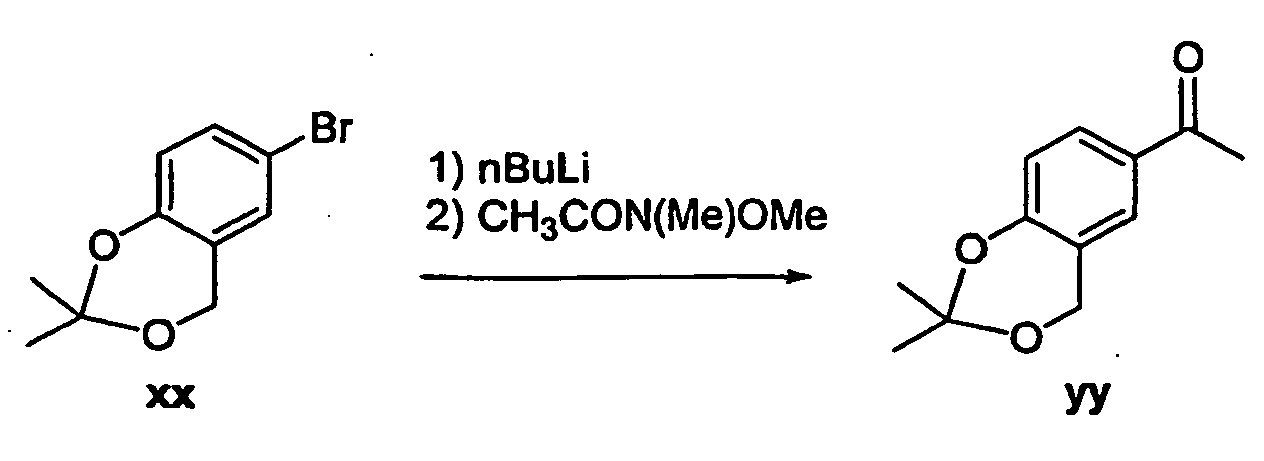
- To 110 g (0.46 mol) of compound xx in 1.0 L of TBF at -78°C was added 236 mL (0.51 mol) of 2.14 M n-BuLi in hexanes via a dropping funnel. After 30 minutes, 71 g (0.69 mol) of N-Methyl-N-methoxyacetamide (available from TCI) was added. After 2 hours, the reaction was quenched with water, diluted with 2.0 L of 1.0 M aqueous phosphate buffer (pH=7.0), and extracted once with diethyl ether. The diethyl ether phase was washed once with brine, dried over Na2SO4, filtered, and concentrated under reduced pressure to give a light orange oil. The oil was dissolved in a minimum volume of ethyl acetate, diluted with hexanes, and the product crystallized to give compound yy as a white solid. 1H NMR (300 MHz, CDCl3) δ 7.79 (m, 1H), 7.65 (m, 1H), 6.85 (d, 1H), 4.88 (s, 2H), 2.54 (s, 3H), 1.56 (s, 6H).
-

- To 23.4 g (0.113 mol) of compound yy in 600 mL of THF at -78°C was added 135 mL of 1.0 M NaHMDS in THF (Aldrich). After 1 hour, 15.8 mL (0.124 mol) of TMSCl was added. After another 30 minutes, 5.82 mL (0.113 mol) of bromine was added. After a final 10 minutes, the reaction was quenched by diluting with diethyl ether and pouring onto 500 mL of 5% aqueous Na2SO3 premixed with 500 mL of 5% aqueous NaHCO3. The phases were separated, and the organic phase was washed with brine, dried over Na2SO4, filtered, and concentrated under reduced pressure to give compound zz as a light orange oil that solidified in the freezer. 1H NMR (300 MHz, CDCl3) δ 7.81 (m, 1H), 7.69 (m, 1H), 6.88 (d, 1H), 4.89 (s, 2H), 4.37 (s, 2H), 1.56 (s, 6H).
-

- To 32 g (0.113 mol) of compound zz in 300 mL methylene chloride at 0°C was added 31.6 mL (0.23 mol) of triethylamine, followed by 16.0 mL (0.10 mol) of 4-bromophenethylamine (Aldrich). After 2 hours, 27 g (0.10 mol) of the 4,4'-dimethoxychlorodiphenylmethane was added. After 30 minutes, the slurry was partitioned between 50% saturated aqueous NaHCO3 and diethyl ether, and the phases were separated. The organic phase was washed once each with water and brine, dried over K2CO3, filtered, and concentrated to an orange oil. The oil was purified by silica gel chromatography (1400 mL silica gel, eluted with 3 acetonitrile/0.5 triethylamine/96.5 methylene chloride) to give compound aa as a light orange foam. 1H NMR (300 MHz, DMSO-d6) δ 7.65 (m, 1H), 7.57 (m, 1H), 7.38 (d, 2H), 7.19 (d, 4H), 6.95 (d, 2H), 6.78 (m, 5H), 5.09 (s, 1H), 4.82 (s, 2H), 3.98 (s, 2H), 3.73 (m, 1H), 3.66 (s, 6H, 2.71 (m, 4H), 1.45 (s, 6H).
-

- To 41 g (65 mmol) of compound aa in 120mL of THF was added 200 mL of methanol, followed by 2.46 g (65 mmol) of sodium borohydride. After 1 hour, the solution was partitioned between 1.0 M aqueous phosphate buffer (pH=7.0) and diethyl ether, and the phases were separated. The diethyl ether phase was washed with brine, dried over K2CO3, filtered, and concentrated to an oil. The oil was purified by silica gel chromatography (1200 mL silica gel, eluted with 18 acetone/0.5 triethylamine/81.5 hexanes) to give compound bb as a white foam. 1H NMR (300 MHz, DMSO-d6) δ 7.37 (d, 2H), 7.13 (m, 4H), 6.95-6.75 (m, 8H), 6.68 (d, 1H), 4.95 (d, 1H), 4.83 (s, 1H), 4.74 (s, 2H), 4.56 (m, 1H), 3.67 (2, 6H), 2.55 (m, 4H), 1.42 (s, 6H).
-

- Using a coupling procedure similar to that described in Example 1, except replacing the N 1-(4-heptyl-6-methyl-2-pyrimidinyl)sulfanilamide with N 1-(5-methoxy-2-pyrimidinyl)sulfanilamide (sulfameter, available from Aldrich), a TFA salt of compound 2 was prepared. m/z: [M + H+] calcd for C28H31N5O6S 566.2; found 566.2.
-

- Using a coupling procedure similar to that described in Example 1, except replacing the N 1-(4-heptyl-6-methyl-2-pyrimidinyl)sulfanilamide with N 4-(4,6-dimethyl-2-pyrimidinyl)sulfanylamide (sulfamethazine, available from Aldrich), a TFA salt of compound 3 was prepared. m/z: [M + H+] calcd for C29H33N5O5S 564.2; found 564.2.
-

- Using a coupling procedure similar to that described in Example 1, except replacing the N 1-(4-heptyl-6-methyl-2-pyrimidinyl)sulfanilamide with 2-sulfanilamidopyrimidine (sulfapyridine, available from Aldrich), a TFA salt of compound 4 was prepared. m/z: [M + H+] calcd for C28H30N4O5S 535.2; found 535.2.
-

- Using a coupling procedure similar to that described in Example 1, except replacing the N 1-(4-heptyl-6-methyl-2-pyrimidinyl)sulfanilamide with 5-amino-ortho-toluenesulfonanilide (p-toluidine-o-sulfanilide, available from Sigma-Aldrich Library of Rare Chemicals), a TFA salt of compound 5 was prepared. mlz: [M + H+] calcd for C30H33N3O5S 548.2; found 548.2.
-

- Using a coupling procedure similar to that described in Example 1, except replacing the N 1-(4-heptyl-6-methyl-2-pyrimidinyl)sulfanilamide with 4-aminotoluene-2-sulfethylanilide (available from Sigma-Aldrich Library of Rare Chemicals), a TFA salt of compound 6 was prepared. mlz: [M + H+] calcd for C32H37N3O5S 576.3; found 576.2.
-

- Using a coupling procedure similar to that described in Example 1, except replacing the N 1-(4-heptyl-6-methyl-2-pyrimidinyl)sulfanilamide with 4-(piperidinosulfonyl)aniline (available from Maybridge), a TFA salt of compound 7 was prepared. m/z: [M + H+] calcd for C28H35N3O5S 526.2; found 526.2.
-

- Using a coupling procedure similar to that described in Example 1, except replacing the N 1-(4-heptyl-6-methyl-2-pyrimidinyl)sulfanilamide with 4-(morpholinosulfonyl)aniline (available from Maybridge), a TFA salt of compound 8 was prepared. m/z: [M + H+] calcd for C27H33N3O6S 528.2; found 528.2.
-

- Using a coupling procedure similar to that described in Example 1, except replacing the N 1-(4-heptyl-6-methyl-2-pyrimidinyl)sulfanilamide with N 1-(2,6-dimethylphenyl)-4-aminobenzene-1-sulfonamide (available from Maybridge), a TFA salt of compound 9 was prepared. m/z: [M + H+] calcd for C31H35N3O5S 562.2; found 562.2.
-

- Using a coupling procedure similar to that described in Example 1, except replacing the N 1-(4-heptyl-6-methyl-2-pyrimidinyl)sulfanilamide with N 1-(2-thiazolyl)sulfanilamide (sulfathiazole, available from Aldrich), a TFA salt of compound 10 was prepared.
-

- Using a coupling procedure similar to that described in Example 1, except replacing the N 1-(4-heptyl-6-methyl-2-pyrimidinyl)sulfanilamide with N 1-[2-(trifluoromethyl)phenyl]-4-aminobenzene-1-sulfonamide (available from Maybridge), a TFA salt of compound 11 was prepared.
-

- Using a coupling procedure similar to that described in Example 1, except replacing the N 1-(4-heptyl-6-methyl-2-pyrimidinyl)sulfanilamide with N 1-(3,5-dichlorophenyl)-4-aminobenzene-1-sulfonamide (available from Maybridge), a TFA salt of compound 12 was prepared.
-

- To a mixture of 0.69 g (1.83 mmol) of crude compound ee in 4 mL of methanol was added 70 mg of 10% palladium on carbon under a stream of nitrogen and the reaction was shaken under 50 psi H2 for 2 days. The reaction was filtered and the residue was purified by reversed phase HPLC (gradient of 10 to 50% acetonitrile in 0.1% aqueous TFA). Fractions containing pure product were combined and lyophilized to afford a TFA salt of compound 13 as a powder. m/z: [M + H+] calcd for C27H32N4O6S 541.2; found 541.5.
- The intermediate compound ee was prepared as follows.
-

- To 10.7 g (53.0 mmol) of 4-bromophenethylamine (available from Aldrich) in 100 mL of toluene was added 6.80 g (64 mmol) of benzaldehyde. After stirring for 10 minutes, the cloudy mixture was concentrated under reduced pressure. The residue was re-concentrated twice from toluene, and the clear oil was dissolved in 50 mL of tetrahydrofuran. 2.0 g (53 mmol) of sodium borohydride was added to the solution, followed by 20 mL of methanol, and the flask was stirred in a water bath at ambient temperature for one hour. 1.0 M aqueous HCl was added until the pH was below 1. The slurry was stirred in an ice bath for 30 minutes, and the solids were isolated by filtration, rinsed with cold water, and air dried to give the hydrochloride salt of compound A as a colorless solid. 1H NMR (300 MHz, DMSO-d6) δ 9.40 (s, 2H), 7.50-7.32 (m, 7H), 7.14 (d, 2H), 4.07 (s, 2H), 3.03 (m, 2H), 2.92 (m, 2H).
-

- To 5.0 g (15 mmol) of compound A in 100 mL of methanol was added 1.70 g (16.5 mmol) of triethylamine. The solution was cooled in an ice/water bath, and 3.66 g (16.8 mmol) of di-tert-butyldicarbonate was added. After 3.5 hours, the solution was concentrated under reduced pressure, and the residue was partitioned between 1.0 M aqueous NaHSO4 and diethyl ether, and the phases were separated. The diethyl ether phase was washed with water followed by brine, dried over Na2SO4, filtered, and concentrated to give compound B (6.1 g, 93%) as a colorless oil. 1H NMR (300 MHz, DMSO-d6) δ 7.38 (d, 2H), 7.28-7.13 (m, 5H), 7.04 (m, 2H), 4.29 (br s, 2H), 3.20 (m, 2H), 2.62 (m, 2H), 1.25 (s, 9H).
-

- To a flask containing 3.4 g (8.8 mmol) of compound B, 2.8 g (11 mmol) of 4-morpholinosulfonyl)aniline (available from Maybridge), 0.41g (0.45mmol) of tris(dibenzylidineacetone)dipalladium(0), 0.83 g (1.3 mmol) of rac-2,2'-bis(diphenylphosphino)-1,1'-binaphthyl, and 1.1 g (11 mmol) of sodium tert-butoxide was added 40mL of toluene, and the mixture was heated at 95°C for 6 h under a nitrogen atmosphere. The mixture was diluted with 200 mL diethyl ether and washed twice with 100 mL portions of 1.0 M aqueous NaHSO4, followed by 100 mL of saturated aqueous NaHCO3. The diethyl ether phase was dried over MgSO4, filtered, and concentrated to a dark oil. The oil was purified by silica gel chromatography (gradient of 30 to 40% ethyl acetate in hexanes) to afford compound dd as a yellow foam (2.5 g, 51%).
-

- To 0.56 g of compound dd (.6 mmol) in 6 mL CH2Cl2 was added 4 mL TFA. After 15 minutes, the solution was concentrated, diluted with 30 mL ethyl acetate and washed twice with 1.0 N aqueous sodium hydroxide. The ethyl acetate layer was dried over MgSO4, filtered, and concentrated to an oil and dissolved in 8 mL of 1:1 methanol:THF. Bromohydrin GG (340 mg, 0.96 mmol) and K2CO3 (370 mg, 2.7 mmol) were added and the reaction was stirred at room temperature for 1.5 h. The reaction was concentrated and the residue was diluted with 30 mL water and extracted twice with 30 mL portions of toluene. The toluene extracts were combined, dried over Na2SO4, filtered, and concentrated. The residue was heated to 120°C. After 13 h, the reaction was cooled to room temperature and the crude compound dd was carried on to the next step without purification.
- The intermediate bromohydrin GG can be prepared as described in United States Patent Number
6,268,533 B1 ; and in R. Hett et al., Organic Process Research and Development, 1998, 2, 96-99. The intermediate bromohydrin GG can also be prepared using procedures similar to those described by Hong et al., Tetrahedron Lett., 1994, 35, 6631; or similar to those described in United States Patent Number5,495,054 . -

- To a mixture of 0.6 g (0.83 mmol) of compound ii in 25 mL of ethanol was added 200 mg of 10% palladium on carbon under a stream of nitrogen and the reaction was allowed to stir under H2 at atmospheric pressure for 5 days. The reaction was filtered and the residue was purified by reversed phase HPLC (gradient of 10 to 50% acetonitrile in 0.1% aqueous TFA). Fractions containing pure product were combined and lyophilized to afford a TFA salt of compound 14 as a powder. m/z: [M + H+] calcd for C28H29N5O5S 548.2; found 548.3.
- The intermediate ii was prepared as follows.
-

- To a flask containing 3.4 g (8.8 mmol) of compound B (Example 13, part b), 2.0 g (8.0 mmol) of sulfapyridine (available from Aldrich), 0.37 g (0.40 mmol) of tris(dibenzylidineacetone)dipalladium(0), 0.75 g (1.2 mmol) of racemic-2,2'-bis(diphenylphosphino)-1,1'-binaphthyl, and 2.31 g (24.0 mmol) of sodium tert-butoxide was added 40 mL of toluene, and the mixture was heated at 90°C for 18 h under a nitrogen atmosphere. The mixture was diluted with 200 mL methylene chloride and washed with 100 mL of saturated aqueous NaHCO3, followed by 100 mL saturated aqueous NaCl. The organic phase was dried over MgSO4, filtered, and concentrated. The oil was purified by silica gel chromatography (gradient of 0 to 5% methanol in methylene chloride) to afford compound hh as an orange solid.
-
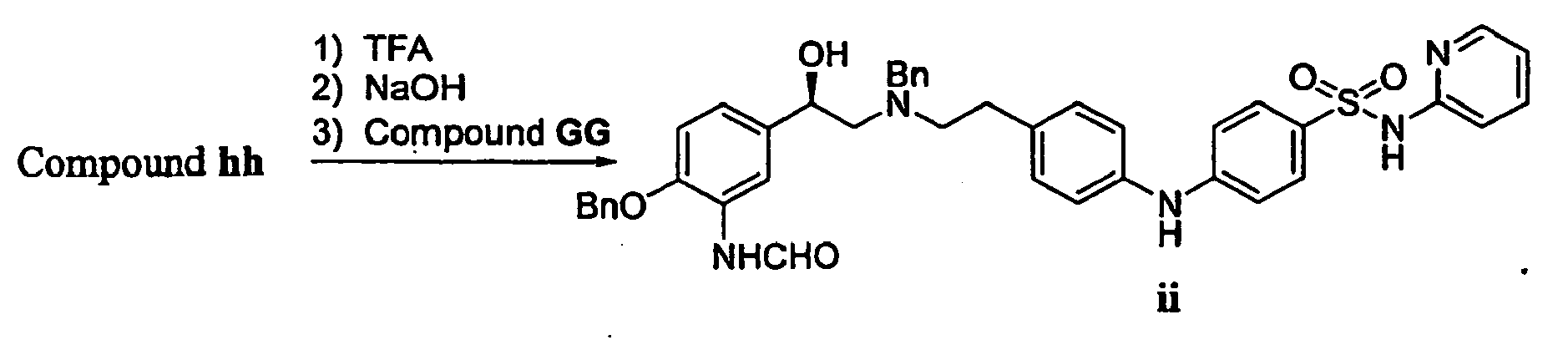
- To 4.5 g of compound hh (8.1 mmol) in 20 mL CH2Cl2 was added 1.5 mL TFA. After 1 hour, the solution was concentrated, basified with 1.0 N aqueous sodium hydroxide and extracted twice with methylene chloride, followed by an extraction using ethyl acetate. The organic layers were combined, dried over MgSO4, filtered, and concentrated to an oil. The oil was purified by silica gel chromatography (gradient of 2 to 10% methanol in methylene chloride). The purified product was dissolved in 10 mL of 1:1 methanol:THF. Bromohydrin GG (Example 13, part d) (364 mg, 1.04 mmol) and K2CO3 (378 mg, 2.73 mmol) were added and the reaction was stirred at room temperature for 1.5 h. The reaction was concentrated and the residue was diluted with 30 mL water and extracted twice with 30 mL portions of toluene. The toluene extracts were combined, dried over Na2SO4, filtered, and concentrated. The residue was heated to 120°C. After 2 h, the reaction was cooled to room temperature and the crude compound was purified by silica gel chromatography (gradient of 5 to 10% methanol in methylene chloride) to afford compound ii as a tan solid.
-

- To 610 mg of compound ff (0.82 mmol) in 5.0 mL acetic acid was added 92 mg of 10% palladium on carbon. The reaction mixture was shaken under 40 psi H2 for 20h. The mixture was filtered and the filtrate was purified by reversed phase HPLC (gradient of 10 to 40% acetonitrile in 0.1 % aqueous TFA). Fractions containing pure product were combined and lyophilized to afford a TFA salt of compound 15 as a powder. m/z: [M + H+] calcd for C29H32N4O6S 565.2; found 565.3.
- The intermediate compound ff was prepared as follows.
-

- To 0.91 g of compound dd (1.6 mmol, Example 13, part c) in 8 mL CH2Cl2 was added 6 mL TFA. After 15 minutes, the solution was concentrated, diluted with 30 mL ethyl acetate and washed twice with 1.0 N aqueous sodium hydroxide. The ethyl acetate layer was dried over MgSO4, filtered, and concentrated to a brown oil. The oil was dissolved in 6.0 mL of isopropanol and 375 mg (1.3 mmol) of epoxide P were added. The solution was heated to 70°C. After 24 h, the solution was concentrated and the product purified by silica gel chromatography (3% methanol in CH2Cl2). Pure fractions were combined and concentrated to afford compound ff as a yellow foam.
- The intermediate epoxide P can be prepared as described in International Patent Application Publication Number
WO 95/25104 EP 0 147 719 A2 andEP 0 147 791 B . -

- Using a coupling procedure similar to that described in Example 1, except replacing the N 1-(4-heptyl-6-methyl-2-pyrimidinyl)sulfanilamide with 3-(methylthio)aniline (available from Aldrich), a TFA salt of compound 16 was prepared. m/z: [M + H+] calcd for C24H28N2O3S 425.2; found 425.1.
-

- Using a coupling procedure similar to that described in Example 1, except replacing the N 1-(4-heptyl-6-methyl-2-pyrimidinyl)sulfanilamide with 4-(methylthio)aniline (available from Aldrich), a TFA salt of compound 17 was prepared. m/z: [M + H+] calcd for C24H28N2O3S 425.2; found 425.1.
-

- Using a coupling procedure similar to that described in Example 1, except replacing the N 1-(4-heptyl-6-methyl-2-pyrimidinyl)sulfanilamide 4-(m-tolylthio)aniline (available from Sigma-Aldrich Library of Rare Chemicals), a TFA salt of compound 18 was prepared. m/z: [M + H+] calcd for C30H32N2O3S 501.2; found 501.2.
-

- Using a coupling procedure similar to that described in Example 1, except replacing the N 1-(4-heptyl-6-methyl-2-pyrimidinyl)sulfanilamide with 4-[(4-methylpyrimidin-2-yl)thio]benzeneamine (available from Peakdale), a TFA salt of compound 19 was prepared. m/z: [M + H+] calcd for C28H30N4O3S 503.2; found 503.1.
-

- Using a coupling procedure similar to that described in Example 1, except replacing the N 1-(4-heptyl-6-methyl-2-pyrimidinyl)sulfanilamide with 4-[(4-fluorophenyl)sulfonyl]aniline (available from Bionet), a TFA salt of compound 20 was prepared.
-

- Using a coupling procedure similar to that described in Example 1, except replacing the N 1-(4-heptyl-6-methyl-2-pyrimidinyl)sulfanilamide with 4-[(4-methylphenyl)sulfonyl]aniline (available from Bionet), a TFA salt of compound 21 was prepared.
-

- Using a coupling procedure similar to that described in Example 1, except replacing the N 1-(4-heptyl-6-methyl-2-pyrimidinyl)sulfanilamide with 3-aminodiphenyl sulfone (available from Sigma-Aldrich Library of Rare Chemicals), a TFA salt of compound 22 was prepared. m/z: [M + H+] calcd for C29H30N2O5S 519.2; found 519.2.
-

- Using a coupling procedure similar to that described in Example 1, except replacing the N 1-(4-heptyl-6-methyl-2-pyrimidinyl)sulfanilamide with 4-(4-chlorobenzenesulfonyl)-phenylamine (available from Sigma-Aldrich Library of Rare Chemicals), a TFA salt of compound 23 was prepared. mlz: [M + H+] calcd for C29H29ClN2O5S 553.2; found 553.1.
-
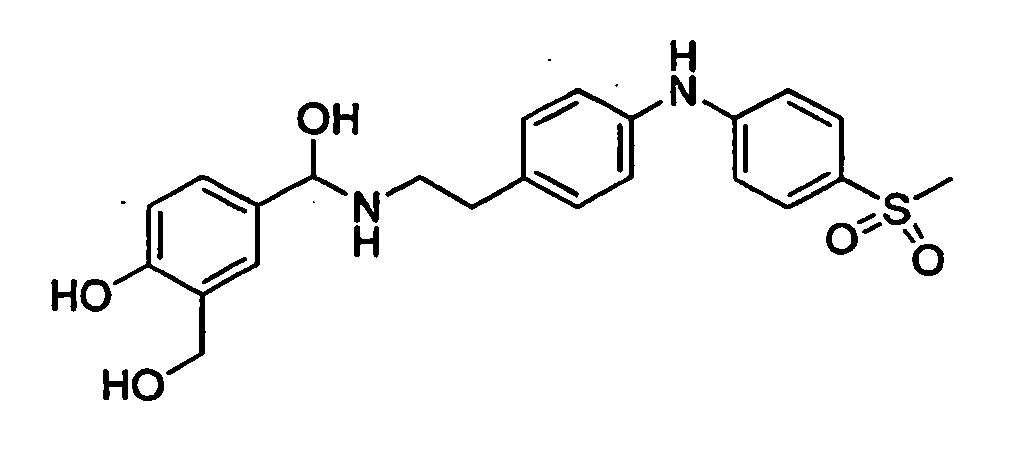
- Using a coupling procedure similar to that described in Example 1, except replacing the N 1-(4-heptyl-6-methyl-2-pyrimidinyl)sulfanilamide with 4-(methylsulfonyl)aniline (available from Maybridge), a TFA salt of compound 24 was prepared. m/z: [M + H+] calcd for C24H28N2O5S 457.2; found 457.1.
-

- Using a coupling procedure similar to that described in Example 1, except replacing the N 1-(4-heptyl-6-methyl-2-pyrimidinyl)sulfanilamide with 4-(phenylsulfonyl)aniline (available from Maybridge), a TFA salt of compound 25 was prepared. mlz: [M + H+] calcd for C29H30N2O5S 519.2; found 519.2.
-

- Using a coupling procedure similar to that described in Example 1, except replacing the N 1-(4-heptyl-6-methyl-2-pyrimidinyl)sulfanilamide with 4-[(4-fluorophenyl)sulfonyl]aniline (available from Maybridge), a TFA salt of compound 26 was prepared. m/z: [M + H+] calcd for C29H29FN2O5S 537.2; found 537.1.
-

- Using a coupling procedure similar to that described in Example 1, except replacing the N 1-(4-heptyl-6-methyl-2-pyrimidinyl)sulfanilamide with 3,4-ethylenedioxyaniline (available from Aldrich), a TFA salt of compound 27 was prepared.
-

- Using a coupling procedure similar to that described in Example 1, except replacing the N 1-(4-heptyl-6-methyl-2-pyrimidinyl)sulfanilamide with 4-methoxyaniline (p-anisidine, available from Aldrich), a TFA salt of compound 28 was prepared.
-

- Using a coupling procedure similar to that described in Example 1, except replacing the N 1-(4-heptyl-6-methyl-2-pyrimidinyl)sulfanilamide with 3-ethoxyaniline (m-anisidine, available from Aldrich), a TFA salt of compound 29 was prepared.
-

- Using a coupling procedure similar to that described in Example 1, except replacing the N 1-(4-heptyl-6-methyl-2-pyrimidinyl)sulfanilamide with 1-amino-4-ethoxybenzene (p-phenetidine, available from Aldrich), a TFA salt of compound 30 was prepared.
-

- Using a coupling procedure similar to that described in Example 1, except replacing the N 1-(4-heptyl-6-methyl-2-pyrimidinyl)sulfanilamide with 3-chloro-4-methoxyaniline (available from Aldrich), a TFA salt of compound 31 was prepared.
-

- Using a coupling procedure similar to that described in Example 1, except replacing the N 1-(4-heptyl-6-methyl-2-pyrimidinyl)sulfanilamide with 3,4,5-trimethoxyaniline (available from Aldrich), a TFA salt of compound 32 was prepared. m/z: [M + H+] calcd for C26H32N2O6 469.2; found 469.2.
-

- Using a coupling procedure similar to that described in Example 1, except replacing the N 1-(4-heptyl-6-methyl-2-pyrimidinyl)sulfanilamide with 4-benzyloxyaniline hydrochloride (available from Aldrich), a TFA salt of compound 33 was prepared. m/z: [M + H+] calcd for C30H32N2O4 485.2; found 485.2.
-

- Using a coupling procedure similar to that described in Example 1, except replacing the N 1-(4-heptyl-6-methyl-2-pyrimidinyl)sulfanilamide with 3,4-dimethoxyaniline (available from Aldrich), a TFA salt of compound 34 was prepared. m/z: [M + H+] calcd for C25H30N2O5 439.2; found 439.2.
-

- Using a coupling procedure similar to that described in Example 1, except replacing the N 1-(4-heptyl-6-methyl-2-pyrimidinyl)sulfanilamide with 3,4-(trimethylenedioxy)aniline (available from Maybridge), a TFA salt of compound 35 was prepared. m/z: [M + H+] calcd for C26H30N2O5 451.2; found 451.2.
-

- Using a coupling procedure similar to that described in Example 1, except replacing the N 1-(4-heptyl-6-methyl-2-pyrimidinyl)sulfanilamide with 4-isopropoxyaniline (available from TCI America), a TFA salt of compound 36 was prepared.m/z: [M + H+] calcd for C26H32N2O4 437.2; found 437.2.
-

- To a mixture of 3.0g (4.98mmol) of compound F, prepared in part c below, in 70ml of ethanol was added 1.0g of 10% Palladium on carbon under a stream of nitrogen. The flask was fitted with a balloon of hydrogen gas, and the reaction was vigorously stirred for 1.5 hours. The reaction was filtered through celite, using methanol to rinse, and the filtrate was concentrated under reduced pressure. The residue was dissolved in 40ml of 1/1 isopropanol / methanol , 2.74 ml of 4M HCl in dioxane was added, and the product was precipitated as the di-HCl salt by adding the solution to a large volume of EtOAc. The solids were isolated by filtration to give the di-HCl salt of compound 37 as a white solid. 1H NMR (300 MHz, DMSO-d6) δ 8.94 (br s, 1H), 8.63 (br s, 1H), 6.97-6.67 (m, 11H), 4.76 (m, 1H), 4.39 (s, 2H), 4.29 (br, 4H), 3.87 (dd, 2H), 3.02-2.76 (m, 6H), 1.22 (t, 3H). m/z: [M + H+] calcd for C25H30N2O4 423.2; found 423.2.
- The intermediate compound F was prepared as follows.
-

- To a flask containing 3.0 g (7.7 mmol) of compound B, 1.26g (9.1 mmol, Example 13, part b) of para-phenetidine (4-ethoxyaniline, available from Aldrich), 0.32 g (0.35 mmol) of tris(dibenzylidineacetone)dipalladium(0), 0.65 g (1.05mmol) of racemic-2,2'-bis(diphenylphosphino)-1,1'-binaphthyl, and 0.88 g (9.1 mmol) of sodium tert-butoxide was added 35 ml of toluene, and the mixture was heated at 95°C for 5.5 hours under a nitrogen atmosphere. The mixture was partitioned between 1.0 M aqueous NaHSO4 and diethyl ether, and the phases were separated. The diethyl ether phase was diluted with one volume of hexanes, and was washed once each with 1.0 M aqueous NaHSO4 and brine, dried over Na2SO4, filtered, and concentrated to a dark oil. The oil was purified by chromatography, using 15% EtOAc / 85% hexanes as eluent, to give 2.52 g (73%) of compound C as a dark orange oil. 1H NMR (300 MHz, DMSO-d6) δ 7.64 (s, 1H), 7.28-7.13 (m,5H), 6.91-6.72 (m, 8H), 4.27 (s, 2H), 3.92 (q, 2H), 3.25 (s, 2H), 3.15 (m, 2H), 2.52 (m, 2H), 1.31 (s, 9H), 1.21 (t, 3H). m/z: [M + H+] calcd for C28H34N2O3 447.3; found 447.8.
-

- To 2.93g (6.56 mmol) of compound C in 15 ml of CH2Cl2 at 0°C was added 15 ml of trifluoroacetic acid. After 40 minutes, the solution was concentrated under reduced pressure, and the residue was partitioned between 1M NaOH and EtOAc. The phases were separated, and the EtOAc phase was washed once each with water and brine, dried over Na2SO4, filtered, and concentrated to an orange oil. The oil was dissolved in 20 ml of isopropanol, 1.86 g (6.56 mmol) of the epoxide a was added, and the solution was heated at 78°C overnight. The mixture was cooled to room temperature, and concentrated under reduced pressure to give compound E as an orange oil that was used without purification in the next step.
-

- To 6.56 mmol of crude compound E from the previous step in 40 mL of tetrahydrofuran at 0°C was added 16.4 mL (16.4 mmol) of 1M lithium aluminum hydride in tetrahydrofuran. After 2 hours, the reaction was quenched by slow addition of sodium sulfate decahydrate. The slurry was diluted with diethyl ether, dried over Na2SO4, filtered, and concentrated to an orange oil. The oil was purified by chromatography, using 50% EtOAc / 50% hexanes as eluent, to give compound F as an off-white foam. 1H NMR (300 MHz, DMSO-d6) δ 7.61 (s, 1H), 7.37-6.71 (m, 21H), 5.02 (s, 2H), 4.94 (m, 1H), 4.67 (m, 1H), 4.55 (m, 1H), 4.48 (d, 2H), 3.85 (dd, 2H), 3.63 (dd, 2H), 2.53 (m, 6H), 1.21 (t, 3H).
- The intermediate epoxide a can be prepared as described by R. Hett et al., Tetrahedron Lett., 1994, 35, 9357-9378.
-

- To a solution of 200 mg of compound Q (0.36 mmol) in 5.0 mL methanol was added 45 mg of 10% palladium on carbon. The reaction was placed under 1 atm H2 gas. After 20 h, an additional 25 mg of 10% palladium on carbon was added and the reaction was stirred under 1 atm H2 for an additional 24 h after which time the reaction was filtered. The filtrate was concentrated and purified by reversed phase preparative HPLC (gradient of 15-50% acetonitrile in 0.1 % TFA). Fractions containing pure product were combined and lyophilized to afford a TFA salt of compound 6 as a powder. A sample of the TFA salt (39.7 mg) was dissolved in acetonitrile (1.0 mL), diluted with water (2.0 mL) and then 0.1 N HCl (5.0 mL). The solution was frozen and lyophilized to afford the hydrochloride salt of compound 38 (38.3 mg) as a yellow powder. 1H NMR (300MHz, DMSO-d6) δ 10.5 (br s, 2H), 9.20 (br s, 1H), 8.75 (br s, 1H), 8.22 (d, 1H) 7.15 (d, 1H), 6.95-7.05 (m, 5H), 6.80-6.90 (m, 4H), 6.56 (d, 1H), 5.40 (dd, 1H), 3.95 (quar, 2H), 2.95-3.18 (m, 4H), 2.80-2.95 (m, 2H), 1.29 (t, 3H) ; mlz: [M + H+] calcd for C27H29N3O4 460.22; found 460.2.
- The intermediate compound Q was prepared as follows.
-
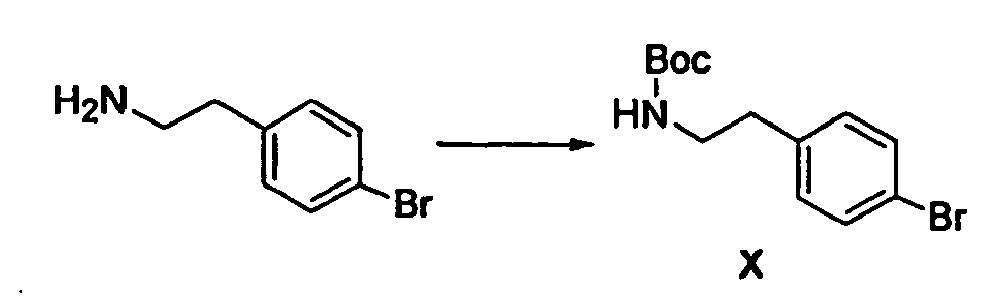
- To 7.03 g (35.1 mmol) of 4-bromophenethylamine (Sigma-Aldrich) in 60 mL of THF was added 8.6 g (39.4 mmol) of di-tert-butyldicarbonate. After 10 minutes, the solution was concentrated under reduced pressure, and the residue was partitioned between saturated aqueous sodium bicarbonate and ethyl acetate. The ethyl acetate phase was washed with brine, dried over MgSO4, filtered, and concentrated to give compound X as a white solid.
-

- To a flask containing 1.2 g (4.1 mmol) of compound X, 0.72g (5.3 mmol) of para-phenetidine (4-ethoxyaniline, Sigma-Aldrich), 0.19 g (0.35 mmol) of tris(dibenzylidineacetone)dipalladium(0), 0.38 g (0.61 mmol) of rac-2,2'-bis(diphenylphosphino)-1,1'-binaphthyl, and 0.51 g (5.3 mmol) of sodium tert-butoxide, was added 35 mL of toluene, and the mixture was heated at 95°C for 16 hours under an nitrogen atmosphere. The mixture was partitioned between 1.0 M aqueous NaHSO4 and diethyl ether. The diethyl ether phase was washed once each with saturated NaHCO3 and brine, dried over MgSO4, filtered, and concentrated to a dark oil. The oil was purified by silica gel chromatography, using 15% EtOAc /85% hexanes as eluant, to give compound Y as a dark orange oil.
-

- To 1.0 g of compound Y (2.8 mmol) in 5 mL CH2Cl2 was added 4 mL TFA. After 15 minutes, the solution was concentrated, diluted with 50 mL isopropyl acetate and washed twice with 1.0 M aqueous NaOH. The isopropyl acetate layer was dried over MgSO4, filtered, and concentrated to a brown oil. The oil was dissolved in 5.0 mL of isopropanol and 390 mg (1.3 mmol) of epoxide P (Example 15, part a) were added. The solution was heated to 70°C. After 36 h, the solution was concentrated and the product purified by reversed phase HPLC (gradient of 20-70% acetonitrile in 0.1 % TFA). Fractions containing pure product were combined and concentrated to remove acetonitrile. The aqueous residue was diluted with brine and extracted with ethyl acetate. The ethyl acetate layer was dried over MgSO4 and concentrated to afford compound Q as a yellow foam.
-

- Using a coupling procedure similar to that described in Example 1, except replacing the N 1-(4-heptyl-6-methyl-2-pyrimidinyl)sulfanilamide with 3,4-dimethylaniline (available from Aldrich), a TFA salt of compound 39 was prepared.
-
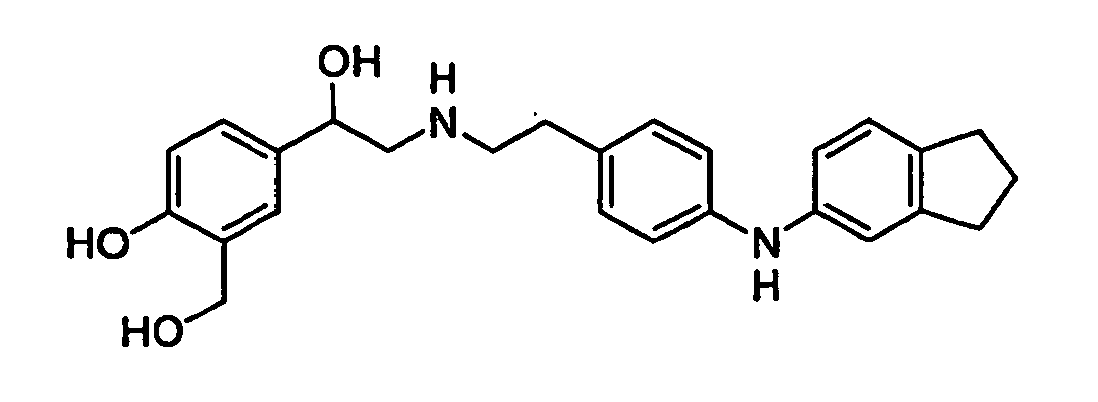
- Using a coupling procedure similar to that described in Example 1, except replacing the N 1-(4-heptyl-6-methyl-2-pyrimidinyl)sulfanilamide with 5-aminoindan (available from Aldrich), a TFA salt of compound 40 was prepared.
-

- Using a coupling procedure similar to that described in Example 1, except replacing the N 1-(4-heptyl-6-methyl-2-pyrimidinyl)sulfanilamide with m-toluidine (available from Aldrich), a TFA salt of compound 41 was prepared.
-

- Using a coupling procedure similar to that described in Example 1, except replacing the N 1-(4-heptyl-6-methyl-2-pyrimidinyl)sulfanilamide with 4-aminodiphenylamine (available from Aldrich), a TFA salt of compound 42 was prepared.
-

- Using a coupling procedure similar to that described in Example 1, except replacing the N 1-(4-heptyl-6-methyl-2-pyrimidinyl)sulfanilamide with 3-ethylaniline (available from Aldrich), a TFA salt of compound 43 was prepared. m/z: [M + H+] calcd for C25H30N2O3 407.2; found 407.2.
-
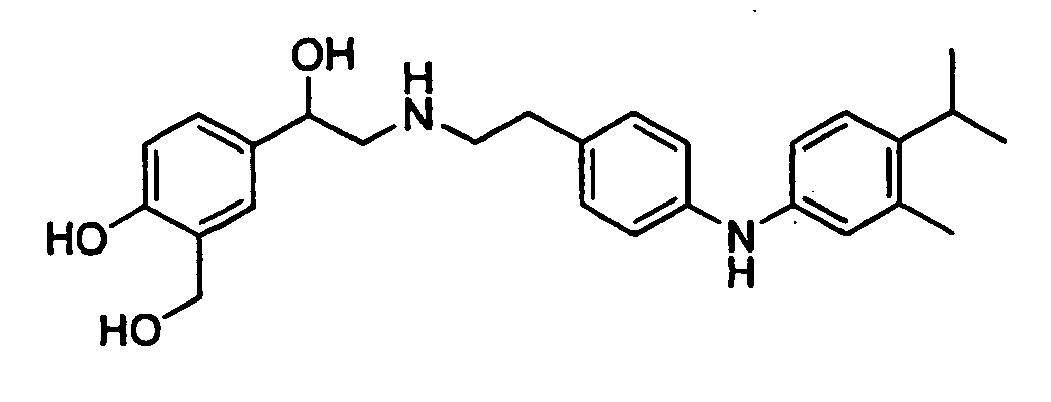
- Using a coupling procedure similar to that described in Example 1, except replacing the N 1-(4-heptyl-6-methyl-2-pyrimidinyl)sulfanilamide with 3-methyl-4-isopropylaniline hydrochloride (available from Avocado Chemicals), a TFA salt of compound 44 was prepared. m/z: [M + H+] calcd for C27H34N2O3 435.3; found 435.2.
-
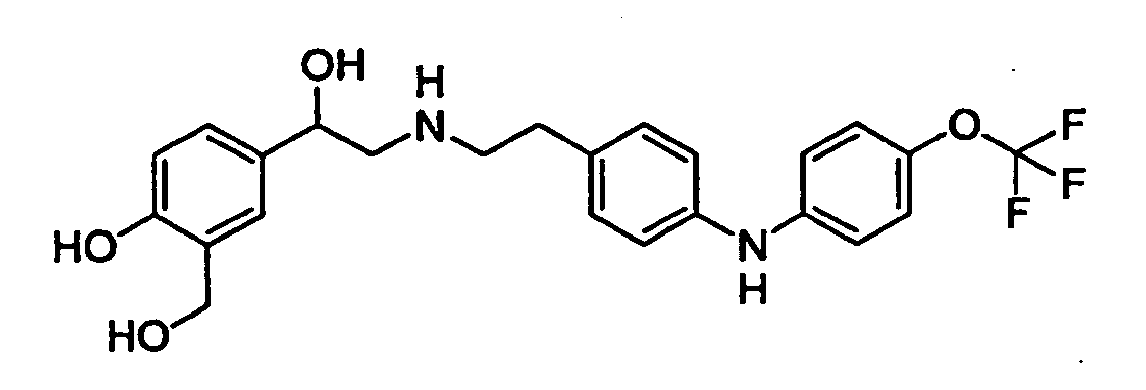
- Using a coupling procedure similar to that described in Example 1, except replacing the N 1-(4-heptyl-6-methyl-2-pyrimidinyl)sulfanilamide with 4-(trifluoromethoxy)aniline (available from Aldrich), a TFA salt of compound 45 was prepared. m/z: [M + H+] calcd for C24H25F3N2O4 463.2; found 463.2.
-

- Using a coupling procedure similar to that described in Example 1, except replacing the N 1-(4-heptyl-6-methyl-2-pyrimidinyl)sulfanilamide with 4-amino-2-cyclohexylphenol (available from Sigma-Aldrich Library of Rare Chemicals), a TFA salt of compound 46 was prepared. mlz: [M + H+] calcd for C29H36N2O4 477.3; found 477.2.
-

- Using a coupling procedure similar to that described in Example 1, except replacing the N 1-(4-heptyl-6-methyl-2-pyrimidinyl)sulfanilamide with 2-naphthylamine (available from Aldrich), a TFA salt of compound 47 was prepared.
-

- Using a coupling procedure similar to that described in Example 1, except replacing the N 1-(4-heptyl-6-methyl-2-pyrimidinyl)sulfanilamide with 3-aminobiphenyl (available from Trans World Chemicals, Inc.), a TFA salt of compound 48 was prepared.
-

- Using a coupling procedure similar to that described in Example 1, except replacing the N 1-(4-heptyl-6-methyl-2-pyrimidinyl)sulfanilamide with 3-phenyl-p-anisidine hydrochloride (available from Trans World Chemicals, Inc.), a TFA salt of compound 49 was prepared.
-

- Using a coupling procedure similar to that described in Example 1, except replacing the N 1-(4-heptyl-6-methyl-2-pyrimidinyl)sulfanilamide with 6-amino-3,4-benzocoumarin (available from Aldrich), a TFA salt of compound 50 was prepared. m/z: [M + H+] calcd for C30H28N2O5 497.2; found 497.1.
-

- Using a coupling procedure similar to that described in Example 1, except replacing the N 1-(4-heptyl-6-methyl-2-pyrimidinyl)sulfanilamide with 4-aminobiphenyl (available from Aldrich), a TFA salt of compound 51 was prepared. m/z: [M + H+] calcd for C29H30N2O3 455.2; found 455.2.
-

- To 2.0 g (3.10 mmol) of compound H in 50mL of ethanol was added 0.70 g of 10% palladium on carbon under a stream of nitrogen. The flask was fitted with a balloon of hydrogen gas, and the reaction was vigorously stirred for 1.5 hours. The reaction was filtered through celite, using methanol to rinse, and the filtrate was concentrated under reduced pressure. The residue was dissolved in 20 mL isopropanol, 1.65 mL of 4.0 N HCl in dioxane was added, and the product was precipitated by adding the solution to a large volume of diethyl ether. The solids were isolated by filtration to give 1.43 g (80%) of a hydrochloride salt of compound 52 as a white solid. 1H NMR (300 MHz, DMSO-d6) δ 9.4 (b, 1H), 9.01 (br s, 1H), 8.65 (br s, 1H), 7.39-7.22 (m, 6H), 6.99-6.83 (m, 8H), 6.69 (d, 1H), 5.45 (br, 4H), 4.77 (m, 1H), 4.39 (s, 2H), 3.62 (s, 3H), 3.02-2.78 (m, 6H). m/z: [M + H+] calcd for C30H32N2O4 485.2; found 485.4.
- The intermediate compound H was prepared as follows.
-

- To a flask containing 3.91 g (10 mmol) of compound B (Example 13, part b), 3.06 g (13mmol) of 4-methoxy-3-phenylaniline hydrochloride (from TCI), 0.46 g (0. 5mmol) of tris(dibenzylidineacetone)dipalladium(0), 0.93 g (1.5 mmol) of racemic-2,2'-bis(diphenylphosphino)-1,1'-binaphthyl, and 2.21 g (23 mmol) of sodium tert-butoxide was added 50mL of toluene, and the mixture was heated at 95°C for 5.5 hours under an nitrogen atmosphere. The mixture was partitioned between 1.0 M aqueous NaHSO4 and diethyl ether, and the phases were separated. The diethyl ether phase was diluted with one volume of hexanes, and was washed once each with 1.0 M aqueous NaHSO4 and brine, dried over Na2SO4, filtered, and concentrated to a dark oil. The oil was purified by silica gel chromatography, using 12% EtOAc / 88% hexanes as eluent, to give compound D as a yellow foam. 1H NMR (300 MHz, DMSO-d6) δ 7.76 (s, 1H), 7.38-7.13 (m, 10H), 6.95-6.81 (m, 7H), 4.28 (s, 2H), 3.61 (s, 3H), 3.16 (m, 2H), 2.53 (m, 2H), 1.29 (s, 9H).
-
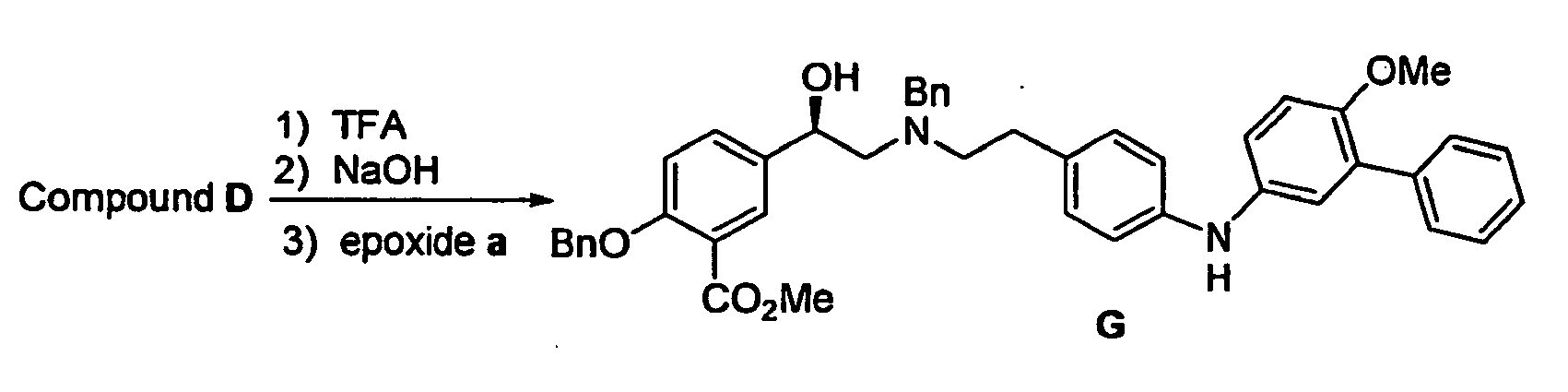
- To 2.60 g (5.11 mmol) of compound D in 15 mL of CH2Cl2 at 0°C was added 15 mL of trifluoroacetic acid. After 40 minutes, the solution was concentrated under reduced pressure, and the residue was partitioned between 1M aqueous NaOH and EtOAc. The phases were separated, and the EtOAc phase was washed once each with water and brine, dried over Na2SO4, filtered, and concentrated to an orange residue. The residue was dissolved in 15m of isopropanol, 1.45 g (5.11 mmol) of the epoxide a (Example 37, part b) was added, and the solution was heated at 78°C overnight. The mixture was cooled to room temperature, and concentrated under reduced pressure to give compound G as an orange oil which was used in the next step without purification.
-

- To 5.11 mmol of crude compound G from the previous step in 40 mL of tetrahydrofuran at 0°C was added 12.7 mL (12.7 mmol) of 1.0 M lithium aluminum hydride in tetrahydrofuran. After 2 hours, the reaction was quenched by slow addition of sodium sulfate decahydrate. The slurry was diluted with diethyl ether, dried over Na2SO4, filtered, and concentrated to an orange oil. The oil was purified by chromatography, using 50% EtOAc / 50% hexanes as eluent, to give 2.0 g (61%, 2 steps) of compound H as a white foam. 1H NMR (300 MHz, DMSO-d6) δ 7.72 (s, 1H), 7.38-6.77 (m, 25H), 5.00 (s, 2H), 4.92 (m, 1H), 4.65 (m, 1H), 4.55 (m, 1H), 4.45 (d, 2H), 3.62 (s, 2H), 3.61 (s, 3H), 2.52 (m, 6H).
-

- To a mixture of 825 mg (1.22 mmol) of compound N in 15 mL of ethanol was added 260 mg of 10% palladium on carbon under a stream of nitrogen. The flask was fitted with a balloon of hydrogen gas, and the reaction was vigorously stirred for 3 hours. The reaction was filtered through celite, using methanol to rinse, and the filtrate was concentrated under reduced pressure. The residue was dissolved in 10 mL isopropanol, 0.67 mL of 4.0 M HCl in dioxane was added, and the product was precipitated by adding the solution to a large volume of EtOAc. The solids were isolated by filtration to give a hydrochloride salt of compound 53 as a white solid. m/z: [M + H+] calcd for C31H32N2O4 499.3; found 499.3.
- The intermediate compound N was prepared as follows.
-

- 4.84 g (20.5 mmol) of 4-methoxy-3-phenylaniline hydrochloride (available from TCI) was partitioned between diethyl ether and 1.0 M aqueous NaOH, and the phases were separated. The diethyl ether phase was washed once each with water and brine, dried over K2CO3, filtered, and concentrated to a brown solid. The solid was dissolved in 100 mL of CH2Cl2, the solution was cooled to 0°C, and 21.2 g (84.6 mmol) of boron tribromide was added. After 20 minutes, the reaction was poured over 500 mL of ice, and the mixture was stirred overnight. The mixture was washed twice with EtOAc to remove oxidized material, and the EtOAc phases were discarded. The acidic phase was basified with solid NaHCO3, and was extracted twice with EtOAc. The combined EtOAc phases were washed once with brine, dried over Na2SO4, filtered, and concentrated to give 2.48 g of compound J as a brown solid. 1H NMR (300 MHz, DMSO-d6) δ 8.37 (s, 1H), 7.41-7.14 (m, 5H), 6.57-6.32 (m, 3H), 4.45 (s, 2H).
-

- To 2.28 g (12.2 mmol) of compound J in 45 mL of dimethylformamide at 0°C was added 734 mg (18.4mmol) of 60% NaH in oil. After 10 minutes, 1.90 g (12.2 mmol) of iodoethane was added. After 20 minutes, the solution was partitioned between diethyl ether and 5% aqueous Na2SO3, and the phases were separated. The diethyl ether phase was washed once each with 1.0 M aqueous NaOH, water, and brine, dried over Na2SO4, and concentrated to give compound K as a dark brown oil. 1H NMR (300 MHz, DMSO-d6) δ 7.37-7.19 (m, 5H), 6.73 (d, 1H), 6.47-6.42 (m, 2H), 4.65 (s, 2H), 3.73 (q, 2H), 1.07 (t, 3H).
-

- To a flask containing 3.97 g (10.7 mmol) of compound B (Example 13, part b), 2.27 g (12.2 mmol) of compound K, 0.46 g (0.5 mmol) of tris(dibenzylidineacetone)dipalladium (0), 0.95 g (1.5mmol) of racemic-2,2'-bis(diphenylphosphino)-1,1'-binaphthyl, and 1.27 g (13.3 mmol) of sodium tert-butoxide was added 48 mL of toluene, and the mixture was heated at 95°C for 5.5 hours under an nitrogen atmosphere. The mixture was partitioned between 1.0 M aqueous NaHSO4 and diethyl ether, and the phases were separated. The diethyl ether phase was diluted with one volume of hexanes, and was washed once each with 1.0 M aqueous NaHSO4 and brine, dried over Na2SO4, filtered, and concentrated to a dark oil. The oil was purified by silica gel chromatography, using 10% EtOAc / 90% hexanes as eluent, to give 4.13 g (77%) of compound L as a yellow foam. 1H NMR (300 MHz, DMSO-d6) δ 7.76 (s, 1H), 7.42-7.13 (m, 10H), 6.93-6.81 (m, 7H), 4.27 (s, 2H), 3.86 (q, 2H), 3.25 (m, 2H), 2.53 (m, 2H), 1.28 (s, 9H), 1.13 (t, 3H).
-

- To 1.40 g (2.68 mmol) of compound L in 15 mL of CH2Cl2 at 0°C was added 15 mL of trifluoroacetic acid. After 40 minutes, the solution was concentrated under reduced pressure, and the residue was partitioned between 1.0 M aqueous NaOH and EtOAc. The phases were separated, and the EtOAc phase was washed once each with water and brine, dried over Na2SO4, filtered, and concentrated to an orange residue. The residue was dissolved in 15 mL of isopropanol, 1.45 g (2.68 mmol) of the epoxide a (Example 37, part b) was added, and the solution was heated at 78°C overnight. The mixture was cooled to room temperature, and concentrated under reduced pressure to give an orange oil that was taken on without analysis.
-

- To 2.68 mmol of crude compound M in 20 mL of tetrahydrofuran at 0°C was added 7.0 mL (7.0mmol) of 1.0 M lithium aluminum hydride in tetrahydrofuran. After 2 hours, the reaction was quenched by slow addition of sodium sulfate decahydrate. The slurry was diluted with diethyl ether, dried over Na2SO4, filtered, and concentrated to an orange oil. The oil was purified by silica gel chromatography, using 50% EtOAc / 50% hexanes as eluent, to give 835 mg of compound N as a white foam. 1H NMR (300 MHz, DMSO-d6) δ 7.73 (s, 1H), 7.42-6.77 (m, 25H), 5.00 (s, 2H), 4.93 (m, 1H), 4.66 (d, 1H), 4.51 (m, 1H), 4.47 (m, 2H), 3.86 (q, 2H), 3.62 (m, 2H), 2.55 (m; 6H), 1.13 (t, 3H).
-

- To a mixture of 1.24 g (1.83 mmol) of compound I in 30 mL of ethanol and 20 mL of methanol was added 400mg of 10% palladium on carbon under a stream of nitrogen. The flask was fitted with a balloon of hydrogen gas, and the reaction was vigorously stirred for 1.5 hours. The reaction was filtered through celite, using methanol to rinse, and the filtrate was concentrated under reduced pressure. The residue was dissolved in 20 mL isopropanol, 0.21 mL of 4.0 M HCl in dioxane was added, and the product was precipitated by adding the solution to a large volume of EtOAc. The solids were isolated by filtration to give 447 mg of a hydrochloride salt of compound 54 as a white solid. 1H NMR (300 MHz, DMSO-d6) δ 10.03 (br s, 1H), 9.55 (s, 1H), 8.81 (br s, 1H), 8.59 (br s, 1H), 8.20 (d, 1H), 8.07 (d, 1H), 7.39-7.20 (m, 5H), 6.99-6.79 (m, 10H), 4.75 (m, 1H), 3.62 (s, 3H), 3.03-2.72 (m, 6H). m/z: [M + H+] calcd for C30H31N3O4 498.2; found 498.5.
- The intermediate compound I was prepared as follows.
-

- To 944 mg (1.85 mmol) of compound D (Example 52, part a) in 6 mL of CH2Cl2 at 0°C was added 6 mL of trifluoroacetic acid. After 40 minutes, the solution was concentrated under reduced pressure, and the residue was partitioned between 1.0 M aqueous NaOH and EtOAc. The phases were separated, and the EtOAc phase was washed once each with water and brine, dried over Na2SO4, filtered, and concentrated to an orange oil.
- The residue from above was dissolved in 5 mL of isopropanol, 500 mg (1.85 mmol) of the epoxide b was added, and the solution was heated at 78°C overnight. The mixture was cooled to room temperature, and concentrated under reduced pressure to give an orange oil. The oil was purified by silica gel chromatography, using 50 EtOAc / 50 hexanes as eluent, to give 825 mg (66%) of compound I as a white foam. 1H NMR (300 MHz, DMSO-d6) δ 9.45 (s, 1H), 8.24 (d, 1H), 8.09 (d, 1H), 7.72 (s, 1H), 7.42-6.77 (m, 25H), 5.09 (s, 2H), 4.49 (m, 1H), 3.67 (m, 2H), 3.61 (s, 3H), 2.50 (m, 6H).
- The intermediate epoxide b can be prepared as described in
U.S. Patent No. 6,268,533 B1 , and in R. Hett. et al., Organic Process Research and Development, 1998, 2,96-99. -

- To a mixture of 746 mg (1.07 mmol) of compound O in 15 mL of ethanol and 5 mL of EtOAc was added 260mg of 10% palladium on carbon under a stream of nitrogen. The flask was fitted with a balloon of hydrogen gas, and the reaction was vigorously stirred for 3 hours. The reaction was filtered through celite, using methanol to rinse, and the filtrate was concentrated under reduced pressure. The residue was dissolved in 20 mL isopropanol, 0.58 mL of 4.0 M HCl in dioxane was added, and the product was precipitated by adding the solution to a large volume of EtOAc. The solids were isolated by filtration to give a hydrochloride salt of compound 55 as an off white solid. 1H NMR (300MHz, DMSO-d6) δ 10.12 (br s, 1H), 9.62 (s, 1H), 8.90 (br s, 1H), 8.67 (br s, 1H), 8.27 (d, 1H), 8.14 (d, 1H), 7.25 (m, 5H) 6.85-7.08 (m, 9H), 4.80 (dd, 1H), 3.94 (quar, 2H), 2.75-3.15 (m, 6H), 1.21 (t, 3H); m/z: [M + H+] calcd for C31H33N3O4 512.25; found 512.5.
- The intermediate compound O was prepared as follows.
-

- To 1.4 g (2.68 mmol) of compound L (Example 53, part c) in 6 mL of CH2Cl2 at 0°C was added 6 mL of trifluoroacetic acid. After 40 minutes, the solution was concentrated under reduced pressure, and the residue was partitioned between 1.0 M aqueous NaOH and EtOAc. The phases were separated, and the EtOAc phase was washed once each with water and brine, dried over Na2SO4, filtered, and concentrated to an orange residue. The residue was dissolved in 5 mL of isopropanol, 721 mg (2.68 mmol) of epoxide b (Example 54, part a) was added, and the solution was heated at 78°C oversight. The mixture was cooled to room temperature, and concentrated under reduced pressure to give an orange oil. The oil was purified by silica gel chromatography using 50 EtOAc / 50 hexanes as eluent, to give 756 mg of compound O as a white foam. 1H NMR (300 MHz, DMSO-d6) δ 9.45 (d, 1H), 8.25 (d, 1H), 8.14 (d, 1H), 7.72 (s, 1H), 7.45-6.76 (m, 25H), 5.10 (s, 2H), 5.04 (m, 1H), 3.94 (q, 2H), 3.61 (s, 2H), 2.50 (s, 6H), 1.13 (t, 3H).
-

- To a solution of 840 mg of compound S (1.2 mmol) in 40 mL of 1:1 methanol:THF was added 170 mg of 10% palladium on carbon. The reaction was shaken under an atmosphere of 35 psi H2. After 24 h, the reaction was filtered and the filtrate purified by reversed-phase HPLC (gradient of 10 to 70% acetonitrile in 0.1 % aqueous TFA). Fractions containing pure product were combined and lyophilized to afford a TFA salt of compound 56 as a powder.
- A sample of the TFA salt (75 mg) was dissolved in acetonitrile (1.0 mL) and diluted with water (2.0 mL) followed by 0.1 N HCl (3.0 mL). The solution became cloudy. Addition of 1.5 mL acetonitrile afforded a clear solution which was frozen and lyophilized. The residue was redissolved in acetonitrile (1.0 mL) and diluted with water (2.0 mL) followed by 0.1 N HCl (4.0 mL). The solution became cloudy. Addition of 1.0 mL acetonitrile afforded a clear solution which was frozen and lyophilized. The hydrochloride salt of compound 56 (50 mg) was obtained as a gray solid. 1H NMR (300MHz, DMSO-d6) δ 10.55 (br s, 1H), 9.30 (br s, 1H), 8.80, (br s, 1H), 8.24 (d, 1H), 7.25-7.48 (m, 5H), 6.92-7.18 (m 9H), 6.55 (d, 1H), 5.55 (d, 1H), 3.69 (s, 3H) 2.80-3.20 (m, 6H) m/z: [M + H+] calcd for C32H31N3O4 522.24; found 522.3.
- The intermediate compound S was prepared as follows.
-

- A solution of compound D (800 mg, 1.6 mmol, Example 52, part a) in 5 mL CH2Cl2 was cooled to 0°C and 5 mL of TFA was added. After 20 min, the reaction was concentrated and the residue dissolved in ethyl acetate. The ethyl acetate solution was washed twice with 1.0 M aqueous NaOH followed by water and then dried over MgSO4, filtered and concentrated to an oil. The oil was dissolved in 3 mL DMF and bromoketone R (800 mg, 2.1 mmol) and K2CO3 (650 mg, 4.7 mmol) were added. The reaction was heated to 40°C. After 1h, the reaction was cooled and diluted with 5 mL methanol. NaBH4 (150 mg, 4.0 mmol) was added and the reaction was stirred vigorously for 10 min. The reaction was quenched by dripping the suspension into 100 mL of rapidly stirred saturated aqueous NHaCl. Compound S precipitated and was isolated by filtration, washed with water and dried.
- The intermediate bromoketone R can be prepared as described in Example 61B, parts a-d. See also
EP 0 147 791 B . -

- Using a coupling procedure similar to that described in Example 1, except replacing the N 1-(4-heptyl-6-methyl-2-pyrimidinyl)sulfanilamide with methyl-4-aminobenzoate (available from Aldrich), a TFA salt of compound 57 was prepared. m/z: [M + H+] calcd for C25H28N2O5 437.2; found 437.2.
-

- Using a coupling procedure similar to that described in Example 1, except replacing the N 1-(4-heptyl-6-methyl-2-pyrimidinyl)sulfanisamide with 2-(4-aminophenyl)-3-methyl-3-pyrazolin-5-one (available from Sigma-Aldrich Library of Rare Chemicals), a TFA salt of compound 58 was prepared. m/z: [M + H+] calcd for C27H30N4O4 475.2; found 475.2.
-

- To a mixture of compound jj (0.2 g, 0.27 mmol) in 6 mL DMF/EtOH (1:1) was added 50 mg of 10% palladium on carbon. The reaction was agitated under H2 at 40 psi for 8 hours. The slurry was filtered and purified by reversed phase HPLC (gradient of 10 to 50% acetonitrile in 0.1 % aqueous TFA). Fractions containing pure product were combined and lyophilized to afford compound 59 as a TFA salt. The TFA salt product was solubilized in acetonitrile/water (1:1, 2 mL) to which 1.5 mL of 0.1 N aqueous HCl was added. The solution was frozen and lyophilized to afford compound 59 as an HCI salt. m/z: [M+H+] calcd for C30H29N5O5S 572.7; found 572.3.
- The intermediate jj was prepared as follows.
-

- To compound HH (4.5 g, 8.1 mmol) (Example 14, part a), in 20 ml CH2Cl2 was added 1.5 mL TFA. After 1 hour, the solution was concentrated, basified with 1.0 N aqueous sodium hydroxide and extracted twice with CH2Cl2, followed by an extraction using ethyl acetate. The organic layers were combined, dried over MgSO4, filtered and concentrated to an oil. The oil was purified by silica gel chromatography (gradient of 2 to 10% methanol in methylene chloride). To the purified product (0.42 g, 0.92 mmol) was added epoxide P (Example 15, part a) (022 g, 0.76 mmol) and isopropanol (410 mL). The slurry was stirred at 70°C. Methylene chloride was added until a homogenous solution was obtained. After 40 h, the reaction was cooled to room temperature and the solvents were evaporated under reduced pressure. The residue was purified by silica gel chromatography (2% methanol in methylene chloride) to afford compound jj.
-

- To a mixture of compound pp (0.3 g, 0.45 mmol) in 10 mL anhydrous EtOH was added 100 mg of 10% palladium on carbon. The reaction was agitated under H2 at 40 psi for 18 h. The reaction was filtered and purified by reversed phase HPLC (gradient of 10 to 50% acetonitrile in 0.1 % aqueous TFA). Fractions containing pure product were combined and lyophilized to afford compound 60 as a TFA salt. The TFA salt product was solubilized in acetonitrile/water (1:2, 100 mL) to which 6 mL of 0.1 N aqueous HCI was added. The solution was frozen and lyophilized to afford compound 60 as an HCI salt. m/z: [M+H+] calcd for C27H29N5O4 488.6; found 488.3.
- The intermediate compound pp was prepared as follows.
-

- To a flask containing compound B (Example 13, part b) (3.75 g, 9.6 mmol), 2-(4-aminophenyl)-3-methyl-3-pyrazolin-5-one (2.0 g, 10.6 mmol) (available from Sigma-Aldrich Library of Rare Chemicals), tris(dibenzylidineacetone)dipalladium(0) (0.44 g, 0.48mmol), racemic-2,2'-bis(diphenylphosphino)-1,1'-binaphthyl (0.90 g, 1.44 mmol), and sodium tert-butoxide (2.20 g, 12.5 mmol) was added toluene (50 mL). The mixture was stirred at 95°C for 6 h under a nitrogen atmosphere. The mixture was diluted with 200 mL diethyl ether and washed twice with 100 mL portions of 1.0 M aqueous NaHSO4, followed by 100 mL of saturated aqueous NaHCO3. The diethyl ether phase was dried over MgSO4, filtered, and concentrated to a dark oil. The oil was purified by silica gel chromatography (gradient of 30 to 40% ethyl acetate in hexanes) to afford compound cc as an orange foam.
-

- To compound cc (0.99 g, 1.99 mmol) in 5 mL CH2Cl2 was added 2 mL TFA. After 1 h, the solution was concentrated, diluted with 15 mL CH2Cl2 and washed with 1.0 N aqueous sodium hydroxide. The aqueous was collected and washed again with CH2Cl2 (10 mL) followed by a wash with ethyl acetate (10 mL). The organic layers were combined and dried over MgSO4, filtered, and concentrated under reduced pressure. The crude product was purified by silica gel chromatography (gradient of 2-10% MeOH in CH2Cl2) to afford an oil (2.1 g). A portion of this product (0.5 g, 1.26 mmol) was solubilized in 10 mL of 1:1 methanol:THF. Bromohydrin GG (Example 13, part d) (0.42 g, 1.20 mmol) and K2CO3 (0.44 g, 3.15 mmol) were added and the slurry was stirred at room temperature for 1.5 h. The reaction was concentrated and the residue was diluted with 30 mL water and extracted twice with 30 mL portions of toluene. The toluene extracts were combined, dried over Na2SO4, filtered, and concentrated. The residue was heated to 120°C. After 2 h, the reaction was cooled to room temperature and the crude compound was purified by silica gel chromatography (gradient of 5-10% MeOH in CH2Cl2) to afford compound pp as a tan colored solid (0.7 g).
-

- To a solution of 200 mg of compound T (0.28 mmol) in 4 mL of acetic acid was added 100 mg of 10% palladium on carbon. The reaction was shaken under an atmosphere of 40 psi H2. After 17 h, the reaction was filtered and the filtrate purified by reversed-phase HPLC (gradient of 10 to 70% acetonitrile in 0.1 % aqueous TFA). Fractions containing pure product were combined and lyophilized to afford compound 61 as a powder.
- The intermediate compound T was prepared as follows:
-

- To 1.13 g of compound D (2.2 mmol, Example 52, part a) in 4 mL CH2Cl2 was added 4 mL TFA. After 30 minutes, the solution was concentrated and diluted with 20 mL ethyl acetate and 20 mL water. The pH was raised to 11 by addition of 6.0 N aqueous sodium hydroxide and the layers were separated. The ethyl acetate layer was washed once with 1.0 N aqueous sodium hydroxide, dried over MgSO4, filtered, and concentrated to a brown oil. The oil was dissolved in 7.0 mL of isopropanol and 600 mg (2.0 mmol) of epoxide P (Example 15, part a) were added. The solution was heated to 70 °C. After 34 h, the solution was concentrated and the product partially purified by silica gel chromatography (gradient of 1 to 2% methanol in CH2Cl2). Fractions containing product were combined and concentrated to afford T as a yellow oil.
- To a solution of N-{2-[4-(3-phenyl-4-methoxyphenyl)aminophenyl]ethyl}-(R)-2-hydroxy-2-(8-benzyloxy-2(1H)-quinolinon-5-yl)ethylamine (PP) (4.0g, 6.5 mmol) in tetrahydrofuran (100 mL) and water (16 mL) was added 10% palladium on carbon (800 mg). The reaction was stirred vigorously under one atmosphere of hydrogen for 6.5 h. The solids were filtered off and washed with tetrahydrofuran (4x25 mL) and then 50% methanol/tetrahydrofuran (2x25 mL). The combined filtrates were evaporated to dryness and the crude product was purified by reverse-phase HPLC. Fractions containing pure product were combined and lyophilized. The product from several runs was combined to give 4.68 g which was dissolved in acetonitrile (200 mL) and water (200 mL). 1.0 N HCl (18.7 mL) was added, and the solution was lyophilized. The residue was again dissolved in acetonitrile (125 mL) and water (125 mL). 1.0 N HCl was added and the solution was lyophilized to give a hydrochloride salt of compound 61 as an off white powder. 1H NMR (300MHz, DMSO-d6) δ 10.55 (br s, 1H), 9.40 (br s, 1H), 8.80, (br s, 1H), 8.26 (d, 1H), 7.60, (br s, 2H) 7.25-7.45 (m, 5H), 6.92-7.16 (m 10H), 6.55 (d, 1H), 5.45 (d, 1H), 3.69 (s, 3H) 2.80-3.15 (m, 6H); m/z: [M + H+] calcd for C32H31N3O4 522.24; found 522.4.
- The intermediate PP was prepared as follows:
-

- 8-Hydroxyquinoline-N-oxide (160.0 g, 1.0 mol) and acetic anhydride (800 mL; 8.4 mol) were heated at 100 °C for 3 hours and then cooled in ice. The product was collected on a Buchner funnel, washed with acetic anhydride (2x100mL) and dried under reduced pressure to give 8-acetoxy-2(1H)-quinolinone (CC) (144 g) as a tan solid.
-

- A slurry of aluminum chloride (85.7 g, 640 mmol) in 1,2-dichloroethane (280 mL) was cooled in ice, and compound CC (56.8 g, 280 mmol) was added. The mixture was warmed to room temperature, and then heated at 85°C. After 30 minutes acetyl chloride (1.5 mL, 21 mmol) was added and the mixture was heated an additional 60 minutes. The reaction mixture was then cooled and added to 1N HCl (3 L) at 0°C with stirring. After stirring for 2 hours, the solids were collected on a Buchner funnel, washed with water (3x250mL) and dried under reduced pressure. The crude product isolated from several batches (135 g) was combined and triturated with dichloromethane (4 L) for 6 hours. The product was collected on a Buchner funnel and dried under reduced pressure to give 5-acetyl-8-hydroxy-2(1H)-quinolinone (DD) (121 g).
-

- To 5-acetyl-8-hydroxy-2-quinolone (37.7 g, 186 mmol) was added dimethylformamide (200 mL) and potassium carbonate (34.5 g, 250 mmol) followed by benzyl bromide (31.8 g, 186 mmol). The mixture was stirred at room temperature for 2.25 hour and then poured into saturated sodium chloride (3.5 L) at 0°C and stirred well for 1 hour. The product was collected and dried on a Buchner funnel for 1hour, and the resulting solids were dissolved in dichloromethane (2 L) and dried over sodium sulfate. The solution was filtered through a pad of Celite and washed with dichloromethane (5x200 mL). The combined filtrate was then concentrated to dryness and the resulting solids were triturated with ether (500 mL) for 2 hours. The product was collected on a Buchner funnel, washed with ether (2x250 mL) and dried under reduced pressure to give 5-acetyl-8-benzyloxy-2(1H)-quinolinone (EE) (44 g) as an off white powder.
-

- 5-Acetyl-8-benzyloxy-2(1H)-quinolinone (EE) (20.0 g, 68.2 mmol) was dissolved in dichloromethane (200 mL) and cooled to 0°C. Boron trifluoride diethyl etherate (10.4 mL, 82.0 mmol) was added via syringe and the mixture was warmed to room temperature to give a thick suspension. The suspension was heated at 45°C (oil bath) and a solution of bromine (11.5 g, 72.0 mmol) in dichloromethane (100 mL) was added over 40 minutes. The mixture was kept 45°C for an additional 15 minutes and then cooled to room temperature. The mixture was concentrated under reduced pressure and then triturated with 10% aqueous sodium carbonate (200 mL) for 1 hour. The solids were collected on a Buchner funnel, washed with water (4x100 mL) and dried under reduced pressure. The product of two runs was combined for purification. The crude product (52 g) was triturated with 50% methanol in chloroform (500 mL) for 1 hour. The product was collected on a Buchner funnel and washed with 50% methanol in chloroform (2x50 mL) and methanol (2x50 mL). The solid was dried under reduced pressure to give 5-(2-bromo-1-oxy)ethyl-8-benzyloxy-2(1H)-quinolinone (R) (34.1 g) as an off white powder.
-

- Using a procedure described in Mathre et al., J. Org. Chem, 1991, 56, 751-762, a catalyst was prepared as follows. (R)-(+)-α, α -Diphenylprolinol (10.0 g, 39 mmol) and trimethylboroxine (3.7 mL, 26 mmol) were combined in toluene (200 mL) and stirred at room temperature for 30 min. The mixture was placed in a 150°C oil bath and 150 mL liquid was distilled away. Toluene (50 mL) was added, and another 50 mL of distillate was collected. Another portion of toluene (50 mL) was added and a further 50 mL of distillate was collected. A 1.00 mL aliquot of the material remaining in the pot was evaporated to dryness and weighed (241.5 mg) to determine that the concentration of catalyst was 0.87 M.
- 5-(2-Bromo-l-oxy)ethyl-8-benzyloxy-2(1H)-quinotinone (R) (30.0 g, 81 mmol) was suspended in, tetrahydrofuran (1.2 L) under a nitrogen atmosphere and the catalyst from above (13 mL, 11 mmol) was added. The suspension was cooled to -5°C in an ice/isopropanol bath and borane (1.0 M in TIFF, 97 mL, 97 mmol) was added over 3 h. The reaction was stirred an additional 45 min at -5°C, then methanol (200 mL) was added slowly. The mixture was concentrated under vacuum to give 5-(2-bromo-(R)-1-hydroxy)ethyl-8-benzyloxy-2(1H)-quinolinone (FF).
-

- Compound FF (15 g, 40 mmol) and 2,6-lutidine (9.3 mL, 80 mmol) were suspended in dichloromethane at 0°C. tert-Butyldimethylsilyl trifluoromethanesulfonate (18.5 mL, 80 mmol) was added dropwise. The mixture was allowed to warm to room temperature and stirred overnight. The reaction was diluted with dichloromethane (200 mL) and washed twice with IN hydrochloric acid, then three times with brine. The organics were dried over magnesium sulfate and the volume was reduced to 100 mL under vacuum. The organics were applied to a silica gel column equilibrated with 30% ethyl acetate in hexanes and the product was eluted with 50% ethyl acetate in hexanes. Removal of the solvent under reduced pressure gave 5-(2-bromo-(R)-1-tert-butyldimethylsiloxy)ethyl-8-benzyloxy-2(1H)-quinolinone (HH). (10.3 g). Unreacted starting material (compound FF, 2 g) was also recovered.
-
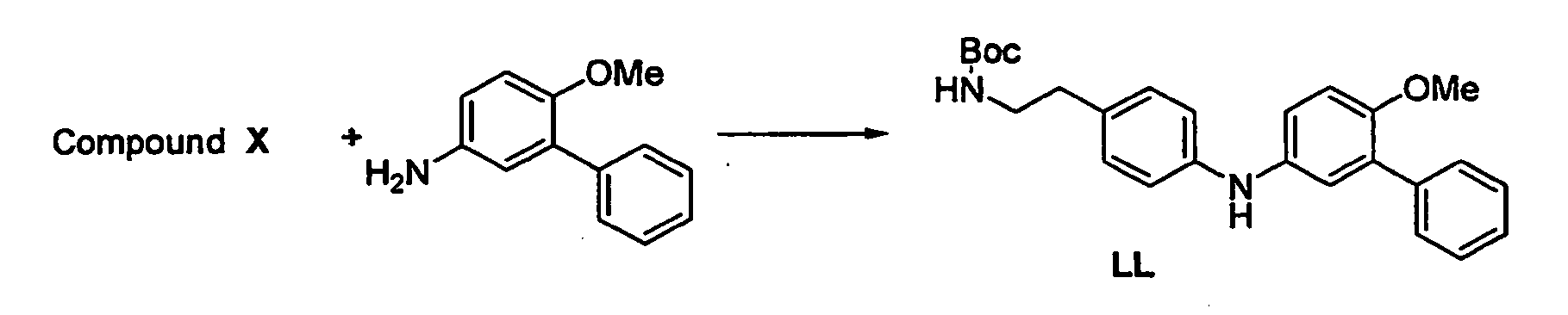
- Under nitrogen, compound X (from Example 38 part a) (5.0 g, 16.7 mmol) was mixed with toluene (80 mL) and 4-methoxy-3-phenylaniline hydrochloride (4.3 g, 18.3 mmol was added to form a slurry. 2,2'-Bis(diphenylphospino)-1,1'-binaphthyl (1.6 g, 2.5 mmol) was added, followed by tris(dibenzylideneacetone)dipalladium(0) (760 mg, 0.83 mmol) and finally sodium tert-butoxide (5.3 g, 55 mmol). The mixture was heated at 90°C for 150 min and then cooled to room temperature. Water (150 mL) was added followed by ethyl acetate (150 mL) and the phases partitioned. The aqueous layer was extracted with ethyl acetate (150 mL) and the combined organics washed three times with 0.5 M sodium bisulfate (200 mL), once with saturated sodium bicarbonate (150 mL) and twice with saturated sodium chloride (150 mL). The organics were dried over magnesium sulfate (50 g) and the volatiles removed under vacuum to give N-tert-butoxycarbonyl-2-[4-(3-[phenyl-4-methoxyphenyl)aminophenyl]ethylamine (LL) (8.4 g) which was used without further purification.
-

- Under nitrogen, compound LL (94.6 g) was treated with dichloromethane (500 mL) and cooled in an ice bath. Hydrogen chloride (4 M in dioxane, 125 mL, 500mmol) was added in 10 portions over 20 min. The reaction was kept at room temperature for 130 minutes, during which time the product precipitated. The solid was filtered and washed with dichloromethane (350 mL) and dried under vacuum in the dark to give the dihydrochloride salt of 2-[4-(3-[phenyl-4-methoxyphenyl)aminophenyl]ethylamine (MM) (37.1 g). 1H NMR (300MHz, DMSO-d6) δ 8.29 (br s, 2H), 8.04 (br s, 1H) 7.25-7.50 (m, 5H), 6.90-7.08 (m, 7H) 3.69 (s, 3H), 2.93 (m, 2H), 2.75 (m, 2H); mlz: [M + H+] calcd for C21H22N2O 319.18; found 319.3.
-

- The dihydrochloride salt of compound MM was partitioned between isopropyl acetate and 1.0 N sodium hydroxide. The organic layer was dried over sodium sulfate and concentrated to give the free base as a dark oil.
- Sodium iodide (4.2 g, 28 mmol), compound HH (9.1 g, 18.6 mmol) and sodium bicarbonate (4.7 g, 55.9 mmol) were weighed into a flask. Under nitrogen, compound MM (7 g, 22 mmol) in dimethyl sulfoxide (20 mL) was added and the mixture stirred at 140°C (oil bath) for 30 min, then cooled to room temperature. Ethyl acetate was added (200 mL) and the mixture washed three times with IN hydrochloric acid, then with IN sodium hydroxide, saturated sodium bicarbonate and finally saturated sodium chloride (200 mL each). The organics were dried over sodium sulfate and evaporated to dryness to give N-{2-[4-(3-phenyl-4-methoxyphenyl)aminophenyl]ethyl}-(R)-2-tert-butyldimethylsilyl-2-(8-benzyloxy-2(1H)-quinolinon-5-yl)ethylamine (NN) (13.9 g) which was used in the next step without further purification.
-

- Compound NN (13.9 g) was combined with methanol (200 mL) and concentrated hydrochloric acid (170 mL) was added in portions (exothermic). The solution turned orange and cloudy after the addition and more methanol (100 mL) was added until a clear solution was obtained. The mixture was stirred at room temperature overnight, in which time a brown gum had formed. The solvent was removed under vacuum, and ethyl acetate (300 mL) was added. The resulting mixture was cooled in an ice bath, and neutralized (pH 7) with 10 N sodium hydroxide. The pH was then raised to 10 with 1 M sodium hydroxide to give a clear biphasic mixture. The phases were separated and the aqueous layer was extracted with ethyl acetate (300 mL). The combined organic layers were dried over sodium sulfate, and evaporated to dryness. The crude product was purified by flash chromatography on silica gel (500 g, 0-10% methanol in dichloromethane) to give N-{2-[4-(3-phenyl-4-methoxyphenyl)ambophenyl]ethyl}-(R)-2-hydroxy-2-(8-benzyloxy-2(1H)-quinolinon-5-yl)ethylamine (PP) (5.6 g).
- (R)-(+)-α,α-Diphenylprolinol (30.0 g,117 mmol) and trimethylboroxine (11.1 mL, 78 mmol) were combined in toluene (300 mL) and stirred at room temperature for 30 minutes. The mixture was placed in a 150°C oil bath and liquid was distilled off. Toluene was added in 20 mL aliquots, and distillation was continued for 4 hours. A total of 300 mL toluene was added. The mixture was finally cooled to room temperature. A 500 µL aliquot was evaporated to dryness, weighed (246 mg) to determine that the concentration of catalyst was 1.8 M.
- 5-(2-Bromo-1-oxy)ethyl-8-benzyloxy-2(1H)-quinolinone (R) (90.0 g, 243 mmol) was placed under nitrogen, tetrahydrofuran (900 mL) was added followed by the catalyst from above (1.8 M in toluene, 15 mL, 27 mmol). The suspension was cooled to -10±5°C in an ice/isopropanol bath. Borane (1.0 M in THF, 294 mL, 294 mmol) was added over 4 hours. The reaction was stirred an additional 45 minutes at -10°C, then methanol (250 mL) was added slowly. The mixture was concentrated under vacuum. The residue was dissolved in boiling acetonitrile (1.3 L), filtered while hot and cooled to room temperature. The crystals were filtered, washed with acetonitrile and dried under reduced pressure to give 5-(2-bromo-(R)-1-hydroxy)ethyl-8-benzyloxy-2(1H)-quinolinone (FF) (72.5g, 196 mmol, 81% yield, 95% ee, 95% pure by HPLC area ratio).
- Compound FF (70.2 g, 189 mmol) was treated with N,N-dimethylformamide (260 mL) and cooled in an ice bath under nitrogen. 2,6-Lutidine (40.3 g, 376 mmol) was added over 5 minutes followed slowly by tert-butyldimethylsilyl trifluoromethanesulfonate (99.8 g, 378 mmol), keeping the temperature below 20°C. The mixture was allowed to warm to room temperature for 45 minutes. Methanol (45 mL) was added to the mixture dropwise over 10 minutes and the mixture was partitioned between ethyl acetate/cyclohexane(1:1, 500 mL) and water/brine (1:1,500mL). The organics were washed twice more with water/brine (1:1, 500 mL each). The combined organics were evaporated under reduced pressure to give a light yellow oil. Two separate portions of cyclohexane (400 mL) were added to the oil and distillation continued until a thick white slurry was formed. Cyclohexane (300 mL) was added to the slurry and the resulting white crystals were filtered, washed with cyclohexane (300 mL) and dried under reduced pressure to give 5-(2-bromo-(R)-1-tert-butyldimethylsiloxy)ethyl-8-benzyloxy-2(1H)-quinolinone (HH) (75.4 g, 151 mmol, 80% yield, 98.6 % ee).
-

- Compound HH (136.5 g, 279 mmol), 4-bromophenethylamine (123 g, 615 mmol) and dimethyl sulfoxide (180 mL) were mixed at room temperature under nitrogen. Another 40 mL of dimethyl sulfoxide was added. The mixture was heated to 85°C for 5 hours. The reaction was partitioned between ethyl acetate (1 L) and 10% aqueous acetic, acid (500 mL). The organics were washed with 10% aqueous acetic acid (3x500 mL), then with IN sodium hydroxide (3x500 mL). The last wash was filtered through Celite (100 g). The organic layer was concentrated to 300 mL and cyclohexane (2x500 mL) was added and the solution concentrated to 300 mL. Sufficient cyclohexane was added to form 1.8 L final volume which was filtered through Celite (50 g). A solution of HCl in isopropanol, prepared by slowly adding concentrated HCl (23.5 mL) to isopropanol (180 mL) at 10°C (internal), was added to the crude product and the reaction mixture was stirred for 5 hours, washed with cyclohexane (2x500 mL) and dried under reduced pressure for 24 hours to give N-[2-(4-bromophenyl)ethyl}-(R)-2-tert-butyldimethylsiloxy-2-(8-benzyloxy-2(1H)-quinolinon-5-yl)ethylamine (JJ) hydrochloride (145 g, 80 mol %, 106 wt %, HPLC purity 97.9 %).
- To compound JJ hydrochloride (73.7 g, 114 mmol) and 4-methoxy-3-phenylaniline hydrochloride (32.4 g, 137 mmol), toluene (380 mL) was added with mild agitation for 5 minutes, followed by sodium tert-butoxide (49.3 g, 513 mmol) in portions over 1 minute, and finally 2,2'-bis(diphenylphosphino)-1,1'-binaphthyl (10.65 g, 17 mmol) and tris(dibenzylideneacetone)dipalladium(0) (5.22 g, 5.7 mmol). The resulting mixture was stirred and heated to 85-89°C (internal) for 2.5 hours. The solution was cooled to room temperature, water (400 mL) was added and the mixture was stirred for 5 minutes, filtered through Celite (80 g), and partitioned with toluene (100 mL). The organic layer was collected and concentrated under reduced pressure in a 40°C bath to give N-{2-[4-(3-phenyl-4-methoxyphenyl)aminophenyl] methyl }-(R)-2-tert-butyldimethylsilyl-2-(8-benzyloxy-2(1H)-quinolinon-5-yl)ethylamine (NN) as a dark viscous oil.
- Compound NN from the previous step was dissolved in 280 ml of THF. Triethylamine trihydrofluoride (27.6 g, 171 mmol) was added to the solution, an additional 20 mL of THF was used to rinse down residual reagent, and the reaction was stirred at 25°C under nitrogen for 16 hours. The reaction mixture was concentrated under reduced pressure in a 25°C bath to give a dark viscous oil to which dichloromethane (400 mL) was added, followed by IN aqueous NaOH (200 mL). The reaction mixture was stirred for 5 hours. The top layer was discarded and the organic layer was concentrated to a viscous oil.
- The oil was dissolved in dichloromethane to give a total volume of 630 mL. A 60 mL aliquot was taken and concentrated to 30 mL. Toluene (60 mL) was added, followed by a mixture of concentrated hydrochloric acid (2.7 mL) and methanol (4.5 mL) to give a thick paste covered in a free-flowing liquid. The liquid was carefully removed and the paste washed with toluene (50 mL). The gum was partitioned between dichloromethane (40 mL) and 1N aqueous sodium hydroxide (40 mL) and the organic solvents were removed under reduced pressure. The residue was purified chromatographically over silica using a gradient of 0-10% methanol in dichloromethane to give N-{2-[4-(3-phenyl-4-methoxyphenyl)aminophenyl]ethyl}-(R)-2-hydroxy-2-(8-benzyloxy-2(1H)-quinolinon-5-yl)ethylamine (PP). (98.6 % pure by HPLC area ratio)
- Intermediate PP (0.5 g, 0.82 mmol, Pd level ~850 ppm by ICP) was dissolved in 1:1 dichloromethane:methanol (5 mL) and 4M hydrochloric acid in dioxane (0.445 mL, 1.78 mmol) was added. The resulting dark brown solution was diluted further with dichloromethane (7.5 mL) and 3-(1-thioureido)propyl functionalized silica gel (0.05 g) was added (Sigma-Aldrich, St. Louis, MO). The suspension was stirred at room temperature for 20 h followed by filtration through filter paper. The remaining yellow silica was washed with a mixture of 5 mL of methanol and 30 mL of dichloromethane. Combined organic solutions were washed with saturated aqueous sodium bicarbonate (50 mL) and brine(50 mL). The organic solution was treated with anhydrous sodium sulfate for 30 minutes, filtered and evaporated under reduced pressure to give N-{2-[4-(3-phenyl-4methoxyphenyl)aminophenyl]ethyl}-(R)-2-hydroxy-2-(8-benzyloxy-2(1H-quinolinon-5-yl)ethylamine (PP) (~90% yield, Pd level by ICP 30ppm, purity 97.4% by HPLC area ratio).
- To compound PP from the previous step (2.1 g, 3.43 mmol) was added under nitrogen 10% palladium on carbon (420mg) followed by ethylene glycol (16mL) and concentrated hydrochloric acid (0.57mL, 6.9 mmol). The suspension was stirred vigorously under 1 atmosphere of hydrogen for 5h. The solids were filtered off and washed with ethylene glycol (5 mL). The filtrate was warmed to 50°C and water (21 mL) was added over 5 minutes under stirring. A brown gum formed which broke up to an off-white solid under continued stirring at 50 °C for 40 min. The solid was filtered off, washed with water (2x20 mL) and air dried to afford an amorphous hydrochloride salt of compound 61 (2.5 g containing 44.3% water, 74% yield)
- To improve the purity of the title compound, (2.5g, 4.8mmol) was dissolved in methanol (25mL) at 40°C. The dark blue solution was cooled to room temperature, decolorizing charcoal (Darco-KB, 2.5 g) was added and the suspension stirred at room temperature overnight. Solids were filtered off over Celite (2.0 g), filter cake was washed with methanol (2x10 mL) and solvent was evaporated under reduced pressure to leave an amorphous hydrochloride salt of N-{2-[4-(3-phenyl-4-methoxyphenyl)aminophenyl]ethyl }-(R)-2-hydroxy-2-(8-hydroxy-2(1H)-quinolinon-5-yl)ethylamine (61) as a light gray solid (1.5 g)
-

- To a solution of 70 mg of compound nn (0.09 mmol) in 5 mL of glacial acetic acid was added 21 mg of 10% palladium on carbon. The reaction was shaken under an atmosphere of H2 at 40 psi. After 18 h, the reaction was filtered and the filtrate purified by reversed-phase HPLC (gradient of 10 to 50% acetonitrile in 0.1% aqueous TFA) to afford compound 62 (10 mg, 0.0126 mmol) as the TFA salt. 1H NMR (300 MHz, DMSO-d6) δ 1.21-1.33 (m, 2H), 1.39-1.52 (m, 4H), 2.74 (m, 4H), 2.82 (m, 2H), 2.96-3.20 (m, 4H), 5.25 (m, 1H), 6.13 (m, 1H), 6.51 (m, 1H), 6.90 (d, 1H, J=8.2 Hz), 7.01 (d, 2H, J=8.8 Hz), 7.07-7.15 (m, 5H), 7.43 (d, 2H, J=9.1 Hz), 8.07 (d, 2H, J.9 Hz), 8.61 (br s, 2H), 8.76 (s, 1H), 10.39 (s, 1H), 10.46 (s, 1H). m/z: [M+H+] calcd for C30H34N4O5S 563.7; found 563.3.
- The intermediate compound nn was prepared as follows.
-

- To a flask containing 4.51 g (11.6 mmol) of compound B (Example 13, part b), 3.61 g (15.0 mmol) of 4-(piperdinosulfonyl)aniline (available from Maybridge), 0.53 g (0.58mmol) of tris(dibenzylidineacetone)dipalladium(0), 1.19 g (1.91 mmol) of racemic-2,2'-bis(diphenylphosphino)-1,1'-binaphthyl, and 1.45 g (15.1 mmol) of sodium tert-butoxide was added toluene (60 mL), and the mixture was stirred at 95°C for 6 h under a nitrogen atmosphere. The mixture was diluted with 200 mL diethyl ether and washed twice with 100 mL portions of 1.0 M aqueous NaHSO4, followed by 100 mL of saturated aqueous NaHCO3. The diethyl ether phase was dried over MgSO4, filtered, and concentrated to a dark oil. The oil was purified by silica gel chromatography (gradient of 30 to 40% ethyl acetate in hexanes) to afford compound kk as an orange foam.
-

- A solution of compound kk (2.88 g, 5.24 mmol) in 20 mL CH2Cl2 was cooled to 0 °C and 20 mL of TFA was added. After 20 min, the reaction was concentrated and the residue dissolved in isopropyl acetate. The isopropyl acetate solution was washed twice with 1.0 N aqueous NaOH followed by water and then dried over MgSO4, filtered and concentrated to an oil. The oil was dissolved in 2 mL DMF and intermediate AA (337 mg, 0.69 mmol), diethyl isopropyl amine (179 mg, 1.38 mmol) and potassium iodide (172 mg, 1.04 mmol) were added. The reaction was heated to 100°C. After 18 h, the reaction was cooled and added to vigorously stirred ice water. Compound mm precipitated, was isolated by filtration and purified by silica gel chromatography (1:1 ethyl acetate/hexanes) to afford 544 mg solid.
-
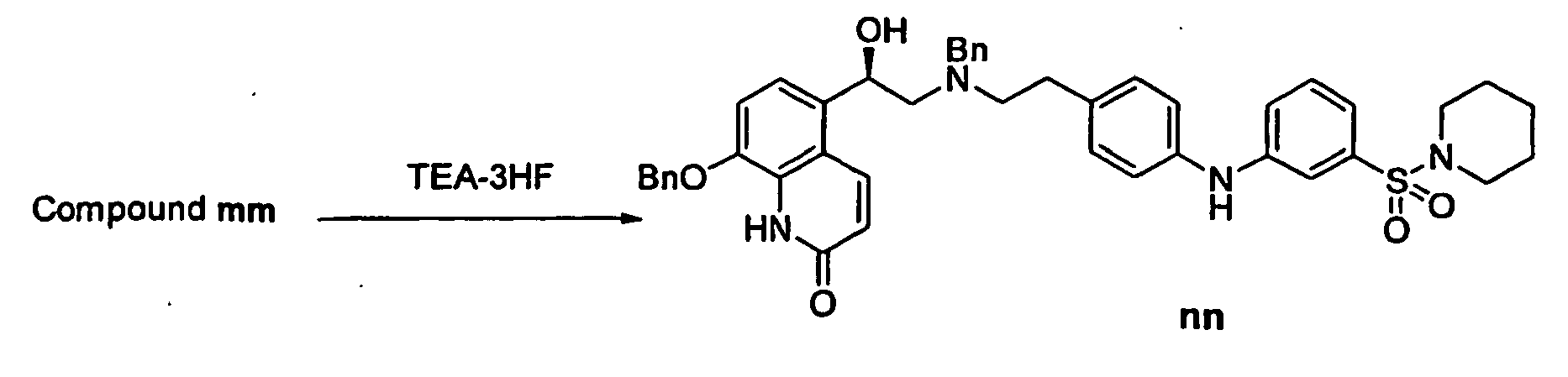
- To a solution of compound mm (83 mg, 0.01 mmol) in CH2Cl2 (0.9 mL) and triethylamine (0.09 mL) was added triethylamine trihydrofluoride (313 mg,1.94 mmol). The solution was stirred at room temperature under a N2 atmosphere. After 18 h, the reaction mixture was diluted with CH2Cl2 and washed with 1.0 N aqueous HCl, followed by two washes with saturated NaCl solution. The organic phase was dried over MgSO4, filtered and concentrated under reduced pressure to afford compound nn (70 mg).
-

- To a solution of 730 mg of compound rr (1.05 mmol) in 10 mL of glacial acetic acid was added 100 mg of 10% palladium on carbon. The reaction was stirred under an atmosphere of H2. After 65 h, the reaction was filtered and the filtrate purified by reversed-phase HPLC (gradient of 10 to 50% acetonitrile in 0.1 % aqueous TFA) to afford 90 mg (0.14 mmol) the TFA salt. The TFA salt product was solubilized in acetonitrile/water (1:2, 10 mL) to which 3 mL of 0.1 N aqueous HCI was added. The solution was frozen and lyophilized to afford compound 63 as an HCI salt. m/z: [M+H+] calcd for C29H29N5O4 512.6; found 512.3.
- Intermediate rr was prepared as follows.
-

- To 0.99 g of compound cc (Example 60, part a) (1.99 mmol) in 5 mL CH2Cl2 was added 2 mL TFA. After 1 h, the solution was concentrated, diluted with 15 mL CH2Cl2 and washed with 1.0 N aqueous sodium hydroxide. The aqueous was collected and washed again with CH2Cl2 (10 mL) followed by a wash with ethyl acetate (10 mL). The organic layers were combined and dried over MgSO4, filtered, and concentrated under reduced pressure. The crude product was purified by silica gel chromatography (gradient of 2-10% MeOH in CH2Cl2) to afford intermediate qq as an oil.
-

- To a solution of compound qq (2.0 6, 5.0 mmol) in 27 mL DMF were added bromoketone R (from Example 56, part a) (1.71 g, 4.5 mmol) and K2CO3 (1.91 g, 13.8 mmol). The reaction was heated to 50°C. After 1 h, the reaction was allowed to cool to room temperature and the K2CO3 was filtered off. The filtrate was diluted with CH2Cl2 (50 mL) and was washed with O.1N HCl (30 mL). The organic layer was washed once with saturated sodium bicarbonate solution, followed by aqueous saturated sodium chloride, dried over Na2SO4 and concentrated under reduced pressure to afford an oil. The product (1.14 g, 1.65 mmol) was solubilized in 12 mL THF/EtOH (1:1) and NaBH4 (380 mg, 10.0 mmol) was added. After 20 minutes of vigorous stirring. The reaction was quenched with saturated aqueous NH4Cl which was added until effervescence of the reaction mixture ceased. The reaction mixture was partitioned between ethyl acetate and saturated sodium bicarbonate solution. The organic layer was washed twice with saturated sodium bicarbonate, followed by saturated sodium chloride, dried over Na2SO4 and concentrated under reduced pressure. The crude product was purified by silica gel chromatography (2% MeOH in CH2Cl2) to yield 230 mg of intermediate rr.
-

- To a mixture of 580 mg (0.93 mmol) of compound V in 25 mL of ethanol was added 173 mg of 10% palladium on carbon under a stream of nitrogen. The flask was fitted with a balloon of hydrogen gas, and the reaction was vigorously stirred for 4 days. The reaction was filtered and the filtrate was concentrated under reduced pressure. The residue was purified by reverse phase HPLC using a gradient of 10 to 50% acetonitrile in 0.1% aqueous TFA. Fractions containing pure product were combined and lyophilized to afford a TFA salt of compound 64 as an off-white powder.
- A sample of the TFA salt of compound 64 (150 mg) was dissolved in acetonitrile (2.0 mL) and water (2.0 mL). 0.1N HCl (7.0 mL, 0.70 mmol) was added, and the resulting precipitate was redissolved by the addition of acetonitrile. The resulting solution was lyophilized to give a solid which was again dissolved in acetonitrile (5.0 mL) and water (5.0 mL). O.1N HCl (7.0mL, 0.7 mmol) was added and the resulting solution was lyophilized to give a hydrochloride salt of compound 64 as an off white powder. 1H NMR (300MHz, DMSO-d6) δ 10.10 (br s, 1 H), 9.62 (s, 1 H), 8.80 (br s, 1 H), 8.65 (br s, 1 H), 8.27 (d, 1H); 8.15 (d, 1 H), 6.80-7.15 (m, 11 H), 4.78 (dd, 1 H), 3.94 (quar, 2H), 2.80-3.15 (m, 6H), 1.29 (t, 3H); m/z: [M + H+] calcd for C25H29N3O4 436.22; found 436.3.
- The intermediate compound V was prepared as follows.
-

- To 0.60 g (1.3 mmol) of compound C (Example 37, part a) in 20 mL of CH2Cl2 at 0°C was added 2.0 mL of trifluoroacetic acid. After 1 h, the solution was concentrated under reduced pressure, and the residue was partitioned between 1.0 M aqueous NaOH and EtOAc. The phases were separated, and the EtOAc phase was dried over MgSO4, filtered, and concentrated to an oil and dissolved in 10 mL of 1:1 methanol:THF. Bromohydrin GG (Example 13, part d) (360 mg, 1.0 mmol) and K2CO3 (380 mg, 2.7 mmol) were added and the reaction was stirred at room temperature for 1.5 h. The reaction was diluted with 30 mL water and extracted twice with 30 mL portions of toluene. The toluene extracts were combined, dried over MgSO4, filtered, and concentrated. The residue was heated to 120°C. After 2h, the residue was cooled to room temperature and purified by silica gel chromatography (gradient of 5 to 10% methanol in CH2Cl2). Fractions containing pure product were combined and concentrated to afford compound V as a tan solid.
-

- Compound W (55.2 mg, 0.094 mmol), phenyl boronic acid (13.2 mg, 0.113 mmol) and [1,1'-bis(diphenylphosphinoferrocene)dichloropalladium (II), complex with dichloromethane (PdCh(dppt)-DCM) (5.0 mg, 0.006 mmol) were combined in a small pressure tube and purged with N2. 1,2-Dimethoxyethane (1.0 mL) and 2.0 N cesium carbonate (150 µL, 0.3 mmol) were added. The tube was sealed, and then placed in an oil bath at 90°C for 4 hours. The solution was then cooled to room temperature and DCM (10 mL) was added. The solution was filtered and concentrated to dryness. To the residue there was added DMF (1.0 mL), 10% Pd/C (100 mg) and ammonium formate (200 mg) and the solution was heated to 50°C for 1.5 hours. At this time, water:acetonitrile 1:1 and 200 µL TFA was added and the solution was filtered to remove the catalyst. The filtrate was purified by reverse phase HPLC. Fractions containing pure product were combined and lyophilized to give compound 65 as a TFA salt. 1H NMR (300MHz, DMSO-d6) δ 10.46 (s, 1H), 10.39 (s, 1H), 8.60 (br s, 2H), 8.19 (s, 1H), 8.07 (d, 1H), 7.50 (d, 2H), 7.37 (t, 2H) 7.15-7.30 (m, 3H), 6.85-7.10 (m, 9H), 6.51 (dd, 1H), 6.11 (d, 1H), 5.23 (d, 1H), 2.70-3.15 (m, 6H); m/z: [M+H1 calcd for C31H29N3O3 492.23; found 492.3.
-

- Compound HH (Example 6 1 B, part f) (9.1g, 18.62mmol), 4-aminophenethylamine (9.8 mL, 74.8 mmol) and sodium iodide (4.2 g, 27.93 mmol) were placed in a flask and purged with nitrogen. Methyl sulfoxide (25 mL) was added, and the solution was placed in an oil bath heated at 140°C. The solution was the stirred for 20 min at 140°C. The reaction was allowed to cool to room temperature, then ethyl acetate (300 mL) and H2O (300 mL) were added. The phases were partitioned, and the organic layer was washed with water (4 x 200mL) and saturated sodium chloride (4 x 200mL). The organic phase was dried over sodium sulfate, filtered and concentrated under vacuum to yield compound U (10.5g).
-

- Compound U (5.18 g, 9.53 mmol), tris(dibenzylideneacetone)dipalladium(0) (0.44 g, 0.48 mmol), 2,2'-bis(diphenylphosphino)-1,1-binaphthyl (0.63 g, 0.95 mmol), and sodium t-butoxide (1.83 g, 19.06 mmol) were combined in a flask and purged with nitrogen. 1-Bromo-3-iodobenzene (2.0 mL, 11.44 mmol) was added and the flask was purged again. o-Xylene (50 mL) was added, and the solution was heated at reflux under nitrogen for 2.5 hours, at which time HPLC analysis indicated complete reaction. The o-xylene was removed under vacuum with heating, and dichloromethane (200 mL) was added. Once the residue was dissolved, celite (30 g) was added, and the mixture was filtered and filter cake was washed with dichloromethane until all of the product was collected. The solution was concentrated to dryness under vacuum, redissolved in THF (20 mL), and purged with nitrogen. Tetrabutylammonium fluoride (20 mL, 1.0 M in THF, 20 mmol) was added via syringe, and the solution was stirred for 18 hours at room temperature. The THF was then removed, and the residue was dissolved in DCM, and washed with water (1 x 200 mL) and half-saturated sodium chloride (1 x 200 mL). The organic phase was dried over sodium sulfate, concentrated and chromatographed over silica gel (50g, 0 -10% MeOH in dichloromethane) to yield compound W as a yellow solid.
-

- Using procedures similar to that described in Example 65, except replacing the phenylboronic acid with the appropriate substituted phenylboronic acid, TFA salts of compounds 66-69 were prepared.
- Compound 66: N-{2-[4-(3-(2-chlorophenyl)phenyl)aminophenyl]ethyl}-(R)-2-hydroxy-2-(8-hydroxy-2(1H)-quinolinon-5-yl)ethylamine (Formula (X) where R11 is 2-chlorophenyl): 1H NMR (300MHz, DMSO-d6 δ 10.47 (s, 1H), 10.37 (s, 1H), 8.55, (br s, 2H), 8.22, (s, 1H), 8.06 (d, 1 H)7.46 (m, 1H), 7.32 (m, 3H), 7.22 (t, 1 H), 7.01 (m, 8H), 6.89 (d, 1H), 6.74 (dd, 1H), 6.51 (d, 1H), 6.10 (d, 1H), 3.18 (m, 4H), 2.80 (m, 2H); m/z: [M+H+] calcd for C31H28ClN3O3 526.19; found 526.4.
- Compound 67: N-{2-[4-(3-(2-methoxyphenyl)phenyl)aminophenyl]ethyl}-(R)-2-hydroxy-2-(8-hydroxy-2(1H)-quinolinon-5-yl)ethylamine (Formula (X) where R11 is 2-methoxyphenyl): 1H NMR (300MHz, DMSO-d6) δ 10.46 (s, 1H), 10.40 (s, 1H), 8.60 (br s, 2H), 8.12 (s, 1H), 8.06 (d, 1 H), 7.16 (m, 13 H), 6. 80 (d, 1H), 6.5 T (d, 1 H) 6.11 (s, 1H) 5.24 (d, 1H), 3.69 (s, 3H), 3.10 (m, 4H), 2.80 (m, 2H); mlz: [M+H+] calcd for C32H31N3O4 522.24; found 522.7.
- Compound 68: Formula (X) where R11 is 4-hydroxymethylphenyl: 1H NMR (300MHz, DMSO-d6) δ 10.47 (s, 1H), 10.39 (s, 1H), 8.60 (br s, 2H), 8.18 (s, 1H), 8.07 (d, 1H), 7.46 (d, 2H), 7.30 (d, 2H), 7.20 (m, 2H), 7.00 (m, 8H), 6.51 (dd, 1 H), 6.11 (s, 1 H), 5.23 (d, 1 H), 4.44 (s, 2H), 3.10 (m, 4H), 2.80 (m, 2H); m/z: [M+H+] calcd for C32H31N3O4 522.24; found 522.4.
- Compound 69: Formula (X) where R11 is 4-methoxyphenyl: 1H NMR (300MHz, DMSO-d6) δ 10.47 (s, 1H), 10.39 (s, 1H) 8.60 (br s, 2H), 8.16 (s, 1H), 8.07 (d, 1H), 7.44 (d, 2H), 6.85-7.20 (m, 12H), 6.51 (dd, 1 H), 6.12 (d, 1 H), 5.23 (d, 1 H), 3.70 (s, 3H), 3.10 (m, 4H), 2.80 (m, 2H) ; m/z: [M+H+] calcd for C32H31N3O4 522.24; found 522.4.
- Compound 70: Formula (X) where R11 is 4-chlorophenyl
- Compound W (84.0 mg, 0.143 mmol), 4-chlorophenyl boronic acid (27.2 mg, 0.172 mmol) and [1,1'-bis(diphenylphosphinoferrocene)dichloropalladium (II), complex with dichloromethane (PdCl2(dppf)-DCM) (5.9 mg, 0.007 mmol) were combined in a small pressure tube and purged with N2. 1,2-Dimethoxyethane (2.0 mL) and 2.0 N cesium carbonate (150 uL, 0.3 mmol) were added. The tube was sealed, and then placed in an oil bath at 90°C for 4 hours. The solution was then cooled to room temperature and DCM (10 mL) was added. The solution was filtered and concentrated to dryness. To the residue there was added DMF (1.0 mL) and 10% palladium on carbon (10 mg), and the reaction was stirred under one atmosphere of hydrogen for 4 hours. At this time, water:acetonitrile 1:1 and 200 uL TFA was added and the solution was filtered to remove the catalyst. The filtrate was purified by reverse phase HPLC. Fractions containing pure product were combined and lyophilized to give compound 70 as a TFA salt. 1H NMR (300MHz, DMSO-d6) δ 10.46 (s, 1H), 10.40 (s, 1H), 8.61 (br s, 2H), 8.22 (s, 1H), 8.07 (d, 1H), 7.53 (d, 2H), 7.42 (d, 2H), 7.23 (t, 1H), 7.14 (s, 1H), 6.85-7.10 (m, 8H), 6.51 (d, 1H), 6.12 (s, 1H), 5.24 (d, 1H), 3.10 (m, 4H), 2.80 (m, 2H); m/z: [M+H+] calcd for C31H28ClN3O3 526.19; found 526.4.
- Using procedures similar to that described in Example 70, except replacing the 4-chlorophenylboronic acid with the appropriate substituted boronic acid, TFA salts of compounds 71-72 were prepared.
- Compound 71: Formula (X) where R11 is 5-indolyl: 1H NMR (300MHz, DMSO-d6) δ 11.07 (s, 1 H), 10.47 (s, 1 H), 10.40 (s, 1 H), 8.60 (br s, 2H), 8.1 S (s, 1 H), 8,11 (d, 1H, 7.65 (s, 1H), 7.15-7.40 (m, 5H), 7.00-7.15 (m, 5H), 6.89 (d, 2H), 6.51 (dd, 1H), 6.39 (s, 1H), 6.11 (s, 1H), 5.24 (d, 1H), 3.10 (m, 4H), 2.80 (m, 2H); m/z: [M+H+] calcd for C33H30N4O3 531.24; found 531.4.
- Compound 72: Formula (X) where R11 is 4-pyridyl: 1H NMR (300MHz, DMSO-d6) δ 10 48 (s, 1H) 10.38 (s, 1H), 8.60 (br m, 4H), 8.32 (s, 1H), 8.07 (d, 1H), 7.69 (d, 2H), 7.31 (m, 2H), 7.16 (d, 1H) 7.05 (m, 6H), 6.90 (d, 1 H), 6.52 (dd, 1 H), 6.11 (s, 1 H), 5.24 (d, 1H), 3.10 (m, 4H), 2.80 (m, 2H); m/z: [M+H+] calcd for C30H28N4O3 493.23; found 493.5.
- Compound 73: Formula (X) where R11 is hydrogen: A TFA salt of compound 73 was prepared: 1H NMR (300MHz, PMSO-d6) δ 10.48 (s, 1H), 10.39 (s, 1H), 8.59 (br s, 2H), 8.07 (dd, 2H), 6.85-7.17 (m, 10H), 6.72 (t, 1H), 6.52 (dd, 1H), 6.11 (d, 1H), 5.22 (d, 1H), 3.10 (m, 4H), 2.80 (m, 2H); m/z: [M+H+] calcd for C25H25N3O3 416.20; found 416.3.
- Compound 74: Formula (X) where R11 is 3-cyanophenyl
- Compound W (Example 65, part b) (58.1 mg, 0.100 mmol), 3-cyanophenyl boronic acid (17.6 mg, 0.120 mmol) and [1,1'-bis(diphenylphosphinoferrocene)dichloropalladium (II), complex with dichloromethane (PdCl2(dppf)-DCM) (approximately 6 mg, 0.007 mmol) were combined in a small pressure tube and purged with N2. 1,2-Dimethoxyethane (2.0 mL) and 2.0 N cesium carbonate (200 uL, 0.4 mmol) were added, the tube was sealed, and then placed in an oil bath at 90°C for 5 hours. The solution was then cooled to room temperature and DCM (10 mL) was added. The solution was dried (Na2SO4) for 30 minutes, then filtered, concentrated and dried under vacuum. The residue was dissolved in DCM (2mL) and cooled to 0 °C, then boron trichloride (1.0N in DCM, 1.0mL, 1.0mmol) was added. After 10 minutes the reaction was quenched with methanol (10mL), and concentrated under reduced pressure. The residue was purified by reverse phase HPLC. Fractions containing pure product were combined and lyophilized to give compound 74 as a TFA salt. 1H NMR (300MHz, DMSO-d6) δ 10.45 (s, 1H), 10.40 (s, 1H), 8.70 (br 2, 2H), 8.34 (m, 1H), 8.09 (d, 1H), 7.97 (s, 1H), 7.85 (dt, 1H), 7.74 (dt, 1H), 7.58 (t, 1H), 7.20-7.30 (m, 2H), 6.95-7.10 (m, 7H), 6.90 (d, 1H), 6.50 (d, 1H), 6.12 (s, 1H), 5.25 (d, 1H), 3.10 (m, 4H), 2.80 (m, 2H); m/z: [M+H+] calcd for C32H28N4O3 517.23; found 517.4.
- Using procedures similar to that described in Example 74, except replacing the 3-cyanophenyl boronic acid with the appropriate substituted boronic acid, TFA salts of compounds 75-93 were prepared.
- Compound 75: Formula (X) where R11 is trans-2-phenylvinyl: m/z: [N4+H+] calcd for C33H31N3O3 518.25; found 518.3.
- Compound 76: N-{2-[4-(3-(3-pyridyl)phenyl)aminophenyl]ethyl}-(R)-2-hydroxy-2-(8-hydroxy-2(1H)-quinolinon-5-yl)ethylamine (Formula (X) where R11 is 3-pyridyl): 1H NMR (300MHz, DMSO-d6) δ 10.38 (br s, 2H), 8.84 (s, 2H), 8.67 (s, 1H), 8.58 (d, 1H), 8.25 (s, 1H), 8.14 (d, 1H), 8.11 (d, 1H), 7.59 (dd, 1H), 7.27 (m, 2H), 7.05 (m, 7H), 6.90 (d, 1H), 6.50 (d, 1H), 5.28 (d, 1H), 3.10 (m, 4H), 2.83 (m, 2H). m/z: [M+H+] calcd for C30H28N4O3 493.23; found 493.5.
- Compound 77: Formula (X) where R11 is 4-cyanophenyl: 1H NMR (300MHz, DMSO-d6 δ 10.45 (br s, 1H), 10.40 (s, 1H), 8.62 (br, s, 2H), 8.27 (s, 1H), 8.07 (d, 1H), 7.84 (d, 2H), 7.72 (d, 2H), 7.27 (m, 2H), 7.18 (m, 7H), 6.91 (d,1H), 6.52 (d, 1H), 6.12 (s, 1H), 5.24 (m, 1H), 3.12 (m, 4H), 2.81 (m, 2H). m/z: [M+H+] calcd for C32H28N4O3 516.60; found 517.4.
- Compound 78: Formula (X) where R11 is 3,5-dimethylisoxazole-4-yl: m/z: [M+H+] calcd for C30H30N4O4 511.24; found 511.5.
- Compound 79: Formula (X) where R11 is 2-furanyl: 1H NMR (300MHz, DMSO-d6) δ 11.15 (s, 1H), 10.47 (s, 1H), 10.41 (s, 1H), 8.64 (br s, 1H), 8.10 (t, 2H), 7.08 (m, 9H), 6.77 (s, 1H), 6.74 (s; 1H), 6.52 (d, 1H), 6.30 (s, 1H), 6.12 (s, 1H), 6.02 (q, 1H), 5.25 (d, 1H), 3.10 (m, 4H), 2.85 (m, 2H). m/z [M+H+] calcd for C29H27N3O4 482.21; found 481.4.
- Compound 80: Formula (X) where R11 is thiophene-2-yl: 1H NMR (300MHz, DMSO-d6) δ 10.47 (s, 1H), 10.38 (s, 1H), 8.62 (br s, 2H), 8.22 (s, 1H), 8.07 (d, 1H), 7.44 (d, 1H), 7.33 (d, 1H), 7.35 (m, 2H), 7.06 (m, 7H), 6.90 (d, 2H), 6.50 (d, 1H), 6.10 (d, 1H), 5.23 (m, 1H), 3.10 (m, 4H), 2.85 (m, 2H). m/z [M+H+] calcd for C29H27N3O3S 498.19; found 498.5.
- Compound 81: Formula (X) where R11 is 3-nitrophenyl: m/z: [M+H+] calcd for C31H28N4O5 537.22; found 537.3.
- Compound 82: Formula (X) where R11 is 4-formylphenyl: m/z: [M+H+] calcd for C32H29N3O4 520.23; found 520.5.
- Compound 83: Formula (X) where R11 is 2-pyrrolyl: Using a procedure similar to that described in Example 74, except replacing the 3-cyanophenylboronic acid with 1-(tert-butoxycarbonyl)pyrrole-2-boronic acid, a TFA salt of compound 83 was prepared. Deprotection of the Boc group occurred under reaction conditions. 1H NMR (300MHz, DMSO-d6) δ 11.13 (s, 1H), 10.46 (s, 1H), 10.37 (s, 1H), 8.58 (br s, 2H), 8.08 (s, 1H), 8.05 (s, 1H), 7.05 (m, 9H), 6.75 (s, 1H), 6.73 (s, 1H), 6.51 (d, 1H), 6.23 (s, 1H), 6.08 (s, 1H), 6.01 (s, 1H), 5.22 (m, 1H), 3.12 (m, 4H), 2.80 (m, 2H). m/z: [M+H+] calcd for C29H28N4O3 481.23; found 481.3.
- Compound 84: Formula (X) where R11 is 4-carboxyphenyl: m/z: [M+H+] calcd for C32H29N3O5 536.22; found 536.3.
- Compound 85: Formula (X) where R11 is 4-methylsulfonylphenyl: 1H NMR (300MHz, DMSO-d6) δ 10.45 (s, 1H), 10.38 (s, 1H), 8.58 (br s, 1H), 8.27 (s, 1H), 8.05 (d, 1H), 7.90 (d, 2H), 7.77 (d, 2H), 7.26 (m, 2H), 7.04 (m, 7H), 6.88 (d, 1H), 6.50 (d, 1H), 6.11 (s, 1H), 5.22 (d, 1H), 3.16 (s, 3H), 3.11 (m, 4H), 2.80 (m, 2H). m/z: [M+H+] calcd for C32H31N3O5S 570.21; found 570.3.
- Compound 86: Formula (X) where R11 is 4-hydroxyphenyl: Using a procedure similar to that described in Example 74, except replacing the 3-cyanophenylboronic acid with 4-benzyloxyphenylboronic acid, a TFA salt of compound 86 was prepared. 1H NMR (300MHz, DMSO-d6) δ 10.46 (s, 1H), 10.40 (s, 1H), 9.47 (s, 1H), 8.71 (br s, 2H), 8.12 (m, 2H), 7.32 (d, 2H), 7.02 (m, 9H), 6.75 (d, 2H), 6.51 (d, 1H), 6.10 (s, 1H), 5.25 (d, 1H), 3.10 (m, 4H), 2.80 (m, 2H). m/z: [M+H+] calcd for C31H29N3O4 508.23; found 508.3.
- Compound 87: N-{2-[4-(3-(4-aminomethylphenyl)phenyl)aminophenyl]ethyl}-(R)-2-hydroxy-2-(8-hydroxy-2(1H)-quinolinon-5-yl)ethylamine (Formula (X) where R11 is 4-(aminomethyl)phenyl): m/z:[M+H+] calcd for C32H32N4O3 521.26; found 521.3.
- Compound 88: Formula (X) where R11 is 4-ethoxyphenyl: m/z: [M+H+] calcd for C33H33N3O4 536.26; found 536.3.
- Compound 89: Formula (X) where R11 is thiophene-3-yl: m/z: [M+H+] calcd for C29H27N3O3S 498.19; found 498.3.
- Compound 90: Formula (X) where R11 is 2-indolyl: m/z: [M+H+] calcd for C33H30N4O3 531.24; found 531.3.
- Compound 91: N-{2-[4-(3-(3-chlorophenyl)phenyl)aminophenyl]ethyl}-(R)-2-hydroxy-2-(8-hydroxy-2(1H)-quinolinon-5-yl)ethylamine (Formula (X) where R11 is 3-chlorophenyl): 1H NMR (300MHz, DMSO-d6) δ 10.45 (s, 1H), 10.38 (s, 1H), 8.58 (br s, 2H), 8.20 (s, 1H), 8.06 (d, 1H), 7.21 (m, 14H), 6.51 (d, 1H), 6.10 (s, 1H), 5.23 (d, 1H), 3.10 (m, 4H), 2.80 (m, 2H). [M+H] calcd for C31H28ClN3O3 526.03; found 526.3.
- Compound 92: Formula (X) where R11 is 3-methoxyphenyl: m/z: [M+H] calcd for C32H31N3O4522.24; found 522.0.
- Compound 93: Formula (X) where R11 is 3-fluorophenyl: 1H NMR (300MHz, DMSO-d6) δ 10.42 (s, 1H), 10.39 (s, 1H), 8.60 (br s, 2H), 8.20 (s, 1H), 8.15 (d, 1H), 7.2 (m, 14H), 6.51 (d, 1H), 6.11 (s, 1H), 5.23 (d, 1H), 3.10 (m, 4H), 2.81 (m, 2H). mlz: [M+H+] calcd for C31H28FN3O3 509.58; found 510.3.
-

- Compound 94: Formula (XI) where R11 is 3-pyridyl
- 4-Iodophenylacetonitrile (4.80 g, 19.7 mmol) was dissolved in tetrahydrofuran (25 mL) under nitrogen, and 1.0 M borane in tetrahydrofuran (29.6 mL, 29.6 mmol) was added via syringe. The reaction was heated at reflux for 1 hour, then cooled in ice and the excess borane was quenched by the addition of methanol (100 mL). When hydrogen evolution ceased, the solvents were removed under reduced pressure. The residue was dissolved in tetrahydrofuran (25 mL) and 4N HCl in dioxane (6.0 mL, 24 mmol) was added, followed by ether (75 mL). The hydrochloride salt of 4-iodophenethylamine was collected on a Buchner funnel, washed with ether (2x50 mL) and dried under reduced pressure. To generate the free base, the solid was partitioned between dichloromethane (200 mL) and IN NaOH (100 mL). The aqueous layer was extracted with dichloromethane (2x100 mL). The combined organic layers were dried (Na2SO4) and concentrated to give 4-iodophenethylamine (4.52 g) as a colorless oil.
-

- To a solution of 4-iodophenethylamine (4.5 g, 22 mmol) in methyl sulfoxide (13 mL) under nitrogen was added compound HH (from Example 61B part f) (7.3 g, 15 mmol), sodium bicarbonate (3.7 g, 44 mmol) and sodium iodide (3.3 g, 22 mmol). The mixture was heated at 140°C in an oil bath for 25 minutes. After cooling to room temperature, water (100 mL) was added and the resulting mixture was extracted with ethyl acetate (2x150 mL). The combined extracts were washed with IN HCl (2x50 mL), water (50 mL) 10% sodium thiosulfate (50 mL), saturated sodium bicarbonate (50 mL) and brine (50 mL). The solution was dried (Na2SO4) and concentrated. The crude product was purified in two lots by flash chromatography on silica gel (75 g) eluting with 0-5% methanol in dichloromethane containing 0.5% triethylamine. Compound QQ (6.1 g) was isolated as a dark yellow oil.
- To a mixture of 2-bromo-4-nitroanisole (5.0 g, 21.5 mmol, Lancaster), ethanol (25 mL) and water (25 mL), was added powdered iron (4.8 g, 86 mmol) and 12 N HCl (0.5 mL). The solution was heated at reflux for 20 minutes. 1N NaOH (10 mL) was added and the reaction mixture was filtered through a pad of celite while still hot, and then rinsed with ethanol (2x50 mL). The ethanol was removed under reduced pressure and the residue extracted with dichloromethane (2x100 mL). The organic extracts were dried (Na2SO4) and concentrated. The crude product was purified by flash chromatography on silica gel (75 g) eluting with dichloromethane, to give 4-amino-2-bromoanisole as a light tan solid.
-

- A flask containing compound QQ (0.966 g, 1.48 mmol), 4-amino-2-bromoanisole (0.35 g, 1.78 mmol), tris(dibenzylidineacetone)dipalladium(0) (0.068 g, 0.074 mmol), BINAP (0.092 g, 0.148 mmol), and sodium tert-butoxide (0.569 g, 5.92 mmol) was flushed with nitrogen, and then anhydrous o-xylene (30 mL) was added. The mixture was heated at 115°C in an oil bath for two hours. At this time, the reaction was cooled to room temperature and the solvent was removed under reduced pressure. The brownish residue was redissolved in dichloromethane and filtered through a bed of celite. The filtrate was concentrated to dryness under reduced pressure, dissolved in THF (20 mL) and purged with nitrogen. Tetrabutylammonium fluoride (1.0 N in THF, 4.5 mL, 4.5 mmol) was added and the solution was stirred for 18 hours at room temperature. The solvent was removed under reduced pressure, and the residue partitioned between water and DCM. The organic layer was washed with saturated sodium bicarbonate and brine, dried over sodium sulfate and concentrated under reduced pressure. The crude product was purified by flash chromatography on silica gel (1-10% MeOH in DCM) to give compound RR.
-

- Into a nitrogen purged test tube with a screw cap was placed compound RR (73 mg, 0.12 mmol), [1,1'-bis(diphenylphosphino)-ferrocene]dichloropalladium(II) dichloromethane complex (10 mg) and 3-pyridylboronic acid (18 mg, 0.14 mmol). Dimethoxyethane (2.5 mL) was added, followed by 2.0 N cesium carbonate (0.20 mL), 0.40 mmol). The mixture was heated at 90°C for 4 hours. The solution was then cooled to room temperature and DCM (20 mL) was added. The solution was dried (Na2SO4) for 30 minutes, then filtered, concentrated and dried under vacuum. The residue was dissolved in DCM (2 mL) and cooled to 0°C, and then boron trichloride (1.0N in DCM, 1.0 mL, 1.0 mmol) was added. After 10 minutes the reaction was quenched with methanol (10 mL), and concentrated under reduced pressure. The residue was purified by reverse phase HPLC. Fractions containing pure product were combined and lyophilized to give a TFA salt of N-{2-[4-(3-(3-pyridyl)-4-methoxyphenyl)aminophenyl]ethyl}-(R)-2-hydroxy-2-(8-hydroxy-2(1H)-quinolinon-5-yl)ethylamine (94). 1H NMR (300MHz, DMSO-d6) δ 10.; m/z: [M+H+] calcd for C31H30N4O4 523.24; found 523.3.
- A sample of the TFA salt (25 mg) was dissolved in acetonitrile (0.5 mL) and water (0.5 mL), followed by IN HCl (0.10 mL, 0.10 mmol). The solution was lyophylized to a powder which was redissolved in acetonitrile (0.5 mL) and water (0.5 mL). 1N HCl was then added (0.10mL, 0.10mmol). Lyophylization gave a hydrochloride salt of compound 94 as an off white powder. 1H NMR (300MHz, DMSO-d6) δ 10.49 (br s, 1H), 9.44 (br s, 1H), 8.97 (d, 1H), 8.78 (d, 1H), 8.77 (br s, 1H), 8.61 (dt, 1H), 8.20 (d, 1H), 8.01 (dd, 1H), 6.90-7.15 (m, 8H), 6.47 (d, 1H),5.39 (d, 1H), 3.70 (s, 3H), 3.02 (m, 4H), 2.82 (m, 2H); mlz: [M+H+] calcd for C31H30N4O4 523.24; found 523.6.
- Compound 95: Formula (XI) where R11 is 3-cyanophenyl.
- Into a nitrogen purged test tube with a screw cap was placed compound RR (from Example 94, part d) (100 mg, 0.163 mmol), [1,1'-bis(diphenylphosphino)-ferrocene]dichloropalladium(II) dichloromethane complex (10 mg) and 3-cyanophenylboronic acid (35 mg, 0.20 mmol). Dimethoxyethane (3 mL) was added, followed by 2.0 N cesium carbonate (0.30 mL, 0.60 mmol). The mixture was heated at 90°C for 4 hours. The solution was then cooled to room temperature and partitioned between ethyl acetate and water. The organic layer was dried (Na2SO4), concentrated and dried under reduced pressure. The residue was dissolved in DCM (5 mL) and cooled to 0 °C, and then boron trichloride (1.0 N in DCM, 2.0mL, 2.0 mmol) was added. After 10 minutes the reaction was quenched with methanol (20 mL), and concentrated under reduced pressure. The residue was purified by reverse phase HPLC. Fractions containing pure product were combined and lyophilized to give a TFA salt of compound 95. 1H NMR (300MHz, DMSO-d6) δ 10.47 (s, 1H), 10.38 (s, 1H), 8.57 (br s, 2H) 8.05 (d, 1H), 7.89 (m, 1H), 7.82 (m, 1H), 7.70 (m, 2H), 7.53 (t, 2H), 7.07 (d, 1H), 6.95-7.00 (m, 4H), 6.85-6.92 (m, 3H), 6.50 (dd, 1H), 6.09 (d, 1H), 5.22 (d, 1H), 3.65 (s, 3H), 3.10 (m, 4H), 2.80 (m, 2H); m/z: [M+H+] calcd for C33H30N4O4 547.24; found 547.5.
- Using procedures similar to that described in Example 95, except replacing the 3-cyanophenylboronic acid with the appropriate substituted phenylboronic acid, TFA salts of compounds 96-102 were prepared.
- Compound 96: N-{2-[4-(3-(4-aminomethylphenyl)-4-methoxyphenyl)aminophenyl]ethyl}-(R)-2-hydroxy-2-(8-hydroxy-2(1H)-quinolinon-5-yl)ethylamine (Formula (XI) where R11 is 4-(aminomethyl)phenyl): 1H NMR (300MHz, DMSO-d6) δ 10.47 (s, 1H), 10.40 (s, 1H), 8.58 (br s, 2H), 8.07 (m, 4H), 7.87 (s, 1H), 7.40 (dd, 4H), 7.07 (d, 1H), 6.84-7.05 (m, 8H), 6.50 (dd, 1H), 6.11 (d, 1H), 5.23 (d, 1H), 3.98 (m, 2H), 3.62 (s, 3H), 3.05 (m, 2H), 2.95 (m, 2H), 2.75 (m, 2H); m/z: [M+H+] calcd for C33H34N4O4 551.27; found 551.5.
- Compound 97 N-{2-[4-(3-(4-pyridyl)-4-methoxyphenyl)aminophenyl]ethyl}-(R)-2-hydroxy-2-(8-hydroxy-2(1H)-quinolinon-5-yl)ethylamine (Formula (XI) where R11 is 4-pyridyl): 1H NMR (300MHz, DMSO-d6) δ 10.46 (s, 1H), 10.42 (s, 1H), 8.65 (d, 2H), 8.62 (br s, 1H), 8.06 (d, 2H), 7.97 (br s, 1H), 7.73 (d, 2H) 6.95-7.10 (m, 7H), 6.90 (dd, 2H), 6.12 (br s, 1H), 5.23 (d, 1H), 3.69 (s, 3H), 3.10 (m, 4H), 2.80 (m, 2H); m/z: [M+H+] calcd for C31H30N4O4 523.24; found 523.6.
- Compound 98: Formula (XI) where R11 is 4-formylphenyl: 1H NMR (300MHz, DMSO-d6) δ 10.46 (s, 1H), 10.39 (s, 1H), 9.95 (s, 1H), 8.57 (br s, 2H), 8.05 (d, 1H), 7.91 (br s, 1H), 7.85 (d, 2H), 7.61 (d, 2H), 6.95-7.10 (m, 7H), 6.89 (dd, 2H), 6.50 (dd, 1H), 6.10 (s, 1H), 5.22 (d, 1H), 3.65 (s, 3H), 3.05 (m, 4H), 2.75 (m, 2H) ; m/z: [M+H+] calcd for C33H31N3O5 550.24; found 550.6.
- Compound 99: Formula (XI) where R11 is 4-methylsulfonyl: 1H NMR (300MHz, DMSO-d6) δ 10.46 (s, 1H), 10.38 (s, 1H), 8.55 (br s, 2H), 8.05 (d, 1H), 7.91 (s, 1H), 7.86 (d, 2H), 6.74 (d, 2H), 6.93-7.10 (m, 6H), 6.85-6.92 (m, 3H), 6.51 (dd, 1H), 6.09 (d, 1H), 5.22 (d, 1H), 3.65 (s, 3H), 3.17 (s, 3H), 3.05 (m, 4H), 2.75 (m, 2H); m/z: [M+H+] calcd for C33H33N3O6S 600.22; found 600.5.
- Compound 100: N-{2-[4-(3-(4-hydroxyphenyl)-4-methoxyphenyl)aminophenyl]ethyl}-(R)-2-hydroxy-2-(8-hydroxy-2(1H)-quinolinon-5-yl)ethylamine (Formula (XI) where R11 is 4-hydroxyphenyl): Using a procedure similar to that described in Example 95, except replacing the 3-cyanophenylboronic acid with 4-benzyloxyphenylboronic acid, a TFA salt of compound 100 was prepared. 1H NMR (300MHz, DMSO-d6) δ 10.46 (s, 1H), 10.38 (s, 1H), 9.34 (s, 1H), 8.57 (br s, 2H), 8.06 (d, 1H), 7.80 (s, 1H), 7.18 (d, 2H), 7.07 (d, 1H), 6.97 (d, 2H), 6.80-6.90 (m, 6H), 6.69 (d, 2H), 6.51 (dd, 1H), 6.09 (s, 1H), 5.23 (d, 1H), 3.60 (s, 3H), 3.05 (m, 4H), 2.78 (m, 2H); m/z: [M+H] calcd for C32H31N3O5 538.24; found 538.5.
- Compound 101: N-{2-[4-(3-(thiophen-3-yl)-4-methoxyphenyl)aminophenyl]ethyl}-(R)-2-hydroxy-2-(8-hydroxy-2(1H)-quinolinon-5-yl)ethylamine (Formula (XI) where R11 is thiophen-3-yl): 1H NMR (300MHz, DMSO-d6) δ 10.47 (s, 1H), 10.38 (s, 1H), 8.57 (br s, 2H), 8.06 (d, 1H), 7.83 (s, 1H), 6.74 (dd, 1H), 7.48 (dd, 1H), 7.31 (dd, 1H), 7.13 (s, 1H), 7.06 (d, 1H), 6.80-7.00 (m, 7H), 6.51 (dd, 1H), 6.01 (s, 1H), 5.23 (d, 1H), 3.70 (s, 3H), 3.07 (m, 4H), 2.77 (m, 2H); m/z: [M+H+] calcd for C30H29N3O4S 528.20; found 528.3.
- Compound 102: N-{2-[4-(3-(3-chlorophenyl)-4-methoxyphenyl)aminophenyl]ethyl}-(R)-2-hydroxy-2-(8-hydroxy-2(1H)-quinolinon-5-yl)ethylamine (Formula (XI) where R11 is 3-chlorophenyl): 1H NMR (300MHz, DMSO-d6) δ 10.46 (s, 1H), 10.38 (s, 1H), 8.76 (br s, 1H), 8.62 (br s, 1H), 8.10 (s, 1H), 7.88 (br s, 1H), 7.15-7.23 (m, 5H), 6.85-7.10 (m, 11H), 6.50 (d, 1H), 6.09 (br s, 1H), 5.27 (d, 1H), 3.65 (s, 3H), 3.10 (m, 4H), 2.80 (m, 2H); mlz: [M+H+] calcd for C32H30ClN3O4 556.20; found 556.2.
- Compound 103: Formula (XI) where R11 is 4-(4-morpholino)methylphenyl.
- A trifluoroacetate salt of compound 98 (13 mg, 17 µmol) was dissolved in N,N-dimethylformamide (75 µL) and morpholine (7.5 uL, 86 µmol) added at room temperature. After 5 minutes sodium cyanoborohydride (1.1 mg, 17 µmol) was added followed by methanol (75 µL) and then trifluoroacetic acid (9.0 µL, 120 µmol). The mixture was kept at room temperature for 55 minutes at which point HPLC analysis showed the reaction to be substantially complete. The title compound was purified by reverse-phase HPLC. 1H NMR (300MHz, DMSO-d6) δ 10.41-10.47 (m, 3H), 8.82 (br s, 1H), 8.63 (br s, 1H), 8.10 (d, 1H, J=10.2Hz), 7.88 (br s, 1H), 7.48 (s, 4H), 7.07 (d, 1H, J=8.2Hz), 6.85-7.0 (m, 8H), 6.50 (d, 1H, J=9.9Hz), 6.11 (br s, 1H), 5.27 (br m, 1H), 4.27 (br s, 2H), 3.82-3.93 (br m, 2H), 3.64 (s, 3H), 3.58-3.67 (m, 2H), 3.04 (m, 6H), 2.78 (m, 2H) ; m/z: [M+H+] calcd for C37H40N4O5 621.3; found 621.6
- Using procedures similar to that described in Example 74, except replacing the 3-cyanophenyl boronic acid with the appropriate substituted boronic acid, TFA salts of compounds 104-110 were prepared.
- Compound 104: N-{2-[4-(3-(2-isopropylphenyl)phenyl)aminophenyl]ethyl}-(R)-2-hydroxy-2-(8-hydroxy-2(1H)-quinolinon-5-yl)ethylamine (Formula (X) where R11 is 2-isopropylphenyl): m/z: [M+H+] calcd for C34H35N3O3 534.3; found 534.5.
- Compound 105: N-{2-[4-(3-(2,6-dimethylphenyl)phenyl)aminophenyl]ethyl}-(R)-2-hydroxy-2-(8-hydroxy-2(1H)-quinolinon-5-yl)ethylamine (Formula (X) where R11 is 2,6-dimethylphenyl): m/z: [M+H+] calcd for C33H33N3O3 520.3; found 520.5.
- Compound 106: N-{2-[4-(3-(2-cyanophenyl)phenyl)aminophenyl]ethyl}-(R)-2-hydroxy-2-(8-hydroxy-2(1H)-quinolinon-5-yl)ethylamine (Formula (X) where R11 is 2-cyanophenyl): m/z: [M+H+] calcd for C32H28N4O3 517.2; found 517.4.
- Compound 107: N-{2-[4-(3-(2-ethoxyphenyl)phenyl)aminophenyl]ethyl}-(R)-2-hydroxy-2-(8-hydroxy-2(1H)-quinolinon-5-yl)ethylamine (Formula (X) where R11 is 2-ethoxyphenyl): m/z: [M+H+] calcd for C33H33N3O4 536.3; found 536.3.
- Compound 108: N-{2-[4-(3-(2-ethoxy-5-chlorophenyl)phenyl)aminophenyl]ethyl}-(R)-2-hydroxy-2-(8-hydroxy-2(1H)-quinolinon-5-yl)ethylamine (Formula (X) where R11 is 2-ethoxy-5-chlorophenyl): m/z: [M+H+] calcd for C33H32ClN3O4 570.2; found 570.4.
- Compound 109: N-{2-[4-(3-(2-hydroxyphenyl)phenyl)aminophenyl]ethyl}-(R)-2-hydroxy-2-(8-hydroxy-2(1H)-quinolinon-5-yl)ethylamine (Formula (X) where R11 is 2-hydroxyphenyl): m/z: [M+H+] calcd for C31H29N3O4 508.2; found 508.4.
- Compound 110:N-{2-[4-(3-(2-dimethylaminomethylphenyl)phenyl)aminophenyl]ethyl}-(R)-2-hydroxy-2-(8-hydroxy-2(1H)-quinolinon-5-yl)ethylamine (Formula (X) where R11 is 2-dimethylaminomethylphenyl): m/z: [M+H+] calcd for C34H36N4O3 549.3; found 549.3.
- Compound 95: Formula (XI) where R11 is 3-cyanophenyl
- Compound 111: Formula (XI) where R11 is 3-carbamoylphenyl
- Using procedures similar to those described in Example 61C and the deprotection step of Example 61B, except replacing the 4-methoxy-3-phenylaniline hydrochloride with 3-(3-cyanophenyl)-4-methoxyaniline in Example 61C, part d, compound 95 was prepared. In addition, compound 111 was isolated from the reaction sequence. 1H NMR (300MHz, DMSO-d6) δ 10.47 (s, 1H), 10.40 (s, 1H), 8.58 (br 2, 2H), 8.06 (d, 1H), 7.94 (s, 1H), 7.86 (s, 2H), 7.73 (d, 1H), 7.54 (d, 1H), 7.39 (t, 1H), 7.31 (s, 1H), 7.07 (d, 1H), 6.84-7.00 (m, 9H), 6.50 (d, 1H), 6.10 (s, 1H), 5.23 (d, 1H) 3.54 (s, 3H), 3.10 (m, 4H), 2.80 (m, 2H); m/z: [M+H+] calcd for C33H32N4O5 565.64; found 565.5.
- The intermediate compound 3-(3-cyanophenyl)-4-methoxyaniline was prepared as follows:
- [1,1'Bis(diphenylphosphino)ferrocene]dichloropalladium(II), complex with dichloromethane(1:1) (1.43 g) was added to a stirred mixture of3-cyanophenylboronic acid (10.0 g, 61.8 mmol) and 2-bromo-4-nitroanisole (14.35 g, 62 mmol) in 2.0N cesium carbonate (92.7 mL, 185.4 mmol) and ethylene glycol dimethylether (200 mL). The flask was purged with nitrogen and heated at 90°C (oil bath) for 4 hours. The mixture was allowed to cool to room temperature overnight, during which time the product precipitated from solution. The solid was collected on a Buchner funnel, washed with water and dried under reduced pressure to give 2-(3-cyanophenyl)-4-nitroanisole (15.7 g).
- Zinc dust (20.26g, 310mmol) was added in portions over five minutes to a solution of 2-(3-cyanophenyl)-4-nitroanisole (15.7 g , 62 mmol) and ammonium formate (19.48 g, 310 mmol) in methanol (500 mL) and tetrahydofuran (500 mL). The reaction was complete after stirring for one hour at room temperature. The resulting mixture was filtered and the filtrate was concentrated under reduced pressure. The residue was purified using flash chromatoghraphy on silica gel eluting with 5% methanol in dichloromethane to give 3-(3-cyanophenyl)-4-methoxyaniline (10 g, 44 mmol) as a yellow oil.
- Compound 112: Formula (XI) where R11 is 3-aminomethylphenyl
- Using procedures similar to those described in Example 61C and the deprotection step of Example 61B, except replacing the 4-methoxy-3-phenylaniline hydrochloride with 3-(3-aminomethylphenyl)-4-methoxyaniline in Example 61C, part d, the HCl salt of compound 112 was prepared. 1H NMR (300MHz, DMSO-d6) δ 10.54 (s, 2H), 9.60 (br s, 1H), 8.85 (br s, 1H), 8.46 (s, 3H), 8.30 (d, 1H), 7.57 (s, 1H), 7.44 (m, 3H) 6.90-7.10 (m, 11H), 6.54 (d, 1H), 5.50 (d, 1H), 4.05 (d, 2H), 3.71 (s, 3H) 3.10 (m, 4H), 2.90 (m, 2H). m/z: [M+H+] calcd for C33H34N4O4 551.27; found 551.4.
- The intermediate compound 3-(3-aminomethylphenyl)-4-methoxyaniline was prepared as follows:
- 2-(3-cyanophenyl)-4-nitroanisole (8.0g) from Example 111, part a, was dissolved in THF (200mL) and purged with nitrogen. A 1.0M solution of borane in THF (135 mL) was then added, and the reaction was heated at reflux for 4 hours. When the reaction was complete, the mixture was cooled to room temperature and 4.0N HCl in dioxane (25 mL) was added dropwise over 30 minutes. Methanol (200 mL) was slowly added to the acidified solution, and the solvent was removed in vacuo. The resulting gum was redissolved in methanol(150 mL) and concentrated in vacuo to give a solid. The product was dissolved in dichloromethane (150 mL) and cooled to -20°C to give 2-(3-aminomethylphenyl)-4-nitroanisole which was collected on a filter and dried in vacuo.
- To a solution of 2-(3-aminomethylphenyl)-4-nitroanisole (5.88g) in methanol (100 mL) was added 10% palladium on carbon (3.9g). The reaction mixture was stirred under one atmosphere of hydrogen for 12 hours. The catalyst was removed by filtration and the solvent was removed in vacuo. The residue was partitioned between IN NaOH and dichloromethane. The organic layer was dried over Na2SO4 and concentrated. The resulting oil was dissolved in dichloromethane (50mL) and 4.0N HCl in dioxane was added. The product was collected by filtration and dried in vacuo to give the HCl salt of 3-(3-aminomethylphenyl)-4-methoxyaniline as an off white powder. 1H NMR (300 MHz, DMSO-d6 ) δ 8.46 (m, 2H), 7.33-7.49 (m, 4H), 6.80 (d, J = 7.9 Hz, 1H), 6.58-6.61 (m, 2H), 5.82 (br s, 2H), 3.95 (m, 2H), 3.54 (s, 3H)
- Compound 113: Formula (XI) where R11 is 3-(N-isopropylamino)methylphenyl
- Using procedures similar to those described in Example 61C and the deprotection step of Example 61B, except replacing the 4-methoxy-3-phenylaniline hydrochloride with 3-[3-(N-isopropylamino)methylphenyl]-4-methoxyaniline in Example 61C, part d, compound 113 was prepared. m/z: [M+H+] calcd for C36H41N4O4 593.31; found 593.4.
- The intermediate compound 3-[3-(N-isopropylamino)methylphenyl]-4-methoxyaniline was prepared as follows:
- 2-(3-Aminomethylphenyl)-4-nitroanisole (0.10 g, 0.39 mmol) was dissolved in anhydrous acetone (25 mL). The solution was distilled at atmospheric pressure until the volume was reduced to approximately 5 mL. The solution was then distilled under reduced pressure at room temperature to remove the last traces of acetone. The resultant oil was re-dissolved in CH2Cl2/MeOH (2 mL:1 mL). Sodium borohydride (44 mg, 3 equiv) was added, and the reaction mixture stirred at room temperature for 2 h. The solution was then diluted with CH2Cl2 (10 mL), extracted with 1M NaOH (4 x 5 mL), dried (Na2SO4), and evaporated to afford 2-(3-(N-isopropylarnino)methylphenyl)-4-nitroanisole (120 mg, 0.39 mmol, 100%).
- 2-(3-(N-Isopropylamino)methylphenyl)-4-nitroanisole (120 mg, 0.39 mmol) was dissolved in MeOH/THF (5 mL:5 mL), and 10% Pd/C (20 mg) was added. The slurry was stirred at room temperature under an atmosphere of H2 for 16 h. The slurry was then filtered and evaporated to afford 3-[3-(N-isopropylamino)methylphenyl]-4-methoxyaniline as a brown oil (101 mg, 0.37 mmol, 96%).
- Compound 114: Formula (XI) where R11 is 3-(N-benzylamino)methylphenyl N-{2-[4-(3-(3-(N-benzylamino)methylphenyl)-4-methoxyphenyl)aminophenyl]ethyl}-(R)-2-tert-butyldimethylsilyloxy -2-(8-hydroxy-2(1H)-quinolinon-5-yl)ethylamine (55 mg, 0.73 mmol) was dissolved in THF/MeOH (5 mL:2 mL). Triethylamine-trihydrofluoride (0.5 mL) was added, and the reaction mixture was stirred at room temperature for 5 h. The solvent was then evaporated, and the residue purified by HPLC to afford N-{2-[4-(3-(3-(N-benzylamino)methylphenyl)-4-methoxyphenyl)aminophenyl]ethyl}-(R)-2-hydroxy-2-(8-hydroxy-2(1H)-quinolinon-5-yl)ethylamine (114).m/z: [M+H+] calcd for C40H41N4O4 641.31; found 641.3
- The intermediate N-{2-[4-(3-(3-(N-benzylamino)methylphenyl)-4-methoxyphenyl)aminophenyl]ethyl}-(R)-2-tert-butyldimethylsilyloxy -2-(8-hydroxy-2(1H)-quinolinon-5-yl)ethylamine was prepared as follows:
- To a stirring solution of 2-(3-cyanophenyl)-4-nitroanisole from Example 111 (4.0 g, 16 mmol) in tetrahydrofuran (100 mL) was added borane·tetrahydrofuran complex dropwise (48 mL of a 1.0 M solution in tetrahydrofuran, 3 equiv, 48 mmol). The solution was heated to reflux for 3 hours. The solution was allowed to cool to room temperature and hydrochloride acid (24 mL of 4.0 M solution in dioxane, 96 mmol) was added slowly. Methanol (100 mL) was added slowly and the solution was evaporated to dryness. The residue was diluted with methanol (100 mL) and evaporated to dryness. The residue was dissolved in dichloromethane (100 mL). A clear solution was achieved, from which a precipitate began to form (<1 min). The solution was stirred at room temperature for 14 hours and the solid was collected on a Büchner funnel, washed with dichloromethane (10 mL), and dried under high vacuum to afford 2-(3-aminomethylphenyl)-4-nitroanisole hydrochloride (2.26 g, 55% yield).
- To a solution of 2-(3-aminomethylphenyl)-4-nitroanisole hydrochloride (1.26 g, 4.2 mmol) in methanol (10 mL) and tetrahydrofuran (10 mL) under nitrogen was added palladium on carbon (10% by weight, 200 mgs, 15 wt.%). The solution was purged with hydrogen and stirred under hydrogen for 24 hours. The reaction was purged with nitrogen and the catalyst was removed by filtration. Solvent was removed in vacuo and the residue was redissolved in dichloromethane (10 mL) and hydrochloride acid was added (4.0 M solution in dioxane, 1.5 equiv., 1.57 mL). The solution was stirred for 1 hour while a solid precipitated. The solid was collected on a Buchner funnel and dried under vacuum to afford 3-(3-aminomethylphenyl)-4-methoxyaniline dihydrochloride (947 mgs, 73% yield).
- Using procedures similar to those described in Example 61C, except replacing the 4-methoxy-3-phenylaniline hydrochloride with 3-(3-aminomethylphenyl)-4-methoxyaniline in Example 61C, part d, N-{2-[4-(3-(3-aminomethylphenyl)-4-methoxy)aminophenyl]ethyl}-(R)-2-tert-butyldimethylsilyloxy-2-(8-benzyloxy-2(1H)-quinolinon-5-yl)ethylamine was prepared.
- N-{2-[4-(3-(3-aminomethylphenyl)-4-methoxy)aminophenyl]ethyl}-(R)-2-tert-butyldimethylsilyloxy-2-(8-benzyloxy-2(1H)-quinolinon-5-yl)ethylamine (140 mg, 0.19 mmol) was dissolved in EtOH (5 mL). Palladium hydroxide (20% w/w on carbon, 20 mg) was added, and the slurry was stirred at room temperature under an atmosphere of H2 for 16 h. The reaction mixture was filtered and the filtrate evaporated to afford N-{2-[4-(3-(3-aminomethylphenyl)-4-methoxy)aminophenyl]ethyl}-(R)-2-tert-butyldimethylsilyloxy-2-(8-hydroxy-2(1H)-quinolinon-5-yl)ethylamine
- N-{2-[4-(3-(3-aminomethylphenyl)-4-methoxy)aminophenyl]ethyl}-(R)-2-tert-butyldimethylsilyloxy-2-(8-hydroxy-2(1H)-quinolinon-5-yl)ethylamine (27.5 mg, 0.41 mmol) and benzaldehyde (4.2 µL, 1 equiv) were dissolved in anhydrous MeOH (2 mL) and stirred at room temperature for 2.5 h. Sodium borohydride (9.4 mg, 6 equiv) was added, and the reaction mixture was stirred at rt for 48 h. The solution was then diluted with EtOAc (50 mL), washed with H2O (30 mL), dried (Na2SO4), and evaporated to afford N-{2-[4-(3-(3-(N-benzylamino)methylphenyl)-4-methoxyphenyl)aminophenyl]ethyl}-(R)-2-tert-butyldimethylsilyloxy -2-(8-hydroxy-2(1H)-quinolinon-5-yl)ethylamine (26 mg, 0.34 mmol, 83%)
- Compound 115: Formula (XI) where R11 is 3-(N,N-dimethylamino)methylphenyl.
- Using procedures similar to those described in Example 61C and the deprotection step of Example 61B, except replacing the 4-methoxy-3-phenylaniline hydrochloride with 3-[3-(N,N-dimethylamino)methylphenyl]-4-methoxyaniline in Example 61C, part d, compound 115 was prepared. m/z: [M+H+] calcd for C35H39N4O4, 579.30; found 579.3
- The intermediate compound 3-[3-(N,N-dimethylamino)methylphenyl]-4-methoxyaniline was prepared as follows:
- 2-(3-Aminomethylphenyl)-4-nitroanisole (0.21 g, 0.81 mmol) was dissolved in a mixture of formic acid (12 mL) and 37% aqueous formaldehyde (6 mL). The solution was then refluxed for 16 h. The reaction mixture was diluted with 1M NaOH (10 mL) and extracted with CH2Cl2 (2 x 10 mL). The combined organic phases were filtered, dried (Na2SO4) and evaporated to afford 2-(3-(N,N-dimethylamino)methylphenyl)-4-nitroanisole (200 mg, 0.70 mmol, 86 %)
- 2-(3-(N,N-Dimethylamino)methylphenyl)-4-nitroanisole (200 mg, 0.70 mmol) was dissolved in EtOH/H2O (5 mL:2.5 mL). concentrated HCl (40 uL) was added, followed by iron powder (314 mg). The reaction mixture was refluxed for 1 h, allowed to cool to room temperature, and diluted with EtOH (10 mL). The slurry was filtered and the filtrate evaporated. The resultant oil was taken up in 1 M NaOH (10 mL) and extracted with CH2Cl2 (2 x 10 mL). The combined organic phases were dried (Na2SO4) and evaporated to afford 3-[3-(N,N-dinlethylamino)methylphenyl]-4-methoxyaniline as a brown oil (102 mg, 0.40 mmol, 57%)
- Compound 116: Formula (XI) where R11 is 3-[N-(3-pyridylmethyl)aminomethyl]phenyl.
- Using procedures described in Example 114, part e, except using pyridine-3-carboxaldehyde in place of benzaldehyde, N-{2-[4-(3-(3-(N-(3-pyridylmethyl)aminomethyl)phenyl)-4-methoxyphenyl)aminophenyl]ethyl}-(R)-2-hydroxy-2-(8-hydroxy-2(1H)-quinolinon-5-yl)ethylamine was synthesized. m/z: [M+H+] calcd for C39H40N5O4 642.31; found 642.4
- Compound 117: Formula (XI) where R11 is 3-(N-(4-methoxybenzylamino))methylphenyl.
- Using procedures described in Example 114 part e, except using 4-methoxybenzaldehyde in place of benzaldehyde, N-{2-[4-(3-(3-(N-(4-methoxybenzylamino))methylphenyl)-4-methoxyphenyl)aminophenyl]ethyl}-(R)-2-hydroxy-2-(8-hydroxy-2(1H)-quinolinon-5-yl)ethylamine was synthesized. m/z: [M+H+]. calcd for C41H43N4O5 671.32; found 671.5
- Using procedures similar to those described in Example 61C and the deprotection step of Example 61B, except replacing the 4-methoxy-3-phenylaniline hydrochloride with 3-(4-aminomethylphenyl)-4-methoxyaniline in Example 61C, part d, compound 96 was prepared.
- The intermediate compound 3-(4-aminomethylphenyl)-4-methoxyaniline was prepared as follows:
- A mixture of 2-bromo-4-nitroanisole (5.80 g, 25.0 mmol) and 4-(aminomethyl)phenylboronic acid hydrochloride (4.96 g, 26.6 mmol) was slurried in 1-propanol (50 mL) under nitrogen. Triphenylphosphine (315 mg, 1.20 mmol) and palladium (II) acetate (90 mg, 0.40 mmol) were added, followed by 2.0N sodium carabonate(33mL, 66mmol). The mixture was heated at 95°C (oil bath) under nitrogen for 3 hours, at which time the reaction was judged to be complete by TLC. Water (25 mL) was added and the mixture was stirred open to air for 2 hours at room temperature. The mixture was extracted with ethyl acetate (100 mL, 2x50 mL) and the combined extracts were washed with sodium bicarbonate (25 mL) and brine (25 mL). The solution was dried with sodium sulfate, and concentrated to an oil which was purified by flash chromatography on silica gel (100 g) eluting with 0-4% methanol/0,5% triethylamine/dichloromethane. Pure fractions were combined and concentrated to give 2-(4-aminomethylphenyl)-4-nitroanisole (4.6 g) as a yellow solid.
- A solution of 2-(4-aminomethylphenyl)-4-nitroanisole (4.50g) in methanol (200 mL) was treated with 10% palladium on carbon (200mg). The reaction mixture was stirred under one atmosphere of hydrogen for 2.5 hours. The reaction mixture filtered through Celite, and the filter cake was washed with methanol (3x25mL). The filtrate was concentrated to dryness and the residue was purified by flash chromatography on silica gel (80 g) eluting with 0-6% methanol/0.5% triethylamine/dichloromethane. Pure fractions were combined and concentrated to give 3-(4-aminomethylphenyl)-4-methoxyaniline as an off white powder.
- Using procedures similar to those described in Example 61C and the deprotection step of Example 61B, except replacing the 4-methoxy-3-phenylaniline hydrochloride with 3-(3-chlorophenyl)-4-methoxyaniline in Example 61C, part d, compound 102 was prepared.
- The intermediate compound 3-(3-chlorophenyl)-4-methoxyaniline was prepared as follows:
- To a flask containing a bi-phasic mixture of 2-bromo-4-nitroanisole (15.0 g, 64.6 mmol) and 3-chlorophenylboronic acid (12.1 g, 77.6 mmol) in ethylene glycol dimethyl ether (187.5 mL) and 2.0 N aqueous cesium carbonate (97 mL) was added 1-1'-bis(diphenylphosphino)ferrocene)dichloro palladium (II), complex with dichloromethane (1:1) (1.5 g). The mixture was heated at reflux for 4 hours under a nitrogen atmosphere. The crude reaction mixture was partitioned between ethyl acetate (350 mL) and brine (250 mL) and then filtered through a Buchner funnel. Layers were separated and the organic layer was washed with brine (250 mL). The organic phase was dried over Na2SO4, filtered, and concentrated to a dark oil. The crude residue was purified by flash chromatography on silica gel using dichloromethane as the eluent to afford 2-(3-chlorophenyl)-4-nitroanisole as a yellow solid (13.9 g, 59.4 mmol).
- To a mixtures of 2-(3-chlorophenyl)-4-nitroanisole (0.5 g, 1.9 mmol)in tetrahydrofuran (5 mL) and methanol (5 mL) was added platinum (IV) oxide (1 mg). The reaction was stirred at room temperature under one atmosphere of hydrogen for 4.5 hours. The slurry was filtered through Celite and concentrated under reduced pressure to afford 3-(3-chlorophenyl)-4-methoxyaniline as a light yellow oil (405 mg, 1.7 mmol).
Claims (20)
- A combination comprising a compound of formula (I):
 each of R1-R5 is independently selected from the group consisting of hydrogen, alkyl, alkenyl, alkynyl, aryl, heteroaryl, cycloalkyl, heterocyclyl, and Ra;or R1 and R2, R2 and R3, R3 and R4, or R4 and R5 are joined together to form a group selected from the group consisting of -C(Rd)=C(RdC(=O)NRd-, -CRdRd-CRdRd-C(=O)NRd-, -NRdC(=O)C(Rd)=(Rd)-, -NRdC(=O)CRdRd-CRdRd-, -NRdC(=O)S-, -SC(=O)NRd-, -(CRdRd)p-, -S(CRdRd)q-, -(CRdRd)qS-, -S(CRdRd)rO-, -O(CRdRd)rS-, and -NHC(Rj)=C(Rk)-;R6 is hydrogen, alkyl, or alkoxy;R7 is hydrogen or alkyl;R8 is hydrogen or alkyl; or R8 together with R9 is -CH2- or -CH2CH2-;R9 is independently selected from the group consisting of alkyl, alkenyl, alkynyl, aryl, heteroaryl, cycloalkyl, heterocyclyl, and Ra, or R9 together with R8 is -CH2- or -CH2CH2-;R10 is hydrogen or alkyl;each R11, R12, and R13 is independently selected from the group consisting of hydrogen, alkyl, cycloalkyl, alkenyl, alkynyl, aryl, heteroaryl, heterocyclyl, -NO2, halo, -NRdRe, -C(=O)Rd, -CO2Rd, -OC(=O)Rd, -CN, -C(=O)NRdRc, -NRdC(-O)Rc, OC(=O)NRdRe, -NRdC(=O)ORe, -NRdC(-O)NRdRe, -ORd, -S(O)mRd, -NRd-NRd-C(=O)Rd, -NRd-N=CRdRd, -N(NRdRc)Rd, and -S(O)2NRdRe;or R11 and R12 together with the atoms to which they are attached form a fused benzo ring, which benzo ring can optionally be substituted with 1, 2, 3, or 4 Rc;or R11 and R12 together with the atoms to which they are attached form a heterocyclic ring;wherein for R1-R6, R9, and R11-R13, each alkyl, alkenyl, and alkynyl is optionally substituted with Rm, or with 1, 2, 3, or 4 substituents independently selected from Rb; for R1-R6, R9, and R11-R13, each aryl and heteroaryl is optionally substituted with 1,2,3, or 4 substituents independently selected from Rc, and for R1-R6, R9, and R11-R13 each cycloalkyl and heterocyclyl is optionally substituted with 1,2, 3, or 4 substituents independently selected from Rb and Rc;
each Ra is independently -ORd, -NO2, halo, -S(O)mRd, -S(O)2ORd, -S(O)mNRdRe, -NRdRc, -O(CRfRg)nNRdRc, -C(=O)Rd, -CO2Rd, -CO2(CRfRg)nCONRdRc, -OC(=O)Rd, -CN, -C(=O)NRdRc=, -NRdC(=O)Re, -OC(=O)NRdRe, -NRdC(=O)ORe, -NRdC(=O)NRdRe, -CRd(=N-ORe, -CF3, or -OCF3;
each Rb is independently Ra, oxo, or =N-ORe;
each Rc is independently Ra, alkyl, alkenyl, or alkynyl; wherein each alkyl, alkenyl and alkynyl is optionally substituted with 1, 2, 3, or 4 substituents independently selected from Rb;
each Rd and Re is independently hydrogen, alkyl, alkenyl, alkynyl, aryl, heteroaryl, cycloalkyl, or heterocyclyl; wherein each alkyl, alkenyl, alkynyl, aryl, heteroaryl, cycloalkyl and heterocyclyl is optionally substituted with 1, 2, 3, or 4 substituents independently selected from Rb; or Rd and Re together with the atoms to which they are attached form a heterocyclic ring having from 5 to 7 ring atoms, wherein the heterocyclic ring optionally contains 1 or 2 additional heteroatoms independently selected from oxygen, sulfur or nitrogen;
each Rf and Rg is independently hydrogen, alkyl, aryl, heteroaryl, cycloalkyl, or heterocyclyl; wherein each alkyl, aryl, heteroaryl, cycloalkyl and heterocyclyl is optionally substituted with 1, 2, 3, or 4 substituents independently selected from Rh; or Rf and Rg together with the carbon atom to which they are attached form a ring having from 5 to 7 ring atoms, wherein the ring optionally contains 1 or 2 heteroatoms independently selected from oxygen, sulfur or nitrogen;
each Rh is independently halo, C1-8alkyl, C1-8alkoxy, -S-C1-8alkyl, aryl, (aryl)-C1-6alkyl, (aryl)-C1-8alkoxy, heteroaryl, (heteroaryl)-C1-6alkyl, (heteroaryl)-C1-8alkoxy, hydroxy, amino, -NHC1-6alkyl, -N(C1-6alkyl)2, -OC(=O)C1-6alkyl, -C(=O)C1-6alkyl, -C(=O)OC1-6alkyl, -NHC(=O)C1-6alkyl, -C(=O)NHC1-6alkyl, carboxy, nitro, -CN, or -CF3;
Rj and Rk together with the carbon atoms to which they are attached form a phenyl ring that is optionally substituted with 1, 2, 3, or 4 Rc;
each Rm is independently aryl, heteroaryl, cycloalkyl or heterocyclyl; wherein each aryl or heteroaryl is optionally substituted with 1, 2, 3, or 4 substituents selected from the group consisting of Rc, and wherein each cycloalkyl and heterocyclyl is optionally substituted with 1, 2, 3, or 4 substituents selected from Rb;m is 0, 1, or 2;n is 0, 1, 2, 3, 4, 5, 6, 7, 8, 9, or 10;p is 3, 4, or 5;q is 2, 3, or 4;r is 1, 2, or 3; andw is 0, 1, 2, 3, or 4;or a pharmaceutically-acceptable salt or solvate or stereoisomer thereof;
and a corticosteroid selected from the group consisting of 6α,9α-difluoro-11β-hydroxy-16α-methyl-17α-[(4-methyl-1,3-thiazole-5-carbonyl)oxy]-3-oxo-androsta-1,4-diene-17β-carbothioic acid S-fluoromethyl ester and 6α,9α-difluoro-17α-[(2-furanylcarbonyl)oxy]-11β-hydroxy-16α-methyl-3-oxo-androsta-1,4-diene-17β-carbothioic acid S-fluoromethyl ester. - The combination of claim 1 wherein
R1 is hydrogen, R2 is hydrogen, R3 is hydroxy, and R4 and R5 together are -NHC(=O)CH=CH- or-SC(=O)NH-. - The combination of claim 1 wherein each of R1-R5 is independently selected from the group consisting of hydrogen, alkyl, and Ra; wherein each Ra is independently -ORd, halo, -NRdRe, -NRdC(=O)Re, or -OC(=O)NRdRe;
or R1 and R2, or R4 and R5, are joined together to form a group selected from the group consisting of -C(Rd=C(Rd)C(=O)NRd-, -CRdRd-CRdRd-C(O)NRd-, -NRdC(=O)C(Rd)=C(Rd)-, -NR°C(=O)CRdRd-CRdRd-, -NRdC(=O)S., and -SC(=O)NRd-;
R6, R8, and R10 are each hydrogen;
each of R11 and R12 is independently selected from the group consisting of hydrogen, alkyl, cycloalkyl, alkenyl, alkynyl, aryl, heteroaryl, heterocyclyl, -NO2, halo, -NRdRe, -CO2Rd, -OC(=O)Rd, -CN, -C(=O)NRdRe, -NRdC(=O)Re, -ORd, -S(O)mRd, -NRd-NRd-C(=O)Rd, -NRd-N=CRdRd, -N(NRdReRd, and -S(O)2NRdRe;
wherein for R1-R5, R11, and R12, each alkyl is optionally substituted with Rm, or with 1,2,3, or 4 substituents independently selected from Rb; for R11 and R12, each aryl and heteroaryl is optionally substituted with 1, 2, 3, or 4 substituents independently selected from Rc, and for R11 and R12, each cycloalkyl and heterocyclyl is optionally substituted with 1, 2, 3, or 4 substituents independently selected from Rb and Rc;
R13 is hydrogen;
the group comprising -NR10 is meta or para to the group comprising k7; and
w is 0, 1, or 2. - A combination of a compound of formula (IIa):

R4 is -CH2OH or -NHCHO and R5 is hydrogen; or R4 and R5 taken together are -NHC(=O)CH=CH-;
R11 is phenyl or heteroaryl, wherein each phenyl is optionally substituted with 1 or 2 substituents selected from halo, -ORd, -CN, -NO2, -SO2Rd, -C(=O)Rd, -C(=O)NRdRe, and C1-3alkyl, wherein C1-3alkyl is optionally substituted with 1 or 2 substituents selected from carboxy, hydroxy, and amino, and each Rd and Re is independently hydrogen or C1-3alkyl; and wherein each heteroaryl is optionally substituted with 1 or 2 C1-3alkyl substituents; and
R12 is hydrogen or -OC1-6alkyl;
or a pharmaceutically-acceptable salt or solvate or stereoisomer thereof;
and a corticosteroid selected from the group consisting of 6α,9α-difluoro-11β-hydroxy-16α-methyl-17α-[(4-methyl-1,3-thiazole-5-carbonyl)oxy]-3-oxo-androsta-1,4-diene-17β-carbothioic acid S-fluoromethyl ester and 6α,9α-difluoro-17α-[(2-furanylcarbonyl)oxy]-11β-hydroxy-16α-methyl-3-oxo-androsta-1,4-diene-17β-carbothioic acid S-fluoromethyl ester. - The combination of claim 4 wherein R11 is phenyl, optionally substituted with 1 substituent selected from halo, -ORd . -CN, -NO2, -SO2Rd, -C(=O)Rd, and C1-3alkyl, wherein C1-3alkyl is optionally substituted with 1 or 2 substituents selected from carboxy, hydroxy, and amino, and Rd is hydrogen or C1-3alkyl.
- The combination of claim 4 wherein R11 is phenyl, pyridyl, or thiophenyl, wherein each phenyl is optionally substituted with 1 substituent selected from the group consisting of chloro, -OCH3, -CN, and -CH2NH2; and R12 is hydrogen, -OCH3, or -OC2H5.
- The combination of claim 4 wherein R4 and R5 taken together are -NHC(=O)CH=CH-; R11 is phenyl or pyridyl, wherein each phenyl is optionally substituted with 1 substituent selected from the group consisting of chloro, -OCH3, -CN, and -CH2NH2; and R12 is -OCH3.
- The combination of any one of claims 4 to 7 wherein the compound of formula (IIa) is a mixture of stereosiomers wherein the amount of the stereoisomer having the (R) orientation at the chiral center to which the hydroxy group is attached is greater than the amount of the stereoisomer having the (S) orientation at the chiral center to which the hydroxy group is attached.
- The combination of any one of claims 4 to 7 wherein the compound of formula (IIa) is the stereoisomer having the (R) orientation at the chiral center to which the hydroxy group is attached.
- The combination of claim 4 wherein the compound of formula (IIa) is selected from the group consisting of:N-{2-[4-(3-phenyl-4-methoxyphenyl)aminophenyl]ethyl}-(R)-2-hydroxy-2-(3-hydroxymethyl-4-hydroxyphenyl)ethylamine;N-{2-[4-(4-ethoxyphenyl)aminophenyl]ethyl}-(R)-2-hydroxy-2-(3-hydroxymethyl-4-hydroxyphenyl)ethylamine;N-{2-[4-(3-phenylphenyl)aminophenyl]ethyl}-(R)-2-hydroxy-2-(3-hydroxymethyl-4-hydroxyphenyl)ethylamine;N-{2-[4-(3-phenyl-4-methoxyphenyl)aminophenyl]ethyl}-(R)-2-hydroxy-2-(8-hydroxy-2(1H)-quinolinon-5-yl)ethylamine;N-{2-[4-(4-methoxyphenyl)aminophenyl]ethyl}-(R)-2-hydroxy-2-(3-hydroxymethyl-4-hydroxyphenyl)ethylamine;N-{2-[4-(3-phenyl-4-ethoxyphenyl)aminophenyl]ethyl}-(R)-2-hydroxy-2-(3-hydroxyrnethyl-4-hydroxyphenyl)ethylarnine;N-{2-[4-(3-phenyl4-methoxyphenyl)atninophenyl]ethyl}-(R)-2-hydroxy-2-(3-formamido-4-hydroxyphenyl)ethylamine;N-{2-[4-(4-ethoxyphenyl)aminophenyl]ethyl}-(R)-2-hydroxy-2-(3-formamido-4-hydroxyphenyl)ethylamine;N-{2-[4-(3-phenylphenyl)aminophenyl]ethyl}-(R)-2-hydroxy-2-(3-formamido-4-hydroxyphenyl)ethylamine;N-{2-[4-(3-phenyl-4-ethoxyphenyl)aminophenyl]ethyl}-(R)-2-hydroxy-2-(3-formamido-4-hydroxyphenyl)ethylamine;N-{2-[4-(4-methoxyphenyl)aminophenyl]ethyl}-(R)-2-hydroxy-2-(3-formamido-4-hydroxyphenyl)ethylamine;N-{2-[4-(4-ethoxyphenyl)aminophenyl]ethyl}-(R)-2-hydroxy-2-(8-hydroxy-2(1H)-quinolinon-5-yl)ethylamine;N-{2-[4-(3-phenylphenyl)aminophenyl]ethyl}-(R)-2-hydroxy-2-(8-hydroxy-2(1H)-quinolinon-5-yl)ethylamine;N-{2-[4-(3-phenyl-4-ethoxyphenyl)aminophenyl]ethyl}-(R)-2-hydroxy-2-(8-hydroxy-2(1H)-quinolinon-5-yl)ethylamine;N-{2-[4-(4-methoxyphenyl)aminophenyl]ethyt}-(R)-2-hydroxy-2-(8-hydroxy-2(1H)-quinolinon-5-yl)ethylamine; andpharmaceutically-acceptable salts or solvates thereof.
- The combination of claim 4 wherein the compound of formula (IIa) is selected from the group consisting of:N-{2-[4-(3-(2-chlorophenyl)phenyl)aminophenyl]ethyl}-(R)-2-hydroxy-2-(8-hydroxy-2(1H)-quinolinon-5-yl)ethylamine;N-{2-[4-(3-(2-methoxyphenyl)phenyl)aminophenyl]ethyl}-(R)-2-hydroxy-2-(8-hydroxy-2(1H)-quinolinon-5-yl)ethylamine;N-{2-[4-(3-(3-cyanophenyl)phenyl)aminophenyl]ethyl}-(R)-2-hydroxy-2-(8-hydroxy-2(1H)-quinolinon-5-yl)ethylamine;N-{2-[4-(3-(4-aminomethylphenyl)phenyl)aminophenyl]ethyl)-(R)-2-hydroxy-2-(8-hydroxy-2(1H)-quinolinon-5-yl)ethylamine;N-{2-[4-(3-(3-chlorophenyl)phenyl)aminophenyl]ethyl)-(R)-2-hydroxy-2-(8-hydroxy-2(1H)-quinolinon-5-yl)ethylamine;N-{2-[4-(3-(4-aminomethylphenyl)4-methoxyphenyl)aminophenyl)ethyl}-(R)-2-hydroxy-2-(8-hydroxy-2(1H)-quinolinon-5-yl)ethylamine;N-{2-[4-(3-(3-cyanophenyl)-4-methoxyphenyl)aminophenyl]ethyl}-(R)-2-hydroxy-2-(8-hydroxy-2(1H)-quinolinon-5-yl)ethylamine;N-{2-[4-(3-(4-hydroxyphenyl)-4-methoxyphenyl)aminophenyl]ethyl)-(R)-2-hydroxy-2-(8-hydroxy-2(1H)-quinolinon-5-yl)ethylamine;N-{2-[4-(3-(3-pyridyl)phenyl)aminophenyl]ethyl)-(R)-2-hydroxy-2-(8-hydroxy-2(1H)-quinolinon-5-yl)ethylamine;N-{2-[4-(3-(3-pyridyl)-4-methoxyphenyl)aminophenyl]ethyl}-(R)-2-hydroxy-2-(8-hydroxy-2(1H)-quinolinon-5-yl)ethylamine;N-{2-[4-(3-(4-pyridyl)-4-methoxyphenyl)aminophenyl]ethyl}-(R)-2-hydroxy-2-(8-hydroxy-2(1H)-quinolinon-5-yl)ethylamine;N-{2-[4-(3-(thiophen-3-yl)-4-methoxyphenyl)aminophenyl]ethyl}-(R)-2-hydroxy-2-(8-hydroxy-2(1H)-quinolinon-5-yl)ethylamine; andN-{2-[4-(3-(3-chlorophenyl)-4-methoxyphenyl)aminophenyl]ethyl)-(R)-2-hydroxy-2-(8-hydroxy-2(1H)-quinolinon-5-yl)ethylamine;N-{2-[4-(3-(3-aminomethylphenyl)4-methoxyphenyl)aminophenyl]ethyl}-(R)-2-hydroxy-2-(8-hydroxy-2(1H)-quinolinon-5-yl)ethylamine;and pharmaceutically-acceptable salts or solvates thereof.
- The combination of claim 4 wherein the compound of formula (IIa) is N-{2-[4-(3-phenyl-4-methoxyphenyl)aminophenyl]ethyl}-(R)-2-hydroxy-2-(8-hydroxy-2(1H)-quinolinon-5-yl)ethylamine.
- The combination of claim 4 wherein the compound of formula (IIa) is
N-{2-[4-(3-(3-chlorophenyl)-4-methoxyphenyl)aminophenyl]ethyl}-(R)2-hydroxy-2-(8-hydroxy-2(1H)-quinolinon-5-yl)ethylamine. - The combination of any one of claims 1-13 wherein the corticosteroid is 6α,9α-difluoro-17α-[(2-furanylcarbonyl)oxy]-11β-hydroxy-16α-methyl-3-oxo-androsta-1,4-diene-17β-carbothioic acid S-fluoromethyl ester.
- The combination of any one of claims 1-14 wherein the combination is adapted to administer the compound of formula (I) and the corticosteroid either sequentially or simultaneously in separate formulations.
- A pharmaceutical composition comprising a therapeutically effective amount of a combination of any one of claims 1 to 14 and a pharmaceutically-acceptable carrier.
- The pharmaceutical composition of claim 16, wherein the composition is formulated for administration by inhalation.
- A combination as claimed in any one of claims 1 to 15 or a pharmaceutical composition as claimed in claim 16 or claim 17 for use in medical therapy.
- The use of a combination as claimed in any one of claims 1 to 14 in the manufacture of a medicament for treating a disease or condition associated with β2 adrenergic receptor activity in a mammal.
- The use of claim 19 wherein the disease or condition is asthma or chronic obstructive pulmonary disease.
Applications Claiming Priority (2)
| Application Number | Priority Date | Filing Date | Title |
|---|---|---|---|
| US10/431,762 US20030229058A1 (en) | 2001-11-13 | 2003-05-08 | Aryl aniline beta2 adrenergic receptor agonists |
| PCT/US2004/014168 WO2005025555A2 (en) | 2003-05-08 | 2004-05-07 | Combinations of an aryl aniline beta-2 adrenergic receptor agonist and a corticosteroid |
Publications (2)
| Publication Number | Publication Date |
|---|---|
| EP1641465A2 EP1641465A2 (en) | 2006-04-05 |
| EP1641465B1 true EP1641465B1 (en) | 2009-11-04 |
Family
ID=34312096
Family Applications (1)
| Application Number | Title | Priority Date | Filing Date |
|---|---|---|---|
| EP04809361A Expired - Lifetime EP1641465B1 (en) | 2003-05-08 | 2004-05-07 | Combinations of an aryl aniline beta-2 adrenergic receptor agonist and a corticosteroid |
Country Status (6)
| Country | Link |
|---|---|
| US (2) | US20030229058A1 (en) |
| EP (1) | EP1641465B1 (en) |
| JP (1) | JP2006525372A (en) |
| AT (1) | ATE447408T1 (en) |
| DE (1) | DE602004023946D1 (en) |
| WO (1) | WO2005025555A2 (en) |
Families Citing this family (28)
| Publication number | Priority date | Publication date | Assignee | Title |
|---|---|---|---|---|
| AR028948A1 (en) | 2000-06-20 | 2003-05-28 | Astrazeneca Ab | NEW COMPOUNDS |
| US6653323B2 (en) | 2001-11-13 | 2003-11-25 | Theravance, Inc. | Aryl aniline β2 adrenergic receptor agonists |
| EP1622875B1 (en) * | 2003-05-08 | 2009-12-02 | Theravance, Inc. | Crystalline forms of an arylaniline beta-2 adrenergic receptor agonist |
| US7504401B2 (en) * | 2003-08-29 | 2009-03-17 | Locus Pharmaceuticals, Inc. | Anti-cancer agents and uses thereof |
| TW200526547A (en) * | 2003-09-22 | 2005-08-16 | Theravance Inc | Amino-substituted ethylamino β2 adrenergic receptor agonists |
| TW200531692A (en) * | 2004-01-12 | 2005-10-01 | Theravance Inc | Aryl aniline derivatives as β2 adrenergic receptor agonists |
| ES2289691T3 (en) * | 2004-01-22 | 2008-02-01 | Pfizer, Inc. | DERIVATIVES OF SULFONAMIDE FOR THE TREATMENT OF DISEASES. |
| KR100794844B1 (en) * | 2004-01-22 | 2008-01-15 | 화이자 인코포레이티드 | Sulfonamide Derivatives for Disease Treatment |
| GEP20094781B (en) | 2004-01-22 | 2009-09-25 | Pfizer | Sulfonamide derivatives for the treatment of diseases |
| WO2005092840A1 (en) * | 2004-03-23 | 2005-10-06 | Pfizer Limited | Formamide derivatives useful as adrenoceptor |
| US7402673B2 (en) * | 2004-06-03 | 2008-07-22 | Theravance, Inc. | Diamine β2 adrenergic receptor agonists |
| US7317023B2 (en) * | 2004-07-21 | 2008-01-08 | Theravance, Inc. | Diaryl ether β2 adrenergic receptor agonists |
| WO2006023457A1 (en) * | 2004-08-16 | 2006-03-02 | Theravance, Inc. | COMPOUNDS HAVING β2 ADRENERGIC RECEPTOR AGONIST AND MUSCARINIC RECEPTOR ANTAGONIST ACTIVITY |
| WO2006031556A2 (en) * | 2004-09-10 | 2006-03-23 | Theravance. Inc. | Amidine substituted aryl aniline compounds |
| WO2006074897A1 (en) * | 2005-01-11 | 2006-07-20 | Glaxo Group Limited | Cinnamate salts of a beta-2 adrenergic agonist |
| TW200738658A (en) * | 2005-08-09 | 2007-10-16 | Astrazeneca Ab | Novel compounds |
| TW200744612A (en) * | 2005-08-26 | 2007-12-16 | Astrazeneca Ab | New combination |
| TW200738659A (en) * | 2005-08-29 | 2007-10-16 | Astrazeneca Ab | Novel compounds |
| TW200745067A (en) * | 2006-03-14 | 2007-12-16 | Astrazeneca Ab | Novel compounds |
| TW200821316A (en) | 2006-07-19 | 2008-05-16 | Astrazeneca Ab | Novel compounds 243 |
| TW200825084A (en) | 2006-11-14 | 2008-06-16 | Astrazeneca Ab | New compounds 521 |
| WO2008075005A1 (en) | 2006-12-19 | 2008-06-26 | Astrazeneca Ab | Quinuclidinol derivatives as muscarinic receptor antagonists |
| TW200833670A (en) * | 2006-12-20 | 2008-08-16 | Astrazeneca Ab | Novel compounds 569 |
| GB0702458D0 (en) * | 2007-02-08 | 2007-03-21 | Astrazeneca Ab | Salts 668 |
| NZ589091A (en) | 2008-05-13 | 2011-07-29 | Astrazeneca Ab | Quinuclidine derivatives as muscarinic m3 receptor antagonists |
| CN102105448B (en) | 2008-05-27 | 2013-11-13 | 阿斯利康(瑞典)有限公司 | Phenoxypyridinylamide derivatives and use thereof in the treatment of PDE4 mediated disease states |
| WO2009154557A1 (en) | 2008-06-18 | 2009-12-23 | Astrazeneca Ab | Benzoxazinone derivatives acting as beta2-adrenoreceptor agonist for the treatment of respiratory disorders |
| WO2010067102A1 (en) | 2008-12-09 | 2010-06-17 | Astrazeneca Ab | Diazaspiro [5.5] undecane derivatives and related compounds as muscarinic-receptor antagonists and beta-adrenoreceptor agonists for the treatment of pulmonary disorders |
Family Cites Families (35)
| Publication number | Priority date | Publication date | Assignee | Title |
|---|---|---|---|---|
| AT310146B (en) | 1971-04-26 | 1973-09-25 | Boehringer Sohn Ingelheim | Process for the production of new N, N'-bis- (β-hydroxyarylethyl) -diaminoalkanes and their acid addition salts |
| CH545764A (en) | 1971-07-27 | 1974-02-15 | ||
| BE794414A (en) | 1972-01-25 | 1973-07-23 | Sandoz Sa | NEW AMINO-ALCOHOLS, THEIR PREPARATION AND THEIR APPLICATION AS A MEDICINAL PRODUCT |
| JPS5913510B2 (en) | 1975-12-26 | 1984-03-30 | オオツカセイヤク カブシキガイシヤ | Calbostyril Yudou Tainoseizohou |
| JPS609713B2 (en) | 1976-10-08 | 1985-03-12 | 大塚製薬株式会社 | carbostyril derivatives |
| US4460581A (en) | 1982-10-12 | 1984-07-17 | Boehringer Ingelheim Kg | (1-Hydroxy-2-amino-alkyl)-substituted benzoxazinones and benzoxazolinones |
| US4480581A (en) * | 1982-12-27 | 1984-11-06 | Usm Corporation | Deposition apparatus |
| ZW6584A1 (en) | 1983-04-18 | 1985-04-17 | Glaxo Group Ltd | Phenethanolamine derivatives |
| CA1262729A (en) | 1983-10-19 | 1989-11-07 | Leo Alig | Phenoxypropanolamines |
| GB8334494D0 (en) | 1983-12-24 | 1984-02-01 | Tanabe Seiyaku Co | Carbostyril derivatives |
| US5223614A (en) | 1987-12-19 | 1993-06-29 | Boehringer Ingelheim Gmbh | New quaternary ammonium compounds, their preparation and use |
| US4894219A (en) | 1988-03-29 | 1990-01-16 | University Of Florida | Beta-agonist carbostyril derivatives, assay method and pharmacological composition |
| FR2639166B1 (en) * | 1988-11-14 | 1990-12-14 | Cit Alcatel | SYSTEM FOR EXCHANGING REAL-TIME MESSAGES BETWEEN STATIONS CONNECTED BY A LOOP LINK, PARTICULARLY BETWEEN STATIONS OF A TELECOMMUNICATIONS CENTRAL |
| US5434304A (en) | 1990-09-26 | 1995-07-18 | Aktiebolaget Astra | Process for preparing formoterol and related compounds |
| SG48301A1 (en) * | 1991-12-18 | 1998-04-17 | Astra Ab | New combination |
| US5524613A (en) * | 1993-08-25 | 1996-06-11 | Habley Medical Technology Corporation | Controlled multi-pharmaceutical inhaler |
| GB9405019D0 (en) | 1994-03-15 | 1994-04-27 | Smithkline Beecham Plc | Novel compounds |
| US5808080A (en) | 1996-09-05 | 1998-09-15 | Eli Lilly And Company | Selective β3 adrenergic agonists |
| US6040344A (en) | 1996-11-11 | 2000-03-21 | Sepracor Inc. | Formoterol process |
| US6541669B1 (en) | 1998-06-08 | 2003-04-01 | Theravance, Inc. | β2-adrenergic receptor agonists |
| US6673908B1 (en) * | 1999-02-22 | 2004-01-06 | Nuvelo, Inc. | Tumor necrosis factor receptor 2 |
| US6432966B2 (en) * | 1999-10-29 | 2002-08-13 | Smithkline Beecham Corporation | Antiviral combinations |
| UA73965C2 (en) | 1999-12-08 | 2005-10-17 | Theravance Inc | b2 ADRENERGIC RECEPTOR ANTAGONISTS |
| US6285581B1 (en) * | 1999-12-13 | 2001-09-04 | Motorola, Inc. | MRAM having semiconductor device integrated therein |
| AU5629301A (en) | 2000-04-27 | 2001-11-12 | Boehringer Ingelheim Pharma Gmbh & Co. Kg | Novel, slow-acting betamimetics, a method for their production and their use as medicaments |
| US6759398B2 (en) * | 2000-08-05 | 2004-07-06 | Smithkline Beecham Corporation | Anti-inflammatory androstane derivative |
| EP2067784A3 (en) * | 2000-08-05 | 2012-08-22 | Glaxo Group Limited | 17.beta.-carbothioate 17.alpha.-arylcarbonyloxyloxy androstane derivatives as anti-inflammatory agents |
| US6578793B2 (en) * | 2001-02-13 | 2003-06-17 | Sikorsky Aircraft Corporation | Method and apparatus for fiber strap termination |
| GB0103630D0 (en) | 2001-02-14 | 2001-03-28 | Glaxo Group Ltd | Chemical compounds |
| JP2004526720A (en) | 2001-03-08 | 2004-09-02 | グラクソ グループ リミテッド | β-adrenergic receptor agonist |
| WO2002076933A1 (en) | 2001-03-22 | 2002-10-03 | Glaxo Group Limited | Formailide derivatives as beta2-adrenoreceptor agonists |
| UA77656C2 (en) * | 2001-04-07 | 2007-01-15 | Glaxo Group Ltd | S-fluoromethyl ester of 6-alpha, 9-alpha-difluoro-17-alpha-[(2-furanylcarbonyl)oxy]-11-beta-hydroxy-16- alpha-methyl-3-oxoandrosta-1,4-dien-17-beta-carbothioacid as anti-inflammatory agent |
| US6653323B2 (en) * | 2001-11-13 | 2003-11-25 | Theravance, Inc. | Aryl aniline β2 adrenergic receptor agonists |
| TWI249515B (en) * | 2001-11-13 | 2006-02-21 | Theravance Inc | Aryl aniline beta2 adrenergic receptor agonists |
| EP1622875B1 (en) * | 2003-05-08 | 2009-12-02 | Theravance, Inc. | Crystalline forms of an arylaniline beta-2 adrenergic receptor agonist |
-
2003
- 2003-05-08 US US10/431,762 patent/US20030229058A1/en not_active Abandoned
-
2004
- 2004-05-07 DE DE602004023946T patent/DE602004023946D1/en not_active Expired - Fee Related
- 2004-05-07 AT AT04809361T patent/ATE447408T1/en not_active IP Right Cessation
- 2004-05-07 WO PCT/US2004/014168 patent/WO2005025555A2/en not_active Ceased
- 2004-05-07 JP JP2006514309A patent/JP2006525372A/en not_active Withdrawn
- 2004-05-07 EP EP04809361A patent/EP1641465B1/en not_active Expired - Lifetime
-
2007
- 2007-05-22 US US11/805,101 patent/US7582765B2/en not_active Expired - Lifetime
Also Published As
| Publication number | Publication date |
|---|---|
| EP1641465A2 (en) | 2006-04-05 |
| WO2005025555A2 (en) | 2005-03-24 |
| US7582765B2 (en) | 2009-09-01 |
| ATE447408T1 (en) | 2009-11-15 |
| US20030229058A1 (en) | 2003-12-11 |
| JP2006525372A (en) | 2006-11-09 |
| WO2005025555A3 (en) | 2005-06-23 |
| DE602004023946D1 (en) | 2009-12-17 |
| US20070225329A1 (en) | 2007-09-27 |
Similar Documents
| Publication | Publication Date | Title |
|---|---|---|
| US7582765B2 (en) | Aryl aniline β2 adrenergic receptor agonists | |
| EP1446379B1 (en) | Aryl aniline beta-2 adrenergic receptor agonists | |
| EP1706371B1 (en) | Aryl aniline derivatives as beta2 adrenergic receptor agonists | |
| US7964730B2 (en) | Amino-substituted ethylamino β2 adrenergic receptor agonists | |
| JP2006525372A5 (en) | ||
| US7566785B2 (en) | Amidine substituted aryl aniline compounds | |
| AU2002343662A1 (en) | Aryl aniline beta-2 adrenergic receptor agonists | |
| WO2003042160A1 (en) | Aryl aniline beta-2 adrenergic receptor agonists | |
| KR20060136436A (en) | Aryl aniline derivatives as beta2 adrenergic receptor agonists | |
| WO2005121065A2 (en) | DIAMINE β2 ADRENERGIC RECEPTOR AGONISTS | |
| HK1065779B (en) | Aryl aniline beta-2 adrenergic receptor agonists | |
| HK1093486B (en) | Amino-substituted ethylamino beta2 adrenergic receptor agonists |
Legal Events
| Date | Code | Title | Description |
|---|---|---|---|
| PUAI | Public reference made under article 153(3) epc to a published international application that has entered the european phase |
Free format text: ORIGINAL CODE: 0009012 |
|
| 17P | Request for examination filed |
Effective date: 20051202 |
|
| AK | Designated contracting states |
Kind code of ref document: A2 Designated state(s): AT BE BG CH CY CZ DE DK EE ES FI FR GB GR HU IE IT LI LU MC NL PL PT RO SE SI SK TR |
|
| AX | Request for extension of the european patent |
Extension state: LT LV |
|
| RAX | Requested extension states of the european patent have changed |
Extension state: LV Payment date: 20051202 Extension state: LT Payment date: 20051202 |
|
| GRAP | Despatch of communication of intention to grant a patent |
Free format text: ORIGINAL CODE: EPIDOSNIGR1 |
|
| GRAS | Grant fee paid |
Free format text: ORIGINAL CODE: EPIDOSNIGR3 |
|
| GRAA | (expected) grant |
Free format text: ORIGINAL CODE: 0009210 |
|
| AK | Designated contracting states |
Kind code of ref document: B1 Designated state(s): AT BE BG CH CY CZ DE DK EE ES FI FR GB GR HU IE IT LI LU MC NL PL PT RO SE SI SK TR |
|
| AX | Request for extension of the european patent |
Extension state: LT LV |
|
| REG | Reference to a national code |
Ref country code: GB Ref legal event code: FG4D |
|
| REG | Reference to a national code |
Ref country code: CH Ref legal event code: EP |
|
| REG | Reference to a national code |
Ref country code: IE Ref legal event code: FG4D |
|
| REF | Corresponds to: |
Ref document number: 602004023946 Country of ref document: DE Date of ref document: 20091217 Kind code of ref document: P |
|
| NLV1 | Nl: lapsed or annulled due to failure to fulfill the requirements of art. 29p and 29m of the patents act | ||
| LTIE | Lt: invalidation of european patent or patent extension |
Effective date: 20091104 |
|
| PG25 | Lapsed in a contracting state [announced via postgrant information from national office to epo] |
Ref country code: ES Free format text: LAPSE BECAUSE OF FAILURE TO SUBMIT A TRANSLATION OF THE DESCRIPTION OR TO PAY THE FEE WITHIN THE PRESCRIBED TIME-LIMIT Effective date: 20100215 Ref country code: FI Free format text: LAPSE BECAUSE OF FAILURE TO SUBMIT A TRANSLATION OF THE DESCRIPTION OR TO PAY THE FEE WITHIN THE PRESCRIBED TIME-LIMIT Effective date: 20091104 Ref country code: PT Free format text: LAPSE BECAUSE OF FAILURE TO SUBMIT A TRANSLATION OF THE DESCRIPTION OR TO PAY THE FEE WITHIN THE PRESCRIBED TIME-LIMIT Effective date: 20100304 Ref country code: SE Free format text: LAPSE BECAUSE OF FAILURE TO SUBMIT A TRANSLATION OF THE DESCRIPTION OR TO PAY THE FEE WITHIN THE PRESCRIBED TIME-LIMIT Effective date: 20091104 |
|
| PG25 | Lapsed in a contracting state [announced via postgrant information from national office to epo] |
Ref country code: CY Free format text: LAPSE BECAUSE OF FAILURE TO SUBMIT A TRANSLATION OF THE DESCRIPTION OR TO PAY THE FEE WITHIN THE PRESCRIBED TIME-LIMIT Effective date: 20091104 Ref country code: SI Free format text: LAPSE BECAUSE OF FAILURE TO SUBMIT A TRANSLATION OF THE DESCRIPTION OR TO PAY THE FEE WITHIN THE PRESCRIBED TIME-LIMIT Effective date: 20091104 Ref country code: PL Free format text: LAPSE BECAUSE OF FAILURE TO SUBMIT A TRANSLATION OF THE DESCRIPTION OR TO PAY THE FEE WITHIN THE PRESCRIBED TIME-LIMIT Effective date: 20091104 |
|
| PG25 | Lapsed in a contracting state [announced via postgrant information from national office to epo] |
Ref country code: BE Free format text: LAPSE BECAUSE OF FAILURE TO SUBMIT A TRANSLATION OF THE DESCRIPTION OR TO PAY THE FEE WITHIN THE PRESCRIBED TIME-LIMIT Effective date: 20091104 Ref country code: AT Free format text: LAPSE BECAUSE OF FAILURE TO SUBMIT A TRANSLATION OF THE DESCRIPTION OR TO PAY THE FEE WITHIN THE PRESCRIBED TIME-LIMIT Effective date: 20091104 |
|
| PG25 | Lapsed in a contracting state [announced via postgrant information from national office to epo] |
Ref country code: DK Free format text: LAPSE BECAUSE OF FAILURE TO SUBMIT A TRANSLATION OF THE DESCRIPTION OR TO PAY THE FEE WITHIN THE PRESCRIBED TIME-LIMIT Effective date: 20091104 Ref country code: BG Free format text: LAPSE BECAUSE OF FAILURE TO SUBMIT A TRANSLATION OF THE DESCRIPTION OR TO PAY THE FEE WITHIN THE PRESCRIBED TIME-LIMIT Effective date: 20100204 Ref country code: EE Free format text: LAPSE BECAUSE OF FAILURE TO SUBMIT A TRANSLATION OF THE DESCRIPTION OR TO PAY THE FEE WITHIN THE PRESCRIBED TIME-LIMIT Effective date: 20091104 Ref country code: RO Free format text: LAPSE BECAUSE OF FAILURE TO SUBMIT A TRANSLATION OF THE DESCRIPTION OR TO PAY THE FEE WITHIN THE PRESCRIBED TIME-LIMIT Effective date: 20091104 |
|
| PG25 | Lapsed in a contracting state [announced via postgrant information from national office to epo] |
Ref country code: SK Free format text: LAPSE BECAUSE OF FAILURE TO SUBMIT A TRANSLATION OF THE DESCRIPTION OR TO PAY THE FEE WITHIN THE PRESCRIBED TIME-LIMIT Effective date: 20091104 Ref country code: CZ Free format text: LAPSE BECAUSE OF FAILURE TO SUBMIT A TRANSLATION OF THE DESCRIPTION OR TO PAY THE FEE WITHIN THE PRESCRIBED TIME-LIMIT Effective date: 20091104 |
|
| PLBE | No opposition filed within time limit |
Free format text: ORIGINAL CODE: 0009261 |
|
| STAA | Information on the status of an ep patent application or granted ep patent |
Free format text: STATUS: NO OPPOSITION FILED WITHIN TIME LIMIT |
|
| 26N | No opposition filed |
Effective date: 20100805 |
|
| PG25 | Lapsed in a contracting state [announced via postgrant information from national office to epo] |
Ref country code: GR Free format text: LAPSE BECAUSE OF FAILURE TO SUBMIT A TRANSLATION OF THE DESCRIPTION OR TO PAY THE FEE WITHIN THE PRESCRIBED TIME-LIMIT Effective date: 20100205 |
|
| PG25 | Lapsed in a contracting state [announced via postgrant information from national office to epo] |
Ref country code: MC Free format text: LAPSE BECAUSE OF NON-PAYMENT OF DUE FEES Effective date: 20100531 |
|
| REG | Reference to a national code |
Ref country code: CH Ref legal event code: PL |
|
| GBPC | Gb: european patent ceased through non-payment of renewal fee |
Effective date: 20100507 |
|
| REG | Reference to a national code |
Ref country code: FR Ref legal event code: ST Effective date: 20110131 |
|
| PG25 | Lapsed in a contracting state [announced via postgrant information from national office to epo] |
Ref country code: CH Free format text: LAPSE BECAUSE OF NON-PAYMENT OF DUE FEES Effective date: 20100531 Ref country code: LI Free format text: LAPSE BECAUSE OF NON-PAYMENT OF DUE FEES Effective date: 20100531 |
|
| PG25 | Lapsed in a contracting state [announced via postgrant information from national office to epo] |
Ref country code: IT Free format text: LAPSE BECAUSE OF FAILURE TO SUBMIT A TRANSLATION OF THE DESCRIPTION OR TO PAY THE FEE WITHIN THE PRESCRIBED TIME-LIMIT Effective date: 20091104 |
|
| PG25 | Lapsed in a contracting state [announced via postgrant information from national office to epo] |
Ref country code: DE Free format text: LAPSE BECAUSE OF NON-PAYMENT OF DUE FEES Effective date: 20101201 Ref country code: IE Free format text: LAPSE BECAUSE OF NON-PAYMENT OF DUE FEES Effective date: 20100507 |
|
| PG25 | Lapsed in a contracting state [announced via postgrant information from national office to epo] |
Ref country code: FR Free format text: LAPSE BECAUSE OF NON-PAYMENT OF DUE FEES Effective date: 20100531 |
|
| PG25 | Lapsed in a contracting state [announced via postgrant information from national office to epo] |
Ref country code: GB Free format text: LAPSE BECAUSE OF NON-PAYMENT OF DUE FEES Effective date: 20100507 |
|
| PG25 | Lapsed in a contracting state [announced via postgrant information from national office to epo] |
Ref country code: NL Free format text: LAPSE BECAUSE OF FAILURE TO SUBMIT A TRANSLATION OF THE DESCRIPTION OR TO PAY THE FEE WITHIN THE PRESCRIBED TIME-LIMIT Effective date: 20091104 Ref country code: HU Free format text: LAPSE BECAUSE OF FAILURE TO SUBMIT A TRANSLATION OF THE DESCRIPTION OR TO PAY THE FEE WITHIN THE PRESCRIBED TIME-LIMIT Effective date: 20100505 Ref country code: LU Free format text: LAPSE BECAUSE OF NON-PAYMENT OF DUE FEES Effective date: 20100507 |
|
| PG25 | Lapsed in a contracting state [announced via postgrant information from national office to epo] |
Ref country code: TR Free format text: LAPSE BECAUSE OF FAILURE TO SUBMIT A TRANSLATION OF THE DESCRIPTION OR TO PAY THE FEE WITHIN THE PRESCRIBED TIME-LIMIT Effective date: 20091104 |