EP1641311A1 - Fault isolation mechanisms for POTS emulation service on an FTTx platform - Google Patents
Fault isolation mechanisms for POTS emulation service on an FTTx platform Download PDFInfo
- Publication number
- EP1641311A1 EP1641311A1 EP05019618A EP05019618A EP1641311A1 EP 1641311 A1 EP1641311 A1 EP 1641311A1 EP 05019618 A EP05019618 A EP 05019618A EP 05019618 A EP05019618 A EP 05019618A EP 1641311 A1 EP1641311 A1 EP 1641311A1
- Authority
- EP
- European Patent Office
- Prior art keywords
- signaling
- pots
- test
- voip
- ont
- Prior art date
- Legal status (The legal status is an assumption and is not a legal conclusion. Google has not performed a legal analysis and makes no representation as to the accuracy of the status listed.)
- Granted
Links
- 230000007246 mechanism Effects 0.000 title claims abstract description 14
- 238000002955 isolation Methods 0.000 title claims abstract description 13
- 230000011664 signaling Effects 0.000 claims abstract description 41
- 238000012360 testing method Methods 0.000 claims description 80
- 238000000034 method Methods 0.000 claims description 16
- 230000003287 optical effect Effects 0.000 claims description 5
- 230000000977 initiatory effect Effects 0.000 claims description 4
- 239000000835 fiber Substances 0.000 abstract description 8
- 238000004891 communication Methods 0.000 description 6
- 230000004044 response Effects 0.000 description 5
- 238000007726 management method Methods 0.000 description 4
- 238000013142 basic testing Methods 0.000 description 3
- 239000003795 chemical substances by application Substances 0.000 description 3
- 235000008694 Humulus lupulus Nutrition 0.000 description 2
- 238000012550 audit Methods 0.000 description 2
- 238000005516 engineering process Methods 0.000 description 2
- 238000012545 processing Methods 0.000 description 2
- 230000001960 triggered effect Effects 0.000 description 2
- 230000008901 benefit Effects 0.000 description 1
- 230000005540 biological transmission Effects 0.000 description 1
- 238000007796 conventional method Methods 0.000 description 1
- 238000012986 modification Methods 0.000 description 1
- 230000004048 modification Effects 0.000 description 1
- 230000008707 rearrangement Effects 0.000 description 1
- 238000006467 substitution reaction Methods 0.000 description 1
- 238000013519 translation Methods 0.000 description 1
- 230000014616 translation Effects 0.000 description 1
- 238000013024 troubleshooting Methods 0.000 description 1
Images
Classifications
-
- H—ELECTRICITY
- H04—ELECTRIC COMMUNICATION TECHNIQUE
- H04Q—SELECTING
- H04Q11/00—Selecting arrangements for multiplex systems
- H04Q11/04—Selecting arrangements for multiplex systems for time-division multiplexing
- H04Q11/0428—Integrated services digital network, i.e. systems for transmission of different types of digitised signals, e.g. speech, data, telecentral, television signals
- H04Q11/0435—Details
- H04Q11/045—Selection or connection testing arrangements
-
- H—ELECTRICITY
- H04—ELECTRIC COMMUNICATION TECHNIQUE
- H04Q—SELECTING
- H04Q2213/00—Indexing scheme relating to selecting arrangements in general and for multiplex systems
- H04Q2213/1301—Optical transmission, optical switches
-
- H—ELECTRICITY
- H04—ELECTRIC COMMUNICATION TECHNIQUE
- H04Q—SELECTING
- H04Q2213/00—Indexing scheme relating to selecting arrangements in general and for multiplex systems
- H04Q2213/13034—A/D conversion, code compression/expansion
-
- H—ELECTRICITY
- H04—ELECTRIC COMMUNICATION TECHNIQUE
- H04Q—SELECTING
- H04Q2213/00—Indexing scheme relating to selecting arrangements in general and for multiplex systems
- H04Q2213/1316—Service observation, testing
-
- H—ELECTRICITY
- H04—ELECTRIC COMMUNICATION TECHNIQUE
- H04Q—SELECTING
- H04Q2213/00—Indexing scheme relating to selecting arrangements in general and for multiplex systems
- H04Q2213/13166—Fault prevention
-
- H—ELECTRICITY
- H04—ELECTRIC COMMUNICATION TECHNIQUE
- H04Q—SELECTING
- H04Q2213/00—Indexing scheme relating to selecting arrangements in general and for multiplex systems
- H04Q2213/13176—Common channel signaling, CCS7
-
- H—ELECTRICITY
- H04—ELECTRIC COMMUNICATION TECHNIQUE
- H04Q—SELECTING
- H04Q2213/00—Indexing scheme relating to selecting arrangements in general and for multiplex systems
- H04Q2213/13204—Protocols
-
- H—ELECTRICITY
- H04—ELECTRIC COMMUNICATION TECHNIQUE
- H04Q—SELECTING
- H04Q2213/00—Indexing scheme relating to selecting arrangements in general and for multiplex systems
- H04Q2213/13335—Simulation, emulation
-
- H—ELECTRICITY
- H04—ELECTRIC COMMUNICATION TECHNIQUE
- H04Q—SELECTING
- H04Q2213/00—Indexing scheme relating to selecting arrangements in general and for multiplex systems
- H04Q2213/13348—Channel/line reservation
-
- H—ELECTRICITY
- H04—ELECTRIC COMMUNICATION TECHNIQUE
- H04Q—SELECTING
- H04Q2213/00—Indexing scheme relating to selecting arrangements in general and for multiplex systems
- H04Q2213/13389—LAN, internet
Definitions
- the present invention relates to POTS emulation using Voice over IP (“VoIP”) signaling and bearer channels.
- VoIP Voice over IP
- Fiber to the user (“FTTU' ) fiber to the curb (“FTTC”), fiber to the node ('FTTN”), and fiber to the premise (“FTTP”) platforms (referred to herein as “FTTx”), require plain old telephony service (“POTS”) emulation using VoIP signaling and bearer channels.
- POTS plain old telephony service
- Such a POTS emulation service requires emulation of existing fault isolation mechanisms in POTS and also must be extended to the topologies in the VoIP environment. Some similar tests are available in the circuit switch based POTS. However, these conventional solutions do not address the POTS emulation services over data networks.
- MEGACO refers to the H.248 gateway control protocol
- MGCP refers to the media gateway control protocol
- SIP refers to the session initiation protocol
- VoIP implementations enable users to carry voice traffic (for example, telephone calls and faxes) over an IP network.
- a VoIP system consists of a number of components including a gateway/media gateway, a gatekeeper, a call agent, a media gateway controller, a signaling gateway, application gateways, session border controllers, a call manager, and other components.
- a media gateway converts media provided in one type of network to the format required for another type of network.
- a gateway could terminate bearer channels from a switched circuit network and media streams from a packet network.
- This gateway may be capable of processing audio, video and T.120 alone or in any combination, and is capable of full duplex media translations.
- VoIP technology utilizes a digital signal processor ("DSP") to segment the voice signal into frames and store them in voice packets.
- DSP digital signal processor
- These voice packets are transported using IP in compliance with one of the specifications for transmitting multimedia (voice, video, fax and data) across a data network using signaling protocols such as H.323, MGCP, MEGACO or SIP.
- VoIP is a delay and jitter sensitive application
- a well-engineered end-to-end network is necessary to use VoIP successfully.
- the present invention is adapted to provide POTS emulation service using existing fault isolation mechanisms in POTS and also provides POTS emulation for topologies in the VoIP environment in the scope of FTTx.
- a method for emulating Plain Old Telephony Service (POTS) using Voice over Internet Protocol (VoIP) signaling channels and bearer channels comprises emulating existing fault isolation mechanisms in POTS, and extending fault isolation mechanisms to topologies in a VoIP environment.
- POTS Plain Old Telephony Service
- VoIP Voice over Internet Protocol
- a computer readable medium comprises instructions for: tracing a call end-to-end in a Voice over Internet Protocol (VoIP) environment on an Optical Network Terminal (ONT) VoIP stack, and performing Session Initiation Protocol (SIP) signaling and media continuity testing on at least a portion of the call.
- VoIP Voice over Internet Protocol
- ONT Optical Network Terminal
- SIP Session Initiation Protocol
- a system adapted to emulate Plain Old Telephony Service comprises a first module adapted to receive a request for signaling and media continuity testing, the request including a destination phone number, a second module adapted to receive the request via a control channel on the first module, and a third module, wherein the second module is adapted to invoke a test case that executes a call through the third module to the destination phone number.
- POTS Plain Old Telephony Service
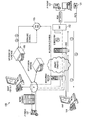
- FIG. 1 illustrates a VoIP testing methodology according to a preferred embodiment of the present invention.
- the present invention is distinguishable from conventional methods, such as POTS over circuit switched services, as the signaling and bearer channel are intertwined as opposed to a VoIP case in which these channels are separate.
- Such a fundamental difference in providing the POTS services requires novel techniques to address the faults caused in the segregated signaling and data topology.
- Providing POTS emulation service on the FTTx platform requires isolating faults in the FTTx node to the consumer network electronics, isolating the signaling, irrespective of the signaling protocol such as SIP, MEGACO or MGCP, path level faults between the FTTx node and the soft switch, and isolating the bearer path level faults between the FTTx node and the media gateway.
- the signaling protocol such as SIP, MEGACO or MGCP
- the faults covered include:
- the fault isolation mechanisms described in the current invention include:
- the present invention provides several other tests that are relevant to the POTS emulation. These include:
- an FTTx scenario is presented illustrating different fault isolation techniques of the present invention.
- an FTTP platform or system 100 is depicted. It is important to note that other FTTx platforms may also be utilized with their corresponding components without departing from the scope of the present invention.
- an FTTP platform 100 is provided wherein a POTS customer (not shown), utilizing a telephone 101 is connected to a remote Optical Network Termination ("ONT") node 102 using an RJ11 port.
- the ONT node 102 is managed though standards based control communication mechanisms that extend between an Optical Line Termination (“OLT”) node or first module 103, central office equipment, and the ONT or second module 102.
- ONT Optical Line Termination
- the fault isolation test cases from a management system (AMS) 104 are triggered.
- AMS management system
- Table 1 sets forth a summary of ONT Management Communication Interface (OMCI) testing related requirements (relevant for an FTTU platform) and table 2 provides an overview of SIP/IP stack testing related requirements. Note that even though a case study of OMCI in the following table is described, the same procedures are applicable to the other FTTx technologies through other means such as SNMP messaging instead of OMCI. Table 1.
- VoIP.FL.OMCI.T .1 SIP signaling and media continuity testing VoIP.FL.OMCI.T .1.1
- An OMCI command is sent to a specific ONT for signaling and media continuity testing with a destination phone number.
- the phone number could be that of the operator, a PSTN number, or the number of a milliwatt tone generator that can send a 1004 Hz signal.
- VoIP.FL.OMCI.T .1.2 Send an OMCI message as a response to the tests conducted above.
- VoIP.FL.OMCI.T .2 Reachability testing VoIP.FL.OMCI.T .2.1
- the first issue an operator may want to test is if the configuration of the ONT contains the proper information. For this sake, we provide test cases to retrieve salient information from the ONT.
- An OMCI message is sent to retrieve the configuration.
- An OMCI message carrying the response is sent back to the operator.
- VoIP.FL.OMCI.T .2.2 This is a basic test that assures the operator that a proxy configured on the ONT is reachable by the ONT.
- PING messages for the duration of the testing to reach the SIP proxy.
- An OMCI message is sent to ping the proxy. The results are sent back to the operator in an OMCI message.
- a typical PING program is suitable for this operation.
- VoIP.FL.OMCI.T .2.3 A SIP proxy can be multiple IP hops away from the ONT. In this case, it may be useful for the operator to trace the path to the proxy to isolate the reachability issues.
- VoIP.FL.OMCI.T .4 Call trace Table 2.
- SIP/IP stack testing related requirements Reference number Title VoIP.FL.SIP.T VoIP SIP testing requirements VoIP.FL.SIP.T .1 SIP signaling and media continuity testing VoIP.FL.SIP.T .1.1 ONT should be capable of running the test as mentioned above in the prose to make the test and send the response back to the OLT through OMCI response.
- VoIP.FL.SIP.T .1.2 This test should be performed per RJ11.
- VoIP.FL.SIP.T .2 Reachability testing
- VoIP.FL.SIP.T .2.1 A set of ping commands is generated to check the reachability to the SIP proxy. The results are packaged into the response and sent back to the operator.
- VoIP.FL.SIP.T .2.2 A trace command can be generated to check the reachability to an IP address.
- the capabilities of the system 100 can be performed by one or more of the modules or components described herein or in a distributed architecture.
- all or part of the functionality performed by the ONT 102, the OLT 103, the AMS 104, the UA/MG 105, the MGC 106, the IP Phone 107, etc. may be performed by one or more of these modules.
- FTTx platforms or systems may be utilized with their corresponding components without departing from the scope of the present invention.
- functionality described herein may be performed at various times and in relation to various events, internal or external to the modules or components.
- the information sent between various modules can be sent between the modules via at least one of: a data network, the Internet, a voice network, an Internet Protocol network, a wireless source, a wired source and/or via plurality of protocols.
- the modules described herein may be any type of device able to receive and send a message.
- the messages sent or received by any of the modules may be sent or received directly and/or via one or more of other modules or nodes (not shown).
Landscapes
- Engineering & Computer Science (AREA)
- Computer Networks & Wireless Communication (AREA)
- Telephonic Communication Services (AREA)
- Data Exchanges In Wide-Area Networks (AREA)
- Use Of Switch Circuits For Exchanges And Methods Of Control Of Multiplex Exchanges (AREA)
- Analysing Materials By The Use Of Radiation (AREA)
- Exchange Systems With Centralized Control (AREA)
- Investigation Of Foundation Soil And Reinforcement Of Foundation Soil By Compacting Or Drainage (AREA)
Abstract
Description
- This application is related to and claims the benefit of U.S. Provisional Application No. 60/611,986 filed on September 22, 2004, entitled FAULT ISOLATION CONSTRUCTS FOR SIP-BASED USER AGENT ON AN FTTU PLATFORM, under 35 U.S.C. Section 119(e), the entire contents of which are enclosed by reference as if presented in their entirety herein.
- The present invention relates to POTS emulation using Voice over IP ("VoIP") signaling and bearer channels.
- Fiber to the user ("FTTU' ) , fiber to the curb ("FTTC"), fiber to the node ('FTTN"), and fiber to the premise ("FTTP") platforms (referred to herein as "FTTx"), require plain old telephony service ("POTS") emulation using VoIP signaling and bearer channels. Such a POTS emulation service requires emulation of existing fault isolation mechanisms in POTS and also must be extended to the topologies in the VoIP environment. Some similar tests are available in the circuit switch based POTS. However, these conventional solutions do not address the POTS emulation services over data networks.
- As used herein, "MEGACO" refers to the H.248 gateway control protocol, "MGCP" refers to the media gateway control protocol, and "SIP" refers to the session initiation protocol.
- VoIP implementations enable users to carry voice traffic (for example, telephone calls and faxes) over an IP network. A VoIP system consists of a number of components including a gateway/media gateway, a gatekeeper, a call agent, a media gateway controller, a signaling gateway, application gateways, session border controllers, a call manager, and other components.
- For example, a media gateway converts media provided in one type of network to the format required for another type of network. A gateway could terminate bearer channels from a switched circuit network and media streams from a packet network. This gateway may be capable of processing audio, video and T.120 alone or in any combination, and is capable of full duplex media translations.
- VoIP technology utilizes a digital signal processor ("DSP") to segment the voice signal into frames and store them in voice packets. These voice packets are transported using IP in compliance with one of the specifications for transmitting multimedia (voice, video, fax and data) across a data network using signaling protocols such as H.323, MGCP, MEGACO or SIP.
- As VoIP is a delay and jitter sensitive application, a well-engineered end-to-end network is necessary to use VoIP successfully.
- The present invention is adapted to provide POTS emulation service using existing fault isolation mechanisms in POTS and also provides POTS emulation for topologies in the VoIP environment in the scope of FTTx. In one embodiment, a method for emulating Plain Old Telephony Service (POTS) using Voice over Internet Protocol (VoIP) signaling channels and bearer channels comprises emulating existing fault isolation mechanisms in POTS, and extending fault isolation mechanisms to topologies in a VoIP environment.
- In another embodiment, a computer readable medium comprises instructions for: tracing a call end-to-end in a Voice over Internet Protocol (VoIP) environment on an Optical Network Terminal (ONT) VoIP stack, and performing Session Initiation Protocol (SIP) signaling and media continuity testing on at least a portion of the call.
- In a further embodiment, a system adapted to emulate Plain Old Telephony Service (POTS) comprises a first module adapted to receive a request for signaling and media continuity testing, the request including a destination phone number, a second module adapted to receive the request via a control channel on the first module, and a third module, wherein the second module is adapted to invoke a test case that executes a call through the third module to the destination phone number.
- FIG. 1 illustrates a VoIP testing methodology according to a preferred embodiment of the present invention.
- The present invention is distinguishable from conventional methods, such as POTS over circuit switched services, as the signaling and bearer channel are intertwined as opposed to a VoIP case in which these channels are separate. Such a fundamental difference in providing the POTS services requires novel techniques to address the faults caused in the segregated signaling and data topology.
- Providing POTS emulation service on the FTTx platform requires isolating faults in the FTTx node to the consumer network electronics, isolating the signaling, irrespective of the signaling protocol such as SIP, MEGACO or MGCP, path level faults between the FTTx node and the soft switch, and isolating the bearer path level faults between the FTTx node and the media gateway.
- The faults covered include:
- ■ Physical connectivity issues and faults.
- ■ POTS - No connectivity, transmission issues, voice processing issues etc.
- ■ Service related issues and faults.
- ■ Control and management plane components - IP address allocation and reachability, Signaling server (application server or MGC) reachability and configuration.
- ■ Data plane components - delay, jitter, and excess packet loss.
- QoS and CoS components - Poor voice quality related issues: These issues are related to the configuration of the CoS parameters on the FTTP platform. Such issues are addressed by the common control and management plane configurations.
- The fault isolation mechanisms described in the current invention include:
- ■ FTTx node to consumer (or customer) network electronics test, also known as Metallic Loop Testing ("MLT"): The conventional solutions used in POTS are sufficient here.
- ■ Emulation of Pull Break ("P/B") test: A typical P/B test is used to isolate the faults between the customer and the
Class 5 switch in the PSTN network. This test in POTS emulation service over data networks is broken into the MLT test to the customer and P/B emulation service to the signaling server. - In addition to the above services, the present invention provides several other tests that are relevant to the POTS emulation. These include:
- ■ Reachability tests which include telephone number reachability and signaling server reachability. Telephone number reachability is a test conducted to verify the reachability to the milliwatt server or to a given telephone number. Signaling server reachability tests include reachability to the signaling server, SIP Proxy, when SIP is used as a signaling protocol, or to the MGC when MEGACO is used as a signaling protocol.
- ■ Traceability tests include signaling server traceability and call traceability. Signaling server traceabilty is a test conducted when it is determined that the signaling server is not reachable and the operator would like to trace the connectivity to the server.
- Now, referring to Figure 1, an FTTx scenario is presented illustrating different fault isolation techniques of the present invention. As an example, an FTTP platform or
system 100 is depicted. It is important to note that other FTTx platforms may also be utilized with their corresponding components without departing from the scope of the present invention. As seen therein, anFTTP platform 100 is provided wherein a POTS customer (not shown), utilizing atelephone 101 is connected to a remote Optical Network Termination ("ONT")node 102 using an RJ11 port. The ONTnode 102 is managed though standards based control communication mechanisms that extend between an Optical Line Termination ("OLT") node orfirst module 103, central office equipment, and the ONT orsecond module 102. In this example, the fault isolation test cases from a management system (AMS) 104 are triggered. - As an example, it is assumed that a customer opens a fault ticket indicating their phone is not working. The following tests are conducted (possibly, but not necessarily, in the same order) to isolate the fault:
- 1. Loss of communication with the voice gateway: The present invention provides mechanisms (in the loop emulation utilizing MEGACO only) to automatically identify failed connectivity between a voice gateway and a media gateway (for example, the
ONT 102 when utilizing the FTTP platform) using the following procedures:- a. The FTTx platform of the present invention supports an Inactivity Timer package (H.248.14) that dictates the accepted silence interval in the control plane communication between the ONT and voice gateway. If there are packets in that interval send an audit message (see below), and
- b. The FTTx platform of the present invention supports H.248 audit mechanisms to identify potential loss of communication between ONT and voice gateway.
- 2. Metallic Loop Testing (MLT): This is the basic test triggered by the operator through the
AMS 104 to theONT 102 to run the standard MLT test between theONT 102 and thePOTS 101 phone on the RJ11 port. This test will identify any issues with theONT 102 and thePOTS 101 connectivity. The results are communicated back to the operator. The operator may then run the following tests (or may run the following tests without performing the MLT): - 3. Signaling and media continuity testing (similar to pull/break testing): The goal of the test is to provide an end-to-end signaling and media testing capability for the SIP User Agent (UA) 105 or MEGACO Media Gateway (MG) 105 functionality on the
ONT 102 before turning it on for the service or during trouble shooting. TheSIP UA 105 is a logical entity in a SIP network that initiates or responds to SIP requests. Almost every element of a SIP network exhibits a UA behavior either as a UA-Client by initiating SIP requests or as a UA-Server responding to requests or both. The UA thus forms the basic building block for all elements in a SIP network. - a. Step 1: A command is sent to a specific ONT for signaling and media continuity testing with a destination phone number. Here the phone number could be that of the operator, a PSTN number, or the number of a milliwatt tone generator that can send a 1004 Hz signal.
- b. Step 2: This command is communicated through the control channel on the
OLT 103 to the requested ONT. - c. Step 3: ONT invokes a test case that executes a call through the
SIP proxy 106,MEGACO MGC 106, or third module to the number provided. - d. Step 4: Completion of the call with the stable RTP session or milliwatt data (when the milliwatt tone generator number is dialed) will provide the signaling and data continuity.
- e. Step 5: Results are sent to the requesting entity.
Note that an issue with this test will prompt the provider to conduct the following tests to isolate the fault either in the signaling or in the data path. - 4. Reachability testing: In all these following test cases, the same communication mechanism as described above is utilized.
- a. Configuration retrieval: The first issue an operator may want to test is if the configuration of the ONT contains the proper information. For this purpose, test cases are provided to retrieve salient information from the ONT.
- b. Proxy reachability: This is a basic test that assures the operator that a proxy configured on the ONT is reachable by the ONT. Here we allow PING messages for the duration of the testing to reach the SIP proxy (or MEGACO MGC).
- 5. Traceability testing:
- a. Proxy traceability: A SIP proxy, or MEGACO MGC, can be multiple IP hops away from the ONT. In this case, it may be useful for the operator to trace the path to the proxy to isolate the reachability issues. This is achieved through the TRACEROUTE functionality on the ONT.
- b. Call trace: Tracing a call end-to-end is a feature that is more suitable to the SIP proxy.
- Table 1 sets forth a summary of ONT Management Communication Interface (OMCI) testing related requirements (relevant for an FTTU platform) and table 2 provides an overview of SIP/IP stack testing related requirements. Note that even though a case study of OMCI in the following table is described, the same procedures are applicable to the other FTTx technologies through other means such as SNMP messaging instead of OMCI.
Table 1. OMCI testing related requirements on an FTTU platform. Reference number Title VoIP.FL.OMCI.T VoIP testing requirements VoIP.FL.OMCI.T .0 OMCI messages to conduct the following test cases per POTS line should be supported. VoIP.FL.OMCI.T .1 SIP signaling and media continuity testing VoIP.FL.OMCI.T .1.1 An OMCI command is sent to a specific ONT for signaling and media continuity testing with a destination phone number. Here the phone number could be that of the operator, a PSTN number, or the number of a milliwatt tone generator that can send a 1004 Hz signal. VoIP.FL.OMCI.T .1.2 Send an OMCI message as a response to the tests conducted above. VoIP.FL.OMCI.T .2 Reachability testing VoIP.FL.OMCI.T .2.1 The first issue an operator may want to test is if the configuration of the ONT contains the proper information. For this sake, we provide test cases to retrieve salient information from the ONT. An OMCI message is sent to retrieve the configuration. Here we need to define what should be part of the configuration retrieval. An OMCI message carrying the response is sent back to the operator. VoIP.FL.OMCI.T .2.2 This is a basic test that assures the operator that a proxy configured on the ONT is reachable by the ONT. Here we allow PING messages for the duration of the testing to reach the SIP proxy. An OMCI message is sent to ping the proxy. The results are sent back to the operator in an OMCI message. A typical PING program is suitable for this operation. VoIP.FL.OMCI.T .2.3 A SIP proxy can be multiple IP hops away from the ONT. In this case, it may be useful for the operator to trace the path to the proxy to isolate the reachability issues. A "traceroute" program is suitable for this operation. VoIP.FL.OMCI.T .3 MLT testing VoIP.FL.OMCI.T .3.1 Once the continuity and reachability tests are performed, the connectivity between the SIP stack and the POTS phone through the DSP need to be verified. These tests are common to the MLT tests performed in the PSTN architecture. VoIP.FL.OMCI.T .4 Call trace Table 2. SIP/IP stack testing related requirements Reference number Title VoIP.FL.SIP.T VoIP SIP testing requirements VoIP.FL.SIP.T .1 SIP signaling and media continuity testing VoIP.FL.SIP.T .1.1 ONT should be capable of running the test as mentioned above in the prose to make the test and send the response back to the OLT through OMCI response. VoIP.FL.SIP.T .1.2 This test should be performed per RJ11. VoIP.FL.SIP.T .2 Reachability testing VoIP.FL.SIP.T .2.1 A set of ping commands is generated to check the reachability to the SIP proxy. The results are packaged into the response and sent back to the operator. VoIP.FL.SIP.T .2.2 A trace command can be generated to check the reachability to an IP address. - Although an exemplary embodiment of the system, method, and computer readable medium of the present invention has been illustrated in the accompanied drawings and described in the foregoing detailed description, it will be understood that the invention is not limited to the embodiments disclosed, but is capable of numerous rearrangements, modifications, and substitutions without departing from the spirit or scope of the invention as set forth and defined by the following claims. For example, the capabilities of the
system 100 can be performed by one or more of the modules or components described herein or in a distributed architecture. For example, all or part of the functionality performed by theONT 102, theOLT 103, theAMS 104, the UA/MG 105, theMGC 106, theIP Phone 107, etc., may be performed by one or more of these modules. Further, numerous FTTx platforms or systems may be utilized with their corresponding components without departing from the scope of the present invention. Also, the functionality described herein may be performed at various times and in relation to various events, internal or external to the modules or components. Further, the information sent between various modules can be sent between the modules via at least one of: a data network, the Internet, a voice network, an Internet Protocol network, a wireless source, a wired source and/or via plurality of protocols. Still further, the modules described herein may be any type of device able to receive and send a message. Also, the messages sent or received by any of the modules may be sent or received directly and/or via one or more of other modules or nodes (not shown).
Claims (10)
- A method for emulating Plain Old Telephony Service (POTS) using Voice over Internet Protocol (VoIP) signaling channels and bearer channels, comprising:emulating existing fault isolation mechanisms in POTS; andextending fault isolation mechanisms to topologies in a VoIP environment.
- The method of Claim 1, comprising providing at least one reachability test wherein the reachability test is a signaling server reachability test.
- The method of Claim 2, wherein the signaling server is a Session Initiation Protocol (SIP) Proxy server, when SIP is used as a signaling protocol, or a Media Gateway Controller (MGC) when MEGACO is used as a signaling protocol.
- The method of Claim 3, comprising:sending a command to a specific Optical Network Terminal (ONT) for signaling and media continuity testing with a destination phone number;communicating the command through a control channel on an Optical Line Terminal (OLT) to a requested ONT;invoking a test case that executes a call through the SIP Proxy server or a MEGACO MGC to the destination phone number;completing the call; andsending results of the test case to a requesting entity.
- The method of Claim 4, wherein the destination phone number is one from a group consisting of: an operator, a Public Switch Telephone Number (PSTN) number, or a number of a milliwatt tone generator.
- The method of Claim 5, comprising providing the signaling and media continuity testing when the call is completed with a stable Real-time Transport Protocol (RTP) session or with milliwatt data when a milliwatt tone generator number is dialed.
- The method of Claim 4, further comprising testing reliability of a proxy configured on the ONT.
- The method of Claim 4, comprising isolating an exact location of a fault in a signaling or media path using a traceability test.
- The method of Claim 8, wherein the traceability test is a proxy traceability test and wherein the proxy traceability test uses a TRACEROUTE functionality on the ONT.
- A system adapted to emulate Plain Old Telephony Service (POTS), comprising:a first module adapted to receive a request for signaling and media continuity testing, the request including a destination phone number;a second module adapted to receive the request via a control channel on the first module; anda third module;wherein the second module is adapted to invoke a test case that executes a call through the third module to the destination phone number; andwherein the third module is adapted to complete the call.
Applications Claiming Priority (2)
| Application Number | Priority Date | Filing Date | Title |
|---|---|---|---|
| US61198604P | 2004-09-22 | 2004-09-22 | |
| US11/217,953 US8787363B2 (en) | 2004-09-22 | 2005-09-01 | Fault isolation constructs for POTS emulation service on an FTTx platform |
Publications (2)
| Publication Number | Publication Date |
|---|---|
| EP1641311A1 true EP1641311A1 (en) | 2006-03-29 |
| EP1641311B1 EP1641311B1 (en) | 2009-11-04 |
Family
ID=35519944
Family Applications (1)
| Application Number | Title | Priority Date | Filing Date |
|---|---|---|---|
| EP05019618A Expired - Lifetime EP1641311B1 (en) | 2004-09-22 | 2005-09-09 | Fault isolation mechanisms for POTS emulation service on an FTTx platform |
Country Status (5)
| Country | Link |
|---|---|
| US (1) | US8787363B2 (en) |
| EP (1) | EP1641311B1 (en) |
| JP (1) | JP2006094487A (en) |
| AT (1) | ATE447830T1 (en) |
| DE (1) | DE602005017452D1 (en) |
Families Citing this family (6)
| Publication number | Priority date | Publication date | Assignee | Title |
|---|---|---|---|---|
| CN100342693C (en) * | 2005-04-15 | 2007-10-10 | 华为技术有限公司 | Method of medium gateway monitoring and uploading event |
| US8165280B1 (en) | 2005-09-22 | 2012-04-24 | Verizon Services Organization Inc. | Method and system for providing busy override service in a SIP-based network |
| US20090067415A1 (en) * | 2007-09-07 | 2009-03-12 | Liu David H | Optical network terminal with integrated internet protocol private branch exchange |
| US20090263139A1 (en) * | 2008-04-16 | 2009-10-22 | Tellabs Vienna, Inc. | Method and apparatus for increasing voice service for an optical network terminal (ONT) |
| CN103200615B (en) * | 2012-01-10 | 2016-01-13 | 上海贝尔股份有限公司 | A kind of method and device carrying out transfer of data in a communication network |
| US20230328121A1 (en) * | 2022-04-06 | 2023-10-12 | Cdw Llc | Modular Technologies for Servicing Telephony Systems |
Citations (2)
| Publication number | Priority date | Publication date | Assignee | Title |
|---|---|---|---|---|
| US20020120758A1 (en) | 2001-02-23 | 2002-08-29 | Glory Telecommunications C0., Ltd. | IP packetized frame format in a passive optical network |
| US20040062204A1 (en) | 2002-09-30 | 2004-04-01 | Bearden Mark J. | Communication system endpoint device with integrated call synthesis capability |
Family Cites Families (5)
| Publication number | Priority date | Publication date | Assignee | Title |
|---|---|---|---|---|
| US5940472A (en) * | 1996-12-16 | 1999-08-17 | Mci Communications Corporation | Intelligent services network test system |
| ES2294127T3 (en) * | 2001-04-04 | 2008-04-01 | Nokia Corporation | METHOD AND SYSTEM OF ANALYSIS. |
| US20080002669A1 (en) * | 2001-09-14 | 2008-01-03 | O'brien Ray | Packet voice gateway |
| US20040003070A1 (en) * | 2002-06-26 | 2004-01-01 | Clarus Systems, Inc. | Centrally controlled end-to-end service quality monitoring system and method in a distributed environment |
| US7349344B1 (en) * | 2003-10-01 | 2008-03-25 | Genband Inc. | System and method for performing subscriber loop testing in an optical network |
-
2005
- 2005-09-01 US US11/217,953 patent/US8787363B2/en not_active Expired - Fee Related
- 2005-09-09 DE DE602005017452T patent/DE602005017452D1/en not_active Expired - Lifetime
- 2005-09-09 AT AT05019618T patent/ATE447830T1/en not_active IP Right Cessation
- 2005-09-09 JP JP2005261675A patent/JP2006094487A/en not_active Withdrawn
- 2005-09-09 EP EP05019618A patent/EP1641311B1/en not_active Expired - Lifetime
Patent Citations (2)
| Publication number | Priority date | Publication date | Assignee | Title |
|---|---|---|---|---|
| US20020120758A1 (en) | 2001-02-23 | 2002-08-29 | Glory Telecommunications C0., Ltd. | IP packetized frame format in a passive optical network |
| US20040062204A1 (en) | 2002-09-30 | 2004-04-01 | Bearden Mark J. | Communication system endpoint device with integrated call synthesis capability |
Also Published As
| Publication number | Publication date |
|---|---|
| JP2006094487A (en) | 2006-04-06 |
| ATE447830T1 (en) | 2009-11-15 |
| US20060062210A1 (en) | 2006-03-23 |
| EP1641311B1 (en) | 2009-11-04 |
| US8787363B2 (en) | 2014-07-22 |
| DE602005017452D1 (en) | 2009-12-17 |
Similar Documents
| Publication | Publication Date | Title |
|---|---|---|
| EP1616420B1 (en) | Method for verification of communication path in ip telephony ping | |
| US20090161565A1 (en) | System and Method of Remote Testing in Loopback Mode Using MGCP/NCS | |
| US7124335B2 (en) | Apparatus and method for testing MEGACO protocol | |
| US9054887B2 (en) | Method and apparatus for enabling communications assistance for law enforcement act services | |
| US8787363B2 (en) | Fault isolation constructs for POTS emulation service on an FTTx platform | |
| US20060233107A1 (en) | Method and apparatus for monitoring surges in busy and no answer conditions in a communication network | |
| US9014053B2 (en) | Method and apparatus for monitoring client software usage in end user device | |
| US8687502B2 (en) | Method and apparatus for enabling auto-ticketing for endpoint devices | |
| CA2544171A1 (en) | Method and apparatus for enabling local survivability during network disruptions | |
| CA2544117A1 (en) | Method and apparatus for routing calls to an alternative endpoint during network disruptions | |
| EP1770962A1 (en) | Method and apparatus for providing internet protocol connectivity without consulting a domain name sytem server | |
| US20060233159A1 (en) | Method and apparatus for enabling dynamic protocol interworking resolution with diverse endpoints | |
| Thompson et al. | A Distributed IP-Based Telecommunication System Using SIP | |
| US7881294B1 (en) | Method and apparatus for enabling network based media manipulation | |
| US7933213B1 (en) | Method and apparatus for monitoring and restoring time division multiplexing circuits | |
| CN100477703C (en) | Fault Isolation Structure for POTS Simulation Service Based on FTTx Platform | |
| US20060140171A1 (en) | Method and apparatus for enabling the network to disconnect unintentionally idle off-hook endpoints | |
| US7599357B1 (en) | Method and apparatus for detecting and correcting electrical interference in a conference call | |
| US8737575B1 (en) | Method and apparatus for transparently recording media communications between endpoint devices | |
| US20070070981A1 (en) | Method and apparatus for dynamically establishing links between IP private branch exchanges | |
| US7965700B1 (en) | Method and apparatus for enabling service indicators in a call control element | |
| US20060233099A1 (en) | Method and apparatus for enabling dynamic increase in call and service processing capacity | |
| Sauer et al. | CCNP Voice CVoice 642-437 Quick Reference | |
| McDaniel | CCVP TUC Quick Reference Sheets | |
| KR20100030272A (en) | Access gateway system and call handling method thereof |
Legal Events
| Date | Code | Title | Description |
|---|---|---|---|
| PUAI | Public reference made under article 153(3) epc to a published international application that has entered the european phase |
Free format text: ORIGINAL CODE: 0009012 |
|
| AK | Designated contracting states |
Kind code of ref document: A1 Designated state(s): AT BE BG CH CY CZ DE DK EE ES FI FR GB GR HU IE IS IT LI LT LU LV MC NL PL PT RO SE SI SK TR |
|
| AX | Request for extension of the european patent |
Extension state: AL BA HR MK YU |
|
| 17P | Request for examination filed |
Effective date: 20060920 |
|
| AKX | Designation fees paid |
Designated state(s): AT BE BG CH CY CZ DE DK EE ES FI FR GB GR HU IE IS IT LI LT LU LV MC NL PL PT RO SE SI SK TR |
|
| 17Q | First examination report despatched |
Effective date: 20070205 |
|
| RAP1 | Party data changed (applicant data changed or rights of an application transferred) |
Owner name: ALCATEL LUCENT |
|
| GRAP | Despatch of communication of intention to grant a patent |
Free format text: ORIGINAL CODE: EPIDOSNIGR1 |
|
| GRAS | Grant fee paid |
Free format text: ORIGINAL CODE: EPIDOSNIGR3 |
|
| GRAA | (expected) grant |
Free format text: ORIGINAL CODE: 0009210 |
|
| AK | Designated contracting states |
Kind code of ref document: B1 Designated state(s): AT BE BG CH CY CZ DE DK EE ES FI FR GB GR HU IE IS IT LI LT LU LV MC NL PL PT RO SE SI SK TR |
|
| REG | Reference to a national code |
Ref country code: GB Ref legal event code: FG4D |
|
| REG | Reference to a national code |
Ref country code: CH Ref legal event code: EP |
|
| REG | Reference to a national code |
Ref country code: IE Ref legal event code: FG4D |
|
| REF | Corresponds to: |
Ref document number: 602005017452 Country of ref document: DE Date of ref document: 20091217 Kind code of ref document: P |
|
| NLV1 | Nl: lapsed or annulled due to failure to fulfill the requirements of art. 29p and 29m of the patents act | ||
| LTIE | Lt: invalidation of european patent or patent extension |
Effective date: 20091104 |
|
| PG25 | Lapsed in a contracting state [announced via postgrant information from national office to epo] |
Ref country code: SE Free format text: LAPSE BECAUSE OF FAILURE TO SUBMIT A TRANSLATION OF THE DESCRIPTION OR TO PAY THE FEE WITHIN THE PRESCRIBED TIME-LIMIT Effective date: 20091104 Ref country code: FI Free format text: LAPSE BECAUSE OF FAILURE TO SUBMIT A TRANSLATION OF THE DESCRIPTION OR TO PAY THE FEE WITHIN THE PRESCRIBED TIME-LIMIT Effective date: 20091104 Ref country code: ES Free format text: LAPSE BECAUSE OF FAILURE TO SUBMIT A TRANSLATION OF THE DESCRIPTION OR TO PAY THE FEE WITHIN THE PRESCRIBED TIME-LIMIT Effective date: 20100215 Ref country code: LT Free format text: LAPSE BECAUSE OF FAILURE TO SUBMIT A TRANSLATION OF THE DESCRIPTION OR TO PAY THE FEE WITHIN THE PRESCRIBED TIME-LIMIT Effective date: 20091104 Ref country code: IS Free format text: LAPSE BECAUSE OF FAILURE TO SUBMIT A TRANSLATION OF THE DESCRIPTION OR TO PAY THE FEE WITHIN THE PRESCRIBED TIME-LIMIT Effective date: 20100304 Ref country code: PT Free format text: LAPSE BECAUSE OF FAILURE TO SUBMIT A TRANSLATION OF THE DESCRIPTION OR TO PAY THE FEE WITHIN THE PRESCRIBED TIME-LIMIT Effective date: 20100304 |
|
| PG25 | Lapsed in a contracting state [announced via postgrant information from national office to epo] |
Ref country code: LV Free format text: LAPSE BECAUSE OF FAILURE TO SUBMIT A TRANSLATION OF THE DESCRIPTION OR TO PAY THE FEE WITHIN THE PRESCRIBED TIME-LIMIT Effective date: 20091104 Ref country code: PL Free format text: LAPSE BECAUSE OF FAILURE TO SUBMIT A TRANSLATION OF THE DESCRIPTION OR TO PAY THE FEE WITHIN THE PRESCRIBED TIME-LIMIT Effective date: 20091104 Ref country code: CY Free format text: LAPSE BECAUSE OF FAILURE TO SUBMIT A TRANSLATION OF THE DESCRIPTION OR TO PAY THE FEE WITHIN THE PRESCRIBED TIME-LIMIT Effective date: 20091104 Ref country code: SI Free format text: LAPSE BECAUSE OF FAILURE TO SUBMIT A TRANSLATION OF THE DESCRIPTION OR TO PAY THE FEE WITHIN THE PRESCRIBED TIME-LIMIT Effective date: 20091104 |
|
| PG25 | Lapsed in a contracting state [announced via postgrant information from national office to epo] |
Ref country code: BE Free format text: LAPSE BECAUSE OF FAILURE TO SUBMIT A TRANSLATION OF THE DESCRIPTION OR TO PAY THE FEE WITHIN THE PRESCRIBED TIME-LIMIT Effective date: 20091104 Ref country code: AT Free format text: LAPSE BECAUSE OF FAILURE TO SUBMIT A TRANSLATION OF THE DESCRIPTION OR TO PAY THE FEE WITHIN THE PRESCRIBED TIME-LIMIT Effective date: 20091104 |
|
| PG25 | Lapsed in a contracting state [announced via postgrant information from national office to epo] |
Ref country code: RO Free format text: LAPSE BECAUSE OF FAILURE TO SUBMIT A TRANSLATION OF THE DESCRIPTION OR TO PAY THE FEE WITHIN THE PRESCRIBED TIME-LIMIT Effective date: 20091104 Ref country code: DK Free format text: LAPSE BECAUSE OF FAILURE TO SUBMIT A TRANSLATION OF THE DESCRIPTION OR TO PAY THE FEE WITHIN THE PRESCRIBED TIME-LIMIT Effective date: 20091104 Ref country code: BG Free format text: LAPSE BECAUSE OF FAILURE TO SUBMIT A TRANSLATION OF THE DESCRIPTION OR TO PAY THE FEE WITHIN THE PRESCRIBED TIME-LIMIT Effective date: 20100204 Ref country code: EE Free format text: LAPSE BECAUSE OF FAILURE TO SUBMIT A TRANSLATION OF THE DESCRIPTION OR TO PAY THE FEE WITHIN THE PRESCRIBED TIME-LIMIT Effective date: 20091104 |
|
| PG25 | Lapsed in a contracting state [announced via postgrant information from national office to epo] |
Ref country code: CZ Free format text: LAPSE BECAUSE OF FAILURE TO SUBMIT A TRANSLATION OF THE DESCRIPTION OR TO PAY THE FEE WITHIN THE PRESCRIBED TIME-LIMIT Effective date: 20091104 Ref country code: SK Free format text: LAPSE BECAUSE OF FAILURE TO SUBMIT A TRANSLATION OF THE DESCRIPTION OR TO PAY THE FEE WITHIN THE PRESCRIBED TIME-LIMIT Effective date: 20091104 |
|
| PLBE | No opposition filed within time limit |
Free format text: ORIGINAL CODE: 0009261 |
|
| STAA | Information on the status of an ep patent application or granted ep patent |
Free format text: STATUS: NO OPPOSITION FILED WITHIN TIME LIMIT |
|
| 26N | No opposition filed |
Effective date: 20100805 |
|
| PG25 | Lapsed in a contracting state [announced via postgrant information from national office to epo] |
Ref country code: GR Free format text: LAPSE BECAUSE OF FAILURE TO SUBMIT A TRANSLATION OF THE DESCRIPTION OR TO PAY THE FEE WITHIN THE PRESCRIBED TIME-LIMIT Effective date: 20100205 |
|
| PG25 | Lapsed in a contracting state [announced via postgrant information from national office to epo] |
Ref country code: IT Free format text: LAPSE BECAUSE OF FAILURE TO SUBMIT A TRANSLATION OF THE DESCRIPTION OR TO PAY THE FEE WITHIN THE PRESCRIBED TIME-LIMIT Effective date: 20091104 |
|
| PG25 | Lapsed in a contracting state [announced via postgrant information from national office to epo] |
Ref country code: MC Free format text: LAPSE BECAUSE OF NON-PAYMENT OF DUE FEES Effective date: 20100930 |
|
| REG | Reference to a national code |
Ref country code: CH Ref legal event code: PL |
|
| PG25 | Lapsed in a contracting state [announced via postgrant information from national office to epo] |
Ref country code: CH Free format text: LAPSE BECAUSE OF NON-PAYMENT OF DUE FEES Effective date: 20100930 Ref country code: IE Free format text: LAPSE BECAUSE OF NON-PAYMENT OF DUE FEES Effective date: 20100909 Ref country code: LI Free format text: LAPSE BECAUSE OF NON-PAYMENT OF DUE FEES Effective date: 20100930 |
|
| PG25 | Lapsed in a contracting state [announced via postgrant information from national office to epo] |
Ref country code: HU Free format text: LAPSE BECAUSE OF FAILURE TO SUBMIT A TRANSLATION OF THE DESCRIPTION OR TO PAY THE FEE WITHIN THE PRESCRIBED TIME-LIMIT Effective date: 20100505 Ref country code: LU Free format text: LAPSE BECAUSE OF NON-PAYMENT OF DUE FEES Effective date: 20100909 Ref country code: NL Free format text: LAPSE BECAUSE OF FAILURE TO SUBMIT A TRANSLATION OF THE DESCRIPTION OR TO PAY THE FEE WITHIN THE PRESCRIBED TIME-LIMIT Effective date: 20091104 |
|
| PG25 | Lapsed in a contracting state [announced via postgrant information from national office to epo] |
Ref country code: TR Free format text: LAPSE BECAUSE OF FAILURE TO SUBMIT A TRANSLATION OF THE DESCRIPTION OR TO PAY THE FEE WITHIN THE PRESCRIBED TIME-LIMIT Effective date: 20091104 |
|
| REG | Reference to a national code |
Ref country code: GB Ref legal event code: 732E Free format text: REGISTERED BETWEEN 20130926 AND 20131002 |
|
| REG | Reference to a national code |
Ref country code: FR Ref legal event code: GC Effective date: 20131018 |
|
| REG | Reference to a national code |
Ref country code: FR Ref legal event code: RG Effective date: 20141016 |
|
| REG | Reference to a national code |
Ref country code: FR Ref legal event code: CA Effective date: 20150521 |
|
| REG | Reference to a national code |
Ref country code: FR Ref legal event code: CA Effective date: 20150521 |
|
| REG | Reference to a national code |
Ref country code: FR Ref legal event code: PLFP Year of fee payment: 11 |
|
| REG | Reference to a national code |
Ref country code: FR Ref legal event code: PLFP Year of fee payment: 12 |
|
| REG | Reference to a national code |
Ref country code: FR Ref legal event code: PLFP Year of fee payment: 13 |
|
| REG | Reference to a national code |
Ref country code: FR Ref legal event code: PLFP Year of fee payment: 14 |
|
| PGFP | Annual fee paid to national office [announced via postgrant information from national office to epo] |
Ref country code: DE Payment date: 20190827 Year of fee payment: 15 Ref country code: FR Payment date: 20190815 Year of fee payment: 15 |
|
| PGFP | Annual fee paid to national office [announced via postgrant information from national office to epo] |
Ref country code: GB Payment date: 20190906 Year of fee payment: 15 |
|
| REG | Reference to a national code |
Ref country code: DE Ref legal event code: R119 Ref document number: 602005017452 Country of ref document: DE |
|
| GBPC | Gb: european patent ceased through non-payment of renewal fee |
Effective date: 20200909 |
|
| PG25 | Lapsed in a contracting state [announced via postgrant information from national office to epo] |
Ref country code: DE Free format text: LAPSE BECAUSE OF NON-PAYMENT OF DUE FEES Effective date: 20210401 Ref country code: FR Free format text: LAPSE BECAUSE OF NON-PAYMENT OF DUE FEES Effective date: 20200930 |
|
| PG25 | Lapsed in a contracting state [announced via postgrant information from national office to epo] |
Ref country code: GB Free format text: LAPSE BECAUSE OF NON-PAYMENT OF DUE FEES Effective date: 20200909 |