EP1640354A2 - Igniting agent, initiator, gas generator, airbag apparatus, and seatbelt apparatus - Google Patents
Igniting agent, initiator, gas generator, airbag apparatus, and seatbelt apparatus Download PDFInfo
- Publication number
- EP1640354A2 EP1640354A2 EP05017489A EP05017489A EP1640354A2 EP 1640354 A2 EP1640354 A2 EP 1640354A2 EP 05017489 A EP05017489 A EP 05017489A EP 05017489 A EP05017489 A EP 05017489A EP 1640354 A2 EP1640354 A2 EP 1640354A2
- Authority
- EP
- European Patent Office
- Prior art keywords
- gas generator
- igniting agent
- initiator
- seatbelt
- powder
- Prior art date
- Legal status (The legal status is an assumption and is not a legal conclusion. Google has not performed a legal analysis and makes no representation as to the accuracy of the status listed.)
- Pending
Links
- 239000003795 chemical substances by application Substances 0.000 title claims abstract description 59
- 239000003999 initiator Substances 0.000 title claims abstract description 31
- 239000007789 gas Substances 0.000 title description 68
- 239000000843 powder Substances 0.000 claims abstract description 25
- 229910000838 Al alloy Inorganic materials 0.000 claims abstract description 19
- 229910045601 alloy Inorganic materials 0.000 claims abstract description 12
- 239000000956 alloy Substances 0.000 claims abstract description 12
- 229910052791 calcium Inorganic materials 0.000 claims abstract description 6
- 229910052787 antimony Inorganic materials 0.000 claims abstract description 5
- 229910052788 barium Inorganic materials 0.000 claims abstract description 5
- 229910052748 manganese Inorganic materials 0.000 claims abstract description 5
- 229910052761 rare earth metal Inorganic materials 0.000 claims abstract description 5
- 150000002910 rare earth metals Chemical class 0.000 claims abstract description 5
- 229910052706 scandium Inorganic materials 0.000 claims abstract description 5
- 229910052712 strontium Inorganic materials 0.000 claims abstract description 5
- 229910052718 tin Inorganic materials 0.000 claims abstract description 5
- 229910052727 yttrium Inorganic materials 0.000 claims abstract description 5
- 229910052725 zinc Inorganic materials 0.000 claims abstract description 5
- 229910052726 zirconium Inorganic materials 0.000 claims abstract description 5
- 239000000203 mixture Substances 0.000 claims description 9
- 230000001590 oxidative effect Effects 0.000 claims description 8
- 239000011347 resin Substances 0.000 claims description 8
- 229920005989 resin Polymers 0.000 claims description 8
- 239000011230 binding agent Substances 0.000 claims description 7
- 239000007800 oxidant agent Substances 0.000 claims description 7
- 239000000470 constituent Substances 0.000 claims description 6
- 239000000446 fuel Substances 0.000 claims description 6
- 229910052749 magnesium Inorganic materials 0.000 claims description 6
- 229910001914 chlorine tetroxide Inorganic materials 0.000 claims description 3
- KMUONIBRACKNSN-UHFFFAOYSA-N potassium dichromate Chemical compound [K+].[K+].[O-][Cr](=O)(=O)O[Cr]([O-])(=O)=O KMUONIBRACKNSN-UHFFFAOYSA-N 0.000 claims description 3
- 229910001487 potassium perchlorate Inorganic materials 0.000 claims description 3
- 239000012286 potassium permanganate Substances 0.000 claims description 3
- 229910003023 Mg-Al Inorganic materials 0.000 abstract 1
- 229910052751 metal Inorganic materials 0.000 description 15
- 239000002184 metal Substances 0.000 description 15
- 230000000052 comparative effect Effects 0.000 description 11
- 239000000654 additive Substances 0.000 description 8
- 230000000996 additive effect Effects 0.000 description 8
- 239000002245 particle Substances 0.000 description 6
- 238000006243 chemical reaction Methods 0.000 description 5
- 238000003780 insertion Methods 0.000 description 5
- 230000037431 insertion Effects 0.000 description 5
- 229910002651 NO3 Inorganic materials 0.000 description 4
- DHEQXMRUPNDRPG-UHFFFAOYSA-N strontium nitrate Chemical compound [Sr+2].[O-][N+]([O-])=O.[O-][N+]([O-])=O DHEQXMRUPNDRPG-UHFFFAOYSA-N 0.000 description 4
- XUIMIQQOPSSXEZ-UHFFFAOYSA-N Silicon Chemical compound [Si] XUIMIQQOPSSXEZ-UHFFFAOYSA-N 0.000 description 3
- 230000001976 improved effect Effects 0.000 description 3
- 230000001965 increasing effect Effects 0.000 description 3
- 150000002739 metals Chemical class 0.000 description 3
- 230000002093 peripheral effect Effects 0.000 description 3
- 229910052710 silicon Inorganic materials 0.000 description 3
- 239000010703 silicon Substances 0.000 description 3
- 239000000126 substance Substances 0.000 description 3
- XKRFYHLGVUSROY-UHFFFAOYSA-N Argon Chemical compound [Ar] XKRFYHLGVUSROY-UHFFFAOYSA-N 0.000 description 2
- IJGRMHOSHXDMSA-UHFFFAOYSA-N Atomic nitrogen Chemical compound N#N IJGRMHOSHXDMSA-UHFFFAOYSA-N 0.000 description 2
- LFQSCWFLJHTTHZ-UHFFFAOYSA-N Ethanol Chemical compound CCO LFQSCWFLJHTTHZ-UHFFFAOYSA-N 0.000 description 2
- NHNBFGGVMKEFGY-UHFFFAOYSA-N Nitrate Chemical compound [O-][N+]([O-])=O NHNBFGGVMKEFGY-UHFFFAOYSA-N 0.000 description 2
- 230000000977 initiatory effect Effects 0.000 description 2
- 239000012212 insulator Substances 0.000 description 2
- 238000002156 mixing Methods 0.000 description 2
- 239000003380 propellant Substances 0.000 description 2
- -1 Mg and Al Chemical class 0.000 description 1
- 229910020068 MgAl Inorganic materials 0.000 description 1
- 229910052786 argon Inorganic materials 0.000 description 1
- 238000002485 combustion reaction Methods 0.000 description 1
- 230000007797 corrosion Effects 0.000 description 1
- 238000005260 corrosion Methods 0.000 description 1
- 230000000694 effects Effects 0.000 description 1
- 238000011156 evaluation Methods 0.000 description 1
- 239000011521 glass Substances 0.000 description 1
- 238000010438 heat treatment Methods 0.000 description 1
- 238000010348 incorporation Methods 0.000 description 1
- 230000001939 inductive effect Effects 0.000 description 1
- 238000011835 investigation Methods 0.000 description 1
- 230000014759 maintenance of location Effects 0.000 description 1
- 238000004519 manufacturing process Methods 0.000 description 1
- 229910001120 nichrome Inorganic materials 0.000 description 1
- 229910052757 nitrogen Inorganic materials 0.000 description 1
- 230000003287 optical effect Effects 0.000 description 1
- 230000000149 penetrating effect Effects 0.000 description 1
- 125000002081 peroxide group Chemical group 0.000 description 1
- 150000002978 peroxides Chemical class 0.000 description 1
- 239000004033 plastic Substances 0.000 description 1
- 230000001737 promoting effect Effects 0.000 description 1
- 230000002269 spontaneous effect Effects 0.000 description 1
- 238000013519 translation Methods 0.000 description 1
Images


Classifications
-
- C—CHEMISTRY; METALLURGY
- C06—EXPLOSIVES; MATCHES
- C06C—DETONATING OR PRIMING DEVICES; FUSES; CHEMICAL LIGHTERS; PYROPHORIC COMPOSITIONS
- C06C15/00—Pyrophoric compositions; Flints
-
- C—CHEMISTRY; METALLURGY
- C06—EXPLOSIVES; MATCHES
- C06B—EXPLOSIVES OR THERMIC COMPOSITIONS; MANUFACTURE THEREOF; USE OF SINGLE SUBSTANCES AS EXPLOSIVES
- C06B33/00—Compositions containing particulate metal, alloy, boron, silicon, selenium or tellurium with at least one oxygen supplying material which is either a metal oxide or a salt, organic or inorganic, capable of yielding a metal oxide
-
- C—CHEMISTRY; METALLURGY
- C06—EXPLOSIVES; MATCHES
- C06C—DETONATING OR PRIMING DEVICES; FUSES; CHEMICAL LIGHTERS; PYROPHORIC COMPOSITIONS
- C06C9/00—Chemical contact igniters; Chemical lighters
-
- B—PERFORMING OPERATIONS; TRANSPORTING
- B60—VEHICLES IN GENERAL
- B60R—VEHICLES, VEHICLE FITTINGS, OR VEHICLE PARTS, NOT OTHERWISE PROVIDED FOR
- B60R21/00—Arrangements or fittings on vehicles for protecting or preventing injuries to occupants or pedestrians in case of accidents or other traffic risks
- B60R21/02—Occupant safety arrangements or fittings, e.g. crash pads
- B60R21/16—Inflatable occupant restraints or confinements designed to inflate upon impact or impending impact, e.g. air bags
- B60R21/26—Inflatable occupant restraints or confinements designed to inflate upon impact or impending impact, e.g. air bags characterised by the inflation fluid source or means to control inflation fluid flow
- B60R2021/26029—Ignitors
-
- B—PERFORMING OPERATIONS; TRANSPORTING
- B60—VEHICLES IN GENERAL
- B60R—VEHICLES, VEHICLE FITTINGS, OR VEHICLE PARTS, NOT OTHERWISE PROVIDED FOR
- B60R22/00—Safety belts or body harnesses in vehicles
- B60R22/34—Belt retractors, e.g. reels
- B60R22/46—Reels with means to tension the belt in an emergency by forced winding up
- B60R22/4628—Reels with means to tension the belt in an emergency by forced winding up characterised by fluid actuators, e.g. pyrotechnic gas generators
- B60R2022/4642—Reels with means to tension the belt in an emergency by forced winding up characterised by fluid actuators, e.g. pyrotechnic gas generators the gas directly propelling a flexible driving means, e.g. a plurality of successive masses, in a tubular chamber
Definitions
- the present invention relates to an igniting agent, an initiator incorporating the igniting agent, and a gas generator incorporating the initiator.
- the gas generator is, for example, incorporated in an airbag apparatus or a seatbelt apparatus of an automobile or the like.
- An airbag apparatus installed in a rapidly moving vehicle, such as an automobile, is arranged such that a pouch-shaped airbag is rapidly inflated with a gas generator called an inflator.
- the gas generator includes a gas generating agent and an initiator for inducing a gas generation reaction of the gas-generating agent.
- the initiator includes a reactive substance and a filament (bridge wire) serving as a resistive heating element for initiating the reaction of the reactive substance (e.g., US-A-5404263).
- An initiator 10 includes a substantially cup-shaped casing 12 having an opening on the rear side (downward in Fig. 1).
- An igniting agent 14 is accommodated in the casing 12.
- the rear portion of the casing 12 is closed with an insulator 16 composed of sintered glass or the like.
- front ends of a pair of electrode 18 and 20 penetrating the insulator 16 are inserted.
- a filament 22 is stretched across the front ends of the electrodes 18 and 20.
- the two ends of the filament 22 are welded to the front-end surfaces of the electrodes 18 and 20.
- the filament 22 is inside the casing 12 and in contact with the igniting agent 14.
- the electrodes 18 and 20 and the casing 12 are isolated from one another so as not to make electrical contact with one another.
- the electrode 18 is connected to a positive electrode of a battery 26 of an automobile via a control circuit 24 having a booster circuit and the like, and the electrode 20 is connected (earthed) to the body of the automobile.
- the negative electrode of the battery 26 is connected to the body of the automobile.
- the switching element in the control circuit 24 is turned ON, and a voltage is applied to the filament 22 from the battery 26 via the electrodes 18 and 20.
- the filament 22 generates heat to ignite the igniting agent 14, thereby initiating the reaction.
- high-pressure gas and heat are generated to induce a gas generation reaction of the gas generating substance of the gas generator.
- a gas generator 30 has a container that includes an outer shell constituted from an upper housing 32 and a lower housing 34 and a cylindrical divider 36 disposed inside the outer shell.
- One end of the cylindrical divider 36 passes through an opening formed in the bottom face of the lower housing 34 and protrudes downward.
- the inner peripheral face of this opening is welded onto the outer peripheral face of the cylindrical divider 36 using a laser beam or the like.
- an igniting agent (booster propellant) 40 is accommodated, and a gas-generating agent (main propellant) 42 is accommodated outside the cylindrical divider 36.
- the initiator 10 is disposed in one end of the cylindrical divider 36.
- gas blows out from an opening 44 of the cylindrical divider 36, thereby igniting a gas-generating agent 42.
- a large amount of gas is rapidly generated, passes through a filter 46 composed of a mesh or the like, blows out from the gas generator 30 via an opening 48, and inflates the airbag.
- Fig. 2 illustrates one example of the gas generator.
- Various types of gas generators other than one illustrated in the drawing have been commonly used.
- Japanese Translation JP 2003-527276 A of PCT application, Publication No. WO 00/46170 discloses an igniting agent prepared by blending strontium nitrate and a Mg ⁇ Al alloy powder containing 10 to 50 wt% of Mg and 50 to 90 wt% of Al.
- the Mg ⁇ Al alloy powder contained in the igniting agent set forth in the above-described JP 2003-527276 A has a low Mg content, and the speed of the ignition thereof is low.
- An object of the present invention is to provide an igniting agent containing a Mg ⁇ Al alloy powder having high speed of ignition and good grindability, an initiator containing the igniting agent, a gas generator incorporating the initiator, an airbag apparatus incorporating the gas generator, and a seatbelt apparatus incorporating the gas generator.
- the igniting agent contains a Mg ⁇ Al alloy as a fuel constituent, the Mg ⁇ Al alloy containing 55 to 70 wt% of Mg and the balance of Al.
- An igniting agent of claim 2 contains a powder of a Mg ⁇ Al-based alloy having the following composition as a fuel constituent:
- An igniting agent of claim 3 is the igniting agent according to claim 2 in which the ratio Mg/(Mg + Al) is 0.55 to 0.70.
- An igniting agent of claim 4 contains a powder of the Mg ⁇ Al alloy according to claim 1 and a powder of the Mg ⁇ Al-based alloy according to claim 2 or 3 as fuel constituents.
- An igniting agent of claim 5 is the igniting agent according to any one of claims 1 to 4, in which 50 to 90 parts by weight of an oxidant is added for 10 to 50 parts by weight of the powder (100 parts by weight in total).
- An igniting agent of claim 6 is the igniting agent according to claim 5, in which the oxidant is at least one selected from the group consisting of KClO 4 , KClO 3 , KIO 4 , KIO 3 , KMnO 4 , K 2 Cr 2 O 7 , NH 4 ClO 4 , NH 4 NO 3 , and Sr(NO 3 ) 2 .
- the Mg ⁇ Al-based alloy powder containing at least one metal (hereinafter, this metal is sometimes referred to as "additive metal") selected from the group consisting of Ca, Mn, Li, Si, Sb, Sr, Zn, Zr, Sc, Y, Sn, Ba, and rare earth metals, and the Mg ⁇ Al alloy will achieve similar effects and advantages.
- additive metal selected from the group consisting of Ca, Mn, Li, Si, Sb, Sr, Zn, Zr, Sc, Y, Sn, Ba, and rare earth metals
- additive metal selected from the group consisting of Ca, Mn, Li, Si, Sb, Sr, Zn, Zr, Sc, Y, Sn, Ba, and rare earth metals
- the oxidant is added in an amount of 90 to 50 parts by weight relative to 10 to 50 parts by weight of the alloy powder, the total being 100 parts by weight.
- the grinding of the oxidant may also be performed in a ball mill.
- the oxidant is preferably a peroxide and/or a nitrate.
- the peroxide and/or a nitrate at least one selected from the group consisting of KClO 4 , KClO 3 , KIO 4 , KIO 3 , KMnO 4 , K 2 Cr 2 O 7 , NH 4 ClO 4 , NH 4 NO 3 , and Sr(NO 3 ) 2 is preferable.
- KClO 3 and the like are particularly preferable.
- the igniting agent of the present invention may be composed of only the igniting component described above or may additionally contain a resin binder such as a silicon resin or the like to facilitate handling.
- the content of the resin binder is preferably 0.5 to 15 parts by weight and more preferably about 0.5 to 10 parts by weight per 100 parts by weight of the igniting component described above.
- the igniting agent is, for example, loaded inside the initiator, as shown in Fig. 1.
- the initiator is, for example, incorporated in the gas generator, as shown in Fig. 2.
- the structures of the initiator and the gas generator are not particularly limited, and various structures other than ones illustrated in the drawings are applicable.
- a gas generator equipped with the initiator 10 shown in Fig. 1 and examples of the airbag apparatus and seatbelt apparatus equipped with the gas generator will be described with reference to Figs. 3 to 5.
- Fig. 3 is a vertical cross-sectional view of an airbag apparatus equipped with the gas generator shown in Fig. 2.
- An airbag apparatus 80 includes the gas generator 30 shown in Fig. 2, an airbag 81 inflatable by gas from the gas generator 30, a retainer 82 for retaining the gas generator 30 and the airbag 81, and a module cover 83 attached to the retainer 82 so as to cover the folded airbag 81.
- the airbag 81 has a front face that opposes an occupant of a vehicle when inflated and a rear face opposite to the front face. In the rear face, an opening (inlet) 81a through which the gas generator 30 is inserted is disposed.
- Bolts (stud bolts) 84a project from the mounting ring 84, and the respective bolts 84a are inserted to the corresponding insertion holes (reference numerals are not given) around the opening 81a and the gas generator insertion port 82c, and holes 70 formed in a flange 69.
- the bolts 84a thereby protrude from the rear side of the flange 69, and nuts 84b and the bolts 84a are tightened so as to fix the airbag 81 and the gas generator 30 onto the retainer 82.
- the airbag 81 is folded, and the module cover 83 is attached to cover the airbag 81 so as to obtain the airbag apparatus 80.
- a leg segment 83a extends downward from the rear face of the module cover 83, and the leg segment 83a is fixed onto the leg segment 82b of the retainer 82 with a cramp 83b such as a rivet.
- the module cover 83 breaks open as it is pushed by the inflated airbag.
- Reference numeral 83c denotes a tear line for promoting the breaking.
- the igniting agent 14 inside the initiator 10 is reacted once the electrodes 18 and 20 of the initiator 10 are energized, and the igniting agent 40 is ignited thereby.
- the gas-generating agent 42 is ignited by hot gas from the igniting agent 40 through the opening 44, thereby producing gas.
- the gas passes through the filter 46 and the opening 48 and jets out toward the interior of the airbag 81.
- the airbag 81 is inflated as a result.
- the airbag 81 pushes the module cover 83 open so that the airbag 81 is expanded to oppose the occupant or the like, and thereby protects the occupant.
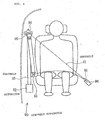
- Fig. 4 is an overall view of a seatbelt apparatus equipped with the gas generator.
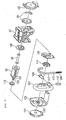
- Fig. 5 is an exploded perspective view of a retractor (pretensioner) of this seatbelt apparatus.
- a seatbelt 91 of a seatbelt apparatus 90 has one end connected to a retractor 92 so that the seatbelt 91 is retractable and the other end fixed onto the vehicle body with an anchor 93.
- the middle portion of the seatbelt 91 is passed through a shoulder anchor 94 and a tongue 95.
- the anchor 93 is at the side of the vehicle cabin.
- the shoulder anchor 94 is disposed in the upper part of the side of the vehicle cabin.
- a spool 98 is accommodated in a base frame 97 of the retractor 92, and one end of the seatbelt 91 is wound around the spool 98.
- the seatbelt 91 is withdrawn and retracted by the rotation of the spool 98.
- a torsion bar 99 is disposed at the center of axle of the spool 98, and one end of the torsion bar 99 is supported by a support member 102 via lock mechanism components 100 and 101.
- the torsion bar 99 is the main component of the EA mechanism. When the tension of the seatbelt 91 exceeds a predetermined value, the torsion bar 99 undergoes plastic torsional deformation, and the spool 98 rotates in a withdrawal direction of the seatbelt 91 while receiving drag.
- the gas When gas is blown out from the gas generator 108, the gas is introduced to the pipe 107.
- the gas pressure moves the balls 111 toward the other end of the pipe 107, i.e., in a direction of rotation of the spool 98 retracting the sheet belt. Meanwhile, the forefront ball 111 presses the ring gear 114, thereby breaking the pin 113 and releasing the retention of the ring gear 114 with the pin 113.
- the ring gear 114 thereby engages with the pinion 116.
- the spool 98 is urged in a direction of rotation for retracting the sheet belt via the pinion 116, the ring gear 114, and the balls 111 by a gas pressure from the gas generator 108.
- the seatbelt 91 is thereby retracted by the spool 98, and a pretension is applied to the seatbelt 91.
- the gas generator 108 and the seatbelt apparatus 90 having the above-described structures, once the initiator 10 is energized, the igniting agent 14 is reacted, and the gas-generating agent is ignited to generate gas. Due to the pressure of the gas, gas is blown out from the gas generator 108 into the pipe 107. As a result, the pretensioner mechanism of the retractor 92 operates as described above to apply a pretension to the seatbelt 91.
- Examples 1 to 3 and Comparative Examples 1 to 4 Metals, i.e., Mg and Al, and, if required, Ca were mixed at a ratio shown in Table 1 to prepare sample mixtures. Each mixture was processed into an ingot at 700°C, and the resulting ingot is ground in a ball mill to prepare powder having an average particle diameter of about 7 ⁇ m. The ignition performance of the powder was determined as follows.
- Examples 1 to 3 showed higher ignition performance than that of Comparative Examples 1 and 2 having lower Mg contents. Examples 1 to 3 also showed good grindability. Comparative Examples 3 and 4 contain excessive Mg; thus, although the ignition performance is high, the grindability is lower than that of Examples 1 to 3.
- Example 7 An igniting agent was prepared as in Example 3 but with a metal shown in Table 2 instead of Ca, and the performance of the igniting agent was evaluated. The results are show in Table 2.
- Table 2 No. Composition (wt%) Average ignition time (ms) Grinding time (Hr) Mg Al Additive metal
- Example 7 58 39 3 (Mn) 1.01 38
- Example 8 58 39 3 (Li) 1.00 38
- Example 9 58 39 3 (Si) 1.02 40
- Example 10 58 39 3 (Sb) 0.99 40
- Example 11 58 39 3 (Sr) 1.01 40
- Example 12 58 39 3 (Zn) 1.03
- Example 13 58 39 3 (Zr) 0.98 42
- Example 14 58 39 3 (Sc) 1.01 41
- Example 15 58 39 3 (Y) 1.02 41
- Example 16 58 39 3 (Sn) 1.01 42
- Example 17 58 39 3 (Ba) 1.00 40
Landscapes
- Chemical & Material Sciences (AREA)
- Organic Chemistry (AREA)
- Engineering & Computer Science (AREA)
- Metallurgy (AREA)
- Materials Engineering (AREA)
- Chemical Kinetics & Catalysis (AREA)
- General Chemical & Material Sciences (AREA)
- Automotive Seat Belt Assembly (AREA)
- Air Bags (AREA)
Abstract
It is an object of the invention to provide an igniting agent containing a powder of a Mg-Al alloy having a high ignition speed and good grindability, an initiator containing the igniting agent, a gas generator incorporating the initiator, and an airbag apparatus and seatbelt apparatus incorporating the gas generator.
According to the invention, an igniting agent includes a powder of a Mg·Al alloy containing Mg: 55 to 70 wt% and Al: the balance. At least one selected from the group consisting of Ca, Mn, Li, Si, Sb, Sr, Zn, Zr, Sc, Y, Sn, Ba, and rare earth metals may be added in an amount of 0.5 to 10 wt%. An initiator is loaded with the igniting agent. A gas generator incorporates the initiator.
Description
- The present invention relates to an igniting agent, an initiator incorporating the igniting agent, and a gas generator incorporating the initiator. The gas generator is, for example, incorporated in an airbag apparatus or a seatbelt apparatus of an automobile or the like.
- An airbag apparatus installed in a rapidly moving vehicle, such as an automobile, is arranged such that a pouch-shaped airbag is rapidly inflated with a gas generator called an inflator. The gas generator includes a gas generating agent and an initiator for inducing a gas generation reaction of the gas-generating agent. The initiator includes a reactive substance and a filament (bridge wire) serving as a resistive heating element for initiating the reaction of the reactive substance (e.g., US-A-5404263).
- An example of an initiator of related art is described with reference to Fig. 1.
- An
initiator 10 includes a substantially cup-shaped casing 12 having an opening on the rear side (downward in Fig. 1). Anigniting agent 14 is accommodated in thecasing 12. The rear portion of thecasing 12 is closed with aninsulator 16 composed of sintered glass or the like. In thecasing 12, front ends of a pair ofelectrode insulator 16 are inserted. - A
filament 22 is stretched across the front ends of theelectrodes filament 22 are welded to the front-end surfaces of theelectrodes filament 22 is inside thecasing 12 and in contact with theigniting agent 14. - The
electrodes casing 12 are isolated from one another so as not to make electrical contact with one another. - In the
initiator 10 having such a configuration, theelectrode 18 is connected to a positive electrode of abattery 26 of an automobile via acontrol circuit 24 having a booster circuit and the like, and theelectrode 20 is connected (earthed) to the body of the automobile. The negative electrode of thebattery 26 is connected to the body of the automobile. - In case of emergency, such as automobile collision, the switching element in the
control circuit 24 is turned ON, and a voltage is applied to thefilament 22 from thebattery 26 via theelectrodes filament 22 generates heat to ignite theigniting agent 14, thereby initiating the reaction. As a result of the reaction of theigniting agent 14, high-pressure gas and heat are generated to induce a gas generation reaction of the gas generating substance of the gas generator. - An example of the gas generator having the
initiator 10 is described with reference to Fig. 2. Agas generator 30 has a container that includes an outer shell constituted from anupper housing 32 and alower housing 34 and a cylindrical divider 36 disposed inside the outer shell. One end of the cylindrical divider 36 passes through an opening formed in the bottom face of thelower housing 34 and protrudes downward. The inner peripheral face of this opening is welded onto the outer peripheral face of the cylindrical divider 36 using a laser beam or the like. Inside the cylindrical divider 36, an igniting agent (booster propellant) 40 is accommodated, and a gas-generating agent (main propellant) 42 is accommodated outside the cylindrical divider 36. - The
initiator 10 is disposed in one end of the cylindrical divider 36. When theigniting agent 40 is ignited by theinitiator 10, gas blows out from anopening 44 of the cylindrical divider 36, thereby igniting a gas-generatingagent 42. A large amount of gas is rapidly generated, passes through afilter 46 composed of a mesh or the like, blows out from thegas generator 30 via anopening 48, and inflates the airbag. Note that Fig. 2 illustrates one example of the gas generator. Various types of gas generators other than one illustrated in the drawing have been commonly used. - Japanese Translation JP 2003-527276 A of PCT application, Publication No. WO 00/46170 discloses an igniting agent prepared by blending strontium nitrate and a Mg·Al alloy powder containing 10 to 50 wt% of Mg and 50 to 90 wt% of Al.
- It has been found that the Mg·Al alloy powder contained in the igniting agent set forth in the above-described JP 2003-527276 A has a low Mg content, and the speed of the ignition thereof is low.
- An object of the present invention is to provide an igniting agent containing a Mg·Al alloy powder having high speed of ignition and good grindability, an initiator containing the igniting agent, a gas generator incorporating the initiator, an airbag apparatus incorporating the gas generator, and a seatbelt apparatus incorporating the gas generator.
- According to the present invention (claim 1), the igniting agent contains a Mg·Al alloy as a fuel constituent, the Mg·Al alloy containing 55 to 70 wt% of Mg and the balance of Al.
- An igniting agent of claim 2 contains a powder of a Mg·Al-based alloy having the following composition as a fuel constituent:
- at least one selected from the group consisting of Ca, Mn, Li, Si, Sb, Sr, Zn, Zr, Sc, Y, Sn, Ba, and rare earth metals: 0.5 to 10 wt% and
- the balance of Mg and Al.
- An igniting agent of claim 3 is the igniting agent according to claim 2 in which the ratio Mg/(Mg + Al) is 0.55 to 0.70.
- An igniting agent of claim 4 contains a powder of the Mg·Al alloy according to claim 1 and a powder of the Mg·Al-based alloy according to claim 2 or 3 as fuel constituents.
- An igniting agent of claim 5 is the igniting agent according to any one of claims 1 to 4, in which 50 to 90 parts by weight of an oxidant is added for 10 to 50 parts by weight of the powder (100 parts by weight in total).
- An igniting agent of claim 6 is the igniting agent according to claim 5, in which the oxidant is at least one selected from the group consisting of KClO4, KClO3, KIO4, KIO3, KMnO4, K2Cr2O7, NH4ClO4, NH4NO3, and Sr(NO3)2.
- An igniting agent of claim 7 is the igniting agent according to any one of claims 1 to 6, further containing a resin binder.
- An initiator of claim 8 includes the igniting agent according to any one of claims 1 to 7.
- A gas generator of claim 9 includes the initiator according to claim 8.
- An airbag apparatus of
claim 10 includes the gas generator according to claim 9. - A seatbelt apparatus of claim 11 includes a seatbelt and a pretensioner for applying a pretension to the seatbelt by a gas pressure from a gas generator in case of emergency, wherein the gas generator is the gas generator according to claim 9.
- The present inventor has conducted various investigations and found that by increasing the Mg content in the Mg·Al alloy to a level higher than that described in JP 2003-527276 A, the ignition performance of the Mg·Al alloy powder can be enhanced. The present invention is made based on this finding. It should be noted that by adjusting the Mg content in the Mg·Al alloy to 70% or less, the grindability of the Mg·Al alloy can be enhanced. Moreover, this contributes to reducing the danger in handling and increasing the corrosion resistance.
- By adding at least one of Ca, Mn, Li, Si, Sb, Sr, Zn, Zr, Sc, Y, Sn, Ba, and rare earth metals to the Mg·Al alloy, the ignition performance can be further improved, and the grindability of the Mg·Al alloy can be further improved.
- By blending a resin binder, such as silicon resin binder, to the igniting agent, the handling of the igniting agent can be facilitated.
- The igniting agent of the present invention contains Mg·Al alloy powder and/or the Mg·Al-based alloy powder.
- The composition of the Mg·Al alloy powder is 55 to 70 wt% Mg and 30 to 45 wt% Al, and more preferably 57 to 63 wt% Mg and 37 to 43 wt% Al. By adjusting the Mg content to 55 wt% or more, the time taken for ignition of the igniting agent can be shortened. Moreover, by adjusting the Mg content to 70 wt% or less, the Mg·Al alloy becomes easily grindable, and the cost for manufacturing the igniting agent can be reduced.
- The Mg·Al-based alloy powder containing at least one metal (hereinafter, this metal is sometimes referred to as "additive metal") selected from the group consisting of Ca, Mn, Li, Si, Sb, Sr, Zn, Zr, Sc, Y, Sn, Ba, and rare earth metals, and the Mg·Al alloy will achieve similar effects and advantages. By incorporating the additive metal, the time taken for the ignition of the igniting agent can be shortened and stabilized. Moreover, the ignition performance at high temperature can be improved. Incorporation of the additive metal also enhances the grindability of the alloy.
- The additive metal is preferably added in an amount of 0.5 to 10 wt% relative to the Mg·Al-based alloy. In adding the additive metal, the ratio (Mg/(Mg + Al)) between Mg and Al in the balance excluding the additive metal is preferably 0.55 to 0.80 and more preferably 0.57 to 0.63.
- Among the additive metals listed above, Ca is particularly preferable.
- Each alloy described above is finely ground in a non-oxidative atmosphere such as nitrogen or argon using, e.g., a ball mill. The average particle diameter of the powder is preferably 10 µm or less. Since an average particle diameter less than 1 µm induces spontaneous combustion during handling, the average particle diameter is preferably 1 to 10 µm and more preferably 5 to 9 µm.
- In the present invention, the oxidant is added in an amount of 90 to 50 parts by weight relative to 10 to 50 parts by weight of the alloy powder, the total being 100 parts by weight.
- The grinding of the oxidant may also be performed in a ball mill.
- The oxidant is preferably a peroxide and/or a nitrate. As the peroxide and/or a nitrate, at least one selected from the group consisting of KClO4, KClO3, KIO4, KIO3, KMnO4, K2Cr2O7, NH4ClO4, NH4NO3, and Sr(NO3)2 is preferable. Of these, KClO3 and the like are particularly preferable.
- The igniting agent of the present invention may be composed of only the igniting component described above or may additionally contain a resin binder such as a silicon resin or the like to facilitate handling. The content of the resin binder is preferably 0.5 to 15 parts by weight and more preferably about 0.5 to 10 parts by weight per 100 parts by weight of the igniting component described above.
-
- Fig. 1 A cross-sectional view showing an example of an initiator.
- Fig. 2 A cross-sectional view showing an example of a gas generator.
- Fig. 3 A vertical cross-sectional view of an airbag apparatus equipped with the gas generator shown in Fig. 2.
- Fig. 4 An overall view of a seatbelt apparatus equipped with a gas generator.
- Fig. 5 An exploded perspective view of a retractor of the seatbelt apparatus shown in Fig. 4.
- The igniting agent is, for example, loaded inside the initiator, as shown in Fig. 1. The initiator is, for example, incorporated in the gas generator, as shown in Fig. 2. However, the structures of the initiator and the gas generator are not particularly limited, and various structures other than ones illustrated in the drawings are applicable.
- Next, a gas generator equipped with the
initiator 10 shown in Fig. 1 and examples of the airbag apparatus and seatbelt apparatus equipped with the gas generator will be described with reference to Figs. 3 to 5. - Fig. 3 is a vertical cross-sectional view of an airbag apparatus equipped with the gas generator shown in Fig. 2.
- An
airbag apparatus 80 includes thegas generator 30 shown in Fig. 2, anairbag 81 inflatable by gas from thegas generator 30, aretainer 82 for retaining thegas generator 30 and theairbag 81, and amodule cover 83 attached to theretainer 82 so as to cover the foldedairbag 81. - The
airbag 81 has a front face that opposes an occupant of a vehicle when inflated and a rear face opposite to the front face. In the rear face, an opening (inlet) 81a through which thegas generator 30 is inserted is disposed. - The
retainer 82 is constituted from amain segment 82a and aleg segment 82b bent downward from the periphery of themain segment 82a. A gasgenerator insertion port 82c is formed at the center of themain segment 82a. As shown in Fig. 3, the front end of thegas generator 30 is inserted to the gasgenerator insertion port 82c from the rear side of themain segment 82a. The periphery of the gasgenerator insertion port 82c is aligned with the opening (inlet) 81a of theairbag 81, and theairbag 81 is fixed with a mountingring 84. The front end of thegas generator 30 is inside theairbag 81 through theopening 81a. - Bolts (stud bolts) 84a project from the mounting
ring 84, and therespective bolts 84a are inserted to the corresponding insertion holes (reference numerals are not given) around theopening 81a and the gasgenerator insertion port 82c, and holes 70 formed in aflange 69. Thebolts 84a thereby protrude from the rear side of theflange 69, and nuts 84b and thebolts 84a are tightened so as to fix theairbag 81 and thegas generator 30 onto theretainer 82. - The
airbag 81 is folded, and themodule cover 83 is attached to cover theairbag 81 so as to obtain theairbag apparatus 80. - Note that in this embodiment, a
leg segment 83a extends downward from the rear face of themodule cover 83, and theleg segment 83a is fixed onto theleg segment 82b of theretainer 82 with acramp 83b such as a rivet. The module cover 83 breaks open as it is pushed by the inflated airbag.Reference numeral 83c denotes a tear line for promoting the breaking. - According to the
gas generator 30 and theairbag apparatus 80 having such structures, the ignitingagent 14 inside theinitiator 10 is reacted once theelectrodes initiator 10 are energized, and the ignitingagent 40 is ignited thereby. Subsequently, the gas-generatingagent 42 is ignited by hot gas from the ignitingagent 40 through theopening 44, thereby producing gas. The gas passes through thefilter 46 and theopening 48 and jets out toward the interior of theairbag 81. Theairbag 81 is inflated as a result. Theairbag 81 pushes themodule cover 83 open so that theairbag 81 is expanded to oppose the occupant or the like, and thereby protects the occupant. - Fig. 4 is an overall view of a seatbelt apparatus equipped with the gas generator. Fig. 5 is an exploded perspective view of a retractor (pretensioner) of this seatbelt apparatus.
- A
seatbelt 91 of a seatbelt apparatus 90 has one end connected to aretractor 92 so that theseatbelt 91 is retractable and the other end fixed onto the vehicle body with ananchor 93. The middle portion of theseatbelt 91 is passed through ashoulder anchor 94 and atongue 95. Theanchor 93 is at the side of the vehicle cabin. On the side of the seat opposite to theanchor 93, abuckle unit 96 with which thetongue 95 is latched is disposed. Theshoulder anchor 94 is disposed in the upper part of the side of the vehicle cabin. - In this embodiment, the
retractor 92 includes a pretensioner that applies pretension to theseatbelt 91 in the event of vehicle emergency, and an energy-absorbing mechanism (EA mechanism) for absorbing impact applied from theseatbelt 91 to the occupant. The structure of theretractor 92 is described below with reference to Fig. 5. - A
spool 98 is accommodated in abase frame 97 of theretractor 92, and one end of theseatbelt 91 is wound around thespool 98. Theseatbelt 91 is withdrawn and retracted by the rotation of thespool 98. Atorsion bar 99 is disposed at the center of axle of thespool 98, and one end of thetorsion bar 99 is supported by asupport member 102 vialock mechanism components - The
torsion bar 99 is the main component of the EA mechanism. When the tension of theseatbelt 91 exceeds a predetermined value, thetorsion bar 99 undergoes plastic torsional deformation, and thespool 98 rotates in a withdrawal direction of theseatbelt 91 while receiving drag. - A
gear 103 is mounted onto one end (left end in Fig. 5) of thespool 98. Thegear 103 engages with a gear (not shown) in areturn spring cover 104 shown on the left of the bottom row in Fig. 5. Thespool 98 is urged in a direction of retracting theseatbelt 91 by a return spring (not shown) inside thereturn spring cover 104. - In Fig. 5, a
pipe 107 is disposed between apretensioner cover 105 illustrated immediate right of thereturn spring cover 104 and apretensioner plate 106 illustrated at the right end of the bottom row. Agas generator 108 is disposed at one end of thepipe 107. Aspring 109, apiston 110, and a plurality ofballs 111 are arranged inside thepipe 107. In the side face near the other end of thepipe 107, a cutout opening (reference numerals is not given) is formed. Aguide block 112 is fitted at the other end of thepipe 107. - The
pretensioner cover 105 has apin 113, and holds aring gear 114 having external and internal gear tooth relative to thepin 113. Thepipe 107 is disposed so that it extends around the outer periphery of thering gear 114. Thepipe 107 is disposed such that the direction from one end toward the other end is coincident with the direction of rotation of thespool 98 retracting the sheet belt. The opening is arranged to face the outer peripheral face of thering gear 114, and theforefront ball 111 exposed at the opening engages with the external tooth of thering gear 114. - A
pinion 116 engageable with the inner tooth of thering gear 114 is disposed at abase 115 of thegear 103. When thering gear 114 is held with thepin 113, thering gear 114 does not engage with thepinion 116. - When gas is blown out from the
gas generator 108, the gas is introduced to thepipe 107. The gas pressure moves theballs 111 toward the other end of thepipe 107, i.e., in a direction of rotation of thespool 98 retracting the sheet belt. Meanwhile, theforefront ball 111 presses thering gear 114, thereby breaking thepin 113 and releasing the retention of thering gear 114 with thepin 113. Thering gear 114 thereby engages with thepinion 116. - Consequently, the
spool 98 is urged in a direction of rotation for retracting the sheet belt via thepinion 116, thering gear 114, and theballs 111 by a gas pressure from thegas generator 108. Theseatbelt 91 is thereby retracted by thespool 98, and a pretension is applied to theseatbelt 91. - In this embodiment, the
gas generator 108 has a substantially cylindrical housing, and the gas generator and theinitiator 10 shown in Fig. 1 are accommodated in the housing. - With the
gas generator 108 and the seatbelt apparatus 90 having the above-described structures, once theinitiator 10 is energized, the ignitingagent 14 is reacted, and the gas-generating agent is ignited to generate gas. Due to the pressure of the gas, gas is blown out from thegas generator 108 into thepipe 107. As a result, the pretensioner mechanism of theretractor 92 operates as described above to apply a pretension to theseatbelt 91. - The respective embodiments described above are examples of the present invention, and embodiments other than those illustrated in the drawings are also possible. For example, the initiator may be incorporated in a various gas generator other than one described above. The gas generator may be incorporated in an airbag apparatus or a seatbelt apparatus other than those described above.
- Examples and Comparative Examples will now be described.
- Examples 1 to 3 and Comparative Examples 1 to 4
Metals, i.e., Mg and Al, and, if required, Ca were mixed at a ratio shown in Table 1 to prepare sample mixtures. Each mixture was processed into an ingot at 700°C, and the resulting ingot is ground in a ball mill to prepare powder having an average particle diameter of about 7 µm. The ignition performance of the powder was determined as follows. - Four grams of MgAl powder, KClO3 (average particle diameter: 3 µm), 100 mg of a silicon resin binder, and 5 ml of ethanol were mixed, and the mixture was dried to prepare an igniting agent. The igniting agent was weighed in a metal cup, and a header onto which a NiCr bridge wire (diameter: 22 µm) was welded was press-fitted into the metal cup at a constant pressure (1,500 N) to assemble a sample. A constant current of 1.2 A × 2 ms was applied to the sample, and the light at the ignition was detected with an optical sensor. The time taken for ignition was determined and used in evaluating the ignition performance.
- The results are shown in Table 1. In the table, the time taken to grind the ingot to powder having an average particle diameter of 7 µm is also shown.
- Examples 4 to 6 and Comparative Example 5
The ratio Mg/(Mg + Al) was fixed to 0.6, and the same performance evaluation was conducted by varying the ratio of Ca added. The results are shown in Table 1.No. Composition (wt%) Average ignition time (ms) Grinding time (Hr) Mg Al Ca Comparative Example 1 40 60 0 1.52 47 Comparative Example 2 50 50 0 1.35 40 Example 1 58 42 0 1.07 45 Example 2 63 37 0 1.06 49 Comparative Example 3 70 30 0 1.05 78 Comparative Example 4 75 25 0 1.03 >120 Example 3 58 39 3 0.95 38 Example 4 60 40 0 1.06 48 Example 5 59 40 1 0.98 38 Example 6 55 37 8 0.97 38 Comparative Example 5 51 34 15 1.15 64 - As is shown in Table 1, Examples 1 to 3 showed higher ignition performance than that of Comparative Examples 1 and 2 having lower Mg contents. Examples 1 to 3 also showed good grindability. Comparative Examples 3 and 4 contain excessive Mg; thus, although the ignition performance is high, the grindability is lower than that of Examples 1 to 3.
- As is apparent from the comparison between Examples 4 to 6 and Comparative Example 5, addition of Ca reduces the average time taken for ignition but at a Ca content exceeding 10%, Ca does not homogeneously dissolve in the alloy, thereby resulting in variation in time taken for ignition and the increased average time taken for ignition.
- Examples 7 to 17
An igniting agent was prepared as in Example 3 but with a metal shown in Table 2 instead of Ca, and the performance of the igniting agent was evaluated. The results are show in Table 2.[Table 2] No. Composition (wt%) Average ignition time (ms) Grinding time (Hr) Mg Al Additive metal Example 7 58 39 3 (Mn) 1.01 38 Example 8 58 39 3 (Li) 1.00 38 Example 9 58 39 3 (Si) 1.02 40 Example 10 58 39 3 (Sb) 0.99 40 Example 11 58 39 3 (Sr) 1.01 40 Example 12 58 39 3 (Zn) 1.03 38 Example 13 58 39 3 (Zr) 0.98 42 Example 14 58 39 3 (Sc) 1.01 41 Example 15 58 39 3 (Y) 1.02 41 Example 16 58 39 3 (Sn) 1.01 42 Example 17 58 39 3 (Ba) 1.00 40 - As show in Table 2, it was confirmed that the average time was similarly reduced by using the respective metals instead of Ca.
Claims (11)
- An igniting agent comprising a powder of a Mg·Al alloy having the following composition as a fuel constituent:Mg: 55 to 70 wt%; andAl: the balance.
- An igniting agent comprising a powder of a Mg·Al-based alloy having the following composition as a fuel constituent:at least one selected from the group consisting of Ca, Mn, Li, Si, Sb, Sr, Zn, Zr, Sc, Y, Sn, Ba, and rare earth metals: 0.5 to 10 wt%; andthe balance: Mg and Al.
- The igniting agent according to claim 2, wherein the ratio Mg/(Mg + Al) is 0.55 to 0.70.
- An igniting agent comprising a powder of the Mg·Al alloy according to claim 1 and a powder of the Mg·Al-based alloy according to claim 2 or 3 as fuel constituents.
- The igniting agent according to any one of claims 1 to 4, wherein 50 to 90 parts by weight of an oxidant is added for 10 to 50 parts by weight of the powder (100 parts by weight in total).
- The igniting agent according to claim 5, wherein the oxidant is at least one selected from the group consisting of KClO4, KClO3, KIO4, KIO3, KMnO4, K2Cr2O7, NH4ClO4, NH4NO3, and Sr (NO3)2.
- The igniting agent according to any one of claims 1 to 6, further comprising a resin binder.
- An initiator comprising the igniting agent according to any one of claims 1 to 7.
- A gas generator comprising the initiator according to claim 8.
- An airbag apparatus comprising the gas generator according to claim 9.
- A seatbelt apparatus comprising a seatbelt and a pretensioner for applying a pretension to the seatbelt by a gas pressure from a gas generator in case of emergency, wherein the gas generator is the gas generator according to claim 9.
Applications Claiming Priority (2)
| Application Number | Priority Date | Filing Date | Title |
|---|---|---|---|
| JP2004277488 | 2004-09-24 | ||
| JP2005164226A JP2006117508A (en) | 2004-09-24 | 2005-06-03 | Igniting powder, initiator, gas generator, air bag unit, and seat belt unit |
Publications (1)
| Publication Number | Publication Date |
|---|---|
| EP1640354A2 true EP1640354A2 (en) | 2006-03-29 |
Family
ID=35561401
Family Applications (1)
| Application Number | Title | Priority Date | Filing Date |
|---|---|---|---|
| EP05017489A Pending EP1640354A2 (en) | 2004-09-24 | 2005-08-31 | Igniting agent, initiator, gas generator, airbag apparatus, and seatbelt apparatus |
Country Status (3)
| Country | Link |
|---|---|
| US (1) | US20070251616A1 (en) |
| EP (1) | EP1640354A2 (en) |
| JP (1) | JP2006117508A (en) |
Families Citing this family (7)
| Publication number | Priority date | Publication date | Assignee | Title |
|---|---|---|---|---|
| US7637533B2 (en) * | 2006-01-25 | 2009-12-29 | Daicel Chemical Industries, Ltd. | Gas generator |
| JP2008030970A (en) * | 2006-07-26 | 2008-02-14 | Takata Corp | Ignition powder, initiator, gas generator, air bag unit and seat belt unit |
| DE102009051451B4 (en) | 2009-10-30 | 2018-01-11 | Autoliv Development Ab | Tensioning device for a safety belt |
| US9114780B2 (en) | 2009-10-30 | 2015-08-25 | Autoliv Development Ab | Pretensioner device for a seat belt |
| JP2012180259A (en) * | 2010-03-19 | 2012-09-20 | Toyoda Gosei Co Ltd | Heat-generating composition and method for manufacturing the same |
| DE102010018512A1 (en) * | 2010-04-27 | 2011-10-27 | Autoliv Development Ab | Tensioning device for a safety belt |
| CN112341299B (en) * | 2020-11-05 | 2021-11-09 | 南京理工大学 | Preparation of nano core-shell Al @ KIO by spray coprecipitation method4Thermite method |
Citations (2)
| Publication number | Priority date | Publication date | Assignee | Title |
|---|---|---|---|---|
| US5404263A (en) | 1992-08-27 | 1995-04-04 | Oea, Inc. | All-glass header assembly used in an inflator system |
| WO2000046170A2 (en) | 1999-02-02 | 2000-08-10 | Autoliv Development Ab | Gas generant igniter composition and method |
Family Cites Families (4)
| Publication number | Priority date | Publication date | Assignee | Title |
|---|---|---|---|---|
| US5145209A (en) * | 1990-02-13 | 1992-09-08 | Trw Vehicle Safety Systems Inc. | Seat belt pretensioner |
| CA2166748A1 (en) * | 1995-01-14 | 1996-07-15 | Sek Kwan Chan | Pyrotechnic ignition device |
| US6527297B1 (en) * | 2000-08-30 | 2003-03-04 | Autoliv Asp, Inc. | Inflator device ignition of gas generant |
| JP4811975B2 (en) * | 2001-06-06 | 2011-11-09 | 日本化薬株式会社 | Ignition composition and igniter using the ignition composition |
-
2005
- 2005-06-03 JP JP2005164226A patent/JP2006117508A/en not_active Withdrawn
- 2005-08-31 EP EP05017489A patent/EP1640354A2/en active Pending
- 2005-09-09 US US11/221,723 patent/US20070251616A1/en not_active Abandoned
Patent Citations (3)
| Publication number | Priority date | Publication date | Assignee | Title |
|---|---|---|---|---|
| US5404263A (en) | 1992-08-27 | 1995-04-04 | Oea, Inc. | All-glass header assembly used in an inflator system |
| WO2000046170A2 (en) | 1999-02-02 | 2000-08-10 | Autoliv Development Ab | Gas generant igniter composition and method |
| JP2003527276A (en) | 1999-02-02 | 2003-09-16 | オートリブ ディベロップメント アクティエボラーグ | Gas generating transfer charge composition and method |
Also Published As
| Publication number | Publication date |
|---|---|
| US20070251616A1 (en) | 2007-11-01 |
| JP2006117508A (en) | 2006-05-11 |
Similar Documents
| Publication | Publication Date | Title |
|---|---|---|
| EP1990088B1 (en) | Small gas-generating device for gas actuator and pretensioner system | |
| US20080217894A1 (en) | Micro-gas generation | |
| US6851374B1 (en) | Dual stage inflator for low melting gas generants | |
| CN100462342C (en) | Gas generants containing alkali metal perchlorates | |
| US6941868B2 (en) | Single increment initiator charge | |
| US3936330A (en) | Composition and method for inflation of passive restraint systems | |
| EP1640354A2 (en) | Igniting agent, initiator, gas generator, airbag apparatus, and seatbelt apparatus | |
| US20040112244A1 (en) | Initiator assembly with integrated shorting element | |
| EP2489649A1 (en) | Gas generating agent composition, molded product of the composition, and gas generation device equipped with the molded product | |
| US6165296A (en) | Gas generant igniter composition and method | |
| WO2008013017A1 (en) | Igniting agent, initiator, gas generator, airbag device, and sheet belt device | |
| EP2459501B1 (en) | Inflator assembly | |
| US20090140510A1 (en) | Porous igniter coating for use in automotive airbag inflators | |
| JP2009502718A (en) | Self-ignition / booster composition | |
| US20030145922A1 (en) | Vehicular occupant restraint | |
| JP2008174441A (en) | Gas generating system and composition | |
| CN1772717A (en) | Igniting agent, initiator, gas generator, airbag apparatus, and seatbelt apparatus | |
| US20060220363A1 (en) | Gas generating system with autoignition device | |
| JP2008030971A (en) | Ignition powder, initiator, gas generator, air bag unit and seat belt unit | |
| US20070169863A1 (en) | Autoignition main gas generant | |
| US20250196799A1 (en) | Initiator For A Gas Generator Of A Vehicle Safety Device | |
| US6652683B2 (en) | Elemental carbon in inflation gas generation |
Legal Events
| Date | Code | Title | Description |
|---|---|---|---|
| PUAI | Public reference made under article 153(3) epc to a published international application that has entered the european phase |
Free format text: ORIGINAL CODE: 0009012 |
|
| AK | Designated contracting states |
Kind code of ref document: A2 Designated state(s): AT BE BG CH CY CZ DE DK EE ES FI FR GB GR HU IE IS IT LI LT LU LV MC NL PL PT RO SE SI SK TR |
|
| AX | Request for extension of the european patent |
Extension state: AL BA HR MK YU |
|
| STAA | Information on the status of an ep patent application or granted ep patent |
Free format text: STATUS: THE APPLICATION IS DEEMED TO BE WITHDRAWN |