EP1637578A1 - A dispersant of saline deposits in hydrocarbon process plants - Google Patents
A dispersant of saline deposits in hydrocarbon process plants Download PDFInfo
- Publication number
- EP1637578A1 EP1637578A1 EP20050108390 EP05108390A EP1637578A1 EP 1637578 A1 EP1637578 A1 EP 1637578A1 EP 20050108390 EP20050108390 EP 20050108390 EP 05108390 A EP05108390 A EP 05108390A EP 1637578 A1 EP1637578 A1 EP 1637578A1
- Authority
- EP
- European Patent Office
- Prior art keywords
- plant
- diaminopropane
- ppm
- alkyl
- ammonium salt
- Prior art date
- Legal status (The legal status is an assumption and is not a legal conclusion. Google has not performed a legal analysis and makes no representation as to the accuracy of the status listed.)
- Granted
Links
- 239000002270 dispersing agent Substances 0.000 title claims abstract description 43
- 238000000034 method Methods 0.000 title claims abstract description 25
- 229930195733 hydrocarbon Natural products 0.000 title claims abstract description 21
- 150000002430 hydrocarbons Chemical class 0.000 title claims abstract description 21
- 239000004215 Carbon black (E152) Substances 0.000 title claims abstract description 20
- FAPWRFPIFSIZLT-UHFFFAOYSA-M Sodium chloride Chemical compound [Na+].[Cl-] FAPWRFPIFSIZLT-UHFFFAOYSA-M 0.000 title description 8
- 239000011780 sodium chloride Substances 0.000 title description 8
- 150000003863 ammonium salts Chemical class 0.000 claims abstract description 16
- 230000015572 biosynthetic process Effects 0.000 claims abstract description 15
- 239000000203 mixture Substances 0.000 claims abstract description 14
- NLXLAEXVIDQMFP-UHFFFAOYSA-N Ammonia chloride Chemical group [NH4+].[Cl-] NLXLAEXVIDQMFP-UHFFFAOYSA-N 0.000 claims description 98
- 235000019270 ammonium chloride Nutrition 0.000 claims description 38
- 239000012530 fluid Substances 0.000 claims description 19
- XLYOFNOQVPJJNP-UHFFFAOYSA-N water Substances O XLYOFNOQVPJJNP-UHFFFAOYSA-N 0.000 claims description 9
- 238000005260 corrosion Methods 0.000 claims description 8
- 230000007797 corrosion Effects 0.000 claims description 8
- 239000003112 inhibitor Substances 0.000 claims description 6
- 238000004523 catalytic cracking Methods 0.000 claims description 5
- 238000004821 distillation Methods 0.000 claims description 5
- 230000003472 neutralizing effect Effects 0.000 claims description 5
- 239000002904 solvent Substances 0.000 claims description 5
- 239000001257 hydrogen Substances 0.000 claims description 4
- 229910052739 hydrogen Inorganic materials 0.000 claims description 4
- UFHFLCQGNIYNRP-UHFFFAOYSA-N Hydrogen Chemical compound [H][H] UFHFLCQGNIYNRP-UHFFFAOYSA-N 0.000 claims description 3
- MBMLMWLHJBBADN-UHFFFAOYSA-N Ferrous sulfide Chemical compound [Fe]=S MBMLMWLHJBBADN-UHFFFAOYSA-N 0.000 claims description 2
- 125000000217 alkyl group Chemical group 0.000 claims description 2
- QGZKDVFQNNGYKY-UHFFFAOYSA-O ammonium group Chemical group [NH4+] QGZKDVFQNNGYKY-UHFFFAOYSA-O 0.000 claims description 2
- 238000012360 testing method Methods 0.000 description 31
- 239000000654 additive Substances 0.000 description 21
- 230000000996 additive effect Effects 0.000 description 21
- QGZKDVFQNNGYKY-UHFFFAOYSA-N Ammonia Chemical compound N QGZKDVFQNNGYKY-UHFFFAOYSA-N 0.000 description 17
- MTNDZQHUAFNZQY-UHFFFAOYSA-N imidazoline Chemical compound C1CN=CN1 MTNDZQHUAFNZQY-UHFFFAOYSA-N 0.000 description 16
- 150000003839 salts Chemical class 0.000 description 15
- 239000000243 solution Substances 0.000 description 14
- 239000006185 dispersion Substances 0.000 description 11
- 238000002834 transmittance Methods 0.000 description 11
- IMNFDUFMRHMDMM-UHFFFAOYSA-N N-Heptane Chemical compound CCCCCCC IMNFDUFMRHMDMM-UHFFFAOYSA-N 0.000 description 9
- YXFVVABEGXRONW-UHFFFAOYSA-N Toluene Chemical compound CC1=CC=CC=C1 YXFVVABEGXRONW-UHFFFAOYSA-N 0.000 description 9
- 239000000047 product Substances 0.000 description 9
- 229910021529 ammonia Inorganic materials 0.000 description 8
- 150000001412 amines Chemical class 0.000 description 7
- 238000005259 measurement Methods 0.000 description 7
- -1 amine chlorides Chemical class 0.000 description 6
- VEXZGXHMUGYJMC-UHFFFAOYSA-N Hydrochloric acid Chemical compound Cl VEXZGXHMUGYJMC-UHFFFAOYSA-N 0.000 description 4
- 238000013019 agitation Methods 0.000 description 4
- 239000003795 chemical substances by application Substances 0.000 description 4
- 150000001875 compounds Chemical class 0.000 description 4
- 229910000041 hydrogen chloride Inorganic materials 0.000 description 4
- IXCSERBJSXMMFS-UHFFFAOYSA-N hydrogen chloride Substances Cl.Cl IXCSERBJSXMMFS-UHFFFAOYSA-N 0.000 description 4
- 239000007788 liquid Substances 0.000 description 4
- 239000007787 solid Substances 0.000 description 4
- PIICEJLVQHRZGT-UHFFFAOYSA-N Ethylenediamine Chemical compound NCCN PIICEJLVQHRZGT-UHFFFAOYSA-N 0.000 description 3
- 238000000151 deposition Methods 0.000 description 3
- HCFPRFJJTHMING-UHFFFAOYSA-N ethane-1,2-diamine;hydron;chloride Chemical compound [Cl-].NCC[NH3+] HCFPRFJJTHMING-UHFFFAOYSA-N 0.000 description 3
- 230000003449 preventive effect Effects 0.000 description 3
- HZAXFHJVJLSVMW-UHFFFAOYSA-N 2-Aminoethan-1-ol Chemical compound NCCO HZAXFHJVJLSVMW-UHFFFAOYSA-N 0.000 description 2
- FAXDZWQIWUSWJH-UHFFFAOYSA-N 3-methoxypropan-1-amine Chemical compound COCCCN FAXDZWQIWUSWJH-UHFFFAOYSA-N 0.000 description 2
- CSCPPACGZOOCGX-UHFFFAOYSA-N Acetone Chemical compound CC(C)=O CSCPPACGZOOCGX-UHFFFAOYSA-N 0.000 description 2
- 239000007864 aqueous solution Substances 0.000 description 2
- 239000013078 crystal Substances 0.000 description 2
- 230000007423 decrease Effects 0.000 description 2
- 239000002283 diesel fuel Substances 0.000 description 2
- 238000002474 experimental method Methods 0.000 description 2
- 238000009533 lab test Methods 0.000 description 2
- 239000011159 matrix material Substances 0.000 description 2
- 239000012071 phase Substances 0.000 description 2
- 229920000768 polyamine Polymers 0.000 description 2
- 239000004094 surface-active agent Substances 0.000 description 2
- KODLUXHSIZOKTG-UHFFFAOYSA-N 1-aminobutan-2-ol Chemical compound CCC(O)CN KODLUXHSIZOKTG-UHFFFAOYSA-N 0.000 description 1
- BFSVOASYOCHEOV-UHFFFAOYSA-N 2-diethylaminoethanol Chemical compound CCN(CC)CCO BFSVOASYOCHEOV-UHFFFAOYSA-N 0.000 description 1
- RPNUMPOLZDHAAY-UHFFFAOYSA-N Diethylenetriamine Chemical compound NCCNCCN RPNUMPOLZDHAAY-UHFFFAOYSA-N 0.000 description 1
- UEEJHVSXFDXPFK-UHFFFAOYSA-N N-dimethylaminoethanol Chemical compound CN(C)CCO UEEJHVSXFDXPFK-UHFFFAOYSA-N 0.000 description 1
- OPKOKAMJFNKNAS-UHFFFAOYSA-N N-methylethanolamine Chemical compound CNCCO OPKOKAMJFNKNAS-UHFFFAOYSA-N 0.000 description 1
- WUGQZFFCHPXWKQ-UHFFFAOYSA-N Propanolamine Chemical compound NCCCO WUGQZFFCHPXWKQ-UHFFFAOYSA-N 0.000 description 1
- 239000002253 acid Substances 0.000 description 1
- 239000004480 active ingredient Substances 0.000 description 1
- 239000008346 aqueous phase Substances 0.000 description 1
- QVGXLLKOCUKJST-UHFFFAOYSA-N atomic oxygen Chemical compound [O] QVGXLLKOCUKJST-UHFFFAOYSA-N 0.000 description 1
- 239000000969 carrier Substances 0.000 description 1
- 238000001816 cooling Methods 0.000 description 1
- 229960002887 deanol Drugs 0.000 description 1
- 238000011161 development Methods 0.000 description 1
- 238000010586 diagram Methods 0.000 description 1
- IUNMPGNGSSIWFP-UHFFFAOYSA-N dimethylaminopropylamine Chemical compound CN(C)CCCN IUNMPGNGSSIWFP-UHFFFAOYSA-N 0.000 description 1
- 239000012972 dimethylethanolamine Substances 0.000 description 1
- 238000006073 displacement reaction Methods 0.000 description 1
- 238000010494 dissociation reaction Methods 0.000 description 1
- 230000005593 dissociations Effects 0.000 description 1
- 239000012153 distilled water Substances 0.000 description 1
- 239000003995 emulsifying agent Substances 0.000 description 1
- 230000002349 favourable effect Effects 0.000 description 1
- 239000007789 gas Substances 0.000 description 1
- 239000005337 ground glass Substances 0.000 description 1
- 231100001261 hazardous Toxicity 0.000 description 1
- FBAFATDZDUQKNH-UHFFFAOYSA-M iron chloride Chemical compound [Cl-].[Fe] FBAFATDZDUQKNH-UHFFFAOYSA-M 0.000 description 1
- 230000007246 mechanism Effects 0.000 description 1
- 238000002844 melting Methods 0.000 description 1
- 230000008018 melting Effects 0.000 description 1
- 230000005499 meniscus Effects 0.000 description 1
- 239000013081 microcrystal Substances 0.000 description 1
- 238000012986 modification Methods 0.000 description 1
- 230000004048 modification Effects 0.000 description 1
- 238000012544 monitoring process Methods 0.000 description 1
- 239000001301 oxygen Substances 0.000 description 1
- 229910052760 oxygen Inorganic materials 0.000 description 1
- 239000002245 particle Substances 0.000 description 1
- 230000002085 persistent effect Effects 0.000 description 1
- 229920000642 polymer Polymers 0.000 description 1
- 239000000843 powder Substances 0.000 description 1
- 239000002244 precipitate Substances 0.000 description 1
- 230000002265 prevention Effects 0.000 description 1
- 238000011112 process operation Methods 0.000 description 1
- 230000005855 radiation Effects 0.000 description 1
- 238000010992 reflux Methods 0.000 description 1
- 239000003507 refrigerant Substances 0.000 description 1
- 239000000126 substance Substances 0.000 description 1
- 238000003786 synthesis reaction Methods 0.000 description 1
- MBYLVOKEDDQJDY-UHFFFAOYSA-N tris(2-aminoethyl)amine Chemical compound NCCN(CCN)CCN MBYLVOKEDDQJDY-UHFFFAOYSA-N 0.000 description 1
Images


Classifications
-
- C—CHEMISTRY; METALLURGY
- C10—PETROLEUM, GAS OR COKE INDUSTRIES; TECHNICAL GASES CONTAINING CARBON MONOXIDE; FUELS; LUBRICANTS; PEAT
- C10G—CRACKING HYDROCARBON OILS; PRODUCTION OF LIQUID HYDROCARBON MIXTURES, e.g. BY DESTRUCTIVE HYDROGENATION, OLIGOMERISATION, POLYMERISATION; RECOVERY OF HYDROCARBON OILS FROM OIL-SHALE, OIL-SAND, OR GASES; REFINING MIXTURES MAINLY CONSISTING OF HYDROCARBONS; REFORMING OF NAPHTHA; MINERAL WAXES
- C10G75/00—Inhibiting corrosion or fouling in apparatus for treatment or conversion of hydrocarbon oils, in general
- C10G75/04—Inhibiting corrosion or fouling in apparatus for treatment or conversion of hydrocarbon oils, in general by addition of antifouling agents
-
- C—CHEMISTRY; METALLURGY
- C10—PETROLEUM, GAS OR COKE INDUSTRIES; TECHNICAL GASES CONTAINING CARBON MONOXIDE; FUELS; LUBRICANTS; PEAT
- C10G—CRACKING HYDROCARBON OILS; PRODUCTION OF LIQUID HYDROCARBON MIXTURES, e.g. BY DESTRUCTIVE HYDROGENATION, OLIGOMERISATION, POLYMERISATION; RECOVERY OF HYDROCARBON OILS FROM OIL-SHALE, OIL-SAND, OR GASES; REFINING MIXTURES MAINLY CONSISTING OF HYDROCARBONS; REFORMING OF NAPHTHA; MINERAL WAXES
- C10G7/00—Distillation of hydrocarbon oils
- C10G7/10—Inhibiting corrosion during distillation
-
- C—CHEMISTRY; METALLURGY
- C10—PETROLEUM, GAS OR COKE INDUSTRIES; TECHNICAL GASES CONTAINING CARBON MONOXIDE; FUELS; LUBRICANTS; PEAT
- C10G—CRACKING HYDROCARBON OILS; PRODUCTION OF LIQUID HYDROCARBON MIXTURES, e.g. BY DESTRUCTIVE HYDROGENATION, OLIGOMERISATION, POLYMERISATION; RECOVERY OF HYDROCARBON OILS FROM OIL-SHALE, OIL-SAND, OR GASES; REFINING MIXTURES MAINLY CONSISTING OF HYDROCARBONS; REFORMING OF NAPHTHA; MINERAL WAXES
- C10G75/00—Inhibiting corrosion or fouling in apparatus for treatment or conversion of hydrocarbon oils, in general
- C10G75/02—Inhibiting corrosion or fouling in apparatus for treatment or conversion of hydrocarbon oils, in general by addition of corrosion inhibitors
-
- Y—GENERAL TAGGING OF NEW TECHNOLOGICAL DEVELOPMENTS; GENERAL TAGGING OF CROSS-SECTIONAL TECHNOLOGIES SPANNING OVER SEVERAL SECTIONS OF THE IPC; TECHNICAL SUBJECTS COVERED BY FORMER USPC CROSS-REFERENCE ART COLLECTIONS [XRACs] AND DIGESTS
- Y10—TECHNICAL SUBJECTS COVERED BY FORMER USPC
- Y10S—TECHNICAL SUBJECTS COVERED BY FORMER USPC CROSS-REFERENCE ART COLLECTIONS [XRACs] AND DIGESTS
- Y10S585/00—Chemistry of hydrocarbon compounds
- Y10S585/949—Miscellaneous considerations
- Y10S585/95—Prevention or removal of corrosion or solid deposits
Definitions
- the present invention relates to the use of a dispersing agent or of a composition comprising said dispersing agent, to prevent the formation of or to remove already formed deposits of ammonium salt in hydrocarbon process plants, such as petrochemical or refinery plants.
- Said ammonium salt deposits are formed particularly in atmospheric distillation (topping) plants and in fluid bed catalytic cracking (FCC) plants, where the head vapours of the process units are often loaded with ammonia and hydrogen chloride.
- FCC fluid bed catalytic cracking
- ammonium chloride The most commonly formed salt is ammonium chloride. Deposits of solid ammonium chloride may form and collect on metallic surfaces and hinder the flow of gas, liquids and heat. Moreover, said deposits are highly hazardous for the development of corrosion mechanisms, known in fact as "under deposit”.
- Ammonium chloride deposits can occur on distillation plates, in transport lines, on the surfaces of heat exchangers, on filters.
- the deposit precipitates when the product of the partial molar pressures of the ammonia and of the hydrogen chloride exceeds the stability constant (Kd) of the ammonium chloride at system temperature.
- changing the operating parameters could enable to prevent the ammonium chloride from depositing, by moving them from slightly above the equilibrium curve of the dissociation - Temperature constant to slightly below the curve.
- ammonia salt deposits For the removal of ammonia salt deposits, methods have been proposed which make use of amines that are stronger bases than ammonia, such as methoxypropylamine and monoethanolamine which form liquid salts under normal operating conditions.
- said salts are usually highly viscous and it has not yet been definitively demonstrated that such amines can overcome the problem of the onset of the corrosion phenomena described above.
- the salts of some amines used instead of ammonia can themselves be a source of solid or semisolid deposits, and hence they must be removed just like ammonium chloride.
- US Patent 4,793,865 describes the use of amines containing oxygen which react with the ammonium salt forming ammonia and an amine salt with a low melting point and/or a high affinity for water.
- the amine salt that is insoluble in hydrocarbons exits the unit in the liquid state, together with process liquids.
- these amines are dimethylethanolamine, monomethylethanolamine, methoxypropylamine, monoethanolamine, monoethylethanolamine, diethylethanolamine, propanolamine, and the like.
- US Patent 5,387,733 describes the use of a non filming polyamine for the prevention and removal of ammonium chloride deposits, indicating dimethylaminopropylamine, diethylentriamine, ethylendiamine and tris-(2-aminoethyl)amine as polyamines.
- Dispersants can act in various ways, from neutralising charges on the surface of the solid ammonium chloride, to destroying the crystal matrix, to the chemical displacement of ammonia from the crystal matrix.
- Prior art dispersants are efficient to prevent a saline deposit from forming. Therefore, they are efficient preventive agents.
- the problem constituting the basis for the present invention is to provide a dispersing product which, in addition to constituting an effective preventive agent against the formation of saline deposits, is also an effective agent able to remove saline deposits already formed in hydrocarbon process plants.
- an object of the present invention are N-alkyl-1,3-diaminopropane compounds with the formula (1) R-NH- (CH 2 ) 3 -NH 2 (1) where R represents a straight C 8 through C 18 alkyl chain, for use as dispersing agents to solve the problem of preventing the formation of saline deposits of ammonium salts and removing already formed saline deposits, in hydrocarbon process plants.
- a further object of the present invention is a method for preventing the formation of or to remove already formed deposits of ammonium salt in a hydrocarbon process plant, comprising the step of introducing in the process of said plant a quantity of N-alkyl-1,3-diaminopropane, particularly N-coco-1,3-diaminopropane, sufficient to prevent or remove said deposits.
- the compounds can be used alone or in a composition that comprises them together with suitable coadjuvants or carriers, such as, by way of non limiting examples, filming or neutralising or dispersing corrosion inhibitors for iron chloride, and in hydrocarbon process plants such as, by way of non limiting examples, an atmospheric hydrocarbon distillation plant, a fluid bed catalytic cracking (FCC) plant, a sour water stripper (SWS) plant, a gasoline desulphuring plant (Unifining), or a hydrogen desulphuration system (HDS).
- suitable coadjuvants or carriers such as, by way of non limiting examples, filming or neutralising or dispersing corrosion inhibitors for iron chloride
- hydrocarbon process plants such as, by way of non limiting examples, an atmospheric hydrocarbon distillation plant, a fluid bed catalytic cracking (FCC) plant, a sour water stripper (SWS) plant, a gasoline desulphuring plant (Unifining), or a hydrogen desulphuration system (HDS).
- N-coco-1,3-diaminopropane compound is particularly preferred.
- This compound also known commercially with the name Duomeen C (by Akzo Surfactants), is known for having been used as a synthesis intermediate by means of oxyethylation, to obtain emulsifiers, surfactants or polymers and it is also known, as such, as a corrosion inhibitor.
- This compound too, can be used alone or in combination or in composition with additional agents active in process operations, as filming corrosion inhibitors, neutralising corrosion inhibitors, dispersants for iron sulphide and the like.
- the tests were conducted placing 20 ml of fluid to be examined and 100 mg of finely subdivided ammonium chloride in a 50 ml flask with ground glass neck.
- the function of the fluid is to dissolve the ammonium chloride in the solution or dispersion fluid.
- the fluid is allowed to rest for a defined time and subsequently a fixed quantity is drawn (being careful not to move the salt deposited on the bottom); the ammonium chloride dispersed in the fluid is extracted with a known quantity of distilled water. On this aqueous solution is performed the measurement of conductivity, which is proportional to the quantity of ammonium chloride dispersed in the initial fluid.
- a calibration straight line was constructed, as shown in Figure 1, preparing four aqueous solutions of NH 4 Cl having a known concentration, respectively of 0.0001M; 0.0005M; 0.001 and 0.01 M.
- the concentration read on the calibration straight line is determined from the measurement of conductivity. From the concentration, the quantity of salt removed is determined, which represents a measurement of the efficiency of the dispersant, i.e. its ability to free the ammonium chloride in the fluid being examined. Both conductivity and concentration therefore represent an objective measurement of the efficiency of the dispersant. The higher the concentration, the more efficient the dispersant, because a high concentration means a greater quantity of dispersed (removed) salt.
- the efficiency of the dispersant of the present invention was compared, based on the above described test, with other dispersant known for their effectiveness.
- Imidazolin 1 and Imidazolin 2 were selected among said known dispersants, as well as a known dispersant by Ondeo - Nalco, hereinafter called "competitor”.
- the dispersing product to be tested is introduced into the fluid at the prescribed dosage.
- the turbid mixtures are transferred to a test tube with stopper and are allowed to rest for different times as shown in the tables provided below.
- the dispersant exhibits improving performance as its dosage increases, but beyond a certain limit an increase in dispersant causes a decrease in additive concentration, which shows that it has an optimal efficiency at relatively low concentrations.
- the dispersant according to the present invention exhibits better efficiency than the aforementioned known dispersant, as shown by the parallel tests illustrated in the Tables 1-3 that follow, where the concentration values represent an objective measure to compare dispersion ability and efficiency is measured by the numeric ratio between the ppm of additive of the invention (Duomeen C) and the ammonium chloride concentration expressed in ppm.
- Table 4 shows the results of the test on a dispersant product known in the art and called Competitor.
- Example 3 Series of tests in LCO / one hour of rest with granular ammonium chloride.
- the tests conducted on a sample of top topping gasoline are illustrated as an additional example of fluid within which the dispersing product is tested.
- the first results are evaluated after one hour of rest of the gasoline, following the dispersion of the finely subdivided ammonium chloride.
- the salt was precipitated after neutralising the amine with hydrogen chloride, and then re-dissolved and re-precipitated by acetone, thereby forming needle-like micro-crystals.
- the transmittance was measured of an IR radiation, made to pass through a test tube containing a more or less turbid dispersion (solution) of ammonium chloride or an amine salt.
- turbid dispersion solution
- the more turbid the dispersion (solution), the lesser the transmittance values around 0 %).
Landscapes
- Chemical & Material Sciences (AREA)
- Oil, Petroleum & Natural Gas (AREA)
- Engineering & Computer Science (AREA)
- Chemical Kinetics & Catalysis (AREA)
- General Chemical & Material Sciences (AREA)
- Organic Chemistry (AREA)
- Emulsifying, Dispersing, Foam-Producing Or Wetting Agents (AREA)
- Production Of Liquid Hydrocarbon Mixture For Refining Petroleum (AREA)
Abstract
Description
- The present invention relates to the use of a dispersing agent or of a composition comprising said dispersing agent, to prevent the formation of or to remove already formed deposits of ammonium salt in hydrocarbon process plants, such as petrochemical or refinery plants.
- In hydrocarbon process plants, the formation of saline deposits in apparatuses cause severe problems for the safety of the operations of the various process units.
- Said ammonium salt deposits are formed particularly in atmospheric distillation (topping) plants and in fluid bed catalytic cracking (FCC) plants, where the head vapours of the process units are often loaded with ammonia and hydrogen chloride.
- Other plants that can present problems linked with the formation of ammonium and amine chlorides are the following:
- SWS (Sour Water Stripper)
- Gasoline desulphuration (Unifining)
- HDS - Hydrogen Desulphuration System
- The most commonly formed salt is ammonium chloride. Deposits of solid ammonium chloride may form and collect on metallic surfaces and hinder the flow of gas, liquids and heat. Moreover, said deposits are highly hazardous for the development of corrosion mechanisms, known in fact as "under deposit".
- Ammonium chloride deposits can occur on distillation plates, in transport lines, on the surfaces of heat exchangers, on filters.
- The deposit precipitates when the product of the partial molar pressures of the ammonia and of the hydrogen chloride exceeds the stability constant (Kd) of the ammonium chloride at system temperature.
- In theory, changing the operating parameters could enable to prevent the ammonium chloride from depositing, by moving them from slightly above the equilibrium curve of the dissociation - Temperature constant to slightly below the curve.
- This could be obtained by lowering the aforementioned product of the partial pressures by reducing the concentration of one or the other or of both ammonia and hydrogen chloride. However, in reality changing the operating conditions is nearly always infeasible.
- For the removal of ammonia salt deposits, methods have been proposed which make use of amines that are stronger bases than ammonia, such as methoxypropylamine and monoethanolamine which form liquid salts under normal operating conditions. However, said salts are usually highly viscous and it has not yet been definitively demonstrated that such amines can overcome the problem of the onset of the corrosion phenomena described above. In fact, in some cases the salts of some amines used instead of ammonia can themselves be a source of solid or semisolid deposits, and hence they must be removed just like ammonium chloride.
- US Patent 4,793,865 describes the use of amines containing oxygen which react with the ammonium salt forming ammonia and an amine salt with a low melting point and/or a high affinity for water. The amine salt that is insoluble in hydrocarbons exits the unit in the liquid state, together with process liquids. Examples of these amines are dimethylethanolamine, monomethylethanolamine, methoxypropylamine, monoethanolamine, monoethylethanolamine, diethylethanolamine, propanolamine, and the like.
- US Patent 5,387,733 describes the use of a non filming polyamine for the prevention and removal of ammonium chloride deposits, indicating dimethylaminopropylamine, diethylentriamine, ethylendiamine and tris-(2-aminoethyl)amine as polyamines.
- Dispersants can act in various ways, from neutralising charges on the surface of the solid ammonium chloride, to destroying the crystal matrix, to the chemical displacement of ammonia from the crystal matrix.
- Prior art dispersants are efficient to prevent a saline deposit from forming. Therefore, they are efficient preventive agents.
- However, they are not equally efficient to remove the saline deposit, if it has formed.
- The problem constituting the basis for the present invention, therefore, is to provide a dispersing product which, in addition to constituting an effective preventive agent against the formation of saline deposits, is also an effective agent able to remove saline deposits already formed in hydrocarbon process plants.
- Therefore, an object of the present invention are N-alkyl-1,3-diaminopropane compounds with the formula (1)
R-NH- (CH2)3-NH2 (1)
where R represents a straight C8 through C18 alkyl chain,
for use as dispersing agents to solve the problem of preventing the formation of saline deposits of ammonium salts and removing already formed saline deposits, in hydrocarbon process plants. - Use of the aforementioned compounds as dispersing agents to prevent the formation of, or to remove already formed deposits of ammonium salt in a hydrocarbon process plant is an object of the present invention.
- A further object of the present invention is a method for preventing the formation of or to remove already formed deposits of ammonium salt in a hydrocarbon process plant, comprising the step of introducing in the process of said plant a quantity of N-alkyl-1,3-diaminopropane, particularly N-coco-1,3-diaminopropane, sufficient to prevent or remove said deposits.
- The compounds can be used alone or in a composition that comprises them together with suitable coadjuvants or carriers, such as, by way of non limiting examples, filming or neutralising or dispersing corrosion inhibitors for iron chloride, and in hydrocarbon process plants such as, by way of non limiting examples, an atmospheric hydrocarbon distillation plant, a fluid bed catalytic cracking (FCC) plant, a sour water stripper (SWS) plant, a gasoline desulphuring plant (Unifining), or a hydrogen desulphuration system (HDS).
- Particularly preferred is the N-coco-1,3-diaminopropane compound.
- This compound, also known commercially with the name Duomeen C (by Akzo Surfactants), is known for having been used as a synthesis intermediate by means of oxyethylation, to obtain emulsifiers, surfactants or polymers and it is also known, as such, as a corrosion inhibitor.
- This compound, too, can be used alone or in combination or in composition with additional agents active in process operations, as filming corrosion inhibitors, neutralising corrosion inhibitors, dispersants for iron sulphide and the like.
- The invention shall now be described in detail with reference to the accompanying drawings, in which:
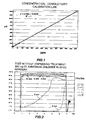
- Figure 1 is a diagram showing the concentration-conductivity calibration straight line for the determination of the efficiency of the dispersant;
- Figure 2 shows curves determined in successive times in a transmittance test along a test tube with 100 mg of ammonium chloride in 20 cc of gasoline without dispersant;
- Figure 3 shows the test conducted with 100 mg of ammonium chloride in 20 cc of gasoline and with 10 ppm of a dispersant with formula (1);
- Figure 4 shows the test conducted with 100 mg of ammonium chloride in 20 cc of gasoline and with 50 ppm of a dispersant with formula (1); and
- Figure 5 shows the test conducted with 100 mg of ethylendiamine chloride in 20 cc of gasoline and with 50 ppm of a dispersant with formula (1).
- Laboratory tests were conduct in order exactly to measure the efficiency of the dispersant of the invention, quantifying also the quantity of salt dispersed in the examined fluid.
- The following fluids were used in the test:
- a) a toluene/n-heptane (RPE purity solvents)
- b) head gasoline-topping
- c) LCO (Light Cycle diesel Oil) from FCC (fluid bed catalytic cracking) plant.
- The tests were conducted placing 20 ml of fluid to be examined and 100 mg of finely subdivided ammonium chloride in a 50 ml flask with ground glass neck. The function of the fluid is to dissolve the ammonium chloride in the solution or dispersion fluid.
- Once the ammonium chloride is dispersed, the fluid is allowed to rest for a defined time and subsequently a fixed quantity is drawn (being careful not to move the salt deposited on the bottom); the ammonium chloride dispersed in the fluid is extracted with a known quantity of distilled water. On this aqueous solution is performed the measurement of conductivity, which is proportional to the quantity of ammonium chloride dispersed in the initial fluid.
- A calibration straight line was constructed, as shown in Figure 1, preparing four aqueous solutions of NH4Cl having a known concentration, respectively of 0.0001M; 0.0005M; 0.001 and 0.01 M.
- The calibration was conducted by placing in water (in the fluid) some known concentrations of NH4Cl and measuring the conductivity of the solution. The conductivity of the solutions was measured in µS and shown on the chart of Figure 1, based on Table 1 below.
Table 1 Concentration - conductivity correlation ppm µS 5.3 17.1 26.7 74.1 53.4 141 534.5 1353 - In the execution of the test, the concentration read on the calibration straight line is determined from the measurement of conductivity. From the concentration, the quantity of salt removed is determined, which represents a measurement of the efficiency of the dispersant, i.e. its ability to free the ammonium chloride in the fluid being examined. Both conductivity and concentration therefore represent an objective measurement of the efficiency of the dispersant. The higher the concentration, the more efficient the dispersant, because a high concentration means a greater quantity of dispersed (removed) salt.
- The efficiency of the dispersant of the present invention was compared, based on the above described test, with other dispersant known for their effectiveness. In particular,
Imidazolin 1 andImidazolin 2 were selected among said known dispersants, as well as a known dispersant by Ondeo - Nalco, hereinafter called "competitor". - Therefore, the active ingredients used in the tests are:
- Duomeen C (N-coco-1,3-diaminopropane) of the present invention;
-
Imidazolin 1; -
Imidazolin 2; - Competitor product;
- The dispersing product to be tested is introduced into the fluid at the prescribed dosage.
- The whole is reflux heated with vigorous agitation for ten minutes. An indicator paper is plated at the top of the refrigerant to detect any presence of acid or basic vapours. Subsequently, cooling to ambient temperature is effected while continuing to agitate.
- The turbid mixtures are transferred to a test tube with stopper and are allowed to rest for different times as shown in the tables provided below.
- After the rest period, 10 ml are drawn from the high part of the solution taking care not to mix the NH4Cl deposit. They are beaten with 12 ml of water in 100 ml separator funnel. As illustrated above, the measurement of the conductivity of the aqueous phase allows to determine the concentration of ammonium chloride.
- As shown in the tables that follow, it is demonstrated that the dispersant exhibits improving performance as its dosage increases, but beyond a certain limit an increase in dispersant causes a decrease in additive concentration, which shows that it has an optimal efficiency at relatively low concentrations.
- The dispersant according to the present invention exhibits better efficiency than the aforementioned known dispersant, as shown by the parallel tests illustrated in the Tables 1-3 that follow, where the concentration values represent an objective measure to compare dispersion ability and efficiency is measured by the numeric ratio between the ppm of additive of the invention (Duomeen C) and the ammonium chloride concentration expressed in ppm.
-
Table 2 Additive Conductivity (µS) Concentration NH4Cl (mg/l) ppm of additive ppm of NH4Cl Duomeen C (50 ppm) 128 48,1 1,04 Imidazolina (50 ppm) 162 22,2 2,25 Imidazolina (50 ppm) 278 28,5 1,75 - Other concentrations of dispersant according to the invention were evaluated and shown in Table 3. It should be noted that with lower dosage the ratio between product and removed salt is still more favourable. Instead, between 50 and 100 ppm the quantity of dispersed ammonium chloride does not increase and clearly the ratio worsens sharply. This surprisingly demonstrates that a large quantity of additive according to the present invention is not necessary to obtain excellent efficiency results.
Table 3 Additive Conductivity Concentration ppm of additive (µS) NH4Cl (mg/l) ppm of NH4Cl Duomeen C (5 ppm) 68 24,6 0,2032 (10 ppm) 89 32,8 0,3048 (25 ppm) 102 37,9 0,6596 (50 ppm) 128 48,1 1,0395 (100 ppm) 86 31,6 3,1645 - Table 4 below shows the results of the test on a dispersant product known in the art and called Competitor.
Table 4 Competitor Conductivity Concentration ppm of additive (µS) NH4Cl (mg/l) ppm of NH4Cl 50 33 11,27 4,43 100 30 10,10 9,90 250 28 9,33 26,79 2000 43 15,16 131,92 - The comparison of the parallel results (50 and 100 ppm) of Table 3 with those of Table 2 shows that the coefficient of efficiency of Duomeen C is better by a factor of about four than that of the Competitor (Table 3).
- The above tests were repeated using LCO as the dispersion fluid and the comparable results are shown in the tables that follow.
Table 5 Additive Conductivity Concentration ppm of additive (µS) NH4Cl (mg/l) ppm of NH4Cl Duomeen C (50 ppm) 219 83.8 0.5966 (100 ppm) 348 134 0.7462 (200 ppm) 341 131 1.2567 (400 ppm) 410 158 2.53 (800 ppm) 472 183 4.3715 Table 6 Additive Conductivity (µS) Concentration ppm of additive NH4Cl (mg/l) ppm of NH4Cl Imidazolin 1 (50 ppm) 127 47,7 1.048 (100 ppm) 112 41,8 2.388 Imidazolin 2 (50 ppm) 111 41.4 1.207 (100 ppm) 203 77.5 1.298 (200 ppm) 300 115 1.739 (400 ppm) 348 134 2.985 (800 ppm) 364 140 5.714 - The results shown demonstrate the superior efficiency of Duomeen C as a dispersant according to the present invention with respect to the two comparison dispersant, particularly in relation to the use of lower dosages of the dispersant in a fluid that mimes different process conditions from those of example 1.
- The experiment with 800 ppm of Duomeen C was duplicated using ammonium chloride in granular form, instead of finely pulverised, as in the previous experiments, with the results shown in Table 7 below.
Table 7 Additive Conductivity Concentration ppm of additive (µS) NH4Cl (mg/l) pm of NH4Cl Duomeen C (800 ppm) 217 83 9,6385 100 mg of granular NH4Cl - Although conductivity (and hence the quantity of dispersed salt) is lower than that obtained with the fine powder (Table 5 of Example 2), there is still significant dispersion. This is very important, because it demonstrates that the chosen dispersant is not only able to have preventive effect with respect to the depositing of small ammonium chloride particles, but it also attacks granular depositing, bringing a part of the salt to the hydrocarbon phase, even if it must be dosed in greater quantity.
-
Table 8 Additive Conductivity Concentration ppm of additive (µS) NH4Cl (mg/l) ppm of NH4Cl Duomeen C (100 ppm) 25,2 7,80 12,82 (200 ppm) 44,1 15,20 13,15 (400 ppm) 60.8 21.76 18.38 (800 ppm) 122.3 45.91 17.42 Imidazoline 2 (200 ppm) 35 11.24 17.79 (800 ppm) 38 12.81 62.45 - Comparing the Table 8 with the Table 6 of Example 2, it is apparent that the rest time is a factor that lowers the dispersing ability of the dispersants. However, for a rest of 14 hours, while the efficiency factor of
Imidazoline 2 relating to a 200 mg dose goes from 1.739 to 17.79, thereby worsening by a factor of about 10, Duomeen C goes from 1.53 to 13.15, worsening by a factor of about 8.6 i.e. less than thecomparison Imidazoline 2. However, at the dose of 800 mg, the factor worsens forImidazoline 2 from 5.714 to 62.45, i.e. 10.9 times, whilst for Duomeen C the factors goes from 4.37 to 17.42 i.e. it increases by only 4 times. This demonstrates the high ability of the dispersant according to the invention to remove and maintain in dispersion deposits already formed or being formed. - This test tends to determine, also in LCO, what happens at fixed dosage (50 ppm) monitoring effectiveness over time. From the data obtained and shown in Table 8, it is readily apparent that already within one hour the quantity of ammonium chloride in dispersion greatly decreases. This trend is also readily apparent visually, because so long as the solution remains turbid, conductivity is very high. When the solution clears up, i.e. after one hour, conductivity plummets and remains nearly constant for all the subsequent 14 hours.
- This part of salt almost seems to be chemically bonded to the dispersant, and in fact it remains practically dissolved in the hydrocarbon phase.
Table 9 Sample Minutes of rest (Conductivity) Duomeen C (50 ppm) 15 (1970) 30 (1181) 60 (219) 120 (204) (300) (62) Imidazoline 2 (50 ppm) 15 (1186) 30 (560) 60 (111) 120 (101) 300 (28) - The tests conducted on a sample of top topping gasoline are illustrated as an additional example of fluid within which the dispersing product is tested. The first results are evaluated after one hour of rest of the gasoline, following the dispersion of the finely subdivided ammonium chloride.
- The results shown in Table 10 below reflect fairly faithfully those obtained with the toluene/n-heptane mixture of solvents. Conductivity values are lower than those obtained with LCO (which is evidently more polar or contains more humidity). The white (ammonium chloride dispersed in gasoline, without dispersing products, shows nearly nil conductivity (4 µs) after one hour.
Table 10 Additive Conductivity (µS) Concentration ppm of additive NH4Cl (mg/l) ppm of NH4Cl Duomeen C (5 ppm) 46 15.951 0.31 (10 ppm) 106 39.808 0.25 (25 ppm) 129 48.54 0.51 (50 ppm) 142 54.06 0.92 Imidazoline 1 (10 ppm) 71 25.76 0.38 (50 ppm) 84 30.87 1.62 Imidazoline 2 (10 ppm) 49 (35) 17.13 0.58 (50 ppm) 65 (38) 23.41 2.13 - This example demonstrates that the efficiency of Duomeen C as a dispersant over time is from 3 times (imidazolin 1) to 5 times greater than dispersants known in the prior art. The direct comparison is illustrated in Table 11 below.
Table 11 Additive Conductivity Concentration ppm of additive (µS) NH4Cl (mg/l) ppm of NH4Cl Duomeen C (200 ppm) 87 32.05 6.24 Imidazoline 1 (200 ppm) 21 6.13 32.62 Imidazoline 2 (200 ppm) 33 10.84 18.45 - In this example, the measurements were taken not dispersing ammonium chloride any more, but rather ethylendiamine chloride: this amine is amply used as a neutraliser for topping top, instead of ammonia. It is a stronger base and it reacts with two aminic groups. However, it has the drawback of forming amine chloride deposits, solid even at very high temperatures.
- The salt was precipitated after neutralising the amine with hydrogen chloride, and then re-dissolved and re-precipitated by acetone, thereby forming needle-like micro-crystals.
- In water, the ethylendiamine salt conducts more or less like ammonium chloride (20 ppm of salt raise µS conductivity to 49, whereas ammonium chloride reaches the same value with 18 ppm). The results are illustrated in Table 12 below.
Table 12 DUOMEEN C CONDUCTIVITY CONCENTRATION ppm of additive (µs) (mg/l) ppm EDA*(HCL) 2 WHITE 45 18.1 (10 ppm) 145 65.4 0.15 (50 ppm) 125 56.0 0.89 - This example demonstrates that the dispersant of the present invention is effective not only against deposits of ammonium chloride, but also against other amine chlorides, notoriously tending to form persistent deposits.
- test without dispersing treatment: 100 mg of ammonium chloride in 20 cc of gasoline
- With an instrument that measures transmittance, the transmittance was measured of an IR radiation, made to pass through a test tube containing a more or less turbid dispersion (solution) of ammonium chloride or an amine salt. The more turbid the dispersion (solution), the lesser the transmittance (values around 0 %).
- The results are shown in the charts of Figures 2 through 5. In the charts, transmittance, expressed in %, is shown along the x-axis, while on the y-axis is shown, in cm, the length from the meniscus (0-1 cm) to the bottom (7 cm) of the test tube. Each curve of the chart expresses the transmittance (limpidity) of the dispersion (solution) at a certain height of the test tube and after a certain time (minutes) has elapsed from the agitation of the solution, as shown on each curve.
- With reference to Figure 2 (test without dispersing treatment on 100 mg of ammonium chloride in 20 cc of gasoline), as soon as ammonium chloride is agitated in gasoline, the solution becomes turbid and the instrument measures strong turbidity (
line 0 minutes with zero transmittance) . - As the solution becomes progressively more limpid, the value of transmittance increases (on the 2 minute line, it is already half limpid and half turbid) and on the 4 minute line it is completely limpid and the salt is all deposited on the bottom.
- At time zero, the reading was done immediately after 15 minutes of agitation with heat; subsequently, the measurements were obtained at 2, 4, 6 and 10 minutes, without removing the test tube from the instrument and hence without any further agitation. After merely 10 minutes, without dispersants, ammonium chloride is all on the bottom and there is no more turbidity (nearly 100 % transmittance) .
- It is evident with the with the presence of the dispersants (Figures 3 to 5), the solution becomes limpid much more gradually, and in fact, with 50 ppm Duomeen C (Figure 4), even after more than one hour the solution still does not reach 100 % transmittance. This confirms the ability of the dispersant according to the invention to maintain in dispersion ammonium chloride (Figures 3 and 4) or ethylendiamine (Figure 5) .
- Having described the invention in its preferred embodiments, it is understood that it can be subject to modifications and variants, without thereby departing from the scope of the invention.
Claims (14)
- Use of N-alkyl-1,3-diaminopropane with the formula
R-NH- (CH2)3-NH2 (1)
where R represents a straight C8 through C18 alkyl chain,
as dispersing agent to prevent the formation of, or to remove already formed deposits of ammonium salt in a hydrocarbon process plant. - Use of N-alkyl-1,3-diaminopropane as claimed in claim 1, wherein said N-alkyl-1,3-diaminopropane is N-coco-1,3-diaminopropane.
- Use as claimed in claim 1 or 2, wherein said ammonium salt is an ammonium halogenide.
- Use as claimed in any of the claims 1 through 3, wherein said ammonium salt is ammonium chloride.
- Use as claimed in any of the previous claims, wherein said plant is an atmospheric hydrocarbon distillation plant, a fluid bed catalytic cracking (FCC) plant, a sour water stripper (SWS) plant, a gasoline desulphuring plant (Unifining), or a hydrogen desulphuration system (HDS).
- Use of a composition comprising N-alkyl-1,3-diaminopropane of formula (1) to prevent the formation of, or to remove already formed deposits of ammonium salt in a hydrocarbon process plant.
- Use of a composition as claimed in claim 6 comprising N-alkyl-1,3-diaminopropane of formula (1) and a filming corrosion inhibitor in a suitable carrier or solvent, to prevent the formation of, or to remove already formed deposits of ammonium salt in a hydrocarbon process plant.
- Use of a composition as claimed in claim 6 comprising N-alkyl-1,3-diaminopropane of formula (1) and a neutralising corrosion inhibitor in a suitable carrier or solvent, to prevent the formation of, or to remove already formed deposits of ammonium salt in a hydrocarbon process plant.
- Use of a composition as claimed in claim 6 comprising N-alkyl-1,3-diaminopropane of formula (1) and a dispersant for iron sulphide in a suitable carrier or solvent, to prevent the formation of, or to remove already formed deposits of ammonium salt in a hydrocarbon process plant.
- Use of a composition as claimed in any of the claims 6 through 9, wherein said N-alkyl-1,3-diaminopropane is N-coco-1,3-diaminopropane.
- Use of a composition as claimed in any of the claims 6 through 10, wherein said ammonium salt is ammonium chloride.
- Use of a composition as claimed in any of the claims 6 through 11, wherein said plant is an atmospheric hydrocarbon distillation plant, a fluid bed catalytic cracking (FCC) plant, a sour water stripper (SWS) plant, a gasoline desulphuring plant (Unifining), or a hydrogen desulphuration system (HDS).
- A method for preventing the formation of or to remove already formed deposits of ammonium salt in a hydrocarbon process plant, comprising the operation of introducing in the process of said plant a quantity of N-alkyl-1,3-diaminopropane, particularly N-coco-1,3-diaminopropane, sufficient to prevent or remove said deposits.
- Method as claimed in claim 13, wherein said N-alkyl-1,3-diaminopropane is N-coco-1,3-diaminopropane.
Applications Claiming Priority (1)
| Application Number | Priority Date | Filing Date | Title |
|---|---|---|---|
| IT000446A ITRM20040446A1 (en) | 2004-09-20 | 2004-09-20 | DISPERSER OF SALINE DEPOSITS IN HYDROCARBON PROCESS PLANTS. |
Publications (2)
| Publication Number | Publication Date |
|---|---|
| EP1637578A1 true EP1637578A1 (en) | 2006-03-22 |
| EP1637578B1 EP1637578B1 (en) | 2016-03-30 |
Family
ID=35169408
Family Applications (1)
| Application Number | Title | Priority Date | Filing Date |
|---|---|---|---|
| EP05108390.5A Expired - Lifetime EP1637578B1 (en) | 2004-09-20 | 2005-09-13 | A dispersant of saline deposits in hydrocarbon process plants |
Country Status (7)
| Country | Link |
|---|---|
| US (1) | US7585403B2 (en) |
| EP (1) | EP1637578B1 (en) |
| ES (1) | ES2577388T3 (en) |
| IT (1) | ITRM20040446A1 (en) |
| PL (1) | PL1637578T3 (en) |
| RU (1) | RU2359996C2 (en) |
| WO (1) | WO2006032620A1 (en) |
Families Citing this family (2)
| Publication number | Priority date | Publication date | Assignee | Title |
|---|---|---|---|---|
| EP2373760B1 (en) * | 2008-12-08 | 2016-08-03 | Huntsman Petrochemical LLC | Decreased presence of amine-derived contaminants in- and/or degradation of amine solvent solutions |
| JP6939872B2 (en) | 2019-12-13 | 2021-09-22 | 栗田工業株式会社 | Distillation column management system, distillation column state analysis method and distillation column management method |
Citations (5)
| Publication number | Priority date | Publication date | Assignee | Title |
|---|---|---|---|---|
| US3189537A (en) * | 1962-03-14 | 1965-06-15 | Universal Oil Prod Co | Retarding corrosion of heat exchangers |
| US3779905A (en) * | 1971-09-20 | 1973-12-18 | Universal Oil Prod Co | Adding corrosion inhibitor to top of crude oil still |
| US4793865A (en) | 1987-08-19 | 1988-12-27 | Aqua Process, Inc. | Method and composition for the removal of ammonium salt and metal compound deposits |
| US5387733A (en) | 1993-06-09 | 1995-02-07 | Betz Laboratories, Inc. | Method for the inhibition and removal of ammonium chloride deposition in hydrocarbon processing units |
| WO2002099025A1 (en) * | 2001-06-01 | 2002-12-12 | Ondeo Nalco Energy Services, L.P. | Method of inhibiting corrosion of metal equipment which is cleaned with an inorganic acid |
Family Cites Families (4)
| Publication number | Priority date | Publication date | Assignee | Title |
|---|---|---|---|---|
| US3819328A (en) * | 1970-06-24 | 1974-06-25 | Petrolite Corp | Use of alkylene polyamines in distillation columns to control corrosion |
| SU1263655A1 (en) * | 1982-01-22 | 1986-10-15 | Казахский Государственный Научно-Исследовательский И Проектный Институт Нефтяной Промышленности | Compound for preventing deposition of salts in oil field equipment |
| EP0662504A1 (en) * | 1994-01-10 | 1995-07-12 | Nalco Chemical Company | Corrosion inhibition and iron sulfide dispersing in refineries using the reaction product of a hydrocarbyl succinic anhydride and an amine |
| US5900392A (en) * | 1998-07-24 | 1999-05-04 | Loeffler Chemical Corporation | Aqueous belt lubricant composition based on fatty alkyl propylene tettramines and fatty alcohol polyglycol ethers and method for lubricating belt conveyor systems |
-
2004
- 2004-09-20 IT IT000446A patent/ITRM20040446A1/en unknown
-
2005
- 2005-09-13 PL PL05108390.5T patent/PL1637578T3/en unknown
- 2005-09-13 ES ES05108390.5T patent/ES2577388T3/en not_active Expired - Lifetime
- 2005-09-13 EP EP05108390.5A patent/EP1637578B1/en not_active Expired - Lifetime
- 2005-09-13 WO PCT/EP2005/054556 patent/WO2006032620A1/en not_active Ceased
- 2005-09-13 RU RU2007114903/04A patent/RU2359996C2/en active
- 2005-09-20 US US11/229,854 patent/US7585403B2/en not_active Expired - Fee Related
Patent Citations (5)
| Publication number | Priority date | Publication date | Assignee | Title |
|---|---|---|---|---|
| US3189537A (en) * | 1962-03-14 | 1965-06-15 | Universal Oil Prod Co | Retarding corrosion of heat exchangers |
| US3779905A (en) * | 1971-09-20 | 1973-12-18 | Universal Oil Prod Co | Adding corrosion inhibitor to top of crude oil still |
| US4793865A (en) | 1987-08-19 | 1988-12-27 | Aqua Process, Inc. | Method and composition for the removal of ammonium salt and metal compound deposits |
| US5387733A (en) | 1993-06-09 | 1995-02-07 | Betz Laboratories, Inc. | Method for the inhibition and removal of ammonium chloride deposition in hydrocarbon processing units |
| WO2002099025A1 (en) * | 2001-06-01 | 2002-12-12 | Ondeo Nalco Energy Services, L.P. | Method of inhibiting corrosion of metal equipment which is cleaned with an inorganic acid |
Also Published As
| Publication number | Publication date |
|---|---|
| EP1637578B1 (en) | 2016-03-30 |
| WO2006032620A1 (en) | 2006-03-30 |
| US20060060498A1 (en) | 2006-03-23 |
| PL1637578T3 (en) | 2016-12-30 |
| US7585403B2 (en) | 2009-09-08 |
| RU2359996C2 (en) | 2009-06-27 |
| ITRM20040446A1 (en) | 2004-12-20 |
| ES2577388T3 (en) | 2016-07-14 |
| RU2007114903A (en) | 2008-10-27 |
Similar Documents
| Publication | Publication Date | Title |
|---|---|---|
| EP0607640B1 (en) | Naphtenic acid corrosion inhibitors | |
| EP0938363B1 (en) | Method for removing sulfides from fluid streams | |
| EP2193179B1 (en) | A novel additive for naphthenic acid corrosion inhibition and method of using the same | |
| US2496354A (en) | Method of inhibiting hydrogen sulfide corrosion of metals | |
| WO2011016935A2 (en) | Processes for removing hydrogen sulfide from refined hydrocarbo streams | |
| EP1618230A2 (en) | Imidazoline corrosion inhibitors | |
| US3458453A (en) | Corrosion inhibiting composition containing a neutral amide and c3-c8 volatile amine | |
| JPH07180073A (en) | Method of using amine mixture for preventing chloride corrosion in condenser for moist hydrocarbon | |
| JPH07216365A (en) | Crrosion control of oil refiner using reaction product of hydrocarbylsuccinic anhydride with amine | |
| US20110040126A1 (en) | Novel mercaptan-based corrosion inhibitors | |
| EP0512689B1 (en) | Prevention of formation of fouling deposits on metallic surfaces | |
| US2596273A (en) | Method of inhibiting hydrogen sulfide corrosion of metals | |
| EP1637578B1 (en) | A dispersant of saline deposits in hydrocarbon process plants | |
| EP0748861A1 (en) | Abatement of hydrogen sulfide with an aldehyde ammonia trimer | |
| JP2003515660A (en) | Oil manufacturing additive formulation | |
| EP3246380B1 (en) | Crude unit overhead corrosion control using multi amine blends | |
| CA2181979C (en) | 2-amino-1-methoxypropane as a neutralizing amine in refinery processes | |
| RU2734393C1 (en) | Weakening of internal corrosion in pipeline for transportation of crude oil | |
| EP3891262B1 (en) | Hydrogen sulphide and mercaptans scavenging compositions | |
| US3689319A (en) | Paraffin removal process | |
| US9404847B2 (en) | Methods for mitigating fouling of process equipment | |
| RU2135640C1 (en) | Metal corrosion inhibitor | |
| US20250257470A1 (en) | Development of additive for mitigating ammonium chloride corrosion issues in hydrotreater | |
| RU2061098C1 (en) | Corrosion inhibitor | |
| US5387733A (en) | Method for the inhibition and removal of ammonium chloride deposition in hydrocarbon processing units |
Legal Events
| Date | Code | Title | Description |
|---|---|---|---|
| PUAI | Public reference made under article 153(3) epc to a published international application that has entered the european phase |
Free format text: ORIGINAL CODE: 0009012 |
|
| AK | Designated contracting states |
Kind code of ref document: A1 Designated state(s): AT BE BG CH CY CZ DE DK EE ES FI FR GB GR HU IE IS IT LI LT LU LV MC NL PL PT RO SE SI SK TR |
|
| AX | Request for extension of the european patent |
Extension state: AL BA HR MK YU |
|
| 17P | Request for examination filed |
Effective date: 20060920 |
|
| 17Q | First examination report despatched |
Effective date: 20061019 |
|
| AKX | Designation fees paid |
Designated state(s): AT BE BG CH CY CZ DE DK EE ES FI FR GB GR HU IE IS IT LI LT LU LV MC NL PL PT RO SE SI SK TR |
|
| GRAP | Despatch of communication of intention to grant a patent |
Free format text: ORIGINAL CODE: EPIDOSNIGR1 |
|
| INTG | Intention to grant announced |
Effective date: 20151113 |
|
| GRAS | Grant fee paid |
Free format text: ORIGINAL CODE: EPIDOSNIGR3 |
|
| GRAA | (expected) grant |
Free format text: ORIGINAL CODE: 0009210 |
|
| AK | Designated contracting states |
Kind code of ref document: B1 Designated state(s): AT BE BG CH CY CZ DE DK EE ES FI FR GB GR HU IE IS IT LI LT LU LV MC NL PL PT RO SE SI SK TR |
|
| REG | Reference to a national code |
Ref country code: GB Ref legal event code: FG4D |
|
| REG | Reference to a national code |
Ref country code: CH Ref legal event code: EP |
|
| REG | Reference to a national code |
Ref country code: AT Ref legal event code: REF Ref document number: 785404 Country of ref document: AT Kind code of ref document: T Effective date: 20160415 |
|
| REG | Reference to a national code |
Ref country code: IE Ref legal event code: FG4D |
|
| REG | Reference to a national code |
Ref country code: DE Ref legal event code: R096 Ref document number: 602005048790 Country of ref document: DE |
|
| REG | Reference to a national code |
Ref country code: ES Ref legal event code: FG2A Ref document number: 2577388 Country of ref document: ES Kind code of ref document: T3 Effective date: 20160714 |
|
| REG | Reference to a national code |
Ref country code: LT Ref legal event code: MG4D |
|
| PG25 | Lapsed in a contracting state [announced via postgrant information from national office to epo] |
Ref country code: FI Free format text: LAPSE BECAUSE OF FAILURE TO SUBMIT A TRANSLATION OF THE DESCRIPTION OR TO PAY THE FEE WITHIN THE PRESCRIBED TIME-LIMIT Effective date: 20160330 |
|
| REG | Reference to a national code |
Ref country code: NL Ref legal event code: MP Effective date: 20160330 |
|
| REG | Reference to a national code |
Ref country code: AT Ref legal event code: MK05 Ref document number: 785404 Country of ref document: AT Kind code of ref document: T Effective date: 20160330 |
|
| PG25 | Lapsed in a contracting state [announced via postgrant information from national office to epo] |
Ref country code: LV Free format text: LAPSE BECAUSE OF FAILURE TO SUBMIT A TRANSLATION OF THE DESCRIPTION OR TO PAY THE FEE WITHIN THE PRESCRIBED TIME-LIMIT Effective date: 20160330 Ref country code: SE Free format text: LAPSE BECAUSE OF FAILURE TO SUBMIT A TRANSLATION OF THE DESCRIPTION OR TO PAY THE FEE WITHIN THE PRESCRIBED TIME-LIMIT Effective date: 20160330 Ref country code: LT Free format text: LAPSE BECAUSE OF FAILURE TO SUBMIT A TRANSLATION OF THE DESCRIPTION OR TO PAY THE FEE WITHIN THE PRESCRIBED TIME-LIMIT Effective date: 20160330 |
|
| REG | Reference to a national code |
Ref country code: FR Ref legal event code: PLFP Year of fee payment: 12 |
|
| PG25 | Lapsed in a contracting state [announced via postgrant information from national office to epo] |
Ref country code: NL Free format text: LAPSE BECAUSE OF FAILURE TO SUBMIT A TRANSLATION OF THE DESCRIPTION OR TO PAY THE FEE WITHIN THE PRESCRIBED TIME-LIMIT Effective date: 20160330 |
|
| REG | Reference to a national code |
Ref country code: GR Ref legal event code: EP Ref document number: 20160401314 Country of ref document: GR Effective date: 20160729 |
|
| PG25 | Lapsed in a contracting state [announced via postgrant information from national office to epo] |
Ref country code: IS Free format text: LAPSE BECAUSE OF FAILURE TO SUBMIT A TRANSLATION OF THE DESCRIPTION OR TO PAY THE FEE WITHIN THE PRESCRIBED TIME-LIMIT Effective date: 20160730 Ref country code: EE Free format text: LAPSE BECAUSE OF FAILURE TO SUBMIT A TRANSLATION OF THE DESCRIPTION OR TO PAY THE FEE WITHIN THE PRESCRIBED TIME-LIMIT Effective date: 20160330 |
|
| PG25 | Lapsed in a contracting state [announced via postgrant information from national office to epo] |
Ref country code: RO Free format text: LAPSE BECAUSE OF FAILURE TO SUBMIT A TRANSLATION OF THE DESCRIPTION OR TO PAY THE FEE WITHIN THE PRESCRIBED TIME-LIMIT Effective date: 20160330 Ref country code: PT Free format text: LAPSE BECAUSE OF FAILURE TO SUBMIT A TRANSLATION OF THE DESCRIPTION OR TO PAY THE FEE WITHIN THE PRESCRIBED TIME-LIMIT Effective date: 20160801 Ref country code: CZ Free format text: LAPSE BECAUSE OF FAILURE TO SUBMIT A TRANSLATION OF THE DESCRIPTION OR TO PAY THE FEE WITHIN THE PRESCRIBED TIME-LIMIT Effective date: 20160330 Ref country code: SK Free format text: LAPSE BECAUSE OF FAILURE TO SUBMIT A TRANSLATION OF THE DESCRIPTION OR TO PAY THE FEE WITHIN THE PRESCRIBED TIME-LIMIT Effective date: 20160330 Ref country code: AT Free format text: LAPSE BECAUSE OF FAILURE TO SUBMIT A TRANSLATION OF THE DESCRIPTION OR TO PAY THE FEE WITHIN THE PRESCRIBED TIME-LIMIT Effective date: 20160330 |
|
| PG25 | Lapsed in a contracting state [announced via postgrant information from national office to epo] |
Ref country code: BE Free format text: LAPSE BECAUSE OF FAILURE TO SUBMIT A TRANSLATION OF THE DESCRIPTION OR TO PAY THE FEE WITHIN THE PRESCRIBED TIME-LIMIT Effective date: 20160330 |
|
| REG | Reference to a national code |
Ref country code: DE Ref legal event code: R097 Ref document number: 602005048790 Country of ref document: DE |
|
| PG25 | Lapsed in a contracting state [announced via postgrant information from national office to epo] |
Ref country code: DK Free format text: LAPSE BECAUSE OF FAILURE TO SUBMIT A TRANSLATION OF THE DESCRIPTION OR TO PAY THE FEE WITHIN THE PRESCRIBED TIME-LIMIT Effective date: 20160330 |
|
| PLBE | No opposition filed within time limit |
Free format text: ORIGINAL CODE: 0009261 |
|
| STAA | Information on the status of an ep patent application or granted ep patent |
Free format text: STATUS: NO OPPOSITION FILED WITHIN TIME LIMIT |
|
| 26N | No opposition filed |
Effective date: 20170103 |
|
| PG25 | Lapsed in a contracting state [announced via postgrant information from national office to epo] |
Ref country code: MC Free format text: LAPSE BECAUSE OF FAILURE TO SUBMIT A TRANSLATION OF THE DESCRIPTION OR TO PAY THE FEE WITHIN THE PRESCRIBED TIME-LIMIT Effective date: 20160330 |
|
| REG | Reference to a national code |
Ref country code: CH Ref legal event code: PL |
|
| PG25 | Lapsed in a contracting state [announced via postgrant information from national office to epo] |
Ref country code: SI Free format text: LAPSE BECAUSE OF FAILURE TO SUBMIT A TRANSLATION OF THE DESCRIPTION OR TO PAY THE FEE WITHIN THE PRESCRIBED TIME-LIMIT Effective date: 20160330 |
|
| REG | Reference to a national code |
Ref country code: IE Ref legal event code: MM4A |
|
| PG25 | Lapsed in a contracting state [announced via postgrant information from national office to epo] |
Ref country code: LI Free format text: LAPSE BECAUSE OF NON-PAYMENT OF DUE FEES Effective date: 20160930 Ref country code: IE Free format text: LAPSE BECAUSE OF NON-PAYMENT OF DUE FEES Effective date: 20160913 Ref country code: CH Free format text: LAPSE BECAUSE OF NON-PAYMENT OF DUE FEES Effective date: 20160930 |
|
| PG25 | Lapsed in a contracting state [announced via postgrant information from national office to epo] |
Ref country code: LU Free format text: LAPSE BECAUSE OF NON-PAYMENT OF DUE FEES Effective date: 20160913 |
|
| REG | Reference to a national code |
Ref country code: FR Ref legal event code: PLFP Year of fee payment: 13 |
|
| PG25 | Lapsed in a contracting state [announced via postgrant information from national office to epo] |
Ref country code: HU Free format text: LAPSE BECAUSE OF FAILURE TO SUBMIT A TRANSLATION OF THE DESCRIPTION OR TO PAY THE FEE WITHIN THE PRESCRIBED TIME-LIMIT; INVALID AB INITIO Effective date: 20050913 Ref country code: CY Free format text: LAPSE BECAUSE OF FAILURE TO SUBMIT A TRANSLATION OF THE DESCRIPTION OR TO PAY THE FEE WITHIN THE PRESCRIBED TIME-LIMIT Effective date: 20160330 |
|
| PG25 | Lapsed in a contracting state [announced via postgrant information from national office to epo] |
Ref country code: TR Free format text: LAPSE BECAUSE OF FAILURE TO SUBMIT A TRANSLATION OF THE DESCRIPTION OR TO PAY THE FEE WITHIN THE PRESCRIBED TIME-LIMIT Effective date: 20160330 |
|
| PG25 | Lapsed in a contracting state [announced via postgrant information from national office to epo] |
Ref country code: BG Free format text: LAPSE BECAUSE OF FAILURE TO SUBMIT A TRANSLATION OF THE DESCRIPTION OR TO PAY THE FEE WITHIN THE PRESCRIBED TIME-LIMIT Effective date: 20160330 |
|
| REG | Reference to a national code |
Ref country code: FR Ref legal event code: PLFP Year of fee payment: 14 |
|
| PGFP | Annual fee paid to national office [announced via postgrant information from national office to epo] |
Ref country code: GB Payment date: 20200922 Year of fee payment: 16 Ref country code: FR Payment date: 20200914 Year of fee payment: 16 Ref country code: DE Payment date: 20200925 Year of fee payment: 16 |
|
| PGFP | Annual fee paid to national office [announced via postgrant information from national office to epo] |
Ref country code: ES Payment date: 20201120 Year of fee payment: 16 |
|
| PGFP | Annual fee paid to national office [announced via postgrant information from national office to epo] |
Ref country code: GR Payment date: 20210913 Year of fee payment: 17 Ref country code: PL Payment date: 20210820 Year of fee payment: 17 |
|
| REG | Reference to a national code |
Ref country code: DE Ref legal event code: R119 Ref document number: 602005048790 Country of ref document: DE |
|
| GBPC | Gb: european patent ceased through non-payment of renewal fee |
Effective date: 20210913 |
|
| PG25 | Lapsed in a contracting state [announced via postgrant information from national office to epo] |
Ref country code: GB Free format text: LAPSE BECAUSE OF NON-PAYMENT OF DUE FEES Effective date: 20210913 Ref country code: FR Free format text: LAPSE BECAUSE OF NON-PAYMENT OF DUE FEES Effective date: 20210930 Ref country code: DE Free format text: LAPSE BECAUSE OF NON-PAYMENT OF DUE FEES Effective date: 20220401 |
|
| REG | Reference to a national code |
Ref country code: ES Ref legal event code: FD2A Effective date: 20221028 |
|
| PGFP | Annual fee paid to national office [announced via postgrant information from national office to epo] |
Ref country code: IT Payment date: 20220905 Year of fee payment: 18 |
|
| PG25 | Lapsed in a contracting state [announced via postgrant information from national office to epo] |
Ref country code: ES Free format text: LAPSE BECAUSE OF NON-PAYMENT OF DUE FEES Effective date: 20210914 |
|
| PG25 | Lapsed in a contracting state [announced via postgrant information from national office to epo] |
Ref country code: GR Free format text: LAPSE BECAUSE OF NON-PAYMENT OF DUE FEES Effective date: 20230406 |
|
| PG25 | Lapsed in a contracting state [announced via postgrant information from national office to epo] |
Ref country code: PL Free format text: LAPSE BECAUSE OF NON-PAYMENT OF DUE FEES Effective date: 20220913 |
|
| PG25 | Lapsed in a contracting state [announced via postgrant information from national office to epo] |
Ref country code: IT Free format text: LAPSE BECAUSE OF NON-PAYMENT OF DUE FEES Effective date: 20230913 |
|
| PG25 | Lapsed in a contracting state [announced via postgrant information from national office to epo] |
Ref country code: IT Free format text: LAPSE BECAUSE OF NON-PAYMENT OF DUE FEES Effective date: 20230913 |