EP1637553A1 - Transparent shaped body - Google Patents
Transparent shaped body Download PDFInfo
- Publication number
- EP1637553A1 EP1637553A1 EP04745933A EP04745933A EP1637553A1 EP 1637553 A1 EP1637553 A1 EP 1637553A1 EP 04745933 A EP04745933 A EP 04745933A EP 04745933 A EP04745933 A EP 04745933A EP 1637553 A1 EP1637553 A1 EP 1637553A1
- Authority
- EP
- European Patent Office
- Prior art keywords
- component
- molded article
- transparent molded
- article according
- general formula
- Prior art date
- Legal status (The legal status is an assumption and is not a legal conclusion. Google has not performed a legal analysis and makes no representation as to the accuracy of the status listed.)
- Granted
Links
Classifications
-
- C—CHEMISTRY; METALLURGY
- C08—ORGANIC MACROMOLECULAR COMPOUNDS; THEIR PREPARATION OR CHEMICAL WORKING-UP; COMPOSITIONS BASED THEREON
- C08G—MACROMOLECULAR COMPOUNDS OBTAINED OTHERWISE THAN BY REACTIONS ONLY INVOLVING UNSATURATED CARBON-TO-CARBON BONDS
- C08G18/00—Polymeric products of isocyanates or isothiocyanates
- C08G18/06—Polymeric products of isocyanates or isothiocyanates with compounds having active hydrogen
- C08G18/70—Polymeric products of isocyanates or isothiocyanates with compounds having active hydrogen characterised by the isocyanates or isothiocyanates used
- C08G18/72—Polyisocyanates or polyisothiocyanates
- C08G18/74—Polyisocyanates or polyisothiocyanates cyclic
-
- C—CHEMISTRY; METALLURGY
- C08—ORGANIC MACROMOLECULAR COMPOUNDS; THEIR PREPARATION OR CHEMICAL WORKING-UP; COMPOSITIONS BASED THEREON
- C08G—MACROMOLECULAR COMPOUNDS OBTAINED OTHERWISE THAN BY REACTIONS ONLY INVOLVING UNSATURATED CARBON-TO-CARBON BONDS
- C08G18/00—Polymeric products of isocyanates or isothiocyanates
- C08G18/06—Polymeric products of isocyanates or isothiocyanates with compounds having active hydrogen
- C08G18/70—Polymeric products of isocyanates or isothiocyanates with compounds having active hydrogen characterised by the isocyanates or isothiocyanates used
- C08G18/72—Polyisocyanates or polyisothiocyanates
- C08G18/77—Polyisocyanates or polyisothiocyanates having heteroatoms in addition to the isocyanate or isothiocyanate nitrogen and oxygen or sulfur
- C08G18/78—Nitrogen
- C08G18/79—Nitrogen characterised by the polyisocyanates used, these having groups formed by oligomerisation of isocyanates or isothiocyanates
- C08G18/791—Nitrogen characterised by the polyisocyanates used, these having groups formed by oligomerisation of isocyanates or isothiocyanates containing isocyanurate groups
- C08G18/792—Nitrogen characterised by the polyisocyanates used, these having groups formed by oligomerisation of isocyanates or isothiocyanates containing isocyanurate groups formed by oligomerisation of aliphatic and/or cycloaliphatic isocyanates or isothiocyanates
-
- C—CHEMISTRY; METALLURGY
- C08—ORGANIC MACROMOLECULAR COMPOUNDS; THEIR PREPARATION OR CHEMICAL WORKING-UP; COMPOSITIONS BASED THEREON
- C08G—MACROMOLECULAR COMPOUNDS OBTAINED OTHERWISE THAN BY REACTIONS ONLY INVOLVING UNSATURATED CARBON-TO-CARBON BONDS
- C08G18/00—Polymeric products of isocyanates or isothiocyanates
- C08G18/06—Polymeric products of isocyanates or isothiocyanates with compounds having active hydrogen
- C08G18/28—Polymeric products of isocyanates or isothiocyanates with compounds having active hydrogen characterised by the compounds used containing active hydrogen
- C08G18/30—Low-molecular-weight compounds
- C08G18/38—Low-molecular-weight compounds having heteroatoms other than oxygen
- C08G18/3855—Low-molecular-weight compounds having heteroatoms other than oxygen having sulfur
- C08G18/3876—Low-molecular-weight compounds having heteroatoms other than oxygen having sulfur containing mercapto groups
-
- C—CHEMISTRY; METALLURGY
- C08—ORGANIC MACROMOLECULAR COMPOUNDS; THEIR PREPARATION OR CHEMICAL WORKING-UP; COMPOSITIONS BASED THEREON
- C08G—MACROMOLECULAR COMPOUNDS OBTAINED OTHERWISE THAN BY REACTIONS ONLY INVOLVING UNSATURATED CARBON-TO-CARBON BONDS
- C08G18/00—Polymeric products of isocyanates or isothiocyanates
- C08G18/06—Polymeric products of isocyanates or isothiocyanates with compounds having active hydrogen
- C08G18/28—Polymeric products of isocyanates or isothiocyanates with compounds having active hydrogen characterised by the compounds used containing active hydrogen
- C08G18/40—High-molecular-weight compounds
- C08G18/62—Polymers of compounds having carbon-to-carbon double bonds
- C08G18/6216—Polymers of alpha-beta ethylenically unsaturated carboxylic acids or of derivatives thereof
- C08G18/625—Polymers of alpha-beta ethylenically unsaturated carboxylic acids; hydrolyzed polymers of esters of these acids
- C08G18/6254—Polymers of alpha-beta ethylenically unsaturated carboxylic acids and of esters of these acids containing hydroxy groups
-
- C—CHEMISTRY; METALLURGY
- C08—ORGANIC MACROMOLECULAR COMPOUNDS; THEIR PREPARATION OR CHEMICAL WORKING-UP; COMPOSITIONS BASED THEREON
- C08G—MACROMOLECULAR COMPOUNDS OBTAINED OTHERWISE THAN BY REACTIONS ONLY INVOLVING UNSATURATED CARBON-TO-CARBON BONDS
- C08G18/00—Polymeric products of isocyanates or isothiocyanates
- C08G18/06—Polymeric products of isocyanates or isothiocyanates with compounds having active hydrogen
- C08G18/83—Chemically modified polymers
- C08G18/87—Chemically modified polymers by sulfur
-
- G—PHYSICS
- G02—OPTICS
- G02B—OPTICAL ELEMENTS, SYSTEMS OR APPARATUS
- G02B1/00—Optical elements characterised by the material of which they are made; Optical coatings for optical elements
- G02B1/04—Optical elements characterised by the material of which they are made; Optical coatings for optical elements made of organic materials, e.g. plastics
Definitions
- the present invention relates to a molded article suitable for optical application, which has a high refractive index, low dispersion and excellent transparency as well as is excellent in impact resistance and weatherability.
- the present invention relates to a transparent molded article which has excellent optical characteristics such as a high refractive index and high Abbé number, is excellent in impact resistance and can be suitably employed as various lenses such as eyeglass lenses, a prism, optical fiber, a substrate for recording media and a filter.
- Plastic Since plastic is lighter, tends to crack less, and dyes more readily than glass, it has been employed in optical applications such as various lenses in recent years.
- Plastic materials generally employed in optics include polyethylene glycol bisallyl carbonate (CR-39) and polymethyl methacrylate (PMMLA).
- CR-39 polyethylene glycol bisallyl carbonate
- PMMLA polymethyl methacrylate
- these plastic materials have a refractive index of less than or equal to 1.5, when employed as lens materials, for example, the lens becomes thicker with the level of magnification. Not only does the lightweight advantage of plastic end up being lost, but thick plastic is undesirable from an esthetic point of view. Further, when these plastic materials are employed in concave lenses, there are disadvantages in that the thickness of the lens perimeter (edge) increases, tending to result in birefringence and chromatic aberration.
- plastic materials of high refractive index have been developed utilizing the characteristics of plastic of low specific gravity to permit the thinning of lenses.
- examples of such materials are polythiourethanes obtained from pentaerythritoltetrakis(mercaptopropionate) and diisocyanate compounds, and polythiourethanes obtained from 4-mercaptomethyl-1,8-dimercapto-3,6-dithiaoctane and diisocyanate compounds (see Japanese Unexamined Patent Publications (KOKAI) Showa No. 63-46213 ("Reference 1" hereinafter) and Heisei 2-270859 (“Reference 2" hereinafter)).
- the present inventors conducted extensive research into achieving the above first object, resulting in the discovery that the above object can be achieved by a transparent molded article comprised of polythiourethane obtained by polymerizing a polythiol compound having a specific structure and a polyisocyanate compound having a specific structure.
- the present invention was devised on that basis.
- means for achieving the first object of the present invention are as follows;
- transparent molded article 1 of the first aspect of the present invention is comprised of polythiourethane obtained by polymerizing monomer components comprising component (A) and component (B1).
- transparent molded article 2 of the second aspect of the present invention is obtained by polymerizing monomer components comprising component (A), component (B1), component (B2) and component (C).
- any molded article having transparency that does not impede its use as an optical material is covered under the term "transparent molded article.”
- transparent molded article There are many indexes of transparency employed for the various optical materials used in the transparent molded article of the present invention. Examples are light transmittance, the haze value, and visual inspection.
- the "transparent molded article” will be referred to simply as a "molded article”.
- Transparent molded article 1 of the present invention is comprised of polythiourethane obtained by polymerizing monomer components comprising component (A) and component (B1).
- Component (A) denoted by general formula (I) (wherein m is 1, 2, 3, 4, 5, or 6), is a polythiol compound with a 1,4-dithiane ring as its main skeleton.
- m 1, 2, 3, 4, 5, or 6
- a high refractive index and a high Abbe number can be simultaneously imparted to the molded article obtained by polymerization without deteriorating weatherability.
- general formula (I) so long as m is 6 or less, the viscosity of component (A) does not become excessively high, good handling properties can be maintained, and compatibility with other components is high. Thus, the optical transparency of molded articles obtained by polymerization can be increased.
- component (A) may be a single compound in which m denotes an integer ranging from 1 to 6, or a mixture of two or more compounds with differing values of m.
- Component (A) can be synthesized by known methods described in Japanese Unexamined Patent Publications (KOKAI) Heisei Nos. 3-236386 and 10-120676.
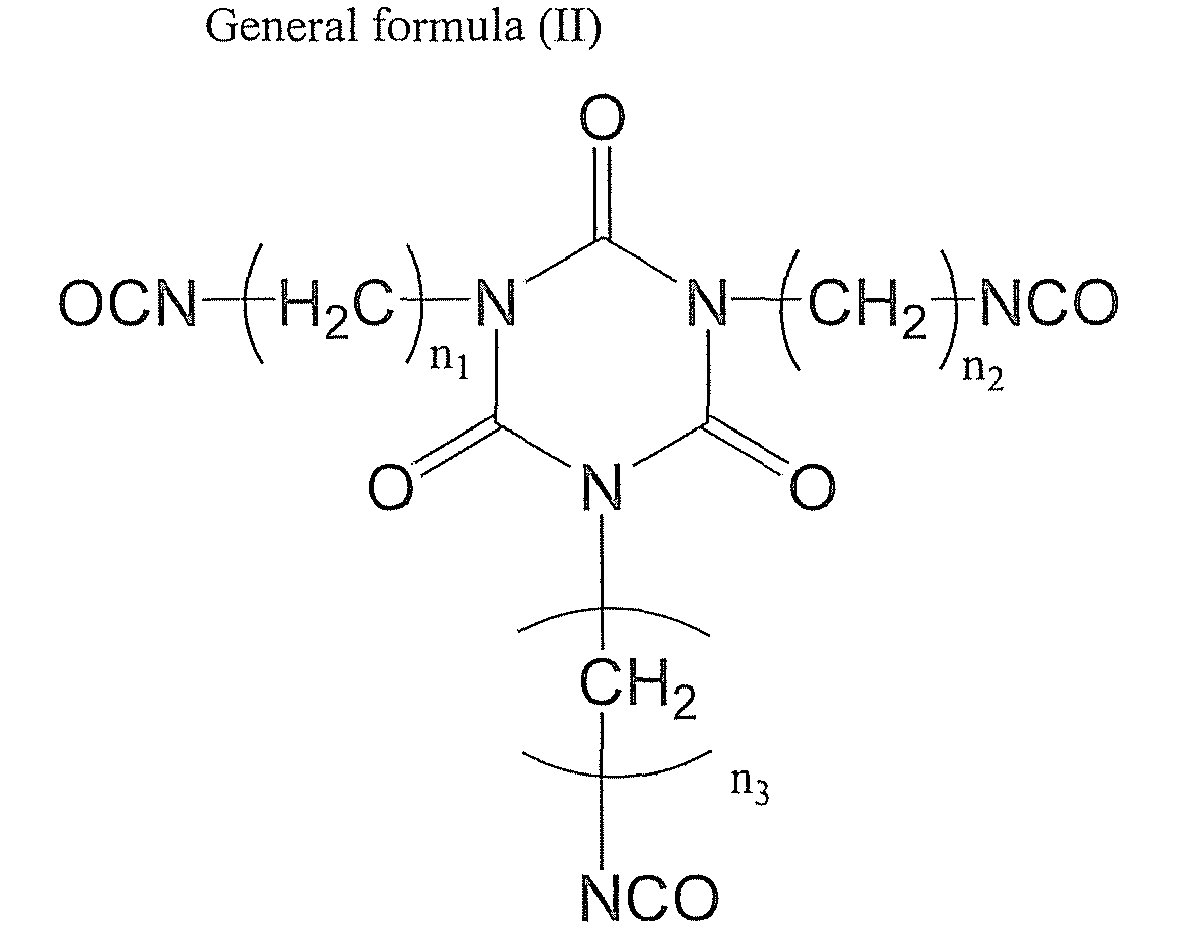
- Component (B1) is a polyisocyanate compound having a structure in which an isocyanate group is bonded through an alkylene group having 3 to 8 carbon atoms to an isocyanurate ring.
- transparent molded article 1 of the present invention possesses a suitably crosslinked structure that imparts heat resistance and impact resistance that are highly balanced, as well as having good solvent resistance.
- n 1 , n 2 , and n 3 fall within the range of 3 to 8, in addition to a good balance being achieved between the heat resistance and impact resistance of the molded article obtained, good compatibility is maintained between component (B1) and the other starting material components, which is desirable from the perspective of obtaining a molded article with good optical transparency.
- n 1 , n 2 , and n 3 are preferably 4, 5 or 6.
- Component (B1) can be synthesized by known methods and is commercially available. Specific examples of component (B1) are tris(6-isocyanatohexyl)isocyanurate and tris(4-isocyanatobutyl)isocyanurate. These compounds can be synthesized by known methods. A product the main component of which is tris(6-isocyanatohexyl) isocyanurate is available under the trade name Coronate-HX from Nippon Polyurethane Industry Co., Ltd.
- the monomer components comprising components (A) and (B1) may further comprise component (B2).
- Component (B2) is an aliphatic diisocyanate compound having one or more intramolecular cyclic structure.
- aliphatic diisocyanate compound having one or more intramolecular cyclic structure means an aliphatic diisocyanate compound having a cyclic structure on the main chain or the side chain.
- the cyclic structure may be alicyclic, aromatic, or heterocyclic ring.
- alicyclic ring means a cyclic hydrocarbon group not exhibiting aromatic properties and constituted with three or more carbon atoms, including compounds in which a portion of the methylene group making up the ring has been substituted with sulfur atoms or the like, such as a dithiane ring, or a bicyclo ring such as norbornene.
- aromatic ring means a cyclic hydrocarbon group exhibiting aromatic properties, including condensed rings such as naphthalene rings.
- heterocyclic ring means a ring, constituted with carbon atoms and different atoms such as oxygen or sulfur atoms, that exhibits aromatic properties.
- aromatic isocyanate compounds Compounds in which an isocyanate group is directly bonded to a ring exhibiting aromatic properties, such as the above "aromatic ring” and “heterocyclic ring,” are generally called aromatic isocyanate compounds. They do not correspond to aliphatic diisocyanate compounds having an intramolecular cyclic structure employed as component (B2) in the present invention. Accordingly, among the aliphatic diisocyanate compounds having a cyclic structure that are employed in the present invention, the aliphatic diisocyanate compounds with a cyclic structure that are "aromatic” or “heterocyclic” refer to compounds in which the isocyanate group is bonded to the ring through an alkylene group having one or more carbon atoms. In each of the alicyclic rings, aromatic rings, and heterocyclic rings given as examples of the above cyclic structure, a substituent such as an alkyl group can be bonded.
- Aliphatic diisocyanates having an intramolecular cyclic structure are desirably diisocyanate compounds having an alicyclic ring as the intramolecular cyclic structure (also referred to as “alicyclic diisocyanate compounds” below) from the perspectives of preventing yellowing and maintaining adequate elasticity and hardness in the molded article obtained.
- diisocyanate compounds having an alicyclic ring as the intramolecular cyclic structure also referred to as “alicyclic diisocyanate compounds” below
- alicyclic diisocyanates are desirably employed as component (B2) in the present invention.
- alicyclic diisocyanates examples include: 4,4'-methylenebis(cyclohexylisocyanate), isophorone diisocyanate, 1,2-bis(isocyanatomethyl)cyclohexane, 1,3-bis(isocyanatomethyl)cyclohexane, 1,4-bis(isocyanatomethyl)cyclohexane, 1,2-diisocyanato cyclohexane, 1,3-diisocyanato cyclohexane, 1,4-diisocyanato cyclohexane, 2,5-bis(isocyanatomethyl)-1,4-dithiane, 2,3-bis(isocyanatomethyl)-1,4-dithiane, 2,6-bis(isocyanatomethyl)-1,4-dithiane, 2,4-bis(isocyanatomethyl)-1,3-dithiane, 2,5-bis(isocyanatomethyl)-1,3-dithiane
- Examples of aliphatic diisocyanate compounds having an aromatic ring as the intramolecular cyclic structure are: m-xylylene diisocyanate, o-xylylene diisocyanate, p-xylylene diisocyanate, and m-tetramethylxylylene diisocyanate.
- Examples of aliphatic diisocyanate compounds having a heterocyclic ring as the intramolecular cyclic structure are 2,5-bis(isocyanatomethyl)thiophene and 3,4-bis(isocyanatomethyl)thiophene.
- component (B2) is desirably at least one compound selected from the group consisting of 4,4'-methylenebis(cyclohexylisocyanate), isophoron diisocyanate, 1,3-bis(isocyanatomethyl)cyclohexane, and 2,5-bis(isocyanatomethyl)-1,4-dithiane.
- the ratio of NCO groups in component (B1) is preferably greater than or equal to 25 mole percent of the total NCO groups comprised in components (B1) and (B2). When this ratio is 25 mole percent or greater, a practically adequate degree of crosslinking can be achieved in polymerization, yielding a molded article with high heat resistance and good mechanical characteristics. From the perspectives of heat resistance, mechanical characteristics and the like, the ratio of NCO groups in component (B1) is more preferably greater than or equal to 35 mole percent of the total NCO groups comprised in components (B1) and (B2).
- the molar ratio of isocyanate groups comprised in component (B1) preferably falls within a range of 1.00 to 1.15 relative to thiol groups comprised in component (A) from the perspective of obtaining a molded article of adequate toughness (strength).
- the molar ratio of isocyanate groups comprised in components (B1) and (B2) preferably falls within a range of 1.00 to 1.15 relative to thiol groups comprised in component (A) from the perspective of obtaining a molded article of adequate toughness (strength). In both cases, the above molar ratio more preferably ranges from 1.02 to 1.12.
- transparent molded article 1 of the present invention When obtaining transparent molded article 1 of the present invention by polymerizing monomer components comprising components (A) and (B1), it is possible to employ, for example, the method of casting components (A) and (B1) into a casting mold and then heating components (A) and (B1) to polymerize them into a molded article. Further, when obtaining transparent molded article 1 of the present invention by polymerizing monomer components comprising components (A), (B1) and (B2), it is possible to employ, for example, the method of casting a mixture of components (A), (B1) and (B2) into a casting mold and then heating components (A), (B1) and (B2) to polymerize them into a molded article.
- the heating temperature in this process generally falls within a range of -20 to 160°C.
- the heating temperature need not be constant during polymerization, and can be varied in stepwise fashion.
- the heating time varies with conditions such as the heating temperature, and generally ranges from 0.5 to 120 hours.
- a polymerization catalyst can be employed to improve polymerization properties.
- an organic metal compound such as an organic tin compound, a tertiary amine, or the like can be employed.
- the catalyst may be employed in a quantity of 0.001 to 1 mole percent relative to the isocyanate groups, for example.
- transparent molded article 1 of the present invention in addition to components (A), (B1) and (B2), various additives - such as ultraviolet radiation absorbing agents, coloring matter, pigments, and the like to improve light absorption characteristics; oxidation inhibitors, coloration inhibitors, and the like to improve weatherability; and plasticizers, mold releasing agents, and the like to improve molding properties - may be incorporated in suitable quantity so long as the nature of the transparent molded article is not compromised.
- additives - such as ultraviolet radiation absorbing agents, coloring matter, pigments, and the like to improve light absorption characteristics; oxidation inhibitors, coloration inhibitors, and the like to improve weatherability; and plasticizers, mold releasing agents, and the like to improve molding properties - may be incorporated in suitable quantity so long as the nature of the transparent molded article is not compromised.
- additives - such as ultraviolet radiation absorbing agents, coloring matter, pigments, and the like to improve light absorption characteristics; oxidation inhibitors, coloration inhibitors, and the like to improve weatherability; and plastic
- Transparent molded article 1 of the present invention may be subjected to a surface treatment following molding, such as a hardcoat treatment to enhance scratch resistance or an antireflective coat treatment to reduce reflectance.
- a surface treatment following molding such as a hardcoat treatment to enhance scratch resistance or an antireflective coat treatment to reduce reflectance.
- Transparent molded article 1 of the present invention may be a lens such as an eyeglass lens or an optical lens; a prism; optical fiber; a substrate for recording media employed in optical disks, magnetic disks, and the like; or an optical material such as a filter or the like.
- transparent molded article 1 of the present invention is a lens, and more preferably, an eyeglass lens.
- Transparent molded article 2 of the present invention is obtained by polymerizing monomer components comprising components (A), (B1), (B2) and (C).
- Component (A) is a polythiol compound with a 1,4-dithiane ring as its main skeleton.
- a high refractive index and a high Abbé number can be simultaneously imparted to the molded article obtained by polymerization without deteriorating weatherability.
- Component (B1) is a polyisocyanate compound having a structure in which an isocyanate group is bonded through an alkylene group having 3 to 8 carbon atoms to an isocyanurate ring.
- transparent molded article 2 of the present invention possesses a suitably crosslinked structure that imparts heat resistance and impact resistance that are highly balanced, as well as having good solvent resistance.
- Component (B2) is one or more aliphatic diisocyanate compounds having an intramolecular cyclic structure. Including such a component (B2) in the monomer components yields a molded article with better heat resistance.
- Component (C) will be described below.
- Component (C) is an aliphatic diol compound.
- an aliphatic diol compound is included in the monomer components to impart toughness to the molded article obtained without a reduction in weatherability or light resistance.
- a transparent molded article 2 is obtained that has good mechanical characteristics such as impact resistance.
- the aliphatic diol compound of component (C) preferably has a number average molecular weight ranging from 300 to 2,000. Toughness can be effectively imparted to the molded article when the number average molecular weight of the diol compound is greater than or equal to 300, and the hardness of the molded article can be maintained and its shape can hold readily when the number average molecular weight of the diol compound is less than or equal to 2,000.
- the number average molecular weight of the diol compound more preferably falls within a range of 600 to 1,500.
- diol compounds examples include polyetherdiol compounds such as polyethylene glycol, polypropylene glycol, and polytetramethylene glycol; polyesterdiol compounds such as polyesterdiol comprised of ethylene glycol and adipic acid, polyesterdiol comprised of propylene glycol and adipic acid, polyesterdiol comprised of diethylene glycol and adipic acid, polyesterdiol comprised of 1,4-butanediol and adipic acid, polyesterdiol comprised of neopentyl glycol and adipic acid, polyesterdiol comprised of 1,6-hexanediol and adipic acid, polyesterdiol comprised of 1,10-decanediol and adipic acid, polyesterdiol comprised of 1,4-butanediol and glutaric acid, polyesterdiol comprised of 1,4-butanediol and sebacic acid, polycap
- the above aliphatic diol compounds are preferably polyetherdiol compounds, which have good handling properties because of their lower viscosity at a given molecular weight, and further preferably polypropylene glycol, from the perspective of compatibility with other components.
- Such aliphatic diol compounds can be synthesized by known methods and are commercially available.
- the mass ratio of component (C) relative to the total mass of components (A) and (C) preferably ranges from 3 to 60 percent.
- this ratio is greater than or equal to 3 percent, toughness can be effectively imparted to the molded article obtained, and when it is less than or equal to 60 percent, adequate heat resistance and a high refractive index can be readily imparted to the molded article obtained.
- the mass ratio more preferably falls within a range of 8 to 40 percent.
- the ratio of NCO groups in component (B1) preferably falls within a range of 10 to 80 mole percent of the total NCO groups comprised in components (B1) and (B2).
- this ratio is greater than or equal to 10 mole percent, a practically adequate degree of crosslinking can be achieved in polymerization, yielding a molded article having good heat resistance and mechanical characteristics.
- this ratio is less than or equal to 80 mole percent, compatibility of components (B1) and (B2) with components (A) and (C) is high, yielding a molded article having a practically adequate transparency.
- the ratio of NCO in component (B1) more preferably ranges from 15 to 65 mole percent of the total NCO groups comprised in components (B1) and (B2).
- the molar ratio of isocyanate groups contained in components (B1) and (B2) relative to the total of thiol groups contained in component (A) and hydroxyl groups contained in component (C) preferably ranges from 1.00 to 1.15 from the perspective of yielding a molded article of adequate toughness (strength). This molar ratio more preferably ranges from 1.02 to 1.12.
- a method comprising casting a mixture of components (A), (B1), (B2) and (C) into a casting mold and then heating components (A), (B1), (B2) and (C) to polymerize them into a molded article may be employed.
- the mixture that is cast into a casting mold may be obtained by simply mixing components (A), (B1), (B2) and (C).
- components (C), (B1) and (B2) may be reacted in advance, as needed, using a urethane reaction catalyst such as a tertiary amine or an organic metal compound such as an organic tin compound for 5 to 50 minutes at 0 to 80°C to form urethane bonds, and then component (A) is added to obtain a mixture.
- a urethane reaction catalyst such as a tertiary amine or an organic metal compound such as an organic tin compound for 5 to 50 minutes at 0 to 80°C to form urethane bonds
- components (C) and (B1) may be reacted in advance, for example, under conditions identical to those set forth above to form urethane bonds and then components (B2) and (A) are added to obtain a mixture, or components (C) and (B2) may be reacted in advance, for example, under conditions identical to those set forth above to form urethane bonds, and then components (B1) and (A) are added to obtain a mixture.
- the heating temperature when polymerizing the above mixture generally ranges from -20 to 160°C for the cases described. This heating temperature does not have to be constant, and may be varied in stepwise fashion.
- the heating time varies with conditions such as the heating temperature, and generally ranges from 0.5 to 120 hours.
- a polymerization catalyst can be employed to improve polymerization properties in the cases described. Specifically, an organic metal compound such as an organic tin compound, a tertiary amine, or the like can be employed.
- the catalyst may be employed in a quantity of 0.001 to 1 mole percent relative to the isocyanate groups, for example.
- transparent molded article 2 of the present invention in addition to components (A), (B1), (B2) and (C), various additives - such as ultraviolet radiation absorbing agents, coloring matter, pigments, and the like to improve light absorption characteristics; oxidation inhibitors, coloration inhibitors, and the like to improve weatherability; and plasticizers, mold releasing agents, and the like to improve molding properties - may be incorporated in suitable quantity so long as the nature of the transparent molded article is not compromised.
- additives - such as ultraviolet radiation absorbing agents, coloring matter, pigments, and the like to improve light absorption characteristics; oxidation inhibitors, coloration inhibitors, and the like to improve weatherability; and plasticizers, mold releasing agents, and the like to improve molding properties - may be incorporated in suitable quantity so long as the nature of the transparent molded article is not compromised.
- additives - such as ultraviolet radiation absorbing agents, coloring matter, pigments, and the like to improve light absorption characteristics; oxidation inhibitors, coloration inhibitors, and the like to improve weatherability
- Transparent molded article 2 of the present invention may be subjected to a surface treatment following molding, such as a hardcoat treatment to enhance scratch resistance or an antireflective coat treatment to reduce reflectance.
- a surface treatment following molding such as a hardcoat treatment to enhance scratch resistance or an antireflective coat treatment to reduce reflectance.
- Transparent molded article 2 of the present invention may be a lens such as an eyeglass lens or an optical lens; a prism; optical fiber; a substrate for recording media employed in optical disks, magnetic disks, and the like; or an optical material such as a filter or the like.
- transparent molded article 2 of the present invention is a lens, and more preferably, an eyeglass lens.
- the physical properties of the optical materials obtained were evaluated according to the following methods.
- the obtained lens was evaluated by visual observation. Those without coloration were rated as A, those with slight coloration (yellowing) as B, and those with marked coloration as C.
- the obtained lens was evaluated by visual observation in a dark room under fluorescent lighting. Those in which no fogging or nontransparent matter precipitated out in the interior were rated as A. Those in which slight fogging and the like was observed were rated as B. And those in which severe fogging or the precipitation of nontransparent matter was clearly observed were rated as C. Lenses rated B or C were considered unsuitable for use as lenses.
- the obtained lens was evaluated by visual observation with the Schlieren method. Those without distortion were rated as A, those with only slight distortion along the edges as B, and those that were totally distorted as C.
- a test strip measuring 5 mm in width, 5 mm in depth, and 16 mm in height was prepared from the lens obtained and subjected to a fracture test at 20°C using a Dynstat tester made by Toyo Seiki Seisaku-sho, Ltd.
- the energy required for fracture was calculated from the results and this value was adopted as a measure of the impact resistance: the greater the energy value, the greater the impact resistance.
- the lens of Example 1 had a high refractive index (nD) of 1.61, a high Abbé number ( v D) of 40, no coloration, good transparency, and no optical distortion. It exhibited a fracture energy value of 120 (kg ⁇ cm/cm 2 ), indicating good impact resistance.
- plastic lenses were obtained by the same operation as in Example 1.
- the various physical properties of these plastic lenses are given in Table 1.
- the plastic lenses of Examples 2 to 6 had high refractive indexes (nD) of 1.60 to 1.64, high Abbé numbers ( v D) of 39 to 41, no coloration, good transparency, and no optical distortion. They exhibited fracture values of 90 to 120 kg ⁇ cm/cm 2 , indicating good impact resistance.
- a mixture of 0.20 mole of 4-mercaptomethyl-1,8-dimercapto-3,6-dithiaoctane (denoted as “MMMO” in Table 1), 0.30 mole of norbornene diisocyanate (denoted as “NDI” in Table 1), and 3.0 x 10 -4 mole of dibutyl tin dilaurate (denoted as "DBTDL” in Table 1) was uniformly mixed, cast into a lens-forming glass mold, and polymerized by heating for 10 hours at 50°C followed by 5 hours at 60°C and 3 hours at 120°C to obtain a plastic lens.
- the various physical properties of the plastic lens obtained are given in Table 1.
- the plastic lens of Comparative Example 1 had a high refractive index of 1.60, a high Abbé number of 41, no coloration, good transparency, and no optical distortion. However, it exhibited a fracture energy value of 35 kg ⁇ cm/cm 2 , indicating low impact resistance.
- plastic lenses were obtained by the same operation as in Comparative Example 1.
- the various physical properties of these plastic lenses are given in Table 1.
- the plastic lens of Comparative Example 2 had a high refractive index of 1.62, no coloration, good transparency, and no optical distortion, but a somewhat low Abbé number of 38. Further, during evaluation of impact resistance, the impact resistance was so low that no fracture energy value could be calculated.
- the plastic lens of Comparative Example 3 had a high refractive index of 1.63, a high Abbé number of 40, no coloration, good transparency, and no optical distortion. However, it exhibited a fracture energy of 45 kg ⁇ cm/cm 2 , indicating low impact resistance.
- a mixture of 0.04 mole of polypropylene glycol with a number average molecular weight of 1,000 (component (C), denoted in Table 2 as “P 1000"), 0.11 mole of tris(6-isocyanatohexyl)isocyanurate (component (B1), denoted in Table 2 as “CX”), 0.65 mole of 1,3-bis(isocyanatomethyl)cyclohexane (component (B2), denoted in Table 2 as "HXDI”), and 0.4 x 10 -4 mole of dibutyl tin dilaurate (denoted in Table 2 as "DBTDL”) was reacted while being uniformly stirred for two hours at 40°C.
- the lens of Example 7 had a high refractive index (nD) of 1.61, a high Abbé number ( v D) of 41, no coloration, good transparency, and no optical distortion. It exhibited a fracture energy value of 155 kg ⁇ cm/cm 2 , indicating good impact resistance.
- plastic lenses were obtained by the same operation as in Example 7.
- the various physical properties of these plastic lenses are given in Table 2 along with the various physical properties of the plastic lens of Example 7.
- the plastic lenses of Examples 8 to 12 had high refractive indexes (nD) of 1.60 to 1.64, high Abbé numbers ( v D) of 39 to 42, no coloration, good transparency, and no optical distortion. They exhibited fracture energy values of 135 to 160 kg ⁇ cm/cm 2 , indicating good impact resistance.
- the lens of Example 13 had a high refractive index (nD) of 1.60, a high Abbé number ( v D) of 40, no coloration, good transparency, and no optical distortion. It exhibited a fracture energy value of 131 kg ⁇ cm/cm 2 , indicating good impact resistance.
- the present invention provides lenses having excellent characteristics, such as refractive indexes of 1.60 or higher, Abbé numbers of 39 or higher, good transparency, and no coloration and optical distortion, and exhibiting fracture energy values of greater than or equal to 130 kg ⁇ cm/cm 2 , thus having good impact resistance.
- the plastic lens of Comparative Example 4 had a high refractive index of 1.60, a high Abbé number of 41, no coloration, good transparency, and no optical distortion. However, it exhibited a fracture energy value of 35 kg ⁇ cm/cm 2 , indicating low impact resistance.
- plastic lenses were obtained by the same operation as in Comparative Example 4.
- the various physical properties of these plastic lenses are given in Table 2 along with the various physical properties of the lenses of Examples 7 to 13 and Comparative Example 4.
- the plastic lens of Comparative Example 5 was obtained by polymerization of the monomer components for obtaining transparent molded article 2 of the present invention without components (C) and (B1).
- the lens of Comparative Example 5 had a high refractive index of 1.62, no coloration, good transparency, and no optical distortion, but a somewhat low Abbé number of 38. Further, during evaluation of impact resistance, the impact resistance was so low that no fracture energy value could be calculated.
- the plastic lens of Comparative Example 6 had a high refractive index of 1.63, a high Abbé number of 41, no coloration, good transparency, and no optical distortion. However, it exhibited a fracture energy of 45 kg ⁇ cm/cm 2 , indicating low impact resistance.
- the plastic lens of Reference Example 1 was obtained by polymerizing the monomer components for obtaining transparent molded article 2 of the present invention without component (C). As indicated in Table 2, the lens of Reference Example 1 had a high refractive index of 1.61, a high Abbé number of 40, no coloration, good transparency, and no optical distortion. It exhibited a fracture energy value of 120 kg ⁇ cm/cm 2 , thus having impact resistance that was greater than the lens of Comparative Example 5 not comprising component (B1), but poorer than transparent molded article 2 of the present invention containing component (C).
- Compound names denoted by an abbreviation in Table 2 are as follows:
- the transparent molded article 1 of the present invention has characteristics such as excellent refractive index, Abbé number, weatherability, solvent resistance and transparency as well as no optical distortion. In particular, it is characterized by excellent impact resistance. Accordingly, the transparent molded article 1 of the present invention can be suitably employed for optical lenses such as an eyeglass lens and camera lens, and the like.
- the transparent molded article 2 suitable for optical applications can be provided, that has a refractive index and transparency equal to or higher than those of molded articles conventionally employed in optical materials such as lenses as well as has higher impact strength than that of molded articles conventionally employed in optical materials such as lenses. Furthermore, the transparent molded article 2 of the present invention has excellent characteristics such as high Abbé number, excellent weatherability and solvent resistance as well as no optical distortion.
- the transparent molded article 2 of the present invention can be suitably employed for various lenses such as an eyeglass lens and camera lens, a prism, optical fiber, a substrate for recording media, a filter and the like.
Landscapes
- Chemical & Material Sciences (AREA)
- Health & Medical Sciences (AREA)
- Chemical Kinetics & Catalysis (AREA)
- Medicinal Chemistry (AREA)
- Polymers & Plastics (AREA)
- Organic Chemistry (AREA)
- Physics & Mathematics (AREA)
- General Physics & Mathematics (AREA)
- Optics & Photonics (AREA)
- General Chemical & Material Sciences (AREA)
- Polyurethanes Or Polyureas (AREA)
- Laminated Bodies (AREA)
- Materials For Medical Uses (AREA)
Abstract
Component (A): one or more polythiol compound denoted by general formula (I)

Component (B1): one or more polyisocyanate compound denoted by general formula (II)
Component (B2): one or more aliphatic diisocyanate compound having an intramolecular cyclic structure
Component (C): aliphatic diol compound
Description
- The present invention relates to a molded article suitable for optical application, which has a high refractive index, low dispersion and excellent transparency as well as is excellent in impact resistance and weatherability. In more detail, the present invention relates to a transparent molded article which has excellent optical characteristics such as a high refractive index and high Abbé number, is excellent in impact resistance and can be suitably employed as various lenses such as eyeglass lenses, a prism, optical fiber, a substrate for recording media and a filter.
- Since plastic is lighter, tends to crack less, and dyes more readily than glass, it has been employed in optical applications such as various lenses in recent years. Plastic materials generally employed in optics include polyethylene glycol bisallyl carbonate (CR-39) and polymethyl methacrylate (PMMLA). However, since these plastic materials have a refractive index of less than or equal to 1.5, when employed as lens materials, for example, the lens becomes thicker with the level of magnification. Not only does the lightweight advantage of plastic end up being lost, but thick plastic is undesirable from an esthetic point of view. Further, when these plastic materials are employed in concave lenses, there are disadvantages in that the thickness of the lens perimeter (edge) increases, tending to result in birefringence and chromatic aberration.
- Accordingly, plastic materials of high refractive index have been developed utilizing the characteristics of plastic of low specific gravity to permit the thinning of lenses. Examples of such materials are polythiourethanes obtained from pentaerythritoltetrakis(mercaptopropionate) and diisocyanate compounds, and polythiourethanes obtained from 4-mercaptomethyl-1,8-dimercapto-3,6-dithiaoctane and diisocyanate compounds (see Japanese Unexamined Patent Publications (KOKAI) Showa No. 63-46213 ("Reference 1" hereinafter) and Heisei 2-270859 ("Reference 2" hereinafter)).
- However, although the polythiourethanes described in References 1 and 2 have high refractive indexes, there are problems with weatherability, heat resistance, and the like.
- By contrast, the present inventors conducted extensive research into solving these problems, resulting in the discovery that polythiourethane obtained by reacting 2,5-dimercaptomethyl-1,4-dithiane, oligomers thereof, and polyisocyanate affords not just a high refractive index, but also greatly improved weatherability and heat resistance, which had previously been problematic (see Japanese Unexamined Patent Publications (KOKAI) Heisei 3-236386 ("Reference 3" hereinafter) and Heisei 11-202101 ("Reference 4" hereinafter)). Compared to the polythiourethanes described in References 1 and 2, the polythiourethanes described in References 3 and 4 have better impact resistance without substantial problems with practical use. However, in the optical materials employed in items such as eyeglasses, a need for materials having even higher impact resistance has developed.
- It is a first object of the present invention to provide a molded article suitable for optical applications, that has high impact resistance, excellent transparency and a high refractive index.
- It is a second object of the present invention to provide a transparent molded article suitable for optical applications, that has a refractive index and transparency equal to or higher than those of molded articles conventionally employed in optical materials such as lenses as well as has higher impact strength than that of molded articles conventionally employed in optical materials such as lenses.
- The present inventors conducted extensive research into achieving the above first object, resulting in the discovery that the above object can be achieved by a transparent molded article comprised of polythiourethane obtained by polymerizing a polythiol compound having a specific structure and a polyisocyanate compound having a specific structure. The present invention was devised on that basis.
- That is, means for achieving the first object of the present invention are as follows;
- (1) A transparent molded article comprised of polythiourethane obtained by polymerizing monomer components comprising the following component (A) and component (B1).
Component (A): one or more polythiol compound denoted by general formula (I) General formula (I)
Component (B1): one or more polyisocyanate compound denoted by general formula (II) General formula (II)
- (2) The transparent molded article according to (I), wherein said monomer components further comprises the following component (B2).
Component (B2): one or more aliphatic diisocyanate compound having an intramolecular cyclic structure. - (3) The transparent molded article according to (2), wherein, in said polymerization, the ratio of NCO groups in component (B1) is greater than or equal to 25 mole percent of the total NCO groups comprised in component (B1) and component (B2).
- (4) The transparent molded article according to any of (1) to (3), wherein, in general formula (I) of component (A), m is 1 or 2.
- (5) The transparent molded article according to any of (1) to (4), wherein, in general formula (II) of component (B1), n1, n2 and n3 are each independently 4, 5 or 6.
- (6) The transparent molded article according to any of (1) to (5), wherein, in said polymerization, the molar ratio of isocyanate groups comprised in component (B1) and component (B2) relative to thiol groups comprised in component (A) ranges from 1.00 to 1.15.
- (7) The transparent molded article according to any of (1) to (6), wherein the transparent molded article is a lens.
- (8) The transparent molded article according to (7), wherein the lens is an eyeglass lens.
The present inventors conducted extensive research into achieving the above second object, resulting in the discovery that the above object can be achieved by a transparent molded article obtained by polymerizing a polythiol compound having a specific structure, an aliphatic diol compound, and a polyisocyanate compound having a specific structure. The present invention was devised on that basis.
That is, means for achieving the second object of the present invention are as follows; - (9) A transparent molded article obtained by polymerizing monomer components comprising the following component (A), component (B1), component (B2) and component (C).
Component (A): one or more polythiol compound denoted by general formula (I) General formula (I)
Component (B1): one or more polyisocyanate compound denoted by general formula (II) General formula (II)
Component (B2): one or more aliphatic diisocyanate compound having an intramolecular cyclic structure
Component (C): aliphatic diol compound - (10) The transparent molded article according to (9), wherein, in said monomer components, the mass ratio of component (C) relative to total mass of component (A) and component (C) ranges from 3 to 60 percent.
- (11) The transparent molded article according to (9) or (10), wherein, in said polymerization, the ratio of NCO groups in component (B1) ranges from 10 to 80 mole percent of the total NCO groups comprised in component (B1) and component (B2).
- (12) The transparent molded article according to any of (9) to (11), wherein, in general formula (I) of component (A), m is 1 or 2.
- (13) The transparent molded article according to any of (9) to (12), wherein said component (C) has a number average molecular weight ranging from 300 to 2,000.
- (14) The transparent molded article according to (13), wherein said component (C) has a number average molecular weight ranging from 600 to 1500.
- (15) The transparent molded article according to any of (9) to (14), wherein the aliphatic diol compound of component (C) is polyetherdiol compound.
- (16) The transparent molded article according to (15), wherein said polyetherdiol compound is polypropylene glycol.
- (17) The transparent molded article according to any of (9) to (16), wherein, in general formula (II) of said component (B1), n1, n2 and n3 are each independently 4, 5 or 6.
- (18) The transparent molded article according to any of (9) to (17), wherein, in said polymerization, the molar ratio of isocyanate groups comprised in component (B1) and component (B2) relative to the total of thiol groups comprised in component (A) and hydroxyl groups comprised in component (C) ranges from 1.00 to 1.15.
- (19) The transparent molded article according to any of (9) to (18), wherein the transparent molded article is a lens.
- (20) The transparent molded article according to (19), wherein the lens is an eyeglass lens.
- The present invention will be described in more detail below.
- The transparent molded article (referred to as "transparent molded article 1", hereinafter) of the first aspect of the present invention is comprised of polythiourethane obtained by polymerizing monomer components comprising component (A) and component (B1).
- The transparent molded article (referred to as "transparent molded article 2", hereinafter) of the second aspect of the present invention is obtained by polymerizing monomer components comprising component (A), component (B1), component (B2) and component (C).
- In the present invention, any molded article having transparency that does not impede its use as an optical material is covered under the term "transparent molded article." There are many indexes of transparency employed for the various optical materials used in the transparent molded article of the present invention. Examples are light transmittance, the haze value, and visual inspection.
- In some cases below, the "transparent molded article" will be referred to simply as a "molded article".
- Transparent molded article 1 of the present invention is comprised of polythiourethane obtained by polymerizing monomer components comprising component (A) and component (B1).
- Component (A), denoted by general formula (I) (wherein m is 1, 2, 3, 4, 5, or 6), is a polythiol compound with a 1,4-dithiane ring as its main skeleton. By incorporating this main skeleton, a high refractive index and a high Abbe number can be simultaneously imparted to the molded article obtained by polymerization without deteriorating weatherability. In general formula (I), so long as m is 6 or less, the viscosity of component (A) does not become excessively high, good handling properties can be maintained, and compatibility with other components is high. Thus, the optical transparency of molded articles obtained by polymerization can be increased. From the perspective of obtaining molded articles having a high refractive index, high Abbé number, and good optical transparency, m is desirably 1 or 2 in general formula (I). Further, component (A) may be a single compound in which m denotes an integer ranging from 1 to 6, or a mixture of two or more compounds with differing values of m.
- Component (A) can be synthesized by known methods described in Japanese Unexamined Patent Publications (KOKAI) Heisei Nos. 3-236386 and 10-120676.
- Component (B1), denoted by general formula (II) (wherein n1, n2, and n3 are each independently 3, 4, 5, 6, 7 or 8), is a polyisocyanate compound having a structure in which an isocyanate group is bonded through an alkylene group having 3 to 8 carbon atoms to an isocyanurate ring. With this compound serving as one of its starting materials, transparent molded article 1 of the present invention possesses a suitably crosslinked structure that imparts heat resistance and impact resistance that are highly balanced, as well as having good solvent resistance.
- In general formula (II), when at least one from among n1, n2, and n3 denotes 2 or less, a molded article having good heat resistance can be obtained, but the impact resistance of the molded article obtained ends up being low. By contrast, when at least one from among n1, n2, and n3 denotes 9 or more, a molded article having high impact resistance can be obtained, but the heat resistance of the molded article ends up being poor. In this manner, when n1, n2, and n3 fall within the range of 3 to 8, in addition to a good balance being achieved between the heat resistance and impact resistance of the molded article obtained, good compatibility is maintained between component (B1) and the other starting material components, which is desirable from the perspective of obtaining a molded article with good optical transparency. From the perspective of heat resistance, impact resistance and optical transparency, n1, n2, and n3 are preferably 4, 5 or 6.
- Component (B1) can be synthesized by known methods and is commercially available. Specific examples of component (B1) are tris(6-isocyanatohexyl)isocyanurate and tris(4-isocyanatobutyl)isocyanurate. These compounds can be synthesized by known methods. A product the main component of which is tris(6-isocyanatohexyl) isocyanurate is available under the trade name Coronate-HX from Nippon Polyurethane Industry Co., Ltd.
- The monomer components comprising components (A) and (B1) may further comprise component (B2). Component (B2) is an aliphatic diisocyanate compound having one or more intramolecular cyclic structure. In this invention, the phrase "aliphatic diisocyanate compound having one or more intramolecular cyclic structure" means an aliphatic diisocyanate compound having a cyclic structure on the main chain or the side chain. The cyclic structure may be alicyclic, aromatic, or heterocyclic ring. In this invention, the term "alicyclic ring" means a cyclic hydrocarbon group not exhibiting aromatic properties and constituted with three or more carbon atoms, including compounds in which a portion of the methylene group making up the ring has been substituted with sulfur atoms or the like, such as a dithiane ring, or a bicyclo ring such as norbornene. The term "aromatic ring" means a cyclic hydrocarbon group exhibiting aromatic properties, including condensed rings such as naphthalene rings. The term "heterocyclic ring" means a ring, constituted with carbon atoms and different atoms such as oxygen or sulfur atoms, that exhibits aromatic properties. Compounds in which an isocyanate group is directly bonded to a ring exhibiting aromatic properties, such as the above "aromatic ring" and "heterocyclic ring," are generally called aromatic isocyanate compounds. They do not correspond to aliphatic diisocyanate compounds having an intramolecular cyclic structure employed as component (B2) in the present invention. Accordingly, among the aliphatic diisocyanate compounds having a cyclic structure that are employed in the present invention, the aliphatic diisocyanate compounds with a cyclic structure that are "aromatic" or "heterocyclic" refer to compounds in which the isocyanate group is bonded to the ring through an alkylene group having one or more carbon atoms. In each of the alicyclic rings, aromatic rings, and heterocyclic rings given as examples of the above cyclic structure, a substituent such as an alkyl group can be bonded.
- Aliphatic diisocyanates having an intramolecular cyclic structure are desirably diisocyanate compounds having an alicyclic ring as the intramolecular cyclic structure (also referred to as "alicyclic diisocyanate compounds" below) from the perspectives of preventing yellowing and maintaining adequate elasticity and hardness in the molded article obtained. Compared to alicyclic diisocyanates, molded articles obtained from isocyanates having aromatic rings tend to yellow more, and molded articles obtained from aliphatic chain isocyanates tend to be soft and to have poor shape retention. Thus, alicyclic diisocyanates are desirably employed as component (B2) in the present invention.
- Examples of alicyclic diisocyanates are: 4,4'-methylenebis(cyclohexylisocyanate), isophorone diisocyanate, 1,2-bis(isocyanatomethyl)cyclohexane, 1,3-bis(isocyanatomethyl)cyclohexane, 1,4-bis(isocyanatomethyl)cyclohexane, 1,2-diisocyanato cyclohexane, 1,3-diisocyanato cyclohexane, 1,4-diisocyanato cyclohexane, 2,5-bis(isocyanatomethyl)-1,4-dithiane, 2,3-bis(isocyanatomethyl)-1,4-dithiane, 2,6-bis(isocyanatomethyl)-1,4-dithiane, 2,4-bis(isocyanatomethyl)-1,3-dithiane, 2,5-bis(isocyanatomethyl)-1,3-dithiane, 4,6-bis(isocyanatomethyl)-1,3-dithiane, 4,5-bis(isocyanatomethyl)-1,3-dithiane, 2,5-diisocyanato-1,4-dithiane, 2,3-diisocyanato-1,4-dithiane, 2,6-diisocyanato-1,4-dithiane, 2,4-diisocyanato-1,3-dithiane, 2,5-diisocyanato-1,3-dithiane, 4,6-diisocyanato-1,3-dithiane, 4,5-diisocyanato-1,3-dithiane, 4,5-bis(isocyanatomethyl)-1,3-dithiolane, 4,5-diisocyanato-1,3-dithiolane, and 2,2-bis(isocyanatoethyl)-1,3-dithiane.
- Examples of aliphatic diisocyanate compounds having an aromatic ring as the intramolecular cyclic structure are: m-xylylene diisocyanate, o-xylylene diisocyanate, p-xylylene diisocyanate, and m-tetramethylxylylene diisocyanate.
- Examples of aliphatic diisocyanate compounds having a heterocyclic ring as the intramolecular cyclic structure are 2,5-bis(isocyanatomethyl)thiophene and 3,4-bis(isocyanatomethyl)thiophene.
- In particular, component (B2), from the perspectives of light resistance and weatherability, is desirably at least one compound selected from the group consisting of 4,4'-methylenebis(cyclohexylisocyanate), isophoron diisocyanate, 1,3-bis(isocyanatomethyl)cyclohexane, and 2,5-bis(isocyanatomethyl)-1,4-dithiane.
- In the polymerization of transparent molded article 1 of the present invention, the ratio of NCO groups in component (B1) is preferably greater than or equal to 25 mole percent of the total NCO groups comprised in components (B1) and (B2). When this ratio is 25 mole percent or greater, a practically adequate degree of crosslinking can be achieved in polymerization, yielding a molded article with high heat resistance and good mechanical characteristics. From the perspectives of heat resistance, mechanical characteristics and the like, the ratio of NCO groups in component (B1) is more preferably greater than or equal to 35 mole percent of the total NCO groups comprised in components (B1) and (B2).
- When polymerizing the monomer components comprising components (A) and (B1) to obtain transparent molded article 1, the molar ratio of isocyanate groups comprised in component (B1) preferably falls within a range of 1.00 to 1.15 relative to thiol groups comprised in component (A) from the perspective of obtaining a molded article of adequate toughness (strength). Further, when polymerizing the monomer components comprising components (A), (B1) and (B2), the molar ratio of isocyanate groups comprised in components (B1) and (B2) preferably falls within a range of 1.00 to 1.15 relative to thiol groups comprised in component (A) from the perspective of obtaining a molded article of adequate toughness (strength). In both cases, the above molar ratio more preferably ranges from 1.02 to 1.12.
- When obtaining transparent molded article 1 of the present invention by polymerizing monomer components comprising components (A) and (B1), it is possible to employ, for example, the method of casting components (A) and (B1) into a casting mold and then heating components (A) and (B1) to polymerize them into a molded article. Further, when obtaining transparent molded article 1 of the present invention by polymerizing monomer components comprising components (A), (B1) and (B2), it is possible to employ, for example, the method of casting a mixture of components (A), (B1) and (B2) into a casting mold and then heating components (A), (B1) and (B2) to polymerize them into a molded article. The heating temperature in this process generally falls within a range of -20 to 160°C. The heating temperature need not be constant during polymerization, and can be varied in stepwise fashion. The heating time varies with conditions such as the heating temperature, and generally ranges from 0.5 to 120 hours. In the polymerization of components (A), (B1) and (B2), a polymerization catalyst can be employed to improve polymerization properties. Specifically, an organic metal compound such as an organic tin compound, a tertiary amine, or the like can be employed. The catalyst may be employed in a quantity of 0.001 to 1 mole percent relative to the isocyanate groups, for example.
- Further, in transparent molded article 1 of the present invention, in addition to components (A), (B1) and (B2), various additives - such as ultraviolet radiation absorbing agents, coloring matter, pigments, and the like to improve light absorption characteristics; oxidation inhibitors, coloration inhibitors, and the like to improve weatherability; and plasticizers, mold releasing agents, and the like to improve molding properties - may be incorporated in suitable quantity so long as the nature of the transparent molded article is not compromised. These components may be mixed with the various components prior to polymerization, admixed during polymerization, or impregnated into the molded article obtained following polymerization.
- Transparent molded article 1 of the present invention may be subjected to a surface treatment following molding, such as a hardcoat treatment to enhance scratch resistance or an antireflective coat treatment to reduce reflectance.
- Transparent molded article 1 of the present invention may be a lens such as an eyeglass lens or an optical lens; a prism; optical fiber; a substrate for recording media employed in optical disks, magnetic disks, and the like; or an optical material such as a filter or the like. Preferably, transparent molded article 1 of the present invention is a lens, and more preferably, an eyeglass lens.
- Transparent molded article 2 of the present invention is obtained by polymerizing monomer components comprising components (A), (B1), (B2) and (C).
- Component (A), denoted by general formula (I) (wherein m is 1, 2, 3, 4, 5, or 6), is a polythiol compound with a 1,4-dithiane ring as its main skeleton. By incorporating this main skeleton, a high refractive index and a high Abbé number can be simultaneously imparted to the molded article obtained by polymerization without deteriorating weatherability.
- Component (B1), denoted by general formula (II) (wherein n1, n2, and n3 are each independently 3, 4, 5, 6, 7 or 8), is a polyisocyanate compound having a structure in which an isocyanate group is bonded through an alkylene group having 3 to 8 carbon atoms to an isocyanurate ring. With this compound serving as one of its starting materials, transparent molded article 2 of the present invention possesses a suitably crosslinked structure that imparts heat resistance and impact resistance that are highly balanced, as well as having good solvent resistance.
- Component (B2) is one or more aliphatic diisocyanate compounds having an intramolecular cyclic structure. Including such a component (B2) in the monomer components yields a molded article with better heat resistance.
- The details of components (A), (B1) and (B2) are identical to those described above for the first aspect.
- Component (C) will be described below.
- Component (C) is an aliphatic diol compound. In the present invention, an aliphatic diol compound is included in the monomer components to impart toughness to the molded article obtained without a reduction in weatherability or light resistance. Thus, in the present invention, a transparent molded article 2 is obtained that has good mechanical characteristics such as impact resistance.
- To further enhance these mechanical characteristics, the aliphatic diol compound of component (C) preferably has a number average molecular weight ranging from 300 to 2,000. Toughness can be effectively imparted to the molded article when the number average molecular weight of the diol compound is greater than or equal to 300, and the hardness of the molded article can be maintained and its shape can hold readily when the number average molecular weight of the diol compound is less than or equal to 2,000. The number average molecular weight of the diol compound more preferably falls within a range of 600 to 1,500.
- Examples of such diol compounds are polyetherdiol compounds such as polyethylene glycol, polypropylene glycol, and polytetramethylene glycol; polyesterdiol compounds such as polyesterdiol comprised of ethylene glycol and adipic acid, polyesterdiol comprised of propylene glycol and adipic acid, polyesterdiol comprised of diethylene glycol and adipic acid, polyesterdiol comprised of 1,4-butanediol and adipic acid, polyesterdiol comprised of neopentyl glycol and adipic acid, polyesterdiol comprised of 1,6-hexanediol and adipic acid, polyesterdiol comprised of 1,10-decanediol and adipic acid, polyesterdiol comprised of 1,4-butanediol and glutaric acid, polyesterdiol comprised of 1,4-butanediol and sebacic acid, polycaprolactonediol comprised of ethylene glycol and ε-caprolactone, polycaprolactonediol comprised of propylene glycol and ε-caprolactone, polycaprolactonediol comprised of diethylene glycol and ε-caprolacone, polycaprolactonediol comprised of 1,4-butanediol and ε-caprolactone, polycaprolactonediol comprised of neopentyl glycol and ε-caprolactone, polycaprolactonediol comprised of 1,6-hexanediol and ε-caprolactone, and polycaprolactonediol comprised of 1,10-decanediol and ε-caprolactone; and polycarbonatediol compounds such as polycarbonate glycol. The above aliphatic diol compounds are preferably polyetherdiol compounds, which have good handling properties because of their lower viscosity at a given molecular weight, and further preferably polypropylene glycol, from the perspective of compatibility with other components. Such aliphatic diol compounds can be synthesized by known methods and are commercially available.
- In the polymerization of transparent molded article 2 of the present invention, the mass ratio of component (C) relative to the total mass of components (A) and (C) preferably ranges from 3 to 60 percent. When this ratio is greater than or equal to 3 percent, toughness can be effectively imparted to the molded article obtained, and when it is less than or equal to 60 percent, adequate heat resistance and a high refractive index can be readily imparted to the molded article obtained. From the perspectives of the mechanical characteristics, heat resistance, optical characteristics, and the like of the molded article obtained, the mass ratio more preferably falls within a range of 8 to 40 percent.
- In the second aspect of the present invention, in the polymerization of the above-stated monomer components, the ratio of NCO groups in component (B1) preferably falls within a range of 10 to 80 mole percent of the total NCO groups comprised in components (B1) and (B2). When this ratio is greater than or equal to 10 mole percent, a practically adequate degree of crosslinking can be achieved in polymerization, yielding a molded article having good heat resistance and mechanical characteristics. When this ratio is less than or equal to 80 mole percent, compatibility of components (B1) and (B2) with components (A) and (C) is high, yielding a molded article having a practically adequate transparency. From the perspectives of heat resistance, mechanical characteristics, transparency, and the like, in the polymerization of the monomer components, the ratio of NCO in component (B1) more preferably ranges from 15 to 65 mole percent of the total NCO groups comprised in components (B1) and (B2).
- In the second aspect of the present invention, in the polymerization of the above-described monomer components, the molar ratio of isocyanate groups contained in components (B1) and (B2) relative to the total of thiol groups contained in component (A) and hydroxyl groups contained in component (C) preferably ranges from 1.00 to 1.15 from the perspective of yielding a molded article of adequate toughness (strength). This molar ratio more preferably ranges from 1.02 to 1.12.
- When obtaining transparent molded article 2 of the present invention by polymerizing monomer components comprising components (A), (B1), (B2) and (C), for example, a method comprising casting a mixture of components (A), (B1), (B2) and (C) into a casting mold and then heating components (A), (B1), (B2) and (C) to polymerize them into a molded article may be employed. Herein, the mixture that is cast into a casting mold may be obtained by simply mixing components (A), (B1), (B2) and (C). Alternatively, components (C), (B1) and (B2) may be reacted in advance, as needed, using a urethane reaction catalyst such as a tertiary amine or an organic metal compound such as an organic tin compound for 5 to 50 minutes at 0 to 80°C to form urethane bonds, and then component (A) is added to obtain a mixture. Still further, components (C) and (B1) may be reacted in advance, for example, under conditions identical to those set forth above to form urethane bonds and then components (B2) and (A) are added to obtain a mixture, or components (C) and (B2) may be reacted in advance, for example, under conditions identical to those set forth above to form urethane bonds, and then components (B1) and (A) are added to obtain a mixture.
- The heating temperature when polymerizing the above mixture generally ranges from -20 to 160°C for the cases described. This heating temperature does not have to be constant, and may be varied in stepwise fashion. The heating time varies with conditions such as the heating temperature, and generally ranges from 0.5 to 120 hours. In the polymerization of the above mixture, a polymerization catalyst can be employed to improve polymerization properties in the cases described. Specifically, an organic metal compound such as an organic tin compound, a tertiary amine, or the like can be employed. The catalyst may be employed in a quantity of 0.001 to 1 mole percent relative to the isocyanate groups, for example.
- Further, in transparent molded article 2 of the present invention, in addition to components (A), (B1), (B2) and (C), various additives - such as ultraviolet radiation absorbing agents, coloring matter, pigments, and the like to improve light absorption characteristics; oxidation inhibitors, coloration inhibitors, and the like to improve weatherability; and plasticizers, mold releasing agents, and the like to improve molding properties - may be incorporated in suitable quantity so long as the nature of the transparent molded article is not compromised. These components may be mixed with the various components prior to polymerization, admixed during polymerization, or impregnated into the molded article obtained following polymerization.
- Transparent molded article 2 of the present invention may be subjected to a surface treatment following molding, such as a hardcoat treatment to enhance scratch resistance or an antireflective coat treatment to reduce reflectance.
- Transparent molded article 2 of the present invention may be a lens such as an eyeglass lens or an optical lens; a prism; optical fiber; a substrate for recording media employed in optical disks, magnetic disks, and the like; or an optical material such as a filter or the like. Preferably, transparent molded article 2 of the present invention is a lens, and more preferably, an eyeglass lens.
- The present invention will be further described below based on Examples. However, the present invention is not limited to Examples.
- The physical properties of the optical materials obtained were evaluated according to the following methods.
- These were measured at 20°C with an Abbé Refractometer, Model 3T, made by Atago Co., Ltd.
- The obtained lens was evaluated by visual observation. Those without coloration were rated as A, those with slight coloration (yellowing) as B, and those with marked coloration as C.
- The obtained lens was evaluated by visual observation in a dark room under fluorescent lighting. Those in which no fogging or nontransparent matter precipitated out in the interior were rated as A. Those in which slight fogging and the like was observed were rated as B. And those in which severe fogging or the precipitation of nontransparent matter was clearly observed were rated as C. Lenses rated B or C were considered unsuitable for use as lenses.
- The obtained lens was evaluated by visual observation with the Schlieren method. Those without distortion were rated as A, those with only slight distortion along the edges as B, and those that were totally distorted as C.
- A test strip measuring 5 mm in width, 5 mm in depth, and 16 mm in height was prepared from the lens obtained and subjected to a fracture test at 20°C using a Dynstat tester made by Toyo Seiki Seisaku-sho, Ltd. The energy required for fracture was calculated from the results and this value was adopted as a measure of the impact resistance: the greater the energy value, the greater the impact resistance.
- A mixture of 0.29 mole of 2,5-bis(mercaptomethyl)-1,4-dithiane (denoted as "DMMD" in Table 1), 0.08 mole of tris(6-isocyanatohexyl)isocyanurate (denoted as "CX" in Table 1), 0.18 mole of 1,3-bis(isocyanatomethyl)cyclohexane (denoted as "HXDI" in Table 1), and 2.9 x 10⁻⁴ mole of dibutyl tin dilaurate (denoted as "DBTDL" in Table 1) was uniformly stirred, cast into a lens-forming glass mold, and polymerized by heating for 10 hours at 50°C followed by 5 hours at 60°C and 3 hours at 120°C to obtain a plastic lens. The various physical properties of the plastic lens obtained are given in Table 1. As indicated in Table 1, the lens of Example 1 had a high refractive index (nD) of 1.61, a high Abbé number (vD) of 40, no coloration, good transparency, and no optical distortion. It exhibited a fracture energy value of 120 (kg·cm/cm2), indicating good impact resistance.
- With the exception that the monomer compositions shown in Table 1 were employed, plastic lenses were obtained by the same operation as in Example 1. The various physical properties of these plastic lenses are given in Table 1. As indicated in Table 1, the plastic lenses of Examples 2 to 6 had high refractive indexes (nD) of 1.60 to 1.64, high Abbé numbers (vD) of 39 to 41, no coloration, good transparency, and no optical distortion. They exhibited fracture values of 90 to 120 kg·cm/cm2, indicating good impact resistance.
- A mixture of 0.20 mole of 4-mercaptomethyl-1,8-dimercapto-3,6-dithiaoctane (denoted as "MMMO" in Table 1), 0.30 mole of norbornene diisocyanate (denoted as "NDI" in Table 1), and 3.0 x 10⁻⁴ mole of dibutyl tin dilaurate (denoted as "DBTDL" in Table 1) was uniformly mixed, cast into a lens-forming glass mold, and polymerized by heating for 10 hours at 50°C followed by 5 hours at 60°C and 3 hours at 120°C to obtain a plastic lens. The various physical properties of the plastic lens obtained are given in Table 1. As indicated in Table 1, the plastic lens of Comparative Example 1 had a high refractive index of 1.60, a high Abbé number of 41, no coloration, good transparency, and no optical distortion. However, it exhibited a fracture energy value of 35 kg·cm/cm2, indicating low impact resistance.
- With the exception that the monomer compositions shown in Table 1 were employed, plastic lenses were obtained by the same operation as in Comparative Example 1. The various physical properties of these plastic lenses are given in Table 1. As indicated in Table 1, the plastic lens of Comparative Example 2 had a high refractive index of 1.62, no coloration, good transparency, and no optical distortion, but a somewhat low Abbé number of 38. Further, during evaluation of impact resistance, the impact resistance was so low that no fracture energy value could be calculated. The plastic lens of Comparative Example 3 had a high refractive index of 1.63, a high Abbé number of 40, no coloration, good transparency, and no optical distortion. However, it exhibited a fracture energy of 45 kg·cm/cm2, indicating low impact resistance.

- A mixture of 0.04 mole of polypropylene glycol with a number average molecular weight of 1,000 (component (C), denoted in Table 2 as "P 1000"), 0.11 mole of tris(6-isocyanatohexyl)isocyanurate (component (B1), denoted in Table 2 as "CX"), 0.65 mole of 1,3-bis(isocyanatomethyl)cyclohexane (component (B2), denoted in Table 2 as "HXDI"), and 0.4 x 10⁻⁴ mole of dibutyl tin dilaurate (denoted in Table 2 as "DBTDL") was reacted while being uniformly stirred for two hours at 40°C. Subsequently, 0.75 mole of 2,5-bis(mercaptomethyl)-1,4-dithiane (component (A), denoted in Table 2 as "DMMD") and 7.5 x 10⁻⁴ mole of DBTDL were added and uniformly stirred. The mixture was then cast into a lens-forming glass mold and polymerized by heating for 10 hours at 50°C followed by 5 hours at 60°C and 3 hours at 120°C, yielding a plastic lens. The various physical properties of the plastic lens obtained are given in Table 2. As indicated in Table 2, the lens of Example 7 had a high refractive index (nD) of 1.61, a high Abbé number (vD) of 41, no coloration, good transparency, and no optical distortion. It exhibited a fracture energy value of 155 kg·cm/cm2, indicating good impact resistance.
- With the exception that the monomer components shown in Table 2 were employed, plastic lenses were obtained by the same operation as in Example 7. The various physical properties of these plastic lenses are given in Table 2 along with the various physical properties of the plastic lens of Example 7. As indicated in Table 2, the plastic lenses of Examples 8 to 12 had high refractive indexes (nD) of 1.60 to 1.64, high Abbé numbers (vD) of 39 to 42, no coloration, good transparency, and no optical distortion. They exhibited fracture energy values of 135 to 160 kg·cm/cm2, indicating good impact resistance.
- A mixture of 0.60 mole of 2,5-bis(mercaptomethyl)-1,4-dithiane (component (A), denoted in Table 2 as "DMMD"), 0.02 mole of polypropylene glycol having a number average molecular weight of 700 (component (C), denoted in Table 2 as "P700"), 0.18 mole of tris(6-isocyanatohexyl)isocyanurate (component (B1), denoted in Table 2 as "CX"), 0.38 mole of 1,3-bis(isocyanatomethyl)cyclohexane (component (B2), denoted in Table 2 as "HXDI"), and 6.2 x 10⁻⁴ mole of dibutyl tin dichloride (denoted as "DBTDC" in Table 2.) was uniformly stirred, cast into a lens-forming glass mold, and polymerized by heating for 10 hours at 50°C followed by 5 hours at 60°C and three hours at 120°C to obtain a plastic lens. The various physical properties of the plastic lens obtained are given in Table 2. As indicated in Table 2, the lens of Example 13 had a high refractive index (nD) of 1.60, a high Abbé number (vD) of 40, no coloration, good transparency, and no optical distortion. It exhibited a fracture energy value of 131 kg·cm/cm2, indicating good impact resistance.
- As apparent from the results of Examples 7 to 13, the present invention provides lenses having excellent characteristics, such as refractive indexes of 1.60 or higher, Abbé numbers of 39 or higher, good transparency, and no coloration and optical distortion, and exhibiting fracture energy values of greater than or equal to 130 kg·cm/cm2, thus having good impact resistance.
- A mixture of 0.20 mole of 4-mercaptomethyl-1,8-dimercapto-3,6-dithiaoctane (denoted as "MMMO" in Table 2), 0.30 mole of norbornene diisocyanate (denoted as "NDI" in Table 2), and 3.0 x 10⁻⁴ mole of dibutyl tin dilaurate (denoted as "DBTDL" in Table 2) was uniformly stirred, cast into a lens-forming glass mold, and polymerized by heating for 10 hours at 50°C followed by 5 hours at 60°C and 3 hours at 120°C to obtain a plastic lens. The various physical properties of the plastic lens obtained are given in Table 2. As indicated in Table 2, the plastic lens of Comparative Example 4 had a high refractive index of 1.60, a high Abbé number of 41, no coloration, good transparency, and no optical distortion. However, it exhibited a fracture energy value of 35 kg·cm/cm2, indicating low impact resistance.
- With the exception that the monomer compositions shown in Table 2 were employed, plastic lenses were obtained by the same operation as in Comparative Example 4. The various physical properties of these plastic lenses are given in Table 2 along with the various physical properties of the lenses of Examples 7 to 13 and Comparative Example 4. The plastic lens of Comparative Example 5 was obtained by polymerization of the monomer components for obtaining transparent molded article 2 of the present invention without components (C) and (B1). As indicated in Table 2, the lens of Comparative Example 5 had a high refractive index of 1.62, no coloration, good transparency, and no optical distortion, but a somewhat low Abbé number of 38. Further, during evaluation of impact resistance, the impact resistance was so low that no fracture energy value could be calculated.
- As indicated in Table 2, the plastic lens of Comparative Example 6 had a high refractive index of 1.63, a high Abbé number of 41, no coloration, good transparency, and no optical distortion. However, it exhibited a fracture energy of 45 kg·cm/cm2, indicating low impact resistance.
- The plastic lens of Reference Example 1 was obtained by polymerizing the monomer components for obtaining transparent molded article 2 of the present invention without component (C). As indicated in Table 2, the lens of Reference Example 1 had a high refractive index of 1.61, a high Abbé number of 40, no coloration, good transparency, and no optical distortion. It exhibited a fracture energy value of 120 kg·cm/cm2, thus having impact resistance that was greater than the lens of Comparative Example 5 not comprising component (B1), but poorer than transparent molded article 2 of the present invention containing component (C).


- DMMD: 2,5-bis(mercaptomethyl)-1,4-dithiane, MMDDi: disulfide dimer of 2,5-bis(mercaptomethyl)-1,4-dithiane, P1000: polypropylene glycol having a number average molecular weight of 1000, P700: polypropylene glycol having a number average molecular weight of 700, P1200: polypropylene glycol having a number average molecular weight of 1200, PBG: polyesterdiol comprised of 1,4-butanediol and glutaric acid and having a number average molecular weight of 1000, CX: tris(6-isocyanatohexyl)isocyanurate, CY: tris(4-isocyanatobutyl)isocyanurate, HXDI: 1,3-bis(isocyanatomethyl)cyclohexane, BIMD: 2,5-bis(isocyanatomethyl) -1,4-dithiane,
- DBTDL: di-n-butyl tin dilaurate, DBTDC: di-n-butyl tin dichloride, MMMO: 4-mercaptomethyl-1,8-dimercapto-3,6-dithiaoctane, PETMP: pentaerythritoltetrakis(3-mercaptopropionate), NDI: norbornene diisocyanate, LTI: lysine triisocyanate.
- The transparent molded article 1 of the present invention has characteristics such as excellent refractive index, Abbé number, weatherability, solvent resistance and transparency as well as no optical distortion. In particular, it is characterized by excellent impact resistance. Accordingly, the transparent molded article 1 of the present invention can be suitably employed for optical lenses such as an eyeglass lens and camera lens, and the like.
- According to the second aspect of the present invention, the transparent molded article 2 suitable for optical applications can be provided, that has a refractive index and transparency equal to or higher than those of molded articles conventionally employed in optical materials such as lenses as well as has higher impact strength than that of molded articles conventionally employed in optical materials such as lenses. Furthermore, the transparent molded article 2 of the present invention has excellent characteristics such as high Abbé number, excellent weatherability and solvent resistance as well as no optical distortion. The transparent molded article 2 of the present invention can be suitably employed for various lenses such as an eyeglass lens and camera lens, a prism, optical fiber, a substrate for recording media, a filter and the like.
Claims (20)
- A transparent molded article comprised of polythiourethane obtained by polymerizing monomer components comprising the following component (A) and component (B1).
Component (A): one or more polythiol compound denoted by general formula (I)
Component (B1): one or more polyisocyanate compound denoted by general formula (II)
- The transparent molded article according to claim 1, wherein said monomer components further comprises the following component (B2).
Component (B2): one or more aliphatic diisocyanate compound having an intramolecular cyclic structure. - The transparent molded article according to claim 2, wherein, in said polymerization, the ratio of NCO groups in component (B1) is greater than or equal to 25 mole percent of the total NCO groups comprised in component (B1) and component (B2).
- The transparent molded article according to any of claims 1 to 3, wherein, in general formula (I) of component (A), m is 1 or 2.
- The transparent molded article according to any of claims 1 to 4, wherein, in general formula (II) of component (B1), n1, n2 and n3 are each independently 4, 5 or 6.
- The transparent molded article according to any of claims 1 to 5, wherein, in said polymerization, the molar ratio of isocyanate groups comprised in component (B1) and component (B2) relative to thiol groups comprised in component (A) ranges from 1.00 to 1.15.
- The transparent molded article according to any of claims 1 to 6, wherein the transparent molded article is a lens.
- The transparent molded article according to claim 7, wherein the lens is an eyeglass lens.
- A transparent molded article obtained by polymerizing monomer components comprising the following component (A), component (B1), component (B2) and component (C).
Component (A): one or more polythiol compound denoted by general formula (I)
Component (B1): one or more polyisocyanate compound denoted by general formula (II)

Component (B2): one or more aliphatic diisocyanate compound having an intramolecular cyclic structure
Component (C): aliphatic diol compound - The transparent molded article according to claim 9, wherein, in said monomer components, the mass ratio of component (C) relative to total mass of component (A) and component (C) ranges from 3 to 60 percent.
- The transparent molded article according to claim 9 or 10, wherein, in said polymerization, the ratio of NCO groups in component (B1) ranges from 10 to 80 mole percent of the total NCO groups comprised in component (B1) and component (B2).
- The transparent molded article according to any of claims 9 to 11, wherein, in general formula (I) of component (A), m is 1 or 2.
- The transparent molded article according to any of claims 9 to 12, wherein said component (C) has a number average molecular weight ranging from 300 to 2000.
- The transparent molded article according to claim 13, wherein said component (C) has a number average molecular weight ranging from 600 to 1500.
- The transparent molded article according to any of claims 9 to 14, wherein the aliphatic diol compound of component (C) is polyetherdiol compound.
- The transparent molded article according to claim 15, wherein said polyetherdiol compound is polypropylene glycol.
- The transparent molded article according to any of claims 9 to 16, wherein, in general formula (II) of said component (B1), n1, n2 and n3 are each independently 4, 5 or 6.
- The transparent molded article according to any of claims 9 to 17, wherein, in said polymerization, the molar ratio of isocyanate groups comprised in component (B1) and component (B2) relative to the total of thiol groups comprised in component (A) and hydroxyl groups comprised in component (C) ranges from 1.00 to 1.15.
- The transparent molded article according to any of claims 9 to 18, wherein the transparent molded article is a lens.
- The transparent molded article according to claim 19, wherein the lens is an eyeglass lens.
Applications Claiming Priority (3)
| Application Number | Priority Date | Filing Date | Title |
|---|---|---|---|
| JP2003163144 | 2003-06-09 | ||
| JP2003279777 | 2003-07-25 | ||
| PCT/JP2004/008381 WO2004108787A1 (en) | 2003-06-09 | 2004-06-09 | Transparent shaped body |
Publications (3)
| Publication Number | Publication Date |
|---|---|
| EP1637553A1 true EP1637553A1 (en) | 2006-03-22 |
| EP1637553A4 EP1637553A4 (en) | 2008-07-02 |
| EP1637553B1 EP1637553B1 (en) | 2009-11-25 |
Family
ID=33513396
Family Applications (1)
| Application Number | Title | Priority Date | Filing Date |
|---|---|---|---|
| EP04745933A Expired - Lifetime EP1637553B1 (en) | 2003-06-09 | 2004-06-09 | Transparent shaped body |
Country Status (9)
| Country | Link |
|---|---|
| US (1) | US20060149018A1 (en) |
| EP (1) | EP1637553B1 (en) |
| JP (1) | JP4719000B2 (en) |
| KR (1) | KR20060009384A (en) |
| AT (1) | ATE449803T1 (en) |
| AU (1) | AU2004245407B2 (en) |
| CA (1) | CA2528763A1 (en) |
| DE (1) | DE602004024307D1 (en) |
| WO (1) | WO2004108787A1 (en) |
Cited By (4)
| Publication number | Priority date | Publication date | Assignee | Title |
|---|---|---|---|---|
| EP1746118A4 (en) * | 2004-03-12 | 2010-08-18 | Mitsui Chemicals Inc | POLYMERIZABLE POLYURETHANE COMPOSITION AND PROCESS FOR PRODUCING OPTICAL RESIN COMPOSED THEREOF |
| EP2065414A4 (en) * | 2006-09-21 | 2010-12-01 | Mitsui Chemicals Inc | POLYMERIZATION CATALYST FOR POLYTHIOURETHANE OPTICAL MATERIAL, POLYMERIZABLE COMPOSITION CONTAINING THE CATALYST, POLYTHIOURETHANE RESIN OBTAINED FROM THE COMPOSITION, AND PROCESS FOR PRODUCING THE RESIN |
| WO2013160227A1 (en) | 2012-04-23 | 2013-10-31 | Bayer Materialscience Ag | Lightfast polyurethane compositions |
| EP2065415A4 (en) * | 2006-08-31 | 2017-11-22 | Hoya Corporation | Method for producing polythiourethane resin |
Families Citing this family (6)
| Publication number | Priority date | Publication date | Assignee | Title |
|---|---|---|---|---|
| JP4758987B2 (en) * | 2005-04-11 | 2011-08-31 | 三井化学株式会社 | Polythiourethane-based polymerizable composition and method for producing optical resin using the same |
| US7932327B2 (en) * | 2005-08-18 | 2011-04-26 | Mitsui Chemicals, Inc. | Polyurethane/thiourethane-based optical resin and process for producing the same |
| WO2007020817A1 (en) | 2005-08-18 | 2007-02-22 | Mitsui Chemicals, Inc. | Polythiourethane-based polymerizable composition and optical resin obtained from the same |
| WO2015137402A1 (en) * | 2014-03-11 | 2015-09-17 | 三井化学株式会社 | Production method for episulfide compound for optical material, episulfide-containing composition, and polymerizable composition including episulfide-containing composition and for use in optical material |
| KR102029256B1 (en) * | 2017-09-28 | 2019-11-29 | 에스케이씨 주식회사 | Polymerizable composition for plastic lens |
| JP7296755B2 (en) * | 2019-03-28 | 2023-06-23 | ホヤ レンズ タイランド リミテッド | Resin composition for optical member, optical member, and spectacle lens |
Family Cites Families (16)
| Publication number | Priority date | Publication date | Assignee | Title |
|---|---|---|---|---|
| JPS57185315A (en) | 1981-05-11 | 1982-11-15 | Asahi Chem Ind Co Ltd | Urethane resin composition without yellowing |
| JPH0678415B2 (en) * | 1986-11-21 | 1994-10-05 | 三井東圧化学株式会社 | Resin for high refractive index plastic lenses |
| JP2728935B2 (en) * | 1989-05-24 | 1998-03-18 | 呉羽化学工業株式会社 | Plastic lens material and manufacturing method thereof |
| JPH065323B2 (en) * | 1989-12-28 | 1994-01-19 | ホーヤ株式会社 | Optical material and optical product obtained by using polythiol compound |
| JP2525067B2 (en) * | 1990-04-23 | 1996-08-14 | 呉羽化学工業株式会社 | Plastic lens material and manufacturing method thereof |
| JP3115371B2 (en) * | 1991-09-03 | 2000-12-04 | ホーヤ株式会社 | Polymer for optical material and method for producing the same |
| JP2695599B2 (en) * | 1993-09-29 | 1997-12-24 | ホーヤ株式会社 | Manufacturing method of polyurethane lens |
| JP2813535B2 (en) | 1993-10-19 | 1998-10-22 | ホーヤ株式会社 | Optical material and method for manufacturing the same |
| US6274694B1 (en) * | 1995-11-20 | 2001-08-14 | Hoya Corporation | Process for the production of polyurethane lens |
| JP3415389B2 (en) | 1996-04-26 | 2003-06-09 | Hoya株式会社 | Method for producing polythiol oligomer |
| JPH10309201A (en) * | 1997-03-10 | 1998-11-24 | Moon Star Co | Lightweight shoe |
| JPH10319201A (en) | 1997-05-20 | 1998-12-04 | Nippon Polyurethane Ind Co Ltd | Plastic lens manufacturing method |
| JPH11202101A (en) * | 1998-01-13 | 1999-07-30 | Hoya Corp | Optical material and optical product using the same |
| ATE296846T1 (en) | 1999-11-18 | 2005-06-15 | Ppg Ind Ohio Inc | METHOD FOR PRODUCING AN OPTICAL POLYMER |
| JP4123503B2 (en) * | 2001-09-21 | 2008-07-23 | 日本ポリウレタン工業株式会社 | Plastic lens and manufacturing method thereof |
| JP3905409B2 (en) * | 2002-04-10 | 2007-04-18 | タレックス光学工業株式会社 | Polyurethane resin composition for molding optical lens and impact-resistant synthetic resin lens |
-
2004
- 2004-06-09 DE DE602004024307T patent/DE602004024307D1/en not_active Expired - Lifetime
- 2004-06-09 AT AT04745933T patent/ATE449803T1/en not_active IP Right Cessation
- 2004-06-09 KR KR1020057023438A patent/KR20060009384A/en not_active Ceased
- 2004-06-09 JP JP2005506863A patent/JP4719000B2/en not_active Expired - Lifetime
- 2004-06-09 EP EP04745933A patent/EP1637553B1/en not_active Expired - Lifetime
- 2004-06-09 CA CA002528763A patent/CA2528763A1/en not_active Abandoned
- 2004-06-09 AU AU2004245407A patent/AU2004245407B2/en not_active Ceased
- 2004-06-09 WO PCT/JP2004/008381 patent/WO2004108787A1/en not_active Ceased
-
2005
- 2005-12-08 US US11/296,526 patent/US20060149018A1/en not_active Abandoned
Cited By (8)
| Publication number | Priority date | Publication date | Assignee | Title |
|---|---|---|---|---|
| EP1746118A4 (en) * | 2004-03-12 | 2010-08-18 | Mitsui Chemicals Inc | POLYMERIZABLE POLYURETHANE COMPOSITION AND PROCESS FOR PRODUCING OPTICAL RESIN COMPOSED THEREOF |
| US8772441B2 (en) | 2004-03-12 | 2014-07-08 | Mitsui Chemicals, Inc. | Polyurethanes polymerizable composition and method for producing optical resin of the same |
| EP2065415A4 (en) * | 2006-08-31 | 2017-11-22 | Hoya Corporation | Method for producing polythiourethane resin |
| EP2065414A4 (en) * | 2006-09-21 | 2010-12-01 | Mitsui Chemicals Inc | POLYMERIZATION CATALYST FOR POLYTHIOURETHANE OPTICAL MATERIAL, POLYMERIZABLE COMPOSITION CONTAINING THE CATALYST, POLYTHIOURETHANE RESIN OBTAINED FROM THE COMPOSITION, AND PROCESS FOR PRODUCING THE RESIN |
| US8586695B2 (en) | 2006-09-21 | 2013-11-19 | Mitsui Chemicals, Inc. | Polymerization catalyst for polythiourethane optical material, polymerizable composition containing the same, polythiourethane resin obtained from the composition, and process for producing the resin |
| WO2013160227A1 (en) | 2012-04-23 | 2013-10-31 | Bayer Materialscience Ag | Lightfast polyurethane compositions |
| US9353209B2 (en) | 2012-04-23 | 2016-05-31 | Covestro Deutschland Ag | Lightfast polyurethane compositions |
| US9718916B2 (en) | 2012-04-23 | 2017-08-01 | Covestro Deutschland Ag | Lightfast polyurethane compositions |
Also Published As
| Publication number | Publication date |
|---|---|
| AU2004245407B2 (en) | 2008-12-04 |
| DE602004024307D1 (en) | 2010-01-07 |
| AU2004245407A1 (en) | 2004-12-16 |
| JPWO2004108787A1 (en) | 2006-07-20 |
| CA2528763A1 (en) | 2004-12-16 |
| EP1637553A4 (en) | 2008-07-02 |
| EP1637553B1 (en) | 2009-11-25 |
| ATE449803T1 (en) | 2009-12-15 |
| WO2004108787A1 (en) | 2004-12-16 |
| KR20060009384A (en) | 2006-01-31 |
| US20060149018A1 (en) | 2006-07-06 |
| JP4719000B2 (en) | 2011-07-06 |
Similar Documents
| Publication | Publication Date | Title |
|---|---|---|
| JP4898222B2 (en) | Polyol compound, transparent molded body, and method for producing transparent molded body | |
| US6743886B2 (en) | Plastic lenses for spectacles | |
| US9057820B2 (en) | Thiourethane-based lens elements and processes for their production | |
| KR101946181B1 (en) | Polymerizable composition, transparent resin, optical material, plastic lens, and method for manufacturing transparent resin | |
| US20170029553A1 (en) | Polymerizable composition for optical materials, optical material, and method of manufacturing optical material | |
| JP2020181127A (en) | Thiol-containing composition for optical material and polymerizable composition for optical material | |
| EP1923415B1 (en) | Polyurethane/thiourethane-based optical resin and process for producing the same | |
| AU2004245407B2 (en) | Transparent molded article | |
| KR20140061433A (en) | Urethane-based optical component and manufacturing process therefor | |
| JP2668364B2 (en) | High refractive index plastic lens | |
| JP3415389B2 (en) | Method for producing polythiol oligomer | |
| KR20170018305A (en) | Novel thiol compound and polymerizable composition containing same | |
| KR20230012032A (en) | eyeglass lenses | |
| CN100497425C (en) | Transparent molded article | |
| JPH06256459A (en) | Polymer for optical material and its production | |
| KR100573431B1 (en) | Sulfur-containing isocyanate compounds and sulfur-containing urethane-based resins for optical lenses | |
| JPH10186101A (en) | High refractive index plastic lens for optics | |
| CN113631612B (en) | Resin composition for optical members, optical members, and spectacle lenses | |
| HK1036462B (en) | Plastic lenses for spectacles |
Legal Events
| Date | Code | Title | Description |
|---|---|---|---|
| PUAI | Public reference made under article 153(3) epc to a published international application that has entered the european phase |
Free format text: ORIGINAL CODE: 0009012 |
|
| 17P | Request for examination filed |
Effective date: 20051221 |
|
| AK | Designated contracting states |
Kind code of ref document: A1 Designated state(s): AT BE BG CH CY CZ DE DK EE ES FI FR GB GR HU IE IT LI LU MC NL PL PT RO SE SI SK TR |
|
| DAX | Request for extension of the european patent (deleted) | ||
| A4 | Supplementary search report drawn up and despatched |
Effective date: 20080602 |
|
| 17Q | First examination report despatched |
Effective date: 20081110 |
|
| GRAP | Despatch of communication of intention to grant a patent |
Free format text: ORIGINAL CODE: EPIDOSNIGR1 |
|
| GRAS | Grant fee paid |
Free format text: ORIGINAL CODE: EPIDOSNIGR3 |
|
| GRAA | (expected) grant |
Free format text: ORIGINAL CODE: 0009210 |
|
| AK | Designated contracting states |
Kind code of ref document: B1 Designated state(s): AT BE BG CH CY CZ DE DK EE ES FI FR GB GR HU IE IT LI LU MC NL PL PT RO SE SI SK TR |
|
| REG | Reference to a national code |
Ref country code: GB Ref legal event code: FG4D |
|
| REG | Reference to a national code |
Ref country code: CH Ref legal event code: EP |
|
| REG | Reference to a national code |
Ref country code: IE Ref legal event code: FG4D |
|
| REF | Corresponds to: |
Ref document number: 602004024307 Country of ref document: DE Date of ref document: 20100107 Kind code of ref document: P |
|
| REG | Reference to a national code |
Ref country code: NL Ref legal event code: VDEP Effective date: 20091125 |
|
| PG25 | Lapsed in a contracting state [announced via postgrant information from national office to epo] |
Ref country code: SE Free format text: LAPSE BECAUSE OF FAILURE TO SUBMIT A TRANSLATION OF THE DESCRIPTION OR TO PAY THE FEE WITHIN THE PRESCRIBED TIME-LIMIT Effective date: 20091125 Ref country code: FI Free format text: LAPSE BECAUSE OF FAILURE TO SUBMIT A TRANSLATION OF THE DESCRIPTION OR TO PAY THE FEE WITHIN THE PRESCRIBED TIME-LIMIT Effective date: 20091125 Ref country code: PT Free format text: LAPSE BECAUSE OF FAILURE TO SUBMIT A TRANSLATION OF THE DESCRIPTION OR TO PAY THE FEE WITHIN THE PRESCRIBED TIME-LIMIT Effective date: 20100325 |
|
| PG25 | Lapsed in a contracting state [announced via postgrant information from national office to epo] |
Ref country code: CY Free format text: LAPSE BECAUSE OF FAILURE TO SUBMIT A TRANSLATION OF THE DESCRIPTION OR TO PAY THE FEE WITHIN THE PRESCRIBED TIME-LIMIT Effective date: 20091125 Ref country code: SI Free format text: LAPSE BECAUSE OF FAILURE TO SUBMIT A TRANSLATION OF THE DESCRIPTION OR TO PAY THE FEE WITHIN THE PRESCRIBED TIME-LIMIT Effective date: 20091125 Ref country code: PL Free format text: LAPSE BECAUSE OF FAILURE TO SUBMIT A TRANSLATION OF THE DESCRIPTION OR TO PAY THE FEE WITHIN THE PRESCRIBED TIME-LIMIT Effective date: 20091125 |
|
| PG25 | Lapsed in a contracting state [announced via postgrant information from national office to epo] |
Ref country code: BE Free format text: LAPSE BECAUSE OF FAILURE TO SUBMIT A TRANSLATION OF THE DESCRIPTION OR TO PAY THE FEE WITHIN THE PRESCRIBED TIME-LIMIT Effective date: 20091125 Ref country code: AT Free format text: LAPSE BECAUSE OF FAILURE TO SUBMIT A TRANSLATION OF THE DESCRIPTION OR TO PAY THE FEE WITHIN THE PRESCRIBED TIME-LIMIT Effective date: 20091125 |
|
| PG25 | Lapsed in a contracting state [announced via postgrant information from national office to epo] |
Ref country code: DK Free format text: LAPSE BECAUSE OF FAILURE TO SUBMIT A TRANSLATION OF THE DESCRIPTION OR TO PAY THE FEE WITHIN THE PRESCRIBED TIME-LIMIT Effective date: 20091125 Ref country code: ES Free format text: LAPSE BECAUSE OF FAILURE TO SUBMIT A TRANSLATION OF THE DESCRIPTION OR TO PAY THE FEE WITHIN THE PRESCRIBED TIME-LIMIT Effective date: 20100308 Ref country code: NL Free format text: LAPSE BECAUSE OF FAILURE TO SUBMIT A TRANSLATION OF THE DESCRIPTION OR TO PAY THE FEE WITHIN THE PRESCRIBED TIME-LIMIT Effective date: 20091125 Ref country code: EE Free format text: LAPSE BECAUSE OF FAILURE TO SUBMIT A TRANSLATION OF THE DESCRIPTION OR TO PAY THE FEE WITHIN THE PRESCRIBED TIME-LIMIT Effective date: 20091125 Ref country code: RO Free format text: LAPSE BECAUSE OF FAILURE TO SUBMIT A TRANSLATION OF THE DESCRIPTION OR TO PAY THE FEE WITHIN THE PRESCRIBED TIME-LIMIT Effective date: 20091125 Ref country code: BG Free format text: LAPSE BECAUSE OF FAILURE TO SUBMIT A TRANSLATION OF THE DESCRIPTION OR TO PAY THE FEE WITHIN THE PRESCRIBED TIME-LIMIT Effective date: 20100225 |
|
| PG25 | Lapsed in a contracting state [announced via postgrant information from national office to epo] |
Ref country code: SK Free format text: LAPSE BECAUSE OF FAILURE TO SUBMIT A TRANSLATION OF THE DESCRIPTION OR TO PAY THE FEE WITHIN THE PRESCRIBED TIME-LIMIT Effective date: 20091125 Ref country code: CZ Free format text: LAPSE BECAUSE OF FAILURE TO SUBMIT A TRANSLATION OF THE DESCRIPTION OR TO PAY THE FEE WITHIN THE PRESCRIBED TIME-LIMIT Effective date: 20091125 |
|
| PLBE | No opposition filed within time limit |
Free format text: ORIGINAL CODE: 0009261 |
|
| STAA | Information on the status of an ep patent application or granted ep patent |
Free format text: STATUS: NO OPPOSITION FILED WITHIN TIME LIMIT |
|
| PG25 | Lapsed in a contracting state [announced via postgrant information from national office to epo] |
Ref country code: GR Free format text: LAPSE BECAUSE OF FAILURE TO SUBMIT A TRANSLATION OF THE DESCRIPTION OR TO PAY THE FEE WITHIN THE PRESCRIBED TIME-LIMIT Effective date: 20100226 |
|
| 26N | No opposition filed |
Effective date: 20100826 |
|
| PG25 | Lapsed in a contracting state [announced via postgrant information from national office to epo] |
Ref country code: MC Free format text: LAPSE BECAUSE OF NON-PAYMENT OF DUE FEES Effective date: 20100630 |
|
| REG | Reference to a national code |
Ref country code: CH Ref legal event code: PL |
|
| PG25 | Lapsed in a contracting state [announced via postgrant information from national office to epo] |
Ref country code: IT Free format text: LAPSE BECAUSE OF FAILURE TO SUBMIT A TRANSLATION OF THE DESCRIPTION OR TO PAY THE FEE WITHIN THE PRESCRIBED TIME-LIMIT Effective date: 20091125 |
|
| PG25 | Lapsed in a contracting state [announced via postgrant information from national office to epo] |
Ref country code: IE Free format text: LAPSE BECAUSE OF NON-PAYMENT OF DUE FEES Effective date: 20100609 Ref country code: CH Free format text: LAPSE BECAUSE OF NON-PAYMENT OF DUE FEES Effective date: 20100630 Ref country code: LI Free format text: LAPSE BECAUSE OF NON-PAYMENT OF DUE FEES Effective date: 20100630 |
|
| PG25 | Lapsed in a contracting state [announced via postgrant information from national office to epo] |
Ref country code: HU Free format text: LAPSE BECAUSE OF FAILURE TO SUBMIT A TRANSLATION OF THE DESCRIPTION OR TO PAY THE FEE WITHIN THE PRESCRIBED TIME-LIMIT Effective date: 20100526 Ref country code: LU Free format text: LAPSE BECAUSE OF NON-PAYMENT OF DUE FEES Effective date: 20100609 |
|
| PG25 | Lapsed in a contracting state [announced via postgrant information from national office to epo] |
Ref country code: TR Free format text: LAPSE BECAUSE OF FAILURE TO SUBMIT A TRANSLATION OF THE DESCRIPTION OR TO PAY THE FEE WITHIN THE PRESCRIBED TIME-LIMIT Effective date: 20091125 |
|
| REG | Reference to a national code |
Ref country code: FR Ref legal event code: PLFP Year of fee payment: 12 |
|
| REG | Reference to a national code |
Ref country code: FR Ref legal event code: PLFP Year of fee payment: 13 |
|
| REG | Reference to a national code |
Ref country code: FR Ref legal event code: PLFP Year of fee payment: 14 |
|
| REG | Reference to a national code |
Ref country code: FR Ref legal event code: PLFP Year of fee payment: 15 |
|
| PGFP | Annual fee paid to national office [announced via postgrant information from national office to epo] |
Ref country code: DE Payment date: 20190528 Year of fee payment: 16 |
|
| PGFP | Annual fee paid to national office [announced via postgrant information from national office to epo] |
Ref country code: FR Payment date: 20190510 Year of fee payment: 16 |
|
| PGFP | Annual fee paid to national office [announced via postgrant information from national office to epo] |
Ref country code: GB Payment date: 20190605 Year of fee payment: 16 |
|
| REG | Reference to a national code |
Ref country code: DE Ref legal event code: R119 Ref document number: 602004024307 Country of ref document: DE |
|
| GBPC | Gb: european patent ceased through non-payment of renewal fee |
Effective date: 20200609 |
|
| PG25 | Lapsed in a contracting state [announced via postgrant information from national office to epo] |
Ref country code: FR Free format text: LAPSE BECAUSE OF NON-PAYMENT OF DUE FEES Effective date: 20200630 Ref country code: GB Free format text: LAPSE BECAUSE OF NON-PAYMENT OF DUE FEES Effective date: 20200609 |
|
| PG25 | Lapsed in a contracting state [announced via postgrant information from national office to epo] |
Ref country code: DE Free format text: LAPSE BECAUSE OF NON-PAYMENT OF DUE FEES Effective date: 20210101 |