EP1636300B1 - Nanoporous laminates - Google Patents
Nanoporous laminates Download PDFInfo
- Publication number
- EP1636300B1 EP1636300B1 EP04752732.0A EP04752732A EP1636300B1 EP 1636300 B1 EP1636300 B1 EP 1636300B1 EP 04752732 A EP04752732 A EP 04752732A EP 1636300 B1 EP1636300 B1 EP 1636300B1
- Authority
- EP
- European Patent Office
- Prior art keywords
- percent
- thermolabile
- solution
- modified
- resin
- Prior art date
- Legal status (The legal status is an assumption and is not a legal conclusion. Google has not performed a legal analysis and makes no representation as to the accuracy of the status listed.)
- Expired - Lifetime
Links
- 239000000203 mixture Substances 0.000 claims description 86
- 239000003822 epoxy resin Substances 0.000 claims description 77
- 229920000647 polyepoxide Polymers 0.000 claims description 77
- 239000007787 solid Substances 0.000 claims description 75
- 229920005989 resin Polymers 0.000 claims description 71
- 239000011347 resin Substances 0.000 claims description 71
- 239000004593 Epoxy Substances 0.000 claims description 47
- 238000000034 method Methods 0.000 claims description 42
- 230000008569 process Effects 0.000 claims description 28
- 150000001875 compounds Chemical class 0.000 claims description 20
- 238000006243 chemical reaction Methods 0.000 claims description 17
- 125000002887 hydroxy group Chemical group [H]O* 0.000 claims description 17
- 239000000758 substrate Substances 0.000 claims description 16
- 239000002966 varnish Substances 0.000 claims description 16
- 239000003054 catalyst Substances 0.000 claims description 14
- 239000003795 chemical substances by application Substances 0.000 claims description 11
- 239000001257 hydrogen Substances 0.000 claims description 11
- 229910052739 hydrogen Inorganic materials 0.000 claims description 11
- 150000002989 phenols Chemical class 0.000 claims description 11
- UFHFLCQGNIYNRP-UHFFFAOYSA-N Hydrogen Chemical compound [H][H] UFHFLCQGNIYNRP-UHFFFAOYSA-N 0.000 claims description 9
- -1 glycol ethers Chemical class 0.000 claims description 9
- 239000002904 solvent Substances 0.000 claims description 9
- 230000015556 catabolic process Effects 0.000 claims description 7
- 238000006731 degradation reaction Methods 0.000 claims description 6
- 150000002460 imidazoles Chemical class 0.000 claims description 6
- 229920001955 polyphenylene ether Polymers 0.000 claims description 5
- BVKZGUZCCUSVTD-UHFFFAOYSA-L Carbonate Chemical compound [O-]C([O-])=O BVKZGUZCCUSVTD-UHFFFAOYSA-L 0.000 claims description 4
- ZRALSGWEFCBTJO-UHFFFAOYSA-N Guanidine Chemical compound NC(N)=N ZRALSGWEFCBTJO-UHFFFAOYSA-N 0.000 claims description 4
- ZFTFAPZRGNKQPU-UHFFFAOYSA-N dicarbonic acid Chemical class OC(=O)OC(O)=O ZFTFAPZRGNKQPU-UHFFFAOYSA-N 0.000 claims description 4
- LYCAIKOWRPUZTN-UHFFFAOYSA-N ethylene glycol Natural products OCCO LYCAIKOWRPUZTN-UHFFFAOYSA-N 0.000 claims description 4
- WGCNASOHLSPBMP-UHFFFAOYSA-N hydroxyacetaldehyde Natural products OCC=O WGCNASOHLSPBMP-UHFFFAOYSA-N 0.000 claims description 4
- QTBSBXVTEAMEQO-UHFFFAOYSA-M Acetate Chemical compound CC([O-])=O QTBSBXVTEAMEQO-UHFFFAOYSA-M 0.000 claims description 3
- 239000004721 Polyphenylene oxide Substances 0.000 claims description 3
- 150000001298 alcohols Chemical class 0.000 claims description 3
- 150000001408 amides Chemical class 0.000 claims description 3
- 230000000593 degrading effect Effects 0.000 claims description 3
- 125000000118 dimethyl group Chemical group [H]C([H])([H])* 0.000 claims description 3
- 238000002156 mixing Methods 0.000 claims description 3
- 229920006380 polyphenylene oxide Polymers 0.000 claims description 3
- XKXIQBVKMABYQJ-UHFFFAOYSA-M tert-butyl carbonate Chemical compound CC(C)(C)OC([O-])=O XKXIQBVKMABYQJ-UHFFFAOYSA-M 0.000 claims description 3
- 229920001169 thermoplastic Polymers 0.000 claims description 3
- 239000004416 thermosoftening plastic Substances 0.000 claims description 3
- RWSOTUBLDIXVET-UHFFFAOYSA-N Dihydrogen sulfide Chemical class S RWSOTUBLDIXVET-UHFFFAOYSA-N 0.000 claims description 2
- CHJJGSNFBQVOTG-UHFFFAOYSA-N N-methyl-guanidine Natural products CNC(N)=N CHJJGSNFBQVOTG-UHFFFAOYSA-N 0.000 claims description 2
- 150000001412 amines Chemical class 0.000 claims description 2
- 150000004657 carbamic acid derivatives Chemical class 0.000 claims description 2
- SWSQBOPZIKWTGO-UHFFFAOYSA-N dimethylaminoamidine Natural products CN(C)C(N)=N SWSQBOPZIKWTGO-UHFFFAOYSA-N 0.000 claims description 2
- 150000003951 lactams Chemical class 0.000 claims description 2
- 150000003233 pyrroles Chemical class 0.000 claims description 2
- 150000003573 thiols Chemical class 0.000 claims description 2
- OAICVXFJPJFONN-UHFFFAOYSA-N Phosphorus Chemical compound [P] OAICVXFJPJFONN-UHFFFAOYSA-N 0.000 claims 1
- 125000000468 ketone group Chemical group 0.000 claims 1
- 229910052698 phosphorus Inorganic materials 0.000 claims 1
- 239000011574 phosphorus Substances 0.000 claims 1
- MFPWEWYKQYMWRO-UHFFFAOYSA-N tert-butyl carboxy carbonate Chemical compound CC(C)(C)OC(=O)OC(O)=O MFPWEWYKQYMWRO-UHFFFAOYSA-N 0.000 claims 1
- 239000000243 solution Substances 0.000 description 132
- ZWEHNKRNPOVVGH-UHFFFAOYSA-N 2-Butanone Chemical compound CCC(C)=O ZWEHNKRNPOVVGH-UHFFFAOYSA-N 0.000 description 108
- DYHSDKLCOJIUFX-UHFFFAOYSA-N tert-butoxycarbonyl anhydride Chemical compound CC(C)(C)OC(=O)OC(=O)OC(C)(C)C DYHSDKLCOJIUFX-UHFFFAOYSA-N 0.000 description 78
- OKKJLVBELUTLKV-UHFFFAOYSA-N Methanol Chemical compound OC OKKJLVBELUTLKV-UHFFFAOYSA-N 0.000 description 63
- 238000009472 formulation Methods 0.000 description 41
- 230000000052 comparative effect Effects 0.000 description 37
- YXFVVABEGXRONW-UHFFFAOYSA-N Toluene Chemical compound CC1=CC=CC=C1 YXFVVABEGXRONW-UHFFFAOYSA-N 0.000 description 24
- QCMLOHSHCOOPQB-UHFFFAOYSA-N 4-[4-(trifluoromethyl)phenoxy]piperidin-1-ium;chloride Chemical compound Cl.C1=CC(C(F)(F)F)=CC=C1OC1CCNCC1 QCMLOHSHCOOPQB-UHFFFAOYSA-N 0.000 description 20
- LNEPOXFFQSENCJ-UHFFFAOYSA-N haloperidol Chemical compound C1CC(O)(C=2C=CC(Cl)=CC=2)CCN1CCCC(=O)C1=CC=C(F)C=C1 LNEPOXFFQSENCJ-UHFFFAOYSA-N 0.000 description 20
- 238000003825 pressing Methods 0.000 description 20
- 239000000126 substance Substances 0.000 description 20
- ISWSIDIOOBJBQZ-UHFFFAOYSA-N Phenol Chemical compound OC1=CC=CC=C1 ISWSIDIOOBJBQZ-UHFFFAOYSA-N 0.000 description 19
- CSCPPACGZOOCGX-UHFFFAOYSA-N Acetone Chemical compound CC(C)=O CSCPPACGZOOCGX-UHFFFAOYSA-N 0.000 description 18
- IISBACLAFKSPIT-UHFFFAOYSA-N bisphenol A Chemical compound C=1C=C(O)C=CC=1C(C)(C)C1=CC=C(O)C=C1 IISBACLAFKSPIT-UHFFFAOYSA-N 0.000 description 18
- 239000011521 glass Substances 0.000 description 18
- YMWUJEATGCHHMB-UHFFFAOYSA-N Dichloromethane Chemical compound ClCCl YMWUJEATGCHHMB-UHFFFAOYSA-N 0.000 description 17
- PSHKMPUSSFXUIA-UHFFFAOYSA-N n,n-dimethylpyridin-2-amine Chemical compound CN(C)C1=CC=CC=N1 PSHKMPUSSFXUIA-UHFFFAOYSA-N 0.000 description 17
- ZMXDDKWLCZADIW-UHFFFAOYSA-N N,N-Dimethylformamide Chemical compound CN(C)C=O ZMXDDKWLCZADIW-UHFFFAOYSA-N 0.000 description 16
- 230000009257 reactivity Effects 0.000 description 16
- 238000005187 foaming Methods 0.000 description 15
- 239000011159 matrix material Substances 0.000 description 15
- 229920003986 novolac Polymers 0.000 description 15
- JHIVVAPYMSGYDF-UHFFFAOYSA-N cyclohexanone Chemical compound O=C1CCCCC1 JHIVVAPYMSGYDF-UHFFFAOYSA-N 0.000 description 14
- 239000011148 porous material Substances 0.000 description 14
- KGBXLFKZBHKPEV-UHFFFAOYSA-N boric acid Chemical compound OB(O)O KGBXLFKZBHKPEV-UHFFFAOYSA-N 0.000 description 12
- 238000010438 heat treatment Methods 0.000 description 12
- 239000004327 boric acid Substances 0.000 description 11
- 239000010949 copper Substances 0.000 description 11
- 229910000679 solder Inorganic materials 0.000 description 11
- 238000012360 testing method Methods 0.000 description 11
- 238000002411 thermogravimetry Methods 0.000 description 11
- XLYOFNOQVPJJNP-UHFFFAOYSA-N water Substances O XLYOFNOQVPJJNP-UHFFFAOYSA-N 0.000 description 11
- ULKLGIFJWFIQFF-UHFFFAOYSA-N 5K8XI641G3 Chemical compound CCC1=NC=C(C)N1 ULKLGIFJWFIQFF-UHFFFAOYSA-N 0.000 description 10
- JVVRCYWZTJLJSG-UHFFFAOYSA-N 4-dimethylaminophenol Chemical compound CN(C)C1=CC=C(O)C=C1 JVVRCYWZTJLJSG-UHFFFAOYSA-N 0.000 description 9
- 229960000549 4-dimethylaminophenol Drugs 0.000 description 9
- VHYFNPMBLIVWCW-UHFFFAOYSA-N 4-dimethylaminopyridine Substances CN(C)C1=CC=NC=C1 VHYFNPMBLIVWCW-UHFFFAOYSA-N 0.000 description 9
- 150000008064 anhydrides Chemical class 0.000 description 9
- 229940106691 bisphenol a Drugs 0.000 description 9
- 239000004088 foaming agent Substances 0.000 description 9
- 230000004048 modification Effects 0.000 description 9
- 238000012986 modification Methods 0.000 description 9
- 239000005022 packaging material Substances 0.000 description 9
- RYGMFSIKBFXOCR-UHFFFAOYSA-N Copper Chemical compound [Cu] RYGMFSIKBFXOCR-UHFFFAOYSA-N 0.000 description 8
- 238000005481 NMR spectroscopy Methods 0.000 description 8
- 239000000654 additive Substances 0.000 description 8
- 229910052799 carbon Inorganic materials 0.000 description 8
- QGBSISYHAICWAH-UHFFFAOYSA-N dicyandiamide Chemical compound NC(N)=NC#N QGBSISYHAICWAH-UHFFFAOYSA-N 0.000 description 8
- 239000004843 novolac epoxy resin Substances 0.000 description 8
- 230000004580 weight loss Effects 0.000 description 8
- 238000004626 scanning electron microscopy Methods 0.000 description 7
- ZMANZCXQSJIPKH-UHFFFAOYSA-N Triethylamine Chemical compound CCN(CC)CC ZMANZCXQSJIPKH-UHFFFAOYSA-N 0.000 description 6
- 238000007385 chemical modification Methods 0.000 description 6
- 125000003700 epoxy group Chemical group 0.000 description 6
- 238000003475 lamination Methods 0.000 description 6
- 239000003960 organic solvent Substances 0.000 description 6
- 229920001568 phenolic resin Polymers 0.000 description 6
- 239000004848 polyfunctional curative Substances 0.000 description 6
- 239000004156 Azodicarbonamide Substances 0.000 description 5
- OKTJSMMVPCPJKN-UHFFFAOYSA-N Carbon Chemical compound [C] OKTJSMMVPCPJKN-UHFFFAOYSA-N 0.000 description 5
- XOZUGNYVDXMRKW-AATRIKPKSA-N azodicarbonamide Chemical compound NC(=O)\N=N\C(N)=O XOZUGNYVDXMRKW-AATRIKPKSA-N 0.000 description 5
- 235000019399 azodicarbonamide Nutrition 0.000 description 5
- 230000009477 glass transition Effects 0.000 description 5
- 238000010348 incorporation Methods 0.000 description 5
- 238000004519 manufacturing process Methods 0.000 description 5
- 239000000463 material Substances 0.000 description 5
- 239000000047 product Substances 0.000 description 5
- KDVYCTOWXSLNNI-UHFFFAOYSA-N 4-t-Butylbenzoic acid Chemical compound CC(C)(C)C1=CC=C(C(O)=O)C=C1 KDVYCTOWXSLNNI-UHFFFAOYSA-N 0.000 description 4
- 230000000996 additive effect Effects 0.000 description 4
- 238000004458 analytical method Methods 0.000 description 4
- 230000003197 catalytic effect Effects 0.000 description 4
- 230000008859 change Effects 0.000 description 4
- 238000012512 characterization method Methods 0.000 description 4
- 229910052802 copper Inorganic materials 0.000 description 4
- 239000011889 copper foil Substances 0.000 description 4
- 238000010790 dilution Methods 0.000 description 4
- 239000012895 dilution Substances 0.000 description 4
- 238000005259 measurement Methods 0.000 description 4
- 239000005011 phenolic resin Substances 0.000 description 4
- 239000011342 resin composition Substances 0.000 description 4
- 239000003381 stabilizer Substances 0.000 description 4
- ZCUJYXPAKHMBAZ-UHFFFAOYSA-N 2-phenyl-1h-imidazole Chemical compound C1=CNC(C=2C=CC=CC=2)=N1 ZCUJYXPAKHMBAZ-UHFFFAOYSA-N 0.000 description 3
- UPMLOUAZCHDJJD-UHFFFAOYSA-N 4,4'-Diphenylmethane Diisocyanate Chemical compound C1=CC(N=C=O)=CC=C1CC1=CC=C(N=C=O)C=C1 UPMLOUAZCHDJJD-UHFFFAOYSA-N 0.000 description 3
- PBEHQFUSQJKBAS-UHFFFAOYSA-N 4-[2-(4-hydroxyphenyl)propan-2-yl]phenol;phenol Chemical compound OC1=CC=CC=C1.C=1C=C(O)C=CC=1C(C)(C)C1=CC=C(O)C=C1 PBEHQFUSQJKBAS-UHFFFAOYSA-N 0.000 description 3
- 230000008901 benefit Effects 0.000 description 3
- 125000001246 bromo group Chemical group Br* 0.000 description 3
- 125000004432 carbon atom Chemical group C* 0.000 description 3
- 125000005587 carbonate group Chemical group 0.000 description 3
- 239000004020 conductor Substances 0.000 description 3
- 238000000354 decomposition reaction Methods 0.000 description 3
- 230000032798 delamination Effects 0.000 description 3
- 230000000694 effects Effects 0.000 description 3
- WOLATMHLPFJRGC-UHFFFAOYSA-N furan-2,5-dione;styrene Chemical compound O=C1OC(=O)C=C1.C=CC1=CC=CC=C1 WOLATMHLPFJRGC-UHFFFAOYSA-N 0.000 description 3
- 239000003365 glass fiber Substances 0.000 description 3
- 238000009787 hand lay-up Methods 0.000 description 3
- 229910052751 metal Inorganic materials 0.000 description 3
- 239000002184 metal Substances 0.000 description 3
- LLHKCFNBLRBOGN-UHFFFAOYSA-N propylene glycol methyl ether acetate Chemical compound COCC(C)OC(C)=O LLHKCFNBLRBOGN-UHFFFAOYSA-N 0.000 description 3
- 238000001149 thermolysis Methods 0.000 description 3
- 238000004627 transmission electron microscopy Methods 0.000 description 3
- ARXJGSRGQADJSQ-UHFFFAOYSA-N 1-methoxypropan-2-ol Chemical compound COCC(C)O ARXJGSRGQADJSQ-UHFFFAOYSA-N 0.000 description 2
- HECLRDQVFMWTQS-RGOKHQFPSA-N 1755-01-7 Chemical compound C1[C@H]2[C@@H]3CC=C[C@@H]3[C@@H]1C=C2 HECLRDQVFMWTQS-RGOKHQFPSA-N 0.000 description 2
- STHCTMWQPJVCGN-UHFFFAOYSA-N 2-[[2-[1,1,2-tris[2-(oxiran-2-ylmethoxy)phenyl]ethyl]phenoxy]methyl]oxirane Chemical compound C1OC1COC1=CC=CC=C1CC(C=1C(=CC=CC=1)OCC1OC1)(C=1C(=CC=CC=1)OCC1OC1)C1=CC=CC=C1OCC1CO1 STHCTMWQPJVCGN-UHFFFAOYSA-N 0.000 description 2
- UJWXADOOYOEBCW-UHFFFAOYSA-N 2-[[2-[bis[2-(oxiran-2-ylmethoxy)phenyl]methyl]phenoxy]methyl]oxirane Chemical compound C1OC1COC1=CC=CC=C1C(C=1C(=CC=CC=1)OCC1OC1)C1=CC=CC=C1OCC1CO1 UJWXADOOYOEBCW-UHFFFAOYSA-N 0.000 description 2
- LXBGSDVWAMZHDD-UHFFFAOYSA-N 2-methyl-1h-imidazole Chemical compound CC1=NC=CN1 LXBGSDVWAMZHDD-UHFFFAOYSA-N 0.000 description 2
- VEORPZCZECFIRK-UHFFFAOYSA-N 3,3',5,5'-tetrabromobisphenol A Chemical compound C=1C(Br)=C(O)C(Br)=CC=1C(C)(C)C1=CC(Br)=C(O)C(Br)=C1 VEORPZCZECFIRK-UHFFFAOYSA-N 0.000 description 2
- PYSRRFNXTXNWCD-UHFFFAOYSA-N 3-(2-phenylethenyl)furan-2,5-dione Chemical compound O=C1OC(=O)C(C=CC=2C=CC=CC=2)=C1 PYSRRFNXTXNWCD-UHFFFAOYSA-N 0.000 description 2
- ZRYCRPNCXLQHPN-UHFFFAOYSA-N 3-hydroxy-2-methylbenzaldehyde Chemical compound CC1=C(O)C=CC=C1C=O ZRYCRPNCXLQHPN-UHFFFAOYSA-N 0.000 description 2
- LFQSCWFLJHTTHZ-UHFFFAOYSA-N Ethanol Chemical compound CCO LFQSCWFLJHTTHZ-UHFFFAOYSA-N 0.000 description 2
- QIGBRXMKCJKVMJ-UHFFFAOYSA-N Hydroquinone Chemical compound OC1=CC=C(O)C=C1 QIGBRXMKCJKVMJ-UHFFFAOYSA-N 0.000 description 2
- VQTUBCCKSQIDNK-UHFFFAOYSA-N Isobutene Chemical compound CC(C)=C VQTUBCCKSQIDNK-UHFFFAOYSA-N 0.000 description 2
- JGFZNNIVVJXRND-UHFFFAOYSA-N N,N-Diisopropylethylamine (DIPEA) Chemical compound CCN(C(C)C)C(C)C JGFZNNIVVJXRND-UHFFFAOYSA-N 0.000 description 2
- CTQNGGLPUBDAKN-UHFFFAOYSA-N O-Xylene Chemical compound CC1=CC=CC=C1C CTQNGGLPUBDAKN-UHFFFAOYSA-N 0.000 description 2
- 229920000147 Styrene maleic anhydride Polymers 0.000 description 2
- 150000001338 aliphatic hydrocarbons Chemical class 0.000 description 2
- 125000000217 alkyl group Chemical group 0.000 description 2
- 229910052782 aluminium Inorganic materials 0.000 description 2
- XAGFODPZIPBFFR-UHFFFAOYSA-N aluminium Chemical compound [Al] XAGFODPZIPBFFR-UHFFFAOYSA-N 0.000 description 2
- 239000000010 aprotic solvent Substances 0.000 description 2
- 239000002635 aromatic organic solvent Substances 0.000 description 2
- PXKLMJQFEQBVLD-UHFFFAOYSA-N bisphenol F Chemical compound C1=CC(O)=CC=C1CC1=CC=C(O)C=C1 PXKLMJQFEQBVLD-UHFFFAOYSA-N 0.000 description 2
- 238000001460 carbon-13 nuclear magnetic resonance spectrum Methods 0.000 description 2
- 125000002915 carbonyl group Chemical group [*:2]C([*:1])=O 0.000 description 2
- 239000007795 chemical reaction product Substances 0.000 description 2
- 239000002131 composite material Substances 0.000 description 2
- 150000004292 cyclic ethers Chemical class 0.000 description 2
- 229910003460 diamond Inorganic materials 0.000 description 2
- 239000010432 diamond Substances 0.000 description 2
- FFYPMLJYZAEMQB-UHFFFAOYSA-N diethyl pyrocarbonate Chemical compound CCOC(=O)OC(=O)OCC FFYPMLJYZAEMQB-UHFFFAOYSA-N 0.000 description 2
- GYZLOYUZLJXAJU-UHFFFAOYSA-N diglycidyl ether Chemical compound C1OC1COCC1CO1 GYZLOYUZLJXAJU-UHFFFAOYSA-N 0.000 description 2
- 230000008034 disappearance Effects 0.000 description 2
- 239000006185 dispersion Substances 0.000 description 2
- 239000000835 fiber Substances 0.000 description 2
- 239000003063 flame retardant Substances 0.000 description 2
- 239000006260 foam Substances 0.000 description 2
- 239000011888 foil Substances 0.000 description 2
- SLGWESQGEUXWJQ-UHFFFAOYSA-N formaldehyde;phenol Chemical compound O=C.OC1=CC=CC=C1 SLGWESQGEUXWJQ-UHFFFAOYSA-N 0.000 description 2
- 150000008282 halocarbons Chemical class 0.000 description 2
- 125000004435 hydrogen atom Chemical group [H]* 0.000 description 2
- 238000003384 imaging method Methods 0.000 description 2
- 150000002576 ketones Chemical class 0.000 description 2
- 239000007788 liquid Substances 0.000 description 2
- VUQUOGPMUUJORT-UHFFFAOYSA-N methyl 4-methylbenzenesulfonate Chemical compound COS(=O)(=O)C1=CC=C(C)C=C1 VUQUOGPMUUJORT-UHFFFAOYSA-N 0.000 description 2
- 239000003607 modifier Substances 0.000 description 2
- 239000007783 nanoporous material Substances 0.000 description 2
- 238000000655 nuclear magnetic resonance spectrum Methods 0.000 description 2
- IGALFTFNPPBUDN-UHFFFAOYSA-N phenyl-[2,3,4,5-tetrakis(oxiran-2-ylmethyl)phenyl]methanediamine Chemical compound C=1C(CC2OC2)=C(CC2OC2)C(CC2OC2)=C(CC2OC2)C=1C(N)(N)C1=CC=CC=C1 IGALFTFNPPBUDN-UHFFFAOYSA-N 0.000 description 2
- BASFCYQUMIYNBI-UHFFFAOYSA-N platinum Chemical compound [Pt] BASFCYQUMIYNBI-UHFFFAOYSA-N 0.000 description 2
- 229920001343 polytetrafluoroethylene Polymers 0.000 description 2
- 239000004810 polytetrafluoroethylene Substances 0.000 description 2
- 238000001556 precipitation Methods 0.000 description 2
- 238000012545 processing Methods 0.000 description 2
- XVSSGIXTKVRGAR-UHFFFAOYSA-N prop-2-enoxycarbonyl prop-2-enyl carbonate Chemical compound C=CCOC(=O)OC(=O)OCC=C XVSSGIXTKVRGAR-UHFFFAOYSA-N 0.000 description 2
- 238000000425 proton nuclear magnetic resonance spectrum Methods 0.000 description 2
- 230000002787 reinforcement Effects 0.000 description 2
- 238000003756 stirring Methods 0.000 description 2
- XKXIQBVKMABYQJ-UHFFFAOYSA-N tert-butyl hydrogen carbonate Chemical group CC(C)(C)OC(O)=O XKXIQBVKMABYQJ-UHFFFAOYSA-N 0.000 description 2
- 239000008096 xylene Substances 0.000 description 2
- NWUYHJFMYQTDRP-UHFFFAOYSA-N 1,2-bis(ethenyl)benzene;1-ethenyl-2-ethylbenzene;styrene Chemical compound C=CC1=CC=CC=C1.CCC1=CC=CC=C1C=C.C=CC1=CC=CC=C1C=C NWUYHJFMYQTDRP-UHFFFAOYSA-N 0.000 description 1
- 238000005160 1H NMR spectroscopy Methods 0.000 description 1
- RNFJDJUURJAICM-UHFFFAOYSA-N 2,2,4,4,6,6-hexaphenoxy-1,3,5-triaza-2$l^{5},4$l^{5},6$l^{5}-triphosphacyclohexa-1,3,5-triene Chemical compound N=1P(OC=2C=CC=CC=2)(OC=2C=CC=CC=2)=NP(OC=2C=CC=CC=2)(OC=2C=CC=CC=2)=NP=1(OC=1C=CC=CC=1)OC1=CC=CC=C1 RNFJDJUURJAICM-UHFFFAOYSA-N 0.000 description 1
- XNWFRZJHXBZDAG-UHFFFAOYSA-N 2-METHOXYETHANOL Chemical compound COCCO XNWFRZJHXBZDAG-UHFFFAOYSA-N 0.000 description 1
- KXGFMDJXCMQABM-UHFFFAOYSA-N 2-methoxy-6-methylphenol Chemical compound [CH]OC1=CC=CC([CH])=C1O KXGFMDJXCMQABM-UHFFFAOYSA-N 0.000 description 1
- QTWJRLJHJPIABL-UHFFFAOYSA-N 2-methylphenol;3-methylphenol;4-methylphenol Chemical compound CC1=CC=C(O)C=C1.CC1=CC=CC(O)=C1.CC1=CC=CC=C1O QTWJRLJHJPIABL-UHFFFAOYSA-N 0.000 description 1
- VPWNQTHUCYMVMZ-UHFFFAOYSA-N 4,4'-sulfonyldiphenol Chemical compound C1=CC(O)=CC=C1S(=O)(=O)C1=CC=C(O)C=C1 VPWNQTHUCYMVMZ-UHFFFAOYSA-N 0.000 description 1
- OCKGFTQIICXDQW-ZEQRLZLVSA-N 5-[(1r)-1-hydroxy-2-[4-[(2r)-2-hydroxy-2-(4-methyl-1-oxo-3h-2-benzofuran-5-yl)ethyl]piperazin-1-yl]ethyl]-4-methyl-3h-2-benzofuran-1-one Chemical compound C1=C2C(=O)OCC2=C(C)C([C@@H](O)CN2CCN(CC2)C[C@H](O)C2=CC=C3C(=O)OCC3=C2C)=C1 OCKGFTQIICXDQW-ZEQRLZLVSA-N 0.000 description 1
- 0 C*C(C)C1(C[C@@](*C)C=CC(*C(C2)(CCC3)C(CC4)C2*C4C3(CCCC2CC(*)C2)OC)CCC1)OC(C)(C)CC(*)(C1)C1O Chemical compound C*C(C)C1(C[C@@](*C)C=CC(*C(C2)(CCC3)C(CC4)C2*C4C3(CCCC2CC(*)C2)OC)CCC1)OC(C)(C)CC(*)(C1)C1O 0.000 description 1
- MQJKPEGWNLWLTK-UHFFFAOYSA-N Dapsone Chemical compound C1=CC(N)=CC=C1S(=O)(=O)C1=CC=C(N)C=C1 MQJKPEGWNLWLTK-UHFFFAOYSA-N 0.000 description 1
- GZDFHIJNHHMENY-UHFFFAOYSA-N Dimethyl dicarbonate Chemical compound COC(=O)OC(=O)OC GZDFHIJNHHMENY-UHFFFAOYSA-N 0.000 description 1
- AVXURJPOCDRRFD-UHFFFAOYSA-N Hydroxylamine Chemical compound ON AVXURJPOCDRRFD-UHFFFAOYSA-N 0.000 description 1
- NTIZESTWPVYFNL-UHFFFAOYSA-N Methyl isobutyl ketone Chemical compound CC(C)CC(C)=O NTIZESTWPVYFNL-UHFFFAOYSA-N 0.000 description 1
- UIHCLUNTQKBZGK-UHFFFAOYSA-N Methyl isobutyl ketone Natural products CCC(C)C(C)=O UIHCLUNTQKBZGK-UHFFFAOYSA-N 0.000 description 1
- 239000005062 Polybutadiene Substances 0.000 description 1
- 239000004698 Polyethylene Substances 0.000 description 1
- 239000004743 Polypropylene Substances 0.000 description 1
- BQCADISMDOOEFD-UHFFFAOYSA-N Silver Chemical compound [Ag] BQCADISMDOOEFD-UHFFFAOYSA-N 0.000 description 1
- 238000003917 TEM image Methods 0.000 description 1
- 150000003973 alkyl amines Chemical class 0.000 description 1
- 150000003863 ammonium salts Chemical class 0.000 description 1
- 239000004760 aramid Substances 0.000 description 1
- 229920006231 aramid fiber Polymers 0.000 description 1
- 125000004429 atom Chemical group 0.000 description 1
- FHRRJZZGSJXPRQ-UHFFFAOYSA-N benzyl phenylmethoxycarbonyl carbonate Chemical compound C=1C=CC=CC=1COC(=O)OC(=O)OCC1=CC=CC=C1 FHRRJZZGSJXPRQ-UHFFFAOYSA-N 0.000 description 1
- KXHPPCXNWTUNSB-UHFFFAOYSA-M benzyl(trimethyl)azanium;chloride Chemical compound [Cl-].C[N+](C)(C)CC1=CC=CC=C1 KXHPPCXNWTUNSB-UHFFFAOYSA-M 0.000 description 1
- NDKBVBUGCNGSJJ-UHFFFAOYSA-M benzyltrimethylammonium hydroxide Chemical compound [OH-].C[N+](C)(C)CC1=CC=CC=C1 NDKBVBUGCNGSJJ-UHFFFAOYSA-M 0.000 description 1
- 230000005540 biological transmission Effects 0.000 description 1
- 210000000988 bone and bone Anatomy 0.000 description 1
- 229910052794 bromium Inorganic materials 0.000 description 1
- WWNGFHNQODFIEX-UHFFFAOYSA-N buta-1,3-diene;methyl 2-methylprop-2-enoate;styrene Chemical compound C=CC=C.COC(=O)C(C)=C.C=CC1=CC=CC=C1 WWNGFHNQODFIEX-UHFFFAOYSA-N 0.000 description 1
- 125000004106 butoxy group Chemical group [*]OC([H])([H])C([H])([H])C(C([H])([H])[H])([H])[H] 0.000 description 1
- 230000006315 carbonylation Effects 0.000 description 1
- 238000005810 carbonylation reaction Methods 0.000 description 1
- 239000007810 chemical reaction solvent Substances 0.000 description 1
- 238000004140 cleaning Methods 0.000 description 1
- 238000003776 cleavage reaction Methods 0.000 description 1
- 238000001816 cooling Methods 0.000 description 1
- 230000010485 coping Effects 0.000 description 1
- 239000002537 cosmetic Substances 0.000 description 1
- 229930003836 cresol Natural products 0.000 description 1
- 239000011353 cycloaliphatic epoxy resin Substances 0.000 description 1
- 230000001419 dependent effect Effects 0.000 description 1
- 238000013461 design Methods 0.000 description 1
- 238000000113 differential scanning calorimetry Methods 0.000 description 1
- 239000004316 dimethyl dicarbonate Substances 0.000 description 1
- 235000010300 dimethyl dicarbonate Nutrition 0.000 description 1
- ZZTCPWRAHWXWCH-UHFFFAOYSA-N diphenylmethanediamine Chemical compound C=1C=CC=CC=1C(N)(N)C1=CC=CC=C1 ZZTCPWRAHWXWCH-UHFFFAOYSA-N 0.000 description 1
- 238000007598 dipping method Methods 0.000 description 1
- 238000009826 distribution Methods 0.000 description 1
- 238000001035 drying Methods 0.000 description 1
- 239000000975 dye Substances 0.000 description 1
- 238000005530 etching Methods 0.000 description 1
- VRZVPALEJCLXPR-UHFFFAOYSA-N ethyl 4-methylbenzenesulfonate Chemical compound CCOS(=O)(=O)C1=CC=C(C)C=C1 VRZVPALEJCLXPR-UHFFFAOYSA-N 0.000 description 1
- HZZUMXSLPJFMCB-UHFFFAOYSA-M ethyl(triphenyl)phosphanium;acetate Chemical compound CC([O-])=O.C=1C=CC=CC=1[P+](C=1C=CC=CC=1)(CC)C1=CC=CC=C1 HZZUMXSLPJFMCB-UHFFFAOYSA-M 0.000 description 1
- JHYNXXDQQHTCHJ-UHFFFAOYSA-M ethyl(triphenyl)phosphanium;bromide Chemical compound [Br-].C=1C=CC=CC=1[P+](C=1C=CC=CC=1)(CC)C1=CC=CC=C1 JHYNXXDQQHTCHJ-UHFFFAOYSA-M 0.000 description 1
- NJXBVBPTDHBAID-UHFFFAOYSA-M ethyl(triphenyl)phosphanium;chloride Chemical compound [Cl-].C=1C=CC=CC=1[P+](C=1C=CC=CC=1)(CC)C1=CC=CC=C1 NJXBVBPTDHBAID-UHFFFAOYSA-M 0.000 description 1
- 238000001704 evaporation Methods 0.000 description 1
- 230000008020 evaporation Effects 0.000 description 1
- 239000004744 fabric Substances 0.000 description 1
- 239000000945 filler Substances 0.000 description 1
- 239000013020 final formulation Substances 0.000 description 1
- 239000007789 gas Substances 0.000 description 1
- PCHJSUWPFVWCPO-UHFFFAOYSA-N gold Chemical compound [Au] PCHJSUWPFVWCPO-UHFFFAOYSA-N 0.000 description 1
- 229910052737 gold Inorganic materials 0.000 description 1
- 239000010931 gold Substances 0.000 description 1
- 150000002430 hydrocarbons Chemical group 0.000 description 1
- 230000006872 improvement Effects 0.000 description 1
- 239000004434 industrial solvent Substances 0.000 description 1
- 239000003456 ion exchange resin Substances 0.000 description 1
- 229920003303 ion-exchange polymer Polymers 0.000 description 1
- 150000002739 metals Chemical class 0.000 description 1
- VQFKYAZZFFNYQV-UHFFFAOYSA-N methyl 4-chlorobenzenesulfonate Chemical compound COS(=O)(=O)C1=CC=C(Cl)C=C1 VQFKYAZZFFNYQV-UHFFFAOYSA-N 0.000 description 1
- 125000002496 methyl group Chemical group [H]C([H])([H])* 0.000 description 1
- OWIUPIRUAQMTTK-UHFFFAOYSA-M n-aminocarbamate Chemical compound NNC([O-])=O OWIUPIRUAQMTTK-UHFFFAOYSA-M 0.000 description 1
- 239000012038 nucleophile Substances 0.000 description 1
- 230000003287 optical effect Effects 0.000 description 1
- 238000000399 optical microscopy Methods 0.000 description 1
- 239000003973 paint Substances 0.000 description 1
- 230000037361 pathway Effects 0.000 description 1
- 150000004714 phosphonium salts Chemical class 0.000 description 1
- 239000000049 pigment Substances 0.000 description 1
- 229910052697 platinum Inorganic materials 0.000 description 1
- 229920002857 polybutadiene Polymers 0.000 description 1
- 229920000573 polyethylene Polymers 0.000 description 1
- 229920000642 polymer Polymers 0.000 description 1
- 238000006116 polymerization reaction Methods 0.000 description 1
- 229920001155 polypropylene Polymers 0.000 description 1
- 238000002360 preparation method Methods 0.000 description 1
- 238000000746 purification Methods 0.000 description 1
- 239000002994 raw material Substances 0.000 description 1
- 239000011541 reaction mixture Substances 0.000 description 1
- 239000012925 reference material Substances 0.000 description 1
- 229920006009 resin backbone Polymers 0.000 description 1
- 238000005096 rolling process Methods 0.000 description 1
- 238000001878 scanning electron micrograph Methods 0.000 description 1
- 230000007017 scission Effects 0.000 description 1
- 229910052709 silver Inorganic materials 0.000 description 1
- 239000004332 silver Substances 0.000 description 1
- 238000005507 spraying Methods 0.000 description 1
- 229910001220 stainless steel Inorganic materials 0.000 description 1
- 239000010935 stainless steel Substances 0.000 description 1
- 238000010561 standard procedure Methods 0.000 description 1
- 238000003860 storage Methods 0.000 description 1
- 238000005211 surface analysis Methods 0.000 description 1
- 239000004094 surface-active agent Substances 0.000 description 1
- DKACXUFSLUYRFU-UHFFFAOYSA-N tert-butyl n-aminocarbamate Chemical compound CC(C)(C)OC(=O)NN DKACXUFSLUYRFU-UHFFFAOYSA-N 0.000 description 1
- 150000003512 tertiary amines Chemical class 0.000 description 1
- 238000010998 test method Methods 0.000 description 1
- 238000002076 thermal analysis method Methods 0.000 description 1
- 230000008646 thermal stress Effects 0.000 description 1
- IMFACGCPASFAPR-UHFFFAOYSA-N tributylamine Chemical compound CCCCN(CCCC)CCCC IMFACGCPASFAPR-UHFFFAOYSA-N 0.000 description 1
- YFTHZRPMJXBUME-UHFFFAOYSA-N tripropylamine Chemical compound CCCN(CCC)CCC YFTHZRPMJXBUME-UHFFFAOYSA-N 0.000 description 1
Images
Classifications
-
- B—PERFORMING OPERATIONS; TRANSPORTING
- B32—LAYERED PRODUCTS
- B32B—LAYERED PRODUCTS, i.e. PRODUCTS BUILT-UP OF STRATA OF FLAT OR NON-FLAT, e.g. CELLULAR OR HONEYCOMB, FORM
- B32B15/00—Layered products comprising a layer of metal
- B32B15/04—Layered products comprising a layer of metal comprising metal as the main or only constituent of a layer, which is next to another layer of the same or of a different material
- B32B15/08—Layered products comprising a layer of metal comprising metal as the main or only constituent of a layer, which is next to another layer of the same or of a different material of synthetic resin
-
- C—CHEMISTRY; METALLURGY
- C08—ORGANIC MACROMOLECULAR COMPOUNDS; THEIR PREPARATION OR CHEMICAL WORKING-UP; COMPOSITIONS BASED THEREON
- C08J—WORKING-UP; GENERAL PROCESSES OF COMPOUNDING; AFTER-TREATMENT NOT COVERED BY SUBCLASSES C08B, C08C, C08F, C08G or C08H
- C08J9/00—Working-up of macromolecular substances to porous or cellular articles or materials; After-treatment thereof
- C08J9/26—Working-up of macromolecular substances to porous or cellular articles or materials; After-treatment thereof by elimination of a solid phase from a macromolecular composition or article, e.g. leaching out
-
- B—PERFORMING OPERATIONS; TRANSPORTING
- B32—LAYERED PRODUCTS
- B32B—LAYERED PRODUCTS, i.e. PRODUCTS BUILT-UP OF STRATA OF FLAT OR NON-FLAT, e.g. CELLULAR OR HONEYCOMB, FORM
- B32B27/00—Layered products comprising a layer of synthetic resin
- B32B27/04—Layered products comprising a layer of synthetic resin as impregnant, bonding, or embedding substance
-
- B—PERFORMING OPERATIONS; TRANSPORTING
- B32—LAYERED PRODUCTS
- B32B—LAYERED PRODUCTS, i.e. PRODUCTS BUILT-UP OF STRATA OF FLAT OR NON-FLAT, e.g. CELLULAR OR HONEYCOMB, FORM
- B32B27/00—Layered products comprising a layer of synthetic resin
- B32B27/38—Layered products comprising a layer of synthetic resin comprising epoxy resins
-
- B—PERFORMING OPERATIONS; TRANSPORTING
- B82—NANOTECHNOLOGY
- B82Y—SPECIFIC USES OR APPLICATIONS OF NANOSTRUCTURES; MEASUREMENT OR ANALYSIS OF NANOSTRUCTURES; MANUFACTURE OR TREATMENT OF NANOSTRUCTURES
- B82Y30/00—Nanotechnology for materials or surface science, e.g. nanocomposites
-
- C—CHEMISTRY; METALLURGY
- C08—ORGANIC MACROMOLECULAR COMPOUNDS; THEIR PREPARATION OR CHEMICAL WORKING-UP; COMPOSITIONS BASED THEREON
- C08G—MACROMOLECULAR COMPOUNDS OBTAINED OTHERWISE THAN BY REACTIONS ONLY INVOLVING UNSATURATED CARBON-TO-CARBON BONDS
- C08G59/00—Polycondensates containing more than one epoxy group per molecule; Macromolecules obtained by polymerising compounds containing more than one epoxy group per molecule using curing agents or catalysts which react with the epoxy groups
- C08G59/14—Polycondensates modified by chemical after-treatment
-
- C—CHEMISTRY; METALLURGY
- C08—ORGANIC MACROMOLECULAR COMPOUNDS; THEIR PREPARATION OR CHEMICAL WORKING-UP; COMPOSITIONS BASED THEREON
- C08G—MACROMOLECULAR COMPOUNDS OBTAINED OTHERWISE THAN BY REACTIONS ONLY INVOLVING UNSATURATED CARBON-TO-CARBON BONDS
- C08G59/00—Polycondensates containing more than one epoxy group per molecule; Macromolecules obtained by polymerising compounds containing more than one epoxy group per molecule using curing agents or catalysts which react with the epoxy groups
- C08G59/14—Polycondensates modified by chemical after-treatment
- C08G59/1433—Polycondensates modified by chemical after-treatment with organic low-molecular-weight compounds
-
- C—CHEMISTRY; METALLURGY
- C08—ORGANIC MACROMOLECULAR COMPOUNDS; THEIR PREPARATION OR CHEMICAL WORKING-UP; COMPOSITIONS BASED THEREON
- C08G—MACROMOLECULAR COMPOUNDS OBTAINED OTHERWISE THAN BY REACTIONS ONLY INVOLVING UNSATURATED CARBON-TO-CARBON BONDS
- C08G59/00—Polycondensates containing more than one epoxy group per molecule; Macromolecules obtained by polymerising compounds containing more than one epoxy group per molecule using curing agents or catalysts which react with the epoxy groups
- C08G59/14—Polycondensates modified by chemical after-treatment
- C08G59/1433—Polycondensates modified by chemical after-treatment with organic low-molecular-weight compounds
- C08G59/1438—Polycondensates modified by chemical after-treatment with organic low-molecular-weight compounds containing oxygen
-
- C—CHEMISTRY; METALLURGY
- C08—ORGANIC MACROMOLECULAR COMPOUNDS; THEIR PREPARATION OR CHEMICAL WORKING-UP; COMPOSITIONS BASED THEREON
- C08G—MACROMOLECULAR COMPOUNDS OBTAINED OTHERWISE THAN BY REACTIONS ONLY INVOLVING UNSATURATED CARBON-TO-CARBON BONDS
- C08G59/00—Polycondensates containing more than one epoxy group per molecule; Macromolecules obtained by polymerising compounds containing more than one epoxy group per molecule using curing agents or catalysts which react with the epoxy groups
- C08G59/18—Macromolecules obtained by polymerising compounds containing more than one epoxy group per molecule using curing agents or catalysts which react with the epoxy groups ; e.g. general methods of curing
-
- H—ELECTRICITY
- H05—ELECTRIC TECHNIQUES NOT OTHERWISE PROVIDED FOR
- H05K—PRINTED CIRCUITS; CASINGS OR CONSTRUCTIONAL DETAILS OF ELECTRIC APPARATUS; MANUFACTURE OF ASSEMBLAGES OF ELECTRICAL COMPONENTS
- H05K1/00—Printed circuits
- H05K1/02—Details
- H05K1/03—Use of materials for the substrate
-
- H—ELECTRICITY
- H05—ELECTRIC TECHNIQUES NOT OTHERWISE PROVIDED FOR
- H05K—PRINTED CIRCUITS; CASINGS OR CONSTRUCTIONAL DETAILS OF ELECTRIC APPARATUS; MANUFACTURE OF ASSEMBLAGES OF ELECTRICAL COMPONENTS
- H05K3/00—Apparatus or processes for manufacturing printed circuits
- H05K3/0011—Working of insulating substrates or insulating layers
-
- B—PERFORMING OPERATIONS; TRANSPORTING
- B32—LAYERED PRODUCTS
- B32B—LAYERED PRODUCTS, i.e. PRODUCTS BUILT-UP OF STRATA OF FLAT OR NON-FLAT, e.g. CELLULAR OR HONEYCOMB, FORM
- B32B2457/00—Electrical equipment
-
- H—ELECTRICITY
- H05—ELECTRIC TECHNIQUES NOT OTHERWISE PROVIDED FOR
- H05K—PRINTED CIRCUITS; CASINGS OR CONSTRUCTIONAL DETAILS OF ELECTRIC APPARATUS; MANUFACTURE OF ASSEMBLAGES OF ELECTRICAL COMPONENTS
- H05K1/00—Printed circuits
- H05K1/02—Details
- H05K1/03—Use of materials for the substrate
- H05K1/0313—Organic insulating material
-
- H—ELECTRICITY
- H05—ELECTRIC TECHNIQUES NOT OTHERWISE PROVIDED FOR
- H05K—PRINTED CIRCUITS; CASINGS OR CONSTRUCTIONAL DETAILS OF ELECTRIC APPARATUS; MANUFACTURE OF ASSEMBLAGES OF ELECTRICAL COMPONENTS
- H05K2201/00—Indexing scheme relating to printed circuits covered by H05K1/00
- H05K2201/01—Dielectrics
- H05K2201/0104—Properties and characteristics in general
- H05K2201/0116—Porous, e.g. foam
-
- H—ELECTRICITY
- H05—ELECTRIC TECHNIQUES NOT OTHERWISE PROVIDED FOR
- H05K—PRINTED CIRCUITS; CASINGS OR CONSTRUCTIONAL DETAILS OF ELECTRIC APPARATUS; MANUFACTURE OF ASSEMBLAGES OF ELECTRICAL COMPONENTS
- H05K2203/00—Indexing scheme relating to apparatus or processes for manufacturing printed circuits covered by H05K3/00
- H05K2203/11—Treatments characterised by their effect, e.g. heating, cooling, roughening
- H05K2203/1105—Heating or thermal processing not related to soldering, firing, curing or laminating, e.g. for shaping the substrate or during finish plating
-
- Y—GENERAL TAGGING OF NEW TECHNOLOGICAL DEVELOPMENTS; GENERAL TAGGING OF CROSS-SECTIONAL TECHNOLOGIES SPANNING OVER SEVERAL SECTIONS OF THE IPC; TECHNICAL SUBJECTS COVERED BY FORMER USPC CROSS-REFERENCE ART COLLECTIONS [XRACs] AND DIGESTS
- Y10—TECHNICAL SUBJECTS COVERED BY FORMER USPC
- Y10S—TECHNICAL SUBJECTS COVERED BY FORMER USPC CROSS-REFERENCE ART COLLECTIONS [XRACs] AND DIGESTS
- Y10S428/00—Stock material or miscellaneous articles
- Y10S428/901—Printed circuit
-
- Y—GENERAL TAGGING OF NEW TECHNOLOGICAL DEVELOPMENTS; GENERAL TAGGING OF CROSS-SECTIONAL TECHNOLOGIES SPANNING OVER SEVERAL SECTIONS OF THE IPC; TECHNICAL SUBJECTS COVERED BY FORMER USPC CROSS-REFERENCE ART COLLECTIONS [XRACs] AND DIGESTS
- Y10—TECHNICAL SUBJECTS COVERED BY FORMER USPC
- Y10T—TECHNICAL SUBJECTS COVERED BY FORMER US CLASSIFICATION
- Y10T428/00—Stock material or miscellaneous articles
- Y10T428/249921—Web or sheet containing structurally defined element or component
- Y10T428/249924—Noninterengaged fiber-containing paper-free web or sheet which is not of specified porosity
- Y10T428/24994—Fiber embedded in or on the surface of a polymeric matrix
-
- Y—GENERAL TAGGING OF NEW TECHNOLOGICAL DEVELOPMENTS; GENERAL TAGGING OF CROSS-SECTIONAL TECHNOLOGIES SPANNING OVER SEVERAL SECTIONS OF THE IPC; TECHNICAL SUBJECTS COVERED BY FORMER USPC CROSS-REFERENCE ART COLLECTIONS [XRACs] AND DIGESTS
- Y10—TECHNICAL SUBJECTS COVERED BY FORMER USPC
- Y10T—TECHNICAL SUBJECTS COVERED BY FORMER US CLASSIFICATION
- Y10T428/00—Stock material or miscellaneous articles
- Y10T428/249921—Web or sheet containing structurally defined element or component
- Y10T428/249953—Composite having voids in a component [e.g., porous, cellular, etc.]
- Y10T428/249978—Voids specified as micro
- Y10T428/24998—Composite has more than two layers
-
- Y—GENERAL TAGGING OF NEW TECHNOLOGICAL DEVELOPMENTS; GENERAL TAGGING OF CROSS-SECTIONAL TECHNOLOGIES SPANNING OVER SEVERAL SECTIONS OF THE IPC; TECHNICAL SUBJECTS COVERED BY FORMER USPC CROSS-REFERENCE ART COLLECTIONS [XRACs] AND DIGESTS
- Y10—TECHNICAL SUBJECTS COVERED BY FORMER USPC
- Y10T—TECHNICAL SUBJECTS COVERED BY FORMER US CLASSIFICATION
- Y10T428/00—Stock material or miscellaneous articles
- Y10T428/31504—Composite [nonstructural laminate]
- Y10T428/31511—Of epoxy ether
-
- Y—GENERAL TAGGING OF NEW TECHNOLOGICAL DEVELOPMENTS; GENERAL TAGGING OF CROSS-SECTIONAL TECHNOLOGIES SPANNING OVER SEVERAL SECTIONS OF THE IPC; TECHNICAL SUBJECTS COVERED BY FORMER USPC CROSS-REFERENCE ART COLLECTIONS [XRACs] AND DIGESTS
- Y10—TECHNICAL SUBJECTS COVERED BY FORMER USPC
- Y10T—TECHNICAL SUBJECTS COVERED BY FORMER US CLASSIFICATION
- Y10T428/00—Stock material or miscellaneous articles
- Y10T428/31504—Composite [nonstructural laminate]
- Y10T428/31511—Of epoxy ether
- Y10T428/31515—As intermediate layer
-
- Y—GENERAL TAGGING OF NEW TECHNOLOGICAL DEVELOPMENTS; GENERAL TAGGING OF CROSS-SECTIONAL TECHNOLOGIES SPANNING OVER SEVERAL SECTIONS OF THE IPC; TECHNICAL SUBJECTS COVERED BY FORMER USPC CROSS-REFERENCE ART COLLECTIONS [XRACs] AND DIGESTS
- Y10—TECHNICAL SUBJECTS COVERED BY FORMER USPC
- Y10T—TECHNICAL SUBJECTS COVERED BY FORMER US CLASSIFICATION
- Y10T428/00—Stock material or miscellaneous articles
- Y10T428/31504—Composite [nonstructural laminate]
- Y10T428/31511—Of epoxy ether
- Y10T428/31515—As intermediate layer
- Y10T428/31518—Next to glass or quartz
-
- Y—GENERAL TAGGING OF NEW TECHNOLOGICAL DEVELOPMENTS; GENERAL TAGGING OF CROSS-SECTIONAL TECHNOLOGIES SPANNING OVER SEVERAL SECTIONS OF THE IPC; TECHNICAL SUBJECTS COVERED BY FORMER USPC CROSS-REFERENCE ART COLLECTIONS [XRACs] AND DIGESTS
- Y10—TECHNICAL SUBJECTS COVERED BY FORMER USPC
- Y10T—TECHNICAL SUBJECTS COVERED BY FORMER US CLASSIFICATION
- Y10T428/00—Stock material or miscellaneous articles
- Y10T428/31504—Composite [nonstructural laminate]
- Y10T428/31511—Of epoxy ether
- Y10T428/31515—As intermediate layer
- Y10T428/31522—Next to metal
-
- Y—GENERAL TAGGING OF NEW TECHNOLOGICAL DEVELOPMENTS; GENERAL TAGGING OF CROSS-SECTIONAL TECHNOLOGIES SPANNING OVER SEVERAL SECTIONS OF THE IPC; TECHNICAL SUBJECTS COVERED BY FORMER USPC CROSS-REFERENCE ART COLLECTIONS [XRACs] AND DIGESTS
- Y10—TECHNICAL SUBJECTS COVERED BY FORMER USPC
- Y10T—TECHNICAL SUBJECTS COVERED BY FORMER US CLASSIFICATION
- Y10T428/00—Stock material or miscellaneous articles
- Y10T428/31504—Composite [nonstructural laminate]
- Y10T428/31511—Of epoxy ether
- Y10T428/31525—Next to glass or quartz
-
- Y—GENERAL TAGGING OF NEW TECHNOLOGICAL DEVELOPMENTS; GENERAL TAGGING OF CROSS-SECTIONAL TECHNOLOGIES SPANNING OVER SEVERAL SECTIONS OF THE IPC; TECHNICAL SUBJECTS COVERED BY FORMER USPC CROSS-REFERENCE ART COLLECTIONS [XRACs] AND DIGESTS
- Y10—TECHNICAL SUBJECTS COVERED BY FORMER USPC
- Y10T—TECHNICAL SUBJECTS COVERED BY FORMER US CLASSIFICATION
- Y10T428/00—Stock material or miscellaneous articles
- Y10T428/31504—Composite [nonstructural laminate]
- Y10T428/31511—Of epoxy ether
- Y10T428/31529—Next to metal
Definitions
- the present invention relates to a process for preparing nanoporous substrates, such as electrical laminates having a low dielectric constant.
- the resulting laminate for example, a copper-clad laminate
- the temperature of post-treatment is usually between 120°C and 250°C.
- the post-treatment time usually is between 30 minutes and 12 hours.
- the current trend of the electrical laminates industry requires materials with improved dielectric properties including lower dielectric constant (Dk) and loss factor (Df); superior thermal properties including high glass transition temperature (Tg) and decomposition temperature (Td); and good processability.
- Dk dielectric constant
- Df loss factor
- Tg high glass transition temperature
- Td decomposition temperature
- thermoplastic additives such as polyphenylene oxide (PPO), polyphenylene ether (PPE), or allylated polyphenylene ether (APPE), to the epoxy-containing resin composition.
- the present invention is directed to a process or making a nanoporous substrate comprising the steps of: (a) grafting onto an backbone of a reactive organic resin, a thermolabile functionality by reacting the hydrogen active groups of the reactive organic resin with a compound containing thermolabile group, wherein the organic resin is an epoxy resin; (b) preparing a composition by blending the reactive organic resin containing thermolabile groups grafted thereto from step (a) with at least a curing agent, and (c) thermally degrading the thermolabile groups grafted on the organic resin, such as to produce a nanoporous substrate .
- Such nanopores provide a low dielectric constant because of the air present in the nanopores and the lowest dielectric constant is for air.
- the present invention is directed to a process of making nanoporous epoxy-based electrical laminates by modifying the epoxy resin backbone with a thermolabile group through the reaction of the hydroxyl groups of the epoxy resin, and then by thermally degrading the thermolabile groups.
- the nanoporous electrical laminate has a low dielectric constant (Dk) because of the nanopores present in the matrix.
- Dk dielectric constant
- the process of the present invention also provides the following benefits: a nanoporous matrix with a controlled dispersion of nanopores; a controlled size of nanopores; a close porosity; and a standard processability of the laminate.
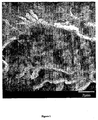
- Figure 1 is a scanning electron microscopy (SEM) image showing the interlaminar fracture surface (resin-rich area) of a nanoporous epoxy-based electrical laminate.
- the process of the present invention includes, as a first step, reacting (a) an organic resin that is an epoxy resin having hydrogen active groups with (b) a compound containing a thermolabile group, so as to graft the thermolabile group onto the backbone of the organic resin by the reaction of the compound containing the thermolabile groups with the hydrogen active groups of the organic resin.
- thermolabile groups are degraded by subjecting the modified organic resin to a sufficient temperature, typically temperatures of from about 120°C to about 220°C, to thermally degrade the thermolabile groups, which in turn produces nano size voids in the organic resin matrix.
- a sufficient temperature typically temperatures of from about 120°C to about 220°C
- heating the organic resin for thermolabile group degradation is typically carried out during the pressing step of the laminate.
- the organic resin may be selected from epoxy resins.
- the hydrogen active groups can be selected from, for instance, amines, phenols, thiols, hydroxyls or alcohols, amides, lactams, carbamates, pyrroles, mercaptans, imidazoles, and guanidine.
- the compound containing a thermolabile group may be a dicarbonate and its derivatives, a carbazate and its derivatives, and other compounds containing tert-butyl carbonate.
- examples of compounds containing thermolabile group are, but not limited to, di-tert-butyl dicarbonate, di-tert-amyl dicarbonate, diallyl pyrocarbonate, diethyl pyrocarbonate, dimethyl dicarbonate, dibenzyl dicarbonate, tert-butyl carbazate and mixtures thereof.
- the tert-butyl carbonate thermolabile group is advantageously stable to many nucleophiles and is not hydrolyzed under basic conditions, but it may be easily cleaved under mid-acidic conditions or by thermolysis.
- epoxy resins containing hydroxyl groups or phenolic resins can be advantageously used as the organic resin because epoxy resins are widely used in the electrical laminates industry and epoxy resins offer good processability.
- Di-tert-butyl dicarbonate can be conveniently used as the thermolabile group-containing compound because it is commercially available in large volumes.
- the initial unmodified epoxy resin used may be any known epoxy resin chosen for its expected performance, for example, brominated or bromine-free standard or high Tg standard, or low Dk standard and the like.
- the thermolabile groups also called "foaming agent”
- the modified resin is stable at ambient temperature. During polymerization, thermolabile groups degrade, leading to gas generation which, in turn, produce voids in the polymerized epoxy resin matrix. Because the foaming agent is directly grafted onto the epoxy molecule, the statistical repartition of the voids is highly improved in comparison to the addition of non-grafted foaming agents.
- the voids in the epoxy matrix are smaller (for example, the diameter of the voids may be less than 200 nm) and well-dispersed within the laminate.
- the continuous epoxy matrix gives thermal resistance and mechanical integrity to the system, whereas the voids decrease the dielectric constant, resulting in low Dk electrical laminates.
- laminates having a Dk measured at 1 GHz of less than 5 may be obtained, however, laminates having a Dk measured at 1 GHz of less than 4.2, preferably less than 4.0, more preferably less than 3.8, even more preferably less than 3.5, may be obtained.
- an epoxy resin is reacted directly, in an aprotic solvent, with a compound containing a thermolabile group to form a modified epoxy resin.
- thermolabile group is first reacted with a phenolic compound and then the resulting reaction product, a modified phenolic compound, is used as a curing agent to react with an epoxy resin, such as to introduce the thermolalide groups into the epoxy resin and form a modified epoxy resin.
- thermolabile group used is selected such that the weight percent of thermolabile groups in a final formulation or varnish composition is from about 0.01 weight percent (wt percent) to about 10 wt percent, preferably from about 0.1 wt percent to about 5 wt percent, and more preferably from about 0.2 wt percent to about 2.5 wt percent.
- the weight percentage of the composition above is given based on solids.
- a catalyst can be added to the composition to accelerate the reaction between the compound containing the thermolabile group and the hydrogen active groups of the organic resin.
- hydroxylamine is known to catalyze the tertiary butoxy carbonylation of alkylamines at room temperature ( ⁇ 25°C).
- dimethyl aminopyridyne acts as a catalyst for the reaction between hydroxyl groups or phenols and di-tert-butyl dicarbonate at room temperature.
- Other catalysts useful in the present invention include, for example, auxiliary bases such as triethylamine or N,N-diisopropylethylamine.
- an epoxy resin having an average of more than one epoxy group per molecule and, on average, more than zero hydroxyl group per molecule may be used.
- the epoxy resin may be selected from (1) an epoxy resin having an average of more than one epoxy groups per molecule and, on average, one or more hydroxyl groups per molecule, (2) a mixture of (1) and an epoxy resin having an average of more than one epoxy groups per molecule but no hydroxyl groups.
- the exact selection of the epoxy resin component is determined from the intended properties of the final products.
- Suitable epoxy resins, as used herein, include, for example, those having an epoxy equivalent weight of about 170 to about 3,500. Such epoxy resins are well described in, for example, U.S. Patent Nos.
- Epoxy resins which can be used as one epoxy resin component in the present invention, may be represented by the general Formula (I): wherein A is independently a divalent chemical bond, a divalent hydrocarbon group suitably having from 1 to about 10, preferably from 1 to about 5, more preferably from 1 to about 3 carbon atoms, --S--, --S--S--, --SO--, --SO 2 --, --CO-- or --O--; each R is independently a hydrogen atom or an alkyl group suitably having from 1 to about 3 carbon atoms; each X is independently a hydrogen atom or an alkyl group suitably having from 1 to about 10, preferably from 1 to about 5, more preferably from 1 to about 3 carbon atoms, or a halogenated atom such as Br or Cl; and n is a number lower than about 12.
- A is independently a divalent chemical bond, a divalent hydrocarbon group suitably having from 1 to about 10, preferably from 1 to about 5, more preferably from 1 to about 3 carbon atoms,
- the epoxy resin component used in the present invention may comprise a multi-functional epoxy resin having an average of more than two epoxy groups per molecule.
- Preferred multi-functional epoxy resins include, for example, cresol-formaldehyde novolac epoxy resin, phenol-formaldehyde novolac epoxy resin, bisphenol A novolac epoxy resin, dicyclopentadiene phenol Novolac epoxy resin, tris(glycidyloxyphenyl)methane, tetrakis(glycidyloxyphenyl)ethane, tetraglycidyldiaminodiphenylmethane and mixtures thereof.
- tris(glycidyloxyphenyl)methane, tetrakis(glycidyloxyphenyl)ethane and tetraglycidyldiaminodiphenylmethane are preferred.
- a cresol-formaldehyde novolac epoxy resin, phenol-formaldehyde novolac epoxy resin and bisphenol A novolac epoxy resin are preferred.
- dicyclopentadiene phenol novolac epoxy resin is preferred.
- it is preferable to use a multifunctional epoxy resin having narrow molecular weight distribution for example, a Mw/Mn value of from about 1.5 to about 3.0).
- a suitable organic solvent can be used during the preparation of the modified organic resin of the present invention to lower the viscosity of the resin.
- Suitable organic solvents useful in the present invention include solvents that do not contain hydrogen active groups.
- aprotic solvents may be conveniently used, such as, for example, ketones such as acetone, methyl ethyl ketone (MEK), and methyl isobutyl ketone; acetate of glycol ethers such as propylene glycol monomethyl ether acetate (DOWANOL PMA); aromatic organic solvents such as toluene and xylene; aliphatic hydrocarbons; cyclic ethers; halogenated hydrocarbons; and mixtures thereof.
- ketones such as acetone, methyl ethyl ketone (MEK), and methyl isobutyl ketone
- acetate of glycol ethers such as propylene glycol monomethyl ether acetate (DOWANOL PMA)
- thermolabile t-butyloxycarbonyl groups may be grafted onto an epoxy backbone through the reaction with hydroxyl groups.
- brominated epoxy resins such as D.E.R. 560 or D.E.R. 539-EK80 and non-brominated epoxy resins such as D.E.R. 669E, all commercially available from The Dow Chemical Company, may be successfully modified in industrial solvents such as MEK or DOWANOL PMA.
- phenolic resins and phenolic derivatives may also be modified according to the present invention.
- a few examples of commercially available phenolic resin include cresol novolac; bisphenol A novolac such as BPN17, commercially available from Arakawa; and mixtures thereof.
- Examples of phenolic derivatives include bisphenol A, bisphenol F, bisphenol S, tetrabromo bisphenol A, hydroquinone, and mixtures thereof.
- Other phenolic resins and phenolic derivatives including dihydric phenols, halogenated dihydric phenols, polyhydric phenols, and halogenated polyhydric phenols useful in the present invention are described in PCT Application WO 01/42359A1 and The Handbook of Epoxy Resins by H. Lee and K. Neville, published in 1967 by McGraw-Hill, New York , all of which are incorporated herein by reference.
- the organic resin shows generally a lower viscosity in organic solvent after modification. Although not wishing to be bound by any theory, it would appear that the lower solution viscosity could be due to the decrease of the hydrogen-bonding effect, because of the grafting of the thermolabile group of the hydroxyl functionalities.
- epoxy resins are partly or fully modified to epoxy carbonate resins, for example, by carbonation of the epoxy group of an epoxy resin under CO 2 pressure at the appropriate temperature, such as, for example, 80°C with an adequate ion exchange resin.
- epoxy carbonate resins can be used as the epoxy resin component to obtain modified epoxy resins with thermolabile groups.
- the modified epoxy resins are advantageously used in producing a laminate.
- the thermolabile groups degrade and generate volatile products, creating a porous matrix within the laminate resulting in a laminate with a reduced dielectric constant.
- Most of the key properties of systems using the present invention are not changed by the modified resins, such as varnish reactivity, prepreg processability, and laminate performances, such as thermal properties, flame retardancy, drillability, chemical cleaning, and etching, and the like.
- the dielectric constant of the resulting laminate is advantageously reduced.
- Nanoporous laminates of the present invention may show an improvement of up to 20 percent compared to the same epoxy system without nanopores.
- the foaming agent is directly grafted onto the epoxy molecule, voids are small (for example, 60 nm or less) and well-dispersed within the laminate.
- the resulting laminate is homogeneous and, depending on the formulation, may be transparent, opalescent or opaque.
- the toughness of the laminate can be improved compared to the same organic system without nanopores.
- the nanovoids may act as energy disperser for cracks, by increasing the radius at the crack front line when the pores size is adequate. Because the resin matrix is not altered by the nanoporous structure, the glass transition temperature should not be negatively impacted.
- laminators can produce laminates with improved dielectric constants, while at the same time, laminators can carry on their expertise generated with previously existing epoxy products, that is, same requirements for material handling, same formulation techniques, and same production conditions. Moreover, laminators can use current glass reinforcements and copper foils. The registration of the laminates remains the same.
- the epoxy resin compositions of the present invention may comprise, as an optional component, catalysts for catalyzing the reaction of the epoxy groups of the epoxy resin and the hydroxyl groups of the curing agent.
- catalysts for catalyzing the reaction of the epoxy groups of the epoxy resin and the hydroxyl groups of the curing agent.
- Such catalysts are described in, for example, U.S. Patent Nos.
- the suitable catalysts are imidazoles such as 2-methylimidazole; 2-phenyl imidazole and 2-ethyl-4-methyl imidazole; tertiary amines such as triethylamine, tripropylamine and tributylamine; phosphonium salts such as ethyltriphenylphosphonium chloride, ethyltriphenylphosphonium bromide and ethyltriphenyl-phosphonium acetate; and ammonium salts such as benzyltrimethylammonium chloride and benzyltrimethylammonium hydroxide, and mixtures thereof.
- the amount of the catalysts used in the present invention generally ranges from about 0.001 weight percent to about 2 weight percent, and preferably from about 0.01 to about 0.5 weight percent, based on the total weight of the reaction mixture.
- imidazoles may be partly or fully modified with a compound containing a thermolabile group to form a latent catalyst.
- the epoxy resin composition of the present invention may comprise known curing agents.
- curing agents include, for example, amine-curing agents such as dicyandiamide, diaminodiphenylmethane and diaminodiphenylsulfone; anhydrides such as hexahydroxyphthalic anhydride and styrene-maleic anhydride copolymers; imidazoles; and phenolic curing agents such as phenol novolac resins; and mixtures thereof.
- Such curing agents can be added to the composition immediately before curing, or can be included in the composition from the beginning if they are latent.
- the amount of the curing agents used may normally range from about 0.3 to about 1.5 equivalent per epoxy equivalent of the epoxy components, and preferably from about 0.5 to about 1.1 equivalent per epoxy equivalent of the epoxy components.
- Imidazoles can be used to promote epoxy homopolymerization. Depending on the varnish composition, a pure homopolymerized epoxy network can be obtained, or a hybrid network can be formed between the homopolymerized epoxy and the epoxy/hardener network.
- the epoxy resin composition may also include a suitable organic solvent component to make handling of the epoxy resin varnish easier, and such solvents are added to lower the viscosity of the above compositions.
- Known organic solvents can be used.
- the solvents useful in the present invention include, for example, ketones such as acetone and methyl ethyl ketone; alcohols such as methanol and ethanol; glycol ethers such as ethylene glycol methyl ether and propylene glycol monomethyl ether; acetate of glycol ethers such as propylene glycol monomethyl ether acetate; amides such as N,N-dimethylformamide; aromatic organic solvents such as toluene and xylene; aliphatic hydrocarbons; cyclic ethers; and halogenated hydrocarbons.
- the amount of the organic solvent employed may range from about 10 to about 60 parts by weight, and preferably from about 20 to about 40 parts by weight, based on 100 parts by weight of the above epoxy resin composition.
- the epoxy resin compositions of the present invention may comprise a suitable stabilizer.
- suitable stabilizers include, for example, alkylphenylsulfonates or halogenated alkylphenylsulfonates such as methyl-p-toluenesulfonate, ethyl-p-toluenesulfonate and methyl-p-chlorobenzenesulfonate.
- a preferred suitable stabilizer used in the present invention is methyl-p-toluenesulfonate.
- the stabilizer may suitably be used in an amount of from about 0.001 to about 10 weight percent, and more suitably from about 0.01 to about 2 weight percent, based on the total amount of the composition.
- the epoxy resin compositions of the present invention may comprise an effective amount of other commonly employed additives for epoxy resins, for example, a reaction accelerator, pigment, dye, filler, surfactant, viscosity controller, flow modifier, flame retardant and mixtures thereof.
- a reaction accelerator for example, a reaction accelerator, pigment, dye, filler, surfactant, viscosity controller, flow modifier, flame retardant and mixtures thereof.
- the organic resin composition of the present invention is prepared by contacting an appropriate amount of the organic resin with the compound containing the thermolabile group, and with optional additives, such as solvent and catalyst; and reacting the mixture to modify the organic resin to introduce the thermolabile groups into the back bone of the organic resin resulting in a modified organic resin.
- the reaction conditions for the above reaction are selected to insure an efficient reaction between the compound containing the thermolabile group and the hydrogen active group of the organic resin.
- the reaction temperature is usually limited by the thermal stability of the thermolabile compound.
- the reaction generally processes around room temperature (about 25°C), but can be from about 10°C to about 50°C, preferably between about 15°C and about 40°C, and more preferably between about 20°C and about 35°C; for a period of from about 0.1 hour (h) to about 72 h, preferably from about 0.2 h to about 24 h, and more preferably from about 0.5 h to about 12 h.
- the above-modified organic resin, a curing agent and other desired additives are mixed to prepare a varnish.
- the varnish is then impregnated into a substrate or web.
- the obtained impregnated substrate is dried at, for example, from about 90°C to about 210°C, and preferably about 130°C to about 200°C; for about 0.5 minute to about 60 minutes, and preferably from about 0.5 minute to about 30 minutes to obtain an organic resin-based prepreg.
- the substrate may include, for example, glass cloth, glass fiber, glass paper, paper, and similar organic substrates such as polyethylene, polypropylene, aramid fibers and polytetrafluoroethylene (PTFE) fibers.
- PTFE polytetrafluoroethylene
- the impregnated substrate is dried below the decomposition temperature of the grafted thermolabile group. Consequently, no foaming or very limited foaming occurs during the drying stage, resulting in a prepreg with an improved cosmetic aspect.
- the obtained prepreg is then cut into a desired size.
- One single cut prepreg or a plurality of cut prepregs are laminated and subjected to pressing at a pressure of, for example, from about 1 kgf/cm 2 to about 50 kgf/cm 2 , and preferably from about 2 kgf/cm 2 to about 40 kgf/cm 2 ; at a temperature of, for example, from about 120°C to about 220°C; for a period of time of, for example, from about 0.5 hour to about 3 hours to obtain a laminate.
- the thermolabile groups are degraded and nanopores are formed in the laminate.
- multi-stage pressing can be advantageously used during lamination.
- a lower pressure of, for example, from about 1 kgf/cm 2 to about 10 kgf/cm 2 may be first applied at a lower temperature of, for example, from about 120°C to about 160°C, for a period of, for example, from about 0.1 h to about 1 h.
- full pressure of, for example, from about 5 kgf/cm 2 to about 50 kgf/cm 2 may be applied at a higher temperature of, for example, from about 160°C to about 220°C, for a period of time of, for example, from about 0.5 h to about 2 h.
- Multi-stage pressing can be used to control the morphology of the nanoporous laminate. It has been generally observed that, for a given volume fraction of voids, smaller and better dispersed pores lead to lower Dk than bigger and more aggregated pores.
- An electrical conductive layer may be formed on the laminate with an electrical conductive material.
- suitable electrical conductive materials include, for example, electrical conductive metals such as copper, gold, silver, platinum and aluminum.
- metal foil such as copper foil
- the varnish then may be partly cured (B-stage) or fully cured (C-stage) to obtain a resin coated metal foil, such as resin coated copper foil.
- the electrical laminates manufactured, as described above, can be preferably used as copper clad laminates and multi-layer printed circuit boards for electrical or electronics equipment.
- the anhydride hardener solution (“AH1") used in the examples was prepared as follows:
- a brominated epoxy resin, D.E.R. 560 was chemically modified with di-tert-butyl dicarbonate groups using the following composition: Component Amount D.E.R. 560 250 g DIBOC 30.4 g DMAP 1.01 g dichloromethane 200 g
- the epoxy resin was first dissolved in dichloromethane (CH 2 Cl 2 ) at 25°C in an Erlenmeyer flask with a magnetic stirrer. After complete dilution, solid di-ter-butyl dicarbonate was added to the resulting solution. Then a solution of dimethyl amino pyridine in dichloromethane was slowly charged into the solution in the flask. The resulting solution was stirred at ambient temperature for about 18 hours to ensure complete conversion.
- dichloromethane CH 2 Cl 2
- the dichloromethane was evaporated in a ROTAVAPOR under vacuum, from ambient temperature to 50°C.
- the dry resin was solid at room temperature.
- the thermal characterization was done by TGA.
- D.E.R. 560 was stable to > 200°C.
- D.E.R. 560 started to decompose around 230°C-250°C because of the standard thermolysis of the bromine groups.
- Modified D.E.R. 560 started to decompose at lower temperature because of the thermolabile groups. A significant weight loss was seen between 170°C and 220°C (4.77 percent), before the degradation of the bromine groups. The weight loss was due to the thermal breakdown of the thermolabile carbonate groups grafted onto the resin backbone, leading to CO 2 and isobutene evaporation. At higher temperature (T > 230°C-250°C), the standard thermolysis of the bromine groups finally occurred.
- a brominated epoxy resin, D.E.R. 560 was modified with di-tert-butyl dicarbonate groups using the same chemical modification procedure used in Example 1, except with the compositions as show in Table I below.
- Table I Component
- Example 2A Example 2B
- Example 2C Example 2D D.E.R. 560 (g) 250 250 250 250 MEK
- 118 118 118 DOWANOL PMA g
- 118 DIBOC g
- DMAP 0.51 0.17 0.085 0.085
- the modified resins in MEK or DOWANOL PMA could be used directly after modification, without stripping the reaction solvent.
- a brominated epoxy resin, D.E.R. 560 was chemically modified with di-tert-butyl dicarbonate groups using the same chemical modification procedure as the one described in Example 1, except using the following composition: Component Amount D.E.R. 560 2452.4 g DIBOC 147.2 g DMAP 0.41 g DOWANOL PMA 1400.1 g
- Di-tert-butyl dicarbonate was charged to a reactor at ambient temperature within 3 hours, and then the solution was kept at ambient temperature for 4 hours.
- the modified resin was used without further purification, and without stripping the DOWANOL PMA from the resin.
- NMR spectra showed that the chemical modification was successful and that no residual di-tert-butyl dicarbonate remained in the solution. NMR spectra also showed a portion of unreacted secondary hydroxyl groups because of the under-stochiometric amount of di-tert-butyl dicarbonate.
- azodicarbonamide a known foaming agent, was used as an additive foaming agent and not grafted onto the organic resin; and compared with a reference material without azodicarbonamide or any other foaming agent as described in Table III below.
- Example 7A 50 percent modified D.E.R. 560
- Example 7B 100 percent modified D.E.R. 560
- D.E.N. 438 [80 percent N.V. in MEK]
- g 31.53 36.03
- D.E.R. 560 [70 percent N.V. in cyclohexanone]
- 17.29 modified D.E.R. 560 [70 percent in cyclohexanone]
- modified D.E.R. 560 prepared according to Example 1, did not change the reactivity of the resin and Tg remained similar. Also, no thermal degradation was observed during a DSC scan of the fully cured laminate sample up to 230°C, which means that all thermolabile groups were degraded during the pressing stage. By increasing the amount of modified D.E.R. 560, the appearance of the laminate changed from whitish translucent to white opaque because of bigger and more numerous pores.
- modified D.E.R. 560 prepared according to Example 1, did not change the reactivity of the varnish and thermal stability remained similar.
- the modified brominated epoxy resin D.E.R. 560 still acted as an efficient fire retardant (UL94 V-0).
- the increase of modified D.E.R. 560 changed the appearance of the laminate, from clear yellow to white opaque, due to larger and more numerous pores.
- the dielectric constant of the nanoporous materials in Examples 8A and 8B is much lower than the reference in Comparative Example III.
- Bubbles in Example 8B are visible under the optical microscope. These bubbles are about 10-100 ⁇ m in diameter. Bubbles in the two other samples were not visible under these conditions.
- Example 8A Transmission electron microscopy of Example 8A showed very small bubbles in the range of from 0.01 ⁇ m to 0.15 ⁇ m, with a number mean average diameter of 0.059 ⁇ m.
- the reference Comparative Example III shows no bubbles under these conditions.
- modified D.E.R. 560 prepared according to Example 2D, was used in a formulation of the present invention and compared to Comparative Example IV without the modified D.E.R. 560, as described in the following Table VI. Table VI. FORMULATION Comparative Example IV (reference)
- Example 9 nanoporous) D.E.N. 438 [80 percent N.V. in MEK] (g) 189.69 189.69 modified D.E.R. 560 [70 percent N.V. in DOWANOL PMA] (g) 0.00 121.11 D.E.R. 560 [70 percent N.V.
- Example 9 The above results show that the use of modified D.E.R. 560, prepared according to Example 2D, did not change the reactivity of the varnish; and Tg, thermal stability and flame retardancy remained similar.
- the dielectric constant of the nanoporous material in Example 9 is much lower than the reference in Comparative Example IV.
- D.E.R. 560 was modified according to the procedure described in Example 2D and used in the formulations described in Table VII below.
- Example 10A 50 percent modified D.E.R. 560
- Example 10C 100 percent modified D.E.R. 560
- EPPN502H [80 percent N.V. in MEK]
- g 197.418 197.418 197.418 D.E.N. 438
- 80 percent N.V. in MEK (g) 131.615 131.615 131.615 D.E.R. 560 [70 percent N.V.
- D.E.R. 560 was modified according to the procedure described in Example 3 and used in the formulations described in Table VIII below. The results of using varying amounts of the modified D.E.R. 560 are described in the following Table VIII. Table VIII. FORMULATION Comparative Example VI (0 percent modified D.E.R. 560) Comparative Example 11A (50 percent modified D.E.R. 560 High Pressure) Comparative Example 11B (50 percent modified D.E.R. 560 Low Pressure) SMA 3000 [50 percent N.V. in DOWANOL PMA/MEK] (g) 2380.8 2821.2 D.E.R. 560 [70 percent N.V. in DOWANOL PMA] (g) 1799.0 modified D.E.R.
- modified D.E.R. 539 prepared according to the procedure described in Example 4B, were used. As shown in Table IX below, the use of modified D.E.R. 539 did not change the reactivity of the varnish and Tg remained similar. The increase of modified D.E.R. 539 changed the appearance of the laminate, from clear yellow to white opaque, due to larger pores or due to a higher volume fraction of voids. Table IX. FORMULATION Comparative Example VII (0 percent modified D.E.R. 539) Example 12A (50 percent modified D.E.R. 539) Example 12B (100 percent modified D.E.R. 539) D.E.R. 539-EK80 [80 percent N.V.
- D.E.R. 560 was modified according to the procedure described in Example 3, except with the composition described in the following Table X. The results of measurements carried out on the composition are also described in the following Table X. Table X.
- a modified brominated epoxy resin solution was prepared in a 5 L glass reactor, equipped with a mechanical stirrer, and a heating jacket; and fitted with a N 2 inlet and an addition funnel. 1225.4 Grams of DOWANOL PMA, 2275.8 g of solid D.E.R. 560 and 310.3 g of E.R.L. 4299 were charged into the reactor, and the solution was heated to 90°C. After complete dilution, the solution was cooled down to 25°C. 136.5 Grams of di-tert-butyl dicarbonate and 0.38 g of dimethyl aminopyridine were added to the solution in 4 portions over a period of 2 hours. Foaming occurred after multiple charges of di-tert-butyl dicarbonate and dimethyl aminopyridine.
- Modified bisphenol-A phenol novolac solutions were prepared in a glass reactor, equipped with a mechanical stirrer, and a heating jacket; and fitted with a N 2 inlet and an addition funnel.
- the percentage of modification of BPN17 was 5.3 percent, 10 percent, 50 percent and 100 percent for Example 15A, Example 15B, Example 15C and Example 15D, respectively, as shown in Table XI below.
- the solutions of BPN17 were charged into the reactor and di-tert-butyl dicarbonate and dimethyl aminopyridine were incorporated into the solutions in portions over a period of 2 h. Foaming occurred after the charges of di-tert-butyl dicarbonate and dimethyl aminopyridine were introduced into the reactor.
- Example 15A Example 15B
- Example 15C Example 15D reaction temperature (°C) 35 35 20-30 35 BPN17 [50 percent solids] (g) 3293.0 592.6 459.8 320.2 DIBOC [80 percent solids in toluene] (g) 198.2 67.3 261.0 363.5
- DMAP (g) 0.44 0.15 1.17 0.81 PROPERTIES percent modification of the phenolic groups (calculated) (percent) 5.3 10 50 100
- thermolabile groups were used to prepare the formulations as described in the following Table XII. Table XII.
- Table XII. FORMULATION Example 16A
- Example 16B Example 16C
- Example 16D Comparative Example VIII (reference) E-BPAPN solution [79.6 percent solids] (g) 31.66 31.66 21.10 21.10 21.10 boric acid solution [20 percent solids in methanol] (g) 1.23 1.23 0.82 0.82 0.82 modified BPN17 as described in Example 15C [58 percent solids] (g) 16.57 8.28 2.21 1.10 0 BPN17 solution [50 percent solids] (g) 0 9.58 10.22 11.50 12.78 TBBA (g) 9.90 9.90 6.60 6.60 6.60 2-phenyl imidazole solution [20 percent solids] (g) 0.38 0.38 0.25 0.25 DOWANOL PM (g) 9.50 8.20 4.95 4.78 4.60 PROPERTIES stroke cure reactivity @170° (s) 125 204
- thermolabile groups were used to prepare the formulations as described in the following Table XIII. Table XIII.
- Table XIII. FORMULATION Example 17A Example 17B Example 17C Example 17D Comparative Example IX (reference) E-BPAPN solution [79.6 percent solids] (g) 31.66 31.66 21.10 21.10 21.10 boric acid solution [20 percent solids in methanol] (g) 1.23 1.23 0.82 0.82 0.82 modified BPN17 as described in Example 15C [58 percent solids] (g) 16.57 8.28 2.21 1.10 0 BPN17 solution [50 percent solids] (g) 0 9.58 10.22 11.50 12.78 TBBA (g) 9.90 9.90 6.60 6.60 6.60 2-PhI solution [20 percent solids] (g) 0.60 0.60 0.60 0.60 0.60 0.60 DOWANOL PM (g) 9.50 8.20 4.95 4.78 4.60 PROPERTIES film appearance [cure schedule: 30 minutes @130°C + 30 minutes @140°C + 90
- Example 16 illustrates that the final morphology of the epoxy matrix varies with the concentration of thermolabile groups.
- a comparison between Example 16 and Example 17 shows that the final morphology of the epoxy matrix varies with the processing conditions, such as the curing temperature.
- Example 18 E-BPAPN solution [79.6 percent solids] (g) 248.0 248.0 modified BPN17 as described in Example 15B [58 percent solids] (g) 129.9 BPN17 solution [50 percent solids] (g) 150.4 TBBA (g) 77.4 77.4 2-MI solution [20 percent solids] (g) 8.75 8.75 acetone (g) 30.2 50.7 PROPERTIES stroke cure gel time @130°C (s) 180 175 film appearance [cure schedule: 15 minutes @ 130°C + 60 minutes @ 190°C] clear, almost no bubbles clear very fine bubbles film Tg (mid point): Tg1 (1 st scan)/Tg2 (2 nd scan) (°C) 195.7/205.5 198.7/213.7
- a modified brominated epoxy resin solution was prepared in a 5 L glass reactor, equipped with a mechanical stirrer, and a heating jacket; and fitted with a N 2 inlet and an addition funnel.
- 1131.9 Grams of DOWANOL PMA and 2102.1 g of solid D.E.R. 560 were charged into the reactor and the solution was heated to 90°C. After complete dilution, the solution was cooled down to 35°C.
- 254.6 Grams of di-tert-butyl dicarbonate solution (80 percent solids in toluene) and 11.4 g of dimethyl aminopyridine solution (5 percent solids in MEK) were added to the solution drop-wise over a period of 30 minutes.
- Epoxy Blend An epoxy resin solution was prepared by blending 608 g of D.E.R. 330, 392 g of D.E.R. 6615 and 420 g of acetone (herein "Epoxy Blend"). 28.4 Grams of the Epoxy Blend resin solution were weighed in glass bottles. Magnetic stirrers were placed in the bottles and the temperature was controlled at 22°C. Dicarbonate and dimethyl aminopyridine were incorporated into the solution over a period of 30 minutes. The table below describes the compositions used. The solutions were stirred for 24 h at 22°C. After this period of time, solvent was removed in a vacuum oven at 22°C for 24 h. Clear, very viscous liquids were finally obtained.
- Example 20A Example 20B
- Example 20C Exampl e 20D
- Example 20E Epoxy Blend solution [70.4 percent solids] (g) 28.4 28.4 28.4 28.4 28.4 28.4 28.4 DIBOC (g) 2.25 di-tert-amyl dicarbonate (g) 2.23 diallyl pyrocarbonate (g) 2.31 diethyl pyrocarbonate (g) 2.30 dimethyl pyroarcbonate (g) 2.35 DMAP [5 percent solids in MEK] (g) 0.76 0.66 0.91 1.04 1.28 PROPERTIES percent modification of the secondary hydroxyl groups (calculated) (percent) 0 50.8 44.6 61.1 69.9 86.4 weight percent of grafted carbonate (calculated) 0 5 5 5 5 5 temperature at 1 weight percent loss measured
- Example 20C gelled during heating to 190°C. This could be due to reactive multifunctional molecules coming from the decomposition product released during the cleavage of the thermolabile group.
- a modified 2-ethyl-4-methyl imidazole solution was prepared in a glass bottle, equipped with a magnetic stirrer. 11.0 Grams of 2-ethyl-4-methyl imidazole solution (20 percent solids in DOWANOL PMA) was weighed in the glass bottle; and 5.45 g of di-tert-butyl dicarbonate solution (80 percent solids in toluene) was incorporated into the solution drop-wise over a period of 5 minutes, at 20°C. Foaming happened during the incorporation of di-tert-butyl dicarbonate. After all of the di-tert-butyl dicarbonate had been incorporated into the bottle, the solution was stirred for 48 h at 20°C. No foaming was noticed after this period of time. The solution was transparent.
- modified 2-ethyl-4-methyl imidazole solution from Example 23 acts as a latent/blocked catalyst.
- the modified 2-ethyl-4-methyl imidazole solution from Example 23 shows no catalytic activity or a much lower catalytic activity than 2-ethyl-4-methyl imidazole.
- the catalytic activity of the modified 2-ethyl-4-methyl imidazole solution from Example 23 increases.
- the modified 2-ethyl-4-methyl imidazole solution from Example 23 shows almost the same catalytic efficiency than 2-ethyl-4-methyl imidazole at a temperature higher than the unblocking temperature.
- a modified phenol novolac solution was prepared in a glass bottle, equipped with a magnetic stirrer. 21.51 Grams of XZ-92535 phenol novolac resin solution (50 percent solids in DOWANOL PMA) were weighed in the glass bottle. The phenol novolac resin was modified with a stochiometric amount of di-tert-butyl dicarbonate in order to cap all phenol groups. 28.15 Grams of di-tert-butyl dicarbonate solution (80 percent solids in toluene) and 0.38 g of dimethyl aminopyridine (solid) were incorporated into the solution in 5 portions over a period of 1h, at 20°C while stirring.
- the Cannon-Fenske viscosity of XZ-92535 was 1166.1 cSt; and the Cannon-Fenske viscosity of the modified XZ-92535 was 29.1 cSt.
- a modified brominated epoxy resin solution was prepared in a glass bottle, equipped with a magnetic stirrer. 139.3 Grams of D.E.R. 560 brominated epoxy resin solution (70 percent solids in DOWANOL PMA) was weighed in the glass bottle. 10.6 Grams of di-tert-butyl dicarbonate solution (80 percent solids in toluene) and 0.143 g of dimethyl aminopyridine (solid) were incorporated into the solution in portions over a period of 15 minutes, at 25°C under stirring. Foaming happened during the incorporation of di-tert-butyl dicarbonate. After all of the di-tert-butyl dicarbonate was incorporated into the solution, the solution was stirred for 48 h at 25°C. No foaming was noticed after this period of time. The solution was transparent, with a low viscosity.
- the Cannon-Fenske viscosity of D.E.R. 560 brominated epoxy resin solution was 262.3 cSt; and the Cannon-Fenske viscosity of the modified D.E.R. 560 brominated epoxy resin solution was 198.0 cSt.
- the addition proceeded over a 30-minute time period to reduce the amount of foaming in the reactor. After the addition was complete, the solution was stirred for an additional 3 hours. At the beginning of this time period, the solution was dark brown in color and filled with bubbles. At completion, no bubbles remained.
- Table XX FORMULATION modified D.E.R. 592 solution as described in Example 27 [76 percent solids] 7055 g XZ 92505 solution [50 percent solids] 643 g boric acid solution [20 percent solids] 161.7 g acetone 80 g 2E-4MI [10 percent solids] 1341.6 g PROPERTIES stroke cure reactivity @ 150°C 265 s prepreg residual gel time @170°C 81 s Table XXI.
- Example 29A Example 29B
- Example 29C Example 29D
- Example 29E pressing conditions 175°C for 60 minutes, 100 psi 175°C for 60 minutes, 60 psi 130°C for 15 minutes + 175°C for 60 minutes, 60 psi 175°C for 60 minutes, 45 psi 130°C for 15 minutes + 175°C for 60 minutes, 30 psi LAMINATE PROPERTIES appearance yellow and clear yellow and clear yellow and clear yellow and clear yellow and clear laminate Tg (mid point)
- a modified high molecular weight epoxy resin solution was prepared in a 1L glass reactor, equipped with a mechanical stirrer, and a heating jacket; and fitted with a N 2 inlet and an addition funnel.
- 316.6 Grams of D.E.R. 669E solution [40 percent NV in DOWANOL PMA] were charged into the reactor and the temperature was controlled between 25°C and 30°C.
- 118.8 Grams of di-tert-butyl dicarbonate solution [80 percent NV in toluene] and 5.32 g of dimethyl aminopyridine solution [10 percent N.V. in MEK] were added drop-wise to the solution over a period of 2 hours. Foaming occurred during the incorporation of di-tert-butyl dicarbonate and dimethyl aminopyridine. After all of the di-tert-butyl dicarbonate and dimethyl aminopyridine were incorporated into the solution, the solution was stirred for an extra 2 hours at 25°C. The solution was transparent. The theoretical epoxy equivalent weight was 4179 (based
- the modified D.E.R. 669E solution was then used as an epoxy-functional foaming agent additive in electrical laminates formulations.
- the Cannon-Fenske viscosity at 25°C of D.E.R. 669E solution [40 percent N.V.] was 1542 cSt; and the Cannon-Fenske viscosity at 25°C of the modified D.E.R. 669E solution [40.4 percent N.V.] was 743 cSt.
- Example 31 XZ-92567.01 [65 percent NV] 543.1 g 1994.2 g XZ-92568.01 [50 percent NV] 693.4 g 2351.4 g modified epoxy resin described in Example 30 [40 percent NV] 254.1 g DOWANOL PMA 58.4 g 122.4 g 2E-4MI [20 percent N.V.
- the loss factor Df was also reduced by 18 percent. Despite the nanoporous structure, the water uptake and the solder resistance remained unchanged.
- the strain energy release rate G Ic of the nanoporous laminate of the Example 31 was increased by over 32 percent compared to the non-porous Comparative Example XV with the same matrix composition, except the nanoporous additive.
- the fan-shaped epoxy fracture regions of the Example 31 indicate ductile deformation of the epoxy resin rich regions.
- the nanovoids can act as energy dispersers for cracks by increasing the radius at the crack front line, if the pores size is adequate. Despite the higher toughness, the glass transition temperature remained unchanged.
- Sub-micron size domains or cavities are noticed in the epoxy at higher magnification.
- the average pores diameter appears to be about 100 nm, ranging from less than 30 nm to less than 200 nm. Because of the distortion of the sample, precise analysis of the pores size was not performed on the SEM picture.
Landscapes
- Chemical & Material Sciences (AREA)
- Engineering & Computer Science (AREA)
- Health & Medical Sciences (AREA)
- Organic Chemistry (AREA)
- Chemical Kinetics & Catalysis (AREA)
- Medicinal Chemistry (AREA)
- Polymers & Plastics (AREA)
- General Chemical & Material Sciences (AREA)
- Nanotechnology (AREA)
- Materials Engineering (AREA)
- Microelectronics & Electronic Packaging (AREA)
- Crystallography & Structural Chemistry (AREA)
- Composite Materials (AREA)
- Condensed Matter Physics & Semiconductors (AREA)
- General Physics & Mathematics (AREA)
- Physics & Mathematics (AREA)
- Emergency Medicine (AREA)
- Manufacturing & Machinery (AREA)
- Laminated Bodies (AREA)
- Epoxy Resins (AREA)
- Compositions Of Macromolecular Compounds (AREA)
- Reinforced Plastic Materials (AREA)
- Manufacture Of Porous Articles, And Recovery And Treatment Of Waste Products (AREA)
Description
- The present invention relates to a process for preparing nanoporous substrates, such as electrical laminates having a low dielectric constant.
- It is known to make electrical laminates and other composites from a fibrous reinforcement and an organic matrix resin such as an epoxy-containing matrix. Examples of suitable processes usually contain the following steps:
- (1) An epoxy-containing formulation is applied to, or impregnated into, a substrate by rolling, dipping, spraying, other known techniques and/or combinations thereof. The substrate is typically a woven or nonwoven fiber mat containing, for instance, glass fibers or paper.
- (2) The impregnated substrate is "B-staged" by heating at a temperature sufficient to draw off solvent in the epoxy formulation and optionally to partially cure the epoxy formulation, so that the impregnated substrate can be handled easily. The "B-staging" step is usually carried out at a temperature of from 90°C to 210°C and for a time of from 1 minute to 15 minutes. The impregnated substrate that results from B-staging is called a "prepreg." The temperature is most commonly 100°C for composites and 130°C to 200°C for electrical laminates.
- (3) One or more sheets of prepreg are stacked or laid up in alternating layers with one or more sheets of a conductive material, such as copper foil, if an electrical laminate is desired.
- (4) The laid-up sheets are pressed at high temperature and pressure for a time sufficient to cure the resin and form a laminate. The temperature of this lamination step is usually between 100°C and 230°C, and is most often between 165°C and 190°C. The lamination step may also be carried out in two or more stages, such as a first stage between 100°C and 150°C and a second stage at between 165°C and 190°C. The pressure is usually between 50 N/cm2 and 500 N/cm2. The lamination step is usually carried out for a time of from 1 minute to 200 minutes, and most often for 45 minutes to 90 minutes. The lamination step may optionally be carried out at higher temperatures for shorter times (such as in continuous lamination processes) or for longer times at lower temperatures (such as in low energy press processes).
- Optionally, the resulting laminate, for example, a copper-clad laminate, may be post-treated by heating for a time at high temperature and ambient pressure. The temperature of post-treatment is usually between 120°C and 250°C. The post-treatment time usually is between 30 minutes and 12 hours.
- The current trend of the electrical laminates industry requires materials with improved dielectric properties including lower dielectric constant (Dk) and loss factor (Df); superior thermal properties including high glass transition temperature (Tg) and decomposition temperature (Td); and good processability.
- Heretofore, various methods have been used to try to improve the dielectric constant of electrical laminates made from epoxy-containing resin compositions including, for example, by adding various thermoplastic additives, such as polyphenylene oxide (PPO), polyphenylene ether (PPE), or allylated polyphenylene ether (APPE), to the epoxy-containing resin composition.
- It is desired to provide a new pathway to reduce the dielectric constant of electrical laminates made from organic resins. More particularly, it is desired to prepare modified organic resins, such as epoxy-containing resins, with thermolabile groups to lead to nanoporous matrixes upon curing.
- The present invention is directed to a process or making a nanoporous substrate comprising the steps of: (a) grafting onto an backbone of a reactive organic resin, a thermolabile functionality by reacting the hydrogen active groups of the reactive organic resin with a compound containing thermolabile group, wherein the organic resin is an epoxy resin; (b) preparing a composition by blending the reactive organic resin containing thermolabile groups grafted thereto from step (a) with at least a curing agent, and (c) thermally degrading the thermolabile groups grafted on the organic resin, such as to produce a nanoporous substrate. Such nanopores provide a low dielectric constant because of the air present in the nanopores and the lowest dielectric constant is for air.
- In one embodiment, the present invention is directed to a process of making nanoporous epoxy-based electrical laminates by modifying the epoxy resin backbone with a thermolabile group through the reaction of the hydroxyl groups of the epoxy resin, and then by thermally degrading the thermolabile groups. Advantageously, the nanoporous electrical laminate has a low dielectric constant (Dk) because of the nanopores present in the matrix. The process of the present invention also provides the following benefits: a nanoporous matrix with a controlled dispersion of nanopores; a controlled size of nanopores; a close porosity; and a standard processability of the laminate.
-
Figure 1 is a scanning electron microscopy (SEM) image showing the interlaminar fracture surface (resin-rich area) of a nanoporous epoxy-based electrical laminate. - Generally, the process of the present invention includes, as a first step, reacting (a) an organic resin that is an epoxy resin having hydrogen active groups with (b) a compound containing a thermolabile group, so as to graft the thermolabile group onto the backbone of the organic resin by the reaction of the compound containing the thermolabile groups with the hydrogen active groups of the organic resin.
- In a second step, the thermolabile groups are degraded by subjecting the modified organic resin to a sufficient temperature, typically temperatures of from about 120°C to about 220°C, to thermally degrade the thermolabile groups, which in turn produces nano size voids in the organic resin matrix. In laminate production, heating the organic resin for thermolabile group degradation is typically carried out during the pressing step of the laminate.
- In one embodiment of the present invention, the organic resin may be selected from epoxy resins. The hydrogen active groups can be selected from, for instance, amines, phenols, thiols, hydroxyls or alcohols, amides, lactams, carbamates, pyrroles, mercaptans, imidazoles, and guanidine.
- In another embodiment of the present invention, the compound containing a thermolabile group may be a dicarbonate and its derivatives, a carbazate and its derivatives, and other compounds containing tert-butyl carbonate. Examples of compounds containing thermolabile group are, but not limited to, di-tert-butyl dicarbonate, di-tert-amyl dicarbonate, diallyl pyrocarbonate, diethyl pyrocarbonate, dimethyl dicarbonate, dibenzyl dicarbonate, tert-butyl carbazate and mixtures thereof. The tert-butyl carbonate thermolabile group is advantageously stable to many nucleophiles and is not hydrolyzed under basic conditions, but it may be easily cleaved under mid-acidic conditions or by thermolysis.
- In one particular example of the present invention, epoxy resins containing hydroxyl groups or phenolic resins can be advantageously used as the organic resin because epoxy resins are widely used in the electrical laminates industry and epoxy resins offer good processability. Di-tert-butyl dicarbonate can be conveniently used as the thermolabile group-containing compound because it is commercially available in large volumes.
- In the present invention, the initial unmodified epoxy resin used may be any known epoxy resin chosen for its expected performance, for example, brominated or bromine-free standard or high Tg standard, or low Dk standard and the like. The thermolabile groups (also called "foaming agent") are grafted on the epoxy backbone through the reaction with the hydroxyl groups. The modified resin is stable at ambient temperature. During polymerization, thermolabile groups degrade, leading to gas generation which, in turn, produce voids in the polymerized epoxy resin matrix. Because the foaming agent is directly grafted onto the epoxy molecule, the statistical repartition of the voids is highly improved in comparison to the addition of non-grafted foaming agents. As a consequence, the voids in the epoxy matrix are smaller (for example, the diameter of the voids may be less than 200 nm) and well-dispersed within the laminate. The continuous epoxy matrix gives thermal resistance and mechanical integrity to the system, whereas the voids decrease the dielectric constant, resulting in low Dk electrical laminates. For example, generally, laminates having a Dk measured at 1 GHz of less than 5 may be obtained, however, laminates having a Dk measured at 1 GHz of less than 4.2, preferably less than 4.0, more preferably less than 3.8, even more preferably less than 3.5, may be obtained.
- In one embodiment of the present invention, an epoxy resin is reacted directly, in an aprotic solvent, with a compound containing a thermolabile group to form a modified epoxy resin.
- In another embodiment of the present invention, the thermolabile group is first reacted with a phenolic compound and then the resulting reaction product, a modified phenolic compound, is used as a curing agent to react with an epoxy resin, such as to introduce the thermolalide groups into the epoxy resin and form a modified epoxy resin.
- The amount of thermolabile group used is selected such that the weight percent of thermolabile groups in a final formulation or varnish composition is from about 0.01 weight percent (wt percent) to about 10 wt percent, preferably from about 0.1 wt percent to about 5 wt percent, and more preferably from about 0.2 wt percent to about 2.5 wt percent. The weight percentage of the composition above is given based on solids.
- Optionally, a catalyst can be added to the composition to accelerate the reaction between the compound containing the thermolabile group and the hydrogen active groups of the organic resin. For example, hydroxylamine is known to catalyze the tertiary butoxy carbonylation of alkylamines at room temperature (∼25°C). In another example, dimethyl aminopyridyne acts as a catalyst for the reaction between hydroxyl groups or phenols and di-tert-butyl dicarbonate at room temperature. Other catalysts useful in the present invention include, for example, auxiliary bases such as triethylamine or N,N-diisopropylethylamine.
- To prepare a modified epoxy resin of the present invention, an epoxy resin having an average of more than one epoxy group per molecule and, on average, more than zero hydroxyl group per molecule may be used. The epoxy resin may be selected from (1) an epoxy resin having an average of more than one epoxy groups per molecule and, on average, one or more hydroxyl groups per molecule, (2) a mixture of (1) and an epoxy resin having an average of more than one epoxy groups per molecule but no hydroxyl groups. The exact selection of the epoxy resin component is determined from the intended properties of the final products. Suitable epoxy resins, as used herein, include, for example, those having an epoxy equivalent weight of about 170 to about 3,500. Such epoxy resins are well described in, for example,
U.S. Patent Nos. 4,251,594 ;4,661,568 ;4,710,429 ;4,713,137 ; and4,868,059 , and The Handbook of Epoxy Resins by H. Lee and K. Neville, published in 1967 by McGraw-Hill, New York, all of which are incorporated herein by reference. - Epoxy resins, which can be used as one epoxy resin component in the present invention, may be represented by the general Formula (I):

- To further improve heat resistance, the epoxy resin component used in the present invention may comprise a multi-functional epoxy resin having an average of more than two epoxy groups per molecule. Preferred multi-functional epoxy resins include, for example, cresol-formaldehyde novolac epoxy resin, phenol-formaldehyde novolac epoxy resin, bisphenol A novolac epoxy resin, dicyclopentadiene phenol Novolac epoxy resin, tris(glycidyloxyphenyl)methane, tetrakis(glycidyloxyphenyl)ethane, tetraglycidyldiaminodiphenylmethane and mixtures thereof. To prevent the resultant reaction product from having high viscosity, tris(glycidyloxyphenyl)methane, tetrakis(glycidyloxyphenyl)ethane and tetraglycidyldiaminodiphenylmethane are preferred. In view of cost performance, a cresol-formaldehyde novolac epoxy resin, phenol-formaldehyde novolac epoxy resin and bisphenol A novolac epoxy resin are preferred. In view of dielectric performance, dicyclopentadiene phenol novolac epoxy resin is preferred. In addition, it is preferable to use a multifunctional epoxy resin having narrow molecular weight distribution (for example, a Mw/Mn value of from about 1.5 to about 3.0).
- Optionally, a suitable organic solvent can be used during the preparation of the modified organic resin of the present invention to lower the viscosity of the resin. Suitable organic solvents useful in the present invention include solvents that do not contain hydrogen active groups. Preferably, aprotic solvents may be conveniently used, such as, for example, ketones such as acetone, methyl ethyl ketone (MEK), and methyl isobutyl ketone; acetate of glycol ethers such as propylene glycol monomethyl ether acetate (DOWANOL PMA); aromatic organic solvents such as toluene and xylene; aliphatic hydrocarbons; cyclic ethers; halogenated hydrocarbons; and mixtures thereof.
- In one specific embodiment for illustration purposes, thermolabile t-butyloxycarbonyl groups may be grafted onto an epoxy backbone through the reaction with hydroxyl groups. For example, brominated epoxy resins such as D.E.R. 560 or D.E.R. 539-EK80 and non-brominated epoxy resins such as D.E.R. 669E, all commercially available from The Dow Chemical Company, may be successfully modified in industrial solvents such as MEK or DOWANOL PMA.
- In another specific embodiment, phenolic resins and phenolic derivatives may also be modified according to the present invention. A few examples of commercially available phenolic resin include cresol novolac; bisphenol A novolac such as BPN17, commercially available from Arakawa; and mixtures thereof. Examples of phenolic derivatives include bisphenol A, bisphenol F, bisphenol S, tetrabromo bisphenol A, hydroquinone, and mixtures thereof. Other phenolic resins and phenolic derivatives including dihydric phenols, halogenated dihydric phenols, polyhydric phenols, and halogenated polyhydric phenols useful in the present invention are described in
PCT Application WO 01/42359A1 - It is noteworthy that the organic resin shows generally a lower viscosity in organic solvent after modification. Although not wishing to be bound by any theory, it would appear that the lower solution viscosity could be due to the decrease of the hydrogen-bonding effect, because of the grafting of the thermolabile group of the hydroxyl functionalities.
- In another specific embodiment for illustration purposes, epoxy resins are partly or fully modified to epoxy carbonate resins, for example, by carbonation of the epoxy group of an epoxy resin under CO2 pressure at the appropriate temperature, such as, for example, 80°C with an adequate ion exchange resin. Such epoxy carbonate resins can be used as the epoxy resin component to obtain modified epoxy resins with thermolabile groups.
- The modified epoxy resins are advantageously used in producing a laminate. During the pressing stage of a laminate, for example, at 180°C, the thermolabile groups degrade and generate volatile products, creating a porous matrix within the laminate resulting in a laminate with a reduced dielectric constant. Most of the key properties of systems using the present invention are not changed by the modified resins, such as varnish reactivity, prepreg processability, and laminate performances, such as thermal properties, flame retardancy, drillability, chemical cleaning, and etching, and the like. However, the dielectric constant of the resulting laminate is advantageously reduced. Nanoporous laminates of the present invention may show an improvement of up to 20 percent compared to the same epoxy system without nanopores. Because the foaming agent is directly grafted onto the epoxy molecule, voids are small (for example, 60 nm or less) and well-dispersed within the laminate. For optimized processing conditions, the resulting laminate is homogeneous and, depending on the formulation, may be transparent, opalescent or opaque. When pores are adequately dispersed within the laminate and when the pore diameter is optimized, the toughness of the laminate can be improved compared to the same organic system without nanopores. Although not wishing to be bound to any theory, the nanovoids may act as energy disperser for cracks, by increasing the radius at the crack front line when the pores size is adequate. Because the resin matrix is not altered by the nanoporous structure, the glass transition temperature should not be negatively impacted.
- Additional advantages for laminators using the modified epoxy resins of the present invention are that laminators can produce laminates with improved dielectric constants, while at the same time, laminators can carry on their expertise generated with previously existing epoxy products, that is, same requirements for material handling, same formulation techniques, and same production conditions. Moreover, laminators can use current glass reinforcements and copper foils. The registration of the laminates remains the same.
- Additional advantages for producers of printed circuit boards, which incorporate the modified epoxy resins of the present invention, are that producers can use production conditions that are similar to previously existing epoxy systems. Producers can also obtain higher flexibility in systems design because they can tailor the dielectric constants of the same base material depending on the level of porosity.
- The epoxy resin compositions of the present invention may comprise, as an optional component, catalysts for catalyzing the reaction of the epoxy groups of the epoxy resin and the hydroxyl groups of the curing agent. Such catalysts are described in, for example,
U.S. Patent Nos. 3,306,872 ;3,341,580 ;3,379,684 ;3,477,990 ;3,547,881 ;3,637,590 ;3,843,605 ;3,948,855 ;3,956,237 ;4,048,141 ;4,093,650 ;4,131,633 ;4,132,706 ;4,171,420 ;4,177,216 ;4,302,574 ;4,320,222 ;4,358,578 ;4,366,295 ; and4,389,520 . - Examples of the suitable catalysts are imidazoles such as 2-methylimidazole; 2-phenyl imidazole and 2-ethyl-4-methyl imidazole; tertiary amines such as triethylamine, tripropylamine and tributylamine; phosphonium salts such as ethyltriphenylphosphonium chloride, ethyltriphenylphosphonium bromide and ethyltriphenyl-phosphonium acetate; and ammonium salts such as benzyltrimethylammonium chloride and benzyltrimethylammonium hydroxide, and mixtures thereof. The amount of the catalysts used in the present invention generally ranges from about 0.001 weight percent to about 2 weight percent, and preferably from about 0.01 to about 0.5 weight percent, based on the total weight of the reaction mixture.
- In another specific embodiment for illustration purposes, imidazoles may be partly or fully modified with a compound containing a thermolabile group to form a latent catalyst.
- The epoxy resin composition of the present invention may comprise known curing agents. Such curing agents include, for example, amine-curing agents such as dicyandiamide, diaminodiphenylmethane and diaminodiphenylsulfone; anhydrides such as hexahydroxyphthalic anhydride and styrene-maleic anhydride copolymers; imidazoles; and phenolic curing agents such as phenol novolac resins; and mixtures thereof. Such curing agents can be added to the composition immediately before curing, or can be included in the composition from the beginning if they are latent. The amount of the curing agents used may normally range from about 0.3 to about 1.5 equivalent per epoxy equivalent of the epoxy components, and preferably from about 0.5 to about 1.1 equivalent per epoxy equivalent of the epoxy components.
- Imidazoles can be used to promote epoxy homopolymerization. Depending on the varnish composition, a pure homopolymerized epoxy network can be obtained, or a hybrid network can be formed between the homopolymerized epoxy and the epoxy/hardener network.
- The epoxy resin composition may also include a suitable organic solvent component to make handling of the epoxy resin varnish easier, and such solvents are added to lower the viscosity of the above compositions. Known organic solvents can be used. The solvents useful in the present invention include, for example, ketones such as acetone and methyl ethyl ketone; alcohols such as methanol and ethanol; glycol ethers such as ethylene glycol methyl ether and propylene glycol monomethyl ether; acetate of glycol ethers such as propylene glycol monomethyl ether acetate; amides such as N,N-dimethylformamide; aromatic organic solvents such as toluene and xylene; aliphatic hydrocarbons; cyclic ethers; and halogenated hydrocarbons.
- In the practice of the present invention, the amount of the organic solvent employed may range from about 10 to about 60 parts by weight, and preferably from about 20 to about 40 parts by weight, based on 100 parts by weight of the above epoxy resin composition.
- To improve storage stability, the epoxy resin compositions of the present invention may comprise a suitable stabilizer. Suitable stabilizers, as used herein, include, for example, alkylphenylsulfonates or halogenated alkylphenylsulfonates such as methyl-p-toluenesulfonate, ethyl-p-toluenesulfonate and methyl-p-chlorobenzenesulfonate. A preferred suitable stabilizer used in the present invention is methyl-p-toluenesulfonate. The stabilizer may suitably be used in an amount of from about 0.001 to about 10 weight percent, and more suitably from about 0.01 to about 2 weight percent, based on the total amount of the composition.
- As desired, the epoxy resin compositions of the present invention may comprise an effective amount of other commonly employed additives for epoxy resins, for example, a reaction accelerator, pigment, dye, filler, surfactant, viscosity controller, flow modifier, flame retardant and mixtures thereof.
- A process for preparing an electrical laminate using an organic resin composition of the present invention will be described below.
- In a first step, the organic resin composition of the present invention is prepared by contacting an appropriate amount of the organic resin with the compound containing the thermolabile group, and with optional additives, such as solvent and catalyst; and reacting the mixture to modify the organic resin to introduce the thermolabile groups into the back bone of the organic resin resulting in a modified organic resin.
- The reaction conditions for the above reaction are selected to insure an efficient reaction between the compound containing the thermolabile group and the hydrogen active group of the organic resin. The reaction temperature is usually limited by the thermal stability of the thermolabile compound. The reaction generally processes around room temperature (about 25°C), but can be from about 10°C to about 50°C, preferably between about 15°C and about 40°C, and more preferably between about 20°C and about 35°C; for a period of from about 0.1 hour (h) to about 72 h, preferably from about 0.2 h to about 24 h, and more preferably from about 0.5 h to about 12 h.
- In a subsequent step, the above-modified organic resin, a curing agent and other desired additives are mixed to prepare a varnish. The varnish is then impregnated into a substrate or web. The obtained impregnated substrate is dried at, for example, from about 90°C to about 210°C, and preferably about 130°C to about 200°C; for about 0.5 minute to about 60 minutes, and preferably from about 0.5 minute to about 30 minutes to obtain an organic resin-based prepreg. As used herein, the substrate may include, for example, glass cloth, glass fiber, glass paper, paper, and similar organic substrates such as polyethylene, polypropylene, aramid fibers and polytetrafluoroethylene (PTFE) fibers.
- In one specific embodiment of the present invention, the impregnated substrate is dried below the decomposition temperature of the grafted thermolabile group. Consequently, no foaming or very limited foaming occurs during the drying stage, resulting in a prepreg with an improved cosmetic aspect.
- The obtained prepreg is then cut into a desired size. One single cut prepreg or a plurality of cut prepregs (desired number, for example, 2 to 10 pieces) are laminated and subjected to pressing at a pressure of, for example, from about 1 kgf/cm2 to about 50 kgf/cm2, and preferably from about 2 kgf/cm2 to about 40 kgf/cm2; at a temperature of, for example, from about 120°C to about 220°C; for a period of time of, for example, from about 0.5 hour to about 3 hours to obtain a laminate. During this heating step the thermolabile groups are degraded and nanopores are formed in the laminate.
- In one embodiment, multi-stage pressing can be advantageously used during lamination. As an illustration, a lower pressure of, for example, from about 1 kgf/cm2 to about 10 kgf/cm2, may be first applied at a lower temperature of, for example, from about 120°C to about 160°C, for a period of, for example, from about 0.1 h to about 1 h. Then, full pressure of, for example, from about 5 kgf/cm2 to about 50 kgf/cm2, may be applied at a higher temperature of, for example, from about 160°C to about 220°C, for a period of time of, for example, from about 0.5 h to about 2 h. Multi-stage pressing can be used to control the morphology of the nanoporous laminate. It has been generally observed that, for a given volume fraction of voids, smaller and better dispersed pores lead to lower Dk than bigger and more aggregated pores.
- An electrical conductive layer may be formed on the laminate with an electrical conductive material. As used herein, suitable electrical conductive materials include, for example, electrical conductive metals such as copper, gold, silver, platinum and aluminum.
- In another specific embodiment of the present invention, metal foil, such as copper foil, may be coated by the organic resin varnish of the present invention. The varnish then may be partly cured (B-stage) or fully cured (C-stage) to obtain a resin coated metal foil, such as resin coated copper foil.
- The electrical laminates manufactured, as described above, can be preferably used as copper clad laminates and multi-layer printed circuit boards for electrical or electronics equipment.
- The present invention will be described in more detail with reference to the following Examples and Comparative Examples, which are not to be construed as limiting. Unless otherwise indicated, "part" means "part by weight".
- The raw materials used for the chemical modifications and for the varnish formulations in the Examples which follow were as follows:
- D.E.R. 560 is a brominated epoxy resin, with an epoxy equivalent weight (EEW) of 450, commercially available from The Dow Chemical Company.
- MEK stands for methyl ethyl ketone.
- D.E.R. 539-EK80 is a brominated epoxy resin (80 percent nonvolatile (N.V.) in MEK), with an EEW of 450, commercially available from The Dow Chemical Company.
- DIBOC stands for di-tert-butyl dicarbonate, and is commercially available from Aldrich.
- DMAP stands for dimethyl amino pyridine, and is commercially available from Aldrich.
- DOWANOL PM is a propylene glycol monomethyl ether, commercially available from The Dow Chemical Company.
- DOWANOL PMA is a propylene glycol monomethyl ether acetate, commercially available from The Dow Chemical Company.
- DMF stands for dimethylformamide.
- MeOH stands for methanol.
- DICY stands for dicyandiamide (10 percent N.V. in DOWANOL PM/DMF 50/50).
- 2-MI stands for 2-methylimidazole (20 percent N.V. in MeOH).
- 2E-4MI stands for 2-ethyl-4-methylimidazole (20 percent N.V. in MEK or MeOH).
- 2-PhI stands for 2-phenylimidazole (20 percent N.V. in MeOH).
- Boric acid (H3BO3) is used as 20 percent N.V. in MeOH.
- Perstorp 85.36,28 is a phenol novolac (n = 4.5-5) (50 percent N.V. in DOWANOL PMA), with a hydroxyl equivalent weight (HEW) of 104, commercially available from Perstorp.
- D.E.N. 438 is an epoxy novolac (n = 3.6) (80 percent N.V. in MEK), with an EEW of 180, commercially available from The Dow Chemical Company.
- EPPN502H is an epoxy novolac (80 percent N.V. in MEK), with an EEW of 170, commercially available from Nippon Kayaku.
- MDI stands for 4,4'-methylenebis(phenyl isocyanate).
- XZ 92505 is an epoxy/MDI flow modifier (50 percent N.V. in DMF), with an EEW of 850, commercially available from The Dow Chemical Company.
- XZ 92528 is a bromine-free epoxy resin (75 percent N.V. in MEK/DOWANOL PM), with an EEW of 325, commercially available from The Dow Chemical Company.
- SMA 3000 is a styrene-maleic anhydride copolymer solution (50 percent N.V. in DOWANOL PMA/MEK), with an anhydride equivalent weight (AnhEW) of 393, commercially available from Atofina.
- RICON 130MA13 is a maleinized polybutadiene, with an average molecular weight (Mn) of 2900, and an AnhEW of 762, commercially available from Sartomer.
- SBM 1A17 is a styrene-butadiene-methyl methacrylate triblock polymer, commercially available from Atofina.
- E.R.L. 4299 is a cycloaliphatic epoxy resin, with an EEW of 195, commercially available from The Dow Chemical Company.
- BPN17 is a bisphenol A phenol novolac, with a phenol equivalent weight of 120, commercially available from Arakawa Chemicals.
- E-BPAPN is an epoxydized bisphenol-A phenol novolac, 79.6 percent solids in acetone with an EEW of 197 (based on solids), commercially available from The Dow Chemical Company.
- TBBA stands for tetrabromo bisphenol-A.
- D.E.R. 330 is a diglycidyl ether of bisphenol-A, with an EEW of 180, commercially available from The Dow Chemical Company.
- D.E.R. 6615 is a solid epoxy resin, with an EEW of 550, commercially available from The Dow Chemical Company.
- XZ-92535 is a phenol novolac solution, 50 percent solids in DOWANOL PMA, with a hydroxyl equivalent weight (OHEW) of 104, commercially available from The Dow Chemical Company.
- D.E.R. 592-A80 is a brominated epoxy resin solution, 80 percent solids in acetone, with an EEW of 360 (based on solids), commercially available from The Dow Chemical Company.
- D.E.R. 669E is a high molecular weight diglycidyl ether of bisphenol-A, with an EEW of 3245, commercially available from The Dow Chemical Company.
- XZ-92567.01 is a brominated epoxy resin solution, EEW of 385, commercially available from The Dow Chemical Company.
- XZ-92568.01 is an anhydride hardener solution, with an EW of 398, commercially available from The Dow Chemical Company.
- DMTA stands for dynamic mechanical thermal analysis.
- The anhydride hardener solution ("AH1") used in the examples was prepared as follows:
- An anhydride hardener solution (AH1) was prepared in a 10 L stainless steel reactor, equipped with a mechanical stirrer, and a heating jacket; and fitted with a N2 inlet and a dropping funnel. 3671.9 Grams of DOWANOL PMA and 3623.2 grams of solid SMA 3000 were charged into the reactor and the mixture was heated to 90°C. After complete dilution, 730.7 grams of RICON 130MA13 was incorporated into the resulting solution. The resulting solution turned white turbid. After 30 minutes, the resulting solution was allowed to cool down to 80°C and 974.2 grams of an SBM 1A17 solution in MEK (15 percent non-volatile) was introduced into the solution in the reactor at 80°C. After complete cooling at ambient temperature, the resulting anhydride hardener solution was turbid whitish homogeneous. The theoretical anhydride equivalent weight was 439 (based on solids).
- The properties of the resultant laminates were tested using the following testing methods and apparatuses:
- (a) Dielectric Measurements
A Hewlett Packard Analyzer was used to measure Dk and Df in air, at ambient temperature, from 1 MHz to 1 GHz. Sample size was about 10 cm x 10 cm with a thickness of about 1.5 mm. - (b) Nuclear Magnetic Resonance (NMR) Measurements
A Brucker apparatus operating at 250 MHz was used to determine 1H- and 13C-NMR spectra. - (c) Thermogravimetry Analysis (TGA)
A DuPont apparatus TGA V5.1A was used to determine the weight loss of modified epoxy resins from ambient temperature to 300°C. - (d) Optical Microscopy
100 µm thin sections were prepared with a rotating diamond saw. The sections were studied with a LEICA POLYVAR 2 light microscope operating with transmitted light and differential interference contrast according Nomarski. Images were captured with a Polaroid DMC digital camera. - (e) Transmission Electron Microscopy (TEM)
A glass fiber free epoxy area was sectioned perpendicular to the glass bundles with a LEICA ULTRACUT E ultramicrotome using a 45 degrees diamond knife. The section thickness was 120 nm (setting). Sections were studied with a CM 12 transmission electron microscope operating at 120 kV. Sections were collected onto cleaned, 300 mesh copper grids. Imaging was recorded digitally in a Hitachi H-600 TEM at 100 kV. TEM micrographs were made of representative areas of the sections. - (f) Mode 1 laminate fracture toughness
Mode 1 laminate fracture toughness was determined by controlled crack propagation in accordance with ASTM D5528. Toughness was measured by the strain energy release rate, GIc, which is an intrinsic material property, non geometry-dependent. A servo-hydraulic MTS 810 test frame was used to perform the test. The fracture surface analysis was done by SEM. - (g) Scanning Electron Microscopy (SEM)
Samples were studied with a Hitachi S-4100 FEG SEM instrument with 4pi/NIH Image digital image acquisition. Samples were prepared as follows: The fracture regions of the mode 1 laminate fracture toughness samples were isolated from the peel test bars using a coping saw and one of the faces was selected for SEM. These smaller pieces of the fracture surfaces were mounted on aluminum SEM stubs using carbon tape and carbon paint. The mounts were sputter coated with Cr prior to imaging with the SEM. Images were acquired digitally at 5KV. - The standard methods used in the Examples to measure certain properties are as follows:
IPC Test Method Property Measured IPC-TM-650-2.3.10B Flammability of laminate [UL94] IPC-TM-650-2.3.16.1C Resin content of prepeg, by treated weight [resin content] IPC-TM-650-2.3.17D Resin flow percent of prepreg [resin flow] IPC-TM-650-2.3.18A Gel time, prepreg materials [prepreg gel time] IPC-TM-650-2.3.40 Thermal stability [Td] IPC-TM-650-2.4.8C Peel strength of metallic clad laminates [copper peel strength] IPC-TM-650-2.4.24C Glass transition temperature and z-axis Thermal expansion by Thermal Mechanical Analysis (TMA) [Coefficient of Thermal Expansion (CTE)] IPC-TM-650-2.4.24.1 Time to delamination (TMA Method) [T260, T288, T300] IPC-TM-650-2.4.25C Glass transition temperature and cure factor by DSC [Tg] IPC-TM-650-2.5.5.9 Permittivity and loss tangent, parallel plate, 1 MHz to 1.5 GHz [Dk/Df measurements] IPC-TM-650-2.6.8.1 Thermal stress, laminate [solder float test] IPC-TM-650-2.6.16 Pressure vessel method for glass epoxy laminate integrity [high pressure cooker test (HPCT)] - A brominated epoxy resin, D.E.R. 560, was chemically modified with di-tert-butyl dicarbonate groups using the following composition:
Component Amount D.E.R. 560 250 g DIBOC 30.4 g DMAP 1.01 g dichloromethane 200 g - The epoxy resin was first dissolved in dichloromethane (CH2Cl2) at 25°C in an Erlenmeyer flask with a magnetic stirrer. After complete dilution, solid di-ter-butyl dicarbonate was added to the resulting solution. Then a solution of dimethyl amino pyridine in dichloromethane was slowly charged into the solution in the flask. The resulting solution was stirred at ambient temperature for about 18 hours to ensure complete conversion.
- The dichloromethane was evaporated in a ROTAVAPOR under vacuum, from ambient temperature to 50°C. The dry resin was solid at room temperature.
- The 1H-NMR and 13C-NMR spectra confirmed that chemical modification of the brominated epoxy resin and the grafting of the di-tert-butyl dicarbonate groups onto the resin had occurred.
-
- disappearance of -OH at 3.02 ppm
-
- disappearance of carbon


- appearance of methyl groups from tertio-butyl

- appearance of quaternary carbon

- appearance of carbonyl

- These peaks are not due to free di-ter-butyl dicarbonate because the carbonyl would appear at 146.5 ppm instead of 152.8 ppm.
- The thermal characterization was done by TGA.
- Before modification, D.E.R. 560 was stable to > 200°C. D.E.R. 560 started to decompose around 230°C-250°C because of the standard thermolysis of the bromine groups.
- Modified D.E.R. 560 started to decompose at lower temperature because of the thermolabile groups. A significant weight loss was seen between 170°C and 220°C (4.77 percent), before the degradation of the bromine groups. The weight loss was due to the thermal breakdown of the thermolabile carbonate groups grafted onto the resin backbone, leading to CO2 and isobutene evaporation. At higher temperature (T > 230°C-250°C), the standard thermolysis of the bromine groups finally occurred.
- Three other TGA runs were performed with different isotherm profiles. The resin weight loss was measured at the end of the isotherm:
- (1) At the end of the isotherm at 180°C for 4 minutes, the weight loss was 0.72 percent;
- (2) At the end of the isotherm at 185°C for 60 minutes, the weight loss was 4.48 percent; and
- (3) At the end of the isotherm at 160°C for 60 minutes, the weight loss was 1.14 percent.
- A brominated epoxy resin, D.E.R. 560, was modified with di-tert-butyl dicarbonate groups using the same chemical modification procedure used in Example 1, except with the compositions as show in Table I below.
Table I. Component Example 2A Example 2B Example 2C Example 2D D.E.R. 560 (g) 250 250 250 250 MEK (g) 118 118 118 DOWANOL PMA (g) 118 DIBOC (g) 30.4 30.4 30.4 30.4 DMAP (g) 0.51 0.17 0.085 0.085 - The modified resins in MEK or DOWANOL PMA could be used directly after modification, without stripping the reaction solvent.
- TGA and NMR results on dried samples confirmed the modification of the epoxy resins.
- A brominated epoxy resin, D.E.R. 560, was chemically modified with di-tert-butyl dicarbonate groups using the same chemical modification procedure as the one described in Example 1, except using the following composition:
Component Amount D.E.R. 560 2452.4 g DIBOC 147.2 g DMAP 0.41 g DOWANOL PMA 1400.1 g - Di-tert-butyl dicarbonate was charged to a reactor at ambient temperature within 3 hours, and then the solution was kept at ambient temperature for 4 hours.
- The modified resin was used without further purification, and without stripping the DOWANOL PMA from the resin.
- A brominated epoxy resin, D.E.R. 539-EK80, was partially modified with di-tert-butyl dicarbonate groups using the composition as shown in Table II below.
Table II. Component Example-4A Example-4B D.E.R. 539-EK80 (g) 617 416 MEK (g) 54 24 DIBOC(g) 96 133 DMAP (g) 0.285 0.372 PROPERTIES weight loss between 170°C and 220°C, measured by TGA (percent) 6.6 14.1 - The NMR spectra showed that the chemical modification was successful and that no residual di-tert-butyl dicarbonate remained in the solution. NMR spectra also showed a portion of unreacted secondary hydroxyl groups because of the under-stochiometric amount of di-tert-butyl dicarbonate.
- In this Example, bisphenol A, a phenolic compound, was chemically modified with di-tert-butyl dicarbonate groups according to the procedure described in Example 1. The composition used was as follows:
Component Amount bisphenol-A 114 g DIBOC 109 g DMAP 3.66 g dichloromethane 200 g - NMR, DSC and TGA characterization confirmed that bisphenol-A was regenerated after heating to 220°C and that degradation of the carbonate groups occurred.
- In this Example, a multifunctional phenol novolac resin, Perstorp 85.36,28, was chemically modified in MEK with di-tert-butyl dicarbonate groups, using the procedure described in Example 1. Di-tert-butyl dicarbonate was charged with an under-stochiometric ratio, therefore, only part of the phenolic groups were modified. The composition was as follows:
Component Amount Perstorp 85.36,28 2.03 g DIBOC 0.24 g DMAP 0.67 mg MEK 2.9 g - The successful modification was confirmed by NMR measurement. After heating to 220°C and degradation of the carbonate groups, phenolic -OH groups are regenerated.
- In these Comparative Examples, azodicarbonamide, a known foaming agent, was used as an additive foaming agent and not grafted onto the organic resin; and compared with a reference material without azodicarbonamide or any other foaming agent as described in Table III below.
- The incorporation of azodicarbonamide as a foaming agent into a resin leads to a non-stable varnish (precipitation overnight) and a non-homogeneous laminate (macrobubbles which leads to delamination).
Table III. FORMULATION Comparative Example I (reference) Comparative Example II (with azodicarbonamide) XZ 92528 [75 percent N.V. in MEK/DOWANOL PM) (g) 31.9 31.9 azodicarbonamide (g) 0.35 DICY [10 percent in DMF/DOWANOL PM] (g) 4.76 4.76 2-PhI [20 percent N.V. in MeOH] (g) 1.18 1.18 PROPERTIES stroke cure reactivity @ 170°C (s) 241 224 film Tg (°C) 131 131 varnish appearance clear yellow solution opaque orange dispersion, precipitation overnight pressing conditions 90 minutes @185°C, 125N/cm2 90 minutes @185°C, 125N/cm2 LAMINATE PROPERTIES laminate resin content (percent) 42 41 laminate appearance yellow transparent whitish opaque, inhomogeneous, large bubbles between layers, delamination - In these Examples, a modified brominated epoxy resin, modified D.E.R. 560, was used to prepare electrical laminate formulations, as described in the following Table IV.
Table IV. FORMULATION Example 7A (50 percent modified D.E.R. 560) Example 7B (100 percent modified D.E.R. 560) D.E.N. 438 [80 percent N.V. in MEK] (g) 31.53 36.03 D.E.R. 560 [70 percent N.V. in cyclohexanone] (g) 17.29 modified D.E.R. 560 [70 percent in cyclohexanone] (g) 17.29 39.53 Perstorp 85.36,28 [50 percent N.V. in DOWANOL PMA] (g) 40.34 46.10 DOWANOL PMA (g) 2.67 3.06 boric acid solution [20 percent in MeOH] (g) 1.22 1.39 2E-4MI [20 percent N.V. in MeOH] (g) 0.77 0.88 PROPERTIES stroke cure reactivity @ 170°C (s) 231 248 film Tg (°C) 184 183 PREPREG PROPERTIES prepreg resin content (percent) 45 47 prepreg residual gel time (s) 98 65 pressing conditions 90 minutes @ 185°C 40 N/cm2 90 minutes @ 185°C 40 N/cm2 LAMINATE PROPERTIES laminate color whitish translucent white opaque laminate Tg (°C) 178 182 - The above results show that the modified D.E.R. 560, prepared according to Example 1, did not change the reactivity of the resin and Tg remained similar. Also, no thermal degradation was observed during a DSC scan of the fully cured laminate sample up to 230°C, which means that all thermolabile groups were degraded during the pressing stage. By increasing the amount of modified D.E.R. 560, the appearance of the laminate changed from whitish translucent to white opaque because of bigger and more numerous pores.
- In these Examples, various amounts of modified D.E.R. 560, prepared according to Example 1, were used in resin formulations, as described in Table V below.
Table V. FORMULATION Comparative Example III (0 percent modified D.E.R. 560) Example 8A (50 percent modified D.E.R. 560) Example 8B (100 percent modified D.E.R. 560) D.E.N. 438 [80 percent N.V. in MEK] (g) 234.7 122.5 180.1 D.E.R. 560 [70 percent N.V. in cyclohexanone] (g) 256.3 71.2 modified D.E.R. 560 [70 percent in cyclohexanone] (g) 71.2 197.6 Perstorp 85.36,28 [50 percent N.V. in DOWANOL PMA] (g) 299.9 165.3 230.5 XZ 92505 [50 percent N.V. in cyclohexanone] (g) 56.1 DOWANOL PMA (g) 15.0 boric acid solution [20 percent in MeOH] (g) 9.05 4.91 6.96 2E-4MI [20 percent N.V. in MeOH] (g) 5.17 3.36 4.77 PROPERTIES stroke cure reactivity @ 170°C (s) 234 215 235 prepreg aspect shiny shiny slightly foamy pressing conditions 90 minutes @ 190°C 40 N/cm2 90 minutes @ 190°C 48 N/cm2 90 minutes @ 190°C 7 N/cm2 LAMINATE PROPERTIES color yellow pale yellow translucent white opaque high pressure cooker test time/H2O pick-up/percent pass 20s solder 180 minutes/ 0.27 percent/100 percent pass 120 minutes/ 0.39 percent/100 percent pass 180 minutes/ 0.41 percent/0 percent pass T288 (minutes) 15 10 13 Cu peel (N/cm) 14.6 13.6 14.1 solder dip @ 288°C (s) > 180 103/106 4/5 solder float @ 288°C (s) > 180 118/116 3/2 UL94 rating V-0 V-0 V-0 Dk @ 1 GHz, 25°C 4.95 4.08 3.93 Df @ 1 GHz, 25°C 0.018 0.020 0.021 - The above results show that the use of modified D.E.R. 560, prepared according to Example 1, did not change the reactivity of the varnish and thermal stability remained similar. The modified brominated epoxy resin D.E.R. 560 still acted as an efficient fire retardant (UL94 V-0). The increase of modified D.E.R. 560 changed the appearance of the laminate, from clear yellow to white opaque, due to larger and more numerous pores. The dielectric constant of the nanoporous materials in Examples 8A and 8B is much lower than the reference in Comparative Example III.
- Bubbles in Example 8B are visible under the optical microscope. These bubbles are about 10-100 µm in diameter. Bubbles in the two other samples were not visible under these conditions.
- Transmission electron microscopy of Example 8A showed very small bubbles in the range of from 0.01 µm to 0.15 µm, with a number mean average diameter of 0.059 µm. The reference Comparative Example III shows no bubbles under these conditions.
- The diameter of pores in the laminate of Example 8A were as follows:
pores diameter (µm) 0.00 - 0.02 0.02 - 0.04 0.04 - 0.06 0.06 - 0.08 0.08 - 0.10 0.10 - 0.012 0.12 - 0.14 > 0.14 pores concentration (percent) 8.2 16.5 23.5 34.1 10.6 5.9 1.2 0 Mean average diameters: Dn = 0.059 µm; Da = 0.065 µm; Dv = 0.069 µm - In these Examples, modified D.E.R. 560, prepared according to Example 2D, was used in a formulation of the present invention and compared to Comparative Example IV without the modified D.E.R. 560, as described in the following Table VI.
Table VI. FORMULATION Comparative Example IV (reference) Example 9 (nanoporous) D.E.N. 438 [80 percent N.V. in MEK] (g) 189.69 189.69 modified D.E.R. 560 [70 percent N.V. in DOWANOL PMA] (g) 0.00 121.11 D.E.R. 560 [70 percent N.V. in DOWANOL PMA] (g) 242.23 121.11 Perstorp 85.36,28 [50 percent N.V. in DOWANOL PMA] (g) 261.70 261.70 XZ 92505 [50 percent N.V. in cyclohexanone] (g) 90.43 90.43 boric acid solution [20 percent N.V. in MeOH] (g) 7.91 7.91 2E-4MI [20 percent N.V. in MeOH] (g) 5.200 5.200 PROPERTIES stroke cure reactivity @ 170.C (s) 234" 233" film Tg (curing: 10' @ 170°C + 90' @ 190°C) (°C) 163 168 Hand Lay Up Prepreg Properties time in oven @ 180°C (s) 180 180 residual gel time (s) 65 65 pressing conditions 8-ply, 90 minutes @ 190°C, 7 N/cm2 8-ply, 90 minutes @ 190°C, 7 N/cm2 LAMINATE PROPERTIES appearance yellowish, homogeneous yellowish, homogeneous Tg (°C) 152 152 T 288 (min) 18 15 CTE < Tg (ppm/K) 84 68 CTE > Tg (ppm/K) 255 234 Cu peel (N/cm) not determined 14.6 Solder float at 288°C (s) 265 135 Solder dip at 288°C (s) 250 130 UL 94 rating V-0 (sum = 24s) V-0 (sum = 24s) Dk @ 1MHz 25°C 5.45 4.15 Df @ 1MHz 25°C 0.013 0.012 Dk @ 10MHz 25°C 5.34 4.06 Df @ 10MHz 25°C 0.013 0.012 Dk @ 100MHz 25°C 5.20 3.95 Df @ 100MHz 25°C 0.014 0.012 Dk @ 500MHz 25°C 5.08 3.87 Df @ 500MHz 25°C 0.016 0.013 Dk @ 1GHz 25°C 4.95 3.82 Df @ 1GHz 25°C 0.017 0.013 - The above results show that the use of modified D.E.R. 560, prepared according to Example 2D, did not change the reactivity of the varnish; and Tg, thermal stability and flame retardancy remained similar. The dielectric constant of the nanoporous material in Example 9 is much lower than the reference in Comparative Example IV.
- D.E.R. 560 was modified according to the procedure described in Example 2D and used in the formulations described in Table VII below.
- Thin (0.40 mm thick) laminates were pressed with and without applying vacuum. Laminates pressed under vacuum and laminates pressed without vacuum showed similar thickness and resin content.
Table VII. FORMULATION Comparative Example V (0 percent modified D.E.R. 560) Example 10A (50 percent modified D.E.R. 560) Example 10C (100 percent modified D.E.R. 560) EPPN502H [80 percent N.V. in MEK] (g) 197.418 197.418 197.418 D.E.N. 438 [80 percent N.V. in MEK] (g) 131.615 131.615 131.615 D.E.R. 560 [70 percent N.V. in DOWANOL PMA] (g) 375.587 187.793 0.000 modified D.E.R. 560 [70 percent N.V. in DOWANOL PMA] (g) 0.000 187.793 375.587 Perstorp 85.36,28 [50 percent N.V. in MEK] (g) 450.073 450.073 450.073 XZ92505 [50 percent N.V. in cyclohexanone] (g) 107.311 107.311 107.311 boric acid solution [20 percent N.V. in MeOH] (g) 13.146 13.146 13.146 2E-4MI [20 percent N.V. in MEK] (g) 11.268 11.268 11.268 PROPERTIES stroke cure reactivity @ 170°C (s) 204 213 216 Hand Lay-Up Prepreg Properties time in oven @ 180°C (s) 260 275 270 residual gel time (s) 44 49 50 Laminate with vacuum ON pressing conditions 2-ply, 90 minutes @190°C, 50 N/cm2 2-ply, 90 minutes @ 190°C, 50 N/cm2 2-ply, 90 minutes @190°C, 50 N/cm2 LAMINATE PROPERTIES appearance pale yellow, transparent pale yellow, transparent pale yellow, translucent laminate resin content (percent) 41 40 42 Tg (°C) 185 185 185 relative Dk (arbitrary unit) reference = 1 0.98 0.92 Laminate with vacuum OFF pressing conditions 2-ply, 90 minutes@190°C, 50 N/cm2 2-ply, 90 minutes @190°C, 50 N/cm2 2-ply, 90 minutes @ 190°C, 50 N/cm2 LAMINATE PROPERTIES appearance pale yellow, transparent pale yellow, transparent pale yellow, translucent laminate resin content (percent) 39 39 39 Tg (°C) 185 184 185 relative Dk (arbitrary unit) reference = 1 0.85 0.80 - D.E.R. 560 was modified according to the procedure described in Example 3 and used in the formulations described in Table VIII below. The results of using varying amounts of the modified D.E.R. 560 are described in the following Table VIII.
Table VIII. FORMULATION Comparative Example VI (0 percent modified D.E.R. 560) Comparative Example 11A (50 percent modified D.E.R. 560 High Pressure) Comparative Example 11B (50 percent modified D.E.R. 560 Low Pressure) SMA 3000 [50 percent N.V. in DOWANOL PMA/MEK] (g) 2380.8 2821.2 D.E.R. 560 [70 percent N.V. in DOWANOL PMA] (g) 1799.0 modified D.E.R. 560 [65 percent N.V. in DOWANOL PMA] (g) 2073.5 2073.5 2E-4MI [20 percent N.V. in MEK] (g) 10.7 7.00 7.00 PROPERTIES stroke cure eactivity @ 170°C (s) 210 258 258 pressing conditions 8-ply, 90 minutes @190°C, no vacuum, 150 N/cm2 8-ply, 90 minutes @190°C, no vacuum, 40 N/cm2 8-ply, 90 minutes @190°C, no vacuum, 25 N/cm2 LAMINATE PROPERTIES appearance whitish whitish whitish Tg (°C) 178 180 179 T 300 (min) 28 CTE < Tg (ppm/K) 73 CTE > Tg (ppm/K) 199 Cu peel N/cm) 9.0 9.0 UL 94 rating V-0 V-0 Dk @ 1MHz 25°C 4.29 4.10 4.01 Df @ 1MHz 25°C 0.009 0.008 0.007 Dk @ 100MHz 25°C 4.21 4.02 3.94 Df @ 100MHz 25°C 0.007 0.007 0.007 Dk @ 500MHz 25°C 4.18 3.99 3.89 Df @ 500MHz 25°C 0.010 0.008 0.008 Dk @ 1GHz 25°C 4.16 4.03 3.88 Df @ 1GHz 25°C 0.012 0.007 0.007 - In these Examples, varying amounts of modified D.E.R. 539, prepared according to the procedure described in Example 4B, were used. As shown in Table IX below, the use of modified D.E.R. 539 did not change the reactivity of the varnish and Tg remained similar. The increase of modified D.E.R. 539 changed the appearance of the laminate, from clear yellow to white opaque, due to larger pores or due to a higher volume fraction of voids.
Table IX. FORMULATION Comparative Example VII (0 percent modified D.E.R. 539) Example 12A (50 percent modified D.E.R. 539) Example 12B (100 percent modified D.E.R. 539) D.E.R. 539-EK80 [80 percent N.V. in MEK] (g) 96.98 48.49 modified D.E.R. 539-EK80 [77 percent N.V. in MEK] (g) 50.44 100.87 DICY solution [10 percent N.V. in DOWANOL PM/DMF] (g) 23.28 23.27 23.27 2-MI [∼20 percent N.V. in MeOH] (g) 0.427 0.465 0.504 DOWANOL PM (g) 2.39 0.41 0.00 PROPERTIES stroke cure reactivity @ 170°C (s) 229 232 231 film Tg (curing: 10' @ 170°C + 90' @ 190°C) (°C) 139 137 137 Hand Lay-Up Prepreg Properties time in oven @ 180°C (s) 250 250 250 residual gel time (s) 82 84 89 prepreg appearance shiny yellow pale yellow, slightly foamy pale yellow, foamy pressing conditions 2-ply, 90 minutes @ 190°C, 50 N/cm2 2-ply, 90 minutes @ 190°C, 50 N/cm2. 2-ply, 90 minutes @ 190°C, 50 N/cm2 LAMINATE PROPERTIES appearance yellow, transparent pale yellow, translucent very pale yellow, opaque - D.E.R. 560 was modified according to the procedure described in Example 3, except with the composition described in the following Table X. The results of measurements carried out on the composition are also described in the following Table X.
Table X. FORMULATION Example 13 anhydride hardener solution (AH1) [50 percent N.V. in DOWANOL PMA/MEK] 4137.2 g E.R.L. 4299 232.8 g modified D.E.R. 560 described in Example 3 [65 percent N.V. in DOWANOL PMA] 2600.0 g boric acid solution [20 percent N.V. in methanol] 38.6 g 2E-4MI [20 percent N.V. in MEK] 9.0 g PROPERTIES stroke cure reactivity @ 170°C 272 s PREPREG PROPERTIES prepreg residual gel time 49 s prepreg minimum melt viscosity @140°C 170 Pa.s pressing conditions 30 minutes @190°C + 60 minutes @210°C 8-ply, no vacuum, 3.5 N/cm2 LAMINATE PROPERTIES appearance whitish Tg 183.5 °C T 300 20 minutes CTE < Tg 88 ppm/K CTE > Tg 240 ppm/K Td onset 364 °C Cu peel 7.6 N/cm UL 94 rating V-0 Dk @ 1MHz 25°C 3.53 Df @ 1MHz 25°C 0.007 Dk @ 100MHz 25°C 3.45 Df @ 100MHz 25°C 0.007 Dk @ 500MHz 25°C 3.41 Df @ 500MHz 25°C 0.007 Dk @ 1GHz 25°C 3.40 Df @ 1GHz 25°C 0.007 - A modified brominated epoxy resin solution was prepared in a 5 L glass reactor, equipped with a mechanical stirrer, and a heating jacket; and fitted with a N2 inlet and an addition funnel. 1225.4 Grams of DOWANOL PMA, 2275.8 g of solid D.E.R. 560 and 310.3 g of E.R.L. 4299 were charged into the reactor, and the solution was heated to 90°C. After complete dilution, the solution was cooled down to 25°C. 136.5 Grams of di-tert-butyl dicarbonate and 0.38 g of dimethyl aminopyridine were added to the solution in 4 portions over a period of 2 hours. Foaming occurred after multiple charges of di-tert-butyl dicarbonate and dimethyl aminopyridine. After all of the di-tert-butyl dicarbonate and dimethyl aminopyridine was added, the solution was stirred for an extra 2 hours at 25°C. No foaming was noticed after this period of time. The solution was transparent. Then, 51.7 g of boric acid solution (20 percent non-volatile in methanol) was added to the solution. The solution was stirred for an extra hour. The theoretical epoxy equivalent weight for the resultant resin was 401 (based on solids).
- Modified bisphenol-A phenol novolac solutions were prepared in a glass reactor, equipped with a mechanical stirrer, and a heating jacket; and fitted with a N2 inlet and an addition funnel. The percentage of modification of BPN17 was 5.3 percent, 10 percent, 50 percent and 100 percent for Example 15A, Example 15B, Example 15C and Example 15D, respectively, as shown in Table XI below. The solutions of BPN17 were charged into the reactor and di-tert-butyl dicarbonate and dimethyl aminopyridine were incorporated into the solutions in portions over a period of 2 h. Foaming occurred after the charges of di-tert-butyl dicarbonate and dimethyl aminopyridine were introduced into the reactor. After all of the di-tert-butyl dicarbonate and dimethyl aminopyridine were incorporated into the reactor, the solution was stirred for an extra 2 hours. No foaming was noticed after this period of time. The solutions were transparent.
Table XI. FORMULATION Example 15A Example 15B Example 15C Example 15D reaction temperature (°C) 35 35 20-30 35 BPN17 [50 percent solids] (g) 3293.0 592.6 459.8 320.2 DIBOC [80 percent solids in toluene] (g) 198.2 67.3 261.0 363.5 DMAP (g) 0.44 0.15 1.17 0.81 PROPERTIES percent modification of the phenolic groups (calculated) (percent) 5.3 10 50 100 - In these Examples, various concentrations of thermolabile groups were used to prepare the formulations as described in the following Table XII.
Table XII. FORMULATION Example 16A Example 16B Example 16C Example 16D Comparative Example VIII (reference) E-BPAPN solution [79.6 percent solids] (g) 31.66 31.66 21.10 21.10 21.10 boric acid solution [20 percent solids in methanol] (g) 1.23 1.23 0.82 0.82 0.82 modified BPN17 as described in Example 15C [58 percent solids] (g) 16.57 8.28 2.21 1.10 0 BPN17 solution [50 percent solids] (g) 0 9.58 10.22 11.50 12.78 TBBA (g) 9.90 9.90 6.60 6.60 6.60 2-phenyl imidazole solution [20 percent solids] (g) 0.38 0.38 0.25 0.25 0.25 DOWANOL PM (g) 9.50 8.20 4.95 4.78 4.60 PROPERTIES stroke cure reactivity @170° (s) 125 204 241 247 259 film appearance [cure schedule: 10 minutes @170°C + 90 minutes @190°C] opaque thick foam opalescent, a lot of bubbles clear, fine bubbles clear, almost no bubbles clear, no bubble - This Example illustrates that the final morphology of the epoxy matrix varies with the concentration of thermolabile groups.
- In these Examples, various concentrations of thermolabile groups were used to prepare the formulations as described in the following Table XIII.
Table XIII. FORMULATION Example 17A Example 17B Example 17C Example 17D Comparative Example IX (reference) E-BPAPN solution [79.6 percent solids] (g) 31.66 31.66 21.10 21.10 21.10 boric acid solution [20 percent solids in methanol] (g) 1.23 1.23 0.82 0.82 0.82 modified BPN17 as described in Example 15C [58 percent solids] (g) 16.57 8.28 2.21 1.10 0 BPN17 solution [50 percent solids] (g) 0 9.58 10.22 11.50 12.78 TBBA (g) 9.90 9.90 6.60 6.60 6.60 2-PhI solution [20 percent solids] (g) 0.60 0.60 0.60 0.60 0.60 DOWANOL PM (g) 9.50 8.20 4.95 4.78 4.60 PROPERTIES film appearance [cure schedule: 30 minutes @130°C + 30 minutes @140°C + 90 minutes @190°C] opalescent foam clear, very fine bubbles clear, no bubble clear, no bubble clear, no bubble - This Example illustrates that the final morphology of the epoxy matrix varies with the concentration of thermolabile groups. A comparison between Example 16 and Example 17 shows that the final morphology of the epoxy matrix varies with the processing conditions, such as the curing temperature.
- In these Examples, formulations as described in the following Table XIV were compared.
Table XIV. FORMULATION Comparative Example X (reference) Example 18 E-BPAPN solution [79.6 percent solids] (g) 248.0 248.0 modified BPN17 as described in Example 15B [58 percent solids] (g) 129.9 BPN17 solution [50 percent solids] (g) 150.4 TBBA (g) 77.4 77.4 2-MI solution [20 percent solids] (g) 8.75 8.75 acetone (g) 30.2 50.7 PROPERTIES stroke cure gel time @130°C (s) 180 175 film appearance [cure schedule: 15 minutes @ 130°C + 60 minutes @ 190°C] clear, almost no bubbles clear very fine bubbles film Tg (mid point): Tg1 (1st scan)/Tg2 (2nd scan) (°C) 195.7/205.5 198.7/213.7 - A modified brominated epoxy resin solution was prepared in a 5 L glass reactor, equipped with a mechanical stirrer, and a heating jacket; and fitted with a N2 inlet and an addition funnel. 1131.9 Grams of DOWANOL PMA and 2102.1 g of solid D.E.R. 560 were charged into the reactor and the solution was heated to 90°C. After complete dilution, the solution was cooled down to 35°C. 254.6 Grams of di-tert-butyl dicarbonate solution (80 percent solids in toluene) and 11.4 g of dimethyl aminopyridine solution (5 percent solids in MEK) were added to the solution drop-wise over a period of 30 minutes. After all of the di-tert-butyl dicarbonate and dimethyl aminopyridine were incorporated into the reactor, the solution was stirred for an extra hour at 35°C. No foaming was noticed after this period of time. The theoretical epoxy equivalent weight of the resultant product was 470 (based on solids).
- An epoxy resin solution was prepared by blending 608 g of D.E.R. 330, 392 g of D.E.R. 6615 and 420 g of acetone (herein "Epoxy Blend"). 28.4 Grams of the Epoxy Blend resin solution were weighed in glass bottles. Magnetic stirrers were placed in the bottles and the temperature was controlled at 22°C. Dicarbonate and dimethyl aminopyridine were incorporated into the solution over a period of 30 minutes. The table below describes the compositions used. The solutions were stirred for 24 h at 22°C. After this period of time, solvent was removed in a vacuum oven at 22°C for 24 h. Clear, very viscous liquids were finally obtained.
- The temperature at 1 wt percent loss was measured by thermo-gravimetry analysis (TGA). The results are shown in the following Table XV.
Table XV. FORMULATION Comparative Example XI (reference) Example 20A Example 20B Example 20C Exampl e 20D Example 20E Epoxy Blend solution [70.4 percent solids] (g) 28.4 28.4 28.4 28.4 28.4 28.4 DIBOC (g) 2.25 di-tert-amyl dicarbonate (g) 2.23 diallyl pyrocarbonate (g) 2.31 diethyl pyrocarbonate (g) 2.30 dimethyl pyroarcbonate (g) 2.35 DMAP [5 percent solids in MEK] (g) 0.76 0.66 0.91 1.04 1.28 PROPERTIES percent modification of the secondary hydroxyl groups (calculated) (percent) 0 50.8 44.6 61.1 69.9 86.4 weight percent of grafted carbonate (calculated) 0 5 5 5 5 5 temperature at 1 weight percent loss measured by TGA (°C) 204 176 93 110 102 134 - Example 20C gelled during heating to 190°C. This could be due to reactive multifunctional molecules coming from the decomposition product released during the cleavage of the thermolabile group.
- In these Examples, the formulations, as described in the table below, were prepared; and the properties of the prepregs and laminates prepared therefrom were measured. The results are shown in the following Table XVI.
Table XVI. FORMULATION Example 21A Example 21B D.E.N. 438 solution [85 percent solids] (g) 34.16 1373.5 modified epoxy resin solution from Example 19 (g) 37.91 1566.7 BPN17 solution [50 percent solids] (g) 48.06 XZ-92535 solution [50 percent solids] (g) 1644.5 boric acid solution [20 percent solids] (g) 1.39 52.2 2E-4MI solution [20 percent solids] (g) 0.60 24.62 MEK (g) 4.87 DOWANOL PMA 25.9 PROPERTIES stroke cure gel time @130°C (s) 365 265 film Tg (mid point): Tg1 (1st scan)/Tg2 (2nd scan) (°C) 183.4/184.7 187.4/185.3 PREPREG PROPERTIES prepreg residual gel time @170°C (s) 41 prepreg minimum melt viscosity @140°C (Pa.s) 41 pressing conditions 190°C for 90 minutes (hot charge @180°C), 2 kgf/cm2 LAMINATE PROPERTIES appearance opalescent laminate Tg (mid point): Tg1 (1st scan)/Tg2 (2nd scan) (°C) 185/181 T 288 (min) 21 CTE < Tg (ppm/K) 58 CTE > Tg (ppm.K) 179 high pressure cooker test (120 minutes @120°C/20s solder dip @260°C) 100 percent pass/water pick-up = 0.34 percent UL 94 rating V-0 (sum = 7s) Dk @ 1MHz 25°C 4.52 Df @ 1MHz 25°C 0.012 Dk @ 100MHz 25°C 4.36 Df @ 100MHz 25°C 0.012 Dk @ 1GHz 25°C 4.22 Df @ 1GHz 25°C 0.012 - In these Examples, the formulations, as described in the table below, were prepared; and the properties of the prepregs and laminates prepared therefrom were measured. The results are shown in the following Table XVII.
Table XVII. FORMULATION D.E.R. 560 solution [70 percent solids] 1420.7 g D.E.N. 438 solution [85 percent solids] 1280.4 g modified BPN17 as described in Example 15A [50 percent solids] 1801.4 g boric acid solution [20 percent solids] 52.2 g DOWANOL PMA 102.9 g 2E-4MI [20 percent N.V. in methanol] 29.83 g 29.83 g PROPERTIES stroke cure reactivity @ 170°C 266 s film Tg (mid point): Tg1 (1st scan)/Tg2 (2nd scan) 184.3/183.5°C PREPREG PROPERTIES Example 22A Example 22B Example 22C Example 22D prepreg residual gel time @170°C (s) 60 60 60 60 prepreg minimum melt viscosity @140°C (Pa.s) 11.5 11.5 11.5 11.5 pressing conditions 190°C for 90 minutes, 0.5 kgf/cm2 190°C for 90 minutes, 1 kgf/cm2 190°C for 90 minutes, 2 kgf/cm2 140°C for 10 minutes @ 0.5 kgf/cm2 + 190°C for 90 minutes @ 5 kgf/cm2 LAMINATE PROPERTIES appearance opalescent opalescent clear opaque thickness (cm) 1.55 1.66 1.49 1.44 laminate Tg (mid point): Tg1 (1st scan)/Tg2 (2nd scan)(°C) 184/185 181/180 184/184 188/188 T 300 (min) 9 6.2 10 7.3 CTE < Tg (ppm/K) 54 55 30 38 CTE > Tg (ppm/K) 229 226 224 217 Cu peel (N/cm) 12.7 UL 94 rating V-0 high pressure cooker test (60 minutes @120°C/20s solder dip @260°C) 100 percent pass /water pick-up = 0.23 percent 100 percent pass /water pick-up = 0.25 percent 100 percent pass /water pick-up = 0.19 percent 100 percent pass /water pick-up = 0.18 percent high pressure cooker test (120 minutes @120°C/20s solder dip @260°C) 50 percent pass /water pick-up = 0.56 percent 100 percent pass /water pick-up = 0.57 percent 100 percent pass /water pick-up = 0.50 percent Dk @ 1MHz 25°C 4.37 4.71 4.64 Df @ 1MHz 25°C 0.013 0.013 0.012 Dk @ 100MHz 25°C 4.19 4.62 4.43 Df @ 100MHz 25°C 0.014 0.014 0.014 Dk @ 1GHz 25°C 4.16 4.55 4.34 Df @ 1GHz 25°C 0.015 0.015 0.013 - A modified 2-ethyl-4-methyl imidazole solution was prepared in a glass bottle, equipped with a magnetic stirrer. 11.0 Grams of 2-ethyl-4-methyl imidazole solution (20 percent solids in DOWANOL PMA) was weighed in the glass bottle; and 5.45 g of di-tert-butyl dicarbonate solution (80 percent solids in toluene) was incorporated into the solution drop-wise over a period of 5 minutes, at 20°C. Foaming happened during the incorporation of di-tert-butyl dicarbonate. After all of the di-tert-butyl dicarbonate had been incorporated into the bottle, the solution was stirred for 48 h at 20°C. No foaming was noticed after this period of time. The solution was transparent.
- In these Examples, the formulations, as described in the table below, were prepared; and the properties measured are shown in Tables XVIII and XIX below.
Table XVIII. FORMULATION Comparative Example XII Example 24A Example 24B Example 24C Example 24D D.E.R. 592-A80 solution [80 percent solids] (g) 60.44 60.00 60.00 60.00 60.00 DICY solution [10 percent solids] (g) 15.47 15.36 15.36 15.36 15.36 2E-4MI solution [20 percent solids] (g) 0.484 modified 2E-4MI solution from Example 23 [28 percent solids] (g) 0.34 0.65 1.31 1.63 DOWANOL PMA (g) 0.69 0.76 0.76 0.76 0.76 catalyst concentration (percent, based on solids) 0.19 0.19 0.37 0.74 0.92 2E-4MI concentration (percent, based on solids) 0.19 0.10 0.19 0.39 0.48 PROPERTIES stroke cure gel time @170°C (s) 309 675 565 371 322 Table XIX. FORMULATION Comparative Example XIII Example 24E Comparative Example XIV Example 24F D.E.R. 592-A80 solution [80 percent solids] (g) 30.16 29.73 36.30 36.27 DICY solution [10 percent solids] (g) 7.72 7.61 9.29 9.29 2E-4MMI solution [20 percent solids] (g) 0.483 0.15 modified 2E-4MI solution from Example 23 [28 percent solids] (g) 1.619 0.19 DOWANOL PMA (g) 0.70 0.10 1.14 1.18 catalyst concentration (percent, based on solids) (percent) 0.39 1.83 0.10 0.18 2E-4MI concentration (percent, based on solids) (percent) 0.39 0.96 0.10 0.10 PROPERTIES stroke cure gel time @140°C (s) 372 > 900 stroke cure gel time @200°C (s) 148 160 - This Example shows that modified 2-ethyl-4-methyl imidazole solution from Example 23 acts as a latent/blocked catalyst. At temperature lower than the unblocking temperature, the modified 2-ethyl-4-methyl imidazole solution from Example 23, shows no catalytic activity or a much lower catalytic activity than 2-ethyl-4-methyl imidazole. When the temperature reaches the unblocking temperature, the catalytic activity of the modified 2-ethyl-4-methyl imidazole solution from Example 23 increases. Furthermore, the modified 2-ethyl-4-methyl imidazole solution from Example 23 shows almost the same catalytic efficiency than 2-ethyl-4-methyl imidazole at a temperature higher than the unblocking temperature.
- A modified phenol novolac solution was prepared in a glass bottle, equipped with a magnetic stirrer. 21.51 Grams of XZ-92535 phenol novolac resin solution (50 percent solids in DOWANOL PMA) were weighed in the glass bottle. The phenol novolac resin was modified with a stochiometric amount of di-tert-butyl dicarbonate in order to cap all phenol groups. 28.15 Grams of di-tert-butyl dicarbonate solution (80 percent solids in toluene) and 0.38 g of dimethyl aminopyridine (solid) were incorporated into the solution in 5 portions over a period of 1h, at 20°C while stirring. Foaming happened during the incorporation of di-tert-butyl dicarbonate. After all di-tert-butyl dicarbonate has been incorporated into the bottle, the solution was stirred for 18h at 20°C. No foaming was noticed after this period of time. The solution was transparent, with a low viscosity.
- The Cannon-Fenske viscosity of XZ-92535 was 1166.1 cSt; and the Cannon-Fenske viscosity of the modified XZ-92535 was 29.1 cSt.
- This Example shows that capping the phenol groups of the phenol novolac resin with tert-butyl carbonate group drastically reduces the solution viscosity, probably because of less hydrogen bonding effect.
- A modified brominated epoxy resin solution was prepared in a glass bottle, equipped with a magnetic stirrer. 139.3 Grams of D.E.R. 560 brominated epoxy resin solution (70 percent solids in DOWANOL PMA) was weighed in the glass bottle. 10.6 Grams of di-tert-butyl dicarbonate solution (80 percent solids in toluene) and 0.143 g of dimethyl aminopyridine (solid) were incorporated into the solution in portions over a period of 15 minutes, at 25°C under stirring. Foaming happened during the incorporation of di-tert-butyl dicarbonate. After all of the di-tert-butyl dicarbonate was incorporated into the solution, the solution was stirred for 48 h at 25°C. No foaming was noticed after this period of time. The solution was transparent, with a low viscosity.
- The Cannon-Fenske viscosity of D.E.R. 560 brominated epoxy resin solution was 262.3 cSt; and the Cannon-Fenske viscosity of the modified D.E.R. 560 brominated epoxy resin solution was 198.0 cSt.
- This Example shows that capping the secondary hydroxyl groups of the brominated epoxy resin solution with tert-butyl carbonate groups reduces the solution viscosity, probably because of less hydrogen bonding effect.
- To perform the modification in this Example, a 12 L round bottomed flask with a 5-neck fitted lid and equipped with a condenser, mechanical stirrer, N2 inlet, addition funnel and thermocouple was used. An 80 percent solids solution of D.E.R. 592 (10 kg, dark brown solution) was charged into the flask followed by the addition of acetone (589 g) to reduce the solution viscosity. Di-tert-butyl dicarbonate (168.7 g, colorless liquid) was then added to the reactor and the solution was heated to 40°C. Dimethyl aminopyridine (0.48 g, white crystalline solid) was dissolved in acetone and added drop-wise to the solution. The addition proceeded over a 30-minute time period to reduce the amount of foaming in the reactor. After the addition was complete, the solution was stirred for an additional 3 hours. At the beginning of this time period, the solution was dark brown in color and filled with bubbles. At completion, no bubbles remained.
- In these Examples, the formulations, as described in the table below, were prepared; and the properties measured are shown in Tables XX and XXI below.
Table XX. FORMULATION modified D.E.R. 592 solution as described in Example 27 [76 percent solids] 7055 g XZ 92505 solution [50 percent solids] 643 g boric acid solution [20 percent solids] 161.7 g acetone 80 g 2E-4MI [10 percent solids] 1341.6 g PROPERTIES stroke cure reactivity @ 150°C 265 s prepreg residual gel time @170°C 81 s Table XXI. Example 28A Example 28B Example 28C Example 28D pressing conditions 190°C for 90 minutes, 100 psi 150°C for 15 minutes + 190°C for 90 minutes, 60 psi 150°C for 15 minutes + 190°C for 90 minutes, 45 psi 150°C for 15 minutes + 190°C for 90 minutes, 30 psi LAMINATE PROPERTIES appearance brown and clear brown and cloudy brown and cloudy brown and cloudy laminate Tg (mid point): Tg1 (1st scan)/Tg2 (2nd scan) (°C) 167/172 174/180 174/179 T 260 (min) 7 7 7 Td, 5 percent wt loss (°C) 302 302 301 CTE < Tg (ppm/°C) 26 42 65 CTE > Tg (ppm/°C) 307 328 332 Cu peel (lb/in.) 4.4 4 3.91 3.85 UL 94 rating V-0 V-0 V-0 Dk @ 1MHz 25°C 4.56 4.14 4.05 4.03 Df @ 1MHz 25°C 0.01 0.01 0.01 0.01 Dk @ 100MHz 25°C 4.38 3.97 3.88 3.86 Df @ 100MHz 25°C 0.01 0.01 0.01 0.01 Dk @ 1GHz 25°C 4.47 3.86 3.74 3.75 Df @ 1GHz 25°C 0.02 0.01 0.01 0.01 - In these Examples, the formulations, as described in the table below, were prepared; and the properties measured are shown in Table XXII below.
Table XXII. FORMULATION modified D.E.R. 592 solution as described in Example 27 [76 percent solids] 7455 g DICY [10 percent solids 1643.5 g 2-MI [10 percent solids] 198.9 g PROPERTIES stroke cure reactivity @ 150°C 297 s prepreg residual gel time @170°C 81 s Example 29A Example 29B Example 29C Example 29D Example 29E pressing conditions 175°C for 60 minutes, 100 psi 175°C for 60 minutes, 60 psi 130°C for 15 minutes + 175°C for 60 minutes, 60 psi 175°C for 60 minutes, 45 psi 130°C for 15 minutes + 175°C for 60 minutes, 30 psi LAMINATE PROPERTIES appearance yellow and clear yellow and clear yellow and clear yellow and clear yellow and clear laminate Tg (mid point): Tg1 (1st scan)/Tg2 (2nd scan) (°C) 154/155 156/155 152/155 159/159 T 260 (minutes) 7 7 4 6 Td, 5 percent wt loss (°C) 301 302 302 301 CTE < Tg (ppm/°C) 114 65 84 CTE > Tg (ppm/°C) 208 242 233 375 Cu peel (lb/inch) 6.3 5.92 5.97 6.36 UL 94 rating V-0 V-0 V-0 V-0 Dk @ 1MHz 25°C 4.5 4.34 4.49 4.28 4.1 Df @ 1MHz 25°C 0.01 0.01 0.01 0.01 Dk @ 100MHz 25°C 4.36 4.14 4.29 4.08 3.96 Df @ 100MHz 25°C 0.01 0.01 0.01 0.01 Dk @ 1GHz 25°C 4.36 4.09 4.12 3.92 3.79 Df @ 1GHz 25°C 0.01 0.01 0.01 0.01 - A modified high molecular weight epoxy resin solution was prepared in a 1L glass reactor, equipped with a mechanical stirrer, and a heating jacket; and fitted with a N2 inlet and an addition funnel. 316.6 Grams of D.E.R. 669E solution [40 percent NV in DOWANOL PMA] were charged into the reactor and the temperature was controlled between 25°C and 30°C. 118.8 Grams of di-tert-butyl dicarbonate solution [80 percent NV in toluene] and 5.32 g of dimethyl aminopyridine solution [10 percent N.V. in MEK] were added drop-wise to the solution over a period of 2 hours. Foaming occurred during the incorporation of di-tert-butyl dicarbonate and dimethyl aminopyridine. After all of the di-tert-butyl dicarbonate and dimethyl aminopyridine were incorporated into the solution, the solution was stirred for an extra 2 hours at 25°C. The solution was transparent. The theoretical epoxy equivalent weight was 4179 (based on solids).
- The modified D.E.R. 669E solution was then used as an epoxy-functional foaming agent additive in electrical laminates formulations.
- The Cannon-Fenske viscosity at 25°C of D.E.R. 669E solution [40 percent N.V.] was 1542 cSt; and the Cannon-Fenske viscosity at 25°C of the modified D.E.R. 669E solution [40.4 percent N.V.] was 743 cSt.
- In this Example, the formulation, as described in the table below, was prepared and the properties measured are shown in Table XXIII below.
Table XXIII. FORMULATION Comparative Example XV Example 31 XZ-92567.01 [65 percent NV] 543.1 g 1994.2 g XZ-92568.01 [50 percent NV] 693.4 g 2351.4 g modified epoxy resin described in Example 30 [40 percent NV] 254.1 g DOWANOL PMA 58.4 g 122.4 g 2E-4MI [20 percent N.V. in DOWANOL PMA] 1.40 g 5.20 g PREPREG PROPERTIES prepreg residual gel time @170°C 77 s 72s prepreg minimum melt viscosity @140°C 492 Pa.s 410 Pa.s pressing conditions 190°C for 90 minutes, 10 kgf/cm2 190°C for 90 minutes, 10 kgf/cm2 LAMINATE PROPERTIES appearance opaque, homogeneous opaque, homogeneous laminate Tg measured by DMTA @10Hz 195°C 194°C high pressure cooker test (120 minutes @120°C/20s solder dip @260°C) 100 percent pass/water pick-up = 0.27 percent 100 percent pass/water pick-up = 0.30 percent Dk measured @ 100MHz (43 percent resin content, 7628-type E-glass) 3.78 3.50 Df measured @ 100MHz (43 percent resin content, 7628-type E-glass) 0.0078 0.0064 strain energy release rate, GIc 0.83 KJ/m2 1.10 KJ/m2 Figure 1 ) indicate ductile deformation of the epoxy resin rich regions. Although not wishing to be bound by any theory, the nanovoids can act as energy dispersers for cracks by increasing the radius at the crack front line, if the pores size is adequate. Despite the higher toughness, the glass transition temperature remained unchanged. Sub-micron size domains or cavities are noticed in the epoxy at higher magnification. The average pores diameter appears to be about 100 nm, ranging from less than 30 nm to less than 200 nm. Because of the distortion of the sample, precise analysis of the pores size was not performed on the SEM picture.
Claims (20)
- A process for making a nanoporous substrate comprising the steps of:(a) grafting onto a backbone of a reactive organic resin, a thermolabile functionality by reacting hydrogen active groups of the reactive organic resin with a compound containing thermolabile group, wherein the organic resin is an epoxy resin;(b) preparing a composition by blending the reactive organic resin containing thermolabile groups grafted thereto from step (a) with at least a curing agent; and(c) thermally degrading the thermolabile groups grafted on the organic resin such as to produce a nanoporous substrate.
- The process of Claim 1 wherein the substrate is a laminate.
- The process of Claim 1 wherein the organic resin is a brominated epoxy resin.
- The process of Claim 1 wherein the organic resin is a phosphorus-containing epoxy resin.
- The process of Claim 1 wherein the organic resin is an epoxy resin with an epoxy equivalent weight higher than 500.
- The process of Claim 1 wherein the hydrogen active group is selected from the group consisting of amines, phenols, thiols, hydroxyls, alcohols, amides, lactams, carbamates, pyrroles, mercaptans, imidazoles, guanidine and mixtures thereof.
- The process of Claim 1 wherein the compound containing the thermolabile group is selected from the group consisting of dicarbonates, derivatives of dicarbonates, carbazates, derivatives of carbazates, and mixtures thereof.
- The process of Claim 1 wherein the compound containing the thermolabile group is tert-butyl dicarbonate.
- The process of Claim 1 wherein the thermolabile group is a carbonate.
- The process of Claim 1 wherein the thermolabile group is tert-butyl carbonate.
- The process of Claim 1 wherein the thermolabile group is present in the composition in an amount such that the weight percent of thermolabile groups in the varnish is between about 0.01 weight percent and about 10 weight percent, based on solids.
- The process of Claim 1 including a solvent.
- The process of Claim 12 wherein the solvent is a ketone, an acetate of glycol ethers or mixtures thereof.
- The process of Claim 12 wherein the solvent is present in an amount of from about 10 parts to about 60 parts.
- The process of Claim 1 including a catalyst for the reaction between the organic resin and the compound containing the thermolabile group.
- The process of Claim 15 wherein the catalyst is dimethyl aminopyridyne.
- The process of Claim 1 wherein the reaction between the organic resin and the compound containing the thermolabile group is done at a temperature of from about 15°C to about 45°C.
- The process of Claim 1 including adding a thermoplastic compound to the varnish to lower the dielectric constants.
- The process of Claim 18 wherein the thermoplastic compound is polyphenylene ether, polyphenylene oxide, or allylated polyphenylene ether.
- The process of any preceding claim wherein the thermal degradation is carried out at a temperature from 120°C to 220°C.
Priority Applications (1)
| Application Number | Priority Date | Filing Date | Title |
|---|---|---|---|
| EP20140172847 EP2792705A3 (en) | 2003-06-06 | 2004-05-20 | Nanoporous laminates |
Applications Claiming Priority (2)
| Application Number | Priority Date | Filing Date | Title |
|---|---|---|---|
| US10/456,127 US6855738B2 (en) | 2003-06-06 | 2003-06-06 | Nanoporous laminates |
| PCT/US2004/015772 WO2004113427A2 (en) | 2003-06-06 | 2004-05-20 | Nanoporous laminates |
Related Child Applications (2)
| Application Number | Title | Priority Date | Filing Date |
|---|---|---|---|
| EP20140172847 Division EP2792705A3 (en) | 2003-06-06 | 2004-05-20 | Nanoporous laminates |
| EP20140172847 Division-Into EP2792705A3 (en) | 2003-06-06 | 2004-05-20 | Nanoporous laminates |
Publications (3)
| Publication Number | Publication Date |
|---|---|
| EP1636300A2 EP1636300A2 (en) | 2006-03-22 |
| EP1636300B1 true EP1636300B1 (en) | 2015-12-23 |
| EP1636300B8 EP1636300B8 (en) | 2016-03-09 |
Family
ID=33490092
Family Applications (2)
| Application Number | Title | Priority Date | Filing Date |
|---|---|---|---|
| EP04752732.0A Expired - Lifetime EP1636300B8 (en) | 2003-06-06 | 2004-05-20 | Nanoporous laminates |
| EP20140172847 Withdrawn EP2792705A3 (en) | 2003-06-06 | 2004-05-20 | Nanoporous laminates |
Family Applications After (1)
| Application Number | Title | Priority Date | Filing Date |
|---|---|---|---|
| EP20140172847 Withdrawn EP2792705A3 (en) | 2003-06-06 | 2004-05-20 | Nanoporous laminates |
Country Status (10)
| Country | Link |
|---|---|
| US (2) | US6855738B2 (en) |
| EP (2) | EP1636300B8 (en) |
| JP (2) | JP4809218B2 (en) |
| KR (2) | KR20060022677A (en) |
| CN (2) | CN100590142C (en) |
| BR (1) | BRPI0411279A (en) |
| MY (1) | MY139363A (en) |
| SG (1) | SG174630A1 (en) |
| TW (2) | TWI329566B (en) |
| WO (1) | WO2004113427A2 (en) |
Families Citing this family (20)
| Publication number | Priority date | Publication date | Assignee | Title |
|---|---|---|---|---|
| EP1649322A4 (en) | 2003-07-17 | 2007-09-19 | Honeywell Int Inc | PLANARIZATION FILMS FOR ADVANCED MICROELECTRONIC DEVICES AND APPLICATIONS AND METHODS FOR PRODUCING SAID FILMS |
| CN102653598B (en) | 2004-05-28 | 2015-05-13 | 陶氏环球技术有限责任公司 | Phosphorus-containing compounds useful for making halogen-free, ignition-resistant polymers |
| JP2009521562A (en) * | 2005-12-22 | 2009-06-04 | ダウ グローバル テクノロジーズ インコーポレイティド | Curable epoxy resin composition containing mixed catalyst system and laminate made therefrom |
| PL2186842T3 (en) * | 2008-11-15 | 2013-06-28 | Cognis Ip Man Gmbh | Use of nano-porous polymer foams as heat insulating materials |
| EP2186843B1 (en) * | 2008-11-15 | 2013-02-20 | Cognis IP Management GmbH | Use of nano-porous polymer foams as filter materials |
| CN102695744A (en) | 2009-11-06 | 2012-09-26 | 陶氏环球技术有限责任公司 | Storage stable epoxy resin compositions for electrical laminates |
| JP5545983B2 (en) * | 2010-05-10 | 2014-07-09 | 電気化学工業株式会社 | Substrate manufacturing method and circuit board manufacturing method |
| TWI494340B (en) * | 2010-08-02 | 2015-08-01 | Taiwan Union Technology Corp | Epoxy resin composition, and prepreg and printed wiring board using the same |
| US9732427B2 (en) | 2010-08-25 | 2017-08-15 | Rensselaer Polytechnic Institute | Tunable nanoporous films on polymer substrates, and method for their manufacture |
| JP6398096B2 (en) * | 2014-03-05 | 2018-10-03 | 三菱瓦斯化学株式会社 | Resin structure, and prepreg, resin sheet, metal foil-clad laminate, and printed wiring board using the same |
| WO2017164336A1 (en) * | 2016-03-25 | 2017-09-28 | 日産化学工業株式会社 | Method for producing porous film |
| CN108366499B (en) * | 2018-03-06 | 2019-10-11 | 梅州睿杰鑫电子有限公司 | A kind of filling holes with resin method of circuit substrate |
| EP3581675A1 (en) * | 2018-06-15 | 2019-12-18 | Corporation de L'Ecole Polytechnique de Montreal | Optical article having directional micro- or nanostructured thin film coating, and its process |
| CN111654973A (en) * | 2019-03-03 | 2020-09-11 | 厦门市同骏电子有限公司 | Novel circuit board preparation process |
| JP2021154732A (en) * | 2020-03-25 | 2021-10-07 | 日立金属株式会社 | Manufacturing method of laminate of soft magnetic alloy thin ribbon |
| CN114373878B (en) * | 2020-10-14 | 2023-10-20 | 北京京东方技术开发有限公司 | Method for producing patterned quantum dot light-emitting layer, method for producing light-emitting device |
| CN121568291A (en) * | 2020-12-21 | 2026-02-24 | 3M创新有限公司 | Circuit board attached with 3D formed electromagnetic shielding film, 3D formed electromagnetic shielding film and 3D formed electromagnetic shielding film |
| WO2025107121A1 (en) | 2023-11-20 | 2025-05-30 | Dow Global Technologies Llc | Low dielectric constant uv-curable silicone composition |
| WO2025179483A1 (en) | 2024-02-28 | 2025-09-04 | Dow Global Technologies Llc | Low dielectric constant uv-curable silicone composition with tri-epoxy functional cyclohexane |
| WO2025179484A1 (en) | 2024-02-28 | 2025-09-04 | Dow Global Technologies Llc | Low dielectric constant uv-curable silicone composition with di-epoxy and alkene functional cyclohexane |
Family Cites Families (53)
| Publication number | Priority date | Publication date | Assignee | Title |
|---|---|---|---|---|
| US3223654A (en) | 1959-06-19 | 1965-12-14 | Debell & Richardson Inc | Epoxy resin foams and method of making same |
| US3306872A (en) | 1961-10-16 | 1967-02-28 | Shell Oil Co | Method for producing a polyether resin |
| US3264152A (en) * | 1963-03-26 | 1966-08-02 | Tri Tech | Method for fabricating electrical circuit components |
| US3379684A (en) | 1964-04-29 | 1968-04-23 | Wiesner Ivo | Method of preparing high-molecular polyhydroxyethers |
| US3341580A (en) | 1965-06-21 | 1967-09-12 | Carlisle Chemical Works | Tetrahydrocarbyl phosphonium acid carboxylates |
| NL137295C (en) | 1965-11-03 | |||
| US3477990A (en) | 1967-12-07 | 1969-11-11 | Shell Oil Co | Process for reacting a phenol with an epoxy compound and resulting products |
| US3615960A (en) | 1968-02-26 | 1971-10-26 | Fujikura Ltd | Bonding using epoxy resin composition and nonactivated blowing agent |
| US3649572A (en) | 1969-04-28 | 1972-03-14 | Dow Chemical Co | Epoxy foams |
| US3637590A (en) | 1970-03-31 | 1972-01-25 | Russel L Maycock | Thermoplastic polyether resins of bisphenols |
| US3948855A (en) | 1971-09-16 | 1976-04-06 | The Dow Chemical Company | Process for reacting a phenol with a vicinal epoxy compound in the presence of phosphorus or carbon containing acid, ester or acid ester |
| US3843605A (en) | 1972-09-21 | 1974-10-22 | Dow Chemical Co | 3-(trihydrocarbylphosphoranylidene)-2,5-pyrrolidinediones as latent catalysts for promoting the reaction between phenols and epoxy resins |
| FR2220564A1 (en) | 1973-03-06 | 1974-10-04 | Poudres & Explosifs Ste Nale | Cellular plastics prepn. using dicarbonates as expanding agent - contg. isopropyl or tert-butyl gps. and being completely converted to gas at low temp |
| JPS534498B2 (en) * | 1973-06-23 | 1978-02-17 | ||
| US4798848A (en) | 1973-10-18 | 1989-01-17 | Ciba-Geigy Corporation | Hot-foamable, thermosetting epoxy resin mixture |
| US4177216A (en) | 1974-06-21 | 1979-12-04 | The Dow Chemical Company | Novel tributyl (2,5-dihydroxyphenyl)phosphonium hydroxide inner salts |
| US4171420A (en) | 1974-06-21 | 1979-10-16 | The Dow Chemical Company | Latent catalysts for promoting reaction of epoxides with phenols and/or carboxylic acids |
| CA1051031A (en) | 1974-06-21 | 1979-03-20 | The Dow Chemical Company | Latent catalysts for promoting reaction of epoxides with phenols and/or carboxylic acids |
| US3956237A (en) | 1974-07-08 | 1976-05-11 | The Dow Chemical Company | Epoxy resin compositions comprising latent amine curing agents and novel accelerators |
| US4048141A (en) | 1975-11-06 | 1977-09-13 | The Dow Chemical Company | Latent catalysts for promoting reaction of epoxides with phenols and/or carboxylic acids |
| CA1091690A (en) | 1976-01-19 | 1980-12-16 | Martin C. Cornell, Iii | Latent catalysts for promoting reaction of epoxides with phenols and/or carboxylic acids |
| US4093650A (en) | 1976-04-23 | 1978-06-06 | The Dow Chemical Company | Process for preparing trihydrocarbyl (2,5-dihydroxyphenyl) phosphonium salts |
| US4302574A (en) | 1979-05-23 | 1981-11-24 | The Dow Chemical Company | Phosphonium phenoxide catalysts for promoting reacting of epoxides with phenols and/or carboxylic acids |
| US4251594A (en) | 1979-09-27 | 1981-02-17 | The Dow Chemical Company | Process for preparing resin impregnated substrates for use in preparing electrical laminates |
| US4320222A (en) | 1980-04-10 | 1982-03-16 | Shell Oil Company | Storage-stable precatalyzed polyepoxide compositions |
| US4366295A (en) | 1981-06-01 | 1982-12-28 | The Dow Chemical Company | Stable precatalyzed epoxy resin compositions |
| US4358578A (en) | 1981-08-24 | 1982-11-09 | Shell Oil Company | Process for reacting a phenol with an epoxy compound |
| US4389520A (en) | 1982-04-05 | 1983-06-21 | Ciba-Geigy Corporation | Advancement catalysts for epoxy resins |
| CA1276358C (en) | 1984-01-31 | 1990-11-13 | Dieter H. Klein | Epoxy resin for preparing electric laminates |
| US4710429A (en) | 1985-04-15 | 1987-12-01 | The Dow Chemical Company | Laminates from epoxidized phenol-hydrocarbon adducts |
| GB8519290D0 (en) | 1985-07-31 | 1985-09-04 | Dow Chemical Rheinwerk Gmbh | Resin composition |
| US5310619A (en) * | 1986-06-13 | 1994-05-10 | Microsi, Inc. | Resist compositions comprising a phenolic resin, an acid forming onium salt and a tert-butyl ester or tert-butyl carbonate which is acid-cleavable |
| US4882399A (en) * | 1987-08-21 | 1989-11-21 | Polytechnic University | Epoxy resins having reversible crosslinks |
| US4868059A (en) | 1987-11-16 | 1989-09-19 | The Dow Chemical Company | Curable composition containing a difunctional epoxy resin, a polyfunctional epoxy resin, a difunctional phenol and a polyfunctional phenol |
| US5086083A (en) | 1989-05-18 | 1992-02-04 | Akzo Nv | Dialkyl dicarbonates as blowing agents for polymers |
| US5116883A (en) | 1990-06-08 | 1992-05-26 | The United States Of America As Represented By The United States Department Of Energy | Low density microcellular foams |
| JPH0488346A (en) * | 1990-07-31 | 1992-03-23 | Nippon Paint Co Ltd | Resist composition |
| JPH0772233B2 (en) | 1991-02-19 | 1995-08-02 | 日本ゼオン株式会社 | Epoxy resin type foamable composition |
| JPH0799646B2 (en) | 1991-05-03 | 1995-10-25 | インターナショナル・ビジネス・マシーンズ・コーポレイション | Low dielectric constant composite laminates filled with molecularly porous airgel |
| JP2531906B2 (en) * | 1991-09-13 | 1996-09-04 | インターナショナル・ビジネス・マシーンズ・コーポレイション | Foam polymer |
| TW215449B (en) * | 1991-09-30 | 1993-11-01 | Gen Electric | |
| JPH05302017A (en) * | 1991-12-26 | 1993-11-16 | Dainippon Ink & Chem Inc | Epoxy resin composition and cured product thereof |
| JP2653603B2 (en) * | 1992-05-14 | 1997-09-17 | 住友ベークライト株式会社 | Thermosetting resin composition |
| JPH07228580A (en) * | 1993-12-21 | 1995-08-29 | Yuka Shell Epoxy Kk | Modified polyvalent epoxy compound, production of the compound and epoxy resin composition |
| US5670250A (en) | 1995-02-24 | 1997-09-23 | Polyclad Laminates, Inc. | Circuit board prepreg with reduced dielectric constant |
| JPH09202851A (en) * | 1995-11-20 | 1997-08-05 | Matsushita Electric Works Ltd | Epoxy resin composition for sealing use, semiconductor device using the same, and production of the composition |
| JP2002530505A (en) | 1998-11-24 | 2002-09-17 | ザ ダウ ケミカル カンパニー | Composition containing crosslinkable matrix precursor and porogen, and porous matrix produced therefrom |
| EP1171516A1 (en) * | 1999-04-09 | 2002-01-16 | AlliedSignal Inc. | Polymers having backbones with reactive groups employed in crosslinking as precursors to nanoporous thin film structures |
| JP2003520864A (en) * | 1999-04-09 | 2003-07-08 | アライドシグナル・インコーポレイテツド | Polymers with skeletons with reactive groups used for crosslinking as precursors to nanoporous thin film structures |
| JP3940546B2 (en) * | 1999-06-07 | 2007-07-04 | 株式会社東芝 | Pattern forming method and pattern forming material |
| TWI261059B (en) | 1999-12-13 | 2006-09-01 | Dow Global Technologies Inc | Flame retardant phosphorus element-containing epoxy resin compositions |
| US6509415B1 (en) * | 2000-04-07 | 2003-01-21 | Honeywell International Inc. | Low dielectric constant organic dielectrics based on cage-like structures |
| US6632511B2 (en) | 2001-11-09 | 2003-10-14 | Polyclad Laminates, Inc. | Manufacture of prepregs and laminates with relatively low dielectric constant for printed circuit boards |
-
2003
- 2003-06-06 US US10/456,127 patent/US6855738B2/en not_active Expired - Fee Related
-
2004
- 2004-05-20 BR BRPI0411279 patent/BRPI0411279A/en not_active IP Right Cessation
- 2004-05-20 EP EP04752732.0A patent/EP1636300B8/en not_active Expired - Lifetime
- 2004-05-20 WO PCT/US2004/015772 patent/WO2004113427A2/en not_active Ceased
- 2004-05-20 SG SG2007184104A patent/SG174630A1/en unknown
- 2004-05-20 KR KR1020057023303A patent/KR20060022677A/en not_active Ceased
- 2004-05-20 CN CN200480015720A patent/CN100590142C/en not_active Expired - Fee Related
- 2004-05-20 CN CNA2008100034290A patent/CN101215368A/en active Pending
- 2004-05-20 JP JP2006514903A patent/JP4809218B2/en not_active Expired - Fee Related
- 2004-05-20 EP EP20140172847 patent/EP2792705A3/en not_active Withdrawn
- 2004-05-20 KR KR1020127034341A patent/KR20130024930A/en not_active Ceased
- 2004-06-04 TW TW93116077A patent/TWI329566B/en not_active IP Right Cessation
- 2004-06-04 TW TW99115501A patent/TWI418587B/en not_active IP Right Cessation
- 2004-06-07 MY MYPI20042184A patent/MY139363A/en unknown
- 2004-12-20 US US11/017,558 patent/US7485362B2/en not_active Expired - Fee Related
-
2011
- 2011-06-07 JP JP2011127612A patent/JP2011252151A/en active Pending
Also Published As
| Publication number | Publication date |
|---|---|
| CN100590142C (en) | 2010-02-17 |
| EP1636300A2 (en) | 2006-03-22 |
| CN1802407A (en) | 2006-07-12 |
| EP2792705A2 (en) | 2014-10-22 |
| TW200512092A (en) | 2005-04-01 |
| TWI418587B (en) | 2013-12-11 |
| KR20130024930A (en) | 2013-03-08 |
| MY139363A (en) | 2009-09-30 |
| CN101215368A (en) | 2008-07-09 |
| TWI329566B (en) | 2010-09-01 |
| US20050158556A1 (en) | 2005-07-21 |
| KR20060022677A (en) | 2006-03-10 |
| HK1091224A1 (en) | 2007-01-12 |
| US20040247880A1 (en) | 2004-12-09 |
| BRPI0411279A (en) | 2006-08-01 |
| TW201035217A (en) | 2010-10-01 |
| EP1636300B8 (en) | 2016-03-09 |
| US6855738B2 (en) | 2005-02-15 |
| US7485362B2 (en) | 2009-02-03 |
| SG174630A1 (en) | 2011-10-28 |
| JP2007526347A (en) | 2007-09-13 |
| JP4809218B2 (en) | 2011-11-09 |
| JP2011252151A (en) | 2011-12-15 |
| WO2004113427A2 (en) | 2004-12-29 |
| EP2792705A3 (en) | 2014-11-05 |
| WO2004113427A3 (en) | 2005-04-28 |
Similar Documents
| Publication | Publication Date | Title |
|---|---|---|
| US7485362B2 (en) | Nanoporous laminates | |
| US11359055B2 (en) | Thermosetting resin composition, prepreg, laminate and multilayer printed wiring board | |
| EP2412740B1 (en) | Epoxy resin composition, prepreg, metal foil with resin, resin sheet, laminate and multi-layer board | |
| US9567481B2 (en) | Resin composition, resin varnish, prepreg, metal-clad laminate and printed wiring board | |
| CN103189418A (en) | Process for producing compatibilized resin, thermosetting resin composition, prepreg, and laminate | |
| KR20080078848A (en) | Curable epoxy resin composition containing a mixed catalyst system and laminates prepared therefrom | |
| JP6839811B2 (en) | Resin composition, prepreg, metal-clad laminate, printed wiring board, and metal foil with resin | |
| JP2014122339A (en) | Thermosetting resin composition, prepreg, laminate, print circuit board, mounting substrate, and method for producing thermosetting resin composition | |
| JP6163804B2 (en) | Compatibilized resin production method, thermosetting resin composition, prepreg and laminate | |
| EP4424740A1 (en) | Phenolic resin, epoxy resin, curable resin composition, cured object, fiber-reinforced composite material, and molded fiber-reinforced resin article | |
| EP4424739A1 (en) | Phenolic resin, epoxy resin, curable resin composition, cured product, fiber-reinforced composite material, and fiber-reinforced resin molded article | |
| CN115181395A (en) | Thermosetting resin composition and application thereof | |
| JP5909916B2 (en) | Resin production method, thermosetting resin composition, prepreg and laminate | |
| HK1091224B (en) | Nanoporous laminates | |
| JP3261062B2 (en) | Resin varnish for printed wiring board and method for producing prepreg and metal-clad laminate using the same | |
| CN114316589B (en) | High-frequency resin composition, prepreg, laminate, interlayer insulating film, high-frequency circuit board, and electronic device | |
| JP6217280B2 (en) | Thermosetting resin composition and prepreg, laminate, printed wiring board, and mounting board using the same | |
| JP6353633B2 (en) | Compatibilizing resin, thermosetting resin composition, prepreg and laminate | |
| JP6194603B2 (en) | Thermosetting resin composition, prepreg and laminate | |
| JP6425873B2 (en) | Thermosetting resin composition, prepreg and laminate | |
| JPH0333124A (en) | Laminating resin composition |
Legal Events
| Date | Code | Title | Description |
|---|---|---|---|
| PUAI | Public reference made under article 153(3) epc to a published international application that has entered the european phase |
Free format text: ORIGINAL CODE: 0009012 |
|
| 17P | Request for examination filed |
Effective date: 20060109 |
|
| AK | Designated contracting states |
Kind code of ref document: A2 Designated state(s): AT BE BG CH CY CZ DE DK EE ES FI FR GB GR HU IE IT LI LU MC NL PL PT RO SE SI SK TR |
|
| 18W | Application withdrawn |
Effective date: 20060214 |
|
| DAX | Request for extension of the european patent (deleted) | ||
| R17D | Deferred search report published (corrected) |
Effective date: 20060406 |
|
| D18W | Application withdrawn (deleted) | ||
| RAP1 | Party data changed (applicant data changed or rights of an application transferred) |
Owner name: VALETTE, LUDOVIC Owner name: DOW GLOBAL TECHNOLOGIES LLC |
|
| 17Q | First examination report despatched |
Effective date: 20120330 |
|
| GRAP | Despatch of communication of intention to grant a patent |
Free format text: ORIGINAL CODE: EPIDOSNIGR1 |
|
| INTG | Intention to grant announced |
Effective date: 20150312 |
|
| GRAS | Grant fee paid |
Free format text: ORIGINAL CODE: EPIDOSNIGR3 |
|
| GRAR | Information related to intention to grant a patent recorded |
Free format text: ORIGINAL CODE: EPIDOSNIGR71 |
|
| GRAA | (expected) grant |
Free format text: ORIGINAL CODE: 0009210 |
|
| INTG | Intention to grant announced |
Effective date: 20151102 |
|
| AK | Designated contracting states |
Kind code of ref document: B1 Designated state(s): AT BE BG CH CY CZ DE DK EE ES FI FR GB GR HU IE IT LI LU MC NL PL PT RO SE SI SK TR |
|
| REG | Reference to a national code |
Ref country code: CH Ref legal event code: EP |
|
| REG | Reference to a national code |
Ref country code: DE Ref legal event code: R081 Ref document number: 602004048395 Country of ref document: DE Owner name: BLUE CUBE IP LLC, MIDLAND, US Free format text: FORMER OWNERS: DOW GLOBAL TECHNOLOGIES INC., MIDLAND, MICH., US; VALETTE, LUDOVIC, REICHSTETT, FR |
|
| REG | Reference to a national code |
Ref country code: IE Ref legal event code: FG4D |
|
| REG | Reference to a national code |
Ref country code: AT Ref legal event code: REF Ref document number: 766552 Country of ref document: AT Kind code of ref document: T Effective date: 20160115 |
|
| RAP2 | Party data changed (patent owner data changed or rights of a patent transferred) |
Owner name: BLUE CUBE IP LLC |
|
| REG | Reference to a national code |
Ref country code: DE Ref legal event code: R081 Ref document number: 602004048395 Country of ref document: DE Owner name: BLUE CUBE IP LLC, MIDLAND, US Free format text: FORMER OWNERS: DOW GLOBAL TECHNOLOGIES LLC, MIDLAND, MICH., US; VALETTE, LUDOVIC, REICHSTETT, FR |
|
| REG | Reference to a national code |
Ref country code: DE Ref legal event code: R096 Ref document number: 602004048395 Country of ref document: DE |
|
| RIN2 | Information on inventor provided after grant (corrected) |
Inventor name: MARESIN, CATHERINE Inventor name: MERCIER, REGIS Inventor name: VALETTE, LUDOVIC |
|
| RIN2 | Information on inventor provided after grant (corrected) |
Inventor name: MERCIER, REGIS Inventor name: VALETTE, LUDOVIC Inventor name: MARESIN, CATHERINE |
|
| REG | Reference to a national code |
Ref country code: NL Ref legal event code: MP Effective date: 20151223 |
|
| REG | Reference to a national code |
Ref country code: AT Ref legal event code: MK05 Ref document number: 766552 Country of ref document: AT Kind code of ref document: T Effective date: 20151223 |
|
| RIN2 | Information on inventor provided after grant (corrected) |
Inventor name: VALETTE, LUDOVIC Inventor name: MERCIER, REGIS Inventor name: MARESIN, CATHERINE |
|
| PG25 | Lapsed in a contracting state [announced via postgrant information from national office to epo] |
Ref country code: FI Free format text: LAPSE BECAUSE OF FAILURE TO SUBMIT A TRANSLATION OF THE DESCRIPTION OR TO PAY THE FEE WITHIN THE PRESCRIBED TIME-LIMIT Effective date: 20151223 Ref country code: SE Free format text: LAPSE BECAUSE OF FAILURE TO SUBMIT A TRANSLATION OF THE DESCRIPTION OR TO PAY THE FEE WITHIN THE PRESCRIBED TIME-LIMIT Effective date: 20151223 Ref country code: GR Free format text: LAPSE BECAUSE OF FAILURE TO SUBMIT A TRANSLATION OF THE DESCRIPTION OR TO PAY THE FEE WITHIN THE PRESCRIBED TIME-LIMIT Effective date: 20160324 Ref country code: NL Free format text: LAPSE BECAUSE OF FAILURE TO SUBMIT A TRANSLATION OF THE DESCRIPTION OR TO PAY THE FEE WITHIN THE PRESCRIBED TIME-LIMIT Effective date: 20151223 |
|
| PG25 | Lapsed in a contracting state [announced via postgrant information from national office to epo] |
Ref country code: IT Free format text: LAPSE BECAUSE OF FAILURE TO SUBMIT A TRANSLATION OF THE DESCRIPTION OR TO PAY THE FEE WITHIN THE PRESCRIBED TIME-LIMIT Effective date: 20151223 Ref country code: CZ Free format text: LAPSE BECAUSE OF FAILURE TO SUBMIT A TRANSLATION OF THE DESCRIPTION OR TO PAY THE FEE WITHIN THE PRESCRIBED TIME-LIMIT Effective date: 20151223 Ref country code: ES Free format text: LAPSE BECAUSE OF FAILURE TO SUBMIT A TRANSLATION OF THE DESCRIPTION OR TO PAY THE FEE WITHIN THE PRESCRIBED TIME-LIMIT Effective date: 20151223 |
|
| PG25 | Lapsed in a contracting state [announced via postgrant information from national office to epo] |
Ref country code: AT Free format text: LAPSE BECAUSE OF FAILURE TO SUBMIT A TRANSLATION OF THE DESCRIPTION OR TO PAY THE FEE WITHIN THE PRESCRIBED TIME-LIMIT Effective date: 20151223 Ref country code: EE Free format text: LAPSE BECAUSE OF FAILURE TO SUBMIT A TRANSLATION OF THE DESCRIPTION OR TO PAY THE FEE WITHIN THE PRESCRIBED TIME-LIMIT Effective date: 20151223 Ref country code: BE Free format text: LAPSE BECAUSE OF NON-PAYMENT OF DUE FEES Effective date: 20160531 Ref country code: PL Free format text: LAPSE BECAUSE OF FAILURE TO SUBMIT A TRANSLATION OF THE DESCRIPTION OR TO PAY THE FEE WITHIN THE PRESCRIBED TIME-LIMIT Effective date: 20151223 Ref country code: SK Free format text: LAPSE BECAUSE OF FAILURE TO SUBMIT A TRANSLATION OF THE DESCRIPTION OR TO PAY THE FEE WITHIN THE PRESCRIBED TIME-LIMIT Effective date: 20151223 Ref country code: PT Free format text: LAPSE BECAUSE OF FAILURE TO SUBMIT A TRANSLATION OF THE DESCRIPTION OR TO PAY THE FEE WITHIN THE PRESCRIBED TIME-LIMIT Effective date: 20160426 |
|
| REG | Reference to a national code |
Ref country code: DE Ref legal event code: R097 Ref document number: 602004048395 Country of ref document: DE |
|
| PLBE | No opposition filed within time limit |
Free format text: ORIGINAL CODE: 0009261 |
|
| STAA | Information on the status of an ep patent application or granted ep patent |
Free format text: STATUS: NO OPPOSITION FILED WITHIN TIME LIMIT |
|
| PG25 | Lapsed in a contracting state [announced via postgrant information from national office to epo] |
Ref country code: DK Free format text: LAPSE BECAUSE OF FAILURE TO SUBMIT A TRANSLATION OF THE DESCRIPTION OR TO PAY THE FEE WITHIN THE PRESCRIBED TIME-LIMIT Effective date: 20151223 |
|
| 26N | No opposition filed |
Effective date: 20160926 |
|
| REG | Reference to a national code |
Ref country code: DE Ref legal event code: R119 Ref document number: 602004048395 Country of ref document: DE |
|
| PG25 | Lapsed in a contracting state [announced via postgrant information from national office to epo] |
Ref country code: LU Free format text: LAPSE BECAUSE OF FAILURE TO SUBMIT A TRANSLATION OF THE DESCRIPTION OR TO PAY THE FEE WITHIN THE PRESCRIBED TIME-LIMIT Effective date: 20160520 Ref country code: BE Free format text: LAPSE BECAUSE OF FAILURE TO SUBMIT A TRANSLATION OF THE DESCRIPTION OR TO PAY THE FEE WITHIN THE PRESCRIBED TIME-LIMIT Effective date: 20151223 |
|
| REG | Reference to a national code |
Ref country code: CH Ref legal event code: PL |
|
| GBPC | Gb: european patent ceased through non-payment of renewal fee |
Effective date: 20160520 |
|
| PG25 | Lapsed in a contracting state [announced via postgrant information from national office to epo] |
Ref country code: LI Free format text: LAPSE BECAUSE OF NON-PAYMENT OF DUE FEES Effective date: 20160531 Ref country code: CH Free format text: LAPSE BECAUSE OF NON-PAYMENT OF DUE FEES Effective date: 20160531 |
|
| REG | Reference to a national code |
Ref country code: IE Ref legal event code: MM4A |
|
| PG25 | Lapsed in a contracting state [announced via postgrant information from national office to epo] |
Ref country code: SI Free format text: LAPSE BECAUSE OF FAILURE TO SUBMIT A TRANSLATION OF THE DESCRIPTION OR TO PAY THE FEE WITHIN THE PRESCRIBED TIME-LIMIT Effective date: 20151223 |
|
| REG | Reference to a national code |
Ref country code: FR Ref legal event code: ST Effective date: 20170131 |
|
| PG25 | Lapsed in a contracting state [announced via postgrant information from national office to epo] |
Ref country code: DE Free format text: LAPSE BECAUSE OF NON-PAYMENT OF DUE FEES Effective date: 20161201 Ref country code: FR Free format text: LAPSE BECAUSE OF NON-PAYMENT OF DUE FEES Effective date: 20160531 |
|
| PG25 | Lapsed in a contracting state [announced via postgrant information from national office to epo] |
Ref country code: IE Free format text: LAPSE BECAUSE OF NON-PAYMENT OF DUE FEES Effective date: 20160520 Ref country code: GB Free format text: LAPSE BECAUSE OF NON-PAYMENT OF DUE FEES Effective date: 20160520 |
|
| PG25 | Lapsed in a contracting state [announced via postgrant information from national office to epo] |
Ref country code: HU Free format text: LAPSE BECAUSE OF FAILURE TO SUBMIT A TRANSLATION OF THE DESCRIPTION OR TO PAY THE FEE WITHIN THE PRESCRIBED TIME-LIMIT; INVALID AB INITIO Effective date: 20040520 Ref country code: CY Free format text: LAPSE BECAUSE OF FAILURE TO SUBMIT A TRANSLATION OF THE DESCRIPTION OR TO PAY THE FEE WITHIN THE PRESCRIBED TIME-LIMIT Effective date: 20151223 Ref country code: RO Free format text: LAPSE BECAUSE OF FAILURE TO SUBMIT A TRANSLATION OF THE DESCRIPTION OR TO PAY THE FEE WITHIN THE PRESCRIBED TIME-LIMIT Effective date: 20151223 |
|
| PG25 | Lapsed in a contracting state [announced via postgrant information from national office to epo] |
Ref country code: MC Free format text: LAPSE BECAUSE OF FAILURE TO SUBMIT A TRANSLATION OF THE DESCRIPTION OR TO PAY THE FEE WITHIN THE PRESCRIBED TIME-LIMIT Effective date: 20151223 Ref country code: TR Free format text: LAPSE BECAUSE OF FAILURE TO SUBMIT A TRANSLATION OF THE DESCRIPTION OR TO PAY THE FEE WITHIN THE PRESCRIBED TIME-LIMIT Effective date: 20151223 |
|
| PG25 | Lapsed in a contracting state [announced via postgrant information from national office to epo] |
Ref country code: BG Free format text: LAPSE BECAUSE OF FAILURE TO SUBMIT A TRANSLATION OF THE DESCRIPTION OR TO PAY THE FEE WITHIN THE PRESCRIBED TIME-LIMIT Effective date: 20151223 |