EP1634713A1 - Ink jet recording apparatus - Google Patents
Ink jet recording apparatus Download PDFInfo
- Publication number
- EP1634713A1 EP1634713A1 EP20050400006 EP05400006A EP1634713A1 EP 1634713 A1 EP1634713 A1 EP 1634713A1 EP 20050400006 EP20050400006 EP 20050400006 EP 05400006 A EP05400006 A EP 05400006A EP 1634713 A1 EP1634713 A1 EP 1634713A1
- Authority
- EP
- European Patent Office
- Prior art keywords
- ink jet
- jet recording
- recording apparatus
- photocatalyst
- housing
- Prior art date
- Legal status (The legal status is an assumption and is not a legal conclusion. Google has not performed a legal analysis and makes no representation as to the accuracy of the status listed.)
- Withdrawn
Links
- 239000012855 volatile organic compound Substances 0.000 claims abstract description 102
- 239000007788 liquid Substances 0.000 claims abstract description 71
- 239000011941 photocatalyst Substances 0.000 claims description 81
- 239000003054 catalyst Substances 0.000 claims description 18
- 238000009423 ventilation Methods 0.000 claims description 15
- 230000003213 activating effect Effects 0.000 claims description 13
- 150000001875 compounds Chemical class 0.000 claims description 11
- 229920005989 resin Polymers 0.000 claims description 10
- 239000011347 resin Substances 0.000 claims description 10
- 239000000463 material Substances 0.000 claims description 7
- 238000007599 discharging Methods 0.000 claims description 4
- 229910010272 inorganic material Inorganic materials 0.000 claims description 3
- 239000011147 inorganic material Substances 0.000 claims description 3
- 239000000976 ink Substances 0.000 description 112
- -1 1,2-disubstituted ethylene compound Chemical class 0.000 description 36
- OKTJSMMVPCPJKN-UHFFFAOYSA-N Carbon Chemical compound [C] OKTJSMMVPCPJKN-UHFFFAOYSA-N 0.000 description 28
- 239000000049 pigment Substances 0.000 description 25
- GWEVSGVZZGPLCZ-UHFFFAOYSA-N Titan oxide Chemical compound O=[Ti]=O GWEVSGVZZGPLCZ-UHFFFAOYSA-N 0.000 description 24
- 239000003086 colorant Substances 0.000 description 19
- 239000003960 organic solvent Substances 0.000 description 16
- 241000557626 Corvus corax Species 0.000 description 14
- 150000001455 metallic ions Chemical class 0.000 description 13
- RTZKZFJDLAIYFH-UHFFFAOYSA-N Diethyl ether Chemical compound CCOCC RTZKZFJDLAIYFH-UHFFFAOYSA-N 0.000 description 12
- XLYOFNOQVPJJNP-UHFFFAOYSA-N water Substances O XLYOFNOQVPJJNP-UHFFFAOYSA-N 0.000 description 11
- 150000001252 acrylic acid derivatives Chemical class 0.000 description 10
- 230000015572 biosynthetic process Effects 0.000 description 10
- MTHSVFCYNBDYFN-UHFFFAOYSA-N diethylene glycol Chemical compound OCCOCCO MTHSVFCYNBDYFN-UHFFFAOYSA-N 0.000 description 10
- PEDCQBHIVMGVHV-UHFFFAOYSA-N Glycerine Chemical compound OCC(O)CO PEDCQBHIVMGVHV-UHFFFAOYSA-N 0.000 description 9
- 239000004408 titanium dioxide Substances 0.000 description 9
- LYCAIKOWRPUZTN-UHFFFAOYSA-N Ethylene glycol Chemical compound OCCO LYCAIKOWRPUZTN-UHFFFAOYSA-N 0.000 description 8
- 239000011248 coating agent Substances 0.000 description 7
- 238000000576 coating method Methods 0.000 description 7
- 235000014113 dietary fatty acids Nutrition 0.000 description 7
- 239000000975 dye Substances 0.000 description 7
- 239000000194 fatty acid Substances 0.000 description 7
- 229930195729 fatty acid Natural products 0.000 description 7
- 239000000126 substance Substances 0.000 description 7
- 241000721047 Danaus plexippus Species 0.000 description 6
- DNIAPMSPPWPWGF-UHFFFAOYSA-N Propylene glycol Chemical compound CC(O)CO DNIAPMSPPWPWGF-UHFFFAOYSA-N 0.000 description 6
- 239000003999 initiator Substances 0.000 description 6
- 239000004094 surface-active agent Substances 0.000 description 6
- 238000001514 detection method Methods 0.000 description 5
- 235000011187 glycerol Nutrition 0.000 description 5
- LFQSCWFLJHTTHZ-UHFFFAOYSA-N Ethanol Chemical compound CCO LFQSCWFLJHTTHZ-UHFFFAOYSA-N 0.000 description 4
- 238000010586 diagram Methods 0.000 description 4
- 238000005189 flocculation Methods 0.000 description 4
- 230000016615 flocculation Effects 0.000 description 4
- 239000002904 solvent Substances 0.000 description 4
- HXJUTPCZVOIRIF-UHFFFAOYSA-N sulfolane Chemical compound O=S1(=O)CCCC1 HXJUTPCZVOIRIF-UHFFFAOYSA-N 0.000 description 4
- ZWEHNKRNPOVVGH-UHFFFAOYSA-N 2-Butanone Chemical compound CCC(C)=O ZWEHNKRNPOVVGH-UHFFFAOYSA-N 0.000 description 3
- WVDDGKGOMKODPV-UHFFFAOYSA-N Benzyl alcohol Chemical compound OCC1=CC=CC=C1 WVDDGKGOMKODPV-UHFFFAOYSA-N 0.000 description 3
- IAYPIBMASNFSPL-UHFFFAOYSA-N Ethylene oxide Chemical compound C1CO1 IAYPIBMASNFSPL-UHFFFAOYSA-N 0.000 description 3
- KFZMGEQAYNKOFK-UHFFFAOYSA-N Isopropanol Chemical compound CC(C)O KFZMGEQAYNKOFK-UHFFFAOYSA-N 0.000 description 3
- WMFOQBRAJBCJND-UHFFFAOYSA-M Lithium hydroxide Chemical compound [Li+].[OH-] WMFOQBRAJBCJND-UHFFFAOYSA-M 0.000 description 3
- KWYUFKZDYYNOTN-UHFFFAOYSA-M Potassium hydroxide Chemical compound [OH-].[K+] KWYUFKZDYYNOTN-UHFFFAOYSA-M 0.000 description 3
- HEMHJVSKTPXQMS-UHFFFAOYSA-M Sodium hydroxide Chemical compound [OH-].[Na+] HEMHJVSKTPXQMS-UHFFFAOYSA-M 0.000 description 3
- 230000000740 bleeding effect Effects 0.000 description 3
- 229920001400 block copolymer Polymers 0.000 description 3
- 235000019241 carbon black Nutrition 0.000 description 3
- 239000006229 carbon black Substances 0.000 description 3
- 239000003795 chemical substances by application Substances 0.000 description 3
- 229940028356 diethylene glycol monobutyl ether Drugs 0.000 description 3
- 239000000839 emulsion Substances 0.000 description 3
- 230000006872 improvement Effects 0.000 description 3
- 150000002894 organic compounds Chemical class 0.000 description 3
- JCGNDDUYTRNOFT-UHFFFAOYSA-N oxolane-2,4-dione Chemical compound O=C1COC(=O)C1 JCGNDDUYTRNOFT-UHFFFAOYSA-N 0.000 description 3
- 125000006353 oxyethylene group Chemical group 0.000 description 3
- 229920002635 polyurethane Polymers 0.000 description 3
- 239000004814 polyurethane Substances 0.000 description 3
- MYRTYDVEIRVNKP-UHFFFAOYSA-N 1,2-Divinylbenzene Chemical compound C=CC1=CC=CC=C1C=C MYRTYDVEIRVNKP-UHFFFAOYSA-N 0.000 description 2
- HZAXFHJVJLSVMW-UHFFFAOYSA-N 2-Aminoethan-1-ol Chemical compound NCCO HZAXFHJVJLSVMW-UHFFFAOYSA-N 0.000 description 2
- DLFVBJFMPXGRIB-UHFFFAOYSA-N Acetamide Chemical compound CC(N)=O DLFVBJFMPXGRIB-UHFFFAOYSA-N 0.000 description 2
- QGZKDVFQNNGYKY-UHFFFAOYSA-N Ammonia Chemical compound N QGZKDVFQNNGYKY-UHFFFAOYSA-N 0.000 description 2
- CURLTUGMZLYLDI-UHFFFAOYSA-N Carbon dioxide Chemical compound O=C=O CURLTUGMZLYLDI-UHFFFAOYSA-N 0.000 description 2
- VEXZGXHMUGYJMC-UHFFFAOYSA-M Chloride anion Chemical compound [Cl-] VEXZGXHMUGYJMC-UHFFFAOYSA-M 0.000 description 2
- IAZDPXIOMUYVGZ-UHFFFAOYSA-N Dimethylsulphoxide Chemical compound CS(C)=O IAZDPXIOMUYVGZ-UHFFFAOYSA-N 0.000 description 2
- LRHPLDYGYMQRHN-UHFFFAOYSA-N N-Butanol Chemical compound CCCCO LRHPLDYGYMQRHN-UHFFFAOYSA-N 0.000 description 2
- SECXISVLQFMRJM-UHFFFAOYSA-N N-Methylpyrrolidone Chemical compound CN1CCCC1=O SECXISVLQFMRJM-UHFFFAOYSA-N 0.000 description 2
- QPFYXYFORQJZEC-FOCLMDBBSA-N Phenazopyridine Chemical compound NC1=NC(N)=CC=C1\N=N\C1=CC=CC=C1 QPFYXYFORQJZEC-FOCLMDBBSA-N 0.000 description 2
- 229920003171 Poly (ethylene oxide) Polymers 0.000 description 2
- VYPSYNLAJGMNEJ-UHFFFAOYSA-N Silicium dioxide Chemical compound O=[Si]=O VYPSYNLAJGMNEJ-UHFFFAOYSA-N 0.000 description 2
- XUIMIQQOPSSXEZ-UHFFFAOYSA-N Silicon Chemical compound [Si] XUIMIQQOPSSXEZ-UHFFFAOYSA-N 0.000 description 2
- GSEJCLTVZPLZKY-UHFFFAOYSA-N Triethanolamine Chemical compound OCCN(CCO)CCO GSEJCLTVZPLZKY-UHFFFAOYSA-N 0.000 description 2
- 235000010724 Wisteria floribunda Nutrition 0.000 description 2
- XLOMVQKBTHCTTD-UHFFFAOYSA-N Zinc monoxide Chemical compound [Zn]=O XLOMVQKBTHCTTD-UHFFFAOYSA-N 0.000 description 2
- 230000004913 activation Effects 0.000 description 2
- 239000000654 additive Substances 0.000 description 2
- 239000003463 adsorbent Substances 0.000 description 2
- HSFWRNGVRCDJHI-UHFFFAOYSA-N alpha-acetylene Natural products C#C HSFWRNGVRCDJHI-UHFFFAOYSA-N 0.000 description 2
- 125000000129 anionic group Chemical group 0.000 description 2
- 239000003945 anionic surfactant Substances 0.000 description 2
- 239000007864 aqueous solution Substances 0.000 description 2
- 125000003118 aryl group Chemical group 0.000 description 2
- 239000003093 cationic surfactant Substances 0.000 description 2
- 230000000052 comparative effect Effects 0.000 description 2
- 238000000354 decomposition reaction Methods 0.000 description 2
- 239000000986 disperse dye Substances 0.000 description 2
- 239000002270 dispersing agent Substances 0.000 description 2
- 238000011156 evaluation Methods 0.000 description 2
- 238000002474 experimental method Methods 0.000 description 2
- WGCNASOHLSPBMP-UHFFFAOYSA-N hydroxyacetaldehyde Natural products OCC=O WGCNASOHLSPBMP-UHFFFAOYSA-N 0.000 description 2
- 229910052738 indium Inorganic materials 0.000 description 2
- 230000007774 longterm Effects 0.000 description 2
- 229910052751 metal Inorganic materials 0.000 description 2
- 239000002184 metal Substances 0.000 description 2
- QJGQUHMNIGDVPM-UHFFFAOYSA-N nitrogen group Chemical group [N] QJGQUHMNIGDVPM-UHFFFAOYSA-N 0.000 description 2
- 239000002736 nonionic surfactant Substances 0.000 description 2
- LYRFLYHAGKPMFH-UHFFFAOYSA-N octadecanamide Chemical compound CCCCCCCCCCCCCCCCCC(N)=O LYRFLYHAGKPMFH-UHFFFAOYSA-N 0.000 description 2
- 239000011368 organic material Substances 0.000 description 2
- BASFCYQUMIYNBI-UHFFFAOYSA-N platinum Chemical compound [Pt] BASFCYQUMIYNBI-UHFFFAOYSA-N 0.000 description 2
- 229920000515 polycarbonate Polymers 0.000 description 2
- 239000004417 polycarbonate Substances 0.000 description 2
- 229920000642 polymer Polymers 0.000 description 2
- 238000001556 precipitation Methods 0.000 description 2
- 229940070891 pyridium Drugs 0.000 description 2
- 150000003839 salts Chemical class 0.000 description 2
- 229910052710 silicon Inorganic materials 0.000 description 2
- 239000010703 silicon Substances 0.000 description 2
- 238000001179 sorption measurement Methods 0.000 description 2
- 150000005846 sugar alcohols Polymers 0.000 description 2
- 150000003871 sulfonates Chemical class 0.000 description 2
- 238000011144 upstream manufacturing Methods 0.000 description 2
- PUPZLCDOIYMWBV-UHFFFAOYSA-N (+/-)-1,3-Butanediol Chemical compound CC(O)CCO PUPZLCDOIYMWBV-UHFFFAOYSA-N 0.000 description 1
- TUXHHVJPGQUPCF-DYVFJYSZSA-N (-)-Spiculisporic acid Chemical compound CCCCCCCCCC[C@H](C(O)=O)[C@]1(C(O)=O)CCC(=O)O1 TUXHHVJPGQUPCF-DYVFJYSZSA-N 0.000 description 1
- HHQAGBQXOWLTLL-UHFFFAOYSA-N (2-hydroxy-3-phenoxypropyl) prop-2-enoate Chemical compound C=CC(=O)OCC(O)COC1=CC=CC=C1 HHQAGBQXOWLTLL-UHFFFAOYSA-N 0.000 description 1
- ZWVMLYRJXORSEP-UHFFFAOYSA-N 1,2,6-Hexanetriol Chemical compound OCCCCC(O)CO ZWVMLYRJXORSEP-UHFFFAOYSA-N 0.000 description 1
- MSAHTMIQULFMRG-UHFFFAOYSA-N 1,2-diphenyl-2-propan-2-yloxyethanone Chemical compound C=1C=CC=CC=1C(OC(C)C)C(=O)C1=CC=CC=C1 MSAHTMIQULFMRG-UHFFFAOYSA-N 0.000 description 1
- QOSTVEDABRQTSU-UHFFFAOYSA-N 1,4-bis(methylamino)anthracene-9,10-dione Chemical compound O=C1C2=CC=CC=C2C(=O)C2=C1C(NC)=CC=C2NC QOSTVEDABRQTSU-UHFFFAOYSA-N 0.000 description 1
- CERJZAHSUZVMCH-UHFFFAOYSA-N 2,2-dichloro-1-phenylethanone Chemical compound ClC(Cl)C(=O)C1=CC=CC=C1 CERJZAHSUZVMCH-UHFFFAOYSA-N 0.000 description 1
- BNGLZYYFFZFNDJ-UHFFFAOYSA-N 2-(2-heptadec-1-enyl-4,5-dihydroimidazol-1-yl)ethanol Chemical compound CCCCCCCCCCCCCCCC=CC1=NCCN1CCO BNGLZYYFFZFNDJ-UHFFFAOYSA-N 0.000 description 1
- SBASXUCJHJRPEV-UHFFFAOYSA-N 2-(2-methoxyethoxy)ethanol Chemical compound COCCOCCO SBASXUCJHJRPEV-UHFFFAOYSA-N 0.000 description 1
- QVDLZEROFKISTC-UHFFFAOYSA-N 2-(octadecylamino)ethane-1,1-diol Chemical compound CCCCCCCCCCCCCCCCCCNCC(O)O QVDLZEROFKISTC-UHFFFAOYSA-N 0.000 description 1
- XNWFRZJHXBZDAG-UHFFFAOYSA-N 2-METHOXYETHANOL Chemical compound COCCO XNWFRZJHXBZDAG-UHFFFAOYSA-N 0.000 description 1
- YAOMDDRLRVOOIC-UHFFFAOYSA-N 2-[n-(2-acetyloxyethyl)-4-[(2-cyano-4-nitrophenyl)diazenyl]-3-methylanilino]ethyl acetate Chemical compound CC1=CC(N(CCOC(C)=O)CCOC(=O)C)=CC=C1N=NC1=CC=C([N+]([O-])=O)C=C1C#N YAOMDDRLRVOOIC-UHFFFAOYSA-N 0.000 description 1
- FOQABOMYTOFLPZ-UHFFFAOYSA-N 2-[n-ethyl-4-[(4-nitrophenyl)diazenyl]anilino]ethanol Chemical compound C1=CC(N(CCO)CC)=CC=C1N=NC1=CC=C([N+]([O-])=O)C=C1 FOQABOMYTOFLPZ-UHFFFAOYSA-N 0.000 description 1
- ZCDADJXRUCOCJE-UHFFFAOYSA-N 2-chlorothioxanthen-9-one Chemical compound C1=CC=C2C(=O)C3=CC(Cl)=CC=C3SC2=C1 ZCDADJXRUCOCJE-UHFFFAOYSA-N 0.000 description 1
- ZNQVEEAIQZEUHB-UHFFFAOYSA-N 2-ethoxyethanol Chemical compound CCOCCO ZNQVEEAIQZEUHB-UHFFFAOYSA-N 0.000 description 1
- NLGDWWCZQDIASO-UHFFFAOYSA-N 2-hydroxy-1-(7-oxabicyclo[4.1.0]hepta-1,3,5-trien-2-yl)-2-phenylethanone Chemical class OC(C(=O)c1cccc2Oc12)c1ccccc1 NLGDWWCZQDIASO-UHFFFAOYSA-N 0.000 description 1
- XMLYCEVDHLAQEL-UHFFFAOYSA-N 2-hydroxy-2-methyl-1-phenylpropan-1-one Chemical compound CC(C)(O)C(=O)C1=CC=CC=C1 XMLYCEVDHLAQEL-UHFFFAOYSA-N 0.000 description 1
- RDBRSAXZVONJOL-UHFFFAOYSA-N 2-methoxyacetic acid;propane-1,2-diol Chemical compound CC(O)CO.COCC(O)=O RDBRSAXZVONJOL-UHFFFAOYSA-N 0.000 description 1
- HOWPBSZGWVQFNS-UHFFFAOYSA-N 3,4-dibutyl-2-phenylphenol Chemical compound CCCCC1=CC=C(O)C(C=2C=CC=CC=2)=C1CCCC HOWPBSZGWVQFNS-UHFFFAOYSA-N 0.000 description 1
- QJRKNPUNWGNXQR-UHFFFAOYSA-N 3-butyl-2-phenylphenol Chemical compound CCCCC1=CC=CC(O)=C1C1=CC=CC=C1 QJRKNPUNWGNXQR-UHFFFAOYSA-N 0.000 description 1
- OKISUZLXOYGIFP-UHFFFAOYSA-N 4,4'-dichlorobenzophenone Chemical compound C1=CC(Cl)=CC=C1C(=O)C1=CC=C(Cl)C=C1 OKISUZLXOYGIFP-UHFFFAOYSA-N 0.000 description 1
- FWTBRYBHCBCJEQ-UHFFFAOYSA-N 4-[(4-phenyldiazenylnaphthalen-1-yl)diazenyl]phenol Chemical compound C1=CC(O)=CC=C1N=NC(C1=CC=CC=C11)=CC=C1N=NC1=CC=CC=C1 FWTBRYBHCBCJEQ-UHFFFAOYSA-N 0.000 description 1
- QTBSBXVTEAMEQO-UHFFFAOYSA-M Acetate Chemical compound CC([O-])=O QTBSBXVTEAMEQO-UHFFFAOYSA-M 0.000 description 1
- HRPVXLWXLXDGHG-UHFFFAOYSA-N Acrylamide Chemical compound NC(=O)C=C HRPVXLWXLXDGHG-UHFFFAOYSA-N 0.000 description 1
- NIXOWILDQLNWCW-UHFFFAOYSA-M Acrylate Chemical compound [O-]C(=O)C=C NIXOWILDQLNWCW-UHFFFAOYSA-M 0.000 description 1
- NLHHRLWOUZZQLW-UHFFFAOYSA-N Acrylonitrile Chemical compound C=CC#N NLHHRLWOUZZQLW-UHFFFAOYSA-N 0.000 description 1
- AOMZHDJXSYHPKS-DROYEMJCSA-L Amido Black 10B Chemical compound [Na+].[Na+].[O-]S(=O)(=O)C1=CC2=CC(S([O-])(=O)=O)=C(\N=N\C=3C=CC=CC=3)C(O)=C2C(N)=C1\N=N\C1=CC=C(N(=O)=O)C=C1 AOMZHDJXSYHPKS-DROYEMJCSA-L 0.000 description 1
- VHUUQVKOLVNVRT-UHFFFAOYSA-N Ammonium hydroxide Chemical compound [NH4+].[OH-] VHUUQVKOLVNVRT-UHFFFAOYSA-N 0.000 description 1
- 229920002134 Carboxymethyl cellulose Polymers 0.000 description 1
- 229920000858 Cyclodextrin Polymers 0.000 description 1
- 239000004593 Epoxy Substances 0.000 description 1
- ZZSNKZQZMQGXPY-UHFFFAOYSA-N Ethyl cellulose Chemical compound CCOCC1OC(OC)C(OCC)C(OCC)C1OC1C(O)C(O)C(OC)C(CO)O1 ZZSNKZQZMQGXPY-UHFFFAOYSA-N 0.000 description 1
- 239000001856 Ethyl cellulose Substances 0.000 description 1
- KMTRUDSVKNLOMY-UHFFFAOYSA-N Ethylene carbonate Chemical compound O=C1OCCO1 KMTRUDSVKNLOMY-UHFFFAOYSA-N 0.000 description 1
- 229920000877 Melamine resin Polymers 0.000 description 1
- 229910002651 NO3 Inorganic materials 0.000 description 1
- 229910052779 Neodymium Inorganic materials 0.000 description 1
- NHNBFGGVMKEFGY-UHFFFAOYSA-N Nitrate Chemical compound [O-][N+]([O-])=O NHNBFGGVMKEFGY-UHFFFAOYSA-N 0.000 description 1
- CBENFWSGALASAD-UHFFFAOYSA-N Ozone Chemical compound [O-][O+]=O CBENFWSGALASAD-UHFFFAOYSA-N 0.000 description 1
- 229910019142 PO4 Inorganic materials 0.000 description 1
- SJEYSFABYSGQBG-UHFFFAOYSA-M Patent blue Chemical compound [Na+].C1=CC(N(CC)CC)=CC=C1C(C=1C(=CC(=CC=1)S([O-])(=O)=O)S([O-])(=O)=O)=C1C=CC(=[N+](CC)CC)C=C1 SJEYSFABYSGQBG-UHFFFAOYSA-M 0.000 description 1
- ALQSHHUCVQOPAS-UHFFFAOYSA-N Pentane-1,5-diol Chemical compound OCCCCCO ALQSHHUCVQOPAS-UHFFFAOYSA-N 0.000 description 1
- 239000005062 Polybutadiene Substances 0.000 description 1
- 239000002202 Polyethylene glycol Substances 0.000 description 1
- 229920002873 Polyethylenimine Polymers 0.000 description 1
- 229920001214 Polysorbate 60 Polymers 0.000 description 1
- 229910052777 Praseodymium Inorganic materials 0.000 description 1
- 229910052772 Samarium Inorganic materials 0.000 description 1
- TUXHHVJPGQUPCF-UHFFFAOYSA-N Spiculisporic acid Natural products CCCCCCCCCCC(C(O)=O)C1(C(O)=O)CCC(=O)O1 TUXHHVJPGQUPCF-UHFFFAOYSA-N 0.000 description 1
- QAOWNCQODCNURD-UHFFFAOYSA-L Sulfate Chemical compound [O-]S([O-])(=O)=O QAOWNCQODCNURD-UHFFFAOYSA-L 0.000 description 1
- NINIDFKCEFEMDL-UHFFFAOYSA-N Sulfur Chemical compound [S] NINIDFKCEFEMDL-UHFFFAOYSA-N 0.000 description 1
- XSQUKJJJFZCRTK-UHFFFAOYSA-N Urea Chemical compound NC(N)=O XSQUKJJJFZCRTK-UHFFFAOYSA-N 0.000 description 1
- QYKIQEUNHZKYBP-UHFFFAOYSA-N Vinyl ether Chemical class C=COC=C QYKIQEUNHZKYBP-UHFFFAOYSA-N 0.000 description 1
- 229910021536 Zeolite Inorganic materials 0.000 description 1
- GUCYFKSBFREPBC-UHFFFAOYSA-N [phenyl-(2,4,6-trimethylbenzoyl)phosphoryl]-(2,4,6-trimethylphenyl)methanone Chemical compound CC1=CC(C)=CC(C)=C1C(=O)P(=O)(C=1C=CC=CC=1)C(=O)C1=C(C)C=C(C)C=C1C GUCYFKSBFREPBC-UHFFFAOYSA-N 0.000 description 1
- 239000002250 absorbent Substances 0.000 description 1
- 230000002745 absorbent Effects 0.000 description 1
- 150000008062 acetophenones Chemical class 0.000 description 1
- 239000002253 acid Substances 0.000 description 1
- 230000009471 action Effects 0.000 description 1
- 150000001298 alcohols Chemical class 0.000 description 1
- 125000001931 aliphatic group Chemical group 0.000 description 1
- 150000005215 alkyl ethers Chemical class 0.000 description 1
- 125000000217 alkyl group Chemical group 0.000 description 1
- XYLMUPLGERFSHI-UHFFFAOYSA-N alpha-Methylstyrene Chemical compound CC(=C)C1=CC=CC=C1 XYLMUPLGERFSHI-UHFFFAOYSA-N 0.000 description 1
- 229910052782 aluminium Inorganic materials 0.000 description 1
- PNEYBMLMFCGWSK-UHFFFAOYSA-N aluminium oxide Inorganic materials [O-2].[O-2].[O-2].[Al+3].[Al+3] PNEYBMLMFCGWSK-UHFFFAOYSA-N 0.000 description 1
- 150000001412 amines Chemical class 0.000 description 1
- CBTVGIZVANVGBH-UHFFFAOYSA-N aminomethyl propanol Chemical compound CC(C)(N)CO CBTVGIZVANVGBH-UHFFFAOYSA-N 0.000 description 1
- 229910021529 ammonia Inorganic materials 0.000 description 1
- 239000000908 ammonium hydroxide Substances 0.000 description 1
- 239000002280 amphoteric surfactant Substances 0.000 description 1
- 229910052787 antimony Inorganic materials 0.000 description 1
- 239000003963 antioxidant agent Substances 0.000 description 1
- 230000003078 antioxidant effect Effects 0.000 description 1
- 229910052586 apatite Inorganic materials 0.000 description 1
- 239000012300 argon atmosphere Substances 0.000 description 1
- WXLFIFHRGFOVCD-UHFFFAOYSA-L azophloxine Chemical compound [Na+].[Na+].OC1=C2C(NC(=O)C)=CC(S([O-])(=O)=O)=CC2=CC(S([O-])(=O)=O)=C1N=NC1=CC=CC=C1 WXLFIFHRGFOVCD-UHFFFAOYSA-L 0.000 description 1
- 229910052788 barium Inorganic materials 0.000 description 1
- 125000005501 benzalkonium group Chemical class 0.000 description 1
- JBIROUFYLSSYDX-UHFFFAOYSA-M benzododecinium chloride Chemical compound [Cl-].CCCCCCCCCCCC[N+](C)(C)CC1=CC=CC=C1 JBIROUFYLSSYDX-UHFFFAOYSA-M 0.000 description 1
- 150000008366 benzophenones Chemical class 0.000 description 1
- 235000019445 benzyl alcohol Nutrition 0.000 description 1
- 239000003876 biosurfactant Substances 0.000 description 1
- 235000012709 brilliant black BN Nutrition 0.000 description 1
- QAJHFVRPDSGYSZ-UHFFFAOYSA-N butyl 2-phenylbenzenesulfonate Chemical class CCCCOS(=O)(=O)C1=CC=CC=C1C1=CC=CC=C1 QAJHFVRPDSGYSZ-UHFFFAOYSA-N 0.000 description 1
- CQEYYJKEWSMYFG-UHFFFAOYSA-N butyl acrylate Chemical compound CCCCOC(=O)C=C CQEYYJKEWSMYFG-UHFFFAOYSA-N 0.000 description 1
- 229910052791 calcium Inorganic materials 0.000 description 1
- 239000002775 capsule Substances 0.000 description 1
- 239000004202 carbamide Substances 0.000 description 1
- 229910052799 carbon Inorganic materials 0.000 description 1
- 239000001569 carbon dioxide Substances 0.000 description 1
- 229910002092 carbon dioxide Inorganic materials 0.000 description 1
- 239000001768 carboxy methyl cellulose Substances 0.000 description 1
- 235000010948 carboxy methyl cellulose Nutrition 0.000 description 1
- 150000007942 carboxylates Chemical class 0.000 description 1
- 239000008112 carboxymethyl-cellulose Substances 0.000 description 1
- 239000001913 cellulose Substances 0.000 description 1
- 229920002678 cellulose Polymers 0.000 description 1
- 239000000919 ceramic Substances 0.000 description 1
- PXOZAFXVEWKXED-UHFFFAOYSA-N chembl1590721 Chemical compound C1=CC(NC(=O)C)=CC=C1N=NC1=CC(C)=CC=C1O PXOZAFXVEWKXED-UHFFFAOYSA-N 0.000 description 1
- AZOPGDOIOXKJRA-UHFFFAOYSA-L chembl1817788 Chemical compound [Na+].[Na+].C1=C(C([O-])=O)C(O)=CC=C1N=NC1=CC=C(C=2C=CC(=CC=2)N=NC=2C=C(C(O)=CC=2)C([O-])=O)C=C1 AZOPGDOIOXKJRA-UHFFFAOYSA-L 0.000 description 1
- BPHHNXJPFPEJOF-UHFFFAOYSA-J chembl296966 Chemical compound [Na+].[Na+].[Na+].[Na+].[O-]S(=O)(=O)C1=CC(S([O-])(=O)=O)=C(N)C2=C(O)C(N=NC3=CC=C(C=C3OC)C=3C=C(C(=CC=3)N=NC=3C(=C4C(N)=C(C=C(C4=CC=3)S([O-])(=O)=O)S([O-])(=O)=O)O)OC)=CC=C21 BPHHNXJPFPEJOF-UHFFFAOYSA-J 0.000 description 1
- 238000002485 combustion reaction Methods 0.000 description 1
- 230000001276 controlling effect Effects 0.000 description 1
- 229910052802 copper Inorganic materials 0.000 description 1
- 238000005260 corrosion Methods 0.000 description 1
- 230000007797 corrosion Effects 0.000 description 1
- 150000003983 crown ethers Chemical class 0.000 description 1
- 239000013078 crystal Substances 0.000 description 1
- 125000004093 cyano group Chemical group *C#N 0.000 description 1
- 239000000412 dendrimer Substances 0.000 description 1
- 229920000736 dendritic polymer Polymers 0.000 description 1
- 230000001877 deodorizing effect Effects 0.000 description 1
- ZBCBWPMODOFKDW-UHFFFAOYSA-N diethanolamine Chemical compound OCCNCCO ZBCBWPMODOFKDW-UHFFFAOYSA-N 0.000 description 1
- XXJWXESWEXIICW-UHFFFAOYSA-N diethylene glycol monoethyl ether Chemical compound CCOCCOCCO XXJWXESWEXIICW-UHFFFAOYSA-N 0.000 description 1
- 229940075557 diethylene glycol monoethyl ether Drugs 0.000 description 1
- 238000009792 diffusion process Methods 0.000 description 1
- 229940105990 diglycerin Drugs 0.000 description 1
- GPLRAVKSCUXZTP-UHFFFAOYSA-N diglycerol Chemical compound OCC(O)COCC(O)CO GPLRAVKSCUXZTP-UHFFFAOYSA-N 0.000 description 1
- HNPSIPDUKPIQMN-UHFFFAOYSA-N dioxosilane;oxo(oxoalumanyloxy)alumane Chemical compound O=[Si]=O.O=[Al]O[Al]=O HNPSIPDUKPIQMN-UHFFFAOYSA-N 0.000 description 1
- SZXQTJUDPRGNJN-UHFFFAOYSA-N dipropylene glycol Chemical compound OCCCOCCCO SZXQTJUDPRGNJN-UHFFFAOYSA-N 0.000 description 1
- YCMOBGSVZYLYBZ-UHFFFAOYSA-L disodium 5-[[4-[4-[(2-amino-8-hydroxy-6-sulfonatonaphthalen-1-yl)diazenyl]phenyl]phenyl]diazenyl]-2-hydroxybenzoate Chemical compound NC1=CC=C2C=C(C=C(O)C2=C1N=NC1=CC=C(C=C1)C1=CC=C(C=C1)N=NC1=CC=C(O)C(=C1)C(=O)O[Na])S(=O)(=O)O[Na] YCMOBGSVZYLYBZ-UHFFFAOYSA-L 0.000 description 1
- 238000009826 distribution Methods 0.000 description 1
- KGGOIDKBHYYNIC-UHFFFAOYSA-N ditert-butyl 4-[3,4-bis(tert-butylperoxycarbonyl)benzoyl]benzene-1,2-dicarboperoxoate Chemical compound C1=C(C(=O)OOC(C)(C)C)C(C(=O)OOC(C)(C)C)=CC=C1C(=O)C1=CC=C(C(=O)OOC(C)(C)C)C(C(=O)OOC(C)(C)C)=C1 KGGOIDKBHYYNIC-UHFFFAOYSA-N 0.000 description 1
- YRIUSKIDOIARQF-UHFFFAOYSA-N dodecyl benzenesulfonate Chemical class CCCCCCCCCCCCOS(=O)(=O)C1=CC=CC=C1 YRIUSKIDOIARQF-UHFFFAOYSA-N 0.000 description 1
- 238000001035 drying Methods 0.000 description 1
- 230000000694 effects Effects 0.000 description 1
- 230000007613 environmental effect Effects 0.000 description 1
- 229920001249 ethyl cellulose Polymers 0.000 description 1
- 235000019325 ethyl cellulose Nutrition 0.000 description 1
- 150000004665 fatty acids Chemical class 0.000 description 1
- 239000000835 fiber Substances 0.000 description 1
- NBVXSUQYWXRMNV-UHFFFAOYSA-N fluoromethane Chemical compound FC NBVXSUQYWXRMNV-UHFFFAOYSA-N 0.000 description 1
- 230000006870 function Effects 0.000 description 1
- 230000000855 fungicidal effect Effects 0.000 description 1
- 239000000417 fungicide Substances 0.000 description 1
- 239000007789 gas Substances 0.000 description 1
- 150000004676 glycans Chemical class 0.000 description 1
- 238000010438 heat treatment Methods 0.000 description 1
- 230000002209 hydrophobic effect Effects 0.000 description 1
- 150000004693 imidazolium salts Chemical class 0.000 description 1
- APFVFJFRJDLVQX-UHFFFAOYSA-N indium atom Chemical compound [In] APFVFJFRJDLVQX-UHFFFAOYSA-N 0.000 description 1
- 238000011835 investigation Methods 0.000 description 1
- 229910052742 iron Inorganic materials 0.000 description 1
- 229910052749 magnesium Inorganic materials 0.000 description 1
- 238000004519 manufacturing process Methods 0.000 description 1
- JDSHMPZPIAZGSV-UHFFFAOYSA-N melamine Chemical compound NC1=NC(N)=NC(N)=N1 JDSHMPZPIAZGSV-UHFFFAOYSA-N 0.000 description 1
- 150000002736 metal compounds Chemical class 0.000 description 1
- 239000007769 metal material Substances 0.000 description 1
- 125000002496 methyl group Chemical group [H]C([H])([H])* 0.000 description 1
- 244000005700 microbiome Species 0.000 description 1
- 239000013081 microcrystal Substances 0.000 description 1
- 238000002156 mixing Methods 0.000 description 1
- 239000002808 molecular sieve Substances 0.000 description 1
- PZYDAVFRVJXFHS-UHFFFAOYSA-N n-cyclohexyl-2-pyrrolidone Chemical compound O=C1CCCN1C1CCCCC1 PZYDAVFRVJXFHS-UHFFFAOYSA-N 0.000 description 1
- CTIQLGJVGNGFEW-UHFFFAOYSA-L naphthol yellow S Chemical compound [Na+].[Na+].C1=C(S([O-])(=O)=O)C=C2C([O-])=C([N+]([O-])=O)C=C([N+]([O-])=O)C2=C1 CTIQLGJVGNGFEW-UHFFFAOYSA-L 0.000 description 1
- 229910052759 nickel Inorganic materials 0.000 description 1
- 229910000484 niobium oxide Inorganic materials 0.000 description 1
- URLJKFSTXLNXLG-UHFFFAOYSA-N niobium(5+);oxygen(2-) Chemical compound [O-2].[O-2].[O-2].[O-2].[O-2].[Nb+5].[Nb+5] URLJKFSTXLNXLG-UHFFFAOYSA-N 0.000 description 1
- 229910052757 nitrogen Inorganic materials 0.000 description 1
- 125000004433 nitrogen atom Chemical group N* 0.000 description 1
- 229920002114 octoxynol-9 Polymers 0.000 description 1
- 230000003287 optical effect Effects 0.000 description 1
- 230000003647 oxidation Effects 0.000 description 1
- 238000007254 oxidation reaction Methods 0.000 description 1
- 125000000913 palmityl group Chemical group [H]C([*])([H])C([H])([H])C([H])([H])C([H])([H])C([H])([H])C([H])([H])C([H])([H])C([H])([H])C([H])([H])C([H])([H])C([H])([H])C([H])([H])C([H])([H])C([H])([H])C([H])([H])C([H])([H])[H] 0.000 description 1
- 239000002245 particle Substances 0.000 description 1
- VSIIXMUUUJUKCM-UHFFFAOYSA-D pentacalcium;fluoride;triphosphate Chemical compound [F-].[Ca+2].[Ca+2].[Ca+2].[Ca+2].[Ca+2].[O-]P([O-])([O-])=O.[O-]P([O-])([O-])=O.[O-]P([O-])([O-])=O VSIIXMUUUJUKCM-UHFFFAOYSA-D 0.000 description 1
- 125000005010 perfluoroalkyl group Chemical group 0.000 description 1
- 230000002093 peripheral effect Effects 0.000 description 1
- NBIIXXVUZAFLBC-UHFFFAOYSA-K phosphate Chemical compound [O-]P([O-])([O-])=O NBIIXXVUZAFLBC-UHFFFAOYSA-K 0.000 description 1
- 239000010452 phosphate Substances 0.000 description 1
- 229940110337 pigment blue 1 Drugs 0.000 description 1
- 229940104573 pigment red 5 Drugs 0.000 description 1
- 229910052697 platinum Inorganic materials 0.000 description 1
- 229920000768 polyamine Polymers 0.000 description 1
- 229920002857 polybutadiene Polymers 0.000 description 1
- 229920000728 polyester Polymers 0.000 description 1
- 229920001223 polyethylene glycol Polymers 0.000 description 1
- 229920001451 polypropylene glycol Polymers 0.000 description 1
- 229920001282 polysaccharide Polymers 0.000 description 1
- 239000005017 polysaccharide Substances 0.000 description 1
- 229920001296 polysiloxane Polymers 0.000 description 1
- 229920000036 polyvinylpyrrolidone Polymers 0.000 description 1
- 239000001267 polyvinylpyrrolidone Substances 0.000 description 1
- 235000013855 polyvinylpyrrolidone Nutrition 0.000 description 1
- 239000012286 potassium permanganate Substances 0.000 description 1
- 238000004321 preservation Methods 0.000 description 1
- 239000011164 primary particle Substances 0.000 description 1
- ARENMZZMCSLORU-UHFFFAOYSA-N propan-2-yl naphthalene-1-sulfonate Chemical class C1=CC=C2C(S(=O)(=O)OC(C)C)=CC=CC2=C1 ARENMZZMCSLORU-UHFFFAOYSA-N 0.000 description 1
- RUOJZAUFBMNUDX-UHFFFAOYSA-N propylene carbonate Chemical compound CC1COC(=O)O1 RUOJZAUFBMNUDX-UHFFFAOYSA-N 0.000 description 1
- HNJBEVLQSNELDL-UHFFFAOYSA-N pyrrolidin-2-one Chemical compound O=C1CCCN1 HNJBEVLQSNELDL-UHFFFAOYSA-N 0.000 description 1
- TVRGPOFMYCMNRB-UHFFFAOYSA-N quinizarine green ss Chemical compound C1=CC(C)=CC=C1NC(C=1C(=O)C2=CC=CC=C2C(=O)C=11)=CC=C1NC1=CC=C(C)C=C1 TVRGPOFMYCMNRB-UHFFFAOYSA-N 0.000 description 1
- 239000002516 radical scavenger Substances 0.000 description 1
- 235000012739 red 2G Nutrition 0.000 description 1
- 230000001105 regulatory effect Effects 0.000 description 1
- FCBUKWWQSZQDDI-UHFFFAOYSA-N rhamnolipid Chemical compound CCCCCCCC(CC(O)=O)OC(=O)CC(CCCCCCC)OC1OC(C)C(O)C(O)C1OC1C(O)C(O)C(O)C(C)O1 FCBUKWWQSZQDDI-UHFFFAOYSA-N 0.000 description 1
- 229920006395 saturated elastomer Polymers 0.000 description 1
- HFHDHCJBZVLPGP-UHFFFAOYSA-N schardinger α-dextrin Chemical compound O1C(C(C2O)O)C(CO)OC2OC(C(C2O)O)C(CO)OC2OC(C(C2O)O)C(CO)OC2OC(C(O)C2O)C(CO)OC2OC(C(C2O)O)C(CO)OC2OC2C(O)C(O)C1OC2CO HFHDHCJBZVLPGP-UHFFFAOYSA-N 0.000 description 1
- 230000008786 sensory perception of smell Effects 0.000 description 1
- 239000000377 silicon dioxide Substances 0.000 description 1
- 238000005549 size reduction Methods 0.000 description 1
- URGAHOPLAPQHLN-UHFFFAOYSA-N sodium aluminosilicate Chemical compound [Na+].[Al+3].[O-][Si]([O-])=O.[O-][Si]([O-])=O URGAHOPLAPQHLN-UHFFFAOYSA-N 0.000 description 1
- 239000007921 spray Substances 0.000 description 1
- 238000005507 spraying Methods 0.000 description 1
- 229940037312 stearamide Drugs 0.000 description 1
- 238000003860 storage Methods 0.000 description 1
- VEALVRVVWBQVSL-UHFFFAOYSA-N strontium titanate Chemical compound [Sr+2].[O-][Ti]([O-])=O VEALVRVVWBQVSL-UHFFFAOYSA-N 0.000 description 1
- 150000003890 succinate salts Chemical class 0.000 description 1
- 229910052717 sulfur Inorganic materials 0.000 description 1
- 239000011593 sulfur Substances 0.000 description 1
- 238000004381 surface treatment Methods 0.000 description 1
- 150000005621 tetraalkylammonium salts Chemical class 0.000 description 1
- GMMAPXRGRVJYJY-UHFFFAOYSA-J tetrasodium 4-acetamido-5-hydroxy-6-[[7-sulfonato-4-[(4-sulfonatophenyl)diazenyl]naphthalen-1-yl]diazenyl]naphthalene-1,7-disulfonate Chemical compound [Na+].[Na+].[Na+].[Na+].OC1=C2C(NC(=O)C)=CC=C(S([O-])(=O)=O)C2=CC(S([O-])(=O)=O)=C1N=NC(C1=CC(=CC=C11)S([O-])(=O)=O)=CC=C1N=NC1=CC=C(S([O-])(=O)=O)C=C1 GMMAPXRGRVJYJY-UHFFFAOYSA-J 0.000 description 1
- SMBAGGHBUKLZPQ-UHFFFAOYSA-J tetrasodium 6-amino-4-hydroxy-3-[[7-sulfinato-4-[(4-sulfonatophenyl)diazenyl]naphthalen-1-yl]diazenyl]naphthalene-2,7-disulfonate Chemical compound C1=CC(=CC=C1N=NC2=C3C=CC(=CC3=C(C=C2)N=NC4=C(C5=CC(=C(C=C5C=C4S(=O)(=O)[O-])S(=O)(=O)[O-])N)O)S(=O)[O-])S(=O)(=O)[O-].[Na+].[Na+].[Na+].[Na+] SMBAGGHBUKLZPQ-UHFFFAOYSA-J 0.000 description 1
- YODZTKMDCQEPHD-UHFFFAOYSA-N thiodiglycol Chemical compound OCCSCCO YODZTKMDCQEPHD-UHFFFAOYSA-N 0.000 description 1
- YRHRIQCWCFGUEQ-UHFFFAOYSA-N thioxanthen-9-one Chemical class C1=CC=C2C(=O)C3=CC=CC=C3SC2=C1 YRHRIQCWCFGUEQ-UHFFFAOYSA-N 0.000 description 1
- XOLBLPGZBRYERU-UHFFFAOYSA-N tin dioxide Chemical compound O=[Sn]=O XOLBLPGZBRYERU-UHFFFAOYSA-N 0.000 description 1
- 229910001887 tin oxide Inorganic materials 0.000 description 1
- 239000012780 transparent material Substances 0.000 description 1
- ZIBGPFATKBEMQZ-UHFFFAOYSA-N triethylene glycol Chemical compound OCCOCCOCCO ZIBGPFATKBEMQZ-UHFFFAOYSA-N 0.000 description 1
- 229920003169 water-soluble polymer Polymers 0.000 description 1
- 229910052727 yttrium Inorganic materials 0.000 description 1
- 239000010457 zeolite Substances 0.000 description 1
- 229910052725 zinc Inorganic materials 0.000 description 1
- 239000011701 zinc Substances 0.000 description 1
- 239000011787 zinc oxide Substances 0.000 description 1
Images

Classifications
-
- B—PERFORMING OPERATIONS; TRANSPORTING
- B41—PRINTING; LINING MACHINES; TYPEWRITERS; STAMPS
- B41J—TYPEWRITERS; SELECTIVE PRINTING MECHANISMS, i.e. MECHANISMS PRINTING OTHERWISE THAN FROM A FORME; CORRECTION OF TYPOGRAPHICAL ERRORS
- B41J29/00—Details of, or accessories for, typewriters or selective printing mechanisms not otherwise provided for
- B41J29/377—Cooling or ventilating arrangements
-
- B—PERFORMING OPERATIONS; TRANSPORTING
- B41—PRINTING; LINING MACHINES; TYPEWRITERS; STAMPS
- B41J—TYPEWRITERS; SELECTIVE PRINTING MECHANISMS, i.e. MECHANISMS PRINTING OTHERWISE THAN FROM A FORME; CORRECTION OF TYPOGRAPHICAL ERRORS
- B41J11/00—Devices or arrangements of selective printing mechanisms, e.g. ink-jet printers or thermal printers, for supporting or handling copy material in sheet or web form
- B41J11/0015—Devices or arrangements of selective printing mechanisms, e.g. ink-jet printers or thermal printers, for supporting or handling copy material in sheet or web form for treating before, during or after printing or for uniform coating or laminating the copy material before or after printing
- B41J11/002—Curing or drying the ink on the copy materials, e.g. by heating or irradiating
-
- B—PERFORMING OPERATIONS; TRANSPORTING
- B41—PRINTING; LINING MACHINES; TYPEWRITERS; STAMPS
- B41J—TYPEWRITERS; SELECTIVE PRINTING MECHANISMS, i.e. MECHANISMS PRINTING OTHERWISE THAN FROM A FORME; CORRECTION OF TYPOGRAPHICAL ERRORS
- B41J11/00—Devices or arrangements of selective printing mechanisms, e.g. ink-jet printers or thermal printers, for supporting or handling copy material in sheet or web form
- B41J11/0015—Devices or arrangements of selective printing mechanisms, e.g. ink-jet printers or thermal printers, for supporting or handling copy material in sheet or web form for treating before, during or after printing or for uniform coating or laminating the copy material before or after printing
- B41J11/002—Curing or drying the ink on the copy materials, e.g. by heating or irradiating
- B41J11/0021—Curing or drying the ink on the copy materials, e.g. by heating or irradiating using irradiation
-
- B—PERFORMING OPERATIONS; TRANSPORTING
- B41—PRINTING; LINING MACHINES; TYPEWRITERS; STAMPS
- B41J—TYPEWRITERS; SELECTIVE PRINTING MECHANISMS, i.e. MECHANISMS PRINTING OTHERWISE THAN FROM A FORME; CORRECTION OF TYPOGRAPHICAL ERRORS
- B41J11/00—Devices or arrangements of selective printing mechanisms, e.g. ink-jet printers or thermal printers, for supporting or handling copy material in sheet or web form
- B41J11/0015—Devices or arrangements of selective printing mechanisms, e.g. ink-jet printers or thermal printers, for supporting or handling copy material in sheet or web form for treating before, during or after printing or for uniform coating or laminating the copy material before or after printing
- B41J11/002—Curing or drying the ink on the copy materials, e.g. by heating or irradiating
- B41J11/0021—Curing or drying the ink on the copy materials, e.g. by heating or irradiating using irradiation
- B41J11/00214—Curing or drying the ink on the copy materials, e.g. by heating or irradiating using irradiation using UV radiation
Definitions
- the present invention relates to an ink jet recording apparatus which forms an image by using printing liquid such as ink.
- VOC Volatile Organic Compound
- printing liquid (ink or treatment liquid and the like for accelerating flocculation of a colorant in ink) used in an ink jet recording apparatus includes various VOC components such as a water-soluble organic solvent and the like. Therefore, from now on, not only will it become important to suppress the amount of VOCs generated from the ink jet recording apparatus, but also to meet the above-mentioned standard.
- ink jet recording apparatus since there is a case where ink used in the ink jet recording apparatus includes a component having volatile odor, an ink jet recording apparatus (refer to JP-A-2003-112412) including a means for deodorizing or reducing this volatile odor has been proposed.
- the above-mentioned ink jet recording apparatus uses an activated carbon or an aromatic substance in order to deodorize or reduce the volatile odor. Therefore, in a case where activated carbon is used, once the VOCs that have volatilized from the printing liquid have been adsorbed to the activated carbon to some degree, the adsorption capacity of the activated carbon becomes saturated, so that the outflow of VOCs from the apparatus cannot be suppressed. In a case where the adsorption capacity diminishes, exchange of the activated carbon is required. Furthermore, in a case where the activated carbon is left to stand under an environment of high temperature, there is a possibility that the VOC component adsorbed once may be discharged again. In a case where an aromatic substance is used, this merely deceives the sense of smell, and the VOC component itself is not removed from the room in which the ink jet recording apparatus is set.
- the present invention has been made in view of the above circumstances.
- the invention provides an ink jet recording apparatus which can decompose VOC (Volatile Organic Compound) component generated along with image formation, and can thereby suppress the volatile organic compound concentration in a space where the ink jet recording apparatus is set.
- VOC Volatile Organic Compound
- a first aspect of the invention is to provide an ink jet recording apparatus which comprises a recording head, and forms an image by ejecting printing liquid including a volatile organic compound (VOC) from the recording head onto a recording medium, wherein the ink jet recording apparatus comprises a volatile organic compound decomposer for decomposing the volatile organic compound.
- VOC volatile organic compound
- An ink jet recording apparatus of the invention which includes a recording head, and forms an image by ejecting printing liquid including a volatile organic compound (hereinafter, also referred to as "VOC") from the recording head onto a recording medium, is characterized by including a volatile organic compound decomposer that decomposes the volatile organic compound.
- VOC volatile organic compound
- the ink jet recording apparatus of the invention can decompose the VOC component generated with image formation, the concentration of the volatile organic compounds in a space (room) where the ink jet recording apparatus is set can be suppressed.
- the volatile organic compound means any organic compound having volatility except water, which is included in printing liquid such as ink including a colorant, and colorless or light-colored liquid (treatment liquid) including a component that flocculates the colorant in this ink.
- the VOC means a volatile organic compound in which vapor pressure at 20°C is 1.33 ⁇ 10 -7 kPa (1 ⁇ 10 -6 mmHg) or more.
- the volatile organic compound decomposer it is particularly preferable to use a catalyst.
- a catalyst for example, a discharger for decomposing the volatile organic compounds by the use of corona discharge, a bio-type decomposer using a microorganism, an ozone oxidation, and a combustion device. These can be used in combination of two or more kinds.
- the catalyst used in the invention means a catalyst which has a function of decomposing the volatile organic compound into components (mainly water and carbon dioxide) which have lower molecular weight and are inactive in a case where the volatile organic compounds come into contact with the activated catalyst.
- a catalyst which is activated by radiating light is particularly preferable, a representative being titanium dioxide (TiO 2 ).
- TiO 2 titanium dioxide
- any catalyst can be used without limitations.
- the catalyst used in the invention may have the capacity to decompose at least only a partial component (the partial component means a component that can be classified according to molecular structure, or other features, for example, according to molecular weight or vapor pressure) of all the volatile organic compound components included in the printing liquid, and the catalyst preferably has the capacity to decompose as many components as possible.
- the component in which the decomposition capacity can be effectively exhibited is different. Therefore, two or more kinds of catalysts may be used as necessary. In this case, the volatile organic compounds can be decomposed more efficiently.
- volatile organic compound components to be decomposed from the viewpoint of vapor pressure, components having vapor pressure at 20 °C of 1.33 ⁇ 10 -5 kPa (1 ⁇ 10 -4 mmHg) to 40kPa (3 ⁇ 10 -2 mmHg) are preferable, and components having vapor pressure at 20 °C of 1.33 ⁇ 10 -4 kPa (1 ⁇ 10 -3 mmHg) to 6.67 kPa (50 mmHg) are more preferable.
- the volatile organic compounds showing vapor pressure in the above ranges are included in the printing liquid in comparatively large amounts, and are the major causes of increasing volatile organic compound concentration in air.
- photocatalysts either of a type (visible light-responsive photocatalyst) activated application of visible light (wavelength: about 360 nm to 830 nm) or a type (ultraviolet light-responsive photocatalyst) activated by application of ultraviolet light (wavelength: about 1 nm to 360 nm) may be used, or these two types may be used together.
- a type visible light-responsive photocatalyst
- ultraviolet light wavelength: about 1 nm to 360 nm
- Examples of the visible light-responsive photocatalysts include nitrogen-doped titanium dioxide, carbon-doped titanium dioxide, sulfur-doped titanium dioxide, fluorine-doped titanium dioxide, halogenated platinic acid supported-type titanium dioxide, brookite type titanium dioxide, and indium tantalate.
- examples of the ultraviolet light-responsive photocatalysts include anatase type titanium dioxide, zinc oxide, tin oxide, niobium oxide, and strontium titanate.
- the photocatalyst in order to facilitate its handling or improve contact efficiency with the volatile organic compounds, it is preferable that the photocatalyst is supported by a support such as an adsorbent or a metal thereby to be used. Further, by mixing the photocatalyst with a resin or another organic material, the photocatalyst can be readily handled as a member.
- examples of the adsorbent include activated carbon, zeolite, silica, alumina, potassium permanganate, and molecular sieve.
- examples of the metal material include platinum.
- known materials can be used, for example, fluorocarbon resin, paper/pulp, and other chemical fibers.
- the photocatalyst is directly brought into contact with the resin material, occasionally, the part of the resin material that comes into contact with the photocatalyst may be decomposed/corroded by the catalyst action. Therefore, it is preferable that the photocatalyst is supported, via an inorganic material (which does not cause decomposition or corrosion in the resin material), by the resin material.
- inorganic material examples include inert ceramics such as apatite.
- the ink jet recording apparatus of the invention uses the photocatalyst as the catalyst for decomposing the volatile organic compounds, it may have a photocatalyst activating light source.
- a photocatalyst activating light source especially when the photocatalyst is set in a position where the photocatalyst is not exposed to a light source (light source such as a fluorescent lamp in a room, or sunlight) located outside the apparatus, it can be activated sufficiently.
- a photocatalyst activating light source which can radiate light in a wavelength region suitable for activation can be used, and a special light source for activating the photocatalyst may be utilized.
- the printing liquid includes a light-curable component (for example, photopolymerizable compounds, which will be described later in detail) that is cured by application of light
- a light-curable component for example, photopolymerizable compounds, which will be described later in detail
- an ink curing light source which irradiates a surface of a recording medium onto which the printing liquid is applied with light for curing the light-curable component is arranged in the ink jet recording apparatus.
- this ink curing light source can be used as the photocatalyst activating light source.
- the photocatalyst activated by the wavelength of the light radiated from the ink curing light source is arranged in a position where the light of this light source strikes the photocatalyst.
- a known ultraviolet light source may be used without any particular restriction. However, it is preferable to use a black light or an ultraviolet ray emitting diode that are generally utilized as the ink curing light source.
- the used photocatalyst is a visible light-responsive photocatalyst
- a light source outside the apparatus is utilized. In this case, it is not necessary to provide the photocatalyst activating light source for the ink jet recording apparatus.
- the photocatalyst (or the photocatalyst support) is put in a position where the photocatalyst is exposed to the light source which can activate this photocatalyst, it can be arranged in a desired position inside or outside the ink jet recording apparatus.
- the ink jet recording apparatus has a housing and a ventilation opening from which the inside of the housing is ventilated, and the ventilation opening has a filter
- this filter is coated with the photocatalyst.
- the volatile organic compounds produced in the ink jet recording apparatus are discharged through the ventilation opening to the outside of the apparatus, they react with the photocatalyst and are decomposed.
- the ink jet recording apparatus has a housing provided with a paper outlet from which a recording medium is discharged, and a paper discharge tray on which the recording medium discharged from this paper discharging opening is stored, it is preferable that an outer surface of the housing and/or a surface of the discharge tray is coated with the photocatalyst.
- the volatile organic compounds generated in the ink jet recording apparatus and discharged to the outside of the apparatus, and the volatile organic compounds generated outside the ink jet recording apparatus such as the volatile organic compounds generated from the recording medium that have been discharged on the paper discharge tray after image formation can be decomposed by the photocatalyst.
- the ink jet recording apparatus has a housing provided with the paper outlet from which the recording medium is discharged, and the discharge tray on which the recording medium discharged from this paper discharging opening is stored, it is preferable that between this housing and the paper discharge tray, a transparent housing having one opening connected to the paper outlet and the other opening connected to the paper discharge tray is provided, and the inner surface of this transparent housing is coated with the photocatalyst.
- the printing liquid on the recording medium dries (namely, the amount of the volatile organic compounds volatilizing in air per unit of time is highest).
- the air including the volatile organic compounds that have volatilized in the housing flows to the outside of the apparatus through the paper outlet with discharge of the recording medium. Therefore, the air including the volatile organic compounds at a high concentration easily remains inside the above-mentioned housing.
- this housing is transparent with its inner surface coated with the photocatalyst, light from light sources outside the apparatus such as a fluorescent lamp outside the apparatus and sunlight can stream into the inner surface of the transparent housing, thus activating the photocatalyst. Therefore, the air including the volatile organic compounds at a high concentration, which stays inside of the housing, comes into contact with the housing inner surface, whereby the volatile organic compounds are efficiently decomposed.
- the housing used in the invention it is not necessary that all of the housing walls are transparent. As long as the light of the light source outside the apparatus sufficiently strikes the region in which the photocatalyst on the housing inner surface is provided, a part of the housing walls may be opaque. For example, in a case where the ink jet recording apparatus is set on a stand, since the light of the light source outside apparatus does not stream into the housing from the bottom surface side, the bottom surface may be opaque.
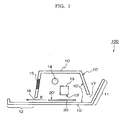
- Fig. 1 is a schematic diagram showing an example of the ink jet recording apparatus of the invention, and shows a section of the inside of the apparatus in a case where the inside of the ink jet recording apparatus is seen from a side surface direction (direction orthogonal to a recording medium conveying direction). Main parts in the apparatus are shown in Fig. 1, and other components are omitted.
- reference numeral 10 is a housing
- 10' is a housing outer surface
- 10" is a housing inner surface
- 11 is a paper supply tray
- 12 is a paper discharge tray
- 13 is a recording head
- 13' is a nozzle surface
- 14 is an ink curing light source (used also as a photocatalyst activating light source)
- 15 is a ventilation opening having a filter
- 16 is a paper outlet
- 17 is a paper inlet
- 20 is a recording medium
- 20' is a printing surface
- 100 is an ink jet recording apparatus
- an arrow E means a conveying direction (paper discharge passage) of the recording medium 20.
- the ink jet recording apparatus 100 shown in Fig. 1 comprises the housing 10 formed substantially in the shape of a trapezoid, the recording head 13 and the ink curing light source 14 which are arranged in the housing 10, the paper discharge tray 12 externally attached to the paper outlet 16 provided at the bottom of the housing 10 on the downstream side in the conveying direction of the recording medium 20 conveyed in one direction in the housing 10, the paper supply tray 11 externally attached to the paper inlet 17 provided at the bottom of the housing 10 on the upstream side in the conveying direction of the recording medium 20, and the ventilation opening 15 provided for a part of a wall surface (wall surface on the downstream side in the transporting direction of the recording medium 20) of the housing 10.
- the recording medium 20 is conveyed by a not-shown conveyor in the direction of an arrow E, that is, from the paper supply trays 11 through the bottom side in the housing 10 to the paper discharge tray 12. Further, the recording head 13 and the ink curing light source 14 are arranged on the upside (printing surface 20' side) of the recording medium 20 conveyed on the bottom side in the housing 10, the recording head 13 is arranged on the upstream side in the conveying direction of the recording medium 20, and the ink curing light source 14 is arranged on the downstream side.
- the recording head 13 is arranged so that the nozzle surface 13' faces the downside (the side on which the recording medium 20 is conveyed).
- the recording head 13 may be a so-called scan-type recording head that can scan in the paper width direction (in the direction orthogonal to the arrow E) of the recording medium 20, or a so-called fixed type recording head having substantially the same width as the paper width (in the direction orthogonal to the arrow E) of the recording medium 20.
- the ink curing light source 14 is a cylindrical light source that radiates an ultraviolet ray such as black light. Since the light source 14 can radiate the light radially from the whole of its peripheral surface, it can radiate the light not only on the printing surface 20' of the recording medium 20 that has received the printing liquid from the recording head 13, but also on the surface on the housing inner side of the filter provided for the ventilation opening 15, and on the inner wall of the housing 10.
- image formation is executed as follows: Firstly, when the recording medium 20 supplied from the paper supply tray 11 into the housing 10 is conveyed in the nozzle surface 13' side of the recording head 13 in the direction of the arrow E by the not-shown paper conveyor, the printing liquid (ink and treatment liquid) including the light curable components is ejected from the nozzle surface 13' onto the printing surface 20' (surface on the nozzle surface 13' side) of the recording medium 20.
- the printing surface 20' of the recording medium 20 further conveyed to the downstream side is irradiated with the ultraviolet beams from the ink curing light source 14, and the light curable components in the printing liquid applied on the printing surface 20' are cured. Thereafter, the recording medium 20 is discharged onto the paper discharge tray 12 outside the housing 10.
- the concentration of the volatile organic compounds in the housing 10 increases remarkably.
- the concentration of the volatile organic compounds increases remarkably.
- the concentration of the volatile organic compounds increases.
- the inner surface on the housing 10 side of the filter of the ventilation opening 15 is coated with the ultraviolet responsive photocatalyst which can be activated by the light radiated from the ink curing light source 14.
- the ultraviolet responsive photocatalyst which can be activated by the light radiated from the ink curing light source 14.
- the outer surface of the housing 10 of the filter of the ventilation opening 15 is coated with the photocatalyst.
- the volatile organic compounds can be efficiently decomposed by using light radiated from the light sources (not shown) outside the apparatus such as the fluorescent lamp and the sunlight.
- the inner wall surface 10'' of the housing 10, the recording head 13, or the surfaces of other members (not shown) arranged in the housing 10 may be coated with the ultraviolet responsive photocatalyst, as long as they are located in positions which the light radiated from the ink curing light source 14 strikes.
- the ultraviolet responsive photocatalyst coating on the surfaces of these members the volatile organic compounds included in the air staying in the housing 10 can be decomposed gradually.
- the surface of the paper discharge tray 12 and the outer wall surface 10' of the housing 10 are coated with the photocatalyst.
- the volatile organic compounds volatilizing from the printing surface 20' of the recording medium 20 discharged onto the paper discharge tray 12 can be efficiently decomposed.
- the volatile organic compounds included in the air staying outside the housing 10 can be decomposed gradually.
- the out-apparatus light source can be utilized for activation of the photocatalyst coating the outside of the housing 10, the visible light responsive photocatalyst and/or the ultraviolet light responsible photocatalyst can be used.
- the visible light responsive photocatalyst is used in a case where the light radiated from the out-apparatus light source does not include light in an ultraviolet region, or in a case where an intensity thereof is weak.
- Fig. 2 is a schematic diagram showing another example of the ink jet recording apparatus of the invention, and shows a section of the circumference of the paper discharge tray of the ink jet recording apparatus in a case where the inside of the ink jet recording apparatus is seen from the side surface direction (direction orthogonal to the recording medium conveying direction.
- reference numeral 18 is a housing
- 18a is a housing upper wall
- 18a' is an inner surface of the housing upper wall
- 18b is a housing bottom wall
- 18b' is an inner surface of the housing bottom wall
- 101 is an ink jet recording apparatus
- other reference numerals are the same as those shown in Fig. 1.
- the ink jet recording apparatus 101 shown in Fig. 2 is similar to that of the ink jet recording apparatus 100 shown in Fig. 1, the ink jet recording apparatus 101 is characterized in that the housing 18 having one opening connected to the paper outlet 16 and the other opening connected to the paper discharge tray 12 is provided.
- the housing upper wall 18a and a housing side wall are composed of a transparent material
- the housing bottom wall 18b is composed of an opaque material. Therefore, the housing upper wall 18a and the housing side wall transmit light radiated from an out-apparatus light source (not shown), and the light is radiated on a transparent housing inner surface (the inner surface 18a' of the transparent housing upper wall, the inner surface (not shown) of the transparent housing side wall, and the inner surface 18b' of the transparent housing bottom wall). Therefore, in a case where the transparent housing inner surfaces are coated with the photocatalyst, this photocatalyst is activated by the out-apparatus light source (not shown).
- volatile organic compounds included in the air that flow from the inside of the housing 10 to the outside of the apparatus, and volatile organic compounds volatilizing when the recording medium 20 immediately after printing passes through the inside of the transparent housing 18 can be efficiently decomposed by the photocatalyst coating the inside of the transparent housing 18.
- the ink jet recording apparatus of the invention can realize high speed and high image quality.
- the maximum image forming speed is 10 sheets/min. or more in a case where a recording medium is of A4 size (210 ⁇ 297 mm), and it is more preferable that the speed is 100 sheets/min or more.
- the width of the recording medium in the direction orthogonal to the conveying direction of the recording medium is substantially the same as the width of the recording head in the direction orthogonal to the conveying direction of the recording medium (adoption of a so-called fixed type recording head).
- the quantity (drop quantity) of a liquid droplet ejected from the recording head is 120pl or less, and more preferable that the drop quantity is 5pl or less.
- the drop quantity is 1 pl or more.
- the volatile organic compound decomposer using the above-mentioned photocatalyst is provided, a large quantity of the volatile organic compound can be efficiently decomposed, so that also in a case where the image formation is continuously executed, it is possible to suppress the increase in concentration of the volatile organic compounds in a space such as a room where the ink jet recording apparatus is set.
- colorless or light-colored liquid (treatment liquid) for accelerating flocculation of the colorant in this ink in addition to ink including a colorant such as a pigment and a dye, colorless or light-colored liquid (treatment liquid) for accelerating flocculation of the colorant in this ink, which does not include the colorant, can also be used as necessary.
- a water soluble organic solvent may be included, and further various additives can also be added as necessary.
- a polyvalent metal salt that reacts with this colorant and flocculates may be utilized.
- a photopolymerizable compound may be added to the ink, or a photopolymerization initiator may be added to the ink and/or the treatment liquid.
- photopolymerizable compounds for example, an epoxy (meta-) acrylate series, a polyester (meta-) acrylate series, a polycarbonate (meta-) acrylate series, a polyurethane (meta-) acrylate series, a polyetherpolyol (meta-) acrylate series, a polybutadiene (meta-) acrylate series, a silicon (meta-) acrylate series, a melamine (meta-) acrylate series, a monofunctional (meta-) acrylate series, a multi-functional (meta-) acrylate series, (meta-) acrylamide, a 1,2-disubstituted ethylene compound, a vinyl ether series, ⁇ -methyl styrene, divinylbenzene, a vinylmonomer carboxylate series, and a vinylmonomer having a cyano group and a nitrogen atom
- an epoxy (meta-) acrylate series for example,
- photopolymerization initiators for example, compounds of a benzoin ether series, an acetophenone series, a benzophenone series, a thioxanthone series, and an acylphosphine oxide series.
- photopolymerization initiators for example, compounds of a benzoin ether series, an acetophenone series, a benzophenone series, a thioxanthone series, and an acylphosphine oxide series.
- photopolymerization initiators for example, compounds of a benzoin ether series, an acetophenone series, a benzophenone series, a thioxanthone series, and an acylphosphine oxide series.
- benzoin isopropyl ether 1,1-dichloroacetophenone
- 4,4'-dichlorobenzophenone 3,3',4,4'-tetra(t-butylperoxycarbonyl)benzophenone
- polyvalent metallic ion is added to at least one kind of printing liquid, and the colorant which reacts with this polyvalent metallic ion and flocculates is added to other printing liquid, whereby intercolor bleeding can be prevented.
- Any known divalent or higher polyvalent metallic ion can be used without particular limitation.
- the polyvalent metallic ion include Mg, Ca, Ba, Cu, Co, Ni, Zn, Fe, Al, Ti, La, Nd, Y, Pr, Sm, Sb, and In.
- the polyvalent metallic ion can be added to the printing liquid as a salt compound.
- salt compound examples include phosphate, sulfate, nitrate, and acetate.
- solubility of the salt compound exceeds 10. In a case where the solubility is 10 or less, there is a possibility that a nozzle of a recording head may be clogged or long-term stability of ink may deteriorate.
- Mg is particularly preferable. Since secondary trouble such as clogging at the nozzle of the recording head is less likely to occur compared to other metallic ions, more stable printing can be performed.
- the concentration of the polyvalent metallic ion in the printing liquid is 100 ppm or more, and more preferably 500 ppm or more. In a case where the concentration of the polyvalent metallic ion in the printing liquid is smaller than 100 ppm, there is a possibility that adequate effect of water resistance and improvement in intercolor bleeding by using the metallic ion may not be obtained, or image density may become lower.
- a known colorant pigment, dye
- a self-disperse pigment or a pigment used together with a polymer dispersant is utilized.
- either of a water-soluble dye and a disperse dye can be used.
- the water-soluble dye include C. I. Direct Black -2, -4, -9, -11, -17, -19, -22, -32, -80, -151, -154, -168, -171, -194, -195; C. I. Direct Blue -1, -2, -6, -8, -22, -34, -70, -71, -76, -78, -86, -112, -142, -165, -199, -200, -201, -202, -203, -207, -218, -236, -287, and-307; C. I.
- C. 1 Acid Red -1, -4, -8, -13, -14, -15, -18, -21, -26, - 35, -37, -52, -110, -144, -180, -249, -257, and -289; and C. I.
- disperse dye examples include C. I. Disperse Yellow -3, -5, -7, -8, -42, -54, -64, -79, -82, - 83, -93, -100, -119, -122, -126, -160, and -184:1, -186, - 198, -204, and -224; C. I. Disperse Orange -13, -29, -31:1, -33, -49, -54, -66, -73, -119, and -163; C. I.
- a pigment can be also used.
- a black pigment include RAVEN 7000, RAVEN 5750, RAVEN 5250, RAVEN 5000 ULTRA II, RAVEN 3500, RAVEN 2000, RAVEN 1500 , RAVEN 1250, RAVEN 1200, RAVEN 1190 ULTRA II, RAVEN 1170, RAVEN 1255, RAVEN 1080, and RAVEN 1060 (manufactured by Columbian Carbon Chemicals Company) ; REGAL 400R, REGAL 330R, REGAL 660R, MOGUL L, BLACK PEARLS L, MONARCH 700, MONARCH 800, MONARCH 880, MONARCH 900, MONARCH 1000, MONARCH 1100, MONARCH 1300, and MONARCH 1400 (manufactured by Cabot Corporation) ; Color Black FW 1, Color Black FW2, Color Black FW2V, Color Black 18, Color Black FW 200, Color Black S150, Color Black
- black pigment is not limited to these examples.
- self-disperse pigment pigment that can disperse itself in water
- commercially available self-disperse pigments can also be used, for example, CAB-O-JET-200, CAB-O-JET-300, IJX-253, IJX-266, IJX-444, IJX-273, and IJX-55 (manufactured by Cabot Corporation); Microjet Black CW-1, CW-2 (manufactured by Orient Chemical Industries, Ltd.); and self-disperse pigments by Nippon Shokubai Co., Ltd.
- a pigment of cyan ink there are C. I. Pigment Blue -1, -2, -3, -15, -15:1, -15:2, -15:3, -15:4, -16, -22, -60 and the like.
- the cyan ink pigment is not limited to these pigments.
- magenta ink examples include C. I. Pigment Red -5, -7, -12, -48, -48:1, -57, -112, -122, - 123, -146, -168, -184, -202 and the like.
- the magenta ink pigment is not limited to these pigments.
- a pigment of yellow ink there are C. I. Pigment Yellow -1, -2, -3, -12, -13, -14, -16, -17, -73, - 74, -75, -83, -93, -95, -97, -98, -114, -128, -129, -138, -151, -154 and the like.
- the yellow ink pigment is not limited to these pigments.
- a so-called capsule dye/pigment in which the colorant is capsulated by resin may be used.
- a black ink which uses carbon black having an anionic dye or an anionic surface group as the colorant, and color inks including polyvalent metallic ions of total concentration of 500 ppm or more.
- a black ink which uses carbon black having an anionic dye or an anionic surface group as the colorant, and color inks including polyvalent metallic ions of total concentration of 500 ppm or more.
- the printing liquid includes, in addition to the above components, water as a solvent, and further may include a water-soluble organic solvent.
- water-soluble organic solvent is added to the printing liquid, moisture keeping properties of the ink and the treatment liquid, and solubility of the colorant in the ink become better, and it is possible to prevent clogging, and maintain ejection stability when the printing liquid is ejected from the recording head. Further, in long-term preservation of the printing liquid, flocculation/precipitation of a treatment agent included in the colorant and the treatment liquid can also be prevented.
- water-soluble organic solvent there are, as polyhydric alcohols, ethylene glycol, diethylene glycol, propylene glycol, butylene glycol, triethylene glycol, 1,5-pentanediol, 1,2,6-hexanetriol, glycerin, and the like.
- glycol ether there are polyhydric alcohol derivatives such as ethylene glycol monomethyl ether, ethylene glycol monoethyl ether, ethylene glycol monobuthyl ether, diethylene glycol monomethyl ether, diethylene glycol monoethyl ether, diethylene glycol monobuthyl ether, propylene glycol monobuthyl ether, dipropylene glycol monobuthyl ether, and an ethylene oxide adduct of diglycerin.
- polyhydric alcohol derivatives such as ethylene glycol monomethyl ether, ethylene glycol monoethyl ether, ethylene glycol monobuthyl ether, diethylene glycol monomethyl ether, diethylene glycol monoethyl ether, diethylene glycol monobuthyl ether, propylene glycol monobuthyl ether, dipropylene glycol monobuthyl ether, and an ethylene oxide adduct of diglycerin.
- nitrogen-containing solvent examples include pyrrolidone, N-methyl-2-pyrrolidone, cyclohexylpyrrolidone, triethanolamine, and the like.
- a sulfur-containing solvent there are thiodiethanol, thiodiglycerol, sulfolane, and dimethyl sulfoxide. Further, solvent such as propylene carbonate or ethylene carbonate can also be used together. Alcohols such as ethanol, isopropyl alcohol, butyl alcohol, and benzyl alcohol can also be used. Content of the water-soluble organic solvent is 1 to 60 parts by mass, and preferably 5 to 40 parts by mass.
- a surfactant may be added to the printing liquid.
- a compound having a structure in which the molecule includes both of a hydrophilic part and a hydrophobic part can be used, and any of an anionic surfactant, a cationic surfactant, an amphoteric surfactant, and a nonionic surfactant may be used.
- alkylbenzene sulfonates, alkylphenyl sulfonates, alkylphenyl naphthalene sulfonates, higher fatty acid salt, ester sulfates of higher fatty acid ester, sulfonates of higher fatty acid ester, ester sulfates and sulfonates of higher alcohol ether, higher alkylsulfo succinates, higher alkyl phosphoric ester salt, phosphoric ester salt of higher alcohol ethylene oxide adduct and the like can be used.
- dodecylbenzene sulfonates isopropyl naphthalene sulfonates, monobutyl phenylphenol monosulfonates, monobutyl biphenyl sulfonates, and dibutyl phenylphenol disulfonates are also effectively used.
- nonionic surfactant there are polypropylene glycol ethylene oxide adduct, polyoxyethylene nonylphenyl ether, polyoxyethylene octylphenyl ether, polyoxyethylene dodecylphenyl ether, polyoxyethylene alkyl ether, polyoxyethylene fatty acid ester, sorbitan fatty acid ester, polyoxyethylene sorbitan fatty acid ester, fatty acid alkylolamide, acetylene glycol, an oxyethylene adduct of acetylene glycol, aliphatic alkanolamide, glycerin ester, sorbitan ester, and the like.
- the cationic surfactant there are tetraalkyl ammonium salt, alkylamine salt, benzalkonium salt, alkyl pyridium salt, imidazolium salt, and the like.
- tetraalkyl ammonium salt alkylamine salt
- benzalkonium salt alkyl pyridium salt
- imidazolium salt imidazolium salt
- dihydroxyethyl stearylamine 2-heptadecenyl-hydroxyethyl imidazoline
- lauryl dimetylbenzyl ammonium chloride cetyl pyridium chloride
- stearamide methyl pyridium chloride.
- a silicon surfactant such as polysiloxane oxyethylene adduct, perfluoroalkyl carboxylates, perfluoroalkyl sulfonates, a fluoric surfactant such as oxyethylene perfluoroalkyl ether, a biosurfactant such as spiculisporic acid, rhamnolipid and lyzolecithin can also be used.
- the quantity of the surfactant added to the printing liquid is smaller than 10 parts by mass. In a case where the added quantity is 10 parts or more by mass, there is a possibility that the optical density and storage stability of the printing liquid may deteriorate.
- polyethyleneimine, polyamines, polyvinyl pyrrolidone, polyethylene glycol, ethylcellulose, a cellulose derivative such as carboxymethyl cellulose, polysaccharides and their derivatives, other water-soluble polymers, polymer emulsions such as acrylpolymer emulsion and polyurethane emulsion, cyclodextrin, macrocyclic amines, a dendrimer, crown ethers, urea and its derivative, and acetamide can be used.
- alkaline metal compounds such as potassium hydroxide, sodium hydroxide and lithium hydroxide, and nitrogen-containing compounds such as ammonium hydroxide, triethanolamine, diethanolamine, ethanolamine and 2-amino-2-methyl-l-propanol can be used.
- an antioxidant a fungicide, a viscosity controlling agent, an electroconductive agent, and an ultraviolet absorbent can also be added to the printing liquid, as necessary.
- one of the main components corresponding to the volatile organic compounds is a low-molecular weight organic compound such as a water-soluble organic solvent.
- a low-molecular weight organic compound such as a water-soluble organic solvent.
- its low-molecular weight component also corresponds to the volatile organic compound.
- a water-soluble organic solvent having vapor pressure at 20°C of 6.67 ⁇ 10 -2 kPa (0.5 mmHg) or less (hereinafter referred to as a low volatile organic solvent) is used, and it is more preferable that the vapor pressure is 1.33 ⁇ 10 -2 kPa (0.1 mmHg) or less.
- the vapor pressure of the water-soluble organic solvent included in the printing liquid is more than 6.67 ⁇ 10 -2 kPa (0.5 mmHg)
- the volatizing speed and diffusion speed of the water-soluble organic solvent in image formation become high. Therefore, there is a possibility that the water-soluble organic solvent cannot be decomposed sufficiently.
- the content of the low volatile organic solvent relative to the whole weight of the water-soluble organic solvent is 70 % by weight or more, more preferable that it is 90 % by weight or more, and most preferable that it is 100 % by weight.
- an ink jet recording apparatus As an ink jet recording apparatus, an ink jet recording apparatus manufactured as an experiment, of which main parts have the structure shown in Fig. 1, is used.
- An ink curing light source incorporated in this ink jet recording apparatus is an ultraviolet light source (UV-LED, wavelength 380 ⁇ 5nm, 870mW), and the light is radiated not only on a recording medium conveyed in the apparatus but also on a filter attached to a ventilation opening.
- UV-LED ultraviolet light source
- the filter (an average size of a mesh is about 50 ⁇ m) provided for the ventilation opening of 50 mm ⁇ 100 mm size is coated with a photocatalyst.
- an ultraviolet-light responsive photocatalyst titanium dioxide having average primary particle size of 8nm (anatase crystal type) is used.
- Coating on the filter is executed by immersing the filter in an aqueous solution in which the photocatalyst (3 % weight) is dispersed.
- black ink composed of the following components is used.
- the ink jet recording apparatus is set in a test room (volume: 50m 3 , temperature: 24°C, humidity: 52%) which has been ventilated sufficiently in advance and in which an air-condition is switched off and a door is shut.
- the volatile organic compound concentration in the test room before a test when air in the test room sampled by a scavenger is measured by the use of a GS-MS (gas chromatographic mass spectrometer), is not more than a detection limit value (1 ng/m 3 ).
- a black ink tank of a recording head is filled with the above printing liquid, paper of A4-size (210 ⁇ 297 mm) (Paper P by Fuji Xerox Co., Ltd.) is used as recording paper, and character images of black color are printed continuously for two hours at a rate of 10 sheets per minute.
- Example 2 Using the ink jet recording apparatus similar to that in Example 1 except that the filter is not coated with the photocatalyst, a similar test to that in Example 1 is executed.
- the volatile organic compound concentration in the test room before the test is not more than a detection limit value (1 ng/m 3 ) .
- an ink jet recording apparatus As an ink jet recording apparatus, an ink jet recording apparatus (to which a housing is attached) manufactured as an experiment, of which main parts have a structure shown in Fig. 2, is used.
- the housing is rectangular in section and uses a transparent resin plate (polycarbonate), in which the size of an opening part is 380 mm ⁇ 100 mm, and the length is 500 mm. Further, the inner surface of this transparent housing is spray-coated with a photocatalyst.
- a transparent resin plate polycarbonate
- titanium dioxide nitrogen-doped type anatase microcrystal obtained by heating under an ammonia/argon atmosphere having particle size of 7 nm is used.
- Coating on the inner surface of the transparent housing is executed by sufficiently spray-coating the entire transparent housing inner surface with aqueous solution in which the photocatalyst (1 % by weight) is dispersed, and thereafter drying the entire housing inner surface.
- the printing liquid As the printing liquid, the following four inks are used.
- the ink jet recording apparatus is set in a position which is approximately 1 m just under a fluorescent lamp in a test room (volume: 50m 3 , temperature: 23°C, humidity: 48%, setting of 20 fluorescent lamps of 40W on the ceiling) which has been ventilated sufficiently in advance and in which an air-condition is switched off and a door is shut.
- the volatile organic compound concentration in the test room before the test is measured in a similar manner as in Example 1.
- the volatile organic compound concentration before the test is not more than a detection limit value (1 ng/m 3 ) .
- Example 2 Using the ink jet recording apparatus similar to that in Example 2 except that the housing inner surface is not coated with the photocatalyst, a test similar to that in Example 2 is executed.
- the volatile organic compound concentration in the test room before the test is not more than a detection limit value (1 ng/m 3 ).
- the ink jet recording apparatus which can decompose the VOC components generated with the image formation, and thereby can suppress the volatile organic compound concentration in the space where the ink jet recording apparatus is set.
Landscapes
- Health & Medical Sciences (AREA)
- General Health & Medical Sciences (AREA)
- Toxicology (AREA)
- Ink Jet (AREA)
- Inks, Pencil-Leads, Or Crayons (AREA)
- Ink Jet Recording Methods And Recording Media Thereof (AREA)
Abstract
Description
- The present invention relates to an ink jet recording apparatus which forms an image by using printing liquid such as ink.
- In recent years, there has been a call for reduced usage of various volatile organic compounds (VOC: Volatile Organic Compound) discharged from ink jet type copy machines or electrophotographic copy machines/printers/complex machines used in offices in order to reduce the environmental load.
- Further, in order to define the achievement standard in meeting such requirements, there are cases in which public third-party organizations or a companies manufacturing such products have set specific standard (Eco Label Certification Standard) for regulating TVOC (Total Volatile Organic Compounds).
- On the other hand, printing liquid (ink or treatment liquid and the like for accelerating flocculation of a colorant in ink) used in an ink jet recording apparatus includes various VOC components such as a water-soluble organic solvent and the like. Therefore, from now on, not only will it become important to suppress the amount of VOCs generated from the ink jet recording apparatus, but also to meet the above-mentioned standard.
- Further, higher speed and higher image quality are required of the ink jet recording apparatus. In order to realize higher speed, improvement in printing speed, that is, increase in the ejection amount of printing liquid ejected from the recording head per unit of time is required. Moreover, in order to realize higher image quality, it is necessary to further reduce the size of a liquid droplet of the printing liquid ejected from the recording head.
- Therefore, it is inevitable that the amount of VOCs generated from the ink jet recording apparatus per unit of time increases along with faster speed and higher image quality, which contradicts the above trend of suppressing VOC generation.
- On the other hand, regarding the VOCs generated from the ink jet recording apparatus, since the above-mentioned need for reducing VOCs has become marked only in recent years, not much concrete investigation has been conducted as yet.
- As an example, since there is a case where ink used in the ink jet recording apparatus includes a component having volatile odor, an ink jet recording apparatus (refer to JP-A-2003-112412) including a means for deodorizing or reducing this volatile odor has been proposed.
- However, the above-mentioned ink jet recording apparatus uses an activated carbon or an aromatic substance in order to deodorize or reduce the volatile odor. Therefore, in a case where activated carbon is used, once the VOCs that have volatilized from the printing liquid have been adsorbed to the activated carbon to some degree, the adsorption capacity of the activated carbon becomes saturated, so that the outflow of VOCs from the apparatus cannot be suppressed. In a case where the adsorption capacity diminishes, exchange of the activated carbon is required. Furthermore, in a case where the activated carbon is left to stand under an environment of high temperature, there is a possibility that the VOC component adsorbed once may be discharged again. In a case where an aromatic substance is used, this merely deceives the sense of smell, and the VOC component itself is not removed from the room in which the ink jet recording apparatus is set.
- The present invention has been made in view of the above circumstances. The invention provides an ink jet recording apparatus which can decompose VOC (Volatile Organic Compound) component generated along with image formation, and can thereby suppress the volatile organic compound concentration in a space where the ink jet recording apparatus is set.
- A first aspect of the invention is to provide an ink jet recording apparatus which comprises a recording head, and forms an image by ejecting printing liquid including a volatile organic compound (VOC) from the recording head onto a recording medium, wherein the ink jet recording apparatus comprises a volatile organic compound decomposer for decomposing the volatile organic compound.
-
- Fig. 1 is a schematic diagram showing an example of an ink jet recording apparatus of the invention.
- Fig. 2 is a schematic diagram showing another example of the ink jet recording apparatus of the invention.
- An ink jet recording apparatus of the invention, which includes a recording head, and forms an image by ejecting printing liquid including a volatile organic compound (hereinafter, also referred to as "VOC") from the recording head onto a recording medium, is characterized by including a volatile organic compound decomposer that decomposes the volatile organic compound.
- Therefore, since the ink jet recording apparatus of the invention can decompose the VOC component generated with image formation, the concentration of the volatile organic compounds in a space (room) where the ink jet recording apparatus is set can be suppressed.
- In the invention, the volatile organic compound (VOC) means any organic compound having volatility except water, which is included in printing liquid such as ink including a colorant, and colorless or light-colored liquid (treatment liquid) including a component that flocculates the colorant in this ink. Specifically, the VOC means a volatile organic compound in which vapor pressure at 20°C is 1.33 × 10⁻⁷ kPa (1 × 10⁻⁶ mmHg) or more.
- On the other hand, as the volatile organic compound decomposer, it is particularly preferable to use a catalyst. However, the invention is not limited to this. For example, besides using the catalyst, known volatile organic compound decomposers can be used, for example, a discharger for decomposing the volatile organic compounds by the use of corona discharge, a bio-type decomposer using a microorganism, an ozone oxidation, and a combustion device. These can be used in combination of two or more kinds.
- Here, the catalyst used in the invention means a catalyst which has a function of decomposing the volatile organic compound into components (mainly water and carbon dioxide) which have lower molecular weight and are inactive in a case where the volatile organic compounds come into contact with the activated catalyst.
- As the catalyst, a catalyst (photocatalyst) which is activated by radiating light is particularly preferable, a representative being titanium dioxide (TiO2). In addition, as long as the catalyst is activated by applying any physical, chemical, or mechanical energy from the outside, such as a catalyst activated by applying heat, any catalyst can be used without limitations.
- Further, the catalyst used in the invention may have the capacity to decompose at least only a partial component (the partial component means a component that can be classified according to molecular structure, or other features, for example, according to molecular weight or vapor pressure) of all the volatile organic compound components included in the printing liquid, and the catalyst preferably has the capacity to decompose as many components as possible. However, depending on the kind of catalyst, the component in which the decomposition capacity can be effectively exhibited is different. Therefore, two or more kinds of catalysts may be used as necessary. In this case, the volatile organic compounds can be decomposed more efficiently.
- In the invention, as preferable volatile organic compound components to be decomposed, from the viewpoint of vapor pressure, components having vapor pressure at 20 °C of 1.33 × 10⁻⁵ kPa (1 ×10⁻⁴ mmHg) to 40kPa (3 × 10⁻² mmHg) are preferable, and components having vapor pressure at 20 °C of 1.33 × 10⁻⁴ kPa (1 × 10⁻³mmHg) to 6.67 kPa (50 mmHg) are more preferable. The volatile organic compounds showing vapor pressure in the above ranges are included in the printing liquid in comparatively large amounts, and are the major causes of increasing volatile organic compound concentration in air.
- Next, a case where the photocatalyst of which representation is a TiO2 series is used as the volatile organic compound decomposer will be described in detail.
- As the photocatalysts, either of a type (visible light-responsive photocatalyst) activated application of visible light (wavelength: about 360 nm to 830 nm) or a type (ultraviolet light-responsive photocatalyst) activated by application of ultraviolet light (wavelength: about 1 nm to 360 nm) may be used, or these two types may be used together.
- Examples of the visible light-responsive photocatalysts include nitrogen-doped titanium dioxide, carbon-doped titanium dioxide, sulfur-doped titanium dioxide, fluorine-doped titanium dioxide, halogenated platinic acid supported-type titanium dioxide, brookite type titanium dioxide, and indium tantalate.
- Further, examples of the ultraviolet light-responsive photocatalysts include anatase type titanium dioxide, zinc oxide, tin oxide, niobium oxide, and strontium titanate.
- On the other hand, in a case where the photocatalyst is utilized, in order to facilitate its handling or improve contact efficiency with the volatile organic compounds, it is preferable that the photocatalyst is supported by a support such as an adsorbent or a metal thereby to be used. Further, by mixing the photocatalyst with a resin or another organic material, the photocatalyst can be readily handled as a member.
- Here, examples of the adsorbent include activated carbon, zeolite, silica, alumina, potassium permanganate, and molecular sieve.
- Further, examples of the metal material include platinum. As the resin and other organic materials, known materials can be used, for example, fluorocarbon resin, paper/pulp, and other chemical fibers. In a case where the photocatalyst is directly brought into contact with the resin material, occasionally, the part of the resin material that comes into contact with the photocatalyst may be decomposed/corroded by the catalyst action. Therefore, it is preferable that the photocatalyst is supported, via an inorganic material (which does not cause decomposition or corrosion in the resin material), by the resin material.
- Examples of the inorganic material include inert ceramics such as apatite.
- Next, a light source for activating the photocatalyst will be described.
- In a case where the ink jet recording apparatus of the invention uses the photocatalyst as the catalyst for decomposing the volatile organic compounds, it may have a photocatalyst activating light source. In this case, especially when the photocatalyst is set in a position where the photocatalyst is not exposed to a light source (light source such as a fluorescent lamp in a room, or sunlight) located outside the apparatus, it can be activated sufficiently.
- As the photocatalyst activating light source, according to the kind of photocatalyst used, a photocatalyst activating light source which can radiate light in a wavelength region suitable for activation can be used, and a special light source for activating the photocatalyst may be utilized.
- On the other hand, in a case where the printing liquid includes a light-curable component (for example, photopolymerizable compounds, which will be described later in detail) that is cured by application of light, an ink curing light source which irradiates a surface of a recording medium onto which the printing liquid is applied with light for curing the light-curable component is arranged in the ink jet recording apparatus.
- In such a case, this ink curing light source can be used as the photocatalyst activating light source. The photocatalyst activated by the wavelength of the light radiated from the ink curing light source is arranged in a position where the light of this light source strikes the photocatalyst.
- As the photocatalyst activating light source used for the ultraviolet light-responsive photocatalyst, a known ultraviolet light source may be used without any particular restriction. However, it is preferable to use a black light or an ultraviolet ray emitting diode that are generally utilized as the ink curing light source.
- Further, in a case where the used photocatalyst is a visible light-responsive photocatalyst, it is preferable that a light source outside the apparatus is utilized. In this case, it is not necessary to provide the photocatalyst activating light source for the ink jet recording apparatus.
- As long as the above-described photocatalyst (or the photocatalyst support) is put in a position where the photocatalyst is exposed to the light source which can activate this photocatalyst, it can be arranged in a desired position inside or outside the ink jet recording apparatus.
- For example, in a case where the ink jet recording apparatus has a housing and a ventilation opening from which the inside of the housing is ventilated, and the ventilation opening has a filter, it is preferable that this filter is coated with the photocatalyst. In this case, when the volatile organic compounds produced in the ink jet recording apparatus are discharged through the ventilation opening to the outside of the apparatus, they react with the photocatalyst and are decomposed.
- Further, in a case where the ink jet recording apparatus has a housing provided with a paper outlet from which a recording medium is discharged, and a paper discharge tray on which the recording medium discharged from this paper discharging opening is stored, it is preferable that an outer surface of the housing and/or a surface of the discharge tray is coated with the photocatalyst.
- In this case, the volatile organic compounds generated in the ink jet recording apparatus and discharged to the outside of the apparatus, and the volatile organic compounds generated outside the ink jet recording apparatus such as the volatile organic compounds generated from the recording medium that have been discharged on the paper discharge tray after image formation can be decomposed by the photocatalyst.
- In either of the above types, conventional members used for constituting the general ink jet recording apparatus are utilized. However, in order to decompose the volatile organic compounds more efficiently, a special member for decomposing the volatile organic compounds may be provided.
- For example, in a case where the ink jet recording apparatus has a housing provided with the paper outlet from which the recording medium is discharged, and the discharge tray on which the recording medium discharged from this paper discharging opening is stored, it is preferable that between this housing and the paper discharge tray, a transparent housing having one opening connected to the paper outlet and the other opening connected to the paper discharge tray is provided, and the inner surface of this transparent housing is coated with the photocatalyst.
- On the other hand, in a case where an image is formed by ink jet recording, immediately after the printing liquid is ejected from the recording head onto the recording medium, until the time the recording medium moves to the paper discharge tray, the printing liquid on the recording medium dries (namely, the amount of the volatile organic compounds volatilizing in air per unit of time is highest). Moreover, the air including the volatile organic compounds that have volatilized in the housing flows to the outside of the apparatus through the paper outlet with discharge of the recording medium. Therefore, the air including the volatile organic compounds at a high concentration easily remains inside the above-mentioned housing.
- However, since this housing is transparent with its inner surface coated with the photocatalyst, light from light sources outside the apparatus such as a fluorescent lamp outside the apparatus and sunlight can stream into the inner surface of the transparent housing, thus activating the photocatalyst. Therefore, the air including the volatile organic compounds at a high concentration, which stays inside of the housing, comes into contact with the housing inner surface, whereby the volatile organic compounds are efficiently decomposed.
- Regarding the housing used in the invention, it is not necessary that all of the housing walls are transparent. As long as the light of the light source outside the apparatus sufficiently strikes the region in which the photocatalyst on the housing inner surface is provided, a part of the housing walls may be opaque. For example, in a case where the ink jet recording apparatus is set on a stand, since the light of the light source outside apparatus does not stream into the housing from the bottom surface side, the bottom surface may be opaque.
- Next, specific examples of the ink jet recording apparatus of the invention will be described with reference to drawings.
- Fig. 1 is a schematic diagram showing an example of the ink jet recording apparatus of the invention, and shows a section of the inside of the apparatus in a case where the inside of the ink jet recording apparatus is seen from a side surface direction (direction orthogonal to a recording medium conveying direction). Main parts in the apparatus are shown in Fig. 1, and other components are omitted.
- In Fig. 1,
reference numeral 10 is a housing, 10' is a housing outer surface, 10" is a housing inner surface, 11 is a paper supply tray, 12 is a paper discharge tray, 13 is a recording head, 13' is a nozzle surface, 14 is an ink curing light source (used also as a photocatalyst activating light source), 15 is a ventilation opening having a filter, 16 is a paper outlet, 17 is a paper inlet, 20 is a recording medium, 20' is a printing surface, 100 is an ink jet recording apparatus, and an arrow E means a conveying direction (paper discharge passage) of therecording medium 20. - The ink
jet recording apparatus 100 shown in Fig. 1 comprises thehousing 10 formed substantially in the shape of a trapezoid, therecording head 13 and the ink curinglight source 14 which are arranged in thehousing 10, thepaper discharge tray 12 externally attached to thepaper outlet 16 provided at the bottom of thehousing 10 on the downstream side in the conveying direction of therecording medium 20 conveyed in one direction in thehousing 10, thepaper supply tray 11 externally attached to thepaper inlet 17 provided at the bottom of thehousing 10 on the upstream side in the conveying direction of therecording medium 20, and theventilation opening 15 provided for a part of a wall surface (wall surface on the downstream side in the transporting direction of the recording medium 20) of thehousing 10. - Here, in printing, the
recording medium 20 is conveyed by a not-shown conveyor in the direction of an arrow E, that is, from thepaper supply trays 11 through the bottom side in thehousing 10 to thepaper discharge tray 12. Further, therecording head 13 and the ink curinglight source 14 are arranged on the upside (printing surface 20' side) of therecording medium 20 conveyed on the bottom side in thehousing 10, therecording head 13 is arranged on the upstream side in the conveying direction of therecording medium 20, and the ink curinglight source 14 is arranged on the downstream side. Here, therecording head 13 is arranged so that the nozzle surface 13' faces the downside (the side on which therecording medium 20 is conveyed). - The
recording head 13 may be a so-called scan-type recording head that can scan in the paper width direction (in the direction orthogonal to the arrow E) of therecording medium 20, or a so-called fixed type recording head having substantially the same width as the paper width (in the direction orthogonal to the arrow E) of therecording medium 20. - Further, the ink curing
light source 14 is a cylindrical light source that radiates an ultraviolet ray such as black light. Since thelight source 14 can radiate the light radially from the whole of its peripheral surface, it can radiate the light not only on the printing surface 20' of therecording medium 20 that has received the printing liquid from therecording head 13, but also on the surface on the housing inner side of the filter provided for theventilation opening 15, and on the inner wall of thehousing 10. - In this ink
jet recording apparatus 100, image formation is executed as follows: Firstly, when therecording medium 20 supplied from thepaper supply tray 11 into thehousing 10 is conveyed in the nozzle surface 13' side of therecording head 13 in the direction of the arrow E by the not-shown paper conveyor, the printing liquid (ink and treatment liquid) including the light curable components is ejected from the nozzle surface 13' onto the printing surface 20' (surface on the nozzle surface 13' side) of therecording medium 20. - Sequentially, the printing surface 20' of the
recording medium 20 further conveyed to the downstream side is irradiated with the ultraviolet beams from the ink curinglight source 14, and the light curable components in the printing liquid applied on the printing surface 20' are cured. Thereafter, therecording medium 20 is discharged onto thepaper discharge tray 12 outside thehousing 10. - In such a sequence of image formation, immediately after the printing liquid has been applied onto the printing surface 20' of the
recording medium 20, volatilization of volatile organic compound components included in the printing liquid starts, and volatilization of the volatile organic compound components from the printing surface 20' of therecording medium 20 that have been discharged to thepaper discharge tray 12 also continues for a while. - Therefore, in the image formation, by the volatile organic compounds volatilizing from the printing surface 20' of the
recording medium 20 immediately after printing, the concentration of the volatile organic compounds in thehousing 10 increases remarkably. In addition to this, also outside thehousing 10, by the volatile organic compounds volatilizing from the printing surface 20' of therecording medium 20 on thepaper discharge tray 12, and air that is high in concentration of the volatile organic compounds discharged through theventilation opening 15 to the outside of thehousing 10, the concentration of the volatile organic compounds increases. - Therefore, in order to decompose the volatile organic compounds in the
housing 10, it is preferable that the inner surface on thehousing 10 side of the filter of theventilation opening 15 is coated with the ultraviolet responsive photocatalyst which can be activated by the light radiated from the ink curinglight source 14. In this case, when the air in thehousing 10, including the volatile organic compounds of the high concentration is discharged through theventilation opening 15 to the outside of thehousing 10, the volatile organic compounds can be efficiently decomposed. - Further, it is preferable that the outer surface of the
housing 10 of the filter of theventilation opening 15 is coated with the photocatalyst. In this case, when the air in thehousing 10, including the volatile organic compounds of the high concentration is discharged through theventilation opening 15 to the outside of thehousing 10, the volatile organic compounds can be efficiently decomposed by using light radiated from the light sources (not shown) outside the apparatus such as the fluorescent lamp and the sunlight. - Alternatively, the inner wall surface 10'' of the
housing 10, therecording head 13, or the surfaces of other members (not shown) arranged in thehousing 10 may be coated with the ultraviolet responsive photocatalyst, as long as they are located in positions which the light radiated from the ink curinglight source 14 strikes. By the ultraviolet responsive photocatalyst coating on the surfaces of these members, the volatile organic compounds included in the air staying in thehousing 10 can be decomposed gradually. - On the other hand, in order to decompose the volatile organic compounds outside the
housing 10, it is preferable that the surface of thepaper discharge tray 12 and the outer wall surface 10' of thehousing 10 are coated with the photocatalyst. - By coating the surface of the
paper discharge tray 12 with the photocatalyst, particularly, the volatile organic compounds volatilizing from the printing surface 20' of therecording medium 20 discharged onto thepaper discharge tray 12, and the volatile organic compounds included in the air that flows from the inside of thehousing 10 through theopening 16 to the outside of thehousing 10 can be efficiently decomposed. In addition, the volatile organic compounds included in the air staying outside thehousing 10 can be decomposed gradually. - Further, by coating the outer wall surface 10' of the
housing 10 with the photocatalyst, volatile organic compounds included in the air staying outside thehousing 10 can be decomposed gradually. - Since the out-apparatus light source can be utilized for activation of the photocatalyst coating the outside of the
housing 10, the visible light responsive photocatalyst and/or the ultraviolet light responsible photocatalyst can be used. However, in a case where the light radiated from the out-apparatus light source does not include light in an ultraviolet region, or in a case where an intensity thereof is weak, it is preferable that the visible light responsive photocatalyst is used. - Next, another example of the ink jet recording apparatus of the invention will be described.
- Fig. 2 is a schematic diagram showing another example of the ink jet recording apparatus of the invention, and shows a section of the circumference of the paper discharge tray of the ink jet recording apparatus in a case where the inside of the ink jet recording apparatus is seen from the side surface direction (direction orthogonal to the recording medium conveying direction.
- In Fig. 2,
reference numeral 18 is a housing, 18a is a housing upper wall, and 18a' is an inner surface of the housing upper wall, 18b is a housing bottom wall, 18b' is an inner surface of the housing bottom wall, 101 is an ink jet recording apparatus, and other reference numerals are the same as those shown in Fig. 1. - Although the basic structure of the ink
jet recording apparatus 101 shown in Fig. 2 is similar to that of the inkjet recording apparatus 100 shown in Fig. 1, the inkjet recording apparatus 101 is characterized in that thehousing 18 having one opening connected to thepaper outlet 16 and the other opening connected to thepaper discharge tray 12 is provided. - In this
housing 18, the housingupper wall 18a and a housing side wall (not shown) are composed of a transparent material, and thehousing bottom wall 18b is composed of an opaque material. Therefore, the housingupper wall 18a and the housing side wall transmit light radiated from an out-apparatus light source (not shown), and the light is radiated on a transparent housing inner surface (theinner surface 18a' of the transparent housing upper wall, the inner surface (not shown) of the transparent housing side wall, and theinner surface 18b' of the transparent housing bottom wall). Therefore, in a case where the transparent housing inner surfaces are coated with the photocatalyst, this photocatalyst is activated by the out-apparatus light source (not shown). - Therefore, volatile organic compounds included in the air that flow from the inside of the
housing 10 to the outside of the apparatus, and volatile organic compounds volatilizing when therecording medium 20 immediately after printing passes through the inside of thetransparent housing 18 can be efficiently decomposed by the photocatalyst coating the inside of thetransparent housing 18. - Next, other specifications and constitution of the ink jet recording apparatus of the invention will be described. It is preferable that the ink jet recording apparatus of the invention can realize high speed and high image quality.
- Namely, from the viewpoint of faster speed, it is preferable that the maximum image forming speed is 10 sheets/min. or more in a case where a recording medium is of A4 size (210 × 297 mm), and it is more preferable that the speed is 100 sheets/min or more. The higher the maximum image forming speed, the better it is.
- In addition, in a case where image formation by the ink jet recording apparatus of the invention is performed, in a state where the recording head is fixed, by conveying the recording medium in one direction so that the recording medium faces the surface of the recording head on the side from which the printing liquid is ejected, it is preferable that the width of the recording medium in the direction orthogonal to the conveying direction of the recording medium is substantially the same as the width of the recording head in the direction orthogonal to the conveying direction of the recording medium (adoption of a so-called fixed type recording head).
- Further, from the viewpoint of realizing higher image quality, it is preferable that the quantity (drop quantity) of a liquid droplet ejected from the recording head is 120pl or less, and more preferable that the drop quantity is 5pl or less. The smaller the drop quantity, the more preferable it is. However, from a practical standpoint, it is preferable that the drop quantity is 1 pl or more.
- However, any of increase of the maximum image forming speed, adoption of the fixed type recording head, and size reduction of the liquid droplet cause increased quantity of volatile organic compounds volatilizing per unit of time. However, in the ink jet recording apparatus of the invention, since the volatile organic compound decomposer using the above-mentioned photocatalyst is provided, a large quantity of the volatile organic compound can be efficiently decomposed, so that also in a case where the image formation is continuously executed, it is possible to suppress the increase in concentration of the volatile organic compounds in a space such as a room where the ink jet recording apparatus is set.
- As the printing liquid used in the ink jet recording apparatus of the invention, in addition to ink including a colorant such as a pigment and a dye, colorless or light-colored liquid (treatment liquid) for accelerating flocculation of the colorant in this ink, which does not include the colorant, can also be used as necessary.
- For such printing liquid, in addition to water and a colorant (in case of ink), a water soluble organic solvent may be included, and further various additives can also be added as necessary. For example, in order to accelerate the flocculation of the colorant, a polyvalent metal salt that reacts with this colorant and flocculates may be utilized.
- Besides the above, in order to accelerate curing of ink by radiating the light to the printing liquid, a photopolymerizable compound may be added to the ink, or a photopolymerization initiator may be added to the ink and/or the treatment liquid.
- Next, various components included in the printing liquid, that is, the photopolymerizable compound, the photopolymerization initiator, the polyvalent metallic ion, the colorant, and other components will be described below.
- As examples of the photopolymerizable compound, there are known photopolymerizable compounds, for example, an epoxy (meta-) acrylate series, a polyester (meta-) acrylate series, a polycarbonate (meta-) acrylate series, a polyurethane (meta-) acrylate series, a polyetherpolyol (meta-) acrylate series, a polybutadiene (meta-) acrylate series, a silicon (meta-) acrylate series, a melamine (meta-) acrylate series, a monofunctional (meta-) acrylate series, a multi-functional (meta-) acrylate series, (meta-) acrylamide, a 1,2-disubstituted ethylene compound, a vinyl ether series, α-methyl styrene, divinylbenzene, a vinylmonomer carboxylate series, and a vinylmonomer having a cyano group and a nitrogen atom such as acrylonitrile.
- As examples of the photopolymerization initiator, there are known photopolymerization initiators, for example, compounds of a benzoin ether series, an acetophenone series, a benzophenone series, a thioxanthone series, and an acylphosphine oxide series. Specifically, there are compounds such as benzoin isopropyl ether, 1,1-dichloroacetophenone, 4,4'-dichlorobenzophenone, 3,3',4,4'-tetra(t-butylperoxycarbonyl)benzophenone, 2-chlorothioxanthone, and bis(2,4,6-trimethylbenzoyl)phenylphosphine oxide.
- In a case where two or more kinds of printing liquid are used, polyvalent metallic ion is added to at least one kind of printing liquid, and the colorant which reacts with this polyvalent metallic ion and flocculates is added to other printing liquid, whereby intercolor bleeding can be prevented. Any known divalent or higher polyvalent metallic ion can be used without particular limitation. Examples of the polyvalent metallic ion include Mg, Ca, Ba, Cu, Co, Ni, Zn, Fe, Al, Ti, La, Nd, Y, Pr, Sm, Sb, and In. The polyvalent metallic ion can be added to the printing liquid as a salt compound.
- Examples of such salt compound include phosphate, sulfate, nitrate, and acetate. In order to suppress precipitation in the printing liquid, it is preferable that solubility of the salt compound exceeds 10. In a case where the solubility is 10 or less, there is a possibility that a nozzle of a recording head may be clogged or long-term stability of ink may deteriorate.
- As the polyvalent metallic ion, of the above examples, Mg is particularly preferable. Since secondary trouble such as clogging at the nozzle of the recording head is less likely to occur compared to other metallic ions, more stable printing can be performed.
- Further, it is preferable that the concentration of the polyvalent metallic ion in the printing liquid is 100 ppm or more, and more preferably 500 ppm or more. In a case where the concentration of the polyvalent metallic ion in the printing liquid is smaller than 100 ppm, there is a possibility that adequate effect of water resistance and improvement in intercolor bleeding by using the metallic ion may not be obtained, or image density may become lower.
- In a case where the printing liquid is used as ink, a known colorant (pigment, dye) is added to the printing liquid. As the colorant added to the printing liquid, it is preferable that a self-disperse pigment or a pigment used together with a polymer dispersant is utilized.
- As the dye, either of a water-soluble dye and a disperse dye can be used. Specific examples of the water-soluble dye include C. I. Direct Black -2, -4, -9, -11, -17, -19, -22, -32, -80, -151, -154, -168, -171, -194, -195; C. I. Direct Blue -1, -2, -6, -8, -22, -34, -70, -71, -76, -78, -86, -112, -142, -165, -199, -200, -201, -202, -203, -207, -218, -236, -287, and-307; C. I. Direct Red -1, -2, -4, -8, -9, -11, -13, -15, -20, - 28, -31, -33, -37, -39, -51, -59, -62, -63, -73, -75, -80, -81, -83, -87, -90, -94, -95, -99, -101, -110, -189, and -227; C. I. Direct Yellow -1, -2, -4, -8, -11, -12, -26, -27, -28, -33, -34, -41, -44, -48, -58, -86, -87, -88, -132, -135, -142, -144, and -173; C. I. Food Black -1, and -2; C. I. Acid Black -1, -2, -7, -16, -24, -26, -28, -31, -48, -52, -63, 107, -112, -118, -119, -121, -156, -172, -194, and -208; C. I. Acid Blue -1, -7, -9, -15, -22, -23, -27, -29, -40, -43, -55, -59, -62, -78, -80, -81, -83, -90, -102, -104, -111, -185, -249, and -254; C. 1. Acid Red -1, -4, -8, -13, -14, -15, -18, -21, -26, - 35, -37, -52, -110, -144, -180, -249, -257, and -289; and C. I. Acid Yellow -1, -3, -4, -7, -11, -12, -13, -14, -18, -19, -23, -25, -34, -38, -41, -42, -44, -53, -55, -61, -71, -76, -78, -79, and -122.
- Specific examples of the disperse dye include C. I. Disperse Yellow -3, -5, -7, -8, -42, -54, -64, -79, -82, - 83, -93, -100, -119, -122, -126, -160, and -184:1, -186, - 198, -204, and -224; C. I. Disperse Orange -13, -29, -31:1, -33, -49, -54, -66, -73, -119, and -163; C. I. Disperse Red -1, -4, -11, -17, -19, -54, -60, -72, -73, -86, -92, -93, -126, -127, -135, -145, -154, -164, -167:1, -177, -181, -207, -239, -240, -258, -278, -283, -311, -343, -348, -356, and -362; C. I. Disperse Violet -33; C. I. Disperse Blue -14, -26, -56, -60, -73, -87, -128, -143, -154, -165, -165:1, -176, -183, -185, -201, -214, -224, -257, -287, -354, -365, and -368; and C. I. Disperse Green -6:1, and -9.
- Further, a pigment can be also used. Specific examples of a black pigment include RAVEN 7000, RAVEN 5750, RAVEN 5250, RAVEN 5000 ULTRA II, RAVEN 3500, RAVEN 2000, RAVEN 1500 , RAVEN 1250, RAVEN 1200, RAVEN 1190 ULTRA II, RAVEN 1170, RAVEN 1255, RAVEN 1080, and RAVEN 1060 (manufactured by Columbian Carbon Chemicals Company) ; REGAL 400R, REGAL 330R, REGAL 660R, MOGUL L, BLACK PEARLS L, MONARCH 700, MONARCH 800, MONARCH 880, MONARCH 900, MONARCH 1000, MONARCH 1100, MONARCH 1300, and MONARCH 1400 (manufactured by Cabot Corporation) ; Color Black FW 1, Color Black FW2, Color Black FW2V,
Color Black 18, Color Black FW 200, Color Black S150, Color Black S160, Color Black S170, PRINTEX 35, PRINTEX U, PRINTEX V, PRINTEX 140U, PRINTEX 140V, Special Black 6, Special Black 5, Special Black 4A, and Special Black 4 (manufactured by Degussa Corporation) ; and No. 25, No. 33, No. 40, No. 47, No. 52, No. 900, No. 2300, MCF-88, MA 600, MA 7, MA 8, and MA 100 (manufactured by Mitsubishi Chemical Corporation.). However, the black pigment is not limited to these examples. - Further, as the self-disperse pigment (pigment that can disperse itself in water), in addition to pigments obtained by applying surface treatment to the above pigments, commercially available self-disperse pigments can also be used, for example, CAB-O-JET-200, CAB-O-JET-300, IJX-253, IJX-266, IJX-444, IJX-273, and IJX-55 (manufactured by Cabot Corporation); Microjet Black CW-1, CW-2 (manufactured by Orient Chemical Industries, Ltd.); and self-disperse pigments by Nippon Shokubai Co., Ltd.
- As examples of a pigment of cyan ink, there are C. I. Pigment Blue -1, -2, -3, -15, -15:1, -15:2, -15:3, -15:4, -16, -22, -60 and the like. However, the cyan ink pigment is not limited to these pigments.
- As examples of a pigment of magenta ink, there are C. I. Pigment Red -5, -7, -12, -48, -48:1, -57, -112, -122, - 123, -146, -168, -184, -202 and the like. However, the magenta ink pigment is not limited to these pigments.
- As examples of a pigment of yellow ink, there are C. I. Pigment Yellow -1, -2, -3, -12, -13, -14, -16, -17, -73, - 74, -75, -83, -93, -95, -97, -98, -114, -128, -129, -138, -151, -154 and the like. However, the yellow ink pigment is not limited to these pigments.
- Further, as the colorant of each color, a so-called capsule dye/pigment in which the colorant is capsulated by resin may be used.
- In order to obtain a good image, it is particularly preferable to use in combination: a black ink which uses carbon black having an anionic dye or an anionic surface group as the colorant, and color inks including polyvalent metallic ions of total concentration of 500 ppm or more. In this case, by using the black ink and the color ink together in a black ink image portion, the image density improves, and intercolor bleeding in the adjoining portion of a black image and a color image is suppressed, so that image quality improves.
- The printing liquid includes, in addition to the above components, water as a solvent, and further may include a water-soluble organic solvent. In a case where the water-soluble organic solvent is added to the printing liquid, moisture keeping properties of the ink and the treatment liquid, and solubility of the colorant in the ink become better, and it is possible to prevent clogging, and maintain ejection stability when the printing liquid is ejected from the recording head. Further, in long-term preservation of the printing liquid, flocculation/precipitation of a treatment agent included in the colorant and the treatment liquid can also be prevented.
- As specific examples of the water-soluble organic solvent, there are, as polyhydric alcohols, ethylene glycol, diethylene glycol, propylene glycol, butylene glycol, triethylene glycol, 1,5-pentanediol, 1,2,6-hexanetriol, glycerin, and the like.
- As examples of glycol ether, there are polyhydric alcohol derivatives such as ethylene glycol monomethyl ether, ethylene glycol monoethyl ether, ethylene glycol monobuthyl ether, diethylene glycol monomethyl ether, diethylene glycol monoethyl ether, diethylene glycol monobuthyl ether, propylene glycol monobuthyl ether, dipropylene glycol monobuthyl ether, and an ethylene oxide adduct of diglycerin.
- As examples of a nitrogen-containing solvent, there are pyrrolidone, N-methyl-2-pyrrolidone, cyclohexylpyrrolidone, triethanolamine, and the like.
- As examples of a sulfur-containing solvent, there are thiodiethanol, thiodiglycerol, sulfolane, and dimethyl sulfoxide. Further, solvent such as propylene carbonate or ethylene carbonate can also be used together. Alcohols such as ethanol, isopropyl alcohol, butyl alcohol, and benzyl alcohol can also be used. Content of the water-soluble organic solvent is 1 to 60 parts by mass, and preferably 5 to 40 parts by mass.
- Further, a surfactant may be added to the printing liquid. As the surfactant, a compound having a structure in which the molecule includes both of a hydrophilic part and a hydrophobic part can be used, and any of an anionic surfactant, a cationic surfactant, an amphoteric surfactant, and a nonionic surfactant may be used.
- As the anionic surfactant, alkylbenzene sulfonates, alkylphenyl sulfonates, alkylphenyl naphthalene sulfonates, higher fatty acid salt, ester sulfates of higher fatty acid ester, sulfonates of higher fatty acid ester, ester sulfates and sulfonates of higher alcohol ether, higher alkylsulfo succinates, higher alkyl phosphoric ester salt, phosphoric ester salt of higher alcohol ethylene oxide adduct and the like can be used. For example, dodecylbenzene sulfonates, isopropyl naphthalene sulfonates, monobutyl phenylphenol monosulfonates, monobutyl biphenyl sulfonates, and dibutyl phenylphenol disulfonates are also effectively used.
- As examples of the nonionic surfactant, there are polypropylene glycol ethylene oxide adduct, polyoxyethylene nonylphenyl ether, polyoxyethylene octylphenyl ether, polyoxyethylene dodecylphenyl ether, polyoxyethylene alkyl ether, polyoxyethylene fatty acid ester, sorbitan fatty acid ester, polyoxyethylene sorbitan fatty acid ester, fatty acid alkylolamide, acetylene glycol, an oxyethylene adduct of acetylene glycol, aliphatic alkanolamide, glycerin ester, sorbitan ester, and the like.
- As examples of the cationic surfactant, there are tetraalkyl ammonium salt, alkylamine salt, benzalkonium salt, alkyl pyridium salt, imidazolium salt, and the like. For example, there are dihydroxyethyl stearylamine, 2-heptadecenyl-hydroxyethyl imidazoline, lauryl dimetylbenzyl ammonium chloride, cetyl pyridium chloride, and stearamide, methyl pyridium chloride.
- In addition, a silicon surfactant such as polysiloxane oxyethylene adduct, perfluoroalkyl carboxylates, perfluoroalkyl sulfonates, a fluoric surfactant such as oxyethylene perfluoroalkyl ether, a biosurfactant such as spiculisporic acid, rhamnolipid and lyzolecithin can also be used.
- It is preferable that the quantity of the surfactant added to the printing liquid is smaller than 10 parts by mass. In a case where the added quantity is 10 parts or more by mass, there is a possibility that the optical density and storage stability of the printing liquid may deteriorate.
- For the purpose of property control such as improvement in printing liquid ejection property, polyethyleneimine, polyamines, polyvinyl pyrrolidone, polyethylene glycol, ethylcellulose, a cellulose derivative such as carboxymethyl cellulose, polysaccharides and their derivatives, other water-soluble polymers, polymer emulsions such as acrylpolymer emulsion and polyurethane emulsion, cyclodextrin, macrocyclic amines, a dendrimer, crown ethers, urea and its derivative, and acetamide can be used.
- Further, in order to control electric conductivity and pH, alkaline metal compounds such as potassium hydroxide, sodium hydroxide and lithium hydroxide, and nitrogen-containing compounds such as ammonium hydroxide, triethanolamine, diethanolamine, ethanolamine and 2-amino-2-methyl-l-propanol can be used.
- Further, an antioxidant, a fungicide, a viscosity controlling agent, an electroconductive agent, and an ultraviolet absorbent can also be added to the printing liquid, as necessary.
- Among the components constituting the above-mentioned printing liquid, one of the main components corresponding to the volatile organic compounds is a low-molecular weight organic compound such as a water-soluble organic solvent. Besides this, in the case of an organic compound having a molecule-weight distribution such as a photopolymerizable compound, its low-molecular weight component also corresponds to the volatile organic compound.
- For the printing liquid used in the invention, it is preferable that a water-soluble organic solvent having vapor pressure at 20°C of 6.67 × 10⁻² kPa (0.5 mmHg) or less (hereinafter referred to as a low volatile organic solvent) is used, and it is more preferable that the vapor pressure is 1.33 × 10⁻² kPa (0.1 mmHg) or less. In a case where the vapor pressure of the water-soluble organic solvent included in the printing liquid is more than 6.67 × 10⁻² kPa (0.5 mmHg), the volatizing speed and diffusion speed of the water-soluble organic solvent in image formation become high. Therefore, there is a possibility that the water-soluble organic solvent cannot be decomposed sufficiently.
- Accordingly, in a case where the water-soluble organic solvent is used for the printing liquid, it is preferable that the content of the low volatile organic solvent relative to the whole weight of the water-soluble organic solvent is 70 % by weight or more, more preferable that it is 90 % by weight or more, and most preferable that it is 100 % by weight.
- Although the invention will be described below with reference to Examples, it is not limited to the following
- As an ink jet recording apparatus, an ink jet recording apparatus manufactured as an experiment, of which main parts have the structure shown in Fig. 1, is used.
- An ink curing light source incorporated in this ink jet recording apparatus is an ultraviolet light source (UV-LED, wavelength 380±5nm, 870mW), and the light is radiated not only on a recording medium conveyed in the apparatus but also on a filter attached to a ventilation opening.
- Further, the filter (an average size of a mesh is about 50µm) provided for the ventilation opening of 50 mm × 100 mm size is coated with a photocatalyst.
- As the photocatalyst, an ultraviolet-light responsive photocatalyst, titanium dioxide having average primary particle size of 8nm (anatase crystal type) is used.
- Coating on the filter is executed by immersing the filter in an aqueous solution in which the photocatalyst (3 % weight) is dispersed.
- As the printing liquid, only black ink composed of the following components is used.
- Carbon black: 10% by weight
- Dispersant (polyesterate amideamine salt): 5% by weight
- 2-hydroxy-3-phenoxypropylacrylate: 15% by weight
- Polyurethane acrylate: 5% by weight
- Propylene glycol monomethoxyacetate (vapor pressure at 20°C: 0.5 kPa (3.75 mmHg)): 35% by weight
- Butylacrylate (vapor pressure at 20°C : 0.44 kPa (3.30 mmHg)): 10% by weight
- Methyl ethyl ketone (vapor pressure at 20°C: 10.5 kPa (78.8 mmHg)): 15% by weight
- Photopolymerization initiator (2-hydroxy-2-methyl-1-phenylpropane-1-on): 5% by weight
- The ink jet recording apparatus is set in a test room (volume: 50m3, temperature: 24°C, humidity: 52%) which has been ventilated sufficiently in advance and in which an air-condition is switched off and a door is shut. The volatile organic compound concentration in the test room before a test, when air in the test room sampled by a scavenger is measured by the use of a GS-MS (gas chromatographic mass spectrometer), is not more than a detection limit value (1 ng/m3).
- Next, a black ink tank of a recording head is filled with the above printing liquid, paper of A4-size (210 × 297 mm) (Paper P by Fuji Xerox Co., Ltd.) is used as recording paper, and character images of black color are printed continuously for two hours at a rate of 10 sheets per minute.
- When the volatile organic compound concentration in the test room after the test is measured again, it is 0.07 mg/m3.
- Using the ink jet recording apparatus similar to that in Example 1 except that the filter is not coated with the photocatalyst, a similar test to that in Example 1 is executed. The volatile organic compound concentration in the test room before the test is not more than a detection limit value (1 ng/m3) .
- When the volatile organic compound concentration in the test room after the test is measured again, it is 7.2 mg/m3. It is found from this result that the volatile organic compound concentration is 100 times larger than that in Example 1.
- As an ink jet recording apparatus, an ink jet recording apparatus (to which a housing is attached) manufactured as an experiment, of which main parts have a structure shown in Fig. 2, is used.
- The housing is rectangular in section and uses a transparent resin plate (polycarbonate), in which the size of an opening part is 380 mm × 100 mm, and the length is 500 mm. Further, the inner surface of this transparent housing is spray-coated with a photocatalyst.
- As the photocatalyst, a visible light responsive photocatalyst, titanium dioxide (nitrogen-doped type anatase microcrystal obtained by heating under an ammonia/argon atmosphere) having particle size of 7 nm is used.
- Coating on the inner surface of the transparent housing is executed by sufficiently spray-coating the entire transparent housing inner surface with aqueous solution in which the photocatalyst (1 % by weight) is dispersed, and thereafter drying the entire housing inner surface.
- As the printing liquid, the following four inks are used.
-
- Carbon black (self-disperse type pigment): 5% by weight
- Diethylene glycol (vapor pressure at 20°C: 1 × 10⁻⁴ kPa (7.5 × 10⁻⁴mmHg)): 15% by weight
- Oxyethylene alkyl ether: 0.3% by weight
- Water: 79.7% by weight
-
- Direct Blue 199: 3% by weight
- Diethylene glycol monobutylether (vapor pressure at 20°C: 3 × 10⁻³ kPa (2.25 × 10⁻² mmHg)) : 5% by weight
- Glycerin (vapor pressure at 20°C: 7 × 10⁻⁷ kPa (5.25 × 10⁻⁶ mmHg)): 10% by weight
- Sulfolane (vapor pressure at 20°C: 6 × 10⁻⁴ kPa (4.5 × 10⁻³ mmHg)): 10% by weight
- Oxyethylene oxypropylene block copolymer: 0.2% by weight
- Water: 71.8% by weight
-
- Direct Red 75: 2% by weight
- Diethylene glycol monobutylether (vapor pressure at 20°C: 3 × 10⁻³ kPa (2.25 × 10⁻² mmHg)): 5% by weight
- Glycerin (vapor pressure at 20°C: 7 × 10⁻⁷ kPa (5.25 × 10⁻⁶ mmHg)): 10% by weight
- Sulfolane (vapor pressure at 20°C: 6 × 10⁻⁴ kPa (4.5 × 10⁻³ mmHg)): 10% by weight
- Oxyethylene oxypropylene block copolymer: 0.2% by weight
- Water: 72.8% by weight
-
- Direct Yellow 132: 3% by weight
- Diethylene glycol monobutylether (vapor pressure at 20°C: 3 × 10⁻³ kPa (2.25 × 10⁻² mmHg) ) : 5% by weight
- Glycerin (vapor pressure at 20°C: 7 × 10⁻⁷ kPa (5.25 × 10⁻⁶ mmHg)): 10% by weight
- Sulfolane (vapor pressure at 20°C: 6 × 10⁻⁴ kPa (4.5 × 10⁻³ mmHg)): 10% by weight
- Oxyethylene oxypropylene block copolymer: 0.2% by weight
- Water: 71.8% by weight
- The ink jet recording apparatus is set in a position which is approximately 1 m just under a fluorescent lamp in a test room (volume: 50m3, temperature: 23°C, humidity: 48%, setting of 20 fluorescent lamps of 40W on the ceiling) which has been ventilated sufficiently in advance and in which an air-condition is switched off and a door is shut. The volatile organic compound concentration in the test room before the test is measured in a similar manner as in Example 1. The volatile organic compound concentration before the test is not more than a detection limit value (1 ng/m3) .
- Next, four ink tanks of a recording head are filled with the above four printing liquids, paper of A4-size (210 × 297 mm) (Paper P by Fuji Xerox Co., Ltd.) is used as recording paper, and a full-color image is printed continuously for two hours at a rate of 6 sheets per minute. During the test, in order to activate the photocatalyst, all the fluorescence lamps in the test room are kept on an ON-state.
- When the volatile organic compound concentration in the test room after this test is measured again, it is not more than a detection limit value (1 ng/m3).
- Using the ink jet recording apparatus similar to that in Example 2 except that the housing inner surface is not coated with the photocatalyst, a test similar to that in Example 2 is executed. The volatile organic compound concentration in the test room before the test is not more than a detection limit value (1 ng/m3).
- When the volatile organic compound concentration in the test room after the test is measured again, it is 0.1 mg/m3.
- As described above, according to the invention, it is possible to provide the ink jet recording apparatus which can decompose the VOC components generated with the image formation, and thereby can suppress the volatile organic compound concentration in the space where the ink jet recording apparatus is set.
Claims (10)
- An ink jet recording apparatus which comprises a recording head, and forms an image by ejecting printing liquid including a volatile organic compound (VOC) from the recording head onto a recording medium,
wherein the ink jet recording apparatus comprises a volatile organic compound decomposer for decomposing the volatile organic compound. - The ink jet recording apparatus according to Claim 1, wherein the volatile organic compound decomposer comprises a catalyst.
- The ink jet recording apparatus according to Claim 2, wherein the catalyst is a photocatalyst.
- The ink jet recording apparatus according to Claim 3, wherein the photocatalyst is supported by a resin material via an inorganic material.
- The ink jet recording apparatus according to Claim 3, which comprises a housing and a ventilation opening from which the inside of the housing is ventilated, the ventilation opening having a filter,
wherein the filter is coated with the photocatalyst. - The ink jet recording apparatus according to Claim 3, which comprises a housing provided with a paper outlet from which the recording medium is discharged, and a paper discharge tray on which the recording medium discharged from the paper discharging opening part is stored,
wherein at least one of an outer surface of the housing and a surface of the paper discharge tray is coated with the photocatalyst. - The ink jet recording apparatus according to Claim 3, which comprises a housing provided with a paper outlet from which the recording medium is discharged, and a paper discharge tray on which the recording medium discharged from the paper discharging opening part is stored,
wherein between the housing and the paper discharge tray, a transparent housing having one opening connected to the paper outlet and the other opening connected to the paper discharge tray is provided; and
the inner surface of the transparent housing is coated with the photocatalyst. - The ink jet recording apparatus according to Claim 3, comprising a photocatalyst activating light source for activating the photocatalyst.
- The ink jet recording apparatus according to Claim 8, in which the printing liquid includes a light curable component which is cured by application of light, and an ink curing light source which irradiates a surface of the recording medium onto which the printing liquid is applied with light for curing the light curable component is included,
wherein the ink curing light source is used also as the photocatalyst activating light source. - The ink jet recording apparatus according to Claim 1, wherein the printing liquid includes a photopolymerizable compound.
Applications Claiming Priority (1)
| Application Number | Priority Date | Filing Date | Title |
|---|---|---|---|
| JP2004267311A JP2006082287A (en) | 2004-09-14 | 2004-09-14 | Inkjet recorder |
Publications (1)
| Publication Number | Publication Date |
|---|---|
| EP1634713A1 true EP1634713A1 (en) | 2006-03-15 |
Family
ID=35432254
Family Applications (1)
| Application Number | Title | Priority Date | Filing Date |
|---|---|---|---|
| EP20050400006 Withdrawn EP1634713A1 (en) | 2004-09-14 | 2005-02-09 | Ink jet recording apparatus |
Country Status (4)
| Country | Link |
|---|---|
| US (1) | US7370957B2 (en) |
| EP (1) | EP1634713A1 (en) |
| JP (1) | JP2006082287A (en) |
| CN (1) | CN100387428C (en) |
Families Citing this family (17)
| Publication number | Priority date | Publication date | Assignee | Title |
|---|---|---|---|---|
| JP4662822B2 (en) * | 2005-07-19 | 2011-03-30 | 富士フイルム株式会社 | Photo-curable ink jet recording apparatus |
| JP2007300603A (en) * | 2006-04-06 | 2007-11-15 | Ricoh Co Ltd | Image forming apparatus |
| JP2009183868A (en) * | 2008-02-06 | 2009-08-20 | Seiko Epson Corp | Fluid ejection device |
| US8691346B2 (en) * | 2008-05-09 | 2014-04-08 | Birchwood Laboratories, Inc. | Methods and compositions for coating aluminum substrates |
| JP5305152B2 (en) * | 2009-02-13 | 2013-10-02 | 株式会社リコー | Inkjet recording device |
| US8432601B2 (en) * | 2009-05-01 | 2013-04-30 | Gemalto, S.A. | Electrochromic display module and composition with improved performance |
| US8351815B2 (en) | 2010-07-19 | 2013-01-08 | Hewlett-Packard Development Company, L.P. | Apparatus and method for reducing vapor emissions from a printer |
| JP5708006B2 (en) * | 2011-02-17 | 2015-04-30 | セイコーエプソン株式会社 | Liquid ejector |
| JP5626027B2 (en) * | 2011-03-03 | 2014-11-19 | セイコーエプソン株式会社 | Liquid ejector |
| US9177684B2 (en) * | 2011-12-27 | 2015-11-03 | Kyocera Corporation | Light irradiation apparatus and printing apparatus |
| JP2014133321A (en) * | 2013-01-08 | 2014-07-24 | Mimaki Engineering Co Ltd | Inkjet recording device |
| JP6124600B2 (en) * | 2013-01-11 | 2017-05-10 | 株式会社ミマキエンジニアリング | Inkjet recording device |
| JP6436351B2 (en) * | 2015-03-27 | 2018-12-12 | ブラザー工業株式会社 | TANK UNIT FOR INKJET RECORDING DEVICE, INKJET RECORDING DEVICE AND VOLATILE ORGANIC COMPOUND ADSORPTION METHOD |
| JP6474312B2 (en) * | 2015-05-15 | 2019-02-27 | 株式会社ミマキエンジニアリング | Printing device |
| US10336118B2 (en) * | 2015-12-03 | 2019-07-02 | Hewlett-Packard Development Company, L.P. | Inkjet printers |
| JP6004125B1 (en) * | 2016-01-18 | 2016-10-05 | 富士ゼロックス株式会社 | Droplet drying apparatus and image forming apparatus |
| US20180094149A1 (en) * | 2016-10-03 | 2018-04-05 | Keita Katoh | Image forming method and image forming apparatus |
Citations (5)
| Publication number | Priority date | Publication date | Assignee | Title |
|---|---|---|---|---|
| JPH08332384A (en) * | 1995-06-08 | 1996-12-17 | Nippon Kayaku Co Ltd | Catalyst for decomposition of exhaust gas containing noxious organic compound, and exhaust gas treatment |
| JP2000140087A (en) * | 1998-11-16 | 2000-05-23 | Sugiyama Seisaku Kk | Sterilize-deodorizing device |
| US20040047646A1 (en) * | 2002-09-10 | 2004-03-11 | Samsung Electronics Co., Ltd. | Wet-type electrophotographic printer with photocatalystic filter |
| EP1442892A1 (en) * | 2003-01-30 | 2004-08-04 | Fuji Photo Film Co., Ltd. | Ink jet recording apparatus |
| JP2004240270A (en) * | 2003-02-07 | 2004-08-26 | Konica Minolta Holdings Inc | Image forming apparatus |
Family Cites Families (39)
| Publication number | Priority date | Publication date | Assignee | Title |
|---|---|---|---|---|
| JPH06348096A (en) * | 1993-06-03 | 1994-12-22 | Matsushita Electric Ind Co Ltd | Electrophotographic printing device |
| TW431907B (en) * | 1994-02-07 | 2001-05-01 | Ishihara Sangyo Kaisha | Method of removing harmful materials |
| JP3274333B2 (en) * | 1995-11-30 | 2002-04-15 | 東芝キヤリア株式会社 | Air conditioner |
| JPH10106490A (en) * | 1996-09-26 | 1998-04-24 | Toshiba Lighting & Technol Corp | UV lamp, lighting device and UV irradiation device |
| AU4967197A (en) * | 1996-11-25 | 1998-06-22 | Ecodevice Laboratory Co., Ltd. | Photocatalyst having visible light activity and uses thereof |
| JPH11340639A (en) * | 1998-05-22 | 1999-12-10 | Matsushita Electric Ind Co Ltd | Electronic device housing |
| US6771866B2 (en) * | 1998-09-02 | 2004-08-03 | Keiji Iimura | Photocatalyst apparatus, method of manufacture thereof and photocatalyst reactor |
| KR100524063B1 (en) * | 1999-01-29 | 2005-10-26 | 삼성전자주식회사 | liquid electrophotographic printer |
| KR100367522B1 (en) * | 1999-10-21 | 2003-01-10 | 가부시키가이샤 고베 세이코쇼 | Photocatalyst coating material, production thereof, and method and apparatus for removing pollutant using thereof |
| JP4689809B2 (en) * | 1999-10-21 | 2011-05-25 | 株式会社神戸製鋼所 | Photocatalyst coating material, method for producing the same, pollutant-containing material purification method and contaminant-containing material purification device using the photocatalyst coating material |
| US6390618B1 (en) * | 2000-01-07 | 2002-05-21 | Hewlett-Packard Company | Method and apparatus for ink-jet print zone drying |
| JP2001190952A (en) * | 2000-01-11 | 2001-07-17 | Matsushita Electric Ind Co Ltd | Air purification equipment |
| JP2001232136A (en) * | 2000-02-21 | 2001-08-28 | Seibu Giken Co Ltd | Organic gas processing equipment |
| US6397488B1 (en) * | 2000-06-15 | 2002-06-04 | Hewlett-Packard Company | Apparatus and method for drying printing composition on a print medium |
| US6535703B2 (en) * | 2000-09-13 | 2003-03-18 | Kabushiki Kaisha Toshiba | Electrophotographic image printing apparatus using liquid developer |
| US6558753B1 (en) * | 2000-11-09 | 2003-05-06 | 3M Innovative Properties Company | Inks and other compositions incorporating limited quantities of solvent advantageously used in ink jetting applications |
| US6463674B1 (en) * | 2000-11-27 | 2002-10-15 | Xerox Corporation | Hot air impingement drying system for inkjet images |
| JP2002211007A (en) * | 2001-01-19 | 2002-07-31 | Hitachi Koki Co Ltd | Ink jet recording device |
| JP2002251150A (en) * | 2001-02-26 | 2002-09-06 | Canon Inc | Image recording and display device |
| JP2002276999A (en) * | 2001-03-16 | 2002-09-25 | Matsushita Electric Ind Co Ltd | Air ventilation purification device |
| JP2003012971A (en) * | 2001-06-28 | 2003-01-15 | Konica Corp | Inkjet recording method |
| JP3549159B2 (en) * | 2001-09-13 | 2004-08-04 | 東芝テック株式会社 | Ink jet recording device |
| JP2003112412A (en) * | 2001-10-05 | 2003-04-15 | Hitachi Koki Co Ltd | Inkjet printer device |
| JP3882632B2 (en) * | 2002-02-07 | 2007-02-21 | 富士ゼロックス株式会社 | Flash fixing device and printing device using the same |
| US6643220B2 (en) * | 2002-03-21 | 2003-11-04 | Hewlett-Packard Development Company, L.P. | Vapor handling in printing |
| NL1021010C2 (en) * | 2002-07-05 | 2004-01-06 | Oce Tech Bv | Method for printing a receiving material with hot melt ink and an inkjet printer suitable for applying this method. |
| JP2004042283A (en) * | 2002-07-08 | 2004-02-12 | Canon Inc | Droplet detection method, droplet detection device, and inkjet recording device having the device |
| KR100467607B1 (en) * | 2002-08-22 | 2005-01-24 | 삼성전자주식회사 | Fuser of liquid type image forming system having carrier vapor dilution apparatus and liquid type image forming system using it |
| JP2004181672A (en) * | 2002-11-29 | 2004-07-02 | Fuji Photo Film Co Ltd | Image recorder |
| KR100478803B1 (en) * | 2002-12-28 | 2005-03-28 | (주)에이엔티이십일 | Processing methode for air purification and equipment therefor |
| JP2004216680A (en) * | 2003-01-14 | 2004-08-05 | Konica Minolta Holdings Inc | Ink jet image forming apparatus |
| JP2004306589A (en) * | 2003-03-25 | 2004-11-04 | Konica Minolta Holdings Inc | Image printing device and image printing method |
| US6832829B2 (en) * | 2003-03-28 | 2004-12-21 | Lexmark International, Inc. | Ink jet aerosol control using carrier movement as a piston pump |
| JP2004351925A (en) * | 2003-05-08 | 2004-12-16 | Konica Minolta Medical & Graphic Inc | Method and device for image-recording |
| US20040227798A1 (en) * | 2003-05-14 | 2004-11-18 | Atsushi Nakajima | Ink-jet ink set and recording method using the same |
| KR100600705B1 (en) * | 2004-09-16 | 2006-07-19 | 삼성전자주식회사 | Wet image forming apparatus and control method thereof |
| US7231162B2 (en) * | 2004-10-22 | 2007-06-12 | Samsung Electronics Co., Ltd. | Oxygen generators in ink cartridge environment |
| US7187885B2 (en) * | 2004-10-29 | 2007-03-06 | Samsung Electronics Co., Ltd. | Oxidation of volatile organic compounds in electrographic printing |
| US7300634B2 (en) * | 2004-11-03 | 2007-11-27 | Nano-Proprietary, Inc. | Photocatalytic process |
-
2004
- 2004-09-14 JP JP2004267311A patent/JP2006082287A/en active Pending
-
2005
- 2005-02-04 US US11/052,492 patent/US7370957B2/en not_active Expired - Lifetime
- 2005-02-09 EP EP20050400006 patent/EP1634713A1/en not_active Withdrawn
- 2005-02-17 CN CNB2005100084084A patent/CN100387428C/en not_active Expired - Fee Related
Patent Citations (5)
| Publication number | Priority date | Publication date | Assignee | Title |
|---|---|---|---|---|
| JPH08332384A (en) * | 1995-06-08 | 1996-12-17 | Nippon Kayaku Co Ltd | Catalyst for decomposition of exhaust gas containing noxious organic compound, and exhaust gas treatment |
| JP2000140087A (en) * | 1998-11-16 | 2000-05-23 | Sugiyama Seisaku Kk | Sterilize-deodorizing device |
| US20040047646A1 (en) * | 2002-09-10 | 2004-03-11 | Samsung Electronics Co., Ltd. | Wet-type electrophotographic printer with photocatalystic filter |
| EP1442892A1 (en) * | 2003-01-30 | 2004-08-04 | Fuji Photo Film Co., Ltd. | Ink jet recording apparatus |
| JP2004240270A (en) * | 2003-02-07 | 2004-08-26 | Konica Minolta Holdings Inc | Image forming apparatus |
Non-Patent Citations (3)
| Title |
|---|
| PATENT ABSTRACTS OF JAPAN vol. 1997, no. 04 30 April 1997 (1997-04-30) * |
| PATENT ABSTRACTS OF JAPAN vol. 2000, no. 08 6 October 2000 (2000-10-06) * |
| PATENT ABSTRACTS OF JAPAN vol. 2003, no. 12 5 December 2003 (2003-12-05) * |
Also Published As
| Publication number | Publication date |
|---|---|
| CN100387428C (en) | 2008-05-14 |
| JP2006082287A (en) | 2006-03-30 |
| CN1749007A (en) | 2006-03-22 |
| US20060055757A1 (en) | 2006-03-16 |
| US7370957B2 (en) | 2008-05-13 |
Similar Documents
| Publication | Publication Date | Title |
|---|---|---|
| CN100387428C (en) | Ink jet recording apparatus | |
| JP4517591B2 (en) | Inkjet ink set and inkjet recording method | |
| JP4442120B2 (en) | Inkjet liquid composition, inkjet ink set, and recording method and apparatus using the same | |
| EP2722187B1 (en) | Printing apparatus | |
| JPWO2007100008A1 (en) | Photocurable ink composition, ink jet recording method, and ink jet recording apparatus | |
| US7614735B2 (en) | Ink jet recording method and ink jet recording apparatus | |
| JP2004358932A (en) | Ink set for inkjet, inkjet recording method, ink recovering method and inkjet recording device | |
| JP2008018664A (en) | Inkjet recording device | |
| JP2006015725A (en) | Inkjet recording method/device | |
| JP4544174B2 (en) | Inkjet liquid composition, inkjet ink set, inkjet liquid composition tank, inkjet ink tank, inkjet recording method, and inkjet recording apparatus | |
| JP4501613B2 (en) | Inkjet ink set, image forming method, and image forming apparatus | |
| JP2007175969A (en) | Cap and liquid droplet discharge apparatus | |
| JP4665523B2 (en) | Inkjet recording method and inkjet recording apparatus | |
| JP2006035689A (en) | Liquid composition for inkjet, ink set for inkjet, inkjet recording method and inkjet recording equipment | |
| JP2007217472A (en) | Liquid composition for inkjet, ink set for inkjet, ink tank for inkjet, method of inkjet-recording, and device of inkjet-recording | |
| US20070109380A1 (en) | Ink jet ink composition, ink set and ink jet treatment liquid, and ink jet recording method and ink jet recording apparatus using the same | |
| JP2006116934A (en) | Inkjet ink set, inkjet ink tank, inkjet recording method, and inkjet recording apparatus | |
| JP2006206687A (en) | Ink, ink set, recording method, ink tank and recording apparatus | |
| JP2006206686A (en) | Ink, ink set, recording method, ink tank and recording apparatus | |
| JP4329642B2 (en) | Inkjet liquid composition, inkjet ink set, inkjet recording method, and inkjet recording apparatus | |
| JP2013184452A (en) | Image recording method and image recording device | |
| JP2001226617A (en) | Ink set for ink jet and ink jet-recording method | |
| US7878616B2 (en) | Cap and droplet ejecting apparatus | |
| JP2001226616A (en) | Ink jet recording liquid and ink jet-recording method | |
| JP4556547B2 (en) | Inkjet liquid disposal method and inkjet recording apparatus |
Legal Events
| Date | Code | Title | Description |
|---|---|---|---|
| PUAI | Public reference made under article 153(3) epc to a published international application that has entered the european phase |
Free format text: ORIGINAL CODE: 0009012 |
|
| AK | Designated contracting states |
Kind code of ref document: A1 Designated state(s): AT BE BG CH CY CZ DE DK EE ES FI FR GB GR HU IE IS IT LI LT LU MC NL PL PT RO SE SI SK TR |
|
| AX | Request for extension of the european patent |
Extension state: AL BA HR LV MK YU |
|
| 17P | Request for examination filed |
Effective date: 20060728 |
|
| AKX | Designation fees paid |
Designated state(s): DE FR GB |
|
| 17Q | First examination report despatched |
Effective date: 20081010 |
|
| STAA | Information on the status of an ep patent application or granted ep patent |
Free format text: STATUS: THE APPLICATION IS DEEMED TO BE WITHDRAWN |
|
| 18D | Application deemed to be withdrawn |
Effective date: 20090221 |