EP1632477B1 - Benzamide derivative or salt thereof - Google Patents
Benzamide derivative or salt thereof Download PDFInfo
- Publication number
- EP1632477B1 EP1632477B1 EP04736576.2A EP04736576A EP1632477B1 EP 1632477 B1 EP1632477 B1 EP 1632477B1 EP 04736576 A EP04736576 A EP 04736576A EP 1632477 B1 EP1632477 B1 EP 1632477B1
- Authority
- EP
- European Patent Office
- Prior art keywords
- alkyl
- methyl
- fab
- biphenyl
- carboxamide
- Prior art date
- Legal status (The legal status is an assumption and is not a legal conclusion. Google has not performed a legal analysis and makes no representation as to the accuracy of the status listed.)
- Expired - Lifetime
Links
- 150000003839 salts Chemical class 0.000 title claims description 85
- 150000003936 benzamides Chemical class 0.000 title description 6
- 150000001875 compounds Chemical class 0.000 claims description 210
- 125000006527 (C1-C5) alkyl group Chemical group 0.000 claims description 87
- 125000000217 alkyl group Chemical group 0.000 claims description 75
- 229910052757 nitrogen Inorganic materials 0.000 claims description 40
- 125000004435 hydrogen atom Chemical group [H]* 0.000 claims description 39
- 125000002618 bicyclic heterocycle group Chemical group 0.000 claims description 38
- 125000002950 monocyclic group Chemical group 0.000 claims description 38
- 125000005842 heteroatom Chemical group 0.000 claims description 36
- 229910052717 sulfur Inorganic materials 0.000 claims description 35
- 125000004429 atom Chemical group 0.000 claims description 34
- 229910052760 oxygen Inorganic materials 0.000 claims description 34
- UHOVQNZJYSORNB-UHFFFAOYSA-N Benzene Chemical compound C1=CC=CC=C1 UHOVQNZJYSORNB-UHFFFAOYSA-N 0.000 claims description 26
- 230000004913 activation Effects 0.000 claims description 25
- 125000005843 halogen group Chemical group 0.000 claims description 25
- RWRDLPDLKQPQOW-UHFFFAOYSA-N Pyrrolidine Chemical compound C1CCNC1 RWRDLPDLKQPQOW-UHFFFAOYSA-N 0.000 claims description 24
- 238000004519 manufacturing process Methods 0.000 claims description 23
- NQRYJNQNLNOLGT-UHFFFAOYSA-N Piperidine Chemical compound C1CCNCC1 NQRYJNQNLNOLGT-UHFFFAOYSA-N 0.000 claims description 20
- 208000002193 Pain Diseases 0.000 claims description 17
- 230000036407 pain Effects 0.000 claims description 16
- YNAVUWVOSKDBBP-UHFFFAOYSA-N Morpholine Chemical compound C1COCCN1 YNAVUWVOSKDBBP-UHFFFAOYSA-N 0.000 claims description 15
- 239000000203 mixture Substances 0.000 claims description 15
- 239000003814 drug Substances 0.000 claims description 11
- 125000003118 aryl group Chemical group 0.000 claims description 10
- 125000000753 cycloalkyl group Chemical group 0.000 claims description 10
- 125000003178 carboxy group Chemical group [H]OC(*)=O 0.000 claims description 9
- 125000004093 cyano group Chemical group *C#N 0.000 claims description 8
- 125000002947 alkylene group Chemical group 0.000 claims description 7
- 239000003112 inhibitor Substances 0.000 claims description 7
- 125000004433 nitrogen atom Chemical group N* 0.000 claims description 6
- 229940124597 therapeutic agent Drugs 0.000 claims description 6
- 239000008194 pharmaceutical composition Substances 0.000 claims description 5
- PRMWYZKXMIVKGN-UHFFFAOYSA-N 3-[[ethyl(oxan-4-yl)amino]methyl]-n-(1-methyl-2-oxo-3,4-dihydroquinolin-7-yl)-4-phenylbenzamide Chemical compound C1COCCC1N(CC)CC1=CC(C(=O)NC=2C=C3N(C)C(=O)CCC3=CC=2)=CC=C1C1=CC=CC=C1 PRMWYZKXMIVKGN-UHFFFAOYSA-N 0.000 claims description 4
- KFNQANQMPYRGMI-UHFFFAOYSA-N 3-[[ethyl(thian-4-yl)amino]methyl]-n-(1-methyl-2-oxo-3,4-dihydroquinolin-7-yl)-4-phenylbenzamide Chemical compound C1CSCCC1N(CC)CC1=CC(C(=O)NC=2C=C3N(C)C(=O)CCC3=CC=2)=CC=C1C1=CC=CC=C1 KFNQANQMPYRGMI-UHFFFAOYSA-N 0.000 claims description 4
- ORCZWNSNZBEKJZ-UHFFFAOYSA-N 3-[[ethyl-(2-hydroxy-2-methylpropyl)amino]methyl]-n-(2-methyl-3-oxo-4h-1,4-benzoxazin-6-yl)-4-phenylbenzamide Chemical compound CC(O)(C)CN(CC)CC1=CC(C(=O)NC=2C=C3NC(=O)C(C)OC3=CC=2)=CC=C1C1=CC=CC=C1 ORCZWNSNZBEKJZ-UHFFFAOYSA-N 0.000 claims description 4
- 125000005275 alkylenearyl group Chemical group 0.000 claims description 4
- YRUJXXJOWOBSJB-UHFFFAOYSA-N n,n-diethyl-4-[[5-[(1-methyl-2-oxo-3,4-dihydroquinolin-7-yl)carbamoyl]-2-phenylphenyl]methyl]morpholine-3-carboxamide Chemical compound CCN(CC)C(=O)C1COCCN1CC1=CC(C(=O)NC=2C=C3N(C)C(=O)CCC3=CC=2)=CC=C1C1=CC=CC=C1 YRUJXXJOWOBSJB-UHFFFAOYSA-N 0.000 claims description 4
- UWDSSOFHNOTLOH-UHFFFAOYSA-N n-(1-methyl-2-oxo-3,4-dihydroquinolin-7-yl)-3-(piperidin-1-ylmethyl)-4-thiophen-2-ylbenzamide Chemical compound C1=C2N(C)C(=O)CCC2=CC=C1NC(=O)C(C=C1CN2CCCCC2)=CC=C1C1=CC=CS1 UWDSSOFHNOTLOH-UHFFFAOYSA-N 0.000 claims description 4
- UVEZHZVGDONTIH-UHFFFAOYSA-N n-(1-methyl-2-oxo-3,4-dihydroquinolin-7-yl)-3-[(2-methylpyrrolidin-1-yl)methyl]-4-phenylbenzamide Chemical compound CC1CCCN1CC1=CC(C(=O)NC=2C=C3N(C)C(=O)CCC3=CC=2)=CC=C1C1=CC=CC=C1 UVEZHZVGDONTIH-UHFFFAOYSA-N 0.000 claims description 4
- OXINAMJXDOCJFJ-UHFFFAOYSA-N n-(1-methyl-2-oxo-3,4-dihydroquinolin-7-yl)-4-phenyl-3-(piperidin-1-ylmethyl)benzamide Chemical compound C1=C2N(C)C(=O)CCC2=CC=C1NC(=O)C(C=1)=CC=C(C=2C=CC=CC=2)C=1CN1CCCCC1 OXINAMJXDOCJFJ-UHFFFAOYSA-N 0.000 claims description 4
- YATVIXQVRVFITP-UHFFFAOYSA-N n-(1-methyl-2-oxoquinolin-7-yl)-4-phenyl-3-(piperidin-1-ylmethyl)benzamide Chemical compound C=1C=C2C=CC(=O)N(C)C2=CC=1NC(=O)C(C=1)=CC=C(C=2C=CC=CC=2)C=1CN1CCCCC1 YATVIXQVRVFITP-UHFFFAOYSA-N 0.000 claims description 4
- BSMDXAOCSHHQHS-UHFFFAOYSA-N n-(2,4-dimethyl-3-oxo-1,4-benzoxazin-6-yl)-4-phenyl-3-(piperidin-1-ylmethyl)benzamide Chemical compound C1=C2N(C)C(=O)C(C)OC2=CC=C1NC(=O)C(C=1)=CC=C(C=2C=CC=CC=2)C=1CN1CCCCC1 BSMDXAOCSHHQHS-UHFFFAOYSA-N 0.000 claims description 4
- CEOXZLIXHPXUOY-UHFFFAOYSA-N n-(2-methyl-3-oxo-4h-1,4-benzoxazin-6-yl)-3-[[2-methylpropyl(2-piperidin-1-ylethyl)amino]methyl]-4-phenylbenzamide Chemical compound C=1C(C(=O)NC=2C=C3NC(=O)C(C)OC3=CC=2)=CC=C(C=2C=CC=CC=2)C=1CN(CC(C)C)CCN1CCCCC1 CEOXZLIXHPXUOY-UHFFFAOYSA-N 0.000 claims description 4
- PKOHVRZUDBSNLI-UHFFFAOYSA-N n-(3,3-dimethyl-2-oxo-1h-indol-6-yl)-4-phenyl-3-(piperidin-1-ylmethyl)benzamide Chemical compound C=1C=C2C(C)(C)C(=O)NC2=CC=1NC(=O)C(C=1)=CC=C(C=2C=CC=CC=2)C=1CN1CCCCC1 PKOHVRZUDBSNLI-UHFFFAOYSA-N 0.000 claims description 4
- SXGILAUMBCKHNU-UHFFFAOYSA-N n-(3-methyl-2-oxo-1h-quinolin-7-yl)-4-phenyl-3-(piperidin-1-ylmethyl)benzamide Chemical compound C1=C2NC(=O)C(C)=CC2=CC=C1NC(=O)C(C=1)=CC=C(C=2C=CC=CC=2)C=1CN1CCCCC1 SXGILAUMBCKHNU-UHFFFAOYSA-N 0.000 claims description 4
- RAZODECLJJRDPX-LJQANCHMSA-N n-[(2r)-2-methyl-3-oxo-4h-1,4-benzoxazin-6-yl]-4-phenyl-3-(piperidin-1-ylmethyl)benzamide Chemical compound O([C@@H](C(NC1=C2)=O)C)C1=CC=C2NC(=O)C(C=1)=CC=C(C=2C=CC=CC=2)C=1CN1CCCCC1 RAZODECLJJRDPX-LJQANCHMSA-N 0.000 claims description 4
- 125000000449 nitro group Chemical group [O-][N+](*)=O 0.000 claims description 4
- 230000003449 preventive effect Effects 0.000 claims description 4
- FCXWJRUGPZRZBI-UHFFFAOYSA-N n-(1,3-benzothiazol-5-yl)-3-[[cyclohexyl(propan-2-yl)amino]methyl]-4-phenylbenzamide Chemical compound C1CCCCC1N(C(C)C)CC1=CC(C(=O)NC=2C=C3N=CSC3=CC=2)=CC=C1C1=CC=CC=C1 FCXWJRUGPZRZBI-UHFFFAOYSA-N 0.000 claims description 3
- IPBQSXHXWDSTOF-UHFFFAOYSA-N n-(2-methyl-3-oxo-4h-1,4-benzoxazin-6-yl)-3-[[3-(4-methylpiperidin-1-yl)piperidin-1-yl]methyl]-4-phenylbenzamide Chemical compound C1CC(C)CCN1C1CN(CC=2C(=CC=C(C=2)C(=O)NC=2C=C3NC(=O)C(C)OC3=CC=2)C=2C=CC=CC=2)CCC1 IPBQSXHXWDSTOF-UHFFFAOYSA-N 0.000 claims description 3
- HWVFVPBWHSKYKD-UHFFFAOYSA-N 4-(4-fluorophenyl)-n-(1-methyl-2-oxo-3,4-dihydroquinolin-7-yl)-3-(piperidin-1-ylmethyl)benzamide Chemical compound C1=C2N(C)C(=O)CCC2=CC=C1NC(=O)C(C=1)=CC=C(C=2C=CC(F)=CC=2)C=1CN1CCCCC1 HWVFVPBWHSKYKD-UHFFFAOYSA-N 0.000 claims description 2
- 239000003937 drug carrier Substances 0.000 claims description 2
- MABBPTZICRDJNR-UHFFFAOYSA-N n-(2-oxo-1h-quinolin-7-yl)-4-phenyl-3-(piperidin-1-ylmethyl)benzamide Chemical compound C=1C=C2C=CC(=O)NC2=CC=1NC(=O)C(C=1)=CC=C(C=2C=CC=CC=2)C=1CN1CCCCC1 MABBPTZICRDJNR-UHFFFAOYSA-N 0.000 claims description 2
- BUYDDVBQVHLVDQ-UHFFFAOYSA-N n-(3-methyl-2-oxo-3,4-dihydro-1h-quinolin-7-yl)-4-phenyl-3-(piperidin-1-ylmethyl)benzamide Chemical compound C1=C2NC(=O)C(C)CC2=CC=C1NC(=O)C(C=1)=CC=C(C=2C=CC=CC=2)C=1CN1CCCCC1 BUYDDVBQVHLVDQ-UHFFFAOYSA-N 0.000 claims description 2
- GAOLYMNUCWSRSS-UHFFFAOYSA-N n-[1-(2-fluoroethyl)-2-oxo-3,4-dihydroquinolin-7-yl]-4-phenyl-3-(piperidin-1-ylmethyl)benzamide Chemical compound C1=C2N(CCF)C(=O)CCC2=CC=C1NC(=O)C(C=1)=CC=C(C=2C=CC=CC=2)C=1CN1CCCCC1 GAOLYMNUCWSRSS-UHFFFAOYSA-N 0.000 claims description 2
- CLXVOPHHPSDSRD-UHFFFAOYSA-N 4-phenyl-3-(piperidin-1-ylmethyl)-n-(2,2,4-trimethyl-3-oxo-1,4-benzoxazin-6-yl)benzamide Chemical compound C1=C2N(C)C(=O)C(C)(C)OC2=CC=C1NC(=O)C(C=1)=CC=C(C=2C=CC=CC=2)C=1CN1CCCCC1 CLXVOPHHPSDSRD-UHFFFAOYSA-N 0.000 claims 1
- 238000004992 fast atom bombardment mass spectroscopy Methods 0.000 description 366
- 238000005481 NMR spectroscopy Methods 0.000 description 200
- XEKOWRVHYACXOJ-UHFFFAOYSA-N Ethyl acetate Chemical compound CCOC(C)=O XEKOWRVHYACXOJ-UHFFFAOYSA-N 0.000 description 120
- 238000006243 chemical reaction Methods 0.000 description 76
- LFQSCWFLJHTTHZ-UHFFFAOYSA-N Ethanol Chemical compound CCO LFQSCWFLJHTTHZ-UHFFFAOYSA-N 0.000 description 67
- 239000000243 solution Substances 0.000 description 59
- HEDRZPFGACZZDS-UHFFFAOYSA-N Chloroform Chemical compound ClC(Cl)Cl HEDRZPFGACZZDS-UHFFFAOYSA-N 0.000 description 46
- 239000002904 solvent Substances 0.000 description 46
- 102100029613 Transient receptor potential cation channel subfamily V member 1 Human genes 0.000 description 44
- XLYOFNOQVPJJNP-UHFFFAOYSA-N water Chemical compound O XLYOFNOQVPJJNP-UHFFFAOYSA-N 0.000 description 43
- OKKJLVBELUTLKV-UHFFFAOYSA-N Methanol Chemical compound OC OKKJLVBELUTLKV-UHFFFAOYSA-N 0.000 description 42
- ZMANZCXQSJIPKH-UHFFFAOYSA-N Triethylamine Chemical compound CCN(CC)CC ZMANZCXQSJIPKH-UHFFFAOYSA-N 0.000 description 36
- VLKZOEOYAKHREP-UHFFFAOYSA-N n-Hexane Chemical compound CCCCCC VLKZOEOYAKHREP-UHFFFAOYSA-N 0.000 description 36
- VEXZGXHMUGYJMC-UHFFFAOYSA-N Hydrochloric acid Chemical compound Cl VEXZGXHMUGYJMC-UHFFFAOYSA-N 0.000 description 35
- 108050004388 Transient receptor potential cation channel subfamily V member 1 Proteins 0.000 description 35
- 238000001704 evaporation Methods 0.000 description 33
- 230000008020 evaporation Effects 0.000 description 33
- -1 hydroxy, amino Chemical group 0.000 description 32
- 238000000034 method Methods 0.000 description 31
- 239000012044 organic layer Substances 0.000 description 30
- 238000003756 stirring Methods 0.000 description 27
- YKPUWZUDDOIDPM-SOFGYWHQSA-N capsaicin Chemical compound COC1=CC(CNC(=O)CCCC\C=C\C(C)C)=CC=C1O YKPUWZUDDOIDPM-SOFGYWHQSA-N 0.000 description 26
- 230000002829 reductive effect Effects 0.000 description 25
- 238000002330 electrospray ionisation mass spectrometry Methods 0.000 description 24
- 235000019441 ethanol Nutrition 0.000 description 24
- ZMXDDKWLCZADIW-UHFFFAOYSA-N N,N-Dimethylformamide Chemical compound CN(C)C=O ZMXDDKWLCZADIW-UHFFFAOYSA-N 0.000 description 23
- 238000001816 cooling Methods 0.000 description 22
- 238000010898 silica gel chromatography Methods 0.000 description 20
- YMWUJEATGCHHMB-UHFFFAOYSA-N Dichloromethane Chemical compound ClCCl YMWUJEATGCHHMB-UHFFFAOYSA-N 0.000 description 18
- HEMHJVSKTPXQMS-UHFFFAOYSA-M Sodium hydroxide Chemical compound [OH-].[Na+] HEMHJVSKTPXQMS-UHFFFAOYSA-M 0.000 description 18
- WYURNTSHIVDZCO-UHFFFAOYSA-N Tetrahydrofuran Chemical compound C1CCOC1 WYURNTSHIVDZCO-UHFFFAOYSA-N 0.000 description 18
- YXFVVABEGXRONW-UHFFFAOYSA-N Toluene Chemical compound CC1=CC=CC=C1 YXFVVABEGXRONW-UHFFFAOYSA-N 0.000 description 18
- BWHMMNNQKKPAPP-UHFFFAOYSA-L potassium carbonate Chemical compound [K+].[K+].[O-]C([O-])=O BWHMMNNQKKPAPP-UHFFFAOYSA-L 0.000 description 16
- 238000012360 testing method Methods 0.000 description 16
- QTBSBXVTEAMEQO-UHFFFAOYSA-N Acetic acid Chemical compound CC(O)=O QTBSBXVTEAMEQO-UHFFFAOYSA-N 0.000 description 15
- 239000007787 solid Substances 0.000 description 15
- JUJWROOIHBZHMG-UHFFFAOYSA-N Pyridine Chemical compound C1=CC=NC=C1 JUJWROOIHBZHMG-UHFFFAOYSA-N 0.000 description 14
- 239000002585 base Substances 0.000 description 14
- 239000002253 acid Substances 0.000 description 13
- 235000017663 capsaicin Nutrition 0.000 description 13
- 229960002504 capsaicin Drugs 0.000 description 13
- 210000004027 cell Anatomy 0.000 description 13
- 125000006239 protecting group Chemical group 0.000 description 13
- 0 CCC1(C)*2(CCC3)C3(C)CCC2(*)C1 Chemical compound CCC1(C)*2(CCC3)C3(C)CCC2(*)C1 0.000 description 12
- SJRJJKPEHAURKC-UHFFFAOYSA-N N-Methylmorpholine Chemical compound CN1CCOCC1 SJRJJKPEHAURKC-UHFFFAOYSA-N 0.000 description 12
- 238000002451 electron ionisation mass spectrometry Methods 0.000 description 12
- 229910052739 hydrogen Inorganic materials 0.000 description 12
- 238000010992 reflux Methods 0.000 description 12
- VZGDMQKNWNREIO-UHFFFAOYSA-N tetrachloromethane Chemical compound ClC(Cl)(Cl)Cl VZGDMQKNWNREIO-UHFFFAOYSA-N 0.000 description 12
- YLQBMQCUIZJEEH-UHFFFAOYSA-N Furan Chemical compound C=1C=COC=1 YLQBMQCUIZJEEH-UHFFFAOYSA-N 0.000 description 11
- UIIMBOGNXHQVGW-UHFFFAOYSA-M Sodium bicarbonate Chemical compound [Na+].OC([O-])=O UIIMBOGNXHQVGW-UHFFFAOYSA-M 0.000 description 11
- 230000002401 inhibitory effect Effects 0.000 description 11
- 239000007858 starting material Substances 0.000 description 11
- CSNNHWWHGAXBCP-UHFFFAOYSA-L Magnesium sulfate Chemical compound [Mg+2].[O-][S+2]([O-])([O-])[O-] CSNNHWWHGAXBCP-UHFFFAOYSA-L 0.000 description 10
- PMZURENOXWZQFD-UHFFFAOYSA-L Sodium Sulfate Chemical compound [Na+].[Na+].[O-]S([O-])(=O)=O PMZURENOXWZQFD-UHFFFAOYSA-L 0.000 description 10
- 239000000706 filtrate Substances 0.000 description 10
- 239000000126 substance Substances 0.000 description 10
- 125000001424 substituent group Chemical group 0.000 description 10
- FYSNRJHAOHDILO-UHFFFAOYSA-N thionyl chloride Chemical compound ClS(Cl)=O FYSNRJHAOHDILO-UHFFFAOYSA-N 0.000 description 10
- WEVYAHXRMPXWCK-UHFFFAOYSA-N Acetonitrile Chemical compound CC#N WEVYAHXRMPXWCK-UHFFFAOYSA-N 0.000 description 9
- QGZKDVFQNNGYKY-UHFFFAOYSA-N Ammonia Chemical compound N QGZKDVFQNNGYKY-UHFFFAOYSA-N 0.000 description 9
- UFHFLCQGNIYNRP-UHFFFAOYSA-N Hydrogen Chemical compound [H][H] UFHFLCQGNIYNRP-UHFFFAOYSA-N 0.000 description 9
- DKGAVHZHDRPRBM-UHFFFAOYSA-N Tert-Butanol Chemical compound CC(C)(C)O DKGAVHZHDRPRBM-UHFFFAOYSA-N 0.000 description 9
- 239000001257 hydrogen Substances 0.000 description 9
- 125000001997 phenyl group Chemical group [H]C1=C([H])C([H])=C(*)C([H])=C1[H] 0.000 description 9
- NLKNQRATVPKPDG-UHFFFAOYSA-M potassium iodide Chemical compound [K+].[I-] NLKNQRATVPKPDG-UHFFFAOYSA-M 0.000 description 9
- 229920006395 saturated elastomer Polymers 0.000 description 9
- 238000000926 separation method Methods 0.000 description 9
- LBUJPTNKIBCYBY-UHFFFAOYSA-N 1,2,3,4-tetrahydroquinoline Chemical compound C1=CC=C2CCCNC2=C1 LBUJPTNKIBCYBY-UHFFFAOYSA-N 0.000 description 8
- KDLHZDBZIXYQEI-UHFFFAOYSA-N Palladium Chemical compound [Pd] KDLHZDBZIXYQEI-UHFFFAOYSA-N 0.000 description 8
- SMWDFEZZVXVKRB-UHFFFAOYSA-N Quinoline Chemical compound N1=CC=CC2=CC=CC=C21 SMWDFEZZVXVKRB-UHFFFAOYSA-N 0.000 description 8
- FAPWRFPIFSIZLT-UHFFFAOYSA-M Sodium chloride Chemical compound [Na+].[Cl-] FAPWRFPIFSIZLT-UHFFFAOYSA-M 0.000 description 8
- 108010025083 TRPV1 receptor Proteins 0.000 description 8
- 239000005557 antagonist Substances 0.000 description 8
- 239000012298 atmosphere Substances 0.000 description 8
- 239000003795 chemical substances by application Substances 0.000 description 8
- 125000002496 methyl group Chemical group [H]C([H])([H])* 0.000 description 8
- 229910000027 potassium carbonate Inorganic materials 0.000 description 8
- WSLDOOZREJYCGB-UHFFFAOYSA-N 1,2-Dichloroethane Chemical compound ClCCCl WSLDOOZREJYCGB-UHFFFAOYSA-N 0.000 description 7
- VHUUQVKOLVNVRT-UHFFFAOYSA-N Ammonium hydroxide Chemical compound [NH4+].[OH-] VHUUQVKOLVNVRT-UHFFFAOYSA-N 0.000 description 7
- RTZKZFJDLAIYFH-UHFFFAOYSA-N Diethyl ether Chemical compound CCOCC RTZKZFJDLAIYFH-UHFFFAOYSA-N 0.000 description 7
- PCLIMKBDDGJMGD-UHFFFAOYSA-N N-bromosuccinimide Chemical compound BrN1C(=O)CCC1=O PCLIMKBDDGJMGD-UHFFFAOYSA-N 0.000 description 7
- 238000010438 heat treatment Methods 0.000 description 7
- 230000005764 inhibitory process Effects 0.000 description 7
- 239000000843 powder Substances 0.000 description 7
- UMJSCPRVCHMLSP-UHFFFAOYSA-N pyridine Natural products COC1=CC=CN=C1 UMJSCPRVCHMLSP-UHFFFAOYSA-N 0.000 description 7
- UWYZHKAOTLEWKK-UHFFFAOYSA-N 1,2,3,4-tetrahydroisoquinoline Chemical compound C1=CC=C2CNCCC2=C1 UWYZHKAOTLEWKK-UHFFFAOYSA-N 0.000 description 6
- RYHBNJHYFVUHQT-UHFFFAOYSA-N 1,4-Dioxane Chemical compound C1COCCO1 RYHBNJHYFVUHQT-UHFFFAOYSA-N 0.000 description 6
- IAZDPXIOMUYVGZ-WFGJKAKNSA-N Dimethyl sulfoxide Chemical compound [2H]C([2H])([2H])S(=O)C([2H])([2H])[2H] IAZDPXIOMUYVGZ-WFGJKAKNSA-N 0.000 description 6
- GLUUGHFHXGJENI-UHFFFAOYSA-N Piperazine Chemical compound C1CNCCN1 GLUUGHFHXGJENI-UHFFFAOYSA-N 0.000 description 6
- CDBYLPFSWZWCQE-UHFFFAOYSA-L Sodium Carbonate Chemical compound [Na+].[Na+].[O-]C([O-])=O CDBYLPFSWZWCQE-UHFFFAOYSA-L 0.000 description 6
- HEDRZPFGACZZDS-MICDWDOJSA-N Trichloro(2H)methane Chemical compound [2H]C(Cl)(Cl)Cl HEDRZPFGACZZDS-MICDWDOJSA-N 0.000 description 6
- 150000001412 amines Chemical class 0.000 description 6
- 230000007423 decrease Effects 0.000 description 6
- ZUOUZKKEUPVFJK-UHFFFAOYSA-N diphenyl Chemical group C1=CC=CC=C1C1=CC=CC=C1 ZUOUZKKEUPVFJK-UHFFFAOYSA-N 0.000 description 6
- MKRTXPORKIRPDG-UHFFFAOYSA-N diphenylphosphoryl azide Chemical compound C=1C=CC=CC=1P(=O)(N=[N+]=[N-])C1=CC=CC=C1 MKRTXPORKIRPDG-UHFFFAOYSA-N 0.000 description 6
- 150000004820 halides Chemical class 0.000 description 6
- BDAGIHXWWSANSR-UHFFFAOYSA-N methanoic acid Natural products OC=O BDAGIHXWWSANSR-UHFFFAOYSA-N 0.000 description 6
- 239000011259 mixed solution Substances 0.000 description 6
- UFWIBTONFRDIAS-UHFFFAOYSA-N naphthalene-acid Natural products C1=CC=CC2=CC=CC=C21 UFWIBTONFRDIAS-UHFFFAOYSA-N 0.000 description 6
- 208000004296 neuralgia Diseases 0.000 description 6
- 239000003921 oil Substances 0.000 description 6
- 235000019198 oils Nutrition 0.000 description 6
- 239000000725 suspension Substances 0.000 description 6
- QKNYBSVHEMOAJP-UHFFFAOYSA-N 2-amino-2-(hydroxymethyl)propane-1,3-diol;hydron;chloride Chemical compound Cl.OCC(N)(CO)CO QKNYBSVHEMOAJP-UHFFFAOYSA-N 0.000 description 5
- SIKJAQJRHWYJAI-UHFFFAOYSA-N Indole Chemical compound C1=CC=C2NC=CC2=C1 SIKJAQJRHWYJAI-UHFFFAOYSA-N 0.000 description 5
- 206010065390 Inflammatory pain Diseases 0.000 description 5
- VYPSYNLAJGMNEJ-UHFFFAOYSA-N Silicium dioxide Chemical compound O=[Si]=O VYPSYNLAJGMNEJ-UHFFFAOYSA-N 0.000 description 5
- 235000011054 acetic acid Nutrition 0.000 description 5
- 230000000202 analgesic effect Effects 0.000 description 5
- 150000001732 carboxylic acid derivatives Chemical class 0.000 description 5
- 239000002299 complementary DNA Substances 0.000 description 5
- 239000003085 diluting agent Substances 0.000 description 5
- 238000001914 filtration Methods 0.000 description 5
- 125000000524 functional group Chemical group 0.000 description 5
- 125000002887 hydroxy group Chemical group [H]O* 0.000 description 5
- 238000002347 injection Methods 0.000 description 5
- 239000007924 injection Substances 0.000 description 5
- 239000002609 medium Substances 0.000 description 5
- 235000017557 sodium bicarbonate Nutrition 0.000 description 5
- 229910000030 sodium bicarbonate Inorganic materials 0.000 description 5
- SCYULBFZEHDVBN-UHFFFAOYSA-N 1,1-Dichloroethane Chemical compound CC(Cl)Cl SCYULBFZEHDVBN-UHFFFAOYSA-N 0.000 description 4
- FCEHBMOGCRZNNI-UHFFFAOYSA-N 1-benzothiophene Chemical compound C1=CC=C2SC=CC2=C1 FCEHBMOGCRZNNI-UHFFFAOYSA-N 0.000 description 4
- OZAIFHULBGXAKX-UHFFFAOYSA-N 2-(2-cyanopropan-2-yldiazenyl)-2-methylpropanenitrile Chemical compound N#CC(C)(C)N=NC(C)(C)C#N OZAIFHULBGXAKX-UHFFFAOYSA-N 0.000 description 4
- ROSDSFDQCJNGOL-UHFFFAOYSA-N Dimethylamine Chemical compound CNC ROSDSFDQCJNGOL-UHFFFAOYSA-N 0.000 description 4
- QUSNBJAOOMFDIB-UHFFFAOYSA-N Ethylamine Chemical compound CCN QUSNBJAOOMFDIB-UHFFFAOYSA-N 0.000 description 4
- 206010020853 Hypertonic bladder Diseases 0.000 description 4
- TWRXJAOTZQYOKJ-UHFFFAOYSA-L Magnesium chloride Chemical compound [Mg+2].[Cl-].[Cl-] TWRXJAOTZQYOKJ-UHFFFAOYSA-L 0.000 description 4
- MZRVEZGGRBJDDB-UHFFFAOYSA-N N-Butyllithium Chemical compound [Li]CCCC MZRVEZGGRBJDDB-UHFFFAOYSA-N 0.000 description 4
- 208000009722 Overactive Urinary Bladder Diseases 0.000 description 4
- QAOWNCQODCNURD-UHFFFAOYSA-N Sulfuric acid Chemical compound OS(O)(=O)=O QAOWNCQODCNURD-UHFFFAOYSA-N 0.000 description 4
- DTQVDTLACAAQTR-UHFFFAOYSA-N Trifluoroacetic acid Chemical compound OC(=O)C(F)(F)F DTQVDTLACAAQTR-UHFFFAOYSA-N 0.000 description 4
- 239000012752 auxiliary agent Substances 0.000 description 4
- IOJUPLGTWVMSFF-UHFFFAOYSA-N benzothiazole Chemical compound C1=CC=C2SC=NC2=C1 IOJUPLGTWVMSFF-UHFFFAOYSA-N 0.000 description 4
- 125000004432 carbon atom Chemical group C* 0.000 description 4
- 239000007810 chemical reaction solvent Substances 0.000 description 4
- 125000001309 chloro group Chemical group Cl* 0.000 description 4
- 230000000694 effects Effects 0.000 description 4
- 125000001495 ethyl group Chemical group [H]C([H])([H])C([H])([H])* 0.000 description 4
- 229910052736 halogen Inorganic materials 0.000 description 4
- 230000002140 halogenating effect Effects 0.000 description 4
- 150000002367 halogens Chemical class 0.000 description 4
- 230000007062 hydrolysis Effects 0.000 description 4
- 238000006460 hydrolysis reaction Methods 0.000 description 4
- 238000011534 incubation Methods 0.000 description 4
- AWJUIBRHMBBTKR-UHFFFAOYSA-N isoquinoline Chemical compound C1=NC=CC2=CC=CC=C21 AWJUIBRHMBBTKR-UHFFFAOYSA-N 0.000 description 4
- 239000007788 liquid Substances 0.000 description 4
- 239000012528 membrane Substances 0.000 description 4
- 125000002911 monocyclic heterocycle group Chemical group 0.000 description 4
- 210000005036 nerve Anatomy 0.000 description 4
- 230000003287 optical effect Effects 0.000 description 4
- 208000020629 overactive bladder Diseases 0.000 description 4
- 125000002924 primary amino group Chemical group [H]N([H])* 0.000 description 4
- 102000005962 receptors Human genes 0.000 description 4
- 108020003175 receptors Proteins 0.000 description 4
- 239000011780 sodium chloride Substances 0.000 description 4
- UCSJYZPVAKXKNQ-HZYVHMACSA-N streptomycin Chemical compound CN[C@H]1[C@H](O)[C@@H](O)[C@H](CO)O[C@H]1O[C@@H]1[C@](C=O)(O)[C@H](C)O[C@H]1O[C@@H]1[C@@H](NC(N)=N)[C@H](O)[C@@H](NC(N)=N)[C@H](O)[C@H]1O UCSJYZPVAKXKNQ-HZYVHMACSA-N 0.000 description 4
- 238000003786 synthesis reaction Methods 0.000 description 4
- CWERGRDVMFNCDR-UHFFFAOYSA-N thioglycolic acid Chemical compound OC(=O)CS CWERGRDVMFNCDR-UHFFFAOYSA-N 0.000 description 4
- RIOQSEWOXXDEQQ-UHFFFAOYSA-N triphenylphosphine Chemical compound C1=CC=CC=C1P(C=1C=CC=CC=1)C1=CC=CC=C1 RIOQSEWOXXDEQQ-UHFFFAOYSA-N 0.000 description 4
- LMDZBCPBFSXMTL-UHFFFAOYSA-N 1-ethyl-3-(3-dimethylaminopropyl)carbodiimide Chemical compound CCN=C=NCCCN(C)C LMDZBCPBFSXMTL-UHFFFAOYSA-N 0.000 description 3
- YRLORWPBJZEGBX-UHFFFAOYSA-N 3,4-dihydro-2h-1,4-benzoxazine Chemical compound C1=CC=C2NCCOC2=C1 YRLORWPBJZEGBX-UHFFFAOYSA-N 0.000 description 3
- OSWFIVFLDKOXQC-UHFFFAOYSA-N 4-(3-methoxyphenyl)aniline Chemical compound COC1=CC=CC(C=2C=CC(N)=CC=2)=C1 OSWFIVFLDKOXQC-UHFFFAOYSA-N 0.000 description 3
- XZVSKNYAORNKTP-UHFFFAOYSA-N 4-phenyl-3-(piperidin-1-ylmethyl)benzoic acid Chemical compound C=1C(C(=O)O)=CC=C(C=2C=CC=CC=2)C=1CN1CCCCC1 XZVSKNYAORNKTP-UHFFFAOYSA-N 0.000 description 3
- LUQVCHRDAGWYMG-UHFFFAOYSA-N 4-phenylbenzamide Chemical compound C1=CC(C(=O)N)=CC=C1C1=CC=CC=C1 LUQVCHRDAGWYMG-UHFFFAOYSA-N 0.000 description 3
- XLBQKNADMUIZCW-UHFFFAOYSA-N 5-chloro-6-[(2,4-dimethoxyphenyl)methylamino]pyridine-3-carboxylic acid Chemical compound COC1=CC(OC)=CC=C1CNC1=NC=C(C(O)=O)C=C1Cl XLBQKNADMUIZCW-UHFFFAOYSA-N 0.000 description 3
- CSCPPACGZOOCGX-UHFFFAOYSA-N Acetone Chemical compound CC(C)=O CSCPPACGZOOCGX-UHFFFAOYSA-N 0.000 description 3
- 208000006561 Cluster Headache Diseases 0.000 description 3
- KFZMGEQAYNKOFK-UHFFFAOYSA-N Isopropanol Chemical compound CC(C)O KFZMGEQAYNKOFK-UHFFFAOYSA-N 0.000 description 3
- OFOBLEOULBTSOW-UHFFFAOYSA-N Malonic acid Chemical compound OC(=O)CC(O)=O OFOBLEOULBTSOW-UHFFFAOYSA-N 0.000 description 3
- 208000019695 Migraine disease Diseases 0.000 description 3
- MUBZPKHOEPUJKR-UHFFFAOYSA-N Oxalic acid Chemical compound OC(=O)C(O)=O MUBZPKHOEPUJKR-UHFFFAOYSA-N 0.000 description 3
- DNIAPMSPPWPWGF-UHFFFAOYSA-N Propylene glycol Chemical compound CC(O)CO DNIAPMSPPWPWGF-UHFFFAOYSA-N 0.000 description 3
- KEAYESYHFKHZAL-UHFFFAOYSA-N Sodium Chemical compound [Na] KEAYESYHFKHZAL-UHFFFAOYSA-N 0.000 description 3
- 230000009471 action Effects 0.000 description 3
- 239000000654 additive Substances 0.000 description 3
- 239000012300 argon atmosphere Substances 0.000 description 3
- 230000027455 binding Effects 0.000 description 3
- 239000004305 biphenyl Substances 0.000 description 3
- 235000010290 biphenyl Nutrition 0.000 description 3
- 239000000872 buffer Substances 0.000 description 3
- DRCMAZOSEIMCHM-UHFFFAOYSA-N capsazepine Chemical compound C1C=2C=C(O)C(O)=CC=2CCCN1C(=S)NCCC1=CC=C(Cl)C=C1 DRCMAZOSEIMCHM-UHFFFAOYSA-N 0.000 description 3
- KRKNYBCHXYNGOX-UHFFFAOYSA-N citric acid Chemical compound OC(=O)CC(O)(C(O)=O)CC(O)=O KRKNYBCHXYNGOX-UHFFFAOYSA-N 0.000 description 3
- 208000018912 cluster headache syndrome Diseases 0.000 description 3
- 125000000392 cycloalkenyl group Chemical group 0.000 description 3
- MUORKCBUBDASKZ-UHFFFAOYSA-N ethyl 3-(bromomethyl)-4-phenylbenzoate Chemical compound BrCC1=CC(C(=O)OCC)=CC=C1C1=CC=CC=C1 MUORKCBUBDASKZ-UHFFFAOYSA-N 0.000 description 3
- NIPULADYAUNZHJ-UHFFFAOYSA-N ethyl 3-formyl-4-phenylbenzoate Chemical compound O=CC1=CC(C(=O)OCC)=CC=C1C1=CC=CC=C1 NIPULADYAUNZHJ-UHFFFAOYSA-N 0.000 description 3
- 238000011156 evaluation Methods 0.000 description 3
- 235000019253 formic acid Nutrition 0.000 description 3
- 238000002290 gas chromatography-mass spectrometry Methods 0.000 description 3
- 239000008187 granular material Substances 0.000 description 3
- 238000005658 halogenation reaction Methods 0.000 description 3
- 238000004128 high performance liquid chromatography Methods 0.000 description 3
- RAXXELZNTBOGNW-UHFFFAOYSA-N imidazole Natural products C1=CNC=N1 RAXXELZNTBOGNW-UHFFFAOYSA-N 0.000 description 3
- 125000001449 isopropyl group Chemical group [H]C([H])([H])C([H])(*)C([H])([H])[H] 0.000 description 3
- 239000010410 layer Substances 0.000 description 3
- VYSZSJGWUOHCNK-UHFFFAOYSA-N methyl 2-[(2,4-dinitrophenyl)-hydroxymethyl]prop-2-enoate Chemical compound COC(=O)C(=C)C(O)C1=CC=C([N+]([O-])=O)C=C1[N+]([O-])=O VYSZSJGWUOHCNK-UHFFFAOYSA-N 0.000 description 3
- 125000001570 methylene group Chemical group [H]C([H])([*:1])[*:2] 0.000 description 3
- 206010027599 migraine Diseases 0.000 description 3
- BABPRBUGEPUOMQ-UHFFFAOYSA-N n-(1,3-benzothiazol-5-yl)-3-(chloromethyl)-4-phenylbenzamide Chemical compound ClCC1=CC(C(=O)NC=2C=C3N=CSC3=CC=2)=CC=C1C1=CC=CC=C1 BABPRBUGEPUOMQ-UHFFFAOYSA-N 0.000 description 3
- 150000007524 organic acids Chemical class 0.000 description 3
- 239000003960 organic solvent Substances 0.000 description 3
- 238000002360 preparation method Methods 0.000 description 3
- 235000018102 proteins Nutrition 0.000 description 3
- 102000004169 proteins and genes Human genes 0.000 description 3
- 108090000623 proteins and genes Proteins 0.000 description 3
- XSCHRSMBECNVNS-UHFFFAOYSA-N quinoxaline Chemical compound N1=CC=NC2=CC=CC=C21 XSCHRSMBECNVNS-UHFFFAOYSA-N 0.000 description 3
- 238000006722 reduction reaction Methods 0.000 description 3
- 239000013049 sediment Substances 0.000 description 3
- 229910000029 sodium carbonate Inorganic materials 0.000 description 3
- 239000012312 sodium hydride Substances 0.000 description 3
- 229910000104 sodium hydride Inorganic materials 0.000 description 3
- FVAUCKIRQBBSSJ-UHFFFAOYSA-M sodium iodide Chemical compound [Na+].[I-] FVAUCKIRQBBSSJ-UHFFFAOYSA-M 0.000 description 3
- 239000012321 sodium triacetoxyborohydride Substances 0.000 description 3
- 239000008247 solid mixture Substances 0.000 description 3
- 230000000638 stimulation Effects 0.000 description 3
- 125000000999 tert-butyl group Chemical group [H]C([H])([H])C(*)(C([H])([H])[H])C([H])([H])[H] 0.000 description 3
- 238000002560 therapeutic procedure Methods 0.000 description 3
- 208000026533 urinary bladder disease Diseases 0.000 description 3
- IRFSXVIRXMYULF-UHFFFAOYSA-N 1,2-dihydroquinoline Chemical compound C1=CC=C2C=CCNC2=C1 IRFSXVIRXMYULF-UHFFFAOYSA-N 0.000 description 2
- BCMCBBGGLRIHSE-UHFFFAOYSA-N 1,3-benzoxazole Chemical compound C1=CC=C2OC=NC2=C1 BCMCBBGGLRIHSE-UHFFFAOYSA-N 0.000 description 2
- GMIYNBYIVKBBTO-KNVOCYPGSA-N 1-[(2s,6r)-2,6-dimethylpiperazin-1-yl]ethanone Chemical compound C[C@H]1CNC[C@@H](C)N1C(C)=O GMIYNBYIVKBBTO-KNVOCYPGSA-N 0.000 description 2
- NOPGJGWFMCFSOI-UHFFFAOYSA-N 1-methylsulfonyl-6-nitro-2,3-dihydroindole Chemical compound C1=C([N+]([O-])=O)C=C2N(S(=O)(=O)C)CCC2=C1 NOPGJGWFMCFSOI-UHFFFAOYSA-N 0.000 description 2
- PVQXMPLJNICHFB-UHFFFAOYSA-N 2,2,2-trifluoro-n-(3-oxo-4h-1,4-benzoxazin-6-yl)acetamide Chemical compound O1CC(=O)NC2=CC(NC(=O)C(F)(F)F)=CC=C21 PVQXMPLJNICHFB-UHFFFAOYSA-N 0.000 description 2
- HBEDSQVIWPRPAY-UHFFFAOYSA-N 2,3-dihydrobenzofuran Chemical compound C1=CC=C2OCCC2=C1 HBEDSQVIWPRPAY-UHFFFAOYSA-N 0.000 description 2
- HZAXFHJVJLSVMW-UHFFFAOYSA-N 2-Aminoethan-1-ol Chemical compound NCCO HZAXFHJVJLSVMW-UHFFFAOYSA-N 0.000 description 2
- AROWSJMUCOGVDJ-UHFFFAOYSA-N 3,3-difluoro-1-methyl-5-nitroindol-2-one Chemical compound [O-][N+](=O)C1=CC=C2N(C)C(=O)C(F)(F)C2=C1 AROWSJMUCOGVDJ-UHFFFAOYSA-N 0.000 description 2
- YBBLSBDJIKMXNQ-UHFFFAOYSA-N 3,4-dihydro-2h-1,4-benzothiazine Chemical compound C1=CC=C2NCCSC2=C1 YBBLSBDJIKMXNQ-UHFFFAOYSA-N 0.000 description 2
- RCTNPESLHBWSEP-UHFFFAOYSA-N 3-(hydroxymethyl)-4-phenylbenzoic acid Chemical compound OCC1=CC(C(O)=O)=CC=C1C1=CC=CC=C1 RCTNPESLHBWSEP-UHFFFAOYSA-N 0.000 description 2
- YGYGASJNJTYNOL-CQSZACIVSA-N 3-[(4r)-2,2-dimethyl-1,1-dioxothian-4-yl]-5-(4-fluorophenyl)-1h-indole-7-carboxamide Chemical compound C1CS(=O)(=O)C(C)(C)C[C@@H]1C1=CNC2=C(C(N)=O)C=C(C=3C=CC(F)=CC=3)C=C12 YGYGASJNJTYNOL-CQSZACIVSA-N 0.000 description 2
- PCASSQBOCYLSTM-UHFFFAOYSA-N 3-chloro-n-methyl-5-nitropyridin-2-amine Chemical compound CNC1=NC=C([N+]([O-])=O)C=C1Cl PCASSQBOCYLSTM-UHFFFAOYSA-N 0.000 description 2
- VHYFNPMBLIVWCW-UHFFFAOYSA-N 4-Dimethylaminopyridine Chemical compound CN(C)C1=CC=NC=C1 VHYFNPMBLIVWCW-UHFFFAOYSA-N 0.000 description 2
- XYWIPYBIIRTJMM-IBGZPJMESA-N 4-[[(2S)-2-[4-[5-chloro-2-[4-(trifluoromethyl)triazol-1-yl]phenyl]-5-methoxy-2-oxopyridin-1-yl]butanoyl]amino]-2-fluorobenzamide Chemical compound CC[C@H](N1C=C(OC)C(=CC1=O)C1=C(C=CC(Cl)=C1)N1C=C(N=N1)C(F)(F)F)C(=O)NC1=CC(F)=C(C=C1)C(N)=O XYWIPYBIIRTJMM-IBGZPJMESA-N 0.000 description 2
- YYROPELSRYBVMQ-UHFFFAOYSA-N 4-toluenesulfonyl chloride Chemical compound CC1=CC=C(S(Cl)(=O)=O)C=C1 YYROPELSRYBVMQ-UHFFFAOYSA-N 0.000 description 2
- VSFNECHUKMCBAY-UHFFFAOYSA-N 6-amino-8-chloro-4h-1,4-benzoxazin-3-one Chemical compound O1CC(=O)NC2=CC(N)=CC(Cl)=C21 VSFNECHUKMCBAY-UHFFFAOYSA-N 0.000 description 2
- IJGRMHOSHXDMSA-UHFFFAOYSA-N Atomic nitrogen Chemical compound N#N IJGRMHOSHXDMSA-UHFFFAOYSA-N 0.000 description 2
- CPELXLSAUQHCOX-UHFFFAOYSA-M Bromide Chemical compound [Br-] CPELXLSAUQHCOX-UHFFFAOYSA-M 0.000 description 2
- WKBOTKDWSSQWDR-UHFFFAOYSA-N Bromine atom Chemical compound [Br] WKBOTKDWSSQWDR-UHFFFAOYSA-N 0.000 description 2
- UXVMQQNJUSDDNG-UHFFFAOYSA-L Calcium chloride Chemical compound [Cl-].[Cl-].[Ca+2] UXVMQQNJUSDDNG-UHFFFAOYSA-L 0.000 description 2
- OKTJSMMVPCPJKN-UHFFFAOYSA-N Carbon Chemical group [C] OKTJSMMVPCPJKN-UHFFFAOYSA-N 0.000 description 2
- 208000000094 Chronic Pain Diseases 0.000 description 2
- IAZDPXIOMUYVGZ-UHFFFAOYSA-N Dimethylsulphoxide Chemical compound CS(C)=O IAZDPXIOMUYVGZ-UHFFFAOYSA-N 0.000 description 2
- VGGSQFUCUMXWEO-UHFFFAOYSA-N Ethene Chemical compound C=C VGGSQFUCUMXWEO-UHFFFAOYSA-N 0.000 description 2
- 239000005977 Ethylene Substances 0.000 description 2
- GISRWBROCYNDME-PELMWDNLSA-N F[C@H]1[C@H]([C@H](NC1=O)COC1=NC=CC2=CC(=C(C=C12)OC)C(=O)N)C Chemical compound F[C@H]1[C@H]([C@H](NC1=O)COC1=NC=CC2=CC(=C(C=C12)OC)C(=O)N)C GISRWBROCYNDME-PELMWDNLSA-N 0.000 description 2
- VZCYOOQTPOCHFL-OWOJBTEDSA-N Fumaric acid Chemical compound OC(=O)\C=C\C(O)=O VZCYOOQTPOCHFL-OWOJBTEDSA-N 0.000 description 2
- WQZGKKKJIJFFOK-GASJEMHNSA-N Glucose Natural products OC[C@H]1OC(O)[C@H](O)[C@@H](O)[C@@H]1O WQZGKKKJIJFFOK-GASJEMHNSA-N 0.000 description 2
- 206010019233 Headaches Diseases 0.000 description 2
- OAKJQQAXSVQMHS-UHFFFAOYSA-N Hydrazine Chemical compound NN OAKJQQAXSVQMHS-UHFFFAOYSA-N 0.000 description 2
- 206010061218 Inflammation Diseases 0.000 description 2
- 208000005615 Interstitial Cystitis Diseases 0.000 description 2
- AFVFQIVMOAPDHO-UHFFFAOYSA-N Methanesulfonic acid Chemical compound CS(O)(=O)=O AFVFQIVMOAPDHO-UHFFFAOYSA-N 0.000 description 2
- 239000012359 Methanesulfonyl chloride Substances 0.000 description 2
- BAPJBEWLBFYGME-UHFFFAOYSA-N Methyl acrylate Chemical compound COC(=O)C=C BAPJBEWLBFYGME-UHFFFAOYSA-N 0.000 description 2
- BAVYZALUXZFZLV-UHFFFAOYSA-N Methylamine Chemical compound NC BAVYZALUXZFZLV-UHFFFAOYSA-N 0.000 description 2
- 239000004909 Moisturizer Substances 0.000 description 2
- SECXISVLQFMRJM-UHFFFAOYSA-N N-Methylpyrrolidone Chemical compound CN1CCCC1=O SECXISVLQFMRJM-UHFFFAOYSA-N 0.000 description 2
- JRNVZBWKYDBUCA-UHFFFAOYSA-N N-chlorosuccinimide Chemical compound ClN1C(=O)CCC1=O JRNVZBWKYDBUCA-UHFFFAOYSA-N 0.000 description 2
- LFTLOKWAGJYHHR-UHFFFAOYSA-N N-methylmorpholine N-oxide Chemical compound CN1(=O)CCOCC1 LFTLOKWAGJYHHR-UHFFFAOYSA-N 0.000 description 2
- GRYLNZFGIOXLOG-UHFFFAOYSA-N Nitric acid Chemical compound O[N+]([O-])=O GRYLNZFGIOXLOG-UHFFFAOYSA-N 0.000 description 2
- 108091034117 Oligonucleotide Proteins 0.000 description 2
- 229930182555 Penicillin Natural products 0.000 description 2
- JGSARLDLIJGVTE-MBNYWOFBSA-N Penicillin G Chemical compound N([C@H]1[C@H]2SC([C@@H](N2C1=O)C(O)=O)(C)C)C(=O)CC1=CC=CC=C1 JGSARLDLIJGVTE-MBNYWOFBSA-N 0.000 description 2
- NBIIXXVUZAFLBC-UHFFFAOYSA-N Phosphoric acid Chemical compound OP(O)(O)=O NBIIXXVUZAFLBC-UHFFFAOYSA-N 0.000 description 2
- 102000003923 Protein Kinase C Human genes 0.000 description 2
- 108090000315 Protein Kinase C Proteins 0.000 description 2
- 208000003251 Pruritus Diseases 0.000 description 2
- KYQCOXFCLRTKLS-UHFFFAOYSA-N Pyrazine Chemical compound C1=CN=CC=N1 KYQCOXFCLRTKLS-UHFFFAOYSA-N 0.000 description 2
- KAESVJOAVNADME-UHFFFAOYSA-N Pyrrole Chemical compound C=1C=CNC=1 KAESVJOAVNADME-UHFFFAOYSA-N 0.000 description 2
- 229910006069 SO3H Inorganic materials 0.000 description 2
- 108010062740 TRPV Cation Channels Proteins 0.000 description 2
- YTPLMLYBLZKORZ-UHFFFAOYSA-N Thiophene Chemical compound C=1C=CSC=1 YTPLMLYBLZKORZ-UHFFFAOYSA-N 0.000 description 2
- 102000014384 Type C Phospholipases Human genes 0.000 description 2
- 108010079194 Type C Phospholipases Proteins 0.000 description 2
- 206010046543 Urinary incontinence Diseases 0.000 description 2
- 230000003213 activating effect Effects 0.000 description 2
- 239000004480 active ingredient Substances 0.000 description 2
- 239000000556 agonist Substances 0.000 description 2
- 125000003545 alkoxy group Chemical group 0.000 description 2
- VSCWAEJMTAWNJL-UHFFFAOYSA-K aluminium trichloride Chemical compound Cl[Al](Cl)Cl VSCWAEJMTAWNJL-UHFFFAOYSA-K 0.000 description 2
- 150000001408 amides Chemical class 0.000 description 2
- 150000008064 anhydrides Chemical class 0.000 description 2
- 239000007864 aqueous solution Substances 0.000 description 2
- 239000007900 aqueous suspension Substances 0.000 description 2
- 239000012131 assay buffer Substances 0.000 description 2
- ZSIQJIWKELUFRJ-UHFFFAOYSA-N azepane Chemical compound C1CCCNCC1 ZSIQJIWKELUFRJ-UHFFFAOYSA-N 0.000 description 2
- 230000015572 biosynthetic process Effects 0.000 description 2
- GDTBXPJZTBHREO-UHFFFAOYSA-N bromine Substances BrBr GDTBXPJZTBHREO-UHFFFAOYSA-N 0.000 description 2
- 229910052794 bromium Inorganic materials 0.000 description 2
- 239000001110 calcium chloride Substances 0.000 description 2
- 229910001628 calcium chloride Inorganic materials 0.000 description 2
- 229910052799 carbon Inorganic materials 0.000 description 2
- 125000002915 carbonyl group Chemical group [*:2]C([*:1])=O 0.000 description 2
- 239000003153 chemical reaction reagent Substances 0.000 description 2
- 210000004978 chinese hamster ovary cell Anatomy 0.000 description 2
- 229910052801 chlorine Inorganic materials 0.000 description 2
- 239000012230 colorless oil Substances 0.000 description 2
- 238000002425 crystallisation Methods 0.000 description 2
- 230000008025 crystallization Effects 0.000 description 2
- 125000000113 cyclohexyl group Chemical group [H]C1([H])C([H])([H])C([H])([H])C([H])(*)C([H])([H])C1([H])[H] 0.000 description 2
- 238000010511 deprotection reaction Methods 0.000 description 2
- 238000000586 desensitisation Methods 0.000 description 2
- XBDQKXXYIPTUBI-UHFFFAOYSA-N dimethylselenoniopropionate Natural products CCC(O)=O XBDQKXXYIPTUBI-UHFFFAOYSA-N 0.000 description 2
- 239000000839 emulsion Substances 0.000 description 2
- 239000006274 endogenous ligand Substances 0.000 description 2
- 150000002148 esters Chemical class 0.000 description 2
- GVBSRYWWEGIBBQ-UHFFFAOYSA-N ethyl 3-(2-oxoethyl)-4-phenylbenzoate Chemical compound O=CCC1=CC(C(=O)OCC)=CC=C1C1=CC=CC=C1 GVBSRYWWEGIBBQ-UHFFFAOYSA-N 0.000 description 2
- VAHBVGZZEJGOLC-UHFFFAOYSA-N ethyl 3-(ethylaminomethyl)-4-phenylbenzoate Chemical compound CCNCC1=CC(C(=O)OCC)=CC=C1C1=CC=CC=C1 VAHBVGZZEJGOLC-UHFFFAOYSA-N 0.000 description 2
- LFYRXCNCDOKMFA-VOTSOKGWSA-N ethyl 4-[(e)-3-methoxy-3-oxoprop-1-enyl]-3-nitrobenzoate Chemical compound CCOC(=O)C1=CC=C(\C=C\C(=O)OC)C([N+]([O-])=O)=C1 LFYRXCNCDOKMFA-VOTSOKGWSA-N 0.000 description 2
- KFBGRZLKOPJRFK-UHFFFAOYSA-N ethyl 4-phenyl-3-(2-piperidin-1-ylethyl)benzoate Chemical compound C=1C(C(=O)OCC)=CC=C(C=2C=CC=CC=2)C=1CCN1CCCCC1 KFBGRZLKOPJRFK-UHFFFAOYSA-N 0.000 description 2
- XAILKINKMYWOBU-UHFFFAOYSA-N ethyl 4-phenyl-3-(piperidin-1-ylmethyl)benzoate Chemical compound C=1C(C(=O)OCC)=CC=C(C=2C=CC=CC=2)C=1CN1CCCCC1 XAILKINKMYWOBU-UHFFFAOYSA-N 0.000 description 2
- 238000000605 extraction Methods 0.000 description 2
- 229910052731 fluorine Inorganic materials 0.000 description 2
- 238000001640 fractional crystallisation Methods 0.000 description 2
- 239000008103 glucose Substances 0.000 description 2
- 230000026030 halogenation Effects 0.000 description 2
- 231100000869 headache Toxicity 0.000 description 2
- 125000001072 heteroaryl group Chemical group 0.000 description 2
- 125000000623 heterocyclic group Chemical group 0.000 description 2
- XMBWDFGMSWQBCA-UHFFFAOYSA-N hydrogen iodide Chemical compound I XMBWDFGMSWQBCA-UHFFFAOYSA-N 0.000 description 2
- 230000003301 hydrolyzing effect Effects 0.000 description 2
- PQNFLJBBNBOBRQ-UHFFFAOYSA-N indane Chemical compound C1=CC=C2CCCC2=C1 PQNFLJBBNBOBRQ-UHFFFAOYSA-N 0.000 description 2
- 230000004054 inflammatory process Effects 0.000 description 2
- 230000002735 inhibitory effect on pain Effects 0.000 description 2
- 239000000543 intermediate Substances 0.000 description 2
- INQOMBQAUSQDDS-UHFFFAOYSA-N iodomethane Chemical compound IC INQOMBQAUSQDDS-UHFFFAOYSA-N 0.000 description 2
- JVTAAEKCZFNVCJ-UHFFFAOYSA-N lactic acid Chemical compound CC(O)C(O)=O JVTAAEKCZFNVCJ-UHFFFAOYSA-N 0.000 description 2
- 239000012280 lithium aluminium hydride Substances 0.000 description 2
- 238000007477 logistic regression Methods 0.000 description 2
- 229910001629 magnesium chloride Inorganic materials 0.000 description 2
- HQKMJHAJHXVSDF-UHFFFAOYSA-L magnesium stearate Chemical compound [Mg+2].CCCCCCCCCCCCCCCCCC([O-])=O.CCCCCCCCCCCCCCCCCC([O-])=O HQKMJHAJHXVSDF-UHFFFAOYSA-L 0.000 description 2
- QARBMVPHQWIHKH-UHFFFAOYSA-N methanesulfonyl chloride Chemical compound CS(Cl)(=O)=O QARBMVPHQWIHKH-UHFFFAOYSA-N 0.000 description 2
- SJFNDMHZXCUXSA-UHFFFAOYSA-M methoxymethyl(triphenyl)phosphanium;chloride Chemical compound [Cl-].C=1C=CC=CC=1[P+](C=1C=CC=CC=1)(COC)C1=CC=CC=C1 SJFNDMHZXCUXSA-UHFFFAOYSA-M 0.000 description 2
- 239000012046 mixed solvent Substances 0.000 description 2
- 230000001333 moisturizer Effects 0.000 description 2
- ALKDCKUMLRZUAW-UHFFFAOYSA-N n-(2-oxo-1h-quinolin-7-yl)acetamide Chemical compound C1=CC(=O)NC2=CC(NC(=O)C)=CC=C21 ALKDCKUMLRZUAW-UHFFFAOYSA-N 0.000 description 2
- PEMGGJDINLGTON-UHFFFAOYSA-N n-(3-aminophenyl)acetamide Chemical compound CC(=O)NC1=CC=CC(N)=C1 PEMGGJDINLGTON-UHFFFAOYSA-N 0.000 description 2
- QCSNNLWZQHSGKY-UHFFFAOYSA-N n-(8-chloro-3-oxo-4h-1,4-benzoxazin-6-yl)-2,2,2-trifluoroacetamide Chemical compound O1CC(=O)NC2=CC(NC(=O)C(F)(F)F)=CC(Cl)=C21 QCSNNLWZQHSGKY-UHFFFAOYSA-N 0.000 description 2
- GSJRUEBQWPLHSN-UHFFFAOYSA-N n-methylmethanamine;oxolane Chemical compound CNC.C1CCOC1 GSJRUEBQWPLHSN-UHFFFAOYSA-N 0.000 description 2
- 125000004123 n-propyl group Chemical group [H]C([H])([H])C([H])([H])C([H])([H])* 0.000 description 2
- 150000002790 naphthalenes Chemical class 0.000 description 2
- 239000012457 nonaqueous media Substances 0.000 description 2
- 238000007254 oxidation reaction Methods 0.000 description 2
- NFHFRUOZVGFOOS-UHFFFAOYSA-N palladium;triphenylphosphane Chemical compound [Pd].C1=CC=CC=C1P(C=1C=CC=CC=1)C1=CC=CC=C1.C1=CC=CC=C1P(C=1C=CC=CC=1)C1=CC=CC=C1.C1=CC=CC=C1P(C=1C=CC=CC=1)C1=CC=CC=C1.C1=CC=CC=C1P(C=1C=CC=CC=1)C1=CC=CC=C1 NFHFRUOZVGFOOS-UHFFFAOYSA-N 0.000 description 2
- 238000007911 parenteral administration Methods 0.000 description 2
- 229940049954 penicillin Drugs 0.000 description 2
- HXITXNWTGFUOAU-UHFFFAOYSA-N phenylboronic acid Chemical compound OB(O)C1=CC=CC=C1 HXITXNWTGFUOAU-UHFFFAOYSA-N 0.000 description 2
- XHXFXVLFKHQFAL-UHFFFAOYSA-N phosphoryl trichloride Chemical compound ClP(Cl)(Cl)=O XHXFXVLFKHQFAL-UHFFFAOYSA-N 0.000 description 2
- 230000000704 physical effect Effects 0.000 description 2
- 239000006187 pill Substances 0.000 description 2
- 239000013612 plasmid Substances 0.000 description 2
- LPNYRYFBWFDTMA-UHFFFAOYSA-N potassium tert-butoxide Chemical compound [K+].CC(C)(C)[O-] LPNYRYFBWFDTMA-UHFFFAOYSA-N 0.000 description 2
- 230000003389 potentiating effect Effects 0.000 description 2
- 239000003755 preservative agent Substances 0.000 description 2
- 230000002265 prevention Effects 0.000 description 2
- 230000008569 process Effects 0.000 description 2
- 229940002612 prodrug Drugs 0.000 description 2
- 239000000651 prodrug Substances 0.000 description 2
- 239000000047 product Substances 0.000 description 2
- 239000011541 reaction mixture Substances 0.000 description 2
- 238000001525 receptor binding assay Methods 0.000 description 2
- SQGYOTSLMSWVJD-UHFFFAOYSA-N silver(1+) nitrate Chemical compound [Ag+].[O-]N(=O)=O SQGYOTSLMSWVJD-UHFFFAOYSA-N 0.000 description 2
- 239000012279 sodium borohydride Substances 0.000 description 2
- 229910000033 sodium borohydride Inorganic materials 0.000 description 2
- 229910052938 sodium sulfate Inorganic materials 0.000 description 2
- 235000011152 sodium sulphate Nutrition 0.000 description 2
- 230000009870 specific binding Effects 0.000 description 2
- 239000003381 stabilizer Substances 0.000 description 2
- 229960005322 streptomycin Drugs 0.000 description 2
- 208000024891 symptom Diseases 0.000 description 2
- 230000002194 synthesizing effect Effects 0.000 description 2
- FGXAQXNQCGFTHO-UHFFFAOYSA-N tert-butyl 2-(diethylcarbamoyl)morpholine-4-carboxylate Chemical compound CCN(CC)C(=O)C1CN(C(=O)OC(C)(C)C)CCO1 FGXAQXNQCGFTHO-UHFFFAOYSA-N 0.000 description 2
- CIHOLLKRGTVIJN-UHFFFAOYSA-N tert‐butyl hydroperoxide Chemical compound CC(C)(C)OO CIHOLLKRGTVIJN-UHFFFAOYSA-N 0.000 description 2
- HJUGFYREWKUQJT-UHFFFAOYSA-N tetrabromomethane Chemical compound BrC(Br)(Br)Br HJUGFYREWKUQJT-UHFFFAOYSA-N 0.000 description 2
- BRNULMACUQOKMR-UHFFFAOYSA-N thiomorpholine Chemical compound C1CSCCN1 BRNULMACUQOKMR-UHFFFAOYSA-N 0.000 description 2
- JOXIMZWYDAKGHI-UHFFFAOYSA-N toluene-4-sulfonic acid Chemical compound CC1=CC=C(S(O)(=O)=O)C=C1 JOXIMZWYDAKGHI-UHFFFAOYSA-N 0.000 description 2
- VZCYOOQTPOCHFL-UHFFFAOYSA-N trans-butenedioic acid Natural products OC(=O)C=CC(O)=O VZCYOOQTPOCHFL-UHFFFAOYSA-N 0.000 description 2
- IMNIMPAHZVJRPE-UHFFFAOYSA-N triethylenediamine Chemical compound C1CN2CCN1CC2 IMNIMPAHZVJRPE-UHFFFAOYSA-N 0.000 description 2
- QAEDZJGFFMLHHQ-UHFFFAOYSA-N trifluoroacetic anhydride Chemical compound FC(F)(F)C(=O)OC(=O)C(F)(F)F QAEDZJGFFMLHHQ-UHFFFAOYSA-N 0.000 description 2
- 125000002023 trifluoromethyl group Chemical group FC(F)(F)* 0.000 description 2
- GETQZCLCWQTVFV-UHFFFAOYSA-N trimethylamine Chemical compound CN(C)C GETQZCLCWQTVFV-UHFFFAOYSA-N 0.000 description 2
- VCGRFBXVSFAGGA-UHFFFAOYSA-N (1,1-dioxo-1,4-thiazinan-4-yl)-[6-[[3-(4-fluorophenyl)-5-methyl-1,2-oxazol-4-yl]methoxy]pyridin-3-yl]methanone Chemical compound CC=1ON=C(C=2C=CC(F)=CC=2)C=1COC(N=C1)=CC=C1C(=O)N1CCS(=O)(=O)CC1 VCGRFBXVSFAGGA-UHFFFAOYSA-N 0.000 description 1
- KJOWSAVFSCSBMZ-UHFFFAOYSA-N (2,4-dimethoxyphenyl)methylazanium;chloride Chemical compound Cl.COC1=CC=C(CN)C(OC)=C1 KJOWSAVFSCSBMZ-UHFFFAOYSA-N 0.000 description 1
- GKHLJUSYIJMTQH-OCAPTIKFSA-N (2s,6r)-1-ethyl-2,6-dimethylpiperazine Chemical compound CCN1[C@@H](C)CNC[C@H]1C GKHLJUSYIJMTQH-OCAPTIKFSA-N 0.000 description 1
- IFNWESYYDINUHV-OLQVQODUSA-N (2s,6r)-2,6-dimethylpiperazine Chemical compound C[C@H]1CNC[C@@H](C)N1 IFNWESYYDINUHV-OLQVQODUSA-N 0.000 description 1
- BJEPYKJPYRNKOW-REOHCLBHSA-N (S)-malic acid Chemical compound OC(=O)[C@@H](O)CC(O)=O BJEPYKJPYRNKOW-REOHCLBHSA-N 0.000 description 1
- WOGITNXCNOTRLK-VOTSOKGWSA-N (e)-3-phenylprop-2-enoyl chloride Chemical compound ClC(=O)\C=C\C1=CC=CC=C1 WOGITNXCNOTRLK-VOTSOKGWSA-N 0.000 description 1
- UKGJZDSUJSPAJL-YPUOHESYSA-N (e)-n-[(1r)-1-[3,5-difluoro-4-(methanesulfonamido)phenyl]ethyl]-3-[2-propyl-6-(trifluoromethyl)pyridin-3-yl]prop-2-enamide Chemical compound CCCC1=NC(C(F)(F)F)=CC=C1\C=C\C(=O)N[C@H](C)C1=CC(F)=C(NS(C)(=O)=O)C(F)=C1 UKGJZDSUJSPAJL-YPUOHESYSA-N 0.000 description 1
- NENLYAQPNATJSU-UHFFFAOYSA-N 1,2,3,4,4a,5,6,7,8,8a-decahydroisoquinoline Chemical compound C1NCCC2CCCCC21 NENLYAQPNATJSU-UHFFFAOYSA-N 0.000 description 1
- POTIYWUALSJREP-UHFFFAOYSA-N 1,2,3,4,4a,5,6,7,8,8a-decahydroquinoline Chemical compound N1CCCC2CCCCC21 POTIYWUALSJREP-UHFFFAOYSA-N 0.000 description 1
- HRFUBWQYIAMTOD-UHFFFAOYSA-N 1,2,3,4-tetrahydrobenzo[f]quinoline Chemical compound C1=CC=CC2=C(CCCN3)C3=CC=C21 HRFUBWQYIAMTOD-UHFFFAOYSA-N 0.000 description 1
- HORKYAIEVBUXGM-UHFFFAOYSA-N 1,2,3,4-tetrahydroquinoxaline Chemical compound C1=CC=C2NCCNC2=C1 HORKYAIEVBUXGM-UHFFFAOYSA-N 0.000 description 1
- FNQJDLTXOVEEFB-UHFFFAOYSA-N 1,2,3-benzothiadiazole Chemical compound C1=CC=C2SN=NC2=C1 FNQJDLTXOVEEFB-UHFFFAOYSA-N 0.000 description 1
- SLLFVLKNXABYGI-UHFFFAOYSA-N 1,2,3-benzoxadiazole Chemical compound C1=CC=C2ON=NC2=C1 SLLFVLKNXABYGI-UHFFFAOYSA-N 0.000 description 1
- JYEUMXHLPRZUAT-UHFFFAOYSA-N 1,2,3-triazine Chemical compound C1=CN=NN=C1 JYEUMXHLPRZUAT-UHFFFAOYSA-N 0.000 description 1
- CSNIZNHTOVFARY-UHFFFAOYSA-N 1,2-benzothiazole Chemical compound C1=CC=C2C=NSC2=C1 CSNIZNHTOVFARY-UHFFFAOYSA-N 0.000 description 1
- KTZQTRPPVKQPFO-UHFFFAOYSA-N 1,2-benzoxazole Chemical compound C1=CC=C2C=NOC2=C1 KTZQTRPPVKQPFO-UHFFFAOYSA-N 0.000 description 1
- IOEPOEDBBPRAEI-UHFFFAOYSA-N 1,2-dihydroisoquinoline Chemical compound C1=CC=C2CNC=CC2=C1 IOEPOEDBBPRAEI-UHFFFAOYSA-N 0.000 description 1
- FTNJQNQLEGKTGD-UHFFFAOYSA-N 1,3-benzodioxole Chemical compound C1=CC=C2OCOC2=C1 FTNJQNQLEGKTGD-UHFFFAOYSA-N 0.000 description 1
- UJZYHMZRXGNDFB-UHFFFAOYSA-N 1,3-benzothiazol-5-amine Chemical compound NC1=CC=C2SC=NC2=C1 UJZYHMZRXGNDFB-UHFFFAOYSA-N 0.000 description 1
- NDOVLWQBFFJETK-UHFFFAOYSA-N 1,4-thiazinane 1,1-dioxide Chemical compound O=S1(=O)CCNCC1 NDOVLWQBFFJETK-UHFFFAOYSA-N 0.000 description 1
- XJUNFOQRHFYPKP-UHFFFAOYSA-N 1-(ethylamino)-2-methylpropan-2-ol Chemical compound CCNCC(C)(C)O XJUNFOQRHFYPKP-UHFFFAOYSA-N 0.000 description 1
- ASOKPJOREAFHNY-UHFFFAOYSA-N 1-Hydroxybenzotriazole Chemical compound C1=CC=C2N(O)N=NC2=C1 ASOKPJOREAFHNY-UHFFFAOYSA-N 0.000 description 1
- ABDDQTDRAHXHOC-QMMMGPOBSA-N 1-[(7s)-5,7-dihydro-4h-thieno[2,3-c]pyran-7-yl]-n-methylmethanamine Chemical compound CNC[C@@H]1OCCC2=C1SC=C2 ABDDQTDRAHXHOC-QMMMGPOBSA-N 0.000 description 1
- AFKMKZNLLJRZPP-UHFFFAOYSA-N 1-[[5-(1,3-benzothiazol-5-ylcarbamoyl)-2-phenylphenyl]methyl]piperidine-4-carboxamide;hydrochloride Chemical compound Cl.C1CC(C(=O)N)CCN1CC1=CC(C(=O)NC=2C=C3N=CSC3=CC=2)=CC=C1C1=CC=CC=C1 AFKMKZNLLJRZPP-UHFFFAOYSA-N 0.000 description 1
- DQFQCHIDRBIESA-UHFFFAOYSA-N 1-benzazepine Chemical compound N1C=CC=CC2=CC=CC=C12 DQFQCHIDRBIESA-UHFFFAOYSA-N 0.000 description 1
- FRJNKYGTHPUSJR-UHFFFAOYSA-N 1-benzothiophene 1,1-dioxide Chemical compound C1=CC=C2S(=O)(=O)C=CC2=C1 FRJNKYGTHPUSJR-UHFFFAOYSA-N 0.000 description 1
- JNOZGFXJZQXOSU-UHFFFAOYSA-N 1-chloro-2-methylpropan-2-ol Chemical compound CC(C)(O)CCl JNOZGFXJZQXOSU-UHFFFAOYSA-N 0.000 description 1
- LOTKRQAVGJMPNV-UHFFFAOYSA-N 1-fluoro-2,4-dinitrobenzene Chemical compound [O-][N+](=O)C1=CC=C(F)C([N+]([O-])=O)=C1 LOTKRQAVGJMPNV-UHFFFAOYSA-N 0.000 description 1
- VLPYYBGMMSTXGL-UHFFFAOYSA-N 1-methyl-2-oxo-3,4-dihydroquinoline-7-carboxylic acid Chemical compound C1=C(C(O)=O)C=C2N(C)C(=O)CCC2=C1 VLPYYBGMMSTXGL-UHFFFAOYSA-N 0.000 description 1
- JPTDPTOWOMFBRY-UHFFFAOYSA-N 1-methyl-5-nitroindole-2,3-dione Chemical compound [O-][N+](=O)C1=CC=C2N(C)C(=O)C(=O)C2=C1 JPTDPTOWOMFBRY-UHFFFAOYSA-N 0.000 description 1
- AYGFFYXMDIOSFO-UHFFFAOYSA-N 1-methyl-6-nitroindole Chemical compound C1=C([N+]([O-])=O)C=C2N(C)C=CC2=C1 AYGFFYXMDIOSFO-UHFFFAOYSA-N 0.000 description 1
- WYMVKGHSXNNMKK-UHFFFAOYSA-N 1-methylsulfonyl-2,3-dihydroindol-6-amine Chemical compound C1=C(N)C=C2N(S(=O)(=O)C)CCC2=C1 WYMVKGHSXNNMKK-UHFFFAOYSA-N 0.000 description 1
- 238000005160 1H NMR spectroscopy Methods 0.000 description 1
- HYZJCKYKOHLVJF-UHFFFAOYSA-N 1H-benzimidazole Chemical compound C1=CC=C2NC=NC2=C1 HYZJCKYKOHLVJF-UHFFFAOYSA-N 0.000 description 1
- BAXOFTOLAUCFNW-UHFFFAOYSA-N 1H-indazole Chemical compound C1=CC=C2C=NNC2=C1 BAXOFTOLAUCFNW-UHFFFAOYSA-N 0.000 description 1
- SVUOLADPCWQTTE-UHFFFAOYSA-N 1h-1,2-benzodiazepine Chemical compound N1N=CC=CC2=CC=CC=C12 SVUOLADPCWQTTE-UHFFFAOYSA-N 0.000 description 1
- XXMFJKNOJSDQBM-UHFFFAOYSA-N 2,2,2-trifluoroacetic acid;hydrate Chemical compound [OH3+].[O-]C(=O)C(F)(F)F XXMFJKNOJSDQBM-UHFFFAOYSA-N 0.000 description 1
- UDMSIVPAVKUOKF-UHFFFAOYSA-N 2,3,4,5-tetrahydro-1,2-benzoxazepine Chemical compound C1CCNOC2=CC=CC=C21 UDMSIVPAVKUOKF-UHFFFAOYSA-N 0.000 description 1
- MZBVNYACSSGXID-UHFFFAOYSA-N 2,3,4,5-tetrahydro-1h-1-benzazepine Chemical compound N1CCCCC2=CC=CC=C21 MZBVNYACSSGXID-UHFFFAOYSA-N 0.000 description 1
- MAKFMOSBBNKPMS-UHFFFAOYSA-N 2,3-dichloropyridine Chemical compound ClC1=CC=CN=C1Cl MAKFMOSBBNKPMS-UHFFFAOYSA-N 0.000 description 1
- ZILXIZUBLXVYPI-UHFFFAOYSA-N 2,4-dinitrobenzaldehyde Chemical compound [O-][N+](=O)C1=CC=C(C=O)C([N+]([O-])=O)=C1 ZILXIZUBLXVYPI-UHFFFAOYSA-N 0.000 description 1
- ZWEHNKRNPOVVGH-UHFFFAOYSA-N 2-Butanone Chemical compound CCC(C)=O ZWEHNKRNPOVVGH-UHFFFAOYSA-N 0.000 description 1
- NGNBDVOYPDDBFK-UHFFFAOYSA-N 2-[2,4-di(pentan-2-yl)phenoxy]acetyl chloride Chemical compound CCCC(C)C1=CC=C(OCC(Cl)=O)C(C(C)CCC)=C1 NGNBDVOYPDDBFK-UHFFFAOYSA-N 0.000 description 1
- JKMHFZQWWAIEOD-UHFFFAOYSA-N 2-[4-(2-hydroxyethyl)piperazin-1-yl]ethanesulfonic acid Chemical compound OCC[NH+]1CCN(CCS([O-])(=O)=O)CC1 JKMHFZQWWAIEOD-UHFFFAOYSA-N 0.000 description 1
- RLXKADBMLQPLDV-UHFFFAOYSA-N 2-chloro-1,5-dinitro-3-(trifluoromethyl)benzene Chemical compound [O-][N+](=O)C1=CC([N+]([O-])=O)=C(Cl)C(C(F)(F)F)=C1 RLXKADBMLQPLDV-UHFFFAOYSA-N 0.000 description 1
- BSHJRTMGKFPQGZ-UHFFFAOYSA-N 2-chloro-5-nitro-1,3-benzothiazole Chemical compound [O-][N+](=O)C1=CC=C2SC(Cl)=NC2=C1 BSHJRTMGKFPQGZ-UHFFFAOYSA-N 0.000 description 1
- OPEZLLCPUDLUFV-UHFFFAOYSA-N 2-chloro-5-nitro-3-(trifluoromethyl)pyridine Chemical compound [O-][N+](=O)C1=CN=C(Cl)C(C(F)(F)F)=C1 OPEZLLCPUDLUFV-UHFFFAOYSA-N 0.000 description 1
- XEYBLSNXGXNWRK-UHFFFAOYSA-N 2-methyl-n-(2-piperidin-1-ylethyl)propanamide Chemical compound CC(C)C(=O)NCCN1CCCCC1 XEYBLSNXGXNWRK-UHFFFAOYSA-N 0.000 description 1
- DGMOBVGABMBZSB-UHFFFAOYSA-N 2-methylpropanoyl chloride Chemical compound CC(C)C(Cl)=O DGMOBVGABMBZSB-UHFFFAOYSA-N 0.000 description 1
- WPHUUIODWRNJLO-UHFFFAOYSA-N 2-nitrobenzenesulfonyl chloride Chemical compound [O-][N+](=O)C1=CC=CC=C1S(Cl)(=O)=O WPHUUIODWRNJLO-UHFFFAOYSA-N 0.000 description 1
- FGLBSLMDCBOPQK-UHFFFAOYSA-N 2-nitropropane Chemical compound CC(C)[N+]([O-])=O FGLBSLMDCBOPQK-UHFFFAOYSA-N 0.000 description 1
- GTKIGDZXPDCIKR-UHFFFAOYSA-N 2-phenylbenzamide Chemical class NC(=O)C1=CC=CC=C1C1=CC=CC=C1 GTKIGDZXPDCIKR-UHFFFAOYSA-N 0.000 description 1
- CJNRGSHEMCMUOE-UHFFFAOYSA-N 2-piperidin-1-ylethanamine Chemical compound NCCN1CCCCC1 CJNRGSHEMCMUOE-UHFFFAOYSA-N 0.000 description 1
- CMLFRMDBDNHMRA-UHFFFAOYSA-N 2h-1,2-benzoxazine Chemical compound C1=CC=C2C=CNOC2=C1 CMLFRMDBDNHMRA-UHFFFAOYSA-N 0.000 description 1
- QSUFTLHYACNMJI-UHFFFAOYSA-N 3,3-dibromo-1-methyl-6-nitroindol-2-one Chemical compound C1=C([N+]([O-])=O)C=C2N(C)C(=O)C(Br)(Br)C2=C1 QSUFTLHYACNMJI-UHFFFAOYSA-N 0.000 description 1
- UZWMEFWPYGZQAC-UHFFFAOYSA-N 3-(2-methylpropylamino)propyl 2-methylpropanoate Chemical compound CC(C)CNCCCOC(=O)C(C)C UZWMEFWPYGZQAC-UHFFFAOYSA-N 0.000 description 1
- WNEODWDFDXWOLU-QHCPKHFHSA-N 3-[3-(hydroxymethyl)-4-[1-methyl-5-[[5-[(2s)-2-methyl-4-(oxetan-3-yl)piperazin-1-yl]pyridin-2-yl]amino]-6-oxopyridin-3-yl]pyridin-2-yl]-7,7-dimethyl-1,2,6,8-tetrahydrocyclopenta[3,4]pyrrolo[3,5-b]pyrazin-4-one Chemical compound C([C@@H](N(CC1)C=2C=NC(NC=3C(N(C)C=C(C=3)C=3C(=C(N4C(C5=CC=6CC(C)(C)CC=6N5CC4)=O)N=CC=3)CO)=O)=CC=2)C)N1C1COC1 WNEODWDFDXWOLU-QHCPKHFHSA-N 0.000 description 1
- SRVXSISGYBMIHR-UHFFFAOYSA-N 3-[3-[3-(2-amino-2-oxoethyl)phenyl]-5-chlorophenyl]-3-(5-methyl-1,3-thiazol-2-yl)propanoic acid Chemical compound S1C(C)=CN=C1C(CC(O)=O)C1=CC(Cl)=CC(C=2C=C(CC(N)=O)C=CC=2)=C1 SRVXSISGYBMIHR-UHFFFAOYSA-N 0.000 description 1
- CWLKGDAVCFYWJK-UHFFFAOYSA-N 3-aminophenol Chemical compound NC1=CC=CC(O)=C1 CWLKGDAVCFYWJK-UHFFFAOYSA-N 0.000 description 1
- 229940018563 3-aminophenol Drugs 0.000 description 1
- BMYNFMYTOJXKLE-UHFFFAOYSA-N 3-azaniumyl-2-hydroxypropanoate Chemical compound NCC(O)C(O)=O BMYNFMYTOJXKLE-UHFFFAOYSA-N 0.000 description 1
- BHJNNOVZXUAUBO-UHFFFAOYSA-N 3-chloro-2-n-methylpyridine-2,5-diamine Chemical compound CNC1=NC=C(N)C=C1Cl BHJNNOVZXUAUBO-UHFFFAOYSA-N 0.000 description 1
- NHQDETIJWKXCTC-UHFFFAOYSA-N 3-chloroperbenzoic acid Chemical compound OOC(=O)C1=CC=CC(Cl)=C1 NHQDETIJWKXCTC-UHFFFAOYSA-N 0.000 description 1
- KKCADFJHCOXVBQ-UHFFFAOYSA-N 3-chloropyridine-2,5-diamine Chemical compound NC1=CN=C(N)C(Cl)=C1 KKCADFJHCOXVBQ-UHFFFAOYSA-N 0.000 description 1
- 125000003542 3-methylbutan-2-yl group Chemical group [H]C([H])([H])C([H])(*)C([H])(C([H])([H])[H])C([H])([H])[H] 0.000 description 1
- FTAHXMZRJCZXDL-UHFFFAOYSA-N 3-piperideine Chemical compound C1CC=CCN1 FTAHXMZRJCZXDL-UHFFFAOYSA-N 0.000 description 1
- DPBWFNDFMCCGGJ-UHFFFAOYSA-N 4-Piperidine carboxamide Chemical compound NC(=O)C1CCNCC1 DPBWFNDFMCCGGJ-UHFFFAOYSA-N 0.000 description 1
- LGWMTRPJZFEWCX-UHFFFAOYSA-N 4-[(2-methylpropan-2-yl)oxycarbonyl]morpholine-2-carboxylic acid Chemical compound CC(C)(C)OC(=O)N1CCOC(C(O)=O)C1 LGWMTRPJZFEWCX-UHFFFAOYSA-N 0.000 description 1
- VJPPLCNBDLZIFG-ZDUSSCGKSA-N 4-[(3S)-3-(but-2-ynoylamino)piperidin-1-yl]-5-fluoro-2,3-dimethyl-1H-indole-7-carboxamide Chemical compound C(C#CC)(=O)N[C@@H]1CN(CCC1)C1=C2C(=C(NC2=C(C=C1F)C(=O)N)C)C VJPPLCNBDLZIFG-ZDUSSCGKSA-N 0.000 description 1
- YFCIFWOJYYFDQP-PTWZRHHISA-N 4-[3-amino-6-[(1S,3S,4S)-3-fluoro-4-hydroxycyclohexyl]pyrazin-2-yl]-N-[(1S)-1-(3-bromo-5-fluorophenyl)-2-(methylamino)ethyl]-2-fluorobenzamide Chemical compound CNC[C@@H](NC(=O)c1ccc(cc1F)-c1nc(cnc1N)[C@H]1CC[C@H](O)[C@@H](F)C1)c1cc(F)cc(Br)c1 YFCIFWOJYYFDQP-PTWZRHHISA-N 0.000 description 1
- GAMYYCRTACQSBR-UHFFFAOYSA-N 4-azabenzimidazole Chemical compound C1=CC=C2NC=NC2=N1 GAMYYCRTACQSBR-UHFFFAOYSA-N 0.000 description 1
- VYRJRYCCBMLLIL-UHFFFAOYSA-N 4-methyl-6-nitro-1,4-benzothiazin-3-one Chemical compound C1=C([N+]([O-])=O)C=C2N(C)C(=O)CSC2=C1 VYRJRYCCBMLLIL-UHFFFAOYSA-N 0.000 description 1
- BTJIUGUIPKRLHP-UHFFFAOYSA-N 4-nitrophenol Chemical compound OC1=CC=C([N+]([O-])=O)C=C1 BTJIUGUIPKRLHP-UHFFFAOYSA-N 0.000 description 1
- WFLQVWWGNLTHJE-UHFFFAOYSA-N 4-phenyl-2-(piperidin-1-ylmethyl)benzoic acid Chemical compound OC(=O)C1=CC=C(C=2C=CC=CC=2)C=C1CN1CCCCC1 WFLQVWWGNLTHJE-UHFFFAOYSA-N 0.000 description 1
- QFTBTYVMRCJDEA-UHFFFAOYSA-N 4-phenyl-3-(piperidin-1-ylmethyl)-n-(3,4,5-trichlorophenyl)benzamide;hydrochloride Chemical compound Cl.ClC1=C(Cl)C(Cl)=CC(NC(=O)C=2C=C(CN3CCCCC3)C(=CC=2)C=2C=CC=CC=2)=C1 QFTBTYVMRCJDEA-UHFFFAOYSA-N 0.000 description 1
- ABVFAAJHGKPVSZ-UHFFFAOYSA-N 4-phenylbenzamide;hydrochloride Chemical compound Cl.C1=CC(C(=O)N)=CC=C1C1=CC=CC=C1 ABVFAAJHGKPVSZ-UHFFFAOYSA-N 0.000 description 1
- BHUILUYFGJBXHQ-UHFFFAOYSA-N 5-nitro-3-(trifluoromethyl)-1h-pyridin-2-one Chemical compound [O-][N+](=O)C1=CNC(=O)C(C(F)(F)F)=C1 BHUILUYFGJBXHQ-UHFFFAOYSA-N 0.000 description 1
- HVPHHHYGGGUSBC-UHFFFAOYSA-N 6-amino-4-(trifluoromethyl)-1,3-dihydroindol-2-one Chemical compound FC(F)(F)C1=CC(N)=CC2=C1CC(=O)N2 HVPHHHYGGGUSBC-UHFFFAOYSA-N 0.000 description 1
- GEPGYMHEMLZMBC-UHFFFAOYSA-N 6-amino-4h-1,4-benzoxazin-3-one Chemical compound O1CC(=O)NC2=CC(N)=CC=C21 GEPGYMHEMLZMBC-UHFFFAOYSA-N 0.000 description 1
- LTNYDSMDSLOMSM-UHFFFAOYSA-N 6-nitro-2,3-dihydro-1h-indole Chemical compound [O-][N+](=O)C1=CC=C2CCNC2=C1 LTNYDSMDSLOMSM-UHFFFAOYSA-N 0.000 description 1
- NKQBARPNMAAWJQ-UHFFFAOYSA-N 6-nitro-4h-1,2-benzothiazin-3-one Chemical compound S1NC(=O)CC2=CC([N+](=O)[O-])=CC=C21 NKQBARPNMAAWJQ-UHFFFAOYSA-N 0.000 description 1
- SOKTXJGBXRRDGK-UHFFFAOYSA-N 7-amino-1-methyl-3,4-dihydroquinolin-2-one Chemical compound C1=C(N)C=C2N(C)C(=O)CCC2=C1 SOKTXJGBXRRDGK-UHFFFAOYSA-N 0.000 description 1
- DXKZKYOSLNTYKH-UHFFFAOYSA-N 7-amino-1h-quinolin-2-one Chemical compound C1=CC(=O)NC2=CC(N)=CC=C21 DXKZKYOSLNTYKH-UHFFFAOYSA-N 0.000 description 1
- VEDVJVAYVZATQQ-UHFFFAOYSA-N 7-amino-3-methyl-1h-quinolin-2-one Chemical compound C1=C(N)C=C2NC(=O)C(C)=CC2=C1 VEDVJVAYVZATQQ-UHFFFAOYSA-N 0.000 description 1
- ZCYVEMRRCGMTRW-UHFFFAOYSA-N 7553-56-2 Chemical group [I] ZCYVEMRRCGMTRW-UHFFFAOYSA-N 0.000 description 1
- 239000005964 Acibenzolar-S-methyl Substances 0.000 description 1
- GUBGYTABKSRVRQ-XLOQQCSPSA-N Alpha-Lactose Chemical compound O[C@@H]1[C@@H](O)[C@@H](O)[C@@H](CO)O[C@H]1O[C@@H]1[C@@H](CO)O[C@H](O)[C@H](O)[C@H]1O GUBGYTABKSRVRQ-XLOQQCSPSA-N 0.000 description 1
- 208000006820 Arthralgia Diseases 0.000 description 1
- 239000004342 Benzoyl peroxide Substances 0.000 description 1
- OMPJBNCRMGITSC-UHFFFAOYSA-N Benzoylperoxide Chemical compound C=1C=CC=CC=1C(=O)OOC(=O)C1=CC=CC=C1 OMPJBNCRMGITSC-UHFFFAOYSA-N 0.000 description 1
- 206010069632 Bladder dysfunction Diseases 0.000 description 1
- 102400000967 Bradykinin Human genes 0.000 description 1
- 101800004538 Bradykinin Proteins 0.000 description 1
- VVZYQGDCICDFFC-UHFFFAOYSA-N CC(C(C=C(CC1)C(Nc(cc2)cc3c2[s]cn3)=O)=C1c1ccccc1)N1CCCCC1 Chemical compound CC(C(C=C(CC1)C(Nc(cc2)cc3c2[s]cn3)=O)=C1c1ccccc1)N1CCCCC1 VVZYQGDCICDFFC-UHFFFAOYSA-N 0.000 description 1
- IPBQSXHXWDSTOF-OEXUWWALSA-N CC(CC1)CCN1C1CN(Cc2cc(C(Nc(cc3)cc(N4)c3O[C@H](C)C4=O)=O)ccc2-c2ccccc2)CCC1 Chemical compound CC(CC1)CCN1C1CN(Cc2cc(C(Nc(cc3)cc(N4)c3O[C@H](C)C4=O)=O)ccc2-c2ccccc2)CCC1 IPBQSXHXWDSTOF-OEXUWWALSA-N 0.000 description 1
- DJWMFXLIVZBVTR-UHFFFAOYSA-O CC(Cc(c(N1)c2)ccc2[NH3+])C1=O Chemical compound CC(Cc(c(N1)c2)ccc2[NH3+])C1=O DJWMFXLIVZBVTR-UHFFFAOYSA-O 0.000 description 1
- GZCMBIFDUCRUAZ-UHFFFAOYSA-N CC1CCN(Cc2cc(C(Nc3ccc4[s]cnc4c3)=O)ccc2-c2ccccc2)CC1 Chemical compound CC1CCN(Cc2cc(C(Nc3ccc4[s]cnc4c3)=O)ccc2-c2ccccc2)CC1 GZCMBIFDUCRUAZ-UHFFFAOYSA-N 0.000 description 1
- QADVWLBVHDZKSO-UHFFFAOYSA-N CC1CN(Cc(cc(cc2)C(O)=O)c2-c2ccccc2)CC(C)C1 Chemical compound CC1CN(Cc(cc(cc2)C(O)=O)c2-c2ccccc2)CC(C)C1 QADVWLBVHDZKSO-UHFFFAOYSA-N 0.000 description 1
- JRJIWFIFKYHLMX-UHFFFAOYSA-N CC1CN(Cc(cc(cc2)C(O)=O)c2-c2ccccc2)CCC1 Chemical compound CC1CN(Cc(cc(cc2)C(O)=O)c2-c2ccccc2)CCC1 JRJIWFIFKYHLMX-UHFFFAOYSA-N 0.000 description 1
- XVTDIULTTWLZQJ-UHFFFAOYSA-N CC1Oc(ccc(NC(c(cc2)cc(N(CCC3)CCN3c3ccccc3)c2-c2ccccc2)=O)c2)c2NC1=O Chemical compound CC1Oc(ccc(NC(c(cc2)cc(N(CCC3)CCN3c3ccccc3)c2-c2ccccc2)=O)c2)c2NC1=O XVTDIULTTWLZQJ-UHFFFAOYSA-N 0.000 description 1
- MXENRHDRRCMCFV-UHFFFAOYSA-N CCN(CC)C(C1OCCN(Cc(cc(cc2)C(O)=O)c2-c2ccccc2)C1)=O Chemical compound CCN(CC)C(C1OCCN(Cc(cc(cc2)C(O)=O)c2-c2ccccc2)C1)=O MXENRHDRRCMCFV-UHFFFAOYSA-N 0.000 description 1
- OCSVECQWZZJDIU-UHFFFAOYSA-N CCN(CC)Cc(cc(cc1)C(OCC)=O)c1-c1ccccc1 Chemical compound CCN(CC)Cc(cc(cc1)C(OCC)=O)c1-c1ccccc1 OCSVECQWZZJDIU-UHFFFAOYSA-N 0.000 description 1
- SPYVGOIJACAPRO-UHFFFAOYSA-N CCN(CCCO)Cc(cc(cc1)C(Nc(cc2N3)ccc2OC(C)C3=O)=O)c1-c1ccccc1 Chemical compound CCN(CCCO)Cc(cc(cc1)C(Nc(cc2N3)ccc2OC(C)C3=O)=O)c1-c1ccccc1 SPYVGOIJACAPRO-UHFFFAOYSA-N 0.000 description 1
- GXTNBUZNTJFFKS-UHFFFAOYSA-N CCOC(CC(c1ccc(C)cc1)NC)=O Chemical compound CCOC(CC(c1ccc(C)cc1)NC)=O GXTNBUZNTJFFKS-UHFFFAOYSA-N 0.000 description 1
- PWUGKLGQNYZCPI-UHFFFAOYSA-N CCOC(c(cc1)cc(CN(CC2)CCC2C#N)c1-c1ccccc1)=O Chemical compound CCOC(c(cc1)cc(CN(CC2)CCC2C#N)c1-c1ccccc1)=O PWUGKLGQNYZCPI-UHFFFAOYSA-N 0.000 description 1
- OSGNLUOQRFSKOD-UHFFFAOYSA-N CCOC(c(cc1)cc(CN2CCC(C)CC2)c1-c1ccccc1)=O Chemical compound CCOC(c(cc1)cc(CN2CCC(C)CC2)c1-c1ccccc1)=O OSGNLUOQRFSKOD-UHFFFAOYSA-N 0.000 description 1
- QLWYKLWNSCKGAS-UHFFFAOYSA-N CCOC(c(cc1)cc(CN2CCCC2)c1-c1ccccc1)=O Chemical compound CCOC(c(cc1)cc(CN2CCCC2)c1-c1ccccc1)=O QLWYKLWNSCKGAS-UHFFFAOYSA-N 0.000 description 1
- NPVHILAPEQFFIK-UHFFFAOYSA-N CCOC(c(cc1)cc(CN2CCCCCC2)c1-c1ccccc1)=O Chemical compound CCOC(c(cc1)cc(CN2CCCCCC2)c1-c1ccccc1)=O NPVHILAPEQFFIK-UHFFFAOYSA-N 0.000 description 1
- JPOCYFKPIZWAEW-UHFFFAOYSA-N CCOC(c(cc1)cc(CN2CCOCC2)c1-c1ccccc1)=O Chemical compound CCOC(c(cc1)cc(CN2CCOCC2)c1-c1ccccc1)=O JPOCYFKPIZWAEW-UHFFFAOYSA-N 0.000 description 1
- UCTOOWUQLGCHBX-UHFFFAOYSA-N CCOC(c(cc1)cc(N2C(C)CCC2C)c1-c1ccccc1)=O Chemical compound CCOC(c(cc1)cc(N2C(C)CCC2C)c1-c1ccccc1)=O UCTOOWUQLGCHBX-UHFFFAOYSA-N 0.000 description 1
- GSBUGAJSLIWHNM-UHFFFAOYSA-N CN(C)c1ccc(C2N(C)CCCC2)cc1 Chemical compound CN(C)c1ccc(C2N(C)CCCC2)cc1 GSBUGAJSLIWHNM-UHFFFAOYSA-N 0.000 description 1
- SBPCSSDUFXTNCW-UHFFFAOYSA-N CN(CCC1)CC11CN(Cc2ccccc2)CCC1 Chemical compound CN(CCC1)CC11CN(Cc2ccccc2)CCC1 SBPCSSDUFXTNCW-UHFFFAOYSA-N 0.000 description 1
- LJZBNZICDDWLSO-UHFFFAOYSA-N CN(CCCC1)C1C1OCCC1 Chemical compound CN(CCCC1)C1C1OCCC1 LJZBNZICDDWLSO-UHFFFAOYSA-N 0.000 description 1
- QUEAEIVZKVRYOZ-UHFFFAOYSA-N CN1c2cc(NC(c(cc3)cc(CN4CCCCC4)c3-c3ccccc3)=O)ccc2OCC1=O Chemical compound CN1c2cc(NC(c(cc3)cc(CN4CCCCC4)c3-c3ccccc3)=O)ccc2OCC1=O QUEAEIVZKVRYOZ-UHFFFAOYSA-N 0.000 description 1
- OYPRJOBELJOOCE-UHFFFAOYSA-N Calcium Chemical compound [Ca] OYPRJOBELJOOCE-UHFFFAOYSA-N 0.000 description 1
- 235000008534 Capsicum annuum var annuum Nutrition 0.000 description 1
- 235000002568 Capsicum frutescens Nutrition 0.000 description 1
- 239000004215 Carbon black (E152) Substances 0.000 description 1
- 108091005462 Cation channels Proteins 0.000 description 1
- PTHCMJGKKRQCBF-UHFFFAOYSA-N Cellulose, microcrystalline Chemical compound OC1C(O)C(OC)OC(CO)C1OC1C(O)C(O)C(OC)C(CO)O1 PTHCMJGKKRQCBF-UHFFFAOYSA-N 0.000 description 1
- VEXZGXHMUGYJMC-UHFFFAOYSA-M Chloride anion Chemical compound [Cl-] VEXZGXHMUGYJMC-UHFFFAOYSA-M 0.000 description 1
- ZAMOUSCENKQFHK-UHFFFAOYSA-N Chlorine atom Chemical compound [Cl] ZAMOUSCENKQFHK-UHFFFAOYSA-N 0.000 description 1
- FBPFZTCFMRRESA-KVTDHHQDSA-N D-Mannitol Chemical compound OC[C@@H](O)[C@@H](O)[C@H](O)[C@H](O)CO FBPFZTCFMRRESA-KVTDHHQDSA-N 0.000 description 1
- FEWJPZIEWOKRBE-JCYAYHJZSA-N Dextrotartaric acid Chemical compound OC(=O)[C@H](O)[C@@H](O)C(O)=O FEWJPZIEWOKRBE-JCYAYHJZSA-N 0.000 description 1
- 208000032131 Diabetic Neuropathies Diseases 0.000 description 1
- QOSSAOTZNIDXMA-UHFFFAOYSA-N Dicylcohexylcarbodiimide Chemical compound C1CCCCC1N=C=NC1CCCCC1 QOSSAOTZNIDXMA-UHFFFAOYSA-N 0.000 description 1
- XTHFKEDIFFGKHM-UHFFFAOYSA-N Dimethoxyethane Chemical compound COCCOC XTHFKEDIFFGKHM-UHFFFAOYSA-N 0.000 description 1
- 239000006144 Dulbecco’s modified Eagle's medium Substances 0.000 description 1
- PXGOKWXKJXAPGV-UHFFFAOYSA-N Fluorine Chemical compound FF PXGOKWXKJXAPGV-UHFFFAOYSA-N 0.000 description 1
- WHUUTDBJXJRKMK-UHFFFAOYSA-N Glutamic acid Natural products OC(=O)C(N)CCC(O)=O WHUUTDBJXJRKMK-UHFFFAOYSA-N 0.000 description 1
- QXZGBUJJYSLZLT-UHFFFAOYSA-N H-Arg-Pro-Pro-Gly-Phe-Ser-Pro-Phe-Arg-OH Natural products NC(N)=NCCCC(N)C(=O)N1CCCC1C(=O)N1C(C(=O)NCC(=O)NC(CC=2C=CC=CC=2)C(=O)NC(CO)C(=O)N2C(CCC2)C(=O)NC(CC=2C=CC=CC=2)C(=O)NC(CCCN=C(N)N)C(O)=O)CCC1 QXZGBUJJYSLZLT-UHFFFAOYSA-N 0.000 description 1
- 239000007995 HEPES buffer Substances 0.000 description 1
- 241000282412 Homo Species 0.000 description 1
- 229920002153 Hydroxypropyl cellulose Polymers 0.000 description 1
- 208000004454 Hyperalgesia Diseases 0.000 description 1
- 208000035154 Hyperesthesia Diseases 0.000 description 1
- DGAQECJNVWCQMB-PUAWFVPOSA-M Ilexoside XXIX Chemical compound C[C@@H]1CC[C@@]2(CC[C@@]3(C(=CC[C@H]4[C@]3(CC[C@@H]5[C@@]4(CC[C@@H](C5(C)C)OS(=O)(=O)[O-])C)C)[C@@H]2[C@]1(C)O)C)C(=O)O[C@H]6[C@@H]([C@H]([C@@H]([C@H](O6)CO)O)O)O.[Na+] DGAQECJNVWCQMB-PUAWFVPOSA-M 0.000 description 1
- WRYCSMQKUKOKBP-UHFFFAOYSA-N Imidazolidine Chemical compound C1CNCN1 WRYCSMQKUKOKBP-UHFFFAOYSA-N 0.000 description 1
- 102100034343 Integrase Human genes 0.000 description 1
- XEEYBQQBJWHFJM-UHFFFAOYSA-N Iron Chemical compound [Fe] XEEYBQQBJWHFJM-UHFFFAOYSA-N 0.000 description 1
- AHLPHDHHMVZTML-BYPYZUCNSA-N L-Ornithine Chemical compound NCCC[C@H](N)C(O)=O AHLPHDHHMVZTML-BYPYZUCNSA-N 0.000 description 1
- CKLJMWTZIZZHCS-REOHCLBHSA-N L-aspartic acid Chemical compound OC(=O)[C@@H](N)CC(O)=O CKLJMWTZIZZHCS-REOHCLBHSA-N 0.000 description 1
- WHUUTDBJXJRKMK-VKHMYHEASA-N L-glutamic acid Chemical compound OC(=O)[C@@H](N)CCC(O)=O WHUUTDBJXJRKMK-VKHMYHEASA-N 0.000 description 1
- KDXKERNSBIXSRK-YFKPBYRVSA-N L-lysine Chemical compound NCCCC[C@H](N)C(O)=O KDXKERNSBIXSRK-YFKPBYRVSA-N 0.000 description 1
- GUBGYTABKSRVRQ-QKKXKWKRSA-N Lactose Natural products OC[C@H]1O[C@@H](O[C@H]2[C@H](O)[C@@H](O)C(O)O[C@@H]2CO)[C@H](O)[C@@H](O)[C@H]1O GUBGYTABKSRVRQ-QKKXKWKRSA-N 0.000 description 1
- 239000002841 Lewis acid Substances 0.000 description 1
- KDXKERNSBIXSRK-UHFFFAOYSA-N Lysine Natural products NCCCCC(N)C(O)=O KDXKERNSBIXSRK-UHFFFAOYSA-N 0.000 description 1
- 239000004472 Lysine Substances 0.000 description 1
- FYYHWMGAXLPEAU-UHFFFAOYSA-N Magnesium Chemical compound [Mg] FYYHWMGAXLPEAU-UHFFFAOYSA-N 0.000 description 1
- 229930195725 Mannitol Natural products 0.000 description 1
- 108010047068 Melanin-concentrating hormone receptor Proteins 0.000 description 1
- 229920000168 Microcrystalline cellulose Polymers 0.000 description 1
- 241000699666 Mus <mouse, genus> Species 0.000 description 1
- 241000699670 Mus sp. Species 0.000 description 1
- FXHOOIRPVKKKFG-UHFFFAOYSA-N N,N-Dimethylacetamide Chemical compound CN(C)C(C)=O FXHOOIRPVKKKFG-UHFFFAOYSA-N 0.000 description 1
- NQTADLQHYWFPDB-UHFFFAOYSA-N N-Hydroxysuccinimide Chemical compound ON1C(=O)CCC1=O NQTADLQHYWFPDB-UHFFFAOYSA-N 0.000 description 1
- AYCPARAPKDAOEN-LJQANCHMSA-N N-[(1S)-2-(dimethylamino)-1-phenylethyl]-6,6-dimethyl-3-[(2-methyl-4-thieno[3,2-d]pyrimidinyl)amino]-1,4-dihydropyrrolo[3,4-c]pyrazole-5-carboxamide Chemical compound C1([C@H](NC(=O)N2C(C=3NN=C(NC=4C=5SC=CC=5N=C(C)N=4)C=3C2)(C)C)CN(C)C)=CC=CC=C1 AYCPARAPKDAOEN-LJQANCHMSA-N 0.000 description 1
- 238000007126 N-alkylation reaction Methods 0.000 description 1
- PHSPJQZRQAJPPF-UHFFFAOYSA-N N-alpha-Methylhistamine Chemical compound CNCCC1=CN=CN1 PHSPJQZRQAJPPF-UHFFFAOYSA-N 0.000 description 1
- YDWNSSROFVLMSQ-UHFFFAOYSA-N NC(c1cc(Cl)ccc1NC(c(cc1CN2CCCCC2)ccc1-c1ccccc1)=O)=O Chemical compound NC(c1cc(Cl)ccc1NC(c(cc1CN2CCCCC2)ccc1-c1ccccc1)=O)=O YDWNSSROFVLMSQ-UHFFFAOYSA-N 0.000 description 1
- ZCRKHKKPLMHYET-UHFFFAOYSA-N O=C(c(cc1)cc(N2CCCCC2)c1-c1ccccc1)Nc(cccc1C2)c1NC2=O Chemical compound O=C(c(cc1)cc(N2CCCCC2)c1-c1ccccc1)Nc(cccc1C2)c1NC2=O ZCRKHKKPLMHYET-UHFFFAOYSA-N 0.000 description 1
- DOBKJOKHESLPBS-UHFFFAOYSA-N O=C(c(cc1CN2CCCCC2)ccc1-c1ccccc1)Nc(cc1C2(F)F)ccc1NC2=O Chemical compound O=C(c(cc1CN2CCCCC2)ccc1-c1ccccc1)Nc(cc1C2(F)F)ccc1NC2=O DOBKJOKHESLPBS-UHFFFAOYSA-N 0.000 description 1
- CVSQTQIDJLDSKV-UHFFFAOYSA-N O=C(c(cc1CN2CCCCC2)ccc1-c1ccccc1)Nc1cc(NC(CC2)=O)c2cc1Cl Chemical compound O=C(c(cc1CN2CCCCC2)ccc1-c1ccccc1)Nc1cc(NC(CC2)=O)c2cc1Cl CVSQTQIDJLDSKV-UHFFFAOYSA-N 0.000 description 1
- DLGWMXAYHOTVFF-UHFFFAOYSA-N Oc1c(ccc(NC(c(cc2CN3CCCCC3)ccc2-c2ccccc2)=O)c2)c2ccc1 Chemical compound Oc1c(ccc(NC(c(cc2CN3CCCCC3)ccc2-c2ccccc2)=O)c2)c2ccc1 DLGWMXAYHOTVFF-UHFFFAOYSA-N 0.000 description 1
- AHLPHDHHMVZTML-UHFFFAOYSA-N Orn-delta-NH2 Natural products NCCCC(N)C(O)=O AHLPHDHHMVZTML-UHFFFAOYSA-N 0.000 description 1
- UTJLXEIPEHZYQJ-UHFFFAOYSA-N Ornithine Natural products OC(=O)C(C)CCCN UTJLXEIPEHZYQJ-UHFFFAOYSA-N 0.000 description 1
- ZCQWOFVYLHDMMC-UHFFFAOYSA-N Oxazole Chemical compound C1=COC=N1 ZCQWOFVYLHDMMC-UHFFFAOYSA-N 0.000 description 1
- 229910019142 PO4 Inorganic materials 0.000 description 1
- PCNDJXKNXGMECE-UHFFFAOYSA-N Phenazine Natural products C1=CC=CC2=NC3=CC=CC=C3N=C21 PCNDJXKNXGMECE-UHFFFAOYSA-N 0.000 description 1
- 239000002202 Polyethylene glycol Substances 0.000 description 1
- 206010036376 Postherpetic Neuralgia Diseases 0.000 description 1
- 208000004550 Postoperative Pain Diseases 0.000 description 1
- ZLMJMSJWJFRBEC-UHFFFAOYSA-N Potassium Chemical compound [K] ZLMJMSJWJFRBEC-UHFFFAOYSA-N 0.000 description 1
- 201000004681 Psoriasis Diseases 0.000 description 1
- WTKZEGDFNFYCGP-UHFFFAOYSA-N Pyrazole Chemical compound C=1C=NNC=1 WTKZEGDFNFYCGP-UHFFFAOYSA-N 0.000 description 1
- CZPWVGJYEJSRLH-UHFFFAOYSA-N Pyrimidine Chemical compound C1=CN=CN=C1 CZPWVGJYEJSRLH-UHFFFAOYSA-N 0.000 description 1
- 108010092799 RNA-directed DNA polymerase Proteins 0.000 description 1
- NPXOKRUENSOPAO-UHFFFAOYSA-N Raney nickel Chemical compound [Al].[Ni] NPXOKRUENSOPAO-UHFFFAOYSA-N 0.000 description 1
- 208000025747 Rheumatic disease Diseases 0.000 description 1
- 241001247145 Sebastes goodei Species 0.000 description 1
- DWAQJAXMDSEUJJ-UHFFFAOYSA-M Sodium bisulfite Chemical compound [Na+].OS([O-])=O DWAQJAXMDSEUJJ-UHFFFAOYSA-M 0.000 description 1
- 229920002472 Starch Polymers 0.000 description 1
- KDYFGRWQOYBRFD-UHFFFAOYSA-N Succinic acid Natural products OC(=O)CCC(O)=O KDYFGRWQOYBRFD-UHFFFAOYSA-N 0.000 description 1
- 229930006000 Sucrose Natural products 0.000 description 1
- CZMRCDWAGMRECN-UGDNZRGBSA-N Sucrose Chemical compound O[C@H]1[C@H](O)[C@@H](CO)O[C@@]1(CO)O[C@@H]1[C@H](O)[C@@H](O)[C@H](O)[C@@H](CO)O1 CZMRCDWAGMRECN-UGDNZRGBSA-N 0.000 description 1
- 102000011040 TRPV Cation Channels Human genes 0.000 description 1
- 108010006785 Taq Polymerase Proteins 0.000 description 1
- FEWJPZIEWOKRBE-UHFFFAOYSA-N Tartaric acid Natural products [H+].[H+].[O-]C(=O)C(O)C(O)C([O-])=O FEWJPZIEWOKRBE-UHFFFAOYSA-N 0.000 description 1
- FZWLAAWBMGSTSO-UHFFFAOYSA-N Thiazole Chemical compound C1=CSC=N1 FZWLAAWBMGSTSO-UHFFFAOYSA-N 0.000 description 1
- OKJPEAGHQZHRQV-UHFFFAOYSA-N Triiodomethane Natural products IC(I)I OKJPEAGHQZHRQV-UHFFFAOYSA-N 0.000 description 1
- BHIIGRBMZRSDRI-UHFFFAOYSA-N [chloro(phenoxy)phosphoryl]oxybenzene Chemical compound C=1C=CC=CC=1OP(=O)(Cl)OC1=CC=CC=C1 BHIIGRBMZRSDRI-UHFFFAOYSA-N 0.000 description 1
- WETWJCDKMRHUPV-UHFFFAOYSA-N acetyl chloride Chemical compound CC(Cl)=O WETWJCDKMRHUPV-UHFFFAOYSA-N 0.000 description 1
- 239000012346 acetyl chloride Substances 0.000 description 1
- 125000002777 acetyl group Chemical group [H]C([H])([H])C(*)=O 0.000 description 1
- 150000008065 acid anhydrides Chemical class 0.000 description 1
- 239000007825 activation reagent Substances 0.000 description 1
- 239000013543 active substance Substances 0.000 description 1
- 208000005298 acute pain Diseases 0.000 description 1
- 125000002252 acyl group Chemical group 0.000 description 1
- 238000005917 acylation reaction Methods 0.000 description 1
- 125000005073 adamantyl group Chemical group C12(CC3CC(CC(C1)C3)C2)* 0.000 description 1
- 150000001298 alcohols Chemical class 0.000 description 1
- BJEPYKJPYRNKOW-UHFFFAOYSA-N alpha-hydroxysuccinic acid Natural products OC(=O)C(O)CC(O)=O BJEPYKJPYRNKOW-UHFFFAOYSA-N 0.000 description 1
- 229910052782 aluminium Inorganic materials 0.000 description 1
- XAGFODPZIPBFFR-UHFFFAOYSA-N aluminium Chemical compound [Al] XAGFODPZIPBFFR-UHFFFAOYSA-N 0.000 description 1
- 229910000147 aluminium phosphate Inorganic materials 0.000 description 1
- 125000003277 amino group Chemical group 0.000 description 1
- 229910021529 ammonia Inorganic materials 0.000 description 1
- 150000003863 ammonium salts Chemical class 0.000 description 1
- 229940035676 analgesics Drugs 0.000 description 1
- 238000010171 animal model Methods 0.000 description 1
- 230000008485 antagonism Effects 0.000 description 1
- 239000000730 antalgic agent Substances 0.000 description 1
- 230000001773 anti-convulsant effect Effects 0.000 description 1
- 230000003579 anti-obesity Effects 0.000 description 1
- 230000000692 anti-sense effect Effects 0.000 description 1
- 239000001961 anticonvulsive agent Substances 0.000 description 1
- 229960003965 antiepileptics Drugs 0.000 description 1
- 229940027991 antiseptic and disinfectant quinoline derivative Drugs 0.000 description 1
- 235000003704 aspartic acid Nutrition 0.000 description 1
- 238000003556 assay Methods 0.000 description 1
- HONIICLYMWZJFZ-UHFFFAOYSA-N azetidine Chemical compound C1CNC1 HONIICLYMWZJFZ-UHFFFAOYSA-N 0.000 description 1
- 150000001540 azides Chemical class 0.000 description 1
- QXNDZONIWRINJR-UHFFFAOYSA-N azocane Chemical compound C1CCCNCCC1 QXNDZONIWRINJR-UHFFFAOYSA-N 0.000 description 1
- 230000006399 behavior Effects 0.000 description 1
- RFRXIWQYSOIBDI-UHFFFAOYSA-N benzarone Chemical compound CCC=1OC2=CC=CC=C2C=1C(=O)C1=CC=C(O)C=C1 RFRXIWQYSOIBDI-UHFFFAOYSA-N 0.000 description 1
- 150000001555 benzenes Chemical class 0.000 description 1
- 229940049706 benzodiazepine Drugs 0.000 description 1
- QRUDEWIWKLJBPS-UHFFFAOYSA-N benzotriazole Chemical compound C1=CC=C2N[N][N]C2=C1 QRUDEWIWKLJBPS-UHFFFAOYSA-N 0.000 description 1
- 239000012964 benzotriazole Substances 0.000 description 1
- 235000019400 benzoyl peroxide Nutrition 0.000 description 1
- 125000001797 benzyl group Chemical group [H]C1=C([H])C([H])=C(C([H])=C1[H])C([H])([H])* 0.000 description 1
- WQZGKKKJIJFFOK-VFUOTHLCSA-N beta-D-glucose Chemical compound OC[C@H]1O[C@@H](O)[C@H](O)[C@@H](O)[C@@H]1O WQZGKKKJIJFFOK-VFUOTHLCSA-N 0.000 description 1
- OQFSQFPPLPISGP-UHFFFAOYSA-N beta-carboxyaspartic acid Natural products OC(=O)C(N)C(C(O)=O)C(O)=O OQFSQFPPLPISGP-UHFFFAOYSA-N 0.000 description 1
- 125000002619 bicyclic group Chemical group 0.000 description 1
- 125000006269 biphenyl-2-yl group Chemical group [H]C1=C([H])C([H])=C(C([H])=C1[H])C1=C(*)C([H])=C([H])C([H])=C1[H] 0.000 description 1
- 230000037396 body weight Effects 0.000 description 1
- QXZGBUJJYSLZLT-FDISYFBBSA-N bradykinin Chemical compound NC(=N)NCCC[C@H](N)C(=O)N1CCC[C@H]1C(=O)N1[C@H](C(=O)NCC(=O)N[C@@H](CC=2C=CC=CC=2)C(=O)N[C@@H](CO)C(=O)N2[C@@H](CCC2)C(=O)N[C@@H](CC=2C=CC=CC=2)C(=O)N[C@@H](CCCNC(N)=N)C(O)=O)CCC1 QXZGBUJJYSLZLT-FDISYFBBSA-N 0.000 description 1
- 210000004556 brain Anatomy 0.000 description 1
- ODWXUNBKCRECNW-UHFFFAOYSA-M bromocopper(1+) Chemical compound Br[Cu+] ODWXUNBKCRECNW-UHFFFAOYSA-M 0.000 description 1
- KDYFGRWQOYBRFD-NUQCWPJISA-N butanedioic acid Chemical compound O[14C](=O)CC[14C](O)=O KDYFGRWQOYBRFD-NUQCWPJISA-N 0.000 description 1
- JYQUVNXQPOGSDC-UHFFFAOYSA-N butyl 3,5-dimethylpiperazine-1-carboxylate Chemical compound CCCCOC(=O)N1CC(C)NC(C)C1 JYQUVNXQPOGSDC-UHFFFAOYSA-N 0.000 description 1
- CTEATCVUWLQOCX-UHFFFAOYSA-N butyl 4-acetyl-3,5-dimethylpiperazine-1-carboxylate Chemical compound CCCCOC(=O)N1CC(C)N(C(C)=O)C(C)C1 CTEATCVUWLQOCX-UHFFFAOYSA-N 0.000 description 1
- 125000000484 butyl group Chemical group [H]C([*])([H])C([H])([H])C([H])([H])C([H])([H])[H] 0.000 description 1
- 239000011575 calcium Substances 0.000 description 1
- 229910052791 calcium Inorganic materials 0.000 description 1
- 230000010221 calcium permeability Effects 0.000 description 1
- CHRHZFQUDFAQEQ-UHFFFAOYSA-L calcium;2-hydroxyacetate Chemical compound [Ca+2].OCC([O-])=O.OCC([O-])=O CHRHZFQUDFAQEQ-UHFFFAOYSA-L 0.000 description 1
- 239000002775 capsule Substances 0.000 description 1
- 150000001721 carbon Chemical group 0.000 description 1
- PFKFTWBEEFSNDU-UHFFFAOYSA-N carbonyldiimidazole Chemical compound C1=CN=CN1C(=O)N1C=CN=C1 PFKFTWBEEFSNDU-UHFFFAOYSA-N 0.000 description 1
- 239000000969 carrier Substances 0.000 description 1
- 239000003054 catalyst Substances 0.000 description 1
- 238000009903 catalytic hydrogenation reaction Methods 0.000 description 1
- 239000001913 cellulose Substances 0.000 description 1
- 235000010980 cellulose Nutrition 0.000 description 1
- 229920002678 cellulose Polymers 0.000 description 1
- 239000003638 chemical reducing agent Substances 0.000 description 1
- 239000000460 chlorine Substances 0.000 description 1
- NWSBNVVOFKKFNV-UHFFFAOYSA-N chloroform;oxolane Chemical compound ClC(Cl)Cl.C1CCOC1 NWSBNVVOFKKFNV-UHFFFAOYSA-N 0.000 description 1
- VZWXIQHBIQLMPN-UHFFFAOYSA-N chromane Chemical compound C1=CC=C2CCCOC2=C1 VZWXIQHBIQLMPN-UHFFFAOYSA-N 0.000 description 1
- 238000004587 chromatography analysis Methods 0.000 description 1
- 230000001684 chronic effect Effects 0.000 description 1
- WCZVZNOTHYJIEI-UHFFFAOYSA-N cinnoline Chemical compound N1=NC=CC2=CC=CC=C21 WCZVZNOTHYJIEI-UHFFFAOYSA-N 0.000 description 1
- 235000015165 citric acid Nutrition 0.000 description 1
- 238000010367 cloning Methods 0.000 description 1
- 239000011248 coating agent Substances 0.000 description 1
- 238000004440 column chromatography Methods 0.000 description 1
- 238000006482 condensation reaction Methods 0.000 description 1
- 238000010276 construction Methods 0.000 description 1
- 239000006071 cream Substances 0.000 description 1
- 238000006880 cross-coupling reaction Methods 0.000 description 1
- 125000004122 cyclic group Chemical group 0.000 description 1
- 125000000582 cycloheptyl group Chemical group [H]C1([H])C([H])([H])C([H])([H])C([H])([H])C([H])(*)C([H])([H])C1([H])[H] 0.000 description 1
- 125000001511 cyclopentyl group Chemical group [H]C1([H])C([H])([H])C([H])([H])C([H])(*)C1([H])[H] 0.000 description 1
- 125000001559 cyclopropyl group Chemical group [H]C1([H])C([H])([H])C1([H])* 0.000 description 1
- 238000004925 denaturation Methods 0.000 description 1
- 230000036425 denaturation Effects 0.000 description 1
- 238000013461 design Methods 0.000 description 1
- 238000011161 development Methods 0.000 description 1
- QPMLSUSACCOBDK-UHFFFAOYSA-N diazepane Chemical compound C1CCNNCC1 QPMLSUSACCOBDK-UHFFFAOYSA-N 0.000 description 1
- GCRLHUMTJVBLNN-UHFFFAOYSA-N dibenzyl 2-[2,4-dinitro-6-(trifluoromethyl)phenyl]propanedioate Chemical compound FC(F)(F)C1=CC([N+](=O)[O-])=CC([N+]([O-])=O)=C1C(C(=O)OCC=1C=CC=CC=1)C(=O)OCC1=CC=CC=C1 GCRLHUMTJVBLNN-UHFFFAOYSA-N 0.000 description 1
- MHDVGSVTJDSBDK-UHFFFAOYSA-N dibenzyl ether Chemical compound C=1C=CC=CC=1COCC1=CC=CC=C1 MHDVGSVTJDSBDK-UHFFFAOYSA-N 0.000 description 1
- RYFCSKVXWRJEOB-UHFFFAOYSA-N dibenzyl propanedioate Chemical compound C=1C=CC=CC=1COC(=O)CC(=O)OCC1=CC=CC=C1 RYFCSKVXWRJEOB-UHFFFAOYSA-N 0.000 description 1
- HPNMFZURTQLUMO-UHFFFAOYSA-N diethylamine Chemical compound CCNCC HPNMFZURTQLUMO-UHFFFAOYSA-N 0.000 description 1
- CSJLBAMHHLJAAS-UHFFFAOYSA-N diethylaminosulfur trifluoride Chemical compound CCN(CC)S(F)(F)F CSJLBAMHHLJAAS-UHFFFAOYSA-N 0.000 description 1
- VLNZUSMTOFYNPS-UHFFFAOYSA-N diethylphosphorylformonitrile Chemical compound CCP(=O)(CC)C#N VLNZUSMTOFYNPS-UHFFFAOYSA-N 0.000 description 1
- NKDDWNXOKDWJAK-UHFFFAOYSA-N dimethoxymethane Chemical compound COCOC NKDDWNXOKDWJAK-UHFFFAOYSA-N 0.000 description 1
- 201000010099 disease Diseases 0.000 description 1
- 208000037265 diseases, disorders, signs and symptoms Diseases 0.000 description 1
- 239000002270 dispersing agent Substances 0.000 description 1
- 238000004090 dissolution Methods 0.000 description 1
- 239000012153 distilled water Substances 0.000 description 1
- 229940079593 drug Drugs 0.000 description 1
- 239000003995 emulsifying agent Substances 0.000 description 1
- 125000004185 ester group Chemical group 0.000 description 1
- CCIVGXIOQKPBKL-UHFFFAOYSA-M ethanesulfonate Chemical compound CCS([O-])(=O)=O CCIVGXIOQKPBKL-UHFFFAOYSA-M 0.000 description 1
- DZGCGKFAPXFTNM-UHFFFAOYSA-N ethanol;hydron;chloride Chemical compound Cl.CCO DZGCGKFAPXFTNM-UHFFFAOYSA-N 0.000 description 1
- LZCLXQDLBQLTDK-BYPYZUCNSA-N ethyl (2S)-lactate Chemical compound CCOC(=O)[C@H](C)O LZCLXQDLBQLTDK-BYPYZUCNSA-N 0.000 description 1
- RCNDVIGMHZSIEV-ZETCQYMHSA-N ethyl (2s)-2-(2,4-dinitrophenoxy)propanoate Chemical compound CCOC(=O)[C@H](C)OC1=CC=C([N+]([O-])=O)C=C1[N+]([O-])=O RCNDVIGMHZSIEV-ZETCQYMHSA-N 0.000 description 1
- BPIJGTCTNPIOCI-ZETCQYMHSA-N ethyl (2s)-2-(2,4-dinitrophenyl)propanoate Chemical compound CCOC(=O)[C@@H](C)C1=CC=C([N+]([O-])=O)C=C1[N+]([O-])=O BPIJGTCTNPIOCI-ZETCQYMHSA-N 0.000 description 1
- XGBRABWLLXNXSS-UHFFFAOYSA-N ethyl 2-oxo-3,4-dihydro-1h-quinoline-7-carboxylate Chemical compound C1CC(=O)NC2=CC(C(=O)OCC)=CC=C21 XGBRABWLLXNXSS-UHFFFAOYSA-N 0.000 description 1
- AENCETYNOPZOEV-UHFFFAOYSA-N ethyl 3-[[ethyl(oxan-4-yl)amino]methyl]-4-phenylbenzoate Chemical compound C=1C(C(=O)OCC)=CC=C(C=2C=CC=CC=2)C=1CN(CC)C1CCOCC1 AENCETYNOPZOEV-UHFFFAOYSA-N 0.000 description 1
- ILVHUHPMQUBXRG-UHFFFAOYSA-N ethyl 3-[[ethyl-(2-nitrophenyl)sulfonylamino]methyl]-4-phenylbenzoate Chemical compound C=1C(C(=O)OCC)=CC=C(C=2C=CC=CC=2)C=1CN(CC)S(=O)(=O)C1=CC=CC=C1[N+]([O-])=O ILVHUHPMQUBXRG-UHFFFAOYSA-N 0.000 description 1
- WPDPGJANDNNVCS-UHFFFAOYSA-N ethyl 3-chloro-4-hydroxy-5-methylbenzoate Chemical compound CCOC(=O)C1=CC(C)=C(O)C(Cl)=C1 WPDPGJANDNNVCS-UHFFFAOYSA-N 0.000 description 1
- RVJONPKUUSICJS-UHFFFAOYSA-N ethyl 3-chloro-5-methyl-4-(trifluoromethylsulfonyloxy)benzoate Chemical compound CCOC(=O)C1=CC(C)=C(OS(=O)(=O)C(F)(F)F)C(Cl)=C1 RVJONPKUUSICJS-UHFFFAOYSA-N 0.000 description 1
- ZWFXZZKQDIHAMI-UHFFFAOYSA-N ethyl 3-methyl-4-phenylbenzoate Chemical compound CC1=CC(C(=O)OCC)=CC=C1C1=CC=CC=C1 ZWFXZZKQDIHAMI-UHFFFAOYSA-N 0.000 description 1
- GIGDAWLJINYIFV-UHFFFAOYSA-N ethyl 4-bromo-3-methylbenzoate Chemical compound CCOC(=O)C1=CC=C(Br)C(C)=C1 GIGDAWLJINYIFV-UHFFFAOYSA-N 0.000 description 1
- INQNUCVDCGQDMC-UHFFFAOYSA-N ethyl 4-formyl-3-nitrobenzoate Chemical compound CCOC(=O)C1=CC=C(C=O)C([N+]([O-])=O)=C1 INQNUCVDCGQDMC-UHFFFAOYSA-N 0.000 description 1
- WGQSPCCCBKQNEV-UHFFFAOYSA-N ethyl 5,6-dichloropyridine-3-carboxylate Chemical compound CCOC(=O)C1=CN=C(Cl)C(Cl)=C1 WGQSPCCCBKQNEV-UHFFFAOYSA-N 0.000 description 1
- 239000000796 flavoring agent Substances 0.000 description 1
- 239000011737 fluorine Substances 0.000 description 1
- 125000001153 fluoro group Chemical group F* 0.000 description 1
- 235000013355 food flavoring agent Nutrition 0.000 description 1
- 235000003599 food sweetener Nutrition 0.000 description 1
- ZHNUHDYFZUAESO-UHFFFAOYSA-N formamide Substances NC=O ZHNUHDYFZUAESO-UHFFFAOYSA-N 0.000 description 1
- 238000009472 formulation Methods 0.000 description 1
- 125000002485 formyl group Chemical group [H]C(*)=O 0.000 description 1
- 238000010575 fractional recrystallization Methods 0.000 description 1
- 239000012458 free base Substances 0.000 description 1
- 239000001530 fumaric acid Substances 0.000 description 1
- 238000010353 genetic engineering Methods 0.000 description 1
- 230000002070 germicidal effect Effects 0.000 description 1
- 239000011521 glass Substances 0.000 description 1
- 235000001727 glucose Nutrition 0.000 description 1
- 239000004220 glutamic acid Substances 0.000 description 1
- 235000013922 glutamic acid Nutrition 0.000 description 1
- 125000004051 hexyl group Chemical group [H]C([H])([H])C([H])([H])C([H])([H])C([H])([H])C([H])([H])C([H])([H])* 0.000 description 1
- 238000000265 homogenisation Methods 0.000 description 1
- 150000004677 hydrates Chemical class 0.000 description 1
- 229930195733 hydrocarbon Natural products 0.000 description 1
- 238000005984 hydrogenation reaction Methods 0.000 description 1
- 229940071870 hydroiodic acid Drugs 0.000 description 1
- 239000001863 hydroxypropyl cellulose Substances 0.000 description 1
- 235000010977 hydroxypropyl cellulose Nutrition 0.000 description 1
- 239000005457 ice water Substances 0.000 description 1
- MTNDZQHUAFNZQY-UHFFFAOYSA-N imidazoline Chemical compound C1CN=CN1 MTNDZQHUAFNZQY-UHFFFAOYSA-N 0.000 description 1
- PZOUSPYUWWUPPK-UHFFFAOYSA-N indole Natural products CC1=CC=CC2=C1C=CN2 PZOUSPYUWWUPPK-UHFFFAOYSA-N 0.000 description 1
- RKJUIXBNRJVNHR-UHFFFAOYSA-N indolenine Natural products C1=CC=C2CC=NC2=C1 RKJUIXBNRJVNHR-UHFFFAOYSA-N 0.000 description 1
- 150000007529 inorganic bases Chemical class 0.000 description 1
- 210000000936 intestine Anatomy 0.000 description 1
- 238000007912 intraperitoneal administration Methods 0.000 description 1
- 238000011835 investigation Methods 0.000 description 1
- 239000002085 irritant Substances 0.000 description 1
- 231100000021 irritant Toxicity 0.000 description 1
- 125000000959 isobutyl group Chemical group [H]C([H])([H])C([H])(C([H])([H])[H])C([H])([H])* 0.000 description 1
- HEBMCVBCEDMUOF-UHFFFAOYSA-N isochromane Chemical compound C1=CC=C2COCCC2=C1 HEBMCVBCEDMUOF-UHFFFAOYSA-N 0.000 description 1
- ZLTPDFXIESTBQG-UHFFFAOYSA-N isothiazole Chemical compound C=1C=NSC=1 ZLTPDFXIESTBQG-UHFFFAOYSA-N 0.000 description 1
- 239000007951 isotonicity adjuster Substances 0.000 description 1
- 239000004310 lactic acid Substances 0.000 description 1
- 235000014655 lactic acid Nutrition 0.000 description 1
- 239000008101 lactose Substances 0.000 description 1
- 150000007517 lewis acids Chemical class 0.000 description 1
- 239000003446 ligand Substances 0.000 description 1
- 238000004895 liquid chromatography mass spectrometry Methods 0.000 description 1
- WGOPGODQLGJZGL-UHFFFAOYSA-N lithium;butane Chemical compound [Li+].CC[CH-]C WGOPGODQLGJZGL-UHFFFAOYSA-N 0.000 description 1
- 239000000314 lubricant Substances 0.000 description 1
- NCBZRJODKRCREW-UHFFFAOYSA-N m-anisidine Chemical compound COC1=CC=CC(N)=C1 NCBZRJODKRCREW-UHFFFAOYSA-N 0.000 description 1
- 239000011777 magnesium Substances 0.000 description 1
- 229910052749 magnesium Inorganic materials 0.000 description 1
- 235000019359 magnesium stearate Nutrition 0.000 description 1
- 230000014759 maintenance of location Effects 0.000 description 1
- VZCYOOQTPOCHFL-UPHRSURJSA-N maleic acid Chemical compound OC(=O)\C=C/C(O)=O VZCYOOQTPOCHFL-UPHRSURJSA-N 0.000 description 1
- 239000011976 maleic acid Substances 0.000 description 1
- 239000001630 malic acid Substances 0.000 description 1
- 235000011090 malic acid Nutrition 0.000 description 1
- 239000000594 mannitol Substances 0.000 description 1
- 235000010355 mannitol Nutrition 0.000 description 1
- 102000006953 melanin-concentrating hormone receptor activity proteins Human genes 0.000 description 1
- 108020004999 messenger RNA Proteins 0.000 description 1
- 102000006239 metabotropic receptors Human genes 0.000 description 1
- 108020004083 metabotropic receptors Proteins 0.000 description 1
- 229910052751 metal Inorganic materials 0.000 description 1
- 239000002184 metal Substances 0.000 description 1
- 229940098779 methanesulfonic acid Drugs 0.000 description 1
- 125000005948 methanesulfonyloxy group Chemical group 0.000 description 1
- SKTCDJAMAYNROS-UHFFFAOYSA-N methoxycyclopentane Chemical compound COC1CCCC1 SKTCDJAMAYNROS-UHFFFAOYSA-N 0.000 description 1
- NOCGROPYCGRERZ-UHFFFAOYSA-M methoxymethyl(triphenyl)phosphanium;bromide Chemical compound [Br-].C=1C=CC=CC=1[P+](C=1C=CC=CC=1)(COC)C1=CC=CC=C1 NOCGROPYCGRERZ-UHFFFAOYSA-M 0.000 description 1
- WADLLLSMEPLCNO-UHFFFAOYSA-N methyl 2,6-dichloro-5-fluoropyridine-3-carboxylate Chemical compound COC(=O)C1=CC(F)=C(Cl)N=C1Cl WADLLLSMEPLCNO-UHFFFAOYSA-N 0.000 description 1
- NTNUDYROPUKXNA-UHFFFAOYSA-N methyl 2-(triphenyl-$l^{5}-phosphanylidene)acetate Chemical compound C=1C=CC=CC=1P(C=1C=CC=CC=1)(=CC(=O)OC)C1=CC=CC=C1 NTNUDYROPUKXNA-UHFFFAOYSA-N 0.000 description 1
- ROKDJVKKTJIGMM-UHFFFAOYSA-N methyl 2-chloro-6-(dimethylamino)-5-fluoropyridine-3-carboxylate Chemical compound COC(=O)C1=CC(F)=C(N(C)C)N=C1Cl ROKDJVKKTJIGMM-UHFFFAOYSA-N 0.000 description 1
- CYEJETIHILKMOQ-UHFFFAOYSA-N methyl 3-amino-4-(1-hydroxy-3-methoxy-2-methyl-3-oxopropyl)benzoate Chemical compound COC(=O)C(C)C(O)C1=CC=C(C(=O)OC)C=C1N CYEJETIHILKMOQ-UHFFFAOYSA-N 0.000 description 1
- ZMSCLXROJSYJFK-UHFFFAOYSA-N methyl 3-methyl-2-oxo-1h-quinoline-7-carboxylate Chemical compound C1=C(C)C(=O)NC2=CC(C(=O)OC)=CC=C21 ZMSCLXROJSYJFK-UHFFFAOYSA-N 0.000 description 1
- BLLUCFAGTNECDB-UHFFFAOYSA-N methyl 3-methyl-2-oxo-3,4-dihydro-1h-quinoline-7-carboxylate Chemical compound C1C(C)C(=O)NC2=CC(C(=O)OC)=CC=C21 BLLUCFAGTNECDB-UHFFFAOYSA-N 0.000 description 1
- XOTGQKBGOXPJPN-VQHVLOKHSA-N methyl 4-[(e)-3-ethoxy-2-methyl-3-oxoprop-1-enyl]-3-nitrobenzoate Chemical compound CCOC(=O)C(\C)=C\C1=CC=C(C(=O)OC)C=C1[N+]([O-])=O XOTGQKBGOXPJPN-VQHVLOKHSA-N 0.000 description 1
- HOOXGAHBSAKHFZ-UHFFFAOYSA-N methyl 6-(dimethylamino)-5-fluoropyridine-3-carboxylate Chemical compound COC(=O)C1=CN=C(N(C)C)C(F)=C1 HOOXGAHBSAKHFZ-UHFFFAOYSA-N 0.000 description 1
- MBABOKRGFJTBAE-UHFFFAOYSA-N methyl methanesulfonate Chemical compound COS(C)(=O)=O MBABOKRGFJTBAE-UHFFFAOYSA-N 0.000 description 1
- 125000004170 methylsulfonyl group Chemical group [H]C([H])([H])S(*)(=O)=O 0.000 description 1
- 239000008108 microcrystalline cellulose Substances 0.000 description 1
- 235000019813 microcrystalline cellulose Nutrition 0.000 description 1
- 229940016286 microcrystalline cellulose Drugs 0.000 description 1
- 150000007522 mineralic acids Chemical class 0.000 description 1
- 238000002156 mixing Methods 0.000 description 1
- ZVXLIAHEWPGECL-UHFFFAOYSA-N n,n-diethylmorpholine-2-carboxamide;hydrochloride Chemical compound Cl.CCN(CC)C(=O)C1CNCCO1 ZVXLIAHEWPGECL-UHFFFAOYSA-N 0.000 description 1
- AEMOECHQKXYBMB-UHFFFAOYSA-N n,n-dimethyl-5-nitro-1,3-benzothiazol-2-amine Chemical compound [O-][N+](=O)C1=CC=C2SC(N(C)C)=NC2=C1 AEMOECHQKXYBMB-UHFFFAOYSA-N 0.000 description 1
- CJDOYGOANMFTGB-UHFFFAOYSA-N n,n-dimethyl-5-nitro-3-(trifluoromethyl)pyridin-2-amine Chemical compound CN(C)C1=NC=C([N+]([O-])=O)C=C1C(F)(F)F CJDOYGOANMFTGB-UHFFFAOYSA-N 0.000 description 1
- KEOJJMFWAJAICY-UHFFFAOYSA-N n-(3-acetamidophenyl)-3-phenylprop-2-enamide Chemical compound CC(=O)NC1=CC=CC(NC(=O)C=CC=2C=CC=CC=2)=C1 KEOJJMFWAJAICY-UHFFFAOYSA-N 0.000 description 1
- ZYVSNVIZSSSOBY-UHFFFAOYSA-N n-(3-hydroxyphenyl)-4-phenyl-2-(piperidin-1-ylmethyl)benzamide;hydrochloride Chemical compound Cl.OC1=CC=CC(NC(=O)C=2C(=CC(=CC=2)C=2C=CC=CC=2)CN2CCCCC2)=C1 ZYVSNVIZSSSOBY-UHFFFAOYSA-N 0.000 description 1
- PNEVTUYIUVOVMO-UHFFFAOYSA-N n-(3-hydroxypropyl)-2-methylpropanamide Chemical compound CC(C)C(=O)NCCCO PNEVTUYIUVOVMO-UHFFFAOYSA-N 0.000 description 1
- HPIMBUSDGNDQCE-UHFFFAOYSA-N n-(3-methoxyphenyl)-4-phenyl-3-(piperidin-1-ylmethyl)benzamide Chemical compound COC1=CC=CC(NC(=O)C=2C=C(CN3CCCCC3)C(=CC=2)C=2C=CC=CC=2)=C1 HPIMBUSDGNDQCE-UHFFFAOYSA-N 0.000 description 1
- KNTGLWJZILUPSW-UHFFFAOYSA-N n-(3-methoxyphenyl)-4-phenyl-3-(piperidin-1-ylmethyl)benzamide;hydrochloride Chemical compound Cl.COC1=CC=CC(NC(=O)C=2C=C(CN3CCCCC3)C(=CC=2)C=2C=CC=CC=2)=C1 KNTGLWJZILUPSW-UHFFFAOYSA-N 0.000 description 1
- QQWUEWLTXVPHOU-UHFFFAOYSA-N n-(4-methyl-1,1,3-trioxo-1$l^{6},4-benzothiazin-6-yl)-4-phenyl-3-(piperidin-1-ylmethyl)benzamide;hydrochloride Chemical compound Cl.C1=C2N(C)C(=O)CS(=O)(=O)C2=CC=C1NC(=O)C(C=1)=CC=C(C=2C=CC=CC=2)C=1CN1CCCCC1 QQWUEWLTXVPHOU-UHFFFAOYSA-N 0.000 description 1
- WSAFMLXSGCOEJY-UHFFFAOYSA-N n-(4-methyl-3-oxo-1,4-benzothiazin-6-yl)-4-phenyl-3-(piperidin-1-ylmethyl)benzamide Chemical compound C1=C2N(C)C(=O)CSC2=CC=C1NC(=O)C(C=1)=CC=C(C=2C=CC=CC=2)C=1CN1CCCCC1 WSAFMLXSGCOEJY-UHFFFAOYSA-N 0.000 description 1
- FWQIENRDARREMJ-UHFFFAOYSA-N n-[3-(methylamino)phenyl]acetamide Chemical compound CNC1=CC=CC(NC(C)=O)=C1 FWQIENRDARREMJ-UHFFFAOYSA-N 0.000 description 1
- XJINZNWPEQMMBV-UHFFFAOYSA-N n-methylhexan-1-amine Chemical compound CCCCCCNC XJINZNWPEQMMBV-UHFFFAOYSA-N 0.000 description 1
- 125000001624 naphthyl group Chemical group 0.000 description 1
- 229910017604 nitric acid Inorganic materials 0.000 description 1
- 238000000655 nuclear magnetic resonance spectrum Methods 0.000 description 1
- 238000010534 nucleophilic substitution reaction Methods 0.000 description 1
- 239000002674 ointment Substances 0.000 description 1
- 235000008390 olive oil Nutrition 0.000 description 1
- 239000004006 olive oil Substances 0.000 description 1
- 235000005985 organic acids Nutrition 0.000 description 1
- 150000007530 organic bases Chemical class 0.000 description 1
- 229960003104 ornithine Drugs 0.000 description 1
- 235000006408 oxalic acid Nutrition 0.000 description 1
- JMJRYTGVHCAYCT-UHFFFAOYSA-N oxan-4-one Chemical compound O=C1CCOCC1 JMJRYTGVHCAYCT-UHFFFAOYSA-N 0.000 description 1
- 239000007800 oxidant agent Substances 0.000 description 1
- 230000001590 oxidative effect Effects 0.000 description 1
- 239000000546 pharmaceutical excipient Substances 0.000 description 1
- 150000002989 phenols Chemical class 0.000 description 1
- NBIIXXVUZAFLBC-UHFFFAOYSA-K phosphate Chemical compound [O-]P([O-])([O-])=O NBIIXXVUZAFLBC-UHFFFAOYSA-K 0.000 description 1
- 239000010452 phosphate Substances 0.000 description 1
- UHZYTMXLRWXGPK-UHFFFAOYSA-N phosphorus pentachloride Chemical compound ClP(Cl)(Cl)(Cl)Cl UHZYTMXLRWXGPK-UHFFFAOYSA-N 0.000 description 1
- FAIAAWCVCHQXDN-UHFFFAOYSA-N phosphorus trichloride Chemical compound ClP(Cl)Cl FAIAAWCVCHQXDN-UHFFFAOYSA-N 0.000 description 1
- LFSXCDWNBUNEEM-UHFFFAOYSA-N phthalazine Chemical compound C1=NN=CC2=CC=CC=C21 LFSXCDWNBUNEEM-UHFFFAOYSA-N 0.000 description 1
- 239000002504 physiological saline solution Substances 0.000 description 1
- 150000004885 piperazines Chemical class 0.000 description 1
- 229920001223 polyethylene glycol Polymers 0.000 description 1
- 239000000244 polyoxyethylene sorbitan monooleate Substances 0.000 description 1
- 235000010482 polyoxyethylene sorbitan monooleate Nutrition 0.000 description 1
- 229920000053 polysorbate 80 Polymers 0.000 description 1
- 229940068968 polysorbate 80 Drugs 0.000 description 1
- 239000001267 polyvinylpyrrolidone Substances 0.000 description 1
- 229920000036 polyvinylpyrrolidone Polymers 0.000 description 1
- 235000013855 polyvinylpyrrolidone Nutrition 0.000 description 1
- 239000011591 potassium Substances 0.000 description 1
- 229910052700 potassium Inorganic materials 0.000 description 1
- 239000002244 precipitate Substances 0.000 description 1
- 238000001556 precipitation Methods 0.000 description 1
- RLJWTAURUFQFJP-UHFFFAOYSA-N propan-2-ol;titanium Chemical compound [Ti].CC(C)O.CC(C)O.CC(C)O.CC(C)O RLJWTAURUFQFJP-UHFFFAOYSA-N 0.000 description 1
- 235000019260 propionic acid Nutrition 0.000 description 1
- 125000001436 propyl group Chemical group [H]C([*])([H])C([H])([H])C([H])([H])[H] 0.000 description 1
- 238000002731 protein assay Methods 0.000 description 1
- 125000001042 pteridinyl group Chemical group N1=C(N=CC2=NC=CN=C12)* 0.000 description 1
- 239000008213 purified water Substances 0.000 description 1
- USPWKWBDZOARPV-UHFFFAOYSA-N pyrazolidine Chemical compound C1CNNC1 USPWKWBDZOARPV-UHFFFAOYSA-N 0.000 description 1
- PBMFSQRYOILNGV-UHFFFAOYSA-N pyridazine Chemical compound C1=CC=NN=C1 PBMFSQRYOILNGV-UHFFFAOYSA-N 0.000 description 1
- JWVCLYRUEFBMGU-UHFFFAOYSA-N quinazoline Chemical compound N1=CN=CC2=CC=CC=C21 JWVCLYRUEFBMGU-UHFFFAOYSA-N 0.000 description 1
- IUVKMZGDUIUOCP-BTNSXGMBSA-N quinbolone Chemical compound O([C@H]1CC[C@H]2[C@H]3[C@@H]([C@]4(C=CC(=O)C=C4CC3)C)CC[C@@]21C)C1=CCCC1 IUVKMZGDUIUOCP-BTNSXGMBSA-N 0.000 description 1
- 150000003248 quinolines Chemical class 0.000 description 1
- SBYHFKPVCBCYGV-UHFFFAOYSA-N quinuclidine Chemical compound C1CC2CCN1CC2 SBYHFKPVCBCYGV-UHFFFAOYSA-N 0.000 description 1
- 230000009467 reduction Effects 0.000 description 1
- 238000006268 reductive amination reaction Methods 0.000 description 1
- 108091008146 restriction endonucleases Proteins 0.000 description 1
- 230000002441 reversible effect Effects 0.000 description 1
- 230000000552 rheumatic effect Effects 0.000 description 1
- 125000006413 ring segment Chemical group 0.000 description 1
- 229930195734 saturated hydrocarbon Natural products 0.000 description 1
- XIIOFHFUYBLOLW-UHFFFAOYSA-N selpercatinib Chemical compound OC(COC=1C=C(C=2N(C=1)N=CC=2C#N)C=1C=NC(=CC=1)N1CC2N(C(C1)C2)CC=1C=NC(=CC=1)OC)(C)C XIIOFHFUYBLOLW-UHFFFAOYSA-N 0.000 description 1
- 230000001953 sensory effect Effects 0.000 description 1
- 229910001961 silver nitrate Inorganic materials 0.000 description 1
- 239000011734 sodium Substances 0.000 description 1
- 229910052708 sodium Inorganic materials 0.000 description 1
- 229940079827 sodium hydrogen sulfite Drugs 0.000 description 1
- 235000010267 sodium hydrogen sulphite Nutrition 0.000 description 1
- 235000009518 sodium iodide Nutrition 0.000 description 1
- 159000000000 sodium salts Chemical class 0.000 description 1
- 239000012453 solvate Substances 0.000 description 1
- 208000020431 spinal cord injury Diseases 0.000 description 1
- 239000012192 staining solution Substances 0.000 description 1
- 239000008107 starch Substances 0.000 description 1
- 235000019698 starch Nutrition 0.000 description 1
- 210000002784 stomach Anatomy 0.000 description 1
- 125000005415 substituted alkoxy group Chemical group 0.000 description 1
- 239000005720 sucrose Substances 0.000 description 1
- 125000004434 sulfur atom Chemical group 0.000 description 1
- YBBRCQOCSYXUOC-UHFFFAOYSA-N sulfuryl dichloride Chemical compound ClS(Cl)(=O)=O YBBRCQOCSYXUOC-UHFFFAOYSA-N 0.000 description 1
- 239000006228 supernatant Substances 0.000 description 1
- 239000000829 suppository Substances 0.000 description 1
- 239000000375 suspending agent Substances 0.000 description 1
- 239000003765 sweetening agent Substances 0.000 description 1
- 239000006188 syrup Substances 0.000 description 1
- 235000020357 syrup Nutrition 0.000 description 1
- 229940066771 systemic antihistamines piperazine derivative Drugs 0.000 description 1
- 239000003826 tablet Substances 0.000 description 1
- 239000011975 tartaric acid Substances 0.000 description 1
- 235000002906 tartaric acid Nutrition 0.000 description 1
- 238000010998 test method Methods 0.000 description 1
- 150000003526 tetrahydroisoquinolines Chemical class 0.000 description 1
- 125000004853 tetrahydropyridinyl group Chemical group N1(CCCC=C1)* 0.000 description 1
- 150000003530 tetrahydroquinolines Chemical class 0.000 description 1
- CXWXQJXEFPUFDZ-UHFFFAOYSA-N tetralin Chemical compound C1=CC=C2CCCCC2=C1 CXWXQJXEFPUFDZ-UHFFFAOYSA-N 0.000 description 1
- 125000000383 tetramethylene group Chemical group [H]C([H])([*:1])C([H])([H])C([H])([H])C([H])([H])[*:2] 0.000 description 1
- 150000003536 tetrazoles Chemical group 0.000 description 1
- VLLMWSRANPNYQX-UHFFFAOYSA-N thiadiazole Chemical compound C1=CSN=N1.C1=CSN=N1 VLLMWSRANPNYQX-UHFFFAOYSA-N 0.000 description 1
- 229930192474 thiophene Natural products 0.000 description 1
- 150000003852 triazoles Chemical class 0.000 description 1
- WJKHJLXJJJATHN-UHFFFAOYSA-N triflic anhydride Chemical compound FC(F)(F)S(=O)(=O)OS(=O)(=O)C(F)(F)F WJKHJLXJJJATHN-UHFFFAOYSA-N 0.000 description 1
- UYPYRKYUKCHHIB-UHFFFAOYSA-N trimethylamine N-oxide Chemical compound C[N+](C)(C)[O-] UYPYRKYUKCHHIB-UHFFFAOYSA-N 0.000 description 1
- 210000001170 unmyelinated nerve fiber Anatomy 0.000 description 1
- 150000003672 ureas Chemical class 0.000 description 1
- 235000015112 vegetable and seed oil Nutrition 0.000 description 1
- 239000008158 vegetable oil Substances 0.000 description 1
- 239000011345 viscous material Substances 0.000 description 1
- 238000005406 washing Methods 0.000 description 1
- 229910052727 yttrium Inorganic materials 0.000 description 1
Classifications
-
- C—CHEMISTRY; METALLURGY
- C07—ORGANIC CHEMISTRY
- C07C—ACYCLIC OR CARBOCYCLIC COMPOUNDS
- C07C237/00—Carboxylic acid amides, the carbon skeleton of the acid part being further substituted by amino groups
- C07C237/28—Carboxylic acid amides, the carbon skeleton of the acid part being further substituted by amino groups having the carbon atom of at least one of the carboxamide groups bound to a carbon atom of a non-condensed six-membered aromatic ring of the carbon skeleton
- C07C237/40—Carboxylic acid amides, the carbon skeleton of the acid part being further substituted by amino groups having the carbon atom of at least one of the carboxamide groups bound to a carbon atom of a non-condensed six-membered aromatic ring of the carbon skeleton having the nitrogen atom of the carboxamide group bound to a carbon atom of a six-membered aromatic ring
-
- A—HUMAN NECESSITIES
- A61—MEDICAL OR VETERINARY SCIENCE; HYGIENE
- A61K—PREPARATIONS FOR MEDICAL, DENTAL OR TOILETRY PURPOSES
- A61K31/00—Medicinal preparations containing organic active ingredients
- A61K31/16—Amides, e.g. hydroxamic acids
- A61K31/165—Amides, e.g. hydroxamic acids having aromatic rings, e.g. colchicine, atenolol, progabide
- A61K31/167—Amides, e.g. hydroxamic acids having aromatic rings, e.g. colchicine, atenolol, progabide having the nitrogen of a carboxamide group directly attached to the aromatic ring, e.g. lidocaine, paracetamol
-
- A—HUMAN NECESSITIES
- A61—MEDICAL OR VETERINARY SCIENCE; HYGIENE
- A61K—PREPARATIONS FOR MEDICAL, DENTAL OR TOILETRY PURPOSES
- A61K31/00—Medicinal preparations containing organic active ingredients
- A61K31/33—Heterocyclic compounds
- A61K31/395—Heterocyclic compounds having nitrogen as a ring hetero atom, e.g. guanethidine or rifamycins
- A61K31/41—Heterocyclic compounds having nitrogen as a ring hetero atom, e.g. guanethidine or rifamycins having five-membered rings with two or more ring hetero atoms, at least one of which being nitrogen, e.g. tetrazole
- A61K31/425—Thiazoles
- A61K31/428—Thiazoles condensed with carbocyclic rings
-
- A—HUMAN NECESSITIES
- A61—MEDICAL OR VETERINARY SCIENCE; HYGIENE
- A61K—PREPARATIONS FOR MEDICAL, DENTAL OR TOILETRY PURPOSES
- A61K31/00—Medicinal preparations containing organic active ingredients
- A61K31/33—Heterocyclic compounds
- A61K31/395—Heterocyclic compounds having nitrogen as a ring hetero atom, e.g. guanethidine or rifamycins
- A61K31/435—Heterocyclic compounds having nitrogen as a ring hetero atom, e.g. guanethidine or rifamycins having six-membered rings with one nitrogen as the only ring hetero atom
- A61K31/44—Non condensed pyridines; Hydrogenated derivatives thereof
- A61K31/445—Non condensed piperidines, e.g. piperocaine
- A61K31/4453—Non condensed piperidines, e.g. piperocaine only substituted in position 1, e.g. propipocaine, diperodon
-
- A—HUMAN NECESSITIES
- A61—MEDICAL OR VETERINARY SCIENCE; HYGIENE
- A61K—PREPARATIONS FOR MEDICAL, DENTAL OR TOILETRY PURPOSES
- A61K31/00—Medicinal preparations containing organic active ingredients
- A61K31/33—Heterocyclic compounds
- A61K31/395—Heterocyclic compounds having nitrogen as a ring hetero atom, e.g. guanethidine or rifamycins
- A61K31/435—Heterocyclic compounds having nitrogen as a ring hetero atom, e.g. guanethidine or rifamycins having six-membered rings with one nitrogen as the only ring hetero atom
- A61K31/44—Non condensed pyridines; Hydrogenated derivatives thereof
- A61K31/445—Non condensed piperidines, e.g. piperocaine
- A61K31/4523—Non condensed piperidines, e.g. piperocaine containing further heterocyclic ring systems
- A61K31/454—Non condensed piperidines, e.g. piperocaine containing further heterocyclic ring systems containing a five-membered ring with nitrogen as a ring hetero atom, e.g. pimozide, domperidone
-
- A—HUMAN NECESSITIES
- A61—MEDICAL OR VETERINARY SCIENCE; HYGIENE
- A61K—PREPARATIONS FOR MEDICAL, DENTAL OR TOILETRY PURPOSES
- A61K31/00—Medicinal preparations containing organic active ingredients
- A61K31/33—Heterocyclic compounds
- A61K31/395—Heterocyclic compounds having nitrogen as a ring hetero atom, e.g. guanethidine or rifamycins
- A61K31/435—Heterocyclic compounds having nitrogen as a ring hetero atom, e.g. guanethidine or rifamycins having six-membered rings with one nitrogen as the only ring hetero atom
- A61K31/47—Quinolines; Isoquinolines
- A61K31/4709—Non-condensed quinolines and containing further heterocyclic rings
-
- A—HUMAN NECESSITIES
- A61—MEDICAL OR VETERINARY SCIENCE; HYGIENE
- A61K—PREPARATIONS FOR MEDICAL, DENTAL OR TOILETRY PURPOSES
- A61K31/00—Medicinal preparations containing organic active ingredients
- A61K31/33—Heterocyclic compounds
- A61K31/395—Heterocyclic compounds having nitrogen as a ring hetero atom, e.g. guanethidine or rifamycins
- A61K31/435—Heterocyclic compounds having nitrogen as a ring hetero atom, e.g. guanethidine or rifamycins having six-membered rings with one nitrogen as the only ring hetero atom
- A61K31/47—Quinolines; Isoquinolines
- A61K31/472—Non-condensed isoquinolines, e.g. papaverine
- A61K31/4725—Non-condensed isoquinolines, e.g. papaverine containing further heterocyclic rings
-
- A—HUMAN NECESSITIES
- A61—MEDICAL OR VETERINARY SCIENCE; HYGIENE
- A61K—PREPARATIONS FOR MEDICAL, DENTAL OR TOILETRY PURPOSES
- A61K31/00—Medicinal preparations containing organic active ingredients
- A61K31/33—Heterocyclic compounds
- A61K31/395—Heterocyclic compounds having nitrogen as a ring hetero atom, e.g. guanethidine or rifamycins
- A61K31/495—Heterocyclic compounds having nitrogen as a ring hetero atom, e.g. guanethidine or rifamycins having six-membered rings with two or more nitrogen atoms as the only ring heteroatoms, e.g. piperazine or tetrazines
- A61K31/496—Non-condensed piperazines containing further heterocyclic rings, e.g. rifampin, thiothixene or sparfloxacin
-
- A—HUMAN NECESSITIES
- A61—MEDICAL OR VETERINARY SCIENCE; HYGIENE
- A61K—PREPARATIONS FOR MEDICAL, DENTAL OR TOILETRY PURPOSES
- A61K31/00—Medicinal preparations containing organic active ingredients
- A61K31/33—Heterocyclic compounds
- A61K31/395—Heterocyclic compounds having nitrogen as a ring hetero atom, e.g. guanethidine or rifamycins
- A61K31/535—Heterocyclic compounds having nitrogen as a ring hetero atom, e.g. guanethidine or rifamycins having six-membered rings with at least one nitrogen and one oxygen as the ring hetero atoms, e.g. 1,2-oxazines
- A61K31/5375—1,4-Oxazines, e.g. morpholine
- A61K31/5377—1,4-Oxazines, e.g. morpholine not condensed and containing further heterocyclic rings, e.g. timolol
-
- A—HUMAN NECESSITIES
- A61—MEDICAL OR VETERINARY SCIENCE; HYGIENE
- A61K—PREPARATIONS FOR MEDICAL, DENTAL OR TOILETRY PURPOSES
- A61K31/00—Medicinal preparations containing organic active ingredients
- A61K31/33—Heterocyclic compounds
- A61K31/395—Heterocyclic compounds having nitrogen as a ring hetero atom, e.g. guanethidine or rifamycins
- A61K31/535—Heterocyclic compounds having nitrogen as a ring hetero atom, e.g. guanethidine or rifamycins having six-membered rings with at least one nitrogen and one oxygen as the ring hetero atoms, e.g. 1,2-oxazines
- A61K31/5375—1,4-Oxazines, e.g. morpholine
- A61K31/538—1,4-Oxazines, e.g. morpholine ortho- or peri-condensed with carbocyclic ring systems
-
- A—HUMAN NECESSITIES
- A61—MEDICAL OR VETERINARY SCIENCE; HYGIENE
- A61K—PREPARATIONS FOR MEDICAL, DENTAL OR TOILETRY PURPOSES
- A61K31/00—Medicinal preparations containing organic active ingredients
- A61K31/33—Heterocyclic compounds
- A61K31/395—Heterocyclic compounds having nitrogen as a ring hetero atom, e.g. guanethidine or rifamycins
- A61K31/55—Heterocyclic compounds having nitrogen as a ring hetero atom, e.g. guanethidine or rifamycins having seven-membered rings, e.g. azelastine, pentylenetetrazole
-
- A—HUMAN NECESSITIES
- A61—MEDICAL OR VETERINARY SCIENCE; HYGIENE
- A61P—SPECIFIC THERAPEUTIC ACTIVITY OF CHEMICAL COMPOUNDS OR MEDICINAL PREPARATIONS
- A61P1/00—Drugs for disorders of the alimentary tract or the digestive system
- A61P1/04—Drugs for disorders of the alimentary tract or the digestive system for ulcers, gastritis or reflux esophagitis, e.g. antacids, inhibitors of acid secretion, mucosal protectants
-
- A—HUMAN NECESSITIES
- A61—MEDICAL OR VETERINARY SCIENCE; HYGIENE
- A61P—SPECIFIC THERAPEUTIC ACTIVITY OF CHEMICAL COMPOUNDS OR MEDICINAL PREPARATIONS
- A61P11/00—Drugs for disorders of the respiratory system
-
- A—HUMAN NECESSITIES
- A61—MEDICAL OR VETERINARY SCIENCE; HYGIENE
- A61P—SPECIFIC THERAPEUTIC ACTIVITY OF CHEMICAL COMPOUNDS OR MEDICINAL PREPARATIONS
- A61P11/00—Drugs for disorders of the respiratory system
- A61P11/06—Antiasthmatics
-
- A—HUMAN NECESSITIES
- A61—MEDICAL OR VETERINARY SCIENCE; HYGIENE
- A61P—SPECIFIC THERAPEUTIC ACTIVITY OF CHEMICAL COMPOUNDS OR MEDICINAL PREPARATIONS
- A61P13/00—Drugs for disorders of the urinary system
- A61P13/10—Drugs for disorders of the urinary system of the bladder
-
- A—HUMAN NECESSITIES
- A61—MEDICAL OR VETERINARY SCIENCE; HYGIENE
- A61P—SPECIFIC THERAPEUTIC ACTIVITY OF CHEMICAL COMPOUNDS OR MEDICINAL PREPARATIONS
- A61P17/00—Drugs for dermatological disorders
- A61P17/04—Antipruritics
-
- A—HUMAN NECESSITIES
- A61—MEDICAL OR VETERINARY SCIENCE; HYGIENE
- A61P—SPECIFIC THERAPEUTIC ACTIVITY OF CHEMICAL COMPOUNDS OR MEDICINAL PREPARATIONS
- A61P25/00—Drugs for disorders of the nervous system
- A61P25/04—Centrally acting analgesics, e.g. opioids
-
- A—HUMAN NECESSITIES
- A61—MEDICAL OR VETERINARY SCIENCE; HYGIENE
- A61P—SPECIFIC THERAPEUTIC ACTIVITY OF CHEMICAL COMPOUNDS OR MEDICINAL PREPARATIONS
- A61P25/00—Drugs for disorders of the nervous system
- A61P25/06—Antimigraine agents
-
- A—HUMAN NECESSITIES
- A61—MEDICAL OR VETERINARY SCIENCE; HYGIENE
- A61P—SPECIFIC THERAPEUTIC ACTIVITY OF CHEMICAL COMPOUNDS OR MEDICINAL PREPARATIONS
- A61P29/00—Non-central analgesic, antipyretic or antiinflammatory agents, e.g. antirheumatic agents; Non-steroidal antiinflammatory drugs [NSAID]
-
- A—HUMAN NECESSITIES
- A61—MEDICAL OR VETERINARY SCIENCE; HYGIENE
- A61P—SPECIFIC THERAPEUTIC ACTIVITY OF CHEMICAL COMPOUNDS OR MEDICINAL PREPARATIONS
- A61P43/00—Drugs for specific purposes, not provided for in groups A61P1/00-A61P41/00
-
- C—CHEMISTRY; METALLURGY
- C07—ORGANIC CHEMISTRY
- C07D—HETEROCYCLIC COMPOUNDS
- C07D209/00—Heterocyclic compounds containing five-membered rings, condensed with other rings, with one nitrogen atom as the only ring hetero atom
- C07D209/02—Heterocyclic compounds containing five-membered rings, condensed with other rings, with one nitrogen atom as the only ring hetero atom condensed with one carbocyclic ring
- C07D209/04—Indoles; Hydrogenated indoles
- C07D209/08—Indoles; Hydrogenated indoles with only hydrogen atoms or radicals containing only hydrogen and carbon atoms, directly attached to carbon atoms of the hetero ring
-
- C—CHEMISTRY; METALLURGY
- C07—ORGANIC CHEMISTRY
- C07D—HETEROCYCLIC COMPOUNDS
- C07D209/00—Heterocyclic compounds containing five-membered rings, condensed with other rings, with one nitrogen atom as the only ring hetero atom
- C07D209/02—Heterocyclic compounds containing five-membered rings, condensed with other rings, with one nitrogen atom as the only ring hetero atom condensed with one carbocyclic ring
- C07D209/04—Indoles; Hydrogenated indoles
- C07D209/30—Indoles; Hydrogenated indoles with hetero atoms or with carbon atoms having three bonds to hetero atoms with at the most one bond to halogen, directly attached to carbon atoms of the hetero ring
- C07D209/32—Oxygen atoms
- C07D209/34—Oxygen atoms in position 2
-
- C—CHEMISTRY; METALLURGY
- C07—ORGANIC CHEMISTRY
- C07D—HETEROCYCLIC COMPOUNDS
- C07D213/00—Heterocyclic compounds containing six-membered rings, not condensed with other rings, with one nitrogen atom as the only ring hetero atom and three or more double bonds between ring members or between ring members and non-ring members
- C07D213/02—Heterocyclic compounds containing six-membered rings, not condensed with other rings, with one nitrogen atom as the only ring hetero atom and three or more double bonds between ring members or between ring members and non-ring members having three double bonds between ring members or between ring members and non-ring members
- C07D213/04—Heterocyclic compounds containing six-membered rings, not condensed with other rings, with one nitrogen atom as the only ring hetero atom and three or more double bonds between ring members or between ring members and non-ring members having three double bonds between ring members or between ring members and non-ring members having no bond between the ring nitrogen atom and a non-ring member or having only hydrogen or carbon atoms directly attached to the ring nitrogen atom
- C07D213/60—Heterocyclic compounds containing six-membered rings, not condensed with other rings, with one nitrogen atom as the only ring hetero atom and three or more double bonds between ring members or between ring members and non-ring members having three double bonds between ring members or between ring members and non-ring members having no bond between the ring nitrogen atom and a non-ring member or having only hydrogen or carbon atoms directly attached to the ring nitrogen atom with hetero atoms or with carbon atoms having three bonds to hetero atoms with at the most one bond to halogen, e.g. ester or nitrile radicals, directly attached to ring carbon atoms
- C07D213/72—Nitrogen atoms
- C07D213/75—Amino or imino radicals, acylated by carboxylic or carbonic acids, or by sulfur or nitrogen analogues thereof, e.g. carbamates
-
- C—CHEMISTRY; METALLURGY
- C07—ORGANIC CHEMISTRY
- C07D—HETEROCYCLIC COMPOUNDS
- C07D215/00—Heterocyclic compounds containing quinoline or hydrogenated quinoline ring systems
- C07D215/02—Heterocyclic compounds containing quinoline or hydrogenated quinoline ring systems having no bond between the ring nitrogen atom and a non-ring member or having only hydrogen atoms or carbon atoms directly attached to the ring nitrogen atom
- C07D215/16—Heterocyclic compounds containing quinoline or hydrogenated quinoline ring systems having no bond between the ring nitrogen atom and a non-ring member or having only hydrogen atoms or carbon atoms directly attached to the ring nitrogen atom with hetero atoms or with carbon atoms having three bonds to hetero atoms with at the most one bond to halogen, e.g. ester or nitrile radicals, directly attached to ring carbon atoms
- C07D215/38—Nitrogen atoms
-
- C—CHEMISTRY; METALLURGY
- C07—ORGANIC CHEMISTRY
- C07D—HETEROCYCLIC COMPOUNDS
- C07D217/00—Heterocyclic compounds containing isoquinoline or hydrogenated isoquinoline ring systems
- C07D217/02—Heterocyclic compounds containing isoquinoline or hydrogenated isoquinoline ring systems with only hydrogen atoms or radicals containing only carbon and hydrogen atoms, directly attached to carbon atoms of the nitrogen-containing ring; Alkylene-bis-isoquinolines
- C07D217/04—Heterocyclic compounds containing isoquinoline or hydrogenated isoquinoline ring systems with only hydrogen atoms or radicals containing only carbon and hydrogen atoms, directly attached to carbon atoms of the nitrogen-containing ring; Alkylene-bis-isoquinolines with hydrocarbon or substituted hydrocarbon radicals attached to the ring nitrogen atom
-
- C—CHEMISTRY; METALLURGY
- C07—ORGANIC CHEMISTRY
- C07D—HETEROCYCLIC COMPOUNDS
- C07D223/00—Heterocyclic compounds containing seven-membered rings having one nitrogen atom as the only ring hetero atom
- C07D223/14—Heterocyclic compounds containing seven-membered rings having one nitrogen atom as the only ring hetero atom condensed with carbocyclic rings or ring systems
- C07D223/16—Benzazepines; Hydrogenated benzazepines
-
- C—CHEMISTRY; METALLURGY
- C07—ORGANIC CHEMISTRY
- C07D—HETEROCYCLIC COMPOUNDS
- C07D231/00—Heterocyclic compounds containing 1,2-diazole or hydrogenated 1,2-diazole rings
- C07D231/54—Heterocyclic compounds containing 1,2-diazole or hydrogenated 1,2-diazole rings condensed with carbocyclic rings or ring systems
- C07D231/56—Benzopyrazoles; Hydrogenated benzopyrazoles
-
- C—CHEMISTRY; METALLURGY
- C07—ORGANIC CHEMISTRY
- C07D—HETEROCYCLIC COMPOUNDS
- C07D235/00—Heterocyclic compounds containing 1,3-diazole or hydrogenated 1,3-diazole rings, condensed with other rings
- C07D235/02—Heterocyclic compounds containing 1,3-diazole or hydrogenated 1,3-diazole rings, condensed with other rings condensed with carbocyclic rings or ring systems
- C07D235/04—Benzimidazoles; Hydrogenated benzimidazoles
- C07D235/06—Benzimidazoles; Hydrogenated benzimidazoles with only hydrogen atoms, hydrocarbon or substituted hydrocarbon radicals, directly attached in position 2
-
- C—CHEMISTRY; METALLURGY
- C07—ORGANIC CHEMISTRY
- C07D—HETEROCYCLIC COMPOUNDS
- C07D241/00—Heterocyclic compounds containing 1,4-diazine or hydrogenated 1,4-diazine rings
- C07D241/36—Heterocyclic compounds containing 1,4-diazine or hydrogenated 1,4-diazine rings condensed with carbocyclic rings or ring systems
- C07D241/38—Heterocyclic compounds containing 1,4-diazine or hydrogenated 1,4-diazine rings condensed with carbocyclic rings or ring systems with only hydrogen or carbon atoms directly attached to the ring nitrogen atoms
- C07D241/40—Benzopyrazines
- C07D241/42—Benzopyrazines with only hydrogen atoms, hydrocarbon or substituted hydrocarbon radicals, directly attached to carbon atoms of the hetero ring
-
- C—CHEMISTRY; METALLURGY
- C07—ORGANIC CHEMISTRY
- C07D—HETEROCYCLIC COMPOUNDS
- C07D249/00—Heterocyclic compounds containing five-membered rings having three nitrogen atoms as the only ring hetero atoms
- C07D249/16—Heterocyclic compounds containing five-membered rings having three nitrogen atoms as the only ring hetero atoms condensed with carbocyclic rings or ring systems
- C07D249/18—Benzotriazoles
-
- C—CHEMISTRY; METALLURGY
- C07—ORGANIC CHEMISTRY
- C07D—HETEROCYCLIC COMPOUNDS
- C07D263/00—Heterocyclic compounds containing 1,3-oxazole or hydrogenated 1,3-oxazole rings
- C07D263/52—Heterocyclic compounds containing 1,3-oxazole or hydrogenated 1,3-oxazole rings condensed with carbocyclic rings or ring systems
- C07D263/54—Benzoxazoles; Hydrogenated benzoxazoles
- C07D263/58—Benzoxazoles; Hydrogenated benzoxazoles with hetero atoms or with carbon atoms having three bonds to hetero atoms with at the most one bond to halogen, e.g. ester or nitrile radicals, directly attached in position 2
-
- C—CHEMISTRY; METALLURGY
- C07—ORGANIC CHEMISTRY
- C07D—HETEROCYCLIC COMPOUNDS
- C07D265/00—Heterocyclic compounds containing six-membered rings having one nitrogen atom and one oxygen atom as the only ring hetero atoms
- C07D265/28—1,4-Oxazines; Hydrogenated 1,4-oxazines
- C07D265/34—1,4-Oxazines; Hydrogenated 1,4-oxazines condensed with carbocyclic rings
- C07D265/36—1,4-Oxazines; Hydrogenated 1,4-oxazines condensed with carbocyclic rings condensed with one six-membered ring
-
- C—CHEMISTRY; METALLURGY
- C07—ORGANIC CHEMISTRY
- C07D—HETEROCYCLIC COMPOUNDS
- C07D277/00—Heterocyclic compounds containing 1,3-thiazole or hydrogenated 1,3-thiazole rings
- C07D277/60—Heterocyclic compounds containing 1,3-thiazole or hydrogenated 1,3-thiazole rings condensed with carbocyclic rings or ring systems
- C07D277/62—Benzothiazoles
- C07D277/64—Benzothiazoles with only hydrocarbon or substituted hydrocarbon radicals attached in position 2
-
- C—CHEMISTRY; METALLURGY
- C07—ORGANIC CHEMISTRY
- C07D—HETEROCYCLIC COMPOUNDS
- C07D277/00—Heterocyclic compounds containing 1,3-thiazole or hydrogenated 1,3-thiazole rings
- C07D277/60—Heterocyclic compounds containing 1,3-thiazole or hydrogenated 1,3-thiazole rings condensed with carbocyclic rings or ring systems
- C07D277/62—Benzothiazoles
- C07D277/68—Benzothiazoles with hetero atoms or with carbon atoms having three bonds to hetero atoms with at the most one bond to halogen, e.g. ester or nitrile radicals, directly attached in position 2
- C07D277/82—Nitrogen atoms
-
- C—CHEMISTRY; METALLURGY
- C07—ORGANIC CHEMISTRY
- C07D—HETEROCYCLIC COMPOUNDS
- C07D279/00—Heterocyclic compounds containing six-membered rings having one nitrogen atom and one sulfur atom as the only ring hetero atoms
- C07D279/10—1,4-Thiazines; Hydrogenated 1,4-thiazines
- C07D279/14—1,4-Thiazines; Hydrogenated 1,4-thiazines condensed with carbocyclic rings or ring systems
- C07D279/16—1,4-Thiazines; Hydrogenated 1,4-thiazines condensed with carbocyclic rings or ring systems condensed with one six-membered ring
-
- C—CHEMISTRY; METALLURGY
- C07—ORGANIC CHEMISTRY
- C07D—HETEROCYCLIC COMPOUNDS
- C07D295/00—Heterocyclic compounds containing polymethylene-imine rings with at least five ring members, 3-azabicyclo [3.2.2] nonane, piperazine, morpholine or thiomorpholine rings, having only hydrogen atoms directly attached to the ring carbon atoms
- C07D295/04—Heterocyclic compounds containing polymethylene-imine rings with at least five ring members, 3-azabicyclo [3.2.2] nonane, piperazine, morpholine or thiomorpholine rings, having only hydrogen atoms directly attached to the ring carbon atoms with substituted hydrocarbon radicals attached to ring nitrogen atoms
- C07D295/14—Heterocyclic compounds containing polymethylene-imine rings with at least five ring members, 3-azabicyclo [3.2.2] nonane, piperazine, morpholine or thiomorpholine rings, having only hydrogen atoms directly attached to the ring carbon atoms with substituted hydrocarbon radicals attached to ring nitrogen atoms substituted by carbon atoms having three bonds to hetero atoms with at the most one bond to halogen, e.g. ester or nitrile radicals
- C07D295/155—Heterocyclic compounds containing polymethylene-imine rings with at least five ring members, 3-azabicyclo [3.2.2] nonane, piperazine, morpholine or thiomorpholine rings, having only hydrogen atoms directly attached to the ring carbon atoms with substituted hydrocarbon radicals attached to ring nitrogen atoms substituted by carbon atoms having three bonds to hetero atoms with at the most one bond to halogen, e.g. ester or nitrile radicals with the ring nitrogen atoms and the carbon atoms with three bonds to hetero atoms separated by carbocyclic rings or by carbon chains interrupted by carbocyclic rings
-
- C—CHEMISTRY; METALLURGY
- C07—ORGANIC CHEMISTRY
- C07D—HETEROCYCLIC COMPOUNDS
- C07D307/00—Heterocyclic compounds containing five-membered rings having one oxygen atom as the only ring hetero atom
- C07D307/77—Heterocyclic compounds containing five-membered rings having one oxygen atom as the only ring hetero atom ortho- or peri-condensed with carbocyclic rings or ring systems
- C07D307/78—Benzo [b] furans; Hydrogenated benzo [b] furans
- C07D307/79—Benzo [b] furans; Hydrogenated benzo [b] furans with only hydrogen atoms, hydrocarbon or substituted hydrocarbon radicals, directly attached to carbon atoms of the hetero ring
-
- C—CHEMISTRY; METALLURGY
- C07—ORGANIC CHEMISTRY
- C07D—HETEROCYCLIC COMPOUNDS
- C07D317/00—Heterocyclic compounds containing five-membered rings having two oxygen atoms as the only ring hetero atoms
- C07D317/08—Heterocyclic compounds containing five-membered rings having two oxygen atoms as the only ring hetero atoms having the hetero atoms in positions 1 and 3
- C07D317/44—Heterocyclic compounds containing five-membered rings having two oxygen atoms as the only ring hetero atoms having the hetero atoms in positions 1 and 3 ortho- or peri-condensed with carbocyclic rings or ring systems
- C07D317/46—Heterocyclic compounds containing five-membered rings having two oxygen atoms as the only ring hetero atoms having the hetero atoms in positions 1 and 3 ortho- or peri-condensed with carbocyclic rings or ring systems condensed with one six-membered ring
- C07D317/48—Methylenedioxybenzenes or hydrogenated methylenedioxybenzenes, unsubstituted on the hetero ring
- C07D317/62—Methylenedioxybenzenes or hydrogenated methylenedioxybenzenes, unsubstituted on the hetero ring with hetero atoms or with carbon atoms having three bonds to hetero atoms with at the most one bond to halogen, e.g. ester or nitrile radicals, directly attached to atoms of the carbocyclic ring
- C07D317/66—Nitrogen atoms not forming part of a nitro radical
-
- C—CHEMISTRY; METALLURGY
- C07—ORGANIC CHEMISTRY
- C07D—HETEROCYCLIC COMPOUNDS
- C07D333/00—Heterocyclic compounds containing five-membered rings having one sulfur atom as the only ring hetero atom
- C07D333/50—Heterocyclic compounds containing five-membered rings having one sulfur atom as the only ring hetero atom condensed with carbocyclic rings or ring systems
- C07D333/52—Benzo[b]thiophenes; Hydrogenated benzo[b]thiophenes
- C07D333/54—Benzo[b]thiophenes; Hydrogenated benzo[b]thiophenes with only hydrogen atoms, hydrocarbon or substituted hydrocarbon radicals, directly attached to carbon atoms of the hetero ring
-
- C—CHEMISTRY; METALLURGY
- C07—ORGANIC CHEMISTRY
- C07D—HETEROCYCLIC COMPOUNDS
- C07D401/00—Heterocyclic compounds containing two or more hetero rings, having nitrogen atoms as the only ring hetero atoms, at least one ring being a six-membered ring with only one nitrogen atom
- C07D401/02—Heterocyclic compounds containing two or more hetero rings, having nitrogen atoms as the only ring hetero atoms, at least one ring being a six-membered ring with only one nitrogen atom containing two hetero rings
- C07D401/12—Heterocyclic compounds containing two or more hetero rings, having nitrogen atoms as the only ring hetero atoms, at least one ring being a six-membered ring with only one nitrogen atom containing two hetero rings linked by a chain containing hetero atoms as chain links
-
- C—CHEMISTRY; METALLURGY
- C07—ORGANIC CHEMISTRY
- C07D—HETEROCYCLIC COMPOUNDS
- C07D405/00—Heterocyclic compounds containing both one or more hetero rings having oxygen atoms as the only ring hetero atoms, and one or more rings having nitrogen as the only ring hetero atom
- C07D405/02—Heterocyclic compounds containing both one or more hetero rings having oxygen atoms as the only ring hetero atoms, and one or more rings having nitrogen as the only ring hetero atom containing two hetero rings
- C07D405/12—Heterocyclic compounds containing both one or more hetero rings having oxygen atoms as the only ring hetero atoms, and one or more rings having nitrogen as the only ring hetero atom containing two hetero rings linked by a chain containing hetero atoms as chain links
-
- C—CHEMISTRY; METALLURGY
- C07—ORGANIC CHEMISTRY
- C07D—HETEROCYCLIC COMPOUNDS
- C07D409/00—Heterocyclic compounds containing two or more hetero rings, at least one ring having sulfur atoms as the only ring hetero atoms
- C07D409/02—Heterocyclic compounds containing two or more hetero rings, at least one ring having sulfur atoms as the only ring hetero atoms containing two hetero rings
- C07D409/12—Heterocyclic compounds containing two or more hetero rings, at least one ring having sulfur atoms as the only ring hetero atoms containing two hetero rings linked by a chain containing hetero atoms as chain links
-
- C—CHEMISTRY; METALLURGY
- C07—ORGANIC CHEMISTRY
- C07D—HETEROCYCLIC COMPOUNDS
- C07D413/00—Heterocyclic compounds containing two or more hetero rings, at least one ring having nitrogen and oxygen atoms as the only ring hetero atoms
- C07D413/02—Heterocyclic compounds containing two or more hetero rings, at least one ring having nitrogen and oxygen atoms as the only ring hetero atoms containing two hetero rings
- C07D413/12—Heterocyclic compounds containing two or more hetero rings, at least one ring having nitrogen and oxygen atoms as the only ring hetero atoms containing two hetero rings linked by a chain containing hetero atoms as chain links
-
- C—CHEMISTRY; METALLURGY
- C07—ORGANIC CHEMISTRY
- C07D—HETEROCYCLIC COMPOUNDS
- C07D417/00—Heterocyclic compounds containing two or more hetero rings, at least one ring having nitrogen and sulfur atoms as the only ring hetero atoms, not provided for by group C07D415/00
- C07D417/02—Heterocyclic compounds containing two or more hetero rings, at least one ring having nitrogen and sulfur atoms as the only ring hetero atoms, not provided for by group C07D415/00 containing two hetero rings
- C07D417/12—Heterocyclic compounds containing two or more hetero rings, at least one ring having nitrogen and sulfur atoms as the only ring hetero atoms, not provided for by group C07D415/00 containing two hetero rings linked by a chain containing hetero atoms as chain links
-
- C—CHEMISTRY; METALLURGY
- C07—ORGANIC CHEMISTRY
- C07D—HETEROCYCLIC COMPOUNDS
- C07D417/00—Heterocyclic compounds containing two or more hetero rings, at least one ring having nitrogen and sulfur atoms as the only ring hetero atoms, not provided for by group C07D415/00
- C07D417/14—Heterocyclic compounds containing two or more hetero rings, at least one ring having nitrogen and sulfur atoms as the only ring hetero atoms, not provided for by group C07D415/00 containing three or more hetero rings
-
- C—CHEMISTRY; METALLURGY
- C07—ORGANIC CHEMISTRY
- C07D—HETEROCYCLIC COMPOUNDS
- C07D471/00—Heterocyclic compounds containing nitrogen atoms as the only ring hetero atoms in the condensed system, at least one ring being a six-membered ring with one nitrogen atom, not provided for by groups C07D451/00 - C07D463/00
- C07D471/02—Heterocyclic compounds containing nitrogen atoms as the only ring hetero atoms in the condensed system, at least one ring being a six-membered ring with one nitrogen atom, not provided for by groups C07D451/00 - C07D463/00 in which the condensed system contains two hetero rings
- C07D471/04—Ortho-condensed systems
Definitions
- the present invention relates to novel benzamide derivatives or salts thereof useful as medicaments, particularly, capsaicin receptor VR1 (Vanilloid Receptor 1) activation inhibitor, and the medicaments.
- capsaicin receptor VR1 Vanilloid Receptor 1
- Capsaicin which is a main component of chili pepper, is an irritant substance and induces pain by activating capsaicin receptor VR1 present in primary afferent sensory nerves (mainly C fibers).
- VR1 was cloned [ Nature 389: 816-824 (1997 )] and was found to be a non-selective cation channel having a high Ca 2+ permeability.
- VR1 is activated by not only capsaicin but also thermal stimulation or acid (proton) stimulation.
- Capsaicin induces pain by activating VR1 but is known to exhibit an analgesic action inversely by desensitizing afferent nerves through continuous activation and thereby inhibiting subsequent activation.
- a capsaicin cream is used for treating neuropathic pains such as postherpetic neuralgia or pain in diabetic neuropathy and inflammatory pains such as rheumatic joint pain.
- RTX reginiferatoxin
- VR1 antagonist exhibits an analgesic action.
- capsazepine known as a VR1 antagonist from long ago exhibits efficiency for neuropathic pains and inflammatory pains in animal models [ J. Pharmacol. Exp. Ther. 304: 56-62 (2003 )].
- An endogenous ligand for VR1 is unclear, but a plurality of candidate substances have been reported.
- An antagonist is considered to exhibit the analgesic action through inhibition of VR1 activation by competition with these substances.
- the inhibition of VR1 activation not only exhibit an analgesic action, but also is expected to lead to prevention or therapy of symptoms and diseases relevant to VR1 activation.
- a compound having an inhibitory activity of VR1 activation is considered to be useful for various pains including neuropathic pains and inflammatory pains, headaches such as migraine and cluster headache, pruritus, bladder diseases including overactive bladder and interstitial cystitis.
- Patent Document 1 describes that piperazine derivatives represented by the following general formula: wherein G, Q, T, and W are the same or different and each represents N, CH, or CR 5 , A is absent or represents O, S, or the like, R 3 and R 4 each independently represents hydrogen atom, halogen atom, hydroxy, amino, cyano, or the like, R 5 represents cyano, hydroxy, amino, or the like, and R 9 represents halogen atom, cyano, nitro, or the like (cf. Patent Document 1 for details of the symbols in the formula), can be used for treatment of chronic and acute pains, psoriasis, incontinence of urine, and the like as a ligand for receptor of capsaicin receptor.
- Patent Document 2 describes that amine derivatives represented by the following general formula: wherein Q represents CH or N, Y represents substituted naphthalene, R 6 represents hydrogen atom or methyl, R 7 represents hydrogen atom or methyl, X represents substituted benzene, substituted naphthalene, or the like (cf. the Publication for details of the symbols in the formula), can be used for therapy of incontinence of urine, overactive bladder, chronic pain, neurogenic pains, postoperative pain, and the like.
- Patent Document 3 describes that amide derivatives represented by the following general formula: wherein X and Y represent a combination described in the above table, P represents a phenyl or a heteroaryl or the like, R 1 and R 2 each represents halo, alkyl, alkoxy, NR 4 R 5 , or the like, R 3 represents alkyl, alkoxy, phenyl, or the like which may be substituted by R 2 group, q, r, and s each represents 0 to 3, and R 4 and R 5 each represents hydrogen atom, alkyl, or R 4 and R 5 together with the nitrogen atom form a heterocyclic ring (cf. the Publication for details of the symbols in the formula), can be used as an antagonist of VR1 for therapy and prevention of various pains.
- biphenylcarboxamide compounds having a nitrogen-containing heterocycle such as quinoline or tetrahydroquinoline on the amide nitrogen.
- a pamphlet of International Publication No. 01/21577 Patent Document 4
- a pamphlet of International Publication No. 03/035624 Patent Document 5
- tetrahydroquinoline derivatives and quinoline derivatives having an anti-obesity activity based on MCH receptor antagonism respectively.
- a pamphlet of International Publication No. 98/41508 Patent Document 6
- Patent Document 7 describes tetrahydroisoquinoline derivatives having anticonvulsant activity. However, all the compounds are restricted to those having no substituent or only low-molecular-weight substituents on the biphenyl ring. Furthermore, there is neither disclosure nor suggestion on inhibitory activity of VR1 receptor activation.
- WO 03/055848 A2 describes urea derivatives and salts thereof which are VR1 antagonist.
- WO 03/068749 A1 describes vanilloid receptors modulators.
- a capsaicin receptor VR1 activation inhibitor is expectable as a therapeutic agent for various pains including inflammatory pains and neurogenic pains, migraine, cluster headache, bladder diseases including overactive bladder, and the like. It is highly desired to develop a novel capsaicin receptor VR1 activation inhibitor which is different in chemical structure from the above known compounds and has a further excellent effect.
- the present inventors have found that a compound represented by the following general formula (I) wherein a benzene ring is attached to a D ring (D ring together with the groups represented by R 6 to R 9 to be bonded thereto form a group selected from formulae (a)-(d)) through an amide bond, the benzene ring is directly bonded to an E ring (which is a benzene), and the benzene ring is further bonded to A (an amino moiety or a ring selected from morpholine, piperidine, or pyrrolidine) through L (a C 1-5 alkylene) has an excellent inhibitory activity of VR1 activation.
- the invention relates to a compound represented by the following formula (I) and a salt thereof, and a medicament containing them as an active ingredient.
- the invention includes those wherein a cyclic group represented by D is a nitrogen-containing bicyclic heterocycle such as quinoline or tetrahydroisoquinoline, however, the compound is different in chemical structure from the specifically disclosed compounds described in Patent Document 3 in such a viewpoint that the benzene ring is bonded to A (an amino moiety or a ring selected from morpholine, piperidine, or pyrrolidine) through L (a C 1-5 alkylene).
- D is a nitrogen-containing bicyclic heterocycle such as quinoline or tetrahydroisoquinoline
- the compound is different in chemical structure from the specifically disclosed compounds described in Patent Document 3 in such a viewpoint that the benzene ring is bonded to A (an amino moiety or a ring selected from morpholine, piperidine, or pyrrolidine) through L (a C 1-5 alkylene).
- the other embodiments include use of a benzamide derivative represented by the general formula (I) according to [1] to [9] or a salt thereof for manufacturing a preventive or therapeutic agent for pains and the compound of formula (I) for use in a method for preventing or treating pain, comprising administering an effective amount of a benzamide derivative represented by the general formula (I) according to [1] to [9] or a salt thereof.
- Capsaicin receptor VR1 activation inhibitor herein is a generic name of both compounds (VR1 antagonist) which bind to the VR1 receptor and inhibit VR1 activation by competition with an endogenous ligand and compounds (VR1 agonist) which desensitize nerves where the receptor is present and inhibit their subsequent activation by continuous activation of the VR1 receptor.
- VR1 activation inhibitor a VR1 antagonist is preferable.
- the term “lower” means a linear or branched carbon chain having from 1 to 6 carbon atoms, unless otherwise specified. Therefore, the “lower alkyl” is preferably alkyl having 1 to 5 carbon atoms, and particularly preferred are methyl, ethyl, propyl, isopropyl, butyl, isobutyl, and 1,2-dimethylpropyl.
- the "lower alkylene” preferred are linear alkylenes such as methylene, ethylene, propylene, and butylene, and branched alkylenes such as methylmethylene. Particularly preferred are methylene and ethylene.
- halogen atom includes fluorine, chlorine, bromine, and iodine atoms. Particularly, a fluorine atom and a chlorine atom are preferred.
- halogen-substituted lower alkyl means a group wherein the above lower alkyl is substituted by 1 to 3 halogen which are the same or different. Particularly, trifluoromethyl is preferred.
- benzene As the “monocyclic or bicyclic hydrocarbon ring”, there may be mentioned benzene, naphthalene, cycloalkyl rings having 3 to 8 ring members, cycloalkenyl rings having 4 to 8 ring members, and saturated hydrocarbon ring-condensed aryl rings wherein a cycloalkyl or a cycloalkenyl ring is fused to benzene.
- aryl is an aryl having 6 to 14 carbon atoms, and is further preferably phenyl or naphthyl.
- cycloalkyl is preferably a cycloalkyl group having 3 to 10 carbon atoms which may possess brige(s), and further preferred are cyclopropyl, cyclopentyl, cyclohexyl, cycloheptyl, and adamantyl groups.
- the "nitrogen-containing saturated heterocycle” is a 5- to 8-membered saturated or partially unsaturated monocyclic heterocycle which contains one N atom and may further contain one heteroatom selected from N, S, and O, and preferred are pyrrolidine, piperidine, piperazine, azepane, diazepane, morpholine, thiomorpholine, and tetrahydropyridine rings.
- the "5- to 12-membered monocyclic or bicyclic heteroaromatic ring containing 1 to 4 atoms of one or more kinds of heteroatoms selected from the group consisting of N, S, and O" is a 5- to 6-membered monocyclic heteroaromatic ring containing 1 to 4 atoms of heteroatoms selected from the group consisting of N, S, and O and a bicyclic heteroaryl group wherein this monocyclic heteroaromatic ring is condensed with a benzene ring or a 5- to 6-membered monocyclic heteroaromatic ring. These rings may be partially saturated.
- the atom may form an oxide or a dioxide.
- the 5- to 6-membered monocyclic heteroaromatic ring preferred are pyridine, pyrimidine, pyrazine, pyridazine, triazine, pyrrole, furan, thiophene, thiazole, imidazole, oxazole, isothiazole, pyrazole, isozazole, thiadiazole, triazole, and tetrazole rings.
- bicyclic heterocycle preferred are benzothiazole, benzoisothiazole, benzoxazole, benzisoxazole, benzimidazole, benzotriazole, benzothiadiazole, benzoxadiazole, quinoline, isoquinoline, naphthylidine, quinoxaline, quinazoline, phthalazine, cinnoline, indole, indazole, imidazopyridine, benzothiophene, benzothiophene-1,1-dioxide, benzofuran, dihydrobenzofuran, dihydro-1,3-benzoxazole, dihydro-1,3-benzothiazole, 1,3-benzodioxole, benzazepine, benzodiazepine, benzoxazine, tetrahydrobenzoxazepine, tetrahydrobenzazepine, tetrahydroquinoline, tetrahydro
- pyridine benzothiazole, benzoxazole, quinoline, isoquinoline, dihydroquinoline, dihydroisoquinoline, indoline, tetrahydroquinoline, tetrahydroisoquinoline, benzothiophene, 3,4-dihydro-2 H -1,4-benzoxazine, 3,4-dihydro-2 H -1,4-benzothiazine, and dihydro-1,3-benzoxazole rings.
- the "4- to 12-membered monocyclic or bicyclic heterocycle containing 1 to 4 atoms of one or more kinds of heteroatoms selected from the group consisting of N, S, and O" is, in addition to the above monocyclic or bicyclic heteroaromatic rings, a 4- to 8-membered saturated or partially unsaturated monocyclic heterocycle, and a bicyclic heterocycle obtained by condensing it with a cycloalkyl ring, a cycloalkenyl ring, or a saturated or partially unsaturated monocyclic heterocycle.
- saturated or partially unsaturated monocyclic heterocycles such as pyrrolidine, imidazolidine, pyrazolidine, quinuclidine, piperidine, piperazine, morpholine, thiomorpholine, thiomorpholine 1,1-dioxide, azepane, azocane, 1,4-ozazepane, azetidine, 1,2,3,6-tetrahydropyridine, and imidazoline, and saturated or partially unsaturated bicyclic heterocycles such as decahydroquinoline and decahydroisoquinoline. More preferred are nitrogen-containing saturated heterocycles and further preferred are pyrrolidine, piperidine, piperazine, and morpholine rings.
- the compounds of the invention form acid addition salts in some cases. Also, they form salts with bases in some cases.
- such salts include addition salts with inorganic acids such as hydrochloric acid, hydrobromic acid, hydroiodic acid, sulfuric acid, nitric acid, and phosphoric acid; or with organic acids such as formic acid, acetic acid, propionic acid, oxalic acid, malonic acid, succinic acid, fumaric acid, maleic acid, lactic acid, malic acid, tartaric acid, citric acid, methanesulfonic acid, ethanesulfonic acid, aspartic acid, and glutamic acid; the salts with inorganic bases such as sodium, potassium, magnesium, calcium, and aluminum; with organic bases such as methylamine, ethylamine, ethanolamine, lysine and ornithine; ammonium salts; and the like.
- inorganic acids such as hydrochloric acid, hydrobromic acid, hydroiodic acid,
- the invention encompasses hydrates of the compounds of the invention, pharmaceutically acceptable various solvates, compounds having crystalline polymorphism, and the like.
- the compounds of the invention also include compounds which are metabolized in a living body to be converted into the compound represented by the above general formula (I) or salts thereof, so-called prodrugs.
- the groups that form the prodrugs of the compounds of the invention are groups described in Prog. Med. 5:2157-2161 (1985 ) and groups described in " Iyakuhinn no Kaihatsu (Development of Medicines) published by Hirokawa Shoten, 1990, Vol. 7, Bunshi Sekkei (Molecular Design), pp. 163-198 .
- the production method 1 is a reaction of synthesizing a compound (I) by a condensation reaction of a carboxylic acid with an amine using a compound (II) and a compound (III).
- the present reaction may be carried out according to a usual method using the compound (II) and the amine derivative (III) in equimolar amounts or in an excess of one of them in the presence of a condensing agent.
- a condensing agent there can be suitably used N,N- dicyclohexylcarbodiimide (DCC), 1-ethyl-3-[3-( N,N- dimethylamino)propyl]carbodiimide, O -benzotriazol-1-yl- N,N,N',N' -tetramethyluronium hexafluorophosphate (HBTU), carbonyldiimidazole, diphenylphosphoryl azide (DPPA), diethylphosphoryl cyanide, or the like.
- DCC N,N- dicyclohexylcarbodiimide
- HBTU O -benzotriazol-1-yl- N,N,N',N' -tetramethyl
- a solvent there can be used a solvent which does not participate in the reaction, N,N -dimethylformamide (DMF), dioxane, tetrahydrofuran, ether, dichloroethane, dichloromethane, chloroform, carbon tetrachloride, dimethoxymethane, dimethoxyethane, ethyl acetate, benzene, acetonitrile, dimethyl sulfoxide, or a mixed solvent thereof, and the solvent is suitably selected according to the applying method.
- DMF N,N -dimethylformamide
- reaction easily proceeds by carrying out the reaction in the presence of a base such as N -methylmorpholine, triethylamine, trimethylamine, pyridine, or 4-dimethylaminopyridine or using the base as a solvent.
- a base such as N -methylmorpholine, triethylamine, trimethylamine, pyridine, or 4-dimethylaminopyridine or using the base as a solvent.
- the above reaction is carried out under cooling to under room temperature but it is sometimes preferred that the reaction is carried out under an elevated temperature depending on the kind of acylation reaction.
- the compound (I) can be also produced by the method of introducing a carboxylic acid into an active derivative and then condensing the resulting product with an amine.
- the reaction is carried out using the compound (II) and the amine derivative (III) in equimolar amounts or in an excess of one of them.
- an active ester obtained by reacting the acid with a phenolic compound such as p-nitrophenol or an N-hydroxyamine compound such as 1-hydroxysuccinimide or 1-hydroxybenzotriazole, a monoalkylcarbonate, a mixed anhydride obtained by reacting it with an organic acid, a phosphate type mixed anhydride obtained by reacting it with diphenylphosphoryl chloride and N-methylmorpholine, an acid azide obtained by successively reacting an ester with hydrazine and alkyl nitrite, an acid halide such as an acid chloride or an acid bromide, and a symmetric acid anhydride.
- the reaction is carried out using an activation reagent in an equimolar amount to the compound (II) or in an excess thereof relative to the compound.
- the reaction conditions in this case are also the same as those in the case using the condensing agent.
- any reactions can be used as far as they form amide bonds.
- X means a leaving group such as -Cl, -Br, -I, methanesulfonyloxy, or toluenesulfonyloxy, and the same shall apply hereinafter.
- the production method 2 is a reaction of synthesizing the compound (I) by a nucleophilic substitution reaction using a compound (IV) and an amine compound A-H.
- the present reaction is carried out using the compound (IV) and A-H in equimolar amounts or in an excess of one of them under ice cooling to under an elevated temperature by adding a base (preferably, potassium carbonate, sodium carbonate, sodium hydrogen carbonate, potassium tert-butoxide, triethylamine, pyridine, N-methylmorpholine, sodium hydroxide) using the solvent described in the production method 1 as a solvent.
- a base preferably, potassium carbonate, sodium carbonate, sodium hydrogen carbonate, potassium tert-butoxide, triethylamine, pyridine, N-methylmorpholine, sodium hydroxide
- the compounds (I) of the invention have various side chains and functional groups
- these compounds can be easily synthesized using the compounds of the invention or production intermediates thereof as starting materials by means of reactions obvious for those skilled in the art or modified method thereof.
- the following reactions can be applied.
- the compound wherein any substituent of R 1 to R 9 in the formula (I) is -SO 2 -NH 2 or CO-NH 2 can be produced using a compound wherein each of the corresponding R 1 to R 9 is - SO 3 H or CO 2 H.
- the reaction is carried out by condensing - SO 3 H or CO 2 H of R 1 to R 9 with ammonia under the same conditions as those in the first production reaction.
- the reaction can be carried out with referring to the method described in Tetrahedron, 35, 567-607 (1979 ).
- the compound wherein the D ring or the E ring is a heterocycle and a heteroatom in the ring is oxidized into an oxide can be synthesized by oxidizing the heteroatom using a usual method for the oxidation reaction.
- the reaction can be carried out with referring to the method described in J. Hetrocycl. Chem. 19, 237-240, (1982 ), J. Chem. Soc. Perkin Trans. 1, 1949-1955, (1984 ).
- the first step to the eleventh step show production steps for producing the starting material (II) in the production method 1.
- any one of U and Q is -Br, -Cl, -I, or -O-SO 2 -CF 3 and another one means -B(OH) 2 or -B(O-lower alkyl) 2
- P 1 means a protective group of carboxyl, such as a methyl group, an ethyl group, a benzyl group, or a tert -butyl group
- X 1 means -Cl, -Br, or -I, and the same shall apply hereinafter.
- the first step is a step of producing a compound (VII) by a cross-coupling reaction using a compound (V) and a compound (VI).
- the reaction can be carried out with referring to the method described in Synth. Commun., 11, 513-519 (1981 ), Synlett 2000, No.6, 829-831 , and Chem. lett., 1989, 1405-1408 .
- the second step is a step of producing (VIII) by treating the compound (VII) with a halogenating agent.
- the reaction is carried out under room temperature to under reflux with heating using N -bromosuccinimide (NBS), bromine, sulfuryl chloride, or copper bromide as a halogenating agent in a solvent such as carbon tetrachloride, chloroform, or benzene, with adding benzoyl peroxide, 2,2'-azobisisobutyronitrile, tert -butyl hydroperoxide, or tetrakistriphenylphosphine palladium or under irradiation with light, if necessary.
- NBS N -bromosuccinimide
- bromine bromine
- sulfuryl chloride or copper bromide
- a solvent such as carbon tetrachloride, chloroform, or benzene
- the third step is a step of producing a compound (IXa) by removing the protective group P 1 of the compound (VIII) and simultaneously hydrolyzing the X 1 group.
- the present reaction may be carried out following a usual method for basic hydrolysis of halides.
- the protective group is not deprotected by hydrolysis with a base
- the deprotection reaction may be carried out by hydrolysis with an acid such as hydrochloric acid or trifluoroacetic acid or by reduction such as catalytic hydrogenation.
- the reaction conditions may be used according to the aforementioned "Protective Groups in Organic Synthesis".
- the fourth step is a step of producing a compound (X) by an oxidation reaction of the compound (VIII).
- the reaction is carried out using an oxidizing agent such as N -methylmorpholine- N -oxide, trimethylamine- N -oxide, sodium salt of 2-nitropropane described in J. Am. Chem. Soc., 71, 1767-1769 (1949 ), or silver nitrate, in a solvent such as acetonitrile or ethanol under ice cooling to under reflux.
- the fifth step is a step of producing a compound (XI) from the compound (X).
- the reaction is carried out using (methoxymethyl)triphenylphosphonium chloride, (methoxymethyl)triphenylphosphonium bromide, or the like as a reacting agent in the presence of a base such as n-butyllithium, sec-butyllithium, sodium hydride, or potassium tert-butoxide in a solvent such as tetrahydrofuran, diethyl ether, or cyclopentyl methyl ether under -78°C to under an elevated temperature.
- a base such as n-butyllithium, sec-butyllithium, sodium hydride, or potassium tert-butoxide
- a solvent such as tetrahydrofuran, diethyl ether, or cyclopentyl methyl ether under -78°C to under an elevated temperature.
- the sixth step is a step of producing a compound (XIIa) by condensing the compound (XI) with A-H by a reductive amination reaction.
- the reaction is carried out using sodium triacetoxyborohydride, sodium borohydride, or the like as a reducing agent, with adding an organic acid (preferably, acetic acid, formic acid, or p-toluenesulfonic acid), a Lewis acid such as a metal salt (preferably, tetraisopropoxytitanium), if necessary.
- the reaction is carried out using a solvent such as dichloromethane, dichloroethane, chloroform, carbon tetrachloride, or tetrahydrofuran under ice cooling to under an elevated temperature.
- the seventh step and the eighth step are steps of producing compounds (XIIIa) and (XIIIb) by reducing the formyl group of the compounds (X) and (XI), respectively.
- the reaction can be carried out with referring to the method described in Tetrahedron, 35, 567-607 (1979 ).
- the ninth step is a step of producing a compound (XIVa) by halogenating the hydroxyl group of the compound (XIIIb) or by converting it into a sulfonate ester.
- the halogenation is carried out using an acid halide (preferably, thionyl chloride, phosphorus trichloride, phosphorus pentachloride, phosphorus oxychloride, or phosphorus tribromide, etc.) or using triphenylphosphine and carbon tetrachloride, triphenylphosphine and carbon tetrabromide, or the like.
- the conversion into a sulfonate ester is carried out by treating it with methanesulfonyl chloride or p-toluenesulfonyl chloride in the presence of a base (preferably, triethylamine, pyridine, or potassium carbonate). It is carried out using dichloroethane, methylene chloride, chloroform, dioxane, or hexane as a solvent under ice cooling to under reflux with heating. Moreover, by treating the resulting chloride, bromide, or sulfate ester with sodium iodide, potassium iodide, or the like, an iodide can be also obtained. As a solvent in this case, acetone, 2-butanone, ethanol, or the like is used.
- the hydroxyl group of the compound (XIIIa) can be halogenated or converted into a sulfonate ester.
- the tenth step is a step of producing a compound (XII) by reacting the compound (VIV) with A-H.
- the reaction is carried out under the same conditions as those of the production method 2.
- the eleventh step is a step of producing the compound (II) by removing the protective group P 1 of the compound (XII).
- the deprotection reaction may be preferably carried out using procedures described in the aforementioned "Protective Groups in Organic Synthesis".
- the twelfth to fifteenth steps show how to produce the starting compound (IV) in the production method 2.
- the compound (IV) can be produced by sequentially carrying out the twelfth and fifteenth steps.
- the reaction can be carried out by condensing the compound (IX) and the compound (III) in the same manner as in the production method 1 and then halogenating the hydroxyl group of the resulting compound (XV) or by converting it into a sulfonate ester as in the ninth step.
- the reaction is carried out in dichloroethane, methylene chloride, or the like in the presence of a base (pyridine, triethylamine, potassium carbonate, or sodium hydrogen carbonate) under cooling to under room temperature but under an elevated temperature depending on the kind of acyl reactions.
- a base pyridine, triethylamine, potassium carbonate, or sodium hydrogen carbonate
- the compounds of the invention thus produced may be isolated and purified, as free compounds or their salts, by applying usual chemical operations such as extraction, precipitation, fractional chromatography, fractional crystallization, and recrystallization. Salts of the compounds can be produced by treating the free compounds to an ordinary salt formation.
- optical isomers are present. These optical isomers can be produced by methods of leading them to diastereomeric salts with an optically active acid or base, followed by fractional crystallization, optical resolution by a usual method such as column chromatography, or synthesis using an optically active starting material.
- the obtained residue was purified by silica gel column chromatography (chloroform:methanol:aqueous ammonia) to obtain 12.6 g of ethyl 2-(piperidin-1-ylmethyl)biphenyl-4-carboxylate as a pale yellow oil.
- the reaction solution was warmed from -50°C to 10°C over a period of 12 hours, followed by 4 hours of stirring at room temperature.
- the reaction solution was subjected to removal by evaporation, and ethyl acetate and water were added to the residue, followed by separation of an organic layer.
- the organic layer was dried over anhydrous magnesium sulfate, the solvent was removed by evaporation, and the obtained residue was purified by silica gel column chromatography (hexane:ethyl acetate) to obtain 1.66 g of a colorless oil.
- the substance was dissolved in 50 ml of 1,2-dichloroethane and 25 ml of formic acid was added thereto at room temperature, followed by 51 hours of stirring.
- N-(8-Chloro-3-oxo-3,4-dihydro-2H-1,4-benzoxazin-6-yl)-2,2,2-trifluoroacetamide was hydrolyzed with sodium hydroxide to obtain 6-amino-8-chloro-2H-1,4-benzoxazin-3(4H)-one.
- Ethyl 2-[(ethylamino)methyl]biphenyl-4-carboxylate and tetrahydro-4H-pyran-4-one were treated with sodium triacetoxyborohydride in the presence of acetic acid to obtain ethyl 2- ⁇ [ethyl(tetrahydro-2H-pyran-4-yl)amino]methyl ⁇ biphenyl-4-carboxylate.
- Methyl 2,6-dichloro-5-fluoronicotinate was treated with dimethylamine in a sealed tube to obtain methyl 2-chloro-6-(dimethylamino)-5-fluoronicotinate, which was then reacted under a hydrogen atmosphere in the presence of palladium/carbon to obtain methyl 6-(dimethylamino)-5-fluoronicotinate.
- Methyl 3-amino-4-(1-hydroxy-3-methoxy-2-methyl-3-oxopropyl)benzoate was treated with hydrochloric acid in 1,4-dioxane to obtain methyl 3-methyl-2-oxo-1,2-dihydroquinolin-7-carboxylate.
- Methyl 2-[(2,4-dinitrophenyl)(hydroxy)methyl]acrylate was reacted in ethanol in the presence of palladium/carbon under a hydrogen atmosphere to obtain 7-amino-3-methyl-quinolin-2(1H) -one.
- N- (3-Aminophenyl) acetamide was treated with cinnamoyl chloride in the presence of a base and then the resulting N-[3-(acetylamino)phenyl]-3-phenylacrylamide was treated with aluminum chloride to obtain N-(2-oxo-1,2-dihydroquinolin-7-yl)acetamide.
- N-(3-Aminophenyl)acetamide was treated with 2-nitrophenylsulfonyl chloride in the presence of triethylamine and then the resulting compound was treated with iodomethane and potassium carbonate. Thereafter, the product was treated with thioglycolic acid to obtain N-[3-(methylamino)phenyl]acetamide.
- Ethyl 5,6-dichloronicotinate, (2,4-dimethoxybenzyl)amine hydrochloride, and triethylamine were added to chloroform and the whole was stirred at room temperature to obtain 5-chloro-6-[(2,4-dimethoxybenzyl)amino]nicotinate.
- 5-Chloro-6-[(2,4-dimethoxybenzyl)amino]nicotinate was treated with sodium hydroxide in ethanol to obtain 5-chloro-6-[(2,4-dimethoxybenzyl)amino]nicotinic acid.
- To the compound were added toluene, diphenylphosphoryl azide (DPPA), tert-butyl alcohol, and triethylamine, and the whole was stirred under reflux with heating. The resulting compound was treated with trifluoroacetic acid to obtain 3-chloropyridin-2,5-diamine.
- DPPA diphenylphosphoryl azide
- tert-butyl alcohol tert-butyl alcohol
- triethylamine triethylamine
- Trifluoroacetic anhydride was added to a mixed solution of 6-amino-2H-1,4-benzoxazin-3(4H)-one and chloroform-tetrahydrofuran to obtain 2,2,2-trifluoro-N-(3-oxo-3,4-dihydro-2H-1,4-benzoxazin-6-yl)acetamide.
- Reference Example 219 Trifluoroacetic anhydride was added to a mixed solution of 6-amino-2H-1,4-benzoxazin-3(4H)-one and chloroform-tetrahydrofuran to obtain 2,2,2-trifluoro-N-(3-oxo-3,4-dihydro-2H-1,4-benzoxazin-6-yl)acetamide.
- Ethyl 3-chloro-4-hydroxy-5-methylbenzoate was treated with trifluoromethanesulfonyl anhydride in the presence of a base to obtain ethyl 3-chloro-5-methyl-4- ⁇ [(trifluoromethyl)sulfonyl]oxy ⁇ benzoate.
- Ethyl 2-( ⁇ ethyl[(2-nitrophenyl)sulfonyl]amino ⁇ methyl)biphenyl-4-carboxylate was treated with thioglycolic acid in the presence of a base to obtain ethyl 2-[(ethylamino)methyl]biphenyl-4-carboxylate.
- (2R, 6S)-2,6-Dimethylpiperazine was treated with dit-butylcarbonyl to obtain 4-butoxycarbonyl-2,6-dimethylpiperazine, which was then treated with acetyl chloride in dichloromethane in the presence of triethylamine to obtain 1-acetyl-4-butoxycarbonyl-2,6-dimethylpiperazine. Thereafter, the compound was treated with hydrochloric acid to obtain (2R,6S)-1-acetyl-2,6-dimethylpiperazine.
- (2-Piperidin-1-ylethyl)amine was treated with 2-methylpropanoyl chloride in the presence of triethylamine to obtain 2-methyl-N-(2-piperidin-1-ylethyl)propanamide.
- (2R,6S)-1-Acetyl-2,6-dimethylpiperazine was reduced with lithium aluminum hydride to obtain (2R,6S)-1-ethyl-2,6-dimethylpiperazine.
- the organic layer was dried over anhydrous magnesium sulfate, followed by removal of the solvent by evaporation.
- the obtained residue was purified by silica gel column chromatography (chloroform:methanol:aqueous ammonia) to obtain N -(3-methoxyphenyl)-2-(piperidin-1-ylmethyl)biphenyl-4-carboxamide.
- the compound was dissolved in 3 ml of ethyl acetate and then 1ml of a 4M ethyl acetate solution of hydrochloric acid was added thereto.
- reaction mixture was concentrated under reduced pressure and the residue was purified by silica gel column chromatography (chloroform:methanol:aqueous ammonia) to obtain N -(3,4,5-trichlorophenyl-)-2-(piperidin-1-ylmethyl)biphenyl-4-carboxamide.
- the compound was dissolved in chloroform and 1ml of a 4M dioxane solution of hydrochloric acid was added thereto. The solvent was removed by evaporation and the resulting oil was crystallized from ether to obtain 450 mg of N-(3,4,5-trichlorophenyl)-2-(piperidin-1-ylmethyl)biphenyl-4-carboxamide hydrochloride as a white powder.
- Example 11 The compound of Example 11 shown in the following Table was obtained in the same manner as in Example 10.
- Example 101 The compounds of Examples 101 to 111 shown in the following Tables were obtained in the same manner as in Example 100.
- Example 113 The compounds of Example 113 shown in the following Table were obtained in the same manner as in Example 10.
- the obtained residue was dissolved in 10 ml of ethanol and then 0.5 ml of a 4M ethyl acetate solution of hydrochloric acid was added thereto. The solvent was removed by evaporation and the obtained residue was crystallized from ethanol to obtain 113 mg of N -(3-hydroxy-2,3-dihydro-1 H -1-inden-5-yl)-2-(piperidin-1-ylmethyl)biphenyl-4-carboxamide hydrochloride as a white powder.
- Example 115 to 121 The compounds of Example 115 to 121 shown in the following Tables were obtained in the same manner as in Example 1.
- Example 183 to 196 shown in the following Tables were obtained in the same manner as in Example 182.
- Example 198 to 232 shown in the following Tables were obtained in the same manner as in Example 197.
- the compounds of the present invention have an excellent inhibitory activity of capsaicin receptor VR1 activation, they are useful as medicaments, particularly therapeutic agents for various pains including neuropathic pains and inflammatory pains, headaches such as migraine and cluster headache, pruritus, bladder diseases including overactive bladder and interstitial cystitis, and the like.
- a full-length cDNA encoding human VR1 was obtained by the following method. First, human brain mRNA was reverse transcribed using a reverse transcriptase to synthesize a first strand cDNA. Then, using the first strand cDNA as a template, PCR according to Hot Start method was carried out using Taq DNA polymerase.
- the above PCR was carried out by first conducting thermal denaturation of 98°C (1 min) and then repeating a cycle consisting of 98°C (15 sec) /63°C (30 sec) /72°C (3 min) 35 times using an oligonucleotide consisting of a base sequence of 424th to 443rd in a known human VR1 cDNA sequence (Genbank AJ277028.1) as a sense primer and an oligonucleotide consisting of a complimentary sequence of a base sequence of 3082nd to 3100th as an antisense primer.
- VR1/HEK293 cells were selected using a DMEM medium (Invitrogen, USA) containing 10% FBS, 100 ⁇ g/ml streptomycin, 100 U/ml penicillin, and 400 ⁇ g/ml G418 and VR1/CHO cells were selected using a HumF12 medium (Invitrogen, USA) containing 10% FBS, 100 ⁇ g/ml streptomycin, 100 U/ml penicillin, and 400 ⁇ g/ml G418 to prepare receptor stably expressing cell lines.
- the receptor stably expressing cells were subcultured in respective above media.
- the resulting supernatant was centrifuged at 30,000 x g at 4°C for 20 minutes and an operation of adding 25 mM Tris-HCl, pH 7.4 to the resulting sediment and centrifuging it at 30,000 x g at 4°C for 20 minutes was repeated twice.
- the resulting sediment was suspended in 25 mM Tris-HCl, pH 7.4 and protein concentration was determined using a protein assay staining solution (Bio Rad, USA).
- the membrane preparation thus prepared was stored at -80°C.
- test was carried out by modifying the method of [ Neurosci. 57: 747-757 (1993 )].
- Assay buffer 25 mM Tris-HCl, 0.025% BSA, pH 7.4 (147 ⁇ l), 3 ⁇ l of a test compound, 50 ⁇ l of [ 3 H] RTX (about 50,000 dpm; Perkin-Elmer Life Science, USA), 100 ⁇ l of the above membrane preparation (protein amount of about 25 ⁇ g) were mixed and incubated at 37°C for 60 minutes, and then the whole was incubated on ice for 10 minutes. An ice-cooled ⁇ 1 acid protein (AGP; Sigma) was added in an amount of 200 ⁇ g/50 ⁇ l, followed by further 5 minutes of incubation.
- AGP ice-cooled ⁇ 1 acid protein
- the compounds of Examples 1, 7, 21, 33, 60, 71, 78, 85, 87, 110, 117, 122, 123, 129, 130, 143, 163, 170, 181, and 195 showed an ICso value of 1 ⁇ M or less.
- the compounds of the invention had affinity to VR1 receptor.
- VR1/CHO cells were seeded in a 96-well white culture plate in a density of 30,000 cells per well. After 24 hours of culture in the previous-mentioned medium, the medium was replaced by 25 ⁇ l of assay buffer (PBS, 0.1 mM CaCl 2 , 1 mM MgCl 2 , 10 mM HEPES, 10 mM glucose, 0.025% BSA, pH 7.4), followed by 10 minutes of incubation at 37°C. To the well was added 25 ⁇ l of a mixed solution of about 4kBq of 45 Ca, capsaicin (Sigma, USA) adjusted so as to be a final concentration of 300 nM, and a test compound, followed by 10 minutes of incubation at 37°C.
- assay buffer PBS, 0.1 mM CaCl 2 , 1 mM MgCl 2 , 10 mM HEPES, 10 mM glucose, 0.025% BSA, pH 7.4
- the mixed solution was washed with a buffer for washing (PBS, 0.1 mM CaCl 2 , 1 mM MgCl 2 ) three times, 17 ⁇ l of 0.1N NaOH and 100 ⁇ l of a liquid scintillator (microscinti-PS; Perkin-Elmer Life Science, USA) were added, and radioactivity was measured by means of a scintillation counter for microplate (Top Count; Perkin-Elmer Life Science, USA).
- VR1 receptor-specific 45 Ca uptake induced by capsaicin was determined as a decrease induced by 10 ⁇ M capsazepine, VR1 antagonist, (Sigma, USA) from total 45 Ca uptake in the cell at the stimulation with 300 nM capsaicin.
- Evaluation of the test compound was conducted as follows. Namely, an uptake decrease at the addition of the compound was determined as a relative value when an uptake decrease at the addition of capsazepine was regarded as 100%. Then, an IC 50 value was calculated according to the logistic regression method.
- the compounds of the invention showed a potent inhibitory activity against 45 Ca uptake via VR1.
- the test was carried out in accordance with [ Neuropharmacol. 31: 1279-1285 (1992 )].
- a paw-licking action is induced.
- an inhibitory effect on pain behavior was evaluated.
- a test compound was administered intraperitoneally 30 minutes before the capsaicin administration or administered orally 45 minutes before the capsaicin administration. Evaluation of the test compound was conducted by determining each inhibition ratio in a test compound-administered group when the time of expressing paw-licking action in a vehicle-administered group was regarded as 100%.
- a pharmaceutical composition containing one or more types of the compounds of the invention and pharmaceutically acceptable salts thereof as the active ingredient can be prepared into tablets, powders, fine granules, granules, capsules, pills, liquids, injections, suppositories, ointments, paps, and the like, using carriers and excipients generally used for formulation, and other additives, which are orally or parenterally administered.
- the solid composition for oral administration in accordance with the invention tablets, powders, granules, and the like are used.
- one or more active substances are mixed with at least one inactive diluent, for example lactose, mannitol, glucose, hydroxypropyl cellulose, microcrystalline cellulose, starch, polyvinylpyrrolidone, magnesium metasilicate aluminate, and the like.
- the composition may contain additives other than inactive diluents, for example lubricants such as magnesium stearate, disintegrators such as cellulose calcium glycolate, stabilizers, solubilizers, or dissolution-auxiliary agents.
- the tablets or pills may be coated with coating agents dissolvable in stomach or intestine.
- the liquid composition for oral administration includes pharmaceutically acceptable emulsions, solutions, suspensions, syrups, and elixirs, and the like and contains inactive diluents generally used, for example purified water and ethyl alcohol.
- the composition may contain auxiliary agents such as solubilizers, dissolution-auxiliary agents, moisturizers and suspending agents, sweeteners, flavoring agents, aromatic agents, and preservatives.
- the injections for parenteral administration encompass aseptic, aqueous or non-aqueous solutions, suspensions, and emulsions.
- the diluents for aqueous solutions and suspensions include, for example, distilled water for injections and physiological saline.
- the diluents for non-aqueous solutions and suspensions include, for example, propylene glycol, polyethylene glycol, vegetable oils such as olive oil, alcohols such as ethyl alcohol, polysorbate 80 (trade name), and the like.
- Such composition may further contain additives including isotonic agents, preservatives, moisturizers, emulsifiers, dispersants, stabilizers, solubilizers, and dissolution-auxiliary agents. These may be sterilized by filtration through, for example, bacteria-retaining filter, blending with germicides, or irradiation. These may be also prepared into aseptic solid compositions and the compositions may be used, after dissolution in aseptic water or aseptic solvents for injections prior to use.
- additives including isotonic agents, preservatives, moisturizers, emulsifiers, dispersants, stabilizers, solubilizers, and dissolution-auxiliary agents. These may be sterilized by filtration through, for example, bacteria-retaining filter, blending with germicides, or irradiation. These may be also prepared into aseptic solid compositions and the compositions may be used, after dissolution in aseptic water or aseptic solvents for injections prior to use.
- the clinical dose of the compounds of the invention to humans is appropriately determined in consideration of symptom, body weight, age, sex, and the like of patients to be applied.
- the dose is usually from 0.1 to 500 mg per day per adult in the case of oral administration and from 0.01 to 100 mg in the case of parenteral administration, which is administered once a day or by dividing into several doses. Since the dose may vary depending on various conditions, it is sufficient in a smaller amount than the above dose range in some cases.
Landscapes
- Chemical & Material Sciences (AREA)
- Organic Chemistry (AREA)
- Health & Medical Sciences (AREA)
- General Health & Medical Sciences (AREA)
- Public Health (AREA)
- Veterinary Medicine (AREA)
- Medicinal Chemistry (AREA)
- Animal Behavior & Ethology (AREA)
- Life Sciences & Earth Sciences (AREA)
- Pharmacology & Pharmacy (AREA)
- Epidemiology (AREA)
- Nuclear Medicine, Radiotherapy & Molecular Imaging (AREA)
- Chemical Kinetics & Catalysis (AREA)
- General Chemical & Material Sciences (AREA)
- Bioinformatics & Cheminformatics (AREA)
- Engineering & Computer Science (AREA)
- Pain & Pain Management (AREA)
- Pulmonology (AREA)
- Neurosurgery (AREA)
- Neurology (AREA)
- Biomedical Technology (AREA)
- Rheumatology (AREA)
- Dermatology (AREA)
- Urology & Nephrology (AREA)
- Pharmaceuticals Containing Other Organic And Inorganic Compounds (AREA)
- Plural Heterocyclic Compounds (AREA)
- Nitrogen Condensed Heterocyclic Rings (AREA)
- Heterocyclic Carbon Compounds Containing A Hetero Ring Having Nitrogen And Oxygen As The Only Ring Hetero Atoms (AREA)
- Acyclic And Carbocyclic Compounds In Medicinal Compositions (AREA)
- Other In-Based Heterocyclic Compounds (AREA)
- Pyridine Compounds (AREA)
- Heterocyclic Carbon Compounds Containing A Hetero Ring Having Oxygen Or Sulfur (AREA)
- Organic Low-Molecular-Weight Compounds And Preparation Thereof (AREA)
- Quinoline Compounds (AREA)
- Nitrogen- Or Sulfur-Containing Heterocyclic Ring Compounds With Rings Of Six Or More Members (AREA)
- Indole Compounds (AREA)
- Thiazole And Isothizaole Compounds (AREA)
Description
- The present invention relates to novel benzamide derivatives or salts thereof useful as medicaments, particularly, capsaicin receptor VR1 (Vanilloid Receptor 1) activation inhibitor, and the medicaments.
- Capsaicin, which is a main component of chili pepper, is an irritant substance and induces pain by activating capsaicin receptor VR1 present in primary afferent sensory nerves (mainly C fibers). VR1 was cloned [Nature 389: 816-824 (1997)] and was found to be a non-selective cation channel having a high Ca2+ permeability. VR1 is activated by not only capsaicin but also thermal stimulation or acid (proton) stimulation. Moreover, it was also revealed that inflammation-related substances such as ATP and bradykinin act on a metabotropic receptor and regulate VR1 activity through activation of phospholipase C (PLC))/activation of protein kinase C (PKC). Furthermore, it is known that not only a pain reaction by capsaicin disappears but also hyperalgesia at inflammation decreases in VR1-deficit mice [Nature 405: 183-187 (2000)]. From these facts, VR1 is considered to participate in pains at various clinical conditions.
- Capsaicin induces pain by activating VR1 but is known to exhibit an analgesic action inversely by desensitizing afferent nerves through continuous activation and thereby inhibiting subsequent activation. Actually, a capsaicin cream is used for treating neuropathic pains such as postherpetic neuralgia or pain in diabetic neuropathy and inflammatory pains such as rheumatic joint pain. Moreover, the reason why the bladder dysfunction observed in patients like spinal cord injury and the like is alleviated by injection of capsaicin or an analogous substance, reginiferatoxin (RTX) into bladder is consider to be based on desensitization of afferent nerves as in the case of the analgesic action.
- Not only desensitization induced by a VR1 agonist but also a VR1 antagonist exhibits an analgesic action. It is known that capsazepine known as a VR1 antagonist from long ago exhibits efficiency for neuropathic pains and inflammatory pains in animal models [J. Pharmacol. Exp. Ther. 304: 56-62 (2003)]. An endogenous ligand for VR1 is unclear, but a plurality of candidate substances have been reported. An antagonist is considered to exhibit the analgesic action through inhibition of VR1 activation by competition with these substances. Thus, the inhibition of VR1 activation not only exhibit an analgesic action, but also is expected to lead to prevention or therapy of symptoms and diseases relevant to VR1 activation.
- Therefore, a compound having an inhibitory activity of VR1 activation is considered to be useful for various pains including neuropathic pains and inflammatory pains, headaches such as migraine and cluster headache, pruritus, bladder diseases including overactive bladder and interstitial cystitis.
- Recently, investigation on the compounds having an inhibitory activity of VR1 activation has been advanced. For example, a pamphlet of International Publication No.
02/08221 
can be used for treatment of chronic and acute pains, psoriasis, incontinence of urine, and the like as a ligand for receptor of capsaicin receptor. - Moreover, a pamphlet of International Publication No.
03/014064 
can be used for therapy of incontinence of urine, overactive bladder, chronic pain, neurogenic pains, postoperative pain, and the like. - Furthermore, a pamphlet of International Publication No.
03/068749 
can be used as an antagonist of VR1 for therapy and prevention of various pains. - In the application, there are disclosed compounds wherein a combination of P and R3 is biphenyl but, with regard to the compound wherein the biphenyl ring contains further substituents R3, all the substituent are low-molecular-weight groups such as lower alkyl groups, halogens, or substituted alkoxy groups.
- On the other hand, there have been reported biphenylcarboxamide compounds having a nitrogen-containing heterocycle, such as quinoline or tetrahydroquinoline on the amide nitrogen. For example, a pamphlet of International Publication No.
01/21577 03/035624 98/41508 97/48683 -
WO 03/055848 A2 -
WO 03/068749 A1 - As mentioned above, a capsaicin receptor VR1 activation inhibitor is expectable as a therapeutic agent for various pains including inflammatory pains and neurogenic pains, migraine, cluster headache, bladder diseases including overactive bladder, and the like. It is highly desired to develop a novel capsaicin receptor VR1 activation inhibitor which is different in chemical structure from the above known compounds and has a further excellent effect.
- As a result of the extensive studies on compounds having an inhibitory activity of capsaicin receptor VR1 activation, the present inventors have found that a compound represented by the following general formula (I) wherein a benzene ring is attached to a D ring (D ring together with the groups represented by R6 to R9 to be bonded thereto form a group selected from formulae (a)-(d)) through an amide bond, the benzene ring is directly bonded to an E ring (which is a benzene), and the benzene ring is further bonded to A (an amino moiety or a ring selected from morpholine, piperidine, or pyrrolidine) through L (a C1-5 alkylene) has an excellent inhibitory activity of VR1 activation. Thus, they have accomplished the present invention. Namely, the invention relates to a compound represented by the following formula (I) and a salt thereof, and a medicament containing them as an active ingredient.
- In this connection, the invention includes those wherein a cyclic group represented by D is a nitrogen-containing bicyclic heterocycle such as quinoline or tetrahydroisoquinoline, however, the compound is different in chemical structure from the specifically disclosed compounds described in Patent Document 3 in such a viewpoint that the benzene ring is bonded to A (an amino moiety or a ring selected from morpholine, piperidine, or pyrrolidine) through L (a C1-5 alkylene).
- [1] A compound represented by the following general formula (I), or a salt thereof:
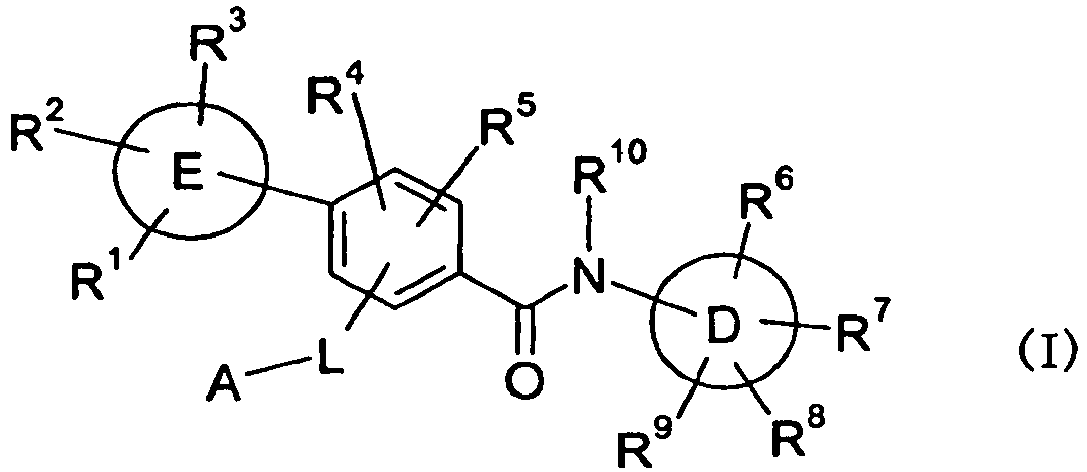
-

- L: a C1-5 alkylene;
- D ring together with the groups represented by R6 to R9 to be bonded thereto form a group selected from the following formulae (a)-(d)

- R6a and R6b : the same or different, a hydrogen atom, a C1-5 alkyl, or a halogen-substituted C1-5 alkyl, R7a, R8a, R7b,
- and R8b: the same or different, a hydrogen atom, a halogen atom, a C1-5 alkyl, or a halogen-substituted C1-5 alkyl,

- R6c and R6d: the same or different, a hydrogen atom, a C1-5 alkyl, or a halogen-substituted C1-5 alkyl, and
- R7c, R8c, R7d, and R8d: the same or different, a hydrogen atom, a halogen atom, a C1-5 alkyl, or a halogen-substituted C1-5 alkyl;
- E ring: is benzene;
- R11a and R12a: the same or different, a hydrogen atom, a C1-5 alkyl, a halogen-substituted C1-5 alkyl, -O-C1-5 alkyl, - SO2-C1-5 alkyl, -C(=O)H, -C(=O)-C1-5 alkyl, -CN, -NH2, -NH-C1-5 alkyl, -N(C1-5 alkyl)2, -C(=O)-NH2, -C(=O)-NH-C1-5 alkyl, -C(=O)-N(C1-5 alkyl)2, -C(=O)-aryl, -C(=O)-NH-aryl, -NH-C(=O)-C1-5 alkyl, -NH-C(=O)-aryl, -NH-SO2-C1-5 alkyl, -N(C1-5 alkyl)-SO2-C1-5 alkyl, -C1-5 alkylene-NH-SL2-C1-5 alkyl, -C1-5 alkylene-NH-SO2-aryl, -C(=O)-O-C1-5 alkyl, -C1-5 alkylene-OH, -C1-5 alkylene-C(=O)-NH-C1-5 alkyl, -C1-5 alkylene-C(=O)-N(C1-5 alkyl)2, -C1-5 alkylene-C(=O)-NH2, C1-5 alkylene-C(=O)-OH, -C1-5 alkylene-O-C1-5 alkyl, -C1-5 alkylene-S-C1-5 alkyl, -C1-5 alkylene-O-C(=O)-C1-5 alkyl, -C1-5 alkylene-NH-C1-5 alkyl, -C1-5 alkylene-N(C1-5 alkyl)2, -C1-5 alkylene-aryl, a cycloalkyl, an aryl, -(4- to 12-membered monocyclic or bicyclic heterocycle containing 1 to 4 atoms of one or more kinds of heteroatoms selected from the group consisting of N, S, and O), -O-(4- to 12-membered monocyclic or bicyclic heterocycle containing 1 to 4 atoms of one or more kinds of heteroatoms selected from the group consisting of N, S, and O), -C1-5 alkylene-(4- to 12-membered monocyclic or bicyclic heterocycle containing 1 to 4 atoms of one or more kinds of heteroatoms selected from the group consisting of N, S, and O), -C(=O)-(4- to 12-membered monocyclic or bicyclic heterocycle containing 1 to 4 atoms of one or more kinds of heteroatoms selected from the group consisting of N, S, and O), -C1-5 alkylene-N(C1-5 alkyl)-(4- to 12-membered monocyclic or bicyclic heterocycle containing 1 to 4 atoms of one or more kinds of heteroatoms selected from the group consisting of N, S, and 0), or -C(=O)-NH-(4- to 12-membered monocyclic or bicyclic heterocycle containing 1 to 4 atoms of one or more kinds of heteroatoms selected from the group consisting of N, S, and O), and the above monocyclic or bicyclic heterocycle may be substituted by a halogen atom, a C1-5 alkyl, -O-C1-5 alkyl, or -OH;
- G is a ring selected from morpholine, piperidine, or pyrrolidine and the ring nitrogen atom of the ring group is bonded to L;
- R1 to R9: the same or different, a hydrogen atom, a halogen atom, a C1-5 alkyl, a halogen-substituted C1-5 alkyl, -OH, -SH, -O-C1-5 alkyl, -O-C1-5 alkyl-NH-C1-5 alkyl, -O-C1-5 alkyl-N(C1-5 alkyl)2, =O, -NH2, -NH-C1-5 alkyl, - N(C1-5 alkyl)2, -S-C1-5 alkyl, -SO-C1-5 alkyl, -SO2-C1-5 alkyl, -CN, -COOH, -C(=O)-O-C1-5 alkyl, -C(=O)-NH2, -C(=O)-NH-C1-5 alkyl, -C(=O)-N(C1-5alkyl)2, -NH-C(=O) -O-C1-5alkyl, -NH-SO2-C1-5alkyl, -SO2-NH2,
-SO2-NH-C1-5 alkyl, -C(=O)-C1-5 alkyl, -NO2 or a nitrogen-containing saturated heterocycle; - R10: a hydrogen atom or a C1-5 alkyl;
- R13 to R15: the same or different, a hydrogen atom, a halogen atom, a C1-5 alkyl, a halogen-substituted C1-5 alkyl, -OH, -O-C1-5 alkyl, -S-C1-5 alkyl, -SO-C1-5 alkyl, - SO2-C1-5 alkyl, =O, -C(=O)H, -C(=O)-C1-5 alkyl, -COOH, -CN, -NH2, -NH-C1-5 alkyl, -N(C1-5 alkyl)2, -C(=O)-NH2, -C(=O) - NH-C1-5 alkyl, -C(=O)-N(C1-5alkyl)2, -C(=O)-aryl, -C(=O)-NH-aryl, -NH-C(=O)-C1-5 alkyl, -NH-C(=O)-aryl, -NH-SO2-C1-5 alkyl, -N(C1-5 alkyl)-SO2-C1-5 alkyl, -C1-5 alkylene-NH-SO2-C1-5 alkyl, -C1-5 alkylene-NH-SO2-aryl, -C(=O)-O-C1-5 alkyl, -C1-5 alkylene-OH, -C1-5 alkylene-C(=O)-NH-C1-5 alkyl, -C1-5 alkylene-C(=O)-N(C1-5 alkyl)2, -C1-5 alkylene-C(=O) -NH2, - C1-5 alkylene-C(=O)-OH, -C1-5 alkylene-O-C1-5 alkyl, -C1-5 alkylene-S-C1-5 alkyl, -C1-5 alkylene-O-C(=O)-C1-5 alkyl, -C1-5 alkylene-NH-C1-5 alkyl, -C1-5 alkylene-N(C1-5 alkyl)2, -C1-5 alkylene-aryl, a cycloalkyl, an aryl, -(4- to 12-membered monocyclic or bicyclic heterocycle containing 1 to 4 atoms of one or more kinds of heteroatoms selected from the group consisting of N, S, and O), -0-(4- to 12-membered monocyclic or bicyclic heterocycle containing 1 to 4 atoms of one or more kinds of heteroatoms selected from the group consisting of N, S, and O), -C1-5 alkylene- (4- to 12-membered monocyclic or bicyclic heterocycle containing 1 to 4 atoms of one or more kinds of heteroatoms selected from the group consisting of N, S, and O), -C(=O)-(4- to 12-membered monocyclic or bicyclic heterocycle containing 1 to 4 atoms of one or more kinds of heteroatoms selected from the group consisting of N, S, and O), -C1-5 alkylene-N(C1-5 alkyl)-(4- to 12-membered monocyclic or bicyclic heterocycle containing 1 to 4 atoms of one or more kinds of heteroatoms selected from the group consisting of N, S, and O), or -C(=O)-NH-(4- to 12-membered monocyclic or bicyclic heterocycle containing 1 to 4 atoms of one or more kinds of heteroatoms selected from the group consisting of N, S, and O), and the above monocyclic or bicyclic heterocycle may be substituted by halogen atom(s), C1-5 alkyl(s), -O-C1-5 alkyl, or -OH,or a salt thereof.
-
- [2] The compound according to the above [1], wherein the compound represented by A in the above formula (I) is the following formula:

- [2b] The ring represented by G in the above formula (I) is a ring selected from morpholine, piperidine, and pyrrolidine and the ring nitrogen atom is bonded to L.
- [2c] The ring represented by D in the above formula (I) is a ring selected from indoline, tetrahydroquinoline, 3,4-dihydro-2H-1,4-benzoxazine, and dihydroquinoline.
- [2d] The compound according to the above [2], more further preferably according to the above [2b], wherein the ring represented by D in the above formula (I) together with the groups represented by R6 to R9 to be bonded thereto form a group selected from the following formulae:

Or, the compound according to the above [2], more further preferably according to the above [2b], wherein the ring represented by D in the above formula (I) together with the groups represented by R6 to R9 to be bonded thereto form a group selected from the following formulae:
- [2e] The compound according to the above [2], wherein at least one of the groups represented by R13 to R15 is a halogen atom, a C1-5alkyl, a halogen-substituted C1-5alkyl, -OH, -O- C1-5alkyl, -NH2, -N(C1-5alkyl)2, -C(=O)-NH2, -C(=O)-N(C1-5alkyl)2, -NH-C(=O)- C1-5alkyl, - C(=O)-O- C1-5alkyl, - C1-5alkylene-O- C1-5alkyl, an aryl, a - (4- to 12-membered monocyclic or bicyclic heterocycle containing 1 to 4 atoms of one or more kinds of heteroatoms selected from the group consisting of N, S, and O), or - C1-5alkylene-(4- to 12-membered monocyclic or bicyclic heterocycle containing 1 to 4 atoms of one or more kinds of heteroatoms selected from the group consisting of N, S, and O), and the other is a hydrogen atom. More preferably, the compound according to the above [2], wherein at least one of the symbols represented by R13 to R15 is a C1-5alkyl, -O- C1-5alkyl, -N(C1-5alkyl)2, - (4- to 12-membered monocyclic or bicyclic heterocycle containing 1 to 4 atoms of one or more kinds of heteroatoms selected from the group consisting of N, S, and O), or - C1-5alkylene-(4- to 12-membered monocyclic or bicyclic heterocycle containing 1 to 4 atoms of one or more kinds of heteroatoms selected from the group consisting of N, S, and O) and the other is a hydrogen atom.
- [3] The compound according to the above [1], wherein the group represented by A in the above formula (I) is the following formula:

- [3a] The compound according to the above [3], wherein R11a is a C1-5alkyl and R12a is a group selected from -C1-5alkylene-O-C1-5alkyl, C1-5alkylene-S-C1-5alkyl, -C1-5alkylene-NH-C1-5alkyl, -C1-5alkylene-N(C1-5alkyl)2, - C1-5alkylene-OH, -C1-5alkylene-C(=O)-NH-C1-5alkyl, -C1-5alkylene-C(=O)-N(C1-5alkyl)2, -C1-5alkylene-aryl, a cycloalkyl, an aryl, -(4- to 12-membered monocyclic or bicyclic heterocycle containing 1 to 4 atoms of one or more kinds of heteroatoms selected from the group consisting of N, S, and O), and - C1-5alkylene-(4- to 12-membered monocyclic or bicyclic heterocycle containing 1 to 4 atoms of one or more kinds of heteroatoms selected from the group consisting of N, S, and O).
- [3b] More preferably, the compound according to the above [3], more preferably the compound according to the above [3a], wherein the ring represented by D in the above formula (I) together with the groups represented by R6 to R9 to be bonded thereto form a group selected from the following formulae:

Or, the compound according to the above [3], wherein the ring represented by D in the above formula (I) together with the groups represented by R6 to R9 to be bonded thereto form a group selected from the following formulae:
- [4] The compound according to the above [1], wherein R1 to R5 are the same or different and each is a hydrogen atom, a halogen, a halogen-substituted C1-5alkyl, a C1-5alkyl, - N(C1-5alkyl)2, or -O-C1-5alkyl.
- [5] The compound according to the above [1], wherein R6 to R9 are the same or different and each is a hydrogen atom, a halogen atom, a C1-5alkyl, a halogen-substituted C1-5alkyl, -OH, -O-C1-5alkyl, =O, -NH-C1-5alkyl, -N(C1-5alkyl)2, -CN, -C(=O)-NH2, -NH-SO2- C1-5alkyl, -SO2-NH2, -C(=O) - C1-5alkyl, -NO2, or a nitrogen-containing saturated heterocycle, more preferably, a hydrogen atom, a halogen, a halogen-substituted C1-5alkyl, a C1-5alkyl, -OH, =O, -N(C1-5alkyl)2, or -SO2-NH2. Further preferably, the compound according to the above [1], wherein R6 to R8 are the same or different and each is a hydrogen atom, a halogen atom, a C1-5alkyl, or a halogen-substituted C1-5alkyl and R9 is =0.
- [6] The compound according to the above [1], wherein R10 in the above formula (I) is a hydrogen atom.
- [7] The compound according to the above [1], wherein the group represented by L is methylene or ethylene, more preferably methylene.
- [8] The compound according to the above [1] or a salt thereof, wherein the benzamide derivative represented by the above formula (I) is at least one compound selected from the group consisting of N-1,3-benzothiazol-5-yl-2-{[cyclohexyl(isopropyl)amino]methyl}biphenyl-4-carboxamide, N-(1-methyl-2-oxo-1,2,3,4-tetrahydroquinolin-7-yl)-2-(piperidin-1-ylmethyl)biphenyl-4-carboxamide, N-(3,3-dimethyl-2-oxo-2,3-dihydro-1H-indol-6-yl)-2-(piperidin-1-ylmethyl)biphenyl-4-carboxamide, 2-{[ethyl(2-hydroxy-2-methylpropyl)amino]methyl}-N-(2-methyl-3-oxo-3,4-dihydro-2H-1,4-benzoxazin-6-yl)biphenyl-4-carboxamide, N-(1-methyl-2-oxo-1,2-dihydroquinolin-7-yl)-2-(piperidin-1-ylmethyl)biphenyl-4-carboxamide, N-(3-methyl-2-oxo-1,2-dihydroquinolin-7-yl)-2-(piperidin-1-ylmethyl)biphenyl-4-carboxamide, N-(2,4-dimethyl-3-oxo-3,4-dihydro-2H-1,4-benzoxazin-6-yl)-2-(piperidin-1-ylmethyl)biphenyl-4-carboxamide, 2-{[ethyl(tetrahydro-2H-pyran-4-yl)amino]methyl}-N-(1-methyl-2-oxo-1,2,3,4-tetrahydroquinolin-7-yl)biphenyl-4-carboxamide, N-(1-methyl-2-oxo-1,2,3,4-tetrahydroquinolin-7-yl)-3-(piperidin-1-ylmethyl)-4-(2-thienyl)benzamide, 2-{[ethyl(tetrahydro-2H-thiopyran-4-yl)amino]methyl}-N-(1-methyl-2-oxo-1,2,3,4-tetrahydroquinolin-7-yl)biphenyl-4-carboxamide, 2-{[isobutyl(2-piperidin-1-ylethyl)amino]methyl}-N-(2-methyl-3-oxo-3,4-dihydro-2H-1,4-benzoxazin-6-yl)biphenyl-4-carboxamide, N,N-diethyl-4-[(4-{[(1-methyl-2-oxo-1,2,3,4-tetrahydroquinolin-7-yl)amino]carbonyl}biphenyl-2-yl)methyl]morpholine-3-carboxamide, 2-[(4-methyl-1,3'-bipiperidin-1'-yl)methyl]-N-(2-methyl-3-oxo-3,4-dihydro-2H-1,4-benzoxazine-6-yl)biphenyl-4-carboxamide,2-(piperidin-1-ylmethyl)-N-(2,2,4-trimethyl-3-oxo-3,4-dihydro-2H-1,4-benzoxazin-6-yl)biphenyl-4-carboxamide, N-(2-oxo-1,2-dihydroquinolin-7-yl)-2-(piperidin-1-ylmethyl)biphenyl-4-carboxamide, 4'-fluoro-N-(1-methyl-2-oxo-1,2,3,4-tetrahydroquinolin-7-yl)-2-(piperidin-1-ylmethyl)biphenyl-4-carboxamide, N-(1-methyl-2-oxo-1,2,3,4-tetrahydroquinolin-7-yl)-2-[(2-methylpyrrolidin-1-yl)methyl]biphenyl-4-carboxamide, N-(3-methyl-2-oxo-1,2,3,4-tetrahydroquinolin-7-yl)-2-(piperidin-1-ylmethyl)biphenyl-4-carboxamide, N-[1-(2-fluoroethyl)-2-oxo-1,2,3,4-tetrahydroquinolin-7-yl]-2-(piperidin-1-ylmethyl)biphenyl-4-carboxamide, and N-[(2R)-2-methyl-3-oxo-3,4-dihydro-2H-1,4-benzoxazin-6-yl]-2-(piperidin-1-ylmethyl)biphenyl-4-carboxamide.
- [9] The compound according to [1] or a salt thereof, wherein the compound represented by the above formula (I) is a compound selected from the group consisting of N-1,3-benzothiazol-5-yl-2-{[cyclohexyl(isopropyl)amino]methyl} biphenyl-4-carboxamide, N-(1-methyl-2-oxo-1,2,3,4-tetrahydroquinolin-7-yl)-2-(piperidin-1-ylmethyl)biphenyl-4-carboxamide, N-(3,3-dimethyl-2-oxo-2,3-dihydro-1H-indol-6-yl)-2-(piperidin-1-ylmethyl)biphenyl-4-carboxamide, 2-{[ethyl(2-hydroxy-2-methylpropyl)amino]methyl}-N-(2-methyl-3-oxo-3,4-dihydro-2H-1,4-benzoxazin-6-yl)biphenyl-4-carboxamide, N-(1-methyl-2-oxo-1,2-dihydroquinolin-7-yl)-2-(piperidin-1-ylmethyl)biphenyl-4-carboxamide, N-(3-methyl-2-oxo-1,2-dihydroquinolin-7-yl)-2-(piperidin-1-ylmethyl)biphenyl-4-carboxamide, N-(2,4-dimethyl-3-oxo-3,4-dihydro-2H-1,4-benzoxazin-6-yl)-2-(piperidin-1-ylmethyl)biphenyl-4-carboxamide, 2-{[ethyl(tetrahydro-2H-pyran-4-yl)amino]methyl}-N-(1-methyl-2-oxo-1,2,3,4-tetrahydroquinolin-7-yl)biphenyl-4-carboxamide, N-(1-methyl-2-oxo-1,2,3,4-tetrahydroquinolin-7-yl)-3-(piperidin-1-ylmethyl)-4-(2-thienyl)benzamide, 2-{[ethyl(tetrahydro-2H-thiopyran-4-yl)amino]methyl}-N-(1-methyl-2-oxo-1,2,3,4-tetrahydroquinolin-7-yl)biphenyl-4-carboxamide, 2-{[isobutyl(2-piperidin-1-ylethyl)amino]methyl)-N-(2-methyl-3-oxo-3,4-dihydro-2H-1,4-benzoxazin-6-yl)biphenyl-4-carboxamide, N,N-diethyl-4-[(4-{[(1-methyl-2-oxo-1,2,3,4-tetrahydroquinolin-7-yl)amino]carbonyl}biphenyl-2-yl)methyl]morpholine-3-carboxamide, and 2-[(4-methyl-1,3'-bipiperidin-1'-yl)methyl]-N-(2-methyl-3-oxo-3,4-dihydro-2H-1,4-benzoxazin-6-yl)biphenyl-4-carboxamide.
- [10] The compound according to [8] or a salt thereof, wherein said compound is N-(1-methyl-2-oxo-1,2,3,4-tetrahydroquinolin-7-yl)-2-[(2-methylpyrrolidin-1-yl)methyl]biphenyl-4-carboxamide.
- [11] The compound according to [8] or a salt thereof, wherein said compound is N-[(2R)-2-methyl-3-oxo-3,4-dihydro-2H-1,4-benzoxazin-6-yl]-2-(piperidin-1-ylmethyl)biphenyl-4-carboxamide. Moreover, the invention relates to a pharmaceutical composition comprising a benzamide derivative represented by the above formula (I) or a salt thereof and pharmaceutically acceptable carrier. Preferably, it is the aforementioned pharmaceutical composition, which is a VR1 activation inhibitor and more preferably, it is the aforementioned pharmaceutical composition, which is a preventive or therapeutic agent for pains.
- Furthermore, the other embodiments include use of a benzamide derivative represented by the general formula (I) according to [1] to [9] or a salt thereof for manufacturing a preventive or therapeutic agent for pains and the compound of formula (I) for use in a method for preventing or treating pain, comprising administering an effective amount of a benzamide derivative represented by the general formula (I) according to [1] to [9] or a salt thereof.
- The following will describe the invention in detail.
- The "capsaicin receptor VR1 activation inhibitor" herein is a generic name of both compounds (VR1 antagonist) which bind to the VR1 receptor and inhibit VR1 activation by competition with an endogenous ligand and compounds (VR1 agonist) which desensitize nerves where the receptor is present and inhibit their subsequent activation by continuous activation of the VR1 receptor. As the "VR1 activation inhibitor", a VR1 antagonist is preferable.
- In the definition of the general formulae herein, the term "lower" means a linear or branched carbon chain having from 1 to 6 carbon atoms, unless otherwise specified. Therefore, the "lower alkyl" is preferably alkyl having 1 to 5 carbon atoms, and particularly preferred are methyl, ethyl, propyl, isopropyl, butyl, isobutyl, and 1,2-dimethylpropyl. As the "lower alkylene", preferred are linear alkylenes such as methylene, ethylene, propylene, and butylene, and branched alkylenes such as methylmethylene. Particularly preferred are methylene and ethylene.
- The "halogen atom" includes fluorine, chlorine, bromine, and iodine atoms. Particularly, a fluorine atom and a chlorine atom are preferred. The "halogen-substituted lower alkyl" means a group wherein the above lower alkyl is substituted by 1 to 3 halogen which are the same or different. Particularly, trifluoromethyl is preferred.
- As the "monocyclic or bicyclic hydrocarbon ring", there may be mentioned benzene, naphthalene, cycloalkyl rings having 3 to 8 ring members, cycloalkenyl rings having 4 to 8 ring members, and saturated hydrocarbon ring-condensed aryl rings wherein a cycloalkyl or a cycloalkenyl ring is fused to benzene. Preferred are benzene, naphthalene, indane, and tetrahydronaphthalene.
- The "aryl" is an aryl having 6 to 14 carbon atoms, and is further preferably phenyl or naphthyl.
- The "cycloalkyl" is preferably a cycloalkyl group having 3 to 10 carbon atoms which may possess brige(s), and further preferred are cyclopropyl, cyclopentyl, cyclohexyl, cycloheptyl, and adamantyl groups.
- The "nitrogen-containing saturated heterocycle" is a 5- to 8-membered saturated or partially unsaturated monocyclic heterocycle which contains one N atom and may further contain one heteroatom selected from N, S, and O, and preferred are pyrrolidine, piperidine, piperazine, azepane, diazepane, morpholine, thiomorpholine, and tetrahydropyridine rings.
- The "5- to 12-membered monocyclic or bicyclic heteroaromatic ring containing 1 to 4 atoms of one or more kinds of heteroatoms selected from the group consisting of N, S, and O" is a 5- to 6-membered monocyclic heteroaromatic ring containing 1 to 4 atoms of heteroatoms selected from the group consisting of N, S, and O and a bicyclic heteroaryl group wherein this monocyclic heteroaromatic ring is condensed with a benzene ring or a 5- to 6-membered monocyclic heteroaromatic ring. These rings may be partially saturated. Moreover, in the case that an N atom or an S atom is included in the ring atoms, the atom may form an oxide or a dioxide. As the 5- to 6-membered monocyclic heteroaromatic ring, preferred are pyridine, pyrimidine, pyrazine, pyridazine, triazine, pyrrole, furan, thiophene, thiazole, imidazole, oxazole, isothiazole, pyrazole, isozazole, thiadiazole, triazole, and tetrazole rings. As the bicyclic heterocycle, preferred are benzothiazole, benzoisothiazole, benzoxazole, benzisoxazole, benzimidazole, benzotriazole, benzothiadiazole, benzoxadiazole, quinoline, isoquinoline, naphthylidine, quinoxaline, quinazoline, phthalazine, cinnoline, indole, indazole, imidazopyridine, benzothiophene, benzothiophene-1,1-dioxide, benzofuran, dihydrobenzofuran, dihydro-1,3-benzoxazole, dihydro-1,3-benzothiazole, 1,3-benzodioxole, benzazepine, benzodiazepine, benzoxazine, tetrahydrobenzoxazepine, tetrahydrobenzazepine, tetrahydroquinoline, tetrahydroisoquinoline, tetrahydronaphthopyridine, tetrahydroquinoxaline, chroman, dihydrobenzodioxine, 3,4-dihydro-2H-1,4-benzothiazine, dihydrobenzothiazole, 3,4-dihydro-2H-1,4-benzoxazine, isochroman, indoline, and pteridine rings. Further preferred are pyridine, benzothiazole, benzoxazole, quinoline, isoquinoline, dihydroquinoline, dihydroisoquinoline, indoline, tetrahydroquinoline, tetrahydroisoquinoline, benzothiophene, 3,4-dihydro-2H-1,4-benzoxazine, 3,4-dihydro-2H-1,4-benzothiazine, and dihydro-1,3-benzoxazole rings.
- The "4- to 12-membered monocyclic or bicyclic heterocycle containing 1 to 4 atoms of one or more kinds of heteroatoms selected from the group consisting of N, S, and O" is, in addition to the above monocyclic or bicyclic heteroaromatic rings, a 4- to 8-membered saturated or partially unsaturated monocyclic heterocycle, and a bicyclic heterocycle obtained by condensing it with a cycloalkyl ring, a cycloalkenyl ring, or a saturated or partially unsaturated monocyclic heterocycle. Preferred are saturated or partially unsaturated monocyclic heterocycles such as pyrrolidine, imidazolidine, pyrazolidine, quinuclidine, piperidine, piperazine, morpholine, thiomorpholine, thiomorpholine 1,1-dioxide, azepane, azocane, 1,4-ozazepane, azetidine, 1,2,3,6-tetrahydropyridine, and imidazoline, and saturated or partially unsaturated bicyclic heterocycles such as decahydroquinoline and decahydroisoquinoline. More preferred are nitrogen-containing saturated heterocycles and further preferred are pyrrolidine, piperidine, piperazine, and morpholine rings.
- In the case that the substituent is described as R7a or R8a in the following formula, it shows that the substituent may be bonded to a carbon atom on any of left and right rings.

- Moreover, among the compounds of the invention, there exist geometrical isomers, tautomers, and optical isomers depending on the kind of substituents. The invention encompasses mixtures of such isomers and those isolated.
- The compounds of the invention form acid addition salts in some cases. Also, they form salts with bases in some cases. Specifically, such salts include addition salts with inorganic acids such as hydrochloric acid, hydrobromic acid, hydroiodic acid, sulfuric acid, nitric acid, and phosphoric acid; or with organic acids such as formic acid, acetic acid, propionic acid, oxalic acid, malonic acid, succinic acid, fumaric acid, maleic acid, lactic acid, malic acid, tartaric acid, citric acid, methanesulfonic acid, ethanesulfonic acid, aspartic acid, and glutamic acid; the salts with inorganic bases such as sodium, potassium, magnesium, calcium, and aluminum; with organic bases such as methylamine, ethylamine, ethanolamine, lysine and ornithine; ammonium salts; and the like.
- Furthermore, the invention encompasses hydrates of the compounds of the invention, pharmaceutically acceptable various solvates, compounds having crystalline polymorphism, and the like.
- The compounds of the invention also include compounds which are metabolized in a living body to be converted into the compound represented by the above general formula (I) or salts thereof, so-called prodrugs. The groups that form the prodrugs of the compounds of the invention are groups described in Prog. Med. 5:2157-2161 (1985) and groups described in "Iyakuhinn no Kaihatsu (Development of Medicines) published by Hirokawa Shoten, 1990, Vol. 7, Bunshi Sekkei (Molecular Design), pp. 163-198.
- The following will describe representative methods of the compounds of the invention.
- In this connection, in the following production process, depending on the kind of functional groups, it is sometimes technically effective to replace the functional groups to suitable protective groups at a stage of starting materials or intermediates, i.e., groups easily convertible into the functional groups. Thereafter, the protective groups can be removed to obtain desired compound when required. As such functional groups, there may be, for example, an amino group, a hydroxyl group, a carboxyl group, and the like. As such protective groups, there can be mentioned protective groups described in Protective Groups in Organic Synthesis 3rd edition (written by T. W. Green and P. G. M. Wuts, published by JOHN WILLY & SONS, INC), which may be suitably used depending on the reaction conditions. The method described in said reference can be applicable to introduction and removal of the protective groups.
-

- The production method 1 is a reaction of synthesizing a compound (I) by a condensation reaction of a carboxylic acid with an amine using a compound (II) and a compound (III).
- The present reaction may be carried out according to a usual method using the compound (II) and the amine derivative (III) in equimolar amounts or in an excess of one of them in the presence of a condensing agent. As the condensing agent, there can be suitably used N,N-dicyclohexylcarbodiimide (DCC), 1-ethyl-3-[3-(N,N-dimethylamino)propyl]carbodiimide, O-benzotriazol-1-yl-N,N,N',N'-tetramethyluronium hexafluorophosphate (HBTU), carbonyldiimidazole, diphenylphosphoryl azide (DPPA), diethylphosphoryl cyanide, or the like. These condensing agents are used in an equimolar amount or in an excess amount of carboxylic acid. As a solvent, there can be used a solvent which does not participate in the reaction, N,N-dimethylformamide (DMF), dioxane, tetrahydrofuran, ether, dichloroethane, dichloromethane, chloroform, carbon tetrachloride, dimethoxymethane, dimethoxyethane, ethyl acetate, benzene, acetonitrile, dimethyl sulfoxide, or a mixed solvent thereof, and the solvent is suitably selected according to the applying method. Moreover, depending on the applying method, there is a case that the reaction easily proceeds by carrying out the reaction in the presence of a base such as N-methylmorpholine, triethylamine, trimethylamine, pyridine, or 4-dimethylaminopyridine or using the base as a solvent. Usually, the above reaction is carried out under cooling to under room temperature but it is sometimes preferred that the reaction is carried out under an elevated temperature depending on the kind of acylation reaction.
- Moreover, the compound (I) can be also produced by the method of introducing a carboxylic acid into an active derivative and then condensing the resulting product with an amine. In this case, the reaction is carried out using the compound (II) and the amine derivative (III) in equimolar amounts or in an excess of one of them. As the active derivative of the carboxylic acid, there may be mentioned an active ester obtained by reacting the acid with a phenolic compound such as p-nitrophenol or an N-hydroxyamine compound such as 1-hydroxysuccinimide or 1-hydroxybenzotriazole, a monoalkylcarbonate, a mixed anhydride obtained by reacting it with an organic acid, a phosphate type mixed anhydride obtained by reacting it with diphenylphosphoryl chloride and N-methylmorpholine, an acid azide obtained by successively reacting an ester with hydrazine and alkyl nitrite, an acid halide such as an acid chloride or an acid bromide, and a symmetric acid anhydride. The reaction is carried out using an activation reagent in an equimolar amount to the compound (II) or in an excess thereof relative to the compound. The reaction conditions in this case are also the same as those in the case using the condensing agent.
- Moreover, other than the reactions described above, any reactions can be used as far as they form amide bonds.
-

- The production method 2 is a reaction of synthesizing the compound (I) by a nucleophilic substitution reaction using a compound (IV) and an amine compound A-H.
- The present reaction is carried out using the compound (IV) and A-H in equimolar amounts or in an excess of one of them under ice cooling to under an elevated temperature by adding a base (preferably, potassium carbonate, sodium carbonate, sodium hydrogen carbonate, potassium tert-butoxide, triethylamine, pyridine, N-methylmorpholine, sodium hydroxide) using the solvent described in the production method 1 as a solvent.
- In the case that the compounds (I) of the invention have various side chains and functional groups, these compounds can be easily synthesized using the compounds of the invention or production intermediates thereof as starting materials by means of reactions obvious for those skilled in the art or modified method thereof. As such examples, there may be mentioned conversion of any of R1 to R9 of the compound (I) obtained by the production method 1 or conversion of newly introducing it. For example, the following reactions can be applied.
- The compound wherein any substituent of R1 to R9 in the formula (I) is -SO2-NH2 or CO-NH2 can be produced using a compound wherein each of the corresponding R1 to R9 is - SO3H or CO2H. The reaction is carried out by condensing - SO3H or CO2H of R1 to R9 with ammonia under the same conditions as those in the first production reaction.
- Moreover, the compound wherein the D ring in the formula (I) is a saturated ring and any substituent of R1 to R9 in the formula (I) is -OH can be produced using a compound wherein the present substituent is a carbonyl group by applying a usual method for a reduction reaction. For example, the reaction can be carried out with referring to the method described in Tetrahedron, 35, 567-607 (1979).
- Furthermore, the compound wherein the D ring or the E ring is a heterocycle and a heteroatom in the ring is oxidized into an oxide can be synthesized by oxidizing the heteroatom using a usual method for the oxidation reaction. The reaction can be carried out with referring to the method described in J. Hetrocycl. Chem. 19, 237-240, (1982), J. Chem. Soc. Perkin Trans. 1, 1949-1955, (1984).
- The following will describe representative production methods for the starting materials described in the production method 1 and the production method 2.
- The first step to the eleventh step show production steps for producing the starting material (II) in the production method 1.

- First, the first step is a step of producing a compound (VII) by a cross-coupling reaction using a compound (V) and a compound (VI). The reaction can be carried out with referring to the method described in Synth. Commun., 11, 513-519 (1981), Synlett 2000, No.6, 829-831, and Chem. lett., 1989, 1405-1408.
- The second step is a step of producing (VIII) by treating the compound (VII) with a halogenating agent. The reaction is carried out under room temperature to under reflux with heating using N-bromosuccinimide (NBS), bromine, sulfuryl chloride, or copper bromide as a halogenating agent in a solvent such as carbon tetrachloride, chloroform, or benzene, with adding benzoyl peroxide, 2,2'-azobisisobutyronitrile, tert-butyl hydroperoxide, or tetrakistriphenylphosphine palladium or under irradiation with light, if necessary.

- The third step is a step of producing a compound (IXa) by removing the protective group P1 of the compound (VIII) and simultaneously hydrolyzing the X1 group. The present reaction may be carried out following a usual method for basic hydrolysis of halides. However, in the case that the protective group is not deprotected by hydrolysis with a base, after the hydrolysis of the X1 group of the compound (VIII), the deprotection reaction may be carried out by hydrolysis with an acid such as hydrochloric acid or trifluoroacetic acid or by reduction such as catalytic hydrogenation. The reaction conditions may be used according to the aforementioned "Protective Groups in Organic Synthesis".
- The fourth step is a step of producing a compound (X) by an oxidation reaction of the compound (VIII). The reaction is carried out using an oxidizing agent such as N-methylmorpholine-N-oxide, trimethylamine-N-oxide, sodium salt of 2-nitropropane described in J. Am. Chem. Soc., 71, 1767-1769 (1949), or silver nitrate, in a solvent such as acetonitrile or ethanol under ice cooling to under reflux.
- The fifth step is a step of producing a compound (XI) from the compound (X). The reaction is carried out using (methoxymethyl)triphenylphosphonium chloride, (methoxymethyl)triphenylphosphonium bromide, or the like as a reacting agent in the presence of a base such as n-butyllithium, sec-butyllithium, sodium hydride, or potassium tert-butoxide in a solvent such as tetrahydrofuran, diethyl ether, or cyclopentyl methyl ether under -78°C to under an elevated temperature.
- The sixth step is a step of producing a compound (XIIa) by condensing the compound (XI) with A-H by a reductive amination reaction. The reaction is carried out using sodium triacetoxyborohydride, sodium borohydride, or the like as a reducing agent, with adding an organic acid (preferably, acetic acid, formic acid, or p-toluenesulfonic acid), a Lewis acid such as a metal salt (preferably, tetraisopropoxytitanium), if necessary. The reaction is carried out using a solvent such as dichloromethane, dichloroethane, chloroform, carbon tetrachloride, or tetrahydrofuran under ice cooling to under an elevated temperature.
- The seventh step and the eighth step are steps of producing compounds (XIIIa) and (XIIIb) by reducing the formyl group of the compounds (X) and (XI), respectively. The reaction can be carried out with referring to the method described in Tetrahedron, 35, 567-607 (1979).
- The ninth step is a step of producing a compound (XIVa) by halogenating the hydroxyl group of the compound (XIIIb) or by converting it into a sulfonate ester. The halogenation is carried out using an acid halide (preferably, thionyl chloride, phosphorus trichloride, phosphorus pentachloride, phosphorus oxychloride, or phosphorus tribromide, etc.) or using triphenylphosphine and carbon tetrachloride, triphenylphosphine and carbon tetrabromide, or the like. The conversion into a sulfonate ester is carried out by treating it with methanesulfonyl chloride or p-toluenesulfonyl chloride in the presence of a base (preferably, triethylamine, pyridine, or potassium carbonate). It is carried out using dichloroethane, methylene chloride, chloroform, dioxane, or hexane as a solvent under ice cooling to under reflux with heating. Moreover, by treating the resulting chloride, bromide, or sulfate ester with sodium iodide, potassium iodide, or the like, an iodide can be also obtained. As a solvent in this case, acetone, 2-butanone, ethanol, or the like is used.
- By applying the same reaction conditions as those of the ninth step to the compound (XIIIa), the hydroxyl group of the compound (XIIIa) can be halogenated or converted into a sulfonate ester.

- The tenth step is a step of producing a compound (XII) by reacting the compound (VIV) with A-H. The reaction is carried out under the same conditions as those of the production method 2.
- The eleventh step is a step of producing the compound (II) by removing the protective group P1 of the compound (XII). The deprotection reaction may be preferably carried out using procedures described in the aforementioned "Protective Groups in Organic Synthesis".
-

- The twelfth to fifteenth steps show how to produce the starting compound (IV) in the production method 2.
- First, the compound (IV) can be produced by sequentially carrying out the twelfth and fifteenth steps. The reaction can be carried out by condensing the compound (IX) and the compound (III) in the same manner as in the production method 1 and then halogenating the hydroxyl group of the resulting compound (XV) or by converting it into a sulfonate ester as in the ninth step.
- Moreover, it is possible to produce a compound in the formula (IV) wherein X is restricted to X1, namely a compound (IVa) via the thirteenth step and the fourteenth step. Namely, by treating the compound (IX) under the halogenation reaction conditions according to the ninth step, halogenation of the hydroxyl group and conversion of the carboxyl group into an acid halide are simultaneously carried out and an amide bond may be formed by reacting the resulting acid halide (XVI) with the amine derivative (III) separately prepared. The reaction is carried out in dichloroethane, methylene chloride, or the like in the presence of a base (pyridine, triethylamine, potassium carbonate, or sodium hydrogen carbonate) under cooling to under room temperature but under an elevated temperature depending on the kind of acyl reactions.
- Furthermore, it is also possible to synthesize the compound (IV) by removing the protective group P1 of the compound (XIV) and condensing the resulting carboxylic acid with the amine compound (III) under the same conditions as those of the production method 1.
- The compounds of the invention thus produced may be isolated and purified, as free compounds or their salts, by applying usual chemical operations such as extraction, precipitation, fractional chromatography, fractional crystallization, and recrystallization. Salts of the compounds can be produced by treating the free compounds to an ordinary salt formation.
- Moreover, in the case that the compound of the invention has an asymmetric carbon, optical isomers are present. These optical isomers can be produced by methods of leading them to diastereomeric salts with an optically active acid or base, followed by fractional crystallization, optical resolution by a usual method such as column chromatography, or synthesis using an optically active starting material.
- The following will explain the process for producing the compound of the invention specifically with reference to the following Examples. In this connection, processes for producing starting materials are shown as Reference
- Into 150 ml of water were suspended 55.9 g of sodium carbonate and 38.6 g of phenylboronic acid. Thereto was added 51.4 g of ethyl 4-bromo-3-methylbenzoate dissolved in 400 ml of toluene and then was added 4.0 g of tetrakistriphenylphosphine palladium, followed by 2 hours of reflux with heating. After the reaction solution was cooled to room temperature, filtration was conducted using celite, water was added to the filtrate and the organic layer was extracted with toluene. After the organic layer was dried over anhydrous magnesium sulfat, the solvent was removed by evaporation and the resulting residue was purified by silica gel column chromatography (hexane:ethyl acetate) to obtain 50.4 g of ethyl 2-methlbiphenyl-4-carboxylate as a colorless oil Reference Example 2
- In 130 ml of carbon tetrachloride was dissolved 10 g of ethyl 2-methylbiphenyl-4-carboxylate, the whole was heated to 90°C and then 1.0 g of NBS and 136 mg of 2,2'-azobisisobutyronitrile were added thereto. After the reaction solution was heated under reflux, 6.78 g of NBS was added thereto and the whole was heated under reflux for 1 hour and a half. After the reaction solution was cooled to room temperature, precipitate was removed by filtration, water was added to the filtrate, and the organic layer was extracted with carbon tetrachloride. After the resulting organic layer was dried over anhydrous magnesium sulfate, the solvent was removed by evaporation to obtain 13.6 g of ethyl 2-(bromomethyl)biphenyl-4-carboxylate as a white solid.
- In 50 ml of DMF was dissolved 13.6 g of ethyl 2-(bromomethyl)biphenyl-4-carboxylate, and then a suspension of 50 ml of DMF, 6.2 ml of piperidine, and 9.2 g of potassium carbonate were added thereto under ice cooling, followed by 3 hours of stirring at room temperature. Water was added to the reaction solution, the whole was extracted with ethyl acetate, and the resulting organic layer was dried over anhydrous magnesium sulfate, followed by removal of the solvent by evaporation. The obtained residue was purified by silica gel column chromatography (chloroform:methanol:aqueous ammonia) to obtain 12.6 g of ethyl 2-(piperidin-1-ylmethyl)biphenyl-4-carboxylate as a pale yellow oil.
- The compounds of Reference Examples 4 to 16 shown in the following Table were obtained in the same manner as in Reference Example 3.
- In 150 ml of ethanol was dissolved 11 g of ethyl 2-(piperidin-1-ylmethyl)biphenyl-4-carboxylate, and then 51 ml of a 1M aqueous sodium hydroxide was added thereto under ice cooling, followed by 10 hours of stirring at room temperature. Under ice cooling, 51 ml of a 1M aqueous hydrochloric acid was added to the reaction solution and then the solvent was removed by evaporation to obtain 12.6 g of a pale pink solid which was a mixture of 2-(piperidin-1-ylmethyl)biphenyl-4-carboxylic acid and 1.5 equivalents of sodium chloride.
- The compounds of Reference Examples 18 to 30 shown in the following Tables were obtained in the same manner as in Reference Example 17.
- The compounds of Reference Examples 31 to 35 shown in the following Table were obtained in the same manner as in Reference Example 3.
- The compounds of Reference Examples 36 to 40 shown in the following Table were obtained in the same manner as in Reference Example 17.
- In 100 ml of acetonitrile was dissolved 9.3 g of ethyl 2-(bromomethyl)biphenyl-4-carboxylate, and 7.0 g of N-methylmorpholine-N-oxide was added thereto at room temperature, followed by 4 hours of stirring. Water was added to the reaction solution, which was then extracted with ethyl acetate. The resulting organic layer was dried over anhydrous magnesium sulfate. After the solvent was removed by evaporation, the obtained residue was purified by silica gel column chromatography (hexane:ethyl acetate) to obtain 4.94 g of ethyl 2-formylbiphenyl-4-carboxylate as a white solid.
- A suspension of 17.1 g of (methoxymethyl)triphenylphosphonium chloride in 150 ml of tetrahydrofuran was cooled to -78°C and a 1.59M hexane solution of n-butyllithium was added dropwise to the suspension, followed by 30 minutes of stirring. Further, after the reaction solution was warmed to -40°C and stirred for 10 minutes, it was again cooled to -78°C and 4.2 g of ethyl 2-formylbiphenyl-4-carboxylate dissolved in 20 ml of tetrahydrofuran was added dropwise over a period of 20 minutes. The reaction solution was warmed from -50°C to 10°C over a period of 12 hours, followed by 4 hours of stirring at room temperature. The reaction solution was subjected to removal by evaporation, and ethyl acetate and water were added to the residue, followed by separation of an organic layer. The organic layer was dried over anhydrous magnesium sulfate, the solvent was removed by evaporation, and the obtained residue was purified by silica gel column chromatography (hexane:ethyl acetate) to obtain 1.66 g of a colorless oil. The substance was dissolved in 50 ml of 1,2-dichloroethane and 25 ml of formic acid was added thereto at room temperature, followed by 51 hours of stirring. Water and ethyl acetate were added to the reaction solution, an operation for separation was conducted, and the resulting organic layer was dried over anhydrous magnesium sulfate. After the solvent was removed by evaporation, the residue was purified by silica gel column chromatography (hexane:ethyl acetate) to obtain 1.06 g of ethyl 2-(2-oxoethyl)biphenyl-4-carboxylate as a white solid.
- In 20 ml of 1,2-dichloroethane was dissolved 1.06 g of ethyl 2-(2-oxoethyl)biphenyl-4-carboxylate, and then 3.95 ml of piperidine, 589 µl of acetic acid, and 1.09 g of sodium triacetoxyborohydride were added thereto, followed by 3 hours of stirring. Water and chloroform were added to the reaction solution, and the organic layer obtained by an operation of separation was dried over anhydrous magnesium sulfate, followed by removal of the solvent by evaporation. The obtained residue was purified by silica gel column chromatography (chloroform:methanol:aqueous ammonia) to obtain 1.3 g of oily ethyl 2-(piperidin-1-ylethyl)biphenyl-4-carboxylate. Reference Example 44.
- The compound of Reference Example 44 shown in the following Table was obtained in the same manner as in Reference Example 17 using ethyl 2-(piperidin-1-ylethyl)biphenyl-4-carboxylate as a starting material. Reference Examples 45 to 56.
- The compound of Reference Example 45 shown in the following Table was obtained in the same manner as in Reference Example 1.
- The compound of Reference Example 46 shown in the following Table was obtained in the same manner as in Reference Example 2.
- The compounds of Reference Examples 47 to 50 shown in the following Table were obtained in the same manner as in Reference Example 3.
- The compounds of Reference Examples 51 to 56 shown in the following Table was obtained in the same manner as in Reference Example 17.
- To 160 ml of 1,2-dichloroethane was added 14.71 g of 2-(hydroxymethyl)biphenyl-4-carboxylate, and thereto was added 0.5 ml of DMF and 11.75 ml of thionyl chloride. After the reaction solution was stirred for 1 hour under reflux with heating, 8 ml of thionyl chloride was added at room temperature and the whole was stirred for 3 hours under reflux with heating. After cooling to room temperature, the reaction solvent was removed by evaporation under reduced pressure and 200 ml of 1,2-dichloroethane was added to the residue. Under ice cooling, 8.07 g of 1,3-benzothiazol-5-amine and 17.4 ml of pyridine were added thereto, followed by stirring at room temperature. The reaction solvent was removed by evaporation under reduced pressure and the obtained residue was purified by silica gel column chromatography (hexane:ethyl acetate) to obtain 11.23 g of yellow foamy N-1,3-benzothiazol-5-yl-2-(chloromethyl)biphenyl-4-carboxamide.
- In 50 ml of methylene chloride was dissolved 2.5 g of 6-nitroindoline, and then 6.37 ml of triethylamine was added thereto. Under ice cooling, 3.51 g of methanesulfonyl chloride was added dropwise, the reaction solution was stirred at room temperature for 3 hours, and then ice-water was added thereto, followed by 1 hour of stirring. The reaction solvent was removed by evaporation under reduced pressure, a 1M aqueous hydrochloric acid solution was added to the residue, and precipitated was filtrated off, whereby 3.52 g of 1-methylsulfonyl-6-nitroindoline was obtained as a brown solid.
- In 11.5 ml of DMF was dissolved 500 mg of 6-nitro-2H-benzothiazin-3(4H)-one, and thereto was added 114 mg of sodium hydride of 55% purity under ice cooling, followed by 30 minutes of stirring at room temperature. To the reaction solution was added 444 µl of methyl iodide, and the whole was stirred at room temperature for 2 hours. To the reaction solution was added 2 ml of methanol under ice cooling, followed by 10 minutes of stirring at room temperature. Thereafter, water was added and the organic layer was extracted with ethyl acetate. The organic layer was dried over anhydrous sodium sulfate and then the solvent was removed by evaporation. The obtained residue was purified by silica gel column chromatography (chloroform) to obtain 308 mg of 4-methyl-6-nitro-2H-1,4-benzothiazin-3 (4H) -one.
- The compounds of Reference Examples 60 and 61 shown in the following Table shown were obtained in the same manner as in Reference Example 59.
- In 7.4 ml of tetrahydrofuran was dissolved 160 mg of 2-chloro-5-nitro-1,3-benzothiazole, and thereto was added 1.86 ml of a 1M dimethylamine tetrahydrofuran solution, followed by 16.5 hours of stirring. Water was added to the reaction solution and the organic layer was extracted with ethyl acetate. After the organic layer was dried over anhydrous sodium sulfate, the solvent was removed by evaporation. The obtained residue was purified by silica gel column chromatography (hexane:ethyl acetate) to obtain 173 mg of N,N-dimethyl-5-nitro-1,3-benzothiazol-2-amine as a yellow solid.
- In 13.5 ml of a 2M dimethylamine tetrahydrofuran solution was dissolved in 2.0 g of 2,3-dichloropyridine, followed by 6 hours of stirring at 100°C under sealed-tube conditions. After the reaction solution was cooled to room temperature, a saturated sodium bicarbonate solution was added thereto and an extraction operation was conducted with ethyl acetate. The organic layer was dried over sodium sulfate, filtration was conducted, and the filtrate was concentrated under reduced pressure to obtain 693 mg of a yellow oil. Then, 693 mg of the resulting oil was dissolved in 5 ml of concentrated sulfuric acid, and a mixed solution of 1.2 g of fuming nitric acid and 0.7 ml of concentrated sulfuric acid was slowly added. After stirred for 30 minutes under ice cooling, cold water was added to the reaction solution and then sodium carbonate was added until the solution was rendered basic. Ethyl acetate was added, the organic layer was extracted, dried over sodium sulfate, and filtrated, and the filtrate was concentrated under reduced pressure. The obtained residue was purified by silica gel column chromatography (hexane:ethyl acetate) to obtain 347 mg of 3-chloro-N-methyl-5-nitropyridin-2-amine as a yellow solid.
- In 20 ml of tert-butyl alcohol was dissolved 1.4 g of 1-methyl-6-nitro-1H-indole, and then 3.5 g of N-bromosuccinimide was added as four divided portions. After stirred at room temperature for 4 hours, the reaction solution was concentrated under reduced pressure. Water was added to the residue and the organic layer was extracted with ethyl acetate. After the organic layer was dried over anhydrous magnesium sulfate, the solvent was removed by evaporation. The obtained residue was purified by silica gel column chromatography (hexane:ethyl acetate) to obtain 2.44 g of 3,3-dibromo-1-methyl-6-nitro-1,3-dihydro-2H-indol-2-one as a yellow solid.
- To 2.00 g of 1-methylsulfonyl-6-nitroindoline and a mixed solvent of 100 ml of ethanol and 100 ml of tetrahydrofuran was added 300 mg of 10% palladium/carbon under an argon atmosphere, followed by 3 hours of stirring at room temperature under a hydrogen atmosphere. The reaction solution was filtrated through celite and the organic solvent in the filtrate was removed under reduced pressure. To the residue was added 200 ml of a mixed solution of methanol, ethyl acetate, and tetrahydrofuran. Under an argon atmosphere, 1 g of 10% palladium/carbon was added and the whole was stirred at room temperature for 3 hours under a hydrogen atmosphere. The reaction solution was filtrated through celite and the organic solvent in the filtrate was removed under reduced pressure to obtain 1.66 g of 1-methylsulfonyl-6-aminoindoline as a pale yellow solid.
- The compounds of Reference Examples 66 to 71 shown in the following Table were obtained in the same manner as in Reference Example 65.
- In 70 ml of toluene was dissolved 3.2 g of ethyl 4-formyl-3-nitrobenzoate and then 5.75 g of methyl triphenylphosphoranylideneacetate, followed by 6 hours of stirring under reflux. After cooling, the reaction solution was concentrated under reduced pressure and the obtained residue was purified by silica gel column chromatography (hexane:ethyl acetate) to obtain 3.63 g of ethyl 4-[(1E)-3-methoxy-3-oxoprop-1-en-1-yl]-3-nitrobenzoate as a white solid.
- To a mixture of 1.8 g of ethyl 4-[(1E)-3-methoxy-3-oxoprop-1-en-1-yl]-3-nitrobenzoate, 32 ml of ethanol and 32 ml of tetrahydrofuran was added 640 mg of 10% palladium/carbon under an argon atmosphere, followed by 2 hours of stirring at room temperature under a hydrogen atmosphere. The reaction solution was filtrated through celite and the organic solvent in the filtrate was removed under reduced pressure. To the residue were added 50 ml of methanol and 2 drops of concentrated hydrochloric acid, followed by 30 minutes of stirring at 60°C. After cooling to room temperature, the reaction solution was concentrated under reduced pressure and water and chloroform were added to the residue, followed by an operation for separation. The organic layer was dried over anhydrous sodium sulfate and the solvent was removed by evaporation. The obtained residue was purified by silica gel column chromatography (hexane:ethyl acetate) to obtain 1.16 g of ethyl 2-oxo-1,2,3,4-tetrahydroquinoline-7-carboxylate as a white solid.
- Into 10 ml of toluene was suspended 200 mg of 1-methyl-2-oxo-1,2,3,4-tetrahydroquinoline-7-carboxylic acid, and then 268 mg of diphenylphosphoryl azide (DPPA), 722 mg of tert-butyl alcohol, and 0.135 ml of triethylamine were added thereto, followed by 14 hours of stirring under reflux with heating. After cooling, the reaction solution was concentrated under reduced pressure, water was added to the residue, and the organic layer was extracted with ethyl acetate. After the organic layer was dried over anhydrous sodium sulfate, the solvent was removed by evaporation. To the residue was added 5 ml of a 4M ethyl acetate solution of hydrochloric acid, followed by 7 hours of stirring at room temperature. Then, the reaction solution was concentrated under reduced pressure. To the residue was added a saturated aqueous sodium hydrogen carbonate, and the organic layer was extracted with chloroform. After the organic layer was dried over anhydrous sodium sulfate, the solvent was removed by evaporation. The obtained residue was purified by silica gel column chromatography (chloroform:methanol:aqueous ammonia) to obtain 80 mg of 7-amino-1-methyl-3,4-dihydroquinolin-2(1H)-one as a white solid.
- A suspension of 329 mg of 3-chloro-N-methyl-5-nitropyridin-2-ylamine, 489 mg of iron powder, and 9 ml of acetic acid was stirred at 60°C for 2 hours. After the reaction solution was cooled to room temperature, ethanol was added thereto and the solution was filtrated through celite. The filtrate was concentrated under reduced pressure and ethyl acetate and a saturated aqueous sodium bicarbonate solution were added thereto. To the organic layer obtained by an operation of separation was added a 1M aqueous sodium hydroxide solution, followed by an operation of separation. The resulting organic layer was dried over anhydrous sodium sulfate and filtrated and then the resulting filtrate was concentrated under reduced pressure. The residue was purified by silica gel column chromatography (chloroform:methanol) to obtain 193 mg of 3-chloro-2-methylamino-5-aminopyridine as a brown oil.
- The compound of Reference Example 76 shown in the following Table was obtained in the same manner as in Reference Example 1.
- The compound of Reference Example 77 shown in the following Table was obtained in the same manner as in Reference Example 2.
- The compounds of Reference Examples 78 to 80 shown in the following Table were obtained in the same manner as in Reference Example 3.
- The compounds of Reference Examples 81 to 83 shown in the following Table were obtained in the same manner as in Reference Example 17.
- The compounds of Reference Examples 84 to 89 shown in the following Tables were obtained in the same manner as in Reference Example 1.
- The compounds of Reference Examples 90 to 95 shown in the following Table were obtained in the same manner as in Reference Example 2.
- The compounds of Reference Examples 96 to 124 shown in the following Tables were obtained in the same manner as in Reference Example 3.
- 2,4-Dinitrobenzaldehyde was dissolved in dioxane and water, methyl acrylate and triethylenediamine were added thereto at room temperature, and the whole was stirred to obtain methyl 2-[(2,4-dinitrophenyl)(hydroxy)methyl]acrylate.
- The compounds of Reference Examples 126 to 162 shown in the following Tables were obtained in the same manner as in Reference Example 17.
- N-(8-Chloro-3-oxo-3,4-dihydro-2H-1,4-benzoxazin-6-yl)-2,2,2-trifluoroacetamide was hydrolyzed with sodium hydroxide to obtain 6-amino-8-chloro-2H-1,4-benzoxazin-3(4H)-one.
- The compound of Reference Example 164 shown in the following Table was obtained in the same manner as in Reference Example 41.
- The compound of Reference Example 165 shown in the following Table was obtained in the same manner as in Reference Example 42.
- The compound of Reference Example 166 shown in the following Table was obtained in the same manner as in Reference Example 43.
- Ethyl 2-[(ethylamino)methyl]biphenyl-4-carboxylate and tetrahydro-4H-pyran-4-one were treated with sodium triacetoxyborohydride in the presence of acetic acid to obtain ethyl 2-{[ethyl(tetrahydro-2H-pyran-4-yl)amino]methyl}biphenyl-4-carboxylate.
- The compounds of Reference Examples 168 to 170 shown in the following Table were obtained using the same reagents as in Reference Example 167.
- The compound of Reference Example 171 shown in the following Table was obtained in the same manner as in Reference Example 57.
- The compound of Reference Example 172 shown in the following Table was obtained in the same manner as in Reference Example 58.
- The compounds of Reference Examples 173 to 175 shown in the following Tables were obtained in the same manner as in Reference Example 59.
- After N-alkylation was carried out in the same manner as in Reference Example 59, the compounds of Reference Examples 176 to 177 shown in the following Table were obtained by hydrolyzing the ester group in the same manner as in Reference Example 17.
- The compounds of Reference Examples 178 to 179 shown in the following Table were obtained in the same manner as in Reference Example 63.
- Methyl 2,6-dichloro-5-fluoronicotinate was treated with dimethylamine in a sealed tube to obtain methyl 2-chloro-6-(dimethylamino)-5-fluoronicotinate, which was then reacted under a hydrogen atmosphere in the presence of palladium/carbon to obtain methyl 6-(dimethylamino)-5-fluoronicotinate.
- The compounds of Reference Examples 181 to 182 shown in the following Tables were obtained in the same manner as in Reference Example 65.
- Ethyl (2S)-2-(2,4-dinitrophenoxy)propanoate was subjected to a reduction reaction with palladium/carbon under a hydrogen atmosphere in ethanol to obtain (2S)-6-amino-2-methyl-2H-1,4-benzoxadin-3(4H)-one.
- The compound of Reference Example 184 shown in the following Table was obtained in the same manner as in Reference Example 183.
- The compounds of Reference Examples 185 to 186 shown in the following Table were obtained in the same manner as in Reference Example 72.
- Palladium/carbon was added to an ethanol solution of [2,4-dinitro-6-(trifluoromethyl)phenyl]malonic acid dibenzyl ester and the reaction was carried out under a hydrogen atmosphere to obtain 6-amino-4-(trifluoromethyl)-1,3-dihydro-2H-indol-2-one.
- The compound of Reference Example 189 shown in the following Table was obtained in the same manner as in Reference Example 188.
- Methyl 3-amino-4-(1-hydroxy-3-methoxy-2-methyl-3-oxopropyl)benzoate was treated with hydrochloric acid in 1,4-dioxane to obtain methyl 3-methyl-2-oxo-1,2-dihydroquinolin-7-carboxylate.
- Methyl 4-[(1E)-3-ethoxy-2-methyl-3-oxoprop-1-en-1-yl]-3-nitrobenzoate and palladium/carbon were added to ethanol and the whole was stirred under a hydrogen atmosphere to obtain methyl 3-methyl-2-oxo-1,2,3,4-tetrahydroquinolin-7-carboxylate.
- The compounds of Reference Examples 191 to 198 shown in the following Tables were obtained in the same manner as in Reference Example 74.
- Methyl 2-[(2,4-dinitrophenyl)(hydroxy)methyl]acrylate was reacted in ethanol in the presence of palladium/carbon under a hydrogen atmosphere to obtain 7-amino-3-methyl-quinolin-2(1H) -one.
- 4-(t-Butoxycarbonyl)morpholine-2-carboxylic acid and diethylamine were dissolved in DMF, 1-ethyl-3-(3'-dimethylaminopropyl)carbodiimide was added thereto at room temperature, and the whole was stirred to obtain t-butyl 2-[(diethylamino)carbonyl]morpholine-4-carboxylate.
- The compounds of Reference Examples 201 to 203 shown in the following Table were obtained in the same manner as in Reference Example 201.
- N- (3-Aminophenyl) acetamide was treated with cinnamoyl chloride in the presence of a base and then the resulting N-[3-(acetylamino)phenyl]-3-phenylacrylamide was treated with aluminum chloride to obtain N-(2-oxo-1,2-dihydroquinolin-7-yl)acetamide.
- N-(3-Aminophenyl)acetamide was treated with 2-nitrophenylsulfonyl chloride in the presence of triethylamine and then the resulting compound was treated with iodomethane and potassium carbonate. Thereafter, the product was treated with thioglycolic acid to obtain N-[3-(methylamino)phenyl]acetamide.
- The compound of Reference Example 206 shown in the following Table was obtained in the same manner as in Reference Example 204.
- A 1.2M hydrochloric acid-ethanol solution of N-(2-oxo-1,2-dihydroquinolin-7-yl)acetamide was heated under reflux to obtain 7-aminoquinolin-2(1H)-one.
- The compound of Reference Example 208 shown in the following Table was obtained in the same manner as in Reference Example 207.
- 2-Chloro-1,5-dinitro-3-(trifluoromethyl)benzene was treated with malonic acid dibenzyl ester in the presence of sodium hydride to obtain [2,4-dinitro-6-(trifluoromethyl)phenyllmalonic acid dibenzyl ester.
- The compound of Reference Example 210 shown in the following Table was obtained in the same manner as in Reference Example 209.
- Ethyl 5,6-dichloronicotinate, (2,4-dimethoxybenzyl)amine hydrochloride, and triethylamine were added to chloroform and the whole was stirred at room temperature to obtain 5-chloro-6-[(2,4-dimethoxybenzyl)amino]nicotinate.
- 5-Chloro-6-[(2,4-dimethoxybenzyl)amino]nicotinate was treated with sodium hydroxide in ethanol to obtain 5-chloro-6-[(2,4-dimethoxybenzyl)amino]nicotinic acid. To the compound were added toluene, diphenylphosphoryl azide (DPPA), tert-butyl alcohol, and triethylamine, and the whole was stirred under reflux with heating. The resulting compound was treated with trifluoroacetic acid to obtain 3-chloropyridin-2,5-diamine.
- 1-Methyl-5-nitro-1H-indol-2,3-dione was treated with (diethylamino)sulfur trifluoride to obtain 3,3-difluoro-1-methyl-5-nitro-1,3-dihydro-2H-indol-2-one.
- 3,3-Difluoro-1-methyl-5-nitro-1,3-dihydro-2H-indol-2-one was subjected to a hydrogenation reaction using a Raney-Ni catalyst under a hydrogen stream to obtain 5-amino-3,3-difluoro-1-methyl-1,3-dihydro-2S-indol-2-one. Reference Example 215
- 5-Nitro-3-(trifluoromethyl)pyridin-2(1H)-one was treated with thionyl chloride and then the resulting 2-chloro-5-nitro-3-(trifluoromethyl)pyridine was treated with dimethylamine to obtain N,N-dimethyl-5-nitro-3-(trifluoromethyl)pyridin-2-amine.
- In the presence of potassium carbonate, 1-fluoro-2,4-dinitrobenzen was treated with ethyl (2S)-(-)-2-hydroxypropanoate to obtain ethyl (2S)-2-(2,4-dinitrophenyl)propionate.
- The compound of Reference Example 218 shown in the following Table was obtained in the same manner as in Reference Example 217.
- Trifluoroacetic anhydride was added to a mixed solution of 6-amino-2H-1,4-benzoxazin-3(4H)-one and chloroform-tetrahydrofuran to obtain 2,2,2-trifluoro-N-(3-oxo-3,4-dihydro-2H-1,4-benzoxazin-6-yl)acetamide. Reference Example 219
- 2,2,2-Trifluoro-N-(3-oxo-3,4-dihydro-2H-1,4-benzoxazin-6-yl)acetamide was treated with N-chlorosuccinimide in DMF to obtain N-(8-chloro-3-oxo-3,4-dihydro-2H-1,4-benzoxazin-6-yl)-2,2,2-trifluoroacetamide.
- The compounds of Reference Examples 220 to 221 shown in the following Table were obtained in the same manner as in Reference Example 219.
- Ethyl 3-chloro-4-hydroxy-5-methylbenzoate was treated with trifluoromethanesulfonyl anhydride in the presence of a base to obtain ethyl 3-chloro-5-methyl-4-{[(trifluoromethyl)sulfonyl]oxy}benzoate.
- Ethyl 2-({ethyl[(2-nitrophenyl)sulfonyl]amino}methyl)biphenyl-4-carboxylate was treated with thioglycolic acid in the presence of a base to obtain ethyl 2-[(ethylamino)methyl]biphenyl-4-carboxylate.
- 1-Chloro-2-methylpropan-2-ol was treated with ethylamine to obtain 1-(ethylamino)-2-methylpropan-2-ol. Reference Example 225
- t-Butyl 2-[(diethylamino)carbonyl]morpholine-4-carboxylate was treated with a 4M ethyl acetate solution of hydrochloric acid in ethyl acetate to obtain N,N-diethylmorpholine-2-carboxamide hydrochloride.
- The compounds of Reference Examples 226 to 229 shown in the following Table were obtained in the same manner as in Reference Example 225.
- (2R, 6S)-2,6-Dimethylpiperazine was treated with dit-butylcarbonyl to obtain 4-butoxycarbonyl-2,6-dimethylpiperazine, which was then treated with acetyl chloride in dichloromethane in the presence of triethylamine to obtain 1-acetyl-4-butoxycarbonyl-2,6-dimethylpiperazine. Thereafter, the compound was treated with hydrochloric acid to obtain (2R,6S)-1-acetyl-2,6-dimethylpiperazine.
- (2-Piperidin-1-ylethyl)amine was treated with 2-methylpropanoyl chloride in the presence of triethylamine to obtain 2-methyl-N-(2-piperidin-1-ylethyl)propanamide.
- The compound of Reference Example 232 shown in the following Table was obtained in the same manner as in Reference Example 231.
- (2R,6S)-1-Acetyl-2,6-dimethylpiperazine was reduced with lithium aluminum hydride to obtain (2R,6S)-1-ethyl-2,6-dimethylpiperazine.
- 3-(Isobutylamino)propyl-2-methylpropanoate was reduced with lithium aluminum hydride to obtain N-(3-hydroxypropyl)-2-methylpropanamide.
- The compound of Reference Example 235 shown in the following Table was obtained in the same manner as in Reference Example 234.
- Into 20 ml of 1,2-dichloroethane were suspended 500 mg of a mixture of 2-(piperidin-1-ylmethyl)biphenyl-4-carboxylic acid and 1.5 equivalents of sodium chloride, and then 174 mg of 3-methoxyaniline dissolved in 2 ml of 1,2-dichloroethane was added thereto. Under ice cooling, 694 mg of O-benzotriazol-1-yl-N,N,N,N'-tetramethyluronium hexafluorophosphate and 211 µl of N-methylmorpholine were added thereto, followed by 30 hours of stirring at room temperature. Water was added to the reaction solution and the organic layer was extracted with chloroform. The organic layer was dried over anhydrous magnesium sulfate, followed by removal of the solvent by evaporation. The obtained residue was purified by silica gel column chromatography (chloroform:methanol:aqueous ammonia) to obtain N-(3-methoxyphenyl)-2-(piperidin-1-ylmethyl)biphenyl-4-carboxamide. The compound was dissolved in 3 ml of ethyl acetate and then 1ml of a 4M ethyl acetate solution of hydrochloric acid was added thereto. The solvent was removed by evaporation and crystallization was effected from ethanol to obtain 103 mg of N-(3-methoxyphenyl)-2-(piperidin-1-ylmethyl)biphenyl-4-carboxamide hydrochloride as a white powder.
- A mixture of 227 mg of 3-aminophenol, 3-(piperidin-1-ylmethyl)biphenyl-4-carboxylic acid (2.08 mmol), and sodium chloride was suspended into 7 ml of DMF and then 599 mg of 1-ethyl-3-(3'-dimethylaminopropyl)carbodiimide was added thereto at room temperature, followed by 10 hours of stirring. Ethyl acetate and a 1M aqueous hydrochloric acid solution were added to the reaction solution and sodium hydrogen carbonate was added to the aqueous layer obtained by an operation of separation until the aqueous layer was rendered basic. Ethyl acetate was added to the aqueous layer and an operation of separation was conducted. The resulting organic layer was dried over anhydrous magnesium sulfate and then the solvent was removed by evaporation. The obtained white solid was dissolved in ethanol and a 4M ethyl acetate solution of hydrochloric acid was added thereto, followed by removal of the solvent by evaporation. Ethanol and water were added to the obtained reside and crystallization was effected to obtain 436 mg of N-(3-hydroxyphenyl)-3-(piperidin-1-ylmethyl)biphenyl-4-carboxamide hydrochloride as a white powder.
- The compounds of Examples 3 to 5 shown in the following Table were obtained in the same manner as in Example 2.
- The compounds of Examples 6 to 9 shown in the following Table were obtained in the same manner as in Example 1.
- To 30 ml of thionyl chloride were added 500 mg of a mixture of 2-(piperidin-1-ylmethyl)biphenyl-4-carboxylic acid and 1.5 equivalents of sodium chloride and 1 drop of DMF under ice cooling, followed by 2 hours of stirring at room temperature. The reaction solution was concentrated under reduced pressure and toluene was added to the residue, followed by concentration under reduced pressure. After the residue was dried under reduced pressure, 20 ml of ethylene chloride was added. Under ice cooling, 277 mg of 3,4,5-triohloroaniline and 0.59 ml of triethylamine were added to the reaction mixture, and the whole was stirred at room temperature for 3 hours and at 40°C overnight. The reaction mixture was concentrated under reduced pressure and the residue was purified by silica gel column chromatography (chloroform:methanol:aqueous ammonia) to obtain N-(3,4,5-trichlorophenyl-)-2-(piperidin-1-ylmethyl)biphenyl-4-carboxamide. The compound was dissolved in chloroform and 1ml of a 4M dioxane solution of hydrochloric acid was added thereto. The solvent was removed by evaporation and the resulting oil was crystallized from ether to obtain 450 mg of N-(3,4,5-trichlorophenyl)-2-(piperidin-1-ylmethyl)biphenyl-4-carboxamide hydrochloride as a white powder.
- The compound of Example 11 shown in the following Table was obtained in the same manner as in Example 10.
- The compounds of Examples 12 to 43 shown in the following Tables were obtained in the same manner as in Example 1.
- The compounds of Examples 44 to 99 shown in the following Tables were obtained in the same manner as in Example 10.
- To 10 ml of chloroform were added 250 mg of N-1,3-benzothiazol-5-yl-2-(chloromethyl)biphenyl-4-carboxamide and 169 mg of piperidine-4-carboxamide, followed by 3 days of stirring at room temperature. The reaction solvent was removed by evaporation under reduced pressure and the obtained residue was purified by silica gel column chromatography (chloroform:methanol) to obtain a yellow foamy substance. Thereto were added 2 ml of ethanol and 1 ml of a 4M ethyl acetate solution of hydrochloric acid, followed by removal of the solvent under reduced pressure. The residue was crystallized (ethanol:water:ethyl acetate) to obtain 205 mg of 1-({4-[(1,3-benzothiazol-5-ylamino)carbonyl]biphenyl-2-yl}methyl)piperidine-4-carboxamide hydrochloride.
- The compounds of Examples 101 to 111 shown in the following Tables were obtained in the same manner as in Example 100.
- In 5 ml of N,N-dimethylacetamide was dissolved 230 mg of N-(4-methyl-3-oxo-3,4-dihydro-2H-1,4-benzothiazin-6-yl)-2-(piperidin-1-ylmethyl)biphenyl-4-carboxamide, and then 252 mg of m-chloroperbenzoic acid was added under ice cooling, followed by 24 hours of stirring at room temperature. To the reaction solution was added 5 ml of water and 1016 mg of sodium hydrogen sulfite as two divided portions, followed by 2 hours of stirring at room temperature. Water was added to the reaction system, the organic layer was extracted with ethyl acetate and dried over anhydrous sodium sulfate, and the solvent was removed by evaporation. The obtained residue was purified by silica gel column chromatography (chloroform:methanol:aqueous ammonia) to obtain a yellow oil. It was dissolved in 5 ml of ethyl acetate and then 1 ml of a 4M ethyl acetate solution of hydrochloric acid was added thereto. The solvent was removed by evaporation and the resulting solid was recrystallized from ethanol to obtain 61 mg of N-(4-methyl-1,1-dioxo-3-oxo-3,4-dihydro-2H-1,4-benzothiazin-6-yl)-2-(piperidin-1-ylmethyl)biphenyl-4-carboxamide hydrochloride as a white powder.
- The compounds of Example 113 shown in the following Table were obtained in the same manner as in Example 10.
- Into 15 ml of methanol was suspended 250 mg of N-(3-oxo-2,3-dihydro-1H-1-inden-5-yl)-2-(piperidin-1-ylmethyl)biphenyl-4-carboxamide, and then 40 mg of sodium borohydride was added at room temperature. The reaction solution was stirred at room temperature for 1 hour and then 5 ml of water was added. The reaction solution was subjected to removal by evaporation under reduced pressure. After the obtained residue was dissolved in a mixed solution of chloroform and water, the solution was extracted with chloroform. The organic layer was dried over anhydrous sodium sulfate and then filtrated, and the solvent was removed by evaporation. The obtained residue was dissolved in 10 ml of ethanol and then 0.5 ml of a 4M ethyl acetate solution of hydrochloric acid was added thereto. The solvent was removed by evaporation and the obtained residue was crystallized from ethanol to obtain 113 mg of N-(3-hydroxy-2,3-dihydro-1H-1-inden-5-yl)-2-(piperidin-1-ylmethyl)biphenyl-4-carboxamide hydrochloride as a white powder.
- The compounds of Example 115 to 121 shown in the following Tables were obtained in the same manner as in Example 1.
- The compounds of Examples 122 and 123 shown in the following Table were obtained in the same manner as in Example 2.
- The compounds of Examples 124 to 181 shown in the following Tables were obtained in the same manner as in Example 10.
- In 20 ml of DMF were dissolved 500 mg of 4-{[(2-methyl-3-oxo-3,4-dihydro-2H-1,4-benzoxazin-6-yl)amino]carbonyl}biphenyl-2-yl)methyl methanesulfonate, 123 mg of N-methylhexan-1-amine, 177 mg of potassium carbonate, and 212 mg of potassium iodide, followed by 3 hours of stirring at 70°C. After subjected to an operation of separation, the solvent was removed by evaporation. The obtained residue was purified by silica gel column chromatography (chloroform:methanol:aqueous ammonia) to obtain a colorless viscous substance. Ethanol and 0.4 ml of a 4M ethyl acetate solution of hydrochloric acid was added thereto and the solvent was removed by evaporation. evaporation. The residue was washed (2-propanol:ethanol) to obtain 233 mg of 2-{[hexyl(methyl)amino]methyl}-N-(2-methyl-3-oxo-3,4-dihydro-2H-1,4-benzothiazin-6-yl) biphenyl-4-carboxamide hydrochloride as a white solid.
- The compounds of Example 183 to 196 shown in the following Tables were obtained in the same manner as in Example 182.
- To a 1,4-dioxane 0.7 ml solution of 19 mg of N-1,3-benzothiazol-5-yl-2-(chloromethyl)biphenyl-4-carboxamide was added a N-methyl-2-pyrrolidinone 0.1 ml solution of 12 mg of 4-(4-chlorophenyl)pyrrolidine-3-methylcarboxylate, and further 14 mg of potassium carbonate and 12 mg of potassium iodide were added, followed by 1 day of stirring at room temperature. To the filtrate obtained by filtrating the reaction solution was added 0.4 ml of ethyl acetate, extracted through a diatomaceous column containing 0.1 ml of water, and eluted with 0.4 ml of ethyl acetate. The solvent of the eluate was removed by evaporation under reduced pressure and the obtained residue was purified preparatively by HPLC (column: Symmetry (registered trademark) C18 5 µm 19 mm x 100 mm, solvent: MeOH/0.1% HCOOH-H2O = 10/90 (0 min) -10/90 (1 min) - 100/0 (9 min) - 100/0 (12 min), flow rate: 30 mL/min) to obtain 0.4 mg of methyl-(3R, 4S)-1-({4-[(1,4-benzothiazolo-5-ylamino)carbonyl]biphenyl-2-yl}methyl)-4-(4-chlorophenyl)pyrrolidine-3-carboxylate.
- The compounds of Example 198 to 232 shown in the following Tables were obtained in the same manner as in Example 197.
- The structural formulae and physical properties of the above compounds of Reference Examples and compounds of Examples are shown in the following Tables 1 to 38. Moreover, the compounds described in the following Tables 39 and 40 can be easily produced in about the same manner as the methods described in the above Reference Examples, Examples, or production methods or by applying slightly changed methods obvious for those skilled in the art to those methods. In this connection, the symbols in Tables have the following meanings.
Rf: Reference Example No., Ex: Example No., No: Compound No., Structure: structural formula, salt: salt (2HCl: dihydrochloride, no description shows a free base), Me: methyl group, Et: ethyl group, Ac: acetyl group, iPr: isopropyl group, nPr: n-propyl group, tBu: t-butyl group, Boc: t-butoxycarbonyl group, Ph: phenyl group, Ts: p-toluenesulfonyl group, Ms: methanesulfonyl group, DATA: physical property data, NMR: nuclear magnetic resonance spectrum (TMS internal standard: 1H NMR: 400MHz or 300 MHz, solvent in case that particularly not specified: DMSO-d6), FP: FAB-MS (M+H)+, H: retention time on HPLC under the following HPLC conditions (minute), Conditions
Column: Wakosil-II 5C18 AR 2 mm x 30 mm, solvent: MeOa/5 mM trifluoroacetic acid-H2O = 10/90 (0 min) - 100/0 (4.0 min) - 100/0 (4.5 min), flow rate: 1.2 mL/min. - Since the compounds of the present invention have an excellent inhibitory activity of capsaicin receptor VR1 activation, they are useful as medicaments, particularly therapeutic agents for various pains including neuropathic pains and inflammatory pains, headaches such as migraine and cluster headache, pruritus, bladder diseases including overactive bladder and interstitial cystitis, and the like.
- The excellent inhibitory activity on capsaicin receptor VR1 activation of the compounds of the invention is confirmed by test methods shown below.
- A full-length cDNA encoding human VR1 was obtained by the following method. First, human brain mRNA was reverse transcribed using a reverse transcriptase to synthesize a first strand cDNA. Then, using the first strand cDNA as a template, PCR according to Hot Start method was carried out using Taq DNA polymerase. The above PCR was carried out by first conducting thermal denaturation of 98°C (1 min) and then repeating a cycle consisting of 98°C (15 sec) /63°C (30 sec) /72°C (3 min) 35 times using an oligonucleotide consisting of a base sequence of 424th to 443rd in a known human VR1 cDNA sequence (Genbank AJ277028.1) as a sense primer and an oligonucleotide consisting of a complimentary sequence of a base sequence of 3082nd to 3100th as an antisense primer.
- An amplified DNA fraction was cloned using pCR-XL-TOPO vector (TOPO XL PCR Cloning Kit; Invitrogen, USA). The resulting plasmid DNA was digested with a restriction enzyme EcoRI to isolate human VR1-cDNA alone, which was then integrated into pcDNA3.1(+) plasmid (Invitrogen, USA). The above genetic engineering operations were carried out in accordance with known methods (Sambrook, J. et al, Molecular Cloning-A Laboratory Manual", Cold Spring Harbor Laboratory Press, NY, 2001) and directions attached to individual reagents.
- Next, the resulting pcDNA3.1-VR1 was transduced into HEK293 cells or CHO-K1 cells. VR1/HEK293 cells were selected using a DMEM medium (Invitrogen, USA) containing 10% FBS, 100 µg/ml streptomycin, 100 U/ml penicillin, and 400 µg/ml G418 and VR1/CHO cells were selected using a HumF12 medium (Invitrogen, USA) containing 10% FBS, 100 µg/ml streptomycin, 100 U/ml penicillin, and 400 µg/ml G418 to prepare receptor stably expressing cell lines. The receptor stably expressing cells were subcultured in respective above media.
- After the above VR1/HEK293 cells were cultured in glass dishes in a large quantity, the medium was removed and cells were scraped up with adding ice-cooled PBS. They were centrifuged at 1,000 rpm at 4°C for 10 minutes. After a buffer for homogenization (25 mM Tris-HCl, 220 mM sucrose, pH 7.4) was added to the resulting sediment and the whole was homogenized, it was centrifuged at 2,200 rpm at 4°C for 10 minutes. The resulting supernatant was centrifuged at 30,000 x g at 4°C for 20 minutes and an operation of adding 25 mM Tris-HCl, pH 7.4 to the resulting sediment and centrifuging it at 30,000 x g at 4°C for 20 minutes was repeated twice. The resulting sediment was suspended in 25 mM Tris-HCl, pH 7.4 and protein concentration was determined using a protein assay staining solution (Bio Rad, USA). The membrane preparation thus prepared was stored at -80°C.
- The test was carried out by modifying the method of [Neurosci. 57: 747-757 (1993)]. Assay buffer (25 mM Tris-HCl, 0.025% BSA, pH 7.4) (147 µl), 3 µl of a test compound, 50 µl of [3H] RTX (about 50,000 dpm; Perkin-Elmer Life Science, USA), 100 µl of the above membrane preparation (protein amount of about 25 µg) were mixed and incubated at 37°C for 60 minutes, and then the whole was incubated on ice for 10 minutes. An ice-cooled α1 acid protein (AGP; Sigma) was added in an amount of 200 µg/50 µl, followed by further 5 minutes of incubation. The completion of the incubation was effected by rapid filtration of the mixture using a GF/B filter (Perkin-Elmer Life Science, USA). After the filter was washed with ice-cooled 25 mM Tris-HCl buffer (pH 7.4) seven times, radioactivity of the filter was measured by means of a liquid scintillation counter (2500TR; Packard, USA). With regard to a specific binding, of the total binding amount of [3H]RTX and membrane fractions of VR1 receptor stably expressing cell, a portion substituted by 1 µM RTX was regarded as a specific binding derived from VR1 receptor. Evaluation of the test compound was conducted as follows. Namely, a binding decrease at the addition of the compound was determined as a relative value when a binding decrease at the addition of RTX was regarded as 100%. Then, an IC50 value was calculated according to the logistic regression method.
- For example, the compounds of Examples 1, 7, 21, 33, 60, 71, 78, 85, 87, 110, 117, 122, 123, 129, 130, 143, 163, 170, 181, and 195 showed an ICso value of 1 µM or less. By the present test, it was confirmed that the compounds of the invention had affinity to VR1 receptor.
- VR1/CHO cells were seeded in a 96-well white culture plate in a density of 30,000 cells per well. After 24 hours of culture in the previous-mentioned medium, the medium was replaced by 25 µl of assay buffer (PBS, 0.1 mM CaCl2, 1 mM MgCl2, 10 mM HEPES, 10 mM glucose, 0.025% BSA, pH 7.4), followed by 10 minutes of incubation at 37°C. To the well was added 25µl of a mixed solution of about 4kBq of 45Ca, capsaicin (Sigma, USA) adjusted so as to be a final concentration of 300 nM, and a test compound, followed by 10 minutes of incubation at 37°C. The mixed solution was washed with a buffer for washing (PBS, 0.1 mM CaCl2, 1 mM MgCl2) three times, 17 µl of 0.1N NaOH and 100 µl of a liquid scintillator (microscinti-PS; Perkin-Elmer Life Science, USA) were added, and radioactivity was measured by means of a scintillation counter for microplate (Top Count; Perkin-Elmer Life Science, USA). VR1 receptor-specific 45Ca uptake induced by capsaicin was determined as a decrease induced by 10 µM capsazepine, VR1 antagonist, (Sigma, USA) from total 45Ca uptake in the cell at the stimulation with 300 nM capsaicin. Evaluation of the test compound was conducted as follows. Namely, an uptake decrease at the addition of the compound was determined as a relative value when an uptake decrease at the addition of capsazepine was regarded as 100%. Then, an IC50 value was calculated according to the logistic regression method.
- As a result, the compounds of the invention showed a potent inhibitory activity against 45Ca uptake via VR1.
- The test was carried out in accordance with [Neuropharmacol. 31: 1279-1285 (1992)]. When 1.6 µg of capsaicin was administered to the planta of a mouse (ddY, male, 4- to 5-weeks old), a paw-licking action is induced. By measuring a time of expressing paw-licking action during 5 minutes after the administration, an inhibitory effect on pain behavior was evaluated. A test compound was administered intraperitoneally 30 minutes before the capsaicin administration or administered orally 45 minutes before the capsaicin administration. Evaluation of the test compound was conducted by determining each inhibition ratio in a test compound-administered group when the time of expressing paw-licking action in a vehicle-administered group was regarded as 100%.
- As a result, the compounds of the invention showed a potent inhibitory effect on pain behabior in both of intraperitoneal administration and oral administration. With regard to representative compounds of Examples, inhibition ratios in the orally administered group (30 mg/kg) are shown in the following Table 41.
Table 41 Compound Inhibition ratio (%) Compound Inhibition ratio (%) Example 33 66 Example 123 69 Example 78 76 Example 129 91 Example 85 86 Example 130 62 Example 87 67 Example 170 68 Reference compound1) 17 (262)) 1) The compound of example 115 in Patent Document 3
2) A value at oral administration of 100 mg/kg - On the other hand, the compound of example 115 described in the above Patent Document 3 did not show a significant inhibitory activity even at a dose of 100 mg/kg in the present test.
- As a result of Test Examples 1 to 3, since the compounds of the invention show a remarkable pain inhibitory activity based on inhibition of VR1 receptor activation, it is expected that they can be effective analgesics.
- A pharmaceutical composition containing one or more types of the compounds of the invention and pharmaceutically acceptable salts thereof as the active ingredient can be prepared into tablets, powders, fine granules, granules, capsules, pills, liquids, injections, suppositories, ointments, paps, and the like, using carriers and excipients generally used for formulation, and other additives, which are orally or parenterally administered.
- As the solid composition for oral administration in accordance with the invention, tablets, powders, granules, and the like are used. For such a solid composition, one or more active substances are mixed with at least one inactive diluent, for example lactose, mannitol, glucose, hydroxypropyl cellulose, microcrystalline cellulose, starch, polyvinylpyrrolidone, magnesium metasilicate aluminate, and the like. According to usual methods, the composition may contain additives other than inactive diluents, for example lubricants such as magnesium stearate, disintegrators such as cellulose calcium glycolate, stabilizers, solubilizers, or dissolution-auxiliary agents. If necessary, the tablets or pills may be coated with coating agents dissolvable in stomach or intestine.
- The liquid composition for oral administration includes pharmaceutically acceptable emulsions, solutions, suspensions, syrups, and elixirs, and the like and contains inactive diluents generally used, for example purified water and ethyl alcohol. The composition may contain auxiliary agents such as solubilizers, dissolution-auxiliary agents, moisturizers and suspending agents, sweeteners, flavoring agents, aromatic agents, and preservatives.
- The injections for parenteral administration encompass aseptic, aqueous or non-aqueous solutions, suspensions, and emulsions. The diluents for aqueous solutions and suspensions include, for example, distilled water for injections and physiological saline. The diluents for non-aqueous solutions and suspensions include, for example, propylene glycol, polyethylene glycol, vegetable oils such as olive oil, alcohols such as ethyl alcohol, polysorbate 80 (trade name), and the like.
- Such composition may further contain additives including isotonic agents, preservatives, moisturizers, emulsifiers, dispersants, stabilizers, solubilizers, and dissolution-auxiliary agents. These may be sterilized by filtration through, for example, bacteria-retaining filter, blending with germicides, or irradiation. These may be also prepared into aseptic solid compositions and the compositions may be used, after dissolution in aseptic water or aseptic solvents for injections prior to use.
- The clinical dose of the compounds of the invention to humans is appropriately determined in consideration of symptom, body weight, age, sex, and the like of patients to be applied. However, the dose is usually from 0.1 to 500 mg per day per adult in the case of oral administration and from 0.01 to 100 mg in the case of parenteral administration, which is administered once a day or by dividing into several doses. Since the dose may vary depending on various conditions, it is sufficient in a smaller amount than the above dose range in some cases.
(Table 1) Rf Structure(salt) DATA Rf Structure(salt) DATA 1 
FAB-MS 241 (M+H)+ 12 
FAB-MS 372 (M+H)+ 2 
FAB-MS 319 (M+H)+ 13 
FAB-MS 312 (M+H)+ 3 
FAB-MS 324 (M+H)+ 14 
FAB-MS 374 (M+H)+ 4 
FAB-MS 338 (M+H)+ 15 
FAB-MS 342 (M+H)+ 5 
FAB-MS 310 (M+H)+ 16 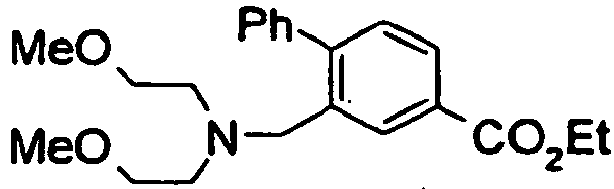
FAB-MS 372 (M+H)+ 6 
FAB-MS 367 (M+H)+ 17 
FAB-MS 296 (M+H)+ 7 
FAB-MS 338 (M+H)+ 18 
FAB-MS 310 (M+H)+ 8 
FAB-MS 326 (M+H)+ 19 
FAB-MS 282 (M+H)+ 9 
FAB-MS 339 (M+H)+ 20 
FAB-MS 339 (M+H)+ 10 
FAB-MS 402 (M+H)+ 21 
FAB-MS 310 (M+H)+ 11 
FAB-MS 322 (M+H)+ 22 
FAB-MS 298 (M+H)+ (Table 2) Rf Structure(salt) DATA Rf Structure(salt) DATA 23 
FAB-MS 311 (M+H)+ 34 
FAB-MS 352 (M+H)+ 24 
FAB-MS 374 (M+H)+ 35 
FAB-MS 380 (M+H)+ 25 
FAB-MS 294 (M+H)+ 36 
FAB-MS 310 (M+H)+ 26 
FAB-MS 344 (M+H)+ 37 
FAB-MS 310 (M+H)+ 27 
FAB-MS 284 (M+H)+ 38 
FAB-MS 324 (M+H)+ 28 
FAB-MS 346 (M+H)+ 39 
FAB-MS 324 (M+H)+ 29 
FAB-MS 314 (M+H)+ 40 
FAB-MS 352 (M+H)+ 30 
FAB-MS 344 (M+H)+ 41 
FAB-MS 254 M- 31 
FAB-MS 338 (M+H)+ 42 
FAB-MS 269 (M+H)+ 32 
FAB-MS 338 (M+H)+ 43 
FAB-MS 338 (M+H)+ 33 
FAB-MS 352 (M+H)+ 44 
FAB-MS 310 (M+H)+ (Table 3) Rf Structure(salt) DATA Rf Structure(salt) DATA 45 
FAB-MS 259 (M+H)+ 55 
FAB-MS 227 (M+H)+ 46 
FAB-MS 337 (M+H)+ 56 
FAB-MS 206 (M+H)+ 47 
FAB-MS 416 (M+H)+ 57 
FAB-MS 379 (M+H)+ 48 
FAB-MS 342 (M+H)+ 58 
FAB-MS 242 M+ 49 
FAB-MS 342 (M+H)+ 59 
FAB-MS 224 M+ 50 
FAB-MS 360 (M+H)+ 60 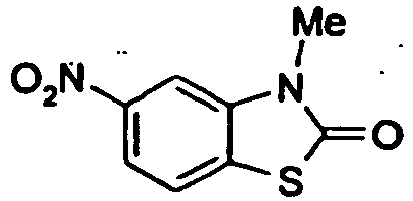
FAB-MS 211 (M+H)+ 51 
FAB-MS 388 (M+H)+ 61 
FAB-MS 234 (M+H)+ 52 
FAB-MS 314 (M+H)+ 62 
ESI-MS 224 (M+H)+ 53 
FAB-MS 314 (M+H)+ 63 
FAB-MS 188 (M+H)+ 54 
FAB-MS 332 (M+H)+ 64 
EI-MS 350 M+ (Table 4) Rf Structure(salt) DATA Rf Structure(salt) DATA 65 
FAB-MS 213 (M+H)+ 76 
FAB-MS 241 (M+H)+ 66 
FAB-MS 193 (M-H)- 77 
EI-MS 318, 320 M+ 67 
EI-MS 166 M+ 78 
FAB-MS 284 (M+H)+ 68 
EI-MS 193 M+ 79 
FAB-MS 324 (M+H)+ 69 
EI-MS 162 M+ 80 
FAB-MS 284 (M+H)+ 70 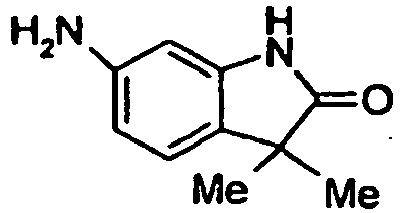
FAB-MS 177 (M+H)+ 81 
FAB-MS 296 (M+H)+ 71 
FAB-MS 185 (M+H)+ 82 
FAB-MS 254 (M-H)- 72 
FAB-MS 280 (M+H)+ 83 
FAB-MS 256 (M+H)+ 73 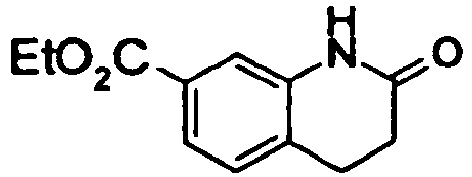
FAB-MS 220 (M+H)+ 84 
FAB-MS 275 (M+H)+ 74 
ESI-MS 177 (M+H)+ 85 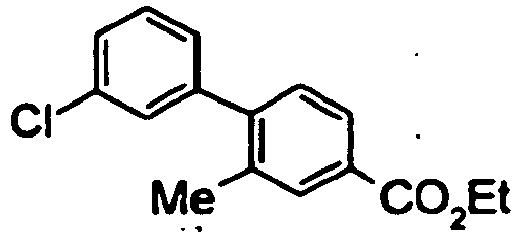
FAB-MS 275 (M+H)+ 75 
FAB-MS 158 (M+H)+ 86 
FAB-MS 309 (M+H)+ (Table 5) Rf Structure(salt) DATA Rf Structure(salt) DATA 87 
FAB-MS 247 (M+H)+ 98 
FAB-MS 392 (M+H)+ 88 
FAB-MS 275 (M+H)+ 99 
FAB-MS 330 (M+H)+ 89 
FAB-MS 275 (M+H)+ 100 
FAB-MS 349 (M+H)+ 90 
NMR 8 1.32-1.40 (3H,m),4.30-4.40 (2H,m),4.68 (2H,brs),7.38-8.20 (7H,m) 101 
FAB-MS 368 (M+H)+ 91 
NMR δ 1.30-1.40 (3H,m), 4.30-4.44 (2H,m), 4.67 (2H,brs), 7.40-8.25 (7H,m) 102 
FAB-MS 435 (M+H)+ 92 
NMR δ 1.30-1.40 (3H,m), 4.30-4.44 (2H,m), 4.66 (2H,brs), 7.46-8.25 (7H,m) 103 
FAB-MS 338 (M+H)+ 93 
NMR δ 1.29-1.40 (3H,m), 4.29-4.44 (2H,m), 4.87 (2H,brs), 7.23-8.24 (6H,m) 104 
FAB-MS 354 (M+H)+ 94 
FAB-MS 353(M+H)+ 355(M+H)+ 105 
FAB-MS 423 (M+H)+ 95 
GC-MS 336M+ 338M* 106 
FAB-MS 423 (M+H)+ 96 
FAB-MS 358 (M+H)+ 107 
FAB-MS 324 (M+H)+ 97 
FAB-MS 358 (M+H)+ 108 
FAB-MS 354 (M+H)+ (Table 6) Rf Structure(salt) DATA Rf Structure(salt) DATA 109 
FAB-MS 354 (M+H)+ 120 
FAB-MS 338 (M+H)+ 110 
FAB-MS 324 (M+H)+ 121 
FAB-MS 356 (M+H)+ 111 
FAB-MS 392 (M+H)+ 122 
FAB-MS 407 (M+H)+ 112 
FAB-MS 409 (M+H)+ 123 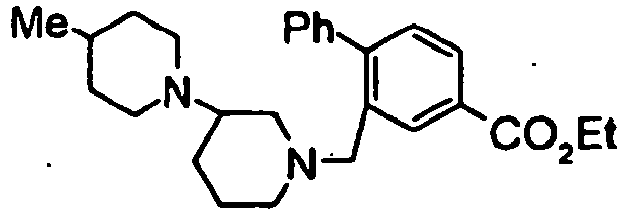
FAB-MS 421 (M+H)+ 113 
FAB-MS 469 (M+H)+ 124 
FAB-MS 397 (M+H)+ 114 
FAB-MS 409 (M+H)+ 125 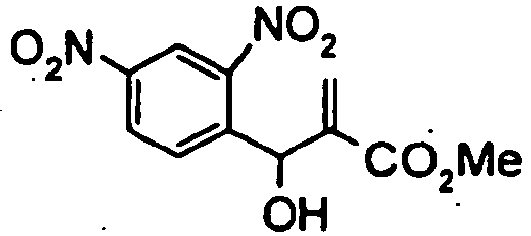
FAB-MS 282 M- 115 
FAB-MS 407 (M+H)+ 126 
FAB-MS 218 (M+H)+ 116 
FAB-MS 425 (M+H)+ 127 
FAB-MS 234 (M+H)+ 117 
FAB-MS 425 (M+H)+ 128 
FAB-MS 220 (M+H)+ 118 
FAB-MS 342 (M+H)+ 129 
ESI-MS 245,247 (M+H)+ 119 
FAB-MS 358 (M+H)+ 130 
ESI-MS 201 (M+H)+ (Table 7) Rf Structure(salt) DATA Rf Structure(salt) DATA 131 
ESI-MS 185 (M+H)+ 142 
FAB-MS 407 (M+H)+ 132 
FAB-MS 310 (M+H)+ 143 
FAB-MS 310 (M+H)+ 133 
FAB-MS 330 (M+H)+ 144 
FAB-MS 326 (M+H)+ 134 
FAB-MS 330 (M+H)+ 145 
FAB-MS 395 (M+H)+ 135 
FAB-MS 364 (M+H)+ 146 
FAB-MS 395 (M+H)+ 136 
FAB-MS 302 (M+H)+ 147 
FAB-MS 296 (M+H)+ 137 
FAB-MS 321 (M+H)+ 148 
FAB-MS 326 (M+H)+ 138 
FAB-MS 340 (M+H)+ 149 
FAB-MS 326 (M+H)+ 139 
FAB-MS 356 (M+2H)+ 150 
FAB-MS 296 (M+H)+ 140 
FAB-MS 369 (M+H)+ 151 
FAB-MS 364 (M+H)+ 141 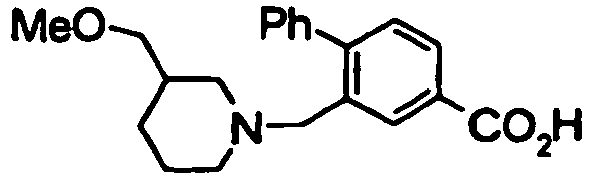
FAB-MS 340 (M+H)+ 152 
FAB-MS 381 (M+H)+ (Table 8) Rf Structure(salt) DATA Rf Structure(salt) DATA 153 
FAB-MS 381 (M+H)+ 164 
FAB-MS 254 M+ 154 
FAB-MS 379 (M+H)+ 165 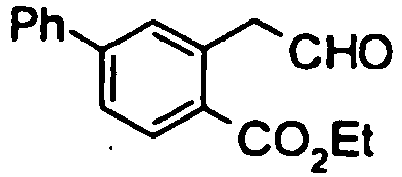
FAB-MS 269 (M+H)+ 155 
FAB-MS 397 (M+H)+ 166 
FAB-MS 338 (M+H)+ 156 
FAB-MS 397 (M+H)+ 167 
FAB-MS 368 (M+H)+ 157 
FAB-MS 314 (M+H)+ 168 
FAB-MS 384 (M+H)+ 158 
FAB-MS 330 (M+H)+ 169 
FAB-MS 269 (M+H)+ 159 
FAB-MS 310 (M+H)+ 170 
FAB-MS 283 (M+H)+ 160 
FAB-MS 328 (M+H)+ 171 
ESI-MS 405 (M+H)+ 161 
FAB-MS 379 (M+H)+ 172 
FAB-MS 467 (M+H)+ 162 
FAB-MS 393 (M+H)+ 173 
FAB-MS 232 (M+H)+ 163 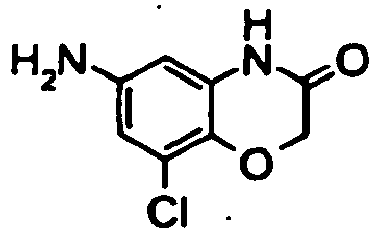
FAB-MS 198 M+ 174 
FAB-MS 262 (M+H)+ (Table 9) Rf Structure(salt) DATA Rf Structure(salt) DATA 175 
FAB-MS 234 (M+H)+ 186 
FAB-MS 294 (M+H)+ 176 
ESI-MS 220 (M+H)+ 187 
ESI-MS 217 (M+H)+ 177 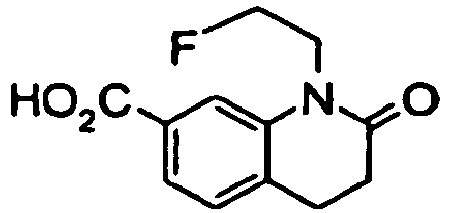
ESI-MS 238 (M+H)+ 188 
FAB-MS 162 (M+H)+ 178 
ESI-MS 230 (M+H)+ 189 
FAB-MS 218 (M+H)+ 179 
ESI-MS 259,261 (M+H)+ 190 
FAB-MS 220 (M+H)+ 180 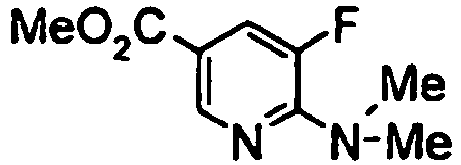
ESI-MS 199 (M+H)+ 191 
ESI-MS 191 (M+H)+ 181 
ESI-MS 206 (M+H)+ 192 
ESI-MS 209 (M+H)+ 182 
FAB-MS 177 (M+H)+ 193 
FAB-MS 189 (M+H)+ 183 
FAB-MS 179 (M+H)+ 194 
FAB-MS 205 (M+H)+ 184 
FAB-MS 179 (M+H)+ 195 
ESI-MS 156 (M+H)+ 185 
ESI-MS 281 (M+H)+ 196 
ESI-MS 172 (M+H)+ (Table 10) Rf Structure(salt) DATA Rf Structure(salt) DATA 197 
ESI-MS 216,218 (M+H)+ 208 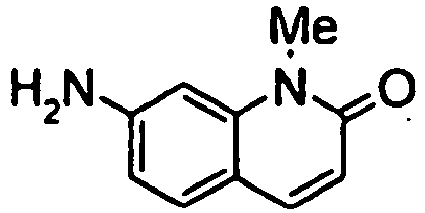
EI-MS 174 M+ 198 
EI-MS 190 M+ 209 
ESI-MS 517 (M-H)- 199 
FAB-MS 175 (M+H)+ 210 
FAB-MS 465 (M+H)+ 200 
FAB-MS 287 (M+H)+ 211 
ESI-MS 351 (M+H)+ 201 
FAB-MS 287 (M+H)+ 212 
ESI-MS 144 (M+H)+ 202 
FAB-MS 271 (M+H)+ 213 
FAB-MS 229 (M+H)+ 203 
FAB-MS 389 (M+H)+ 214 
EI-MS 198 M+ 204 
FAB-MS 203 (M+H)+ 215 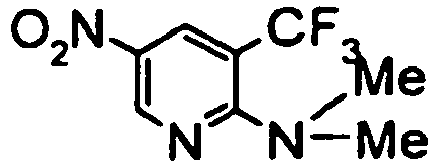
FAB-MS 236 (M+H)+ 205 
FAB-MS 165 (M+H)+ 216 
FAB-MS 285 (M+H)+ 206 
EI-MS 216 M+ 217 
FAB-MS 271 (M+H)+ 207 
EI-MS 160 M+ 218 
FAB-MS 261 (M+H)+ (Table 11) Rf Structure(salt) DATA Rf Structure(salt) DATA 219 
FAB-MS 293 (M-H)- 228 
FAB-MS 169 (M+H)+ 220 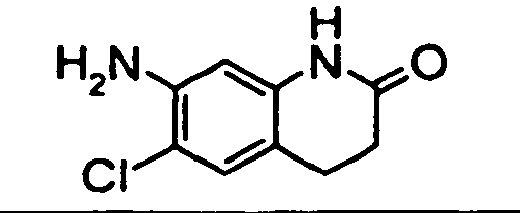
EI-MS 196 M+ 229 
EI-MS 182 M+ 221 
FAB-MS 215 (M+H)+ 230 
GC-MS 156 M+ 222 
NMR (300MHz, DMSO-d6) δ 1.33 (3H,t, J=5.1Hz), 2.47 (3H, s), 4.35 (2H,q,J=5.1Hz) , 8.03 (1H,s), 8.04 (1H,s) 231 
FAB-MS 199 (M+H)+ 223 
FAB-MS 284 (M+H)+ 232 
FAB-MS 216 (M+H)+ 224 
FAB-MS 118 (M+H)+ 233 
GC-MS 142 M+ 225 
FAB-MS 187 (M+H)+ 234 
FAB-MS 132 (M+H)+ 226 
FAB-MS 187 (M+H)+ 235 
LC-MS 185 (M+H)+ 227 
FAB-MS 171 (M+H)+ (Table 12) Ex Structure(salt) DATA * 1 
NMR:δ1.20-1.35(1H,m),1.53-1.63(3H,m),1.75-1.91(2 H.m),2.54-2.65(2H,m).3.16-3.25(2H,m),3.76(3H,s), 4.37(2H,d,J=5.1 Hz),6.70(1 H,dd,J=8.3,2.OHz),7.26(1 H,t,J=8.2Hz),7.37-7.43(2H,m),7.45-7.58(5H,m),7.6 3-7.67(1H.m).8.02(1H,d.J=7.8Hz).8.70-8.75(1H.m).1 0.22(1H,brs),10.58(1H,s).FAB-MS:401(M+H)+ * 2 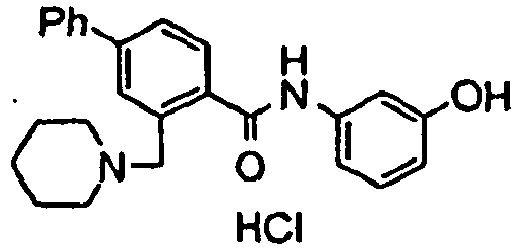
NMR:δ1.35-1.49(1H,m),1.64-1.72(1H,m),1.75-1.85(4 H,m),2.93-3.06(2H,m),3.36-3.42(2H,m),4.47(2H,d.J =5.2Hz),6.53-6.59(1H,m),7.11-7.17(2H,m),7.34(1 H, s),7.43-7.48(1H,m),7.51-7.57(2H,m),7.83-8.89(3H, m),7.91-7.95(1H,m).8.25(1H,S).9.52(1H,s),10.04(1 H,brs),10.56(1H,s).FAB-MS:387(M+H)+ * 3 
NMR:δ2.79(3H,s),2.80(3H,s),4.43(2H,d,J=5.4Hz),6. 54-6.60(1H,m),7.11-7.21(2H,m),7.33(1H,s),7.43-7.4 8(1 H,m),7.51-7.56(2H,m),7.84-7.96(4H,m),8.20(1H, d,J=1.5Hz),9.56(1H,s),10.18(1H,brs),10.60(1H,s).FA B-MS:347(M+H)+ * 4 
NMR:δ1.19-1.34(1H,m),1.52-1.63(3H,m),1.73-1.88(2 H,m),2.53-2.64(2H,m),3.18-3.24(2H,m),4.37(2H,d,J =5.4Hz),6.50-6.55(1H,m),7.13(1H,t,J=8.1Hz),7.29-7. 33(1H,m),7.37-7.42(2H,m),7.44-7.56(5H,m),8.02(1H ,dd,J=8.1,1.7Hz),8.67(1H,d.J=1.7Hz),9.45(1H.s),10. 19(1 H,brs),10.44(1 H,s).FAB-MS:387(M+H)+ * 5 
NMR:δ2.55(6H,s),4.38(2H,s),6.49-6.56(1H,m),7.13 (1H,t,J=8.3Hz),7.28(1H,d,J=8.3Hz),7.39(2H,d,J=7.8 Hz),7.43-7.57(5H,m),8.03(1 H,d,J=8.3Hz),8.54(1 H, s).9.54(1H,s),10.32(1H,s), 10.36(1H,brs).FAB-MS:34 7(M+H)+ * 6 
NMR:δ1.26-1.42(1H,m),1.61-1.79(5H,m),2.72-2.85(2 H,m),3.04-3.13(2H,m),3.22-3.36(4H,m),7.39-7.45(3 H,m),7.45-7.50(1H,m),7.45-7.56(2H,m),7.90-8.01 (2 H,m),8.10-8.16(2H,m),8.70(1 H,d,J=1.9Hz),9.40(1H, s),9.97(1H,brs),10.69(1H,s).FAB-MS:442(M+H)+ * 7 
NMR:δ1.20-1.33(1H,m),1.52-1.65(3H,m), 1.74-1.93(2 H,m),2.54-2.68(2H,m),3.18-3.28(2H,m),4.41(2H,d,J =5.4Hz),7.42(2H,d,J=6.8Hz),7.46-7.58(4H,m),8.02-8.10(2H,m),8.15(1H,d,J=8.8Hz),8.79(2H,s),9.42(1H, s),10.20(1H,brs),10.88(1H,brs).FAB-MS:428(M+H)+ * 8 
NMR:δ1.20-1.34(1H,m),1.52-1.66(3H,m),1.81-1.97(2 H,m),2.55-2.68(2H,m),2.81(3H,m),3.17-3.30(2H,m), 4.39(2H,d,J=4.8Hz),7.41(2H,d,J=7.4Hz),7.46-7.58(4 H,m),8.01 (2H,s),8.04(1H,d,J=7.8Hz),8.63(1H,s,),8.8 5(1H,s),10.39(1H,brs),10.87(1H,s).FAB-MS:442(M+ H)+ * 9 
NMR:δ1.20-1.35(1H,m),1.52-1.62(3H,m),1.78-1.92(2 H,m),2.53-2.64(2H,m),2.90(6H,s),3.17-3.26(2H,m),4 .37(2H,d,J=5.4Hz),6.50(1H,dd,J=8.3,1.9Hz),7.15(1H ,t,J=8.3Hz),7.33-7.43(4H,m),7.45-7.56(4H,m),8.01(1 H,dd,J=8.3,2.OHz),8.74-8.76(1H,m),10.34(1H,brs),1 0.40(1H,s).FAB-MS:414(M+H)+ * Not within the scope of the invention (Table 13) Ex Structure(salt) DATA * 10 
NMR:δ1.20-1.38(1 H,m),1.52-1.68(3H,m),1.78-1.9 6(2H,m),2.55-2.70(2H,m),3.18-3.28(2H,m),4.38(2 H,d,J=4.4Hz),7.39(2H,d,J=7.4Hz),7.45-7.60(5H, m),8.02(1H,d,J=7.8Hz),8.33(2H,s),8.78(1H,s),10. 07(1 H,s).FAB-MS:473(M+H)+ * 11 
NMR:δ1.20-1.33(1H,m),1.53-1.63(3H,m),1.75-1.9 O(2H,m),2.35(3H,s),2.52-2.66(2H,m),3.15-3.25(2 H,m),4.37(2H,d,J=6.6Hz),7.37-7.42(2H,m),7,46-7. 58(5H,m),7.76(1H,dd,J=8.8,2.5Hz),7.97(1H,d,J=2 .5Hz),8.01 (1H,dd,J=8.3,1.9Hz),8.72(1H,d,J=1.9H z), 10.17(1H,s), 10.69(1H,s).FAB-MS:463(M+H)+ 12 
NMR:δ1.20-1.35(1H,m), 1.53-1.63(3H,m), 1.70-18 5(2H,m),2.53-2.65(2H,m), 3.16-3.24(2H,,m), 4.37(2 H,d,J=5.3Hz), 4.55(2H,s), 6.94(1 H,d,J=8.8Hz),7.35 (1H,dd,J=8.6,2.3Hz), 7.38-7.42(2H,m), 7.46-7.57(4 H,m), 7.68(1H,d,J=2.4Hz), 8.02(1H,dd,J=8.1,1.7H z), 8.64(1H,d,J=1.7Hz), 10.04(1H,brs), 10.52(1H,s), 10.81 (1H,s).FAB-MS:442(M+H)+ * 13 
NMR:δ1.33-1.45(2H,br), 1.46-1.57(4H,m), 1.84-1.9 3(2H,m), 2.43-2.69(7H,m), 2.84(3H,s), 3.19(2H,t,J= 5.6Hz), 3.94(2H,brs), 6.85(1H,d,J=8.3Hz),7.01-7.0 8(2H,m), 7.39-7.54(6H,m), 8.02(1H,d,J=7.3Hz),8.2 1 (1 H,s), 10.05(1H,s).FAB-MS:440(M+H)+ * 14 
NMR:δ1.20-1.36(1H,m), 1.52-1.66(3H,m), 1.81-1.9 7(2H,m), 2.58-2.70(2H,m), 3.18-3.31(2H,m), 4.42(2 H,d,J=5.3Hz),7.39-7.46(2H,m),7.47-7.59(4H,m),7. 73(1H,t,J=7.8Hz), 7.82(1H,t.J=7.8Hz), 8.07-8.17(3 H,m), 8.90(1 H,s), 9.20(1H,s),9.57(1H,s), 10.21 (1H, brs), 11.43(1H,s).FAB-MS:422(M+H)+ * 15 
NMR:δ1.20-1.35(1H,m), 1.52-1.65(3H,m), 1.76-1.9 2(2H,m), 2.56-2.68(2H,m), 3.18-3.28(2H,m), 4.41(2 H,d,J=4.9Hz), 7.41-7.46(2H,m), 7.48-7.60(4H,m), 7. 85-7.93(1H,m), 8.00(1H,d,J=7.3Hz),8.02-8.22(3H, m),8.93(1H,s), 9.10-9.18(1H.m), 9.21(1 H,d,J=3.9H z), 10.34(1H,brs), 11.12(1H,s).FAB-MS:422(M+H)+ * 16 
NMR:δ1.03-1.95(6H,m), 2.21-2.74(1H,m), 2.96-3.0 4(1H,m), 3.18-3.50(1H,m), 3.96-4.05(1H,m), 4.10-4. 40(2H,br), 4.91-4.99(1H,m), 7.39-7.59(6H,m), 8.08 (2H,d,J=8.3Hz), 8.15(1H,d,J=8.8Hz),8.79(2H,brs), 9.41(1H,s), 10.00(1H,br), 10.26(1H,br), 10.89(1H, s,).FAB-MS:442(M+H)+ * 17 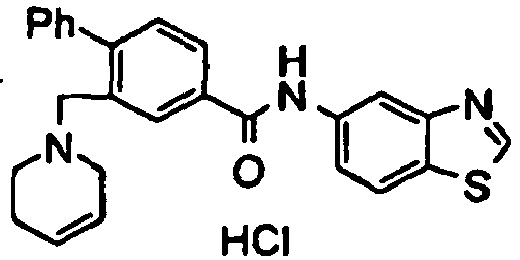
NMR:δ1.95-2.09(1H,m), 2.32-2.52(1 H,m),2.86-2.9 9(1H,m), 3.24-3.38(2H,m), 3.56-3.68(1H,m), 4.49(2 H,d,J=5.4Hz),5.45-5.55(1H,m),5. 70-5.80(1H,m), 7. 39-7.58(6H,m), 8.02(1H,d,J=8.8.2.OHz), 8.10(1 H,d d,J=7.8.1.5Hz), 8.16(1H,d,J=8.3Hz) ,8.70-8.80(2H, m),9.41 (1H,s), 10.55(1 H,brs), 10.81 (1 H,s).FAB-M S:426(M+H)* * Not within the scope of the invention (Table 14) Ex Structure(salt) DATA * 18 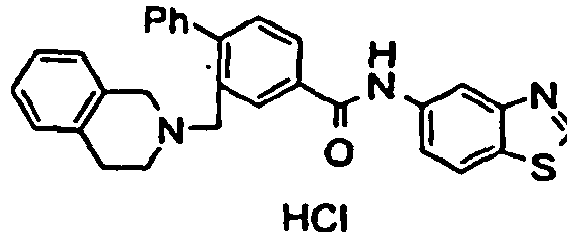
NMR:52.75-2.85(1H,m),3.07-3.26(2H,m),3.47-3. 59(1H,m),3.98-4.08(1H,m),4.27-4.36(1H,m),4.5 2-4.64(2H,brs),7.08(1H,d,J=7.3Hz),7.13(1H,d,J =7.4Hz),7.15-7.25(2H,m),7.53(5H.m),7.56(1H,d, J=8.3Hz),7.97(1H,d,J=8.8Hz),8.14(2H,d,J=8.8H z),8.73(2H.s.),9.40(1H,s),10.77(2H,brs). FAB-MS:476(M+H)+ * 19 
NMR:δ1.72-1.91(4H,m),2.70-2.82(2H,m),3.33-3. 42(2H,m),4.48(2H,d,J=5.9Hz),7.39-7.58(6H,m), 8.03-8.11(2H,m),8.15(1H,d,J=8.8Hz),8.74-8.82( 2H,m),9.42(1H,s),10.78-10.89(2H,m).FAB-MS:4 14(M+H)+ * 20 
NMR:δ1.35-1.59(6H,m),1.60-1.73(2H,m),2.79-2. 90(2H,m),3.20-3,32(2H,m),4.42(2H,d,J=5.4Hz), 7.38-7.44,(2H,m),7.47-7.58(4H,m),8.03-8.11(2H, m),8.16(1H,d,J=8.8Hz),8.79(2H,s),9.41(1H,s),1 0.36(1H,br),10.83(1H,s).FAB-MS:442(M+H)+ * 21 
NMR:δ2.73-2.90(2H,m),3.25(2H,d,J=12.3Hz),3. 72-3.94(4H,m),4.00-4.60(2H,m),7.36-7.58(6H,m ),8.01-8.11(2H,m),8.15(1H,d,J=8.8Hz),8.72-8.8 2(2H,m),9.41(1H,s),10.74-10.89(2H,m).FAB-MS :430(M+H)+ * 22 
NMR:δ1.69-1.84(4H,m),2.08-2.20(1H,m),2.48-2. 72(1H,m),2.76-2.98(1H,m),3.06-3.30(1H,m),3.4 2-3.71(1H,m),3.30-4.60(3H,m),7.38-7.58(6H,m), 8.00-8.30(4H,m),8.69(1H,d,J=9.8Hz),8.77(1H,d, J=1.4Hz),9.42(1H,s),10.66-10.95(2H,m).FAB-M S:471(M+H)+ * 23 
NMR:δ2.75(3H,m),3.00-4.40(10H,m),7.40-7.58 (6H,m),7.95-8.08(2H,m),8.15(1H,d,J=8.8Hz),8.4 9(1H,brs),8.73(1H,s),9.41(1H,s),10.68(1H,s).FA B-MS:443(M+H)+ * 24 
NMR:δ3.33-3.50(2H,m),3.54-3.80(2H,m),4.25-4. 40(2H,m),4.49(2H,d,J=5.4Hz),4.52(2H,s),6.82-6.92(1H,m),7.06-7.18(1H,m),7.38-7.57(6H,m),7. 77-7.90(1H,m),8.03-8.12(3H,m),8.16(1H,d,J=8. 8Hz),8.78-8.88(2H,m),9.42(1H,s),10.86(1H,s),1 1.10(1H.brs).FAB-MS:506(M+H)+ * 25 
NMR:80.99(6H,t,J=7.3Hz),2.76-2.89(2H,m),2.9 7-3.10(2H,m),4.43(2H,d,J=5.3Hz),7.42-7.59(6H, m),8.04-8.11(2H,m),8.15(1H,d,J=8.8Hz),8.74-8. 81 (2H,m),9.41 (1H,s),10.30(1H,brs),10.89(1H,s). FAB-MS:416(M+H)+ * 26 
NMR:δ1.00(3H,t,J=7.3Hz),2.78-3.28(7H,m),3.5 7-3.63(2H,m),4.44-4.60(2H,m),7.39-7.59(6H,m), 8.04-8.11(2H,m),8.15(1H,d,J=8.8Hz),8.76-8.81( 2H,M),9,42(1H,s),10.44(1H,brs),1 0.87(1H,s).FA B-MS:446(M+H)+ * Not within the scope of the invention (Table 15) Ex Structure(salt) DATA * 27 
NMR:δ1.01 (3H,t,J=7.3Hz),2.60-2.78(1H,m),2.79-2.92(1H,m),4.20-4.60(4H,m),7.35-7.62(11H,m),8 .04-8.11(2H,m),8.17(1H,d,J=8.8Hz),8.73(1H,d,J= 1.4Hz),8.80(1H,d,J=1.9Hz),9.42(1H,s),10.66(1H, brs),10.90(1H,s).FAB-MS:478(M+H)+ * 28 
NMR:δ3.11-3.22(10H,m),3.50-3.63(4H,m),4.60(2 H,d,J=4.9Hz),7.38-7.60(6H,m),8.04(1H,dd,J=8.8, 1.9Hz),8.11 (1H,dd,J=7.8,2.0Hz),8.16(1H,d,J=8.8 Hz),8.70-8.80(2H,m),9.42(1H,s),10.33(1H,brs),1 0.82(1H,s).FAB-MS:476(M+H)+ * 29 
NMR:δ0.67-0.80(3H,m),0.91-1.03(1H,m),1.40-1. 78(3H,m),1.80-1.95(1H,m),2.18-2.30(1H,m),2.5 3-3.30(2H,m),4.33-4.60(2H,m),7.40-7.44(2H,m), 7.46-7.59(5H,m),7.97(1H,dd,J=8.8,1,9Hz),8.13-8 .19(2H,m),8.57(1H,s),8.73(1H,d,J=2.0Hz),9.43(2 H,s),10.63-10.67(1H,m).FAB-MS:442(M+H)+. * 30 
NMR:δ0.70-0.86(3H,m),1.30-1.72(5H,m),2.57-2. 70(1.5H,m),2.88-3.04(0.5H,m),3.20-3.29(2H,m), 4.37-4.59(2H,m),7.39-7.60(6H,m),7.93(1H,d,J=8. 3Hz),8.14-8.19(2H,m),8.50(1H,s),8.71(1H,s).9.2 1(0.8H,brs),9.42(1H,m),9.52(0.2H,brs),10.63-10. 67(1H,m).FAB-MS:442(M+H)+ * 31 
NMR:δ1.04-1.23(7H,m),1.33-1.80(5H,m),3.23-3. 41(1H,m),3.41-3.56(1H,m),4.41(1.1H,s),4.64(0.9 H,s),7.43-7.64(6H,m),7.90-7.97(1H,m),8.10-8.19 (2H,m),8.71(1H,s),8.47(0.4H,brs),8.71(1H,s),9.3 2(0.6H,brs),9.42(1H,s),10.68-10.77(1H,m).FAB-MS:456(M+H)+ * 32 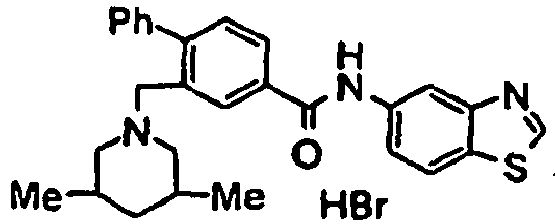
NMR:δ0.63-0.80(7H,m),1.07-1.19(0.2H,br),1.41-1.48(0.2H,m),1.58-1.67(0.8H,m),1.76-1.91(1.8H, br),2.09-2.21(2H,m),2.87-2.94(0.2H,m),3.02-3.1 6(1.8H,m),4.42(1.8H,d,J=5.4Hz),4.56-4.61(0.2H, m),7.40-7.45(2H,m),7.47-7.60(4H,m), 7.91(1H,dd ,J=8.8,2.0Hz),8.14-8.21(2H,m).8.44-8.50(1H,m), 8.70(1H,d,J=2.0Hz),8.32-8.46(1.8H,m),9.80(0.2 H,brs),10.64(1H,s).FAB-MS:456(M+H)+ * 33 
NMR:δ0.92-1.24(10H,m),1.26-1.56(3H,m),1.62-1 .74(3H,brs),1.81-1.91(1H,m),3.13-3.23(1H,m),3. 58-3.68(1H,m),4.41-4.57(2H,m),7.45-7.50(2H,m) ,7.50-7.62(4H,m),7.95(1H,d,J=8.8Hz),8.13-8.18( 2H,m),8.36(1H,s),8.44(1H,brs),8.72(1H,d,J=1.9H z),9.42(1H,s),10.74(1H,s).FAB-MS:484(M+H)+ * 34 
NMR:δ1.24-1.32(1H,m),1.54-1.62(3H,m),1.74-1. 88(2H,m),2.48-2.52(2H,m),3.18-3.24(2H,m),4.37 (2H,d,J=5.4Hz),7.28(1H,d,J=8.8Hz),7.38-7.43(2 H,m),7.46-7.57(4H,m),7.58-7.62(1H,m),7.87(1H, s),8.02(1H,dd,H=7.8,1.4Hz),8.69-8.72(1H,m),10. 11(1H,brs),10.66(1H,s),11.68(1H,s).FAB-MS:428 (M+H)+ * Not within the scope of the invention (Table 16) Ex Structure(salt) DATA * 35 
NMR:δ1.60-1.73(2H,m),2.50-2.63(2H,m),2.86-3.0 2(2H,m),3.21-3.40(2H,m),4.44-4.74(2H,m),5.28-5. 45(1H,m),7.00-7.61(1H,m),8.01-8.19(3H,m),8.7 0-6.85(2H,m),9.42(1H,s),10.40-10.72(1H,m),10.7 5-10.96(1H,m).FAB-MS:520(M+H)+ * 36 
NMR:δ1.20-1.34(1H,m),1.52-1.63(3H,m),1.73-1.8 9(2H,m),2.53-2.65(2H,m),3.17-3.24(2H,m),4.37(2 H,d,J=4.9Hz),6.02(2H, s),6.92(1 H,d,J=8.3Hz),7.3 6-7.42(3H,m),7.45-7.56(5H,m),8.00(1H,d,J=8.3H z),8.70(1H,s),10.14(1H,brs),10.52(1H,s).FAB-MS: 415(M+H)+ * 37 
NMR:δ1.20-1.35(1H,m),1.54-1.67(5H,m),2.52-2.6 9(2H,m),3.16-3.26(2H,m),4.41(2H,d,J=5.4Hz),7.4 0-7.45(2H,m),7.49-7.60(4H,m),7.78(1H,brs),8.12-8.27(3H,m),8.48(1 H,s),8.80(1H,brs),8.91(1H,s),9. 10(1H,s),9.22(1H,brs),11.03(1H,s).FAB-MS:422(M +H)+ * 38 
NMR:δ1.30-1.40(2H,m),1.42-1.56(4H,m),3.30-3.8 0(6H,m),7.09(1H,d,J=7.7Hz),7.40-7.52(7H,m),7.8 5(1H,d,J=2.0Hz),7.94-8.00(1H,m),8.15(1H,brs),10 .38(1H,s),11.60(1H,s).FAB-MS:428(M+H)+ * 39 
NMR:δ1.20-1.35(1H,m),1.53-1.63(3H,m),1.74-1.9 0(2H,m),2.54-2.66(2H,m),3.18-3.24(2H,m),3.33(3 H, s),4.38(2H,d,J=5.4Hz),7.34(1 H,d,J=8.8Hz),7.3 8-7.42(2H,m),7.46-7.57(4H,m),7.63(1H,dd,J=8.8,1 .9Hz),7.94(1H,d,J=1.5Hz),8.03(1H,dd,J=8.8,1.4Hz ),8.74(1H,s),10.17(1H,brs),10.74(1H,s).FAB-MS:4 42(M+H)+ * 40 
NMR:δ1.20-1.35(1H,m),1.53-1.65(3H,m),1.72-1.8 8(2H,m),2.56-2.69(2H,m),3.19-3.25(2H,m),4.39(2 H,d,J=5.4Hz),7.38-7.44(2H,m),7.47-7.58(4H,m),7. 69(1H,t,J=8.3Hz),7.96-8.02(1H,m),8.04-8.11(1H, m),8.35(1H,d,J=7.8Hz),8.71(1H,s),8.95(1H,d,J=2. 0Hz),9.96(1H,brs),11.11(1H,s).FAB-MS:416(M+H) + * 41 
NMR:δ1.20-1.35(1H,m),1.52-1.66(5H,m),2.55-2.6 8(2H,m),3.17-3.24(2H,m),4.39(2H,d,J=4.9Hz),7.3 3(1H.d.J=6.8Hz)7.39-7.44(2H,m)7.48-7.58(4H, m),7.61-7.66(2H,m),8.04-8.09(1 H,m),8.12-8.17(1 H,m),8.34(1H,s),8.43(1H,s),9.20(1H,brs),10.85(1 H,s).FAB-MS:459(M+H)+ * 42 
NMR:δ1.20-1.35(1H,m),1.56-1.64(3H,m),1.72-1.8 6(2H,m),2.54-2.63(2H,m),2.68(2H,t,J=5.4Hz),3.09 (2H,t,J=5.4Hz),3.18-3.24(2H,m),4.37(2H,d,J=5.4H z),7.38-7.45(2H,m),7.46-7.57(4H,m),7.59(1H,d,J= 8.8Hz),8.05(1H,dd,J=8.8,2.0Hz),8.16(1H,dd,J=8.8 ,2.0Hz),8.29(1H,d,J=1.9Hz),8.71(1H,d,J=1.4Hz), 0.06(1H,brs),10.82(1H,s).FAB-MS:425(M+H)+ * Not within the scope of the invention (Table 17) Ex Structure(salt) DATA * 43 
NMR:δ1.20-1.33(1H,m),1.53-1.63(3H,m),1.72-1. 86(2H,m),2.54-2.63(2H,m),2.66-2.69(2H,m),3.1 7-3.24(4H,m),4.38(2H,d,J=4.9Hz),7.389-7.43(2 H,m),7.47-7.57(6H,m),7.87(1H,d,J=7.3Hz),8.07 (1H,dd,J=7.8,1.4Hz),8.74(1H,s),1 0.15(1H,brs),1 0.48(1H,s).FAB-MS:425(M+H)+ * 44 
NMR:δ1.22-1.36(1H,m),1.55-1.66(3H,m),1.77-1 .92(2H,m),2.58-2.71(2H,m),3.19-3.27(2H,m),4.3 7(2H,d,J=5.4Hz),7.33-7.41 (2H,m),7.43-7.52(3H ,m),8.03-8.09(2H,m),8.15(1H,d,J=8.8Hz),8.75-8 .80(1H,m),9.41(1H,s),10.13(1H,brs),10.88(1H,s ).FAB-MS:446(M+H)+ * 45 
NMR:δ1.21-1.34(1H,m),1.53-1.63(3H,m),1.76-1. 90(2H,m),2.54-2.65(2H,m),3.19-3.25(2H,m),4.3 8(2H,d,J=4.9Hz),6.37-6.41(1H,m),7.28-7.57(9H ,m),8.00-8.07(1H,m),8.21(1H,s),8.74(1H,s),10.2 9(1H,brs),10.48(1H,s),11.10(1H,s).FAB-MS:410 (M+H)+ * 46 
NMR:b1.27-1.38(1H,m),1.38-1.54(5H,m),2.22(4 H,brs),3.33-3.42(2H,m),7.23(1H,dd,J=7.5,2.3H z),7.34-7.54(7H,m),7.84(1H,s),7.88-7.96(1H, m),8.06(1H,d,J=1.5Hz),8.15(1H,s),8.49(1H,d,J= 6.9Hz),10.49(1H,s).FAB-MS:411(M+H)+ * 47 
NMR:δ1.21-1.35(1H,m),1.54-1.64(3H,m),1.77-1. 92(2H,m),2.56-2.68(2H,m),3.17-3.29(2H,m),4.4 1(2H,d,J=4.9Hz),7.38-7.45(2H,m), 7.47-7.58(4 H,m),8.05-8.15(2H,m),8.39-8.46(1H,m),8.79-8.8 4(2H,m),8.86(1H,d,J=2.0Hz),8.93(1H,d,J=2.0H z),10.17(1H,brs),11.15(1H,s).FAB-MS:423(M+ H)+ * 48 
NMR:δ1.20-1.36(1H,m),1.52-1.65(3H,m), 1.79-1. 96(2H,m),2.55-2.70(2H,m),3.18-3.37(8H,m),4.3 9(2H,d,J=5.3Hz),7.37-7.63(7H,m),7.85(1H,s),7. 97-8.07(2H,m),8.86(1H,d,J=1.5Hz),10.14(1H,br s),11.50(1H,s),13.07(1H,brs).FAB-MS:415(M+H )+ * 49 
NMR:δ1.16-1.35(1H,m),1.50-1.66(3H,m),1.74-1. 97(2H,m),2.54-2.65(2H,m),2.77(3H,s),2.85-2.97 (2H,m),3.14-3.27(2H,m),3.33-3.42(2H,m),4.37( 2H,d,J=4.4Hz),7.09(1H,d,J=8.3Hz),7.27-7.60(8 H,m),8.00(1H,d,J=8.3Hz),8.72(H,s),10.27(1H, brs),10.46(1H,s).FAB-MS:426(M+H)+ * 50 
NMR:δ1.21-1.34(1H,m),1.52-1.64(3H,m),1.65-1. 83(2H,m),2.17(3H,s),2.55-2.60(2H,m),3.06-3.28 (4H,m).4.07-4.16(2H,m),4.36(2H,d,J=4.8Hz),7. 20(1H,d,J=8.3Hz),7.37-7.57(7H,m),8.06(1H,d,J =7.9Hz),8.57(2H,s),9.93(1H,brs),10.45(1H,s).F AB-MS:454(M+H)+ * Not within the scope of the invention (Table 18) Ex Structure(salt) DATA 51 
NMR:δ1.20-1.35(1H,m),1.52-1.64(3H,m),1.80-1. 95(2H,m),2.53-2.66(2H,m),3.19-3.25(2H,m),3.4 4(2H,s)4.37(2H,d,J=5.4Hz),7.15-7.19(1H,m),7.3 8-7.41(2H,m),7.45-7.56(5H,m),7.68(1H,brs),7.9 7-8.01(1H,m),8.78(1H,s),10.46(2H,m),10.62(1H, s).FAB-MS:426(M+H)+ * 52 
3.17-3.28(2H,m),4.39(2H,d,J=5.1Hz),7.38-7.60( NMR(300MHz,DMSO-d6):δ1.20-1.37(1H,m),1.5 2-1.65(3H,m),1.77-1.95(2H,m),2.54-2.69(2H,m), 3.17-3.28(2H,m).4.39(2H,d,J=5.1Hz),7.38-7.60( 7H,m),8.03(1H,dd,J=8.1,1.7Hz),8.43(1H,dd,J=8. 6,2.7Hz).8.81(1H,d,J=1.5Hz),9.02(1H,d,J=2.6Hz ),10.16(1H,brs),11.10(1H,s).FAB-MS:406(M+H)+ * 53 
NMR:δ1.20-1.32(1H,m), 1.53-1.63(3H,m), 1.78-1. 90(2H,m),2.58-2.63(2H,m),3.18-3.26(2H,m),4.3 8(2H,d,J=5.2Hz),7.37-7.58(6H,m),7.94-7.98(1H, m), 8.04(1H,dd,J=7.8,1.5Hz),8.11(1H,d,J=2.3Hz) ,8.35(1H,d,J=5.3Hz),8.76(1H,s),10.02(1H,brs),1 1.26(1H,s).FAB-MS:406(M+H)+ * 54 
NMR:δ1.20-1.36(1H,m),1.52-1.64(3H,m),1.77-1. 93(2H,m),2.54-2.68(2H,m),3.02(3H,s),3.16-3.28 (2H,m).4.38(2H,d,J=4.8Hz),7.34-7.57(7H,m),7.7 7(1H,dd,J=8.8.2.0Hz),7.96-8.05(2H,m),8.77(1H, s), 9.50(1H,s),10.20(1H,brs),10.89(1H,s).FAB-M S:482(M+H)+ * 55 
NMR:δ1.20-1.35(1H,m),1.52-1.64(3H,m),1.80-1. 95(2H,m),2.53-2.66(2H,m),3.19-3.24(2H,m),3.4 5(2H,s,)4.37(2H,d,J=5.4Hz),7.28-7.32(1 H,m),7. 38-7.41(2H,m),7.45-7.56(5H,m),7.84-7.85(1H,m ),7.98-8.02(1H,m),8.74-8.77(1H,m),10.37(1H,br s),10.66(1H,s),10.69(1H,s).FAB-MS:458(M+H)+ * 56 
NMR(CDCl3):δ1.30-1.61(6H,m),2.20-2.50(4H, m),3.44(2H,s),5.09(2H,brs),6.86(1H,s),7.21-7.6 2(8H,m),7.71(1H,d,J=8.4Hz),7.88(1H,d,J=8.3H z),8.19(1H,dd,J=8.1,1.8Hz),8.51(1H,d,J=1.6Hz). FAB-MS:438(M+H)+ * 57 
NMR:δ1.20-1.35(1H,m),1.52-1.64(3H,m),1.77-1. 94(2H,m);2.53-2.68(2H,m),3.10-3.40(2H,m),4.3 9(2H,d,J=4.9Hz),6.77-6.85(1H,m),7.24-7.58(8H, m),7.95(1H.dd,J=8.8,2.0Hz),8.03-8.13(2H,m).8. 49(1H,d,J=2.0Hz),8.79(1H,d,J=2.6Hz),10.12(1H ,s),10.29(1H,brs),10.78(1H,s).FAB-MS:437(M+ H)+ * 58 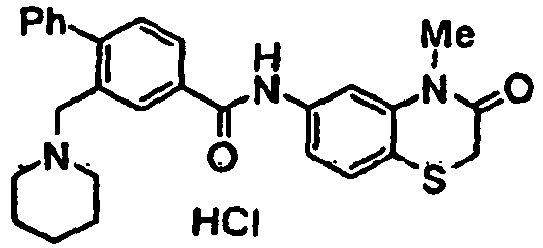
NMR:δ1.20-1.35(1H,m),1.52-1.64(3H,m),1.80-1. 95(2H,m),2.55-2.66(2H,m),3.19-3.26(2H,m),3.3 5(3H,s),3.52(2H,s),4.38(2H,d,J=4.8Hz),7.38-7.4 2(3H,m),7.46-7.56(4H,m),7.74-7.79(1H,m),7.98-8.04(2H,m),8.78-8.82(1H,m),10.25(1H,brs),1.0. 80-10.81 (1H,m),FAB-MS:472(M+H)+ * Not within the scope of the invention (Table 19) Ex Structure(salt) DATA * 59 
NMR:δ1.20-1.35(1H,m),1.52-1.64(3H,m),1.80-1.9 5(2H,m),2.33(3H,s),2.54-2.64(2H,m),3.17-3.26(2 H,m),4.37(2H,d,J=4.9Hz),7.19-7.23(1H,m),7.36-7 .42(3H,m),7.46-7.56(4H,m),7.69(1H,brs),7.84-7.8 8(1H,m),7.98-8.02(2H,m),8.77(1H,brs),10.37,(1H, m),10.66(1H,s).FAB-MS:428(M+H)+ 60 
NMR:δ1.20-1.35(1H,m),1.52-1.64(3H,m),1.76-1.9 0(2H,m),2.42-2.48(2H,m),2.54-2.64(2H,m),2.81-2 .87(2H,m),3.17-3.24(2H,m),4.37(2H,d,J=5.4Hz),7 .12-7.15(1H,m),7.34-7.42(3H,m),7.46-7.56(4H,m) ,7.64-7.66(1H,m),7.99-8.03(1H,m),8.71-8.74(1H, m),10.16(1H,s),10.34(1H,brs),10.55(1H,s).FAB-MS:440(M+H)+ * 61 
NMR:δ1.27-1.52(6H,m),2.16-2.34(4H,m).3.39(2H ,s),7.11(1H,dd,J=8.8,1.9Hz),7.22(1H,dd,J=2.0Hz) ,7.28-7.52(8H,m),7.75(1H,d,J=7.8Hz),7.83(1H,d, J=8.8Hz),8.06(1H,d,J=7.9Hz).8.17(1H,s),9.75(1H ,s),10.32(1H,s).FAB-MS:437(M+H) * 62 
NMR:δ1.20-1.30(1H,m),1.54-1.64(3H,m),1.84-1.9 7(2H,m),2.54-2.66(2H,m),3.16-3.28(2H,m),4.39(2 H,d,J=5.4Hz),5.00(2H,brs),7.38-7.57(7H,m),7.87-8.93(1H,m),8.00-8.05(1H,.m),8.07-8.10(1H,m),8.4 2-8.45(1 H,m),8.82-8.87(1H,m),10.49(1H,brs), 10. 68(1H,s).FAB-MS:411(M+H)+ 63 
NMR:δ1.21-1.37(1H,m),1.50-1.66(3H,m),1.77-1.9 5(2H,m),2.55-2.67(2H,m),3.18-3.30(2H,m),3.28(3 H,s),4.39(2H,m),4.65(2H,s),7.01 (1H,d,J=8.8Hz),7 .38-7.58(6H,m),7.67(1H,dd,J=8.6,2.0Hz),7.89(1H ,d,J=2.2Hz),7.99-8.06(1H,m),8.77-8.81(1H,m),10 .24(1H.brs),10.69(1H,s).FAB-MS:456(M+H)+ * 64 
NMR:δ1.20-1.35(1H,m),1.52-1.64(3H,m),1.76-1.9 2(2H,m),2.54-2.65(2H,m),3.18-3.26(2H,m),4.38(2 H,d,J=5.4Hz),7.38-7.42(2H,m),7.46-7.56(5H,m),7 .65-7.70(1H,m),8.00-8.04(2H,m),8.77(1H,s),10.3 2(1H,s),10.76(1H,s),11.96(1H,brs). FAB-MS:444( M+H)+ * 65 
NMR:δ1.20-1.35(1H,m),1.52-1.65(3H,m),1.80-1.9 5(2H,m),2.56-2.66(2H,m),3.20-3.26(2H,m),3.40(3 H,s),4.39(2H,d,J=5.4Hz),7.38-7.42(2H,m),7.46-7. 56(4H,m),7.60-7.64(1H,m),7.80-7.86(1H,m),8.01-8.05(1H,m),8.07-8.10(1H,m).8.80-8.82(1H,m),10. 29(1H,s),10.86(1H,s).FAB-MS:458(M+H)+ * 66 
NMR:δ1.22-1.33(1H,m),1.54-1.62(3H,m),1.73-1.8 8(2H,m),2.55-2.65(2H,m),3.18-3.24(2H,m),4.38(2 H,d,J=4.9Hz),7.36-7.43(3H,m),7.48-7.61(7H,m), 8.10-8.05(2H,m),8.56(1H,s),8.74(1H,s),10.19(1H, brs),10.92(1H,s).FAB-MS:450(M+H)+ * Not within the scope of the invention (Table 20) Ex Structure(salt) DATA * 67 
NMR:δ1.21-1.34(1H,m),1.52-1.64(3H,m),1.75-1. 92(2H,m),2.53-2.65(2H,m),3.16-3.26(2H,m),4.38 (2H,d,J=5.4Hz),6.39-6.43(1H,m),7.32-7.61 (9H,m ),8.01-8.06(1H,m),8.15(1H,s),8.75(1H,s),10.32(1 H,brs),10.41(1H,s),11.07(1H,s).FAB-MS:410(M+ H)+ * 68 
NMR:δ1.21-1.34(1H,m),1.56-1.62(3H,m), 1.80-1. 96(2H,m),2.58-2.68(2H,m),3.10-3.70(4H,m), 4.3 4-4.44(2H,m),7.38-7.58(6H,m),7.82-7.88(1H,m), 8.00-8.25(2H,m),8.67(1H,s),8.84-8.90(1H,m),9.4 6-9.53(1H,m),10.38(1H,brs),11.06(1H,s).FAB-M S:411 (M+H)+ * 69 
NMR:δ1.19-1.35(1H,m),1.52-1.63(3H,m),1.72-1. 89(2H,m),2.55-2.63(2H,m),3,02(3H,s),3.07-3.11( 2H,m),3.18-3.22(2H,m),3.92-4.00(2H,m),4.37(2H ,d,.J=4.9Hz),7.24(1H,d,J=8.3Hz),7.36-7.59(7H,m) ,8.00(1H,s),8.04(1H,dd,J=8.3,1.5Hz),8.70(1H,s), 10.19(1H,brs).10.62(1H,s).FAB-MS:490(M+H)+. * 70 
NMR:δ1.19-1.36(1H,m),1.51-1.64(3H,m), 1.79-1. 96(2H,m),2.54-2.66(2H,m),3.14-3.24(4H,m),3.7 1-3.75(2H,m).4.38(2H,d.J=4.8Hz).7.39-7.56(7H, m),7.90(1H,d,J=8.3Hz),8.02(1H,dd,J=7.8,1.5Hz), 8.14(1H,s),8.81(1H,s),10.32(1H,brs),10.90(1H,s) .FAB-MS:412(M+H)+ * 71 
NMR(CDCl3):δ1.20-1.38(1H,m),1.55-1.85(3H,m), 2.08-2.55(4H,m),3.35-3.52(8H,m).4.49(2H.d,J=5. 1Hz),6.77(1H,d,J=9.6Hz),7.25-7.55(5H,m),8.02( 1H,dd,J=8.1,1.5Hz),8.57(1H,dd,J=9.5,2.2Hz).8.9 1(1H,s),9.16(1H,d,J=2.2Hz),10.50-10.72(2H,m). FAB-MS:415(M+H)+ * 72 
NMR:δ1.20-1.33(1H,m),1.53-1.64(3H,m),1.80-1. 95(2H,m),2.55-2.68(2H,m),3.18-3.30(2H,m),4.40 (2H,d,J=5.4Hz),4.70(2H,brs),7.38-7.58(6H,m),7. 94-8.17(3H,m),8.63(1 H,s),8.82-8.86(1H,m),10.37 (1H,brs),10.93(1H,s).FAB-MS:412(M+H)+ * 73 
NMR:δ1.20-1.35(1H,m),1.53-1.63(3H,m),1.75-1. 90(2H,m),2.05-2.20(4H,m),2.54-2.70(4H,m),3.1 5-3.26(2H,m),4.37(2H,d,J=5.3Hz),7.21-7.24(1H, m).7.38-7.42(2H,m),7.46-7.56(4H,m),7.58-7.62(1 H,m),7.68-7.72(1H,m),7.99-8.03(1H,m),8.70-8,7 2(1H,m),9.60(1H,s),10.23(1H,s),10.61(1H,s).FA B-MS:454(M+H)+ * 74 
NMR:δ1.20-1.35(1H,m),1.53-1.63(3H,m),1.80-1. 95(2H,m),2.00-2.10(2H,m),2.14-2.22(2H,m),2.5 5-2.66(4H,m).3.18-3.25(5H,m).4.37(2H,d.J=4.9H z),7.23-7.27(1H,m),7.38-7.42(2H,m),7.46-7.56(4 H,m),7.75-7.80(1H,m),7.95-7.97(1H,m),8.00-8.0 4(1H,m),8.79(1H,brs),10.27(1H,s),10.72(1H,s).F AB-MS:468(M+H)+ * Not within the scope of the invention (Table 21) Ex Structure(salt) DATA * 75 
NMR:δ1,20-1.35(1H,m),1.52-1,65(3H,m),1.80-1. 95(2H,m),2.54-2.66(2H,m),3.15-3.30(8H,m),4.39 (2H,d,J=4.9Hz),7.38-7.42(2H,m),7.46-7.56(4H,m ),7.74-7.84(2H,m),8.00-8.04(1H,m),8.22-8.30(1 H,m),8.76-8.84(1H,m).10.31 (1H,s),10.79(1H,s). FAB-M5:471 (M+H)+ * 76 
NMR:δ1.36-1.39(2H,m),1.42-1.51(4H,m),2.19-2. 30(4H,m),3.38(2H,s).3.86(3H,s),6.75(1H,dd,J=8. 8,2.4Hz),7.38-7.49(6H,m),7.65(1H,s)7.85-7.89( 1H,m),7.91(1H,d,J=8.8Hz),8.13(1H,d,J=1.5Hz),8 .27(1H,s),8.45(1H.d.J=2.5Hz), 13.48(1H,s).FAB-MS:444(M+H)+ * 77 
NMR:δ1.29-1.39(2H,m),1.39-1.49(4H,m),2.17-2. 28(4H,m),3.39(2H,s),7.37-7.54(8H,m),7.75-7.82( 2H,m),7.93(1H,d,J=7.9Hz),8.01(1H,d,J=1.9Hz),8 .07(1H,s),10.52(1H,s).FAB-MS:448(M+H)+ 78 
NMR:δ1.26-1.35(1H,m),1.52-1.64(3H,m),1.76-1. 92(2H,m),2.52-2.65(4H,m),2.80-2.87(2H,m),3.1 2-3.25(5H,m),4.38(2H,d.J=4.9Hz),7.18-7.22(1H, m),7.36-7.42(2H,m),7.44-7.56(4H,m),7.62-7.68( 1H,m),7.78(1H,s),8.00-8.06(1H,m),8.74(1H,s),1 0.14(1H,brs),10,64(1H,s).FAB-MS:454(M+H)+ 79 
NMR:δ1.20-1.35(1H,m),1. 52-1.64(3H,m),1.80-1. 96(2H,m),2.54-2.66(2H,m),3.12(3H,s),3.18-3.26( 2H,m),3.57(2H,s)4.39(2H,d,J=4.9Hz),7.20-7.26( 1H,m),7.36-7.42(2H,m),7.46-7.56(4H,m),7.58-7. 62(1H,m),7.70-7.74(1H,m),7.98-8.05(1H,m),8.7 7-8.82(1H,m),10.36(1H,s),10.69(1H,s).FAB-MS: 440(M+H)+ * 80 
NMR:δ1.20-1.35(1H,m),1.52-1.64(3H,m),1.80.1. 95(2H,m),2.54-2.66(2H,m),3.18-3.26(2H,m),3.77 (3H,s)4.38(2H,d,J=4.9Hz),6.39(1H,d,J=2.9Hz),7. 28-7.30(1H,m),7.38-7.42(2H,m),7.46-7.60(6H,m) ,8.01-8.06(1H,m),8.20(1H,s),8.80(1H,s),10.39(1 H,brs), 10.57(1H,s).FAB-MS:424(M+H)+ 81 
NMR:δ1.28(7H,brs),1.52-1.64(3H,m),1.80-1.95(2 H,m),2.54-2.66(2H,m),3.14(3H,s),3.18-3.26(2H, m),4.38(2H,d,J=5.3Hz),7.30-7.34(1H,m),7.38-7. 42(2H,m),7.46-7.56(4H,m),7.58-7.64(1H,m),7.73 (1H,m),8.00-8.04(1H,m),8.81(1H, s),10.38(1H,br s),10.69(1H,s).FAB-MS:468(M+H)+ * 82 
NMR:δ1.18-1.33(1H,m),1.52-1.67(5H,m),2.53-2. 65(2H,m),3.14-3.20(2H,m),4.37(2H,d,J=4.9Hz),7 .40-7.46(2H,m),7.47-7.59(4H,m),7.67-7.72(1H,m ),7.97-8.01(2H,m),8.03(1H,d,J=2.5Hz),8.40-8.44 (1H,m),8.57(1H,s),8.71(1H,d,J=9.3Hz),9.72(1H, brs),12.95(1H,s).FAB-MS:448(M+H)+ * Not within the scope of the invention (Table 22) Ex Structure(salt) DATA 83 
NMR:δ1.20-1.34(1H,m),1.42(3H,d,J=6.8Hz),1.53-1.62(3H,m),1.71-1.86(2H,m),2.53-2.65(2H,m),3.1 4-3.24(2H,m),4.37(2H,d,J=5.4Hz),4.63(1H,q,J=6. 9Hz),6.95(1H,d,J=8.3Hz),7.34-7.42(3H,m),7.45-7. 57(4H,m),7.68(1H,d,J=2.4Hz),7.99-8.05(1H,m),8. 65(1H,s),10.08(1H,brs),10.52(1H,s,),10.75(1H,s). FAB-MS:456(M+H)+ 84 
NMR:δ1.21-1.35(1H,m),1.40(6H,s),1.52-1.63(3H, m),1.74-1.91(2H,m),2.54-2.65(2H,m),3.15-3.26(2 H,m),4.37(2H,d,J=5.4Hz),6.93(1H,d,J=8.3Hz),7.3 4-7.43(3H.m).7.45-7.57(4H,m),7.68-7.72(1H,m),7. 98-8.03(1H,s),8.68-8.73(1H,m),10.26(1H,brs),10. 55(1H,s),10.70(1H,s).FAB-MS:470(M+H)+ 85 
NMR:δ1.20-1.34(1H,m),1.44(3H,d,J=6.8Hz),1.52-1.63(3H,m),1.77-1.92(2H,m),2.54-2.67(2H,m),3.1 8-3.25(2H,m),3.28(3H,m),4.38(2H,d,J=5.4Hz),4.7 1(1H,q,J=6.6Hz),7.02(1H,dJ=6.8Hz),7.40(2H.d,J= 7.3Hz),7.45-7.57(4H,m),7.62-7.67(1H,m),7.86(1H ,d,J=1.9Hz),8.03(1H,d,J=8.8Hz),8.75(1H,s,)10.15 (1H,brs),10.65(1H,s).FAB-MS:470(M+H)+ 86 
NMR:δ1.22-1.34(1H,m),1.42(6H,s),1.52-1.64(3H, m),1.78-1.94(2H,m),2.55-2.67(2H,m),3.17-3.26(2 H,m),3.29(3H,s),4.38(2H,d,J=4.9Hz),6.99(1H,d,J =8.8Hz),7.37-7.43(2-H,m),7.45-7.57(4H,m),7.63-7. 69(1H,m),7.86(1H,d,J=1.9Hz),7.98-8.05(1H,m),8. 78(1H,s),10.23(1H,brs),10.66(1H,s),FAB-MS:484( M+H)+ 87 
NMR:δ1.25(7H,brs),1.52-1.64(3H,m),1.78-1.92(2 H,m),2.53-2.66(2H,m),3.18-3.25(2H,m),4.38(2H,d ,J=5.4Hz),7.22-7.26(1H,m),7.38-7.42(2H,m),7.46-7.57(5H,m),7.65-7.66(1H,m),7.98-8.03(1H,m).8.7 3-8.75(1H,s),10.32(1H,brs),10.40(1H,s),10.58(1H ,s).FAB-MS:454(M+H)+ * 88 
NMR:δ1.20-1.36(1H,m),1.50-1.65(3H,m),1.78-1.9 6(2H,m),2.55-2.69(2H,m),2.98(3H,s),3.15-3.28(2 H,m),4.38(2H,d,J=5.4Hz),7.36-7.58(6H,m),8.02(1 H,dd,J=7.8,1.5Hz),8.44(1H,s),8.64(1H,d,J=3.5Hz) ,8.81(1H,d,J=1.5Hz),10.15(1H,brs),10.92(1H,s).F AB-MS:435(M+H)+ 89 
NMR:δ1.07(6H,s),1.20-1.35(1H,m),1.53-1.62(3H, m),1.74-1.88(2H,m),2.53-2.65(2H,m),2.72(2H,s),3 .18-3.25(2H,m),4.38(2H,d,J=5.4Hz),7.10-7.15(1H, m),7.33-7.42(3H,m),7.46-7.57(4H,m),7.61-7.63(1 H,m),7.98-8.04(1H,m),8.68-8.70(1H,m),10.10(1H, brs),10.24(1H,s),10.53(1H,s).FAB-MS:468(M+H)+ * 90 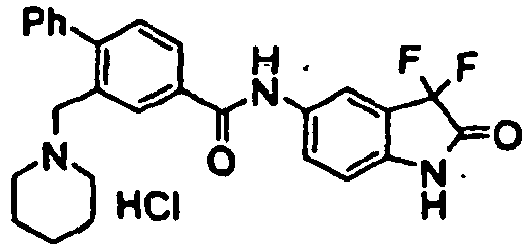
NMR:δ1.21-1.36(1H,m),1.54-1.64(3H,m),1.76-1.9 2(2H,.m),2.56-2.66(2H,m),3.19-3.26(2H,m),4.38(2 H,d,J=5.4Hz),7.02-7.07(1H,m),7.38-7.57(6H,m),8. 02(1H,dd,J=8.1,2.0Hz),8.05-8.11(1H,m),8.28(1H, d,J=1.5Hz),8.78(1H,d,J=1.5Hz),10.18(1H,brs),10. 84(1H,s),11.23(1H,brs)FAB-MS:462(M+H)+ * Not within the scope of the invention (Table 23) Ex Structure(salt) DATA 91 
NMR:δ1.80-2.38(4H,m),2.40-2.48(2H,m),2.65-2.9 0(4H,m),3.18-3.32(2H,m),4.36-4.50(2H,m),4.60-5. 02(1H,m),7.10-7.17(1H,m),7.32-7.37(1H,m),7.38-7.42(2H,m),7.46-7.56(4H,m),7.60-7.64(1H,m),8.0 0-8.04(1 H,m),8.62-8.67(1H,m),10.17(1H,s),10.04-10.53(2H,m).FAB-MS:458(M+H)+ 92 
NMR:δ1.88-2.34(4H,m),2.52-2.58(2H,m),2.72-2.8 8(4H,m),3.24-3.27(5H,m),4.38-4.49(2H,m),4.60-5. 20(1H,m),7.18-7.23(1H,m),7.38-7.42(2H,m),7.46-7.56(4H,m),7.62-7.68(1H,m),7.74-7.78(1H,m),8.0 1-8.06(1H,m),8.65-8.70(1H,m),10.34(1H,s),10.59( 1H,s).ESI-MS:472(M+H)+ 93 
NMR:δ1.50-1.80(2H,br),1.80-2.10(2H,br),2.42-2.4 8(2H,m),2.52-2.55(1H,m),2.80-2.2.88(3H,m),3.85-4.75(4H,br),7.10-7.17(1H,m),7.28-7.33(1H,m),7.4 0-7.55(8H,m),7.98-8.08(1H,m),8.51(1H,br),1.0:18( 1H,s),10.42(1H,brs).FAB-MS:476(M+H)+ 94 
NMR:δ1.50-2.25(4H,br),2.52-2.56(4H,m),2.82-2.8 6(2H,m),3.22-3.75(5H,m),4.20-5.00(2H,br),7.17-7. 23(1H,m),7.41-7.57(6H,m),7.58-7.62(1H,m),7.74( 1 H,s),8.02-8.09(1H,m),8.50-8.80(1H,br),10.59(1H, brs),10.80-11.20(1H,br).FAB-MS:490(M+H)+ * 95 
NMR:δ1.11(6H,t,J=6.9Hz),1.30-1.50(2H,m),1.50-1 .64(4H,m),2.55-3.00(4H,m),3.49(4H,q,J=14.2,6.9 Hz),4.20(2H,brs),6.62(1H,d,J=9.3Hz),7.37-7.56(6 H,m),7.84(1H,dd,J=9.3,2.9Hz),8.06(1H,dd,J=7.9,1 .5Hz),8.39(1H,s),8.42(1 H,d,J=2.5Hz),10.22(1 H,s). FAB-MS:443(M+H)+. * 96 
NMR:δ1.20-1.65(12H,m),2.48-2.85(4H,m),3.44-3. 52(4H,m),4.02(2H,s),6.85(1H,d,J=9.2Hz),7.38-7.5 5(6H,m),7.89(1H,dd,J=8.8,2.5Hz),8.00-8.07(1H,m ).8.28(1H,s),8.47(1H,d,J=2.9Hz),10.25(1H,s).FA B-MS:455(M+H)+ * 97 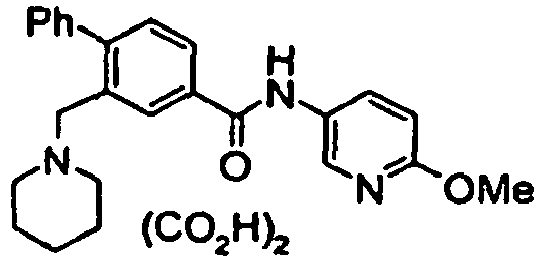
NMR:δ1.30-1.59(6H,m),2.48-2.75(4H,m),3.83-4.0 6(5H,m),6.87(1H,d,J=8.8Hz),7.37-7.55(6H,m),8.0 1-8.11 (2H,m),8.28(1H,s),8.56(1H,d,J=2.9Hz),10.4 3(1H,m).FAB-MS:402(M+H)+ * 98 
NMR:δ1.30-1.47(2H,m),1.47-1.62(4H,m),2.55-2.8 1(7H,m),3.50-4.70(2H,m),6.50(1H,d,J=8.8Hz),7.3 7-7.56(6H,m),7.76(1H,dd,J=8.8,2.4Hz),8.04(1H,d, J=7.8Hz),8.31(1H,s),8.35(1H,d,J=2.4Hz),10.17(1 H,s).FAB-MS:401(M+H)+ * 99 
ESI-MS:411(M+H)+ * Not within the scope of the invention (Table 24) Ex Structure(salt) DATA * 100 
NMR:δ1.60-2.05(4H,m),2.18-2.90(3H,m),3.08-3. 38(2H,m),4.34-4.46(2H,m),6.86(1H,brs),7.24-7.5 8(7H,m),8.04-8.18(3H,m),8.76-8.81(2H,m),9.41( 1H,s),10.17-10.52(1H,m),10.89(1H,s).FAB-MS:4 71(M+H)+ * 101 
NMR:δ0.98-1.36(5H,m),1.50-1.60(1H,m),1.62-1. 73(2H,m),1.82-1.92(2H,m),2.80-2.95(1H,m),4.1 7-4.26(2H,m),7.44-7.58(6H,m),8.00-8.18(3H,m), 8.67-8.79(2H,m),9.22(2H,brs),9.41(1H,s),10.81 (1H,brs).FAB-MS:442(M+H)+ * 102 
NMR:δ0.81(3H,d,J=6.8Hz),1.17(3H,d,J=6.8Hz),2 .95-3.85(8H,m),4.45-4.59(2H,m),7.42-7.60(6H,m ),8.01-8.18(3H,m),8.67-8.79(2H,m),9.41(1 H,s),9. .74(1H,brs),10.90(1H,brs).FAB-MS:460(M+H)+ * 103 
NMR:δ1.48-2.14(4H,m),2.60-2.86(2H,m),3.02-3. 90(2H,m),4.26-4.45(3H,m),4.45-4.59(2H,m),7.3 6-7.58(6H,m),8.02-8.18(3H,m),8.77-8.88(2H,m), 9.42(1H,s),10.32-10.53(1H,m),10.87-10.94(1H,m ).FAB-MS:444(M+H)+ * 104 
NMR:δ0.90-1.09(6H,m),1.33-1.70(2H,m),1.72-2. 10(2H,m),2.65-3.02(3H,m),3.12-3.34(6H,m),4.3 4-4.51(2H,m),7.36-7.60(6H,m),8.01-8.18(3H,m), 8.74-8.84(2H,m),9.42(1H,s),10.28(1H,brs),10.88 (1H,s).FAB-MS:527(M+H)+ * 105 
NMR:δ1.73-2.14(4H,m),2.60-2.80(2H,m),3.06-3. 52(6H,m),4.38-4.45(2H,m),7.37-7.58(6H,m),8.0 2-8.18(3H,m),8.78-8.85(2H,m),9.41(1H,s),10.50( 1H,brs),10.86-10.92(1H,m).FAB-MS:458(M+H)* * 106 
NMR:δ1.11-2.00(4H,m),2.48-2.85(2H,m),3.02-3. 58(6H,m),4.25-4.58(2H,m),7.38-7.59(6H,m),7.9 2-8.22(3H,m),8.62-8.84(2H,m),9.40-9.43(1H,m), 10.56(1H,brs),10.73-10.88(1H,m).FAB-MS:458( M+H)+ * 107 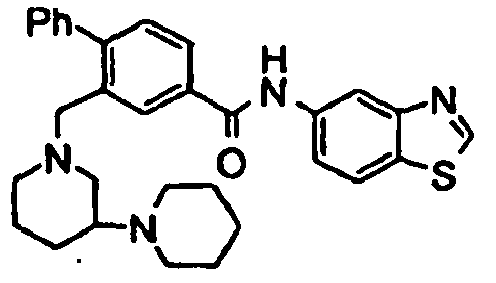
NMR(CDCl3):δ1.10-1.91(10H,m),2.37-3.20(9H,m ),3.36-3.54(2H,m),7.27-7.47(6H,m),7.84-7.97(3H ,m),8.12(1H,d,J=1.8Hz),8.48(1H,s),8.74-9.03(2H ,m).FAB-MS:511(M+H)+ * 108 
NMR:δ1.30-2.45(10H,m),2.70-3.52(9H,m),4.35-4 .63(2H,m);7.38-7.59(6H,m).8.03-8.18(3H,m).8.7 4-8.86(2H,m),9.42(1H,s),10.65-10.98(2H,m). FAB-MS:511 (M+H)+ * Not within the scope of the invention (Table 25) Ex Structure(salt) DATA * 109 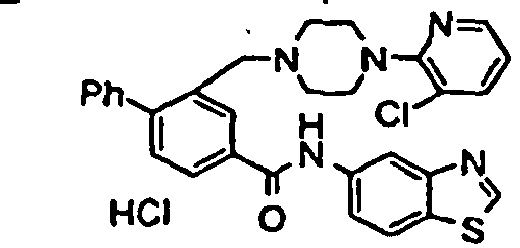
NMR.δ2.85-3.00(2H,m),3.34-3.50(4H,m),3.65-3.7 5(2H,m),4.50-4.60(2H,m),7.06(1H,dd,J=7.8,4.4H z),7.40-7.58(6H,m),7.82(1H,dd,J=7.8,1.4Hz),8.0 2-8.24(4H,m),8.75-8.82(2H,m),9.41(1H,s),10.73( 1H,brs),10.85(1H,s).FAB-MS:540(M+H)+ * 110 
NMR:δ1.89-2.40(4H,m).2.70-2.90(2H,m),3.17-3.4 0(2H,m),4.38-4.52(2H,m),4.58-5.04(1H,m),7.36-7 .58(6H,m),8.01-8.18(3H,m),8.76-8.86(2H,m),9.42 (1H,s),10.68(1H,brs),10.83-10.92(1H,m).FAB-MS :446(M+H)+ * 111 
NMR:δ1.55-2.10(4H,m),2.46-5.00(6H,m),7.40-7.5 8(6H,m),7.94-8.18(3H,m),8.48-8.79(2H,m),9.41(1 H,s),10.79(2H,brs).FAB-MS:464(M+H)+ * 112 
NMR:δ1.20-1.35(1H,m),1.53-1.65(3H,m),1.78-1.9 4(2H,m),2.55-2.67(2H,m),3.15-3.25(2H,m),3.43(3 H,s),4.38(2H,d,J=5.4Hz),4.80(2H,s),7.38-7.42(2 H,m),7.46-7.57(4H,m),7.88-7.92(1H,m),8.03-8.12 (2H,m),8.26(1H,s),8.81(1H,s);10.08(1H,brs).11.1 7(1H,s).FAB-MS:504(M+H)+ * 113 
NMR:δ1.21-1.35(1H,m),1.55-1.65(3H,m),1.74-1.9 1(2H,m),2.56-2.68(2H,m)13.20-3.28(2H,m),4.40(2 H,d,J=4.9Hz),7.40-7.67(9H,m),8.02-8.22(4H,m),8 .58-8.80(3H,m),10.11(1H,brs),10.96(1H,s). FAB-MS:5001M+H)+ * 114 
NMR:δ1.20-1.35(1H,m),1.52-1.64(3H,m),1.72-1.8 6(3H,m),2.31-2.40(1H,m),2.57-2.62(2H,m),2.64-2.73(1H,m),2.84-2.92(1H,m),3.16-3.24(2H,m),4.3 7(2H,d,J=4.9Hz),5.04(1H,t,J=6.4Hz),5.27(1H,br s),7.20(1H,d,J=8.3Hz),7.37-7.42(2H,m),7.45-7.5 6(4H,m),7.69(1H.dd,J=8.8,2.0Hz),7.94(1H,s).8.0 3(1H,dd,J=8.8,2.0Hz),8.66(1H,s),10.11(1H,brs),1 0.50(1H,s).FAB-MS:427(M+H)+ * 115 
NMR:δ0.87(12H,t,J=6.6Hz),1.92-2.04(2H,m),2.6 8-2.74(4H,m),4.55(2H,d,J=5.4Hz),7.43-7.47(2H, m),7.48-7.60(4H,m),8.04-8.10(1H,m),8.13-8.18(2 H,m),8.79(1H,s),8.86(1H,brs),9.42(1H,s),9.54(1H ,brs),10.95(1H,s).FAB-MS:472(M+H)+ 116 
NMR:δ0.94-1.02(3H,m),1.06-1.14(3H,m),2.52-2.5 8(2H,m),2.78-3.08(4H,m),3.10-3.40(9H,m),3.90-3 .98(1H,m),4.00-4.14(1H,m),4.45-4.65(2H,m),4.8 0-4.92(1H,br),7.18-7.22(1H,m),7.36-7.44(2H,m), 7.46-7.58(4H,m),7.62-7.68(1H,m),7.79(1H,brs),7. 98-8.04(1H,m),8.74(1H,br),10.56(1H,s),11.04(1H ,br).FAB-MS:555(M+H)+ * Not within the scope of the invention (Table 26) Ex Structure(salt) DATA 117 
NMR: δ1. 02-1.20(6H,m),2.52-2.58(2H,m),2.60-2.7 2(1H,m), 2.80-2.90(2H,m),2.90-3.04(1H,m), 3.26(3 H,s),3.28-3.70(5H,m),3.73-3.83(1H,m),3.88-3.98( 1H,m),4.00-4.10(1H,m),4.15-4.28(1H,br),4.33-4.4 5(1H,m),4.62-5.12(1H,br),7.18-7.22(1 H,m),7.38-7 42(2H,m),7.44-7.58(4H,m),7.58-7.62(1H,m), 7.77 (1H,brs), 8.05-8.12(1H,m),8.42(1H,s),10.00-10.55 (1H,br), 10.80(1H,s).FAB-MS:555(M+H)+ 118 
NMR: δ0.93-1.01(3H,m),1.04-1.12(3H,m),1.35-1.5 0(1H,m), 1.56-1.76(3H,m),1.90-2.05(1H,m),2.52-2 58(2H,m),2.62-2.72(1H,m),2.76-2.88(3H,m),3.0 8-3.28(8H,m),3.42-3.54(1H,m),4.42-4.52(2H,m),7 .18-7.24(1H,m),7.34-7.44(2H,m),7.46-7.60(4H,m) ,7.64-7.68(1H,m),7.82-7.84(1H,m),7.98-8.12(1H, m), 8.79(1H,s),10.52(1H,br), 10.64(1H,s).FAB-MS: 553(M+H)+ 119 
NMR: δ0.86-0.92(6H,m),1.57-1.84(3H,m),1.95-2.0 8(1 H,m),2.36-2.44(1H,m),2.52-2.58(2H,m),2.80-2 .88(2H,m),2.90-2.98(1H,m),3.08-3.23(4H,m),3.27 (3H,s),3.43-3.48(1 H,m),3.63-3.77(2H,m),7.18-7.2 2(1 H,m),7.34-7.37(1 H,m),7.38-7.52(6H,m),7.63(1 H,s), 7.85-7.91 (1H,m),8.14(1H,s), 10.23(1H,s).FA B-MS:539(M+H)+ 120 
NMR:δ1.30-1.50(1H,m),1.60-1.90(3H,m),2.5.2-2.5 8(2H,m),2.60-2.70(1H,br),2.82-2.95(4H,m), 3.15-3 .27(4H,m),3.37-3.48(1H,m),4.35-4.70(2H,m),7.1 8-7.24(1H,m),7.37-7.42(2H,m),7.47-7.58(5H,m),7 .65(1H,s),8.07-8.18(1H,m),8.48(1H,brs),9.48-9.66 (1H,br), 10.40(1H,s).FAB-MS:522(M+H)+ 121 
NMR:δ0.80(3H,t,J=7.3Hz),1.15-1.25(1H,m),1.40-1.52(3H,m),1.60-1.70(2H,m),1.84-1.94(1H,m),2.0 0(2H,t,J=7.3Hz),2.04-2.20(1H,m),2.52-2.58(2H, m),2.62-2.81(2H,m),2.82-2.88(2H,m),3.26(3H,s), 3.64-3.80(3H,br),7.18-7.24(1H,m),7.38-7.52(7H, m),7.59-7.65(2H,m),7.95-8.02(1H,m),8.17(1H,s),1 0.34(1H,s).FAB-MS:539(M+H)+ 122 
NMR:δ0.88(3H,d,J=6.4Hz),1.25-1.45(4H,m),1.42 (3H,d,J=6.9Hz),1.50-1.63(1H,m),1.65-1.73(3H, m),1.83-1.93(2H,m),2.04-2.12(1H,m),2.55-2.62(1 H,m),2.77-2.95(3H,m),3.07-3.19(1H,m),3.20-3.3.3 (2H,m),3.52(2H,s),4.63(1H,q,J=6.8Hz),6.95(1H,d, J=8.3Hz),7.27(1H,dd,J=8.8,2.5Hz),7.37-7.55(7H, m),7.92(1H,dd,J=6.8,2.0Hz),8.06(1H,d,J=2.0Hz), 10.27(1H,s),10.75(1H,s).FAB-MS:553(M+H)+ 123 
NMR:δ0.81 (3H,t,J=6.8Hz),1.04(6H,s),1.42(3H,d,J =6.4Hz),2.36(2H,brs),2.90-4.20(3H,m),3.82(2H,br s),4.63(1H,q,J=6.8Hz),6.94(1H,d,J=8.8Hz),7.25(1 H,dd,J=8.8,2.5Hz),7.31-7.38(3H,m),7.39-7.52(3H, m),7.58(1H,d,J=2.4Hz),7.91(1H,d,J=7.7Hz),8.28 (1H,s),10.24(1H,s),10:71(1H,s).FAB-MS:488(M+ H)+ (Table 27) Ex Structure(salt) DATA 124 
NMR:δ1.21(3H,t,J=6.8Hz),1.18-1.34(1H,m),1.52-1.66(3H,m),1.76-1.94(2H,m),2.50-2.65(4H,m),2.7 8-2.85(2H, m),3.18-3.25(2H, m), 3.88(2H,q, J=6.8H z),4. 38(2H,d,J=5.3Hz), 7.20(1H,d,J=5.3Hz), 7.35-7.58(6H,m),7.65-7.72(1H,m),7.85(1H,s), 7.95-8.07 (1H,m),8.79(1H,s),10.23(1H, brs),10.67(1H,s). FAB-MS:468(M+H)+ 125 
NMR:δ1.21-1.34(1H,m), 1.54-1.64(3H,m), 1.72-1.8 6(2H,m),2.55-2.63(4H,m),2.82-2.89(2H,m),3.18-3.26(2H,m),4.20(2H,dt,J=22.9,5.4Hz),4.38(2H,d,J =5.4Hz),4.67(2H,dt,J=47.4,5.4Hz), 7.22(1H,d,J=8. 3Hz),7.37-7.57(6H,m),7.63(1 H,ddd,J=7.8,2.0,1.5 Hz),7.84(1H,d,J=1.5Hz),8.05(1H,ddd,J=7.8,2.0,1. 5Hz),8.70(1H,d,J=1.5Hz),9.99(1H,brs), 10.60(1H, s).FAB-MS:486(M+H)+ 126 
NMR:δ1.20-1.35(1H, m),1.52-1.66(3H,m), 1.70-1.8 5(2H,m),2.53-2.67(2H,m),3.16-3.23(2H,m),4.38(2 H,d,J=5.3Hz),6.39(1H,dd,J=9.3,2.0Hz),7.35-7.66 (8H,m),7.84(1H,d=9.3Hz),8.06(1H,dd,J=8.3,1.5H z), 8.17(1H,s),8.68(1H,s), 10.05(1H,brs), 10.82(1H, s),11.78(1H,s).FAB-MS:438(M+H)+ 127 
NMR:δ1.20-1.37(1H,m),1.53-1.66(3H,m),1.70-1.8 5(2H,m),2.12(3H,s),2.55-2.70(2H,m),3.20-3.29(2 H,m),3.63(3H,s),4.40(2H,d,J=5.4Hz),7.36-7.58(6 H,m),7.63(1H,d,J=8.8Hz),7.74(1H,s),7.95(1H, dd,J =8.8,1.4Hz),8.04(1H,dd,J=7.8,1.5Hz),8.28(1H,d,J =1.0Hz),8.85(1H,s),10.32(1H,brs),10.,96(1H,s).FA B-MS:466(M+H)+ 128 
NMR:δ1.13(3H,d,J=6.9Hz),1.20-1.34(1H,m),1.52-1.64(3H,m),1.72-1.89(2H,m),2.45-2.65(4H, m),2.9 1 (1H,dd, J=15.7,5.9Hz), 3.19(2H,d,J=11.7Hz),4.37 (2H,d,J=5.4Hz),7.13(1H,d,J=8.3Hz),7.32-7.58(7 H,m),7.59(1H,d,J=1.9Hz),8.00(1H,dd,J=8.3,1.5H z),8.68(1H,d,J=1.5Hz),10.15(1H,s),10.21 (1 H,brs), 10.53(1H,s).FAB-MS:454(M+H)+ 129 
NMR:δ1.19-1.30(1H,m), 1.53-1.66(3H,m),1.80-1.9 7(2H,m),2.55-2.69(2H,m),3.23-3.26(2H, m), 3.61 (3 H,s),4.40(2H,d,J=4.9Hz),6.52(1H,d,J=9.3Hz),7.3 6-7.58(6H,m),7.72(1 H,d,J=8.3Hz),7.86(1H,d,J=9. 3Hz),7.97(1H,dd,J=8.3,1.4Hz),8.05(1H,dd,J=8.3, 1.4Hz),8.32(1H,d,J=1.4Hz),8.84(1H,d,J=1.4Hz),1 0.25(1H,brs),11.01(1H,s).FAB-MS:452(M+H)+ 130 
NMR:δ1.20-1.35(1H,m),1.50-1.65(3H,m),1.80-1.9 5(2H,m),2.08(3H,s),2.45-2.67(2H,m),3.23(2H,d,J =11.2Hz),4.39(2H,d, J=5.4Hz),6.52(1H,d, J=9.3H z), 7.36-7.66(8H,m),8.03(1H,dd,J=1.4,7.8Hz),8.21 (1H,d,J=1.5Hz),8.80(1H,d,J=1.4Hz),10.42(1H,br s),10.83(1H,s),11.78(1H,s).FAB-MS:452(M+H)+ (Table 28) Ex Structure(salt) DATA 131 
NMR:δ1.23-1.31 (1H,m),1.52-1.78(5H,m),2.46-2.6 4(4H,m),2.89-2.94(2H,m),3.16-3.23(2H,m),4.37(2 H,d,J=5.4Hz),7.06(1H,s),7.38-7.43(3H,m),7.47-7. 57(4H,m),8.08(1H,dd,J=7.9,1.9Hz),8.59(1H,d,J= 1.9Hz),9.90(1H,brs),10.23(1H,s),10.29(1H,s).FA B-MS:474(M+H)+ * 132 
NMR:δ1.20-1.35(1H,m), 1.52-1.64(3H,m),1.80-1.9 4(2H,m),2.56-2.68(2H,m),2.91(6H,s),3.16-3.26(2 H,m),4.39(2H,d,J=5.3Hz),4.74(1H,brs),7.36-7.42 (2H,m),7.46-7.58(4H,m),8.02(1H,dd,J=8.3,1.5Hz), 8.40(1H,d,J=2.0Hz),8.77(1H,d,J=2.5Hz),8.80-8.8 4(1H,m),10.22(1H,brs),10.91(1H,s).FAB-MS:449 (M+H)+ 133 
NMR:δ1.20-1.35(1H,m), 1.50-1.65(3H,m), 1.80-1.9 5(2H,m),2.08(3H,s),2.45-2.67(2H,m),3.23(2H,d,J =11.2Hz),4.39(2H,d,J=5.4Hz),6.52(1H,d,J=9.3H z),7.36-7.66(8H,m),8.03(1H,dd,J=1.4,7.8Hz),8.21 (1H,d, J=1.5Hz),8.80(1H,d,J=1.4Hz), 10.42(1H,br s), 10.83(1H,s), 11.78(1H,s).FAB-MS:452(M+H)+ 134 
NMR:δ1.21-1.34(1H,m),1.53-1.64(3H,m),1.76-1.9 0(2H,m),2.54-2,66(2H,m),3.18-3.26(2H,m),3.62(2 H,s),4.38(2H,d,J=5.2Hz),7.38-7.43(2H,m),7.47-7. 57(5H,m),7.90(2H,d, J=2.4Hz),8.03(1H,dd,J=8.1, 1.7Hz),8.72(1H,d, J=1.5Hz),10.11(1H,brs),10.83(1 H,s),10.93(1H,s).FAB-MS:494(M+H)+ 135 
NMR:δ1.22-1.34(1H,m), 1.52-1.65(3H,m), 1.79-1.9 4(2H,m),2.56-2.68(2H,m),3.19(3H,s),3.18-3.26(2 H,m),4.39(2H.d,J=4.9Hz),7.28(1H,d,J=8.3Hz),7.3 8-7.43(2H,m),7.47-7.57(4H,m),8.03(1H,d,J=7.8H z),8.18(1 H,d,J=7.8Hz),8.34(1H,m),8.79(1H,m),10. 20(1H,brs);10.91(1H,s).FAB-MS:476(M+H)+ 136 
NMR:δ0.92(3H,t,J=7.4Hz),1.20-1.40(1H,m),1.54-1.75(7H,m),2.50-2.90(6H,m),3.10-3.25(2H,m),3.7 0-3.85(2H,m),4.38(2H,d,J=5.4Hz),6.52(1H,d, J=9. 3Hz),7.21(2H,d,J=8.3Hz),7.37-7.61(5H,m),7.77(1 H,s),8.08(1H,m),8.58(1H,s),9.71(1H,brs).10.54(1 H,s). FAB-MS:468(M+H)+ 137 
NMR:δ1.34-1.47(1H,m),1.64-1.86(5H,m),2.52-2.5 8(2H,m),2.80-2.88(2H,m),2.88-3.00(2H,m),3.19-3. 25(2H,m),3.24(3H,s),3.34-3.42(2H,m),3.44-3.51(2 H,m),7.19(1H,d,J=8.3Hz),7.41-7.47(2H,m),7.50-7. 58(3H,m),7.66-7.78(5H,m),9.89(1H,brs),10.51(1 H,s).FAB-MS:468(M+H)+ * Not within the scope of the invention (Table 29) Ex Structure(salt) DATA * 138 
NMR:δ1.30·1.44(2H,brm),1.48-1.60(4H,brm),2.5 4-2.70(4H,brm),2.90(6H,s),3.90-4.08(2H,m),7.40-7.55(6H,m),8.06(1H,d.J=8.3Hz),8.31 (1 H,brs),8.4 6-8.49(1H,m),8.85(1H,d,J=1.9Hz),10.62-10.68(1 H,brm). FAB-MS:483(M+ H)+ 139 
NMR:δ1.22-1.35(1H,m), 1.56-1.66(3H,m), 1.76-1.9 0(2H,m),2.53-2.68(4H,m),2.81-2.89(2H,m),3.26(3 H,s),3.26-3.37(2H,m),4.14(2H,d,J=5.4Hz),7.22(1 H,d,J=7.8Hz),7.31-7.36(2H,m),7.49-7.59(3H,m),7. 64(1H, dd, J=8.3, 1.9Hz),7.74(1H,d,J=1.9Hz),8.18 (1H,s),8.72(1H,d,J=1.9Hz),10.03(1H,brs),10.69(1 H,s).FAB-MS:488(M+H)+ 140 
NMR:δ0.98(6H,s),1.58(2H,t,J=7.3Hz),2.45-2.63(4 H,m),2.80-3.02(4H,m),3.26(3H,s),4.07(2H,brs),7. 20(1H,d,J=7.8Hz),7.43-7.55(7H,m),7.60(1H,s),8.0 4(1H,d,J=7.8Hz),8.24(1H,s),10.37(1H,s). FAB-MS:468(M+H)+ 141 
NMR:δ1.20-1.34(1H,m), 1.42(3H,d,J=6.8Hz), 1.53-1.62(3H,m),1.71-1.86(2H,m),2.53-2.65(2H,m),3.1 4-3.24(2H,m),4.37(2H,d,J=5.4Hz),4.63(1H,q,J=6. 9Hz),6.95(1H,d,J=8.3Hz),7.34-7.42(3H,m), 7.45-7. 57(4H, m), 7.68(1H,d,J=2.4Hz),7.99-8.05(1H,m),8. 65(1H,s),10.08(1H,brs),10.52(1H,s,),10.75(1H,s). FAB-MS:456(M+H)+ 142 
NMR:δ1.20-1.34(1H,m), 1.42(3H,d,J=6.8Hz), 1.53-1.62(3H,m),1.71-1.86(2H,m),2.53-2.65(2H,m),3.1 4-3.24(2H,m),4.37(2H,d,J=5.4Hz),4.63(1H,q, J=6. 9Hz), 6.95(1H,d,J=8.3Hz), 7.34-7.42(3H,m).7.45-7. 57(4H,m),7.68(1H,d,J=2.4Hz),7.99-8.05(1H,m),8. 65(1H,s),10.08(1H,brs),10.52(1H,s,),10.75(1H,s). FAB-MS:456(M+H)+ 143 
NMR:δ0.97(6H,t,J=7.0Hz),2.73-2.89(2H,m),2.94-3.10(2H,m),3.62(2H,s),4.35-4.45(2H,m),7.38-7.46 (2H,m),7.47-7.59(4H,m).7.83-7.94(2H,m),7.99-8.0 7(1H,m).8.67(1H,s), 10.15(1H,brs), 10.82(1H,s),1 0.85-10.93 (1H,m).FAB-MS:482(M+H)+ 144 
NMR:δ2.53-2.58(2H,m),2.75-2.88(4H,m),3.19-3.2 7(5H,m),3.70-3.90(4H,m),4.40-4.50(2H,m),7.19-7. 22(1H,m),7.38-7.42(2H,m),7.46-7.56(4H,m),7.62-7.66(1H,m), 7.75(1H,s),8.02-8.07(1H,m), 8.68(1H, s),10.57(1H,s); 10.69(1H, brs). FAB-MS:456(M+H)+ 145 
NMR:δ2.52-2.60(2H,m),2.80-2.88(2H,s),3.13(3H, s), 3.13-3.22(4H,m), 3.36(6H,s), 3.56-3.65(4H,m), 4. 59(2H,d,J=4.9Hz),7.20(1H,d.J=8.3Hz),7.38-7.60 (6H,m), 7.66(1H, dd, J=8.3,1.5Hz), 7.80(1H,s),8.06 (1H, d,J=8.3Hz),8.77(1H,s), 10.46(1H,brs),10.60(1 H,s).FAB-MS:502(M+H)+ * Not within the scope of the invention (Table 30) Ex Structure(salt) DATA 146 
NMR:δ0.98(3H,t,J=7.3Hz),2.57-2.60(2H,m),2.80-2.90(2H,m),2..80-3.40(6H,m),3.15(3H,s),3.26(3H, s), 3.52-3.65(2H,m), 4.40-4.60(2H,m), 7.20(1H,d,J= 8.3Hz),7.37-7.60(6H,m),7.66(1H,dd,J=7.8,1.5Hz), 7.82(1H,d,J=1.5Hz),8.04(1H,d,J=7.8Hz),8.76(1H, s),10.44(1H,brs), 10.63(1H,s).FAB-MS:472(M+H)+ 147 
NMR:δ0.88-1.00(3H,m),1.36-1.56(1H,m),1.90-2.0 5(1H,m),2.15-2.40(2H,m),2.52-2.75(2H,m),2.80-3. 00(3H,m),3.25(3H,s),3.36-3.50(2H,m),4.44-4.52(2 H,m),7.18-7.22(1H,m),7.38-7.43(2H,m),7.46-7.58 (4H,m),7.64-7.70(1H,m),7.80(1H,s),8.00-8.04(1H, m),8.70-8.74(1 H,m),10.56(1H,s),10.75-10.95(1H, br).FAB-MS:454(M+H) 148 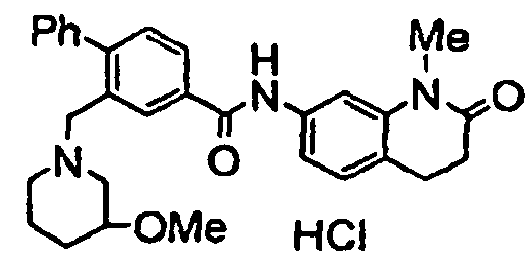
NMR:δ1.10-1.26(1H,m),1.45-2.00(5H,m),2.54-2.5 7(2H,m),2.69-2.86(3H,m),3.06-3.79(2H,m),3.21(3 H,s),3.25(3H,s),4.27-4.32,4.61-4.54(2H,m),7.19-7.22(1H,m),7.35-7.75(7H,m),7.82(1H,s),7.99,8.01 (1H,d, J=8.3Hz),8.62,8.78(1H,s),9.50-10.65(2H, m).FAB-MS:484(M+H)+ 149 
NMR:δ0.87-0.98(3H,m),1.35-1.54(1H, m),1.90-2.0 5(1H,m),2.10-2.47(3H,m),2.70-3.00(5H,m),3.34-3. 50(1H,m),4.42-4.50(2H,m),7.12-7.16(1H,m),7.32-7.37(1H,m),7.38-7.43(2H,m),7.46-7.57(4H,m),1.6 0(1H,s),7.99-8.05(1H,m),8.61(1H,brs),10.17(1H, s),10.43(1H,s),10.74(1H, brs). FAB-MS:440(M+H)+ * 150 
NMR:δ1.20:1.34(1H,m),1.53-1.64(3H,m), 1.71-1.8 6(2H,m),2.54-2.66(2H,m),2.87(6H,s),3.17-3.23(2 H,m),4.38(2H,d,J=5.4Hz),7.37-7.57(6H,m),8.05(1 H,dd,J=7.8,2.0Hz),8.50(1H,d,J=2.4Hz),8.69(1H,d, J=1.5Hz),8.77(1H,d,J=2.4Hz),9.91(1H,brs),10.79 (1H,s).FAB-MS:493,495(M+H)+ 151 
NMR:80.79(3H,d,J=6.8Hz),1.39(3H,d,J=6.4Hz),1. 46-1.56(1H,m),1.58-1.70(1H,m),1.96-2.12(1H,m), 2.18-2.32(1H,m),2.53-2.58(2H,m),2.82-2.88(2H, m),3.26(3H,s),3.42-3.52(1H,m),3.64-3.74(1H,br), 4.08-4.4.17(1H,m),4.66-4.77(1H,m),7.18-7.22(1H, m),7.38-7.46(2H,m),7.48-7.60(4H,m),7.66-7.72(1 H,m), 7.82-7.86(1H,m),8.05-8.10(1H,m),9.00(1H, s),10.26(1H,brs),10.58(1H,s),FAB-MS:468(M+H)+ 152 
NMR:δ0.84-1.10(3H,m),1.78-2.06(2H,m),2.52-2.5 8(2H,m),2.77-2.98(4H,m),3.15-3.22(2H,m),3.25(3 H,s), 3.35-3.50(2H,m),4.07(1H,br),4.40-4.60(2H, m),7.18-7.22(1H,m),7.38-7.44(2H,m),7.46-7.58(4 H, m), 7.58-7.70(1H,m),7.74-7.82(1H, m), 7.99-8.09 (1H,m),8.65-8.75(1H,m),10.51(1H,s),11.12(1H,s). 484(M+H)+ * Not within the scope of the invention (Table 31) Ex Structure(salt) DATA 153 
NMR:δ1.02(6H,d,J=6.4Hz), 2.28-2.38(2H,m),2.52-2.58(2H,m),2.82-2.88(2H,m),3.18-3.26(5H,m),3.9 5-4.14(2H,m),4.37-4.52(2H,m).7.18-7.22(1H,m),7. 38-7.44(2H,m),7.46-7.58(4H,m),7.60-7.70(1H,m), 7.78(1H,brs),8.00-8.08(1H,m),8,72(1H,br),10.50-10.60(1H,m),10.98(1H,br).FAB-MS:484(M+H)+ 154 
NMR:δ1.23-1.35(1H,m),1.55-1.67(3H,m),1.67-1.7 8(2H,m),2.53-2.58(2H,m),2.60-2.71(2H,m),2.81-2. 88(2H,m),3.19-3.27(5H,m),4.37(2H,d,J=5.4Hz),7. 19-7.26(2H,m),7.30-7.37(2H,m),7.50-7.63(3H,m), 7.71(1H,s), 8.03(1H,d,J=7.8Hz), 8.60(1H,s), 9.74(1 H,brs),10.58(1H,s).FAB-MS:472(M+H)+ 155 
NMR:δ1.05-1.17(6H,m),1.40-1.57(2H,m),1.60-1.7 6(2H,m),1.78-1.96(2H,m),2.36-2.44(1H,m),2.52-2. 58(2H,m),2.82-2.88(2H,m),2.91-2.99(1 H,m),3.26 (3H,s),3.27-3.40(3H,br),3.46-3.54(1H,m),4.00-4.1 4(1H,m),4.32-4.40(1H,m),4.50-4.60(1H,m),7.18-7. 24(1H,m),7.36-7.42(2H,m), 7.44-7.60(5H,m),7.73 (1H,s), 8.06-8.12(1H,m),8.38(1H,s),9.67-9.80(1H, m),10.72(1H,brs).FAB-MS:553(M+H)+ 156 
NMR:δ1.33(3H,d,J=6.4Hz), 1.54-1.90(3H,m),2.00-2.10(1H,m),2.52-2.58(2H,m),2.60-2.72(1H,m),2.8 2-2.88(2H,m),3.26(3H,s),3.28-3.38(2H,m),4.12-4. 24(1H,m),4.70-4.80(1H,m),7.18-7.24(1H,m),7.38-7.46(2H,m),7.46-7.60(4H,m),7.62-7.68(1H,m),7.7 6-7.84(1H,m),8.00-8.08(1H,m),8.64-8.72(1H,m),1 0.27(1H,br),10.59(1H,s). FAB-MS:454(M+H)+ * 157 
NMR:δ1.20-1.33(1H, m),1.50-1.63(3H,m),1.78-1.9 2(2H,m),2.58-2.68(2H,m),3.14-3.28(2H,m),4.38(2 H,d,J=5.4Hz),3.85-5.25(3H,brm),7.40(2H,d,J=6.9 Hz),7.44-7.56(4H,m),8.00(1H,dd,J=8.3, 1.5Hz),8.4 7(1H,d,J=2.0Hz),8.61 (1H,d,J=2.0Hz),8.78(1H,s),1 0.08(1H,brs),10.94(1H,s).FAB-MS:421(M+H)+ * 158 
1.24-1.34(1H,m),1.50-1.65(3H,m),1.75-1.93(2H, m),2.56-2.69(2H,m),3.14-3.26(2H,m),4.03(3H,br s),4.38(2H,d,J=5.4Hz),7.34-7.56(6H,m),8.02(1H, d dd,J=7.8.2.0,1.5Hz),8.60(1H,d,J=2.0Hz),8.64(1H, d,J=2.0Hz),8.77(1H,d,J=1.5Hz), 10.06(1H,brs), 10. 92(1H,s). FAB-MS:467(M+H)+ 159 
NMR:δ1.45-1.60(1H,m),1.60-1.75(2H,m),1.80-2.0 0(1H,m),2.35-2.48(1H,br),2.52-2.58(2H,m),2.82-2.88(2H, m),2.90-3.02(1H,br),3.05-3.22(5H,m),3.2 6(3H,s),3:30-3.40(1H,br),3.15-4.00(1H,br),4.30-4. 50(1H,m),7.18-7.22(1H,m), 7.38-7.58(7H,m),7.64 (1H,s),7.95-8.10(1H,m),8.25(1H,s), 10.39(1H,s). FAB-MS:484(M+H)+ * Not within the scope of the invention (Table 32) Ex Structure(salt) DATA 160 
NMR:δ1.20-1.34(1H,m),1.54-1.65(3H,m),1.74-1.8 7(2H,m),2.52-2.68(4H,m), 2.80-2.87(2H, m), 3.16-3. 27(5H,m),4.34(2H,d,J=5.3Hz),7.20(1H,d,J=8.3H z),7.33-7.40(2H,m),7.42-7.50(3H,m),7.64(1H,dd,J =8.8,2.0Hz),7.96(1H,d,J=1.9Hz),8.04(1H,dd,J=8. 8,2.0Hz),8.69(1H,s),9.98(1H,s), 10.62(1H,s). FAB-MS:472(M+H)+ 161 
NMR:δ1.20-1.37(1H,m), 1.54-1.68(3H,m), 1.76-1.9 6(2H,m),2.60-2.72(4H,m),2.78-2.90(2H,m),3.16-3. 36(5H,m),4.27-4.42(2H,m),7.20(1H,d,J=8.3Hz),7. 38-7.52(3H,m),7.52-7.62(2H,m),7.64-7.71(1H,m), 7.76-7.84(1H,m),7.95-8.07(1H,m),8.77(1H,s),10.1 7(1H,brs),10.63-10.73(1H,m).FAB-MS:488(M)+ 162 
NMR:δ1.18-1.37(1H,m),1.50-1.69(3H,m),1.79-1.9 7(2H,m),2.52-2.72(4H,m),2.79-2.90(2H,m),3.18-3. 28(5H,m),4.26-4.42(2H,m), 7.20(1H,d,J=8.3Hz),7. 53(1H,d,J=7.8Hz),7.64-7.90(6H,m),8.03-8.10(1H, m),8.78-8.87(1H,m), 10.24(1H.brs), 10.66-10.75(1 H,m).FAB-MS:522(M+H)+ * 163 
NMR:δ1.25-1.42(1H, m),1.54 - 1.72(3H,m), 1.78-1.9 7(2H,m),2.52-2.59(2H,m),2.60-2.90(4H,m),3.17-3. 49(5H,m),4.46-4.60(2H,m),7.13-7.35(3H,m),7.56-7.69(2H,m),7.73-7.85(2H,m),7.95=8.07(1H,m),8.7 7(1H,brs),10.26(1H,brs),10.61-10.71(1 H,m).FAB-MS:460(M+H)+ 164 
NMR:δ1.20-1.38(1H,m),1.52-1.69(3H,m),1.78-1.9 7(2H,m),2.52-2.74(4H,m),2.78-2.89(2H,m),3.17-3. 28(5H,m),4.28-4.43(2H,m),7.20(1H,d,J=7.9Hz),7. 32-7.40(1H,m), 7.44-7.60(4H,m), 7.64-7.72(1H,m), 7.76-7.83(1H,m),7.97-8.06(1H,m),8.80(1H,s),10.2 0(1H,brs), 10.64-10.73(1H,m).FAB-MS:488(M)+ 165 
NMR:δ1.90-2.06(10H,m),2.50-3.30(7H,m),3.32-3. 40(m,6H),3.26(3H,s),4.10-4.24,4.38-4.54(2H,m), 7.16-7.24(1H,m),7.34-7.68(7H,m),7.79(1H,s),8.0 2,8.06(1H,d,J=8.3Hz),8.55,8.72(1H,s),9.15,10.28 (1H,brs), 10.40,10.60(1H,s).FAB-MS:565(M+) 166 
NMR:δ1.42(3H,d,J=6.8Hz),2.73-2.85(2H,m),3.17= 3.26(2H,m),3.73-3.88(4H,m).4.41-4.49(2H,m),4.6 3(1H,d,J=6.8Hz),6.96(1H,d,J=8.3Hz),7.33-7.42(3 H,m),7.45-7.57(4H,m),7.68(1H,s),8.02(1H,d,J=7.8 Hz),8.65(1H.s), 10.49(1H,s),10.75(H,s), 10.71-10. 86(1H,br).FAB-MS:458(M+H)+ 167 
NMR:δ1.79-2.25(4H, m), 2.50-2.90-(9H, m), 3.26(3 H,s),4.38,4.51(2H,s),7.21(1H,d,J=8.3Hz),7.44-7.7 0(7H,m),8.05(1H,d,J=7.8Hz),7.74(1H,s),8.63(1H, s),10.22(1H,brs),10.56(1H,s).FAB-MS:479(M)+ * Not within the scope of the invention (Table 33) Ex Structure(salt) DATA * 168 
NMR:δ1.36-1.60(6H,m),2.56-2.73(4H,m),2.98(3H, s),2.99(3H,s),3.75-6.30(4H,brm),7.41-7.54(6H,m), 7.97(1H, dd,J=15.1,2.0Hz),8.04(1H, ddd,J=7.8,2.0, 1.5Hz),8.29(1H,s),8.39(1H,m),10.49(1H,s).FAB-M S:433(M+H)+ 169 
NMR:δ0.77(3H,t,J=7.4Hz), 1.03-1.10(6H,m),2.50-2.60(2H,m),2.67-2.73(1H,m),2.83-2.87(2H,m),2.8 7-3.00(1 H,m),3.18-3.41 (4H,m),3.26(3H,s).4.35,4. 44(2H,m),4.46-4.55(2H,m),7.22(1H,d,J=8.3H),7. 40-7.59(7H,m),7.66(1 H,s),8.11 (1 H,d,J=8.3Hz),8.5 2(1H,s),9.55(1H,brs),10.50(1H,s).FAB-MS:527(M +H)+ 170 
NMR:δ1.03(3H,t,J=7.3Hz),1.36(1H,d,J=11.7Hz),1. 64-1.80(2H,m),2.06(1H,d,J=11.7Hz),2.50-2.57(2 H,m),2.83-2.96(4H,m),3.13(1H,t,J=11.7Hz),3.24-3.34(2H,m),3.25(3H,s),3.76(1H,d,J=7.9Hz),3.87(1 H,d,J=7.9Hz),4.34(1H,dd,J=13.6,6.3Hz),4.65(1H, dd,J=13.6,4.9Hz),7.20(1H,d,J=7.9Hz),7.42-7.58(6 H,m),7.66(1H,dd,J=8.3, 2.0Hz),7.83(1H,d,J=7.9H z),8.03(1H, dd, J=8.3,1.5Hz), 8.71(1H,dd,J=1.5Hz), 10.23(1H,brs), 10.69(1H,s).FAB-MS:498(M+H)+ 171 
NMR:δ1.02-1.07(1H, m),1.57-1.69(2H, m),1.85-2.0 0(1H,m),2.28-2.44(2H,m),2.50-2.58(2H,m),2.83-2. 86(2H,m), 3.02-3.06(1H,m), 3.17-3.47(5H, m), 3.19 (3H,s),3.25(3H,s),4.35-4.47(2H,m),7.20(1H,d,J= 8.3Hz),7.34-7.58(6H,m),7.66(1H,dd,J=8.3,1.9Hz), 7.80(1H,d,J=2.0Hz),8.02(1H,dd,J=8.3,2.0Hz),8.78 (1H,dd,J=2.0Hz), 10.40(1H,brs),10.66(1H,s). FAB-MS:498(M+H)+ 172 
NMR:δ1.28-1.45(1H, br), 1.55 - 2.00 (9H,m), 2.28 - 2.4 2(1H,br),2.52-2.58(2H,m),2.80-2.88(2H,m),2.90-3.00(2H,br),3.13-3.23(2H,m),3.25(3H,s),3.48-3.58 (2H,br),3.94-4.12(2H,m),4.14-4.32(1H,m),5.06-5. 18(1H,m),7.18-7.22(1H,m),7.34-7.42(2H,m),7.48-7.58(4H,m),7.65-7.73(1H,s),7.80(1H,s),7.98-8.05 (1H,s),8.79(1H,s),10.50(1H,s),10.92(1H,s),11.11 (1H,s).FAB-MS:537(M+H)+ 173 
NMR:δ1.30-1.44(2H,m), 1.46-1.56(4H,m),2.32-2.6 9(2H,m),3.10-4.05(4H,m),4.65(2H,s),7.12(1H,s), 7.20(1H,s),7.40-7.54(6H,m),8.00-8.09(1H,m),8.23 (1H,s),10.05(1H,s),10.90(1H,s).FAB-MS:476(M+ H)+ 174 
NMR:δ0.97(3H,t,J=7.3Hz),2.08(3H,s),2.75-3.50(4 H,m),3.16(3H,s),3.57(2H,s),4.44-4.55(2H,d,m),7. 42(2H,d,J=6.8Hz), 7.46-7.62(6H,m), 7.71(1H,s), 8.0 7(1H,d,J=7.8Hz),8.13(1H,s),8.65(1H,s),10.15(1H, brs),10.48(1H,s),11.78(1H,s).FAB-MS:470(M+H)+ * Not within the scope of the invention (Table 34) Ex Structure(salt) DATA 175 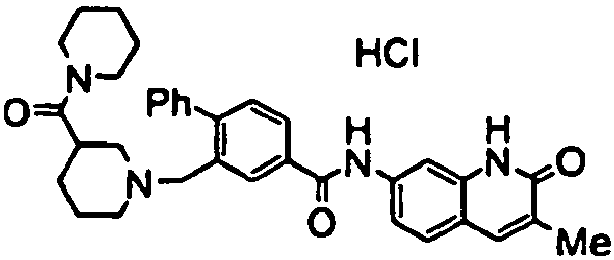
NMR:δ1.39-1.74(10H,m),2.08(3H,s),2.49-3.37(9 H,m),4.15-4.21,4.45-4.49(2H,m), 7.30-7.62(8H,m), 7.71 (1H,s),7.90-8.16(2H,m),8.54,8.67(11H,s),9.13, 10.23(1H,brs),10.56,10.73(1H,s), 11.78,11.80(1H, s). FAB-MS:563(M+H)+ 176 
NMR:δ1.20-1.33(1H,m),1.43(3H,d,J=6.8Hz),1.55-1.64(3H,m),1.70-1.84(2H,m),2.58-2.70(2H,m),3.1 6-3.26(2H,m),4.34(2H,d,J=4.9Hz),4.64(1H,q,J=6. 8Hz),6.96(1H,d,J=8.8Hz),7.36(1H,dd,J=8.8,2.5H z),7.35(1H,d,J=8.3Hz),7.64-7.68(1 H,m),7.70-7.80 (3H,m),7.87(1H,d,J=7.4Hz),8.06(1H,d,J=7.8Hz),8: 65(1H, brs), 9.96(1H,brs),10.54(1H,s),10.76(1H,s). FAB-MS:524(M+H)+ 177 
NMR:δ1.00-1.12(1H,m),1.16-1.29(2H,m),1.29-1.4 2(2H,m),1.42(3H,d,J=6.8Hz),1.55-1.64(1H,m),1.7 4-1.84(2H,m),2.01-2.10(2H,m),2.32-2.42(2H,m),2. 76-2.86(2H,m),2.86-2.99(2H,m),3.03-3.13(1H,m), 2.80-3.37(2H,m),3.52(2H,s),4.63(1H,q,J=6.8Hz), 6.95(1H,d,J=8.8Hz),7.28(1H,dd,J=8.8,2.4Hz), 7.3 8-7.55(7H,m),7.94(1H,d,J=7.8Hz),8.05(1H,s),9.45 (1H,brs), 10.28(1H, s), 10.75(1H, s). FAB - MS: 539(M +H)+ 178 
NMR:δ1.33-1.46(1H,m),1.42(3H;d,J=6.9Hz),1.60-1.90(5H,m),2.88-3.00(2H,m),3.15-3.25(2H,m),3.3 2-3.53(4H,m),4.62(1H,q,J=6.8Hz),6.95(1H,d,J=8. 3Hz),7.23(1H,dd,J=8,8,2.5Hz),7.41-7.46(1H,m),7. 48-7.56(3H,m),7.62-7.77(5H,m),9.66(1H,brs), 10.4 5(1H,s), 10.74(1H,s).FAB-MS:470(M+H)+ 179 
NMR:δ1.18-1.37(1H,m),1.50-1.68(3H,m),1.72-1.9 2(2H,m),2.18(3H,s),2.53-2.70(2H,m),3.14-3.26(2 H,m),3.37(2H,s),4.31-4.44(2H,m),7.26-7.60(8H, m),8.00(1H,d,J=7.9Hz),8.68(1H,s),10.22(1H,brs), 10.40(1H,s),10.44-10.54(1H,m).FAB-MS:440(M+ H)+ 180 
NMR:δ1.20-1.37(1H,m),1.45(3H,d,J=6.3Hz), 1.54-1.68(3H,m),1.70-1.88(2H, m),2.58-2.74(2H, m),3.1 4-3.26(2H, m),4.26-4.40(2H, m),4.63(1H,q,J=6.7H z),6.96(1H,d,J=8.8Hz),7.32-7.40(2H,m),7.46-7.60 (4H,m),7.67(1H,s),8.03(1H,d,J=7.8Hz),8.64(1H, s),9.99(1H,brs),10.50-10.58(1H,m),10.75(1H,s).F AB-MS:490(M+H)+ 181 
NMR:δ1.22(3H,t,J=7.3Hz),1.50-1.70(2H,m),1.81(1 H,d,J=11.8Hz),2.36(1H,d,J=12.2Hz),2.50-2.70(5 H,m),2.85(2H,t,J=6.8Hz),2.88-3.12(3H,m),3.25(3 H,s), 3.29-3.40(2H, m),4.37( 1H,dd, J=14.1,5.4Hz), 4.57(1H,dd,J=14.1Hz,5.4Hz),7.20(1H,d,J=8.3Hz), 7.45-7.60(6H,m),7.64(1H,dd,J=8.3,1.5),7.79(1H, d,J=1.4Hz),8.07(1H,dd,J=8.3,1.5Hz),8.67(1H,s), 9.88(brs),10.65() 1H, s).FAB-MS514(M+H)+ (Table 35) Ex Structure(salt) DATA 182 
NMR:δ0.84(3H,t,J=7.1Hz),1.08-1.38(8H,m),1.42(3 H,d,J=6.8Hz),1.45-1.57(1H,m),2.46-2.54(2H,m),2. 65-2.78(1 H,m),2.79-2.97(1H,m),4.20-4.37(1H,m), 4.47-4.57(1H,m),4.63(1H,q,J=6.9Hz),6.96(1H,d,J =8.8Hz),7.34(1H,dd,J=8,8,2,5Hz),7.412H,d,J=6. 4Hz),7.46-7.57(4H,m),7.65(1H,d,J=1.9Hz),8.04(1 H,d,J=7.8Hz),8.53(1H,s),10.06(1H,brs),10.45(1H, s),10.75(1H,s).FAB-MS:486(M+H)* 183 
.NMR:δ1.35-1.55(4H,m),1.65-1.78(5H,m),1.82-1.9 2(1H,m),1.93-2.02(1H,br),2.07-2.17(1H.m),2.52-2.65(3H,m),2.80-2.87(2H,m),2.92-3.22(6H,m),3.2 6(3H,s),3.48-3.58(2H,m), 7.17-7.22(1H,m), 7.36-7. 45(4H,m),7.45-7.54(3H,m),7.62(1H,s),7.92-7.98(1 H,m),8.10(1H,s),10.41(1H,s).FAB-MS:537(M+H)+ 184 
NMR:δ0.95(3H,t,J=7.1Hz),1.05(3H,t,J=7.1Hz),1.2 8-1.68(4H,m),1.42(3H,d,J=6.8Hz),1.90-2.23(1H, m),2.60-2.78(1H,m),2.80-2.91(1H,m),3.07-4.00(8 H,m).4.63(1H,q,J=6.9Hz),6.95(1H,d,J=8.3Hz),7.2 6(1H,dd,J=8.8,2.4Hz),7.37-7.52(6H,m),7.533(1H,d, J=2.4Hz),7.92-8.00(1H,m),8.08-8.20(1H,m),10.27 (1H,s),10.74(1H,s).FAB-MS:555(M+H)+ * 185 
NMR:δ1.42(3H,d,J=6.8Hz),2.74-2.87(2H,m),3.28-3.40(4H,m),4.17-4.28(2H,m),4.44-4.57(2H,m),4.6 3(1H,q,J=6.9Hz),6.66-6.73(1H,m),6.83-6.88(1H, m),6.96(1H,d,J=8.8Hz),7.32-7.61 (8H,m),7.67(1H, s),8.01-8.07(1H,m),8.08-8.12(1H,s),8.64(1H,s),1 0.50(1H,s), 10.59(1H,s), 10.75(1H,s).FAB-MS:534 (M+H)+ 186 
NMR:δ0.88-1.94(16H,m),2.52-2.88(4H,m),3.12-3. 70(5H,m),4.50(2H,d,J=4.4Hz),7.21(1H,d,J=8.3H z),7.42-7.66(7H,m),7.81(1H,s),8.03(1H,d,J=7.8H z),8.54(1 H,s),9.19(1H,brs),10.82(1H,s).FAB-MS:5 10(M+H)+ 187 
NMR:δ0.85(12H,t,J=6.8Hz),1.89-2.00(2H,m),2.53-2.58(2H,m),2.67-2.72(4H,m),2.82-2.87(2H,m),3.2 6(3H,s),4.53(2H,d,J=4.9Hz),7.21 (1 H,d,J=8.3Hz), 7.42-7.63(7H,m),7.54(1H,d,J=1.9Hz),7.88-7.94(1 H,m),8.70(1H,d,J=1.4Hz),9.31(1H,brs),10.64(1H, s).FAB-MS:498(M+H)+ 188 
NMR:δ1.76-1.88(1H,m),1.95-2.13(2H,m),2.17-2.3 2(1H,m),2.71-2.90(2H,m),3.16-3.28(1H,m),3.30-3. 42(1H,m),4.29-4.56(3H,m),5.95(2H,d,J=7.3Hz),6. 36(1H,dd,J=8.8,2.4Hz),6.64(1H,dd, J=6.3,2.0Hz), 6.79(1H,dd,J=8.3,4.9Hz),7.38-7.45(2H,m),7.47-7. 58(4H,m),8.02-8.08(1H,m),8.09-8.18(2H,m),8.78-8.92(2H,m), 9.42(1H,s),10.75(1H.brs), 10.92(1H,d, J=2.9Hz).FAB-MS:564(M+H)+ * Not within the scope of the invention (Table 36) Ex Structure(salt) DATA * 189 
NMR:δ0.85(3H,d,J=6.6Hz),1.22(3H,d,J=6.6Hz),2.03 (3H,s),3.08-3.20(1H,m),3.27-3.40(2H,m),4.32-4.47 (2H,m),4.48-4.60(2H,m),7.43-7.59(6H,m),8.04-8.12 (2H,m),8.16(1H,d,J=8.3Hz),8.77-8.83(2H,m),9.41(1 H,s),10.20(1H,s),10.91(1H,s).FAB-MS:488(M+H)+ * 190 
NMR:δ0.97(3H,t,J=7.1Hz),2.66-3.14(2H,m),4.48(2 H,s),4.62(2H,s),7.37-7.43(2H,m),7.46-7.58(4H,m), 8.04(1H,dd,J=7.8,1.5Hz),8.09-8.20(2H,m),8.38(2H, s),8.76-8.85(2H,m),8.97(2H,d,J=5.9Hz),9.43(1H,s), 10.87(1H,s),11.47(1H,brs).FAB-MS:479(M+H)+ * 191 
NMR:δ0.88-1.03(2H,m),1.04-1.22(2H,m),1.23-1.36 (2H,m),1.44-1.48(2H, m),1.62-1.71(1H,m),1.78-1.95 (2H,m),2.01-2.10(1H, m),2.35(3H,s),2.66-2.98(5H, m),4.34-4.42(1H,m),4.49-4.57(1H,m).7.38(2H,d.J= 8.3Hz),7.42-7.47(2H,m),7.47-7.58(4H,m),7.60-7:68 (3H,m).8.04-8.17(3H,m),8.75(1H,s),8.81(1H,s),9.41 (1H,s),10.09(1H,brs),10.96(1H,s).FAB-MS:653(M+ H)+ * 192 
NMR:δ0.82-0.92(6H,m),2.50(2H,t,J=5.2Hz),2.82-2. 92(1H,m),3.40(2H,t,J=5.2Hz),3.61(0.2H,s),3.66(1.8 H,s),4.08-4.16(1H,m),7.25-7.35(3H,m),7.36-7.48(3 H,m).7.82-7.88(1H,m),7.89-7.96(2H,m),8.20-8.25(1 H,m),8.47(1H,s),8.68(1H,brs),9.00(1H,s).FAB-MS:4 46(M+H)+ 193 
NMR:δ0.99(9H,s).1.42(3H,d,J=6.9Hz),2.51-2.69(2 H,m),3.00(2H,s),3.03(3H,s),6.94(1H,d,J=8.8Hz),7.2 6(1H,dd,J=8.3,2.4Hz),7.29-7.39(3H,m),7.40-7.53(3 H,m),7.57(1H,d,J=2.4Hz),7.90(1H,brs),8.28(1H,s),1 0.24(1H,s),10.72.FAB-MS:502(M+H)+. * 194 
NMR:δ1.12-1.15(3H,m),1.22(6H,d,J=5.8Hz),1.42(3 H,d,J=6.9Hz),2.85-3.30(4H,m),3.40-4.00(4H,m),4.6 3(1H,q,J=6.6Hz),6.95(1H,d,J=8.8Hz),7.30(1H,d,J= 8.8Hz),7.40-7.54(6H,m),7.60(1H,s),7.96(1H,d,J=8.3 Hz),8.26(1H,brs),10.31(1H,s),10.75(1H,s).FAB-MS: 513(M+H)+. 195 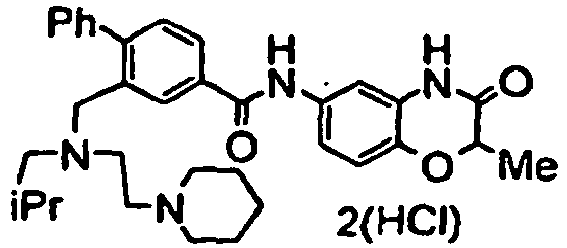
NMR:δ0.67-0.85(6H,m),1.30-1.55(3.5H,m),1.57-2.0 8(6.5H,m),2.60-2.77(2H,m),2.82-3.14(3H,m),3.33-3.65(5H,m),4.42-4.53(0.5H,m),4.58-4.68(1.5H,m),6. 95(1H,d,J=8.3Hz),7.25-7.65(7.3H,m),7.65-7.75(0.7 H,m),7.87-8.20(1.3H,m),8.75(0.7H,s),10.00(0.3H, br s), 10.26-10.50(1.2H,m), 10.75(1H,s), 10.93(0.5H,s). FAB-MS:555(M+H)+. 196 
NMR:δ0.77(6H,d,J=6.3Hz),1.42(3H,d,J=6.9Hz),1.4 3-1.51(2H,m),1.60-1.70(1H,m),2.00-2.17(2H,m),2.3 1-2.50(2H, m),3.36(2H,t,J=6.3Hz), 3.00-4.10(3H, m), 4.63(1H,q,J=6.8Hz),6.93(1H,d,J=8.8Hz),7.24(1H,d d,J=8.8,2.4Hz),7.32-7.50(6H,m),7.58(1H,d,J=2.5H z),7.90(1H,d,J=8.3Hz),8.19(1H,s),10.26(1H,s),10.7 1(1H,s).FAB-MS:502(M+H)+. * Not within the scope of the invention (Table 37) Not within the scope of the invention 
Ex A- DATA Ex A- DATA Ex A- DATA 197 
H:2.63 FP:582 205 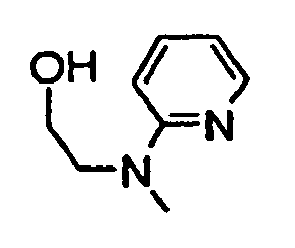
H:1.92 FP:481 213 
H:2.60 FP:548 198 
H:1.93 FP:458 206 
H:1.94 FP:460 214 
H:2.58 FP:575 199 
H:2.28 FP:529 207 
H:2.15 FP:474 215 
H:2.86 FP:534 200 
H:2.18 FP:460 208 
H:2.07 FP:474 216 
H:2.15 FP:505 201 
H:2.28 FP:496 209 
H:2.90 FP:480 217 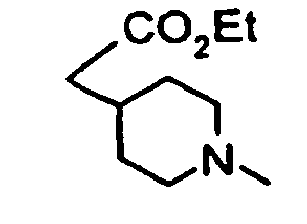
H:2.15 FP:514 202 
H:2.02 FP:505 210 
H:2.06 FP:587 218 
H:2.61 FP:641 203 
H:2.26 FP:525 211 
H:2.60 FP:562 219 
H:2.32 FP:547 204 
H:2.16 FP:528 212 
H:2.52 FP:553 220 
H:2.14 FP:482 (Table 38) Not within the scope of the invention 221 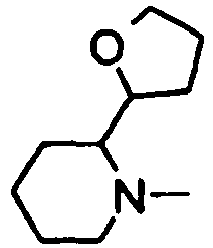
H:2.26 FP:498 225 
H:2.44 FP:493 229 
H:2.97 FP:502 222 
H:3.23 FP:482 226 
H:2.38 FP:504 230 
H:2.72 FP:570 223 
H:2.26 FP:460 227 
H:2.25 FP:554 231 
H:2.88 FP:578 224 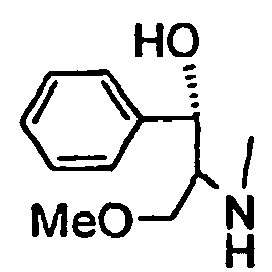
H:2.39 FP:524 228 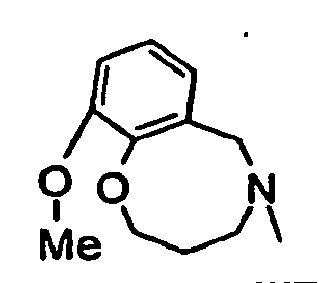
H:2.27 FP:536 232 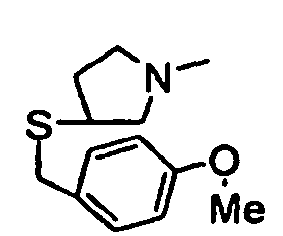
H:2.55 FP:566 (Table 39) No Structure No Structure * 1 
* 12 
* 2 
* 13 
* 3 
* 14 
* 4 
* 15 
* 5 
* 16 
* 6 
* 17 
* 7 
* 18 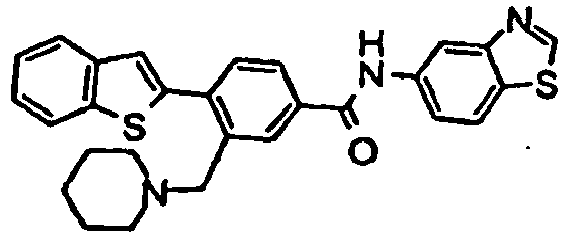
* 8 
* 19 
* 9 
* 20 
10 
21 
* 11 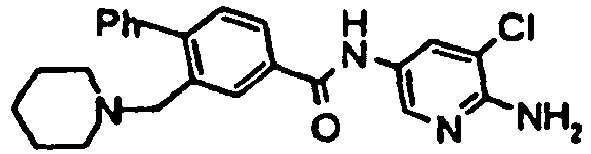
22 
*Not within the scope of the invention (Table 40) No Structure No Structure 23 
33 
24 
34 
25 
* 35 
26 
36 
27 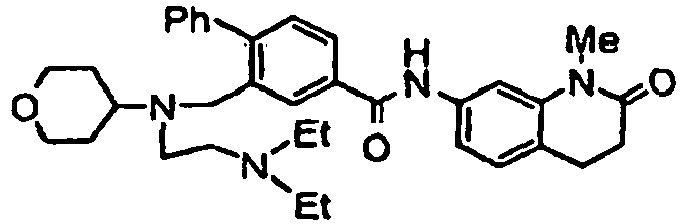
37 
28 
38 
29 
39 
30 
40 
31 
41 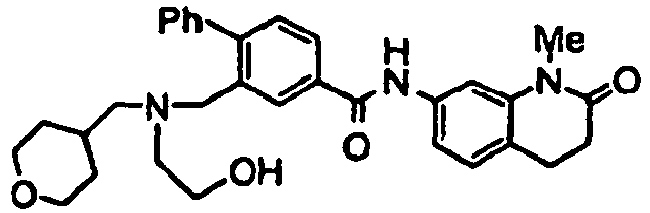
32 
42 
* Not within the scope of the invention
Claims (12)
- A compound represented by the following general formula (I), or a salt thereof:

 L: a C1-5 alkylene;D ring together with the groups represented by R6 to R9 to be bonded thereto form a group selected from the following formulae (a) - (d) :
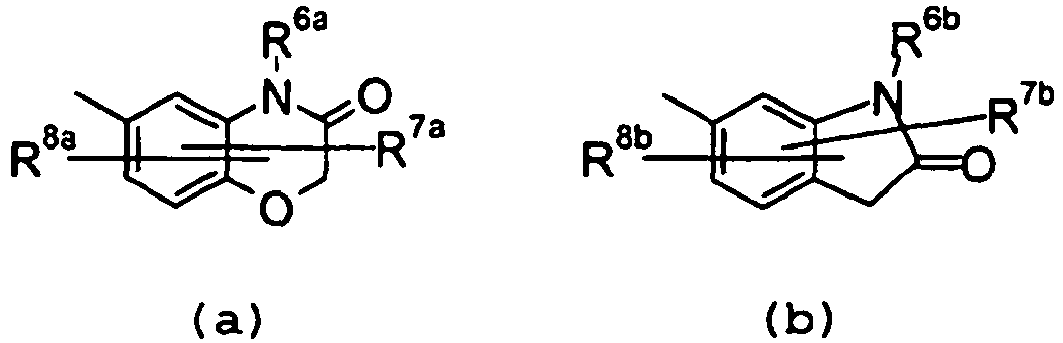 R6a and R6b: the same or different, a hydrogen atom, a C1-5 alkyl, or a halogen-substituted C1-5 alkyl, R7a, R8a, R7b, andR8b: the same or different, a hydrogen atom, a halogen atom, a C1-5 alkyl, or a halogen-substituted C1-5 alkyl,
 R6c and R6d: the same or different, a hydrogen atom, a C1-5 alkyl, or a halogen-substituted C1-5 alkyl, andR7c, R8c, R7d, and R8d: the same or different, a hydrogen atom, a halogen atom, a C1-5 alkyl, or a halogen-substituted C1-5 alkyl;E ring: is benzene;R11a and R12a: the same or different, a hydrogen atom, a C1-5 alkyl, a halogen-substituted C1-5 alkyl, -O-C1-5 alkyl, -SO2-C1-5 alkyl, -C(=O)H, -C(=O)-C1-5 alkyl, -CN, -NH2, -NH-C1-5 alkyl, -N(C1-5 alkyl)2, -C(=O)-NH2, -C(=O)-NH-C1-5 alkyl, -C(=O)-N(C1-5 alkyl)2, -C(=O)-aryl, -C(=O)-NH-aryl, -NH-C(=O)-C1-5 alkyl, - NH-C(=O)-aryl, -NH-SO2-C1-5 alkyl, -N(C1-5 alkyl)-SO2-C1-5 alkyl, -C1-5 alkylene-KH-SO2-C1-5 alkyl, -C1-5 alkylene-NH-SO2-aryl, -C(=O)-O-C1-5 alkyl, -C1-5 alkylene-OH, -C1-5 alkylene-C(=O)-NH-C1-5 alkyl, -C1-5 alkylene-C(=O)-N(C1-5 alkyl)2, -C1-5 alkylene-C(=O)-NH2, -C1-5 alkylene-C(=O)-OH, -C1-5 alkylene-O-C1-5 alkyl, -C1-5 alkylene-S-C1-5 alkyl, -C1-5 alkylene-O-C(=O)-C1-5 alkyl, -C1-5 alkylene-NH-C1-5 alkyl, -C1-5 alkylene-N(C1-5 alkyl)2, -C1-5 alkylene-aryl, a cycloalkyl, an aryl, -(4- to 12-membered monocyclic or bicyclic heterocycle containing 1 to 4 atoms of one or more kinds of heteroatoms selected from the group consisting of N, S, and O), -O-(4- to 12-membered monocyclic or bicyclic heterocycle containing 1 to 4 atoms of one or more kinds of heteroatoms selected from the group consisting of N, S, and O), -C1-5 alkylene-(4- to 12-membered monocyclic or bicyclic heterocycle containing 1 to 4 atoms of one or more kinds of heteroatoms selected from the group consisting of N, S, and O), -C(=O)-(4- to 12-membered monocyclic or bicyclic heterocycle containing 1 to 4 atoms of one or more kinds of heteroatoms selected from the group consisting of N, S, and O), -C1-5 alkylene-N(C1-5 alkyl) - (4- to 12-membered monocyclic or bicyclic heterocycle containing 1 to 4 atoms of one or more kinds of heteroatoms selected from the group consisting of N, S, and O), or -C(=O)-NH-(4- to 12-membered monocyclic or bicyclic heterocycle containing 1 to 4 atoms of one or more kinds of heteroatoms selected from the group consisting of N, S, and O), and the above monocyclic or bicyclic heterocycle may be substituted by a halogen atom, a C1-5 alkyl, -O-C1-5 alkyl, or -OH;G is a ring selected from morpholine, piperidine, or pyrrolidine and the ring nitrogen atom of the ring group is bonded to L;R1 to R9: the same or different, a hydrogen atom, a halogen atom, a C1-5 alkyl, a halogen-substituted C1-5 alkyl, -OH, -SH, -O-C1-5alkyl, -O-C1-5 alkyl-NH-C1-5 alkyl, -O-C1-5 alkyl-N(C1-5 alkyl)2, =O, -NH2, -NH-C1-5 alkyl, -N(C1-5 alkyl)2, -S-C1-5 alkyl, -SO-C1-5 alkyl, -SO2-C1-5 alkyl, -CN, -COOH, -C(=O)-O-C1-5 alkyl, -C(=O)-NH2, -C(=O)-NH-C1-5 alkyl, -C(=O)-N(C1-5alkyl)2, -NH-C(=O)-O-C1-5alkyl, -NH-SO2-C1-5alkyl, -SO2-NH2,
-SO2-NH-C1-5 alkyl, -C(=O)-C1-5 alkyl, -NO2 or a nitrogen-containing saturated heterocycle;R10: a hydrogen atom or a C1-5 alkyl ;R13 to R15: the same or different, a hydrogen atom, a halogen atom, a C1-5 alkyl, a halogen-substituted C1-5 alkyl, -OH, -O-C1-5 alkyl, -S-C1-5 alkyl, -SO-C1-5 alkyl, -SO2-C1-5 alkyl, =O, -C(=O)H, -C(=O)-C1-5 alkyl, -COOH, -CN, -NH2, -NH-C1-5 alkyl, -N(C1-5 alkyl)2, -C(=O)-NH2, -C(=O)-NH-C1-5 alkyl,-C(=O)-N(C1-5alkyl)2, -C(=O)-aryl, -C(=O)-NH-aryl, -NH-C(=O)-C1-5 alkyl, -NH-C(=O)-aryl, -NH-SO2-C1-5 alkyl, -N(C1-5 alkyl)-SO2-C1-5 alkyl, -C1-5 alkylene-NH-SO2-C1-5 alkyl, -C1-5 alkylene-NH-SO2-aryl, -C(=O)-O-C1-5 alkyl, -C1-5 alkylene-OH, -C1-5 alkylene-C(=O)-NH-C1-5 alkyl, -C1-5 alkylene-C(=O)-N(C1-5 alkyl)2, -C1-5 alkylene-C(=O)-NH2, -C1-5 alkylene-C(=O) -OH,-C1-5 alkylene-O-C1-5 alkyl, -C1-5 alkylene-S-C1-5 alkyl, -C1-5 alkylene-O-C(=O)-C1-5 alkyl, -C1-5 alkylene-NH-C1-5 alkyl, -C1-5 alkylene-N(C1-5 alkyl)2, -C1-5 alkylene-aryl, a cycloalkyl, an aryl, -(4- to 12-membered monocyclic or bicyclic heterocycle containing 1 to 4 atoms of one or more kinds of heteroatoms selected from the group consisting of N, S, and O), -O-(4- to 12-membered monocyclic or bicyclic heterocycle containing 1 to 4 atoms of one or more kinds of heteroatoms selected from the group consisting of N, S, and O), -C1-5 alkylene- (4- to 12-membered monocyclic or bicyclic heterocycle containing 1 to 4 atoms of one or more kinds of heteroatoms selected from the group consisting of N, S, and O), -C(=O)-(4- to 12-membered monocyclic or bicyclic heterocycle containing 1 to 4 atoms of one or more kinds of heteroatoms selected from the group consisting of N, S, and O), -C1-5 alkylene-N(C1-5 alkyl)-(4- to 12-membered monocyclic or bicyclic heterocycle containing 1 to 4 atoms of one or more kinds of heteroatoms selected from the group consisting of N, S, and O), or -C(=O)-NH-(4- to 12-membered monocyclic or bicyclic heterocycle containing 1 to 4 atoms of one or more kinds of heteroatoms selected from the group consisting of N, S, and O), and the above monocyclic or bicyclic heterocycle may be substituted by halogen atom(s), C1-5 alkyl(s), -O-C1-5 alkyl,or -OH,
or a salt thereof. - The compound according to claim 1 or a salt thereof, wherein the ring represented by D in the above formula (I) together with the groups represented by R6 to R9 to be bonded thereto form a group selected from formulae (a) and (b):
 R6a and R6b: the same or different, a hydrogen atom, a C1-5 alkyl, or a halogen-substituted C1-5 alkyl, andR7a, R8a, R7b, and R8b : the same or different, a hydrogen atom, a halogen atom, a C1-5 alkyl, or a halogen-substituted C1-5 alkyl.
 - The compound according to claim 1 or a salt thereof, wherein the ring represented by D in the above formula (I) together with the groups represented by R6 to R9 to be bonded thereto form a group selected from formulae (c) and (d):
 R6c and R6d : the same or different, a hydrogen atom, a C1-5 alkyl, or a halogen-substituted C1-5 alkyl, andR7c, R8c, R7d, and R8d: the same or different, a hydrogen atom, a halogen atom, a C1-5 alkyl, or a halogen-substituted C1-5 alkyl.
 - The compound according to claim 1 or a salt thereof, wherein the compound represented by the above formula (I) is a compound selected from the group consisting of N-1,3-benzothiazol-5-yl-2-{[cyclohexyl(isopropyl)amino]methyl}biphenyl-4-carboxamide, N-(1-methyl-2-oxo-1,2,3,4-tetrahydroquinolin-7-yl)-2-(piperidin-1-ylmethyl)biphenyl-4-carboxamide, N-(3,3-dimethyl-2-oxo-2,3-dihydro-1H-indol-6-yl)-2-(piperidin-1-ylmethyl)biphenyl-4-carboxamide, 2-{[ethyl(2-hydroxy-2-methylpropyl)amino]methyl}-N-(2-methyl-3-oxo-3,4-dihydro-2H-1,4-benzoxazin-6-yl)biphenyl-4-carboxamide, N-(1-methyl-2-oxo-1,2-dihydroquinolin-7-yl)-2-(piperidin-1-ylmethyl)biphenyl-4-carboxamide, N-(3-methyl-2-oxo-1,2-dihydroquinolin-7-yl)-2-(piperidin-1-ylmethyl)biphenyl-4-carboxamide, N-(2,4-dimethyl-3-oxo-3,4-dihydro-2H-1,4-benzoxazin-6-yl)-2-(piperidin-1-ylmethyl)biphenyl-4-carboxamide, 2-{[ethyl(tetrahydro-2H-pyran-4-yl)amino]methyl}-N-(1-methyl-2-oxo-1,2,3,4-tetrahydroquinolin-7-yl)biphenyl-4-carboxamide, N-(1-methyl-2-oxo-1,2,3,4-tetrahydroquinolin-7-yl)-3-(piperidin-1-ylmethyl)-4-(2-thienyl)benzamide, 2-{[ethyl(tetrahydro-2H-thiopyran-4-yl)amino]methyl}-N-(1-methyl-2-oxo-1,2,3,4-tetrahydroquinolin-7-yl)biphenyl-4-carboxamide, 2-{[isobutyl(2-piperidin-1-ylethyl)amino]methyl}-N-(2-methyl-3-oxo-3,4-dihydro-2H-1,4-benzoxazin-6-yl)biphenyl-4-carboxamide, N,N-diethyl-4-[(4-{[(1-methyl-2-oxo-1,2,3,4-tetrahydroquinolin-7-yl)amino]carbonyl}biphenyl-2-yl)methyl]morpholine-3-carboxamide, 2-[(4-methyl-1,3'-bipiperidin-1'-yl)methyl]-N-(2-methyl-3-oxo-3,4-dihydro-2H-1,4-benzoxazin-6-yl)biphenyl-4-carboxamide, 2-(piperidin-1-ylmethyl)-N-(2,2,4-trimethyl-3-oxo-3,4-dihydro-2H-1,4-benzoxazin-6-yl)biphenyl-4-carboxamide, N-(2-oxo-1,2-dihydroquinolin-7-yl)-2-(piperidin-1-ylmethyl)biphenyl-4-carboxamide, 4'-fluoro-N-(1-methyl-2-oxo-1,2,3,4-tetrahydroquinolin-7-yl)-2-(piperidin-1-ylmethyl)biphenyl-4-carboxamide, N-(1-methyl-2-oxo-1,2,3,4-tetrahydroquinolin-7-yl)-2-[(2-methylpyrrolidin-1-yl)methyl]biphenyl-4-carboxamide, N-(3-methyl-2-oxo-1,2,3,4-tetrahydroquinolin-7-yl)-2-(piperidin-1-ylmethyl)biphenyl-4-carboxamide, N-[1-(2-fluoroethyl)-2-oxo-1,2,3,4-tetrahydroquinolin-7-yl]-2-(piperidin-1-ylmethyl)biphenyl-4-carboxamide, and N-[(2R)-2-methyl-3-oxo-3,4-dihydro-2H-1,4-benzoxazin-6-yl]-2-(piperidin-1-ylmethyl)biphenyl-4-carboxamide.
- The compound according to claim 1 or a salt thereof, wherein the compound represented by the above formula (I) is a compound selected from the group consisting of N-1,3-benzothiazol-5-yl-2-{[cyclohexyl(isopropyl)amino]methyl}biphenyl-4-carboxamide, N-(1-methyl-2-oxo-1,2,3,4-tetrahydroquinolin-7-yl)-2-(piperidin-1-ylmethyl)biphenyl-4-carboxamide, N-(3,3-dimethyl-2-oxo-2,3-dihydro-1H-indol-6-yl)-2-(piperidin-1-ylmethyl)biphenyl-4-carboxamide, 2-{[ethyl(2-hydroxy-2-methylpropyl)amino]methyl}-N-(2-methyl-3-oxo-3,4-dihydro-2H-1,4-benzoxazin-6-yl)biphenyl-4-carboxamide, N-(1-methyl-2-oxo-1,2-dihydroquinolin-7-yl)-2-(piperidin-1-ylmethyl)biphenyl-4-carboxamide, N-(3-methyl-2-oxo-1,2-dihydroquinolin-7-yl)-2-(piperidin-1-ylmethyl)biphenyl-4-carboxamide, N-(2,4-dimethyl-3-oxo-3,4-dihydro-2H-1,4-benzoxazin-6-yl)-2-(piperidin-1-ylmethyl)biphenyl-4-carboxamide, 2-{[ethyl(tetrahydro-2H-pyran-4-yl)amino]methyl}-N-(1-methyl-2-oxo-1,2,3,4-tetrahydroquinolin-7-yl)biphenyl-4-carboxamide, N-(1-methyl-2-oxo-1,2,3,4-tetrahydroquinolin-7-yl)-3-(piperidin-1-ylmethyl)-4-(2-thienyl)benzamide, 2-{[ethyl(tetrahydro-2H-thiopyran-4-yl)amino]methyl}-N-(1-methyl-2-oxo-1,2,3,4-tetrahydroquinolin-7-yl)biphenyl-4-carboxamide, 2-{[isobutyl(2-piperidin-1-ylethyl)amino]methyl}-N-(2-methyl-3-oxo-3,4-dihydro-2H-1,4-benzoxazin-6-yl)biphenyl-4-carboxamide, N,N-diethyl-4-[(4-{[(1-methyl-2-oxo-1,2,3,4-tetrahydroquinolin-7-yl)amino]carbonyl}biphenyl-2-yl)methyl]morpholine-3-carboxamide, and 2-[(4-methyl-1,3'-bipiperidin-1'-yl)methyl]-N-(2-methyl-3-oxo-3,4-dihydro-2H-1,4-benzoxazin-6-yl)biphenyl-4-carboxamide.
- The compound according to claim 4 or a salt thereof, wherein said compound is N-(1-methyl-2-oxo-1,2,3,4-tetrahydroquinolin-7-yl)-2-[(2-methylpyrrolidin-1-yl)methyl]biphenyl-4-carboxamide.
- The compound according to claim 4 or a salt thereof, wherein said compound is N-[(2R)-2-methyl-3-oxo-3,4-dihydro-2H-1,4-benzoxazin-6-yl]-2-(piperidin-1-ylmethyl)biphenyl-4-carboxamide.
- A pharmaceutical composition comprising a compound according to any one of claims 1 to 7 or a salt thereof and a pharmaceutically acceptable carrier.
- The composition according to claim 8 for use as a VR1 activation inhibitor.
- The composition according to claim 8 for useas a preventive or therapeutic agent for pains.
- Use of a compound according to any one of claims 1 to 7 or a salt thereof for manufacturing a preventive or therapeutic agent for pains.
- A compound according to any one of claims 1-7 or a salt thereof for use in the treatment of pains.
Priority Applications (1)
| Application Number | Priority Date | Filing Date | Title |
|---|---|---|---|
| PL04736576T PL1632477T3 (en) | 2003-06-12 | 2004-06-10 | Benzamide derivative or salt thereof |
Applications Claiming Priority (3)
| Application Number | Priority Date | Filing Date | Title |
|---|---|---|---|
| JP2003167865 | 2003-06-12 | ||
| JP2003405086 | 2003-12-03 | ||
| PCT/JP2004/008479 WO2004110986A1 (en) | 2003-06-12 | 2004-06-10 | Benzamide derivative or salt thereof |
Publications (3)
| Publication Number | Publication Date |
|---|---|
| EP1632477A1 EP1632477A1 (en) | 2006-03-08 |
| EP1632477A4 EP1632477A4 (en) | 2008-07-16 |
| EP1632477B1 true EP1632477B1 (en) | 2017-03-01 |
Family
ID=33554396
Family Applications (1)
| Application Number | Title | Priority Date | Filing Date |
|---|---|---|---|
| EP04736576.2A Expired - Lifetime EP1632477B1 (en) | 2003-06-12 | 2004-06-10 | Benzamide derivative or salt thereof |
Country Status (14)
| Country | Link |
|---|---|
| US (2) | US7585878B2 (en) |
| EP (1) | EP1632477B1 (en) |
| JP (1) | JP4400566B2 (en) |
| KR (1) | KR20060027338A (en) |
| AU (1) | AU2004247559B2 (en) |
| BR (1) | BRPI0411083A (en) |
| CA (1) | CA2526387A1 (en) |
| ES (1) | ES2625341T3 (en) |
| MX (1) | MXPA05013434A (en) |
| NO (1) | NO20060167L (en) |
| PL (1) | PL1632477T3 (en) |
| PT (1) | PT1632477T (en) |
| RU (1) | RU2333198C2 (en) |
| WO (1) | WO2004110986A1 (en) |
Families Citing this family (49)
| Publication number | Priority date | Publication date | Assignee | Title |
|---|---|---|---|---|
| EP1632477B1 (en) | 2003-06-12 | 2017-03-01 | Astellas Pharma Inc. | Benzamide derivative or salt thereof |
| WO2005072681A2 (en) * | 2004-01-23 | 2005-08-11 | Amgen Inc. | Vanilloid receptor ligands and their use in treatments of inflammatory and neurotic pain. |
| US7544803B2 (en) * | 2004-01-23 | 2009-06-09 | Amgen Inc. | Vanilloid receptor ligands and their use in treatments |
| US20080070946A1 (en) * | 2004-10-08 | 2008-03-20 | Astrazeneca Ab | Hydroxymethylbenzothiazoles Amides |
| ES2580108T3 (en) | 2005-07-11 | 2016-08-19 | Aerie Pharmaceuticals, Inc | Isoquinoline compounds |
| JP4754566B2 (en) * | 2005-07-22 | 2011-08-24 | 持田製薬株式会社 | Novel heterocyclideneacetamide derivatives |
| DE602006015700D1 (en) * | 2005-11-21 | 2010-09-02 | Anadys Pharmaceuticals Inc | A NEW METHOD FOR THE PREPARATION OF 5-AMINO-3H-THIAZOLOÄ4,5-DÜPYRIMIDIN-2-ON |
| AU2006319916A1 (en) | 2005-11-30 | 2007-06-07 | Astellas Pharma Inc. | 2-aminobenzamide derivative |
| JP2009519208A (en) * | 2005-12-15 | 2009-05-14 | 塩野義製薬株式会社 | Pharmaceutical composition containing an amide derivative |
| TWI403320B (en) * | 2005-12-16 | 2013-08-01 | Infinity Discovery Inc | Compounds and methods for inhibiting the interaction of bcl proteins with binding partners |
| AR059265A1 (en) | 2006-02-07 | 2008-03-19 | Astrazeneca Ab | ESPIRO COMPOUNDS CONDENSED WITH INHIBITORY ACTIVITY IN THE VANILOID RECEIVER1 (VR1) |
| ES2729424T3 (en) | 2006-09-20 | 2019-11-04 | Aerie Pharmaceuticals Inc | Rho kinase inhibitors |
| FR2910473B1 (en) | 2006-12-26 | 2009-02-13 | Sanofi Aventis Sa | N- (AMINO-HETEROARYL) -1H-PYRROLOPYRIDINE-2-CARBOXAMIDE DERIVATIVES, THEIR PREPARATION AND THEIR THERAPEUTIC USE. |
| ES2404668T3 (en) | 2006-12-29 | 2013-05-28 | Rigel Pharmaceuticals, Inc. | Triazoles substituted with bridged bicyclic aryl and bridged bicyclic heteroaryl, useful as axl inhibitors |
| US8455513B2 (en) | 2007-01-10 | 2013-06-04 | Aerie Pharmaceuticals, Inc. | 6-aminoisoquinoline compounds |
| PE20081692A1 (en) | 2007-01-24 | 2008-12-18 | Mochida Pharm Co Ltd | NEW DERIVATIVE OF HETEROCICLIDEN ACETAMIDA |
| US20100016285A1 (en) * | 2007-01-24 | 2010-01-21 | Mochida Pharmaceutical Co., Ltd. | Heterocyclidene-n-(aryl) acetamide derivative |
| WO2008119015A2 (en) | 2007-03-27 | 2008-10-02 | Sloan-Kettering Institute For Cancer Research | Synthesis of thiohydantoins |
| RU2498982C2 (en) * | 2007-04-16 | 2013-11-20 | Грюненталь Гмбх | Novel vanilloid receptor ligands and use thereof in producing medicinal agents |
| PL2149560T3 (en) * | 2007-05-22 | 2015-10-30 | Astellas Pharma Inc | 1-substituted tetrahydroisoquinoline compound |
| MX2010003864A (en) * | 2007-10-11 | 2010-06-01 | Vertex Pharma | Amides useful as inhibitors of voltage-gated sodium channels. |
| CA2707441A1 (en) | 2008-01-09 | 2009-07-16 | Renovis, Inc. | Amide derivatives as ion-channel ligands and pharmaceutical compositions and methods of using the same |
| US8455514B2 (en) * | 2008-01-17 | 2013-06-04 | Aerie Pharmaceuticals, Inc. | 6-and 7-amino isoquinoline compounds and methods for making and using the same |
| DE102008022221A1 (en) | 2008-05-06 | 2009-11-12 | Universität des Saarlandes | Inhibitors of human aldosterone synthase CYP11B2 |
| US8450344B2 (en) * | 2008-07-25 | 2013-05-28 | Aerie Pharmaceuticals, Inc. | Beta- and gamma-amino-isoquinoline amide compounds and substituted benzamide compounds |
| RU2555326C2 (en) | 2009-01-16 | 2015-07-10 | Риджел Фармасьютикалз, Инк. | Axl INHIBITORS APPLICABLE IN COMBINATION THERAPY FOR PREVENTING, RELIEVING OR TREATING METASTATIC CANCER |
| EP3828172A1 (en) | 2009-05-01 | 2021-06-02 | Aerie Pharmaceuticals, Inc. | Dual mechanism inhibitors for the treatment of disease |
| US8541404B2 (en) | 2009-11-09 | 2013-09-24 | Elexopharm Gmbh | Inhibitors of the human aldosterone synthase CYP11B2 |
| SG10201907588XA (en) | 2010-02-16 | 2019-09-27 | Aragon Pharmaceuticals Inc | Androgen Receptor Modulators And Uses Thereof |
| EP2377850A1 (en) * | 2010-03-30 | 2011-10-19 | Pharmeste S.r.l. | TRPV1 vanilloid receptor antagonists with a bicyclic portion |
| TW201216957A (en) * | 2010-07-13 | 2012-05-01 | Dainippon Sumitomo Pharma Co | Biarylamide derivative or a pharmaceutically acceptable salt thereof |
| EP2895476B1 (en) * | 2012-09-13 | 2016-06-22 | F.Hoffmann-La Roche Ag | 2-oxo-2,3-dihydro-indoles for the treatment of cns disorders |
| CN115737643A (en) | 2012-09-26 | 2023-03-07 | 阿拉贡药品公司 | Antiandrogens for the treatment of non-metastatic castration resistant prostate cancer |
| WO2014100833A1 (en) * | 2012-12-21 | 2014-06-26 | Northwestern University | Benzamide compounds and related methods of use |
| DK2945628T3 (en) | 2013-01-15 | 2020-05-04 | Aragon Pharmaceuticals Inc | ANDROGEN RECEPTOR MODULATOR IN COMBINATION WITH ABIRATERON ACETATE AND PREDNISON FOR TREATMENT OF PROSTATACANCES |
| US20140275160A1 (en) | 2013-03-15 | 2014-09-18 | Aerie Pharmaceuticals, Inc. | Combination therapy |
| BR112015030470B1 (en) * | 2013-06-10 | 2022-08-16 | Merck Sharp & Dohme Corp | PROCESS FOR PREPARING 4-((1,R,2S,5R)-6-(BENZYLOXY)-7-OXO1,6-DIAZABYCYCLO[3.2.1]OCTANE-2-CARBOXAMIDO)PIPERIDINE-1-TERT-BUTYL CARBOXYLATE, IT'S COMPOSED |
| EP3140298A1 (en) | 2014-05-07 | 2017-03-15 | Pfizer Inc. | Tropomyosin-related kinase inhibitors |
| JP2017523213A (en) * | 2014-08-06 | 2017-08-17 | ノバルティス アーゲー | Quinolone derivatives as antibacterial agents |
| US9643927B1 (en) | 2015-11-17 | 2017-05-09 | Aerie Pharmaceuticals, Inc. | Process for the preparation of kinase inhibitors and intermediates thereof |
| JP6832946B2 (en) | 2015-11-17 | 2021-02-24 | アエリエ ファーマシューティカルズ インコーポレイテッド | How to prepare kinase inhibitors and their intermediates |
| TWI726969B (en) | 2016-01-11 | 2021-05-11 | 比利時商健生藥品公司 | Substituted thiohydantoin derivatives as androgen receptor antagonists |
| WO2017147146A1 (en) * | 2016-02-23 | 2017-08-31 | Concentric Analgesics, Inc. | Prodrugs of phenolic trpv1 agonists |
| CN109640966A (en) | 2016-08-31 | 2019-04-16 | 爱瑞制药公司 | Ophthalmic composition |
| WO2018183911A1 (en) | 2017-03-31 | 2018-10-04 | Aerie Pharmaceuticals, Inc. | Aryl cyclopropyl-amino-isoquinolinyl amide compounds |
| MX2020003845A (en) | 2017-10-16 | 2020-11-06 | Aragon Pharmaceuticals Inc | ANTIANDROGENS FOR THE TREATMENT OF NON-METASTATIC PROSTATE CANCER RESISTANT TO CASTRATION. |
| US11427563B2 (en) | 2018-09-14 | 2022-08-30 | Aerie Pharmaceuticals, Inc. | Aryl cyclopropyl-amino-isoquinolinyl amide compounds |
| CN115304457A (en) * | 2021-05-07 | 2022-11-08 | 中国科学院上海有机化学研究所 | Preparation method of cyclopentadiene rhodium complex with binaphthalene skeleton |
| DE102022104759A1 (en) | 2022-02-28 | 2023-08-31 | SCi Kontor GmbH | Co-crystal screening method, in particular for the production of co-crystals |
Family Cites Families (17)
| Publication number | Priority date | Publication date | Assignee | Title |
|---|---|---|---|---|
| EP0906283A1 (en) | 1996-06-17 | 1999-04-07 | Smithkline Beecham Plc | Substituted benzamide derivatives and their use as anticonvulsants |
| CA2284218A1 (en) | 1997-03-18 | 1998-09-24 | Smithkline Beecham P.L.C. | Substituted isoquinoline derivatives and their use as anticonvulsants |
| US20010016657A1 (en) | 1997-03-18 | 2001-08-23 | Smithkline Beecham P.L.C. | Substituted isoquinoline derivatives and their use as anticonvulsants |
| US7115750B1 (en) | 1999-09-20 | 2006-10-03 | Takeda Pharmaceutical Company Limited | Melanin concentrating hormone antagonist |
| JP2002003370A (en) * | 1999-09-20 | 2002-01-09 | Takeda Chem Ind Ltd | Melanin coagulating hormone antagonistic agent |
| WO2002008221A2 (en) | 2000-07-20 | 2002-01-31 | Neurogen Corporation | Capsaicin receptor ligands |
| CA2455754A1 (en) | 2001-07-31 | 2003-02-20 | Bayer Healthcare Ag | Amine derivatives |
| JP2003055209A (en) | 2001-07-31 | 2003-02-26 | Bayer Ag | Phenylnaphthylurea derivative |
| CN1585751A (en) | 2001-10-25 | 2005-02-23 | 武田药品工业株式会社 | Quinoline compound |
| JP2005513154A (en) * | 2001-12-26 | 2005-05-12 | バイエル・ヘルスケア・アクチェンゲゼルシャフト | Urea derivatives |
| AR038420A1 (en) * | 2002-02-15 | 2005-01-12 | Glaxo Group Ltd | AMIDA COMPOSITE, PROCEDURE FOR THE PREPARATION OF THE SAME, ITS USE FOR THE MANUFACTURE OF A MEDICINAL PRODUCT AND PHARMACEUTICAL COMPOSITION THAT INCLUDES IT |
| JP2006506525A (en) * | 2002-11-15 | 2006-02-23 | ユニバーシティ・オブ・ユタ・リサーチ・ファウンデーション | Integrated titanium boride coating on titanium surfaces and related methods |
| WO2004056774A2 (en) | 2002-12-19 | 2004-07-08 | Neurogen Corporation | Substituted biphenyl-4-carboxylic acid arylamide analogues as capsaicin receptor modulators |
| ATE450533T1 (en) | 2003-02-14 | 2009-12-15 | Glaxo Group Ltd | CARBOXAMIDE DERIVATIVES |
| EP1628661A2 (en) | 2003-06-05 | 2006-03-01 | Vertex Pharmaceuticals Incorporated | Modulators of vr1 receptor |
| EP1632477B1 (en) | 2003-06-12 | 2017-03-01 | Astellas Pharma Inc. | Benzamide derivative or salt thereof |
| US7544803B2 (en) | 2004-01-23 | 2009-06-09 | Amgen Inc. | Vanilloid receptor ligands and their use in treatments |
-
2004
- 2004-06-10 EP EP04736576.2A patent/EP1632477B1/en not_active Expired - Lifetime
- 2004-06-10 MX MXPA05013434A patent/MXPA05013434A/en not_active Application Discontinuation
- 2004-06-10 RU RU2006101053/04A patent/RU2333198C2/en not_active IP Right Cessation
- 2004-06-10 KR KR1020057023912A patent/KR20060027338A/en not_active Ceased
- 2004-06-10 PL PL04736576T patent/PL1632477T3/en unknown
- 2004-06-10 JP JP2005506991A patent/JP4400566B2/en not_active Expired - Fee Related
- 2004-06-10 BR BRPI0411083-8A patent/BRPI0411083A/en not_active IP Right Cessation
- 2004-06-10 US US10/560,282 patent/US7585878B2/en not_active Expired - Fee Related
- 2004-06-10 ES ES04736576.2T patent/ES2625341T3/en not_active Expired - Lifetime
- 2004-06-10 CA CA002526387A patent/CA2526387A1/en not_active Abandoned
- 2004-06-10 AU AU2004247559A patent/AU2004247559B2/en not_active Ceased
- 2004-06-10 WO PCT/JP2004/008479 patent/WO2004110986A1/en not_active Ceased
- 2004-06-10 PT PT47365762T patent/PT1632477T/en unknown
-
2006
- 2006-01-11 NO NO20060167A patent/NO20060167L/en not_active Application Discontinuation
-
2009
- 2009-07-02 US US12/496,993 patent/US7855198B2/en not_active Expired - Fee Related
Non-Patent Citations (1)
| Title |
|---|
| None * |
Also Published As
| Publication number | Publication date |
|---|---|
| US7855198B2 (en) | 2010-12-21 |
| US20090270365A1 (en) | 2009-10-29 |
| US7585878B2 (en) | 2009-09-08 |
| EP1632477A4 (en) | 2008-07-16 |
| ES2625341T3 (en) | 2017-07-19 |
| MXPA05013434A (en) | 2006-03-17 |
| US20070167444A1 (en) | 2007-07-19 |
| RU2333198C2 (en) | 2008-09-10 |
| NO20060167L (en) | 2006-03-10 |
| AU2004247559B2 (en) | 2009-08-27 |
| KR20060027338A (en) | 2006-03-27 |
| PT1632477T (en) | 2017-04-04 |
| CA2526387A1 (en) | 2004-12-23 |
| PL1632477T3 (en) | 2017-07-31 |
| WO2004110986A1 (en) | 2004-12-23 |
| BRPI0411083A (en) | 2006-07-25 |
| JPWO2004110986A1 (en) | 2006-07-27 |
| AU2004247559A1 (en) | 2004-12-23 |
| JP4400566B2 (en) | 2010-01-20 |
| EP1632477A1 (en) | 2006-03-08 |
| RU2006101053A (en) | 2006-06-10 |
Similar Documents
| Publication | Publication Date | Title |
|---|---|---|
| US7585878B2 (en) | Benzamide derivative or salt thereof | |
| JP6002785B2 (en) | Benzimidazole and imidazopyridine derivatives as sodium channel modulators | |
| US8153658B2 (en) | Piperidine derivative or salt thereof | |
| US6838466B2 (en) | Compounds for the treatment of inflammatory disorders | |
| WO2006038594A1 (en) | N-type calcium channel inhibitor | |
| WO2018148626A1 (en) | Aminotriazolopyridines as kinase inhibitors | |
| EP3331864A2 (en) | 1,3,4-oxadiazole derivative compounds as histone deacetylase 6 inhibitor, and the pharmaceutical composition comprising the same | |
| JP2023540661A (en) | Methods and compositions for targeting Tregs using CCR8 inhibitors | |
| WO2007063925A1 (en) | 2-aminobenzamide derivative | |
| CA3035999C (en) | Benzene fused heterocyclic derivatives and pharmaceutical composition comprising the same | |
| EP3821947A1 (en) | Heterocyclic trpml1 agonists | |
| WO2008069242A1 (en) | Novel bicyclic heterocyclic compound | |
| JP2016128488A (en) | New inhibitors of cyclophilins and uses thereof | |
| US20050043304A1 (en) | Novel amine derivative having human beta-tryptase inhibitory activity and drugs containing the same | |
| EP2909170A1 (en) | Substituted carbamate compounds and their use as transient receptor potential (trp) channel antagonists | |
| JP7637121B2 (en) | Oxadiazole Derivatives | |
| EP2349308A1 (en) | Compounds for treatment of alzheimer's disease | |
| JP2017516803A (en) | Benzenesulfonamides useful as sodium channel inhibitors | |
| CN100562513C (en) | Benzamide derivatives or their salts | |
| TWI449700B (en) | Trimethyleneimine as a histamine H3 receptor antagonist | |
| JP2025537920A (en) | Non-peptide agonists of the oxytocin receptor | |
| JP2007056005A (en) | New benzofuran derivative, pharmaceutical composition containing the same and application thereof | |
| WO2011013644A1 (en) | Substituted piperidine compound | |
| JPWO2006115134A1 (en) | Novel benzofuran derivatives, pharmaceutical compositions containing them, and uses thereof | |
| JPWO2000068203A1 (en) | Cyclic compounds and their uses |
Legal Events
| Date | Code | Title | Description |
|---|---|---|---|
| PUAI | Public reference made under article 153(3) epc to a published international application that has entered the european phase |
Free format text: ORIGINAL CODE: 0009012 |
|
| 17P | Request for examination filed |
Effective date: 20051212 |
|
| AK | Designated contracting states |
Kind code of ref document: A1 Designated state(s): AT BE BG CH CY CZ DE DK EE ES FI FR GB GR HU IE IT LI LU MC NL PL PT RO SE SI SK TR |
|
| DAX | Request for extension of the european patent (deleted) | ||
| A4 | Supplementary search report drawn up and despatched |
Effective date: 20080617 |
|
| 17Q | First examination report despatched |
Effective date: 20120521 |
|
| REG | Reference to a national code |
Ref country code: DE Ref legal event code: R079 Ref document number: 602004050824 Country of ref document: DE Free format text: PREVIOUS MAIN CLASS: C07C0237400000 Ipc: A61K0031330000 |
|
| RIC1 | Information provided on ipc code assigned before grant |
Ipc: A61K 31/33 20060101AFI20160112BHEP |
|
| GRAP | Despatch of communication of intention to grant a patent |
Free format text: ORIGINAL CODE: EPIDOSNIGR1 |
|
| INTG | Intention to grant announced |
Effective date: 20160225 |
|
| RIN1 | Information on inventor provided before grant (corrected) |
Inventor name: IKEGAI, KAZUHIRO Inventor name: HARADA, HIRONORI Inventor name: ISHIKAWA, NORIKO Inventor name: KURAMOCHI, TAKAHIRO Inventor name: AKAMATSU, SEIJIRO Inventor name: ASAI, NORIO Inventor name: MIYAMOTO, SATOSHI Inventor name: WATANABE, TOSHIHIRO Inventor name: KISO, TETSUO Inventor name: SHIRAKAMI, SHOHEI |
|
| GRAJ | Information related to disapproval of communication of intention to grant by the applicant or resumption of examination proceedings by the epo deleted |
Free format text: ORIGINAL CODE: EPIDOSDIGR1 |
|
| INTC | Intention to grant announced (deleted) | ||
| GRAP | Despatch of communication of intention to grant a patent |
Free format text: ORIGINAL CODE: EPIDOSNIGR1 |
|
| INTG | Intention to grant announced |
Effective date: 20160915 |
|
| GRAS | Grant fee paid |
Free format text: ORIGINAL CODE: EPIDOSNIGR3 |
|
| GRAA | (expected) grant |
Free format text: ORIGINAL CODE: 0009210 |
|
| AK | Designated contracting states |
Kind code of ref document: B1 Designated state(s): AT BE BG CH CY CZ DE DK EE ES FI FR GB GR HU IE IT LI LU MC NL PL PT RO SE SI SK TR |
|
| REG | Reference to a national code |
Ref country code: GB Ref legal event code: FG4D |
|
| REG | Reference to a national code |
Ref country code: CH Ref legal event code: EP Ref country code: AT Ref legal event code: REF Ref document number: 870479 Country of ref document: AT Kind code of ref document: T Effective date: 20170315 |
|
| REG | Reference to a national code |
Ref country code: IE Ref legal event code: FG4D |
|
| REG | Reference to a national code |
Ref country code: PT Ref legal event code: SC4A Ref document number: 1632477 Country of ref document: PT Date of ref document: 20170404 Kind code of ref document: T Free format text: AVAILABILITY OF NATIONAL TRANSLATION Effective date: 20170328 |
|
| REG | Reference to a national code |
Ref country code: DE Ref legal event code: R096 Ref document number: 602004050824 Country of ref document: DE |
|
| REG | Reference to a national code |
Ref country code: NL Ref legal event code: FP |
|
| REG | Reference to a national code |
Ref country code: SE Ref legal event code: TRGR |
|
| REG | Reference to a national code |
Ref country code: FR Ref legal event code: PLFP Year of fee payment: 14 |
|
| REG | Reference to a national code |
Ref country code: ES Ref legal event code: FG2A Ref document number: 2625341 Country of ref document: ES Kind code of ref document: T3 Effective date: 20170719 |
|
| PG25 | Lapsed in a contracting state [announced via postgrant information from national office to epo] |
Ref country code: FI Free format text: LAPSE BECAUSE OF FAILURE TO SUBMIT A TRANSLATION OF THE DESCRIPTION OR TO PAY THE FEE WITHIN THE PRESCRIBED TIME-LIMIT Effective date: 20170301 |
|
| PG25 | Lapsed in a contracting state [announced via postgrant information from national office to epo] |
Ref country code: BG Free format text: LAPSE BECAUSE OF FAILURE TO SUBMIT A TRANSLATION OF THE DESCRIPTION OR TO PAY THE FEE WITHIN THE PRESCRIBED TIME-LIMIT Effective date: 20170601 |
|
| REG | Reference to a national code |
Ref country code: GR Ref legal event code: EP Ref document number: 20170400964 Country of ref document: GR Effective date: 20170831 |
|
| PG25 | Lapsed in a contracting state [announced via postgrant information from national office to epo] |
Ref country code: SK Free format text: LAPSE BECAUSE OF FAILURE TO SUBMIT A TRANSLATION OF THE DESCRIPTION OR TO PAY THE FEE WITHIN THE PRESCRIBED TIME-LIMIT Effective date: 20170301 Ref country code: CZ Free format text: LAPSE BECAUSE OF FAILURE TO SUBMIT A TRANSLATION OF THE DESCRIPTION OR TO PAY THE FEE WITHIN THE PRESCRIBED TIME-LIMIT Effective date: 20170301 Ref country code: RO Free format text: LAPSE BECAUSE OF FAILURE TO SUBMIT A TRANSLATION OF THE DESCRIPTION OR TO PAY THE FEE WITHIN THE PRESCRIBED TIME-LIMIT Effective date: 20170301 Ref country code: EE Free format text: LAPSE BECAUSE OF FAILURE TO SUBMIT A TRANSLATION OF THE DESCRIPTION OR TO PAY THE FEE WITHIN THE PRESCRIBED TIME-LIMIT Effective date: 20170301 |
|
| REG | Reference to a national code |
Ref country code: DE Ref legal event code: R097 Ref document number: 602004050824 Country of ref document: DE |
|
| PLBE | No opposition filed within time limit |
Free format text: ORIGINAL CODE: 0009261 |
|
| STAA | Information on the status of an ep patent application or granted ep patent |
Free format text: STATUS: NO OPPOSITION FILED WITHIN TIME LIMIT |
|
| PG25 | Lapsed in a contracting state [announced via postgrant information from national office to epo] |
Ref country code: DK Free format text: LAPSE BECAUSE OF FAILURE TO SUBMIT A TRANSLATION OF THE DESCRIPTION OR TO PAY THE FEE WITHIN THE PRESCRIBED TIME-LIMIT Effective date: 20170301 Ref country code: MC Free format text: LAPSE BECAUSE OF FAILURE TO SUBMIT A TRANSLATION OF THE DESCRIPTION OR TO PAY THE FEE WITHIN THE PRESCRIBED TIME-LIMIT Effective date: 20170301 |
|
| 26N | No opposition filed |
Effective date: 20171204 |
|
| PG25 | Lapsed in a contracting state [announced via postgrant information from national office to epo] |
Ref country code: SI Free format text: LAPSE BECAUSE OF FAILURE TO SUBMIT A TRANSLATION OF THE DESCRIPTION OR TO PAY THE FEE WITHIN THE PRESCRIBED TIME-LIMIT Effective date: 20170301 |
|
| PG25 | Lapsed in a contracting state [announced via postgrant information from national office to epo] |
Ref country code: LU Free format text: LAPSE BECAUSE OF NON-PAYMENT OF DUE FEES Effective date: 20170610 |
|
| REG | Reference to a national code |
Ref country code: FR Ref legal event code: PLFP Year of fee payment: 15 |
|
| PGFP | Annual fee paid to national office [announced via postgrant information from national office to epo] |
Ref country code: CH Payment date: 20180614 Year of fee payment: 15 Ref country code: DE Payment date: 20180530 Year of fee payment: 15 Ref country code: PT Payment date: 20180608 Year of fee payment: 15 Ref country code: IE Payment date: 20180612 Year of fee payment: 15 |
|
| PGFP | Annual fee paid to national office [announced via postgrant information from national office to epo] |
Ref country code: GR Payment date: 20180510 Year of fee payment: 15 Ref country code: FR Payment date: 20180511 Year of fee payment: 15 Ref country code: PL Payment date: 20180515 Year of fee payment: 15 Ref country code: NL Payment date: 20180514 Year of fee payment: 15 Ref country code: BE Payment date: 20180515 Year of fee payment: 15 Ref country code: AT Payment date: 20180525 Year of fee payment: 15 Ref country code: TR Payment date: 20180608 Year of fee payment: 15 |
|
| PGFP | Annual fee paid to national office [announced via postgrant information from national office to epo] |
Ref country code: SE Payment date: 20180612 Year of fee payment: 15 |
|
| PGFP | Annual fee paid to national office [announced via postgrant information from national office to epo] |
Ref country code: IT Payment date: 20180625 Year of fee payment: 15 Ref country code: ES Payment date: 20180703 Year of fee payment: 15 Ref country code: GB Payment date: 20180606 Year of fee payment: 15 |
|
| PG25 | Lapsed in a contracting state [announced via postgrant information from national office to epo] |
Ref country code: HU Free format text: LAPSE BECAUSE OF FAILURE TO SUBMIT A TRANSLATION OF THE DESCRIPTION OR TO PAY THE FEE WITHIN THE PRESCRIBED TIME-LIMIT; INVALID AB INITIO Effective date: 20040610 |
|
| PG25 | Lapsed in a contracting state [announced via postgrant information from national office to epo] |
Ref country code: CY Free format text: LAPSE BECAUSE OF NON-PAYMENT OF DUE FEES Effective date: 20170301 |
|
| REG | Reference to a national code |
Ref country code: DE Ref legal event code: R119 Ref document number: 602004050824 Country of ref document: DE |
|
| REG | Reference to a national code |
Ref country code: SE Ref legal event code: EUG |
|
| PG25 | Lapsed in a contracting state [announced via postgrant information from national office to epo] |
Ref country code: SE Free format text: LAPSE BECAUSE OF NON-PAYMENT OF DUE FEES Effective date: 20190611 Ref country code: PT Free format text: LAPSE BECAUSE OF NON-PAYMENT OF DUE FEES Effective date: 20191210 |
|
| REG | Reference to a national code |
Ref country code: CH Ref legal event code: PL |
|
| REG | Reference to a national code |
Ref country code: NL Ref legal event code: MM Effective date: 20190701 |
|
| REG | Reference to a national code |
Ref country code: AT Ref legal event code: MM01 Ref document number: 870479 Country of ref document: AT Kind code of ref document: T Effective date: 20190610 |
|
| GBPC | Gb: european patent ceased through non-payment of renewal fee |
Effective date: 20190610 |
|
| REG | Reference to a national code |
Ref country code: BE Ref legal event code: MM Effective date: 20190630 |
|
| PG25 | Lapsed in a contracting state [announced via postgrant information from national office to epo] |
Ref country code: DE Free format text: LAPSE BECAUSE OF NON-PAYMENT OF DUE FEES Effective date: 20200101 Ref country code: AT Free format text: LAPSE BECAUSE OF NON-PAYMENT OF DUE FEES Effective date: 20190610 Ref country code: GB Free format text: LAPSE BECAUSE OF NON-PAYMENT OF DUE FEES Effective date: 20190610 Ref country code: NL Free format text: LAPSE BECAUSE OF NON-PAYMENT OF DUE FEES Effective date: 20190701 Ref country code: IE Free format text: LAPSE BECAUSE OF NON-PAYMENT OF DUE FEES Effective date: 20190610 Ref country code: IT Free format text: LAPSE BECAUSE OF NON-PAYMENT OF DUE FEES Effective date: 20190610 Ref country code: GR Free format text: LAPSE BECAUSE OF NON-PAYMENT OF DUE FEES Effective date: 20200107 |
|
| PG25 | Lapsed in a contracting state [announced via postgrant information from national office to epo] |
Ref country code: BE Free format text: LAPSE BECAUSE OF NON-PAYMENT OF DUE FEES Effective date: 20190630 Ref country code: CH Free format text: LAPSE BECAUSE OF NON-PAYMENT OF DUE FEES Effective date: 20190630 Ref country code: LI Free format text: LAPSE BECAUSE OF NON-PAYMENT OF DUE FEES Effective date: 20190630 |
|
| PG25 | Lapsed in a contracting state [announced via postgrant information from national office to epo] |
Ref country code: FR Free format text: LAPSE BECAUSE OF NON-PAYMENT OF DUE FEES Effective date: 20190630 |
|
| REG | Reference to a national code |
Ref country code: ES Ref legal event code: FD2A Effective date: 20201028 |
|
| PG25 | Lapsed in a contracting state [announced via postgrant information from national office to epo] |
Ref country code: ES Free format text: LAPSE BECAUSE OF NON-PAYMENT OF DUE FEES Effective date: 20190611 |
|
| PG25 | Lapsed in a contracting state [announced via postgrant information from national office to epo] |
Ref country code: PL Free format text: LAPSE BECAUSE OF NON-PAYMENT OF DUE FEES Effective date: 20190610 |
|
| PG25 | Lapsed in a contracting state [announced via postgrant information from national office to epo] |
Ref country code: TR Free format text: LAPSE BECAUSE OF NON-PAYMENT OF DUE FEES Effective date: 20190610 |