EP1631110A1 - Mobile communication system, server, portable terminal and data transfer method used for it - Google Patents
Mobile communication system, server, portable terminal and data transfer method used for it Download PDFInfo
- Publication number
- EP1631110A1 EP1631110A1 EP04745330A EP04745330A EP1631110A1 EP 1631110 A1 EP1631110 A1 EP 1631110A1 EP 04745330 A EP04745330 A EP 04745330A EP 04745330 A EP04745330 A EP 04745330A EP 1631110 A1 EP1631110 A1 EP 1631110A1
- Authority
- EP
- European Patent Office
- Prior art keywords
- data
- mobile terminal
- software
- request
- server
- Prior art date
- Legal status (The legal status is an assumption and is not a legal conclusion. Google has not performed a legal analysis and makes no representation as to the accuracy of the status listed.)
- Withdrawn
Links
Images








Classifications
-
- H—ELECTRICITY
- H04—ELECTRIC COMMUNICATION TECHNIQUE
- H04W—WIRELESS COMMUNICATION NETWORKS
- H04W8/00—Network data management
- H04W8/22—Processing or transfer of terminal data, e.g. status or physical capabilities
- H04W8/24—Transfer of terminal data
- H04W8/245—Transfer of terminal data from a network towards a terminal
Definitions
- the present invention relates to a mobile communication system, a server, a mobile terminal and a data transmission method applied to the same, and more particularly, to a data transmission method for updating software in a mobile phone.
- 3GPP2 (3rd Generation Partnership Project 2) has been studying OTASP (Over The Air Service Provisioning) to rewrite or update software in a mobile terminal via radio (e.g. see Non Patent Document 1).
- paging may be used as a technique for specifying a mobile terminal whose software is to be rewritten.
- the paging technique when there is an incoming call or data to a mobile terminal, it is required to inform the mobile terminal of the call, and all mobile terminals in the location registration area where the mobile terminal has registered the location are informed of the call by broadcast. Accordingly, the mobile terminal recognizes the paging thereto since it is always monitoring a paging channel even in idle mode (e.g. see Non Patent Document 2).
- mobile terminals whose software need not be rewritten also receive the data, and, on determining that the data is not necessary, have to discard the data.
- the techniques have a problem in that, even if its software need not be rewritten, a mobile terminal is necessitated to receive data and makes a determination as to the necessity of the data, resulting in an increase in the power consumption of the mobile terminal.
- a mobile communication system in which data are transmitted/received via radio between a server and mobile terminals, wherein the server includes at least a means for paging a target mobile terminal by transmitting thereto a request attached with information on the type of the mobile terminal.
- a mobile communication system in which OTASP (Over The Air Service Provisioning) is performed to rewrite or update software in mobile terminals based on data transmitted via radio from a server, wherein the server includes a means for paging a target mobile terminal by transmitting thereto, when OTASP is to be performed, a request attached with information on the type of the mobile terminal and the version of the software.
- OTASP Over The Air Service Provisioning
- a server which transmits/ receives data to/ from mobile terminals via radio, including at least a means for paging a target mobile terminal by transmitting thereto a request attached with information on the type of the mobile terminal.
- a server which transmits data via radio for performing OTASP (Over The Air Service Provisioning) to rewrite software in mobile terminals, including a means for paging a target mobile terminal by transmitting thereto, when OTASP is to be performed, a request attached with information on the type of the mobile terminal and the version of the software.
- OTASP Over The Air Service Provisioning
- a mobile terminal in a mobile communication system in which OTASP (Over The Air Service Provisioning) is performed to rewrite software in the mobile terminal based on data transmitted via radio from a server, comprising a means for determining, based on terminal type and software version information attached to a request received when OTASP is to be performed, whether or not the request is directed to the terminal, and a means for, when having determined that the request is directed to the terminal, updating the software based on the data transmitted from the server.
- OTASP Over The Air Service Provisioning
- a data transmission method applied to a mobile communication system in which data are transmitted/ received via radio between a server and mobile terminals including, on the server side, at least the step of paging a target mobile terminal by transmitting thereto a request attached with information on the type of the mobile terminal.
- a data transmission method applied to a mobile communication system in which OTASP (Over The Air Service Provisioning) is performed to rewrite software in mobile terminals based on data transmitted via radio from a server, the method including, on the server side, the step of paging a target mobile terminal by transmitting thereto, when OTASP is to be performed, a request attached with information on the type of the mobile terminal and the version of the software.
- OTASP Over The Air Service Provisioning
- the mobile communication system of the present invention is characterized in that, in mobile communication broadcasting or multicasting, the server distributes data to a group of target mobile terminals without a request therefrom, thus updating software in the mobile terminals.
- software that has been once updated is not to be repeatedly updated.
- all mobile terminals can receive data.
- only target mobile terminals can receive data.
- the server pages, from the network side, a mobile terminal using information that uniquely identifies the mobile terminal, such as IMEI-SV (the International Mobile station Equipment Identity and Software Version number).
- IMEI-SV the International Mobile station Equipment Identity and Software Version number
- the soundness of software is checked. Therefore, the same data is not to be received in the event of success in updating software, while the same data can be received again in the event of failure.
- OTASP Over The Air Service Provisioning
- the network side is not required to confirm the presence of a target mobile terminal, and receive no response from the mobile terminal. Consequently, load on the network side can be reduced.
- OTASP is performed to rewrite software in mobile terminals based on data transmitted via radio from the server.
- the network side has to confirm the presence of a target mobile terminal, and therefore, receive a response from the mobile terminal. Consequently, load on the network side increases. However, it is possible to avoid the transmission of data to the area where no target mobile terminal resides.
- broadcast may be used because it is expected that there are a number of target mobile terminals.
- multicast may be used. Thereby, efficient OTASP can be achieved.
- MBMS Multimedia Broadcast/Multicast Service
- MBMS is aimed at efficiently utilizing radio resources with broadcast in which data is transmitted to all mobile terminals in the area and multicast in which data is transmitted to only a group of mobile terminals which wish to receive the data. This technique enables necessary data to be transmitted to only a group of specific mobile terminals.
- each mobile terminal checks a bit of a page indication channel (PICH) in which the terminal has been registered. When the bit indicates "1", the mobile terminal reads information from a paging channel (PCH) to determine whether or not incoming data is addressed thereto.
- PICH page indication channel
- PCH paging channel
- mobile terminals in idle mode intermittently receive the page indication channel according to an instruction from the network.
- the network In order to update software in a specific mobile terminal, the network writes "1" to every bit of the page indication channel so that all mobile terminals can receive data. Besides, the network renders the paging channel to contain information on the type of the target mobile terminal (terminal category or classification) and the current version of the software of the mobile terminal which needs to be updated.
- Each of all mobile terminals that have been instructed by the page indication channel to receive the paging channel compares its type (terminal category) and software version with those contained in the paging channel. As a result of the comparison, if they do not match, the mobile terminal returns to idle mode at the point. If they match, the mobile terminal receives necessary data by multicast or broadcast based on information from the paging channel. Whether multicast or broadcast is to be used is set on the network side so as to be recognized by the mobile terminal at the time of paging.
- a mobile terminal When having succeeded in updating the software version, a mobile terminal updates the version information of the software therein. On the other hand, when having failed to update the software version, a mobile terminal discards received data, and does not update the version information of the software therein. Thereby, a mobile terminal that has succeeded in updating the software version is not to receive the same data again, while a mobile terminal that has failed to update the software version can receive the same data again until it succeeds in the update of the software version.
- each mobile terminal does not waste its power, and software in a group of target terminals can be efficiently updated only when the software needs to be rewritten.
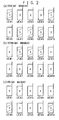
- Figs. 1 and 2 are diagrams showing examples of the operation of a mobile communication system according to an embodiment of the present invention.
- a server (not shown) distributes data to a group of target mobile terminals 1-1 to 1-5 without a request therefrom, thereby updating software in the mobile terminals 1-1 to 1-5.
- software that has been once updated is not to be repeatedly updated.
- all the mobile terminals 1-1 to 1-5 can receive data. Meanwhile, in this embodiment, only the target mobile terminals 1-1 and 1-3 can receive data.
- the server pages, from the network side, the mobile terminals 1-1 to 1-5 using information that uniquely identifies them, such as IMEI-SV (the International Mobile station Equipment Identity and Software Version number).
- IMEI-SV the International Mobile station Equipment Identity and Software Version number
- the mobile terminals 1-1 to 1-5 have a function of checking the soundness of software so as not to receive the same data when succeeding in updating the software, and to receive the same data again when failing to update the software.
- data (data on software in version "n” for type A terminals) is transmitted through a node B (base station) to the mobile terminals (UE: User Equipment) 1-1 to 1-5.
- the data are received by only the mobile terminals 1-1 and 1-3 of type A with software in version "n”, and not received by the mobile terminal 1-4 of type B, the mobile terminal 1-2 of type A with software in version older than "n”, and the mobile terminal 1-5 of type A with software in version later than "n”
- OTASP Over The Air Service Provisioning
- the network side is not required to confirm the presence of the target mobile terminals 1-1 and 1-3, and receive no response therefrom. Consequently, load on the network side can be reduced.
- OTASP is performed to rewrite software in mobile terminals 1-1 to 1-5 based on data transmitted via radio from the server.
- the network side has to confirm the presence of the target mobile terminals 1-1 and 1-3, and therefore, receive a response from each of them. Consequently, load on the network side increases. However, it is possible to avoid the transmission of data to the area where the target mobile terminals 1-1 and 1-3 do not reside.
- broadcast is used in the first several times because it is expected that there are a number of target mobile terminals. After several times of using broadcast, then, multicast is used. Thereby, efficient OTASP can be achieved.
- Fig. 2 shows an example of the application of broadcast and multicast according to the embodiment.
- software in mobile terminals UE#1 to UE#10 is rewritten, and the software version is updated from "3" to "4".
- the server broadcasts data on software in version "4".
- the server utilizes the current version "3".
- the terminals whose type and software version match those indicated by the server respond to the broadcast.
- the mobile terminals UE#1, UE#5, and UE#7 to UE#9 are on, and write the data on software in version "4" received from the server thereto.
- the other mobile terminals UE#2 to UE#4, UE#6, and UE#10 are off, and therefore, the data on software in version "4" from the server is not written to them.
- the server also broadcasts data on software in version "4".
- the mobile terminals UE#1, UE#5, and UE#7 to UE#9 their software version does not match that indicated by the server, and the terminals do not respond to the broadcast.
- the mobile terminals UE#2 to UE#4 are on, and write the data on software in version "4" received from the server thereto.
- the other mobile terminals UE#6 and UE#10 are still off, and therefore, the data on software in version "4" from the server is not written to them.
- the server After using broadcast for preset N-1 days, on the Nth day, the server multicasts data on software in version "4" to the mobile terminals UE#6 and UE#10. At this point, since the data has already been written to the mobile terminals UE#1 to UE#5 and UE#7 to UE#9, the terminals do not respond to the multicast.
- Fig. 3 is a block diagram showing the construction of a mobile communication system according to an embodiment of the present invention.
- the mobile communication system of this embodiment comprises a mobile terminal (UE) 1, nodes B (base stations) 2-1 and 2-2, an RNC (Radio Network Controller) 3, an SGSN [Serving GPRS (General Packet Radio Service) Support Node] 4, a GGSN (Gateway GPRS Support Node) 5, server 6, and an IP (Internet Protocol) network 100.
- PICH page indication channel
- PCH paging channel
- 3GPP 3rd Generation Partnership Project
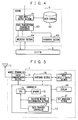
- Fig. 4 is a block diagram showing the construction of the server 6 depicted in Fig. 3.
- the server 6 comprises a data input/ output section 61, a data storage 62, a data transmission controller (scheduler) 63, a multicast section 64, and a broadcast section 65.
- the data input/ output section 61 receives, from other equipment (e.g. equipment of program manufacturers providing programs such as a control program and application programs installed in the mobile terminal 1), data for updating the programs or the like, and stores the data in the data storage 62. Besides, the data input/ output section 61 reads out data stored in the data storage 62 and sends it to the data transmission controller 63 to issue instructions for updating based on the data.
- equipment e.g. equipment of program manufacturers providing programs such as a control program and application programs installed in the mobile terminal 1
- data for updating the programs or the like e.g., data for updating the programs or the like.
- the data input/ output section 61 reads out data stored in the data storage 62 and sends it to the data transmission controller 63 to issue instructions for updating based on the data.
- the data transmission controller 63 receives data from the data input/ output section 61, and creates a schedule of data distribution by broadcast and multicast as previously described. According to the schedule, the data transmission controller 63 feeds the data to the multicast section 64 or the broadcast section 65.
- the multicast section 64 sends the data to the GGSN 5 to multicast the data to the mobile terminal 1 according to the schedule created by the data transmission controller 63.
- the multicast section 64 is required to wait for a response from the GGSN 5.
- the multicast section 64 determines that there exists no target terminal belonging to the server, and is not to perform data transmission.
- the broadcast section 65 sends the data to the GGSN 5 to broadcast the data to the mobile terminal 1 according to the schedule created by the data transmission controller 63. Differently from the multicast section 64, the broadcast section 65 need not wait for a response from the GGSN 5.
- Each of the multicast section 64 and the broadcast section 65 initiates data transmission after a prescribed period of time during which each terminal may have been prepared for data reception.
- Fig. 5 is a block diagram showing the construction of the mobile terminal (UE) 1 depicted in Fig. 3.
- the mobile terminal 1 comprises an antenna 11, a radio communication section 12, a controller 13, a baseband section 18, a voice input/ output section 19, a display 20, and a key operation section 21.
- the operation of each component is publicly known, and therefore, will not be described herein.
- the controller 13 includes a CPU (Central Processing Unit) 14, a memory 15 for storing programs such as a control program and application programs executed by the CPU 14, a transfer method determination section 16, and a data transfer controller 17.
- a CPU Central Processing Unit
- a memory 15 for storing programs such as a control program and application programs executed by the CPU 14, a transfer method determination section 16, and a data transfer controller 17.
- the transfer method determination section 16 determines whether data for version-up of software, etc. is to be broadcast or multicast from the server 6.
- the CPU 14 and the data transfer controller 17 operate according to the determination result.
- the CPU 14 and the data transfer controller 17 compare the software version of the terminal with a version indicated by data from the server 6. If the versions do not match, the CPU 14 and the data transfer controller 17 terminates the operation. If the versions match, the CPU 14 and the data transfer controller 17 transmit a response to the network side when multicast is to be used, while they transmit nothing to the network side when broadcast is to be used and prepare for data reception.
- the mobile terminal 1 is required only to monitor a paging channel as well as to perform the aforementioned comparison, and supply power to the sections necessary for receiving the data. Differently form conventional broadcast data reception, the mobile terminal 1 need not supply power to all the sections.
- Fig. 6 is a diagram showing the construction of a PICH, and the relation between a PICH and a PCH according to the present invention.
- the mobile terminal 1 that cannot individually communicate with the RNC 3 ⁇ idle, Cell/ URA [UTRAN (UMTS Terrestrial Radio Access Network) Registration Area]_PCH ⁇ intermittently receive a PICH in the timing indicated by the RNC 3. This operation is necessary for the mobile terminal 1 to receive data.
- UTRAN UMTS Terrestrial Radio Access Network
- the timing in which the mobile terminal 1 receives the PICH is calculated from the value of the identifier [IMSI (International Mobile Subscriber Identity)] thereof, etc.
- IMSI International Mobile Subscriber Identity
- One frame of the PICH consists of 300 bits, of which the last 12 bits are reserved.
- a bit of the PICH which the mobile terminal 1 monitors is also calculated from the value of the identifier (IMSI) thereof, etc.
- IMSI the identifier
- each mobile terminal checks a bit of a page indication channel (PICH) in which the terminal has been registered. When the bit indicates "1", the mobile terminal reads information from a paging channel (PCH) to determine whether or not incoming data is directed thereto.
- PICH page indication channel
- PCH paging channel
- mobile terminals in idle mode intermittently receive the page indication channel according to an instruction from the network (see Figs 6 and 7).
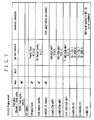
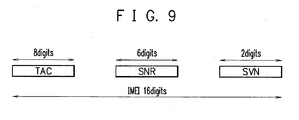
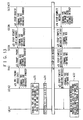
- Figs. 7 to 9 are diagrams showing images of a change in a UE identifier in a PCH.
- a PICH is limited in the number of frame numbers (0 to 4095) and the number of bits (288), each bit of the PICH is not always assigned to one UE.
- a bit of the PICH is assigned to three UEs, by setting the bit to "1", the three UEs receive a PCH.
- the three UEs rarely ever receive incoming data at the same time, and it is necessary to indicate to which of them the bit "1" is applied.
- Such an indication is provided by UE Identity contained in the PCH. Having received the PCH, each UE necessarily check the UE Identity to determine whether or not incoming data is addressed thereto.
- UE identity is set for individual UEs, which is not suitable for the case where a plurality of UEs receive the data simultaneously.
- IMEI-SV is added to UE identity, and the type and software version of UEs where data is to be transmitted are used as a UE identifier. Thereby, target UEs can be grouped.
- IMEI-SV contains a serial number that identifies each UE, serial number information is not used herein because the intention is that a group of specific UEs receive data simultaneously.
- every bit of the PICH is set to "1" as described above, target UEs respond to a paging message or request all together, which may put pressure on the up-link radio capacity and also increase processing load on the network side. As such, it may not be the best way to set every bit of the PICH to "1". For example, bits of the PICH to be set to "1" may be shifted by 10 bits every few minutes during which the download of software is likely to have been completed.
- the aforementioned technique can be applied to, for example, the update of middleware or applications.
- the network writes "1" to every bit of the page indication channel so that all mobile terminals can receive data.
- the network renders the paging channel to contain information on the type of the target mobile terminals and the current version of the software of the mobile terminals which needs to be updated (see Figs. 7 to 9).
- Fig. 10 is a flowchart showing the operation of the server 6 depicted in Fig. 3.
- Fig. 10 a description will be given of the operation of the server 6 according to an embodiment of the present invention.
- the server 6 broadcasts, at the time (e.g. at midnight when the mobile terminal 1 is less used) preset as broadcast distribution time (Fig. 10, step S2), the contents of the change in software through the broadcast section 65 (Fig. 10, step S3).
- the server 6 multicasts the contents of the change in software through the multicast section 64 (Fig. 10, step S9).
- the server 6 performs the above process at the multicast distribution time every day (Fig. 10, step S 10).
- Fig. 11 is a flowchart showing the operation of the mobile terminal 1 depicted in Fig. 3. Referring to Figs. 1 to 9 and 11, a description will be given of the operation of the mobile terminal 1 according to an embodiment of the present invention.
- the mobile terminal 1 receives a PCH in the same manner as previously described (Fig. 11, steps S21 to S23).
- the mobile terminal 1 analyzes the received PCH to recognize if conventional data reception, conventional MBMS (Multimedia Broadcast/ Multicast Service), broadcast OTASP or multicast OTASP is to be performed (Fig. 11, steps S24 and S25).
- MBMS Multimedia Broadcast/ Multicast Service
- broadcast OTASP Multicast OTASP
- multicast OTASP multicast OTASP
- the mobile terminal 1 transmits no response to a signal therefrom, and prepares for receiving OTASP data (Fig. 11, steps S30).
- the PCH contains information for receiving the data.
- the mobile terminal 1 transmits an RRC (Radio Resource Control) connection request as a response to a paging message or request (Fig. 11, steps S27). Thereafter, the mobile terminal 1 prepares for receiving OTASP data (Fig. 11, steps S28).
- RRC Radio Resource Control
- the mobile terminal 1 compares its type (terminal category) and software version with those contained in the PCH (Fig. 11, steps S26 and S29).
- the mobile terminal 1 returns to idle mode at the point. If they match, the mobile terminal receives necessary data by multicast or broadcast based on information from the PCH (Fig. 11, steps S28 and S30). Whether multicast or broadcast is to be used is set on the network side so as to be recognized by the mobile terminal 1 at the time of paging.
- Fig. 12 is a sequence chart showing the data transmission process (the process when OTASP is performed by multicast) according to an embodiment of the present invention. Referring to Figs. 3 and 12, a description will be given of the process when OTASP is performed by multicast.
- the server 6 When there is a mobile terminal (UE#1, UE#2) that needs the update of the software version, the server 6 transmit an OTASP request to the GGSN 5 (Fig. 12, a1).
- the message contains terminal type and software version information, and also the identifier of the server 6 so that a response from the mobile terminal (UE#1, UE#2) can be forwarded to the server 6.
- data transfer mode is designated, and the operation of the RNC 3 varies according to the transfer mode.
- multicast is set as the transfer mode.
- the GGSN 5 Having received the OTASP request from the server 6, the GGSN 5 forwards the request to the SGSN 4 using a GTP (GPRS Tunneling Protocol)-C message (Fig. 12, a2).
- GTP GPRS Tunneling Protocol
- the SGSN 4 Having received the OTASP request from the GGSN 5, the SGSN 4 forwards the request to the RNC 3 using a RANAP (Radio Access Network Application Part) paging message (Fig. 12, a3).
- RANAP Radio Access Network Application Part
- Multicast is used when the RNC 3 recognizes the target mobile terminal (UE#1, UE#2). Therefore, the RNC 3 transmits an RRC paging message to the mobile terminal (UE#1, UE#2) (Fig. 12, a4), and waits for a response therefrom. This paging is performed in the manner described previously in connection with Figs. 6 to 9.
- the mobile terminal (UE#1, UE#2) transmits an RRC connection request to the RNC 3.
- the mobile terminal (UE#1, UE#2) compares its type and software version with those contained in the paging channel, and if they match (Fig. 12, a5), transmits the RRC connection request to the RNC 3.
- the mobile terminal (UE#1, UE#2) configures a default tunnel (Fig. 12, a7) to join the server 6, and thereby joins the server 6 to indicate an intention to receive OTASP data (Fig. 12, a8).
- This process is performed based on the 3GPP MBMS standard.
- the server 6 When having received a join response even from only one mobile terminal (UE#1, UE#2), the server 6 initiates the transmission of OTASP data (Fig. 12, a9). Each equipment item on the network transmits data based on MBMS.
- the server 6 On completion of the transmission of the OTASP data, the server 6 informs the GGSN 5 of the completion of the data transmission using an OTASP complete message (Fig. 12, a10).
- the OTASP complete message contains the terminal type and software version information contained in the OTASP request.
- the GGSN 5 Having received the OTASP complete message from the server 6, the GGSN 5 forwards the message to the SGSN 4 using a GTP-C message (Fig. 12, al1). Having received the OTASP complete message from the GGSN 5, the SGSN 4 forwards the message to the RNC 3 using a RANAP message (Fig. 12, a12).
- the RNC 3 Having received the OTASP complete message from the SGSN 4, the RNC 3 transmits the OTASP complete message to the target mobile terminal (UE#1, UE#2) using an RRC message to inform the terminal of the completion of the data transmission (Fig. 12, a13).
- the method described previously in connection with Figs. 6 to 9 is also applied to this message.
- the mobile terminal When having received the OTASP data properly and completed the update of the software, the mobile terminal (UE#1, UE#2) updates the version information of the software therein (Fig. 12, a14).
- Fig. 13 is a sequence chart showing the data transmission process (the process when OTASP is performed by broadcast) according to an embodiment of the present invention. Referring to Figs. 3 and 13, a description will be given of the process when OTASP is performed by broadcast.
- the server 6 When there is a mobile terminal (UE#1, UE#2) that needs the update of the software version, the server 6 transmit an OTASP request to the GGSN 5 (Fig. 13, a21).
- the message contains terminal type and software version information. Besides, data transfer mode is designated, and the operation of the RNC 3 varies according to the transfer mode. In this case, the server 6 need not receive a signal from the mobile terminal (UE#1, UE#2), and therefore, the message does not contain information used for forwarding a signal to the server 6.
- the GGSN 5 Having received the OTASP request from the server 6, the GGSN 5 forwards the request to the SGSN 4 using a GTP-C message (Fig. 13, a22). Having received the OTASP request from the GGSN 5, the SGSN 4 forwards the request to the RNC 3 using a RANAP paging message (Fig. 13, a23)
- the RNC 3 transmits a broadcast paging message instead of a normal paging message containing an indication to wait for a response from the target mobile terminal (UE#1, UE#2) (Fig. 13, a24),.
- the method described previously in connection with Figs. 6 to 9 is also applied to this message.
- this process is performed based on the 3GPP MBMS standard.
- the mobile terminal compares its type and software version with those contained in the paging channel, and if they match (Fig. 13, a25), prepares for receiving OTASP data (Fig. 13, a26). This process is performed based on the 3GPP MBMS standard.
- the server 6 initiates the transmission of OTASP data (Fig. 13, a27).
- Each equipment item on the network transmits data based on the 3GPP MBMS standard.
- the server 6 On completion of the transmission of the OTASP data, the server 6 informs the GGSN 5 of the completion of the data transmission using an OTASP complete message (Fig. 13, a28).
- the OTASP complete message contains the terminal type and software version information contained in the OTASP request.
- the GGSN 5 Having received the OTASP complete message from the server 6, the GGSN 5 forwards the message to the SGSN 4 using a GTP-C message (Fig. 13, a29). Having received the OTASP complete message from the GGSN 5, the SGSN 4 forwards the message to the RNC 3 using a RANAP message (Fig. 13, a30).
- the RNC 3 Having received the OTASP complete message from the SGSN 4, the RNC 3 transmits the OTASP complete message to the target mobile terminal (UE#1, UE#2) using an RRC message to inform the terminal of the completion of the data transmission (Fig. 13, a31).
- the method described previously in connection with Figs. 6 to 9 is also applied to this message.
- the mobile terminal When having received the OTASP data properly and completed the update of the software, the mobile terminal (UE#1, UE#2) updates the version information of the software therein (Fig. 13, a32).
- Fig. 14 is a flowchart showing operation (operation when OTASP is performed by multicast) on the side of the server 6 depicted in Fig. 3. Referring to Figs. 3 and 14, a description will be given of operation on the server 6 side when OTASP is performed by multicast.
- the server 6 activates a timer (not shown) to wait for a response from the mobile terminal 1 concurrently with the transmission of an OTASP request (Fig. 14, step S41).
- the server 6 terminates OTASP (Fig. 14, step S45).
- the timer is used for the purposes of checking the presence of the target mobile terminal 1 as well as collecting responses from a group of target mobile terminals.
- the server 6 If having received a response from the mobile terminal 1 before the timer expires (Fig. 14, steps S42 and S43), the server 6 initiates the transmission of OTASP data (Fig. 14, step S44).
- the server 6 When performing multicast, as is described above, the server 6 initiates the transmission of OTASP data if there is even only one response received from a mobile terminal, while it does not transmit data and terminates OTASP if there is no response.
- multicast paging is used to update the software version of terminals.
- multicast paging may also be used to obtain statistics of the number of terminals that use software in a specific version, or to provide specific software to the terminals.
- the above application of multicast paging is cited merely by way of example and without limitation.
- Fig. 15 is a flowchart showing the data processing operation of the mobile terminal 1 depicted in Fig. 3. Referring to Figs. 3 and 15, a description will be given of the data processing operation of the mobile terminal 1.
- the mobile terminal 1 Upon initiation of OTASP data reception, the mobile terminal 1 activates a timer to wait for an OTASP complete message considering the case where the message does not arrive (Fig. 15, steps S51 and 52).
- the mobile terminal 1 Having been informed of the completion of OTASP by an RRC message (Fig. 15, step S53), and succeeded in updating the software (Fig. 15, step S54), the mobile terminal 1 updates the version information of the software therein (Fig. 15, step S55).
- the OTASP complete message contains the terminal type and software version information contained in an OTASP request. Therefore, if rewriting the software version information before receiving the OTASP complete message, the mobile terminal 1 cannot receive the message.
- the mobile terminal 1 discards OTASP data which have been received until that time (Fig. 15, step S56). Then, the mobile terminal 1 terminates the operation, and utilizes previous terminal type and software version information. As an example of the case where the update of software fails may be cited that the mobile terminal 1 is informed of the completion of OTASP before completing the data reception.
- the mobile terminal 1 when having succeeded in updating the software, the mobile terminal 1 updates the version information of the software therein. On the other hand, when having failed to update the software, the mobile terminal 1 discards received data, and does not update the version information of the software therein.
- the mobile terminal 1 is not to receive the same data again if having succeeded in updating the software, while the mobile terminal 1 can receive the same data again if having failed to update the software version since it does not update software version information until succeeding in the update of the software.
- MBMS is applied to OTASP for rewriting a program to update the version of software or the like. Therefore, each mobile terminal does not waste its power, and software in a group of target terminals can be efficiently updated only when the software needs to be rewritten.
- information that uniquely identifies a mobile terminal e.g. information on terminal type and software version contained in IMEI-SV
- IMEI-SV information that uniquely identifies a mobile terminal
- a mobile terminal that has completed the update of the software updates the version information of the software therein.
- the mobile terminal can avoid the repeated reception of the same data.
Landscapes
- Engineering & Computer Science (AREA)
- Databases & Information Systems (AREA)
- Computer Networks & Wireless Communication (AREA)
- Signal Processing (AREA)
- Mobile Radio Communication Systems (AREA)
Abstract
Description
- The present invention relates to a mobile communication system, a server, a mobile terminal and a data transmission method applied to the same, and more particularly, to a data transmission method for updating software in a mobile phone.
- In a recent mobile phone system, subscribers to mobile phone services have been dramatically increasing, and there have been cases where mobile terminals already sold are recalled to repair the failure thereof.
- For purposes including to avoid the recall of mobile terminals, 3GPP2 (3rd Generation Partnership Project 2) has been studying OTASP (Over The Air Service Provisioning) to rewrite or update software in a mobile terminal via radio (e.g. see Non Patent Document 1).
- In this case, paging may be used as a technique for specifying a mobile terminal whose software is to be rewritten. In the paging technique, when there is an incoming call or data to a mobile terminal, it is required to inform the mobile terminal of the call, and all mobile terminals in the location registration area where the mobile terminal has registered the location are informed of the call by broadcast. Accordingly, the mobile terminal recognizes the paging thereto since it is always monitoring a paging channel even in idle mode (e.g. see Non Patent Document 2).
- However, it is inefficient to forward data to each of mobile terminals one by one, and therefore, techniques have been proposed in which data is broadcast to all mobile terminals whose software needs to be rewritten (e.g. see
Patent Documents 1 and 2). - Patent Document 1: Japanese Patent Laid-Open No. 2001-28787 (
Paragraphs - Patent Document 2: Japanese Patent Laid-Open No. 2003-51796 (
Paragraphs 6 to 8, Fig. 1) - Non Patent Document 1: 3GPP2 Access Network Interface Interoperability Specification Release A, June, 2000
- Non Patent Document 2: "W-CDMA Mobile Communications System, Chapter 4: Network Technologies, Chapter 4-3: Network control and signaling Scheme" edited by Keiji Tachikawa, published by Maruzen Co., Ltd., June 25, 2001, pp 254-256
- In aforementioned OTASP reviewed by 3GPP2, data is transmitted with respect to each mobile terminal, and the technology does not take full advantage of a characteristic of radio that a plurality of mobile terminals can receive the same data simultaneously. The transmission of data to each of mobile terminals one by one causes congestion in the mobile communication system.
- Besides, according to the techniques in which data is broadcast to all mobile terminals whose software needs to be rewritten, mobile terminals whose software need not be rewritten also receive the data, and, on determining that the data is not necessary, have to discard the data. In other words, the techniques have a problem in that, even if its software need not be rewritten, a mobile terminal is necessitated to receive data and makes a determination as to the necessity of the data, resulting in an increase in the power consumption of the mobile terminal.
- It is therefore an object of the present invention to provide a mobile communication system, a server, a mobile terminal and a data transmission method applied to the same, capable of efficiently updating software in a group of target terminals only when the software needs to be rewritten.
- In accordance with an aspect of the present invention, there is provided a mobile communication system in which data are transmitted/received via radio between a server and mobile terminals, wherein the server includes at least a means for paging a target mobile terminal by transmitting thereto a request attached with information on the type of the mobile terminal.
- In accordance with another aspect of the present invention, there is provided a mobile communication system in which OTASP (Over The Air Service Provisioning) is performed to rewrite or update software in mobile terminals based on data transmitted via radio from a server, wherein the server includes a means for paging a target mobile terminal by transmitting thereto, when OTASP is to be performed, a request attached with information on the type of the mobile terminal and the version of the software.
- In accordance with another aspect of the present invention, there is provided a server which transmits/ receives data to/ from mobile terminals via radio, including at least a means for paging a target mobile terminal by transmitting thereto a request attached with information on the type of the mobile terminal.
- In accordance with another aspect of the present invention, there is provided a server which transmits data via radio for performing OTASP (Over The Air Service Provisioning) to rewrite software in mobile terminals, including a means for paging a target mobile terminal by transmitting thereto, when OTASP is to be performed, a request attached with information on the type of the mobile terminal and the version of the software.
- In accordance with another aspect of the present invention, there is provided a mobile terminal in a mobile communication system in which OTASP (Over The Air Service Provisioning) is performed to rewrite software in the mobile terminal based on data transmitted via radio from a server, comprising a means for determining, based on terminal type and software version information attached to a request received when OTASP is to be performed, whether or not the request is directed to the terminal, and a means for, when having determined that the request is directed to the terminal, updating the software based on the data transmitted from the server.
- In accordance with another aspect of the present invention, there is provided a data transmission method applied to a mobile communication system in which data are transmitted/ received via radio between a server and mobile terminals, the method including, on the server side, at least the step of paging a target mobile terminal by transmitting thereto a request attached with information on the type of the mobile terminal.
- In accordance with another aspect of the present invention, there is provided a data transmission method applied to a mobile communication system in which OTASP (Over The Air Service Provisioning) is performed to rewrite software in mobile terminals based on data transmitted via radio from a server, the method including, on the server side, the step of paging a target mobile terminal by transmitting thereto, when OTASP is to be performed, a request attached with information on the type of the mobile terminal and the version of the software.
- As is described above, the mobile communication system of the present invention is characterized in that, in mobile communication broadcasting or multicasting, the server distributes data to a group of target mobile terminals without a request therefrom, thus updating software in the mobile terminals. In addition, software that has been once updated is not to be repeatedly updated.
- Generally, in the case of broadcast, all mobile terminals can receive data. However, in accordance with the present invention, only target mobile terminals can receive data.
- Besides, generally, in the case of multicast, the user of a mobile terminal joins the service of his/ her own free will to receive data. The present invention, however, proposes that the server pages, from the network side, a mobile terminal using information that uniquely identifies the mobile terminal, such as IMEI-SV (the International Mobile station Equipment Identity and Software Version number).
- Further, in accordance with the present invention, the soundness of software is checked. Therefore, the same data is not to be received in the event of success in updating software, while the same data can be received again in the event of failure.
- In OTASP (Over The Air Service Provisioning) using broadcast, the network side is not required to confirm the presence of a target mobile terminal, and receive no response from the mobile terminal. Consequently, load on the network side can be reduced. However, there is the case where data is transmitted even when no target mobile terminal resides in the area. In such a case, OTASP is performed to rewrite software in mobile terminals based on data transmitted via radio from the server.
- On the other hand, in OTASP using multicast, the network side has to confirm the presence of a target mobile terminal, and therefore, receive a response from the mobile terminal. Consequently, load on the network side increases. However, it is possible to avoid the transmission of data to the area where no target mobile terminal resides.
- In the first several times, broadcast may be used because it is expected that there are a number of target mobile terminals. After several times of using broadcast, then, multicast may be used. Thereby, efficient OTASP can be achieved.
- 3GPP is currently reviewing MBMS (Multimedia Broadcast/Multicast Service). MBMS is aimed at efficiently utilizing radio resources with broadcast in which data is transmitted to all mobile terminals in the area and multicast in which data is transmitted to only a group of mobile terminals which wish to receive the data. This technique enables necessary data to be transmitted to only a group of specific mobile terminals.
- In the current 3GPP specifications, each mobile terminal checks a bit of a page indication channel (PICH) in which the terminal has been registered. When the bit indicates "1", the mobile terminal reads information from a paging channel (PCH) to determine whether or not incoming data is addressed thereto. In accordance with the present invention, as with the 3GPP specifications, mobile terminals in idle mode intermittently receive the page indication channel according to an instruction from the network.
- In order to update software in a specific mobile terminal, the network writes "1" to every bit of the page indication channel so that all mobile terminals can receive data. Besides, the network renders the paging channel to contain information on the type of the target mobile terminal (terminal category or classification) and the current version of the software of the mobile terminal which needs to be updated.
- Each of all mobile terminals that have been instructed by the page indication channel to receive the paging channel compares its type (terminal category) and software version with those contained in the paging channel. As a result of the comparison, if they do not match, the mobile terminal returns to idle mode at the point. If they match, the mobile terminal receives necessary data by multicast or broadcast based on information from the paging channel. Whether multicast or broadcast is to be used is set on the network side so as to be recognized by the mobile terminal at the time of paging.
- In the case of multicast, if there is even one response from a mobile terminal, data transmission is initiated, while there is no response, OTASP is terminated.
- When having succeeded in updating the software version, a mobile terminal updates the version information of the software therein. On the other hand, when having failed to update the software version, a mobile terminal discards received data, and does not update the version information of the software therein. Thereby, a mobile terminal that has succeeded in updating the software version is not to receive the same data again, while a mobile terminal that has failed to update the software version can receive the same data again until it succeeds in the update of the software version.
- As set forth hereinabove, in accordance with the present invention, each mobile terminal does not waste its power, and software in a group of target terminals can be efficiently updated only when the software needs to be rewritten.
- Referring now to the drawings, a description of a preferred embodiment of the present invention will be given in detail. Figs. 1 and 2 are diagrams showing examples of the operation of a mobile communication system according to an embodiment of the present invention. In the mobile communication system of this embodiment shown in Fig. 1, in mobile communication broadcasting or multicasting, a server (not shown) distributes data to a group of target mobile terminals 1-1 to 1-5 without a request therefrom, thereby updating software in the mobile terminals 1-1 to 1-5. In addition, software that has been once updated is not to be repeatedly updated.
- In the case of ordinary broadcast, all the mobile terminals 1-1 to 1-5 can receive data. Meanwhile, in this embodiment, only the target mobile terminals 1-1 and 1-3 can receive data.
- Besides, in the case of ordinary multicast, the users of the mobile terminals 1-1 to 1-5 joins the service of their own free will to receive data. Meanwhile, in this embodiment, the server pages, from the network side, the mobile terminals 1-1 to 1-5 using information that uniquely identifies them, such as IMEI-SV (the International Mobile station Equipment Identity and Software Version number). There is found a description of "IMEI-SV" in 3GPP TS23.003 V5.5.1 (2003-1), chapter 6.2.2.
- The mobile terminals 1-1 to 1-5 have a function of checking the soundness of software so as not to receive the same data when succeeding in updating the software, and to receive the same data again when failing to update the software.
- In Fig. 1, data (data on software in version "n" for type A terminals) is transmitted through a node B (base station) to the mobile terminals (UE: User Equipment) 1-1 to 1-5. The data are received by only the mobile terminals 1-1 and 1-3 of type A with software in version "n", and not received by the mobile terminal 1-4 of type B, the mobile terminal 1-2 of type A with software in version older than "n", and the mobile terminal 1-5 of type A with software in version later than "n"
- In OTASP (Over The Air Service Provisioning) using broadcast, the network side is not required to confirm the presence of the target mobile terminals 1-1 and 1-3, and receive no response therefrom. Consequently, load on the network side can be reduced. However, there is the case where data is transmitted even when the target mobile terminals 1-1 and 1-3 do not reside in the area. In such a case, OTASP is performed to rewrite software in mobile terminals 1-1 to 1-5 based on data transmitted via radio from the server. There is found a description of "OTASP" in 3GPP TR23.846 6.1.0 (2002-12).
- On the other hand, in OTASP using multicast, the network side has to confirm the presence of the target mobile terminals 1-1 and 1-3, and therefore, receive a response from each of them. Consequently, load on the network side increases. However, it is possible to avoid the transmission of data to the area where the target mobile terminals 1-1 and 1-3 do not reside.
- Accordingly, in this embodiment, broadcast is used in the first several times because it is expected that there are a number of target mobile terminals. After several times of using broadcast, then, multicast is used. Thereby, efficient OTASP can be achieved.
- Fig. 2 shows an example of the application of broadcast and multicast according to the embodiment. In the example of Fig. 2, software in mobile
terminals UE# 1 toUE# 10 is rewritten, and the software version is updated from "3" to "4". - On the first day, the server broadcasts data on software in version "4". When paging the terminals, the server utilizes the current version "3". The terminals whose type and software version match those indicated by the server respond to the broadcast. In Fig. 2, the mobile
terminals UE# 1,UE# 5, andUE# 7 toUE# 9 are on, and write the data on software in version "4" received from the server thereto. The other mobileterminals UE# 2 toUE# 4,UE# 6, andUE# 10 are off, and therefore, the data on software in version "4" from the server is not written to them. - Subsequently, on the second day, the server also broadcasts data on software in version "4". At this point, since the data has already been written to the mobile
terminals UE# 1,UE# 5, andUE# 7 toUE# 9, their software version does not match that indicated by the server, and the terminals do not respond to the broadcast. Besides, the mobileterminals UE# 2 toUE# 4 are on, and write the data on software in version "4" received from the server thereto. The other mobileterminals UE# 6 andUE# 10 are still off, and therefore, the data on software in version "4" from the server is not written to them. - After using broadcast for preset N-1 days, on the Nth day, the server multicasts data on software in version "4" to the mobile
terminals UE# 6 andUE# 10. At this point, since the data has already been written to the mobileterminals UE# 1 toUE# 5 andUE# 7 toUE# 9, the terminals do not respond to the multicast. - Fig. 3 is a block diagram showing the construction of a mobile communication system according to an embodiment of the present invention. Referring to Fig. 3, the mobile communication system of this embodiment comprises a mobile terminal (UE) 1, nodes B (base stations) 2-1 and 2-2, an RNC (Radio Network Controller) 3, an SGSN [Serving GPRS (General Packet Radio Service) Support Node] 4, a GGSN (Gateway GPRS Support Node) 5,
server 6, and an IP (Internet Protocol)network 100.
In the following description, for simplicity, a page indication channel will be referred to as PICH, a paging channel will be referred to as PCH, and general terms in 3GPP (3rd Generation Partnership Project) will be utilized. - Fig. 4 is a block diagram showing the construction of the
server 6 depicted in Fig. 3. Referring to Fig. 4, theserver 6 comprises a data input/output section 61, adata storage 62, a data transmission controller (scheduler) 63, amulticast section 64, and abroadcast section 65. - The data input/
output section 61 receives, from other equipment (e.g. equipment of program manufacturers providing programs such as a control program and application programs installed in the mobile terminal 1), data for updating the programs or the like, and stores the data in thedata storage 62. Besides, the data input/output section 61 reads out data stored in thedata storage 62 and sends it to thedata transmission controller 63 to issue instructions for updating based on the data. - The
data transmission controller 63 receives data from the data input/output section 61, and creates a schedule of data distribution by broadcast and multicast as previously described. According to the schedule, thedata transmission controller 63 feeds the data to themulticast section 64 or thebroadcast section 65. - The
multicast section 64 sends the data to theGGSN 5 to multicast the data to themobile terminal 1 according to the schedule created by thedata transmission controller 63. Themulticast section 64 is required to wait for a response from theGGSN 5. When having received no response, themulticast section 64 determines that there exists no target terminal belonging to the server, and is not to perform data transmission. Thebroadcast section 65 sends the data to theGGSN 5 to broadcast the data to themobile terminal 1 according to the schedule created by thedata transmission controller 63. Differently from themulticast section 64, thebroadcast section 65 need not wait for a response from theGGSN 5. Each of themulticast section 64 and thebroadcast section 65 initiates data transmission after a prescribed period of time during which each terminal may have been prepared for data reception. - Fig. 5 is a block diagram showing the construction of the mobile terminal (UE) 1 depicted in Fig. 3. Referring to Fig. 5, the
mobile terminal 1 comprises an antenna 11, aradio communication section 12, acontroller 13, abaseband section 18, a voice input/output section 19, adisplay 20, and akey operation section 21. The operation of each component is publicly known, and therefore, will not be described herein. - The
controller 13 includes a CPU (Central Processing Unit) 14, amemory 15 for storing programs such as a control program and application programs executed by theCPU 14, a transfermethod determination section 16, and adata transfer controller 17. - The transfer
method determination section 16 determines whether data for version-up of software, etc. is to be broadcast or multicast from theserver 6. TheCPU 14 and thedata transfer controller 17 operate according to the determination result. - When data for version-up of software, etc. is to be broadcast or multicast from the
server 6, theCPU 14 and thedata transfer controller 17 compare the software version of the terminal with a version indicated by data from theserver 6. If the versions do not match, theCPU 14 and thedata transfer controller 17 terminates the operation. If the versions match, theCPU 14 and thedata transfer controller 17 transmit a response to the network side when multicast is to be used, while they transmit nothing to the network side when broadcast is to be used and prepare for data reception. - On this occasion, the
mobile terminal 1 is required only to monitor a paging channel as well as to perform the aforementioned comparison, and supply power to the sections necessary for receiving the data. Differently form conventional broadcast data reception, themobile terminal 1 need not supply power to all the sections. - Fig. 6 is a diagram showing the construction of a PICH, and the relation between a PICH and a PCH according to the present invention. In Fig. 6, the
mobile terminal 1 that cannot individually communicate with the RNC 3 {idle, Cell/ URA [UTRAN (UMTS Terrestrial Radio Access Network) Registration Area]_PCH} intermittently receive a PICH in the timing indicated by theRNC 3. This operation is necessary for themobile terminal 1 to receive data. - The timing in which the
mobile terminal 1 receives the PICH is calculated from the value of the identifier [IMSI (International Mobile Subscriber Identity)] thereof, etc. One frame of the PICH consists of 300 bits, of which the last 12 bits are reserved. - In addition, a bit of the PICH which the
mobile terminal 1 monitors is also calculated from the value of the identifier (IMSI) thereof, etc. When the bit of the PICH which themobile terminal 1 monitors indicates "1", themobile terminal 1 receives a PCH corresponding to the PICH. - In the current 3GPP specifications, each mobile terminal checks a bit of a page indication channel (PICH) in which the terminal has been registered. When the bit indicates "1", the mobile terminal reads information from a paging channel (PCH) to determine whether or not incoming data is directed thereto. In this embodiment, as with the 3GPP specifications, mobile terminals in idle mode intermittently receive the page indication channel according to an instruction from the network (see Figs 6 and 7).
- Figs. 7 to 9 are diagrams showing images of a change in a UE identifier in a PCH. In Figs. 7 to 9, since a PICH is limited in the number of frame numbers (0 to 4095) and the number of bits (288), each bit of the PICH is not always assigned to one UE.
- For example, if a bit of the PICH is assigned to three UEs, by setting the bit to "1", the three UEs receive a PCH. However, the three UEs rarely ever receive incoming data at the same time, and it is necessary to indicate to which of them the bit "1" is applied. Such an indication is provided by UE Identity contained in the PCH. Having received the PCH, each UE necessarily check the UE Identity to determine whether or not incoming data is addressed thereto.
- It is assumed herein that one data is transmitted and a plurality of UEs receive the data simultaneously. That is, a plurality of UEs (UEs of a specific type with software in a specific version) where data is to be transmitted need to receive the data simultaneously. Each UE is provided with a different identifier, and therefore, every bit of the PICH is set to "1" so that all UEs can receive data. However, in the case of UE Identity in the current PCH, UE identity is set for individual UEs, which is not suitable for the case where a plurality of UEs receive the data simultaneously.
- Accordingly, IMEI-SV is added to UE identity, and the type and software version of UEs where data is to be transmitted are used as a UE identifier. Thereby, target UEs can be grouped. Although IMEI-SV contains a serial number that identifies each UE, serial number information is not used herein because the intention is that a group of specific UEs receive data simultaneously.
- In addition, if every bit of the PICH is set to "1" as described above, target UEs respond to a paging message or request all together, which may put pressure on the up-link radio capacity and also increase processing load on the network side. As such, it may not be the best way to set every bit of the PICH to "1". For example, bits of the PICH to be set to "1" may be shifted by 10 bits every few minutes during which the download of software is likely to have been completed.
- Further, by setting a parameter other than IMEI-SV as UE identity, the aforementioned technique can be applied to, for example, the update of middleware or applications.
- In this embodiment, as is previously mentioned, to update software in specific mobile terminals, the network writes "1" to every bit of the page indication channel so that all mobile terminals can receive data. Besides, the network renders the paging channel to contain information on the type of the target mobile terminals and the current version of the software of the mobile terminals which needs to be updated (see Figs. 7 to 9).
- Fig. 10 is a flowchart showing the operation of the
server 6 depicted in Fig. 3. Referring to Figs. 1 to 10, a description will be given of the operation of theserver 6 according to an embodiment of the present invention. When software has to be changed for the version-up or the like (Fig. 10, step S1), theserver 6 broadcasts, at the time (e.g. at midnight when themobile terminal 1 is less used) preset as broadcast distribution time (Fig. 10, step S2), the contents of the change in software through the broadcast section 65 (Fig. 10, step S3). - Until the broadcast distribution is performed a preset number of times (=L), the
server 6 repeats the above process (Fig. 10, step S4). Besides, during days (=M) preset as broadcast distribution period (e.g. a week, a month, etc.), theserver 6 performs the above process at the broadcast distribution time every day (Fig. 10, step S5). - After the days (=M) as the broadcast distribution period has passed (Fig. 10, step S5), the
server 6 multicasts, at the time preset as multicast distribution time (Fig. 10, step S6), an OTASP request (Fig. 10, step S7). - If even only one terminal responds to the request (Fig. 10, step S8), the
server 6 multicasts the contents of the change in software through the multicast section 64 (Fig. 10, step S9). During days (=K) preset as multicast distribution period (e.g. a week, a month, etc.), theserver 6 performs the above process at the multicast distribution time every day (Fig. 10, step S 10). - On completion of the multicast distribution of software, it is possible to prompt each terminal to update the software version with information such as location registration information.
- Fig. 11 is a flowchart showing the operation of the
mobile terminal 1 depicted in Fig. 3. Referring to Figs. 1 to 9 and 11, a description will be given of the operation of themobile terminal 1 according to an embodiment of the present invention. - The
mobile terminal 1 receives a PCH in the same manner as previously described (Fig. 11, steps S21 to S23). Themobile terminal 1 analyzes the received PCH to recognize if conventional data reception, conventional MBMS (Multimedia Broadcast/ Multicast Service), broadcast OTASP or multicast OTASP is to be performed (Fig. 11, steps S24 and S25). Here, the specifications of MBMS have not been determined, and a CH other than the PCH may be used. There is found a description of "MBMS" in 3GPP TS23.246 V0.32.01 (2002-06). - In the case of broadcast OTASP (Fig. 11, steps S24), since the network side is not required to confirm the presence of a mobile terminal subjected to OTASP, the
mobile terminal 1 transmits no response to a signal therefrom, and prepares for receiving OTASP data (Fig. 11, steps S30). The PCH contains information for receiving the data. - On the other hand, in the case of multicast OTASP (Fig. 11, steps S25), since the network side has to confirm the presence of a mobile terminal subjected to OTASP, the
mobile terminal 1 transmits an RRC (Radio Resource Control) connection request as a response to a paging message or request (Fig. 11, steps S27). Thereafter, themobile terminal 1 prepares for receiving OTASP data (Fig. 11, steps S28). - Incidentally, in the case of broadcast OTASP or multicast OTASP, the
mobile terminal 1 compares its type (terminal category) and software version with those contained in the PCH (Fig. 11, steps S26 and S29). - As a result of the comparison, if they do not match, the
mobile terminal 1 returns to idle mode at the point. If they match, the mobile terminal receives necessary data by multicast or broadcast based on information from the PCH (Fig. 11, steps S28 and S30). Whether multicast or broadcast is to be used is set on the network side so as to be recognized by themobile terminal 1 at the time of paging. - Fig. 12 is a sequence chart showing the data transmission process (the process when OTASP is performed by multicast) according to an embodiment of the present invention. Referring to Figs. 3 and 12, a description will be given of the process when OTASP is performed by multicast.
- When there is a mobile terminal (
UE# 1, UE#2) that needs the update of the software version, theserver 6 transmit an OTASP request to the GGSN 5 (Fig. 12, a1). The message contains terminal type and software version information, and also the identifier of theserver 6 so that a response from the mobile terminal (UE# 1, UE#2) can be forwarded to theserver 6. In this case, data transfer mode is designated, and the operation of theRNC 3 varies according to the transfer mode. Here, for example, multicast is set as the transfer mode. - Having received the OTASP request from the
server 6, theGGSN 5 forwards the request to theSGSN 4 using a GTP (GPRS Tunneling Protocol)-C message (Fig. 12, a2). - Having received the OTASP request from the
GGSN 5, theSGSN 4 forwards the request to theRNC 3 using a RANAP (Radio Access Network Application Part) paging message (Fig. 12, a3). - Multicast is used when the
RNC 3 recognizes the target mobile terminal (UE# 1, UE#2). Therefore, theRNC 3 transmits an RRC paging message to the mobile terminal (UE# 1, UE#2) (Fig. 12, a4), and waits for a response therefrom. This paging is performed in the manner described previously in connection with Figs. 6 to 9. - In the case of multicast, the mobile terminal (
UE# 1, UE#2) transmits an RRC connection request to theRNC 3. In this embodiment, the mobile terminal (UE# 1, UE#2) compares its type and software version with those contained in the paging channel, and if they match (Fig. 12, a5), transmits the RRC connection request to theRNC 3. - After that, the mobile terminal (
UE# 1, UE#2) configures a default tunnel (Fig. 12, a7) to join theserver 6, and thereby joins theserver 6 to indicate an intention to receive OTASP data (Fig. 12, a8). This process is performed based on the 3GPP MBMS standard. - When having received a join response even from only one mobile terminal (
UE# 1, UE#2), theserver 6 initiates the transmission of OTASP data (Fig. 12, a9). Each equipment item on the network transmits data based on MBMS. - On completion of the transmission of the OTASP data, the
server 6 informs theGGSN 5 of the completion of the data transmission using an OTASP complete message (Fig. 12, a10). The OTASP complete message contains the terminal type and software version information contained in the OTASP request. - Having received the OTASP complete message from the
server 6, theGGSN 5 forwards the message to theSGSN 4 using a GTP-C message (Fig. 12, al1). Having received the OTASP complete message from theGGSN 5, theSGSN 4 forwards the message to theRNC 3 using a RANAP message (Fig. 12, a12). - Having received the OTASP complete message from the
SGSN 4, theRNC 3 transmits the OTASP complete message to the target mobile terminal (UE# 1, UE#2) using an RRC message to inform the terminal of the completion of the data transmission (Fig. 12, a13). The method described previously in connection with Figs. 6 to 9 is also applied to this message. - When having received the OTASP data properly and completed the update of the software, the mobile terminal (
UE# 1, UE#2) updates the version information of the software therein (Fig. 12, a14). - Fig. 13 is a sequence chart showing the data transmission process (the process when OTASP is performed by broadcast) according to an embodiment of the present invention. Referring to Figs. 3 and 13, a description will be given of the process when OTASP is performed by broadcast.
- When there is a mobile terminal (
UE# 1, UE#2) that needs the update of the software version, theserver 6 transmit an OTASP request to the GGSN 5 (Fig. 13, a21). The message contains terminal type and software version information. Besides, data transfer mode is designated, and the operation of theRNC 3 varies according to the transfer mode. In this case, theserver 6 need not receive a signal from the mobile terminal (UE# 1, UE#2), and therefore, the message does not contain information used for forwarding a signal to theserver 6. - Having received the OTASP request from the
server 6, theGGSN 5 forwards the request to theSGSN 4 using a GTP-C message (Fig. 13, a22). Having received the OTASP request from theGGSN 5, theSGSN 4 forwards the request to theRNC 3 using a RANAP paging message (Fig. 13, a23) - Broadcast is used when it is not necessary to recognize the target mobile terminal (
UE# 1, UE#2). Therefore, theRNC 3 transmits a broadcast paging message instead of a normal paging message containing an indication to wait for a response from the target mobile terminal (UE# 1, UE#2) (Fig. 13, a24),. The method described previously in connection with Figs. 6 to 9 is also applied to this message. In addition, this process is performed based on the 3GPP MBMS standard. - As is described above, the mobile terminal (
UE# 1, UE#2) compares its type and software version with those contained in the paging channel, and if they match (Fig. 13, a25), prepares for receiving OTASP data (Fig. 13, a26). This process is performed based on the 3GPP MBMS standard. - After that, the
server 6 initiates the transmission of OTASP data (Fig. 13, a27). Each equipment item on the network transmits data based on the 3GPP MBMS standard. - On completion of the transmission of the OTASP data, the
server 6 informs theGGSN 5 of the completion of the data transmission using an OTASP complete message (Fig. 13, a28). The OTASP complete message contains the terminal type and software version information contained in the OTASP request. - Having received the OTASP complete message from the
server 6, theGGSN 5 forwards the message to theSGSN 4 using a GTP-C message (Fig. 13, a29). Having received the OTASP complete message from theGGSN 5, theSGSN 4 forwards the message to theRNC 3 using a RANAP message (Fig. 13, a30). - Having received the OTASP complete message from the
SGSN 4, theRNC 3 transmits the OTASP complete message to the target mobile terminal (UE# 1, UE#2) using an RRC message to inform the terminal of the completion of the data transmission (Fig. 13, a31). The method described previously in connection with Figs. 6 to 9 is also applied to this message. - When having received the OTASP data properly and completed the update of the software, the mobile terminal (
UE# 1, UE#2) updates the version information of the software therein (Fig. 13, a32). - Fig. 14 is a flowchart showing operation (operation when OTASP is performed by multicast) on the side of the
server 6 depicted in Fig. 3. Referring to Figs. 3 and 14, a description will be given of operation on theserver 6 side when OTASP is performed by multicast. - In the case of multicast, when there is no target
mobile terminal 1, data is not transmitted. Accordingly, theserver 6 activates a timer (not shown) to wait for a response from themobile terminal 1 concurrently with the transmission of an OTASP request (Fig. 14, step S41). - If having received no response from the
mobile terminal 1 before the timer expires (Fig. 14, steps S42 and S43), theserver 6 terminates OTASP (Fig. 14, step S45). The timer is used for the purposes of checking the presence of the targetmobile terminal 1 as well as collecting responses from a group of target mobile terminals. - If having received a response from the
mobile terminal 1 before the timer expires (Fig. 14, steps S42 and S43), theserver 6 initiates the transmission of OTASP data (Fig. 14, step S44). - When performing multicast, as is described above, the
server 6 initiates the transmission of OTASP data if there is even only one response received from a mobile terminal, while it does not transmit data and terminates OTASP if there is no response. - In the above description, multicast paging is used to update the software version of terminals. However, multicast paging may also be used to obtain statistics of the number of terminals that use software in a specific version, or to provide specific software to the terminals. The above application of multicast paging is cited merely by way of example and without limitation.
- Fig. 15 is a flowchart showing the data processing operation of the
mobile terminal 1 depicted in Fig. 3. Referring to Figs. 3 and 15, a description will be given of the data processing operation of themobile terminal 1. - Upon initiation of OTASP data reception, the
mobile terminal 1 activates a timer to wait for an OTASP complete message considering the case where the message does not arrive (Fig. 15, steps S51 and 52). - Having been informed of the completion of OTASP by an RRC message (Fig. 15, step S53), and succeeded in updating the software (Fig. 15, step S54), the
mobile terminal 1 updates the version information of the software therein (Fig. 15, step S55). - The OTASP complete message contains the terminal type and software version information contained in an OTASP request. Therefore, if rewriting the software version information before receiving the OTASP complete message, the
mobile terminal 1 cannot receive the message. - If the OTASP complete timer expires (Fig. 15, step S52) or the completion of OTASP is reported before succeeding in updating the software (Fig. 15, steps S53 and S54), the
mobile terminal 1 discards OTASP data which have been received until that time (Fig. 15, step S56). Then, themobile terminal 1 terminates the operation, and utilizes previous terminal type and software version information. As an example of the case where the update of software fails may be cited that themobile terminal 1 is informed of the completion of OTASP before completing the data reception. - As is described above, when having succeeded in updating the software, the
mobile terminal 1 updates the version information of the software therein. On the other hand, when having failed to update the software, themobile terminal 1 discards received data, and does not update the version information of the software therein. - Thereby, the
mobile terminal 1 is not to receive the same data again if having succeeded in updating the software, while themobile terminal 1 can receive the same data again if having failed to update the software version since it does not update software version information until succeeding in the update of the software. - As set forth hereinabove, according to this embodiment, MBMS is applied to OTASP for rewriting a program to update the version of software or the like. Therefore, each mobile terminal does not waste its power, and software in a group of target terminals can be efficiently updated only when the software needs to be rewritten.
- Further, information that uniquely identifies a mobile terminal (e.g. information on terminal type and software version contained in IMEI-SV) is utilized. Thereby, mobile terminals can be efficiently grouped.
- Furthermore, a mobile terminal that has completed the update of the software updates the version information of the software therein. Thus, the mobile terminal can avoid the repeated reception of the same data.
-
- Fig. 1 is a diagram showing an example of the operation of a mobile communication system according to an embodiment of the present invention.
- Figs. 2(a) to 2(c) are diagrams showing an example of the operation of a mobile communication system according to an embodiment of the present invention.
- Fig. 3 is a block diagram showing the construction of a mobile communication system according to an embodiment of the present invention.
- Fig. 4 is a block diagram showing the construction of a server depicted in Fig. 3.
- Fig. 5 is a block diagram showing the construction of a mobile terminal depicted in Fig. 3.
- Fig. 6 is a diagram showing the construction of a PICH, and the relation between a PICH and a PCH according to the present invention.
- Fig. 7 is a diagram showing an image of a change in a UE identifier in a PCH.
- Fig. 8 is a diagram showing an image of a change in a UE identifier in a PCH.
- Fig. 9 is a diagram showing an image of a change in a UE identifier in a PCH.
- Fig. 10 is a flowchart showing the operation of the server depicted in Fig. 3.
- Fig. 11 is a flowchart showing the operation of the mobile terminal depicted in Fig. 3.
- Fig. 12 is a sequence chart showing the data transmission process by OTASP according to an embodiment of the present invention.
- Fig. 13 is a sequence chart showing the data transmission process by OTASP according to an embodiment of the present invention.
- Fig. 14 is a flowchart showing operation on the side of the server depicted in Fig. 3.
- Fig. 15 is a flowchart showing the data processing operation of the mobile terminal depicted in Fig. 3.
-
- 1, 1-1 to 1-5
- Mobile terminal
- 2, 2-1, 2-2
- Node B
- 3
- RNC
- 4
- SGSN
- 5
- GGSN
- 6
- Server
- 11
- Antenna
- 12
- Radio communication section
- 13
- Controller
- 14
- CPU
- 15
- Memory
- 16
- Transfer method determination section
- 17
- Data transfer controller
- 18
- Baseband section
- 19
- Voice input/ output section
- 20
- Display
- 21
- Key operation section
- 61
- Data input/ output section
- 62
- Data storage
- 63
- Data transmission controller
- 64
- Multicast section
- 65
- Broadcast section
- 100
- IP network
Claims (22)
- A mobile communication system in which data are transmitted/ received via radio between a server and mobile terminals, wherein the server includes at least a means for paging a target mobile terminal by transmitting thereto a request attached with information on the type of the mobile terminal.
- The mobile communication system claimed in claim 1, wherein the request is attached with information on the version of software in the mobile terminal as well as the type thereof.
- A mobile communication system in which OTASP (Over The Air Service Provisioning) is performed to rewrite software in mobile terminals based on data transmitted via radio from a server, wherein the server includes a means for paging a target mobile terminal by transmitting thereto, when OTASP is to be performed, a request attached with information on the type of the mobile terminal and the version of the software.
- The mobile communication system claimed in claim 3, wherein the mobile terminal comprises: a means for determining, based on the terminal type and software version information, whether or not the request is directed to the terminal: and a means for, when having determined that the request is directed to the terminal, updating the software based on the data transmitted from the server.
- The mobile communication system claimed in claim 3 or 4, wherein the mobile terminal comprises: a means for determining, based on the information attached to the request, whether or not the data is to be multicast or broadcast to the terminal; a means for, when having determined that the data is to be multicast, transmitting a response to the request before receiving the data; and a means for, when having determined that the data is to be broadcast, receiving the data without transmitting a response to the request.
- The mobile communication system claimed in claim 5, wherein the server broadcasts the data repeatedly, and thereafter, multicasts the data.
- The mobile communication system claimed in one of claims 3 to 6, wherein the mobile terminal includes a means for preventing the version information of the software from being updated until the software has been updated based on the data.
- A server which transmits/ receives data to/ from mobile terminals via radio, including at least a means for paging a target mobile terminal by transmitting thereto a request attached with information on the type of the mobile terminal.
- The server claimed in claim 8, wherein the request is attached with information on the version of software in the mobile terminal as well as the type thereof.
- A server which transmits data via radio for performing OTASP (Over The Air Service Provisioning) to rewrite software in mobile terminals, including a means for paging a target mobile terminal by transmitting thereto, when OTASP is to be performed, a request attached with information on the type of the mobile terminal and the version of the software.
- The server claimed in claim 10, which broadcasts the data repeatedly, and thereafter, multicasts the data.
- A mobile terminal which operates when having received a paging message containing information on at least its terminal type and software version.
- A mobile terminal in a mobile communication system in which OTASP (Over The Air Service Provisioning) is performed to rewrite software in the mobile terminal based on data transmitted via radio from a server, comprising: a means for determining, based on terminal type and software version information attached to a request received when OTASP is to be performed, whether or not the request is directed to the terminal; and a means for, when having determined that the request is directed to the terminal, updating the software based on the data transmitted from the server.
- The mobile terminal claimed in claim 13, further comprising: a means for determining, based on the information attached to the request, whether or not the data is to be multicast or broadcast to the terminal; a means for, when having determined that the data is to be multicast, transmitting a response to the request before receiving the data; and a means for, when having determined that the data is to be broadcast, receiving the data without transmitting a response to the request.
- The mobile terminal claimed in claim 13 or 14, further comprising a means for preventing the version information of the software from being updated until the software has been updated based on the data.
- A data transmission method applied to a mobile communication system in which data are transmitted/ received via radio between a server and mobile terminals, the method including, on the server side, at least the step of paging a target mobile terminal by transmitting thereto a request attached with information on the type of the mobile terminal.
- The data transmission method claimed in claim 16, wherein the request is attached with information on the version of software in the mobile terminal as well as the type thereof.
- A data transmission method applied to a mobile communication system in which OTASP (Over The Air Service Provisioning) is performed to rewrite software in mobile terminals based on data transmitted via radio from a server, the method including, on the server side, the step of paging a target mobile terminal by transmitting thereto, when OTASP is to be performed, a request attached with information on the type of the mobile terminal and the version of the software.
- The data transmission method claimed in claim 18, comprising, on the mobile terminal side, the steps of: determining, based on the terminal type and software version information, whether or not the request is directed to the terminal; and, when having determined that the request is directed to the terminal, updating the software based on the data transmitted from the server.
- The data transmission method claimed in claim 18 or 19, further comprising, on the mobile terminal side, the steps of: determining, based on the information attached to the request, whether or not the data is to be multicast or broadcast to the terminal; when having determined that the data is to be multicast, transmitting a response to the request before receiving the data; and, when having determined that the data is to be broadcast, receiving the data without transmitting a response to the request.
- The data transmission method claimed in claim 20, wherein the server broadcasts the data repeatedly, and thereafter, multicasts the data.
- The data transmission method claimed in one of claims 18 to 21, including, on the mobile terminal side, the step of preventing the version information of the software from being updated until the software has been updated based on the data.
Applications Claiming Priority (2)
| Application Number | Priority Date | Filing Date | Title |
|---|---|---|---|
| JP2003150060 | 2003-05-28 | ||
| PCT/JP2004/007178 WO2004107797A1 (en) | 2003-05-28 | 2004-05-26 | Mobile communication system, server, portable terminal and data transfer method used for it |
Publications (2)
| Publication Number | Publication Date |
|---|---|
| EP1631110A1 true EP1631110A1 (en) | 2006-03-01 |
| EP1631110A4 EP1631110A4 (en) | 2010-06-02 |
Family
ID=33487168
Family Applications (1)
| Application Number | Title | Priority Date | Filing Date |
|---|---|---|---|
| EP04745330A Withdrawn EP1631110A4 (en) | 2003-05-28 | 2004-05-26 | Mobile communication system, server, portable terminal and data transfer method used for it |
Country Status (6)
| Country | Link |
|---|---|
| US (1) | US7653680B2 (en) |
| EP (1) | EP1631110A4 (en) |
| JP (1) | JP4192947B2 (en) |
| KR (1) | KR100787013B1 (en) |
| CN (1) | CN1795694B (en) |
| WO (1) | WO2004107797A1 (en) |
Cited By (2)
| Publication number | Priority date | Publication date | Assignee | Title |
|---|---|---|---|---|
| WO2010114436A1 (en) * | 2009-03-31 | 2010-10-07 | Telefonaktiebolaget L M Ericsson (Publ) | Methods and devices for performing a service process in a communication device |
| CN114584932A (en) * | 2016-05-20 | 2022-06-03 | 交互数字专利控股公司 | Method, apparatus, system and process for supporting multicast transmission |
Families Citing this family (25)
| Publication number | Priority date | Publication date | Assignee | Title |
|---|---|---|---|---|
| KR100739174B1 (en) * | 2005-03-30 | 2007-07-13 | 엘지전자 주식회사 | Method of transmitting data frame of mobile communication terminal in WLAN |
| CN100407659C (en) * | 2006-02-14 | 2008-07-30 | 华为技术有限公司 | A method for implementing software version upgrade |
| US7805133B2 (en) * | 2006-07-21 | 2010-09-28 | Research In Motion Limited | Automatic application definition distribution |
| US7974615B2 (en) * | 2006-08-04 | 2011-07-05 | GM Global Technology Operations LLC | Method and system for communicating between a communications source and a mobile platform |
| US8010136B2 (en) * | 2006-08-04 | 2011-08-30 | GM Global Technology Operations LLC | Method and system for communicating information to a user of a mobile platform via broadcast services |
| US7869801B2 (en) * | 2006-10-18 | 2011-01-11 | Pine Valley Investments, Inc. | Method for terminal configuration over a radio control channel |
| US7739410B2 (en) | 2007-01-07 | 2010-06-15 | Apple Inc. | Synchronization methods and systems |
| US7778971B2 (en) * | 2007-01-07 | 2010-08-17 | Apple Inc. | Synchronization methods and systems |
| US7761414B2 (en) * | 2007-01-07 | 2010-07-20 | Apple Inc. | Asynchronous data synchronization amongst devices |
| US20080163743A1 (en) * | 2007-01-07 | 2008-07-10 | Freedman Gordon J | Synchronization methods and systems |
| WO2008085869A2 (en) * | 2007-01-07 | 2008-07-17 | Apple Inc. | Synchronization methods and systems |
| US8239504B2 (en) * | 2007-01-07 | 2012-08-07 | Apple Inc. | Synchronization methods and systems |
| US7660831B2 (en) * | 2007-01-07 | 2010-02-09 | Apple Inc. | Synchronization methods and systems |
| US7805403B2 (en) | 2007-01-07 | 2010-09-28 | Apple Inc. | Synchronization methods and systems |
| US8209540B2 (en) | 2007-06-28 | 2012-06-26 | Apple Inc. | Incremental secure backup and restore of user settings and data |
| KR101445394B1 (en) * | 2008-03-28 | 2014-09-26 | 삼성전자주식회사 | Method and apparatus for software update of terminal in mobile broadcast system |
| KR100979201B1 (en) * | 2008-09-16 | 2010-09-01 | 한국전자통신연구원 | Mobile terminal and its software update method |
| JPWO2011055780A1 (en) * | 2009-11-05 | 2013-03-28 | シャープ株式会社 | Wireless communication system, relay station apparatus, and wireless communication method |
| CN101895415A (en) * | 2010-06-24 | 2010-11-24 | 中兴通讯股份有限公司 | A management method and system for different types of equipment |
| CN102457824B (en) * | 2010-10-26 | 2015-05-27 | 中国移动通信集团公司 | Event processing method and device |
| CN102118737A (en) * | 2011-03-23 | 2011-07-06 | 中兴通讯股份有限公司 | Method for remotely acquiring network locking information and terminal |
| US9094801B2 (en) * | 2013-01-15 | 2015-07-28 | Verizon Patent And Licensing Inc. | Method and system for enabling multicast distribution of mobile device update data |
| US10051462B2 (en) * | 2016-12-16 | 2018-08-14 | T-Mobile Usa, Inc. | Hybrid transport for installed service updates |
| US10375530B2 (en) * | 2017-06-09 | 2019-08-06 | Blackberry Limited | Providing data file updates using multimedia broadcast multicast services |
| JP2019057784A (en) * | 2017-09-20 | 2019-04-11 | 株式会社東芝 | Electronic device and information communication system |
Family Cites Families (28)
| Publication number | Priority date | Publication date | Assignee | Title |
|---|---|---|---|---|
| JPH0512802A (en) * | 1991-07-08 | 1993-01-22 | Matsushita Electric Ind Co Ltd | Compressed coded signal recording / reproducing device |
| JPH05128022A (en) * | 1991-10-30 | 1993-05-25 | Sony Corp | Method for updating mobile body communication terminal |
| US6643506B1 (en) * | 1996-08-07 | 2003-11-04 | Telxon Corporation | Wireless software upgrades with version control |
| US6842430B1 (en) * | 1996-10-16 | 2005-01-11 | Koninklijke Philips Electronics N.V. | Method for configuring and routing data within a wireless multihop network and a wireless network for implementing the same |
| US6128483A (en) * | 1996-11-19 | 2000-10-03 | Ericsson, Inc. | Simultaneous over the air data download to multiple radios |
| US6195546B1 (en) * | 1997-03-14 | 2001-02-27 | Nortel Networks Limited | Method and apparatus for network initiated parameter updating |
| US5974312A (en) * | 1997-07-10 | 1999-10-26 | Ericsson Inc. | System and method for updating a memory in an electronic device via wireless data transfer |
| EP0959635A1 (en) * | 1998-05-20 | 1999-11-24 | Alcatel | Connectionless downloading of software to wireless terminals |
| US6574197B1 (en) * | 1998-07-03 | 2003-06-03 | Mitsubishi Denki Kabushiki Kaisha | Network monitoring device |
| JP2000278743A (en) * | 1999-03-24 | 2000-10-06 | Kokusai Electric Co Ltd | Wireless terminal |
| US6885862B1 (en) * | 1999-04-30 | 2005-04-26 | Harris Canada, Inc. | Wireless subscriber terminal programming using a broadcast control channel |
| JP2001043087A (en) | 1999-08-02 | 2001-02-16 | Nippon Telegr & Teleph Corp <Ntt> | Software change method for wireless communication terminal and wireless communication terminal |
| US6484037B1 (en) * | 1999-10-28 | 2002-11-19 | Ericsson Inc. | Method of establishing group calls in a communications system |
| US6754894B1 (en) * | 1999-12-03 | 2004-06-22 | Command Audio Corporation | Wireless software and configuration parameter modification for mobile electronic devices |
| US7305696B2 (en) * | 2000-04-17 | 2007-12-04 | Triveni Digital, Inc. | Three part architecture for digital television data broadcasting |
| JP2002152821A (en) * | 2000-11-08 | 2002-05-24 | Nec Saitama Ltd | Program update method for mobile terminal and the mobile terminal |
| JP3737705B2 (en) * | 2001-02-20 | 2006-01-25 | インターナショナル・ビジネス・マシーンズ・コーポレーション | Network system, server, client, communication method, and communication program |
| JP4520671B2 (en) | 2001-08-07 | 2010-08-11 | ソフトバンクモバイル株式会社 | Download system |
| US7073053B1 (en) * | 2001-10-11 | 2006-07-04 | Cisco Technology, Inc. | Method and apparatus for a boot progression scheme for reliably initializing a system |
| HUE035334T2 (en) * | 2002-03-05 | 2018-05-02 | Opentv Inc | Multicasting of interactive data |
| US7187690B2 (en) * | 2002-05-20 | 2007-03-06 | The Boeing Company | Method of maximizing use of bandwidth for communicating with mobile platforms |
| US7013157B1 (en) * | 2002-06-03 | 2006-03-14 | Cisco Technology, Inc. | Method for multicast delivery with designated acknowledgment |
| US6970698B2 (en) * | 2002-07-23 | 2005-11-29 | Sbc Technology Resources, Inc. | System and method for updating data in remote devices |
| US7646737B2 (en) * | 2002-08-02 | 2010-01-12 | Qualcomm Incorporated | Multimode wireless device system provision validation and acquisition method and apparatus |
| US7511840B2 (en) * | 2003-01-30 | 2009-03-31 | Kabushiki Kaisha Toshiba | Image forming apparatus |
| US7146541B2 (en) * | 2003-05-20 | 2006-12-05 | Lucent Technologies Inc. | Back out provision for failed programmable hardware update |
| AU2003270322A1 (en) * | 2003-09-05 | 2005-04-21 | Itron, Inc. | Synchronizing and controlling software downloads, such as for utility meter-reading data collection and processing |
| US7478382B2 (en) * | 2004-09-27 | 2009-01-13 | Corrigent Systems Ltd. | Synchronized ring software download |
-
2004
- 2004-05-26 CN CN200480014626.2A patent/CN1795694B/en not_active Expired - Fee Related
- 2004-05-26 US US10/558,074 patent/US7653680B2/en not_active Expired - Fee Related
- 2004-05-26 EP EP04745330A patent/EP1631110A4/en not_active Withdrawn
- 2004-05-26 JP JP2005506481A patent/JP4192947B2/en not_active Expired - Fee Related
- 2004-05-26 KR KR1020057022629A patent/KR100787013B1/en not_active Expired - Fee Related
- 2004-05-26 WO PCT/JP2004/007178 patent/WO2004107797A1/en not_active Ceased
Cited By (6)
| Publication number | Priority date | Publication date | Assignee | Title |
|---|---|---|---|---|
| WO2010114436A1 (en) * | 2009-03-31 | 2010-10-07 | Telefonaktiebolaget L M Ericsson (Publ) | Methods and devices for performing a service process in a communication device |
| CN114584932A (en) * | 2016-05-20 | 2022-06-03 | 交互数字专利控股公司 | Method, apparatus, system and process for supporting multicast transmission |
| EP4064738A1 (en) * | 2016-05-20 | 2022-09-28 | InterDigital Patent Holdings, Inc. | Method and wireless receive/transmit unit for multicast transmission |
| US11818073B2 (en) | 2016-05-20 | 2023-11-14 | Interdigital Patent Holdings, Inc. | Methods, apparatus, systems and procedures for supporting multicast transmission |
| CN114584932B (en) * | 2016-05-20 | 2024-04-23 | 交互数字专利控股公司 | Method, device, system and process for supporting multicast transmission |
| US12401484B2 (en) | 2016-05-20 | 2025-08-26 | Interdigital Patent Holdings, Inc. | Methods, apparatus, systems and procedures for supporting multicast transmission |
Also Published As
| Publication number | Publication date |
|---|---|
| KR100787013B1 (en) | 2007-12-18 |
| US20060264206A1 (en) | 2006-11-23 |
| CN1795694A (en) | 2006-06-28 |
| KR20060005000A (en) | 2006-01-16 |
| WO2004107797A1 (en) | 2004-12-09 |
| CN1795694B (en) | 2010-05-26 |
| HK1092987A1 (en) | 2007-02-16 |
| EP1631110A4 (en) | 2010-06-02 |
| JP4192947B2 (en) | 2008-12-10 |
| US7653680B2 (en) | 2010-01-26 |
| JPWO2004107797A1 (en) | 2006-07-20 |
Similar Documents
| Publication | Publication Date | Title |
|---|---|---|
| US7653680B2 (en) | Mobile software distribution system, server, terminal and method | |
| JP4327089B2 (en) | Control signal transmission method for MBMS data in a wireless mobile communication system | |
| US7315509B2 (en) | Method for recovering from a received data error in a mobile communication system providing a multimedia broadcast/multicast service | |
| US6466552B1 (en) | Group transmission in a packet radio network | |
| JP3918064B2 (en) | Character information broadcasting method and broadcasting system using digital wireless telephone | |
| US6505052B1 (en) | System for transmitting and receiving short message service (SMS) messages | |
| JP4510026B2 (en) | Method and apparatus for inter-frequency / RAT handover measurement in MBMS | |
| RU2417553C2 (en) | Method of transmitting and receiving multipoint connection service in mobile communication system | |
| EP1742413B1 (en) | A method of starting the session of multimedia broadcast multicast service | |
| US20040229605A1 (en) | Method for transmitting MBMS paging information in a mobile communication system | |
| US20040152476A1 (en) | Mobile communication system, radio terminal used therefor, radio network controller and operation control method therefor | |
| US20090022080A1 (en) | PTP/PTM Transmission Decisions | |
| US20070287392A1 (en) | Mobility Handling | |
| US20040224707A1 (en) | System for transmitting and receiving short message service (SMS) messages | |
| HK1092987B (en) | Mobile communication system, server, portable terminal and data transfer method used for it | |
| JP4437490B2 (en) | Character information broadcasting method and broadcasting system using digital wireless telephone | |
| HK1077426B (en) | Method for transmitting control signal for mbms data in wireless mobile communication system |
Legal Events
| Date | Code | Title | Description |
|---|---|---|---|
| PUAI | Public reference made under article 153(3) epc to a published international application that has entered the european phase |
Free format text: ORIGINAL CODE: 0009012 |
|
| 17P | Request for examination filed |
Effective date: 20051221 |
|
| AK | Designated contracting states |
Kind code of ref document: A1 Designated state(s): DE FI FR GB SE |
|
| DAX | Request for extension of the european patent (deleted) | ||
| RBV | Designated contracting states (corrected) |
Designated state(s): DE FI FR GB SE |
|
| A4 | Supplementary search report drawn up and despatched |
Effective date: 20100503 |
|
| RIC1 | Information provided on ipc code assigned before grant |
Ipc: H04W 8/24 20090101AFI20100426BHEP |
|
| 17Q | First examination report despatched |
Effective date: 20100625 |
|
| STAA | Information on the status of an ep patent application or granted ep patent |
Free format text: STATUS: THE APPLICATION IS DEEMED TO BE WITHDRAWN |
|
| 18D | Application deemed to be withdrawn |
Effective date: 20101106 |