EP1630995A1 - Reliability detection of channel quality indicator (CQI) in a wireless communication system - Google Patents
Reliability detection of channel quality indicator (CQI) in a wireless communication system Download PDFInfo
- Publication number
- EP1630995A1 EP1630995A1 EP05254499A EP05254499A EP1630995A1 EP 1630995 A1 EP1630995 A1 EP 1630995A1 EP 05254499 A EP05254499 A EP 05254499A EP 05254499 A EP05254499 A EP 05254499A EP 1630995 A1 EP1630995 A1 EP 1630995A1
- Authority
- EP
- European Patent Office
- Prior art keywords
- channel quality
- word
- cqi
- bit
- quality indicator
- Prior art date
- Legal status (The legal status is an assumption and is not a legal conclusion. Google has not performed a legal analysis and makes no representation as to the accuracy of the status listed.)
- Granted
Links
Images


Classifications
-
- H—ELECTRICITY
- H04—ELECTRIC COMMUNICATION TECHNIQUE
- H04L—TRANSMISSION OF DIGITAL INFORMATION, e.g. TELEGRAPHIC COMMUNICATION
- H04L27/00—Modulated-carrier systems
- H04L27/32—Carrier systems characterised by combinations of two or more of the types covered by groups H04L27/02, H04L27/10, H04L27/18 or H04L27/26
- H04L27/34—Amplitude- and phase-modulated carrier systems, e.g. quadrature-amplitude modulated carrier systems
-
- H—ELECTRICITY
- H04—ELECTRIC COMMUNICATION TECHNIQUE
- H04W—WIRELESS COMMUNICATION NETWORKS
- H04W52/00—Power management, e.g. Transmission Power Control [TPC] or power classes
- H04W52/04—Transmission power control [TPC]
-
- H—ELECTRICITY
- H04—ELECTRIC COMMUNICATION TECHNIQUE
- H04B—TRANSMISSION
- H04B17/00—Monitoring; Testing
-
- H—ELECTRICITY
- H04—ELECTRIC COMMUNICATION TECHNIQUE
- H04B—TRANSMISSION
- H04B17/00—Monitoring; Testing
- H04B17/30—Monitoring; Testing of propagation channels
- H04B17/309—Measuring or estimating channel quality parameters
-
- H—ELECTRICITY
- H04—ELECTRIC COMMUNICATION TECHNIQUE
- H04L—TRANSMISSION OF DIGITAL INFORMATION, e.g. TELEGRAPHIC COMMUNICATION
- H04L1/00—Arrangements for detecting or preventing errors in the information received
- H04L1/0001—Systems modifying transmission characteristics according to link quality, e.g. power backoff
- H04L1/0023—Systems modifying transmission characteristics according to link quality, e.g. power backoff characterised by the signalling
- H04L1/0026—Transmission of channel quality indication
-
- H—ELECTRICITY
- H04—ELECTRIC COMMUNICATION TECHNIQUE
- H04L—TRANSMISSION OF DIGITAL INFORMATION, e.g. TELEGRAPHIC COMMUNICATION
- H04L1/00—Arrangements for detecting or preventing errors in the information received
- H04L1/0001—Systems modifying transmission characteristics according to link quality, e.g. power backoff
- H04L1/0033—Systems modifying transmission characteristics according to link quality, e.g. power backoff arrangements specific to the transmitter
-
- H—ELECTRICITY
- H04—ELECTRIC COMMUNICATION TECHNIQUE
- H04L—TRANSMISSION OF DIGITAL INFORMATION, e.g. TELEGRAPHIC COMMUNICATION
- H04L1/00—Arrangements for detecting or preventing errors in the information received
- H04L1/20—Arrangements for detecting or preventing errors in the information received using signal quality detector
-
- H—ELECTRICITY
- H04—ELECTRIC COMMUNICATION TECHNIQUE
- H04L—TRANSMISSION OF DIGITAL INFORMATION, e.g. TELEGRAPHIC COMMUNICATION
- H04L1/00—Arrangements for detecting or preventing errors in the information received
- H04L1/0001—Systems modifying transmission characteristics according to link quality, e.g. power backoff
- H04L1/0002—Systems modifying transmission characteristics according to link quality, e.g. power backoff by adapting the transmission rate
- H04L1/0003—Systems modifying transmission characteristics according to link quality, e.g. power backoff by adapting the transmission rate by switching between different modulation schemes
Definitions
- This invention relates to wireless communications, and more particularly, to the processing of an uplink Channel Quality Indicator (CQI) received by a base station in a wireless communications system.
- CQI Channel Quality Indicator
- the base station transmits on the forward channel to the mobile terminal (UE [User Equipment] in UMTS terminology) to which the data is directed, a pilot signal (Common Pilot Channel-CPICH for UMTS), a Forward Packet Data Channel (F-PDCH, or High Speed Downlink Shared Control Channel--HS-SCCH for UMTS), and Forward Packet Data Control Channel (F-PDCCH, or High Speed Downlink Shared Channel--HS-DSCH for UMTS).
- UE User Equipment
- the mobile terminal In order for the base station to determine a proper data rate, a modulation scheme, and a transmit power for the F-PDCH and F-PDCCH, it needs to have some measure of how "good" the channel currently is. Accordingly, the mobile terminal provides a measure of channel quality to the base station via a Channel Quality Indicator Channel (CQICH) that is transmitted on the reverse link.
- CQICH Channel Quality Indicator Channel
- the E c /N t signal-to-noise ratio (SNR) of the pilot signal received by the mobile terminal from the base station is used by the mobile terminal as an input to a look-up table (LUT), which quantizes that received pilot SNR into 16 possible levels, each of which is represented at a 4-bit CQI word. That CQI, when transmitted by the mobile terminal and received and detected by the base station, is converted at the base station back into its corresponding E c /N t pilot SNR, which is then used by the base station to set the downlink power, the modulation scheme, and the rate for the base station's next downlink transmission. Since the received CQI is a measure of the channel condition during a time period that has just passed, the base station may process the determined E c /N t to predict a current channel condition.
- LUT look-up table
- a received CQI that has been corrupted by noise on the channel and detected in error can have a deleterious effect on the system performance. For example, if the CQI that has been detected from received soft symbol metrics and converted to its corresponding E c /N t pilot SNR is indicative of a channel quality that is better than the actual channel quality, then the base station will allocate a higher rate and lower power than is required, which transmission will then have a high probability of not being accurately received by the mobile terminal. As a result, the base station will likely have to retransmit, thereby affecting system latency.
- the base station will then transmit at a lower data rate and at a higher power level than is required.
- This higher-than-necessary power level can cause interference on adjacent cells, and the transmission will take longer than is necessary since its data rate will be lower than what it could be for the actual channel conditions.
- the prior art provides no way of determining whether a received CQI is a "good” or a "bad” representation of the current channel condition.
- the inventors have realized that knowledge by the base station of whether the received and detected CQI is likely to be "good” or “bad” would be useful in determining how and whether the value of the received and detected CQI should be used, where the CQI has been transmitted to the base station by the mobile terminal in response to the measured E c /N t pilot SNR of the pilot signal transmitted by the base station.
- a reliability of the received CQI that is detected from received soft symbol metrics is determined in conjunction with the detected CQI value.
- the base station uses the determined reliability of the CQI to decide, for example, whether or not to use the detected CQI value in determining a downlink rate, a modulation scheme, and downlink power.
- CQI reliability is determined for the detected CQI word as a whole.
- a second embodiment takes into account the fact that an error in a more significant bit of the detected CQI word will have a much more deleterious effect than an error in less significant bit.
- a minimum bit error probability receiver is used that makes a maximum likelihood decision for each CQI bit individually from the plurality of metrics derived from the received soft symbol metrics. Concomitant with individually determining each bit, the reliability of each CQI bit is also individually determined.
- a decision of whether or not to use the resultant detected CQI for determining upper level processing can be made in accordance with a combination of the determined reliability for each bit and each bit's associated significance.
- CQI word reliability in the first embodiment and the reliability of each CQI bit in the second embodiment are calculated from predetermined functions of the plurality of metrics derived from the received CQI soft symbol metrics.
- the base station of the reliability of a decoded CQI word is advantageous for higher layer processing.
- one motivation for generating a reliability function at the base station for the decoded CQI is that the E c /N t pilot SNR to which it corresponds is used by the higher layer to allocate a downlink packet data rate, to select a modulation scheme to be used on the downlink (e.g., QPSK, 8-PSK, 16-QAM), and to determine the power at which to transmit on the downlink.
- a modulation scheme e.g., QPSK, 8-PSK, 16-QAM
- a second motivation for generating a reliability function for the decoded CQI word is that the reliability information can be used by the higher layer to monitor the propagation channel condition and to adjust the CQI report repetition rate and report interval accordingly. For example, if the reliability of the decoded and detected CQI words is determined to be good and the CQI variation is slow (which information can be obtained by comparing the rate of change between successive decoded CQI word values), then the higher layer can instruct the mobile terminal to transmit the CQI at a lower rate with no repetition, thereby reducing the drain on the mobile battery and reducing interference on the uplink.
- FIG. 1 shows a prior art high-level block diagram of the uplink CQI channel transmission between a mobile transmitter 101 and a base station receiver 102 in an exemplary 3GPP2 system.
- a CQI word has four bits. That 4-bit CQI word is derived by mobile transmitter 101 from a measured E c /N t of the received SNR of the pilot that was transmitted downlink by the base station.
- a look-up table (LUT) (not shown) at the mobile transmitter quantizes the measured received E c /N t into one of sixteen possible levels, which is represented by the 4-bit CQI word.
- LUT look-up table
- a 16-point Hadamard encoder 103 encodes that 4-bit CQI word.
- the encoding is a mapping where the 4-bit CQI word in decimal format is used as row index to select a row vector from a 16x16 Hadamard matrix.
- the encoded 16-bit word is then punctured by puncturer 104, which removes the first four bits.
- BPSK modulator 105 then modulates the resultant 12-bit word.
- Multiplexer 106 code-division multiplexes (CDM-es) that 12-bit word with the pilot channel (PICH), the fundamental voice channel (if it is on), the supplemental data channel (if it is on), and the dedicated control channel used for carrying signaling information (if it is on).
- CDM-ed signal is transmitted over the propagation channel 107 to the base station receiver 102.
- a despreader/demodulator 108 despreads and demodulates the received CDM-ed signal to recover the PICH, the fundamental voice channel, the supplemental data channel, the dedicated control channel, and the twelve soft-symbol metrics associated with the 12-bit punctured and transmitted Hadamard-encoded CQI word.
- Depuncturer 109 replaces the soft symbol metrics corresponding to the punctured 4-bits by pre-pending four "0's" to the received 12 soft-symbol metrics associated with the 12-bit punctured and transmitted Hadamard code word.
- a 16-bit inverse Hadamard transform is then performed by 16-FHT (16-point inverse fast Hadamard transformer) 110, which produces at its output metrics for indices 0-15, corresponding to each possible Hadamard-encoded CQI word.
- Sorter 111 selects as the transmitted CQI word, the metric having the largest magnitude (sign-included) and outputs on output 112 as the transmitted CQI word, the 4-bit index corresponding to that selected metric having the largest magnitude. That index is converted by the base station receiver (not shown) to an associated E c /N t pilot SNR and is used by the upper layer, as previously described, to set the downlink power, the modulation scheme, and the rate for downlink transmission.
- a CQI word has five bits.
- a 16-bit Hadamard encoder 202 encodes the four least significant bits (LSBs) of the CQI word. The encoding is the same as the one in the above-described 3GPP2 system.
- One bit of the encoded 16-bit word is repeated four more times by selective repeater 203, yielding a 20-bit word.
- BPSK modulator 204 then modulates the resultant 20-bit word.
- the most significant bit (MSB) of the 5-bit uncoded CQI word is then used to control the signs of all twenty modulated symbols.
- the resultant signal is then code division multiplexed by multiplexer 206 with the Dedicated Physical Control Channel (DPCCH, which includes the pilot signals) the Dedicated Physical Data Channel(s) (DPDCH, which time-multiplex voice and data transport channels in one code channel)before being transmitted over the propagation channel 207.
- DPCCH Dedicated Physical Control Channel
- DPDCH Dedicated Physical Data Channel(s)
- despreader/demodulator 209 despreads and demodulates the received CDM signal to produce the voice and data transport channels, the DPCCH, and the soft symbol metrics associated with the transmitted 20-bit Hadamard encoded CQI.
- a de-repeater 210 accumulates the soft symbol metrics of the five symbols that represents the same transmitted coded bit to undo the repetition of that bit at UE transmitter 201.
- a 16-FHT 211 performs a 16-point inverse fast Hadamard transform to determine the metric associated with each of the 16 indexes with no sign flip. The output metrics represent the indexes from 0-15.
- Sorter 213 determines the maximum metric out of the 32 metrics and produces on output 214 the index associated with that maximum metric as the 5-bit decoded CQI word. As in 3GPP2, that CQI word is converted to an E c /N t pilot SNR and is used by the higher level to determine downlink parameters
- the reliability of that detected CQI word is determined.
- the higher layer at the base station can then use this determined reliability to make a better decision in selecting an appropriate downlink packet data rate, a modulation scheme, and power allocation. Further, as noted above, the higher layer can use this information to monitor the propagation channel condition and adjust the CQI report repetition rate and report interval.
- the 3GPP2 CQI channel is used to show how the reliability information is generated.
- the input metrics to selector 111 from the output of 16-FHT 110 are designated as w 0 , w 1 , ..., w 15 , for indexes 0, 1, .. ,15.
- index ' j ' has the largest metric w j , where j can take any value between 0 and 15, inclusive.
- Selector 111 thus produces ' j ' as its output (in binary format), i.e., ' j ' is decided as the CQI word that was transmitted and is the detected and decoded CQI word to be passed on to the higher layer for further processing.
- the reliability information for this decision is the probability that this code word has been decoded correctly.
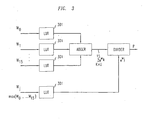
- FIG. 3 shows an exemplary implementation that can be used by the base station receiver to calculate P.
- the 16 outputs, w 0 - w 15 , of 16-FHT 110 are each inputted to a look-up table (LUT) 301 to determine for each input k, e w k .
- LUT 301 is shown in the figure as consisting of separate lookup tables that are used to individually calculate each exponential function for each w k , in an actual implementation a single lookup table can be used to calculate each e w k .
- the w 0 - w 15 16 outputs of LUT 301 are then summed by adder 302 to determine the denominator of equation (1).
- the output w j of 16-FHT 110 (in FIG. 1) selected by sorter 111 (in FIG. 1) as being the largest metric, is then inputted to LUT 301 to determine e w j , the numerator of equation (1).
- Divider 303 then calculates P as per equation (1).
- the reliability information for a detected CQI word is calculated in a similar manner as shown in FIG. 3, except that adder 302 has 32 inputs.
- the above-described embodiment is a minimum probability word error receiver, i.e., the CQI word that results is the index associated with the largest metric at the output of the inverse Hadamard transform applied to the soft symbol metrics of the received Hadamard-coded CQI word. From the network point of view, however, picking the word with the largest metric may not be optimum.
- Table 1 shows the mapping between the channel quality measurement at the mobile terminal on the downlink common pilot channel, which is the downlink E c /N t pilot SNR, and the 4-bit CQI word to be transmitted in the uplink CQI channel.
- the mobile terminal transmits a CQI of '0000' that is detected by the base station receiver as '0001', then the error between the actual E c /N t measured by the mobile terminal and the E c /N t represented by the detected CQI at the base station is only 1.5 dB. If, however, the mobile terminal transmits a CQI of '0000' that is detected by the base station as '1000', then the error is 12 dB. This magnitude of error can have a very significant impact on the MAC layer scheduler performance at the base station in allocating downlink packet rate, power and modulation.
- a minimum bit error probability receiver that individually selects each bit in the decoded CQI word is thus preferable to the prior art minimum probability word error receiver used in the afore-described 3GPP and 3GPP2 systems.
- Such a minimum bit error probability receiver individually selects each bit based on the likelihood ratio determined for each bit.
- the calculation of LR i can be performed using a 256-entry LUT in a manner similar to that performed in FIG. 3 in determining the reliability P for the minimum probability of word error receiver.
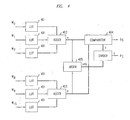
- FIG. 4 shows the calculation of LR 3 as an example for 3GPP2.
- the indexes for which b 3 the MSB of CQI, is '1' correspond to w 8 - w 15 , inclusively, while the indexes for which b 3 is '0' correspond to w 0 - w 7 , inclusively.
- the w 0 - w 7 outputs of 16-FHT 110 (in FIG.
- the reliability information for that decoded bit b 3 is equal to the probability of a decoding error for that bit, P 3 , and is given by equation (4):
- adder 405 forms the denominator by summing x and y.
- Divider 406 divides the numerator z, by the denominator x+y, to produce the output P 3 .
- bits b 2 , b 1 and b o are similarly determined, using the methodology of FIG. 4, with a different set of w k 's being used to determine x and y as is appropriate for the bit b i being determined.
- w k the number of bits that are input to the LUT, appropriately divided to determine for each bit LR i and P i according to the particular bit.
- the upper layer can then use the reliability associated with each individually determined bit value in allocating downlink packet data rate, power and modulation.
- the reliability of the MSB of the CQI is low, upper layer may decide not to use the decoded CQI in determining those parameters and continue to use the parameters previously determined from a more reliable CQI.
- the reliability of only the LSB of the CQI is low, then it may be decided to use the detected CQI since, as noted from Table 1, the likelihood is that there will be at most only a 1.5 dB error in choosing the downlink E c /N t pilot SNR.
- the present invention could be implemented in any CDMA or non-CDMA, wireless or wired electrical or optical communication system that requires a channel quality measurement reported back from a receiving terminal to a transmitting terminal, including, by way of example, an FDM system, or a broadband wireless access system in accord with IEEE 802.11 or other standards such as EVDO.
- the invention may be implemented in different locations, such as a base station (NodeB in UMTS terminology), a base station controller (a Radio Network Controller [RNC] in UMTS terminology) arid/or a mobile switching center (a mobile service switching center [MSC] in UMTS terminology).
- the CQI bit word is coded by a Hadamard coder at the transmitting mobile terminal and the soft symbol metrics of the Hadamard code that are received at the base station are decoded through an inverse Hadamard transform, other coding/decoding schemes can be used such as convolutional coding, BCH block coding, or no coding at all.
- processing circuitry required to implement and use the described invention may be implemented in application specific integrated circuits, software-driven processing circuitry, firmware, programmable logic devices, hardware, discrete components or arrangements of the above components as would be understood by one of ordinary skill in the art with the benefit of this disclosure.
- Those skilled in the art will readily recognize that these and various other modifications, arrangements and methods can be made to the present invention without strictly following the exemplary applications illustrated and described herein and without departing from the spirit and scope of the present invention. It is therefore contemplated that the appended claims will cover any such modifications or embodiments as fall within the true scope of the invention.
Landscapes
- Engineering & Computer Science (AREA)
- Computer Networks & Wireless Communication (AREA)
- Signal Processing (AREA)
- Quality & Reliability (AREA)
- Physics & Mathematics (AREA)
- Electromagnetism (AREA)
- Mobile Radio Communication Systems (AREA)
- Detection And Prevention Of Errors In Transmission (AREA)
Abstract
Description
- This invention relates to wireless communications, and more particularly, to the processing of an uplink Channel Quality Indicator (CQI) received by a base station in a wireless communications system.
- In wireless communications systems, such as those operating in accordance with 3GPP2 CDMA2000-1x EVDV standards or 3GPP UMTS W-CDMA standards, for high-speed data transmission the base station (or NodeB in UMTS terminology) transmits on the forward channel to the mobile terminal (UE [User Equipment] in UMTS terminology) to which the data is directed, a pilot signal (Common Pilot Channel-CPICH for UMTS), a Forward Packet Data Channel (F-PDCH, or High Speed Downlink Shared Control Channel--HS-SCCH for UMTS), and Forward Packet Data Control Channel (F-PDCCH, or High Speed Downlink Shared Channel--HS-DSCH for UMTS). In order for the base station to determine a proper data rate, a modulation scheme, and a transmit power for the F-PDCH and F-PDCCH, it needs to have some measure of how "good" the channel currently is. Accordingly, the mobile terminal provides a measure of channel quality to the base station via a Channel Quality Indicator Channel (CQICH) that is transmitted on the reverse link. In determining what CQI the mobile terminal should transmit back to the base station, the Ec/Nt signal-to-noise ratio (SNR) of the pilot signal received by the mobile terminal from the base station is used by the mobile terminal as an input to a look-up table (LUT), which quantizes that received pilot SNR into 16 possible levels, each of which is represented at a 4-bit CQI word. That CQI, when transmitted by the mobile terminal and received and detected by the base station, is converted at the base station back into its corresponding Ec/Nt pilot SNR, which is then used by the base station to set the downlink power, the modulation scheme, and the rate for the base station's next downlink transmission. Since the received CQI is a measure of the channel condition during a time period that has just passed, the base station may process the determined Ec/Nt to predict a current channel condition.
- A received CQI that has been corrupted by noise on the channel and detected in error can have a deleterious effect on the system performance. For example, if the CQI that has been detected from received soft symbol metrics and converted to its corresponding Ec/Nt pilot SNR is indicative of a channel quality that is better than the actual channel quality, then the base station will allocate a higher rate and lower power than is required, which transmission will then have a high probability of not being accurately received by the mobile terminal. As a result, the base station will likely have to retransmit, thereby affecting system latency. On the other hand, if the detected CQI when converted to its corresponding Ec/Nt pilot SNR is indicative of a channel that is worse than the actual channel quality, then the base station will then transmit at a lower data rate and at a higher power level than is required. This higher-than-necessary power level can cause interference on adjacent cells, and the transmission will take longer than is necessary since its data rate will be lower than what it could be for the actual channel conditions. In both cases, it probably would be better to use a previous CQI value that was known to be a "good" representation of the previous channel condition than a CQI that is a "bad" representation of the current channel condition. The prior art, however, provides no way of determining whether a received CQI is a "good" or a "bad" representation of the current channel condition.
- The inventors have realized that knowledge by the base station of whether the received and detected CQI is likely to be "good" or "bad" would be useful in determining how and whether the value of the received and detected CQI should be used, where the CQI has been transmitted to the base station by the mobile terminal in response to the measured Ec/Nt pilot SNR of the pilot signal transmitted by the base station. In accordance with an embodiment of the present invention, at the base station, a reliability of the received CQI that is detected from received soft symbol metrics is determined in conjunction with the detected CQI value. The base station then uses the determined reliability of the CQI to decide, for example, whether or not to use the detected CQI value in determining a downlink rate, a modulation scheme, and downlink power. In a first embodiment, CQI reliability is determined for the detected CQI word as a whole. A second embodiment takes into account the fact that an error in a more significant bit of the detected CQI word will have a much more deleterious effect than an error in less significant bit.
Thus, rather than using a minimum probability of a word error receiver that selects as a transmitted CQI word the word as a whole that produces a largest metric from a plurality of metrics derived from the received soft symbol metrics, a minimum bit error probability receiver is used that makes a maximum likelihood decision for each CQI bit individually from the plurality of metrics derived from the received soft symbol metrics. Concomitant with individually determining each bit, the reliability of each CQI bit is also individually determined. For the second embodiment, a decision of whether or not to use the resultant detected CQI for determining upper level processing can be made in accordance with a combination of the determined reliability for each bit and each bit's associated significance. CQI word reliability in the first embodiment and the reliability of each CQI bit in the second embodiment are calculated from predetermined functions of the plurality of metrics derived from the received CQI soft symbol metrics. -
- FIG. 1 is a prior art high-level block diagram of the uplink CQI channel transmission between a mobile transmitter and a base station receiver in a 3GPP2 system;
- FIG. 2 is a prior art high-level block diagram of the uplink CQI channel transmission between a mobile transmitter (UE) and a base station receiver (NodeB) in a 3GPP system;
- FIG. 3 shows an implementation for generating the decoded CQI reliability information in a 3GPP2 system; and
- FIG. 4 shows an implementation determining each CQI bit with minimum bit error probability with the associated bit reliability of each bit in a 3GPP2 system.
- As aforenoted, knowledge by the base station of the reliability of a decoded CQI word is advantageous for higher layer processing. As noted, one motivation for generating a reliability function at the base station for the decoded CQI is that the Ec/Nt pilot SNR to which it corresponds is used by the higher layer to allocate a downlink packet data rate, to select a modulation scheme to be used on the downlink (e.g., QPSK, 8-PSK, 16-QAM), and to determine the power at which to transmit on the downlink. By providing the higher layer with knowledge of how reliable the decoded CQI word is, this information then can be used in making a better decision regarding selection of these downlink parameters. A second motivation for generating a reliability function for the decoded CQI word is that the reliability information can be used by the higher layer to monitor the propagation channel condition and to adjust the CQI report repetition rate and report interval accordingly. For example, if the reliability of the decoded and detected CQI words is determined to be good and the CQI variation is slow (which information can be obtained by comparing the rate of change between successive decoded CQI word values), then the higher layer can instruct the mobile terminal to transmit the CQI at a lower rate with no repetition, thereby reducing the drain on the mobile battery and reducing interference on the uplink.
- FIG. 1 shows a prior art high-level block diagram of the uplink CQI channel transmission between a
mobile transmitter 101 and abase station receiver 102 in an exemplary 3GPP2 system. For 3GPP2, a CQI word has four bits. That 4-bit CQI word is derived bymobile transmitter 101 from a measured Ec/Nt of the received SNR of the pilot that was transmitted downlink by the base station. A look-up table (LUT) (not shown) at the mobile transmitter quantizes the measured received Ec/Nt into one of sixteen possible levels, which is represented by the 4-bit CQI word. Atmobile transmitter 101, a 16-point Hadamardencoder 103 encodes that 4-bit CQI word. The encoding is a mapping where the 4-bit CQI word in decimal format is used as row index to select a row vector from a 16x16 Hadamard matrix. The encoded 16-bit word is then punctured bypuncturer 104, which removes the first four bits. BPSKmodulator 105 then modulates the resultant 12-bit word.Multiplexer 106 code-division multiplexes (CDM-es) that 12-bit word with the pilot channel (PICH), the fundamental voice channel (if it is on), the supplemental data channel (if it is on), and the dedicated control channel used for carrying signaling information (if it is on). The CDM-ed signal is transmitted over thepropagation channel 107 to thebase station receiver 102. - At the
base station receiver 102, a despreader/demodulator 108 despreads and demodulates the received CDM-ed signal to recover the PICH, the fundamental voice channel, the supplemental data channel, the dedicated control channel, and the twelve soft-symbol metrics associated with the 12-bit punctured and transmitted Hadamard-encoded CQI word. Depuncturer 109 replaces the soft symbol metrics corresponding to the punctured 4-bits by pre-pending four "0's" to the received 12 soft-symbol metrics associated with the 12-bit punctured and transmitted Hadamard code word. A 16-bit inverse Hadamard transform is then performed by 16-FHT (16-point inverse fast Hadamard transformer) 110, which produces at its output metrics for indices 0-15, corresponding to each possible Hadamard-encoded CQI word.Sorter 111 then selects as the transmitted CQI word, the metric having the largest magnitude (sign-included) and outputs on output 112 as the transmitted CQI word, the 4-bit index corresponding to that selected metric having the largest magnitude. That index is converted by the base station receiver (not shown) to an associated Ec/Nt pilot SNR and is used by the upper layer, as previously described, to set the downlink power, the modulation scheme, and the rate for downlink transmission. - In a prior art 3GPP mobile communications system, shown in FIG. 2, a CQI word has five bits. At the
UE transmitter 201, a 16-bit Hadamardencoder 202 encodes the four least significant bits (LSBs) of the CQI word. The encoding is the same as the one in the above-described 3GPP2 system. One bit of the encoded 16-bit word is repeated four more times byselective repeater 203, yielding a 20-bit word. BPSKmodulator 204 then modulates the resultant 20-bit word. The most significant bit (MSB) of the 5-bit uncoded CQI word is then used to control the signs of all twenty modulated symbols. If MSB=0, there is no sign change; otherwise, sign flipper 205 changes the sign of all twenty BPSK symbols. The resultant signal is then code division multiplexed bymultiplexer 206 with the Dedicated Physical Control Channel (DPCCH, which includes the pilot signals) the Dedicated Physical Data Channel(s) (DPDCH, which time-multiplex voice and data transport channels in one code channel)before being transmitted over thepropagation channel 207. At the NodeBreceiver 208, despreader/demodulator 209 despreads and demodulates the received CDM signal to produce the voice and data transport channels, the DPCCH, and the soft symbol metrics associated with the transmitted 20-bit Hadamard encoded CQI. A de-repeater 210 accumulates the soft symbol metrics of the five symbols that represents the same transmitted coded bit to undo the repetition of that bit atUE transmitter 201. A 16-FHT 211 performs a 16-point inverse fast Hadamard transform to determine the metric associated with each of the 16 indexes with no sign flip. The output metrics represent the indexes from 0-15. Signflipper 212 flips the sign of each of the 16 outputs to produce the metrics that correspond to code words of indexes with MSB=1 for indexes 16-31. Sorter 213 determines the maximum metric out of the 32 metrics and produces on output 214 the index associated with that maximum metric as the 5-bit decoded CQI word. As in 3GPP2, that CQI word is converted to an Ec/Nt pilot SNR and is used by the higher level to determine downlink parameters - In accordance with an embodiment of the present invention, at the receiving base station, in addition to detecting the transmitted CQI word, the reliability of that detected CQI word is determined. As noted above, the higher layer at the base station (NodeB) can then use this determined reliability to make a better decision in selecting an appropriate downlink packet data rate, a modulation scheme, and power allocation. Further, as noted above, the higher layer can use this information to monitor the propagation channel condition and adjust the CQI report repetition rate and report interval.
- As an illustrative example, the 3GPP2 CQI channel is used to show how the reliability information is generated. In FIG. 1, the input metrics to
selector 111 from the output of 16-FHT 110 are designated as w 0 , w 1 , ..., w 15 , forindexes 0, 1, .. ,15. It can be assumed that index 'j' has the largest metric w j , where j can take any value between 0 and 15, inclusive.Selector 111 thus produces 'j' as its output (in binary format), i.e., 'j' is decided as the CQI word that was transmitted and is the detected and decoded CQI word to be passed on to the higher layer for further processing. The reliability information for this decision is the probability that this code word has been decoded correctly. This probability, P, can be calculated from the following equation: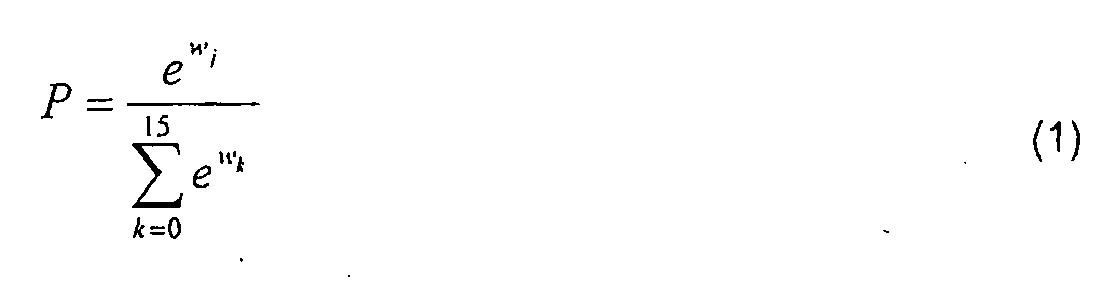
- For an actual hardware or DSP implementation, an 8-bit representation of w j is sufficient. For this case, the exponential function e w
k can be implemented as a 256-entry look-up table. FIG. 3 shows an exemplary implementation that can be used by the base station receiver to calculate P. The 16 outputs, w 0 - w 15 , of 16-FHT 110 (in FIG. 1) are each inputted to a look-up table (LUT) 301 to determine for each input k, e wk . AlthoughLUT 301 is shown in the figure as consisting of separate lookup tables that are used to individually calculate each exponential function for each w k , in an actual implementation a single lookup table can be used to calculate each e wk . The w 0 -w 15 16 outputs ofLUT 301 are then summed by adder 302 to determine the denominator of equation (1). The output w j of 16-FHT 110 (in FIG. 1) selected by sorter 111 (in FIG. 1) as being the largest metric, is then inputted toLUT 301 to determine e wj , the numerator of equation (1). Divider 303 then calculates P as per equation (1). - For a 3GPP system as shown in FIG. 2, the reliability information for a detected CQI word is calculated in a similar manner as shown in FIG. 3, except that adder 302 has 32 inputs.
- The above-described embodiment is a minimum probability word error receiver, i.e., the CQI word that results is the index associated with the largest metric at the output of the inverse Hadamard transform applied to the soft symbol metrics of the received Hadamard-coded CQI word. From the network point of view, however, picking the word with the largest metric may not be optimum. Using 3GPP2 as an example, Table 1 shows the mapping between the channel quality measurement at the mobile terminal on the downlink common pilot channel, which is the downlink Ec/Nt pilot SNR, and the 4-bit CQI word to be transmitted in the uplink CQI channel.
Table 1 Channel Quality (downlink pilot Ec/Nt in dB) 4-bit CQI word -16.25 0000 -14.75 0001 -13.25 0010 -11.75 0011 -10.25 0100 -8.75 0101 -7.25 0110 -5.75 0111 -4.25 1000 -2.75 1001 -1.25 1010 0.25 1011 1.75 1100 3.25 1101 4.75 1110 6.25 1111 - By denoting the CQI word to be decoded as b 3 b 2 b 1 b o from MSB to LSB, the likelihood ratio for bit b i , LR i , can be calculated as follows:


- The calculation of LR i can be performed using a 256-entry LUT in a manner similar to that performed in FIG. 3 in determining the reliability P for the minimum probability of word error receiver. FIG. 4 shows the calculation of LR 3 as an example for 3GPP2. For b 3 , the indexes for which b 3 , the MSB of CQI, is '1' correspond to w 8 - w 15 , inclusively, while the indexes for which b 3 is '0' correspond to w 0 - w 7 , inclusively. Thus, in FIG. 4, the w 0 - w 7 outputs of 16-FHT 110 (in FIG. 1) are inputted to
LUT 401 to determine e wk for each such w k , k=0-7. The w 0 - w 7 outputs of eachLUT 401 are then summed byadder 402 to determine x, the numerator of equation (2) for LR3. Similarly the w 8 - w 15 outputs of 16-FHT 110 (in FIG. 1) are inputted toLUT 401 to determine e wk for each such w k , k = 8-15. These w 8 - w 15 outputs are then summed byadder 403 to determine y, the denominator of equation (2) for LR 3 .Comparator 404 then compares x with y and outputs a '0' as b 3 if x>y, or a '1' as b 3 otherwise. - The reliability information for that decoded bit b 3 is equal to the probability of a decoding error for that bit, P 3 , and is given by equation (4):

- In FIG. 4,
adder 405 forms the denominator by summing x and y.Comparator 404 outputs the numerator z. If x>y, then z=x. Otherwise, z=y. Divider 406 divides the numerator z, by the denominator x+y, to produce the output P 3 . - The other bits, b 2 , b 1 and b o , are similarly determined, using the methodology of FIG. 4, with a different set of w k 's being used to determine x and y as is appropriate for the bit b i being determined. For 3GPP, with a 5-bit CQI word, there would be a total of 32 w k inputs to the LUT, appropriately divided to determine for each bit LR i and Pi according to the particular bit.
- The upper layer can then use the reliability associated with each individually determined bit value in allocating downlink packet data rate, power and modulation. Thus, if the reliability of the MSB of the CQI is low, upper layer may decide not to use the decoded CQI in determining those parameters and continue to use the parameters previously determined from a more reliable CQI. On the other hand, if the reliability of only the LSB of the CQI is low, then it may be decided to use the detected CQI since, as noted from Table 1, the likelihood is that there will be at most only a 1.5 dB error in choosing the downlink Ec/Nt pilot SNR.
- While the particular invention has been described with reference to the illustrative embodiments, this description should not be construed in a limiting sense. It is understood that although the present invention has been described, various modifications of the illustrative embodiments, as well as additional embodiments of the invention, will be apparent to one of ordinary skill in the art upon reference to this description without departing from the spirit of the invention, as recited in the claims appended hereto. Although described in conjunction with 3GPP2 CDMA2000-1x EVDV and 3GPP UMTS W-CDMA standards, the present invention could be implemented in any CDMA or non-CDMA, wireless or wired electrical or optical communication system that requires a channel quality measurement reported back from a receiving terminal to a transmitting terminal, including, by way of example, an FDM system, or a broadband wireless access system in accord with IEEE 802.11 or other standards such as EVDO. Further, the invention may be implemented in different locations, such as a base station (NodeB in UMTS terminology), a base station controller (a Radio Network Controller [RNC] in UMTS terminology) arid/or a mobile switching center (a mobile service switching center [MSC] in UMTS terminology). In wireless systems having a high-speed uplink, it could also be employed in the mobile terminal (UE in UMTS terminology). or elsewhere depending upon in what type of system the invention is employed. Further, although in the described embodiments the CQI bit word is coded by a Hadamard coder at the transmitting mobile terminal and the soft symbol metrics of the Hadamard code that are received at the base station are decoded through an inverse Hadamard transform, other coding/decoding schemes can be used such as convolutional coding, BCH block coding, or no coding at all. The processing circuitry required to implement and use the described invention may be implemented in application specific integrated circuits, software-driven processing circuitry, firmware, programmable logic devices, hardware, discrete components or arrangements of the above components as would be understood by one of ordinary skill in the art with the benefit of this disclosure. Those skilled in the art will readily recognize that these and various other modifications, arrangements and methods can be made to the present invention without strictly following the exemplary applications illustrated and described herein and without departing from the spirit and scope of the present invention. It is therefore contemplated that the appended claims will cover any such modifications or embodiments as fall within the true scope of the invention.
Claims (10)
- A method comprising the steps of:receiving soft symbol metrics associated with a transmitted channel quality indicator;detecting the transmitted channel quality indicator from the received soft symbol metrics;characterized in that the method further comprises:determining a reliability associated with the detected transmitted quality indicator.
- The method of claim 1 wherein the channel quality indicator is a multi-bit word and the reliability is determined for the channel quality indicator word as a whole.
- The method of claim 1 wherein the channel quality indicator is a multi-bit word, and the method is further characterized in that each bit of the channel quality indicator word is individually detected from the received soft symbol metrics, and wherein the reliability of the detected channel quality indicator word is determined for each bit individually.
- The method of claim 2 wherein the transmitted channel quality indicator is an n-bit word and the received soft symbol metrics associated with the transmitted channel quality indicator are converted to 2" metrics w 0, w 2, ...., w 2"-1' that are each associated with a different channel quality word, wherein the detected word is the channel quality word associated with the largest metric, w j , and wherein the reliability of the detected channel quality word is determined by

- The method of claim 3 wherein the transmitted channel quality indicator is an n-bit word and the received soft symbol metrics associated with the transmitted channel quality indicator are converted to 2 n metrics w 0 , w 2 , ...., w 2"-1, that are each associated with a different channel quality word, wherein each bit b i (i = 0 ton-1) of the channel quality indicator word is determined according to whether the likelihood ratio LR i equal to


- Apparatus comprising:receiving means for receiving soft symbol metrics associated with a transmitted channel quality indicator;detecting means for detecting the transmitted channel quality indicator from the received soft symbol metrics;characterized in that the apparatus further comprises:reliability determining means for determining a reliability associated with the detected transmitted quality indicator.
- The apparatus of claim 6 wherein the channel quality indicator is a multi-bit word and the reliability determining means determines the reliability of the channel quality indicator word as a whole.
- The apparatus of claim 6 wherein the channel quality indicator is a multi-bit word, and the detecting means detects each bit of the channel quality indicator word individually from the received soft symbol metrics, and wherein the reliability determining means determines the reliability of the detected channel quality indicator for each bit individually.
- The apparatus of claim 7 wherein the transmitted channel quality indicator is an n-bit word and the received soft symbol metrics associated with the transmitted channel quality indicator are converted to 2 n metrics w 0 , w 2 , ...., w 2"-1, that are each associated with a different channel quality word, wherein the detected word is the channel quality word associated with the largest metric, w j , and wherein the reliability determining means determines the reliability of the detected channel quality word by

- The apparatus of claim 8 wherein the transmitted channel quality indicator is an n-bit word and the received soft symbol metrics associated with the transmitted channel quality indicator are converted to 2 n metrics w 0 , w 2, ...., w2
n -1, that are each associated with a different channel quality word, wherein the detecting means determines each bit b i (i = 0 ton-1) of the channel quality indicator word according to whether the likelihood ratio LR i equal to

Applications Claiming Priority (1)
| Application Number | Priority Date | Filing Date | Title |
|---|---|---|---|
| US10/903,994 US7317702B2 (en) | 2004-07-30 | 2004-07-30 | Method and apparatus for enhancing performance of channel quality indicator (CQI) channel in wireless communications system |
Publications (2)
| Publication Number | Publication Date |
|---|---|
| EP1630995A1 true EP1630995A1 (en) | 2006-03-01 |
| EP1630995B1 EP1630995B1 (en) | 2019-08-28 |
Family
ID=35058195
Family Applications (1)
| Application Number | Title | Priority Date | Filing Date |
|---|---|---|---|
| EP05254499.6A Expired - Lifetime EP1630995B1 (en) | 2004-07-30 | 2005-07-20 | Reliability detection of channel quality indicator (CQI) in a wireless communication system |
Country Status (5)
| Country | Link |
|---|---|
| US (1) | US7317702B2 (en) |
| EP (1) | EP1630995B1 (en) |
| JP (1) | JP5329736B2 (en) |
| KR (1) | KR101197523B1 (en) |
| CN (1) | CN1728587A (en) |
Cited By (3)
| Publication number | Priority date | Publication date | Assignee | Title |
|---|---|---|---|---|
| CN101047471B (en) * | 2006-05-23 | 2010-06-16 | 华为技术有限公司 | Feedback control method and system |
| US7979075B2 (en) | 2006-05-03 | 2011-07-12 | Telefonaktiebolaget Lm Ericsson (Publ) | Generation, deployment and use of tailored channel quality indicator tables |
| KR101444382B1 (en) | 2012-10-11 | 2014-09-26 | 삼성에스디에스 주식회사 | Terminals, system and method for monitoring wireless network and using the same |
Families Citing this family (33)
| Publication number | Priority date | Publication date | Assignee | Title |
|---|---|---|---|---|
| WO2005081439A1 (en) | 2004-02-13 | 2005-09-01 | Neocific, Inc. | Methods and apparatus for multi-carrier communication systems with adaptive transmission and feedback |
| KR101119351B1 (en) | 2005-05-04 | 2012-03-06 | 삼성전자주식회사 | Method and apparatus for transmitting/receiving information in a orthogonal frequency division multiplexing system |
| US7574214B2 (en) * | 2005-05-25 | 2009-08-11 | Intel Corporation | Device, system and method of multiple access transmission |
| US8965440B2 (en) * | 2005-05-31 | 2015-02-24 | Alcatel Lucent | Method of estimating a current channel condition in a wireless communications network |
| US7680125B2 (en) * | 2005-10-19 | 2010-03-16 | Telefonaktiebolaget Lm Ericsson (Publ) | Scheduling packet data transmissions in a packet data network based on early decoded channel feedback reports |
| US7684806B2 (en) | 2005-11-21 | 2010-03-23 | Intel Corporation | Device, system and method of point to multipoint communication |
| US7848347B2 (en) * | 2006-03-23 | 2010-12-07 | Samsung Electronics Co., Ltd. | Pattern-based polling of mobile stations for channel quality information |
| US8463270B2 (en) * | 2006-05-05 | 2013-06-11 | Motorola Mobility Llc | Method and apparatus for providing adjusted handoff parameters based on receiver classification |
| KR100809191B1 (en) * | 2006-06-20 | 2008-02-29 | 엘지노텔 주식회사 | Apparatus and method for transmitting channel quality status display value in mobile communication system |
| US7499718B2 (en) * | 2006-08-01 | 2009-03-03 | Cisco Technology, Inc. | Enhanced coverage hole detection in wireless networks |
| US7623597B2 (en) * | 2006-08-28 | 2009-11-24 | Motorola, Inc. | Block codeword decoder with confidence indicator |
| EP2058957A4 (en) * | 2006-08-29 | 2012-07-18 | Fujitsu Ltd | COMMUNICATION APPARATUS, TERMINAL, AND METHOD FOR CONTROLLING QUALITY OF RADIO CHANNEL |
| JP4967561B2 (en) * | 2006-09-20 | 2012-07-04 | 富士通株式会社 | Mobile communication terminal, mobile communication system, base station, and communication method |
| CN101175059B (en) * | 2006-10-30 | 2013-01-02 | 华为技术有限公司 | Method and device for quantifying channel quality indication |
| JP5281011B2 (en) * | 2006-11-14 | 2013-09-04 | コーニンクレッカ フィリップス エレクトロニクス エヌ ヴィ | Cardiopulmonary resuscitation guidance device with reduced motion sensitivity |
| US8020075B2 (en) | 2007-03-16 | 2011-09-13 | Apple Inc. | Channel quality index feedback reduction for broadband systems |
| US20080316048A1 (en) * | 2007-03-28 | 2008-12-25 | Vmonitor, Inc. | System and method for monitoring a well |
| KR100996060B1 (en) * | 2007-04-04 | 2010-11-22 | 연세대학교 산학협력단 | Method and apparatus for transmitting and receiving data in communication system |
| US7945258B2 (en) * | 2007-07-31 | 2011-05-17 | Broadcom Corporation | Wireless device operable to manipulate high-speed shared control channel (HSSCCH) quality control through channel quality indication report manipulation |
| EP2410782B1 (en) * | 2007-10-01 | 2013-04-17 | Panasonic Corporation | Receiver apparatus and communication method |
| CN101478364B (en) * | 2008-01-02 | 2014-03-12 | 中国移动通信集团上海有限公司 | Adaptive modulation encoding method used for WCDMA network high-speed downlink packet access |
| US8144797B2 (en) * | 2008-03-25 | 2012-03-27 | Intel Mobile Communications GmbH | CQI table for wireless MIMO networks |
| CN101651885B (en) * | 2008-08-14 | 2012-11-14 | 展讯通信(上海)有限公司 | Method for enhancing performance of control channels in communication systems |
| CN101754347B (en) * | 2008-12-19 | 2012-07-25 | 电信科学技术研究院 | CQI estimation method, system and device during multi-stream beamforming transmission |
| US8649456B2 (en) | 2009-03-12 | 2014-02-11 | Futurewei Technologies, Inc. | System and method for channel information feedback in a wireless communications system |
| US8675627B2 (en) * | 2009-03-23 | 2014-03-18 | Futurewei Technologies, Inc. | Adaptive precoding codebooks for wireless communications |
| US8565143B2 (en) | 2009-10-16 | 2013-10-22 | At&T Mobility Ii, Llc | Dynamic content distribution in mobile telecommunications network |
| US9191093B2 (en) * | 2009-10-20 | 2015-11-17 | The Regents Of The University Of California | Interference management for concurrent transmission in downlink wireless communications |
| CN103188784B (en) * | 2011-12-28 | 2016-01-13 | 中国电信股份有限公司 | The power distribution method of a kind of PDCCH, base station and mobile communication system |
| US8879475B2 (en) | 2012-05-15 | 2014-11-04 | Apple Inc. | Adaptive channel state feedback in discontinuous reception scenarios based on connection characteristics |
| US9282473B2 (en) | 2012-06-07 | 2016-03-08 | Samsung Electronics Co., Ltd. | Wireless communication system with channel-quality indicator mechanism and method of operation thereof |
| CN112204898B (en) * | 2018-07-06 | 2022-07-29 | 华为技术有限公司 | Apparatus and method for adaptively adjusting MIMO transmission scheme |
| CN113039732A (en) * | 2018-09-06 | 2021-06-25 | 诺基亚通信公司 | ACQI decoding confidence detection |
Citations (3)
| Publication number | Priority date | Publication date | Assignee | Title |
|---|---|---|---|---|
| EP1349292A2 (en) * | 2002-03-26 | 2003-10-01 | Samsung Electronics Co., Ltd. | Apparatus and method for coding and decoding Channel Quality Indicator information in communication system using high speed downlink packet access |
| US20040057394A1 (en) * | 2002-09-23 | 2004-03-25 | Holtzman Jack M. | Mean square estimation of channel quality measure |
| WO2004051872A2 (en) * | 2002-12-04 | 2004-06-17 | Interdigital Technology Corporation | Detection of channel quality indicator |
Family Cites Families (2)
| Publication number | Priority date | Publication date | Assignee | Title |
|---|---|---|---|---|
| US6850736B2 (en) * | 2000-12-21 | 2005-02-01 | Tropian, Inc. | Method and apparatus for reception quality indication in wireless communication |
| AU2002329076B2 (en) * | 2001-08-31 | 2004-04-22 | Samsung Electronics Co., Ltd. | Apparatus and method for transmitting and receiving forward channel quality information in a mobile communication system |
-
2004
- 2004-07-30 US US10/903,994 patent/US7317702B2/en not_active Expired - Lifetime
-
2005
- 2005-07-20 EP EP05254499.6A patent/EP1630995B1/en not_active Expired - Lifetime
- 2005-07-22 KR KR1020050066700A patent/KR101197523B1/en not_active Expired - Fee Related
- 2005-07-29 JP JP2005219889A patent/JP5329736B2/en not_active Expired - Fee Related
- 2005-07-29 CN CNA2005100876952A patent/CN1728587A/en active Pending
Patent Citations (3)
| Publication number | Priority date | Publication date | Assignee | Title |
|---|---|---|---|---|
| EP1349292A2 (en) * | 2002-03-26 | 2003-10-01 | Samsung Electronics Co., Ltd. | Apparatus and method for coding and decoding Channel Quality Indicator information in communication system using high speed downlink packet access |
| US20040057394A1 (en) * | 2002-09-23 | 2004-03-25 | Holtzman Jack M. | Mean square estimation of channel quality measure |
| WO2004051872A2 (en) * | 2002-12-04 | 2004-06-17 | Interdigital Technology Corporation | Detection of channel quality indicator |
Cited By (3)
| Publication number | Priority date | Publication date | Assignee | Title |
|---|---|---|---|---|
| US7979075B2 (en) | 2006-05-03 | 2011-07-12 | Telefonaktiebolaget Lm Ericsson (Publ) | Generation, deployment and use of tailored channel quality indicator tables |
| CN101047471B (en) * | 2006-05-23 | 2010-06-16 | 华为技术有限公司 | Feedback control method and system |
| KR101444382B1 (en) | 2012-10-11 | 2014-09-26 | 삼성에스디에스 주식회사 | Terminals, system and method for monitoring wireless network and using the same |
Also Published As
| Publication number | Publication date |
|---|---|
| EP1630995B1 (en) | 2019-08-28 |
| JP2006050618A (en) | 2006-02-16 |
| KR101197523B1 (en) | 2012-11-09 |
| CN1728587A (en) | 2006-02-01 |
| US7317702B2 (en) | 2008-01-08 |
| KR20060046586A (en) | 2006-05-17 |
| US20060023650A1 (en) | 2006-02-02 |
| JP5329736B2 (en) | 2013-10-30 |
Similar Documents
| Publication | Publication Date | Title |
|---|---|---|
| EP1630995B1 (en) | Reliability detection of channel quality indicator (CQI) in a wireless communication system | |
| US7499721B2 (en) | Apparatus and method for transmitting and receiving forward channel quality information in a mobile communication system | |
| US7333546B2 (en) | Coding apparatus and method in a CDMA mobile communication system | |
| KR101549572B1 (en) | METHOD AND APPARATUS FOR ADJUSTING TRANSMISSION POWER OF PHYSICAL CONTROL CHANNEL FOR TRANSMISSION OF CHANNEL QUALITY RECOGNITION IN MOBILE COMM | |
| US6934556B2 (en) | Transmission power correcting method, mobile communications system and mobile station | |
| EP1016299B1 (en) | A power control subsystem | |
| US20010008542A1 (en) | Method and apparatus for a CDMA cellular radio transmission system | |
| US20030123396A1 (en) | Apparatus and method for reporting quality of downlink channel in W-CDMA communication systems supporting HSDPA | |
| AU2002329076A1 (en) | Apparatus and method for transmitting and receiving forward channel quality information in a mobile communication system | |
| CN1136372A (en) | Method and decoder circuit and system for decoding non-coherently demodulated signals | |
| CN1293879A (en) | Method for estimating carrier-to-interference radio in radio communication system and communication device implement the method | |
| US20060067242A1 (en) | Packet error rate estimation in a communication system | |
| US7392459B2 (en) | Method and apparatus for preventing a false pass of a cyclic redundancy check at a receiver during weak receiving conditions in a wireless communications system | |
| GB2389021A (en) | Blind transport format detection with preselection of candidate transport formats | |
| KR101618728B1 (en) | Method and apparatus for transmission power control of physical control channel for cqi in mobile telecommunication system supporting multi-cell hsdpa | |
| HK1030124B (en) | A power control subsystem | |
| HK1037090A (en) | A method of establishing the carrier-to-interference ratio in a radio communication system and a communication device for carrying out the method | |
| HK1028309A (en) | Method and apparatus for determining the rate of received data in a variable rate communication system |
Legal Events
| Date | Code | Title | Description |
|---|---|---|---|
| PUAI | Public reference made under article 153(3) epc to a published international application that has entered the european phase |
Free format text: ORIGINAL CODE: 0009012 |
|
| 17P | Request for examination filed |
Effective date: 20050802 |
|
| AK | Designated contracting states |
Kind code of ref document: A1 Designated state(s): AT BE BG CH CY CZ DE DK EE ES FI FR GB GR HU IE IS IT LI LT LU LV MC NL PL PT RO SE SI SK TR |
|
| AX | Request for extension of the european patent |
Extension state: AL BA HR MK YU |
|
| AKX | Designation fees paid |
Designated state(s): DE FR GB |
|
| 17Q | First examination report despatched |
Effective date: 20051229 |
|
| RAP3 | Party data changed (applicant data changed or rights of an application transferred) |
Owner name: LUCENT TECHNOLOGIES INC. |
|
| RAP1 | Party data changed (applicant data changed or rights of an application transferred) |
Owner name: ALCATEL LUCENT |
|
| 111Z | Information provided on other rights and legal means of execution |
Free format text: DE FR GB Effective date: 20130410 |
|
| RAP1 | Party data changed (applicant data changed or rights of an application transferred) |
Owner name: ALCATEL LUCENT |
|
| D11X | Information provided on other rights and legal means of execution (deleted) | ||
| REG | Reference to a national code |
Ref country code: DE Ref legal event code: R079 Ref document number: 602005056189 Country of ref document: DE Free format text: PREVIOUS MAIN CLASS: H04L0001000000 Ipc: H04L0001200000 |
|
| GRAP | Despatch of communication of intention to grant a patent |
Free format text: ORIGINAL CODE: EPIDOSNIGR1 |
|
| RIC1 | Information provided on ipc code assigned before grant |
Ipc: H04L 1/00 20060101ALI20170629BHEP Ipc: H04B 17/21 20150101ALN20170629BHEP Ipc: H04B 7/005 20060101ALI20170629BHEP Ipc: H04L 1/20 20060101AFI20170629BHEP Ipc: H04B 17/309 20150101ALN20170629BHEP Ipc: H04W 52/04 20090101ALN20170629BHEP |
|
| INTG | Intention to grant announced |
Effective date: 20170727 |
|
| RIC1 | Information provided on ipc code assigned before grant |
Ipc: H04W 52/04 20090101ALN20170714BHEP Ipc: H04L 1/00 20060101ALI20170714BHEP Ipc: H04B 7/005 20060101ALI20170714BHEP Ipc: H04B 17/21 20150101ALN20170714BHEP Ipc: H04L 1/20 20060101AFI20170714BHEP Ipc: H04B 17/309 20150101ALN20170714BHEP |
|
| RAP1 | Party data changed (applicant data changed or rights of an application transferred) |
Owner name: ALCATEL LUCENT |
|
| GRAS | Grant fee paid |
Free format text: ORIGINAL CODE: EPIDOSNIGR3 |
|
| GRAA | (expected) grant |
Free format text: ORIGINAL CODE: 0009210 |
|
| AK | Designated contracting states |
Kind code of ref document: B1 Designated state(s): DE FR GB |
|
| REG | Reference to a national code |
Ref country code: GB Ref legal event code: FG4D |
|
| REG | Reference to a national code |
Ref country code: DE Ref legal event code: R096 Ref document number: 602005056189 Country of ref document: DE |
|
| REG | Reference to a national code |
Ref country code: DE Ref legal event code: R097 Ref document number: 602005056189 Country of ref document: DE |
|
| PLBE | No opposition filed within time limit |
Free format text: ORIGINAL CODE: 0009261 |
|
| STAA | Information on the status of an ep patent application or granted ep patent |
Free format text: STATUS: NO OPPOSITION FILED WITHIN TIME LIMIT |
|
| 26N | No opposition filed |
Effective date: 20200603 |
|
| P01 | Opt-out of the competence of the unified patent court (upc) registered |
Effective date: 20230606 |
|
| PGFP | Annual fee paid to national office [announced via postgrant information from national office to epo] |
Ref country code: GB Payment date: 20241227 Year of fee payment: 20 |
|
| PGFP | Annual fee paid to national office [announced via postgrant information from national office to epo] |
Ref country code: FR Payment date: 20241226 Year of fee payment: 20 |
|
| PGFP | Annual fee paid to national office [announced via postgrant information from national office to epo] |
Ref country code: DE Payment date: 20241227 Year of fee payment: 20 |
|
| REG | Reference to a national code |
Ref country code: DE Ref legal event code: R071 Ref document number: 602005056189 Country of ref document: DE |
|
| REG | Reference to a national code |
Ref country code: GB Ref legal event code: PE20 Expiry date: 20250719 |