EP1630435A2 - Plain bearing friction layer - Google Patents
Plain bearing friction layer Download PDFInfo
- Publication number
- EP1630435A2 EP1630435A2 EP20050254933 EP05254933A EP1630435A2 EP 1630435 A2 EP1630435 A2 EP 1630435A2 EP 20050254933 EP20050254933 EP 20050254933 EP 05254933 A EP05254933 A EP 05254933A EP 1630435 A2 EP1630435 A2 EP 1630435A2
- Authority
- EP
- European Patent Office
- Prior art keywords
- layer
- coating
- substrate
- component
- dlc
- Prior art date
- Legal status (The legal status is an assumption and is not a legal conclusion. Google has not performed a legal analysis and makes no representation as to the accuracy of the status listed.)
- Withdrawn
Links
- 238000000576 coating method Methods 0.000 claims abstract description 63
- 239000011248 coating agent Substances 0.000 claims abstract description 54
- 239000000758 substrate Substances 0.000 claims abstract description 39
- 239000012530 fluid Substances 0.000 claims description 12
- XEEYBQQBJWHFJM-UHFFFAOYSA-N Iron Chemical compound [Fe] XEEYBQQBJWHFJM-UHFFFAOYSA-N 0.000 claims description 10
- PXHVJJICTQNCMI-UHFFFAOYSA-N Nickel Chemical compound [Ni] PXHVJJICTQNCMI-UHFFFAOYSA-N 0.000 claims description 10
- 239000010936 titanium Substances 0.000 claims description 10
- BQCADISMDOOEFD-UHFFFAOYSA-N Silver Chemical compound [Ag] BQCADISMDOOEFD-UHFFFAOYSA-N 0.000 claims description 9
- 229910052709 silver Inorganic materials 0.000 claims description 9
- 239000004332 silver Substances 0.000 claims description 9
- OKTJSMMVPCPJKN-UHFFFAOYSA-N Carbon Chemical compound [C] OKTJSMMVPCPJKN-UHFFFAOYSA-N 0.000 claims description 7
- 229910052799 carbon Inorganic materials 0.000 claims description 7
- 239000000314 lubricant Substances 0.000 claims description 7
- 239000007787 solid Substances 0.000 claims description 7
- OAKJQQAXSVQMHS-UHFFFAOYSA-N Hydrazine Chemical compound NN OAKJQQAXSVQMHS-UHFFFAOYSA-N 0.000 claims description 6
- RTAQQCXQSZGOHL-UHFFFAOYSA-N Titanium Chemical compound [Ti] RTAQQCXQSZGOHL-UHFFFAOYSA-N 0.000 claims description 6
- 238000000034 method Methods 0.000 claims description 6
- 229910000601 superalloy Inorganic materials 0.000 claims description 6
- 229910052719 titanium Inorganic materials 0.000 claims description 6
- 229910001069 Ti alloy Inorganic materials 0.000 claims description 5
- 229910052739 hydrogen Inorganic materials 0.000 claims description 5
- 239000001257 hydrogen Substances 0.000 claims description 5
- 238000005240 physical vapour deposition Methods 0.000 claims description 5
- 238000000623 plasma-assisted chemical vapour deposition Methods 0.000 claims description 5
- 239000010941 cobalt Substances 0.000 claims description 4
- 229910017052 cobalt Inorganic materials 0.000 claims description 4
- GUTLYIVDDKVIGB-UHFFFAOYSA-N cobalt atom Chemical compound [Co] GUTLYIVDDKVIGB-UHFFFAOYSA-N 0.000 claims description 4
- 229910052742 iron Inorganic materials 0.000 claims description 4
- 229910052759 nickel Inorganic materials 0.000 claims description 4
- 239000011888 foil Substances 0.000 claims description 3
- 239000003350 kerosene Substances 0.000 claims description 2
- 239000007788 liquid Substances 0.000 claims description 2
- MYMOFIZGZYHOMD-UHFFFAOYSA-N Dioxygen Chemical compound O=O MYMOFIZGZYHOMD-UHFFFAOYSA-N 0.000 claims 1
- 125000004435 hydrogen atom Chemical class [H]* 0.000 claims 1
- 239000010410 layer Substances 0.000 description 31
- 239000000203 mixture Substances 0.000 description 8
- 238000012360 testing method Methods 0.000 description 6
- 238000000151 deposition Methods 0.000 description 5
- 239000000956 alloy Substances 0.000 description 4
- 230000008021 deposition Effects 0.000 description 4
- 229910045601 alloy Inorganic materials 0.000 description 3
- 239000000463 material Substances 0.000 description 3
- 239000010955 niobium Substances 0.000 description 3
- UFHFLCQGNIYNRP-UHFFFAOYSA-N Hydrogen Chemical compound [H][H] UFHFLCQGNIYNRP-UHFFFAOYSA-N 0.000 description 2
- 239000011247 coating layer Substances 0.000 description 2
- 238000002485 combustion reaction Methods 0.000 description 2
- 150000002431 hydrogen Chemical class 0.000 description 2
- JTJMJGYZQZDUJJ-UHFFFAOYSA-N phencyclidine Chemical compound C1CCCCN1C1(C=2C=CC=CC=2)CCCCC1 JTJMJGYZQZDUJJ-UHFFFAOYSA-N 0.000 description 2
- 239000002760 rocket fuel Substances 0.000 description 2
- 229910052710 silicon Inorganic materials 0.000 description 2
- 229910000531 Co alloy Inorganic materials 0.000 description 1
- XUIMIQQOPSSXEZ-UHFFFAOYSA-N Silicon Chemical compound [Si] XUIMIQQOPSSXEZ-UHFFFAOYSA-N 0.000 description 1
- KGWWEXORQXHJJQ-UHFFFAOYSA-N [Fe].[Co].[Ni] Chemical compound [Fe].[Co].[Ni] KGWWEXORQXHJJQ-UHFFFAOYSA-N 0.000 description 1
- 229910003481 amorphous carbon Inorganic materials 0.000 description 1
- QVGXLLKOCUKJST-UHFFFAOYSA-N atomic oxygen Chemical compound [O] QVGXLLKOCUKJST-UHFFFAOYSA-N 0.000 description 1
- 125000004432 carbon atom Chemical group C* 0.000 description 1
- 229910052804 chromium Inorganic materials 0.000 description 1
- 238000010276 construction Methods 0.000 description 1
- 238000011161 development Methods 0.000 description 1
- 239000002019 doping agent Substances 0.000 description 1
- 238000000635 electron micrograph Methods 0.000 description 1
- 238000005516 engineering process Methods 0.000 description 1
- 230000007613 environmental effect Effects 0.000 description 1
- 239000000446 fuel Substances 0.000 description 1
- 239000012535 impurity Substances 0.000 description 1
- 229910001293 incoloy Inorganic materials 0.000 description 1
- 238000007373 indentation Methods 0.000 description 1
- 230000003993 interaction Effects 0.000 description 1
- 238000009533 lab test Methods 0.000 description 1
- 238000005461 lubrication Methods 0.000 description 1
- 230000013011 mating Effects 0.000 description 1
- 238000012986 modification Methods 0.000 description 1
- 230000004048 modification Effects 0.000 description 1
- 239000002114 nanocomposite Substances 0.000 description 1
- 229910052758 niobium Inorganic materials 0.000 description 1
- GUCVJGMIXFAOAE-UHFFFAOYSA-N niobium atom Chemical compound [Nb] GUCVJGMIXFAOAE-UHFFFAOYSA-N 0.000 description 1
- 239000007800 oxidant agent Substances 0.000 description 1
- 229910052760 oxygen Inorganic materials 0.000 description 1
- 239000001301 oxygen Substances 0.000 description 1
- 230000000704 physical effect Effects 0.000 description 1
- 238000004881 precipitation hardening Methods 0.000 description 1
- 239000003380 propellant Substances 0.000 description 1
- 239000010703 silicon Substances 0.000 description 1
- 239000002356 single layer Substances 0.000 description 1
- 230000003746 surface roughness Effects 0.000 description 1
- 238000012546 transfer Methods 0.000 description 1
- 230000001052 transient effect Effects 0.000 description 1
Images



Classifications
-
- F—MECHANICAL ENGINEERING; LIGHTING; HEATING; WEAPONS; BLASTING
- F16—ENGINEERING ELEMENTS AND UNITS; GENERAL MEASURES FOR PRODUCING AND MAINTAINING EFFECTIVE FUNCTIONING OF MACHINES OR INSTALLATIONS; THERMAL INSULATION IN GENERAL
- F16C—SHAFTS; FLEXIBLE SHAFTS; ELEMENTS OR CRANKSHAFT MECHANISMS; ROTARY BODIES OTHER THAN GEARING ELEMENTS; BEARINGS
- F16C33/00—Parts of bearings; Special methods for making bearings or parts thereof
- F16C33/02—Parts of sliding-contact bearings
- F16C33/04—Brasses; Bushes; Linings
- F16C33/06—Sliding surface mainly made of metal
- F16C33/14—Special methods of manufacture; Running-in
-
- C—CHEMISTRY; METALLURGY
- C22—METALLURGY; FERROUS OR NON-FERROUS ALLOYS; TREATMENT OF ALLOYS OR NON-FERROUS METALS
- C22C—ALLOYS
- C22C14/00—Alloys based on titanium
-
- C—CHEMISTRY; METALLURGY
- C22—METALLURGY; FERROUS OR NON-FERROUS ALLOYS; TREATMENT OF ALLOYS OR NON-FERROUS METALS
- C22C—ALLOYS
- C22C19/00—Alloys based on nickel or cobalt
- C22C19/03—Alloys based on nickel or cobalt based on nickel
- C22C19/05—Alloys based on nickel or cobalt based on nickel with chromium
- C22C19/051—Alloys based on nickel or cobalt based on nickel with chromium and Mo or W
- C22C19/055—Alloys based on nickel or cobalt based on nickel with chromium and Mo or W with the maximum Cr content being at least 20% but less than 30%
-
- C—CHEMISTRY; METALLURGY
- C22—METALLURGY; FERROUS OR NON-FERROUS ALLOYS; TREATMENT OF ALLOYS OR NON-FERROUS METALS
- C22C—ALLOYS
- C22C19/00—Alloys based on nickel or cobalt
- C22C19/03—Alloys based on nickel or cobalt based on nickel
- C22C19/05—Alloys based on nickel or cobalt based on nickel with chromium
- C22C19/051—Alloys based on nickel or cobalt based on nickel with chromium and Mo or W
- C22C19/056—Alloys based on nickel or cobalt based on nickel with chromium and Mo or W with the maximum Cr content being at least 10% but less than 20%
-
- C—CHEMISTRY; METALLURGY
- C22—METALLURGY; FERROUS OR NON-FERROUS ALLOYS; TREATMENT OF ALLOYS OR NON-FERROUS METALS
- C22C—ALLOYS
- C22C30/00—Alloys containing less than 50% by weight of each constituent
-
- C—CHEMISTRY; METALLURGY
- C22—METALLURGY; FERROUS OR NON-FERROUS ALLOYS; TREATMENT OF ALLOYS OR NON-FERROUS METALS
- C22C—ALLOYS
- C22C38/00—Ferrous alloys, e.g. steel alloys
- C22C38/02—Ferrous alloys, e.g. steel alloys containing silicon
-
- C—CHEMISTRY; METALLURGY
- C22—METALLURGY; FERROUS OR NON-FERROUS ALLOYS; TREATMENT OF ALLOYS OR NON-FERROUS METALS
- C22C—ALLOYS
- C22C38/00—Ferrous alloys, e.g. steel alloys
- C22C38/06—Ferrous alloys, e.g. steel alloys containing aluminium
-
- C—CHEMISTRY; METALLURGY
- C22—METALLURGY; FERROUS OR NON-FERROUS ALLOYS; TREATMENT OF ALLOYS OR NON-FERROUS METALS
- C22C—ALLOYS
- C22C38/00—Ferrous alloys, e.g. steel alloys
- C22C38/10—Ferrous alloys, e.g. steel alloys containing cobalt
- C22C38/105—Ferrous alloys, e.g. steel alloys containing cobalt containing Co and Ni
-
- C—CHEMISTRY; METALLURGY
- C22—METALLURGY; FERROUS OR NON-FERROUS ALLOYS; TREATMENT OF ALLOYS OR NON-FERROUS METALS
- C22C—ALLOYS
- C22C38/00—Ferrous alloys, e.g. steel alloys
- C22C38/12—Ferrous alloys, e.g. steel alloys containing tungsten, tantalum, molybdenum, vanadium, or niobium
-
- C—CHEMISTRY; METALLURGY
- C22—METALLURGY; FERROUS OR NON-FERROUS ALLOYS; TREATMENT OF ALLOYS OR NON-FERROUS METALS
- C22C—ALLOYS
- C22C38/00—Ferrous alloys, e.g. steel alloys
- C22C38/14—Ferrous alloys, e.g. steel alloys containing titanium or zirconium
-
- F—MECHANICAL ENGINEERING; LIGHTING; HEATING; WEAPONS; BLASTING
- F04—POSITIVE - DISPLACEMENT MACHINES FOR LIQUIDS; PUMPS FOR LIQUIDS OR ELASTIC FLUIDS
- F04D—NON-POSITIVE-DISPLACEMENT PUMPS
- F04D29/00—Details, component parts, or accessories
- F04D29/04—Shafts or bearings, or assemblies thereof
- F04D29/046—Bearings
- F04D29/0465—Ceramic bearing designs
-
- F—MECHANICAL ENGINEERING; LIGHTING; HEATING; WEAPONS; BLASTING
- F16—ENGINEERING ELEMENTS AND UNITS; GENERAL MEASURES FOR PRODUCING AND MAINTAINING EFFECTIVE FUNCTIONING OF MACHINES OR INSTALLATIONS; THERMAL INSULATION IN GENERAL
- F16C—SHAFTS; FLEXIBLE SHAFTS; ELEMENTS OR CRANKSHAFT MECHANISMS; ROTARY BODIES OTHER THAN GEARING ELEMENTS; BEARINGS
- F16C23/00—Bearings for exclusively rotary movement adjustable for aligning or positioning
- F16C23/02—Sliding-contact bearings
- F16C23/04—Sliding-contact bearings self-adjusting
- F16C23/041—Sliding-contact bearings self-adjusting with edge relief
-
- F—MECHANICAL ENGINEERING; LIGHTING; HEATING; WEAPONS; BLASTING
- F16—ENGINEERING ELEMENTS AND UNITS; GENERAL MEASURES FOR PRODUCING AND MAINTAINING EFFECTIVE FUNCTIONING OF MACHINES OR INSTALLATIONS; THERMAL INSULATION IN GENERAL
- F16C—SHAFTS; FLEXIBLE SHAFTS; ELEMENTS OR CRANKSHAFT MECHANISMS; ROTARY BODIES OTHER THAN GEARING ELEMENTS; BEARINGS
- F16C33/00—Parts of bearings; Special methods for making bearings or parts thereof
- F16C33/02—Parts of sliding-contact bearings
- F16C33/04—Brasses; Bushes; Linings
- F16C33/06—Sliding surface mainly made of metal
- F16C33/12—Structural composition; Use of special materials or surface treatments, e.g. for rust-proofing
- F16C33/121—Use of special materials
-
- F—MECHANICAL ENGINEERING; LIGHTING; HEATING; WEAPONS; BLASTING
- F16—ENGINEERING ELEMENTS AND UNITS; GENERAL MEASURES FOR PRODUCING AND MAINTAINING EFFECTIVE FUNCTIONING OF MACHINES OR INSTALLATIONS; THERMAL INSULATION IN GENERAL
- F16C—SHAFTS; FLEXIBLE SHAFTS; ELEMENTS OR CRANKSHAFT MECHANISMS; ROTARY BODIES OTHER THAN GEARING ELEMENTS; BEARINGS
- F16C33/00—Parts of bearings; Special methods for making bearings or parts thereof
- F16C33/02—Parts of sliding-contact bearings
- F16C33/04—Brasses; Bushes; Linings
- F16C33/06—Sliding surface mainly made of metal
- F16C33/12—Structural composition; Use of special materials or surface treatments, e.g. for rust-proofing
- F16C33/128—Porous bearings, e.g. bushes of sintered alloy
-
- F—MECHANICAL ENGINEERING; LIGHTING; HEATING; WEAPONS; BLASTING
- F16—ENGINEERING ELEMENTS AND UNITS; GENERAL MEASURES FOR PRODUCING AND MAINTAINING EFFECTIVE FUNCTIONING OF MACHINES OR INSTALLATIONS; THERMAL INSULATION IN GENERAL
- F16C—SHAFTS; FLEXIBLE SHAFTS; ELEMENTS OR CRANKSHAFT MECHANISMS; ROTARY BODIES OTHER THAN GEARING ELEMENTS; BEARINGS
- F16C7/00—Connecting-rods or like links pivoted at both ends; Construction of connecting-rod heads
- F16C7/02—Constructions of connecting-rods with constant length
- F16C7/023—Constructions of connecting-rods with constant length for piston engines, pumps or the like
-
- F—MECHANICAL ENGINEERING; LIGHTING; HEATING; WEAPONS; BLASTING
- F16—ENGINEERING ELEMENTS AND UNITS; GENERAL MEASURES FOR PRODUCING AND MAINTAINING EFFECTIVE FUNCTIONING OF MACHINES OR INSTALLATIONS; THERMAL INSULATION IN GENERAL
- F16C—SHAFTS; FLEXIBLE SHAFTS; ELEMENTS OR CRANKSHAFT MECHANISMS; ROTARY BODIES OTHER THAN GEARING ELEMENTS; BEARINGS
- F16C9/00—Bearings for crankshafts or connecting-rods; Attachment of connecting-rods
- F16C9/04—Connecting-rod bearings; Attachments thereof
-
- F—MECHANICAL ENGINEERING; LIGHTING; HEATING; WEAPONS; BLASTING
- F16—ENGINEERING ELEMENTS AND UNITS; GENERAL MEASURES FOR PRODUCING AND MAINTAINING EFFECTIVE FUNCTIONING OF MACHINES OR INSTALLATIONS; THERMAL INSULATION IN GENERAL
- F16C—SHAFTS; FLEXIBLE SHAFTS; ELEMENTS OR CRANKSHAFT MECHANISMS; ROTARY BODIES OTHER THAN GEARING ELEMENTS; BEARINGS
- F16C2223/00—Surface treatments; Hardening; Coating
- F16C2223/30—Coating surfaces
- F16C2223/60—Coating surfaces by vapour deposition, e.g. PVD, CVD
-
- Y—GENERAL TAGGING OF NEW TECHNOLOGICAL DEVELOPMENTS; GENERAL TAGGING OF CROSS-SECTIONAL TECHNOLOGIES SPANNING OVER SEVERAL SECTIONS OF THE IPC; TECHNICAL SUBJECTS COVERED BY FORMER USPC CROSS-REFERENCE ART COLLECTIONS [XRACs] AND DIGESTS
- Y10—TECHNICAL SUBJECTS COVERED BY FORMER USPC
- Y10T—TECHNICAL SUBJECTS COVERED BY FORMER US CLASSIFICATION
- Y10T428/00—Stock material or miscellaneous articles
- Y10T428/24—Structurally defined web or sheet [e.g., overall dimension, etc.]
- Y10T428/24942—Structurally defined web or sheet [e.g., overall dimension, etc.] including components having same physical characteristic in differing degree
- Y10T428/2495—Thickness [relative or absolute]
-
- Y—GENERAL TAGGING OF NEW TECHNOLOGICAL DEVELOPMENTS; GENERAL TAGGING OF CROSS-SECTIONAL TECHNOLOGIES SPANNING OVER SEVERAL SECTIONS OF THE IPC; TECHNICAL SUBJECTS COVERED BY FORMER USPC CROSS-REFERENCE ART COLLECTIONS [XRACs] AND DIGESTS
- Y10—TECHNICAL SUBJECTS COVERED BY FORMER USPC
- Y10T—TECHNICAL SUBJECTS COVERED BY FORMER US CLASSIFICATION
- Y10T428/00—Stock material or miscellaneous articles
- Y10T428/26—Web or sheet containing structurally defined element or component, the element or component having a specified physical dimension
- Y10T428/263—Coating layer not in excess of 5 mils thick or equivalent
- Y10T428/264—Up to 3 mils
-
- Y—GENERAL TAGGING OF NEW TECHNOLOGICAL DEVELOPMENTS; GENERAL TAGGING OF CROSS-SECTIONAL TECHNOLOGIES SPANNING OVER SEVERAL SECTIONS OF THE IPC; TECHNICAL SUBJECTS COVERED BY FORMER USPC CROSS-REFERENCE ART COLLECTIONS [XRACs] AND DIGESTS
- Y10—TECHNICAL SUBJECTS COVERED BY FORMER USPC
- Y10T—TECHNICAL SUBJECTS COVERED BY FORMER US CLASSIFICATION
- Y10T428/00—Stock material or miscellaneous articles
- Y10T428/31504—Composite [nonstructural laminate]
- Y10T428/31678—Of metal
Definitions
- the invention relates to bearings. More particularly, the invention relates to bearings in cryogenic turbopumps.
- turbomachines are subject to use at cryogenic temperatures.
- turbopumps are used in rocket propulsion to pump cryogenic liquids such as oxygen, hydrogen, and hydrazine.
- cryogenic liquids such as oxygen, hydrogen, and hydrazine.
- One exemplary turbopump configuration is shown in U.S. Patent 5,529,464.
- Bearing performance is critical to operation of such machines. Often, the machines are subject to a variety of conditions including start-up, shut-down, and other transient operations.
- the bearings may be configured for lubrication by the working fluid.
- start-up and shut-down conditions may exacerbate asperity contact between bearing surfaces. Accordingly, much development work has gone into bearings for such applications.
- complex foil bearing constructions e.g., as proposed in U.S. Patent 6,158,893
- diamond-like coatings including diamond-like carbon (DLC) and diamond-like nanocomposite (DLN) coatings.
- DLC diamond-like carbon
- DLN diamond-like nanocomposite
- Exemplary DLN coatings are described in U.S. Patents 5,352,493, 5,466,431, 5,728,465, 6,200,675, and 6,228,471.
- Exemplary DLC and DLN coatings and application services are available from Bekaert Dymonics n.v., Zulte, Belgium.
- Diamond-like coatings are generally amorphous carbon-based coatings with a high hardness and a low coefficient of friction.
- Exemplary DLC coatings involve a mixture of SP2 and SP3 bonded carbon atoms stabilized by hydrogen.
- Exemplary DLN coatings involve interpenetrating networks of a-C: H and a-SI:O. The compositional balances and addition of dopants may vary coating properties.
- a first component has a first substrate and a first coating.
- the first coating comprises a DLC layer and a DLN layer between the DLC layer and the substrate.
- a second component is in bearing engagement with the first component (e.g., dry or fluidicly lubricated sliding engagement).
- the first coating may consist essentially of the DLC layer and the DLN layer.
- the second component may include a second substrate and a second coating engaging the first coating via said sliding engagement.
- the second coating may act as a solid lubricant effective to provide a coefficient of friction of less than 0.2.
- the second coating may comprise silver in an amount effective to act as a solid lubricant.
- the second coating may have a thickness of 12.5-50 ⁇ m.
- the first and second components may be in the sliding engagement along an essentially radial intersection (e.g., acting as a thrust bearing).
- the system may be a non-foil journal bearing.
- the first coating may have a characteristic thickness of 0.5-5.0 ⁇ m.
- the first substrate may be titanium-based.
- the second substrate may be a superalloy, comprising in major mass part one or more of nickel, iron, and cobalt.
- the first substrate may be a rotor of a turbopump.
- the second substrate may be a bearing of a housing of the turbopump.
- the turbopump may be driven by a first flow of a first fluid.
- the turbopump may pump a second flow of a second fluid at a temperature below -150°C.
- Another aspect of the invention involves a method for forming a bearing surface on a titanium-based substrate.
- a coating is applied having a carbon-based first layer and a carbon-based second layer of different composition than the first layer.
- the first layer is between the substrate and the second layer.
- the first layer is harder than the second layer and the second layer has a higher lubricity than the first layer.
- the applying may comprise at least one of PVD and PACVD.
- the first layer may consist essentially of DLN and the second layer may consist essentially of DLC.
- the applying may provide the coating with a coefficient of thermal expansion between 30% and 120% of a coefficient of thermal expansion of the substrate.
- the second layer may be placed in sliding engagement with a silver-based coating on a second substrate.
- FIG. 1 shows a turbopump rotor 20 including a turbine 22 having vanes extending from a radial inlet to an axial outlet.
- the turbine and thus the rotor is driven about a longitudinal axis 500 in a direction 502 by the flow of a first fluid (e.g., rocket propellant or a component thereof).
- a first fluid e.g., rocket propellant or a component thereof.
- Exemplary rotational speeds may be in excess of 30,000 revolutions per minute (RPM), e.g., 80,000-100,000.
- the exemplary rotor has first and second pump stages 24 and 26 which may be in series, parallel, or separate circuits.
- the rotor 20 has one or more axial bearing surfaces 30 and thrust bearing surfaces 32.
- Each exemplary pump stage extends from an axial inlet to a radial outlet.
- the pump stages pump a single second fluid (e.g., rocket fuel or oxidizer) at cryogenic conditions.
- cryogenic conditions are below -100°C, typically below -150°C.
- the first and second fluids may be the same.
- a flow of hydrogen rocket fuel may be pumped through the stages 24 and 26 and then receive heat from the combustion chamber. The heated hydrogen flow then passes to the turbine before entering the combustion chamber.
- Alternate fuels include hydrazine and kerosene.
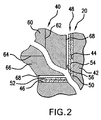
- FIG. 2 shows interaction between the rotor 20 and a bearing portion 40 of the pump housing.
- the rotor includes substrate material 42 (e.g., titanium or an alloy thereof) having a radially/circumferentially extending thrust surface 44 and a longitudinally/circumferentially extending journal surface 46.
- a coating system 48 is applied atop the surfaces 44 and 46 and has a DLN interior layer 50 and a DLC exterior layer 52.
- the layers 50 and 52 meet along an interface 54 and the exterior layer 52 has an exterior surface 56.
- the coating layers 50 and 52 may be built-up by deposition such as physical vapor deposition (PVD) or plasma-assisted chemical vapor deposition (PACVD).
- PVD physical vapor deposition
- PAVD plasma-assisted chemical vapor deposition
- Exemplary thickness for the coating system 48 is 0.5-5.0 ⁇ m, with each layer 50 and 52 representing at least 25% of that thickness and the thinner of the two layers representing at least 25% of the thickness of the other (thus admitting the possibility of additional layers such as a bond enhancement layer directly atop the substrate).
- Such deposition techniques may have an advantageously low deposition temperature (e.g., 200°C or less).
- Such low temperatures may be advantageous in order to limit coarsening of the microstructure of the titanium alloy substrate and associated loss of advantageous physical properties of the substrate.
- Such low temperatures may also limit the total range of temperature excursion. Limiting the range of temperature excursion limits the significance of various causes of failure, including coefficient of thermal expansion (CTE) mismatch.
- CTE coefficient of thermal expansion
- the bearing 40 includes a substrate 60 which may be formed of a superalloy.
- An exemplary superalloy is INCOLOY Alloy 909 (UNS N19909), available from Inco Alloys International, Inc. of Huntington West Virginia, a nickel-iron-cobalt alloy with a silicon addition and containing niobium and titanium for precipitation hardening.
- the nominal composition by weight percent is: Al 0.03; C 0.01; Co 13; Fe 42; Nb 4.7; Ni 38; Si 0.4; Ti 1.5.
- One exemplary group of superalloy compositions is Ni 38-58, Cr 17-23, Fe 13-40, Nb 3-6, Mo 3-10, Ti 0.4-2, and Al 0.2-4.
- the substrate 60 includes a radial/circumferential thrust surface 62 and a longitudinal/circumferential bushing surface 64.
- a solid lubricant coating 66 is deposited atop the surfaces 62 and 64 and has an exterior surface 68.
- the exemplary solid lubricant is silver (e.g., built up by electrolytic deposition as a single layer of uniform composition).
- An exemplary characteristic thickness of the coating 66 is 2.5-125 ⁇ m, more narrowly, 12.5-50 ⁇ m.
- the DLN layer 50 is selected for hardness, wear resistance, and compatibility with the material of the substrate 42.
- exemplary coefficients of thermal expansion (CTE) for Ti alloys are 7.7-9.0 x 10 -6 /K whereas an exemplary overall CTE of the coating 48 is 3.9 x 10 -6 /K.
- Exemplary Ti alloys compositions include, in weight percent, A13-6, Sn 0-3, and 0-4V or Zr, remainder Ti and impurities. Generally advantageous matching may occur when the CTE of the coating is at least 30% that of the substrate (e.g., 30-120% or 30-100%).
- the DLC layer 52 is selected for lubricity (e.g., in combination with the coating 66).
- the thickness of the coating 48 also influences compatibility. Thicker coatings have been observed to have poorer adherence characteristics (believed due to incorporated stress). For example, thicknesses of 2.0 ⁇ m or less have produced indentation adherence classifications of HF2 or stronger on German industry standard VDI 3198 (Verein Irish Ingeneur (VDI)-- Schweizer 3198: Be harshen von diarrheaen in der Kaltmassivumformung CVD- und PVD-Verfahren. Dusseldorf, VDI, 1992). By contrast, increasing thickness to just 2.5 ⁇ m or greater may produce adherence classifications of HF5 or worse. Accordingly, exemplary advantageous thicknesses for the coating 48 are less than about 2.5 ⁇ m (e.g., 1.5-2.0 ⁇ m).
- FIG. 3 shows the exposed surface 56 of the coating 48 (e.g., on a test coupon).
- High degrees of smoothness e.g., an arithmetic average surface roughness, R A , less than 8 ⁇ in
- density may be achieved.
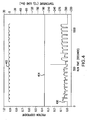
- FIG. 4 shows plots of friction coefficient 400 and vertical load 402 against time in a laboratory test at an approximate temperature of -187°C.
- the test involved radial loads (rather than thrust) in the vicinity of 331 MPa.
- DLN/DLC coating thickness on the A-110 Ti alloy nominal composition by weight percent: Al 5, Sn 2.5, Ti balance
- Silver coating thickness on the Alloy 909 bushing was in the vicinity of 50 ⁇ m.
- Sliding speed was 700m/s.
- the measured coefficient of friction was generally well under 0.2. Initially it was well under 0.1, but increased to almost exactly 0.1.
- Exemplary coefficient of friction is less than 0.15 at reference higher sliding speed/lower load and lower sliding speed/higher load conditions respectively of 5 MPa at 2000 m/s (e.g., for a 200,000rpm pump)and 331 MPa at 200 m/s as well as at intermediate conditions.
- FIG. 5 shows the surface 56 after the tests of FIG. 4. There is relatively little damage to the surface and relatively little transfer of silver (light spots resulting from contrast based upon atomic number).
- Hybrid DLC-DLN layers are possible variants on layers essentially of one or the other as is a reversal of the order in which they occur (DLC innermost and DLN external to DLC). There may also be a number of repeating multiples of the alternating coating layers.
Landscapes
- Engineering & Computer Science (AREA)
- Chemical & Material Sciences (AREA)
- Mechanical Engineering (AREA)
- General Engineering & Computer Science (AREA)
- Metallurgy (AREA)
- Materials Engineering (AREA)
- Organic Chemistry (AREA)
- Ceramic Engineering (AREA)
- Sliding-Contact Bearings (AREA)
- Structures Of Non-Positive Displacement Pumps (AREA)
Abstract
Description
- The invention relates to bearings. More particularly, the invention relates to bearings in cryogenic turbopumps.
- Various turbomachines are subject to use at cryogenic temperatures. For example, turbopumps are used in rocket propulsion to pump cryogenic liquids such as oxygen, hydrogen, and hydrazine. One exemplary turbopump configuration is shown in U.S. Patent 5,529,464.
- Bearing performance is critical to operation of such machines. Often, the machines are subject to a variety of conditions including start-up, shut-down, and other transient operations. For example, the bearings may be configured for lubrication by the working fluid. However, a lack of such fluid in start-up and shut-down conditions may exacerbate asperity contact between bearing surfaces. Accordingly, much development work has gone into bearings for such applications. Among these are the variety of complex foil bearing constructions (e.g., as proposed in U.S. Patent 6,158,893).
- Separately, technologies have developed regarding the deposition of so-called diamond-like coatings including diamond-like carbon (DLC) and diamond-like nanocomposite (DLN) coatings. Exemplary DLN coatings are described in U.S. Patents 5,352,493, 5,466,431, 5,728,465, 6,200,675, and 6,228,471. Exemplary DLC and DLN coatings and application services are available from Bekaert Dymonics n.v., Zulte, Belgium. Diamond-like coatings are generally amorphous carbon-based coatings with a high hardness and a low coefficient of friction. Exemplary DLC coatings involve a mixture of SP2 and SP3 bonded carbon atoms stabilized by hydrogen. Exemplary DLN coatings involve interpenetrating networks of a-C: H and a-SI:O. The compositional balances and addition of dopants may vary coating properties.
- One aspect of the invention involves a bearing system. A first component has a first substrate and a first coating. The first coating comprises a DLC layer and a DLN layer between the DLC layer and the substrate. A second component is in bearing engagement with the first component (e.g., dry or fluidicly lubricated sliding engagement).
- In various implementations, the first coating may consist essentially of the DLC layer and the DLN layer. The second component may include a second substrate and a second coating engaging the first coating via said sliding engagement. The second coating may act as a solid lubricant effective to provide a coefficient of friction of less than 0.2. The second coating may comprise silver in an amount effective to act as a solid lubricant. The second coating may have a thickness of 12.5-50µm. The first and second components may be in the sliding engagement along an essentially radial intersection (e.g., acting as a thrust bearing). The system may be a non-foil journal bearing. The first coating may have a characteristic thickness of 0.5-5.0µm. The first substrate may be titanium-based. The second substrate may be a superalloy, comprising in major mass part one or more of nickel, iron, and cobalt. The first substrate may be a rotor of a turbopump. The second substrate may be a bearing of a housing of the turbopump. The turbopump may be driven by a first flow of a first fluid. The turbopump may pump a second flow of a second fluid at a temperature below -150°C.
- Another aspect of the invention involves a method for forming a bearing surface on a titanium-based substrate. A coating is applied having a carbon-based first layer and a carbon-based second layer of different composition than the first layer. The first layer is between the substrate and the second layer. The first layer is harder than the second layer and the second layer has a higher lubricity than the first layer.
- In various implementations, the applying may comprise at least one of PVD and PACVD. The first layer may consist essentially of DLN and the second layer may consist essentially of DLC. The applying may provide the coating with a coefficient of thermal expansion between 30% and 120% of a coefficient of thermal expansion of the substrate. The second layer may be placed in sliding engagement with a silver-based coating on a second substrate.
- The details of one or more embodiments of the invention are set forth in the accompanying drawings and the description below. Other features and advantages of the invention will be apparent from the description and drawings, and from the claims.
-
- FIG. 1 is a view of a cryogenic turbopump rotor.
- FIG. 2 is a partial longitudinal radial sectional view of journal and thrust surfaces of the rotor engaged with corresponding surfaces of a housing bearing portion.
- FIG. 3 is a secondary electron micrograph image of a surface of a coating for the rotor bearing surfaces of FIG. 2.
- FIG. 4 is a plot of friction coefficient against time for the exemplary coating of FIG. 3 engaging a mating silver-coated substrate.
- FIG. 5 is a backscatter electron image of the coating surface of FIG. 3 after the test of FIG. 4.
- Like reference numbers and designations in the various drawings indicate like elements.
- FIG. 1 shows a
turbopump rotor 20 including aturbine 22 having vanes extending from a radial inlet to an axial outlet. The turbine and thus the rotor is driven about alongitudinal axis 500 in adirection 502 by the flow of a first fluid (e.g., rocket propellant or a component thereof). Exemplary rotational speeds may be in excess of 30,000 revolutions per minute (RPM), e.g., 80,000-100,000. The exemplary rotor has first andsecond pump stages rotor 20 has one or more axial bearingsurfaces 30 and thrust bearingsurfaces 32. - Each exemplary pump stage extends from an axial inlet to a radial outlet. In the series example, the pump stages pump a single second fluid (e.g., rocket fuel or oxidizer) at cryogenic conditions. Exemplary cryogenic conditions are below -100°C, typically below -150°C. The first and second fluids may be the same. For example, a flow of hydrogen rocket fuel may be pumped through the
stages - FIG. 2 shows interaction between the
rotor 20 and a bearingportion 40 of the pump housing. The rotor includes substrate material 42 (e.g., titanium or an alloy thereof) having a radially/circumferentially extendingthrust surface 44 and a longitudinally/circumferentially extendingjournal surface 46. Acoating system 48 is applied atop thesurfaces DLN interior layer 50 and aDLC exterior layer 52. In the exemplary embodiment, thelayers interface 54 and theexterior layer 52 has anexterior surface 56. The coating layers 50 and 52 may be built-up by deposition such as physical vapor deposition (PVD) or plasma-assisted chemical vapor deposition (PACVD). Exemplary thickness for thecoating system 48 is 0.5-5.0µm, with eachlayer - The
bearing 40 includes asubstrate 60 which may be formed of a superalloy. An exemplary superalloy is INCOLOY Alloy 909 (UNS N19909), available from Inco Alloys International, Inc. of Huntington West Virginia, a nickel-iron-cobalt alloy with a silicon addition and containing niobium and titanium for precipitation hardening. The nominal composition by weight percent is: Al 0.03; C 0.01; Co 13;Fe 42; Nb 4.7; Ni 38; Si 0.4; Ti 1.5. One exemplary group of superalloy compositions is Ni 38-58, Cr 17-23, Fe 13-40, Nb 3-6, Mo 3-10, Ti 0.4-2, and Al 0.2-4. Thesubstrate 60 includes a radial/circumferential thrust surface 62 and a longitudinal/circumferential bushing surface 64. Asolid lubricant coating 66 is deposited atop thesurfaces exterior surface 68. The exemplary solid lubricant is silver (e.g., built up by electrolytic deposition as a single layer of uniform composition). An exemplary characteristic thickness of thecoating 66 is 2.5-125µm, more narrowly, 12.5-50µm. - With the exemplary coating combination, the
DLN layer 50 is selected for hardness, wear resistance, and compatibility with the material of thesubstrate 42. For example, exemplary coefficients of thermal expansion (CTE) for Ti alloys are 7.7-9.0 x 10⁻⁶/K whereas an exemplary overall CTE of thecoating 48 is 3.9 x 10⁻⁶/K. Exemplary Ti alloys compositions include, in weight percent, A13-6, Sn 0-3, and 0-4V or Zr, remainder Ti and impurities. Generally advantageous matching may occur when the CTE of the coating is at least 30% that of the substrate (e.g., 30-120% or 30-100%). TheDLC layer 52 is selected for lubricity (e.g., in combination with the coating 66). The thickness of thecoating 48 also influences compatibility. Thicker coatings have been observed to have poorer adherence characteristics (believed due to incorporated stress). For example, thicknesses of 2.0µm or less have produced indentation adherence classifications of HF2 or stronger on German industry standard VDI 3198 (Verein Deutsche Ingeneur (VDI)--Richtlinie 3198: Beschichten von Werkzeugen in der Kaltmassivumformung CVD- und PVD-Verfahren. Dusseldorf, VDI, 1992). By contrast, increasing thickness to just 2.5µm or greater may produce adherence classifications of HF5 or worse. Accordingly, exemplary advantageous thicknesses for thecoating 48 are less than about 2.5µm (e.g., 1.5-2.0µm). - Test data has been obtained for sample friction pucks and environmental test coupons. FIG. 3 shows the exposed
surface 56 of the coating 48 (e.g., on a test coupon). High degrees of smoothness (e.g., an arithmetic average surface roughness, RA, less than 8µin) and density may be achieved. - FIG. 4 shows plots of
friction coefficient 400 andvertical load 402 against time in a laboratory test at an approximate temperature of -187°C. The test involved radial loads (rather than thrust) in the vicinity of 331 MPa. DLN/DLC coating thickness on the A-110 Ti alloy (nominal composition by weight percent: Al 5, Sn 2.5, Ti balance) puck was in the vicinity of 1.5-2.2µm. Silver coating thickness on the Alloy 909 bushing was in the vicinity of 50µm. Sliding speed was 700m/s. The measured coefficient of friction was generally well under 0.2. Initially it was well under 0.1, but increased to almost exactly 0.1. Exemplary coefficient of friction is less than 0.15 at reference higher sliding speed/lower load and lower sliding speed/higher load conditions respectively of 5 MPa at 2000 m/s (e.g., for a 200,000rpm pump)and 331 MPa at 200 m/s as well as at intermediate conditions. - FIG. 5 shows the
surface 56 after the tests of FIG. 4. There is relatively little damage to the surface and relatively little transfer of silver (light spots resulting from contrast based upon atomic number). - Among variations are the presence of a bond or adherence-promoting layer. Compositions for such layers could include Cr, Si, and/or amorphous SiC. Hybrid DLC-DLN layers are possible variants on layers essentially of one or the other as is a reversal of the order in which they occur (DLC innermost and DLN external to DLC). There may also be a number of repeating multiples of the alternating coating layers.
- One or more embodiments of the present invention have been described. Nevertheless, it will be understood that various modifications may be made without departing from the scope of the invention. For example, when applied to an existing machine, details of the existing material as well as details of the operating condition (e.g., loads, speeds, temperatures, lifespans, and cycle properties) may influence the details of any particular implementation. Accordingly, other embodiments are within the scope of the following claims.
Claims (30)
- An bearing system comprising:a first component (20) having a first substrate (42) and a first coating (48), the first coating (48) comprising a DLC layer (52) and a DLN layer (50) between the DLC layer (52) and the substrate (42); anda second component (40) in bearing engagement with the first component (20).
- The system of claim 1 wherein:the first coating (48) consists essentially of the DLC layer (52) and the DLN layer (50).
- The system of claim 1 or 2 wherein:the bearing engagement consists essentially of a sliding engagement.
- The system of claim 3 wherein:the first and second components (20,40) are in the sliding engagement along an essentially radial intersection.
- The system of claim 3 or 4 wherein:the bearing system is a non-foil journal bearing.
- The system of claim 3, 4 or 5 wherein:the second component (40) includes a second substrate (60) and a second coating (66) engaging the first coating (48) via said sliding engagement.
- The system of claim 6 wherein:the second coating (66) acts as a solid lubricant effective to provide a coefficient of friction of less than 0.2.
- The system of claim 6 or 7 wherein:the second coating (66) comprises silver in an amount effective to act as a solid lubricant.
- The system of claim 6, 7 or 8 wherein:the second coating (66) has a thickness of. 2-50 µm.
- The system of claim 9 wherein:the second coating has a thickness of 12.5-50 µm.
- The system of any preceding claim wherein:the first coating (48) has a characteristic thickness of 0.5-5.0µm.
- The system of claim 11 wherein:the first coating (48) has a characteristic thickness of 1.5-2.2µm;the DLC layer (52) and the DLN layer (50) each provide at least 25% of said characteristic thickness; anda thinner of the DLC layer (52) and the DLN layer (50) is at least 25% of a thickness of the other.
- The system of claim 11 wherein:the first coating (48) has a characteristic thickness of 0.5-2.0µm.
- The system of any preceding claim wherein:the first coating (48) has a characteristic adherence of HF2 or stronger.
- The system of any preceding claim wherein:the first substrate (42) is titanium-based.
- The system of any preceding claim wherein:a or the second substrate (60) of the second component (40) is a superalloy, comprising in major mass part one or more of iron, nickel, and cobalt.
- The system of claim 1 wherein:a or the second substrate (60) of the second component (40) comprises in largest mass part one of iron, nickel, and cobalt.
- The system of any preceding claim wherein:the first component is a rotor (20) of a turbopump; andthe second component is a bearing (40) of a housing of the turbopump.
- The system of claim 18 wherein:the turbopump is driven by a first flow of a first fluid; andthe turbopump pumps a second flow of a second fluid at a temperature below -150°C.
- A method for forming bearing surface on a titanium-based substrate (42):applying a coating (48) having a carbon-based first layer (50) and a carbon-based second layer (52), the first layer (50) between the substrate (48) and the second layer (52), the first layer (50) being harder than the second layer (52) and the second layer having a higher lubricity than the first layer (50).
- The method of claim 20 wherein the applying comprises at least one of physical vapor deposition (PVD) and plasma-assisted chemical vapor deposition (PACVD).
- The method of claim 20 or 21 wherein the first layer (50) consists essentially of DLN and the second layer (52) consists essentially of DLC.
- The method of claim 20, 21 or 22 wherein the applying provides the coating (48) with a coefficient of thermal expansion between 30% and 120% of a coefficient of thermal expansion of the substrate (42).
- The method of any of claims 20 to 23 further comprising placing the second layer (52) in sliding engagement with a silver-based coating (66) on a second substrate (60).
- A turbopump comprising:a housing; anda rotor (20) carried by the housing for rotation about a rotor axis (500), the housing and rotor cooperating to define a first flow path for a first fluid to drive said rotation and a second flow path for a second fluid to be pumped by the rotation;
wherein:a first of the housing and rotor (20) has a first substrate (42) and a first coating (48), the first coating (48) comprising a DLC layer (52) and a DLN layer (50) between the DLC layer (52) and the substrate (42); anda second of the housing and rotor (20) is in sliding engagement with the first. - The turbopump of claim 25 wherein:the second comprises a substrate (60) and silver-based solid lubricant coating (66) in said sliding engagement.
- The turbopump of claim 25 or 26 in combination with a flow, consisting in major part of one of liquid oxygen, liquid hydrogen, kerosene, and hydrazine, along the second flow path as said second fluid.
- The turbopump of any of claims 25 to 27 wherein:the housing comprises, in major weight part, one or more superalloys comprising in major part at least one of iron, nickel, and cobalt; andthe rotor (20) comprises, in major weight part, one or more titanium alloys.
- A component (20) for a bearing system, said component (20) having a substrate (42) and a coating (48), the coating (48) comprising a DLC layer (52) and a DLN layer (50) between the DLC layer (52) and the substrate (42).
- A component (20) for a bearing system, said component (20) having a substrate (42) and a coating (48), the coating (48) comprising a carbon-based first layer (50) and a carbon-based second layer (52), the first layer (50) between the substrate (48) and the second layer (52), the first layer (50) being harder than the second layer (52) and the second layer having a higher lubricity than the first layer (50).
Priority Applications (1)
| Application Number | Priority Date | Filing Date | Title |
|---|---|---|---|
| EP20110156732 EP2327896B1 (en) | 2004-08-23 | 2005-08-08 | turbopump |
Applications Claiming Priority (1)
| Application Number | Priority Date | Filing Date | Title |
|---|---|---|---|
| US10/925,320 US7296965B2 (en) | 2004-08-23 | 2004-08-23 | Cryogenic bearings |
Related Child Applications (1)
| Application Number | Title | Priority Date | Filing Date |
|---|---|---|---|
| EP20110156732 Division EP2327896B1 (en) | 2004-08-23 | 2005-08-08 | turbopump |
Publications (2)
| Publication Number | Publication Date |
|---|---|
| EP1630435A2 true EP1630435A2 (en) | 2006-03-01 |
| EP1630435A3 EP1630435A3 (en) | 2009-02-25 |
Family
ID=35160063
Family Applications (2)
| Application Number | Title | Priority Date | Filing Date |
|---|---|---|---|
| EP20050254933 Withdrawn EP1630435A3 (en) | 2004-08-23 | 2005-08-08 | Plain bearing friction layer |
| EP20110156732 Ceased EP2327896B1 (en) | 2004-08-23 | 2005-08-08 | turbopump |
Family Applications After (1)
| Application Number | Title | Priority Date | Filing Date |
|---|---|---|---|
| EP20110156732 Ceased EP2327896B1 (en) | 2004-08-23 | 2005-08-08 | turbopump |
Country Status (3)
| Country | Link |
|---|---|
| US (1) | US7296965B2 (en) |
| EP (2) | EP1630435A3 (en) |
| JP (1) | JP2006057841A (en) |
Cited By (1)
| Publication number | Priority date | Publication date | Assignee | Title |
|---|---|---|---|---|
| DE102007042124A1 (en) * | 2007-09-05 | 2009-03-12 | Lufthansa Technik Ag | Engine component for a gas turbine |
Families Citing this family (3)
| Publication number | Priority date | Publication date | Assignee | Title |
|---|---|---|---|---|
| US20250012294A1 (en) * | 2021-11-26 | 2025-01-09 | Cryostar Sas | Turbo machine and method for manufacturing |
| WO2023201255A1 (en) | 2022-04-13 | 2023-10-19 | Pi Tech Innovations Llc | Polycrystalline diamond-on-metal bearings for use in low temperature and cryogenic conditions |
| EP4283147A1 (en) | 2022-05-24 | 2023-11-29 | Roller Bearing Company of America, Inc. | Wear resistant bearing system |
Citations (8)
| Publication number | Priority date | Publication date | Assignee | Title |
|---|---|---|---|---|
| US5352493A (en) | 1991-05-03 | 1994-10-04 | Veniamin Dorfman | Method for forming diamond-like nanocomposite or doped-diamond-like nanocomposite films |
| US5529464A (en) | 1988-07-12 | 1996-06-25 | Alliedsignal Inc. | Cryogenic turbopump |
| US5728465A (en) | 1991-05-03 | 1998-03-17 | Advanced Refractory Technologies, Inc. | Diamond-like nanocomposite corrosion resistant coatings |
| US6158893A (en) | 1997-03-28 | 2000-12-12 | Mohawk Innovative Technology, Inc. | High load capacity compliant foil hydrodynamic journal bearing |
| US6200675B1 (en) | 1996-04-22 | 2001-03-13 | N.V. Bekaert S.A. | Diamond-like nanocomposite compositions |
| US6228471B1 (en) | 1997-02-04 | 2001-05-08 | N.V. Bekaert S.A. | Coating comprising layers of diamond like carbon and diamond like nanocomposite compositions |
| EP1666572A1 (en) * | 2003-08-06 | 2006-06-07 | Nippon Oil Corporation | System having dlc contacting faces, method for lubricating the system and lubricating oil for the system |
| JP2007032758A (en) * | 2005-07-28 | 2007-02-08 | Toyota Motor Corp | Combination sliding member, and internal combustion engine and plain bearing mechanism using the same |
Family Cites Families (9)
| Publication number | Priority date | Publication date | Assignee | Title |
|---|---|---|---|---|
| US6083570A (en) * | 1987-03-31 | 2000-07-04 | Lemelson; Jerome H. | Synthetic diamond coatings with intermediate amorphous metal bonding layers and methods of applying such coatings |
| US6676704B1 (en) * | 1994-08-12 | 2004-01-13 | Diamicron, Inc. | Prosthetic joint component having at least one sintered polycrystalline diamond compact articulation surface and substrate surface topographical features in said polycrystalline diamond compact |
| US5827040A (en) * | 1996-06-14 | 1998-10-27 | Capstone Turbine Corporation | Hydrostatic augmentation of a compliant foil hydrodynamic fluid film thrust bearing |
| EP0856592A1 (en) | 1997-02-04 | 1998-08-05 | N.V. Bekaert S.A. | A coating comprising layers of diamond like carbon and diamond like nanocomposite compositions |
| JP2001027251A (en) * | 1999-07-14 | 2001-01-30 | Minebea Co Ltd | Bearing and manufacture thereof |
| JP4807689B2 (en) * | 2001-05-23 | 2011-11-02 | 株式会社ハーモニック・ドライブ・システムズ | Lubrication-type wave gear device |
| US6740428B2 (en) * | 2002-03-19 | 2004-05-25 | Daido Metal Company Ltd. | Slide member |
| DE602004004150T2 (en) * | 2003-07-25 | 2007-10-11 | Nv Bekaert Sa | SUBSTRATE WITH INTERMEDIATE COVER AND HARD CARBON COVER |
| JP4539205B2 (en) * | 2003-08-21 | 2010-09-08 | 日産自動車株式会社 | Refrigerant compressor |
-
2004
- 2004-08-23 US US10/925,320 patent/US7296965B2/en not_active Expired - Lifetime
-
2005
- 2005-08-05 JP JP2005227382A patent/JP2006057841A/en active Pending
- 2005-08-08 EP EP20050254933 patent/EP1630435A3/en not_active Withdrawn
- 2005-08-08 EP EP20110156732 patent/EP2327896B1/en not_active Ceased
Patent Citations (9)
| Publication number | Priority date | Publication date | Assignee | Title |
|---|---|---|---|---|
| US5529464A (en) | 1988-07-12 | 1996-06-25 | Alliedsignal Inc. | Cryogenic turbopump |
| US5352493A (en) | 1991-05-03 | 1994-10-04 | Veniamin Dorfman | Method for forming diamond-like nanocomposite or doped-diamond-like nanocomposite films |
| US5466431A (en) | 1991-05-03 | 1995-11-14 | Veniamin Dorfman | Diamond-like metallic nanocomposites |
| US5728465A (en) | 1991-05-03 | 1998-03-17 | Advanced Refractory Technologies, Inc. | Diamond-like nanocomposite corrosion resistant coatings |
| US6200675B1 (en) | 1996-04-22 | 2001-03-13 | N.V. Bekaert S.A. | Diamond-like nanocomposite compositions |
| US6228471B1 (en) | 1997-02-04 | 2001-05-08 | N.V. Bekaert S.A. | Coating comprising layers of diamond like carbon and diamond like nanocomposite compositions |
| US6158893A (en) | 1997-03-28 | 2000-12-12 | Mohawk Innovative Technology, Inc. | High load capacity compliant foil hydrodynamic journal bearing |
| EP1666572A1 (en) * | 2003-08-06 | 2006-06-07 | Nippon Oil Corporation | System having dlc contacting faces, method for lubricating the system and lubricating oil for the system |
| JP2007032758A (en) * | 2005-07-28 | 2007-02-08 | Toyota Motor Corp | Combination sliding member, and internal combustion engine and plain bearing mechanism using the same |
Cited By (1)
| Publication number | Priority date | Publication date | Assignee | Title |
|---|---|---|---|---|
| DE102007042124A1 (en) * | 2007-09-05 | 2009-03-12 | Lufthansa Technik Ag | Engine component for a gas turbine |
Also Published As
| Publication number | Publication date |
|---|---|
| US7296965B2 (en) | 2007-11-20 |
| JP2006057841A (en) | 2006-03-02 |
| EP2327896B1 (en) | 2014-11-19 |
| EP2327896A1 (en) | 2011-06-01 |
| EP1630435A3 (en) | 2009-02-25 |
| US20060040097A1 (en) | 2006-02-23 |
Similar Documents
| Publication | Publication Date | Title |
|---|---|---|
| US20070228664A1 (en) | Mechanical seals and methods of making | |
| CN112513403B (en) | Polycrystalline diamond thrust bearings and their components | |
| EP2056004A1 (en) | Mechanical seals and methods of making | |
| US7553564B2 (en) | Ternary carbide and nitride materials having tribological applications and methods of making same | |
| US20050262965A1 (en) | Ternary carbide and nitride composites having tribological applications and methods of making same | |
| US20080076683A1 (en) | Slide member | |
| Lubell et al. | Test evolution and oil-free engine experience of a high temperature foil air bearing coating | |
| Cao et al. | Tribological and mechanical behaviors of engine bearing with CuSn10 layer and h-BN/graphite coating prepared by spraying under different temperatures | |
| EP2955331A1 (en) | Stiffness controlled abradeable seal system and method of making same | |
| EP2821525A1 (en) | Multilayered coatings with diamond like carbon | |
| EP2297373B1 (en) | Piston ring for internal combustion engine | |
| EP2434100A1 (en) | Turbine engine apparatus with protective coating | |
| EP1927670A1 (en) | Wear resistant coatings | |
| US7296965B2 (en) | Cryogenic bearings | |
| US5783315A (en) | Ti-Cr-Al protective coatings for alloys | |
| CN101424342A (en) | Mechanical sealing member and method for manufacturing same | |
| EP3913194B1 (en) | Variable vane assembly and method for operating a variable vane assembly | |
| Radcliff | Factors influencing gas turbine use and performance | |
| US7160635B2 (en) | Protective Ti-Al-Cr-based nitrided coatings | |
| EP1859176A1 (en) | Method of protecting rolling element bearings against oil-out conditions and bearing made thereby | |
| JP2007284760A (en) | Sliding member | |
| JP2008138242A (en) | Abrasion resistant coating and article having the abrasion resistant coating | |
| KR20090043155A (en) | Mechanical seal and manufacturing method thereof | |
| KR20150002662A (en) | Turbomachine component with a functional coating | |
| CN100554495C (en) | Coating method for inhibiting reaction |
Legal Events
| Date | Code | Title | Description |
|---|---|---|---|
| PUAI | Public reference made under article 153(3) epc to a published international application that has entered the european phase |
Free format text: ORIGINAL CODE: 0009012 |
|
| AK | Designated contracting states |
Kind code of ref document: A2 Designated state(s): AT BE BG CH CY CZ DE DK EE ES FI FR GB GR HU IE IS IT LI LT LU LV MC NL PL PT RO SE SI SK TR |
|
| AX | Request for extension of the european patent |
Extension state: AL BA HR MK YU |
|
| PUAL | Search report despatched |
Free format text: ORIGINAL CODE: 0009013 |
|
| AK | Designated contracting states |
Kind code of ref document: A3 Designated state(s): AT BE BG CH CY CZ DE DK EE ES FI FR GB GR HU IE IS IT LI LT LU LV MC NL PL PT RO SE SI SK TR |
|
| AX | Request for extension of the european patent |
Extension state: AL BA HR MK YU |
|
| RIC1 | Information provided on ipc code assigned before grant |
Ipc: F16C 33/14 20060101ALI20090121BHEP Ipc: F16C 33/12 20060101AFI20051104BHEP |
|
| AKX | Designation fees paid |
Designated state(s): DE GB SE |
|
| 17P | Request for examination filed |
Effective date: 20090825 |
|
| 17Q | First examination report despatched |
Effective date: 20091127 |
|
| 17Q | First examination report despatched |
Effective date: 20110322 |
|
| STAA | Information on the status of an ep patent application or granted ep patent |
Free format text: STATUS: THE APPLICATION IS DEEMED TO BE WITHDRAWN |
|
| 18D | Application deemed to be withdrawn |
Effective date: 20130525 |