EP1629834A1 - Sustained release pharmaceutical composition of tolterodine - Google Patents
Sustained release pharmaceutical composition of tolterodine Download PDFInfo
- Publication number
- EP1629834A1 EP1629834A1 EP04020431A EP04020431A EP1629834A1 EP 1629834 A1 EP1629834 A1 EP 1629834A1 EP 04020431 A EP04020431 A EP 04020431A EP 04020431 A EP04020431 A EP 04020431A EP 1629834 A1 EP1629834 A1 EP 1629834A1
- Authority
- EP
- European Patent Office
- Prior art keywords
- sustained release
- tolterodine
- pharmaceutical composition
- layer
- composition according
- Prior art date
- Legal status (The legal status is an assumption and is not a legal conclusion. Google has not performed a legal analysis and makes no representation as to the accuracy of the status listed.)
- Withdrawn
Links
- OOGJQPCLVADCPB-HXUWFJFHSA-N tolterodine Chemical group C1([C@@H](CCN(C(C)C)C(C)C)C=2C(=CC=C(C)C=2)O)=CC=CC=C1 OOGJQPCLVADCPB-HXUWFJFHSA-N 0.000 title claims abstract description 58
- 229960004045 tolterodine Drugs 0.000 title claims abstract description 58
- 238000013268 sustained release Methods 0.000 title claims abstract description 57
- 239000012730 sustained-release form Substances 0.000 title claims abstract description 57
- BDIAUFOIMFAIPU-UHFFFAOYSA-N valepotriate Natural products CC(C)CC(=O)OC1C=C(C(=COC2OC(=O)CC(C)C)COC(C)=O)C2C11CO1 BDIAUFOIMFAIPU-UHFFFAOYSA-N 0.000 title claims abstract description 57
- 239000008194 pharmaceutical composition Substances 0.000 title claims abstract description 25
- 239000000203 mixture Substances 0.000 claims abstract description 64
- YYSCJLLOWOUSHH-UHFFFAOYSA-N 4,4'-disulfanyldibutanoic acid Chemical compound OC(=O)CCCSSCCCC(O)=O YYSCJLLOWOUSHH-UHFFFAOYSA-N 0.000 claims abstract description 15
- 239000003814 drug Substances 0.000 claims abstract description 15
- 229960003553 tolterodine tartrate Drugs 0.000 claims abstract description 15
- 238000004519 manufacturing process Methods 0.000 claims abstract description 14
- 238000002360 preparation method Methods 0.000 claims abstract description 6
- 239000011162 core material Substances 0.000 claims description 61
- 229920000642 polymer Polymers 0.000 claims description 25
- 239000011159 matrix material Substances 0.000 claims description 22
- 238000000576 coating method Methods 0.000 claims description 20
- 239000011230 binding agent Substances 0.000 claims description 18
- 238000000034 method Methods 0.000 claims description 18
- 239000011248 coating agent Substances 0.000 claims description 16
- 238000009472 formulation Methods 0.000 claims description 16
- 229920000036 polyvinylpyrrolidone Polymers 0.000 claims description 14
- 239000001267 polyvinylpyrrolidone Substances 0.000 claims description 14
- 235000013855 polyvinylpyrrolidone Nutrition 0.000 claims description 14
- 239000002245 particle Substances 0.000 claims description 13
- 238000001035 drying Methods 0.000 claims description 12
- 230000008569 process Effects 0.000 claims description 10
- 229920002689 polyvinyl acetate Polymers 0.000 claims description 9
- 239000011118 polyvinyl acetate Substances 0.000 claims description 9
- 239000002775 capsule Substances 0.000 claims description 8
- 230000002209 hydrophobic effect Effects 0.000 claims description 8
- 239000001856 Ethyl cellulose Substances 0.000 claims description 7
- 229920001249 ethyl cellulose Polymers 0.000 claims description 7
- JIGUQPWFLRLWPJ-UHFFFAOYSA-N Ethyl acrylate Chemical compound CCOC(=O)C=C JIGUQPWFLRLWPJ-UHFFFAOYSA-N 0.000 claims description 6
- ZZSNKZQZMQGXPY-UHFFFAOYSA-N Ethyl cellulose Chemical compound CCOCC1OC(OC)C(OCC)C(OCC)C1OC1C(O)C(O)C(OC)C(CO)O1 ZZSNKZQZMQGXPY-UHFFFAOYSA-N 0.000 claims description 6
- PNJWIWWMYCMZRO-UHFFFAOYSA-N pent‐4‐en‐2‐one Natural products CC(=O)CC=C PNJWIWWMYCMZRO-UHFFFAOYSA-N 0.000 claims description 6
- 150000003839 salts Chemical group 0.000 claims description 6
- 235000019325 ethyl cellulose Nutrition 0.000 claims description 5
- 230000007935 neutral effect Effects 0.000 claims description 5
- VVQNEPGJFQJSBK-UHFFFAOYSA-N Methyl methacrylate Chemical compound COC(=O)C(C)=C VVQNEPGJFQJSBK-UHFFFAOYSA-N 0.000 claims description 4
- 239000000843 powder Substances 0.000 claims description 4
- 206010020853 Hypertonic bladder Diseases 0.000 claims description 3
- 208000009722 Overactive Urinary Bladder Diseases 0.000 claims description 3
- 238000005516 engineering process Methods 0.000 claims description 3
- 208000000921 Urge Urinary Incontinence Diseases 0.000 claims description 2
- 230000002265 prevention Effects 0.000 claims description 2
- 208000024891 symptom Diseases 0.000 claims description 2
- 206010046494 urge incontinence Diseases 0.000 claims description 2
- 239000008188 pellet Substances 0.000 description 20
- 238000004090 dissolution Methods 0.000 description 19
- XLYOFNOQVPJJNP-UHFFFAOYSA-N water Substances O XLYOFNOQVPJJNP-UHFFFAOYSA-N 0.000 description 13
- 229940079593 drug Drugs 0.000 description 11
- 239000006185 dispersion Substances 0.000 description 10
- 239000008213 purified water Substances 0.000 description 10
- 239000000463 material Substances 0.000 description 9
- 239000000454 talc Substances 0.000 description 8
- 229910052623 talc Inorganic materials 0.000 description 8
- TWHNMSJGYKMTRB-KXYUELECSA-N (2r,3r)-2,3-dihydroxybutanedioic acid;2-[(1r)-3-[di(propan-2-yl)amino]-1-phenylpropyl]-4-methylphenol Chemical compound OC(=O)[C@H](O)[C@@H](O)C(O)=O.C1([C@@H](CCN(C(C)C)C(C)C)C=2C(=CC=C(C)C=2)O)=CC=CC=C1 TWHNMSJGYKMTRB-KXYUELECSA-N 0.000 description 7
- 239000003795 chemical substances by application Substances 0.000 description 7
- 229920000168 Microcrystalline cellulose Polymers 0.000 description 6
- 239000013543 active substance Substances 0.000 description 6
- 238000013270 controlled release Methods 0.000 description 6
- 230000000694 effects Effects 0.000 description 6
- 229940016286 microcrystalline cellulose Drugs 0.000 description 6
- 235000019813 microcrystalline cellulose Nutrition 0.000 description 6
- 239000008108 microcrystalline cellulose Substances 0.000 description 6
- 239000008363 phosphate buffer Substances 0.000 description 6
- 229920003176 water-insoluble polymer Polymers 0.000 description 6
- 229920003163 Eudragit® NE 30 D Polymers 0.000 description 4
- 230000008901 benefit Effects 0.000 description 4
- 239000012738 dissolution medium Substances 0.000 description 4
- 210000001035 gastrointestinal tract Anatomy 0.000 description 4
- 230000001965 increasing effect Effects 0.000 description 4
- 239000004014 plasticizer Substances 0.000 description 4
- 238000003756 stirring Methods 0.000 description 4
- FEWJPZIEWOKRBE-JCYAYHJZSA-N Dextrotartaric acid Chemical compound OC(=O)[C@H](O)[C@@H](O)C(O)=O FEWJPZIEWOKRBE-JCYAYHJZSA-N 0.000 description 3
- 229920002153 Hydroxypropyl cellulose Polymers 0.000 description 3
- CZMRCDWAGMRECN-UGDNZRGBSA-N Sucrose Chemical compound O[C@H]1[C@H](O)[C@@H](CO)O[C@@]1(CO)O[C@@H]1[C@H](O)[C@@H](O)[C@H](O)[C@@H](CO)O1 CZMRCDWAGMRECN-UGDNZRGBSA-N 0.000 description 3
- 229930006000 Sucrose Natural products 0.000 description 3
- 239000004480 active ingredient Substances 0.000 description 3
- 238000004458 analytical method Methods 0.000 description 3
- 239000011324 bead Substances 0.000 description 3
- 229920002678 cellulose Polymers 0.000 description 3
- 239000001913 cellulose Substances 0.000 description 3
- 235000010980 cellulose Nutrition 0.000 description 3
- 150000001875 compounds Chemical class 0.000 description 3
- 239000001863 hydroxypropyl cellulose Substances 0.000 description 3
- 235000010977 hydroxypropyl cellulose Nutrition 0.000 description 3
- 239000012729 immediate-release (IR) formulation Substances 0.000 description 3
- 239000002609 medium Substances 0.000 description 3
- 239000000126 substance Substances 0.000 description 3
- 229960004793 sucrose Drugs 0.000 description 3
- 239000003826 tablet Substances 0.000 description 3
- -1 Aryl Grignard Reagents Chemical class 0.000 description 2
- VEXZGXHMUGYJMC-UHFFFAOYSA-N Hydrochloric acid Chemical compound Cl VEXZGXHMUGYJMC-UHFFFAOYSA-N 0.000 description 2
- DNIAPMSPPWPWGF-UHFFFAOYSA-N Propylene glycol Chemical compound CC(O)CO DNIAPMSPPWPWGF-UHFFFAOYSA-N 0.000 description 2
- 229920002472 Starch Polymers 0.000 description 2
- QAOWNCQODCNURD-UHFFFAOYSA-N Sulfuric acid Chemical compound OS(O)(=O)=O QAOWNCQODCNURD-UHFFFAOYSA-N 0.000 description 2
- DOOTYTYQINUNNV-UHFFFAOYSA-N Triethyl citrate Chemical compound CCOC(=O)CC(O)(C(=O)OCC)CC(=O)OCC DOOTYTYQINUNNV-UHFFFAOYSA-N 0.000 description 2
- 238000009739 binding Methods 0.000 description 2
- 230000015572 biosynthetic process Effects 0.000 description 2
- 239000000872 buffer Substances 0.000 description 2
- 230000015556 catabolic process Effects 0.000 description 2
- 239000003086 colorant Substances 0.000 description 2
- 229920001577 copolymer Polymers 0.000 description 2
- 238000006731 degradation reaction Methods 0.000 description 2
- 238000007922 dissolution test Methods 0.000 description 2
- 239000002552 dosage form Substances 0.000 description 2
- 206010013781 dry mouth Diseases 0.000 description 2
- 210000003736 gastrointestinal content Anatomy 0.000 description 2
- 239000007970 homogeneous dispersion Substances 0.000 description 2
- 150000007522 mineralic acids Chemical class 0.000 description 2
- 238000002156 mixing Methods 0.000 description 2
- 239000003149 muscarinic antagonist Substances 0.000 description 2
- 150000007524 organic acids Chemical class 0.000 description 2
- 229920000193 polymethacrylate Polymers 0.000 description 2
- 230000002035 prolonged effect Effects 0.000 description 2
- 230000009467 reduction Effects 0.000 description 2
- 239000007921 spray Substances 0.000 description 2
- 239000008107 starch Substances 0.000 description 2
- 235000019698 starch Nutrition 0.000 description 2
- 239000005720 sucrose Substances 0.000 description 2
- 239000000725 suspension Substances 0.000 description 2
- URAYPUMNDPQOKB-UHFFFAOYSA-N triacetin Chemical compound CC(=O)OCC(OC(C)=O)COC(C)=O URAYPUMNDPQOKB-UHFFFAOYSA-N 0.000 description 2
- 239000001069 triethyl citrate Substances 0.000 description 2
- VMYFZRTXGLUXMZ-UHFFFAOYSA-N triethyl citrate Natural products CCOC(=O)C(O)(C(=O)OCC)C(=O)OCC VMYFZRTXGLUXMZ-UHFFFAOYSA-N 0.000 description 2
- 235000013769 triethyl citrate Nutrition 0.000 description 2
- OOGJQPCLVADCPB-UHFFFAOYSA-N 2-[3-[di(propan-2-yl)amino]-1-phenylpropyl]-4-methylphenol Chemical compound C=1C(C)=CC=C(O)C=1C(CCN(C(C)C)C(C)C)C1=CC=CC=C1 OOGJQPCLVADCPB-UHFFFAOYSA-N 0.000 description 1
- MZFIOCKXBSMAKY-UHFFFAOYSA-N 3-(3-phenylprop-2-enoyl)-1,3-oxazolidin-2-one Chemical class C1COC(=O)N1C(=O)C=CC1=CC=CC=C1 MZFIOCKXBSMAKY-UHFFFAOYSA-N 0.000 description 1
- BMYNFMYTOJXKLE-UHFFFAOYSA-N 3-azaniumyl-2-hydroxypropanoate Chemical compound NCC(O)C(O)=O BMYNFMYTOJXKLE-UHFFFAOYSA-N 0.000 description 1
- GUBGYTABKSRVRQ-XLOQQCSPSA-N Alpha-Lactose Chemical compound O[C@@H]1[C@@H](O)[C@@H](O)[C@@H](CO)O[C@H]1O[C@@H]1[C@@H](CO)O[C@H](O)[C@H](O)[C@H]1O GUBGYTABKSRVRQ-XLOQQCSPSA-N 0.000 description 1
- GUBGYTABKSRVRQ-QKKXKWKRSA-N Lactose Natural products OC[C@H]1O[C@@H](O[C@H]2[C@H](O)[C@@H](O)C(O)O[C@@H]2CO)[C@H](O)[C@@H](O)[C@H]1O GUBGYTABKSRVRQ-QKKXKWKRSA-N 0.000 description 1
- 241000124008 Mammalia Species 0.000 description 1
- 229940121948 Muscarinic receptor antagonist Drugs 0.000 description 1
- GRYLNZFGIOXLOG-UHFFFAOYSA-N Nitric acid Chemical compound O[N+]([O-])=O GRYLNZFGIOXLOG-UHFFFAOYSA-N 0.000 description 1
- NBIIXXVUZAFLBC-UHFFFAOYSA-N Phosphoric acid Chemical compound OP(O)(O)=O NBIIXXVUZAFLBC-UHFFFAOYSA-N 0.000 description 1
- 239000002202 Polyethylene glycol Substances 0.000 description 1
- FEWJPZIEWOKRBE-UHFFFAOYSA-N Tartaric acid Natural products [H+].[H+].[O-]C(=O)C(O)C(O)C([O-])=O FEWJPZIEWOKRBE-UHFFFAOYSA-N 0.000 description 1
- 238000010521 absorption reaction Methods 0.000 description 1
- 230000002378 acidificating effect Effects 0.000 description 1
- 238000005054 agglomeration Methods 0.000 description 1
- 230000002776 aggregation Effects 0.000 description 1
- 239000007900 aqueous suspension Substances 0.000 description 1
- 238000011929 asymmetric total synthesis Methods 0.000 description 1
- 230000036765 blood level Effects 0.000 description 1
- 238000004364 calculation method Methods 0.000 description 1
- 235000019864 coconut oil Nutrition 0.000 description 1
- 239000003240 coconut oil Substances 0.000 description 1
- 230000007423 decrease Effects 0.000 description 1
- 230000003247 decreasing effect Effects 0.000 description 1
- 230000007547 defect Effects 0.000 description 1
- 235000013681 dietary sucrose Nutrition 0.000 description 1
- 150000002016 disaccharides Chemical class 0.000 description 1
- 230000002708 enhancing effect Effects 0.000 description 1
- 238000013265 extended release Methods 0.000 description 1
- 238000011049 filling Methods 0.000 description 1
- 239000007941 film coated tablet Substances 0.000 description 1
- 239000007888 film coating Substances 0.000 description 1
- 238000009501 film coating Methods 0.000 description 1
- 239000000796 flavoring agent Substances 0.000 description 1
- 239000012530 fluid Substances 0.000 description 1
- 235000013355 food flavoring agent Nutrition 0.000 description 1
- 230000002496 gastric effect Effects 0.000 description 1
- 150000004676 glycans Chemical class 0.000 description 1
- 239000001087 glyceryl triacetate Substances 0.000 description 1
- 235000013773 glyceryl triacetate Nutrition 0.000 description 1
- 239000008187 granular material Substances 0.000 description 1
- 238000004128 high performance liquid chromatography Methods 0.000 description 1
- 239000001866 hydroxypropyl methyl cellulose Substances 0.000 description 1
- 229920003088 hydroxypropyl methyl cellulose Polymers 0.000 description 1
- 235000010979 hydroxypropyl methyl cellulose Nutrition 0.000 description 1
- UFVKGYZPFZQRLF-UHFFFAOYSA-N hydroxypropyl methyl cellulose Chemical compound OC1C(O)C(OC)OC(CO)C1OC1C(O)C(O)C(OC2C(C(O)C(OC3C(C(O)C(O)C(CO)O3)O)C(CO)O2)O)C(CO)O1 UFVKGYZPFZQRLF-UHFFFAOYSA-N 0.000 description 1
- 239000004615 ingredient Substances 0.000 description 1
- 239000008101 lactose Substances 0.000 description 1
- 230000005012 migration Effects 0.000 description 1
- 238000013508 migration Methods 0.000 description 1
- 150000002772 monosaccharides Chemical class 0.000 description 1
- 229920001542 oligosaccharide Polymers 0.000 description 1
- 150000002482 oligosaccharides Chemical class 0.000 description 1
- 238000005580 one pot reaction Methods 0.000 description 1
- 239000003960 organic solvent Substances 0.000 description 1
- 208000020629 overactive bladder Diseases 0.000 description 1
- 230000035515 penetration Effects 0.000 description 1
- 230000000704 physical effect Effects 0.000 description 1
- 230000004962 physiological condition Effects 0.000 description 1
- 229920001223 polyethylene glycol Polymers 0.000 description 1
- 229920001282 polysaccharide Polymers 0.000 description 1
- 239000005017 polysaccharide Substances 0.000 description 1
- 229960004063 propylene glycol Drugs 0.000 description 1
- 230000000979 retarding effect Effects 0.000 description 1
- 238000007873 sieving Methods 0.000 description 1
- 239000007787 solid Substances 0.000 description 1
- 238000005507 spraying Methods 0.000 description 1
- 238000003860 storage Methods 0.000 description 1
- 239000004094 surface-active agent Substances 0.000 description 1
- 235000002906 tartaric acid Nutrition 0.000 description 1
- 239000011975 tartaric acid Substances 0.000 description 1
- 230000001225 therapeutic effect Effects 0.000 description 1
- 229960002622 triacetin Drugs 0.000 description 1
Images


Classifications
-
- A—HUMAN NECESSITIES
- A61—MEDICAL OR VETERINARY SCIENCE; HYGIENE
- A61K—PREPARATIONS FOR MEDICAL, DENTAL OR TOILETRY PURPOSES
- A61K9/00—Medicinal preparations characterised by special physical form
- A61K9/48—Preparations in capsules, e.g. of gelatin, of chocolate
- A61K9/50—Microcapsules having a gas, liquid or semi-solid filling; Solid microparticles or pellets surrounded by a distinct coating layer, e.g. coated microspheres, coated drug crystals
- A61K9/5005—Wall or coating material
- A61K9/5021—Organic macromolecular compounds
- A61K9/5026—Organic macromolecular compounds obtained by reactions only involving carbon-to-carbon unsaturated bonds, e.g. polyvinyl pyrrolidone, poly(meth)acrylates
-
- A—HUMAN NECESSITIES
- A61—MEDICAL OR VETERINARY SCIENCE; HYGIENE
- A61K—PREPARATIONS FOR MEDICAL, DENTAL OR TOILETRY PURPOSES
- A61K31/00—Medicinal preparations containing organic active ingredients
- A61K31/13—Amines
- A61K31/135—Amines having aromatic rings, e.g. ketamine, nortriptyline
- A61K31/137—Arylalkylamines, e.g. amphetamine, epinephrine, salbutamol, ephedrine or methadone
-
- A—HUMAN NECESSITIES
- A61—MEDICAL OR VETERINARY SCIENCE; HYGIENE
- A61K—PREPARATIONS FOR MEDICAL, DENTAL OR TOILETRY PURPOSES
- A61K9/00—Medicinal preparations characterised by special physical form
- A61K9/48—Preparations in capsules, e.g. of gelatin, of chocolate
- A61K9/50—Microcapsules having a gas, liquid or semi-solid filling; Solid microparticles or pellets surrounded by a distinct coating layer, e.g. coated microspheres, coated drug crystals
- A61K9/5073—Microcapsules having a gas, liquid or semi-solid filling; Solid microparticles or pellets surrounded by a distinct coating layer, e.g. coated microspheres, coated drug crystals having two or more different coatings optionally including drug-containing subcoatings
- A61K9/5078—Microcapsules having a gas, liquid or semi-solid filling; Solid microparticles or pellets surrounded by a distinct coating layer, e.g. coated microspheres, coated drug crystals having two or more different coatings optionally including drug-containing subcoatings with drug-free core
-
- A—HUMAN NECESSITIES
- A61—MEDICAL OR VETERINARY SCIENCE; HYGIENE
- A61P—SPECIFIC THERAPEUTIC ACTIVITY OF CHEMICAL COMPOUNDS OR MEDICINAL PREPARATIONS
- A61P13/00—Drugs for disorders of the urinary system
- A61P13/10—Drugs for disorders of the urinary system of the bladder
Definitions
- the present invention is directed to a sustained release pharmaceutical composition
- a sustained release pharmaceutical composition comprising tolterodine, preferably tolterodine tartrate, to the use of said composition for the preparation of a medicament and to a method for producing such a sustained release pharmaceutical composition.
- Prolonged release formulations are highly estimated by patients as well as by physicians since they allow the possibility of reducing dosage regimens for drugs, especially in case of an oral administration.
- the advantages of reduced dosage regimens for the patients are an increased convenience, better assurance of compliance, reduction of severity and frequency of side effects, since prolonged release formulations maintain substantially constant blood levels and avoid the fluctuations associated with the conventional immediate release formulations administered more than once a day.
- Tolterodine is a well known antimuscarinic agent specifically developed for treatment of patients with overactive bladder.
- Known administration forms of tolterodine are for example film-coated tablets containing 1 mg or 2 mg of tolterodine L-tartrate for immediate release in the gastrointestinal tract. These administration forms are however thought to be associated with side-effects, such as "dry mouth”.
- tolterodine is sold commercially in extended release pharmaceutical dosage forms in order to improve patient convenience. Due to a lowering of peak drug concentrations, such a formulation is associated with reductions in the overall frequency of so-called "dry mouth", when compared to immediate release formulations.
- WO 00/27364 describes controlled release beads comprising a core unit of a substantially water-soluble or water-swellable inert material, a first layer ("sealcoat") on the core unit of a substantially water-insoluble polymer, a second layer covering the first layer and containing an active ingredient and a third layer of polymer on the second layer effective for controlled release of the active ingredient, wherein the sealcoat is adapted to control water penetration into the core.
- the presence of the sealcoat is of decisive importance - since in absence of such a sealcoat - formulations resulted in a longer drug release lag phase, as well as in a shorter zero order drug release phase. Additionally, due to a migration of drug into the core not all drug could get released.
- controlled release beads of the state of the art show a dissolution profile largely diverging in presence of varying ionic strength and in presence of a varying pH.
- the gastro-intestinal pH-value, as well as the ionic strength of the stomach and intestinal contents may largely vary.
- a sustained release composition comprising tolterodine, which composition provides a dissolution profile having a reduced dependency from the pH-value and/or the ionic strength of the dissolving medium of the sustained release composition.
- a sustained release composition of the present invention does not require a time and/or cost intensive manufacturing technique and in particular does not require the application of a sealcoat in form of a substantially water-insoluble polymer onto the core element.
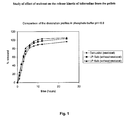
- FIG. 1 shows a comparison of the dissolution profiles of Detrusitol®, LP-5ab and LP-6ab in phosphate buffer at a pH of 6.8.
- FIG. 2 shows dissolution profiles of pellets from Detrusitol® capsules (4 mg tolterodine) in different dissolution media.
- FIG. 3 shows dissolution profiles of LP-5ab capsules (4 mg tolterodine) in different dissolution media.
- FIG. 4 shows dissolution profiles of LP-6ab capsules (4 mg tolterodine) in different dissolution media.
- sustained release pharmaceutical composition which comprises:
- the composition can be present in form of particles, such as pellets filled in capsules or compressed into tablets.
- particles may have any form known in the art, for example essentially spherical, and may have a size of from 0.2 to 2.0 mm, preferably of from 0.5 to 1.5 mm, more preferably of from 0.7 to 1.2 mm.
- the size of these particles can be determined by means of sieving analyses. Techniques for filling particles into capsules or compressing to tablets are known in the art.
- Multiparticulates in particular such as described before, have numerous therapeutic advantages over single unit administration forms. When taken orally, multiparticulates generally disperse freely in the gastrointestinal tract, maximize absorption, minimize side effects and reduce inter-and intra-patient variability.
- the layers of the sustained release composition may be applied on to the cores according to techniques known in the art and in particular using a fluidized bed or a coating pan.
- a fluidized bed coater is used, e.g. a bottom, a tangential or a top-spray coater.
- a fluidized bed system e.g. from Wurster or Huettlin, is one in which an air jet injected from underneath, fluidizes the particles and effects a drying while the coating material is sprayed on the cores.
- rotor tangential spray fluidized bed
- This system is a combination of fluid bed system fitted with a solid rotating disc at the base.
- the discrete coated particles e.g. granules or pellets, thus obtained can be filled into larger units, such as capsules or formed into tablets according to any technique known in the state of the art.
- Tolterodine tartrate can be prepared according to the process described in EP 325 571 or EP 667 852, EP 960 109, WO 01/49649, WO 03/14060, WO 98/03067, CN 1379018 or as described in article Andersson, et al., Asymmetric Total Synthesis of (+)- Tolterodine, a New Muscarinic Receptor Antagonist, via Copper-Assisted Asymmetric Conjugate Addition of Aryl Grignard Reagents to 3-Phenyl-prop-2-enoyl-oxazolidinones, Journal of Organic Chemistry, vol. 63, p. 8067.8070 (1998).
- tolterodine preferably tolterodine with the particle size from 5 to 200 ⁇ m is used.
- Tolterodine used in the formulation according to the invention can be present in different form of a salt thereof.
- useful salts are the addition salts with an inorganic acid selected from hydrochloric, hydrobromic, phosphoric, nitric and sulfuric acid or with an organic acid selected from acetic, propanic, hydroxyacetic, oxalic, lactic, pyruvic, malonic, succinic, fumaric, malic, glutaric, maleic, citric, cyclamic, sulphonic, benzensulphonic, pamoic and the like. Examples of useful salts are also described in WO 03/90734.
- tolterodine as used in the present application comprises tolterodine ( N,N -diisopropyl-3-(2-hydroxy-5-methylphenyl)-3-phenylpropanamine), as well as any salt of tolterodine with pharmaceutically acceptable organic or inorganic acid(s), in particular with tartaric acid, namely tolterodine tartrate, and encompasses compounds of all stereo configurations, i.e. as well naturally occurring and non-naturally occurring stereo configurations.
- tolterodine [(R, R)-tartrate] is preferred.
- the composition preferably comprises tolterodine, calculated as tolterodine tartrate, in an amount of from 0.5 to 10.0 wt %, preferably of from 1.0 to 5.0 wt % and more preferably of from 1.0 to 3.0 wt % and especially of from 1.5 to 2.5 wt %, each on basis of the total weight of the sustained release composition.
- the corresponding amounts of tolterodine and other tolterodine salts for further compositions may be easily obtained by calculation on basis of the above-indicated values relating to tolterodine tartrate.
- dosage forms permitting a less frequent administration such e.g. every 36 h or 48 h can be prepared by a skilled person.
- the composition can comprise at least one sustained release polymer (such as for example neutral polymers of ethyl acrylate/methyl methacrylate, ethylcellulose, polyvinyl acetate (PVAc) and polyvinyl pyrrolidone (PVP) or mixtures thereof) in an amount of preferably 2 to 35 wt %, more preferably 3 to 30 wt %, and most preferably 4 to 25 wt %, each on basis of the total weight of the sustained release composition.
- sustained release polymer such as for example neutral polymers of ethyl acrylate/methyl methacrylate, ethylcellulose, polyvinyl acetate (PVAc) and polyvinyl pyrrolidone (PVP) or mixtures thereof
- a sustained release polymer can be present in the outer layer which can be chosen by a skilled person on basis of the general knowledge in the art. Surprisingly advantageous results can be obtained when the sustained release polymer in the outer layer is a neutral polymer of ethyl acrylate/methyl methacrylate, preferably Eudragit NE 30 D, ethylcellulose, or a mixture of polyvinyl acetate (PVAc) and polyvinyl pyrrolidone (PVP) (applied for example in form of a pre-formulated dispersion of PVAc and PVP), or mixtures thereof.
- PVAc polyvinyl acetate
- PVP polyvinyl pyrrolidone
- the thickness of the outer layer can be in the range of from 10 to 40 ⁇ m, preferably of from 15 to 30 ⁇ m and more preferably of from 20 to 30 ⁇ m.
- the sustained release polymers can be employed in the form of an aqueous suspension or in the form of a solution in an organic solvent during the application process.
- the outer layer can also comprise a plasticizer for further enhancing the film formation and its flexibility.
- Suitable plasticizers can be chosen according to the general knowledge in the art by a skilled person and are for example 1, 2-propylene glycol, triethyl citrate, polyethylene glycol and triacetin, with triethyl citrate being the preferred plasticizer. It is preferred that the amount of plasticizer ranges from 0 to 30 wt %, preferably from 0.5 to 19 wt.%, based on the dry weight of the sustained release polymer(s) as defined above.
- an antisticking agent such as talc
- the weight ratio of antisticking agent to the sustained release polymer(s) can be chosen by a skilled person according to the general knowledge in the art.
- the weight ratio of antisticking agent to the sustained release polymer can be of from 1:1 to 1:10 (wt. / wt.), preferably from 1:1 to 1:5 (wt. / wt.).
- the thickness of the outer layer controls the release rate of tolterodine from the sustained release composition.
- release rate means the amount of tolterodine which is liberated from the composition in a given period of time.
- water has to penetrate through the outer layer and enter the first layer and/or the core in order to dissolve the pharmaceutically active substance tolterodine before said tolterodine may diffuse through the outer layer.
- the thickness and/or composition of the outer layer has to be adapted to the chemical and/or physical properties of tolterodine, such as for example to its molecular size, dissolution properties, in order to obtain an optimal sustained release property of the pharmaceutical composition.
- tolterodine is the sole pharmaceutically active compound (apart of formulation agents such as binders, coloring agents, etc.) in the sustained release composition.
- the release rate of tolterodine decreases with increasing thickness of the outer layer. However, also a minimal amount of outer layer has to be observed when preparing a sustained release composition according to the present invention.
- the coverage provided by the outer layer is preferably not less than 1.0 mg/cm 2 , which corresponds to a thickness of about 10 ⁇ m, since otherwise for example an uncontrolled fast release of tolterodine may occur. In particular, otherwise film defects and burst effects could occur.
- the dissolution profiles of pellets according to the present invention are shown in FIG.s 1, 3 and 4 and are very advantageous since they permit for example a release of at least 50 % but less than 90% after a dissolution time of 5 hours at a pH between 1.2 to 6.8 under simulated release conditions. Such a dissolution profile is highly desired since it provides a release of the active substance tolterodine in the respective target regions of the gastro-intestinal tract in well-balanced amounts.
- the lag time is influenced by the thickness of the outer layer.
- the term lag time means the time between first contact of the pharmaceutical composition with water and the first measurable release of tolterodine. With increasing thickness of the first layer the lag time is also increased.
- the first layer When formulating a sustained release composition on basis of tolterodine, in particular tolterodine tartrate, for a once daily administration, the first layer provides a coverage of from 1 to 5 mg/cm 2 , preferably of from 1 to 3 mg/cm 2 .
- the coverage of the first layer can be determined readily by a skilled person by an electron microscope.
- sustained release compositions of the present invention do not require the application of a seal coat on the inert core, such as e.g. a layer of a substantially water-insoluble polymer, or in other words, the sustained release composition of the present invention advantageously provides an inert core free of or not in direct contact with a layer of a substantially water-insoluble polymer.
- the core element of a pharmaceutical composition according to the invention can comprise an inert core, which is provided with a first (inner) layer comprising tolterodine and a binder, said second layer being layered on said inert core.
- inert core pertains a core made of any pharmaceutically acceptable material which may be formed to particulates and essentially does not induce a degradation of tolterodine (i.e. which does not induce an increase of the degradation of tolterodine of more than for example 5 %, preferably not more than 2 %) or even enhances the stability of tolterodine, when compared to the same tolterodine compound stored as such under identical storage conditions (e.g. during three months after production at 20 °C).
- inert core(s) can be made from pharmaceutically acceptable monosaccharides, disaccharides, oligosaccharides, polysaccharides and mixtures thereof, such as saccharose and starch or cellulose, such as microcrystalline cellulose.
- the inert core can consist of not less than 62.5% and not more than 91.5% sucrose, the remainder is starch.
- the pharmaceutical composition can comprise inert core(s) in an amount of preferably from 40 to 90 wt %, more preferably of from 55 to 85 wt %, and most preferably of from 60 to 80 wt %, each on basis of the total weight of the sustained release composition.
- first (inner) layer as illustrated on more detail below comprising tolterodine and a binder.
- This binder can be any pharmaceutically acceptable binder known in the art.
- the second layer can be selected from the group consisting of cellulose derivatives and PVP (Polyvinyl pyrrolidone).
- Preferred cellulose derivatives are hydroxypropylmethyl cellulose and/or hydroxypropyl cellulose.
- the amount of binder in the first layer and/or the matrix is preferably of from 2 to 5 wt %, more preferably of from 3 to 5 wt %, and most preferred of from 3 to 4 wt %, each on basis of the total weight of the pharmaceutical sustained release composition.
- the weight ratio of tolterodine to binder in the first layer and/or the matrix can be for example of from 2 : 1 (wt. / wt.) to 1 : 5 (wt. / wt.), preferably of from 1 :1 (wt. / wt.) to 1 : 3 (wt. / wt.), each calculated on the basis of tolterodine tartrate.
- the first and second outer layer can also comprise an antisticking agent.
- an antisticking agent will be recommendable if higher concentrations of binder are used.
- An antisticking agent such as talc, reduces the sticking tendency and thereby prevents the agglomeration of pellets, as well as adhesion effects to the wall during the coating process.
- microcrystalline cellulose As a material for forming a structured particle - matrix pellets (from the powders) that is not easily disintegrated in the gastrointestinal tract, microcrystalline cellulose is used. It is preferred that the weight ratio of it in the formulation is over 30%, more preferred between 50 and 60%. Pellets prepared with microcrystalline cellulose and tolterodine are insufficiently strong and also provide an insufficiently controlled release of the active substance tolterodine.
- the same polymers as used for coating can be used in the granulating step (neutral polymers of ethyl acrylate/methyl methacrylate, ethylcellulose, or mixture of PVAc and PVP as a separate polymer or mixtures of these polymers).
- these polymers can be used in further outer coating process(es) to assure desired release of tolterodine from the pellets.
- the matrix core formulation is a consisted of matrix core material, tolterodine and a binder. In this case, all materials are combined, e.g. by mixing, binding and drying step to form a matrix core formulation.
- a matrix pellet can be prepared wherein tolterodine and matrix core material, e.g. microcrystalline cellulose is pelletized with hydrophobic polymer-ethylcellulose or polymethacrylate or PVAc/PVP and optionally coated with the same or different polymer which is controlling drug release.
- compositions can be included either in the matrix core formulation and/or in one of the layers described above and/or be provided in form of an additional layer (apart of the fact that no substantially water-insoluble polymer is applied onto the inert carrier core).
- coloring agents sucrose, lactose, pharmaceutically grade surfactants and/or flavoring agents can be added.
- sustained release compositions according to the present invention can be used for the preparation of a medicament for the treatment or prevention of urge incontinence and other symptoms of unstable or overactive urinary bladder.
- a sustained release composition according to the present invention can be adapted to be administered one or several times per day or can be administered every second, third, fourth, sixth, seventh day, etc..
- a once daily administration form is desired.
- the sustained release composition of the present invention can be administered preferably in an peroral administration form.
- the present invention also provides a method for the manufacture of a tolterodine sustained release pharmaceutical composition, said sustained release pharmaceutical composition having a first layer comprising tolterodine and a binder, which first layer is coated on an inert core and second layer comprising a hydrophobic sustained release polymer, which second layer is coated on the first layer.
- the process comprises the steps: coating a first layer on a inert core, wherein said coating and drying steps being performed in the same container at the same time; coating the second layer onto the first layer, wherein said coating and drying steps being performed in said same container at the same time.
- the method for the manufacture of a composition according to the present invention is advantageous, under aspects of manufacture technique, as well as under the aspects of production costs and production time, because the phases of the process, i.e. coating and drying steps, as well as the forming of the second and the first layer, can take place in the same container.
- the phases of the process i.e. coating and drying steps, as well as the forming of the second and the first layer, can take place in the same container.
- a matrix pellet can be prepared wherein tolterodine and a matrix core material, e.g. microcrystalline cellulose is palletized with hydrophobic polymer-ethylcellulose or polymethacrylate and optionally coated with the same or different polymer which is controlling drug release. It is also one pot system, less time consuming than process mentioned above, but it is preferably used for high dose system.
- a matrix core material e.g. microcrystalline cellulose is palletized with hydrophobic polymer-ethylcellulose or polymethacrylate and optionally coated with the same or different polymer which is controlling drug release. It is also one pot system, less time consuming than process mentioned above, but it is preferably used for high dose system.
- the present invention provides thus an advantageous additional sustained release composition which provides an improved dissolution property with a reduced dependence from the ionic strength and the pH-value of the medium used for dissolving the sustained release composition of the present invention.
- This will provide significant advantages in terms of lower intra- or inter-individual variations of pharmacokinetic parameters.
- the sustained release composition does not require a time and/or cost intensive manufacturing technique, and in particular does not require an application of a sealcoat in form of a substantially water-insoluble polymer onto the core element.
- 2412,62 g of the coated cores were additionally coated in the Wurster fluidized bed equipment with the dispersion made of 804.17 g of Eudragit NE 30 D (30% dispersion of ethyl acrylate/methyl methacrylate copolymer), 241.25 g of talc and 884,58 g of purified water.
- polyvinyl pyrrolidone (PVP) was dissolved in 500 g of purified water. 75.0 g of talc was suspended in 300 g of purified water. 60.0 g of tolterodine tartrate was dispersed in 1200 g of purified water and heated on 40°C. Than, the solution of polyvinyl pyrrolidone and suspension of talc were added during the stirring to obtain a substantially homogeneous dispersion. This dispersion was then sprayed onto 2385 g of inert carrier cores, i.e. non pareil seeds, in a Wurster fluidized bed equipment to form carrier cores with a second layer. To avoid settling, stirring was continued throughout the coating process.
- PVP polyvinyl pyrrolidone
- microcrystalline cellulose and 54.0 g tolterodine tartrate were mixed together in a rotor granulator during the spraying process with dispersion made of 1500 g of Eudragit NE 30 D and 1800 g of purified water.
- the particles obtained were spheres having particle sizes of 0.2 to 1.0 mm.
- 2112,62 g of the matrix cores were additionally coated in the rotor granulator with the dispersion made of 268.17 g of Eudragit NE 30 D (30% dispersion of ethyl acrylate/methyl methacrylate copolymer), 80.42 g of talc and 295,00 g of purified water.
- the pellets corresponding to 4 mg of tolterodine tartrate according to example LP-5ab and LP-6ab or the state of the art pellets from the Detrusitol® capsules were subjected to a dissolution vessel test.
- the dissolution test was carried out using USP apparatus I (USP 27, page 2303) in media at 100 rpm in three different dissolution media (900 ml) at 37°C:
- the dissolution has been monitored by HPLC, equipped with UV detector at 205 nm.
- the pellets comprising 4 mg of compositions LP-5ab and LP-6ab without sealcoat show very similar release profile of tolterodine tartrate when compared to the pellets of composition Detrusitol® provided with a sealcoat.
- sealcoat is not of decisive importance to achieve desired dissolution profile (formulation without sealcoat does not show a lag phase, or shorter zero order drug release phase and total drug releases from the core).
- the dissolution properties will thus largely vary depending on the physiological conditions present in the mammal or human having ingested said sustained release composition.
- Fig. 3 and FIG. 4 show that the pellets comprising 4 mg of compositions LP-5ab and LP-6ab provide a less diverging dissolution profile either in presence of a medium having a higher ionic strength or a low pH.
Landscapes
- Health & Medical Sciences (AREA)
- Engineering & Computer Science (AREA)
- Bioinformatics & Cheminformatics (AREA)
- Chemical & Material Sciences (AREA)
- Medicinal Chemistry (AREA)
- Pharmacology & Pharmacy (AREA)
- Life Sciences & Earth Sciences (AREA)
- Animal Behavior & Ethology (AREA)
- General Health & Medical Sciences (AREA)
- Public Health (AREA)
- Veterinary Medicine (AREA)
- Epidemiology (AREA)
- Emergency Medicine (AREA)
- Urology & Nephrology (AREA)
- Chemical Kinetics & Catalysis (AREA)
- General Chemical & Material Sciences (AREA)
- Nuclear Medicine, Radiotherapy & Molecular Imaging (AREA)
- Organic Chemistry (AREA)
- Medicinal Preparation (AREA)
- Acyclic And Carbocyclic Compounds In Medicinal Compositions (AREA)
Abstract
The present invention is directed to a sustained release pharmaceutical composition comprising tolterodine, preferably tolterodine tartrate, to the use of said composition for the preparation of a medicament and to a method for producing such a sustained release pharmaceutical composition.
Description
- The present invention is directed to a sustained release pharmaceutical composition comprising tolterodine, preferably tolterodine tartrate, to the use of said composition for the preparation of a medicament and to a method for producing such a sustained release pharmaceutical composition.
- Prolonged release formulations are highly estimated by patients as well as by physicians since they allow the possibility of reducing dosage regimens for drugs, especially in case of an oral administration. The advantages of reduced dosage regimens for the patients are an increased convenience, better assurance of compliance, reduction of severity and frequency of side effects, since prolonged release formulations maintain substantially constant blood levels and avoid the fluctuations associated with the conventional immediate release formulations administered more than once a day.
- Tolterodine is a well known antimuscarinic agent specifically developed for treatment of patients with overactive bladder. Known administration forms of tolterodine are for example film-coated tablets containing 1 mg or 2 mg of tolterodine L-tartrate for immediate release in the gastrointestinal tract. These administration forms are however thought to be associated with side-effects, such as "dry mouth". In addition, tolterodine is sold commercially in extended release pharmaceutical dosage forms in order to improve patient convenience. Due to a lowering of peak drug concentrations, such a formulation is associated with reductions in the overall frequency of so-called "dry mouth", when compared to immediate release formulations.
- Moreover, WO 00/27364 describes controlled release beads comprising a core unit of a substantially water-soluble or water-swellable inert material, a first layer ("sealcoat") on the core unit of a substantially water-insoluble polymer, a second layer covering the first layer and containing an active ingredient and a third layer of polymer on the second layer effective for controlled release of the active ingredient, wherein the sealcoat is adapted to control water penetration into the core. In these controlled release beads the presence of the sealcoat is of decisive importance - since in absence of such a sealcoat - formulations resulted in a longer drug release lag phase, as well as in a shorter zero order drug release phase. Additionally, due to a migration of drug into the core not all drug could get released.
- What is even more, controlled release beads of the state of the art show a dissolution profile largely diverging in presence of varying ionic strength and in presence of a varying pH. As well known, the gastro-intestinal pH-value, as well as the ionic strength of the stomach and intestinal contents may largely vary. In order to provide a more reliable administration of the active substance to a patient, a lowering of intra- or inter-individual variations of pharmacokinetic parameters has to be achieved. Therefore, it has to be acknowledged that there is a need in the art to provide a sustained release composition comprising tolterodine, which composition provides a dissolution profile having a reduced dependency from the pH-value and/or the ionic strength of the dissolving medium of the sustained release composition. Moreover, a sustained release composition of the present invention does not require a time and/or cost intensive manufacturing technique and in particular does not require the application of a sealcoat in form of a substantially water-insoluble polymer onto the core element.
- FIG. 1 shows a comparison of the dissolution profiles of Detrusitol®, LP-5ab and LP-6ab in phosphate buffer at a pH of 6.8.
- FIG. 2 shows dissolution profiles of pellets from Detrusitol® capsules (4 mg tolterodine) in different dissolution media.
- FIG. 3 shows dissolution profiles of LP-5ab capsules (4 mg tolterodine) in different dissolution media.
- FIG. 4 shows dissolution profiles of LP-6ab capsules (4 mg tolterodine) in different dissolution media.
- The problem of the present invention is solved by providing a sustained release pharmaceutical composition according to the invention, which comprises:
- 1) Inert core, a first layer, which is coated onto the inert core and comprises a tolterodine and a binder and the outer layer, which comprises hydrophobic, sustained release polymer and which is coated onto a first layer, or
- 2) Optionally, matrix core (consisting of e.g. a core former material, binder and tolterodine) which can be prepared directly from the powders (consisting of e.g. core former material, binder and tolterodine) and finally coated with the outer layer (which comprises hydrophobic, sustained release polymer) effective for controlled release of the active ingredient.
- In particular, the composition can be present in form of particles, such as pellets filled in capsules or compressed into tablets. These particles may have any form known in the art, for example essentially spherical, and may have a size of from 0.2 to 2.0 mm, preferably of from 0.5 to 1.5 mm, more preferably of from 0.7 to 1.2 mm. The size of these particles can be determined by means of sieving analyses. Techniques for filling particles into capsules or compressing to tablets are known in the art.
- Multiparticulates, in particular such as described before, have numerous therapeutic advantages over single unit administration forms. When taken orally, multiparticulates generally disperse freely in the gastrointestinal tract, maximize absorption, minimize side effects and reduce inter-and intra-patient variability.
- The layers of the sustained release composition, namely the first layer, the outer layer, the separating layer and further optional layer(s) may be applied on to the cores according to techniques known in the art and in particular using a fluidized bed or a coating pan. Preferably a fluidized bed coater is used, e.g. a bottom, a tangential or a top-spray coater. A fluidized bed system, e.g. from Wurster or Huettlin, is one in which an air jet injected from underneath, fluidizes the particles and effects a drying while the coating material is sprayed on the cores.
- To create pellets directly from powders and further film coating apply on it, rotor (tangential spray fluidized bed) system can be used. This system is a combination of fluid bed system fitted with a solid rotating disc at the base.
- The discrete coated particles, e.g. granules or pellets, thus obtained can be filled into larger units, such as capsules or formed into tablets according to any technique known in the state of the art.
- Both processes described above are very efficient and economical reasonable because all phases of the manufacturing, such as coating and drying (in case of rotor technology also core formation), take place in a single pot, e.g. a fluidized bed coater. Further, such a production process leads to compositions wherein the reproducibility of the release characteristics of tolterodine is excellent.
- Tolterodine tartrate can be prepared according to the process described in EP 325 571 or EP 667 852, EP 960 109, WO 01/49649, WO 03/14060, WO 98/03067, CN 1379018 or as described in article Andersson, et al., Asymmetric Total Synthesis of (+)-Tolterodine, a New Muscarinic Receptor Antagonist, via Copper-Assisted Asymmetric Conjugate Addition of Aryl Grignard Reagents to 3-Phenyl-prop-2-enoyl-oxazolidinones, Journal of Organic Chemistry, vol. 63, p. 8067.8070 (1998).
Various types of particle size of tolterodine can be used according to the invention, preferably tolterodine with the particle size from 5 to 200 µm is used.
Tolterodine used in the formulation according to the invention can be present in different form of a salt thereof. Examples of useful salts are the addition salts with an inorganic acid selected from hydrochloric, hydrobromic, phosphoric, nitric and sulfuric acid or with an organic acid selected from acetic, propanic, hydroxyacetic, oxalic, lactic, pyruvic, malonic, succinic, fumaric, malic, glutaric, maleic, citric, cyclamic, sulphonic, benzensulphonic, pamoic and the like.
Examples of useful salts are also described in WO 03/90734. - The term "tolterodine" as used in the present application comprises tolterodine (N,N-diisopropyl-3-(2-hydroxy-5-methylphenyl)-3-phenylpropanamine), as well as any salt of tolterodine with pharmaceutically acceptable organic or inorganic acid(s), in particular with tartaric acid, namely tolterodine tartrate, and encompasses compounds of all stereo configurations, i.e. as well naturally occurring and non-naturally occurring stereo configurations. For reasons of its long established use as a pharmaceutically active substance, in particular tolterodine [(R, R)-tartrate] is preferred.
- The composition preferably comprises tolterodine, calculated as tolterodine tartrate, in an amount of from 0.5 to 10.0 wt %, preferably of from 1.0 to 5.0 wt % and more preferably of from 1.0 to 3.0 wt % and especially of from 1.5 to 2.5 wt %, each on basis of the total weight of the sustained release composition. The corresponding amounts of tolterodine and other tolterodine salts for further compositions may be easily obtained by calculation on basis of the above-indicated values relating to tolterodine tartrate.
- Of course, when desired, also dosage forms permitting a less frequent administration, such e.g. every 36 h or 48 h can be prepared by a skilled person.
- The composition can comprise at least one sustained release polymer (such as for example neutral polymers of ethyl acrylate/methyl methacrylate, ethylcellulose, polyvinyl acetate (PVAc) and polyvinyl pyrrolidone (PVP) or mixtures thereof) in an amount of preferably 2 to 35 wt %, more preferably 3 to 30 wt %, and most preferably 4 to 25 wt %, each on basis of the total weight of the sustained release composition.
- A sustained release polymer can be present in the outer layer which can be chosen by a skilled person on basis of the general knowledge in the art. Surprisingly advantageous results can be obtained when the sustained release polymer in the outer layer is a neutral polymer of ethyl acrylate/methyl methacrylate, preferably Eudragit NE 30 D, ethylcellulose, or a mixture of polyvinyl acetate (PVAc) and polyvinyl pyrrolidone (PVP) (applied for example in form of a pre-formulated dispersion of PVAc and PVP), or mixtures thereof. The selection of the above-mentioned sustained release polymers together with the composition of the outer layer and its thickness provide a particularly reliable and advantageous dissolution/liberation profile of the active compound tolterodine at neutral and/or acidic pH-ranges.
- The thickness of the outer layer can be in the range of from 10 to 40 µm, preferably of from 15 to 30 µm and more preferably of from 20 to 30 µm. The sustained release polymers can be employed in the form of an aqueous suspension or in the form of a solution in an organic solvent during the application process.
- The outer layer can also comprise a plasticizer for further enhancing the film formation and its flexibility. Suitable plasticizers can be chosen according to the general knowledge in the art by a skilled person and are for example 1, 2-propylene glycol, triethyl citrate, polyethylene glycol and triacetin, with triethyl citrate being the preferred plasticizer. It is preferred that the amount of plasticizer ranges from 0 to 30 wt %, preferably from 0.5 to 19 wt.%, based on the dry weight of the sustained release polymer(s) as defined above.
- In the outer layer an antisticking agent, such as talc, can also be used. The weight ratio of antisticking agent to the sustained release polymer(s) can be chosen by a skilled person according to the general knowledge in the art. In particular, the weight ratio of antisticking agent to the sustained release polymer can be of from 1:1 to 1:10 (wt. / wt.), preferably from 1:1 to 1:5 (wt. / wt.).
- The thickness of the outer layer controls the release rate of tolterodine from the sustained release composition. In the context of the present invention, the term release rate means the amount of tolterodine which is liberated from the composition in a given period of time. Initially, water has to penetrate through the outer layer and enter the first layer and/or the core in order to dissolve the pharmaceutically active substance tolterodine before said tolterodine may diffuse through the outer layer. As should be clear, the thickness and/or composition of the outer layer has to be adapted to the chemical and/or physical properties of tolterodine, such as for example to its molecular size, dissolution properties, in order to obtain an optimal sustained release property of the pharmaceutical composition. The present inventors found that the present pharmaceutical composition, in particular the outer layer structure surprisingly assures desired release of tolterodine as the pharmaceutically active substance. For currently preferred applications, tolterodine is the sole pharmaceutically active compound (apart of formulation agents such as binders, coloring agents, etc.) in the sustained release composition.
- The release rate of tolterodine decreases with increasing thickness of the outer layer. However, also a minimal amount of outer layer has to be observed when preparing a sustained release composition according to the present invention. The coverage provided by the outer layer is preferably not less than 1.0 mg/cm2, which corresponds to a thickness of about 10 µm, since otherwise for example an uncontrolled fast release of tolterodine may occur. In particular, otherwise film defects and burst effects could occur. The dissolution profiles of pellets according to the present invention are shown in FIG.s 1, 3 and 4 and are very advantageous since they permit for example a release of at least 50 % but less than 90% after a dissolution time of 5 hours at a pH between 1.2 to 6.8 under simulated release conditions. Such a dissolution profile is highly desired since it provides a release of the active substance tolterodine in the respective target regions of the gastro-intestinal tract in well-balanced amounts.
- Besides the release rate, also the lag time is influenced by the thickness of the outer layer. In the context of the present application, the term lag time means the time between first contact of the pharmaceutical composition with water and the first measurable release of tolterodine. With increasing thickness of the first layer the lag time is also increased.
- When formulating a sustained release composition on basis of tolterodine, in particular tolterodine tartrate, for a once daily administration, the first layer provides a coverage of from 1 to 5 mg/cm2, preferably of from 1 to 3 mg/cm2. The coverage of the first layer can be determined readily by a skilled person by an electron microscope.
- An important advantage of the sustained release compositions of the present is that they do not require the application of a seal coat on the inert core, such as e.g. a layer of a substantially water-insoluble polymer, or in other words, the sustained release composition of the present invention advantageously provides an inert core free of or not in direct contact with a layer of a substantially water-insoluble polymer.
- In particular, the core element of a pharmaceutical composition according to the invention can comprise an inert core, which is provided with a first (inner) layer comprising tolterodine and a binder, said second layer being layered on said inert core.
- The term "inert core" pertains a core made of any pharmaceutically acceptable material which may be formed to particulates and essentially does not induce a degradation of tolterodine (i.e. which does not induce an increase of the degradation of tolterodine of more than for example 5 %, preferably not more than 2 %) or even enhances the stability of tolterodine, when compared to the same tolterodine compound stored as such under identical storage conditions (e.g. during three months after production at 20 °C).
- These inert core(s) can be made from pharmaceutically acceptable monosaccharides, disaccharides, oligosaccharides, polysaccharides and mixtures thereof, such as saccharose and starch or cellulose, such as microcrystalline cellulose. In particular, the inert core can consist of not less than 62.5% and not more than 91.5% sucrose, the remainder is starch. The pharmaceutical composition can comprise inert core(s) in an amount of preferably from 40 to 90 wt %, more preferably of from 55 to 85 wt %, and most preferably of from 60 to 80 wt %, each on basis of the total weight of the sustained release composition.
- These inert core(s) are provided with a first (inner) layer as illustrated on more detail below comprising tolterodine and a binder. This binder can be any pharmaceutically acceptable binder known in the art. For example, the second layer can be selected from the group consisting of cellulose derivatives and PVP (Polyvinyl pyrrolidone). Preferred cellulose derivatives are hydroxypropylmethyl cellulose and/or hydroxypropyl cellulose. The amount of binder in the first layer and/or the matrix is preferably of from 2 to 5 wt %, more preferably of from 3 to 5 wt %, and most preferred of from 3 to 4 wt %, each on basis of the total weight of the pharmaceutical sustained release composition.
- The weight ratio of tolterodine to binder in the first layer and/or the matrix can be for example of from 2 : 1 (wt. / wt.) to 1 : 5 (wt. / wt.), preferably of from 1 :1 (wt. / wt.) to 1 : 3 (wt. / wt.), each calculated on the basis of tolterodine tartrate.
- The first and second outer layer can also comprise an antisticking agent. Such an antisticking agent will be recommendable if higher concentrations of binder are used. An antisticking agent, such as talc, reduces the sticking tendency and thereby prevents the agglomeration of pellets, as well as adhesion effects to the wall during the coating process.
- As a material for forming a structured particle - matrix pellets (from the powders) that is not easily disintegrated in the gastrointestinal tract, microcrystalline cellulose is used. It is preferred that the weight ratio of it in the formulation is over 30%, more preferred between 50 and 60%. Pellets prepared with microcrystalline cellulose and tolterodine are insufficiently strong and also provide an insufficiently controlled release of the active substance tolterodine. To improve retarding effect, the same polymers as used for coating can be used in the granulating step (neutral polymers of ethyl acrylate/methyl methacrylate, ethylcellulose, or mixture of PVAc and PVP as a separate polymer or mixtures of these polymers). Optionally, these polymers can be used in further outer coating process(es) to assure desired release of tolterodine from the pellets.
- The matrix core formulation is a consisted of matrix core material, tolterodine and a binder. In this case, all materials are combined, e.g. by mixing, binding and drying step to form a matrix core formulation. In particular, a matrix pellet can be prepared wherein tolterodine and matrix core material, e.g. microcrystalline cellulose is pelletized with hydrophobic polymer-ethylcellulose or polymethacrylate or PVAc/PVP and optionally coated with the same or different polymer which is controlling drug release.
- Further ingredients known in the art of formulating pharmaceutical compositions can be included either in the matrix core formulation and/or in one of the layers described above and/or be provided in form of an additional layer (apart of the fact that no substantially water-insoluble polymer is applied onto the inert carrier core). For example, coloring agents, sucrose, lactose, pharmaceutically grade surfactants and/or flavoring agents can be added.
- The sustained release compositions according to the present invention can be used for the preparation of a medicament for the treatment or prevention of urge incontinence and other symptoms of unstable or overactive urinary bladder.
- As lined out in detail before, a sustained release composition according to the present invention can be adapted to be administered one or several times per day or can be administered every second, third, fourth, sixth, seventh day, etc.. In order to increase the patient compliance, in particular a once daily administration form is desired.
- The sustained release composition of the present invention can be administered preferably in an peroral administration form.
- According to another aspect, the present invention also provides a method for the manufacture of a tolterodine sustained release pharmaceutical composition, said sustained release pharmaceutical composition having a first layer comprising tolterodine and a binder, which first layer is coated on an inert core and second layer comprising a hydrophobic sustained release polymer, which second layer is coated on the first layer. The process comprises the steps: coating a first layer on a inert core, wherein said coating and drying steps being performed in the same container at the same time; coating the second layer onto the first layer, wherein said coating and drying steps being performed in said same container at the same time.
- Under manufacturing technical aspects it can be advantageous when said coating and drying steps of the first layer and said coating and drying steps of the second layer are performed in the same container.
- The method for the manufacture of a composition according to the present invention is advantageous, under aspects of manufacture technique, as well as under the aspects of production costs and production time, because the phases of the process, i.e. coating and drying steps, as well as the forming of the second and the first layer, can take place in the same container. By this simple arrangement, surprisingly the reproducibility of the process and thereby the quality of the resulting pharmaceutical composition is excellent.
- In the case of rotor technology inert cores are not required. In this case, all materials are combined, e.g. by mixing, binding, and drying step to form a matrix core formulation. In particular, a matrix pellet can be prepared wherein tolterodine and a matrix core material, e.g. microcrystalline cellulose is palletized with hydrophobic polymer-ethylcellulose or polymethacrylate and optionally coated with the same or different polymer which is controlling drug release. It is also one pot system, less time consuming than process mentioned above, but it is preferably used for high dose system.
- The present invention provides thus an advantageous additional sustained release composition which provides an improved dissolution property with a reduced dependence from the ionic strength and the pH-value of the medium used for dissolving the sustained release composition of the present invention. This will provide significant advantages in terms of lower intra- or inter-individual variations of pharmacokinetic parameters. Moreover, the sustained release composition does not require a time and/or cost intensive manufacturing technique, and in particular does not require an application of a sealcoat in form of a substantially water-insoluble polymer onto the core element.
- The invention is illustrated in more detail by the following non-limiting examples.
- 65.0 g of hydroxypropyl cellulose was dissolved in 500 g of purified water. 75.0 g of talc was suspended in 300 g of purified water. 60.0 g of tolterodine tartrate was dispersed in 1200 g of purified water and heated on 40°C. Than, the solution of hydroxypropyl cellulose and suspension of talc were added during the stirring to obtain a substantially homogeneous dispersion. This dispersion was then sprayed onto 2385 g of inert carrier cores, i.e. non pareil seeds, in a Wurster fluidized bed equipment to form carrier cores with a second layer. To avoid settling, stirring was continued throughout the coating process.
- 2412,62 g of the coated cores were additionally coated in the Wurster fluidized bed equipment with the dispersion made of 804.17 g of Eudragit NE 30 D (30% dispersion of ethyl acrylate/methyl methacrylate copolymer), 241.25 g of talc and 884,58 g of purified water.
- 65.0 g of polyvinyl pyrrolidone (PVP) was dissolved in 500 g of purified water. 75.0 g of talc was suspended in 300 g of purified water. 60.0 g of tolterodine tartrate was dispersed in 1200 g of purified water and heated on 40°C. Than, the solution of polyvinyl pyrrolidone and suspension of talc were added during the stirring to obtain a substantially homogeneous dispersion. This dispersion was then sprayed onto 2385 g of inert carrier cores, i.e. non pareil seeds, in a Wurster fluidized bed equipment to form carrier cores with a second layer. To avoid settling, stirring was continued throughout the coating process.
- 2412,62 g of the coated carrier cores were additionally coated in the Wurster fludized bed equipment with the dispersion made of 1447.52 g of Surelease (25% dispersion, consisting primarily of ethylcellulose plasticized with fractionated coconut oil) and 965.08 g of purified water.
- 1836.0 g of microcrystalline cellulose and 54.0 g tolterodine tartrate were mixed together in a rotor granulator during the spraying process with dispersion made of 1500 g of Eudragit NE 30 D and 1800 g of purified water. The particles obtained were spheres having particle sizes of 0.2 to 1.0 mm.
- 2112,62 g of the matrix cores were additionally coated in the rotor granulator with the dispersion made of 268.17 g of Eudragit NE 30 D (30% dispersion of ethyl acrylate/methyl methacrylate copolymer), 80.42 g of talc and 295,00 g of purified water.
- The pellets corresponding to 4 mg of tolterodine tartrate according to example LP-5ab and LP-6ab or the state of the art pellets from the Detrusitol® capsules were subjected to a dissolution vessel test. The dissolution test was carried out using USP apparatus I (USP 27, page 2303) in media at 100 rpm in three different dissolution media (900 ml) at 37°C:
- phosphate buffer (USP 27, page 2724) having pH of 6.8 (ionic strength of the buffer is 0.083 mol/L) calculated in accordance with the literature-Quantitative Chemical Analysis written by Daniel C. Harris, age 175)
- phosphate buffer (USP 27, page 2724 with the additional of 0.22 mol/L KCl) having pH of 6.8 (ionic strength of the buffer is 0.524 mol/L calculated in accordance with the literature-Quantitative Chemical Analysis written by Daniel C. Harris, page 175). This phosphate buffer provides a relatively higher ionic strength, when compared to the before-mentioned phosphate buffer (USP);
- 0.1 M (mol/L) HCl, pH=1.2
- The dissolution has been monitored by HPLC, equipped with UV detector at 205 nm.
- FIG. 1 shows a comparison of the dissolution profiles in phosphate buffer (having at the beginning of the test pH = 6.8) between pellets of a pharmaceutical composition of the state of the art (Detrusitol®) comprising 4 mg of tolterodine tartrate and provided with a sealcoat on the pellet core, and pellets comprising 4 mg of compositions LP-5ab and LP-6ab according to the present invention. As can be seen from FIG. 1, the pellets comprising 4 mg of compositions LP-5ab and LP-6ab without sealcoat show very similar release profile of tolterodine tartrate when compared to the pellets of composition Detrusitol® provided with a sealcoat. Our results prove in contrast to the state of the art that sealcoat is not of decisive importance to achieve desired dissolution profile (formulation without sealcoat does not show a lag phase, or shorter zero order drug release phase and total drug releases from the core).
- FIG. 2 shows that pellets of Detrusitol® comprising 4 mg of tolterodine [(R,R)-tartrate)] have a largely decreased dissolution either at a lower pH (pH = 1.2) or at a higher ionic strength. The dissolution properties will thus largely vary depending on the physiological conditions present in the mammal or human having ingested said sustained release composition.
- Fig. 3 and FIG. 4 show that the pellets comprising 4 mg of compositions LP-5ab and LP-6ab provide a less diverging dissolution profile either in presence of a medium having a higher ionic strength or a low pH.
Claims (11)
- A sustained release pharmaceutical composition, comprising
An outer layer coated on the first layer or on the matrix core, which outer layer comprises a hydrophobic sustained release polymer and,
at lease one core element, which is selected from(i) an inert core, said inert core being provided with a first layer comprising tolterodine and a binder, and(ii) a matrix core formulation, said matrix core formulation being a combination of a matrix core material, tolterodine and a binder. - The sustained release pharmaceutical composition according to claim 1, which is in the form of particles, which are preferably filled in capsules or compressed in tablets.
- The sustained release pharmaceutical composition according to any of the preceding claims, which comprises tolterodine in an amount of from 0.5 to 10.0 wt %, preferably of from 1.0 to 5.0 wt % and especially of from 1.5 to 2.5 wt %, each calculated as the salt form.
- The sustained release pharmaceutical composition according to any of the preceding claims, wherein the hydrophobic sustained release polymer selected from the group consisting of neutral polymers of ethyl acrylate/methyl methacrylate, ethylcellulose, and polyvinyl acetate (PVAc) and polyvinyl pyrrolidone (PVP))
- The sustained release pharmaceutical composition according to any of the preceding claims, wherein
the amount of the hydrophobic sustained release polymer is in the range of from 2 to 35 wt %, preferably 4 to 25 wt % and/or
wherein the amount of the carrier cores is in a range of from about 40 to 90 wt %, preferably 60 to 80 wt % and/or
wherein the amount of the binder is in the range of 2 to 5 wt %, preferably 3 to 4 wt %, based on the pharmaceutical composition. - The sustained release pharmaceutical composition according to any of the preceding claims, wherein the weight ratio of tolterodine to binder is of from at least 2 : 1 and up to 1 : 5, preferably of from 1 : 1 to 1 : 3, each calculated on the basis of tolterodine tartrate.
- The sustained release pharmaceutical composition according to any of the preceding claims, wherein the coverage by the first layer is preferably not less than 1.0 mg/cm2, which corresponds to a thickness of about 10 µm.
- Use of a sustained release composition according to any of the preceding claims for the preparation of a medicament for the treatment or prevention of urge incontinence and other symptoms of unstable or overactive urinary bladder.
- The use according to claim 8, wherein said sustained release composition is administered once-daily.
- A process for the manufacture of a sustained release pharmaceutical composition according to any of the claims 1 to 7, comprising the steps:coating and drying the first layer on an inert core element,coating and drying a second layer to the first layer of the particles,said coating and drying steps being performed in said same container.
- The process according to claim 10, comprising the steps:preparation of the matrix core from the powders,further coating wherein the matrix core preparation and coating are performed by means of rotor technology.
Priority Applications (9)
| Application Number | Priority Date | Filing Date | Title |
|---|---|---|---|
| EP04020431A EP1629834A1 (en) | 2004-08-27 | 2004-08-27 | Sustained release pharmaceutical composition of tolterodine |
| DE602005027469T DE602005027469D1 (en) | 2004-08-27 | 2005-08-23 | PHARMACEUTICAL COMPOSITION WITH DELAYED TOLTERODINE RELEASE |
| EA200700484A EA200700484A1 (en) | 2004-08-27 | 2005-08-23 | PHARMACEUTICAL COMPOSITION OF TLTERODIN WITH PROLONGED DELIVERY |
| AT05784596T ATE505187T1 (en) | 2004-08-27 | 2005-08-23 | SUSTAINED RELEASE PHARMACEUTICAL COMPOSITION OF TOLTERODINE |
| UAA200703260A UA87515C2 (en) | 2004-08-27 | 2005-08-23 | Sustained release pharmaceutical composition of tolterodine |
| EP05784596.8A EP1781275B2 (en) | 2004-08-27 | 2005-08-23 | Sustained release pharmaceutical composition of tolterodine |
| EP08007539A EP1964553A1 (en) | 2004-08-27 | 2005-08-23 | Sustained release pharmaceutical composition of tolterodine |
| PCT/EP2005/009102 WO2006021425A1 (en) | 2004-08-27 | 2005-08-23 | Sustained release pharmaceutical composition of tolterodine |
| NO20071299A NO20071299L (en) | 2004-08-27 | 2007-03-09 | Sustained release pharmaceutical composition of tolterodine |
Applications Claiming Priority (1)
| Application Number | Priority Date | Filing Date | Title |
|---|---|---|---|
| EP04020431A EP1629834A1 (en) | 2004-08-27 | 2004-08-27 | Sustained release pharmaceutical composition of tolterodine |
Publications (1)
| Publication Number | Publication Date |
|---|---|
| EP1629834A1 true EP1629834A1 (en) | 2006-03-01 |
Family
ID=34926332
Family Applications (3)
| Application Number | Title | Priority Date | Filing Date |
|---|---|---|---|
| EP04020431A Withdrawn EP1629834A1 (en) | 2004-08-27 | 2004-08-27 | Sustained release pharmaceutical composition of tolterodine |
| EP08007539A Withdrawn EP1964553A1 (en) | 2004-08-27 | 2005-08-23 | Sustained release pharmaceutical composition of tolterodine |
| EP05784596.8A Expired - Lifetime EP1781275B2 (en) | 2004-08-27 | 2005-08-23 | Sustained release pharmaceutical composition of tolterodine |
Family Applications After (2)
| Application Number | Title | Priority Date | Filing Date |
|---|---|---|---|
| EP08007539A Withdrawn EP1964553A1 (en) | 2004-08-27 | 2005-08-23 | Sustained release pharmaceutical composition of tolterodine |
| EP05784596.8A Expired - Lifetime EP1781275B2 (en) | 2004-08-27 | 2005-08-23 | Sustained release pharmaceutical composition of tolterodine |
Country Status (7)
| Country | Link |
|---|---|
| EP (3) | EP1629834A1 (en) |
| AT (1) | ATE505187T1 (en) |
| DE (1) | DE602005027469D1 (en) |
| EA (1) | EA200700484A1 (en) |
| NO (1) | NO20071299L (en) |
| UA (1) | UA87515C2 (en) |
| WO (1) | WO2006021425A1 (en) |
Cited By (6)
| Publication number | Priority date | Publication date | Assignee | Title |
|---|---|---|---|---|
| EP1839649A1 (en) | 2006-03-31 | 2007-10-03 | LEK Pharmaceuticals D.D. | Coated formulations for tolterodine |
| WO2007109357A3 (en) * | 2006-03-21 | 2008-02-28 | Teva Pharma | Controlled release formulation of tolterodine |
| WO2009019599A3 (en) * | 2007-08-08 | 2009-04-09 | Themis Lab Private Ltd | Extended release compositions comprising tolterodine |
| US9415013B2 (en) | 2010-04-01 | 2016-08-16 | Theravida, Inc. | Pharmaceutical formulations |
| US9744157B2 (en) | 2011-05-10 | 2017-08-29 | Theravida, Inc. | Combinations of solifenacin and salivary stimulants for the treatment of overactive bladder |
| US10328057B2 (en) | 2016-01-20 | 2019-06-25 | Theravida, Inc. | Methods and compositions for treating hyperhidrosis |
Families Citing this family (5)
| Publication number | Priority date | Publication date | Assignee | Title |
|---|---|---|---|---|
| KR100851033B1 (en) * | 2007-02-12 | 2008-08-12 | 명문제약주식회사 | Method for preparing sustained-release preparation containing L-tartrate tolterodine |
| WO2011061616A2 (en) | 2009-11-23 | 2011-05-26 | Micro Labs Limited | Extended release compositions containing tolterodine and process for preparing the same |
| WO2011095388A1 (en) | 2010-02-04 | 2011-08-11 | Synthon Bv | Tolterodine bead |
| CN103211784B (en) * | 2012-01-18 | 2017-07-11 | 北京天衡药物研究院有限公司 | Tolterodine tartrate film-controlled slow-release micro pill capsule |
| TW201422254A (en) | 2012-11-21 | 2014-06-16 | Ferring Bv | Composition for immediate and extended release |
Citations (4)
| Publication number | Priority date | Publication date | Assignee | Title |
|---|---|---|---|---|
| WO2003053428A1 (en) * | 2001-12-20 | 2003-07-03 | Pharmacia Corporation | Controlled release dosage form having improved drug release properties |
| US20030185882A1 (en) * | 2001-11-06 | 2003-10-02 | Vergez Juan A. | Pharmaceutical compositions containing oxybutynin |
| US6630162B1 (en) * | 1999-11-11 | 2003-10-07 | Pharmacia Ab | Pharmaceutical formulation and its use |
| US6770295B1 (en) * | 1998-08-27 | 2004-08-03 | Pharmacia Ab | Therapeutic formulation for administering tolterodine with controlled release |
Family Cites Families (14)
| Publication number | Priority date | Publication date | Assignee | Title |
|---|---|---|---|---|
| SE2061C1 (en) † | 1890-01-25 | |||
| SE8800207D0 (en) | 1988-01-22 | 1988-01-22 | Kabivitrum Ab | NEW AMINES, THEIR USE AND MANUFACTURING |
| SE9203318D0 (en) | 1992-11-06 | 1992-11-06 | Kabi Pharmacia Ab | NOVEL 3,3-DIPHENYL PROPYLAMINES, THEIR USE AND PREPARATION |
| US6274171B1 (en) † | 1996-03-25 | 2001-08-14 | American Home Products Corporation | Extended release formulation of venlafaxine hydrochloride |
| WO1998003067A1 (en) | 1996-07-19 | 1998-01-29 | Gunnar Aberg | S(-)-tolterodine in the treatment of urinary and gastrointestinal disorders |
| KR20000057548A (en) | 1996-12-13 | 2000-09-25 | 알프레드 엘. 미첼슨 | Optically transmissive material and bond |
| SE9803871D0 (en) | 1998-11-11 | 1998-11-11 | Pharmacia & Upjohn Ab | Therapeutic method and formulation |
| DE19901692C2 (en) † | 1999-01-18 | 2002-06-20 | Gruenenthal Gmbh | Process for the production of pellets containing up to 90% by weight of an active pharmaceutical ingredient |
| SE9904850D0 (en) | 1999-12-30 | 1999-12-30 | Pharmacia & Upjohn Ab | Novel process and intermediates |
| IN191835B (en) | 2001-08-03 | 2004-01-10 | Ranbaxy Lab Ltd | |
| KR100540035B1 (en) † | 2002-02-01 | 2005-12-29 | 주식회사 태평양 | Multi-stage oral drug controlled-release system |
| US7005449B2 (en) | 2002-04-23 | 2006-02-28 | Pharmacia & Upjohn Company | Tolterodine salts |
| CN1150160C (en) | 2002-04-29 | 2004-05-19 | 上海医药工业研究院 | The synthetic method of L-tolterodine tartrate |
| EP1635795A1 (en) | 2003-05-30 | 2006-03-22 | Ranbaxy Laboratories, Ltd. | Controlled release pharmaceutical compositions of tolterodine and processes for their preparation |
-
2004
- 2004-08-27 EP EP04020431A patent/EP1629834A1/en not_active Withdrawn
-
2005
- 2005-08-23 WO PCT/EP2005/009102 patent/WO2006021425A1/en not_active Ceased
- 2005-08-23 EA EA200700484A patent/EA200700484A1/en unknown
- 2005-08-23 EP EP08007539A patent/EP1964553A1/en not_active Withdrawn
- 2005-08-23 EP EP05784596.8A patent/EP1781275B2/en not_active Expired - Lifetime
- 2005-08-23 AT AT05784596T patent/ATE505187T1/en not_active IP Right Cessation
- 2005-08-23 DE DE602005027469T patent/DE602005027469D1/en not_active Expired - Lifetime
- 2005-08-23 UA UAA200703260A patent/UA87515C2/en unknown
-
2007
- 2007-03-09 NO NO20071299A patent/NO20071299L/en not_active Application Discontinuation
Patent Citations (4)
| Publication number | Priority date | Publication date | Assignee | Title |
|---|---|---|---|---|
| US6770295B1 (en) * | 1998-08-27 | 2004-08-03 | Pharmacia Ab | Therapeutic formulation for administering tolterodine with controlled release |
| US6630162B1 (en) * | 1999-11-11 | 2003-10-07 | Pharmacia Ab | Pharmaceutical formulation and its use |
| US20030185882A1 (en) * | 2001-11-06 | 2003-10-02 | Vergez Juan A. | Pharmaceutical compositions containing oxybutynin |
| WO2003053428A1 (en) * | 2001-12-20 | 2003-07-03 | Pharmacia Corporation | Controlled release dosage form having improved drug release properties |
Cited By (14)
| Publication number | Priority date | Publication date | Assignee | Title |
|---|---|---|---|---|
| WO2007109357A3 (en) * | 2006-03-21 | 2008-02-28 | Teva Pharma | Controlled release formulation of tolterodine |
| JP2009530397A (en) * | 2006-03-21 | 2009-08-27 | テバ ファーマシューティカル インダストリーズ リミティド | Controlled release formulation of tolterodine |
| EP1839649A1 (en) | 2006-03-31 | 2007-10-03 | LEK Pharmaceuticals D.D. | Coated formulations for tolterodine |
| US8642078B2 (en) | 2006-03-31 | 2014-02-04 | Lek Pharmaceuticals, D.D. | Coated formulations for tolterodine |
| WO2009019599A3 (en) * | 2007-08-08 | 2009-04-09 | Themis Lab Private Ltd | Extended release compositions comprising tolterodine |
| US8871275B2 (en) | 2007-08-08 | 2014-10-28 | Inventia Healthcare Private Limited | Extended release compositions comprising tolterodine |
| US9415013B2 (en) | 2010-04-01 | 2016-08-16 | Theravida, Inc. | Pharmaceutical formulations |
| US9968556B2 (en) | 2010-04-01 | 2018-05-15 | Theravida, Inc. | Pharmaceutical formulations |
| US10786457B2 (en) | 2010-04-01 | 2020-09-29 | Theravida, Inc. | Pharmaceutical formulations |
| US9744157B2 (en) | 2011-05-10 | 2017-08-29 | Theravida, Inc. | Combinations of solifenacin and salivary stimulants for the treatment of overactive bladder |
| US10328057B2 (en) | 2016-01-20 | 2019-06-25 | Theravida, Inc. | Methods and compositions for treating hyperhidrosis |
| US10610519B2 (en) | 2016-01-20 | 2020-04-07 | Theravida, Inc. | Methods and compositions for treating hyperhidrosis |
| US11185533B2 (en) | 2016-01-20 | 2021-11-30 | Theravida, Inc. | Methods and compositions for treating hyperhidrosis |
| US11779569B2 (en) | 2016-01-20 | 2023-10-10 | Theravida, Inc. | Methods and compositions for treating hyperhidrosis |
Also Published As
| Publication number | Publication date |
|---|---|
| EP1781275B1 (en) | 2011-04-13 |
| ATE505187T1 (en) | 2011-04-15 |
| EP1781275A1 (en) | 2007-05-09 |
| UA87515C2 (en) | 2009-07-27 |
| EP1964553A1 (en) | 2008-09-03 |
| NO20071299L (en) | 2007-05-29 |
| DE602005027469D1 (en) | 2011-05-26 |
| EA200700484A1 (en) | 2007-10-26 |
| EP1781275B2 (en) | 2014-04-16 |
| WO2006021425A1 (en) | 2006-03-02 |
Similar Documents
| Publication | Publication Date | Title |
|---|---|---|
| JP4535613B2 (en) | Oral morphine multiparticulate formulation | |
| US6905708B2 (en) | Controlled release oral dosage form | |
| TWI440480B (en) | Drug delivery systems comprising weakly basic drugs and organic acids | |
| JP2005516020A (en) | Zero-order sustained release dosage form and process for its production | |
| JP2011516611A (en) | Composition containing weakly basic drug and sustained release dosage form | |
| TWI649100B (en) | Delayed release cysteamine bead formulation, and preparation and use thereof | |
| EP1781275B1 (en) | Sustained release pharmaceutical composition of tolterodine | |
| WO2006046256A1 (en) | Extended release formulation of pramipexole dihydrochloride | |
| HU227490B1 (en) | Sustained release pharmaceutical preparation containing carvedilol | |
| JP2004505034A (en) | Granular composition of eletriptan showing a controlled release sigmoid pattern | |
| US20090192228A1 (en) | Controlled-Release Tolterodine Compositions and Methods | |
| WO2007117110A2 (en) | Sustained-release pellets containing tamsulosin hydrochloride and processes for preparing the same | |
| CA2433915C (en) | Improved controlled release oral dosage form | |
| US20070092568A1 (en) | Galantamine compositions | |
| JP7444862B2 (en) | Method for Preparing a Modified Release Multiple Unit Oral Dosage Form of Doxylamine Succinate and Pyridoxine Hydrochloride | |
| JP2000502066A (en) | Sustained-release cisapride | |
| CA2558783C (en) | Oral morphine multiparticulate formulation | |
| AU2006247357A1 (en) | Morphine sulfate formulations | |
| CA2608361A1 (en) | Morphine sulphate formulations | |
| AU2002253907A1 (en) | Improved controlled release oral dosage form | |
| HK1107780B (en) | Extended release pellet formulation containing pramipexole or a pharmaceutically acceptable salt thereof, method for manufacturing the same and use thereof | |
| HK1107780A1 (en) | Extended release pellet formulation containing pramipexole or a pharmaceutically acceptable salt thereof, method for manufacturing the same and use thereof | |
| HK1149482A (en) | Extended release pellet formulation containing pramipexole or a pharmaceutically acceptable salt thereof, method for manufacturing the same and use thereof |
Legal Events
| Date | Code | Title | Description |
|---|---|---|---|
| PUAI | Public reference made under article 153(3) epc to a published international application that has entered the european phase |
Free format text: ORIGINAL CODE: 0009012 |
|
| AK | Designated contracting states |
Kind code of ref document: A1 Designated state(s): AT BE BG CH CY CZ DE DK EE ES FI FR GB GR HU IE IT LI LU MC NL PL PT RO SE SI SK TR |
|
| AX | Request for extension of the european patent |
Extension state: AL HR LT LV MK |
|
| AKX | Designation fees paid | ||
| STAA | Information on the status of an ep patent application or granted ep patent |
Free format text: STATUS: THE APPLICATION IS DEEMED TO BE WITHDRAWN |
|
| 18D | Application deemed to be withdrawn |
Effective date: 20060902 |
|
| REG | Reference to a national code |
Ref country code: DE Ref legal event code: 8566 |