EP1628257A1 - Tampering detection of digital data using fragile watermark - Google Patents
Tampering detection of digital data using fragile watermark Download PDFInfo
- Publication number
- EP1628257A1 EP1628257A1 EP20050017388 EP05017388A EP1628257A1 EP 1628257 A1 EP1628257 A1 EP 1628257A1 EP 20050017388 EP20050017388 EP 20050017388 EP 05017388 A EP05017388 A EP 05017388A EP 1628257 A1 EP1628257 A1 EP 1628257A1
- Authority
- EP
- European Patent Office
- Prior art keywords
- data
- group
- items
- subsections
- image
- Prior art date
- Legal status (The legal status is an assumption and is not a legal conclusion. Google has not performed a legal analysis and makes no representation as to the accuracy of the status listed.)
- Granted
Links
Images



Classifications
-
- G—PHYSICS
- G06—COMPUTING OR CALCULATING; COUNTING
- G06T—IMAGE DATA PROCESSING OR GENERATION, IN GENERAL
- G06T1/00—General purpose image data processing
- G06T1/0021—Image watermarking
- G06T1/0042—Fragile watermarking, e.g. so as to detect tampering
-
- G—PHYSICS
- G06—COMPUTING OR CALCULATING; COUNTING
- G06T—IMAGE DATA PROCESSING OR GENERATION, IN GENERAL
- G06T2201/00—General purpose image data processing
- G06T2201/005—Image watermarking
- G06T2201/0051—Embedding of the watermark in the spatial domain
-
- G—PHYSICS
- G06—COMPUTING OR CALCULATING; COUNTING
- G06T—IMAGE DATA PROCESSING OR GENERATION, IN GENERAL
- G06T2201/00—General purpose image data processing
- G06T2201/005—Image watermarking
- G06T2201/0061—Embedding of the watermark in each block of the image, e.g. segmented watermarking
Definitions
- the present invention relates to methods for modifying ("watermarking") digital data, and in particular to methods which modify the data such that subsequent tampering with the data can be recognised.
- the invention further relates to methods for recognising the tampering.
- the invention also relates to optionally hiding additional data in the digital data and recovering the hidden data at a later time. It also relates to apparatus for performing these methods.
- Digital watermarking is a technique for inserting information into digital content data such as digital audio data, image data and video data.
- the watermark (WM) is embedded into the content data directly (not as an appendix) and is usually not hearable (in the case of audio data) or visible (in the case of image or video data). It does not affect the normal use of the content data. However, the watermark can be extracted from the watermarked content data, or detected within the watermarked content data.
- One common use for watermarks is to identify the ownership of the content data for copyright protection. Such watermarks need to be robust to survive common image manipulations such as compression, scaling, rotation and even A/D and D/A conversions etc.
- watermarks are authentication, to detect when content data has been tampered with, e.g. to detect that a portion of an image has been modified, such as by cutting and pasting another image onto part of it.
- Some examples of tampering with video footage are shown in the movies Mission Impossible and Speed I, in which someone had deliberately changed the video content of a safety monitoring system. Such things may also happen in real life. In the current world as terrorism becomes a more important threat to human life, the extensive use of video monitoring systems is becoming more important, and it is vital to be able to authenticate that this video footage has not been tampered with.
- the watermark is added in such a way that any tampering with the content data can be detected.
- the watermark used for authentication needs to be fragile, in the sense that a small alteration to the watermarked content data can be detected, so that one can tell if the digital contents have been altered since the embedding of the watermark.
- Hard fragile watermarks are very sensitive and can detect very small alterations such as a 1-bit modification to a single pixel.
- Some examples of hard fragile watermark are given in [2] - [7].
- the methods proposed in [2] - [5] work in the image pixel domain and can determine the locations of the possible alterations.
- the data value of an image is modified according the watermark bitmap and a random look up table.
- the main drawback of the method is that the watermarking scheme is very easy to attack.
- [2] An improvement to [2] is proposed in [3] which determines the watermark bit to be embedded in any given pixel using the neighbor of that pixel. Thus it is very difficult to break the watermarking scheme.
- a very simple watermarking scheme is proposed in [4] which hides the checksum of an image to some randomly selected pixel positions.
- [5] introduces a block based watermarking scheme using a secret key and a hash function to produce the watermarking bit. It is very sensitive to any alteration.
- [6] and [7] are watermarking schemes used for compressing image domain data in that the watermarking bits are embedded into DCT coefficients. A common problem of [6] and [7] is that they lack the ability to determine the altering positions.
- Soft fragile watermarking techniques are not as sensitive as hard fragile watermarking in that they allow some normal manipulations such as image compression, translation, and intensity adjustment etc as long as the image content or quality are not greatly changed. [1] and [8] show some examples of soft fragile watermarking.
- the above mentioned hard fragile watermarking schemes lack one or more of the following desired properties: 1) The watermarking scheme should be sensitive enough to detect small alterations; 2) The scheme should make very small modifications to the original content data when embedding the watermark; 3) The possible altering positions can be determined; 4) The watermarking algorithm should be simple enough for easy implementation; 5) The scheme should be very difficult for a third party to break.
- the present invention aims to provide a new and useful technique for watermarking content data.
- the present invention proposes that content data composed of a set of items having a data value (for example, if the content data is image data, the items may be pixels of the image data and the data values may be grey-scale values or luminance values) is partitioned into subsections.
- a secret key is used to associate items of the subsections into groups, each group including an item from each of the subsections. At least one item within each group is modified using a value derived from all items in the group.
- watermarked data is produced.
- the groups of data values are again extracted using the secret keys, and it is determined whether the values are consistent with the modification process described above. If not, all the data values of the group are regarded as suspect, since at least one of them has been tampered with after the watermarking.
- Preferred embodiments of the watermarking scheme of the invention have the five desired properties listed above.
- embodiments of the present invention may perform minimal modification to the original data, since in certain embodiments a modification is only required to at most one data value of each group (and as discussed below, that modification may be a very small one).
- embodiments of the method may be sensitive to small tampering.
- Embodiments of the method may be computationally simple, both at the watermarking stage and the authentication stage.
- each group can be defined as a respective item of the first subsection and items of the other subsections which correspond to it according to a respective permuted sequence produced using at least one secret key.
- watermarked data produced by embodiments may be the highly resistant to attacks, since the permutation of the sequences means that during the watermarking subtle correlations are introduced between groups of items which are distant in the content data.
- the modification (watermarking) step of the method may be performed in one of several ways.
- a first possibility is to make use of a string of watermark data (called here a watermark bitmap), which may for example be generated automatically using a key (which may optionally be secret, for increased robustness).
- the embedded watermark bitmap may optionally be data (e.g. secret data) which will later be extracted from the watermarked content data.
- the purpose of performing the embedding/detection may actually be to transmit/receive the watermark bitmap, rather than to perform authentication of the content data.
- the modification embeds at least one respective bit from the string of watermark data into the set of data values associated with each said group of items. This may be done, for example, by using the data values associated with each item of each group to derive at least one binary characteristic value (e.g. a parity value), and comparing the characteristic value to a respective bit of the watermark bitmap. If the two are different, at least one of the data values of the group may be modified so as to change the characteristic value to match the watermark bit.
- multiple watermark bits can be embedded into each group of data values ("concatenated watermarking").
- the modification (watermarking) step can be performed (e.g. without making use of watermark data) by introducing a detectable redundancy into the content data.
- the modification may modify at least one least significant bit of at least one data value of the group according to more significant bits of the data values of the group.
- the content data may be another form of digital data such as digital audio data.
- image data it may be a still image or of a frame of a video image.
- the image may be black-and-white (i.e. the data values are grey scale values) or colour.
- the method may be applied either in a pixel domain image or in a transformed domain.
- the data may be transformed in the way employed in a scheme for compression of image/video files such as JPEG, MPEG1, MPEG2, MPEG4 and H.264.
- Such schemes typically transform the data on a block-by-block basis, and the data values of the content data represent amplitudes of spatial frequencies, e.g. DCT data.
- the method of the invention may be applied treating individual blocks as the "items" to be associated into groups, or alternatively treating the spatial frequency values as the items.
- the method may include a preliminary step of decompressing it, prior to the watermarking and subsequent recompression.
- the content data is image data it may be preferable to ensure that modifications are spread over all subsections of the image, or alternatively that they are limited to a peripheral subsection of the still image or frame.
- the modification may be performed only for certain spatial frequency values, e.g. only for data values which are of intermediate spatial frequency.
- a further possible enhancement of the invention is to define a second set of groups (i.e. associations between items of the first subsection and different respective items of each of the other subsections). These second groups can be used, in the way described above in relation to the first groups, to perform watermarking. Thus, there is "double" watermarking. Tampering with a given item would show up in both of the two groups associated with this item. This idea could in principle be extended further to include any number of sets of groups.
- the definition of the subsections would not have to be identical for each of the watermarking operations, since that may result in less change to the original image.
- Embodiments of the present invention typically belong to the technical category called hard fragile watermarking.
- a first expression of the invention is a method of watermarking content data composed of a set of items each associated with at least one data value, the method including:
- a second expression of the invention is a method for detecting an alteration made to watermarked content data composed of a set of items each associated with a data value, the watermarked content data having been produced by:
- the invention may alternatively be expressed as an apparatus having a processor controlled by software which causes it to perform either of the two methods defined above.
- the invention may be expressed as a computer program product (e.g. stored on a record carrier) which, when run by a computer apparatus having access to content data, causes the computer apparatus to perform either of the two methods defined above.
- a computer program product e.g. stored on a record carrier
- a first embodiment of the invention is illustrated.
- This embodiment operates in the image pixel domain (although, as mentioned below, the invention is not limited in this respect in other embodiments).
- the image may be a grey-scale image or a colour image.
- the image is a gray-scale image such that each pixel is associated with a data value which is a gray-scale value.
- the embodiment may be applied without modification to data values which are the luminance component of a colour image (e.g. the Y component in NTSC's YIQ color image representation).
- This modification is performed in the step illustrated as block 33.
- the modification process is as follows:
- steps 22, 23 and 24 may be performed in parallel, e.g. at the same time for three pixels of the same group. Each of these steps, and steps 60, 61 and 62, is performed in turn for each of the groups. In practical embodiments, any of steps 60, 61 and 62 may be performed in respect of a first given group at a time when steps 22, 23 and 24 are being performed in respect of a different one of the groups.
- Detection of the watermark using the watermarked data is illustrated in Fig. 1(b). Again the image is portioned in the image pixel domain into the subsections 11, 12, 13, 14 (which are identical to those in Fig. 1(a)). Then, in steps 42, 43, 44 the pixels in these segments are permuted in the same fashion as in steps 22, 23, 24 and using the same secret key, so that the same groups of pixels are produced.
- the data values of each group are added (step 51), and in step 52 a parity bit representing the parity of the number of 1's in the summed value is compared with the respective bit of the same watermark bitmap used in Fig. 1(a).
- the watermark bitmap is known or may be regenerated in step 53.
- any difference between the parity bit and the corresponding bit of the watermark bitmap is used to infer that there has been some tampering with at least one of the four pixels of the group. That is, all four pixels are suspect.
- any one (or more) of the corresponding 4 pixel positions (one in each subsection) on the image has been modified, and it is impossible to judge which of these 4 positions has been modified.
- almost any meaningful tampering must be done in a continuous area including many pixels (since changing the value of an isolated single pixel will normally not change any content of the image), that will result in the suspect pixels clustering at the real tampered area while scattering in other areas.
- the true tampering position can be determined by the relative clustering of the suspect pixels.
- Figure 2(a) is an original image.
- Figure 2(b) is an image obtained by modifying the image of Fig. 2(a) by (i) applying the method of Fig. 1(a), (ii) modifying the watermarked image by adding 1 to each pixel within a small rectangular area, (iii) applying the method of Fig. 1(b), and (iv) marking the suspect pixels by a respective black dot. From the cluster of black dots at the upper left portion of the image, it can easily be judged that the area where the watermarked data was modified in step (ii) is the one marked as "tampered area". Thus, the true tampering position can be inferred based on the cluster.
- step (ii) is a very minor one.
- the fact that most of these modified pixels have been detected shows that the proposed watermarking scheme is very sensitive.
- the number of subsections can be varied, as can the manner in which the subsections are defined. Since in the first embodiment the watermark bitmap is embedded by modifying the data values in subsection 11, subsection 11 can be selected so that it occupies an area which is not visually significant, for example, the edge area of an image. Note that the only requirement for partitioning the image into subsections is that the number of pixels in each subsection should be approximately the same.
- FIG. 3(a) and 3(b) Some examples are shown in Figures 3(a) and 3(b).
- Fig. 3(a) only three subsections are defined, and the first subsection (corresponding to subsection 11 in Fig. 1(a)) is a non-contiguous area, composed of the four corners of the image.
- the first subsection (corresponding to subsection 11 in Fig. 1(a)) is an edge region of the image.
- the definitions of Figs. 3(a) and 3(b) would reduce the visible change to the image caused by the watermarking process, since the modified areas are on the image edges.
- a second embodiment of the invention is illustrated in Fig. 4.
- This variant of the first embodiment further increases the ability to detect data alteration. It does not use a watermark bitmap.
- the second embodiment instead of embedding a watermark bitmap based on the parity of the summed data values of the four pixels of the respective group, the sum of the 7 most significant bits (MSBs) of the four pixels of the group is calculated, and the number of 1's in this total (not the parity of the 1's) is hidden in the respective lowest significant bit (LSB) of the four pixels (assuming that the image data value is an 8-bit value).
- MSBs most significant bits
- the sum of the 7 MSBs of the four pixels will not exceed 9 bits, so the number of 1's is at most 9.
- a value in the range 0 to 9 can be encoded in 4 bits.
- the LSB positions of the 4 pixels are enough to hide the number of 1's.
- step 60 the sum of the 7 MSBs of each pixel is obtained for each group.
- step 61 the number of 1's in this sum is calculated for each group.
- step 62 this value, converted into binary, is hidden in the respective LSB of the pixels of the group.
- a drawback of this second embodiment is that more image data values need to be modified. Thus the watermarked image quality may become poorer than in the first embodiment.
- a third embodiment of the invention is illustrated in Fig. 5.
- This embodiment is a concatenated fragile WM scheme, in which three bits of a watermark pattern (optionally generated in step 79) are embedded in each group of pixels.
- the first steps of the third embodiment are the same as in the first and second embodiments: the sequences S2, S3 and S4 are obtained using a secret key (steps 22, 23, 24), so that groups of 4 pixels in the respective subsections are obtained.
- step 70 instead of directly summing the four data values from all four subsections, the corresponding data values of subsections 1 and 2 are first added together. Then in step 71 a check is done of the parity of the number of 1's in this result with a first bit of the watermark bitmap. If this parity check does not match then in step 72 the first watermark bit is embedded by modifying the data value in (say) subsection 2.
- step 73 the modified data value of the pixel in subsection 2 is added to the corresponding data value of the pixel of the group in subsection 3.
- steps 74 and 75 a second watermark bit from the watermark bitmap is embedded into this new sum by modifying the data value of subsection 3.
- steps 76 the modified data value of the pixel in subsection 3 is added to the corresponding data value of the pixel of the group in subsection 4.
- steps 77 and 78 a third bit of the watermark bitmap is embedded in the data values of the pixel of the group in subsection 4.
- This third embodiment of the invention can be used to improve the sensitivity of the watermarking to alteration. For example, if any tampering modifies a pixel in subsection 2, the alteration may be detected either from the first watermark bit (which is embedded into subsections 1 and 2) or from the second bit (which is embedded into subsections 2 and 3) or both. Therefore subsection 2 can be considered as protected by double watermarks and thus is more sensitive to alteration. In addition, the locating capability is also improved. For example, if a watermark bitmap alteration is found in the first watermark bit while not found in the second and third watermark bits, it can be judged that the tampering altered the pixel in subsection 1. The drawback of the concatenated fragile WM is that more pixel modifications are required to embed more watermark bits.
- the present invention may be applied also to compressed images and/or the video domain such as JPEG, MPEG2, MPEG4, etc.
- JPEG JPEG
- the image is first divided into many blocks. Usually, each block consists of 8 x 8 pixels.
- a two dimensional DCT is performed within each block, followed by the quantization of the DCT coefficients.
- the quantized DCT coefficients are then put in a one-dimensional vector by the so-called zigzag scan, followed by the run-length coding and entropy coding (Huffman coding).
- FIG. 6 A fourth embodiment of the invention, suitable for combination with the JPEG compression scheme, is illustrated in Fig. 6.
- the block is used as the basic manipulating element ("item") in place of the pixel as in the first three embodiments.
- the data values used in Fig. 6 are the quantized DCT coefficients for the image, arranged in 8x8 blocks (thus, there are 64 data values per item).
- the image is partitioned into subsections in this compressed image domain. These subsections may be the same as in the first three embodiments, and there is DCT data 81, 82, 83, 84 for each of these subsections.
- the block sequences in subsections 2, 3 and 4 are randomly permuted (steps 92, 93, 94).
- the quantized DCT coefficients of the corresponding blocks in 4 subsections are selected.
- V ( i , j ) d 1 , l ( i , j ) + d 2 , k ( i , j ) + d 3 , m ( i , j ) + d 4 , n ( i , j )
- V ( i , j ) is the summed value of the DCT coefficients at the i th row and j th column within a block
- d 1, j ( i , j ) is the i th row and j th column quantized DCT coefficient of the l th block in subsection 1.
- step 96 the parity of the number of 1's in V(i,j) is compared with a respective bit of a watermark bitmap 97. If they do not match, the above-described +1 or -1 modification process to one of these DCT coefficients is made.
- the embodiment do not always modify subsection 1 but instead selects one of the biggest coefficients (e.g. the biggest itself) among the 4 to modify.
- the biggest coefficients e.g. the biggest itself
- the impact of the modification can be kept to minimum.
- the image quality is better preserved and the compressed image size is also less affected.
- the blocks is in the flat area of an image, most of its (their) DCT coefficients after quantization are zeros.
- +1 or -1 is added to these coefficients, it will result in a relatively larger change in the decompressed image and also an increase in the JPEG image size since the Huffman code will be changed a lot.
- the 4 subsections are far apart from each other, it is highly possible that if one or more of the blocks is in the flat area of an image (e.g. d 1, l ( i , j ) and d 3, m ( i , j ) in (4)), the other blocks (e.g. d 2, k ( i , j ) and d 4, n ( i , j ) in (4)) may be in an area with large pixel variation so that they will have large DCT coefficients.
- the +1 or -1 modification imparts a relatively small change to these large DCT coefficients, thus making the watermark less visible and with also less change in the encoded file length.
- a watermark bitmap may not be embedded in every group of four corresponding DCT coefficients. Due to the quantization, many of the high frequency coefficients are zeros for high compression ratio image and thus are not suitable for embedding a watermark bit. We have found that embedding watermark bits into low and middle frequency components proves to be a better choice due to both the larger original DCT coefficients and smaller quantization steps.
- the DC (i.e. zero spatial frequency) coefficient should not be used to embed any watermark bits since this will change the local brightness of the block, which is often very visible.
- any disagreement in any one of the DCT coefficients in a block can be considered as an alteration to that block.
- the minimum altering location can only be identified to a block instead of a pixel.
- Fig. 6 assumes that quantized DCT coefficients are available.
- Fig. 7 presents another variant process, showing the steps if the compressed JPEG image file is available instead of the quantized DCT coefficients.
- This embodiment partly decodes the JPEG file to get the quantized DCT coefficients (step 101), and then embeds the watermark as in Fig. 6 (shown in Fig. 7 as the set of steps 102). After embedding the fragile watermark, the modified DCT coefficients are Hoffman encoded (step 103) to obtain the watermarked compressed image file. Based on the proposed scheme as before, the change in image size of the watermarked JPEG file will be kept very small.
- the minimum locating area is of the size of a block.
- any of the 4 blocks associated with the error position may be the source.
- Fig. 8 illustrates schematically a further embodiment of the invention which increases the error locating ability by employing a double watermark scheme.
- Each block is associated with two respective WM schemes. However, the two schemes have different random sequences to arrange the blocks.
- the blocks associated with block 1 of subsection 1 may be blocks 138, 439, 76 of subsections 2, 3 and 4, respectively, i.e. grouped as (1, 138, 439, 76).
- the group including block 1 of the first subsection may be blocks (1, 275, 93, 347).
- the first group is used to embed a first WM bitmap in the first group DCT coefficients in the block, e.g. by modifying d (3,4) and d (3,5).
- the DCT coefficients d (3,8) and d (4,8) may be modified to embed the second bitmap.
- the above compressed domain watermarking process can also be extended to the video domain, e.g. for use in MPEG2, MPEG4, H.264, etc.
- One example is as following: for the intra frame of the video compression, a similar process as above can be used.
- the watermark bitmap to be embedded can be such information as the name of the source, the date and time of the frame, etc.
- the watermark can be embedded into the motion predicting errors. In this case, usually fewer watermark bits can be embedded into one inter frame.
- the watermark bitmap can be simply the frame number etc. In this way, we can check any data alteration as well as any insertion or loss of a frame of the video sequence.
- watermarking is performed for all items of the content data, this is not a requirement of the invention. Instead, for example, in the case of content data which is image data, optionally only a certain proportion (e.g. half) of the pixels may be associated in groups, and subject to watermarking.
- the watermark bitmap is the additional data/information to be hidden in an image.
- the recovered bitmap from the watermarked image is the targeted information.
- steps 52 and 53 are not performed. Step 52 only performs the parity check and outputs the parity results.
Landscapes
- Physics & Mathematics (AREA)
- General Physics & Mathematics (AREA)
- Engineering & Computer Science (AREA)
- Theoretical Computer Science (AREA)
- Image Processing (AREA)
- Editing Of Facsimile Originals (AREA)
- Compression Or Coding Systems Of Tv Signals (AREA)
Abstract

Description
- The present invention relates to methods for modifying ("watermarking") digital data, and in particular to methods which modify the data such that subsequent tampering with the data can be recognised. The invention further relates to methods for recognising the tampering. The invention also relates to optionally hiding additional data in the digital data and recovering the hidden data at a later time. It also relates to apparatus for performing these methods.
- Digital watermarking is a technique for inserting information into digital content data such as digital audio data, image data and video data. The watermark (WM) is embedded into the content data directly (not as an appendix) and is usually not hearable (in the case of audio data) or visible (in the case of image or video data). It does not affect the normal use of the content data. However, the watermark can be extracted from the watermarked content data, or detected within the watermarked content data. One common use for watermarks is to identify the ownership of the content data for copyright protection. Such watermarks need to be robust to survive common image manipulations such as compression, scaling, rotation and even A/D and D/A conversions etc.
- However, another use for watermarks is authentication, to detect when content data has been tampered with, e.g. to detect that a portion of an image has been modified, such as by cutting and pasting another image onto part of it. Some examples of tampering with video footage are shown in the movies Mission Impossible and Speed I, in which someone had deliberately changed the video content of a safety monitoring system. Such things may also happen in real life. In the current world as terrorism becomes a more important threat to human life, the extensive use of video monitoring systems is becoming more important, and it is vital to be able to authenticate that this video footage has not been tampered with.
- In the case of authentication, the watermark is added in such a way that any tampering with the content data can be detected. The watermark used for authentication needs to be fragile, in the sense that a small alteration to the watermarked content data can be detected, so that one can tell if the digital contents have been altered since the embedding of the watermark.
- Techniques for fragile watermarking have been proposed in many papers and patents as listed in the references. These techniques can be classified into two classes based on the ways in which they define allowable alterations: hard and soft fragile watermarking [1]. Hard fragile watermarks are very sensitive and can detect very small alterations such as a 1-bit modification to a single pixel. Some examples of hard fragile watermark are given in [2] - [7]. The methods proposed in [2] - [5] work in the image pixel domain and can determine the locations of the possible alterations. In [2], the data value of an image is modified according the watermark bitmap and a random look up table. The main drawback of the method is that the watermarking scheme is very easy to attack. An improvement to [2] is proposed in [3] which determines the watermark bit to be embedded in any given pixel using the neighbor of that pixel. Thus it is very difficult to break the watermarking scheme. A very simple watermarking scheme is proposed in [4] which hides the checksum of an image to some randomly selected pixel positions. [5] introduces a block based watermarking scheme using a secret key and a hash function to produce the watermarking bit. It is very sensitive to any alteration. [6] and [7] are watermarking schemes used for compressing image domain data in that the watermarking bits are embedded into DCT coefficients. A common problem of [6] and [7] is that they lack the ability to determine the altering positions.
- Soft fragile watermarking techniques are not as sensitive as hard fragile watermarking in that they allow some normal manipulations such as image compression, translation, and intensity adjustment etc as long as the image content or quality are not greatly changed. [1] and [8] show some examples of soft fragile watermarking.
- In summary, the above mentioned hard fragile watermarking schemes lack one or more of the following desired properties: 1) The watermarking scheme should be sensitive enough to detect small alterations; 2) The scheme should make very small modifications to the original content data when embedding the watermark; 3) The possible altering positions can be determined; 4) The watermarking algorithm should be simple enough for easy implementation; 5) The scheme should be very difficult for a third party to break.
- The present invention aims to provide a new and useful technique for watermarking content data.
- In general terms, the present invention proposes that content data composed of a set of items having a data value (for example, if the content data is image data, the items may be pixels of the image data and the data values may be grey-scale values or luminance values) is partitioned into subsections. A secret key is used to associate items of the subsections into groups, each group including an item from each of the subsections. At least one item within each group is modified using a value derived from all items in the group. Thus, watermarked data is produced.
- When authentication is to be carried out, the groups of data values are again extracted using the secret keys, and it is determined whether the values are consistent with the modification process described above. If not, all the data values of the group are regarded as suspect, since at least one of them has been tampered with after the watermarking.
- Preferred embodiments of the watermarking scheme of the invention have the five desired properties listed above.
- Specifically, compared with the other fragile watermark methods, embodiments of the present invention may perform minimal modification to the original data, since in certain embodiments a modification is only required to at most one data value of each group (and as discussed below, that modification may be a very small one).
- Despite this, embodiments of the method may be sensitive to small tampering.
- Embodiments of the method may be computationally simple, both at the watermarking stage and the authentication stage. For example, each group can be defined as a respective item of the first subsection and items of the other subsections which correspond to it according to a respective permuted sequence produced using at least one secret key.
- Thus, watermarked data produced by embodiments may be the highly resistant to attacks, since the permutation of the sequences means that during the watermarking subtle correlations are introduced between groups of items which are distant in the content data.
- The modification (watermarking) step of the method may be performed in one of several ways. A first possibility is to make use of a string of watermark data (called here a watermark bitmap), which may for example be generated automatically using a key (which may optionally be secret, for increased robustness). Note that the embedded watermark bitmap may optionally be data (e.g. secret data) which will later be extracted from the watermarked content data. In this case, the purpose of performing the embedding/detection may actually be to transmit/receive the watermark bitmap, rather than to perform authentication of the content data.
- In the case that a watermark bitmap is embedded, the modification embeds at least one respective bit from the string of watermark data into the set of data values associated with each said group of items. This may be done, for example, by using the data values associated with each item of each group to derive at least one binary characteristic value (e.g. a parity value), and comparing the characteristic value to a respective bit of the watermark bitmap. If the two are different, at least one of the data values of the group may be modified so as to change the characteristic value to match the watermark bit. Optionally, multiple watermark bits can be embedded into each group of data values ("concatenated watermarking").
- Alternatively, the modification (watermarking) step can be performed (e.g. without making use of watermark data) by introducing a detectable redundancy into the content data. For example, the modification may modify at least one least significant bit of at least one data value of the group according to more significant bits of the data values of the group.
- Certain embodiments of the invention are particularly suitable for watermarking image data, but alternatively the content data may be another form of digital data such as digital audio data. In the case that it is image data, it may be a still image or of a frame of a video image. The image may be black-and-white (i.e. the data values are grey scale values) or colour.
- Furthermore, even in the case that the content data represents a still or video image, the method may be applied either in a pixel domain image or in a transformed domain. For example, the data may be transformed in the way employed in a scheme for compression of image/video files such as JPEG, MPEG1, MPEG2, MPEG4 and H.264. Such schemes typically transform the data on a block-by-block basis, and the data values of the content data represent amplitudes of spatial frequencies, e.g. DCT data. The method of the invention may be applied treating individual blocks as the "items" to be associated into groups, or alternatively treating the spatial frequency values as the items. Note that if the content data is supplied in the form of compressed data, the method may include a preliminary step of decompressing it, prior to the watermarking and subsequent recompression.
- Many modifications are possible within the scope of the invention, particularly to enhance one or more of the desired properties of the method according to the sort of content data which is used.
- For example, if the content data is image data it may be preferable to ensure that modifications are spread over all subsections of the image, or alternatively that they are limited to a peripheral subsection of the still image or frame. As a further example, if the content data is data transformed into the spatial frequency domain, the modification may be performed only for certain spatial frequency values, e.g. only for data values which are of intermediate spatial frequency.
- A further possible enhancement of the invention is to define a second set of groups (i.e. associations between items of the first subsection and different respective items of each of the other subsections). These second groups can be used, in the way described above in relation to the first groups, to perform watermarking. Thus, there is "double" watermarking. Tampering with a given item would show up in both of the two groups associated with this item. This idea could in principle be extended further to include any number of sets of groups. Optionally, the definition of the subsections would not have to be identical for each of the watermarking operations, since that may result in less change to the original image.
- Embodiments of the present invention typically belong to the technical category called hard fragile watermarking.
- Specifically, a first expression of the invention is a method of watermarking content data composed of a set of items each associated with at least one data value, the method including:
- partitioning the content data into a plurality of subsections;
- using at least one secret key to associate a plurality of the items into groups, each group including an item from each of the subsections; and
- modifying at least one item within each group using a value derived from all items in the group, thereby producing modified content data.
- A second expression of the invention is a method for detecting an alteration made to watermarked content data composed of a set of items each associated with a data value, the watermarked content data having been produced by:
- (i) partitioning the content data into a plurality of subsections;
- (ii) using at least one secret key to associate a plurality of the items into groups, each group including an item from each of the subsections; and
- (iii) modifying at least one item within each group using a value derived from all items in the group, thereby producing the watermarked content data,
- using said at least one secret key to obtain said groups of items; and
- using the data values of said groups of items to determine whether the groups of data values are consistent with having been produced by the step (iii), and in the case that this determination is negative labelling the data values of the group as suspect.
- The invention may alternatively be expressed as an apparatus having a processor controlled by software which causes it to perform either of the two methods defined above.
- Furthermore, the invention may be expressed as a computer program product (e.g. stored on a record carrier) which, when run by a computer apparatus having access to content data, causes the computer apparatus to perform either of the two methods defined above.
- Preferred features of the invention will now be described, for the sake of illustration only, with reference to the following figures in which:
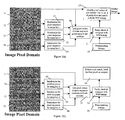
- Fig. 1 is composed of Fig. 1 (a) which is a schematic flow diagram illustrating a watermarking technique which is a first embodiment of the invention, in which a fragile watermark is embedded in image data in the image pixel domain, and Fig. 1(b) is a flow diagram illustrating an authentication technique for use with watermarked data produced using the watermarking technique of Fig. 1 (a);
- Fig. 2(a) is an original image, and Fig. 2(b) shows the result of watermarking the image of Fig. 2(a) by the embodiment of Fig. 1, tampering with the image, and then marking with black dots the locations in which the possibility of tampering is detected by the method Fig. 1 (b);
- Figure 3 illustrates schematically alternative ways of partitioning an image in the embodiment of Fig. 1 (a);
- Figure 4 is a schematic flow diagram of a second embodiment of the invention;
- Figure 5 is a schematic flow diagram of a third embodiment of the invention;
- Figure 6 a schematic flow diagram of a fourth embodiment of the invention;
- Figure 7 is a flow diagram of a further embodiment in which a watermark is embedded into a compressed image file; and
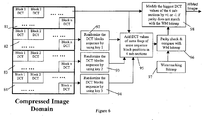
- Figure 8 illustrates schematically a further embodiment in which double watermarks are embedded into blocked DCT coefficients of a compressed image.
- Referring to Fig. 1, a first embodiment of the invention is illustrated. This embodiment operates in the image pixel domain (although, as mentioned below, the invention is not limited in this respect in other embodiments). The image may be a grey-scale image or a colour image. For the purposes of the discussion below it will be assumed that the image is a gray-scale image such that each pixel is associated with a data value which is a gray-scale value. However, in the case that the image is a colour image, the embodiment may be applied without modification to data values which are the luminance component of a colour image (e.g. the Y component in NTSC's YIQ color image representation).
- The embodiment has the following steps:
- (1) The whole image field is divided into n (≥2)
non-overlapping subsections - (2) A sequence of pixels is defined for each of the
subsections first subsection 11 is denoted by S1. The data value at pixel position k of subsection j is denoted as p j (k). - (3) The pixel sequences of the other three
subsections blocks - (4) As shown in
block 30, the data values of each of the pixels insubsection 11 is added to the data values in the corresponding positions of permuted sequence from thesubsections subsection 11, each of these groups being composed of a respective one of the pixels insubsection 11, and a pixel from each of the other three subsections, and the data values of each of the pixels of the group are added together, to give a value V(i), where the index i labels the group (or equivalently the pixel of the first subsection 11). For example, if the 4 sequences are: S1=(1, 2, 3, ...), S2=(378, 1052, 765, ...), S3=(1349, 125, 534, ...) and S4=(476, 289, 1179, ...), then


- (5) If the parity is odd, a
parity bit 1 is used to describe the sum. Otherwise, a parity bit 0 is used. As illustrated inblock 31, the parity bit for each group is compared with a respective bit of a watermark bitmap (i.e. a string in which each element is 0 or 1). The bitmap represented byblock 32 can be either a known bitmap image, such as a company logo or a pseudorandom sequence. In the case of data hiding, the bitmap is data/information to be hidden in the image. The number of bits of the watermark bitmap is the same as the number of pixels forsubsection 11 of the image. If the parity bit is same as the respective bit of the watermark bitmap, no modification is needed. If the parity bit is different from the respective bit of the watermark bitmap, a modification is made to the corresponding pixel of the first subsection 11 (in other embodiments of this invention, this can be generalised by making the modification to the corresponding bit of any one of thesubsections - This modification is performed in the step illustrated as
block 33. The modification process is as follows: - If the summed value V(i) is odd, the data value in
subsection 12 is changed to p 1(i)=p 1(i)-1. - If summed value V(i) is even, the data value in subsection 1 (denoted by a) is changed to p 1 (i) = p 1(i)+1.
- It should be understood that
steps steps - Detection of the watermark using the watermarked data is illustrated in Fig. 1(b). Again the image is portioned in the image pixel domain into the
subsections steps steps step 53. Instep 54, any difference between the parity bit and the corresponding bit of the watermark bitmap is used to infer that there has been some tampering with at least one of the four pixels of the group. That is, all four pixels are suspect. - Note that it is possible that any one (or more) of the corresponding 4 pixel positions (one in each subsection) on the image has been modified, and it is impossible to judge which of these 4 positions has been modified. However, since almost any meaningful tampering must be done in a continuous area including many pixels (since changing the value of an isolated single pixel will normally not change any content of the image), that will result in the suspect pixels clustering at the real tampered area while scattering in other areas. Thus, the true tampering position can be determined by the relative clustering of the suspect pixels.
- Such an example is shown in Figure 2. Figure 2(a) is an original image. Figure 2(b) is an image obtained by modifying the image of Fig. 2(a) by (i) applying the method of Fig. 1(a), (ii) modifying the watermarked image by adding 1 to each pixel within a small rectangular area, (iii) applying the method of Fig. 1(b), and (iv) marking the suspect pixels by a respective black dot. From the cluster of black dots at the upper left portion of the image, it can easily be judged that the area where the watermarked data was modified in step (ii) is the one marked as "tampered area". Thus, the true tampering position can be inferred based on the cluster.
- Note that the modification made in step (ii) is a very minor one. The fact that most of these modified pixels have been detected shows that the proposed watermarking scheme is very sensitive.
- We now turn to discussing various modifications which can be made to the first embodiment within the scope of the present invention.
- Firstly, the number of subsections can be varied, as can the manner in which the subsections are defined. Since in the first embodiment the watermark bitmap is embedded by modifying the data values in
subsection 11,subsection 11 can be selected so that it occupies an area which is not visually significant, for example, the edge area of an image. Note that the only requirement for partitioning the image into subsections is that the number of pixels in each subsection should be approximately the same. - Some examples are shown in Figures 3(a) and 3(b). In Fig. 3(a) only three subsections are defined, and the first subsection (corresponding to subsection 11 in Fig. 1(a)) is a non-contiguous area, composed of the four corners of the image. In Fig. 3(b) the first subsection (corresponding to subsection 11 in Fig. 1(a)) is an edge region of the image. As compared to the definition of subsections in Fig. 1(a), the definitions of Figs. 3(a) and 3(b) would reduce the visible change to the image caused by the watermarking process, since the modified areas are on the image edges.
- A second embodiment of the invention is illustrated in Fig. 4. This variant of the first embodiment further increases the ability to detect data alteration. It does not use a watermark bitmap. Specifically, in the second embodiment, instead of embedding a watermark bitmap based on the parity of the summed data values of the four pixels of the respective group, the sum of the 7 most significant bits (MSBs) of the four pixels of the group is calculated, and the number of 1's in this total (not the parity of the 1's) is hidden in the respective lowest significant bit (LSB) of the four pixels (assuming that the image data value is an 8-bit value). For an image with 8-bit data values, the sum of the 7 MSBs of the four pixels (expressed in binary) will not exceed 9 bits, so the number of 1's is at most 9. A value in the range 0 to 9 can be encoded in 4 bits. Thus, the LSB positions of the 4 pixels are enough to hide the number of 1's.
- The steps of this method are shown in Fig. 4. As in the method of Fig. 1(a), the four
subsections same reference numerals step 60, the sum of the 7 MSBs of each pixel is obtained for each group. Instep 61, the number of 1's in this sum is calculated for each group. Instep 62, this value, converted into binary, is hidden in the respective LSB of the pixels of the group. - A drawback of this second embodiment is that more image data values need to be modified. Thus the watermarked image quality may become poorer than in the first embodiment.
- A third embodiment of the invention is illustrated in Fig. 5. This embodiment is a concatenated fragile WM scheme, in which three bits of a watermark pattern (optionally generated in step 79) are embedded in each group of pixels. The first steps of the third embodiment are the same as in the first and second embodiments: the sequences S2, S3 and S4 are obtained using a secret key (
steps step 70, instead of directly summing the four data values from all four subsections, the corresponding data values ofsubsections step 72 the first watermark bit is embedded by modifying the data value in (say)subsection 2. - Then, in
step 73, the modified data value of the pixel insubsection 2 is added to the corresponding data value of the pixel of the group insubsection 3. Insteps subsection 3. - In steps 76, the modified data value of the pixel in
subsection 3 is added to the corresponding data value of the pixel of the group insubsection 4. Insteps subsection 4. - This third embodiment of the invention can be used to improve the sensitivity of the watermarking to alteration. For example, if any tampering modifies a pixel in
subsection 2, the alteration may be detected either from the first watermark bit (which is embedded intosubsections 1 and 2) or from the second bit (which is embedded intosubsections 2 and 3) or both. Thereforesubsection 2 can be considered as protected by double watermarks and thus is more sensitive to alteration. In addition, the locating capability is also improved. For example, if a watermark bitmap alteration is found in the first watermark bit while not found in the second and third watermark bits, it can be judged that the tampering altered the pixel insubsection 1. The drawback of the concatenated fragile WM is that more pixel modifications are required to embed more watermark bits. - The present invention may be applied also to compressed images and/or the video domain such as JPEG, MPEG2, MPEG4, etc. We will take JPEG as an example. In the JPEG compression scheme, the image is first divided into many blocks. Usually, each block consists of 8 x 8 pixels. A two dimensional DCT is performed within each block, followed by the quantization of the DCT coefficients. The quantized DCT coefficients are then put in a one-dimensional vector by the so-called zigzag scan, followed by the run-length coding and entropy coding (Huffman coding).
- A fourth embodiment of the invention, suitable for combination with the JPEG compression scheme, is illustrated in Fig. 6. To embed a fragile watermark into a JPEG image, the block is used as the basic manipulating element ("item") in place of the pixel as in the first three embodiments. The data values used in Fig. 6 are the quantized DCT coefficients for the image, arranged in 8x8 blocks (thus, there are 64 data values per item). The image is partitioned into subsections in this compressed image domain. These subsections may be the same as in the first three embodiments, and there is
DCT data subsections 
where V(i,j) is the summed value of the DCT coefficients at the i th row and j th column within a block, d 1,j (i,j) is the i th row and j th column quantized DCT coefficient of the l th block insubsection 1. k,m and n are the corresponding blocks insubsections step 96, the parity of the number of 1's in V(i,j) is compared with a respective bit of awatermark bitmap 97. If they do not match, the above-described +1 or -1 modification process to one of these DCT coefficients is made. - Optionally, however, the embodiment do not always modify
subsection 1 but instead selects one of the biggest coefficients (e.g. the biggest itself) among the 4 to modify. The reason is that by selecting the biggest coefficients, the impact of the modification can be kept to minimum. Thus the image quality is better preserved and the compressed image size is also less affected. For example, if one or more of the blocks is in the flat area of an image, most of its (their) DCT coefficients after quantization are zeros. Thus if +1 or -1 is added to these coefficients, it will result in a relatively larger change in the decompressed image and also an increase in the JPEG image size since the Huffman code will be changed a lot. Since the 4 subsections are far apart from each other, it is highly possible that if one or more of the blocks is in the flat area of an image (e.g. d 1,l (i,j) and d 3,m (i,j) in (4)), the other blocks (e.g. d 2,k (i,j) and d 4,n (i,j) in (4)) may be in an area with large pixel variation so that they will have large DCT coefficients. The +1 or -1 modification imparts a relatively small change to these large DCT coefficients, thus making the watermark less visible and with also less change in the encoded file length. - Note that optionally, a watermark bitmap may not be embedded in every group of four corresponding DCT coefficients. Due to the quantization, many of the high frequency coefficients are zeros for high compression ratio image and thus are not suitable for embedding a watermark bit. We have found that embedding watermark bits into low and middle frequency components proves to be a better choice due to both the larger original DCT coefficients and smaller quantization steps. Preferably, the DC (i.e. zero spatial frequency) coefficient should not be used to embed any watermark bits since this will change the local brightness of the block, which is often very visible.
- Since multiple DCT coefficients within one block are used to embed watermark bits, any disagreement in any one of the DCT coefficients in a block can be considered as an alteration to that block. Of course, the minimum altering location can only be identified to a block instead of a pixel.
- As mentioned above, Fig. 6 assumes that quantized DCT coefficients are available. Fig. 7 presents another variant process, showing the steps if the compressed JPEG image file is available instead of the quantized DCT coefficients. This embodiment partly decodes the JPEG file to get the quantized DCT coefficients (step 101), and then embeds the watermark as in Fig. 6 (shown in Fig. 7 as the set of steps 102). After embedding the fragile watermark, the modified DCT coefficients are Hoffman encoded (step 103) to obtain the watermarked compressed image file. Based on the proposed scheme as before, the change in image size of the watermarked JPEG file will be kept very small. There are 2 main reasons for this: (1) by selecting largest DCT coefficients among the 4 subsections to embed the WM bit, (2) most of the DCT coefficients are not changed (on average, 87.5% are not changed if 4 subsections are used. Furthermore, if within each block only a subset of the DCT coefficients are used to embed watermark bits, the unchanged DCT coefficients are much more).
- As mentioned above, for the block-based watermark scheme, the minimum locating area is of the size of a block. Thus, by analogy with pixel image domain case of the first embodiment, if one error is detected in the watermark bitmap, any of the 4 blocks associated with the error position may be the source. Fig. 8 illustrates schematically a further embodiment of the invention which increases the error locating ability by employing a double watermark scheme. Each block is associated with two respective WM schemes. However, the two schemes have different random sequences to arrange the blocks. For example, in the first watermark scheme, the blocks associated with
block 1 ofsubsection 1 may beblocks 138, 439, 76 ofsubsections group including block 1 of the first subsection may be blocks (1, 275, 93, 347). The first group is used to embed a first WM bitmap in the first group DCT coefficients in the block, e.g. by modifying d(3,4) and d(3,5). Similarly, the DCT coefficients d(3,8) and d(4,8) may be modified to embed the second bitmap. Thus, if both the first and second groups are detected to contain error, it can be judged that the true tampering position is inblock 1 ofsubsection 1 as it is the common element among these two groups. - Although only a few embodiments of the invention have been described in detail, many variants are possible within the scope of the invention as will be clear to a skilled reader. For example, many features in the various embodiments above may be combined.
- Furthermore, the above compressed domain watermarking process can also be extended to the video domain, e.g. for use in MPEG2, MPEG4, H.264, etc. One example is as following: for the intra frame of the video compression, a similar process as above can be used. The watermark bitmap to be embedded can be such information as the name of the source, the date and time of the frame, etc. On the other hand, for the inter frame, the watermark can be embedded into the motion predicting errors. In this case, usually fewer watermark bits can be embedded into one inter frame. Thus, the watermark bitmap can be simply the frame number etc. In this way, we can check any data alteration as well as any insertion or loss of a frame of the video sequence.
- Furthermore, it is also possible to vary the watermark embedding and detecting procedure to other formats without essential changes in the basic structure of this invention, as defined by the claims.
- Furthermore, whereas in the embodiments explained above, watermarking is performed for all items of the content data, this is not a requirement of the invention. Instead, for example, in the case of content data which is image data, optionally only a certain proportion (e.g. half) of the pixels may be associated in groups, and subject to watermarking.
- Furthermore, all of the above embodiments above in which a watermark bitmap is embedded into the data can be used as a means of data hiding. In this case, the watermark bitmap is the additional data/information to be hidden in an image. In the detecting process, the recovered bitmap from the watermarked image is the targeted information. In this case, for example, in Fig. 1(b) steps 52 and 53 are not performed.
Step 52 only performs the parity check and outputs the parity results. -
- [1]. B B. Zhu, M. D. Swanson and A. H. Tewfik "When Seeing Isn't Believing" IEEE Signal Processing Magazine, Vol. 21, No.2, 2004, pp40~49
- [2]. M. M. Yeung and F. Mintzer "An Invisible Watermarking Technique for Image Verification" Proc. IEEE Int. Conf. Image Processing, 1997,pp680~683
- [3]. J. Fridrich, M. Goljan and A. C. Baldoza "New Fragile Authentication Watermark for Images" Proc IEEE Int. Conf. Image Processing, 2000, pp428-437
- [4]. Steve Walton "Image Authentication for a Slippery New Age" Dr. Dobb's J., Vol.20, No.4, 1995, pp18~26
- [5]. P. W. Wong and N. Memon "Secret and Public Key Image Watermarking Schemes for Image Authentication and Ownership Verification" IEEE Trans. On Image Processing, Vol. 10, No. 10, 2001, pp1593~1601
- [6]. V. Bhaskaran and V. Ratnakar "Fragile Watermarks for Detecting Tampering in Images" U. S. Patent No. 6,064,764, May, 2000
- [7]. R. L. Adler, B. P. Kitchens, C, P. Tresser and C. W. Wu "Compressed Image Authentication and Verification" U. S. Patent No. 6,275,599, Aug., 2001
- [8]. S. F. Chang and C. Y. Lin "Method and Apparatus for Image Authentication" U.S. Patent No. 6,532,541, Mar., 2003
- [9]. M. A. Isnardi and C. Musgrave "Method and Apparatus for Embedding a Watermark into a Digital Image or Image Sequence", U. S. Patent No. 6,037,984, Mar., 2000
said authentication method including the steps of:
It can be seen that this simple operation changes the parity of 1's of the summed value and thus makes it the same as the respective watermark bitmap value. In this way, the watermark bitmap is embedded into the original image, to generate a watermarked image.
Claims (29)
- A method of watermarking content data composed of a set of items each associated with at least one data value, the method including:partitioning the content data into a plurality of subsections;using at least one secret key to associate a plurality of the items into groups, each group including an item from each of the subsections; andmodifying at least one item within each group using a value derived from all items in the group, thereby producing modified content data.
- A method according to claim 1 in which, for all groups, said modified item is in the same one of said subsections.
- A method according to claim 1 or claim 2 in which said groups are defined by:for each subsection except a first of said subsections, using said at least one secret key to define a respective permuted sequence of the items of that subsection, anddefining each group as a respective item of the first subsection and corresponding items of the other subsections according to the respective permuted sequences.
- A method according to any preceding claim in which said modification embeds at least one respective bit from a string of watermark data into the set of data values associated with each said group of items.
- A method according to claim 4 in which said modification is obtained by using data values associated with each item of each group to derive at least one binary characteristic value, comparing each characteristic value to a respective said bit of the watermark data, and according to the result of the comparison modifying at least one of the data values of the group thereby changing the characteristic value.
- A method according to claim 5 in which there is only one characteristic value for each group, and it is a binary parity value.
- A method according to claim 5 in which there are multiple characteristic values for each group, different ones of the characteristic values being derived from different respective subsets of the group of items.
- A method according to any of claims 1 to 3 in which the modification introduces a redundancy into the content data.
- A method according to claim 8 in which the modification modifies at least one least significant bit of at least one data value of the group according to a characteristic value obtained using at least one most significant bit of at least one of the data values of the group.
- A method according to any preceding claim in which the items are pixels of a still image or of a frame of a video sequence.
- A method according to claim 10 when dependent upon claim 2 in which said subsection including the modified items is a peripheral subsection of the still image or frame.
- A method according to claim 10 or claim 11 in which the data values are gray scale values.
- A method according to claim 10 or claim 11 in which the still image or video frame is a colour image or different colour channels, and data values are luminance values of the image or different colour channels.
- A method according to any preceding claim in which the content data is image data which has been divided into blocks and transformed on a block-by-block basis, and the data values are transformed data.
- A method according to claim 14 in which the transformed data is image data transformed by a DCT or an equivalent such as an integer transform and composed of data values which are amplitudes of spatial frequencies.
- A method according to claim 15 in which said modification step is performed only for data values which are of intermediate spatial frequency.
- A method according to claim 15 in which, in said step of modifying at least one data value of a group of data values, a data value is selected which is in the upper half of the data values of the group, and at least the selected data value is modified.
- A method according to any of claims 14 to 17 in which the items are blocks of the transformed data.
- A method according to any of claims 14 to 17 in which the items are spatial frequency amplitudes within the blocks of the data, each group consisting of items at the same respective position within respective blocks of data.
- A method according to claim any of claims 14 to 19 which includes a step of deriving the content data by decompressing compressed data, and a step of recompressing the modified content data.
- A method according to any preceding claim, further comprising:using at least one further secret key to associate a plurality of the items into second groups, each second group including an item from each of the subsections; andmodifying at least one item within each second group using a value derived from all items in the second group, thereby producing modified content data.
- An authentication method for detecting an alteration made to watermarked content data composed of a set of items each associated with a data value, the watermarked content data having been produced by:(i) partitioning the content data into a plurality of subsections;(ii) using at least one secret key to associate a plurality of the items into groups, each group including an item from each of the subsections; and(iii) modifying at least one item within each group using a value derived from all items in the group, thereby producing the watermarked content data,
said authentication method including the steps of:using said at least one secret key to obtain said groups of items; andusing the data values of said groups of items to determine whether the groups of data values are consistent with having been produced by the step (iii), and in the case that this determination is negative labelling the data values of the group as suspect. - A method of using watermarked content data obtained from content data to detect additional data hidden in the watermarked content data, the watermarked content data having been produced by:(i) partitioning the content data into a plurality of subsections;(ii) using at least one secret key to associate a plurality of the items into groups, each group including an item from each of the subsections; and(iii) modifying at least one item within each group using a value derived from all items in the group to embed at least one respective bit from a string of watermark data,
the method including the steps of:using said at least one secret key to obtain said groups of items; andusing the data values of said groups of items to extract the additional data. - An apparatus arranged to perform a method according to any of claims 1 to 21.
- An apparatus arranged to perform a method according to claim 22.
- An apparatus arranged to perform a method according to claim 23.
- A computer program product containing program instructions operative, when run by a computer system, to cause the computer system to perform a method according to any of claims 1 to 21.
- A computer program product containing program instructions operative, when run by a computer system, to cause the computer system to perform a method according to claim 22.
- A computer program product containing program instructions operative, when run by a computer system, to cause the computer system to perform a method according to claim 23.
Applications Claiming Priority (1)
| Application Number | Priority Date | Filing Date | Title |
|---|---|---|---|
| SG200404492A SG120173A1 (en) | 2004-08-17 | 2004-08-17 | Methods and apparatus for watermarking digital data |
Publications (2)
| Publication Number | Publication Date |
|---|---|
| EP1628257A1 true EP1628257A1 (en) | 2006-02-22 |
| EP1628257B1 EP1628257B1 (en) | 2007-10-03 |
Family
ID=35106958
Family Applications (1)
| Application Number | Title | Priority Date | Filing Date |
|---|---|---|---|
| EP20050017388 Expired - Lifetime EP1628257B1 (en) | 2004-08-17 | 2005-08-10 | Tampering detection of digital data using fragile watermark |
Country Status (4)
| Country | Link |
|---|---|
| EP (1) | EP1628257B1 (en) |
| JP (1) | JP4696777B2 (en) |
| DE (1) | DE602005002696T2 (en) |
| SG (1) | SG120173A1 (en) |
Cited By (6)
| Publication number | Priority date | Publication date | Assignee | Title |
|---|---|---|---|---|
| EP2433391A4 (en) * | 2009-05-21 | 2013-01-23 | Digimarc Corp | Combined watermarking and fingerprinting |
| WO2015152757A1 (en) * | 2014-04-01 | 2015-10-08 | Huawei Technologies Co., Ltd | Methods and apparatus for data hiding in multi-layer structured coding units |
| CN110611784A (en) * | 2019-10-17 | 2019-12-24 | 江苏省水利科学研究院 | A tamper-proof shooting and storage method of multi-camera recorder |
| CN114511437A (en) * | 2022-04-19 | 2022-05-17 | 山东科技大学 | Watermark Embedding and Image Self-Recovery Method Based on Reference Matrix and LSB Replacement |
| CN114693500A (en) * | 2022-05-31 | 2022-07-01 | 山东科技大学 | A quantum image watermarking method for tamper detection and self-recovery |
| CN117057971A (en) * | 2023-10-07 | 2023-11-14 | 湖北微模式科技发展有限公司 | A semi-fragile watermarking algorithm and device for JPEG images based on brightness shrinkage calibration |
Families Citing this family (1)
| Publication number | Priority date | Publication date | Assignee | Title |
|---|---|---|---|---|
| US7986441B2 (en) | 2007-04-04 | 2011-07-26 | Wong Technologies L.L.C. | Embedding watermark into halftone image with low distortion using parity values for overlapping groups of candidate sites |
Citations (2)
| Publication number | Priority date | Publication date | Assignee | Title |
|---|---|---|---|---|
| US20030099373A1 (en) * | 2001-11-27 | 2003-05-29 | Sanghyun Joo | Robust blind watermarking method in wavelet DC components |
| US20030147547A1 (en) * | 2001-01-10 | 2003-08-07 | Ching-Yung Lin | Method and apparatus for watermarking images |
Family Cites Families (4)
| Publication number | Priority date | Publication date | Assignee | Title |
|---|---|---|---|---|
| JP3560441B2 (en) * | 1997-04-07 | 2004-09-02 | 日本アイ・ビー・エム株式会社 | Multiple frame data hiding method and detection method |
| US6154571A (en) * | 1998-06-24 | 2000-11-28 | Nec Research Institute, Inc. | Robust digital watermarking |
| US6275599B1 (en) * | 1998-08-28 | 2001-08-14 | International Business Machines Corporation | Compressed image authentication and verification |
| JP4220661B2 (en) * | 2000-07-21 | 2009-02-04 | 興和株式会社 | Electronic document falsification detection method and apparatus |
-
2004
- 2004-08-17 SG SG200404492A patent/SG120173A1/en unknown
-
2005
- 2005-08-10 EP EP20050017388 patent/EP1628257B1/en not_active Expired - Lifetime
- 2005-08-10 DE DE200560002696 patent/DE602005002696T2/en not_active Expired - Lifetime
- 2005-08-17 JP JP2005236834A patent/JP4696777B2/en not_active Expired - Fee Related
Patent Citations (2)
| Publication number | Priority date | Publication date | Assignee | Title |
|---|---|---|---|---|
| US20030147547A1 (en) * | 2001-01-10 | 2003-08-07 | Ching-Yung Lin | Method and apparatus for watermarking images |
| US20030099373A1 (en) * | 2001-11-27 | 2003-05-29 | Sanghyun Joo | Robust blind watermarking method in wavelet DC components |
Non-Patent Citations (4)
| Title |
|---|
| FEILONG LIU ET AL: "An improved block dependent fragile image watermark", MULTIMEDIA AND EXPO, PISCATAWAY, NJ, USA,IEEE, vol. 2, 6 July 2003 (2003-07-06), pages 501 - 504, XP010650602, ISBN: 0-7803-7965-9 * |
| KE DING ET AL: "A novel fragile watermark applying in verification", NEURAL NETWORKS AND SIGNAL PROCESSING, 2003. PROCEEDINGS OF THE 2003 INTERNATIONAL CONFERENCE ON NANJING, CHINA , PISCATAWAY, NJ, USA,IEEE, vol. 2, 14 December 2003 (2003-12-14), pages 1501 - 1504, XP010691802, ISBN: 0-7803-7702-8 * |
| SHIH-CHANG HSIA ET AL: "A high robust watermarking technique using sub-band filtering", MULTIMEDIA MODELLING CONFERENCE, 2004. PROCEEDINGS, PISCATAWAY, NJ, USA,IEEE, 5 January 2004 (2004-01-05), pages 72 - 78, XP010681785, ISBN: 0-7695-2084-7 * |
| UTKU CELIK M ET AL: "Hierarchical watermarking for secure image authentication with localization", IEEE TRANSACTIONS ON IMAGE PROCESSING IEEE USA, vol. 11, no. 6, June 2002 (2002-06-01), pages 585 - 595, XP002350949, ISSN: 1057-7149 * |
Cited By (10)
| Publication number | Priority date | Publication date | Assignee | Title |
|---|---|---|---|---|
| EP2433391A4 (en) * | 2009-05-21 | 2013-01-23 | Digimarc Corp | Combined watermarking and fingerprinting |
| WO2015152757A1 (en) * | 2014-04-01 | 2015-10-08 | Huawei Technologies Co., Ltd | Methods and apparatus for data hiding in multi-layer structured coding units |
| US10104379B2 (en) | 2014-04-01 | 2018-10-16 | Huawei Technologies Co., Ltd. | Methods and apparatus for data hiding in multi-layer structured coding units |
| US10440368B2 (en) | 2014-04-01 | 2019-10-08 | Huawei Technologies Co., Ltd. | Methods and apparatus for data hiding in multi-layer structured coding units |
| CN110611784A (en) * | 2019-10-17 | 2019-12-24 | 江苏省水利科学研究院 | A tamper-proof shooting and storage method of multi-camera recorder |
| CN110611784B (en) * | 2019-10-17 | 2021-07-23 | 江苏省水利科学研究院 | A tamper-proof multi-camera recorder shooting and storage method |
| CN114511437A (en) * | 2022-04-19 | 2022-05-17 | 山东科技大学 | Watermark Embedding and Image Self-Recovery Method Based on Reference Matrix and LSB Replacement |
| CN114693500A (en) * | 2022-05-31 | 2022-07-01 | 山东科技大学 | A quantum image watermarking method for tamper detection and self-recovery |
| CN117057971A (en) * | 2023-10-07 | 2023-11-14 | 湖北微模式科技发展有限公司 | A semi-fragile watermarking algorithm and device for JPEG images based on brightness shrinkage calibration |
| CN117057971B (en) * | 2023-10-07 | 2023-12-29 | 湖北微模式科技发展有限公司 | JPEG image semi-fragile watermarking algorithm and device based on brightness shrinkage calibration |
Also Published As
| Publication number | Publication date |
|---|---|
| EP1628257B1 (en) | 2007-10-03 |
| SG120173A1 (en) | 2006-03-28 |
| JP2006081169A (en) | 2006-03-23 |
| DE602005002696D1 (en) | 2007-11-15 |
| JP4696777B2 (en) | 2011-06-08 |
| DE602005002696T2 (en) | 2008-07-17 |
Similar Documents
| Publication | Publication Date | Title |
|---|---|---|
| US6879703B2 (en) | Method and apparatus for watermarking images | |
| Shi et al. | Lossless data hiding: fundamentals, algorithms, and applications | |
| Fridrich et al. | Steganalysis of JPEG images: Breaking the F5 algorithm | |
| US6246777B1 (en) | Compression-tolerant watermarking scheme for image authentication | |
| Kutter et al. | Digital signature of color images using amplitude modulation | |
| Yang et al. | A contrast-sensitive reversible visible image watermarking technique | |
| US6473516B1 (en) | Large capacity steganography | |
| Wang et al. | A majority-voting based watermarking scheme for color image tamper detection and recovery | |
| US7599518B2 (en) | Reversible watermarking using expansion, rate control and iterative embedding | |
| WO2002039714A2 (en) | Content authentication and recovery using digital watermarks | |
| Tian | High capacity reversible data embedding and content authentication | |
| JP2002325170A (en) | Image processing apparatus and method, program code, and storage medium | |
| Natarajan et al. | A review of various reversible embedding mechanisms | |
| Singh | A survey on image steganography techniques | |
| EP1628257B1 (en) | Tampering detection of digital data using fragile watermark | |
| Luo et al. | Self embedding watermarking using halftoning technique | |
| Ernawan et al. | Self-recovery in fragile image watermarking using integer wavelet transform | |
| Duric et al. | Information hiding: steganography and steganalysis | |
| Malik et al. | A new image steganography technique based on pixel intensity and similarity in secret message | |
| Kostopoulos et al. | Colour image authentication based on a self-embedding technique | |
| Seyyedi et al. | Digital image steganography concept and evaluation | |
| Bassali et al. | Compression tolerant watermarking for image verification | |
| Chutani et al. | LSB embedding in spatial domain-a review of improved techniques | |
| US6963655B1 (en) | Alteration detection apparatus and method thereof | |
| Chotikakamthorn et al. | Digital watermarking technique for image authentication by neighbouring block similarity measure |
Legal Events
| Date | Code | Title | Description |
|---|---|---|---|
| PUAI | Public reference made under article 153(3) epc to a published international application that has entered the european phase |
Free format text: ORIGINAL CODE: 0009012 |
|
| AK | Designated contracting states |
Kind code of ref document: A1 Designated state(s): AT BE BG CH CY CZ DE DK EE ES FI FR GB GR HU IE IS IT LI LT LU LV MC NL PL PT RO SE SI SK TR |
|
| AX | Request for extension of the european patent |
Extension state: AL BA HR MK YU |
|
| 17P | Request for examination filed |
Effective date: 20060412 |
|
| AKX | Designation fees paid |
Designated state(s): DE FR GB |
|
| GRAP | Despatch of communication of intention to grant a patent |
Free format text: ORIGINAL CODE: EPIDOSNIGR1 |
|
| GRAS | Grant fee paid |
Free format text: ORIGINAL CODE: EPIDOSNIGR3 |
|
| GRAA | (expected) grant |
Free format text: ORIGINAL CODE: 0009210 |
|
| AK | Designated contracting states |
Kind code of ref document: B1 Designated state(s): DE FR GB |
|
| REG | Reference to a national code |
Ref country code: GB Ref legal event code: FG4D |
|
| REF | Corresponds to: |
Ref document number: 602005002696 Country of ref document: DE Date of ref document: 20071115 Kind code of ref document: P |
|
| ET | Fr: translation filed | ||
| PLBE | No opposition filed within time limit |
Free format text: ORIGINAL CODE: 0009261 |
|
| STAA | Information on the status of an ep patent application or granted ep patent |
Free format text: STATUS: NO OPPOSITION FILED WITHIN TIME LIMIT |
|
| 26N | No opposition filed |
Effective date: 20080704 |
|
| REG | Reference to a national code |
Ref country code: GB Ref legal event code: 746 Effective date: 20091130 |
|
| PGFP | Annual fee paid to national office [announced via postgrant information from national office to epo] |
Ref country code: DE Payment date: 20140821 Year of fee payment: 10 |
|
| PGFP | Annual fee paid to national office [announced via postgrant information from national office to epo] |
Ref country code: FR Payment date: 20140821 Year of fee payment: 10 Ref country code: GB Payment date: 20140820 Year of fee payment: 10 |
|
| REG | Reference to a national code |
Ref country code: DE Ref legal event code: R119 Ref document number: 602005002696 Country of ref document: DE |
|
| GBPC | Gb: european patent ceased through non-payment of renewal fee |
Effective date: 20150810 |
|
| REG | Reference to a national code |
Ref country code: FR Ref legal event code: ST Effective date: 20160429 |
|
| PG25 | Lapsed in a contracting state [announced via postgrant information from national office to epo] |
Ref country code: GB Free format text: LAPSE BECAUSE OF NON-PAYMENT OF DUE FEES Effective date: 20150810 Ref country code: DE Free format text: LAPSE BECAUSE OF NON-PAYMENT OF DUE FEES Effective date: 20160301 |
|
| PG25 | Lapsed in a contracting state [announced via postgrant information from national office to epo] |
Ref country code: FR Free format text: LAPSE BECAUSE OF NON-PAYMENT OF DUE FEES Effective date: 20150831 |