EP1627728B1 - Method for the movement of superimposed bands of flexible material - Google Patents
Method for the movement of superimposed bands of flexible material Download PDFInfo
- Publication number
- EP1627728B1 EP1627728B1 EP05380164A EP05380164A EP1627728B1 EP 1627728 B1 EP1627728 B1 EP 1627728B1 EP 05380164 A EP05380164 A EP 05380164A EP 05380164 A EP05380164 A EP 05380164A EP 1627728 B1 EP1627728 B1 EP 1627728B1
- Authority
- EP
- European Patent Office
- Prior art keywords
- bands
- rollers
- movement
- band
- pulled
- Prior art date
- Legal status (The legal status is an assumption and is not a legal conclusion. Google has not performed a legal analysis and makes no representation as to the accuracy of the status listed.)
- Expired - Lifetime
Links
Images
Classifications
-
- B—PERFORMING OPERATIONS; TRANSPORTING
- B65—CONVEYING; PACKING; STORING; HANDLING THIN OR FILAMENTARY MATERIAL
- B65H—HANDLING THIN OR FILAMENTARY MATERIAL, e.g. SHEETS, WEBS, CABLES
- B65H23/00—Registering, tensioning, smoothing or guiding webs
- B65H23/04—Registering, tensioning, smoothing or guiding webs longitudinally
- B65H23/18—Registering, tensioning, smoothing or guiding webs longitudinally by controlling or regulating the web-advancing mechanism, e.g. mechanism acting on the running web
- B65H23/188—Registering, tensioning, smoothing or guiding webs longitudinally by controlling or regulating the web-advancing mechanism, e.g. mechanism acting on the running web in connection with running-web
- B65H23/1882—Registering, tensioning, smoothing or guiding webs longitudinally by controlling or regulating the web-advancing mechanism, e.g. mechanism acting on the running web in connection with running-web and controlling longitudinal register of web
- B65H23/1886—Synchronising two or more webs
-
- B—PERFORMING OPERATIONS; TRANSPORTING
- B65—CONVEYING; PACKING; STORING; HANDLING THIN OR FILAMENTARY MATERIAL
- B65H—HANDLING THIN OR FILAMENTARY MATERIAL, e.g. SHEETS, WEBS, CABLES
- B65H20/00—Advancing webs
- B65H20/02—Advancing webs by friction roller
-
- B—PERFORMING OPERATIONS; TRANSPORTING
- B65—CONVEYING; PACKING; STORING; HANDLING THIN OR FILAMENTARY MATERIAL
- B65H—HANDLING THIN OR FILAMENTARY MATERIAL, e.g. SHEETS, WEBS, CABLES
- B65H39/00—Associating, collating, or gathering articles or webs
- B65H39/16—Associating two or more webs
-
- B—PERFORMING OPERATIONS; TRANSPORTING
- B31—MAKING ARTICLES OF PAPER, CARDBOARD OR MATERIAL WORKED IN A MANNER ANALOGOUS TO PAPER; WORKING PAPER, CARDBOARD OR MATERIAL WORKED IN A MANNER ANALOGOUS TO PAPER
- B31B—MAKING CONTAINERS OF PAPER, CARDBOARD OR MATERIAL WORKED IN A MANNER ANALOGOUS TO PAPER
- B31B2155/00—Flexible containers made from webs
-
- B—PERFORMING OPERATIONS; TRANSPORTING
- B31—MAKING ARTICLES OF PAPER, CARDBOARD OR MATERIAL WORKED IN A MANNER ANALOGOUS TO PAPER; WORKING PAPER, CARDBOARD OR MATERIAL WORKED IN A MANNER ANALOGOUS TO PAPER
- B31B—MAKING CONTAINERS OF PAPER, CARDBOARD OR MATERIAL WORKED IN A MANNER ANALOGOUS TO PAPER
- B31B2170/00—Construction of flexible containers
- B31B2170/20—Construction of flexible containers having multi-layered walls, e.g. laminated or lined
-
- B—PERFORMING OPERATIONS; TRANSPORTING
- B31—MAKING ARTICLES OF PAPER, CARDBOARD OR MATERIAL WORKED IN A MANNER ANALOGOUS TO PAPER; WORKING PAPER, CARDBOARD OR MATERIAL WORKED IN A MANNER ANALOGOUS TO PAPER
- B31B—MAKING CONTAINERS OF PAPER, CARDBOARD OR MATERIAL WORKED IN A MANNER ANALOGOUS TO PAPER
- B31B70/00—Making flexible containers, e.g. envelopes or bags
- B31B70/02—Feeding or positioning sheets, blanks or webs
- B31B70/10—Feeding or positioning webs
-
- B—PERFORMING OPERATIONS; TRANSPORTING
- B65—CONVEYING; PACKING; STORING; HANDLING THIN OR FILAMENTARY MATERIAL
- B65H—HANDLING THIN OR FILAMENTARY MATERIAL, e.g. SHEETS, WEBS, CABLES
- B65H2511/00—Dimensions; Position; Numbers; Identification; Occurrences
- B65H2511/50—Occurence
- B65H2511/51—Presence
- B65H2511/512—Marks, e.g. invisible to the human eye; Patterns
-
- B—PERFORMING OPERATIONS; TRANSPORTING
- B65—CONVEYING; PACKING; STORING; HANDLING THIN OR FILAMENTARY MATERIAL
- B65H—HANDLING THIN OR FILAMENTARY MATERIAL, e.g. SHEETS, WEBS, CABLES
- B65H2513/00—Dynamic entities; Timing aspects
- B65H2513/10—Speed
Definitions
- the invention relates to a method for the continuous or intermittent movement by friction of a set of two bands of superimposed flexible material, using at least two feed rollers arranged tangentially opposite at both sides of said set of bands, which can be turned in opposite directions and in the direction of movement of the bands.
- Traction on a band of flexible material through feed rollers is used in many manufacturing processes wherein the same operation has to be carried out repeatedly or continuously along a band length, or in processes wherein different operations must be carried out sequentially on the same part of a band.
- the band has to pass between the two turning feed rollers that turn in opposite directions and at the same speed in such a way that they pull the band making it move forward continuously by friction and pass, tautly, through the station wherein the operation is carried out, generally located upstream with respect to the rollers.
- the operations take place in various fixed stations, arranged one after the other in the direction of band movement and which act on the aforesaid at the same time as it is forced to move.
- these bands have informational or advertising messages printed on them that occupy a certain length on the band and are repeated various times on the reel.
- the idea is that they are cut during the production process so that each message is finally presented individually, i.e. a single section. Nevertheless, due to the flexibility in plastic sheet production by varying said conditions (raw material, temperature, humidity, stress, etc%), small differences in the length of the printed message between one band and another occur. This can and does happen even on the same reel whereby the length of the section of printed message in the initial metres of the reel is not the same as in the central or final metres.
- This difference in movement or including dimensions of the printed message on the bands can accumulate as the band moves, which means that along a large length of bands it can cause defects in the finish of the end product, especially in the cases of identical operations that are carried out on the two bands and in those that the bands are paired together after carrying out the aforesaid operations.
- the sheets also serve to print identification data on the bag about its content or for advertising. Therefore in the event that there is matching or corresponding information on the sheets adjacent to the two faces of the tubular mesh, there is the possibility that this information does not correspond, once the bag has been finished due to the fact that one sheet has been pulled by the rollers to a different length than the other.
- document US 4253383 describes a method of and arrangements for making labelled fabrics for the manufacturing of bags. According to said method, labelling webs are connected through respective wide-mesh fabrics, destined to constitute together a continuous tubular mesh, to corresponding inner webs applied to the other side of said wide-mesh fabrics.
- Document US 20040132599 describes a device for manufacturing packing bags from two packing films having marks printed on them.
- the device comprises two transport rollers and downstream of the two transport rollers means for accommodating the lengths of the films to match the marks printed on them.
- the method for continuous or intermittent movement of a set of two superimposed bands object of the invention allow the unequal movement to be corrected, i.e. the involuntary offset of the correct mutual position of the bands, without interrupting the process that is being carried out.
- the method is particularly aimed at those installations wherein the joint movement of the two bands of superimposed flexible material, is carried out by friction on at least one of the feed rollers placed tangentially opposite at both sides of the aforesaid set of bands and that turn in the direction of the movement of the bands.
- the method is characterized in that between both adjacent bands of the set of bands there are disposed antifriction means which allow mutual movement between both bands when they are pressurised between the opposite rollers and are pulled by them, without noticeable slipping between the bands and the rollers, and wherein during at least one operation cycle the method includes an adjustment stage, wherein one of the bands is pulled a larger distance than the other band by the respective rollers, with the aim of correcting the aforesaid involuntary offset in mutual position between both bands.
- the two rollers have different tangential speeds in the adjustment stage. Also, it is possible for the two rollers to work in opposite directions to compensate at a given moment for the adjustment differences between both bands.
- the antifriction means are comprised of a plastic material band and, surprisingly in the ideal operation the antifriction methods are made up of a mesh material, therefore the method is applicable in the field of mesh bags production, wherein two heat-sealable sheets are fixed opposite each other at each sides of a tubular mesh for their continuous production.
- the same mesh carries out the functions of an antifriction device, therefore it is not necessary to provide any other product to carry out the invention method.
- the attached drawings represent a set (1) formed by two bands (2 and 3 respectively), of flexible material, attached opposite each other and in points to a tubular mesh material (6).
- Set 1 is pulled through two feed rollers (4 and 5), placed tangentially opposite each sides of the aforesaid set 1 of bands and tubular mesh, and it is especially designed for the production of mesh bags.
- markers A and B on bands 2 and 3 respectively are matched, at the same distance from feed rollers 4 and 5.
- Markers A and B simulate, for example, designs printed repeatedly along sheets 2 and 3, and are designed to incorporate production information, consumer information, provide the sheets with advertising information or to activate downstream mechanisms on rollers 4 and 5 in a bag making machine.
- the same tubular mesh 6 carries out the functions of the antifriction means, thereby allowing the mutual feeding between bands 2 and 3 when they are placed between feed rollers 4 and 5 and are pulled by them without noticeable movement between the bands and the respective rollers.
- feed rollers 4 and 5 are provided with a different tangential velocity (including in the opposite direction) in a pulling cycle every certain number of cycles or in every one of the pulling cycles, depending on the severity of the involuntary offsetting to be corrected.
- Figs. 3a and 3b The adjustment can be carried out in various ways; two examples have been represented in Figs. 3a and 3b respectively.
- the pulling roller 4 of band 2 is stopped for an instant, so that pulling roller 5 of band 3 continues to turn pulling in its movement band 3, which moves with respect to its opposite band 2 through tubular mesh 6, that acts as an antifriction medium.
- Band 3 moves sufficiently until its corresponding marker B reaches the pairing position with marker A on band 2.
Landscapes
- Making Paper Articles (AREA)
- Registering, Tensioning, Guiding Webs, And Rollers Therefor (AREA)
- Advancing Webs (AREA)
- Processing And Handling Of Plastics And Other Materials For Molding In General (AREA)
- Preliminary Treatment Of Fibers (AREA)
Abstract
Description
- The invention relates to a method for the continuous or intermittent movement by friction of a set of two bands of superimposed flexible material, using at least two feed rollers arranged tangentially opposite at both sides of said set of bands, which can be turned in opposite directions and in the direction of movement of the bands.
- Traction on a band of flexible material through feed rollers is used in many manufacturing processes wherein the same operation has to be carried out repeatedly or continuously along a band length, or in processes wherein different operations must be carried out sequentially on the same part of a band. In the first case, the band has to pass between the two turning feed rollers that turn in opposite directions and at the same speed in such a way that they pull the band making it move forward continuously by friction and pass, tautly, through the station wherein the operation is carried out, generally located upstream with respect to the rollers. In the second case, the operations take place in various fixed stations, arranged one after the other in the direction of band movement and which act on the aforesaid at the same time as it is forced to move.
- In the cases wherein there are two superimposed bands which are pulled, and especially in the cases wherein the bands are stored on reels which unwind when pulled from a free end, due to the differences in forces that the rollers have to tolerate when pulling each one of the bands, and depending on the length of the band still stored on the reel, one of the bands is pulled a greater distance than the other.
- Normally these bands have informational or advertising messages printed on them that occupy a certain length on the band and are repeated various times on the reel. The idea is that they are cut during the production process so that each message is finally presented individually, i.e. a single section. Nevertheless, due to the flexibility in plastic sheet production by varying said conditions (raw material, temperature, humidity, stress, etc...), small differences in the length of the printed message between one band and another occur. This can and does happen even on the same reel whereby the length of the section of printed message in the initial metres of the reel is not the same as in the central or final metres.
- This difference in movement or including dimensions of the printed message on the bands can accumulate as the band moves, which means that along a large length of bands it can cause defects in the finish of the end product, especially in the cases of identical operations that are carried out on the two bands and in those that the bands are paired together after carrying out the aforesaid operations.
- When producing mesh bags, heat-sealable material sheets, placed facing each other on each side of a tubular mesh are used to fuse the ends of the bag and thereby form the bottom and seal thereof after being filled. To produce these types of bags, the tubular mesh and the attached sheets have to pass through two feed rollers to carry out the soldering and cutting operations, on the set formed by the mesh and the sheets in order to form the bags.
- But the sheets also serve to print identification data on the bag about its content or for advertising. Therefore in the event that there is matching or corresponding information on the sheets adjacent to the two faces of the tubular mesh, there is the possibility that this information does not correspond, once the bag has been finished due to the fact that one sheet has been pulled by the rollers to a different length than the other.
- If the two sheets are not lined up it could give rise to other serious consequences that could cause bag production to stop, for example when the sheets have different colours printed on them for the base or for better closing, or if the sheets have markers incorporated designed to be detected by optical readers or any device on the machine.
- In any case, due to the fact that progressively and as the rollers pull the tubular mesh to produce one bag after another, the differences in movement between the sheets increase, until such a point that it is necessary to stop the machine to manually line up the two sheets designed to form the two faces of the same bag to avoid the problems stated above.
- Documents
US 4253383 andUS 20040132599 denote the mentioned alignment or matching problems and describe different solutions to overcome them. - In concrete, document
US 4253383 describes a method of and arrangements for making labelled fabrics for the manufacturing of bags. According to said method, labelling webs are connected through respective wide-mesh fabrics, destined to constitute together a continuous tubular mesh, to corresponding inner webs applied to the other side of said wide-mesh fabrics. - In order to match the marking signs provided in both labelling webs when constituting the tubular mesh, there is provided an arrangement that synchronize the supply of the labelling webs before they are connected to the wide-mesh fabrics, said arrangement acting on the magazine rolls where the labelling webs are rolled up.
- Document
US 20040132599 describes a device for manufacturing packing bags from two packing films having marks printed on them. The device comprises two transport rollers and downstream of the two transport rollers means for accommodating the lengths of the films to match the marks printed on them. - The method for continuous or intermittent movement of a set of two superimposed bands object of the invention, allow the unequal movement to be corrected, i.e. the involuntary offset of the correct mutual position of the bands, without interrupting the process that is being carried out. The method is particularly aimed at those installations wherein the joint movement of the two bands of superimposed flexible material, is carried out by friction on at least one of the feed rollers placed tangentially opposite at both sides of the aforesaid set of bands and that turn in the direction of the movement of the bands.
- In essence, the method is characterized in that between both adjacent bands of the set of bands there are disposed antifriction means which allow mutual movement between both bands when they are pressurised between the opposite rollers and are pulled by them, without noticeable slipping between the bands and the rollers, and wherein during at least one operation cycle the method includes an adjustment stage, wherein one of the bands is pulled a larger distance than the other band by the respective rollers, with the aim of correcting the aforesaid involuntary offset in mutual position between both bands.
- In an ideal production, the two rollers have different tangential speeds in the adjustment stage. Also, it is possible for the two rollers to work in opposite directions to compensate at a given moment for the adjustment differences between both bands.
- According to another embodiment of the invention, the antifriction means are comprised of a plastic material band and, surprisingly in the ideal operation the antifriction methods are made up of a mesh material, therefore the method is applicable in the field of mesh bags production, wherein two heat-sealable sheets are fixed opposite each other at each sides of a tubular mesh for their continuous production. Thus, the same mesh carries out the functions of an antifriction device, therefore it is not necessary to provide any other product to carry out the invention method.
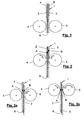
- The attached drawings illustrate, schematically, various sequences resulting from carrying out the invention method. In the aforesaid drawings:
- Fig. 1,
- illustrates a set of two superimposed bands, between which there is a mesh material in the start position;
- Fig. 2,
- illustrates the same set of bands after pulling has started using the two turning rollers, and in such a way that one band has been pulled to a greater distance than the other;
- Fig. 3,
- illustrates the same set of bands, with the offset in the mutual movement of the bands represented in Fig. 2 corrected, according to a first variant in the invention method; and
- Fig. 4,
- illustrates the same set of bands, with the offset in the mutual movement of the bands represented in Fig. 2 corrected, according to a second variant in the invention method.
- The attached drawings represent a set (1) formed by two bands (2 and 3 respectively), of flexible material, attached opposite each other and in points to a tubular mesh material (6).
Set 1 is pulled through two feed rollers (4 and 5), placed tangentially opposite each sides of theaforesaid set 1 of bands and tubular mesh, and it is especially designed for the production of mesh bags. - In the original position of Fig. 1, markers A and B on
bands feed rollers sheets rollers - As
feed rollers set 1, involuntary offsetting of the correct mutual position betweenbands bands band 2 has been pulled to a larger distance thanband 3 or because after advancing various metres on the bands and passing markers A and B various times, due to flexibility in band production, there are differences in lengths between successive markers A and B. This situation must be corrected due to the fact that if the information at markers A and B complements each other or if said markers A and B activate mechanisms downstream fromrollers bands - The placing of antifriction means between
bands rollers set 1. - In the example of the drawings, the same
tubular mesh 6 carries out the functions of the antifriction means, thereby allowing the mutual feeding betweenbands feed rollers feed rollers - The adjustment can be carried out in various ways; two examples have been represented in Figs. 3a and 3b respectively. In Fig. 3a, the pulling
roller 4 ofband 2 is stopped for an instant, so that pullingroller 5 ofband 3 continues to turn pulling in itsmovement band 3, which moves with respect to itsopposite band 2 throughtubular mesh 6, that acts as an antifriction medium.Band 3 moves sufficiently until its corresponding marker B reaches the pairing position with marker A onband 2. - In Fig. 3b, the turning of pulling
roller 4 does not stop andband 2 keeps going. Nevertheless, if thepulling roller 5 is speeded up in comparison to pullingroller 4, the increased tangential velocity on its surface obligesband 3 to increase to a greater distance thanband 2, until which point marker B matches with marker A on theaforesaid band 2. Naturally, the result is the same if the turning speed is reduced for thepulling roller 4 if the turning speed ofpulling roller 5 is maintained, only being necessary if the tangential velocity ofpulling roller 5 is greater than that of matchingpulling roller 4.
Claims (5)
- Method for the continuous or intermittent movement by friction of a set (1) of two bands of superimposed flexible material (2,3) using at least two pulling rollers (4,5) placed tangentially opposite at both sides of said set of bands and that turn in the direction of movement of the bands, so that these are pulled together in unison, whereby involuntary offsets from the correct mutual position of the bands could occur, characterized in that between both adjacent bands of the set of bands there are disposed antifriction means (6) which allow mutual movement between both bands when these are pressurised between the opposite rollers and are pulled by them, without noticeable slipping between the bands and the rollers, and whereby during at least one operation cycle the method includes an adjustment stage, wherein one of the bands is pulled to a greater distance than the other band by the respective rollers in order to correct said involuntary offsets of the mutual position between both bands.
- Method for the continuous or intermittent movement of a set (1) of two bands (2,3) according to claim 1, characterized in that in the adjustment stage the two rollers (4,5) have a different tangential speed.
- Method for the continuous or intermittent movement of a set (1) of two bands (2,3) according to claims 1 or 2, characterized in that the two rollers (4, 5) work in opposite directions in the adjustment stage.
- Method for the continuous or intermittent movement of a set (1) of two bands (2, 3) according to claim 1, characterized in that the antifriction means (6) are made of a band of plastic material.
- Method for the continuous or intermittent movement of a set (1) of two bands (2, 3) according to claim 1, characterized in that the antifriction means (6) are made of a mesh material.
Applications Claiming Priority (1)
| Application Number | Priority Date | Filing Date | Title |
|---|---|---|---|
| ES200402008A ES2265725B1 (en) | 2004-08-11 | 2004-08-11 | METHOD FOR THE ADVANCE OF BANDS OF FLEXIBLE MATERIALS. |
Publications (2)
| Publication Number | Publication Date |
|---|---|
| EP1627728A1 EP1627728A1 (en) | 2006-02-22 |
| EP1627728B1 true EP1627728B1 (en) | 2008-01-02 |
Family
ID=35229883
Family Applications (1)
| Application Number | Title | Priority Date | Filing Date |
|---|---|---|---|
| EP05380164A Expired - Lifetime EP1627728B1 (en) | 2004-08-11 | 2005-07-22 | Method for the movement of superimposed bands of flexible material |
Country Status (5)
| Country | Link |
|---|---|
| US (1) | US7850157B2 (en) |
| EP (1) | EP1627728B1 (en) |
| AT (1) | ATE382468T1 (en) |
| DE (1) | DE602005004084T2 (en) |
| ES (2) | ES2265725B1 (en) |
Cited By (1)
| Publication number | Priority date | Publication date | Assignee | Title |
|---|---|---|---|---|
| EP2078677A1 (en) | 2008-01-14 | 2009-07-15 | Giro GH S.A. | Process for the continuous production of mesh bags |
Families Citing this family (2)
| Publication number | Priority date | Publication date | Assignee | Title |
|---|---|---|---|---|
| ES1075204Y (en) * | 2011-06-07 | 2011-11-16 | Girnet Int Sl | "ROLL OF A FLEXIBLE STRIP FOR THE MANUFACTURE OF BAGS" |
| CN105383094A (en) * | 2015-12-10 | 2016-03-09 | 安庆市鑫顺塑业有限公司 | Film blowing and heat sealing integrated machine |
Family Cites Families (24)
| Publication number | Priority date | Publication date | Assignee | Title |
|---|---|---|---|---|
| US2641416A (en) * | 1950-10-07 | 1953-06-09 | Shellmar Products Corp | Apparatus for and methods of aligning webs for lamination |
| US2821383A (en) * | 1953-05-23 | 1958-01-28 | Clemens Ludwig | Device for a continuous shaping of superposed sheets of a packing material |
| US3556509A (en) * | 1968-08-21 | 1971-01-19 | Harris Intertype Corp | Printed web ribbon registration control system |
| US3701299A (en) * | 1971-03-02 | 1972-10-31 | Stumpf Guenter | Apparatus for forming stacks of cloth webs which are cut to length |
| FR2153554A5 (en) * | 1971-09-15 | 1973-05-04 | Lagain Georges | |
| US4179109A (en) * | 1975-10-20 | 1979-12-18 | Amprint Corp. | Collating equipment including collator and cart |
| US4179107A (en) * | 1975-10-20 | 1979-12-18 | Amprint Corp. | Printing and collating method |
| US4253383A (en) * | 1979-01-29 | 1981-03-03 | Manfred Noe | Labelled fabric, a method and an arrangement for making a labelled fabric |
| US4361318A (en) * | 1979-07-09 | 1982-11-30 | Stobb, Inc. | Apparatus and method for controlling sheet stacker speed |
| US4373713A (en) * | 1980-12-24 | 1983-02-15 | Motter Printing Press Co. | Diverter mechanism |
| US5019203A (en) * | 1986-02-19 | 1991-05-28 | D&K Custom Machine Design, Inc. | Double sided laminating machine |
| US4944620A (en) * | 1989-08-07 | 1990-07-31 | Addmaster Corporation | Printer device for duplicate slips and the like |
| DE4003067C1 (en) * | 1990-02-02 | 1991-07-04 | Sundwiger Eisenhuette Maschinenfabrik Grah & Co, 5870 Hemer, De | |
| DE4037097A1 (en) * | 1990-11-22 | 1992-05-27 | Rovema Gmbh | Conveying system in plastic film bag prodn. - detects records and automatically corrects effects of film slippage due to frictional drive |
| US5362013A (en) * | 1992-05-01 | 1994-11-08 | Custom Machinery Design, Inc. | Method and apparatus for interleaving plastic bags |
| US5604992A (en) * | 1995-01-18 | 1997-02-25 | Robinson; Joe M. | Dual roll dispenser |
| US5689795A (en) * | 1996-09-24 | 1997-11-18 | Xerox Corporation | Sheet transfer apparatus with adaptive speed-up delay |
| JP3381832B2 (en) * | 1997-08-28 | 2003-03-04 | 富士通株式会社 | Paper separation mechanism |
| US6409043B1 (en) * | 1998-10-19 | 2002-06-25 | Canon Kabushiki Kaisha | Sheet conveying apparatus |
| US6394445B1 (en) * | 1998-12-30 | 2002-05-28 | Quad/Tech, Inc. | Apparatus for slowing down and guiding a signature and method for doing the same |
| US7022057B2 (en) * | 2000-12-20 | 2006-04-04 | Water-Line Sa | Device for manufacturing packing bags |
| ES2188389B1 (en) * | 2001-07-30 | 2004-10-16 | Giro Gh, S.A. | MACHINE FOR THE CONTINUOUS DEVELOPMENT OF MESH BAGS. |
| US6994005B2 (en) * | 2002-03-01 | 2006-02-07 | Energy Saving Products And Sales Corp. | Apparatus for slitting, merging, and cutting a continuous paperweb |
| US20080116087A1 (en) * | 2006-11-21 | 2008-05-22 | Robert William Hathaway | Patch repair and texturing of wall construction surfaces kit |
-
2004
- 2004-08-11 ES ES200402008A patent/ES2265725B1/en not_active Expired - Fee Related
-
2005
- 2005-07-13 US US11/179,644 patent/US7850157B2/en active Active
- 2005-07-22 ES ES05380164T patent/ES2298983T3/en not_active Expired - Lifetime
- 2005-07-22 AT AT05380164T patent/ATE382468T1/en not_active IP Right Cessation
- 2005-07-22 EP EP05380164A patent/EP1627728B1/en not_active Expired - Lifetime
- 2005-07-22 DE DE602005004084T patent/DE602005004084T2/en not_active Expired - Lifetime
Cited By (3)
| Publication number | Priority date | Publication date | Assignee | Title |
|---|---|---|---|---|
| EP2078677A1 (en) | 2008-01-14 | 2009-07-15 | Giro GH S.A. | Process for the continuous production of mesh bags |
| ES2338397A1 (en) * | 2008-01-14 | 2010-05-06 | Girnet International, S.L. | Process for the continuous production of mesh bags |
| ES2338397B1 (en) * | 2008-01-14 | 2011-02-10 | Girnet International, S.L. | PROCEDURE FOR THE CONTINUOUS DEVELOPMENT OF MESH BAGS. |
Also Published As
| Publication number | Publication date |
|---|---|
| DE602005004084D1 (en) | 2008-02-14 |
| US20060032884A1 (en) | 2006-02-16 |
| US7850157B2 (en) | 2010-12-14 |
| ES2265725B1 (en) | 2007-11-16 |
| ATE382468T1 (en) | 2008-01-15 |
| ES2265725A1 (en) | 2007-02-16 |
| EP1627728A1 (en) | 2006-02-22 |
| DE602005004084T2 (en) | 2008-12-24 |
| ES2298983T3 (en) | 2008-05-16 |
Similar Documents
| Publication | Publication Date | Title |
|---|---|---|
| US5776045A (en) | Machine for attaching a reclosable fastener to a flexible material | |
| US8360124B2 (en) | Apparatus and process for in-mold labeling | |
| US20160114501A1 (en) | Method and apparatus for handling in-mold labels | |
| US9056400B2 (en) | Apparatus and process for in-mold labeling | |
| US20150096263A1 (en) | Thermo-forming packaging machine and method | |
| EP3831753B1 (en) | Intermittent transport device | |
| JP5274201B2 (en) | PTP sheet manufacturing equipment | |
| JP2000296644A (en) | Method and apparatus for printing on blank | |
| JP6496223B2 (en) | Laminated label body manufacturing equipment | |
| US3505776A (en) | Packaging machine | |
| EP1627728B1 (en) | Method for the movement of superimposed bands of flexible material | |
| CN106536387A (en) | Method and device for producing flexible packaging products, more particularly packaging bags | |
| JP4461201B2 (en) | Plastic film stretching equipment | |
| CN107735338B (en) | Method and device for producing a container carrier | |
| JP7459617B2 (en) | Bag making machine, bag making machine control method, and bag manufacturing method | |
| US5409340A (en) | Spine strip formation and feed method and apparatus | |
| CN113924261A (en) | Feeding unit for feeding plastic film | |
| US5802821A (en) | Apparatus for applying a cover foil to a bottom foil including a containment structure | |
| CN116583461B (en) | Bag making machine and bag making method | |
| JP2007230136A (en) | Printing method by thermal head and printing device | |
| JP2014231176A (en) | Bag making machine and bag making method | |
| JP4402872B2 (en) | Bag making machine | |
| JP5777470B2 (en) | Information loading label sheet manufacturing equipment | |
| JP2011037268A (en) | Device and method for transferring print sheets | |
| EP3403958B1 (en) | Device and method for changing from continous to intermittent the forward movement of a film into a machine for the production of bags for flexible packaging |
Legal Events
| Date | Code | Title | Description |
|---|---|---|---|
| PUAI | Public reference made under article 153(3) epc to a published international application that has entered the european phase |
Free format text: ORIGINAL CODE: 0009012 |
|
| AK | Designated contracting states |
Kind code of ref document: A1 Designated state(s): AT BE BG CH CY CZ DE DK EE ES FI FR GB GR HU IE IS IT LI LT LU LV MC NL PL PT RO SE SI SK TR |
|
| AX | Request for extension of the european patent |
Extension state: AL BA HR MK YU |
|
| 17P | Request for examination filed |
Effective date: 20060807 |
|
| AKX | Designation fees paid |
Designated state(s): AT BE BG CH CY CZ DE DK EE ES FI FR GB GR HU IE IS IT LI LT LU LV MC NL PL PT RO SE SI SK TR |
|
| 17Q | First examination report despatched |
Effective date: 20070430 |
|
| GRAP | Despatch of communication of intention to grant a patent |
Free format text: ORIGINAL CODE: EPIDOSNIGR1 |
|
| GRAS | Grant fee paid |
Free format text: ORIGINAL CODE: EPIDOSNIGR3 |
|
| GRAA | (expected) grant |
Free format text: ORIGINAL CODE: 0009210 |
|
| AK | Designated contracting states |
Kind code of ref document: B1 Designated state(s): AT BE BG CH CY CZ DE DK EE ES FI FR GB GR HU IE IS IT LI LT LU LV MC NL PL PT RO SE SI SK TR |
|
| REG | Reference to a national code |
Ref country code: GB Ref legal event code: FG4D |
|
| REG | Reference to a national code |
Ref country code: IE Ref legal event code: FG4D |
|
| REG | Reference to a national code |
Ref country code: CH Ref legal event code: EP |
|
| REF | Corresponds to: |
Ref document number: 602005004084 Country of ref document: DE Date of ref document: 20080214 Kind code of ref document: P |
|
| REG | Reference to a national code |
Ref country code: ES Ref legal event code: FG2A Ref document number: 2298983 Country of ref document: ES Kind code of ref document: T3 |
|
| PG25 | Lapsed in a contracting state [announced via postgrant information from national office to epo] |
Ref country code: SI Free format text: LAPSE BECAUSE OF FAILURE TO SUBMIT A TRANSLATION OF THE DESCRIPTION OR TO PAY THE FEE WITHIN THE PRESCRIBED TIME-LIMIT Effective date: 20080102 |
|
| PG25 | Lapsed in a contracting state [announced via postgrant information from national office to epo] |
Ref country code: CH Free format text: LAPSE BECAUSE OF FAILURE TO SUBMIT A TRANSLATION OF THE DESCRIPTION OR TO PAY THE FEE WITHIN THE PRESCRIBED TIME-LIMIT Effective date: 20080102 Ref country code: LT Free format text: LAPSE BECAUSE OF FAILURE TO SUBMIT A TRANSLATION OF THE DESCRIPTION OR TO PAY THE FEE WITHIN THE PRESCRIBED TIME-LIMIT Effective date: 20080102 Ref country code: LI Free format text: LAPSE BECAUSE OF FAILURE TO SUBMIT A TRANSLATION OF THE DESCRIPTION OR TO PAY THE FEE WITHIN THE PRESCRIBED TIME-LIMIT Effective date: 20080102 Ref country code: IS Free format text: LAPSE BECAUSE OF FAILURE TO SUBMIT A TRANSLATION OF THE DESCRIPTION OR TO PAY THE FEE WITHIN THE PRESCRIBED TIME-LIMIT Effective date: 20080502 Ref country code: FI Free format text: LAPSE BECAUSE OF FAILURE TO SUBMIT A TRANSLATION OF THE DESCRIPTION OR TO PAY THE FEE WITHIN THE PRESCRIBED TIME-LIMIT Effective date: 20080102 |
|
| REG | Reference to a national code |
Ref country code: CH Ref legal event code: PL |
|
| ET | Fr: translation filed | ||
| PG25 | Lapsed in a contracting state [announced via postgrant information from national office to epo] |
Ref country code: AT Free format text: LAPSE BECAUSE OF FAILURE TO SUBMIT A TRANSLATION OF THE DESCRIPTION OR TO PAY THE FEE WITHIN THE PRESCRIBED TIME-LIMIT Effective date: 20080102 Ref country code: BG Free format text: LAPSE BECAUSE OF FAILURE TO SUBMIT A TRANSLATION OF THE DESCRIPTION OR TO PAY THE FEE WITHIN THE PRESCRIBED TIME-LIMIT Effective date: 20080402 |
|
| PG25 | Lapsed in a contracting state [announced via postgrant information from national office to epo] |
Ref country code: BE Free format text: LAPSE BECAUSE OF FAILURE TO SUBMIT A TRANSLATION OF THE DESCRIPTION OR TO PAY THE FEE WITHIN THE PRESCRIBED TIME-LIMIT Effective date: 20080102 Ref country code: PT Free format text: LAPSE BECAUSE OF FAILURE TO SUBMIT A TRANSLATION OF THE DESCRIPTION OR TO PAY THE FEE WITHIN THE PRESCRIBED TIME-LIMIT Effective date: 20080602 Ref country code: LV Free format text: LAPSE BECAUSE OF FAILURE TO SUBMIT A TRANSLATION OF THE DESCRIPTION OR TO PAY THE FEE WITHIN THE PRESCRIBED TIME-LIMIT Effective date: 20080102 Ref country code: PL Free format text: LAPSE BECAUSE OF FAILURE TO SUBMIT A TRANSLATION OF THE DESCRIPTION OR TO PAY THE FEE WITHIN THE PRESCRIBED TIME-LIMIT Effective date: 20080102 |
|
| PG25 | Lapsed in a contracting state [announced via postgrant information from national office to epo] |
Ref country code: SK Free format text: LAPSE BECAUSE OF FAILURE TO SUBMIT A TRANSLATION OF THE DESCRIPTION OR TO PAY THE FEE WITHIN THE PRESCRIBED TIME-LIMIT Effective date: 20080102 Ref country code: SE Free format text: LAPSE BECAUSE OF FAILURE TO SUBMIT A TRANSLATION OF THE DESCRIPTION OR TO PAY THE FEE WITHIN THE PRESCRIBED TIME-LIMIT Effective date: 20080402 Ref country code: DK Free format text: LAPSE BECAUSE OF FAILURE TO SUBMIT A TRANSLATION OF THE DESCRIPTION OR TO PAY THE FEE WITHIN THE PRESCRIBED TIME-LIMIT Effective date: 20080102 Ref country code: CZ Free format text: LAPSE BECAUSE OF FAILURE TO SUBMIT A TRANSLATION OF THE DESCRIPTION OR TO PAY THE FEE WITHIN THE PRESCRIBED TIME-LIMIT Effective date: 20080102 |
|
| PLBE | No opposition filed within time limit |
Free format text: ORIGINAL CODE: 0009261 |
|
| STAA | Information on the status of an ep patent application or granted ep patent |
Free format text: STATUS: NO OPPOSITION FILED WITHIN TIME LIMIT |
|
| PG25 | Lapsed in a contracting state [announced via postgrant information from national office to epo] |
Ref country code: RO Free format text: LAPSE BECAUSE OF FAILURE TO SUBMIT A TRANSLATION OF THE DESCRIPTION OR TO PAY THE FEE WITHIN THE PRESCRIBED TIME-LIMIT Effective date: 20080102 |
|
| 26N | No opposition filed |
Effective date: 20081003 |
|
| PG25 | Lapsed in a contracting state [announced via postgrant information from national office to epo] |
Ref country code: MC Free format text: LAPSE BECAUSE OF NON-PAYMENT OF DUE FEES Effective date: 20080731 |
|
| PG25 | Lapsed in a contracting state [announced via postgrant information from national office to epo] |
Ref country code: EE Free format text: LAPSE BECAUSE OF FAILURE TO SUBMIT A TRANSLATION OF THE DESCRIPTION OR TO PAY THE FEE WITHIN THE PRESCRIBED TIME-LIMIT Effective date: 20080102 |
|
| PG25 | Lapsed in a contracting state [announced via postgrant information from national office to epo] |
Ref country code: IE Free format text: LAPSE BECAUSE OF NON-PAYMENT OF DUE FEES Effective date: 20080722 Ref country code: CY Free format text: LAPSE BECAUSE OF FAILURE TO SUBMIT A TRANSLATION OF THE DESCRIPTION OR TO PAY THE FEE WITHIN THE PRESCRIBED TIME-LIMIT Effective date: 20080102 |
|
| REG | Reference to a national code |
Ref country code: GB Ref legal event code: 732E Free format text: REGISTERED BETWEEN 20100225 AND 20100303 |
|
| REG | Reference to a national code |
Ref country code: NL Ref legal event code: SD Effective date: 20100414 |
|
| REG | Reference to a national code |
Ref country code: FR Ref legal event code: CD Ref country code: FR Ref legal event code: TP |
|
| PG25 | Lapsed in a contracting state [announced via postgrant information from national office to epo] |
Ref country code: LU Free format text: LAPSE BECAUSE OF NON-PAYMENT OF DUE FEES Effective date: 20080722 Ref country code: HU Free format text: LAPSE BECAUSE OF FAILURE TO SUBMIT A TRANSLATION OF THE DESCRIPTION OR TO PAY THE FEE WITHIN THE PRESCRIBED TIME-LIMIT Effective date: 20080703 |
|
| PG25 | Lapsed in a contracting state [announced via postgrant information from national office to epo] |
Ref country code: GR Free format text: LAPSE BECAUSE OF FAILURE TO SUBMIT A TRANSLATION OF THE DESCRIPTION OR TO PAY THE FEE WITHIN THE PRESCRIBED TIME-LIMIT Effective date: 20080403 |
|
| PGFP | Annual fee paid to national office [announced via postgrant information from national office to epo] |
Ref country code: TR Payment date: 20140623 Year of fee payment: 10 |
|
| PGFP | Annual fee paid to national office [announced via postgrant information from national office to epo] |
Ref country code: NL Payment date: 20140729 Year of fee payment: 10 |
|
| REG | Reference to a national code |
Ref country code: NL Ref legal event code: MM Effective date: 20150801 |
|
| PG25 | Lapsed in a contracting state [announced via postgrant information from national office to epo] |
Ref country code: NL Free format text: LAPSE BECAUSE OF NON-PAYMENT OF DUE FEES Effective date: 20150801 |
|
| REG | Reference to a national code |
Ref country code: FR Ref legal event code: PLFP Year of fee payment: 12 |
|
| REG | Reference to a national code |
Ref country code: DE Ref legal event code: R079 Ref document number: 602005004084 Country of ref document: DE Free format text: PREVIOUS MAIN CLASS: B31B0019100000 Ipc: B31B0070100000 |
|
| REG | Reference to a national code |
Ref country code: FR Ref legal event code: PLFP Year of fee payment: 13 |
|
| PG25 | Lapsed in a contracting state [announced via postgrant information from national office to epo] |
Ref country code: TR Free format text: LAPSE BECAUSE OF NON-PAYMENT OF DUE FEES Effective date: 20150722 |
|
| REG | Reference to a national code |
Ref country code: FR Ref legal event code: PLFP Year of fee payment: 14 |
|
| P01 | Opt-out of the competence of the unified patent court (upc) registered |
Effective date: 20230527 |
|
| PGFP | Annual fee paid to national office [announced via postgrant information from national office to epo] |
Ref country code: FR Payment date: 20230621 Year of fee payment: 19 |
|
| PGFP | Annual fee paid to national office [announced via postgrant information from national office to epo] |
Ref country code: IT Payment date: 20230629 Year of fee payment: 19 Ref country code: GB Payment date: 20230718 Year of fee payment: 19 Ref country code: ES Payment date: 20230817 Year of fee payment: 19 |
|
| PGFP | Annual fee paid to national office [announced via postgrant information from national office to epo] |
Ref country code: DE Payment date: 20240719 Year of fee payment: 20 |
|
| GBPC | Gb: european patent ceased through non-payment of renewal fee |
Effective date: 20240722 |
|
| PG25 | Lapsed in a contracting state [announced via postgrant information from national office to epo] |
Ref country code: FR Free format text: LAPSE BECAUSE OF NON-PAYMENT OF DUE FEES Effective date: 20240731 |
|
| PG25 | Lapsed in a contracting state [announced via postgrant information from national office to epo] |
Ref country code: GB Free format text: LAPSE BECAUSE OF NON-PAYMENT OF DUE FEES Effective date: 20240722 |
|
| REG | Reference to a national code |
Ref country code: DE Ref legal event code: R071 Ref document number: 602005004084 Country of ref document: DE |
|
| REG | Reference to a national code |
Ref country code: ES Ref legal event code: FD2A Effective date: 20250829 |
|
| PG25 | Lapsed in a contracting state [announced via postgrant information from national office to epo] |
Ref country code: ES Free format text: LAPSE BECAUSE OF NON-PAYMENT OF DUE FEES Effective date: 20240723 |