EP1626539A1 - Method for data flow control in a mobile communications system - Google Patents
Method for data flow control in a mobile communications system Download PDFInfo
- Publication number
- EP1626539A1 EP1626539A1 EP04292052A EP04292052A EP1626539A1 EP 1626539 A1 EP1626539 A1 EP 1626539A1 EP 04292052 A EP04292052 A EP 04292052A EP 04292052 A EP04292052 A EP 04292052A EP 1626539 A1 EP1626539 A1 EP 1626539A1
- Authority
- EP
- European Patent Office
- Prior art keywords
- rnc
- data
- base station
- capacity
- lub interface
- Prior art date
- Legal status (The legal status is an assumption and is not a legal conclusion. Google has not performed a legal analysis and makes no representation as to the accuracy of the status listed.)
- Granted
Links
- 238000000034 method Methods 0.000 title claims abstract description 21
- 238000010295 mobile communication Methods 0.000 title claims abstract description 20
- 238000004891 communication Methods 0.000 claims abstract description 6
- 230000007246 mechanism Effects 0.000 claims abstract description 6
- 230000005540 biological transmission Effects 0.000 description 3
- 238000010586 diagram Methods 0.000 description 3
- 108700026140 MAC combination Proteins 0.000 description 1
- 230000001419 dependent effect Effects 0.000 description 1
- 230000007723 transport mechanism Effects 0.000 description 1
Images
Classifications
-
- H—ELECTRICITY
- H04—ELECTRIC COMMUNICATION TECHNIQUE
- H04W—WIRELESS COMMUNICATION NETWORKS
- H04W28/00—Network traffic management; Network resource management
- H04W28/02—Traffic management, e.g. flow control or congestion control
- H04W28/10—Flow control between communication endpoints
- H04W28/12—Flow control between communication endpoints using signalling between network elements
-
- H—ELECTRICITY
- H04—ELECTRIC COMMUNICATION TECHNIQUE
- H04L—TRANSMISSION OF DIGITAL INFORMATION, e.g. TELEGRAPHIC COMMUNICATION
- H04L47/00—Traffic control in data switching networks
- H04L47/10—Flow control; Congestion control
- H04L47/38—Flow control; Congestion control by adapting coding or compression rate
-
- H—ELECTRICITY
- H04—ELECTRIC COMMUNICATION TECHNIQUE
- H04W—WIRELESS COMMUNICATION NETWORKS
- H04W24/00—Supervisory, monitoring or testing arrangements
-
- H—ELECTRICITY
- H04—ELECTRIC COMMUNICATION TECHNIQUE
- H04W—WIRELESS COMMUNICATION NETWORKS
- H04W28/00—Network traffic management; Network resource management
- H04W28/16—Central resource management; Negotiation of resources or communication parameters, e.g. negotiating bandwidth or QoS [Quality of Service]
-
- H—ELECTRICITY
- H04—ELECTRIC COMMUNICATION TECHNIQUE
- H04W—WIRELESS COMMUNICATION NETWORKS
- H04W92/00—Interfaces specially adapted for wireless communication networks
- H04W92/04—Interfaces between hierarchically different network devices
- H04W92/12—Interfaces between hierarchically different network devices between access points and access point controllers
Definitions
- the present invention relates to wireless communication systems, and more particularly, to data flow control in a mobile communications system.
- GSM Global Systems for Mobile communications
- UMTS Universal Mobile Telecommunications Systems
- HSDPA High Speed Downlink Packet Access
- UMTS HSDPA capable systems support an additional transport channel type in the downlink direction, a High Speed Downlink Shared Channel (HS-DSCH).
- This logical channel provides the logical transport mechanism for data transfer.
- 3GPP 3rd Generation Partnership Project
- a radio network controller RNC
- a base station a radio network controller
- a data transfer procedure is defined for the transmission of HS-DSCH data frames from the RNC to the base station.
- a mechanism to control user data flow between the RNC and the base station is also implicit in such procedure.
- a disadvantage of the specified state of the art RNC-base station user data flow control approach is that it only controls individual user data flows, that is, how much HSDPA traffic an individual user can receive from the RNC.
- the object is achieved by a method for controlling the flow of data between an RNC and a base station of a UMTS mobile communications system with HSDPA capability according to claim 1; a capacity overload control entity according to claim 7; a radio network controller according to claim 8 and a base station according to claims 9 or 10.
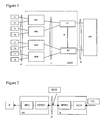
- Fig. 1 shows a simplified basic network element architecture of a conventional mobile communication system.
- Fig. 2 shows a simplified block diagram being illustrative of the communication between RNC, base station and user terminal in a conventional UMTS HSDPA mobile communication system.
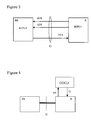
- Fig. 3 shows a block diagram being illustrative of a conventional data transfer procedure for the transmission of HS-DSCH Data Frames from RNC to base station.
- Fig. 4 shows a block diagram being illustrative of a method for controlling the flow of data between an RNC and a base station of a mobile communications system with HSDPA capability according to the invention.
- FIG 1 shows an example of a basic network element architecture of a conventional mobile communication system comprising a core network CN connected via interface 13 to a radio access network RAN which communicates via an air interface I1 with eight user terminals T1 to T8.
- the radio access network RAN comprises four base stations BS1 to BS4 controlled by two radio network controllers R1 and R2.
- the RNCs R1 and R2 are connected among themselves via interface I4 and are connected to the base stations via the lub interface I2.
- the lub interface I2 and the other network element interfaces I1, I3, I4 are also being specified by 3GPP. In such specifications it is also common that the terminals are referred to as user equipment (UE) and the base stations as Node Bs.
- UE user equipment
- Figure 2 shows an embodiment where the RNC R transfers user data UD by means of HS-DSCH Data Frames HDT to a base station BS via the lub interface 12 and the base station transmits said user data to the user terminal T.
- the RNC receives user data UD, e.g. multimedia data such as video sequence, from the core network.
- User data UD is segmented in the RNC R in a Medium Access Control (MAC) protocol entity MU 1 to provide MAC data packets, which are also referred to as MAC-d protocol data units (PDUs).
- Said MAC-d PDUs in the RNC are passed to an HS-DSCH frame protocol entity HFPU1 responsible for the HSDPA lub Interface communication between the RNC R and the base station BS.
- User data in form of MAC-d PDUs is then transferred to the base station BS in an HS-DSCH Data Frame HDT by using the control and data services of the HS-DSCH frame protocol entity HFPU1 and HFPU2.
- the HS-DSCH frame protocol entity HFPU2 passes the user data MAC-d PDUs to MAC protocol entity MU2 which concatenates several of such MAC-d PDUs to form MAC-hs PDUs which are transmitted to the HSDPA capable user terminal T.
- An HS-DSCH Capacity Request procedure provides means for the RNC R to request HS-DSCH capacity, that is, the reception of data packets in the RNC is signalled towards the base station BS by means of a HS-DSCH Capacity Request control message HCR, which includes the total amount of data waiting, i.e. user buffer size, in the RNC.
- the base station BS will grant transport resources to the RNC by means of a HS-DSCH Capacity Allocation control message HCA, which defines the amount of data, i.e. size and number of MAC-d PDUs, the RNC is allowed to send within a defined time period.
- the base station BS may generate an HS-DSCH Capacity Allocation control message HCA either in response to an HS-DSCH Capacity Request or at any other time, and the base station BS may use this message to control individual user data flow and modify the capacity at any time, irrespective of the reported user buffer status.
- the RNC proceeds by sending user data in HS-DSCH Data Frames HDTs to the base station.
- Each HS-DSCH Data Frame includes besides the MAC-d PDUs also an indication about the remaining user data, i.e. buffer size in the RNC, which might be used by the base station for the issue of a new HS-DSCH Capacity Allocation control message HCA.
- Figure 4 shows an embodiment illustrating a method for data flow control between an RNC R and a base station BS according to the invention.
- the embodiment of Figure 4 shows a UMTS mobile communications system with HSDPA capability comprising network elements RNC, base station and capacity overload control entity COCU according to the invention.
- the capacity overload control entity COCU is connected to RNC R, and the RNC is connected to base station BS via lub interface I2.
- the capacity overload control entity COCU is designed so that it monitors information about actual lub interface data transport flow IDF, that is, for example, it has means to detect and/or calculate and/or receive information about dedicated channel (DCH) traffic, HSDPA traffic, control traffic and total lub interface capacity available for data transport towards a base station BS.
- the capacity overload control entity COCU is further designed so that when a determined lub interface transport capacity value is reached it generates a capacity threshold indication CI and sends it to the RNC.
- the RNC Upon reception of the capacity threshold indication CI from the capacity overload control entity COCU, and according to the invention, the RNC sends said capacity threshold indication CI in an HS-DSCH frame protocol message to the base station, and the base station reacts to said message by sending an HS-DSCH capacity allocation control message towards the RNC reducing the amount of data the RNC is allowed to send within a period of time.
- the lub interface I2 transport capacity value can be determined for example to a certain percentage value below the maximum transport capacity of the lub interface I2 or set to the maximum transport capacity of that lub interface.
- the capacity overload control entity COCU sends to the RNC a capacity threshold indication Cl that a critical load situation occurs
- the capacity overload control entity COCU sends to the RNC a capacity threshold indication Cl that an overload situation occurs.
- the base station can reduce the amount of data the RNC is allowed to send to a value of zero.
- the RNC can use for example an HS-DSCH Data Frame message and code the specific capacity threshold indication Cl in a determined bit field of such message. But it is also possible that the RNC uses another HS-DSCH frame protocol message.
- the capacity overload control entity COCU sends to the RNC at certain periods of time current lub interface I2 transport capacity or data transport flow information so that the RNC can react and take decisions based on this information.
- An alternative way, according to the invention, of indicating to the base station that a certain lub interface I2 transport capacity value has been reached can be done the following way: upon reception of the capacity threshold indication Cl from the capacity overload control entity COCU, the RNC transmits to the base station an amount of user data which is less than the previously allocated amount of data granted by that base station.
- the base station reacts to said behavior from the RNC by sending an HS-DSCH Capacity Allocation control message towards the RNC reducing the amount of data the RNC is allowed to send within a period of time.
- the RNC can react by sending to the base station an HS-DSCH Data Frame message with no user data inside, thus the base station recognizes the meaning of this RNC behavior and interprets it as an overload situation.
- the base station in this case can react by generating a HS-DSCH Capacity Allocation control message towards the RNC reducing the amount of data the RNC is allowed to send within a period of time to zero.
- the operator of the mobile communications network can avoid lub interface overload situations and provide a more reliable and efficient data user transport service between the radio network controller and the base stations. Furthermore, when a determined load situation is reached in the lub interface, the operator can reduce the data transport flow for a determined number of users based on low priority of data or low quality service offered to such users, thus allowing the other high quality service customers to keep receiveing data without being affected by an overload situation.
- the capacity overload control entity COCU is located within the RNC, said capacity overload control entity being implemented in a hardware and/or software form, but it can also be located in another network element of the mobile communications system or as a standalone entity in such network systems.
- means to carry out the method or certain steps of the method for controlling the flow of data between an RNC and a base station of a UMTS mobile communications system with HSDPA capability herein described can be located anywhere in the mobile communications system, that is, in a base station or any resource manager entity of the mobile communication system. Said means being implemented in hardware or software form.
Landscapes
- Engineering & Computer Science (AREA)
- Computer Networks & Wireless Communication (AREA)
- Signal Processing (AREA)
- Mobile Radio Communication Systems (AREA)
Abstract
Description
- The present invention relates to wireless communication systems, and more particularly, to data flow control in a mobile communications system.
- The third generation (3G) evolution of Global Systems for Mobile communications (GSM) networks, commonly known as Universal Mobile Telecommunications Systems (UMTS), introduces High Speed Downlink Packet Access (HSDPA) to provide data rates up to approximately 10 Mbps to support packet-based multimedia services.
- UMTS HSDPA capable systems support an additional transport channel type in the downlink direction, a High Speed Downlink Shared Channel (HS-DSCH). This logical channel provides the logical transport mechanism for data transfer.
- Currently the 3rd Generation Partnership Project (3GPP) is undertaking the technical specification of HSDPA. 3GPP specification TS 25.435 v5.6.0, 2003-12, provides a description of the interface between a radio network controller (RNC) and a base station, being referred to as the lub interface. In such document, and more specifically, in chapter 5.1.6, a data transfer procedure is defined for the transmission of HS-DSCH data frames from the RNC to the base station. A mechanism to control user data flow between the RNC and the base station is also implicit in such procedure.
- Since the actual transport capacity on the lub interface is limited, due to the fact that the base station will be connected to the RNC via one or several physical communication links, such as 2.048 Mbps (E1) links or 155 Mbps (STM-1) links, a disadvantage of the specified state of the art RNC-base station user data flow control approach is that it only controls individual user data flows, that is, how much HSDPA traffic an individual user can receive from the RNC. Based on the distribution of the user terminals and the quality of the air interface for a radio cell with HSDPA traffic and in case, for example, the base station needs to serve several of such cells, there is the probability that the total data transport flow in the lub interface, that is the sum of all individual user data flow instances, exceeds the maximum available lub interface transport capacity, i.e. a capacity overload situation occurs at the lub interface.
- It is the object of the invention to solve the aforesaid technical problems and provide an improved data flow control method for the lub interface between the RNC and the base station.
- The object is achieved by a method for controlling the flow of data between an RNC and a base station of a UMTS mobile communications system with HSDPA capability according to
claim 1; a capacity overload control entity according to claim 7; a radio network controller according to claim 8 and a base station according to claims 9 or 10. - Advantageous configurations of the invention emerge from the dependent claims, the following description and the drawings. For example, it is seen advantageous that, by using the proposed invention, efficient usage of the transport capacity on the lub interface for HSDPA traffic is achieved. It is also seen advantageous that the lub interface data flow control method hereinafter described is used for a selective group of users thus providing the mobile network operator with a way of differentiating the user quality of service and charge for such service accordingly. Furthermore, the invention provides an overall data flow control for HSDPA traffic on the lub interface.
- An embodiment example of the invention is now explained with the aid of Figures 1 to 4.
- Fig. 1 shows a simplified basic network element architecture of a conventional mobile communication system.
- Fig. 2 shows a simplified block diagram being illustrative of the communication between RNC, base station and user terminal in a conventional UMTS HSDPA mobile communication system.
- Fig. 3 shows a block diagram being illustrative of a conventional data transfer procedure for the transmission of HS-DSCH Data Frames from RNC to base station.
- Fig. 4 shows a block diagram being illustrative of a method for controlling the flow of data between an RNC and a base station of a mobile communications system with HSDPA capability according to the invention.
- Figure 1 shows an example of a basic network element architecture of a conventional mobile communication system comprising a core network CN connected via
interface 13 to a radio access network RAN which communicates via an air interface I1 with eight user terminals T1 to T8. The radio access network RAN comprises four base stations BS1 to BS4 controlled by two radio network controllers R1 and R2. The RNCs R1 and R2 are connected among themselves via interface I4 and are connected to the base stations via the lub interface I2. The lub interface I2 and the other network element interfaces I1, I3, I4 are also being specified by 3GPP. In such specifications it is also common that the terminals are referred to as user equipment (UE) and the base stations as Node Bs. - Figure 2 shows an embodiment where the RNC R transfers user data UD by means of HS-DSCH Data Frames HDT to a base station BS via the
lub interface 12 and the base station transmits said user data to the user terminal T. - In operation, the RNC receives user data UD, e.g. multimedia data such as video sequence, from the core network. User data UD is segmented in the RNC R in a Medium Access Control (MAC) protocol entity MU 1 to provide MAC data packets, which are also referred to as MAC-d protocol data units (PDUs). Said MAC-d PDUs in the RNC are passed to an HS-DSCH frame protocol entity HFPU1 responsible for the HSDPA lub Interface communication between the RNC R and the base station BS. User data in form of MAC-d PDUs is then transferred to the base station BS in an HS-DSCH Data Frame HDT by using the control and data services of the HS-DSCH frame protocol entity HFPU1 and HFPU2.
- Once received in the base station BS, the HS-DSCH frame protocol entity HFPU2 passes the user data MAC-d PDUs to MAC protocol entity MU2 which concatenates several of such MAC-d PDUs to form MAC-hs PDUs which are transmitted to the HSDPA capable user terminal T.
- In Figure 3 it is illustrated with more detail the HSDPA lub interface I2 HS-DSCH frame protocol service for the transmission of HS-DSCH Data Frames HDT from RNC R to base station BS.
- An HS-DSCH Capacity Request procedure provides means for the RNC R to request HS-DSCH capacity, that is, the reception of data packets in the RNC is signalled towards the base station BS by means of a HS-DSCH Capacity Request control message HCR, which includes the total amount of data waiting, i.e. user buffer size, in the RNC.
- The base station BS will grant transport resources to the RNC by means of a HS-DSCH Capacity Allocation control message HCA, which defines the amount of data, i.e. size and number of MAC-d PDUs, the RNC is allowed to send within a defined time period. The base station BS may generate an HS-DSCH Capacity Allocation control message HCA either in response to an HS-DSCH Capacity Request or at any other time, and the base station BS may use this message to control individual user data flow and modify the capacity at any time, irrespective of the reported user buffer status.
- Based on the granted transfer capacity by the base station, the RNC proceeds by sending user data in HS-DSCH Data Frames HDTs to the base station. Each HS-DSCH Data Frame includes besides the MAC-d PDUs also an indication about the remaining user data, i.e. buffer size in the RNC, which might be used by the base station for the issue of a new HS-DSCH Capacity Allocation control message HCA.
- Figure 4 shows an embodiment illustrating a method for data flow control between an RNC R and a base station BS according to the invention. The embodiment of Figure 4 shows a UMTS mobile communications system with HSDPA capability comprising network elements RNC, base station and capacity overload control entity COCU according to the invention. The capacity overload control entity COCU is connected to RNC R, and the RNC is connected to base station BS via lub interface I2.
- The capacity overload control entity COCU according to the invention is designed so that it monitors information about actual lub interface data transport flow IDF, that is, for example, it has means to detect and/or calculate and/or receive information about dedicated channel (DCH) traffic, HSDPA traffic, control traffic and total lub interface capacity available for data transport towards a base station BS. The capacity overload control entity COCU is further designed so that when a determined lub interface transport capacity value is reached it generates a capacity threshold indication CI and sends it to the RNC.
- Upon reception of the capacity threshold indication CI from the capacity overload control entity COCU, and according to the invention, the RNC sends said capacity threshold indication CI in an HS-DSCH frame protocol message to the base station, and the base station reacts to said message by sending an HS-DSCH capacity allocation control message towards the RNC reducing the amount of data the RNC is allowed to send within a period of time.
- The lub interface I2 transport capacity value can be determined for example to a certain percentage value below the maximum transport capacity of the lub interface I2 or set to the maximum transport capacity of that lub interface. In the first case, when that value is reached, the capacity overload control entity COCU sends to the RNC a capacity threshold indication Cl that a critical load situation occurs, and in the second case the capacity overload control entity COCU sends to the RNC a capacity threshold indication Cl that an overload situation occurs. In case, for example, that the capacity overload control entity COCU indicates to the RNC an overload situation and this indication is transferred to the base station, the base station can reduce the amount of data the RNC is allowed to send to a value of zero.
- For sending the capacity threshold indication CI to the base station, the RNC can use for example an HS-DSCH Data Frame message and code the specific capacity threshold indication Cl in a determined bit field of such message. But it is also possible that the RNC uses another HS-DSCH frame protocol message.
- It is also possible that the capacity overload control entity COCU sends to the RNC at certain periods of time current lub interface I2 transport capacity or data transport flow information so that the RNC can react and take decisions based on this information.
- An alternative way, according to the invention, of indicating to the base station that a certain lub interface I2 transport capacity value has been reached, can be done the following way: upon reception of the capacity threshold indication Cl from the capacity overload control entity COCU, the RNC transmits to the base station an amount of user data which is less than the previously allocated amount of data granted by that base station. The base station reacts to said behavior from the RNC by sending an HS-DSCH Capacity Allocation control message towards the RNC reducing the amount of data the RNC is allowed to send within a period of time. For example, in case the capacity overload control entity COCU generates a capacity threshold indication Cl indicating an lub interface overload situation, the RNC can react by sending to the base station an HS-DSCH Data Frame message with no user data inside, thus the base station recognizes the meaning of this RNC behavior and interprets it as an overload situation. The base station in this case can react by generating a HS-DSCH Capacity Allocation control message towards the RNC reducing the amount of data the RNC is allowed to send within a period of time to zero.
- As already mentioned above, it is seen advantageous that by using the data flow control method according to the invention the operator of the mobile communications network can avoid lub interface overload situations and provide a more reliable and efficient data user transport service between the radio network controller and the base stations. Furthermore, when a determined load situation is reached in the lub interface, the operator can reduce the data transport flow for a determined number of users based on low priority of data or low quality service offered to such users, thus allowing the other high quality service customers to keep receiveing data without being affected by an overload situation.
- In a preferred embodiment of the invention the capacity overload control entity COCU is located within the RNC, said capacity overload control entity being implemented in a hardware and/or software form, but it can also be located in another network element of the mobile communications system or as a standalone entity in such network systems.
- For the sake of generalization, it shall also be understood that means to carry out the method or certain steps of the method for controlling the flow of data between an RNC and a base station of a UMTS mobile communications system with HSDPA capability herein described can be located anywhere in the mobile communications system, that is, in a base station or any resource manager entity of the mobile communication system. Said means being implemented in hardware or software form.
Claims (10)
- Method for controlling the flow of data between an RNC (R) and a base station (BS) of a UMTS mobile communications system with HSDPA capability via an lub interface (I2), where an HS-DSCH Frame Protocol mechanism is implemented in the lub interface (I2) to provide control and data services for the communication of HSDPA user data between the RNC and the base station, the method comprising the steps of:- sending an HS-DSCH Capacity Request control message (HCR) from the RNC towards the base station indicating a total amount of user data waiting in the RNC, in order to request data transport capacity,- sending an HS-DSCH Capacity Allocation control message (HCA) from the base station towards the RNC granting the amount of data the RNC is allowed to send within a period of time,- the RNC sending the granted amount of user data information to the base station by means of an HS-DSCH Data Frame message (HDT),
characterized in that- a capacity overload control entity (COCU) monitors information about actual total lub interface data transport flow (IDF), and when a determined lub interface (I2) transport capacity value is reached, the data transport flow is reduced in the lub interface (I2). - The method of claim 1 characterized in that
when the determined lub interface (I2) transport capacity value is reached, the capacity overload control entity (COCU) generates a capacity threshold indication (CI) and sends it to the RNC,
the RNC (R) sends said capacity threshold indication (CI) in an HS-DSCH frame protocol message to the base station, and
the base station (BS) reacts to said message by sending an HS-DSCH Capacity Allocation control message (HCA) towards the RNC reducing the amount of data the RNC is allowed to send within a period of time. - The method of claim 1 characterized in that
when the determined lub interface (I2) transport capacity value is reached, the capacity overload control entity (COCU) generates a capacity threshold indication (CI) and sends it to the RNC,
the RNC (R) transmits to the base station (BS) an amount of user data which is less than the previously allocated amount of data granted by that base station, and
the base station reacts to said RNC behavior by sending an HS-DSCH Capacity Allocation control message (HCA) towards the RNC reducing the amount of data the RNC is allowed to send within a period of time. - The method of claim 1 characterized in that the information about the actual lub interface data transport flow (IDF) monitored by the capacity overload control entity (COCU) is the dedicated channel traffic, HSDPA traffic, control traffic, and total lub interface (I2) capacity available for data transport towards the base station (BS).
- The method according to claim 2 or 3, characterized in that the capacity threshold indication (CI) is a critical load situation indication, indicating that a certain percentage value below the maximum transport capacity of the lub interface (I2) has been reached, or an overload situation indication, indicating that the maximum transport capacity value of the lub interface (I2) has been reached.
- The method according to claim 1 characterized in that the data transport flow is reduced in the lub interface (I2) by reducing the data transport flow of determined individual users depending on operator-customer service criteria.
- A capacity overload control entity (COCU) of a UMTS mobile communication system with HSDPA capability characterized in that it comprises means for detecting and/or calculating and/or receiving information about actual lub interface data transport flow (IDF); means for analyzing said information and determining if it has reached a certain threshold value; means for communicating with a radio network controller (R) and means for sending to the radio network controller (R) information about the actual lub interface data transport flow (IDF) or an indication that the actual total lub interface data transport flow has reached a certain lub interface transport capacity value.
- A radio network controller (R) of a UMTS mobile communication system with HSDPA capability comprising means for communicating with a base station via an lub interface (I2) by means of an HS-DSCH Frame Protocol mechanism characterized in that it further comprises means for detecting and/or calculating and/or receiving and/or sending information about actual lub interface data transport flow (IDF); means for analyzing said information and determining if a certain lub interface transport capacity value has been reached or for receiving an indication that the actual total lub interface data transport flow has reached a certain lub interface transport capacity value; means for sending a capacity threshold indication (Cl) in an HS-DSCH frame protocol message to the base station or means for transmitting to the base station an amount of user data which is less than a previously allocated amount of data granted by that base station.
- A base station (BS) of a UMTS mobile communication system with HSDPA capability comprising means for communicating with a RNC via an lub interface (I2) by means of an HS-DSCH Frame Protocol mechanism characterized in that it further comprises means receiving a capacity threshold indication (Cl); means to analyze said capacity threshold indication (Cl) and to react to it by sending an HS-DSCH Capacity Allocation control message (HCA) towards the RNC reducing the amount of data the RNC is allowed to send within a period of time.
- A base station (BS) of a UMTS mobile communication system with HSDPA capability comprising means for communicating with a RNC via an lub interface (I2) by means of an HS-DSCH Frame Protocol mechanism characterized in that it further comprises means for detecting if the RNC transmits to the base station an amount of user data which is less than the previously allocated amount of data granted by that base station, and means to react to such behavior by sending an HS-DSCH Capacity Allocation control message (HCA) towards the RNC reducing the amount of data the RNC is allowed to send within a period of time.
Priority Applications (9)
| Application Number | Priority Date | Filing Date | Title |
|---|---|---|---|
| EP04292052A EP1626539B1 (en) | 2004-08-13 | 2004-08-13 | Method for data flow control in a mobile communications system |
| ES04292052T ES2379549T3 (en) | 2004-08-13 | 2004-08-13 | Data flow control procedure in a mobile communications system |
| AT04292052T ATE538611T1 (en) | 2004-08-13 | 2004-08-13 | DATA FLOW CONTROL METHOD IN A MOBILE COMMUNICATIONS SYSTEM |
| PL04292052T PL1626539T3 (en) | 2004-08-13 | 2004-08-13 | Method for data flow control in a mobile communications system |
| JP2005220020A JP4814569B2 (en) | 2004-08-13 | 2005-07-29 | Method for data flow control in a mobile communication system |
| US11/191,996 US7489654B2 (en) | 2004-08-13 | 2005-07-29 | Method for data flow control in a mobile communications system |
| KR1020050074196A KR101118433B1 (en) | 2004-08-13 | 2005-08-12 | Method for data flow control in a mobile communications system |
| CNB2005100903216A CN100352299C (en) | 2004-08-13 | 2005-08-12 | Method for data flow control in a mobile communications system |
| US12/344,038 US8259579B2 (en) | 2004-08-13 | 2008-12-24 | Method for data flow control in a mobile communications system |
Applications Claiming Priority (1)
| Application Number | Priority Date | Filing Date | Title |
|---|---|---|---|
| EP04292052A EP1626539B1 (en) | 2004-08-13 | 2004-08-13 | Method for data flow control in a mobile communications system |
Publications (2)
| Publication Number | Publication Date |
|---|---|
| EP1626539A1 true EP1626539A1 (en) | 2006-02-15 |
| EP1626539B1 EP1626539B1 (en) | 2011-12-21 |
Family
ID=34931342
Family Applications (1)
| Application Number | Title | Priority Date | Filing Date |
|---|---|---|---|
| EP04292052A Expired - Lifetime EP1626539B1 (en) | 2004-08-13 | 2004-08-13 | Method for data flow control in a mobile communications system |
Country Status (8)
| Country | Link |
|---|---|
| US (2) | US7489654B2 (en) |
| EP (1) | EP1626539B1 (en) |
| JP (1) | JP4814569B2 (en) |
| KR (1) | KR101118433B1 (en) |
| CN (1) | CN100352299C (en) |
| AT (1) | ATE538611T1 (en) |
| ES (1) | ES2379549T3 (en) |
| PL (1) | PL1626539T3 (en) |
Cited By (3)
| Publication number | Priority date | Publication date | Assignee | Title |
|---|---|---|---|---|
| CN100411471C (en) * | 2006-08-07 | 2008-08-13 | 上海华为技术有限公司 | A system and method for testing the capacity of A interface after IP |
| CN101616507B (en) * | 2008-06-23 | 2011-08-10 | 上海华为技术有限公司 | Allocation method, system and associated equipment for radio link |
| EP2120405A4 (en) * | 2007-02-05 | 2012-04-04 | Zte Corp | METHOD OF CONTROLLING FLOW BETWEEN A RADIO NETWORK CONTROLLER AND A BASE STATION |
Families Citing this family (23)
| Publication number | Priority date | Publication date | Assignee | Title |
|---|---|---|---|---|
| PL1626539T3 (en) * | 2004-08-13 | 2012-05-31 | Alcatel Lucent | Method for data flow control in a mobile communications system |
| US8400973B2 (en) * | 2005-08-26 | 2013-03-19 | Telefonaktiebolaget Lm Ericsson (Publ) | Method and node for determining bandwidth allocations in a radio communication network |
| ES2368158T3 (en) * | 2005-08-26 | 2011-11-14 | Telefonaktiebolaget L M Ericsson (Publ) | METHOD AND PROVISION FOR FLOW CONTROL IN THE UMTS MAKING USE OF INFORMATION IN THE UBS FIELD. |
| US20070171830A1 (en) * | 2006-01-26 | 2007-07-26 | Nokia Corporation | Apparatus, method and computer program product providing radio network controller internal dynamic HSDPA flow control using one of fixed or calculated scaling factors |
| CN1885826B (en) * | 2006-07-03 | 2011-02-16 | 华为技术有限公司 | Data transmission method for high-speed downlink packet access service |
| CN101123573B (en) * | 2006-08-09 | 2010-08-25 | 普天信息技术研究院 | Flow control method for packet data units in high-speed downlink link packet access network |
| DE602006013140D1 (en) * | 2006-09-28 | 2010-05-06 | Nokia Siemens Networks Gmbh | |
| EP2119137B1 (en) * | 2007-02-08 | 2011-11-30 | Telefonaktiebolaget LM Ericsson (publ) | Rnc capacity licensing |
| US8687482B2 (en) | 2007-09-07 | 2014-04-01 | Wichorus, Inc. | Apparatus and method for controlling traffic flow in backhaul link in wireless communication network |
| US8688129B2 (en) * | 2007-09-17 | 2014-04-01 | Qualcomm Incorporated | Grade of service (GoS) differentiation in a wireless communication network |
| US8503465B2 (en) * | 2007-09-17 | 2013-08-06 | Qualcomm Incorporated | Priority scheduling and admission control in a communication network |
| CN101730033B (en) * | 2008-11-03 | 2012-09-05 | 中兴通讯股份有限公司 | Overload control method and system in long-term evolution network |
| EP2432169B1 (en) | 2009-06-23 | 2013-08-28 | Huawei Technologies Co., Ltd. | Method, device and system for determining route congestion |
| US8493860B2 (en) * | 2010-03-24 | 2013-07-23 | Telefonaktiebolaget Lm Ericsson (Publ) | Fair congestion detection for transport network layer WCDMA communications |
| US8351938B1 (en) | 2010-04-09 | 2013-01-08 | Sprint Spectrum L.P. | System and method for dynamic route-update-radius parameters |
| US8311551B1 (en) | 2010-04-09 | 2012-11-13 | Sprint Spectrum L.P. | System and method for adaptive route updating for access terminals based on mobility and channel loading |
| CN102264103B (en) * | 2010-05-28 | 2014-05-07 | 大唐移动通信设备有限公司 | Method and device for sending data |
| CN102264107A (en) * | 2010-05-28 | 2011-11-30 | 大唐移动通信设备有限公司 | Method, device and system for allocating HS-DSCH (High Speed-Downlink Shared Channel) capacity |
| CN103686853B (en) * | 2012-09-13 | 2019-07-09 | 中兴通讯股份有限公司 | A kind of the flow control distribution method and device of HSDPA multi-stream technology |
| KR102661725B1 (en) * | 2016-09-09 | 2024-04-30 | 삼성전자주식회사 | Apparatus and method for controlling a power |
| CN108738080B (en) * | 2017-04-20 | 2020-06-26 | 华为技术有限公司 | Data transmission method and device |
| CN113573174A (en) * | 2020-04-28 | 2021-10-29 | 华为技术有限公司 | Service processing method and device |
| CN115131994B (en) * | 2022-06-29 | 2023-08-18 | 四川九洲空管科技有限责任公司 | H-ACAS target monitoring capacity and overload capacity test method and system |
Citations (2)
| Publication number | Priority date | Publication date | Assignee | Title |
|---|---|---|---|---|
| WO2003055167A1 (en) * | 2001-12-21 | 2003-07-03 | Nokia Corporation | Traffic control in an ip based network |
| EP1379095A1 (en) * | 2002-07-03 | 2004-01-07 | Siemens Aktiengesellschaft | Method for controlling a data transmission in a radio communication system based on a hierachical network architecture |
Family Cites Families (6)
| Publication number | Priority date | Publication date | Assignee | Title |
|---|---|---|---|---|
| AU2002358319B2 (en) * | 2001-11-16 | 2005-12-22 | Lg Electronics Inc. | Method for transmitting power control information for HS-SCCH in mobile communication system |
| US7031254B2 (en) * | 2002-01-25 | 2006-04-18 | Lucent Technologies Inc. | Rate control system and method for a link within a wireless communications system |
| JP3674605B2 (en) * | 2002-05-30 | 2005-07-20 | 日本電気株式会社 | WCDMA UTRAN system |
| EP1420544B1 (en) * | 2002-11-15 | 2011-01-05 | Tektronix International Sales GmbH | Method for test configuration of a protocol tester and protocol tester therefor |
| US7489691B2 (en) * | 2002-12-23 | 2009-02-10 | Nokia Corporation | Scheduling retransmission in access networks |
| PL1626539T3 (en) * | 2004-08-13 | 2012-05-31 | Alcatel Lucent | Method for data flow control in a mobile communications system |
-
2004
- 2004-08-13 PL PL04292052T patent/PL1626539T3/en unknown
- 2004-08-13 AT AT04292052T patent/ATE538611T1/en active
- 2004-08-13 EP EP04292052A patent/EP1626539B1/en not_active Expired - Lifetime
- 2004-08-13 ES ES04292052T patent/ES2379549T3/en not_active Expired - Lifetime
-
2005
- 2005-07-29 JP JP2005220020A patent/JP4814569B2/en not_active Expired - Fee Related
- 2005-07-29 US US11/191,996 patent/US7489654B2/en not_active Expired - Fee Related
- 2005-08-12 KR KR1020050074196A patent/KR101118433B1/en not_active Expired - Fee Related
- 2005-08-12 CN CNB2005100903216A patent/CN100352299C/en not_active Expired - Fee Related
-
2008
- 2008-12-24 US US12/344,038 patent/US8259579B2/en not_active Expired - Fee Related
Patent Citations (2)
| Publication number | Priority date | Publication date | Assignee | Title |
|---|---|---|---|---|
| WO2003055167A1 (en) * | 2001-12-21 | 2003-07-03 | Nokia Corporation | Traffic control in an ip based network |
| EP1379095A1 (en) * | 2002-07-03 | 2004-01-07 | Siemens Aktiengesellschaft | Method for controlling a data transmission in a radio communication system based on a hierachical network architecture |
Non-Patent Citations (1)
| Title |
|---|
| HABERLAND B ET AL: "3G EVOLUTION TOWARDS HIGH SPEED DOWNLINK PACKET ACCESS : The introduction of HSDPA will enhance 3G mobile systems by offering higher data rates in the downlink direction. The Evolium multi-standard base station architecture is ready for this evolution", ALCATEL TELECOMMUNICATIONS REVIEW, ALCATEL, PARIS CEDEX, FR, October 2003 (2003-10-01), XP007009490, ISSN: 1267-7167 * |
Cited By (4)
| Publication number | Priority date | Publication date | Assignee | Title |
|---|---|---|---|---|
| CN100411471C (en) * | 2006-08-07 | 2008-08-13 | 上海华为技术有限公司 | A system and method for testing the capacity of A interface after IP |
| EP2120405A4 (en) * | 2007-02-05 | 2012-04-04 | Zte Corp | METHOD OF CONTROLLING FLOW BETWEEN A RADIO NETWORK CONTROLLER AND A BASE STATION |
| US8743794B2 (en) | 2007-02-05 | 2014-06-03 | Zte Corporation | Method of flow control between radio network controller and base station |
| CN101616507B (en) * | 2008-06-23 | 2011-08-10 | 上海华为技术有限公司 | Allocation method, system and associated equipment for radio link |
Also Published As
| Publication number | Publication date |
|---|---|
| US7489654B2 (en) | 2009-02-10 |
| JP4814569B2 (en) | 2011-11-16 |
| US20060034168A1 (en) | 2006-02-16 |
| ATE538611T1 (en) | 2012-01-15 |
| KR20060050435A (en) | 2006-05-19 |
| ES2379549T3 (en) | 2012-04-27 |
| US8259579B2 (en) | 2012-09-04 |
| EP1626539B1 (en) | 2011-12-21 |
| US20090116391A1 (en) | 2009-05-07 |
| JP2006054869A (en) | 2006-02-23 |
| PL1626539T3 (en) | 2012-05-31 |
| CN1735239A (en) | 2006-02-15 |
| CN100352299C (en) | 2007-11-28 |
| KR101118433B1 (en) | 2012-03-06 |
Similar Documents
| Publication | Publication Date | Title |
|---|---|---|
| US8259579B2 (en) | Method for data flow control in a mobile communications system | |
| EP1836866B1 (en) | Uplink congestion detection and control between nodes in a radio access network | |
| KR101086683B1 (en) | Method and device for performing buffer status reporting | |
| US8717999B2 (en) | Method and apparatus for communicating scheduling information from a UE to a radio access network | |
| EP2315485A1 (en) | Event trigger for transmitting scheduling information in wireless communication networks | |
| EP1467528B1 (en) | Method of flow control for HSDPA and HSUPA | |
| US20060215604A1 (en) | Scheduling method for enhanced uplink channels | |
| US20060146749A1 (en) | Flow control at cell change for high-speed downlink packet access | |
| EP1900161B1 (en) | Scheduling information at serving cell change | |
| EP2154837A1 (en) | Method of reducing the congestion in the Iub interface in UTRAN networks according to user prioritization | |
| EP1686736B1 (en) | An improved method for processing traffic data in a wireless communications system | |
| EP1816879A1 (en) | Method for congestion control with macro diversity | |
| HK1106355A1 (en) | Congestion control within a radio access network | |
| HK1088736B (en) | An improved method for processing traffic data in a wireless communications system |
Legal Events
| Date | Code | Title | Description |
|---|---|---|---|
| PUAI | Public reference made under article 153(3) epc to a published international application that has entered the european phase |
Free format text: ORIGINAL CODE: 0009012 |
|
| AK | Designated contracting states |
Kind code of ref document: A1 Designated state(s): AT BE BG CH CY CZ DE DK EE ES FI FR GB GR HU IE IT LI LU MC NL PL PT RO SE SI SK TR |
|
| AX | Request for extension of the european patent |
Extension state: AL HR LT LV MK |
|
| 17P | Request for examination filed |
Effective date: 20060203 |
|
| RIN1 | Information on inventor provided before grant (corrected) |
Inventor name: HAKKO, HAJO Inventor name: HABERLAND, BERND Inventor name: AGIN, ANNE |
|
| AKX | Designation fees paid |
Designated state(s): AT BE BG CH CY CZ DE DK EE ES FI FR GB GR HU IE IT LI LU MC NL PL PT RO SE SI SK TR |
|
| RAP1 | Party data changed (applicant data changed or rights of an application transferred) |
Owner name: ALCATEL LUCENT |
|
| 17Q | First examination report despatched |
Effective date: 20071019 |
|
| REG | Reference to a national code |
Ref country code: DE Ref legal event code: R079 Ref document number: 602004035742 Country of ref document: DE Free format text: PREVIOUS MAIN CLASS: H04L0012560000 Ipc: H04W0028120000 |
|
| GRAP | Despatch of communication of intention to grant a patent |
Free format text: ORIGINAL CODE: EPIDOSNIGR1 |
|
| RIC1 | Information provided on ipc code assigned before grant |
Ipc: H04W 92/12 20090101ALN20110503BHEP Ipc: H04W 28/12 20090101AFI20110503BHEP |
|
| GRAS | Grant fee paid |
Free format text: ORIGINAL CODE: EPIDOSNIGR3 |
|
| RAP1 | Party data changed (applicant data changed or rights of an application transferred) |
Owner name: ALCATEL LUCENT |
|
| RIN1 | Information on inventor provided before grant (corrected) |
Inventor name: BAKKER, HAJO Inventor name: HABERLAND, BERND Inventor name: AGIN, ANNE |
|
| GRAA | (expected) grant |
Free format text: ORIGINAL CODE: 0009210 |
|
| AK | Designated contracting states |
Kind code of ref document: B1 Designated state(s): AT BE BG CH CY CZ DE DK EE ES FI FR GB GR HU IE IT LI LU MC NL PL PT RO SE SI SK TR |
|
| REG | Reference to a national code |
Ref country code: GB Ref legal event code: FG4D |
|
| RIN1 | Information on inventor provided before grant (corrected) |
Inventor name: HABERLAND, BERND Inventor name: BAKKER, HAJO Inventor name: AGIN, ANNE |
|
| REG | Reference to a national code |
Ref country code: CH Ref legal event code: EP |
|
| REG | Reference to a national code |
Ref country code: AT Ref legal event code: REF Ref document number: 538611 Country of ref document: AT Kind code of ref document: T Effective date: 20120115 |
|
| REG | Reference to a national code |
Ref country code: IE Ref legal event code: FG4D |
|
| REG | Reference to a national code |
Ref country code: DE Ref legal event code: R096 Ref document number: 602004035742 Country of ref document: DE Effective date: 20120301 |
|
| REG | Reference to a national code |
Ref country code: NL Ref legal event code: VDEP Effective date: 20111221 |
|
| REG | Reference to a national code |
Ref country code: ES Ref legal event code: FG2A Ref document number: 2379549 Country of ref document: ES Kind code of ref document: T3 Effective date: 20120427 |
|
| PG25 | Lapsed in a contracting state [announced via postgrant information from national office to epo] |
Ref country code: SI Free format text: LAPSE BECAUSE OF FAILURE TO SUBMIT A TRANSLATION OF THE DESCRIPTION OR TO PAY THE FEE WITHIN THE PRESCRIBED TIME-LIMIT Effective date: 20111221 Ref country code: SE Free format text: LAPSE BECAUSE OF FAILURE TO SUBMIT A TRANSLATION OF THE DESCRIPTION OR TO PAY THE FEE WITHIN THE PRESCRIBED TIME-LIMIT Effective date: 20111221 Ref country code: GR Free format text: LAPSE BECAUSE OF FAILURE TO SUBMIT A TRANSLATION OF THE DESCRIPTION OR TO PAY THE FEE WITHIN THE PRESCRIBED TIME-LIMIT Effective date: 20120322 Ref country code: NL Free format text: LAPSE BECAUSE OF FAILURE TO SUBMIT A TRANSLATION OF THE DESCRIPTION OR TO PAY THE FEE WITHIN THE PRESCRIBED TIME-LIMIT Effective date: 20111221 |
|
| REG | Reference to a national code |
Ref country code: PL Ref legal event code: T3 |
|
| PG25 | Lapsed in a contracting state [announced via postgrant information from national office to epo] |
Ref country code: CY Free format text: LAPSE BECAUSE OF FAILURE TO SUBMIT A TRANSLATION OF THE DESCRIPTION OR TO PAY THE FEE WITHIN THE PRESCRIBED TIME-LIMIT Effective date: 20111221 Ref country code: BE Free format text: LAPSE BECAUSE OF FAILURE TO SUBMIT A TRANSLATION OF THE DESCRIPTION OR TO PAY THE FEE WITHIN THE PRESCRIBED TIME-LIMIT Effective date: 20111221 |
|
| PG25 | Lapsed in a contracting state [announced via postgrant information from national office to epo] |
Ref country code: BG Free format text: LAPSE BECAUSE OF FAILURE TO SUBMIT A TRANSLATION OF THE DESCRIPTION OR TO PAY THE FEE WITHIN THE PRESCRIBED TIME-LIMIT Effective date: 20120321 Ref country code: EE Free format text: LAPSE BECAUSE OF FAILURE TO SUBMIT A TRANSLATION OF THE DESCRIPTION OR TO PAY THE FEE WITHIN THE PRESCRIBED TIME-LIMIT Effective date: 20111221 Ref country code: SK Free format text: LAPSE BECAUSE OF FAILURE TO SUBMIT A TRANSLATION OF THE DESCRIPTION OR TO PAY THE FEE WITHIN THE PRESCRIBED TIME-LIMIT Effective date: 20111221 Ref country code: CZ Free format text: LAPSE BECAUSE OF FAILURE TO SUBMIT A TRANSLATION OF THE DESCRIPTION OR TO PAY THE FEE WITHIN THE PRESCRIBED TIME-LIMIT Effective date: 20111221 |
|
| PG25 | Lapsed in a contracting state [announced via postgrant information from national office to epo] |
Ref country code: RO Free format text: LAPSE BECAUSE OF FAILURE TO SUBMIT A TRANSLATION OF THE DESCRIPTION OR TO PAY THE FEE WITHIN THE PRESCRIBED TIME-LIMIT Effective date: 20111221 Ref country code: PT Free format text: LAPSE BECAUSE OF FAILURE TO SUBMIT A TRANSLATION OF THE DESCRIPTION OR TO PAY THE FEE WITHIN THE PRESCRIBED TIME-LIMIT Effective date: 20120423 |
|
| REG | Reference to a national code |
Ref country code: AT Ref legal event code: MK05 Ref document number: 538611 Country of ref document: AT Kind code of ref document: T Effective date: 20111221 |
|
| PLBE | No opposition filed within time limit |
Free format text: ORIGINAL CODE: 0009261 |
|
| STAA | Information on the status of an ep patent application or granted ep patent |
Free format text: STATUS: NO OPPOSITION FILED WITHIN TIME LIMIT |
|
| PG25 | Lapsed in a contracting state [announced via postgrant information from national office to epo] |
Ref country code: DK Free format text: LAPSE BECAUSE OF FAILURE TO SUBMIT A TRANSLATION OF THE DESCRIPTION OR TO PAY THE FEE WITHIN THE PRESCRIBED TIME-LIMIT Effective date: 20111221 |
|
| 26N | No opposition filed |
Effective date: 20120924 |
|
| REG | Reference to a national code |
Ref country code: DE Ref legal event code: R097 Ref document number: 602004035742 Country of ref document: DE Effective date: 20120924 |
|
| PG25 | Lapsed in a contracting state [announced via postgrant information from national office to epo] |
Ref country code: AT Free format text: LAPSE BECAUSE OF FAILURE TO SUBMIT A TRANSLATION OF THE DESCRIPTION OR TO PAY THE FEE WITHIN THE PRESCRIBED TIME-LIMIT Effective date: 20111221 |
|
| REG | Reference to a national code |
Ref country code: CH Ref legal event code: PL |
|
| PG25 | Lapsed in a contracting state [announced via postgrant information from national office to epo] |
Ref country code: MC Free format text: LAPSE BECAUSE OF NON-PAYMENT OF DUE FEES Effective date: 20120831 |
|
| PG25 | Lapsed in a contracting state [announced via postgrant information from national office to epo] |
Ref country code: LI Free format text: LAPSE BECAUSE OF NON-PAYMENT OF DUE FEES Effective date: 20120831 Ref country code: CH Free format text: LAPSE BECAUSE OF NON-PAYMENT OF DUE FEES Effective date: 20120831 |
|
| REG | Reference to a national code |
Ref country code: IE Ref legal event code: MM4A |
|
| PG25 | Lapsed in a contracting state [announced via postgrant information from national office to epo] |
Ref country code: FI Free format text: LAPSE BECAUSE OF FAILURE TO SUBMIT A TRANSLATION OF THE DESCRIPTION OR TO PAY THE FEE WITHIN THE PRESCRIBED TIME-LIMIT Effective date: 20111221 |
|
| PG25 | Lapsed in a contracting state [announced via postgrant information from national office to epo] |
Ref country code: IE Free format text: LAPSE BECAUSE OF NON-PAYMENT OF DUE FEES Effective date: 20120813 |
|
| REG | Reference to a national code |
Ref country code: GB Ref legal event code: 732E Free format text: REGISTERED BETWEEN 20130926 AND 20131002 |
|
| REG | Reference to a national code |
Ref country code: FR Ref legal event code: GC Effective date: 20131018 |
|
| PG25 | Lapsed in a contracting state [announced via postgrant information from national office to epo] |
Ref country code: TR Free format text: LAPSE BECAUSE OF FAILURE TO SUBMIT A TRANSLATION OF THE DESCRIPTION OR TO PAY THE FEE WITHIN THE PRESCRIBED TIME-LIMIT Effective date: 20111221 |
|
| PG25 | Lapsed in a contracting state [announced via postgrant information from national office to epo] |
Ref country code: LU Free format text: LAPSE BECAUSE OF NON-PAYMENT OF DUE FEES Effective date: 20120813 |
|
| PG25 | Lapsed in a contracting state [announced via postgrant information from national office to epo] |
Ref country code: HU Free format text: LAPSE BECAUSE OF FAILURE TO SUBMIT A TRANSLATION OF THE DESCRIPTION OR TO PAY THE FEE WITHIN THE PRESCRIBED TIME-LIMIT Effective date: 20040813 |
|
| REG | Reference to a national code |
Ref country code: FR Ref legal event code: RG Effective date: 20141016 |
|
| REG | Reference to a national code |
Ref country code: FR Ref legal event code: PLFP Year of fee payment: 12 |
|
| REG | Reference to a national code |
Ref country code: FR Ref legal event code: PLFP Year of fee payment: 13 |
|
| REG | Reference to a national code |
Ref country code: FR Ref legal event code: PLFP Year of fee payment: 14 |
|
| REG | Reference to a national code |
Ref country code: FR Ref legal event code: PLFP Year of fee payment: 15 |
|
| PGFP | Annual fee paid to national office [announced via postgrant information from national office to epo] |
Ref country code: ES Payment date: 20180921 Year of fee payment: 15 Ref country code: DE Payment date: 20180823 Year of fee payment: 15 Ref country code: IT Payment date: 20180830 Year of fee payment: 15 Ref country code: FR Payment date: 20180827 Year of fee payment: 15 |
|
| PGFP | Annual fee paid to national office [announced via postgrant information from national office to epo] |
Ref country code: GB Payment date: 20180822 Year of fee payment: 15 Ref country code: PL Payment date: 20180720 Year of fee payment: 15 |
|
| REG | Reference to a national code |
Ref country code: DE Ref legal event code: R119 Ref document number: 602004035742 Country of ref document: DE |
|
| GBPC | Gb: european patent ceased through non-payment of renewal fee |
Effective date: 20190813 |
|
| PG25 | Lapsed in a contracting state [announced via postgrant information from national office to epo] |
Ref country code: DE Free format text: LAPSE BECAUSE OF NON-PAYMENT OF DUE FEES Effective date: 20200303 Ref country code: FR Free format text: LAPSE BECAUSE OF NON-PAYMENT OF DUE FEES Effective date: 20190831 |
|
| PG25 | Lapsed in a contracting state [announced via postgrant information from national office to epo] |
Ref country code: IT Free format text: LAPSE BECAUSE OF NON-PAYMENT OF DUE FEES Effective date: 20190813 Ref country code: GB Free format text: LAPSE BECAUSE OF NON-PAYMENT OF DUE FEES Effective date: 20190813 |
|
| REG | Reference to a national code |
Ref country code: ES Ref legal event code: FD2A Effective date: 20210105 |
|
| PG25 | Lapsed in a contracting state [announced via postgrant information from national office to epo] |
Ref country code: ES Free format text: LAPSE BECAUSE OF NON-PAYMENT OF DUE FEES Effective date: 20190814 |
|
| PG25 | Lapsed in a contracting state [announced via postgrant information from national office to epo] |
Ref country code: PL Free format text: LAPSE BECAUSE OF NON-PAYMENT OF DUE FEES Effective date: 20190813 |