EP1626308A1 - Fiber optical parametric amplifier and method for amplification of optical signals with a fiber optical parametric amplifier - Google Patents
Fiber optical parametric amplifier and method for amplification of optical signals with a fiber optical parametric amplifier Download PDFInfo
- Publication number
- EP1626308A1 EP1626308A1 EP04292051A EP04292051A EP1626308A1 EP 1626308 A1 EP1626308 A1 EP 1626308A1 EP 04292051 A EP04292051 A EP 04292051A EP 04292051 A EP04292051 A EP 04292051A EP 1626308 A1 EP1626308 A1 EP 1626308A1
- Authority
- EP
- European Patent Office
- Prior art keywords
- pump
- optical
- frequency
- parametric amplifier
- fiber
- Prior art date
- Legal status (The legal status is an assumption and is not a legal conclusion. Google has not performed a legal analysis and makes no representation as to the accuracy of the status listed.)
- Withdrawn
Links
- 230000003287 optical effect Effects 0.000 title claims abstract description 125
- 239000000835 fiber Substances 0.000 title claims abstract description 43
- 238000000034 method Methods 0.000 title claims abstract description 19
- 238000003199 nucleic acid amplification method Methods 0.000 title description 14
- 230000003321 amplification Effects 0.000 title description 13
- 230000000694 effects Effects 0.000 claims abstract description 7
- 230000009021 linear effect Effects 0.000 claims description 7
- 230000008878 coupling Effects 0.000 claims description 3
- 238000010168 coupling process Methods 0.000 claims description 3
- 238000005859 coupling reaction Methods 0.000 claims description 3
- 108091006146 Channels Proteins 0.000 description 38
- 239000006185 dispersion Substances 0.000 description 5
- 238000010586 diagram Methods 0.000 description 3
- 239000013307 optical fiber Substances 0.000 description 3
- 230000003595 spectral effect Effects 0.000 description 3
- 238000006243 chemical reaction Methods 0.000 description 2
- 238000004891 communication Methods 0.000 description 2
- 101000638194 Homo sapiens Transmembrane emp24 domain-containing protein 4 Proteins 0.000 description 1
- 102100031986 Transmembrane emp24 domain-containing protein 4 Human genes 0.000 description 1
- 238000013461 design Methods 0.000 description 1
- 238000011161 development Methods 0.000 description 1
- 230000018109 developmental process Effects 0.000 description 1
- 238000005516 engineering process Methods 0.000 description 1
- 238000002474 experimental method Methods 0.000 description 1
- 230000003993 interaction Effects 0.000 description 1
- 230000000670 limiting effect Effects 0.000 description 1
- 239000000463 material Substances 0.000 description 1
- 238000005259 measurement Methods 0.000 description 1
- 230000009022 nonlinear effect Effects 0.000 description 1
- 239000004038 photonic crystal Substances 0.000 description 1
- 230000010287 polarization Effects 0.000 description 1
- 238000013404 process transfer Methods 0.000 description 1
- 239000004065 semiconductor Substances 0.000 description 1
Images

Classifications
-
- H—ELECTRICITY
- H04—ELECTRIC COMMUNICATION TECHNIQUE
- H04B—TRANSMISSION
- H04B10/00—Transmission systems employing electromagnetic waves other than radio-waves, e.g. infrared, visible or ultraviolet light, or employing corpuscular radiation, e.g. quantum communication
- H04B10/29—Repeaters
- H04B10/291—Repeaters in which processing or amplification is carried out without conversion of the main signal from optical form
- H04B10/293—Signal power control
- H04B10/294—Signal power control in a multiwavelength system, e.g. gain equalisation
Definitions
- the invention relates to a fiber optical parametric amplifier, and to a method for amplifying a plurality of optical signals with a fiber optical parametric amplifier, and, more specifically, to a method for amplifying optical signals and a fiber optical parametric amplifier using four-wave mixing.
- the optical signals are preferably provided in form of WDM channels.
- FWM Four-wave mixing
- PCFs photonic crystal fibers
- the four-wave mixing is a non-linear parametric process which utilizes the third order non-linearity of an optical material, e.g. an optical fiber.
- the process transfers energy from an intense light wave, e.g. a laser pump, to a neighboring, weaker signal and to a new idle wave, which is created to conserve energy.
- an intense light wave e.g. a laser pump
- the process is generally referred to as parametric amplification.
- optical fibers where the distances are long, this is in particular achieved, when the pump is positioned at or close to the zero-dispersion wavelength. This will limit the tunability of the pump, but with a short fiber with a very flat dispersion sloop, the pump can be changed over a wider region.
- the fiber optical parametric amplifier (FOPA) will created a new, conjugate wave simultaneous to the amplification of the signal, it can be used for wave length conversion in all - optical WDM-systems. Thereby, the idle wave, e.g. is filtered out, while both the pump and the input signal is blocked. The conversion can be made transparent or even with inherent gain and the output is optical phase conjugated to the input.
- a fiber optical parametric amplifier (FOPA) can also be considered as a wavelength converter based on four-wave mixing.
- US 5,604,618 describes an optical parametric circuit for separating four-wave-mixing waves (FWM Waves) from signal waves and/or pump waves.
- FWM Waves four-wave-mixing waves
- a method for amplifying a plurality of optical signals uses a fiber optical parametric amplifier and the corresponding four-wave mixing effect between a pump signal and the optical signals, wherein the pump signal frequency and/or the optical signal frequencies are chosen such, that the amount of the differences between the pump frequency and the optical signals frequency, which is closest to the pump frequency is not a multiple of the inter-spacing of the optical signals.
- a fiber optical parametric amplifier comprises a high power pump source, means for input a plurality of optical signals, means for coupling and a non-linear fiber for amplifying a plurality of optical signals using the four-wave mixing effect between a pump signal and the optical signals, wherein the pump signals frequency and/or the optical signal frequencies are chosen such, that the amount of the difference between the pump frequency and the optical signal frequency, which closest to the pump frequency, is not a multiple of the inter-spacing of the optical signals.
- a part of the invention is to realize, that optical frequencies generated by four-wave mixing between the pump and the optical signals and located near the pump frequency are a source of cross talk at the first channels of the amplification band, i.e. the optical signals located near the pump frequency or wavelength, respectively.
- the location of the pump frequency is chosen carefully with regard to the frequency/wavelength of the optical signals, in particularly provided in form of WDM channels, and to the inter-spacing, toward that the new generated frequencies do not correspond to the frequencies of the optical signals/channels. This is realized by determining the pump signal frequency with respect to the optical signal frequencies such, that the amount of the difference between the pump frequency and the optical signal frequency, which is closest to the pump frequency, is not a multiple of the inter-spacing of the optical signals.
- the plurality of optical signals are provided in form of a set of wavelength-division-multiplexed (WDM) channels.
- WDM wavelength-division-multiplexed
- the wavelength-division-multiplexed- (WDM) channels have preferable a equal channel spacing.
- the optical pump frequency is chosen such, that
- ( N + 0.5 ) ⁇ ⁇ with
- Such a solution provides an optimum position for the pump frequency, because the frequencies of the optical signals generated by four-wave mixing lie not only between the frequencies of the plurality of the optical signals, e.g. the WDM channels, but in the middle between said frequencies.
- the FOPA comprises a plurality of pumps with different frequencies. At least the frequency of one pump of the FOPA is chosen according to the invention, preferably the frequency of the pump which is closest to the optical signal frequency.
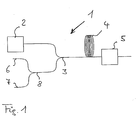
- Fig. 1 shows a schematic block diagram of an fiber optical parametric amplifier (FOPA).
- a fiber optical parametric amplifier is in general a multifunctional device, which can be used at several applications in an all-optical communication systems.
- Fiber optical parametric amplifier shows performance as high performance amplifiers, simple tools generation and ultra-fast all-optical assembling, or achieve in highly non-linear optical fiber.
- the FOPA 1 comprises a high power pump source 2, means for coupling 3, e.g. an optical coupler or a multiplexer, a high non-linear fiber (HLNF) 4 and an optical band pass filter (OBPF) 5.
- An optical signal or a plurality of optical signals 6, 7 to be amplified are feed to the FOPA 1.
- the optical signals 6, 7 are coupled with the pump signal via the coupler 3.
- the plurality signals 6, 7 may be coupled before with another optical coupler 8.
- the pump signal is provided by a high power pump source, preferable a continuous wave laser.
- the high power pump source could be an arrangement of devices, for example a distributed feedback (DFB) laser with a subsequent arranged erbium-doped fiber amplifier (EDFA).
- DFB distributed feedback
- EDFA erbium-doped fiber amplifier
- the FOPA 1 may comprise (not shown) polarization controllers and phase modulators in the optical signal line and/or pump signal line.
- the optical signals 6, 7 are preferable applied in form of WDM channels.
- the WDM channels 6, 7 are combined together with the pump signal through the optical coupler 3 into the HNLF 4 performing the amplifying and four-wave mixing of the signals.
- the OBPF 5 is in particularly provided, if the FOPA 1 is used as an optical amplification device.
- the OBPF 5 is used as a wavelength filter which passes only the amplified optical signals.
- the FOPA can also be considered as a wavelength converter based on four-wave mixing, in particularly if there is less performance of amplifying.
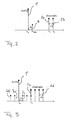
- Figure 2 shows schematically a diagram illustrating the position of frequencies of optical signals, i.e. the original optical signals to be amplified, the pump signal and the generated optical signals, with respect to four-wave mixing.
- the optical signals to be amplified are exemplary shown as a set of WDM channels.
- First the invention is described exemplary for of a one-pump fiber optical parametric amplifier.
- optical frequencies 3 are generated by four-wave mixing between the pump (signal) 1 and the set of WDM channels 2a, 2b.
- Figure 2 shows a simplified case with only 2 channels.
- many optical frequencies are generated around the pump with a spectral spacing of ⁇ . These frequencies are located near the pump wavelength and are a source of cross-talk on the first channels of the amplification band.
- the location of the pump frequency/wavelength 1 can be carefully chosen with regard to the frequency/wavelengths of the WDM channels 2 and to the inter-channel spacing ⁇ , so that the new generated signal frequencies 3 do not correspond to the optical frequencies/wavelengths of the channels 2.
- the pump frequency 1 By noting vp the optical frequency of the pump signal 1 and ⁇ 1 the optical frequency of the channel 2a which is the closest to the pump 1, the pump frequency 1 must be chosen such as
- a set of WDM channels 2 with a regular spectral spacing of ⁇ is now considered for the purpose of simplicity.
- the worst configuration that must be avoided is depicted in Figure 2. It consists in setting the pump frequency 1 such as
- the generated frequencies 3 are exactly equal to the optical frequencies of the channels 2, which represents a source of cross-talk.
- the optical frequency of the pump must be chosen so that
- the best positions of the pump are such as:
- (N+0.5) ⁇ , where N is an integer. This case is depicted in Figure 3.
- FOPA fiber optical parametric amplifier
- FIG. 5 shows the case for a 2-pump FOPA.
- the amplification spectral band is located between both pumps. The frequencies of the pumps are usually chosen with regard to the dispersion and the dispersion slope.
- the amplification band is located where channels are.
- the 2-pump FOPA has a first pump frequency 1 and a second pump frequency 2.
- the channels 3 a-c with equal channel spacing are shown. Different four-wave mixing components/signals with different output power are generated.
- the power of the idlers components 4 a-c is proportional to the product of the power of the first pump, the second pump 2, and the channel 3.
- the idler components 4 are in particular of interest, if the amplifier is used as a wavelength converter. Furthermore, FWM components 5 and 6 are generated on the left of pump 1 and the right of pump 2. They are located outside the channel band and the idlers band. In this case, they will not create cross-talk on channels 3a-c or idlers 4. The power of the components 5 and 6 is proportional to the squared power of the respective pump by the channel power.
- Reference sign 7, 8 denotes FWM components which power is proportional to the respective pump power by the squared channel power. Part of these components, the components 7, are generated in the channel band and idlers band and can be a source of cross-talk.
- the method an a FOPA according to the invention, used to reduce the cross-talk, impose a new constraint on the choice of the pump frequencies.
- the setting of the pump frequency as described above for the 1-pump parametric amplifier is applied to the frequency of the 2-pump parametric amplifier.
- the setting is applied at least to one pump (frequency) of the 2-pump FOPA, preferably to the frequency of the pump closest to the channels.
- the setting is applied to of both pump frequencies.
Landscapes
- Physics & Mathematics (AREA)
- Electromagnetism (AREA)
- Engineering & Computer Science (AREA)
- Computer Networks & Wireless Communication (AREA)
- Signal Processing (AREA)
- Optical Modulation, Optical Deflection, Nonlinear Optics, Optical Demodulation, Optical Logic Elements (AREA)
Abstract
Method for amplifying a plurality of optical signals using a fiber optical parametric amplifier and the corresponding four-wave mixing effect between a pump signal and the optical signals, wherein, the pump signal frequency and/or the optical signal frequencies are chosen such, that the amount of the difference between the pump frequency and the optical signal frequency, which is closest to the pump frequency, is not a multiple of the inter-spacing of the optical signals.
Description
- The invention relates to a fiber optical parametric amplifier, and to a method for amplifying a plurality of optical signals with a fiber optical parametric amplifier, and, more specifically, to a method for amplifying optical signals and a fiber optical parametric amplifier using four-wave mixing.
- The optical signals are preferably provided in form of WDM channels.
- Four-wave mixing (FWM) have been an area of interest for applications in fiber optic communication system for several years. At the begin, the work was focused on the creation of a fast-conjugated wave which could be used for dispersion compensation, and some work on all-optical demultiplexing for high data rates. The process of four-wave mixing (FWM) have been shown in dispersion-shifted fibers (DSF) and in semiconductor optical amplifiers (SOAs). Experiments in DSF did show a greater than 100 % efficiency and thus parametric amplification, but to reach substantial amplification a pulse pump had to be used. New fibers with very high non-linear coefficient are developed in resent years and the CW-amplification have been increased to. In particular, the progress in the design of photonic crystal fibers (PCFs) with high non-linear coefficient enables high amplification in very short fiber length. PCFs have a low effective area which increases the efficiency of non-linear effects. PCFs with a low effective area enables high amplification.
- The four-wave mixing (FWM) is a non-linear parametric process which utilizes the third order non-linearity of an optical material, e.g. an optical fiber. The process transfers energy from an intense light wave, e.g. a laser pump, to a neighboring, weaker signal and to a new idle wave, which is created to conserve energy. When the FWM-efficiency is higher than 0 dB, the process is generally referred to as parametric amplification. For all parametric processes there must be a phase-matching between the pump and the signal. In optical fibers, where the distances are long, this is in particular achieved, when the pump is positioned at or close to the zero-dispersion wavelength. This will limit the tunability of the pump, but with a short fiber with a very flat dispersion sloop, the pump can be changed over a wider region.
- Since the fiber optical parametric amplifier (FOPA) will created a new, conjugate wave simultaneous to the amplification of the signal, it can be used for wave length conversion in all - optical WDM-systems. Thereby, the idle wave, e.g. is filtered out, while both the pump and the input signal is blocked. The conversion can be made transparent or even with inherent gain and the output is optical phase conjugated to the input. Thus, a fiber optical parametric amplifier (FOPA) can also be considered as a wavelength converter based on four-wave mixing.
- In IEEE Photonics Technology letters, vol. 15, NO. 8, August 2003, pages 1061 - 1063, "Amplification of WDM signals in fiber-based optical parametric amplifiers" the performance of fiber-based optical parametric amplifiers in wave length-division-multiplex (WDM) applications is described. The measurements show the performance in terms of power and gain versus input - output signal power. Limiting effect such as cross-gain saturation (XGS) due to pump depletion and four-wave mixing (FWM) are discussed. At high power levels, channel interaction from XGS and FWM reduces the performance. However, the later only accrue when more than two channels are present. The penalty from FWM is caused by the appearance of an idle wave from two signals at the same wave length as the third. It is suggested to remove this effect by carefully chosen the signal wave length, i.e. to detune one of the wave length resulting in an unequal channel spacing. In this case the penalty from FWM in a three-channel WDM system is removed.
- US 5,604,618 describes an optical parametric circuit for separating four-wave-mixing waves (FWM Waves) from signal waves and/or pump waves. By inputting the signal waves and the pump waves from different input ports of the directional coupler, it is possible to separate amplified signal waves and the FWM waves from the pump waves. By adjusting the length and the propagation constance of the dispersive optical media, the amplified signal waves are separated from the pump waves and the FWM wave.
- It is therefore an object of the present invention to provide a method for amplifying a plurality of optical signals as well as a fiber optical parametric amplifier which is more efficient.
- It is a further object of the invention to provide such a method and such a fiber optical parametric amplifier assuring a better performance in terms of power penalty and gain versus input-output signal power, in particularly less limitation caused by four-wave mixing.
- These objects are achieved by a method according to
claim 1 and a fiber optical parametric amplifier according to claim 6. - A method according to the invention for amplifying a plurality of optical signals uses a fiber optical parametric amplifier and the corresponding four-wave mixing effect between a pump signal and the optical signals, wherein the pump signal frequency and/or the optical signal frequencies are chosen such, that the amount of the differences between the pump frequency and the optical signals frequency, which is closest to the pump frequency is not a multiple of the inter-spacing of the optical signals.
- A fiber optical parametric amplifier according to the invention comprises a high power pump source, means for input a plurality of optical signals, means for coupling and a non-linear fiber for amplifying a plurality of optical signals using the four-wave mixing effect between a pump signal and the optical signals, wherein the pump signals frequency and/or the optical signal frequencies are chosen such, that the amount of the difference between the pump frequency and the optical signal frequency, which closest to the pump frequency, is not a multiple of the inter-spacing of the optical signals.
- A part of the invention is to realize, that optical frequencies generated by four-wave mixing between the pump and the optical signals and located near the pump frequency are a source of cross talk at the first channels of the amplification band, i.e. the optical signals located near the pump frequency or wavelength, respectively. To overcome the problem, the location of the pump frequency is chosen carefully with regard to the frequency/wavelength of the optical signals, in particularly provided in form of WDM channels, and to the inter-spacing, toward that the new generated frequencies do not correspond to the frequencies of the optical signals/channels. This is realized by determining the pump signal frequency with respect to the optical signal frequencies such, that the amount of the difference between the pump frequency and the optical signal frequency, which is closest to the pump frequency, is not a multiple of the inter-spacing of the optical signals.
- According to a preferred embodiment of the invention, the plurality of optical signals are provided in form of a set of wavelength-division-multiplexed (WDM) channels.
- The wavelength-division-multiplexed- (WDM) channels have preferable a equal channel spacing.
- According to a preferred embodiment of the invention, the optical pump frequency is chosen such, that

- νP
- is the optical frequency of the pump
- ν1
- is the frequency of the optical signal closets to the pump wavelength,
- Δν
- is the inter-spacing of the optical signals, and where
- N
- is an integer.
- Such a solution provides an optimum position for the pump frequency, because the frequencies of the optical signals generated by four-wave mixing lie not only between the frequencies of the plurality of the optical signals, e.g. the WDM channels, but in the middle between said frequencies.
- In a further preferred embodiment of the invention, the FOPA comprises a plurality of pumps with different frequencies. At least the frequency of one pump of the FOPA is chosen according to the invention, preferably the frequency of the pump which is closest to the optical signal frequency.
- Further advantages and developments of the invention are apparent from the description and the accompanying drawings.
- It is to be understood that the aforementioned features and the features explained below can be used not only in the respective combinations described but also in other combinations or alone without departing from the scope of the present invention.
- The invention will become more apparent from the following description of an embodiment taking in conjunction with the accompanying drawings, in which:
- Fig. 1
- shows a diagram of fiber optical parametric amplifier,
- Fig. 2
- shows a schematic representation of frequency positions of the signals with respect to four-wave mixing,
- Fig. 3
- shows a bad position of the pump frequency with regard to optical signal frequencies,
- Fig. 4
- shows a schematic representation of an optimal position of the pump frequency with respect to the optical signal frequencies, and
- Fig. 5
- shows a schematic representation of frequency positions of signals with respect to four-wave mixing and a 2-pump fiber optical parametric amplifier.
- Fig. 1 shows a schematic block diagram of an fiber optical parametric amplifier (FOPA). A fiber optical parametric amplifier is in general a multifunctional device, which can be used at several applications in an all-optical communication systems. Fiber optical parametric amplifier shows performance as high performance amplifiers, simple tools generation and ultra-fast all-optical assembling, or achieve in highly non-linear optical fiber.
- The
FOPA 1 comprises a highpower pump source 2, means forcoupling 3, e.g. an optical coupler or a multiplexer, a high non-linear fiber (HLNF) 4 and an optical band pass filter (OBPF) 5. An optical signal or a plurality of optical signals 6, 7 to be amplified are feed to theFOPA 1. The optical signals 6, 7 are coupled with the pump signal via thecoupler 3. The plurality signals 6, 7 may be coupled before with another optical coupler 8. The pump signal is provided by a high power pump source, preferable a continuous wave laser. Even thereference sign 2 denotes one block, the high power pump source could be an arrangement of devices, for example a distributed feedback (DFB) laser with a subsequent arranged erbium-doped fiber amplifier (EDFA). Furthermore theFOPA 1 may comprise (not shown) polarization controllers and phase modulators in the optical signal line and/or pump signal line. The optical signals 6, 7 are preferable applied in form of WDM channels. The WDM channels 6, 7 are combined together with the pump signal through theoptical coupler 3 into the HNLF 4 performing the amplifying and four-wave mixing of the signals. - The
OBPF 5 is in particularly provided, if theFOPA 1 is used as an optical amplification device. TheOBPF 5 is used as a wavelength filter which passes only the amplified optical signals. - The FOPA can also be considered as a wavelength converter based on four-wave mixing, in particularly if there is less performance of amplifying.
- Figure 2 shows schematically a diagram illustrating the position of frequencies of optical signals, i.e. the original optical signals to be amplified, the pump signal and the generated optical signals, with respect to four-wave mixing. The optical signals to be amplified are exemplary shown as a set of WDM channels. First the invention is described exemplary for of a one-pump fiber optical parametric amplifier.
- In a one-pump fiber optical parametric amplifier,
optical frequencies 3 are generated by four-wave mixing between the pump (signal) 1 and the set of WDM channels 2a, 2b. The encountered problem is the generation of a new optical frequency νFWM due to a four-wave mixing effect between the pump frequency vp and the 2 channels ν1 and ν2, wherein νFWM = νp + ν2 - ν1. Figure 2 shows a simplified case with only 2 channels. In the case of several WDM channels, many optical frequencies are generated around the pump with a spectral spacing of Δν. These frequencies are located near the pump wavelength and are a source of cross-talk on the first channels of the amplification band. - To overcome this problem, the location of the pump frequency/
wavelength 1 can be carefully chosen with regard to the frequency/wavelengths of theWDM channels 2 and to the inter-channel spacing Δν, so that the new generatedsignal frequencies 3 do not correspond to the optical frequencies/wavelengths of thechannels 2. - By noting vp the optical frequency of the
pump signal 1 and ν1 the optical frequency of the channel 2a which is the closest to thepump 1, thepump frequency 1 must be chosen such as |νp-ν1| is not a multiple of Δν. - A set of
WDM channels 2 with a regular spectral spacing of Δν is now considered for the purpose of simplicity. The worst configuration that must be avoided is depicted in Figure 2. It consists in setting thepump frequency 1 such as |νp-ν1| is a multiple of Δν, wherein νp is the optical frequency of the pump and ν1 of thechannel 2 which is the closest to thepump 1. In this case, the generatedfrequencies 3 are exactly equal to the optical frequencies of thechannels 2, which represents a source of cross-talk. - To avoid the superimposition of the generated frequencies with the channels, the optical frequency of the pump must be chosen so that |νp-ν1| is not a multiple of Δν. The best positions of the pump are such as: |νp-ν1| = (N+0.5) Δν , where N is an integer. This case is depicted in Figure 3.
- Following, the invention is described for a fiber optical parametric amplifier (FOPA) having several pumps, exemplary a 2-pump FOPA. It is obviously for a person skilled in the art to apply the invention to further FOPA's like a 3-pump or 4-pump FOPA.
- Figure 5 shows the case for a 2-pump FOPA. In 2-pump parametric amplifiers, the amplification spectral band is located between both pumps. The frequencies of the pumps are usually chosen with regard to the dispersion and the dispersion slope. The amplification band is located where channels are. The 2-pump FOPA has a
first pump frequency 1 and asecond pump frequency 2. Thechannels 3 a-c with equal channel spacing are shown. Different four-wave mixing components/signals with different output power are generated. The power of the idlers components 4 a-c is proportional to the product of the power of the first pump, thesecond pump 2, and thechannel 3. - The idler components 4 are in particular of interest, if the amplifier is used as a wavelength converter. Furthermore,
FWM components 5 and 6 are generated on the left ofpump 1 and the right ofpump 2. They are located outside the channel band and the idlers band. In this case, they will not create cross-talk onchannels 3a-c or idlers 4. The power of thecomponents 5 and 6 is proportional to the squared power of the respective pump by the channel power. - Reference sign 7, 8 denotes FWM components which power is proportional to the respective pump power by the squared channel power. Part of these components, the components 7, are generated in the channel band and idlers band and can be a source of cross-talk.
- The method an a FOPA according to the invention, used to reduce the cross-talk, impose a new constraint on the choice of the pump frequencies. The setting of the pump frequency as described above for the 1-pump parametric amplifier, is applied to the frequency of the 2-pump parametric amplifier. According to the invention, the setting is applied at least to one pump (frequency) of the 2-pump FOPA, preferably to the frequency of the pump closest to the channels. In an advantageous embodiment, the setting is applied to of both pump frequencies.
- The best position of the
pump 1 and pump 2 are the following:
For pump 1 :
and for pump 2:
where - Δν
- is the inter-channel spacing
- N
- is an integer
- νp1
- is the frequency of
pump 1 - νp2
- is the frequency of
pump 2 - ν11
- is the frequency of the channel closest to the
pump 1, and, - ν12
- is the frequency of the channel closest to the
pump 2.
Claims (10)
- Method for amplifying a plurality of optical signals using a fiber optical parametric amplifier and the corresponding four-wave mixing effect between a pump signal and the optical signals,
characterised in that,
the pump signal frequency and/or the optical signal frequencies are chosen such, that the amount of the difference between the pump signal frequency and the optical signal frequency, which is closest to the pump frequency, is not a multiple of the inter-spacing of the optical signals. - Method according to claim 1, characterised in that, the plurality of optical signals are provided in form of a set of wavelength-division-multiplexed channels.
- Method according to claim 2, characterised in that, the set of wavelength-division-multiplexed channels has a equal channel spacing.
- Method according to one of the claim 1 to 3, characterised in that, the optical pump frequency is chosen such, that

withνp is the optical frequency of the pumpν1 is the frequency of the optical signal closest to the pump wavelength,Δν is the inter-spacing of the optical signals, and whereN is an integer. - Method according to one of the claims 1 to 4, characterised in that, the fiber optical parametric amplifier comprises a plurality of pumps with different frequencies, wherein the method is applied to at least one pump frequency, in particular to the frequency of the pump which is closest to the optical signal frequency.
- Fiber optical parametric amplifier comprising a high power pump source, means for input a plurality of optical signals, means for coupling and a non-linear fiber, wherein the optical signals are amplified by the fiber optical parametric amplifier and the corresponding four-wave mixing effect between a pump signal and the optical signals,
characterised in that,
the pump signal frequency and/or the optical signal frequencies are chosen such, that the amount of the difference between the pump frequency and the optical signal frequency, which is closest to the pump frequency, is not a multiple of the inter-spacing of the optical signals. - Fiber optical parametric amplifier according to claim 6, characterised in that, the plurality of optical signals, which are amplified with the fiber optical parametric amplifier, are provided in form of wavelength-division-multiplexed channels.
- Fiber optical parametric amplifier according to claim 7, characterised in that, the set of wavelength-division-multiplexed channels has a equal channel spacing.
- Fiber optical parametric amplifier according to one of the claims 6 to 8, characterised in that, the optical pump frequency is chosen such, that

withνP is the optical frequency of the pumpν1 is the frequency of the optical signal closets to the pump wavelength,Δν is the inter-spacing of the optical signals, and whereN is an integer. - Fiber optical parametric amplifier according to one of the claims 6 to 9, characterised in that, the fiber optical parametric amplifier comprises a plurality of pumps with different frequencies, wherein said choosing is made at least for one pump frequency, in particular for the frequency of the pump which is closest to the optical signal frequency.
Priority Applications (1)
| Application Number | Priority Date | Filing Date | Title |
|---|---|---|---|
| EP04292051A EP1626308A1 (en) | 2004-08-13 | 2004-08-13 | Fiber optical parametric amplifier and method for amplification of optical signals with a fiber optical parametric amplifier |
Applications Claiming Priority (1)
| Application Number | Priority Date | Filing Date | Title |
|---|---|---|---|
| EP04292051A EP1626308A1 (en) | 2004-08-13 | 2004-08-13 | Fiber optical parametric amplifier and method for amplification of optical signals with a fiber optical parametric amplifier |
Publications (1)
| Publication Number | Publication Date |
|---|---|
| EP1626308A1 true EP1626308A1 (en) | 2006-02-15 |
Family
ID=34931341
Family Applications (1)
| Application Number | Title | Priority Date | Filing Date |
|---|---|---|---|
| EP04292051A Withdrawn EP1626308A1 (en) | 2004-08-13 | 2004-08-13 | Fiber optical parametric amplifier and method for amplification of optical signals with a fiber optical parametric amplifier |
Country Status (1)
| Country | Link |
|---|---|
| EP (1) | EP1626308A1 (en) |
Cited By (2)
| Publication number | Priority date | Publication date | Assignee | Title |
|---|---|---|---|---|
| WO2013087645A1 (en) | 2011-12-14 | 2013-06-20 | Commissariat à l'énergie atomique et aux énergies alternatives | Method and device for the optical parametric amplification of pulses with frequency drift |
| CN109714106A (en) * | 2019-02-22 | 2019-05-03 | 南京信息工程大学 | Distributed light overloading wave generating device and working method based on annular fiber |
Citations (1)
| Publication number | Priority date | Publication date | Assignee | Title |
|---|---|---|---|---|
| US20030219258A1 (en) * | 2002-05-23 | 2003-11-27 | Ellis Andrew D. | Recovery of clock pulses of wavelength division multiplexed optical signals |
-
2004
- 2004-08-13 EP EP04292051A patent/EP1626308A1/en not_active Withdrawn
Patent Citations (1)
| Publication number | Priority date | Publication date | Assignee | Title |
|---|---|---|---|---|
| US20030219258A1 (en) * | 2002-05-23 | 2003-11-27 | Ellis Andrew D. | Recovery of clock pulses of wavelength division multiplexed optical signals |
Non-Patent Citations (3)
| Title |
|---|
| CALLEGARI F A ET AL: "Crosstalk mitigation in fiber optic parametric amplifier", LEOS 2002. 15TH. ANNUAL MEETING OF THE IEEE LASERS & ELECTRO-OPTICS SOCIETY. GLASCOW, SCOTLAND, NOV. 11 - 12, 2002, ANNUAL MEETING OF THE IEEE LASERS AND ELECTRO-OPTICS SOCIETY, NEW YORK, NY : IEEE, US, vol. VOL. 1 OF 2, 13 November 2002 (2002-11-13), pages 383 - 384, XP010622196, ISBN: 0-7803-7500-9 * |
| CHAVEZ BOGGIO J M ET AL: "Performance of a two-pump fiber optical parametric amplifier in a 10 Gb/s x 64 channel dense wavelength division multiplexing system", OPTICS COMMUNICATIONS, NORTH-HOLLAND PUBLISHING CO. AMSTERDAM, NL, vol. 218, no. 4-6, 1 April 2003 (2003-04-01), pages 303 - 310, XP004416698, ISSN: 0030-4018 * |
| FORGHIERI F ET AL: "WDM SYSTEMS WITH UNEQUALLY SPACED CHANNELS", JOURNAL OF LIGHTWAVE TECHNOLOGY, IEEE. NEW YORK, US, vol. 13, no. 5, 1 May 1995 (1995-05-01), pages 889 - 897, XP000521011, ISSN: 0733-8724 * |
Cited By (5)
| Publication number | Priority date | Publication date | Assignee | Title |
|---|---|---|---|---|
| WO2013087645A1 (en) | 2011-12-14 | 2013-06-20 | Commissariat à l'énergie atomique et aux énergies alternatives | Method and device for the optical parametric amplification of pulses with frequency drift |
| FR2984535A1 (en) * | 2011-12-14 | 2013-06-21 | Commissariat Energie Atomique | METHOD AND APPARATUS FOR OPTICAL PARAMETRIC AMPLIFICATION OF FREQUENCY DERIVED PULSES USING TWO PUMP SIGNALS AND ENABLING THE ENLARGEMENT OF THE GAIN SPECTRAL BAND |
| CN104011589A (en) * | 2011-12-14 | 2014-08-27 | 原子能与替代能源委员会 | Method and device for optical parametric amplification of pulses with frequency drift |
| US9250497B2 (en) | 2011-12-14 | 2016-02-02 | Commissariat A L'energie Atomique Et Aux Energies Alternatives | Method and device for the optical parametric amplification of pulses with frequency drift |
| CN109714106A (en) * | 2019-02-22 | 2019-05-03 | 南京信息工程大学 | Distributed light overloading wave generating device and working method based on annular fiber |
Similar Documents
| Publication | Publication Date | Title |
|---|---|---|
| EP1130456B1 (en) | Method, device, and system for waveform shaping of signal light | |
| EP1518149B1 (en) | Four-wave-mixing based optical wavelength converter device | |
| US7940454B2 (en) | Optical parametric amplifier | |
| US6693740B2 (en) | Dispersion managed discrete Raman amplifiers | |
| JP7189470B2 (en) | optical signal processor | |
| JP2858400B2 (en) | Apparatus and method for changing the spectral characteristics of an optical signal | |
| US20080130097A1 (en) | Two-pump optical parametric devices having reduced stimulated raman scattering noise levels | |
| JP7328599B2 (en) | optical amplifier | |
| US6930826B2 (en) | All-optical XOR gate by using semiconductor optical amplifiers | |
| Marhic | Toward Practical Fiber Optical Parametric Amplifers | |
| US6501597B1 (en) | Optical amplifier using wavelength converter | |
| Suche et al. | Efficient Ti: PPLN multi-wavelength converter for high bitrate WDM-transmission systems | |
| Radic et al. | Polarization dependent parametric gain in amplifiers with orthogonally multiplexed optical pumps | |
| JPH0829815A (en) | White ultra-short pulse light source | |
| KR19990035458A (en) | Amplified Gain Fixed Optical Amplifier | |
| JP2005235928A (en) | Optical amplifier | |
| KR100298353B1 (en) | 2 step optical amplifier and optical amplifing method | |
| JPH08122833A (en) | Wavelength converter | |
| JP7806898B2 (en) | Optical Parametric Amplifier | |
| Marhic et al. | Interleaver-based method for full utilization of the bandwidth of fiber optical parametric amplifiers and wavelength converters | |
| US6731425B1 (en) | Modular Raman pump double-multiplexer | |
| JP3749310B2 (en) | Wavelength multiplexed light source | |
| JPH10200509A (en) | Optical transmission system | |
| JP2006135033A (en) | Optical amplifier | |
| Kumar et al. | Fiber nonlinearity based devices for advanced fiber-optic communication and signal processing |
Legal Events
| Date | Code | Title | Description |
|---|---|---|---|
| PUAI | Public reference made under article 153(3) epc to a published international application that has entered the european phase |
Free format text: ORIGINAL CODE: 0009012 |
|
| AK | Designated contracting states |
Kind code of ref document: A1 Designated state(s): AT BE BG CH CY CZ DE DK EE ES FI FR GB GR HU IE IT LI LU MC NL PL PT RO SE SI SK TR |
|
| AX | Request for extension of the european patent |
Extension state: AL HR LT LV MK |
|
| AKX | Designation fees paid | ||
| RAP1 | Party data changed (applicant data changed or rights of an application transferred) |
Owner name: ALCATEL LUCENT |
|
| STAA | Information on the status of an ep patent application or granted ep patent |
Free format text: STATUS: THE APPLICATION IS DEEMED TO BE WITHDRAWN |
|
| 18D | Application deemed to be withdrawn |
Effective date: 20060817 |
|
| REG | Reference to a national code |
Ref country code: DE Ref legal event code: 8566 |