EP1624641A1 - System for downloading contents, and client terminal for downloading contents from contents server - Google Patents
System for downloading contents, and client terminal for downloading contents from contents server Download PDFInfo
- Publication number
- EP1624641A1 EP1624641A1 EP05017051A EP05017051A EP1624641A1 EP 1624641 A1 EP1624641 A1 EP 1624641A1 EP 05017051 A EP05017051 A EP 05017051A EP 05017051 A EP05017051 A EP 05017051A EP 1624641 A1 EP1624641 A1 EP 1624641A1
- Authority
- EP
- European Patent Office
- Prior art keywords
- download
- content
- client terminal
- descriptor
- server
- Prior art date
- Legal status (The legal status is an assumption and is not a legal conclusion. Google has not performed a legal analysis and makes no representation as to the accuracy of the status listed.)
- Withdrawn
Links
- 238000000034 method Methods 0.000 description 6
- 230000005540 biological transmission Effects 0.000 description 4
- 239000000284 extract Substances 0.000 description 4
- 230000006870 function Effects 0.000 description 2
- RRHGJUQNOFWUDK-UHFFFAOYSA-N Isoprene Chemical compound CC(=C)C=C RRHGJUQNOFWUDK-UHFFFAOYSA-N 0.000 description 1
- 230000001413 cellular effect Effects 0.000 description 1
- 238000012217 deletion Methods 0.000 description 1
- 230000037430 deletion Effects 0.000 description 1
- 238000010295 mobile communication Methods 0.000 description 1
Images







Classifications
-
- H—ELECTRICITY
- H04—ELECTRIC COMMUNICATION TECHNIQUE
- H04L—TRANSMISSION OF DIGITAL INFORMATION, e.g. TELEGRAPHIC COMMUNICATION
- H04L67/00—Network arrangements or protocols for supporting network services or applications
- H04L67/34—Network arrangements or protocols for supporting network services or applications involving the movement of software or configuration parameters
-
- H—ELECTRICITY
- H04—ELECTRIC COMMUNICATION TECHNIQUE
- H04L—TRANSMISSION OF DIGITAL INFORMATION, e.g. TELEGRAPHIC COMMUNICATION
- H04L65/00—Network arrangements, protocols or services for supporting real-time applications in data packet communication
- H04L65/1066—Session management
- H04L65/1101—Session protocols
-
- H—ELECTRICITY
- H04—ELECTRIC COMMUNICATION TECHNIQUE
- H04L—TRANSMISSION OF DIGITAL INFORMATION, e.g. TELEGRAPHIC COMMUNICATION
- H04L67/00—Network arrangements or protocols for supporting network services or applications
- H04L67/01—Protocols
-
- H—ELECTRICITY
- H04—ELECTRIC COMMUNICATION TECHNIQUE
- H04L—TRANSMISSION OF DIGITAL INFORMATION, e.g. TELEGRAPHIC COMMUNICATION
- H04L67/00—Network arrangements or protocols for supporting network services or applications
- H04L67/01—Protocols
- H04L67/04—Protocols specially adapted for terminals or networks with limited capabilities; specially adapted for terminal portability
-
- Y—GENERAL TAGGING OF NEW TECHNOLOGICAL DEVELOPMENTS; GENERAL TAGGING OF CROSS-SECTIONAL TECHNOLOGIES SPANNING OVER SEVERAL SECTIONS OF THE IPC; TECHNICAL SUBJECTS COVERED BY FORMER USPC CROSS-REFERENCE ART COLLECTIONS [XRACs] AND DIGESTS
- Y10—TECHNICAL SUBJECTS COVERED BY FORMER USPC
- Y10S—TECHNICAL SUBJECTS COVERED BY FORMER USPC CROSS-REFERENCE ART COLLECTIONS [XRACs] AND DIGESTS
- Y10S707/00—Data processing: database and file management or data structures
- Y10S707/99931—Database or file accessing
Definitions
- This invention relates to a client terminal for downloading contents from a contents server, and a contents download system which comprises the client terminal and the contents server.
- these standards define that the client terminal receives a Download Descriptor (hereinafter "DD") , which describes attribution information of the contents, before downloading contents, and the client terminal downloads the contents from the contents server based upon the URI (Uniform Resource Identifier) contained in the DD.
- DD Download Descriptor
- the contents to be downloaded from the contents sever are a movie, music, and a game program, etc.
- the client terminal does not download the same contents as contents which the client has already downloaded from the contents server.
- Japanese Patent Disclosure (Kokai) No. 2003-216430 discloses a systemwhere upgrade of unnecessary software is not performed.
- this system which consists of a client terminal and a server, the client terminal stores the operating frequency of each software, and client terminal requests the server to upgrade only software with high operating frequency for reducing useless access to the server.
- An object of the present invention is to provide a client terminal and contents download system for downloading a required information without a complicated process.
- a contents download system comprising the client terminal which includes a first storage unit configured to store a content and a download descriptor which contains attribution information regarding a content, means for transmitting a request for a download descriptor to a download server, wherein the request includes at least one download descriptor stored in the first storage unit, means for receiving the download descriptor from the download server, and means for transmitting a request for a content to the content server if a difference information is added to the received download descriptor, the download server which includes a second storage unit configured to store download descriptors, each contains attribution information regarding a content, means for receiving the request for a download descriptor from the client terminal, means for comparing the at least one download descriptor contained in the request and the download descriptor stored in the second storage unit, means for adding the difference information to the download descriptor if there is a difference between the download descriptor from the client terminal and the download descriptor stored in the second storage unit, and means
- a client terminal comprising a client terminal used in a contents download system which includes a display unit configured to display image information, a speaker configured to output voice information, a storage unit configured to store a content and a download descriptor whi ch contains attribution information regarding a content, means for transmitting a request for a download descriptor to a download server, means for receiving the download descriptor from the download server, and means for transmitting a request for a content to the content server if a difference information is added to the received download descriptor.
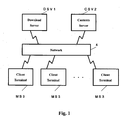
- Fig. 1 shows a contents download system according to an embodiment of the present invention.
- the contents download system comprises a download server DSV 1, a contents server CSV 2, and mobile communication terminals MSs 3, where the DSV 1, the CSV 2, and the MSs 3 are connected via network 4.
- the network 4 includes the Internet and the cellular network.
- Fig. 2 schematically shows the configuration of the DSV 1.
- the DSV 1 has a function to manage attribution information regarding contents, which are to be downloaded, stored in the CSV 2, and comprises a CPU (Central Processing Unit) 11, a data bus 12, a program memory 13, a data memory 14, and an interface 15.
- the program memory 13 stores DD generation program 13a for generating the Download Descriptor DD and a transmission/reception control program for receiving the DD transmission request from a MS 3 and transmitting the DD to the MS 3.
- the DD generated based upon the DD generation program 13a is stored in the data memory 14.
- the data memory 14 may be a flash memory or hard disk, and stores the DDs, which include the attribution information of the contents and indicators of the content.
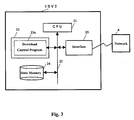
- Fig. 3 schematically shows the configuration of the CSV 2.
- the CSV 2 has a function to manage the contents, which are to be downloaded responding to a download request from the MS 3, and comprises a CPU 21, a data bus 22, a program memory 23, a data memory24, and an interface 25.
- the contents to be downloaded are stored in the data memory 24.
- the program memory 23 stores download control program 23a.
- a content requested by a MS 3 is transmitted to the MS 3 by executing the download control program 23a.
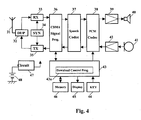
- Fig. 4 schematically shows the configuration of the MS 3.
- Each MS 3 has a radio processing part and a signal processing part.
- the radio processing part comprises an antenna 31, duplexer 32, a receiving circuit 33, a synthesizer 34, and a transmitting circuit 35.
- the signal processing part comprises a CDMA signal processing unit 36, a speech codec 37, and a PCM codec 38.
- the PCM codec 38 demodulates a digital speech signal from the CDMA signal processing unit 36 and outputs an analog speech signal to an amplifier 39. And the analog speech signal, amplified by the amplifier 39, is outputted from a speaker 40. On the other hand, an input speech signal from a microphone 41 is amplified by the amplifier 42 and modulated by the PCM codec 38.
- the CDMA signal processing unit 36 despreads a packed data from receiving circuit 33 and outputs to the controller 43.
- the controller 43 extracts a content from the packed data based upon header information embedded in the packed data. The extracted content is stored in the memory 46.
- the controller 43 reads out a content based upon the execution request inputted from the input unit 44, and outputs image data included in the content to the display unit 45 and outputs voice data included in the content to the PCM codec 38 and amplifier 39 sequentially. Then, the image data is displayed on the display unit 45 and voice data is outputted from the speaker 40. On the other hand, controller 43 outputs a download request inputted by the input unit 44 to the CDMA signal processing unit 36.
- the CDMA signal processing unit 36 spreads a coded speech data, using a spreading code assigned for communicating with a base station (not shown) , from the speech codec 37 and orthogonally modulates the spread speech data. Then, the orthogonally modulated speech data is outputted to the base station via the antenna 31.
- the input unit 44 has digit keys, a power ON key, a SEND key, an END key, a volume key, and a mode selection key.
- the display unit 45 has a LCD display unit and a LED, and the LCD display unit displays image data of the content stored in the memory 46, a telephone number and a name of a caller, and a status information regarding the MS 3.
- the power circuit 47 which is equipped with a DC/DC converter, supplies a predetermined voltage Vcc, made from the power stored in a battery 48, to each circuit of MS 3
- the controller 43 includes a microcomputer and a ROM (Read Only Memory), and download control program 43a is stored in the ROM.
- the controller 43 by executing the download control program 43a, transmits a DD transmission request to the DSV 1 and transmits a content transmission request (a download request) to the CSV 2, respectively. Furthermore, the controller 43 stores the DD received from the DSV 1 and the content received from the CSV 2 in the memory 46.
- DD there are three kinds of DDs.
- Fig. 5 shows information included in the first type of DD. This first type of DD is used if the content cannot be divided into sub-contents. For example, each sub-content is one of the chapters of one story.
- the first type of DD includes DD identifier 51a, DD classification 51b, DD version 51c, data type 51d, size 51e, URI 51f, success-failure URI 51g, display URI 51h, version 51i, revision date 51j, title 51k, explanation 51m, vendor name 51n, explanation URI 51o, icon URI 51p, and parameter 51q.
- the DD identifier 51a is identification information, for example a serial number, to identify this DD.
- the DD. classification 51b indicates that this DD is the first type of DD.
- the DD version 51c means the version of the first type of DD.
- the data type 51d indicates the coding method, for example, MPEG-4 and MP3, used for coding data included in the content.
- the size 51e indicates memory size required for storing the content which the first type of DD designates.
- the URI 51f indicates location information of the CSV2 .
- the success-failure URI 51g indicates location information used by the MS 3 for a notice of the information regarding whether the content has been downloaded completely or not.
- the display URI 51h indicates location information which is used by the MS 3 to obtain display data to be displayed on the LCD display unit if the MS 3 has downloaded the content completely.
- the version 51i indicates the version of the content.
- the revision date 51j indicates latest revision date of this content.
- the title 51k indicates the title of this content which this first type of DD designates.
- the explanation 51m is information explaining this content.
- the vendor 51n indicates a contents provider of this content.
- the explanation URI 51o indicates location information which is used by the MS 3 to obtain the information explaining this content.
- the Icon URI 51p indicates location information which is used by the MS 3 to obtain an icon image to be display with respect to this content.
- the parameter 51q is a parameter used in case MS 3 executes this content.
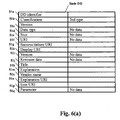
- Fig. 6 shows information included in the second type of DD, which can be divided into at least two sub-contents but is not executed unless all sub-contents are assembled.
- the sub-content described in this embodiment is called an object.
- the second type of DD consists of the basic DD as shown in Fig. 6 (a) and the object DD as shown in Fig. 6 (b) .
- the basic DD of the second type of DD has the same information as the first type of DD 51, data type 51d, size 51e, and URI 51f are not used.
- the information corresponding to the data type 51d, the size 51e, and the URI 51f is included in the object DD.
- the object DD of the second type of DD includes object DD identifier 52a, data type 52b, size 52c, URI 52d, version 52e, revision date 52f, title 52g, explanation 52h, vendor name 52i, explanation URI 52j, parameter 52k, and flag 52m. Since one object DD supports one object, if one content includes two or more objects, there are as many object DDs as the objects.
- the object identifier 52a is identification information, for example a serial number, to identify this object DD.
- the data type 52b indicates the coding method, for example, MPEG-4 and MP3, used for coding data included in the object.
- the size 52c indicates memory size required for storing the object which the object DD designates.
- the URI 52d indicates location information of CSV 2 which stores the obj ect designated by this object DD.
- the version 52e indicates the version of the object.
- the revision date 52f indicates a latest revision date of this object .
- the title 52g indicates the title of this object which this object DD designates.
- the explanation 52h is information explaining this object .
- the vendor 52 i indicates a content provider of this object.
- the parameter 52k is a parameter used in case MS 3 executes this object.
- the flag 52m indicates that the content designated by the basic DD is not executed as described above. That is, all objects included in the second type of DD 52 are necessary for execution.
- This second type of DD is used in case the content to be downloaded consists of an image obj ect and a voice obj ect.
- the content includes image data, voice data in English, and voice data in Japanese, there are three object DDs.
- Fig. 7 shows information included in the third type of DD, which can be divided into at least two sub-contents. In this case, it is possible to choose one sub-content contained in a content and executes the chosen sub-content.
- the third type of DD consists of the basic DD as shown in Fig. 7 (a) and sub-content DD as shown in Fig. 7(b) . Though the third type of DD has the same information as the second type of DD, sub-content DD of the third type of DD does not include a object identifier 52a but a content identifier 53a.
- the sub-content DD includes sub-content DD identifier 53a, data type 53b, size 53c, URI 53d, version 53e, revision date 53f, title 53g, explanation 53h, vendor name 53i, explanation URI 53j, parameter 53k, and flag 53m.
- a content designated by the third type of DD consists of two downloadable sub-contents, for example, one sub-content is the first part of a movie and another sub-content is the last part of the same movie.
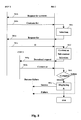
- Fig. 8 shows the operation of the download system of the first embodiment.
- a user inputs a contents list download request by using the input unit 44.
- the download control program 43a receives the contents list download request
- MS 3 requests a contents list from the DSV 1 (STEP S61a) .
- the DD generation program 13a of the DSV 1 creates a contents list and transmits this contents list to MS 3 (STEP S61b).
- This contents list includes partial information of the first type of DD
- This partial information at least includes DD identifier 51a and title 51k.
- the contents list may include partial information, for example, title 52g or 53g of the object DD or the sub-content DD.
- the download control program 43a of the MS 3 When the download control program 43a of the MS 3 receives the content list from the DSV 1, content information contained in the content list is displayed on the LCD display unit. If one of the contents is selected by using the input unit 44 (STEP S61c), the download control program 43a extracts the DD identifier 51a from the received contents list and requests the DD corresponding to the selected content from the DSV 1 (STEP S61d).
- the DD generation program 13a of the DSV 1 reads out the requested DD from the data memory 14 and transmits this DD to the MS 3 (STEP S61e). Moreover, the DSV 1 may transmit the DD to the MS 3 automatically, if the DD is updated and the MS 3 requested this DD before.
- the MS 3 receives the DD from the DSV 1, and the download control program 43a of the MS 3 checks whether the same content designated by the received DD is stored in the memory 46 or not. If the same content is not stored in the memory 46, the download control program 43a decides that the content designated by the DD should be downloaded. On the other hand, if the same content is stored in the memory 46, the download control program 43a checks whether there is a DD in the memory 46 coincident with the DD from the DSV 1 and decides whether a content should be downloaded or a sub-content should be downloaded (STEP S61f) . Meanwhile, a judgment of the identity of the content is made by comparing the URI 51f contained in the first type of DD, the title 51k, and vendor name 51h. Of course, for example, another parameter, as such data type may be used for the comparison.
- the download control program 43a transmits a content download request or a sub-content download request to the CSV 2 (STEP S61g).
- download control program 23a of the CSV 2 transmits the content or the sub-content to the MS 3 (STEP S61h).
- the download control program 43a checks whether the content or the sub-content downloaded completely or not (STEP S61i). If the download control program 43a detects that the content or the sub-content has been downloaded completely, then the download control program 43a stores the downloaded content or sub-content into the memory 46 and transmits a success notification to a server by utilizing the success-failure URI 51g contained in the DD. Further, the download control program 43a displays the information obtained from a server by utilizing the display URI 51h (STEP S61j).
- the download control program 43a detects that the content or the sub-content has been downloaded incompletely, then the download control program 43a transmits a failure notification to the server by utilizing the success-failure URI 51g.
- Fig. 9 shows an operation of the download control program regarding the STEP S61f.
- the type of DD is checked (STEP S61n). If the DD is the first type of DD, the version 51i of the received DD and the version 51i of the DD stored in the memory 46 are compared (STEP S61o) and it is recognized that the content designated by the received first type of DD has been updated in a case where the comparison result indicates disagreement. In this instance, download control program 43a further checks whether there is a same content as designated by the received first type of DD in the memory 46 downloaded by utilizing the second type of DD or the third type of DD (STEP S61p).
- the download control program 43a decides that the content designated by the first type of DD should be downloaded.
- the download control program 43a judges that the content designated by the received first type of DD need not be downloaded.
- comparison is executed by using version 52e contained in the object DDs (STEP S61t) .
- the revision date 52f, data type 52b, and the size 52c can be used for the comparison.
- the download control program 43a decides that the object designated by the received object DD need not to be downloaded.
- the download control program 43a adds information, indicating that this object is utilized by the content designated by this second type of DD, to this object. Then, this object will not be deleted except for complete deletion of this content.
- the download control program 43a executes operations designated by STEP S61s to STEP S61v.
- the judgment whether a sub-content is to be downloaded or not is handled by comparing the version 52e contained in the sub-content DD received from the DSV 1 and version 52e contained in the sub-content DD in the memory 46.
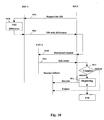
- Fig. 10 shows the operation of the download system of the second embodiment.
- a content download request which is relating to the contents stored in the memory 46
- the download control program 43a is activated.
- a DD download request is transmitted from the MS 3 to the DSV 1 (STEP S62a) .
- the DD download request includes a DD from the memory 46 that corresponds to the requested DD.
- the DD generation program 13a extracts the DD from the request and compares the extracted DD and the DDs stored in the data memory 14 (STEP S62b) . If any information of the DD from the MS 3 does not coincide with information of the DD stored in the data memory 14, the DD generation program 13a transmits the DD with difference information indicating that this DD has different information from the DD readout from the data memory 14 (STEP S62c).
- the version 51i is used for the comparison described above if the DD received from the MS 3 is the first type of DD. Further, the version 52e or 53e contained in the object DD or the sub-content DD is used for the comparison if the DD received from the MS 3 is the second type of DD or the third type of DD.
- the download control program 43a checks whether the DD has the difference information added thereto. If it is detected that the DD has the difference information added thereto, the download control program 43a transmits a content download request to the CSV 2 (STEP S62d).
- download control program 23a of the CSV 2 reads out a content or a sub-content from the data memory 24 and transmits the content or the sub-content to the MS 3 (STEP S62e).
- the download control program 43a When the MS 3 downloads the requested content or sub-content, the download control program 43a performs the same processes as step S61i to step S61j shown in Fig. 8.
- Fig. 11 shows the operation of the download system of the third embodiment.
- a content download request which relates to the contents stored in the memory 46
- the download control program 43a is activated.
- a DD download request is transmitted from the MS 3 to the DSV 1 (STEP S63a).
- the DD download request includes a DD from the memory 46 that corresponds to the requested DD.
- the DD generation program 13a extracts the DD from the request and compares the extracted DD and the DDs stored in the data memory 14. If any information of the DD from the MS 3 does not coincide with information of the DD stored in the data memory 14, the DD generation program 13a generates a difference information which includes the DD identifier 51a and information indicating that there is any different information between the DD from the MS 3 and the DD read out from the data memory 14 (STEP S63b) . And the generated difference information is transmitted to the CSV 2 (STEP S63c) .
- the version 51i is used for comparison if the DD received from the MS 3 is the first type of DD.
- the version 52e or 53e contained in the object DD or the sub-content DD is used for the comparison if the DD received from the MS 3 is the second type of DD or the third type of DD.
- the difference information includes the object identifier 52a if the DD is the second type of DD, and includes the content identifier 53a if the DD is the third type of DD.
- the DD generation program 13a reads out the DD from data memory 14 and transmits the DD to the MS 3 (STEP S63d).
- the download control program 43a transmits a content download request to the CSV 2 based upon the DD from the DSV 1 (STEP S63e).
- the download control program 23a transmits a content (or contents) or a sub-content (or sub-contents), which coincides with the difference information from the DSV 1, based upon the request (STEP 63f).
- the download control program 43a When the MS 3 downloads the requested content or sub-content from the CSV 2, the download control program 43a performs the same processes as step S61i to step S61j shown in Fig. 8.
- Fig. 12 shows the operation of the download system of the forth embodiment.
- a content download request which relates to the contents stored in the memory 46
- the download control program 43a is activated.
- a DD download request is transmitted from the MS 3 to the DSV 1 (STEP S64a) .
- the DD download request includes a DD from the memory 46 that corresponds to the requested DD.
- the DD generation control program 13a compares the DD from the MS 3 and the DDs stored in the data memory 14 (STEP S64b) .
- the DD generation control program 13a reads out the detected parameter from the data memory 14 and transmits the parameter to the MS 3 (STEP S64c) .
- comparison of the DDs contained in the request from the MS 3 and the DDs stored in the data memory 14 is performed by the same processing as the already described method.
- the download control program 43a updates the DD in the memory 46 by using the parameter from the DSV 1, for example, by merging the DD and the parameter, and transmits a content download request to the CSV 2 based upon the at least one updated DD (STEP S64d) . Then, the CSV 2 receives the content download request from the MS 3, and the download control program 23a reads out the content or the sub-content from the data memory 23 and transmits the content or the sub-content to the MS 3.
- the MS 3 After the MS 3 receives the content or the sub-content from the CSV 2, the received content or sub-content is displayed on the LCD display unit and a reception notification is transmitted from the MS 3 by using the success-failure URI 51g (STEP S61i and S61j described above).
- the content includes an object of image and an object of voice
- the content may includes an object of voice and an object of melody.
- the DSV 1 and the CSV 2 may consist of one server.
Landscapes
- Engineering & Computer Science (AREA)
- Computer Networks & Wireless Communication (AREA)
- Signal Processing (AREA)
- Information Transfer Between Computers (AREA)
- Information Retrieval, Db Structures And Fs Structures Therefor (AREA)
Abstract
Description
- This application is based upon and claims the benefit of priority of the prior Japanese Patent Application No. 2004-231386, filed August 6, 2004, the entire contents of which are incorporated herein by reference.
- This invention relates to a client terminal for downloading contents from a contents server, and a contents download system which comprises the client terminal and the contents server.
- There are the Download Over The Air standardized by the OMA (Open Mobile Alliance) and the OTA (Over The Air) of MIDP (Mobile Information Device Profile), which define the scheme for a client terminal, for instance a mobile phone, to download contents from a contents server.
- Especially, these standards define that the client terminal receives a Download Descriptor (hereinafter "DD") , which describes attribution information of the contents, before downloading contents, and the client terminal downloads the contents from the contents server based upon the URI (Uniform Resource Identifier) contained in the DD.
- The contents to be downloaded from the contents sever are a movie, music, and a game program, etc.
- By the way, in order to avoid the load of unnecessary fee collection or a network, it is desirable that the client terminal does not download the same contents as contents which the client has already downloaded from the contents server.
- For example, Japanese Patent Disclosure (Kokai) No. 2003-216430 discloses a systemwhere upgrade of unnecessary software is not performed. In this system, which consists of a client terminal and a server, the client terminal stores the operating frequency of each software, and client terminal requests the server to upgrade only software with high operating frequency for reducing useless access to the server.
- However, if there are two or more contents from which only voice information differs, the above-mentioned scheme cannot solve the problem. That is, although it is desirable to download only the voice information in Japanese if the client terminal has already downloaded the content with image information and voice information in English, a scheme for downloading only voice information in Japanese is not provided.
- An object of the present invention is to provide a client terminal and contents download system for downloading a required information without a complicated process.
- According to an aspect of the present invention, there is provided a contents download system comprising the client terminal which includes a first storage unit configured to store a content and a download descriptor which contains attribution information regarding a content, means for transmitting a request for a download descriptor to a download server, wherein the request includes at least one download descriptor stored in the first storage unit, means for receiving the download descriptor from the download server, and means for transmitting a request for a content to the content server if a difference information is added to the received download descriptor, the download server which includes a second storage unit configured to store download descriptors, each contains attribution information regarding a content, means for receiving the request for a download descriptor from the client terminal, means for comparing the at least one download descriptor contained in the request and the download descriptor stored in the second storage unit, means for adding the difference information to the download descriptor if there is a difference between the download descriptor from the client terminal and the download descriptor stored in the second storage unit, and means for transmitting the download descriptor which is added the difference information, and the contents server which includes a third storage unit configured to store contents, means for receiving the request for a content from the client terminal, and means for transmitting the requested content to the client terminal.
- According to another aspect of the present invention, there is provided a client terminal comprising a client terminal used in a contents download system which includes a display unit configured to display image information, a speaker configured to output voice information, a storage unit configured to store a content and a download descriptor whi ch contains attribution information regarding a content, means for transmitting a request for a download descriptor to a download server, means for receiving the download descriptor from the download server, and means for transmitting a request for a content to the content server if a difference information is added to the received download descriptor.
-
- Fig. 1 shows an exemplarily configuration of a download system of this invention.
- Fig. 2 shows a configuration of a download server.
- Fig. 3 shows configuration of a contents sever.
- Fig. 4 shows a configuration of a client terminal.
- Fig. 5 shows a format of a first type of Download Descriptor used by the download system of this invention.
- Figs. 6(a) and 6(b) show a format of a second type of Download Descriptor used by the download system of this invention.
- Figs. 7(a) and 7(b) show a format of a third type of Download Descriptor used by the download system of this invention.
- Fig. 8 shows a sequence of download processing performed by the download system of the first embodiment.
- Fig. 9 shows a sequence of a part of download processing performed by the download system of the first embodiment.
- Fig. 10 shows a sequence of download processing performed by the download system of the second embodiment.
- Fig. 11 shows a sequence of download processing performed by the download system of the third embodiment.
- Fig. 12 shows a sequence of download processing performed by the download system of the forth embodiment.
- Hereinafter, referring to the accompanying drawings, an embodiment of the present invention will be explained.
- Fig. 1 shows a contents download system according to an embodiment of the present invention. The contents download system comprises a
download server DSV 1, acontents server CSV 2, and mobile communication terminals MSs 3, where the DSV 1, theCSV 2, and theMSs 3 are connected vianetwork 4. Although not shown in Fig. 1, thenetwork 4 includes the Internet and the cellular network. - Fig. 2 schematically shows the configuration of the
DSV 1. The DSV 1 has a function to manage attribution information regarding contents, which are to be downloaded, stored in theCSV 2, and comprises a CPU (Central Processing Unit) 11, adata bus 12, aprogram memory 13, adata memory 14, and aninterface 15. Theprogram memory 13 storesDD generation program 13a for generating the Download Descriptor DD and a transmission/reception control program for receiving the DD transmission request from aMS 3 and transmitting the DD to theMS 3. The DD generated based upon theDD generation program 13a is stored in thedata memory 14. - The
data memory 14 may be a flash memory or hard disk, and stores the DDs, which include the attribution information of the contents and indicators of the content. - Fig. 3 schematically shows the configuration of the
CSV 2. TheCSV 2 has a function to manage the contents, which are to be downloaded responding to a download request from theMS 3, and comprises aCPU 21, adata bus 22, aprogram memory 23, a data memory24, and aninterface 25. The contents to be downloaded are stored in thedata memory 24. - The
program memory 23 storesdownload control program 23a. A content requested by aMS 3 is transmitted to theMS 3 by executing thedownload control program 23a. - Fig. 4 schematically shows the configuration of the
MS 3. EachMS 3 has a radio processing part and a signal processing part. The radio processing part comprises anantenna 31,duplexer 32, areceiving circuit 33, asynthesizer 34, and a transmittingcircuit 35. The signal processing part comprises a CDMAsignal processing unit 36, aspeech codec 37, and aPCM codec 38. - The
PCM codec 38 demodulates a digital speech signal from the CDMAsignal processing unit 36 and outputs an analog speech signal to anamplifier 39. And the analog speech signal, amplified by theamplifier 39, is outputted from aspeaker 40. On the other hand, an input speech signal from amicrophone 41 is amplified by theamplifier 42 and modulated by thePCM codec 38. - The CDMA
signal processing unit 36 despreads a packed data from receivingcircuit 33 and outputs to thecontroller 43. Thecontroller 43 extracts a content from the packed data based upon header information embedded in the packed data. The extracted content is stored in thememory 46. - The
controller 43 reads out a content based upon the execution request inputted from theinput unit 44, and outputs image data included in the content to thedisplay unit 45 and outputs voice data included in the content to thePCM codec 38 and amplifier 39 sequentially. Then, the image data is displayed on thedisplay unit 45 and voice data is outputted from thespeaker 40. On the other hand,controller 43 outputs a download request inputted by theinput unit 44 to the CDMAsignal processing unit 36. - The CDMA
signal processing unit 36 spreads a coded speech data, using a spreading code assigned for communicating with a base station (not shown) , from thespeech codec 37 and orthogonally modulates the spread speech data. Then, the orthogonally modulated speech data is outputted to the base station via theantenna 31. - The
input unit 44 has digit keys, a power ON key, a SEND key, an END key, a volume key, and a mode selection key. - The
display unit 45 has a LCD display unit and a LED, and the LCD display unit displays image data of the content stored in thememory 46, a telephone number and a name of a caller, and a status information regarding theMS 3. - The
power circuit 47, which is equipped with a DC/DC converter, supplies a predetermined voltage Vcc, made from the power stored in abattery 48, to each circuit ofMS 3 - By the way, the
controller 43 includes a microcomputer and a ROM (Read Only Memory), anddownload control program 43a is stored in the ROM. - The
controller 43, by executing thedownload control program 43a, transmits a DD transmission request to theDSV 1 and transmits a content transmission request (a download request) to theCSV 2, respectively. Furthermore, thecontroller 43 stores the DD received from theDSV 1 and the content received from theCSV 2 in thememory 46. - Then, the DD will be explained. In this embodiment, there are three kinds of DDs. Fig. 5 shows information included in the first type of DD. This first type of DD is used if the content cannot be divided into sub-contents. For example, each sub-content is one of the chapters of one story.
- The first type of DD includes
DD identifier 51a,DD classification 51b,DD version 51c,data type 51d,size 51e,URI 51f, success-failure URI 51g,display URI 51h,version 51i,revision date 51j,title 51k,explanation 51m,vendor name 51n, explanation URI 51o,icon URI 51p, andparameter 51q. - The
DD identifier 51a is identification information, for example a serial number, to identify this DD. The DD.classification 51b indicates that this DD is the first type of DD. TheDD version 51c means the version of the first type of DD. Thedata type 51d indicates the coding method, for example, MPEG-4 and MP3, used for coding data included in the content. - The
size 51e indicates memory size required for storing the content which the first type of DD designates. TheURI 51f indicates location information of the CSV2 . The success-failure URI 51g indicates location information used by theMS 3 for a notice of the information regarding whether the content has been downloaded completely or not. Thedisplay URI 51h indicates location information which is used by theMS 3 to obtain display data to be displayed on the LCD display unit if theMS 3 has downloaded the content completely. Theversion 51i indicates the version of the content. Therevision date 51j indicates latest revision date of this content. - The
title 51k indicates the title of this content which this first type of DD designates. Theexplanation 51m is information explaining this content. Thevendor 51n indicates a contents provider of this content. The explanation URI 51o indicates location information which is used by theMS 3 to obtain the information explaining this content. TheIcon URI 51p indicates location information which is used by theMS 3 to obtain an icon image to be display with respect to this content. Theparameter 51q is a parameter used incase MS 3 executes this content. - Fig. 6 shows information included in the second type of DD, which can be divided into at least two sub-contents but is not executed unless all sub-contents are assembled. The sub-content described in this embodiment is called an object. The second type of DD consists of the basic DD as shown in Fig. 6 (a) and the object DD as shown in Fig. 6 (b) .
- Although the basic DD of the second type of DD has the same information as the first type of DD 51,
data type 51d,size 51e, andURI 51f are not used. In this example, the information corresponding to thedata type 51d, thesize 51e, and theURI 51f is included in the object DD. - On the other hand, the object DD of the second type of DD includes
object DD identifier 52a,data type 52b,size 52c,URI 52d,version 52e,revision date 52f,title 52g,explanation 52h,vendor name 52i,explanation URI 52j,parameter 52k, andflag 52m. Since one object DD supports one object, if one content includes two or more objects, there are as many object DDs as the objects. - The
object identifier 52a is identification information, for example a serial number, to identify this object DD. Thedata type 52b indicates the coding method, for example, MPEG-4 and MP3, used for coding data included in the object. Thesize 52c indicates memory size required for storing the object which the object DD designates. TheURI 52d indicates location information ofCSV 2 which stores the obj ect designated by this object DD. Theversion 52e indicates the version of the object. Therevision date 52f indicates a latest revision date of this object . - The
title 52g indicates the title of this object which this object DD designates. Theexplanation 52h is information explaining this object . Thevendor 52 i indicates a content provider of this object. Theparameter 52k is a parameter used incase MS 3 executes this object. Theflag 52m indicates that the content designated by the basic DD is not executed as described above. That is, all objects included in the second type of DD 52 are necessary for execution. - This second type of DD, for example, is used in case the content to be downloaded consists of an image obj ect and a voice obj ect. For example, if the content includes image data, voice data in English, and voice data in Japanese, there are three object DDs.
- Fig. 7 shows information included in the third type of DD, which can be divided into at least two sub-contents. In this case, it is possible to choose one sub-content contained in a content and executes the chosen sub-content. The third type of DD consists of the basic DD as shown in Fig. 7 (a) and sub-content DD as shown in Fig. 7(b) . Though the third type of DD has the same information as the second type of DD, sub-content DD of the third type of DD does not include a
object identifier 52a but acontent identifier 53a. That is, the sub-content DD includessub-content DD identifier 53a,data type 53b,size 53c,URI 53d,version 53e,revision date 53f,title 53g,explanation 53h, vendor name 53i,explanation URI 53j,parameter 53k, andflag 53m. - A content designated by the third type of DD consists of two downloadable sub-contents, for example, one sub-content is the first part of a movie and another sub-content is the last part of the same movie.
- Next, operation of the above-mentioned download system is explained
- Fig. 8 shows the operation of the download system of the first embodiment. Firstly, a user inputs a contents list download request by using the
input unit 44. When thedownload control program 43a receives the contents list download request,MS 3 requests a contents list from the DSV 1 (STEP S61a) . - When the
DSV 1 receives the request, theDD generation program 13a of theDSV 1 creates a contents list and transmits this contents list to MS 3 (STEP S61b). This contents list includes partial information of the first type of DD This partial information at least includesDD identifier 51a andtitle 51k. Further, The contents list may include partial information, for example,title - When the
download control program 43a of theMS 3 receives the content list from theDSV 1, content information contained in the content list is displayed on the LCD display unit. If one of the contents is selected by using the input unit 44 (STEP S61c), thedownload control program 43a extracts theDD identifier 51a from the received contents list and requests the DD corresponding to the selected content from the DSV 1 (STEP S61d). - When the
DSV 1 receives the request from theMS 3, theDD generation program 13a of theDSV 1 reads out the requested DD from thedata memory 14 and transmits this DD to the MS 3 (STEP S61e). Moreover, theDSV 1 may transmit the DD to theMS 3 automatically, if the DD is updated and theMS 3 requested this DD before. - The
MS 3 receives the DD from theDSV 1, and thedownload control program 43a of theMS 3 checks whether the same content designated by the received DD is stored in thememory 46 or not. If the same content is not stored in thememory 46, thedownload control program 43a decides that the content designated by the DD should be downloaded. On the other hand, if the same content is stored in thememory 46, thedownload control program 43a checks whether there is a DD in thememory 46 coincident with the DD from theDSV 1 and decides whether a content should be downloaded or a sub-content should be downloaded (STEP S61f) . Meanwhile, a judgment of the identity of the content is made by comparing theURI 51f contained in the first type of DD, thetitle 51k, andvendor name 51h. Of course, for example, another parameter, as such data type may be used for the comparison. - Next, the
download control program 43a transmits a content download request or a sub-content download request to the CSV 2 (STEP S61g). When theCSV 2 receives the request from theMS 3,download control program 23a of theCSV 2 transmits the content or the sub-content to the MS 3 (STEP S61h). - When the
MS 3 receives the content or the sub-content from theCSV 2, thedownload control program 43a checks whether the content or the sub-content downloaded completely or not (STEP S61i). If thedownload control program 43a detects that the content or the sub-content has been downloaded completely, then thedownload control program 43a stores the downloaded content or sub-content into thememory 46 and transmits a success notification to a server by utilizing the success-failure URI 51g contained in the DD. Further, thedownload control program 43a displays the information obtained from a server by utilizing thedisplay URI 51h (STEP S61j). - On the other hand, if the
download control program 43a detects that the content or the sub-content has been downloaded incompletely, then thedownload control program 43a transmits a failure notification to the server by utilizing the success-failure URI 51g. - Now, the judgment whether the
download control program 43a downloads the content or sub-content will be explained more detail. Fig. 9 shows an operation of the download control program regarding the STEP S61f. - Firstly, the type of DD is checked (STEP S61n). If the DD is the first type of DD, the
version 51i of the received DD and theversion 51i of the DD stored in thememory 46 are compared (STEP S61o) and it is recognized that the content designated by the received first type of DD has been updated in a case where the comparison result indicates disagreement. In this instance,download control program 43a further checks whether there is a same content as designated by the received first type of DD in thememory 46 downloaded by utilizing the second type of DD or the third type of DD (STEP S61p). That is, it is checked that there is a second type of DD or a third type of DD, in thememory 46, which has thesame URI 51f,version 51i,title 51k, andvendor name 51n as the received first type of DD. Moreover, therevision date 51j may be used for the comparison in place of theversion 51k. Furthermore, it is also possible to check whether the content is updated by thedata type 51d or thesize 51e. - If it is judged that there is no content in the
memory 46 coincident with the content designated by the first type of DD at STEP S61p, thedownload control program 43a decides that the content designated by the first type of DD should be downloaded. - On the other hand, if it is judged that there is a DD which has the same version as that of the first type of DD, at STEP S61o, or if it is judged that there is the same content in the
memory 46 as the content designated by the received first type of DD, at STEP S61p, then thedownload control program 43a judges that the content designated by the received first type of DD need not be downloaded. - Now back to STEP S61n. If the DD from the
DSV 1 is a second type of DD or a third type of DD, it is judged whether each sub-content or each object is to be downloaded or not (STEP S61s). - If the DD received from the
CSV 1 is the second type of DD, comparison is executed by usingversion 52e contained in the object DDs (STEP S61t) . In this case, therevision date 52f,data type 52b, and thesize 52c can be used for the comparison. - If there is no object DD which has the same version as that contained in the received object DD, it is checked that there is the same object in the
memory 46 as that designated by the received object DD (STEP S61u). This check is executed by using theURI 52d, theversion 52e,title 52g, andvendor name 52i, and thedownload control program 43a decides that the object (s) should be downloaded in a case where there is no object in thememory 46 coincident with the object designated by the object DD. - On the other hand, at STEP S61t, if
version 52e contained in the received object DD coincides with theversion 52e contained in the DD in thememory 46 or, at STEP S61u, if there is the same object in thememory 46 as that designated by the received object DD, thedownload control program 43a decides that the object designated by the received object DD need not to be downloaded. - Also, at STEP S61u, if there is the same object in the
memory 46 as that designated by the object DD, thedownload control program 43a adds information, indicating that this object is utilized by the content designated by this second type of DD, to this object. Then, this object will not be deleted except for complete deletion of this content. - On the other hand, at STEP S61n, if the DD received from the
DSV 1 is the third type of DD, thedownload control program 43a executes operations designated by STEP S61s to STEP S61v. In this instance, the judgment whether a sub-content is to be downloaded or not is handled by comparing theversion 52e contained in the sub-content DD received from theDSV 1 andversion 52e contained in the sub-content DD in thememory 46. - Fig. 10 shows the operation of the download system of the second embodiment. When a content download request, which is relating to the contents stored in the
memory 46, is inputted by operating theinput unit 44, thedownload control program 43a is activated. After that, a DD download request is transmitted from theMS 3 to the DSV 1 (STEP S62a) . The DD download request includes a DD from thememory 46 that corresponds to the requested DD. - When the
DSV 1 receives the DD download request from theMS 3, theDD generation program 13a extracts the DD from the request and compares the extracted DD and the DDs stored in the data memory 14 (STEP S62b) . If any information of the DD from theMS 3 does not coincide with information of the DD stored in thedata memory 14, theDD generation program 13a transmits the DD with difference information indicating that this DD has different information from the DD readout from the data memory 14 (STEP S62c). - Also, the
version 51i is used for the comparison described above if the DD received from theMS 3 is the first type of DD. Further, theversion MS 3 is the second type of DD or the third type of DD. - If the
MS 3 receives the DD from theDSV 1, thedownload control program 43a checks whether the DD has the difference information added thereto. If it is detected that the DD has the difference information added thereto, thedownload control program 43a transmits a content download request to the CSV 2 (STEP S62d). - When the
CSV 2 receives the content download request from theMS 3,download control program 23a of theCSV 2 reads out a content or a sub-content from thedata memory 24 and transmits the content or the sub-content to the MS 3 (STEP S62e). - When the
MS 3 downloads the requested content or sub-content, thedownload control program 43a performs the same processes as step S61i to step S61j shown in Fig. 8. - Fig. 11 shows the operation of the download system of the third embodiment. When a content download request, which relates to the contents stored in the
memory 46, is inputted by operating theinput unit 44, thedownload control program 43a is activated. After that, a DD download request is transmitted from theMS 3 to the DSV 1 (STEP S63a). The DD download request includes a DD from thememory 46 that corresponds to the requested DD. - When the
DSV 1 receives the DD download request from theMS 3, theDD generation program 13a extracts the DD from the request and compares the extracted DD and the DDs stored in thedata memory 14. If any information of the DD from theMS 3 does not coincide with information of the DD stored in thedata memory 14, theDD generation program 13a generates a difference information which includes theDD identifier 51a and information indicating that there is any different information between the DD from theMS 3 and the DD read out from the data memory 14 (STEP S63b) . And the generated difference information is transmitted to the CSV 2 (STEP S63c) . - In the same way as described above, the
version 51i is used for comparison if the DD received from theMS 3 is the first type of DD. Further, theversion MS 3 is the second type of DD or the third type of DD. Also, the difference information includes theobject identifier 52a if the DD is the second type of DD, and includes thecontent identifier 53a if the DD is the third type of DD. - Then, the
DD generation program 13a reads out the DD fromdata memory 14 and transmits the DD to the MS 3 (STEP S63d). - When the
MS 3 receives the DD from theDSV 1, thedownload control program 43a transmits a content download request to theCSV 2 based upon the DD from the DSV 1 (STEP S63e). - When the
CSV 2 receives the request from theMS 3, thedownload control program 23a transmits a content (or contents) or a sub-content (or sub-contents), which coincides with the difference information from theDSV 1, based upon the request (STEP 63f). - When the
MS 3 downloads the requested content or sub-content from theCSV 2, thedownload control program 43a performs the same processes as step S61i to step S61j shown in Fig. 8. - Fig. 12 shows the operation of the download system of the forth embodiment. When a content download request, which relates to the contents stored in the
memory 46, is inputted by operating theinput unit 44, thedownload control program 43a is activated. After that, a DD download request is transmitted from theMS 3 to the DSV 1 (STEP S64a) . The DD download request includes a DD from thememory 46 that corresponds to the requested DD. WhenDSV 1 receives the request from theMS 3, the DDgeneration control program 13a compares the DD from theMS 3 and the DDs stored in the data memory 14 (STEP S64b) . As a result of this comparison, if theDD generation program 13a detects that there is any difference between parameters in the received DD and parameters in the DD in thedata memory 14, the DDgeneration control program 13a reads out the detected parameter from thedata memory 14 and transmits the parameter to the MS 3 (STEP S64c) . - Also, comparison of the DDs contained in the request from the
MS 3 and the DDs stored in thedata memory 14 is performed by the same processing as the already described method. - When the
MS 3 receives the parameter from theDSV 1, thedownload control program 43a updates the DD in thememory 46 by using the parameter from theDSV 1, for example, by merging the DD and the parameter, and transmits a content download request to theCSV 2 based upon the at least one updated DD (STEP S64d) . Then, theCSV 2 receives the content download request from theMS 3, and thedownload control program 23a reads out the content or the sub-content from thedata memory 23 and transmits the content or the sub-content to theMS 3. - After the
MS 3 receives the content or the sub-content from theCSV 2, the received content or sub-content is displayed on the LCD display unit and a reception notification is transmitted from theMS 3 by using the success-failure URI 51g (STEP S61i and S61j described above). - Though, it is described that the content includes an object of image and an object of voice, the content may includes an object of voice and an object of melody. Further, the
DSV 1 and theCSV 2 may consist of one server.
Claims (12)
- A client terminal used in a contents download system, comprising:a storage unit (46) configured to store a content and a download descriptor which contains attribution information regarding a content;means for transmitting a request for a download descriptor to a download server;means for receiving the download descriptor from the download server; andmeans for transmitting a request for a content to the content server if there is any difference between the download descriptor from the download server and the download descriptor stored in the storage unit.
- The client terminal according to claim 1, wherein the attribution information contains an identification information identifying a content.
- The client terminal according to claim 2, wherein the identification information is at least one of the title, the vendor name, the version of the content.
- The client terminal according to claim 2, wherein the attribution information further contains location information which is used for downloading a content.
- The client terminal according to claim 1, wherein one download descriptor corresponds to one content.
- A contents download system including a client terminal, a download server, and a contents server, comprising:the client terminal (3) includes:- a first storage unit (46) configured to store a content and a download descriptor which contains attribution information regarding a content;- means for transmitting a request for a download descriptor to a download server, wherein the request includes at least one download descriptor stored in the first storage unit;- means for receiving the download descriptor from the download server; and- means for transmitting a request for a content to the content server if there is any difference between the download descriptor from the download server and the download descriptor stored in the storage unit;the download server (1) includes:- a second storage unit (14) configured to store download descriptors, each contains attribution information regarding a content;- means for receiving the request for a download descriptor from the client terminal;- means for comparing the at least one download descriptor contained in the request and the download descriptor stored in the second storage unit;- means for adding the difference information to the download descriptor if there is a difference between the download descriptor from the client terminal and the download descriptor stored in the second storage unit; and- means for transmitting the downloaddescriptorwhich is added the difference information;the contents server (2) includes:- a third storage unit (24) configured to store contents;- means for receiving the request for a content from the client terminal; and- means for transmitting the requested content to the client terminal.
- The client terminal according to claim 6, wherein the attribution information contains an identification information identifying a content.
- The client terminal according to claim 7, wherein the identification information is at least one of the title, the vendor name, the version of the content.
- The client terminal according to claim 8, wherein the attribution information further contains location information which is used for downloading a content.
- The client terminal according to claim 6, wherein one download descriptor corresponds to one content.
- A contents download system including a client terminal, a download server, and a contents server, comprising:the client terminal (3) includes:- a first storage unit (46) configured to store a content, a first download descriptor, and a second download descriptor, wherein the first download descriptor is used for an indivisible content, and the second download descriptor includes a basic download descriptor and sub-content download descriptor and is used for a divisible content;- means for transmitting a request for a download descriptor to a download server, wherein the request includes at least one download descriptor stored in the first storage unit;- means for receiving the download descriptor from the download server; and- means for transmitting a request for a content to the content based upon a received download descriptor from the download server;the download server (1) includes:- a second storage unit (14) configured to store the first download descriptors and the second download descriptors, each contains attribution information regarding a content;- means for receiving the request for a download descriptor from the client terminal;- means for comparing the at least one download descriptor contained in the request and the download descriptor stored in the second storage unit;- means for adding the difference information to the download descriptor if the download descriptor contained in the request is the first download descriptor and there is a difference between the download descriptor from the client terminal and the download descriptor stored in the second storage unit;- means for detecting at least one sub-content download descriptor, from the second storage unit, which has different information from the sub-content contained in the request from the client terminal; and- means for transmitting the first download descriptor which is added the difference information and the detected second download descriptor and the detected sub-content download descriptor;the contents server (2) includes:- a third storage unit (24) configured to store contents and sub-contents;- means for receiving the request for a content or a sub-content from the client terminal; and- means for transmitting the requested content or sub-content to the client terminal.
- The contents download system according to claim 9, wherein the sub-content of the content corresponding to the second download descriptor can be reproduced separately.
Applications Claiming Priority (1)
| Application Number | Priority Date | Filing Date | Title |
|---|---|---|---|
| JP2004231386A JP2006048529A (en) | 2004-08-06 | 2004-08-06 | Download method, download system, client device, and server device |
Publications (1)
| Publication Number | Publication Date |
|---|---|
| EP1624641A1 true EP1624641A1 (en) | 2006-02-08 |
Family
ID=34980156
Family Applications (1)
| Application Number | Title | Priority Date | Filing Date |
|---|---|---|---|
| EP05017051A Withdrawn EP1624641A1 (en) | 2004-08-06 | 2005-08-05 | System for downloading contents, and client terminal for downloading contents from contents server |
Country Status (3)
| Country | Link |
|---|---|
| US (1) | US7401065B2 (en) |
| EP (1) | EP1624641A1 (en) |
| JP (1) | JP2006048529A (en) |
Families Citing this family (31)
| Publication number | Priority date | Publication date | Assignee | Title |
|---|---|---|---|---|
| US6731313B1 (en) | 2000-06-23 | 2004-05-04 | Igt | Gaming device having touch activated alternating or changing symbol |
| US7695363B2 (en) | 2000-06-23 | 2010-04-13 | Igt | Gaming device having multiple display interfaces |
| US7699699B2 (en) | 2000-06-23 | 2010-04-20 | Igt | Gaming device having multiple selectable display interfaces based on player's wagers |
| US7963847B2 (en) | 2004-08-19 | 2011-06-21 | Igt | Gaming system having multiple gaming machines which provide bonus awards |
| US8251791B2 (en) | 2004-08-19 | 2012-08-28 | Igt | Gaming system having multiple gaming machines which provide bonus awards |
| US8021230B2 (en) | 2004-08-19 | 2011-09-20 | Igt | Gaming system having multiple gaming machines which provide bonus awards |
| US7841939B2 (en) | 2005-09-09 | 2010-11-30 | Igt | Server based gaming system having multiple progressive awards |
| US8128491B2 (en) | 2005-09-09 | 2012-03-06 | Igt | Server based gaming system having multiple progressive awards |
| US7568973B2 (en) | 2005-09-09 | 2009-08-04 | Igt | Server based gaming system having multiple progressive awards |
| US8137188B2 (en) | 2005-09-09 | 2012-03-20 | Igt | Server based gaming system having multiple progressive awards |
| KR100730058B1 (en) * | 2006-01-25 | 2007-06-20 | 삼성전자주식회사 | Content download system and method using wireless internet platform |
| JP4755925B2 (en) * | 2006-03-10 | 2011-08-24 | シャープ株式会社 | Terminal device and content receiving method |
| US8512130B2 (en) | 2006-07-27 | 2013-08-20 | Igt | Gaming system with linked gaming machines that are configurable to have a same probability of winning a designated award |
| US8616959B2 (en) | 2006-09-27 | 2013-12-31 | Igt | Server based gaming system having system triggered loyalty award sequences |
| US7862430B2 (en) * | 2006-09-27 | 2011-01-04 | Igt | Server based gaming system having system triggered loyalty award sequences |
| US7674180B2 (en) * | 2006-09-27 | 2010-03-09 | Igt | Server based gaming system having system triggered loyalty award sequences |
| JP2008226167A (en) | 2007-03-15 | 2008-09-25 | Toshiba Corp | Data distribution system and data distribution program |
| US8068861B1 (en) * | 2007-05-22 | 2011-11-29 | Cellco Partnership | MMS brew message delivery hybridization architecture |
| US8433302B2 (en) * | 2007-05-31 | 2013-04-30 | Qualcomm Incorporated | System and method for downloading and activating themes on a wirelesss device |
| US7985133B2 (en) | 2007-07-30 | 2011-07-26 | Igt | Gaming system and method for providing an additional gaming currency |
| US8900053B2 (en) | 2007-08-10 | 2014-12-02 | Igt | Gaming system and method for providing different bonus awards based on different types of triggered events |
| US9142097B2 (en) | 2007-10-26 | 2015-09-22 | Igt | Gaming system and method for providing play of local first game and remote second game |
| US20100235878A1 (en) * | 2009-03-13 | 2010-09-16 | Creative Technology Ltd. | Method and system for file distribution |
| US9039516B2 (en) | 2009-07-30 | 2015-05-26 | Igt | Concurrent play on multiple gaming machines |
| US20110055358A1 (en) * | 2009-09-01 | 2011-03-03 | Electronics And Telecommunications Research Institute | Downloading method for terminal and method for controlling download |
| US9576064B2 (en) | 2012-04-13 | 2017-02-21 | Yahoo! Inc. | Third party program integrity and integration control in web-based applications |
| US9491223B2 (en) | 2013-02-17 | 2016-11-08 | Onavo Mobile Ltd. | Techniques for determining a mobile application download attribution |
| JP6204775B2 (en) * | 2013-09-27 | 2017-09-27 | 任天堂株式会社 | Information processing system and information processing apparatus |
| US9875618B2 (en) | 2014-07-24 | 2018-01-23 | Igt | Gaming system and method employing multi-directional interaction between multiple concurrently played games |
| JP6595168B2 (en) * | 2014-10-30 | 2019-10-23 | 株式会社ソニー・インタラクティブエンタテインメント | Information processing apparatus and information processing system |
| US9972171B2 (en) | 2015-09-24 | 2018-05-15 | Igt | Gaming system and method for providing a triggering event based on a collection of units from different games |
Citations (5)
| Publication number | Priority date | Publication date | Assignee | Title |
|---|---|---|---|---|
| WO2001056291A2 (en) * | 2000-01-26 | 2001-08-02 | Viaclix, Inc. | Channel-based internet network |
| WO2002011392A2 (en) * | 2000-07-27 | 2002-02-07 | Escene Networks, Inc. | Propagation of state and content over a distributed electronic network |
| WO2002041147A1 (en) * | 2000-11-17 | 2002-05-23 | Biftone Corporation | System and method for updating and distributing information |
| WO2003085923A1 (en) * | 2002-04-09 | 2003-10-16 | Siemens Aktiengesellschaft | Method for transmitting useful data objects from a data provision component to a telecommunications device |
| JP2003316639A (en) | 2002-04-23 | 2003-11-07 | Nippon Telegr & Teleph Corp <Ntt> | Content download method and apparatus |
Family Cites Families (3)
| Publication number | Priority date | Publication date | Assignee | Title |
|---|---|---|---|---|
| JP3641999B2 (en) * | 2000-04-04 | 2005-04-27 | ヤマハ株式会社 | Music data distribution device and terminal device |
| JP2003216430A (en) | 2002-01-18 | 2003-07-31 | Nec Corp | Software automatic renewal system and terminal |
| US7139372B2 (en) * | 2003-03-07 | 2006-11-21 | July Systems, Inc | Authorized distribution of digital content over mobile networks |
-
2004
- 2004-08-06 JP JP2004231386A patent/JP2006048529A/en active Pending
-
2005
- 2005-08-04 US US11/197,182 patent/US7401065B2/en not_active Expired - Fee Related
- 2005-08-05 EP EP05017051A patent/EP1624641A1/en not_active Withdrawn
Patent Citations (5)
| Publication number | Priority date | Publication date | Assignee | Title |
|---|---|---|---|---|
| WO2001056291A2 (en) * | 2000-01-26 | 2001-08-02 | Viaclix, Inc. | Channel-based internet network |
| WO2002011392A2 (en) * | 2000-07-27 | 2002-02-07 | Escene Networks, Inc. | Propagation of state and content over a distributed electronic network |
| WO2002041147A1 (en) * | 2000-11-17 | 2002-05-23 | Biftone Corporation | System and method for updating and distributing information |
| WO2003085923A1 (en) * | 2002-04-09 | 2003-10-16 | Siemens Aktiengesellschaft | Method for transmitting useful data objects from a data provision component to a telecommunications device |
| JP2003316639A (en) | 2002-04-23 | 2003-11-07 | Nippon Telegr & Teleph Corp <Ntt> | Content download method and apparatus |
Non-Patent Citations (1)
| Title |
|---|
| OPEN MOBILE ALLIANCE: "Generic Content Download over the Air Specification, Version 1.0", 20 June 2002, ANNOUNCEMENT OPEN MOBILE ALLIANCE, PAGE(S) 1-40, XP002264099 * |
Also Published As
| Publication number | Publication date |
|---|---|
| JP2006048529A (en) | 2006-02-16 |
| US7401065B2 (en) | 2008-07-15 |
| US20060036573A1 (en) | 2006-02-16 |
Similar Documents
| Publication | Publication Date | Title |
|---|---|---|
| US7401065B2 (en) | System for downloading contents, and client terminal for downloading contents from contents server | |
| EP1690430B1 (en) | Flexible messaging system | |
| KR100663415B1 (en) | System and method for updating a dataset version residing on a wireless device | |
| KR100611537B1 (en) | Server processing for updating dataset versions resident on a wireless device | |
| US20090133014A1 (en) | Methods, apparatuses and computer program product for automatic download of software dependencies on installation | |
| KR100954346B1 (en) | Method, system, apparatus ? computer program product for enabling the pre-download of media objects | |
| CN100458689C (en) | Controlling the settings of a mobile telecommunications device | |
| CN111158738B (en) | Headset firmware upgrading method and device and readable storage medium | |
| US20050071385A1 (en) | Update package catalog for update package transfer between generator and content server in a network | |
| EP1542486A1 (en) | Mobile telephone device and data-management method | |
| EP1337077A2 (en) | Information distribution method and corresponding system | |
| CN103678319A (en) | Resource file updating method, device and system and server | |
| KR20080037450A (en) | Update system and method of software execution module | |
| KR20110104383A (en) | Firmware update service apparatus and method | |
| EP1869924B3 (en) | Method for providing contents for mobile communication terminal | |
| WO2004029815A1 (en) | Communication system, relay device, and communication control method | |
| US20060094462A1 (en) | Method and system for exchanging data between a mobile phone and a PC | |
| KR20060109021A (en) | Method of providing a large-scale content download service through a wireless network and a recording medium on which a program for implementing the same is recorded | |
| EP1566068B1 (en) | Loading of an application that is to be deployed in a terminal and a chip card | |
| US8885633B2 (en) | Data communication method, data communication system, and communication terminal | |
| KR100879547B1 (en) | Firmware update method of mobile communication terminal and mobile communication terminal using same | |
| CN113900723B (en) | Common platform updating method, network device and computer readable storage medium | |
| EP1367487A1 (en) | Remote application correction | |
| KR20060081159A (en) | Terminal information management method and system of mobile terminal | |
| CN100484025C (en) | Method for synchronizing large object data |
Legal Events
| Date | Code | Title | Description |
|---|---|---|---|
| PUAI | Public reference made under article 153(3) epc to a published international application that has entered the european phase |
Free format text: ORIGINAL CODE: 0009012 |
|
| 17P | Request for examination filed |
Effective date: 20050805 |
|
| AK | Designated contracting states |
Kind code of ref document: A1 Designated state(s): AT BE BG CH CY CZ DE DK EE ES FI FR GB GR HU IE IS IT LI LT LU LV MC NL PL PT RO SE SI SK TR |
|
| AX | Request for extension of the european patent |
Extension state: AL BA HR MK YU |
|
| 17Q | First examination report despatched |
Effective date: 20060510 |
|
| AKX | Designation fees paid |
Designated state(s): DE FR GB |
|
| STAA | Information on the status of an ep patent application or granted ep patent |
Free format text: STATUS: THE APPLICATION IS DEEMED TO BE WITHDRAWN |
|
| 18D | Application deemed to be withdrawn |
Effective date: 20160301 |