EP1624535B1 - Docking connector - Google Patents
Docking connector Download PDFInfo
- Publication number
- EP1624535B1 EP1624535B1 EP05107169A EP05107169A EP1624535B1 EP 1624535 B1 EP1624535 B1 EP 1624535B1 EP 05107169 A EP05107169 A EP 05107169A EP 05107169 A EP05107169 A EP 05107169A EP 1624535 B1 EP1624535 B1 EP 1624535B1
- Authority
- EP
- European Patent Office
- Prior art keywords
- connector
- locking
- housing
- circuit board
- mating
- Prior art date
- Legal status (The legal status is an assumption and is not a legal conclusion. Google has not performed a legal analysis and makes no representation as to the accuracy of the status listed.)
- Expired - Fee Related
Links
- 238000003032 molecular docking Methods 0.000 title claims description 31
- 230000013011 mating Effects 0.000 claims description 59
- MINPZZUPSSVGJN-UHFFFAOYSA-N 1,1,1,4,4,4-hexachlorobutane Chemical compound ClC(Cl)(Cl)CCC(Cl)(Cl)Cl MINPZZUPSSVGJN-UHFFFAOYSA-N 0.000 claims description 23
- 101150049492 DVR gene Proteins 0.000 claims description 23
- 239000002184 metal Substances 0.000 claims description 19
- 238000003780 insertion Methods 0.000 claims description 11
- 230000037431 insertion Effects 0.000 claims description 11
- AGCPZMJBXSCWQY-UHFFFAOYSA-N 1,1,2,3,4-pentachlorobutane Chemical compound ClCC(Cl)C(Cl)C(Cl)Cl AGCPZMJBXSCWQY-UHFFFAOYSA-N 0.000 description 17
- 230000009471 action Effects 0.000 description 7
- 230000007246 mechanism Effects 0.000 description 6
- 238000010586 diagram Methods 0.000 description 5
- 238000000034 method Methods 0.000 description 4
- 238000010276 construction Methods 0.000 description 3
- 238000000465 moulding Methods 0.000 description 3
- 230000008569 process Effects 0.000 description 3
- 239000011347 resin Substances 0.000 description 3
- 229920005989 resin Polymers 0.000 description 3
- LAXBNTIAOJWAOP-UHFFFAOYSA-N 2-chlorobiphenyl Chemical compound ClC1=CC=CC=C1C1=CC=CC=C1 LAXBNTIAOJWAOP-UHFFFAOYSA-N 0.000 description 2
- 101710149812 Pyruvate carboxylase 1 Proteins 0.000 description 2
- 238000005452 bending Methods 0.000 description 2
- 230000006835 compression Effects 0.000 description 2
- 238000007906 compression Methods 0.000 description 2
- 238000005476 soldering Methods 0.000 description 2
- 230000004075 alteration Effects 0.000 description 1
- 238000004519 manufacturing process Methods 0.000 description 1
- 238000012986 modification Methods 0.000 description 1
- 230000004048 modification Effects 0.000 description 1
- 230000005405 multipole Effects 0.000 description 1
- 230000006855 networking Effects 0.000 description 1
Images






Classifications
-
- H—ELECTRICITY
- H01—ELECTRIC ELEMENTS
- H01R—ELECTRICALLY-CONDUCTIVE CONNECTIONS; STRUCTURAL ASSOCIATIONS OF A PLURALITY OF MUTUALLY-INSULATED ELECTRICAL CONNECTING ELEMENTS; COUPLING DEVICES; CURRENT COLLECTORS
- H01R13/00—Details of coupling devices of the kinds covered by groups H01R12/70 or H01R24/00 - H01R33/00
- H01R13/62—Means for facilitating engagement or disengagement of coupling parts or for holding them in engagement
-
- H—ELECTRICITY
- H01—ELECTRIC ELEMENTS
- H01R—ELECTRICALLY-CONDUCTIVE CONNECTIONS; STRUCTURAL ASSOCIATIONS OF A PLURALITY OF MUTUALLY-INSULATED ELECTRICAL CONNECTING ELEMENTS; COUPLING DEVICES; CURRENT COLLECTORS
- H01R12/00—Structural associations of a plurality of mutually-insulated electrical connecting elements, specially adapted for printed circuits, e.g. printed circuit boards [PCB], flat or ribbon cables, or like generally planar structures, e.g. terminal strips, terminal blocks; Coupling devices specially adapted for printed circuits, flat or ribbon cables, or like generally planar structures; Terminals specially adapted for contact with, or insertion into, printed circuits, flat or ribbon cables, or like generally planar structures
- H01R12/70—Coupling devices
- H01R12/7005—Guiding, mounting, polarizing or locking means; Extractors
-
- H—ELECTRICITY
- H01—ELECTRIC ELEMENTS
- H01R—ELECTRICALLY-CONDUCTIVE CONNECTIONS; STRUCTURAL ASSOCIATIONS OF A PLURALITY OF MUTUALLY-INSULATED ELECTRICAL CONNECTING ELEMENTS; COUPLING DEVICES; CURRENT COLLECTORS
- H01R12/00—Structural associations of a plurality of mutually-insulated electrical connecting elements, specially adapted for printed circuits, e.g. printed circuit boards [PCB], flat or ribbon cables, or like generally planar structures, e.g. terminal strips, terminal blocks; Coupling devices specially adapted for printed circuits, flat or ribbon cables, or like generally planar structures; Terminals specially adapted for contact with, or insertion into, printed circuits, flat or ribbon cables, or like generally planar structures
- H01R12/70—Coupling devices
- H01R12/71—Coupling devices for rigid printing circuits or like structures
-
- H—ELECTRICITY
- H01—ELECTRIC ELEMENTS
- H01R—ELECTRICALLY-CONDUCTIVE CONNECTIONS; STRUCTURAL ASSOCIATIONS OF A PLURALITY OF MUTUALLY-INSULATED ELECTRICAL CONNECTING ELEMENTS; COUPLING DEVICES; CURRENT COLLECTORS
- H01R13/00—Details of coupling devices of the kinds covered by groups H01R12/70 or H01R24/00 - H01R33/00
- H01R13/62—Means for facilitating engagement or disengagement of coupling parts or for holding them in engagement
- H01R13/629—Additional means for facilitating engagement or disengagement of coupling parts, e.g. aligning or guiding means, levers, gas pressure electrical locking indicators, manufacturing tolerances
-
- H—ELECTRICITY
- H01—ELECTRIC ELEMENTS
- H01R—ELECTRICALLY-CONDUCTIVE CONNECTIONS; STRUCTURAL ASSOCIATIONS OF A PLURALITY OF MUTUALLY-INSULATED ELECTRICAL CONNECTING ELEMENTS; COUPLING DEVICES; CURRENT COLLECTORS
- H01R13/00—Details of coupling devices of the kinds covered by groups H01R12/70 or H01R24/00 - H01R33/00
- H01R13/62—Means for facilitating engagement or disengagement of coupling parts or for holding them in engagement
- H01R13/639—Additional means for holding or locking coupling parts together, after engagement, e.g. separate keylock, retainer strap
-
- H—ELECTRICITY
- H01—ELECTRIC ELEMENTS
- H01R—ELECTRICALLY-CONDUCTIVE CONNECTIONS; STRUCTURAL ASSOCIATIONS OF A PLURALITY OF MUTUALLY-INSULATED ELECTRICAL CONNECTING ELEMENTS; COUPLING DEVICES; CURRENT COLLECTORS
- H01R2201/00—Connectors or connections adapted for particular applications
- H01R2201/06—Connectors or connections adapted for particular applications for computer periphery
Definitions
- the present invention relates to a docking connector for connecting an electronic device such as a personal computer and an extension unit to each other.
- An electronic device such as a personal computer is provided with a docking connector for the purpose of connecting this device and an extension unit to each other, and with an increase in the performance and networking of electronic devices, high-density (i.e., compact) docking connectors having numerous contacts have been developed.
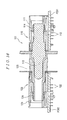
- the docking connector shown in Fig. 16 (see also JP11-288760A ), for example, is known as a docking connector which makes it possible to correctly position all of the contacts with respect to each other.
- This docking connector 101 consists of a first connector 110 and a second connector 120 that are adapted for mutual mating connection.
- the first connector 110 is mounted on a circuit board PCB 1 that is provided on the side of a personal computer (not shown in the figure), and comprises an insulating first housing 111 and a plurality of contacts 112 provided on this first housing 111.
- a pair of positioning guide pins 113 (constructed so that the guide pin on one end has a large diameter and so that the guide pin on the other end has a small diameter) that protrude from the mating surface are provided on either end of the first housing 111.
- the respective positioning guide pins 113 are attached to the first housing 111 by screw-fastening to attachment fittings 114 that are attached to the first housing 111.
- the second connector 120 is mounted on a circuit board PCB2 that is provided on the side of an extension unit (not shown in the figure), and comprises an insulating second housing 121 and a plurality of contacts 122 provided on this second housing 121.
- a pair of guide bushes 123 between which each positioning guide pin 113 of the first connector 110 is inserted are provided on each end of the second housing 121.
- the respective guide bushes 123 are attached to the second housing 121 by screw-fastening to attachment fittings 124 that are attached to the second housing 121.
- the positioning is performed by inserting the positioning guide pins 113 into the guide bushes 123 when mating the first connector 110 and the second connector 120, the positional deviation between the first connector 110 and the second connector 120 is absorbed, so that it is possible to correctly align all of the contacts to each other.
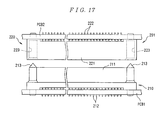
- Fig. 17 Although not called docking connectors, other connectors are known, such as the blind connection electrical connector shown in Fig. 17 is known, in which one connector is provided with positioning posts, and the other connector is provided with accommodating recessed parts that accommodate these positioning posts (see JP8-315910A ).
- This electrical connector 201 consists of a first connector 210 and a second connector 220 that make mating connection with each other.
- the first connector 210 is mounted on a circuit board PCB1 on one side of mutually parallel circuit boards, and comprises an insulating first housing 211 and a plurality of contacts 212 provided on this first housing 211.
- a pair of positioning guide pins 213 that protrude from the mating surface are provided on either end of the first housing 211.
- the second connector 220 is mounted on a circuit board PCB2 on the other side of the mutually parallel circuit boards, and comprises an insulating second housing 221 and a plurality of contacts 222 provided on this second housing 221.
- a pair of accommodating recessed parts 223 into which the positioning guide pins 213 of the first connector 210 are inserted are bored in either end of the second housing 221.
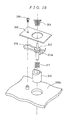
- the connector shown in Figs. 18 and 19 is known as another example in which a docking connector is provided for the purpose of connecting a personal computer and an extension unit to each other.
- a first connector 302 is provided on a circuit board 303 on the side of the personal computer 301, and a second connector 311 that mates with the first connector 302 is provided on the side of the extension unit 310.
- Guide pins 312 that guide the first connector 302 and the second connector 311 to the docking position are provided on the extension unit 310 so that these guide pins protrude from an upper housing 310a of the extension unit 310, allowing the vertical movement of these guide pins.
- the guide pins 312 are urged upwards by spring members 314.
- a groove 312a is formed in the outer circumference of each guide pin 312, and a U-shaped release spring 316 fits into this groove 312a.
- an attachment fitting 318 that restricts the downward movement of this U-shaped release spring 316 is attached to the upper housing 310a by a screw 319, and a release pin 315 that releases the U-shaped release spring 316 from the groove 312a is installed so that this release pin 315 can move upward and downward.
- Each release pin 315 is urged upward by a spring member 317.
- a lower housing 310b is provided on the bottom portion of the extension unit 310, and grounding fittings 313, with which the guide pins 312 contact when the guide pins are lowered, are provided on this lower housing 310b.
- the guide pins 312 of the extension unit 310 enter guide holes 304 in the personal computer 301.
- the upper ends of the release pins 315 contact the undersurface of the personal computer 301.
- the U-shaped release springs 316 are entered in the grooves 312a in the guide pins 312, the downward movement of the guide pins 312 is restricted by the U-shaped release springs 316.
- the personal computer 301 provided with the first connector 302 is moved further downward, the U-shaped release springs 316 are spread out by the release pins 315 in a direction along the plate surface of the attachment fittings 318, so that the U-shaped release springs 316 are released from the grooves 312a.
- the downward movement of the guide pins 312 is made possible. Moreover, when the personal computer 301 is moved further downward, the guide pins 312 contact the grounding fittings 313, and the mating of the first connector 302 and the second connector 311 is accomplished.
- the docking connector 101 shown in Fig. 16 is constructed to be used in a right-angle-type connection in which the mating surfaces of the circuit board PCB1 and the first connector 110 and the mating surfaces of the circuit board PCB2 and the second connector 120 are perpendicular.
- this docking connector cannot be used when the connection in which the mating surfaces of the circuit board PCB1 and the first connector 110 and the mating surfaces of the circuit board PCB2 and the second connector 120 are parallel. Accordingly, this docking connector is not suitable for specifications requiring the connection in which the mating surfaces of the circuit board PCB1 and the first connector 110 and the mating surfaces of the circuit board PCB2 and the second connector 120 are parallel.
- the blind connection electrical connector 201 shown in Fig. 17 has a structure that is used in the connection in which the mating surfaces of the circuit board PCB1 and the first connector 210 and the mating surfaces of the circuit board PCB2 and the second connector 220 are parallel, the structure is such that the positioning guide pins 213 of the first connector 210 are accommodated inside the accommodating recessed parts 223 in the second connector 220 when the first connector 210 mates with the second connector 220. Accordingly, there is a problem in that the low height requirement is not satisfied. If the length of the positioning guide pins 213 is shortened in order to satisfy the low height requirement, it is impossible to achieve any adequate guiding function.
- the guide pins 312 that guide the first connector 302 and the second connector 311 to the docking position are provided so that these guide pins 312 can move upward and downward, and the U-shaped release springs 316, attachment fittings 318, release pins 315 and spring members 317 that lock and unlock the vertical movement of these guide pins 312 are provided.
- such mechanisms are provided in the extension unit 310 separately from the second connector 311. Accordingly, space for installing these mechanisms is taken on the side of the extension unit 310, resulting in the problem of reduced freedom in the design on the side of the extension unit 310.
- the mechanism that allows the vertical movement of the guide pins 312, and the mechanism that locks this vertical movement and that releases this locking are complex. Also, the number of parts constituting these mechanisms is large, so that there is a problem in that the manufacturing cost is increased.
- the present invention was devised in light of the problems described above. It is an object of the present invention to provide a docking connector with a simple structure in which the guide pin mechanism provided on the side of one connector is made movable upward and downward, and the locking of this vertical movement is made possible, thus eliminating the need for forming holes through which the guide pins are caused to pass in the circuit board on which the connector on the other side is mounted.
- a docking connector comprising first and second connectors that mate with each other, the first connector being mountable on one side of a first circuit board and includes a first housing provided with guide pins that protrude upward from a mating surface in the vicinity of connector ends, and the second connector being mountable on one side of a second circuit board and includes a second housing that is formed with guide holes for receiving the guide pins; wherein the guide pins comprise cover housings which are provided to be movable upward and downward with respect to the first housing, and which protrude upward from the mating surface and are insertable into the guide holes, and spring members that drive the cover housings upward, and wherein the docking connector further comprises locking means for locking the vertical movement of the cover housings and lock releasing means for releasing the locking of the cover housings by the locking means during insertion of the cover housings into the guide holes.
- the locking means comprise metal fastening fittings that are provided on the first housing and that are fastened to the first circuit board, and metal locking plates that are provided on the cover housings and that are locked with the fastening fittings, and the lock releasing means are constructed from metal shells that are provided on the second housing, that release the locking of the locking plates with respect to the fastening fittings, and that are connected to the second circuit board.
- the locking plates and the shells are constructed to contact with each other before the locking of the locking plates with respect to the fastening fittings is released by the shells.
- the guide pins are constructed from cover housings which are provided to be movable upward and downward with respect to the first housing, which protrude upward from the mating surface of the first housing, and which are inserted into the guide holes in the second housing, and spring members that drive these cover housings upward. Accordingly, when the mating of the first connector and the second connector is guided by the insertion of the cover housings of the guide pins into the guide holes, the cover housings extend upward, so that a sufficient amount of guiding can be ensured. Furthermore, following the completion of mating between the first connector and the second connector, the cover housings are compressed inside the guide holes in the second connector, and do not protrude beyond the attachment surface of the second connector with respect to the second circuit board. Accordingly, it is not necessary to form holes through which the guide pins (cover housings) are caused to pass in the second circuit board for mounting the second connector, thus making it possible to produce a docking connector that is suitable for high-density mounting.
- lock releasing means for releasing the locking of the cover housings by the locking means during insertion of the cover housings into the guide holes are provided, the locking of the cover housings by the locking means is released during insertion of the cover housings into the guide holes, allowing for vertical movement of the cover housings. Accordingly, after mating of the first connector and the second connector has been completed, the cover housings can be compressed inside the guide holes in the second connector.
- the locking means and lock releasing means can have simple constructions.
- the fastening fittings of the locking means can have both the function of fastening the first housing to the circuit board and the function of locking the locking plates.
- the shells can have both the function of shielding the second connector and the function of releasing the locking of the locking plates with respect to the fastening fittings.
- the locking plates and the shells first make contact, and the first and second connectors are grounded via the shells, locking plates, and fastening fittings; next, the locking of the locking plates with respect to the fastening fittings is released, and the mating of the first and second connectors is completed.
- a potential is constant between the two circuit boards, so that electrical failure can be eliminated.
- a tine plate is located in the initial position.
- the docking connector is constructed from a first connector 1 and a second connector 41 that mate with each other.
- the first connector 1 is designed to be mounted on a circuit board PCB 1 on one side, which is provided on the side of an extension unit (not shown in the figures); meanwhile, as is shown in Fig. 13B, the second connector 41 is designed to be mounted on a circuit board PCB2 on the other side, which is provided on the side of a personal computer (not shown in the figures).
- the circuit board PCB1 and the tine plate 30 are graphically represented as being overlapped with each other.
- the first connector 1 comprises an insulating first housing 10, a plurality of contacts 16 that are attached to the first housing 10, and a tine plate 30 for aligning the leg parts of the contacts 16.
- the contacts 16 are connected by soldering to the circuit board PCB1.
- the first housing 10 comprises a substantially rectangular base part 11 that extends in the direction of length (left-right direction in Fig. 1), board mounting parts 13 that are provided on both sides of the base part 11 in the direction of length and that are mounted on the circuit board PCB1, and a mating part 12 that protrudes upward from the base part 11; this first housing 10 is formed by molding an insulating resin.
- the mating part 12 comprises a center wall 12a that extends in the direction of length, and a front wall 12b and a rear wall 12c that are respectively located on the front and rear, sandwiching this center wall 12a in the center.
- the front wall 12b and rear wall 12c respectively extend in the direction of length.
- the contacts 16 are provided in four rows, i.e., both on the front and rear ends of the center wall 12a, on the rear end of the front wall 12b, and on the front end of the rear wall 12c.
- guide pin accommodating recessed parts 14 are formed on both sides of the mating part 12 in the direction of length as shown in Figs. 5B and 6B, and spring member accommodating recessed parts 15 are formed in the bottom portions of these guide pin accommodating recessed parts 14.
- a shell 25 made of metal is attached to the periphery of the mating part 12.
- a pair of guide pins 20 are provided on the first housing 10 in positions corresponding to the guide pin accommodating recessed parts 14. As is shown in Figs. 5A and 5B, and 8A through 8C, each of the guide pins 20 is provided so as to be movable upward and downward with respect to the corresponding guide pin accommodating recessed part 14 in the first housing 10, and is constructed from a cover housing 21 that protrudes upward from the mating surface of the mating part 12 (upper end surface of the mating part 12) and a spring member 22 that constantly drives the cover housing 21 upward. As is clearly shown in Figs.
- each cover housing 21 comprises a guide part 21 a whose tip end is tapered and a spring supporting part 21 c which protrudes downward from the guide part 21a, and is formed by molding an insulating resin.
- a locking plate accommodating groove 21b that extends in the forward-rearward direction and that opens on the front is formed in the guide part 21 a of the cover housing 21 of the guide pin 20 on the left side in the direction of length;
- a locking plate accommodating groove 21b that extends in the forward-rearward direction and that opens on the rear is formed in the guide part 21a of the cover housing 21 of the guide pin 20 on the right side in the direction of length.
- the spring members 22 are constructed from compression springs, and as is shown in Figs. 5B and 8A through 8C, the upper portions thereof are fitted over and supported by the spring supporting members 21c of the cover housings 22.
- the lower portions of the spring members 22 are accommodated inside the spring member accommodating recessed parts 15 in the first housing 10 as shown in Fig. 5B, and constantly drive the cover members 21 upward by means of the actions of the spring members 22.
- the locking plate 23 that is fastened to the cover housing 21 on the left side of the first housing 10 in the direction of length comprises a base plate part 23a that extends in the forward-rearward direction and that is accommodated in the corresponding locking plate accommodating groove 21b, and a press-fitting fastening part 23b that extends downward from the rear end of the base plate part 23a and that is press-fitted to the guide part 21a.
- a contact protruding part 23c is formed at the front end of the base plate part 23a via a flexible part that extends downward at an inclination toward the front, and a locking projection 23d that protrudes forward is formed below the contact protruding part 23c.
- the locking plate 23 is formed by stamping a metal plate.
- the locking plate 23 that is fastened to the cover housing 21 on the right side of the first housing 10 in the direction of length comprises a base plate part 23a that extends in the forward-rearward direction and that is accommodated in the corresponding locking plate accommodating groove 21b, and a press-fitting fastening part 23b that extends downward from the front end of the base plate part 23a and that is press-fitted to the guide part 21a.
- a contact protruding part 23c is formed at the rear end of the base plate part 23a via a flexible part that extends downward at an inclination toward the rear, and a locking projection 23d that protrudes rearward is formed below the contact protruding part 23c.
- metal fastening fittings 24 for fastening the first connector 1 to the circuit board PCB1 are attached to both ends of the mating part 12 of the first housing 10 in the direction of length. As is shown in Figs. 1 through 3, 5A and 5B, and 6A and 6B, metal fastening fittings 24 for fastening the first connector 1 to the circuit board PCB1 are attached to both ends of the mating part 12 of the first housing 10 in the direction of length. As is shown in Figs.
- These press-fitting fastening parts 24b are press-fitted to the corresponding board mounting part 13 of the first housing 10, and the board fastening parts 24f are fastened to the circuit board PCB1 by passing through the board mounting part 13.
- a locking piece 24c extends upward from the upper portion of the right end of the C-shaped bent part at the front end of the base plate part 24a.
- a locking hole 24d into which the locking projection 23d of the locking plate 23 is locked is formed in the upper portion of the locking piece 24c.
- a supporting part 24e for supporting the upper end of the locking piece 24c on the mating part 12 of the first housing 10 is provided on the upper end of the locking piece 24c. The supporting part 24e is provided in order to prevent the locking projection 23d from being easily disengaged from the locking hole 24d. The reason for this is that the positioning precision of the locking plate 23 inside the first housing 10 is required to cause the locking plate 23 to perform a locking action.
- the fastening fitting 24 is formed by stamping and forming a metal plate.
- the fastening fitting 24 that is attached to the right end of the mating part 12 in the direction of length comprises a C-shaped base plate part 24a that extends in the forward-rearward direction, a pair of press-fitting fastening parts 24b that extend downward from the two ends (front and rear ends) of the base plate part 24a, and a pair of board fastening parts 24f that extend downward from the portion of the base plate part 24a between the press-fitting fastening parts 24b.
- press-fitting fastening parts 24b are press-fitted to the corresponding board mounting part 13 of the first housing 10, and the board fastening parts 24f are fastened to the circuit board PCB1 by passing through the board mounting part 13.
- a locking piece 24c extends upward from the upper portion of the left end of the C-shaped bent part at the rear end of the base plate part 24a.
- a locking hole 24d into which the locking projection 23d of the locking plate 23 is locked is formed in the upper portion of the locking piece 24c.
- a supporting part 24e for supporting the upper end of the locking piece 24c on the mating part 12 of the first housing 10 is provided on the upper end of the locking piece 24c.
- the supporting part 24e is provided in order to prevent the locking projection 23d from being easily disengaged from the locking hole 24d.
- the reason for this is that the positioning precision of the locking plate 23 inside the first housing 10 is required to cause the locking plate 23 to perform a locking action.
- the fastening fitting 24 is formed by stamping and forming a metal plate.
- the system is constructed so that the vertical movement of the cover housings 21 is locked by the locking projections 23d of the locking plates 23 being locked into the locking holes 24d in the fastening fittings 24; thus, the locking plates 23 and fastening fittings 24 constitute the "locking means" referred to in Claims 1 and 2.
- the tine plate 30 comprises a base plate part 31 that extends in the direction of length, a pair of locking arms 32 that extend upward from either end of the base plate part 31 in the direction of length, and a plurality of positioning posts 33 that protrude downward from the vicinity of both ends of the base plate part 31 in the direction of length.
- a plurality of through-holes 31a through which these leg parts pass are formed in the base plate part 31.
- the tine plate 30 is designed to move between the initial position shown in Fig. 1 and the final position that is located above the initial position (although this final position is not shown in the figures).
- the second connector 41 that mates with the first connector 1 is designed to be mounted on a circuit board PCB2 that is provided on the other side, i.e., on the side of the personal computer (not shown in the figures). Furthermore, the second connector 41 comprises an insulating second housing 50, a plurality of contacts 54 that are attached to the second housing 50, and a tine plate 60 for aligning the leg parts of the contacts 54. The contacts 54 are connected by soldering to the circuit board PCB2.
- the second housing 50 extends in the direction of length (left-right direction in Fig. 11), and is formed by molding an insulating resin.
- a mating recessed part 51 that opens above and that extends in the direction of length is formed in the second housing 50, so that the mating part 12 of the first connector 1 is caused to mate into this mating recessed part 51.
- a front wall part 51a that extends in the direction of length and a rear wall part 51b that is provided on the rear with a specified space left from this front wall part 51a and that extends in the direction of length are provided in an upright attitude inside the mating recessed part 51.
- the contacts 54 are provided in four rows, i.e., both on the front and rear ends of the front wall part 51a and both on the front and rear ends of the rear wall part 51b, and are designed to make contact with the contacts 16 of the first connector 1 when the first connector 1 and the second connector 41 mate.
- a blind plate 52 that covers the mating recessed part 51 is provided in the mating recessed part 51 so that this blind plate 52 can move upward and downward as shown in Fig. 13D.
- the blind plate 52 is constantly driven upward by compression springs 59 that are installed inside the mating recessed part 51.
- metal shells 55 for shielding the second connector 41 are attached to the front and rear surfaces of the second housing 50.
- a pair of temporary locking pieces 58 for temporary locking the tine plate 60 in the initial position are formed to protrude downward on either end of each shell 55 in the direction of length, and tongue pieces 57 that are grounded to the circuit board PCB2 are formed to protrude downward slightly on the inside of the temporary locking pieces 58.
- tongue pieces 57 that are grounded to the circuit board PCB2 are formed to protrude downward slightly on the inside of the temporary locking pieces 58.
- a lock releasing part 56 that releases the locking of the locking plate 23 with respect to the corresponding fastening fitting 24 is formed at the left end (in the direction of length) of the front-side shell 55 by bending this shell 55 from the upper end of the shell 55 toward the interior of the corresponding guide hole 53.
- a lock releasing part 56 that releases the locking of the locking plate 23 with the corresponding fastening fitting 24 is also formed at the right end (in the direction of length) of the rear-side shell 55 by bending this shell 55 from the upper end of the shell 55 toward the interior of the corresponding guide hole 53. As is shown in Fig.
- the tine plate 60 is formed with a substantially rectangular shape that extends in the direction of length, and in order to align the leg parts of the respective contacts 54, a plurality of through-holes 60a through which these leg parts pass are formed.
- the tine plate 60 is designed to move between the initial position shown in Figs. 13A and 13D and the final position shown in Figs. 13B and 13C that is located above this initial position.
- the tine plate 60 is temporarily locked by the temporary locking pieces 58 in the initial position shown in Figs. 13A and 13D.
- a pair of openings 61 through which the cover housings 21 can pass are formed in either end portion of the tine plate 60 in the direction of length.
- a plurality of positioning posts 62 are formed to protrude downward on the undersurface of the tine plate 60 on both ends in the direction of length.
- the first connector 1 is mounted on the circuit board PCB1 that is provided on the side of the extension unit
- the second connector 41 is mounted on the circuit board PCB2 that is provided on the side of the personal computer. At this point, the tine plate 30 of the first connector 1 and the tine plate 60 of the second connector 41 are respectively located in the final position.
- the first connector 1 and the second connector 41 are caused to mate, with the first connector 1 on the side of the extension unit at the bottom and the second connector 41 on the side of the personal computer at the top while inserting the cover housings 21 of the first connector 1 into the guide holes 53 in the second connector 41. Then, the mating of the first connector 1 and the second connector 41 is guided by the cover housings 21 and the guide holes 53; since the vertical movement of the cover housings 21 is locked as a result of the locking projections 23d of the locking plates 23 being locked in the locking holes 24d in the fastening fittings 24, the mating of the first connector 1 and the second connector 41 is securely guided. Moreover, as is shown in Fig.
- the cover housings 21 are compressed inside the guide holes 53 in the second connector 41 as a result of being pressed by the circuit board PCB2 as shown in Fig. 15C, so that portions of the cover housings 21 are positioned inside the guide pin accommodating recessed parts 14 in the first connector 1. Accordingly, the cover housings 21 do not protrude beyond the attachment surface of the second connector 41 with respect to the circuit board PCB2. Consequently, there is no need to form holes through which the guide pins (cover housings 21) are caused to pass in the circuit board PCB2 for mounting the second connector 41, thus making it possible to produce a docking connector that is suitable for high-density mounting.
- the fastening fittings 24 of the locking means have both the function of fastening the first housing 10 to the circuit board PCB1 and the function of locking the locking plates 23.
- the shells 55 have both the function of shielding the second connector 41 and the function of releasing the locking of the locking plates 23 with respect to the fastening fittings 24.
- the locking means from the metal fastening fittings that are provided on the first housing 10 and that are fastened to the circuit board PCB1 on one side, and the metal locking plates 23 that are provided on the cover housings 21 and that are locked with the fastening fittings 24.
- lock releasing means from the metal shells 55 that are provided on the second housing 50, that release the locking of the locking plates 23 with respect to the fastening fittings 24, and that are connected to the circuit board PCB2 on the other side.
Landscapes
- Details Of Connecting Devices For Male And Female Coupling (AREA)
- Coupling Device And Connection With Printed Circuit (AREA)
- Multi-Conductor Connections (AREA)
Description
- The present invention relates to a docking connector for connecting an electronic device such as a personal computer and an extension unit to each other.
- An electronic device such as a personal computer is provided with a docking connector for the purpose of connecting this device and an extension unit to each other, and with an increase in the performance and networking of electronic devices, high-density (i.e., compact) docking connectors having numerous contacts have been developed.
- Thus, in high-density, multipole docking connectors, it is extremely important that interconnecting pairs of connectors be electrically connected by accurately positioning all of the corresponding contacts with respect to each other.
- The docking connector shown in Fig. 16 (see also
JP11-288760A - This
docking connector 101 consists of afirst connector 110 and asecond connector 120 that are adapted for mutual mating connection. - Here, the
first connector 110 is mounted on acircuit board PCB 1 that is provided on the side of a personal computer (not shown in the figure), and comprises an insulatingfirst housing 111 and a plurality ofcontacts 112 provided on thisfirst housing 111. A pair of positioning guide pins 113 (constructed so that the guide pin on one end has a large diameter and so that the guide pin on the other end has a small diameter) that protrude from the mating surface are provided on either end of thefirst housing 111. The respectivepositioning guide pins 113 are attached to thefirst housing 111 by screw-fastening toattachment fittings 114 that are attached to thefirst housing 111. - The
second connector 120 is mounted on a circuit board PCB2 that is provided on the side of an extension unit (not shown in the figure), and comprises an insulatingsecond housing 121 and a plurality ofcontacts 122 provided on thissecond housing 121. A pair ofguide bushes 123 between which each positioning guidepin 113 of thefirst connector 110 is inserted are provided on each end of thesecond housing 121. Therespective guide bushes 123 are attached to thesecond housing 121 by screw-fastening toattachment fittings 124 that are attached to thesecond housing 121. - Furthermore, when the positioning is performed by inserting the
positioning guide pins 113 into theguide bushes 123 when mating thefirst connector 110 and thesecond connector 120, the positional deviation between thefirst connector 110 and thesecond connector 120 is absorbed, so that it is possible to correctly align all of the contacts to each other. - Although not called docking connectors, other connectors are known, such as the blind connection electrical connector shown in Fig. 17 is known, in which one connector is provided with positioning posts, and the other connector is provided with accommodating recessed parts that accommodate these positioning posts (see
JP8-315910A - This
electrical connector 201 consists of afirst connector 210 and asecond connector 220 that make mating connection with each other. - The
first connector 210 is mounted on a circuit board PCB1 on one side of mutually parallel circuit boards, and comprises an insulatingfirst housing 211 and a plurality ofcontacts 212 provided on thisfirst housing 211. A pair ofpositioning guide pins 213 that protrude from the mating surface are provided on either end of thefirst housing 211. - The
second connector 220 is mounted on a circuit board PCB2 on the other side of the mutually parallel circuit boards, and comprises an insulatingsecond housing 221 and a plurality ofcontacts 222 provided on thissecond housing 221. A pair of accommodatingrecessed parts 223 into which thepositioning guide pins 213 of thefirst connector 210 are inserted are bored in either end of thesecond housing 221. - When positioning the
first connector 210 and thesecond connector 220 for mating by the insertion of thepositioning guide pins 213 into the accommodatingrecessed parts 223, the positional deviation between thefirst connector 210 and thesecond connector 220 is overcome, so that it is possible to align all of the contacts to each other. - Moreover, the connector shown in Figs. 18 and 19 (see
JP2000-89850A - In order to connect a
personal computer 301 and anextension unit 310 to each other, afirst connector 302 is provided on acircuit board 303 on the side of thepersonal computer 301, and asecond connector 311 that mates with thefirst connector 302 is provided on the side of theextension unit 310.Guide pins 312 that guide thefirst connector 302 and thesecond connector 311 to the docking position are provided on theextension unit 310 so that these guide pins protrude from anupper housing 310a of theextension unit 310, allowing the vertical movement of these guide pins. Theguide pins 312 are urged upwards byspring members 314. Agroove 312a is formed in the outer circumference of eachguide pin 312, and a U-shapedrelease spring 316 fits into thisgroove 312a. Furthermore, an attachment fitting 318 that restricts the downward movement of this U-shapedrelease spring 316 is attached to theupper housing 310a by ascrew 319, and arelease pin 315 that releases the U-shapedrelease spring 316 from thegroove 312a is installed so that thisrelease pin 315 can move upward and downward. Eachrelease pin 315 is urged upward by aspring member 317. Furthermore, alower housing 310b is provided on the bottom portion of theextension unit 310, andgrounding fittings 313, with which the guide pins 312 contact when the guide pins are lowered, are provided on thislower housing 310b. - During mating of the
first connector 302 and thesecond connector 311, theguide pins 312 of theextension unit 310 enterguide holes 304 in thepersonal computer 301. At this point, the upper ends of therelease pins 315 contact the undersurface of thepersonal computer 301. However, since the U-shapedrelease springs 316 are entered in thegrooves 312a in theguide pins 312, the downward movement of theguide pins 312 is restricted by the U-shapedrelease springs 316. Furthermore, when thepersonal computer 301 provided with thefirst connector 302 is moved further downward, the U-shapedrelease springs 316 are spread out by therelease pins 315 in a direction along the plate surface of theattachment fittings 318, so that the U-shapedrelease springs 316 are released from thegrooves 312a. As a result, the downward movement of theguide pins 312 is made possible. Moreover, when thepersonal computer 301 is moved further downward, theguide pins 312 contact thegrounding fittings 313, and the mating of thefirst connector 302 and thesecond connector 311 is accomplished. - However, the following problems have been encountered in these conventional connectors:
- Specifically, the
docking connector 101 shown in Fig. 16 is constructed to be used in a right-angle-type connection in which the mating surfaces of the circuit board PCB1 and thefirst connector 110 and the mating surfaces of the circuit board PCB2 and thesecond connector 120 are perpendicular. Thus, this docking connector cannot be used when the connection in which the mating surfaces of the circuit board PCB1 and thefirst connector 110 and the mating surfaces of the circuit board PCB2 and thesecond connector 120 are parallel. Accordingly, this docking connector is not suitable for specifications requiring the connection in which the mating surfaces of the circuit board PCB1 and thefirst connector 110 and the mating surfaces of the circuit board PCB2 and thesecond connector 120 are parallel. - Furthermore, although the blind connection
electrical connector 201 shown in Fig. 17 has a structure that is used in the connection in which the mating surfaces of the circuit board PCB1 and thefirst connector 210 and the mating surfaces of the circuit board PCB2 and thesecond connector 220 are parallel, the structure is such that thepositioning guide pins 213 of thefirst connector 210 are accommodated inside the accommodatingrecessed parts 223 in thesecond connector 220 when thefirst connector 210 mates with thesecond connector 220. Accordingly, there is a problem in that the low height requirement is not satisfied. If the length of thepositioning guide pins 213 is shortened in order to satisfy the low height requirement, it is impossible to achieve any adequate guiding function. - In order to achieve the sufficient guiding function of the
positioning guide pins 213 while satisfying the low height requirement, it would also be conceivable to form holes through which the tip ends of thepositioning guide pins 213 can pass in the circuit board PCB2 on which thesecond connector 220 is mounted. - However, when such holes are formed in the circuit board PCB2, a problem arises in that wiring or the like is not possible in these hole portions, so that the connector will not be suitable for high-density mounting.
- Furthermore, in the docking connector shown in Figs. 18 and 19, the
guide pins 312 that guide thefirst connector 302 and thesecond connector 311 to the docking position are provided so that theseguide pins 312 can move upward and downward, and the U-shapedrelease springs 316,attachment fittings 318, releasepins 315 andspring members 317 that lock and unlock the vertical movement of theseguide pins 312 are provided. Nevertheless, such mechanisms are provided in theextension unit 310 separately from thesecond connector 311. Accordingly, space for installing these mechanisms is taken on the side of theextension unit 310, resulting in the problem of reduced freedom in the design on the side of theextension unit 310. - Moreover, the mechanism that allows the vertical movement of the
guide pins 312, and the mechanism that locks this vertical movement and that releases this locking are complex. Also, the number of parts constituting these mechanisms is large, so that there is a problem in that the manufacturing cost is increased. - Accordingly, the present invention was devised in light of the problems described above. It is an object of the present invention to provide a docking connector with a simple structure in which the guide pin mechanism provided on the side of one connector is made movable upward and downward, and the locking of this vertical movement is made possible, thus eliminating the need for forming holes through which the guide pins are caused to pass in the circuit board on which the connector on the other side is mounted.
- According to an aspect of the present invention there is provided a docking connector comprising first and second connectors that mate with each other, the first connector being mountable on one side of a first circuit board and includes a first housing provided with guide pins that protrude upward from a mating surface in the vicinity of connector ends, and the second connector being mountable on one side of a second circuit board and includes a second housing that is formed with guide holes for receiving the guide pins; wherein the guide pins comprise cover housings which are provided to be movable upward and downward with respect to the first housing, and which protrude upward from the mating surface and are insertable into the guide holes, and spring members that drive the cover housings upward, and wherein the docking connector further comprises locking means for locking the vertical movement of the cover housings and lock releasing means for releasing the locking of the cover housings by the locking means during insertion of the cover housings into the guide holes.
- Preferably, the locking means comprise metal fastening fittings that are provided on the first housing and that are fastened to the first circuit board, and metal locking plates that are provided on the cover housings and that are locked with the fastening fittings, and the lock releasing means are constructed from metal shells that are provided on the second housing, that release the locking of the locking plates with respect to the fastening fittings, and that are connected to the second circuit board.
- Preferably, the locking plates and the shells are constructed to contact with each other before the locking of the locking plates with respect to the fastening fittings is released by the shells.
- The guide pins are constructed from cover housings which are provided to be movable upward and downward with respect to the first housing, which protrude upward from the mating surface of the first housing, and which are inserted into the guide holes in the second housing, and spring members that drive these cover housings upward. Accordingly, when the mating of the first connector and the second connector is guided by the insertion of the cover housings of the guide pins into the guide holes, the cover housings extend upward, so that a sufficient amount of guiding can be ensured. Furthermore, following the completion of mating between the first connector and the second connector, the cover housings are compressed inside the guide holes in the second connector, and do not protrude beyond the attachment surface of the second connector with respect to the second circuit board. Accordingly, it is not necessary to form holes through which the guide pins (cover housings) are caused to pass in the second circuit board for mounting the second connector, thus making it possible to produce a docking connector that is suitable for high-density mounting.
- Furthermore, since locking means for locking the vertical movement of the cover housings are provided, when the first connector and the second connector mate by the insertion of the cover housings into the guide holes, the vertical movement of the cover housings is locked, thus allowing the mating of the first connector and the second connector to be securely guided.
- Moreover, since lock releasing means for releasing the locking of the cover housings by the locking means during insertion of the cover housings into the guide holes are provided, the locking of the cover housings by the locking means is released during insertion of the cover housings into the guide holes, allowing for vertical movement of the cover housings. Accordingly, after mating of the first connector and the second connector has been completed, the cover housings can be compressed inside the guide holes in the second connector.
- Also, it is possible to construct the locking means and lock releasing means with simple constructions. Furthermore, the fastening fittings of the locking means can have both the function of fastening the first housing to the circuit board and the function of locking the locking plates. In addition, the shells can have both the function of shielding the second connector and the function of releasing the locking of the locking plates with respect to the fastening fittings.
- Furthermore, during initial guidance of the guiding of the mating between the first connector and the second connector by insertion of the cover housings of the guide pins into the guide holes, the locking plates and the shells first make contact, and the first and second connectors are grounded via the shells, locking plates, and fastening fittings; next, the locking of the locking plates with respect to the fastening fittings is released, and the mating of the first and second connectors is completed. Thus, a potential is constant between the two circuit boards, so that electrical failure can be eliminated.
- An embodiment of the present invention will now be described, by way of example only, and with reference to the accompanying schematic drawings, in which:
- Fig. 1 is a front view of a first connector of the docking connector of the present invention;
- Fig. 2 is a plan view of the first connector shown in Fig. 1;
- Fig. 3 is a right-side view of the first connector shown in Fig. 1;
- Fig. 4 is a bottom view of the first connector shown in Fig. 1;
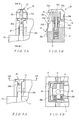
- Figs. 5A and 5B show essential parts of the first connector, with Fig. 5A being a partial front view, and Fig. 5B being a sectional view along line 5B-5B in Fig. 5A;
- Figs. 6A and 6C show essential parts of the first connector with the guide pin removed, with Fig. 6A being a partial front view, and Fig. 6B being a sectional view along
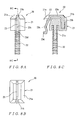
line 6B-6B in Fig. 6A; - Figs. 7A through 7C show a fastening fitting, with Fig. 7A being a front view, Fig. 7B being a plan view, and Fig. 7C being a right-side view;
- Figs. 8A through 8C show a locking plate attached to the guide pin, with Fig. 8A being a front view, Fig. 8B being a plan view, and Fig. 8C being a sectional view along
line 8C-8C in Fig. 8A; - Figs. 9A through 9C show a housing cover, with Fig. 9A being a front view, Fig. 9B being a plan view, and Fig. 9C being a right-side view;
- Figs. 10A through 10C show a locking plate, with Fig. 10A being a front view, Fig. 10B being a plan view, and Fig. 10C being a right-side view;
- Fig. 11 is a front view of a second connector of the docking connector of the present invention;
- Fig. 12 is a plan view of the second connector shown in Fig. 11;
- Figs. 13A through 13D show the second connector of Fig, 11, with Fig. 13A being a right-side view, Fig. 13B being a right-side view when the tine plate is in the final position, Fig. 13C being a sectional view along
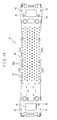
line 13C-13C in Fig. 12 when the tine plate is in the final position, and Fig. 13D being a sectional view alongline 13D-13D in Fig. 12; - Fig. 14 is a bottom view of the second connector shown in Fig, 11;
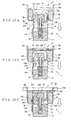
- Figs. 15A through 15C show the guiding action of the guide pin during mating of the first connector and the second connector, with Fig. 15A being an explanatory diagram of the guiding action of the guide pin at the initial stage of mating, Fig. 15B being an explanatory diagram of the guiding action of the guide pin in the process of mating, and Fig. 15C being an explanatory diagram of the guiding action of the guide pin following mating;
- Fig. 16 is a sectional view of a conventional example of a docking connector;
- Fig. 17 is an explanatory diagram of a conventional example of a blind connection electrical connector;
- Fig. 18 is an explanatory diagram of another conventional example of a docking connector; and
- Fig. 19 is an exploded perspective view of essential parts of the docking connector shown in Fig. 18.
- In Figs. 1 through 4, a tine plate is located in the initial position.
- As is shown in Figs. 1, 11 and 15A through 15C, the docking connector is constructed from a
first connector 1 and asecond connector 41 that mate with each other. As is shown in Fig. 3, thefirst connector 1 is designed to be mounted on acircuit board PCB 1 on one side, which is provided on the side of an extension unit (not shown in the figures); meanwhile, as is shown in Fig. 13B, thesecond connector 41 is designed to be mounted on a circuit board PCB2 on the other side, which is provided on the side of a personal computer (not shown in the figures). In Figs. 1 through 4, since atine plate 30 is in the initial position, the circuit board PCB1 and thetine plate 30 are graphically represented as being overlapped with each other. - Here, the
first connector 1 comprises an insulatingfirst housing 10, a plurality ofcontacts 16 that are attached to thefirst housing 10, and atine plate 30 for aligning the leg parts of thecontacts 16. Thecontacts 16 are connected by soldering to the circuit board PCB1. - As is shown in Figs. 1 through 3, the
first housing 10 comprises a substantiallyrectangular base part 11 that extends in the direction of length (left-right direction in Fig. 1),board mounting parts 13 that are provided on both sides of thebase part 11 in the direction of length and that are mounted on the circuit board PCB1, and amating part 12 that protrudes upward from thebase part 11; thisfirst housing 10 is formed by molding an insulating resin. As is shown in Fig. 2, themating part 12 comprises acenter wall 12a that extends in the direction of length, and afront wall 12b and arear wall 12c that are respectively located on the front and rear, sandwiching thiscenter wall 12a in the center. Thefront wall 12b andrear wall 12c respectively extend in the direction of length. As is shown in Fig. 2, thecontacts 16 are provided in four rows, i.e., both on the front and rear ends of thecenter wall 12a, on the rear end of thefront wall 12b, and on the front end of therear wall 12c. Furthermore, guide pin accommodating recessedparts 14 are formed on both sides of themating part 12 in the direction of length as shown in Figs. 5B and 6B, and spring member accommodating recessedparts 15 are formed in the bottom portions of these guide pin accommodating recessedparts 14. Moreover, as is shown in Fig. 1, ashell 25 made of metal is attached to the periphery of themating part 12. - A pair of guide pins 20 are provided on the
first housing 10 in positions corresponding to the guide pin accommodating recessedparts 14. As is shown in Figs. 5A and 5B, and 8A through 8C, each of the guide pins 20 is provided so as to be movable upward and downward with respect to the corresponding guide pin accommodating recessedpart 14 in thefirst housing 10, and is constructed from acover housing 21 that protrudes upward from the mating surface of the mating part 12 (upper end surface of the mating part 12) and aspring member 22 that constantly drives thecover housing 21 upward. As is clearly shown in Figs. 9A through 9C, each coverhousing 21 comprises aguide part 21 a whose tip end is tapered and aspring supporting part 21 c which protrudes downward from theguide part 21a, and is formed by molding an insulating resin. As is shown in Figs. 8A through 8C and 9A through 9C, a lockingplate accommodating groove 21b that extends in the forward-rearward direction and that opens on the front is formed in theguide part 21 a of thecover housing 21 of theguide pin 20 on the left side in the direction of length; a lockingplate accommodating groove 21b that extends in the forward-rearward direction and that opens on the rear is formed in theguide part 21a of thecover housing 21 of theguide pin 20 on the right side in the direction of length. Thespring members 22 are constructed from compression springs, and as is shown in Figs. 5B and 8A through 8C, the upper portions thereof are fitted over and supported by thespring supporting members 21c of thecover housings 22. The lower portions of thespring members 22 are accommodated inside the spring member accommodating recessedparts 15 in thefirst housing 10 as shown in Fig. 5B, and constantly drive thecover members 21 upward by means of the actions of thespring members 22. - Furthermore, as is shown in Figs. 5A and 5B, and 8A through 8C,
metal locking plates 23 are fastened into the respective lockingplate accommodating grooves 21b in thecover housings 21. As is clearly shown in Figs. 5A and 5B, and 10A through 10C, the lockingplate 23 that is fastened to thecover housing 21 on the left side of thefirst housing 10 in the direction of length comprises abase plate part 23a that extends in the forward-rearward direction and that is accommodated in the corresponding lockingplate accommodating groove 21b, and a press-fittingfastening part 23b that extends downward from the rear end of thebase plate part 23a and that is press-fitted to theguide part 21a. Moreover, acontact protruding part 23c is formed at the front end of thebase plate part 23a via a flexible part that extends downward at an inclination toward the front, and a lockingprojection 23d that protrudes forward is formed below thecontact protruding part 23c. The lockingplate 23 is formed by stamping a metal plate. Furthermore, the lockingplate 23 that is fastened to thecover housing 21 on the right side of thefirst housing 10 in the direction of length comprises abase plate part 23a that extends in the forward-rearward direction and that is accommodated in the corresponding lockingplate accommodating groove 21b, and a press-fittingfastening part 23b that extends downward from the front end of thebase plate part 23a and that is press-fitted to theguide part 21a. Moreover, acontact protruding part 23c is formed at the rear end of thebase plate part 23a via a flexible part that extends downward at an inclination toward the rear, and a lockingprojection 23d that protrudes rearward is formed below thecontact protruding part 23c. - Furthermore, as is shown in Figs. 1 through 3, 5A and 5B, and 6A and 6B,
metal fastening fittings 24 for fastening thefirst connector 1 to the circuit board PCB1 are attached to both ends of themating part 12 of thefirst housing 10 in the direction of length. As is shown in Figs. 6A and 6B, and 7A through 7C, the fastening fitting 24 that is attached to the left end of themating part 12 in the direction of length comprises a C-shapedbase plate part 24a that extends in the forward-rearward direction, a pair of press-fittingfastening parts 24b that extend downward from the two ends (front and rear ends) of thebase plate part 24a, and a pair ofboard fastening parts 24f that extend downward from the portion of thebase plate part 24a between the press-fittingfastening parts 24b. These press-fittingfastening parts 24b are press-fitted to the correspondingboard mounting part 13 of thefirst housing 10, and theboard fastening parts 24f are fastened to the circuit board PCB1 by passing through theboard mounting part 13. Moreover, alocking piece 24c extends upward from the upper portion of the right end of the C-shaped bent part at the front end of thebase plate part 24a. As is shown in Fig. 5B, alocking hole 24d into which the lockingprojection 23d of the lockingplate 23 is locked is formed in the upper portion of thelocking piece 24c. Furthermore, a supportingpart 24e for supporting the upper end of thelocking piece 24c on themating part 12 of thefirst housing 10 is provided on the upper end of thelocking piece 24c. The supportingpart 24e is provided in order to prevent the lockingprojection 23d from being easily disengaged from thelocking hole 24d. The reason for this is that the positioning precision of the lockingplate 23 inside thefirst housing 10 is required to cause the lockingplate 23 to perform a locking action. Moreover, the fastening fitting 24 is formed by stamping and forming a metal plate. In addition, the fastening fitting 24 that is attached to the right end of themating part 12 in the direction of length comprises a C-shapedbase plate part 24a that extends in the forward-rearward direction, a pair of press-fittingfastening parts 24b that extend downward from the two ends (front and rear ends) of thebase plate part 24a, and a pair ofboard fastening parts 24f that extend downward from the portion of thebase plate part 24a between the press-fittingfastening parts 24b. These press-fittingfastening parts 24b are press-fitted to the correspondingboard mounting part 13 of thefirst housing 10, and theboard fastening parts 24f are fastened to the circuit board PCB1 by passing through theboard mounting part 13. Moreover, alocking piece 24c extends upward from the upper portion of the left end of the C-shaped bent part at the rear end of thebase plate part 24a. Alocking hole 24d into which the lockingprojection 23d of the lockingplate 23 is locked is formed in the upper portion of thelocking piece 24c. Furthermore, a supportingpart 24e for supporting the upper end of thelocking piece 24c on themating part 12 of thefirst housing 10 is provided on the upper end of thelocking piece 24c. The supportingpart 24e is provided in order to prevent the lockingprojection 23d from being easily disengaged from thelocking hole 24d. The reason for this is that the positioning precision of the lockingplate 23 inside thefirst housing 10 is required to cause the lockingplate 23 to perform a locking action. Moreover, the fastening fitting 24 is formed by stamping and forming a metal plate. - As is shown in Figs. 5A and 5B, the system is constructed so that the vertical movement of the
cover housings 21 is locked by the lockingprojections 23d of the lockingplates 23 being locked into the lockingholes 24d in thefastening fittings 24; thus, the lockingplates 23 andfastening fittings 24 constitute the "locking means" referred to inClaims 1 and 2. - Furthermore, as is shown in Fig. 4, the
tine plate 30 comprises abase plate part 31 that extends in the direction of length, a pair of lockingarms 32 that extend upward from either end of thebase plate part 31 in the direction of length, and a plurality ofpositioning posts 33 that protrude downward from the vicinity of both ends of thebase plate part 31 in the direction of length. In order to align the leg parts of therespective contacts 16, a plurality of through-holes 31a through which these leg parts pass are formed in thebase plate part 31. Thetine plate 30 is designed to move between the initial position shown in Fig. 1 and the final position that is located above the initial position (although this final position is not shown in the figures). - Next, as is shown in Figs. 13B, the
second connector 41 that mates with thefirst connector 1 is designed to be mounted on a circuit board PCB2 that is provided on the other side, i.e., on the side of the personal computer (not shown in the figures). Furthermore, thesecond connector 41 comprises an insulatingsecond housing 50, a plurality ofcontacts 54 that are attached to thesecond housing 50, and atine plate 60 for aligning the leg parts of thecontacts 54. Thecontacts 54 are connected by soldering to the circuit board PCB2. - As is shown in Figs. 11, 12 and 13A through 13D, the
second housing 50 extends in the direction of length (left-right direction in Fig. 11), and is formed by molding an insulating resin. As is shown in Fig. 13D, a mating recessedpart 51 that opens above and that extends in the direction of length is formed in thesecond housing 50, so that themating part 12 of thefirst connector 1 is caused to mate into this mating recessedpart 51. Furthermore, as is shown in Figs. 12 and 13D, afront wall part 51a that extends in the direction of length and arear wall part 51b that is provided on the rear with a specified space left from thisfront wall part 51a and that extends in the direction of length are provided in an upright attitude inside the mating recessedpart 51. As is shown in Fig. 13D, thecontacts 54 are provided in four rows, i.e., both on the front and rear ends of thefront wall part 51a and both on the front and rear ends of therear wall part 51b, and are designed to make contact with thecontacts 16 of thefirst connector 1 when thefirst connector 1 and thesecond connector 41 mate. Moreover, ablind plate 52 that covers the mating recessedpart 51 is provided in the mating recessedpart 51 so that thisblind plate 52 can move upward and downward as shown in Fig. 13D. Theblind plate 52 is constantly driven upward by compression springs 59 that are installed inside the mating recessedpart 51. - Furthermore, a pair of guide holes 53 into which the housing covers 21 of the guide pins 20 are inserted are formed in either end of the
second housing 50 in the direction of length. - Moreover, as is shown in Fig. 11,
metal shells 55 for shielding thesecond connector 41 are attached to the front and rear surfaces of thesecond housing 50. A pair oftemporary locking pieces 58 for temporary locking thetine plate 60 in the initial position are formed to protrude downward on either end of eachshell 55 in the direction of length, andtongue pieces 57 that are grounded to the circuit board PCB2 are formed to protrude downward slightly on the inside of thetemporary locking pieces 58. Furthermore, as is shown in Figs. 12, 13C and 15A through 15C, alock releasing part 56 that releases the locking of the lockingplate 23 with respect to the corresponding fastening fitting 24 is formed at the left end (in the direction of length) of the front-side shell 55 by bending thisshell 55 from the upper end of theshell 55 toward the interior of thecorresponding guide hole 53. Moreover, alock releasing part 56 that releases the locking of the lockingplate 23 with the corresponding fastening fitting 24 is also formed at the right end (in the direction of length) of the rear-side shell 55 by bending thisshell 55 from the upper end of theshell 55 toward the interior of thecorresponding guide hole 53. As is shown in Fig. 15A, theselock releasing parts 56 contact thecontact protruding parts 23c of the lockingplates 23 at the initial stage of insertion of thecover housings 21 into the guide holes 15, and release the locking by contacting the lockingprojections 23d of the lockingplates 23 and displacing the lockingprojections 23d in the direction of arrow A in the process of insertion of thecover housings 21 into the guide holes 53 as shown in Fig. 15B. Following release, thelock releasing parts 56 slide the outer surfaces of thefastening fittings 24 as shown in Fig. 15C. - In addition, as is shown in Fig. 14, the
tine plate 60 is formed with a substantially rectangular shape that extends in the direction of length, and in order to align the leg parts of therespective contacts 54, a plurality of through-holes 60a through which these leg parts pass are formed. Thetine plate 60 is designed to move between the initial position shown in Figs. 13A and 13D and the final position shown in Figs. 13B and 13C that is located above this initial position. Thetine plate 60 is temporarily locked by thetemporary locking pieces 58 in the initial position shown in Figs. 13A and 13D. Furthermore, as is shown in Fig. 14, a pair ofopenings 61 through which thecover housings 21 can pass are formed in either end portion of thetine plate 60 in the direction of length. Moreover, a plurality ofpositioning posts 62 are formed to protrude downward on the undersurface of thetine plate 60 on both ends in the direction of length. - Next, a method for mating the
first connector 1 and thesecond connector 41 will be described. - First, the
first connector 1 is mounted on the circuit board PCB1 that is provided on the side of the extension unit, and thesecond connector 41 is mounted on the circuit board PCB2 that is provided on the side of the personal computer. At this point, thetine plate 30 of thefirst connector 1 and thetine plate 60 of thesecond connector 41 are respectively located in the final position. - Furthermore, as is shown in Fig. 15A, the
first connector 1 and thesecond connector 41 are caused to mate, with thefirst connector 1 on the side of the extension unit at the bottom and thesecond connector 41 on the side of the personal computer at the top while inserting thecover housings 21 of thefirst connector 1 into the guide holes 53 in thesecond connector 41. Then, the mating of thefirst connector 1 and thesecond connector 41 is guided by thecover housings 21 and the guide holes 53; since the vertical movement of thecover housings 21 is locked as a result of the lockingprojections 23d of the lockingplates 23 being locked in the lockingholes 24d in thefastening fittings 24, the mating of thefirst connector 1 and thesecond connector 41 is securely guided. Moreover, as is shown in Fig. 15A, in the initial stage at which thecover housings 21 are inserted into the guide holes 53, thelock releasing parts 56 of thesecond connector 41 contact thecontact protruding parts 23c of the lockingplates 23, and as a result, thefirst connector 1 and thesecond connector 41 are grounded via theshells 55 on the side of thesecond connector 41, the lockingplates 23 and thefastening fittings 24. Accordingly, a potential is constant between the two circuit boards PCB1 and PCB2, so that it is possible to eliminate electrical failure. - Furthermore, as is shown in Fig. 15B, when the mating of the
first connector 1 and thesecond connector 41 is caused to proceed, thelock releasing parts 56 contact the lockingprojections 23d of the lockingplates 23, and displace the lockingprojections 23d in the direction of arrow A, thus releasing the locking in the process of the insertion of thecover housings 21 into the guide holes 53. As a result, the vertical movement of thecover housings 21 is made possible. - Moreover, when the mating of the
first connector 1 and thesecond connector 41 is caused to proceed, the upper ends of thecover housings 21 pass through theopenings 61 formed in thetine plate 60 of thesecond connector 41, and contact the circuit board PCB2. Thecover housings 21 extend upward until this point, thus making it possible to ensure the sufficient amount of guiding. In this case, thelock releasing parts 56 slide the outer surfaces of thefastening fittings 24. Accordingly, the state of grounding of thefirst connector 1 and thesecond connector 41 is maintained. - Furthermore, when the mating of the
first connector 1 and thesecond connector 41 is caused to proceed, and this mating is completed, thecover housings 21 are compressed inside the guide holes 53 in thesecond connector 41 as a result of being pressed by the circuit board PCB2 as shown in Fig. 15C, so that portions of thecover housings 21 are positioned inside the guide pin accommodating recessedparts 14 in thefirst connector 1. Accordingly, thecover housings 21 do not protrude beyond the attachment surface of thesecond connector 41 with respect to the circuit board PCB2. Consequently, there is no need to form holes through which the guide pins (cover housings 21) are caused to pass in the circuit board PCB2 for mounting thesecond connector 41, thus making it possible to produce a docking connector that is suitable for high-density mounting. Moreover, when the mating of thefirst connector 1 and thesecond connector 41 is completed, thecontacts 16 of thefirst connector 1 and thecontacts 54 of thesecond connector 41 make contact, so that the two circuit boards PCB1 and PCB2 are electrically connected to each other. In addition, as is shown in Fig. 15C, since thelock releasing parts 56 are in contact with the outer surfaces of thefastening fittings 24, the state of grounding of thefirst connector 1 and thesecond connector 41 is maintained. - When the mating of the
first connector 1 and thesecond connector 41 is to be released, it is only necessary to pull out thesecond connector 41 upward. - In the above description, the locking means for locking the vertical movement of the
cover housings 21 are constructed from themetal fastening fittings 24 that are provided on thefirst housing 10 and that are fastened to the circuit board PCB1 on one side, and themetal locking plates 23 that are provided on thecover housings 21 and that are locked with thefastening fittings 24. Furthermore, the lock releasing means for releasing the locking of thecover housings 21 by the locking means are constructed from thelock releasing parts 56 of themetal shells 55 that are provided on thesecond housing 50, that release the locking of the lockingplates 23 with respect to thefastening fittings 24, and that are connected to the circuit board PCB2 on the other side. Accordingly, it is possible to constitute the locking means and lock releasing means with simple constructions. Moreover, thefastening fittings 24 of the locking means have both the function of fastening thefirst housing 10 to the circuit board PCB1 and the function of locking the lockingplates 23. In addition, theshells 55 have both the function of shielding thesecond connector 41 and the function of releasing the locking of the lockingplates 23 with respect to thefastening fittings 24. - An embodiment of the present invention was described above. However, the present invention is not limited to this embodiment, and various alterations or modifications can be made.
- For example, it is not absolutely necessary to construct the locking means from the metal fastening fittings that are provided on the
first housing 10 and that are fastened to the circuit board PCB1 on one side, and themetal locking plates 23 that are provided on thecover housings 21 and that are locked with thefastening fittings 24. - Furthermore, it is not absolutely necessary to construct the lock releasing means from the
metal shells 55 that are provided on thesecond housing 50, that release the locking of the lockingplates 23 with respect to thefastening fittings 24, and that are connected to the circuit board PCB2 on the other side. - Moreover, it is not absolutely necessary to construct the
locking plates 23 andshells 55 with a construction in which these parts contact with each other before releasing the locking of the lockingplates 23 with respect to thefastening fittings 24 by means of theshells 55.
Claims (3)
- A docking connector comprising first (1) and second (41) connectors that mate with each other, the first connector (1) being mountable on one side of a first circuit board (PCB1) and includes a first housing (10) provided with guide pins (20) that protrude upward from a mating surface in the vicinity of connector ends, and the second connector (41) being mountable on one side of a second circuit board (PCB2) and includes a second housing (50) that is formed with guide holes (53) for receiving the guide pins (20); characterised in that :the guide pins (20) comprise cover housings (21) which are provided to be movable upward and downward with respect to the first housing (10), and which protrude upward from the mating surface and are insertable into the guide holes (53), and spring members (22) that drive the cover housings (21) upward, and in thatthe docking connector further comprises locking means (23,24) for locking the vertical movement of the cover housings (21) and lock releasing means (55) for releasing the locking of the cover housings (21) by the locking means (23,24) during insertion of the cover housings into the guide holes (53).
- The docking connector according to Claim 1, wherein the locking means (23,24) comprise metal fastening fittings (24) that are provided on the first housing (10) and that are fastened to the first circuit board (PCB1), and metal locking plates (23) that are provided on the cover housings (21) and that are locked with the fastening fittings (24), and the lock releasing means includes metal shells (55) that are provided on the second housing (50), that release the locking of the locking plates (23) with respect to the fastening fittings (24), and that are connected to the second circuit board (PCB2).
- The docking connector according to Claim 2, wherein the locking plates (23) and the shells (55) are constructed to contact with each other before the locking of the locking plates (23) with respect to the fastening fittings (24) are released by the shells (55).
Applications Claiming Priority (1)
| Application Number | Priority Date | Filing Date | Title |
|---|---|---|---|
| JP2004226937A JP2006049036A (en) | 2004-08-03 | 2004-08-03 | Docking connector |
Publications (2)
| Publication Number | Publication Date |
|---|---|
| EP1624535A1 EP1624535A1 (en) | 2006-02-08 |
| EP1624535B1 true EP1624535B1 (en) | 2007-10-17 |
Family
ID=35044690
Family Applications (1)
| Application Number | Title | Priority Date | Filing Date |
|---|---|---|---|
| EP05107169A Expired - Fee Related EP1624535B1 (en) | 2004-08-03 | 2005-08-03 | Docking connector |
Country Status (7)
| Country | Link |
|---|---|
| US (1) | US7244138B2 (en) |
| EP (1) | EP1624535B1 (en) |
| JP (1) | JP2006049036A (en) |
| KR (1) | KR20060049054A (en) |
| CN (1) | CN1734853A (en) |
| DE (1) | DE602005002885T2 (en) |
| TW (1) | TWM288984U (en) |
Cited By (2)
| Publication number | Priority date | Publication date | Assignee | Title |
|---|---|---|---|---|
| DE102009058616A1 (en) | 2009-12-17 | 2011-06-22 | HARTING Electronics GmbH & Co. KG, 32339 | Printed circuit board connector with locking device |
| DE102012105352A1 (en) | 2012-06-20 | 2013-12-24 | Lear Corporation Gmbh | positioning |
Families Citing this family (14)
| Publication number | Priority date | Publication date | Assignee | Title |
|---|---|---|---|---|
| CN2826733Y (en) | 2005-03-11 | 2006-10-11 | 华为技术有限公司 | Connector interface |
| JP4971957B2 (en) * | 2007-11-29 | 2012-07-11 | タイコエレクトロニクスジャパン合同会社 | Contact member, contact member holding structure and electrical connector |
| CN101459297B (en) * | 2007-12-14 | 2013-01-02 | 泰科电子(上海)有限公司 | Electric connecting device |
| US20100195302A1 (en) * | 2009-02-03 | 2010-08-05 | Rigby William J | Flexible guiding module |
| KR100967354B1 (en) * | 2009-03-19 | 2010-07-05 | 이성호 | Touch panel for a multiplicity of input |
| US8944697B2 (en) | 2012-09-28 | 2015-02-03 | Positronic Industries, Inc. | Fiber optic connector assembly |
| US9361601B2 (en) * | 2012-10-02 | 2016-06-07 | Kiosk Information Systems, Inc. | Systems and methods for locking and docking |
| CN103105911A (en) * | 2013-01-30 | 2013-05-15 | 华一精密机械(昆山)有限公司 | Electric conduction elastic chip device for computer |
| WO2014121216A1 (en) * | 2013-02-04 | 2014-08-07 | Siemens Healthcare Diagnostics Inc. | Instrument docking apparatus, systems, and methods |
| JP6317557B2 (en) * | 2013-09-27 | 2018-04-25 | 株式会社エンプラス | Mounting member and socket for electrical parts |
| CN109546417B (en) * | 2017-09-21 | 2020-03-31 | 正凌精密工业(广东)有限公司 | Connector housing device capable of being unlocked smoothly |
| CN108134223B (en) * | 2017-12-21 | 2019-06-18 | 郑州云海信息技术有限公司 | A kind of in-line component combination device for PCBA preparation |
| FR3108203B1 (en) * | 2020-03-11 | 2023-06-02 | Axon Cable Sa | Quick and secure connection assembly |
| US11158966B2 (en) * | 2020-03-26 | 2021-10-26 | TE Connectivity Services Gmbh | Collapsable alignment member |
Family Cites Families (12)
| Publication number | Priority date | Publication date | Assignee | Title |
|---|---|---|---|---|
| US5466171A (en) | 1994-09-19 | 1995-11-14 | Molex Incorporated | Polarizing system for a blind mating electrical connector assembly |
| US5478253A (en) * | 1994-09-21 | 1995-12-26 | The Whitaker Corporation | Electrostatic discharge contacts for blind mating connectors |
| JP3057546B2 (en) * | 1995-02-23 | 2000-06-26 | モレックス インコーポレーテッド | Connector assembly with guide mechanism |
| JP3148855B2 (en) * | 1996-03-01 | 2001-03-26 | モレックス インコーポレーテッド | Electrical connector |
| US5961337A (en) | 1996-11-27 | 1999-10-05 | Norand Corporation | Universal charging and data communication apparatus |
| US6358067B1 (en) * | 1998-01-16 | 2002-03-19 | Molex Incorporated | Docking-style intermediate connector |
| JP3354866B2 (en) | 1998-03-31 | 2002-12-09 | 日本圧着端子製造株式会社 | Docking connector |
| US6074235A (en) * | 1998-04-07 | 2000-06-13 | The Whitaker Corporation | Alignment post having an improved locking feature |
| JP4081876B2 (en) | 1998-09-09 | 2008-04-30 | 松下電器産業株式会社 | Electronic device and extension unit having guide mechanism |
| TW389402U (en) * | 1998-11-17 | 2000-05-01 | Hon Hai Prec Ind Co Ltd | Guiding device for connector |
| JP2001313115A (en) * | 2000-04-17 | 2001-11-09 | Internatl Business Mach Corp <Ibm> | Flap opening and closing mechanism for connector protection of electronic equipment |
| TWM266609U (en) * | 2004-07-16 | 2005-06-01 | Hon Hai Prec Ind Co Ltd | Electrical connector assembly |
-
2004
- 2004-08-03 JP JP2004226937A patent/JP2006049036A/en active Pending
-
2005
- 2005-07-14 TW TW094211953U patent/TWM288984U/en not_active IP Right Cessation
- 2005-08-02 CN CNA200510091906XA patent/CN1734853A/en active Pending
- 2005-08-03 EP EP05107169A patent/EP1624535B1/en not_active Expired - Fee Related
- 2005-08-03 KR KR1020050070879A patent/KR20060049054A/en not_active Withdrawn
- 2005-08-03 US US11/196,648 patent/US7244138B2/en not_active Expired - Fee Related
- 2005-08-03 DE DE602005002885T patent/DE602005002885T2/en not_active Expired - Lifetime
Cited By (4)
| Publication number | Priority date | Publication date | Assignee | Title |
|---|---|---|---|---|
| DE102009058616A1 (en) | 2009-12-17 | 2011-06-22 | HARTING Electronics GmbH & Co. KG, 32339 | Printed circuit board connector with locking device |
| EP2339701A2 (en) | 2009-12-17 | 2011-06-29 | Harting Electronics GmbH & Co. KG | Circuit board connector with locking device |
| US8192221B2 (en) | 2009-12-17 | 2012-06-05 | Harting Electronics Gmbh & Co. Kg | Printed board connector with locking device |
| DE102012105352A1 (en) | 2012-06-20 | 2013-12-24 | Lear Corporation Gmbh | positioning |
Also Published As
| Publication number | Publication date |
|---|---|
| EP1624535A1 (en) | 2006-02-08 |
| US7244138B2 (en) | 2007-07-17 |
| TWM288984U (en) | 2006-03-21 |
| JP2006049036A (en) | 2006-02-16 |
| DE602005002885T2 (en) | 2008-05-21 |
| DE602005002885D1 (en) | 2007-11-29 |
| CN1734853A (en) | 2006-02-15 |
| US20060030196A1 (en) | 2006-02-09 |
| KR20060049054A (en) | 2006-05-18 |
Similar Documents
| Publication | Publication Date | Title |
|---|---|---|
| EP1624535A1 (en) | Docking connector | |
| US7273382B2 (en) | Electrical connector and electrical connector assembly | |
| US7134895B1 (en) | PC board assembly | |
| KR100480196B1 (en) | Wire connector | |
| EP0835538B1 (en) | Board to board matable assembly | |
| US7186126B2 (en) | Floating electrical connector | |
| US10243305B1 (en) | Electrical connector assembly | |
| CN114784552B (en) | Electric connector and connector assembly | |
| CN114597707A (en) | Card edge connector with locking system | |
| USRE38089E1 (en) | Card connector | |
| CN210015997U (en) | Board-to-board connector assembly | |
| JPH1032060A (en) | Modular connector | |
| EP0974176B1 (en) | Floating guided connector and method | |
| EP1487066B1 (en) | Floating connector and method of manufacture therefor | |
| CN117220081A (en) | Connector assembly | |
| JPH11288760A (en) | Docking connector | |
| JP3282802B2 (en) | Relay connector assembly and cable side connector used for the same | |
| JP2006500750A (en) | Adjustable pin header assembly and manufacturing method thereof | |
| EP1154523A1 (en) | Printed circuit board stiffener assembly | |
| US12519257B2 (en) | Electrical connector to achieve required coplanarity of terminal parts of receptacle, method for manufacturing electrical connector, and method for mounting electrical connector | |
| US6293822B1 (en) | Electrical connector | |
| CN206236892U (en) | Electrical Connector Assembly | |
| JP3748787B2 (en) | Movable connector | |
| JP3467427B2 (en) | Connector mounting structure | |
| KR200438442Y1 (en) | Connector guide and connector with latch |
Legal Events
| Date | Code | Title | Description |
|---|---|---|---|
| PUAI | Public reference made under article 153(3) epc to a published international application that has entered the european phase |
Free format text: ORIGINAL CODE: 0009012 |
|
| AK | Designated contracting states |
Kind code of ref document: A1 Designated state(s): AT BE BG CH CY CZ DE DK EE ES FI FR GB GR HU IE IS IT LI LT LU LV MC NL PL PT RO SE SI SK TR |
|
| AX | Request for extension of the european patent |
Extension state: AL BA HR MK YU |
|
| GRAP | Despatch of communication of intention to grant a patent |
Free format text: ORIGINAL CODE: EPIDOSNIGR1 |
|
| 17P | Request for examination filed |
Effective date: 20060803 |
|
| AKX | Designation fees paid |
Designated state(s): DE FR GB |
|
| GRAS | Grant fee paid |
Free format text: ORIGINAL CODE: EPIDOSNIGR3 |
|
| GRAA | (expected) grant |
Free format text: ORIGINAL CODE: 0009210 |
|
| AK | Designated contracting states |
Kind code of ref document: B1 Designated state(s): DE FR GB |
|
| REG | Reference to a national code |
Ref country code: GB Ref legal event code: FG4D |
|
| REF | Corresponds to: |
Ref document number: 602005002885 Country of ref document: DE Date of ref document: 20071129 Kind code of ref document: P |
|
| ET | Fr: translation filed | ||
| PLBE | No opposition filed within time limit |
Free format text: ORIGINAL CODE: 0009261 |
|
| STAA | Information on the status of an ep patent application or granted ep patent |
Free format text: STATUS: NO OPPOSITION FILED WITHIN TIME LIMIT |
|
| 26N | No opposition filed |
Effective date: 20080718 |
|
| PGFP | Annual fee paid to national office [announced via postgrant information from national office to epo] |
Ref country code: FR Payment date: 20090817 Year of fee payment: 5 |
|
| PGFP | Annual fee paid to national office [announced via postgrant information from national office to epo] |
Ref country code: GB Payment date: 20090825 Year of fee payment: 5 |
|
| PGFP | Annual fee paid to national office [announced via postgrant information from national office to epo] |
Ref country code: DE Payment date: 20090827 Year of fee payment: 5 |
|
| REG | Reference to a national code |
Ref country code: FR Ref legal event code: CD |
|
| GBPC | Gb: european patent ceased through non-payment of renewal fee |
Effective date: 20100803 |
|
| REG | Reference to a national code |
Ref country code: FR Ref legal event code: ST Effective date: 20110502 |
|
| REG | Reference to a national code |
Ref country code: DE Ref legal event code: R119 Ref document number: 602005002885 Country of ref document: DE Effective date: 20110301 |
|
| PG25 | Lapsed in a contracting state [announced via postgrant information from national office to epo] |
Ref country code: DE Free format text: LAPSE BECAUSE OF NON-PAYMENT OF DUE FEES Effective date: 20110301 Ref country code: FR Free format text: LAPSE BECAUSE OF NON-PAYMENT OF DUE FEES Effective date: 20100831 |
|
| PG25 | Lapsed in a contracting state [announced via postgrant information from national office to epo] |
Ref country code: GB Free format text: LAPSE BECAUSE OF NON-PAYMENT OF DUE FEES Effective date: 20100803 |