EP1621815A1 - Microcombustor - Google Patents
Microcombustor Download PDFInfo
- Publication number
- EP1621815A1 EP1621815A1 EP04425537A EP04425537A EP1621815A1 EP 1621815 A1 EP1621815 A1 EP 1621815A1 EP 04425537 A EP04425537 A EP 04425537A EP 04425537 A EP04425537 A EP 04425537A EP 1621815 A1 EP1621815 A1 EP 1621815A1
- Authority
- EP
- European Patent Office
- Prior art keywords
- duct
- microcombustor
- axis
- combustion
- chamber
- Prior art date
- Legal status (The legal status is an assumption and is not a legal conclusion. Google has not performed a legal analysis and makes no representation as to the accuracy of the status listed.)
- Granted
Links
- 239000007789 gas Substances 0.000 claims abstract description 16
- 230000015572 biosynthetic process Effects 0.000 claims abstract description 14
- 238000005755 formation reaction Methods 0.000 claims abstract description 14
- 238000004200 deflagration Methods 0.000 claims abstract description 13
- 238000002485 combustion reaction Methods 0.000 claims abstract description 12
- 238000005474 detonation Methods 0.000 claims abstract description 10
- 230000007704 transition Effects 0.000 claims abstract description 6
- 239000000446 fuel Substances 0.000 claims abstract description 5
- 239000000203 mixture Substances 0.000 claims abstract description 4
- 230000000694 effects Effects 0.000 description 4
- 230000006641 stabilisation Effects 0.000 description 2
- 238000006243 chemical reaction Methods 0.000 description 1
- 238000005253 cladding Methods 0.000 description 1
- 239000000567 combustion gas Substances 0.000 description 1
- 230000008878 coupling Effects 0.000 description 1
- 238000010168 coupling process Methods 0.000 description 1
- 238000005859 coupling reaction Methods 0.000 description 1
- 230000008021 deposition Effects 0.000 description 1
- 230000002349 favourable effect Effects 0.000 description 1
- 239000000463 material Substances 0.000 description 1
- 230000009467 reduction Effects 0.000 description 1
- 230000003746 surface roughness Effects 0.000 description 1
Images

Classifications
-
- F—MECHANICAL ENGINEERING; LIGHTING; HEATING; WEAPONS; BLASTING
- F23—COMBUSTION APPARATUS; COMBUSTION PROCESSES
- F23C—METHODS OR APPARATUS FOR COMBUSTION USING FLUID FUEL OR SOLID FUEL SUSPENDED IN A CARRIER GAS OR AIR
- F23C3/00—Combustion apparatus characterised by the shape of the combustion chamber
- F23C3/006—Combustion apparatus characterised by the shape of the combustion chamber the chamber being arranged for cyclonic combustion
-
- F—MECHANICAL ENGINEERING; LIGHTING; HEATING; WEAPONS; BLASTING
- F02—COMBUSTION ENGINES; HOT-GAS OR COMBUSTION-PRODUCT ENGINE PLANTS
- F02K—JET-PROPULSION PLANTS
- F02K7/00—Plants in which the working fluid is used in a jet only, i.e. the plants not having a turbine or other engine driving a compressor or a ducted fan; Control thereof
- F02K7/02—Plants in which the working fluid is used in a jet only, i.e. the plants not having a turbine or other engine driving a compressor or a ducted fan; Control thereof the jet being intermittent, i.e. pulse-jet
-
- F—MECHANICAL ENGINEERING; LIGHTING; HEATING; WEAPONS; BLASTING
- F23—COMBUSTION APPARATUS; COMBUSTION PROCESSES
- F23R—GENERATING COMBUSTION PRODUCTS OF HIGH PRESSURE OR HIGH VELOCITY, e.g. GAS-TURBINE COMBUSTION CHAMBERS
- F23R3/00—Continuous combustion chambers using liquid or gaseous fuel
- F23R3/002—Wall structures
-
- F—MECHANICAL ENGINEERING; LIGHTING; HEATING; WEAPONS; BLASTING
- F05—INDEXING SCHEMES RELATING TO ENGINES OR PUMPS IN VARIOUS SUBCLASSES OF CLASSES F01-F04
- F05D—INDEXING SCHEME FOR ASPECTS RELATING TO NON-POSITIVE-DISPLACEMENT MACHINES OR ENGINES, GAS-TURBINES OR JET-PROPULSION PLANTS
- F05D2250/00—Geometry
- F05D2250/80—Size or power range of the machines
- F05D2250/82—Micromachines
-
- F—MECHANICAL ENGINEERING; LIGHTING; HEATING; WEAPONS; BLASTING
- F05—INDEXING SCHEMES RELATING TO ENGINES OR PUMPS IN VARIOUS SUBCLASSES OF CLASSES F01-F04
- F05D—INDEXING SCHEME FOR ASPECTS RELATING TO NON-POSITIVE-DISPLACEMENT MACHINES OR ENGINES, GAS-TURBINES OR JET-PROPULSION PLANTS
- F05D2260/00—Function
- F05D2260/20—Heat transfer, e.g. cooling
- F05D2260/221—Improvement of heat transfer
- F05D2260/2212—Improvement of heat transfer by creating turbulence
-
- F—MECHANICAL ENGINEERING; LIGHTING; HEATING; WEAPONS; BLASTING
- F05—INDEXING SCHEMES RELATING TO ENGINES OR PUMPS IN VARIOUS SUBCLASSES OF CLASSES F01-F04
- F05D—INDEXING SCHEME FOR ASPECTS RELATING TO NON-POSITIVE-DISPLACEMENT MACHINES OR ENGINES, GAS-TURBINES OR JET-PROPULSION PLANTS
- F05D2260/00—Function
- F05D2260/20—Heat transfer, e.g. cooling
- F05D2260/221—Improvement of heat transfer
- F05D2260/2214—Improvement of heat transfer by increasing the heat transfer surface
- F05D2260/22141—Improvement of heat transfer by increasing the heat transfer surface using fins or ribs
-
- F—MECHANICAL ENGINEERING; LIGHTING; HEATING; WEAPONS; BLASTING
- F23—COMBUSTION APPARATUS; COMBUSTION PROCESSES
- F23C—METHODS OR APPARATUS FOR COMBUSTION USING FLUID FUEL OR SOLID FUEL SUSPENDED IN A CARRIER GAS OR AIR
- F23C2900/00—Special features of, or arrangements for combustion apparatus using fluid fuels or solid fuels suspended in air; Combustion processes therefor
- F23C2900/03001—Miniaturized combustion devices using fluid fuels
-
- Y—GENERAL TAGGING OF NEW TECHNOLOGICAL DEVELOPMENTS; GENERAL TAGGING OF CROSS-SECTIONAL TECHNOLOGIES SPANNING OVER SEVERAL SECTIONS OF THE IPC; TECHNICAL SUBJECTS COVERED BY FORMER USPC CROSS-REFERENCE ART COLLECTIONS [XRACs] AND DIGESTS
- Y02—TECHNOLOGIES OR APPLICATIONS FOR MITIGATION OR ADAPTATION AGAINST CLIMATE CHANGE
- Y02T—CLIMATE CHANGE MITIGATION TECHNOLOGIES RELATED TO TRANSPORTATION
- Y02T50/00—Aeronautics or air transport
- Y02T50/60—Efficient propulsion technologies, e.g. for aircraft
Definitions
- the present inventions relates to improvements in microcombustors.
- the invention relates in particular to a microcombustor of type known per se, comprising an essentially tubular body with a closed end close to which is defined a fuel mixture supply and ignition chamber which communicates with a duct within the body having a length very much greater than its average transverse dimension and able to allow the generation and propagation of combustion, and the consequent pressure- wave, as well as the passage from a slow deflagration condition to a fast deflagration condition and/or to the detonation regime.
- DDT Deflagration to Detonation Transition
- One object of the present invention is to provide microcombustors of this type able to facilitate the development of the combustion, to limit the divergence of the exhaust gas and to improve its stabilisation to allow an improved utilisation thereof, for example in thrusters, in applications in which the exhaust gases from such a microcombustor serve for driving turbines or rotors of electric machines to rotate, in applications as rocket propulsion means and the like or as direct energy generators, in applications such as fuel injector means or means for the deposition of claddings or focusing of combustion gases for cutting materials, for mechanical working or more generally as personal defence means.
- microcombustor of the type specified above, characterised in that the internal surface of the said duct has a plurality of formations operable to impart to the flow of gas developed in the combustion a spin about the axis of the duct.
- these formations extend both in the portion of the duct which is operatively involved in the propagation of the combustion in deflagration conditions, and in the portion involved in the propagation in fast deflagration or detonation conditions.
- the said formations within the duct of the microcombustor further serve to create a turbulence effect which is important in itself to facilitate the physical and chemical reaction of combustion, in particular in micro-environments with transverse dimensions of a few millimetres, and to facilitate the transition to the fast deflagration regime and to the detonation regime.
- the Reference 1 generally indicates a microcombustor according to the present invention.
- This microcombustor comprises, in a manner known per se, a body 2 of essentially tubular form.
- One end 2a of the body 2 is closed. Close to this end, in the body 2, there is defined a chamber 4 for supply and ignition of a fuel mixture, introduced into this chamber for example through a supply coupling 5.
- an ignition device 6 controllable by means of an electrical control line 7.
- the end 4 of the chamber of the microcombustor communicates with a duct 8 within the body 2.
- the duct 8 has a length very much greater than its average transverse dimension.
- the length of the duct 8 can be for example 20 times the average transverse dimension but may even be 100 times this dimension.
- the duct 8 is able to allow generation and propagation of the combustion initiated in the chamber 4, and propagation of the consequent pressure wave as well as the transition from the slow deflagration condition to the fast deflagration condition and/or to the detonation regime.
- the internal surface of the duct 8 has a plurality of formations able to impart to the flow of gas developed upon combustion a spin about the axis of the duct.
- the internal surface of the duct 8 has a polygonal transverse section (see Figure 2) and in particular a hexagonal section. From the constructional point of view this polygonal configuration of the section is particularly favourable to the reduction of the transverse dimension of the duct.
- the inner surface of the duct 8 has a conformation corresponding to the combined rotation and translation of the basic polygonal section about and along the axis A-A of the duct 8.
- the internal surface of the duct 8 is formed by six adjacent helical strips 9 each corresponding to one side of the polygon (hexagon) of the basic section.
- the inner surface of the duct 8 has a plurality of projecting formations 19 of helical shape in the form of threads.
- the inner surface of the duct 8 has two helical ridge elements 19 in the form of a two-start thread.
- each helical formation 19 is essentially triangular, in the form of saw teeth, with a larger side 19a facing the chamber 4 and a shorter side 19b facing the outlet end of the duct 8.
- the inclination with respect of the axis A-A of the side 19a is less than the inclination of the side 19b.
- Figure 4 is shown a further embodiment in which the internal surface of the duct 8 of the microcombustor has a plurality of grooves 29 which also have a helical development about the axis A-A of the said duct.
- the formations of the internal surface of the duct 8 of the microcombustor according to the invention make it possible effectively to impart a spin to the flow of exhaust gases, limiting the divergence of these latter gases at the outlet of the duct.
- the divergence of the exhaust gases would be predominantly dominated by diffraction effects, and therefore by the section of the duct closest to the outlet.
- the divergence of the exhaust gases is also dominated, and predominantly, by the "rifling" of the duct more than by the output section of the duct, which imparts a rotary-motion to the gases.
- the improved directionality of the gases increases the force of the thrust in the case of use as propulsion means, whilst in applications for actuation for example of a turbine, there is a greater transfer of the force impulse onto the turbine itself.
- the said formations also further create a turbulence within the duct 8 which is important to facilitate the transition to detonation conditions.
Landscapes
- Engineering & Computer Science (AREA)
- Chemical & Material Sciences (AREA)
- Combustion & Propulsion (AREA)
- Mechanical Engineering (AREA)
- General Engineering & Computer Science (AREA)
- Physical Or Chemical Processes And Apparatus (AREA)
- Gas Burners (AREA)
Abstract
Description
- The present inventions relates to improvements in microcombustors.
- The invention relates in particular to a microcombustor of type known per se, comprising an essentially tubular body with a closed end close to which is defined a fuel mixture supply and ignition chamber which communicates with a duct within the body having a length very much greater than its average transverse dimension and able to allow the generation and propagation of combustion, and the consequent pressure- wave, as well as the passage from a slow deflagration condition to a fast deflagration condition and/or to the detonation regime.
- It is known in the art that to reduce the distance necessary to pass from deflagration to detonation (the so-called "Deflagration to Detonation Transition" or "DDT") it is possible to provide "obstacles" or irregularities in the chamber such as spirals, orifices and channels. See, for example, in this respect the article "Effect of Tube Surface Roughness on Origin and Propagation of Detonation in Gas" by K.I. Shchelkin, published in the Journal of Experimental and Theoretical Physics (USSR), 10, 1940, pages 823-827.
- One object of the present invention is to provide microcombustors of this type able to facilitate the development of the combustion, to limit the divergence of the exhaust gas and to improve its stabilisation to allow an improved utilisation thereof, for example in thrusters, in applications in which the exhaust gases from such a microcombustor serve for driving turbines or rotors of electric machines to rotate, in applications as rocket propulsion means and the like or as direct energy generators, in applications such as fuel injector means or means for the deposition of claddings or focusing of combustion gases for cutting materials, for mechanical working or more generally as personal defence means.
- This and other objects are achieved according to the invention with a microcombustor of the type specified above, characterised in that the internal surface of the said duct has a plurality of formations operable to impart to the flow of gas developed in the combustion a spin about the axis of the duct.
- Conveniently, these formations extend both in the portion of the duct which is operatively involved in the propagation of the combustion in deflagration conditions, and in the portion involved in the propagation in fast deflagration or detonation conditions.
- The said formations within the duct of the microcombustor further serve to create a turbulence effect which is important in itself to facilitate the physical and chemical reaction of combustion, in particular in micro-environments with transverse dimensions of a few millimetres, and to facilitate the transition to the fast deflagration regime and to the detonation regime.
- Further characteristics and advantages of the invention will become apparent from the following detailed description given purely by way of non-limitative example, with reference to the attached drawings, in which:
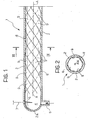
- Figure 1 is a partial view in axial section of a microcombustor according to the present invention;
- Figure 2 is a transverse section taken on the line II-II of Figure 1;
- Figure 3 is a partial view in axial section of a variant embodiment of a microcombustor according to the invention; and
- Figure 4 is a transverse sectional view of a further variant embodiment of a microcombustor according to the invention.
- In Figure 1 the Reference 1 generally indicates a microcombustor according to the present invention. This microcombustor comprises, in a manner known per se, a
body 2 of essentially tubular form. - One end 2a of the
body 2 is closed. Close to this end, in thebody 2, there is defined achamber 4 for supply and ignition of a fuel mixture, introduced into this chamber for example through asupply coupling 5. - Into the
chamber 4 extends an ignition device 6 controllable by means of an electrical control line 7. - The
end 4 of the chamber of the microcombustor communicates with aduct 8 within thebody 2. - The
duct 8 has a length very much greater than its average transverse dimension. The length of theduct 8 can be for example 20 times the average transverse dimension but may even be 100 times this dimension. - The
duct 8 is able to allow generation and propagation of the combustion initiated in thechamber 4, and propagation of the consequent pressure wave as well as the transition from the slow deflagration condition to the fast deflagration condition and/or to the detonation regime. - Conveniently, the internal surface of the
duct 8 has a plurality of formations able to impart to the flow of gas developed upon combustion a spin about the axis of the duct. - In the embodiment illustrated in Figures 1 and 2 the internal surface of the
duct 8 has a polygonal transverse section (see Figure 2) and in particular a hexagonal section. From the constructional point of view this polygonal configuration of the section is particularly favourable to the reduction of the transverse dimension of the duct. - The inner surface of the
duct 8 has a conformation corresponding to the combined rotation and translation of the basic polygonal section about and along the axis A-A of theduct 8. - Consequently, in the exemplary case of a hexagonal section, the internal surface of the
duct 8 is formed by six adjacenthelical strips 9 each corresponding to one side of the polygon (hexagon) of the basic section. - The shape of the internal surface of the
duct 8 of the microcombustor according to Figures 1 and 2 can be achieved very easily from the technological point of view. - A variant embodiment is illustrated in Figure 3. In this figure the parts and elements which are the same or substantially correspond to parts already described have again been attributed the same reference numerals.
- In the variant according to Figure 3, the inner surface of the
duct 8 has a plurality of projectingformations 19 of helical shape in the form of threads. In particular, in the non-limitative example illustrated the inner surface of theduct 8 has twohelical ridge elements 19 in the form of a two-start thread. - Conveniently, the section of each
helical formation 19 is essentially triangular, in the form of saw teeth, with alarger side 19a facing thechamber 4 and ashorter side 19b facing the outlet end of theduct 8. Correspondingly, the inclination with respect of the axis A-A of theside 19a is less than the inclination of theside 19b. This type of profile, as well as introducing turbulence by diffraction and spin-rotation of the combustion front, also has the function of combating the reflected wave thereby contributing to an increase of the thrust as well as the function of introducing further turbulence on this reflected wave. - In Figure 4 is shown a further embodiment in which the internal surface of the
duct 8 of the microcombustor has a plurality ofgrooves 29 which also have a helical development about the axis A-A of the said duct. - As already indicated above, the formations of the internal surface of the
duct 8 of the microcombustor according to the invention make it possible effectively to impart a spin to the flow of exhaust gases, limiting the divergence of these latter gases at the outlet of the duct. - In effect, if the duct was smooth the divergence of the exhaust gases would be predominantly dominated by diffraction effects, and therefore by the section of the duct closest to the outlet. In the arrangement according to the present invention the divergence of the exhaust gases is also dominated, and predominantly, by the "rifling" of the duct more than by the output section of the duct, which imparts a rotary-motion to the gases. The improved directionality of the gases increases the force of the thrust in the case of use as propulsion means, whilst in applications for actuation for example of a turbine, there is a greater transfer of the force impulse onto the turbine itself. The said formations also further create a turbulence within the
duct 8 which is important to facilitate the transition to detonation conditions. - Overall, by virtue of the improved stabilisation of the exhaust gases from the microcombustor, the operative use of the exhaust gases is improved and this is achieved both in thrusters and in applications in which the exhaust gases serve for rotating turbines or rotors of electric generators.
- Naturally, the principle of the invention remaining the same, the embodiments and details can be widely varied with respect to what has been described and illustrated purely by way of non-limitative example, without by this departing from the ambit of the invention as defined in the annexed Claims.
Claims (7)
- A microcombustor (1) comprising an essentially tubular body (2) with a closed end (2a) close to which is defined a chamber (4) for supply and ignition of a fuel mixture, which communicates with a duct (8) within the body (2) having a length very much greater than its average transverse dimension, and able to allow the generation and propagation of the combustion and the consequent pressure wave as well as the transition from slow deflagration conditions to fast deflagration conditions and/or to detonation conditions; the microcombustor (1) being characterised in that the inner surface of the said duct (8) has a plurality of formations (9; 19; 29) operable to impart to the flow of gases developed in the combustion a spin about the axis (A-A) of the duct (8).
- A microcombustor according to Claim 1, in which the duct (8) has an internal surface the form of which corresponds to that obtained by means of a combined rotation and translation of a polygon about the axis (A-A) of the duct (8).
- A microcombustor according to Claim 1, in which the inner surface of the duct (8) has at least one projecting formation (19) which develops helically about the axis (A-A) of the duct (2).
- A microcombustor according to Claim 3, in which the said at least one projecting formation (19) has a substantially triangular section.
- A microcombustor according to Claim 4, in which the section of the said at least one projecting formation (19) has a longer side (19a) facing the said chamber (4) and a short side (19b) facing the outlet end of the duct (8).
- A microcombustor according to any preceding claim from 3 to 5, in which the internal surface of the chamber has a plurality of projecting formations (19) which extend in the form of a helix about the axis (A-A) of the duct (8) in the form of a twin-start thread.
- A microcombustor according to Claim 1, in which the internal surface of the said duct (8) has a plurality of grooves (29) extending helically around the axis (A-A) of the said duct (8).
Priority Applications (3)
| Application Number | Priority Date | Filing Date | Title |
|---|---|---|---|
| EP04425537A EP1621815B1 (en) | 2004-07-20 | 2004-07-20 | Microcombustor |
| AT04425537T ATE376151T1 (en) | 2004-07-20 | 2004-07-20 | MICRO BURNER |
| DE602004009559T DE602004009559D1 (en) | 2004-07-20 | 2004-07-20 | microburner |
Applications Claiming Priority (1)
| Application Number | Priority Date | Filing Date | Title |
|---|---|---|---|
| EP04425537A EP1621815B1 (en) | 2004-07-20 | 2004-07-20 | Microcombustor |
Publications (2)
| Publication Number | Publication Date |
|---|---|
| EP1621815A1 true EP1621815A1 (en) | 2006-02-01 |
| EP1621815B1 EP1621815B1 (en) | 2007-10-17 |
Family
ID=34979184
Family Applications (1)
| Application Number | Title | Priority Date | Filing Date |
|---|---|---|---|
| EP04425537A Expired - Lifetime EP1621815B1 (en) | 2004-07-20 | 2004-07-20 | Microcombustor |
Country Status (3)
| Country | Link |
|---|---|
| EP (1) | EP1621815B1 (en) |
| AT (1) | ATE376151T1 (en) |
| DE (1) | DE602004009559D1 (en) |
Cited By (2)
| Publication number | Priority date | Publication date | Assignee | Title |
|---|---|---|---|---|
| EP1972934A1 (en) | 2007-03-23 | 2008-09-24 | Thermo Fisher Scientific Inc. | Combustion tube and method for combusting a sample for combustion analysis |
| CN106338083A (en) * | 2016-09-06 | 2017-01-18 | 西北工业大学 | Microscale detonation system with variable boundary conditions |
Citations (2)
| Publication number | Priority date | Publication date | Assignee | Title |
|---|---|---|---|---|
| US5901550A (en) * | 1993-04-14 | 1999-05-11 | Adroit Systems, Inc. | Liquid fueled pulse detonation engine with controller and inlet and exit valves |
| EP1350943A2 (en) * | 2002-03-27 | 2003-10-08 | General Electric Company | Shock wave reflector and detonation chamber |
-
2004
- 2004-07-20 EP EP04425537A patent/EP1621815B1/en not_active Expired - Lifetime
- 2004-07-20 DE DE602004009559T patent/DE602004009559D1/en not_active Expired - Lifetime
- 2004-07-20 AT AT04425537T patent/ATE376151T1/en not_active IP Right Cessation
Patent Citations (2)
| Publication number | Priority date | Publication date | Assignee | Title |
|---|---|---|---|---|
| US5901550A (en) * | 1993-04-14 | 1999-05-11 | Adroit Systems, Inc. | Liquid fueled pulse detonation engine with controller and inlet and exit valves |
| EP1350943A2 (en) * | 2002-03-27 | 2003-10-08 | General Electric Company | Shock wave reflector and detonation chamber |
Non-Patent Citations (1)
| Title |
|---|
| SHCHELKIN K. I.: "Effect of Tube Surface Roughness on Origin and Propagation of Detonation in Gas", JOURNAL OF EXPERIMENTAL AND THEORETICAL PHYSICS, vol. 10, 1940, USSR, pages 823 - 827, XP009054544 * |
Cited By (4)
| Publication number | Priority date | Publication date | Assignee | Title |
|---|---|---|---|---|
| EP1972934A1 (en) | 2007-03-23 | 2008-09-24 | Thermo Fisher Scientific Inc. | Combustion tube and method for combusting a sample for combustion analysis |
| US8758698B2 (en) | 2007-03-23 | 2014-06-24 | Thermo Fisher Scientific Inc. | Combustion tube and method for combusting a sample for combustion analysis |
| CN106338083A (en) * | 2016-09-06 | 2017-01-18 | 西北工业大学 | Microscale detonation system with variable boundary conditions |
| CN106338083B (en) * | 2016-09-06 | 2019-04-05 | 西北工业大学 | A Microscale Knock System with Variable Boundary Conditions |
Also Published As
| Publication number | Publication date |
|---|---|
| ATE376151T1 (en) | 2007-11-15 |
| EP1621815B1 (en) | 2007-10-17 |
| DE602004009559D1 (en) | 2007-11-29 |
Similar Documents
| Publication | Publication Date | Title |
|---|---|---|
| US4741154A (en) | Rotary detonation engine | |
| US7100360B2 (en) | Pulsed combustion engine | |
| EP3894685B1 (en) | Combustion chamber liner with spiral cooling channels | |
| US20120047873A1 (en) | Duplex tab obstacles for enhancement of deflagration-to-detonation transition | |
| EP1988275B1 (en) | Hybrid worm gas turbine engine | |
| US6460342B1 (en) | Wave rotor detonation engine | |
| RU2345238C1 (en) | Mixing head of liquid propellant rocket engine chamber | |
| US9140456B2 (en) | Variable initiation location system for pulse detonation combustor | |
| EP1455065B1 (en) | Pulse detonation system for a gas turbine engine | |
| US8650856B2 (en) | Fluidic deflagration-to-detonation initiation obstacles | |
| US7526912B2 (en) | Pulse detonation engines and components thereof | |
| US20090193786A1 (en) | System And Method Of Continuous Detonation In A Gas Turbine Engine | |
| US6931858B2 (en) | Rotating pulse detonation system for a gas turbine engine | |
| US20030200753A1 (en) | Method and apparatus for improving the efficiency of pulsed detonation engines | |
| RU164690U1 (en) | PENDULUM-SLIDER DEVICE FOR REACTIVE DETONATION BURNING | |
| EP2600062A2 (en) | Variable initiation location system for pulse detonation combustor | |
| JP2004536261A (en) | Pyrotechnic actuator device with a swivel cylinder | |
| JP2010523866A (en) | Pintle control propulsion system with external ring actuator | |
| CN100482950C (en) | Non-axisymmetric blade tip actuation generator | |
| US10969107B2 (en) | Turbine engine assembly including a rotating detonation combustor | |
| EP1621815A1 (en) | Microcombustor | |
| US20090196733A1 (en) | Rotary Pressure Rise Combustor For A Gas Turbine Engine | |
| CN112211747A (en) | Internal structure of rotary acceleration type solid rocket engine | |
| RU2291975C1 (en) | Mixing head of chamber of liquid rocket engine | |
| RU2324836C1 (en) | Mixer head of rocket liquid propellant system |
Legal Events
| Date | Code | Title | Description |
|---|---|---|---|
| PUAI | Public reference made under article 153(3) epc to a published international application that has entered the european phase |
Free format text: ORIGINAL CODE: 0009012 |
|
| AK | Designated contracting states |
Kind code of ref document: A1 Designated state(s): AT BE BG CH CY CZ DE DK EE ES FI FR GB GR HU IE IT LI LU MC NL PL PT RO SE SI SK TR |
|
| AX | Request for extension of the european patent |
Extension state: AL HR LT LV MK |
|
| 17P | Request for examination filed |
Effective date: 20060510 |
|
| AKX | Designation fees paid |
Designated state(s): AT BE BG CH CY CZ DE DK EE ES FI FR GB GR HU IE IT LI LU MC NL PL PT RO SE SI SK TR |
|
| 17Q | First examination report despatched |
Effective date: 20060919 |
|
| GRAP | Despatch of communication of intention to grant a patent |
Free format text: ORIGINAL CODE: EPIDOSNIGR1 |
|
| GRAS | Grant fee paid |
Free format text: ORIGINAL CODE: EPIDOSNIGR3 |
|
| GRAA | (expected) grant |
Free format text: ORIGINAL CODE: 0009210 |
|
| AK | Designated contracting states |
Kind code of ref document: B1 Designated state(s): AT BE BG CH CY CZ DE DK EE ES FI FR GB GR HU IE IT LI LU MC NL PL PT RO SE SI SK TR |
|
| REG | Reference to a national code |
Ref country code: GB Ref legal event code: FG4D |
|
| REG | Reference to a national code |
Ref country code: CH Ref legal event code: EP |
|
| REG | Reference to a national code |
Ref country code: IE Ref legal event code: FG4D |
|
| REF | Corresponds to: |
Ref document number: 602004009559 Country of ref document: DE Date of ref document: 20071129 Kind code of ref document: P |
|
| NLV1 | Nl: lapsed or annulled due to failure to fulfill the requirements of art. 29p and 29m of the patents act | ||
| PG25 | Lapsed in a contracting state [announced via postgrant information from national office to epo] |
Ref country code: NL Free format text: LAPSE BECAUSE OF FAILURE TO SUBMIT A TRANSLATION OF THE DESCRIPTION OR TO PAY THE FEE WITHIN THE PRESCRIBED TIME-LIMIT Effective date: 20071017 Ref country code: CH Free format text: LAPSE BECAUSE OF FAILURE TO SUBMIT A TRANSLATION OF THE DESCRIPTION OR TO PAY THE FEE WITHIN THE PRESCRIBED TIME-LIMIT Effective date: 20071017 Ref country code: SE Free format text: LAPSE BECAUSE OF FAILURE TO SUBMIT A TRANSLATION OF THE DESCRIPTION OR TO PAY THE FEE WITHIN THE PRESCRIBED TIME-LIMIT Effective date: 20080117 Ref country code: ES Free format text: LAPSE BECAUSE OF FAILURE TO SUBMIT A TRANSLATION OF THE DESCRIPTION OR TO PAY THE FEE WITHIN THE PRESCRIBED TIME-LIMIT Effective date: 20080128 Ref country code: LI Free format text: LAPSE BECAUSE OF FAILURE TO SUBMIT A TRANSLATION OF THE DESCRIPTION OR TO PAY THE FEE WITHIN THE PRESCRIBED TIME-LIMIT Effective date: 20071017 |
|
| REG | Reference to a national code |
Ref country code: CH Ref legal event code: PL |
|
| PG25 | Lapsed in a contracting state [announced via postgrant information from national office to epo] |
Ref country code: PL Free format text: LAPSE BECAUSE OF FAILURE TO SUBMIT A TRANSLATION OF THE DESCRIPTION OR TO PAY THE FEE WITHIN THE PRESCRIBED TIME-LIMIT Effective date: 20071017 Ref country code: PT Free format text: LAPSE BECAUSE OF FAILURE TO SUBMIT A TRANSLATION OF THE DESCRIPTION OR TO PAY THE FEE WITHIN THE PRESCRIBED TIME-LIMIT Effective date: 20080317 Ref country code: SI Free format text: LAPSE BECAUSE OF FAILURE TO SUBMIT A TRANSLATION OF THE DESCRIPTION OR TO PAY THE FEE WITHIN THE PRESCRIBED TIME-LIMIT Effective date: 20071017 Ref country code: BG Free format text: LAPSE BECAUSE OF FAILURE TO SUBMIT A TRANSLATION OF THE DESCRIPTION OR TO PAY THE FEE WITHIN THE PRESCRIBED TIME-LIMIT Effective date: 20080117 |
|
| PG25 | Lapsed in a contracting state [announced via postgrant information from national office to epo] |
Ref country code: AT Free format text: LAPSE BECAUSE OF FAILURE TO SUBMIT A TRANSLATION OF THE DESCRIPTION OR TO PAY THE FEE WITHIN THE PRESCRIBED TIME-LIMIT Effective date: 20071017 |
|
| PG25 | Lapsed in a contracting state [announced via postgrant information from national office to epo] |
Ref country code: DK Free format text: LAPSE BECAUSE OF FAILURE TO SUBMIT A TRANSLATION OF THE DESCRIPTION OR TO PAY THE FEE WITHIN THE PRESCRIBED TIME-LIMIT Effective date: 20071017 Ref country code: CZ Free format text: LAPSE BECAUSE OF FAILURE TO SUBMIT A TRANSLATION OF THE DESCRIPTION OR TO PAY THE FEE WITHIN THE PRESCRIBED TIME-LIMIT Effective date: 20071017 |
|
| EN | Fr: translation not filed | ||
| PLBE | No opposition filed within time limit |
Free format text: ORIGINAL CODE: 0009261 |
|
| STAA | Information on the status of an ep patent application or granted ep patent |
Free format text: STATUS: NO OPPOSITION FILED WITHIN TIME LIMIT |
|
| PG25 | Lapsed in a contracting state [announced via postgrant information from national office to epo] |
Ref country code: BE Free format text: LAPSE BECAUSE OF FAILURE TO SUBMIT A TRANSLATION OF THE DESCRIPTION OR TO PAY THE FEE WITHIN THE PRESCRIBED TIME-LIMIT Effective date: 20071017 Ref country code: RO Free format text: LAPSE BECAUSE OF FAILURE TO SUBMIT A TRANSLATION OF THE DESCRIPTION OR TO PAY THE FEE WITHIN THE PRESCRIBED TIME-LIMIT Effective date: 20071017 Ref country code: SK Free format text: LAPSE BECAUSE OF FAILURE TO SUBMIT A TRANSLATION OF THE DESCRIPTION OR TO PAY THE FEE WITHIN THE PRESCRIBED TIME-LIMIT Effective date: 20071017 |
|
| 26N | No opposition filed |
Effective date: 20080718 |
|
| PG25 | Lapsed in a contracting state [announced via postgrant information from national office to epo] |
Ref country code: DE Free format text: LAPSE BECAUSE OF FAILURE TO SUBMIT A TRANSLATION OF THE DESCRIPTION OR TO PAY THE FEE WITHIN THE PRESCRIBED TIME-LIMIT Effective date: 20080118 Ref country code: FR Free format text: LAPSE BECAUSE OF FAILURE TO SUBMIT A TRANSLATION OF THE DESCRIPTION OR TO PAY THE FEE WITHIN THE PRESCRIBED TIME-LIMIT Effective date: 20080801 |
|
| PG25 | Lapsed in a contracting state [announced via postgrant information from national office to epo] |
Ref country code: GR Free format text: LAPSE BECAUSE OF FAILURE TO SUBMIT A TRANSLATION OF THE DESCRIPTION OR TO PAY THE FEE WITHIN THE PRESCRIBED TIME-LIMIT Effective date: 20080118 |
|
| PG25 | Lapsed in a contracting state [announced via postgrant information from national office to epo] |
Ref country code: FI Free format text: LAPSE BECAUSE OF FAILURE TO SUBMIT A TRANSLATION OF THE DESCRIPTION OR TO PAY THE FEE WITHIN THE PRESCRIBED TIME-LIMIT Effective date: 20071017 |
|
| GBPC | Gb: european patent ceased through non-payment of renewal fee |
Effective date: 20080720 |
|
| PG25 | Lapsed in a contracting state [announced via postgrant information from national office to epo] |
Ref country code: MC Free format text: LAPSE BECAUSE OF NON-PAYMENT OF DUE FEES Effective date: 20080731 |
|
| PG25 | Lapsed in a contracting state [announced via postgrant information from national office to epo] |
Ref country code: EE Free format text: LAPSE BECAUSE OF FAILURE TO SUBMIT A TRANSLATION OF THE DESCRIPTION OR TO PAY THE FEE WITHIN THE PRESCRIBED TIME-LIMIT Effective date: 20071017 |
|
| PG25 | Lapsed in a contracting state [announced via postgrant information from national office to epo] |
Ref country code: GB Free format text: LAPSE BECAUSE OF NON-PAYMENT OF DUE FEES Effective date: 20080720 |
|
| PG25 | Lapsed in a contracting state [announced via postgrant information from national office to epo] |
Ref country code: IE Free format text: LAPSE BECAUSE OF NON-PAYMENT OF DUE FEES Effective date: 20080721 Ref country code: CY Free format text: LAPSE BECAUSE OF FAILURE TO SUBMIT A TRANSLATION OF THE DESCRIPTION OR TO PAY THE FEE WITHIN THE PRESCRIBED TIME-LIMIT Effective date: 20071017 |
|
| PG25 | Lapsed in a contracting state [announced via postgrant information from national office to epo] |
Ref country code: LU Free format text: LAPSE BECAUSE OF NON-PAYMENT OF DUE FEES Effective date: 20080720 Ref country code: HU Free format text: LAPSE BECAUSE OF FAILURE TO SUBMIT A TRANSLATION OF THE DESCRIPTION OR TO PAY THE FEE WITHIN THE PRESCRIBED TIME-LIMIT Effective date: 20080418 |
|
| PG25 | Lapsed in a contracting state [announced via postgrant information from national office to epo] |
Ref country code: TR Free format text: LAPSE BECAUSE OF FAILURE TO SUBMIT A TRANSLATION OF THE DESCRIPTION OR TO PAY THE FEE WITHIN THE PRESCRIBED TIME-LIMIT Effective date: 20071017 |
|
| PG25 | Lapsed in a contracting state [announced via postgrant information from national office to epo] |
Ref country code: IT Free format text: LAPSE BECAUSE OF NON-PAYMENT OF DUE FEES Effective date: 20080731 |