EP1621535A1 - Substituted cyclic urea derivatives, preparation thereof and pharmaceutical use thereof as kinase inhibitors - Google Patents
Substituted cyclic urea derivatives, preparation thereof and pharmaceutical use thereof as kinase inhibitors Download PDFInfo
- Publication number
- EP1621535A1 EP1621535A1 EP04291903A EP04291903A EP1621535A1 EP 1621535 A1 EP1621535 A1 EP 1621535A1 EP 04291903 A EP04291903 A EP 04291903A EP 04291903 A EP04291903 A EP 04291903A EP 1621535 A1 EP1621535 A1 EP 1621535A1
- Authority
- EP
- European Patent Office
- Prior art keywords
- radicals
- alkyl
- products
- formula
- optionally substituted
- Prior art date
- Legal status (The legal status is an assumption and is not a legal conclusion. Google has not performed a legal analysis and makes no representation as to the accuracy of the status listed.)
- Withdrawn
Links
- 238000002360 preparation method Methods 0.000 title claims description 18
- ZMGMDXCADSRNCX-UHFFFAOYSA-N 5,6-dihydroxy-1,3-diazepan-2-one Chemical class OC1CNC(=O)NCC1O ZMGMDXCADSRNCX-UHFFFAOYSA-N 0.000 title description 3
- 229940043355 kinase inhibitor Drugs 0.000 title 1
- 239000003757 phosphotransferase inhibitor Substances 0.000 title 1
- -1 heteroaryl radicals Chemical class 0.000 claims description 306
- 125000000217 alkyl group Chemical group 0.000 claims description 142
- 125000004432 carbon atom Chemical group C* 0.000 claims description 61
- 150000003839 salts Chemical class 0.000 claims description 58
- 125000000753 cycloalkyl group Chemical group 0.000 claims description 56
- 239000001257 hydrogen Substances 0.000 claims description 56
- 229910052739 hydrogen Inorganic materials 0.000 claims description 56
- 125000003545 alkoxy group Chemical group 0.000 claims description 55
- 229910052500 inorganic mineral Inorganic materials 0.000 claims description 53
- 239000011707 mineral Substances 0.000 claims description 53
- 125000005843 halogen group Chemical group 0.000 claims description 48
- 229910052757 nitrogen Inorganic materials 0.000 claims description 46
- 125000001997 phenyl group Chemical group [H]C1=C([H])C([H])=C(*)C([H])=C1[H] 0.000 claims description 43
- 206010028980 Neoplasm Diseases 0.000 claims description 41
- 102000001253 Protein Kinase Human genes 0.000 claims description 40
- 108060006633 protein kinase Proteins 0.000 claims description 40
- 125000002887 hydroxy group Chemical group [H]O* 0.000 claims description 35
- UFHFLCQGNIYNRP-UHFFFAOYSA-N Hydrogen Chemical compound [H][H] UFHFLCQGNIYNRP-UHFFFAOYSA-N 0.000 claims description 31
- 229910052736 halogen Inorganic materials 0.000 claims description 31
- 150000002367 halogens Chemical class 0.000 claims description 31
- 125000003342 alkenyl group Chemical group 0.000 claims description 29
- 125000001072 heteroaryl group Chemical group 0.000 claims description 29
- 229940126601 medicinal product Drugs 0.000 claims description 29
- 125000003118 aryl group Chemical group 0.000 claims description 28
- 229910052760 oxygen Inorganic materials 0.000 claims description 27
- 125000001153 fluoro group Chemical group F* 0.000 claims description 26
- 150000007522 mineralic acids Chemical class 0.000 claims description 26
- 150000007524 organic acids Chemical class 0.000 claims description 26
- 150000007530 organic bases Chemical class 0.000 claims description 26
- 125000002023 trifluoromethyl group Chemical group FC(F)(F)* 0.000 claims description 26
- 125000004433 nitrogen atom Chemical group N* 0.000 claims description 25
- 125000003178 carboxy group Chemical group [H]OC(*)=O 0.000 claims description 24
- 125000005842 heteroatom Chemical group 0.000 claims description 24
- 235000005985 organic acids Nutrition 0.000 claims description 24
- 201000011510 cancer Diseases 0.000 claims description 23
- 208000037265 diseases, disorders, signs and symptoms Diseases 0.000 claims description 23
- 125000000592 heterocycloalkyl group Chemical group 0.000 claims description 23
- 125000001424 substituent group Chemical group 0.000 claims description 20
- 125000000304 alkynyl group Chemical group 0.000 claims description 17
- 201000010099 disease Diseases 0.000 claims description 17
- 150000002431 hydrogen Chemical class 0.000 claims description 17
- 125000004435 hydrogen atom Chemical group [H]* 0.000 claims description 17
- 125000000449 nitro group Chemical group [O-][N+](*)=O 0.000 claims description 16
- 229910052717 sulfur Inorganic materials 0.000 claims description 16
- 125000002757 morpholinyl group Chemical group 0.000 claims description 15
- 125000004193 piperazinyl group Chemical group 0.000 claims description 15
- 125000005936 piperidyl group Chemical group 0.000 claims description 13
- 230000000694 effects Effects 0.000 claims description 12
- 125000002924 primary amino group Chemical group [H]N([H])* 0.000 claims description 12
- 238000002512 chemotherapy Methods 0.000 claims description 11
- 125000000999 tert-butyl group Chemical group [H]C([H])([H])C(*)(C([H])([H])[H])C([H])([H])[H] 0.000 claims description 11
- 125000001316 cycloalkyl alkyl group Chemical group 0.000 claims description 10
- 125000001495 ethyl group Chemical group [H]C([H])([H])C([H])([H])* 0.000 claims description 10
- 125000000623 heterocyclic group Chemical group 0.000 claims description 10
- 125000002496 methyl group Chemical group [H]C([H])([H])* 0.000 claims description 10
- 125000003884 phenylalkyl group Chemical group 0.000 claims description 10
- 125000003226 pyrazolyl group Chemical group 0.000 claims description 10
- 125000000719 pyrrolidinyl group Chemical group 0.000 claims description 10
- 101000599951 Homo sapiens Insulin-like growth factor I Proteins 0.000 claims description 9
- 102100037852 Insulin-like growth factor I Human genes 0.000 claims description 9
- 108010053099 Vascular Endothelial Growth Factor Receptor-2 Proteins 0.000 claims description 9
- 102100033177 Vascular endothelial growth factor receptor 2 Human genes 0.000 claims description 9
- MDFFNEOEWAXZRQ-UHFFFAOYSA-N aminyl Chemical compound [NH2] MDFFNEOEWAXZRQ-UHFFFAOYSA-N 0.000 claims description 9
- 229910052799 carbon Inorganic materials 0.000 claims description 9
- 125000001995 cyclobutyl group Chemical group [H]C1([H])C([H])([H])C([H])(*)C1([H])[H] 0.000 claims description 9
- 125000001559 cyclopropyl group Chemical group [H]C1([H])C([H])([H])C1([H])* 0.000 claims description 9
- 239000008194 pharmaceutical composition Substances 0.000 claims description 9
- 125000000714 pyrimidinyl group Chemical group 0.000 claims description 9
- 125000000547 substituted alkyl group Chemical group 0.000 claims description 9
- 125000000339 4-pyridyl group Chemical group N1=C([H])C([H])=C([*])C([H])=C1[H] 0.000 claims description 8
- 208000026310 Breast neoplasm Diseases 0.000 claims description 8
- NQRYJNQNLNOLGT-UHFFFAOYSA-N Piperidine Chemical compound C1CCNCC1 NQRYJNQNLNOLGT-UHFFFAOYSA-N 0.000 claims description 8
- RWRDLPDLKQPQOW-UHFFFAOYSA-N Pyrrolidine Chemical compound C1CCNC1 RWRDLPDLKQPQOW-UHFFFAOYSA-N 0.000 claims description 8
- 125000003282 alkyl amino group Chemical group 0.000 claims description 8
- 125000004663 dialkyl amino group Chemical group 0.000 claims description 8
- 125000001449 isopropyl group Chemical group [H]C([H])([H])C([H])(*)C([H])([H])[H] 0.000 claims description 8
- 125000004573 morpholin-4-yl group Chemical group N1(CCOCC1)* 0.000 claims description 8
- 125000005493 quinolyl group Chemical group 0.000 claims description 8
- 206010006187 Breast cancer Diseases 0.000 claims description 7
- 101001034652 Homo sapiens Insulin-like growth factor 1 receptor Proteins 0.000 claims description 7
- 102100039688 Insulin-like growth factor 1 receptor Human genes 0.000 claims description 7
- 125000002837 carbocyclic group Chemical group 0.000 claims description 7
- 125000004093 cyano group Chemical group *C#N 0.000 claims description 7
- 102000052116 epidermal growth factor receptor activity proteins Human genes 0.000 claims description 7
- 108700015053 epidermal growth factor receptor activity proteins Proteins 0.000 claims description 7
- 125000002883 imidazolyl group Chemical group 0.000 claims description 7
- YOHYSYJDKVYCJI-UHFFFAOYSA-N n-[3-[[6-[3-(trifluoromethyl)anilino]pyrimidin-4-yl]amino]phenyl]cyclopropanecarboxamide Chemical compound FC(F)(F)C1=CC=CC(NC=2N=CN=C(NC=3C=C(NC(=O)C4CC4)C=CC=3)C=2)=C1 YOHYSYJDKVYCJI-UHFFFAOYSA-N 0.000 claims description 7
- 125000004076 pyridyl group Chemical group 0.000 claims description 7
- 125000002294 quinazolinyl group Chemical group N1=C(N=CC2=CC=CC=C12)* 0.000 claims description 7
- 125000002914 sec-butyl group Chemical group [H]C([H])([H])C([H])([H])C([H])(*)C([H])([H])[H] 0.000 claims description 7
- 125000003107 substituted aryl group Chemical group 0.000 claims description 7
- 125000001973 tert-pentyl group Chemical group [H]C([H])([H])C([H])([H])C(*)(C([H])([H])[H])C([H])([H])[H] 0.000 claims description 7
- 125000004214 1-pyrrolidinyl group Chemical group [H]C1([H])N(*)C([H])([H])C([H])([H])C1([H])[H] 0.000 claims description 6
- 125000003542 3-methylbutan-2-yl group Chemical group [H]C([H])([H])C([H])(*)C([H])(C([H])([H])[H])C([H])([H])[H] 0.000 claims description 6
- 125000003349 3-pyridyl group Chemical group N1=C([H])C([*])=C([H])C([H])=C1[H] 0.000 claims description 6
- 108010024986 Cyclin-Dependent Kinase 2 Proteins 0.000 claims description 6
- 102100036239 Cyclin-dependent kinase 2 Human genes 0.000 claims description 6
- 102100026810 Cyclin-dependent kinase 7 Human genes 0.000 claims description 6
- 101100481408 Danio rerio tie2 gene Proteins 0.000 claims description 6
- 102100037813 Focal adhesion kinase 1 Human genes 0.000 claims description 6
- 101000911952 Homo sapiens Cyclin-dependent kinase 7 Proteins 0.000 claims description 6
- 206010058467 Lung neoplasm malignant Diseases 0.000 claims description 6
- YNAVUWVOSKDBBP-UHFFFAOYSA-N Morpholine Chemical compound C1COCCN1 YNAVUWVOSKDBBP-UHFFFAOYSA-N 0.000 claims description 6
- 101100481410 Mus musculus Tek gene Proteins 0.000 claims description 6
- 102000004022 Protein-Tyrosine Kinases Human genes 0.000 claims description 6
- 108090000412 Protein-Tyrosine Kinases Proteins 0.000 claims description 6
- 125000004429 atom Chemical group 0.000 claims description 6
- 125000005334 azaindolyl group Chemical group N1N=C(C2=CC=CC=C12)* 0.000 claims description 6
- 101150065030 cdc7 gene Proteins 0.000 claims description 6
- 208000035475 disorder Diseases 0.000 claims description 6
- 125000003387 indolinyl group Chemical group N1(CCC2=CC=CC=C12)* 0.000 claims description 6
- 239000003112 inhibitor Substances 0.000 claims description 6
- 230000002401 inhibitory effect Effects 0.000 claims description 6
- 201000005202 lung cancer Diseases 0.000 claims description 6
- 208000020816 lung neoplasm Diseases 0.000 claims description 6
- 229940002612 prodrug Drugs 0.000 claims description 6
- 239000000651 prodrug Substances 0.000 claims description 6
- 125000000335 thiazolyl group Chemical group 0.000 claims description 6
- 125000000876 trifluoromethoxy group Chemical group FC(F)(F)O* 0.000 claims description 6
- 241000124008 Mammalia Species 0.000 claims description 5
- CIUQDSCDWFSTQR-UHFFFAOYSA-N [C]1=CC=CC=C1 Chemical group [C]1=CC=CC=C1 CIUQDSCDWFSTQR-UHFFFAOYSA-N 0.000 claims description 5
- 230000004663 cell proliferation Effects 0.000 claims description 5
- 239000003795 chemical substances by application Substances 0.000 claims description 5
- 208000029742 colonic neoplasm Diseases 0.000 claims description 5
- 125000000392 cycloalkenyl group Chemical group 0.000 claims description 5
- 125000001041 indolyl group Chemical group 0.000 claims description 5
- 125000000168 pyrrolyl group Chemical group 0.000 claims description 5
- 125000004571 thiomorpholin-4-yl group Chemical group N1(CCSCC1)* 0.000 claims description 5
- 125000006272 (C3-C7) cycloalkyl group Chemical group 0.000 claims description 4
- LBUJPTNKIBCYBY-UHFFFAOYSA-N 1,2,3,4-tetrahydroquinoline Chemical compound C1=CC=C2CCCNC2=C1 LBUJPTNKIBCYBY-UHFFFAOYSA-N 0.000 claims description 4
- 125000006432 1-methyl cyclopropyl group Chemical group [H]C([H])([H])C1(*)C([H])([H])C1([H])[H] 0.000 claims description 4
- 102000005789 Vascular Endothelial Growth Factors Human genes 0.000 claims description 4
- 108010019530 Vascular Endothelial Growth Factors Proteins 0.000 claims description 4
- 125000003785 benzimidazolyl group Chemical group N1=C(NC2=C1C=CC=C2)* 0.000 claims description 4
- 239000003814 drug Substances 0.000 claims description 4
- 125000003838 furazanyl group Chemical group 0.000 claims description 4
- 125000004446 heteroarylalkyl group Chemical group 0.000 claims description 4
- 125000005885 heterocycloalkylalkyl group Chemical group 0.000 claims description 4
- 125000003453 indazolyl group Chemical group N1N=C(C2=C1C=CC=C2)* 0.000 claims description 4
- 201000001441 melanoma Diseases 0.000 claims description 4
- 125000002950 monocyclic group Chemical group 0.000 claims description 4
- 230000035755 proliferation Effects 0.000 claims description 4
- 229940124597 therapeutic agent Drugs 0.000 claims description 4
- 208000003174 Brain Neoplasms Diseases 0.000 claims description 3
- ZEOWTGPWHLSLOG-UHFFFAOYSA-N Cc1ccc(cc1-c1ccc2c(n[nH]c2c1)-c1cnn(c1)C1CC1)C(=O)Nc1cccc(c1)C(F)(F)F Chemical compound Cc1ccc(cc1-c1ccc2c(n[nH]c2c1)-c1cnn(c1)C1CC1)C(=O)Nc1cccc(c1)C(F)(F)F ZEOWTGPWHLSLOG-UHFFFAOYSA-N 0.000 claims description 3
- 101150017750 FGFRL1 gene Proteins 0.000 claims description 3
- 102100023593 Fibroblast growth factor receptor 1 Human genes 0.000 claims description 3
- 101710182386 Fibroblast growth factor receptor 1 Proteins 0.000 claims description 3
- 102100023600 Fibroblast growth factor receptor 2 Human genes 0.000 claims description 3
- 101710182389 Fibroblast growth factor receptor 2 Proteins 0.000 claims description 3
- 102100027842 Fibroblast growth factor receptor 3 Human genes 0.000 claims description 3
- 101710182396 Fibroblast growth factor receptor 3 Proteins 0.000 claims description 3
- 102100027844 Fibroblast growth factor receptor 4 Human genes 0.000 claims description 3
- 102100026149 Fibroblast growth factor receptor-like 1 Human genes 0.000 claims description 3
- 101000917134 Homo sapiens Fibroblast growth factor receptor 4 Proteins 0.000 claims description 3
- 206010033128 Ovarian cancer Diseases 0.000 claims description 3
- 101150094745 Ptk2b gene Proteins 0.000 claims description 3
- 102100033810 RAC-alpha serine/threonine-protein kinase Human genes 0.000 claims description 3
- 208000024770 Thyroid neoplasm Diseases 0.000 claims description 3
- 125000003710 aryl alkyl group Chemical group 0.000 claims description 3
- 125000002541 furyl group Chemical group 0.000 claims description 3
- 206010017758 gastric cancer Diseases 0.000 claims description 3
- TUJKJAMUKRIRHC-UHFFFAOYSA-N hydroxyl Chemical group [OH] TUJKJAMUKRIRHC-UHFFFAOYSA-N 0.000 claims description 3
- 125000000842 isoxazolyl group Chemical group 0.000 claims description 3
- 210000002307 prostate Anatomy 0.000 claims description 3
- 125000000561 purinyl group Chemical group N1=C(N=C2N=CNC2=C1)* 0.000 claims description 3
- 206010000599 Acromegaly Diseases 0.000 claims description 2
- 206010005949 Bone cancer Diseases 0.000 claims description 2
- 208000018084 Bone neoplasm Diseases 0.000 claims description 2
- 208000011231 Crohn disease Diseases 0.000 claims description 2
- 206010020751 Hypersensitivity Diseases 0.000 claims description 2
- 208000008839 Kidney Neoplasms Diseases 0.000 claims description 2
- 206010025421 Macule Diseases 0.000 claims description 2
- 206010028289 Muscle atrophy Diseases 0.000 claims description 2
- 206010061535 Ovarian neoplasm Diseases 0.000 claims description 2
- 206010061902 Pancreatic neoplasm Diseases 0.000 claims description 2
- 201000004681 Psoriasis Diseases 0.000 claims description 2
- 208000017442 Retinal disease Diseases 0.000 claims description 2
- 206010038923 Retinopathy Diseases 0.000 claims description 2
- 208000005718 Stomach Neoplasms Diseases 0.000 claims description 2
- 208000007536 Thrombosis Diseases 0.000 claims description 2
- 208000002495 Uterine Neoplasms Diseases 0.000 claims description 2
- 230000032683 aging Effects 0.000 claims description 2
- 230000007815 allergy Effects 0.000 claims description 2
- 230000000259 anti-tumor effect Effects 0.000 claims description 2
- 229940045988 antineoplastic drug protein kinase inhibitors Drugs 0.000 claims description 2
- 208000006673 asthma Diseases 0.000 claims description 2
- 125000002393 azetidinyl group Chemical group 0.000 claims description 2
- 125000004622 benzoxazinyl group Chemical group O1NC(=CC2=C1C=CC=C2)* 0.000 claims description 2
- 210000004204 blood vessel Anatomy 0.000 claims description 2
- 238000004113 cell culture Methods 0.000 claims description 2
- 125000004230 chromenyl group Chemical group O1C(C=CC2=CC=CC=C12)* 0.000 claims description 2
- 229940127089 cytotoxic agent Drugs 0.000 claims description 2
- 239000002254 cytotoxic agent Substances 0.000 claims description 2
- 231100000599 cytotoxic agent Toxicity 0.000 claims description 2
- 230000007850 degeneration Effects 0.000 claims description 2
- 230000003831 deregulation Effects 0.000 claims description 2
- 206010012601 diabetes mellitus Diseases 0.000 claims description 2
- 230000003176 fibrotic effect Effects 0.000 claims description 2
- 206010023841 laryngeal neoplasm Diseases 0.000 claims description 2
- 210000004324 lymphatic system Anatomy 0.000 claims description 2
- 210000003584 mesangial cell Anatomy 0.000 claims description 2
- 208000030159 metabolic disease Diseases 0.000 claims description 2
- 210000000653 nervous system Anatomy 0.000 claims description 2
- 125000003386 piperidinyl group Chemical group 0.000 claims description 2
- 239000003909 protein kinase inhibitor Substances 0.000 claims description 2
- 238000001959 radiotherapy Methods 0.000 claims description 2
- 206010039073 rheumatoid arthritis Diseases 0.000 claims description 2
- 229920006395 saturated elastomer Polymers 0.000 claims description 2
- 210000001625 seminal vesicle Anatomy 0.000 claims description 2
- 201000011549 stomach cancer Diseases 0.000 claims description 2
- 125000001984 thiazolidinyl group Chemical group 0.000 claims description 2
- 125000001544 thienyl group Chemical group 0.000 claims description 2
- 125000000464 thioxo group Chemical group S=* 0.000 claims description 2
- 206010046766 uterine cancer Diseases 0.000 claims description 2
- 201000010653 vesiculitis Diseases 0.000 claims description 2
- 239000000047 product Substances 0.000 description 121
- 150000003254 radicals Chemical group 0.000 description 92
- 238000006243 chemical reaction Methods 0.000 description 49
- 108010067715 Focal Adhesion Protein-Tyrosine Kinases Proteins 0.000 description 31
- 102000016621 Focal Adhesion Protein-Tyrosine Kinases Human genes 0.000 description 31
- ZMXDDKWLCZADIW-UHFFFAOYSA-N N,N-Dimethylformamide Chemical compound CN(C)C=O ZMXDDKWLCZADIW-UHFFFAOYSA-N 0.000 description 30
- YXFVVABEGXRONW-UHFFFAOYSA-N Toluene Chemical compound CC1=CC=CC=C1 YXFVVABEGXRONW-UHFFFAOYSA-N 0.000 description 30
- YMWUJEATGCHHMB-UHFFFAOYSA-N Dichloromethane Chemical compound ClCCl YMWUJEATGCHHMB-UHFFFAOYSA-N 0.000 description 29
- 235000010755 mineral Nutrition 0.000 description 29
- OKKJLVBELUTLKV-UHFFFAOYSA-N Methanol Chemical compound OC OKKJLVBELUTLKV-UHFFFAOYSA-N 0.000 description 27
- WYURNTSHIVDZCO-UHFFFAOYSA-N Tetrahydrofuran Chemical compound C1CCOC1 WYURNTSHIVDZCO-UHFFFAOYSA-N 0.000 description 25
- 210000004027 cell Anatomy 0.000 description 25
- 150000001875 compounds Chemical class 0.000 description 24
- 239000002253 acid Substances 0.000 description 23
- 230000006870 function Effects 0.000 description 20
- 239000000203 mixture Substances 0.000 description 20
- 239000000243 solution Substances 0.000 description 20
- VEXZGXHMUGYJMC-UHFFFAOYSA-N Hydrochloric acid Chemical compound Cl VEXZGXHMUGYJMC-UHFFFAOYSA-N 0.000 description 19
- DTQVDTLACAAQTR-UHFFFAOYSA-N Trifluoroacetic acid Chemical compound OC(=O)C(F)(F)F DTQVDTLACAAQTR-UHFFFAOYSA-N 0.000 description 18
- 238000000034 method Methods 0.000 description 17
- 239000002904 solvent Substances 0.000 description 17
- 230000014759 maintenance of location Effects 0.000 description 16
- WEVYAHXRMPXWCK-UHFFFAOYSA-N Acetonitrile Chemical compound CC#N WEVYAHXRMPXWCK-UHFFFAOYSA-N 0.000 description 15
- 238000004128 high performance liquid chromatography Methods 0.000 description 15
- 239000011347 resin Substances 0.000 description 13
- 229920005989 resin Polymers 0.000 description 13
- XEKOWRVHYACXOJ-UHFFFAOYSA-N Ethyl acetate Chemical compound CCOC(C)=O XEKOWRVHYACXOJ-UHFFFAOYSA-N 0.000 description 12
- 229940093915 gynecological organic acid Drugs 0.000 description 12
- 125000006239 protecting group Chemical group 0.000 description 12
- 150000002148 esters Chemical class 0.000 description 11
- XLYOFNOQVPJJNP-UHFFFAOYSA-N water Substances O XLYOFNOQVPJJNP-UHFFFAOYSA-N 0.000 description 11
- 102000005962 receptors Human genes 0.000 description 10
- 108020003175 receptors Proteins 0.000 description 10
- QTBSBXVTEAMEQO-UHFFFAOYSA-N Acetic acid Chemical compound CC(O)=O QTBSBXVTEAMEQO-UHFFFAOYSA-N 0.000 description 9
- 108091000080 Phosphotransferase Proteins 0.000 description 9
- ZMANZCXQSJIPKH-UHFFFAOYSA-N Triethylamine Chemical compound CCN(CC)CC ZMANZCXQSJIPKH-UHFFFAOYSA-N 0.000 description 9
- 230000000875 corresponding effect Effects 0.000 description 9
- 102000020233 phosphotransferase Human genes 0.000 description 9
- 241000282414 Homo sapiens Species 0.000 description 8
- NOESYZHRGYRDHS-UHFFFAOYSA-N insulin Chemical compound N1C(=O)C(NC(=O)C(CCC(N)=O)NC(=O)C(CCC(O)=O)NC(=O)C(C(C)C)NC(=O)C(NC(=O)CN)C(C)CC)CSSCC(C(NC(CO)C(=O)NC(CC(C)C)C(=O)NC(CC=2C=CC(O)=CC=2)C(=O)NC(CCC(N)=O)C(=O)NC(CC(C)C)C(=O)NC(CCC(O)=O)C(=O)NC(CC(N)=O)C(=O)NC(CC=2C=CC(O)=CC=2)C(=O)NC(CSSCC(NC(=O)C(C(C)C)NC(=O)C(CC(C)C)NC(=O)C(CC=2C=CC(O)=CC=2)NC(=O)C(CC(C)C)NC(=O)C(C)NC(=O)C(CCC(O)=O)NC(=O)C(C(C)C)NC(=O)C(CC(C)C)NC(=O)C(CC=2NC=NC=2)NC(=O)C(CO)NC(=O)CNC2=O)C(=O)NCC(=O)NC(CCC(O)=O)C(=O)NC(CCCNC(N)=N)C(=O)NCC(=O)NC(CC=3C=CC=CC=3)C(=O)NC(CC=3C=CC=CC=3)C(=O)NC(CC=3C=CC(O)=CC=3)C(=O)NC(C(C)O)C(=O)N3C(CCC3)C(=O)NC(CCCCN)C(=O)NC(C)C(O)=O)C(=O)NC(CC(N)=O)C(O)=O)=O)NC(=O)C(C(C)CC)NC(=O)C(CO)NC(=O)C(C(C)O)NC(=O)C1CSSCC2NC(=O)C(CC(C)C)NC(=O)C(NC(=O)C(CCC(N)=O)NC(=O)C(CC(N)=O)NC(=O)C(NC(=O)C(N)CC=1C=CC=CC=1)C(C)C)CC1=CN=CN1 NOESYZHRGYRDHS-UHFFFAOYSA-N 0.000 description 8
- 150000007513 acids Chemical class 0.000 description 7
- QGZKDVFQNNGYKY-UHFFFAOYSA-O ammonium group Chemical group [NH4+] QGZKDVFQNNGYKY-UHFFFAOYSA-O 0.000 description 7
- 239000000543 intermediate Substances 0.000 description 7
- 230000002018 overexpression Effects 0.000 description 7
- 238000011282 treatment Methods 0.000 description 7
- WSLDOOZREJYCGB-UHFFFAOYSA-N 1,2-Dichloroethane Chemical compound ClCCCl WSLDOOZREJYCGB-UHFFFAOYSA-N 0.000 description 6
- PAYRUJLWNCNPSJ-UHFFFAOYSA-N Aniline Chemical compound NC1=CC=CC=C1 PAYRUJLWNCNPSJ-UHFFFAOYSA-N 0.000 description 6
- IJGRMHOSHXDMSA-UHFFFAOYSA-N Atomic nitrogen Chemical compound N#N IJGRMHOSHXDMSA-UHFFFAOYSA-N 0.000 description 6
- IAZDPXIOMUYVGZ-UHFFFAOYSA-N Dimethylsulphoxide Chemical compound CS(C)=O IAZDPXIOMUYVGZ-UHFFFAOYSA-N 0.000 description 6
- 108090000430 Phosphatidylinositol 3-kinases Proteins 0.000 description 6
- 102000003993 Phosphatidylinositol 3-kinases Human genes 0.000 description 6
- JUJWROOIHBZHMG-UHFFFAOYSA-N Pyridine Chemical compound C1=CC=NC=C1 JUJWROOIHBZHMG-UHFFFAOYSA-N 0.000 description 6
- HEMHJVSKTPXQMS-UHFFFAOYSA-M Sodium hydroxide Chemical compound [OH-].[Na+] HEMHJVSKTPXQMS-UHFFFAOYSA-M 0.000 description 6
- QAOWNCQODCNURD-UHFFFAOYSA-N Sulfuric acid Chemical compound OS(O)(=O)=O QAOWNCQODCNURD-UHFFFAOYSA-N 0.000 description 6
- 230000004913 activation Effects 0.000 description 6
- 125000003158 alcohol group Chemical group 0.000 description 6
- 125000004414 alkyl thio group Chemical group 0.000 description 6
- 230000014509 gene expression Effects 0.000 description 6
- 238000000338 in vitro Methods 0.000 description 6
- 238000001727 in vivo Methods 0.000 description 6
- HQKMJHAJHXVSDF-UHFFFAOYSA-L magnesium stearate Chemical compound [Mg+2].CCCCCCCCCCCCCCCCCC([O-])=O.CCCCCCCCCCCCCCCCCC([O-])=O HQKMJHAJHXVSDF-UHFFFAOYSA-L 0.000 description 6
- BDAGIHXWWSANSR-UHFFFAOYSA-N methanoic acid Natural products OC=O BDAGIHXWWSANSR-UHFFFAOYSA-N 0.000 description 6
- 238000010992 reflux Methods 0.000 description 6
- 239000003826 tablet Substances 0.000 description 6
- LWSQLONAERCHTC-UHFFFAOYSA-N 3-(4-butan-2-ylphenyl)-5,5-dimethyl-1-(pyridin-4-ylmethyl)imidazolidine-2,4-dione;2,2,2-trifluoroacetic acid Chemical compound OC(=O)C(F)(F)F.C1=CC(C(C)CC)=CC=C1N1C(=O)C(C)(C)N(CC=2C=CN=CC=2)C1=O LWSQLONAERCHTC-UHFFFAOYSA-N 0.000 description 5
- WNQRSLFRRPRUSK-UHFFFAOYSA-N 3-(4-tert-butylphenyl)-5,5-dimethyl-1-(quinolin-4-ylmethyl)imidazolidine-2,4-dione Chemical compound C1=CC(C(C)(C)C)=CC=C1N1C(=O)C(C)(C)N(CC=2C3=CC=CC=C3N=CC=2)C1=O WNQRSLFRRPRUSK-UHFFFAOYSA-N 0.000 description 5
- CREPJECGEFFWNI-UHFFFAOYSA-N 3-[4-(1,1,1,3,3,3-hexafluoro-2-hydroxypropan-2-yl)phenyl]-5,5-dimethyl-1-(pyridin-4-ylmethyl)imidazolidine-2,4-dione;2,2,2-trifluoroacetic acid Chemical compound OC(=O)C(F)(F)F.O=C1N(C=2C=CC(=CC=2)C(O)(C(F)(F)F)C(F)(F)F)C(=O)C(C)(C)N1CC1=CC=NC=C1 CREPJECGEFFWNI-UHFFFAOYSA-N 0.000 description 5
- NHRWIWINSONJGC-UHFFFAOYSA-N 3-[4-(4-fluorophenyl)sulfanylphenyl]-5,5-dimethyl-1-(pyridin-4-ylmethyl)imidazolidine-2,4-dione;2,2,2-trifluoroacetic acid Chemical compound OC(=O)C(F)(F)F.O=C1N(C=2C=CC(SC=3C=CC(F)=CC=3)=CC=2)C(=O)C(C)(C)N1CC1=CC=NC=C1 NHRWIWINSONJGC-UHFFFAOYSA-N 0.000 description 5
- PLDHMVBBDXTVRA-UHFFFAOYSA-N 3-[4-(diethylamino)phenyl]-5,5-dimethyl-1-(pyridin-4-ylmethyl)imidazolidine-2,4-dione;2,2,2-trifluoroacetic acid Chemical compound OC(=O)C(F)(F)F.C1=CC(N(CC)CC)=CC=C1N1C(=O)C(C)(C)N(CC=2C=CN=CC=2)C1=O PLDHMVBBDXTVRA-UHFFFAOYSA-N 0.000 description 5
- NGJLWIYFHHDELE-UHFFFAOYSA-N 3-[4-[ethyl(propan-2-yl)amino]phenyl]-5,5-dimethyl-1-(pyridin-4-ylmethyl)imidazolidine-2,4-dione;2,2,2-trifluoroacetic acid Chemical compound OC(=O)C(F)(F)F.C1=CC(N(C(C)C)CC)=CC=C1N1C(=O)C(C)(C)N(CC=2C=CN=CC=2)C1=O NGJLWIYFHHDELE-UHFFFAOYSA-N 0.000 description 5
- KPQKLRXTZUWFPF-UHFFFAOYSA-N 5,5-dimethyl-1-(pyridin-4-ylmethyl)-3-(4-thiophen-2-ylsulfanylphenyl)imidazolidine-2,4-dione;2,2,2-trifluoroacetic acid Chemical compound OC(=O)C(F)(F)F.O=C1N(C=2C=CC(SC=3SC=CC=3)=CC=2)C(=O)C(C)(C)N1CC1=CC=NC=C1 KPQKLRXTZUWFPF-UHFFFAOYSA-N 0.000 description 5
- CBCFIGKBTRIGGB-UHFFFAOYSA-N 5,5-dimethyl-3-(3-methyl-4-propan-2-ylphenyl)-1-(pyridin-4-ylmethyl)imidazolidine-2,4-dione;2,2,2-trifluoroacetic acid Chemical compound OC(=O)C(F)(F)F.C1=C(C)C(C(C)C)=CC=C1N1C(=O)C(C)(C)N(CC=2C=CN=CC=2)C1=O CBCFIGKBTRIGGB-UHFFFAOYSA-N 0.000 description 5
- BHRLYQKLPSIVBM-UHFFFAOYSA-N 5,5-dimethyl-3-(4-piperidin-1-ylphenyl)-1-(pyridin-4-ylmethyl)imidazolidine-2,4-dione;2,2,2-trifluoroacetic acid Chemical compound OC(=O)C(F)(F)F.O=C1N(C=2C=CC(=CC=2)N2CCCCC2)C(=O)C(C)(C)N1CC1=CC=NC=C1 BHRLYQKLPSIVBM-UHFFFAOYSA-N 0.000 description 5
- DIURZOUXIDSIET-UHFFFAOYSA-N 5,5-dimethyl-3-(4-propan-2-ylphenyl)-1-(quinolin-4-ylmethyl)imidazolidine-2,4-dione Chemical compound C1=CC(C(C)C)=CC=C1N1C(=O)C(C)(C)N(CC=2C3=CC=CC=C3N=CC=2)C1=O DIURZOUXIDSIET-UHFFFAOYSA-N 0.000 description 5
- 125000002252 acyl group Chemical group 0.000 description 5
- 125000001797 benzyl group Chemical group [H]C1=C([H])C([H])=C(C([H])=C1[H])C([H])([H])* 0.000 description 5
- PFKFTWBEEFSNDU-UHFFFAOYSA-N carbonyldiimidazole Chemical compound C1=CN=CN1C(=O)N1C=CN=C1 PFKFTWBEEFSNDU-UHFFFAOYSA-N 0.000 description 5
- 239000003153 chemical reaction reagent Substances 0.000 description 5
- 238000005886 esterification reaction Methods 0.000 description 5
- 125000002485 formyl group Chemical group [H]C(*)=O 0.000 description 5
- 239000000546 pharmaceutical excipient Substances 0.000 description 5
- 239000012071 phase Substances 0.000 description 5
- UCPYLLCMEDAXFR-UHFFFAOYSA-N triphosgene Chemical compound ClC(Cl)(Cl)OC(=O)OC(Cl)(Cl)Cl UCPYLLCMEDAXFR-UHFFFAOYSA-N 0.000 description 5
- RYHBNJHYFVUHQT-UHFFFAOYSA-N 1,4-Dioxane Chemical compound C1COCCO1 RYHBNJHYFVUHQT-UHFFFAOYSA-N 0.000 description 4
- ATZQRCMRPQRIHD-UHFFFAOYSA-N 5,5-dimethyl-3-(3-nitro-4-propan-2-ylphenyl)-1-(pyridin-4-ylmethyl)imidazolidine-2,4-dione Chemical compound C1=C([N+]([O-])=O)C(C(C)C)=CC=C1N1C(=O)C(C)(C)N(CC=2C=CN=CC=2)C1=O ATZQRCMRPQRIHD-UHFFFAOYSA-N 0.000 description 4
- LFQSCWFLJHTTHZ-UHFFFAOYSA-N Ethanol Chemical compound CCO LFQSCWFLJHTTHZ-UHFFFAOYSA-N 0.000 description 4
- 102000004877 Insulin Human genes 0.000 description 4
- 108090001061 Insulin Proteins 0.000 description 4
- OUYCCCASQSFEME-QMMMGPOBSA-N L-tyrosine Chemical compound OC(=O)[C@@H](N)CC1=CC=C(O)C=C1 OUYCCCASQSFEME-QMMMGPOBSA-N 0.000 description 4
- AFVFQIVMOAPDHO-UHFFFAOYSA-N Methanesulfonic acid Chemical compound CS(O)(=O)=O AFVFQIVMOAPDHO-UHFFFAOYSA-N 0.000 description 4
- BAVYZALUXZFZLV-UHFFFAOYSA-N Methylamine Chemical compound NC BAVYZALUXZFZLV-UHFFFAOYSA-N 0.000 description 4
- 230000009471 action Effects 0.000 description 4
- 238000013019 agitation Methods 0.000 description 4
- 150000001299 aldehydes Chemical class 0.000 description 4
- 150000005840 aryl radicals Chemical group 0.000 description 4
- SRSXLGNVWSONIS-UHFFFAOYSA-N benzenesulfonic acid Chemical class OS(=O)(=O)C1=CC=CC=C1 SRSXLGNVWSONIS-UHFFFAOYSA-N 0.000 description 4
- 230000015572 biosynthetic process Effects 0.000 description 4
- FJDQFPXHSGXQBY-UHFFFAOYSA-L caesium carbonate Chemical compound [Cs+].[Cs+].[O-]C([O-])=O FJDQFPXHSGXQBY-UHFFFAOYSA-L 0.000 description 4
- 230000001413 cellular effect Effects 0.000 description 4
- 238000010828 elution Methods 0.000 description 4
- 230000032050 esterification Effects 0.000 description 4
- 229940093499 ethyl acetate Drugs 0.000 description 4
- 235000019439 ethyl acetate Nutrition 0.000 description 4
- 238000001914 filtration Methods 0.000 description 4
- 229910052731 fluorine Inorganic materials 0.000 description 4
- 230000012010 growth Effects 0.000 description 4
- 239000003102 growth factor Substances 0.000 description 4
- 230000007062 hydrolysis Effects 0.000 description 4
- 238000006460 hydrolysis reaction Methods 0.000 description 4
- 230000005764 inhibitory process Effects 0.000 description 4
- 229940125396 insulin Drugs 0.000 description 4
- 230000005012 migration Effects 0.000 description 4
- 238000013508 migration Methods 0.000 description 4
- 239000003960 organic solvent Substances 0.000 description 4
- 230000037361 pathway Effects 0.000 description 4
- 238000002953 preparative HPLC Methods 0.000 description 4
- 230000008569 process Effects 0.000 description 4
- WGYKZJWCGVVSQN-UHFFFAOYSA-N propylamine Chemical compound CCCN WGYKZJWCGVVSQN-UHFFFAOYSA-N 0.000 description 4
- 238000000746 purification Methods 0.000 description 4
- 230000002829 reductive effect Effects 0.000 description 4
- 239000007787 solid Substances 0.000 description 4
- 239000000758 substrate Substances 0.000 description 4
- GETQZCLCWQTVFV-UHFFFAOYSA-N trimethylamine Chemical compound CN(C)C GETQZCLCWQTVFV-UHFFFAOYSA-N 0.000 description 4
- 210000004881 tumor cell Anatomy 0.000 description 4
- OUYCCCASQSFEME-UHFFFAOYSA-N tyrosine Natural products OC(=O)C(N)CC1=CC=C(O)C=C1 OUYCCCASQSFEME-UHFFFAOYSA-N 0.000 description 4
- IDISNZVKFKRFQB-UHFFFAOYSA-N 3-(3-amino-4-propan-2-ylphenyl)-5,5-dimethyl-1-(pyridin-4-ylmethyl)imidazolidine-2,4-dione Chemical compound C1=C(N)C(C(C)C)=CC=C1N1C(=O)C(C)(C)N(CC=2C=CN=CC=2)C1=O IDISNZVKFKRFQB-UHFFFAOYSA-N 0.000 description 3
- OSWFIVFLDKOXQC-UHFFFAOYSA-N 4-(3-methoxyphenyl)aniline Chemical compound COC1=CC=CC(C=2C=CC(N)=CC=2)=C1 OSWFIVFLDKOXQC-UHFFFAOYSA-N 0.000 description 3
- WFDIJRYMOXRFFG-UHFFFAOYSA-N Acetic anhydride Chemical compound CC(=O)OC(C)=O WFDIJRYMOXRFFG-UHFFFAOYSA-N 0.000 description 3
- CSCPPACGZOOCGX-UHFFFAOYSA-N Acetone Chemical compound CC(C)=O CSCPPACGZOOCGX-UHFFFAOYSA-N 0.000 description 3
- 108010091824 Focal Adhesion Kinase 1 Proteins 0.000 description 3
- GUBGYTABKSRVRQ-QKKXKWKRSA-N Lactose Natural products OC[C@H]1O[C@@H](O[C@H]2[C@H](O)[C@@H](O)C(O)O[C@@H]2CO)[C@H](O)[C@@H](O)[C@H]1O GUBGYTABKSRVRQ-QKKXKWKRSA-N 0.000 description 3
- MUBZPKHOEPUJKR-UHFFFAOYSA-N Oxalic acid Chemical compound OC(=O)C(O)=O MUBZPKHOEPUJKR-UHFFFAOYSA-N 0.000 description 3
- 108091007960 PI3Ks Proteins 0.000 description 3
- KWYUFKZDYYNOTN-UHFFFAOYSA-M Potassium hydroxide Chemical compound [OH-].[K+] KWYUFKZDYYNOTN-UHFFFAOYSA-M 0.000 description 3
- XBDQKXXYIPTUBI-UHFFFAOYSA-N Propionic acid Chemical class CCC(O)=O XBDQKXXYIPTUBI-UHFFFAOYSA-N 0.000 description 3
- 206010060862 Prostate cancer Diseases 0.000 description 3
- 229920002472 Starch Polymers 0.000 description 3
- 125000002777 acetyl group Chemical group [H]C([H])([H])C(*)=O 0.000 description 3
- 238000005903 acid hydrolysis reaction Methods 0.000 description 3
- 230000003321 amplification Effects 0.000 description 3
- 230000006907 apoptotic process Effects 0.000 description 3
- 230000035578 autophosphorylation Effects 0.000 description 3
- 229940092714 benzenesulfonic acid Drugs 0.000 description 3
- 125000001584 benzyloxycarbonyl group Chemical group C(=O)(OCC1=CC=CC=C1)* 0.000 description 3
- 239000000460 chlorine Substances 0.000 description 3
- 229910052801 chlorine Inorganic materials 0.000 description 3
- KRKNYBCHXYNGOX-UHFFFAOYSA-N citric acid Chemical compound OC(=O)CC(O)(C(O)=O)CC(O)=O KRKNYBCHXYNGOX-UHFFFAOYSA-N 0.000 description 3
- 238000001816 cooling Methods 0.000 description 3
- 230000001419 dependent effect Effects 0.000 description 3
- HCUYBXPSSCRKRF-UHFFFAOYSA-N diphosgene Chemical compound ClC(=O)OC(Cl)(Cl)Cl HCUYBXPSSCRKRF-UHFFFAOYSA-N 0.000 description 3
- 210000002950 fibroblast Anatomy 0.000 description 3
- 235000019253 formic acid Nutrition 0.000 description 3
- 238000010438 heat treatment Methods 0.000 description 3
- 102000006495 integrins Human genes 0.000 description 3
- 108010044426 integrins Proteins 0.000 description 3
- 150000002576 ketones Chemical group 0.000 description 3
- 239000008101 lactose Substances 0.000 description 3
- 235000019359 magnesium stearate Nutrition 0.000 description 3
- 238000004519 manufacturing process Methods 0.000 description 3
- 125000000956 methoxy group Chemical group [H]C([H])([H])O* 0.000 description 3
- 125000001160 methoxycarbonyl group Chemical group [H]C([H])([H])OC(*)=O 0.000 description 3
- 125000004184 methoxymethyl group Chemical group [H]C([H])([H])OC([H])([H])* 0.000 description 3
- 238000003199 nucleic acid amplification method Methods 0.000 description 3
- 239000012074 organic phase Substances 0.000 description 3
- 230000003647 oxidation Effects 0.000 description 3
- 238000007254 oxidation reaction Methods 0.000 description 3
- 150000004965 peroxy acids Chemical class 0.000 description 3
- UYWQUFXKFGHYNT-UHFFFAOYSA-N phenylmethyl ester of formic acid Natural products O=COCC1=CC=CC=C1 UYWQUFXKFGHYNT-UHFFFAOYSA-N 0.000 description 3
- 230000026731 phosphorylation Effects 0.000 description 3
- 238000006366 phosphorylation reaction Methods 0.000 description 3
- 108090000765 processed proteins & peptides Proteins 0.000 description 3
- UMJSCPRVCHMLSP-UHFFFAOYSA-N pyridine Natural products COC1=CC=CN=C1 UMJSCPRVCHMLSP-UHFFFAOYSA-N 0.000 description 3
- 239000011541 reaction mixture Substances 0.000 description 3
- 239000012048 reactive intermediate Substances 0.000 description 3
- 230000004044 response Effects 0.000 description 3
- 230000002441 reversible effect Effects 0.000 description 3
- 239000008107 starch Substances 0.000 description 3
- 235000019698 starch Nutrition 0.000 description 3
- 150000003462 sulfoxides Chemical class 0.000 description 3
- 230000004083 survival effect Effects 0.000 description 3
- 239000000725 suspension Substances 0.000 description 3
- 239000000454 talc Substances 0.000 description 3
- 229910052623 talc Inorganic materials 0.000 description 3
- 125000001981 tert-butyldimethylsilyl group Chemical group [H]C([H])([H])[Si]([H])(C([H])([H])[H])[*]C(C([H])([H])[H])(C([H])([H])[H])C([H])([H])[H] 0.000 description 3
- 125000005931 tert-butyloxycarbonyl group Chemical group [H]C([H])([H])C(OC(*)=O)(C([H])([H])[H])C([H])([H])[H] 0.000 description 3
- JOXIMZWYDAKGHI-UHFFFAOYSA-N toluene-4-sulfonic acid Chemical class CC1=CC=C(S(O)(=O)=O)C=C1 JOXIMZWYDAKGHI-UHFFFAOYSA-N 0.000 description 3
- 230000009466 transformation Effects 0.000 description 3
- 125000002221 trityl group Chemical group [H]C1=C([H])C([H])=C([H])C([H])=C1C([*])(C1=C(C(=C(C(=C1[H])[H])[H])[H])[H])C1=C([H])C([H])=C([H])C([H])=C1[H] 0.000 description 3
- 238000005160 1H NMR spectroscopy Methods 0.000 description 2
- HZAXFHJVJLSVMW-UHFFFAOYSA-N 2-Aminoethan-1-ol Chemical compound NCCO HZAXFHJVJLSVMW-UHFFFAOYSA-N 0.000 description 2
- 125000003903 2-propenyl group Chemical group [H]C([*])([H])C([H])=C([H])[H] 0.000 description 2
- 125000001494 2-propynyl group Chemical group [H]C#CC([H])([H])* 0.000 description 2
- BMYNFMYTOJXKLE-UHFFFAOYSA-N 3-azaniumyl-2-hydroxypropanoate Chemical compound NCC(O)C(O)=O BMYNFMYTOJXKLE-UHFFFAOYSA-N 0.000 description 2
- NTAJMBAZJSEPHL-UHFFFAOYSA-N 3-nitro-4-propan-2-ylaniline Chemical compound CC(C)C1=CC=C(N)C=C1[N+]([O-])=O NTAJMBAZJSEPHL-UHFFFAOYSA-N 0.000 description 2
- YEJRWHAVMIAJKC-UHFFFAOYSA-N 4-Butyrolactone Chemical compound O=C1CCCO1 YEJRWHAVMIAJKC-UHFFFAOYSA-N 0.000 description 2
- CIWBSHSKHKDKBQ-JLAZNSOCSA-N Ascorbic acid Chemical compound OC[C@H](O)[C@H]1OC(=O)C(O)=C1O CIWBSHSKHKDKBQ-JLAZNSOCSA-N 0.000 description 2
- 206010003571 Astrocytoma Diseases 0.000 description 2
- OYPRJOBELJOOCE-UHFFFAOYSA-N Calcium Chemical compound [Ca] OYPRJOBELJOOCE-UHFFFAOYSA-N 0.000 description 2
- 108090000695 Cytokines Proteins 0.000 description 2
- 102000004127 Cytokines Human genes 0.000 description 2
- RTZKZFJDLAIYFH-UHFFFAOYSA-N Diethyl ether Chemical compound CCOCC RTZKZFJDLAIYFH-UHFFFAOYSA-N 0.000 description 2
- AOJJSUZBOXZQNB-TZSSRYMLSA-N Doxorubicin Chemical compound O([C@H]1C[C@@](O)(CC=2C(O)=C3C(=O)C=4C=CC=C(C=4C(=O)C3=C(O)C=21)OC)C(=O)CO)[C@H]1C[C@H](N)[C@H](O)[C@H](C)O1 AOJJSUZBOXZQNB-TZSSRYMLSA-N 0.000 description 2
- 229940124783 FAK inhibitor Drugs 0.000 description 2
- PXGOKWXKJXAPGV-UHFFFAOYSA-N Fluorine Chemical compound FF PXGOKWXKJXAPGV-UHFFFAOYSA-N 0.000 description 2
- VZCYOOQTPOCHFL-OWOJBTEDSA-N Fumaric acid Chemical compound OC(=O)\C=C\C(O)=O VZCYOOQTPOCHFL-OWOJBTEDSA-N 0.000 description 2
- 101001059454 Homo sapiens Serine/threonine-protein kinase MARK2 Proteins 0.000 description 2
- OAKJQQAXSVQMHS-UHFFFAOYSA-N Hydrazine Chemical compound NN OAKJQQAXSVQMHS-UHFFFAOYSA-N 0.000 description 2
- 102000016878 Hypoxia-Inducible Factor 1 Human genes 0.000 description 2
- 108010028501 Hypoxia-Inducible Factor 1 Proteins 0.000 description 2
- DGAQECJNVWCQMB-PUAWFVPOSA-M Ilexoside XXIX Chemical compound C[C@@H]1CC[C@@]2(CC[C@@]3(C(=CC[C@H]4[C@]3(CC[C@@H]5[C@@]4(CC[C@@H](C5(C)C)OS(=O)(=O)[O-])C)C)[C@@H]2[C@]1(C)O)C)C(=O)O[C@H]6[C@@H]([C@H]([C@@H]([C@H](O6)CO)O)O)O.[Na+] DGAQECJNVWCQMB-PUAWFVPOSA-M 0.000 description 2
- 108090000723 Insulin-Like Growth Factor I Proteins 0.000 description 2
- 108010055717 JNK Mitogen-Activated Protein Kinases Proteins 0.000 description 2
- WHXSMMKQMYFTQS-UHFFFAOYSA-N Lithium Chemical compound [Li] WHXSMMKQMYFTQS-UHFFFAOYSA-N 0.000 description 2
- FYYHWMGAXLPEAU-UHFFFAOYSA-N Magnesium Chemical compound [Mg] FYYHWMGAXLPEAU-UHFFFAOYSA-N 0.000 description 2
- JGFZNNIVVJXRND-UHFFFAOYSA-N N,N-Diisopropylethylamine (DIPEA) Chemical compound CCN(C(C)C)C(C)C JGFZNNIVVJXRND-UHFFFAOYSA-N 0.000 description 2
- GRYLNZFGIOXLOG-UHFFFAOYSA-N Nitric acid Chemical compound O[N+]([O-])=O GRYLNZFGIOXLOG-UHFFFAOYSA-N 0.000 description 2
- 108700020796 Oncogene Proteins 0.000 description 2
- 108010011536 PTEN Phosphohydrolase Proteins 0.000 description 2
- 102000014160 PTEN Phosphohydrolase Human genes 0.000 description 2
- KFSLWBXXFJQRDL-UHFFFAOYSA-N Peracetic acid Chemical compound CC(=O)OO KFSLWBXXFJQRDL-UHFFFAOYSA-N 0.000 description 2
- YGYAWVDWMABLBF-UHFFFAOYSA-N Phosgene Chemical compound ClC(Cl)=O YGYAWVDWMABLBF-UHFFFAOYSA-N 0.000 description 2
- NBIIXXVUZAFLBC-UHFFFAOYSA-N Phosphoric acid Chemical compound OP(O)(O)=O NBIIXXVUZAFLBC-UHFFFAOYSA-N 0.000 description 2
- ZLMJMSJWJFRBEC-UHFFFAOYSA-N Potassium Chemical compound [K] ZLMJMSJWJFRBEC-UHFFFAOYSA-N 0.000 description 2
- 208000000236 Prostatic Neoplasms Diseases 0.000 description 2
- 102100028904 Serine/threonine-protein kinase MARK2 Human genes 0.000 description 2
- PXIPVTKHYLBLMZ-UHFFFAOYSA-N Sodium azide Chemical compound [Na+].[N-]=[N+]=[N-] PXIPVTKHYLBLMZ-UHFFFAOYSA-N 0.000 description 2
- UIIMBOGNXHQVGW-UHFFFAOYSA-M Sodium bicarbonate Chemical compound [Na+].OC([O-])=O UIIMBOGNXHQVGW-UHFFFAOYSA-M 0.000 description 2
- FAPWRFPIFSIZLT-UHFFFAOYSA-M Sodium chloride Chemical compound [Na+].[Cl-] FAPWRFPIFSIZLT-UHFFFAOYSA-M 0.000 description 2
- XSQUKJJJFZCRTK-UHFFFAOYSA-N Urea Chemical compound NC(N)=O XSQUKJJJFZCRTK-UHFFFAOYSA-N 0.000 description 2
- 230000002159 abnormal effect Effects 0.000 description 2
- 230000003213 activating effect Effects 0.000 description 2
- 239000002168 alkylating agent Substances 0.000 description 2
- 229940100198 alkylating agent Drugs 0.000 description 2
- 150000001412 amines Chemical class 0.000 description 2
- 150000008064 anhydrides Chemical class 0.000 description 2
- 230000001028 anti-proliverative effect Effects 0.000 description 2
- QVGXLLKOCUKJST-UHFFFAOYSA-N atomic oxygen Chemical compound [O] QVGXLLKOCUKJST-UHFFFAOYSA-N 0.000 description 2
- 150000001540 azides Chemical class 0.000 description 2
- 125000000499 benzofuranyl group Chemical group O1C(=CC2=C1C=CC=C2)* 0.000 description 2
- WPYMKLBDIGXBTP-UHFFFAOYSA-N benzoic acid Chemical compound OC(=O)C1=CC=CC=C1 WPYMKLBDIGXBTP-UHFFFAOYSA-N 0.000 description 2
- 150000001558 benzoic acid derivatives Chemical class 0.000 description 2
- 125000004196 benzothienyl group Chemical group S1C(=CC2=C1C=CC=C2)* 0.000 description 2
- WGQKYBSKWIADBV-UHFFFAOYSA-N benzylamine Chemical compound NCC1=CC=CC=C1 WGQKYBSKWIADBV-UHFFFAOYSA-N 0.000 description 2
- 238000009835 boiling Methods 0.000 description 2
- ILAHWRKJUDSMFH-UHFFFAOYSA-N boron tribromide Chemical compound BrB(Br)Br ILAHWRKJUDSMFH-UHFFFAOYSA-N 0.000 description 2
- 125000000484 butyl group Chemical group [H]C([*])([H])C([H])([H])C([H])([H])C([H])([H])[H] 0.000 description 2
- 229910000024 caesium carbonate Inorganic materials 0.000 description 2
- 239000011575 calcium Substances 0.000 description 2
- 229910052791 calcium Inorganic materials 0.000 description 2
- 230000020411 cell activation Effects 0.000 description 2
- 230000003915 cell function Effects 0.000 description 2
- 230000010261 cell growth Effects 0.000 description 2
- 230000005754 cellular signaling Effects 0.000 description 2
- 125000002668 chloroacetyl group Chemical group ClCC(=O)* 0.000 description 2
- MVPPADPHJFYWMZ-UHFFFAOYSA-N chlorobenzene Chemical compound ClC1=CC=CC=C1 MVPPADPHJFYWMZ-UHFFFAOYSA-N 0.000 description 2
- 230000001276 controlling effect Effects 0.000 description 2
- 230000002596 correlated effect Effects 0.000 description 2
- 239000012043 crude product Substances 0.000 description 2
- 230000002950 deficient Effects 0.000 description 2
- 238000001212 derivatisation Methods 0.000 description 2
- HPNMFZURTQLUMO-UHFFFAOYSA-N diethylamine Chemical compound CCNCC HPNMFZURTQLUMO-UHFFFAOYSA-N 0.000 description 2
- 125000003754 ethoxycarbonyl group Chemical group C(=O)(OCC)* 0.000 description 2
- 239000011737 fluorine Substances 0.000 description 2
- 238000004108 freeze drying Methods 0.000 description 2
- HHLFWLYXYJOTON-UHFFFAOYSA-N glyoxylic acid Chemical compound OC(=O)C=O HHLFWLYXYJOTON-UHFFFAOYSA-N 0.000 description 2
- AMWRITDGCCNYAT-UHFFFAOYSA-L hydroxy(oxo)manganese;manganese Chemical compound [Mn].O[Mn]=O.O[Mn]=O AMWRITDGCCNYAT-UHFFFAOYSA-L 0.000 description 2
- 125000002632 imidazolidinyl group Chemical group 0.000 description 2
- 230000006698 induction Effects 0.000 description 2
- 125000000959 isobutyl group Chemical group [H]C([H])([H])C([H])(C([H])([H])[H])C([H])([H])* 0.000 description 2
- 125000005956 isoquinolyl group Chemical group 0.000 description 2
- 125000001786 isothiazolyl group Chemical group 0.000 description 2
- 239000003446 ligand Substances 0.000 description 2
- 230000000670 limiting effect Effects 0.000 description 2
- 238000004895 liquid chromatography mass spectrometry Methods 0.000 description 2
- 229910052744 lithium Inorganic materials 0.000 description 2
- 239000011777 magnesium Substances 0.000 description 2
- 229910052749 magnesium Inorganic materials 0.000 description 2
- 230000007246 mechanism Effects 0.000 description 2
- 230000002503 metabolic effect Effects 0.000 description 2
- 229940098779 methanesulfonic acid Drugs 0.000 description 2
- KBIGSGXJFNFIOL-UHFFFAOYSA-N methyl 2-methyl-2-(pyridin-4-ylmethylamino)propanoate Chemical compound COC(=O)C(C)(C)NCC1=CC=NC=C1 KBIGSGXJFNFIOL-UHFFFAOYSA-N 0.000 description 2
- WSAUIDXHUVBIDG-UHFFFAOYSA-N methyl 2-methyl-2-(quinolin-4-ylmethylamino)propanoate Chemical compound C1=CC=C2C(CNC(C)(C)C(=O)OC)=CC=NC2=C1 WSAUIDXHUVBIDG-UHFFFAOYSA-N 0.000 description 2
- 230000035772 mutation Effects 0.000 description 2
- 229910017604 nitric acid Inorganic materials 0.000 description 2
- 150000002825 nitriles Chemical group 0.000 description 2
- GTVPOLSIJWJJNY-UHFFFAOYSA-N olomoucine Chemical compound N1=C(NCCO)N=C2N(C)C=NC2=C1NCC1=CC=CC=C1 GTVPOLSIJWJJNY-UHFFFAOYSA-N 0.000 description 2
- 125000001715 oxadiazolyl group Chemical group 0.000 description 2
- 150000002923 oximes Chemical group 0.000 description 2
- 239000001301 oxygen Substances 0.000 description 2
- LRTFPLFDLJYEKT-UHFFFAOYSA-N para-isopropylaniline Chemical compound CC(C)C1=CC=C(N)C=C1 LRTFPLFDLJYEKT-UHFFFAOYSA-N 0.000 description 2
- 125000001147 pentyl group Chemical group C(CCCC)* 0.000 description 2
- 239000011591 potassium Substances 0.000 description 2
- 229910052700 potassium Inorganic materials 0.000 description 2
- BWHMMNNQKKPAPP-UHFFFAOYSA-L potassium carbonate Chemical compound [K+].[K+].[O-]C([O-])=O BWHMMNNQKKPAPP-UHFFFAOYSA-L 0.000 description 2
- LPNYRYFBWFDTMA-UHFFFAOYSA-N potassium tert-butoxide Chemical compound [K+].CC(C)(C)[O-] LPNYRYFBWFDTMA-UHFFFAOYSA-N 0.000 description 2
- 125000001436 propyl group Chemical group [H]C([*])([H])C([H])([H])C([H])([H])[H] 0.000 description 2
- 125000003373 pyrazinyl group Chemical group 0.000 description 2
- 125000003072 pyrazolidinyl group Chemical group 0.000 description 2
- 125000002098 pyridazinyl group Chemical group 0.000 description 2
- 108091006082 receptor inhibitors Proteins 0.000 description 2
- 230000009467 reduction Effects 0.000 description 2
- 238000006722 reduction reaction Methods 0.000 description 2
- 150000003335 secondary amines Chemical class 0.000 description 2
- 230000019491 signal transduction Effects 0.000 description 2
- 239000011734 sodium Substances 0.000 description 2
- 229910052708 sodium Inorganic materials 0.000 description 2
- JQWHASGSAFIOCM-UHFFFAOYSA-M sodium periodate Chemical compound [Na+].[O-]I(=O)(=O)=O JQWHASGSAFIOCM-UHFFFAOYSA-M 0.000 description 2
- 150000003457 sulfones Chemical group 0.000 description 2
- 238000003786 synthesis reaction Methods 0.000 description 2
- 235000012222 talc Nutrition 0.000 description 2
- YLQBMQCUIZJEEH-UHFFFAOYSA-N tetrahydrofuran Natural products C=1C=COC=1 YLQBMQCUIZJEEH-UHFFFAOYSA-N 0.000 description 2
- 125000001412 tetrahydropyranyl group Chemical group 0.000 description 2
- 125000003831 tetrazolyl group Chemical group 0.000 description 2
- VZCYOOQTPOCHFL-UHFFFAOYSA-N trans-butenedioic acid Natural products OC(=O)C=CC(O)=O VZCYOOQTPOCHFL-UHFFFAOYSA-N 0.000 description 2
- 238000010361 transduction Methods 0.000 description 2
- 230000026683 transduction Effects 0.000 description 2
- 238000000844 transformation Methods 0.000 description 2
- 125000000026 trimethylsilyl group Chemical group [H]C([H])([H])[Si]([*])(C([H])([H])[H])C([H])([H])[H] 0.000 description 2
- 125000001493 tyrosinyl group Chemical group [H]OC1=C([H])C([H])=C(C([H])=C1[H])C([H])([H])C([H])(N([H])[H])C(*)=O 0.000 description 2
- 125000000391 vinyl group Chemical group [H]C([*])=C([H])[H] 0.000 description 2
- 239000003643 water by type Substances 0.000 description 2
- 238000005303 weighing Methods 0.000 description 2
- QWXZOFZKSQXPDC-NSHDSACASA-N (2s)-2-(9h-fluoren-9-ylmethoxycarbonylamino)propanoic acid Chemical compound C1=CC=C2C(COC(=O)N[C@@H](C)C(O)=O)C3=CC=CC=C3C2=C1 QWXZOFZKSQXPDC-NSHDSACASA-N 0.000 description 1
- AAWZDTNXLSGCEK-LNVDRNJUSA-N (3r,5r)-1,3,4,5-tetrahydroxycyclohexane-1-carboxylic acid Chemical class O[C@@H]1CC(O)(C(O)=O)C[C@@H](O)C1O AAWZDTNXLSGCEK-LNVDRNJUSA-N 0.000 description 1
- SCYULBFZEHDVBN-UHFFFAOYSA-N 1,1-Dichloroethane Chemical compound CC(Cl)Cl SCYULBFZEHDVBN-UHFFFAOYSA-N 0.000 description 1
- WNXJIVFYUVYPPR-UHFFFAOYSA-N 1,3-dioxolane Chemical compound C1COCO1 WNXJIVFYUVYPPR-UHFFFAOYSA-N 0.000 description 1
- IMLSAISZLJGWPP-UHFFFAOYSA-N 1,3-dithiolane Chemical compound C1CSCS1 IMLSAISZLJGWPP-UHFFFAOYSA-N 0.000 description 1
- 125000006017 1-propenyl group Chemical group 0.000 description 1
- UTQNKKSJPHTPBS-UHFFFAOYSA-N 2,2,2-trichloroethanone Chemical group ClC(Cl)(Cl)[C]=O UTQNKKSJPHTPBS-UHFFFAOYSA-N 0.000 description 1
- NSFIAKFOCAEBER-UHFFFAOYSA-N 2,3-dihydroxy-2,3-bis(4-methylphenyl)butanedioic acid Chemical class C1=CC(C)=CC=C1C(O)(C(O)=O)C(O)(C(O)=O)C1=CC=C(C)C=C1 NSFIAKFOCAEBER-UHFFFAOYSA-N 0.000 description 1
- WXTMDXOMEHJXQO-UHFFFAOYSA-N 2,5-dihydroxybenzoic acid Chemical class OC(=O)C1=CC(O)=CC=C1O WXTMDXOMEHJXQO-UHFFFAOYSA-N 0.000 description 1
- 125000002941 2-furyl group Chemical group O1C([*])=C([H])C([H])=C1[H] 0.000 description 1
- BSKHPKMHTQYZBB-UHFFFAOYSA-N 2-methylpyridine Chemical compound CC1=CC=CC=N1 BSKHPKMHTQYZBB-UHFFFAOYSA-N 0.000 description 1
- 125000000094 2-phenylethyl group Chemical group [H]C1=C([H])C([H])=C(C([H])=C1[H])C([H])([H])C([H])([H])* 0.000 description 1
- 125000004105 2-pyridyl group Chemical group N1=C([*])C([H])=C([H])C([H])=C1[H] 0.000 description 1
- 125000000175 2-thienyl group Chemical group S1C([*])=C([H])C([H])=C1[H] 0.000 description 1
- QWFPIDDFYYWESJ-UHFFFAOYSA-N 3-(3-fluoro-4-morpholin-4-ylphenyl)-5,5-dimethyl-1-(pyridin-4-ylmethyl)imidazolidine-2,4-dione;2,2,2-trifluoroacetic acid Chemical compound OC(=O)C(F)(F)F.O=C1N(C=2C=C(F)C(N3CCOCC3)=CC=2)C(=O)C(C)(C)N1CC1=CC=NC=C1 QWFPIDDFYYWESJ-UHFFFAOYSA-N 0.000 description 1
- RJUKMOKKRFYHEZ-UHFFFAOYSA-N 3-(4-anilinophenyl)-5,5-dimethyl-1-(pyridin-4-ylmethyl)imidazolidine-2,4-dione;2,2,2-trifluoroacetic acid Chemical compound OC(=O)C(F)(F)F.O=C1N(C=2C=CC(NC=3C=CC=CC=3)=CC=2)C(=O)C(C)(C)N1CC1=CC=NC=C1 RJUKMOKKRFYHEZ-UHFFFAOYSA-N 0.000 description 1
- FPQQSJJWHUJYPU-UHFFFAOYSA-N 3-(dimethylamino)propyliminomethylidene-ethylazanium;chloride Chemical compound Cl.CCN=C=NCCCN(C)C FPQQSJJWHUJYPU-UHFFFAOYSA-N 0.000 description 1
- MHHQCYKEUOIERI-UHFFFAOYSA-N 3-[4-(benzenesulfonyl)-3-chlorophenyl]-5,5-dimethyl-1-(pyridin-4-ylmethyl)imidazolidine-2,4-dione;2,2,2-trifluoroacetic acid Chemical compound OC(=O)C(F)(F)F.O=C1N(C=2C=C(Cl)C(=CC=2)S(=O)(=O)C=2C=CC=CC=2)C(=O)C(C)(C)N1CC1=CC=NC=C1 MHHQCYKEUOIERI-UHFFFAOYSA-N 0.000 description 1
- RKUIDDIYNAPPIR-UHFFFAOYSA-N 3-[4-(benzenesulfonyl)phenyl]-5,5-dimethyl-1-(pyridin-4-ylmethyl)imidazolidine-2,4-dione;2,2,2-trifluoroacetic acid Chemical compound OC(=O)C(F)(F)F.O=C1N(C=2C=CC(=CC=2)S(=O)(=O)C=2C=CC=CC=2)C(=O)C(C)(C)N1CC1=CC=NC=C1 RKUIDDIYNAPPIR-UHFFFAOYSA-N 0.000 description 1
- KVKIRRZQGCTDJH-UHFFFAOYSA-N 3-[4-(dimethylamino)phenyl]-5-methyl-1-(pyridin-4-ylmethyl)imidazolidine-2,4-dione;2,2,2-trifluoroacetic acid Chemical compound OC(=O)C(F)(F)F.O=C1N(C=2C=CC(=CC=2)N(C)C)C(=O)C(C)N1CC1=CC=NC=C1 KVKIRRZQGCTDJH-UHFFFAOYSA-N 0.000 description 1
- WEVYNIUIFUYDGI-UHFFFAOYSA-N 3-[6-[4-(trifluoromethoxy)anilino]-4-pyrimidinyl]benzamide Chemical compound NC(=O)C1=CC=CC(C=2N=CN=C(NC=3C=CC(OC(F)(F)F)=CC=3)C=2)=C1 WEVYNIUIFUYDGI-UHFFFAOYSA-N 0.000 description 1
- NHQDETIJWKXCTC-UHFFFAOYSA-N 3-chloroperbenzoic acid Chemical compound OOC(=O)C1=CC=CC(Cl)=C1 NHQDETIJWKXCTC-UHFFFAOYSA-N 0.000 description 1
- 125000001541 3-thienyl group Chemical group S1C([H])=C([*])C([H])=C1[H] 0.000 description 1
- QYBXZYYECZFQRX-UHFFFAOYSA-N 4-(morpholin-4-ylmethyl)benzoic acid Chemical class C1=CC(C(=O)O)=CC=C1CN1CCOCC1 QYBXZYYECZFQRX-UHFFFAOYSA-N 0.000 description 1
- WRDWWAVNELMWAM-UHFFFAOYSA-N 4-tert-butylaniline Chemical compound CC(C)(C)C1=CC=C(N)C=C1 WRDWWAVNELMWAM-UHFFFAOYSA-N 0.000 description 1
- XVMSFILGAMDHEY-UHFFFAOYSA-N 6-(4-aminophenyl)sulfonylpyridin-3-amine Chemical compound C1=CC(N)=CC=C1S(=O)(=O)C1=CC=C(N)C=N1 XVMSFILGAMDHEY-UHFFFAOYSA-N 0.000 description 1
- ZCYVEMRRCGMTRW-UHFFFAOYSA-N 7553-56-2 Chemical group [I] ZCYVEMRRCGMTRW-UHFFFAOYSA-N 0.000 description 1
- 244000215068 Acacia senegal Species 0.000 description 1
- 108020000948 Antisense Oligonucleotides Proteins 0.000 description 1
- 239000004475 Arginine Substances 0.000 description 1
- 239000005711 Benzoic acid Substances 0.000 description 1
- WKBOTKDWSSQWDR-UHFFFAOYSA-N Bromine atom Chemical compound [Br] WKBOTKDWSSQWDR-UHFFFAOYSA-N 0.000 description 1
- 101150012716 CDK1 gene Proteins 0.000 description 1
- KLWPJMFMVPTNCC-UHFFFAOYSA-N Camptothecin Natural products CCC1(O)C(=O)OCC2=C1C=C3C4Nc5ccccc5C=C4CN3C2=O KLWPJMFMVPTNCC-UHFFFAOYSA-N 0.000 description 1
- KXDHJXZQYSOELW-UHFFFAOYSA-M Carbamate Chemical compound NC([O-])=O KXDHJXZQYSOELW-UHFFFAOYSA-M 0.000 description 1
- 201000009030 Carcinoma Diseases 0.000 description 1
- 102100026550 Caspase-9 Human genes 0.000 description 1
- 108090000566 Caspase-9 Proteins 0.000 description 1
- ZAMOUSCENKQFHK-UHFFFAOYSA-N Chlorine atom Chemical compound [Cl] ZAMOUSCENKQFHK-UHFFFAOYSA-N 0.000 description 1
- CMSMOCZEIVJLDB-UHFFFAOYSA-N Cyclophosphamide Chemical compound ClCCN(CCCl)P1(=O)NCCCO1 CMSMOCZEIVJLDB-UHFFFAOYSA-N 0.000 description 1
- 229940123780 DNA topoisomerase I inhibitor Drugs 0.000 description 1
- 229940124087 DNA topoisomerase II inhibitor Drugs 0.000 description 1
- FEWJPZIEWOKRBE-JCYAYHJZSA-N Dextrotartaric acid Chemical compound OC(=O)[C@H](O)[C@@H](O)C(O)=O FEWJPZIEWOKRBE-JCYAYHJZSA-N 0.000 description 1
- XBPCUCUWBYBCDP-UHFFFAOYSA-N Dicyclohexylamine Chemical compound C1CCCCC1NC1CCCCC1 XBPCUCUWBYBCDP-UHFFFAOYSA-N 0.000 description 1
- SNRUBQQJIBEYMU-UHFFFAOYSA-N Dodecane Natural products CCCCCCCCCCCC SNRUBQQJIBEYMU-UHFFFAOYSA-N 0.000 description 1
- 241000196324 Embryophyta Species 0.000 description 1
- 101100059559 Emericella nidulans (strain FGSC A4 / ATCC 38163 / CBS 112.46 / NRRL 194 / M139) nimX gene Proteins 0.000 description 1
- 102000004190 Enzymes Human genes 0.000 description 1
- 108090000790 Enzymes Proteins 0.000 description 1
- OTMSDBZUPAUEDD-UHFFFAOYSA-N Ethane Chemical class CC OTMSDBZUPAUEDD-UHFFFAOYSA-N 0.000 description 1
- VGGSQFUCUMXWEO-UHFFFAOYSA-N Ethene Chemical compound C=C VGGSQFUCUMXWEO-UHFFFAOYSA-N 0.000 description 1
- 239000005977 Ethylene Substances 0.000 description 1
- GHASVSINZRGABV-UHFFFAOYSA-N Fluorouracil Chemical compound FC1=CNC(=O)NC1=O GHASVSINZRGABV-UHFFFAOYSA-N 0.000 description 1
- 102000004315 Forkhead Transcription Factors Human genes 0.000 description 1
- 108090000852 Forkhead Transcription Factors Proteins 0.000 description 1
- 230000010190 G1 phase Effects 0.000 description 1
- 102000001267 GSK3 Human genes 0.000 description 1
- 108060006662 GSK3 Proteins 0.000 description 1
- 102100029974 GTPase HRas Human genes 0.000 description 1
- 102400000932 Gonadoliberin-1 Human genes 0.000 description 1
- 108010009202 Growth Factor Receptors Proteins 0.000 description 1
- 102000009465 Growth Factor Receptors Human genes 0.000 description 1
- 102100033067 Growth factor receptor-bound protein 2 Human genes 0.000 description 1
- 108091009389 Growth factor receptor-bound protein 2 Proteins 0.000 description 1
- 229920000084 Gum arabic Polymers 0.000 description 1
- 101000584633 Homo sapiens GTPase HRas Proteins 0.000 description 1
- 101500026183 Homo sapiens Gonadoliberin-1 Proteins 0.000 description 1
- 101001077604 Homo sapiens Insulin receptor substrate 1 Proteins 0.000 description 1
- 101000692455 Homo sapiens Platelet-derived growth factor receptor beta Proteins 0.000 description 1
- 101000779418 Homo sapiens RAC-alpha serine/threonine-protein kinase Proteins 0.000 description 1
- 101000798015 Homo sapiens RAC-beta serine/threonine-protein kinase Proteins 0.000 description 1
- 101000798007 Homo sapiens RAC-gamma serine/threonine-protein kinase Proteins 0.000 description 1
- 206010021143 Hypoxia Diseases 0.000 description 1
- 108700012441 IGF2 Proteins 0.000 description 1
- 102100025087 Insulin receptor substrate 1 Human genes 0.000 description 1
- 102000004218 Insulin-Like Growth Factor I Human genes 0.000 description 1
- ODKSFYDXXFIFQN-BYPYZUCNSA-P L-argininium(2+) Chemical compound NC(=[NH2+])NCCC[C@H]([NH3+])C(O)=O ODKSFYDXXFIFQN-BYPYZUCNSA-P 0.000 description 1
- CKLJMWTZIZZHCS-REOHCLBHSA-N L-aspartic acid Chemical compound OC(=O)[C@@H](N)CC(O)=O CKLJMWTZIZZHCS-REOHCLBHSA-N 0.000 description 1
- HNDVDQJCIGZPNO-YFKPBYRVSA-N L-histidine Chemical compound OC(=O)[C@@H](N)CC1=CN=CN1 HNDVDQJCIGZPNO-YFKPBYRVSA-N 0.000 description 1
- KDXKERNSBIXSRK-YFKPBYRVSA-N L-lysine Chemical compound NCCCC[C@H](N)C(O)=O KDXKERNSBIXSRK-YFKPBYRVSA-N 0.000 description 1
- 239000005517 L01XE01 - Imatinib Substances 0.000 description 1
- 239000005411 L01XE02 - Gefitinib Substances 0.000 description 1
- 101710128836 Large T antigen Proteins 0.000 description 1
- KDXKERNSBIXSRK-UHFFFAOYSA-N Lysine Natural products NCCCCC(N)C(O)=O KDXKERNSBIXSRK-UHFFFAOYSA-N 0.000 description 1
- 239000004472 Lysine Substances 0.000 description 1
- 108091054455 MAP kinase family Proteins 0.000 description 1
- 102000043136 MAP kinase family Human genes 0.000 description 1
- 229940124761 MMP inhibitor Drugs 0.000 description 1
- 241001465754 Metazoa Species 0.000 description 1
- 241000699670 Mus sp. Species 0.000 description 1
- SECXISVLQFMRJM-UHFFFAOYSA-N N-Methylpyrrolidone Chemical compound CN1CCCC1=O SECXISVLQFMRJM-UHFFFAOYSA-N 0.000 description 1
- UEEJHVSXFDXPFK-UHFFFAOYSA-N N-dimethylaminoethanol Chemical compound CN(C)CCO UEEJHVSXFDXPFK-UHFFFAOYSA-N 0.000 description 1
- MBBZMMPHUWSWHV-BDVNFPICSA-N N-methylglucamine Chemical compound CNC[C@H](O)[C@@H](O)[C@H](O)[C@H](O)CO MBBZMMPHUWSWHV-BDVNFPICSA-N 0.000 description 1
- 208000008636 Neoplastic Processes Diseases 0.000 description 1
- 102000043276 Oncogene Human genes 0.000 description 1
- 108010058765 Oncogene Protein pp60(v-src) Proteins 0.000 description 1
- CBENFWSGALASAD-UHFFFAOYSA-N Ozone Chemical compound [O-][O+]=O CBENFWSGALASAD-UHFFFAOYSA-N 0.000 description 1
- 102000018546 Paxillin Human genes 0.000 description 1
- ACNHBCIZLNNLRS-UHFFFAOYSA-N Paxilline 1 Natural products N1C2=CC=CC=C2C2=C1C1(C)C3(C)CCC4OC(C(C)(O)C)C(=O)C=C4C3(O)CCC1C2 ACNHBCIZLNNLRS-UHFFFAOYSA-N 0.000 description 1
- 235000008331 Pinus X rigitaeda Nutrition 0.000 description 1
- 235000011613 Pinus brutia Nutrition 0.000 description 1
- 241000018646 Pinus brutia Species 0.000 description 1
- 102100026547 Platelet-derived growth factor receptor beta Human genes 0.000 description 1
- 239000004793 Polystyrene Substances 0.000 description 1
- OFOBLEOULBTSOW-UHFFFAOYSA-N Propanedioic acid Natural products OC(=O)CC(O)=O OFOBLEOULBTSOW-UHFFFAOYSA-N 0.000 description 1
- 102000001708 Protein Isoforms Human genes 0.000 description 1
- 108010029485 Protein Isoforms Proteins 0.000 description 1
- 101710113459 RAC-alpha serine/threonine-protein kinase Proteins 0.000 description 1
- 102100032315 RAC-beta serine/threonine-protein kinase Human genes 0.000 description 1
- 102100032314 RAC-gamma serine/threonine-protein kinase Human genes 0.000 description 1
- 102000014400 SH2 domains Human genes 0.000 description 1
- 108050003452 SH2 domains Proteins 0.000 description 1
- 206010039491 Sarcoma Diseases 0.000 description 1
- MTCFGRXMJLQNBG-UHFFFAOYSA-N Serine Natural products OCC(N)C(O)=O MTCFGRXMJLQNBG-UHFFFAOYSA-N 0.000 description 1
- VYPSYNLAJGMNEJ-UHFFFAOYSA-N Silicium dioxide Chemical compound O=[Si]=O VYPSYNLAJGMNEJ-UHFFFAOYSA-N 0.000 description 1
- KEAYESYHFKHZAL-UHFFFAOYSA-N Sodium Chemical compound [Na] KEAYESYHFKHZAL-UHFFFAOYSA-N 0.000 description 1
- 102000013275 Somatomedins Human genes 0.000 description 1
- KDYFGRWQOYBRFD-UHFFFAOYSA-N Succinic acid Natural products OC(=O)CCC(O)=O KDYFGRWQOYBRFD-UHFFFAOYSA-N 0.000 description 1
- 229940100389 Sulfonylurea Drugs 0.000 description 1
- NINIDFKCEFEMDL-UHFFFAOYSA-N Sulfur Chemical compound [S] NINIDFKCEFEMDL-UHFFFAOYSA-N 0.000 description 1
- FEWJPZIEWOKRBE-UHFFFAOYSA-N Tartaric acid Natural products [H+].[H+].[O-]C(=O)C(O)C(O)C([O-])=O FEWJPZIEWOKRBE-UHFFFAOYSA-N 0.000 description 1
- 108700031954 Tgfb1i1/Leupaxin/TGFB1I1 Proteins 0.000 description 1
- 101710183280 Topoisomerase Proteins 0.000 description 1
- 239000000365 Topoisomerase I Inhibitor Substances 0.000 description 1
- 239000000317 Topoisomerase II Inhibitor Substances 0.000 description 1
- 102000040945 Transcription factor Human genes 0.000 description 1
- 108091023040 Transcription factor Proteins 0.000 description 1
- 102100021125 Tyrosine-protein kinase ZAP-70 Human genes 0.000 description 1
- 229940122803 Vinca alkaloid Drugs 0.000 description 1
- 101100273808 Xenopus laevis cdk1-b gene Proteins 0.000 description 1
- 108010046882 ZAP-70 Protein-Tyrosine Kinase Proteins 0.000 description 1
- HCHKCACWOHOZIP-UHFFFAOYSA-N Zinc Chemical compound [Zn] HCHKCACWOHOZIP-UHFFFAOYSA-N 0.000 description 1
- 239000000205 acacia gum Substances 0.000 description 1
- 235000010489 acacia gum Nutrition 0.000 description 1
- 230000001133 acceleration Effects 0.000 description 1
- 150000001242 acetic acid derivatives Chemical class 0.000 description 1
- PQLVXDKIJBQVDF-UHFFFAOYSA-N acetic acid;hydrate Chemical compound O.CC(O)=O PQLVXDKIJBQVDF-UHFFFAOYSA-N 0.000 description 1
- 125000003668 acetyloxy group Chemical group [H]C([H])([H])C(=O)O[*] 0.000 description 1
- 125000003647 acryloyl group Chemical group O=C([*])C([H])=C([H])[H] 0.000 description 1
- 239000013543 active substance Substances 0.000 description 1
- 125000004423 acyloxy group Chemical group 0.000 description 1
- 230000006978 adaptation Effects 0.000 description 1
- 230000001464 adherent effect Effects 0.000 description 1
- 229940009456 adriamycin Drugs 0.000 description 1
- 239000000556 agonist Substances 0.000 description 1
- 230000001476 alcoholic effect Effects 0.000 description 1
- 238000005904 alkaline hydrolysis reaction Methods 0.000 description 1
- 125000004453 alkoxycarbonyl group Chemical group 0.000 description 1
- 125000004644 alkyl sulfinyl group Chemical group 0.000 description 1
- 125000004390 alkyl sulfonyl group Chemical group 0.000 description 1
- HSFWRNGVRCDJHI-UHFFFAOYSA-N alpha-acetylene Natural products C#C HSFWRNGVRCDJHI-UHFFFAOYSA-N 0.000 description 1
- 229910000147 aluminium phosphate Inorganic materials 0.000 description 1
- BIIVYFLTOXDAOV-YVEFUNNKSA-N alvocidib Chemical compound O[C@@H]1CN(C)CC[C@@H]1C1=C(O)C=C(O)C2=C1OC(C=1C(=CC=CC=1)Cl)=CC2=O BIIVYFLTOXDAOV-YVEFUNNKSA-N 0.000 description 1
- 229950010817 alvocidib Drugs 0.000 description 1
- 230000009435 amidation Effects 0.000 description 1
- 238000007112 amidation reaction Methods 0.000 description 1
- 150000003862 amino acid derivatives Chemical class 0.000 description 1
- 125000003277 amino group Chemical group 0.000 description 1
- VNEMVKOXLBIWTB-UHFFFAOYSA-N aminomethyl benzoate Chemical class NCOC(=O)C1=CC=CC=C1 VNEMVKOXLBIWTB-UHFFFAOYSA-N 0.000 description 1
- 125000005219 aminonitrile group Chemical group 0.000 description 1
- 239000003098 androgen Substances 0.000 description 1
- 230000033115 angiogenesis Effects 0.000 description 1
- 150000001448 anilines Chemical class 0.000 description 1
- 238000010171 animal model Methods 0.000 description 1
- 229940045799 anthracyclines and related substance Drugs 0.000 description 1
- 230000002280 anti-androgenic effect Effects 0.000 description 1
- 230000001772 anti-angiogenic effect Effects 0.000 description 1
- 229940046836 anti-estrogen Drugs 0.000 description 1
- 230000001833 anti-estrogenic effect Effects 0.000 description 1
- 230000000340 anti-metabolite Effects 0.000 description 1
- 229940044684 anti-microtubule agent Drugs 0.000 description 1
- 230000000692 anti-sense effect Effects 0.000 description 1
- 239000000051 antiandrogen Substances 0.000 description 1
- 229940030495 antiandrogen sex hormone and modulator of the genital system Drugs 0.000 description 1
- 229940100197 antimetabolite Drugs 0.000 description 1
- 239000002256 antimetabolite Substances 0.000 description 1
- 239000002814 antineoplastic antimetabolite Substances 0.000 description 1
- 229940045985 antineoplastic platinum compound Drugs 0.000 description 1
- 239000000074 antisense oligonucleotide Substances 0.000 description 1
- 238000012230 antisense oligonucleotides Methods 0.000 description 1
- 238000013459 approach Methods 0.000 description 1
- 239000008135 aqueous vehicle Substances 0.000 description 1
- ODKSFYDXXFIFQN-UHFFFAOYSA-N arginine Natural products OC(=O)C(N)CCCNC(N)=N ODKSFYDXXFIFQN-UHFFFAOYSA-N 0.000 description 1
- 239000003886 aromatase inhibitor Substances 0.000 description 1
- 229940046844 aromatase inhibitors Drugs 0.000 description 1
- 235000010323 ascorbic acid Nutrition 0.000 description 1
- 229960005070 ascorbic acid Drugs 0.000 description 1
- 239000011668 ascorbic acid Substances 0.000 description 1
- 235000003704 aspartic acid Nutrition 0.000 description 1
- HONIICLYMWZJFZ-UHFFFAOYSA-N azetidine Chemical compound C1CNC1 HONIICLYMWZJFZ-UHFFFAOYSA-N 0.000 description 1
- 230000009286 beneficial effect Effects 0.000 description 1
- 229930195545 bengamide Natural products 0.000 description 1
- 125000004618 benzofuryl group Chemical group O1C(=CC2=C1C=CC=C2)* 0.000 description 1
- 235000010233 benzoic acid Nutrition 0.000 description 1
- 125000001164 benzothiazolyl group Chemical group S1C(=NC2=C1C=CC=C2)* 0.000 description 1
- 125000004541 benzoxazolyl group Chemical group O1C(=NC2=C1C=CC=C2)* 0.000 description 1
- OQFSQFPPLPISGP-UHFFFAOYSA-N beta-carboxyaspartic acid Natural products OC(=O)C(N)C(C(O)=O)C(O)=O OQFSQFPPLPISGP-UHFFFAOYSA-N 0.000 description 1
- 125000002619 bicyclic group Chemical group 0.000 description 1
- 230000033228 biological regulation Effects 0.000 description 1
- 238000001574 biopsy Methods 0.000 description 1
- 239000008280 blood Substances 0.000 description 1
- 210000004369 blood Anatomy 0.000 description 1
- UORVGPXVDQYIDP-UHFFFAOYSA-N borane Chemical compound B UORVGPXVDQYIDP-UHFFFAOYSA-N 0.000 description 1
- 229910010277 boron hydride Inorganic materials 0.000 description 1
- 210000000481 breast Anatomy 0.000 description 1
- 201000008275 breast carcinoma Diseases 0.000 description 1
- GDTBXPJZTBHREO-UHFFFAOYSA-N bromine Substances BrBr GDTBXPJZTBHREO-UHFFFAOYSA-N 0.000 description 1
- 229910052794 bromium Inorganic materials 0.000 description 1
- KDYFGRWQOYBRFD-NUQCWPJISA-N butanedioic acid Chemical compound O[14C](=O)CC[14C](O)=O KDYFGRWQOYBRFD-NUQCWPJISA-N 0.000 description 1
- 125000004369 butenyl group Chemical group C(=CCC)* 0.000 description 1
- 125000000480 butynyl group Chemical group [*]C#CC([H])([H])C([H])([H])[H] 0.000 description 1
- 229930188620 butyrolactone Natural products 0.000 description 1
- 125000004063 butyryl group Chemical group O=C([*])C([H])([H])C([H])([H])C([H])([H])[H] 0.000 description 1
- 210000004899 c-terminal region Anatomy 0.000 description 1
- VSJKWCGYPAHWDS-FQEVSTJZSA-N camptothecin Chemical compound C1=CC=C2C=C(CN3C4=CC5=C(C3=O)COC(=O)[C@]5(O)CC)C4=NC2=C1 VSJKWCGYPAHWDS-FQEVSTJZSA-N 0.000 description 1
- 229940127093 camptothecin Drugs 0.000 description 1
- 239000002775 capsule Substances 0.000 description 1
- 239000004202 carbamide Substances 0.000 description 1
- 125000003917 carbamoyl group Chemical group [H]N([H])C(*)=O 0.000 description 1
- 125000000473 carbonimidoyl group Chemical group [H]\N=C(/*)* 0.000 description 1
- 238000009903 catalytic hydrogenation reaction Methods 0.000 description 1
- 230000024245 cell differentiation Effects 0.000 description 1
- 230000012292 cell migration Effects 0.000 description 1
- 230000003399 chemotactic effect Effects 0.000 description 1
- 210000004978 chinese hamster ovary cell Anatomy 0.000 description 1
- 125000004218 chloromethyl group Chemical group [H]C([H])(Cl)* 0.000 description 1
- 125000003016 chromanyl group Chemical group O1C(CCC2=CC=CC=C12)* 0.000 description 1
- 235000015165 citric acid Nutrition 0.000 description 1
- 150000001860 citric acid derivatives Chemical class 0.000 description 1
- 229940110456 cocoa butter Drugs 0.000 description 1
- 235000019868 cocoa butter Nutrition 0.000 description 1
- 210000001072 colon Anatomy 0.000 description 1
- 229940111134 coxibs Drugs 0.000 description 1
- 239000006071 cream Substances 0.000 description 1
- 125000004122 cyclic group Chemical group 0.000 description 1
- 238000006352 cycloaddition reaction Methods 0.000 description 1
- 125000001047 cyclobutenyl group Chemical group C1(=CCC1)* 0.000 description 1
- 125000004210 cyclohexylmethyl group Chemical group [H]C([H])(*)C1([H])C([H])([H])C([H])([H])C([H])([H])C([H])([H])C1([H])[H] 0.000 description 1
- HCAJEUSONLESMK-UHFFFAOYSA-N cyclohexylsulfamic acid Chemical class OS(=O)(=O)NC1CCCCC1 HCAJEUSONLESMK-UHFFFAOYSA-N 0.000 description 1
- 239000003255 cyclooxygenase 2 inhibitor Substances 0.000 description 1
- 125000002433 cyclopentenyl group Chemical group C1(=CCCC1)* 0.000 description 1
- 125000001511 cyclopentyl group Chemical group [H]C1([H])C([H])([H])C([H])([H])C([H])(*)C1([H])[H] 0.000 description 1
- 125000004851 cyclopentylmethyl group Chemical group C1(CCCC1)C* 0.000 description 1
- 229960004397 cyclophosphamide Drugs 0.000 description 1
- 125000004186 cyclopropylmethyl group Chemical group [H]C([H])(*)C1([H])C([H])([H])C1([H])[H] 0.000 description 1
- 210000000172 cytosol Anatomy 0.000 description 1
- 230000001086 cytosolic effect Effects 0.000 description 1
- 230000034994 death Effects 0.000 description 1
- 125000003493 decenyl group Chemical group [H]C([*])=C([H])C([H])([H])C([H])([H])C([H])([H])C([H])([H])C([H])([H])C([H])([H])C([H])([H])C([H])([H])[H] 0.000 description 1
- 125000002704 decyl group Chemical group [H]C([H])([H])C([H])([H])C([H])([H])C([H])([H])C([H])([H])C([H])([H])C([H])([H])C([H])([H])C([H])([H])C([H])([H])* 0.000 description 1
- 230000007547 defect Effects 0.000 description 1
- 230000007812 deficiency Effects 0.000 description 1
- 238000011161 development Methods 0.000 description 1
- 230000018109 developmental process Effects 0.000 description 1
- 125000002720 diazolyl group Chemical group 0.000 description 1
- 125000000723 dihydrobenzofuranyl group Chemical group O1C(CC2=C1C=CC=C2)* 0.000 description 1
- 125000000118 dimethyl group Chemical group [H]C([H])([H])* 0.000 description 1
- 125000005879 dioxolanyl group Chemical group 0.000 description 1
- ZZVUWRFHKOJYTH-UHFFFAOYSA-N diphenhydramine Chemical group C=1C=CC=CC=1C(OCCN(C)C)C1=CC=CC=C1 ZZVUWRFHKOJYTH-UHFFFAOYSA-N 0.000 description 1
- 239000002270 dispersing agent Substances 0.000 description 1
- VSJKWCGYPAHWDS-UHFFFAOYSA-N dl-camptothecin Natural products C1=CC=C2C=C(CN3C4=CC5=C(C3=O)COC(=O)C5(O)CC)C4=NC2=C1 VSJKWCGYPAHWDS-UHFFFAOYSA-N 0.000 description 1
- 230000004064 dysfunction Effects 0.000 description 1
- 239000003995 emulsifying agent Substances 0.000 description 1
- 210000004696 endometrium Anatomy 0.000 description 1
- 239000000262 estrogen Substances 0.000 description 1
- 239000000328 estrogen antagonist Substances 0.000 description 1
- AFAXGSQYZLGZPG-UHFFFAOYSA-N ethanedisulfonic acid Chemical compound OS(=O)(=O)CCS(O)(=O)=O AFAXGSQYZLGZPG-UHFFFAOYSA-N 0.000 description 1
- CCIVGXIOQKPBKL-UHFFFAOYSA-M ethanesulfonate Chemical compound CCS([O-])(=O)=O CCIVGXIOQKPBKL-UHFFFAOYSA-M 0.000 description 1
- CCIVGXIOQKPBKL-UHFFFAOYSA-N ethanesulfonic acid Chemical class CCS(O)(=O)=O CCIVGXIOQKPBKL-UHFFFAOYSA-N 0.000 description 1
- 125000002534 ethynyl group Chemical group [H]C#C* 0.000 description 1
- 238000001704 evaporation Methods 0.000 description 1
- 230000008020 evaporation Effects 0.000 description 1
- 208000021045 exocrine pancreatic carcinoma Diseases 0.000 description 1
- 238000002474 experimental method Methods 0.000 description 1
- 239000000706 filtrate Substances 0.000 description 1
- 239000012467 final product Substances 0.000 description 1
- 238000003818 flash chromatography Methods 0.000 description 1
- 229960002949 fluorouracil Drugs 0.000 description 1
- 210000001650 focal adhesion Anatomy 0.000 description 1
- VZCYOOQTPOCHFL-OWOJBTEDSA-L fumarate(2-) Chemical class [O-]C(=O)\C=C\C([O-])=O VZCYOOQTPOCHFL-OWOJBTEDSA-L 0.000 description 1
- 239000001530 fumaric acid Substances 0.000 description 1
- 235000011087 fumaric acid Nutrition 0.000 description 1
- 125000000524 functional group Chemical group 0.000 description 1
- 208000010749 gastric carcinoma Diseases 0.000 description 1
- XGALLCVXEZPNRQ-UHFFFAOYSA-N gefitinib Chemical compound C=12C=C(OCCCN3CCOCC3)C(OC)=CC2=NC=NC=1NC1=CC=C(F)C(Cl)=C1 XGALLCVXEZPNRQ-UHFFFAOYSA-N 0.000 description 1
- 208000005017 glioblastoma Diseases 0.000 description 1
- 230000004153 glucose metabolism Effects 0.000 description 1
- 150000002334 glycols Chemical class 0.000 description 1
- XLXSAKCOAKORKW-AQJXLSMYSA-N gonadorelin Chemical compound C([C@@H](C(=O)NCC(=O)N[C@@H](CC(C)C)C(=O)N[C@@H](CCCNC(N)=N)C(=O)N1[C@@H](CCC1)C(=O)NCC(N)=O)NC(=O)[C@H](CO)NC(=O)[C@H](CC=1C2=CC=CC=C2NC=1)NC(=O)[C@H](CC=1N=CNC=1)NC(=O)[C@H]1NC(=O)CC1)C1=CC=C(O)C=C1 XLXSAKCOAKORKW-AQJXLSMYSA-N 0.000 description 1
- 229960001442 gonadorelin Drugs 0.000 description 1
- 150000004820 halides Chemical class 0.000 description 1
- 125000003187 heptyl group Chemical group [H]C([*])([H])C([H])([H])C([H])([H])C([H])([H])C([H])([H])C([H])([H])C([H])([H])[H] 0.000 description 1
- 125000003104 hexanoyl group Chemical group O=C([*])C([H])([H])C([H])([H])C([H])([H])C([H])([H])C([H])([H])[H] 0.000 description 1
- 125000006038 hexenyl group Chemical group 0.000 description 1
- 125000004051 hexyl group Chemical group [H]C([H])([H])C([H])([H])C([H])([H])C([H])([H])C([H])([H])C([H])([H])* 0.000 description 1
- 125000005980 hexynyl group Chemical group 0.000 description 1
- HNDVDQJCIGZPNO-UHFFFAOYSA-N histidine Natural products OC(=O)C(N)CC1=CN=CN1 HNDVDQJCIGZPNO-UHFFFAOYSA-N 0.000 description 1
- 229940121372 histone deacetylase inhibitor Drugs 0.000 description 1
- 239000003276 histone deacetylase inhibitor Substances 0.000 description 1
- XMBWDFGMSWQBCA-UHFFFAOYSA-N hydrogen iodide Chemical compound I XMBWDFGMSWQBCA-UHFFFAOYSA-N 0.000 description 1
- NPZTUJOABDZTLV-UHFFFAOYSA-N hydroxybenzotriazole Substances O=C1C=CC=C2NNN=C12 NPZTUJOABDZTLV-UHFFFAOYSA-N 0.000 description 1
- 230000007954 hypoxia Effects 0.000 description 1
- 239000005457 ice water Substances 0.000 description 1
- YLMAHDNUQAMNNX-UHFFFAOYSA-N imatinib methanesulfonate Chemical compound CS(O)(=O)=O.C1CN(C)CCN1CC1=CC=C(C(=O)NC=2C=C(NC=3N=C(C=CN=3)C=3C=NC=CC=3)C(C)=CC=2)C=C1 YLMAHDNUQAMNNX-UHFFFAOYSA-N 0.000 description 1
- LFKYBJLFJOOKAE-UHFFFAOYSA-N imidazol-2-ylidenemethanone Chemical class O=C=C1N=CC=N1 LFKYBJLFJOOKAE-UHFFFAOYSA-N 0.000 description 1
- 230000002055 immunohistochemical effect Effects 0.000 description 1
- 125000003406 indolizinyl group Chemical group C=1(C=CN2C=CC=CC12)* 0.000 description 1
- 230000001939 inductive effect Effects 0.000 description 1
- 230000003993 interaction Effects 0.000 description 1
- 239000000138 intercalating agent Substances 0.000 description 1
- 230000002452 interceptive effect Effects 0.000 description 1
- 229940084651 iressa Drugs 0.000 description 1
- SUMDYPCJJOFFON-UHFFFAOYSA-N isethionic acid Chemical class OCCS(O)(=O)=O SUMDYPCJJOFFON-UHFFFAOYSA-N 0.000 description 1
- 239000012948 isocyanate Substances 0.000 description 1
- 150000002513 isocyanates Chemical class 0.000 description 1
- 125000004491 isohexyl group Chemical group C(CCC(C)C)* 0.000 description 1
- 125000001972 isopentyl group Chemical group [H]C([H])([H])C([H])(C([H])([H])[H])C([H])([H])C([H])([H])* 0.000 description 1
- 125000000468 ketone group Chemical group 0.000 description 1
- 150000003893 lactate salts Chemical class 0.000 description 1
- 239000012280 lithium aluminium hydride Substances 0.000 description 1
- 239000006210 lotion Substances 0.000 description 1
- 210000004072 lung Anatomy 0.000 description 1
- 229940124302 mTOR inhibitor Drugs 0.000 description 1
- VZCYOOQTPOCHFL-UPHRSURJSA-N maleic acid Chemical compound OC(=O)\C=C/C(O)=O VZCYOOQTPOCHFL-UPHRSURJSA-N 0.000 description 1
- 239000011976 maleic acid Substances 0.000 description 1
- 150000002688 maleic acid derivatives Chemical class 0.000 description 1
- 150000002690 malonic acid derivatives Chemical class 0.000 description 1
- 239000003628 mammalian target of rapamycin inhibitor Substances 0.000 description 1
- 230000010534 mechanism of action Effects 0.000 description 1
- 108020004084 membrane receptors Proteins 0.000 description 1
- 102000006240 membrane receptors Human genes 0.000 description 1
- LULAYUGMBFYYEX-UHFFFAOYSA-N metachloroperbenzoic acid Natural products OC(=O)C1=CC=CC(Cl)=C1 LULAYUGMBFYYEX-UHFFFAOYSA-N 0.000 description 1
- 229910052751 metal Inorganic materials 0.000 description 1
- 239000002184 metal Substances 0.000 description 1
- OPUAWDUYWRUIIL-UHFFFAOYSA-N methanedisulfonic acid Chemical compound OS(=O)(=O)CS(O)(=O)=O OPUAWDUYWRUIIL-UHFFFAOYSA-N 0.000 description 1
- AFVFQIVMOAPDHO-UHFFFAOYSA-M methanesulfonate group Chemical class CS(=O)(=O)[O-] AFVFQIVMOAPDHO-UHFFFAOYSA-M 0.000 description 1
- 125000004092 methylthiomethyl group Chemical group [H]C([H])([H])SC([H])([H])* 0.000 description 1
- 230000002438 mitochondrial effect Effects 0.000 description 1
- 230000002297 mitogenic effect Effects 0.000 description 1
- LPWAKYISHIZIPO-UHFFFAOYSA-N morpholin-4-ylmethyl benzoate Chemical class C=1C=CC=CC=1C(=O)OCN1CCOCC1 LPWAKYISHIZIPO-UHFFFAOYSA-N 0.000 description 1
- NFVJNJQRWPQVOA-UHFFFAOYSA-N n-[2-chloro-5-(trifluoromethyl)phenyl]-2-[3-(4-ethyl-5-ethylsulfanyl-1,2,4-triazol-3-yl)piperidin-1-yl]acetamide Chemical compound CCN1C(SCC)=NN=C1C1CN(CC(=O)NC=2C(=CC=C(C=2)C(F)(F)F)Cl)CCC1 NFVJNJQRWPQVOA-UHFFFAOYSA-N 0.000 description 1
- 125000004370 n-butenyl group Chemical group [H]\C([H])=C(/[H])C([H])([H])C([H])([H])* 0.000 description 1
- 125000004108 n-butyl group Chemical group [H]C([H])([H])C([H])([H])C([H])([H])C([H])([H])* 0.000 description 1
- 125000004593 naphthyridinyl group Chemical group N1=C(C=CC2=CC=CN=C12)* 0.000 description 1
- 125000001971 neopentyl group Chemical group [H]C([*])([H])C(C([H])([H])[H])(C([H])([H])[H])C([H])([H])[H] 0.000 description 1
- 230000001613 neoplastic effect Effects 0.000 description 1
- 150000002828 nitro derivatives Chemical class 0.000 description 1
- 150000002829 nitrogen Chemical group 0.000 description 1
- 239000002687 nonaqueous vehicle Substances 0.000 description 1
- 125000001400 nonyl group Chemical group [H]C([*])([H])C([H])([H])C([H])([H])C([H])([H])C([H])([H])C([H])([H])C([H])([H])C([H])([H])C([H])([H])[H] 0.000 description 1
- 125000004365 octenyl group Chemical group C(=CCCCCCC)* 0.000 description 1
- 125000002347 octyl group Chemical group [H]C([*])([H])C([H])([H])C([H])([H])C([H])([H])C([H])([H])C([H])([H])C([H])([H])C([H])([H])[H] 0.000 description 1
- 239000002674 ointment Substances 0.000 description 1
- 238000006384 oligomerization reaction Methods 0.000 description 1
- 230000005853 oncogenic activation Effects 0.000 description 1
- 238000006053 organic reaction Methods 0.000 description 1
- 125000002524 organometallic group Chemical group 0.000 description 1
- 210000001672 ovary Anatomy 0.000 description 1
- 150000003891 oxalate salts Chemical class 0.000 description 1
- 235000006408 oxalic acid Nutrition 0.000 description 1
- 125000002971 oxazolyl group Chemical group 0.000 description 1
- ORTFAQDWJHRMNX-UHFFFAOYSA-M oxidooxomethyl Chemical compound [O-][C]=O ORTFAQDWJHRMNX-UHFFFAOYSA-M 0.000 description 1
- 125000000466 oxiranyl group Chemical group 0.000 description 1
- FTHGKDLUXAQKFS-UHFFFAOYSA-N oxolane-2-thiol Chemical compound SC1CCCO1 FTHGKDLUXAQKFS-UHFFFAOYSA-N 0.000 description 1
- 125000005475 oxolanyl group Chemical group 0.000 description 1
- 125000004430 oxygen atom Chemical group O* 0.000 description 1
- 208000008443 pancreatic carcinoma Diseases 0.000 description 1
- 239000012188 paraffin wax Substances 0.000 description 1
- 230000007170 pathology Effects 0.000 description 1
- ACNHBCIZLNNLRS-UBGQALKQSA-N paxilline Chemical compound N1C2=CC=CC=C2C2=C1[C@]1(C)[C@@]3(C)CC[C@@H]4O[C@H](C(C)(O)C)C(=O)C=C4[C@]3(O)CC[C@H]1C2 ACNHBCIZLNNLRS-UBGQALKQSA-N 0.000 description 1
- 125000005981 pentynyl group Chemical group 0.000 description 1
- 230000000144 pharmacologic effect Effects 0.000 description 1
- JTJMJGYZQZDUJJ-UHFFFAOYSA-N phencyclidine Chemical compound C1CCCCN1C1(C=2C=CC=CC=2)CCCCC1 JTJMJGYZQZDUJJ-UHFFFAOYSA-N 0.000 description 1
- 125000000286 phenylethyl group Chemical group [H]C1=C([H])C([H])=C(C([H])=C1[H])C([H])([H])C([H])([H])* 0.000 description 1
- 125000005544 phthalimido group Chemical group 0.000 description 1
- BASFCYQUMIYNBI-UHFFFAOYSA-N platinum Substances [Pt] BASFCYQUMIYNBI-UHFFFAOYSA-N 0.000 description 1
- 229910052697 platinum Inorganic materials 0.000 description 1
- 150000003058 platinum compounds Chemical class 0.000 description 1
- 229920002223 polystyrene Polymers 0.000 description 1
- 229910000027 potassium carbonate Inorganic materials 0.000 description 1
- 230000001376 precipitating effect Effects 0.000 description 1
- 239000002243 precursor Substances 0.000 description 1
- 125000001844 prenyl group Chemical group [H]C([*])([H])C([H])=C(C([H])([H])[H])C([H])([H])[H] 0.000 description 1
- 239000003755 preservative agent Substances 0.000 description 1
- MFDFERRIHVXMIY-UHFFFAOYSA-N procaine Chemical compound CCN(CC)CCOC(=O)C1=CC=C(N)C=C1 MFDFERRIHVXMIY-UHFFFAOYSA-N 0.000 description 1
- 229960004919 procaine Drugs 0.000 description 1
- 230000001737 promoting effect Effects 0.000 description 1
- KCXFHTAICRTXLI-UHFFFAOYSA-N propane-1-sulfonic acid Chemical compound CCCS(O)(=O)=O KCXFHTAICRTXLI-UHFFFAOYSA-N 0.000 description 1
- 125000004368 propenyl group Chemical group C(=CC)* 0.000 description 1
- 235000019260 propionic acid Nutrition 0.000 description 1
- 125000001501 propionyl group Chemical group O=C([*])C([H])([H])C([H])([H])[H] 0.000 description 1
- 125000004742 propyloxycarbonyl group Chemical group 0.000 description 1
- 125000002568 propynyl group Chemical group [*]C#CC([H])([H])[H] 0.000 description 1
- 201000001514 prostate carcinoma Diseases 0.000 description 1
- 230000001012 protector Effects 0.000 description 1
- 230000004952 protein activity Effects 0.000 description 1
- 239000003528 protein farnesyltransferase inhibitor Substances 0.000 description 1
- 239000003197 protein kinase B inhibitor Substances 0.000 description 1
- 235000018102 proteins Nutrition 0.000 description 1
- 102000004169 proteins and genes Human genes 0.000 description 1
- 108090000623 proteins and genes Proteins 0.000 description 1
- BBFCIBZLAVOLCF-UHFFFAOYSA-N pyridin-1-ium;bromide Chemical compound Br.C1=CC=NC=C1 BBFCIBZLAVOLCF-UHFFFAOYSA-N 0.000 description 1
- BGUWFUQJCDRPTL-UHFFFAOYSA-N pyridine-4-carbaldehyde Chemical compound O=CC1=CC=NC=C1 BGUWFUQJCDRPTL-UHFFFAOYSA-N 0.000 description 1
- IUVKMZGDUIUOCP-BTNSXGMBSA-N quinbolone Chemical compound O([C@H]1CC[C@H]2[C@H]3[C@@H]([C@]4(C=CC(=O)C=C4CC3)C)CC[C@@]21C)C1=CCCC1 IUVKMZGDUIUOCP-BTNSXGMBSA-N 0.000 description 1
- 230000009396 radiation induced apoptosis Effects 0.000 description 1
- 102000016914 ras Proteins Human genes 0.000 description 1
- 108010014186 ras Proteins Proteins 0.000 description 1
- 230000009257 reactivity Effects 0.000 description 1
- 238000006268 reductive amination reaction Methods 0.000 description 1
- 230000025915 regulation of apoptotic process Effects 0.000 description 1
- 230000001105 regulatory effect Effects 0.000 description 1
- 238000011160 research Methods 0.000 description 1
- 238000006798 ring closing metathesis reaction Methods 0.000 description 1
- 150000003873 salicylate salts Chemical class 0.000 description 1
- 238000007127 saponification reaction Methods 0.000 description 1
- 125000003548 sec-pentyl group Chemical group [H]C([H])([H])C([H])([H])C([H])([H])C([H])(*)C([H])([H])[H] 0.000 description 1
- 238000000926 separation method Methods 0.000 description 1
- 125000003607 serino group Chemical group [H]N([H])[C@]([H])(C(=O)[*])C(O[H])([H])[H] 0.000 description 1
- 230000007781 signaling event Effects 0.000 description 1
- 239000000741 silica gel Substances 0.000 description 1
- 229910002027 silica gel Inorganic materials 0.000 description 1
- 229910000030 sodium bicarbonate Inorganic materials 0.000 description 1
- 235000017557 sodium bicarbonate Nutrition 0.000 description 1
- 239000011780 sodium chloride Substances 0.000 description 1
- BEOOHQFXGBMRKU-UHFFFAOYSA-N sodium cyanoborohydride Chemical compound [Na+].[B-]C#N BEOOHQFXGBMRKU-UHFFFAOYSA-N 0.000 description 1
- 239000012312 sodium hydride Substances 0.000 description 1
- 229910000104 sodium hydride Inorganic materials 0.000 description 1
- 159000000000 sodium salts Chemical class 0.000 description 1
- 108010087686 src-Family Kinases Proteins 0.000 description 1
- 102000009076 src-Family Kinases Human genes 0.000 description 1
- 239000007858 starting material Substances 0.000 description 1
- 238000003756 stirring Methods 0.000 description 1
- 201000000498 stomach carcinoma Diseases 0.000 description 1
- 239000000126 substance Substances 0.000 description 1
- 150000003890 succinate salts Chemical class 0.000 description 1
- 125000001174 sulfone group Chemical group 0.000 description 1
- WZHRJGWXUCLILI-UHFFFAOYSA-N sulfonylcarbamic acid Chemical compound OC(=O)N=S(=O)=O WZHRJGWXUCLILI-UHFFFAOYSA-N 0.000 description 1
- YROXIXLRRCOBKF-UHFFFAOYSA-N sulfonylurea Chemical class OC(=N)N=S(=O)=O YROXIXLRRCOBKF-UHFFFAOYSA-N 0.000 description 1
- 239000011593 sulfur Substances 0.000 description 1
- 125000004434 sulfur atom Chemical group 0.000 description 1
- RAHZWNYVWXNFOC-UHFFFAOYSA-N sulfur dioxide Inorganic materials O=S=O RAHZWNYVWXNFOC-UHFFFAOYSA-N 0.000 description 1
- 239000000829 suppository Substances 0.000 description 1
- 230000001629 suppression Effects 0.000 description 1
- 230000002194 synthesizing effect Effects 0.000 description 1
- 239000006188 syrup Substances 0.000 description 1
- 235000020357 syrup Nutrition 0.000 description 1
- 239000011975 tartaric acid Substances 0.000 description 1
- 235000002906 tartaric acid Nutrition 0.000 description 1
- 150000003892 tartrate salts Chemical class 0.000 description 1
- 125000003718 tetrahydrofuranyl group Chemical group 0.000 description 1
- 125000005958 tetrahydrothienyl group Chemical group 0.000 description 1
- 125000001113 thiadiazolyl group Chemical group 0.000 description 1
- 125000005307 thiatriazolyl group Chemical group S1N=NN=C1* 0.000 description 1
- 125000000341 threoninyl group Chemical group [H]OC([H])(C([H])([H])[H])C([H])(N([H])[H])C(*)=O 0.000 description 1
- 201000002510 thyroid cancer Diseases 0.000 description 1
- 230000000699 topical effect Effects 0.000 description 1
- 238000013518 transcription Methods 0.000 description 1
- 230000035897 transcription Effects 0.000 description 1
- 230000002463 transducing effect Effects 0.000 description 1
- 230000001131 transforming effect Effects 0.000 description 1
- 230000007704 transition Effects 0.000 description 1
- 238000013519 translation Methods 0.000 description 1
- 230000014616 translation Effects 0.000 description 1
- 108091008578 transmembrane receptors Proteins 0.000 description 1
- 102000027257 transmembrane receptors Human genes 0.000 description 1
- 229960000575 trastuzumab Drugs 0.000 description 1
- 125000001425 triazolyl group Chemical group 0.000 description 1
- LENZDBCJOHFCAS-UHFFFAOYSA-N tris Chemical compound OCC(N)(CO)CO LENZDBCJOHFCAS-UHFFFAOYSA-N 0.000 description 1
- 230000004614 tumor growth Effects 0.000 description 1
- 125000002948 undecyl group Chemical group [H]C([*])([H])C([H])([H])C([H])([H])C([H])([H])C([H])([H])C([H])([H])C([H])([H])C([H])([H])C([H])([H])C([H])([H])C([H])([H])[H] 0.000 description 1
- 238000011144 upstream manufacturing Methods 0.000 description 1
- 125000003774 valeryl group Chemical group O=C([*])C([H])([H])C([H])([H])C([H])([H])C([H])([H])[H] 0.000 description 1
- 229920002554 vinyl polymer Polymers 0.000 description 1
- 238000009736 wetting Methods 0.000 description 1
- 239000000080 wetting agent Substances 0.000 description 1
- 150000003751 zinc Chemical class 0.000 description 1
Classifications
-
- C—CHEMISTRY; METALLURGY
- C07—ORGANIC CHEMISTRY
- C07D—HETEROCYCLIC COMPOUNDS
- C07D401/00—Heterocyclic compounds containing two or more hetero rings, having nitrogen atoms as the only ring hetero atoms, at least one ring being a six-membered ring with only one nitrogen atom
- C07D401/02—Heterocyclic compounds containing two or more hetero rings, having nitrogen atoms as the only ring hetero atoms, at least one ring being a six-membered ring with only one nitrogen atom containing two hetero rings
- C07D401/06—Heterocyclic compounds containing two or more hetero rings, having nitrogen atoms as the only ring hetero atoms, at least one ring being a six-membered ring with only one nitrogen atom containing two hetero rings linked by a carbon chain containing only aliphatic carbon atoms
-
- A—HUMAN NECESSITIES
- A61—MEDICAL OR VETERINARY SCIENCE; HYGIENE
- A61P—SPECIFIC THERAPEUTIC ACTIVITY OF CHEMICAL COMPOUNDS OR MEDICINAL PREPARATIONS
- A61P1/00—Drugs for disorders of the alimentary tract or the digestive system
-
- A—HUMAN NECESSITIES
- A61—MEDICAL OR VETERINARY SCIENCE; HYGIENE
- A61P—SPECIFIC THERAPEUTIC ACTIVITY OF CHEMICAL COMPOUNDS OR MEDICINAL PREPARATIONS
- A61P1/00—Drugs for disorders of the alimentary tract or the digestive system
- A61P1/16—Drugs for disorders of the alimentary tract or the digestive system for liver or gallbladder disorders, e.g. hepatoprotective agents, cholagogues, litholytics
-
- A—HUMAN NECESSITIES
- A61—MEDICAL OR VETERINARY SCIENCE; HYGIENE
- A61P—SPECIFIC THERAPEUTIC ACTIVITY OF CHEMICAL COMPOUNDS OR MEDICINAL PREPARATIONS
- A61P11/00—Drugs for disorders of the respiratory system
-
- A—HUMAN NECESSITIES
- A61—MEDICAL OR VETERINARY SCIENCE; HYGIENE
- A61P—SPECIFIC THERAPEUTIC ACTIVITY OF CHEMICAL COMPOUNDS OR MEDICINAL PREPARATIONS
- A61P11/00—Drugs for disorders of the respiratory system
- A61P11/06—Antiasthmatics
-
- A—HUMAN NECESSITIES
- A61—MEDICAL OR VETERINARY SCIENCE; HYGIENE
- A61P—SPECIFIC THERAPEUTIC ACTIVITY OF CHEMICAL COMPOUNDS OR MEDICINAL PREPARATIONS
- A61P13/00—Drugs for disorders of the urinary system
- A61P13/12—Drugs for disorders of the urinary system of the kidneys
-
- A—HUMAN NECESSITIES
- A61—MEDICAL OR VETERINARY SCIENCE; HYGIENE
- A61P—SPECIFIC THERAPEUTIC ACTIVITY OF CHEMICAL COMPOUNDS OR MEDICINAL PREPARATIONS
- A61P17/00—Drugs for dermatological disorders
-
- A—HUMAN NECESSITIES
- A61—MEDICAL OR VETERINARY SCIENCE; HYGIENE
- A61P—SPECIFIC THERAPEUTIC ACTIVITY OF CHEMICAL COMPOUNDS OR MEDICINAL PREPARATIONS
- A61P17/00—Drugs for dermatological disorders
- A61P17/06—Antipsoriatics
-
- A—HUMAN NECESSITIES
- A61—MEDICAL OR VETERINARY SCIENCE; HYGIENE
- A61P—SPECIFIC THERAPEUTIC ACTIVITY OF CHEMICAL COMPOUNDS OR MEDICINAL PREPARATIONS
- A61P17/00—Drugs for dermatological disorders
- A61P17/18—Antioxidants, e.g. antiradicals
-
- A—HUMAN NECESSITIES
- A61—MEDICAL OR VETERINARY SCIENCE; HYGIENE
- A61P—SPECIFIC THERAPEUTIC ACTIVITY OF CHEMICAL COMPOUNDS OR MEDICINAL PREPARATIONS
- A61P19/00—Drugs for skeletal disorders
- A61P19/02—Drugs for skeletal disorders for joint disorders, e.g. arthritis, arthrosis
-
- A—HUMAN NECESSITIES
- A61—MEDICAL OR VETERINARY SCIENCE; HYGIENE
- A61P—SPECIFIC THERAPEUTIC ACTIVITY OF CHEMICAL COMPOUNDS OR MEDICINAL PREPARATIONS
- A61P21/00—Drugs for disorders of the muscular or neuromuscular system
-
- A—HUMAN NECESSITIES
- A61—MEDICAL OR VETERINARY SCIENCE; HYGIENE
- A61P—SPECIFIC THERAPEUTIC ACTIVITY OF CHEMICAL COMPOUNDS OR MEDICINAL PREPARATIONS
- A61P25/00—Drugs for disorders of the nervous system
-
- A—HUMAN NECESSITIES
- A61—MEDICAL OR VETERINARY SCIENCE; HYGIENE
- A61P—SPECIFIC THERAPEUTIC ACTIVITY OF CHEMICAL COMPOUNDS OR MEDICINAL PREPARATIONS
- A61P27/00—Drugs for disorders of the senses
- A61P27/02—Ophthalmic agents
-
- A—HUMAN NECESSITIES
- A61—MEDICAL OR VETERINARY SCIENCE; HYGIENE
- A61P—SPECIFIC THERAPEUTIC ACTIVITY OF CHEMICAL COMPOUNDS OR MEDICINAL PREPARATIONS
- A61P29/00—Non-central analgesic, antipyretic or antiinflammatory agents, e.g. antirheumatic agents; Non-steroidal antiinflammatory drugs [NSAID]
-
- A—HUMAN NECESSITIES
- A61—MEDICAL OR VETERINARY SCIENCE; HYGIENE
- A61P—SPECIFIC THERAPEUTIC ACTIVITY OF CHEMICAL COMPOUNDS OR MEDICINAL PREPARATIONS
- A61P3/00—Drugs for disorders of the metabolism
-
- A—HUMAN NECESSITIES
- A61—MEDICAL OR VETERINARY SCIENCE; HYGIENE
- A61P—SPECIFIC THERAPEUTIC ACTIVITY OF CHEMICAL COMPOUNDS OR MEDICINAL PREPARATIONS
- A61P3/00—Drugs for disorders of the metabolism
- A61P3/08—Drugs for disorders of the metabolism for glucose homeostasis
- A61P3/10—Drugs for disorders of the metabolism for glucose homeostasis for hyperglycaemia, e.g. antidiabetics
-
- A—HUMAN NECESSITIES
- A61—MEDICAL OR VETERINARY SCIENCE; HYGIENE
- A61P—SPECIFIC THERAPEUTIC ACTIVITY OF CHEMICAL COMPOUNDS OR MEDICINAL PREPARATIONS
- A61P35/00—Antineoplastic agents
-
- A—HUMAN NECESSITIES
- A61—MEDICAL OR VETERINARY SCIENCE; HYGIENE
- A61P—SPECIFIC THERAPEUTIC ACTIVITY OF CHEMICAL COMPOUNDS OR MEDICINAL PREPARATIONS
- A61P37/00—Drugs for immunological or allergic disorders
- A61P37/08—Antiallergic agents
-
- A—HUMAN NECESSITIES
- A61—MEDICAL OR VETERINARY SCIENCE; HYGIENE
- A61P—SPECIFIC THERAPEUTIC ACTIVITY OF CHEMICAL COMPOUNDS OR MEDICINAL PREPARATIONS
- A61P43/00—Drugs for specific purposes, not provided for in groups A61P1/00-A61P41/00
-
- A—HUMAN NECESSITIES
- A61—MEDICAL OR VETERINARY SCIENCE; HYGIENE
- A61P—SPECIFIC THERAPEUTIC ACTIVITY OF CHEMICAL COMPOUNDS OR MEDICINAL PREPARATIONS
- A61P5/00—Drugs for disorders of the endocrine system
- A61P5/10—Drugs for disorders of the endocrine system of the posterior pituitary hormones, e.g. oxytocin, ADH
-
- A—HUMAN NECESSITIES
- A61—MEDICAL OR VETERINARY SCIENCE; HYGIENE
- A61P—SPECIFIC THERAPEUTIC ACTIVITY OF CHEMICAL COMPOUNDS OR MEDICINAL PREPARATIONS
- A61P7/00—Drugs for disorders of the blood or the extracellular fluid
-
- A—HUMAN NECESSITIES
- A61—MEDICAL OR VETERINARY SCIENCE; HYGIENE
- A61P—SPECIFIC THERAPEUTIC ACTIVITY OF CHEMICAL COMPOUNDS OR MEDICINAL PREPARATIONS
- A61P7/00—Drugs for disorders of the blood or the extracellular fluid
- A61P7/02—Antithrombotic agents; Anticoagulants; Platelet aggregation inhibitors
-
- A—HUMAN NECESSITIES
- A61—MEDICAL OR VETERINARY SCIENCE; HYGIENE
- A61P—SPECIFIC THERAPEUTIC ACTIVITY OF CHEMICAL COMPOUNDS OR MEDICINAL PREPARATIONS
- A61P9/00—Drugs for disorders of the cardiovascular system
-
- A—HUMAN NECESSITIES
- A61—MEDICAL OR VETERINARY SCIENCE; HYGIENE
- A61P—SPECIFIC THERAPEUTIC ACTIVITY OF CHEMICAL COMPOUNDS OR MEDICINAL PREPARATIONS
- A61P9/00—Drugs for disorders of the cardiovascular system
- A61P9/10—Drugs for disorders of the cardiovascular system for treating ischaemic or atherosclerotic diseases, e.g. antianginal drugs, coronary vasodilators, drugs for myocardial infarction, retinopathy, cerebrovascula insufficiency, renal arteriosclerosis
-
- C—CHEMISTRY; METALLURGY
- C07—ORGANIC CHEMISTRY
- C07D—HETEROCYCLIC COMPOUNDS
- C07D239/00—Heterocyclic compounds containing 1,3-diazine or hydrogenated 1,3-diazine rings
- C07D239/02—Heterocyclic compounds containing 1,3-diazine or hydrogenated 1,3-diazine rings not condensed with other rings
- C07D239/20—Heterocyclic compounds containing 1,3-diazine or hydrogenated 1,3-diazine rings not condensed with other rings having two double bonds between ring members or between ring members and non-ring members
- C07D239/22—Heterocyclic compounds containing 1,3-diazine or hydrogenated 1,3-diazine rings not condensed with other rings having two double bonds between ring members or between ring members and non-ring members with hetero atoms directly attached to ring carbon atoms
-
- C—CHEMISTRY; METALLURGY
- C07—ORGANIC CHEMISTRY
- C07D—HETEROCYCLIC COMPOUNDS
- C07D401/00—Heterocyclic compounds containing two or more hetero rings, having nitrogen atoms as the only ring hetero atoms, at least one ring being a six-membered ring with only one nitrogen atom
- C07D401/14—Heterocyclic compounds containing two or more hetero rings, having nitrogen atoms as the only ring hetero atoms, at least one ring being a six-membered ring with only one nitrogen atom containing three or more hetero rings
-
- C—CHEMISTRY; METALLURGY
- C07—ORGANIC CHEMISTRY
- C07D—HETEROCYCLIC COMPOUNDS
- C07D409/00—Heterocyclic compounds containing two or more hetero rings, at least one ring having sulfur atoms as the only ring hetero atoms
- C07D409/14—Heterocyclic compounds containing two or more hetero rings, at least one ring having sulfur atoms as the only ring hetero atoms containing three or more hetero rings
Definitions
- the present invention relates to novel substituted cyclic urea derivatives, to a process for preparing them, to their use as medicinal products, to pharmaceutical compositions containing them and to the pharmaceutical use of such derivatives for preventing and treating complaints that may be modulated by inhibiting the activity of protein kinases.
- the present invention relates to novel substituted cyclic urea derivatives that are substituted with heterocycles and have inhibitory effects on protein kinases.
- the products of the present invention may thus be used especially for preventing or treating complaints capable of being modulated by inhibiting the activity of protein kinases.
- the inhibition and regulation of protein kinases especially constitute a powerful new mechanism of action for treating a large number of solid tumours.
- Such protein kinases belong especially to the following group:
- Such protein kinases belong more especially to the following group: IGF1, cdc7, Auroral-2, Src, Jnk, FAK, KDR, IR, Tie2, CDK7, CDK2 et EGFR.
- the protein kinase IGF1-R Insulin Growth Factor-1 Receptor is particularly indicated.
- the protein kinase FAK is also indicated.
- the protein kinase AKT is also indicated.
- the present invention thus relates particularly to novel inhibitors of the IGF-1R receptor that may be used for oncology treatments.
- the present invention also relates to novel FAK receptor inhibitors that may be used for oncology treatments.
- the present invention also relates to novel AKT receptor inhibitors that may be used for oncology treatments.
- Cancer remains a disease for which the existing treatments are clearly insufficient.
- Certain protein kinases especially including IGF-1R (Insulin Growth Factor 1 Receptor), play an important role in many cancers.
- the inhibition of such protein kinases is potentially important in the chemotherapy of cancers, especially for suppressing the growth or survival of tumours.
- the present invention thus relates to the identification of novel products that inhibit such protein kinases.
- Protein kinases participate in signalling events that control the activation, growth and differentiation of cells in response either to extracellular mediators or to changes in the environment. In general, these kinases belong to two groups: those that preferentially phosphorylate serine and/or threonine residues and those that preferentially phosphorylate tyrosine residues [S.K. Hanks and T. Hunter, FASEB. J., 1995, 9, pages 576-596].
- the serine/threonine kinases are, for example, the isoforms of the protein kinases C [A.C. Newton, J. Biol.
- Tyrosine kinases comprise growth factor receptors, for instance the epidermal growth factor (EGF) receptor [S. Iwashita and M. Kobayashi, Cellular Signalling, 1992, 4, pages 123-132], and cytosol kinases, for instance p56tck, p59fYn and ZAP-70 and the kinases csk [C. Chan et. al., Ann. Rev. Immunol., 1994, 12, pages 555-592].
- EGF epidermal growth factor
- kinase protein activity has been implicated in many diseases, resulting from abnormal cellular functions. This may arise either directly or indirectly from a dysfunction in the mechanisms for controlling the kinase activity, linked, for example, to a mutation, an overexpression or an inappropriate activation of the enzyme, or an over- or underproduction of cytokines or of growth factors, also involved in the transduction of the signals upstream or downstream of the kinases. In all these cases, a selective inhibition of the action of the kinases offers hope of a beneficial effect.
- the type 1 receptor for the insulin-like growth factor is a transmembrane receptor with tyrosine kinase activity, which binds firstly to IGFI, but also to IGFII and to insulin with lower affinity.
- the binding of IGF1 to its receptor results in oligomerization of the receptor, the activation of tyrosine kinase, intermolecular autophosphorylation and the phosphorylation of cell substrates (main substrates: IRS1 and Shc).
- the receptor activated by its ligand induces mitogenic activity in normal cells.
- IGF-I-R plays an important role in "abnormal" growth.
- IGF-I-R is often found overexpressed in many types of tumour (breast, colon, lung, sarcoma, etc.) and its presence is often associated with a more aggressive phenotype.
- High concentrations of circulating IGF1 are strongly correlated with a risk of prostate cancer, lung cancer and breast cancer.
- IGF-I-R is necessary for establishing and maintaining the transformed phenotype in vitro as in vivo [Baserga R, Exp. Cell. Res., 1999, 253, pages 1-6].
- the kinase activity of IGF-I-R is essential for the transformation activity of several oncogenes: EGFR, PDGFR, the large T antigen of the SV40 virus, activated Ras, Raf, and v-Src.
- the expression of IGF-I-R in normal fibroblasts induces a neoplastic phenotype, which may then result in the formation of a tumour in vivo.
- the expression of IGF-I-R plays an important role in substrate-independent growth.
- IGF-I-R has also been shown to be a protector in chemotherapy-induced and radiation-induced apoptosis, and cytokine-induced apoptosis. Furthermore, the inhibition of endogenous IGF-I-R with a negative dominant, the formation of a triple helix or the expression of an antisense sequence brings about suppression of the transforming activity in vitro and reduction of tumour growth in animal models.
- FAK Fluorescence Adhesion Kinase
- FAK is a cytoplasmic tyrosine kinase that plays an important role in transducing the signal transmitted by the integrins, a family of heterodimeric receptors of cellular adhesion.
- FAK and the integrins are colocalized in perimembrane structures known as adhesion plaques. It has been shown in many cell types that the activation of FAK and its phosphorylation on tyrosine residues and in particular its autophosphorylation on tyrosine 397 were dependent on the binding of the integrins to their extracellular ligands and thus induced during cellular adhesion [Kornberg L, et al. J. Biol. Chem. 267(33): 23439-442 (1992)].
- the autophosphorylation on tyrosine 397 of FAK represents a binding site for another tyrosine kinase, Src, via its SH2 domain [Schaller et al. Mol. Cell. Biol. 14: 1680-1688 1994; Xing et al. Mol. Cell. Biol. 5: 413-421 1994].
- Src can then phosphorylate FAK on tyrosine 925, thus recruiting the adapter protein Grb2 and inducing in certain cells activation of the ras and MAP kinase pathway involved in controlling cellular proliferation [Schlaepfer et al. Nature; 372: 786-791 1994; Schlaepfer et al. Prog. Biophy. Mol. Biol. 71: 435-478 1999; Schlaepfer and Hunter, J. Biol. Chem. 272: 13189-13195 1997].
- PI3-kinase Phosphatidylinositol-3-OH kinase
- the FAK/Src complex phosphorylates various substrates, for instance paxillin and p130CAS in fibroblasts [Vuori et al. Mol. Cell. Biol. 16: 2606-2613 1996].
- fibroblasts that are deficient for the expression of FAK show a rounded morphology and deficiencies in cell migration in response to chemotactic signals, and these defects are suppressed by reexpression of FAK [DJ. Sieg et al., J. Cell Science. 112: 2677-91 1999].
- the overexpression of the C-terminal domain of FAK (FRNK) blocks the stretching of adherent cells and reduces cellular migration in vitro [Richardson A. and Parsons J.T. Nature. 380: 538-540 1996].
- the overexpression of FAK in CHO or COS cells or in human astrocytoma cells promotes migration of the cells.
- Protein kinase AKT also known as PKB
- PI3K phosphoinositide 3-kinase
- AKT serine/threonine kinase
- hypoxia modulates the induction of VEGF in cells transformed with Ha-ras by activating the PI3K/AKT pathway and by involving the binding sequence of the HIF-1 (hypoxia inducible factor-1) transcription factor known as HRE for "hypoxy-responsive element”.
- HIF-1 hypoxia inducible factor-1
- AKT plays a very important role in cancer pathologies.
- the amplification and/or overexpression of AKT has been reported in many human tumours, for instance gastric carcinoma (amplification of AKT1), ovary carcinoma, breast carcinoma or pancreatic carcinoma (amplification and overexpression of AKT2) and breast carcinomas deficient in oestrogen receptors, and also androgen-independent prostate carcinomas (overexpression of AKT3).
- AKT is constitutively activated in all the PTEN (-/-) tumours, the PTEN phosphatase being deleted or inactivated by mutations in many types of tumours, for instance carcinomas of the ovary, of the prostate, of the endometrium, glioblastomas and melanomas.
- AKT is also involved in the oncogenic activation of bcr-abl (references: Khawaja A., Nature 1999, 401, 33-34; Cardone et al. Nature 1998, 282, 1318-1321; Kitada S. et al., Am. J. Pathol. 1998 Jan; 152(1): 51-61 ; Mazure NM et al. Blood 1997, 90, 3322-3331; Zhong H. et al. Cancer Res. 2000, 60, 1541-1545).
- R1 represents O or NH
- p represents an integer from 0 to 2
- Y and Y1 which may be identical or different, are such that one from among Y and Y1 is chosen from:
- a subject of the present invention is, more specifically, the products of formula (I) as defined above corresponding to formula (Ia): in which:
- alkyl radicals containing up to 6 carbon atoms and especially methyl, ethyl, propyl, isopropyl, n-butyl, isobutyl, tert-butyl, linear or branched pentyl and linear or branched hexyl radicals.
- alkenyl values that may be mentioned more particularly are the values allyl or butenyl.
- alkynyl values that are mentioned more particularly is the propargyl value.
- Heterocycloalkyl radicals that may especially be mentioned include dioxolane, dioxane, dithiolane, thiooxolane, thiooxane, oxiranyl, oxolanyl, dioxolanyl, piperazinyl, piperidyl, pyrrolidyl, imidazolidinyl, pyrazolidinyl, morpholinyl, or tetrahydrofuryl, tetrahydrothienyl, chromanyl, dihydrobenzofuranyl, indolinyl, piperidyl, perhydropyranyl, pyrindolinyl, tetrahydroquinolyl, tetrahydroisoquinolyl and thioazolidinyl radicals, all these radicals being optionally substituted.
- heterocycloalkyl radicals that may especially be mentioned are optionally substituted piperazinyl, optionally substituted piperidyl, optionally substituted pyrrolidinyl, imidazolidinyl, pyrazolidinyl, morpholinyl and thioazolidinyl radicals: mention may also be made more particularly of optionally substituted morpholinyl, pyrrolidyl and piperazinyl radicals;
- 6-membered heteroaryl radicals such as 2-pyridyl, 3-pyridyl and 4-pyridyl, and pyrimidyl, pyrimidinyl, pyridazinyl, pyrazinyl and tetrazolyl radicals;
- fused heteroaryl radicals that may be mentioned more particularly are benzothienyl, benzofuranyl, indolyl, quinolyl, benzimidazolyl, benzothiazolyl, furyl, imidazolyl, indolizinyl, isoxazolyl, isoquinolyl, isothiazolyl, oxadiazolyl, pyrazinyl, pyridazinyl, pyrazolyl, pyridyl, pyrimidinyl, pyrrolyl, quinazolinyl, 1.3.4-thiadiazolyl, thiazolyl and thienyl radicals and triazolyl groups, these radicals optionally being substituted as indicated for the heteroaryl radicals;
- patient denotes human beings, but also other mammals.
- prodrug denotes a product that may be converted in vivo via metabolic mechanisms (such as hydrolysis) into a product of formula (I).
- metabolic mechanisms such as hydrolysis
- an ester of a product of formula (I) containing a hydroxyl group may be converted by hydrolysis in vivo into its parent molecule.
- an ester of a product of formula (I) containing a carboxyl group may be converted by in vivo hydrolysis into its parent molecule.
- esters of the products of formula (I) containing a hydroxyl group include the acetates, citrates, lactates, tartrates, malonates, oxalates, salicylates, propionates, succinates, fumarates, maleates, methylenebis- ⁇ -hydroxynaphthoates, gentisates, isethionates, di-p-tolyltartrates, methanesulfonates, ethanesulfonates, benzenesulfonates, p-toluenesulfonates, cyclohexylsulfamates and quinates.
- Esters of products of formula (I) that are particularly useful, containing a hydroxyl group may be prepared from acid residues such as those described by Bundgaard et. al., J. Med. Chem., 1989, 32, page 2503-2507: these esters especially include substituted (aminomethyl)benzoates, dialkylaminomethylbenzoates in which the two alkyl groups may be linked together or may be interrupted with an oxygen atom or with an optionally substituted nitrogen atom, i.e. an alkylated nitrogen atom, or alternatively (morpholinomethyl)benzoates, eg. 3- or 4-(morpholinomethyl)benzoates, and (4-alkyl-piperazin-1-yl)benzoates, eg. 3- or 4-(4-alkylpiperazin-1-yl)benzoates.
- the carboxyl radical(s) of the products of formula (I) may be salified or esterified with various groups known to those skilled in the art, among which nonlimiting examples that may be mentioned include the following compounds:
- esterified carboxyl means, for example, radicals such as alkyloxycarbonyl radicals, for example methoxycarbonyl, ethoxycarbonyl, propoxycarbonyl, butyl or tert-butyloxycarbonyl, cyclobutyloxycarbonyl, cyclopentyloxycarbonyl or cyclohexyloxycarbonyl.
- radicals formed with readily cleavable ester residues such as methoxymethyl or ethoxymethyl radicals; acyloxyalkyl radicals such as pivaloyloxymethyl, pivaloyloxyethyl, acetoxymethyl or acetoxyethyl; alkyloxycarbonyloxyalkyl radicals such as methoxycarbonyloxy methyl or ethyl radicals, and isopropyloxycarbonyloxy methyl or ethyl radicals.
- ester radicals may be found, for example, in European patent EP 0 034 536.
- aminodated carboxyl means radicals of the type -CONR5R6 as defined above.
- alkylamino radical means linear or branched methylamino, ethylamino, propylamino or butylamino radicals. Alkyl radicals containing up to 4 carbon atoms are preferred, the alkyl radicals possibly being chosen from the alkyl radicals mentioned above.
- dialkylamino radical means, for example, dimethylamino, diethylamino and methylethylamino radicals. As previously, alkyl radicals containing up to 4 carbon atoms, chosen from the list indicated above, are preferred.
- the radicals NR5R6 or NR11R12 may also represent a heterocycle which may or may not comprise an additional hetero atom. Mention may be made of pyrrolyl, imidazolyl, indolyl, piperidyl, morpholinyl and piperazinyl radicals. The piperidyl, morpholinyl and piperazinyl radicals are preferred.
- salts formed for example, with one equivalent of sodium, potassium, lithium, calcium, magnesium or ammonium. Mention may also be made of the salts formed with organic bases such as methylamine, propylamine, trimethylamine, diethylamine and triethylamine. The sodium salt is preferred.
- the addition salts with mineral or organic acids of the products of formula (I) may be, for example, the salts formed with hydrochloric acid, hydrobromic acid, hydriodic acid, nitric acid, sulfuric acid, phosphoric acid, propionic acid, acetic acid, trifluoroacetic acid, formic acid, benzoic acid, maleic acid, fumaric acid, succinic acid, tartaric acid, citric acid, oxalic acid, glyoxylic acid, aspartic acid, ascorbic acid, alkylmonosulfonic acids such as, for example, methanesulfonic acid, ethanesulfonic acid or propanesulfonic acid, alkyldisulfonic acids such as, for example, methanedisulfonic acid or alpha,beta-ethanedisulfonic acid, arylmonosulfonic acids such as benzenesulfonic acid, and aryldisulfonic acids.
- stereoisomerism may be defined in its broad sense as the isomerism of compounds having the same structural formulae but whose various groups are arranged differently in space, especially such as in monosubstituted cyclohexanes whose substituent may be in an axial or equatorial position, and the various possible rotational conformations of ethane derivatives.
- stereoisomerism due to the different spatial arrangements of fixed substituents, either on double bonds or on rings, which is often referred to as geometrical isomerism or cis-trans isomerism.
- the term "stereoisomer" is used in the present patent application in its broadest sense and thus relates to all the compounds indicated above.
- a subject of the invention is especially the products of formula (I) as defined above, such that p represents the integer 0, the other substituents of the said products of formula (I) having any one of the values defined above.
- a subject of the invention is especially the products of formula (I) as defined above, such that p represents the integer 1, the other substituents of the said products of formula (I) having any one of the values defined above.
- a subject of the invention is especially the products of formula (I) as defined above, such that p represents the integer 2, the other substituents of the said products of formula (I) having the values defined in the present invention.
- a subject of the present invention is especially the products of formula (I) or (Ia) as defined above corresponding to formula (Ib): in which Yb and Y1b, which may be identical or different, are such that:
- a subject of the present invention is especially the products of formula (I), (Ia) or (Ib) as defined above corresponding to formula (Ic): in which Yc and Y1c, which may be identical or different, are such that one from among Yc and Y1c is chosen from alkyl especially such as methyl, ethyl, isopropyl, tert-butyl, sec-butyl, 1,2-dimethylpropyl, 1,1-dimethylpropyl optionally substituted with one or more fluorine atoms and OH; cyclopropyl or cyclobutyl especially such as 1-methylcyclopropyl, 2-methylcyclopropyl, 2,2-dimethylcyclopropyl, cyclobutyl, 2,2,3,3-tetrafluorocyclobutyl; di(C2-C4-alkyl)amino; phenylalkylamino; piperid-1-yl, thiomorpholin-4-yl, morpholin
- R5c and R6c which may be identical or different, represent hydrogen, alkyl, cycloalkyl and phenyl, the alkyl and phenyl radicals being optionally substituted, or alternatively R5c and R6c form, with the nitrogen atom to which they are attached, a cyclic radical chosen from pyrrolidinyl, piperidyl, piperazinyl, morpholinyl, piperazinyl and azetidine.
- Bc represents a heterocyclic radical chosen from 3- or 4-pyridyl, 1H-pyrrolo[2,3-b]pyridin-4-yl pyrimidinyl and 3- or 4-quinolyl.
- Bc represents 4-pyridyl and 4-quinolyl radicals, optionally substituted with one or more radicals chosen from the values of Y2c.
- a subject of the present invention is especially the products of formula (I) as defined above corresponding to formula (Id): in which Yd is chosen from the following values: alkyl especially such as methyl, ethyl, isopropyl, tert-butyl, sec-butyl, 1,2-dimethylpropyl, 1,1-dimethylpropyl optionally substituted with one or more fluorine atoms and OH; cyclopropyl or cyclobutyl such as, especially, 1-methylcyclopropyl, 2-methylcyclopropyl, 2,2-dimethylcyclopropyl, cyclobutyl, 2,2,3,3-tetrafluorocyclobutyl; di(C2-C4-alkyl)amino; phenylalkylamino; piperid-1-yl, thiomorpholin-4-yl, morpholin-4-yl or pyrrolidin-1-yl, optionally substituted with one or more radicals chosen from fluorine
- Y1d when Y1d represents optionally substituted alkyl, alkoxy or -S-alkyl, Y1d may especially represent CF3; -O-CF2-CHF2 ; -O-CHF2 ; -O-CH2-CF3 ; -S-CF2-CF2-CF3; -S-Alk-O-Alk ; -S-Alk-OH; -S-Alk-CN ; -S-Alk-heterocycloalkyl.
- B represents a 4-quinolyl or 4-pyridyl radical optionally substituted with one or more radicals chosen from F, Cl , OH, CH3, CH2CH3, OCH3, NH2, NHAlk and N(alk)2, and phenyl, NH-phenyl; NH-heteroaryl NH-CO-phenyl, NH-CO-heteroaryl; NH-CO-NH-alkyl; NH-CO-NH-dialkyl the alkyl and phenyl radicals being themselves optionally substituted with one or more radicals chosen from halogen atoms and alkyl and alkoxy radicals.
- B represents 4-pyridyl and 4-quinolyl radicals substituted with one or two radicals chosen from F, Cl, OH ; NH2 and OCH3.
- a subject of the present invention is, most particularly, the products of formula (I) as defined above in which Y is chosen from the following values:
- R2 and R2' which may be identical or different, are chosen from hydrogen or methyl and ethyl.
- the compounds of the general formula I can be prepared by initially converting an aniline of the general formula 1 in which Y ' and Y1 ' have the meanings stated for Y and Y1 by reaction with phosgene, diphosgene or triphosgene, or by activation with carbonyldiimidazole or a reagent of a similar type, into a reactive intermediate such as, for example, the isocyanate 2 or the carbonylimidazole derivative 3.
- These reactive derivatives are prepared in an inert organic solvent such as, for example, toluene, 1,2-dichloroethane or THF, at a temperature between -20°C and the reflux temperature of the particular solvent.
- Preferred solvents are toluene and 1,2-dichlorethane, and preferred reaction temperatures are from -20 to +5°C during the addition and subsequent heating to the reflux temperature to complete the reaction.
- the reaction can be assisted by addition of a base, but is preferably carried out without addition of base.
- the reactive derivatives of the general formula 2 can be isolated, but the intermediates are preferably used without further purification, where appropriate after replacement of the solvent, directly for further reaction.
- Reaction of the intermediates with a structural unit of the general formula 4 in which Z is COOR or CN is carried out in an inert organic solvent such as, for example, toluene, chlorobenzene, THF, dioxane or ethyl acetate, at a temperature between room temperature and the reflux temperature of the solvent.
- the reaction can be assisted by addition of a base such as, for example, triethylamine or potassium tert-butoxide, but is preferably carried out without addition of base.
- the initial linkage of the reactive intermediates 2 or 3 with the amino derivative of the general formula 4 and the subsequent ring closure to form the central heterocycle is preferably carried out in one step.
- reaction of the structural unit 4 with carbonyldiimidazole, phosgene, diphosgene or triphosgene to give a reactive intermediate.
- the reaction is preferably carried out with carbonyldiimidazole in an inert organic solvent such as, for example, toluene, 1,2-dichloroethane or THF at a temperature between -20°C and RT.
- THF is the particularly preferred solvent.
- the intermediates such as, for example, the derivatives of the general formula 6 (reaction with carbonyldiimidazole) are then reacted in a solvent such as, for example, DMF, toluene, 1,2-dichloroethane or THF with an aniline of the general formula 1.
- a solvent such as, for example, DMF, toluene, 1,2-dichloroethane or THF with an aniline of the general formula 1.
- the reaction is preferably carried out at a temperature between RT and the boiling point of the solvent.
- Open-chain intermediates are preferably cyclized directly to compounds of the general formula Ia and b , which can be converted by further derivatization reactions known to the skilled worker into compounds of the general formula I .
- the compounds of the general formula Ia can additionally be obtained by reacting compounds of the general formulae 2 and 3 with a structural unit of the general formula 7.
- the resulting derivatives of the general formula 8 can then be converted by the action of a halide Hal-A'-B'-Y 2 ' or a related reagent of similar reactivity in which A', B' and Y 2 ' have the meanings mentioned for A, B and Y 2 , and which are obtainable by conventional processes known to the skilled worker, into compounds of the general formula Ia .
- the reactions are preferably carried out in an organic solvent such as, for example, dimethylformamide, N-methylpyrrolidone, ethyl acetate or acetone in the presence of a base such as, for example, potassium carbonate, caesium carbonate, sodium hydride or potassium tert-butoxide.
- a base such as, for example, potassium carbonate, caesium carbonate, sodium hydride or potassium tert-butoxide.
- Dimethylformamide and caesium carbonate are preferably used.
- the production of the sulfoxide function may be promoted with an equimolar mixture of the product containing an alkylthio group and the reagent such as, especially, a peracid.
- the production of the sulfone function may be promoted with a mixture of the product containing an alkylthio group with an excess of the reagent such as, especially, a peracid.
- reaction for conversion of a carbamate into urea and especially of a sulfonylcarbamate into sulfonylurea may be performed, for example, at the reflux point of a solvent such as, for example, toluene, in the presence of the appropriate amine.
- the phthalimido group may be removed with hydrazine.
- the possible reactive functions are hydroxyl or amino functions.
- Usual protecting groups are used to protect these functions. Examples that may be mentioned include the following protecting groups for the amino radical: tert-butyl, tert-amyl, trichloroacetyl, chloroacetyl, benzhydryl, trityl, formyl, benzyloxycarbonyl.
- Protecting groups for the hydroxyl radical include radicals such as formyl, chloroacetyl, tetrahydropyranyl, trimethylsilyl and tert-butyldimethylsilyl.
- the possible reactions for removal of the protecting groups are performed as indicated in said patent 2 499 995.
- the preferred method of removal is acid hydrolysis with acids chosen from hydrochloric acid, benzenesulfonic acid or para-toluenesulfonic acid, formic acid or trifluoroacetic acid. Hydrochloric acid is preferred.
- the products of formula (I) according to the present invention may be prepared by application or adaptation of known methods and especially of the methods described in the literature such as, for example, those described by R.C. Larock in: Comprehensive Organic Transformations, VCH publishers, 1989.
- the anilines of the general formula 1 are in some cases commercially available or are described in the literature or can be obtained from derivatives disclosed in the literature by transformations known to a person skilled in the art.
- the precursors 4 can be obtained for example by reductive amination of aldehydes of the general formula OHC-A" -B'-Y 2 ' , which are commercially available or are prepared by conventional processes, with amino acid derivatives or amino nitriles of the general formula 7 .
- the products of the present invention are endowed with advantageous pharmacological properties: it has been found that they especially have inhibitory properties on protein kinases.
- the products of formula (I) may also be used in the veterinary field.
- a subject of the invention is thus the use, as medicinal products, of the pharmaceutically acceptable products of general formula (I).
- a subject of the invention is particularly the use, as medicinal products, of the products, the names of which are given hereinbelow:
- a subject of the invention is particularly the use, as medicinal products, of the products, the names of which are given hereinbelow:
- the products may be administered via the parenteral, buccal, perlingual, rectal or topical route.
- a subject of the invention is also pharmaceutical compositions, characterized in that they contain, as active principle, at least one of the medicinal products of general formula (I).
- compositions may be in the form of injectable solutions or suspensions, tablets, coated tablets, capsules, syrups, suppositories, creams, ointments and lotions.
- These pharmaceutical forms are prepared according to the usual methods.
- the active principle may be incorporated into excipients usually used in these compositions, such as aqueous or nonaqueous vehicles, talc, gum arabic, lactose, starch, magnesium stearate, cocoa butter, fatty substances of animal or plant origin, paraffin derivatives, glycols, various wetting, dispersing or emulsifying agents, and preserving agents.
- the usual dose which varies according to the individual treated and the complaint under consideration, may be, for example, from 10 mg to 500 mg per day orally in man.
- the present invention thus relates to the use of products of formula (I) as defined above or of pharmaceutically acceptable salts of said products of formula (I) for the preparation of medicinal products for inhibiting the activity of protein kinases and especially of a protein kinase.
- the present invention thus relates to the use of products of formula (I) as defined above or of pharmaceutically acceptable salts of said products of formula (I) in which the protein kinase is a protein tyrosine kinase.
- the present invention thus relates to the use of products of formula (I) as defined above or of pharmaceutically acceptable salts of said products of formula (I) in which the protein kinase is chosen from the following group: IGF1, Raf, EGF, PDGF, VEGF, Tie2, KDR, Fltl-3, FAK, Src, Abl, cKit, cdk1-9, Aurora1-2, cdc7, Akt, Pdk, S6K, Jnk, IR, FLK-1, FGFR1, FGFR2, FGFR3, FGFR4, FGFR5, PLK, Pyk2, CDK7, CDK2 et EGFR.
- the protein kinase is chosen from the following group: IGF1, Raf, EGF, PDGF, VEGF, Tie2, KDR, Fltl-3, FAK, Src, Abl, cKit, cdk1-9, Aurora1-2, cdc7, Akt, Pdk, S
- Such protein kinase is chosen more especially in the following group: IGF1, cdc7, Auroral-2, Src, Jnk, FAK, KDR, IR, Tie2, CDK7, CDK2 et EGFR.
- the present invention thus relates particularly to the use of products of formula (I) as defined above or of pharmaceutically acceptable salts of said products of formula (I) in which the protein kinase is IGF1R.
- the present invention also relates to the use of products of formula (I) as defined above or of pharmaceutically acceptable salts of said products of formula (I) in which the protein kinase is FAK.
- the present invention also relates to the use of products of formula (I) as defined above or of pharmaceutically acceptable salts of said products of formula (I) in which the protein kinase is AKT.
- the present invention also relates to the use of products of formula (I) as defined above or of pharmaceutically acceptable salts of said products of formula (I) in which the protein kinase is in a cell culture, and also to this use in a mammal.
- the present invention thus relates to the use of products of formula (I) as defined above or of pharmaceutically acceptable salts of said products of formula (I) for the preparation of a medicinal product for preventing or treating a disease characterized by deregulation of the activity of a protein kinase and especially such a disease in a mammal.
- the present invention relates to the use of products of formula (I) as defined above or of pharmaceutically acceptable salts of said products of formula (I) for the preparation of a medicinal product for preventing or treating a disease belonging to the following group: disorders of blood vessel proliferation, fibrotic disorders, disorders of mesangial cell proliferation, acromegaly, metabolic disorders, allergies, asthma, Crohn's disease, thrombosis, diseases of the nervous system, retinopathy, psoriasis, rheumatoid arthritis, diabetes, muscle degeneration, aging, age related macula degeneration, oncology diseases and cancer.
- a disease belonging to the following group: disorders of blood vessel proliferation, fibrotic disorders, disorders of mesangial cell proliferation, acromegaly, metabolic disorders, allergies, asthma, Crohn's disease, thrombosis, diseases of the nervous system, retinopathy, psoriasis, rheumatoid arthritis, diabetes, muscle degeneration, aging, age related mac
- the present invention thus relates to the use of products of formula (I) as defined above or of pharmaceutically acceptable salts of said products of formula (I) for the preparation of a medicinal product for treating oncology diseases.
- the present invention relates particularly to the use of products of formula (I) as defined above or of pharmaceutically acceptable salts of said products of formula (I) for the preparation of a medicinal product for treating cancers.
- the present invention is most particularly of interest in the treatment of solid tumours and the treatment of cancers that are resistant to cytotoxic agents.
- the present invention relates most particularly to the treatment of breast cancer, stomach cancer, cancer of the colon, lung cancer, cancer of the ovaries, cancer of the uterus, brain cancer, cancer of the kidney, cancer of the larynx, cancer of the lymphatic system, cancer of the thyroid, cancer of the urogenital tract, cancer of the tract including the seminal vesicle and prostate, bone cancer, cancer of the pancreas and melanomas.
- the present invention is even more particularly of interest in treating breast cancer, cancer of the colon and lung cancer.
- the present invention also relates to the use of products of formula (I) as defined above or of pharmaceutically acceptable salts of said products of formula (I) for the preparation of a medicinal product for cancer chemotherapy.
- the products of formula (I) according to the present invention may be used alone or in combination with chemotherapy or radiotherapy or alternatively in combination with other therapeutic agents.
- the present invention thus relates especially to the pharmaceutical compositions as defined above, also containing active principles of other chemotherapy medicinal products for combating cancer.
- Such therapeutic agents may be commonly used antitumour agents.
- inhibitors of protein kinases mention may be made especially of butyrolactone, flavopiridol, 2-(2-hydroxyethylamino)-6-benzylamino-9-methylpurine, olomucine, Glivec and Iressa.
- the products of formula (I) according to the present invention may thus also be advantageously used in combination with antiproliferative agents: as examples of such antiproliferative agents, but without, however, being limited to this list, mention may be made of aromatase inhibitors, antiestrogens, the topoisomerase I inhibitors, the topoisomerase II inhibitors, microtubule-active agents, alkylating agents, histone deacetylase inhibitors, farnesyl transferase inhibitors, COX-2 inhibitors, MMP inhibitors, mTOR inhibitors, antineoplastic antimetabolites, platinum compounds, compounds that reduce the activity of protein kinases and also anti-angiogenic compounds, gonadorelin agonists, antiandrogens, bengamides, biphosphonates and trastuzumab.
- antiproliferative agents examples of such antiproliferative agents, but without, however, being limited to this list, mention may be made of aromatase inhibitors, antiestrogens, the
- anti-microtubule agents for instance taxoids, vinca alkaloids, alkylating agents such as cyclophosphamide, DNA-intercalating agents, for instance cis-platinum, agents that are interactive on topoisomerase, for instance camptothecin and derivatives, anthracyclines, for instance adriamycin, antimetabolites, for instance 5-fluorouracil and derivatives, and the like.
- the present invention thus relates to products of formula (I) as protein kinase inhibitors, said products of formula (I) being in any possible racemic, enantiomeric or diastereoisomeric isomer form, and also the addition salts of said products of formula (I) with pharmaceutically acceptable mineral and organic acids or with pharmaceutically acceptable mineral and organic bases, and also the prodrugs thereof.
- the present invention relates particularly to products of formula (I) as defined above as IGF1R inhibitors.
- the present invention also relates to products of formula (I) as defined above as FAK inhibitors.
- the present invention also relates to products of formula (I) as defined above as AKT inhibitors.
- the present invention relates more particularly to the products of formula (IA) as defined above as IGF1R inhibitors.
- Example 13 3-[4-(Ethyl-isopropyl-amino)-phenyl]-5,5-dimethyl-1-pyridin-4-ylmethyl-imidazolidine-2,4-dione trifluoroacetate
- Tablets were prepared corresponding to the following formula: Product of Example 2 0.2 g Excipient for a finished tablet weighing 1 g (details of the excipient: lactose, talc, starch, magnesium stearate).
- Tablets were prepared corresponding to the following formula: Product of Example 7 0.2 g Excipient for a finished tablet weighing 1 g (details of the excipient: lactose, talc, starch, magnesium stearate).
Landscapes
- Health & Medical Sciences (AREA)
- Chemical & Material Sciences (AREA)
- Organic Chemistry (AREA)
- Life Sciences & Earth Sciences (AREA)
- Chemical Kinetics & Catalysis (AREA)
- Veterinary Medicine (AREA)
- Public Health (AREA)
- General Health & Medical Sciences (AREA)
- General Chemical & Material Sciences (AREA)
- Medicinal Chemistry (AREA)
- Nuclear Medicine, Radiotherapy & Molecular Imaging (AREA)
- Pharmacology & Pharmacy (AREA)
- Animal Behavior & Ethology (AREA)
- Bioinformatics & Cheminformatics (AREA)
- Engineering & Computer Science (AREA)
- Diabetes (AREA)
- Hematology (AREA)
- Pulmonology (AREA)
- Dermatology (AREA)
- Orthopedic Medicine & Surgery (AREA)
- Urology & Nephrology (AREA)
- Endocrinology (AREA)
- Cardiology (AREA)
- Immunology (AREA)
- Physical Education & Sports Medicine (AREA)
- Obesity (AREA)
- Heart & Thoracic Surgery (AREA)
- Rheumatology (AREA)
- Neurology (AREA)
- Pain & Pain Management (AREA)
- Neurosurgery (AREA)
- Biomedical Technology (AREA)
- Ophthalmology & Optometry (AREA)
- Emergency Medicine (AREA)
- Vascular Medicine (AREA)
- Biochemistry (AREA)
- Gastroenterology & Hepatology (AREA)
- Pharmaceuticals Containing Other Organic And Inorganic Compounds (AREA)
- Plural Heterocyclic Compounds (AREA)
- Acyclic And Carbocyclic Compounds In Medicinal Compositions (AREA)
Abstract
Description
- The present invention relates to novel substituted cyclic urea derivatives, to a process for preparing them, to their use as medicinal products, to pharmaceutical compositions containing them and to the pharmaceutical use of such derivatives for preventing and treating complaints that may be modulated by inhibiting the activity of protein kinases.
- The present invention relates to novel substituted cyclic urea derivatives that are substituted with heterocycles and have inhibitory effects on protein kinases.
- The products of the present invention may thus be used especially for preventing or treating complaints capable of being modulated by inhibiting the activity of protein kinases.
- The inhibition and regulation of protein kinases especially constitute a powerful new mechanism of action for treating a large number of solid tumours.
- Such complaints that the products of the present patent application can treat are thus most particularly solid tumours.
- Such protein kinases belong especially to the following group:
- IGF1, Raf, EGF, PDGF, VEGF, Tie2, KDR, Flt1-3, FAK, Src, Abl, cKit, cdk1-9, Auroral-2, cdc7, Akt, Pdk, S6K, Jnk, IR, FLK-1, FGFR1, FGFR2, FGFR3, FGFR4, FGFR5, PLK, Pyk2, CDK7, CDK2 et EGFR.
- Such protein kinases belong more especially to the following group: IGF1, cdc7, Auroral-2, Src, Jnk, FAK, KDR, IR, Tie2, CDK7, CDK2 et EGFR.
The protein kinase IGF1-R (Insulin Growth Factor-1 Receptor) is particularly indicated. - The protein kinase FAK is also indicated.
- The protein kinase AKT is also indicated.
- The present invention thus relates particularly to novel inhibitors of the IGF-1R receptor that may be used for oncology treatments.
- The present invention also relates to novel FAK receptor inhibitors that may be used for oncology treatments.
- The present invention also relates to novel AKT receptor inhibitors that may be used for oncology treatments.
- Cancer remains a disease for which the existing treatments are clearly insufficient. Certain protein kinases, especially including IGF-1R (Insulin Growth Factor 1 Receptor), play an important role in many cancers. The inhibition of such protein kinases is potentially important in the chemotherapy of cancers, especially for suppressing the growth or survival of tumours. The present invention thus relates to the identification of novel products that inhibit such protein kinases.
- Protein kinases participate in signalling events that control the activation, growth and differentiation of cells in response either to extracellular mediators or to changes in the environment. In general, these kinases belong to two groups: those that preferentially phosphorylate serine and/or threonine residues and those that preferentially phosphorylate tyrosine residues [S.K. Hanks and T. Hunter, FASEB. J., 1995, 9, pages 576-596]. The serine/threonine kinases are, for example, the isoforms of the protein kinases C [A.C. Newton, J. Biol. Chem., 1995, 270, pages 28495-28498] and a group of cycline-dependent kinases, for instance cdc2 [J. Pines, Trends in Biochemical Sciences, 1995, 18, pages 195-197]. Tyrosine kinases comprise growth factor receptors, for instance the epidermal growth factor (EGF) receptor [S. Iwashita and M. Kobayashi, Cellular Signalling, 1992, 4, pages 123-132], and cytosol kinases, for instance p56tck, p59fYn and ZAP-70 and the kinases csk [C. Chan et. al., Ann. Rev. Immunol., 1994, 12, pages 555-592].
- Abnormally high levels of kinase protein activity have been implicated in many diseases, resulting from abnormal cellular functions. This may arise either directly or indirectly from a dysfunction in the mechanisms for controlling the kinase activity, linked, for example, to a mutation, an overexpression or an inappropriate activation of the enzyme, or an over- or underproduction of cytokines or of growth factors, also involved in the transduction of the signals upstream or downstream of the kinases. In all these cases, a selective inhibition of the action of the kinases offers hope of a beneficial effect.
- The type 1 receptor for the insulin-like growth factor (IGF-I-R) is a transmembrane receptor with tyrosine kinase activity, which binds firstly to IGFI, but also to IGFII and to insulin with lower affinity. The binding of IGF1 to its receptor results in oligomerization of the receptor, the activation of tyrosine kinase, intermolecular autophosphorylation and the phosphorylation of cell substrates (main substrates: IRS1 and Shc). The receptor activated by its ligand induces mitogenic activity in normal cells. However, IGF-I-R plays an important role in "abnormal" growth.
- Several clinical reports underline the important role of the IGF-I route in the development of human cancers:
- IGF-I-R is often found overexpressed in many types of tumour (breast, colon, lung, sarcoma, etc.) and its presence is often associated with a more aggressive phenotype.
- High concentrations of circulating IGF1 are strongly correlated with a risk of prostate cancer, lung cancer and breast cancer.
- Furthermore, it has been widely documented that IGF-I-R is necessary for establishing and maintaining the transformed phenotype in vitro as in vivo [Baserga R, Exp. Cell. Res., 1999, 253, pages 1-6]. The kinase activity of IGF-I-R is essential for the transformation activity of several oncogenes: EGFR, PDGFR, the large T antigen of the SV40 virus, activated Ras, Raf, and v-Src. The expression of IGF-I-R in normal fibroblasts induces a neoplastic phenotype, which may then result in the formation of a tumour in vivo. The expression of IGF-I-R plays an important role in substrate-independent growth. IGF-I-R has also been shown to be a protector in chemotherapy-induced and radiation-induced apoptosis, and cytokine-induced apoptosis. Furthermore, the inhibition of endogenous IGF-I-R with a negative dominant, the formation of a triple helix or the expression of an antisense sequence brings about suppression of the transforming activity in vitro and reduction of tumour growth in animal models.
- Among the kinases for which a modulation of the activity is desired, FAK (Focal Adhesion Kinase) is also a preferred kinase.
- FAK is a cytoplasmic tyrosine kinase that plays an important role in transducing the signal transmitted by the integrins, a family of heterodimeric receptors of cellular adhesion. FAK and the integrins are colocalized in perimembrane structures known as adhesion plaques. It has been shown in many cell types that the activation of FAK and its phosphorylation on tyrosine residues and in particular its autophosphorylation on tyrosine 397 were dependent on the binding of the integrins to their extracellular ligands and thus induced during cellular adhesion [Kornberg L, et al. J. Biol. Chem. 267(33): 23439-442 (1992)]. The autophosphorylation on tyrosine 397 of FAK represents a binding site for another tyrosine kinase, Src, via its SH2 domain [Schaller et al. Mol. Cell. Biol. 14: 1680-1688 1994; Xing et al. Mol. Cell. Biol. 5: 413-421 1994]. Src can then phosphorylate FAK on tyrosine 925, thus recruiting the adapter protein Grb2 and inducing in certain cells activation of the ras and MAP kinase pathway involved in controlling cellular proliferation [Schlaepfer et al. Nature; 372: 786-791 1994; Schlaepfer et al. Prog. Biophy. Mol. Biol. 71: 435-478 1999; Schlaepfer and Hunter, J. Biol. Chem. 272: 13189-13195 1997].
- The activation of FAK can thus induce the jun NH2-terminal kinase (JNK) signalling pathway and result in the progression of the cells to the G1 phase of the cellular cycle [Oktay et al., J. Cell. Biol. 145: 1461-1469 1999]. Phosphatidylinositol-3-OH kinase (PI3-kinase) also binds to FAK on tyrosine 397 and this interaction might be necessary for the activation of PI3-kinase [Chen and Guan, Proc. Nat. Acad. Sci. USA. 91: 10148-10152 1994; Ling et al. J. Cell. Biochem. 73: 533-544 1999]. The FAK/Src complex phosphorylates various substrates, for instance paxillin and p130CAS in fibroblasts [Vuori et al. Mol. Cell. Biol. 16: 2606-2613 1996].
- The results of numerous studies support the hypothesis that FAK inhibitors might be useful in treating cancer. Studies have suggested that FAK might play an important role in in vitro cell proliferation and/or survival. For example, in CHO cells, certain authors have demonstrated that the overexpression of p125FAK induces an acceleration of the G1 to S transition, suggesting that p125FAK promotes cellular proliferation [Zhao J.-H et al. J. Cell Biol. 143: 1997-2008 1998]. Other authors have shown that tumour cells treated with FAK antisense oligonucleotides lose their adhesion and go into apoptosis (Xu and al, Cell Growth Differ. 4: 413-418 1996). It has also been demonstrated that FAK promotes the migration of cells in vitro. Thus, fibroblasts that are deficient for the expression of FAK ("knockout" mice for FAK) show a rounded morphology and deficiencies in cell migration in response to chemotactic signals, and these defects are suppressed by reexpression of FAK [DJ. Sieg et al., J. Cell Science. 112: 2677-91 1999]. The overexpression of the C-terminal domain of FAK (FRNK) blocks the stretching of adherent cells and reduces cellular migration in vitro [Richardson A. and Parsons J.T. Nature. 380: 538-540 1996]. The overexpression of FAK in CHO or COS cells or in human astrocytoma cells promotes migration of the cells. The involvement of FAK in promoting the proliferation and migration of cells in numerous cell types in vitro suggests the potential role of FAK in neoplastic processes. A recent study has effectively demonstrated the increase in the proliferation of tumour cells in vivo after induction of the expression of FAK in human astrocytoma cells [Cary L.A. et al. J. Cell Sci. 109: 1787-94 1996; Wang D et al. J. Cell Sci. 113: 4221-4230 2000]. Furthermore, immunohistochemical studies on human biopsies have demonstrated that FAK is overexpressed in prostate cancer, breast cancer, thyroid cancer, cancer of the colon, melanoma, brain cancer and lung cancer, the level of expression of FAK being directly correlated to the tumours having the most aggressive phenotype [Weiner TM, et al. Lancet. 342 (8878): 1024-1025 1993 ; Owens et al. Cancer Research. 55: 2752-2755 1995; Maung K. et al. Oncogene 18: 6824-6828 1999; Wang D et al. J. Cell Sci. 113: 4221-4230 2000].
- Protein kinase AKT (also known as PKB) and phosphoinositide 3-kinase (PI3K) are involved in a cell signalling pathway that transmits signals from growth factors activating membrane receptors.
- This transduction pathway is involved in numerous cellular functions: regulation of apoptosis, control of transcription and translation, glucose metabolism, angiogenesis and mitochondrial integrity. First identified as an important component of insulin-dependent signalling pathways regulating metabolic responses, serine/threonine kinase AKT was then identified as a mediator playing a key role in survival induced with growth factors. It has been shown that AKT can inhibit death by apoptosis induced by various stimuli, in a certain number of cell types and tumour cells. In accordance with these findings, it has been shown that AKT can, by phosphorylation of given serine residues, inactivate BAD, GSK3□, caspase-9, and Forkhead transcription factor, and can activate IKKalpha and e-NOS. It is interesting to note that the protein BAD is found hyper-phosphorylated in 11 human tumour cell lines out of 41 studied. Furthermore, it has been shown that hypoxia modulates the induction of VEGF in cells transformed with Ha-ras by activating the PI3K/AKT pathway and by involving the binding sequence of the HIF-1 (hypoxia inducible factor-1) transcription factor known as HRE for "hypoxy-responsive element".
- AKT plays a very important role in cancer pathologies. The amplification and/or overexpression of AKT has been reported in many human tumours, for instance gastric carcinoma (amplification of AKT1), ovary carcinoma, breast carcinoma or pancreatic carcinoma (amplification and overexpression of AKT2) and breast carcinomas deficient in oestrogen receptors, and also androgen-independent prostate carcinomas (overexpression of AKT3). Furthermore, AKT is constitutively activated in all the PTEN (-/-) tumours, the PTEN phosphatase being deleted or inactivated by mutations in many types of tumours, for instance carcinomas of the ovary, of the prostate, of the endometrium, glioblastomas and melanomas. AKT is also involved in the oncogenic activation of bcr-abl (references: Khawaja A., Nature 1999, 401, 33-34; Cardone et al. Nature 1998, 282, 1318-1321; Kitada S. et al., Am. J. Pathol. 1998 Jan; 152(1): 51-61 ; Mazure NM et al. Blood 1997, 90, 3322-3331; Zhong H. et al. Cancer Res. 2000, 60, 1541-1545).
- One subject of the present invention is thus the products of general formula (I):

in which
R1 represents O or NH,
p represents an integer from 0 to 2,
Y and Y1, which may be identical or different, are such that one from among Y and Y1 is chosen from: - alkyl containing 1 to 7 carbon atoms optionally substituted with one or more radicals, which may be identical or different, chosen from halogen atoms, cycloalkyl and the hydroxyl radical;
- 3- to 7-membered cycloalkyl optionally substituted with one or more radicals, which may be identical or different, chosen from fluorine atoms and alkyl radicals containing 1 to 3 carbon atoms;
- alkylamino, optionally substituted with one or more halogen atoms;
- dialkylamino, optionally substituted with one or more radicals, which may be identical or different, chosen from halogen atoms and alkoxy radicals and in which the two alkyl residues may optionally form, together with the nitrogen atom to which they are attached, a 4- to 10-membered heterocycle optionally containing one or more other hetero atoms, which may be identical or different, chosen from O, N, NR4 and S and optionally substituted with one or more radicals, which may be identical or different, chosen from halogen atoms and alkyl and alkoxy radicals; phenylalkylamino optionally substituted on alkyl or phenyl; arylmercapto or heteroarylmercapto, optionally substituted with one or more radicals, which may be identical or different, chosen from halogen atoms and alkyl and alkoxy radicals;
- and the other from among Y and Y1 is chosen from these same values and in addition from the following values: hydrogen; halogen; hydroxyl; nitro; CN; SF5; NR5R6; optionally substituted alkyl, alkenyl and alkoxy; optionally substituted aryl and heteroaryl; O-alkenyl ; O-alkynyl ; O-cycloalkyl ; S(O)n-alkyl ; S(O)n-alkenyl ; S(O) n-alkynyl ; S (O) n-cycloalkyl ; S (O) nNR5R6 ; free, salified or esterified carboxyl and CONR5R6 ;
- p represents the integers 0, 1 and 2,
- R2, R2' , R3 and R3', which may be identical or different, represent hydrogen, halogen, alkyl, alkenyl, alkynyl, cycloalkyl, cycloalkylalkyl, aryl and heteroaryl which are optionally substituted, or alternatively two of the residues R2, R2', R3 and R3' form, together with the carbon atom(s) to which they are attached, a carbocyclic or heterocyclic radical, these radicals being 3- to 10-membered and the heterocyclic radical containing one or more hetero atoms chosen from O, S, N and NR4, all these radicals optionally being substituted,
- A represents a single bond; an alkylene radical; an alkenyl radical; alkynyl; CO; SO2; O; NH; NH-alkyl;
- B represents a saturated or unsaturated monocyclic or bicyclic heterocyclic radical containing one or more hetero atoms, which may be identical or different, chosen from O, S, N and NR4, optionally substituted with one or more substituents, which may be identical or different, chosen from the values of Y2;
- Y2 represents hydrogen; halogen; hydroxyl; cyano; alkyl; alkoxy ;cycloalkyl ; heterocycloalkyl ; aryl ; heteroaryl ; -O-alkenyl; -O-alkynyl ; -O-cycloalkyl ; -S(O)n-alkyl ; -S(O)n-alkenyl ; -S(O)n-alkynyl ; S(O)n-cycloalkyl ; COOR13 ; -OCOR13 ; NR5R6 ; CONR5R6 ; S(O)n-NRSR6 ; -NR10-CO-R13 ; -NR10-SO2-R13 ; NH-SO2-NR5R6 ; -NR10-CO-NR5R6 ; -NR10-CS-NR5R6 and -NR10-COOR13 ; all these radicals being optionally substituted;
- R4 represents a hydrogen atom or an alkyl, alkenyl, cycloalkyl, alkylCO, alkylSO2 or aryle, all optionally substituted;
- R5 and R6, which may be identical or different, are chosen from hydrogen; alkyl, alkenyl, alkynyl, cycloalkyl, cycloalkenyl, heterocycloalkyl, optionally substituted aryl and heteroaryl; or alternatively R5 and R6 form, with the nitrogen atom to which they are attached, a 3- to 10-membered heterocyclic radical containing one or more hetero atoms chosen from O, S, N and optionally substituted NR4;
- all the above alkyl, alkenyl, alkynyl and alkoxy radicals being linear or branched and containing up to 6 carbon atoms;
- all the above cycloalkyl and heterocycloalkyl radicals containing up to 7 carbon atoms,
- all the above aryl and heteroaryl radicals containing up to 10 carbon atoms;
- all the above alkyl, alkenyl, alkynyl and alkoxy radicals cycloalkyl, heterocycloalkyl, aryl and heteroaryl radicals, carbocyclic and heterocyclic radicals, and also the ring formed by R5 and R6 with the atom to which they are attached being optionally substituted with one or more radicals, which may be identical or different, chosen from halogen atoms; cyano; hydroxyl; alkoxy; CF3 ; nitro; aryl; heteroaryl; -C(=O)-OR9; -C(=O)-R8; -NR11R12; -C (=O) -NR11R12 ; -N (R10) -C (=O) -R8 ; -N (R10) -C (=O) -OR9 ; N(R10) -C (=O) -NR11R12 ; -N (R10) -S (O) n-R8 ; -S (O) n-R8; -N(R10)-S(O)n-NR11R12 and -S(O)n-NR11R12 radicals;
- all the above aryl and heteroaryl radicals also being optionally substituted with one or more radicals chosen from alkyl, phenylalkyl, alkoxy and alkylenedioxy radicals;
- all the above cyclic radicals and also the ring formed by R5 and R6 with the atom to which they are attached being also optionally substituted with one or more radicals chosen from oxo and thioxo;
- n represents an integer from 0 to 2,
- R8 represents alkyl, alkenyl, cycloalkyl, cycloalkylalkyl, heterocycloalkyl, heterocycloalkyl-alkyl, aryl, arylalkyl, heteroaryl and heteroarylalkyl ; all these radicals being optionally substituted with one or more radicals, which may be identical or different, chosen from halogen atoms and cyano, hydroxyl, alkoxy, alkyl, CF3, nitro, phenyl and free, salified, esterified or amidated carboxyl radicals;
- R9 represents the values of R8 and hydrogen;
- R10 represents hydrogen or alkyl;
- R11 and R12, which may be identical or different, represent hydrogen; alkyl, cycloalkyl and phenyl optionally substituted with one or more radicals, which may be identical or different, chosen from halogen atoms and cyano, hydroxyl, alkoxy, alkyl, CF3, nitro, phenyl and free, salified, esterified or amidated carboxyl radicals;
- or alternatively R11 and R12 form, with the nitrogen atom to which they are attached, a 5- to 7-membered cyclic radical containing one or more hetero atoms chosen from O, S, N and NR14 and preferably a cyclic amine, optionally substituted with one or more radicals, which may be identical or different, chosen from halogen atoms and cyano, hydroxyl, alkoxy, alkyl, CF3, nitro, phenyl, phenylalkyl and free, salified, esterified or amidated carboxyl radicals;
- R13, which may be identical to or different from R5 or R6, being chosen from the values of R5 or R6;
- the said products of formula (I) being in all the possible racemic, enantiomeric and diastereoisomeric isomer forms, and also the addition salts with mineral and organic acids or with mineral and organic bases of the said products of formula (I).
- A subject of the present invention is, more specifically, the products of formula (I) as defined above corresponding to formula (Ia):

in which: - R1a stands for O or NH,
- p represents an integer from 0 to 2,
- Ya and Y1a, which may be identical or different, are such that one from among Ya and Y1a is chosen from:
- alkyl containing 1 to 7 carbon atoms optionally substituted with one or more radicals, which may be identical or different, chosen from fluorine atoms and the radical hydroxyl ; 3- to 7-membered cycloalkyl optionally substituted with one or more radicals, which may be identical or different, chosen from fluorine atoms,alkyl radicals containing 1 to 3 carbon atoms, cyclopropyl;
- alkylamino, optionally substituted with one or more fluorine atoms; dialkylamino, optionally substituted with one or more radicals, which may be identical or different, chosen from fluorine atoms and alkoxy radicals and in which the two alkyl residues may optionally form, together with the nitrogen atom to which they are attached, a 4- to 10-membered heterocycle optionally containing one or more other hetero atoms, which may be identical or different, chosen from O, N, Nalkyl and S and optionally substituted with one or more radicals, which may be identical or different, chosen from fluorine atoms and alkyl and alkoxy radicals; phenylalkylamino optionally substituted on alkyl or phenyl; 5- to 6-membered phenylmercapto or heteroarylmercapto, optionally substituted with one or more radicals, which may be identical or different, chosen from halogen atoms and alkyl and alkoxy radicals;
- and the other from among Ya and Y1a is chosen from these same values and in addition from the following values: hydrogen; halogen; hydroxyl ; nitro; CN; SF5 ; NR5aR6a; optionally substituted alkyl, alkenyl and alkoxy; O-allyl; O-propynyl ; O-cycloalkyl ; CF3 ; optionally substituted phenyl and heteroaryl; -S(O)n-alkyl, S(O)n-allyl; S(O)n-propynyl ; SO2NR5aR6a ; S(O)n-cycloalkyl ; free, salified or esterified carboxyl; CONR5aR6a ;
- R2a, R2a', R3a, R3a' represent hydrogen, halogen , and alkyl, it being understood that two of the substituents R2a, R2a', R3a, R3a' can form, together with the carbon atom(s) to which they are attached, a 3- to 6-membered cycloalkyl or heterocycloalkyl radical containing a nitrogen atom, all these radicals being optionally substituted,
- Aa represents a single bond; an alkylene radical; CO; SO2; O; NH; NH-alkyl;
- Ba represents pyridyl, pyrimidinyl, quinolyl, azaindolyl, quinazolyl, thiazolyl, imidazolyl, pyrazolyl, furazanyl, isoxazolyl, morpholinyl, pyrrolidinyl, furyl, piperidyl, thienyl, chromenyl, oxochromenyl, indolyl, pyrrolyl, purinyl, benzoxazinyl, benzimidazolyl, indazolyl and benzofuryl radicals, these radicals being optionally substituted with one or more radicals chosen from the values of Y2a;
- Y2a represents hydrogen; halogen; hydroxyl; alkyl; alkoxy ; cycloalkyl ; heterocycloalkyl; aryl ; heteroaryl ; O-allyl; O-propynyl; O-cycloalkyl; S(O)n-alkyl; S(O)n-allyl; S(O)n-propynyl; S(O)n-cycloalkyl; COOR9a; OCOR8a; -NR10a-CO-NR5aR6a; NR5aR6a; CONR5aR6a; S(O)n-R5aR6a; NHCOR8a; NH-S(O)nR8a; NH-S(O)nCF3; NH-SO2-NR5aR6a, all these radicals being optionally substituted;
- R4a represents a hydrogen atom or an alkyl, cycloalkyl, or phenyl radicals, all optionally substituted with one or more substituents, which may be identical or different, chosen from halogen atoms; hydroxyl; alkoxy; dialkylamino; aryl and heteroaryl radicals, these last two radicals optionally substituted with one or more substituents, which may be identical or different, chosen from halogen atoms and alkyl and alkoxy radicals,
- R5a and R6a, which may be identical or different, are chosen from hydrogen, alkyl, alkenyl, cycloalkyl, cycloalkenyl, heterocycloalkyl, optionally substituted aryl and heteroaryl; or alternatively R5a and R6a form, with the nitrogen atom to which they are attached, a 3-to 10-membered heterocyclic radical containing one or more hetero atoms chosen from O, S, N and optionally substituted NR4a;
- all the above alkyl, alkenyl, alkynyl and alkoxy radicals being linear or branched and containing up to 6 carbon atoms;
- all the above cycloalkyl and heterocycloalkyl radicals containing up to 7 carbon atoms,
- all the above aryl and heteroaryl radicals containing up to 10 carbon atoms;
- all the above alkyl, alkenyl, alkynyl, alkoxy, cycloalkyl, heterocycloalkyl, aryl, heteroaryl, carbocyclic and heterocyclic radicals being optionally substituted with one or more radicals, which may be identical or different, chosen from halogen atoms; cyano; hydroxyl; alkoxy; CF3; nitro; aryl; heteroaryl; -C(=O)-OR9a; -C(=O)-R8a; -NR11aR12a; -C(=O)-NR11aR12a; -N (R10a) - C (=O) -R8a; -N(R10a)-C(=O)-OR9a; N(R10a)-C(=O)-NR11aR12a; -N(R10a)-S(O)n-R8a; -S(O)n-R8a; -N(R10a)-S(O)n-NR11aR12a and -S(O)n-NR11aR12a radicals;
- all the above aryl and heteroaryl radicals also being optionally substituted with one or more radicals chosen from alkyl, phenylalkyl and alkylenedioxy radicals;
- n represents an integer from 0 to 2,
- R8a represents alkyl, alkenyl, cycloalkyl, cycloalkylalkyl, heterocycloalkyl, heterocycloalkyl-alkyl, phenyl, phenylalkyl, heteroaryl and heteroarylalkyl; all these radicals being optionally substituted with one or more radicals, which may be identical or different, chosen from halogen atoms and hydroxyl, alkoxy, alkyl, CF3, nitro, phenyl and free, salified, esterified or amidated carboxyl radicals;
- R9a represents the values of R8 and hydrogen;
- R10a represents hydrogen or alkyl;
- R11a and R12a, which may be identical or different, represent hydrogen, alkyl, cycloalkyl, cycloalkylalkyl, phenyl and phenylalkyl optionally substituted with one or more radicals, which may be identical or different, chosen from halogen atoms and cyano, hydroxyl, alkoxy, alkyl, CF3, nitro, phenyl and free, salified, esterified or amidated carboxyl radicals;
- or alternatively R11a and R12a form, with the nitrogen atom to which they are attached, a cyclic radical chosen from pyrrolidinyl, piperidyl, piperazinyl, morpholinyl, indolinyl, pyrindolinyl, tetrahydroquinolyl, thiazolidinyl and naphthyridyl; optionally substituted with one or more radicals, which may be identical or different, chosen from halogen atoms and alkyl, phenyl and phenylalkyl radicals;
- the said products of formula (Ia) being in all the possible racemic, enantiomeric and diastereoisomeric isomer forms, and also the addition salts with mineral and organic acids or with mineral and organic bases of the said products of formula (Ia).
- In the products of formula (I) and subsequently, the terms indicated have the following meanings:
- the term "Hal", "Halo" or halogen denotes fluorine, chlorine, bromine or iodine atoms,
- the term "alkyl radical", "alk", "Alk" or "ALK" denotes a linear or branched radical containing up to 12 carbon atoms, chosen from methyl, ethyl, propyl, isopropyl, butyl, isobutyl, sec-butyl, tert-butyl, pentyl, isopentyl, sec-pentyl, tert-pentyl, neopentyl, hexyl, isohexyl, sec-hexyl, tert-hexyl, heptyl, octyl, nonyl, decyl, undecyl and dodecyl radicals, and also the linear or branched positional isomers thereof.
- Mention is made more particularly of alkyl radicals containing up to 6 carbon atoms, and especially methyl, ethyl, propyl, isopropyl, n-butyl, isobutyl, tert-butyl, linear or branched pentyl and linear or branched hexyl radicals.
- the term "alkenyl radical" denotes a linear or branched radical containing up to 12 carbon atoms and preferably 4 carbon atoms, chosen, for example, from the following values: ethenyl or vinyl, propenyl or allyl, 1-propenyl, n-butenyl, i-butenyl, 3-methyl-2-butenyl, n-pentenyl, hexenyl, heptenyl, octenyl, cyclohexylbutenyl and decenyl, and also the linear or branched positional isomers thereof.
- Among the alkenyl values that may be mentioned more particularly are the values allyl or butenyl.
- the term "alkynyl radical" denotes a linear or branched radical containing up to 12 carbon atoms and preferably 4 carbon atoms, chosen, for example, from the following values: ethynyl, propynyl or propargyl, butynyl, n-butynyl, i-butynyl, 3-methyl-2-butynyl, pentynyl or hexynyl, and also the linear or branched positional isomers thereof.
- Among the alkynyl values that are mentioned more particularly is the propargyl value.
- the term "alkoxy radical" denotes a linear or branched radical containing up to 12 carbon atoms and preferably 6 carbon atoms chosen, for example, from methoxy, ethoxy, propoxy, isopropoxy, linear, secondary or tertiary butoxy, pentoxy, hexoxy and heptoxy radicals, and also the linear or branched positional isomers thereof,
- the term "alkoxycarbonyl radical" or alkyl-O-CO-denotes a linear or branched radical containing up to 12 carbon atoms, in which the alkyl radical has the meaning given above: examples that may be mentioned include methoxycarbonyl and ethoxycarbonyl radicals,
- the term "alkylenedioxy radical" or -O-alkylene-O-denotes a linear or branched radical containing up to 12 carbon atoms, in which the alkylene radical has the meaning given above: examples that may be mentioned include methylenedioxy and ethylenedioxy radicals,
- the term "alkylsulfinyl" or alkyl-SO- denotes a linear or branched radical containing up to 12 carbon atoms, in which the alkyl radical has the meaning given above and preferably contains 4 carbon atoms,
- the term "alkylsulfonyl" or alkyl-SO2- denotes a linear or branched radical containing up to 12 carbon atoms, in which the alkyl radical has the meaning given above and preferably contains 4 carbon atoms,
- the term "alkylsulfonylcarbamoyl" or alkyl-S02-NH-C(=O)- denotes a linear or branched radical containing up to 12 carbon atoms, in which the alkyl radical has the meaning given above and preferably contains 4 carbon atoms,
- the term "alkylthio" or alkyl-S- denotes a linear or branched radical containing up to 12 carbon atoms and especially represents methylthio, ethylthio, isopropylthio and heptylthio radicals,
- the term "cycloalkyl radical" denotes a 3- to 10-membered monocyclic or bicyclic carbocyclic radical and especially denotes cyclopropyl, cyclobutyl, cyclopentyl and cyclohexyl radicals,
- the term "-O-cycloalkyl radical" denotes a radical in which the cycloalkyl radical has the meaning given above,
- the term "cycloalkenyl radical" denotes a 3- to 10-membered monocyclic or bicyclic nonaromatic carbocyclic radical containing at least one double bond, and especially denotes cyclobutenyl, cyclopentenyl and cyclohexenyl radicals,
- the term "cycloalkylalkyl radical" denotes a radical in which cycloalkyl and alkyl are chosen from the values indicated above: this radical thus denotes, for example, cyclopropylmethyl, cyclopentylmethyl, cyclohexylmethyl and cycloheptylmethyl radicals,
- the term "acyl radical" or r-CO- denotes a linear or branched radical containing up to 12 carbon atoms, in which the radical r represents a hydrogen atom or an alkyl, cycloalkyl, cycloalkenyl, cycloalkyl, heterocycloalkyl or aryl radical, these radicals having the values indicated above and being optionally substituted as indicated: examples that are mentioned include the formyl, acetyl, propionyl, butyryl or benzoyl radicals, or alternatively valeryl, hexanoyl, acryloyl, crotonoyl or carbamoyl,
- the term "acyloxy radical" means acyl-O- radicals in which acyl has the meaning given above: examples that are mentioned include acetoxy or propionyloxy radicals,
- the term "acylamino radical" means acyl-NH- radicals in which acyl has the meaning given above,
- the term "aryl radical" denotes unsaturated monocyclic radicals or unsaturated radicals consisting of fused carbocyclic rings. Examples of such aryl radicals that may be mentioned include phenyl or naphthyl radicals.
- Mention is made more particularly of the phenyl radical.
- the term "arylalkyl" means radicals resulting from the combination of the optionally substituted alkyl radicals mentioned above and the optionally substituted aryl radicals also mentioned above: examples that are mentioned include benzyl, phenylethyl, 2-phenethyl, triphenylmethyl or naphthalenemethyl radicals,
- the term "heterocyclic radical" denotes a saturated carbocyclic radical (heterocycloalkyl) or unsaturated carbocyclic radical (heteroaryl) which is at most 6-membered, interrupted with one or more hetero atoms, which may be identical or different, chosen from oxygen, nitrogen and sulfur atoms.
- Heterocycloalkyl radicals that may especially be mentioned include dioxolane, dioxane, dithiolane, thiooxolane, thiooxane, oxiranyl, oxolanyl, dioxolanyl, piperazinyl, piperidyl, pyrrolidyl, imidazolidinyl, pyrazolidinyl, morpholinyl, or tetrahydrofuryl, tetrahydrothienyl, chromanyl, dihydrobenzofuranyl, indolinyl, piperidyl, perhydropyranyl, pyrindolinyl, tetrahydroquinolyl, tetrahydroisoquinolyl and thioazolidinyl radicals, all these radicals being optionally substituted.
- Among the heterocycloalkyl radicals that may especially be mentioned are optionally substituted piperazinyl, optionally substituted piperidyl, optionally substituted pyrrolidinyl, imidazolidinyl, pyrazolidinyl, morpholinyl and thioazolidinyl radicals: mention may also be made more particularly of optionally substituted morpholinyl, pyrrolidyl and piperazinyl radicals;
- the term "heterocycloalkylalkyl radical" means radicals in which the heterocycloalkyl and alkyl residues have the above meanings;
- among the 5-membered heteroaryl radicals that may be mentioned are furyl radicals such as 2-furyl, thienyl radicals such as 2-thienyl and 3-thienyl, and pyrrolyl, diazolyl, thiazolyl, thiadiazolyl, thiatriazolyl, isothiazolyl, oxazolyl, oxadiazolyl, 3- or 4-isoxazolyl, imidazolyl, pyrazolyl and isoxazolyl radicals.
- Among the 6-membered heteroaryl radicals that may especially be mentioned are pyridyl radicals such as 2-pyridyl, 3-pyridyl and 4-pyridyl, and pyrimidyl, pyrimidinyl, pyridazinyl, pyrazinyl and tetrazolyl radicals;
- as fused heteroaryl radicals containing at least one hetero atom chosen from sulfur, nitrogen and oxygen, examples that may be mentioned include benzothienyl such as 3-benzothienyl, benzofuryl, benzofuranyl, benzo-pyrrolyl, benzimidazolyl, benzoxazolyl, thionaphthyl, indolyl, purinyl, quinolyl, isoquinolyl and naphthyridinyl.
- Among the fused heteroaryl radicals that may be mentioned more particularly are benzothienyl, benzofuranyl, indolyl, quinolyl, benzimidazolyl, benzothiazolyl, furyl, imidazolyl, indolizinyl, isoxazolyl, isoquinolyl, isothiazolyl, oxadiazolyl, pyrazinyl, pyridazinyl, pyrazolyl, pyridyl, pyrimidinyl, pyrrolyl, quinazolinyl, 1.3.4-thiadiazolyl, thiazolyl and thienyl radicals and triazolyl groups, these radicals optionally being substituted as indicated for the heteroaryl radicals;
- the term "cyclic amine" denotes a 3- to 8-membered cycloalkyl radical in which one carbon atom is replaced with a nitrogen atom, the cycloalkyl radical having the meaning given above and also possibly containing one or more other hetero atoms chosen from O, S, SO2, N and NR4 with R1 as defined above; examples of such cyclic amines that may be mentioned include pyrrolidyl, piperidyl, morpholinyl, piperazinyl, indolinyl, pyrindolinyl and tetrahydroquinolyl radicals.
- The term "patient" denotes human beings, but also other mammals.
- The term "prodrug" denotes a product that may be converted in vivo via metabolic mechanisms (such as hydrolysis) into a product of formula (I). For example, an ester of a product of formula (I) containing a hydroxyl group may be converted by hydrolysis in vivo into its parent molecule. Alternatively, an ester of a product of formula (I) containing a carboxyl group may be converted by in vivo hydrolysis into its parent molecule.
- Examples of esters of the products of formula (I) containing a hydroxyl group that may be mentioned include the acetates, citrates, lactates, tartrates, malonates, oxalates, salicylates, propionates, succinates, fumarates, maleates, methylenebis-β-hydroxynaphthoates, gentisates, isethionates, di-p-tolyltartrates, methanesulfonates, ethanesulfonates, benzenesulfonates, p-toluenesulfonates, cyclohexylsulfamates and quinates.
- Esters of products of formula (I) that are particularly useful, containing a hydroxyl group, may be prepared from acid residues such as those described by Bundgaard et. al., J. Med. Chem., 1989, 32, page 2503-2507: these esters especially include substituted (aminomethyl)benzoates, dialkylaminomethylbenzoates in which the two alkyl groups may be linked together or may be interrupted with an oxygen atom or with an optionally substituted nitrogen atom, i.e. an alkylated nitrogen atom, or alternatively (morpholinomethyl)benzoates, eg. 3- or 4-(morpholinomethyl)benzoates, and (4-alkyl-piperazin-1-yl)benzoates, eg. 3- or 4-(4-alkylpiperazin-1-yl)benzoates.
- The carboxyl radical(s) of the products of formula (I) may be salified or esterified with various groups known to those skilled in the art, among which nonlimiting examples that may be mentioned include the following compounds:
- among the salification compounds, mineral bases such as, for example, one equivalent of sodium, potassium, lithium, calcium, magnesium or ammonium, or organic bases such as, for example, methylamine, propylamine, trimethylamine, diethylamine, triethylamine, N,N-dimethylethanolamine, tris(hydroxymethyl)aminomethane, ethanolamine, pyridine, picoline, dicyclohexylamine, morpholine, benzylamine, procaine, lysine, arginine, histidine or N-methylglucamine,
- among the esterification compounds, alkyl radicals to form alkoxycarbonyl groups such as, for example, methoxycarbonyl, ethoxycarbonyl, tert-butoxycarbonyl or benzyloxycarbonyl, these alkyl radicals possibly being substituted with radicals chosen, for example, from halogen atoms and hydroxyl, alkoxy, acyl, acyloxy, alkylthio, amino or aryl radicals, such as, for example, in chloromethyl, hydroxypropyl, methoxymethyl, propionyloxymethyl, methylthiomethyl, dimethylaminoethyl, benzyl or phenethyl groups.
- The term "esterified carboxyl" means, for example, radicals such as alkyloxycarbonyl radicals, for example methoxycarbonyl, ethoxycarbonyl, propoxycarbonyl, butyl or tert-butyloxycarbonyl, cyclobutyloxycarbonyl, cyclopentyloxycarbonyl or cyclohexyloxycarbonyl.
- Mention may also be made of radicals formed with readily cleavable ester residues, such as methoxymethyl or ethoxymethyl radicals; acyloxyalkyl radicals such as pivaloyloxymethyl, pivaloyloxyethyl, acetoxymethyl or acetoxyethyl; alkyloxycarbonyloxyalkyl radicals such as methoxycarbonyloxy methyl or ethyl radicals, and isopropyloxycarbonyloxy methyl or ethyl radicals.
- A list of such ester radicals may be found, for example, in European patent EP 0 034 536.
- The term "amidated carboxyl" means radicals of the type -CONR5R6 as defined above.
- The term "alkylamino radical" means linear or branched methylamino, ethylamino, propylamino or butylamino radicals. Alkyl radicals containing up to 4 carbon atoms are preferred, the alkyl radicals possibly being chosen from the alkyl radicals mentioned above.
- The term "dialkylamino radical" means, for example, dimethylamino, diethylamino and methylethylamino radicals. As previously, alkyl radicals containing up to 4 carbon atoms, chosen from the list indicated above, are preferred.
- The radicals NR5R6 or NR11R12 may also represent a heterocycle which may or may not comprise an additional hetero atom. Mention may be made of pyrrolyl, imidazolyl, indolyl, piperidyl, morpholinyl and piperazinyl radicals. The piperidyl, morpholinyl and piperazinyl radicals are preferred.
- The term "salified carboxyl" means the salts formed, for example, with one equivalent of sodium, potassium, lithium, calcium, magnesium or ammonium. Mention may also be made of the salts formed with organic bases such as methylamine, propylamine, trimethylamine, diethylamine and triethylamine. The sodium salt is preferred.
- When the products of formula (I) comprise an amino radical that may be salified with an acid, it is clearly understood that these acid salts also form part of the invention. Mention may be made of the salts obtained, for example, with hydrochloric acid or methanesulfonic acid.
- The addition salts with mineral or organic acids of the products of formula (I) may be, for example, the salts formed with hydrochloric acid, hydrobromic acid, hydriodic acid, nitric acid, sulfuric acid, phosphoric acid, propionic acid, acetic acid, trifluoroacetic acid, formic acid, benzoic acid, maleic acid, fumaric acid, succinic acid, tartaric acid, citric acid, oxalic acid, glyoxylic acid, aspartic acid, ascorbic acid, alkylmonosulfonic acids such as, for example, methanesulfonic acid, ethanesulfonic acid or propanesulfonic acid, alkyldisulfonic acids such as, for example, methanedisulfonic acid or alpha,beta-ethanedisulfonic acid, arylmonosulfonic acids such as benzenesulfonic acid, and aryldisulfonic acids.
- It may be recalled that stereoisomerism may be defined in its broad sense as the isomerism of compounds having the same structural formulae but whose various groups are arranged differently in space, especially such as in monosubstituted cyclohexanes whose substituent may be in an axial or equatorial position, and the various possible rotational conformations of ethane derivatives. However, there is another type of stereoisomerism, due to the different spatial arrangements of fixed substituents, either on double bonds or on rings, which is often referred to as geometrical isomerism or cis-trans isomerism. The term "stereoisomer" is used in the present patent application in its broadest sense and thus relates to all the compounds indicated above.
- A subject of the invention is especially the products of formula (I) as defined above, such that p represents the integer 0, the other substituents of the said products of formula (I) having any one of the values defined above.
- A subject of the invention is especially the products of formula (I) as defined above, such that p represents the integer 1, the other substituents of the said products of formula (I) having any one of the values defined above.
- A subject of the invention is especially the products of formula (I) as defined above, such that p represents the integer 2, the other substituents of the said products of formula (I) having the values defined in the present invention.
- A subject of the present invention is especially the products of formula (I) or (Ia) as defined above corresponding to formula (Ib):
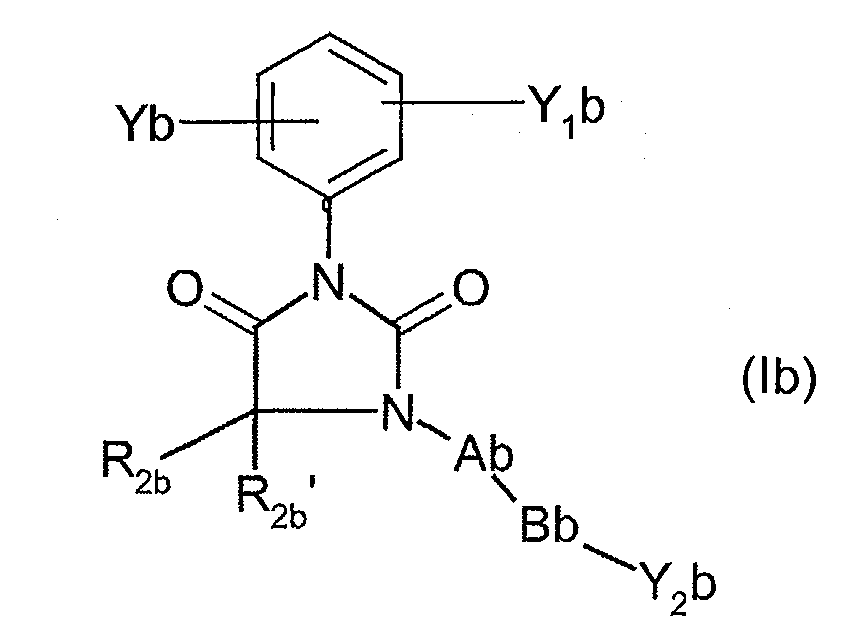
in which
Yb and Y1b, which may be identical or different, are such that: - Y is chosen from:
- alkyl containing 1 to 6 carbon atoms optionally substituted with one or more fluorine atoms and OH;
- 3- to 6-membered cycloalkyl optionally substituted with one or more methyl radicals;
- alkylamino;
- dialkylamino, in which the two alkyl residues may optionally form, together with the nitrogen atom to which they are attached, a 5- or 6-membered heterocycle optionally containing one or more other hetero atoms, which may be identical or different, chosen from O, N, Nalkyl and S and optionally substituted with one or more radicals, which may be identical or different, chosen from fluorine atoms and alkyl radicals;
- phenylalkylamino;
- 5- to 6-membered phenylmercapto or heteroarylmercapto, optionally substituted with one or more radicals, which may be identical or different, chosen from halogen atoms and alkyl radicals;
- and the other from among Yb and Y1b is chosen from the same values and also from hydrogen; halogen; hydroxyl; oxo; nitro; NR5bR6b; optionally substituted alkyl, alkoxy -S-alkyl and phenyl; optionally substituted pyrazolyl, pyridyl, morpholino, pyrrolidinyl and piperazinyl; free or esterified carboxyl;
- R2b and R2b' represent hydrogen and alkyl, or two substituents R2b and R2b', can form, together with the carbon atom to which they are attached, a cycloalkyl radical containing from 3 to 6 carbon atoms, or form an azetidinyl, pyrrolidinyl or piperidyl radical.
- Ab represents a single bond an alkylene radical;; O; NH; NH-alkyl;
- Bb represents a heterocyclic radical chosen from 3- or 4-pyridyl ; pyrimidinyl;3- or 4- quinolyl ; azaindolyl ; quinazolyl; indazolyl; thiazolyl; imidazolyl; pyrazolyl, furazanyl and isoxazolyl radicals ; these radicals being optionally substituted with one or more radicals chosen from the values of Yb,
- Y2b represents hydrogen; halogen; hydroxyl; alkyl; alkoxy; cycloalkyl; heterocycloalkyl; phenyl; heteroaryl; O-cycloalkyl; S(O)n-alk; S(O)n-cycloalkyl; COOR9; OCOR8; -NR10b-CO-NR5bR6b; NR5R6; CONR5R6; S(O)n-R5R6; NHCOR8 and NH-S(O)nR8; all these radicals being optionally substituted,
- R4b represents a hydrogen atom or an alkyl, cycloalkyl or phenyl radical,
- R5b and R6b, which may be identical or different, are chosen from hydrogen, alkyl, alkenyl, cycloalkyl, heterocycloalkyl, optionally substituted phenyl and heteroaryl or alternatively R5b and R6b form, with the nitrogen atom to which they are attached, a 3- to 10-membered heterocyclic radical containing one or more hetero atoms chosen from O, S, N and optionally substituted NR4b;
- all the above alkyl, alkenyl, alkynyl and alkoxy radicals being linear or branched and containing up to 6 carbon atoms;
- all the above cycloalkyl and heterocycloalkyl radicals containing up to 7 carbon atoms;
- all the above aryl and heteroaryl radicals containing up to 10 carbon atoms;
- all the above optionally substituted radicals being optionally substituted with one or more radicals, which may be identical or different, chosen from halogen, cyano, hydroxyl, alkyl and alkoxy containing 1 to 4 carbon atoms, CF3, nitro, phenyl, carboxyl, free, salified, esterified with an alkyl radical or amidated with a radical NR11bR12b, -C(=O)-R9b, -NR11bR12b or -C(=O)-NR11bR12b ;
- R8b represents alkyl, cycloalkyl, cycloalkylalkyl and phenyl;
- R9b, which may be identical to or different from R8b, represents hydrogen and the values of R8b;
- R11b and R12b, which may be identical or different, represent hydrogen, alkyl, cycloalkyl and phenyl or alternatively R11b and R12b form, with the nitrogen atom to which they are attached, a pyrolidine, piperidinyl, morpholinyl or a piperazinyl radical optionally substituted with an alkyl, phenyl or phenylalkyl radical; the said products of formula (Ib) being in all the possible racemic, enantiomeric and diastereoisomeric isomer forms, and also the addition salts with mineral and organic acids or with mineral and organic bases of the said products of formula (Ib).
- A subject of the present invention is especially the products of formula (I), (Ia) or (Ib) as defined above corresponding to formula (Ic):

in which Yc and Y1c, which may be identical or different, are such that one from among Yc and Y1c is chosen from alkyl especially such as methyl, ethyl, isopropyl, tert-butyl, sec-butyl, 1,2-dimethylpropyl, 1,1-dimethylpropyl optionally substituted with one or more fluorine atoms and OH; cyclopropyl or cyclobutyl especially such as 1-methylcyclopropyl, 2-methylcyclopropyl, 2,2-dimethylcyclopropyl, cyclobutyl, 2,2,3,3-tetrafluorocyclobutyl; di(C2-C4-alkyl)amino; phenylalkylamino; piperid-1-yl, thiomorpholin-4-yl, morpholin-4-yl, pyrrolidin-1-yl optionally substituted with one or more radicals chosen from fluorine atoms and alkyl radicals; phenylmercapto, optionally substituted with one or more halogen atoms ; and the other from among Yc and Y1c is chosen from hydrogen; halogen; hydroxyl (oxo); nitro; NR5cR6c; optionally substituted alkyl, alkoxy, -S-alkyl and phenyl; optionally substituted pyrazolyl and pyridyl;
R2 and R2c'represent a hydrogen atom, alkyl of form together with the carbon atom bearing them a 3 to 6 membered cycloalkyl ring
Ac represents a single bond, -O- or -CH2;
Bc represents a heterocyclic radical chosen from 3- or 4-pyridyl, pyrimidinyl, , 3- or 4- quinolyl, azaindolyl and quinazolyl, these radicals being optionally substituted with one or more radicals chosen from the values of Y2c, Y2c represents hydrogen; halogen; alkyl; cycloalkyl; hydroxyl; alkoxy; NH2; NHalk; N(alk)2; NH-Phenyl-; NH-Heteroaryl; NH-CO-R5c; NH-CO-heteroaryl; NH-CO-NR5cR6c; and phenyl; all the alkyl, alkoxy, phenyl and heteroaryl radicals being optionally substituted;
R5c and R6c, which may be identical or different, represent hydrogen, alkyl, cycloalkyl and phenyl, which are optionally substituted, or alternatively R5c and R6c form, with the nitrogen atom to which they are attached, a cyclic radical chosen from pyrrolidinyl, piperidyl, piperazinyl, morpholinyl, piperazinyl, indolinyl, pyrindolinyl, tetrahydroquinoline and azetidine radicals; all these radicals being optionally substituted with one or more radicals chosen from alkyl, alkoxy and phenyl;
in all the above radicals, the alkyl, alkoxy and phenyl radicals are optionally substituted with one or more radicals chosen from halogen, OH, alk, Oalk, OCF3, S(O)n-CF3, CF3, NH2, NHAlk and N(alk)2; it beeing understood, that all dialkylamino radicals optionally can form a pyrrolidine, piperidine, morpholine or piperazine ring optionally substituted by one or more alkyl;
the said products of formula (Ic) being in all the possible racemic, enantiomeric and diastereoisomeric isomer forms, and also the addition salts with mineral and organic acids or with mineral and organic bases of the said products of formula (Ic). - In particular, R5c and R6c, which may be identical or different, represent hydrogen, alkyl, cycloalkyl and phenyl, the alkyl and phenyl radicals being optionally substituted, or alternatively R5c and R6c form, with the nitrogen atom to which they are attached, a cyclic radical chosen from pyrrolidinyl, piperidyl, piperazinyl, morpholinyl, piperazinyl and azetidine.
- In particular, Bc represents a heterocyclic radical chosen from 3- or 4-pyridyl, 1H-pyrrolo[2,3-b]pyridin-4-yl pyrimidinyl and 3- or 4-quinolyl.
- Most particularly, Bc represents 4-pyridyl and 4-quinolyl radicals, optionally substituted with one or more radicals chosen from the values of Y2c.
- A subject of the present invention is especially the products of formula (I) as defined above corresponding to formula (Id):

in which
Yd is chosen from the following values: alkyl especially such as methyl, ethyl, isopropyl, tert-butyl, sec-butyl, 1,2-dimethylpropyl, 1,1-dimethylpropyl optionally substituted with one or more fluorine atoms and OH; cyclopropyl or cyclobutyl such as, especially, 1-methylcyclopropyl, 2-methylcyclopropyl, 2,2-dimethylcyclopropyl, cyclobutyl, 2,2,3,3-tetrafluorocyclobutyl; di(C2-C4-alkyl)amino; phenylalkylamino; piperid-1-yl, thiomorpholin-4-yl, morpholin-4-yl or pyrrolidin-1-yl, optionally substituted with one or more radicals chosen from fluorine atoms and alkyl radicals; phenylmercapto, optionally substituted with one or more halogen atoms; and Y1d is chosen from the following values: hydrogen; halogen; OH; oxo; nitro, NH2; free or esterified carboxyl; morpholino; alkyl, alkoxy, S-alkyl and phenyl optionally substituted;
in all these radicals, the alkyl and phenyl radicals are themselves optionally substituted with one or more radicals, which may be identical or different, chosen from halogen atoms and alkyl, alkoxy, OCF3, cyano, amino, alkylamino and dialkylamino radicals, and a phenyl radical, itself optionally substituted with one or more radicals, which may be identical or different, chosen from halogen atoms, and alkyl and alkoxy radicals;
R2d and R2d', which may be identical or different, are chosen from hydrogen or alkyl or form together with the atom bearing them a cyclopropyl or acyclobutyl ring;
Ad represents a single bond or CH2;
Bd represents a quinolyl or pyridyl radical optionally substituted with one or more radicals Y2d chosen from halogen, -OH, alk, -Oalk, -CO2H, -CO2alk, -NH2, NHalk, N(alk)2, -CF3, -OCF3 and phenyl; NH-phenyl; NH-heteroaryl NH-CO-phenyl, NH-CO-heteroaryl; NH-CO-NH-alkyl ; NH-CO-N-dialkyl; NH-CO-NH-phenyl; the alkyl and phenyl radicals being themselves optionally substituted with one or more radicals chosen from halogen atoms and alkyl and alkoxy and dialkylamino radicals; it beeing understood, that all dialkylamino radicals optionally can form a 5- to 7 membered ring, optionally containing one more heteroatom or group from the series N,N-alkyl, O and S;
the said products of formula (Id) being in all the possible racemic, enantiomeric and diastereoisomeric isomer forms, and also the addition salts with mineral and organic acids or with mineral and organic bases of the said products of formula (Id). - In the products of formula (I) as defined above, when Y1d represents optionally substituted alkyl, alkoxy or -S-alkyl, Y1d may especially represent CF3; -O-CF2-CHF2 ; -O-CHF2 ; -O-CH2-CF3 ; -S-CF2-CF2-CF3; -S-Alk-O-Alk ; -S-Alk-OH; -S-Alk-CN ; -S-Alk-heterocycloalkyl.
- More particularly, B represents a 4-quinolyl or 4-pyridyl radical optionally substituted with one or more radicals chosen from F, Cl , OH, CH3, CH2CH3, OCH3, NH2, NHAlk and N(alk)2, and phenyl, NH-phenyl; NH-heteroaryl NH-CO-phenyl, NH-CO-heteroaryl; NH-CO-NH-alkyl; NH-CO-NH-dialkyl the alkyl and phenyl radicals being themselves optionally substituted with one or more radicals chosen from halogen atoms and alkyl and alkoxy radicals.
- Most particularly, B represents 4-pyridyl and 4-quinolyl radicals substituted with one or two radicals chosen from F, Cl, OH ; NH2 and OCH3.
- A subject of the present invention is, most particularly, the products of formula (I) as defined above
in which
Y is chosen from the following values: - alkyl especially such as methyl, ethyl, isopropyl, tert-butyl, sec-butyl, 1,2-dimethylpropyl and 1,1-dimethylpropyl, optionally substituted with one or more fluorine atoms and OH;
- di(C2-C4-alkyl)amino;
- phenylalkylamino;
- piperid-1-yl, thiomorpholin-4-yl, morpholin-4-yl, pyrrolidin-1-yl;
- and Y1 is chosen from the following values: hydrogen, halogen, nitro, NH2 and alkyl;
- R2 and R2', which may be identical or different, are chosen from hydrogen or alkyl;
- A represents CH2;
- B represents a quinolyl or pyridyl radical;
- the said products of formula (I) being in all the possible racemic, enantiomeric and diastereoisomeric isomer forms, and also the addition salts with mineral and organic acids or with mineral and organic bases of the said products of formula (I).
- More particularly, R2 and R2', which may be identical or different, are chosen from hydrogen or methyl and ethyl.
- Among the preferred products of the invention, mention may be made more specifically of the products of formula (I) as defined above, the names of which are given hereinbelow:
- 3-(4-tert-Butyl-phenyl)-5,5-dimethyl-1-quinolin-4-ylmethyl-imidazolidine-2,4- dione
- 3-(4-Isopropyl-phenyl)-5,5-dimethyl-1-quinolin-4-ylmethyl-imidazolidine-2,4- dione
- 3-(4-Diethylamino-phenyl)-5,5-dimethyl-1-pyridin-4-ylmethyl-imidazolidine-2,4-dione trifluoroacetate
- 3-(4-sec-Butyl-phenyl)-5,5-dimethyl-1-pyridin-4-ylmethyl-imidazolidine-2,4-dione trifluoroacetate
- 5,5-Dimethyl-1-pyridin-4-ylmethyl-3-[4-(2,2,2-trifluoro-1-hydroxy-1-trifluoromethyl-ethyl)-phenyl]-imidazolidine-2,4-dione trifluoroacetate
- 5,5-Dimethyl-3-(4-piperidin-1-yl-phenyl)-1-pyridin-4-ylmethyl-imidazolidine-2,4-dione trifluoroacetate
- 3-(4-Isopropyl-3-methyl-phenyl)-5,5-dimethyl-1-pyridin-4-ylmethyl-imidazolidine-2,4-dione trifluoroacetate
- 3-[4-(Ethyl-isopropyl-amino)-phenyl]-5,5-dimethyl-1-pyridin-4-ylmethyl-imidazolidine-2,4-dione trifluoroacetate
- 5,5-Dimethyl-1-pyridin-4-ylmethyl-3-[4-(thiophen-2-ylsulfanyl)-phenyl]-imidazolidine-2,4-dione trifluoroacetate
- 3-[4-(4-Fluoro-phenylsulfanyl)-phenyl]-5,5-dimethyl-1-pyridin-4-ylmethyl-imidazolidine-2,4-dione trifluoroacetate
- 3-(4-Isopropyl-3-nitro-phenyl)-5,5-dimethyl-1-pyridin-4-ylmethyl-imidazolidine-2,4-dione
- 3-(3-Amino-4-isopropyl-phenyl)-5,5-dimethyl-1-pyridin-4-ylmethyl-imidazolidine-2,4-dione
- Among the preferred products of the invention, mention may be made more specifically of the products of formula (I) as defined above, the names of which are given hereinbelow:
- 3-(4-tert-Butyl-phenyl)-5,5-dimethyl-1-quinolin-4-ylmethyl-imidazolidine-2,4- dione
- 3-(4-Isopropyl-phenyl)-5,5-dimethyl-1-quinolin-4-ylmethyl-imidazolidine-2,4- dione
- 3-(4-Diethylamino-phenyl)-5,5-dimethyl-1-pyridin-4-ylmethyl-imidazolidine-2,4-dione trifluoroacetate
- 3-(4-sec-Butyl-phenyl)-5,5-dimethyl-1-pyridin-4-ylmethyl-imidazolidine-2,4-dione trifluoroacetate
- 5,5-Dimethyl-1-pyridin-4-ylmethyl-3-[4-(2,2,2-trifluoro-1-hydroxy-1-trifluoromethyl-ethyl)-phenyl]-imidazolidine-2,4-dione trifluoroacetate
- 5,5-Dimethyl-3-(4-piperidin-1-yl-phenyl)-1-pyridin-4-ylmethyl-imidazolidine-2,4-dione trifluoroacetate
- 3-(4-Isopropyl-3-methyl-phenyl)-5,5-dimethyl-1-pyridin-4-ylmethyl-imidazolidine-2,4-dione trifluoroacetate
- 3-[4-(Ethyl-isopropyl-amino)-phenyl]-5,5-dimethyl-1-pyridin-4-ylmethyl-imidazolidine-2,4-dione trifluoroacetate
- 5,5-Dimethyl-1-pyridin-4-ylmethyl-3-[4-(thiophen-2-ylsulfanyl)-phenyl]-imidazolidine-2,4-dione trifluoroacetate
- 3-[4-(4-Fluoro-phenylsulfanyl)-phenyl]-5,5-dimethyl-1-pyridin-4-ylmethyl-imidazolidine-2,4-dione trifluoroacetate
- The compounds of the general formula I can be prepared by initially converting an aniline of the general formula 1 in which Y' and Y1' have the meanings stated for Y and Y1

by reaction with phosgene, diphosgene or triphosgene, or by activation with carbonyldiimidazole or a reagent of a similar type, into a reactive intermediate such as, for example, the isocyanate 2 or the carbonylimidazole derivative 3.
- These reactive derivatives are prepared in an inert organic solvent such as, for example, toluene, 1,2-dichloroethane or THF, at a temperature between -20°C and the reflux temperature of the particular solvent. Preferred solvents are toluene and 1,2-dichlorethane, and preferred reaction temperatures are from -20 to +5°C during the addition and subsequent heating to the reflux temperature to complete the reaction. The reaction can be assisted by addition of a base, but is preferably carried out without addition of base.
- The reactive derivatives of the general formula 2 can be isolated, but the intermediates are preferably used without further purification, where appropriate after replacement of the solvent, directly for further reaction.
- Reaction of the intermediates with a structural unit of the general formula 4 in which Z is COOR or CN is carried out in an inert organic solvent such as, for example, toluene, chlorobenzene, THF, dioxane or ethyl acetate, at a temperature between room temperature and the reflux temperature of the solvent. The reaction can be assisted by addition of a base such as, for example, triethylamine or potassium tert-butoxide, but is preferably carried out without addition of base. The initial linkage of the reactive intermediates 2 or 3 with the amino derivative of the general formula 4 and the subsequent ring closure to form the central heterocycle is preferably carried out in one step.

- However, it is also possible alternatively to form the central heterocycle in a second step by heating the open-chain intermediate of the general formula 5 in a higher-boiling solvent or in aqueous mineral acids.

- In the case where Z is CN, the products of the general formula Ia (R1=N) are obtained and can be converted through the action of aqueous mineral acid into compounds of the general formula Ib.

- The compounds of the general formulae Ia and Ib prepared in this way, in which the variables have the meanings stated above for the compound of the general formula I, can be converted by derivatization reactions known to the skilled worker into compounds of the general formula I.
- An alternative approach to compounds of the general formula I is provided by reaction of the structural unit 4 with carbonyldiimidazole, phosgene, diphosgene or triphosgene to give a reactive intermediate. The reaction is preferably carried out with carbonyldiimidazole in an inert organic solvent such as, for example, toluene, 1,2-dichloroethane or THF at a temperature between -20°C and RT. THF is the particularly preferred solvent. The intermediates such as, for example, the derivatives of the general formula 6 (reaction with carbonyldiimidazole) are then reacted in a solvent such as, for example, DMF, toluene, 1,2-dichloroethane or THF with an aniline of the general formula 1. The reaction is preferably carried out at a temperature between RT and the boiling point of the solvent. Open-chain intermediates are preferably cyclized directly to compounds of the general formula Ia and b, which can be converted by further derivatization reactions known to the skilled worker into compounds of the general formula I.

- The compounds of the general formula Ia can additionally be obtained by reacting compounds of the general formulae 2 and 3 with a structural unit of the general formula 7.

- The resulting derivatives of the general formula 8 can then be converted by the action of a halide Hal-A'-B'-Y2' or a related reagent of similar reactivity in which A', B' and Y2 ' have the meanings mentioned for A, B and Y2, and which are obtainable by conventional processes known to the skilled worker, into compounds of the general formula Ia.
- The reactions are preferably carried out in an organic solvent such as, for example, dimethylformamide, N-methylpyrrolidone, ethyl acetate or acetone in the presence of a base such as, for example, potassium carbonate, caesium carbonate, sodium hydride or potassium tert-butoxide. Dimethylformamide and caesium carbonate are preferably used.
- All reactions for the synthesis of the compounds of the formula (I) are per se well-known to the skilled person and can be carried out under standard conditions according to or analogously to procedures described in the literature, for example in Houben-Weyl, Methoden der Organischen Chemie (Methods of Organic Chemistry), Thieme-Verlag, Stuttgart, or Organic Reactions, John Wiley & Sons, New York.
- It may be noted that, during or after the process, some intermediates compounds or some compounds of formula (I) may be transformed to obtain some (or other) compounds of formula (I) and for that, to obtain products or other products of formula (I), these products may be subjected if desired, and necessary, to one or more of the following conversion reactions, in any order:
- a) a reaction for esterification of an acid function,
- b) a reaction for saponification of an ester function to an acid function,
- c) a reaction for oxidation of an alkylthio group to the corresponding sulfoxide or sulfone group,
- d) a reaction for conversion of a ketone function to an oxime function,
- e) a reaction for reducing a free or esterified carboxyl function to an alcohol function,
- f) a reaction for conversion of an alkoxy function to a hydroxyl function, or alternatively of a hydroxyl function to an alkoxy function,
- g) a reaction for oxidation of an alcohol function to an aldehyde, acid or ketone function,
- h) a reaction for conversion of a nitrile radical to a tetrazolyl,
- i) a reaction for reduction of nitro compounds to amino compounds,
- j) a reaction for removal of the protecting groups that may be borne by the protected reactive functions,
- k) a reaction for salification with a mineral or organic acid or with a base to obtain the corresponding salt,
- l) a reaction for resolution of the racemic forms to resolved products,
- It may be noted that such reactions for converting substituents into other substituents may also be performed on the starting materials, and also on the intermediates as defined above before continuing the synthesis according to the reactions indicated in the process described above.
- The various reactive functions that may be borne by certain compounds of the reactions defined above may, if necessary, be protected: these are, for example, hydroxyl, acyl, free carboxyl or amino and monoalkylamino radicals, which may be protected with the appropriate protecting groups.
- The following nonexhaustive list of examples of protection of reactive functions may be mentioned:
- the hydroxyl groups may be protected, for example, with alkyl radicals such as tert-butyl, trimethylsilyl, tert-butyldimethylsilyl, methoxymethyl, tetrahydropyranyl, benzyl or acetyl,
- the amino groups may be protected, for example, with acetyl, trityl, benzyl, tert-butoxycarbonyl, benzyloxycarbonyl, phthalimido radicals or other radicals known in peptide chemistry,
- the acyl groups such as the formyl group may be protected, for example, in the form of cyclic or noncyclic ketals or thioketals such as dimethyl or diethylketal or ethylene dioxyketal, or diethylthioketal or ethylenedithioketal,
- the acid functions of the products described above may be, if desired, amidated with a primary or secondary amine, for example in methylene chloride in the presence, for example, of 1-ethyl-3-(dimethylaminopropyl)carbodiimide hydrochloride at room temperature,
- the acid functions may be protected, for example, in the form of esters formed with readily cleavable esters such as benzyl esters or tert-butyl esters, or esters known in peptide chemistry.
- These reactions a) to k) indicated above may be performed, for example, as indicated below.
- a) The products described above may, if desired, undergo, on the possible carboxyl functions, esterification reactions that may be performed according to the usual methods known to those skilled in the art.
- b) The possible conversions of ester functions into an acid function of the products described above may be, if desired, performed under the usual conditions known to those skilled in the art, especially by acid or alkaline hydrolysis, for example with sodium hydroxide or potassium hydroxide in alcoholic medium such as, for example, in methanol, or alternatively with hydrochloric acid or sulfuric acid.
- c) The possible alkylthio groups in the products described above, in which the alkyl radical is optionally substituted with one or more halogen atoms, especially fluorine, may, if desired, be converted into the corresponding sulfoxide or sulfone functions under the usual conditions known to those skilled in the art such as, for example, with peracids such as, for example, peracetic acid or meta-chloroperbenzoic acid, or alternatively with ozone, oxone or sodium periodate in a solvent such as, for example, methylene chloride or dioxane at room temperature.
- The production of the sulfoxide function may be promoted with an equimolar mixture of the product containing an alkylthio group and the reagent such as, especially, a peracid.
- The production of the sulfone function may be promoted with a mixture of the product containing an alkylthio group with an excess of the reagent such as, especially, a peracid.
- d) The reaction for conversion of a ketone function into an oxime may be performed under the usual conditions known to those skilled in the art, such as, especially, a reaction in the presence of an optionally O-substituted hydroxylamine in an alcohol such as, for example, ethanol, at room temperature or with heating.
- e) The possible free or esterified carboxyl functions of the products described above may be, if desired, reduced to an alcohol function by the methods known to those skilled in the art: the possible esterified carboxyl functions may be, if desired, reduced to an alcohol function by the methods known to those skilled in the art and especially with lithium aluminum hydride in a solvent such as, for example, tetrahydrofuran or dioxane or ethyl ether.
- The possible free carboxyl functions of the products described above may be, if desired, reduced to an alcohol function especially with boron hydride.
- f) The possible alkoxy functions such as, especially, methoxy, in the products described above, may be, if desired, converted into a hydroxyl function under the usual conditions known to those skilled in the art, for example with boron tribromide in a solvent such as, for example, methylene chloride, with pyridine hydrobromide or hydrochloride or with hydrobromic acid or hydrochloric acid in water or trifluoroacetic acid at reflux.
- g) The possible alcohol functions of the products described above may be, if desired, converted into an aldehyde or acid function by oxidation under the usual conditions known to those skilled in the art, such as, for example, by the action of manganese oxide to obtain the aldehydes, or of Jones' reagent to access the acids.
- h) The possible nitrile functions of the products described above may be, if desired, converted into tetrazolyl under the usual conditions known to those skilled in the art, such as, for example, by cycloaddition of a metal azide such as, for example, sodium azide or a trialkyltin azide on the nitrile function, as indicated in the method described in the article referenced as follows:
- J. Organometallic Chemistry., 33, 337 (1971) KOZIMA S. et al.
- It may be noted that the reaction for conversion of a carbamate into urea and especially of a sulfonylcarbamate into sulfonylurea may be performed, for example, at the reflux point of a solvent such as, for example, toluene, in the presence of the appropriate amine.
- It is understood that the reactions described above may be performed as indicated or alternatively, where appropriate, according to other common methods known to those skilled in the art.
- i) The removal of protecting groups such as, for example, those indicated above may be performed under the usual conditions known to those skilled in the art, especially via an acid hydrolysis performed with an acid such as hydrochloric acid, benzenesulfonic acid or para-toluenesulfonic acid, formic acid or trifluoroacetic acid, or alternatively via a catalytic hydrogenation.
- The phthalimido group may be removed with hydrazine.
- A list of various protecting groups that may be used will be found, for example, in patent BF 2 499 995.
- j) The products described above may, if desired, be subjected to salification reactions, for example with a mineral or organic acid or with a mineral or organic base according to the usual methods known to those skilled in the art.
- k) The possible optically active forms of the products described above may be prepared by resolving the racemic mixtures according to the usual methods known to those skilled in the art.
- The possible reactive functions are hydroxyl or amino functions. Usual protecting groups are used to protect these functions. Examples that may be mentioned include the following protecting groups for the amino radical: tert-butyl, tert-amyl, trichloroacetyl, chloroacetyl, benzhydryl, trityl, formyl, benzyloxycarbonyl.
- Protecting groups for the hydroxyl radical that may be mentioned include radicals such as formyl, chloroacetyl, tetrahydropyranyl, trimethylsilyl and tert-butyldimethylsilyl.
- It is clearly understood that the above list is not limiting and that other protecting groups, which are known, for example, in peptide chemistry, may be used. A list of such protecting groups is found, for example, in French patent 2 499 995, the content of which is incorporated herein by reference.
- The possible reactions for removal of the protecting groups are performed as indicated in said patent 2 499 995. The preferred method of removal is acid hydrolysis with acids chosen from hydrochloric acid, benzenesulfonic acid or para-toluenesulfonic acid, formic acid or trifluoroacetic acid. Hydrochloric acid is preferred.
- The possible reaction for hydrolysis of the >C=NH group to a ketone group is also preferably performed using an acid such as aqueous hydrochloric acid, for example at reflux.
- An example of removal of the tert-butyldimethylsilyl group using hydrochloric acid is given below in the examples.
- The possible esterification of a free OH radical is performed under standard conditions. An acid or a functional derivative, for example an anhydride such as acetic anhydride in the presence of a base such as pyridine, may be used, for example.
- The possible esterification or salification of a COOH group is performed under the standard conditions known to those skilled in the art.
- The possible amidation of a COOH radical is performed under standard conditions. A primary or secondary amine may be used on a functional derivative of the acid, for example a symmetrical or mixed anhydride.
- The products of formula (I) according to the present invention may be prepared by application or adaptation of known methods and especially of the methods described in the literature such as, for example, those described by R.C. Larock in: Comprehensive Organic Transformations, VCH publishers, 1989.
- In the reactions described below, it may be necessary to protect reactive functional groups such as, for example, hydroxyl, amino, imino, thio or carboxyl groups, when these groups are desired in the final product but when their participation is not desired in the reactions for synthesizing the products of formula (I). Conventional protecting groups may be used in accordance with the usual standard practices, for instance those described, for example, by T.W. Greene and P.G.M. Wuts in "Protective Groups in Organic Chemistry" John Wiley and Sons, 1991.
- The anilines of the general formula 1 are in some cases commercially available or are described in the literature or can be obtained from derivatives disclosed in the literature by transformations known to a person skilled in the art. The precursors 4 can be obtained for example by reductive amination of aldehydes of the general formula OHC-A" -B'-Y2 ', which are commercially available or are prepared by conventional processes, with amino acid derivatives or amino nitriles of the general formula 7.
- The products of the present invention are endowed with advantageous pharmacological properties: it has been found that they especially have inhibitory properties on protein kinases.
- Among these protein kinases, mention is made especially of IGF1R.
- Mention is also made of FAK. Mention is also made of AKT.
- These properties thus make products of general formula (I) of the present invention usable as medicinal products for treating malignant tumours.
- The products of formula (I) may also be used in the veterinary field.
- A subject of the invention is thus the use, as medicinal products, of the pharmaceutically acceptable products of general formula (I).
- A subject of the invention is particularly the use, as medicinal products, of the products, the names of which are given hereinbelow:
- 3-(4-tert-Butyl-phenyl)-5,5-dimethyl-1-quinolin-4-ylmethyl-imidazolidine-2,4- dione
- 3-(4-Isopropyl-phenyl)-5,5-dimethyl-1-quinolin-4-ylmethyl-imidazolidine-2,4- dione
- 3-(4-Diethylamino-phenyl)-5,5-dimethyl-1-pyridin-4-ylmethyl-imidazolidine-2,4-dione trifluoroacetate
- 3-(4-sec-Butyl-phenyl)-5,5-dimethyl-1-pyridin-4-ylmethyl-imidazolidine-2,4-dione trifluoroacetate
- 5,5-Dimethyl-1-pyridin-4-ylmethyl-3-[4-(2,2,2-trifluoro-1-hydroxy-1-trifluoromethyl-ethyl)-phenyl]-imidazolidine-2,4-dione trifluoroacetate
- 5,5-Dimethyl-3-(4-piperidin-1-yl-phenyl)-1-pyridin-4-ylmethyl-imidazolidine-2,4-dione trifluoroacetate
- 3-(4-Isopropyl-3-methyl-phenyl)-5,5-dimethyl-1-pyridin-4-ylmethyl-imidazolidine-2,4-dione trifluoroacetate
- 3-[4-(Ethyl-isopropyl-amino)-phenyl]-5,5-dimethyl-1-pyridin-4-ylmethyl-imidazolidine-2,4-dione trifluoroacetate
- 5,5-Dimethyl-1-pyridin-4-ylmethyl-3-[4-(thiophen-2-ylsulfanyl)-phenyl]-imidazolidine-2,4-dione trifluoroacetate
- 3-[4-(4-Fluoro-phenylsulfanyl)-phenyl]-5,5-dimethyl-1-pyridin-4-ylmethyl-imidazolidine-2,4-dione trifluoroacetate
- 3-(4-Isopropyl-3-nitro-phenyl)-5,5-dimethyl-1-pyridin-4-ylmethyl-imidazolidine-2,4-dione
- 3-(3-Amino-4-isopropyl-phenyl)-5,5-dimethyl-1-pyridin-4-ylmethyl-imidazolidine-2,4-dione
- A subject of the invention is particularly the use, as medicinal products, of the products, the names of which are given hereinbelow:
- 3-(4-tert-Butyl-phenyl)-5,5-dimethyl-1-quinolin-4-ylmethyl-imidazolidine-2,4- dione
- 3-(4-Isopropyl-phenyl)-5,5-dimethyl-1-quinolin-4-ylmethyl-imidazolidine-2,4- dione
- 3-(4-Diethylamino-phenyl)-5,5-dimethyl-1-pyridin-4-ylmethyl-imidazolidine-2,4-dione trifluoroacetate
- 3-(4-sec-Butyl-phenyl)-5,5-dimethyl-1-pyridin-4-ylmethyl-imidazolidine-2,4-dione trifluoroacetate
- 5,5-Dimethyl-1-pyridin-4-ylmethyl-3-[4-(2,2,2-trifluoro-1-hydroxy-1-trifluoromethyl-ethyl)-phenyl]-imidazolidine-2,4-dione trifluoroacetate
- 5,5-Dimethyl-3-(4-piperidin-1-yl-phenyl)-1-pyridin-4-ylmethyl-imidazolidine-2,4-dione trifluoroacetate
- 3-(4-Isopropyl-3-methyl-phenyl)-5,5-dimethyl-1-pyridin-4-ylmethyl-imidazolidine-2,4-dione trifluoroacetate
- 3-[4-(Ethyl-isopropyl-amino)-phenyl]-5,5-dimethyl-1-pyridin-4-ylmethyl-imidazolidine-2,4-dione trifluoroacetate
- 5,5-Dimethyl-1-pyridin-4-ylmethyl-3-[4-(thiophen-2-ylsulfanyl)-phenyl]-imidazolidine-2,4-dione trifluoroacetate
- 3- [4- (4-Fluoro-phenylsulfanyl) -phenyl] -5, 5-dimethyl-1-pyridin-4-ylmethyl-imidazolidine-2,4-dione trifluoroacetate
- The products may be administered via the parenteral, buccal, perlingual, rectal or topical route.
- A subject of the invention is also pharmaceutical compositions, characterized in that they contain, as active principle, at least one of the medicinal products of general formula (I).
- These compositions may be in the form of injectable solutions or suspensions, tablets, coated tablets, capsules, syrups, suppositories, creams, ointments and lotions. These pharmaceutical forms are prepared according to the usual methods. The active principle may be incorporated into excipients usually used in these compositions, such as aqueous or nonaqueous vehicles, talc, gum arabic, lactose, starch, magnesium stearate, cocoa butter, fatty substances of animal or plant origin, paraffin derivatives, glycols, various wetting, dispersing or emulsifying agents, and preserving agents.
- The usual dose, which varies according to the individual treated and the complaint under consideration, may be, for example, from 10 mg to 500 mg per day orally in man.
- The present invention thus relates to the use of products of formula (I) as defined above or of pharmaceutically acceptable salts of said products of formula (I) for the preparation of medicinal products for inhibiting the activity of protein kinases and especially of a protein kinase.
- The present invention thus relates to the use of products of formula (I) as defined above or of pharmaceutically acceptable salts of said products of formula (I) in which the protein kinase is a protein tyrosine kinase.
- The present invention thus relates to the use of products of formula (I) as defined above or of pharmaceutically acceptable salts of said products of formula (I) in which the protein kinase is chosen from the following group: IGF1, Raf, EGF, PDGF, VEGF, Tie2, KDR, Fltl-3, FAK, Src, Abl, cKit, cdk1-9, Aurora1-2, cdc7, Akt, Pdk, S6K, Jnk, IR, FLK-1, FGFR1, FGFR2, FGFR3, FGFR4, FGFR5, PLK, Pyk2, CDK7, CDK2 et EGFR.
- Such protein kinase is chosen more especially in the following group: IGF1, cdc7, Auroral-2, Src, Jnk, FAK, KDR, IR, Tie2, CDK7, CDK2 et EGFR.
- The present invention thus relates particularly to the use of products of formula (I) as defined above or of pharmaceutically acceptable salts of said products of formula (I) in which the protein kinase is IGF1R.
- The present invention also relates to the use of products of formula (I) as defined above or of pharmaceutically acceptable salts of said products of formula (I) in which the protein kinase is FAK.
- The present invention also relates to the use of products of formula (I) as defined above or of pharmaceutically acceptable salts of said products of formula (I) in which the protein kinase is AKT.
- The present invention also relates to the use of products of formula (I) as defined above or of pharmaceutically acceptable salts of said products of formula (I) in which the protein kinase is in a cell culture, and also to this use in a mammal.
- The present invention thus relates to the use of products of formula (I) as defined above or of pharmaceutically acceptable salts of said products of formula (I) for the preparation of a medicinal product for preventing or treating a disease characterized by deregulation of the activity of a protein kinase and especially such a disease in a mammal.
- The present invention relates to the use of products of formula (I) as defined above or of pharmaceutically acceptable salts of said products of formula (I) for the preparation of a medicinal product for preventing or treating a disease belonging to the following group: disorders of blood vessel proliferation, fibrotic disorders, disorders of mesangial cell proliferation, acromegaly, metabolic disorders, allergies, asthma, Crohn's disease, thrombosis, diseases of the nervous system, retinopathy, psoriasis, rheumatoid arthritis, diabetes, muscle degeneration, aging, age related macula degeneration, oncology diseases and cancer.
- The present invention thus relates to the use of products of formula (I) as defined above or of pharmaceutically acceptable salts of said products of formula (I) for the preparation of a medicinal product for treating oncology diseases.
- The present invention relates particularly to the use of products of formula (I) as defined above or of pharmaceutically acceptable salts of said products of formula (I) for the preparation of a medicinal product for treating cancers.
- Among these cancers, the present invention is most particularly of interest in the treatment of solid tumours and the treatment of cancers that are resistant to cytotoxic agents.
- Among these cancers, the present invention relates most particularly to the treatment of breast cancer, stomach cancer, cancer of the colon, lung cancer, cancer of the ovaries, cancer of the uterus, brain cancer, cancer of the kidney, cancer of the larynx, cancer of the lymphatic system, cancer of the thyroid, cancer of the urogenital tract, cancer of the tract including the seminal vesicle and prostate, bone cancer, cancer of the pancreas and melanomas.
- The present invention is even more particularly of interest in treating breast cancer, cancer of the colon and lung cancer.
- The present invention also relates to the use of products of formula (I) as defined above or of pharmaceutically acceptable salts of said products of formula (I) for the preparation of a medicinal product for cancer chemotherapy.
- As medicinal products according to the present invention for cancer chemotherapy, the products of formula (I) according to the present invention may be used alone or in combination with chemotherapy or radiotherapy or alternatively in combination with other therapeutic agents.
- The present invention thus relates especially to the pharmaceutical compositions as defined above, also containing active principles of other chemotherapy medicinal products for combating cancer.
- Such therapeutic agents may be commonly used antitumour agents.
- As examples of known inhibitors of protein kinases, mention may be made especially of butyrolactone, flavopiridol, 2-(2-hydroxyethylamino)-6-benzylamino-9-methylpurine, olomucine, Glivec and Iressa.
- The products of formula (I) according to the present invention may thus also be advantageously used in combination with antiproliferative agents: as examples of such antiproliferative agents, but without, however, being limited to this list, mention may be made of aromatase inhibitors, antiestrogens, the topoisomerase I inhibitors, the topoisomerase II inhibitors, microtubule-active agents, alkylating agents, histone deacetylase inhibitors, farnesyl transferase inhibitors, COX-2 inhibitors, MMP inhibitors, mTOR inhibitors, antineoplastic antimetabolites, platinum compounds, compounds that reduce the activity of protein kinases and also anti-angiogenic compounds, gonadorelin agonists, antiandrogens, bengamides, biphosphonates and trastuzumab.
- Examples that may thus be mentioned include anti-microtubule agents, for instance taxoids, vinca alkaloids, alkylating agents such as cyclophosphamide, DNA-intercalating agents, for instance cis-platinum, agents that are interactive on topoisomerase, for instance camptothecin and derivatives, anthracyclines, for instance adriamycin, antimetabolites, for instance 5-fluorouracil and derivatives, and the like.
- The present invention thus relates to products of formula (I) as protein kinase inhibitors, said products of formula (I) being in any possible racemic, enantiomeric or diastereoisomeric isomer form, and also the addition salts of said products of formula (I) with pharmaceutically acceptable mineral and organic acids or with pharmaceutically acceptable mineral and organic bases, and also the prodrugs thereof.
- The present invention relates particularly to products of formula (I) as defined above as IGF1R inhibitors.
- The present invention also relates to products of formula (I) as defined above as FAK inhibitors.
- The present invention also relates to products of formula (I) as defined above as AKT inhibitors.
- The present invention relates more particularly to the products of formula (IA) as defined above as IGF1R inhibitors.
- The examples whose preparation follows are thus products of formula (I) as defined above and illustrate the present invention without, however, limiting it.
- 2 g (1.02 mmol) of Polystyrene AM RAM (Rink resin) (0.51 mmol/g) are suspended in 20 ml of DMF in a 50 ml syringe fitted with a sinter. After agitation for 10 minutes, the DMF is filtered and replaced with 10 ml of a 50% solution of piperidine in DMF. After agitation for one hour at room temperature, the solution is filtered and the resin washed successively with 3 ' 10 ml of DMF, 2 ' 10 ml of methanol and 3 ' 10 ml of DMF. A solution of 0.94 g of Fmoc-Ala(OH) (3 mmol), 0.41 g of HOBt (3 mmol) and 0 . 4 8 ml of DIC (3 mmol) in 10 ml of DMF is added to the resin. The syringe is agitated overnight at room temperature and the resin is then washed successively with 5 ' 10 ml of DMF, 3 ' 10 ml of MeOH and 5 ' 10 ml of DCM. Next, 10 ml of a 50% solution of piperidine in DMF are introduced into the syringe. After agitation for 1 hour, the solution is filtered and the resin washed with 5 ' 10 ml of DMF, 2 ' 10 ml of MeOH, 3 ' 10 ml of DCM and 3 ' 10 ml of THF. Next, a solution of 0.48 ml of pyridine-4-carboxaldehyde (5 mmol) in 10 ml of a 50/50 THF/TEOF mixture is added to 2.1 g (1 mmol) of the resin.
- After agitation overnight at room temperature, the solution is filtered and the resin washed with 10' 10 ml of THF. 1.26 g of sodium cyanoborohydride (10 mmoles)in a mixture of 3 ml of MeOH, 7 ml of dichloroethane and 0.2 ml of acetic acid is then added to the resin. The resin is agitated overnight and then, after filtration, washed with 10 ' 10 ml of DCM, 3 ' 10 ml of MeOH and 5 ' 10 ml of DCM. In parallel, a solution of 0.563 g of 4-dimethyl-aniline (0.25 mmol) is treated with 0.025 g of triphosgene (0.083 mmol), followed by 0.023 ml of pyridine (0.25 mmol) at 0°C under nitrogen. After the temperature has warmed gradually to room temperature, the reaction is stirred for 1 hour and a further 0.23 ml of pyridine in 1 ml of DMF is added to the mixture. The solution obtained is transferred into a syringe containing 100 mg of the previous resin (0.1 mmol. The syringe is shaken 2 hours. The mixture is then filtered and the resin washed with 5' 2 ml of DCM, 3 ' 2 ml of MeOH and 2 ' 10 ml of DCM. Finally, the resin is treated with 1 ml of a 90% solution of trifluoroacetic acid in water. The mixture is agitated for 2 hours and then filtered. The resin is washed with 1 ml of MeOH, followed by 1 ml of DCM. The combined filtrates are evaporated under vacuum. The crude product is directly purified by preparative LC-MS giving 12.8 mg (overall yield = 60%) of expected product are isolated in the form of a white solid.
MS(ES+): m/e = 325
HPLC Retention time [min] = 2.77
(YMC basic S5 column; 2 85% ACN/H2O gradient over 7 min) - To a suspension of 497 mg triphosgene in 3 ml toluene at 100°C a solution of 250 mg 4-tert-butyl-phenylamine and 0.55 ml ethyl-diisopropyl-amine in 2 ml toluene was slowly added and the resulting mixture was stirred for 4 hours at 100°C. After cooling to room temperature the yellow oil that separated was directly subjected to the subsequent reaction without further purification. The oil was dissolved in 2 ml tetrahydrofuran and 221 mg 2-methyl-2-[(quinolin-4-ylmethyl)-amino]-propionic acid methyl ester were added. Afterwards the reaction mixture was heated for 12 hours at 90°C. After removal of the solvent under reduced pressure the residue was purified by flash chromatography on silica gel with a dichloromethane/ methanol gradient. The crude product was purified in addition by preparative HPLC (C18 reverse phase column, elution with a water/ acetonitrile gradient with 0.1% trifluoroacetic acid). Lyophilization of the solution yielded a white solid. Yield: 12.6 mg
MS(ES+): m/e = 402
1H-NMR (500 MHz,DMSO/TMS): d = 8.95 (d, 1H); 8.33 (d, 1H); 8.13 (d, 1H); 7.89 (t, 1H); 7.76 (t, 1H); 7.72 (d, 1H); 7.53 (d, 2H); 7.40 (d, 2H); 5.20 (s, 2H); 1.45 (s ,6H); 1.32 (s, 9H) - To a suspension of 548 mg triphosgene in 3 ml toluene at 100°C a solution of 250 mg 4-isopropyl-phenylamine and 0.61 ml ethyl-diisopropyl-amine in 2 ml toluene was slowly added and the resulting mixture was stirred for 4 hours at 100°C. After cooling to room temperature the mixture was directly subjected to the subsequent reaction. 240 mg 2-methyl-2-[(quinolin-4-ylmethyl)-amino]-propionic acid methyl ester were added and the resulting mixture was stirred for further 12 hours at 90°C. After cooling to room temperature the precipitated solid was collected and dissolved in a mixture of 2 ml acetonitrile and 0.25 ml water. After filtration the clear solution was purified by preparative HPLC (C18 reverse phase column, elution with a water/ acetonitrile gradient with 0.1% trifluoroacetic acid). Lyophilization of the fractions containing the product yielded a white solid. Yield: 49.8 mg
MS(ES+): m/e = 388
1H-NMR (500 MHz,DMSO/TMS): d = 8.96 (d, 1H) ; 8.35 (d, 1H) ; 8.13 (d, 1H) ; 7.92 (t, 1H) ; 7.78 (t, 1H) ; 7.75 (d, 1H) ; 7.39 (s, 4H) ; 5.20 (s, 2H) ; 2.96 (m, 1H) ; 1.45 (s ,6H) ; 1. 24 (d, 6H) - 25 g (185 mmol) 4-isopropyl-aniline were dissolved in to 260 ml conc. sulfuric acid and treated at -5 °C with 17.9 g nitric acid (65%). After stirring the mixture at 0°C for 0.5h, the reaction mixture was poured on ice water, the precipitating product collected via filtration and dried. The resulting 23.8 g product were essentially pure and were used for the subsequent step without further purification.
MS(ES+): m/e = 181
LC/MS Retention time [min] = 1.96 - 6.04 g (30 mmol) diphosgene in 50 ml 1,2-dichlorethane were treated at -20°C with a solution of 2 g (11.1 mmol) 3-nitro-4-isopropyl-aniline in 20 ml 1,2-dichlorethane. The mixture was allowed to come to room temperature and then was heated to 50 °C for 5h. After standing over night, the solvent was evaporated and the residual oil was taken up in 40m1 THF. 3.93 g (18.7 mmol) 2-methyl-2-[(pyridin-4-ylmethyl)-amino]-propionic acid methyl ester in 30 ml THF were added and the mixture was refluxed for 6h. The solvent was evaporated and the residue taken up in ethylacetate and washed with water. THe organic phase was dried, the solvent evaporated and the residue was purified by preparative HPLC. (C18 reversed phase column, elution with a water (0.1% trifluoracetic acid) /acetonitrile gradient) Yield: 2.7 g.
MS(ES+): m/e = 383
HPLC Retention time [min] = 1.67 - 2.64 g (6.90 mmol) 5,5-dimethyl-3-(3-nitro-4-isopropylphenyl)-1-pyridin-4-ylmethyl-imidazolidine-2,4-dione were dissolved in 50 ml acetic acid. 7.22 g zinc dust were added in portions while temperature was kept below 45 °C. The mixture was stirred for 1h at RT, then diluted with 100 ml water, made alkaline with 6N sodium hydroxide solution and extracted with methylene chloride. Separating zinc salts were removed by filtration over cellite. Evaporation of the combined organic phases yielded 1.53 g product that were used without further purification.
MS(ES+): m/e = 353
HPLC Retention time [min] = 0.91 - 5,1 g (25 mmol) 2-methyl-2-[(pyridin-4-ylmethyl)-amino]-propionic acid methyl ester were dissolved in 102 ml tetrahydrofurane and treated at 0°C with 4.46 g (27.5 mmol) carbonyldiimidazole. The mixture was stirred for 15 min at 0°C and 1h at RT. A 2ml aliquot of this solution was given to (0.5mmol) of the appropriate aniline, dissolved in 1 ml DMF, and stirred at 50 °C for 15 h. Then the reaction mixture was filtered and the sovent was evapotated. The residue was taken up in 20 ml ethylacetate and washed with 20 ml 5% NaHCO3 solution and 20 ml 5% NaCl solution. The phases were separated, the organic phase dried of Chromabond XTR and the solvent evaporated. The raw product was purified by preparative HPLC (C18 reverse phase column, elution with a water/acetonitrile gradient with 0.1% trifluoracetic acid) Yield: 7.7 mg
MS(ES+): m/e = 387
HPLC Retention time [min] = 1.51 - The following compounds were prepared as described for example 6.
- Yield: 20mg
MS(ES+): m/e = 367
HPLC Retention time [min] = 0.71 - Yield: 46.4 mg
MS(ES+): m/e = 352
HPLC Retention time [min] = 1.61 - Yield: 16 mg
MS(ES+): m/e = 462
HPLC Retention time [min] = 1.38 - Yield: 50 mg
MS(ES+): m/e = 379
HPLC Retention time [min] = 0.81 - Yield: 46.1 mg
MS(ES+): m/e = 352
HPLC Retention time [min] = 1.44 - Yield: 15.3 mg
MS(ES+): m/e = 399
HPLC Retention time [min] = 1.06 - Yield: 20.2 mg
MS(ES+): m/e = 381
HPLC Retention time [min] = 0.71 - Yield: 28.9 mg
MS(ES+): m/e = 410
HPLC Retention time [min] = 1.52 - Yield: 4.3 mg
MS(ES+): m/e = 471
HPLC Retention time [min] = 1.53 - Yield: 35.8 mg
MS(ES+): m/e = 422
HPLC Retention time [min] = 1.74 - Yield: 39.8 mg
MS(ES+): m/e = 436
HPLC Retention time [min] = 1.28 - If not stated otherwise LC/UV/MS experiments have been conducted with a Waters 1525 pump, a Waters 2488 UV detector, and a multiplexed ESI-TOF mass spectrometer (Micromass MUX-LCT) using YMC J'sphere H80 (30*2.1 mm, 4u, 80A) columns. UV data have been recorded at 220 nm and at 254 nm. For gradient separation, H2O+0.05% TFA and ACN+ 0.05% TFA are mixed in 95:5 (0 min) to 5:95 (3.4 min) to 5:95 (4.4 min) ratios at a flow rate of 1 ml min-1.
- Tablets were prepared corresponding to the following formula:
Product of Example 2 0.2 g Excipient for a finished tablet weighing 1 g (details of the excipient: lactose, talc, starch, magnesium stearate). - Tablets were prepared corresponding to the following formula:
Product of Example 7 0.2 g Excipient for a finished tablet weighing 1 g (details of the excipient: lactose, talc, starch, magnesium stearate). - Pharmaceutical Composition Examples 18 and 19 above illustrate the present invention, it being understood that the same preparations can be made with other preferred products of formula (I) of the present invention, and form part of the present invention.
the said products of formula (I) being in all the possible racemic, enantiomeric and diastereoisomeric isomer forms, and also the addition salts with mineral and organic acids or with mineral and organic bases of the said products of formula (I).
the said products of formula (I) being in all the possible racemic, enantiomeric and diastereoisomeric isomer forms, and also the addition salts with mineral and organic acids or with mineral and organic bases of the said products of formula (I).
said products of formula (I) thus obtained being in any possible racemic, enantiomeric or diastereoisomeric isomer form.
the said products of formula (I) being in all the possible racemic, enantiomeric and diastereoisomeric isomer forms, and also the pharmaceutically acceptable addition salts with mineral and organic acids or with mineral and organic bases of the said products of formula (I) .
the said products of formula (I) being in all the possible racemic, enantiomeric and diastereoisomeric isomer forms, and also the pharmaceutically acceptable addition salts with mineral and organic acids or with mineral and organic bases of the said products of formula (I) .
Claims (41)
- Products of formula (I):

in which
R1 represents O or NH,
p represents an integer from 0 to 2,
Y and Y1, which may be identical or different, are such that one from among Y and Y1 is chosen from:
alkyl containing 1 to 7 carbon atoms optionally substituted with one or more radicals, which may be identical or different, chosen from halogen atoms, cycloalkyl and the hydroxyl radical;
3- to 7-membered cycloalkyl optionally substituted with one or more radicals, which may be identical or different, chosen from fluorine atoms and alkyl radicals containing 1 to 3 carbon atoms;
alkylamino, optionally substituted with one or more halogen atoms;
dialkylamino, optionally substituted with one or more radicals, which may be identical or different, chosen from halogen atoms and alkoxy radicals and in which the two alkyl residues may optionally form, together with the nitrogen atom to which they are attached, a 4- to 10-membered heterocycle optionally containing one or more other hetero atoms, which may be identical or different, chosen from O, N, NR4 and S and optionally substituted with one or more radicals, which may be identical or different, chosen from halogen atoms and alkyl and alkoxy radicals; phenylalkylamino optionally substituted on alkyl or phenyl; arylmercapto or heteroarylmercapto, optionally substituted with one or more radicals, which may be identical or different, chosen from halogen atoms and alkyl and alkoxy radicals;
and the other from among Y and Y1 is chosen from these same values and in addition from the following values: hydrogen; halogen; hydroxyl; nitro; CN; SF5; NR5R6; optionally substituted alkyl, alkenyl and alkoxy; optionally substituted aryl and heteroaryl; O-alkenyl ; O-alkynyl ; O-cycloalkyl ; S(O)n-alkyl ; S(O)n-alkenyl ; S(O) n-alkynyl ; S (O) n-cycloalkyl ; S (O) nNR5R6 ; free, salified or esterified carboxyl and CONR5R6 ;
p represents the integers 0, 1 and 2,
R2, R2' , R3 and R3', which may be identical or different, represent hydrogen, halogen, alkyl, alkenyl, alkynyl, cycloalkyl, cycloalkylalkyl, aryl and heteroaryl which are optionally substituted, or alternatively two of the residues R2, R2', R3 and R3' form, together with the carbon atom(s) to which they are attached, a carbocyclic or heterocyclic radical, these radicals being 3- to 10-membered and the heterocyclic radical containing one or more hetero atoms chosen from O, S, N and NR4, all these radicals optionally being substituted;
A represents a single bond; an alkylene radical; an alkenyl radical; alkynyl; CO; SO2; O; NH; NH-alkyl;
B represents a saturated or unsaturated monocyclic or bicyclic heterocyclic radical containing one or more hetero atoms, which may be identical or different, chosen from O, S, N and NR4, optionally substituted with one or more substituents, which may be identical or different, chosen from the values of Y2;
Y2 represents hydrogen; halogen; hydroxyl; cyano; alkyl; alkoxy; cycloalkyl; heterocycloalkyl; aryl; heteroaryl; -O-alkenyl; -O-alkynyl; -O-cycloalkyl; -S(O)n-alkyl; -S(O)n-alkenyl; -S(O)n-alkynyl; S(O)n-cycloalkyl; COOR13; -OCOR13; NR5R6; CONR5R6; S(O)n-NR5R6; -NR10-CO-R13; -NR10-SO2-R13; NH-SO2-NR5R6; -NR10-CO-NR5R6; -NR10-CS-NR5R6 and -NR10-COOR13; all these radicals being optionally substituted;
R4 represents a hydrogen atom or an alkyl, alkenyl, cycloalkyl, alkylCO, alkylSO2 or aryle, all optionally substituted;
R5 and R6, which may be identical or different, are chosen from hydrogen; alkyl, alkenyl, alkynyl, cycloalkyl, cycloalkenyl, heterocycloalkyl, optionally substituted aryl and heteroaryl; or alternatively R5 and R6 form, with the nitrogen atom to which they are attached, a 3- to 10-membered heterocyclic radical containing one or more hetero atoms chosen from O, S, N and optionally substituted NR4;
all the above alkyl, alkenyl, alkynyl and alkoxy radicals being linear or branched and containing up to 6 carbon atoms ;
all the above cycloalkyl and heterocycloalkyl radicals containing up to 7 carbon atoms;
all the above aryl and heteroaryl radicals containing up to 10 carbon atoms;
all the above alkyl, alkenyl, alkynyl and alkoxy radicals cycloalkyl, heterocycloalkyl, aryl and heteroaryl radicals, carbocyclic and heterocyclic radicals, and also the ring formed by R5 and R6 with the atom to which they are attached being optionally substituted with one or more radicals, which may be identical or different, chosen from halogen atoms; cyano; hydroxyl; alkoxy; CF3; nitro; aryl; heteroaryl; -C(=O)-OR9; -C(=O)-R8; -NR11R12; -C(=O)-NR11R12; -N(R10)-C(=O)-R8 ; -N(R10)-C(=O)-OR9 N(R10)-C(=O)-NR11R12; -N(R10)-S(O)n-R8 -S (O) n-R8; -N (R10) -S (O) n-NR11R12 and -S (O) n-NR11R12 radicals;
all the above aryl and heteroaryl radicals also being optionally substituted with one or more radicals chosen from alkyl, phenylalkyl, alkoxy and alkylenedioxy radicals;
all the above cyclic radicals and also the ring formed by R5 and R6 with the atom to which they are attached being also optionally substituted with one or more radicals chosen from oxo and thioxo;
n represents an integer from 0 to 2,
R8 represents alkyl, alkenyl, cycloalkyl, cycloalkylalkyl, heterocycloalkyl, heterocycloalkyl-alkyl, aryl, arylalkyl, heteroaryl and heteroarylalkyl ; all these radicals being optionally substituted with one or more radicals, which may be identical or different, chosen from halogen atoms and cyano, hydroxyl, alkoxy, alkyl, CF3, nitro, phenyl and free, salified, esterified or amidated carboxyl radicals;
R9 represents the values of R8 and hydrogen;
R10 represents hydrogen or alkyl;
R11 and R12, which may be identical or different, represent hydrogen; alkyl, cycloalkyl and phenyl optionally substituted with one or more radicals, which may be identical or different, chosen from halogen atoms and cyano, hydroxyl, alkoxy, alkyl, CF3, nitro, phenyl and free, salified, esterified or amidated carboxyl radicals;
or alternatively R11 and R12 form, with the nitrogen atom to which they are attached, a 5- to 7-membered cyclic radical containing one or more hetero atoms chosen from O, S, N and NR14 and preferably a cyclic amine, optionally substituted with one or more radicals, which may be identical or different, chosen from halogen atoms and cyano, hydroxyl, alkoxy, alkyl, CF3, nitro, phenyl, phenylalkyl and free, salified, esterified or amidated carboxyl radicals;
R13, which may be identical to or different from R5 or R6, being chosen from the values of R5 or R6;
the said products of formula (I) being in all the possible racemic, enantiomeric and diastereoisomeric isomer forms, and also the addition salts with mineral and organic acids or with mineral and organic bases of the said products of formula (I). - Products of formula (I) according to Claim 1, corresponding to formula (Ia):

in which:R1a stands for O or NH,p represents an integer from 0 to 2,Ya and Y1a, which may be identical or different, are such that one from among Ya and Y1a is chosen from:alkyl containing 1 to 7 carbon atoms optionally substituted with one or more radicals, which may be identical or different, chosen from fluorine atoms and the radical hydroxyl; 3- to 7-membered cycloalkyl optionally substituted with one or more radicals, which may be identical or different, chosen from fluorine atoms, alkyl radicals containing 1 to 3 carbon atoms, cyclopropyl;
alkylamino, optionally substituted with one or more fluorine atoms; dialkylamino, optionally substituted with one or more radicals, which may be identical or different, chosen from fluorine atoms and alkoxy radicals and in which the two alkyl residues may optionally form, together with the nitrogen atom to which they are attached, a 4- to 10-membered heterocycle optionally containing one or more other hetero atoms, which may be identical or different, chosen from O, N, Nalkyl and S and optionally substituted with one or more radicals, which may be identical or different, chosen from fluorine atoms and alkyl and alkoxy radicals; phenylalkylamino optionally substituted on alkyl or phenyl; 5- to 6-membered phenylmercapto or heteroarylmercapto, optionally substituted with one or more radicals, which may be identical or different, chosen from halogen atoms and alkyl and alkoxy radicals;and the other from among Ya and Y1a is chosen from these same values and in addition from the following values: hydrogen; halogen; hydroxyl ; nitro; CN; SF5 ; NR5aR6a; optionally substituted alkyl, alkenyl and alkoxy; O-allyl; O-propynyl; O-cycloalkyl; CF3; optionally substituted phenyl and heteroaryl; -S(O)n-alkyl, S(O)n-allyl; S(O)n-propynyl; SO2NR5aR6a; S(O)n-cycloalkyl; free, salified or esterified carboxyl; CONR5aR6a;R2a, R2a', R3a, R3a' represent hydrogen, halogen, and alkyl, it being understood that two of the substituents R2a, R2a', R3a, R3a' can form, together with the carbon atom(s) to which they are attached, a 3- to 6-membered cycloalkyl or heterocycloalkyl radical containing a nitrogen atom, all these radicals being optionally substituted;Aa represents a single bond; an alkylene radical; CO; SO2; O; NH; NH-alkyl;Ba represents pyridyl, pyrimidinyl, quinolyl, azaindolyl, quinazolyl, thiazolyl, imidazolyl, pyrazolyl, furazanyl, isoxazolyl, morpholinyl, pyrrolidinyl, furyl, piperidyl, thienyl, chromenyl, oxochromenyl, indolyl, pyrrolyl, purinyl, benzoxazinyl, benzimidazolyl, indazolyl and benzofuryl radicals, these radicals being optionally substituted with one or more radicals chosen from the values of Y2a;Y2a represents hydrogen; halogen; hydroxyl; alkyl; alkoxy ; cycloalkyl ; heterocycloalkyl ; aryl ; heteroaryl ; O-allyl ; O-propynyl ; O-cycloalkyl ; S(O)n-alkyl ; S(O)n-allyl; S(O)n-propynyl ; S(O)n-cycloalkyl ; COOR9a; OCOR8a ; -NR10a-CO-NR5aR6a ; NR5aR6a; CONR5aR6a ; S(O)n-R5aR6a ; NHCOR8a ; NH-S(O)nR8a ; NH-S(O)nCF3 ; NH-SO2-NR5aR6a, all these radicals being optionally substituted;R4a represents a hydrogen atom or an alkyl, cycloalkyl, or phenyl radicals, all optionally substituted with one or more substituents, which may be identical or different, chosen from halogen atoms; hydroxyl; alkoxy; dialkylamino; aryl and heteroaryl radicals, these last two radicals optionally substituted with one or more substituents, which may be identical or different, chosen from halogen atoms and alkyl and alkoxy radicals,R5a and R6a, which may be identical or different, are chosen from hydrogen, alkyl, alkenyl, cycloalkyl, cycloalkenyl, heterocycloalkyl, optionally substituted aryl and heteroaryl ; or alternatively R5a and R6a form, with the nitrogen atom to which they are attached, a 3-to 10-membered heterocyclic radical containing one or more hetero atoms chosen from O, S, N and optionally substituted NR4a;
all the above alkyl, alkenyl, alkynyl and alkoxy radicals being linear or branched and containing up to 6 carbon atoms;
all the above cycloalkyl and heterocycloalkyl radicals containing up to 7 carbon atoms;
all the above aryl and heteroaryl radicals containing up to 10 carbon atoms;all the above alkyl, alkenyl, alkynyl, alkoxy, cycloalkyl, heterocycloalkyl, aryl, heteroaryl, carbocyclic and heterocyclic radicals being optionally substituted with one or more radicals, which may be identical or different, chosen from halogen atoms; cyano; hydroxyl; alkoxy; CF3; nitro; aryl; heteroaryl; -C(=O)-OR9a; -C(=O)-R8a; -NR11aR12a; -C(=O)-NR11aR12a; -N(R10a) - C(=O)-R8a; -N(R10a)-C(=O)-OR9a; N(R10a) -C(=O)-NR11aR12a; -N(R10a)-S(O)n-R8a; -S (O) n-R8a; -N(R10a)-S(O)n-NR11aR12a and -S(O)n-NR11aR12a radicals;
all the above aryl and heteroaryl radicals also being optionally substituted with one or more radicals chosen from alkyl, phenylalkyl and alkylenedioxy radicals;
n represents an integer from 0 to 2;R8a represents alkyl, alkenyl, cycloalkyl, cycloalkylalkyl, heterocycloalkyl, heterocycloalkyl-alkyl, phenyl, phenylalkyl, heteroaryl and heteroarylalkyl ; all these radicals being optionally substituted with one or more radicals, which may be identical or different, chosen from halogen atoms and hydroxyl, alkoxy, alkyl, CF3, nitro, phenyl and free, salified, esterified or amidated carboxyl radicals;R9a represents the values of R8 and hydrogen;R10a represents hydrogen or alkyl;R11a and R12a, which may be identical or different, represent hydrogen, alkyl, cycloalkyl, cycloalkylalkyl, phenyl and phenylalkyl optionally substituted with one or more radicals, which may be identical or different, chosen from halogen atoms and cyano, hydroxyl, alkoxy, alkyl, CF3, nitro, phenyl and free, salified, esterified or amidated carboxyl radicals;
or alternatively R11a and R12a form, with the nitrogen atom to which they are attached, a cyclic radical chosen from pyrrolidinyl, piperidyl, piperazinyl, morpholinyl, indolinyl, pyrindolinyl, tetrahydroquinolyl, thiazolidinyl and naphthyridyl; optionally substituted with one or more radicals, which may be identical or different, chosen from halogen atoms and alkyl, phenyl and phenylalkyl radicals;
the said products of formula (Ia) being in all the possible racemic, enantiomeric and diastereoisomeric isomer forms, and also the addition salts with mineral and organic acids or with mineral and organic bases of the said products of formula (Ia). - Products of formula (I) as defined in either of the preceding claims, such that p represents the integer 0, the other substituents of the said products of formula (I) having the values defined in any one of the preceding claims.
- Products of formula (I) as defined in any one of the preceding claims, such that p represents the integer 1, the other substituents of the said products of formula (I) having the values defined in any one of the preceding claims.
- Products of formula (I) as defined in any one of the preceding claims, such that p represents the integer 2, the other substituents of the said products of formula (I) having the values defined in any one of the preceding claims.
- Products of formula (I) or (Ia) according to the preceding claims, corresponding to formula (Ib):

in which
Yb and Y1b, which may be identical or different, are such that:Y is chosen from:
alkyl containing 1 to 6 carbon atoms optionally substituted with one or more fluorine atoms and OH;
3- to 6-membered cycloalkyl optionally substituted with one or more methyl radicals;
alkylamino;
dialkylamino, in which the two alkyl residues may optionally form, together with the nitrogen atom to which they are attached, a 5- or 6-membered heterocycle optionally containing one or more other hetero atoms, which may be identical or different, chosen from O, N, Nalkyl and S and optionally substituted with one or more radicals, which may be identical or different, chosen from fluorine atoms and alkyl radicals;
phenylalkylamino;
5- to 6-membered phenylmercapto or heteroarylmercapto, optionally substituted with one or more radicals, which may be identical or different, chosen from halogen atoms and alkyl radicals;and the other from among Yb and Y1b is chosen from the same values and also from hydrogen; halogen; hydroxyl; oxo; nitro; NR5bR6b; optionally substituted alkyl, alkoxy -S-alkyl and phenyl; optionally substituted pyrazolyl, pyridyl, morpholino, pyrrolidinyl and piperazinyl ; free or esterified carboxyl;R2b and R2b' represent hydrogen and alkyl, or two substituents R2b and R2b', can form, together with the carbon atom to which they are attached, a cycloalkyl radical containing from 3 to 6 carbon atoms, or form an azetidinyl, pyrrolidinyl or piperidyl radical.Ab represents a single bond an alkylene radical;; O; NH; NH-alkyl;Bb represents a heterocyclic radical chosen from 3- or 4-pyridyl; pyrimidinyl;; 3- or 4- quinolyl; azaindolyl; quinazolyl; indazolyl; thiazolyl; imidazolyl; pyrazolyl, furazanyl and isoxazolyl radicals ; these radicals being optionally substituted with one or more radicals chosen from the values of Yb;Y2b represents hydrogen; halogen; hydroxyl ; alkyl ; alkoxy; cycloalkyl; heterocycloalkyl; phenyl; heteroaryl; O-cycloalkyl; S(O)n-alk; S(O)n-cycloalkyl; COOR9; OCOR8; -NR10b-CO-NR5bR6b; NR5R6; CONR5R6; S(O)n-R5R6; NHCOR8 and NH-S(O)nR8; all these radicals being optionally substituted;R4b represents a hydrogen atom or an alkyl, cycloalkyl or phenyl radical;R5b and R6b, which may be identical or different, are chosen from hydrogen, alkyl, alkenyl, cycloalkyl, heterocycloalkyl, optionally substituted phenyl and heteroaryl or alternatively R5b and R6b form, with the nitrogen atom to which they are attached, a 3- to 10-membered heterocyclic radical containing one or more hetero atoms chosen from O, S, N and optionally substituted NR4b;
all the above alkyl, alkenyl, alkynyl and alkoxy radicals being linear or branched and containing up to 6 carbon atoms;
all the above cycloalkyl and heterocycloalkyl radicals containing up to 7 carbon atoms;
all the above aryl and heteroaryl radicals containing up to 10 carbon atoms;
all the above optionally substituted radicals being optionally substituted with one or more radicals, which may be identical or different, chosen from halogen, cyano, hydroxyl, alkyl and alkoxy containing 1 to 4 carbon atoms, CF3, nitro, phenyl, carboxyl, free, salified, esterified with an alkyl radical or amidated with a radical NR11bR12b, -C(=O)-R9b, -NR11bR12b or -C(=O)-NR11bR12b;R8b represents alkyl, cycloalkyl, cycloalkylalkyl and phenyl;R9b, which may be identical to or different from R8b, represents hydrogen and the values of R8b;R11b and R12b, which may be identical or different, represent hydrogen, alkyl, cycloalkyl and phenyl or alternatively R11b and R12b form, with the nitrogen atom to which they are attached, a pyrolidine, piperidinyl, morpholinyl or a piperazinyl radical optionally substituted with an alkyl, phenyl or phenylalkyl radical;
the said products of formula (Ib) being in all the possible racemic, enantiomeric and diastereoisomeric isomer forms, and also the addition salts with mineral and organic acids or with mineral and organic bases of the said products of formula (Ib). - Products of formula (I), (Ia) or (Ib) according to the preceding claims, corresponding to formula (Ic):

in which
Yc and Y1c, which may be identical or different, are such that one from among Yc and Y1c is chosen from alkyl especially such as methyl, ethyl, isopropyl, tert-butyl, sec-butyl, 1,2-dimethylpropyl, 1,1-dimethylpropyl optionally substituted with one or more fluorine atoms and OH; cyclopropyl or cyclobutyl especially such as 1-methylcyclopropyl, 2-methylcyclopropyl, 2,2-dimethylcyclopropyl, cyclobutyl, 2,2,3,3-tetrafluorocyclobutyl; di(C2-C4-alkyl)amino; phenylalkylamino; piperid-1-yl, thiomorpholin-4-yl, morpholin-4-yl, pyrrolidin-1-yl optionally substituted with one or more radicals chosen from fluorine atoms and alkyl radicals; phenylmercapto, optionally substituted with one or more halogen atoms; and the other from among Yc and Y1c is chosen from hydrogen; halogen; hydroxyl (oxo); nitro; NR5cR6c; optionally substituted alkyl, alkoxy, -S-alkyl and phenyl; optionally substituted pyrazolyl and pyridyl;
R2 and R2c'represent a hydrogen atom, alkyl of form together with the carbon atom bearing them a 3 to 6 membered cycloalkyl ring;
Ac represents a single bond, -O- or -CH2;
Bc represents a heterocyclic radical chosen from 3- or 4-pyridyl, pyrimidinyl, , 3- or 4- quinolyl, azaindolyl and quinazolyl, these radicals being optionally substituted with one or more radicals chosen from the values of Y2c,
Y2c represents hydrogen; halogen; alkyl; cycloalkyl; hydroxyl; alkoxy; NH2; NHalk; N(alk)2; NH-Phenyl-; NH-Heteroaryl; NH-CO-R5c; NH-CO-heteroaryl; NH-CO-NR5cR6c; and phenyl; all the alkyl, alkoxy, phenyl and heteroaryl radicals being optionally substituted;
R5c and R6c, which may be identical or different, represent hydrogen, alkyl, cycloalkyl and phenyl, which are optionally substituted, or alternatively R5c and R6c form, with the nitrogen atom to which they are attached, a cyclic radical chosen from pyrrolidinyl, piperidyl, piperazinyl, morpholinyl, piperazinyl, indolinyl, pyrindolinyl, tetrahydroquinoline and azetidine radicals, all these radicals being optionally substituted with one or more radicals chosen from alkyl, alkoxy and phenyl;
in all the above radicals, the alkyl, alkoxy and phenyl radicals are optionally substituted with one or more radicals chosen from halogen, OH, alk, Oalk, OCF3, S(O)n-CF3, CF3, NH2, NHAlk and N(alk)2; it beeing understood, that all dialkylamino radicals optionally can form a pyrrolidine, piperidine, morpholine or piperazine ring optionally substituted by one or more alkyl;
the said products of formula (Ic) being in all the possible racemic, enantiomeric and diastereoisomeric isomer forms, and also the addition salts with mineral and organic acids or with mineral and organic bases of the said products of formula (Ic). - Products of formula (I) as defined in any one of the preceding claims, corresponding to formula (Id):

in which
Yd is chosen from the following values: alkyl especially such as methyl, ethyl, isopropyl, tert-butyl, sec-butyl, 1,2-dimethylpropyl, 1,1-dimethylpropyl optionally substituted with one or more fluorine atoms and OH; cyclopropyl or cyclobutyl such as, especially, 1-methylcyclopropyl, 2-methylcyclopropyl, 2,2-dimethylcyclopropyl, cyclobutyl, 2,2,3,3-tetrafluorocyclobutyl; di(C2-C4-alkyl)amino; phenylalkylamino; piperid-1-yl, thiomorpholin-4-yl, morpholin-4-yl or pyrrolidin-1-yl, optionally substituted with one or more radicals chosen from fluorine atoms and alkyl radicals ; phenylmercapto, optionally substituted with one or more halogen atoms; and Y1d is chosen from the following values: hydrogen; halogen; OH; oxo; nitro, NH2; free or esterified carboxyl; morpholino; alkyl, alkoxy, S-alkyl and phenyl optionally substituted;
in all these radicals, the alkyl and phenyl radicals are themselves optionally substituted with one or more radicals, which may be identical or different, chosen from halogen atoms and alkyl, alkoxy, OCF3, cyano, amino, alkylamino and dialkylamino radicals, and a phenyl radical, itself optionally substituted with one or more radicals, which may be identical or different, chosen from halogen atoms, and alkyl and alkoxy radicals;
R2d and R2d', which may be identical or different, are chosen from hydrogen or alkyl or form together with the atom bearing them a cyclopropyl or acyclobutyl ring;
Ad represents a single bond or CH2;
Bd represents a quinolyl or pyridyl radical optionally substituted with one or more radicals Y2d chosen from halogen, -OH, alk, -Oalk, -CO2H, -CO2alk, -NH2, NHalk, N(alk)2, -CF3, -OCF3 and phenyl; NH-phenyl; NH-heteroaryl NH-CO-phenyl, NH-CO-heteroaryl; NH-CO-NH-alkyl; NH-CO-N-dialkyl; NH-CO-NH-phenyl; the alkyl and phenyl radicals being themselves optionally substituted with one or more radicals chosen from halogen atoms and alkyl and alkoxy and dialkylamino radicals; it beeing understood, that all dialkylamino radicals optionally can form a 5- to 7 membered ring, optionally containing one more heteroatom or group from the series N,N-alkyl, O and S;
the said products of formula (Id) being in all the possible racemic, enantiomeric and diastereoisomeric isomer forms, and also the addition salts with mineral and organic acids or with mineral and organic bases of the said products of formula (Id). - Products of formula (I) as defined in any one of the preceding claims corresponding to formula (Id) in which:Y is chosen from the following values: alkyl especially such as methyl, ethyl, isopropyl, tert-butyl, sec-butyl, 1,2-dimethylpropyl and 1,1-dimethylpropyl, optionally substituted with one or more fluorine atoms and OH; di(C2-C4-alkyl)amino; phenylalkylamino; piperid-1-yl, hiomorpholin-4-yl, morpholin-4-yl, pyrrolidin-1-yl; and Y1 is chosen from the following values: hydrogen, halogen, nitro, NH2 and alkyl;R2 and R2' , which may be identical or different, are chosen from hydrogen or alkyl;A represents CH2;B represents a quinolyl or pyridyl radical;
the said products of formula (I) being in all the possible racemic, enantiomeric and diastereoisomeric isomer forms, and also the addition salts with mineral and organic acids or with mineral and organic bases of the said products of formula (I). - Products of formula (I) as defined in any one of Claims 1 to 9, the names of which are given hereinbelow:- 3-(4-tert-Butyl-phenyl)-5,5-dimethyl-1-quinolin-4-ylmethyl-imidazolidine-2,4- dione- 3-(4-Isopropyl-phenyl)-5,5-dimethyl-1-quinolin-4-ylmethyl-imidazolidine-2,4- dione- 3-(4-Diethylamino-phenyl)-5,5-dimethyl-1-pyridin-4-ylmethyl-imidazolidine-2,4-dione trifluoroacetate- 3-(4-sec-Butyl-phenyl)-5,5-dimethyl-1-pyridin-4-ylmethyl-imidazolidine-2,4-dione trifluoroacetate- 5,5-Dimethyl-1-pyridin-4-ylmethyl-3-[4-(2,2,2-trifluoro-1-hydroxy-1-trifluoromethyl-ethyl)-phenyl]-imidazolidine-2,4-dione trifluoroacetate- 5,5-Dimethyl-3-(4-piperidin-1-yl-phenyl)-1-pyridin-4-ylmethyl-imidazolidine-2,4-dione trifluoroacetate- 3-(4-Isopropyl-3-methyl-phenyl)-5,5-dimethyl-1-pyridin-4-ylmethyl-imidazolidine-2,4-dione trifluoroacetate- 3-[4-(Ethyl-isopropyl-amino)-phenyl]-5,5-dimethyl-1-pyridin-4-ylmethyl-imidazolidine-2,4-dione trifluoroacetate- 5,5-Dimethyl-1-pyridin-4-ylmethyl-3-[4-(thiophen-2-ylsulfanyl)-phenyl]-imidazolidine-2,4-dione trifluoroacetate- 3-[4-(4-Fluoro-phenylsulfanyl)-phenyl]-5,5-dimethyl-1-pyridin-4-ylmethyl-imidazolidine-2,4-dione trifluoroacetate- 3-(4-Isopropyl-3-nitro-phenyl)-5,5-dimethyl-1-pyridin-4-ylmethyl-imidazolidine-2,4-dione- 3-(3-Amino-4-isopropyl-phenyl)-5,5-dimethyl-1-pyridin-4-ylmethyl-imidazolidine-2,4-dionethe said products of formula (I) being in all the possible racemic, enantiomeric and diastereoisomeric isomer forms, and also the addition salts with mineral and organic acids or with mineral and organic bases of the said products of formula (I).
- Products of formula (I) as defined in any one of Claims 1 to 9, the names of which are given hereinbelow:- 3-(4-tert-Butyl-phenyl)-5,5-dimethyl-1-quinolin-4-ylmethyl-imidazolidine-2,4- dione- 3-(4-Isopropyl-phenyl)-5,5-dimethyl-1-quinolin-4-ylmethyl-imidazolidine-2,4- dione- 3-(4-Diethylamino-phenyl)-5,5-dimethyl-1-pyridin-4-ylmethyl-imidazolidine-2,4-dione trifluoroacetate- 3-(4-sec-Butyl-phenyl)-5,5-dimethyl-1-pyridin-4-ylmethyl-imidazolidine-2,4-dione trifluoroacetate- 5,5-Dimethyl-1-pyridin-4-ylmethyl-3-[4-(2,2,2-trifluoro-1-hydroxy-1-trifluoromethyl-ethyl)-phenyl]-imidazolidine-2,4-dione trifluoroacetate- 5,5-Dimethyl-3-(4-piperidin-1-yl-phenyl)-1-pyridin-4-ylmethyl-imidazolidine-2,4-dione trifluoroacetate- 3-(4-Isopropyl-3-methyl-phenyl)-5,5-dimethyl-1-pyridin-4-ylmethyl-imidazolidine-2,4-dione trifluoroacetate- 3-[4-(Ethyl-isopropyl-amino)-phenyl]-5,5-dimethyl-1-pyridin-4-ylmethyl-imidazolidine-2,4-dione trifluoroacetate- 5,5-Dimethyl-1-pyridin-4-ylmethyl-3-[4-(thiophen-2-ylsulfanyl)-phenyl]-imidazolidine-2,4-dione trifluoroacetate- 3-[4-(4-Fluoro-phenylsulfanyl)-phenyl]-5,5-dimethyl-1-pyridin-4-ylmethyl-imidazolidine-2,4-dione trifluoroacetate
the said products of formula (I) being in all the possible racemic, enantiomeric and diastereoisomeric isomer forms, and also the addition salts with mineral and organic acids or with mineral and organic bases of the said products of formula (I). - As medicinal products, the products of formula (I) as defined in any one of Claims 1 to 11, and also the prodrugs thereof, the said products of formula (I) being in all the possible racemic, enantiomeric and diastereoisomeric isomer forms, and also the pharmaceutically acceptable addition salts with mineral and organic acids or with mineral and organic bases of the said products of formula (I).
- As medicinal products, the products of formula (Ia), (Ib), (Ic) or (Id) as defined in the preceding claims, and also the prodrugs thereof, the said products of formula (Ia), (Ib), (Ic) or (Id) being in all the possible racemic, enantiomeric and diastereoisomeric isomer forms, and also the pharmaceutically acceptable addition salts with mineral and organic acids or with mineral and organic bases of the said products of formula (Ia), (Ib), (Ic) or (Id).
- As medicinal products, the products as defined in Claim 10 or 11 and also the prodrugs thereof, and also the pharmaceutically acceptable addition salts of these products with mineral and organic acids or with mineral and organic bases.
- Pharmaceutical compositions containing, as active principle, at least one of the medicinal products as defined in Claims 12 to 14.
- Pharmaceutical compositions according to Claim 15 characterized in that they are used as medicinal products, in particular for cancer chemotherapy.
- Pharmaceutical compositions according to Claim 16, also containing active principles of other chemotherapy medicinal products for combating cancer.
- Use of products of formula (I) as defined in any one of the claims, or of pharmaceutically acceptable salts of the products of formula (I) for the preparation of medicinal products for inhibiting the activity of protein kinases and especially of a protein kinase.
- Use of products of formula (I) as defined in the preceding claim or of pharmaceutically acceptable salts of the products of formula (I), in which the protein kinase is a protein tyrosine kinase.
- Use of products of formula (I) as defined in any one of the preceding claims, or of pharmaceutically acceptable salts of the products of formula (I), in which the protein kinase is chosen from the following group: IGF1, Raf, EGF, PDGF, VEGF, Tie2, KDR, Flt1-3, FAK, Src, Abl, cKit, cdk1-9, Auroral-2, cdc7, Akt, Pdk, S6K, Jnk, IR, FLK-1, FGFR1, FGFR2, FGFR3, FGFR4, FGFR5 , PLK, Pyk2, CDK7, CDK2 et EGFR.
- Use of products of formula (I) as defined in any one of the claims, or of pharmaceutically acceptable salts of the products of formula (I), in which the protein kinase is chosen in the following group: IGF1, cdc7, Auroral-2, Src, Jnk, FAK, KDR, IR, Tie2, CDK7, CDK2 et EGFR.
- Use of products of formula (I) as defined in any one of the claims, or of pharmaceutically acceptable salts of the products of formula (I), in which the protein kinase is IGF1R.
- Use of products of formula (I) as defined in any one of the claims, or of pharmaceutically acceptable salts of the said products of formula (I) in which the protein kinase is FAK or AKT.
- Use of products of formula (I) as defined in any one of the claims, or of pharmaceutically acceptable salts of the products of formula (I), in which the protein kinase is in a cell culture.
- Use of products of formula (I) as defined in any one of the claims, or of pharmaceutically acceptable salts of the products of formula (I), in which the protein kinase is in a mammal.
- Use of products of formula (I) as defined in any one of the claims or of pharmaceutically acceptable salts of the products of formula (I), for the preparation of a medicinal product for preventing or treating a disease characterized by deregulation of the activity of a protein kinase.
- Use of products of formula (I) according to the preceding claim, in which the disease to be prevented or treated is in a mammal.
- Use of products of formula (I) as defined in any one of the claims or of pharmaceutically acceptable salts of the products of formula (I), for the preparation of a medicinal product for preventing or treating a disease belonging to the following group: disorders of blood vessel proliferation, fibrotic disorders, disorders of mesangial cell proliferation, acromegaly, metabolic disorders, allergies, asthma, Crohn's disease, thrombosis, diseases of the nervous system, retinopathy, psoriasis, rheumatoid arthritis, diabetes, muscle degeneration, aging, age related macula degeneration, oncology diseases and cancer.
- Use of products of formula (I) as defined in any one of the claims or of pharmaceutically acceptable salts of said products of formula (I) for the preparation of a medicinal product for treating oncology diseases.
- Use of products of formula (I) as defined in any one of the claims or of pharmaceutically acceptable salts of said products of formula (I) for the preparation of a medicinal product for treating cancer.
- Use of products of formula (I) as claimed in the preceding claim, in which the disease to be treated is a cancer of solid tumours.
- Use of products of formula (I) as claimed in the preceding claim, in which the disease to be treated is a cancer that is resistant to cytotoxic agents.
- Use of products of formula (I) as defined in any one of the claims, or of pharmaceutically acceptable salts of said products of formula (I), for the preparation of a medicinal product for treating cancers, among which are breast cancer, stomach cancer, cancer of the colon, lung cancer, cancer of the ovaries, cancer of the uterus, brain cancer, cancer of the kidney, cancer of the larynx, cancer of the lymphatic system, cancer of the thyroid, cancer of the urogenital tract, cancer of the tract including the seminal vesicle and prostate, bone cancer, cancer of the pancreas and melanomas.
- Use of products of formula (I) as claimed in the preceding claim, in which the disease to be treated is a breast cancer, cancer of the colon or lung cancer.
- Use of products of formula (I) as defined in any one of the claims or of pharmaceutically acceptable salts of said products of formula (I) for the preparation of a medicinal product for cancer chemotherapy.
- Use of products of formula (I) as defined in any one of the claims or of pharmaceutically acceptable salts of said products of formula (I) for the preparation of medicinal products for cancer chemotherapy, used alone or in combination.
- Use of products of formula (I) as defined in any one of the claims or of pharmaceutically acceptable salts of said products of formula (I) for the preparation of medicinal products for use alone or in combination with chemotherapy or radiotherapy or alternatively in combination with other therapeutic agents.
- Use of products of formula (I) as claimed in the preceding claim, in which the therapeutic agents may be commonly used antitumour agents.
- Products of formula (I) as defined in any one of the claims, as protein kinase inhibitors, said products of formula (I) being in any possible racemic, enantiomeric or diastereoisomeric isomer form, and also the addition salts of said products of formula (I) with pharmaceutically acceptable mineral and organic acids or with pharmaceutically acceptable mineral and organic bases, and also the prodrugs thereof.
- Products of formula (I) as defined in any one of the claims, as IGF1R inhibitors.
- Products of formula (Id) as defined in the claims, as IGF1R inhibitors.
Priority Applications (20)
| Application Number | Priority Date | Filing Date | Title |
|---|---|---|---|
| EP04291903A EP1621535A1 (en) | 2004-07-27 | 2004-07-27 | Substituted cyclic urea derivatives, preparation thereof and pharmaceutical use thereof as kinase inhibitors |
| BRPI0513901-5A BRPI0513901A (en) | 2004-07-27 | 2005-07-25 | substituted cyclic urea derivatives, their preparation and their pharmaceutical use as kinase inhibitors |
| ZA200700709A ZA200700709B (en) | 2004-07-27 | 2005-07-25 | Substituted cyclic urea derivatives, preparation thereof and pharmaceutical use thereof as kinase inhibitors |
| AU2005266462A AU2005266462A1 (en) | 2004-07-27 | 2005-07-25 | Substituted cyclic urea derivatives, preparation thereof and pharmaceutical use thereof as kinase inhibitors |
| KR1020077002137A KR20070038531A (en) | 2004-07-27 | 2005-07-25 | Substituted cyclic urea derivatives, methods for their preparation and pharmaceutical uses as kinase inhibitors thereof |
| MX2007001025A MX2007001025A (en) | 2004-07-27 | 2005-07-25 | Substituted cyclic urea derivatives, preparation thereof and pharmaceutical use thereof as kinase inhibitors. |
| EA200700168A EA200700168A1 (en) | 2004-07-27 | 2005-07-25 | DERIVATIVES OF THE SUBSTITUTED CYCLIC UREA, THEIR OBTAINING AND THEIR PHARMACEUTICAL APPLICATION AS KINASE INHIBITORS |
| CA002572970A CA2572970A1 (en) | 2004-07-27 | 2005-07-25 | Substituted cyclic urea derivatives, preparation thereof and pharmaceutical use thereof as kinase inhibitors |
| PE2005000868A PE20060573A1 (en) | 2004-07-27 | 2005-07-25 | DERIVATIVES OF CYCLIC UREA SUBSTITUTED AS INHIBITORS OF PROTEIN KINASES |
| CNA2005800287068A CN101010314A (en) | 2004-07-27 | 2005-07-25 | Substituted cyclic urea derivatives, preparation thereof and pharmaceutical use thereof as kinase inhibitors |
| EP05779033A EP1773809A1 (en) | 2004-07-27 | 2005-07-25 | Substituted cyclic urea derivatives, preparation thereof and pharmaceutical use thereof as kinase inhibitors |
| ARP050103072A AR050181A1 (en) | 2004-07-27 | 2005-07-25 | UREA DERIVATIVES SUBSTITUTED CYCLES, ITS PREPARATION AND PHARMACEUTICAL USE AS QUINASA INHIBITORS |
| JP2007523040A JP2008508230A (en) | 2004-07-27 | 2005-07-25 | Heterocyclic substituted cyclic urea derivatives, their preparation and their pharmaceutical use as kinase inhibitors |
| PCT/EP2005/008722 WO2006010643A1 (en) | 2004-07-27 | 2005-07-25 | Substituted cyclic urea derivatives, preparation thereof and pharmaceutical use thereof as kinase inhibitors |
| TW094125194A TW200617002A (en) | 2004-07-27 | 2005-07-26 | Novel substituted cyclic urea derivatives, preparation thereof and pharmaceutical use thereof as kinase inhibitors |
| UY29038A UY29038A1 (en) | 2004-07-27 | 2005-07-27 | NEW DERIVATIVES OF UREA SUBSTITUTED CYCLES, THEIR PREPARATION AND THEIR PHARMACEUTICAL USE AS QUINASA INHIBITORS |
| IL180488A IL180488A0 (en) | 2004-07-27 | 2007-01-01 | Substituted cyclic urea derivatives, preparation thereof and pharmaceutical use thereof of kinase inhibitors |
| US11/627,515 US20080021029A1 (en) | 2004-07-27 | 2007-01-26 | Substituted Cyclic Urea Derivatives, Preparation Thereof And Pharmaceutical Use Thereof As Kinase Inhibitors |
| MA29640A MA28756B1 (en) | 2004-07-27 | 2007-01-29 | CYCLIC UREA-SUBSTITUTED DERIVATIVES, THEIR PREPARATION AND THEIR PHARMACEUTICAL USE AS INHIBITORS OF KINASE |
| NO20071074A NO20071074L (en) | 2004-07-27 | 2007-02-26 | Substituted cyclic urea derivatives, their preparation and their pharmaceutical use as kinase inhibitors |
Applications Claiming Priority (1)
| Application Number | Priority Date | Filing Date | Title |
|---|---|---|---|
| EP04291903A EP1621535A1 (en) | 2004-07-27 | 2004-07-27 | Substituted cyclic urea derivatives, preparation thereof and pharmaceutical use thereof as kinase inhibitors |
Publications (1)
| Publication Number | Publication Date |
|---|---|
| EP1621535A1 true EP1621535A1 (en) | 2006-02-01 |
Family
ID=34931288
Family Applications (2)
| Application Number | Title | Priority Date | Filing Date |
|---|---|---|---|
| EP04291903A Withdrawn EP1621535A1 (en) | 2004-07-27 | 2004-07-27 | Substituted cyclic urea derivatives, preparation thereof and pharmaceutical use thereof as kinase inhibitors |
| EP05779033A Withdrawn EP1773809A1 (en) | 2004-07-27 | 2005-07-25 | Substituted cyclic urea derivatives, preparation thereof and pharmaceutical use thereof as kinase inhibitors |
Family Applications After (1)
| Application Number | Title | Priority Date | Filing Date |
|---|---|---|---|
| EP05779033A Withdrawn EP1773809A1 (en) | 2004-07-27 | 2005-07-25 | Substituted cyclic urea derivatives, preparation thereof and pharmaceutical use thereof as kinase inhibitors |
Country Status (19)
| Country | Link |
|---|---|
| US (1) | US20080021029A1 (en) |
| EP (2) | EP1621535A1 (en) |
| JP (1) | JP2008508230A (en) |
| KR (1) | KR20070038531A (en) |
| CN (1) | CN101010314A (en) |
| AR (1) | AR050181A1 (en) |
| AU (1) | AU2005266462A1 (en) |
| BR (1) | BRPI0513901A (en) |
| CA (1) | CA2572970A1 (en) |
| EA (1) | EA200700168A1 (en) |
| IL (1) | IL180488A0 (en) |
| MA (1) | MA28756B1 (en) |
| MX (1) | MX2007001025A (en) |
| NO (1) | NO20071074L (en) |
| PE (1) | PE20060573A1 (en) |
| TW (1) | TW200617002A (en) |
| UY (1) | UY29038A1 (en) |
| WO (1) | WO2006010643A1 (en) |
| ZA (1) | ZA200700709B (en) |
Cited By (2)
| Publication number | Priority date | Publication date | Assignee | Title |
|---|---|---|---|---|
| EP2413938A4 (en) * | 2009-03-12 | 2012-12-12 | Univ Florida | KINASEPROTEINBINDENDE HEMMER |
| EP2744786A4 (en) * | 2011-08-16 | 2015-01-07 | UNIVERSITé LAVAL | SUBSTITUTED 2-IMIDAZOLIDINONES AND 2-IMIDAZOLONES AND THEIR USE IN THE TREATMENT OF CANCER |
Families Citing this family (34)
| Publication number | Priority date | Publication date | Assignee | Title |
|---|---|---|---|---|
| US7354933B2 (en) * | 2003-01-31 | 2008-04-08 | Aventis Pharma Sa | Cyclic urea derivatives, preparation thereof and pharmaceutical use thereof as kinase inhibitors |
| EP1621536A1 (en) | 2004-07-27 | 2006-02-01 | Aventis Pharma S.A. | Amino cyclic urea derivatives, preparation thereof and pharmaceutical use thereof as kinase inhibitors |
| FR2896503B1 (en) | 2006-01-23 | 2012-07-13 | Aventis Pharma Sa | NOVEL CYCLIC UREA SULFUR DERIVATIVES, THEIR PREPARATION AND THEIR PHARMACEUTICAL USE AS INHIBITORS OF KINASES |
| FR2896504B1 (en) * | 2006-01-23 | 2012-07-13 | Aventis Pharma Sa | NOVEL CYCLIC UREA DERIVATIVES, THEIR PREPARATION AND THEIR PHARMACEUTICAL USE AS INHIBITORS OF KINASES |
| KR20090086084A (en) * | 2006-11-30 | 2009-08-10 | 코와 가부시키가이샤 | Substituted carbinol compounds |
| CA2678577A1 (en) * | 2007-02-26 | 2008-09-04 | Vitae Pharmaceuticals, Inc. | Cyclic urea and carbamate inhibitors of 11.beta.-hydroxysteroid dehydrogenase 1 |
| JP5470557B2 (en) * | 2007-07-26 | 2014-04-16 | ヴァイティー ファーマシューティカルズ,インコーポレイテッド | Synthesis of inhibitors of 11β-hydroxysteroid dehydrogenase type 1 |
| AR069207A1 (en) * | 2007-11-07 | 2010-01-06 | Vitae Pharmaceuticals Inc | CYCLIC UREAS AS INHIBITORS OF THE 11 BETA - HIDROXI-ESTEROIDE DESHIDROGENASA 1 |
| US8440658B2 (en) | 2007-12-11 | 2013-05-14 | Vitae Pharmaceuticals, Inc. | Cyclic urea inhibitors of 11β-hydroxysteroid dehydrogenase 1 |
| TW200934490A (en) * | 2008-01-07 | 2009-08-16 | Vitae Pharmaceuticals Inc | Lactam inhibitors of 11 &abgr;-hydroxysteroid dehydrogenase 1 |
| WO2009094169A1 (en) * | 2008-01-24 | 2009-07-30 | Vitae Pharmaceuticals, Inc. | Cyclic carbazate and semicarbazide inhibitors of 11beta-hydroxysteroid dehydrogenase 1 |
| CA2714532A1 (en) * | 2008-02-11 | 2009-08-20 | Vitae Pharmaceuticals, Inc. | 1,3-oxazepan-2-one and 1,3-diazepan-2-one inhibitors of 11.beta.-hydroxysteroid dehydrogenase 1 |
| US8598160B2 (en) * | 2008-02-15 | 2013-12-03 | Vitae Pharmaceuticals, Inc. | Cycloalkyl lactame derivatives as inhibitors of 11-beta-hydroxysteroid dehydrogenase 1 |
| WO2009117109A1 (en) * | 2008-03-18 | 2009-09-24 | Vitae Pharmaceuticals, Inc. | Inhibitors of 11beta-hydroxysteroid dehydrogenase type 1 |
| US8242111B2 (en) * | 2008-05-01 | 2012-08-14 | Vitae Pharmaceuticals, Inc. | Cyclic inhibitors of 11β-hydroxysteroid dehydrogenase 1 |
| RU2531272C2 (en) | 2008-05-01 | 2014-10-20 | Вайтаи Фармасьютиклз, Инк. | Cyclic inhibitors of 11beta-hydroxysteroid-dehydrogenase 1 |
| JP5696037B2 (en) | 2008-05-01 | 2015-04-08 | ヴァイティー ファーマシューティカルズ,インコーポレイテッド | Cyclic inhibitor of 11β-hydroxysteroid dehydrogenase 1 |
| EP2291370B1 (en) | 2008-05-01 | 2013-11-27 | Vitae Pharmaceuticals, Inc. | Cyclic inhibitors of 11beta-hydroxysteroid dehydrogenase 1 |
| NZ590495A (en) | 2008-07-25 | 2012-10-26 | Vitae Pharmaceuticals Inc | Dihydropyridin-phenyl-3-oxazinan-2-ones as inhibitors of 11beta-hydroxysteroid dehydrogenase 1 |
| WO2010010157A2 (en) | 2008-07-25 | 2010-01-28 | Boehringer Ingelheim International Gmbh | INHIBITORS OF 11beta-HYDROXYSTEROID DEHYDROGENASE 1 |
| JP5679997B2 (en) | 2009-02-04 | 2015-03-04 | ベーリンガー インゲルハイム インターナショナル ゲゼルシャフト ミット ベシュレンクテル ハフツング | Cyclic inhibitor of 11β-hydroxysteroid dehydrogenase 1 |
| TW201039034A (en) * | 2009-04-27 | 2010-11-01 | Chunghwa Picture Tubes Ltd | Pixel structure and the method of forming the same |
| US8680093B2 (en) | 2009-04-30 | 2014-03-25 | Vitae Pharmaceuticals, Inc. | Cyclic inhibitors of 11beta-hydroxysteroid dehydrogenase 1 |
| GEP20156309B (en) * | 2009-04-30 | 2015-07-10 | Vitae Pharmaceuticals Inc | Cyclic inhibitors of 11beta-hydroxysteroid dehydrogenase 1 |
| US8927539B2 (en) | 2009-06-11 | 2015-01-06 | Vitae Pharmaceuticals, Inc. | Cyclic inhibitors of 11β-hydroxysteroid dehydrogenase 1 based on the 1,3-oxazinan-2-one structure |
| EP2448928B1 (en) | 2009-07-01 | 2014-08-13 | Vitae Pharmaceuticals, Inc. | Cyclic inhibitors of 11beta-hydroxysteroid dehydrogenase 1 |
| US20120301463A1 (en) | 2009-09-30 | 2012-11-29 | President And Fellows Of Harvard College | Methods for Modulation of Autophagy Through the Modulation of Autophagy-Enhancing Gene Products |
| US20110225649A1 (en) * | 2010-03-11 | 2011-09-15 | International Business Machines Corporation | Protecting Computer Systems From Malicious Software |
| WO2011159760A1 (en) | 2010-06-16 | 2011-12-22 | Vitae Pharmaceuticals, Inc. | Substituted 5-,6- and 7-membered heterocycles, medicaments containing such compounds, and their use |
| WO2011161128A1 (en) | 2010-06-25 | 2011-12-29 | Boehringer Ingelheim International Gmbh | Azaspirohexanones as inhibitors of 11-beta-hsd1 for the treatment of metabolic disorders |
| WO2012059416A1 (en) | 2010-11-02 | 2012-05-10 | Boehringer Ingelheim International Gmbh | Pharmaceutical combinations for the treatment of metabolic disorders |
| EP2548869A1 (en) * | 2011-07-20 | 2013-01-23 | Cytec Technology Corp. | Process for the Synthesis of N-substituted Cyclic Alkylene Ureas |
| GB201312492D0 (en) * | 2013-07-12 | 2013-08-28 | Syngenta Ltd | Herbicidal compounds |
| US9936723B2 (en) | 2014-02-12 | 2018-04-10 | Senomyx, Inc. | Process for the synthesis of substituted 1-benzyl-3-(1-(isoxazol-4-ylmethyl)-1h-pyrazol-4-yl)imidazolidine-2,4-diones |
Citations (2)
| Publication number | Priority date | Publication date | Assignee | Title |
|---|---|---|---|---|
| WO2004022572A1 (en) * | 2002-09-06 | 2004-03-18 | Alchemia Limited | Compounds that interact with kinases |
| WO2004070050A2 (en) * | 2003-01-31 | 2004-08-19 | Aventis Pharma S.A. | Cyclic urea derivatives, preparation method thereof and pharmaceutical use of same as kinase inhibitors |
Family Cites Families (13)
| Publication number | Priority date | Publication date | Assignee | Title |
|---|---|---|---|---|
| JPS5344575A (en) * | 1976-10-01 | 1978-04-21 | Yoshitomi Pharmaceut Ind Ltd | Preparation of hydantoin derivatives |
| JPS57212180A (en) * | 1981-06-19 | 1982-12-27 | Yoshitomi Pharmaceut Ind Ltd | Tetrahydrofuran(thiophene) compound |
| FR2693461B1 (en) * | 1992-07-08 | 1994-09-02 | Roussel Uclaf | New substituted phenylimidazolidines, process for their preparation, their use as medicaments and the pharmaceutical compositions containing them. |
| US5411981A (en) * | 1991-01-09 | 1995-05-02 | Roussel Uclaf | Phenylimidazolidines having antiandrogenic activity |
| SK94393A3 (en) * | 1992-09-11 | 1994-08-10 | Thomae Gmbh Dr K | Cyclic derivatives of urea, process for their production and their pharmaceutical agents with the content of those |
| DE4332168A1 (en) * | 1993-02-22 | 1995-03-23 | Thomae Gmbh Dr K | Cyclic derivatives, pharmaceutical compositions containing these compounds and process for their preparation |
| DE19540027A1 (en) * | 1995-10-27 | 1997-04-30 | Gruenenthal Gmbh | Substituted imidazolidine-2,4-dione compounds as active pharmaceutical ingredients |
| ES2191286T3 (en) * | 1997-03-03 | 2003-09-01 | Boehringer Ingelheim Pharma | SMALL MOLECULES, USEFUL IN THE TREATMENT OF INFLAMMATORY DISEASES. |
| DE19732928C2 (en) * | 1997-07-31 | 2000-05-18 | Gruenenthal Gmbh | Use of substituted imidazolidine-2,4-dione compounds as pain relievers |
| FR2796945B1 (en) * | 1999-07-30 | 2002-06-28 | Sod Conseils Rech Applic | NOVEL DERIVATIVES OF HYDANTOINS, THIOHYDANTOINS, PYRIMIDINEDIONES AND THIOXOPYRIMIDINONES, PROCESSES FOR THEIR PREPARATION AND THEIR APPLICATION AS MEDICAMENTS |
| US7354933B2 (en) * | 2003-01-31 | 2008-04-08 | Aventis Pharma Sa | Cyclic urea derivatives, preparation thereof and pharmaceutical use thereof as kinase inhibitors |
| EP1621536A1 (en) * | 2004-07-27 | 2006-02-01 | Aventis Pharma S.A. | Amino cyclic urea derivatives, preparation thereof and pharmaceutical use thereof as kinase inhibitors |
| FR2896504B1 (en) * | 2006-01-23 | 2012-07-13 | Aventis Pharma Sa | NOVEL CYCLIC UREA DERIVATIVES, THEIR PREPARATION AND THEIR PHARMACEUTICAL USE AS INHIBITORS OF KINASES |
-
2004
- 2004-07-27 EP EP04291903A patent/EP1621535A1/en not_active Withdrawn
-
2005
- 2005-07-25 MX MX2007001025A patent/MX2007001025A/en not_active Application Discontinuation
- 2005-07-25 WO PCT/EP2005/008722 patent/WO2006010643A1/en not_active Ceased
- 2005-07-25 CN CNA2005800287068A patent/CN101010314A/en active Pending
- 2005-07-25 AU AU2005266462A patent/AU2005266462A1/en not_active Abandoned
- 2005-07-25 EP EP05779033A patent/EP1773809A1/en not_active Withdrawn
- 2005-07-25 KR KR1020077002137A patent/KR20070038531A/en not_active Withdrawn
- 2005-07-25 ZA ZA200700709A patent/ZA200700709B/en unknown
- 2005-07-25 JP JP2007523040A patent/JP2008508230A/en active Pending
- 2005-07-25 BR BRPI0513901-5A patent/BRPI0513901A/en not_active IP Right Cessation
- 2005-07-25 CA CA002572970A patent/CA2572970A1/en not_active Abandoned
- 2005-07-25 AR ARP050103072A patent/AR050181A1/en unknown
- 2005-07-25 EA EA200700168A patent/EA200700168A1/en unknown
- 2005-07-25 PE PE2005000868A patent/PE20060573A1/en not_active Application Discontinuation
- 2005-07-26 TW TW094125194A patent/TW200617002A/en unknown
- 2005-07-27 UY UY29038A patent/UY29038A1/en unknown
-
2007
- 2007-01-01 IL IL180488A patent/IL180488A0/en unknown
- 2007-01-26 US US11/627,515 patent/US20080021029A1/en not_active Abandoned
- 2007-01-29 MA MA29640A patent/MA28756B1/en unknown
- 2007-02-26 NO NO20071074A patent/NO20071074L/en not_active Application Discontinuation
Patent Citations (2)
| Publication number | Priority date | Publication date | Assignee | Title |
|---|---|---|---|---|
| WO2004022572A1 (en) * | 2002-09-06 | 2004-03-18 | Alchemia Limited | Compounds that interact with kinases |
| WO2004070050A2 (en) * | 2003-01-31 | 2004-08-19 | Aventis Pharma S.A. | Cyclic urea derivatives, preparation method thereof and pharmaceutical use of same as kinase inhibitors |
Non-Patent Citations (1)
| Title |
|---|
| DYER, ELIZABETH ET AL: "Preparation of poly(hydrouracils) and poly(iminoimidazolidinones)", JOURNAL OF POLYMER SCIENCE, POLYMER CHEMISTRY EDITION , 7(3), 833-49 CODEN: JPLCAT; ISSN: 0449-296X, 1969, XP002311320 * |
Cited By (4)
| Publication number | Priority date | Publication date | Assignee | Title |
|---|---|---|---|---|
| EP2413938A4 (en) * | 2009-03-12 | 2012-12-12 | Univ Florida | KINASEPROTEINBINDENDE HEMMER |
| EP2744786A4 (en) * | 2011-08-16 | 2015-01-07 | UNIVERSITé LAVAL | SUBSTITUTED 2-IMIDAZOLIDINONES AND 2-IMIDAZOLONES AND THEIR USE IN THE TREATMENT OF CANCER |
| US9278937B2 (en) | 2011-08-16 | 2016-03-08 | Universite Laval | Substituted 2-imidazolidinones and 2-imidazolones and their use in the treatment of cancer |
| US9579306B2 (en) | 2011-08-16 | 2017-02-28 | Universite Laval | Substituted 2-imidazolidinones and 2-imidazolones and their use in the treatment of cancer |
Also Published As
| Publication number | Publication date |
|---|---|
| MX2007001025A (en) | 2007-04-16 |
| BRPI0513901A (en) | 2008-05-20 |
| EP1773809A1 (en) | 2007-04-18 |
| WO2006010643A1 (en) | 2006-02-02 |
| TW200617002A (en) | 2006-06-01 |
| JP2008508230A (en) | 2008-03-21 |
| AR050181A1 (en) | 2006-10-04 |
| EA200700168A1 (en) | 2007-06-29 |
| PE20060573A1 (en) | 2006-07-22 |
| KR20070038531A (en) | 2007-04-10 |
| CN101010314A (en) | 2007-08-01 |
| ZA200700709B (en) | 2008-11-26 |
| US20080021029A1 (en) | 2008-01-24 |
| IL180488A0 (en) | 2007-06-03 |
| CA2572970A1 (en) | 2006-02-02 |
| NO20071074L (en) | 2007-04-27 |
| AU2005266462A1 (en) | 2006-02-02 |
| UY29038A1 (en) | 2006-02-24 |
| MA28756B1 (en) | 2007-07-02 |
Similar Documents
| Publication | Publication Date | Title |
|---|---|---|
| EP1621535A1 (en) | Substituted cyclic urea derivatives, preparation thereof and pharmaceutical use thereof as kinase inhibitors | |
| EP1621539A1 (en) | Heterocycle -substituted cyclic urea derivatives, preparation thereof and pharmaceutical use thereof as kinase inhibitors | |
| JP6768857B2 (en) | Lysine-specific inhibitor of demethylase-1 | |
| US7759379B2 (en) | Cyclic urea derivatives, preparation thereof and pharmaceutical use thereof as kinase inhibitors | |
| ES2903423T3 (en) | Specific lysine demethylase 1 inhibitors | |
| US7825115B2 (en) | Cyclic urea compounds, preparation thereof and pharmaceutical use thereof as kinase inhibitors | |
| CN116034106A (en) | Cyclic 2-amino-3-cyanothiophenes and derivatives for the treatment of cancer | |
| ES2905280T3 (en) | Specific lysine demethylase 1 inhibitors | |
| US7786114B2 (en) | Bis-azaindole derivatives, preparation and pharmaceutical use thereof as kinase inhibitors | |
| US20090082329A1 (en) | Novel Sulphur-Containing Cyclic Urea Derivatives, Preparation Thereof and Pharmaceutical Use Thereof as Kinase Inhibitors | |
| RS60658B1 (en) | Inhibitors of lysine specific demethylase-1 | |
| RS20050657A (en) | Cyclic urea derivatives,preparation method thereof and pharmaceutical use of same as kinase inhibitors | |
| JP2010505922A (en) | Novel imidazolone derivatives, their production as pharmaceuticals, pharmaceutical compositions and their use as protein kinase inhibitors, in particular as CDC7 inhibitors | |
| RU2572247C2 (en) | 2-amino-pyrimidine derivatives as jnk inhibitors | |
| HK1109892A (en) | Substituted cyclic urea derivatives, preparation thereof and pharmaceutical use thereof as kinase inhibitors | |
| JP2017100948A (en) | 4-Arylimidazole derivatives | |
| BR112017025356B1 (en) | COMPOUND, PHARMACEUTICAL COMPOSITION, AND, USE FOR THE MANUFACTURE OF A MEDICINE |
Legal Events
| Date | Code | Title | Description |
|---|---|---|---|
| PUAI | Public reference made under article 153(3) epc to a published international application that has entered the european phase |
Free format text: ORIGINAL CODE: 0009012 |
|
| AK | Designated contracting states |
Kind code of ref document: A1 Designated state(s): AT BE BG CH CY CZ DE DK EE ES FI FR GB GR HU IE IT LI LU MC NL PL PT RO SE SI SK TR |
|
| AX | Request for extension of the european patent |
Extension state: AL HR LT LV MK |
|
| 17P | Request for examination filed |
Effective date: 20060801 |
|
| AKX | Designation fees paid |
Designated state(s): FR |
|
| 17Q | First examination report despatched |
Effective date: 20061002 |
|
| REG | Reference to a national code |
Ref country code: DE Ref legal event code: 8566 |
|
| STAA | Information on the status of an ep patent application or granted ep patent |
Free format text: STATUS: THE APPLICATION HAS BEEN WITHDRAWN |
|
| 18W | Application withdrawn |
Effective date: 20090804 |