EP1616585A1 - Device for the treatment of aneurysms - Google Patents
Device for the treatment of aneurysms Download PDFInfo
- Publication number
- EP1616585A1 EP1616585A1 EP05014370A EP05014370A EP1616585A1 EP 1616585 A1 EP1616585 A1 EP 1616585A1 EP 05014370 A EP05014370 A EP 05014370A EP 05014370 A EP05014370 A EP 05014370A EP 1616585 A1 EP1616585 A1 EP 1616585A1
- Authority
- EP
- European Patent Office
- Prior art keywords
- poly
- stent graft
- ester
- polymer
- delivery vehicle
- Prior art date
- Legal status (The legal status is an assumption and is not a legal conclusion. Google has not performed a legal analysis and makes no representation as to the accuracy of the status listed.)
- Withdrawn
Links
- 238000011282 treatment Methods 0.000 title claims abstract description 13
- 206010002329 Aneurysm Diseases 0.000 title abstract description 27
- 239000003814 drug Substances 0.000 claims abstract description 61
- 229940124597 therapeutic agent Drugs 0.000 claims abstract description 57
- -1 poly(ortho ester) Polymers 0.000 claims description 60
- 239000003981 vehicle Substances 0.000 claims description 47
- 239000003112 inhibitor Substances 0.000 claims description 23
- 239000000499 gel Substances 0.000 claims description 21
- 108010037462 Cyclooxygenase 2 Proteins 0.000 claims description 20
- 102000010907 Cyclooxygenase 2 Human genes 0.000 claims description 20
- 229920000098 polyolefin Polymers 0.000 claims description 13
- UUUHXMGGBIUAPW-UHFFFAOYSA-N 1-[1-[2-[[5-amino-2-[[1-[5-(diaminomethylideneamino)-2-[[1-[3-(1h-indol-3-yl)-2-[(5-oxopyrrolidine-2-carbonyl)amino]propanoyl]pyrrolidine-2-carbonyl]amino]pentanoyl]pyrrolidine-2-carbonyl]amino]-5-oxopentanoyl]amino]-3-methylpentanoyl]pyrrolidine-2-carbon Chemical compound C1CCC(C(=O)N2C(CCC2)C(O)=O)N1C(=O)C(C(C)CC)NC(=O)C(CCC(N)=O)NC(=O)C1CCCN1C(=O)C(CCCN=C(N)N)NC(=O)C1CCCN1C(=O)C(CC=1C2=CC=CC=C2NC=1)NC(=O)C1CCC(=O)N1 UUUHXMGGBIUAPW-UHFFFAOYSA-N 0.000 claims description 12
- 102000004270 Peptidyl-Dipeptidase A Human genes 0.000 claims description 12
- 108090000882 Peptidyl-Dipeptidase A Proteins 0.000 claims description 12
- 239000000463 material Substances 0.000 claims description 10
- 239000002876 beta blocker Substances 0.000 claims description 8
- 229940021182 non-steroidal anti-inflammatory drug Drugs 0.000 claims description 8
- 229920000642 polymer Polymers 0.000 claims description 8
- 229940097320 beta blocking agent Drugs 0.000 claims description 7
- 229920005615 natural polymer Polymers 0.000 claims description 7
- 239000003963 antioxidant agent Substances 0.000 claims description 6
- 230000001413 cellular effect Effects 0.000 claims description 6
- 229920002678 cellulose Polymers 0.000 claims description 6
- 239000001913 cellulose Substances 0.000 claims description 6
- 235000010980 cellulose Nutrition 0.000 claims description 6
- 239000002775 capsule Substances 0.000 claims description 5
- 239000011248 coating agent Substances 0.000 claims description 5
- 238000000576 coating method Methods 0.000 claims description 5
- 229920000728 polyester Polymers 0.000 claims description 5
- 229920002635 polyurethane Polymers 0.000 claims description 5
- 239000004814 polyurethane Substances 0.000 claims description 5
- 239000003862 glucocorticoid Substances 0.000 claims description 4
- 229920001230 polyarylate Polymers 0.000 claims description 4
- 229940037128 systemic glucocorticoids Drugs 0.000 claims description 4
- KIUKXJAPPMFGSW-DNGZLQJQSA-N (2S,3S,4S,5R,6R)-6-[(2S,3R,4R,5S,6R)-3-Acetamido-2-[(2S,3S,4R,5R,6R)-6-[(2R,3R,4R,5S,6R)-3-acetamido-2,5-dihydroxy-6-(hydroxymethyl)oxan-4-yl]oxy-2-carboxy-4,5-dihydroxyoxan-3-yl]oxy-5-hydroxy-6-(hydroxymethyl)oxan-4-yl]oxy-3,4,5-trihydroxyoxane-2-carboxylic acid Chemical compound CC(=O)N[C@H]1[C@H](O)O[C@H](CO)[C@@H](O)[C@@H]1O[C@H]1[C@H](O)[C@@H](O)[C@H](O[C@H]2[C@@H]([C@@H](O[C@H]3[C@@H]([C@@H](O)[C@H](O)[C@H](O3)C(O)=O)O)[C@H](O)[C@@H](CO)O2)NC(C)=O)[C@@H](C(O)=O)O1 KIUKXJAPPMFGSW-DNGZLQJQSA-N 0.000 claims description 3
- FHVDTGUDJYJELY-UHFFFAOYSA-N 6-{[2-carboxy-4,5-dihydroxy-6-(phosphanyloxy)oxan-3-yl]oxy}-4,5-dihydroxy-3-phosphanyloxane-2-carboxylic acid Chemical compound O1C(C(O)=O)C(P)C(O)C(O)C1OC1C(C(O)=O)OC(OP)C(O)C1O FHVDTGUDJYJELY-UHFFFAOYSA-N 0.000 claims description 3
- 102000009027 Albumins Human genes 0.000 claims description 3
- 108010088751 Albumins Proteins 0.000 claims description 3
- 102000008186 Collagen Human genes 0.000 claims description 3
- 108010035532 Collagen Proteins 0.000 claims description 3
- 229920002307 Dextran Polymers 0.000 claims description 3
- 108010049003 Fibrinogen Proteins 0.000 claims description 3
- 102000008946 Fibrinogen Human genes 0.000 claims description 3
- 108010010803 Gelatin Proteins 0.000 claims description 3
- GRYLNZFGIOXLOG-UHFFFAOYSA-N Nitric acid Chemical compound O[N+]([O-])=O GRYLNZFGIOXLOG-UHFFFAOYSA-N 0.000 claims description 3
- 239000004952 Polyamide Substances 0.000 claims description 3
- 229920001710 Polyorthoester Polymers 0.000 claims description 3
- 229920002472 Starch Polymers 0.000 claims description 3
- 229940072056 alginate Drugs 0.000 claims description 3
- 235000010443 alginic acid Nutrition 0.000 claims description 3
- 229920000615 alginic acid Polymers 0.000 claims description 3
- 229920003232 aliphatic polyester Polymers 0.000 claims description 3
- 125000003118 aryl group Chemical group 0.000 claims description 3
- 239000005018 casein Substances 0.000 claims description 3
- BECPQYXYKAMYBN-UHFFFAOYSA-N casein, tech. Chemical compound NCCCCC(C(O)=O)N=C(O)C(CC(O)=O)N=C(O)C(CCC(O)=N)N=C(O)C(CC(C)C)N=C(O)C(CCC(O)=O)N=C(O)C(CC(O)=O)N=C(O)C(CCC(O)=O)N=C(O)C(C(C)O)N=C(O)C(CCC(O)=N)N=C(O)C(CCC(O)=N)N=C(O)C(CCC(O)=N)N=C(O)C(CCC(O)=O)N=C(O)C(CCC(O)=O)N=C(O)C(COP(O)(O)=O)N=C(O)C(CCC(O)=N)N=C(O)C(N)CC1=CC=CC=C1 BECPQYXYKAMYBN-UHFFFAOYSA-N 0.000 claims description 3
- 235000021240 caseins Nutrition 0.000 claims description 3
- 229920001436 collagen Polymers 0.000 claims description 3
- 229940012952 fibrinogen Drugs 0.000 claims description 3
- 229920000159 gelatin Polymers 0.000 claims description 3
- 239000008273 gelatin Substances 0.000 claims description 3
- 235000019322 gelatine Nutrition 0.000 claims description 3
- 235000011852 gelatine desserts Nutrition 0.000 claims description 3
- 150000004676 glycans Chemical class 0.000 claims description 3
- 229920002674 hyaluronan Polymers 0.000 claims description 3
- 229960003160 hyaluronic acid Drugs 0.000 claims description 3
- FZWBNHMXJMCXLU-BLAUPYHCSA-N isomaltotriose Chemical compound O[C@@H]1[C@@H](O)[C@H](O)[C@@H](CO)O[C@@H]1OC[C@@H]1[C@@H](O)[C@H](O)[C@@H](O)[C@@H](OC[C@@H](O)[C@@H](O)[C@H](O)[C@@H](O)C=O)O1 FZWBNHMXJMCXLU-BLAUPYHCSA-N 0.000 claims description 3
- 239000004005 microsphere Substances 0.000 claims description 3
- 229910017604 nitric acid Inorganic materials 0.000 claims description 3
- 229940074355 nitric acid Drugs 0.000 claims description 3
- 229920001277 pectin Polymers 0.000 claims description 3
- 239000001814 pectin Substances 0.000 claims description 3
- 235000010987 pectin Nutrition 0.000 claims description 3
- 229920001982 poly(ester urethane) Polymers 0.000 claims description 3
- 229920003055 poly(ester-imide) Polymers 0.000 claims description 3
- 229920001693 poly(ether-ester) Polymers 0.000 claims description 3
- 239000002745 poly(ortho ester) Substances 0.000 claims description 3
- 229920002627 poly(phosphazenes) Polymers 0.000 claims description 3
- 229920002492 poly(sulfone) Polymers 0.000 claims description 3
- 229920002401 polyacrylamide Polymers 0.000 claims description 3
- 229920000058 polyacrylate Polymers 0.000 claims description 3
- 229920002647 polyamide Polymers 0.000 claims description 3
- 229920000515 polycarbonate Polymers 0.000 claims description 3
- 239000004417 polycarbonate Substances 0.000 claims description 3
- 229920000570 polyether Polymers 0.000 claims description 3
- 229920002530 polyetherether ketone Polymers 0.000 claims description 3
- 229920006324 polyoxymethylene Polymers 0.000 claims description 3
- 229920001282 polysaccharide Polymers 0.000 claims description 3
- 239000005017 polysaccharide Substances 0.000 claims description 3
- 229920002379 silicone rubber Polymers 0.000 claims description 3
- 235000019698 starch Nutrition 0.000 claims description 3
- 239000008107 starch Substances 0.000 claims description 3
- 229920001187 thermosetting polymer Polymers 0.000 claims description 3
- 229920002554 vinyl polymer Polymers 0.000 claims description 3
- 229920001296 polysiloxane Polymers 0.000 claims description 2
- 229930182556 Polyacetal Natural products 0.000 claims 2
- 239000004721 Polyphenylene oxide Substances 0.000 claims 2
- 229920001963 Synthetic biodegradable polymer Polymers 0.000 claims 2
- 229920002988 biodegradable polymer Polymers 0.000 claims 2
- 239000004621 biodegradable polymer Substances 0.000 claims 2
- 229910010272 inorganic material Inorganic materials 0.000 claims 2
- 239000011147 inorganic material Substances 0.000 claims 2
- 239000002077 nanosphere Substances 0.000 claims 2
- 239000004945 silicone rubber Substances 0.000 claims 2
- 238000000034 method Methods 0.000 abstract description 11
- 210000004204 blood vessel Anatomy 0.000 description 32
- 210000000709 aorta Anatomy 0.000 description 23
- 210000004369 blood Anatomy 0.000 description 17
- 239000008280 blood Substances 0.000 description 17
- 239000003795 chemical substances by application Substances 0.000 description 17
- 102000002274 Matrix Metalloproteinases Human genes 0.000 description 9
- 108010000684 Matrix Metalloproteinases Proteins 0.000 description 9
- 230000015572 biosynthetic process Effects 0.000 description 8
- 235000018102 proteins Nutrition 0.000 description 8
- 102000004169 proteins and genes Human genes 0.000 description 8
- 108090000623 proteins and genes Proteins 0.000 description 8
- 108010015302 Matrix metalloproteinase-9 Proteins 0.000 description 7
- 102100030412 Matrix metalloproteinase-9 Human genes 0.000 description 7
- 239000000203 mixture Substances 0.000 description 7
- SGKRLCUYIXIAHR-AKNGSSGZSA-N (4s,4ar,5s,5ar,6r,12ar)-4-(dimethylamino)-1,5,10,11,12a-pentahydroxy-6-methyl-3,12-dioxo-4a,5,5a,6-tetrahydro-4h-tetracene-2-carboxamide Chemical compound C1=CC=C2[C@H](C)[C@@H]([C@H](O)[C@@H]3[C@](C(O)=C(C(N)=O)C(=O)[C@H]3N(C)C)(O)C3=O)C3=C(O)C2=C1O SGKRLCUYIXIAHR-AKNGSSGZSA-N 0.000 description 6
- 102000008299 Nitric Oxide Synthase Human genes 0.000 description 6
- 108010021487 Nitric Oxide Synthase Proteins 0.000 description 6
- 150000001875 compounds Chemical class 0.000 description 6
- 229960003722 doxycycline Drugs 0.000 description 6
- 102000016942 Elastin Human genes 0.000 description 5
- 108010014258 Elastin Proteins 0.000 description 5
- 206010061218 Inflammation Diseases 0.000 description 5
- 208000002223 abdominal aortic aneurysm Diseases 0.000 description 5
- 208000007474 aortic aneurysm Diseases 0.000 description 5
- 230000000694 effects Effects 0.000 description 5
- 229920002549 elastin Polymers 0.000 description 5
- 239000012530 fluid Substances 0.000 description 5
- 230000004054 inflammatory process Effects 0.000 description 5
- 238000011477 surgical intervention Methods 0.000 description 5
- 239000004098 Tetracycline Substances 0.000 description 4
- 235000006708 antioxidants Nutrition 0.000 description 4
- 210000002376 aorta thoracic Anatomy 0.000 description 4
- 238000013459 approach Methods 0.000 description 4
- YZXBAPSDXZZRGB-DOFZRALJSA-N arachidonic acid Chemical compound CCCCC\C=C/C\C=C/C\C=C/C\C=C/CCCC(O)=O YZXBAPSDXZZRGB-DOFZRALJSA-N 0.000 description 4
- 229920001577 copolymer Polymers 0.000 description 4
- XEYBRNLFEZDVAW-ARSRFYASSA-N dinoprostone Chemical compound CCCCC[C@H](O)\C=C\[C@H]1[C@H](O)CC(=O)[C@@H]1C\C=C/CCCC(O)=O XEYBRNLFEZDVAW-ARSRFYASSA-N 0.000 description 4
- 229940079593 drug Drugs 0.000 description 4
- 238000009472 formulation Methods 0.000 description 4
- 230000001965 increasing effect Effects 0.000 description 4
- 230000002401 inhibitory effect Effects 0.000 description 4
- 230000008439 repair process Effects 0.000 description 4
- 229920001059 synthetic polymer Polymers 0.000 description 4
- 235000019364 tetracycline Nutrition 0.000 description 4
- 230000001225 therapeutic effect Effects 0.000 description 4
- 210000001519 tissue Anatomy 0.000 description 4
- 229940124761 MMP inhibitor Drugs 0.000 description 3
- 239000003242 anti bacterial agent Substances 0.000 description 3
- 229940121363 anti-inflammatory agent Drugs 0.000 description 3
- 239000002260 anti-inflammatory agent Substances 0.000 description 3
- 229940088710 antibiotic agent Drugs 0.000 description 3
- 210000001367 artery Anatomy 0.000 description 3
- 230000017531 blood circulation Effects 0.000 description 3
- 230000015556 catabolic process Effects 0.000 description 3
- 229940111134 coxibs Drugs 0.000 description 3
- 239000003255 cyclooxygenase 2 inhibitor Substances 0.000 description 3
- 238000009792 diffusion process Methods 0.000 description 3
- 229960002986 dinoprostone Drugs 0.000 description 3
- 230000007717 exclusion Effects 0.000 description 3
- 239000011859 microparticle Substances 0.000 description 3
- 239000002105 nanoparticle Substances 0.000 description 3
- 230000000144 pharmacologic effect Effects 0.000 description 3
- XEYBRNLFEZDVAW-UHFFFAOYSA-N prostaglandin E2 Natural products CCCCCC(O)C=CC1C(O)CC(=O)C1CC=CCCCC(O)=O XEYBRNLFEZDVAW-UHFFFAOYSA-N 0.000 description 3
- 239000002904 solvent Substances 0.000 description 3
- 229960002180 tetracycline Drugs 0.000 description 3
- 229930101283 tetracycline Natural products 0.000 description 3
- 150000003522 tetracyclines Chemical class 0.000 description 3
- 239000005541 ACE inhibitor Substances 0.000 description 2
- 229920004934 Dacron® Polymers 0.000 description 2
- RTZKZFJDLAIYFH-UHFFFAOYSA-N Diethyl ether Chemical compound CCOCC RTZKZFJDLAIYFH-UHFFFAOYSA-N 0.000 description 2
- 102000004190 Enzymes Human genes 0.000 description 2
- 108090000790 Enzymes Proteins 0.000 description 2
- 102000010834 Extracellular Matrix Proteins Human genes 0.000 description 2
- 108010037362 Extracellular Matrix Proteins Proteins 0.000 description 2
- 102000016387 Pancreatic elastase Human genes 0.000 description 2
- 108010067372 Pancreatic elastase Proteins 0.000 description 2
- 239000004698 Polyethylene Substances 0.000 description 2
- 239000004743 Polypropylene Substances 0.000 description 2
- WNLRTRBMVRJNCN-UHFFFAOYSA-N adipic acid Chemical compound OC(=O)CCCCC(O)=O WNLRTRBMVRJNCN-UHFFFAOYSA-N 0.000 description 2
- 229940044094 angiotensin-converting-enzyme inhibitor Drugs 0.000 description 2
- 230000003110 anti-inflammatory effect Effects 0.000 description 2
- 235000021342 arachidonic acid Nutrition 0.000 description 2
- 229940114079 arachidonic acid Drugs 0.000 description 2
- 229920001400 block copolymer Polymers 0.000 description 2
- WERYXYBDKMZEQL-UHFFFAOYSA-N butane-1,4-diol Chemical compound OCCCCO WERYXYBDKMZEQL-UHFFFAOYSA-N 0.000 description 2
- VFLDPWHFBUODDF-FCXRPNKRSA-N curcumin Chemical compound C1=C(O)C(OC)=CC(\C=C\C(=O)CC(=O)\C=C\C=2C=C(OC)C(O)=CC=2)=C1 VFLDPWHFBUODDF-FCXRPNKRSA-N 0.000 description 2
- 210000002744 extracellular matrix Anatomy 0.000 description 2
- 210000003090 iliac artery Anatomy 0.000 description 2
- CGIGDMFJXJATDK-UHFFFAOYSA-N indomethacin Chemical compound CC1=C(CC(O)=O)C2=CC(OC)=CC=C2N1C(=O)C1=CC=C(Cl)C=C1 CGIGDMFJXJATDK-UHFFFAOYSA-N 0.000 description 2
- 230000005764 inhibitory process Effects 0.000 description 2
- OZWKMVRBQXNZKK-UHFFFAOYSA-N ketorolac Chemical compound OC(=O)C1CCN2C1=CC=C2C(=O)C1=CC=CC=C1 OZWKMVRBQXNZKK-UHFFFAOYSA-N 0.000 description 2
- 230000007774 longterm Effects 0.000 description 2
- 238000004519 manufacturing process Methods 0.000 description 2
- 239000011159 matrix material Substances 0.000 description 2
- 230000007246 mechanism Effects 0.000 description 2
- 239000002184 metal Substances 0.000 description 2
- 229910052751 metal Inorganic materials 0.000 description 2
- 238000007254 oxidation reaction Methods 0.000 description 2
- 239000005015 poly(hydroxybutyrate) Substances 0.000 description 2
- 229920000573 polyethylene Polymers 0.000 description 2
- 229920001155 polypropylene Polymers 0.000 description 2
- 238000002360 preparation method Methods 0.000 description 2
- AQHHHDLHHXJYJD-UHFFFAOYSA-N propranolol Chemical compound C1=CC=C2C(OCC(O)CNC(C)C)=CC=CC2=C1 AQHHHDLHHXJYJD-UHFFFAOYSA-N 0.000 description 2
- 230000002829 reductive effect Effects 0.000 description 2
- 238000009958 sewing Methods 0.000 description 2
- KDYFGRWQOYBRFD-UHFFFAOYSA-N succinic acid Chemical compound OC(=O)CCC(O)=O KDYFGRWQOYBRFD-UHFFFAOYSA-N 0.000 description 2
- 230000009885 systemic effect Effects 0.000 description 2
- 238000011269 treatment regimen Methods 0.000 description 2
- 230000006496 vascular abnormality Effects 0.000 description 2
- 210000005166 vasculature Anatomy 0.000 description 2
- 229940088594 vitamin Drugs 0.000 description 2
- 239000011782 vitamin Substances 0.000 description 2
- 229930003231 vitamin Natural products 0.000 description 2
- 235000013343 vitamin Nutrition 0.000 description 2
- XLYOFNOQVPJJNP-UHFFFAOYSA-N water Substances O XLYOFNOQVPJJNP-UHFFFAOYSA-N 0.000 description 2
- GVJHHUAWPYXKBD-IEOSBIPESA-N α-tocopherol Chemical compound OC1=C(C)C(C)=C2O[C@@](CCC[C@H](C)CCC[C@H](C)CCCC(C)C)(C)CCC2=C1C GVJHHUAWPYXKBD-IEOSBIPESA-N 0.000 description 2
- KEDRDHGLZLEQDP-QMMMGPOBSA-N (2S)-N-hydroxy-3-phenyl-2-(sulfonylamino)propanamide Chemical compound ONC(=O)[C@@H](N=S(=O)=O)CC1=CC=CC=C1 KEDRDHGLZLEQDP-QMMMGPOBSA-N 0.000 description 1
- OQANPHBRHBJGNZ-FYJGNVAPSA-N (3e)-6-oxo-3-[[4-(pyridin-2-ylsulfamoyl)phenyl]hydrazinylidene]cyclohexa-1,4-diene-1-carboxylic acid Chemical compound C1=CC(=O)C(C(=O)O)=C\C1=N\NC1=CC=C(S(=O)(=O)NC=2N=CC=CC=2)C=C1 OQANPHBRHBJGNZ-FYJGNVAPSA-N 0.000 description 1
- UHHHTIKWXBRCLT-VDBOFHIQSA-N (4s,4ar,5s,5ar,6r,12ar)-4-(dimethylamino)-1,5,10,11,12a-pentahydroxy-6-methyl-3,12-dioxo-4a,5,5a,6-tetrahydro-4h-tetracene-2-carboxamide;ethanol;hydrate;dihydrochloride Chemical compound O.Cl.Cl.CCO.C1=CC=C2[C@H](C)[C@@H]([C@H](O)[C@@H]3[C@](C(O)=C(C(N)=O)C(=O)[C@H]3N(C)C)(O)C3=O)C3=C(O)C2=C1O.C1=CC=C2[C@H](C)[C@@H]([C@H](O)[C@@H]3[C@](C(O)=C(C(N)=O)C(=O)[C@H]3N(C)C)(O)C3=O)C3=C(O)C2=C1O UHHHTIKWXBRCLT-VDBOFHIQSA-N 0.000 description 1
- WRIDQFICGBMAFQ-UHFFFAOYSA-N (E)-8-Octadecenoic acid Natural products CCCCCCCCCC=CCCCCCCC(O)=O WRIDQFICGBMAFQ-UHFFFAOYSA-N 0.000 description 1
- METKIMKYRPQLGS-GFCCVEGCSA-N (R)-atenolol Chemical compound CC(C)NC[C@@H](O)COC1=CC=C(CC(N)=O)C=C1 METKIMKYRPQLGS-GFCCVEGCSA-N 0.000 description 1
- TWBNMYSKRDRHAT-RCWTXCDDSA-N (S)-timolol hemihydrate Chemical compound O.CC(C)(C)NC[C@H](O)COC1=NSN=C1N1CCOCC1.CC(C)(C)NC[C@H](O)COC1=NSN=C1N1CCOCC1 TWBNMYSKRDRHAT-RCWTXCDDSA-N 0.000 description 1
- SVUOLADPCWQTTE-UHFFFAOYSA-N 1h-1,2-benzodiazepine Chemical compound N1N=CC=CC2=CC=CC=C12 SVUOLADPCWQTTE-UHFFFAOYSA-N 0.000 description 1
- NEAQRZUHTPSBBM-UHFFFAOYSA-N 2-hydroxy-3,3-dimethyl-7-nitro-4h-isoquinolin-1-one Chemical class C1=C([N+]([O-])=O)C=C2C(=O)N(O)C(C)(C)CC2=C1 NEAQRZUHTPSBBM-UHFFFAOYSA-N 0.000 description 1
- SGUAFYQXFOLMHL-UHFFFAOYSA-N 2-hydroxy-5-{1-hydroxy-2-[(4-phenylbutan-2-yl)amino]ethyl}benzamide Chemical compound C=1C=C(O)C(C(N)=O)=CC=1C(O)CNC(C)CCC1=CC=CC=C1 SGUAFYQXFOLMHL-UHFFFAOYSA-N 0.000 description 1
- LQJBNNIYVWPHFW-UHFFFAOYSA-N 20:1omega9c fatty acid Natural products CCCCCCCCCCC=CCCCCCCCC(O)=O LQJBNNIYVWPHFW-UHFFFAOYSA-N 0.000 description 1
- IUPHTVOTTBREAV-UHFFFAOYSA-N 3-hydroxybutanoic acid;3-hydroxypentanoic acid Chemical compound CC(O)CC(O)=O.CCC(O)CC(O)=O IUPHTVOTTBREAV-UHFFFAOYSA-N 0.000 description 1
- SLXKOJJOQWFEFD-UHFFFAOYSA-N 6-aminohexanoic acid Chemical compound NCCCCCC(O)=O SLXKOJJOQWFEFD-UHFFFAOYSA-N 0.000 description 1
- VHRSUDSXCMQTMA-PJHHCJLFSA-N 6alpha-methylprednisolone Chemical compound C([C@@]12C)=CC(=O)C=C1[C@@H](C)C[C@@H]1[C@@H]2[C@@H](O)C[C@]2(C)[C@@](O)(C(=O)CO)CC[C@H]21 VHRSUDSXCMQTMA-PJHHCJLFSA-N 0.000 description 1
- QSBYPNXLFMSGKH-UHFFFAOYSA-N 9-Heptadecensaeure Natural products CCCCCCCC=CCCCCCCCC(O)=O QSBYPNXLFMSGKH-UHFFFAOYSA-N 0.000 description 1
- BSYNRYMUTXBXSQ-UHFFFAOYSA-N Aspirin Chemical compound CC(=O)OC1=CC=CC=C1C(O)=O BSYNRYMUTXBXSQ-UHFFFAOYSA-N 0.000 description 1
- 241000894006 Bacteria Species 0.000 description 1
- 240000000724 Berberis vulgaris Species 0.000 description 1
- 235000016068 Berberis vulgaris Nutrition 0.000 description 1
- 229920013642 Biopol™ Polymers 0.000 description 1
- 239000002083 C09CA01 - Losartan Substances 0.000 description 1
- BVKZGUZCCUSVTD-UHFFFAOYSA-L Carbonate Chemical compound [O-]C([O-])=O BVKZGUZCCUSVTD-UHFFFAOYSA-L 0.000 description 1
- 229920002134 Carboxymethyl cellulose Polymers 0.000 description 1
- 229920000623 Cellulose acetate phthalate Polymers 0.000 description 1
- 235000007866 Chamaemelum nobile Nutrition 0.000 description 1
- 235000008495 Chrysanthemum leucanthemum Nutrition 0.000 description 1
- 244000192528 Chrysanthemum parthenium Species 0.000 description 1
- 235000000604 Chrysanthemum parthenium Nutrition 0.000 description 1
- 241000037740 Coptis chinensis Species 0.000 description 1
- 244000163122 Curcuma domestica Species 0.000 description 1
- 235000003392 Curcuma domestica Nutrition 0.000 description 1
- PMATZTZNYRCHOR-CGLBZJNRSA-N Cyclosporin A Chemical compound CC[C@@H]1NC(=O)[C@H]([C@H](O)[C@H](C)C\C=C\C)N(C)C(=O)[C@H](C(C)C)N(C)C(=O)[C@H](CC(C)C)N(C)C(=O)[C@H](CC(C)C)N(C)C(=O)[C@@H](C)NC(=O)[C@H](C)NC(=O)[C@H](CC(C)C)N(C)C(=O)[C@H](C(C)C)NC(=O)[C@H](CC(C)C)N(C)C(=O)CN(C)C1=O PMATZTZNYRCHOR-CGLBZJNRSA-N 0.000 description 1
- 229930105110 Cyclosporin A Natural products 0.000 description 1
- 108010036949 Cyclosporine Proteins 0.000 description 1
- KCXVZYZYPLLWCC-UHFFFAOYSA-N EDTA Chemical compound OC(=O)CN(CC(O)=O)CCN(CC(O)=O)CC(O)=O KCXVZYZYPLLWCC-UHFFFAOYSA-N 0.000 description 1
- 108010061435 Enalapril Proteins 0.000 description 1
- 239000004593 Epoxy Substances 0.000 description 1
- 229920003134 Eudragit® polymer Polymers 0.000 description 1
- 102000013382 Gelatinases Human genes 0.000 description 1
- 108010026132 Gelatinases Proteins 0.000 description 1
- MCAHMSDENAOJFZ-UHFFFAOYSA-N Herbimycin A Natural products N1C(=O)C(C)=CC=CC(OC)C(OC(N)=O)C(C)=CC(C)C(OC)C(OC)CC(C)C(OC)C2=CC(=O)C=C1C2=O MCAHMSDENAOJFZ-UHFFFAOYSA-N 0.000 description 1
- 235000008694 Humulus lupulus Nutrition 0.000 description 1
- 244000025221 Humulus lupulus Species 0.000 description 1
- 229920002153 Hydroxypropyl cellulose Polymers 0.000 description 1
- HEFNNWSXXWATRW-UHFFFAOYSA-N Ibuprofen Chemical compound CC(C)CC1=CC=C(C(C)C(O)=O)C=C1 HEFNNWSXXWATRW-UHFFFAOYSA-N 0.000 description 1
- UETNIIAIRMUTSM-UHFFFAOYSA-N Jacareubin Natural products CC1(C)OC2=CC3Oc4c(O)c(O)ccc4C(=O)C3C(=C2C=C1)O UETNIIAIRMUTSM-UHFFFAOYSA-N 0.000 description 1
- OUYCCCASQSFEME-QMMMGPOBSA-N L-tyrosine Chemical compound OC(=O)[C@@H](N)CC1=CC=C(O)C=C1 OUYCCCASQSFEME-QMMMGPOBSA-N 0.000 description 1
- 235000013628 Lantana involucrata Nutrition 0.000 description 1
- 108010007859 Lisinopril Proteins 0.000 description 1
- 206010067125 Liver injury Diseases 0.000 description 1
- 244000042664 Matricaria chamomilla Species 0.000 description 1
- 235000007232 Matricaria chamomilla Nutrition 0.000 description 1
- 102000005741 Metalloproteases Human genes 0.000 description 1
- 108010006035 Metalloproteases Proteins 0.000 description 1
- 235000006677 Monarda citriodora ssp. austromontana Nutrition 0.000 description 1
- HSHXDCVZWHOWCS-UHFFFAOYSA-N N'-hexadecylthiophene-2-carbohydrazide Chemical compound CCCCCCCCCCCCCCCCNNC(=O)c1cccs1 HSHXDCVZWHOWCS-UHFFFAOYSA-N 0.000 description 1
- CMWTZPSULFXXJA-UHFFFAOYSA-N Naproxen Natural products C1=C(C(C)C(O)=O)C=CC2=CC(OC)=CC=C21 CMWTZPSULFXXJA-UHFFFAOYSA-N 0.000 description 1
- 239000005642 Oleic acid Substances 0.000 description 1
- ZQPPMHVWECSIRJ-UHFFFAOYSA-N Oleic acid Natural products CCCCCCCCC=CCCCCCCCC(O)=O ZQPPMHVWECSIRJ-UHFFFAOYSA-N 0.000 description 1
- 240000007673 Origanum vulgare Species 0.000 description 1
- 102000035195 Peptidases Human genes 0.000 description 1
- 108091005804 Peptidases Proteins 0.000 description 1
- 229920001054 Poly(ethylene‐co‐vinyl acetate) Polymers 0.000 description 1
- 229920002732 Polyanhydride Polymers 0.000 description 1
- 229920000954 Polyglycolide Polymers 0.000 description 1
- 229920000331 Polyhydroxybutyrate Polymers 0.000 description 1
- 240000001341 Reynoutria japonica Species 0.000 description 1
- 235000018167 Reynoutria japonica Nutrition 0.000 description 1
- 244000178231 Rosmarinus officinalis Species 0.000 description 1
- 240000004534 Scutellaria baicalensis Species 0.000 description 1
- 235000017089 Scutellaria baicalensis Nutrition 0.000 description 1
- 229920013627 Sorona Polymers 0.000 description 1
- 229920006362 Teflon® Polymers 0.000 description 1
- 244000269722 Thea sinensis Species 0.000 description 1
- PTFCDOFLOPIGGS-UHFFFAOYSA-N Zinc dication Chemical group [Zn+2] PTFCDOFLOPIGGS-UHFFFAOYSA-N 0.000 description 1
- 244000273928 Zingiber officinale Species 0.000 description 1
- 235000006886 Zingiber officinale Nutrition 0.000 description 1
- 229960002122 acebutolol Drugs 0.000 description 1
- GOEMGAFJFRBGGG-UHFFFAOYSA-N acebutolol Chemical compound CCCC(=O)NC1=CC=C(OCC(O)CNC(C)C)C(C(C)=O)=C1 GOEMGAFJFRBGGG-UHFFFAOYSA-N 0.000 description 1
- IYKJEILNJZQJPU-UHFFFAOYSA-N acetic acid;butanedioic acid Chemical compound CC(O)=O.OC(=O)CCC(O)=O IYKJEILNJZQJPU-UHFFFAOYSA-N 0.000 description 1
- 229960001138 acetylsalicylic acid Drugs 0.000 description 1
- 239000002253 acid Substances 0.000 description 1
- 150000007513 acids Chemical class 0.000 description 1
- 230000009471 action Effects 0.000 description 1
- 125000002015 acyclic group Chemical group 0.000 description 1
- 239000000853 adhesive Substances 0.000 description 1
- 230000001070 adhesive effect Effects 0.000 description 1
- 239000001361 adipic acid Substances 0.000 description 1
- 235000011037 adipic acid Nutrition 0.000 description 1
- OENHQHLEOONYIE-UKMVMLAPSA-N all-trans beta-carotene Natural products CC=1CCCC(C)(C)C=1/C=C/C(/C)=C/C=C/C(/C)=C/C=C/C=C(C)C=CC=C(C)C=CC1=C(C)CCCC1(C)C OENHQHLEOONYIE-UKMVMLAPSA-N 0.000 description 1
- 229940087168 alpha tocopherol Drugs 0.000 description 1
- 150000001408 amides Chemical class 0.000 description 1
- 150000001412 amines Chemical class 0.000 description 1
- 150000003862 amino acid derivatives Chemical class 0.000 description 1
- 229960002684 aminocaproic acid Drugs 0.000 description 1
- HAMNKKUPIHEESI-UHFFFAOYSA-N aminoguanidine Chemical compound NNC(N)=N HAMNKKUPIHEESI-UHFFFAOYSA-N 0.000 description 1
- 238000010171 animal model Methods 0.000 description 1
- 230000000845 anti-microbial effect Effects 0.000 description 1
- 229960002274 atenolol Drugs 0.000 description 1
- LMEKQMALGUDUQG-UHFFFAOYSA-N azathioprine Chemical compound CN1C=NC([N+]([O-])=O)=C1SC1=NC=NC2=C1NC=N2 LMEKQMALGUDUQG-UHFFFAOYSA-N 0.000 description 1
- 229960002170 azathioprine Drugs 0.000 description 1
- 229940049706 benzodiazepine Drugs 0.000 description 1
- 229940030611 beta-adrenergic blocking agent Drugs 0.000 description 1
- 235000013734 beta-carotene Nutrition 0.000 description 1
- 239000011648 beta-carotene Substances 0.000 description 1
- TUPZEYHYWIEDIH-WAIFQNFQSA-N beta-carotene Natural products CC(=C/C=C/C=C(C)/C=C/C=C(C)/C=C/C1=C(C)CCCC1(C)C)C=CC=C(/C)C=CC2=CCCCC2(C)C TUPZEYHYWIEDIH-WAIFQNFQSA-N 0.000 description 1
- 229960002747 betacarotene Drugs 0.000 description 1
- 229960004324 betaxolol Drugs 0.000 description 1
- NWIUTZDMDHAVTP-UHFFFAOYSA-N betaxolol Chemical compound C1=CC(OCC(O)CNC(C)C)=CC=C1CCOCC1CC1 NWIUTZDMDHAVTP-UHFFFAOYSA-N 0.000 description 1
- 230000008238 biochemical pathway Effects 0.000 description 1
- 239000000560 biocompatible material Substances 0.000 description 1
- 229920000249 biocompatible polymer Polymers 0.000 description 1
- 239000005312 bioglass Substances 0.000 description 1
- 239000004305 biphenyl Substances 0.000 description 1
- 229960002781 bisoprolol Drugs 0.000 description 1
- VHYCDWMUTMEGQY-UHFFFAOYSA-N bisoprolol Chemical compound CC(C)NCC(O)COC1=CC=C(COCCOC(C)C)C=C1 VHYCDWMUTMEGQY-UHFFFAOYSA-N 0.000 description 1
- 230000036772 blood pressure Effects 0.000 description 1
- 210000001124 body fluid Anatomy 0.000 description 1
- 239000010839 body fluid Substances 0.000 description 1
- 239000001506 calcium phosphate Substances 0.000 description 1
- FAKRSMQSSFJEIM-RQJHMYQMSA-N captopril Chemical compound SC[C@@H](C)C(=O)N1CCC[C@H]1C(O)=O FAKRSMQSSFJEIM-RQJHMYQMSA-N 0.000 description 1
- 229960000830 captopril Drugs 0.000 description 1
- 239000001768 carboxy methyl cellulose Substances 0.000 description 1
- 235000010948 carboxy methyl cellulose Nutrition 0.000 description 1
- 150000001735 carboxylic acids Chemical class 0.000 description 1
- 239000008112 carboxymethyl-cellulose Substances 0.000 description 1
- 239000000969 carrier Substances 0.000 description 1
- 229960001222 carteolol Drugs 0.000 description 1
- LWAFSWPYPHEXKX-UHFFFAOYSA-N carteolol Chemical compound N1C(=O)CCC2=C1C=CC=C2OCC(O)CNC(C)(C)C LWAFSWPYPHEXKX-UHFFFAOYSA-N 0.000 description 1
- NPAKNKYSJIDKMW-UHFFFAOYSA-N carvedilol Chemical compound COC1=CC=CC=C1OCCNCC(O)COC1=CC=CC2=NC3=CC=C[CH]C3=C12 NPAKNKYSJIDKMW-UHFFFAOYSA-N 0.000 description 1
- 229960004195 carvedilol Drugs 0.000 description 1
- 239000003054 catalyst Substances 0.000 description 1
- 229960000590 celecoxib Drugs 0.000 description 1
- RZEKVGVHFLEQIL-UHFFFAOYSA-N celecoxib Chemical compound C1=CC(C)=CC=C1C1=CC(C(F)(F)F)=NN1C1=CC=C(S(N)(=O)=O)C=C1 RZEKVGVHFLEQIL-UHFFFAOYSA-N 0.000 description 1
- 210000000170 cell membrane Anatomy 0.000 description 1
- 229920002301 cellulose acetate Polymers 0.000 description 1
- 229940081734 cellulose acetate phthalate Drugs 0.000 description 1
- SEERZIQQUAZTOL-ANMDKAQQSA-N cerivastatin Chemical compound COCC1=C(C(C)C)N=C(C(C)C)C(\C=C\[C@@H](O)C[C@@H](O)CC(O)=O)=C1C1=CC=C(F)C=C1 SEERZIQQUAZTOL-ANMDKAQQSA-N 0.000 description 1
- 229960005110 cerivastatin Drugs 0.000 description 1
- 239000002738 chelating agent Substances 0.000 description 1
- ZXFCRFYULUUSDW-OWXODZSWSA-N chembl2104970 Chemical compound C([C@H]1C2)C3=CC=CC(O)=C3C(=O)C1=C(O)[C@@]1(O)[C@@H]2CC(O)=C(C(=O)N)C1=O ZXFCRFYULUUSDW-OWXODZSWSA-N 0.000 description 1
- 238000006243 chemical reaction Methods 0.000 description 1
- 230000004087 circulation Effects 0.000 description 1
- 239000000470 constituent Substances 0.000 description 1
- 238000010276 construction Methods 0.000 description 1
- 238000013270 controlled release Methods 0.000 description 1
- 235000003373 curcuma longa Nutrition 0.000 description 1
- 235000012754 curcumin Nutrition 0.000 description 1
- 229940109262 curcumin Drugs 0.000 description 1
- 239000004148 curcumin Substances 0.000 description 1
- 230000006378 damage Effects 0.000 description 1
- 238000006731 degradation reaction Methods 0.000 description 1
- 230000001419 dependent effect Effects 0.000 description 1
- 230000006866 deterioration Effects 0.000 description 1
- 229960003957 dexamethasone Drugs 0.000 description 1
- UREBDLICKHMUKA-CXSFZGCWSA-N dexamethasone Chemical compound C1CC2=CC(=O)C=C[C@]2(C)[C@]2(F)[C@@H]1[C@@H]1C[C@@H](C)[C@@](C(=O)CO)(O)[C@@]1(C)C[C@@H]2O UREBDLICKHMUKA-CXSFZGCWSA-N 0.000 description 1
- GUJOJGAPFQRJSV-UHFFFAOYSA-N dialuminum;dioxosilane;oxygen(2-);hydrate Chemical compound O.[O-2].[O-2].[O-2].[Al+3].[Al+3].O=[Si]=O.O=[Si]=O.O=[Si]=O.O=[Si]=O GUJOJGAPFQRJSV-UHFFFAOYSA-N 0.000 description 1
- 229960001259 diclofenac Drugs 0.000 description 1
- DCOPUUMXTXDBNB-UHFFFAOYSA-N diclofenac Chemical compound OC(=O)CC1=CC=CC=C1NC1=C(Cl)C=CC=C1Cl DCOPUUMXTXDBNB-UHFFFAOYSA-N 0.000 description 1
- VFLDPWHFBUODDF-UHFFFAOYSA-N diferuloylmethane Natural products C1=C(O)C(OC)=CC(C=CC(=O)CC(=O)C=CC=2C=C(OC)C(O)=CC=2)=C1 VFLDPWHFBUODDF-UHFFFAOYSA-N 0.000 description 1
- 230000010339 dilation Effects 0.000 description 1
- 208000037265 diseases, disorders, signs and symptoms Diseases 0.000 description 1
- 239000006185 dispersion Substances 0.000 description 1
- 239000003937 drug carrier Substances 0.000 description 1
- 238000002651 drug therapy Methods 0.000 description 1
- GBXSMTUPTTWBMN-XIRDDKMYSA-N enalapril Chemical compound C([C@@H](C(=O)OCC)N[C@@H](C)C(=O)N1[C@@H](CCC1)C(O)=O)CC1=CC=CC=C1 GBXSMTUPTTWBMN-XIRDDKMYSA-N 0.000 description 1
- 229960000873 enalapril Drugs 0.000 description 1
- 125000003700 epoxy group Chemical group 0.000 description 1
- 229960003745 esmolol Drugs 0.000 description 1
- AQNDDEOPVVGCPG-UHFFFAOYSA-N esmolol Chemical compound COC(=O)CCC1=CC=C(OCC(O)CNC(C)C)C=C1 AQNDDEOPVVGCPG-UHFFFAOYSA-N 0.000 description 1
- 229960004945 etoricoxib Drugs 0.000 description 1
- MNJVRJDLRVPLFE-UHFFFAOYSA-N etoricoxib Chemical compound C1=NC(C)=CC=C1C1=NC=C(Cl)C=C1C1=CC=C(S(C)(=O)=O)C=C1 MNJVRJDLRVPLFE-UHFFFAOYSA-N 0.000 description 1
- 230000008020 evaporation Effects 0.000 description 1
- 238000001704 evaporation Methods 0.000 description 1
- 239000004744 fabric Substances 0.000 description 1
- 235000019197 fats Nutrition 0.000 description 1
- 235000008384 feverfew Nutrition 0.000 description 1
- 125000000524 functional group Chemical group 0.000 description 1
- 235000008397 ginger Nutrition 0.000 description 1
- 239000011521 glass Substances 0.000 description 1
- 235000009569 green tea Nutrition 0.000 description 1
- 231100000234 hepatic damage Toxicity 0.000 description 1
- MCAHMSDENAOJFZ-BVXDHVRPSA-N herbimycin Chemical compound N1C(=O)\C(C)=C\C=C/[C@H](OC)[C@@H](OC(N)=O)\C(C)=C\[C@H](C)[C@@H](OC)[C@@H](OC)C[C@H](C)[C@@H](OC)C2=CC(=O)C=C1C2=O MCAHMSDENAOJFZ-BVXDHVRPSA-N 0.000 description 1
- 235000008216 herbs Nutrition 0.000 description 1
- 229910052588 hydroxylapatite Inorganic materials 0.000 description 1
- 239000001863 hydroxypropyl cellulose Substances 0.000 description 1
- 235000010977 hydroxypropyl cellulose Nutrition 0.000 description 1
- 239000001866 hydroxypropyl methyl cellulose Substances 0.000 description 1
- 229920003088 hydroxypropyl methyl cellulose Polymers 0.000 description 1
- 235000010979 hydroxypropyl methyl cellulose Nutrition 0.000 description 1
- 229940031704 hydroxypropyl methylcellulose phthalate Drugs 0.000 description 1
- 229920003132 hydroxypropyl methylcellulose phthalate Polymers 0.000 description 1
- 229960001680 ibuprofen Drugs 0.000 description 1
- 239000007943 implant Substances 0.000 description 1
- 230000001976 improved effect Effects 0.000 description 1
- 238000011065 in-situ storage Methods 0.000 description 1
- 229960000905 indomethacin Drugs 0.000 description 1
- 230000001939 inductive effect Effects 0.000 description 1
- 239000003999 initiator Substances 0.000 description 1
- 238000003780 insertion Methods 0.000 description 1
- 230000037431 insertion Effects 0.000 description 1
- 230000002452 interceptive effect Effects 0.000 description 1
- 230000007794 irritation Effects 0.000 description 1
- QXJSBBXBKPUZAA-UHFFFAOYSA-N isooleic acid Natural products CCCCCCCC=CCCCCCCCCC(O)=O QXJSBBXBKPUZAA-UHFFFAOYSA-N 0.000 description 1
- 229960004752 ketorolac Drugs 0.000 description 1
- BWHLPLXXIDYSNW-UHFFFAOYSA-N ketorolac tromethamine Chemical compound OCC(N)(CO)CO.OC(=O)C1CCN2C1=CC=C2C(=O)C1=CC=CC=C1 BWHLPLXXIDYSNW-UHFFFAOYSA-N 0.000 description 1
- 210000003734 kidney Anatomy 0.000 description 1
- 210000000265 leukocyte Anatomy 0.000 description 1
- 230000000670 limiting effect Effects 0.000 description 1
- 239000007788 liquid Substances 0.000 description 1
- RLAWWYSOJDYHDC-BZSNNMDCSA-N lisinopril Chemical compound C([C@H](N[C@@H](CCCCN)C(=O)N1[C@@H](CCC1)C(O)=O)C(O)=O)CC1=CC=CC=C1 RLAWWYSOJDYHDC-BZSNNMDCSA-N 0.000 description 1
- 229960002394 lisinopril Drugs 0.000 description 1
- 230000008818 liver damage Effects 0.000 description 1
- KJJZZJSZUJXYEA-UHFFFAOYSA-N losartan Chemical compound CCCCC1=NC(Cl)=C(CO)N1CC1=CC=C(C=2C(=CC=CC=2)C=2[N]N=NN=2)C=C1 KJJZZJSZUJXYEA-UHFFFAOYSA-N 0.000 description 1
- 229960004773 losartan Drugs 0.000 description 1
- 210000002540 macrophage Anatomy 0.000 description 1
- HYYBABOKPJLUIN-UHFFFAOYSA-N mefenamic acid Chemical compound CC1=CC=CC(NC=2C(=CC=CC=2)C(O)=O)=C1C HYYBABOKPJLUIN-UHFFFAOYSA-N 0.000 description 1
- 229960003464 mefenamic acid Drugs 0.000 description 1
- 229920000609 methyl cellulose Polymers 0.000 description 1
- 239000001923 methylcellulose Substances 0.000 description 1
- 235000010981 methylcellulose Nutrition 0.000 description 1
- 229960004584 methylprednisolone Drugs 0.000 description 1
- 229960002237 metoprolol Drugs 0.000 description 1
- IUBSYMUCCVWXPE-UHFFFAOYSA-N metoprolol Chemical compound COCCC1=CC=C(OCC(O)CNC(C)C)C=C1 IUBSYMUCCVWXPE-UHFFFAOYSA-N 0.000 description 1
- 239000010445 mica Substances 0.000 description 1
- 229910052618 mica group Inorganic materials 0.000 description 1
- 229910052901 montmorillonite Inorganic materials 0.000 description 1
- YCOWFDCCOFCZPM-UHFFFAOYSA-N n,n'-dihydroxyoxamide Chemical group ONC(=O)C(=O)NO YCOWFDCCOFCZPM-UHFFFAOYSA-N 0.000 description 1
- 229960004255 nadolol Drugs 0.000 description 1
- VWPOSFSPZNDTMJ-UCWKZMIHSA-N nadolol Chemical compound C1[C@@H](O)[C@@H](O)CC2=C1C=CC=C2OCC(O)CNC(C)(C)C VWPOSFSPZNDTMJ-UCWKZMIHSA-N 0.000 description 1
- 229960002009 naproxen Drugs 0.000 description 1
- CMWTZPSULFXXJA-VIFPVBQESA-N naproxen Chemical compound C1=C([C@H](C)C(O)=O)C=CC2=CC(OC)=CC=C21 CMWTZPSULFXXJA-VIFPVBQESA-N 0.000 description 1
- 229960000965 nimesulide Drugs 0.000 description 1
- HYWYRSMBCFDLJT-UHFFFAOYSA-N nimesulide Chemical compound CS(=O)(=O)NC1=CC=C([N+]([O-])=O)C=C1OC1=CC=CC=C1 HYWYRSMBCFDLJT-UHFFFAOYSA-N 0.000 description 1
- ZQPPMHVWECSIRJ-KTKRTIGZSA-N oleic acid Chemical compound CCCCCCCC\C=C/CCCCCCCC(O)=O ZQPPMHVWECSIRJ-KTKRTIGZSA-N 0.000 description 1
- 235000020665 omega-6 fatty acid Nutrition 0.000 description 1
- 229940033080 omega-6 fatty acid Drugs 0.000 description 1
- 239000003960 organic solvent Substances 0.000 description 1
- 229960004662 parecoxib Drugs 0.000 description 1
- TZRHLKRLEZJVIJ-UHFFFAOYSA-N parecoxib Chemical compound C1=CC(S(=O)(=O)NC(=O)CC)=CC=C1C1=C(C)ON=C1C1=CC=CC=C1 TZRHLKRLEZJVIJ-UHFFFAOYSA-N 0.000 description 1
- 229960002035 penbutolol Drugs 0.000 description 1
- KQXKVJAGOJTNJS-HNNXBMFYSA-N penbutolol Chemical compound CC(C)(C)NC[C@H](O)COC1=CC=CC=C1C1CCCC1 KQXKVJAGOJTNJS-HNNXBMFYSA-N 0.000 description 1
- XYJRXVWERLGGKC-UHFFFAOYSA-D pentacalcium;hydroxide;triphosphate Chemical compound [OH-].[Ca+2].[Ca+2].[Ca+2].[Ca+2].[Ca+2].[O-]P([O-])([O-])=O.[O-]P([O-])([O-])=O.[O-]P([O-])([O-])=O XYJRXVWERLGGKC-UHFFFAOYSA-D 0.000 description 1
- 229940097158 periostat Drugs 0.000 description 1
- 229960002508 pindolol Drugs 0.000 description 1
- PHUTUTUABXHXLW-UHFFFAOYSA-N pindolol Chemical compound CC(C)NCC(O)COC1=CC=CC2=NC=C[C]12 PHUTUTUABXHXLW-UHFFFAOYSA-N 0.000 description 1
- 229920001983 poloxamer Polymers 0.000 description 1
- 229920003213 poly(N-isopropyl acrylamide) Polymers 0.000 description 1
- 229920000191 poly(N-vinyl pyrrolidone) Polymers 0.000 description 1
- 229920000233 poly(alkylene oxides) Polymers 0.000 description 1
- 229920001200 poly(ethylene-vinyl acetate) Polymers 0.000 description 1
- 229920000980 poly(hydroxybutyrate-co-hydroxyvalerate) Polymers 0.000 description 1
- 229920000218 poly(hydroxyvalerate) Polymers 0.000 description 1
- 229920000747 poly(lactic acid) Polymers 0.000 description 1
- 229920001606 poly(lactic acid-co-glycolic acid) Polymers 0.000 description 1
- 229920003229 poly(methyl methacrylate) Polymers 0.000 description 1
- 229920002463 poly(p-dioxanone) polymer Polymers 0.000 description 1
- 229920001440 poly(ε-caprolactone)-block-poly(ethylene glycol) Polymers 0.000 description 1
- 229920001610 polycaprolactone Polymers 0.000 description 1
- 239000000622 polydioxanone Substances 0.000 description 1
- 229920000647 polyepoxide Polymers 0.000 description 1
- 229920001223 polyethylene glycol Polymers 0.000 description 1
- 229920000139 polyethylene terephthalate Polymers 0.000 description 1
- 239000005020 polyethylene terephthalate Substances 0.000 description 1
- 239000004926 polymethyl methacrylate Substances 0.000 description 1
- 229920001343 polytetrafluoroethylene Polymers 0.000 description 1
- 229920000166 polytrimethylene carbonate Polymers 0.000 description 1
- 229920002689 polyvinyl acetate Polymers 0.000 description 1
- 239000011118 polyvinyl acetate Substances 0.000 description 1
- 229920002451 polyvinyl alcohol Polymers 0.000 description 1
- 229920000915 polyvinyl chloride Polymers 0.000 description 1
- 239000004800 polyvinyl chloride Substances 0.000 description 1
- 230000002980 postoperative effect Effects 0.000 description 1
- 230000003389 potentiating effect Effects 0.000 description 1
- 238000001556 precipitation Methods 0.000 description 1
- 108090000765 processed proteins & peptides Proteins 0.000 description 1
- 102000004196 processed proteins & peptides Human genes 0.000 description 1
- 229940002612 prodrug Drugs 0.000 description 1
- 239000000651 prodrug Substances 0.000 description 1
- 230000000069 prophylactic effect Effects 0.000 description 1
- 229960003712 propranolol Drugs 0.000 description 1
- 235000019833 protease Nutrition 0.000 description 1
- 229960000371 rofecoxib Drugs 0.000 description 1
- RZJQGNCSTQAWON-UHFFFAOYSA-N rofecoxib Chemical compound C1=CC(S(=O)(=O)C)=CC=C1C1=C(C=2C=CC=CC=2)C(=O)OC1 RZJQGNCSTQAWON-UHFFFAOYSA-N 0.000 description 1
- 150000004760 silicates Chemical class 0.000 description 1
- 239000007787 solid Substances 0.000 description 1
- 230000003637 steroidlike Effects 0.000 description 1
- 239000001384 succinic acid Substances 0.000 description 1
- 239000001797 sucrose acetate isobutyrate Substances 0.000 description 1
- 235000010983 sucrose acetate isobutyrate Nutrition 0.000 description 1
- UVGUPMLLGBCFEJ-SWTLDUCYSA-N sucrose acetate isobutyrate Chemical compound CC(C)C(=O)O[C@H]1[C@H](OC(=O)C(C)C)[C@@H](COC(=O)C(C)C)O[C@@]1(COC(C)=O)O[C@@H]1[C@H](OC(=O)C(C)C)[C@@H](OC(=O)C(C)C)[C@H](OC(=O)C(C)C)[C@@H](COC(C)=O)O1 UVGUPMLLGBCFEJ-SWTLDUCYSA-N 0.000 description 1
- 229960001940 sulfasalazine Drugs 0.000 description 1
- NCEXYHBECQHGNR-UHFFFAOYSA-N sulfasalazine Natural products C1=C(O)C(C(=O)O)=CC(N=NC=2C=CC(=CC=2)S(=O)(=O)NC=2N=CC=CC=2)=C1 NCEXYHBECQHGNR-UHFFFAOYSA-N 0.000 description 1
- 230000008093 supporting effect Effects 0.000 description 1
- 230000003319 supportive effect Effects 0.000 description 1
- 230000008961 swelling Effects 0.000 description 1
- 238000003786 synthesis reaction Methods 0.000 description 1
- 229940040944 tetracyclines Drugs 0.000 description 1
- 150000003573 thiols Chemical class 0.000 description 1
- 229960004605 timolol Drugs 0.000 description 1
- 229960000984 tocofersolan Drugs 0.000 description 1
- 229940019127 toradol Drugs 0.000 description 1
- QORWJWZARLRLPR-UHFFFAOYSA-H tricalcium bis(phosphate) Chemical compound [Ca+2].[Ca+2].[Ca+2].[O-]P([O-])([O-])=O.[O-]P([O-])([O-])=O QORWJWZARLRLPR-UHFFFAOYSA-H 0.000 description 1
- 229940078499 tricalcium phosphate Drugs 0.000 description 1
- 229910000391 tricalcium phosphate Inorganic materials 0.000 description 1
- 235000019731 tricalcium phosphate Nutrition 0.000 description 1
- LENZDBCJOHFCAS-UHFFFAOYSA-N tris Chemical compound OCC(N)(CO)CO LENZDBCJOHFCAS-UHFFFAOYSA-N 0.000 description 1
- 229960000281 trometamol Drugs 0.000 description 1
- 235000013976 turmeric Nutrition 0.000 description 1
- OUYCCCASQSFEME-UHFFFAOYSA-N tyrosine Natural products OC(=O)C(N)CC1=CC=C(O)C=C1 OUYCCCASQSFEME-UHFFFAOYSA-N 0.000 description 1
- 238000011144 upstream manufacturing Methods 0.000 description 1
- 229960002004 valdecoxib Drugs 0.000 description 1
- LNPDTQAFDNKSHK-UHFFFAOYSA-N valdecoxib Chemical compound CC=1ON=C(C=2C=CC=CC=2)C=1C1=CC=C(S(N)(=O)=O)C=C1 LNPDTQAFDNKSHK-UHFFFAOYSA-N 0.000 description 1
- 210000005167 vascular cell Anatomy 0.000 description 1
- 150000003722 vitamin derivatives Chemical class 0.000 description 1
- 238000003466 welding Methods 0.000 description 1
- 239000002076 α-tocopherol Substances 0.000 description 1
- 235000004835 α-tocopherol Nutrition 0.000 description 1
- OENHQHLEOONYIE-JLTXGRSLSA-N β-Carotene Chemical compound CC=1CCCC(C)(C)C=1\C=C\C(\C)=C\C=C\C(\C)=C\C=C\C=C(/C)\C=C\C=C(/C)\C=C\C1=C(C)CCCC1(C)C OENHQHLEOONYIE-JLTXGRSLSA-N 0.000 description 1
Images


Classifications
-
- A—HUMAN NECESSITIES
- A61—MEDICAL OR VETERINARY SCIENCE; HYGIENE
- A61F—FILTERS IMPLANTABLE INTO BLOOD VESSELS; PROSTHESES; DEVICES PROVIDING PATENCY TO, OR PREVENTING COLLAPSING OF, TUBULAR STRUCTURES OF THE BODY, e.g. STENTS; ORTHOPAEDIC, NURSING OR CONTRACEPTIVE DEVICES; FOMENTATION; TREATMENT OR PROTECTION OF EYES OR EARS; BANDAGES, DRESSINGS OR ABSORBENT PADS; FIRST-AID KITS
- A61F2/00—Filters implantable into blood vessels; Prostheses, i.e. artificial substitutes or replacements for parts of the body; Appliances for connecting them with the body; Devices providing patency to, or preventing collapsing of, tubular structures of the body, e.g. stents
- A61F2/02—Prostheses implantable into the body
- A61F2/04—Hollow or tubular parts of organs, e.g. bladders, tracheae, bronchi or bile ducts
- A61F2/06—Blood vessels
- A61F2/07—Stent-grafts
-
- A—HUMAN NECESSITIES
- A61—MEDICAL OR VETERINARY SCIENCE; HYGIENE
- A61L—METHODS OR APPARATUS FOR STERILISING MATERIALS OR OBJECTS IN GENERAL; DISINFECTION, STERILISATION OR DEODORISATION OF AIR; CHEMICAL ASPECTS OF BANDAGES, DRESSINGS, ABSORBENT PADS OR SURGICAL ARTICLES; MATERIALS FOR BANDAGES, DRESSINGS, ABSORBENT PADS OR SURGICAL ARTICLES
- A61L31/00—Materials for other surgical articles, e.g. stents, stent-grafts, shunts, surgical drapes, guide wires, materials for adhesion prevention, occluding devices, surgical gloves, tissue fixation devices
- A61L31/12—Composite materials, i.e. containing one material dispersed in a matrix of the same or different material
-
- A—HUMAN NECESSITIES
- A61—MEDICAL OR VETERINARY SCIENCE; HYGIENE
- A61L—METHODS OR APPARATUS FOR STERILISING MATERIALS OR OBJECTS IN GENERAL; DISINFECTION, STERILISATION OR DEODORISATION OF AIR; CHEMICAL ASPECTS OF BANDAGES, DRESSINGS, ABSORBENT PADS OR SURGICAL ARTICLES; MATERIALS FOR BANDAGES, DRESSINGS, ABSORBENT PADS OR SURGICAL ARTICLES
- A61L31/00—Materials for other surgical articles, e.g. stents, stent-grafts, shunts, surgical drapes, guide wires, materials for adhesion prevention, occluding devices, surgical gloves, tissue fixation devices
- A61L31/14—Materials characterised by their function or physical properties, e.g. injectable or lubricating compositions, shape-memory materials, surface modified materials
- A61L31/16—Biologically active materials, e.g. therapeutic substances
-
- A—HUMAN NECESSITIES
- A61—MEDICAL OR VETERINARY SCIENCE; HYGIENE
- A61F—FILTERS IMPLANTABLE INTO BLOOD VESSELS; PROSTHESES; DEVICES PROVIDING PATENCY TO, OR PREVENTING COLLAPSING OF, TUBULAR STRUCTURES OF THE BODY, e.g. STENTS; ORTHOPAEDIC, NURSING OR CONTRACEPTIVE DEVICES; FOMENTATION; TREATMENT OR PROTECTION OF EYES OR EARS; BANDAGES, DRESSINGS OR ABSORBENT PADS; FIRST-AID KITS
- A61F2/00—Filters implantable into blood vessels; Prostheses, i.e. artificial substitutes or replacements for parts of the body; Appliances for connecting them with the body; Devices providing patency to, or preventing collapsing of, tubular structures of the body, e.g. stents
- A61F2/82—Devices providing patency to, or preventing collapsing of, tubular structures of the body, e.g. stents
- A61F2/86—Stents in a form characterised by the wire-like elements; Stents in the form characterised by a net-like or mesh-like structure
- A61F2/89—Stents in a form characterised by the wire-like elements; Stents in the form characterised by a net-like or mesh-like structure the wire-like elements comprising two or more adjacent rings flexibly connected by separate members
-
- A—HUMAN NECESSITIES
- A61—MEDICAL OR VETERINARY SCIENCE; HYGIENE
- A61F—FILTERS IMPLANTABLE INTO BLOOD VESSELS; PROSTHESES; DEVICES PROVIDING PATENCY TO, OR PREVENTING COLLAPSING OF, TUBULAR STRUCTURES OF THE BODY, e.g. STENTS; ORTHOPAEDIC, NURSING OR CONTRACEPTIVE DEVICES; FOMENTATION; TREATMENT OR PROTECTION OF EYES OR EARS; BANDAGES, DRESSINGS OR ABSORBENT PADS; FIRST-AID KITS
- A61F2/00—Filters implantable into blood vessels; Prostheses, i.e. artificial substitutes or replacements for parts of the body; Appliances for connecting them with the body; Devices providing patency to, or preventing collapsing of, tubular structures of the body, e.g. stents
- A61F2/82—Devices providing patency to, or preventing collapsing of, tubular structures of the body, e.g. stents
- A61F2/86—Stents in a form characterised by the wire-like elements; Stents in the form characterised by a net-like or mesh-like structure
- A61F2/90—Stents in a form characterised by the wire-like elements; Stents in the form characterised by a net-like or mesh-like structure characterised by a net-like or mesh-like structure
-
- A—HUMAN NECESSITIES
- A61—MEDICAL OR VETERINARY SCIENCE; HYGIENE
- A61F—FILTERS IMPLANTABLE INTO BLOOD VESSELS; PROSTHESES; DEVICES PROVIDING PATENCY TO, OR PREVENTING COLLAPSING OF, TUBULAR STRUCTURES OF THE BODY, e.g. STENTS; ORTHOPAEDIC, NURSING OR CONTRACEPTIVE DEVICES; FOMENTATION; TREATMENT OR PROTECTION OF EYES OR EARS; BANDAGES, DRESSINGS OR ABSORBENT PADS; FIRST-AID KITS
- A61F2/00—Filters implantable into blood vessels; Prostheses, i.e. artificial substitutes or replacements for parts of the body; Appliances for connecting them with the body; Devices providing patency to, or preventing collapsing of, tubular structures of the body, e.g. stents
- A61F2/02—Prostheses implantable into the body
- A61F2/04—Hollow or tubular parts of organs, e.g. bladders, tracheae, bronchi or bile ducts
- A61F2/06—Blood vessels
- A61F2/07—Stent-grafts
- A61F2002/075—Stent-grafts the stent being loosely attached to the graft material, e.g. by stitching
-
- A—HUMAN NECESSITIES
- A61—MEDICAL OR VETERINARY SCIENCE; HYGIENE
- A61F—FILTERS IMPLANTABLE INTO BLOOD VESSELS; PROSTHESES; DEVICES PROVIDING PATENCY TO, OR PREVENTING COLLAPSING OF, TUBULAR STRUCTURES OF THE BODY, e.g. STENTS; ORTHOPAEDIC, NURSING OR CONTRACEPTIVE DEVICES; FOMENTATION; TREATMENT OR PROTECTION OF EYES OR EARS; BANDAGES, DRESSINGS OR ABSORBENT PADS; FIRST-AID KITS
- A61F2230/00—Geometry of prostheses classified in groups A61F2/00 - A61F2/26 or A61F2/82 or A61F9/00 or A61F11/00 or subgroups thereof
- A61F2230/0002—Two-dimensional shapes, e.g. cross-sections
- A61F2230/0028—Shapes in the form of latin or greek characters
- A61F2230/0054—V-shaped
-
- A—HUMAN NECESSITIES
- A61—MEDICAL OR VETERINARY SCIENCE; HYGIENE
- A61L—METHODS OR APPARATUS FOR STERILISING MATERIALS OR OBJECTS IN GENERAL; DISINFECTION, STERILISATION OR DEODORISATION OF AIR; CHEMICAL ASPECTS OF BANDAGES, DRESSINGS, ABSORBENT PADS OR SURGICAL ARTICLES; MATERIALS FOR BANDAGES, DRESSINGS, ABSORBENT PADS OR SURGICAL ARTICLES
- A61L2300/00—Biologically active materials used in bandages, wound dressings, absorbent pads or medical devices
- A61L2300/40—Biologically active materials used in bandages, wound dressings, absorbent pads or medical devices characterised by a specific therapeutic activity or mode of action
- A61L2300/41—Anti-inflammatory agents, e.g. NSAIDs
-
- A—HUMAN NECESSITIES
- A61—MEDICAL OR VETERINARY SCIENCE; HYGIENE
- A61L—METHODS OR APPARATUS FOR STERILISING MATERIALS OR OBJECTS IN GENERAL; DISINFECTION, STERILISATION OR DEODORISATION OF AIR; CHEMICAL ASPECTS OF BANDAGES, DRESSINGS, ABSORBENT PADS OR SURGICAL ARTICLES; MATERIALS FOR BANDAGES, DRESSINGS, ABSORBENT PADS OR SURGICAL ARTICLES
- A61L2300/00—Biologically active materials used in bandages, wound dressings, absorbent pads or medical devices
- A61L2300/40—Biologically active materials used in bandages, wound dressings, absorbent pads or medical devices characterised by a specific therapeutic activity or mode of action
- A61L2300/432—Inhibitors, antagonists
- A61L2300/434—Inhibitors, antagonists of enzymes
-
- A—HUMAN NECESSITIES
- A61—MEDICAL OR VETERINARY SCIENCE; HYGIENE
- A61L—METHODS OR APPARATUS FOR STERILISING MATERIALS OR OBJECTS IN GENERAL; DISINFECTION, STERILISATION OR DEODORISATION OF AIR; CHEMICAL ASPECTS OF BANDAGES, DRESSINGS, ABSORBENT PADS OR SURGICAL ARTICLES; MATERIALS FOR BANDAGES, DRESSINGS, ABSORBENT PADS OR SURGICAL ARTICLES
- A61L2300/00—Biologically active materials used in bandages, wound dressings, absorbent pads or medical devices
- A61L2300/60—Biologically active materials used in bandages, wound dressings, absorbent pads or medical devices characterised by a special physical form
- A61L2300/602—Type of release, e.g. controlled, sustained, slow
Definitions
- the field of the invention is the treatment of vascular abnormalities. More specifically, the field of the invention is the treatment of vascular abnormalities using therapeutic agents delivered to the aneurysmal site by a delivery vehicle.
- Aneurysm the enlargement of a blood vessel at a specific location--at times to the point where rupture of the blood vessel is imminent--has been treated in the past by surgical intervention techniques, where the affected portion of the blood vessel is removed or bypassed so that the vessel lumen is replaced by a synthetic graft.
- This treatment regimen is highly invasive, typically requiring a multiple day post-operative hospital stay, as well as several months of recuperative time.
- Prophylactic methods for preventing the formation of aneurysm tend to rely on reducing blood pressure in an effort to reduce mechanical stress on the blood vessels. These methods involve drugs that can have undesirable side effects, e.g., kidney or liver damage, especially over long-term use.
- a technique has been developed by which the aneurysmal blood vessel site is treated by placing what is known in the art as a stent graft within the blood vessel in a position where the tubular body of the stent graft spans the interior of the weakened area of the blood vessel wall.
- the stent graft properly positioned, allows blood to flow through the hollow tubular interior of the stent graft preventing blood, under systemic pressure, from reaching the weakened blood vessel wall at the aneurysmal site.
- COX-2 cyclooxygenase-2
- MMP matrix metalloproteinases
- MMP inhibition has been proposed as a potential therapeutic approach to treat abdominal aortic aneurysm (AAA).
- AAA abdominal aortic aneurysm
- Typical treatment requires the use of systemic MMP inhibitors, either orally, intra-muscularly or intra-venously introduced, in a dosage sufficient to ensure that the quantity of agent reaching the aneurysm is sufficient to affect level of the elastin-attacking protein.
- doxycycline could inhibit AAA growth in humans (see J. Vasc. Surg.
- doxycycline treatment may be only a short term solution to the problem of aneurysm growth.
- Other approaches to treat AAA are the use of anti-inflammatory agents, including COX-2 inhibitors (see Circulation, 100, 48 (1999)), angiotensin-converting enzyme (ACE) inhibitors (see J. Vasc. Surg. , 33, 1057 (2001)), nitric oxide synthase (NOS) inhibitors (see Ann. Vasc. Surg. , 16, 65 (2002)), and antioxidants.
- COX-2 inhibitors see Circulation, 100, 48 (1999)
- ACE angiotensin-converting enzyme
- NOS nitric oxide synthase
- Embodiments according to the present invention provide localized application of therapeutic agents useful to reduce the severity and the progression of an aneurysm at an aneurysmal site.
- One embodiment includes the administration of one or more therapeutic agents selected from a class of therapeutic agents which have been shown to block or inhibit the formation of biochemical compounds found in aneurysmal sites but not found--or found in much smaller quantities--in healthy blood vessels by using a specialized delivery vehicle.
- the therapeutic agents may include matrix metalloproteinase (MMP) inhibitors, antibiotics, cyclooxygenase-2 (COX-2) inhibitors, angiotensin-converting enzyme (ACE) inhibitors, glucocorticoids, beta blockers, nitric oxide synthase (NOS) inhibitors, antioxidants, non-steroidal anti-inflammatory drugs (NSAIDs) and cellular adhesion molecules (CAMs), and combinations of these.
- MMP matrix metalloproteinase
- COX-2 cyclooxygenase-2
- ACE angiotensin-converting enzyme
- NOS nitric oxide synthase
- NSAIDs non-steroidal anti-inflammatory drugs
- CAMs cellular adhesion molecules
- the physical form of the drug-loaded carrier can be a sheet, coating, slab, gel, capsule, microparticles, nanoparticles and combinations of these.
- the carrier is placed in a pouch that is attached to or wrapped around the outer--i.e. blood vessel wall side--of a stent graft passing through an aneurysmal blood vessel.
- the stent graft isolates the aneurysmal region of the blood vessel from blood flow and provides a structure on which to attach the delivery device so that the agent may be delivered directly to the aneurysmal blood vessel site.
- the delivery device is positioned on or wrapped around a stent, stent graft, or other intervention device spanning the aneurysmal site through the interior of a blood vessel to release therapeutic agents into the space between the intervention device and the wall of the aneurysmal blood vessel.
- the stent graft comprises two layers of fabric, and the drug-loaded carrier is placed inside such a double-walled stent graft.
- the delivery vehicle should be permeable to water with and without dissolved therapeutic agents and it should be biocompatible.
- the carrier is biodegradable, where the release of the therapeutic agents is governed by a combination of diffusion and degradation of the carrier, thus releasing the therapeutic agent over time.
- the delivery vehicle is positioned at the aneurysmal site, such as by inclusion on or in an exclusion device such as a stent graft.
- Figure 1 is a sectional view of an descending aorta with a stent graft placed therein;
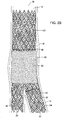
- Figure 2A is an enlarged view of a portion of the stent graft of Figure 1 including one embodiment of a delivery device;
- Figure 2B is an enlarged view of a portion of a stent graft positioned in a descending aorta where the aneurysm is less advanced than as seen in Figure 2A;
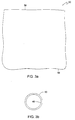
- Figure 3a is an enlarged side view of the delivery device in Figure 2.
- Figure 3b is a top view of the delivery device shown in Figure 2.
- An embodiment according to the present invention provides a delivery device or vehicle to deliver locally therapeutic agents at the site of an aneurysm, preferably in a time-release formulation.
- an aneurysmal blood vessel in this instance a descending aorta 10.
- Aorta 10 includes a wall 12, having a healthy wall portion 14 and an aneurysmal wall portion 16, wherein the aneurysmal wall portion 16 occurs where the aorta has a diameter substantially larger than it does where the healthy wall portion 14 occurs.
- Aneurysmal portion 16 forms an aneurysmal bulge or sac 18, wherein the elastin in the extra-cellular matrix of the aortic vessel wall 12 is degraded, preventing the aortic wall 12 at the aneurysmal portion 16 from holding the aorta at its healthy diameter against the pressure of blood.
- intervention to prevent rupture of the aneurysm is dictated.
- Surgical intervention can include highly invasive procedures, where the section of the aorta undergoing the aneurysmic event is opened up or removed completely, and a synthetic graft is sewn in place between healthy sections of the aorta or the severed ends of the aorta (not shown).
- intervention may encompass exclusion of the aneurysmal sac 18 by placement of an exclusion device such as a stent graft 22 (a modular bifurcated stent graft being shown here).
- the stent graft typically includes a stent portion 24, having a supportive yet collapsible construction (here in a grid pattern), to which a graft portion 26 is sewn or attached.
- the stent portion 24 provides a tubular body having a support capability sufficient to hold the graft portion 26 in an open position across the aneurysmal sac 18, such that the opposed ends are received and sealed against healthy portions 14 of the of the aorta.
- the graft portion 26 blocks the passage of blood to the aneurysmal sac 18, and provides a conduit for blood flow past the aneurysmal sac 18.
- the stent graft 22 provides an exclusionary environment through which blood may flow past the aneurysmal sac 18, there remains a need to treat the aneurysmal sac 18.
- fresh blood may leak into the aneurysmal sac 18 region, despite the presence of stent graft 22, leading to further breakdown in the extra-cellular matrix and the aneurysmal vessel. If this occurs, the excluded aneurysmal vessel may rupture leading to patient mortality. Therefore, there remains a need to treat the aneurysmal sac 18 further despite the presence of the excluding device or as an alternative to using an excluding device.
- one or more therapeutic agents described herein, infra are provided in a delivery vehicle included with an excluding device or intravascular repair vehicle, for example, the stent graft 22 shown in Figure 1.
- the placement of the stent graft 22 in the aorta 10 is a technique well known to those skilled in the art, and essentially includes the opening of a blood vessel in the leg, and the insertion of the stent graft 22 contained in a catheter into the vessel, guiding the catheter through the vessel, and deploying the stent graft 22 in a position spanning the aneurysmal sac 18.
- the bifurcated stent graft 22 is shown in its fully assembled and positioned state, it is to be understood that the bifurcated stent graft 22 typically is considered to have at least three portions, a trunk portion 38, located in the lower portion of the descending aorta 34, and two minor diameter leg portions 40, 42 that fit into the two legs of the iliac arteries 30 and 32.
- the bifurcated stent graft 22 is configured such that the trunk and leg portion 38, 40 and 42 each include a graft portion, supported externally by a tubular metal stent portion that each expand to a pre-established diameter when placed in the vasculature.
- the metal stent 24 includes a plurality of hoop frame members each of which preferably includes a plurality of elements, here, diamond-shaped which surround the circumference of the graft at a particular location where the hoop forms a portion of the stent structure as a whole, e.g., the Medtronic AneuRx® stent graft.
- a therapeutic agent delivery device in the form of a delivery vehicle 50, connected to a ring 48 on the outer surface of the stent graft 22.
- the delivery vehicle 50 is positioned such that upon placement in an aneurysmal blood vessel location such as aneurysmal sac 18 of aorta 10, the delivery vehicle 50 is located between the stent graft 22 and the aneurysmal wall 16 of aorta 10.
- the delivery vehicle 50 preferably is positioned on the stent graft 22 to ensure a proximal positioning with healthy tissue in the wall 16 of the aorta 10.
- the delivery vehicle in the form of a pouch 50 from Figure 2 is shown.
- the delivery vehicle 50 is shown as a wide bag or sac that eventually is wrapped around the outer diameter surface of a stent graft, attached at end 58 of delivery vehicle 50.
- the delivery vehicle may carry a therapeutic agent formulated with a carrier in the form of a sheet, coating, slab, gel, capsule, microparticles, nanoparticles and/or combinations of thereof.
- the delivery vehicle is manufactured from a biocompatible material that is permeable to water and dissolved therapeutic agents.
- the pouch can be manufactured from materials such as polyolefins (polypropylene, polyethylene), polyurethanes, silicones, polyesters (Dacron@) and fluorinated polyolefins (PTFE).
- Delivery vehicle 50 may be prepared, for example, by folding a sheet of the pouch material in half, and attaching together the opposed sides projecting from the crease occurring at the fold which forms end 56, such as by sewing, laser welding, adhesives or the like to leave an open end. The therapeutic agent formulation is then loaded into the interior of the delivery vehicle 50, and the open end 58 is then sealed by similar means as the means used to close the sides.
- Figure 3b shows a top view of delivery vehicle 50 attached to ring 48 of the stent graft 22.
- the therapeutic agent/carrier formulation comprises a material to ensure the controlled release of the therapeutic agent.
- the dispersion of the therapeutic agent allows the therapeutic reaction to be substantially localized so that overall dosages to the individual can be reduced, and undesirable side effects caused by the action of the agent in other parts of the body are minimized.
- the therapeutic agent formulation comprises a carrier, which according to the present invention can be made of synthetic polymers, natural polymers, inorganics and combinations of these.
- the polymers may be either biodegradable or non-biodegradable. Typical examples of biodegradable synthetic polymers are listed below:
- biostable synthetic polymers examples include:
- Typical examples of natural polymers include albumin, collagen, gelatin, hyaluronic acid, starch, alginate, pectin, cellulose and cellulose derivatives (such as methylcellulose, hydroxypropylcellulose, hydroxypropylmethylcellulose, carboxymethylcellulose, cellulose acetate phthalate, cellulose acetate succinate, hydroxypropylmethylcellulose phthalate), casein, dextran, polysaccharides (such as sucrose acetate isobutyrate), and fibrinogen.
- albumin such as albumin, collagen, gelatin, hyaluronic acid, starch, alginate, pectin, cellulose and cellulose derivatives (such as methylcellulose, hydroxypropylcellulose, hydroxypropylmethylcellulose, carboxymethylcellulose, cellulose acetate phthalate, cellulose acetate succinate, hydroxypropylmethylcellulose phthalate), casein, dextran, polysaccharides (such as sucrose acetate isobutyrate), and fibrin
- materials as described herein also can be blended in various compositions as required.
- the delivery vehicle--can be fashioned in a variety of forms with desired release characteristics and/or with specific desired properties.
- the carriers may be fashioned to be in the form of a sheet, coating, slab, gel, capsule, microparticles, nanoparticles and combinations of these.
- delivery vehicle 50 may contain a polymeric sheet loaded with the therapeutic agent as a carrier.
- a polymeric sheet loaded with the therapeutic agent as a carrier.
- Such a sheet may be formed by dissolving or dispersing both the polymer and therapeutic agent in a suitable solvent, pouring this solution in a suitable mould (e.g., glass petri dish), and removing the solvent by evaporation.
- the loaded sheet formed may be cut in such a way that it would fit the delivery vehicle.
- delivery vehicle 50 may contain a gel as a carrier for the therapeutic agents.
- a gel may be prepared by dissolving the polymer in an organic solvent in which the therapeutic agent is either dissolved or dispersed.
- the gel-like liquid composition is placed into the delivery vehicle 50, and when the composition is implanted, the solvent diffuses into the body fluid. Subsequently a semi-solid implant is formed by the precipitation of the polymers in an aqueous environment.
- a gel releases the agent into the aneurysmal sac 18, where the delivery vehicle 50 provides a convenient mechanism to maintain the gel adjacent the aneurysmal sac 18.
- the agents described herein are intermixed with the gel, and the gel is preferably loaded into delivery vehicle 50 that provides a supporting structure to maintain the gel in a position adjacent to the aneurysmal sac 18.
- the therapeutic agent diffuses out of the gel and passes through the delivery vehicle and into contact with the aneurysmal sac 18.
- the gel may be prepared with a plurality of agents, or individual gel preparations may be prepared with individual agents and portions of the different gels intermixed.
- a gel or a combination of gels and other encapsulating members may be used in combination so that different agents are delivered at varying concentrations and over varying time courses in a manner that optimizes the therapeutic effect.
- multiple therapeutic agents, and customized relative percentages of agents and mixes of agents may be provided for each patient.
- a slab or a gel (described infra ) or other form of carrier--end 58 is closed by sewing or other means and is attached to the stent graft 22, preferably at ring 48.
- the therapeutic agent will be released into the blood or other fluid in this relatively isolated region such that a maximum concentration of the agent likely will be reached in this region alone--the therapeutic agents are not be delivered to the rest of the body.
- substantial quantities of the therapeutic agent remain in place for a longer period of time, increasing the efficacy of the delivery of the agent.
- Figure 2B shows delivery vehicle 50 placed in a proximal position in the aorta, and illustrates a less advanced aneurysm.
- delivery vehicle 50 is positioned such that it is held in close contact with the aorta wall at that location, and thus at least a portion of the therapeutic agent will be released directly from the delivery vehicle and into contact with the aorta wall without having to pass first through the blood or other fluid in the aneurysmal sac 18. Therefore the therapeutic agent can be delivered directly, without intervening diffusion or release into the blood or other fluid, increasing its efficacy in treating the aneurysmal site.
- multiple pouches may be used, with each pouch being attached by at least one end to the stent graft, and arranged such that the spacing between adjacent pouches extending about the circumference of the stent graft is, preferably, relatively equal.
- at least four such delivery vehicles are equally spaced about the circumference of the stent graft when placed across the aneurysmal aorta.
- multiple delivery vehicles can be located both about the circumference of the stent graft, as well as longitudinally along stent graft.
- each of the trunk portion 38, the leg 40 and the leg 42 are delivered to the aneurysmal site 18 by endovascular means.
- the stent graft 22 is a two piece stent graft, as the trunk 38 and leg 40 are formed as one continuous piece, or are connected together before deployment into the body.
- each of the unitary trunk 38 and leg 40, and the separate leg 42 are disposed in catheters and the catheters are inserted into and guided up an artery in the leg to the ascending aorta where the aneurysmal sac is to be bypassed.
- they are first flattened, and then rolled into a cylindrical body which can be inserted into the open end of the catheter.
- the catheter includes, at least, a sheath into which each of the stent graft portions are received, and a push rod or stopper, which bears against the inner end of the stent graft portion received in the sheath.
- the sheath is retractable with respect to the push rod, such that the portion of the stent graft 22, either the unitary trunk 38 and leg 40 or the second leg 42, remains stationary as the sheath is retracted, to enable the stent graft 22 to deploy in aorta 10.
- a guide wire is first inserted through a leg incision, and then directed along the artery until the end inserted into the aorta 10 extends beyond the deployment location for the stent graft 22. Then the catheter with the unitary trunk 38 and leg 40 portion therein is guided along the guide wire to the point where the end thereof is located upstream of the aneurysmal sac 18, and the sheath of the catheter is withdrawn as the push rod remains stationary. Thus, the trunk 38 and leg are deployed, such that the upper end of the trunk 38 is located above the aneurysmal sac 18, and the leg is extended down the left ilial artery 30.
- the trunk includes a cutout into which the right leg 42 of the stent graft, which will be guided from a second incision in the right leg of the patient, will be likewise guided.
- the inner end of the right leg 42 will be disposed in the opening in the trunk 38, and the second end therof will extend down and seal against the right iliac artery wall.
- Therapeutic agents according to the present invention are those that are known in the art that are useful in treating aneurysms or that reduce the likelihood of progression of aneurysms.
- Such agents include, for example, matrix metalloproteinase (MMP) inhibitors, antibiotics, cyclooxygenase-2 (COX-2) inhibitors, angiotensin-converting enzyme (ACE) inhibitors, glucocorticoids, beta blockers, nitric acid synthase (NOS) inhibitors, antioxidants and cellular adhesion molecules (CAMs).
- MMP matrix metalloproteinase
- COX-2 cyclooxygenase-2
- ACE angiotensin-converting enzyme
- NOS nitric acid synthase
- CAMs cellular adhesion molecules
- the therapeutic agent or agents may be supplied to the aneurysmal site with an excluding device such as a stent graft. Since the therapeutic agents are delivered locally, the dosage necessary for and side effects associated with oral or intravascular delivery are reduced substantially.
- the therapeutic agents used in certain embodiments are those known to inhibit or block the production of proteins and enzymes known to be found in aneurysmal blood vessel locations, but which are not found--or are found at much lower concentrations--in healthy blood vessels.
- proteins and enzymes are at least in part responsible for, or are initiators or catalysts of biochemical compounds responsible for the loss of elasticity of or inflammation of blood vessels.
- loss of elasticity or inflammation contributes to aneurysm formation and progression.
- the therapeutic agents according to the present invention work through various mechanisms; for example, some work by altering biochemical pathways that produce compounds that cause inflammation, others work by inhibiting elastases, gelatinases or other proteinases or by preventing the adhesion of such molecules to the vascular cell wall.
- MMP-9 metalloproteinase 9
- Cyclooxygenase-2 or "COX-2” is known to burn a fat in the body known as arachidonic acid or AA, a naturally occurring omega-6 fatty acid found in nearly all cell membranes in humans.
- Prostaglandin E2 (PGE2) is synthesized from the catalyzation of COX-2 and arachidonic acid and, when PGE2 is taken up by macrophages, it results in MMP-9 formation.
- PGE2 Prostaglandin E2
- one aspect according to the present invention provides MMP and COX-2 inhibitors at the aneurysmal site.
- a potent inhibitor of MMPs is a functional group capable of chelating the active site zinc ion strongly, and embodiments according to the present invention use one or more of the major classes of MMP inhibitor compounds: hydroxamic acids, carboxylic acids, thiols, phosphinic acids, and tetracyclines.
- Typical MMP inhibitors include N-biphenyl sulfonyl-phenylalanine hydroxamic acid; amines, amino acid derivatives and low molecular weight peptides containing an amide-bound oxal hydroxamic acid moiety; benzodiazepine; acyclic succinic acid-based compounds; oleic acid; cerivastatin; thiol compound MAG-283; tetracycline derivatives, such as tetracycline, doxycycline (Periostat®), and 6-deoxy-6-demethyl-4-dedimethylamino-tetracycline (COL-3).
- Other suitable inhibitors include chelating agents, such as EDTA.
- COX-2 inhibitors include Celecoxib, Rofecoxib, Valdecoxib, Etoricoxib, and Parecoxib, all of which are available in pharmacological preparations. Additionally, COX-2 inhibition has been demonstrated from herbs such as green tea, ginger, turmeric, chamomile, Chinese gold-thread, barberry, baikal skullcap, Japanese knotweed, rosemary, hops, feverfew, and oregano; and from other agents such as piroxican, mefenamic acid, meloxican, nimesulide, diclofenac, MF-tricyclide, raldecoxide, nambumetone, naproxen, herbimycin-A, and diaryl hydroxyfuranones. It is specifically contemplated in embodiments according to the present invention that such additional COX-2 inhibiting materials may be formulated for use in an aneurysmal location.
- elastin-attacking proteins may be limited by interfering with the oxidation reaction between COX-2 and AA by reducing the capability of AA to oxidize. It is known that certain NSAIDs provide this function. For example, ketoralac tromethamine (Toradol) inhibits synthesis of progstaglandins including PGE2. In addition, other currently available NSAIDs, including indomethacin, ketorolac, ibuprofen and aspirin, among others, reduce inflammation at the aneurysmal site, limiting the ability of elastin attacking proteins such as MMP-9 to enter into the cellular matrix of the blood vessel and degrade elastin.
- ketoralac tromethamine Toradol
- other currently available NSAIDs including indomethacin, ketorolac, ibuprofen and aspirin, among others, reduce inflammation at the aneurysmal site, limiting the ability of elastin attacking proteins such as MMP-9 to enter into the cellular
- steroidal based anti-inflammatories such as methylprednisolone, dexamethasone or sulfasalazine may be provided to reduce the inflammation at the aneurysmal site.
- suitable anti-inflammatory agents include cyclosporine A and azathioprine.
- Another type of suitable therapeutic agents may be anti-oxidants, such as curcumin, vitamins, and vitamin constituents, such as ⁇ -tocopherol and ⁇ -carotene.
- MMP-9 may still be present in the blood vessel. Therefore, another class of therapeutic agents useful in embodiments according to the present invention is the class that limits the ability of elastin-attacking proteins to adhere to the blood vessel wall, such as anti-adhesion molecules.
- Anti-adhesion molecules such as anti-CD18 monoclonal antibody, limit the capability of leukocytes that may have taken up MMP-9 to attach to the blood vessel wall, thereby preventing MMP-9 from having the opportunity to enter into the blood vessel cellular matrix and attack the elastin.
- ACE angiotensin-converting enzyme
- Other therapeutic agents useful in embodiments according to the present invention are angiotensin-converting enzyme (ACE) inhibitors that suppress the development of elastase-induced vessel damage.
- ACE inhibitors known in the art are captopril, enalapril, losartan and lisinopril and the active forms of several ACE inhibitor prodrugs on the market.
- Other agents such as the NOS inhibitor aminoguanidine are also useful in embodiments according to the present invention.
- Beta blockers that may be used in the compounds and methods of the present invention include acebutolol, atenolol, betaxolol, bisoprolol, carteolol, carvedilol, esmolol, labetolol, metoprolol, nadolol, penbutolol, pindolol, propranolol, and timolol, as well as other beta blockers known in the art.
Landscapes
- Health & Medical Sciences (AREA)
- Life Sciences & Earth Sciences (AREA)
- Engineering & Computer Science (AREA)
- Public Health (AREA)
- Veterinary Medicine (AREA)
- Heart & Thoracic Surgery (AREA)
- Vascular Medicine (AREA)
- Animal Behavior & Ethology (AREA)
- General Health & Medical Sciences (AREA)
- Biomedical Technology (AREA)
- Chemical & Material Sciences (AREA)
- Surgery (AREA)
- Epidemiology (AREA)
- Molecular Biology (AREA)
- Medicinal Chemistry (AREA)
- Composite Materials (AREA)
- Materials Engineering (AREA)
- Gastroenterology & Hepatology (AREA)
- Pulmonology (AREA)
- Cardiology (AREA)
- Oral & Maxillofacial Surgery (AREA)
- Transplantation (AREA)
- Materials For Medical Uses (AREA)
- Prostheses (AREA)
Abstract
Description
- The field of the invention is the treatment of vascular abnormalities. More specifically, the field of the invention is the treatment of vascular abnormalities using therapeutic agents delivered to the aneurysmal site by a delivery vehicle.
- Aneurysm, the enlargement of a blood vessel at a specific location--at times to the point where rupture of the blood vessel is imminent--has been treated in the past by surgical intervention techniques, where the affected portion of the blood vessel is removed or bypassed so that the vessel lumen is replaced by a synthetic graft. This treatment regimen is highly invasive, typically requiring a multiple day post-operative hospital stay, as well as several months of recuperative time.
- Prophylactic methods for preventing the formation of aneurysm tend to rely on reducing blood pressure in an effort to reduce mechanical stress on the blood vessels. These methods involve drugs that can have undesirable side effects, e.g., kidney or liver damage, especially over long-term use.
- To address the limitations imposed by surgical intervention or drug therapy, a technique has been developed by which the aneurysmal blood vessel site is treated by placing what is known in the art as a stent graft within the blood vessel in a position where the tubular body of the stent graft spans the interior of the weakened area of the blood vessel wall. The stent graft, properly positioned, allows blood to flow through the hollow tubular interior of the stent graft preventing blood, under systemic pressure, from reaching the weakened blood vessel wall at the aneurysmal site. However, there is still an opportunity for blood to reach the weakened wall location, such as through leakage of blood between the seal formed between the end of the stent graft and the vessel wall, by diffusion of blood through the graft material, or through the supply of blood into the aneurysmal sac from adjacent blood vessels. In each case, there is a renewed risk that the blood vessel may rupture. Furthermore, there remains a risk of additional deterioration of the blood vessel wall at the aneurysmal location even in the absence of blood leakage.
- Typically, surgical intervention for aneurysm repair is not indicated until the blood vessel diameter at the aneurysmal site expands to 200 to 300% of its normal diameter. Below this threshold, the normal course of treatment has been to monitor the site, and if the diameter of the blood vessel wall at the aneurysmal site continues to expand beyond an undesirable threshold diameter, intervene surgically. Through numerous studies performed during the past decade, which were summarized by Thompson et al. in Curr. Probl. Surg., 39, 93 (2002), the basic knowledge of aneurysm disease has increased significantly. Despite this increase no therapeutic approaches have proven to reduce the rate of aneurysms in patients. Given the fact that several pharmacological strategies, e.g., cyclooxygenase-2 (COX-2) inhibitors, tissue inhibitors of matrix metalloproteinases (MMP), and antibiotics, can reduce the severity and/or progression of an aneurysm in animal models, these approaches may reduce the likelihood of the need for surgical intervention to repair the aneurysm.
- Based on the current knowledge of the causes of aneurysms, MMP inhibition has been proposed as a potential therapeutic approach to treat abdominal aortic aneurysm (AAA). Typical treatment requires the use of systemic MMP inhibitors, either orally, intra-muscularly or intra-venously introduced, in a dosage sufficient to ensure that the quantity of agent reaching the aneurysm is sufficient to affect level of the elastin-attacking protein. For example, doxycycline could inhibit AAA growth in humans (see J. Vasc. Surg., 31, 325 (2000)); however, the side effects of doxycycline, including the likelihood of the patient developing doxycycline resistant bacteria as a result of long term doxycycline treatment, dictate that doxycycline treatment may be only a short term solution to the problem of aneurysm growth. Other approaches to treat AAA are the use of anti-inflammatory agents, including COX-2 inhibitors (see Circulation, 100, 48 (1999)), angiotensin-converting enzyme (ACE) inhibitors (see J. Vasc. Surg., 33, 1057 (2001)), nitric oxide synthase (NOS) inhibitors (see Ann. Vasc. Surg., 16, 65 (2002)), and antioxidants.
- In view of the above considerations, it is clear that the present methods to treat AAA have limitations. Moreover, there is no practical pharmacological method available to prevent the aneurysm formation, without having to worry about the side effects of the drugs used. US Pat. No. 5,834,449 to Thompson employs the use of a tetracycline compound having no antimicrobial activity; proposing use of a medical apparatus capable of intravascular delivery; however, no details on the device are disclosed.
- Thus, there exists a need, post-placement of a stent graft, to treat an aneurysmal site with therapeutic agents, so as to reduce the severity and/or the progression of the aneurysm and the risk of aneurysm rupture, tear or other failure. Therefore, there exists a need in the art to develop additional treatment regimens, particularly non-invasive or minimally invasive localized techniques, which may be used to reduce the severity of aneurysm. Therefore, it is an object of the present invention to provide an improved device for treatment of aneurismal tissue.
- This object is solved by a device according to
claims 1 and 16. Further aspects, advantages, features and details of the present invention are apparent from the dependent claims, the specification, and the accompanying drawings. Embodiments according to the present invention provide localized application of therapeutic agents useful to reduce the severity and the progression of an aneurysm at an aneurysmal site. One embodiment includes the administration of one or more therapeutic agents selected from a class of therapeutic agents which have been shown to block or inhibit the formation of biochemical compounds found in aneurysmal sites but not found--or found in much smaller quantities--in healthy blood vessels by using a specialized delivery vehicle. The therapeutic agents may include matrix metalloproteinase (MMP) inhibitors, antibiotics, cyclooxygenase-2 (COX-2) inhibitors, angiotensin-converting enzyme (ACE) inhibitors, glucocorticoids, beta blockers, nitric oxide synthase (NOS) inhibitors, antioxidants, non-steroidal anti-inflammatory drugs (NSAIDs) and cellular adhesion molecules (CAMs), and combinations of these. The agents preferably are localized to (adjacent) the aneurysmal site by the placement of a delivery vehicle that is comprised of, or within which is provided, a carrier containing and capable of dosing over time the therapeutic agents. The materials to be used for such a carrier can be synthetic polymers, natural polymers, inorganics and combinations of these. - The physical form of the drug-loaded carrier can be a sheet, coating, slab, gel, capsule, microparticles, nanoparticles and combinations of these. In one embodiment the carrier is placed in a pouch that is attached to or wrapped around the outer--i.e. blood vessel wall side--of a stent graft passing through an aneurysmal blood vessel. The stent graft isolates the aneurysmal region of the blood vessel from blood flow and provides a structure on which to attach the delivery device so that the agent may be delivered directly to the aneurysmal blood vessel site. The delivery device is positioned on or wrapped around a stent, stent graft, or other intervention device spanning the aneurysmal site through the interior of a blood vessel to release therapeutic agents into the space between the intervention device and the wall of the aneurysmal blood vessel. In another embodiment the stent graft comprises two layers of fabric, and the drug-loaded carrier is placed inside such a double-walled stent graft.
- The delivery vehicle should be permeable to water with and without dissolved therapeutic agents and it should be biocompatible. In a preferred embodiment the carrier is biodegradable, where the release of the therapeutic agents is governed by a combination of diffusion and degradation of the carrier, thus releasing the therapeutic agent over time. The delivery vehicle is positioned at the aneurysmal site, such as by inclusion on or in an exclusion device such as a stent graft.
- So that the above-recited features according to the present invention can be understood in detail, a more particular description may be had by reference to embodiments, some of which are illustrated in the appended drawings.
- Figure 1 is a sectional view of an descending aorta with a stent graft placed therein;
- Figure 2A is an enlarged view of a portion of the stent graft of Figure 1 including one embodiment of a delivery device;
- Figure 2B is an enlarged view of a portion of a stent graft positioned in a descending aorta where the aneurysm is less advanced than as seen in Figure 2A;
- Figure 3a is an enlarged side view of the delivery device in Figure 2. Figure 3b is a top view of the delivery device shown in Figure 2.
- An embodiment according to the present invention provides a delivery device or vehicle to deliver locally therapeutic agents at the site of an aneurysm, preferably in a time-release formulation. Referring first to Figure 1, there is shown, in section, an aneurysmal blood vessel, in this instance a descending
aorta 10.Aorta 10 includes awall 12, having ahealthy wall portion 14 and ananeurysmal wall portion 16, wherein theaneurysmal wall portion 16 occurs where the aorta has a diameter substantially larger than it does where thehealthy wall portion 14 occurs.Aneurysmal portion 16 forms an aneurysmal bulge orsac 18, wherein the elastin in the extra-cellular matrix of theaortic vessel wall 12 is degraded, preventing theaortic wall 12 at theaneurysmal portion 16 from holding the aorta at its healthy diameter against the pressure of blood. - Where the
aneurysmal sac 18 has progressed to a diameter on the order of more than twice to three times the diameter of the healthyaortic wall 14, intervention to prevent rupture of the aneurysm is dictated. Surgical intervention can include highly invasive procedures, where the section of the aorta undergoing the aneurysmic event is opened up or removed completely, and a synthetic graft is sewn in place between healthy sections of the aorta or the severed ends of the aorta (not shown). Alternatively intervention may encompass exclusion of theaneurysmal sac 18 by placement of an exclusion device such as a stent graft 22 (a modular bifurcated stent graft being shown here). The stent graft typically includes astent portion 24, having a supportive yet collapsible construction (here in a grid pattern), to which agraft portion 26 is sewn or attached. Thestent portion 24 provides a tubular body having a support capability sufficient to hold thegraft portion 26 in an open position across theaneurysmal sac 18, such that the opposed ends are received and sealed againsthealthy portions 14 of the of the aorta. Thegraft portion 26 blocks the passage of blood to theaneurysmal sac 18, and provides a conduit for blood flow past theaneurysmal sac 18. - Although the
stent graft 22 provides an exclusionary environment through which blood may flow past theaneurysmal sac 18, there remains a need to treat theaneurysmal sac 18. In particular, it is known that fresh blood may leak into theaneurysmal sac 18 region, despite the presence ofstent graft 22, leading to further breakdown in the extra-cellular matrix and the aneurysmal vessel. If this occurs, the excluded aneurysmal vessel may rupture leading to patient mortality. Therefore, there remains a need to treat theaneurysmal sac 18 further despite the presence of the excluding device or as an alternative to using an excluding device. - In many embodiments, one or more therapeutic agents described herein, infra, are provided in a delivery vehicle included with an excluding device or intravascular repair vehicle, for example, the
stent graft 22 shown in Figure 1. Referring back to Figure 1, the placement of thestent graft 22 in theaorta 10 is a technique well known to those skilled in the art, and essentially includes the opening of a blood vessel in the leg, and the insertion of thestent graft 22 contained in a catheter into the vessel, guiding the catheter through the vessel, and deploying thestent graft 22 in a position spanning theaneurysmal sac 18. - Although the
bifurcated stent graft 22 is shown in its fully assembled and positioned state, it is to be understood that thebifurcated stent graft 22 typically is considered to have at least three portions, atrunk portion 38, located in the lower portion of the descendingaorta 34, and two minordiameter leg portions iliac arteries bifurcated stent graft 22 is configured such that the trunk andleg portion - When assembled in situ, the
entire stent graft 22 spans theaneurysmal sac 18 in theaorta 10, to seal the aneurysmal portion of theaorta 10 from blood flowing through theaorta 10. Themetal stent 24 includes a plurality of hoop frame members each of which preferably includes a plurality of elements, here, diamond-shaped which surround the circumference of the graft at a particular location where the hoop forms a portion of the stent structure as a whole, e.g., the Medtronic AneuRx® stent graft. - Turning to Figure 2A, there is shown a therapeutic agent delivery device in the form of a
delivery vehicle 50, connected to aring 48 on the outer surface of thestent graft 22. Thedelivery vehicle 50 is positioned such that upon placement in an aneurysmal blood vessel location such asaneurysmal sac 18 ofaorta 10, thedelivery vehicle 50 is located between thestent graft 22 and theaneurysmal wall 16 ofaorta 10. Thedelivery vehicle 50 preferably is positioned on thestent graft 22 to ensure a proximal positioning with healthy tissue in thewall 16 of theaorta 10. - Referring now to Figure 3a, the delivery vehicle in the form of a
pouch 50 from Figure 2 is shown. Here, thedelivery vehicle 50 is shown as a wide bag or sac that eventually is wrapped around the outer diameter surface of a stent graft, attached atend 58 ofdelivery vehicle 50. The delivery vehicle may carry a therapeutic agent formulated with a carrier in the form of a sheet, coating, slab, gel, capsule, microparticles, nanoparticles and/or combinations of thereof. To maintain the therapeutic agent within thedelivery vehicle 50 yet allow transport of fluids and agent through thedelivery vehicle 50, the delivery vehicle is manufactured from a biocompatible material that is permeable to water and dissolved therapeutic agents. The pouch can be manufactured from materials such as polyolefins (polypropylene, polyethylene), polyurethanes, silicones, polyesters (Dacron@) and fluorinated polyolefins (PTFE).Delivery vehicle 50 may be prepared, for example, by folding a sheet of the pouch material in half, and attaching together the opposed sides projecting from the crease occurring at the fold which formsend 56, such as by sewing, laser welding, adhesives or the like to leave an open end. The therapeutic agent formulation is then loaded into the interior of thedelivery vehicle 50, and theopen end 58 is then sealed by similar means as the means used to close the sides. Figure 3b shows a top view ofdelivery vehicle 50 attached to ring 48 of thestent graft 22. - The therapeutic agent/carrier formulation comprises a material to ensure the controlled release of the therapeutic agent. The materials to be used for such a formulation--as well as the delivery vehicle itself, in some embodiments--are preferably comprised of a biocompatible polymer, in which the therapeutic agent is present. The dispersion of the therapeutic agent allows the therapeutic reaction to be substantially localized so that overall dosages to the individual can be reduced, and undesirable side effects caused by the action of the agent in other parts of the body are minimized.
- Thus, the therapeutic agent formulation comprises a carrier, which according to the present invention can be made of synthetic polymers, natural polymers, inorganics and combinations of these. The polymers may be either biodegradable or non-biodegradable. Typical examples of biodegradable synthetic polymers are listed below:
- Aliphatic polyesters, such as poly(lactic acid), poly(glycolic acid), poly(lactic acid-co-glycolic acid), poly(ε-caprolactone), poly(trimethylene carbonate), polydioxanone and copolymers; poly(hydroxy butyrate) (Biopol®), poly(hydroxy valerate), poly(hydroxy butyrate-co-hydroxy valerate), poly(butylene succinate) (Bionolle®), poly(butylene adipate),
- Polyanhydrides, such as poly(adipic anhydride), and poly(sebacic acid-co-1,3-bis(p-carboxyphenoxy)propane),
- Poly(ortho ester)s,
- Poly(ester amide)s, such as based on 1,4-butanediol, adipic acid, and 1,6-aminohexanoic acid (BAK 1095),
- Poly(ester urethane)s,
- Poly(ester anhydride)s,
- Poly(ester carbonate)s, such as tyrosine-poly(alkylene oxide)-derived poly(ether carbonate)s,
- Polyphosphazenes,
- Polyarylates, such as tyrosine-derived polyarylates,
- Poly(ether ester)s, such as poly(butylene terephthalate)-poly(ethylene glycol) copolymers (PolyActive®), poly(ε-caprolactone)-b-poly(ethylene glycol)) block copolymers, and poly(ethylene oxide)-b-poly(hydroxy butyrate) block copolymers.
- Examples of biostable synthetic polymers include:
- Polyolefins, such as polyethylene, polypropylene,
- Polyurethanes,
- Fluorinated polyolefins, such as polytetrafluorethylene (Teflon®),
- Chlorinated polyolefins, such as poly(vinyl chloride),
- Polyamides,
- Acrylate polymers, such as poly(methyl methacrylate) and copolymers (Eudragit®),
- Acrylamide polymers, such as poly(N-isopropylacrylamide),
- Vinyl polymers, such as poly(N-vinylpyrrolidone), poly(vinyl alcohol), poly(vinyl acetate), poly(ethylene-co-vinylacetate),
- Polyacetals,
- Polycarbonates,
- Polyethers, such as based on poly(oxyethylene) and poly(oxypropylene) units (Pluronic®),
- Aromatic polyesters, such as poly(ethylene terephthalate) (Dacron@), poly(propylene terephthalate) (Sorona®)
- Poly(ether ether ketone)s,
- Polysulfones,
- Silicone rubbers,
- Thermosets, such as epoxies,
- and Poly(ester imide)s
- Representative examples of inorganics are listed below:
- Hydroxyapatite,
- Tricalcium phosphate,
- Silicates, such as Bioglass®, montmorillonite, and mica.
- Typical examples of natural polymers include albumin, collagen, gelatin, hyaluronic acid, starch, alginate, pectin, cellulose and cellulose derivatives (such as methylcellulose, hydroxypropylcellulose, hydroxypropylmethylcellulose, carboxymethylcellulose, cellulose acetate phthalate, cellulose acetate succinate, hydroxypropylmethylcellulose phthalate), casein, dextran, polysaccharides (such as sucrose acetate isobutyrate), and fibrinogen.
- Additionally, materials as described herein also can be blended in various compositions as required.
- The carriers―or depending on the form, the delivery vehicle--can be fashioned in a variety of forms with desired release characteristics and/or with specific desired properties. For example, the carriers may be fashioned to be in the form of a sheet, coating, slab, gel, capsule, microparticles, nanoparticles and combinations of these. For example,
delivery vehicle 50 may contain a polymeric sheet loaded with the therapeutic agent as a carrier. Such a sheet may be formed by dissolving or dispersing both the polymer and therapeutic agent in a suitable solvent, pouring this solution in a suitable mould (e.g., glass petri dish), and removing the solvent by evaporation. The loaded sheet formed may be cut in such a way that it would fit the delivery vehicle. - Alternatively,
delivery vehicle 50 may contain a gel as a carrier for the therapeutic agents. Such a gel may be prepared by dissolving the polymer in an organic solvent in which the therapeutic agent is either dissolved or dispersed. The gel-like liquid composition is placed into thedelivery vehicle 50, and when the composition is implanted, the solvent diffuses into the body fluid. Subsequently a semi-solid implant is formed by the precipitation of the polymers in an aqueous environment. Such a gel releases the agent into theaneurysmal sac 18, where thedelivery vehicle 50 provides a convenient mechanism to maintain the gel adjacent theaneurysmal sac 18. - If a gel is utilized, the agents described herein are intermixed with the gel, and the gel is preferably loaded into
delivery vehicle 50 that provides a supporting structure to maintain the gel in a position adjacent to theaneurysmal sac 18. Within time, the therapeutic agent diffuses out of the gel and passes through the delivery vehicle and into contact with theaneurysmal sac 18. The gel may be prepared with a plurality of agents, or individual gel preparations may be prepared with individual agents and portions of the different gels intermixed. Alternatively, a gel or a combination of gels and other encapsulating members may be used in combination so that different agents are delivered at varying concentrations and over varying time courses in a manner that optimizes the therapeutic effect. Thus, multiple therapeutic agents, and customized relative percentages of agents and mixes of agents, may be provided for each patient. - After the
delivery vehicle 50 is filled with the carrier―either the microspheres, a slab or a gel (described infra) or other form of carrier--end 58 is closed by sewing or other means and is attached to thestent graft 22, preferably atring 48. - The position of the
delivery vehicle 50 adjacent theaneurysmal sac 18, isolated bystent graft 22 from the blood passing through theaorta 10, establishes thedelivery vehicle 50 in a relatively sealed environment such that blood and other fluids that may be in this region have a limited likelihood of being transmitted or passed from this region. Thus, the therapeutic agent will be released into the blood or other fluid in this relatively isolated region such that a maximum concentration of the agent likely will be reached in this region alone--the therapeutic agents are not be delivered to the rest of the body. As a result, substantial quantities of the therapeutic agent remain in place for a longer period of time, increasing the efficacy of the delivery of the agent. Figure 2B showsdelivery vehicle 50 placed in a proximal position in the aorta, and illustrates a less advanced aneurysm. By placingdelivery vehicle 50 at the proximal end of thestent graft 22,delivery vehicle 50 is positioned such that it is held in close contact with the aorta wall at that location, and thus at least a portion of the therapeutic agent will be released directly from the delivery vehicle and into contact with the aorta wall without having to pass first through the blood or other fluid in theaneurysmal sac 18. Therefore the therapeutic agent can be delivered directly, without intervening diffusion or release into the blood or other fluid, increasing its efficacy in treating the aneurysmal site. - Alternatively, multiple pouches may be used, with each pouch being attached by at least one end to the stent graft, and arranged such that the spacing between adjacent pouches extending about the circumference of the stent graft is, preferably, relatively equal. In one embodiment, at least four such delivery vehicles are equally spaced about the circumference of the stent graft when placed across the aneurysmal aorta. Alternatively, multiple delivery vehicles can be located both about the circumference of the stent graft, as well as longitudinally along stent graft.
- To position the
stent graft 22 in theaorta 10 and thereby provide a conduit to exclude blood flow to theaneurysmal sac 18, each of thetrunk portion 38, theleg 40 and theleg 42 are delivered to theaneurysmal site 18 by endovascular means. In the embodiment of thestent graft 22 described herein, thestent graft 22 is a two piece stent graft, as thetrunk 38 andleg 40 are formed as one continuous piece, or are connected together before deployment into the body. - To enable endovascular deployment of the stent graft, each of the
unitary trunk 38 andleg 40, and theseparate leg 42, are disposed in catheters and the catheters are inserted into and guided up an artery in the leg to the ascending aorta where the aneurysmal sac is to be bypassed. To enable placement of the two separate portions of the stent graft into the catheters, they are first flattened, and then rolled into a cylindrical body which can be inserted into the open end of the catheter. The catheter includes, at least, a sheath into which each of the stent graft portions are received, and a push rod or stopper, which bears against the inner end of the stent graft portion received in the sheath. The sheath is retractable with respect to the push rod, such that the portion of thestent graft 22, either theunitary trunk 38 andleg 40 or thesecond leg 42, remains stationary as the sheath is retracted, to enable thestent graft 22 to deploy inaorta 10. - To position the catheter for deployment of the
stent graft 22, a guide wire is first inserted through a leg incision, and then directed along the artery until the end inserted into theaorta 10 extends beyond the deployment location for thestent graft 22. Then the catheter with theunitary trunk 38 andleg 40 portion therein is guided along the guide wire to the point where the end thereof is located upstream of theaneurysmal sac 18, and the sheath of the catheter is withdrawn as the push rod remains stationary. Thus, thetrunk 38 and leg are deployed, such that the upper end of thetrunk 38 is located above theaneurysmal sac 18, and the leg is extended down the leftilial artery 30. The trunk includes a cutout into which theright leg 42 of the stent graft, which will be guided from a second incision in the right leg of the patient, will be likewise guided. The inner end of theright leg 42 will be disposed in the opening in thetrunk 38, and the second end therof will extend down and seal against the right iliac artery wall. - Therapeutic agents according to the present invention are those that are known in the art that are useful in treating aneurysms or that reduce the likelihood of progression of aneurysms. Such agents include, for example, matrix metalloproteinase (MMP) inhibitors, antibiotics, cyclooxygenase-2 (COX-2) inhibitors, angiotensin-converting enzyme (ACE) inhibitors, glucocorticoids, beta blockers, nitric acid synthase (NOS) inhibitors, antioxidants and cellular adhesion molecules (CAMs). The therapeutic agent or agents are released over time in the aneurysmal location, reducing the likelihood of further dilation and increasing the likelihood of successful repair of the aneurysm. It is contemplated that the therapeutic agent or agents may be supplied to the aneurysmal site with an excluding device such as a stent graft. Since the therapeutic agents are delivered locally, the dosage necessary for and side effects associated with oral or intravascular delivery are reduced substantially.
- The therapeutic agents used in certain embodiments are those known to inhibit or block the production of proteins and enzymes known to be found in aneurysmal blood vessel locations, but which are not found--or are found at much lower concentrations--in healthy blood vessels. Such proteins and enzymes are at least in part responsible for, or are initiators or catalysts of biochemical compounds responsible for the loss of elasticity of or inflammation of blood vessels. Such loss of elasticity or inflammation contributes to aneurysm formation and progression. These therapeutic agents, when localized at the aneurysmal location, reduce the production of and/or occurrence of elastin-attacking proteins at the aneurysmal site. The therapeutic agents according to the present invention work through various mechanisms; for example, some work by altering biochemical pathways that produce compounds that cause inflammation, others work by inhibiting elastases, gelatinases or other proteinases or by preventing the adhesion of such molecules to the vascular cell wall.
- For example, metalloproteinase 9 (MMP-9) is a protein that attacks elastin and causes breakdown of the medial tissue of the vasculature. Cyclooxygenase-2 or "COX-2" is known to burn a fat in the body known as arachidonic acid or AA, a naturally occurring omega-6 fatty acid found in nearly all cell membranes in humans. Prostaglandin E2 (PGE2) is synthesized from the catalyzation of COX-2 and arachidonic acid and, when PGE2 is taken up by macrophages, it results in MMP-9 formation. Thus, if any of COX-2, PGE2 or AA is suppressed, then MMP-9 formation will be suppressed. Therefore, one aspect according to the present invention provides MMP and COX-2 inhibitors at the aneurysmal site.
- The key requirement for a potent inhibitor of MMPs is a functional group capable of chelating the active site zinc ion strongly, and embodiments according to the present invention use one or more of the major classes of MMP inhibitor compounds: hydroxamic acids, carboxylic acids, thiols, phosphinic acids, and tetracyclines. Typical MMP inhibitors include N-biphenyl sulfonyl-phenylalanine hydroxamic acid; amines, amino acid derivatives and low molecular weight peptides containing an amide-bound oxal hydroxamic acid moiety; benzodiazepine; acyclic succinic acid-based compounds; oleic acid; cerivastatin; thiol compound MAG-283; tetracycline derivatives, such as tetracycline, doxycycline (Periostat®), and 6-deoxy-6-demethyl-4-dedimethylamino-tetracycline (COL-3). Other suitable inhibitors include chelating agents, such as EDTA.
- COX-2 inhibitors include Celecoxib, Rofecoxib, Valdecoxib, Etoricoxib, and Parecoxib, all of which are available in pharmacological preparations. Additionally, COX-2 inhibition has been demonstrated from herbs such as green tea, ginger, turmeric, chamomile, Chinese gold-thread, barberry, baikal skullcap, Japanese knotweed, rosemary, hops, feverfew, and oregano; and from other agents such as piroxican, mefenamic acid, meloxican, nimesulide, diclofenac, MF-tricyclide, raldecoxide, nambumetone, naproxen, herbimycin-A, and diaryl hydroxyfuranones. It is specifically contemplated in embodiments according to the present invention that such additional COX-2 inhibiting materials may be formulated for use in an aneurysmal location.
- In addition to inhibiting COX-2 formation, the generation of elastin-attacking proteins may be limited by interfering with the oxidation reaction between COX-2 and AA by reducing the capability of AA to oxidize. It is known that certain NSAIDs provide this function. For example, ketoralac tromethamine (Toradol) inhibits synthesis of progstaglandins including PGE2. In addition, other currently available NSAIDs, including indomethacin, ketorolac, ibuprofen and aspirin, among others, reduce inflammation at the aneurysmal site, limiting the ability of elastin attacking proteins such as MMP-9 to enter into the cellular matrix of the blood vessel and degrade elastin. Additionally, steroidal based anti-inflammatories, such as methylprednisolone, dexamethasone or sulfasalazine may be provided to reduce the inflammation at the aneurysmal site. Other suitable anti-inflammatory agents include cyclosporine A and azathioprine. Another type of suitable therapeutic agents may be anti-oxidants, such as curcumin, vitamins, and vitamin constituents, such as α-tocopherol and β-carotene.
- Despite the presence of inhibitors of COX-2 or of the oxidation reaction between COX-2 and AA; and/or despite the presence of an anti-inflammatory to reduce irritation and swelling of the blood vessel wall, MMP-9 may still be present in the blood vessel. Therefore, another class of therapeutic agents useful in embodiments according to the present invention is the class that limits the ability of elastin-attacking proteins to adhere to the blood vessel wall, such as anti-adhesion molecules. Anti-adhesion molecules, such as anti-CD18 monoclonal antibody, limit the capability of leukocytes that may have taken up MMP-9 to attach to the blood vessel wall, thereby preventing MMP-9 from having the opportunity to enter into the blood vessel cellular matrix and attack the elastin.
- Other therapeutic agents useful in embodiments according to the present invention are angiotensin-converting enzyme (ACE) inhibitors that suppress the development of elastase-induced vessel damage. Such ACE inhibitors known in the art are captopril, enalapril, losartan and lisinopril and the active forms of several ACE inhibitor prodrugs on the market. Other agents such as the NOS inhibitor aminoguanidine are also useful in embodiments according to the present invention.
- Another class of therapeutic agent that finds utility in embodiments according to the present invention for inhibiting the progression or inducing the regression of a pre-existing aneurysm is beta blockers or beta adrenergic blocking agents. Beta blockers that may be used in the compounds and methods of the present invention include acebutolol, atenolol, betaxolol, bisoprolol, carteolol, carvedilol, esmolol, labetolol, metoprolol, nadolol, penbutolol, pindolol, propranolol, and timolol, as well as other beta blockers known in the art.
- While the foregoing is directed to embodiments according to the present invention, other and further embodiments of the invention may be devised without departing from the basic scope thereof.
- All references cited herein are to aid in the understanding of the invention, and are incorporated in their entireties for all purposes.
Claims (24)
- A device for the treatment of aneurysmal tissue, comprising:at least one delivery vehicle locatable adjacent to an aneurysmal site; and
at least one time release carrier provided therewith, where the time release carrier is capable of dosing over time at least one therapeutic agent selected from cyclooxygenase-2 (COX-2) inhibitors, angiotensin-converting enzyme (ACE) inhibitors, glucocorticoids, beta blockers, nitric acid synthase (NOS) inhibitors, antioxidants, cellular adhesion molecules, or non-steroidal anti-inflammatory drugs (NSAIDs). - The device of claim 1, wherein the delivery vehicle is attached to a stent graft.
- The device of claim 2, wherein delivery vehicle is a pouch.
- The device of claim 2, wherein the time release carrier and at least one therapeutic agent are formulated as a sheet, a coating, a slab, a gel, capsules, microspheres, nanospheres and/or combinations thereof.
- The device of claim 3, wherein the time release carrier and at least one therapeutic agent are formulated as a sheet, a coating, a slab, a gel, capsules, microspheres, nanospheres or combinations thereof and are placed in the pouch.
- The treatment device of any of claims 1 to 5, wherein the time-release carrier, when implanted, releases the therapeutic agent into the aneurysmal site.
- The device of any of claims 1 to 6, wherein the time release carrier consists of a synthetic biodegradable polymer, a synthetic biostable polymer, a natural polymer, an inorganic material or combinations thereof.
- The device of claim 7, wherein the biodegradable polymer is an aliphatic polyester, a poly(ortho ester), a poly(ester amide), a poly(ester urethane), a poly(ester anhydride), a poly(ester carbonate), a polyphosphazene, a polyarylate, a poly(ether ester), and/or combinations thereof.
- The device of claim 7, wherein the biostable polymer is a polyolefin, a polyurethane, a fluorinated polyolefin, a chlorinated polyolefin, a polyamide, an acrylate polymer, an acrylamide polymer, a vinyl polymer, a polyacetal, a polycarbonate, a polyether, an aromatic polyester, a poly(ether ether ketone), a polysulfone, a silicone rubber, a thermoset, or a poly(ester imide) and/or combinations thereof.
- The device of claim 7, wherein the natural polymer is albumin, collagen, gelatin, hyaluronic acid, starch, alginate, pectin, cellulose and cellulose derivatives, casein, dextran, polysaccharides, or fibrinogen and/or combinations thereof.
- The device of any of claims 3 to 5, wherein the pouch is comprised of a polymeric material.
- The device of claim 11, wherein the polymeric material is a polyolefin, a polyurethane, a silicone, a polyester or a fluorinated polyolefin.
- The device of any of claims 1 to 12, wherein the time release carrier comprises a combination of therapeutic agents.
- The device of claim 2, wherein the time release carrier is attached to the stent graft between the stent graft and the aneurysmal site.
- The device of claim 3, wherein the pouch is attached to the stent graft between the stent graft and the aneurysmal site.
- A device for the treatment of aneurysmal tissue, comprising: a delivery vehicle locatable adjacent to an aneurysmal site, wherein the delivery vehicle has a form of a sheet, slab, gel and/or combinations thereof, and comprises at least one time release carrier and at least one therapeutic agent selected from cyclooxygenase-2 (COX-2) inhibitors, angiotensin-converting enzyme (ACE) inhibitors, glucocorticoids, beta blockers, nitric acid synthase (NOS) inhibitors, antioxidants, cellular adhesion molecules, or non-steroidal anti-inflammatory drugs (NSAIDs).
- The device of claim 16, wherein the delivery vehicle is attached to a stent graft.
- The treatment device of claim 16 or 17, wherein the delivery vehicle, when implanted, releases the therapeutic agent into the aneurysmal site.
- The device of any of claims 16 to 18, wherein the time release carrier consists of a synthetic biodegradable polymer, a synthetic biostable polymer, a natural polymer, an inorganic material or combinations thereof.
- The device of claim 19, wherein the biodegradable polymer is an aliphatic polyester, a poly(ortho ester), a poly(ester amide), a poly(ester urethane), a poly(ester anhydride), a poly(ester carbonate), a polyphosphazene, a polyarylate, a poly(ether ester), and/or combinations thereof.
- The device of claim 19, wherein the biostable polymer is a polyolefin, a polyurethane, a fluorinated polyolefin, a chlorinated polyolefin, a polyamide, an acrylate polymer, an acrylamide polymer, a vinyl polymer, a polyacetal, a polycarbonate, a polyether, an aromatic polyester, a poly(ether ether ketone), a polysulfone, a silicone rubber, a thermoset, or a poly(ester imide) and/or combinations thereof.
- The device of claim 19, wherein the natural polymer is albumin, collagen, gelatin, hyaluronic acid, starch, alginate, pectin, cellulose and cellulose derivatives, casein, dextran, polysaccharides, or fibrinogen and/or combinations thereof.
- The device of any of claims 16 to 22, wherein the at least one therapeutic agent comprises a combination of therapeutic agents.
- The device of claim 17, wherein the delivery vehicle is attached to the stent graft between the stent graft and the aneurysmal site.
Applications Claiming Priority (2)
| Application Number | Priority Date | Filing Date | Title |
|---|---|---|---|
| US58528304P | 2004-07-02 | 2004-07-02 | |
| US10/910,009 US20060004441A1 (en) | 2004-07-02 | 2004-08-03 | Therapeutic blood vessel treatment |
Publications (1)
| Publication Number | Publication Date |
|---|---|
| EP1616585A1 true EP1616585A1 (en) | 2006-01-18 |
Family
ID=35207387
Family Applications (1)
| Application Number | Title | Priority Date | Filing Date |
|---|---|---|---|
| EP05014370A Withdrawn EP1616585A1 (en) | 2004-07-02 | 2005-07-01 | Device for the treatment of aneurysms |
Country Status (2)
| Country | Link |
|---|---|
| US (1) | US20060004441A1 (en) |
| EP (1) | EP1616585A1 (en) |
Cited By (1)
| Publication number | Priority date | Publication date | Assignee | Title |
|---|---|---|---|---|
| US10888414B2 (en) | 2019-03-20 | 2021-01-12 | inQB8 Medical Technologies, LLC | Aortic dissection implant |
Families Citing this family (8)
| Publication number | Priority date | Publication date | Assignee | Title |
|---|---|---|---|---|
| US7611533B2 (en) * | 1995-06-07 | 2009-11-03 | Cook Incorporated | Coated implantable medical device |
| US20090093875A1 (en) * | 2007-05-01 | 2009-04-09 | Abbott Laboratories | Drug eluting stents with prolonged local elution profiles with high local concentrations and low systemic concentrations |
| US8007470B2 (en) * | 2007-07-10 | 2011-08-30 | Cook Medical Technologies Llc | Minimally invasive medical device and method for delivery of therapeutic or diagnostic agents into a vessel wall |
| US7828840B2 (en) * | 2007-11-15 | 2010-11-09 | Med Institute, Inc. | Medical devices and methods for local delivery of angiotensin II type 2 receptor antagonists |
| US20100070013A1 (en) * | 2008-09-18 | 2010-03-18 | Medtronic Vascular, Inc. | Medical Device With Microsphere Drug Delivery System |
| US20100131001A1 (en) * | 2008-11-24 | 2010-05-27 | Medtronic Vascular, Inc. | Targeted Drug Delivery for Aneurysm Treatment |
| US20100131051A1 (en) * | 2008-11-24 | 2010-05-27 | Medtronic Vascular, Inc. | Systems and Methods for Treatment of Aneurysms Using Zinc Chelator(s) |
| EP2675402A4 (en) * | 2011-02-18 | 2015-11-04 | Sequent Medical Inc | Blood flow disruption devices and methods for the treatment of vascular defects |
Citations (4)
| Publication number | Priority date | Publication date | Assignee | Title |
|---|---|---|---|---|
| US5834449A (en) * | 1996-06-13 | 1998-11-10 | The Research Foundation Of State University Of New York | Treatment of aortic and vascular aneurysms with tetracycline compounds |
| US20030004564A1 (en) * | 2001-04-20 | 2003-01-02 | Elkins Christopher J. | Drug delivery platform |
| WO2004004603A1 (en) * | 2002-07-02 | 2004-01-15 | The Foundry Inc. | Methods and devices for treating aneurysms |
| EP1470795A1 (en) * | 2003-04-25 | 2004-10-27 | Medtronic Vascular, Inc. | Intravascular device for treatment of aneurysmal tissue |
Family Cites Families (3)
| Publication number | Priority date | Publication date | Assignee | Title |
|---|---|---|---|---|
| US20020065546A1 (en) * | 1998-12-31 | 2002-05-30 | Machan Lindsay S. | Stent grafts with bioactive coatings |
| US6613082B2 (en) * | 2000-03-13 | 2003-09-02 | Jun Yang | Stent having cover with drug delivery capability |
| US6451050B1 (en) * | 2000-04-28 | 2002-09-17 | Cardiovasc, Inc. | Stent graft and method |
-
2004
- 2004-08-03 US US10/910,009 patent/US20060004441A1/en not_active Abandoned
-
2005
- 2005-07-01 EP EP05014370A patent/EP1616585A1/en not_active Withdrawn
Patent Citations (4)
| Publication number | Priority date | Publication date | Assignee | Title |
|---|---|---|---|---|
| US5834449A (en) * | 1996-06-13 | 1998-11-10 | The Research Foundation Of State University Of New York | Treatment of aortic and vascular aneurysms with tetracycline compounds |
| US20030004564A1 (en) * | 2001-04-20 | 2003-01-02 | Elkins Christopher J. | Drug delivery platform |
| WO2004004603A1 (en) * | 2002-07-02 | 2004-01-15 | The Foundry Inc. | Methods and devices for treating aneurysms |
| EP1470795A1 (en) * | 2003-04-25 | 2004-10-27 | Medtronic Vascular, Inc. | Intravascular device for treatment of aneurysmal tissue |
Cited By (1)
| Publication number | Priority date | Publication date | Assignee | Title |
|---|---|---|---|---|
| US10888414B2 (en) | 2019-03-20 | 2021-01-12 | inQB8 Medical Technologies, LLC | Aortic dissection implant |
Also Published As
| Publication number | Publication date |
|---|---|
| US20060004441A1 (en) | 2006-01-05 |
Similar Documents
| Publication | Publication Date | Title |
|---|---|---|
| EP1516598B1 (en) | Device for delivering of therapeutics to treat aneurysms | |
| EP1517653B1 (en) | Devices for treating aneurysms | |
| US20040215318A1 (en) | Timed delivery of therapeutics to blood vessels | |
| JP5207629B2 (en) | Inflatable porous implant | |
| US7481836B2 (en) | Prosthesis with coupling zone and methods | |
| ES2549000T3 (en) | Endoprosthesis | |
| ES2351095T3 (en) | DEVICE CONTRIBUTING TO AN IMPROVED FIXATION OF ENDOPROOTHESIS GRAFT. | |
| EP1508314A1 (en) | Methods and apparatus for treatment of aneurysmal tissue | |
| EP1602334A2 (en) | Apparatus for delivery of a therapeutic agent to aneurysmal tissue | |
| EP1716823A2 (en) | Apparatus for treatment of aneurysms | |
| CA2952602C (en) | Improved endoprosthesis anchoring and sealing | |
| JP2022527295A (en) | Methods and devices for procedures related to intravascular grafts | |
| US20060141006A1 (en) | Methods and apparatus for treatment of aneurysmal tissue | |
| WO2012002228A1 (en) | Artificial valve | |
| US20060004441A1 (en) | Therapeutic blood vessel treatment | |
| US20100131051A1 (en) | Systems and Methods for Treatment of Aneurysms Using Zinc Chelator(s) | |
| WO2024155994A1 (en) | Methods and systems for transcaval treatment of aneurysms | |
| EP1600122B1 (en) | Stent-graft for treatment of aneurysmal tissue | |
| EP1600181A2 (en) | Methods and compounds for treatment of aneurysmal tissue | |
| WO2021060494A1 (en) | Treatment device and treatment method | |
| WO2021199972A1 (en) | Medical device set, delivery system, and embolus delivery medical system | |
| PL194265B1 (en) | Periadventitial delivery device | |
| US20100152832A1 (en) | Apparatus and Methods for Treatment of Aneurysms With Fibrin Derived Peptide B-Beta | |
| WO2021199973A1 (en) | Medical instrument set, delivery system, and embolus delivery medical system |
Legal Events
| Date | Code | Title | Description |
|---|---|---|---|
| PUAI | Public reference made under article 153(3) epc to a published international application that has entered the european phase |
Free format text: ORIGINAL CODE: 0009012 |
|
| AK | Designated contracting states |
Kind code of ref document: A1 Designated state(s): AT BE BG CH CY CZ DE DK EE ES FI FR GB GR HU IE IS IT LI LT LU LV MC NL PL PT RO SE SI SK TR |
|
| AX | Request for extension of the european patent |
Extension state: AL BA HR MK YU |
|
| 17P | Request for examination filed |
Effective date: 20060717 |
|
| 17Q | First examination report despatched |
Effective date: 20060814 |
|
| AKX | Designation fees paid |
Designated state(s): DE FR GB IE IT |
|
| STAA | Information on the status of an ep patent application or granted ep patent |
Free format text: STATUS: THE APPLICATION IS DEEMED TO BE WITHDRAWN |
|
| 18D | Application deemed to be withdrawn |
Effective date: 20070227 |