EP1616218B1 - Hybrid organic-inorganic material with non-linear optical response based on organic chromophores and process for the preparation thereof - Google Patents
Hybrid organic-inorganic material with non-linear optical response based on organic chromophores and process for the preparation thereof Download PDFInfo
- Publication number
- EP1616218B1 EP1616218B1 EP04725689A EP04725689A EP1616218B1 EP 1616218 B1 EP1616218 B1 EP 1616218B1 EP 04725689 A EP04725689 A EP 04725689A EP 04725689 A EP04725689 A EP 04725689A EP 1616218 B1 EP1616218 B1 EP 1616218B1
- Authority
- EP
- European Patent Office
- Prior art keywords
- chromophore
- alkoxy
- matrix
- group
- material according
- Prior art date
- Legal status (The legal status is an assumption and is not a legal conclusion. Google has not performed a legal analysis and makes no representation as to the accuracy of the status listed.)
- Expired - Lifetime
Links
- 230000004044 response Effects 0.000 title claims abstract description 12
- 229910010272 inorganic material Inorganic materials 0.000 title claims abstract 5
- 239000011147 inorganic material Substances 0.000 title claims abstract 5
- 238000000034 method Methods 0.000 title claims description 26
- 230000008569 process Effects 0.000 title claims description 21
- 230000003287 optical effect Effects 0.000 title claims description 19
- 238000002360 preparation method Methods 0.000 title claims description 12
- 125000000217 alkyl group Chemical group 0.000 claims abstract description 35
- 239000011159 matrix material Substances 0.000 claims abstract description 34
- 150000001875 compounds Chemical class 0.000 claims abstract description 25
- 125000003118 aryl group Chemical group 0.000 claims abstract description 14
- 125000004432 carbon atom Chemical group C* 0.000 claims abstract description 11
- 230000005684 electric field Effects 0.000 claims abstract description 11
- 229910052739 hydrogen Inorganic materials 0.000 claims abstract description 11
- 125000002887 hydroxy group Chemical group [H]O* 0.000 claims abstract description 9
- 239000000463 material Substances 0.000 claims description 52
- 229910000077 silane Inorganic materials 0.000 claims description 15
- BPSIOYPQMFLKFR-UHFFFAOYSA-N trimethoxy-[3-(oxiran-2-ylmethoxy)propyl]silane Chemical compound CO[Si](OC)(OC)CCCOCC1CO1 BPSIOYPQMFLKFR-UHFFFAOYSA-N 0.000 claims description 15
- BOTDANWDWHJENH-UHFFFAOYSA-N Tetraethyl orthosilicate Chemical compound CCO[Si](OCC)(OCC)OCC BOTDANWDWHJENH-UHFFFAOYSA-N 0.000 claims description 11
- XDLMVUHYZWKMMD-UHFFFAOYSA-N 3-trimethoxysilylpropyl 2-methylprop-2-enoate Chemical compound CO[Si](OC)(OC)CCCOC(=O)C(C)=C XDLMVUHYZWKMMD-UHFFFAOYSA-N 0.000 claims description 9
- WEVYAHXRMPXWCK-UHFFFAOYSA-N Acetonitrile Chemical compound CC#N WEVYAHXRMPXWCK-UHFFFAOYSA-N 0.000 claims description 9
- 125000003545 alkoxy group Chemical group 0.000 claims description 9
- 125000002768 hydroxyalkyl group Chemical group 0.000 claims description 9
- VYPSYNLAJGMNEJ-UHFFFAOYSA-N Silicium dioxide Chemical compound O=[Si]=O VYPSYNLAJGMNEJ-UHFFFAOYSA-N 0.000 claims description 8
- -1 anions alkylsulfonate Chemical class 0.000 claims description 8
- 239000004593 Epoxy Substances 0.000 claims description 7
- 125000004103 aminoalkyl group Chemical group 0.000 claims description 7
- 229910052760 oxygen Inorganic materials 0.000 claims description 7
- WYTZZXDRDKSJID-UHFFFAOYSA-N (3-aminopropyl)triethoxysilane Chemical compound CCO[Si](OCC)(OCC)CCCN WYTZZXDRDKSJID-UHFFFAOYSA-N 0.000 claims description 6
- 125000003277 amino group Chemical group 0.000 claims description 6
- 230000005283 ground state Effects 0.000 claims description 6
- 125000000623 heterocyclic group Chemical group 0.000 claims description 5
- 125000004183 alkoxy alkyl group Chemical group 0.000 claims description 4
- 150000001350 alkyl halides Chemical class 0.000 claims description 4
- 125000002915 carbonyl group Chemical group [*:2]C([*:1])=O 0.000 claims description 4
- 125000003178 carboxy group Chemical group [H]OC(*)=O 0.000 claims description 4
- 238000006460 hydrolysis reaction Methods 0.000 claims description 4
- 238000006116 polymerization reaction Methods 0.000 claims description 4
- 125000002924 primary amino group Chemical group [H]N([H])* 0.000 claims description 4
- 229910052717 sulfur Inorganic materials 0.000 claims description 4
- 125000004453 alkoxycarbonyl group Chemical group 0.000 claims description 3
- 239000013590 bulk material Substances 0.000 claims description 3
- 238000009833 condensation Methods 0.000 claims description 3
- 230000005494 condensation Effects 0.000 claims description 3
- 125000005417 glycidoxyalkyl group Chemical group 0.000 claims description 3
- 230000007062 hydrolysis Effects 0.000 claims description 3
- 239000012948 isocyanate Substances 0.000 claims description 3
- 150000002513 isocyanates Chemical class 0.000 claims description 3
- 238000006068 polycondensation reaction Methods 0.000 claims description 3
- 239000000377 silicon dioxide Substances 0.000 claims description 3
- QLAJNZSPVITUCQ-UHFFFAOYSA-N 1,3,2-dioxathietane 2,2-dioxide Chemical compound O=S1(=O)OCO1 QLAJNZSPVITUCQ-UHFFFAOYSA-N 0.000 claims description 2
- WFJFGMLKAISFOZ-UHFFFAOYSA-N 1-amino-3-iminourea Chemical compound NN=C(O)N=N WFJFGMLKAISFOZ-UHFFFAOYSA-N 0.000 claims description 2
- 125000000175 2-thienyl group Chemical group S1C([*])=C([H])C([H])=C1[H] 0.000 claims description 2
- VGGSQFUCUMXWEO-UHFFFAOYSA-N Ethene Chemical compound C=C VGGSQFUCUMXWEO-UHFFFAOYSA-N 0.000 claims description 2
- 239000005977 Ethylene Substances 0.000 claims description 2
- 229910019142 PO4 Inorganic materials 0.000 claims description 2
- 229920000388 Polyphosphate Polymers 0.000 claims description 2
- JUJWROOIHBZHMG-UHFFFAOYSA-N Pyridine Chemical compound C1=CC=NC=C1 JUJWROOIHBZHMG-UHFFFAOYSA-N 0.000 claims description 2
- QAOWNCQODCNURD-UHFFFAOYSA-L Sulfate Chemical compound [O-]S([O-])(=O)=O QAOWNCQODCNURD-UHFFFAOYSA-L 0.000 claims description 2
- 125000005228 aryl sulfonate group Chemical group 0.000 claims description 2
- 125000004093 cyano group Chemical group *C#N 0.000 claims description 2
- 150000004820 halides Chemical class 0.000 claims description 2
- 150000007857 hydrazones Chemical class 0.000 claims description 2
- 125000005027 hydroxyaryl group Chemical group 0.000 claims description 2
- 238000004519 manufacturing process Methods 0.000 claims description 2
- GVVNVWMBOHQMEV-UHFFFAOYSA-N n'-(1-trimethoxysilylpropyl)ethane-1,2-diamine Chemical compound CO[Si](OC)(OC)C(CC)NCCN GVVNVWMBOHQMEV-UHFFFAOYSA-N 0.000 claims description 2
- NBIIXXVUZAFLBC-UHFFFAOYSA-K phosphate Chemical compound [O-]P([O-])([O-])=O NBIIXXVUZAFLBC-UHFFFAOYSA-K 0.000 claims description 2
- 239000010452 phosphate Substances 0.000 claims description 2
- 239000001205 polyphosphate Substances 0.000 claims description 2
- 235000011176 polyphosphates Nutrition 0.000 claims description 2
- 229910052711 selenium Inorganic materials 0.000 claims description 2
- ITMCEJHCFYSIIV-UHFFFAOYSA-M triflate Chemical compound [O-]S(=O)(=O)C(F)(F)F ITMCEJHCFYSIIV-UHFFFAOYSA-M 0.000 claims description 2
- LMBFAGIMSUYTBN-MPZNNTNKSA-N teixobactin Chemical compound C([C@H](C(=O)N[C@@H]([C@@H](C)CC)C(=O)N[C@@H](CO)C(=O)N[C@H](CCC(N)=O)C(=O)N[C@H]([C@@H](C)CC)C(=O)N[C@@H]([C@@H](C)CC)C(=O)N[C@@H](CO)C(=O)N[C@H]1C(N[C@@H](C)C(=O)N[C@@H](C[C@@H]2NC(=N)NC2)C(=O)N[C@H](C(=O)O[C@H]1C)[C@@H](C)CC)=O)NC)C1=CC=CC=C1 LMBFAGIMSUYTBN-MPZNNTNKSA-N 0.000 claims 2
- 239000002131 composite material Substances 0.000 claims 1
- 238000006482 condensation reaction Methods 0.000 claims 1
- OKKJLVBELUTLKV-UHFFFAOYSA-N Methanol Chemical compound OC OKKJLVBELUTLKV-UHFFFAOYSA-N 0.000 description 15
- 239000000758 substrate Substances 0.000 description 6
- 238000000151 deposition Methods 0.000 description 5
- 239000002904 solvent Substances 0.000 description 5
- WYURNTSHIVDZCO-UHFFFAOYSA-N Tetrahydrofuran Chemical compound C1CCOC1 WYURNTSHIVDZCO-UHFFFAOYSA-N 0.000 description 4
- 230000002378 acidificating effect Effects 0.000 description 4
- 239000003054 catalyst Substances 0.000 description 4
- 230000002123 temporal effect Effects 0.000 description 4
- 0 C**1C2=C*(C)C=CC=C2C2=C1C=C*(C)C=C2 Chemical compound C**1C2=C*(C)C=CC=C2C2=C1C=C*(C)C=C2 0.000 description 3
- 238000004220 aggregation Methods 0.000 description 3
- 230000002776 aggregation Effects 0.000 description 3
- 150000004703 alkoxides Chemical class 0.000 description 3
- QVGXLLKOCUKJST-UHFFFAOYSA-N atomic oxygen Chemical compound [O] QVGXLLKOCUKJST-UHFFFAOYSA-N 0.000 description 3
- 230000015572 biosynthetic process Effects 0.000 description 3
- 239000000499 gel Substances 0.000 description 3
- 239000011521 glass Substances 0.000 description 3
- 239000000203 mixture Substances 0.000 description 3
- 239000001301 oxygen Substances 0.000 description 3
- 239000002243 precursor Substances 0.000 description 3
- 239000000126 substance Substances 0.000 description 3
- IIKVAWLYHHZRGV-UHFFFAOYSA-N 2-carbazol-9-ylethanol Chemical compound C1=CC=C2N(CCO)C3=CC=CC=C3C2=C1 IIKVAWLYHHZRGV-UHFFFAOYSA-N 0.000 description 2
- 230000009471 action Effects 0.000 description 2
- 150000001412 amines Chemical class 0.000 description 2
- 230000015556 catabolic process Effects 0.000 description 2
- 238000006731 degradation reaction Methods 0.000 description 2
- 230000008021 deposition Effects 0.000 description 2
- 239000000539 dimer Substances 0.000 description 2
- PCHJSUWPFVWCPO-UHFFFAOYSA-N gold Chemical compound [Au] PCHJSUWPFVWCPO-UHFFFAOYSA-N 0.000 description 2
- 230000007935 neutral effect Effects 0.000 description 2
- 238000010992 reflux Methods 0.000 description 2
- 238000000926 separation method Methods 0.000 description 2
- 239000010703 silicon Substances 0.000 description 2
- 229910052710 silicon Inorganic materials 0.000 description 2
- YLQBMQCUIZJEEH-UHFFFAOYSA-N tetrahydrofuran Natural products C=1C=COC=1 YLQBMQCUIZJEEH-UHFFFAOYSA-N 0.000 description 2
- LFQCEHFDDXELDD-UHFFFAOYSA-N tetramethyl orthosilicate Chemical compound CO[Si](OC)(OC)OC LFQCEHFDDXELDD-UHFFFAOYSA-N 0.000 description 2
- XLYOFNOQVPJJNP-UHFFFAOYSA-N water Substances O XLYOFNOQVPJJNP-UHFFFAOYSA-N 0.000 description 2
- QOGXYDADWLHPFZ-UHFFFAOYSA-N Cc1c2OCCOc2c(C)[nH]1 Chemical compound Cc1c2OCCOc2c(C)[nH]1 QOGXYDADWLHPFZ-UHFFFAOYSA-N 0.000 description 1
- ATJFFYVFTNAWJD-UHFFFAOYSA-N Tin Chemical compound [Sn] ATJFFYVFTNAWJD-UHFFFAOYSA-N 0.000 description 1
- RTAQQCXQSZGOHL-UHFFFAOYSA-N Titanium Chemical compound [Ti] RTAQQCXQSZGOHL-UHFFFAOYSA-N 0.000 description 1
- QCWXUUIWCKQGHC-UHFFFAOYSA-N Zirconium Chemical compound [Zr] QCWXUUIWCKQGHC-UHFFFAOYSA-N 0.000 description 1
- 238000005299 abrasion Methods 0.000 description 1
- 238000000862 absorption spectrum Methods 0.000 description 1
- 239000002253 acid Substances 0.000 description 1
- 150000001298 alcohols Chemical class 0.000 description 1
- 229910052782 aluminium Inorganic materials 0.000 description 1
- 239000004411 aluminium Substances 0.000 description 1
- XAGFODPZIPBFFR-UHFFFAOYSA-N aluminium Chemical compound [Al] XAGFODPZIPBFFR-UHFFFAOYSA-N 0.000 description 1
- 238000004458 analytical method Methods 0.000 description 1
- 239000012298 atmosphere Substances 0.000 description 1
- 239000003795 chemical substances by application Substances 0.000 description 1
- 238000004320 controlled atmosphere Methods 0.000 description 1
- 238000003618 dip coating Methods 0.000 description 1
- 238000007598 dipping method Methods 0.000 description 1
- 238000001035 drying Methods 0.000 description 1
- 230000000694 effects Effects 0.000 description 1
- 125000003700 epoxy group Chemical group 0.000 description 1
- 230000005281 excited state Effects 0.000 description 1
- 230000002349 favourable effect Effects 0.000 description 1
- 230000004907 flux Effects 0.000 description 1
- 238000009472 formulation Methods 0.000 description 1
- 238000001879 gelation Methods 0.000 description 1
- 230000008570 general process Effects 0.000 description 1
- 229910052732 germanium Inorganic materials 0.000 description 1
- GNPVGFCGXDBREM-UHFFFAOYSA-N germanium atom Chemical compound [Ge] GNPVGFCGXDBREM-UHFFFAOYSA-N 0.000 description 1
- 238000011065 in-situ storage Methods 0.000 description 1
- 238000010348 incorporation Methods 0.000 description 1
- AMGQUBHHOARCQH-UHFFFAOYSA-N indium;oxotin Chemical compound [In].[Sn]=O AMGQUBHHOARCQH-UHFFFAOYSA-N 0.000 description 1
- 230000001939 inductive effect Effects 0.000 description 1
- 230000003993 interaction Effects 0.000 description 1
- GQYHUHYESMUTHG-UHFFFAOYSA-N lithium niobate Chemical compound [Li+].[O-][Nb](=O)=O GQYHUHYESMUTHG-UHFFFAOYSA-N 0.000 description 1
- 238000005259 measurement Methods 0.000 description 1
- PHQOGHDTIVQXHL-UHFFFAOYSA-N n'-(3-trimethoxysilylpropyl)ethane-1,2-diamine Chemical compound CO[Si](OC)(OC)CCCNCCN PHQOGHDTIVQXHL-UHFFFAOYSA-N 0.000 description 1
- 239000002114 nanocomposite Substances 0.000 description 1
- 238000005457 optimization Methods 0.000 description 1
- 229920000620 organic polymer Polymers 0.000 description 1
- 238000001782 photodegradation Methods 0.000 description 1
- 239000010453 quartz Substances 0.000 description 1
- 230000005855 radiation Effects 0.000 description 1
- 239000012429 reaction media Substances 0.000 description 1
- 239000013557 residual solvent Substances 0.000 description 1
- 238000007142 ring opening reaction Methods 0.000 description 1
- 239000000741 silica gel Substances 0.000 description 1
- 229910002027 silica gel Inorganic materials 0.000 description 1
- 238000004611 spectroscopical analysis Methods 0.000 description 1
- 238000004528 spin coating Methods 0.000 description 1
- 238000009987 spinning Methods 0.000 description 1
- 238000005507 spraying Methods 0.000 description 1
- 238000003786 synthesis reaction Methods 0.000 description 1
- 229910052714 tellurium Inorganic materials 0.000 description 1
- PORWMNRCUJJQNO-UHFFFAOYSA-N tellurium atom Chemical compound [Te] PORWMNRCUJJQNO-UHFFFAOYSA-N 0.000 description 1
- 238000007669 thermal treatment Methods 0.000 description 1
- 229910052718 tin Inorganic materials 0.000 description 1
- 239000010936 titanium Substances 0.000 description 1
- 229910052719 titanium Inorganic materials 0.000 description 1
- 229910052726 zirconium Inorganic materials 0.000 description 1
Images


Classifications
-
- C—CHEMISTRY; METALLURGY
- C03—GLASS; MINERAL OR SLAG WOOL
- C03C—CHEMICAL COMPOSITION OF GLASSES, GLAZES OR VITREOUS ENAMELS; SURFACE TREATMENT OF GLASS; SURFACE TREATMENT OF FIBRES OR FILAMENTS MADE FROM GLASS, MINERALS OR SLAGS; JOINING GLASS TO GLASS OR OTHER MATERIALS
- C03C1/00—Ingredients generally applicable to manufacture of glasses, glazes, or vitreous enamels
- C03C1/006—Ingredients generally applicable to manufacture of glasses, glazes, or vitreous enamels to produce glass through wet route
- C03C1/008—Ingredients generally applicable to manufacture of glasses, glazes, or vitreous enamels to produce glass through wet route for the production of films or coatings
-
- C—CHEMISTRY; METALLURGY
- C03—GLASS; MINERAL OR SLAG WOOL
- C03C—CHEMICAL COMPOSITION OF GLASSES, GLAZES OR VITREOUS ENAMELS; SURFACE TREATMENT OF GLASS; SURFACE TREATMENT OF FIBRES OR FILAMENTS MADE FROM GLASS, MINERALS OR SLAGS; JOINING GLASS TO GLASS OR OTHER MATERIALS
- C03C17/00—Surface treatment of glass, not in the form of fibres or filaments, by coating
- C03C17/006—Surface treatment of glass, not in the form of fibres or filaments, by coating with materials of composite character
- C03C17/008—Surface treatment of glass, not in the form of fibres or filaments, by coating with materials of composite character comprising a mixture of materials covered by two or more of the groups C03C17/02, C03C17/06, C03C17/22 and C03C17/28
- C03C17/009—Mixtures of organic and inorganic materials, e.g. ormosils and ormocers
-
- G—PHYSICS
- G02—OPTICS
- G02F—OPTICAL DEVICES OR ARRANGEMENTS FOR THE CONTROL OF LIGHT BY MODIFICATION OF THE OPTICAL PROPERTIES OF THE MEDIA OF THE ELEMENTS INVOLVED THEREIN; NON-LINEAR OPTICS; FREQUENCY-CHANGING OF LIGHT; OPTICAL LOGIC ELEMENTS; OPTICAL ANALOGUE/DIGITAL CONVERTERS
- G02F1/00—Devices or arrangements for the control of the intensity, colour, phase, polarisation or direction of light arriving from an independent light source, e.g. switching, gating or modulating; Non-linear optics
- G02F1/35—Non-linear optics
- G02F1/355—Non-linear optics characterised by the materials used
- G02F1/361—Organic materials
- G02F1/3611—Organic materials containing Nitrogen
- G02F1/3612—Heterocycles having N as heteroatom
-
- G—PHYSICS
- G02—OPTICS
- G02F—OPTICAL DEVICES OR ARRANGEMENTS FOR THE CONTROL OF LIGHT BY MODIFICATION OF THE OPTICAL PROPERTIES OF THE MEDIA OF THE ELEMENTS INVOLVED THEREIN; NON-LINEAR OPTICS; FREQUENCY-CHANGING OF LIGHT; OPTICAL LOGIC ELEMENTS; OPTICAL ANALOGUE/DIGITAL CONVERTERS
- G02F1/00—Devices or arrangements for the control of the intensity, colour, phase, polarisation or direction of light arriving from an independent light source, e.g. switching, gating or modulating; Non-linear optics
- G02F1/35—Non-linear optics
- G02F1/355—Non-linear optics characterised by the materials used
- G02F1/361—Organic materials
- G02F1/3613—Organic materials containing Sulfur
- G02F1/3614—Heterocycles having S as heteroatom
-
- G—PHYSICS
- G02—OPTICS
- G02F—OPTICAL DEVICES OR ARRANGEMENTS FOR THE CONTROL OF LIGHT BY MODIFICATION OF THE OPTICAL PROPERTIES OF THE MEDIA OF THE ELEMENTS INVOLVED THEREIN; NON-LINEAR OPTICS; FREQUENCY-CHANGING OF LIGHT; OPTICAL LOGIC ELEMENTS; OPTICAL ANALOGUE/DIGITAL CONVERTERS
- G02F1/00—Devices or arrangements for the control of the intensity, colour, phase, polarisation or direction of light arriving from an independent light source, e.g. switching, gating or modulating; Non-linear optics
- G02F1/35—Non-linear optics
- G02F1/355—Non-linear optics characterised by the materials used
- G02F1/361—Organic materials
- G02F1/3615—Organic materials containing polymers
-
- C—CHEMISTRY; METALLURGY
- C03—GLASS; MINERAL OR SLAG WOOL
- C03C—CHEMICAL COMPOSITION OF GLASSES, GLAZES OR VITREOUS ENAMELS; SURFACE TREATMENT OF GLASS; SURFACE TREATMENT OF FIBRES OR FILAMENTS MADE FROM GLASS, MINERALS OR SLAGS; JOINING GLASS TO GLASS OR OTHER MATERIALS
- C03C2203/00—Production processes
- C03C2203/20—Wet processes, e.g. sol-gel process
- C03C2203/26—Wet processes, e.g. sol-gel process using alkoxides
- C03C2203/27—Wet processes, e.g. sol-gel process using alkoxides the alkoxides containing other organic groups, e.g. alkyl groups
-
- C—CHEMISTRY; METALLURGY
- C03—GLASS; MINERAL OR SLAG WOOL
- C03C—CHEMICAL COMPOSITION OF GLASSES, GLAZES OR VITREOUS ENAMELS; SURFACE TREATMENT OF GLASS; SURFACE TREATMENT OF FIBRES OR FILAMENTS MADE FROM GLASS, MINERALS OR SLAGS; JOINING GLASS TO GLASS OR OTHER MATERIALS
- C03C2203/00—Production processes
- C03C2203/20—Wet processes, e.g. sol-gel process
- C03C2203/26—Wet processes, e.g. sol-gel process using alkoxides
- C03C2203/27—Wet processes, e.g. sol-gel process using alkoxides the alkoxides containing other organic groups, e.g. alkyl groups
- C03C2203/28—Wet processes, e.g. sol-gel process using alkoxides the alkoxides containing other organic groups, e.g. alkyl groups functional groups, e.g. vinyl, glycidyl
-
- C—CHEMISTRY; METALLURGY
- C03—GLASS; MINERAL OR SLAG WOOL
- C03C—CHEMICAL COMPOSITION OF GLASSES, GLAZES OR VITREOUS ENAMELS; SURFACE TREATMENT OF GLASS; SURFACE TREATMENT OF FIBRES OR FILAMENTS MADE FROM GLASS, MINERALS OR SLAGS; JOINING GLASS TO GLASS OR OTHER MATERIALS
- C03C2203/00—Production processes
- C03C2203/20—Wet processes, e.g. sol-gel process
- C03C2203/30—Additives
- C03C2203/32—Catalysts
-
- C—CHEMISTRY; METALLURGY
- C03—GLASS; MINERAL OR SLAG WOOL
- C03C—CHEMICAL COMPOSITION OF GLASSES, GLAZES OR VITREOUS ENAMELS; SURFACE TREATMENT OF GLASS; SURFACE TREATMENT OF FIBRES OR FILAMENTS MADE FROM GLASS, MINERALS OR SLAGS; JOINING GLASS TO GLASS OR OTHER MATERIALS
- C03C2214/00—Nature of the non-vitreous component
- C03C2214/16—Microcrystallites, e.g. of optically or electrically active material
-
- C—CHEMISTRY; METALLURGY
- C03—GLASS; MINERAL OR SLAG WOOL
- C03C—CHEMICAL COMPOSITION OF GLASSES, GLAZES OR VITREOUS ENAMELS; SURFACE TREATMENT OF GLASS; SURFACE TREATMENT OF FIBRES OR FILAMENTS MADE FROM GLASS, MINERALS OR SLAGS; JOINING GLASS TO GLASS OR OTHER MATERIALS
- C03C2214/00—Nature of the non-vitreous component
- C03C2214/17—Nature of the non-vitreous component in molecular form (for molecular composites)
-
- C—CHEMISTRY; METALLURGY
- C03—GLASS; MINERAL OR SLAG WOOL
- C03C—CHEMICAL COMPOSITION OF GLASSES, GLAZES OR VITREOUS ENAMELS; SURFACE TREATMENT OF GLASS; SURFACE TREATMENT OF FIBRES OR FILAMENTS MADE FROM GLASS, MINERALS OR SLAGS; JOINING GLASS TO GLASS OR OTHER MATERIALS
- C03C2214/00—Nature of the non-vitreous component
- C03C2214/32—Nature of the non-vitreous component comprising a sol-gel process
-
- C—CHEMISTRY; METALLURGY
- C03—GLASS; MINERAL OR SLAG WOOL
- C03C—CHEMICAL COMPOSITION OF GLASSES, GLAZES OR VITREOUS ENAMELS; SURFACE TREATMENT OF GLASS; SURFACE TREATMENT OF FIBRES OR FILAMENTS MADE FROM GLASS, MINERALS OR SLAGS; JOINING GLASS TO GLASS OR OTHER MATERIALS
- C03C2217/00—Coatings on glass
- C03C2217/40—Coatings comprising at least one inhomogeneous layer
- C03C2217/425—Coatings comprising at least one inhomogeneous layer consisting of a porous layer
-
- C—CHEMISTRY; METALLURGY
- C03—GLASS; MINERAL OR SLAG WOOL
- C03C—CHEMICAL COMPOSITION OF GLASSES, GLAZES OR VITREOUS ENAMELS; SURFACE TREATMENT OF GLASS; SURFACE TREATMENT OF FIBRES OR FILAMENTS MADE FROM GLASS, MINERALS OR SLAGS; JOINING GLASS TO GLASS OR OTHER MATERIALS
- C03C2217/00—Coatings on glass
- C03C2217/90—Other aspects of coatings
- C03C2217/94—Transparent conductive oxide layers [TCO] being part of a multilayer coating
-
- G—PHYSICS
- G02—OPTICS
- G02F—OPTICAL DEVICES OR ARRANGEMENTS FOR THE CONTROL OF LIGHT BY MODIFICATION OF THE OPTICAL PROPERTIES OF THE MEDIA OF THE ELEMENTS INVOLVED THEREIN; NON-LINEAR OPTICS; FREQUENCY-CHANGING OF LIGHT; OPTICAL LOGIC ELEMENTS; OPTICAL ANALOGUE/DIGITAL CONVERTERS
- G02F1/00—Devices or arrangements for the control of the intensity, colour, phase, polarisation or direction of light arriving from an independent light source, e.g. switching, gating or modulating; Non-linear optics
- G02F1/35—Non-linear optics
- G02F1/37—Non-linear optics for second-harmonic generation
Definitions
- the present invention concerns a material with non-linear optical response of the type with the characteristics described in the claim 1.
- Object of the invention is also a process for the preparation of this material.
- NLO non-linear optical
- NLO-phore an organic chromophore compound with NLO properties
- One of the main properties that the matrix should present is to allow the incorporation of an amount of chromophores as large as possible, without the latter being subjected to aggregation phenomena.
- the matrix should allow the production of the final material in the shape of films with a thickness of several microns and low optical propagation losses, and the preparation of the material at temperatures low enough to avoid the thermal degradation of the chromophores.
- the host matrix must, at the same time, permit the chromophores orientation during poling, resulting in a good overall temporal stability of the material, and must endure to the exposure of intense electrical fields.
- the matrix that is considered here is of the hybrid type organic-inorganic.
- this type of matrices presents, with respect to the matrices based on organic polymers, several advantages such as a noteworthy increase of the overall performances of the material, determined by a decrease of the optical propagation losses in the 300 - 1600 nm range, the possibility to incorporate larger amounts of chromophores, a better resistance to external agents (chemical durability), and a better resistance to scratches and abrasion.
- the application of hybrid matrices also allows to obtain products that can be optically polished and therefore to have a better optical quality and a better material processability both in the shape of films and bulks.
- the NLO chromophore is incorporated in the matrix by a physical entrapping process, without any main chemical bond between the matrix network and the chromophore molecule.
- the material obtained by this procedure the so called "guest-host” type, has however some drawbacks, such as that the non-linear optical properties are largely unstable with time and that the maximum achievable concentration of chromophore in the host matrix is generally limited to 15-20% in weight. Beyond this limit undesirable phenomena of chromophore aggregation are observed.
- a second known process envisages that covalent bonds between the chromophores and the matrix network are established either via side chain tethered bonds or along the main chain embedded bonding.
- the chromophores that are used are organic molecules with a high hyperpolarizability and are generally functionalized with the purpose of increasing both their polarizability and their temporal stability, for instance by controlling the chemical grafting points with the host network.
- a better material efficiency, with a higher electro-optic coefficient, is achieved by an optimization of the environment surrounding the chromophore.
- chromophores are push-pull heterocycle-based compounds with a zwitterionic ground-state. In fact, they exhibit an aromatic ground state, with a large charge separation, in palar solvents (zwitterions), and an excited state which is neutral and quinoid; this behaviour is the opposite of that to the chromophores that are generally used for second order NLO purposes, which have an aromatic and neutral ground-state.
- the materials show encouraging NLO properties, however not yet high enough to build up a significant alternative to materials that are now used in the telecommunication field (such as the expensive lithium niobate).
- the basic problem of the present invention is to make available a material with a non-linear optical response, and a process for its preparation, which was conceived in such a way to avoid all the observed problems with reference to the cited prior art .
- a main purpose of the invention is to realize a NLO material that is stable with time and that it has a high second-order non-linear optical response.
- the material with non-linear optical response in accordance with the invention includes a chromophore which is hosted in a matrix, in particular, a silica based organic-inorganic hybrid matrix synthesized via sol-gel.
- the chromophore has the general formula (I): where:
- the most interesting compounds having general formula (I) are "push-pull" chromophores, with a zwitterionic ground-state, and with a large hyperpolarizability.
- a preferred example of used chromophore is 1-[N-(3-N'-diethanolaminopropyl)pyrid-4-yl)-2-[5-(dicyanomethanido)thien-2-yl]ethylene (BisOH.PETCN), the structure of which is presented in figure 2.
- This chromophore easily decomposes in an acidic environment or upon exposure to light radiation in the presence of oxygen.
- said matrix contains one or more multifunctional alkoxy-silane components, equal or different, having general formula (II): where R 4 is selected from the group consisting of H, lower alkyl (C1 -C4), aryl, and where R 5 contains from 1 to 18 carbon atoms and is selected from the group of alkyl, aryl, aminoalkyl, polyaminoalkyl, glycidoxyalkyl, alkoxy, hydroxyalkyl, methacryloxyalkyl, isocyanate, and other groups containing epoxy, alkoxycarbonyl ⁇ , ⁇ -unsaturated functionalities and one or more double or triple bonds, capable to give a subsequent polymerization or polycondensation reaction.
- R 4 is selected from the group consisting of H, lower alkyl (C1 -C4), aryl
- R 5 contains from 1 to 18 carbon atoms and is selected from the group of alkyl, aryl, aminoalkyl, polyaminoalkyl, gly
- a compound that is generally employed to realize silica based matrices such as the tetraethylorthosilicate (TEOS) or the tetramethoxysilane (TMOS), alkoxy-silanes of the general formula (II), selected between those presenting an organic functional side that is polymerizable or that can be polycondensed by thermal treatments or using the proper catalysts, are used.
- TEOS tetraethylorthosilicate
- TMOS tetramethoxysilane
- alkoxy-silanes of the general formula (II) selected between those presenting an organic functional side that is polymerizable or that can be polycondensed by thermal treatments or using the proper catalysts
- Preferred examples of such alkoxides are the 3-glycidoxypropyltrimethoxysilane (GPTMS) and methacryloxypropyltrimethoxysilane (MPTMS) (structural formula in figure 2).
- the preparation of the hybrid organic-inorganic matrix envisages, first of all, the preparation of a solution of compounds of general formula (II).
- Water soluble alcohols such as methanol, or hydrosoluble solvents such as tetrahydrofuran (THF), can be used as solvents.
- the solution is preferably prepared by co-hydrolyzing GPTMS (or MPTMS) with TEOS in methanol, in the presence of water and proper hydrolysis catalysts.
- GPTMS or MPTMS
- TEOS TEOS
- hydrolysis catalysts are preferably basic, even if, in some cases, is possible to use acidic catalysts.
- the solution so prepared is identified as precursor sol (or buffer sol GT).
- alkoxy-silane of formula (II), bearing an amine terminal group in the organic functional side (R 5 ), is then added to the precursor sol.
- Preferred examples of such compounds are 3-triethoxysilylpropylamine (TESPA) or the N -(3-trimethoxysilylpropyl)ethylendiamine (TMESPE), the structural formulas of which are described in figure 2.
- alkoxy-silanes containing amine functionalities has an important effect on the final material properties.
- the amount of alkoxy-silane compounds bearing amine groups to be added to the first solution depends on the type of compounds and the desired gelation rate.
- the molar ratios between TESPA (or TMESPE) and GPTMS or MPTMS are generally between 0,5 ⁇ 10 -2 and 0,9.
- a preferred molar ratio is 0,67.
- a second solution in which the chromophore is dissolved in a solvent from the group previously identified in relation with the first solution, is separately prepared.
- the solvent used due to its strong ability to solubilize the chromophore, is acetonitrile.
- the alkoxy-silane compounds containing amine groups can be prepared with the second solution in place of being added to the buffer sol GT.
- the second solution contains also a compound of formula (III): where S and S 1 are independently selected from the group consisting of H, lower alkyl and aryl, and S 2 is a linear or branched alkyl chain containing from 1 to 18 carbon atoms and at least one hydroxyl group.
- the alkyl chain S 2 may also contain amine groups.
- the hydroxyl group of the compound of formula (III) is very important because permits the compound to be covalently bonded to the matrix.
- the compound of formula (III) is, preferably, N -hydroxyethylcarbazole (CbOH), which is derived from the general formula imposing S ed S 1 both equal to H and S 2 equal to C 2 H 4 OH.
- CbOH is present in the second solution in such a way that the molar ratio between the chromophore and CbOH is higher than 0.1.
- a composition in which the chromophore - CbOH molar ratio is in the range of 0.4 to 1 is particularly preferred.
- the compounds of formula (III) allow to reach high concentrations of zwitterionic chromophores in the matrix avoiding their aggregation to dimers or higher order aggregates. In this way the potentiality of the chromophores can be fully exploited obtaining materials with very good NLO properties, as it will be better clarified hereafter.
- the second solution is added to the previously described precursor sol and the mixture is allowed to react for one hour at 80 °C under reflux.
- the sol is allowed to react for further few hours at 30 °C.
- the solution is then immediately used to deposit films on glass substrates to be electrically poled.
- ITO indium tin oxide coated glass substrates
- silicon or organic polymeric substrates can be used.
- the film is deposited by dipping and withdrawing a proper substrate at a controlled speed ( “dip-coating” ), or by depositing the solution on a substrate which is rotating at a controlled speed (“ spin-coating "), or by spraying depositing techniques.
- a bulk material can be prepared by drying at 60 °C the solution placed in a proper container.
- the poling process is realized by a high voltage corona poling, as depicted in Figure 3.
- the film is deposited on a glass substrate and is placed between two electrodes, one of them being formed by a charge layer and the other by a conducting plate.
- the charge layer is generated by applying a voltage between a thin conducting wire and a conducting plate.
- a heater allows the matrix relaxation and therefore facilitates poling.
- the material shows an excellent orientation at poling temperatures in the range between 80 and 150°C, by applying the electric field for some hours.
- Poling is preferentially performed by using a gold wire in place of a tip, the latter being instead commonly used. In this way a uniform electric field is obtained and damage to the film is avoided.
- Tetraethoxysilane (TEOS) and 3-glicydoxypropyltrimethoxysilane (GPTMS) are co-hydrolised in methanol (MeOH) for 4 hours under reflux at 80 °C (buffer sol GT).
- TMESPE N-[(3-trimethoxysilyl)propyl]ethylenediamine
- a solution following the same process of the previous example, has been prepared.
- the used compounds and relative amounts are the same as in Example 1 with the exception of CbOH, which is not added to the solution, and for the amount of used chromophore, the molar ratio of which with silicon is 0.05.
- CbOH which is not added to the solution
- the amount of used chromophore the molar ratio of which with silicon is 0.05.
- Films (typical thickness 2 ⁇ m) have been deposited in a clean room by spinning with a depositing rate of 500-2000 rpm, using the solutions of the examples 1 and 2, as prepared. After the deposition, the films have been poled in situ using a proper measurement chamber containing the heater element, in order to have thermally assisted poling, and a N 2 flux, in order to control the atmosphere during the process.
- the process lasted for approximately 4 hours at a temperature of about 85°C, by using the gold wire technique, with the wire being placed at a distance of around 1 cm from the film and applying a voltage of about 7000 V.
- the NLO properties of the material were measured by an experimental apparatus composed of a laser, some filters for the first and second harmonic, a monochromator, a phototube and an automated system of data acquisition.
- the non-linear coefficient d 33 (that is, a measure of the second order non-linear susceptibility of the material) is obtained by a calibration system composed of a "Y-cut" quartz plate. The following results have been obtained.
- the film prepared using a solution with 5% of chromophore and without CbOH (example 2) has given d 33 values in the range between 0,5 and 2,5 pm/V at 1.064 ⁇ m, whilst the film obtained from the solution with 20% chromophore concentration and in presence of CbOH not only showed a good optical quality, even if the chromophore has a high concentration, but also led, in a totally unexpected way, to d 33 values in the range between 50 and 75 pm/V at 1.064 ⁇ m.
- the materials obtained introducing compounds of formula (III) in the matrix permits to exploit the previously unexpressed potentialities of the zwitterionic chromophores, making available at the same time a matrix able to provide stability to the cromophores.
- the present invention achieves the proposed targets, offering at the same time a material and a process for its preparation that gives several advantages with respect to the prior art , in particular the possibility to obtain stable materials having high NLO response and minimum formation of aggregates even in presence of high chromophore concentrations.
Landscapes
- Physics & Mathematics (AREA)
- Nonlinear Science (AREA)
- Chemical & Material Sciences (AREA)
- Optics & Photonics (AREA)
- General Physics & Mathematics (AREA)
- General Chemical & Material Sciences (AREA)
- Chemical Kinetics & Catalysis (AREA)
- Organic Chemistry (AREA)
- Engineering & Computer Science (AREA)
- Materials Engineering (AREA)
- Geochemistry & Mineralogy (AREA)
- Life Sciences & Earth Sciences (AREA)
- Composite Materials (AREA)
- Inorganic Chemistry (AREA)
- Silicon Polymers (AREA)
- Organic Low-Molecular-Weight Compounds And Preparation Thereof (AREA)
- Heterocyclic Carbon Compounds Containing A Hetero Ring Having Oxygen Or Sulfur (AREA)
- Polymers With Sulfur, Phosphorus Or Metals In The Main Chain (AREA)
- Compounds Of Unknown Constitution (AREA)
Abstract
Description
- The present invention concerns a material with non-linear optical response of the type with the characteristics described in the
claim 1. Object of the invention is also a process for the preparation of this material. - Materials with non-linear optical properties (known with the acronym NLO, non-linear optical) in particular of the second order, in the relevant technical field , are object of a growing interest thanks to their applications in the industry of the telecommunications and in the field of data processing.
- These materials are generally composed by an interconnected matrix in which an organic chromophore compound with NLO properties (known also as NLO-phore) is hosted and can be potentially oriented when exposed to external electrical fields (poling).
- The final properties of the materials, which this invention refers to, are given, in general terms, by the NLO properties of the chromophores which are used, as well as by the different ways in which they are distributed in the host matrix and the possible interactions among them.
- One of the main properties that the matrix should present is to allow the incorporation of an amount of chromophores as large as possible, without the latter being subjected to aggregation phenomena.
- In addition, the matrix should allow the production of the final material in the shape of films with a thickness of several microns and low optical propagation losses, and the preparation of the material at temperatures low enough to avoid the thermal degradation of the chromophores.
- The host matrix must, at the same time, permit the chromophores orientation during poling, resulting in a good overall temporal stability of the material, and must endure to the exposure of intense electrical fields.
- The matrix that is considered here is of the hybrid type organic-inorganic.
- The use of this type of matrices presents, with respect to the matrices based on organic polymers, several advantages such as a noteworthy increase of the overall performances of the material, determined by a decrease of the optical propagation losses in the 300 - 1600 nm range, the possibility to incorporate larger amounts of chromophores, a better resistance to external agents (chemical durability), and a better resistance to scratches and abrasion. The application of hybrid matrices also allows to obtain products that can be optically polished and therefore to have a better optical quality and a better material processability both in the shape of films and bulks.
- In the specific literature, several examples of application of hybrid matrixes containing organic NLO-phores which are poled by electrical fields are reported (Chaumel, F.; Jiang, H.; Kakkar, A. Chem. Mater. 2001, 13, 3389; Lee, K. S.; Kim, T. D.; Min, Y. H.; Yoon, C. S. Synth. Met. 2001, 117, 311; Han, S. F.; Li, Z.; Ji, S. X.; Dai, D. R.; Zhang, R. B.; Zhu, C. F.; Wang, C. J. Sol-Gel Sci. Tech. 2000, 18, 137; Hou, Z. J. J.; Liu, L. Y. Y.; Xu, L.; Xu, Z. L. L.; Wang, W. C. C.; Li, F. M. M.; Ye, M. X. X. Chem. Mater. 1999, 11, 3177).
- Referring to the matrices of the hybrid type organic-inorganic, several procedures for preparing materials in which a chromophore is dispersed at molecular level in a host matrix are known (nanocomposite materials).
- In a first process, the NLO chromophore is incorporated in the matrix by a physical entrapping process, without any main chemical bond between the matrix network and the chromophore molecule. The material obtained by this procedure, the so called "guest-host" type, has however some drawbacks, such as that the non-linear optical properties are largely unstable with time and that the maximum achievable concentration of chromophore in the host matrix is generally limited to 15-20% in weight. Beyond this limit undesirable phenomena of chromophore aggregation are observed.
- A second known process envisages that covalent bonds between the chromophores and the matrix network are established either via side chain tethered bonds or along the main chain embedded bonding. The chromophores that are used are organic molecules with a high hyperpolarizability and are generally functionalized with the purpose of increasing both their polarizability and their temporal stability, for instance by controlling the chemical grafting points with the host network.
- A better material efficiency, with a higher electro-optic coefficient, is achieved by an optimization of the environment surrounding the chromophore.
- The achievement of a large hyperpolarizability of the matrix-chromophore system and its temporal stability is, however, modest in the systems described by the scientific literature, both because of the chromophores nature and because of the type of used hybrid matrices, that allow only a marginal increase of the overall properties of the NLO material.
- The synthesis of a new promising class of chromophores with very large values of hyperpolarizability (βµ up to 27000×10-48 esu at 1.9 µm) ((a) Abbotto, A.; Bradamante, S.; Facchetti, A.; Pagani, G. A. J. Org. Chem. 1997, 62, 5755. (b) Abbotto, A.; Bradamante, S.; Facchetti, A.; Pagani, G. A.; Ledoux, I.; Zyss, J. Mat. Res. Soc. Symp. Proceed. 1998, 488, 819), has been recently reported. These chromophores are push-pull heterocycle-based compounds with a zwitterionic ground-state. In fact, they exhibit an aromatic ground state, with a large charge separation, in palar solvents (zwitterions), and an excited state which is neutral and quinoid; this behaviour is the opposite of that to the chromophores that are generally used for second order NLO purposes, which have an aromatic and neutral ground-state.
- The preparation of a material with non-linear optical response based on zwitterionic chromophores presents, however, several difficulties, since these compounds show a high tendency to photodegradation under the simultaneous action of oxygen and light, and are easily degradable in an acid environment.
- In addition, due to their net charge separation, they easily tend to interact each other forming aggregates (such as dimers), that cannot be oriented, badly affecting the final NLO properties of the material. Mainly because of the latter feature it is not possible to reach high chromophore concentrations in the matrix, limiting the maximum achievable concentration to values around 5% in weight.
- At these chromophore concentrations, the materials show encouraging NLO properties, however not yet high enough to build up a significant alternative to materials that are now used in the telecommunication field (such as the expensive lithium niobate).
- The basic problem of the present invention is to make available a material with a non-linear optical response, and a process for its preparation, which was conceived in such a way to avoid all the observed problems with reference to the cited prior art .
- In the frame of this problem, a main purpose of the invention is to realize a NLO material that is stable with time and that it has a high second-order non-linear optical response.
- The problem is solved and the purpose is reached by a material with a non-linear optical response and a process for its preparation, in accordance with the appended claims.
- The characteristics and the advantages of the present invention will become readily apparent from the detailed description of some preferred embodiments thereof, which are described by way of non limiting examples with reference to the appended drawings, in which:
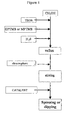
- Figure 1 is a flow chart of the process to prepare the material in accordance with the present invention;
- Figure 2 represents the structural formula of some compounds which have been used in the material according to the invention;
- Figure 3 represents a scheme of the preferred route to realize a phase of the process for the preparation of the material according to the invention;
- Figure 4 represents the UV-vis absorbance spectrum of the material according to the invention and of a comparison material.
- The material with non-linear optical response in accordance with the invention includes a chromophore which is hosted in a matrix, in particular, a silica based organic-inorganic hybrid matrix synthesized via sol-gel.
- The general process for the preparation of a material, to which this invention is referred to, typically includes the following steps:
- a) Formation of a sol from alkoxides compounds;
- b) Hydrolysis and condensation of this sol in acidic or basic conditions in a sol-gel reaction medium in which the chromophore has been added;
- c) Removal of the residual solvent from the gel, so that a monolithic glassy material is obtained, or, in alternative, deposition of a film from a solution obtained in the previous step;
- d) Exposure of the material to an electrical field (poling) with the purpose of obtaining an iso-orientation of the chromophore molecules. This step can be also performed during, or at the end, of one of the previous steps.
- The chromophore has the general formula (I):

- Het-1 is selected among the following heterocyclic groups:


- Het-2- and Het-3, identical or different, are selected among the following heterocyclic groups:

- W is selected from the group consisting of H, alkyl groups having from 1 to 18 carbon atoms, alkoxy, aminoalkyl, alkylhalide, hydroxyalkyl, hydroxyaryl, alcoxy-silane, aryloxy-silane, alkyl groups containing hydroxy, amino, hydrazone, azine, carbazone (such as =N-NH-CO-NH-NH2) and carbadiazone (such as =N-NH-CO-NH-N=) functionalities, alkoxyalkyl, alkylcarboxylic, alkylsulfonic, alkyl groups containing epoxy, carbonyl, carboxyl and alkoxy-carboxyl functionalities, including α,β-unsaturated groups, and alkyl groups, also negatively charged, containing cyano functionalities, such as:

- l,m,n, and o, each independent of the others, may be 0, 1, 2, or 3.
- In particular, the most interesting compounds having general formula (I) are "push-pull" chromophores, with a zwitterionic ground-state, and with a large hyperpolarizability.
- A preferred example of used chromophore is 1-[N-(3-N'-diethanolaminopropyl)pyrid-4-yl)-2-[5-(dicyanomethanido)thien-2-yl]ethylene (BisOH.PETCN), the structure of which is presented in figure 2.
- This chromophore easily decomposes in an acidic environment or upon exposure to light radiation in the presence of oxygen.
- In order to firmly host this type of chromophores, said matrix contains one or more multifunctional alkoxy-silane components, equal or different, having general formula (II):

- Other metallic alkoxides, such as alkoxides of zirconium, aluminium, tellurium, titanium, germanium, tin can be total part in the formulation.
- Preferably, in combination with a compound that is generally employed to realize silica based matrices, such as the tetraethylorthosilicate (TEOS) or the tetramethoxysilane (TMOS), alkoxy-silanes of the general formula (II), selected between those presenting an organic functional side that is polymerizable or that can be polycondensed by thermal treatments or using the proper catalysts, are used.
- Preferred examples of such alkoxides are the 3-glycidoxypropyltrimethoxysilane (GPTMS) and methacryloxypropyltrimethoxysilane (MPTMS) (structural formula in figure 2).
- The preparation of the hybrid organic-inorganic matrix envisages, first of all, the preparation of a solution of compounds of general formula (II).
- Water soluble alcohols, such the methanol, or hydrosoluble solvents such as tetrahydrofuran (THF), can be used as solvents.
- The solution is preferably prepared by co-hydrolyzing GPTMS (or MPTMS) with TEOS in methanol, in the presence of water and proper hydrolysis catalysts. These catalysts are preferably basic, even if, in some cases, is possible to use acidic catalysts.
- The solution so prepared is identified as precursor sol (or buffer sol GT).
- An alkoxy-silane of formula (II), bearing an amine terminal group in the organic functional side (R5), is then added to the precursor sol. Preferred examples of such compounds are 3-triethoxysilylpropylamine (TESPA) or the N-(3-trimethoxysilylpropyl)ethylendiamine (TMESPE), the structural formulas of which are described in figure 2.
- The use of alkoxy-silanes containing amine functionalities has an important effect on the final material properties.
- They play, in fact, a double role: first, they are relatively strong bases able to catalyze the sol condensation to obtain a silica gel, and then, they can react with epoxy groups possibly present in other alkoxy-silanes, for instance the GPTMS, inducing the ring opening and the following polymerization.
- Last but not least, the presence of amine groups in the matrix, besides providing a favorable environment (not acidic) to zwitterionic type chromophores, protects them from the degradation by light and oxygen.
- The amount of alkoxy-silane compounds bearing amine groups to be added to the first solution depends on the type of compounds and the desired gelation rate.
- In the preferred embodiment in which GPTMS and MPTMS are used, the molar ratios between TESPA (or TMESPE) and GPTMS or MPTMS are generally between 0,5·10-2 and 0,9. A preferred molar ratio is 0,67.
- A second solution, in which the chromophore is dissolved in a solvent from the group previously identified in relation with the first solution, is separately prepared.
- Preferably, the solvent used, due to its strong ability to solubilize the chromophore, is acetonitrile.
- As an alternative, the alkoxy-silane compounds containing amine groups can be prepared with the second solution in place of being added to the buffer sol GT.
- According to a main characteristic of the invention, the second solution contains also a compound of formula (III):

- The hydroxyl group of the compound of formula (III) is very important because permits the compound to be covalently bonded to the matrix.
- The compound of formula (III) is, preferably, N-hydroxyethylcarbazole (CbOH), which is derived from the general formula imposing S ed S1 both equal to H and S2 equal to C2H4OH.
- CbOH is present in the second solution in such a way that the molar ratio between the chromophore and CbOH is higher than 0.1. A composition in which the chromophore - CbOH molar ratio is in the range of 0.4 to 1 is particularly preferred.
- The compounds of formula (III) allow to reach high concentrations of zwitterionic chromophores in the matrix avoiding their aggregation to dimers or higher order aggregates. In this way the potentiality of the chromophores can be fully exploited obtaining materials with very good NLO properties, as it will be better clarified hereafter.
- The second solution is added to the previously described precursor sol and the mixture is allowed to react for one hour at 80 °C under reflux. The sol is allowed to react for further few hours at 30 °C.
- The solution is then immediately used to deposit films on glass substrates to be electrically poled.
- In alternative ITO (indium tin oxide) coated glass substrates, silicon or organic polymeric substrates, can be used.
- The film is deposited by dipping and withdrawing a proper substrate at a controlled speed ("dip-coating"), or by depositing the solution on a substrate which is rotating at a controlled speed ("spin-coating"), or by spraying depositing techniques.
- In alternative, a bulk material can be prepared by drying at 60 °C the solution placed in a proper container.
- The poling process is realized by a high voltage corona poling, as depicted in Figure 3. The film is deposited on a glass substrate and is placed between two electrodes, one of them being formed by a charge layer and the other by a conducting plate.
- The charge layer is generated by applying a voltage between a thin conducting wire and a conducting plate. A heater allows the matrix relaxation and therefore facilitates poling. The material shows an excellent orientation at poling temperatures in the range between 80 and 150°C, by applying the electric field for some hours.
- Check of the chromophores orientation under the action of the electric field is accomplished by measuring a non-linear optical property of the system (Second Harmonic Generation), which is present only in case of chromophores orientation. When the electric field is switched off the material remains partially oriented with a high temporal stability. The sample is kept partially oriented in a controlled atmosphere during poling.
- Poling is preferentially performed by using a gold wire in place of a tip, the latter being instead commonly used. In this way a uniform electric field is obtained and damage to the film is avoided.
- Tetraethoxysilane (TEOS) and 3-glicydoxypropyltrimethoxysilane (GPTMS) are co-hydrolised in methanol (MeOH) for 4 hours under reflux at 80 °C (buffer sol GT).
- The following molar ratios have been used:
- MeOH:Si=1.7,
- GPTMS:TEOS = 7:3,
- H2O:(TEOS+GPTMS)=1.65.
- N-[(3-trimethoxysilyl)propyl]ethylenediamine) (TMESPE) has been then added to the sol of GPTMS and TEOS up to a molar ratio TMESPE : (GPTMS+TEOS) = 0.45.
- The chromophore BisOH.PETCN and N-hydroxyethylcarbazole (CbOH), previously dissolved in acetonitrile, have been added to the sol obtained in the previous step so to reach the maximum molar ratio BisOH.PETCN : Si = 0.20 and BisOH.PETCN/CbOH = 0.4.
- A solution, following the same process of the previous example, has been prepared. The used compounds and relative amounts are the same as in Example 1 with the exception of CbOH, which is not added to the solution, and for the amount of used chromophore, the molar ratio of which with silicon is 0.05. Several attempts have been done to produce films with a chromophore concentration similar to that of example 1, however films prepared in absence of CbOH with such a large amount of chromophore show an optical quality that is absolutely not acceptable for the proposed purposes.
- Films (
typical thickness 2 µm) have been deposited in a clean room by spinning with a depositing rate of 500-2000 rpm, using the solutions of the examples 1 and 2, as prepared. After the deposition, the films have been poled in situ using a proper measurement chamber containing the heater element, in order to have thermally assisted poling, and a N2 flux, in order to control the atmosphere during the process. - The process lasted for approximately 4 hours at a temperature of about 85°C, by using the gold wire technique, with the wire being placed at a distance of around 1 cm from the film and applying a voltage of about 7000 V. The NLO properties of the material were measured by an experimental apparatus composed of a laser, some filters for the first and second harmonic, a monochromator, a phototube and an automated system of data acquisition. The non-linear coefficient d33 (that is, a measure of the second order non-linear susceptibility of the material) is obtained by a calibration system composed of a "Y-cut" quartz plate.
The following results have been obtained.
The film prepared using a solution with 5% of chromophore and without CbOH (example 2) has given d33 values in the range between 0,5 and 2,5 pm/V at 1.064 µm, whilst the film obtained from the solution with 20% chromophore concentration and in presence of CbOH not only showed a good optical quality, even if the chromophore has a high concentration, but also led, in a totally unexpected way, to d33 values in the range between 50 and 75 pm/V at 1.064 µm. - It should be noted that a hypothetical film with 20% in weight of chromophore but without CbOH should have given, under ideal conditions, maximum values of d33 between 2 and 10 pm/V, as it is directly obtained from the values measured for the film of the example 2.
- Both the films from examples 1 and 2 have been subsequently analyzed through UV-visible spectroscopy, the results of which are shown in figure 4.
- From this analysis it is clear that the peak due to the aggregates of BisOH.PETCN (at around 420-430 nm) is completely absent in the film of example 1, whereas the same aggregate peak is rather evident in the film relative to the example 2. This fact gives a clear explanation of the difference of d33 values in the two cases, leading to the conclusion that the reason why the chromophore, even if present in the matrix in a high concentration , does not aggregate is the presence of CbOH.
- Therefore, the materials obtained introducing compounds of formula (III) in the matrix permits to exploit the previously unexpressed potentialities of the zwitterionic chromophores, making available at the same time a matrix able to provide stability to the cromophores.
- Therefore, the present invention achieves the proposed targets, offering at the same time a material and a process for its preparation that gives several advantages with respect to the prior art , in particular the possibility to obtain stable materials having high NLO response and minimum formation of aggregates even in presence of high chromophore concentrations.
Claims (22)
- A hybrid organic inorganic material with non-linear optical response, comprising a cross-linked matrix hosting at least one organic chromophore which is dipole-orientable using an electric field, characterized in that it comprises an effective amount of compounds having general formula III:

- A material according to claim 1, wherein said compound of general formula III has S and S1 both equal to H and S2 equal to C2H4OH.
- A material according to claim 1 o 2, wherein the molar ratio between said chromophore and said compound of formula III is higher than 0.1.
- A material according to claim 3, wherein the molar ratio between said chromophore and said compound of formula III is in the range of 0.4 to 1.
- A material according to any of claims 1 to 4, wherein said chromophore has the general formula I:
 - Het-1 is selected among the following heterocyclic groups:
 - Het-2- and Het-3 are independently selected among the following heterocyclic groups:
 - W is selected from the group consisting of H, alkyl groups having from 1 to 18 carbon atoms, alkoxy, aminoalkyl, alkylhalide, hydroxyalkyl, hydroxyaryl, alkoxy-silane, aryloxy-silane, alkyl groups containing hydroxy, amino, hydrazone, azine, carbazone of Formula =N-NH-CO-NH-NH2 and carbadiazone of Formula =N-NH-CO-NH-N= functionalities, alkoxyalkyl, alkylcarboxylic, alkylsulfonic, alkyl groups containing epoxy, carbonyl, carboxyl and alkoxy-carboxyl functionalities, including α,β-unsaturated groups, and alkyl groups, also negatively charged, containing cyano functionalities, and groups, also negatively charged, containing N- alkylsulfonyl and N-arylsunfonylhydrazones, such as -CH=N-N--SO2-Ar; and- l,m,n, and o, each independent of the other, may be 0, 1, 2, or 3.
 - A material according to claim 5, wherein the said chromophore is of the push-pull type with a zwitterionic ground state.
- A material according to claim 6, wherein the said chromophore is 1-[N-(3-N'-diethanolaminopropyl)pyrid-4-yl)-2-[5-(dicyanomethanido)thien-2-yl]ethylene.
- A material according to any of the preceding claims, wherein said matrix is a hybrid organic-inorganic silica based matrix.
- A material according to claim 8, wherein said matrix is obtainable through the sol-gel technique.
- A material according to claim 9, wherein said matrix is obtainable from a solution containing one or more multifunctional alkoxy-silane components, equal or different, having general formula II,

- A material according to claim 10, wherein said compounds of formula (II) are 3-glycidoxypropyltrimethoxysilane (GPTMS) and/or methacryloxypropyltrimethoxysilane (MPTMS).
- A material according to any of claims 8 to 11, wherein amino groups are present in said matrix.
- A material according to claim 12, wherein said matrix is of the type derivable from a solution comprising N-[(3-trimethoxysilyl)propyl]ethylenediamine) (TMESPE) or 3-triethoxysilyl propylamine (TESPA).
- A process for preparing a hybrid organic inorganic material having nonlinear optical response comprising the step of providing a cross linked matrix wherein an organic chromophore is hosted, characterized in that a compound of general formula III

- A process according to claim 14, wherein said compound of general formula III has S and S1 both equal to H and S2 equal to C2H4OH.
- A process according to claim 14 or 15, wherein said organic chromophore is a push-pull chromophore with a zwitterionic ground-state.
- A process according to any of claims 14 to 16, wherein the following steps for the preparation of said composite are provided:- preparing a first solution comprising tetraethylorthosilicate and at least one of said alkoxy-silane compounds of formula II
 - preparing a second solution comprising said organic chromophore and said compound of formula III,- mixing the solutions and carrying out a sol condensation reaction,- obtaining a film or a bulk material,- exposing said film or bulk material to electric fields to orient said chromophore in said matrix.
 - A process according to claim 17, wherein said organic chromophore is dissolved in acetonitrile.
- A process according to claim 17 or 18, wherein tetraethylorthosilicate and 3-glycidoxypropyltrimethoxysilane (GPTMS) and/or methacryloxypropyltrimethoxysilane (MPTMS) are dissolved in said first solution.
- A process according to any of claims 17 to 19, wherein a compound of formula II comprising an amino group is added to said first solution, in order to catalyze said hydrolysis and condensation.
- A process according to claim 20, wherein said compound of formula II is 3-aminoethyltriethoxysilane or 3-aminopropyltriethoxysilane.
- An electro-optic modulator characterized in that it comprises a hybrid organic inorganic material having nonlinear optical response of the type according to claims 1 to 13.
Applications Claiming Priority (2)
| Application Number | Priority Date | Filing Date | Title |
|---|---|---|---|
| IT000080A ITPD20030080A1 (en) | 2003-04-18 | 2003-04-18 | ORGANIC-INORGANIC HYBRID MATERIAL WITH OPTICAL RESPONSE |
| PCT/EP2004/003594 WO2004092820A1 (en) | 2003-04-18 | 2004-04-05 | Hybrid organic-inorganic material with non-linear optical response based on organic chromophores and process for the preparation thereof |
Publications (2)
| Publication Number | Publication Date |
|---|---|
| EP1616218A1 EP1616218A1 (en) | 2006-01-18 |
| EP1616218B1 true EP1616218B1 (en) | 2006-11-29 |
Family
ID=33187384
Family Applications (1)
| Application Number | Title | Priority Date | Filing Date |
|---|---|---|---|
| EP04725689A Expired - Lifetime EP1616218B1 (en) | 2003-04-18 | 2004-04-05 | Hybrid organic-inorganic material with non-linear optical response based on organic chromophores and process for the preparation thereof |
Country Status (5)
| Country | Link |
|---|---|
| EP (1) | EP1616218B1 (en) |
| AT (1) | ATE347124T1 (en) |
| DE (1) | DE602004003487D1 (en) |
| IT (1) | ITPD20030080A1 (en) |
| WO (1) | WO2004092820A1 (en) |
Families Citing this family (2)
| Publication number | Priority date | Publication date | Assignee | Title |
|---|---|---|---|---|
| JP5945267B2 (en) | 2010-04-12 | 2016-07-05 | ユニヴェルシテ クロード ベルナール リヨン 1 | Method for producing hybrid material obtained by rapid condensation of organosilicon sol |
| ITTO20110830A1 (en) * | 2011-09-15 | 2013-03-16 | Consorzio Interuniversitario Nazion Ale Per La Sci | HIGH ORGANIC ELECTROCROMIC MATERIALS WITH HIGH TRANSPARENCY AND HIGH CONTRAST IN THE VISIBLE REGION |
Family Cites Families (1)
| Publication number | Priority date | Publication date | Assignee | Title |
|---|---|---|---|---|
| DE3622262A1 (en) * | 1986-07-02 | 1988-01-07 | Bayer Ag | CHROMOGENE 3,1-BENZOXAZINE |
-
2003
- 2003-04-18 IT IT000080A patent/ITPD20030080A1/en unknown
-
2004
- 2004-04-05 EP EP04725689A patent/EP1616218B1/en not_active Expired - Lifetime
- 2004-04-05 WO PCT/EP2004/003594 patent/WO2004092820A1/en not_active Ceased
- 2004-04-05 DE DE602004003487T patent/DE602004003487D1/en not_active Expired - Lifetime
- 2004-04-05 AT AT04725689T patent/ATE347124T1/en not_active IP Right Cessation
Also Published As
| Publication number | Publication date |
|---|---|
| WO2004092820A1 (en) | 2004-10-28 |
| ITPD20030080A1 (en) | 2004-10-19 |
| DE602004003487D1 (en) | 2007-01-11 |
| ATE347124T1 (en) | 2006-12-15 |
| EP1616218A1 (en) | 2006-01-18 |
Similar Documents
| Publication | Publication Date | Title |
|---|---|---|
| Lebeau et al. | Design, Characterization, and Processing of Hybrid Organic− Inorganic Coatings with Very High Second-Order Optical Nonlinearities | |
| US5156918A (en) | Self-assembled super lattices | |
| US6177131B1 (en) | Method of making an anti-reflection coating | |
| Hobson et al. | Bridged bisimide polysilsesquioxane xerogels: new hybrid organic− inorganic materials | |
| EP0611812A2 (en) | Liquid coating composition forming a liquid crystal display element insulating film | |
| US6033774A (en) | Self-assembled superlattices and waveguides prepared for use therewith | |
| JP5945267B2 (en) | Method for producing hybrid material obtained by rapid condensation of organosilicon sol | |
| Lebeau et al. | Large second-order optical nonlinearities in azo dyes grafted hybrid sol-gel coatings | |
| CN103589339A (en) | Polysilazane coating solution and method for preparing metal oxide-SiO2 composite coating | |
| Sanchez et al. | Hybrid organic-inorganic materials with second-order optical nonlinearities synthesized via sol-gel chemistry | |
| US4851270A (en) | Inorganic-organic composite compositons exhibiting nonlinear optical response | |
| US5963360A (en) | Nonlinear optical element and process for the preparation of same | |
| Sung et al. | Thermal stability of NLO sol—gel networks with reactive chromophores | |
| JPH0193721A (en) | Inorganic-organic composite material indicating non-linear optical response | |
| WO2004092820A1 (en) | Hybrid organic-inorganic material with non-linear optical response based on organic chromophores and process for the preparation thereof | |
| CN103757706A (en) | Preparation method of nonlinear optical crystal surface antireflection protective film | |
| US5702777A (en) | Silane couplers containing cyclic structural elements as alignment films | |
| US4861129A (en) | Inorganic-organic composite compositions exhibiting nonlinear optical response | |
| Campo et al. | Second-order non-linear optical properties of ‘bent’ferrocenyl derivatives | |
| US4898755A (en) | Inorganic-organic composite compositions exhibiting nonlinear optical response | |
| Lebeau et al. | Synthesis of Hybrid Inorganic-Organic Sol-Gel Coatings forOptics | |
| Lebeau et al. | Effect of processing parameters on second order nonlinearities of azo dye grafted hybrid sol-gel coatings | |
| US5449733A (en) | Inorganic sol-gel material which has a susceptibility of the second order | |
| Eichorst et al. | Sol-gel processing of lithium niobate thin-layers on silicon | |
| JP2005532974A (en) | Sol-gel method for producing a glassy film having high adhesion and a stable colloidal solution suitable for carrying out said method |
Legal Events
| Date | Code | Title | Description |
|---|---|---|---|
| PUAI | Public reference made under article 153(3) epc to a published international application that has entered the european phase |
Free format text: ORIGINAL CODE: 0009012 |
|
| 17P | Request for examination filed |
Effective date: 20051013 |
|
| AK | Designated contracting states |
Kind code of ref document: A1 Designated state(s): AT BE BG CH CY CZ DE DK EE ES FI FR GB GR HU IE IT LI LU MC NL PL PT RO SE SI SK TR |
|
| AX | Request for extension of the european patent |
Extension state: AL HR LT LV MK |
|
| RIN1 | Information on inventor provided before grant (corrected) |
Inventor name: SARCINELLI, FELICE Inventor name: PAGANI, GIORGIO Inventor name: ABBOTTO, ALESSANDRO Inventor name: CASALBONI, MAURO Inventor name: BEVERINA, LUCA Inventor name: INNOCENZI, PLINIOUNIVERS. DEGII STUDI DI SASSARI Inventor name: BRUSATIN, GIOVANNA |
|
| GRAP | Despatch of communication of intention to grant a patent |
Free format text: ORIGINAL CODE: EPIDOSNIGR1 |
|
| DAX | Request for extension of the european patent (deleted) | ||
| GRAS | Grant fee paid |
Free format text: ORIGINAL CODE: EPIDOSNIGR3 |
|
| GRAA | (expected) grant |
Free format text: ORIGINAL CODE: 0009210 |
|
| AK | Designated contracting states |
Kind code of ref document: B1 Designated state(s): AT BE BG CH CY CZ DE DK EE ES FI FR GB GR HU IE IT LI LU MC NL PL PT RO SE SI SK TR |
|
| PG25 | Lapsed in a contracting state [announced via postgrant information from national office to epo] |
Ref country code: FI Free format text: LAPSE BECAUSE OF FAILURE TO SUBMIT A TRANSLATION OF THE DESCRIPTION OR TO PAY THE FEE WITHIN THE PRESCRIBED TIME-LIMIT Effective date: 20061129 Ref country code: RO Free format text: LAPSE BECAUSE OF FAILURE TO SUBMIT A TRANSLATION OF THE DESCRIPTION OR TO PAY THE FEE WITHIN THE PRESCRIBED TIME-LIMIT Effective date: 20061129 Ref country code: AT Free format text: LAPSE BECAUSE OF FAILURE TO SUBMIT A TRANSLATION OF THE DESCRIPTION OR TO PAY THE FEE WITHIN THE PRESCRIBED TIME-LIMIT Effective date: 20061129 Ref country code: NL Free format text: LAPSE BECAUSE OF FAILURE TO SUBMIT A TRANSLATION OF THE DESCRIPTION OR TO PAY THE FEE WITHIN THE PRESCRIBED TIME-LIMIT Effective date: 20061129 Ref country code: CH Free format text: LAPSE BECAUSE OF FAILURE TO SUBMIT A TRANSLATION OF THE DESCRIPTION OR TO PAY THE FEE WITHIN THE PRESCRIBED TIME-LIMIT Effective date: 20061129 Ref country code: BE Free format text: LAPSE BECAUSE OF FAILURE TO SUBMIT A TRANSLATION OF THE DESCRIPTION OR TO PAY THE FEE WITHIN THE PRESCRIBED TIME-LIMIT Effective date: 20061129 Ref country code: SK Free format text: LAPSE BECAUSE OF FAILURE TO SUBMIT A TRANSLATION OF THE DESCRIPTION OR TO PAY THE FEE WITHIN THE PRESCRIBED TIME-LIMIT Effective date: 20061129 Ref country code: PL Free format text: LAPSE BECAUSE OF FAILURE TO SUBMIT A TRANSLATION OF THE DESCRIPTION OR TO PAY THE FEE WITHIN THE PRESCRIBED TIME-LIMIT Effective date: 20061129 Ref country code: LI Free format text: LAPSE BECAUSE OF FAILURE TO SUBMIT A TRANSLATION OF THE DESCRIPTION OR TO PAY THE FEE WITHIN THE PRESCRIBED TIME-LIMIT Effective date: 20061129 Ref country code: SI Free format text: LAPSE BECAUSE OF FAILURE TO SUBMIT A TRANSLATION OF THE DESCRIPTION OR TO PAY THE FEE WITHIN THE PRESCRIBED TIME-LIMIT Effective date: 20061129 Ref country code: CZ Free format text: LAPSE BECAUSE OF FAILURE TO SUBMIT A TRANSLATION OF THE DESCRIPTION OR TO PAY THE FEE WITHIN THE PRESCRIBED TIME-LIMIT Effective date: 20061129 Ref country code: IT Free format text: LAPSE BECAUSE OF FAILURE TO SUBMIT A TRANSLATION OF THE DESCRIPTION OR TO PAY THE FEE WITHIN THE PRESCRIBED TIME-LIMIT;WARNING: LAPSES OF ITALIAN PATENTS WITH EFFECTIVE DATE BEFORE 2007 MAY HAVE OCCURRED AT ANY TIME BEFORE 2007. THE CORRECT EFFECTIVE DATE MAY BE DIFFERENT FROM THE ONE RECORDED. Effective date: 20061129 |
|
| REG | Reference to a national code |
Ref country code: GB Ref legal event code: FG4D |
|
| REG | Reference to a national code |
Ref country code: CH Ref legal event code: EP |
|
| REG | Reference to a national code |
Ref country code: IE Ref legal event code: FG4D |
|
| REF | Corresponds to: |
Ref document number: 602004003487 Country of ref document: DE Date of ref document: 20070111 Kind code of ref document: P |
|
| PG25 | Lapsed in a contracting state [announced via postgrant information from national office to epo] |
Ref country code: BG Free format text: LAPSE BECAUSE OF FAILURE TO SUBMIT A TRANSLATION OF THE DESCRIPTION OR TO PAY THE FEE WITHIN THE PRESCRIBED TIME-LIMIT Effective date: 20070228 Ref country code: DK Free format text: LAPSE BECAUSE OF FAILURE TO SUBMIT A TRANSLATION OF THE DESCRIPTION OR TO PAY THE FEE WITHIN THE PRESCRIBED TIME-LIMIT Effective date: 20070228 Ref country code: SE Free format text: LAPSE BECAUSE OF FAILURE TO SUBMIT A TRANSLATION OF THE DESCRIPTION OR TO PAY THE FEE WITHIN THE PRESCRIBED TIME-LIMIT Effective date: 20070228 |
|
| PG25 | Lapsed in a contracting state [announced via postgrant information from national office to epo] |
Ref country code: DE Free format text: LAPSE BECAUSE OF FAILURE TO SUBMIT A TRANSLATION OF THE DESCRIPTION OR TO PAY THE FEE WITHIN THE PRESCRIBED TIME-LIMIT Effective date: 20070301 |
|
| PG25 | Lapsed in a contracting state [announced via postgrant information from national office to epo] |
Ref country code: ES Free format text: LAPSE BECAUSE OF FAILURE TO SUBMIT A TRANSLATION OF THE DESCRIPTION OR TO PAY THE FEE WITHIN THE PRESCRIBED TIME-LIMIT Effective date: 20070312 |
|
| PG25 | Lapsed in a contracting state [announced via postgrant information from national office to epo] |
Ref country code: PT Free format text: LAPSE BECAUSE OF FAILURE TO SUBMIT A TRANSLATION OF THE DESCRIPTION OR TO PAY THE FEE WITHIN THE PRESCRIBED TIME-LIMIT Effective date: 20070430 |
|
| NLV1 | Nl: lapsed or annulled due to failure to fulfill the requirements of art. 29p and 29m of the patents act | ||
| REG | Reference to a national code |
Ref country code: CH Ref legal event code: PL |
|
| EN | Fr: translation not filed | ||
| PLBE | No opposition filed within time limit |
Free format text: ORIGINAL CODE: 0009261 |
|
| STAA | Information on the status of an ep patent application or granted ep patent |
Free format text: STATUS: NO OPPOSITION FILED WITHIN TIME LIMIT |
|
| 26N | No opposition filed |
Effective date: 20070830 |
|
| PG25 | Lapsed in a contracting state [announced via postgrant information from national office to epo] |
Ref country code: GR Free format text: LAPSE BECAUSE OF FAILURE TO SUBMIT A TRANSLATION OF THE DESCRIPTION OR TO PAY THE FEE WITHIN THE PRESCRIBED TIME-LIMIT Effective date: 20070301 Ref country code: FR Free format text: LAPSE BECAUSE OF FAILURE TO SUBMIT A TRANSLATION OF THE DESCRIPTION OR TO PAY THE FEE WITHIN THE PRESCRIBED TIME-LIMIT Effective date: 20070720 |
|
| PG25 | Lapsed in a contracting state [announced via postgrant information from national office to epo] |
Ref country code: IE Free format text: LAPSE BECAUSE OF NON-PAYMENT OF DUE FEES Effective date: 20070405 |
|
| PG25 | Lapsed in a contracting state [announced via postgrant information from national office to epo] |
Ref country code: FR Free format text: LAPSE BECAUSE OF FAILURE TO SUBMIT A TRANSLATION OF THE DESCRIPTION OR TO PAY THE FEE WITHIN THE PRESCRIBED TIME-LIMIT Effective date: 20061129 |
|
| GBPC | Gb: european patent ceased through non-payment of renewal fee |
Effective date: 20080405 |
|
| PG25 | Lapsed in a contracting state [announced via postgrant information from national office to epo] |
Ref country code: EE Free format text: LAPSE BECAUSE OF FAILURE TO SUBMIT A TRANSLATION OF THE DESCRIPTION OR TO PAY THE FEE WITHIN THE PRESCRIBED TIME-LIMIT Effective date: 20061129 |
|
| PG25 | Lapsed in a contracting state [announced via postgrant information from national office to epo] |
Ref country code: MC Free format text: LAPSE BECAUSE OF NON-PAYMENT OF DUE FEES Effective date: 20070430 |
|
| PG25 | Lapsed in a contracting state [announced via postgrant information from national office to epo] |
Ref country code: GB Free format text: LAPSE BECAUSE OF NON-PAYMENT OF DUE FEES Effective date: 20080405 |
|
| PG25 | Lapsed in a contracting state [announced via postgrant information from national office to epo] |
Ref country code: LU Free format text: LAPSE BECAUSE OF NON-PAYMENT OF DUE FEES Effective date: 20070405 Ref country code: CY Free format text: LAPSE BECAUSE OF FAILURE TO SUBMIT A TRANSLATION OF THE DESCRIPTION OR TO PAY THE FEE WITHIN THE PRESCRIBED TIME-LIMIT Effective date: 20061129 |
|
| PG25 | Lapsed in a contracting state [announced via postgrant information from national office to epo] |
Ref country code: HU Free format text: LAPSE BECAUSE OF FAILURE TO SUBMIT A TRANSLATION OF THE DESCRIPTION OR TO PAY THE FEE WITHIN THE PRESCRIBED TIME-LIMIT Effective date: 20070530 Ref country code: TR Free format text: LAPSE BECAUSE OF FAILURE TO SUBMIT A TRANSLATION OF THE DESCRIPTION OR TO PAY THE FEE WITHIN THE PRESCRIBED TIME-LIMIT Effective date: 20061129 |