EP1614718A1 - Curable fluoropolyether compositions, their preparation and use - Google Patents
Curable fluoropolyether compositions, their preparation and use Download PDFInfo
- Publication number
- EP1614718A1 EP1614718A1 EP20050254299 EP05254299A EP1614718A1 EP 1614718 A1 EP1614718 A1 EP 1614718A1 EP 20050254299 EP20050254299 EP 20050254299 EP 05254299 A EP05254299 A EP 05254299A EP 1614718 A1 EP1614718 A1 EP 1614718A1
- Authority
- EP
- European Patent Office
- Prior art keywords
- formula
- sum
- integer
- average
- component
- Prior art date
- Legal status (The legal status is an assumption and is not a legal conclusion. Google has not performed a legal analysis and makes no representation as to the accuracy of the status listed.)
- Withdrawn
Links
- 239000000203 mixture Substances 0.000 title claims abstract description 93
- VYPSYNLAJGMNEJ-UHFFFAOYSA-N Silicium dioxide Chemical compound O=[Si]=O VYPSYNLAJGMNEJ-UHFFFAOYSA-N 0.000 claims abstract description 48
- 150000001875 compounds Chemical class 0.000 claims abstract description 28
- 239000000377 silicon dioxide Substances 0.000 claims abstract description 21
- BASFCYQUMIYNBI-UHFFFAOYSA-N platinum Chemical compound [Pt] BASFCYQUMIYNBI-UHFFFAOYSA-N 0.000 claims abstract description 19
- 239000003054 catalyst Substances 0.000 claims abstract description 14
- 239000010702 perfluoropolyether Substances 0.000 claims abstract description 12
- 239000000843 powder Substances 0.000 claims abstract description 10
- 125000004435 hydrogen atom Chemical group [H]* 0.000 claims description 15
- 229910052799 carbon Inorganic materials 0.000 claims description 13
- 125000003342 alkenyl group Chemical group 0.000 claims description 10
- 125000000391 vinyl group Chemical group [H]C([*])=C([H])[H] 0.000 claims description 8
- OKTJSMMVPCPJKN-UHFFFAOYSA-N Carbon Chemical compound [C] OKTJSMMVPCPJKN-UHFFFAOYSA-N 0.000 claims description 7
- 125000005375 organosiloxane group Chemical group 0.000 claims description 7
- XUIMIQQOPSSXEZ-UHFFFAOYSA-N Silicon Chemical group [Si] XUIMIQQOPSSXEZ-UHFFFAOYSA-N 0.000 claims description 6
- 150000001721 carbon Chemical group 0.000 claims description 6
- 125000004430 oxygen atom Chemical group O* 0.000 claims description 6
- 239000002245 particle Substances 0.000 claims description 6
- 125000001997 phenyl group Chemical group [H]C1=C([H])C([H])=C(*)C([H])=C1[H] 0.000 claims description 6
- 229910052710 silicon Inorganic materials 0.000 claims description 6
- 125000003700 epoxy group Chemical group 0.000 claims description 5
- 229910052739 hydrogen Inorganic materials 0.000 claims description 3
- 239000001257 hydrogen Substances 0.000 claims description 3
- 238000000034 method Methods 0.000 claims description 3
- 125000006551 perfluoro alkylene group Chemical group 0.000 claims description 3
- 125000005010 perfluoroalkyl group Chemical group 0.000 claims description 3
- 125000001183 hydrocarbyl group Chemical group 0.000 claims 2
- 229920001973 fluoroelastomer Polymers 0.000 claims 1
- 238000004519 manufacturing process Methods 0.000 claims 1
- 125000000956 methoxy group Chemical group [H]C([H])([H])O* 0.000 claims 1
- 239000002904 solvent Substances 0.000 abstract description 21
- 239000000126 substance Substances 0.000 abstract description 16
- 239000003921 oil Substances 0.000 abstract description 14
- 229920006136 organohydrogenpolysiloxane Polymers 0.000 abstract description 8
- 229910052697 platinum Inorganic materials 0.000 abstract description 6
- 238000010292 electrical insulation Methods 0.000 abstract description 5
- 238000010438 heat treatment Methods 0.000 abstract description 4
- 229920005601 base polymer Polymers 0.000 abstract description 2
- UJMWVICAENGCRF-UHFFFAOYSA-N oxygen difluoride Chemical group FOF UJMWVICAENGCRF-UHFFFAOYSA-N 0.000 abstract description 2
- YXFVVABEGXRONW-UHFFFAOYSA-N Toluene Chemical compound CC1=CC=CC=C1 YXFVVABEGXRONW-UHFFFAOYSA-N 0.000 description 15
- 239000000499 gel Substances 0.000 description 14
- 229920001296 polysiloxane Polymers 0.000 description 12
- -1 perfluoro compound Chemical class 0.000 description 9
- 239000000047 product Substances 0.000 description 9
- 229920001971 elastomer Polymers 0.000 description 8
- 238000004382 potting Methods 0.000 description 8
- 239000005060 rubber Substances 0.000 description 8
- 150000002430 hydrocarbons Chemical group 0.000 description 7
- 230000000704 physical effect Effects 0.000 description 7
- OKKJLVBELUTLKV-UHFFFAOYSA-N Methanol Chemical compound OC OKKJLVBELUTLKV-UHFFFAOYSA-N 0.000 description 6
- 238000013006 addition curing Methods 0.000 description 6
- 230000000052 comparative effect Effects 0.000 description 6
- VLKZOEOYAKHREP-UHFFFAOYSA-N n-Hexane Chemical compound CCCCCC VLKZOEOYAKHREP-UHFFFAOYSA-N 0.000 description 6
- RIOQSEWOXXDEQQ-UHFFFAOYSA-N triphenylphosphine Chemical compound C1=CC=CC=C1P(C=1C=CC=CC=1)C1=CC=CC=C1 RIOQSEWOXXDEQQ-UHFFFAOYSA-N 0.000 description 6
- 239000011248 coating agent Substances 0.000 description 5
- 238000000576 coating method Methods 0.000 description 5
- 238000007654 immersion Methods 0.000 description 5
- CSCPPACGZOOCGX-UHFFFAOYSA-N Acetone Chemical compound CC(C)=O CSCPPACGZOOCGX-UHFFFAOYSA-N 0.000 description 4
- UQSXHKLRYXJYBZ-UHFFFAOYSA-N Iron oxide Chemical compound [Fe]=O UQSXHKLRYXJYBZ-UHFFFAOYSA-N 0.000 description 4
- AFCARXCZXQIEQB-UHFFFAOYSA-N N-[3-oxo-3-(2,4,6,7-tetrahydrotriazolo[4,5-c]pyridin-5-yl)propyl]-2-[[3-(trifluoromethoxy)phenyl]methylamino]pyrimidine-5-carboxamide Chemical compound O=C(CCNC(=O)C=1C=NC(=NC=1)NCC1=CC(=CC=C1)OC(F)(F)F)N1CC2=C(CC1)NN=N2 AFCARXCZXQIEQB-UHFFFAOYSA-N 0.000 description 4
- 239000002253 acid Substances 0.000 description 4
- 125000004432 carbon atom Chemical group C* 0.000 description 4
- 238000013329 compounding Methods 0.000 description 4
- 238000004132 cross linking Methods 0.000 description 4
- 238000001723 curing Methods 0.000 description 4
- 125000002496 methyl group Chemical group [H]C([H])([H])* 0.000 description 4
- 238000000465 moulding Methods 0.000 description 4
- 238000007789 sealing Methods 0.000 description 4
- 229920002379 silicone rubber Polymers 0.000 description 4
- 0 *NOCCON* Chemical compound *NOCCON* 0.000 description 3
- HEMHJVSKTPXQMS-UHFFFAOYSA-M Sodium hydroxide Chemical compound [OH-].[Na+] HEMHJVSKTPXQMS-UHFFFAOYSA-M 0.000 description 3
- 239000000654 additive Substances 0.000 description 3
- 239000002318 adhesion promoter Substances 0.000 description 3
- 239000002585 base Substances 0.000 description 3
- 230000000740 bleeding effect Effects 0.000 description 3
- 125000000484 butyl group Chemical group [H]C([*])([H])C([H])([H])C([H])([H])C([H])([H])[H] 0.000 description 3
- 239000006229 carbon black Substances 0.000 description 3
- 238000006243 chemical reaction Methods 0.000 description 3
- 125000001495 ethyl group Chemical group [H]C([H])([H])C([H])([H])* 0.000 description 3
- 239000003502 gasoline Substances 0.000 description 3
- 239000012208 gear oil Substances 0.000 description 3
- 229910052751 metal Inorganic materials 0.000 description 3
- 239000002184 metal Substances 0.000 description 3
- 150000003058 platinum compounds Chemical class 0.000 description 3
- 125000001436 propyl group Chemical group [H]C([*])([H])C([H])([H])C([H])([H])[H] 0.000 description 3
- QYLFHLNFIHBCPR-UHFFFAOYSA-N 1-ethynylcyclohexan-1-ol Chemical compound C#CC1(O)CCCCC1 QYLFHLNFIHBCPR-UHFFFAOYSA-N 0.000 description 2
- VTYYLEPIZMXCLO-UHFFFAOYSA-L Calcium carbonate Chemical compound [Ca+2].[O-]C([O-])=O VTYYLEPIZMXCLO-UHFFFAOYSA-L 0.000 description 2
- 239000006087 Silane Coupling Agent Substances 0.000 description 2
- GWEVSGVZZGPLCZ-UHFFFAOYSA-N Titan oxide Chemical compound O=[Ti]=O GWEVSGVZZGPLCZ-UHFFFAOYSA-N 0.000 description 2
- 238000007259 addition reaction Methods 0.000 description 2
- 125000000217 alkyl group Chemical group 0.000 description 2
- HSFWRNGVRCDJHI-UHFFFAOYSA-N alpha-acetylene Natural products C#C HSFWRNGVRCDJHI-UHFFFAOYSA-N 0.000 description 2
- PNEYBMLMFCGWSK-UHFFFAOYSA-N aluminium oxide Inorganic materials [O-2].[O-2].[O-2].[Al+3].[Al+3] PNEYBMLMFCGWSK-UHFFFAOYSA-N 0.000 description 2
- 229940045985 antineoplastic platinum compound Drugs 0.000 description 2
- 125000003710 aryl alkyl group Chemical group 0.000 description 2
- 125000003118 aryl group Chemical group 0.000 description 2
- 125000001797 benzyl group Chemical group [H]C1=C([H])C([H])=C(C([H])=C1[H])C([H])([H])* 0.000 description 2
- HQABUPZFAYXKJW-UHFFFAOYSA-N butan-1-amine Chemical compound CCCCN HQABUPZFAYXKJW-UHFFFAOYSA-N 0.000 description 2
- 150000001244 carboxylic acid anhydrides Chemical class 0.000 description 2
- 239000006258 conductive agent Substances 0.000 description 2
- 125000000113 cyclohexyl group Chemical group [H]C1([H])C([H])([H])C([H])([H])C([H])(*)C([H])([H])C1([H])[H] 0.000 description 2
- 230000000694 effects Effects 0.000 description 2
- 238000005187 foaming Methods 0.000 description 2
- 229910021485 fumed silica Inorganic materials 0.000 description 2
- 230000017525 heat dissipation Effects 0.000 description 2
- 125000004051 hexyl group Chemical group [H]C([H])([H])C([H])([H])C([H])([H])C([H])([H])C([H])([H])C([H])([H])* 0.000 description 2
- 238000006459 hydrosilylation reaction Methods 0.000 description 2
- 230000001965 increasing effect Effects 0.000 description 2
- 239000011256 inorganic filler Substances 0.000 description 2
- 229910003475 inorganic filler Inorganic materials 0.000 description 2
- 125000000959 isobutyl group Chemical group [H]C([H])([H])C([H])(C([H])([H])[H])C([H])([H])* 0.000 description 2
- 125000001449 isopropyl group Chemical group [H]C([H])([H])C([H])(*)C([H])([H])[H] 0.000 description 2
- 239000007788 liquid Substances 0.000 description 2
- 239000003607 modifier Substances 0.000 description 2
- 239000010705 motor oil Substances 0.000 description 2
- 125000002347 octyl group Chemical group [H]C([*])([H])C([H])([H])C([H])([H])C([H])([H])C([H])([H])C([H])([H])C([H])([H])C([H])([H])[H] 0.000 description 2
- 239000012766 organic filler Substances 0.000 description 2
- 125000000286 phenylethyl group Chemical group [H]C1=C([H])C([H])=C(C([H])=C1[H])C([H])([H])C([H])([H])* 0.000 description 2
- 239000004014 plasticizer Substances 0.000 description 2
- 230000001681 protective effect Effects 0.000 description 2
- 239000011347 resin Substances 0.000 description 2
- 229920005989 resin Polymers 0.000 description 2
- 239000000758 substrate Substances 0.000 description 2
- 125000000999 tert-butyl group Chemical group [H]C([H])([H])C(*)(C([H])([H])[H])C([H])([H])[H] 0.000 description 2
- OGIDPMRJRNCKJF-UHFFFAOYSA-N titanium oxide Inorganic materials [Ti]=O OGIDPMRJRNCKJF-UHFFFAOYSA-N 0.000 description 2
- 125000003944 tolyl group Chemical group 0.000 description 2
- XLYOFNOQVPJJNP-UHFFFAOYSA-N water Substances O XLYOFNOQVPJJNP-UHFFFAOYSA-N 0.000 description 2
- NAWXUBYGYWOOIX-SFHVURJKSA-N (2s)-2-[[4-[2-(2,4-diaminoquinazolin-6-yl)ethyl]benzoyl]amino]-4-methylidenepentanedioic acid Chemical compound C1=CC2=NC(N)=NC(N)=C2C=C1CCC1=CC=C(C(=O)N[C@@H](CC(=C)C(O)=O)C(O)=O)C=C1 NAWXUBYGYWOOIX-SFHVURJKSA-N 0.000 description 1
- HMVBQEAJQVQOTI-SOFGYWHQSA-N (e)-3,5-dimethylhex-3-en-1-yne Chemical compound CC(C)\C=C(/C)C#C HMVBQEAJQVQOTI-SOFGYWHQSA-N 0.000 description 1
- GRGVQLWQXHFRHO-AATRIKPKSA-N (e)-3-methylpent-3-en-1-yne Chemical compound C\C=C(/C)C#C GRGVQLWQXHFRHO-AATRIKPKSA-N 0.000 description 1
- KSOCRXJMFBYSFA-UHFFFAOYSA-N 1,1,1,2,2,3,3,4,4,5,6,6,6-tridecafluoro-5-(1,1,1,2,3,3,4,4,5,5,6,6,6-tridecafluorohexan-2-yloxy)hexane Chemical compound FC(F)(F)C(F)(F)C(F)(F)C(F)(F)C(F)(C(F)(F)F)OC(F)(C(F)(F)F)C(F)(F)C(F)(F)C(F)(F)C(F)(F)F KSOCRXJMFBYSFA-UHFFFAOYSA-N 0.000 description 1
- PGISRKZDCUNMRX-UHFFFAOYSA-N 1,1,1,2,2,3,3,4,4-nonafluoro-4-(trifluoromethoxy)butane Chemical compound FC(F)(F)OC(F)(F)C(F)(F)C(F)(F)C(F)(F)F PGISRKZDCUNMRX-UHFFFAOYSA-N 0.000 description 1
- KOMNUTZXSVSERR-UHFFFAOYSA-N 1,3,5-tris(prop-2-enyl)-1,3,5-triazinane-2,4,6-trione Chemical compound C=CCN1C(=O)N(CC=C)C(=O)N(CC=C)C1=O KOMNUTZXSVSERR-UHFFFAOYSA-N 0.000 description 1
- SJBBXFLOLUTGCW-UHFFFAOYSA-N 1,3-bis(trifluoromethyl)benzene Chemical compound FC(F)(F)C1=CC=CC(C(F)(F)F)=C1 SJBBXFLOLUTGCW-UHFFFAOYSA-N 0.000 description 1
- CEBKHWWANWSNTI-UHFFFAOYSA-N 2-methylbut-3-yn-2-ol Chemical compound CC(C)(O)C#C CEBKHWWANWSNTI-UHFFFAOYSA-N 0.000 description 1
- NECRQCBKTGZNMH-UHFFFAOYSA-N 3,5-dimethylhex-1-yn-3-ol Chemical compound CC(C)CC(C)(O)C#C NECRQCBKTGZNMH-UHFFFAOYSA-N 0.000 description 1
- HFYAEUXHCMTPOL-UHFFFAOYSA-N 3-Methyl-1-penten-3-ol Chemical compound CCC(C)(O)C=C HFYAEUXHCMTPOL-UHFFFAOYSA-N 0.000 description 1
- MQSZOZMNAJHVML-UHFFFAOYSA-N 3-phenylbut-1-yn-1-ol Chemical compound OC#CC(C)C1=CC=CC=C1 MQSZOZMNAJHVML-UHFFFAOYSA-N 0.000 description 1
- 229910052582 BN Inorganic materials 0.000 description 1
- PZNSFCLAULLKQX-UHFFFAOYSA-N Boron nitride Chemical compound N#B PZNSFCLAULLKQX-UHFFFAOYSA-N 0.000 description 1
- BOUHMQUKQSQWGZ-UHFFFAOYSA-N CC(C)CCONOC Chemical compound CC(C)CCONOC BOUHMQUKQSQWGZ-UHFFFAOYSA-N 0.000 description 1
- HGAVIHNKNANEMY-UHFFFAOYSA-N CCCCONOC Chemical compound CCCCONOC HGAVIHNKNANEMY-UHFFFAOYSA-N 0.000 description 1
- JZEAEJZFPJXMHN-UHFFFAOYSA-N CCCCONOCC Chemical compound CCCCONOCC JZEAEJZFPJXMHN-UHFFFAOYSA-N 0.000 description 1
- ASRIHXCYCYEKCH-UHFFFAOYSA-N CCC[IH]CONOCC Chemical compound CCC[IH]CONOCC ASRIHXCYCYEKCH-UHFFFAOYSA-N 0.000 description 1
- 239000004970 Chain extender Substances 0.000 description 1
- 239000005046 Chlorosilane Substances 0.000 description 1
- 239000004971 Cross linker Substances 0.000 description 1
- LYCAIKOWRPUZTN-UHFFFAOYSA-N Ethylene glycol Chemical class OCCO LYCAIKOWRPUZTN-UHFFFAOYSA-N 0.000 description 1
- 239000005909 Kieselgur Substances 0.000 description 1
- GRYLNZFGIOXLOG-UHFFFAOYSA-N Nitric acid Chemical compound O[N+]([O-])=O GRYLNZFGIOXLOG-UHFFFAOYSA-N 0.000 description 1
- 239000004677 Nylon Substances 0.000 description 1
- NFHFRUOZVGFOOS-UHFFFAOYSA-N Pd(PPh3)4 Substances [Pd].C1=CC=CC=C1P(C=1C=CC=CC=1)C1=CC=CC=C1.C1=CC=CC=C1P(C=1C=CC=CC=1)C1=CC=CC=C1.C1=CC=CC=C1P(C=1C=CC=CC=1)C1=CC=CC=C1.C1=CC=CC=C1P(C=1C=CC=CC=1)C1=CC=CC=C1 NFHFRUOZVGFOOS-UHFFFAOYSA-N 0.000 description 1
- KJTLSVCANCCWHF-UHFFFAOYSA-N Ruthenium Chemical compound [Ru] KJTLSVCANCCWHF-UHFFFAOYSA-N 0.000 description 1
- BQCADISMDOOEFD-UHFFFAOYSA-N Silver Chemical compound [Ag] BQCADISMDOOEFD-UHFFFAOYSA-N 0.000 description 1
- QAOWNCQODCNURD-UHFFFAOYSA-N Sulfuric acid Chemical compound OS(O)(=O)=O QAOWNCQODCNURD-UHFFFAOYSA-N 0.000 description 1
- FMRLDPWIRHBCCC-UHFFFAOYSA-L Zinc carbonate Chemical compound [Zn+2].[O-]C([O-])=O FMRLDPWIRHBCCC-UHFFFAOYSA-L 0.000 description 1
- XLOMVQKBTHCTTD-UHFFFAOYSA-N Zinc monoxide Chemical compound [Zn]=O XLOMVQKBTHCTTD-UHFFFAOYSA-N 0.000 description 1
- 150000007513 acids Chemical class 0.000 description 1
- 150000001298 alcohols Chemical class 0.000 description 1
- 125000001931 aliphatic group Chemical group 0.000 description 1
- 239000003513 alkali Substances 0.000 description 1
- 150000001336 alkenes Chemical class 0.000 description 1
- XAGFODPZIPBFFR-UHFFFAOYSA-N aluminium Chemical compound [Al] XAGFODPZIPBFFR-UHFFFAOYSA-N 0.000 description 1
- 150000001412 amines Chemical class 0.000 description 1
- IRERQBUNZFJFGC-UHFFFAOYSA-L azure blue Chemical compound [Na+].[Na+].[Na+].[Na+].[Na+].[Na+].[Na+].[Na+].[Al+3].[Al+3].[Al+3].[Al+3].[Al+3].[Al+3].[S-]S[S-].[O-][Si]([O-])([O-])[O-].[O-][Si]([O-])([O-])[O-].[O-][Si]([O-])([O-])[O-].[O-][Si]([O-])([O-])[O-].[O-][Si]([O-])([O-])[O-].[O-][Si]([O-])([O-])[O-] IRERQBUNZFJFGC-UHFFFAOYSA-L 0.000 description 1
- DSVRVHYFPPQFTI-UHFFFAOYSA-N bis(ethenyl)-methyl-trimethylsilyloxysilane;platinum Chemical compound [Pt].C[Si](C)(C)O[Si](C)(C=C)C=C DSVRVHYFPPQFTI-UHFFFAOYSA-N 0.000 description 1
- 229910000019 calcium carbonate Inorganic materials 0.000 description 1
- NQZFAUXPNWSLBI-UHFFFAOYSA-N carbon monoxide;ruthenium Chemical compound [Ru].[Ru].[Ru].[O+]#[C-].[O+]#[C-].[O+]#[C-].[O+]#[C-].[O+]#[C-].[O+]#[C-].[O+]#[C-].[O+]#[C-].[O+]#[C-].[O+]#[C-].[O+]#[C-].[O+]#[C-] NQZFAUXPNWSLBI-UHFFFAOYSA-N 0.000 description 1
- 230000003197 catalytic effect Effects 0.000 description 1
- 239000000919 ceramic Substances 0.000 description 1
- 229910000420 cerium oxide Inorganic materials 0.000 description 1
- UNJPQTDTZAKTFK-UHFFFAOYSA-K cerium(iii) hydroxide Chemical compound [OH-].[OH-].[OH-].[Ce+3] UNJPQTDTZAKTFK-UHFFFAOYSA-K 0.000 description 1
- 239000007809 chemical reaction catalyst Substances 0.000 description 1
- 239000007795 chemical reaction product Substances 0.000 description 1
- 239000003795 chemical substances by application Substances 0.000 description 1
- KOPOQZFJUQMUML-UHFFFAOYSA-N chlorosilane Chemical compound Cl[SiH3] KOPOQZFJUQMUML-UHFFFAOYSA-N 0.000 description 1
- 239000011362 coarse particle Substances 0.000 description 1
- 238000007906 compression Methods 0.000 description 1
- 230000006835 compression Effects 0.000 description 1
- 239000004020 conductor Substances 0.000 description 1
- 125000000753 cycloalkyl group Chemical group 0.000 description 1
- 125000000582 cycloheptyl group Chemical group [H]C1([H])C([H])([H])C([H])([H])C([H])([H])C([H])(*)C([H])([H])C1([H])[H] 0.000 description 1
- 125000001511 cyclopentyl group Chemical group [H]C1([H])C([H])([H])C([H])([H])C([H])(*)C1([H])[H] 0.000 description 1
- CRHLEZORXKQUEI-UHFFFAOYSA-N dialuminum;cobalt(2+);oxygen(2-) Chemical compound [O-2].[O-2].[O-2].[O-2].[O-2].[Al+3].[Al+3].[Co+2].[Co+2] CRHLEZORXKQUEI-UHFFFAOYSA-N 0.000 description 1
- 239000006185 dispersion Substances 0.000 description 1
- 238000009826 distribution Methods 0.000 description 1
- 230000002708 enhancing effect Effects 0.000 description 1
- 239000000945 filler Substances 0.000 description 1
- 125000001153 fluoro group Chemical group F* 0.000 description 1
- 229920005560 fluorosilicone rubber Polymers 0.000 description 1
- 238000009472 formulation Methods 0.000 description 1
- 125000005843 halogen group Chemical group 0.000 description 1
- RBTKNAXYKSUFRK-UHFFFAOYSA-N heliogen blue Chemical compound [Cu].[N-]1C2=C(C=CC=C3)C3=C1N=C([N-]1)C3=CC=CC=C3C1=NC([N-]1)=C(C=CC=C3)C3=C1N=C([N-]1)C3=CC=CC=C3C1=N2 RBTKNAXYKSUFRK-UHFFFAOYSA-N 0.000 description 1
- 230000002209 hydrophobic effect Effects 0.000 description 1
- 239000001023 inorganic pigment Substances 0.000 description 1
- 229910052741 iridium Inorganic materials 0.000 description 1
- GKOZUEZYRPOHIO-UHFFFAOYSA-N iridium atom Chemical compound [Ir] GKOZUEZYRPOHIO-UHFFFAOYSA-N 0.000 description 1
- 238000004898 kneading Methods 0.000 description 1
- 230000007774 longterm Effects 0.000 description 1
- 239000010721 machine oil Substances 0.000 description 1
- ZLNQQNXFFQJAID-UHFFFAOYSA-L magnesium carbonate Chemical compound [Mg+2].[O-]C([O-])=O ZLNQQNXFFQJAID-UHFFFAOYSA-L 0.000 description 1
- 239000001095 magnesium carbonate Substances 0.000 description 1
- 229910000021 magnesium carbonate Inorganic materials 0.000 description 1
- 235000014380 magnesium carbonate Nutrition 0.000 description 1
- 239000011656 manganese carbonate Substances 0.000 description 1
- 235000006748 manganese carbonate Nutrition 0.000 description 1
- 229940093474 manganese carbonate Drugs 0.000 description 1
- 229910000016 manganese(II) carbonate Inorganic materials 0.000 description 1
- XMWCXZJXESXBBY-UHFFFAOYSA-L manganese(ii) carbonate Chemical compound [Mn+2].[O-]C([O-])=O XMWCXZJXESXBBY-UHFFFAOYSA-L 0.000 description 1
- 239000000463 material Substances 0.000 description 1
- 238000003801 milling Methods 0.000 description 1
- 229910017604 nitric acid Inorganic materials 0.000 description 1
- 229920001778 nylon Polymers 0.000 description 1
- 239000012860 organic pigment Substances 0.000 description 1
- 150000002903 organophosphorus compounds Chemical class 0.000 description 1
- BMMGVYCKOGBVEV-UHFFFAOYSA-N oxo(oxoceriooxy)cerium Chemical compound [Ce]=O.O=[Ce]=O BMMGVYCKOGBVEV-UHFFFAOYSA-N 0.000 description 1
- 150000002941 palladium compounds Chemical class 0.000 description 1
- 125000006340 pentafluoro ethyl group Chemical group FC(F)(F)C(F)(F)* 0.000 description 1
- 125000001147 pentyl group Chemical group C(CCCC)* 0.000 description 1
- RVZRBWKZFJCCIB-UHFFFAOYSA-N perfluorotributylamine Chemical compound FC(F)(F)C(F)(F)C(F)(F)C(F)(F)N(C(F)(F)C(F)(F)C(F)(F)C(F)(F)F)C(F)(F)C(F)(F)C(F)(F)C(F)(F)F RVZRBWKZFJCCIB-UHFFFAOYSA-N 0.000 description 1
- 229920000642 polymer Polymers 0.000 description 1
- 230000001737 promoting effect Effects 0.000 description 1
- 238000004080 punching Methods 0.000 description 1
- 239000010453 quartz Substances 0.000 description 1
- 230000009257 reactivity Effects 0.000 description 1
- 230000003014 reinforcing effect Effects 0.000 description 1
- 239000012763 reinforcing filler Substances 0.000 description 1
- 230000000452 restraining effect Effects 0.000 description 1
- 229910052703 rhodium Inorganic materials 0.000 description 1
- 239000010948 rhodium Substances 0.000 description 1
- MHOVAHRLVXNVSD-UHFFFAOYSA-N rhodium atom Chemical compound [Rh] MHOVAHRLVXNVSD-UHFFFAOYSA-N 0.000 description 1
- 229910052707 ruthenium Inorganic materials 0.000 description 1
- 239000004065 semiconductor Substances 0.000 description 1
- HBMJWWWQQXIZIP-UHFFFAOYSA-N silicon carbide Chemical compound [Si+]#[C-] HBMJWWWQQXIZIP-UHFFFAOYSA-N 0.000 description 1
- 229910010271 silicon carbide Inorganic materials 0.000 description 1
- 239000004945 silicone rubber Substances 0.000 description 1
- 239000012798 spherical particle Substances 0.000 description 1
- 238000003860 storage Methods 0.000 description 1
- 238000004381 surface treatment Methods 0.000 description 1
- BFKJFAAPBSQJPD-UHFFFAOYSA-N tetrafluoroethene Chemical group FC(F)=C(F)F BFKJFAAPBSQJPD-UHFFFAOYSA-N 0.000 description 1
- LLZRNZOLAXHGLL-UHFFFAOYSA-J titanic acid Chemical class O[Ti](O)(O)O LLZRNZOLAXHGLL-UHFFFAOYSA-J 0.000 description 1
- 125000000725 trifluoropropyl group Chemical group [H]C([H])(*)C([H])([H])C(F)(F)F 0.000 description 1
- 229920002554 vinyl polymer Polymers 0.000 description 1
- 239000004034 viscosity adjusting agent Substances 0.000 description 1
- 125000005023 xylyl group Chemical group 0.000 description 1
- 239000011667 zinc carbonate Substances 0.000 description 1
- 235000004416 zinc carbonate Nutrition 0.000 description 1
- 229910000010 zinc carbonate Inorganic materials 0.000 description 1
- 239000011787 zinc oxide Substances 0.000 description 1
- 235000014692 zinc oxide Nutrition 0.000 description 1
Classifications
-
- C—CHEMISTRY; METALLURGY
- C08—ORGANIC MACROMOLECULAR COMPOUNDS; THEIR PREPARATION OR CHEMICAL WORKING-UP; COMPOSITIONS BASED THEREON
- C08L—COMPOSITIONS OF MACROMOLECULAR COMPOUNDS
- C08L71/00—Compositions of polyethers obtained by reactions forming an ether link in the main chain; Compositions of derivatives of such polymers
- C08L71/02—Polyalkylene oxides
-
- C—CHEMISTRY; METALLURGY
- C08—ORGANIC MACROMOLECULAR COMPOUNDS; THEIR PREPARATION OR CHEMICAL WORKING-UP; COMPOSITIONS BASED THEREON
- C08K—Use of inorganic or non-macromolecular organic substances as compounding ingredients
- C08K3/00—Use of inorganic substances as compounding ingredients
- C08K3/34—Silicon-containing compounds
- C08K3/36—Silica
-
- C—CHEMISTRY; METALLURGY
- C08—ORGANIC MACROMOLECULAR COMPOUNDS; THEIR PREPARATION OR CHEMICAL WORKING-UP; COMPOSITIONS BASED THEREON
- C08K—Use of inorganic or non-macromolecular organic substances as compounding ingredients
- C08K5/00—Use of organic ingredients
- C08K5/54—Silicon-containing compounds
- C08K5/541—Silicon-containing compounds containing oxygen
- C08K5/5415—Silicon-containing compounds containing oxygen containing at least one Si—O bond
-
- Y—GENERAL TAGGING OF NEW TECHNOLOGICAL DEVELOPMENTS; GENERAL TAGGING OF CROSS-SECTIONAL TECHNOLOGIES SPANNING OVER SEVERAL SECTIONS OF THE IPC; TECHNICAL SUBJECTS COVERED BY FORMER USPC CROSS-REFERENCE ART COLLECTIONS [XRACs] AND DIGESTS
- Y10—TECHNICAL SUBJECTS COVERED BY FORMER USPC
- Y10T—TECHNICAL SUBJECTS COVERED BY FORMER US CLASSIFICATION
- Y10T428/00—Stock material or miscellaneous articles
- Y10T428/31504—Composite [nonstructural laminate]
- Y10T428/3154—Of fluorinated addition polymer from unsaturated monomers
-
- Y—GENERAL TAGGING OF NEW TECHNOLOGICAL DEVELOPMENTS; GENERAL TAGGING OF CROSS-SECTIONAL TECHNOLOGIES SPANNING OVER SEVERAL SECTIONS OF THE IPC; TECHNICAL SUBJECTS COVERED BY FORMER USPC CROSS-REFERENCE ART COLLECTIONS [XRACs] AND DIGESTS
- Y10—TECHNICAL SUBJECTS COVERED BY FORMER USPC
- Y10T—TECHNICAL SUBJECTS COVERED BY FORMER US CLASSIFICATION
- Y10T428/00—Stock material or miscellaneous articles
- Y10T428/31504—Composite [nonstructural laminate]
- Y10T428/31652—Of asbestos
- Y10T428/31663—As siloxane, silicone or silane
Definitions
- This invention relates to fluoropolyether compositions of the addition cure type which cure into products having heat resistance, freeze resistance, oil resistance, solvent resistance, chemical resistance, moisture resistance and electrical insulation and are suited e.g. in potting, molding, sealing or coating for the protection of electric and electronic devices and components.
- Liquid silicone rubbers are useful protective materials for electric and electronic devices and components. By virtue of their excellent heat resistance, freeze resistance, weather resistance, moisture resistance and electrical insulation and stable electrical properties, they are commercially utilized, for example, in potting of transformer high voltage circuits, potting of electronic control units and sensors in automobiles, coating of printed circuits, printed substrates, ceramic substrates, conductor sleeves or the like, potting and coating of hybrid ICs and semiconductor components in automobiles and electric appliances, and sealing and molding of wiring cables, cable joints, cable conduits and the like in electrical systems in vehicles, ships and aircraft.
- compositions affording such liquid silicone rubbers are organopolysiloxane compositions of the addition cure type.
- organopolysiloxane compositions of the addition cure type include compositions comprising an organopolysiloxane having silicon-bonded vinyl groups and an organohydrogenpolysiloxane having silicon-bonded hydrogen atoms, wherein crosslinking reaction takes place in the presence of a platinum catalyst to form rubbery cured products, and compositions comprising a fluorine-modified organopolysiloxane having silicon-bonded vinyl groups and a fluorine-modified organohydrogenpolysiloxane having silicon-bonded hydrogen atoms, wherein similar crosslinking reaction takes place in the presence of a platinum catalyst to form rubbery cured products.
- organopolysiloxane compositions of the addition cure type are organopolysiloxane compositions of the addition cure type.
- Known organopolysiloxane compositions of the addition cure type include compositions comprising an organopolysiloxane having silicon-bonded vinyl groups and an organohydrogenpolysiloxane having silicon-bonded hydrogen atoms, wherein crosslinking reaction takes place in the presence of a platinum catalyst to form silicone gel, as disclosed in JP-A 56-143241, JP-A 63-35655, and JP-A 63-33475.
- fluorosilicone gel compositions comprising an organopolysiloxane having trifluoropropyl groups are known from JP-A 7-324165.
- silicone gels resulting from these organopolysiloxane compositions of the addition cure type are prone to swell or degrade in contact with chemicals such as strong bases and strong acids and solvents such as toluene, alcohols and gasoline, often failing to maintain their performance.
- JP-A 11-116685 discloses a fluorinated gel composition
- a fluorinated gel composition comprising a linear perfluoro compound having two alkenyl groups in a molecule as a main component, an organohydrogenpolysiloxane having silicon-bonded hydrogen atoms, and a platinum catalyst, and a fluorinated gel cured therefrom.
- JP-A 2002-363407 discloses a curable fluorinated gel composition in which finely divided silica is compounded for imparting thixotropy, and a cured product thereof.
- JP-A 2000-7835 discloses a fluorinated curable composition based on a perfluoro compound and a fluorinated organohydrogenpolysiloxane. More specifically, the rubber composition of the millable type disclosed comprises a perfluoro compound having at least two alkenyl groups in a molecule and a divalent perfluoroalkylene or divalent perfluoropolyether structure in the backbone and a compound having at least two hydrosilyl groups in a molecule and capable of addition reaction with alkenyl groups, the latter compound being added to some alkenyl groups on the perfluoro compound to form a polymer.
- the composition is rubber roll workable and compression moldable.
- fluoropolyether-base rubber compositions comprising a linear fluoropolyether compound having at least two alkenyl groups in a molecule and a perfluoroalkylether structure in a backbone, an organohydrogenpolysiloxane having at least two silicon-bonded hydrogen atoms in a molecule, and a hydrosilylating reaction catalyst.
- microparticulate silica having a hydrophobized surface and a surface area of at least 50 m 2 /g
- fluoropolyether-base rubber compositions are obtained which have improved mechanical strength and a good balance of heat resistance, chemical resistance, solvent resistance, mold release, water repellency, oil repellency and weather resistance in the cured state. See JP-A 2000-248166, JP-A 2001-192546, and JP-A 2001-164115.
- An object of the present invention is to provide a gel or liquid rubber composition having a perfluoroalkylether structure which can be heavily loaded with spherical silica. Another object is to provide a curable fluoropolyether composition which can form a cured gel product which is conformable when shear stresses are applied by potting operation through a dispenser or the like, has a good balance of heat resistance, chemical resistance, solvent resistance, mold release, water repellency, oil repellency and weather resistance in the cured state, and is suited as a protective seal or the like.
- a curable fluoropolyether composition of the formulation defined below cures into a reliable product having good heat resistance, freeze resistance, weather resistance, moisture resistance, and electrical insulation as well as solvent resistance, oil resistance and chemical resistance.
- the present invention provides a curable fluoropolyether composition
- a curable fluoropolyether composition comprising
- the curable fluoropolyether composition further comprises (G) an organosiloxane having in a molecule at least one silicon-bonded hydrogen atom (Si-H group), and at least one epoxy group bonded to a silicon atom through a carbon atom(s) or carbon and oxygen atoms, at least one trialkoxy group bonded to a silicon atom through a carbon atom(s) or carbon and oxygen atoms, or a mixture of at least one such epoxy group and at least one such trialkoxy group, component (G) being present in an amount of 0.1 to 5.0 parts by weight per 100 parts by weight of components (A), (B) and (C) combined.
- Si-H group silicon-bonded hydrogen atom
- component (G) being present in an amount of 0.1 to 5.0 parts by weight per 100 parts by weight of components (A), (B) and (C) combined.
- the curable fluoropolyether composition of the invention cures through heating at a relatively low temperature for a relatively short time into a product having good heat resistance, freeze resistance, oil resistance, solvent resistance, chemical resistance, moisture resistance, and electrical insulation.
- the composition is best suited for potting, molding, sealing, and coating for the protection of electric and electronic devices and components which require long-term protection even in a rigorous service environment.
- An article comprising the cured composition as a partial or entire structure exhibits superior properties as described above.
- Component (A) in the inventive composition is a branched fluoropolyether compound serving as a main component in the composition. It has the general formula (1).
- X is a divalent group represented by -CH 2 -, -CH 2 O-, -CH 2 OCH 2 - or -Y-NR 1 -CO- wherein Y is a divalent group of -CH 2 - or and R 1 is hydrogen or a substituted or unsubstituted monovalent hydrocarbon group
- X' is a divalent group represented by -CH 2 -, -OCH 2 -, -CH 2 OCH 2 - or -CO-NR 1 -Y'- wherein Y' is a divalent group of -CH 2 - or and R 1 is as defined above; and the subscript "a" is independently 0 or 1.
- the monovalent hydrocarbon groups represented by R 1 in X and X' are preferably those of 1 to 12 carbon atoms, more preferably 1 to 10 carbon atoms, for example, alkyl groups such as methyl, ethyl, propyl, butyl, hexyl, cyclohexyl and octyl, aryl groups such as phenyl and tolyl, aralkyl groups such as benzyl and phenylethyl, and substituted monovalent hydrocarbon groups in which some or all of the hydrogen atoms are replaced by halogen atoms, typically fluorine atoms.
- Rf 1 is a divalent group having the general formula (i): -CF(CF 3 )-[OCF 2 CF(CF 3 )] p -O-CF 2 (CF 2 ) r CF 2 -O-[CF(CF 3 )CF 2 O] q -CF(CF 3 )- (i) wherein p and q each are an integer of at least 1, the sum of p+q on average is 2 to 200, and r is an integer of 0 to 6, or the general formula (ii): -CF 2 CF 2 - [OCF 2 CF(CF 3 )] s -O-CF 2 (CF 2 ) r CF 2 -O-[CF(CF 3 )CF 2 O] t -CF 2 CF 2 - (ii) wherein s and t each are an integer of at least 1, the sum of s+t on average is 2 to 200, and r is as defined above.
- Rf 1 group examples include groups of the formulae (a-1) and (a-2) shown below, with the groups of the structure having formula (a-1) being preferred.
- formula (a-1) m and n each are an integer of at least 1, and the sum of m+n on average is 2 to 200.
- formula (a-2) m and n each are an integer of at least 1, and the sum of m+n on average is 2 to 200.
- Component (A) should preferably have a viscosity at 23°C of 100 to 100,000 mPa ⁇ s, more preferably 500 to 50,000 mPa ⁇ s, and even more preferably 1,000 to 20,000 mPa ⁇ s.
- This viscosity range ensures that when the composition is used for potting, molding, sealing, coating or similar purposes, the cured product is endowed with proper physical properties. Within this viscosity range, it is possible to select a viscosity most appropriate to a particular application.
- the amount of component (A) compounded is 20 to 80 parts by weight and sums to 100 parts by weight when combined with component (B).
- Component (B) in the inventive composition is a linear or branched perfluoropolyether.
- the inclusion of component (B) enables to improve the fluidity of the composition and at the same time, impart softness and flexibility to the cured product of the composition.
- Component (B) is at least one perfluoropolyether selected from the class consisting of compounds having the general formulae (2) to (4).
- A is independently a group of CF 3 -, C 2 F 5 - or C 3 F 7 -, b is an integer of 1 to 200 and smaller than the sum of p+q (average) and r in formula (i) or the sum of s+t (average) and r in formula (ii) for Rf 1 in formula (1) (i.e., b ⁇ p+q+r or b ⁇ s+t+r).
- A is as defined above, c and d each are an integer of 1 to 200, and the sum of c and d is smaller than the sum of p+q (average) and r in formula (i) or the sum of s+t (average) and r in formula (ii) for Rf 1 in formula (1) (i.e., c+d ⁇ p+q+r or c+d ⁇ s+t+r).
- e and f each are an integer of 1 to 200, and the sum of e and f is smaller than the sum of p+q (average) and r in formula (i) or the sum of s+t (average) and r in formula (ii) for Rf 1 in formula (1) (i.e., e+f ⁇ p+q+r or e+f ⁇ s+t+r).
- b in formula (2), c and d in formula (3), and e and f in formula (4) are selected so as to meet the above condition relative to p, q and r in formula (i) or s, t and r in formula (ii) representing Rf 1 in formula (1), preventing component (B) from bleeding out of the cured composition.
- b is as defined in formula (2)
- CF 3 -(OCF 2 CF 2 ) d (OCF 2 ) c -O-CF 3 (b-2)
- c and d are as defined in formula (3)
- e and f are as defined in formula (4).
- Component (B) should preferably have a viscosity at 23° C of 100 to 3,000 mPa ⁇ s.
- component (B) compounded is in a range of 20 to 80 parts by weight and sums to 100 parts by weight when combined with component (A). Less than 20 parts of component (B) fails to achieve the addition effect. If the composition contains more than 80 parts of component (B), component (B) will bleed out of the cured composition.
- One or more perfluoropolyethers may be used as component (B).
- Component (C) is a fluorinated organohydrogensiloxane serving as a crosslinker or chain extender for component (A).
- component (C) should preferably have in a molecule at least one fluorinated group such as perfluorooxyalkyl, perfluoroalkyl, perfluorooxyalkylene or perfluoroalkylene group, and at least two silicon-bonded hydrogen atoms (Si-H groups).
- the fluorinated groups include, for example, groups of the following general formulae. C g F 2g+1 -
- g is an integer of 1 to 20, preferably 2 to 10.
- h is an integer of 2 to 200, preferably 2 to 100.
- j is an integer of 1 to 20, preferably 2 to 10.
- x and y each are an integer of at least 1, and an average of x+y is 2 to 200, preferably 2 to 100.
- organohydrogensiloxane compound having a fluorinated group (C) examples are given below. These compounds may be used alone or in admixture of two or more. Note that Me is methyl and Ph is phenyl.
- Component (C) is used in an effective amount for component (A) to cure, and preferably such that 0.5 to 2.0 moles, more preferably 0.7 to 1.5 moles of hydrosilyl (Si-H) groups in component (C) are available per mole of alkenyl groups in component (A). Less than 0.5 mole of hydrosilyl groups may lead to a lower degree of crosslinking, resulting in undercure. More than 2.0 moles of hydrosilyl groups can cause foaming during the cure and substantial changes of physical properties with time.
- Component (D) is a spherical silica powder having an average particle size of 0.1 to 5.0 ⁇ m.
- the powder may consist of truly spherical particles.
- the inclusion of component (D) facilitates to adjust the fluidity of the composition and improves defoaming. It also enables to reduce the coefficient of expansion and improve the heat dissipation of the cured composition.
- Preferred powder is of the same quality as quartz glass. Preferred powder contains less than 0.1% of coarse particles having a diameter of at least 10 ⁇ m, and has a mono-modal particle size distribution. If necessary, a mixture of powders having different average particle sizes within the above range may be used.
- the mechanical strength of the cured compositions is dramatically increased by compounding microparticulate silica therein.
- the amount of microparticulate silica compounded is limited to the range of 5 to 60 parts by weight relative to 100 to 150 parts by weight of component (A) or components (A) and (B) combined. Compounding more silica encounters physical difficulties.
- spherical silica as component (D) can be heavily loaded.
- the amount of spherical silica compounded is 50 to 250 parts by weight, preferably 60 to 250 parts by weight per 100 parts by weight of components (A), (B) and (C) combined.
- Less than 50 parts by weight of spherical silica makes it difficult to adjust the fluidity of the composition, renders the composition less defoamable, and fails to reduce the coefficient of expansion and improve the heat dissipation of the cured composition.
- the composition With more than 250 parts by weight of spherical silica, the composition has an extremely high viscosity and becomes difficult to handle or work.
- Component (E) in the inventive composition is a fluorinated trialkoxysilane serving as a surface treating agent for the spherical silica powder or component (D) for helping disperse component (D) in the composition. It is also effective for restraining spherical silica particles from settling down, and even when spherical silica particles have settled down, facilitates to disperse them again uniformly.
- the fluorinated trialkoxysilane has the general formula (5). Rf 2 -(X') a -CH 2 CH 2 Si(OR 2 ) 3 (5)
- R 2 is a monovalent hydrocarbon group.
- the monovalent hydrocarbon groups represented by R 2 are preferably those of 1 to 8 carbon atoms, more preferably 1 to 4 carbon atoms, and desirably free of aliphatic unsaturation. Examples include alkyl groups such as methyl, ethyl, propyl, isopropyl, butyl, isobutyl, tert-butyl, pentyl, hexyl, and octyl, cycloalkyl groups such as cyclopentyl, cyclohexyl and cycloheptyl, aryl groups such as phenyl, tolyl and xylyl, and aralkyl groups such as benzyl and phenylethyl. Of these, methyl, ethyl, propyl, isopropyl, butyl, isobutyl and tert-butyl are preferred.
- Rf 2 is a monovalent group having the general formula (iii): F-[CF(CF 3 )CF 2 O] u -CF(CF 3 )- (iii) wherein u is an integer of at least 1 and smaller than the sum of p+q (average) and r in formula (i) or the sum of s+t (average) and r in formula (ii) for Rf 1 in formula (1), or the general formula (iv): C v F 2v+1 - (iv) wherein v is an integer of at least 1 and smaller than the number giving the same formula weight as Rf 1 in formula (1).
- u in formula (iii) is selected so as to meet the above condition relative to p, q and r in formula (i) representing Rf 1 in formula (1), or v in formula (iv) is selected so as to be smaller than the number giving the same formula weight as Rf 1 in formula (1), preventing component (E) from bleeding out of the cured composition.
- u is as defined in formula (iii).
- the amount of component (E) compounded is 0.2 to 4.0 parts by weight per 100 parts by weight of component (D). On this basis, less than 0.2 part of component (E) provides less surface treatment effects whereas more than 4.0 parts detracts from the physical properties of the cured composition and sometimes renders the surface of the cured composition tacky.
- Component (F) is a platinum group metal catalyst for promoting the addition reaction between alkenyl groups in component (A) and hydrosilyl groups in component (C).
- platinum compounds which are relatively easily available are often employed.
- the platinum compounds include, for example, chloroplatinic acid, complexes of chloroplatinic acid with olefins such as ethylene, alcohols and vinylsiloxanes, and metallic platinum on silica, alumina or carbon, though not limited thereto.
- platinum group compounds other than the platinum compound are rhodium, ruthenium, iridium and palladium compounds, for example, RhCl(PPh 3 ) 3 , RhCl(CO)(PPh 3 ) 2 , Ru 3 (CO) 12 , IrCl(CO)(PPh 3 ) 2 , and Pd(PPh 3 ) 4 wherein Ph is phenyl.
- the catalyst is used in a catalytic amount.
- the preferred amount of the catalyst is about 0.1 to 100 parts by weight of platinum group metal per million parts by weight of components (A) and (B) combined.
- tackifier an organosiloxane having in a molecule (i) at least one silicon-bonded hydrogen atom (Si-H group), and (ii) at least one epoxy group bonded to a silicon atom through a carbon atom(s) or carbon and oxygen atoms, at least one trialkoxy group bonded to a silicon atom through a carbon atom(s) or carbon and oxygen atoms, or a mixture of at least one epoxy group and at least one trialkoxy group as defined above.
- organosiloxane are given by the following structural formulae.
- One or more organosiloxanes may be used as component (G).
- n, q and r is a positive integer, and p is an integer of at least 0.
- Ph stands for phenyl
- n, q and r is a positive integer, and p is an integer of at least 0.
- the amount of component (G) used is 0.1 to 5.0 parts by weight, preferably 0.2 to 4.0 parts by weight per 100 parts by weight of components (A), (B) and (C) combined. On this basis, less than 0.1 part may fail to provide sufficient adhesion whereas more than 5.0 parts may compromise the flow of the composition, cause foaming upon curing, or detract from the physical strength of the cured composition.
- an adhesion promoter such as carboxylic anhydride may be added concurrently.
- additives which can be added herein include viscosity modifiers, reactive flexibilizers, plasticizers, regulators for hydrosilylation catalysts, inorganic fillers, organic fillers, adhesion promoters, adhesion aids other than component (G), and silane coupling agents.
- viscosity modifiers reactive flexibilizers, plasticizers, regulators for hydrosilylation catalysts
- inorganic fillers organic fillers
- adhesion promoters adhesion aids other than component (G)
- silane coupling agents silane coupling agents.
- the amounts of these optional additives added are arbitrary insofar as they do not compromise the properties of the composition and the physical properties of the cured composition.
- Preferred reactive flexibilizers and plasticizers which can be used herein are fluoropolyether monoalkenyl compounds having the general formula (6).
- Rf 3 -(X') a -CH CH 2 (6)
- X' and "a" are as defined in formula (1).
- Rf 3 is a monovalent group having the general formula (v): F-[CF(CF 3 )CF 2 O] w -C z F 2z - (v) wherein w is an integer of at least 1 and smaller than the sum of p+q (average) and r in formula (i) or the sum of s+t (average) and r in formula (ii) for Rf 1 in formula (1), and z is 2 or 3; preferably the general formula (iii): F-[CF(CF 3 )CF 2 O] u -CF(CF 3 ) - (iii) wherein u is an integer of at least 1 and smaller than the sum of p+q (average) and r in formula (i) or the sum of s+t (average) and r in formula (ii) for Rf 1 in formula (1).
- w in formula (v) or u in formula (iii) is selected so as to meet the above condition relative to p, q and r in formula (i) representing Rf 1 in formula (1), preventing the unreacted components from bleeding out of the cured composition.
- the amount of the fluoropolyether monoalkenyl compound having formula (6) is 1 to 20 parts by weight, preferably 5 to 10 parts by weight per 100 parts by weight of the fluoropolyether compound (A) in the composition.
- the fluoropolyether monoalkenyl compound having formula (6) should preferably have a viscosity of 100 to 100,000 mPa ⁇ s at 23°C.
- the amount of component (C) is determined while taking into account the amount of the fluoropolyether monoalkenyl compound having formula (6) as well as component (A). Specifically, the amount of component (C) is determined such that 0.5 to 2.0 moles, preferably 0.7 to 1.5 moles of Si-H groups are available per mole of alkenyl groups in the entire composition.
- the regulators for hydrosilylation catalysts include, for example, acetylene alcohols such as 1-ethynyl-1-hydroxycyclohexane, 3-methyl-1-butyn-3-ol, 3,5-dimethyl-1-hexyn-3-ol, 3-methyl-1-penten-3-ol, and phenylbutynol, reaction products of a chlorosilane having at least one perfluoroalkylethyl or perfluoroalkylpropyl group with an acetylene alcohol, 3-methyl-3-penten-1-yne, 3,5-dimethyl-3-hexen-1-yne, triallyl isocyanurate, etc., polyvinylsiloxanes, and organic phosphorus compounds. These regulators are effective for maintaining curing reactivity and storage stability appropriate.
- suitable inorganic fillers include reinforcing or semi-reinforcing fillers such as fumed silica, hydrophobic fumed silica, ground quartz, diatomaceous earth and calcium carbonate; inorganic pigments such as titanium oxide, iron oxide, carbon black, cobalt aluminate and ultramarine; heat resistance modifiers such as titanium oxide, iron oxide, carbon black, cerium oxide, cerium hydroxide, zinc carbonate, magnesium carbonate, and manganese carbonate; heat conductive agents such as alumina, boron nitride, silicon carbide and aluminum powder; and electrical conductive agents such as carbon black, silver powder, and conductive zinc white.
- suitable organic fillers include wear resistance modifiers such as ground tetrafluoroethylene resins and ground nylon resins, and organic pigments such as copper phthalocyanine.
- adhesion promoters such as carboxylic anhydrides and titanic acid esters, adhesion aids other than component (G), and silane coupling agents.
- the curable fluoropolyether composition of the invention is prepared by any desired method, for example, by combining components (A) to (F), and optionally component (G) and other optional components, and uniformly mixing them on a mixer such as a planetary mixer, Ross Mixer or Hobart Mixer and optionally a kneading or milling unit such as a kneader or three-roll mill.
- a mixer such as a planetary mixer, Ross Mixer or Hobart Mixer and optionally a kneading or milling unit such as a kneader or three-roll mill.
- the inventive composition cures at room temperature. Often the composition is heated to promote curing. The composition is preferably cured by heating at a temperature of at least 60°C, more preferably 100 to 200°C for about 10 minutes to about 24 hours.
- Suitable fluorinated solvents include 1,3-bis(trifluoromethyl)benzene, Fluorinert® (3M), perfluorobutyl methyl ether, and perfluorobutyl ethyl ether.
- a planetary mixer was charged with 50 parts of a fluoropolyether compound having formula (7) (viscosity 10,000 mPa ⁇ s, number average molecular weight 17,000, vinyl content 0.012 mole/100 g), 50 parts of a perfluoropolyether having formula (8) (viscosity 260 mPa ⁇ s, number average molecular weight 4,500), and 1.0 part of a fluorinated trialkoxysilane having formula (9). 100 parts of spherical silica powder (average particle size 1.7 ⁇ m) was added to the mix, which was kneaded for 30 minutes without heating.
- the composition thus obtained was cast into a rectangular mold of 2 mm thick, press cured at 100 kg/cm 2 and 150°C for 10 minutes, and oven cured at 150°C for 50 minutes, forming a cured sheet. Using a #2 dumbbell punching jig, a specimen was punched out of the sheet. The physical properties of the specimen were measured according to JIS K-6249 before and after the following test.
- the specimen is immersed in a solvent at 23°C for 7 days, after which a volume change is determined.
- the solvents include hexane, toluene, unleaded gasoline, acetone and methanol.
- the specimen is immersed in an oil at 150°C for 240 hours, after which changes of physical properties are determined.
- An oil A: engine oil (Toyota Castle Neo-Gear) and oil B: gear oil (Toyota Castle Gear Oil Special II) are used as the test liquid for examining the durability upon immersion in hot machine oil.
- the specimen is immersed in a chemical at 23°C for 7 days, after which changes of hardness and surface state are determined.
- the chemicals include acid, alkali and amine.
- a composition was prepared as in Example 1 except that a perfluoropolyether having formula (11) (viscosity 760 mPa ⁇ s, number average molecular weight 4,100) was used instead of the perfluoropolyether having formula (8).
- n and m are numbers satisfying the above-described viscosity and molecular weight.
- Example 2 As in Example 1, a sheet for the solvent resistance test and a #2 dumbbell specimen were prepared. The tests of solvent resistance, oil resistance and chemical resistance were performed. The results are shown in Tables 1 to 4.
- a composition was prepared as in Example 1 except that 3.0 parts of an organosiloxane having formula (12) was further added as a tackifier to the components used in Example 1.
- Example 2 As in Example 1, a sheet for the solvent resistance test and a #2 dumbbell specimen were prepared. The tests of solvent resistance, oil resistance and chemical resistance were performed. The results are shown in Tables 1 to 4.
- Comparative Examples 1 and 2 used a silicone rubber KE1206 (Shin-Etsu Chemical Co., Ltd.) and a fluorosilicone rubber FE61 (Shin-Etsu Chemical Co., Ltd.), respectively, instead of the composition of Example 1.
- a sheet for the solvent resistance test and a #2 dumbbell specimen were prepared. The tests of solvent resistance, oil resistance and chemical resistance were performed. The results are shown in Tables 1 to 4.
Landscapes
- Chemical & Material Sciences (AREA)
- Health & Medical Sciences (AREA)
- Chemical Kinetics & Catalysis (AREA)
- Medicinal Chemistry (AREA)
- Polymers & Plastics (AREA)
- Organic Chemistry (AREA)
- Compositions Of Macromolecular Compounds (AREA)
Abstract
A curable fluoropolyether composition comprises (A) a fluoropolyether compound, (B) a perfluoropolyether, (C) an organohydrogenpolysiloxane, (D) spherical silica powder, (E) a fluorinated trialkoxysilane, and (F) a platinum catalyst. The composition can be heavily loaded with the silica (D).
By virtue of using components (A) and (B) both having a perfluoroether structure in the backbone as the base polymer, the curable fluoropolyether composition cures through heating at a low temperature for a short time into a product having good heat resistance, freeze resistance, oil resistance, solvent resistance, chemical resistance, moisture resistance, and electrical insulation.
By virtue of using components (A) and (B) both having a perfluoroether structure in the backbone as the base polymer, the curable fluoropolyether composition cures through heating at a low temperature for a short time into a product having good heat resistance, freeze resistance, oil resistance, solvent resistance, chemical resistance, moisture resistance, and electrical insulation.
Description
- This invention relates to fluoropolyether compositions of the addition cure type which cure into products having heat resistance, freeze resistance, oil resistance, solvent resistance, chemical resistance, moisture resistance and electrical insulation and are suited e.g. in potting, molding, sealing or coating for the protection of electric and electronic devices and components.
- Liquid silicone rubbers are useful protective materials for electric and electronic devices and components. By virtue of their excellent heat resistance, freeze resistance, weather resistance, moisture resistance and electrical insulation and stable electrical properties, they are commercially utilized, for example, in potting of transformer high voltage circuits, potting of electronic control units and sensors in automobiles, coating of printed circuits, printed substrates, ceramic substrates, conductor sleeves or the like, potting and coating of hybrid ICs and semiconductor components in automobiles and electric appliances, and sealing and molding of wiring cables, cable joints, cable conduits and the like in electrical systems in vehicles, ships and aircraft.
- Typical compositions affording such liquid silicone rubbers are organopolysiloxane compositions of the addition cure type. Known organopolysiloxane compositions of the addition cure type include compositions comprising an organopolysiloxane having silicon-bonded vinyl groups and an organohydrogenpolysiloxane having silicon-bonded hydrogen atoms, wherein crosslinking reaction takes place in the presence of a platinum catalyst to form rubbery cured products, and compositions comprising a fluorine-modified organopolysiloxane having silicon-bonded vinyl groups and a fluorine-modified organohydrogenpolysiloxane having silicon-bonded hydrogen atoms, wherein similar crosslinking reaction takes place in the presence of a platinum catalyst to form rubbery cured products.
- Typical of these silicone compositions are organopolysiloxane compositions of the addition cure type. Known organopolysiloxane compositions of the addition cure type include compositions comprising an organopolysiloxane having silicon-bonded vinyl groups and an organohydrogenpolysiloxane having silicon-bonded hydrogen atoms, wherein crosslinking reaction takes place in the presence of a platinum catalyst to form silicone gel, as disclosed in JP-A 56-143241, JP-A 63-35655, and JP-A 63-33475. Also, fluorosilicone gel compositions comprising an organopolysiloxane having trifluoropropyl groups are known from JP-A 7-324165.
- However, the silicone gels resulting from these organopolysiloxane compositions of the addition cure type are prone to swell or degrade in contact with chemicals such as strong bases and strong acids and solvents such as toluene, alcohols and gasoline, often failing to maintain their performance.
- As one solution to this problem, JP-A 11-116685 discloses a fluorinated gel composition comprising a linear perfluoro compound having two alkenyl groups in a molecule as a main component, an organohydrogenpolysiloxane having silicon-bonded hydrogen atoms, and a platinum catalyst, and a fluorinated gel cured therefrom.
- In the event the gel is used as a filler, a gel composition having a gel-forming ability must be potted or filled into a portion to be filled. The gel composition must have an adequate flow. Nevertheless, prior art well-known gel compositions have an extremely high flow and are inadequate for potting. One solution to this problem is JP-A 2002-363407 which discloses a curable fluorinated gel composition in which finely divided silica is compounded for imparting thixotropy, and a cured product thereof.
- Furthermore, to overcome the drawbacks of the above-mentioned liquid silicone rubbers, JP-A 2000-7835 discloses a fluorinated curable composition based on a perfluoro compound and a fluorinated organohydrogenpolysiloxane. More specifically, the rubber composition of the millable type disclosed comprises a perfluoro compound having at least two alkenyl groups in a molecule and a divalent perfluoroalkylene or divalent perfluoropolyether structure in the backbone and a compound having at least two hydrosilyl groups in a molecule and capable of addition reaction with alkenyl groups, the latter compound being added to some alkenyl groups on the perfluoro compound to form a polymer. The composition is rubber roll workable and compression moldable.
- Also known are fluoropolyether-base rubber compositions comprising a linear fluoropolyether compound having at least two alkenyl groups in a molecule and a perfluoroalkylether structure in a backbone, an organohydrogenpolysiloxane having at least two silicon-bonded hydrogen atoms in a molecule, and a hydrosilylating reaction catalyst. By compounding therein microparticulate silica having a hydrophobized surface and a surface area of at least 50 m2/g, fluoropolyether-base rubber compositions are obtained which have improved mechanical strength and a good balance of heat resistance, chemical resistance, solvent resistance, mold release, water repellency, oil repellency and weather resistance in the cured state. See JP-A 2000-248166, JP-A 2001-192546, and JP-A 2001-164115.
- An object of the present invention is to provide a gel or liquid rubber composition having a perfluoroalkylether structure which can be heavily loaded with spherical silica. Another object is to provide a curable fluoropolyether composition which can form a cured gel product which is conformable when shear stresses are applied by potting operation through a dispenser or the like, has a good balance of heat resistance, chemical resistance, solvent resistance, mold release, water repellency, oil repellency and weather resistance in the cured state, and is suited as a protective seal or the like.
- The inventor has discovered that a curable fluoropolyether composition of the formulation defined below cures into a reliable product having good heat resistance, freeze resistance, weather resistance, moisture resistance, and electrical insulation as well as solvent resistance, oil resistance and chemical resistance.
- The present invention provides a curable fluoropolyether composition comprising
- (A) 20 to 80 parts by weight of a fluoropolyether compound having the general formula (1):
CH2=Ch-(X)a-Rf1-(X')a-CH=CH2 (1)
wherein X is a divalent group represented by -CH2- -CH2O-, -CH2OCH2- or -Y-NR1-CO- wherein Y is a divalent group of -CH2- or

-CF(CF3)-[OCF2CF(CF3)]p-O-CF2(CF2)rCF2-O-[CF(CF3)CF2O]q-CF(CF3)- (i)
wherein p and q each are an integer of at least 1, the sum of p+q on average is 2 to 200, and r is an integer of 0 to 6, or the general formula (ii):
-CF2CF2-[OCF2CF(CF3)]s-O-CF2(CF2)rCF2-O-[CF(CF3)CF2O]t-CF2CF2- (ii)
wherein s and t each are an integer of at least 1, the sum of s+t on average is 2 to 200, and r is as defined above, - (B) at least one perfluoropolyether selected from the class consisting of compounds having the general formula (2):
A-O-(CF2CF2CF2O)b-A (2)
wherein A is independently a group of CF3- , C2F5- or C3F7-, b is an integer of 1 to 200 and smaller than the sum of p+q (average) and r in formula (i) or the sum of s+t (average) and r in formula (ii) for Rf1 in formula (1), compounds having the general formula (3):
A-O-(CF2O)c(CF2CF2O)d-A (3)
wherein A is as defined above, c and d each are an integer of 1 to 200, and the sum of c and d is smaller than the sum of p+q (average) and r in formula (i) or the sum of s+t (average) and r in formula (ii) for Rf1 in formula (1), and compounds having the general formula (4):
A-O-(CF2O)e[CF2CF(CF3)O]f-A (4)
wherein A is as defined above, e and f each are an integer of 1 to 200, and the sum of e and f is smaller than the sum of p+q (average) and r in formula (i) or the sum of s+t (average) and r in formula (ii) for Rf1 in formula (1), component (B) being present in such an amount as to give 100 parts by weight of components (A) and (B) combined, - (C) an organohydrogensiloxane having at least one perfluorooxyalkyl, perfluoroalkyl, perfluorooxyalkylene or perfluoroalkylene group and at least two silicon-bonded hydrogen atoms (Si-H groups) in a molecule, component (C) being present in such an amount as to provide 0.5 to 2.0 moles of Si-H groups per mole of alkenyl groups in component (A),
- (D) a spherical silica powder having an average particle size of 0.1 to 5.0 µm, in an amount of 50 to 250 parts by weight per 100 parts by weight of components (A), (B) and (C) combined,
- (E) a fluorinated trialkoxysilane having the general formula (5):
Rf2-(X')a-CH2CH2Si(OR2)3 (5)
wherein X' and "a" are as defined in formula (1), R2 is a monovalent hydrocarbon group, and Rf2 is a monovalent group having the general formula (iii):
F-[CF(CF3)CF2O]u-CF(CF3)- (iii)
wherein u is an integer of at least 1 and smaller than the sum of p+q (average) and r in formula (i) or the sum of s+t (average) and r in formula (ii) for Rf1 in formula (1), or the general formula (iv):
CvF2v+1- (iv)
wherein v is an integer of at least 1 and smaller than the number giving the same formula weight as Rf1 in formula (1), component (E) being present in an amount of 0.2 to 4.0 parts by weight per 100 parts by weight of component (D), and - (F) an effective amount of a platinum group metal catalyst.
- In a preferred embodiment, the curable fluoropolyether composition further comprises (G) an organosiloxane having in a molecule at least one silicon-bonded hydrogen atom (Si-H group), and at least one epoxy group bonded to a silicon atom through a carbon atom(s) or carbon and oxygen atoms, at least one trialkoxy group bonded to a silicon atom through a carbon atom(s) or carbon and oxygen atoms, or a mixture of at least one such epoxy group and at least one such trialkoxy group, component (G) being present in an amount of 0.1 to 5.0 parts by weight per 100 parts by weight of components (A), (B) and (C) combined.
- By virtue of using components (A) and (B) both having a perfluoroether structure in the backbone as the base polymer, the curable fluoropolyether composition of the invention cures through heating at a relatively low temperature for a relatively short time into a product having good heat resistance, freeze resistance, oil resistance, solvent resistance, chemical resistance, moisture resistance, and electrical insulation. Thus the composition is best suited for potting, molding, sealing, and coating for the protection of electric and electronic devices and components which require long-term protection even in a rigorous service environment. An article comprising the cured composition as a partial or entire structure exhibits superior properties as described above.
- Component (A) in the inventive composition is a branched fluoropolyether compound serving as a main component in the composition. It has the general formula (1).
CH2=CH-(X)a-Rf1-(X1)a-CH=CH2 (1)
Herein X is a divalent group represented by -CH2-, -CH2O-, -CH2OCH2- or -Y-NR1-CO- wherein Y is a divalent group of -CH2- or

- The monovalent hydrocarbon groups represented by R1 in X and X' are preferably those of 1 to 12 carbon atoms, more preferably 1 to 10 carbon atoms, for example, alkyl groups such as methyl, ethyl, propyl, butyl, hexyl, cyclohexyl and octyl, aryl groups such as phenyl and tolyl, aralkyl groups such as benzyl and phenylethyl, and substituted monovalent hydrocarbon groups in which some or all of the hydrogen atoms are replaced by halogen atoms, typically fluorine atoms.
- In formula (1), Rf1 is a divalent group having the general formula (i):
-CF(CF3)-[OCF2CF(CF3)]p-O-CF2(CF2)rCF2-O-[CF(CF3)CF2O]q-CF(CF3)- (i)
wherein p and q each are an integer of at least 1, the sum of p+q on average is 2 to 200, and r is an integer of 0 to 6, or the general formula (ii):
-CF2CF2- [OCF2CF(CF3)]s-O-CF2(CF2)rCF2-O-[CF(CF3)CF2O]t-CF2CF2- (ii)
wherein s and t each are an integer of at least 1, the sum of s+t on average is 2 to 200, and r is as defined above. - Illustrative examples of Rf1 group include groups of the formulae (a-1) and (a-2) shown below, with the groups of the structure having formula (a-1) being preferred.


- Illustrative examples of the fluoropolyether compound having formula (1) are given below.


- Component (A) should preferably have a viscosity at 23°C of 100 to 100,000 mPa·s, more preferably 500 to 50,000 mPa·s, and even more preferably 1,000 to 20,000 mPa·s. This viscosity range ensures that when the composition is used for potting, molding, sealing, coating or similar purposes, the cured product is endowed with proper physical properties. Within this viscosity range, it is possible to select a viscosity most appropriate to a particular application.
- The amount of component (A) compounded is 20 to 80 parts by weight and sums to 100 parts by weight when combined with component (B).
- Component (B) in the inventive composition is a linear or branched perfluoropolyether. The inclusion of component (B) enables to improve the fluidity of the composition and at the same time, impart softness and flexibility to the cured product of the composition.
- Component (B) is at least one perfluoropolyether selected from the class consisting of compounds having the general formulae (2) to (4).
A-O-(CF2CF2CF2O)b-A (2)
Herein A is independently a group of CF3-, C2F5- or C3F7-, b is an integer of 1 to 200 and smaller than the sum of p+q (average) and r in formula (i) or the sum of s+t (average) and r in formula (ii) for Rf1 in formula (1) (i.e., b < p+q+r or b < s+t+r).
A-O-(CF2O)c(CF2CF2O)d-A (3)
Herein A is as defined above, c and d each are an integer of 1 to 200, and the sum of c and d is smaller than the sum of p+q (average) and r in formula (i) or the sum of s+t (average) and r in formula (ii) for Rf1 in formula (1) (i.e., c+d < p+q+r or c+d < s+t+r).
A-O-(CF2O)e[CF2CF(CF3)O]f-A (4)
Herein A is as defined above, e and f each are an integer of 1 to 200, and the sum of e and f is smaller than the sum of p+q (average) and r in formula (i) or the sum of s+t (average) and r in formula (ii) for Rf1 in formula (1) (i.e., e+f < p+q+r or e+f < s+t+r). - In the perfluoropolyethers of formulae (2) to (4), b in formula (2), c and d in formula (3), and e and f in formula (4) are selected so as to meet the above condition relative to p, q and r in formula (i) or s, t and r in formula (ii) representing Rf1 in formula (1), preventing component (B) from bleeding out of the cured composition.
- Illustrative examples of the perfluoropolyether are given below.
CF3CF2CF2O-(CF2CF2CF2O)b-CF2CF3 (b-1)
Herein b is as defined in formula (2).
CF3-(OCF2CF2)d(OCF2)c-O-CF3 (b-2)
Herein c and d are as defined in formula (3).
CF3-[OCF(CF3)CF2]f (OCF2)e-O-CF3 (b-3)
Herein e and f are as defined in formula (4). - Component (B) should preferably have a viscosity at 23° C of 100 to 3,000 mPa·s.
- The amount of component (B) compounded is in a range of 20 to 80 parts by weight and sums to 100 parts by weight when combined with component (A). Less than 20 parts of component (B) fails to achieve the addition effect. If the composition contains more than 80 parts of component (B), component (B) will bleed out of the cured composition. One or more perfluoropolyethers may be used as component (B).
- Component (C) is a fluorinated organohydrogensiloxane serving as a crosslinker or chain extender for component (A). For compatibility and dispersion with components (A) and (B) and cured uniformity, component (C) should preferably have in a molecule at least one fluorinated group such as perfluorooxyalkyl, perfluoroalkyl, perfluorooxyalkylene or perfluoroalkylene group, and at least two silicon-bonded hydrogen atoms (Si-H groups).
- The fluorinated groups include, for example, groups of the following general formulae.
CgF2g+1 -
- Herein g is an integer of 1 to 20, preferably 2 to 10.
F-[CF(CF3)CF2O]h-CF(CF3)-
- Herein h is an integer of 2 to 200, preferably 2 to 100.
-CjF2j-
- Herein j is an integer of 1 to 20, preferably 2 to 10.
-CF(CF3)-[OCF2CF(CF3)]x-O-CF2CF2-O-[CF(CF3)CF2O]y-CF(CF3)-
- Herein x and y each are an integer of at least 1, and an average of x+y is 2 to 200, preferably 2 to 100.
- Examples of the organohydrogensiloxane compound having a fluorinated group (C) are given below. These compounds may be used alone or in admixture of two or more. Note that Me is methyl and Ph is phenyl.





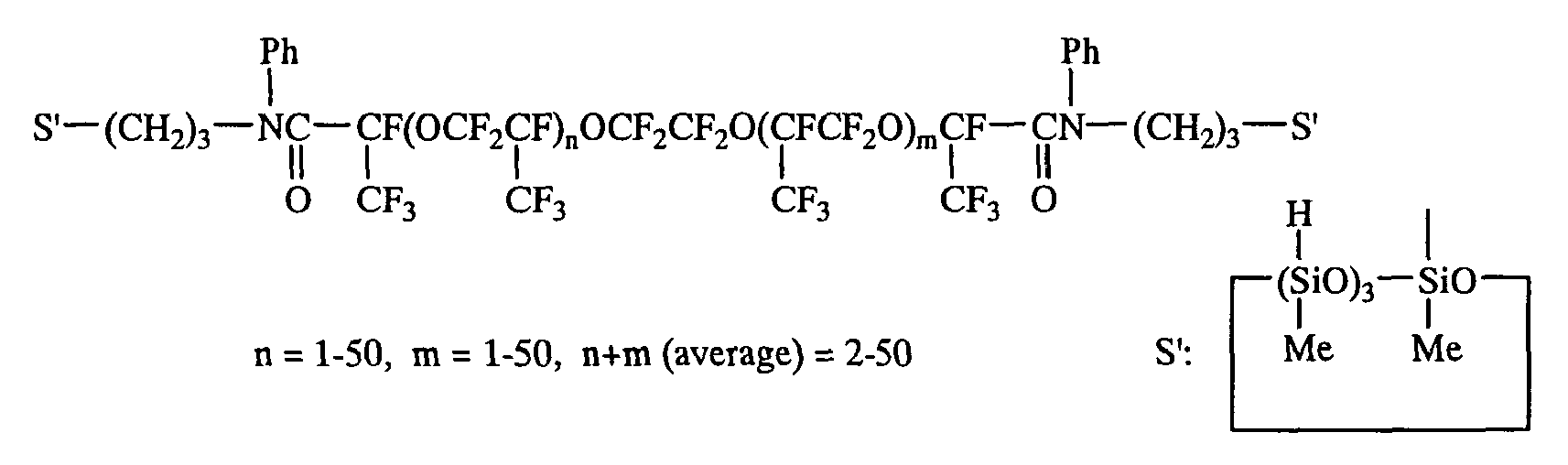




- Component (C) is used in an effective amount for component (A) to cure, and preferably such that 0.5 to 2.0 moles, more preferably 0.7 to 1.5 moles of hydrosilyl (Si-H) groups in component (C) are available per mole of alkenyl groups in component (A). Less than 0.5 mole of hydrosilyl groups may lead to a lower degree of crosslinking, resulting in undercure. More than 2.0 moles of hydrosilyl groups can cause foaming during the cure and substantial changes of physical properties with time.
- Component (D) is a spherical silica powder having an average particle size of 0.1 to 5.0 µm. The powder may consist of truly spherical particles. The inclusion of component (D) facilitates to adjust the fluidity of the composition and improves defoaming. It also enables to reduce the coefficient of expansion and improve the heat dissipation of the cured composition. Preferred powder is of the same quality as quartz glass. Preferred powder contains less than 0.1% of coarse particles having a diameter of at least 10 µm, and has a mono-modal particle size distribution. If necessary, a mixture of powders having different average particle sizes within the above range may be used.
- It is noted that a fluorinated curable composition having finely divided silica compounded therein is disclosed in the above-cited JP-A 2002-362307. In this composition where it is merely intended to reduce the fluidity of the gel composition by increasing the viscosity thereof, satisfactory results are achievable with 0.5 to 8 parts by weight of finely divided silica compounded per 100 parts by weight of component (A) or components (A) and (E) combined. Compounding more amounts of finely divided silica is unwanted because this compromise gel properties.
- In the rubber composition described in JP-A 2000-7835 and the fluoropolyether rubber compositions described in JP-A 2000-248166, JP-A 2001-192546 and JP-A 2001-164115, the mechanical strength of the cured compositions is dramatically increased by compounding microparticulate silica therein. In these compositions, the amount of microparticulate silica compounded is limited to the range of 5 to 60 parts by weight relative to 100 to 150 parts by weight of component (A) or components (A) and (B) combined. Compounding more silica encounters physical difficulties.
- According to the invention, spherical silica as component (D) can be heavily loaded. The amount of spherical silica compounded is 50 to 250 parts by weight, preferably 60 to 250 parts by weight per 100 parts by weight of components (A), (B) and (C) combined. Less than 50 parts by weight of spherical silica makes it difficult to adjust the fluidity of the composition, renders the composition less defoamable, and fails to reduce the coefficient of expansion and improve the heat dissipation of the cured composition. With more than 250 parts by weight of spherical silica, the composition has an extremely high viscosity and becomes difficult to handle or work.
- Component (E) in the inventive composition is a fluorinated trialkoxysilane serving as a surface treating agent for the spherical silica powder or component (D) for helping disperse component (D) in the composition. It is also effective for restraining spherical silica particles from settling down, and even when spherical silica particles have settled down, facilitates to disperse them again uniformly. The fluorinated trialkoxysilane has the general formula (5).
Rf2-(X')a-CH2CH2Si(OR2)3 (5)
- In formula (5), X' and "a" are as defined in formula (1).
- R2 is a monovalent hydrocarbon group. The monovalent hydrocarbon groups represented by R2 are preferably those of 1 to 8 carbon atoms, more preferably 1 to 4 carbon atoms, and desirably free of aliphatic unsaturation. Examples include alkyl groups such as methyl, ethyl, propyl, isopropyl, butyl, isobutyl, tert-butyl, pentyl, hexyl, and octyl, cycloalkyl groups such as cyclopentyl, cyclohexyl and cycloheptyl, aryl groups such as phenyl, tolyl and xylyl, and aralkyl groups such as benzyl and phenylethyl. Of these, methyl, ethyl, propyl, isopropyl, butyl, isobutyl and tert-butyl are preferred.
- In formula (5), Rf2 is a monovalent group having the general formula (iii):
F-[CF(CF3)CF2O]u-CF(CF3)- (iii)
wherein u is an integer of at least 1 and smaller than the sum of p+q (average) and r in formula (i) or the sum of s+t (average) and r in formula (ii) for Rf1 in formula (1), or the general formula (iv):
CvF2v+1 - (iv)
wherein v is an integer of at least 1 and smaller than the number giving the same formula weight as Rf1 in formula (1). - In the fluorinated trialkoxysilane having formula (5), u in formula (iii) is selected so as to meet the above condition relative to p, q and r in formula (i) representing Rf1 in formula (1), or v in formula (iv) is selected so as to be smaller than the number giving the same formula weight as Rf1 in formula (1), preventing component (E) from bleeding out of the cured composition.
- Illustrative examples of the fluorinated trialkoxysilane having formula (5) are given below.


- In formulae (e-1) through (e-7), u is as defined in formula (iii).
CvF2v+1-CH2CH2Si(OCH3)3 (e-8)
CvF2v+1-CH2CH2CH2Si(OCH3)3 (e-9)
- In formulae (e-8) and (e-9), v is as defined in formula (iv).
- The amount of component (E) compounded is 0.2 to 4.0 parts by weight per 100 parts by weight of component (D). On this basis, less than 0.2 part of component (E) provides less surface treatment effects whereas more than 4.0 parts detracts from the physical properties of the cured composition and sometimes renders the surface of the cured composition tacky.
- Component (F) is a platinum group metal catalyst for promoting the addition reaction between alkenyl groups in component (A) and hydrosilyl groups in component (C). Of these catalysts, platinum compounds which are relatively easily available are often employed. The platinum compounds include, for example, chloroplatinic acid, complexes of chloroplatinic acid with olefins such as ethylene, alcohols and vinylsiloxanes, and metallic platinum on silica, alumina or carbon, though not limited thereto. Known examples of the platinum group compounds other than the platinum compound are rhodium, ruthenium, iridium and palladium compounds, for example, RhCl(PPh3)3, RhCl(CO)(PPh3)2, Ru3(CO)12, IrCl(CO)(PPh3)2, and Pd(PPh3)4 wherein Ph is phenyl.
- The catalyst is used in a catalytic amount. Usually, the preferred amount of the catalyst is about 0.1 to 100 parts by weight of platinum group metal per million parts by weight of components (A) and (B) combined.
- To the curable fluoropolyether composition of the invention, various additives may be added, if desired, for enhancing the utility thereof. It is preferred to add as a tackifier (G) an organosiloxane having in a molecule (i) at least one silicon-bonded hydrogen atom (Si-H group), and (ii) at least one epoxy group bonded to a silicon atom through a carbon atom(s) or carbon and oxygen atoms, at least one trialkoxy group bonded to a silicon atom through a carbon atom(s) or carbon and oxygen atoms, or a mixture of at least one epoxy group and at least one trialkoxy group as defined above. Illustrative examples of the organosiloxane are given by the following structural formulae. One or more organosiloxanes may be used as component (G).


- Each on n, q and r is a positive integer, and p is an integer of at least 0.


- Each on n, q and r is a positive integer, and p is an integer of at least 0.
- The amount of component (G) used is 0.1 to 5.0 parts by weight, preferably 0.2 to 4.0 parts by weight per 100 parts by weight of components (A), (B) and (C) combined. On this basis, less than 0.1 part may fail to provide sufficient adhesion whereas more than 5.0 parts may compromise the flow of the composition, cause foaming upon curing, or detract from the physical strength of the cured composition. When component (G) is added, an adhesion promoter such as carboxylic anhydride may be added concurrently.
- Other additives which can be added herein include viscosity modifiers, reactive flexibilizers, plasticizers, regulators for hydrosilylation catalysts, inorganic fillers, organic fillers, adhesion promoters, adhesion aids other than component (G), and silane coupling agents. The amounts of these optional additives added are arbitrary insofar as they do not compromise the properties of the composition and the physical properties of the cured composition.
- Preferred reactive flexibilizers and plasticizers which can be used herein are fluoropolyether monoalkenyl compounds having the general formula (6).
Rf3-(X')a-CH=CH2 (6)
Herein X' and "a" are as defined in formula (1). Rf3 is a monovalent group having the general formula (v):
F-[CF(CF3)CF2O]w-CzF2z- (v)
wherein w is an integer of at least 1 and smaller than the sum of p+q (average) and r in formula (i) or the sum of s+t (average) and r in formula (ii) for Rf1 in formula (1), and z is 2 or 3; preferably the general formula (iii):
F-[CF(CF3)CF2O]u-CF(CF3) - (iii)
wherein u is an integer of at least 1 and smaller than the sum of p+q (average) and r in formula (i) or the sum of s+t (average) and r in formula (ii) for Rf1 in formula (1). - In the fluoropolyether monoalkenyl compound having formula (6), w in formula (v) or u in formula (iii) is selected so as to meet the above condition relative to p, q and r in formula (i) representing Rf1 in formula (1), preventing the unreacted components from bleeding out of the cured composition.
- Illustrative examples of the fluoropolyether monoalkenyl compound having formula (6) are given below.




- The amount of the fluoropolyether monoalkenyl compound having formula (6), if used, is 1 to 20 parts by weight, preferably 5 to 10 parts by weight per 100 parts by weight of the fluoropolyether compound (A) in the composition. The fluoropolyether monoalkenyl compound having formula (6) should preferably have a viscosity of 100 to 100,000 mPa·s at 23°C. In the embodiment wherein the fluoropolyether monoalkenyl compound having formula (6) is compounded, the amount of component (C) is determined while taking into account the amount of the fluoropolyether monoalkenyl compound having formula (6) as well as component (A). Specifically, the amount of component (C) is determined such that 0.5 to 2.0 moles, preferably 0.7 to 1.5 moles of Si-H groups are available per mole of alkenyl groups in the entire composition.
- The regulators for hydrosilylation catalysts include, for example, acetylene alcohols such as 1-ethynyl-1-hydroxycyclohexane, 3-methyl-1-butyn-3-ol, 3,5-dimethyl-1-hexyn-3-ol, 3-methyl-1-penten-3-ol, and phenylbutynol, reaction products of a chlorosilane having at least one perfluoroalkylethyl or perfluoroalkylpropyl group with an acetylene alcohol, 3-methyl-3-penten-1-yne, 3,5-dimethyl-3-hexen-1-yne, triallyl isocyanurate, etc., polyvinylsiloxanes, and organic phosphorus compounds. These regulators are effective for maintaining curing reactivity and storage stability appropriate.
- Examples of suitable inorganic fillers include reinforcing or semi-reinforcing fillers such as fumed silica, hydrophobic fumed silica, ground quartz, diatomaceous earth and calcium carbonate; inorganic pigments such as titanium oxide, iron oxide, carbon black, cobalt aluminate and ultramarine; heat resistance modifiers such as titanium oxide, iron oxide, carbon black, cerium oxide, cerium hydroxide, zinc carbonate, magnesium carbonate, and manganese carbonate; heat conductive agents such as alumina, boron nitride, silicon carbide and aluminum powder; and electrical conductive agents such as carbon black, silver powder, and conductive zinc white. Examples of suitable organic fillers include wear resistance modifiers such as ground tetrafluoroethylene resins and ground nylon resins, and organic pigments such as copper phthalocyanine.
- Also useful herein are adhesion promoters such as carboxylic anhydrides and titanic acid esters, adhesion aids other than component (G), and silane coupling agents.
- The curable fluoropolyether composition of the invention is prepared by any desired method, for example, by combining components (A) to (F), and optionally component (G) and other optional components, and uniformly mixing them on a mixer such as a planetary mixer, Ross Mixer or Hobart Mixer and optionally a kneading or milling unit such as a kneader or three-roll mill.
- Depending on the identity of the catalyst (F), the inventive composition cures at room temperature. Often the composition is heated to promote curing. The composition is preferably cured by heating at a temperature of at least 60°C, more preferably 100 to 200°C for about 10 minutes to about 24 hours.
- On use of the curable fluoropolyether composition of the invention, it may be dissolved in a suitable fluorinated solvent in a desired concentration prior to application depending on a particular use or purpose. Suitable fluorinated solvents include 1,3-bis(trifluoromethyl)benzene, Fluorinert® (3M), perfluorobutyl methyl ether, and perfluorobutyl ethyl ether.
- Methods of preparing the compositions and of using them with curing e.g. for the purposes mentioned above, and cured rubbers obtainable from them, are further aspects of this invention.
- Examples of the invention are given below by way of illustration and not by way of limitation. Parts are by weight. Viscosity was measured at 23°C.
- A planetary mixer was charged with 50 parts of a fluoropolyether compound having formula (7) (viscosity 10,000 mPa·s, number average molecular weight 17,000, vinyl content 0.012 mole/100 g), 50 parts of a perfluoropolyether having formula (8) (viscosity 260 mPa·s, number average molecular weight 4,500), and 1.0 part of a fluorinated trialkoxysilane having formula (9). 100 parts of spherical silica powder (average particle size 1.7 µm) was added to the mix, which was kneaded for 30 minutes without heating. Next, 0.10 part of a toluene solution of platinum-divinyltetramethyldisiloxane complex (platinum concentration 0.5 wt%), 0.15 part of a 50% toluene solution of ethynyl cyclohexanol, and 1.7 parts of an organohydrogenpolysiloxane having formula (10) were added in sequence. Mixing was continued for 15 minutes until uniform. With mixing continued, defoaming treatment under vacuum (60 Torr) was carried out for 15 minutes, completing a composition.

C3F7O-(CF2CF2CF2O)m-C2F5 m = 26 (8)


- The composition thus obtained was cast into a rectangular mold of 2 mm thick, press cured at 100 kg/cm2 and 150°C for 10 minutes, and oven cured at 150°C for 50 minutes, forming a cured sheet. Using a #2 dumbbell punching jig, a specimen was punched out of the sheet. The physical properties of the specimen were measured according to JIS K-6249 before and after the following test.
- The specimen is immersed in a solvent at 23°C for 7 days, after which a volume change is determined. The solvents include hexane, toluene, unleaded gasoline, acetone and methanol.
- The specimen is immersed in an oil at 150°C for 240 hours, after which changes of physical properties are determined. An oil A: engine oil (Toyota Castle Neo-Gear) and oil B: gear oil (Toyota Castle Gear Oil Special II) are used as the test liquid for examining the durability upon immersion in hot machine oil.
- The specimen is immersed in a chemical at 23°C for 7 days, after which changes of hardness and surface state are determined. The chemicals include acid, alkali and amine.
- Before and after each test, the physical properties of the specimen were measured. The results are shown in Table 1 (solvent resistance), Tables 2 and 3 (oil resistance), and Table 4 (chemical resistance).
- A composition was prepared as in Example 1 except that a perfluoropolyether having formula (11) (viscosity 760 mPa·s, number average molecular weight 4,100) was used instead of the perfluoropolyether having formula (8).

- It is understood that n and m are numbers satisfying the above-described viscosity and molecular weight.
- As in Example 1, a sheet for the solvent resistance test and a #2 dumbbell specimen were prepared. The tests of solvent resistance, oil resistance and chemical resistance were performed. The results are shown in Tables 1 to 4.
- A composition was prepared as in Example 1 except that 3.0 parts of an organosiloxane having formula (12) was further added as a tackifier to the components used in Example 1.

- As in Example 1, a sheet for the solvent resistance test and a #2 dumbbell specimen were prepared. The tests of solvent resistance, oil resistance and chemical resistance were performed. The results are shown in Tables 1 to 4.
- Comparative Examples 1 and 2 used a silicone rubber KE1206 (Shin-Etsu Chemical Co., Ltd.) and a fluorosilicone rubber FE61 (Shin-Etsu Chemical Co., Ltd.), respectively, instead of the composition of Example 1. As in Example 1, a sheet for the solvent resistance test and a #2 dumbbell specimen were prepared. The tests of solvent resistance, oil resistance and chemical resistance were performed. The results are shown in Tables 1 to 4.
Table 1 Solvent resistance: volume changes (%) after 23°C/7 day immersion Solvent Example Comparative Example 1 2 3 1 2 Hexane +5 +5 +5 +170 +25 Toluene +4 +5 +5 +180 +30 Unleaded gasoline +4 +5 +5 +200 +25 Acetone +2 +2 +3 +15 +180 Methanol +2 +2 +3 +10 +5 Table 2 Engine oil resistance: physical changes after 150°C/240 hr immersion Property Example Comparative Example 1 2 3 1 2 As cured (before test) Hardness 39 43 42 35 22 Elongation (%) 220 210 230 220 170 Tensile strength (MPa) 2.1 2.3 2.2 2.0 1.6 After test Hardness 38 41 40 8 18 Elongation (%) 150 140 160 110 140 Tensile strength (MPa) 1.4 1.3 1.5 0.2 1.3 Table 3 Gear oil resistance: physical changes after 150°C/240 hr immersion Property Example Comparative Example 1 2 3 1 2 As cured (before test) Hardness 39 43 42 35 22 Elongation (%) 220 210 230 220 170 Tensile strength (MPa) 2.1 2.3 2.2 2.0 1.6 After test Hardness 40 45 43 10 20 Elongation (%) 170 160 180 130 150 Tensile strength (MPa) 1.7 1.9 1.8 0.3 1.4 Table 4 Chemical resistance: Hardness changes and surface state after 23°C/7 day immersion Chemical Example Comparative Example 1 2 3 1 2 Hardness change Appearance Hardness change Appearance Hardness change Appearance Hardness change Appearance Hardness change Appearance 36% HCl +3 unchanged +4 unchanged +3 unchanged -5 unchanged -1 unchanged 98% H2SO4 -9 unchanged -12 unchanged -10 unchanged UM dissolved UM dissolved 60% HNO3 +3 unchanged +3 unchanged +4 unchanged -20 degraded surface -4 degraded surface 40% NaOH aq. +2 unchanged +3 unchanged +2 unchanged -2 degraded surface +2 degraded surface Butylamine -4 unchanged -5 unchanged -4 unchanged UM dissolved UM dissolved UM: unmeasurable
Claims (7)
- A curable fluoropolyether composition comprising, or preparable by combining,(A) 20 to 80 parts by weight of a fluoropolyether compound having the general formula (1):
CH2=CH-(X)a-Rf1-(X')a-CH=CH2 (1)
wherein X is a divalent group represented by -CH2-, -CH2O-, -CH2OCH2- or -Y-NR1-CO- wherein Y is a divalent group of -CH2- or
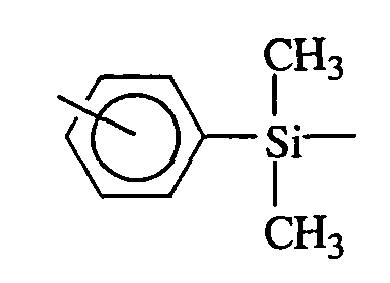
-CF(CF3)-[OCF2CF(CF3)]p-O-CF2(CF2)rCF2-O-[CF(CF3)CF2O]q-CF(CF3)- (i)
wherein p and q each are an integer of at least 1, the sum of p+q on average is 2 to 200, and r is an integer of 0 to 6, or the general formula (ii):
-CF2CF2-[OCF2CF(CF3)]s-O-CF2(CF2)rCF2-O-[CF(CF3)CF2O]t-CF2CF2- (ii)
wherein s and t each are an integer of at least 1, the sum of s+t on average is 2 to 200, and r is as defined above,(B) at least one perfluoropolyether selected from the class consisting of compounds having the general formula (2):
A-O-(CF2CF2CF2O)b-A (2)
wherein A are selected independently from CF3-, C2F5- and C3F7-, b is an integer of 1 to 200 and smaller than the sum of p+q (average) and r in formula (i) or the sum of s+t (average) and r in formula (ii) for Rf1 in formula (1), compounds having the general formula (3):
A-O-(CF2O)c(CF2CF2O)d-A (3)
wherein A is as defined above, c and d each are an integer of 1 to 200, and the sum of c and d is smaller than the sum of p+q (average) and r in formula (i) or the sum of s+t (average) and r in formula (ii) for Rf1 in formula (1), and compounds having the general formula (4):
A-O-(CF2O)e[CF2CF(CF3)O]f-A (4)
wherein A is as defined above, e and f each are an integer of 1 to 200, and the sum of e and f is smaller than the sum of p+q (average) and r in formula (i) or the sum of s+t (average) and r in formula (ii) for Rf1 in formula (1), component (B) being present in such an amount as to give 100 parts by weight of components (A) and (B) combined,(C) organohydrogensiloxane having at least one perfluorooxyalkyl, perfluoroalkyl, perfluorooxyalkylene or perfluoroalkylene group and at least two silicon-bonded hydrogen atoms (Si-H groups) in a molecule, component (C) being present in such an amount as to provide 0.5 to 2.0 moles of Si-H groups per mole of alkenyl groups in component (A),(D) spherical silica powder having an average particle size of 0.1 to 5.0 µm, in an amount of 50 to 250 parts by weight per 100 parts by weight of components (A), (B) and (C) combined,(E) a fluorinated trialkoxysilane having the general formula (5):
Rf2- (X')a-CH2CH2Si(OR2)3 (5)
wherein options for X' and a are as for formula (1), R2 is a monovalent hydrocarbon group, and Rf2 is a monovalent group having the general formula (iii):
F-[CF(CF3)CF2O]u-CF(CF3) - (iii)
wherein u is an integer of at least 1 and smaller than the sum of p+q (average) and r in formula (i) or the sum of s+t (average) and r in formula (ii) for Rf1 in formula (1), or the general formula (iv):
CvF2v+1- (iv)
wherein v is an integer of at least 1 and smaller than the number giving the same formula weight as Rf1 in formula (1), component (E) being present in an amount of 0.2 to 4.0 parts by weight per 100 parts by weight of component (D), and(F) an effective amount of a platinum group catalyst. - The curable fluoropolyether composition of claim 1, wherein the fluorinated trialkoxysilane of component (E) is at least one selected from the group consisting of compounds represented by the following formulae (e-1) to (e-9):


CvF2v+1-CH2CH2Si(OCH3) (e-8)
CvF2v+1-CH2CH2CH2Si(OCH3)3 (e-9)
wherein u is an integer of at least 1 and smaller than the sum of p+q (average) and r in formula (i) or the sum of s+t (average) and r in formula (ii) for Rf1 in formula (1), and v is an integer of at least 1 and smaller than the number giving the same formula weight as Rf1 in formula (1). - The curable fluoropolyether composition of claim 1 or 2 further comprising (G) an organosiloxane having in a molecule at least one silicon-bonded hydrogen atom (Si-H group), and at least one epoxy group bonded to a silicon atom through a carbon atom or carbon and oxygen atoms, at least one trialkoxy group bonded to a silicon atom through a carbon atom or carbon and oxygen atoms, or a mixture thereof, component (G) being present in an amount of 0.1 to 5.0 parts by weight per 100 parts by weight of components (A), (B) and (C) combined.
- The curable fluoropolyether composition of claim 3, wherein the organosiloxane of component (G) is at least one selected from the group consisting of compounds represented by the following formulae:


wherein each of n, q and r is a positive integer, and p is an integer of at least 0,

wherein Ph stands for phenyl,
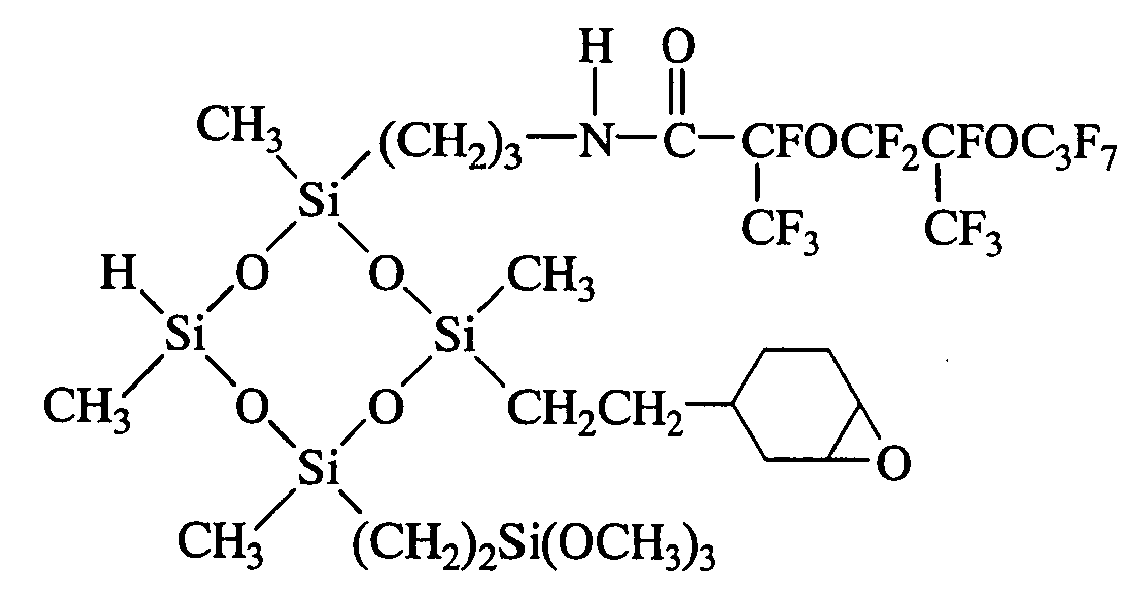


wherein each of n, q and r is a positive integer, and p is an integer of at least 0. - A method of preparing a curable fluoropolyether composition, comprising combining components as defined in any one of claims 1 to 4.
- A method of making an article comprising curing a composition according to any one of claims 1 to 4.
- A cured fluororubber obtainable by curing a composition according to any one of claims 1 to 4.
Applications Claiming Priority (1)
| Application Number | Priority Date | Filing Date | Title |
|---|---|---|---|
| JP2004201961A JP2006022223A (en) | 2004-07-08 | 2004-07-08 | Curable fluoropolyether composition |
Publications (1)
| Publication Number | Publication Date |
|---|---|
| EP1614718A1 true EP1614718A1 (en) | 2006-01-11 |
Family
ID=35220592
Family Applications (1)
| Application Number | Title | Priority Date | Filing Date |
|---|---|---|---|
| EP20050254299 Withdrawn EP1614718A1 (en) | 2004-07-08 | 2005-07-08 | Curable fluoropolyether compositions, their preparation and use |
Country Status (3)
| Country | Link |
|---|---|
| US (1) | US20060014895A1 (en) |
| EP (1) | EP1614718A1 (en) |
| JP (1) | JP2006022223A (en) |
Cited By (11)
| Publication number | Priority date | Publication date | Assignee | Title |
|---|---|---|---|---|
| EP1731567A1 (en) * | 2005-05-25 | 2006-12-13 | Shin-Etsu Chemical Co., Ltd. | Fluorine-containing material |
| WO2006107082A3 (en) * | 2005-04-01 | 2007-01-25 | Daikin Ind Ltd | Surface modifier and its use |
| US7868119B2 (en) * | 2006-11-06 | 2011-01-11 | Shin-Etsu Chemical Co., Ltd. | Coating composition |
| EP2325188A4 (en) * | 2008-09-09 | 2012-02-29 | Unimatec Co Ltd | BORONIC ACID ESTER COMPOUND CONTAINING FLUORINE AND PROCESS FOR PRODUCING THE SAME |
| US8322754B2 (en) | 2006-12-01 | 2012-12-04 | Tenaris Connections Limited | Nanocomposite coatings for threaded connections |
| WO2013074299A1 (en) * | 2011-11-15 | 2013-05-23 | 3M Innovative Properties Company | Fluorinated coatings with lubricious additive |
| CN104245865A (en) * | 2012-02-20 | 2014-12-24 | 3M创新有限公司 | Oleophobic coatings |
| US20150159022A1 (en) * | 2012-07-12 | 2015-06-11 | Dow Corning Corporation | Composition For Surface Treatment, Method Of Preparing A Surface-Treated Article, And Surface-Treated Article |
| EP3053945A1 (en) * | 2015-02-04 | 2016-08-10 | Shin-Etsu Chemical Co., Ltd. | Photo-curable fluoropolyether-based rubber composition, curing method thereof and cured product obtained by the curing method |
| CN110431145A (en) * | 2017-03-17 | 2019-11-08 | 大金工业株式会社 | Silane compound containing perfluoro (poly) ether group |
| US10513793B2 (en) | 2014-02-19 | 2019-12-24 | Tenaris Connections B.V. | Threaded joint for an oil well pipe |
Families Citing this family (10)
| Publication number | Priority date | Publication date | Assignee | Title |
|---|---|---|---|---|
| DE102005045167B4 (en) * | 2005-09-21 | 2012-07-05 | Carl Freudenberg Kg | Use of a crosslinked rubber compound as a material for a fuel cell |
| JP5338024B2 (en) * | 2006-10-19 | 2013-11-13 | 信越化学工業株式会社 | Curable composition |
| JP5141862B2 (en) * | 2006-12-01 | 2013-02-13 | 信越化学工業株式会社 | Curable fluoropolyether rubber composition for masking |
| EP2155823B9 (en) * | 2007-06-08 | 2014-02-19 | Dow Corning Corporation | Fluorosilicone elastomers for high temperature performance |
| JP7151711B2 (en) * | 2017-08-22 | 2022-10-12 | Agc株式会社 | Fluorine-containing ether compound, fluorine-containing ether composition, coating liquid, article, and method for producing the same |
| US11840044B2 (en) | 2020-04-17 | 2023-12-12 | Saint-Gobain Performance Plastics Corporation | Multilayer tube and method for making same |
| CN118715285A (en) * | 2022-01-24 | 2024-09-27 | 信越化学工业株式会社 | Curable perfluoropolyether gel composition, perfluoropolyether gel cured product, and electrical and electronic components sealed with the cured product |
| JP2024006000A (en) * | 2022-06-30 | 2024-01-17 | 三菱ケミカル株式会社 | Release layer composition, release film and method for producing these, film laminate and method for using the same |
| JP2024151871A (en) * | 2023-04-13 | 2024-10-25 | 信越化学工業株式会社 | CURABLE PERFLUOROPOLYETHER GEL COMPOSITION, CURED PERFLUOROPOLYETHER GEL PRODUCT, AND ELECTRONIC COMPONENT ENCAPSULATED WITH THE CURED PRODUCT |
| US20260036207A1 (en) | 2024-07-31 | 2026-02-05 | John Crane Inc. | Dry gas seal system |
Citations (4)
| Publication number | Priority date | Publication date | Assignee | Title |
|---|---|---|---|---|
| EP0967251A1 (en) * | 1998-06-22 | 1999-12-29 | Shin-Etsu Chemical Co., Ltd. | Fluororubber compositions and method of making |
| US20010018491A1 (en) * | 2000-02-07 | 2001-08-30 | Mikio Shiono | Curable composition |
| EP1223194A1 (en) * | 2001-01-16 | 2002-07-17 | Shin-Etsu Chemical Co., Ltd. | Curable fluorinated elastomer compositions, their preparation and use |
| EP1413588A1 (en) * | 2002-10-25 | 2004-04-28 | Shin-Etsu Chemical Co., Ltd. | Curable compositions |
Family Cites Families (6)
| Publication number | Priority date | Publication date | Assignee | Title |
|---|---|---|---|---|
| DE3624776A1 (en) * | 1986-07-22 | 1988-01-28 | Bayer Ag | SOFT SILICONE ELASTOMERS |
| US5264522A (en) * | 1992-09-10 | 1993-11-23 | Shin-Etsu Chemical Co., Ltd. | Heat-curable fluorosilicone rubber composition and cured product thereof |
| US6379801B1 (en) * | 1998-12-07 | 2002-04-30 | Seagate Technology, Llc | Silane derivatized lubricants for magnetic recording media |
| JP4013014B2 (en) * | 1999-03-05 | 2007-11-28 | 信越化学工業株式会社 | Electrostatic image developer |
| JP3796565B2 (en) * | 2000-08-15 | 2006-07-12 | 信越化学工業株式会社 | Method for producing spherical silica fine particles |
| JP3815778B2 (en) * | 2002-01-10 | 2006-08-30 | 信越化学工業株式会社 | Curable composition giving a low bleed gel-like cured product |
-
2004
- 2004-07-08 JP JP2004201961A patent/JP2006022223A/en active Pending
-
2005
- 2005-07-07 US US11/175,299 patent/US20060014895A1/en not_active Abandoned
- 2005-07-08 EP EP20050254299 patent/EP1614718A1/en not_active Withdrawn
Patent Citations (4)
| Publication number | Priority date | Publication date | Assignee | Title |
|---|---|---|---|---|
| EP0967251A1 (en) * | 1998-06-22 | 1999-12-29 | Shin-Etsu Chemical Co., Ltd. | Fluororubber compositions and method of making |
| US20010018491A1 (en) * | 2000-02-07 | 2001-08-30 | Mikio Shiono | Curable composition |
| EP1223194A1 (en) * | 2001-01-16 | 2002-07-17 | Shin-Etsu Chemical Co., Ltd. | Curable fluorinated elastomer compositions, their preparation and use |
| EP1413588A1 (en) * | 2002-10-25 | 2004-04-28 | Shin-Etsu Chemical Co., Ltd. | Curable compositions |
Cited By (24)
| Publication number | Priority date | Publication date | Assignee | Title |
|---|---|---|---|---|
| US8664421B2 (en) | 2005-04-01 | 2014-03-04 | Daikin Industries, Ltd. | Surface modifier and its use |
| WO2006107082A3 (en) * | 2005-04-01 | 2007-01-25 | Daikin Ind Ltd | Surface modifier and its use |
| CN101189278B (en) * | 2005-04-01 | 2012-03-21 | 大金工业株式会社 | Surface modifier and its use |
| EP1731567A1 (en) * | 2005-05-25 | 2006-12-13 | Shin-Etsu Chemical Co., Ltd. | Fluorine-containing material |
| US7868119B2 (en) * | 2006-11-06 | 2011-01-11 | Shin-Etsu Chemical Co., Ltd. | Coating composition |
| US8322754B2 (en) | 2006-12-01 | 2012-12-04 | Tenaris Connections Limited | Nanocomposite coatings for threaded connections |
| US8758876B2 (en) | 2006-12-01 | 2014-06-24 | Tenaris Connections Limited | Nanocomposite coatings for threaded connections |
| EP2325188A4 (en) * | 2008-09-09 | 2012-02-29 | Unimatec Co Ltd | BORONIC ACID ESTER COMPOUND CONTAINING FLUORINE AND PROCESS FOR PRODUCING THE SAME |
| CN102143966B (en) * | 2008-09-09 | 2014-03-05 | 优迈特株式会社 | Fluorine-containing boronic acid ester compound and method for producing same |
| WO2013074299A1 (en) * | 2011-11-15 | 2013-05-23 | 3M Innovative Properties Company | Fluorinated coatings with lubricious additive |
| CN103998546A (en) * | 2011-11-15 | 2014-08-20 | 3M创新有限公司 | Fluorinated coatings with lubricant additives |
| US9611399B2 (en) | 2011-11-15 | 2017-04-04 | 3M Innovative Properties Company | Fluorinated coatings with lubricious additive |
| CN103998546B (en) * | 2011-11-15 | 2016-12-14 | 3M创新有限公司 | Fluorinated coatings with lubricant additives |
| CN104245865A (en) * | 2012-02-20 | 2014-12-24 | 3M创新有限公司 | Oleophobic coatings |
| CN104245865B (en) * | 2012-02-20 | 2017-03-08 | 3M创新有限公司 | Oleophobic property coating |
| US20150159022A1 (en) * | 2012-07-12 | 2015-06-11 | Dow Corning Corporation | Composition For Surface Treatment, Method Of Preparing A Surface-Treated Article, And Surface-Treated Article |
| US10513793B2 (en) | 2014-02-19 | 2019-12-24 | Tenaris Connections B.V. | Threaded joint for an oil well pipe |
| US11359303B2 (en) | 2014-02-19 | 2022-06-14 | Tenaris Connections B.V. | Threaded joint for an oil well pipe |
| EP3053945A1 (en) * | 2015-02-04 | 2016-08-10 | Shin-Etsu Chemical Co., Ltd. | Photo-curable fluoropolyether-based rubber composition, curing method thereof and cured product obtained by the curing method |
| US9840601B2 (en) | 2015-02-04 | 2017-12-12 | Shin-Etsu Chemical Co., Ltd. | Method for producing a cured product |
| CN110431145A (en) * | 2017-03-17 | 2019-11-08 | 大金工业株式会社 | Silane compound containing perfluoro (poly) ether group |
| EP3597654A4 (en) * | 2017-03-17 | 2020-12-23 | Daikin Industries, Ltd. | SILANE COMPOUND WITH PERFLUORINE (POLY) ETHER GROUP |
| CN110431145B (en) * | 2017-03-17 | 2023-05-30 | 大金工业株式会社 | Silane compounds containing perfluoro(poly)ether groups |
| US11814537B2 (en) | 2017-03-17 | 2023-11-14 | Daikin Industries, Ltd. | Silane compound containing perfluoro (poly ) ether group |
Also Published As
| Publication number | Publication date |
|---|---|
| US20060014895A1 (en) | 2006-01-19 |
| JP2006022223A (en) | 2006-01-26 |
Similar Documents
| Publication | Publication Date | Title |
|---|---|---|
| US6517946B2 (en) | Curable composition | |
| US20060014895A1 (en) | Curable fluoropolyether composition | |
| EP1081185B1 (en) | Curable fluorinated elastomer compositions | |
| EP1223194B1 (en) | Curable fluorinated elastomer compositions, their preparation and use | |
| US6576737B2 (en) | Curable compositions of fluorinated amide compounds | |
| EP2719737B1 (en) | Adhesive Composition | |
| EP1170320B1 (en) | Curable fluoropolyether base rubber compositions | |
| EP1217025B1 (en) | Curable fluoropolyether base rubber compositions | |
| EP1780253A2 (en) | Adhesive composition | |
| EP2383318A1 (en) | Adhesive composition | |
| JP2002012769A (en) | Curable fluoropolyether rubber composition | |
| US20090258986A1 (en) | Room temperature curable fluoropolyether rubber composition and cured product | |
| US6828360B2 (en) | Thixotropic fluorinated curable compositions and articles sealed therewith | |
| JP5110280B2 (en) | Curable fluoropolyether rubber composition | |
| JP4269127B2 (en) | Curable composition | |
| EP1413588B1 (en) | Curable compositions | |
| JP3633836B2 (en) | Fluoro rubber composition | |
| EP1571192B1 (en) | Fluoropolyether adhesive composition | |
| JP3944721B2 (en) | Curable fluoropolyether composition and rubber product | |
| JP2004331903A (en) | Method for producing perfluoroalkyl ether adhesive composition | |
| JP7794300B2 (en) | Thermosetting perfluoropolyether rubber composition | |
| US20020193503A1 (en) | FIPG fluoroelastomer compositions |
Legal Events
| Date | Code | Title | Description |
|---|---|---|---|
| PUAI | Public reference made under article 153(3) epc to a published international application that has entered the european phase |
Free format text: ORIGINAL CODE: 0009012 |
|
| AK | Designated contracting states |
Kind code of ref document: A1 Designated state(s): AT BE BG CH CY CZ DE DK EE ES FI FR GB GR HU IE IS IT LI LT LU LV MC NL PL PT RO SE SI SK TR |
|
| AX | Request for extension of the european patent |
Extension state: AL BA HR MK YU |
|
| 17P | Request for examination filed |
Effective date: 20060410 |
|
| AKX | Designation fees paid |
Designated state(s): DE FR GB |
|
| STAA | Information on the status of an ep patent application or granted ep patent |
Free format text: STATUS: THE APPLICATION IS DEEMED TO BE WITHDRAWN |
|
| 18D | Application deemed to be withdrawn |
Effective date: 20060930 |