EP1614676A1 - Compound inhibiting in vivo phosphorus transport and medicine containing the same - Google Patents
Compound inhibiting in vivo phosphorus transport and medicine containing the same Download PDFInfo
- Publication number
- EP1614676A1 EP1614676A1 EP04724132A EP04724132A EP1614676A1 EP 1614676 A1 EP1614676 A1 EP 1614676A1 EP 04724132 A EP04724132 A EP 04724132A EP 04724132 A EP04724132 A EP 04724132A EP 1614676 A1 EP1614676 A1 EP 1614676A1
- Authority
- EP
- European Patent Office
- Prior art keywords
- optionally substituted
- group
- alkyl
- represent
- halogen atom
- Prior art date
- Legal status (The legal status is an assumption and is not a legal conclusion. Google has not performed a legal analysis and makes no representation as to the accuracy of the status listed.)
- Withdrawn
Links
- 0 CC(*)(*)N(*)C(CCCCCC1)C1C(N(*)*)=O Chemical compound CC(*)(*)N(*)C(CCCCCC1)C1C(N(*)*)=O 0.000 description 7
Images


Classifications
-
- C—CHEMISTRY; METALLURGY
- C07—ORGANIC CHEMISTRY
- C07C—ACYCLIC OR CARBOCYCLIC COMPOUNDS
- C07C323/00—Thiols, sulfides, hydropolysulfides or polysulfides substituted by halogen, oxygen or nitrogen atoms, or by sulfur atoms not being part of thio groups
- C07C323/50—Thiols, sulfides, hydropolysulfides or polysulfides substituted by halogen, oxygen or nitrogen atoms, or by sulfur atoms not being part of thio groups containing thio groups and carboxyl groups bound to the same carbon skeleton
- C07C323/51—Thiols, sulfides, hydropolysulfides or polysulfides substituted by halogen, oxygen or nitrogen atoms, or by sulfur atoms not being part of thio groups containing thio groups and carboxyl groups bound to the same carbon skeleton having the sulfur atoms of the thio groups bound to acyclic carbon atoms of the carbon skeleton
- C07C323/60—Thiols, sulfides, hydropolysulfides or polysulfides substituted by halogen, oxygen or nitrogen atoms, or by sulfur atoms not being part of thio groups containing thio groups and carboxyl groups bound to the same carbon skeleton having the sulfur atoms of the thio groups bound to acyclic carbon atoms of the carbon skeleton with the carbon atom of at least one of the carboxyl groups bound to nitrogen atoms
-
- A—HUMAN NECESSITIES
- A61—MEDICAL OR VETERINARY SCIENCE; HYGIENE
- A61P—SPECIFIC THERAPEUTIC ACTIVITY OF CHEMICAL COMPOUNDS OR MEDICINAL PREPARATIONS
- A61P11/00—Drugs for disorders of the respiratory system
-
- A—HUMAN NECESSITIES
- A61—MEDICAL OR VETERINARY SCIENCE; HYGIENE
- A61P—SPECIFIC THERAPEUTIC ACTIVITY OF CHEMICAL COMPOUNDS OR MEDICINAL PREPARATIONS
- A61P13/00—Drugs for disorders of the urinary system
- A61P13/12—Drugs for disorders of the urinary system of the kidneys
-
- A—HUMAN NECESSITIES
- A61—MEDICAL OR VETERINARY SCIENCE; HYGIENE
- A61P—SPECIFIC THERAPEUTIC ACTIVITY OF CHEMICAL COMPOUNDS OR MEDICINAL PREPARATIONS
- A61P15/00—Drugs for genital or sexual disorders; Contraceptives
-
- A—HUMAN NECESSITIES
- A61—MEDICAL OR VETERINARY SCIENCE; HYGIENE
- A61P—SPECIFIC THERAPEUTIC ACTIVITY OF CHEMICAL COMPOUNDS OR MEDICINAL PREPARATIONS
- A61P17/00—Drugs for dermatological disorders
- A61P17/04—Antipruritics
-
- A—HUMAN NECESSITIES
- A61—MEDICAL OR VETERINARY SCIENCE; HYGIENE
- A61P—SPECIFIC THERAPEUTIC ACTIVITY OF CHEMICAL COMPOUNDS OR MEDICINAL PREPARATIONS
- A61P19/00—Drugs for skeletal disorders
-
- A—HUMAN NECESSITIES
- A61—MEDICAL OR VETERINARY SCIENCE; HYGIENE
- A61P—SPECIFIC THERAPEUTIC ACTIVITY OF CHEMICAL COMPOUNDS OR MEDICINAL PREPARATIONS
- A61P19/00—Drugs for skeletal disorders
- A61P19/02—Drugs for skeletal disorders for joint disorders, e.g. arthritis, arthrosis
-
- A—HUMAN NECESSITIES
- A61—MEDICAL OR VETERINARY SCIENCE; HYGIENE
- A61P—SPECIFIC THERAPEUTIC ACTIVITY OF CHEMICAL COMPOUNDS OR MEDICINAL PREPARATIONS
- A61P21/00—Drugs for disorders of the muscular or neuromuscular system
-
- A—HUMAN NECESSITIES
- A61—MEDICAL OR VETERINARY SCIENCE; HYGIENE
- A61P—SPECIFIC THERAPEUTIC ACTIVITY OF CHEMICAL COMPOUNDS OR MEDICINAL PREPARATIONS
- A61P25/00—Drugs for disorders of the nervous system
-
- A—HUMAN NECESSITIES
- A61—MEDICAL OR VETERINARY SCIENCE; HYGIENE
- A61P—SPECIFIC THERAPEUTIC ACTIVITY OF CHEMICAL COMPOUNDS OR MEDICINAL PREPARATIONS
- A61P27/00—Drugs for disorders of the senses
- A61P27/02—Ophthalmic agents
-
- A—HUMAN NECESSITIES
- A61—MEDICAL OR VETERINARY SCIENCE; HYGIENE
- A61P—SPECIFIC THERAPEUTIC ACTIVITY OF CHEMICAL COMPOUNDS OR MEDICINAL PREPARATIONS
- A61P3/00—Drugs for disorders of the metabolism
- A61P3/06—Antihyperlipidemics
-
- A—HUMAN NECESSITIES
- A61—MEDICAL OR VETERINARY SCIENCE; HYGIENE
- A61P—SPECIFIC THERAPEUTIC ACTIVITY OF CHEMICAL COMPOUNDS OR MEDICINAL PREPARATIONS
- A61P3/00—Drugs for disorders of the metabolism
- A61P3/08—Drugs for disorders of the metabolism for glucose homeostasis
- A61P3/10—Drugs for disorders of the metabolism for glucose homeostasis for hyperglycaemia, e.g. antidiabetics
-
- A—HUMAN NECESSITIES
- A61—MEDICAL OR VETERINARY SCIENCE; HYGIENE
- A61P—SPECIFIC THERAPEUTIC ACTIVITY OF CHEMICAL COMPOUNDS OR MEDICINAL PREPARATIONS
- A61P3/00—Drugs for disorders of the metabolism
- A61P3/12—Drugs for disorders of the metabolism for electrolyte homeostasis
-
- A—HUMAN NECESSITIES
- A61—MEDICAL OR VETERINARY SCIENCE; HYGIENE
- A61P—SPECIFIC THERAPEUTIC ACTIVITY OF CHEMICAL COMPOUNDS OR MEDICINAL PREPARATIONS
- A61P37/00—Drugs for immunological or allergic disorders
-
- A—HUMAN NECESSITIES
- A61—MEDICAL OR VETERINARY SCIENCE; HYGIENE
- A61P—SPECIFIC THERAPEUTIC ACTIVITY OF CHEMICAL COMPOUNDS OR MEDICINAL PREPARATIONS
- A61P37/00—Drugs for immunological or allergic disorders
- A61P37/02—Immunomodulators
- A61P37/04—Immunostimulants
-
- A—HUMAN NECESSITIES
- A61—MEDICAL OR VETERINARY SCIENCE; HYGIENE
- A61P—SPECIFIC THERAPEUTIC ACTIVITY OF CHEMICAL COMPOUNDS OR MEDICINAL PREPARATIONS
- A61P43/00—Drugs for specific purposes, not provided for in groups A61P1/00-A61P41/00
-
- A—HUMAN NECESSITIES
- A61—MEDICAL OR VETERINARY SCIENCE; HYGIENE
- A61P—SPECIFIC THERAPEUTIC ACTIVITY OF CHEMICAL COMPOUNDS OR MEDICINAL PREPARATIONS
- A61P5/00—Drugs for disorders of the endocrine system
-
- A—HUMAN NECESSITIES
- A61—MEDICAL OR VETERINARY SCIENCE; HYGIENE
- A61P—SPECIFIC THERAPEUTIC ACTIVITY OF CHEMICAL COMPOUNDS OR MEDICINAL PREPARATIONS
- A61P5/00—Drugs for disorders of the endocrine system
- A61P5/18—Drugs for disorders of the endocrine system of the parathyroid hormones
-
- A—HUMAN NECESSITIES
- A61—MEDICAL OR VETERINARY SCIENCE; HYGIENE
- A61P—SPECIFIC THERAPEUTIC ACTIVITY OF CHEMICAL COMPOUNDS OR MEDICINAL PREPARATIONS
- A61P7/00—Drugs for disorders of the blood or the extracellular fluid
-
- A—HUMAN NECESSITIES
- A61—MEDICAL OR VETERINARY SCIENCE; HYGIENE
- A61P—SPECIFIC THERAPEUTIC ACTIVITY OF CHEMICAL COMPOUNDS OR MEDICINAL PREPARATIONS
- A61P7/00—Drugs for disorders of the blood or the extracellular fluid
- A61P7/06—Antianaemics
-
- A—HUMAN NECESSITIES
- A61—MEDICAL OR VETERINARY SCIENCE; HYGIENE
- A61P—SPECIFIC THERAPEUTIC ACTIVITY OF CHEMICAL COMPOUNDS OR MEDICINAL PREPARATIONS
- A61P9/00—Drugs for disorders of the cardiovascular system
-
- A—HUMAN NECESSITIES
- A61—MEDICAL OR VETERINARY SCIENCE; HYGIENE
- A61P—SPECIFIC THERAPEUTIC ACTIVITY OF CHEMICAL COMPOUNDS OR MEDICINAL PREPARATIONS
- A61P9/00—Drugs for disorders of the cardiovascular system
- A61P9/04—Inotropic agents, i.e. stimulants of cardiac contraction; Drugs for heart failure
-
- A—HUMAN NECESSITIES
- A61—MEDICAL OR VETERINARY SCIENCE; HYGIENE
- A61P—SPECIFIC THERAPEUTIC ACTIVITY OF CHEMICAL COMPOUNDS OR MEDICINAL PREPARATIONS
- A61P9/00—Drugs for disorders of the cardiovascular system
- A61P9/10—Drugs for disorders of the cardiovascular system for treating ischaemic or atherosclerotic diseases, e.g. antianginal drugs, coronary vasodilators, drugs for myocardial infarction, retinopathy, cerebrovascula insufficiency, renal arteriosclerosis
-
- C—CHEMISTRY; METALLURGY
- C07—ORGANIC CHEMISTRY
- C07C—ACYCLIC OR CARBOCYCLIC COMPOUNDS
- C07C251/00—Compounds containing nitrogen atoms doubly-bound to a carbon skeleton
- C07C251/72—Hydrazones
- C07C251/86—Hydrazones having doubly-bound carbon atoms of hydrazone groups bound to carbon atoms of six-membered aromatic rings
-
- C—CHEMISTRY; METALLURGY
- C07—ORGANIC CHEMISTRY
- C07C—ACYCLIC OR CARBOCYCLIC COMPOUNDS
- C07C255/00—Carboxylic acid nitriles
- C07C255/63—Carboxylic acid nitriles containing cyano groups and nitrogen atoms further bound to other hetero atoms, other than oxygen atoms of nitro or nitroso groups, bound to the same carbon skeleton
- C07C255/65—Carboxylic acid nitriles containing cyano groups and nitrogen atoms further bound to other hetero atoms, other than oxygen atoms of nitro or nitroso groups, bound to the same carbon skeleton with the nitrogen atoms further bound to nitrogen atoms
- C07C255/66—Carboxylic acid nitriles containing cyano groups and nitrogen atoms further bound to other hetero atoms, other than oxygen atoms of nitro or nitroso groups, bound to the same carbon skeleton with the nitrogen atoms further bound to nitrogen atoms having cyano groups and nitrogen atoms being part of hydrazine or hydrazone groups bound to the same carbon skeleton
-
- C—CHEMISTRY; METALLURGY
- C07—ORGANIC CHEMISTRY
- C07C—ACYCLIC OR CARBOCYCLIC COMPOUNDS
- C07C259/00—Compounds containing carboxyl groups, an oxygen atom of a carboxyl group being replaced by a nitrogen atom, this nitrogen atom being further bound to an oxygen atom and not being part of nitro or nitroso groups
- C07C259/04—Compounds containing carboxyl groups, an oxygen atom of a carboxyl group being replaced by a nitrogen atom, this nitrogen atom being further bound to an oxygen atom and not being part of nitro or nitroso groups without replacement of the other oxygen atom of the carboxyl group, e.g. hydroxamic acids
- C07C259/10—Compounds containing carboxyl groups, an oxygen atom of a carboxyl group being replaced by a nitrogen atom, this nitrogen atom being further bound to an oxygen atom and not being part of nitro or nitroso groups without replacement of the other oxygen atom of the carboxyl group, e.g. hydroxamic acids having carbon atoms of hydroxamic groups bound to carbon atoms of six-membered aromatic rings
-
- C—CHEMISTRY; METALLURGY
- C07—ORGANIC CHEMISTRY
- C07C—ACYCLIC OR CARBOCYCLIC COMPOUNDS
- C07C317/00—Sulfones; Sulfoxides
- C07C317/44—Sulfones; Sulfoxides having sulfone or sulfoxide groups and carboxyl groups bound to the same carbon skeleton
-
- C—CHEMISTRY; METALLURGY
- C07—ORGANIC CHEMISTRY
- C07C—ACYCLIC OR CARBOCYCLIC COMPOUNDS
- C07C323/00—Thiols, sulfides, hydropolysulfides or polysulfides substituted by halogen, oxygen or nitrogen atoms, or by sulfur atoms not being part of thio groups
- C07C323/23—Thiols, sulfides, hydropolysulfides or polysulfides substituted by halogen, oxygen or nitrogen atoms, or by sulfur atoms not being part of thio groups containing thio groups and nitrogen atoms, not being part of nitro or nitroso groups, bound to the same carbon skeleton
- C07C323/24—Thiols, sulfides, hydropolysulfides or polysulfides substituted by halogen, oxygen or nitrogen atoms, or by sulfur atoms not being part of thio groups containing thio groups and nitrogen atoms, not being part of nitro or nitroso groups, bound to the same carbon skeleton having the sulfur atoms of the thio groups bound to acyclic carbon atoms of the carbon skeleton
- C07C323/25—Thiols, sulfides, hydropolysulfides or polysulfides substituted by halogen, oxygen or nitrogen atoms, or by sulfur atoms not being part of thio groups containing thio groups and nitrogen atoms, not being part of nitro or nitroso groups, bound to the same carbon skeleton having the sulfur atoms of the thio groups bound to acyclic carbon atoms of the carbon skeleton the carbon skeleton being acyclic and saturated
-
- C—CHEMISTRY; METALLURGY
- C07—ORGANIC CHEMISTRY
- C07C—ACYCLIC OR CARBOCYCLIC COMPOUNDS
- C07C323/00—Thiols, sulfides, hydropolysulfides or polysulfides substituted by halogen, oxygen or nitrogen atoms, or by sulfur atoms not being part of thio groups
- C07C323/64—Thiols, sulfides, hydropolysulfides or polysulfides substituted by halogen, oxygen or nitrogen atoms, or by sulfur atoms not being part of thio groups containing thio groups and sulfur atoms, not being part of thio groups, bound to the same carbon skeleton
- C07C323/66—Thiols, sulfides, hydropolysulfides or polysulfides substituted by halogen, oxygen or nitrogen atoms, or by sulfur atoms not being part of thio groups containing thio groups and sulfur atoms, not being part of thio groups, bound to the same carbon skeleton containing sulfur atoms of sulfo, esterified sulfo or halosulfonyl groups, bound to the carbon skeleton
-
- C—CHEMISTRY; METALLURGY
- C07—ORGANIC CHEMISTRY
- C07D—HETEROCYCLIC COMPOUNDS
- C07D207/00—Heterocyclic compounds containing five-membered rings not condensed with other rings, with one nitrogen atom as the only ring hetero atom
- C07D207/02—Heterocyclic compounds containing five-membered rings not condensed with other rings, with one nitrogen atom as the only ring hetero atom with only hydrogen or carbon atoms directly attached to the ring nitrogen atom
- C07D207/18—Heterocyclic compounds containing five-membered rings not condensed with other rings, with one nitrogen atom as the only ring hetero atom with only hydrogen or carbon atoms directly attached to the ring nitrogen atom having one double bond between ring members or between a ring member and a non-ring member
- C07D207/22—Heterocyclic compounds containing five-membered rings not condensed with other rings, with one nitrogen atom as the only ring hetero atom with only hydrogen or carbon atoms directly attached to the ring nitrogen atom having one double bond between ring members or between a ring member and a non-ring member with hetero atoms or with carbon atoms having three bonds to hetero atoms with at the most one bond to halogen, e.g. ester or nitrile radicals, directly attached to ring carbon atoms
- C07D207/24—Oxygen or sulfur atoms
- C07D207/26—2-Pyrrolidones
- C07D207/263—2-Pyrrolidones with only hydrogen atoms or radicals containing only hydrogen and carbon atoms directly attached to other ring carbon atoms
- C07D207/27—2-Pyrrolidones with only hydrogen atoms or radicals containing only hydrogen and carbon atoms directly attached to other ring carbon atoms with substituted hydrocarbon radicals directly attached to the ring nitrogen atom
-
- C—CHEMISTRY; METALLURGY
- C07—ORGANIC CHEMISTRY
- C07D—HETEROCYCLIC COMPOUNDS
- C07D209/00—Heterocyclic compounds containing five-membered rings, condensed with other rings, with one nitrogen atom as the only ring hetero atom
- C07D209/02—Heterocyclic compounds containing five-membered rings, condensed with other rings, with one nitrogen atom as the only ring hetero atom condensed with one carbocyclic ring
- C07D209/04—Indoles; Hydrogenated indoles
- C07D209/10—Indoles; Hydrogenated indoles with substituted hydrocarbon radicals attached to carbon atoms of the hetero ring
- C07D209/14—Radicals substituted by nitrogen atoms, not forming part of a nitro radical
-
- C—CHEMISTRY; METALLURGY
- C07—ORGANIC CHEMISTRY
- C07D—HETEROCYCLIC COMPOUNDS
- C07D209/00—Heterocyclic compounds containing five-membered rings, condensed with other rings, with one nitrogen atom as the only ring hetero atom
- C07D209/02—Heterocyclic compounds containing five-membered rings, condensed with other rings, with one nitrogen atom as the only ring hetero atom condensed with one carbocyclic ring
- C07D209/04—Indoles; Hydrogenated indoles
- C07D209/30—Indoles; Hydrogenated indoles with hetero atoms or with carbon atoms having three bonds to hetero atoms with at the most one bond to halogen, directly attached to carbon atoms of the hetero ring
- C07D209/32—Oxygen atoms
- C07D209/34—Oxygen atoms in position 2
-
- C—CHEMISTRY; METALLURGY
- C07—ORGANIC CHEMISTRY
- C07D—HETEROCYCLIC COMPOUNDS
- C07D211/00—Heterocyclic compounds containing hydrogenated pyridine rings, not condensed with other rings
- C07D211/04—Heterocyclic compounds containing hydrogenated pyridine rings, not condensed with other rings with only hydrogen or carbon atoms directly attached to the ring nitrogen atom
- C07D211/06—Heterocyclic compounds containing hydrogenated pyridine rings, not condensed with other rings with only hydrogen or carbon atoms directly attached to the ring nitrogen atom having no double bonds between ring members or between ring members and non-ring members
- C07D211/08—Heterocyclic compounds containing hydrogenated pyridine rings, not condensed with other rings with only hydrogen or carbon atoms directly attached to the ring nitrogen atom having no double bonds between ring members or between ring members and non-ring members with hydrocarbon or substituted hydrocarbon radicals directly attached to ring carbon atoms
- C07D211/18—Heterocyclic compounds containing hydrogenated pyridine rings, not condensed with other rings with only hydrogen or carbon atoms directly attached to the ring nitrogen atom having no double bonds between ring members or between ring members and non-ring members with hydrocarbon or substituted hydrocarbon radicals directly attached to ring carbon atoms with substituted hydrocarbon radicals attached to ring carbon atoms
- C07D211/34—Heterocyclic compounds containing hydrogenated pyridine rings, not condensed with other rings with only hydrogen or carbon atoms directly attached to the ring nitrogen atom having no double bonds between ring members or between ring members and non-ring members with hydrocarbon or substituted hydrocarbon radicals directly attached to ring carbon atoms with substituted hydrocarbon radicals attached to ring carbon atoms with hydrocarbon radicals, substituted by carbon atoms having three bonds to hetero atoms with at the most one bond to halogen, e.g. ester or nitrile radicals
-
- C—CHEMISTRY; METALLURGY
- C07—ORGANIC CHEMISTRY
- C07D—HETEROCYCLIC COMPOUNDS
- C07D211/00—Heterocyclic compounds containing hydrogenated pyridine rings, not condensed with other rings
- C07D211/04—Heterocyclic compounds containing hydrogenated pyridine rings, not condensed with other rings with only hydrogen or carbon atoms directly attached to the ring nitrogen atom
- C07D211/06—Heterocyclic compounds containing hydrogenated pyridine rings, not condensed with other rings with only hydrogen or carbon atoms directly attached to the ring nitrogen atom having no double bonds between ring members or between ring members and non-ring members
- C07D211/36—Heterocyclic compounds containing hydrogenated pyridine rings, not condensed with other rings with only hydrogen or carbon atoms directly attached to the ring nitrogen atom having no double bonds between ring members or between ring members and non-ring members with hetero atoms or with carbon atoms having three bonds to hetero atoms with at the most one bond to halogen, e.g. ester or nitrile radicals, directly attached to ring carbon atoms
- C07D211/40—Oxygen atoms
- C07D211/44—Oxygen atoms attached in position 4
- C07D211/46—Oxygen atoms attached in position 4 having a hydrogen atom as the second substituent in position 4
-
- C—CHEMISTRY; METALLURGY
- C07—ORGANIC CHEMISTRY
- C07D—HETEROCYCLIC COMPOUNDS
- C07D211/00—Heterocyclic compounds containing hydrogenated pyridine rings, not condensed with other rings
- C07D211/04—Heterocyclic compounds containing hydrogenated pyridine rings, not condensed with other rings with only hydrogen or carbon atoms directly attached to the ring nitrogen atom
- C07D211/06—Heterocyclic compounds containing hydrogenated pyridine rings, not condensed with other rings with only hydrogen or carbon atoms directly attached to the ring nitrogen atom having no double bonds between ring members or between ring members and non-ring members
- C07D211/36—Heterocyclic compounds containing hydrogenated pyridine rings, not condensed with other rings with only hydrogen or carbon atoms directly attached to the ring nitrogen atom having no double bonds between ring members or between ring members and non-ring members with hetero atoms or with carbon atoms having three bonds to hetero atoms with at the most one bond to halogen, e.g. ester or nitrile radicals, directly attached to ring carbon atoms
- C07D211/56—Nitrogen atoms
- C07D211/58—Nitrogen atoms attached in position 4
-
- C—CHEMISTRY; METALLURGY
- C07—ORGANIC CHEMISTRY
- C07D—HETEROCYCLIC COMPOUNDS
- C07D211/00—Heterocyclic compounds containing hydrogenated pyridine rings, not condensed with other rings
- C07D211/04—Heterocyclic compounds containing hydrogenated pyridine rings, not condensed with other rings with only hydrogen or carbon atoms directly attached to the ring nitrogen atom
- C07D211/06—Heterocyclic compounds containing hydrogenated pyridine rings, not condensed with other rings with only hydrogen or carbon atoms directly attached to the ring nitrogen atom having no double bonds between ring members or between ring members and non-ring members
- C07D211/36—Heterocyclic compounds containing hydrogenated pyridine rings, not condensed with other rings with only hydrogen or carbon atoms directly attached to the ring nitrogen atom having no double bonds between ring members or between ring members and non-ring members with hetero atoms or with carbon atoms having three bonds to hetero atoms with at the most one bond to halogen, e.g. ester or nitrile radicals, directly attached to ring carbon atoms
- C07D211/60—Carbon atoms having three bonds to hetero atoms with at the most one bond to halogen, e.g. ester or nitrile radicals
-
- C—CHEMISTRY; METALLURGY
- C07—ORGANIC CHEMISTRY
- C07D—HETEROCYCLIC COMPOUNDS
- C07D213/00—Heterocyclic compounds containing six-membered rings, not condensed with other rings, with one nitrogen atom as the only ring hetero atom and three or more double bonds between ring members or between ring members and non-ring members
- C07D213/02—Heterocyclic compounds containing six-membered rings, not condensed with other rings, with one nitrogen atom as the only ring hetero atom and three or more double bonds between ring members or between ring members and non-ring members having three double bonds between ring members or between ring members and non-ring members
- C07D213/04—Heterocyclic compounds containing six-membered rings, not condensed with other rings, with one nitrogen atom as the only ring hetero atom and three or more double bonds between ring members or between ring members and non-ring members having three double bonds between ring members or between ring members and non-ring members having no bond between the ring nitrogen atom and a non-ring member or having only hydrogen or carbon atoms directly attached to the ring nitrogen atom
- C07D213/24—Heterocyclic compounds containing six-membered rings, not condensed with other rings, with one nitrogen atom as the only ring hetero atom and three or more double bonds between ring members or between ring members and non-ring members having three double bonds between ring members or between ring members and non-ring members having no bond between the ring nitrogen atom and a non-ring member or having only hydrogen or carbon atoms directly attached to the ring nitrogen atom with substituted hydrocarbon radicals attached to ring carbon atoms
- C07D213/44—Radicals substituted by doubly-bound oxygen, sulfur, or nitrogen atoms, or by two such atoms singly-bound to the same carbon atom
- C07D213/53—Nitrogen atoms
-
- C—CHEMISTRY; METALLURGY
- C07—ORGANIC CHEMISTRY
- C07D—HETEROCYCLIC COMPOUNDS
- C07D213/00—Heterocyclic compounds containing six-membered rings, not condensed with other rings, with one nitrogen atom as the only ring hetero atom and three or more double bonds between ring members or between ring members and non-ring members
- C07D213/02—Heterocyclic compounds containing six-membered rings, not condensed with other rings, with one nitrogen atom as the only ring hetero atom and three or more double bonds between ring members or between ring members and non-ring members having three double bonds between ring members or between ring members and non-ring members
- C07D213/04—Heterocyclic compounds containing six-membered rings, not condensed with other rings, with one nitrogen atom as the only ring hetero atom and three or more double bonds between ring members or between ring members and non-ring members having three double bonds between ring members or between ring members and non-ring members having no bond between the ring nitrogen atom and a non-ring member or having only hydrogen or carbon atoms directly attached to the ring nitrogen atom
- C07D213/60—Heterocyclic compounds containing six-membered rings, not condensed with other rings, with one nitrogen atom as the only ring hetero atom and three or more double bonds between ring members or between ring members and non-ring members having three double bonds between ring members or between ring members and non-ring members having no bond between the ring nitrogen atom and a non-ring member or having only hydrogen or carbon atoms directly attached to the ring nitrogen atom with hetero atoms or with carbon atoms having three bonds to hetero atoms with at the most one bond to halogen, e.g. ester or nitrile radicals, directly attached to ring carbon atoms
- C07D213/62—Oxygen or sulfur atoms
- C07D213/70—Sulfur atoms
-
- C—CHEMISTRY; METALLURGY
- C07—ORGANIC CHEMISTRY
- C07D—HETEROCYCLIC COMPOUNDS
- C07D213/00—Heterocyclic compounds containing six-membered rings, not condensed with other rings, with one nitrogen atom as the only ring hetero atom and three or more double bonds between ring members or between ring members and non-ring members
- C07D213/02—Heterocyclic compounds containing six-membered rings, not condensed with other rings, with one nitrogen atom as the only ring hetero atom and three or more double bonds between ring members or between ring members and non-ring members having three double bonds between ring members or between ring members and non-ring members
- C07D213/04—Heterocyclic compounds containing six-membered rings, not condensed with other rings, with one nitrogen atom as the only ring hetero atom and three or more double bonds between ring members or between ring members and non-ring members having three double bonds between ring members or between ring members and non-ring members having no bond between the ring nitrogen atom and a non-ring member or having only hydrogen or carbon atoms directly attached to the ring nitrogen atom
- C07D213/60—Heterocyclic compounds containing six-membered rings, not condensed with other rings, with one nitrogen atom as the only ring hetero atom and three or more double bonds between ring members or between ring members and non-ring members having three double bonds between ring members or between ring members and non-ring members having no bond between the ring nitrogen atom and a non-ring member or having only hydrogen or carbon atoms directly attached to the ring nitrogen atom with hetero atoms or with carbon atoms having three bonds to hetero atoms with at the most one bond to halogen, e.g. ester or nitrile radicals, directly attached to ring carbon atoms
- C07D213/78—Carbon atoms having three bonds to hetero atoms, with at the most one bond to halogen, e.g. ester or nitrile radicals
- C07D213/81—Amides; Imides
-
- C—CHEMISTRY; METALLURGY
- C07—ORGANIC CHEMISTRY
- C07D—HETEROCYCLIC COMPOUNDS
- C07D213/00—Heterocyclic compounds containing six-membered rings, not condensed with other rings, with one nitrogen atom as the only ring hetero atom and three or more double bonds between ring members or between ring members and non-ring members
- C07D213/02—Heterocyclic compounds containing six-membered rings, not condensed with other rings, with one nitrogen atom as the only ring hetero atom and three or more double bonds between ring members or between ring members and non-ring members having three double bonds between ring members or between ring members and non-ring members
- C07D213/04—Heterocyclic compounds containing six-membered rings, not condensed with other rings, with one nitrogen atom as the only ring hetero atom and three or more double bonds between ring members or between ring members and non-ring members having three double bonds between ring members or between ring members and non-ring members having no bond between the ring nitrogen atom and a non-ring member or having only hydrogen or carbon atoms directly attached to the ring nitrogen atom
- C07D213/60—Heterocyclic compounds containing six-membered rings, not condensed with other rings, with one nitrogen atom as the only ring hetero atom and three or more double bonds between ring members or between ring members and non-ring members having three double bonds between ring members or between ring members and non-ring members having no bond between the ring nitrogen atom and a non-ring member or having only hydrogen or carbon atoms directly attached to the ring nitrogen atom with hetero atoms or with carbon atoms having three bonds to hetero atoms with at the most one bond to halogen, e.g. ester or nitrile radicals, directly attached to ring carbon atoms
- C07D213/78—Carbon atoms having three bonds to hetero atoms, with at the most one bond to halogen, e.g. ester or nitrile radicals
- C07D213/81—Amides; Imides
- C07D213/82—Amides; Imides in position 3
-
- C—CHEMISTRY; METALLURGY
- C07—ORGANIC CHEMISTRY
- C07D—HETEROCYCLIC COMPOUNDS
- C07D231/00—Heterocyclic compounds containing 1,2-diazole or hydrogenated 1,2-diazole rings
- C07D231/02—Heterocyclic compounds containing 1,2-diazole or hydrogenated 1,2-diazole rings not condensed with other rings
- C07D231/04—Heterocyclic compounds containing 1,2-diazole or hydrogenated 1,2-diazole rings not condensed with other rings having no double bonds between ring members or between ring members and non-ring members
-
- C—CHEMISTRY; METALLURGY
- C07—ORGANIC CHEMISTRY
- C07D—HETEROCYCLIC COMPOUNDS
- C07D233/00—Heterocyclic compounds containing 1,3-diazole or hydrogenated 1,3-diazole rings, not condensed with other rings
- C07D233/54—Heterocyclic compounds containing 1,3-diazole or hydrogenated 1,3-diazole rings, not condensed with other rings having two double bonds between ring members or between ring members and non-ring members
- C07D233/64—Heterocyclic compounds containing 1,3-diazole or hydrogenated 1,3-diazole rings, not condensed with other rings having two double bonds between ring members or between ring members and non-ring members with substituted hydrocarbon radicals attached to ring carbon atoms, e.g. histidine
-
- C—CHEMISTRY; METALLURGY
- C07—ORGANIC CHEMISTRY
- C07D—HETEROCYCLIC COMPOUNDS
- C07D241/00—Heterocyclic compounds containing 1,4-diazine or hydrogenated 1,4-diazine rings
- C07D241/36—Heterocyclic compounds containing 1,4-diazine or hydrogenated 1,4-diazine rings condensed with carbocyclic rings or ring systems
- C07D241/38—Heterocyclic compounds containing 1,4-diazine or hydrogenated 1,4-diazine rings condensed with carbocyclic rings or ring systems with only hydrogen or carbon atoms directly attached to the ring nitrogen atoms
- C07D241/40—Benzopyrazines
- C07D241/44—Benzopyrazines with hetero atoms or with carbon atoms having three bonds to hetero atoms with at the most one bond to halogen, e.g. ester or nitrile radicals, directly attached to carbon atoms of the hetero ring
-
- C—CHEMISTRY; METALLURGY
- C07—ORGANIC CHEMISTRY
- C07D—HETEROCYCLIC COMPOUNDS
- C07D249/00—Heterocyclic compounds containing five-membered rings having three nitrogen atoms as the only ring hetero atoms
- C07D249/02—Heterocyclic compounds containing five-membered rings having three nitrogen atoms as the only ring hetero atoms not condensed with other rings
- C07D249/08—1,2,4-Triazoles; Hydrogenated 1,2,4-triazoles
- C07D249/10—1,2,4-Triazoles; Hydrogenated 1,2,4-triazoles with hetero atoms or with carbon atoms having three bonds to hetero atoms with at the most one bond to halogen, e.g. ester or nitrile radicals, directly attached to ring carbon atoms
-
- C—CHEMISTRY; METALLURGY
- C07—ORGANIC CHEMISTRY
- C07D—HETEROCYCLIC COMPOUNDS
- C07D249/00—Heterocyclic compounds containing five-membered rings having three nitrogen atoms as the only ring hetero atoms
- C07D249/02—Heterocyclic compounds containing five-membered rings having three nitrogen atoms as the only ring hetero atoms not condensed with other rings
- C07D249/08—1,2,4-Triazoles; Hydrogenated 1,2,4-triazoles
- C07D249/10—1,2,4-Triazoles; Hydrogenated 1,2,4-triazoles with hetero atoms or with carbon atoms having three bonds to hetero atoms with at the most one bond to halogen, e.g. ester or nitrile radicals, directly attached to ring carbon atoms
- C07D249/12—Oxygen or sulfur atoms
-
- C—CHEMISTRY; METALLURGY
- C07—ORGANIC CHEMISTRY
- C07D—HETEROCYCLIC COMPOUNDS
- C07D257/00—Heterocyclic compounds containing rings having four nitrogen atoms as the only ring hetero atoms
- C07D257/02—Heterocyclic compounds containing rings having four nitrogen atoms as the only ring hetero atoms not condensed with other rings
- C07D257/04—Five-membered rings
-
- C—CHEMISTRY; METALLURGY
- C07—ORGANIC CHEMISTRY
- C07D—HETEROCYCLIC COMPOUNDS
- C07D261/00—Heterocyclic compounds containing 1,2-oxazole or hydrogenated 1,2-oxazole rings
- C07D261/02—Heterocyclic compounds containing 1,2-oxazole or hydrogenated 1,2-oxazole rings not condensed with other rings
- C07D261/06—Heterocyclic compounds containing 1,2-oxazole or hydrogenated 1,2-oxazole rings not condensed with other rings having two or more double bonds between ring members or between ring members and non-ring members
- C07D261/10—Heterocyclic compounds containing 1,2-oxazole or hydrogenated 1,2-oxazole rings not condensed with other rings having two or more double bonds between ring members or between ring members and non-ring members with hetero atoms or with carbon atoms having three bonds to hetero atoms with at the most one bond to halogen, e.g. ester or nitrile radicals, directly attached to ring carbon atoms
- C07D261/18—Carbon atoms having three bonds to hetero atoms, with at the most one bond to halogen
-
- C—CHEMISTRY; METALLURGY
- C07—ORGANIC CHEMISTRY
- C07D—HETEROCYCLIC COMPOUNDS
- C07D295/00—Heterocyclic compounds containing polymethylene-imine rings with at least five ring members, 3-azabicyclo [3.2.2] nonane, piperazine, morpholine or thiomorpholine rings, having only hydrogen atoms directly attached to the ring carbon atoms
- C07D295/04—Heterocyclic compounds containing polymethylene-imine rings with at least five ring members, 3-azabicyclo [3.2.2] nonane, piperazine, morpholine or thiomorpholine rings, having only hydrogen atoms directly attached to the ring carbon atoms with substituted hydrocarbon radicals attached to ring nitrogen atoms
- C07D295/12—Heterocyclic compounds containing polymethylene-imine rings with at least five ring members, 3-azabicyclo [3.2.2] nonane, piperazine, morpholine or thiomorpholine rings, having only hydrogen atoms directly attached to the ring carbon atoms with substituted hydrocarbon radicals attached to ring nitrogen atoms substituted by singly or doubly bound nitrogen atoms
- C07D295/125—Heterocyclic compounds containing polymethylene-imine rings with at least five ring members, 3-azabicyclo [3.2.2] nonane, piperazine, morpholine or thiomorpholine rings, having only hydrogen atoms directly attached to the ring carbon atoms with substituted hydrocarbon radicals attached to ring nitrogen atoms substituted by singly or doubly bound nitrogen atoms with the ring nitrogen atoms and the substituent nitrogen atoms attached to the same carbon chain, which is not interrupted by carbocyclic rings
- C07D295/13—Heterocyclic compounds containing polymethylene-imine rings with at least five ring members, 3-azabicyclo [3.2.2] nonane, piperazine, morpholine or thiomorpholine rings, having only hydrogen atoms directly attached to the ring carbon atoms with substituted hydrocarbon radicals attached to ring nitrogen atoms substituted by singly or doubly bound nitrogen atoms with the ring nitrogen atoms and the substituent nitrogen atoms attached to the same carbon chain, which is not interrupted by carbocyclic rings to an acyclic saturated chain
-
- C—CHEMISTRY; METALLURGY
- C07—ORGANIC CHEMISTRY
- C07D—HETEROCYCLIC COMPOUNDS
- C07D295/00—Heterocyclic compounds containing polymethylene-imine rings with at least five ring members, 3-azabicyclo [3.2.2] nonane, piperazine, morpholine or thiomorpholine rings, having only hydrogen atoms directly attached to the ring carbon atoms
- C07D295/04—Heterocyclic compounds containing polymethylene-imine rings with at least five ring members, 3-azabicyclo [3.2.2] nonane, piperazine, morpholine or thiomorpholine rings, having only hydrogen atoms directly attached to the ring carbon atoms with substituted hydrocarbon radicals attached to ring nitrogen atoms
- C07D295/14—Heterocyclic compounds containing polymethylene-imine rings with at least five ring members, 3-azabicyclo [3.2.2] nonane, piperazine, morpholine or thiomorpholine rings, having only hydrogen atoms directly attached to the ring carbon atoms with substituted hydrocarbon radicals attached to ring nitrogen atoms substituted by carbon atoms having three bonds to hetero atoms with at the most one bond to halogen, e.g. ester or nitrile radicals
- C07D295/155—Heterocyclic compounds containing polymethylene-imine rings with at least five ring members, 3-azabicyclo [3.2.2] nonane, piperazine, morpholine or thiomorpholine rings, having only hydrogen atoms directly attached to the ring carbon atoms with substituted hydrocarbon radicals attached to ring nitrogen atoms substituted by carbon atoms having three bonds to hetero atoms with at the most one bond to halogen, e.g. ester or nitrile radicals with the ring nitrogen atoms and the carbon atoms with three bonds to hetero atoms separated by carbocyclic rings or by carbon chains interrupted by carbocyclic rings
-
- C—CHEMISTRY; METALLURGY
- C07—ORGANIC CHEMISTRY
- C07D—HETEROCYCLIC COMPOUNDS
- C07D295/00—Heterocyclic compounds containing polymethylene-imine rings with at least five ring members, 3-azabicyclo [3.2.2] nonane, piperazine, morpholine or thiomorpholine rings, having only hydrogen atoms directly attached to the ring carbon atoms
- C07D295/16—Heterocyclic compounds containing polymethylene-imine rings with at least five ring members, 3-azabicyclo [3.2.2] nonane, piperazine, morpholine or thiomorpholine rings, having only hydrogen atoms directly attached to the ring carbon atoms acylated on ring nitrogen atoms
- C07D295/18—Heterocyclic compounds containing polymethylene-imine rings with at least five ring members, 3-azabicyclo [3.2.2] nonane, piperazine, morpholine or thiomorpholine rings, having only hydrogen atoms directly attached to the ring carbon atoms acylated on ring nitrogen atoms by radicals derived from carboxylic acids, or sulfur or nitrogen analogues thereof
- C07D295/182—Radicals derived from carboxylic acids
- C07D295/185—Radicals derived from carboxylic acids from aliphatic carboxylic acids
-
- C—CHEMISTRY; METALLURGY
- C07—ORGANIC CHEMISTRY
- C07D—HETEROCYCLIC COMPOUNDS
- C07D307/00—Heterocyclic compounds containing five-membered rings having one oxygen atom as the only ring hetero atom
- C07D307/02—Heterocyclic compounds containing five-membered rings having one oxygen atom as the only ring hetero atom not condensed with other rings
- C07D307/34—Heterocyclic compounds containing five-membered rings having one oxygen atom as the only ring hetero atom not condensed with other rings having two or three double bonds between ring members or between ring members and non-ring members
- C07D307/38—Heterocyclic compounds containing five-membered rings having one oxygen atom as the only ring hetero atom not condensed with other rings having two or three double bonds between ring members or between ring members and non-ring members with substituted hydrocarbon radicals attached to ring carbon atoms
-
- C—CHEMISTRY; METALLURGY
- C07—ORGANIC CHEMISTRY
- C07D—HETEROCYCLIC COMPOUNDS
- C07D307/00—Heterocyclic compounds containing five-membered rings having one oxygen atom as the only ring hetero atom
- C07D307/02—Heterocyclic compounds containing five-membered rings having one oxygen atom as the only ring hetero atom not condensed with other rings
- C07D307/34—Heterocyclic compounds containing five-membered rings having one oxygen atom as the only ring hetero atom not condensed with other rings having two or three double bonds between ring members or between ring members and non-ring members
- C07D307/38—Heterocyclic compounds containing five-membered rings having one oxygen atom as the only ring hetero atom not condensed with other rings having two or three double bonds between ring members or between ring members and non-ring members with substituted hydrocarbon radicals attached to ring carbon atoms
- C07D307/52—Radicals substituted by nitrogen atoms not forming part of a nitro radical
-
- C—CHEMISTRY; METALLURGY
- C07—ORGANIC CHEMISTRY
- C07D—HETEROCYCLIC COMPOUNDS
- C07D307/00—Heterocyclic compounds containing five-membered rings having one oxygen atom as the only ring hetero atom
- C07D307/02—Heterocyclic compounds containing five-membered rings having one oxygen atom as the only ring hetero atom not condensed with other rings
- C07D307/34—Heterocyclic compounds containing five-membered rings having one oxygen atom as the only ring hetero atom not condensed with other rings having two or three double bonds between ring members or between ring members and non-ring members
- C07D307/56—Heterocyclic compounds containing five-membered rings having one oxygen atom as the only ring hetero atom not condensed with other rings having two or three double bonds between ring members or between ring members and non-ring members with hetero atoms or with carbon atoms having three bonds to hetero atoms with at the most one bond to halogen, e.g. ester or nitrile radicals, directly attached to ring carbon atoms
- C07D307/70—Nitro radicals
- C07D307/71—Nitro radicals attached in position 5
-
- C—CHEMISTRY; METALLURGY
- C07—ORGANIC CHEMISTRY
- C07D—HETEROCYCLIC COMPOUNDS
- C07D333/00—Heterocyclic compounds containing five-membered rings having one sulfur atom as the only ring hetero atom
- C07D333/02—Heterocyclic compounds containing five-membered rings having one sulfur atom as the only ring hetero atom not condensed with other rings
- C07D333/04—Heterocyclic compounds containing five-membered rings having one sulfur atom as the only ring hetero atom not condensed with other rings not substituted on the ring sulphur atom
- C07D333/06—Heterocyclic compounds containing five-membered rings having one sulfur atom as the only ring hetero atom not condensed with other rings not substituted on the ring sulphur atom with only hydrogen atoms, hydrocarbon or substituted hydrocarbon radicals, directly attached to the ring carbon atoms
- C07D333/22—Radicals substituted by doubly bound hetero atoms, or by two hetero atoms other than halogen singly bound to the same carbon atom
-
- C—CHEMISTRY; METALLURGY
- C07—ORGANIC CHEMISTRY
- C07D—HETEROCYCLIC COMPOUNDS
- C07D333/00—Heterocyclic compounds containing five-membered rings having one sulfur atom as the only ring hetero atom
- C07D333/02—Heterocyclic compounds containing five-membered rings having one sulfur atom as the only ring hetero atom not condensed with other rings
- C07D333/04—Heterocyclic compounds containing five-membered rings having one sulfur atom as the only ring hetero atom not condensed with other rings not substituted on the ring sulphur atom
- C07D333/26—Heterocyclic compounds containing five-membered rings having one sulfur atom as the only ring hetero atom not condensed with other rings not substituted on the ring sulphur atom with hetero atoms or with carbon atoms having three bonds to hetero atoms with at the most one bond to halogen, e.g. ester or nitrile radicals, directly attached to ring carbon atoms
- C07D333/38—Carbon atoms having three bonds to hetero atoms with at the most one bond to halogen, e.g. ester or nitrile radicals
-
- C—CHEMISTRY; METALLURGY
- C07—ORGANIC CHEMISTRY
- C07D—HETEROCYCLIC COMPOUNDS
- C07D333/00—Heterocyclic compounds containing five-membered rings having one sulfur atom as the only ring hetero atom
- C07D333/50—Heterocyclic compounds containing five-membered rings having one sulfur atom as the only ring hetero atom condensed with carbocyclic rings or ring systems
- C07D333/52—Benzo[b]thiophenes; Hydrogenated benzo[b]thiophenes
- C07D333/62—Benzo[b]thiophenes; Hydrogenated benzo[b]thiophenes with hetero atoms or with carbon atoms having three bonds to hetero atoms with at the most one bond to halogen, e.g. ester or nitrile radicals, directly attached to carbon atoms of the hetero ring
- C07D333/68—Carbon atoms having three bonds to hetero atoms with at the most one bond to halogen
-
- C—CHEMISTRY; METALLURGY
- C07—ORGANIC CHEMISTRY
- C07D—HETEROCYCLIC COMPOUNDS
- C07D333/00—Heterocyclic compounds containing five-membered rings having one sulfur atom as the only ring hetero atom
- C07D333/50—Heterocyclic compounds containing five-membered rings having one sulfur atom as the only ring hetero atom condensed with carbocyclic rings or ring systems
- C07D333/78—Heterocyclic compounds containing five-membered rings having one sulfur atom as the only ring hetero atom condensed with carbocyclic rings or ring systems condensed with rings other than six-membered or with ring systems containing such rings
-
- C—CHEMISTRY; METALLURGY
- C07—ORGANIC CHEMISTRY
- C07D—HETEROCYCLIC COMPOUNDS
- C07D401/00—Heterocyclic compounds containing two or more hetero rings, having nitrogen atoms as the only ring hetero atoms, at least one ring being a six-membered ring with only one nitrogen atom
- C07D401/02—Heterocyclic compounds containing two or more hetero rings, having nitrogen atoms as the only ring hetero atoms, at least one ring being a six-membered ring with only one nitrogen atom containing two hetero rings
- C07D401/12—Heterocyclic compounds containing two or more hetero rings, having nitrogen atoms as the only ring hetero atoms, at least one ring being a six-membered ring with only one nitrogen atom containing two hetero rings linked by a chain containing hetero atoms as chain links
-
- C—CHEMISTRY; METALLURGY
- C07—ORGANIC CHEMISTRY
- C07D—HETEROCYCLIC COMPOUNDS
- C07D403/00—Heterocyclic compounds containing two or more hetero rings, having nitrogen atoms as the only ring hetero atoms, not provided for by group C07D401/00
- C07D403/02—Heterocyclic compounds containing two or more hetero rings, having nitrogen atoms as the only ring hetero atoms, not provided for by group C07D401/00 containing two hetero rings
- C07D403/12—Heterocyclic compounds containing two or more hetero rings, having nitrogen atoms as the only ring hetero atoms, not provided for by group C07D401/00 containing two hetero rings linked by a chain containing hetero atoms as chain links
-
- C—CHEMISTRY; METALLURGY
- C07—ORGANIC CHEMISTRY
- C07D—HETEROCYCLIC COMPOUNDS
- C07D405/00—Heterocyclic compounds containing both one or more hetero rings having oxygen atoms as the only ring hetero atoms, and one or more rings having nitrogen as the only ring hetero atom
- C07D405/02—Heterocyclic compounds containing both one or more hetero rings having oxygen atoms as the only ring hetero atoms, and one or more rings having nitrogen as the only ring hetero atom containing two hetero rings
- C07D405/12—Heterocyclic compounds containing both one or more hetero rings having oxygen atoms as the only ring hetero atoms, and one or more rings having nitrogen as the only ring hetero atom containing two hetero rings linked by a chain containing hetero atoms as chain links
-
- C—CHEMISTRY; METALLURGY
- C07—ORGANIC CHEMISTRY
- C07D—HETEROCYCLIC COMPOUNDS
- C07D409/00—Heterocyclic compounds containing two or more hetero rings, at least one ring having sulfur atoms as the only ring hetero atoms
- C07D409/02—Heterocyclic compounds containing two or more hetero rings, at least one ring having sulfur atoms as the only ring hetero atoms containing two hetero rings
- C07D409/12—Heterocyclic compounds containing two or more hetero rings, at least one ring having sulfur atoms as the only ring hetero atoms containing two hetero rings linked by a chain containing hetero atoms as chain links
-
- C—CHEMISTRY; METALLURGY
- C07—ORGANIC CHEMISTRY
- C07D—HETEROCYCLIC COMPOUNDS
- C07D471/00—Heterocyclic compounds containing nitrogen atoms as the only ring hetero atoms in the condensed system, at least one ring being a six-membered ring with one nitrogen atom, not provided for by groups C07D451/00 - C07D463/00
- C07D471/02—Heterocyclic compounds containing nitrogen atoms as the only ring hetero atoms in the condensed system, at least one ring being a six-membered ring with one nitrogen atom, not provided for by groups C07D451/00 - C07D463/00 in which the condensed system contains two hetero rings
- C07D471/04—Ortho-condensed systems
-
- C—CHEMISTRY; METALLURGY
- C07—ORGANIC CHEMISTRY
- C07D—HETEROCYCLIC COMPOUNDS
- C07D491/00—Heterocyclic compounds containing in the condensed ring system both one or more rings having oxygen atoms as the only ring hetero atoms and one or more rings having nitrogen atoms as the only ring hetero atoms, not provided for by groups C07D451/00 - C07D459/00, C07D463/00, C07D477/00 or C07D489/00
- C07D491/02—Heterocyclic compounds containing in the condensed ring system both one or more rings having oxygen atoms as the only ring hetero atoms and one or more rings having nitrogen atoms as the only ring hetero atoms, not provided for by groups C07D451/00 - C07D459/00, C07D463/00, C07D477/00 or C07D489/00 in which the condensed system contains two hetero rings
- C07D491/10—Spiro-condensed systems
-
- C—CHEMISTRY; METALLURGY
- C07—ORGANIC CHEMISTRY
- C07D—HETEROCYCLIC COMPOUNDS
- C07D491/00—Heterocyclic compounds containing in the condensed ring system both one or more rings having oxygen atoms as the only ring hetero atoms and one or more rings having nitrogen atoms as the only ring hetero atoms, not provided for by groups C07D451/00 - C07D459/00, C07D463/00, C07D477/00 or C07D489/00
- C07D491/02—Heterocyclic compounds containing in the condensed ring system both one or more rings having oxygen atoms as the only ring hetero atoms and one or more rings having nitrogen atoms as the only ring hetero atoms, not provided for by groups C07D451/00 - C07D459/00, C07D463/00, C07D477/00 or C07D489/00 in which the condensed system contains two hetero rings
- C07D491/10—Spiro-condensed systems
- C07D491/113—Spiro-condensed systems with two or more oxygen atoms as ring hetero atoms in the oxygen-containing ring
-
- C—CHEMISTRY; METALLURGY
- C07—ORGANIC CHEMISTRY
- C07D—HETEROCYCLIC COMPOUNDS
- C07D495/00—Heterocyclic compounds containing in the condensed system at least one hetero ring having sulfur atoms as the only ring hetero atoms
- C07D495/02—Heterocyclic compounds containing in the condensed system at least one hetero ring having sulfur atoms as the only ring hetero atoms in which the condensed system contains two hetero rings
- C07D495/04—Ortho-condensed systems
-
- C—CHEMISTRY; METALLURGY
- C07—ORGANIC CHEMISTRY
- C07C—ACYCLIC OR CARBOCYCLIC COMPOUNDS
- C07C2601/00—Systems containing only non-condensed rings
- C07C2601/12—Systems containing only non-condensed rings with a six-membered ring
- C07C2601/14—The ring being saturated
Definitions
- the present invention relates to compounds capable of suppressing the phosphate concentration of serum, and more particularly to compounds useful for the prevention and treatment of hyperphosphatemia.
- the phosphate concentration of serum is specified by balance between absorption of phosphate from the intestine, intracellular and bone accumulation, filtration into primitive urine in the kidney, and subsequent reabsorption in uriniferous tubules.
- this condition is called hyperphosphatemia and is a clinical condition that significantly appears mainly in end-stage renal failure and dialysis patients. This is mainly induced by deteriorated excretion of phosphate involved in elimination of renal function. It is also suggested that an increase in phosphate absorption from the intestine derived from the administration of vitamin D participates in this clinical condition.
- the hyperphosphatemia secondarily leads to hypocalcemia and thus induces secondary hyperparathyroidism which is in turn a principal factor for renal osteodystrophy.
- the calcium preparations and the magnesium preparations induce hypercalcemia and hypermagnesemia, respectively
- the aluminum preparations induce aluminum osteopathy, aluminum cerebropathy, and dialysis dementia.
- various anion exchange resins have been developed as the oral phosphate adsorbent. Since, however, these anion exchange resins have lower phosphate adsorption capacity than the above group of compounds, a high level of dosage is necessary for phosphate absorption reduction purposes. Therefore, it cannot be said that the compliance for patients is good.
- Therapeutic agents for hyperphosphatemia are disclosed, for example, in WO 98/03185 and Kidney and Metabolic Bone Diseases, Vol. 15, No.1pp75-80 (2002).
- the present inventors have now found compounds that can inhibit sodium-dependent phosphate transport into rabbit jejunal brush border membrane vesicle (hereinafter referred to as "rabbit BBMV”) and can inhibit sodium-dependent phosphate uptake in Xenopus oocytes, which express sodium-dependent phosphate absorption carrier (NaPi-2a and NaPi-2b), present in the kidney and the small intestine, on cell membranes.
- rabbit BBMV rabbit jejunal brush border membrane vesicle
- NaPi-2a and NaPi-2b sodium-dependent phosphate absorption carrier
- the present inventors have also found that compounds having a hydrazine skeleton can lower blood radioactivity of normal rats to which diets containing 32 P, a radioisotope, have been administered orally.
- An object of the present invention is to provide compounds and pharmaceutical compositions that can effectively prevent or treat diseases induced by an increase in the phosphate concentration of serum by effectively suppressing the phosphate concentration of serum through a mechanism different from the conventional mechanism.
- Compounds according to the present invention include compounds represented by formula (I-3) and pharmaceutically acceptable salts and solvates thereof: wherein R 201 , R 202 , R 203 , R 204 , R 201' , R 202' , R 203' , and R 204' , which may be the same or different, represent a hydrogen atom, a halogen atom, hydroxyl, C 1-6 alkyl, or C 1-6 alkoxy, R 205 and R 205' , which may be the same or different, represent a hydrogen atom or C 1-6 alkyl, R 206 and R 206' , which may be the same or different, represent group A or group B wherein R 6 represents a hydrogen atom or C 1-6 alkyl, R 7 represents aryl or a saturated or unsaturated five- or six-membered heterocyclic group in which the aryl group and heterocyclic group are optionally substituted by a halogen atom or C 1-6 alkyl optionally substituted
- T represents C 2-8 alkylene chain.
- the pharmaceutical composition according to the present invention comprises the compound according to the present invention.
- the pharmaceutical composition according to the present invention may be used for the prevention or treatment of diseases for which serum phosphorus lowering action or phosphate transport inhibition is therapeutically effective. Further, the compounds according to the present invention may be used as a serum phosphorus concentration lowering agent and a phosphate transport inhibitor.
- the compound according to the present invention for the manufacture of a medicament in the prevention or treatment of diseases for which serum phosphorus lowering action or phosphate transport inhibition is therapeutically effective.
- a method for preventing or treating a disease for which serum phosphorus lowering action or phosphate transport inhibition is therapeutically effective comprising the step of administering a therapeutically or prophylactically effective amount of the compound according to the present invention to a mammal.
- a method for lowering the concentration of serum phosphorus in a blood stream comprising the step of administering a therapeutically or prophylactically effective amount of the compound according to the present invention to a mammal.
- a method for inhibiting phosphate transport in vivo comprising the step of administering a therapeutically or prophylactically effective amount of the compound according to the present invention to a mammal.
- C 1-6 alkyl and C 1-6 alkoxy as used herein as a group or a part of a group respectively mean straight chain or branched chain alkyl and alkoxy having 1 to 6 carbon atoms.
- the "C 1-6 alkyl” and “C 1-6 alkoxy” may be C 1-4 alkyl and C 1-4 alkoxy, respectively.
- C 3-7 cycloalkyl as used herein as a group or a part of a group means cyclic alkyl having 3 to 7 carbon atoms.
- the "C 3-7 cycloalkyl” is C 5-7 cycloalkyl.
- C 2-6 alkenyl and “C 2-6 alkynyl” as used herein as a group or a part of a group respectively mean straight chain or branched chain alkenyl having 2 to 6 carbon atoms and alkynyl having 2 to 6 carbon atoms.
- the "C 2-6 alkenyl” is C 2-4 alkenyl.
- the "C 2-6 alkynyl” is C 2-4 alkynyl.
- C 1-6 alkyl examples include methyl, ethyl, n-propyl, isopropyl, n-butyl, i-butyl, s-butyl, t-butyl, n-pentyl, and n-hexyl.
- C 1-6 alkoxy examples include methoxy, ethoxy, n-propoxy, i-propoxy, n-butoxy, i-butoxy, s-butoxy, and t-butoxy.
- C 3-7 cycloalkyl examples include cyclopropyl, cyclopentyl, and cyclohexyl.
- C 2-6 alkenyl examples include allyl, butenyl, pentenyl, and hexenyl.
- C 2-6 alkynyl examples include 2-propynyl, butynyl, pentynyl, and hexynyl.
- halogen atom as used herein means a fluorine, chlorine, bromine, or iodine atom.
- unsaturated carbocyclic ring and “unsaturated heterocyclic ring” as used herein respectively mean carbocyclic ring and heterocyclic ring having one or more unsaturated bonds such as a double bond.
- aryl as used herein means a monocyclic, bicyclic, or tricyclic aromatic hydrocarbon group. Examples of aryl include phenyl, naphthyl, and anthryl.
- aryl C 1-6 alkyl as used herein means C 1-6 alkyl substituted by a monocyclic, bicyclic, or tricyclic aromatic hydrocarbon group.
- aryl C 1-6 alkyl include benzyl (C 6 H 5 CH 2 -) and phenethyl (C 6 H 5 CH 2 CH 2 -).
- arylamino as used herein means amino substituted by a monocyclic, bicyclic, or tricyclic aromatic hydrocarbon group.
- aryl C 2-6 alkenyl as used herein means C 2-6 alkenyl substituted by a monocyclic, bicyclic, or tricyclic aromatic hydrocarbon group.
- heterocyclic group as used herein means a saturated or unsaturated five- to nine-membered (preferably five- to seven-membered, more preferably five- or six-membered) monocyclic heterocyclic group and a saturated or unsaturated nine- to eleven-membered bicyclic heterocyclic group.
- the heterocyclic group contains one or more heteroatoms selected from oxygen, nitrogen, and sulfur atoms. Examples of the heterocyclic ring include pyridyl, furyl, thienyl, pyrrolyl, pyridazyl, pyrimidyl, pyrazyl, isoxazolyl, quinolyl, quinoxalinyl, and quinazolidyl.
- cyclic amino means a saturated five- to eight-membered heterocyclic group formed by combining two C 1-6 alkyl groups attached to the nitrogen atom with each other.
- the cyclic amino group may contain, in addition to the nitrogen atom in the amino group, 1 to 3 heteroatoms, preferably one oxygen atom, one nitrogen atom, or one sulfur atom.
- saturated cyclic amino group include pyrrolidyl, piperidyl, piperazyl, morpholyl, thiomorpholyl, homopiperidyl, and [1,4]diazepine.
- cyclic amino as used herein means an unsaturated five- to eight-membered heterocyclic group formed by combining two C 2-6 alkenyl groups attached to the nitrogen atom with each other.
- the cyclic amino group may contain, in addition to the nitrogen atom in the amino group, 1 to 3 heteroatoms, preferably one oxygen atom or one nitrogen atom. Examples of the unsaturated cyclic amino group include pyrrole, pyrazole, imidazolyl, and tetrahydropyridyl.
- Compounds represented by formula (I) include hydrazine derivatives and quinazolone derivatives.
- R 101 and R 102 together represent O and R 103 and R 104 represent a hydrogen atom
- formula (I) represents hydrazine derivatives.
- the five- to nine-membered unsaturated carbocyclic moiety or five- to nine-membered unsaturated heterocyclic moiety represented by A may represent, for example, benzene ring moiety, cyclohexene ring moiety, or pyridine ring moiety.
- the five- to nine-membered unsaturated carbocyclic moiety or the five- to nine-membered unsaturated heterocyclic moiety represented by A may represent formula (IIa) or formula (IIa'): wherein R 1 , R 2 , R 3 , and R 4 , which may be the same or different, represent
- A may represent formula (IIa), and, in this case, preferably R 1 , R 2 , R 3 , and R 4 represent
- R 1 , R 3 , and R 4 which may be the same or different, represent
- R 1 , R 2 , R 3 , and R 4 which may be the same or different, represent a hydrogen atom; a halogen atom; hydroxyl; optionally substituted C 1-6 alkyl; optionally substituted C 2-6 alkenyl; optionally substituted C 1-6 alkoxy; optionally substituted mono- or di-arylamino; optionally substituted mono- or di-C 1-6 alkylamino in which the dialkylamino together may form optionally substituted cyclic amino optionally containing 1 to 3 heteroatoms; optionally substituted mono- or di-C 2-6 alkenylamino in which the di-C 2-6 alkenylamino group together may form optionally substituted unsaturated cyclic amino optionally containing 1 to 3 heteroatoms, and, when R 2 and R 3 are optionally substituted C
- R 1 , R 2 , R 3 , and R 4 which may be the same or different, represent a hydrogen atom; a halogen atom; hydroxyl; optionally substituted C 1-6 alkyl; or optionally substituted C 1-6 alkoxy, and more preferably, R 1 and R 4 represent a hydrogen atom.
- R 1 , R 2 , R 3 , and R 4 more preferably represent a hydrogen atom.
- the cyclic amino group may be a five- to seven-membered heterocyclic group that optionally contains one oxygen atom, one nitrogen atom, or one sulfur atom in addition to the nitrogen atom in the amino group.
- Particularly preferred saturated cyclic amino groups include pyrrolidyl, piperidyl, piperazyl, morpholyl, thiomorpholyl, homopiperidyl, and [1,4]diazepine.
- R 1 and R 4 represent a hydrogen atom
- any one of R 2 and R 3 represents a halogen atom; hydroxyl; optionally substituted C 1-6 alkyl; optionally substituted C 1-6 alkoxy with the other representing a hydrogen atom.
- R 1 and R 4 represent a hydrogen atom
- R 2 and R 3 which may be the same or different, represent a halogen atom; hydroxyl; C 1-6 alkyl optionally having a substituent, preferably a halogen atom, mono-or di-alkylamino group which may form cyclic amino, or hydroxyl; C 1-6 alkoxy optionally having a substituent, preferably a halogen atom, mono-or di-alkylamino which may form cyclic amino, hydroxyl, C 1-6 alkoxy-(CH 2 CH 2 O)m wherein m is an integer of 1 to 6, or C 3-7 cycloalkyl.
- the cyclic amino group may be a five- to seven-membered heterocyclic group that optionally contains one oxygen atom, one nitrogen atom, or one sulfur atom in addition to the nitrogen atom in the amino group.
- Particularly preferred saturated cyclic amino groups include pyrrolidyl, piperidyl, piperazyl, morpholyl, thiomorpholyl, homopiperidyl, and [1,4]diazepine.
- R 1 and R 4 represent a hydrogen atom
- R 2 and R 3 together with the carbon atoms to which they are respectively attached form an unsaturated five- to seven-membered carbocyclic ring.
- group A together with R 2 and R 3 forms naphthyl or quinolyl.
- R 1 and R 4 represent a hydrogen atom
- R 2 and R 3 which may be the same or different, represent C 1-6 alkoxy optionally having a substituent (C 1-6 alkoxy-(CH 2 CH 2 O) m wherein m is an integer of 1 to 6).
- the cyclic amino group may be a five- to seven-membered heterocyclic group that optionally contains one oxygen atom, one nitrogen atom, or one sulfur atom in addition to the nitrogen atom in the amino group.
- Particularly preferred saturated cyclic amino groups include pyrrolidyl, piperidyl, piperazyl, morpholyl, thiomorpholyl, homopiperidyl, and [1,4]diazepine.
- R 1 and R 4 represent a hydrogen atom; any one of R 2 and R 3 (preferably, R 2 ) represents C 1-6 alkoxy optionally having a substituent, preferably a halogen atom, mono- or di-alkylamino which may form cyclic amino, hydroxyl, C 1-6 alkoxy-(CH 2 CH 2 O)m wherein m is an integer of 1 to 6, or C 3-7 cycloalkyl; and the other (preferably, R 3 ) represents a hydrogen atom.
- the cyclic amino group may be a five- to seven-membered heterocyclic group that optionally contains one oxygen atom, one nitrogen atom, or one sulfur atom in addition to the nitrogen atom in the amino group.
- Particularly preferred saturated cyclic amino groups include pyrrolidyl, piperidyl, piperazyl, morpholyl, thiomorpholyl, homopiperidyl, and [1,4]diazepine.
- the five- to nine-membered unsaturated carbocyclic moiety or the five- to nine-membered unsaturated heterocyclic moiety represented by A represents formula (IIb): wherein R 31 and R 32 , which may be the same or different, represent a hydrogen atom; a halogen atom; or C 1-6 alkyl in which the alkyl group is optionally substituted by (1) hydroxyl, (2) thiol, (3) amino, (4) C 1-6 alkoxy, (5) C 1-6 alkylthio, (6) C 1-6 alkylsulfonyl, (7) mono- or di-C 1-6 alkylamino in which the di-C 1-6 alkylamino may form cyclic amino optionally containing 1 to 3 heteroatoms, (8) aryloxy, (9) arylthio, (10) arylsulfonyl, (11) aryl, (12) a
- R 31 and R 32 which may be the same or different, represent a hydrogen atom; a halogen atom; or C 1-6 alkyl in which the alkyl group is optionally substituted by (1) hydroxyl, (2) thiol, (3) amino, (4) C 1-6 alkoxy, (5) C 1-6 alkylthio, (6) C 1-6 alkylsulfonyl, (7) mono- or di-C 1-6 alkylamino in which the di-C 1-6 alkylamino may form cyclic amino optionally containing 1 to 3 heteroatoms, (8) aryloxy, (9) arylthio, (10) arylsulfonyl, (11) aryl, (12) a heterocyclic group, (13) a halogen atom, or (14) arylamino in which the amino group is optionally substituted by C 1-6 alkyl, and the aryl group is optionally substituted by a halogen, C 1-6 alkyl, C 1-6 alkoxy, or
- R 31 and R 32 represent a hydrogen atom, or any one of R 31 and R 32 represents a hydrogen atom with the other representing C 1-6 alkyl optionally substituted by a halogen atom, or R 31 and R 32 together with the carbon atoms to which they are respectively attached form an unsaturated five- to seven-membered carbocyclic ring.
- R 31 and R 32 together may form a C 3-5 alkylene chain, and ---- may represent a double bond.
- the five- to nine-membered unsaturated carbocyclic moiety or the five- to nine-membered unsaturated heterocyclic moiety represented by A represents formula (IIc): wherein R 33 and R 34 , which may be the same or different, represent a hydrogen atom; a halogen atom; or C 1-6 alkyl in which the alkyl group is optionally substituted by (1) hydroxyl, (2) thiol, (3) amino, (4) C 1-6 alkoxy, (5) C 1-6 alkylthio, (6) C 1-6 alkylsulfonyl, (7) mono- or di-C 1-6 alkylamino in which the di-C 1-6 alkylamino may form cyclic amino optionally containing 1 to 3 heteroatoms, (8) aryloxy, (9) arylthio, (10) arylsulfonyl, (11) aryl, (12)
- R 33 and R 34 which may be the same or different, represent a hydrogen atom; a halogen atom; or C 1-6 alkyl in which the alkyl group is optionally substituted by (1) hydroxyl, (2) thiol, (3) amino, (4) C 1-6 alkoxy, (5) C 1-6 alkylthio, (6) C 1-6 alkylsulfonyl, (7) mono- or di-C 1-6 alkylamino in which the di-C 1-6 alkylamino may form cyclic amino optionally containing 1 to 3 heteroatoms, (8) aryloxy, (9) arylthio, (10) arylsulfonyl, (11) aryl, (12) a heterocyclic group, (13) a halogen atom, or (14) arylamino in which the amino group is optionally substituted by C 1-6 alkyl, and the aryl group is optionally substituted by a halogen, C 1-6 alkyl, C 1-6 alkoxy, or
- R 33 and R 34 represent a hydrogen atom, or any one of R 33 and R 34 represents a hydrogen atom with the other representing C 1-6 alkyl optionally substituted by a halogen atom, or R 33 and R 34 together with the carbon atoms to which they are respectively attached form an unsaturated five- to seven-membered carbocyclic ring.
- R 33 and R 34 together may form a C 3-5 alkylene chain, and ---- may represent a double bond.
- the five- to nine-membered saturated or unsaturated carbocyclic moiety or the five- to nine-membered saturated or unsaturated heterocyclic moiety represented by A represents formula (IId): wherein R 35 and R 36 , which may be the same or different, represent a hydrogen atom; a halogen atom; or C 1-6 alkyl in which the alkyl group is optionally substituted by (1) hydroxyl, (2) thiol, (3) amino, (4) C 1-6 alkoxy, (5) C 1-6 alkylthio, (6) C 1-6 alkylsulfonyl, (7) mono- or di-C 1-6 alkylamino in which the di-C 1-6 alkylamino may form cyclic amino optionally containing 1 to 3 heteroatoms, (8) aryloxy, (9) arylthio, (10) arylsulfonyl, (11) aryl
- R 35 and R 36 represent a hydrogen atom, or any one of R 35 and R 36 represents a hydrogen atom with the other representing C 1-6 alkyl optionally substituted by a halogen atom.
- R 5 may represent optionally substituted C 5-7 cycloalkyl, optionally substituted aryl, more preferably phenyl or naphthyl, an optionally substituted saturated or unsaturated five- or six-membered heterocyclic group, more preferably pyridyl, furyl, thienyl, isoxazole, and pyrimidyl, or an optionally substituted saturated or unsaturated nine- to eleven-membered bicyclic heterocyclic group, more preferably quinoxalinyl.
- R 5 represents a cyclic group selected from C 5-7 cycloalkyl, phenyl, pyridyl, furyl, thienyl, isoxazole, pyrimidyl, and quinoxalinyl, in which the cyclic group is optionally substituted by a halogen atom; C 1-6 alkyl optionally substituted by a halogen atom; C 1-6 alkoxy optionally substituted by a halogen atom; or hydroxyl.
- R 5 represents a cyclic group selected from C 5-7 cycloalkyl, phenyl, pyridyl, furyl, thienyl, isoxazole, pyrimidyl, and quinoxalinyl, in which the cyclic group is optionally substituted by C 1-6 alkyl in which the alkyl group is optionally substituted by optionally substituted C 1-6 alkoxy, optionally substituted C 1-6 alkylthio, optionally substituted C 1-6 alkylsulfinyl, optionally substituted C 1-6 alkylsulfonyl, or optionally substituted mono- or di-C 1-6 alkylamino in which the di-C 1-6 alkylamino may form cyclic amino optionally containing 1 to 3 heteroatoms.
- R 5 represents a group of formula (IIIa), (IIIb), or (IIIc): wherein D, E, J, L, and M, which may be the same or different, represent a carbon or nitrogen atom, G represents an oxygen or sulfur atom, R 8 , R 9 , R 10 , R 11 , and R 12 , which may be the same or different, represent
- R 5 represents formula (IIIa), formula (IIIb) and formula (IIIc), preferably, R 8 , R 9 , R 10 , R 11 , and R 12 , which may be the same or different, represent
- the substituted C 1-6 alkyl which may be represented by R 8 , R 9 , R 10 , R 11 , and R 12 represents a group of formula (IV): ⁇ CH 2 ⁇ Q ⁇ X1 ⁇ R 13 (IV) wherein Q represents an oxygen atom, a sulfur atom, sulfinyl, or sulfonyl, X1 represents a bond or straight chain or branched chain alkylene having 1 to 5 carbon atoms, R 13 represents a hydrogen atom, a halogen atom, C 1-6 alkyl, C 1-6 alkoxy, C 1-6 alkylthio, mono- or di-C 1-6 alkylamino in which the di-C 1-6 alkylamino group may form cyclic amino optionally containing 1 to 3 heteroatoms, aryloxy, ary
- the cyclic amino group present in formula (IV) and formula (V) may be a five- to seven-membered heterocyclic group that optionally contains one oxygen atom, one nitrogen atom, or one sulfur atom in addition to the nitrogen atom in the amino group, more preferably piperidyl, piperazyl, morpholyl, and thiomorpholyl.
- R 5 represents formula (IIIa), formula (IIIb) or formula (IIIc), preferably, D, E, J, L, and M represent a carbon atom.
- R 5 represents formula (IIIa), formula (IIIb) or formula (IIIc), preferably, any one or two of D, E, J, L, and M represent a nitrogen atom and the others represent a carbon atom.
- R 5 represents formula (IIIa)
- D, E, J, L, and M represent a carbon atom.
- any one or two of D, E, J, L, and M represent a nitrogen atom with the others representing a carbon atom.
- R 5 represents formula (IIIb)
- D, E, and J represent a carbon atom
- G represents an oxygen or sulfur atom
- R 5 represents formula (IIIc)
- D, E, and J represent a carbon atom
- G represents an oxygen or sulfur atom
- R 5 represents formula (IIIa)
- D, E, J, L, and M represent a carbon atom
- any one of R 8 , R 9 , R 10 , R 11 , and R 12 represents a group other than a hydrogen atom, and the others represent a hydrogen atom.
- R 5 represents formula (IIIa)
- D, E, J, L, and M represent a carbon atom
- any one of R 8 , R 9 , R 10 , R 11 , and R 12 represents a halogen atom; optionally substituted C 1-6 alkyl; or optionally substituted C 1-6 alkoxy, and the other groups represent a hydrogen atom.
- R 5 represents formula (IIIa)
- D, E, J, L, and M represent a carbon atom
- R 10 represents a group other othan a hydrogen atom, preferably substituted C 1-6 alkyl, more preferably a group of formula (IV) or formula (V)
- R 8 , R 9 , R 11 , and R 12 represent a hydrogen atom.
- R 5 represents formula (IIIa)
- D, E, J, L, and M represent a carbon atom
- R 11 represents a group other than a hydrogen atom, preferably substituted C 1-6 alkyl, more preferably a group of formula (IV) or formula (V)
- R 8 , R 9 , R 10 , and R 12 represent a hydrogen atom.
- R 5 represents formula (IIIa)
- D, E, J, L, and M represent a carbon atom
- any two of R 8 , R 9 , R 10 , R 11 , and R 12 represent a group other than a hydrogen atom with the others representing a hydrogen atom.
- R 5 represents formula (IIIa)
- D, E, J, L, and M represent a carbon atom
- R 10 and R 11 represent a group other than a hydrogen atom, preferably optionally substituted C 1-6 alkoxy, more preferably optionally substituted methoxy
- R 8 , R 9 , and R 12 represent a hydrogen atom.
- R 5 represents formula (IIIa)
- D, E, J, L, and M represent a carbon atom
- R 9 and R 11 represent a group other than a hydrogen atom, preferably, optionally substituted C 1-6 alkoxy, more preferably optionally substituted methoxy
- R 8 , R 10 , and R 12 represent a hydrogen atom.
- R 5 represents formula (IIIb) and formula (IIIc), preferably , D, E, and J represent a carbon atom.
- any one or two of D, E, and J represent a nitrogen atom with the other(s) representing a carbon atom.
- R 5 represents formula (IIIa)
- D, E, J, L, and M represent a carbon atom
- any one or two of R 8 , R 9 , R 10 , R 11 , and R 12 which may be the same or different, represent a halogen atom; hydroxymethyl; C 1-6 alkyl optionally substituted by a halogen atom; or C 1-6 alkoxy optionally substituted by a halogen atom, and the others represent a hydrogen atom.
- any one or two of D, E, J, L, and M represent a nitrogen atom, and the others represent a carbon atom
- any one or two of R 8 , R 9 , R 10 , R 11 , and R 12 which may be the same or different, represent a halogen atom; hydroxymethyl; C 1-6 alkyl optionally substituted by a halogen atom, or C 1-6 alkoxy optionally substituted by a halogen atom, and the others reperesent a hydrogen atom.
- R 5 represents formula (IIIb)
- D, E, and J represent a carbon atom
- G represents an oxygen or sulfur atom
- one or two of R 8 , R 9 , and R 10 which may be the same or different, represent a halogen atom; hydroxymethy; C 1-6 alkyl optionally substituted by a halogen atom; or C 1-6 alkoxy optionally substituted by a halogen atom, and the others represent a hydrogen atom.
- R 5 represents formula (IIIc)
- D, E, and J represent a carbon atom
- G represents an oxygen or sulfur atom
- one or two of R 8 , R 9 , and R 10 which may be the same or different, represent a halogen atom; hydroxymethyl; C 1-6 alkyl optionally substituted by a halogen atom; or C 1-6 alkoxy optionally substituted by a halogen atom, and the others represent a hydrogen atom.
- R 5 represents formula (IIIa)
- D, E, J, L, and M represent a carbon atom
- R 8 , R 9 , and R 12 represent a hydrogen atom
- one of R 10 and R 11 represents a group of formula (IV) wherein Q, X1, and R 13 are as defined above, or a group of formula (V) wherein X2, X3, R 14 , and R 15 are as defined above with the other groups representing a hydrogen atom.
- R 5 represents formula (IIIa)
- any one or two of D, E, J, L, and M represent a nitrogen atom, and the others represent a carbon atom
- R 8 , R 9 , and R 12 represent a hydrogen atom
- one of R 10 and R 11 represents a group of formula (IV) wherein Q, X1, and R 13 are as defined above, or a group of formula (V) wherein X2, X3, R 14 , and R 15 are as defined above with the other groups representing a hydrogen atom.
- R 5 represents formula (IIIb)
- D, E, and J represent a carbon atom
- G represents an oxygen or sulfur atom
- R 8 , R 9 , and R 10 represents a group of formula (IV) wherein Q, X1, and R 13 are as defined above, or a group of formula (V) wherein X2, X3, R 14 , and R 15 are as defined above with the others representing a hydrogen atom.
- R 5 represents formula (IIIc)
- D, E, and J represent a carbon atom
- G represents an oxygen or sulfur atom
- one of R 8 , R 9 , and R 10 represents a group of formula (IV) wherein Q, X1, and R 13 are as defined above, or a group of formula (V) wherein X2, X3, R 14 , and R 15 are as defined above with the others representing a hydrogen atom.
- R 6 represents a hydrogen atom; optionally substituted C 1-6 alkyl; or optionally substituted aryl.
- R 6 represents a hydrogen atom; C 1-6 alkyl optionally substituted by a halogen atom or C 1-6 alkoxy; or aryl optionally substituted by a halogen atom, C 1-6 alkyl, or C 1-6 alkoxy, most preferably, a hydrogen atom, or C 1-6 alkyl.
- R 7 represents optionally substituted aryl, optionally substituted aryl C 1-6 alkyl, optionally substituted aryl C 2-6 alkenyl, or optionally substituted saturated or unsaturated five- or six-membered heterocyclic group.
- R 7 represents a cyclic group selected from phenyl, naphthyl, furyl, pyrrolyl, and thienyl, and the cyclic group is optionally substituted by a halogen atom; C 1-6 alkyl optionally substituted by a halogen atom; C 1-6 alkoxy in which the alkoxy group is optioinally substituted by a halogen atom, aryloxy optionally substituted by a halogen atom and C 1-6 alkyl, C 1-6 alkoxy in which the alkoxy group is optionally substituted by mono- or di-C 1-6 alkylamine in which the di-C 1-6 alkylamino group may form cyclic amino optionally containing 1 to 3 heteroatoms, or a halogen atom, arylthio optionally substituted by a halogen atom and C 1-6 alkyl, C
- R 6 represents a hydrogen atom or C 1-6 alkyl
- R 7 represents optionally substituted aryl, preferably phenyl or naphthyl, optionally substituted aryl, preferably phenyl or naphthyl, C 1-6 alkyl, optionally substituted aryl, preferably phenyl or naphthyl, C 2-6 alkenyl, or optionally substituted saturated or unsaturated five- or six-membered heterocyclic group, preferably furyl, thienyl, pyrrolyl, or pyridyl.
- hydrazine derivatives may be represented by formula (I-1). wherein A, R 5 , Z, and ---- are as defined in formula (I).
- A represents formula (IIa) or formula (IIa') wherein R 1 , R 2 , R 3 , and R 4 are as defined in formula (IIa) and formula (IIa') and are preferably the same or different and represent a hydrogen atom; a halogen atom; hydroxyl; optionally substituted C 1-6 alkyl; or optionally substituted C 1-6 alkoxy, R 5 represents optionally substituted C 5-7 cycloalkyl, optionally substituted aryl, preferably phenyl, or optionally substituted saturated or unsaturated five- or six-membered heterocyclic group, preferably pyridyl, thienyl, isoxazole, or pyrimidyl and more preferably represents a group of formula (IIIa), formula (IIIb) or formula (IIIc), and Z represents group (A), group (B), or group (C) wherein R 6 represents a hydrogen atom or C 1-6 alkyl, R 7
- A represents formula (IIa) wherein R 1 , R 2 , R 3 , and R 4 are as defined in formula (IIa), ---- represents a double bond
- R 5 represents optionally substituted C 5-7 cycloalkyl, optionally substituted aryl, or optionally substituted saturated or unsaturated five-or six-membered heterocyclic group, preferably pyridyl, thienyl, isoxazole, or pyrimidyl and more preferably represents a group of formula (IIIa), formula (IIIb), or formula (IIIc)
- Z represents group (A) or group (B) wherein R 6 represents a hydrogen atom or C 1-6 alkyl, R 7 represents optionally substituted aryl, preferably phenyl, optionally substituted aryl C 1-6 alkyl, optionally substituted aryl C 2-6 alkenyl, or optionally substituted saturated or unsaturated five- or six-membered heterocyclic group, and
- A represents formula (IIb) wherein R 31 and R 32 are as defined in formula (IIb), preferably, R 31 and R 32 represent a hydrogen atom, or any one of R 31 and R 32 represents a hydrogen atom with the other representing C 1-6 alkyl optionally substituted by a halogen atom, or R 31 and R 32 together form a C 3-5 alkylene chain, R 5 represents optionally substituted C 5-7 cycloalkyl, optionally substituted aryl, preferably phenyl, or optionally substituted saturated or unsaturated five- or six-membered heterocyclic group, preferably pyridyl, thienyl, isoxazole, or pyrimidyl, more preferably represents a group of formula (IIIa), formula (IIIb), or formula (IIIc), and Z represents group (A) or group (B) wherein R 6 represents a hydrogen atom or C 1-6 alkyl, R 7 represents optionally substituted aryl, optional
- A represents formula (IIc) wherein R 33 and R 34 are as defined in formula (IIc), and, preferably, R 33 and R 34 represent a hydrogen atom, or any one of R 33 and R 34 represents a hydrogen atom with the other representing C 1-6 alkyl optionally substituted by a halogen atom, or R 33 and R 34 together form a C 3-5 alkylene chain, R 5 represents optionally substituted C 5-7 cycloalkyl, optionally substituted aryl, preferably phenyl, or optionally substituted saturated or unsaturated five- or six-membered heterocyclic group, preferably pyridyl, thienyl, isoxazole, or pyrimidyl, and more preferably, represents a group of formula (IIIa), formula (IIIb), or formula (IIIc), and Z represents group (A) and group (B) wherein R 6 represents a hydrogen atom or C 1-6 alkyl, R 7 represents optionally substituted
- A represents formula (IId) wherein R 35 and R 36 are as defined in formula (IId), and, preferably, R 35 and R 36 represent a hydrogen atom, or any one of R 35 and R 36 represents a hydrogen atom with the other representing C 1-6 alkyl optionally substituted by a halogen atom
- R 5 represents optionally substituted C 5-7 cycloalkyl, optionally substituted aryl, preferably phenyl, or optionally substituted saturated or unsaturated five- or six-membered heterocyclic group, preferably pyridyl, thienyl, isoxazole, or pyrimidyl, and more preferably represents a group of formula (Illa), formula (IIIb), or formula (IIIc)
- Z represents group (A) or group (B) wherein R 6 represents a hydrogen atom or C 1-6 alkyl, R 7 represents optionally substituted aryl, optionally substituted aryl C 1-6 alkyl, optionally
- A represents formula (IIa) or formula (IIa'), wherein
- A represents formula (IIa) or formula (IIa') wherein
- A represents formula (IIb) wherein
- A represents formula (IIb) wherein
- A represents formula (IIc) wherein
- A represents formula (IIc) wherein
- A represents formula (IId) wherein R 35 and R 36 represent a hydrogen atom, or any one of R 35 and R 36 represents a hydrogen atom with the other representing C 1-6 alkyl optionally substituted by a halogen atom, R 5 represents formula (IIIa) wherein
- A represents formula (IId) wherein R 35 and R 36 represent a hydrogen atom, or any one of R 35 and R 36 represents a hydrogen atom with the other representing C 1-6 alkyl optionally substituted by a halogen atom, R 5 represents formula (IIIb) or formula (IIIc)
- quinazolone derivatives may be represented by formula (I-2). wherein A, R 5 , Z, and ---- are as defined in formula (I).
- A represents formula (IIa) or formula (IIa') wherein R 1 , R 2 , R 3 , and R 4 are as defined in formula (IIa) and formula (IIa') and are preferably the same or different and represent a hydrogen atom; a halogen atom; hydroxyl; optionally substituted C 1-6 alkyl; or optionally substituted C 1-6 alkoxy, R 5 represents optionally substituted C 5-7 cycloalkyl, optionally substituted aryl, preferably phenyl, or optionally substituted saturated or unsaturated five- or six-membered heterocyclic group, preferably pyridyl, thienyl, isoxazole, or pyrimidyl and more preferably represents a group of formula (IIIa), formula (IIIb) or formula (IIIc).
- Z represents group (A), group (B), or group (C) wherein R 6 represents a hydrogen atom or C 1-6 alkyl, R 7 represents optionally substituted aryl, preferably, phenyl, or naphthyl, optionally substituted aryl, preferably phenyl, or naphthyl, C 1-6 alkyl, optionally substituted aryl, preferably phenyl, or naphthyl, C 2-6 alkenyl, or optionally substituted saturated or unsaturated five- or six-membered heterocyclic group, preferably furyl, thienyl, pyrrolyl, or pyridyl, and R 17 represents a hydrogen atom.
- A represents formula (IIa) wherein R 1 , R 2 , R 3 , and R 4 are as defined in formula (IIa), ----- represents a double bond, R 5 represents optionally substituted C 5-7 cycloalkyl, optionally substituted aryl, or optionally substituted saturated or unsaturated five-or six-membered heterocyclic group, preferably pyridyl, thienyl, isoxazole, or pyrimidyl and more preferably represents a group of formula (IIIa), formula (IIIb), or formula (IIIc).
- Z represents group (A) or group (B) wherein R 6 represents a hydrogen atom or C 1-6 alkyl, R 7 represents optionally substituted aryl, preferably phenyl, optionally substituted aryl C 1-6 alkyl, optionally substituted aryl C 2-6 alkenyl, or optionally substituted saturated or unsaturated five- or six-membered heterocyclic group, and R 17 represents a hydrogen atom.
- A represents formula (IIb) wherein R 31 and R 32 are as defined in formula (IIb), preferably, R 31 and R 32 represent a hydrogen atom, or any one of R 31 and R 32 represents a hydrogen atom with the other representing C 1-6 alkyl optionally substituted by a halogen atom, or R 31 and R 32 together may form a C 3-5 alkylene chain, R 5 represents optionally substituted C 5-7 cycloalkyl, optionally substituted aryl, preferably phenyl, or optionally substituted saturated or unsaturated five- or six-membered heterocyclic group, preferably pyridyl, thienyl, isoxazole, or pyrimidyl, more preferably a group of formula (IIIa), formula (IIIb), or formula (IIIc), and Z represents group (A) or group (B) wherein R 6 repersents a hydrogen atom or C 1-6 alkyl, R 7 represents optionally substituted ary
- A represents formula (IIc) wherein R 33 and R 34 are as defined in formula (IIc), and, preferably, R 33 and R 34 represent a hydrogen atom, or any one of R 33 and R 34 represents a hydrogen atom with the other representing C 1-6 alkyl optionally substituted by a halogen atom, or R 33 and R 34 together form a C 3-5 alkylene chain, R 5 represents optionally substituted C 5-7 cycloalkyl, optionally substituted aryl, preferably phenyl, or optionally substituted saturated or unsaturated five- or six-membered heterocyclic group, preferably pyridyl, thienyl, isoxazole, or pyrimidyl, more preferably a group of formula (IIIa), formula (IIIb), or formula (IIIc), and Z represents group (A) and group (B) wherein R 6 represents a hydrogen atom or C 1-6 alkyl, R 7 represents optionally substituted aryl,
- A represents formula (IId) wherein R 35 and R 36 are as defined in formula (IId), and R 35 and R 36 represent a hydrogen atom, or any one of R 35 and R 36 represents a hydrogen atom with the other representing C 1-6 alkyl optionally substituted by a halogen atom
- R 5 represents optionally substituted C 5-7 cycloalkyl, optionally substituted aryl, preferably phenyl, or optionally substituted saturated or unsaturated five- or six-membered heterocyclic group, preferably pyridyl, thienyl, isoxazole, or pyrimidyl, more preferably a group of formula (IIIa), formula (IIIb), or formula (IIIc)
- Z represents group (A) or group (B) wherein R 6 represents a hydrogen atom or C 1-6 alkyl, R 7 represents optionally substituted aryl, optionally substituted aryl C 1-6 alkyl, optionally substituted aryl C 2
- A represents formula (IIa) or formula (IIa'), wherein
- A represents formula (IIa) or formula (IIa') wherein
- A represents formula (IIb) wherein
- A represents formula (IIb) wherein
- A represents formula (IIc) wherein
- A represents formula (IIc) wherein
- A represents formula (IId) wherein R 35 and R 36 represent a hydrogen atom, or any one of R 35 and R 36 represents a hydrogen atom with the other representing C 1-6 alkyl optionally substituted by a halogen atom, R 5 represents formula (IIIa) wherein
- A represents formula (IId) wherein R 35 and R 36 represent a hydrogen atom, or any one of R 35 and R 36 represents a hydrogen atom with the other representing C 1-6 alkyl optionally substituted by a halogen atom, R 5 represents formula (IIIb) or formula (IIIc) wherein
- Examples of preferred compounds according to the present invention include compounds 1 to 1077 described in the Examples.
- A represents a five- to nine-membered unsaturated carbocyclic moiety or a five- to nine-membered unsaturated heterocyclic moiety, and ---- represents a double bond, the carbocyclic moiety and heterocyclic moiety represented by A are optionally substituted by
- Such salts include: alkali metal or alkaline earth metal salts such as sodium salts, potassium salts or calcium salts; hydrohalogenic acid salts such as hydrofluoride salts, hydrochloride salts, hydrobromide salts, or hydroiodide salts; inorganic acid salts such as nitric acid salts, perchloric acid salts, sulfuric acid salts, or phosphoric acid salts; lower alkylsulfonic acid salts such as methanesulfonic acid salts, trifluoromethanesulfonic acid salts, or ethanesulfonic acid salts; arylsulfonic acid salts such as benzenesulfonic acid salts or p-toluenesulfonic acid salts; organic acid salts such as fumaric acid salts, succinic acid salts, citric acid salts, tartaric acid salts, ox
- Compounds of formula (I) may be produced by reacting a hydrazine compound of formula (VI-1) or (VI-2) with a suitable carbonyl compound (compound C) in a suitable sovlent, for example, toluene, in the persence of a suitable acid catalyst, for example, acetic acid.
- a suitable sovlent for example, toluene
- a suitable acid catalyst for example, acetic acid
- the compound of formula (VI-1) and the compound of formula (VI-2) may be commercially available products, or alternatively may be produced by a production process which will be described later.
- the compound of formula (VI-1) and the compound of formula (VI-2) may also be produced by reacting an amino compound of formula (VII) (compound A) with a suitable acid chloride (compound B), or by reacting an amino compound of formula (VII) (compound A) with a suitable carboxylic acid (compound B) in the presence of a suitable condensing agent, for example, 1-ethyl-3-(3-dimethylaminopropyl)carbodiimide hydrochloride, to give an amide compound of formula (VIII), then adding hydrazine to the amide compound of formula (VIII) in a suitable solvent, for example, ethanol, and heating the mixture.
- a suitable condensing agent for example, 1-ethyl-3-(3-dimethylaminopropyl)carbodiimide hydrochloride
- a reduced form of formula (VI-2) can be produced by carrying out the hydrazination at a higher temperature and prolonging the reaction time.
- the compound of formula (VI-1) can be produced under reaction conditions of 30 to 40°C and 12 to 24 hr, while the compound of formula (VI-2) can be produced under reaction conditions of 110 to 120°C and 72 to 96 hr.
- a and R 5 are as defined in formula (I); and R 21 represents a hydrogen atom or a protective group of carboxyl.
- R 5 represents phenyl substituted by formula (IV) or formula (V)
- VIIIa a compound of formula (IV') or formula (V')
- compound B' compound of formula
- a and R 5 are as defined in formula (I)
- Q, X1, and R 13 are as defined in formula (IV)
- X2, X3, R 14 and R 15 are as defined in formula (V)
- R 21 represents a hydrogen atom or a protective group of carboxyl
- Alk represents an alkylene chain having 1 to 6 carbon atoms
- Hal represents a halogen atom.
- Tandem-type compounds of formula (I-3) can also be produced according to scheme 3. Specifically, a compound to which a compound of formula (VIIIa) has been bonded in a tandem manner can be produced by reacting the compound of formula (VIIIa) with H-NR 205 -T-NR 205' -H wherein R 205 , R 205' , and T are as defined in formula (I-3), instead of the compound of formula (IV') and the compound of formula (V'). The compound of formula (I-3) can be produced by subjecting this compound to reactions shown in scheme 1 and scheme 2.
- An imine reduced form of formula (I) in which Z represents -NH-CR 6 R 7 R 17 can be produced by dissolving the compound produced according to scheme 1 in a suitable solvent, for example, methanol, andreducing the compound witg a suitable reducing agent, for example, sodium borohydride).
- a suitable solvent for example, methanol
- a suitable reducing agent for example, sodium borohydride
- R 21 represents a hydrogen atom or a protective group of carboxyl
- Alk represents an alkylene chain having 2 to 7 carbon atoms
- n is an integer of 1 to 6
- Hal represents a halogen atom, preferably a bromine or chlorine atom
- R 301 , R 302 , R 303 , R 304 , and R 305 represent optionally substituted C 1-6 alkyl, optionally substituted C 2-6 alkenyl, optionally substituted aryl, or the like
- R 1 , R 2 , R 3 , and R 4 are as defined in formula (I).
- esterification can be carried out by esterifying a commercially available carboxylic acid with a suitable esterifying agent, for example, 1-ethyl-3-(3-dimethylaminopropyl)carbodiimide hydrochloride.
- a suitable esterifying agent for example, 1-ethyl-3-(3-dimethylaminopropyl)carbodiimide hydrochloride.
- the introduction of the amino group can be carried out by allowing an alkylamino compound or an arylamino compound to act under basic condition, for example, potassium carbonate.
- the reduction of the nitro group can be carried out using a suitable reducing agent, for example, palladium-carbon.
- a group of sodium dependent phosphate transporters (NaPi) present in cells are known to be responsible for homeostasis of phosphorus in vivo.
- the phosphorus concentration of serum is generally regulated by phosphate absorption in intestinal epithelial cells and phosphate reabsorption in renal tubular cells, and the above phosphate transporters also participate in these mechanisms.
- the compounds according to the present invention can inhibit these phosphate transporters that mainly specify phosphate absorption from the intestinal tract and phosphate reabsorption from the kidney (see Pharmacological Test Examples 1 to 3).
- the compounds according to the present invention can exhibit phosphate absorption inhibitory activity in the intestinal tract of rats (see Pharmacological Test Example 4).
- the compounds according to the present invention can be used for the prevention or treatment of diseases for which serum phosphate lowering action is therapeutically effective.
- serum phosphate lowering action means action that lowers phosphate concentration of serum.
- the phosphate concentration of serum is specified by (i) absorption from the intestinal tract and excretion into urine and feces and (ii) introduction and discharge with respect to cells in vivo and calcified tissue typified by osseous tissues.
- the "serum phosphate lowering action” as used herein embraces the action of lowering of the serum phosphate concentration in the case of action on a healthy living body and is not always limited to the action of lowering of serum phosphate concentration in hyperphosphatemia.
- the compounds according to the present invention can be used for the prevention or treatment of diseases for which phosphate transport inhibition is therapeutically effective.
- phosphate transport inhibition means the inhibition of transport activity of phosphate transporters present on cell membranes of object cells.
- Object cells include epithelial cells of small intestine, renal epithelial cells, pulmonary epithelial cells, vascular endothelial cells, vascular smooth muscle cells, or osteoblasts.
- Diseases for which the serum phosphate lowering action is effective therapeutically and diseases for which phosphate transport inhibition is therapeutically effective include (1) hyperphosphatemia, (2) renal failure and chronic renal failure, (3) secondary hyperparathyroidism and diseases related thereto, (4) metabolic osteopathy, (5) diseases for which the suppression of calcium and/or phosphorus product is effective therapeutically, and (6) other hyperphosphatemia-related diseases.
- the compounds according to the present invention can lower the phosphate concentration of serum and can inhibit phosphate transport and thus can be used for the prevention or treatment of hyperphosphatemia.
- hyperphosphatemia as used herein means such a state that the phosphate concentration of serum is beyond a clinically defined normal region.
- the compounds according to the present invention which can inhibit phosphate transport and can lower phosphate concentration of serum can be used for the prevention or treatment of the renal failure and the chronic renal failure.
- the compounds according to the present invention can be used for the prevention and treatment of secondary hyperparathyroidism.
- the compounds according to the present invention can be used for the prevention and treatment of secondary hyperparathyroidism as well as primary hyperparathyroidism through a lowering in serum phosphate concentration. Further, the compounds according to the present invention can be used for the prevention and treatment of renal osteodystrophy induced by secondary hyperparathyroidism, that is, osteitis fibrosa, ostealgia and arthralgia, bone deformity, fracture and the like.
- the compounds according to the present invention can prevent and treat secondary hyperparathyroidism and thus can also be used for the prevention and treatment of diseases said to be induced by PTH increase in the secondary hyperparathyroidism, for example, central or peripheral nervous system damage, anemia, myocardiopathy, hyperlipidemia, anomaly of saccharometabolism, pruritus cutaneus, tendon rupture, sexual dysfunction, muscle damage, skin ischemic ulcer, growth retardation, heart conduction disturbance, pulmonary diffusing impairment, immune deficiency, ostealgia and arthralgia, bone deformity, or fracture.
- diseases said to be induced by PTH increase in the secondary hyperparathyroidism for example, central or peripheral nervous system damage, anemia, myocardiopathy, hyperlipidemia, anomaly of saccharometabolism, pruritus cutaneus, tendon rupture, sexual dysfunction, muscle damage, skin ischemic ulcer, growth retardation, heart conduction disturbance, pulmonary diffusing impairment, immune deficiency, osteal
- the compounds according to the present invention can remedy clinical conditions of phosphorus metabolic disorder and, at the same time, are considered to have the effect of remedying clinical conditions of metabolic disorder of minerals including calcium. Accordingly, the compounds according to the present invention can be used for the prevention and treatment of calcium and phosphorus metabolic disorders such as metabolic osteopathy.
- the compounds according to the present invention are hyperphosphatemia improving drugs different from calcium preparations and thus can lower the phosphate concentration of serum without a rise of calcium concentration of serum.
- the compounds according to the present invention can be used for the treatment of diseases for which the suppression of calcium and/or phosphorus product in blood vessels is therapeutically effective.
- diseases include calcification of cardiovascular system in dialysis patients, age-related arterial sclerosis, diabetic vasculopathy, calcification of soft tissue, metastatic calcification, and ectopic calcification.
- hypoparathyroidism In addition to the above diseases (1) to (5), hypoparathyroidism, pseudohypoparathyroidism, hypocalcemia, hypercalciuria, vitamin D toxicosis, acromegaly, overdose of phosphate, acidosis, state of hypercatabolism, rhabdomyolysis, hemolytic anemia, climacteric disturbance, malignant tumor, tumor lysis syndrome, and tumoral calcinosis involve hyperphosphatemia. Therefore, the compounds according to the present invention can also be used for the prevention and treatment of these diseases.
- a serum phosphate concentration lowering agent comprising the compound according to the present invention.
- a phosphate transport inhibitor comprising the compound according to the present invention.
- a method for lowering serum phosphate concentration comprising administering the compound according to the present invention to a human or a mammal other than a human.
- a method for inhibiting phosphate transport comprising administering the compound according to the present invention to a human or mammal other than a human.
- the compounds according to the present invention can be administered to human and non-human animals orally or parenterally by administration routes, for example, intraoral, nasal administration, transpulmonary administration, intrarectal administration, percutaneous administration, subcutaneous administration, or intravenous administration. Therefore, the compounds according to the present invention can be formulated into suitable dosage forms according to the administration routes. Dosage forms suitable for the above administration routes include tablets, capsules, granules, powders, ointments, poultices, aerosols, suppositories, and injections.
- the compound according to the present invention per se can be administered to patients, or alternatively may be administered together with general-purpose preparation additives to patients.
- the pharmaceutical composition according to the present invention can be produced according to a well-known formulation technique by using the compound according to the present invention together with the following additives.
- oral preparations that is, tablets, capsules, granules, and powders
- Additives usable for oral preparations include excipients, binders, disintegrants, and lubricants. They may be used either solely or in a combination of two or more.
- Excipients include, for example, lactose, mannitol, corn starch, and calcium carbonate.
- Binders include, for example, gum arabic, tragacanth, gelatin, and methylcellulose.
- Disintegrants include, for example, corn starch, crystalline cellulose, and carboxymethylcellulose sodium.
- Lubricants include, for example, talc, and magnesium stearate.
- Oral preparations containing the compound according to the present invention may be coated with a coating agent according to a well known method.
- Coating agents usable herein include, for example, hydroxypropylcellulose, hydroxypropylmethylcellulose, aminoalkylmethacrylate copolymer, hydroxypropylmethylcellulose phthalate, and carboxymethylethylcellulose.
- Oral preparations can be modified for effectively drawing phosphate absorption inhibition from intestinal tracts of the compound according to the present invention.
- the compounds according to the present invention are orally administered, there is a possibility that, after the inhibition of phosphate transport carriers in small intestine epithelial cells, they are absorbed in the body and inhibit phosphate transport carriers in vascular endothelial cells, pulmonary epithelial cells, renal epithelial cells, osteoblasts and the like. Accordingly, the compounds according to the present invention have the possibility of inhibiting phosphate absorption from the intestine and further inhibiting phosphate absorption in the kidney to synergistically and effectively lower the phosphate concentration of serum. However, the possibility of exhibiting unknown toxicity upon absorption of the compounds according to the present invention in the body cannot be denied.
- the compounds according to the present invention can specifically inhibit only small intestine epithelium, which is the first barrier for phosphate absorption from outside of the body, without the absorption from the intestinal tract.
- the absorption of the compound per se from the intestinal tract can be prevented by bonding an inert water-soluble polymer to the compounds according to the present invention to increase the water solubility and molecular weight.
- Water soluble polymers usable herein include, for example, polyethylene glycol, dextran, and gelatin.
- An enteric coating may be applied to the oral preparation according to the present invention for specific dissolution in the intestinal tract after oral administration.
- the enteric coating may be carried out by a well-known method using an enteric coating agent.
- Enteric coating agents include, for example, hydroxypropylmethylcellulose phthalate, hydroxypropylmethylcellulose acetate succinate, carboxymethylethylcellulose, and methacrylic acid copolymers.
- any foamable substance which, after oral administration, can promote dissolution speed of the preparation in the intestinal tract to enhance the concentration of the effective ingredient, can be added to the oral preparation according to the present invention.
- Substances which are foamable upon dissolution include, for example, a combination of sodium hydrogencarbonate and citric acid.
- any substance, which, after oral administration, can improve the residence of the preparation in the intestinal tract can be added to the oral preparation according to the present invention.
- Substances which can improve the residence include substances which become viscous upon dissolution, and examples thereof include sodium alginate, carboxymethylcellulose sodium, hydroxyethylcellulose, hydroxypropylcellulose, hydroxypropylmethylcellulose, polyvinyl alcohol, polyvintyl pyrrolidone, carboxylvinyl polymer, and chitosan.
- the above modification methods may be properly used in combination.
- Additives usable in injections include diluents, pH adjustors, tonicity adjusting agents, dissolution aids, and preservatives. They may be used either solely or in a combination of two or more.
- Diluents include, for example, distilled water for injections.
- pH adjustors include, for example, hydrochloric acid, sodium hydroxide, a combination of acetic acid with sodium acetate, and a combination of disodium hydrogenphosphate with sodium dihydrogenphosphate.
- Tonicity adjusting agents include, for example, sodium chloride, glucose, mannitol, and glycine.
- Dissolution aids include, for example, ethanol, Polysorbate 20, Polysorbate 80, sucrose fatty acid ester, and propylene glycol.
- Preservatives include, for example, chlorobutanol, benzalconium chloride, and benzethonium chloride.
- the dose may be appropriately determined in consideration of particular conditions, for example, the age, weight, sex, type of disease, and severity of condition of patients, and the preparation may be administered, for example, in an amount of 0.1 to 1000 mg/kg, preferably 0.5 to 100 mg/kg, more preferably 1 to 20 mg/kg. This dose may be administered at a time daily or divided doses of several times daily.
- Methyl 2-aminobenzoate (compound A) (2.0 g) was dissolved in anhydrous methylene chloride (40.0 ml). Subsequently, pyridine (2.0 ml) and 3,4-dimethoxybenzoyl chloride (compound B) (3.14 g) were added to the solution at room temperature, and the mixture was stirred at that temperature for 30 min. After the completion of the reaction, distilled water was added thereto, and the mixture was subjected to separatory extraction with chloroform.
- Methyl 2-[(3,4-dimethoxybenzoyl)amino]benzoate (4.17 g) produced by the above reaction was dissolved in ethanol (40.0 ml). Hydrazine monohydrate (20.0 ml) was added at room temperature, and the mixture was stirred with heating under reflux for 12 hr. After the completion of the reaction, the reaction solution was allowed to cool at room temperature and was cooled under ice cooling to precipitate crystals.
- the title compound 125 was produced in the same manner as in Example 2, except that N-(2-chioroethyl)-N,N-dimethylamine hydrochloride was changed to 3-dimethylaminopropyl chloride hydrochloride.
- N-[2-(4-Fluoro-benzylidene-hydrazinocarbonyl)-4-hydroxyphenyl]-3,4-dimethoxy-benzamide (50 mg) synthesized in the same manner as in Example 1 was dissolved in anhydrous DMF (1.5 ml). NaH (60% in oil, 20 mg) was added to the solution at room temperature, and the mixture was stirred at that temperature for 5 min. Subsequently, N-(2-chloroethyl)-N,N-dimethylamine hydrochloride (47 mg) was added to the reaction solution at room temperature, and the mixture was stirred at that temperature for 12 hr.
- the title compound 140 was produced in the same manner as in Example 2, except that N-(2-chloroethyl)-N,N-dimethylamine hydrochloride was changed to 2-diethylaminoethyl chloride hydrochloride.
- methyl 5-bromo-2-[3-(chloromethyl)benzoyl]aminobenzoate (1.5 g) was dissolved in anhydrous methylene chloride.
- Triethylamine (2.0 ml) and 4-mercaptopyridine (compound B') (880 mg) were added to the solution at room temperature, and the mixture was stirred at that temperature for 12 hr.
- distilled water was added thereto at room temperature, and the mixture was subjected to separatory extraction with chloroform. The organic layer was washed with a saturated aqueous sodium chloride solution, was dried over sodium sulfate, and was then concentrated. Diethyl ether was added to the residue for crystallization.
- Methyl 5-bromo-2-(3-[(4-pyridylsulfanyl)methyl]benzoylamino)-benzoate (1.20 g) obtained by the above reaction was dissolved in ethanol (25.0 ml). Hydrazine monohydrate (2.0 ml) was added to the solution at room temperature, and the mixture was heated under reflux with stirring for one hr. After the completion of the reaction, the reaction solution was allowed to cool at room temperature, was cooled under ice cooling to precipitate crystals.
- N-(4-Bromo-2-hydrazinocarbonyl-phenyl)-3-(pyridin-4-ylsulfanylmethyl)-benzamide 50.0 mg was dissolved in anhydrous toluene (1.0 ml). Subsequently, a catalytic amount of acetic acid and 3-fluorobenzaldehyde (compound C) (50.0 ⁇ l) were added to the solution at room temperature, and the mixture was heated under reflux with stirring for one hr. After the completion of the reaction, the reaction solution was allowed to cool at room temperature and was ice-cooled to precipitate crystals.
- Methyl 5-bromo-2-[3-(chloromethyl)benzoyl]aminobenzoate (500 mg) obtained by the above reaction was dissolved in anhydrous methylene chloride (3.0 ml), triethylamine (545 ⁇ l) and 4-(2-aminoethyl)morpholine (compound B') (341 ⁇ l) were added to the solution at room temperature, and the mixture was stirred at room temperature for 15 hr. After the completion of the reaction, water was added at room temperature, and the mixture was subjected to separatory extraction with chloroform. The organic layer was washed with saturated brine, dried over sodium sulfate, and was then concentrated.
- Methyl 5-bromo-2-[(3 ⁇ [(2-morpholinoethyl)amino]methyl ⁇ benzoyl)-amino]benzoate obtained by the above reaction was dissolved in ethanol (5.0 ml), hydrazine monohydrate (650 ⁇ l) was added to the solution, and the mixture was stirred at room temperature for 15 hr. After the completion of the reaction, water was added thereto at room temperature, and the mixture was subjected to separatory extraction with chloroform.
- N-(4-Bromo-2-hydrazinocarbonyl-phenyl)-3-[(2-morpholin-4-yl-ethylamino)-methyl]-benzamide 25 mg was dissolved in anhydrous toluene (1.0 ml), a catalytic amount of acetic acid and 3,4-dimethylbenzaldehyde (compound C) (10.0 ⁇ l) were added to the solution at room temperature, and the mixture was stirred at room temperature for 15 hr. After the completion of the reaction, the product was purified by column chromatography eluted with a chloroform methanol system to give the title compound 279 (21.1 mg, yield 67%).
Landscapes
- Chemical & Material Sciences (AREA)
- Organic Chemistry (AREA)
- Health & Medical Sciences (AREA)
- Engineering & Computer Science (AREA)
- Bioinformatics & Cheminformatics (AREA)
- Life Sciences & Earth Sciences (AREA)
- Veterinary Medicine (AREA)
- General Chemical & Material Sciences (AREA)
- Medicinal Chemistry (AREA)
- Nuclear Medicine, Radiotherapy & Molecular Imaging (AREA)
- Chemical Kinetics & Catalysis (AREA)
- Pharmacology & Pharmacy (AREA)
- Public Health (AREA)
- Animal Behavior & Ethology (AREA)
- General Health & Medical Sciences (AREA)
- Diabetes (AREA)
- Hematology (AREA)
- Immunology (AREA)
- Cardiology (AREA)
- Endocrinology (AREA)
- Heart & Thoracic Surgery (AREA)
- Physical Education & Sports Medicine (AREA)
- Obesity (AREA)
- Neurology (AREA)
- Urology & Nephrology (AREA)
- Orthopedic Medicine & Surgery (AREA)
- Hospice & Palliative Care (AREA)
- Ophthalmology & Optometry (AREA)
- Neurosurgery (AREA)
- Dermatology (AREA)
- Pulmonology (AREA)
- Emergency Medicine (AREA)
- Vascular Medicine (AREA)
- Rheumatology (AREA)
- Reproductive Health (AREA)
- Pharmaceuticals Containing Other Organic And Inorganic Compounds (AREA)
- Biomedical Technology (AREA)
- Nitrogen Condensed Heterocyclic Rings (AREA)
- Plural Heterocyclic Compounds (AREA)
- Heterocyclic Carbon Compounds Containing A Hetero Ring Having Nitrogen And Oxygen As The Only Ring Hetero Atoms (AREA)
Abstract

wherein A represents an optionally substituted five- to nine-membered unsaturated carbocyclic moiety or a five- to nine-membered unsaturated heterocyclic moiety, and ---- represents a single bond or a double bond, R5 represents optionally substituted aryl or the like, Z represents - N=CHR6R7 or the like, R6 and R7 represent H, optionally substituted alkyl, optionally substituted aryl or the like, R101 and R102 together form =O, and R103 and R104 represent H, or R101 and R104 together from a bond, and R102 and R103 together form a bond.
Description
- The present invention relates to compounds capable of suppressing the phosphate concentration of serum, and more particularly to compounds useful for the prevention and treatment of hyperphosphatemia.
- The phosphate concentration of serum is specified by balance between absorption of phosphate from the intestine, intracellular and bone accumulation, filtration into primitive urine in the kidney, and subsequent reabsorption in uriniferous tubules. When the phosphate concentration of serum is not less than 5.0 mg/dl, this condition is called hyperphosphatemia and is a clinical condition that significantly appears mainly in end-stage renal failure and dialysis patients. This is mainly induced by deteriorated excretion of phosphate involved in elimination of renal function. It is also suggested that an increase in phosphate absorption from the intestine derived from the administration of vitamin D participates in this clinical condition. The hyperphosphatemia secondarily leads to hypocalcemia and thus induces secondary hyperparathyroidism which is in turn a principal factor for renal osteodystrophy.
- In the prior art technique, to alleviate these clinical conditions, ingestion of a diet having a low phosphate content and the use of a phosphate adsorbent having the function of adsorbing phosphate in the diet have been carried out from the viewpoint of reducing the absorption of phosphate from the intestine. However, it has been pointed out that the diet having a low phosphate content is disadvantageous in that a nutritional disorder is likely to occur, for example, due to lack of ingestion of other nutriments, or observance of this dietary is difficult because the taste is not good. Representative examples of oral phosphate adsorbents include calcium preparations, magnesium preparations, and aluminum preparations. However, it has been pointed out, for example, that the calcium preparations and the magnesium preparations induce hypercalcemia and hypermagnesemia, respectively, and the aluminum preparations induce aluminum osteopathy, aluminum cerebropathy, and dialysis dementia. In recent years, various anion exchange resins have been developed as the oral phosphate adsorbent. Since, however, these anion exchange resins have lower phosphate adsorption capacity than the above group of compounds, a high level of dosage is necessary for phosphate absorption reduction purposes. Therefore, it cannot be said that the compliance for patients is good.
- Despite the fact that all the conventional therapeutic agents for hyperphosphatemia suffer from the above problems, up to now, therapeutic agents for hyperphosphatemia which can solve the above problems have not been reported.
- Therapeutic agents for hyperphosphatemia are disclosed, for example, in WO 98/03185 and Kidney and Metabolic Bone Diseases, Vol. 15, No.1pp75-80 (2002).
- The present inventors have now found compounds that can inhibit sodium-dependent phosphate transport into rabbit jejunal brush border membrane vesicle (hereinafter referred to as "rabbit BBMV") and can inhibit sodium-dependent phosphate uptake in Xenopus oocytes, which express sodium-dependent phosphate absorption carrier (NaPi-2a and NaPi-2b), present in the kidney and the small intestine, on cell membranes. The present inventors have also found that compounds having a hydrazine skeleton can lower blood radioactivity of normal rats to which diets containing 32P, a radioisotope, have been administered orally.
- An object of the present invention is to provide compounds and pharmaceutical compositions that can effectively prevent or treat diseases induced by an increase in the phosphate concentration of serum by effectively suppressing the phosphate concentration of serum through a mechanism different from the conventional mechanism.
- According to the present invention, there are provided compounds represented by formula (I) and pharmaceutically acceptable salts and solvates thereof:

wherein
A represents a five- to nine-membered unsaturated carbocyclic moiety or a five- to nine-membered unsaturated heterocyclic moiety, and ---- represents a single bond or a double bond,
the carbocyclic moiety and heterocyclic moiety represented by A are optionally substituted by - (a) a halogen atom;
- (b) hydroxyl;
- (c) C1-6 alkyl;
- (d) C1-6 alkoxy;
- (e) aryl;
- (f) aryloxy;
- (g) arylthio;
- (h) alkylthio;
- (i) nitro;
- (j) amino;
- (k) mono- or di-arylamino;
- (l) mono- or di-C1-6 alkylamino;
- (m) C2-6 alkenyl;
- (n) C2-6 alkenyloxy;
- (o)C2-6 alkenylthio;
- (p) mono- or di-C2-6 alkenylamino;
- (q) carboxyl; or
- (r) C1-6 alkyl- or aryl-oxycarbonyl;
- (c) the C1-6 alkyl group, (d) the C1-6 alkoxy group, (e) the aryl group, (f) the aryloxy group, (g) the arylthio group, (h) the alkylthio group, (m) the C2-6 alkenyl group, (n) the C2-6 alkenyloxy group, and (o) the C2-6 alkenylthio group are optionally substituted by (1) hydroxyl, (2) thiol, (3) amino, (4) C1-6 alkoxy, (5) C1-6 alkylthio, (6) C1-6 alkylsulfonyl, (7) mono-or di-C1-6 alkylamino in which the di-C1-6 alkylamino group may form cyclic amino optionally containing 1 to 3 heteroatoms, (8) aryloxy, (9) arylthio, (10) arylsulfonyl, (11) aryl, (12) a heterocyclic group, (13) a halogen atom, (14) arylamino in which the amino group is optionally substituted by C1-6 alkyl, and the aryl group is optionally substituted by halogen, C1-6 alkyl, C1-6 alkoxy, or C1-6 alkylamino, (15) C1-6 alkoxy-(CH2CH2O)m wherein m is an integer of 1 to 6, (16) carboxyl, (17) an oxygen atom (=O), or (18) C3-7 cycloalkyl,
the aryl moiety in (k) the mono- or di-arylamino group is optionally substituted by (1) hydroxyl, (2) thiol, (3) amino, (4) C1-6 alkoxy, (5) C1-6 alkylthio, (6) C1-6 alkylsulfonyl, (7) mono- or di-C1-6 alkylamino in which the di-C1-6 alkylamino group may form cyclic amino optionally containing 1 to 3 heteroatoms, (8) aryloxy, (9) arylthio, (10) arylsulfonyl, (11) aryl, (12) a heterocyclic group, (13) a halogen atom, (14) arylamino in which the amino group is optionally substituted by C1-6 alkyl, and the aryl group is optionally substituted by halogen, C1-6 alkyl, C1-6 alkoxy, or C1-6 alkylamino, (15) C1-6 alkoxy-(CH2CH2O)m wherein m is an integer of 1 to 6, (16) carboxyl, (17) an oxygen atom (=O), or (18) C3-7 cycloalkyl, and, in the case of the mono-arylamino group, the amino group is optionally substituted by C1-6 alkyl optionally substituted by hydroxyl or a halogen atom,
in (l) the mono- or di-C1-6 alkylamino, the di-C1-6 alkyl group may form cyclic amino optionally containing 1 to 3 heteroatoms, and one or two alkyl groups on the amino group and the cyclic amino moiety are optionally substituted by a halogen atom; C1-6 alkyl optionally substituted by hydroxyl, a halogen atom, or aryl optionally substituted by a halogen atom, C1-6 alkyl, or C1-6 alkyloxy, a heterocyclic group optionally substituted by a halogen atom, C1-6 alkyl, or C1-6 alkyloxy, and, when one or two alkyl groups on the amino group and the cyclic amino moiety are substituted by two C1-6 alkyl groups, they together may form C3-7 cycloalkyl; C1-6 alkoxy; C1-6 alkylthio; mono- or di-C1-6 alkylamino in which the di-C1-6 alkylamino group may form cyclic amino optionally containing 1 to 3 heteroatoms, and one or two C1-6 alkyl groups on the amino group and the cyclic amino moiety are optionally substituted by hydroxyl or a halogen atom; arylamino in which the amino group is optionally substituted by C1-6 alkyl; mono- or di-C1-6 alkylcarbamoylmethyl in which the di-C1-6 alkylamino group may form cyclic amino optionally containing 1 to 3 heteroatoms, and one or two alkyl groups on the amino group and the cyclic amino moiety are optionally substituted by hydroxyl; aryloxy; arylthio; an oxygen atom; hydroxyl; carboxyl; C1-6 alkoxy- or aryloxy-carbonyl; C1-6 alkylcarbonyl; aryl optionally substituted by a halogen atom or hydroxyl; an oxygen atom (=O); or a heterocyclic group,
in (p) the mono- or di-C2-6 alkenylamino group, the amino group of the monoalkenylamino group is optionally substituted by C1-6 alkyl optionally substituted by hydroxyl or a halogen atom, and the di-C2-6 alkenyl together may form unsaturated cyclic amino optionally containing 1 to 3 heteroatoms, and one or two alkenyl groups on the amino group or the unsaturated cyclic amino moiety are optionally substituted by a halogen atom; C1-6 alkyl optionally substituted by hydroxyl, a halogen atom, aryl optionally substituted by a halogen atom, C1-6 alkyl, or C1-6 alkyloxy, a heterocyclic group optionally substituted by a halogen atom, C1-6 alkyl, or C1-6 alkyloxy, and, when one or two alkyl groups on the amino group and the cyclic amino moiety are substituted by two C1-6 alkyl groups, they together may form C3-7 cycloalkyl; C1-6 alkoxy; C1-6 alkylthio; mono- or di-C1-6 alkylamino in which the di-C1-6 alkylamino group may form cyclic amino optionally containing 1 to 3 heteroatoms, and one or two C1-6 alkyl groups on the amino group and the cyclic amino moiety are optionally substituted by hydroxyl or a halogen atom; arylamino in which the amino group is optionally substituted by C1-6 alkyl; mono- or di-C1-6 alkylcarbamoylmethyl in which the di-C1-6 alkylamino group may form cyclic amino optionally containing 1 to 3 heteroatoms, and one or two alkyl groups on the amino group and the cyclic amino moiety are optionally substituted by hydroxyl; aryloxy; arylthio; an oxygen atom; hydroxyl; carboxyl; C1-6 alkoxy- or aryloxy-carbonyl; C1-6 alkylcarbonyl; aryl optionally substituted by a halogen atom or hydroxyl; an oxygen atom (=O); or a heterocyclic group,
when the carbocyclic moiety and hetrocyclic moiety represented by A are substituted by two (c) C1-6 alkyl groups or (m) C2-6 alkenyl groups, the alkyl or alkenyl groups together with the carbon atoms to which they are respectively attached may form an unsaturated five- to seven-membered carbocyclic ring,
R5 represents C1-6 alkyl, aryl, C1-6 alkoxy, aryloxy, C1-6 alkylamino, arylamino, C1-6 alkylthio, arylthio, C3-7 cycloalkyl, or a heterocyclic group, and the C1-6 alkyl, aryl, C1-6 alkoxy, aryloxy, C1-6 alkylamino, arylamino, C1-6 alkylthio, arylthio, C3-7 cycloalkyl, or heterocyclic group represented by R5 may be the same or different, and is optionally substituted by - (I) a halogen atom;
- (II) C1-6 alkyl optionally containing a substituent selected from the group consisting of (1) hydroxyl, (2) thiol, (3) amino, (4) C1-6 alkoxy, (5) C1-6 alkylthio, (6) C1-6 alkylsulfinyl, (7) C1-6 alkylsulfonyl, (8) mono- or di-C1-6 alkylamino, (8') amino substituted by a heterocyclic group optionally substituted by C1-6 alkyl, (9) C1-6 alkylcarbonyloxy, (10) C1-6 alkylcarbonylthio, (11) C1-6 alkylcarbonylamino, (12) aryloxy, (13) arylthio, (14) arylsulfinyl, (15) arylsulfonyl, (16) arylamino, (17) C1-6 alkyl- or aryl-sulfonylamino, (18) C1-6 alkyl- or aryl-ureido, (19) C1-6 alkoxy- or aryloxy-carbonylamino, (20) C1-6 alkylamino- or arylamino-carbonyloxy, (21) carboxyl, (22) nitro, (23) a heterocyclic group, (23') Het-S(=O)j-wherein Het represents a heterocyclic group, j is 0, 1, or 2, and Het is optionally substituted by alkyl optionally substituted by mono- or di-C1-6 alkylamino in which the di-C1-6 alkylamino group may form cyclic amino optionally containing 1 to 3 heteroatoms and one or two alkyl groups on the amino group and the cyclic amino moiety are optionally substituted by hydroxyl, (24) cyano, and (25) a halogen atom,
wherein the alkyl moiety in (4) the C1-6 alkoxy group, (5) the C1-6 alkylthio group, (6) the C1-6 alkylsulfinyl group, and (7) the C1-6 alkylsulfonyl group is optionally substituted by a halogen atom; C1-6 alkyl; C1-6 alkoxy; C1-6 alkylthio; mono- or di-C1-6 alkylamino in which the di-C1-6 alkylamino group may form cyclic amino optionally containing 1 to 3 heteroatoms; aryloxy; arylthio; hydroxyl; carboxyl; -S(=O)2(-OH); C1-6 alkoxy- or aryloxy-carbonyl; C1-6 alkylcarbonyl; aryl; or a heterocyclic group optionally substituted by alkyl optionally substituted by mono- or di-C1-6 alkylamino in which the di-C1-6 alkylamino group may form cyclic amino optionally containing 1 to 3 heteroatoms, and one or two alkyl groups on the amino group and cyclic amino moiety are optionally substituted by hydroxy, and
in (8) the mono- or di-C1-6 alkylamino group, the di-C1-6 alkylamino group may form cyclic amino optionally containing 1 to 3 heteroatoms, and one or two alkyl groups on the amino group and the cyclic amino moiety are optionally substituted by a halogen atom; C1-6 alkyl optionally substituted by hydroxyl, a halogen atom, aryl optionally substituted by a halogen atom, C1-6 alkyl, or C1-6 alkyloxy, or a heterocyclic group optionally substituted by a halogen atom, C1-6 alkyl, or C1-6 alkyloxy, and, when one or two alkyl groups on the amino group and the cyclic amino moiety are substituted by two C1-6 alkyl groups, they together may form C3-7 cycloalkyl; C1-6 alkoxy; C1-6 alkylthio; mono- or di-C1-6 alkylamino in which the di-C1-6 alkylamino may form cyclic amino optionally containing 1 to 3 heteroatoms, and one or two alkyl groups on the amino group and the cyclic amino moiety are optionally substituted by hydroxyl; arylamino in which the amino group is optionally substituted by C1-6 alkyl; mono- or di-C1-6 alkylcarbamoylmethyl in which the di-C1-6 alkylamino group may form cyclic amino optionally containing 1 to 3 heteroatoms, and one or two alkyl groups on the amino group and the cyclic amino moiety are optionally substituted by hydroxyl; aryloxy; arylthio; an oxygen atom (=O); hydroxyl; carboxyl; C1-6 alkoxy- or aryloxy-carbonyl; C1-6 alkylcarbonyl; aryl optionally substituted by a halogen atom or hydroxyl; or a heterocyclic group, preferably a five- to seven-membered saturated or unsaturated heterocyclic ring, more preferably pyridyl, pyrimidyl, or pyridazyl, and, when one carbon atom in the cyclic amino moiety is substituted by two C1-6 alkoxy groups which may be the same or different, the two alkoxy groups together may form group -O-(CH2)p-O- wherein p is an integer of 2 to 4, and the cyclic amino group may condense with a monocyclic or bicyclic aromatic carbocyclic ring, preferably phenyl or naphthyl, or a monocyclic or bicyclic aromatic heterocyclic ring, preferably pyridyl or naphthyridyl to represent a bicyclic or tricyclic heterocyclic group; - (III) C1-6 alkoxy optionally substituted by a halogen atom;
- (IV) C1-6 alkylthio optionally substituted by a halogen atom;
- (V) C3-7 cycloalkyl;
- (VI) aryl;
- (VII) aryloxy;
- (VIII) C1-6 alkylcarbonylamino;
- (VIX) C1-6 alkylcarbonyloxy;
- (X) hydroxyl;
- (XI) nitro;
- (XII) cyano;
- (XIII) amino;
- (XIV) mono- or di-C1-6 alkylamino in which the di-C1-6 alkylamino group may form cyclic amino optionally containing 1 to 3 heteroatoms;
- (XV) arylamino;
- (XVI) C1-6 alkyl- or aryl-sulfonylamino;
- (XVII) C1-6 alkyl- or aryl-ureido;
- (XVIII) C1-6 alkoxy- or aryloxy-carbonylamino;
- (XIX) C1-6 alkylamino- or arylamino-carbonyloxy;
- (XX) C1-6 alkoxy- or aryloxy-carbonyl;
- (XXI) acyl;
- (XXII) carboxyl;
- (XXIII) carbamoyl;
- (XXIV) mono- or di-alkylcarbamoyl;
- (XXV) a heterocyclic group;
- (XXVI) alkyl- or aryl-sulfonyl;
- (XXVII) C2-6 alkenyloxy group; or
- (XXVIII) C2-6 alkynyloxy,
Z represents group (A), group (B), or group (C):


- (I) a halogen atom;
- (II) C1-6 alkyl optionally having a substituent selected from a group consisting of (1) hydroxyl, (2) thiol, (3) amino, (4) C1-6 alkoxy, (5) C1-6 alkylthio optionally substituted by hydroxyl, (6) C1-6 alkylsulfinyl, (7) C1-6 alkylsulfonyl, (8) mono- or di-C1-6 alkylamino in which the di-C1-6 alkylamino group may form cyclic amino optionally containing 1 to 3 heteroatoms, (9) C1-6 alkylcarbonyloxy, (10) C1-6 alkylcarbonylthio, (11) C1-6 alkylcarbonylamino, (12) aryloxy, (13) arylthio, (14) arylsulfinyl, (15) arylsulfonyl, (16) arylamino, (17) C1-6 alkyl- or aryl-sulfonylamino, (18) C1-6 alkyl- or aryl-ureido, (19) C1-6 alkoxy- or aryloxy-carbonylamino, (20) C1-6 alkylamino- or arylamino-carbonyloxy, (21) carboxyl, (22) nitro, (23) a heterocyclic group, (23') Het-S- wherein Het represents a heterocyclic group, (24) cyano, (25) a halogen atom, and (26) C1-6 alkyl- or aryl-oxycarbonyl;
- (III) C1-6 alkoxy optionally having a substituent selected from the group consisting of (1) hydroxyl, (2) thiol, (3) amino, (4) C1-6 alkoxy, (5) C1-6 alkylthio optionally substituted by hydroxyl, (6) C1-6 alkylsulfinyl, (7) C1-6 alkylsulfonyl, (8) mono- or di-C1-6 alkylamino in which the di-C1-6 alkylamino group may form cyclic amino optionally containing 1 to 3 heteroatoms, (9) C1-6 alkylcarbonyloxy, (10) C1-6 alkylcarbonylthio, (11) C1-6 alkylcarbonylamino, (12) aryloxy, (13) arylthio, (14) arylsulfinyl, (15) arylsulfonyl, (16) arylamino, (17) C1-6 alkyl- or aryl-sulfonylamino, (18) C1-6 alkyl- or aryl-ureido, (19) C1-6 alkoxy- or aryloxy-carbonylamino, (20) C1-6 alkylamino- or arylamino-carbonyloxy, (21) carboxyl, (22) nitro, (23) a heterocyclic group, (23') Het-S- wherein Het represents a heterocyclic group, (24) cyano, (25) a halogen atom, and (26) C1-6 alkyl-or aryl-oxycarbonyl;
- (IV) C1-6 alkylthio optionally substituted by a halogen atom;
- (V) C3-7 cycloalkyl;
- (VI) aryl;
- (VII) aryloxy;
- (VIII) C1-6 alkylcarbonylamino;
- (VIX) C1-6 alkylcarbonyloxy;
- (X) hydroxyl;
- (XI) nitro;
- (XII) cyano;
- (XIII) amino;
- (XIV) mono- or di-C1-6 alkylamino in which the di-C1-6 alkylamino may form cyclic amino optionally containing 1 to 3 heteroatoms;
- (XV) arylamino;
- (XVI) C1-6 alkyl- or aryl-sulfonylamino;
- (XVII) C1-6 alkyl- or aryl-ureido;
- (XVIII) C1-6 alkoxy- or aryloxy-carbonylamino;
- (XIX) C1-6 alkylamino- or arylamino-carbonyloxy;
- (XX) C1-6 alkoxy- or aryloxy-carbonyl;
- (XXI) acyl;
- (XXII) carboxyl;
- (XXIII) carbamoyl;
- (XXIV) mono- or di-alkylcarbamoyl;
- (XXV) a heterocyclic group;
- (XXVI) alkyl- or aryl-sulfonyl;
- (XXVII) C2-6 alkenyloxy; or
- (XXVIII) C2-6 alkynyloxy,
- Compounds according to the present invention include compounds represented by formula (I-3) and pharmaceutically acceptable salts and solvates thereof:

wherein R201, R202, R203, R204, R201', R202', R203', and R204', which may be the same or different, represent a hydrogen atom, a halogen atom, hydroxyl, C1-6 alkyl, or C1-6 alkoxy,
R205 and R205', which may be the same or different, represent a hydrogen atom or C1-6 alkyl,
R206 and R206', which may be the same or different, represent group A or group B

wherein R6 represents a hydrogen atom or C1-6 alkyl, R7 represents aryl or a saturated or unsaturated five- or six-membered heterocyclic group in which the aryl group and heterocyclic group are optionally substituted by a halogen atom or C1-6 alkyl optionally substituted by a halogen atom, and - T represents C2-8 alkylene chain.
- The pharmaceutical composition according to the present invention comprises the compound according to the present invention.
- The pharmaceutical composition according to the present invention may be used for the prevention or treatment of diseases for which serum phosphorus lowering action or phosphate transport inhibition is therapeutically effective. Further, the compounds according to the present invention may be used as a serum phosphorus concentration lowering agent and a phosphate transport inhibitor.
- According to the present invention, there is provided use of the compound according to the present invention, for the manufacture of a medicament in the prevention or treatment of diseases for which serum phosphorus lowering action or phosphate transport inhibition is therapeutically effective.
- Further, according to the present invention, there is provided use of the compound according to the present invention, for the manufacture of a serum phosphorus concentration lowering agent.
- Furthermore, according to the present invention, there is provided use of the compound according to the present invention, for the manufacture of a phosphate transport inhibitor.
- Furthermore, according to the present invention, there is provided a method for preventing or treating a disease for which serum phosphorus lowering action or phosphate transport inhibition is therapeutically effective, said method comprising the step of administering a therapeutically or prophylactically effective amount of the compound according to the present invention to a mammal.
- Furthermore, according to the present invention, there is provided a method for lowering the concentration of serum phosphorus in a blood stream, said method comprising the step of administering a therapeutically or prophylactically effective amount of the compound according to the present invention to a mammal.
- Furthermore, according to the present invention, there is provided a method for inhibiting phosphate transport in vivo, said method comprising the step of administering a therapeutically or prophylactically effective amount of the compound according to the present invention to a mammal.
-
- Fig. 1 shows the inhibition of sodium-dependent phosphate uptake of rabbit jejunal brush border membrane vesicle by compounds according to the present invention;
- Fig. 2 shows the inhibition of sodium-dependent glucose uptake of rabbit jejunal brush border membrane vesicle by compounds according to the present invention;
- Fig. 3 shows the inhibition of sodium-dependent phosphate uptake of Xenopus oocytes, which have expressed NaPi-2a by compounds according to the present invention; and
- Fig. 4 shows the inhibition of sodium-dependent phosphate uptake of Xenopus oocytes, which have expressed NaPi-2a and NaPi-2b by compounds according to the present invention.
- The terms "C1-6 alkyl" and "C1-6 alkoxy" as used herein as a group or a part of a group respectively mean straight chain or branched chain alkyl and alkoxy having 1 to 6 carbon atoms. Preferably, the "C1-6 alkyl" and "C1-6 alkoxy" may be C1-4 alkyl and C1-4 alkoxy, respectively.
- The term "C3-7 cycloalkyl" as used herein as a group or a part of a group means cyclic alkyl having 3 to 7 carbon atoms. Preferably, the "C3-7 cycloalkyl" is C5-7 cycloalkyl.
- The terms "C2-6 alkenyl" and "C2-6 alkynyl" as used herein as a group or a part of a group respectively mean straight chain or branched chain alkenyl having 2 to 6 carbon atoms and alkynyl having 2 to 6 carbon atoms. Preferably, the "C2-6 alkenyl" is C2-4 alkenyl. Preferably, the "C2-6 alkynyl" is C2-4 alkynyl.
- Examples of C1-6 alkyl include methyl, ethyl, n-propyl, isopropyl, n-butyl, i-butyl, s-butyl, t-butyl, n-pentyl, and n-hexyl.
- Examples of C1-6 alkoxy include methoxy, ethoxy, n-propoxy, i-propoxy, n-butoxy, i-butoxy, s-butoxy, and t-butoxy.
- Examples of C3-7 cycloalkyl include cyclopropyl, cyclopentyl, and cyclohexyl.
- Examples of C2-6 alkenyl include allyl, butenyl, pentenyl, and hexenyl.
- Examples of C2-6 alkynyl include 2-propynyl, butynyl, pentynyl, and hexynyl.
- The term "halogen atom" as used herein means a fluorine, chlorine, bromine, or iodine atom.
- The terms "unsaturated carbocyclic ring" and "unsaturated heterocyclic ring" as used herein respectively mean carbocyclic ring and heterocyclic ring having one or more unsaturated bonds such as a double bond.
- The term "aryl" as used herein means a monocyclic, bicyclic, or tricyclic aromatic hydrocarbon group. Examples of aryl include phenyl, naphthyl, and anthryl.
- The term "aryl C1-6 alkyl" as used herein means C1-6 alkyl substituted by a monocyclic, bicyclic, or tricyclic aromatic hydrocarbon group. Examples of aryl C1-6 alkyl include benzyl (C6H5CH2-) and phenethyl (C6H5CH2CH2-).
- Th term "arylamino" as used herein means amino substituted by a monocyclic, bicyclic, or tricyclic aromatic hydrocarbon group.
- The term "aryl C2-6 alkenyl" as used herein means C2-6 alkenyl substituted by a monocyclic, bicyclic, or tricyclic aromatic hydrocarbon group. Examples of aryl C2-6 alkenyl include phenylethenyl (C6H5-CH=CH-).
- The term "heterocyclic group" as used herein means a saturated or unsaturated five- to nine-membered (preferably five- to seven-membered, more preferably five- or six-membered) monocyclic heterocyclic group and a saturated or unsaturated nine- to eleven-membered bicyclic heterocyclic group. The heterocyclic group contains one or more heteroatoms selected from oxygen, nitrogen, and sulfur atoms. Examples of the heterocyclic ring include pyridyl, furyl, thienyl, pyrrolyl, pyridazyl, pyrimidyl, pyrazyl, isoxazolyl, quinolyl, quinoxalinyl, and quinazolidyl.
- In the di-C1-6 alkylamino group as used herein, two C1-6 alkyl groups attached to the nitrogen atom together may form "cyclic amino." The term "cyclic amino" as used herein means a saturated five- to eight-membered heterocyclic group formed by combining two C1-6 alkyl groups attached to the nitrogen atom with each other. The cyclic amino group may contain, in addition to the nitrogen atom in the amino group, 1 to 3 heteroatoms, preferably one oxygen atom, one nitrogen atom, or one sulfur atom. Examples of the saturated cyclic amino group include pyrrolidyl, piperidyl, piperazyl, morpholyl, thiomorpholyl, homopiperidyl, and [1,4]diazepine.
- In the di-C2-6 alkenylamino group as used herein, two C2-6 alkenyl groups attached to the nitrogen atom together may form "unsaturated cyclic amino." The term "cyclic amino" as used herein means an unsaturated five- to eight-membered heterocyclic group formed by combining two C2-6 alkenyl groups attached to the nitrogen atom with each other. The cyclic amino group may contain, in addition to the nitrogen atom in the amino group, 1 to 3 heteroatoms, preferably one oxygen atom or one nitrogen atom. Examples of the unsaturated cyclic amino group include pyrrole, pyrazole, imidazolyl, and tetrahydropyridyl.
- Compounds represented by formula (I) include hydrazine derivatives and quinazolone derivatives. When R101 and R102 together represent =O and R103 and R104 represent a hydrogen atom, formula (I) represents hydrazine derivatives. When R101 and R104 together represent a bond and when R102 and R103 together represent a bond, formula (I) represent quinazolone derivatives.
- In formula (I) and formula (I-1) and formula (I-2) which will be described later, the five- to nine-membered unsaturated carbocyclic moiety or five- to nine-membered unsaturated heterocyclic moiety represented by A may represent, for example, benzene ring moiety, cyclohexene ring moiety, or pyridine ring moiety.
- In formula (l) and formula (l-1) and formula (l-2) which will be described later, when the carbocyclic moiety and hetrocyclic moiety represented by A are substituted by two substituents, (c) C1-6 alkyl groups or (m) C2-6 alkenyl groups, these alkyl groups or these alkenyl groups together may form a C3-5 alkylene chain or a C3-5 alkylene chain. In this case, A may represent, for example, naphthyl, quinolyl, benzo[b]thiophene, 4,5,6,7,-tetrahydrobenzo[b]thiophene, cyclopenta[b]thiophene, or quinazolyl.
- In formula (I) and formulae (I-1) and (I-2) which will be described later, preferably, the five- to nine-membered unsaturated carbocyclic moiety or the five- to nine-membered unsaturated heterocyclic moiety represented by A may represent formula (IIa) or formula (IIa'):


wherein R1, R2, R3, and R4, which may be the same or different, represent - (a) a halogen atom;
- (b) hydroxyl;
- (c) C1-6 alkyl;
- (d) C1-6 alkoxy;
- (e) aryl;
- (f) aryloxy;
- (g) arylthio;
- (h) alkylthio;
- (i) nitro;
- (j) amino;
- (i) nitro;
- (j) amino;
- (k) mono- or di-arylamino;
- (l) mono- or di-C1-6 alkylamino;
- (m) C2-6 alkenyl;
- (n) C2-6 alkenyloxy;
- (o)C2-6 alkenylthio;
- (p) mono- or di-C2-6 alkenylamino;
- (q) carboxyl;
- (r) C1-6 alkyl- or aryl-oxycarbonyl; or
- (s) a hydrogen atom,
- (c) the C1-6 alkyl group, (d) the C1-6 alkoxy group, (e) the aryl group, (f) the aryloxy group, (g) the arylthio group, (h) the alkylthio group, (m) the C2-6 alkenyl group, (n) the C2-6 alkenyloxy group, and (o) the C2-6 alkenylthio group are optionally substituted by (1) hydroxyl, (2) thiol, (3) amino, (4) C1-6 alkoxy, (5) C1-6 alkylthio, (6) C1-6 alkylsulfonyl, (7) mono-or di-C1-6 alkylamino in which the di-C1-6 alkylamino group may form cyclic amino optionally containing 1 to 3 heteroatoms, (8) aryloxy, (9) arylthio, (10) arylsulfonyl, (11) aryl, (12) a heterocyclic group, (13) a halogen atom, or (14) arylamino in which the amino group is optionally substituted by C1-6 alkyl, and the aryl group is optionally substituted by halogen, C1-6 alkyl, C1-6 alkoxy, or C1-6 alkylamino, (15) C1-6 alkoxy-(CH2CH2O)m wherein m is an integer of 1 to 6, (16) carboxyl, (17) an oxygen atom (=O), or (18) C3-7 cycloalkyl,
the aryl moiety in (k) the mono- or di-arylamino group is optionally substituted by (1) hydroxyl, (2) thiol, (3) amino, (4) C1-6 alkoxy, (5) C1-6 alkylthio, (6) C1-6 alkylsulfonyl, (7) mono- or di-C1-6 alkylamino in which the di-C1-6 alkylamino group may form cyclic amino optionally containing 1 to 3 heteroatoms, (8) aryloxy, (9) arylthio, (10) arylsulfonyl, (11) aryl, (12) a heterocyclic group, (13) a halogen atom, (14) arylamino in which the amino group is optionally substituted by C1-6 alkyl, and the aryl group is optionally substituted by a halogen atom, C1-6 alkyl, C1-6 alkoxy, or C1-6 alkylamino, (15) C1-6 alkoxy-(CH2CH2O)m wherein m is an integer of 1 to 6, (16) carboxyl, (17) an oxygen atom (=O), or (18) C3-7 cycloalkyl, and, in the case of the mono-arylamino group, the amino group is optionally substituted by C1-6 alkyl optionally substituted by hydroxyl or a halogen atom,
in (I) the mono- or di-C1-6 alkylamino, the di-C1-6 alkyl group may form cyclic amino optionally containing 1 to 3 heteroatoms, and one or two alkyl groups on the amino group and the cyclic amino moiety are optionally substituted by a halogen atom; C1-6 alkyl optionally substituted by hydroxyl, a halogen atom, or aryl optionally substituted by a halogen atom, C1-6 alkyl, or C1-6 alkyloxy, a heterocyclic group optionally substituted by a halogen atom, C1-6 alkyl, or C1-6 alkyloxy, and, when one or two alkyl groups on the amino group and the cyclic amino moiety are substituted by two C1-6 alkyl groups, they together may form C3-7 cycloalkyl; C1-6 alkoxy; C1-6 alkylthio; mono- or di-C1-6 alkylamino in which the di-C1-6 alkylamino group may form cyclic amino optionally containing 1 to 3 heteroatoms, and one or two C1-6 alkyl groups on the amino group and the cyclic amino moiety are optionally substituted by hydroxyl or a halogen atom; arylamino in which the amino group is optionally substituted by C1-6 alkyl; mono- or di-C1-6 alkylcarbamoylmethyl in which the di-C1-6 alkylamino group may form cyclic amino optionally containing 1 to 3 heteroatoms, and one or two alkyl groups on the amino group and the cyclic amino moiety are optionally substituted by hydroxyl; aryloxy; arylthio; an oxygen atom (=O); hydroxyl; carboxyl; C1-6 alkoxy- or aryloxy-carbonyl; C1-6 alkylcarbonyl; aryl optionally substituted by a halogen atom or hydroxyl; or a heterocyclic group,
in (p) the mono- or di-C2-6 alkenylamino group, the amino group of the monoalkenylamino group is optionally substituted by C1-6 alkyl optionally substituted by hydroxyl or a halogen atom, and the di-C2-6 alkenyl together may form unsaturated cyclic amino optionally containing 1 to 3 heteroatoms, and one or two alkenyl groups on the amino group or the unsaturated cyclic amino moiety is optionally substituted by a halogen atom; C1-6 alkyl optionally substituted by hydroxyl, a halogen atom, aryl optionally substituted by a halogen atom, C1-6 alkyl, or C1-6 alkyloxy, a heterocyclic group optionally substituted by a halogen atom, C1-6 alkyl, or C1-6 alkyloxy, and, when one or two alkyl groups on the amino group and the cyclic amino moiety are substituted by two C1-6 alkyl groups, they together may form C3-7 cycloalkyl; C1-6 alkoxy; C1-6 alkylthio; mono- or di-C1-6 alkylamino in which the di-C1-6 alkylamino group may form cyclic amino optionally containing 1 to 3 heteroatoms, and one or two C1-6 alkyl groups on the amino group and the cyclic amino moiety are optionally substituted by hydroxyl or a halogen atom; arylamino in which the amino group is optionally substituted by C1-6 alkyl; mono- or di-C1-6 alkylcarbamoylmethyl in which the di-C1-6 alkylamino group may form cyclic amino optionally containing 1 to 3 heteroatoms, and one or two alkyl groups on the amino group and the cyclic amino moiety are optionally substituted by hydroxyl; aryloxy; arylthio; an oxygen atom (=O); hydroxyl; carboxyl; C1-6 alkoxy- or aryloxy-carbonyl; C1-6 alkylcarbonyl; aryl optionally substituted by a halogen atom or hydroxyl; or a heterocyclic group,
when the carbocyclic moiety and hetrocyclic moiety represented by A are substituted by two (c) C1-6 alkyl groups or (m) C2-6 alkenyl groups, preferably when positions of R2 and R3 are substituted, the alkyl or alkenyl groups together with the carbon atoms to which they are respectively attached may form an unsaturated five- to seven-membered carbocyclic ring, and
* represents a bond to -C(=O)-N(-Z)(-R104). - In formula (I) and formula (I-1) and formula (I-2) which will be described later, A may represent formula (IIa), and, in this case, preferably R1, R2, R3, and R4 represent
- (a) a halogen atom;
- (b) hydroxyl;
- (c) C1-6 alkyl;
- (d) C1-6 alkoxy;
- (e) aryl;
- (f) aryloxy;
- (g) arylthio;
- (h) alkylthio;
- (i) nitro;
- (j) amino; or
- (k) a hydrogen atom, and
- (c) the C1-6 alkyl group, (d) the C1-6 alkoxy group, (e) the aryl group, (f) the aryloxy group, (g) the arylthio group, and (h) the alkylthio group are optionally substituted by (1) hydroxyl, (2) thiol, (3) amino, (4) C1-6 alkoxy, (5) C1-6 alkylthio, (6) C1-6 alkylsulfonyl, (7) mono- or di-C1-6 alkylamino in which the di-C1-6 alkylamino group may form cyclic amino optionally containing 1 to 3 heteroatoms, (8) aryloxy, (9) arylthio, (10) arylsulfonyl, (11) aryl, (12) a heterocyclic group, (13) a halogen atom, or (14) arylamino in which the amino group is optionally substituted by C1-6 alkyl, and the aryl group is optionally substituted by halogen, C1-6 alkyl, C1-6 alkoxy, or C1-6 alkylamino.
- In formula (I) and formula (I-1) and formula (I-2) which will be described later, when A represents formula (IIa) or formula (IIa'), preferably, R1, R3, and R4, which may be the same or different, represent
- a hydrogen atom;
- a halogen atom;
- C1-6 alkyl in which the alkyl group is optionally substituted by C1-6 alkoxy or a halogen atom;
- aryl optionally substituted by C1-6 alkoxy or a halogen atom;
- C1-6 alkoxy in which the alkoxy group is optionally substituted by C1-6 alkoxy or a halogen atom; or
- aryloxy optionally substituted by C1-6 alkoxy or a halogen atom,
- R2 may represent
- a hydrogen atom;
- a halogen atom;
- hydroxyl;
- C1-6 alkyl in which the alkyl group is optionally substituted by (1) hydroxyl, (2) thiol, (3) amino, (4) C1-6 alkoxy, (5) C1-6 alkylthio, (6) C1-6 alkylsulfonyl, (7) mono- or di-C1-6 alkylamino in which the di-C1-6 alkylamino group may form cyclic amino optionally containing 1 to 3 heteroatoms, (8) aryloxy, (9) arylthio, (10) arylsulfonyl, (11) aryl, (12) a heterocyclic group, (13) a halogen atom, or (14) arylamino in which the amino group is optionally substituted by C1-6 alkyl, and the aryl group is optionally substituted by a halogen atom, C1-6 alkyl, C1-6 alkoxy, or C1-6 alkylamino; or
- C1-6 alkoxy in which the alkoxy group is optionally substituted by (1) hydroxyl, (2) thiol, (3) amino, (4) C1-6 alkoxy, (5) C1-6 alkylthio, (6) C1-6 alkylsulfonyl, (7) mono- or di-C1-6 alkylamino in which di-C1-6 alkylamino may form cyclic amino optionally containing 1 to 3 heteroatoms, (8) aryloxy, (9) arylthio, (10) arylsulfonyl, (11) aryl, (12) a heterocyclic group, or (13) a halogen atom,
- R1, R3, and R4 represent a hydrogen atom,
- R2 represents
- a halogen atom;
- hydroxyl;
- C1-6 alkyl optionally substituted by mono- or di-C1-6 alkylamino; or
- C1-6 alkoxy optionally substituted by mono- or di-C1-6 alkylamino.
- In formula (I) and formula (I-1) and formula (I-2) which will be described later, when A represents formula (IIa) or formula (IIa'), preferably, R1, R2, R3, and R4, which may be the same or different, represent a hydrogen atom; a halogen atom; hydroxyl; optionally substituted C1-6 alkyl; optionally substituted C2-6 alkenyl; optionally substituted C1-6 alkoxy; optionally substituted mono- or di-arylamino; optionally substituted mono- or di-C1-6 alkylamino in which the dialkylamino together may form optionally substituted cyclic amino optionally containing 1 to 3 heteroatoms; optionally substituted mono- or di-C2-6 alkenylamino in which the di-C2-6 alkenylamino group together may form optionally substituted unsaturated cyclic amino optionally containing 1 to 3 heteroatoms, and, when R2 and R3 are optionally substituted C1-6 alkyl or optionally substituted C2-6 alkenyl, the alkyl or alkenyl groups together with the carbon atoms to which R2 and R3 are respectively attached may form an unsaturated five- to seven-membered carbocyclic ring, and, more preferably, R1 and R4 represent a hydrogen atom.
- In formula (I) and formula (I-1) and formula (I-2) which will be described later, when A represents formula (IIa) or formula (IIa'), preferably, R1, R2, R3, and R4, which may be the same or different, represent a hydrogen atom; a halogen atom; hydroxyl; optionally substituted C1-6 alkyl; or optionally substituted C1-6 alkoxy, and more preferably, R1 and R4 represent a hydrogen atom.
- In formula (I) and formula (I-1) and formula (I-2) which will be described later, when A represents formula (IIa) or formula (IIa'), R1, R2, R3, and R4 more preferably represent a hydrogen atom.
- In formula (I) and formula (I-1) and formula (I-2) which will be described later, when A represents formula (IIa) or formula (IIa'), more preferably,
- R1 and R4 represent a hydrogen atom,
any one of R2 and R3, preferably R2, represents a halogen atom; hydroxyl; C1-6 alkyl optionally having a substituent, preferably a halogen atom, mono- or di- alkylamino which may form cyclic amino, or hydroxyl; C1-6 alkoxy optionally having a substituent, preferably a halogen atom, mono- or di-alkylamino which may form cyclic amino, hydroxyl, C1-6 alkoxy-(CH2CH2O)m, wherein m is an integer of 1 to 6, or C3-7 cycloalkyl; optionally substituted mono- or di- arylamino; mono- or di-C1-6 alkylamino optionally having a substituent, preferably hydroxyl, C1-6 alkyl optionally substituted by hydroxyl, an oxygen atom (=O), mono- or di-C1-6 alkylamino which may form cyclic amino, or carboxyl, and the dialkylamino together may form cyclic amino optionally having a substituent, preferably hydroxyl, C1-6 alkyl optionally substituted by hydroxyl, an oxygen atom (=O), mono- or di-C1-6 alkylamino which may form cyclic amino, or carboxyl, and the cyclic amino group may contain 1 to 3 heteroatoms; optionally substituted mono- or di-C2-6 alkenylamino, in which the di-C2-6 alkenylamino group together may form optionally substituted unsaturated cyclic amino optionally containing 1 to 3 heteroatoms, and the other (preferably, R3) represents a hydrogen atom. - In the above preferred embodiment, more preferably, the cyclic amino group may be a five- to seven-membered heterocyclic group that optionally contains one oxygen atom, one nitrogen atom, or one sulfur atom in addition to the nitrogen atom in the amino group. Particularly preferred saturated cyclic amino groups include pyrrolidyl, piperidyl, piperazyl, morpholyl, thiomorpholyl, homopiperidyl, and [1,4]diazepine.
- In formula (I) and formula (I-1) and formula (I-2) which will be described later, when A represents formula (IIa) or formula (IIa'), more preferably, R1 and R4 represent a hydrogen atom, and any one of R2 and R3 represents a halogen atom; hydroxyl; optionally substituted C1-6 alkyl; optionally substituted C1-6 alkoxy with the other representing a hydrogen atom.
- In formula (I) and formula (I-1) and formula (I-2) which will be described later, when A represents formula (IIa) or formula (IIa'), more preferably, R1 and R4 represent a hydrogen atom, and R2 and R3, which may be the same or different, represent a halogen atom; hydroxyl; C1-6 alkyl optionally having a substituent, preferably a halogen atom, mono-or di-alkylamino group which may form cyclic amino, or hydroxyl; C1-6 alkoxy optionally having a substituent, preferably a halogen atom, mono-or di-alkylamino which may form cyclic amino, hydroxyl, C1-6 alkoxy-(CH2CH2O)m wherein m is an integer of 1 to 6, or C3-7 cycloalkyl.
- In the above preferred embodiment, more preferably, the cyclic amino group may be a five- to seven-membered heterocyclic group that optionally contains one oxygen atom, one nitrogen atom, or one sulfur atom in addition to the nitrogen atom in the amino group. Particularly preferred saturated cyclic amino groups include pyrrolidyl, piperidyl, piperazyl, morpholyl, thiomorpholyl, homopiperidyl, and [1,4]diazepine.
- In formula (I) and formula (I-1) and formula (I-2) which will be described later, when A represents formula (IIa) or formula (IIa'), more preferably, R1 and R4 represent a hydrogen atom, and R2 and R3 together with the carbon atoms to which they are respectively attached form an unsaturated five- to seven-membered carbocyclic ring. Particularly preferably, group A together with R2 and R3 forms naphthyl or quinolyl.
- In formula (I) and formula (I-1) and formula (I-2) which will be described later, when A represents formula (IIa) or formula (IIa'), more preferably, R1 and R4 represent a hydrogen atom, and R2 and R3, which may be the same or different, represent C1-6 alkoxy optionally having a substituent (C1-6 alkoxy-(CH2CH2O) m wherein m is an integer of 1 to 6).
- In formula (I) and formula (I-1) and formula (I-2) which will be described later, when A represents formula (IIa) or formula (IIa'), more preferably, R1 and R4 represent a hydrogen atom; any one of R2 and R3 (preferably, R2) represents mono- or di-C1-6 alkylamino optionally having a substituent, preferably hydroxyl, C1-6 alkyl optionally substituted by hydroxyl, an oxygen atom (=O), mono- or di-C1-6 alkylamino which may form cyclic amino, or carboxyl, and the dialkylamino group together may form cyclic amino optionally having a substituent, preferably hydroxyl, C1-6 alkyl optionally substituted by hydroxyl, an oxygen atom (=O), mono-or di-C1-6 alkylamino which may form cyclic amino, or carboxyl, and the cyclic amino group may contain 1 to 3 heteroatoms; and the other (preferably, R3) represents a hydrogen atom.
- In the above preferred embodiment, more preferably, the cyclic amino group may be a five- to seven-membered heterocyclic group that optionally contains one oxygen atom, one nitrogen atom, or one sulfur atom in addition to the nitrogen atom in the amino group. Particularly preferred saturated cyclic amino groups include pyrrolidyl, piperidyl, piperazyl, morpholyl, thiomorpholyl, homopiperidyl, and [1,4]diazepine.
- In formula (I) and formula (I-1) and formula (I-2) which will be described later, when A represents formula (IIa) or formula (IIa'), more preferably, R1 and R4 represent a hydrogen atom; any one of R2 and R3 (preferably, R2) represents C1-6 alkoxy optionally having a substituent, preferably a halogen atom, mono- or di-alkylamino which may form cyclic amino, hydroxyl, C1-6 alkoxy-(CH2CH2O)m wherein m is an integer of 1 to 6, or C3-7 cycloalkyl; and the other (preferably, R3) represents a hydrogen atom.
- In the above preferred embodiment, more preferably, the cyclic amino group may be a five- to seven-membered heterocyclic group that optionally contains one oxygen atom, one nitrogen atom, or one sulfur atom in addition to the nitrogen atom in the amino group. Particularly preferred saturated cyclic amino groups include pyrrolidyl, piperidyl, piperazyl, morpholyl, thiomorpholyl, homopiperidyl, and [1,4]diazepine.
- In formula (I) and formula (I-1) and formula (1-2) which will be described later, preferably, the five- to nine-membered unsaturated carbocyclic moiety or the five- to nine-membered unsaturated heterocyclic moiety represented by A represents formula (IIb):

wherein R31 and R32, which may be the same or different, represent a hydrogen atom; a halogen atom; or C1-6 alkyl in which the alkyl group is optionally substituted by (1) hydroxyl, (2) thiol, (3) amino, (4) C1-6 alkoxy, (5) C1-6 alkylthio, (6) C1-6 alkylsulfonyl, (7) mono- or di-C1-6 alkylamino in which the di-C1-6 alkylamino may form cyclic amino optionally containing 1 to 3 heteroatoms, (8) aryloxy, (9) arylthio, (10) arylsulfonyl, (11) aryl, (12) a heterocyclic group, (13) a halogen atom, or (14) arylamino in which the amino group is optionally substituted by C1-6 alkyl, and the aryl group is optionally substituted by a halogen, C1-6 alkyl, C1-6 alkoxy, or C1-6 alkylamino; or C2-6 alkenyl,
when R31 and R32 represent alkyl or alkenyl, the alkyl or alkenyl groups together with the carbon atoms to which they are respectively attached may form an unsaturated five- to seven-membered carbocyclic ring, and
* represents a bond to -C(=O)-N(-Z)(-R104). - In formula (I) and formula (I-1) and formula (I-2) which will be described later, when A represents formula (IIb), preferably,
- R31 and R32, which may be the same or different, represent a hydrogen atom; a halogen atom; or C1-6 alkyl in which the alkyl group is optionally substituted by (1) hydroxyl, (2) thiol, (3) amino, (4) C1-6 alkoxy, (5) C1-6 alkylthio, (6) C1-6 alkylsulfonyl, (7) mono- or di-C1-6 alkylamino in which the di-C1-6 alkylamino may form cyclic amino optionally containing 1 to 3 heteroatoms, (8) aryloxy, (9) arylthio, (10) arylsulfonyl, (11) aryl, (12) a heterocyclic group, (13) a halogen atom, or (14) arylamino in which the amino group is optionally substituted by C1-6 alkyl, and the aryl group is optionally substituted by a halogen, C1-6 alkyl, C1-6 alkoxy, or C1-6 alkylamino,
when R31 and R32 represent alkyl, the alkyl groups together with the carbon atoms to which they are respectively attached may form an unsaturated five- to seven-membered carbocyclic ring, and, in this case, R31 and R32 together form a C3-5 alkylene chain, and ---- represents a double bond. - In formula (I) and formula (I-1) and formula (I-2) which will be described later, when A represents formula (IIb), more preferably,
- (i) R31 and R32 represent a hydrogen atom, or
- (ii) any one of R31 and R32 represents a hydrogen atom, and the other represents C1-6 alkyl optionally substituted by mono- or di-C1-6 alkylamino, which may form cyclic amino, preferably piperidyl, morpholyl, and thiomorpholyl, or by a halogen atom, and the cyclic amino group may contain 1 to 3 heteroatoms, or
- (iii) R31 and R32, which may be the same or different, represent C1-6 alkyl optionally substituted by mono- or di-C1-6 alkylamino, which may form cyclic amino, preferably piperidyl, morpholyl, and thiomorpholyl, or by a halogen atom, and the cyclic amino group may contain 1 to 3 heteroatoms, or
- (iv) R31 and R32 together with the carbon atoms to which they are respectively attached form a saturated or unsaturated five- to seven-membered carbocyclic ring, preferably a cyclohexane ring, a benzene ring, and a cyclopentane ring.
- In formula (I) and formula (I-1) and formula (I-2) which will be described later, when A represents formula (IIb), more preferably, R31 and R32 represent a hydrogen atom, or any one of R31 and R32 represents a hydrogen atom with the other representing C1-6 alkyl optionally substituted by a halogen atom, or R31 and R32 together with the carbon atoms to which they are respectively attached form an unsaturated five- to seven-membered carbocyclic ring. In this case, R31 and R32 together may form a C3-5 alkylene chain, and ---- may represent a double bond.
- In formula (I) and formula (I-1) and formula (I-2) which will be described later, preferably, the five- to nine-membered unsaturated carbocyclic moiety or the five- to nine-membered unsaturated heterocyclic moiety represented by A represents formula (IIc):

wherein R33 and R34, which may be the same or different, represent a hydrogen atom; a halogen atom; or C1-6 alkyl in which the alkyl group is optionally substituted by (1) hydroxyl, (2) thiol, (3) amino, (4) C1-6 alkoxy, (5) C1-6 alkylthio, (6) C1-6 alkylsulfonyl, (7) mono- or di-C1-6 alkylamino in which the di-C1-6 alkylamino may form cyclic amino optionally containing 1 to 3 heteroatoms, (8) aryloxy, (9) arylthio, (10) arylsulfonyl, (11) aryl, (12) a heterocyclic group, (13) a halogen atom, or (14) arylamino in which the amino group is optionally substituted by C1-6 alkyl, and the aryl group is optionally substituted by a halogen, C1-6 alkyl, C1-6 alkoxy, or C1-6 alkylamino,
when R33 and R34 represent alkyl, the alkyl groups together with the carbon atoms to which they are respectively attached may form an unsaturated five- to seven-membered carbocyclic ring, and
* represents a bond to -C(=O)-N(-Z)(-R104). - In formula (I) and formula (I-1) and formula (I-2) which will be described later, when A represents formula (IIc), preferably,
- R33 and R34, which may be the same or different, represent a hydrogen atom; a halogen atom; or C1-6 alkyl in which the alkyl group is optionally substituted by (1) hydroxyl, (2) thiol, (3) amino, (4) C1-6 alkoxy, (5) C1-6 alkylthio, (6) C1-6 alkylsulfonyl, (7) mono- or di-C1-6 alkylamino in which the di-C1-6 alkylamino may form cyclic amino optionally containing 1 to 3 heteroatoms, (8) aryloxy, (9) arylthio, (10) arylsulfonyl, (11) aryl, (12) a heterocyclic group, (13) a halogen atom, or (14) arylamino in which the amino group is optionally substituted by C1-6 alkyl, and the aryl group is optionally substituted by a halogen, C1-6 alkyl, C1-6 alkoxy, or C1-6 alkylamino,
when R33 and R34 represent alkyl, the alkyl groups together with the carbon atoms to which they are respectively attached may form an unsaturated five- to seven-membered carbocyclic ring, and, in this case, R33 and R34 together form a C3-5 alkylene chain, and ---- represents a double bond. - In formula (I) and formula (I-1) and formula (I-2) which will be described later, when A represents formula (IIc), more preferably,
- (i) R33 and R34 represent a hydrogen atom, or
- (ii) any one of R33 and R34 represents a hydrogen atom, and the other represents C1-6 alkyl optionally substituted by mono- or di-C1-6 alkylamino, which may form cyclic amino, preferably piperidyl, morpholyl, and thiomorpholyl, or by a halogen atom, and the cyclic amino group may contain 1 to 3 heteroatoms, or
- (iii) R33 and R34, which may be the same or different, represent C1-6 alkyl optionally substituted by mono- or di-C1-6 alkylamino, which may form cyclic amino, preferably piperidyl, morpholyl, and thiomorpholyl, or by a halogen atom, and the cyclic amino group may contain 1 to 3 heteroatoms, or
- (iv) R33 and R34 together with the carbon atoms to which they are respectively attached form a saturated or unsaturated five- to seven-membered carbocyclic ring, preferably a cyclohexane ring, a benzene ring, and a cyclopentane ring.
- In formula (I) and formula (I-1) and formula (I-2) which will be described later, when A represents formula (IIc), more preferably, R33 and R34 represent a hydrogen atom, or any one of R33 and R34 represents a hydrogen atom with the other representing C1-6 alkyl optionally substituted by a halogen atom, or R33 and R34 together with the carbon atoms to which they are respectively attached form an unsaturated five- to seven-membered carbocyclic ring. In this case, R33 and R34 together may form a C3-5 alkylene chain, and ---- may represent a double bond.
- In formula (l) and formula (l-1) and formula (l-2) which will be described later, preferably, the five- to nine-membered saturated or unsaturated carbocyclic moiety or the five- to nine-membered saturated or unsaturated heterocyclic moiety represented by A represents formula (IId):

wherein R35 and R36, which may be the same or different, represent a hydrogen atom; a halogen atom; or C1-6 alkyl in which the alkyl group is optionally substituted by (1) hydroxyl, (2) thiol, (3) amino, (4) C1-6 alkoxy, (5) C1-6 alkylthio, (6) C1-6 alkylsulfonyl, (7) mono- or di-C1-6 alkylamino in which the di-C1-6 alkylamino may form cyclic amino optionally containing 1 to 3 heteroatoms, (8) aryloxy, (9) arylthio, (10) arylsulfonyl, (11) aryl, (12) a heterocyclic group, (13) a halogen atom, or (14) arylamino in which the amino group is optionally substituted by C1-6 alkyl, and the aryl group is optionally substituted by a halogen, C1-6 alkyl, C1-6 alkoxy, or C1-6 alkylamino; or C2-6 alkenyl, and
* represents a bond to -C(=O)-N(-Z)(-R104). - In formula (I) and formula (I-1) and formula (I-2) which will be described later, when A represents formula (IId), more preferably, R35 and R36 represent a hydrogen atom, or any one of R35 and R36 represents a hydrogen atom with the other representing C1-6 alkyl optionally substituted by a halogen atom.
- In formula (I) and formula (I-1) and formula (I-2) which will be described later, preferably, R5 may represent optionally substituted C5-7 cycloalkyl, optionally substituted aryl, more preferably phenyl or naphthyl, an optionally substituted saturated or unsaturated five- or six-membered heterocyclic group, more preferably pyridyl, furyl, thienyl, isoxazole, and pyrimidyl, or an optionally substituted saturated or unsaturated nine- to eleven-membered bicyclic heterocyclic group, more preferably quinoxalinyl.
- In formula (l) and formula (l-1)and formula (l-2) which will be described later, particularly preferably, R5 represents a cyclic group selected from C5-7 cycloalkyl, phenyl, pyridyl, furyl, thienyl, isoxazole, pyrimidyl, and quinoxalinyl, in which the cyclic group is optionally substituted by a halogen atom; C1-6 alkyl optionally substituted by a halogen atom; C1-6 alkoxy optionally substituted by a halogen atom; or hydroxyl.
- In formula (I) and formula (I-1) and formula (I-2) which will be described later, paricularly preferably, R5 represents a cyclic group selected from C5-7 cycloalkyl, phenyl, pyridyl, furyl, thienyl, isoxazole, pyrimidyl, and quinoxalinyl, in which the cyclic group is optionally substituted by C1-6 alkyl in which the alkyl group is optionally substituted by optionally substituted C1-6 alkoxy, optionally substituted C1-6 alkylthio, optionally substituted C1-6 alkylsulfinyl, optionally substituted C1-6 alkylsulfonyl, or optionally substituted mono- or di-C1-6 alkylamino in which the di-C1-6 alkylamino may form cyclic amino optionally containing 1 to 3 heteroatoms.
- In formula (I) and formula (I-1) and formula (I-2) which will be described later, preferably, R5 represents a group of formula (IIIa), (IIIb), or (IIIc):


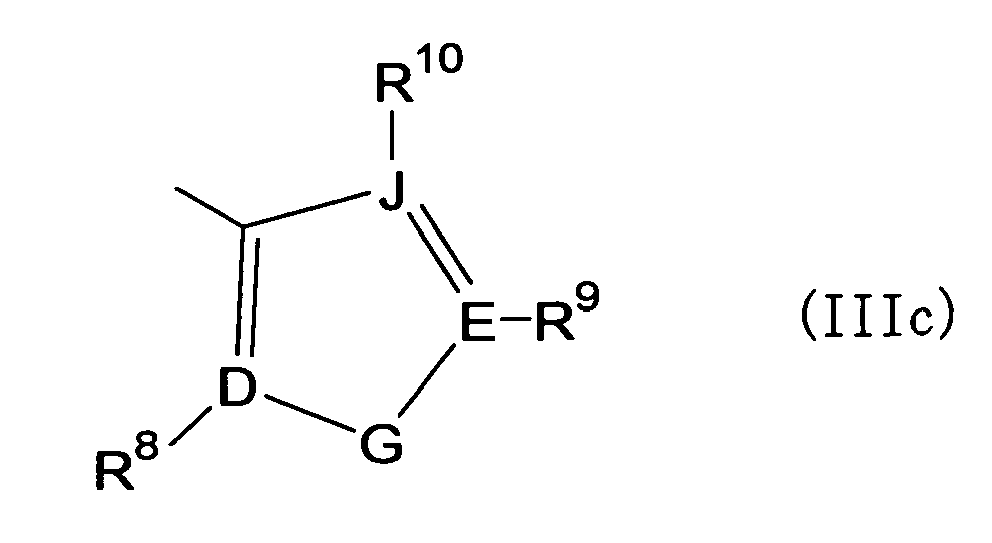
wherein
D, E, J, L, and M, which may be the same or different, represent a carbon or nitrogen atom,
G represents an oxygen or sulfur atom,
R8, R9, R10, R11, and R12, which may be the same or different, represent - (I) a halogen atom;
- (II) C1-6 alkyl optionally containing a substituent selected from the group consisting of (1) hydroxyl, (2) thiol, (3) amino, (4) C1-6 alkoxy, (5) C1-6 alkylthio, (6) C1-6 alkylsulfinyl, (7) C1-6 alkylsulfonyl, (8) mono- or di-C1-6 alkylamino, (8') amino substituted by a heterocyclic group optionally substituted by C1-6 alkyl, (9) C1-6 alkylcarbonyloxy, (10) C1-6 alkylcarbonylthio, (11) C1-6 alkylcarbonylamino, (12) aryloxy, (13) arylthio, (14) arylsulfinyl, (15) arylsulfonyl, (16) arylamino, (17) C1-6 alkyl- or aryl-sulfonylamino, (18) C1-6 alkyl- or aryl-ureido, (19) C1-6 alkoxy- or aryloxy-carbonylamino, (20) C1-6 alkylamino- or arylamino-carbonyloxy, (21) carboxyl, (22) nitro, (23) a heterocyclic group, (23') Het-S(=O)j-wherein Het represents a heterocyclic group, j is 0, 1, or 2, and Het is optionally substituted by alkyl optionally substituted by mono- or di-C1-6 alkylamino in which the di-C1-6 alkylamino group may form cyclic amino optionally containing 1 to 3 heteroatoms and one or two alkyl groups on the amino group and the cyclic amino moiety are optionally substituted by hydroxyl, (24) cyano, and (25) a halogen atom,
wherein the alkyl moiety in (4) the C1-6 alkoxy group, (5) the C1-6 alkylthio group, (6) the C1-6 alkylsulfinyl group, and (7) the C1-6 alkylsulfonyl group is optionally substituted by a hydrogen atom, a halogen atom; C1-6 alkyl; C1-6 alkoxy; C1-6 alkylthio; mono- or di-C1-6 alkylamino in which the di-C1-6 alkylamino group may form cyclic amino optionally containing 1 to 3 heteroatoms; aryloxy; arylthio; hydroxyl; carboxyl; -S(=O)2(-OH); C1-6 alkoxy- or aryloxy-carbonyl; C1-6 alkylcarbonyl; aryl; or a heterocyclic group optionally substituted by alkyl optionally substituted by mono- or di-C1-6 alkylamino in which the di-C1-6 alkylamino group may form cyclic amino optionally containing 1 to 3 heteroatoms, and one or two alkyl groups on the amino group and the cyclic amino moiety are optionally substituted by hydroxy, and
in (8) the mono- or di-C1-6 alkylamino group, the di-C1-6 alkylamino group may form cyclic amino optionally containing 1 to 3 heteroatoms, and one or two alkyl groups on the amino group and the cyclic amino moiety are optionally substituted by a halogen atom; C1-6 alkyl optionally substituted by hydroxyl, a halogen atom, aryl optionally substituted by a halogen atom, C1-6 alkyl, or C1-6 alkyloxy, or a heterocyclic group optionally substituted by a halogen atom, C1-6 alkyl, or C1-6 alkyloxy, and, when one or two alkyl groups on the amino group and the cyclic amino moiety are substituted by two C1-6 alkyl groups, they together may form C3-7 cycloalkyl; C1-6 alkoxy; C1-6 alkylthio; mono- or di-C1-6 alkylamino in which the di-C1-6 alkylamino may form cyclic amino optionally containing 1 to 3 heteroatoms, and one or two alkyl groups on the amino group and the cyclic amino moiety are optionally substituted by hydroxyl; arylamino in which the amino group is optionally substituted by C1-6 alkyl; mono- or di-C1-6 alkylcarbamoylmethyl in which the di-C1-6 alkylamino group may form cyclic amino optionally containing 1 to 3 heteroatoms, and one or two alkyl groups on the amino group and the cyclic amino moiety are optionally substituted by hydroxyl; aryloxy; arylthio; an oxygen atom (=O); hydroxyl; carboxyl; C1-6 alkoxy- or aryloxy-carbonyl; C1-6 alkylcarbonyl; aryl optionally substituted by a halogen atom or hydroxyl; or a heterocyclic group, preferably a five- to seven-membered saturated or unsaturated heterocyclic group, more preferably pyridyl, pyrimidyl, and pyridazyl, and, when one carbon atom in the cyclic amino moiety is substituted by two C1-6 alkoxy groups which may be the same or different, the two alkoxy groups together may form group -O-(CH2)p-O- wherein p is an integer of 2 to 4, and the cyclic amino group may condense with a monocyclic or bicyclic aromatic carbocyclic ring, preferably phenyl or naphthyl, or a monocyclic or bicyclic aromatic heterocyclic ring, preferably pyridyl or naphthyridyl, to represent a bicyclic or tricyclic heterocyclic group; - (III) C1-6 alkoxy optionally substituted by a halogen atom;
- (IV) C1-6 alkylthio optionally substituted by a halogen atom;
- (V) C3-7 cycloalkyl;
- (VI) aryl;
- (VII) aryloxy;
- (VIII) C1-6 alkylcarbonylamino;
- (VIX) C1-6 alkylcarbonyloxy;
- (X) hydroxyl;
- (XI) nitro;
- (XII) cyano;
- (XIII) amino;
- (XIV) mono- or di-C1-6 alkylamino in which the di-C1-6 alkylamino group may form cyclic amino optionally containing 1 to 3 heteroatoms;
- (XV) arylamino;
- (XVI) C1-6 alkyl- or aryl-sulfonylamino;
- (XVII) C1-6 alkyl- or aryl-ureido;
- (XVIII) C1-6 alkoxy- or aryloxy-carbonylamino;
- (XIX) C1-6 alkylamino- or arylamino-carbonyloxy;
- (XX) C1-6 alkoxy- or aryloxy-carbonyl;
- (XXI) acyl;
- (XXII) carboxyl;
- (XXIII) carbamoyl;
- (XXIV) mono- or di-alkylcarbamoyl;
- (XXV) a heterocyclic group;
- (XXVI) alkyl- or aryl-sulfonyl;
- (XXVII) C2-6 alkenyloxy;
- (XXVIII) C2-6 alkynyloxy; or
- (XXIX) a hydrogen atom, and
- In formula (I) and formula (I-1) and formula (I-2) which will be described later, when R5 represents formula (IIIa), formula (IIIb) and formula (IIIc), preferably, R8, R9, R10, R11, and R12, which may be the same or different, represent
- a hydrogen atom;
- a halogen atom;
- hydroxymethyl; or
- C1-6 alkyl optionally substituted by a halogen atom.
- In formula (I) and formula (I-1) and formula (I-2) which will be described later, when R5 represents formula (IIIa), formula (IIIb) and formula (IIIc), preferably, the substituted C1-6 alkyl which may be represented by R8, R9, R10, R11, and R12 represents a group of formula (IV):
―CH2―Q―X1―R13 (IV)
wherein
Q represents an oxygen atom, a sulfur atom, sulfinyl, or sulfonyl,
X1 represents a bond or straight chain or branched chain alkylene having 1 to 5 carbon atoms,
R13 represents a hydrogen atom, a halogen atom, C1-6 alkyl, C1-6 alkoxy, C1-6 alkylthio, mono- or di-C1-6 alkylamino in which the di-C1-6 alkylamino group may form cyclic amino optionally containing 1 to 3 heteroatoms, aryloxy, arylthio, hydroxyl, carboxyl, -S(=O)2(-OH), C1-6 alkoxy- or aryloxy-carbonyl, C1-6 alkylcarbonyl, aryl, or a heterocyclic group optionally substituted by C1-6 alkyl optionally substituted by mono-or di-C1-6 alkylamino in which the di-C1-6 alkylamino group may form cyclic amino optionally containing 1 to 3 heteroatoms, and one or two alkyl groups on the amino group and the cyclic amino moiety are optionally substituted by hydroxyl, and this heterocyclic group preferably represents a five- or six-membered saturated or unsaturated heterocyclic group;
or a group of formula (V)
wherein
X2 represents a bond or straight chain or branched chain alkylene having 1 to 5 carbon atoms,
X3 represents a bond or straight chain or branched chain alkylene having 1 to 5 carbon atoms,
R14 and R15, which may be the same or different, represent a hydrogen atom; a halogen atom; C1-6 alkyl optionally substituted by hydroxyl, a halogen atom, aryl optionally substituted by a halogen atom, C1-6 alkyl, or C1-6 alkyloxy, a heterocyclic group optionally substituted by a halogen atom, C1-6 alkyl, or C1-6 alkyloxy, and, when one or two alkyl groups on the amino group and the cyclic amino moiety are substituted by two C1-6 alkyl groups, they together may form C3-7 cycloalkyl; C1-6 alkoxy; C1-6 alkylthio; mono- or di-C1-6 alkylamino in which the di-C1-6 alkylamino group may form cyclic amino optionally containing 1 to 3 heteroatoms, and one or two alkyl groups on the amino group and the cyclic amino moiety are optionally substituted by hydroxyl; arylamino in which the amino group is optionally substituted by C1-6 alkyl; mono- or di-C1-6 alkylcarbamoylmethyl in which the di-C1-6 alkylamino may form cyclic amino optionally containing 1 to 3 heteroatoms, and one or two alkyl groups on the amino group and the cyclic amino moiety are optionally substituted by hydroxyl; aryloxy; arylthio; an oxygen atom (=O); hydroxyl; carboxyl; C1-6 alkoxy- or aryloxy-carbonyl; C1-6 alkylcarbonyl; aryl optionally substituted by a halogen atom or hydroxyl; or a heterocyclic group, preferably a five- or six-membered saturated or unsaturated heterocyclic group, provided that, when X2 represents a bond, R14 represents a hydrogen atom, or when X3 represents a bond, R15 represents a hydrogen atom, or
R14 and R15 together with a nitrogen atom to which they are respectively attached may form a heterocyclic group that may contain 1 to 3 heteroatoms, preferably one oxygen atom, one nitrogen atom, or one sulfur atom, in addition to the nitrogen atom, to which R14 and R15 are attached, and is optionally substituted by hydroxyl; C1-6 alkyl optionally substituted by hydroxyl, a halogen atom, aryl optionally substituted by a halogen atom, C1-6 alkyl, or C1-6 alkyloxy, or a heterocyclic group optionally substituted by a halogen atom, C1-6 alkyl, or C1-6 alkyloxy, and, when one or two alkyl groups on the amino group and the cyclic amino moiety are substituted by two C1-6 alkyl groups, they together may form C3-7 cycloalkyl; mono- or di-C1-6 alkylamino in which the di-C1-6 alkylamino may form cyclic amino optionally containing 1 to 3 heteroatoms, and one or two alkyl groups on the amino group and the cyclic amino moiety are optionally substituted by hydroxyl; a saturated or unsaturated five- or six-membered heterocyclic group; mono- or di-C1-6 alkylcarbamoylmethyl in which the di-C1-6 alkylamino group may form cyclic amino optionally containing 1 to 3 heteroatoms, and one or two alkyl groups on the amino group and the cyclic amino moiety are optionally substituted by hydroxyl; phenyl; or an oxygen atom (=O), and, when one carbon atom in the cyclic amino moiety is substituted by two C1-6 alkoxy groups which may be the same or different, the two alkoxy groups together may form group -O-(CH2)p-O- wherein p is an integer of 2 to 4, and the cyclic amino group may condense with a monocyclic or bicyclic aromatic carbocyclic ring, preferably phenyl or naphthyl, or a monocyclic or bicyclic aromatic heterocyclic ring, preferably pyridyl or naphthyridyl, to represent a bicyclic or tricyclic heterocyclic group. - Preferably, the cyclic amino group present in formula (IV) and formula (V) may be a five- to seven-membered heterocyclic group that optionally contains one oxygen atom, one nitrogen atom, or one sulfur atom in addition to the nitrogen atom in the amino group, more preferably piperidyl, piperazyl, morpholyl, and thiomorpholyl.
- In formula (I) and formula (I-1) and formula (I-2) which will be described later, when R5 represents formula (IIIa), formula (IIIb) or formula (IIIc), preferably, D, E, J, L, and M represent a carbon atom.
- In formula (I) and formula (I-1) and formula (I-2) which will be described later, when R5 represents formula (IIIa), formula (IIIb) or formula (IIIc), preferably, any one or two of D, E, J, L, and M represent a nitrogen atom and the others represent a carbon atom.
- In formula (I) and formula (I-1) and formula (I-2) which will be described later, when R5 represents formula (IIIa), preferably, D, E, J, L, and M represent a carbon atom.
- In formula (I) and formula (I-1) and formula (I-2) which will be described later, when R5 represents formula (IIIa), preferably, any one or two of D, E, J, L, and M represent a nitrogen atom with the others representing a carbon atom.
- In formula (I) and formula (I-1) and formula (I-2) which will be described later, when R5 represents formula (IIIb), preferably, D, E, and J represent a carbon atom, and G represents an oxygen or sulfur atom.
- In formula (I) and formula (I-1) and formula (I-2) which will be described later, when R5 represents formula (IIIc), preferably, D, E, and J represent a carbon atom, and G represents an oxygen or sulfur atom.
- In formula (I) and formula (I-1) and formula (I-2) which will be described later, when R5 represents formula (IIIa), preferably, D, E, J, L, and M represent a carbon atom, any one of R8, R9, R10, R11, and R12 represents a group other than a hydrogen atom, and the others represent a hydrogen atom.
- In formula (I) and formula (I-1) and formula (I-2) which will be described later, when R5 represents formula (IIIa), preferably, D, E, J, L, and M represent a carbon atom, any one of R8, R9, R10, R11, and R12 represents a halogen atom; optionally substituted C1-6 alkyl; or optionally substituted C1-6 alkoxy, and the other groups represent a hydrogen atom.
- In formula (I) and formula (I-1) and formula (I-2) which will be described later, when R5 represents formula (IIIa), preferably, D, E, J, L, and M represent a carbon atom, R10 represents a group other othan a hydrogen atom, preferably substituted C1-6 alkyl, more preferably a group of formula (IV) or formula (V), and R8, R9, R11, and R12 represent a hydrogen atom.
- In formula (I) and formula (I-1) and formula (I-2) which will be described later, when R5 represents formula (IIIa), preferably, D, E, J, L, and M represent a carbon atom, R11 represents a group other than a hydrogen atom, preferably substituted C1-6 alkyl, more preferably a group of formula (IV) or formula (V), and R8, R9, R10, and R12 represent a hydrogen atom.
- In formula (I) and formula (I-1) and formula (I-2) which will be described later, when R5 represents formula (IIIa), preferably, D, E, J, L, and M represent a carbon atom, and any two of R8, R9, R10, R11 , and R12 represent a group other than a hydrogen atom with the others representing a hydrogen atom.
- In formula (I) and formula (I-1) and formula (I-2) which will be described later, when R5 represents formula (IIIa), preferably, D, E, J, L, and M represent a carbon atom, R10 and R11 represent a group other than a hydrogen atom, preferably optionally substituted C1-6 alkoxy, more preferably optionally substituted methoxy, and R8, R9, and R12 represent a hydrogen atom.
- In formula (I) and formula (I-1) and formula (I-2) which will be described later, when R5 represents formula (IIIa), preferably, D, E, J, L, and M represent a carbon atom, R9 and R11 represent a group other than a hydrogen atom, preferably, optionally substituted C1-6 alkoxy, more preferably optionally substituted methoxy, and R8, R10, and R12 represent a hydrogen atom.
- In formula (I) and formula (I-1) and formula (I-2) which will be described later, when R5 represents formula (IIIb) and formula (IIIc), preferably , D, E, and J represent a carbon atom.
- In formula (I) and formula (I-1) and formula (I-2) which will be described later, when R5 represents formula (IIIb) and formula (IIIc), preferably, any one or two of D, E, and J represent a nitrogen atom with the other(s) representing a carbon atom.
- In formula (I) and formula (I-1) and formula (I-2) which will be described later, when R5 represents formula (IIIa), preferably,
D, E, J, L, and M represent a carbon atom,
any one or two of R8, R9, R10, R11, and R12, which may be the same or different, represent a halogen atom; hydroxymethyl; C1-6 alkyl optionally substituted by a halogen atom; or C1-6 alkoxy optionally substituted by a halogen atom, and the others represent a hydrogen atom. - In formula (I) and formula (I-1) and formula (I-2) which will be described later, when R5 represents formula (IIIa), preferably,
any one or two of D, E, J, L, and M represent a nitrogen atom, and the others represent a carbon atom,
any one or two of R8, R9, R10, R11, and R12, which may be the same or different, represent a halogen atom; hydroxymethyl; C1-6 alkyl optionally substituted by a halogen atom, or C1-6 alkoxy optionally substituted by a halogen atom, and the others reperesent a hydrogen atom. - In formula (I) and formula (I-1) and formula (I-2) which will be described later, when R5 represents formula (IIIb), preferably,
D, E, and J represent a carbon atom, and G represents an oxygen or sulfur atom,
one or two of R8, R9, and R10, which may be the same or different, represent a halogen atom; hydroxymethy; C1-6 alkyl optionally substituted by a halogen atom; or C1-6 alkoxy optionally substituted by a halogen atom, and the others represent a hydrogen atom. - In formula (I) and formula (I-1) and formula (I-2) which will be described later, when R5 represents formula (IIIc), preferably,
D, E, and J represent a carbon atom, and G represents an oxygen or sulfur atom,
one or two of R8, R9, and R10, which may be the same or different, represent a halogen atom; hydroxymethyl; C1-6 alkyl optionally substituted by a halogen atom; or C1-6 alkoxy optionally substituted by a halogen atom, and the others represent a hydrogen atom.
In formula (I) and formula (I-1) and formula (I-2) which will be described later, when R5 represents formula (IIIa), preferably,
D, E, J, L, and M represent a carbon atom,
R8, R9, and R12 represent a hydrogen atom,
one of R10 and R11 represents a group of formula (IV) wherein Q, X1, and R13 are as defined above, or a group of formula (V) wherein X2, X3, R14, and R15 are as defined above with the other groups representing a hydrogen atom. - In formula (I) and formula (I-1) and formula (I-2) which will be described later, when R5 represents formula (IIIa), preferably,
any one or two of D, E, J, L, and M represent a nitrogen atom, and the others represent a carbon atom,
R8, R9, and R12 represent a hydrogen atom,
one of R10 and R11 represents a group of formula (IV) wherein Q, X1, and R13 are as defined above, or a group of formula (V) wherein X2, X3, R14, and R15 are as defined above with the other groups representing a hydrogen atom. - In formula (I) and formula (I-1) and formula (I-2) which will be described later, when R5 represents formula (IIIb), preferably,
D, E, and J represent a carbon atom, and G represents an oxygen or sulfur atom, - one of R8, R9, and R10 represents a group of formula (IV) wherein Q, X1, and R13 are as defined above, or a group of formula (V) wherein X2, X3, R14, and R15 are as defined above with the others representing a hydrogen atom.
- In formula (I) and formula (I-1) and formula (I-2) which will be described later, when R5 represents formula (IIIc), preferably,
D, E, and J represent a carbon atom, and G represents an oxygen or sulfur atom,
one of R8, R9, and R10 represents a group of formula (IV) wherein Q, X1, and R13 are as defined above, or a group of formula (V) wherein X2, X3, R14, and R15 are as defined above with the others representing a hydrogen atom. - In formula (I) and formula (I-1) and formula (I-2) which will be described later, preferably, R6 represents a hydrogen atom; optionally substituted C1-6 alkyl; or optionally substituted aryl.
- In formula (I) and formula (I-1) and formula (I-2) which will be described later, more preferably, R6 represents a hydrogen atom; C1-6 alkyl optionally substituted by a halogen atom or C1-6 alkoxy; or aryl optionally substituted by a halogen atom, C1-6 alkyl, or C1-6 alkoxy, most preferably, a hydrogen atom, or C1-6 alkyl.
- In formula (I) and formula (I-1) and formula (I-2) which will be described later, preferably, R7 represents optionally substituted aryl, optionally substituted aryl C1-6 alkyl, optionally substituted aryl C2-6 alkenyl, or optionally substituted saturated or unsaturated five- or six-membered heterocyclic group.
- In formula (I) and formula (I-1) and formula (I-2) which will be described later, more preferably, R7 represents a cyclic group selected from phenyl, naphthyl, furyl, pyrrolyl, and thienyl, and the cyclic group is optionally substituted by a halogen atom; C1-6 alkyl optionally substituted by a halogen atom; C1-6 alkoxy in which the alkoxy group is optioinally substituted by a halogen atom, aryloxy optionally substituted by a halogen atom and C1-6 alkyl, C1-6 alkoxy in which the alkoxy group is optionally substituted by mono- or di-C1-6 alkylamine in which the di-C1-6 alkylamino group may form cyclic amino optionally containing 1 to 3 heteroatoms, or a halogen atom, arylthio optionally substituted by a halogen atom and C1-6 alkyl, C1-6 alkylthio in which the alkylthio group is optionally substituted by mono- or di-C1-6 alkylamine in which the di-C1-6 alkylamino group may form cyclic amino optionally containing 1 to 3 heteroatoms, or a halogen atom, arylamino optionally substituted by C1-6 alkyl, mono- or di-C1-6 alkylamine in which the di-C1-6 alkylamino group may form cyclic amino optionally containing 1 to 3 heteroatoms; hydroxyl; mono- or di-C1-6 alkylamino in which the di-C1-6 alkylamino group may form cyclic amino optionally containing 1 to 3 heteroatoms; nitro; C2-6 alkenyloxy; or C2-6 alkynyloxy.
- In formula (I) and formula (I-1) and formula (I-2) which will be described later, preferably, R6 represents a hydrogen atom or C1-6 alkyl, R7 represents optionally substituted aryl, preferably phenyl or naphthyl, optionally substituted aryl, preferably phenyl or naphthyl, C1-6 alkyl, optionally substituted aryl, preferably phenyl or naphthyl, C2-6 alkenyl, or optionally substituted saturated or unsaturated five- or six-membered heterocyclic group, preferably furyl, thienyl, pyrrolyl, or pyridyl.
- Among the compounds of formula (I), hydrazine derivatives may be represented by formula (I-1).

wherein A, R5, Z, and ---- are as defined in formula (I). - In formula (I-1), preferably,
A represents formula (IIa) or formula (IIa') wherein R1, R2, R3, and R4 are as defined in formula (IIa) and formula (IIa') and are preferably the same or different and represent a hydrogen atom; a halogen atom; hydroxyl; optionally substituted C1-6 alkyl; or optionally substituted C1-6 alkoxy,
R5 represents optionally substituted C5-7 cycloalkyl, optionally substituted aryl, preferably phenyl, or optionally substituted saturated or unsaturated five- or six-membered heterocyclic group, preferably pyridyl, thienyl, isoxazole, or pyrimidyl and more preferably represents a group of formula (IIIa), formula (IIIb) or formula (IIIc), and
Z represents group (A), group (B), or group (C) wherein R6 represents a hydrogen atom or C1-6 alkyl, R7 represents optionally substituted aryl, preferably phenyl or naphthyl, optionally substituted aryl, preferably phenyl or naphthyl, C1-6 alkyl, optionally substituted aryl, preferably phenyl or naphthyl, C2-6 alkenyl, or optionally substituted saturated or unsaturated five- or six-membered heterocyclic group, preferably furyl, thienyl, pyrrolyl, or pyridyl, and R17 represents a hydrogen atom. - In formula (I-1), preferably,
A represents formula (IIa) wherein R1, R2, R3, and R4 are as defined in formula (IIa),
---- represents a double bond,
R5 represents optionally substituted C5-7 cycloalkyl, optionally substituted aryl, or optionally substituted saturated or unsaturated five-or six-membered heterocyclic group, preferably pyridyl, thienyl, isoxazole, or pyrimidyl and more preferably represents a group of formula (IIIa), formula (IIIb), or formula (IIIc), and
Z represents group (A) or group (B) wherein R6 represents a hydrogen atom or C1-6 alkyl, R7 represents optionally substituted aryl, preferably phenyl, optionally substituted aryl C1-6 alkyl, optionally substituted aryl C2-6 alkenyl, or optionally substituted saturated or unsaturated five- or six-membered heterocyclic group, and R17 represents a hydrogen atom. - In formula (I-1), preferably,
A represents formula (IIb) wherein R31 and R32 are as defined in formula (IIb), preferably, R31 and R32 represent a hydrogen atom, or any one of R31 and R32 represents a hydrogen atom with the other representing C1-6 alkyl optionally substituted by a halogen atom, or R31 and R32 together form a C3-5 alkylene chain,
R5 represents optionally substituted C5-7 cycloalkyl, optionally substituted aryl, preferably phenyl, or optionally substituted saturated or unsaturated five- or six-membered heterocyclic group, preferably pyridyl, thienyl, isoxazole, or pyrimidyl, more preferably represents a group of formula (IIIa), formula (IIIb), or formula (IIIc), and
Z represents group (A) or group (B) wherein R6 represents a hydrogen atom or C1-6 alkyl, R7 represents optionally substituted aryl, optionally substituted aryl C1-6 alkyl, optionally substituted aryl C2-6 alkenyl, or optionally substituted saturated or unsaturated five- or six-membered heterocyclic group, and R17 represents a hydrogen atom. - In formula (I-1), preferably,
A represents formula (IIc) wherein R33 and R34 are as defined in formula (IIc), and, preferably, R33 and R34 represent a hydrogen atom, or any one of R33 and R34 represents a hydrogen atom with the other representing C1-6 alkyl optionally substituted by a halogen atom, or R33 and R34 together form a C3-5 alkylene chain,
R5 represents optionally substituted C5-7 cycloalkyl, optionally substituted aryl, preferably phenyl, or optionally substituted saturated or unsaturated five- or six-membered heterocyclic group, preferably pyridyl, thienyl, isoxazole, or pyrimidyl, and more preferably, represents a group of formula (IIIa), formula (IIIb), or formula (IIIc), and
Z represents group (A) and group (B) wherein R6 represents a hydrogen atom or C1-6 alkyl, R7 represents optionally substituted aryl, optionally substituted aryl C1-6 alkyl, optionally substituted aryl C2-6 alkenyl, or optionally substituted saturated or unsaturated five- or six-membered heterocyclic group, and R17 represents a hydrogen atom. - In formula (I-1), preferably,
A represents formula (IId) wherein R35 and R36 are as defined in formula (IId), and, preferably, R35 and R36 represent a hydrogen atom, or any one of R35 and R36 represents a hydrogen atom with the other representing C1-6 alkyl optionally substituted by a halogen atom,
R5 represents optionally substituted C5-7 cycloalkyl, optionally substituted aryl, preferably phenyl, or optionally substituted saturated or unsaturated five- or six-membered heterocyclic group, preferably pyridyl, thienyl, isoxazole, or pyrimidyl, and more preferably represents a group of formula (Illa), formula (IIIb), or formula (IIIc),
Z represents group (A) or group (B) wherein R6 represents a hydrogen atom or C1-6 alkyl, R7 represents optionally substituted aryl, optionally substituted aryl C1-6 alkyl, optionally substituted aryl C2-6 alkenyl, or optionally substituted saturated or unsaturated five- or six-membered heterocyclic group, and R17 represents a hydrogen atom. - In formula (I-1), more preferably,
A represents formula (IIa) or formula (IIa'),
wherein - (1) R1, R2, R3, and R4 represent a hydrogen atom,
- (2) R1 and R4 represent a hydrogen atom, any one of R2 and R3 represents a halogen atom; hydroxyl; optionally substituted C1-6 alkyl; optionally substituted C1-6 alkoxy; optionally substituted mono- or di-arylamino; optionally substituted mono- or di-C1-6 alkylamino in which the dialkylamino together may form optionally substituted cyclic amino optionally containing 1 to 3 heteroatoms; or optionally substituted mono-or di-C2-6 alkenylamino in which the di-C2-6 alkenylamino group together may form optionally substituted unsaturated cyclic amino optionally containing 1 to 3 heteroatoms, and the other represents a hydrogen atom,
- (3) R1 and R4 represent a hydrogen atom, and R2 and R3, which may be the same or different, represent a halogen atom; hydroxyl; optionally substituted C1-6 alkyl; or optionally substituted C1-6 alkoxy,
- (4) R1 and R4 represent a hydrogen atom, and R2 and R3 together with the carbon atoms to which they are respectively attached form a saturated or unsaturated five- to seven-membered carbocyclic ring,
- (5) R1 and R4 represent a hydrogen atom, any one of R2 and R3 represents optionally substituted mono- or di-C1-6 alkylamino in which the di-C1-6 alkylamino together may form optionally substituted cyclic amino optionally containing 1 to 3 heteroatoms, and the other represents a hydrogen atom, or
- (6) R1 and R4 represent a hydrogen atom, any one of R2 and R3 represents optionally substituted C1-6 alkoxy, and the other represents a hydrogen atom,
R5 represents formula (IIIa) - (i) D, E, J, L, and M represent a carbon atom, any one or two of R8, R9, R10, R11, and R12, which may be the same or different, represent a halogen atom; hydroxymethyl; C1-6 alkyl optionally substituted by a halogen atom; or C1-6 alkoxy optionally substituted by a halogen atom, and the others represent a hydrogen atom,
- (ii) any one or two of D, E, J, L, and M represent a nitrogen atom, and the others represent a carbon atom, any one or two of R8, R9, R10, R11, and R12 may be the same or different and represent a halogen atom; hydroxymethyl; C1-6 alkyl optionally substituted by a halogen atom, or C1-6 alkoxy optionally substituted by a halogen atom, and the others represent a hydrogen atom,
- (iii) D, E, J, L, and M represent a carbon atom, R8, R9, and R12 represent a hydrogen atom, any one of R10 and R11 represents a group of formula (IV) wherein Q, X1, and R13 are as defined above, or a group of formula (V) wherein X2, X3, R14, and R15 are as defined above, and the other represents a hydrogen atom, or
- (iv) any one or two of D, E, J, L, and M represent a nitrogen atom, and the others represent a carbon atom, R8, R9, and R12represent a hydrogen atom, and one of R10 and R11 represents a group of formula (IV) wherein Q, X1, and R13 are as defined above, or a group of formula (V) wherein X2, X3, R14, and R15 are as defined above, and the other represents a hydrogen atom,
Z represents group (A), group (B), or group (C): - In formula (I-1), more preferably,
A represents formula (IIa) or formula (IIa')
wherein - (1) R1, R2, R3, and R4 represent a hydrogen atom,
- (2) R1 and R4 represent a hydrogen atom, any one of R2 and R3 represents a halogen atom; hydroxyl; optionally substituted C1-6 alkyl; optionally substituted C1-6 alkoxy; optionally substituted mono- or di-arylamino; optionally substituted mono- or di-C1-6 alkylamino in which the dialkylamino together may form optionally substituted cyclic amino optionally containing 1 to 3 heteroatoms; or optionally substituted mono-or di-C2-6 alkenylamino in which the di-C2-6 alkenylamino group together may form optionally substituted unsaturated cyclic amino optionally containing 1 to 3 heteroatoms, and the other represents a hydrogen atom,
- (3) R1 and R4 represent a hydrogen atom, and R2 and R3, which may be the same or different, represent a halogen atom; hydroxyl; optionally substituted C1-6 alkyl; or optionally substituted C1-6 alkoxy,
- (4) R1 and R4 represent a hydrogen atom, and R2 and R3 together with the carbon atoms to which they are respectively attached form a saturated or unsaturated five- to seven-membered carbocyclic ring,
- (5) R1 and R4 represent a hydrogen atom, any one of R2 and R3 represents optionally substituted mono- or di-C1-6 alkylamino in which the di-C1-6 alkylamino together may form optionally substituted cyclic amino optionally containing 1 to 3 heteroatoms, and the other represents a hydrogen atom, or
- (6) R1 and R4 represent a hydrogen atom, any one of R2 and R3 represents optionally substituted C1-6 alkoxy, and the other represents a hydrogen atom,
- (i) D, E, and J represent a carbon atom, G represents an oxygen or sulfur atom, any one or two of R8, R9, and R10, which may be the same or different, represent a halogen atom; hydroxymethyl; C1-6 alkyl optionally substituted by a halogen atom; or C1-6 alkoxy optionally substituted by a halogen atom, and the others represent a hydrogen atom, or
- (ii) D, E, and J represent a carbon atom, G represents an oxygen or sulfur atom, one of R8, R9, and R10 represents a group of formula (IV)
- In formula (I-1), more preferably ,
A represents formula (IIb)
wherein - (i) R31 and R32 represent a hydrogen atom,
- (ii) any one of R31 and R32 represents a hydrogen atom, and the other represents C1-6 alkyl optionally substituted by mono- or di-C1-6 alkylamino, which may form cyclic amino, or a halogen atom, and the cyclic amino group may contain 1 to 3 heteroatoms,
- (iii) R31 and R32, which may be the same or different, represent C1-6 alkyl optionally substituted by mono- or di-C1-6 alkylamino, which may form cyclic amino, or a halogen atom, and the cyclic amino group may contain 1 to 3 heteroatoms, or
- (iv) R31 and R32 together with the carbon atoms to which they are respectively attached form a saturated or unsaturated five- to seven-membered carbocyclic ring,
R5 represents formula (IIIa) - (i) D, E, J, L, and M represent a carbon atom, any one or two of R8, R9, R10, R11, and R12, which may be the same or different, represent a halogen atom; hydroxymethyl; C1-6 alkyl optionally substituted by a halogen atom; or C1-6 alkoxy optionally substituted by a halogen atom, and the others represent a hydrogen atom,
- (ii) any one or two of D, E, J, L, and M represent a nitrogen atom, and the others represent a carbon atom, any one or two of R8, R9, R10, R11, and R12 may be the same or different and represent a halogen atom; hydroxymethyl; C1-6 alkyl optionally substituted by a halogen atom, or C1-6 alkoxy optionally substituted by a halogen atom, and the others represent a hydrogen atom,
- (iii) D, E, J, L, and M represent a carbon atom, R8, R9, and R12 represent a hydrogen atom, any one of R10 and R11 represents a group of formula (IV) wherein Q, X1, and R13 are as defined above, or a group of formula (V) wherein X2, X3, R14, and R15 are as defined above, and the other represents a hydrogen atom, or
- (iv) any one or two of D, E, J, L, and M represent a nitrogen atom, and the others represent a carbon atom, R8, R9, and R12 represent a hydrogen atom, and one of R10 and R11 represents a group of formula (IV) wherein Q, X1, and R13 are as defined above, or a group of formula (V) wherein X2, X3, R14, and R15 are as defined above, and the other represents a hydrogen atom,
- In formula (I-1), more preferably,
A represents formula (IIb)
wherein - (i) R31 and R32 represent a hydrogen atom,
- (ii) any one of R31 and R32 represents a hydrogen atom, and the other represents C1-6 alkyl optionally substituted by mono- or di-C1-6 alkylamino, which may form cyclic amino, or a halogen atom, and the cyclic amino group may contain 1 to 3 heteroatoms,
- (iii) R31 and R32, which may be the same or different, represent C1-6 alkyl optionally substituted by mono- or di-C1-6 alkylamino, which may form cyclic amino, or a halogen atom, and the cyclic amino group may contain 1 to 3 heteroatoms, or
- (iv) R31 and R32 together with the carbon atoms to which they are respectively attached form a saturated or unsaturated five- to seven-membered carbocyclic ring,
- (i) D, E, and J represent a carbon atom, G represents an oxygen or sulfur atom, any one or two of R8, R9, and R10, which may be the same or different, represent a halogen atom; hydroxymethyl; C1-6 alkyl optionally substituted by a halogen atom; or C1-6 alkoxy optionally substituted by a halogen atom, and the others represent a hydrogen atom, or
- (ii) D, E, and J represent a carbon atom, G represents an oxygen or sulfur atom, one of R8, R9, and R10 represents a group of formula (IV)
- In formula (I-1), more preferably,
A represents formula (IIc)
wherein - (i) R33 and R34 represent a hydrogen atom,
- (ii) any one of R33 and R34 represents a hydrogen atom, and the other represents C1-6 alkyl optionally substituted by mono- or di-C1-6 alkylamino, which may form cyclic amino, or a halogen atom, and the cyclic amino group may contain 1 to 3 heteroatoms,
- (iii) R33 and R34, which may be the same or different, represent C1-6 alkyl optionally substituted by mono- or di-C1-6 alkylamino, which may form cyclic amino, or a halogen atom, and the cyclic amino group may contain 1 to 3 heteroatoms, or
- (iv) R33 and R34 together with the carbon atoms to which they are respectively attached form a saturated or unsaturated five- to seven-membered carbocyclic ring,
- (i) D, E, J, L, and M represent a carbon atom, any one or two of R8, R9, R10, R11, and R12, which may be the same or different, represent a halogen atom; hydroxymethyl; C1-6 alkyl optionally substituted by a halogen atom; or C1-6 alkoxy optionally substituted by a halogen atom, and the others represent a hydrogen atom,
- (ii) any one or two of D, E, J, L, and M represent a nitrogen atom, and the others represent a carbon atom, any one or two of R8, R9, R10, R11, and R12 may be the same or different and represent a halogen atom; hydroxymethyl; C1-6 alkyl optionally substituted by a halogen atom, or C1-6 alkoxy optionally substituted by a halogen atom, and the others represent a hydrogen atom,
- (iii) D, E, J, L, and M represent a carbon atom, R8, R9, and R12 represent a hydrogen atom, any one of R10 and R11 represents a group of formula (IV) wherein Q, X1, and R13 are as defined above, or a group of formula (V) wherein X2, X3, R14, and R15 are as defined above, and the other represents a hydrogen atom, or
- (iv) any one or two of D, E, J, L, and M represent a nitrogen atom, and the others represent a carbon atom, R8, R9, and R12 represent a hydrogen atom, and one of R10 and R11 represents a group of formula (IV) wherein Q, X1, and R13 are as defined above, or a group of formula (V) wherein X2, X3, R14, and R15 are as defined above, and the other represents a hydrogen atom,
- In formula (I-1), more preferably,
A represents formula (IIc)
wherein - (i) R33 and R34 represent a hydrogen atom,
- (ii) any one of R33 and R34 represents a hydrogen atom, and the other represents C1-6 alkyl optionally substituted by mono- or di-C1-6 alkylamino, which may form cyclic amino, or a halogen atom, and the cyclic amino group may contain 1 to 3 heteroatoms,
- (iii) R33 and R34, which may be the same or different, represent C1-6 alkyl optionally substituted by mono- or di-C1-6 alkylamino, which may form cyclic amino, or a halogen atom, and the cyclic amino group may contain 1 to 3 heteroatoms, or
- (iv) R33 and R34 together with the carbon atoms to which they are respectively attached form a saturated or unsaturated five- to seven-membered carbocyclic ring,
- (i) D, E, and J represent a carbon atom, G represents an oxygen or sulfur atom, any one or two of R8, R9, and R10, which may be the same or different, represent a halogen atom; hydroxymethyl; C1-6 alkyl optionally substituted by a halogen atom; or C1-6 alkoxy optionally substituted by a halogen atom, and the others represent a hydrogen atom, or
- (ii) D, E, and J represent a carbon atom, G represents an oxygen or sulfur atom, one of R8, R9, and R10 represents a group of formula (IV) wherein Q, X1, and R13 are as defined above, or a group of formula (V) wherein X2, X3, R14, and R15 are as defined above, and the others represent a hydrogen atom,
- In formula (I-1), more preferably,
A represents formula (IId)
wherein R35 and R36 represent a hydrogen atom, or any one of R35 and R36 represents a hydrogen atom with the other representing C1-6 alkyl optionally substituted by a halogen atom,
R5 represents formula (IIIa)
wherein - (i) D, E, J, L, and M represent a carbon atom, any one or two of R8, R9, R10, R11, and R12, which may be the same or different, represent a halogen atom; hydroxymethyl; C1-6 alkyl optionally substituted by a halogen atom; or C1-6 alkoxy optionally substituted by a halogen atom, and the others represent a hydrogen atom,
- (ii) any one or two of D, E, J, L, and M represent a nitrogen atom, and the others represent a carbon atom, any one or two of R8, R9, R10, R11, and R12 may be the same or different and represent a halogen atom; hydroxymethyl; C1-6 alkyl optionally substituted by a halogen atom, or C1-6 alkoxy optionally substituted by a halogen atom, and the others represent a hydrogen atom,
- (iii) D, E, J, L, and M represent a carbon atom, R8, R9, and R12 represent a hydrogen atom, any one of R10 and R11 represents a group of formula (IV) wherein Q, X1, and R13 are as defined above, or a group of formula (V) wherein X2, X3, R14, and R15 are as defined above, and the other represents a hydrogen atom, or
- (iv) any one or two of D, E, J, L, and M represent a nitrogen atom, and the others represent a carbon atom, R8, R9, and R12 represent a hydrogen atom, and one of R10 and R11 represents a group of formula (IV) wherein Q, X1, and R13 are as defined above, or a group of formula (V) wherein X2, X3, R14, and R15 are as defined above, and the other represents a hydrogen atom,
- In formula (I-1), more preferably,
A represents formula (IId)
wherein R35 and R36 represent a hydrogen atom, or any one of R35 and R36 represents a hydrogen atom with the other representing C1-6 alkyl optionally substituted by a halogen atom,
R5 represents formula (IIIb) or formula (IIIc) - wherein
- (i) D, E, and J represent a carbon atom, G represents an oxygen or sulfur atom, any one or two of R8, R9, and R10, which may be the same or different, represent a halogen atom; hydroxymethyl; C1-6 alkyl optionally substituted by a halogen atom; or C1-6 alkoxy optionally substituted by a halogen atom, and the others represent a hydrogen atom, or
- (ii) D, E, and J represent a carbon atom, G represents an oxygen or sulfur atom, one of R8, R9, and R10 represents a group of formula (IV) wherein Q, X1, and R13 are as defined above, or a group of formula (V) wherein X2, X3, R14, and R15 are as defined above, and the others represent a hydrogen atom,
- Among the compounds of formula (I), quinazolone derivatives may be represented by formula (I-2).

wherein A, R5, Z, and ---- are as defined in formula (I). - In formula (I-2), preferably,
A represents formula (IIa) or formula (IIa') wherein R1, R2, R3, and R4 are as defined in formula (IIa) and formula (IIa') and are preferably the same or different and represent a hydrogen atom; a halogen atom; hydroxyl; optionally substituted C1-6 alkyl; or optionally substituted C1-6 alkoxy,
R5 represents optionally substituted C5-7 cycloalkyl, optionally substituted aryl, preferably phenyl, or optionally substituted saturated or unsaturated five- or six-membered heterocyclic group, preferably pyridyl, thienyl, isoxazole, or pyrimidyl and more preferably represents a group of formula (IIIa), formula (IIIb) or formula (IIIc).
Z represents group (A), group (B), or group (C) wherein R6 represents a hydrogen atom or C1-6 alkyl, R7 represents optionally substituted aryl, preferably, phenyl, or naphthyl, optionally substituted aryl, preferably phenyl, or naphthyl, C1-6 alkyl, optionally substituted aryl, preferably phenyl, or naphthyl, C2-6 alkenyl, or optionally substituted saturated or unsaturated five- or six-membered heterocyclic group, preferably furyl, thienyl, pyrrolyl, or pyridyl, and R17 represents a hydrogen atom. - In formula (I-2), preferably,
A represents formula (IIa) wherein R1, R2, R3, and R4 are as defined in formula (IIa),
----- represents a double bond,
R5 represents optionally substituted C5-7 cycloalkyl, optionally substituted aryl, or optionally substituted saturated or unsaturated five-or six-membered heterocyclic group, preferably pyridyl, thienyl, isoxazole, or pyrimidyl and more preferably represents a group of formula (IIIa), formula (IIIb), or formula (IIIc).
Z represents group (A) or group (B) wherein R6 represents a hydrogen atom or C1-6 alkyl, R7 represents optionally substituted aryl, preferably phenyl, optionally substituted aryl C1-6 alkyl, optionally substituted aryl C2-6 alkenyl, or optionally substituted saturated or unsaturated five- or six-membered heterocyclic group, and R17 represents a hydrogen atom. - In formula (I-2), preferably,
A represents formula (IIb) wherein R31 and R32 are as defined in formula (IIb), preferably, R31 and R32 represent a hydrogen atom, or any one of R31 and R32 represents a hydrogen atom with the other representing C1-6 alkyl optionally substituted by a halogen atom, or R31 and R32 together may form a C3-5 alkylene chain,
R5 represents optionally substituted C5-7 cycloalkyl, optionally substituted aryl, preferably phenyl, or optionally substituted saturated or unsaturated five- or six-membered heterocyclic group, preferably pyridyl, thienyl, isoxazole, or pyrimidyl, more preferably a group of formula (IIIa), formula (IIIb), or formula (IIIc), and
Z represents group (A) or group (B) wherein R6 repersents a hydrogen atom or C1-6 alkyl, R7 represents optionally substituted aryl, optionally substituted aryl C1-6 alkyl, optionally substituted aryl C2-6 alkenyl, or optionally substituted saturated or unsaturated five- or six-membered heterocyclic group, and R17 represents a hydrogen atom. - In formula (I-2), preferably,
A represents formula (IIc) wherein R33 and R34 are as defined in formula (IIc), and, preferably, R33 and R34 represent a hydrogen atom, or any one of R33 and R34 represents a hydrogen atom with the other representing C1-6 alkyl optionally substituted by a halogen atom, or R33 and R34 together form a C3-5 alkylene chain,
R5 represents optionally substituted C5-7 cycloalkyl, optionally substituted aryl, preferably phenyl, or optionally substituted saturated or unsaturated five- or six-membered heterocyclic group, preferably pyridyl, thienyl, isoxazole, or pyrimidyl, more preferably a group of formula (IIIa), formula (IIIb), or formula (IIIc), and
Z represents group (A) and group (B) wherein R6 represents a hydrogen atom or C1-6 alkyl, R7 represents optionally substituted aryl, optionally substituted aryl C1-6 alkyl, optionally substituted aryl C2-6 alkenyl, or optionally substituted saturated or unsaturated five- or six-membered heterocyclic group, and R17 represents a hydrogen atom. - In formula (I-2), preferably,
A represents formula (IId) wherein R35 and R36 are as defined in formula (IId), and R35 and R36 represent a hydrogen atom, or any one of R35 and R36 represents a hydrogen atom with the other representing C1-6 alkyl optionally substituted by a halogen atom,
R5 represents optionally substituted C5-7 cycloalkyl, optionally substituted aryl, preferably phenyl, or optionally substituted saturated or unsaturated five- or six-membered heterocyclic group, preferably pyridyl, thienyl, isoxazole, or pyrimidyl, more preferably a group of formula (IIIa), formula (IIIb), or formula (IIIc),
Z represents group (A) or group (B) wherein R6 represents a hydrogen atom or C1-6 alkyl, R7 represents optionally substituted aryl, optionally substituted aryl C1-6 alkyl, optionally substituted aryl C2-6 alkenyl, or optionally substituted saturated or unsaturated five- or six-membered heterocyclic group, and R17 represents a hydrogen atom. - In formula (I-2), more preferably,
A represents formula (IIa) or formula (IIa'),
wherein - (1) R1, R2, R3, and R4 represent a hydrogen atom,
- (2) R1 and R4 represent a hydrogen atom, any one of R2 and R3 represents a halogen atom; hydroxyl; optionally substituted C1-6 alkyl; optionally substituted C1-6 alkoxy; optionally substituted mono- or di-arylamino; optionally substituted mono- or di-C1-6 alkylamino in which the dialkylamino together may form optionally substituted cyclic amino optionally containing 1 to 3 heteroatoms; or optionally substituted mono-or di-C2-6 alkenylamino in which the di-C2-6 alkenylamino group together may form optionally substituted unsaturated cyclic amino optionally cantaining 1 to 3 heteroatoms, and the other represents a hydrogen atom,
- (3) R1 and R4 represent a hydrogen atom, and R2 and R3, which may be the same or different, represent a halogen atom; hydroxyl; optionally substituted C1-6 alkyl; or optionally substituted C1-6 alkoxy,
- (4) R1 and R4 represent a hydrogen atom, and R2 and R3 together with the carbon atoms to which they are respectively attached form a saturated or unsaturated five- to seven-membered carbocyclic ring,
- (5) R1 and R4 represent a hydrogen atom, any one of R2 and R3 represents optionally substituted mono- or di-C1-6 alkylamino in which the di-C1-6 alkylamino together may form optionally substituted cyclic amino optionally containing 1 to 3 heteroatoms, and the other represents a hydrogen atom, or
- (6) R1 and R4 represent a hydrogen atom, any one of R2 and R3 represents optionally substituted C1-6 alkoxy, and the other represents a hydrogen atom,
- (i) D, E, J, L, and M represent a carbon atom, any one or two of R8, R9, R10, R11, and R12, which may be the same or different, represent a halogen atom; hydroxymethyl; C1-6 alkyl optionally substituted by a halogen atom; or C1-6 alkoxy optionally substituted by a halogen atom, and the others represent a hydrogen atom,
- (ii) any one or two of D, E, J, L, and M represent a nitrogen atom, and the others represent a carbon atom, any one or two of R8, R9, R10, R11, and R12 may be the same or different and represent a halogen atom; hydroxymethyl; C1-6 alkyl optionally substituted by a halogen atom, or C1-6 alkoxy optionally substituted by a halogen atom, and the others represent a hydrogen atom,
- (iii) D, E, J, L, and M represent a carbon atom, R8, R9, and R12 represent a hydrogen atom, any one of R10 and R11 represents a group of formula (IV) wherein Q, X1, and R13 are as defined above, or a group of formula (V) wherein X2, X3, R14, and R15 are as defined above, and the other represents a hydrogen atom,
- (iv) any one or two of D, E, J, L, and M represent a nitrogen atom, and the others represent a carbon atom, R8, R9, and R12 represent a hydrogen atom, and one of R10 and R11 represents a group of formula (IV) wherein Q, X1, and R13 are as defined above, or a group of formula (V) wherein X2, X3, R14, and R15 are as defined above, and the other represents a hydrogen atom,
- In formula (I-2), more preferably,
A represents formula (IIa) or formula (IIa')
wherein - (1) R1, R2, R3, and R4 represent a hydrogen atom,
- (2) R1 and R4 represent a hydrogen atom, any one of R2 and R3 represents a halogen atom; hydroxyl; optionally substituted C1-6 alkyl; optionally substituted C1-6 alkoxy; optionally substituted mono- or di-arylamino; optionally substituted mono- or di-C1-6 alkylamino in which the dialkylamino together may form optionally substituted cyclic amino optionally containing 1 to 3 heteroatoms; or optionally substituted mono-or di-C2-6 alkenylamino in which the di-C2-6 alkenylamino group together may form optionally substituted unsaturated cyclic amino optionally containing 1 to 3 heteroatoms, and the other represents a hydrogen atom,
- (3) R1 and R4 represent a hydrogen atom, and R2 and R3, which may be the same or different, represent a halogen atom; hydroxyl; optionally substituted C1-6 alkyl; or optionally substituted C1-6 alkoxy,
- (4) R1 and R4 represent a hydrogen atom, and R2 and R3 together with the carbon atoms to which they are respectively attached form a saturated or unsaturated five- to seven-membered carbocyclic ring,
- (5) R1 and R4 represent a hydrogen atom, any one of R2 and R3 represents optionally substituted mono- or di-C1-6 alkylamino in which the di-C1-6 alkylamino together may form optionally substituted cyclic amino optionally containing 1 to 3 heteroatoms, and the other represents a hydrogen atom, or
- (6) R1 and R4 represent a hydrogen atom, any one of R2 and R3 represents optionally substituted C1-6 alkoxy, and the other represents a hydrogen atom,
- (i) D, E, and J represent a carbon atom, G represents an oxygen or sulfur atom, any one or two of R8, R9, and R10, which may be the same or different, represent a halogen atom; hydroxymethyl; C1-6 alkyl optionally substituted by a halogen atom; or C1-6 alkoxy optionally substituted by a halogen atom, and the others represent a hydrogen atom, or
- (ii) D, E, and J represent a carbon atom, G represents an oxygen or sulfur atom, one of R8, R9, and R10 represents a group of formula (IV) wherein Q, X1, and R13 are as defined above, or a group of formula (V) wherein X2, X3, R14, and R15 are as defined above, and the others represent a hydrogen atom,
- In formula (I-2), more preferably ,
A represents formula (IIb)
wherein - (i) R31 and R32 represent a hydrogen atom,
- (ii) any one of R31 and R32 represents a hydrogen atom, and the other represents C1-6 alkyl optionally substituted by mono- or di-C1-6 alkylamino, which may form cyclic amino, or a halogen atom, and the cyclic amino group may contain 1 to 3 heteroatoms,
- (iii) R31 and R32, which may be the same or different, represent C1-6 alkyl optionally substituted by mono- or di-C1-6 alkylamino, which may form cyclic amino, or a halogen atom, and the cyclic amino group may contain 1 to 3 heteroatoms, or
- (iv) R31 and R32 together with the carbon atoms to which they are respectively attached form a saturated or unsaturated five- to seven-membered carbocyclic ring,
- (i) D, E, J, L, and M represent a carbon atom, any one or two of R8, R9, R10, R11, and R12, which may be the same or different, represent a halogen atom; hydroxymethyl; C1-6 alkyl optionally substituted by a halogen atom; or C1-6 alkoxy optionally substituted by a halogen atom, and the others represent a hydrogen atom,
- (ii) any one or two of D, E, J, L, and M represent a nitrogen atom, and the others represent a carbon atom, any one or two of R8, R9, R10, R11, and R12 may be the same or different and represent a halogen atom; hydroxymethyl; C1-6 alkyl optionally substituted by a halogen atom, or C1-6 alkoxy optionally substituted by a halogen atom, and the others represent a hydrogen atom,
- (iii) D, E, J, L, and M represent a carbon atom, R8, R9, and R12 represent a hydrogen atom, any one of R10 and R11 represents a group of formula (IV) wherein Q, X1, and R13 are as defined above, or a group of formula (V) wherein X2, X3, R14, and R15 are as defined above, and the other represents a hydrogen atom, or
- (iv) any one or two of D, E, J, L, and M represent a nitrogen atom, and the others represent a carbon atom, R8, R9, and R12 represent a hydrogen atom, and one of R10 and R11 represents a group of formula (IV) wherein Q, X1, and R13 are as defined above, or a group of formula (V) wherein X2, X3, R14, and R15 are as defined in above, and the other represents a hydrogen atom,
- In formula (I-2), more preferably,
A represents formula (IIb)
wherein - (i) R31 and R32 represent a hydrogen atom,
- (ii) any one of R31 and R32 represents a hydrogen atom, and the other represents C1-6 alkyl optionally substituted by mono- or di-C1-6 alkylamino, which may form cyclic amino, or a halogen atom, and the cyclic amino group may contain 1 to 3 heteroatoms,
- (iii) R31 and R32, which may be the same or different, represent C1-6 alkyl optionally substituted by mono- or di-C1-6 alkylamino, which may form cyclic amino, or a halogen atom, and the cyclic amino group may contain 1 to 3 heteroatoms, or
- (iv) R31 and R32 together with the carbon atoms to which they are respectively attached form a saturated or unsaturated five- to seven-membered carbocyclic ring,
- (i) D, E, and J represent a carbon atom, G represents an oxygen or sulfur atom, any one or two of R8, R9, and R10, which may be the same or different, represent a halogen atom; hydroxymethyl; C1-6 alkyl optionally substituted by a halogen atom; or C1-6 alkoxy optionally substituted by a halogen atom, and the others represent a hydrogen atom, or
- (ii) D, E, and J represent a carbon atom, G represents an oxygen or sulfur atom, one of R8, R9, and R10 represents a group of formula (IV) wherein Q, X1, and R13 are as defined above, or a group of formula (V) wherein X2, X3, R14, and R15 are as defined above, and the others represent a hydrogen atom,
- In formula (I-2), more preferably,
A represents formula (IIc)
wherein - (i) R33 and R34 represent a hydrogen atom,
- (ii) any one of R33 and R34 represents a hydrogen atom, and the other represents C1-6 alkyl optionally substituted by mono- or di-C1-6 alkylamino, which may form cyclic amino, or a halogen atom, and the cyclic amino group may contain 1 to 3 heteroatoms,
- (iii) R33 and R34, which may be the same or different, represent C1-6 alkyl optionally substituted by mono- or di-C1-6 alkylamino, which may form cyclic amino, or a halogen atom, and the cyclic amino group may contain 1 to 3 heteroatoms, or
- (iv) R33 and R34 together with the carbon atoms to which they are respectively attached form a saturated or unsaturated five- to seven-membered carbocyclic ring,
- (i) D, E, J, L, and M represent a carbon atom, any one or two of R8, R9, R10, R11, and R12, which may be the same or different, represent a halogen atom; hydroxymethyl; C1-6 alkyl optionally substituted by a halogen atom; or C1-6 alkoxy optionally substituted by a halogen atom, and the others represent a hydrogen atom,
- (ii) any one or two of D, E, J, L, and M represent a nitrogen atom, and the others represent a carbon atom, any one or two of R8, R9, R10, R11, and R12 may be the same or different and represent a halogen atom; hydroxymethyl; C1-6 alkyl optionally substituted by a halogen atom, or C1-6 alkoxy optionally substituted by a halogen atom, and the others represent a hydrogen atom,
- (iii) D, E, J, L, and M represent a carbon atom, R8, R9, and R12 represent a hydrogen atom, any one of R10 and R11 represents a group of formula (IV) wherein Q, X1, and R13 are as defined above, or a group of formula (V) wherein X2, X3, R14, and R15 are as defined above, and the other represents a hydrogen atom, or
- (iv) any one or two of D, E, J, L, and M represent a nitrogen atom, and the others represent a carbon atom, R8, R9, and R12 represent a hydrogen atom, and one of R10 and R11 represents a group of formula (IV) wherein Q, X1, and R13 are as defined above, or a group of formula (V) wherein X2, X3, R14, and R15 are as defined above, and the other represents a hydrogen atom,
- In formula (I-2), more preferably,
A represents formula (IIc)
wherein - (i) R33 and R34 represent a hydrogen atom,
- (ii) any one of R33 and R34 represents a hydrogen atom, and the other represents C1-6 alkyl optionally substituted by mono- or di-C1-6 alkylamino, which may form cyclic amino, or a halogen atom, and the cyclic amino group may contain 1 to 3 heteroatoms,
- (iii) R33 and R34, which may be the same or different, represent C1-6 alkyl optionally substituted by mono- or di-C1-6 alkylamino, which may form cyclic amino, or a halogen atom, and the cyclic amino group may contain 1 to 3 heteroatoms, or
- (iv) R33 and R34 together with the carbon atoms to which they are respectively attached form a saturated or unsaturated five- to seven-membered carbocyclic ring,
- (i) D, E, and J represent a carbon atom, G represents an oxygen or sulfur atom, any one or two of R8, R9, and R10, which may be the same or different, represent a halogen atom; hydroxymethyl; C1-6 alkyl optionally substituted by a halogen atom; or C1-6 alkoxy optionally substituted by a halogen atom, and the others represent a hydrogen atom, or
- (ii) D, E, and J represent a carbon atom, G represents an oxygen or sulfur atom, one of R8, R9, and R10 represents a group of formula (IV) wherein Q, X1, and R13 are as defined above, or a group of formula (V) wherein X2, X3, R14, and R15 are as defined above, and the others represent a hydrogen atom,
- In formula (I-2), more preferably,
A represents formula (IId)
wherein R35 and R36 represent a hydrogen atom, or any one of R35 and R36 represents a hydrogen atom with the other representing C1-6 alkyl optionally substituted by a halogen atom,
R5 represents formula (IIIa)
wherein - (i) D, E, J, L, and M represent a carbon atom, any one or two of R8, R9, R10, R11, and R12, which may be the same or different, represent a halogen atom; hydroxymethyl; C1-6 alkyl optionally substituted by a halogen atom; or C1-6 alkoxy optionally substituted by a halogen atom, and the others represent a hydrogen atom,
- (ii) any one or two of D, E, J, L, and M represent a nitrogen atom, and the others represent a carbon atom, any one or two of R8, R9, R10, R11, and R12 may be the same or different and represent a halogen atom; hydroxymethyl; C1-6 alkyl optionally substituted by a halogen atom, or C1-6 alkoxy optionally substituted by a halogen atom, and the others represent a hydrogen atom,
- (iii) D, E, J, L, and M represent a carbon atom, R8, R9, and R12 represent a hydrogen atom, any one of R10 and R11 represents a group of formula (IV) wherein Q, X1, and R13 are as defined above, or a group of formula (V) wherein X2, X3, R14, and R15 are as defined above, and the other represents a hydrogen atom, or
- (iv) any one or two of D, E, J, L, and M represent a nitrogen atom, and the others represent a carbon atom, R8, R9, and R12 represent a hydrogen atom, and one of R10 and R11 represents a group of formula (IV) wherein Q, X1, and R13 are as defined above, or a group of formula (V) wherein X2, X3, R14, and R15 are as defined above, and the other represents a hydrogen atom,
- In formula (I-2), more preferably,
A represents formula (IId)
wherein R35 and R36 represent a hydrogen atom, or any one of R35 and R36 represents a hydrogen atom with the other representing C1-6 alkyl optionally substituted by a halogen atom,
R5 represents formula (IIIb) or formula (IIIc)
wherein - (i) D, E, and J represent a carbon atom, G represents an oxygen or sulfur atom, any one or two of R8, R9, and R10, which may be the same or different, represent a halogen atom; hydroxymethyl; C1-6 alkyl optionally substituted by a halogen atom; or C1-6 alkoxy optionally substituted by a halogen atom, and the others represent a hydrogen atom, or
- (ii) D, E, and J represent a carbon atom, G represents an oxygen or sulfur atom, one of R8, R9, and R10 represents a group of formula (IV) wherein Q, X1, and R13 are as defined above, or a group of formula (V) wherein X2, X3, R14, and R15 are as defined above, and the others represent a hydrogen atom,
- Examples of preferred compounds according to the present invention include compounds 1 to 1077 described in the Examples.
- Compounds of formula (I) according to the present invention include compounds wherein
- A represents a five- to nine-membered unsaturated carbocyclic moiety or a five- to nine-membered unsaturated heterocyclic moiety, and ---- represents a double bond,
the carbocyclic moiety and heterocyclic moiety represented by A are optionally substituted by - (a) a halogen atom;
- (b) hydroxyl;
- (c) C1-6 alkyl;
- (d) C1-6 alkoxy;
- (e) aryl;
- (f) aryloxy;
- (g) arylthio;
- (h) alkylthio;
- (i) nitro; or
- (j) amino,
- (c) the C1-6 alkyl group, (d) the C1-6 alkoxy group, (e) the aryl group, (f) the aryloxy group, (g) the arylthio group, and (h) the alkylthio group are optionally substituted by (1) hydroxyl, (2) thiol, (3) amino, (4) C1-6 alkoxy, (5) C1-6 alkylthio, (6) C1-6 alkylsulfonyl, (7) mono- or di-C1-6 alkylamino in which the di-C1-6 alkylamino group may form cyclic amino optionally containing 1 to 3 heteroatoms, (8) aryloxy, (9) arylthio, (10) arylsulfonyl, (11) aryl, (12) a heterocyclic group, (13) a halogen atom, or (14) arylamino in which the amino group is optionally substituted by C1-6 alkyl, and the aryl group is optionally substituted by a halogen atom, C1-6 alkyl, C1-6 alkoxy, or C1-6 alkylamino,
- (I) a halogen atom;
- (II) C1-6 alkyl optionally containing a substituent selected from the group consisting of (1) hydroxyl, (2) thiol, (3) amino, (4) C1-6 alkoxy, (5) C1-6 alkylthio, (6) C1-6 alkylsulfinyl, (7) C1-6 alkylsulfonyl, (8) mono- or di-C1-6 alkylamino, (8') amino substituted by a heterocyclic group optionally substituted by C1-6 alkyl, (9) C1-6, alkylcarbonyloxy, (10) C1-6 alkylcarbonylthio, (11) C1-6 alkylcarbonylamino, (12) aryloxy, (13) arylthio, (14) arylsulfinyl, (15) arylsulfonyl, (16) arylamino, (17) C1-6 alkyl- or aryl-sulfonylamino, (18) C1-6 alkyl- or aryl-ureido, (19) C1-6 alkoxy- or aryloxy-carbonylamino, (20) C1-6 alkylamino- or arylamino-carbonyloxy, (21) carboxyl, (22) nitro, (23) a heterocyclic group, (23') Het-S(=O)j-wherein Het represents a heterocyclic group, j is 0, 1, or 2, and Het is optionally substituted by alkyl optionally substituted by mono- or di-C1-6 alkylamino in which the di-C1-6 alkylamino group may form cyclic amino optionally containing 1 to 3 heteroatoms and one or two alkyl groups on the amino group and the cyclic amino moiety are optionally substituted by hydroxyl, (24) cyano, and (25) a halogen atom,
wherein the alkyl moiety in (4) the C1-6 alkoxy group, (5) the C1-6 alkylthio group, (6) the C1-6 alkylsulfinyl group, and (7) the C1-6 alkylsulfonyl group is optionally substituted by a halogen atom; C1-6 alkyl; C1-6 alkoxy; C1-6 alkylthio; mono- or di-C1-6 alkylamino in which the di-C1-6 alkylamino group may form cyclic amino optionally containing 1 to 3 heteroatoms; aryloxy; arylthio; hydroxyl; carboxyl; -S(=O)2(-OH); C1-6 alkoxy- or aryloxy-carbonyl; C1-6 alkylcarbonyl; aryl; or a heterocyclic group optionally substituted by alkyl optionally substituted by mono- or di-C1-6 alkylamino in which the di-C1-6 alkylamino group may form cyclic amino optionally containing 1 to 3 heteroatoms, and one or two alkyl groups on the amino group and the cyclic amino moiety are optionally substituted by hydroxy, and
in (8) the mono- or di-C1-6 alkylamino group, the di-C1-6 alkylamino group may form cyclic amino optionally containing 1 to 3 heteroatoms, and one or two alkyl groups on the amino group and the cyclic amino moiety are optionally substituted by a halogen atom; C1-6 alkyl optionally substituted by hydroxyl; C1-6 alkoxy; C1-6 alkylthio; mono- or di-C1-6 alkylamino in which one or two alkyl groups on the amino group are optionally substituted by hydroxyl; arylamino in which the amino group is optionally substituted by C1-6 alkyl; mono- or di-C1-6 alkylcarbamoylmethyl in which the di-C1-6 alkylamino group may form cyclic amino optionally containing 1 to 3 heteroatoms, and one or two alkyl groups on the amino group and the cyclic amino moiety are optionally substituted by hydroxyl; aryloxy; arylthio; an oxygen atom; hydroxyl; carboxyl; C1-6 alkoxy- or aryloxy-carbonyl; C1-6 alkylcarbonyl; aryl optionally substituted by a halogen atom or hydroxyl; or a heterocyclic group; - (III) C1-6 alkoxy optionally substituted by a halogen atom;
- (IV) C1-6 alkylthio optionally substituted by a halogen atom;
- (V) C3-7 cycloalkyl;
- (VI) aryl;
- (VII) aryloxy;
- (VIII) C1-6 alkylcarbonylamino;
- (VIX) C1-6 alkylcarbonyloxy;
- (X) hydroxyl;
- (XI) nitro;
- (XII) cyano;
- (XIII) amino;
- (XIV) mono- or di-C1-6 alkylamino in which the di-C1-6 alkylamino group may form cyclic amino optionally containing 1 to 3 heteroatoms;
- (XV) arylamino;
- (XVI) C1-6 alkyl- or aryl-sulfonylamino;
- (XVII) C1-6 alkyl- or aryl-ureido;
- (XVIII) C1-6 alkoxy- or aryloxy-carbonylamino;
- (XIX) C1-6 alkylamino- or arylamino-carbonyloxy;
- (XX) C1-6 alkoxy- or aryloxy-carbonyl;
- (XXI) acyl;
- (XXII) carboxyl;
- (XXIII) carbamoyl;
- (XXIV) mono- or di-alkylcarbamoyl;
- (XXV) a heterocyclic group;
- (XXVI) alkyl- or aryl-sulfonyl;
- (XXVII) C2-6 alkenyloxy; or
- (XXVIII) C2-6 alkynyloxy,
- Compounds according to the present invention may form pharmaceutically acceptable salts thereof. Preferred examples of such salts include: alkali metal or alkaline earth metal salts such as sodium salts, potassium salts or calcium salts; hydrohalogenic acid salts such as hydrofluoride salts, hydrochloride salts, hydrobromide salts, or hydroiodide salts; inorganic acid salts such as nitric acid salts, perchloric acid salts, sulfuric acid salts, or phosphoric acid salts; lower alkylsulfonic acid salts such as methanesulfonic acid salts, trifluoromethanesulfonic acid salts, or ethanesulfonic acid salts; arylsulfonic acid salts such as benzenesulfonic acid salts or p-toluenesulfonic acid salts; organic acid salts such as fumaric acid salts, succinic acid salts, citric acid salts, tartaric acid salts, oxalic acid salts, maleic acid salts, acetic acid salts, malic acid salts, lactic acid salts, or ascorbic acid salts; and amino acid salts such as glycinate salts, phenylalanine salts, glutamic acid salts, or aspartic acid salts.
- Compounds of formula (I) may be produced by reacting a hydrazine compound of formula (VI-1) or (VI-2) with a suitable carbonyl compound (compound C) in a suitable sovlent, for example, toluene, in the persence of a suitable acid catalyst, for example, acetic acid.

wherein A, R5, R6, and R7 are as defined in formula (I). - The compound of formula (VI-1) and the compound of formula (VI-2) may be commercially available products, or alternatively may be produced by a production process which will be described later.
- The compound of formula (VI-1) and the compound of formula (VI-2) may also be produced by reacting an amino compound of formula (VII) (compound A) with a suitable acid chloride (compound B), or by reacting an amino compound of formula (VII) (compound A) with a suitable carboxylic acid (compound B) in the presence of a suitable condensing agent, for example, 1-ethyl-3-(3-dimethylaminopropyl)carbodiimide hydrochloride, to give an amide compound of formula (VIII), then adding hydrazine to the amide compound of formula (VIII) in a suitable solvent, for example, ethanol, and heating the mixture. A reduced form of formula (VI-2) can be produced by carrying out the hydrazination at a higher temperature and prolonging the reaction time. For example, the compound of formula (VI-1) can be produced under reaction conditions of 30 to 40°C and 12 to 24 hr, while the compound of formula (VI-2) can be produced under reaction conditions of 110 to 120°C and 72 to 96 hr.

wherein A and R5 are as defined in formula (I); and R21 represents a hydrogen atom or a protective group of carboxyl. - The compound wherein R5 represents phenyl substituted by formula (IV) or formula (V) can be produced by reacting a compound of formula (VIIIa) with a compound of formula (IV') or formula (V') (compound B') to give a compound of formula (VIIIb) and then subjecting the compound of formula (VIIIb) to reactions shown in scheme 1 and scheme 2.

wherein A and R5 are as defined in formula (I); Q, X1, and R13 are as defined in formula (IV); X2, X3, R14 and R15 are as defined in formula (V); R21 represents a hydrogen atom or a protective group of carboxyl; Alk represents an alkylene chain having 1 to 6 carbon atoms; and Hal represents a halogen atom. - Tandem-type compounds of formula (I-3) can also be produced according to scheme 3. Specifically, a compound to which a compound of formula (VIIIa) has been bonded in a tandem manner can be produced by reacting the compound of formula (VIIIa) with H-NR205-T-NR205'-H wherein R205, R205', and T are as defined in formula (I-3), instead of the compound of formula (IV') and the compound of formula (V'). The compound of formula (I-3) can be produced by subjecting this compound to reactions shown in scheme 1 and scheme 2.
- An imine reduced form of formula (I) in which Z represents -NH-CR6R7R17 can be produced by dissolving the compound produced according to scheme 1 in a suitable solvent, for example, methanol, andreducing the compound witg a suitable reducing agent, for example, sodium borohydride).

wherein A, R5, R6, R7, and R17 are as defined in formula (I). - Among amino compounds used as the starting compound in scheme 2, compounds in which ring A is a benzene ring can be synthesized by methods shown in schemes A to H.


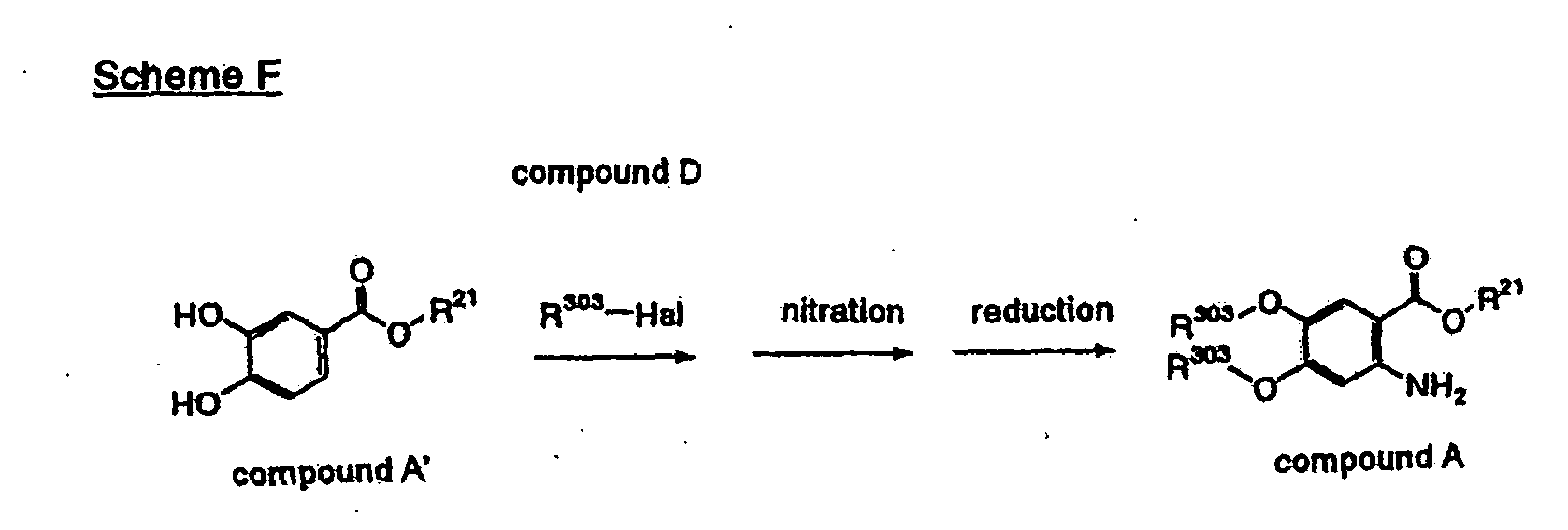


wherein R21 represents a hydrogen atom or a protective group of carboxyl; Alk represents an alkylene chain having 2 to 7 carbon atoms; n is an integer of 1 to 6; Hal represents a halogen atom, preferably a bromine or chlorine atom; R301, R302, R303, R304, and R305 represent optionally substituted C1-6 alkyl, optionally substituted C2-6 alkenyl, optionally substituted aryl, or the like; R1, R2, R3, and R4 are as defined in formula (I). - In the above schemes, the esterification can be carried out by esterifying a commercially available carboxylic acid with a suitable esterifying agent, for example, 1-ethyl-3-(3-dimethylaminopropyl)carbodiimide hydrochloride.
- The introduction of the amino group can be carried out by allowing an alkylamino compound or an arylamino compound to act under basic condition, for example, potassium carbonate.
- The reduction of the nitro group can be carried out using a suitable reducing agent, for example, palladium-carbon.
- A group of sodium dependent phosphate transporters (NaPi) present in cells are known to be responsible for homeostasis of phosphorus in vivo. In particular, the phosphorus concentration of serum is generally regulated by phosphate absorption in intestinal epithelial cells and phosphate reabsorption in renal tubular cells, and the above phosphate transporters also participate in these mechanisms.
- The compounds according to the present invention can inhibit these phosphate transporters that mainly specify phosphate absorption from the intestinal tract and phosphate reabsorption from the kidney (see Pharmacological Test Examples 1 to 3).
- Further, the compounds according to the present invention can exhibit phosphate absorption inhibitory activity in the intestinal tract of rats (see Pharmacological Test Example 4).
- Accordingly, the compounds according to the present invention can be used for the prevention or treatment of diseases for which serum phosphate lowering action is therapeutically effective.
- The term "serum phosphate lowering action" as used herein means action that lowers phosphate concentration of serum. The phosphate concentration of serum is specified by (i) absorption from the intestinal tract and excretion into urine and feces and (ii) introduction and discharge with respect to cells in vivo and calcified tissue typified by osseous tissues. The "serum phosphate lowering action" as used herein embraces the action of lowering of the serum phosphate concentration in the case of action on a healthy living body and is not always limited to the action of lowering of serum phosphate concentration in hyperphosphatemia.
- Further, the compounds according to the present invention can be used for the prevention or treatment of diseases for which phosphate transport inhibition is therapeutically effective.
- The term "phosphate transport inhibition" as used herein means the inhibition of transport activity of phosphate transporters present on cell membranes of object cells. Object cells include epithelial cells of small intestine, renal epithelial cells, pulmonary epithelial cells, vascular endothelial cells, vascular smooth muscle cells, or osteoblasts.
- Diseases for which the serum phosphate lowering action is effective therapeutically and diseases for which phosphate transport inhibition is therapeutically effective include (1) hyperphosphatemia, (2) renal failure and chronic renal failure, (3) secondary hyperparathyroidism and diseases related thereto, (4) metabolic osteopathy, (5) diseases for which the suppression of calcium and/or phosphorus product is effective therapeutically, and (6) other hyperphosphatemia-related diseases.
- The compounds according to the present invention can lower the phosphate concentration of serum and can inhibit phosphate transport and thus can be used for the prevention or treatment of hyperphosphatemia. The term "hyperphosphatemia" as used herein means such a state that the phosphate concentration of serum is beyond a clinically defined normal region.
- Regarding renal failure and chronic renal failure, it has recently been suggested that an increase in serum phosphate concentration per se is an exacerbation factor of renal failure. In fact, there are a series of reports on that the progress of the renal failure can be delayed by restriction of phosphate ingestion in chronic renal failure patients (Maschio et al., Kidney Int., 22:371-376,1982, Maschio et al., Kidney Int., 24:S273-277, 1983, Barsotti et al., Kidney Int. 24:S278-284,1983).
- Accordingly, the compounds according to the present invention which can inhibit phosphate transport and can lower phosphate concentration of serum can be used for the prevention or treatment of the renal failure and the chronic renal failure.
- It is known that hyperphosphatemia secondarily leads to hypocalcemia and thus induces secondary hyperparathyroidism. Accordingly, the compounds according to the present invention can be used for the prevention and treatment of secondary hyperparathyroidism.
- Further, in recent years, there are a report that a rise of phosphate concentration promotes the secretion of PTH (parathyroid hormone) from parathyroid cells (Almanden Y et al., J Bone Miner Res 11:970-976, 1996), a report that phosphorus restriction suppresses the secretion (Rachel K et al., J Clin Invest 96.327-333, 1995), a report that hyperplasia of parathyroids is suppressed (Slatopolsky E et al., J Clin Invest 97:2534-2540, 1996) and the like. When these reports suggesting that the serum phosphate concentration per se participates in hyperplasia of parathyroids and PTH secretion are taken into consideration, it can be said that the compounds according to the present invention can be used for the prevention and treatment of secondary hyperparathyroidism as well as primary hyperparathyroidism through a lowering in serum phosphate concentration. Further, the compounds according to the present invention can be used for the prevention and treatment of renal osteodystrophy induced by secondary hyperparathyroidism, that is, osteitis fibrosa, ostealgia and arthralgia, bone deformity, fracture and the like.
- The compounds according to the present invention can prevent and treat secondary hyperparathyroidism and thus can also be used for the prevention and treatment of diseases said to be induced by PTH increase in the secondary hyperparathyroidism, for example, central or peripheral nervous system damage, anemia, myocardiopathy, hyperlipidemia, anomaly of saccharometabolism, pruritus cutaneus, tendon rupture, sexual dysfunction, muscle damage, skin ischemic ulcer, growth retardation, heart conduction disturbance, pulmonary diffusing impairment, immune deficiency, ostealgia and arthralgia, bone deformity, or fracture.
- The compounds according to the present invention can remedy clinical conditions of phosphorus metabolic disorder and, at the same time, are considered to have the effect of remedying clinical conditions of metabolic disorder of minerals including calcium. Accordingly, the compounds according to the present invention can be used for the prevention and treatment of calcium and phosphorus metabolic disorders such as metabolic osteopathy.
- In dialysis patients, when poor control of serum phosphate concentration due to administration of a large amount of calcium preparations and administration of a large amount of vitamin D, and overconsumption of proteins is likely to cause ectopic calcification as a result of a rise of calcium and phosphorus product in blood and is in its turn causative of circulatory disorders derived from calcification of blood circulatory systems including coronary artery (Braun J et al., Am J Kidney Dis. 27:394-401, 1996, Goodman WG et al., N Engl J Med 342:1478-1483,2000, Kimura K et al., Kidney Int. 71: S238-241, 1999). In this case, downward revision of calcium and phosphorus product is effective in remedying clinical condition (Geoffrey AB et al., Am J Kidney Dis. 31:607-617, 1998). The compounds according to the present invention are hyperphosphatemia improving drugs different from calcium preparations and thus can lower the phosphate concentration of serum without a rise of calcium concentration of serum. Thus, the compounds according to the present invention can be used for the treatment of diseases for which the suppression of calcium and/or phosphorus product in blood vessels is therapeutically effective. Such diseases include calcification of cardiovascular system in dialysis patients, age-related arterial sclerosis, diabetic vasculopathy, calcification of soft tissue, metastatic calcification, and ectopic calcification. Since a rise of calcium and phosphorus product is recognized as a risk factor of clinical conditions of red eye, arthralgia, myalgia, pruritus cutaneus, heart conduction disturbance, pulmonary diffusing impairment, angina pectoris, cardiac infarction, or heart failure induced by cardiac murmur or valvular disease (Tetsuo Tagami, Jin To Toseki (Kidney and Dialysis), Vol. 49:189-191, 2000), the compounds according to the present invention can also be used for the prevention and treatment of these diseases.
- In addition to the above diseases (1) to (5), hypoparathyroidism, pseudohypoparathyroidism, hypocalcemia, hypercalciuria, vitamin D toxicosis, acromegaly, overdose of phosphate, acidosis, state of hypercatabolism, rhabdomyolysis, hemolytic anemia, climacteric disturbance, malignant tumor, tumor lysis syndrome, and tumoral calcinosis involve hyperphosphatemia. Therefore, the compounds according to the present invention can also be used for the prevention and treatment of these diseases.
- According to the present invention, there is provided a serum phosphate concentration lowering agent comprising the compound according to the present invention.
- According to the present invention, there is provided a phosphate transport inhibitor comprising the compound according to the present invention.
- According to the present invention, there is provided a method for lowering serum phosphate concentration, comprising administering the compound according to the present invention to a human or a mammal other than a human.
- According to the present invention, there is provided a method for inhibiting phosphate transport, comprising administering the compound according to the present invention to a human or mammal other than a human.
- The compounds according to the present invention can be administered to human and non-human animals orally or parenterally by administration routes, for example, intraoral, nasal administration, transpulmonary administration, intrarectal administration, percutaneous administration, subcutaneous administration, or intravenous administration. Therefore, the compounds according to the present invention can be formulated into suitable dosage forms according to the administration routes. Dosage forms suitable for the above administration routes include tablets, capsules, granules, powders, ointments, poultices, aerosols, suppositories, and injections.
- The compound according to the present invention per se can be administered to patients, or alternatively may be administered together with general-purpose preparation additives to patients.
- The pharmaceutical composition according to the present invention can be produced according to a well-known formulation technique by using the compound according to the present invention together with the following additives.
- For example, oral preparations, that is, tablets, capsules, granules, and powders, can be produced by conventional methods with the compounds according to the present invention and suitable preparation additives. Additives usable for oral preparations include excipients, binders, disintegrants, and lubricants. They may be used either solely or in a combination of two or more. Excipients include, for example, lactose, mannitol, corn starch, and calcium carbonate. Binders include, for example, gum arabic, tragacanth, gelatin, and methylcellulose. Disintegrants include, for example, corn starch, crystalline cellulose, and carboxymethylcellulose sodium. Lubricants include, for example, talc, and magnesium stearate.
- Oral preparations containing the compound according to the present invention may be coated with a coating agent according to a well known method. Coating agents usable herein include, for example, hydroxypropylcellulose, hydroxypropylmethylcellulose, aminoalkylmethacrylate copolymer, hydroxypropylmethylcellulose phthalate, and carboxymethylethylcellulose.
- Oral preparations can be modified for effectively drawing phosphate absorption inhibition from intestinal tracts of the compound according to the present invention.
- When the compounds according to the present invention are orally administered, there is a possibility that, after the inhibition of phosphate transport carriers in small intestine epithelial cells, they are absorbed in the body and inhibit phosphate transport carriers in vascular endothelial cells, pulmonary epithelial cells, renal epithelial cells, osteoblasts and the like. Accordingly, the compounds according to the present invention have the possibility of inhibiting phosphate absorption from the intestine and further inhibiting phosphate absorption in the kidney to synergistically and effectively lower the phosphate concentration of serum. However, the possibility of exhibiting unknown toxicity upon absorption of the compounds according to the present invention in the body cannot be denied. To avoid this phenomenon, a technique may be adopted in which the compounds according to the present invention can specifically inhibit only small intestine epithelium, which is the first barrier for phosphate absorption from outside of the body, without the absorption from the intestinal tract. For example, the absorption of the compound per se from the intestinal tract can be prevented by bonding an inert water-soluble polymer to the compounds according to the present invention to increase the water solubility and molecular weight. Water soluble polymers usable herein include, for example, polyethylene glycol, dextran, and gelatin.
- An enteric coating may be applied to the oral preparation according to the present invention for specific dissolution in the intestinal tract after oral administration. The enteric coating may be carried out by a well-known method using an enteric coating agent. Enteric coating agents include, for example, hydroxypropylmethylcellulose phthalate, hydroxypropylmethylcellulose acetate succinate, carboxymethylethylcellulose, and methacrylic acid copolymers.
- Further, any foamable substance, which, after oral administration, can promote dissolution speed of the preparation in the intestinal tract to enhance the concentration of the effective ingredient, can be added to the oral preparation according to the present invention. Substances which are foamable upon dissolution include, for example, a combination of sodium hydrogencarbonate and citric acid.
- Further, any substance, which, after oral administration, can improve the residence of the preparation in the intestinal tract, can be added to the oral preparation according to the present invention. Substances which can improve the residence include substances which become viscous upon dissolution, and examples thereof include sodium alginate, carboxymethylcellulose sodium, hydroxyethylcellulose, hydroxypropylcellulose, hydroxypropylmethylcellulose, polyvinyl alcohol, polyvintyl pyrrolidone, carboxylvinyl polymer, and chitosan.
- In the oral preparation according to the present invention, the above modification methods may be properly used in combination.
- The compounds according to the present invention and suitable preparation additives may be used for the manufacture of injections by a general-purpose method. Additives usable in injections include diluents, pH adjustors, tonicity adjusting agents, dissolution aids, and preservatives. They may be used either solely or in a combination of two or more. Diluents include, for example, distilled water for injections. pH adjustors include, for example, hydrochloric acid, sodium hydroxide, a combination of acetic acid with sodium acetate, and a combination of disodium hydrogenphosphate with sodium dihydrogenphosphate. Tonicity adjusting agents include, for example, sodium chloride, glucose, mannitol, and glycine. Dissolution aids include, for example, ethanol,
Polysorbate 20,Polysorbate 80, sucrose fatty acid ester, and propylene glycol. Preservatives include, for example, chlorobutanol, benzalconium chloride, and benzethonium chloride. - For the compounds according to the present invention, the dose may be appropriately determined in consideration of particular conditions, for example, the age, weight, sex, type of disease, and severity of condition of patients, and the preparation may be administered, for example, in an amount of 0.1 to 1000 mg/kg, preferably 0.5 to 100 mg/kg, more preferably 1 to 20 mg/kg. This dose may be administered at a time daily or divided doses of several times daily.
- The present invention is further illustrated by the following Examples that are not intended as a limitation of the scope of the invention.
- Methyl 2-aminobenzoate (compound A) (2.0 g) was dissolved in anhydrous methylene chloride (40.0 ml). Subsequently, pyridine (2.0 ml) and 3,4-dimethoxybenzoyl chloride (compound B) (3.14 g) were added to the solution at room temperature, and the mixture was stirred at that temperature for 30 min. After the completion of the reaction, distilled water was added thereto, and the mixture was subjected to separatory extraction with chloroform. The organic layer was washed with a saturated aqueous sodium chloride solution, was dried over sodium sulfate, and was then concentrated to give methyl 2-[(3,4-dimethoxybenzoyl)amino]benzoate as a useful intermediate (4.17 g, yield 100%).
- Methyl 2-[(3,4-dimethoxybenzoyl)amino]benzoate (4.17 g) produced by the above reaction was dissolved in ethanol (40.0 ml). Hydrazine monohydrate (20.0 ml) was added at room temperature, and the mixture was stirred with heating under reflux for 12 hr. After the completion of the reaction, the reaction solution was allowed to cool at room temperature and was cooled under ice cooling to precipitate crystals. The precipitated crystals were collected by filtration through Kiriyama Rohto (40 mmφ) and were washed with ether to give N-(2-hydrazinocarbonyl-phenyl)-3,4-dimethoxybenzamide as a hydrazine compound (3.55 g, yield 91.3%).
- N-(2-Hydrazinocarbonyl-phenyl)-3,4-dimethoxybenzamide (50.0 mg) was dissolved in anhydrous toluene (1.0 ml). Subsequently, a catalytic amount of acetic acid and trans-cinnamaldehyde (compound C) (40.0 µl) were added at room temperature, and the mixture was stirred with heating under reflux for 30 min. After the completion of the reaction, the reaction solution was allowed to cool at room temperature and was cooled under ice cooling to precipitate crystals. The precipitated crystals were filtered through Kiriyama Rohto (21 mmφ) and were washed with toluene and hexane. The crystals were dried through a vacuum pump to give the title compound 1 (39.0 mg, yield 57.0%).
Mass spectrometric value (ESI-MS) 428 (M-1) - The title compound 2 was produced in the same manner as in Example 1.
Mass spectrometric value (ESI-MS) 420 (M-1) - The title compound 3 was produced in the same manner as in Example 1.
Mass spectrometric value (ESI-MS) 416 (M-1) - The title compound 4 was produced in the same manner as in Example 1.
Mass spectrometric value (ESI-MS) 432 (M-1) - The title compound 5 was produced in the same manner as in Example 1.
Mass spectrometric value (ESI-MS) 432 (M-1) - The title compound 6 was produced in the same manner as in Example 1.
Mass spectrometric value (ESI-MS) 530 (M-1) - The title compound 7 was produced in the same manner as in Example 1.
Mass spectrometric value (ESI-MS) 442 (M-1) - The title compound 8 was produced in the same manner as in Example 1.
Mass spectrometric value (ESI-MS) 538 (M-1) - The title compound 9 was produced in the same manner as in Example 1.
Mass spectrometric value (ESI-MS) 427 (M-1) - The title compound 10 was produced in the same manner as in Example 1.
Mass spectrometric value (ESI-MS) 480 (M-1) - The title compound 11 was produced in the same manner as in Example 1.
Mass spectrometric value (ESI-MS) 448 (M-1) - The title compound 12 was produced in the same manner as in Example 1.
Mass spectrometric value (ESI-MS) 492 (M-1) - The title compound 13 was produced in the same manner as in Example 1.
Mass spectrometric value (ESI-MS) 508 (M-1) - The title compound 14 was produced in the same manner as in Example 1.
Mass spectrometric value (ESI-MS) 560 (M-1) - The title compound 15 was produced in the same manner as in Example 1.
Mass spectrometric value (ESI-MS) 420 (M-1) - The title compound 16 was produced in the same manner as in Example 1.
Mass spectrometric value (ESI-MS) 420 (M-1) - The title compound 17 was produced in the same manner as in Example 1.
Mass spectrometric value (ESI-MS) 402 (M-1) - The title compound 18 was produced in the same manner as in Example 1.
Mass spectrometric value (ESI-MS) 418 (M-1) - The title compound 19 was produced in the same manner as in Example 1.
Mass spectrometric value (ESI-MS) 418 (M-1) - The
title compound 20 was produced in the same manner as in Example 1.
Mass spectrometric value (ESI-MS) 416 (M-1) - The title compound 21 was produced in the same manner as in Example 1.
Mass spectrometric value (ESI-MS) 392 (M-1) - The title compound 22 was produced in the same manner as in Example 1.
Mass spectrometric value (ESI-MS) 406 (M-1) - The title compound 23 was produced in the same manner as in Example 1.
Mass spectrometric value (ESI-MS) 408 (M-1) - The title compound 24 was produced in the same manner as in Example 1.
Mass spectrometric value (ESI-MS) 408 (M-1) - The title compound 25 was produced in the same manner as in Example 1.
Mass spectrometric value (ESI-MS) 434 (M-1) - The title compound 26 was produced in the same manner as in Example 1.
Mass spectrometric value (ESI-MS) 434 (M-1) - The title compound 27 was produced in the same manner as in Example 1.
Mass spectrometric value (ESI-MS) 360 (M-1) - The title compound 28 was produced in the same manner as in Example 1.
Mass spectrometric value (ESI-MS) 500 (M-1) - The
title compound 29 was produced in the same manner as in Example 1.
1H-NMR (CDCl3, 400 MHz): δ 8.55 (1H, d, J = 9.0 Hz), 8.32 (1H, bs), 7.49 - 7.67 (6H, m), 7.40 (1 H, q, J = 4.56 Hz), 7.13 (1 H, q, J = 5.53 Hz), 6.93 (1H, d, J = 8.8 Hz), 3.98 (3H, s), 3.94 (3H, s)
Mass spectrometric value (ESI-MS) 500 (M-1) - The title compound 30 was produced in the same manner as in Example 1.
Mass spectrometric value (ESI-MS) 494 (M-1) - The title compound 31 was produced in the same manner as in Example 1.
Mass spectrometric value (ESI-MS) 494 (M-1) - The title compound 32 was produced in the same manner as in Example 1.
Mass spectrometric value (ESI-MS) 454 (M-1) - The title compound 33 was produced in the same manner as in Example 1.
Mass spectrometric value (ESI-MS) 486 (M-1) - The title compound 34 was produced in the same manner as in Example 1.
Mass spectrometric value (ESI-MS) 512 (M-1) - The title compound 35 was produced in the same manner as in Example 1.
Mass spectrometric value (ESI-MS) 436 (M-1) - The title compound 36 was produced in the same manner as in Example 1.
Mass spectrometric value (ESI-MS) 446 (M-1) - The title compound 37 was produced in the same manner as in Example 1.
Mass spectrometric value (ESI-MS) 462 (M-1) - The title compound 38 was produced in the same manner as in Example 1.
Mass spectrometric value (ESI-MS) 378 (M-1) - The title compound 39 was produced in the same manner as in Example 1.
Mass spectrometric value (ESI-MS) 376 (M-1) - The
title compound 40 was produced in the same manner as in Example 1.
Mass spectrometric value (ESI-MS) 374 (M-1) - The title compound 41 was produced in the same manner as in Example 1.
Mass spectrometric value (ESI-MS) 504 (M-1) - The title compound 42 was produced in the same manner as in Example 1.
Mass spectrometric value (ESI-MS) 432 (M-1) - The title compound 43 was produced in the same manner as in Example 1.
Mass spectrometric value (ESI-MS) 430 (M-1) - The title compound 44 was produced in the same manner as in Example 1.
Mass spectrometric value (ESI-MS) 488 (M-1) - The title compound 45 was produced in the same manner as in Example 1.
Mass spectrometric value (ESI-MS) 390 (M-1) - The title compound 46 was produced in the same manner as in Example 1.
Mass spectrometric value (ESI-MS) 388 (M-1) - The title compound 47 was produced in the same manner as in Example 1.
Mass spectrometric value (ESI-MS) 390 (M-1) - The title compound 48 was produced in the same manner as in Example 1.
Mass spectrometric value (ESI-MS) 390 (M-1) - The title compound 49 was produced in the same manner as in Example 1.
Mass spectrometric value (ESI-MS) 386 (M-1) - The title compound 50 was produced in the same manner as in Example 1.
Mass spectrometric value (ESI-MS) 388 (M-1) - The title compound 51 was produced in the same manner as in Example 1.
Mass spectrometric value (ESI-MS) 386 (M-1) - The title compound 52 was produced in the same manner as in Example 1.
Mass spectrometric value (ESI-MS) 458 (M-1) - The title compound 53 was produced in the same manner as in Example 1.
Mass spectrometric value (ESI-MS) 462 (M-1) - The title compound 54 was produced in the same manner as in Example 1.
Mass spectrometric value (ESI-MS) 562 (M-1) - The title compound 55 was produced in the same manner as in Example 1.
Mass spectrometric value (ESI-MS) 420 (M-1) - The title compound 56 was produced in the same manner as in Example 1.
Mass spectrometric value (ESI-MS) 420 (M-1) - The title compound 57 was produced in the same manner as in Example 1.
Mass spectrometric value (ESI-MS) 416 (M-1) - The title compound 58 was produced in the same manner as in Example 1.
Mass spectrometric value (ESI-MS) 418 (M-1) - The title compound 59 was produced in the same manner as in Example 1.
Mass spectrometric value (ESI-MS) 516 (M-1) - The
title compound 60 was produced in the same manner as in Example 1.
Mass spectrometric value (ESI-MS) 516 (M-1) - The title compound 61 was produced in the same manner as in Example 1.
Mass spectrometric value (ESI-MS) 500 (M-1) - The title compound 62 was produced in the same manner as in Example 1.
Mass spectrometric value (ESI-MS) 494 (M-1) - The title compound 63 was produced in the same manner as in Example 1.
Mass spectrometric value (ESI-MS) 496 (M-1) - The title compound 64 was produced in the same manner as in Example 1.
Mass spectrometric value (ESI-MS) 496 (M-1) - The title compound 65 was produced in the same manner as in Example 1.
Mass spectrometric value (ESI-MS) 454 (M-1) - The title compound 66 was produced in the same manner as in Example 1.
Mass spectrometric value (ESI-MS) 454 (M-1) - The title compound 67 was produced in the same manner as in Example 1.
Mass spectrometric value (ESI-MS) 450 (M-1) - The
title compound 68 was produced in the same manner as in Example 1.
1H-NMR (CDCl3, 400 MHz): δ 9.33 (1 H, s), 8.72 (1 H, d, J = 8.76 Hz), 8.21 (1 H, s), 7.48 - 7.68 (6H, m), 7.20 - 7.25 (1 H, m), 6.92 (1 H, d, J = 8.56 Hz), 3.97 (3H, s), 3.93 (3H, s), 2.38 (3H, s)
Mass spectrometric value (ESI-MS) 450 (M-1) - The title compound 69 was produced in the same manner as in Example 1.
Mass spectrometric value (ESI-MS) 452 (M-1) - The title compound 70 was produced in the same manner as in Example 1.
Mass spectrometric value (ESI-MS) 452 (M-1) - The title compound 71 was produced in the same manner as in Example 1.
Mass spectrometric value (ESI-MS) 454 (M-1) - The title compound 72 was produced in the same manner as in Example 1.
Mass spectrometric value (ESI-MS) 454 (M-1) - The title compound 73 was produced in the same manner as in Example 1.
Mass spectrometric value (ESI-MS) 450 (M-1) - The title compound 74 was produced in the same manner as in Example 1.
Mass spectrometric value (ESI-MS) 452 (M-1) - The title compound 75 was produced in the same manner as in Example 1.
Mass spectrometric value (ESI-MS) 452 (M-1) - The title compound 76 was produced in the same manner as in Example 1.
Mass spectrometric value (ESI-MS) 379 (M-1), 757 (2M-1) - The title compound 77 was produced in the same manner as in Example 1.
Mass spectrometric value (ESI-MS) 378 (M-1) - The title compound 78 was produced in the same manner as in Example 1.
Mass spectrometric value (ESI-MS) 374 (M-1) - The title compound 79 was produced in the same manner as in Example 1.
Mass spectrometric value (ESI-MS) 374 (M-1) - The
title compound 80 was produced in the same manner as in Example 1.
Mass spectrometric value (ESI-MS) 376 (M-1) - The title compound 81 was produced in the same manner as in Example 1.
Mass spectrometric value (ESI-MS) 378 (M-1) - The title compound 82 was produced in the same manner as in Example 1.
Mass spectrometric value (ESI-MS) 757 (2M-1) - The title compound 83 was produced in the same manner as in Example 1.
Mass spectrometric value (ESI-MS) 374 (M-1) - The title compound 84 was produced in the same manner as in Example 1.
Mass spectrometric value (ESI-MS) 374 (M-1) - The title compound 85 was produced in the same manner as in Example 1.
Mass spectrometric value (ESI-MS) 376 (M-1) - The title compound 86 was produced in the same manner as in Example 1.
Mass spectrometric value (ESI-MS) 376 (M-1) - The title compound 87 was produced in the same manner as in Example 1.
Mass spectrometric value (ESI-MS) 582, 584 (M-1) - The title compound 88 was produced in the same manner as in Example 1.
1H-NMR (CDCl3, 400 MHz): δ 8.49 (1H, d, J = 8.08 Hz), 8.39 (1H, s), 8.06 (1H, s), 7.96 (1H, s), 7.49 - 7.60 (4H, m), 7.41 (1H, d, J = 9.04 Hz), 6.94 (1H, d, J = 8.56 Hz), 3.98 (3H, s,), 3.94 (3H, s)
Mass spectrometric value (ESI-MS) 538, 540 (M-1) - The title compound 89 was produced in the same manner as in Example 1.
Mass spectrometric value (ESI-MS) 504, 506 (M-1) - The title compound 90 was produced in the same manner as in Example 1.
Mass spectrometric value (ESI-MS) 474 (M-1) - The title compound 91 was produced in the same manner as in Example 1.
1H-NMR (CDCl3, 400 MHz): δ 9.53 (1H, s), 8.61 (1H, d, J = 9.04 Hz), 8.21 (1H, s), 7.69 (1H, s), 7.59 - 7.62 (4H, m), 7.46 - 7.50 (1H, m), 7.17 (1H, d, J = 7.56 Hz), 6.91 (1H, d, J = 8.28 Hz), 3.97 (3H, s), 3.93 (3H, s), 2.28 (3H, s), 2.28 (3H, s)
Mass spectrometric value (ESI-MS) 508 (M-1) - The title compound 92 was produced in the same manner as in Example 1.
1H-NMR (CDCl3, 400 MHz): δ 9.60 (1H, s), 8.65 (1H, d, J = 9.04 Hz), 8.21 (1H, s), 7.44 - 7.62 (6H, m), 7.17 (1H, d, J = 7.80 Hz), 6.91 (1H, d, J = 8.32 Hz), 3.97 (3H, s), 3.92 (3H, s), 2.28 (6H, s)
Mass spectrometric value (ESI-MS) 464 (M-1) - The title compound 93 was produced in the same manner as in Example 1.
Mass spectrometric value (ESI-MS) 430 (M-1) - The title compound 94 was produced in the same manner as in Example 1.
Mass spectrometric value (ESI-MS) 400 (M-1) - The title compound 95 was produced in the same manner as in Example 1.
Mass spectrometric value (ESI-MS) 388 (M-1) - The title compound 96 was produced in the same manner as in Example 1.
Mass spectrometric value (ESI-MS) 388 (M-1) - The title compound 97 was produced in the same manner as in Example 1.
Mass spectrometric value (ESI-MS) 590 (M-1) - The title compound 98 was produced in the same manner as in Example 1.
Mass spectrometric value (ESI-MS) 544 (M-1) - The title compound 99 was produced in the same manner as in Example 1.
Mass spectrometric value (ESI-MS) 510 (M-1) - The
title compound 100 was produced in the same manner as in Example 1.
Mass spectrometric value (ESI-MS) 482 (M-1) - The title compound 101 was produced in the same manner as in Example 1.
Mass spectrometric value (ESI-MS) 468, 470 (M-1) - The title compound 102 was produced in the same manner as in Example 1.
Mass spectrometric value (ESI-MS) 468, 470 (M-1) - The title compound 103 was produced in the same manner as in Example 1.
Mass spectrometric value (ESI-MS) 447 (M-1) - The title compound 104 was produced in the same manner as in Example 1.
Mass spectrometric value (ESI-MS) 445 (M-1) - The title compound 105 was produced in the same manner as in Example 1.
Mass spectrometric value (ESI-MS) 458 (M-1) - The title compound 106 was produced in the same manner as in Example 1.
Mass spectrometric value (ESI-MS) 456 (M-1) - The title compound 107 was produced in the same manner as in Example 1.
Mass spectrometric value (ESI-MS) 472, 474 (M-1) - The title compound 108 was produced in the same manner as in Example 1.
Mass spectrometric value (ESI-MS) 472, 474 (M-1) - The title compound 109 was produced in the same manner as in Example 1.
Mass spectrometric value (ESI-MS) 456, 458 (M-1) - The title compound 110 was produced in the same manner as in Example 1.
Mass spectrometric value (ESI-MS) 483 (M-1) - The title compound 111 was produced in the same manner as in Example 1.
Mass spectrometric value (ESI-MS) 437 (M-1) - The title compound 112 was produced in the same manner as in Example 1.
Mass spectrometric value (ESI-MS) 373 (M-1) - The title compound 113 was produced in the same manner as in Example 1.
Mass spectrometric value (ESI-MS) 361 (M-1) - The title compound 114 was produced in the same manner as in Example 1.
Mass spectrometric value (ESI-MS) 498 (M-1) - The title compound 115 was produced in the same manner as in Example 1.
Mass spectrometric value (ESI-MS) 498, 500 (M-1) - The title compound 116 was produced in the same manner as in Example 1.
Mass spectrometric value (ESI-MS) 516, 518 (M-1) - The title compound 117 was produced in the same manner as in Example 1.
Mass spectrometric value (ESI-MS) 514, 516 (M-1) - The title compound 118 was produced in the same manner as in Example 1.
Mass spectrometric value (ESI-MS) 496 (M-1) - The title compound 119 was produced in the same manner as in Example 1.
Mass spectrometric value (ESI-MS) 494 (M-1) - The
title compound 120 was produced in the same manner as in Example 1.
Mass spectrometric value (ESI-MS) 444 (M-1) - The title compound 121 was produced in the same manner as in Example 1.
Mass spectrometric value (ESI-MS) 444 (M-1) - The title compound 122 was produced in the same manner as in Example 1.
Mass spectrometric value (ESI-MS) 459, 461 (M-1) - The title compound 123 was produced in the same manner as in Example 1.
Mass spectrometric value (ESI-MS) 459, 461 (M-1) - The title compound 124 was produced in the same manner as in Example 1.
Mass spectrometric value (ESI-MS) 440 (M-1) - The title compound 125 was produced in the same manner as in Example 2, except that N-(2-chioroethyl)-N,N-dimethylamine hydrochloride was changed to 3-dimethylaminopropyl chloride hydrochloride.
Mass spectrometric value (ESI-MS) 521, 523 (M-1) - The title compound 126 was produced in the same manner as in Example 1.
Mass spectrometric value (ESI-MS) 496 (M-1) - The title compound 127 was produced in the same manner as in Example 1.
Mass spectrometric value (ESI-MS) 540 (M-1) - The title compound 128 was produced in the same manner as in Example 1.
Mass spectrometric value (ESI-MS) 542 (M-1) - The title compound 129 was produced in the same manner as in Example 1.
Mass spectrometric value (ESI-MS) 361 (M-1) - The title compound 130 was produced in the same manner as in Example 1.
1H-NMR (CDCl3, 400 MHz): δ 9.69 (1 H, s), 9.28 (1 H, s), 8.77 (1 H, dd, J = 1.44 Hz, J = 4.88 Hz), 8.66 (1 H, d, J = 7.80 Hz), 8.25 - 8.33 (2H, m), 7.81 (2H, s), 7.50 - 7.60 (2H, m), 7.43 (1 H, dd, J = 4.88 Hz, J = 8.04 Hz), 7.05 - 7.15 (3H, m)
Mass spectrometric value (ESI-MS) 361 (M-1) - The title compound 131 was produced in the same manner as in Example 1.
Mass spectrometric value (ESI-MS) 357 (M-1) - The title compound 132 was produced in the same manner as in Example 1.
Mass spectrometric value (ESI-MS) 357 (M-1) - The title compound 133 was produced in the same manner as in Example 1.
Mass spectrometric value (ESI-MS) 371 (M-1) - The title compound 134 was produced in the same manner as in Example 1.
Mass spectrometric value (ESI-MS) 361 (M-1) - The title compound 135 was produced in the same manner as in Example 1.
Mass spectrometric value (ESI-MS) 361 (M-1) - The title compound 136 was produced in the same manner as in Example 1.
Mass spectrometric value (ESI-MS) 357 (M-1) - The title compound 137 was produced in the same manner as in Example 1.
Mass spectrometric value (ESI-MS) 357 (M-1) - The title compound 138 was produced in the same manner as in Example 1.
Mass spectrometric value (ESI-MS) 371 (M-1) - N-[2-(4-Fluoro-benzylidene-hydrazinocarbonyl)-4-hydroxyphenyl]-3,4-dimethoxy-benzamide (50 mg) synthesized in the same manner as in Example 1 was dissolved in anhydrous DMF (1.5 ml). NaH (60% in oil, 20 mg) was added to the solution at room temperature, and the mixture was stirred at that temperature for 5 min. Subsequently, N-(2-chloroethyl)-N,N-dimethylamine hydrochloride (47 mg) was added to the reaction solution at room temperature, and the mixture was stirred at that temperature for 12 hr. After the completion of the reaction, distilled water was added dropwise thereto under ice cooling and the mixture was subjected to separatory extraction with ethyl acetate. The organic layer was washed with saturated brine and was dried over sodium sulfate, and the organic layer was concentrated under the reduced pressure. The residue was purified by preparative TLC to give the title compound 139 (32 mg, yield 57.1 %).
Mass spectrometric value (ESI-MS) 507 (M-1) - The
title compound 140 was produced in the same manner as in Example 2, except that N-(2-chloroethyl)-N,N-dimethylamine hydrochloride was changed to 2-diethylaminoethyl chloride hydrochloride.
Mass spectrometric value (ESI-MS) 535 (M-1) - The title compound 141 was produced in the same manner as in Example 1.
Mass spectrometric value (ESI-MS) 450 (M-1) - The title compound 142 was produced in the same manner as in Example 1.
Mass spectrometric value (ESI-MS) 450 (M-1) - The title compound 143 was produced in the same manner as in Example 1.
Mass spectrometric value (ESI-MS) 446 (M-1) - The title compound 144 was produced in the same manner as in Example 1.
Mass spectrometric value (ESI-MS) 446 (M-1) - The title compound 145 was produced in the same manner as in Example 1.
Mass spectrometric value (ESI-MS) 460 (M-1) - The title compound 146 was produced in the same manner as in Example 1.
Mass spectrometric value (ESI-MS) 434 (M-1) - The title compound 147 was produced in the same manner as in Example 1.
Mass spectrometric value (ESI-MS) 434 (M-1) - The title compound 148 was produced in the same manner as in Example 1.
Mass spectrometric value (ESI-MS) 430 (M-1) - The title compound 149 was produced in the same manner as in Example 1.
Mass spectrometric value (ESI-MS) 430 (M-1) - The title compound 150 was produced in the same manner as in Example 1.
Mass spectrometric value (ESI-MS) 444 (M-1) - The title compound 151 was produced in the same manner as in Example 1.
Mass spectrometric value (ESI-MS) 428 (M-1) - The title compound 152 was produced in the same manner as in Example 1.
Mass spectrometric value (ESI-MS) 428 (M-1) - The title compound 153 was produced in the same manner as in Example 1.
Mass spectrometric value (ESI-MS) 426 (M-1) - The title compound 154 was produced in the same manner as in Example 1.
Mass spectrometric value (ESI-MS) 424 (M-1) - The title compound 155 was produced in the same manner as in Example 1.
Mass spectrometric value (ESI-MS) 438 (M-1) - The title compound 156 was produced in the same manner as in Example 1.
Mass spectrometric value (ESI-MS) 513, 514 (M-1) - The title compound 157 was produced in the same manner as in Example 1.
Mass spectrometric value (ESI-MS) 446 (M-1) - The title compound 158 was produced in the same manner as in Example 1.
Mass spectrometric value (ESI-MS) 446 (M-1) - The title compound 159 was produced in the same manner as in Example 1.
Mass spectrometric value (ESI-MS) 440 (M-1) - The title compound 160 was produced in the same manner as in Example 1.
Mass spectrometric value (ESI-MS) 440 (M-1) - The title compound 161 was produced in the same manner as in Example 1.
Mass spectrometric value (ESI-MS) 454, 456 (M-1) - The title compound 162 was produced in the same manner as in Example 1.
Mass spectrometric value (ESI-MS) 530 (M-1) - A 10% hydrochloric acid-methanol solution (1.0 ml) was added to compound 138 (50 mg) synthesized in the same manner as in Example 1 at room temperature. Further, diethyl ether (5.0 ml) was added thereto, and the mixture was stirred for 30 sec. The reaction solution as such was filtered through Kiriyama Rohto (21 mmφ), and the crystals were washed with diethyl ether to give the title compound 163 (47 mg, yield 85.6%).
1H-NMR (MeOH-d4, 400 MHz): δ 8.97 (2H, d, J = 6.84 Hz), 8.49 (1 H, d, J = 8.08 Hz), 8.41 (2H, d, J = 6.56 Hz), 8.23 (1 H, s), 7.84 (1 H, d, J = 6.56 Hz), 7.56 - 7.61 (2H, m), 7.44 (1 H, d, J = 7.80 Hz), 7.28 (1 H, dd, J = 7.32 Hz, J = 7.32 Hz), 7.12 (1 H, d, J = 7.80 Hz), 2.23 (3H, s), 2.22 (3H, s)
Mass spectrometric value (ESI-MS) 371 (M-1) - The title compound 164 was produced in the same manner as in Example 3.
1H-NMR (MeOH-d4, 400 MHz): δ 9.22 (1H, s), 8.87 (1H, d, J = 5.4 Hz), 8.83 (1 H, d, J = 8.04 Hz), 8.43 (1 H, d, J = 8.32 Hz), 8.25 (1 H, s), 7.97 - 8.04 (1H, m), 7.81 (1H, dd, J = 1.24 Hz, J = 7.84 Hz), 7.64 (2H, d, J = 8.04 Hz), 7.54 - 7.60 (1 H, m), 7.23 - 7.29 (1 H, m), 7.18 (2H, d, J = 7.80 Hz), 2.29 (3H, s)
Mass spectrometric value (ESI-MS) 357 (M-1) - The title compound 165 was produced in the same manner as in Example 3.
1H-NMR (CDCl3, 400 MHz): δ 9.92 (1 H, s), 9.29 (1 H, s), 8.75 - 8.78 (2H, m), 8.30 - 8.40 (1 H, m), 8.15 (1 H, s), 7.55 - 7.65 (5H, m), 7.42 - 7.49 (2H, m), 7.15 - 7.25 (1 H, m), 2.32 (3H, s), 2.29 (3H, s)
Mass spectrometric value (ESI-MS) 371 (M-1) - The title compound 166 was produced in the same manner as in Example 1.
Mass spectrometric value (ESI-MS) 439 (M-1) - The title compound 167 was produced in the same manner as in Example 1.
Mass spectrometric value (ESI-MS) 439 (M-1) - The title compound 168 was produced in the same manner as in Example 1.
Mass spectrometric value (ESI-MS) 437 (M-1) - The title compound 169 was produced in the same manner as in Example 1.
Mass spectrometric value (ESI-MS) 435, 437 (M-1) - The title compound 170 was produced in the same manner as in Example 1.
Mass spectrometric value (ESI-MS) 451, 452 (M-1) - The title compound 171 was produced in the same manner as in Example 1.
Mass spectrometric value (ESI-MS) 525, 527 (M-1) - The title compound 172 was produced in the same manner as in Example 1.
Mass spectrometric value (ESI-MS) 441, 442 (M-1) - The title compound 173 was produced in the same manner as in Example 1.
Mass spectrometric value (ESI-MS) 439 (M-1) - The title compound 174 was produced in the same manner as in Example 1.
Mass spectrometric value (ESI-MS) 435 (M-1) - The title compound 175 was produced in the same manner as in Example 1.
Mass spectrometric value (ESI-MS) 437, 438 (M-1) - The title compound 176 was produced in the same manner as in Example 1.
Mass spectrometric value (ESI-MS) 451, 452 (M-1) - The title compound 177 was produced in the same manner as in Example 1.
Mass spectrometric value (ESI-MS) 524, 525 (M-1) - The title compound 178 was produced in the same manner as in Example 1.
Mass spectrometric value (ESI-MS) 466, 468 (M-1) - The title compound 179 was produced in the same manner as in Example 1.
Mass spectrometric value (ESI-MS) 466 (M-1) - The title compound 180 was produced in the same manner as in Example 1.
Mass spectrometric value (ESI-MS) 462 (M-1) - The title compound 181 was produced in the same manner as in Example 1.
Mass spectrometric value (ESI-MS) 462, 464 (M-1) - The title compound 182 was produced in the same manner as in Example 1.
Mass spectrometric value (ESI-MS) 476, 478 (M-1) - The title compound 183 was produced in the same manner as in Example 1.
Mass spectrometric value (ESI-MS) 550 (M-1) - The title compound 184 was produced in the same manner as in Example 1.
Mass spectrometric value (ESI-MS) 395, 397 (M-1) - The title compound 185 was produced in the same manner as in Example 1.
Mass spectrometric value (ESI-MS) 395 (M-1) - The title compound 186 was produced in the same manner as in Example 1.
Mass spectrometric value (ESI-MS) 391 (M-1) - The title compound 187 was produced in the same manner as in Example 1.
Mass spectrometric value (ESI-MS) 391 (M-1) - The title compound 188 was produced in the same manner as in Example 1.
Mass spectrometric value (ESI-MS) 405, 407 (M-1) - The title compound 189 was produced in the same manner as in Example 1.
Mass spectrometric value (ESI-MS) 479, 480 (M-1) - The title compound 190 was produced in the same manner as in Example 1.
Mass spectrometric value (ESI-MS) 395, 397 (M-1) - The title compound 191 was produced in the same manner as in Example 1.
Mass spectrometric value (ESI-MS) 391 (M-1) - The title compound 192 was produced in the same manner as in Example 1.
Mass spectrometric value (ESI-MS) 391 (M-1) - The title compound 193 was produced in the same manner as in Example 1.
Mass spectrometric value (ESI-MS) 405 (M-1) - The title compound 194 was produced in the same manner as in Example 1.
Mass spectrometric value (ESI-MS) 479 (M-1) - Methyl 2-amino-5-bromobenzoate (compound A) (2.0 g) was dissolved in anhydrous methylene chloride (40.0 ml). Subsequently, pyridine (1.0 ml) and 3-(chloromethyl)benzoyl chloride (compound B) (2.0 g) were added to the solution at room temperature, and the mixture was stirred at that temperature for 3 hr. After the completion of the reaction, distilled water was added thereto, and the mixture was subjected to separatory extraction with chloroform. The organic layer was washed with a saturated aqueous sodium chloride solution, was dried over sodium sulfate and was then concentrated to give methyl 5-bromo-2-[3-(chloromethyl)benzoyl]aminobenzoate as a useful intermediate (3.32 g, yield 100%).
- Subsequently, methyl 5-bromo-2-[3-(chloromethyl)benzoyl]aminobenzoate (1.5 g) was dissolved in anhydrous methylene chloride. Triethylamine (2.0 ml) and 4-mercaptopyridine (compound B') (880 mg) were added to the solution at room temperature, and the mixture was stirred at that temperature for 12 hr. After the completion of the reaction, distilled water was added thereto at room temperature, and the mixture was subjected to separatory extraction with chloroform. The organic layer was washed with a saturated aqueous sodium chloride solution, was dried over sodium sulfate, and was then concentrated. Diethyl ether was added to the residue for crystallization. The crystals were filtered through Kiriyama Rohto (21 mmφ) and were washed with diethyl ether to give methyl 5-bromo-2-(3-[(4-pyridylsulfanyl)methyl]benzoylamino)benzoate (1.20 g, yield 67%) as a useful intermediate.
- Methyl 5-bromo-2-(3-[(4-pyridylsulfanyl)methyl]benzoylamino)-benzoate (1.20 g) obtained by the above reaction was dissolved in ethanol (25.0 ml). Hydrazine monohydrate (2.0 ml) was added to the solution at room temperature, and the mixture was heated under reflux with stirring for one hr. After the completion of the reaction, the reaction solution was allowed to cool at room temperature, was cooled under ice cooling to precipitate crystals. The precipitated crystals were filtered through Kiriyama Rohto (21 mmφ) and were washed with diethyl ether to give N-(4-bromo-2-hydrazinocarbonyl-phenyl)-3-(pyridin-4-ylsulfanylmethyl)-benzamide (753 mg, yield 65.4%) as a hydrazine compound.
- N-(4-Bromo-2-hydrazinocarbonyl-phenyl)-3-(pyridin-4-ylsulfanylmethyl)-benzamide (50.0 mg) was dissolved in anhydrous toluene (1.0 ml). Subsequently, a catalytic amount of acetic acid and 3-fluorobenzaldehyde (compound C) (50.0 µl) were added to the solution at room temperature, and the mixture was heated under reflux with stirring for one hr. After the completion of the reaction, the reaction solution was allowed to cool at room temperature and was ice-cooled to precipitate crystals. The precipitated crystals were filtered through Kiriyama Rohto (21 mmφ), were washed with toluene and hexane, and were dried through a vacuum pump to give the title compound 195 (27.0 mg, yield 43.6%).
Mass spectrometric value (ESI-MS) 561, 563 (M-1) - The title compound 196 was produced in the same manner as in Example 4.
Mass spectrometric value (ESI-MS) 563 (M-1) - The title compound 197 was produced in the same manner as in Example 4.
Mass spectrometric value (ESI-MS) 559 (M-1) - The title compound 198 was produced in the same manner as in Example 4.
Mass spectrometric value (ESI-MS) 559 (M-1) - The title compound 199 was produced in the same manner as in Example 4.
Mass spectrometric value (ESI-MS) 571 (M-1) - The
title compound 200 was produced in the same manner as in Example 4.
Mass spectrometric value (ESI-MS) 647 (M-1) - The title compound 201 was produced in the same manner as in Example 1.
Mass spectrometric value (ESI-MS) 484 (M-1) - The title compound 202 was produced in the same manner as in Example 1.
Mass spectrometric value (ESI-MS) 499 (M-1) - The title compound 203 was produced in the same manner as in Example 3.
1H-NMR (CD3OD, 400 MHz): δ 8.92 - 8.98 (2H, m), 8.49 (1 H, d, J = 8.6 Hz), 8.34 - 8.40 (2H, m), 8.26 (1 H, s), 8.81 - 8.87 (1 H, m), 7.64 (2H, d, J = 8.0 Hz), 7.55 - 7.61 (1 H, m), 7.25 - 7.31 (1 H, m), 7.15 - 7.20 (2H, m), 2.30 (3H, s)
Mass spectrometric value (ESI-MS) 357 (M-1) - The title compound 204 was produced in the same manner as in Example 1.
Mass spectrometric value (ESI-MS) 546 (M-1) - The title compound 205 was produced in the same manner as in Example 1.
Mass spectrometric value (ESI-MS) 546 (M-1) - The title compound 206 was produced in the same manner as in Example 1.
Mass spectrometric value (ESI-MS) 542 (M-1) - The title compound 207 was produced in the same manner as in Example 1.
Mass spectrometric value (ESI-MS) 542 (M-1) - The title compound 208 was produced in the same manner as in Example 1.
Mass spectrometric value (ESI-MS) 556 (M-1) - The title compound 209 was produced in the same manner as in Example 1.
Mass spectrometric value (ESI-MS) 630 (M-1) - The title compound 210 was produced in the same manner as in Example 1.
Mass spectrometric value (ESI-MS) 346 (M-1) - The title compound 211 was produced in the same manner as in Example 1.
Mass spectrometric value (ESI-MS) 424 (M-1) - The title compound 212 was produced in the same manner as in Example 1.
Mass spectrometric value (ESI-MS) 380 (M-1) - The title compound 213 was produced in the same manner as in Example 1.
Mass spectrometric value (ESI-MS) 434 (M-1) - The title compound 214 was produced in the same manner as in Example 1.
Mass spectrometric value (ESI-MS) 512, 514 (M-1) - The title compound 215 was produced in the same manner as in Example 1.
Mass spectrometric value (ESI-MS) 449, 451 (M-1) - The title compound 216 was produced in the same manner as in Example 1.
Mass spectrometric value (ESI-MS) 449 (M-1) - The title compound 217 was produced in the same manner as in Example 1.
Mass spectrometric value (ESI-MS) 405 (M-1) - The title compound 218 was produced in the same manner as in Example 1.
Mass spectrometric value (ESI-MS) 361 (M-1) - The title compound 219 was produced in the same manner as in Example 1.
Mass spectrometric value (ESI-MS) 361 (M-1) - The title compound 220 was produced in the same manner as in Example 1.
Mass spectrometric value (ESI-MS) 439 (M-1) - The title compound 221 was produced in the same manner as in Example 1.
Mass spectrometric value (ESI-MS) 439, 441 (M-1) - The title compound 222 was produced in the same manner as in Example 1.
Mass spectrometric value (ESI-MS) 395 (M-1) - The title compound 223 was produced in the same manner as in Example 1.
Mass spectrometric value (ESI-MS) 395 (M-1) - The title compound 224 was produced in the same manner as in Example 1.
Mass spectrometric value (ESI-MS) 342 (M-1) - The title compound 225 was produced in the same manner as in Example 1.
Mass spectrometric value (ESI-MS) 360 (M-1) - The title compound 226 was produced in the same manner as in Example 1.
Mass spectrometric value (ESI-MS) 360 (M-1) - The title compound 227 was produced in the same manner as in Example 1.
Mass spectrometric value (ESI-MS) 462 (M-1) - The title compound 228 was produced in the same manner as in Example 1.
Mass spectrometric value (ESI-MS) 421 (M-1) - The title compound 229 was produced in the same manner as in Example 1.
Mass spectrometric value (ESI-MS) 356 (M-1) - The title compound 230 was produced in the same manner as in Example 1.
Mass spectrometric value (ESI-MS) 476 (M-1) - The title compound 231 was produced in the same manner as in Example 1.
Mass spectrometric value (ESI-MS) 436 (M-1) - The title compound 232 was produced in the same manner as in Example 1.
Mass spectrometric value (ESI-MS) 482 (M-1) - The title compound 233 was produced in the same manner as in Example 1.
Mass spectrometric value (ESI-MS) 478 (M-1) - The title compound 234 was produced in the same manner as in Example 1.
Mass spectrometric value (ESI-MS) 480 (M-1) - The title compound 235 was produced in the same manner as in Example 1.
Mass spectrometric value (ESI-MS) 368 (M-1) - The title compound 236 was produced in the same manner as in Example 1.
Mass spectrometric value (ESI-MS) 378 (M-1) - The title compound 237 was produced in the same manner as in Example 1.
Mass spectrometric value (ESI-MS) 378 (M-1) - The title compound 238 was produced in the same manner as in Example 1.
Mass spectrometric value (ESI-MS) 374 (M-1) - The title compound 239 was produced in the same manner as in Example 1.
Mass spectrometric value (ESI-MS) 432 (M-1) - The title compound 240 was produced in the same manner as in Example 1.
Mass spectrometric value (ESI-MS) 447 (M-1) - The title compound 241 was produced in the same manner as in Example 1.
Mass spectrometric value (ESI-MS) 473 (M-1) - The title compound 242 was produced in the same manner as in Example 1.
Mass spectrometric value (ESI-MS) 436, 437 (M-1) - The title compound 243 was produced in the same manner as in Example 1.
Mass spectrometric value (ESI-MS) 483 (M-1) - The title compound 244 was produced in the same manner as in Example 1.
Mass spectrometric value (ESI-MS) 437 (M-1) - The title compound 245 was produced in the same manner as in Example 1.
Mass spectrometric value (ESI-MS) 403 (M-1) - The title compound 246 was produced in the same manner as in Example 1.
Mass spectrometric value (ESI-MS) 451 (M-1) - The title compound 247 was produced in the same manner as in Example 1.
Mass spectrometric value (ESI-MS) 417 (M-1) - The title compound 248 was produced in the same manner as in Example 1.
Mass spectrometric value (ESI-MS) 490, 492 (M-1) - The title compound 249 was produced in the same manner as in Example 1.
Mass spectrometric value (ESI-MS) 371 (M-1) - The title compound 250 was produced in the same manner as in Example 1.
Mass spectrometric value (ESI-MS) 405 (M-1) - The title compound 251 was produced in the same manner as in Example 1.
Mass spectrometric value (ESI-MS) 371 (M-1) - The title compound 252 was produced in the same manner as in Example 3.
1H-NMR (MeOH-d4, 400 MHz): δ 9.21 - 9.25 (1 H, m), 8.79 - 8.93 (2H, m), 8.34 - 8.39 (1H, m), 8.25 (1H, s), 8.01 (1H, d, J = 2.2 Hz), 8.00 - 8.15 (1 H, m), 7.71 (1 H, dd, J = 8.08 Hz, J = 2.20 Hz), 7.63 (2H, d, J = 8.32 Hz), 7.18 (2H, d, J = 8.08 Hz), 2.29 (3H, s)
Mass spectrometric value (ESI-MS) 437, 438 (M-1) - The title compound 253 was produced in the same manner as in Example 3.
1H-NMR (CDCl3, 400 MHz): δ 8.96 - 8.99 (2H, m), 8.49 (1 H, d, J = 8.08 Hz), 8.42 (2H, dd, J = 1.20 Hz, J = 5.60 Hz), 8.27 (1 H, s), 7.85 (1 H, dd, J = 1.20 Hz, J = 7.80 Hz), 7.51 - 7.61 (3H, m), 7.18 - 7.31 (3H, m), 2.30 (3H, s)
Mass spectrometric value (ESI-MS) 357 (M-1) - The title compound 255 was produced in the same manner as in Example 4.
Mass spectrometric value (ESI-MS) 563 (M-1) - The title compound 256 was produced in the same manner as in Example 4.
Mass spectrometric value (ESI-MS) 563 (M-1) - The title compound 257 was produced in the same manner as in Example 4.
Mass spectrometric value (ESI-MS) 559 (M-1) - The title compound 258 was produced in the same manner as in Example 4.
Mass spectrometric value (ESI-MS) 559 (M-1) - The title compound 259 was produced in the same manner as in Example 4.
Mass spectrometric value (ESI-MS) 571 (M-1) - The title compound 260 was produced in the same manner as in Example 4.
Mass spectrometric value (ESI-MS) 645, 647 (M-1) - The title compound 261 was produced in the same manner as in Example 4.
Mass spectrometric value (ESI-MS) 530 (M-1) - The title compound 262 was produced in the same manner as in Example 4.
Mass spectrometric value (ESI-MS) 530 (M-1) - The title compound 263 was produced in the same manner as in Example 4.
Mass spectrometric value (ESI-MS) 524 (M-1) - The title compound 264 was produced in the same manner as in Example 4.
Mass spectrometric value (ESI-MS) 526 (M-1) - The title compound 265 was produced in the same manner as in Example 4.
Mass spectrometric value (ESI-MS) 540 (M-1) - The title compound 266 was produced in the same manner as in Example 4.
Mass spectrometric value (ESI-MS) 612, 614 (M-1) - The title compound 267 was produced in the same manner as in Example 4.
1H-NMR (CD3OD, 400 MHz): δ 8.60 (1H, d, J = 9.0 Hz), 8.31 (1H, s), 8.28 (1 H, bs), 8.05 (1 H, d, J = 2.2 Hz), 8.01 (1 H, m), 7.86 (1 H, m), 7.73 (1 H, dd, J = 9.0 Hz, J = 2.2 Hz), 7.60 (2H, m), 7.52 (1 H, m), 7.46 (1 H, t, J = 7.7 Hz), 7.19 (1 H, d, J = 7.8 Hz), 4.44 (2H, s), 2.30 (6H, s)
Mass spectrometric value (ESI-MS) 561 (M-1) - The title compound 268 was produced in the same manner as in Example 4.
1H-NMR (CD3OD, 400 MHz): δ 2.38 (3H, s), 4.44 (2H, s), 7.26 (1H, d, J = 7.4 Hz), 7.46 (2H, m), 7.59 (1 H, m), 7.66 (1 H, dd, J = 9.0 Hz, J = 2.4 Hz), 7.72 (1 H, m), 7.86 (2H, m), 7.97 - 8.05 (2H, m), 8.29 - 8.34 (2H, m), 8.57 (1 H, d, J = 8.8 Hz)
Mass spectrometric value (ESI-MS) 547 (M-1) - The title compound 269 was produced in the same manner as in Example 4.
1H-NMR (DMSO-d6, 400 MHz): δ 2.48 - 2.53 (3H, m), 4.43 (2H, s), 7.27 - 7.82 (9H, m), 7.96 (3H, m), 8.57 (1 H, d, J = 9.0 Hz)
Mass spectrometric value (ESI-MS) 549 (M-1) - The title compound 270 was produced in the same manner as in Example 4.
1H-NMR (CD3OD, 400 MHz): δ 4.44 (2H, s), 7.20 (1H, m), 7.45 (1H, m), 7.59 (1 H, m), 7.66 (1 H, dd, J = 9.0 Hz, J = 2.3 Hz), 7.75 (1 H, dd, J = 9.0 Hz, J = 2.3 Hz), 7.87 (2H, m), 7.99 - 8.06 (3H, m), 8.30 (1 H, s), 8.36 (1 H, s), 8.57 (1H, m)
Mass spectrometric value (ESI-MS) 553 (M-1) - The title compound 271 was produced in the same manner as in Example 4.
1H-NMR (CD3OD, 400 MHz): δ 4.44 (2H, s), 7.19 (1 H, m), 7.45 (2H, m), 7.59 - 7.77 (3H, m), 7.86 (2H, m), 7.97 - 8.01 (2H, m), 8.29 - 8.36 (2H, m), 8.58 (1 H, m)
Mass spectrometric value (ESI-MS) 553 (M-1) - The title compound 272 was produced in the same manner as in Example 4.
1H-NMR (CD3OD, 400 MHz): δ 4.44 (2H, s), 7.45 (1 H, m), 7.59 (1 H, m), 7.67 (1 H, m), 7.76 (1 H, dd, J = 9.0 Hz, J = 2.2 Hz), 7.85 (2H, m), 7.97 - 8.06 (3H, m), 8.29 (1 H, s), 8.39 (1 H, s), 8.57 (1 H, dd, J = 9.0 Hz, J = 1.7 Hz)
Mass spectrometric value (ESI-MS) 635 (M-1) - The title compound 273 was produced in the same manner as in Example 4.
1H-NMR (CD3OD, 400 MHz): δ 1.76 (2H, m), 2.31 (3H, s), 2.32 (3H, s), 2.50 (2H, t, J = 7.0 Hz), 3.60 (2H, t, J = 6.3 Hz), 3.80 (2H, s), 7.20 (1 H, d, J = 7.3 Hz), 7.52 (3H, m), 7.66 (1H, s), 7.74 (1H, dd, J = 9.0 Hz, J = 2.2 Hz), 7.96 (2H, d, J = 8.3 Hz), 8.05 (1 H, d, J = 2.2 Hz), 8.30 (1 H, s), 8.63 (1H, d, J = 9.0 Hz)
Mass spectrometric value (ESI-MS) 552 (M-1) - The title compound 274 was produced in the same manner as in Example 4.
1H-NMR (CD3OD, 400 MHz): δ 1.76 (2H, m), 2.39 (3H, s), 2.50 (2H, t, J = 7.3 Hz), 3.60 (2H, t, J = 6.1 Hz), 3.80 (2H, s), 7.27 (2H, d, J = 8.1 Hz), 7.52 (2H, d, J = 8.0 Hz), 7.74 (3H, m), 7.96 (2H, d, J = 8.1 Hz), 8.01 (1 H, m), 8.33 (1 H, s), 8.63 (1 H, d, J = 8.8 Hz)
Mass spectrometric value (ESI-MS) 538 (M-1) - The title compound 275 was produced in the same manner as in Example 4.
1H-NMR (CD3OD, 400 MHz): δ 1.76 (2H, m), 2.40 (3H, s), 2.51 (2H, t, J = 7.1 Hz), 3.60 (2H, t, J = 6.3 Hz), 3.81 (2H, s), 7.25 - 7.35 (2H, m), 7.52 (2H, m), 7.63 (1 H, m), 7.71 - 7.77 (2H, m), 7.96 (2H, d, J = 8.0 Hz), 8.06 (1 H, s), 8.34 (1 H, s), 8.62 (1 H, m)
Mass spectrometric value (ESI-MS) 538 (M-1) - The title compound 276 was produced in the same manner as in Example 4.
1H-NMR (CD3OD, 400 MHz): δ 1.76 (2H, m), 2.51 (2H, m), 3.60 (2H, m), 3.81 (2H, m), 7.19 (2H, m), 7.51 (2H, m), 7.75 - 8.06 (6H, m), 8.35 (1 H, m), 8.60 (1 H, m)
Mass spectrometric value (ESI-MS) 542 (M-1) - The title compound 277 was produced in the same manner as in Example 4.
1H-NMR (CD3OD, 400 MHz): δ 1.76 (2H, m), 2.51 (2H, t, J = 7.3 Hz), 3.60 (2H, t, J = 6.4 Hz), 3.81 (2H, s), 7.19 (1 H, m), 7.46 - 7.54 (3H, m), 7.60 (1 H, m), 7.70 (1 H, m), 7.77 (1 H, dd, J = 9.1 Hz, J = 2.3 Hz), 7.96 (2H, m), 8.07 (1 H, s), 8.35 (1 H, s), 8.62 (1 H, d, J = 9.1 Hz)
Mass spectrometric value (ESI-MS) 542 (M-1) - The title compound 278 was produced in the same manner as in Example 4.
1H-NMR (CD3OD, 400 MHz): δ 1.76 (2H, m), 2.50 (2H, t, J = 7.3 Hz), 3.60 (2H, t, J = 6.3 Hz), 3.80 (2H, s), 7.52 (2H, d, J = 8.0 Hz), 7.69 (1 H, d, J = 8.3 Hz), 7.76 (1 H, dd, J = 8.8 Hz, J = 2.0 Hz), 7.95 (2H, d, J = 8.3 Hz), 8.05 - 8.07 (2H, m), 8.33 (1 H, s), 8.39 (1 H, s), 8.62 (1 H, d, J = 9.0 Hz)
Mass spectrometric value (ESI-MS) 626 (M-1) - Methyl 2-amino-5-bromobenzoate (compound A) (3.0 g) was dissolved in anhydrous methylene chloride (40.0 ml). Subsequently, pyridine (2.1 ml) and 4-(chloromethyl)benzoyl chloride (compound B) (2.2 ml) were added to the solution at room temperature, and the mixture was stirred at that temperature for one hr. After the completion of the reaction, distilled water was added, followed by separatory extraction with chloroform. The organic layer was washed with saturated brine, was dried over sodium sulfate, and was then concentrated to give methyl 5-bromo-2-[3-(chloromethyl)benzoyl]aminobenzoate as a useful intermediate (4.90 g, yield 100%).
- Methyl 5-bromo-2-[3-(chloromethyl)benzoyl]aminobenzoate (500 mg) obtained by the above reaction was dissolved in anhydrous methylene chloride (3.0 ml), triethylamine (545 µl) and 4-(2-aminoethyl)morpholine (compound B') (341 µl) were added to the solution at room temperature, and the mixture was stirred at room temperature for 15 hr. After the completion of the reaction, water was added at room temperature, and the mixture was subjected to separatory extraction with chloroform. The organic layer was washed with saturated brine, dried over sodium sulfate, and was then concentrated. The residue was purified by column chromatography eluted with a chloroform methanol system to give methyl 5-bromo-2-[(3{[(2-morpholinoethyl)amino]methyl}benzoyl)amino]benzoate as a useful intermediate (306 mg, yield 50%).
- Methyl 5-bromo-2-[(3{[(2-morpholinoethyl)amino]methyl}benzoyl)-amino]benzoate obtained by the above reaction was dissolved in ethanol (5.0 ml), hydrazine monohydrate (650 µl) was added to the solution, and the mixture was stirred at room temperature for 15 hr. After the completion of the reaction, water was added thereto at room temperature, and the mixture was subjected to separatory extraction with chloroform. The organic layer was washed with saturated brine, was dried over sodium sulfate, and was then concentrated to give N-(4-bromo-2-hydrazinocarbonyl-phenyl)-3-[(2-morpholin-4-yl-ethylamino)-methyl]-benzamide as a hydrazine compound (220 mg, crude yield 75%).
- N-(4-Bromo-2-hydrazinocarbonyl-phenyl)-3-[(2-morpholin-4-yl-ethylamino)-methyl]-benzamide (25 mg) was dissolved in anhydrous toluene (1.0 ml), a catalytic amount of acetic acid and 3,4-dimethylbenzaldehyde (compound C) (10.0 µl) were added to the solution at room temperature, and the mixture was stirred at room temperature for 15 hr. After the completion of the reaction, the product was purified by column chromatography eluted with a chloroform methanol system to give the title compound 279 (21.1 mg, yield 67%). 1H-NMR (CD3OD, 400 MHz): δ 2.31 (3H, s), 2.32 (3H, s), 2.44 (4H, m), 2.60 (2H, t, J = 6.1 Hz), 2.97 (2H, t, J = 6.1 Hz), 3.65 (4H, t, J = 4.6 Hz), 4.15 (2H, s), 7.20 (1 H, d, J = 7.8 Hz), 7.54 (1 H, m), 7.59 - 7.70 (3H, m), 7.76 (1 H, dd, J = 9.0 Hz, J = 2.2 Hz), 8.30 (2H, m), 8.07 (1 H, d, J = 2.2 Hz), 8.32 (1 H, s), 8.64 (1 H, d, J = 9.0 Hz)
Mass spectrometric value (ESI-MS) 594 (M+1) - The title compound 280 was produced in the same manner as in Example 5.
1H-NMR (CD3OD, 400 MHz): δ 1.12 (6H, t, J = 7.1 Hz), 2.27 (6H, s), 2.28 (3H, s), 2.60 (2H, t, J = 7.3 Hz), 2.77 (4H, q, J = 7.3 Hz), 2.88 (2H, t, J = 7.3 Hz), 3.63 (2H, s), 7.16 (1 H, d, J = 7.8 Hz), 7.50 (3H, m), 7.61 (1 H, s), 7.70 (1 H, dd, J = 9.0 Hz, J = 2.2 Hz), 7.97 (2H, d, J = 8.3 Hz), 8.02 (1 H, d, J = 2.2 Hz), 8.30 (1 H, s), 8.61 (1 H, d, J = 9.0 Hz)
Mass spectrometric value (ESI-MS) 594 (M+1) - The title compound 281 was produced in the same manner as in Example 5.
1H-NMR (CDCl3, 400 MHz): δ 2.29 (3H, s), 2.30 (3H, s), 2.43 (4H, m), 2.54 (2H, t, J = 6.0 Hz), 2.72 (2H, t, J = 6.0 Hz), 3.70 (4H, t, J = 4.6 Hz), 3.89 (2H, s), 7.18 (1 H, d, J = 7.8 Hz), 7.44 - 7.70 (6H, m), 7.99 (2H, d, J = 7.8 Hz), 8.31 (1 H, s), 8.55 (1 H, d, J = 8.3 Hz)
Mass spectrometric value (ESI-MS) 592 (M+1) - The title compound 282 was produced in the same manner as in Example 5.
1H-NMR (CDCl3, 400 MHz): δ 2.39 (3H, s), 2.43 (4H, m), 2.53 (2H, t, J = 5.9 Hz), 2.72 (2H, t, J = 5.9 Hz), 3.70 (4H, t, J = 4.6 Hz), 3.89 (2H, s), 7.23 (2H, d, J = 8.0 Hz), 7.45 (2H, d, J = 8.0 Hz), 7.56 (1H, m), 7.70 (3H, m), 7.99 (2H, m), 8.34 (1 H, s), 8.56 (1 H, d, J = 9.0 Hz)
Mass spectrometric value (ESI-MS) 576 (M-1) - The title compound 283 was produced in the same manner as in Example 5.
1H-NMR (CDCl3, 400 MHz): δ 2.38 (3H, s), 2.43 (4H, m), 2.52 (2H, t, J = 6.0 Hz), 2.70 (2H, t, J = 6.0 Hz), 3.70 (4H, t, J = 4.4 Hz), 3.88 (2H, s), 7.22 - 7.32 (2H, m), 7.44 (2H, d, J = 8.3 Hz), 7.52 (2H, m), 7.69 (2H, s), 8.00 (2H, d, J = 7.8 Hz), 8.42 (2H, m)
Mass spectrometric value (ESI-MS) 578 (M-1) - The title compound 284 was produced in the same manner as in Example 5.
1H-NMR (CDCl3, 400 MHz): δ 2.43 (4H, m), 2.52 (2H, t, J = 6.0 Hz), 2.70 (2H, t, J = 6.0 Hz), 3.70 (4H, t, J = 4.5 Hz), 3.89 (2H, s), 7.12 (2H, m), 7.45 (2H, d, J = 8.3 Hz), 7.54 (1 H, m), 7.67 (1 H, m), 7.82 (2H, m), 8.00 (2H, d, J = 7.8 Hz), 8.39 (1 H, s), 8.48 (1 H, m)
Mass spectrometric value (ESI-MS) 582 (M-1) - The title compound 285 was produced in the same manner as in Example 5.
1H-NMR (CDCl3, 400 MHz): δ 1.04 (6H, t, J = 7.2 Hz), 2.21 (3H, s), 2.33 (3H, s), 2.51 - 2.66 (8H, m), 3.55 (2H, s), 7.18 (2H, d, J = 8.0 Hz), 7.43 (3H, m), 7.66 (2H, d, J = 8.0 Hz), 7.74 (1 H, m), 7.98 (2H, d, J = 8.0 Hz), 8.36 (1 H, d, J = 9.0 Hz), 8.49 (1 H, s)
Mass spectrometric value (ESI-MS) 576 (M-1) - The title compound 286 was produced in the same manner as in Example 5.
1H-NMR (CDCl3, 400 MHz): δ 1.04 (6H, t, J = 7.1 Hz), 2.23 (3H, s), 2.40 (3H, s), 2.52 - 2.66 (8H, m), 3.59 (2H, s), 7.24 - 7.33 (2H, m), 7.45 (2H, d, J = 8.3 Hz), 7.56 (2H, m), 7.70 (2H, m), 8.00 (2H, d, J = 7.6 Hz), 8.38 (1 H, s), 8.50 (1 H, d, J = 9.0 Hz)
Mass spectrometric value (ESI-MS) 578 (M-1) - The title compound 287 was produced in the same manner as in Example 5.
1H-NMR (CDCl3, 400 MHz): δ 1.04 (6H, t, J = 7.1 Hz), 2.23 (3H, s), 2.54 - 2.66 (8H, m), 3.59 (2H, s), 7.12 (2H, m), 7.45 (2H, d, J = 8.3 Hz), 7.54 (1H, m), 7.68 (1 H, s), 7.83 (2H, m), 7.99 (2H, d, J = 7.8 Hz), 8.42 (1H, s), 8.47 (1H, d, J = 9.0 Hz)
Mass spectrometric value (ESI-MS) 580 (M-1) - The title compound 288 was produced in the same manner as in Example 5.
1H-NMR (CDCl3, 400 MHz): δ 1.04 (6H, t, J = 7.1 Hz), 2.22 (3H, s), 2.52 - 2.66 (8H, m), 3.58 (2H, s), 7.10 (1H, m), 7.34 - 7.46 (4H, m), 7.55 (2H, m), 7.68 (1H, s), 7.99 (2H, d, J = 7.8 Hz), 8.29 (1H, d, J = 8.8 Hz), 8.52 (1H, s)
Mass spectrometric value (ESI-MS) 582 (M-1) - The title compound 289 was produced in the same manner as in Example 5.
1H-NMR (CDCl3, 400 MHz): δ 1.04 (6H, t, J = 7.1 Hz), 2.23 (3H, s), 2.53 - 2.66 (8H, m), 3.60 (2H, s), 7.48 (3H, m), 7.58 (1H, d, J = 8.3 Hz), 7.67 (1H, s), 7.98 - 8.07 (4H, m), 8.56 (1H, m), 8.52 (1H, m)
Mass spectrometric value (ESI-MS) 664 (M-1) - The title compound 290 was produced in the same manner as in Example 5.
1H-NMR (CDCl3, 400 MHz): δ 1.04 (6H, t, J = 7.1 Hz), 2.21 (3H, s), 2.51 - 2.66 (8H, m), 3.56 (2H, s), 3.80 (3H, s), 6.89 (2H, d, J = 8.8 Hz), 7.43 (3H, m), 7.71 (3H, m), 7.98 (2H, d, J = 8.0 Hz), 8.38 (1H, d, J = 9.0 Hz), 8.45 (1 H, s)
Mass spectrometric value (ESI-MS) 594 (M-1) - The title compound 291 was produced in the same manner as in Example 5.
1H-NMR (CDCl3, 400 MHz): δ 1.03 (6H, t, J = 7.1 Hz), 2.21 (3H, s), 2.51 - 2.65 (8H, m), 3.56 (2H, s), 3.84 (3H, s), 6.94 (1 H, m), 7.27 - 7.48 (6H, m), 7.75 (1 H, s), 7.97 (2H, d, J = 7.8 Hz), 8.41 (1 H, d, J = 9.0 Hz), 8.47 (1 H, s)
Mass spectrometric value (ESI-MS) 592 (M-1) - The title compound 292 was produced in the same manner as in Example 5.
1H-NMR (CDCl3, 400 MHz): δ 1.05 (6H, t, J = 7.2 Hz), 2.29 (3H, s), 2.30 (3H, s), 2.57 - 2.73 (8H, m), 3.87 (3H, s), 7.18 (1 H, d, J = 7.8 Hz), 7.43 - 7.73 (6H, m), 7.99 (2H, d, J = 7.8 Hz), 8.31 (1 H, s), 8.56 (1 H, d, J = 9.0 Hz)
Mass spectrometric value (ESI-MS) 576 (M-1) - The title compound 293 was produced in the same manner as in Example 5.
1H-NMR (CDCl3, 400 MHz): δ 1.05 (6H, t, J = 7.1 Hz), 2.39 (3H, s), 2.56 - 2.73 (8H, m), 3.87 (2H, s), 7.22 - 7.27 (2H, m), 7.44 (2H, d, J = 8.3 Hz), 7.57 - 7.71 (4H, m), 7.99 (2H, m), 8.34 (1 H, s), 8.59 (1 H, d, J = 9.0 Hz)
Mass spectrometric value (ESI-MS) 562 (M-1) - The title compound 294 was produced in the same manner as in Example 5.
1H-NMR (CDCl3, 400 MHz): δ 1.03 (6H, t, J = 7.1 Hz), 2.39 (3H, s), 2.52 - 2.70 (8H, m), 3.87 (2H, s), 7.23 - 7.33 (2H, m), 7.45 (2H, d, J = 8.3 Hz), 7.55 (2H, m), 7.70 (2H, m), 8.00 (2H, d, J = 7.8 Hz), 8.38 (1H, s), 8.51 (1H, d, J = 9.0 Hz)
Mass spectrometric value (ESI-MS) 562 (M-1) - The title compound 295 was produced in the same manner as in Example 5.
1H-NMR (CDCl3, 400 MHz): δ 1.05 (6H, t, J = 7.1 Hz), 2.55 - 2.72 (8H, m), 3.87 (2H, s), 7.12 (2H, m), 7.45 (2H, d, J = 8.1 Hz), 7.56 - 7.82 (4H, m), 7.99 (2H, d, J = 7.6 Hz), 8.39 (1 H, s), 8.55 (1 H, d, J = 8.6 Hz)
Mass spectrometric value (ESI-MS) 568 (M-1) - The title compound 296 was produced in the same manner as in Example 5.
1H-NMR (CDCl3, 400 MHz): δ 1.04 (6H, t, J = 7.1 Hz), 2.53 - 2.71 (8H, m), 3.88 (2H, s), 7.13 (1 H, m), 7.37 - 7.71 (7H, m), 7.99 (2H, d, J = 7.6 Hz), 8.42 (1 H, s), 8.49 (1 H, d, J = 8.8 Hz)
Mass spectrometric value (ESI-MS) 568 (M-1) - The title compound 297 was produced in the same manner as in Example 5.
1H-NMR (CDCl3, 400 MHz): δ 1.05 (3H, t, J = 7.1 Hz), 1.24 (3H, m), 2.53 - 2.75 (6H, m), 3.72 (2H, m), 3.87 (2H, s), 7.46 (2H, d, J = 7.8 Hz), 7.56 (3H, m), 7.73 (1 H, m), 7.98 (3H, m), 8.06 (1 H, s), 8.48 (1 H, d, J = 8.3 Hz) Mass spectrometric value (ESI-MS) 650 (M-1) - The title compound 298 was produced in the same manner as in Example 5.
1H-NMR (CDCl3, 400 MHz): δ 1.05 (6H, t, J = 7.2 Hz), 2.55 - 2.72 (8H, m), 3.85 (3H, s), 3.87 (2H, s), 6.93 (2H, d, J = 8.8 Hz), 7.44 (2H, d, J = 8.0 Hz), 7.58 (1H, m), 7.75 (3H, m), 7.99 (2H, d, J = 7.6 Hz), 8.31 (1H, s), 8.60 (1 H, d, J = 9.0 Hz)
Mass spectrometric value (ESI-MS) 578 (M-1) - The title compound 299 was produced in the same manner as in Example 5.
1H-NMR (CDCl3, 400 MHz): δ 1.03 (6H, t, J = 7.1 Hz), 2.52 - 2.70 (8H, m), 3.86 (3H, s), 3.87 (2H, s), 6.97 (1H, m), 7.29 - 7.45 (5H, m), 7.56 (1H, s), 7.73 (1H, m), 7.99 (2H, d, J = 8.0 Hz), 8.39 (1H, s), 8.53 (1H, m)
Mass spectrometric value (ESI-MS) 578 (M-1) - The title compound 300 was produced in the same manner as in Example 5.
1H-NMR (CD3OD, 400 MHz): δ 1.73 (2H, m), 2.29 (3H, s), 2.30 (3H, s), 2.61 (6H, m), 2.73 (2H, t, J = 6.8 Hz), 3.60 (4H, m), 3.89 (2H, s), 7.18 (1 H, d, J = 7.6 Hz), 7.53 (3H, m), 7.64 (1 H, s), 7.71 (1 H, dd, J = 8.8 Hz, J = 2.4 Hz), 7.98 - 8.05 (3H, m), 8.29 (1 H, s), 8.60 (1 H, d, J = 9.0 Hz)
Mass spectrometric value (ESI-MS) 626 (M+1) - The title compound 301 was produced in the same manner as in Example 5.
1H-NMR (CD3OD, 400 MHz): δ 1.74 (2H, m), 2.63 (6H, m), 2.75 (2H, m), 3.61 (4H, m), 3.90 (2H, s), 7.17 (1 H, m), 7.45 (1 H, m), 7.33 - 7.72 (5H, m), 7.89 (2H, m), 8.09 (1 H, d, J = 2.4 Hz), 8.35 (1 H, s), 8.60 (1 H, d, J = 8.8 Hz)
Mass spectrometric value (ESI-MS) 612 (M-1) - The title compound 302 was produced in the same manner as in Example 5.
1H-NMR (CD3OD, 400 MHz): δ 1.75 (2H, m), 2.63 (6H, m), 2.78 (2H, m), 3.61 (4H, m), 3.91 (2H, s), 7.54 (2H, d, J = 8.0 Hz), 7.66 (2H, m), 8.00 (3H, m), 8.11 (1 H, d, J = 2.4 Hz), 8.32 (1 H, s), 8.38 (1 H, s), 8.58 (1 H, d, J = 8.8 Hz)
Mass spectrometric value (ESI-MS) 696 (M-1) - The title compound 303 was produced in the same manner as in Example 5.
1H-NMR (CDCl3, 400 MHz): δ 1.11 (3H, s), 1.13 (3H, s), 2.29 (6H, m), 2.45 - 2.65 (4H, m), 3.60 - 3.99 (4H, m), 7.18 (1 H, d, J = 7.8 Hz), 7.47 (3H, m), 7.55 (1 H, m), 7.64 (1 H, s), 7.70 (1 H, s), 8.01 (2H, d, J = 7.6 Hz), 8.31 (1 H, s), 8.52 (1 H, d, J = 8.6 Hz)
Mass spectrometric value (ESI-MS) 595 (M-1) - The title compound 304 was produced in the same manner as in Example 5.
1H-NMR (CDCl3, 400 MHz): δ 1.11 (6H, m), 2.34 (3H, s), 2.42 - 2.62 (4H, m), 3.59 - 3.93 (4H, m), 7.19 (2H, d, J = 8.0 Hz), 7.44 (3H, m), 7.68 (3H, m), 7.98 (2H, d, J = 7.8 Hz), 8.41 (2H, m)
Mass spectrometric value (ESI-MS) 579 (M-1) - The title compound 305 was produced in the same manner as in Example 5.
1H-NMR (CDCl3, 400 MHz): δ 2.26 (3H, s), 2.28 (3H, s), 2.49 (8H, m), 3.16 (2H, s), 3.49 - 3.70 (10H, m), 7.15 (1 H, d, J = 7.8 Hz), 7.40 - 7.52 (4H, m), 7.62 (1 H, s), 7.73 (1 H, s), 7.96 (2H, d, J = 7.8 Hz), 8.38 (1 H, s), 8.49 (1 H, d, J = 8.8 Hz)
Mass spectrometric value (ESI-MS) 673 (M-1) - The title compound 306 was produced in the same manner as in Example 5.
1H-NMR (CDCl3, 400 MHz): δ 2.50 (8H, m), 3.15 (2H, s), 3.49 - 3.75 (10H, m), 7.42 (2H, m), 7.54 (2H, m), 7.71 (1H, s), 7.99 (4H, m), 8.44 (1H, d, J = 8.5 Hz), 8.51 (1 H, s)
Mass spectrometric value (ESI-MS) 747 (M-1) - The title compound 307 was produced in the same manner as in Example 5.
1H-NMR (CDCl3, 400 MHz): δ 2.48 (8H, m), 3.16 (2H, s), 3.48 - 3.75 (10H, m), 3.81 (3H, s), 6.89 (2H, d, J = 8.8 Hz), 7.39 (2H, d, J = 8.1 Hz), 7.50 (1 H, m), 7.69 - 7.53 (3H, m), 7.96 (2H, d, J = 8.0 Hz), 8.40 (1 H, s), 8.49 (1 H, d, J = 9.0 Hz)
Mass spectrometric value (ESI-MS) 675 (M-1) - The title compound 308 was produced in the same manner as in Example 5.
1H-NMR (CDCl3, 400 MHz): δ 1.47 (2H, m), 1.65 (6H, m), 1.82 (2H, m), 1.94 (2H, t, J = 11.2 Hz), 2.24 (3H, s), 2.26 (3H, s), 2.55 - 2.68 (5H, m), 2.87 (2H, d, J = 11.5 Hz), 3.47 (2H, s), 7.13 (1 H, d, J = 7.8 Hz), 7.36 (2H, d, J = 8.0 Hz), 7.43 (1 H, d, J = 7.8 Hz), 7.50 (1 H, d, J = 8.8 Hz), 7.59 (1 H, s), 7.88 (1 H, s), 7.96 (2H, d, J = 8.0 Hz), 8.43 (1 H, s), 8.53 (1 H, d, J = 9.0 Hz)
Mass spectrometric value (ESI-MS) 630 (M-1) - The title compound 309 was produced in the same manner as in Example 5.
1H-NMR (CDCl3, 400 MHz): δ 1.47 (2H, m), 1.59 - 1.73 (6H, m), 1.82 (2H, m), 1.93 (2H, m), 2.34 (3H, s), 2.57 - 2.69 (5H, m), 2.87 (2H, d, J = 11.5 Hz), 3.47 (2H, s), 7.19 (2H, d, J = 8.0 Hz), 7.36 (2H, d, J = 8.0 Hz), 7.51 (1H, m), 7.66 (2H, d, J = 8.0 Hz), 7.87 (1H, s), 7.96 (2H, d, J = 8.0 Hz), 8.45 (1 H, s), 8.53 (1 H, d, J = 9.0 Hz)
Mass spectrometric value (ESI-MS) 614 (M-1) - The title compound 310 was produced in the same manner as in Example 5.
1H-NMR (CDCl3, 400 MHz): δ 1.47 (2H, m), 1.59 - 1.74 (6H, m), 1.83 (2H, m), 1.94 (2H, m), 2.35 (3H, s), 2.59 - 2.75 (5H, m), 2.87 (2H, d, J = 11.5 Hz), 3.47 (2H, s), 7.19 (1 H, d, J = 7.6 Hz), 7.26 (1 H, m), 7.36 (2H, d, J = 8.1 Hz), 7.51 (2H, m), 7.64 (1 H, s), 7.90 (1 H, s), 7.95 (2H, d, J = 8.1 Hz), 8.46 (1 H, s), 8.54 (1 H, d, J = 8.8 Hz)
Mass spectrometric value (ESI-MS) 614 (M-1) - The title compound 311 was produced in the same manner as in Example 5.
1H-NMR (CDCl3, 400 MHz): δ 1.47 (2H, m), 1.60 - 1.75 (6H, m), 1.83 (2H, m), 1.93 (2H, m), 2.56 - 2.74 (5H, m), 2.87 (2H, d, J = 11.2 Hz), 3.47 (2H, s), 7.06 (2H, t, J = 8.5 Hz), 7.36 (2H, d, J = 8.1 Hz), 7.50 (1 H, d, J = 8.3 Hz), 7.74 (2H, m), 7.87 - 8.00 (3H, m), 8.50 (2H, m)
Mass spectrometric value (ESI-MS) 620 (M-1) - The title compound 312 was produced in the same manner as in Example 5.
1H-NMR (CDCl3, 400 MHz): δ 1.47 (2H, m), 1.59 - 1.75 (6H, m), 1.83 (2H, m), 1.94 (2H, m), 2.50 - 2.70 (5H, m), 2.87 (2H, d, J = 11.2 Hz), 3.48 (2H, s), 7.08 (1 H, m), 7.30 - 7.40 (3H, m), 7.50 (3H, m), 7.87 (1 H, s), 7.95 (2H, d, J = 8.1 Hz), 8.49 (2H, m)
Mass spectrometric value (ESI-MS) 620 (M-1) - The title compound 313 was produced in the same manner as in Example 5.
1H-NMR (CDCl3, 400 MHz): δ 1.50 (2H, m), 1.60 - 1.80 (6H, m), 1.82 - 1.96 (4H, m), 2.62 - 2.78 (5H, m), 2.86 (2H, d, J = 11.0 Hz), 3.46 (2H, s), 7.35 (2H, d, J = 8.0 Hz), 7.51 (2H, d, J = 8.6 Hz), 7.94 (5H, m), 8.50 (1 H, d, J = 9.0 Hz), 8.57 (1 H, s)
Mass spectrometric value (ESI-MS) 702 (M-1) - The title compound 314 was produced in the same manner as in Example 5.
1H-NMR (CDCl3, 400 MHz): δ 1.47 (2H, m), 1.59 - 1.75 (6H, m), 1.83 (2H, m), 1.94 (2H, m), 2.60 - 2.76 (5H, m), 2.87 (2H, d, J = 11.5 Hz), 3.46 (2H, s), 3.79 (3H, s), 6.88 (2H, d, J = 8.6 Hz), 7.35 (2H, d, J = 8.0 Hz), 7.52 (1 H, d, J = 9.0 Hz), 7.68 (2H, d, J = 8.6 Hz), 7.90 (1 H, s), 7.95 (2H, d, J = 8.0 Hz), 8.41 (1 H, s), 8.55 (1 H, d, J = 9.0 Hz)
Mass spectrometric value (ESI-MS) 632 (M-1) - The title compound 315 was produced in the same manner as in Example 5.
1H-NMR (CDCl3, 400 MHz): δ 1.47 (2H, m), 1.58 - 1.80 (6H, m), 1.83 (2H, m), 1.92 (2H, m), 2.59 - 2.75 (5H, m), 2.85 (2H, m), 3.45 (2H, s), 3.82 (3H, s), 6.91 (1 H, d, J = 6.8 Hz), 7.20 - 7.40 (5H, m), 7.52 (1 H, d, J = 9.0 Hz), 7.94 (3H, m), 8.49 (1 H, s), 8.56 (1 H, d, J = 9.0 Hz)
Mass spectrometric value (ESI-MS) 632 (M-1) - The title compound 316 was produced in the same manner as in Example 5.
1H-NMR (CDCl3, 400 MHz): δ 2.29 (3H, s), 2.30 (3H, s), 2.48 - 2.65 (10H, m), 3.58 (2H, s), 3.64 (2H, t, J = 5.2 Hz), 7.18 (1 H, d, J = 7.8 Hz), 7.46 (3H, m), 7.57 (1H, d, J = 9.0 Hz), 7.64 (1H, s), 7.70 (1H, s), 7.98 (2H, d, J = 7.8 Hz), 8.29 (1 H, s), 8.56 (1 H, d, J = 9.0 Hz)
Mass spectrometric value (ESI-MS) 592 (M-1) - The title compound 317 was produced in the same manner as in Example 5.
1H-NMR (CDCl3, 400 MHz): δ 2.40 (3H, s), 2.54 - 2.75 (10H, m), 3.60 (2H, s), 3.68 (2H, m), 7.25 (2H, m), 7.45 (2H, d, J = 8.0 Hz), 7.62 (1 H, m), 7.70 (3H, m), 7.98 (2H, d, J = 8.0 Hz), 8.28 (1H, s), 8.64 (1H, d, J = 9.0 Hz)
Mass spectrometric value (ESI-MS) 576 (M-1) - The title compound 318 was produced in the same manner as in Example 5.
1H-NMR (CDCl3, 400 MHz): δ 2.40 (3H, s), 2.50 - 2.67 (10H, m), 3.58 (2H, s), 3.64 (2H, t, J = 5.3 Hz), 7.24 (1 H, m), 7.32 (1 H, m), 7.45 (2H, d, J = 8.0 Hz), 7.56 (2H, m), 7.70 (2H, m), 7.99 (2H, d, J = 8.0 Hz), 8.34 (1 H, s), 8.53 (1 H, d, J = 9.2 Hz)
Mass spectrometric value (ESI-MS) 578 (M-1) - The title compound 319 was produced in the same manner as in Example 5.
1H-NMR (CDCl3, 400 MHz): δ 2.48 - 2.70 (10H, m), 3.58 (2H, s), 3.65 (2H, t, J = 5.2 Hz), 7.12 (2H, m), 7.45 (2H, d, J = 8.0 Hz), 7.53 (1 H, m), 7.68 (1H, s), 7.82 (2H, m), 7.98 (2H, d, J = 8.0 Hz), 8.40 (1H, s), 8.46 (1H, d, J = 8.8 Hz)
Mass spectrometric value (ESI-MS) 580 (M-1) - The title compound 320 was produced in the same manner as in Example 5.
1H-NMR (CDCl3, 400 MHz): δ 2.50 - 2.75 (10H, m), 3.60 (2H, s), 3.69 (2H, t, J = 5.2 Hz), 7.14 (1 H, m), 7.36 - 7.72 (7H, m), 7.98 (2H, d, J = 8.0 Hz), 8.39 (1 H, s), 8.50 (1 H, d, J = 9.0 Hz)
Mass spectrometric value (ESI-MS) 582 (M-1) - The title compound 321 was produced in the same manner as in Example 5.
1H-NMR (CDCl3, 400 MHz): δ 2.50 - 2.72 (10H, m), 3.60 (2H, s), 3.66 (2H, t, J = 5.2 Hz), 7.15 (1 H, m), 7.43 - 7.72 (6H, m), 7.99 (2H, d, J = 8.0 Hz), 8.07 (1 H, s), 8.46 (1 H, m)
Mass spectrometric value (ESI-MS) 664 (M-1) - The title compound 322 was produced in the same manner as in Example 5.
1H-NMR (CDCl3, 400 MHz): δ 2.50 - 2.70 (10H, m), 3.58 (2H, s), 3.65 (2H, t, J = 5.2 Hz), 3.85 (3H, s), 6.94 (2H, d, J = 8.8 Hz), 7.44 (2H, d, J = 8.3 Hz), 7.59 (1 H, m), 7.69 - 7.80 (3H, m), 7.98 (2H, d, J = 7, 8 Hz), 8.28 (1H, s), 8.60 (1H, d, J = 9.0 Hz)
Mass spectrometric value (ESI-MS) 594 (M-1) - The title compound 323 was produced in the same manner as in Example 5.
1H-NMR (CDCl3, 400 MHz): δ 2.45 - 2.65 (10H, m), 3.57 (2H, s), 3.63 (2H, t, J = 5.4 Hz), 3.86 (3H, s), 6.98 (1 H, m), 7.17 (1 H, m), 7.22 - 7.58 (5H, m), 7.71 (1 H, s), 7.97 (2H, d, J = 7.8 Hz), 8.38 (1 H, s), 8.50 (1 H, d, J = 8.8 Hz)
Mass spectrometric value (ESI-MS) 592 (M-1) - The title compound 324 was produced in the same manner as in Example 5.
1H-NMR (CDCl3, 400 MHz): δ 1.61 (2H, m), 1.86 - 2.24 (4H, m), 2.89 (3H, s), 2.30 (3H, s), 2.75 (2H, m), 3.57 (2H, s), 3.71 (1 H, m), 7.18 (1 H, d, J = 7.8 Hz), 7.45 (3H, m), 7.55 (1 H, m), 7.64 (1 H, s), 7.69 (1 H, s), 7.98 (2H, d, J = 7.6 Hz), 8.30 (1 H, s), 8.54 (1 H, d, J = 9.0 Hz)
Mass spectrometric value (ESI-MS) 563 (M-1) - The title compound 325 was produced in the same manner as in Example 5.
1H-NMR (CDCl3, 400 MHz): δ 1.60 (2H, m), 1.89 (2H, m), 2.17 (2H, m), 2.39 (3H, s), 2.74 (2H, m), 3.56 (2H, m), 3.71 (1 H, s), 7.15 - 7.27 (2H, m), 7.44 (2H, d, J = 8.0 Hz), 7.56 (1H, m), 7.69 (3H, m), 7.98 (2H, d, J = 8.0 Hz), 8.32 (1 H, s), 8.55 (1 H, d, J = 9.0 Hz)
Mass spectrometric value (ESI-MS) 549 (M-1) - The title compound 326 was produced in the same manner as in Example 5.
1H-NMR (CDCl3, 400 MHz): δ 1.60 (2H, m), 1.90 (2H, m), 2.17 (2H, m), 2.40 (3H, s), 2.74 (2H, m), 3.56 (2H, m), 3.71 (1H, m), 7.24 - 7.34 (2H, m), 7.45 (2H, m), 7.58 (2H, m), 7.70 (2H, m), 7.98 (2H, d, J = 7.8 Hz), 8.31 (1 H, s), 8.57 (1 H, d, J = 9.0 Hz)
Mass spectrometric value (ESI-MS) 547 (M-1) - The title compound 327 was produced in the same manner as in Example 5.
1H-NMR (CDCl3, 400 MHz): δ 1.59 (2H, m), 1.89 (2H, m), 2.17 (2H, m), 2.74 (2H, m), 3.56 (2H, s), 3.72 (1H, m), 7.13 (2H, m), 7.45 (2H, d, J = 8.0 Hz), 7.56 (1H, m), 7.66 (1H, s), 7.82 (2H, m), 7.98 (2H, d, J = 8.0 Hz), 8.36 (1H, s), 8.51 (1H, d, J = 8.0 Hz)
Mass spectrometric value (ESI-MS) 551 (M-1) - The title compound 328 was produced in the same manner as in Example 5.
1H-NMR (CDCl3, 400 MHz): δ 1.65 (2H, m), 1.93 (2H, m), 2.30 (2H, m), 2.80 (2H, m), 3.65 (2H, s), 3.75 (1 H, m), 7.15 (1 H, m), 7.26 - 7.69 (7H, m), 7.99 (2H, d, J = 7.8 Hz), 8.35 (1 H, s), 8.54 (1 H, d, J = 9.0 Hz)
Mass spectrometric value (ESI-MS) 551 (M-1) - The title compound 329 was produced in the same manner as in Example 5.
1H-NMR (CDCl3, 400 MHz): δ 1.58 (2H, m), 1.91 (2H, m), 2.38 (2H, m), 2.75 (2H, m), 3.58 (2H, s), 3.71 (1 H, m), 7.16 (1 H, m), 7.47 (2H, d, J = 8.1 Hz), 7.52 - 7.75 (4H, m), 7.98 (2H, d, J = 8.1 Hz), 8.24 (1H, s), 8.58 (1H, m)
Mass spectrometric value (ESI-MS) 635 (M-1) - The title compound 330 was produced in the same manner as in Example 5.
1H-NMR (CDCl3, 400 MHz): δ 1.62 (2H, m), 1.90 (2H, m), 2.20 (2H, m), 2.75 (2H, m), 3.59 (2H, s), 3.72 (1H, m), 3.86 (3H, s), 6.95 (2H, d, J = 8.8 Hz), 7.45 (2H, d, J = 8.0 Hz), 7.62 - 7.80 (4H, m), 7.98 (2H, m), 8.21 (1H, s), 8.70 (1H, m)
Mass spectrometric value (ESI-MS) 565 (M-1) - The title compound 331 was produced in the same manner as in Example 5.
1H-NMR (CDCl3, 400 MHz): δ 1.60 (2H, m), 1.90 (2H, m), 2.17 (2H, m), 2.75 (2H, m), 2.57 (2H, s), 2.72 (1 H, m), 3.87 (3H, s), 6.99 (1 H, m), 7.25 - 7.77 (7H, m), 7.97 (2H, d, J = 7.5 Hz), 8.30 (1 H, s), 8.63 (1 H, d, J = 8.6 Hz)
Mass spectrometric value (ESI-MS) 563 (M-1) - The title compound 332 was produced in the same manner as in Example 5.
1H-NMR (CDCl3, 400 MHz): δ 1.25 - 1.76 (5H, m), 2.03 (2H, m), 2.28 (3H, s), 2.29 (3H, s), 2.91 (2H, m), 3.50 (2H, d, J = 6.3 Hz), 3.58 (2H, s), 7.17 (1H, m), 7.41 - 7.72 (6H, m), 7.98 (2H, d, J = 8.0 Hz), 8.32 (1H, s), 8.53 (1H, d, J=8.5 Hz)
Mass spectrometric value (ESI-MS) 575 (M-1) - The title compound 333 was produced in the same manner as in Example 5.
1H-NMR (CDCl3, 400 MHz): δ 1.20 - 1.76 (5H, m), 2.04 (2H, m), 2.39 (3H, s), 2.93 (2H, m), 3.50 (2H, d, J = 6.4 Hz), 3.60 (2H, s), 7.24 (2H, m), 7.42 - 7.76 (6H, m), 7.98 (2H, d, J = 7.8 Hz), 8.33 (1 H, s), 8.58 (1H, d, J = 8.8 Hz)
Mass spectrometric value (ESI-MS) 561 (M-1) - The title compound 334 was produced in the same manner as in Example 5.
1H-NMR (CDCl3, 400 MHz): δ 1.20 - 2.15 (7H, m), 2.38 (3H, s), 2.93 (2H, m), 3.40 - 3.65 (4H, m), 7.20 - 7.32 (1 H, m), 7.40 - 7.70 (6H, m), 8.27 (1 H, s), 8.65 (1 H, d, J = 8.8 Hz)
Mass spectrometric value (ESI-MS) 563 (M-1) - The title compound 335 was produced in the same manner as in Example 5.
1H-NMR (CDCl3, 400 MHz): δ 1.20 - 1.40 (5H, m), 1.72 (2H, m), 2.93 (2H, m), 3.47 - 3.65 (4H, m), 7.12 (2H, m), 7.40 - 7.88 (6H, m), 7.98 (2H, d, J = 8.5 Hz), 8.47 (1 H, s), 8.54 (1 H, d, J = 8.8 Hz)
Mass spectrometric value (ESI-MS) 567 (M-1) - The title compound 336 was produced in the same manner as in Example 5.
1H-NMR (CDCl3, 400 MHz): δ 1.20 - 1.80 (5H, m), 2.05 (2H, m), 2.93 (2H, m), 3.42 - 3.65 (4H, m), 7.12 (1 H, m), 7.24 - 7.66 (6H, m), 7.82 (1 H, s), 7.97 (2H, d, J = 8.3 Hz), 8.30 (1 H, s), 8.64 (1 H, d, J = 9.0 Hz)
Mass spectrometric value (ESI-MS) 565 (M-1) - The title compound 337 was produced in the same manner as in Example 5.
1H-NMR (CDCl3, 400 MHz): δ 1.20 - 2.22 (7H, m), 2.92 (2H, m), 3.39 - 3.65 (4H, m), 7.14 - 8.10 (9H, m), 8.32 (1 H, s), 8.64 (1 H, d, J = 8.8 Hz)
Mass spectrometric value (ESI-MS) 649 (M-1) - The title compound 338 was produced in the same manner as in Example 5.
1H-NMR (CDCl3, 400 MHz): δ 1.20 - 1.76 (5H, m), 2.03 (2H, m), 2.91 (2H, m), 3.46 - 3.64 (4H, m), 3.84 (3H, s), 6.93 (2H, m), 7.41 - 7.80 (6H, m), 7.97 (2H, d, J = 7.8 Hz), 8.32 (1H, s), 8.55 (1H, d, J = 9.0 Hz)
Mass spectrometric value (ESI-MS) 579 (M-1) - The title compound 339 was produced in the same manner as in Example 5.
1H-NMR (CDCl3, 400 MHz): δ 1.20 - 2.25 (7H, m), 2.95 (2H, m), 3.45 - 3.67 (4H, m), 3.87 (3H, s), 6.80 - 7.80 (8H, m), 7.95 (2H, m), 8.25 (1H, s), 8.65 (1H, m)
Mass spectrometric value (ESI-MS) 577 (M-1) - The title compound 340 was produced in the same manner as in Example 5.
1H-NMR (DMSO-d6, 400 MHz): δ 1.15 (2H, m), 1.35 (3H, m), 1.61 (2H, m), 1.92 (2H, m), 2.27 (3H, s), 2.29 (3H, s), 2.77 (2H, m), 3.42 (2H, m), 3.52 (2H, s), 7.24 (1H, d, J = 7.8 Hz), 7.48 (3H, m), 7.55 (1H, s), 7.80 (1H, dd, J = 9.0 Hz, J = 2.4 Hz), 7.88 (2H, d, J = 8.0 Hz), 8.09 (1H, d, J = 2.4 Hz), 8.38 (1 H, s), 8.52 (1 H, d, J = 9.0 Hz)
Mass spectrometric value (ESI-MS) 589 (M-1) - Compound 271: N-[4-bromo-2-(3-fluoro-benzylidene-hydrazinocarbonyl)-phenyl]-3-(1H-[1,2,4]triazol-3-ylsulfanylmethyl)-benzamide (100 mg) produced in the same manner as in Example 5 was dissolved in methylene chloride (5 ml), 3-chloro-peroxybenzoic acid (32 mg) was added to the solution, and the mixture was stirred at room temperature for 2 hr. The resultant crystals were filtered and were washed with methylene chloride and hexane to give the title compound 341 (76 mg, yield 70%).
1H-NMR (DMSO-d6, 400 MHz): δ 4.65 (2H, m), 7.29 (1H, m), 7.53 (4H, m), 7.83 (3H, m), 8.08 (1 H, d, J = 2.0 Hz), 8.43 (2H, m), 8.83 (1 H, s), 11.72 (1 H, s)
Mass spectrometric value (ESI-MS) 569 (M-1) - The title compound 342 was produced in the same manner as in Example 5.
1H-NMR (CDCl3, 400 MHz): δ 1.07 (6H, m), 2.30 (12H, m), 2.56 (8H, m), 3.61 (2H, s), 7.18 (1H, d, J = 7.6 Hz), 7.30 - 7.60 (6H, m), 7.93 (1H, d, J = 7.6 Hz), 8.01 (1H, s)
Mass spectrometric value (ESI-MS) 532 (M-1) - The title compound 343 was produced in the same manner as in Example 5.
1H-NMR (CDCl3, 400 MHz): δ 1.05 (6H, t, J = 7.1 Hz), 2.26 (3H, s), 2.31 (3H, s), 2.39 (3H, s), 2.51 - 2.80 (8H, m), 3.60 (2H, s), 7.21 (2H, d, J = 7.6 Hz), 7.30 - 7.80 (6H, m), 7.93 (1H, d, J = 7.6 Hz), 8.00 (1H, s)
Mass spectrometric value (ESI-MS) 518 (M-1) - The title compound 344 was produced in the same manner as in Example 5.
1H-NMR (CDCl3, 400 MHz): δ 1.03 (6H, t, J = 7.2 Hz), 2.25 (3H, s), 2.27 (3H, s), 2.52 - 2.70 (8H, m), 3.60 (2H, s), 7.35 - 7.60 (5H, m), 7.80 (1H, m), 7.92 (1 H, d, J = 7.6 Hz), 8.00 (2H, d, J = 3.9 Hz)
Mass spectrometric value (ESI-MS) 606 (M-1) - The title compound 345 was produced in the same manner as in Example 5.
1H-NMR (CDCl3, 400 MHz): δ 1.44 (2H, m), 1.50 - 2.10 (12H, m), 2.30 (10H, m), 2.57 (2H, m), 2.96 (2H, d, J = 11.7 Hz), 3.56 (2H, s), 7.17 (1H, d, J = 7.6 Hz), 7.30 - 7.55 (6H, m), 7.92 (1 H, d, J = 7.6 Hz), 7.99 (1H, s)
Mass spectrometric value (ESI-MS) 570 (M-1) - The title compound 346 was produced in the same manner as in Example 1.
1H-NMR (CD3OD, 400 MHz): δ 9.15 (1H, s), 8.73 - 8.78 (1H, m), 8.54 (1H, d, J = 8.8 Hz), 8.26 - 8.42 (1H, m), 8.17 (1H, d, J = 6.6 Hz), 8.06 (1H, d, J = 2.2 Hz), 7.77 (1H, dd, J = 8.8 Hz, J = 2.2 Hz), 7.55 - 7.64 (3H, m), 7.30 - 7.42 (3H, m), 7.05 - 7.10 (2H, m)
Mass spectrometric value (ESI-MS) 447 (M-1) - The title compound 347 was produced in the same manner as in Example 1.
1H-NMR (CD3OD, 400 MHz): δ 8.75 - 8.00 (2H, m), 8.57 (1H, d, J = 9.0 Hz), 8.28 (1H, d, J = 7.3 Hz), 8.05 - 8.08 (1H, m), 7.92 - 7.95 (2H, m), 7.78 (1H, dd, J = 2.4 Hz, J = 9.0 Hz), 7.57 (2H, d, J = 7.8 Hz), 7.30 - 7.42 (3, m), 7.05 - 7.10 (2H, m)
Mass spectrometric value (ESI-MS) 447 (M-1) - The title compound 348 was produced in the same manner as in Example 1.
1H-NMR (CD3OD, 400 MHz): δ 9.14 - 9.18 (1H, m), 8.75 (1H, dd, J = 4.9 Hz, J = 1.5 Hz), 8.59 (1H, d, J = 8.8 Hz), 8.39 (1H, ddd, J = 1.4 Hz, J = 1.4 Hz, J = 8.0 Hz), 8.17 (1H. d. J = 6.8 Hz), 7.92 (1H, d, J = 2.4 Hz), 7.55 - 7.65 (4H, m), 7.30 - 7.42 (3H, m), 7.05 - 7.10 (2H, m)
Mass spectrometric value (ESI-MS) 403 (M-1) - The title compound 349 was produced in the same manner as in Example 1.
1H-NMR (CD3OD, 400 MHz): δ 8.78 (2H, dd, J = 1.7 Hz, J = 4.4 Hz), 8.62 (1H, d, J = 9.0 Hz), 8.18 (1H, dd, J = 1.4 Hz, J = 7.6 Hz), 7.93 - 7.97 (3H, m), 7.64 (1H, dd, J = 2.2 Hz, J = 9.0 Hz), 7.55 - 7.60 (2H, m), 7.31 - 7.43 (3H, m), 7.06 - 7.12 (2H, m)
Mass spectrometric value (ESI-MS) 403 (M-1) - The title compound 350 was produced in the same manner as in Example 1.
1H-NMR (CD3OD, 400 MHz): δ 8.78 (2H, dd, J = 1.7 Hz, J = 4.4 Hz), 8.57 (1H, d, J = 8.8 Hz), 8.31 (1H, s), 8.08 (1 H, d, J = 2.2 Hz), 7.95 (2H, dd, J = 1.7 Hz, J = 4.6 Hz), 7.81 (1H, s), 7.77 - 7.79 (1H, m), 7.76 (1H, d, J = 2.2 Hz), 7.03 (2H, d, J = 8.8 Hz), 4.11 (2H, t, J = 9.5 Hz), 3.89 (2H, t, J = 9.3 Hz)
Mass spectrometric value (ESI-MS) 481 (M-1) - The title compound 351 was produced in the same manner as in Example 1.
1H-NMR (CD3OD, 400 MHz): δ 8.78 (2H, dd, J = 1.7 Hz, J = 4.6 Hz), 8.63 (1H, d, J = 9.0 Hz), 8.31 (1H, s), 7.93 - 7.97 (3H, m), 7.79 (2H, d, J = 8.8 Hz), 7.64 (1H, dd, J = 2.4 Hz, J = 9.0 Hz), 7.03 (2H, d, J = 8.8 Hz), 4.11 (2H, t, J = 4.8 Hz), 3.89 (2H, t, J = 4.8 Hz)
Mass spectrometric value (ESI-MS) 437 (M-1) - The title compound 352 was produced in the same manner as in Example 1.
1H-NMR (CD3OD, 400 MHz): δ 9.15 (1 H, d, J = 2.2 Hz), 8.75 (1H, dd, J = 1.4 Hz, J = 4.9 Hz), 8.39 (1H, ddd, J = 1.8 Hz, J = 1.8 Hz, J = 7.8 Hz), 8.16 (1H, d, J = 9.2 Hz), 8.06 (1H, d, J = 2.4 Hz), 7.77 (1H, dd, J = 2.4 Hz, J = 9.0 Hz), 7.56 - 7.65 (2H, m), 7.30 - 7.40 (2H, m), 7.11 (1H, dd, J = 9.5 Hz, J = 6.1 Hz), 7.02 (1H, d, J = 8.3 Hz), 6.97 (1H, dd, J = 7.7 Hz), 3.90 (3H, s)
Mass spectrometric value (ESI-MS) 479, 480 (M-1) - The title compound 353 was produced in the same manner as in Example 1.
1H-NMR (CD3OD, 400 MHz): δ 8.76 - 8.80 (2H, m), 8.57 (1H, d, J = 8.8 Hz), 8.17 (1H, d, J = 9.5 Hz), 8.07 (1H, d, J = 2.4 Hz), 7.94 (2H, dd, J = 1.7 Hz, J = 4.4 Hz), 7.78 (1H, dd, J = 2.4 Hz, J = 8.9 Hz), 7.59 (1H, d, J = 6.4 Hz), 7.30 - 7.41 (2H, m), 6.95 - 7.24 (3H, m), 3.90 (3H, s)
Mass spectrometric value (ESI-MS) 479, 480 (M-1) - The title compound 354 was produced in the same manner as in Example 1.
1H-NMR (CD3OD, 400 MHz): δ 9.16 (1H, d, J = 2.4 Hz), 8.76 (1H, dd, J = 2.1 Hz, J = 5.3 Hz), 8.60 (1 H, d, J = 9.0 Hz), 8.35 - 8.42 (1H, m), 8.16 (1H, d, J = 9.5 Hz), 7.92 (1H, d, J = 2.4 Hz), 7.58 - 7.65 (3H, m), 7.30 - 7.41 (2H, m), 7.11 (1H, dd, J = 9.5 Hz, J = 16.1 Hz), 7.02 (1H, d, J = 7.8 Hz), 6.97 (1H, dd, J = 7.6 Hz, J = 7.6 Hz), 3.90 (3H, s)
Mass spectrometric value (ESI-MS) 433 (M-1) - The title compound 355 was produced in the same manner as in Example 1.
1H-NMR (CD3OD, 400 MHz): δ 8.78 (2H, d, J = 4.4 Hz), 8.63 (1H, d, J = 8.8 Hz), 8.17 (1H, d, J = 9.3 Hz), 7.92 - 7.98 (3H, m), 7.55 - 7.70 (2H, m), 7.30 - 7.38 (2H, m), 7.07 - 7.17 (1H, m), 6.95 - 7.05 (2H, m)
Mass spectrometric value (ESI-MS) 435 (M-1) - The title compound 356 was produced in the same manner as in Example 3.
Mass spectrometric value (ESI-MS) 473 (M-1) - The title compound 357 was produced in the same manner as in Example 4.
1H-NMR (CD3OD, 400 MHz): δ 8.59 (1H, d, J = 8.8 Hz), 8.33 (1H, s), 8.05 - 8.08 (1H, m), 7.93 (2H, d, J = 8.6 Hz), 7.60 - 7.80 (4H, m), 7.51 (2H, d, J = 8.6 Hz), 6.80 - 7.40 (5H, m), 4.27 (2H, s), 2.40 (3H, s)
Mass spectrometric value (ESI-MS) 574 (M-1) - The title compound 358 was produced in the same manner as in Example 1.
1H-NMR (CD3OD, 400 MHz): δ 9.17 (1H, s, J = 1.5 Hz), 8.75 (1H, dd, J = 1.5 Hz, H = 4.9 Hz), 8.60 (1H, d, J = 8.3 Hz), 8.38 - 8.44 (1H, m), 8.11 (1H, d, J = 9.0 Hz), 7.85 (1H, d, J = 7.8 Hz), 7.60 - 7.65 (2H, m), 7.42 (2H, d, J = 8.8 Hz), 7.29 (1H, dd, J = 7.7 Hz, J = 7.7 Hz), 6.94 - 7.00 (1H, m), 6.80 - 6.88 (1H, m), 6.74 (2H, d, J = 9.0 Hz), 3.00 (6H, s)
Mass spectrometric value (ESI-MS) 412 (M-1) - The title compound 359 was produced in the same manner as in Example 1.
1H-NMR (CD3OD, 400 MHz): δ 8.79 (1H, d, J = 9.0 Hz), 8.73 (1H, d, J = 5.1 Hz), 8.33 (1H, s), 8.22 (1H, d, J = 7.8 Hz), 7.98 - 8.04 (1H, m), 7.89 (1H, d, J = 2.4 Hz), 7.73 (1H, d, J = 10.0 Hz), 7.58 - 7.66 (3H, m), 7.42 - 7.50 (1H, m), 7.15 - 7.22 (1H, m)
Mass spectrometric value (ESI-MS) 395 (M-1) - The title compound 360 was produced in the same manner as in Example 1.
1H-NMR (CD3OD, 400 MHz): δ 8.78 (1 H, d, J = 8.8 Hz), 8.72 (1H, d, J = 4.9 Hz), 8.33 (1H, s), 8.22 (1H, d, J = 7.8 Hz), 8.01 (1H, ddd, J = 7.8 Hz, J = 7.8 Hz, J = 1.4 Hz), 7.89 - 7.95 (2H, m), 7.88 (1H, d, J = 2.4 Hz), 7.58 - 7.65 (2H, m), 7.19 (2H, dd, J = 8.8 Hz, J = 8.8 Hz)
Mass spectrometric value (ESI-MS) 395 (M-1) - The title compound 361 was produced in the same manner as in Example 1.
1H-NMR (CD3OD, 400 MHz): δ 8.78 (1 H, d, J = 9.0 Hz), 8.73 (1H, d, J = 4.6 Hz), 8.31 (1H, s), 8.22 (1H, d, J = 7.8 Hz), 7.98 - 8.04 (1H, m), 7.88 (1H, d, J = 2.4 Hz), 7.72 (1H, s), 7.56 - 7.66 (3H, m), 7.24 - 7.35 (2H, m), 2.40 (3H, s)
Mass spectrometric value (ESI-MS) 391 (M-1) - The title compound 362 was produced in the same manner as in Example 1.
1H-NMR (CD3OD, 400 MHz): δ 8.78 (1H, d, J = 8.8 Hz), 8.73 (1H, d, J = 4.9 Hz), 8.30 (1H, s), 8.22 (1H, d, J = 7.8 Hz), 8.01 (1H, ddd, J = 8.5 Hz, J = 8.5 Hz, J = 1.7 Hz), 7.87 (1H, d, J = 2.4 Hz), 7.75 (2H, d, J = 8.0 Hz), 7.57 - 7.64 (2H, m), 7.27 (2H, d, J = 8.0 Hz), 2.38 (3H, s)
Mass spectrometric value (ESI-MS) 391 (M-1) - The title compound 363 was produced in the same manner as in Example 1.
1H-NMR (CD3OD, 400 MHz): δ 8.77 (1H, d, J = 9.0 Hz), 8.73 (1H, d, J = 4.4 Hz), 8.27 (1H, s), 8.22 (1H, d, J = 7.8 Hz), 8.00 (1H, ddd, J = 1.7 Hz, J = 7.7 Hz, J = 7.7 Hz), 7.87 (1H, d, J = 2.4 Hz), 7.67 (1H, s), 7.53 - 7.64 (3H, m), 7.20 (1H, d, J = 7.8 Hz), 2.32 (3H, s), 2.30 (3H, s)
Mass spectrometric value (ESI-MS) 405 (M-1) - The title compound 364 was produced in the same manner as in Example 1.
1H-NMR (CD3OD, 400 MHz): δ 8.79 (1H, d, J = 9.0 Hz), 8.71 - 8.75 (1H, m), 8.35 - 8.40 (2H, m), 8.22 (1H, d, J = 7.8 Hz), 8.07 (1H, d, J = 8.3 Hz), 7.98 - 8.04 (1H, m), 7.90 (1H, d, J = 2.2 Hz), 7.70 (1H, d, J = 8.6 Hz), 7.58 - 7.67 (2H, m)
Mass spectrometric value (ESI-MS) 479 (M-1) - The title compound 366 was produced in the same manner as in Example 7.
Mass spectrometric value (ESI-MS) 529, 531, 532 (M-1) - Compound 62: N-[4-bromo-2-(4-methyl-benzylidene-hydrazinocarbonyl)-phenyl]-3,4-dimethoxy-benzamide (100 mg) produced in the same manner as in Example 1 was dissolved in a mixed solution (2.0 ml) of tetrahydrofuran/methanol = 4/1, and sodium borohydride (14.0 mg) was added to the mixed solution at room temperature. The mixture was stirred at that temparature for 30 min, and, after the completion of the reaction was comfirmed by TLC, distilled water (2.0 ml) was poured thereinto. The mixture was subjected to separatory extraction with chloroform, and the organic layer was dried over sodium sulfate and was then concentrated under the reduced pressure. The residue was purified by preparative TLC to give the title compound 367 (42.2 mg).
1H-NMR (CD3OD, 400 MHz): δ 8.66 (1H, d, J = 8.8 Hz), 8.35 (1H, s), 8.06 (1H, s), 7.87 - 7.95 (4H, m), 7.63 (1H, d, J = 8.8 Hz), 7.62 (1H, d, J = 8.8 Hz), 7.50 (1H, dd, J = 7.6 Hz, J = 7.6 Hz), 7.19 (2H, dd, J = 8.8 Hz), 3.83 (2H, s), 3.65 (4H, t, J = 5.9 Hz), 2.71 (4H, t, J = 5.9 Hz)
Mass spectrometric value (ESI-MS) 496, 497, 498, 499 (M-1) - The title compound 368 was produced in the same manner as in Example 5.
1H-NMR (CD3OD, 400 MHz): δ 8.64 (1H, d, J = 8.8 Hz), 8.35 (1H, s), 7.89 - 7.98 (3H, m), 7.70 (1H, d, J = 9.8 Hz), 7.57 - 7.64 (3H, m), 7.42 - 7.50 (2H, m), 7.10 - 7.23 (1H, m), 3.62 (2H, s), 2.99 (2H, d, J = 12.0 Hz), 2.59 (4H, bs), 2.29 - 2.39 (1H, m), 2.06 (2H, t, J = 11.5 Hz), 1.86 (2H, d, J = 11.7 Hz), 1.55 - 1.68 (6H, m), 1.40 - 1.50 (2H, m)
Mass spectrometric value (ESI-MS) 574, 576 (M-1) - The title compound 369 was produced in the same manner as in Example 5.
1H-NMR (CD3OD, 400 MHz): δ 8.63 (1H, d, J = 9.0 Hz), 8.35 (1H, s), 7.88 - 7.97 (5H, m), 7.56 - 7.64 (2H, m), 7.52 (1 H, dd, J = 7.7 Hz, J = 7.7 Hz), 7.15 - 7.22 (2H, m), 3.62 (2H, s), 3.98 (2H, d, J = 12.2 Hz), 2.57 (4H, bs), 2.25 - 2.35 (1H, m), 2.05 (2H, t, J = 11.1 Hz), 1.80 - 1.90 (2H, m), 1.53 - 1.66 (7H, m), 1.40 - 1.50 (2H, m)
Mass spectrometric value (ESI-MS) 574, 576 (M-1) - The title compound 370 was produced in the same manner as in Example 5.
1H-NMR (CD3OD, 400 MHz): δ 8.53 (1H, d, J = 9.0 Hz), 8.33 (1H, s), 7.88 - 7.98 (4H, m), 7.71 (1H, s), 7.57 - 7.65 (3H, m), 7.52 (1H, dd, J = 7.7 Hz, J = 7.7 Hz), 7.25 - 7.37 (2H, m), 3.63 (2H, s), 3.99 (2H, d, J = 12.0 Hz), 2.56 (4H, bs), 2.39 (3H, s), 2.25 - 2.37 (1H, m), 2.06 (2H, t, J = 11.3 Hz), 1.80 - 1.90 (2H, m), 1.55 - 1.64 (6H, m), 1.40 - 1.49 (2H, m)
Mass spectrometric value (ESI-MS) 570, 571 (M-1) - The title compound 371 was produced in the same manner as in Example 5.
1H-NMR (CD3OD, 400 MHz): δ 8.64 (1H, d, J = 9.0 Hz), 8.33 (1H, s), 7.89 - 7.98 (3H, m), 7.74 (2H, d, J = 8.3 Hz), 7.57 - 7.64 (2H, m), 7.52 (1H, dd, J = 7.7 Hz, J = 7.7 Hz), 7.27 (2H, d, J = 7.8 Hz), 3.63 (2H, s), 2.95 - 3.05 (2H, m), 2.56 (4H, bs), 2.39 (3H, s), 2.25 - 2.35 (1H, m), 2.00 - 2.10 (2H, m), 1.80 - 1.90 (2H, m), 1.59 (6H, bs), 1.40 - 1.50 (2H, m)
Mass spectrometric value (ESI-MS) 570, 571 (M-1) - The title compound 372 was produced in the same manner as in Example 5.
1H-NMR (CD3OD, 400 MHz): δ 8.64 (1H, d, J = 9.0 Hz), 8.30 (1H, s), 7.96 (1H, s), 7.89 - 7.95 (2H, m), 7.65 (1H, s), 7.49 - 7.68 (4H, m), 7.20 (1H, d, J = 8.0 Hz), 3.62 (2H, s), 2.99 (2H, d, J = 11.5 Hz), 2.55 (4H, bs), 2.32 (3H, s), 2.30 (3H, s), 2.25 - 2.30 (1H, m), 2.01 - 2.10 (2H, m), 1.80 - 1.88 (2H, m), 1.54 - 1.65 (6H, m), 1.40 - 1.50 (2H, m)
Mass spectrometric value (ESI-MS) 584, 585 (M-1) - The title compound 373 was produced in the same manner as in Example 5.
1H-NMR (CD3OD, 400 MHz): δ 8.63 (1H, d, J = 9.0 Hz), 8.35 (1H, s), 8.05 (1H, d, J = 8.3 Hz), 7.89 - 7.98 (4H, m), 7.71 (1H, d, J = 8.6 Hz), 7.64 (1H, dd, J = 9.0 Hz, J = 2.2 Hz), 7.56 - 7.62 (1H, m), 7.53 (1H, dd, J = 7.6 Hz, J = 7.6 Hz), 3.66 (2H, s), 3.00 - 3.10 (6H, m), 2.09 - 2.18 (3H, m), 1.96 - 2.03 (2H, m), 1.70 - 1.80 (6H, m), 1.55 - 1.65 (2H, m)
Mass spectrometric value (ESI-MS) 658, 660 (M-1) - The title compound 374 was produced in the same manner as in Example 5.
1H-NMR (CD3OD, 400 MHz): δ 8.62 (1H, d, J = 9.0 Hz), 8.32 (1H, s), 7.87 - 7.98 (4H, m), 7.47 - 7.65 (4H, m), 7.28 - 7.38 (2H, m), 6.97 - 7.03 (1H, m), 3.86 (3H, s), 3.61 (3H, s), 2.97 (2H, d, J = 10.5 Hz), 2.55 (4H, bs), 2.25 - 2.35 (1H, m), 1.97 - 2.10 (2H, m), 1.80 - 1.88 (2H, m), 1.54 - 1.65 (6H, m), 1.44 (2H, bs)
Mass spectrometric value (ESI-MS) 586, 588 (M-1) - The title compound 375 was produced in the same manner as in Example 5.
1H-NMR (CD3OD, 400 MHz): δ 8.64 (1H, d, J = 9.0 Hz), 8.30 (1H, s), 7.96 (1H, s), 7.89 - 7.94 (2H, m), 7.79 (2H, d, J = 8.8 Hz), 7.57 - 7.64 (2H, m), 7.52 (1H, dd, J = 7.6 Hz, J = 7.6 Hz), 6.99 (2H, d, J = 8.8 Hz), 3.85 (3H, s), 3.62 (2H, s), 3.99 (2H, d, J = 12.0 Hz), 2.56 (4H, bs), 2.25 - 2.35 (1H, m), 2.05 (2H, t, J = 11.0 Hz), 1.80 - 1.90 (2H, m), 1.55 - 1.65 (6H, m), 1.40 - 1.50 (2H, m)
Mass spectrometric value (ESI-MS) 586, 587 (M-1) - The title compound 376 was produced in the same manner as in Example 5.
1H-NMR (CD3OD, 400 MHz): δ 8.64 (1H, d, J = 9.0 Hz), 8.29 (1H, s), 7.89 - 7.98 (4H, m), 7.62 (1H, dd, J = 2.4 Hz, J = 9.0 Hz), 7.59 (1H, d, J = 7.8 Hz), 7.52 (1H, dd, J = 7.6 Hz, J = 7.6 Hz), 7.32 (1H, s), 7.20 - 7.30 (2H, m), 6.85 - 6.90 (1H, m), 3.64 (2H, s), 3.02 (2H, d, J = 11.7 Hz), 2.66 (4H, bs), 2.32 (1H, bs), 2.08 (2H, t, J = 11.4 Hz), 1.85 - 1.93 (2H, m), 1.52 - 1.68 (6H, m), 1.40 - 1.51 (2H, m)
Mass spectrometric value (ESI-MS) 572, 574 (M-1) - The title compound 377 was produced in the same manner as in Example 5.
1H-NMR (CD3OD, 400 MHz): δ 8.64 (1H, d, J = 9.0 Hz), 8.26 (1H, s), 7.96 (1H, s), 7.88 - 7.94 (2H, m), 7.70 (1H, d, J = 8.8 Hz), 7.62 (2H, d, J = 2.4 Hz), 7.57 - 7.63 (2H, m), 7.52 (1H, dd, J = 7.6 Hz, J = 7.6 Hz), 6.84 (2H, d, J = 8.5 Hz), 3.63 (2H, s), 2.99 (2H, d, J = 12.0 Hz), 2.57 (4H, bs), 2.27 - 2.36 (1H, m), 2.06 (2H, t, J = 11.2 Hz), 1.85 (2H, d, J = 12.7 Hz), 1.52 - 1.67 (6H, m), 1.40 - 1.50 (2H, m)
Mass spectrometric value (ESI-MS) 572, 574, 575 (M-1) - The title compound 378 was produced in the same manner as in Example 7.
Mass spectrometric value (ESI-MS) 632, 634 (M-1) - The title compound 379 was produced in the same manner as in Example 5.
1H-NMR (CD3OD, 400 MHz): δ 8.64 (1H, d, J = 9.0 Hz), 8.35 (1H, s), 7.90 - 8.00 (2H, m), 7.89 (1H, s), 7.70 (1H, d, J = 9.8 Hz), 7.56 - 7.63 (3H, m), 7.53 (1H, dd, J = 7.7 Hz), 7.43 - 7.49 (1H, m), 3.67 (2H, s), 2.69 - 2.75 (2H, m), 2.54 - 2.64 (6H, m), 2.28 (3H, s), 1.03 (6H, t, J = 7.2 Hz)
Mass spectrometric value (ESI-MS) 536, 538 (M-1) - The title compound 380 was produced in the same manner as in Example 5.
1H-NMR (CD3OD, 400 MHz): δ 8.64 (1H, d, J = 9.0 Hz), 8.35 (1H, s), 7.98 (1H, s), 7.94 (1H, d, J = 2.2 Hz), 7.87 - 7.93 (3H, m), 7.58 - 7.64 (2H, m), 7.53 (1H, dd, J = 7.4 Hz, J = 7.4 Hz), 7.19 (2H, dd, J = 8.8 Hz, J = 8.8 Hz), 3.67 (2H, s), 2.68 - 2.74 (2H, m), 2.53 - 2.63 (6H, m), 2.28 (3H, s), 1.02 (6H, t, J = 7.2 Hz)
Mass spectrometric value (ESI-MS) 536, 538 (M-1) - The title compound 381 was produced in the same manner as in Example 5.
1H-NMR (CD3OD, 400 MHz): δ 8.65 (1H, d, J = 9.0 Hz), 8.33 (1H, s), 7.99 (1H, s), 7.89 - 7.96 (2H, m), 7.71 (2H, s), 7.58 - 7.65 (2H, m), 7.53 (1H, dd, J = 7.6 Hz, J = 7.6 Hz), 7.25 - 7.35 (2H, m), 3.67 (2H, s), 2.67 - 2.75 (2H, m), 2.51 - 2.62 (6H, m), 2.39 (3H, s), 2.28 (3H, s), 1.01 (6H, t, J = 7.2 Hz)
Mass spectrometric value (ESI-MS) 532, 534 (M-1) - The title compound 382 was produced in the same manner as in Example 5.
1H-NMR (CD3OD, 400 MHz): δ 8.64 (1H, d, J = 9.0 Hz), 8.33 (1H, s), 7.98 (1H, s), 7.88 - 7.94 (2H, m), 7.73 (2H, d, J = 8.3 Hz), 7.58 - 7.63 (2H, m), 7.52 (1H, dd, J = 7.6 Hz, J = 7.6 Hz), 7.26 (2H, d, J = 8.0 Hz), 3.67 (2H, s), 2.68 - 2.74 (2H, m), 2.53 - 2.63 (6H, m), 2.38 (3H, s), 2.28 (3H, s), 1.02 (6H, t, J = 7.2 Hz)
Mass spectrometric value (ESI-MS) 532, 534 (M-1) - The title compound 383 was produced in the same manner as in Example 5.
1H-NMR (CD3OD, 400 MHz): δ 8.65 (1H, d, J = 9.0 Hz), 8.30 (1H, s), 7.99 (1H, s), 7.89 - 7.95 (2H, m), 7.66 (1H, s), 7.58 - 7.64 (2H, m), 7.50 - 7.57 (2H, m), 7.20 (1H, d, J = 8.1 Hz), 3.67 (2H, s), 2.68 - 2.75 (2H, m), 2.54 - 2.63 (6H, m), 2.32 (3H, s), 2.31 (3H, s), 2.29 (3H, s), 1.02 (6H, t, J = 7.3 Hz)
Mass spectrometric value (ESI-MS) 546, 548 (M-1) - The title compound 384 was produced in the same manner as in Example 5.
1H-NMR (CD3OD, 400 MHz): δ 8.63 (1H, d, J = 8.8 Hz), 8.38 (1H, s), 8.33 (1H, s), 8.03 (1H, d, J = 8.3 Hz), 7.95 - 8.00 (2H, m), 7.92 (1H, d, J = 7.8 Hz), 7.68 (1H, d, J = 8.3 Hz), 7.57 - 7.64 (2H, m), 7.53 (1H, s), 3.66 (2H, s), 2.71 - 2.79 (2H, m), 2.54 - 2.66 (6H, m), 2.28 (3H, s), 1.03 (6H, t, J = 7.2 Hz)
Mass spectrometric value (ESI-MS) 620, 622 (M-1) - The title compound 385 was produced in the same manner as in Example 5.
1H-NMR (CD3OD, 400 MHz): δ 8.64 (1H, d, J = 9.0 Hz), 8.33 (1H, s), 7.98 (1H, s), 7.89 - 7.96 (2H, m), 7.49 - 7.63 (4H, m), 7.27 - 7.37 (2H, m), 6.95 - 7.05 (1H, m), 3.86 (3H, s), 3.66 (2H, s), 2.67 - 2.73 (2H, m), 2.53 - 2.62 (6H, m), 2.27 (3H, s), 1.02 (6H, t, J = 7.2 Hz)
Mass spectrometric value (ESI-MS) 548, 550 (M-1) - The title compound 386 was produced in the same manner as in Example 5.
1H-NMR (CD3OD, 400 MHz): δ 8.64 (1H, d, J = 9.0 Hz), 8.30 (1H, s), 7.98 (1H, s), 7.88 - 7.95 (2H, m), 7.79 (2H, d, J = 9.0 Hz), 7.58 - 7.64 (2H, m), 7.52 (1H, dd, J = 7.7 Hz, J = 7.7 Hz), 6.99 (2H, d, J = 8.8 Hz), 3.84 (3H, s), 3.66 (2H, s), 2.67 - 2.73 (2H, m), 2.52 - 2.62 (6H, m), 2.28 (3H, s), 1.02 (6H, t, J = 7.2 Hz)
Mass spectrometric value (ESI-MS) 548, 550 (M-1) - The title compound 387 was produced in the same manner as in Example 5.
1H-NMR (CD3OD, 400 MHz): δ 8.64 (1H, d, J = 9.0 Hz), 8.29 (1H, s), 7.91 (1H, s), 7.88 - 7.95 (2H, m), 7.61 (2H, dd, J = 2.2 Hz, J = 9.0 Hz), 7.53 (1H, dd, J = 7.7 Hz, J = 7.7 Hz), 7.21 - 7.34 (3H, m), 6.85 - 6.90 (1H, ddd, J = 2.2 Hz, J = 2.2 Hz, J = 6.8 Hz), 3.67 (2H, s), 2.70 - 2.75 (2H, m), 2.54 - 2.64 (6H, m), 2.28 (3H, s), 1.02 (6H, t, J = 7.2 Hz)
Mass spectrometric value (ESI-MS) 534, 536 (M-1) - The title compound 388 was produced in the same manner as in Example 5.
1H-NMR (CD3OD, 400 MHz): δ 8.65 (1H, d, J = 9.0 Hz), 8.27 (1H, s), 7.98 (1 H, s), 7.88 - 7.95 (2H, m), 7.70 (2H, d, J = 8.8 Hz), 7.61 (2H, dd, J = 1.8 Hz, J = 8.8 Hz), 7.53 (1H, dd, J = 7.7 Hz, J = 7.7 Hz), 6.84 (2H, d, J = 8.8 Hz), 3.68 (2H, s), 2.76 (2H, t, J = 7.3 Hz), 2.55 - 2.68 (6H, m), 2.29 (3H, s), 1.04 (6H, t, J = 7.2 Hz)
Mass spectrometric value (ESI-MS) 534, 536 (M-1) - The title compound 389 was produced in the same manner as in Example 4.
Mass spectrometric value (ESI-MS) 506 (M-1) - The title compound 390 was produced in the same manner as in Example 4.
Mass spectrometric value (ESI-MS) 506 (M-1) - The title compound 391 was produced in the same manner as in Example 4.
Mass spectrometric value (ESI-MS) 503, 504 (M-1) - The title compound 392 was produced in the same manner as in Example 4.
Mass spectrometric value (ESI-MS) 503, 504 (M-1) - The title compound 393 was produced in the same manner as in Example 4.
Mass spectrometric value (ESI-MS) 591, 593 (M-1) - The title compound 394 was produced in the same manner as in Example 5.
1H-NMR (CD3OD, 400 MHz): δ 8.64 (1H, d, J = 9.0 Hz), 8.35 (1H, s), 8.00 (1H, s), 7.88 - 7.95 (2H, m), 7.71 (1H, d, J = 9.3 Hz), 7.58 - 7.67 (3H, m), 7.53 (1 H, dd, J = 7.7 Hz, J = 7.7 Hz), 7.42 - 7.50 (1H, m), 7.15 - 7.22 (1 H, m), 3.69 - 3.74 (4H, m), 2.62 (2H, t, J = 6.0 Hz), 2.30 (3H, s)
Mass spectrometric value (ESI-MS) 481, 483 (M-1) - The title compound 395 was produced in the same manner as in Example 5.
1H-NMR (CD3OD, 400 MHz): δ 8.63 (1H, d, J = 9.0 Hz), 8.35 (1H, s), 7.95 - 8.02 (2H, m), 7.87 - 7.95 (3H, m), 7.63 (1H, d, J = 9.0 Hz), 7.62 (1H, d, J = 9.0 Hz), 7.52 (1H, dd, J = 7.7 Hz, J = 7.7 Hz), 7.19 (2H, dd, J = 8.8 Hz, J = 8.8 Hz), 3.69 - 3.75 (4H, m), 2.62 (2H, t, J = 6.0 Hz), 2.30 (3H, s)
Mass spectrometric value (ESI-MS) 481, 483 (M-1) - The title compound 396 was produced in the same manner as in Example 5.
1H-NMR (CD3OD, 400 MHz): δ 8.65 (1 H, d, J = 8.8 Hz), 8.33 (1 H, s), 7.99 (1H, s), 7.88 - 7.95 (3H, m), 7.71 (1H, s), 7.60 - 7.65 (3H, m), 7.52 (1H, dd, J = 7.6 Hz, J = 7.6 Hz), 7.25 - 7.36 (2H, m), 3.68 - 3.74 (4H, m), 2.61 (2H, t, J = 6.0 Hz), 2.39 (3H, s), 2.29 (3H, s)
Mass spectrometric value (ESI-MS) 477 (M-1) - The title compound 397 was produced in the same manner as in Example 5.
1H-NMR (CD3OD, 400 MHz): δ 8.64 (1H, d, J = 9.0 Hz), 8.33 (1H, s), 8.00 (1H, bs), 7.90 - 7.95 (2H, m), 7.74 (2H, d, J = 7.8 Hz), 7.60 - 7.65 (2H, m), 7.53 (1H, dd, J = 7.7 Hz, J = 7.7 Hz), 7.27 (2H, d, J = 7.8 Hz), 3.70 - 3.78 (4H, m), 2.65 (2H, t, J = 6.0 Hz), 2.38 (3H, s), 2.32 (3H, s)
Mass spectrometric value (ESI-MS) 477 (M-1) - The title compound 398 was produced in the same manner as in Example 5.
1H-NMR (CD3OD, 400 MHz): δ 8.65 (1H, d, J = 9.0 Hz), 8.30 (1H, s), 8.00 (1H, bs), 7.90 - 7.95 (2H, m), 7.66 (1H, s), 7.59 - 7.65 (2H, m), 7.50 - 7.57 (2H, m), 7.20 (1H, d, J = 7.8 Hz), 3.76 (2H, s), 3.73 (2H, t, J = 6.0 Hz), 2.66 (2H, t, J = 6.0 Hz), 2.33 (3H, s), 2.31 (3H, s), 2.30 (3H, s)
Mass spectrometric value (ESI-MS) 491 (M-1) - The title compound 399 was produced in the same manner as in Example 5.
1H-NMR (CD3OD, 400 MHz): δ 8.63 (1H, d, J = 9.0 Hz), 8.39 (1H, s), 8.34 (1H, s), 8.03 - 8.08 (1H, m), 8.00 (1H, s), 7.94 (1H, d, J = 2.4 Hz), 7.90 (1H, d, J = 8.3 Hz), 7.70 (1H, d, J = 8.5 Hz), 7.58 - 7.67 (2H, m), 7.52 (1H, dd, J = 7.6 Hz, J = 7.6 Hz), 3.68 - 3.74 (4H, m), 2.60 (2H, t, J = 6.0 Hz), 2.28 (3H, s)
Mass spectrometric value (ESI-MS) 565 (M-1) - The
title compound 400 was produced in the same manner as in Example 5.
1H-NMR (CD3OD, 400 MHz): δ 8.64 (1H, d, J = 9.0 Hz), 8.33 (1H, s), 7.99 (1H, s), 7.88 - 7.94 (2H, m), 7.58 - 7.64 (2H, m), 7.57 (1H, s), 7.48 - 7.54 (1H, m), 7.26 - 7.36 (2H, m), 6.97 - 7.02 (1H, m), 3.86 (3H, s), 3.68 - 3.74 (4H, m), 2.61 (2H, t, J = 6.1 Hz), 2.29 (3H, s)
Mass spectrometric value (ESI-MS) 493, 495 (M-1) - The title compound 401 was produced in the same manner as in Example 5.
1H-NMR (CD3OD, 400 MHz): δ 8.65 (1H, d, J = 9.0 Hz), 8.31 (1H, s), 7.99 (1H, s), 7.75 - 7.93 (5H, m), 7.58 - 7.65 (2H, m), 7.53 (1H, dd, J = 7.7 Hz, J = 7.7 Hz), 7.00 (1H, d, J = 8.8 Hz), 3.85 (3H, s), 3.67 - 3.74 (4H, m), 2.63 (2H, t, J = 6.1 Hz), 2.31 (3H, s)
Mass spectrometric value (ESI-MS) 493, 494 (M-1) - The title compound 402 was produced in the same manner as in Example 5.
1H-NMR (CD3OD, 400 MHz): δ 8.63 (1H, d, J = 9.0 Hz), 8.29 (1H, s), 7.99 (1H, s), 7.88 - 7.94 (3H, m), 7.62 (2H, d, J = 7.8 Hz), 7.52 (1H, dd, J = 7.7 Hz, J = 7.7 Hz), 7.31 (1H, bs), 7.23 - 7.28 (2H, m), 3.68 - 3.74 (4H, m), 2.61 (2H, t, J = 6.1 Hz), 2.29 (3H, s)
Mass spectrometric value (ESI-MS) 479 (M-1) - The title compound 403 was produced in the same manner as in Example 5.
1H-NMR (CD3OD, 400 MHz): δ 8.65 (1H, d, J = 9.0 Hz), 8.27 (1H, s), 7.99 (1H, s), 7.89 - 7.94 (3H, m), 7.71 (2H, d, J = 8.7 Hz), 7.58 - 7.65 (2H, m), 7.52 (1H, dd, J = 7.7 Hz, J = 7.7 Hz), 6.84 (2H, d, J = 8.7 Hz), 3.71 (2H, t, J = 6.1 Hz), 3.70 (2H, s), 2.61 (2H, t, J = 6.1 Hz), 2.29 (3H, s)
Mass spectrometric value (ESI-MS) 479, 481 (M-1) - The title compound 404 was produced in the same manner as in Example 5.
1H-NMR (CD3OD, 400 MHz): δ 8.67 (1H, d, J = 9.0 Hz), 8.34 (1H, s), 8.07 (1H, s), 7.94 (1H, d, J = 2.4 Hz), 7.90 (1H, d, J = 7.8 Hz), 7.74 (1H, s), 7.61 - 7.66 (3H, m), 7.51 (1H, dd, J = 7.7 Hz, J = 7.7 Hz), 7.25 - 7.37 (2H, m), 3.83 (2H, s), 3.66 (4H, t, J = 5.9 Hz), 2.71 (4H, t, J = 5.9 Hz), 2.40 (3H, s)
Mass spectrometric value (ESI-MS) 507, 509 (M-1) - The title compound 405 was produced in the same manner as in Example 5.
Mass spectrometric value (ESI-MS) 507, 508 (M-1) - The title compound 406 was produced in the same manner as in Example 5.
1H-NMR (CD3OD, 400 MHz): δ 8.67 (1H, d, J = 9.0 Hz), 8.30 (1H, s), 8.06 (1H, s), 7.92 (1H, d, J = 2.4 Hz), 7.87 - 7.91 (1H, m), 7.68 (1H, s), 7.60 - 7.65 (2H, m), 7.47 - 7.58 (2H, m), 7.20 (1H, d, J = 7.8 Hz), 3.83 (2H, s), 3.65 (4H, t, J = 5.8 Hz), 2.71 (4H, t, J = 5.8 Hz), 2.32 (3H, s), 2.30 (3H, s)
Mass spectrometric value (ESI-MS) 521, 522 (M-1) - The title compound 407 was produced in the same manner as in Example 5.
1H-NMR (CD3OD, 400 MHz): δ 8.66 (1H, d, J = 8.8 Hz), 8.39 (1H, s), 8.37 (1H, s), 8.05 - 8.10 (2H, m), 7.95 (1H, d, J = 2.2 Hz), 7.84 - 7.92 (1H, m), 7.70 (1 H, d, J = 8.3 Hz), 7.60 - 7.68 (2H, m), 7.48 - 7.53 (1H, dd, J = 7.8 Hz, J = 7.8 Hz), 3.83 (2H, s), 3.65 (4H, t, J = 5.8 Hz), 2.71 (4H, t, J = 5.8 Hz)
Mass spectrometric value (ESI-MS) 595, 597 (M-1) - The title compound 408 was produced in the same manner as in Example 5.
1H-NMR (CD3OD, 400 MHz): δ 8.66 (1H, d, J = 9.0 Hz), 8.33 (1H, s), 8.06 (1H, s), 7.89 - 7.96 (2H, m), 7.58 - 7.66 (3H, m), 7.48 - 7.54 (1H, m), 7.28 - 7.38 (2H, m), 6.97 - 7.04 (1H, m), 3.87 (3H, s), 3.85 (2H, s), 3.66 (4H, t, J = 5.9 Hz), 2.72 (4H, t, J = 5.9 Hz)
Mass spectrometric value (ESI-MS) 523, 525 (M-1) - The title compound 409 was produced in the same manner as in Example 5.
1H-NMR (CD3OD, 400 MHz): δ 8.66 (1H, d, J = 9.0 Hz), 8.31 (1H, s), 8.06 (1H, s), 7.80 - 7.94 (4H, m), 7.60 - 7.66 (2H, m), 7.50 (1H, dd, J = 7.7 Hz, J = 7.7 Hz), 7.00 (1H, d, J = 9.0 Hz), 3.90 (3H, s), 3.85 (2H, s), 3.66 (4H, t, J = 5.9 Hz), 2.71 (4H, t, J = 5.9 Hz)
Mass spectrometric value (ESI-MS) 523, 525 (M-1) - The title compound 410 was produced in the same manner as in Example 5.
1H-NMR (CD3OD, 400 MHz): δ 8.65 (1H, d, J = 9.0 Hz), 8.29 (1H, s), 8.05 (1H, s), 7.93 (1H, d, J = 2.4 Hz), 7.87 - 7.92 (1H, m), 7.60 - 7.66 (2H, m), 7.50 (1H, dd, J = 7.7 Hz, J = 7.7 Hz), 7.33 (1H, s), 7.26 (2H, d, J = 4.9 Hz), 6.85 - 6.92 (1H, m), 3.83 (2H, s), 3.66 (4H, t, J = 5.9 Hz), 2.71 (4H, t, J = 5.9 Hz)
Mass spectrometric value (ESI-MS) 509 (M-1) - The title compound 411 was produced in the same manner as in Example 5.
1H-NMR (CD3OD, 400 MHz): δ 8.67 (1H, d, J = 9.0 Hz), 8.27 (1H, s), 8.06 (1H, s), 7.85 - 7.93 (2H, m), 7.72 (2H, d, J = 8.8 Hz), 7.60 - 7.65 (2H, m), 7.47 - 7.54 (1H, m), 6.85 (2H, d, J = 8.6 Hz), 3.83 (2H, s), 3.65 (4H, t, J = 5.9 Hz), 2.71 (4H, t, J = 5.9 Hz)
Mass spectrometric value (ESI-MS) 509, 511 (M-1) - The title compound 412 was produced in the same manner as in Example 5.
1H-NMR (CD3OD, 400 MHz): δ 8.65 (1H, d, J = 9.0 Hz), 8.36 (1H, s), 7.98 (2H, d, J = 8.3 Hz), 7.94 (1H, d, J = 2.4 Hz), 7.68 - 7.74 (1H, m), 7.58 - 7.65 (2H, m), 7.55 (2H, d, J = 8.3 Hz), 7.43 - 7.50 (1H, m), 7.10 - 7.23 (1H, m), 3.69 (2H, t, J = 6.1 Hz), 3.67 (2H, s), 2.58 (2H, t, J = 6.1 Hz), 2.28 (3H, s)
Mass spectrometric value (ESI-MS) 482 (M-1) - The title compound 413 was produced in the same manner as in Example 5.
1H-NMR (CD3OD, 400 MHz): δ 8.65 (1H, d, J = 9.0 Hz), 8.36 (1H, s), 7.98 (2H, d, J = 8.3 Hz), 7.87 - 7.95 (3H, m), 7.63 (1 H, dd, J = 2.4 Hz, J = 9.0 Hz), 7.55 (2H, d, J = 7.8 Hz), 7.19 (2H, dd, J = 8.7 Hz, J = 8.7 Hz), 3.69 (2H, t, J = 6.0 Hz), 3.67 (2H, s), 2.58 (2H, t, J = 6.0 Hz), 2.28 (3H, s)
Mass spectrometric value (ESI-MS) 481, 483 (M-1) - The title compound 414 was produced in the same manner as in Example 5.
1H-NMR (CD3OD, 400 MHz): δ 8.66 (1H, d, J = 9.0 Hz), 8.34 (1H, s), 7.98 (2H, d, J = 8.0 Hz), 7.93 (1H, d, J = 2.4 Hz), 7.72 (1H, s), 7.60 - 7.65 (2H, m), 7.55 (2H, d, J = 8.0 Hz), 7.26 - 7.36 (2H, m), 3.69 (2H, t, J = 6.1 Hz), 3.67 (2H, s), 2.58 (2H, t, J = 6.1 Hz), 2.40 (3H, s), 2.28 (3H, s)
Mass spectrometric value (ESI-MS) 477, 479 (M-1) - The title compound 415 was produced in the same manner as in Example 5.
1H-NMR (CD3OD, 400 MHz): δ 8.66 (1H, d, J = 9.0 Hz), 8.33 (1H, s), 7.98 (2H, d, J = 8.0 Hz), 7.93 (1H, d, J = 2.5 Hz), 7.74 (2H, d, J = 8.0 Hz), 7.62 (1H, dd, J = 2.5 Hz, J = 9.0 Hz), 7.55 (2H, d, J = 8.0 Hz), 7.27 (2H, d, J = 7.8 Hz), 3.69 (2H, t, J = 6.1 Hz), 3.67 (3H, s), 2.58 (2H, t, J = 6.1 Hz), 2.39 (3H, s), 2.27 (3H, s)
Mass spectrometric value (ESI-MS) 477 (M-1) - The title compound 416 was produced in the same manner as in Example 5.
1H-NMR (CD3OD, 400 MHz): δ 8.66 (1H, d, J = 9.0 Hz), 8.30 (1H, s), 7.98 (2H, d, J = 8.3 Hz), 7.92 (1H, d, J = 2.4 Hz), 7.66 (1H, s), 7.61 (1 H, dd, J = 2.4 Hz, J = 9.0 Hz), 7.52 - 7.57 (3H, m), 7.20 (1H, d, J = 8.0 Hz), 3.69 (2H, d, J = 8.0 Hz), 3.67 (2H, s), 2.58 (2H, t, J = 6.1 Hz), 2.32 (3H, s), 2.30 (3H, s), 2.27 (3H, s)
Mass spectrometric value (ESI-MS) 491, 493 (M-1) - The title compound 417 was produced in the same manner as in Example 5.
1H-NMR (CD3OD, 400 MHz): δ 8.55 (1H, d, J = 9.0 Hz), 8.30 (1H, s), 8.25 (1H, s), 7.93 - 7.98 (1H, m), 7.83 - 7.90 (3H, m), 7.60 (1H, d, J = 8.3 Hz), 7.54 (1H, dd, J = 2.3 Hz, J = 8.8 Hz), 7.46 (2H, d, J = 8.3 Hz), 3.59 (2H, t, J = 6.0 Hz), 3.58 (2H, s), 2.49 (2H, t, J = 6.0 Hz), 2.18 (3H, s)
Mass spectrometric value (ESI-MS) 565, 567 (M-1) - The title compound 418 was produced in the same manner as in Example 5.
1H-NMR (CD3OD, 400 MHz): δ 8.56 (1H, d, J = 9.0 Hz), 8.24 (1H, s), 7.82 - 7.90 (3H, m), 7.42 - 7.55 (4H, m), 7.18 - 7.27 (2H, m), 6.88 - 6.94 (1 H, m), 3.77 (3H, s), 3.56 - 3.61 (4H, m), 2.50 (2H, t, J = 6.0 Hz), 2.18 (3H, s)
Mass spectrometric value (ESI-MS) 493, 495 (M-1) - The title compound 419 was produced in the same manner as in Example 5.
1H-NMR (CD3OD, 400 MHz): δ 8.56 (1H, d, J = 9.0 Hz), 8.21 (1H, s), 7.88 (2H, d, J = 8.3 Hz), 7.81 (1H, d, J = 2.2 Hz), 7.69 (2H, d, J = 8.8 Hz), 7.50 (1H, dd, J = 2.4 Hz, J = 8.8 Hz), 7.45 (2H, d, J = 8.3 Hz), 6.89 (2H, d, J = 8.8 Hz), 3.75 (3H, s), 3.59 (2H, t, J = 6.1 Hz), 3.59 (2H, s), 2.50 (2H, t, J = 6.1 Hz), 2.19 (3H, s)
Mass spectrometric value (ESI-MS) 493, 495 (M-1) - The title compound 420 was produced in the same manner as in Example 5.
1H-NMR (CD3OD, 400 MHz): δ 8.55 (1H, d, J = 8.8 Hz), 8.19 (1H, s), 7.88 (2H, d, J = 7.8 Hz), 7.82 - 7.85 (1H, m), 7.50 - 7.55 (1H, m), 7.46 (2H, d, J = 7.6 Hz), 7.22 (1H, s), 7.13 - 7.18 (2H, m), 6.75 - 6.82 (1H, m), 3.56 - 3.62 (4H, m), 2.49 (2H, t, J = 6.1 Hz), 2.19 (3H, s)
Mass spectrometric value (ESI-MS) 479, 481 (M-1) - The title compound 421 was produced in the same manner as in Example 5.
Mass spectrometric value (ESI-MS) 479, 481 (M-1) - The title compound 422 was produced in the same manner as in Example 5.
1H-NMR (CD3OD, 400 MHz): δ 8.55 (1H, d, J = 9.0 Hz), 8.26 (1H, s), 7.93 (1H, s), 7.84 (1H, d, J = 2.4 Hz), 7.78 - 7.83 (1H, m), 7.33 - 7.70 (6H, m), 7.05 - 7.20 (1H, m), 3.72 (2H, s), 3.57 (2H, t, J = 6.1 Hz), 2.59 (2H, t, J = 6.0 Hz), 2.54 (3H, q, J = 7.3 Hz), 1.02 (3H, t, J = 7.1 Hz)
Mass spectrometric value (ESI-MS) 495 (M-1) - The title compound 423 was produced in the same manner as in Example 5.
1H-NMR (CD3OD, 400 MHz): δ 8.54 (1H, d, J = 9.0 Hz), 8.26 (1H, s), 7.92 (1H, s), 7.77 - 7.85 (4H, m), 7.53 (2H, dd, J = 2.2 Hz, J = 9.0 Hz), 7.41 (1H, dd, J = 7.7. Hz, J = 7.7. Hz), 7.09 (2H, dd, J = 8.8 Hz, J = 8.8 Hz), 3.68 (2H, s), 3.57 (2H, t, J = 6.2 Hz), 2.57 (2H, t, J = 6.3 Hz), 2.53 (2H, q, J = 7.1 Hz), 1.01 (3H, t, J = 7.2 Hz)
Mass spectrometric value (ESI-MS) 495 (M-1) - The title compound 424 was produced in the same manner as in Example 5.
1H-NMR (CD3OD, 400 MHz): δ 8.56 (1H, d, J = 9.0 Hz), 8.24 (1H, s), 7.92 (1H, s), 7.83 (1H, d, J = 2.4 Hz), 7.78 - 7.82 (1H, m), 7.62 (1H, s), 7.53 (2H, dd, J = 2.2 Hz, J = 9.0 Hz), 7.42 (2H, dd, J = 7.4 Hz, J = 7.4 Hz), 7.15 - 7.26 (2H, m), 3.69 (2H, s), 3.57 (2H, t, J = 6.3 Hz), 2.57 (2H, t, J = 6.3 Hz), 2.53 (2H, q, J = 7.2 Hz), 2.30 (3H, s), 1.01 (3H, t, J = 7.2 Hz) Mass spectrometric value (ESI-MS) 491 (M-1), 515 (M+23) - The title compound 425 was produced in the same manner as in Example 5.
1H-NMR (CD3OD, 400 MHz): δ 8.65 (1H, d, J = 9.0 Hz), 8.33 (1H, s), 8.01 (1H, s), 7.88 - 7.94 (2H, m), 7.74 (2H, d, J = 8.1 Hz), 7.60 - 7.65 (2H, m), 7.51 (2H, m), 7.26 (2H, d, J = 8.1 Hz), 3.80 (2H, s), 3.67 (2H, t, J = 6.2 Hz), 2.69 (2H, t, J = 6.2 Hz), 2.64 (2H, q, J = 7.1 Hz), 2.38 (3H, s), 1.11 (3H, t, J = 7.2 Hz)
Mass spectrometric value (ESI-MS) 491 (M-1), 515 (M+23) - The title compound 426 was produced in the same manner as in Example 5.
1H-NMR (CD3OD, 400 MHz): δ 8.66 (1H, d, J = 9.0 Hz), 8.30 (1H, s), 8.02 (1H, s), 7.89 - 7.94 (2H, m), 7.60 - 7.69 (3H, m), 7.49 - 7.57 (2H, m), 7.21 (1H, d, J = 7.8 Hz), 3.82 (2H, s), 3.68 (2H, t, J = 6.2 Hz), 2.70 (2H, t, J = 6.2 Hz), 2.66 (2H, q, J = 7.1 Hz), 2.32 (3H, s), 2.30 (3H, s), 1.12 (3H, t, J = 7.2 Hz)
Mass spectrometric value (ESI-MS) 505 (M-1) - The title compound 427 was produced in the same manner as in Example 5.
Mass spectrometric value (ESI-MS) 579 (M-1) - The title compound 428 was produced in the same manner as in Example 5.
1H-NMR (CD3OD, 400 MHz): δ 8.65 (1H, d, J = 8.8 Hz), 8.33 (1H, s), 8.01 (1H, s), 7.93 (1H, d, J = 2.2. Hz), 7.89 (1H, d, J = 2.2. Hz), 7.56 - 7.66 (3H, m), 7.50 (1H, dd, J = 7.7 Hz, J = 7.7 Hz), 7.29 - 7.37 (2H, m), 6.97 - 7.04 (1H, m), 3.86 (3H, s), 3.77 (2H, s), 3.66 (2H, t, J = 6.2 Hz), 2.66 (2H, t, J = 6.4 Hz), 2.61 (2H, q, J = 7.4 Hz), 1.10 (3H, t, J = 7.2 Hz)
Mass spectrometric value (ESI-MS) 507 (M-1) - The title compound 429 was produced in the same manner as in Example 5.
1H-NMR (CD3OD, 400 MHz): δ 8.65 (1H, d, J = 9.0 Hz), 8.30 (1H, s), 8.01 (1H, s), 7.91 (1H, d, J = 2.4 Hz), 7.87 - 7.91 (1H, m), 7.80 (2H, d, J = 8.8 Hz), 7.59 - 7.65 (2H, m), 7.51 (1H, dd, J = 7.7 Hz, J = 7.7 Hz), 6.99 (2H, d, J = 8.8 Hz), 3.85 (3H, s), 3.78 (2H, s), 3.66 (2H, t, J = 6.2 Hz), 2.67 (2H, t, J = 6.3 Hz), 2.62 (2H, q, J = 7.2 Hz), 1.10 (3H, t, J = 7.1 Hz)
Mass spectrometric value (ESI-MS) 507 (M-1) - The title compound 430 was produced in the same manner as in Example 5.
1H-NMR (CD3OD, 400 MHz): δ 8.65 (1H, d, J = 8.8 Hz), 8.29 (1H, s), 8.01 (1H, s), 7.93 (1H, d, J = 2.2 Hz), 7.89 (1H, d, J = 7.6 Hz), 7.60 - 7.66 (2H, m), 7.51 (1H, dd, J = 7.6 Hz, J = 7.6 Hz), 7.22 - 7.40 (3H, m), 3.78 (2H, s), 3.66 (2H, t, J = 6.4 Hz), 2.67 (2H, t, J = 6.4 Hz), 2.62 (2H, q, J = 7.3 Hz), 1.10 (3H, t, J = 7.2 Hz)
Mass spectrometric value (ESI-MS) 493 (M-1) - The title compound 431 was produced in the same manner as in Example 5.
1H-NMR (CD3OD, 400 MHz): δ 8.65 (1H, d, J = 8.8 Hz), 8.27 (1H, s), 8.00 (1H, s), 7.86 - 7.94 (2H, m), 7.70 (2H, d, J = 8.8 Hz), 7.58 - 7.65 (2H, m), 7.50 (1H, dd, J = 7.7 Hz, J = 7.7 Hz), 6.84 (2H, d, J = 8.6 Hz), 3.77 (2H, s), 3.66 (2H, t, J = 6.3 Hz), 2.66 (2H, t, J = 6.3 Hz), 2.62 (2H, q, J = 7.2 Hz), 1.10 (3H, t, J = 7.1 Hz)
Mass spectrometric value (ESI-MS) 493 (M-1) - The title compound 432 was produced in the same manner as in Example 5.
1H-NMR (CD3OD, 400 MHz): δ 8.65 (1H, d, J = 9.0 Hz), 8.36 (1H, s), 7.92 - 8.00 (3H, m), 7.71 (1H, d, J = 9.5 Hz), 7.54 - 7.65 (4H, m), 7.43 - 7.51 (1H, m), 7.15 - 7.23 (1H, m), 3.75 (2H, s), 3.63 (2H, t, J = 6.2 Hz), 2.64 (2H, t, J = 6.2 Hz), 2.60 (2H, q, J = 7.3 Hz), 1.09 (3H, t, J = 7.1 Hz)
Mass spectrometric value (ESI-MS) 495 (M-1) - The title compound 433 was produced in the same manner as in Example 5.
1H-NMR (CD3OD, 400 MHz): δ 8.65 (1H, d, J = 8.8 Hz), 8.35 (1H, s), 7.96 (2H, d, J = 8.3 Hz), 7.87 - 7.94 (3H, m), 7.61 (1 H, dd, J = 2.4 Hz, J = 9.0 Hz), 7.55 (2H, d, J = 8.0 Hz), 7.19 (2H, dd, J = 8.8 Hz, J = 8.8 Hz), 3.74 (2H, s), 3.63 (2H, t, J = 6.2 Hz), 2.64 (2H, t, J = 6.3 Hz), 2.60 (2H, q, J = 7.2 Hz), 1.09 (3H, t, J = 7.1 Hz)
Mass spectrometric value (ESI-MS) 495 (M-1) - The title compound 434 was produced in the same manner as in Example 5.
1H-NMR (CD3OD, 400 MHz): δ 8.66 (1H, d, J = 8.8 Hz), 8.33 (1H, s), 7.97 (2H, d, J = 8.3 Hz), 7.93 (1H, d, J = 2.4 Hz), 7.12 (1H, s), 7.60 - 7.65 (2H, m), 7.56 (2H, d, J = 8.3 Hz), 7.25 - 7.36 (2H, m), 3.74 (2H, s), 3.63 (2H, t, J = 6.2 Hz), 2.64 (2H, t, J = 6.3 Hz), 2.60 (2H, q, J = 7.1 Hz), 2.40 (3H, s), 1.09 (3H, t, J = 7.1 Hz)
Mass spectrometric value (ESI-MS) 491 (M-1) - The title compound 435 was produced in the same manner as in Example 5.
1H-NMR (CD3OD, 400 MHz): δ 8.66 (1H, d, J = 9.0 Hz), 8.33 (1H, s), 7.97 (2H, d, J = 8.3 Hz), 7.92 (1H, d, J = 2.2 Hz), 7.89 (1H, s), 7.74 (2H, d, J = 8.0 Hz), 7.61 (1H, dd, J = 2.4 Hz, J = 8.8 Hz), 7.27 (1H, d, J = 8.0 Hz), 3.77 (2H, s), 3.64 (2H, t, J = 6.2 Hz), 2.67 (2H, t, J = 6.3 Hz), 2.63 (2H, q, J = 7.1 Hz), 2.38 (3H, s), 1.10 (3H, t, 7.2 Hz)
Mass spectrometric value (ESI-MS) 491 (M-1) - The title compound 436 was produced in the same manner as in Example 5.
1H-NMR (CD3OD, 400 MHz): δ 8.66 (1H, d, J = 8.8 Hz), 8.30 (1H, s), 7.97 (2H, d, J = 8.3 Hz), 7.92 (1H, d, J = 2.4 Hz), 7.52 - 7.68 (5H, m), 7.20 (1H, d, J = 7.8 Hz), 3.77 (2H, s), 3.64 (2H, t, J = 6.2 Hz), 2.67 (2H, t, J = 6.2 Hz), 2.63 (2H, q, J = 7.2 Hz), 2.32 (3H, s), 2.31 (3H, s), 1.10 (3H, t, J = 7.1 Hz)
Mass spectrometric value (ESI-MS) 505 (M-1) - The title compound 437 was produced in the same manner as in Example 5.
1H-NMR (CD3OD, 400 MHz): δ 8.64 (1H, d, J = 9.0 Hz), 8.39 (1H, s), 8.34 (1H, s), 8.05 (1H, d, J = 8.1 Hz), 7.93 - 7.98 (2H, m), 7.89 (1H, s), 7.70 (1H, d, J = 8.3 Hz), 7.63 (1H, dd, J = 2.4 Hz, J = 9.0 Hz), 7.56 (2H, d, J = 8.3 Hz), 3.75 (2H, s), 3.63 (2H, t, J = 6.4 Hz), 2.64 (2H, t, J = 6.4 Hz), 2.60 (2H, q, J = 7.1 Hz), 1.09 (3H, t, J = 7.2 Hz)
Mass spectrometric value (ESI-MS) 579 (M-1) - The title compound 438 was produced in the same manner as in Example 5.
1H-NMR (CD3OD, 400 MHz): δ 8.66 (1H, d, J = 8.8 Hz), 8.33 (1H, s), 7.92 - 7.99 (3H, m), 7.62 (1H, dd, J = 2.2 Hz, J = 8.8 Hz), 7.54 - 7.60 (3H, m), 7.28 - 7.37 (2H, m), 6.98 - 7.04 (1H, m), 3.87 (3H, s), 3.74 (2H, s), 3.63 (2H, t, J = 6.2 Hz), 2.64 (2H, t, J = 6.3 Hz), 2.60 (2H, q, J = 7.2 Hz), 1.09 (3H, t, J = 7.1 Hz)
Mass spectrometric value (ESI-MS) 507 (M-1) - The title compound 439 was produced in the same manner as in Example 5.
1H-NMR (CD3OD, 400 MHz): δ 8.66 (1H, d, J = 9.0 Hz), 8.31 (1H, s), 7.96 (2H, d, J = 8.3 Hz), 7.92 (1H, d, J = 2.4 Hz), 7.80 (2H, d, J = 8.8 Hz), 7.61 (1H, dd, J = 2.4 Hz, J = 9.0 Hz), 7.56 (2H, d, J = 8.3 Hz), 6.99 (2H, d, J = 8.8 Hz), 3.85 (3H, s), 3.74 (2H, s), 3.63 (2H, t, J = 6.4 Hz), 2.65 (2H, t, J = 6.4 Hz), 2.60 (2H, q, J = 7.2 Hz), 1.09 (3H, t, J = 7.1 Hz)
Mass spectrometric value (ESI-MS) 507 (M-1) - The title compound 440 was produced in the same manner as in Example 5.
1H-NMR (CD3OD, 400 MHz): δ 8.65 (1H, d, J = 8.8 Hz), 8.29 (1H, s), 7.88 - 7.99 (3H, m), 7.62 (1H, dd, J = 2.4 Hz, J = 9.0 Hz), 7.56 (2H, d, J = 8.3 Hz), 7.30 - 7.33 (1H, m), 7.23 - 7.27 (2H, m), 6.85 - 6.91 (1H, m), 3.75 (2H, s), 3.63 (2H, t, J = 6.3 Hz), 2.65 (2H, t, J = 6.2 Hz), 2.61 (2H, q, J = 7.1 Hz), 1.09 (3H, t, J = 7.1 Hz)
Mass spectrometric value (ESI-MS) 493 (M-1) - The title compound 441 was produced in the same manner as in Example 5.
1H-NMR (CD3OD, 400 MHz): δ 8.66 (1H, d, J = 8.8 Hz), 8.27 (1H, s), 7.97 (2H, d, J = 8.1 Hz), 7.91 (1 H, d, J = 2.4 Hz), 7.70 (2H, d, J = 8.8 Hz), 7.61 (1H, dd, J = 2.4 Hz, J = 9.0 Hz), 7.56 (2H, d, J = 8.3 Hz), 6.85 (2H, d, J = 8.8 Hz), 3.78 (2H, s), 3.64 (2H, t, J = 6.2 Hz), 2.68 (2H, t, J = 6.2 Hz), 2.64 (2H, q, J = 7.2 Hz), 1.10 (3H, t, J = 7.1 Hz)
Mass spectrometric value (ESI-MS) 493 (M-1) - The title compound 442 was produced in the same manner as in Example 5.
1H-NMR (CD3OD, 400 MHz): δ 8.65 (1H, d, J = 9.0 Hz), 8.36 (1H, s), 7.97 (2H, d, J = 8.3 Hz), 7.94 (1H, d, J = 2.4 Hz), 7.71 (1H, d, J = 8.1 Hz), 7.58 - 7.65 (2H, m), 7.55 (2H, d, J = 8.3 Hz), 7.43 - 7.50 (1H, m), 7.15 - 7.25 (1H, m), 3.85 (2H, s), 2.60 - 2.67 (2H, m), 2.50 - 2.59 (6H, m), 1.00 (6H, t, J = 7.2 Hz)
Mass spectrometric value (ESI-MS) 539 (M-1) - The title compound 443 was produced in the same manner as in Example 5.
1H-NMR (CD3OD, 400 MHz): δ 8.65 (1H, d, J = 9.0 Hz), 8.35 (1H, s), 7.97 (2H, d, J = 8.3 Hz), 7.88 - 7.95 (3H, m), 7.62 (1H, dd, J = 2.2 Hz, J = 8.8 Hz), 7.55 (1H, d, J = 8.3 Hz), 7.19 (2H, dd, J = 8.7 Hz, J = 8.7 Hz), 3.85 (1H, s), 2.49 - 2.67 (8H, m), 1.00 (6H, t, J = 7.2 Hz)
Mass spectrometric value (ESI-MS) 539 (M-1) - The title compound 444 was produced in the same manner as in Example 5.
1H-NMR (CD3OD, 400 MHz): δ 8.66 (1H, d, J = 8.8 Hz), 8.33 (1H, s), 7.97 (2H, d, J = 8.3 Hz), 7.93 (1H, d, J = 2.4 Hz), 7.72 (1H, s), 7.60 - 7.65 (2H, m), 7.55 (2H, d, J = 8.3 Hz), 7.25 - 7.36 (2H, m), 3.84 (2H, s), 2.48 - 2.66 (8H, m), 2.39 (3H, s), 1.00 (6H, t, J = 7.2 Hz)
Mass spectrometric value (ESI-MS) 535 (M-1) - The title compound 445 was produced in the same manner as in Example 5.
1H-NMR (CD3OD, 400 MHz): δ 8.66 (1H, d, J = 8.8 Hz), 8.33 (1H, s), 7.97 (2H, d, J = 8.3 Hz), 7.93 (1H, d, J = 2.4 Hz), 7.74 (2H, d, J = 7.8 Hz), 7.61 (1H, dd, J = 2.2 Hz, J = 9.0 Hz), 7.55 (2H, d, J = 8.3 Hz), 7.27 (2H, d, J = 7.8 Hz), 3.84 (2H, s), 2.47 - 2.66 (8H, m), 2.39 (3H, s), 1.00 (6H, t, J = 7.2 Hz)
Mass spectrometric value (ESI-MS) 535 (M-1) - The title compound 446 was produced in the same manner as in Example 5.
1H-NMR (CD3OD, 400 MHz): δ 8.66 (1H, d, J = 9.0 Hz), 8.33 (1H, s), 7.96 (2H, d, J = 8.3 Hz), 7.91 (1H, d, J = 2.4 Hz), 7.65 (1H, s), 7.60 (1H, dd, J = 2.4 Hz, J = 9.0 Hz), 7.51 - 7.56 (3H, m), 7.19 (1H, d, J = 7.8 Hz), 3.83 (2H, s), 2.58 - 2.65 (2H, m), 2.48 - 2.58 (6H, m), 2.31 (3H, s), 2.29 (3H, s), 0.99 (6H, t, J = 7.2 Hz)
Mass spectrometric value (ESI-MS) 549 (M-1) - The title compound 447 was produced in the same manner as in Example 5.
1H-NMR (CD3OD, 400 MHz): δ 8.64 (1H, d, J = 9.0 Hz), 8.39 (1H, s), 8.35 (1H, s), 8.05 (1H, d, J = 8.3 Hz), 7.93 - 7.99 (3H, m), 7.70 (1H, d, J = 8.3 Hz), 7.63 (1H, dd, J = 2.4 Hz, J = 9.0 Hz), 7.55 (2H, d, J = 8.0 Hz), 3.85 (2H, s), 2.50 - 2.68 (8H, m), 1.00 (6H, t, J = 7.2 Hz)
Mass spectrometric value (ESI-MS) 623 (M-1) - The title compound 448 was produced in the same manner as in Example 5.
1H-NMR (CD3OD, 400 MHz): δ 8.66 (1H, d, J = 9.0 Hz), 8.33 (1H, s), 7.92 - 8.00 (3H, m), 7.63 (1H, dd, J = 2.4 Hz, J = 9.0 Hz), 7.59 (1H, s), 7.55 (2H, d, J = 8.0 Hz), 7.28 - 7.38 (2H, m), 6.98 - 7.03 (1H, m), 3.88 (3H, s), 3.84 (2H, s), 2.58 - 2.66 (2H, m), 2.47 - 2.58 (6H, m), 0.99 (6H, t, J = 7.2 Hz)
Mass spectrometric value (ESI-MS) 551 (M-1) - The title compound 449 was produced in the same manner as in Example 5.
1H-NMR (CD3OD, 400 MHz): δ 8.66 (1H, d, J = 9.0 Hz), 8.31 (1H, s), 7.97 (2H, d, J = 8.3 Hz), 7.92 (1H, d, J = 2.4 Hz), 7.80 (2H, d, J = 8.8 Hz), 7.61 (1H, dd, J = 2.4 Hz, J = 9.0 Hz), 7.55 (2H, d, J = 8.6 Hz), 7.00 (2H, d, J = 8.8 Hz), 3.85 (3H, s), 3.84 (2H, s), 2.49 - 2.67 (8H, m), 1.00 (6H, t, J = 7.2 Hz)
Mass spectrometric value (ESI-MS) 551 (M-1) - The title compound 450 was produced in the same manner as in Example 5.
1H-NMR (CD3OD, 400 MHz): δ 8.64 (1H, d, J = 9.0 Hz), 8.29 (1H, s), 7.97 (2H, d, J = 8.3 Hz), 7.93 (1H, d, J = 2.4 Hz), 7.62 (1H, dd, J = 2.4 Hz, J = 8.8 Hz), 7.55 (2H, d, J = 8.3 Hz), 7.31 (1H, s), 7.22 - 7.28 (2H, m), 6.83 - 6.91 (1 H, m), 3.85 (2H, s), 2.57 - 2.66 (2H, m), 2.48 - 2.57 (6H, m), 1.00 (6H, t, J = 7.2 Hz)
Mass spectrometric value (ESI-MS) 537 (M-1) - The title compound 451 was produced in the same manner as in Example 5.
1H-NMR (CD3OD, 400 MHz): δ 8.66 (1H, d, J = 8.8 Hz), 8.27 (1H, s), 7.96 (2H, d, J = 8.3 Hz), 7.91 (1H, d, J = 2.4 Hz), 7.71 (2H, d, J = 8.6 Hz), 7.61 (1H, dd, J = 2.4 Hz, J = 9.0 Hz), 7.55 (2H, d, J = 8.3 Hz), 6.84 (2H, d, J = 8.8 Hz), 3.84 (2H, s), 2.49 - 2.66 (8H, m), 1.00 (6H, t, J = 7.2 Hz)
Mass spectrometric value (ESI-MS) 537 (M-1) - The title compound 452 was produced in the same manner as in Example 5.
1H-NMR (CD3OD, 400 MHz): δ 8.65 (1H, d, J = 9.0 Hz), 8.36 (1H, s), 7.93 - 7.99 (2H, m), 7.89 (1H, d, J = 8.3 Hz), 7.70 (1H, d, J = 8.5 Hz), 7.52 - 7.65 (3H, m), 7.41 - 7.56 (2H, m), 7.15 - 7.23 (1H, m), 3.88 (2H, s), 2.42 - 2.66 (8H, m), 0.96 (6H, t, J = 7.2 Hz)
Mass spectrometric value (ESI-MS) 539 (M-1) - The title compound 453 was produced in the same manner as in Example 5.
1H-NMR (CD3OD, 400 MHz): δ 8.65 (1H, d, J = 8.8 Hz), 8.36 (1H, s), 7.85 - 7.99 (5H, m), 7.57 - 7.65 (2H, m), 7.47 - 7.55 (1H, m), 7.12 - 7.23 (2H, m), 3.88 (2H, s), 2.46 - 2.65 (8H, m), 0.96 (6H, t, J = 7.2 Hz)
Mass spectrometric value (ESI-MS) 539 (M-1) - The title compound 454 was produced in the same manner as in Example 5.
1H-NMR (CD3OD, 400 MHz): δ 8.66 (1H, d, J = 9.0 Hz), 8.34 (1H, s), 7.98 (1H, s), 7.89 (1H, d, J = 7.1 Hz), 7.71 (1H, s), 7.59 - 7.66 (3H, m), 7.52 (1H, dd, J = 7.7 Hz, J = 7.7 Hz), 7.24 - 7.35 (2H, m), 3.88 (2H, s), 2.46 - 2.65 (8H, m), 2.39 (3H, s), 0.96 (6H, t, J = 7.2 Hz)
Mass spectrometric value (ESI-MS) 535 (M-1) - The title compound 455 was produced in the same manner as in Example 5.
1H-NMR (CD3OD, 400 MHz): δ 8.65 (1H, d, J = 9.0 Hz), 8.33 (1H, s), 7.97 (1H, s), 7.84 - 7.95 (2H, m), 7.73 (2H, d, J = 8.1 Hz), 7.58 - 7.65 (2H, m), 7.51 (1H, dd, J = 7.6 Hz, J = 7.6 Hz), 7.26 (2H, d, J = 7.8 Hz), 3.88 (2H, s), 2.46 - 2.66 (8H, m), 2.38 (3H, s), 0.96 (6H, t, J = 7.2 Hz)
Mass spectrometric value (ESI-MS) 535 (M-1) - The title compound 456 was produced in the same manner as in Example 5.
1H-NMR (CD3OD, 400 MHz): δ 8.65 (1H, d, J = 9.0 Hz), 8.30 (1H, s), 7.97 (1H, s), 7.87 - 7.94 (2H, m), 7.58 - 7.67 (3H, m), 7.48 - 7.56 (2H, m), 7.19 (1H, d, J = 7.6 Hz), 3.88 (2H, s), 2.46 - 2.67 (8H, m), 2.31 (3H, s), 2.29 (3H, s), 0.96 (6H, q, J = 7.2 Hz)
Mass spectrometric value (ESI-MS) 549 (M-1) - The title compound 457 was produced in the same manner as in Example 5.
1H-NMR (CD3OD, 400 MHz): δ 8.63 (1H, d, J = 9.0 Hz), 8.40 (1H, s), 8.33 (1H, s), 8.04 (1H, d, J = 7.8 Hz), 7.93 - 8.00 (2H, m), 7.89 (1H, d, J = 7.1 Hz), 7.69 (1H, d, J = 8.0 Hz), 7.60 - 7.65 (2H, m), 7.52 (1H, dd, J = 7.6 Hz, J = 7.6 Hz), 3.88 (2H, s), 2.58 - 2.67 (2H, m), 2.47 - 2.58 (6H, m), 0.97 (6H, t, J = 7.1 Hz)
Mass spectrometric value (ESI-MS) 623 (M-1) - The title compound 458 was produced in the same manner as in Example 5.
1H-NMR (CD3OD, 400 MHz): δ 8.64 (1H, d, J = 9.0 Hz), 8.34 (1H, s), 7.97 (1H, s), 7.93 (1 H, d, J = 2.4 Hz), 7.87 - 7.91 (1H, m), 7.59 - 7.65 (2H, m), 7.57 (1H, s), 7.51 (1H, dd, J = 7.7 Hz, J = 7.7 Hz), 7.28 - 7.37 (2H, m), 6.97 - 7.03 (1H, m), 3.87 (2H, s), 3.86 (3H, s), 2.46 - 2.65 (8H, m), 0.96 (6H, t, J = 7.2 Hz)
Mass spectrometric value (ESI-MS) 551 (M-1) - The title compound 459 was produced in the same manner as in Example 5.
1H-NMR (CD3OD, 400 MHz): δ 8.65 (1H, d, J = 9.0 Hz), 8.31 (1H, s), 7.97 (1H, s), 7.92 (1H, d, J = 2.4 Hz), 7.89 (1H, d, J = 9.0 Hz), 7.79 (2H, d, J = 8.8 Hz), 7.59 - 7.65 (2H, m), 7.51 (1H, dd, J = 7.7 Hz, J = 7.7 Hz), 6.99 (2H, d, J = 8.8 Hz), 3.88 (2H, s), 3.84 (3H, s), 2.46 - 2.66 (8H, m), 0.96 (6H, t, J = 7.2 Hz)
Mass spectrometric value (ESI-MS) 551 (M-1) - The title compound 460 was produced in the same manner as in Example 5.
Mass spectrometric value (ESI-MS) 537 (M-1) - The title compound 461 was produced in the same manner as in Example 5.
1H-NMR (CD3OD 400 MHz): δ 8.66 (1H, d, J = 9.0 Hz), 8.27 (1H, s), 7.97 (1H, s), 7.91 (1H, d, J = 2.4 Hz), 7.89 (1H, d, J = 7.6 Hz), 7.70 (2H, d, J = 8.5 Hz), 7.58 - 7.65 (2H, m), 7.52 (1 H, dd, J = 7.8 Hz, J = 7.8 Hz), 6.84 (2H, d, J = 8.6 Hz), 3.88 (2H, s), 2.46 - 2.65 (8H, m), 0.96 (6H, t, J = 7.2 Hz)
Mass spectrometric value (ESI-MS) 537 (M-1) - The title compound 462 was produced in the same manner as in Example 5.
1H-NMR (CD3OD, 400 MHz): δ 8.62 (1H, d, J = 9.0 Hz), 8.36 (1H, s), 8.03 (1H, s), 7.93 (1H, d, J = 2.2 Hz), 7.88 - 7.93 (2H, m), 7.69 (1H, d, J = 10.0 Hz), 7.58 - 7.65 (3H, m), 7.42 - 7.52 (2H, m), 7.19 (1 H, ddd, J = 2.0 Hz, J = 8.4 Hz, J = 8.4 Hz), 4.63 (2H, s), 4.33 (2H, t, J = 6.3 Hz), 2.67 (2H, t, J = 6.3 Hz), 2.18 (6H, s)
Mass spectrometric value (ESI-MS) 579, 581 (M-1) - The title compound 463 was produced in the same manner as in Example 5.
1H-NMR (CD3OD, 400 MHz): δ 8.62 (1H, d, J = 8.8 Hz), 8.36 (1H, s), 8.04 (1H, s), 7.87 - 7.94 (4H, m), 7.59 - 7.65 (2H, m), 7.48 (1H, dd, J = 7.7 Hz, J = 7.7 Hz), 7.19 (2H, dd, J = 8.7 Hz, J = 8.7 Hz), 4.63 (2H, s), 4.32 (2H, t, J = 6.3 Hz), 2.67 (2H, t, J = 6.3 Hz), 2.18 (6H, s)
Mass spectrometric value (ESI-MS) 579 (M-1) - The title compound 464 was produced in the same manner as in Example 5.
1H-NMR (CD3OD, 400 MHz): δ 8.63 (1H, d, J = 9.0 Hz), 8.34 (1H, s), 8.04 (1H, s), 7.88 - 7.94 (2H, m), 7.70 (1H, s), 7.59 - 7.64 (3H, m), 7.49 (1H, dd, J = 7.7 Hz, J = 7.7 Hz), 7.25 - 7.36 (2H, m), 4.63 (2H, s), 4.32 (2H, s), 2.66 (2H, t, J = 6.4 Hz), 2.39 (3H, s), 2.17 (6H, s)
Mass spectrometric value (ESI-MS) 575 (M-1) - The title compound 465 was produced in the same manner as in Example 5.
1H-NMR (CD3OD, 400 MHz): δ 8.63 (1H, d, J = 8.8 Hz), 8.33 (1H, s), 8.04 (1H, s), 7.88 - 7.94 (2H, m), 7.73 (2H, d, J = 8.1 Hz), 7.61 (2H, dd, J = 2.2 Hz, J = 9.0 Hz), 7.48 (1H, dd, J = 7.7 Hz, J = 7.7 Hz), 7.27 (2H, d, J = 8.1 Hz), 4.63 (2H, s), 4.32 (2H, t, J = 6.3 Hz), 2.67 (2H, t, J = 6.3 Hz), 2.38 (3H, s), 2.17 (6H, s)
Mass spectrometric value (ESI-MS) 575 (M-1) - The title compound 466 was produced in the same manner as in Example 5.
1H-NMR (CD3OD, 400 MHz): δ 8.63 (1H, d, J = 8.8 Hz), 8.30 (1H, s), 8.04 (1H, s), 7.89 - 7.95 (2H, m), 7.59 - 7.68 (3H, m), 7.54 (1H, d, J = 8.0 Hz), 7.49 (1H, dd, J = 7.7 Hz, J = 7.7 Hz), 7.21 (1H, d), 4.63 (2H, s), 4.32 (2H, t, J = 6.3 Hz), 2.66 (2H, t, J = 6.3 Hz), 2.32 (3H, s), 2.31 (3H, s), 2.17 (6H, s)
Mass spectrometric value (ESI-MS) 589, 591 (M-1) - The title compound 467 was produced in the same manner as in Example 5.
1H-NMR (CD3OD, 400 MHz): δ 8.60 (1H, d, J = 9.0 Hz), 8.39 (1H, s), 8.31 (1H, s), 8.02 - 8.07 (2H, m), 7.93 (1H, d, J = 2.2 Hz), 7.89 (1H, d, J = 7.8 Hz), 7.69 (1H, d, J = 8.3 Hz), 7.62 (2H, dd, J = 2.2 Hz, J = 8.8 Hz), 7.49 (1H, dd, J = 7.7 Hz, J = 7.7 Hz), 4.63 (2H, s), 4.32 (2H, t, J = 6.4 Hz), 3.44 (1 H, s), 2.67 (2H, t, J = 6.3 Hz), 2.18 (6H, s)
Mass spectrometric value (ESI-MS) 663 (M-1) - The title compound 468 was produced in the same manner as in Example 5.
1H-NMR (CD3OD, 400 MHz): δ 8.63 (1H, d, J = 9.0 Hz), 8.34 (1H, s), 8.04 (1H, s), 7.94 (1H, d, J = 2.4 Hz), 7.91 (1H, d, J = 8.3 Hz), 7.60 - 7.66 (2H, m), 7.57 (1H, s), 7.49 (1 H, dd, J = 7.8 Hz, J = 7.8 Hz), 7.28 - 7.38 (2H, m), 6.98 - 7.04 (1H, m), 4.63 (2H, s), 4.32 (2H, t, J = 6.4 Hz), 3.86 (3H, s), 3.44 (1H, s), 2.67 (2H, t, J = 6.3 Hz), 2.17 (6H, s)
Mass spectrometric value (ESI-MS) 591 (M-1) - The title compound 469 was produced in the same manner as in Example 5.
1H-NMR (CD3OD, 400 MHz): δ 8.63 (1H, d, J = 9.0 Hz), 8.31 (1H, s), 8.04 (1H, s), 7.88 - 7.94 (2H, m), 7.79 (2H, d, J = 8.8 Hz), 7.58 - 7.64 (2H, m), 7.48 (1H, dd, J = 7.7 Hz, J = 7.7 Hz), 6.99 (2H, d, J = 8.8 Hz), 4.63 (2H, s), 4.32 (2H, t, J = 6.3 Hz), 3.84 (3H, s), 3.45 (1H, s), 2.67 (2H, t, J = 6.3 Hz), 2.18 (6H, s)
Mass spectrometric value (ESI-MS) 591 (M-1) - The title compound 470 was produced in the same manner as in Example 5.
1H-NMR (CD3OD, 400 MHz): δ 8.62 (1H, d, J = 8.8 Hz), 8.29 (1H, s), 8.04 (1H, s), 7.89 - 7.95 (2H, m), 7.55 - 7.65 (2H, m), 7.48 (1H, dd, J = 7.8 Hz, J = 7.8 Hz), 7.31 (1H, s), 7.22 - 7.29 (2H, m), 6.86 - 6.90 (1H, m), 4.63 (2H, s), 4.32 (2H, s), 2.67 (2H, t, J = 6.3 Hz), 2.17 (6H, s)
Mass spectrometric value (ESI-MS) 577 (M-1) - The title compound 471 was produced in the same manner as in Example 5.
1H-NMR (CD3OD, 400 MHz): δ 8.63 (1H, d, J = 9.0 Hz), 8.27 (1H, s), 8.04 (1 H, s), 7.87 - 7.93 (2H, m), 7.69 (2H, d, J = 8.5 Hz), 7.57 - 7.63 (2H, m), 7.48 (1H, dd, J = 7.7 Hz, J = 7.7 Hz), 6.84 (2H, d, J = 8.5 Hz), 4.63 (2H, s), 4.32 (2H, t, J = 6.4 Hz), 2.67 (2H, t, J = 6.4 Hz), 2.17 (6H, s)
Mass spectrometric value (ESI-MS) 577 (M-1) - The title compound 472 was produced in the same manner as in Example 5.
1H-NMR (CD3OD, 400 MHz): δ 8.44 (1H, d, J = 8.8 Hz), 8.36 (1H, s), 8.23 (1H, s), 7.97 (1H, s), 7.88 - 7.95 (2H, m), 7.68 (1H, d, J = 9.5 Hz), 7.42 - 7.63 (5H, m), 7.18 (1H, dd, J = 8.4 Hz, J = 8.4 Hz), 3.67 (2H, s), 2.78 (2H, t, J = 7.1 Hz), 2.65 (4H, q, J = 7.2 Hz), 2.58 (2H, t, J = 7.2 Hz), 2.28 (3H, s), 1.04 (6H, t, J = 7.2 Hz)
Mass spectrometric value (ESI-MS) 628 (M-1) - The title compound 473 was produced in the same manner as in Example 5.
1H-NMR (CD3OD, 400 MHz): δ 8.44 (1H, d, J = 8.8 Hz), 8.36 (1H, s), 8.21 (1H, d, J = 1.9 Hz), 7.86 - 7.99 (5H, m), 7.60 (1H, d, J = 7.6 Hz), 7.52 (1H, dd, J = 8.8 Hz, J = 8.8 Hz), 7.18 (2H, dd, J = 8.8 Hz, J = 8.8 Hz), 3.67 (2H, s), 2.77 (2H, t, J = 7.1 Hz), 2.64 (4H, q, J = 7.2 Hz), 2.58 (2H, t, J = 7.2 Hz), 2.28 (3H, s), 1.04 (6H, t, J = 7.2 Hz)
Mass spectrometric value (ESI-MS) 628 (M-1) - The title compound 474 was produced in the same manner as in Example 5.
1H-NMR (CD3OD, 400 MHz): δ 8.45 (1H, d, J = 8.8 Hz), 8.33 (1H, s), 8.22 (1H, d, J = 1.1 Hz), 7.97 (1H, s), 7.88 - 7.93 (2H, m), 7.69 (1H, s), 7.58 - 7.63 (2H, m), 7.52 (1 H, dd, J = 7.7 Hz, J = 7.7 Hz), 7.32 (1H, dd, J = 7.6 Hz, J = 7.6 Hz), 7.25 (1H, d, J = 7.3 Hz), 3.66 (2H, s), 2.67 - 2.73 (2H, m), 2.52 - 2.61 (6H, m), 2.38 (3H, s), 2.27 (3H, s), 1.01 (6H, t, J = 7.2 Hz)
Mass spectrometric value (ESI-MS) 624 (M-1) - The title compound 475 was produced in the same manner as in Example 5.
1H-NMR (CD3OD, 400 MHz): δ 8.44 (1H, d, J = 8.8 Hz), 8.33 (1H, s), 8.21 (1H, d, J = 2.0 Hz), 7.97 (1H, s), 7.89 - 7.94 (2H, m), 7.72 (2H, d, J = 8.0 Hz), 7.60 (1H, d, J = 7.6 Hz), 7.52 (1H, dd, J = 7.7 Hz, J = 7.7 Hz), 7.26 (2H, d, J = 7.8 Hz), 3.67 (2H, s), 2.75 (2H, t, J = 7.2 Hz), 2.62 (4H, q, J = 7.2 Hz), 2.57 (2H, t, J = 7.2 Hz), 2.37 (3H, s), 2.28 (3H, s), 1.03 (6H, t, J = 7.2 Hz)
Mass spectrometric value (ESI-MS) 624 (M-1) - The title compound 476 was produced in the same manner as in Example 5.
1H-NMR (CD3OD, 400 MHz): δ 8.44 (1H, d, J = 8.8 Hz), 8.30 (1H, s), 8.20 (1H, d, J = 2.0 Hz), 7.97 (1H, s), 7.90 (2H, dd, J = 2.0 Hz, J = 8.8 Hz), 7.58 - 7.66 (2H, m), 7.48 - 7.56 (2H, m), 7.19 (1 H, d, J = 7.8 Hz), 3.66 (2H, s), 2.68 - 2.75 (2H, m), 2.53 - 2.64 (6H, m), 2.30 (3H, s), 2.29 (3H, s), 2.27 (3H, s), 1.02 (6H, t, J = 7.2 Hz)
Mass spectrometric value (ESI-MS) 638 (M-1) - The title compound 477 was produced in the same manner as in Example 5.
1H-NMR (CD3OD, 400 MHz): δ 8.43 (1H, d, J = 8.8 Hz), 8.38 (1H, s), 8.32 (1H, s), 8.25 (1H, s), 8.02 (1H, d, J = 6 Hz), 7.97 (1H, s), 7.88-7.94 (2H, m), 7.67 (1H, d, J = 8.5 Hz), 7.60 (1H, d, J = 7.3 Hz), 7.52 (1H, dd, J = 7.6 Hz, J = 7.6 Hz), 3.66 (2H, s), 2.75 (2H, t, J = 7.2 Hz), 2.62 (4H, q, J = 7.2 Hz), 2.56 (2H, t, J = 7.2 Hz), 2.27 (3H, s), 1.03 (6H, t, J = 7.2 Hz)
Mass spectrometric value (ESI-MS) 712 (M-1) - The title compound 478 was produced in the same manner as in Example 5.
1H-NMR (CD3OD, 400 MHz): δ 8.44 (1H, d, J = 8.8 Hz), 8.33 (1H, s), 8.22 (1H, d, J = 2.0 Hz), 7.97 (1H, s), 7.88 - 7.94 (2H, m), 7.60 (1H, d, J = 7.6 Hz), 7.56 (1 H, bs), 7.52 (1 H, dd, J = 7.7 Hz, J = 7.7 Hz), 7.22 - 7.36 (2H, m), 6.97 - 7.03 (1H, m), 3.86 (3H, s), 3.66 (2H, s), 2.71 (2H, t, J = 7.2 Hz), 2.53 - 2.62 (6H, m), 2.27 (3H, s), 1.02 (6H, t, J = 7.2 Hz)
Mass spectrometric value (ESI-MS) 640 (M-1) - The title compound 479 was produced in the same manner as in Example 5.
1H-NMR (CD3OD, 400 MHz): δ 8.45 (1H, d, J = 8.8 Hz), 8.31 (1H, s), 8.20 (1H, d, J = 2.2 Hz), 7.97 (1H, s), 7.88 - 7.94 (2H, m), 7.78 (2H, d, J = 8.8 Hz), 7.60 (1H, d, J = 7.6 Hz), 7.52 (1H, dd, J = 7.7 Hz, J = 7.7 Hz), 6.99 (2H, d, J = 8.8 Hz), 3.84 (3H, s), 3.67 (2H, s), 2.73 (2H, t, J = 7.2 Hz), 2.60 (4H, q, J = 7.2 Hz), 2.54 - 2.60 (2H, m), 2.28 (3H, s), 1.03 (6H, t, J = 7.2 Hz)
Mass spectrometric value (ESI-MS) 640 (M-1) - The title compound 480 was produced in the same manner as in Example 5.
1H-NMR (CD3OD, 400 MHz): δ 8.44 (1H, d, J = 8.8 Hz), 8.29 (1H, s), 8.21 (1H, d, J = 2.0 Hz), 7.97 (1H, s), 7.88 - 7.94 (2H, m), 7.60 (1H, d, J = 7.6 Hz), 7.52 (1H, dd, J = 7.6 Hz, J = 7.6 Hz), 7.30 (1H, s), 7.20 - 7.28 (2H, m), 6.87 (1H, ddd, J = 2.2 Hz, J = 2.2 Hz, J = 7.1 Hz), 3.66 (2H, s), 2.72 (2H, t, J = 7.2 Hz), 2.59 (4H, q, J = 7.2 Hz), 2.56 (2H, t, J = 6.8 Hz), 2.27 (3H, s), 1.02 (6H, t, J =7.2 Hz)
Mass spectrometric value (ESI-MS) 626 (M-1) - The title compound 481 was produced in the same manner as in Example 5.
1H-NMR (CD3OD, 400 MHz): δ 8.45 (1H, d, J = 8.8 Hz), 8.27 (1H, s), 8.19 (1H, d, J = 2.0 Hz), 7.97 (1H, s), 7.88 - 7.95 (2H, m), 7.69 (1H, d, J = 8.5 Hz), 7.52 (1H, dd, J = 7.7 Hz, J = 7.7 Hz), 6.83 (2H, d, J = 8.5 Hz), 3.67 (2H, s), 2.75 (2H, t, J = 7.2 Hz), 2.62 (4H, q, J = 7.2 Hz), 2.75 - 2.64 (2H, m), 2.28 (3H, s), 1.03 (6H, t, J = 7.2 Hz)
Mass spectrometric value (ESI-MS) 626 (M-1) - The title compound 482 was produced in the same manner as in Example 5.
1H-NMR (CD3OD, 400 MHz): δ 8.44 (1H, d, J = 8.8 Hz), 8.36 (1H, s), 8.22 (1H, d, J = 2.0 Hz), 7.87 - 7.97 (4H, m), 7.42 - 7.72 (4H, m), 7.14 - 7.23 (1H, m), 3.61 (2H, s), 2.98 (2H, d, J = 11.5 Hz), 2.60 (4H, bs), 2.30 - 2.40 (1H, m), 2.05 (2H, t, J = 11.2 Hz), 1.82 - 1.91 (2H, m), 1.55 - 1.66 (6H, m), 1.40 - 1.50 (2H, m)
Mass spectrometric value (ESI-MS) 666 (M-1) - The title compound 483 was produced in the same manner as in Example 5.
1H-NMR (CD3OD, 400 MHz): δ 8.43 (1H, d, J = 8.8 Hz), 8.35 (1H, s), 8.21 (1H, d, J = 2.0 Hz), 7.85 - 7.97 (5H, m), 7.58 (1H, d, J = 7.8 Hz), 7.51 (1H, dd, J = 7.7 Hz, J = 7.7 Hz), 7.18 (2H, dd, J = 8.7 Hz, J = 8.7 Hz), 3.61 (2H, s), 2.98 (2H, d, J = 12.0 Hz), 2.59 (4H, bs), 2.25 - 2.38 (1H, m), 2.05 (2H, t, J = 11.5 Hz), 1.85 (2H, d, J = 12.7 Hz), 1.54 - 1.66 (6H, m), 1.40 - 1.50 (2H, m)
Mass spectrometric value (ESI-MS) 666 (M-1) - The title compound 484 was produced in the same manner as in Example 5
1H-NMR (CD3OD, 400 MHz): δ 8.44 (1H, d, J = 8.8 Hz), 8.34 (1H, s), 8.21 (1H, d, J = 1.9 Hz), 7.88 - 7.97 (3H, m), 7.68 (1H, s), 7.55 - 7.64 (2H, m), 7.50 (1H, dd, J = 7.7 Hz, J = 7.7 Hz), 7.21 - 7.34 (2H, m), 3.60 (2H, s), 2.97 (2H, d, J = 10.8 Hz), 2.54 (4H, bs), 2.38 (3H, s), 2.25 - 2.35 (1H, m), 2.25 - 2.35 (1 H, m), 2.03 (2H, t, J = 11.7 Hz), 1.83 (2H, d, J = 12.4 Hz), 1.50 - 1.65 (6H, m), 1.38 - 1.48 (2H, m)
Mass spectrometric value (ESI-MS) 662 (M-1) - The title compound 485 was produced in the same manner as in Example 5.
1H-NMR (CD3OD, 400 MHz): δ 8.44 (1H, d, J = 8.8 Hz), 8.33 (1H, s), 8.21 (1H, d, J = 2.0 Hz), 7.87 - 7.97 (3H, m), 7.72 (2H, d, J = 8.1 Hz), 7.58 (1H, d, J = 7.6 Hz), 7.51 (1 H, dd, J = 7.6 Hz, J = 7.6 Hz), 7.26 (2H, d, J = 8.1 Hz), 3.61 (2H, s), 2.98 (2H, d, J = 11.0 Hz), 2.55 (4H, bs), 2.37 (3H, s), 2.23 - 2.35 (1H, m), 2.05 (2H, t, J = 11.7 Hz), 1.84 (2H, d, J = 12.0 Hz), 1.53 - 1.66 (6H, m), 1.40 - 1.50 (2H, m)
Mass spectrometric value (ESI-MS) 662 (M-1) - The title compound 486 was produced in the same manner as in Example 5.
1H-NMR (CD3OD, 400 MHz): δ 8.44 (1H, d, J = 8.8 Hz), 8.30 (1H, s), 8.19 (1H, d, J = 2.2 Hz), 7.87 - 7.96 (3H, m), 7.62 (1H, s), 7.57 (1H, d, J = 7.6 Hz), 7.51 (2H, d, J = 7.6 Hz), 7.15 - 7.22 (1H, m), 3.60 (2H, s), 2.92 - 3.02 (2H, m), 2.52 (4H, bs), 2.29 (3H, s), 2.27 (3H, s), 2.20 - 2.33 (1H, m), 1.98 - 2.09 (2H, m), 1.78 - 2.87 (2H, m), 1.50 - 1.65 (6H, m), 1.38 - 1.48 (2H, m)
Mass spectrometric value (ESI-MS) 676 (M-1) - The title compound 487 was produced in the same manner as in Example 5.
1H-NMR (CD3OD 400 MHz): δ 8.38 - 8.45 (2H, m), 8.24 (1H, s), 8.24 (1H, s), 8.03 (1H, d, J = 8.0 Hz), 7.87 - 7.97 (3H, m), 7.68 (1H, d, J = 8.3 Hz), 7.58 (1H, d, J = 6.8 Hz), 7.51 (1H, dd, J = 7.7 Hz, J = 7.7 Hz), 3.61 (2H, s), 2.98 (2H, d, J = 10.5 Hz), 2.59 (4H, s), 2.28 - 2.38 (1H, m), 2.04 (2H, t, J = 11.7 Hz), 1.80 - 1.90 (2H, m98, 1.55 - 1.65 (6H, m), 1.41 - 1.50 (2H, m)
Mass spectrometric value (ESI-MS) 750 (M-1) - The title compound 488 was produced in the same manner as in Example 5.
1H-NMR (CD3OD, 400 MHz): δ 8.44 (1H, d, J = 8.8 Hz), 8.34 (1H, s), 8.21 (1H, d, J = 2.0 Hz), 7.87 - 7.97 (3H, m), 7.48 - 7.60 (3H, m), 7.27 - 7.36 (2H, m), 6.96 - 7.03 (1H, m), 3.85 (3H, s), 3.60 (2H, s), 2.97 (2H, d, J = 11.2 Hz), 2.55 (4H, bs), 2.23 - 2.33 (1H, m), 2.03 (2H, t, J = 11.6 Hz), 1.83 (2H, d, J = 11.2 Hz), 1.53 - 1.65 (6H, m), 1.40 - 1.50 (2H, m)
Mass spectrometric value (ESI-MS) 678 (M-1) - The title compound 489 was produced in the same manner as in Example 5.
1H-NMR (CD3OD, 400 MHz): δ 8.44 (1H, d, J = 8.8 Hz), 8.32 (1H, s), 8.18 - 8.22 (1H, m), 7.87 - 7.97 (3H, m), 7.75 - 7.82 (2H, m), 7.55 - 7.62 (1H, m), 7.45 - 7.55 (1H, m), 6.95 - 7.03 (2H, m), 3.84 (3H, s), 3.61 (2H, s), 2.93 - 3.02 (2H, m), 2.56 (4H, bs), 2.20 - 2.35 (1H, m), 2.00 - 2.10 (2H, m), 1.80 - 1.88 (2H, m), 1.55 - 1.65 (6H, m), 1.40 - 1.50 (2H, m)
Mass spectrometric value (ESI-MS) 678 (M-1) - The title compound 490 was produced in the same manner as in Example 5.
1H-NMR (CD3OD, 400 MHz): δ 8.43 (1H, d, J = 8.8 Hz), 8.29 (1H, s), 8.19 - 8.22 (1H, m), 7.87 - 7.97 (3H, m), 7.57 (1H, d, J = 7.3 Hz), 7.47 - 7.53 (1H, m), 7.30 (1H, s), 7.18 - 7.27 (2H, m), 6.83 - 6.89 (1H, m), 3.61 (2H, s), 2.98 (2H, d, J = 10.5 Hz), 2.56 (4H, bs), 2.25 - 2.35 (1H, m), 2.04 (2H, t, J = 12.0 Hz), 1.84 (2H, d, J = 12.0 Hz), 1.53 - 1.66 (6H, m), 1.40 - 1.50 (2H, m)
Mass spectrometric value (ESI-MS) 664 (M-1) - The title compound 491 was produced in the same manner as in Example 5.
1H-NMR (CD3OD, 400 MHz): δ 8.44 (1 H, dd, J = 3.7 Hz, J = 8.8 Hz), 8.27 (1H, s), 8.18 (1H, bs), 7.86 - 7.96 (3H, m), 7.65 - 7.72 (2H, m), 7.54 - 7.61 (1H, m), 7.47 - 7.54 (1H, m), 6.79 - 6.86 (2H, m), 3.59 - 3.64 (2H, m), 2.93 - 3.03 (4H, m), 2.57 (4H, bs), 2.25 - 2.37 (1H, m), 1.95 - 2.10 (2H, m), 1.80 - 1.90 (2H, m), 1.58 (6H, bs), 1.45 (2H, bs)
Mass spectrometric value (ESI-MS) 664 (M-1) - The title compound 492 was produced in the same manner as in Example 5.
1H-NMR (CD3OD, 400 MHz): δ 8.60 (1H, d, J = 8.8 Hz), 7.90 (1H, s), 7.78 (1H, d, J = 7.6 Hz), 7.59 - 7.70 (2H, m), 7.45 - 7.55 (2H, m), 7.09 - 7.13 (2H, m), 7.01 (1H, d, J = 7.8 Hz), 3.96 (2H, s), 3.86 (2H, s), 3.67 (2H, t, J = 6.8 Hz), 2.58 (2H, t, J = 6.8 Hz), 2.16 (3H, s), 2.09 (3H, s)
Mass spectrometric value (ESI-MS) 496, 498, 499 (M-1) - The title compound 493 was produced in the same manner as in Example 6.
1H-NMR (CD3OD, 400 MHz): δ 8.67 (1H, d, J = 9.0 Hz), 8.31 (1H, s), 8.11 (1H, s), 8.04 (1H, d, J = 8.0 Hz), 7.94 (1H, d, J = 2.4 Hz), 7.73 (1H, d, J = 8.0 Hz), 7.67 (1H, s), 7.58 - 7.64 (2H, m), 7.54 (1H, d, J = 7.3 Hz), 7.21 (1H, d, J = 7.6 Hz), 4.63 (2H, s), 4.06 (2H, t, J = 5.6 Hz), 3.20 (2H, t, J = 5.7 Hz), 2.32 (3H, s), 2.32 (3H, s)
Mass spectrometric value (ESI-MS) 526, 528, 529 (M-1) - The title compound 494 was produced in the same manner as in Example 5.
1H-NMR (CDCl3, 400 MHz): δ 8.52 (1H, d, J = 8.8 Hz), 8.33 (1H, s), 7.93 (2H, d, J = 7.8 Hz), 7.65 - 7.74 (3H, m), 7.54 (1H, d, J = 8.5 Hz), 7.21 - 7.30 (4H, m), 2.24 (3H, s), 2.38 (3H, s)
Mass spectrometric value (ESI-MS) 448, 450 (M-1) - The title compound 495 was produced in the same manner as in Example 5.
1H-NMR (CDCl3, 400 MHz): δ 8.72 (1H, s), 8.67 (1H, d, J = 9.0 Hz), 8.28 (1H, s), 8.22 (1 H, d, J = 7.8 Hz), 7.86 - 7.92 (2H, m), 7.66 (1H, dd, J = 2.2 Hz, J = 8.8 Hz), 7.51 - 7.60 (2H, m), 7.46 - 7.51 (1H, m), 7.33 - 7.39 (1H, m), 7.03 - 7.10 (1H, m)
Mass spectrometric value (ESI-MS) 439, 441 (M-1) - The title compound 496 was produced in the same manner as in Example 5.
1H-NMR (CDCl3, 400 MHz): δ 8.70 (1H, d, J = 4.1 Hz), 8.65 (1H, d, J = 9.0 Hz), 8.29 (1H, s), 8.21 (1H, d, J = 7.8 Hz), 7.84 - 7.91 (2H, m), 7.74 - 7.81 (2H, m), 7.61 - 7.66 (1H, m), 7.44 - 7.50 (1H, m), 7.06 (2H, dd, J = 8.5 Hz, J = 8.5 Hz)
Mass spectrometric value (ESI-MS) 439, 441 (M-1) - The title compound 497 was produced in the same manner as in Example 5.
1H-NMR (CDCl3, 400 MHz): δ 8.69 (1H, s), 8.65 (1H, d, J = 9.0 Hz), 8.29 (1H, s), 8.22 (1H, d, J = 7.8 Hz), 7.79 - 7.89 (2H, m), 7.57 - 7.66 (2H, m), 7.48 - 7.54 (1 H, m), 7.41 - 7.46 (1H, m), 7.21 - 7.27 (1H, m), 7.11 - 7.17 (1H, m), 2.35 (3H, s)
Mass spectrometric value (ESI-MS) 435, 437 (M-1) - The title compound 498 was produced in the same manner as in Example 5.
1H-NMR (CDCl3, 400 MHz): δ 8.63 (1H, d, J = 3.9 Hz), 8.58 (1H, d, J = 9.0 Hz), 8.24 (1H, s), 8.16 (1H, d, J = 8.1 Hz), 7.77 - 7.84 (2H, m), 7.52 - 7.62 (3H, m), 7.37= 7.42 (1H, m), 7.11 (2H, d, J = 8.1Hz), 2.25 (3H, s)
Mass spectrometric value (ESI-MS) 435, 437 (M-1) - The title compound 499 was produced in the same manner as in Example 5.
1H-NMR (CDCl3, 400 MHz): δ 8.69 (1H, s), 8.65 (1H, d, J = 9.0 Hz), 8.24 (1H, s), 8.21 (1H, d, J = 7.8 Hz), 7.80 - 7.89 (2H, m), 7.57 - 7.63 (2H, m), 7.42 - 7.47 (2H, m), 7.12 (1 H, d, J = 7.6 Hz), 2.26 (3H, s), 2.21 (3H, s)
Mass spectrometric value (ESI-MS) 449, 451 (M-1) - The title compound 500 was produced in the same manner as in Example 5.
1H-NMR (CDCl3, 400 MHz): δ 8.63 (1H, s), 8.59 (1H, d, J = 8.8 Hz), 8.24 (1H, s), 8.14 (1 H, d, J = 7.8 Hz), 7.97 (1H, s), 7.92 (1H, d, J = 7.8 Hz), 7.78 - 7.84 (2H, m), 7.58 (1H, dd, J = 2.2 Hz, J = 9.0 Hz), 7.45 (1H, d, J = 8.3 Hz), 7.38 - 7.43 (1H, m)
Mass spectrometric value (ESI-MS) 523, 525 (M-1) - The title compound 501 was produced in the same manner as in Example 5.
1H-NMR (CDCl3, 400 MHz): δ 8.52 (1H, d, J = 8.8 Hz), 8.35 (1H, s), 7.99 (2H, d, J = 8.5 Hz), 7.71 (1H, s), 7.51 - 7.60 (3H, m), 7.35 - 7.42 (1H, m), 7.09 - 7.15 (1H, m), 6.95 -. 6.99 (2H, m), 4.10. (2H, q, J = 7.0 Hz), 1.45 (3H, t, J = 7.0 Hz)
Mass spectrometric value (ESI-MS) 482, 484 (M-1) - The title compound 502 was produced in the same manner as in Example 5.
1H-NMR (CDCl3, 400 MHz): δ 8.53 (1H, d, J = 9.0 Hz), 8.25 (1H, s), 7.92 (2H, d, J = 8.8 Hz), 7.70 - 7.79 (3H, m), 7.55 (1H, dd, J = 9.0 Hz, J = 2.2 Hz), 7.00 - 7.09 (2H, m), 6.87 - 6.94 (2H, m), 4.04 (2H, q, J = 7.0 Hz), 1.39 (3H, t, J = 7.0 Hz)
Mass spectrometric value (ESI-MS) 482, 484 (M-1) - The title compound 503 was produced in the same manner as in Example 5.
1H-NMR (CDCl3, 400 MHz): δ 8.56 (1H, d, J = 9.0 Hz), 8.31 (1H, s), 7.99 (2H, d, J = 8.5 Hz), 7.71 (2H, s), 7.69 (1H, s), 7.53 - 7.59 (1H, m), 7.22 (2H, d, J = 8.1 Hz), 6.96 (2H, d, J = 8.8 Hz), 4.09 (2H, q, J = 7.0 Hz), 2.38 (3H, s), 1.44 (3H, t, J = 7.0 Hz)
Mass spectrometric value (ESI-MS) 478, 480 (M-1) - The title compound 504 was produced in the same manner as in Example 5.
1H-NMR (CDCl3, 400 MHz): δ 8.48 (1H, d, J = 8.5 Hz), 8.33 (1H, s), 7.99 (2H, d, J = 8.1 Hz), 7.69 (1H, s), 7.63 (1H, s), 7.45 - 7.56 (2H, m), 7.16 (1H, d, J = 7.8 Hz), 6.92 - 6.98 (2H, m), 4.08 (2H, q, J = 6.9 Hz), 2.29 (3H, s), 2.27 (3H, s), 1.44 (3H, t, J = 6.8 Hz)
Mass spectrometric value (ESI-MS) 492, 494 (M-1) - The title compound 505 was produced in the same manner as in Example 5.
1H-NMR (CDCl3, 400 MHz): δ 8.65 - 8.76 (2H, m), 8.20 - 8.28 (2H, m), 7.86 - 7.92 (1H, m), 7.65 - 7.72 (1H, m), 7.50 - 7.61 (3H, m), 7.43 - 7.50 (1H, m), 7.31 - 7.38 (1H, m), 7.10 - 7.20 (1H, m), 7.02 - 7.10 (1H, m)
Mass spectrometric value (ESI-MS) 361 (M-1) - The title compound 506 was produced in the same manner as in Example 5.
1H-NMR (CDCl3, 400 MHz): δ 8.65 - 8.75 (2H, m), 8.20 - 8.28 (2H, m), 7.88 (1H, dd, J = 1.7 Hz, J = 7.7 Hz), 7.74 - 7.83 (2H, m), 7.63 - 7.70 (1 H, m), 7.51 - 7.59 (1H, m), 7.43 - 7.49 (1H, m), 7.09 - 7.19 (1H, m), 7.06 (2H, dd, J = 8.5 Hz, J = 8.5 Hz)
Mass spectrometric value (ESI-MS) 361 (M-1) - The title compound 507 was produced in the same manner as in Example 5.
1H-NMR (CDCl3, 400 MHz): δ 8.65 - 8.74 (2H, m), 8.23 (1H, d, J = 7.6 Hz), 8.20 (1H, s), 7.87 (1H, ddd, J = 1.7 Hz, J = 7.7 Hz, J = 7.7 Hz), 7.63 - 7.69 (1H, m), 7.57 - 7.63 (1H, m), 7.49 - 7.57 (1H, m), 7.42 - 7.49 (2H, m), 7.07 - 7.15 (2H, m), 2.26 (3H, s), 2.24 (3H, s)
Mass spectrometric value (ESI-MS) 371 (M-1) - The title compound 508 was produced in the same manner as in Example 5.
1H-NMR (CDCl3, 400 MHz): δ 8.67 - 8.73 (2H, m), 8.29 (1H, s), 8.23 (1H, d, J = 7.8 Hz), 7.96 - 8.05 (2H, m), 7.89 (1H, ddd, J = 1.7 Hz, J = 7.7 Hz, J = 7.7 Hz), 7.70 (1H, d, J = 7.1 Hz), 7.46 - 7.59 (3H, m), 7.11 - 7.18 (1H, m)
Mass spectrometric value (ESI-MS) 445 (M-1) - The title compound 509 was produced in the same manner as in Example 5.
1H-NMR (CDCl3, 400 MHz): δ 8.49 (1H, d, J = 9.0 Hz), 8.22 - 8.29 (1H, m), 7.48 - 7.68 (3H, m), 7.35 - 7.44 (2H, m), 7.12 - 7.18 (1H, m), 2.27 - 2.36 (1H, m), 1.97 - 2.04 (2H, m), 1.79 - 1.87 (2H, m), 1.66 - 1.73 (1H, m), 1.45 - 1.52 (1H, m), 1.21 - 1.38 (4H, m)
Mass spectrometric value (ESI-MS) 444, 446 (M-1) - The title compound 510 was produced in the same manner as in Example 5.
1H-NMR (CDCl3, 400 MHz): δ 8.59 (1H, d, J = 8.8 Hz), 8.39 (1H, d, J = 2.0 Hz), 8.31 (1H, s), 7.92 (1H, s), 7.63 (1H, dd, J = 2.2 Hz, J = 9.0 Hz), 7.51 - 7.59 (2H, m), 7.34 - 7.41 (1H, m), 7.07 - 7.13 (1H, m), 7.03 (1H, d, J = 1.7 Hz)
Mass spectrometric value (ESI-MS) 429, 431 (M-1) - The title compound 511 was produced in the same manner as in Example 5.
1H-NMR (CDCl3, 400 MHz): δ 8.58 (1H, d, J = 9.0 Hz), 8.39 (1H, d, J = 2.0 Hz), 8.29 (1H, s), 7.93 (1H, d, J = 1.7 Hz), 7.63 - 7.70 (2H, m), 7.55 (1H, d, J = 7.8 Hz), 7.17 - 7.31 (2H, m), 7.03 (1H, d, J = 1.7 Hz), 2.38 (3H, s)
Mass spectrometric value (ESI-MS) 425, 427 (M-1) - The title compound 512 was produced in the same manner as in Example 5.
1H-NMR (CDCl3, 400 MHz): δ 8.59 (1H, d, J = 8.8 Hz), 8.40 (1H, d, J = 1.7 Hz), 8.26 (1H, s), 7.96 (1H, d, J = 2.2 Hz), 7.68 (1H, dd, J = 2.2 Hz, J = 9.0 Hz), 7.63 (1H, s), 7.51 (1H, d, J = 7.3 Hz), 7.18 (1H, d, J = 7.8 Hz), 7.05 (1H, d, J = 1.7 Hz), 2.30 (3H, s), 2.29 (3H, s)
Mass spectrometric value (ESI-MS) 439, 441 (M-1) - The title compound 513 was produced in the same manner as in Example 5.
1H-NMR (CDCl3, 400 MHz): δ 8.60 (1H, d, J = 9.0 Hz), 8.42 (1H, d, J = 1.7 Hz), 8.35 (1H, s), 8.10 (1H, s), 8.04 (1H, d, J = 8.3 Hz), 7.97 - 8.01 (1H, m), 7.70 (1H, dd, J = 2.3 Hz, J = 8.9 Hz), 7.58 (1H, d, J = 8.3 Hz), 7.06 (1H, d, J = 1.7 Hz)
Mass spectrometric value (ESI-MS) 513, 515 (M-1) - The title compound 514 was produced in the same manner as in Example 5.
1H-NMR (CDCl3, 400 MHz): δ 8.56 (1H, d, J = 8.5 Hz), 8.27 (1H, s), 7.46 - 7.68 (4H, m), 7.35 - 7.42 (1H, m), 7.04 - 7.14 (2H, m), 6.39 (1H, s), 2.62 (3H, s), 2.29 (3H, s)
Mass spectrometric value (ESI-MS) 378 (M-1) - The title compound 515 was produced in the same manner as in Example 5.
1H-NMR (CDCl3, 400 MHz): δ 8.54 (1H, d, J = 8.3 Hz), 8.27 (1H, s), 7.76 - 7.85 (2H, m), 7.61 (1H, d, J = 7.6 Hz), 7.48 (1H, t, J = 7.8 Hz), 7.01 - 7.16 (3H, m), 6.38 (1H, s), 2.62 (3H, s), 2.28 (3H, s)
Mass spectrometric value (ESI-MS) 378 (M-1) - The title compound 516 was produced in the same manner as in Example 5.
1H-NMR (CDCl3, 400 MHz): δ 8.56 (1H, d, J = 8.1 Hz), 8.27 (1H, s), 7.67 - 7.74 (1H, m), 7.40 - 7.60 (4H, m), 7.28 - 7.35 (1H, m), 6.96 - 7.04 (1H, m), 6.38 (1H, s), 2.64 (3H, s), 2.40 (3H, s), 2.29 (3H, s)
Mass spectrometric value (ESI-MS) 374 (M-1) - The title compound 517 was produced in the same manner as in Example 5.
1H-NMR (CDCl3, 400 MHz): δ 8.15 (1H, s), 7.62 - 7.69 (2H, m), 7.58 (1H, d, J = 9.3 Hz), 7.52 (1H, d, J = 7.6 Hz), 7.37 - 7.44 (1H, m), 7.10 - 7.17 (1H, m), 6.93 (1H, d, J = 8.3 Hz), 6.53 (1H, s), 3.98 (3H, s), 3.96 (3H, s), 2.60 (3H, s)
Mass spectrometric value (ESI-MS) 440 (M-1) - The title compound 518 was produced in the same manner as in Example 5.
1H-NMR (CDCl3, 400 MHz): δ 8.10 (1H, s), 7.63 - 7.72 (3H, m), 7.54 (1H, d, J = 7.6 Hz), 7.24 - 7.35 (2H, m), 6.92 (1H, d, J = 8.3 Hz), 6.53 (1H, s), 3.98 (3H, s), 3.96 (3H, s), 2.61 (3H, s), 2.40 (3H, s)
Mass spectrometric value (ESI-MS) 436 (M-1) - The title compound 519 was produced in the same manner as in Example 5.
1H-NMR (CDCl3, 400 MHz): δ 8.10 (1H, s), 7.63 - 7.73 (4H, m), 7.22 - 7.28 (2H, m), 6.92 (1H, d, J = 8.1 Hz), 6.54 (1H, s), 3.98 (3H, s), 3.96 (3H, s), 2.61 (3H, s), 2.40 (3H, s)
Mass spectrometric value (ESI-MS) 436 (M-1) - The title compound 521 was produced in the same manner as in Example 5.
1H-NMR (CDCl3, 400 MHz): δ 8.07 (1H, s), 7.63 - 7.70 (3H, m), 7.47 (1H, d, J = 8.5 Hz), 7.19 (1H, d, J = 7.8 Hz), 6.92 (1H, d, J = 8.5 Hz), 6.54 (1H, s), 3.98 (3H, s), 3.96 (3H, s), 2.61 (3H, s), 2.31 (6H, s)
Mass spectrometric value (ESI-MS) 450 (M-1) - The title compound 522 was produced in the same manner as in Example 5.
1H-NMR (CDCl3, 400 MHz): δ 8.23 (1H, s), 8.05 - 8.08 (1H, m), 7.93 - 7.98 (1H, m), 7.62 - 7.68 (2H, m), 7.58 (1H, d, J = 8.5 Hz), 6.92 - 7.68 (2H, m), 7.58 (1H, d, J = 8.5 Hz), 6.92 - 6.97 (1H, m), 6.55 (1H, s), 3.98 (3H, s), 3.96 (3H, s), 2.61 (3H, s)
Mass spectrometric value (ESI-MS) 524 (M-1) - The title compound 523 was produced in the same manner as in Example 5.
Mass spectrometric value (ESI-MS) 503 (M-1) - The title compound 524 was produced in the same manner as in Example 5.
Mass spectrometric value (ESI-MS) 493 (M-1) - The title compound 525 was produced in the same manner as in Example 5.
Mass spectrometric value (ESI-MS) 494 (M-1) - The title compound 526 was produced in the same manner as in Example 5.
Mass spectrometric value (ESI-MS) 480 (M-1) - The title compound 527 was produced in the same manner as in Example 5.
Mass spectrometric value (ESI-MS) 484 (M-1) - The title compound 528 was produced in the same manner as in Example 5.
Mass spectrometric value (ESI-MS) 522 (M-1) - The title compound 529 was produced in the same manner as in Example 5.
Mass spectrometric value (ESI-MS) 522 (M-1) - The title compound 530 was produced in the same manner as in Example 5.
Mass spectrometric value (ESI-MS) 534 (M-1) - The title compound 531 was produced in the same manner as in Example 5.
Mass spectrometric value (ESI-MS) 572 (M-1) - The title compound 532 was produced in the same manner as in Example 5.
Mass spectrometric value (ESI-MS) 532 (M-1) - The title compound 533 was produced in the same manner as in Example 5.
Mass spectrometric value (ESI-MS) 518 (M-1) - The title compound 534 was produced in the same manner as in Example 5.
Mass spectrometric value (ESI-MS) 522 (M-1) - The title compound 535 was produced in the same manner as in Example 5.
Mass spectrometric value (ESI-MS) 522 (M-1) - The title compound 536 was produced in the same manner as in Example 5.
Mass spectrometric value (ESI-MS) 518 (M-1) - The title compound 537 was produced in the same manner as in Example 5.
Mass spectrometric value (ESI-MS) 504 (M-1) - The title compound 538 was produced in the same manner as in Example 5.
Mass spectrometric value (ESI-MS) 508 (M-1) - The title compound 539 was produced in the same manner as in Example 5.
Mass spectrometric value (ESI-MS) 592 (M-1) - The title compound 540 was produced in the same manner as in Example 5.
Mass spectrometric value (ESI-MS) 521 (M-1) - The title compound 541 was produced in the same manner as in Example 5.
Mass spectrometric value (ESI-MS) 503 (M-1) - The title compound 542 was produced in the same manner as in Example 5.
Mass spectrometric value (ESI-MS) 493 (M-1) - The title compound 543 was produced in the same manner as in Example 5.
Mass spectrometric value (ESI-MS) 505 (M-1) - The title compound 544 was produced in the same manner as in Example 7.
Mass spectrometric value (ESI-MS) 439 (M-1) - The title compound 545 was produced in the same manner as in Example 7.
Mass spectrometric value (ESI-MS) 359 (M-1) - The title compound 546 was produced in the same manner as in Example 7.
Mass spectrometric value (ESI-MS) 614, 616, 617 (M-1) - The title compound 547 was produced in the same manner as in Example 7.
Mass spectrometric value (ESI-MS) 483 (M-1) - The title compound 548 was produced in the same manner as in Example 7.
Mass spectrometric value (ESI-MS) 508, 510 (M-1) - The title compound 549 was produced in the same manner as in Example 5.
1H-NMR (CD3OD, 400 MHz): δ 8.66 (1H, d, J = 9.0 Hz), 8.35 (1H, s), 8.07 (1H, s), 7.93 - 7.96 (1H, m), 7.85 - 7.96 (1H, m), 7.85 - 7.92 (1H, m), 7.71 - 7.76 (1H, m), 7.58 - 7.65 (3H, m), 7.40 - 7.54 (2H, m), 7.15 - 7.23 (1H, m), 3.83 (2H, s), 3.61 - 3.67 (4H, m), 2.67 - 2.74 (4H, m)
Mass spectrometric value (ESI-MS) 511, 513 (M-1) - The title compound 550 was produced in the same manner as in Example 5.
1H-NMR (CD3OD, 400 MHz): δ 8.66 (1H, d, J = 8.8 Hz), 8.35 (1H, s), 8.06 (1H, s), 7.87 - 7.95 (4H, m), 7.63 (1H, d, J = 8.8 Hz), 7.62 (1H, d, J = 8.8 Hz), 7.50 (1H, dd, J = 7.6 Hz, J = 7.6 Hz), 7.19 (2H, dd, J = 8.8 Hz), 3.83 (2H, s), 3.65 (4H, t, J = 5.9 Hz), 2.71 (4H, t, J = 5.9 Hz)
Mass spectrometric value (ESI-MS) 511, 513 (M-1) - Ethyl 2-amino-4-methylthiophene-3-carboxylate (compound A) (3.0 g) was dissolved in anhydrous methylene chloride (40.0 ml). -Subsequently, pyridine (1.5 ml) and 3-(chloromethyl) benzoyl chloride (compound B) (2.8 ml) were added to the solution, and the mixuture was stirred at 0°C for one hr. After the completion of the reaction, distilled water was added, and the mixture was subjected to separatory extraction with chloroform. The organic layer was washed with saturated brine, was dried over sodium sulfate, and was then concentrated to give 2-(3-chloromethyl-benzoylamino-4-methylthiophene-3-carboxylic acid ethyl ester as a useful intermediate (3.80 g, yield 70%).
- 2-(3-Chloromethyl-benzoylamino-4-methyl-thiophene-3-carboxylic acid ethyl ester (700 mg) obtained by the above reaction was dissolved in anhydrous methylene chloride (5.0 ml), triethylamine (580 µl) and 3-mercapto-1,2,4-triazole (compound B') (404 mg) were added to the solution at room temperature, and the mixture was stirred at room temperature for 15 hr. After the completion of the reaction, water was added at room temperature, and the reaction mixture was extracted by liquid separation using chloroform. The organic layer was washed with saturated brine, was dried over sodium sulfate, and was then concentrated. The residue was purified by column chromatography eluted with a chloroform-methanol system to give 4-methyl-2-[3(1H-[1,2,4]triazol-3-ylsulfanylmethyl)-benzoylamino]-thiophene-3-carboxylic acid ethyl ester as a useful intermediate (606 mg, yield 72%).
- 4-Methyl-2-[3(1H-[1,2,4]triazol-3-ylsulfanylmethyl)-benzoylamino]-thiophene-3-carboxylic acid ethyl ester produced by the above reaction was dissolved in ethanol (5.0 ml), hydrazine monohydrate (650 µl) was added to the solution, and the mixture was heated under reflux with stirring for 15 hr. After the completion of the reaction, water was added thereto at room temperature, and the mixture was subjected to separatory extraction with chloroform. The organic layer was washed with saturated brine, was dried over sodium sulfate, and was then concentrated to give a hydrazine compound N-(3-hydrazinocarbonyl-4-methyl-thiophen-2-yl)-3-(1H-[1,2,4]triazol-3-ylsulfanylmethyl)-benzamide (103 mg, crude yield 20%).
- N-(3-Hydrazinocarbonyl-4-methyl-thiophen-2-yl)-3-(1H-[1,2,4]triazol-3-ylsulfanylmethyl)-benzamide (20 mg) was dissolved in anhydrous toluene (1.0 ml), 3,4-dimethylbenzaldehyde (compound C) (13.0 µl) was added to the solution at room temperature, and the mixture was heated under reflux with stirring for 15 hr. After the completion of the reaction, the reaction product was purified by column chromatography eluted with a chloroform-methanol system to give the title compound 551 (17.4 mg, yield 69%).
1H-NMR (DMSO-d6, 400 MHz): δ 2.25 (6H, s), 2.37 (3H, s), 4.40 (2H, s), 6.79 (1H, s), 7.15 - 8.00 (7H, m), 8.28 (1H, s), 8.56 (1H, s), 11.20 - 11.70 (2H, m), 14.05 (1H, s)
Mass spectrometric value (ESI-MS) 503 (M-1) - The title compound 552 was produced in substantially the same manner as in Example 8.
1H-NMR (DMSO-d6, 400 MHz): δ 2.34 (3H, s), 2.37 (3H, s), 4.40 (2H, s), 6.80 (1H, s), 7.20 - 8.00 (8H, m), 8.30 (1H, m), 8.57 (1H, s), 11.30 - 11.70 (2H, m), 14.10 (1H, s)
Mass spectrometric value (ESI-MS) 489 (M-1) - The title compound 553 was produced in substantially the same manner as in Example 8.
1H-NMR (DMSO-d6, 400 MHz): δ 2.36 (3H, s), 4.40 (2H, s), 6.81 (1H, s), 7.25 - 8.00 (8H, m), 8.40 (1H, m), 8.57 (1H, s), 11.30 - 11.70 (2H, m), 14.05 (1H, s)
Mass spectrometric value (ESI-MS) 493 (M-1) - The title compound 554 was produced in substantially the same manner as in Example 8.
1H-NMR (DMSO-d6, 400 MHz): δ 2.35 (3H, s), 4.40 (2H, s), 6.81 (1H, s), 7.20 - 7.96 (8H, m), 8.36 (1H, s), 8.56 (1H, s), 11.40 - 11.75 (2H, m), 14.05 (1H, s)
Mass spectrometric value (ESI-MS) 493 (M-1) - The title compound 555 was produced in substantially the same manner as in Example 8.
1H-NMR (DMSO-d6, 400 MHz): δ 2.34 (3H, s), 4.38 (2H, s), 6.82 (1H, s), 7.40 - 8.58 (9H, m), 11.40 - 11.75 (2H, m), 14.05 (1H, s)
Mass spectrometric value (ESI-MS) 577 (M-1) - The title compound 556 was produced in substantially the same manner as in Example 8.
1H-NMR (DMSO-d6, 400 MHz): δ 2.37 (3H, s), 3.80 (3H, s), 4.40 (2H, s), 6.80 (1H, s), 7.01 (2H, m), 7.40 - 7.74 (6H, m), 8.35 (1H, s), 8.57 (1H, s), 11.20 - 11.75 (2H, m), 14.05 (1H, s)
Mass spectrometric value (ESI-MS) 505 (M-1) - The title compound 557 was produced in substantially the same manner as in Example 8.
1H-NMR (CD3OD, 400 MHz): δ 1.77 (2H, m), 2.31 (6H, m), 2.50 (5H, m), 3.63 (2H, m), 3.82 (2H, s), 6.70 (1H, s), 7.19 (1H, d, J = 7.8 Hz), 7.45 - 7.67 (4H, m), 7.80 - 7.95 (2H, m), 8.22 (1H, s)
Mass spectrometric value (ESI-MS) 494 (M-1) - The title compound 558 was produced in substantially the same manner as in Example 8.
1H-NMR (CD3OD, 400 MHz): δ 1.77 (2H, m), 2.38 (3H, s), 2.50 (5H, m), 3.60 (2H, t, J = 6.4 Hz), 3.82 (2H, s), 6.71 (1H, d, J = 0.96 Hz), 7.26 (2H, d, J = 7.6 Hz), 7.50 (1H, m), 7.60 (1H, m), 7.73 (2H, m), 7.84 (1H, m), 7.92 (1H, s), 8.26 (1H, s)
Mass spectrometric value (ESI-MS) 480 (M-1) - The title compound 559 was produced in substantially the same manner as in Example 8.
1H-NMR (CD3OD, 400 MHz): δ 1.77 (2H, m), 2.50 (5H, m), 3.62 (2H, m), 3.82 (2H, s), 6.71 (1H, s), 7.12 (2H, m), 7.50 (1H, m), 7.60 (1H, m), 7.87 (4H, m), 8.28 (1H, s)
Mass spectrometric value (ESI-MS) 484 (M-1) - The title compound 560 was produced in substantially the same manner as in Example 8.
1H-NMR (CD3OD, 400 MHz): δ 1.77 (2H, m), 2.51 (5H, m), 3.60 (2H, t, J = 6.2 Hz), 3.82 (2H, s), 6.72 (1H, s), 7.18 (1H, m), 7.42 - 7.65 (5H, m), 7.84 (1H, s), 7.93 (1H, s), 8.29 (1H, s)
Mass spectrometric value (ESI-MS) 484 (M-1) - The title compound 561 was produced in substantially the same manner as in Example 8.
1H-NMR (CD3OD, 400 MHz): δ 1.77 (2H, m), 2.50 (5H, m), 3.60 (2H, t, J = 6.1 Hz), 3.82 (2H, s), 6.72 (1H, s), 7.50 (1H, m), 7.61 (1H, d, J = 7.3 Hz), 7.68 (1H, d, J = 8.3 Hz), 7.84 (1H, m), 7.93 (1H, s), 8.05 (1H, m), 8.33 (2H, s)
Mass spectrometric value (ESI-MS) 568 (M-1) - The title compound 562 was produced in substantially the same manner as in Example 8.
1H-NMR (CD3OD, 400 MHz): δ 1.77 (2H, m), 2.50 (5H, m), 3.60 (2H, t, J = 6.2 Hz), 3.81 (2H, s), 3.84 (3H, s), 6.70 (1H, d, J = 1.0 Hz), 6.99 (2H, d, J = 8.3 Hz), 7.50 (1H, m), 7.60 (1H, m), 7.80 (3H, m), 7.92 (1H, s), 8.23 (1H, m)
Mass spectrometric value (ESI-MS) 496 (M-1) - The title compound 563 was produced in substantially the same manner as in Example 8.
1H-NMR (CD3OD, 400 MHz): δ 1.05 (6H, t, J = 7.2 Hz), 2.26 (3H, s), 2.30 (3H, s), 2.31 (3H, s), 2.50 (2H, m), 2.57 (2H, m), 2.67 (5H, m), 2.79 (2H, m), 3.65 (2H, s), 6.64 (1H, s), 7.19 (1H, d, J =7.8 Hz), 7.46-7.65 (4H, m), 7.86 - 7.97 (2H, m), 8.21 (1H, s)
Mass spectrometric value (ESI-MS) 532 (M-1) - The title compound 564 was produced in substantially the same manner as in Example 8.
1H-NMR (CD3OD, 400 MHz): δ 1.05 (6H, t, J = 7.3 Hz), 2.26 (3H, s), 2.38 (3H, s), 2.50 (2H, s), 2.57 (2H, m), 2.67 (5H, m), 2.78 (2H, m), 3.65 (2H, s), 6.63 (1H, s), 7.25 (2H, d, J = 7.8 Hz), 7.51 (1H, dd, J = 7.6 Hz, J = 7.6 Hz), 7.58 (1H, d, J = 7.6 Hz), 7.72 (2H, m), 7.91 (2H, m), 8.25 (1H, s)
Mass spectrometric value (ESI-MS) 518 (M-1) - The title compound 565 was produced in substantially the same manner as in Example 8.
1H-NMR (CD3OD, 400 MHz): δ 1.05 (6H, m), 2.56 (3H, s), 2.49 (2H, m), 2.57 (2H, m), 2.66 (5H, m), 2.77 (2H, m), 3.64 (2H, s), 6.62 (1H, s), 7.16 (2H, dd, J = 8.7 Hz, J = 8.7 Hz), 7.50 (2H, m), 7.91 (4H, m), 8.27 (1H, s)
Mass spectrometric value (ESI-MS) 522 (M-1) - The title compound 566 was produced in substantially the same manner as in Example 8.
1H-NMR (CD3OD, 400 MHz): δ 1.07 (6H, t, J = 7.2 Hz), 2.26 (3H, m), 2.50 (2H, s), 2.58 (2H, m), 2.72 (5H, m), 2.83 (2H, m), 3.65 (2H, s), 6.62 (1H, s), 7.15 (1H, ddd, J = 8.3 Hz, J = 8.3 Hz, J = 1.7 Hz), 7.40 - 7.80 (5H, m), 7.87 - 7.90 (2H, m), 8.27 (1H, s)
Mass spectrometric value (ESI-MS) 522 (M-1) - The title compound 567 was produced in substantially the same manners in Example 8.
1H-NMR (CD3OD, 400 MHz): δ 1.06 (6H, t, J = 7.3 Hz), 2.26 (3H, m), 2.49 (2H, s), 2.57 (2H, m), 2.68 (5H, m), 2.80 (2H, m), 3.64 (2H, s), 6.60 (1H, s), 7.50 (1H, m), 7.57 (1H, d, J = 7.6 Hz), 7.65 (1H, d, J = 8.3 Hz), 7.94 (3H, m), 8.28 (2H, m)
Mass spectrometric value (ESI-MS) 606 (M-1) - The title compound 568 was produced in substantially the same manner as in Example 8.
1H-NMR (CD3OD, 400 MHz): δ 1.05 (6H, t, J = 7.2 Hz), 2.25 (3H, s), 2.49 (2H, s), 2.57 (2H, m), 2.66 (5H, m), 2.77 (2H, m), 3.64 (2H, m), 3.83 (3H, s), 6.63 (1H, s), 6.97 (2H, d, J = 8.5 Hz), 7.42 - 7.59 (2H, m), 7.76 (2H, m), 7.90 (2H, m), 8.22 (1H, s)
Mass spectrometric value (ESI-MS) 534 (M-1) - The title compound 569 was produced in substantially the same manner as in Example 8.
1H-NMR (CD3OD, 400 MHz): δ 1.49 (2H, m), 1.64 (6H, m), 1.87 (2H, m), 2.03 (2H, m), 2.27 (1H, m), 2.29 (6H, m), 2.49 (3H, s), 2.71 (4H, m), 2.96 (2H, d, J = 11.0 Hz), 3.59 (2H, s), 6.66 (1H, s), 7.18 (1H, d, J = 7.6 Hz), 7.45 - 7.73 (4H, m), 7.88 (2H, s), 8.22 (1H, s)
Mass spectrometric value (ESI-MS) 570 (M-1) - The title compound 570 was produced in substantially the same manner as in Example 8.
1H-NMR (CD3OD, 400 MHz): δ 1.49 (2H, m), 1.65 (6H, m), 1.88 (2H, d, J = 11.0 Hz), 2.04 (2H, t, J = 11.5 Hz), 2.34 (1H, s), 2.37 (3H, s), 2.49 (3H, s), 2.74 (4H, bs), 2.97 (2H, d, J = 11.2 Hz), 3.58 (2H, s), 6.67 (1H, s), 7.24 (2H, d, J = 7.8 Hz), 7.45 - 7.60 (2H, m), 7.70 (2H, m), 7.85 - 7.95 (2H, m), 8.26 (1H, s)
Mass spectrometric value (ESI-MS) 556 (M-1) - The title compound 571 was produced in substantially the same manner as in Example 8.
1H-NMR (CD3OD, 400 MHz): δ 1.48 (2H, m), 1.63 (6H, m), 1.86 (2H, d, J = 11.4 Hz), 2.03 (2H, t, J = 11.2 Hz), 2.36 - 2.54 (4H, m), 2.66 (4H, m), 2.96 (2H, d, J = 11.2 Hz), 3.58 (2H, s), 6.66 (1H, s), 7.17 (2H, dd, J = 8.5 Hz, J = 8.5 Hz), 7.45 - 7.60 (2H, m), 7.85 - 7.94 (4H, m), 8.28 (1H, s)
Mass spectrometric value (ESI-MS) 560 (M-1) - The title compound 572 was produced in substantially the same manner as in Example 8.
1H-NMR (CD3OD, 400 MHz): δ 1.49 (2H, m), 1.64 (6H, m), 1.87 (2H, d, J = 11.7 Hz), 2.03 (2H, t, J = 11.2 Hz), 2.49 (4H, s), 2.72 (4H, m), 2.96 (2H, d, J = 11.5 Hz), 3.58 (2H, s), 6.65 (1H, s), 7.15 (1H, m), 7.40 - 7.75 (5H, m), 7.85 - 7.95 (2H, m), 8.28 (1H, s)
Mass spectrometric value (ESI-MS) 560 (M-1) - The title compound 573 was produced in substantially the same manner as in Example 8.
1H-NMR (CD3OD, 400 MHz): δ 1.49 (2H, m), 1.63 (6H, m), 1.87 (2H, d, J = 11.2 Hz), 2.04 (2H, t, J = 11.1 Hz), 2.40 - 2.54 (4H, m), 2.68 (4H, m), 2.97 (2H, d, J = 11.5 Hz), 3.59 (2H, s), 6.65 (1H, s), 7.45 - 7.60 (2H, m), 7.67 (1H, d, J = 8.3 Hz), 7.85 - 8.05 (3H, m), 8.31 (2H, m)
Mass spectrometric value (ESI-MS) 644 (M-1) - The title compound 574 was produced in substantially the same manner as in Example 8.
1H-NMR (CD3OD, 400 MHz): δ 1.49 (2H, m), 1.61 (6H, m), 1.85 (2H, d, J = 11.7 Hz), 2.02 (2H, t, J = 11.6 Hz), 2.30 - 2.52 (4H, m), 2.65 (4H, bs), 2.95 (2H, d, J = 11.0 Hz), 3.58 (2H, s), 3.83 (3H, s), 6.66 (1H, s), 6.98 (2H, d, J = 8.3 Hz), 7.44 - 7.61 (2H, m), 7.76 (2H, m), 7.90 (2H, m), 8.23 (1H, s)
Mass spectrometric value (ESI-MS) 572 (M-1) - The title compound 575 was produced in substantially the same manner as in Example 8.
1H-NMR (CD3OD, 400 MHz): δ 2.29 (6H, s), 2.48 (3H, s), 2.52 - 2.70 (10H, m), 3.62 (2H, s), 3.66 (2H, t, J = 6.0 Hz), 6.68 (1H, d, J = 1.0 Hz), 7.17 (1H, d, J = 7.6 Hz), 7.50 (2H, m), 7.59 (2H, m), 7.80 - 7.95 (2H, m), 8.22 (1H, s)
Mass spectrometric value (ESI-MS) 532 (M-1) - The title compound 576 was produced in substantially the same manner as in Example 8.
1H-NMR (CD3OD, 400 MHz): δ 2.38 (3H, s), 2.49 (3H, s), 2.54 - 2.74 (10H, m), 3.60 - 3.70 (4H, m), 6.71 (1H, d, J = 1.2 Hz), 7.25 (2H, d, J = 7.6 Hz), 7.51 (1H, dd, J = 7.4 Hz, J = 7.4 Hz), 7.59 (1H, d, J = 7.4 Hz), 7.71 (2H, bs), 7.85 - 7.95 (2H, m), 8.26 (1H, s)
Mass spectrometric value (ESI-MS) 518 (M-1) - The title compound 577 was produced in substantially the same manner as in Example 8.
1H-NMR (CD3OD, 400 MHz): δ 2.49 (3H, m), 2.52 - 2.76 (10H, m), 3.63 (2H, s), 3.68 (2H, t, J = 5.8 Hz), 6.69 (1H, d, J = 1.0 Hz), 7.17 (2H, dd, J = 8.6 Hz, J = 8.6 Hz), 7.50 (1H, dd, J = 7.6 Hz, J = 7.6 Hz), 7.59 (1H, d, J = 7.6 Hz), 7.82 - 7.94 (4H, m), 8.28 (1H, s)
Mass spectrometric value (ESI-MS) 522 (M-1) - The title compound 578 was produced in substantially the same manner as in Example 8.
1H-NMR (CD3OD, 400 MHz): δ 2.49 (3H, s), 2.57 (4H, m), 2.64 (2H, t, J = 5.9 Hz), 2.71 (4H, m), 3.63 (2H, s), 3.68 (2H, t, J = 5.9 Hz), 6.68 (1H, d, J = 1.0 Hz), 7.16 (1H, dd, J = 8.1 Hz, J = 8.1 Hz), 7.40 - 7.70 (5H, m), 7.82 - 7.95 (2H, m), 8.28 (1H, s)
Mass spectrometric value (ESI-MS) 522 (M-1) - The title compound 579 was produced in substantially the same manner as in Example 8.
1H-NMR (CD3OD, 400 MHz): δ 2.49 (3H, s), 2.52 - 2.68 (10H, m), 3.63 (2H, s), 3.66 (2H, t, J = 6.0 Hz), 6.70 (1H, d, J = 1.0 Hz), 7.51 (1H, dd, J = 7.3 Hz, J = 7.3 Hz), 7.60 (1H, d, J = 7.3 Hz), 7.67 (1H, d, J = 8.3 Hz), 7.87 (1H, m), 7.93 (1H, s), 8.00 (1H, bs), 8.32 (2H, m)
Mass spectrometric value (ESI-MS) 606 (M-1) - The title compound 580 was produced in substantially the same manner as in Example 8.
1H-NMR (CD3OD, 400 MHz): δ 2.49 (3H, s), 2.50 - 2.75 (10H, m), 3.63 (2H, s), 3.67 (2H, t, J = 6.0 Hz), 3.83 (3H, s), 6.69 (1H, d, J = 1.0 Hz), 6.98 (2H, d, J = 8.3 Hz), 7.50 (1H, dd, J = 7.6 Hz, J = 7.6 Hz), 7.59 (1H, d, J = 7.6 Hz), 7.76 (2H, m), 7.82 - 7.94 (2H, m), 8.23 (1H, s)
Mass spectrometric value (ESI-MS) 534 (M-1) - The title compound 581 was produced in substantially the same manner as in Example 8.
1H-NMR (CD3OD, 400 MHz): δ 1.20 (6H, t, J = 7.2 Hz), 2.31 (3H, s), 2.32 (3H, s), 2.51 (3H, s), 2.91 (2H, t, J = 6.2 Hz), 3.02 (6H, m), 3.97 (2H, s), 6.71 (1H, d, J = 1.0 Hz), 7.20 (1H, d, J = 7.8 Hz), 7.50 - 7.70 (4H, m), 7.91 (1H, m), 7.99 (1H, m), 8.25 (1H, s)
Mass spectrometric value (ESI-MS) 518 (M-1) - The title compound 582 was produced in substantially the same manner as in Example 8.
1H-NMR (CD3OD, 400 MHz): δ 1.22 (6H, t, J = 7.2 Hz), 2.39 (3H, s), 2.51 (3H, s), 2.93 (2H, t, J = 6.2 Hz), 3.06 (6H, m), 3.39 (2H, s), 6.72 (1H, d, J = 1.0 Hz), 7.27 (2H, d, J = 7.8 Hz), 7.52 - 7.77 (4H, m), 7.91 (1H, m), 8.01 (1H, m), 8.28 (1H, s)
Mass spectrometric value (ESI-MS) 504 (M-1) - The title compound 583 was produced in substantially the same manner as in Example 8.
1H-NMR (CD3OD, 400 MHz): δ 1.19 (6H, t, J = 7.2 Hz), 2.52 (3H, s), 2.89 (2H, t, J = 6.1 Hz), 2.98 (6H, m), 3.96 (2H, s), 6.72 (1H, d, J = 1.0 Hz), 7.19 (2H, dd, J = 8.7 Hz, J = 8.7 Hz), 7.56 (1H, m), 7.64 (1H, d, J = 7.2 Hz), 7.90 (3H, m), 7.99 (1H, s), 8.30 (1H, s)
Mass spectrometric value (ESI-MS) 509 (M-1) - The title compound 584 was produced in substantially the same manner as in Example 8.
1H-NMR (CD3OD, 400 MHz): δ 1.20 (6H, t, J = 7.2 Hz), 2.52 (3H, s), 2.90 (2H, m), 3.00 (6H, m), 3.96 (2H, s), 6.71 (1H, d, J = 1.2 Hz), 7.18 (1H, dd, J = 8.3 Hz, J = 8.3 Hz), 7.46 (1H, m), 7.52 - 7.75 (4H, m), 7.91 (1H, m), 7.99 (1H, s), 8.31 (1H, s)
Mass spectrometric value (ESI-MS) 508 (M-1) - The title compound 585 was produced in substantially the same manner as in Example 8.
1H-NMR (CD3OD, 400 MHz): δ 1.16 (6H, t, J = 7.2 Hz), 2.51 (3H, s), 2.91 (8H, m), 3.95 (2H, s), 6.70 (1H, d, J = 1.2 Hz), 7.55 (1H, m), 7.64 (1H, d, J = 8.0 Hz), 7.69 (1H, d, J = 8.3 Hz), 7.91 (1H, m), 7.98 (2H, m), 8.34 (2H, s)
Mass spectrometric value (ESI-MS) 592 (M-1) - The title compound 586 was produced in substantially the same manner as in Example 8.
1H-NMR (CD3OD, 400 MHz): δ 1.16 (6H, t, J = 7.2 Hz), 2.51 (3H, s), 2.90 (8H, m), 3.85 (3H, s), 3.94 (2H, s), 6.70 (1H, d, J = 1.0 Hz), 6.99 (2H, d, J = 8.8 Hz), 7.56 (1H, m), 7.64 (1H, m), 7.79 (2H, d, J = 7.3 Hz), 7.91 (1H, m), 7.98 (1H, s), 8.25 (1H, s)
Mass spectrometric value (ESI-MS) 520 (M-1) - The title compound 587 was produced in substantially the same manner as in Example 8.
1H-NMR (CD3OD, 400 MHz): δ 1.09 (6H, m), 2.31 (6H, m), 2.51 (7H, m), 3.60 - 3.95 (4H, m), 6.70 (1H, d, J = 1.0 Hz), 7.19 (1H, d, J = 8.0 Hz), 7.52 (2H, m), 7.65 (2H, d, J = 6.6 Hz), 7.87 (1H, m), 7.99 (1H, s), 8.22 (1H, s)
Mass spectrometric value (ESI-MS) 535 (M-1) - The title compound 588 was produced in substantially the same manner as in Example 8.
1H-NMR (CD3OD, 400 MHz): δ 1.09 (6H, m), 2.38 (3H, s), 2.51 (7H, m), 3.68 - 3.94 (4H, m), 6.70 (1H, d, J = 1.2 Hz), 7.25 (2H, m), 7, 51 (1H, m), 7.65 (1H, d, J = 7.3 Hz), 7.73 (2H, m), 7.87 (1H, m), 7.99 (1H, s), 8.26 (1H, s)
Mass spectrometric value (ESI-MS) 521 (M-1) - The title compound 589 was produced in substantially the same manner as in Example 8.
1H-NMR (CD3OD, 400 MHz): δ 1.09 (6H, m), 2.49 (7H, m), 3.65 - 3.95 (4H, m), 6.71 (1H, m), 7.18 (2H, dd, J = 8.8 Hz, J = 8.8 Hz), 7.51 (1H, dd, J = 7.4 Hz, J = 7.4 Hz), 7.65 (1H, d, J = 7.4 Hz), 7.88 (3H, m), 7.99 (1H, s), 8.29 (1H, s)
Mass spectrometric value (ESI-MS) 526 (M-1) - The title compound 590 was produced in substantially the same manner as in Example 8.
1H-NMR (CD3OD, 400 MHz): δ 1.09 (6H, m), 2.49 (7H, m), 3.87 (4H, m), 6.71 (1H, d, J = 1.0 Hz), 7.17 (2H, m), 7.40 - 7.75 (4H, m), 7.87 (1H, d, J = 7.8 Hz), 8.00 (1H, s), 8.29 (1H, s)
Mass spectrometric value (ESI-MS) 525 (M-1) - The title compound 591 was produced in substantially the same manner as in Example 8.
1H-NMR (CD3OD, 400 MHz): δ 1.08 (6H, m), 2.50 (7H, m), 3.65 - 3.95 (4H, m), 6.71 (1H, d, J = 1.0 Hz), 7.51 (1H, dd, J = 7.6 Hz, J = 7.6 Hz), 7.66 (2H, m), 7.86 (1H, m), 8.02 (2H, m), 8.33 (2H, m)
Mass spectrometric value (ESI-MS) 609 (M-1) - The title compound 592 was produced in substantially the same manner as in Example 8.
1H-NMR (CD3OD, 400 MHz): δ 1.09 (6H, d, J = 6.1 Hz), 2.49 (7H, m), 3.85 (7H, m), 6.70 (1H, d, J = 1.0 Hz), 6.99 (2H, d, J = 8.3 Hz), 7.51 (1H, m), 7.65 (1H, d, J = 7.6 Hz), 7.84 (3H, m), 7.99 (1H, s), 8.23 (1H, s)
Mass spectrometric value (ESI-MS) 537 (M-1) - The title compound 593 was produced in substantially the same manner as in Example 8.
1H-NMR (CD3OD, 400 MHz): δ 1.59 (2H, m), 1.85 (2H, m), 2.29 (8H, bs), 2.48 (3H, s), 2.84 (2H, m), 3.66 (3H, m), 6.68 (1H, d, J = 1.0 Hz), 7.17 (1H, d, J = 7.6 Hz), 7.52 (1H, m), 7.61 (2H, d, J = 5.6 Hz), 7.89 (2H, m), 8.22 (1H, s)
Mass spectrometric value (ESI-MS) 503 (M-1) - The title compound 594 was produced in substantially the same manner as in Example 8.
1H-NMR (CD3OD, 400 MHz): δ 1.59 (2H, m), 1.86 (2H, m), 2.35 (5H, m), 2.49 (3H, s), 2.87 (2H, m), 3.67 (3H, m), 6.70 (1H, d, J = 1.2 Hz), 7.25 (2H, d, J = 7.8 Hz), 7.53 (1H, dd, J = 7.3 Hz, J = 7.3 Hz), 7.63 (1H, d, J = 7.3 Hz), 7.71 (2H, m), 7.91 (2H, m), 8.26 (1H, s)
Mass spectrometric value (ESI-MS) 489 (M-1) - The title compound 595 was produced in substantially the same manner as in Example 8.
1H-NMR (CD3OD, 400 MHz): δ 1.62 (2H, m), 1.87 (2H, m), 2.36 (2H, m), 2.49 (3H, s), 2.89 (2H, m), 3.66 (1H, m), 3.74 (2H, s), 6.72 (1H, d, J = 1.0 Hz), 7.18 (2H, dd, J = 8.6 Hz, J = 8.6 Hz), 7.54 (1H, m), 7.64 (1H, d, J = 7.3 Hz), 7.91 (4H, m), 8.29 (1H, s)
Mass spectrometric value (ESI-MS) 493 (M-1) - The title compound 596 was produced in substantially the same manner as in Example 8.
1H-NMR (CD3OD, 400 MHz): δ 1.60 (2H, m), 1.87 (2H, m), 2.35 (2H, m), 2.49 (3H, s), 2.88 (2H, m), 3.66 (1H, m), 3.72 (2H, s), 6.69 (1H, d, J = 1.1Hz), 7.16 (1H, dd, J = 8.3 Hz, J = 8.3 Hz), 7.44 (1H, m), 7.53 (2H, m), 7.63 (2H, m), 7.91 (2H, m), 8.28 (1H, s)
Mass spectrometric value (ESI-MS) 493 (M-1) - The title compound 597 was produced in substantially the same manner as in Example 8.
1H-NMR (CD3OD, 400 MHz): δ 1.61 (2H, m), 1.86 (2H, m), 2.37 (2H, m), 2.50 (3H, s), 2.90 (2H, m), 3.67 (1H, m), 3.74 (2H, s), 6.72 (1H, d, J = 1.0 Hz), 7.55 (1H, dd, J = 7.5 Hz, J = 7.5 Hz), 7.66 (2H, m), 7.92 (3H, m), 8.33 (2H, m)
Mass spectrometric value (ESI-MS) 577 (M-1) - The title compound 598 was produced in substantially the same manner as in Example 8.
1H-NMR (CD3OD, 400 MHz): δ 1.61 (2H, m), 1.87 (2H, m), 2.37 (2H, m), 2.49 (3H, s), 2.89 (2H, m), 3.66 (1H, m), 3.73 (2H, s), 3.84 (3H, s), 6.69 (1H, d, J = 1.0 Hz), 6.97 (2H, d, J = 8.3 Hz), 7.53 (1H, m), 7.62 (1H, m), 7.76 (2H, m), 7.90 (2H, m), 8.23 (1H, s)
Mass spectrometric value (ESI-MS) 505 (M-1) - The title compound 599 was produced in substantially the same manner as in Example 8.
1H-NMR (CD3OD, 400 MHz): δ 1.29 (2H, m), 1.50 (1H, m), 1.75 (2H, d, J = 11.5 Hz), 2.19 (2H, m), 2.30 (6H, s), 2.49 (3H, s), 2.99 (2H, d, J = 10.8 Hz), 3.38 (2H, d, J = 6.6 Hz), 3.73 (2H, s), 6.70 (1H, d, J = 1.0 Hz), 7.19 (1H, d, J = 7.6 Hz), 7.54 (2H, m), 7.62 (2H, m), 7.91 (2H, m), 8.22 (1H, s) Mass spectrometric value (ESI-MS) 517 (M-1) - The title compound 600 was produced in substantially the same manner as in Example 8.
1H-NMR (CD3OD, 400 MHz): δ 1.30 (2H, m), 1.50 (1H, m), 1.75 (2H, d, J = 13.2 Hz), 2.22 (2H, t, J = 11.5 Hz), 2.37 (3H, s), 2.48 (3H, s), 3.00 (2H, d, J = 11.0 Hz), 3.38 (2H, d, J = 6.3 Hz), 3.74 (2H, s), 6.68 (1H, d, J = 1.0 Hz), 7.24 (2H, d, J = 7.8 Hz), 7.52 (1H, dd, J = 7.4 Hz, J = 7.4 Hz), 7.62 (1H, d, J = 7.4 Hz), 7.69 (2H, m), 7.90 (2H, m), 8.25 (1H, s)
Mass spectrometric value (ESI-MS) 503 (M-1) - The title compound 601 was produced in substantially the same manner as in Example 8.
1H-NMR (CD3OD, 400 MHz): δ 1.30 (2H, m), 1.50 (1H, m), 1.75 (2H, d, J = 12.2 Hz), 2.22 (2H, t, J = 11.4 Hz), 2.48 (3H, s), 3.01 (2H, d, J = 11.2 Hz), 3.38 (2H, d, J = 6.4 Hz), 3.73 (2H, s), 6.68 (1H, d, J = 1.0 Hz), 7.16 (2H, dd, J = 8.6 Hz, J = 8.6 Hz), 7.52 (1H, dd, J = 7.6 Hz, J = 7.6 Hz), 7.62 (1H, d, J = 7.6 Hz), 7.88 (4H, m), 8.28 (1H, s)
Mass spectrometric value (ESI-MS) 507 (M-1) - The title compound 602 was produced in substantially the same manner as in Example 8.
1H-NMR (CD3OD, 400 MHz): δ 1.31 (2H, m), 1.51 (1H, m), 1.76 (2H, d, J = 11.5 Hz), 2.23 (2H, d, J = 10.8 Hz), 2.45 (3H, s), 3.02 (2H, d, J = 11.2 Hz), 3.39 (2H, d, J = 6.3 Hz), 3.75 (2H, s), 6.69 (1H, d, J = 1.0 Hz), 7.17 (1H, m), 7.44 (1H, m), 7.53 (2H, m), 7.63 (2H, m), 7.90 (2H, m), 8.28 (1H, s)
Mass spectrometric value (ESI-MS) 507 (M-1) - The title compound 603 was produced in substantially the same manner as in Example 8.
1H-NMR (CD3OD, 400 MHz): δ 1.31 (2H, m), 1.51 (1H, m), 1.76 (2H, d, J = 11.7 Hz), 2.21 (2H, t, J = 11.5 Hz), 2.49 (3H, s), 3.01 (2H, d, J = 11.5 Hz), 3.38 (2H, d, J = 6.3 Hz), 3.74 (2H, s), 6.70 (1H, s), 7.54 (1H, dd, J = 7.4 Hz), 7.65 (2H, m), 7.94 (3H, m), 8.31 (2H, m)
Mass spectrometric value (ESI-MS) 591 (M-1) - The title compound 604 was produced in substantially the same manner as in Example 8.
1H-NMR (CD3OD, 400 MHz): δ 1.29 (2H, m), 1.50 (1H, m), 1.75 (2H, d, J = 12.2 Hz), 2.20 (2H, t, J = 11.1 Hz), 2.47 (3H, s), 3.00 (2H, d, J = 10.8 Hz), 3.38 (2H, d, J = 6.4 Hz), 3.72 (2H, s), 3.83 (3H, s), 6.67 (1H, s), 6.96 (2H, d, J = 8.3 Hz), 7.51 (1H, dd, J = 7.4 Hz), 7.61 (1H, d, J = 7.4 Hz), 7.75 (2H, d, J = 6.4 Hz), 7.89 (2H, m), 8.23 (1H, m)
Mass spectrometric value (ESI-MS) 519 (M-1) - The title compound 605 was produced in substantially the same manner as in Example 8.
1H-NMR (CD3OD, 400 MHz): δ 1.77 (2H, m), 1.89 (4H, m), 2.30 (6H, s), 2.51 (2H, t, J = 7.2 Hz), 2.74 (2H, m), 2.85 (2H, m), 3.60 (2H, t, J = 6.2 Hz), 3.82 (2H, s), 7.19 (1H, d, J = 7.6 Hz), 7.51 (2H, m), 7.61 (2H, m), 7.87 (2H, m), 8.21 (1H, s)
Mass spectrometric value (ESI-MS) 534 (M-1) - The title compound 606 was produced in substantially the same manner as in Example 8.
1H-NMR (CD3OD, 400 MHz): δ 1.77 (2H, m), 1.89 (4H, m), 2.51 (2H, t, J = 7.3 Hz), 2.75 (2H, m), 2.86 (2H, m), 3.60 (2H, t, J = 6.2 Hz), 3.82 (2H, s), 7.18 (2H, dd, J = 8.8 Hz, J = 8.8 Hz), 7.50 (1H, dd, J = 7.6 Hz, J = 7.6 Hz), 7.60 (1H, d, J = 7.6 Hz), 7.87 (2H, m), 8, 06 (2H, m), 8.27 (1H, s)
Mass spectrometric value (ESI-MS) 524 (M-1) - The title compound 607 was produced in substantially the same manner as in Example 8.
1H-NMR (CD3OD, 400 MHz): δ 1.77 (2H, m), 1.90 (4H, m), 2.51 (2H, t, J = 7.3 Hz), 2.77 (2H, m), 2.86 (2H, bs), 3.63 (2H, m), 3.82 (2H, s), 7.17 (1H, dd, J = 8.0 Hz, J = 8.0 Hz), 7.55 (5H, m), 7.84 (1H, d, J = 7.1 Hz), 7.92 (1H, s), 8.27 (1H, s)
Mass spectrometric value (ESI-MS) 524 (M-1) - The title compound 608 was produced in substantially the same manner as in Example 8.
1H-NMR (CD3OD, 400 MHz): δ 1.77 (2H, m), 1.90 (4H, m), 2.51 (2H, m), 2.76 (2H, m), 2.86 (2H, m), 3.60 (2H, m), 3.83 (2H, s), 7.52 (1H, m), 7.62 (1H, m), 7.68 (1H, m), 7.75 - 8.08 (4H, m), 8.32 (1H, s)
Mass spectrometric value (ESI-MS) 608 (M-1) - The title compound 609 was produced in substantially the same manner as in Example 8.
1H-NMR (CDCl3, 400 MHz): δ 1.08 (6H, t, J = 7.2 Hz), 1.85 (4H, m), 2.24 (3H, s), 2.29 (6H, s), 2.75 (12H, m), 3.62 (2H, s), 7.17 (1H, d, J = 7.6 Hz), 7.44 (2H, dd, J = 15.0 Hz, J = 7.6 Hz), 7.55 (2H, d, J = 7.6 Hz), 7.63 (2H, s), 7.95 (2H, m), 8.06 (1H, s)
Mass spectrometric value (ESI-MS) 572 (M-1) - The title compound 610 was produced in substantially the same manner as in Example 8.
1H-NMR (CDCl3, 400 MHz): δ 1.08 (6H, t, J = 7.1 Hz), 1.85 (4H, m), 2.24 (3H, s), 2.37 (3H, s), 2.74 (12H, m), 3.61 (2H, s), 7.20 (2H, d, J = 8.0 Hz), 7.44 (1H, dd, J = 15.9 Hz, J = 8.1 Hz), 7.54 (1H, d, J = 7.8 Hz), 7.66 (2H, d, J = 8.0 Hz), 7.95 (2H, m), 8.12 (1H, s)
Mass spectrometric value (ESI-MS) 558 (M-1) - The title compound 611 was produced in substantially the same manner as in Example 8.
1H-NMR (CDCl3, 400 MHz): δ 1.10 (6H, t, J = 7.3 Hz), 1.83 (4H, m), 2.24 (3H, s), 2.75 (12H, m), 3.61 (2H, s), 7.09 (2H, dd, J = 8.6 Hz, J = 8.6 Hz), 7.44 (1H, dd, J = 15.1 Hz, J = 7.6 Hz), 7.54 (1H, d, J = 7.6 Hz), 7.76 (2H, m), 7.93 (2H, m), 8.16 (1H, s)
Mass spectrometric value (ESI-MS) 562 (M-1) - The title compound 612 was produced in substantially the same manner as in Example 8.
1H-NMR (CDCl3, 400 MHz): δ 1.11 (6H, t, J = 7.2 Hz), 1.81 (4H, m), 2.23 (3H, s), 2.77 (12H, m), 3.61 (2H, s), 7.08 (1H, m), 7.3.1 - 7.59 (4H, m), 7.91 (2H, m), 8.21(1H, s)
Mass spectrometric value (ESI-MS) 562 (M-1) - The title compound 613 was produced in substantially the same manner as in Example 8.
1H-NMR (CDCl3, 400 MHz): δ 1.10 (6H, m), 1.91 (4H, m), 2.25 (3H, s), 2.55 - 2.80 (12H, m), 3.63 (2H, s), 7.46 (1H, m), 7.57 (2H, d, 8.3 Hz), 7.94 (3H, m), 8.04 (1H, m), 8.23 (1H, s)
Mass spectrometric value (ESI-MS) 646 (M-1) - The title compound 614 was produced in substantially the same manner as in Example 8.
1H-NMR (CDCl3, 400 MHz): δ 1.04 (6H, t, J = 7.1 Hz), 1.83 (4H, m), 2.23 (3H, s), 2.68 (12H, m), 3.60 (2H, s), 3.82 (3H, s), 6.89 (2H, d, J = 8.8 Hz), 7.45 (1H, dd, J = 15.4 Hz, J = 7.6 Hz), 7.56 (1H, d, J = 7.6 Hz), 7.70 (2H, d, J = 8.8 Hz), 7.82 - 8.02 (2H, m), 8.09 (1H, s)
Mass spectrometric value (ESI-MS) 574 (M-1) - The title compound 615 was produced in substantially the same manner as in Example 8.
1H-NMR (CDCl3, 400 MHz): δ 1.46 (2H, bs), 1.68 - 2.06 (15H, m), 2.27 (6H, s), 2.60 - 3.02 (10H, m), 3.54 (2H, s), 7.14 (1H, m), 7.46 (3H, m), 7.60 (1H, s), 7.94 (2H, m), 8.11 (1H, s)
Mass spectrometric value (ESI-MS) 610 (M-1) - The title compound 616 was produced in substantially the same manner as in Example 8.
1H-NMR (CDCl3, 400 MHz): δ 1.47 (2H, bs), 1.68 - 2.08 (14H, m), 2.37 (3H, s), 2.65- 3.00 (11H, m), 3.54 (2H, s), 7.20 (2H, d, J = 7.8 Hz), 7.45 (2H, m), 7.66 (2H, d, J = 7.8 Hz), 7.90 (2H, m), 8.16 (1H, s)
Mass spectrometric value (ESI-MS) 596 (M-1) - The title compound 617 was produced in substantially the same manner as in Example 8.
1H-NMR (CDCl3, 400 MHz): δ 1.48 (2H, bs), 1.65 - 2.10 (14H, m), 2.74 (7H, m), 2.87 (2H, m), 2.94 (2H, m), 3.55 (2H, s), 7.10 (2H, dd, J = 8.6 Hz, J = 8.6 Hz), 7.46 (2H, m), 7.77 (2H, m), 7.92 (1H, d, J = 7.6 Hz), 7.97 (1H, s), 8.18 (1H, s)
Mass spectrometric value (ESI-MS) 600 (M-1) - The title compound 618 was produced in substantially the same manner as in Example 8.
1H-NMR (CDCl3, 400 MHz): δ 1.48 (2H, bs), 1.70 - 2.08 (14H, m), 2.86 (11H, m), 3.55 (2H, s), 7.10 (1H, ddd, J = 8.3 Hz, J = 8.3 Hz, J = 2.4 Hz), 7.50 (5H, m), 7.91 (1H, d, J = 7.6 Hz), 7.97 (1H, s), 8.20 (1H, s)
Mass spectrometric value (ESI-MS) 600 (M-1) - The title compound 619 was produced in substantially the same manner as in Example 8.
1H-NMR (CDCl3, 400 MHz): δ 1.47 (2H, bs), 1.86 (14H, m), 2.84 (11H, m), 3.53 (2H, s), 7.48 (3H, m), 7.91 (3H, m), 8.01 (1H, s), 8.31 (1H, s)
Mass spectrometric value (ESI-MS) 684 (M-1) - The title compound 620 was produced in substantially the same manner as in Example 8.
1H-NMR (CDCl3, 400 MHz): δ 1.47 (2H, bs), 1.85 (14H, m), 2.82 (11H, m), 3.53 (2H, bs), 3.82 (3H, m), 6.90 (2H, m), 7.43 (2H, m), 7.69 (2H, d, J = 7.1 Hz), 7.91 (2H, m), 8.15 (1H, s)
Mass spectrometric value (ESI-MS) 612 (M-1) - The title compound 621 was produced in substantially the same manner as in Example 8.
1H-NMR (CDCl3, 400 MHz): δ 1.87 (4H, m), 2.29 (6H, s), 2.55 (10H, m), 2.72 (2H, m), 2.86 (2H, m), 3.60 (4H, m), 7.16 (1H, d, J = 7.6 Hz), 7.43 (2H, m), 7.54 (1H, d, J = 7.8 Hz), 7.62 (1H, s), 7.93 (1H, d, J = 7.8 Hz), 8.00 (1H, s), 8.05 (1H, s)
Mass spectrometric value (ESI-MS) 572 (M-1) - The title compound 622 was produced in substantially the same manner as in Example 8.
1H-NMR (CDCl3, 400 MHz): δ 1.85 (4H, m), 2.37 (3H, s), 2.54 (10H, m), 2.71 (2H, m), 2.85 (2H, m), 3.60 (4H, m), 7.20 (2H, d, J = 7.8 Hz), 7.43 (1H, dd, J = 7.8 Hz, J = 7.8 Hz), 7.54 (1H, d, J = 7.8 Hz), 7.66 (2H, d, J = 7.8 Hz), 7.92 (1H, d, J = 7.8 Hz), 8.00 (1H, s), 8.10 (1H, s)
Mass spectrometric value (ESI-MS) 558 (M-1) - The title compound 623 was produced in substantially the same manner as in Example 8.
1H-NMR (CDCl3, 400 MHz): δ 1.87 (4H, m), 2.54 (10H, m), 2.73 (2H, m), 2.86 (2H, m), 3.60 (4H, m), 7.11 (2H, dd, J = 8.7 Hz, J = 8.7 Hz), 7.44 (1H, dd, J = 7.6 Hz, J = 7.6 Hz), 7.54 (1H, d, J = 7.6 Hz), 7.79 (2H, m), 7.92 (1H, m), 8.00 (1H, s), 8.12 (1H, s)
Mass spectrometric value (ESI-MS) 562 (M-1) - The title compound 624 was produced in substantially the same manner as in Example 8.
1H-NMR (CDCl3, 400 MHz): δ 1.87 (4H, m), 2.54 (10H, m), 2.72 (2H, m), 2.84 (2H, m), 3.60 (4H, m), 7.11 (1H, ddd, J = 8.3 Hz, J = 8.3 Hz, J = 2.4 Hz), 7.45 (5H, m), 7.92 (1H, d, J = 7.6 Hz), 8.00 (1H, s), 8.14 (1H, s)
Mass spectrometric value (ESI-MS) 562 (M-1) - The title compound 625 was produced in substantially the same manner as in Example 8.
1H-NMR (CDCl3, 400 MHz): δ 1.83 (4H, m), 2.53 (10H, m), 2.69 (2H, m), 2.82 (2H, m), 3.60 (4H, m), 7.44 (1H, dd, J = 7.7 Hz, J = 7.7 Hz), 7.54 (2H, d, J = 8.3 Hz), 7.92 (2H, m), 7.98 (1H, s), 8.01 (1H, s), 8.22 (1H, s)
Mass spectrometric value (ESI-MS) 646 (M-1) - The title compound 626 was produced in substantially the same manner as in Example 8.
1H-NMR (CDCl3, 400 MHz): δ 1.85 (4H, m), 2.53 (10H, m), 2.70 (2H, m), 2.84 (2H, m), 3.59 (4H, m), 3.83 (3H, s), 6.90 (2H, d, J = 8.8 Hz), 7.42 (1H, dd, J = 7.8 Hz, J = 7.8 Hz), 7.53 (1H, d, J = 7.8 Hz), 7.72 (2H, d, J = 8.8 Hz), 7.92 (1H, d, J = 7.8 Hz), 7.99 (1H, s), 8.07 (1H, s)
Mass spectrometric value (ESI-MS) 574 (M-1) - The title compound 627 was produced in substantially the same manner as in Example 8.
1H-NMR (CDCl3, 400 MHz): δ 1.14 (6H, m), 1.84 (4H, m), 2.25 (6H, m), 2.50 (2H, d, J = 5.6 Hz), 2.62 (2H, m), 2.70 (2H, m), 2.83 (2H, m), 3.81 - 4.06 (4H, m), 7.08 (1H, m), 7.46 (3H, m), 7.60 (1H, s), 8.02 (2H, m), 8.20 (1H, bs)
Mass spectrometric value (ESI-MS) 575 (M-1) - The title compound 628 was produced in substantially the same manner as in Example 8.
1H-NMR (CDCl3, 400 MHz): δ 1.13 (6H, m), 1.87 (4H, m), 2.37 (3H, m), 2.50 (2H, d, J = 5.6 Hz), 2.62 (2H, m), 2.71 (2H, m), 2.84 (2H, m), 3.93 (4H, m), 7.16 (2H, m), 7.44 (2H, m), 7.70 (2H, m), 8.00 (2H, m), 8.22 (1H, bs)
Mass spectrometric value (ESI-MS) 561 (M-1) - The title compound 629 was produced in substantially the same manner as in Example 8.
1H-NMR (CDCl3, 400 MHz): δ 1.12 (6H, t, J = 6.1 Hz), 1.88 (4H, m), 2.50 (2H, m), 2.63 (2H, m), 2.73 (2H, m), 2.84 (2H, m), 3.94 (4H, m), 7.06 (2H, dd, J = 8.6 Hz, J = 8.6 Hz), 7.44 (2H, m), 7.85 (2H, m), 8.05 (2H, m), 8.25 (1H, d, J = 6.8 Hz)
Mass spectrometric value (ESI-MS) 565 (M-1) - The title compound 630 was produced in substantially the same manner as in Example 8.
1H-NMR (CDCl3, 400 MHz): δ 1.14 (6H, t, J = 6.1 Hz), 1.84 (4H, m), 2.51 (2H, m), 2.66 (4H, m), 2.83 (2H, m), 3.95 (4H, m), 7.00 (1H, m), 7.23 (1H, m), 7.42 (3H, m), 7.72 (1H, m), 8.03 (1H, m), 8.18 (1H, s), 8.27 (1H, d, J = 10.3 Hz)
Mass spectrometric value (ESI-MS) 565 (M-1) - The title compound 631 was produced in substantially the same manner as in Example 8.
1H-NMR (CDCl3, 400 MHz): δ 1.12 (6H, m), 1.72 (4H, m), 2.52 (2H, d, J = 6.1 Hz), 2.68 (6H, m), 3.97 (4H, m), 7.32 (1H, d, J = 8.3 Hz), 7.43 (2H, m), 7.87 (1H, m), 8.01 (2H, m), 8.30 (1H, s), 8.33 (1H, s)
Mass spectrometric value (ESI-MS) 649 (M-1) - The title compound 632 was produced in substantially the same manner as in Example 8.
1H-NMR (CDCl3, 400 MHz): δ 1.13 (6H, m), 1.86 (4H, m), 2.49 (2H, m), 2.62 (2H, m), 2.70 (2H, m), 2.81 (2H, m), 3.75 - 4.05 (7H, m), 6.82 (2H, m), 7.42 (2H, m), 7.74 (2H, m), 8.01 (1H, m), 8.06 (1H, s), 8.23 (1H, m)
Mass spectrometric value (ESI-MS) 577 (M-1) - The title compound 633 was produced in substantially the same manner as in Example 8.
1H-NMR (CDCl3, 400 MHz): δ 1.64 (2H, m), 1.85 (6H, m), 2.25 (8H, m), 2.75 (6H, m), 3.63 (2H, s), 3.70 (1H, m), 7.15 (1H, d, J = 7.8 Hz), 7.43 (2H, m), 7.56 (1H, m), 7.61 (1H, s), 7.93 (1H, d, J = 7.8 Hz), 7.98 (1H, s), 8.06 (1H, s)
Mass spectrometric value (ESI-MS) 543 (M-1) - The title compound 634 was produced in substantially the same manner as in Example 8.
1H-NMR (CDCl3, 400 MHz): δ 1.64 (2H, m), 1.86 (6H, m), 2.26 (2H, t, J = 9.5 Hz), 2.37 (3H, s), 2.71 (2H, m), 2.81 (4H, m), 3.64 (2H, s), 3.72 (1H, m), 7.19 (2H, d, J = 7.9 Hz), 7.43 (1H, dd, J = 7.8 Hz), 7.57 (1H, d, J = 7.8 Hz), 7.66 (2H, d, J = 7.9 Hz), 7.94 (2H, m), 8.09 (1H, s)
Mass spectrometric value (ESI-MS) 529 (M-1) - The title compound 635 was produced in substantially the same manner as in Example 8.
1H-NMR (CDCl3, 400 MHz): δ 1.64 (2H, m), 1.90 (6H, m), 2.23 (2H, m), 2.80 (6H, m), 3.62 (2H, s), 3.73 (1H, m), 7.11 (2H, dd, J = 8.6 Hz, J = 8.6 Hz), 7.45 (1H, m), 7.58 (1H, m), 7.79 (2H, dd, J = 8.6 Hz, J = 8.6 Hz), 7.94 (1H, d, J = 7.8 Hz), 7.99 (1H, s), 8.12 (1H, s)
Mass spectrometric value (ESI-MS) 533 (M-1) - The title compound 636 was produced in substantially the same manner as in Example 8.
1H-NMR (CDCl3, 400 MHz): δ 1.69 (2H, m), 1.90 (6H, m), 2.42 (2H, bs), 2.78 (6H, m), 3.75 (3H, m), 7.11 (1H, m), 7.30 - 7.80 (5H, m), 7.98 (2H, m), 8.14 (1H, s)
Mass spectrometric value (ESI-MS) 533 (M-1) - The title compound 637 was produced in substantially the same manner as in Example 8.
1H-NMR (CDCl3, 400 MHz): δ 1.63 (2H, m), 1.85 (6H, m), 2.19 (2H, m), 2.74 (6H, m), 3.58 (2H, s), 3.71 (1H, m), 7.44 (1H, dd, J = 7.6 Hz, J = 7.6
Hz), 7.54 (2H, m), 7.94 (4H, m), 8.23 (1H, s)
Mass spectrometric value (ESI-MS) 617 (M-1) - The title compound 638 was produced in substantially the same manner as in Example 8.
1H-NMR (CDCl3, 400 MHz): δ 1.62 (2H, m), 1.87 (6H, m), 2.19 (2H, m), 2.77 (6H, m), 3.59 (2H, s), 3.70 (1H, m), 3.83 (3H, s), 6.90 (2H, d, J = 8.5 Hz), 7.43 (1H, dd, J = 7.6 Hz, J = 7.6 Hz), 7.55 (1H, d, J = 7.6 Hz), 7.72 (2H, d, J = 8.5 Hz), 7.92 (1H, d, J = 7.6 Hz), 7.98 (1H, s), 8.06 (1H, s)
Mass spectrometric value (ESI-MS) 545 (M-1) - The title compound 639 was produced in substantially the same manner as in Example 8.
1H-NMR (CDCl3, 400 MHz): δ 1.37 (2H, m), 1.49 (1H, m), 1.71 (2H, m), 1.86 (4H, m), 2.04 (2H, m), 2.29 (6H, s), 2.73 (2H, m), 2.86 (2H, m), 2.93 (2H, m), 3.49 (2H, d, J = 6.3 Hz), 3.62 (2H, s), 7.16 (1H, d, J = 7.8 Hz), 7.45 (2H, m), 7.58 (1H, m), 7.63 (1H, s), 7.94 (1H, d, J = 7.8 Hz), 7.99 (1H, s), 8.05 (1H, s)
Mass spectrometric value (ESI-MS) 557 (M-1) - The title compound 640 was produced in substantially the same manner as in Example 8.
1H-NMR (CDCl3, 400 MHz): δ 1.40 (2H, m), 1.50 (1H, m), 1.71 (2H, m), 1.89 (4H, m), 2.06 (2H, m), 2.38 (3H, m), 2.73 (2H, m), 2.86 (2H, m), 2.95 (2H, m), 3.49 (2H, d, J = 6.1 Hz), 3.63 (2H, s), 7.21 (2H, d, J = 8.0 Hz), 7.45 (1H, dd, J = 7.7 Hz, J = 14.9 Hz), 7.59 (1H, d, J = 7.6 Hz), 7.68 (2H, d, J = 8.0 Hz), 7.97 (2H, m), 8.09 (1H, s)
Mass spectrometric value (ESI-MS) 543 (M-1) - The title compound 641 was produced in substantially the same manner as in Example 8.
1H-NMR (CDCl3, 400 MHz): δ 1.34 (2H, m), 1.50 (1H, m), 1.69 (2H, m), 1.84 (4H, m), 2.01 (2H, m), 2.71 (2H, m), 2.87 (4H, m), 3.49 (2H, d, J = 6.4 Hz), 3.58 (2H, s), 7.10 (2H, dd, J = 8.5 Hz), 7.43 (1H, m), 7.55 (1H, m), 7.78 (2H, m), 7.91 (1H, m), 7.98 (1H, bs), 8.13 (1H, s)
Mass spectrometric value (ESI-MS) 547 (M-1) - The title compound 642 was produced in substantially the same manner as in Example 8.
1H-NMR (CDCl3, 400 MHz): δ 1.35 (2H, m), 1.51 (1H, m), 1.70 (2H, m), 1.84 (4H, m), 2.01 (2H, m), 2.70 (2H, m), 2.83 (2H, m), 2.90 (2H, m), 3, 49 (2H, d, J = 6.3 Hz), 3.58 (2H, s), 7.10 (1H, ddd, J = 8.3 Hz, J = 8.3 Hz, J = 2.7 Hz), 7.45 (5H, m), 7.90 (1H, d, J = 7.4 Hz), 7.98 (1H, s), 8.14 (1H, s)
Mass spectrometric value (ESI-MS) 547 (M-1) - The title compound 643 was produced in substantially the same manner as in Example 8.
1H-NMR (CDCl3, 400 MHz): δ 1.39 (2H, m), 1.52 (1H, m), 1.72 (2H, m), 1.88 (4H, m), 2.05 (2H, m), 2.66 - 2.98 (6H, m), 3.50 (2H, d, J = 6.1 Hz), 3.61 (2H, s), 7.46 (1H, m), 7.57 (1H, m), 7.86 (1H, m), 7.96 (3H, m), 8.04 (1H, s), 8.21 (1H, s)
Mass spectrometric value (ESI-MS) 631 (M-1) - The title compound 644 was produced in substantially the same manner as in Example 8.
1H-NMR (CDCl3, 400 MHz): δ 1.34 (2H, m), 1.49 (1H, m), 1.69 (2H, m), 1.84 (4H, m), 2.00 (2H, m), 2.69 (2H, m), 2.81 (2H, m), 2.88 (2H, m), 3.48 (2H, d, J = 6.4 Hz), 3.57 (2H, s), 3.83 (3H, s), 6.90 (2H, d, J = 8.8 Hz), 7.43 (1H, m), 7.55 (1H, m), 7.70 (2H, d, J = 8.8 Hz), 7.91 (1H, d, J = 7.8 Hz), 7.97 (1H, m), 8.07 (1H, s)
Mass spectrometric value (ESI-MS) 559 (M-1) - The title compound 645 was produced in substantially the same manner as in Example 8.
1H-NMR (CDCl3, 400 MHz): δ 1.87 (2H, m), 2.26 (9H, m), 2.56 (2H, m), 3.73 (2H, m), 3.82 (2H, s), 4.06 (2H, s), 6.46 (1H, s), 7.13 (1H, bs), 7.18 (1H, bs), 7.50 (1H, m), 7.57 (1H, d, J = 7.8 Hz), 7.93 (2H, m), 13.00 (1H, s)
Mass spectrometric value (ESI-MS) 496 (M-1) - The title compound 646 was produced in substantially the same manner as in Example 8.
1H-NMR (CDCl3, 400 MHz): δ 1.88 (4H, m), 2.31 (3H, s), 2.33 (3H, s), 2.80 (2H, m), 3.05 (2H, m), 4.33 (2H, s), 7.10 - 7.88 (7H, m), 8.03 (1H, s), 8.76 (1H, s)
Mass spectrometric value (ESI-MS) 525 (M-1) - The title compound 647 was produced in substantially the same manner as in Example 8.
1H-NMR (CDCl3, 400 MHz): δ 1.88 (4H, m), 2.35 (3H, s), 2.80 (2H, m), 3.05 (2H, m), 4.34 (2H, s), 7.17 (2H, d, J = 7.8 Hz), 7.26 (1H, m), 7.37 (1H, m), 7.56 (2H, m), 7.76 (1H, s), 8.00 (2H, m), 8.81 (1H, s)
Mass spectrometric value (ESI-MS) 511 (M-1) - The title compound 648 was produced in substantially the same manner as in Example 8.
1H-NMR (CDCl3, 400 MHz): δ 1.89 (4H, m), 2.81 (2H, m), 3.05 (2H, m), 4.36 (2H, s), 7.08 (2H, dd, J = 8.7 Hz), 7.31 (1H, m), 7.40 (1H, d, J = 7.8 Hz), 7.56 (1H, d, J = 7.8 Hz), 7.69 (2H, m), 7.76 (1H, m), 8.04 (1H, s), 8.92 (1H, s)
Mass spectrometric value (ESI-MS) 515 (M-1) - The title compound 649 was produced in substantially the same manner as in Example 8.
1H-NMR (CDCl3, 400 MHz): δ 1.89 (4H, m), 2.81 (2H, m), 3.05 (2H, m), 4.36 (2H, s), 7.15 (1H, m), 7.36 (5H, m), 7.55 (1H, m), 7.75 (1H, m), 8.03 (1H, s), 9.01 (1H, s)
Mass spectrometric value (ESI-MS) 515 (M-1) - The title compound 650 was produced in substantially the same manner as in Example 8.
1H-NMR (CDCl3, 400 MHz): δ 1.89 (4H, m), 2.68 (2H, m), 2.81 (2H, m), 4.37 (2H, s), 7.30 - 8.02 (7H, m), 8.06 (1H, m), 9.17 (1H, s)
Mass spectrometric value (ESI-MS) 599 (M-1) - The title compound 651 was produced in substantially the same manner as in Example 8.
1H-NMR (CDCl3, 400 MHz): δ 1.88 (4H, m), 2.80 (2H, m), 3.05 (2H, m), 3.81 (3H, s), 4.33 (2H, s), 6.87 (2H, d, J = 8.8 Hz), 7.28 (1H, m), 7.55 (1H, m), 7.61 (2H, d, J = 8.8 Hz), 7.76 (1H, m), 8.00 (1H, s), 8.73 (1H, s), 9.15 (1H, s)
Mass spectrometric value (ESI-MS) 527 (M-1) - 2-Amino-4,5,6,7-tetrahydrobenzothiophene-3-carboxylic acid ethyl ester (Compound A) (4.0 g) was dissolved in anhydrous methylene chloride (40.0 ml). Subsequently, pyridine (2.8 ml) and 3-(chloromethyl) benzoyl chloride (compound B) (3.0 ml) were added at 0°C, and the mixture was stirred at 0°C for one hr. After the completion of the reaction, distilled water was added, and the mixture was subjected to separatory extraction with chloroform, and the organic layer was washed with saturated brine, was dried over sodium sulfate, and was then concentrated to give 2-(3-chloromethyl-benzoylamino)-4,5,6,7-tetrahydro-benzo[b]thiophene-3-carboxylic acid ethyl ester as a useful intermediate (7.42 g, yield 100%).
- 2-(3-Chloromethyl-benzoylamino)-4,5,6,7-tetrahydro-benzo[b]-thiophene-3-carboxylic acid ethyl ester (800 mg) produced by the above reaction was dissolved in anhydrous methylene chloride (5.0 ml). Triethylamine (580 µl) and N,N-diethylethylenediamine (compound B') (464 mg) were added to the solution at room temperature, and the mixture was stirred at room temperature for 15 hr. After the completion of the reaction, water was added at room temperature, and the mixture was subjected to separatory extraction with chloroform. The organic layer was washed with saturated brine, was dried over sodium sulfate, and was then concentrated to give 2-{3-[(2-diethylamino-ethylamino)-methyl]-benzoylamino}-4,5,6,7-tetrahydro-benzo[b]thiophene-3-carboxylic acid ethyl ester as a crude useful intermediate (902 mg, yield 100%).
- 2-{3-[(2-Diethylamino-ethylamino)-methyl]-benzoylamino}-4,5,6,7-tetrahydro-benzo[b]thiophene-3-carboxylic acid ethyl ester produced by the above reaction was dissolved in ethanol (5.0 ml). Hydrazine monohydrate (2 ml) was added to the solution, and the mixture was heated under reflux with stirring for 15 hr. After the completion of the reaction, water was added at room temperature, and the mixture was subjected to separatory extraction with chloroform. The organic layer was washed with saturated brine, was dried over sodium sulfate, and was then concentrated to give 3-[(2-diethylamino-ethylamino)-methyl]-N-(3-hydrazinocarbonyl-4,5,6,7-tetrahydro-benzo[b]thiophen-2-yl)-benzamide as a hydrazine compound (464 mg, yield 52%).
- 3-[(2-Diethylamino-ethylamino)-methyl]-N-(3-hydrazinocarbonyl-4,5,6,7-tetrahydro-benzo[b]thiophen-2-yl)-benzamide (77 mg) was dissolved in anhydrous toluene (1.0 ml). Acetic acid (50.0 µl) and 3,4-dimethylbenzaldehyde (compound C) (55.0 µl) were added to the solution at room temperature, and the mixture was heated under reflux with stirring for 15 hr. After the completion of the reaction, the reaction product was purified by column chromatography eluted with a chloroform-methanol system to give the title compound 652 (58.4 mg, yield 58%).
1H-NMR (CDCl3, 400 MHz): δ 0.98 (6H, m), 1.85 (7H, m), 2.28 (6H, m), 2.45 - 2.90 (12H, m), 3.76 (2H, m), 7.14 (1H, m), 7.32 - 8.12 (7H, m)
Mass spectrometric value (ESI-MS) 600 (M-1) - The title compound 653 was produced in substantially the same manner as in Example 9.
1H-NMR (CDCl3, 400 MHz): δ 0.98 (6H, m), 1.83 (7H, m), 2.38 (3H, s), 2.42 - 2.90 (12H, m), 3.75 (2H, m), 7.24 (2H, m), 7.40 - 8.15 (7H, m)
Mass spectrometric value (ESI-MS) 586 (M-1) - The title compound 654 was produced in substantially the same manner as in Example 9.
1H-NMR (CDCl3, 400 MHz): δ 0.93 (6H, m), 1.83 (7H, m), 2.48 (4H, m), 2.69 (6H, m), 2.80 (2H, m), 3.75 (2H, m), 7.06 (2H, m), 7.40 - 7.95 (6H, m), 8.09 (1H, s)
Mass spectrometric value (ESI-MS) 590 (M-1) - The title compound 655 was produced in substantially the same manner as in Example 9.
1H-NMR (CDCl3, 400 MHz): δ 0.94 (6H, m), 1.83 (7H, m), 2.62 (12H, m), 3.76 (2H, m), 7.08 (1H, m), 7.29 - 8.20 (8H, m)
Mass spectrometric value (ESI-MS) 590 (M-1) - The title compound 656 was produced in substantially the same manner as in Example 9.
1H-NMR (CDCl3, 400 MHz): δ 0.93 (6H, m), 1.83 (7H, m), 2.62 (12H, m), 3.77 (2H, m), 7.40 - 8.30 (8H, m)
Mass spectrometric value (ESI-MS) 674 (M-1) - The title compound 657 was produced in substantially the same manner as in Example 9.
1H-NMR (CDCl3, 400 MHz): δ 0.98 (6H, m), 1.87 (7H, m), 2.63 (12H, m), 3.77 (2H, m), 3.84 (3H, s), 6.89 (2H, m), 7.40 - 8.10 (7H, m)
Mass spectrometric value (ESI-MS) 602 (M-1) - The title compound 658 was produced in substantially the same manner as in Example 8.
1H-NMR (CD3OD, 400 MHz): δ 1.80 (2H, m), 2.30 (3H, s), 2.31 (3H, s), 2.53 (2H, t, J = 7.4 Hz), 3.62 (2H, m), 3.85 (2H, s), 7.00 (1H, d, J = 6.1 Hz), 7.18 (1H, d, J = 7.8 Hz), 7.52 (3H, m), 7.64 (2H, m), 7.90 (1H, s), 7.97 (1H, s), 8.28 (1H, s)
Mass spectrometric value (ESI-MS) 480 (M-1) - The title compound 659 was produced in substantially the same manner as in Example 8.
1H-NMR (CD3OD, 400 MHz): δ 1.79 (2H, m), 2.35 (3H, s), 2.53 (2H, t, J = 7.3 Hz), 3.62 (2H, t, J = 6.2 Hz), 3.82 (2H, s), 6.97 (1H, d, J = 5.8 Hz), 7.21 (2H, d, J = 7.8 Hz), 7.49 (2H, m), 7.60 (1H, d, J = 7.80), 7.69 (2H, d, J = 7.8 Hz), 7.87 (1H, m), 7.94 (1H, s), 8.27 (1H, s)
Mass spectrometric value (ESI-MS) 466 (M-1) - The title compound 660 was produced in substantially the same manner as in Example 8.
1H-NMR (CD3OD, 400 MHz): δ 1.80 (2H, m), 2.53 (2H, t, J = 7.4 Hz), 3.62 (2H, t, J = 6.4 Hz), 3.82 (2H, s), 6.96 (1H, d, J = 5.9 Hz), 7.14 (2H, dd, J = 8.7 Hz), 7.48 (2H, m), 7.60 (1H, d, J = 7.6 Hz), 7.85 (3H, m), 7.93 (1H, s), 8.29 (1H, s)
Mass spectrometric value (ESI-MS) 470 (M-1) - The title compound 661 was produced in substantially the same manner as in Example 8.
1H-NMR (CD3OD, 400 MHz): δ 1.80 (2H, m), 2.54 (2H, t, J = 7.3 Hz), 3.62 (2H, t, J = 9.4 Hz), 3.86 (2H, s), 7.03 (1H, d, J = 5.8 Hz), 7.17 (1H, m), 7.42 - 7.80 (6H, m), 7.87 (1H, m), 7.98 (1H, bs), 8.35 (1H, s)
Mass spectrometric value (ESI-MS) 470 (M-1) - The title compound 662 was produced in substantially the same manner as in Example 8.
1H-NMR (CD3OD, 400 MHz): δ 1.80 (1H, m), 2.54 (2H, t, J = 7.3 Hz), 3.62 (2H, t, J = 6.2 Hz), 3.86 (2H, s), 7.03 (1H, d, J = 5.8 Hz), 7.53 (2H, m), 7.66 (2H, m), 7.90 (1H, d, J = 7.8 Hz), 7.98 (1H, bs), 8.04 (1H, d, J = 8.8 Hz), 8.33 (1H, s), 8.38 (1H, s)
Mass spectrometric value (ESI-MS) 554 (M-1) - The title compound 663 was produced in substantially the same manner as in Example 8.
1H-NMR (CD3OD, 400 MHz): δ 1.80 (2H, m), 2.54 (2H, t, J = 7.3 Hz), 3.62 (2H, t, J = 6.2 Hz), 3.85 (6H, m), 6.99 (2H, d, J = 8.8 Hz), 7.02 (1H, s, J = 5.9 Hz), 7.53 (2H, m), 7.65 (1H, d, J = 7.8 Hz), 7.79 (2H, d, J = 8.5 Hz), 7.90 (1H, d, J = 7.8 Hz), 8.30 (1H, s)
Mass spectrometric value (ESI-MS) 482 (M-1) - The title compound 664 was produced in substantially the same manner as in Example 8.
1H-NMR (CDCl3, 400 MHz): δ 1.04 (6H, t, J = 7.1 Hz), 2.22 (9H, m), 2.62 (8H, m), 3.59 (2H, s), 6.77 (1H, d, J = 5.4 Hz), 7.09 (1H, m), 7.44 (5H, m), 7.94 (2H, d, J = 7.6 Hz), 8.26 (1H, s)
Mass spectrometric value (ESI-MS) 518 (M-1) - The title compound 665 was produced in substantially the same manner as in Example 8.
1H-NMR (CDCl3, 400 MHz): δ 1.03 (6H, t, J = 7.1 Hz), 2.21 (3H, s), 2.34 (3H, s), 2.59 (8H, m), 3.58 (2H, s), 6.80 (1H, d, J = 4.6 Hz), 7.16 (2H, m), 7.42 (2H, m), 7.58 (3H, m), 7.93 (1H, d, J = 7.8 Hz), 7.98 (1H, s), 8.28 (1H, s)
Mass spectrometric value (ESI-MS) 504 (M-1) - The title compound 666 was produced in substantially the same manner as in Example 8.
1H-NMR (CDCl3, 400 MHz): δ 1.04 (6H, t, J = 7.1 Hz), 2.21 (3H, s), 2.62 (8H, m), 3.58 (2H, s), 6.78 (1H, d, J = 4.6 Hz), 7.02 (2H, m), 7.42 (2H, m), 7.55 (1H, d, J = 7.6 Hz), 7.67 (2H, m), 7.91 (1H, d, J = 7.8 Hz), 7.96 (1H, s), 8.36 (1H, s)
Mass spectrometric value (ESI-MS) 508 (M-1) - The title compound 667 was produced in substantially the same manner as in Example 8.
1H-NMR (CDCl3, 400 MHz): δ 1.04 (6H, t, J = 7.1 Hz), 2.20 (3H, s), 2.60 (8H, m), 3.57 (2H, s), 6.76 (1H, bs), 7.02 (1H, m), 7.41 (6H, m), 7.91 (1H, d, J = 7.8 Hz), 7.97 (1H, s), 8.38 (1H, bs)
Mass spectrometric value (ESI-MS) 508 (M-1) - The title compound 668 was produced in substantially the same manner as in Example 8.
1H-NMR (CDCl3, 400 MHz): δ 1.02 (6H, t, J = 7.1 Hz), 2.20 (3H, s), 2.58 (8H, m), 3.56 (2H, s), 6.74 (1H, bs), 7.41 (2H, m), 7.54 (2H, d, J = 7.6 Hz), 7.76 (1H, dd, J = 8.3 Hz, J = 1.4 Hz), 7.88 (2H, m), 7.96 (1H, s), 8.45 (1H, bs)
Mass spectrometric value (ESI-MS) 592 (M-1) - The title compound 669 was produced in substantially the same manner as in Example 8.
1H-NMR (CDCl3, 400 MHz): δ 1.01 (6H, t, J = 7.1 Hz), 2.19 (3H, s), 2.56 (8H, m), 3.56 (2H, s), 3.75 (3H, s), 6.75 (1H, m), 6.81 (2H, m), 7.42 (2H, m), 7.87 (3H, m), 7.90 (1H, d, J = 7.84), 7.97 (1H, s), 8.32 (1H, s)
Mass spectrometric value (ESI-MS) 520 (M-1) - The title compound 670 was produced in substantially the same manner as in Example 8.
1H-NMR (CD3OD, 400 MHz): δ 1.11 (6H, m), 2.30 (3H, s), 2.32 (3H, s), 2.52 (4H, m), 3.83 (4H, m), 7.01 (1H, d, J = 5.8 Hz), 7.19 (1H, d, J = 7.8 Hz), 7.53 (3H, m), 7.67 (2H, m), 7.93 (1H, d, J = 7.6 Hz), 8.06 (1H, m), 8.29 (1H, s)
Mass spectrometric value (ESI-MS) 521 (M-1) - The title compound 671 was produced in substantially the same manner as in Example 8.
1H-NMR (CD3OD, 400 MHz): δ 1.11 (6H, d, J = 6.1 Hz), 2.39 (3H, s), 2.52 (4H, m), 3.82 (4H, m), 7.01 (1H, m), 7.26 (2H, d, J = 7.6 Hz), 7.53 (2H, m), 7.68 (1H, d, J = 7.1 Hz), 7.74 (2H, d, J = 7.8 Hz), 7.92 (1H, d, J = 7.6 Hz), 8.06 (1H, m), 8.33 (1H, s)
Mass spectrometric value (ESI-MS) 507 (M-1) - The title compound 672 was produced in substantially the same manner as in Example 8.
1H-NMR (CD3OD, 400 MHz): δ 1.10 (6H, d, J = 6.3 Hz), 2.51 (4H, m), 3.86 (4H, m), 7.02 (1H, d, J = 5.9 Hz), 7.18 (2H, dd, J = 8.4 Hz, J = 8.4 Hz), 7.53 (2H, m), 7.68 (1H, dd, J = 7.6 Hz), 7.91 (3H, m), 8.06 (1H, m), 8.35 (1H, s)
Mass spectrometric value (ESI-MS) 511 (M-1) - The title compound 673 was produced in substantially the same manner as in Example 8.
1H-NMR (CD3OD, 400 MHz): δ 1.11 (6H, m), 2.52 (4H, m), 3.87 (4H, m), 7.03 (1H, d, J = 6.1 Hz), 7.15 (1H, m), 7.40 - 7.75 (6H, m), 7.90 (1H, m), 8.07 (1H, m), 8.36 (1H, m)
Mass spectrometric value (ESI-MS) 511 (M-1) - The title compound 674 was produced in substantially the same manner as in Example 8.
1H-NMR (CDCl3, 400 MHz): δ 0.99 (6H, t, J = 7.1 Hz), 1.90 (4H, m), 2.12 (3H, s), 2.50 (8H, m), 2.82 (2H, m), 3.05 (2H, m), 3.52 (2H, s), 7.38 (2H, m), 7.54 (2H, m), 7.62 (1H, bs), 7.78 (1H, m), 7.98 (1H, m), 9.18 (1H, s)
Mass spectrometric value (ESI-MS) 630 (M+1) - The title compound 675 was produced in substantially the same manner as in Example 8.
1H-NMR (CDCl3, 400 MHz): δ 1.00 (6H, t, J = 7.1 Hz), 1.89 (4H, m), 2.11 (3H, s), 2.52 (8H, m), 2.81 (2H, m), 3.06 (2H, m), 3.50 (2H, s), 3.84 (3H, s), 6.89 (2H, d, J = 8.8 Hz), 7.35 (2H, m), 7.58 (1H, m), 7.66 (3H, m), 8.77 (1H, s)
Mass spectrometric value (ESI-MS) 558 (M+1) - The title compound 676 was produced in the same manner as in Example 6.
1H-NMR (CD3OD, 400 MHz): δ 8.58 (1H, d, J = 8.8 Hz), 8.34 (1H, s), 8.07 (1H, d, J = 2.2 Hz), 8.00 (2H, s), 7.23 - 7.78 (3H, m), 7.57 - 7.63 (2H, m), 7.27 (2H, d, J = 2.0 Hz), 4.39 (1H, d, J = 13.2 Hz), 4.20 (1H, d, J = 13.2 Hz), 3.96 - 4.05 (2H, m), 3.00 - 3.15 (1H, m), 2.80 - 2.95 (1H, m), 2.39 (3H, s)
Mass spectrometric value (ESI-MS) 556, 558 (M-1) - The title compound 677 was produced in the same manner as in Example 6.
1H-NMR (CD3OD, 400 MHz): δ 8.61 (1H, d, J = 9.0 Hz), 8.34 (1H, s), 8.06 - 8.13 (2H, m), 8.04 (1H, d, J = 8.3 Hz), 7.72 - 7.79 (4H, m), 7.60 (1H, dd, J = 7.8 Hz, J = 7.8 Hz), 7.28 (2H, d, J = 8.1 Hz), 4.83 (2H, s), 4.05 (2H, t, J = 5.6 Hz), 3.20 (2H, t, J = 5.6 Hz), 2.39 (3H, s)
Mass spectrometric value (ESI-MS) 542, 543 (M-1) - The title compound 678 was produced in the same manner as in Example 6.
1H-NMR (CD3OD, 400 MHz): δ 8.55 (1H, d, J = 9.0 Hz), 8.40 (1H, s), 8.32 (1H, s), 8.07 (1H, d, J = 2.0 Hz), 8.05 (1H, s, J = 8.5 Hz), 7.96 - 8.05 (2H, m), 7.77 (1H, dd, J = 2.0 Hz, J = 8.8 Hz), 7.69 (1H, d, J = 8.3 Hz), 7.56 - 7.66 (2H, m), 4.39 (1H, d, J = 12.9 Hz), 4.20 (1H, d, J = 13.2 Hz), 3.96 - 4.03 (2H, m), 3.03 - 3.13 (1H, m), 2.87 (1H, dt, J = 4.2 Hz, J = 13.4 Hz)
Mass spectrometric value (ESI-MS) 664, 646 (M-1) - The title compound 679 was produced in the same manner as in Example 6.
1H-NMR (CDCl3, 400 MHz): δ 8.70 - 8.80 (1H, m), 8.20 - 8.27 (1H, m), 8.05 - 8.15 (2H, m), 7.97 (2H, s), 7.60 - 7.70 (3H, m), 7.49 - 7.60 (2H, m), 4.52 (2H, m), 4.22 - 4.26 (2H, m), 3.10 - 3.15 (2H, m)
Mass spectrometric value (ESI-MS) 628, 630 (M-1) - The title compound 680 was produced in the same manner as in Example 5.
1H-NMR (CD3OD, 400 MHz): δ 8.64 (1H, d, J = 9.0 Hz), 8.36 (1H, s), 7.93 - 7.97 (2H, m), 7.85 - 7.90 (1H, m), 7.69 (1H, d, J = 10.0 Hz), 7.63 (1H, dd, J = 2.4 Hz, J = 9.0 Hz), 7.58 (2H, dd, J = 7.6 Hz, J = 7.6 Hz), 7.50 (1H, dd, J = 7.6 Hz, J = 7.6 Hz), 7.40 - 7.48 (2H, m), 7.18 (2H, m), 6.29 - 6.33 (1H, m), 6.21 (1H, d, J = 3.2 Hz), 3.81 (2H, s), 3.64 (2H, s)
Mass spectrometric value (ESI-MS) 520, 522 (M-1) - The title compound 681 was produced in the same manner as in Example 5.
1H-NMR (CD3OD, 400 MHz): δ 8.64 (1H, d, J = 9.0 Hz), 8.35 (1H, s), 7.85 - 7.96 (5H, m), 7.62 (1H, dd, J = 2.4 Hz, J = 9.0 Hz), 7.57 (1H, d, J = 7.8 Hz), 7.50 (1H, dd, J = 7.7 Hz, J = 7.7 Hz), 7.40 - 7.42 (1H, m), 7.18 (2H, dd, J = 8.8 Hz, J = 8.8 Hz), 7.31 (1H, dd, J = 2.0 Hz, J = 3.2 Hz), 6.21 (1H, d, J = 3.2 Hz), 3.81 (2H, s), 3.64 (2H, s)
Mass spectrometric value (ESI-MS) 520, 522 (M-1) - The title compound 682 was produced in the same manner as in Example 5.
1H-NMR (CD3OD, 400 MHz): δ 8.65 (1H, d, J = 9.0 Hz), 8.33 (1H, s), 7.91 - 7.96 (2H, m), 7.85 - 7.90 (1H, m), 7.73 (2H, d, J = 8.0 Hz), 7.62 (1H, dd, J = 2.4 Hz, J = 9.0 Hz), 7.58 (1H, d, J = 7.6 Hz), 7.50 (1H, dd, J = 7.8 Hz, J = 7.8 Hz), 7.40 - 7.42 (1H, m), 7.26 (2H, d, J = 8.1 Hz), 6.29 - 6.33 (1H, m), 6.20 - 6.23 (1H, m), 3.82 (2H, s), 3.64 (2H, s), 2.38 (3H, s)
Mass spectrometric value (ESI-MS) 516, 518 (M-1) - The title compound 683 was produced in the same manner as in Example 5.
1H-NMR (CD3OD, 400 MHz): δ 8.66 (1H, d, J = 8.8 Hz), 8.30 (1H, s), 7.86 - 7.98 (3H, m), 7.48 - 7.78 (5H, m), 7.41 (1H, s), 7.15 - 7.27 (1H, m), 6.29 - 6.35 (1H, m), 6.20 - 6.25 (1H, m), 3.82 (2H, s), 3.64 (2H, s), 2.31 (6H, s)
Mass spectrometric value (ESI-MS) 530, 532 (M-1) - The title compound 684 was produced in the same manner as in Example 8.
1H-NMR (CDCl3, 400 MHz): δ 11.57 (2H, s), 10.57 (2H, s), 8.67 (2H, d, J = 9.0 Hz), 8.44 (2H, s), 7.80 (2H, s), 7.71 - 7.73 (2H, m), 7.64 (2H, s), 7.56 (2H, s), 7.38 (4H, dd, J = 7.8 Hz, J = 7.8 Hz), 7.20 - 7.35 (4H, m), 7.10 (2H, d, J = 7.8 Hz), 3.53 (4H, s), 2.46 (4H, s), 2.23 (6H, s), 2.18 (6H, s), 2.14 (6H, s), 1.80 (2H, s), 1.61 (4H, s)
Mass spectrometric value (ESI-MS) 935 (M-1) - The title compound 685 was produced in the same manner as in Example 8.
1H-NMR (CD3OD, 400 MHz): δ 8.59 (2H, d, J = 9.0 Hz), 8.40 (2H, s), 7.88 - 7.90 (4H, m), 7.85 (2H, s), 7.79 (2H, d, J = 7.1 Hz), 7.63 (2H, d, J = 10.5 Hz), 7.52 - 7.58 (4H, m), 7.35 - 7.45 (6H, m), 7.12 - 7.20 (2H, m), 3.62 (4H, s), 2.53 (4H, m), 2.23 (6H, s), 1.78 - 1.85 (2H, m)
Mass spectrometric value (ESI-MS) 915 (M-1) - The title compound 686 was produced in the same manner as in Example 6.
1H-NMR (CDCl3, 400 MHz): δ 8.64 (1H, d, J = 9.0 Hz), 8.30 (1H, s), 8.01 (2H, s), 7.88 - 7.94 (2H, m), 7.52 - 7.68 (5H, m), 7.20 (1H, d, J = 7.8 Hz), 6.50 (1H, d, J = 3.2 Hz), 6.42 - 6.45 (1H, m), 4.25 - 4.37 (2H, m), 4.11 (1H, d, J = 4.7 Hz), 4.08 (1H, d, J = 4.7 Hz), 2.32 (3H, s), 2.31 (3H, s)
Mass spectrometric value (ESI-MS) 562, 564 (M-1) - The title compound 687 was produced in the same manner as in Example 6.
1H-NMR (CDCl3, 400 MHz): δ 6.37 (1H, s), 8.72 (1H, d, J = 8.0 Hz), 8.00 - 8.22 (3H, m), 7.40 - 7.80 (7H, m), 6.54 (1H, d, J = 3.4 Hz), 6.40 - 6.45 (1H, m), 4.29 (2H, s), 4.20 (2H, s), 2.29 (6H, s)
Mass spectrometric value (ESI-MS) 546, 548 (M-1) - The title compound 688 was produced in the same manner as in Example 6.
1H-NMR (CDCl3, 400 MHz): δ 8.60 (1H, d, J = 9.0 Hz), 8.39 (1H, s), 8.32 (1H, s), 7.89 - 8.07 (4H, m), 7.55 - 7.73 (5H, m), 6.49 (1H, m), 6.41 - 6.46 (1H, m), 4.31 (2H, dd, J = 13.4 Hz, J = 15.8 Hz), 4.09 (2H, dd, J = 10.0 Hz, J = 14.2 Hz)
Mass spectrometric value (ESI-MS) 636, 638 (M-1) - The title compound 689 was produced in the same manner as in Example 6.
1H-NMR (CDCl3, 400 MHz): δ 8.60 (1H, d, J = 9.3 Hz), 8.39 (1H, s), 8.32 (1H, s), 7.98 - 8.09 (3H, m), 7.94 (1H, d, J = 2.2 Hz), 7.69 (2H, d, J = 8.0 Hz), 7.56 - 7.67 (3H, m), 6.55 (1H, d, J = 3.2 Hz), 6.40 - 6.47 (1H, m), 4.54 (2H, s), 4.51 (2H, s)
Mass spectrometric value (ESI-MS) 620 (M-1) - The title compound 690 was produced in the same manner as in Example 8.
Mass spectrometric value (ESI-MS) 1125, 1127 (M-1) - The title compound 691 was produced in the same manner as in Example 11.
1H-NMR (CD3OD, 400 MHz): δ 8.53 (1H, d, J = 9.0 Hz), 8.34 (1H, s), 7.40 - 8.00 (10H, m), 4.84 (2H, s), 2.90 - 3.10 (2H, m), 2.70 - 2.86 (2H, m)
Mass spectrometric value (ESI-MS) 548 (M-1) - The title compound 692 was produced in the same manner as in Example 11.
1H-NMR (CD3OD, 400 MHz): δ 8.56 (1H, d, J = 8.8 Hz), 7.20 - 8.35 (11H, m), 3.84 - 3.90 (2H, m), 2.92 - 3.04 (2H, m), 2.70 - 2.88 (2H, m), 2.30 - 2.40 (3H, m)
Mass spectrometric value (ESI-MS) 544 (M-1) - The title compound 693 was produced in the same manner as in Example 11.
1H-NMR (CD3OD, 400 MHz): δ 8.55 (1H, d, J = 8.8 Hz), 8.32 (1H, s), 7.10 - 8.00 (10H, m), 3.88 (2H, s), 2.90 - 3.10 (2H, m), 2.68 - 2.86 (2H, m), 2.38 (3H, s)
Mass spectrometric value (ESI-MS) 544 (M-1) - The title compound 694 was produced in the same manner as in Example 11.
1H-NMR (CD3OD, 400 MHz): δ 8.56 (1H, d, J = 9.0 Hz), 8.29 (1H, s), 7.46 - 8.00 (8H, m), 7.18 - 7.25 (1H, m), 3.87 (2H, s), 2.94 - 3.10 (2H, m), 2.75 - 2.86 (2H, m), 2.25 - 2.35 (6H, m)
Mass spectrometric value (ESI-MS) 582 (M+23) - The title compound 695 was produced in the same manner as in Example 10.
1H-NMR (CDCl3, 400 MHz): δ 8.98 - 9.00 (1H, m), 8.46 (1H, s), 7.85 (1H, dd, J = 2.2 Hz, J = 8.5 Hz), 7.65 - 7.72 (3H, m), 7.58 (1H, dd, J = 1.7 Hz, J = 7.3 Hz), 7.35 - 7.43 (2H, m), 7.07 - 7.13 (3H, m), 3.73 (2H, s), 3.56 - 3.64 (2H, m), 2.52 - 2.58 (2H, m)
Mass spectrometric value (ESI-MS) 534, 536, 537 (M+23) - The title compound 696 was produced in the same manner as in Example 10.
1H-NMR (CDCl3, 400 MHz): δ 8.85 (1H, s), 8.41 (1H, d, J = 2.2 Hz), 7.91 (1H, d, J = 8.0 Hz), 7.79 (1H, dd, J = 2.4 Hz, J = 8.8 Hz), 7.59 - 7.64 (2H, m), 7.52 - 7.56 (3H, m), 7.28 - 7.36 (2H, m), 7.14 - 7.20 (1H, m), 3.67 (2H, s), 3.49 (2H, t, J = 6.0 Hz), 2.46 (2H, t, J = 6.0 Hz), 2.36 (1H, s), 2.33 (3H, s)
Mass spectrometric value (ESI-MS) 530, 532, 533 (M+23) - The title compound 697 was produced in the same manner as in Example 10.
1H-NMR (CDCl3, 400 MHz): δ 8.78 (1H, s), 8.41 (2H, d, J = 2.2 Hz), 7.79 (1H, dd, J = 2.4 Hz, J = 8.8 Hz), 7.64 (1H, s), 7.60 (1H, d, J = 8.8 Hz), 7.53 - 7.57 (1H, m), 7.42 (1H, s), 7.28 - 7.38 (3H, m), 7.11 (1H, d, J = 7.8 Hz), 3.67 (2H, s), 3.49 (2H, t, J = 6.0 Hz), 2.46 (2H, t, J = 6.0 Hz), 2.24 (3H, s), 2.22 - 2.27 (1H, m), 2.20 (3H, s)
Mass spectrometric value (ESI-MS) 546, 547 (M+23) - The title compound 698 was produced in the same manner as in Example 10.
1H-NMR (CDCl3, 400 MHz): δ 9.27 (1H, s), 8.46 (1H, d, J = 2.2 Hz), 7.94 (1H, s), 7.86 (1H, dd, J = 2.2 Hz, J = 8.5 Hz), 7.75 (1H, d, J = 8.3 Hz), 7.65 - 7.68 (2H, m), 7.54 (2H, d, J = 7.8 Hz), 7.32 - 7.45 (2H, m), 3.75 (2H, s), 3.61 (2H, dt, J = 5.9 Hz, J = 5.9 Hz), 2.57 (2H, t, J = 6.0 Hz), 2.03 (1H, t, J = 6.1 Hz)
Mass spectrometric value (ESI-MS) 620 (M+23) - The title compound 699 was produced in the same manner as in Example 5.
1H-NMR (CD3OD, 400 MHz): δ 8.65 (1H, d, J = 9.0 Hz), 8.34 (1H, s), 7.91 - 7.96 (2H, m), 7.85 - 7.90 (1H, m), 7.69 (1H, s), 7.61 (2H, dd, J = 2.4 Hz, J = 9.0 Hz), 7.57 (1H, d, J = 7.8 Hz), 7.49 (1H, dd, J = 7.6 Hz, J = 7.6 Hz), 7.41 (1H, dd, J = 0.8 Hz, J = 2.0 Hz), 7.24 - 7.34 (2H, m), 6.30 (1H, dd, J = 2.0 Hz, J = 3.2 Hz), 6.21 (1H, d, J = 3.2 Hz), 3.81 (2H, s), 3.63 (2H, s), 2.38 (3H, s)
Mass spectrometric value (ESI-MS) 516, 518 (M-1) - The title compound 700 was produced in the same manner as in Example 5.
1H-NMR (CD3OD, 400 MHz): δ 8.62 (1H, d, J = 9.0 Hz), 8.39 (1H, s), 8.31 (1H, s), 8.04 (1H, d, J = 6.8 Hz), 7.92 - 7.96 (2H, m), 7.87 (1H, d, J = 7.8 Hz), 7.69 (1H, d, J = 8.6 Hz), 7.64 (1H, dd, J = 2.4 Hz, J = 9.0 Hz), 7.57 (1H, d, 7.6 Hz), 7.50 (1H, dd, J = 7.7 Hz, J = 7.7 Hz), 7.40 (1H, dd, J = 0.8 Hz, J = 2.0 Hz), 6.28 - 6.33 (1H, m), 6.21 (1H, d, J = 7.3 Hz), 3.81 (2H, s), 3.64 (2H, s)
Mass spectrometric value (ESI-MS) 604, 606 (M-1) - The title compound 701 was produced in the same manner as in Example 8.
1H-NMR (CD3OD, 400 MHz): δ 8.59 (2H, d, J = 8.8 Hz), 8.41 (2H, s), 7.82 - 7.90 (8H, m), 7.79 (2H, d, J = 7.1 Hz), 7.53 (2H, dd, J = 2.4 Hz, J = 9.0 Hz), 7.35 - 7.45 (4H, m), 7.14 (4H, dd, J = 8.8 Hz, J = 8.8 Hz), 3.59 (4H, s), 2.49 (4H, t, J = 6.8 Hz), 2.20 (6H, s), 1.75 - 1.85 (2H, m)
Mass spectrometric value (ESI-MS) 915, 917 (M-1) - The title compound 702 was produced in the same manner as in Example 8.
1H-NMR (CDCl3, 400 MHz): δ 8.66 (2H, d, J = 9.0 Hz), 8.46 (2H, s), 7.72 - 7.82 (4H, m), 7.58 - 7.68 (6H, m), 7.25 - 7.40 (4H, m), 7.12 - 7.16 (6H, m), 3.53 (4H, bs), 2.46 (4H, bs), 2.15 (6H, bs), 1.81 (2H, bs)
Mass spectrometric value (ESI-MS) 907, 909 (M-1) - Methyl 2-amino-5-chlorobenzoate (compound A) (4.0 g) was dissolved in anhydrous methylene chloride (80.0 ml). Subsequently, pyridine (2.8 ml) and 3-(chloromethyl)benzoyl chloride (compound B) (5.0 g) were added to the solution at room temperature, and the mixture was stirred at that temperature for 2 hr. After the completion of the reaction, distilled water was added thereto, and the mixture was subjected to separatory extraction with chloroform. The organic layer was washed with a saturated aqueous sodium chloride solution and saturated brine, was dried over sodium sulfate, and was then concentrated to give methyl 5-chloro-2-[3-(chloromethyl)benzoyl]aminobenzoate as a useful intermediate (3.32 g, yield 100%).
- Subsequently, methyl 5-chloro-2-[3-(chloromethyl)benzoyl]-aminobenzoate (1.8 g) was dissolved in anhydrous methylene chloride. Triethylamine (1.5 ml) and 2-mercaptoethanesulfonic acid sodium salt (compound B') (1.3 g) were added to the solution at room temperature, and the mixture was stirred at 40°C for 4 days. After the completion of the reaction, distilled water was added thereto at room temperature, and the mixture was subjected to separatory extraction with chloroform. The organic layer was washed with a saturated aqueous sodium chloride solution, was dried over sodium sulfate, and was then concentrated. The residue was purified by column chromatography on silica gel to give 5-chloro-2-[3-(2-sulfo-ethylsulfanylmethyl)-benzoylamino]-benzoic acid methyl ester as a useful intermediate (1.08 g, yield 46.1 %).
- 5-Chloro-2-[3-(2-sulfo-ethylsulfanylmethyl)-benzoylamino]-benzoic acid methyl ester (1.08 g) produced by the above reaction was dissolved in ethanol (11.0 ml). Hydrazine monohydrate (1.0 ml) was added to the solution at room temperature, and the mixture was heated under reflux with stirring for 3 days. After the completion of the reaction, the reaction solution was allowed to cool at room temperature. The reaction solution as such was then concentrated, and the residue was purified by column chromatography on silica gel to give 2-[3-(3-amino-6-chloro-4-oxo-3,4-dihydroquinazolin-2-yl)-benzylsulfanyl]-ethanesulfonic acid as a quinazolone compound (542 mg, yield 52.1 %).
- 2-[3-(3-Amino-6-chloro-4-oxo-3,4-dihydroquinazolin-2-yl)-benzylsulfanyl]-ethanesulfonic acid (50.0 mg) was dissolved in anhydrous toluene (1.0 ml). Subsequently, 4-chloro-3-trifluoromethylbenzaldehyde (compound C) (50.0 µl) was added to the solution at room temperature, and the mixture was heated under reflux with stirring for 12 hr. After the completion of the reaction, the reaction solution was allowed to cool at room temperature, distilled water was added thereto, and the mixture was subjected to separatory extraction with chloroform. The organic layer was washed with a saturated aqueous sodium chloride solution and saturated brine, was dried over sodium sulfate, and was then concentrated. The residue was purified by column chromatography on silica gel, followed by drying through a vacuum pump to give the title compound 703 (32.0 mg, yield 44.0%).
1H-NMR (CDCl3, 400 MHz): δ 9.16 (1H, s), 8.15 - 8.25 (1H, m), 7.38 - 7.90 (9H, m), 3.84 (2H, s), 2.97 - 3.05 (2H, m), 2.80 - 2.87 (2H, m)
Mass spectrometric value (ESI-MS) 614, 616 (M-1) - The title compound 704 was produced in the same manner as in Example 8.
1H-NMR (CDCl3, 400 MHz): δ 8.60 (2H, d, J = 9.0 Hz), 8.35 (2H, s), 7.88 - 7.95 (4H, m), 7.30 - 7.80 (14H, m), 7.10 - 7.20 (2H, m), 3.69 (4H, s), 2.47 (4H, t, J = 7.3 Hz), 2.27 (6H, s), 1.50 - 1.60 (4H, m), 1.25 - 1.37 (4H, m)
Mass spectrometric value (ESI-MS) 957 (M-1) - The title compound 705 was produced in the same manner as in Example 8.
1H-NMR (CDCl3, 400 MHz): δ 8.61 (2H, d, J = 8.8 Hz), 8.35 (2H, s), 7.85 - 7.93 (4H, s), 7.63 (2H, s), 7.45 - 7.57 (10H, m), 7.14 - 7.30 (4H, m), 3.58 (4H, s), 2.35 - 2.45 (4H, m), 2.34 (6H, s), 2.18 (6H, s), 1.53 (4H, bs), 1.32 (4H, bs)
Mass spectrometric value (ESI-MS) 949 (M-1) - The title compound 706 was produced in the same manner as in Example 8.
1H-NMR (CDCl3, 400 MHz): δ 8.60 (2H, d, J = 8.8 Hz), 8.34 (2H, s), 7.83 - 7.98 (8H, m), 7.66 (2H, d, J = 7.8 Hz), 7.48 - 7.60 (4H, m), 7.21 (6H, d, J = 7.8 Hz), 3.78 (4H, s), 2.55 - 2.60 (4H, m), 2.30 - 2.35 (12H, m), 1.59 (4H, bs), 1.35 (4H, bs)
Mass spectrometric value (ESI-MS) 949 (M-1) - The title compound 707 was produced in the same manner as in Example 8.
Mass spectrometric value (ESI-MS) 609, 611, 612 (M-1) - The title compound 708 was produced in the same manner as in Example 11.
1H-NMR (CD3OD, 400 MHz): δ 8.54 (1H, d, J = 8.8 Hz), 8.34 (1H, s), 7.98 (1H, s), 7.35 - 7.92 (7H, m), 7.14 - 7.22 (2H, m), 3.88 (2H, s), 2.95 - 3.06 (2H, m), 2.70 - 2.86 (2H, m)
Mass spectrometric value (ESI-MS) 548 (M-1) - Methyl 2-amino-5-chlorobenzoate (compound A) (4.0 g) was dissolved in anhydrous methylene chloride (80.0 ml). Subsequently, pyridine (2.8 ml) and 3-(chloromethyl)benzoyl chloride (compound B) (5.0 g) were added to the solution at room temperature, and the mixture was stirred at that temperature for 2 hr. After the completion of the reaction, distilled water was added thereto, and the mixture was subjected to separatory extraction with chloroform. The organic layer was washed with a saturated aqueous sodium chloride solution and saturated brine, was dried over sodium sulfate, and was then concentrated to give methyl 5-chloro-2-[3-(chloromethyl)benzoyl]aminobenzoate (3.32 g, yield 100%) as a useful intermediate.
- Subsequently, methyl 5-chloro-2-[3-(chloromethyl)benzoyl]aminobenzoate (1.8 g) was dissolved in anhydrous methylene chloride. Triethylamine (1.5 ml) and 2-mercaptoethanesulfonic acid sodium salt (compound B') (1.3 g) were added to the solution at room temperature, and the mixture was stirred at 40°C for 4 days. After the completion of the reaction, distilled water was added thereto at room temperature, and the mixture was subjected to separatory extraction with chloroform. The organic layer was washed with a saturated aqueous sodium chloride solution, was dried over sodium sulfate, and was then concentrated. The residue was purified by column chromatography on silica gel to give 5-chloro-2-[3-(2-sulfo-ethylsulfanylmethyl)-benzoylamino]-benzoic acid methyl ester (1.08 g, yield 46.1 %) as a useful intermediate.
- 5-Chloro-2-[3-(2-sulfo-ethylsulfanylmethyl)-benzoylamino]-benzoic acid methyl ester (1.27 g) produced by the above reaction was dissolved in ethanol (15.0 ml). Hydrazine monohydrate (2.0 ml) was added to the solution at room temperature, and the mixture was stirred at 40°C for 12 hr. After the completion of the reaction, the reaction solution was allowed to cool at room temperature. The reaction solution as such was then concentrated, and the residue was purified by column chromatography on silica gel to give 2-[3-(4-chloro-2-hydrazinocarbonyl-phenylcarbamoyl)-benzylsulfanyl]-ethanesulfonic acid as a hydrazine compound (820 mg, yield 67.2%).
- 2-[3-(4-Chloro-2-hydrazinocarbonyl-phenylcarbamoyl)-benzylsulfanyl]-ethanesulfonic acid (50.0 mg) was dissolved in anhydrous toluene (1.0 ml). Subsequently, 4-chloro-3-trifluoromethylbenzaldehyde (compound C) (50.0 µl) was added to the solution at room temperature, and the mixture was heated under reflux with stirring for 12 hr. After the completion of the reaction, the reaction solution was allowed to cool at room temperature, distilled water was added thereto, and the mixture was subjected to separatory extraction with chloroform. The organic layer was washed with a saturated aqueous sodium chloride solution and saturated brine, was dried over sodium sulfate, and was then concentrated. The residue was purified by column chromatography on silica gel and was dried through a vacuum pump to give the title compound 709 (47.2 mg, yield 56.0%).
1H-NMR (CD3OD, 400 MHz): δ 8.52 (1H, d, J = 9.0 Hz), 7.38 - 8.40 (10H, m), 3.89 (2H, s), 2.94 - 3.06 (2H, m), 2.70 - 2.88 (2H, m)
Mass spectrometric value (ESI-MS) 632 (M-1) - The title compound 710 was produced in the same manner as in Example 8.
1H-NMR (CD3OD, 400 MHz): δ 8.18 (1H, bs), 7.88 - 8.03 (3H, m), 7.64 - 7.70 (2H, m), 7.59 (1H, d, J = 7.8 Hz), 7.46 - 7.55 (1H, m), 7.25 (2H, bs), 3.64 (2H, s), 2.72 (2H, bs), 2.53 - 2.65 (6H, m), 2.37 (3H, s), 2.28 (3H, s), 2.24 (3H, s), 1.04 (6H, t, J = 7.3 Hz)
Mass spectrometric value (ESI-MS) 520 (M+1) - The title compound 711 was produced in the same manner as in Example 8.
1H-NMR (CD3OD, 400 MHz): δ 7.88 - 8.18 (3H, m), 7.37 - 7.64 (5H, m), 7.19 (1H, s), 3.63 (2H, s), 2.67 - 2.75 (2H, m), 2.53 - 2.65 (6H, m), 2.20 - 2.35 (12H, m), 0.98 - 1.10 (6H, m)
Mass spectrometric value (ESI-MS) 532 (M-1), 534 (M+1) - The title compound 712 was produced in the same manner as in Example 8.
1H-NMR (CD3OD, 400 MHz): δ 7.90 - 8.03 (3H, m), 7.72 (2H, d, J = 8.1 Hz), 7.59 (1H, d, J = 7.3 Hz), 7.38 - 7.56 (2H, m), 6.97 (2H, bs), 3.84 (2H, s), 3.64 (2H, s), 2.67 - 2.75 (2H, m), 2.53 - 2.65 (6H, m), 2.27 (3H, s), 2.24 (3H, s), 1.00 - 1.10 (6H, m)
Mass spectrometric value (ESI-MS) 534 (M-1), 536 (M+1) - The title compound 713 was produced in the same manner as in Example 8.
1H-NMR (CDCl3, 400 MHz): δ 8.43 (2H, bs), 7.99 (2H, d, J = 7.8 Hz), 7.68 (1H, s), 7.36 - 7.60 (6H, m), 7.13 (1H, ddd, J = 8.3 Hz, J = 8.3 Hz, J = 2.0 Hz), 3.89 (2H, s), 3.68 - 3.73 (4H, m), 2.72 (2H, t, J = 5.9 Hz), 2.53 (2H, t, J = 6.0 Hz), 2.43 (4H, t, J = 4.4 Hz)
Mass spectrometric value (ESI-MS) 582 (M-1) - The title compound 714 was produced in the same manner as in Example 8.
1H-NMR (CDCl3, 400 MHz): δ 8.51 (1H, s), 8.31 (1H, d, J = 8.3 Hz), 8.06 (1H, s), 7.99 (3H, d, J = 7.6 Hz), 7.65 (1H, s), 7.58 (1H, d, J = 8.3 Hz), 7.47 (3H, d, J = 7.7 Hz), 3.89 (2H, s), 3.71 (4H, t, J = 4.5 Hz), 2.71 (2H, t, J = 6.0 Hz), 2.53 (2H, t, J = 6.0 Hz), 2.43 (4H, bs)
Mass spectrometric value (ESI-MS) 664, 666 (M-1) - The title compound 715 was produced in the same manner as in Example 8.
1H-NMR (CDCl3, 400 MHz): δ 8.43 (1H, d, J = 8.8 Hz), 8.38 (1H, s), 7.98 (2H, d, J = 8.1 Hz), 7.68 - 7.77 (3H, m), 7.48 (1H, d, J = 8.8 Hz), 7.41 (2H, d, J =8.8 Hz), 6.90 (2H, d, J =8.8 Hz), 3.86 (2H, s), 3.81 (3H, s), 3.68 - 3.72 (4H, m), 2.69 (2H, t, J = 6.0 Hz), 2.51 (2H, t, J = 6.0 Hz), 2.38 - 2.45 (4H, m)
Mass spectrometric value (ESI-MS) 592 (M-1) - The title compound 716 was produced in the same manner as in Example 8.
1H-NMR (CDCl3, 400 MHz): δ 8.40 - 8.46 (2H, m), 7.98 (2H, d, J = 7.8 Hz), 7.71 (1H, s), 7.49 (1H, d, J = 8.5 Hz), 7.42 (2H, d, J = 8.0 Hz), 7.35 (1H, s), 7.30 (2H, d, J = 5.6 Hz), 3.86 (2H, s), 3.84 (3H, s), 3.70 (4H, t, J = 4.6 Hz), 2.69 (2H, t, J = 4.6 Hz), 2.51 (2H, t, J = 5.8 Hz), 2.40 - 2.47 (4H, m)
Mass spectrometric value (ESI-MS) 596 (M+1) - The title compound 717 was produced in the same manner as in Example 8.
1H-NMR (CDCl3, 400 MHz): δ 8.57 (1H, d, J = 9.0 Hz), 8.28 (1H, s), 8.00 (2H, d, J = 7.6 Hz), 7.55 - 7.73 (3H, m), 7.48 (3H, d, J = 8.1 Hz), 7.18 (1H, d, J = 7.8 Hz), 6.93 - 6.98 (2H, m), 6.85 - 6.90 (2H, m), 3.63 (2H, s), 3.13 (4H, t, J = 4.6 Hz), 2.62 (4H, bs), 2.30 (3H, s), 2.29 (3H, s)
Mass spectrometric value (ESI-MS) 642 (M-1) - The title compound 718 was produced in the same manner as in Example 8.
1H-NMR (CDCl3, 400 MHz): δ 8.53 (1H, d, J = 8.6 Hz), 8.35 (1H, s), 8.02 (2H, d, J = 7.3 Hz), 7.70 (2H, s), 7.53 - 7.60 (2H, m), 7.45 (2H, d, J = 8.1 Hz), 7.32 (1H, dd, J = 7.4 Hz, J = 7.4 Hz), 3.60 - 3.99 (4H, m), 2.42 - 2.66 (4H, m), 2.39 (3H, s), 1.12 (6H, d, J = 6.1 Hz)
Mass spectrometric value (ESI-MS) 581 (M+1) - The title compound 719 was produced in the same manner as in Example 8.
1H-NMR (CDCl3, 400 MHz): δ 8.53 (1H, bs), 8.37 (1H, bs), 8.00 (2H, bs), 7.81 (2H, bs), 7.70 (1H, bs), 7.40 - 7.60 (3H, m), 7.05 - 7.15 (2H, m), 3.83 - 3.98 (2H, m), 3.65 - 3.78 (2H, m), 2.45 - 2.60 (4H, m), 1.20 - 1.30 (3H, m), 1.06-1.16(3H, m)
Mass spectrometric value (ESI-MS) 587 (M+1) - The title compound 720 was produced in the same manner as in Example 8.
1H-NMR (CDCl3, 400 MHz): δ 8.45 - 8.54 (1H, m), 8.39 (1H, s), 8.00 (2H, d, J = 8.3 Hz), 7.36 - 7.74 (7H, m), 7.10 - 7.20 (1H, m), 3.80 - 4.02 (4H, m), 2.47 - 2.60 (4H, m), 1.12 (6H, d, J = 6.4 Hz)
Mass spectrometric value (ESI-MS) 585 (M+1) - The title compound 721 was produced in the same manner as in Example 8.
1H-NMR (CDCl3, 400 MHz): δ 8.46 (2H, bs), 7.95 - 8.08 (3H, m), 7.45 - 7.75 (4H, m), 7.13 - 7.20 (2H, m), 3.60 - 4.03 (4H, m), 2.47 - 2.68 (4H, m), 1.12 (6H, d, J = 6.1 Hz)
Mass spectrometric value (ESI-MS) 667, 669 (M-1) - The title compound 722 was produced in the same manner as in Example 8.
1H-NMR (CDCl3, 400 MHz): δ 8.37 - 8.47 (2H, m), 7.98 (2H, d, J = 7.8 Hz), 7.70 - 7.74 (3H, m), 7.38 - 7.53 (3H, m), 6.90 (2H, d, J = 8.8 Hz), 3.77 - 3.95 (4H, m), 3.81 (3H, s), 2.42 - 2.64 (4H, m), 1.08 - 1.14 (6H, m) Mass spectrometric value (ESI-MS) 597 (M+1) - The title compound 723 was produced in the same manner as in Example 8.
1H-NMR (CDCl3, 400 MHz): δ 8.57(1H, d, J = 8.5 Hz), 8.34 (1H, s), 8.00 (2H, d, J = 7.1 Hz), 7.72 (1H, s), 7.55 - 7.62 (1H, m), 7.46 (2H, d, J = 8.0 Hz), 7.30 - 7.40 (3H, m), 6.95 - 7.02 (1H, m), 3.80 - 4.00 (4H, m), 3.86 (3H, s), 2.40 - 2.65 (4H, m), 1.09 - 1.15 (6H, m)
Mass spectrometric value (ESI-MS) 597 (M-1) - The title compound 724 was produced in the same manner as in Example 8.
1H-NMR (CD3OD, 400 MHz): δ 8.56 - 8.66 (1H, m), 7.96 (2H, dd, J = 2.2 Hz, J = 8.3 Hz), 7.87 (1H, d, J = 2.4 Hz), 7.65 - 7.78 (3H, m), 7.46 - 7.56 (3H, m), 7.13 - 7.22 (3H, m), 6.72 - 6.78 (2H, m), 4.80 - 4.90 (1H, m), 3.75 - 3.90 (2H, m), 2.73 - 2.82 (1H, m), 2.58 - 2.66 (1H, m), 2.40 - 2.45 (3H, m), 2.28 - 2.32 (6H, m)
Mass spectrometric value (ESI-MS) 629 (M-1) - The title compound 725 was produced in the same manner as in Example 8.
1H-NMR (CD3OD, 400 MHz): δ 8.61 (1H, d, J = 8.0 Hz), 8.36 (1H, s), 8.07 (1H, d, J = 2.2 Hz), 7.92 (2H, d, J = 2.2 Hz), 7.56 (1H, dd, J = 2.2 Hz, J = 9.0 Hz), 7.70 (1H, d, J = 9.3 Hz), 7.60 (1H, d, J = 7.8 Hz), 7.42 - 7.49 (3H, m), 7.10 - 7.24 (3H, m), 6.75 (2H, d, J = 8.6 Hz), 4.70 - 4.75 (1H, m), 3.68 (2H, d, J = 4.4 Hz), 2.67 (1H, dd, J = 12.7 Hz, J = 8.5 Hz), 2.50 (1H, dd, J = 4.9 Hz, J = 12.7 Hz), 2.33 (3H, s)
Mass spectrometric value (ESI-MS) 619 (M-1) - The title compound 726 was produced in the same manner as in Example 8.
1H-NMR (CD3OD, 400 MHz): δ 8.61 (1H, d, J = 9.0 Hz), 8.40 (1H, s), 8.34 (1H, s), 8.04 - 8.10 (2H, m), 7.90 - 7.95 (2H, m), 7.77 (1H, dd, J = 9.0 Hz, J = 2.4 Hz), 7.69 (1H, d, J = 8.3 Hz), 7.45 (2H, d, J = 8.3 Hz), 7.13 (2H, d, J = 8.6 Hz), 6.75 (2H, d, J = 8.6 Hz), 4.70 - 4.80 (1H, m), 3.70 (2H, d, J = 4.4 Hz), 2.68 (1H, dd, J = 8.3 Hz, J = 12.8 Hz), 2.52 (1H, dd, J = 4.6 Hz, J = 12.7 Hz), 2.36 (3H, s)
Mass spectrometric value (ESI-MS) 701, 703 (M-1) - The title compound 727 was produced in the same manner as in Example 8.
1H-NMR (CD3OD, 400 MHz): δ 8.63 (1H, d, J = 9.0 Hz), 8.34 (1H, s), 8.07 (1H, d, J = 2.4 Hz), 7.94 (2H, d, J = 8.3 Hz), 7.75 (1H, dd, J = 8.8 Hz, J = 2.2 Hz), 7.61 (1H, bs), 7.44 (2H, d, J = 8.3 Hz), 7.26 - 7.36 (2H, m), 7.13 (2H, d, J = 8.3 Hz), 6.97 - 7.03 (1H, m), 6.76 (2H, d, J = 8.6 Hz), 4.72 - 4.82 (1H, m), 3.84 (3H, s), 3.76 (2H, d, J = 5.8 Hz), 2.72 (1H, dd, J = 8.6 Hz, J = 13.0 Hz), 2.41 (3H, s), 2.57 (1H, dd, J = 4.9 Hz, J = 13.0 Hz)
Mass spectrometric value (ESI-MS) 629 (M-1) - The title compound 728 was produced in the same manner as in Example 8.
1H-NMR (CD3OD, 400 MHz): δ 8.49 (1H, d, J = 9.0 Hz), 8.41 (1H, s), 7.97 (2H, d, J = 7.8 Hz), 7.73 (1H, s), 7.68 (1H, d, J = 7.6 Hz), 7.51 (1H, d, J = 7.8 Hz), 7.41 (2H, d, J = 7.8 Hz), 7.19 - 7.23 (3H, m), 3.47 - 3.75 (10H, m), 3.16 (2H, s), 2.40 - 2.56 (8H, m), 2.36 (3H, s)
Mass spectrometric value (ESI-MS) 659 (M-1) - The title compound 729 was produced in the same manner as in Example 8.
1H-NMR (CD3OD, 400 MHz): δ 8.48 (1H, d, J = 8.8 Hz), 8.42 (1H, s), 7.97 (2H, d, J = 7.8 Hz), 7.66 - 7.75 (2H, m), 7.49 - 7.56 (2H, m), 7.41 (2H, d, J = 7.8 Hz), 7.20 - 7.32 (2H, m), 3.48 - 3.76 (10H, m), 3.16 (2H, s), 2.40 - 2.56 (8H, m), 2.38 (3H, s)
Mass spectrometric value (ESI-MS) 661 (M-1) - The title compound 730 was produced in the same manner as in Example 8.
1H-NMR (CD3OD, 400 MHz): δ 8.48 (1H, d, J = 9.0 Hz), 8.43 (1H, s), 7.97 (2H, d, J = 7.8 Hz), 7.76 - 7.87 (2H, m), 7.68 - 7.73 (1H, m), 7.49 - 7.57 (1H, m), 7.42 (2H, d, J = 7.8 Hz), 7.11 (2H, dd, J = 8.5 Hz, J = 8.5 Hz), 3.49 - 3.76 (10H, m), 3.16 (2H, s), 2.40 - 2.65 (8H, m)
Mass spectrometric value (ESI-MS) 665 (M-1) - The title compound 731 was produced in the same manner as in Example 8.
1H-NMR (CD3OD, 400 MHz): δ 8.42 - 8.52 (2H, m), 7.96 (2H, d, J = 7.8 Hz), 7.73 (1H, s), 7.46 - 7.60 (3H, m), 7.33 - 7.44 (3H, m), 7.11 (1H, ddd, J = 2.4 Hz, J = 8.3 Hz, J = 8.3 Hz), 3.48 - 3.76 (10H, m), 3.15 (2H, s), 2.40 - 2.60 (8H, m)
Mass spectrometric value (ESI-MS) 665 (M-1) - The title compound 732 was produced in the same manner as in Example 8.
1H-NMR (CD3OD, 400 MHz): δ 8.50 (2H, s, J = 9.0 Hz), 8.45 (1H, s), 7.95 (2H, d, J = 7.8 Hz), 7.78 (1H, s), 7.51 (1H, d, J = 8.8 Hz), 7.25 - 7.43 (3H, m), 6.90 - 7.00 (2H, m), 3.83 (3H, s), 3.48 - 3.75 (10H, m), 3.16 (2H, s), 2.40 - 2.60 (8H, m)
Mass spectrometric value (ESI-MS) 675, 677 (M-1) - The title compound 733 was produced in the same manner as in Example 8.
1H-NMR (CD3OD, 400 MHz): δ 8.36 - 8.46 (2H, m), 7.98 (2H, d, J = 8.0 Hz), 7.66 (2H, d, J = 10.0 Hz), 7.45 7.51 (4H, m), 7.17 (1H, d, J=8.1 Hz), 3.79 (2H, s), 3.52 (4H, t, J = 6.1 Hz), 3.46 (4H, q, J = 7.0 Hz), 2.76 (4H, t, J = 6.0 Hz), 2.29 (3H, s), 2.27 (3H, s), 1.19 (6H, t, J = 7.0 Hz)
Mass spectrometric value (ESI-MS) 622, 624 (M-1) - The title compound 734 was produced in the same manner as in Example 8.
1H-NMR (CD3OD, 400 MHz): δ 8.45 (1H, s), 8.36 (1H, d, J = 8.8 Hz), 7.98 (2H, d, J = 7.3 Hz), 7.65 - 7.71 (3H, m), 7.45 - 7.48 (3H, m), 7.20 (2H, d, J = 7.8 Hz), 3.79 (2H, s), 3.53 (4H, t, J = 6.2 Hz), 3.46 (4H, q, J = 7.9 Hz), 2.76 (4H, t, J = 6.1 Hz), 2.35 (3H, s), 1.19 (6H, t, J = 7.1 Hz)
Mass spectrometric value (ESI-MS) 607, 609 (M-1) - The title compound 735 was produced in the same manner as in Example 8.
1H-NMR (CDCl3, 400 MHz): δ 8.47 (1H, s), 8.34 (1H, d, J = 8.8 Hz), 7.98 (2H, d, J = 8.0 Hz), 7.68 (2H, d, J = 8.3 Hz), 7.54 (1H, d, J = 7.3 Hz), 7.42 - 7.50 (3H, m), 7.20 - 7.34 (2H, m), 3.78 (2H, s), 3.52 (4H, t, J = 6.1 Hz), 3.46 (4H, q, J = 7.0 Hz), 2.76 (4H, t, J = 6.2 Hz), 2.38 (3H, s), 1.19 (6H, t, J = 7.0 Hz)
Mass spectrometric value (ESI-MS) 609 (M-1) - The title compound 736 was produced in the same manner as in Example 8.
1H-NMR (CDCl3, 400 MHz): δ 8.48 (1H, s), 8.31 (1H, d, J = 8.8 Hz), 7.98 (2H, d, J = 8.0 Hz), 7.81 (2H, dd, J = 6.5 Hz, J = 6.5 Hz), 7.64 (1H, s), 7.42 - 7.51 (3H, m), 7.10 (2H, dd, J = 8.7 Hz, J = 8.7 Hz), 3.79 (2H, s), 3.53 (4H, t, J = 6.2 Hz), 3.67 (4H, q, J = 7.0 Hz), 2.76 (4H, t, J = 6.1 Hz), 1.19 (6H, t, J = 6.9 Hz)
Mass spectrometric value (ESI-MS) 635 (M+23) - The title compound 737 was produced in the same manner as in Example 8.
1H-NMR (CDCl3, 400 MHz): δ 8.50 (1H, s), 8.29 (1H, d, J = 8.8 Hz), 7.98 (2H, d, J = 8.0 Hz), 7.30 - 7.76 (7H, m), 7.11 (1H, ddd, J = 2.0 Hz, J = 8.3 Hz, J = 8.3 Hz), 3.80 (2H, s), 3.53 (4H, t, J = 6.2 Hz), 3.47 (4H, q, J = 6.2 Hz), 2.76 (4H, t, J = 6.2 Hz), 1.19 (6H, t, J = 6.9 Hz)
Mass spectrometric value (ESI-MS) 635 (M+23) - The title compound 738 was produced in the same manner as in Example 8.
1H-NMR (CDCl3, 400 MHz): δ 8.55 (1H, s), 8.24 (1H, d, J = 8.0 Hz), 8.07 (1H, s), 7.95 - 8.04 (3H, m), 7.62 (1H, s), 7.57 (1H, d, J = 8.3 Hz), 7.50 (2H, d, J = 8.3 Hz), 7.43 (1H, d, J = 8.6 Hz), 3.81 (2H, s), 3.53 (4H, t, J = 6.1 Hz), 3.47 (4H, q, J = 7.0 Hz), 2.76 (4H, t, J = 6.0 Hz), 1.19 (6H, t, J = 7.1 Hz)
Mass spectrometric value (ESI-MS) 721 (M+23) - The title compound 739 was produced in the same manner as in Example 8.
1H-NMR (CDCl3, 400 MHz): δ 8.53 (1H, d, J = 9.0 Hz), 8.35 - 8.45 (1H, m), 7.96 (2H, dd, J = 7.6 Hz, 7.6 Hz), 7.75 (1H, d, J = 8.5 Hz), 7.67 (1H, s), 7.53 (1H, ddd, J = 1.9 Hz, J = 8.8 Hz, J = 8.8 Hz), 7.42 - 7.50 (3H, m), 5.92 (2H, d, J = 8.8 Hz), 3.83 (3H, s), 3.78 (2H, s), 3.52 (4H, t, J = 6.1 Hz), 3.46 (4H, q, J = 7.1 Hz), 2.75 (4H, t, J = 5.5 Hz), 1.19 (6H, t, J = 7.1 Hz)
Mass spectrometric value (ESI-MS) 625 (M-1) - The title compound 740 was produced in the same manner as in Example 8.
1H-NMR (CDCl3, 400 MHz): δ 8.47 (1H, s), 8.36 (1H, d, J = 8.8 Hz), 7.97 (2H, d, J = 8.8 Hz), 7.68 (1H, s), 7.47 (3H, d, J = 8.1 Hz), 7.37 (1H, s), 7.27 - 7.34 (2H, m), 6.92 - 6.98 (1H, m), 3.85 (3H, s), 3.78 (2H, s), 3.52 (4H, t, J = 6.1 Hz), 3.46 (4H, q, J = 7.0 Hz), 2.75 (4H, t, J = 6.0 Hz), 1.18 (6H, t, J = 7.0 Hz)
Mass spectrometric value (ESI-MS) 649 (M+23) - The title compound 741 was produced in the same manner as in Example 8.
1H-NMR (DMSO-d6, 400 MHz): δ 8.51 (1H, d, J = 9.0 Hz), 8.41 (1H, s), 8.09 (1H, d, J = 2.2 Hz), 7.89 (2H, d, J = 8.0 Hz), 7.81 (1H, dd, J = 2.4 Hz, J = 9.0 Hz), 7.65 (2H, d, J = 8.3 Hz), 7.49 (2H, d, J = 8.0 Hz), 7.29 (2H, d, J = 7.8 Hz), 4.29 (1H, t, J = 5.1 Hz), 3.52 (2H, bs), 3.38 - 3.46 (2H, m), 2.78 (2H, d, J = 11.0 Hz), 2.36 (3H, s), 1.92 (2H, t, J = 11.1 Hz), 1.61 (2H, d, J = 6.1 Hz), 1.30 - 1.40 (3H, m), 1.10 - 1.20 (2H, m)
Mass spectrometric value (ESI-MS) 577 (M-1) - The title compound 742 was produced in the same manner as in Example 8.
1H-NMR (DMSO-d6, 400 MHz): δ 8.51 (1H, d, J = 8.8 Hz), 8.41 (1H, s), 8.10 (1H, d, J = 8.3 Hz), 7.88 (2H, d, J = 2.2 Hz), 7.81 (1H, dd, J = 2.2 Hz, J = 9.0 Hz), 7.59 (1H, s), 7.53 (1H, d, J = 7.6 Hz), 7.49 (3H, d, J = 7.6 Hz), 7.36 (1H, dd, J = 7.6 Hz, J = 7.6 Hz), 7.28 (1H, d, J = 7.6 Hz), 4.29 (1H, t, J = 5.1 Hz), 3.52 (2H, bs), 3.38 - 3.45 (2H, m), 2.77 (2H, d, J = 11.2 Hz), 2.37 (3H, s), 1.92 (2H, t, J = 10.6 Hz), 1.60 (2H, d, J = 6.1
Hz), 1.30 - 1.40 (3H, m), 1.10 - 1.21 (2H, m)
Mass spectrometric value (ESI-MS) 575 (M-1) - The title compound 743 was produced in the same manner as in Example 8.
1H-NMR (DMSO-d6, 400 MHz): δ 8.50 (1H, d, J = 9.0 Hz), 8.45 (1H, s), 8.09 (1H, d, J = 2.4 Hz), 7.88 (2H, d, J = 8.0 Hz), 7.78 - 7.85 (3H, m), 7.49 (2H, d, J = 8.3 Hz), 7.32 (2H, dd, J = 8.8 Hz, J = 8.8 Hz), 4.29 (1H, t, J = 5.1 Hz), 3.52 (2H, bs), 3.38 - 3.45 (2H, m), 2.77 (2H, d, J = 11.2 Hz), 1.92 (2H, t, J = 10.7 Hz), 1.60 (2H, d, J = 6.1 Hz), 1.30 - 1.40 (3H, m), 1.10 - 1.20 (2H, m)
Mass spectrometric value (ESI-MS) 581 (M-1) - The title compound 744 was produced in the same manner as in Example 8.
1H-NMR (DMSO-d6, 400 MHz): δ 8.49 (1H, d, J = 8.8 Hz), 8.44 (1H, s), 8.09 (1H, d, J = 2.2 Hz), 7.88 (2H, d, J = 8.0 Hz), 7.78 - 7.84 (1H, m), 7.47 - 7.63 (5H, m), 7.25 - 7.35 (1H, m), 4.27 (1H, t, J = 5.1 Hz), 3.52 (2H, s), 3.35 - 3.46 (2H, m), 2.77 (2H, d, J = 11.2 Hz), 1.92 (2H, dd, J = 11.0 Hz, J = 11.0 Hz), 1.61 (2H, d, J = 11.7 Hz), 1.30 - 1.40 (3H, m), 1.08 - 1.22 (2H, m)
Mass spectrometric value (ESI-MS) 580 (M-1), 583 (M+1) - The title compound 745 was produced in the same manner as in Example 8.
1H-NMR (DMSO-d6, 400 MHz): δ 8.49 (1H, s), 8.44 (1H, d, J = 8.8 Hz), 8.18 (1H, s), 8.05 - 8.10 (2H, m), 7.88 (2H, d, J = 8.1 Hz), 7.79 - 7.85 (2H, m), 7.49 (2H, d, J = 8.1 Hz), 4.29 (1H, bs), 3.52 (2H, bs), 3.38 - 3.45 (2H, m), 2.78 (2H, d, J = 11.2 Hz), 1.86 - 2.00 (2H, m), 1.60 (2H, d, J = 12.2 Hz), 1.30 - 1.40 (3H, m), 1.08 - 1.22 (2H, m)
Mass spectrometric value (ESI-MS) 667 (M+1) - The title compound 746 was produced in the same manner as in Example 8.
1H-NMR (DMSO-d6, 400 MHz): δ 8.48 (1H, d, J = 8.8 Hz), 8.42 (1H, s), 8.09 (1H, d, J = 2.0 Hz), 7.88 (2H, d, J = 8.0 Hz), 7.78 - 7.83 (1H, m), 7.49 (2H, d, J = 9.0 Hz), 7.39 (1H, dd, J = 7.8 Hz, J = 7.8 Hz), 7.28 - 7.33 (2H, m), 7.00 - 7.07 (1H, m), 4.29 (1H, t, J = 5.0 Hz), 3.82 (3H, s), 3.52 (2H, bs), 3.37 - 3.46 (2H, m), 2.77 (2H, d, J = 10.8 Hz), 1.86 - 1.98 (2H, m), 1.60 (2H, d, J = 12.2 Hz), 1.30 - 1.40 (3H, m), 1.08 - 1.22 (2H, m)
Mass spectrometric value (ESI-MS) 593 (M-1) - The title compound 747 was produced in the same manner as in Example 8.
1H-NMR (CDCl3, 400 MHz): δ 8.51 (1H, s), 8.33 (1H, d, J = 8.0 Hz), 8.06 (1H, s), 7.99 (3H, d, J = 7.8 Hz), 7.65 (1H, bs), 7.58 (1H, d, J = 8.3 Hz), 7.49 (1H, d, J = 7.6 Hz), 7.26 - 7.43 (7H, m), 3.84 (1H, d, J = 14.2 Hz), 3.64 - 3.78 (6H, m), 3.57 (1H, d, J = 14.2 Hz), 2.43 - 2.60 (3H, m), 2.29 - 2.40 (3H, m)
Mass spectrometric value (ESI-MS) 742 (M-1) - The title compound 748 was produced in the same manner as in Example 8.
1H-NMR (CDCl3, 400 MHz): δ 8.44 (1H, d, J = 8.8 Hz), 8.37 (1H, s), 7.99 (2H, d, J = 7.8 Hz), 7.74 (2H, d, J = 8.3 Hz), 7.69 (1H, s), 7.50 (1H, d, J = 7.8 Hz), 7.34 - 7.42 (6H, m), 7.26 - 7.32 (1H, m), 6.91 (2H, d, J = 8.8 Hz), 3.80 - 3.85 (1H, m), 3.82 (3H, s), 3.60 - 3.76 (5H, m), 3.50 - 3.57 (1H, m), 2.40 - 2.60 (3H, m), 2.28 - 2.34 (3H, m)
Mass spectrometric value (ESI-MS) 668 (M-1) - The title compound 749 was produced in the same manner as in Example 8.
1H-NMR (CDCl3, 400 MHz): δ 8.89 (1H, d, J = 8.8 Hz), 8.73 (1H, s), 8.57 (1H, s), 8.03 (2H, d, J = 8.0 Hz), 7.40 - 7.82 (5H, m), 7.10 - 7.25 (1H, m), 3.91 (2H, s), 3.56 - 3.70 (1H, m), 3.15 - 3.27 (2H, m), 2.70 - 2.85 (6H, m), 2.34 (6H, s), 1.11 (6H, t, J = 7.1 Hz)
Mass spectrometric value (ESI-MS) 589 (M+1) - The title compound 750 was produced in the same manner as in Example 8.
1H-NMR (CDCl3, 400 MHz): δ 8.42 (1H, d, J = 9.0 Hz), 8.38 (1H, s), 7.99 (2H, d, J = 8.1 Hz), 7.70 (1H, s), 7.62 (1H, s), 7.40 - 7.52 (4H, m), 7.15 (1H, d, J = 7.8 Hz), 3.83 (2H, s), 3.56 (1H, tt, J = 6.5 Hz, J = 6.5 Hz), 3.12 - 3.20 (2H, m), 2.65 - 2.74 (6H, m), 2.28 (3H, s), 2.26 (3H, s), 1.09 (6H, t, J = 7.2 Hz)
Mass spectrometric value (ESI-MS) 605 (M-1) - The title compound 751 was produced in the same manner as in Example 8.
1H-NMR (CDCl3, 400 MHz): δ 8.90 (1H, d, J = 8.8 Hz), 8.74 (1H, s), 8.59 (1H, s), 8.02 (2H, d, J = 8.3 Hz), 7.42 - 7.65 (6H, m), 7.21 (1H, ddd, J = 1.7 Hz, J = 8.3 Hz, J = 8.3 Hz), 3.89 (2H, s), 3.62 (1H, tt, J = 6.4 Hz, J = 6.4 Hz), 3.15 - 3.23 (2H, m), 2.65 - 2.80 (6H, m), 1.10 (6H, t, J = 7.2 Hz) - The title compound 752 was produced in the same manner as in Example 8.
1H-NMR (CDCl3, 400 MHz): δ 8.46 (1H, s), 8.34 (1H, d, J = 8.8 Hz), 7.99 (2H, d, J = 7.8 Hz), 7.66 (1H, s), 7.34 - 7.62 (6H, m), 7.11 (1H, ddd, J = 2.0 Hz, J = 8.3 Hz, J = 8.3 Hz), 3.85 (2H, s), 3.57 (1H, tt, J = 6.5 Hz, J = 6.5 Hz), 3.12 - 3.20 (2H, m), 2.64 - 2.74 (6H, m), 1.10 (6H, t, J = 7.2 Hz)
Mass spectrometric value (ESI-MS) 595 (M-1) - The title compound 753 was produced in the same manner as in Example 8.
1H-NMR (CDCl3, 400 MHz): δ 8.88 (1H, d, J = 8.8 Hz), 8.75 (1H, s), 8.58 (1H, s), 7.92 - 8.05 (2H, m), 7.45 - 7.70 (6H, m), 3.89 (2H, s), 3.54 - 3.65 (1H, m), 3.12 - 3.22 (2H, m), 2.65 - 2.76 (6H, m), 1.10 (6H, t, J = 7.2 Hz)
Mass spectrometric value (ESI-MS) 663 (M-1) - The title compound 754 was produced in the same manner as in Example 8.
1H-NMR (CDCl3, 400 MHz): δ 8.51 (1H, s), 8.31 (1H, d, J = 8.1 Hz), 8.06 (1H, s), 7.99 (3H, d, J = 7.8 Hz), 7.65 (1H, s), 7.58 (1H, d, J = 8.3 Hz), 7.47 (3H, d, J = 8.3 Hz), 3.86 (2H, s), 3.58 (1H, tt, J = 6.3 Hz, J = 6.3 Hz), 3.12 - 3.20 (2H, m), 2.65 - 2.75 (6H, m), 1.10 (6H, t, J = 7.1 Hz)
Mass spectrometric value (ESI-MS) 681 (M+1) - The title compound 755 was produced in the same manner as in Example 8.
1H-NMR (CDCl3, 400 MHz): δ 8.89 (1H, d, J = 8.5 Hz), 8.71 (1H, s), 8.58 (1H, s), 8.03 (2H, d, J = 8.3 Hz), 7.79 (2H, d, J = 8.8 Hz), 7.60 (1H, d, J = 2.2 Hz), 7.57 (1H, s), 7.49 (2H, d, J = 8.3 Hz), 7.00 (2H, d, J = 8.8 Hz), 3.89 (5H, s), 3.62 (1H, tt, J = 6.2 Hz, J = 6.2 Hz), 3.15 - 3.25 (2H, m), 2.65 - 2.80 (6H, m), 1.11 (6H, t, J = 7.2 Hz) - The title compound 756 was produced in the same manner as in Example 8.
1H-NMR (CDCl3, 400 MHz): δ 8.46 (1H, d, J = 8.8 Hz), 8.37 (1H, s), 7.98 (2H, d, J = 7.8 Hz), 7.67 - 7.76 (3H, m), 7.49 (1H, d, J = 7.6 Hz), 7.42 (2H, d, J = 8.3 Hz), 6.91 (2H, d, J = 8.8 Hz), 3.83 (2H, s), 3.82 (3H, s), 3.57 (1H, tt, J = 6.3 Hz, J = 6.3 Hz), 3.12 - 3.20 (2H, m), 2.65 - 2.75 (6H, m), 1.10 (6H, t, J = 7.2 Hz)
Mass spectrometric value (ESI-MS) 607 (M-1) - The title compound 757 was produced in the same manner as in Example 8.
1H-NMR (CDCl3, 400 MHz): δ 8.35 - 8.45 (2H, m), 7.96 (2H, d, J = 7.8 Hz), 7.71 (1H, s), 7.60 (1H, s), 7.43 - 7.48 (2H, m), 7.40 (2H, d, J = 8.3 Hz), 7.17 - 7.23 (2H, m), 7.14 (1H, d, J = 7.8 Hz), 6.65 - 6.73 (3H, m), 3.83 (2H, s), 3.38 (2H, t, J = 7.2 Hz), 2.89 (3H, s), 2.68 (2H, t, J = 7.0 Hz), 2.26 (3H, s), 2.25 (3H, s), 1.81 (2H, tt, J = 7.1 Hz, J = 7.1 Hz)
Mass spectrometric value (ESI-MS) 626 (M-1), 628 (M+1) - The title compound 758 was produced in the same manner as in Example 8.
1H-NMR (CDCl3, 400 MHz): δ 8.37 - 8.44 (2H, m), 7.92 - 7.79 (2H, m), 7.64 - 7.72 (3H, m), 7.45 (1H, d, J = 8.0 Hz), 7.39 (2H, d, J = 8.0 Hz), 7.16 - 7.23 (4H, m), 6.65 - 6.74 (3H, m), 3.82 (2H, s), 3.39 (2H, t, J = 7.2 Hz), 2.89 (3H, s), 2.67 (2H, t, J = 6.8 Hz), 2.34 (3H, s), 1.80 (2H, tt, J = 7.0 Hz, J = 7.0 Hz)
Mass spectrometric value (ESI-MS) 612 (M-1), 614 (M+1) - The title compound 759 was produced in the same manner as in Example 8.
1H-NMR (CDCl3, 400 MHz): δ 8.37 - 8.46 (2H, m), 7.98 (2H, d, J = 7.8 Hz), 7.81 (2H, bs), 7.66 (1H, s), 7.50 (1H, d, J = 8.6 Hz), 7.43 (2H, d, J = 8.1 Hz), 7.19 - 7.24 (2H, m), 7.11 (2H, dd, J = 8.7 Hz, J = 8.7 Hz), 6.66 - 6.75 (3H, m), 3.84 (2H, s), 3.41 (2H, t, J = 7.2 Hz), 2.92 (3H, s), 2.69 (2H, t, J = 7.0 Hz), 1.81 (2H, tt, J = 7.0 Hz, J = 7.0 Hz)
Mass spectrometric value (ESI-MS) 616 (M-1), 618 (M+1) - The title compound 760 was produced in the same manner as in Example 8.
1H-NMR (CDCl3, 400 MHz): δ 8.45 (1H, bs), 8.34 (1H, d, J = 8.5 Hz), 7.98 (2H, d, J = 7.8 Hz), 7.34 - 7.67 (7H, m), 7.18 - 7.25 (2H, m), 7.11 (1H, ddd, J = 1.7 Hz, J = 7.6 Hz, J = 7.6 Hz), 6.72 (2H, d, J = 7.8 Hz), 6.68 (1H, dd, J = 7.2 Hz, J = 7.2 Hz), 3.84 (2H, s), 3.41 (2H, t, J = 7.2 Hz), 2.91 (3H, s), 2.68 (2H, t, J = 7.0 Hz), 1.80 (2H, tt, J = 7.0 Hz, J = 7.0 Hz)
Mass spectrometric value (ESI-MS) 614 (M-1), 618 (M+1) - The title compound 761 was produced in the same manner as in Example 8.
1H-NMR (CDCl3, 400 MHz): δ 8.50 (1H, s), 8.27 (1H, d, J = 8.0 Hz), 8.06 (1H, s), 7.99 (2H, d, J = 7.6 Hz), 7.63 (1H, bs), 7.56 (1H, d, J = 8.3 Hz), 7.45 (2H, d, J = 8.1 Hz), 7.19 - 7.25 (2H, m), 6.65 - 6.75 (5H, m), 3.85 (2H, s), 3.41 (2H, t, J = 7.1 Hz), 2.92 (3H, s), 2.69 (2H, t, J = 7.0 Hz), 1.81 (2H, tt, J = 7.0 Hz, J = 7.0 Hz)
Mass spectrometric value (ESI-MS) 698, 700 (M-1), 702 (M+1) - The title compound 762 was produced in the same manner as in Example 8.
1H-NMR (CDCl3, 400 MHz): δ 8.44 (1H, d, J = 8.8 Hz), 8.37 (1H, s), 7.97 (2H, d, J = 8.0 Hz), 7.65 - 7.77 (3H, m), 7.48 (1H, d, J = 8.8 Hz), 7.40 (2H, d, J = 8.0 Hz), 7.19 - 7.25 (3H, m), 6.90 (2H, d, J = 8.8 Hz), 6.71 (2H, d, J = 8.0 Hz), 6.68 (1H, dd, J = 7.2 Hz, J = 7.2 Hz), 3.81 (2H, s), 3.81 (3H, s), 3.40 (2H, t, J = 7.1 Hz), 2.91 (3H, s), 2.67 (2H, t, J = 7.0 Hz), 1.79 (2H, tt, J = 7.0 Hz, J = 7.0 Hz)
Mass spectrometric value (ESI-MS) 626 (M-1), 630 (M+1) - The title compound 763 was produced in the same manner as in Example 8.
1H-NMR (CDCl3, 400 MHz): δ 8.44 (1H, d, J = 9.0 Hz), 8.40 (1H, s), 7.97 (2H, d, J = 7.8 Hz), 7.71 (1H, s), 7.18 - 7.54 (8H, m), 6.94 - 7.00 (1H, m), 6.71 (2H, d, J = 8.0 Hz), 6.68 (1H, dd, J = 7.2 Hz, J = 7.2 Hz), 3.84 (3H, s), 3.82 (2H, s), 3.40 (2H, t, J = 7.1 Hz), 2.91 (3H, s), 2.67 (2H, t, J = 6.8 Hz), 1.80 (2H, tt, J = 7.0 Hz, J = 7.0 Hz),
Mass spectrometric value (ESI-MS) 626 (M-1), 630 (M+1) - The title compound 764 was produced in the same manner as in Example 8.
1H-NMR (CDCl3, 400 MHz): δ 8.37 - 8.45 (2H, m), 7.98 (2H, d, J = 7.8 Hz), 7.72 (1H, s), 7.60 (1H, s), 7.42 - 7.50 (4H, m), 7.07- 7.20 (2H, m), 3.88 (2H, s), 2.83 (2H, t, J = 6.2 Hz), 2.73 (2H, t, J = 6.6 Hz), 2.51 (2H, q, J = 7.3 Hz), 2.26 (3H, s), 2.25 (3H, s), 1.24 (3H, t, J = 7.4 Hz)
Mass spectrometric value (ESI-MS) 565 (M-1) - The title compound 765 was produced in the same manner as in Example 8.
1H-NMR (CDCl3, 400 MHz): δ 8.39 - 8.45 (2H, m), 7.84 - 8.02 (2H, m), 7.68 (2H, d, J = 8.5 Hz), 7.42 - 7.50 (3H, m), 7.15 - 7.25 (3H, m), 3.88 (2H, s), 2.83 (2H, t, J = 6.3 Hz), 2.73 (2H, t, J = 6.3 Hz), 2.52 (2H, q, J = 7.4 Hz), 2.36 (3H, s), 1.25 (3H, t, J = 7.4 Hz)
Mass spectrometric value (ESI-MS) 551 (M-1) - The title compound 766 was produced in the same manner as in Example 8.
1H-NMR (CDCl3, 400 MHz): δ 8.44 (1H, s), 8.37 (1H, d, J = 8.8 Hz), 7.99 (2H, d, J = 8.1 Hz), 7.68 (2H, s), 7.54 (1H, d, J = 7.3 Hz), 7.42 - 7.50 (3H, m), 7.29 (1H, dd, J = 7.6 Hz, J = 7.6 Hz), 7.22 (1H, d, J = 7.6 Hz), 3.87 (2H, s), 2.81 (2H, t, J = 6.5 Hz), 2.72 (2H, t, J = 6.2 Hz), 2.53 (2H, q, J = 7.4 Hz), 2.37 (3H, s), 1.26 (3H, t, J = 7.3 Hz)
Mass spectrometric value (ESI-MS) 551 (M-1) - The title compound 767 was produced in the same manner as in Example 8.
1H-NMR (CDCl3, 400 MHz): δ 8.46 (1H, s), 8.33 (1H, d, J = 8.3 Hz), 7.98 (2H, d, J = 7.8 Hz), 7.80 (2H, bs), 7.65 (1H, s), 7.45 (3H, d, J = 8.0 Hz), 7.10 (2H, dd, J = 8.5 Hz, J = 8.5 Hz), 3.87 (2H, s), 2.82 (2H, t, J = 6.3 Hz), 2.72 (2H, t, J = 6.5 Hz), 2.53 (2H, q, J = 7.4 Hz), 1.26 (3H, t, J = 7.3 Hz)
Mass spectrometric value (ESI-MS) 557 (M-1) - The title compound 768 was produced in the same manner as in Example 8.
1H-NMR (CDCl3, 400 MHz): δ 8.46 (1H, bs), 8.34 (1H, d, J = 7.8 Hz), 7.99 (2H, d, J = 7.6 Hz), 7.66 (1H, bs), 7.34 - 7.60 (6H, m), 7.11 (1H, ddd, J = 2.4 Hz, J = 8.3 Hz, J = 8.3 Hz), 3.89 (2H, s), 2.83 (2H, t, J = 6.4 Hz), 2.73 (2H, t, J = 6.3 Hz), 2.54 (2H, q, J = 7.4 Hz), 1.26 (3H, t, J = 7.2 Hz)
Mass spectrometric value (ESI-MS) 555 (M-1) - The title compound 769 was produced in the same manner as in Example 8.
1H-NMR (CDCl3, 400 MHz): δ 8.53 (1H, s), 8.27 (1H, d, J = 6.8 Hz), 8.06 (1H, s), 7.99 (3H, d, J = 7.8 Hz), 7.63 (1H, bs), 7.57 (1H, d, J = 8.3 Hz), 7.40 - 7.50 (3H, m), 3.90 (2H, s), 2.84 (2H, t, J = 6.2 Hz), 2.73 (2H, t, J = 6.5 Hz), 2.54 (2H, q, J = 7.4 Hz), 1.27 (3H, t, J = 7.5 Hz)
Mass spectrometric value (ESI-MS) 643 (M-1) - The title compound 770 was produced in the same manner as in Example 8.
1H-NMR (CDCl3, 400 MHz): δ 8.37 - 8.45 (2H, m), 7.98 (2H, d, J = 7.8 Hz), 7.68 - 7.74 (3H, m), 7.47 (1H, d, J = 8.3 Hz), 7.42 (2H, d, J = 8.0 Hz), 6.90 (2H, d, J = 8.8 Hz), 3.86 (2H, s), 3.81 (3H, s), 2.81 (2H, t, J = 6.5 Hz), 2.72 (2H, t, J = 6.2 Hz), 2.52 (2H, q, J = 7.4 Hz), 1.25 (3H, t, J = 7.5 Hz)
Mass spectrometric value (ESI-MS) 569 (M-1) - The title compound 771 was produced in the same manner as in Example 8.
1H-NMR (CDCl3, 400 MHz): δ 8.45 (1H, s), 8.39 (1H, d, J = 9.0 Hz), 7.97 (2H, d, J = 7.8 Hz), 7.73 (1H, bs), 7.40 - 7.50 (3H, m), 7.34 (1H, s), 7.26 - 7.30 (2H, m), 6.90 - 7.00 (1H, m), 3.85 (2H, s), 3.83 (3H, s), 2.81 (2H, t, J = 6.4 Hz), 2.71 (2H, t, J = 6.2 Hz), 2.53 (2H, q, J = 7.4 Hz), 1.25 (3H, t, J = 7.4-Hz)
Mass spectrometric value (ESI-MS) 567 (M-1) - The title compound 772 was produced in substantially the same manner as in Example 8.
1H-NMR (CDCl3, 400 MHz): δ 2.29 (3H, s), 2.30 (3H, s), 2.59 (4H, bs), 3.58 (4H, bs), 3.64 (2H, bs), 6.62 (2H, m), 7.18 (1H, d, J = 7.8 Hz), 7.59 (7H, m), 8.00 (2H, d, J = 8.1 Hz), 8.18 (1H, m), 8.31 (1H, s), 8.56 (1H, m), 10.08 (1H, bs), 11.68 (1H, s)
Mass spectrometric value (ESI-MS) 623 (M-1) - The title compound 773 was produced in substantially the same manner as in Example 8.
1H-NMR (CDCl3, 400 MHz): δ 2.39 (3H, s), 2.59 (4H, bs), 3.58 (4H, bs), 3.64 (2H, bs), 6.63 (2H, m), 7.23 (2H, d, J = 7.8 Hz), 7.59 (7H, m), 8.00 (2H, d, J = 7.6 Hz), 8.18 (1H, m), 8.32 (1H, s), 8.60 (1H, d, J = 8.8 Hz), 9.90 (1H, bs), 11.70 (1H, bs)
Mass spectrometric value (ESI-MS) 611 (M-1) - The title compound 774 was produced in substantially the same manner as in Example 8.
1H-NMR (CDCl3, 400 MHz): δ 2.59 (4H, bs), 3.59 (4H, bs), 3.65 (2H, bs), 6.63 (2H, m), 7.12 (2H, m), 7.64 (7H, m), 8.00 (2H, d, J = 7.8 Hz), 8.18 (1H, m), 8.37 (1H, bs), 8.60 (1H, m), 10.20 (1H, bs), 11.70 (1H, bs)
Mass spectrometric value (ESI-MS) 613 (M-1) - The title compound 775 was produced in substantially the same manner as in Example 8.
1H-NMR (CDCl3, 400 MHz): δ 2.59 (4H, bs), 3.58 (4H, bs), 3.65 (2H, bs), 6.63 (2H, m), 7.14 (1H, m), 7.50 (8H, m), 8.00 (2H, d, J = 7.8 Hz), 8.18 (1H, m), 8.40 (1H, s), 8.55 (1H, bs), 10.30 (1H, bs), 11.60 (1H, bs)
Mass spectrometric value (ESI-MS) 613 (M-1) - The title compound 776 was produced in substantially the same manner as in Example 8.
1H-NMR (CDCl3, 400 MHz): δ 2.60 (4H, bs), 3.58 (4H, bs), 3.65 (2H, bs), 6.63 (2H, m), 7.54 (6H, m), 8.02 (4H, m), 8.18 (1H, m), 8.47 (2H, bs), 10.45 (1H, bs), 11.50 (1H, bs)
Mass spectrometric value (ESI-MS) 697 (M-1) - The title compound 777 was produced in substantially the same manner as in Example 8.
1H-NMR (CDCl3, 400 MHz): δ 2.59 (4H, bs), 3.61 (6H, m), 3.84 (3H, s), 6.62 (2H, m), 6.93 (2H, d, J = 8.8 Hz), 7.49 (4H, m), 7.72 (3H, m), 7.80 (2H, d, J = 7.6 Hz), 8.18 (1H, m), 8.31 (1H, bs), 8.58 (1H, m), 9.99 (1H, bs), 11.69 (1H, bs)
Mass spectrometric value (ESI-MS) 625 (M-1) - The title compound 778 was produced in substantially the same manner as in Example 8.
1H-NMR (CDCl3, 400 MHz): δ 2.59 (4H, bs), 3.59 (6H, m), 3.86 (3H, s), 6.63 (2H, m), 6.98 (1H, m), 7.32 (3H, m), 7.54 (4H, m), 7.72 (1H, m), 8.00 (2H, d, J = 7.3 Hz), 8.18 (1H, m), 8.34 (1H, bs), 8.60 (1H, d, J = 8.8 Hz)
Mass spectrometric value (ESI-MS) 625 (M-1) - The title compound 779 was produced in substantially the same manner as in Example 8.
1H-NMR (CD3OD, 400 MHz): δ 1.10 (6H, m), 2.51 (4H, m), 3.88 (4H, m), 7.03 (1H, d, J = 6.1 Hz), 7.53 (2H, m), 7.68 (2H, d, J = 8.0 Hz), 7.92 (1H, d, J = 7.8 Hz), 8.06 (2H, m), 8.32 (1H, bs), 8.39 (1H, s)
Mass spectrometric value (ESI-MS) 595 (M-1) - The title compound 780 was produced in substantially the same manner as in Example 8.
1H-NMR (CD3OD, 400 MHz): δ 1.10 (6H, m), 2.51 (4H, m), 3.88 (7H, m), 7.00 (3H, m), 7.53 (2H, m), 7.68 (1H, m), 7.80 (2H, d, J = 8.3 Hz), 7.93 (1H, d, J = 7.1 Hz), 8.06 (1H, m), 8.31 (1H, s)
Mass spectrometric value (ESI-MS) 523 (M-1) - The title compound 781 was produced in substantially the same manner as in Example 8.
1H-NMR (CD3OD, 400 MHz): δ 2.30 (6H, m), 2.47 (3H, s), 2.79 (2H, m), 2.98 (2H, m), 3.85 (2H, bs), 6.71 (1H, m), 7.18 (1H, d, J = 7.6 Hz), 7.20 - 8.00 (6H, m), 8.23 (1H, bs)
Mass spectrometric value (ESI-MS) 544 (M-1) - The title compound 782 was produced in substantially the same manner as in Example 8.
1H-NMR (CD3OD, 400 MHz): δ 2.39 (3H, s), 2.47 (3H, s), 2.79 (2H, m), 2.99 (2H, m), 3.84 (2H, s), 6.72 (1H, m), 7.20 - 7.94 (8H, m), 8.26 (1H, bs)
Mass spectrometric value (ESI-MS) 530 (M-1) - The title compound 783 was produced in substantially the same manner as in Example 8.
1H-NMR (CD3OD, 400 MHz): δ 2.47 (3H, bs), 2.80 (2H, m), 2.99 (2H, m), 3.84 (2H, bs), 6.72 (1H, m), 7.14 (2H, m), 7.49 (1H, m), 7.61 (1H, m), 7.92 (4H, m), 8.29 (1H, bs)
Mass spectrometric value (ESI-MS) 534 (M-1) - The title compound 784 was produced in substantially the same manner as in Example 8.
1H-NMR (CD3OD, 400 MHz): δ 2.47 (3H, bs), 2.79 (2H, m), 2.98 (2H, m), 3.84 (2H, bs), 6.70 (1H, m), 7.40 - 8.02 (6H, m), 8.31 (2H, m)
Mass spectrometric value (ESI-MS) 618 (M-1) - The title compound 785 was produced in substantially the same manner as in Example 8.
1H-NMR (CD3OD, 400 MHz): δ 2.47 (3H, bs), 2.81 (2H, m), 2.98 (2H, m), 3.84 (5H, m), 6.71 (1H, m), 6.97 (2H, m), 7.44 - 7.98 (6H, m), 8.24 (1H, bs)
Mass spectrometric value (ESI-MS) 546 (M-1) - The title compound 786 was produced in substantially the same manner as in Example 8.
1H-NMR (CD3OD, 400 MHz): δ 2.30 (6H, m), 2.50 (3H, s), 2.69 (4H, t, J = 5.9 Hz), 3.63 (4H, t, J = 5.5 Hz), 3.81 (2H, s), 6.69 (1H, m), 7.19 (1H, m), 7.51 (2H, m), 7.65 (2H, m), 7.87 (1H, m), 7.98 (1H, s), 8.22 (1H, s)
Mass spectrometric value (ESI-MS) 507 (M-1) - The title compound 787 was produced in substantially the same manner as in Example 8.
1H-NMR (CDCl3, 400 MHz): δ 2.38 (3H, s), 2.57 (3H, s), 2.78 (4H, t, J = 5.1 Hz), 3.74 (4H, t, J = 5.1 Hz), 3.84 (2H, s), 6.50 (1H, s), 7.19 (2H, d, J = 8.0 Hz), 7.45 (2H, m), 7.70 (2H, d, J = 7.8 Hz), 8.00 (1H, m), 8.08 (1H, s), 8.25 (1H, s), 9.16 (1H, s)
Mass spectrometric value (ESI-MS) 493 (M-1) - The title compound 788 was produced in substantially the same manner as in Example 8.
1H-NMR (CDCl3, 400 MHz): δ 2.54 (3H, s), 2.79 (4H, t, J = 5.2 Hz), 3.74 (4H, t, J = 5.1 Hz), 3.83 (2H, s), 6.48 (1H, s), 7.04 (2H, m), 7.45 (2H, m), 7.80 (2H, m), 8.00 (1H, m), 8.13 (1H, s), 8.26 (1H, s), 9.28 (1H, s), 13.16 (1H, bs)
Mass spectrometric value (ESI-MS) 497 (M-1) - The title compound 789 was produced in substantially the same manner as in Example 8.
1H-NMR (CDCl3, 400 MHz): δ 2.56 (3H, s), 2.79 (4H, t, J = 5.0 Hz), 3.75 (4H, m), 3.84 (2H, s), 6.47 (1H, s), 7.04 (1H, m), 7.17 - 7.70 (5H, m), 8.01 (1H, m), 8.16 (1H, s), 8.29 (1H, s), 9.35 (1H, s), 13.20 (1H, bs)
Mass spectrometric value (ESI-MS) 497 (M-1) - The title compound 790 was produced in substantially the same manner as in Example 8.
1H-NMR (CD3OD, 400 MHz): δ 2.50 (3H, s), 2.72 (4H, t, J = 5.8 Hz), 3.65 (4H, t, J = 5.8 Hz), 3.84 (2H, s), 6.71 (1H, d, J = 1.0 Hz), 7.51 (1H, m), 7.67 (2H, m), 7.85 (1H, m), 8.00 (2H, m), 8.33 (2H, m)
Mass spectrometric value (ESI-MS) 581 (M-1) - The title compound 791 was produced in substantially the same manner as in Example 8.
1H-NMR (CDCl3, 400 MHz): δ 2.55 (3H, s), 2.79 (4H, t, J = 5.2 Hz), 3.74 (4H, m), 3.85 (5H, m), 6.51 (1H, s), 6.92 (2H, m), 7.45 (2H, m), 7.67 (1H, m), 7.77 (1H, m), 8.01 (1H, m), 8.05 (1H, s), 8.26 (1H, s), 9.09 (1H, s), 13.27 (1H, bs)
Mass spectrometric value (ESI-MS) 509 (M-1) - The title compound 792 was produced in substantially the same manner as in Example 8.
1H-NMR (CDCl3, 400 MHz): δ 1.13 (3H, d, J = 2.2 Hz), 1.15 (3H, d, J = 2.2 Hz), 2.26 (6H, m), 2.51 (2H, d, J = 6.1 Hz), 2.63 (2H, m), 3.65 - 4.05 (4H, m), 7.12 (1H, m), 7.30 (1H, m), 7.40 - 7.51 (4H, m), 7.67 (1H, m), 7.86 (2H, m), 8.03 (1H, m), 8.18 (1H, s), 8.25 (1H, d, J = 5.6 Hz), 9.44 (1H, s), 13.13 (1H, m)
Mass spectrometric value (ESI-MS) 571 (M-1) - The title compound 793 was produced in substantially the same manner as in Example 8.
1H-NMR (CDCl3, 400 MHz): δ 1.13 (6H, m), 2.39 (3H, s), 2.51 (2H, d, J = 6.1 Hz), 2.64 (2H, m), 3.65 - 4.05 (4H, m), 7.19 (2H, d, J = 8.0 Hz), 7.32 (1H, m), 7.42 - 7.50 (3H, m), 7.75 (2H, m), 7.86 (2H, m), 8.04 (1H, m), 8.19 (1H, m), 8.28 (1H, d, J = 6.1 Hz), 9.40 (1H, s), 13.14 (1H, bs)
Mass spectrometric value (ESI-MS) 557 (M-1) - The title compound 794 was produced in substantially the same manner as in Example 8.
1H-NMR (CDCl3, 400 MHz): δ 1.13 (6H, m), 2.51 (2H, d, J = 6.1 Hz), 2.65 (2H, m), 3.63 - 4.08 (4H, m), 7.07 (2H, m), 7.29 (1H, m), 7.36 - 7.50 (3H, m), 7.85 (4H, m), 8.03 (1H, m), 8.26 (2H, m), 9.50 (1H, d, J = 4.4 Hz), 13.13 (1H, bs)
Mass spectrometric value (ESI-MS) 561 (M-1) - The title compound 795 was produced in substantially the same manner as in Example 8.
1H-NMR (CDCl3, 400 MHz): δ 1.15 (6H, m), 2.53 (2H, m), 2.67 (2H, m), 3.61 - 4.14 (4H, m), 7.01 (1H, m), 7.11 - 7.30 (3H, m), 7.45 (3H, m), 7.62 - 7.90 (3H, m), 7.99 (1H, m), 8.23 (1H, d, J = 12.7 Hz), 8.35 (1H, d, J = 6.1 Hz), 9.82 (1H, d, J = 13.9 Hz), 13.10 (1H, s)
Mass spectrometric value (ESI-MS) 561 (M-1) - The title compound 796 was produced in substantially the same manner as in Example 8.
1H-NMR (CDCl3, 400 MHz): δ 1.14 (3H, d, J = 6.1 Hz), 1.17 (3H, d, J = 6.1 Hz), 2.50 - 2.80 (4H, m), 3.63 - 4.16 (4H, m), 7.06 (2H, m), 7.30 (1H, m), 7.44 (2H, m), 7.70 (1H, m), 7.80 - 8.07 (4H, m), 8.16 (1H, s), 8.53 (1H, s), 10.08 (1H, d, J = 6.1 Hz), 13.10 (1H, d, J = 1.0 Hz)
Mass spectrometric value (ESI-MS) 645 (M-1) - The title compound 797 was produced in substantially the same manner as in Example 8.
1H-NMR (CDCl3, 400 MHz): δ 1.13 (6H, m), 2.51 (2H, d, J = 6.1 Hz), 2.63 (2H, m), 3.64 - 4.06 (7H, m), 6.90 (2H, d, J = 8.8 Hz), 7.31 (1H, m), 7.48 (3H, m), 7.83 (4H, m), 8.03 (1H, m), 8.18 (1H, m), 8.28 (1H, d, J = 6.4 Hz), 9.38 (1H, s), 13.16 (1H, bs)
Mass spectrometric value (ESI-MS) 573 (M-1) - The title compound 798 was produced in substantially the same manner as in Example 8.
1H-NMR (CDCl3, 400 MHz): δ 1.35 (2H, m), 1.51 (1H, m), 1.72 (2H, m), 2.05 (2H, m), 2.29 (3H, s), 2.30 (3H, s), 2.93 (2H, m), 3.50 (2H, d, J = 6.1 Hz), 3.62 (2H, s), 7.18 (1H, d, J = 7.8 Hz), 7.32 (1H, m), 7.47 (3H, m), 7.61 (1H, d, J = 7.6 Hz), 7.66 (1H, s), 7.87 (2H, m), 7.97 (1H, m), 8.04 (1H, m), 8.17 (1H, m), 9.34 (1H, bs), 12.85 (1H, bs)
Mass spectrometric value (ESI-MS) 553 (M-1) - The title compound 799 was produced in substantially the same manner as in Example 8.
1H-NMR (CDCl3, 400 MHz): δ 1.42 (2H, m), 1.52 (1H, m), 1.73 (2H, m), 2.12 (2H, m), 2.38 (3H, s), 3.00 (2H, m), 3.50 (2H, d, J = 6.1 Hz), 3.70 (2H, s), 7.23 (2H, m), 7.32 (1H, m), 7.45 (2H, m), 7.64 (1H, d, J = 7.8 Hz), 7.71 (2H, m), 8.86 (2H, m), 7.97 (1H, d, J = 8.0 Hz), 8.03 (1H, m), 8.21 (1H, s), 9.40 (1H, bs), 12.84 (1H, bs)
Mass spectrometric value (ESI-MS) 539 (M-1) - The
title compound 800 was produced in substantially the same manner as in Example 8.
1H-NMR (CDCl3, 400 MHz): δ 1.40 - 1.60 (3H, m), 1.73 (2H, m), 2.17 (2H, m), 3.05 (2H, m), 3.50 (2H, d, J = 5.9 Hz), 3.75 (2H, s), 7.04 (1H, m), 7.11 (2H, m), 7.28 (1H, m), 7.37 - 7.50 (2H, m), 7.64 (1H, d, J = 7.6 Hz), 7.83 (2H, m), 7.94 (1H, m), 8.01 (1H, s), 8.07 (1H, m), 8.26 (1H, s), 9.50 (1H, bs), 12.73 (1H, bs)
Mass spectrometric value (ESI-MS) 543 (M-1) - The title compound 801 was produced in substantially the same manner as in Example 8.
1H-NMR (CDCl3, 400 MHz): δ 1.40 (2H, m), 1.53 (1H, m), 1.72 (2H, m), 2.09 (2H, m), 2.96 (2H, m), 3.50 (2H, d, J = 6.1 Hz), 3.66 (2H, s), 7.13 (1H, m), 7.31 (1H, dd, J = 7.6 Hz, J = 7.6 Hz), 7.35 - 7.66 (6H, m), 7.85 (2H, m), 7.94 (1H, d, J = 7.8 Hz), 8.02 (1H, s), 8.23 (1H, s), 9.52 (1H, bs), 12.73 (1H, bs)
Mass spectrometric value (ESI-MS) 543 (M-1) - The title compound 802 was produced in substantially the same manner as in Example 8.
1H-NMR (CDCl3, 400 MHz): δ 1.40 (2H, m), 1.15 (1H, m), 1.72 (2H, m), 2.09 (2H, m), 2.95 (2H, m), 3.50 (2H, d, J = 6.1 Hz), 3.65 (2H, s), 7.27 (1H, m), 7.40 (1H, dd, J = 7.6 Hz, J = 7.6 Hz), 7.47 (1H, dd, J = 7.6 Hz, J = 7.6 Hz), 7.55 (1H, d, J = 8.0 Hz), 7.60 (1H, d, J = 7.6 Hz), 7.82 (2H, m), 7.90 (1H, m), 7.95 (1H, d, J = 8.0 Hz), 8.00 (1H, s), 8.06 (1H, s), 8.35 (1H, s), 9.69 (1H, bs), 12.63 (1H, bs)
Mass spectrometric value (ESI-MS) 627 (M-1) - The title compound 803 was produced in substantially the same manner as in Example 8.
1H-NMR (CDCl3, 400 MHz): δ 1.39 (2H, m), 1.52 (1H, m), 1.71 (2H, m), 2.07 (2H, m), 2.95 (2H, m), 3.49 (2H, d, J = 6.1 Hz), 3.64 (2H, s), 3.83 (3H, s), 6.93 (2H, d, J = 8.8 Hz), 7.29 (1H, m), 7.38 - 7.48 (2H, m), 7.60 (1H, d, J = 7.6 Hz), 7.75 (1H, m), 7.84 (2H, dd, J = 8.7 Hz, J = 8.7 Hz), 7.95 (2H, m), 8.01 (1H, s), 8.20 (1H, s), 9.42 (1H, bs), 12.81 (1H, bs)
Mass spectrometric value (ESI-MS) 555 (M-1) - Ethyl-2-aminocyclopenta(B)thiophene-3-carboxylate (compound A) (1.0 g) was dissolved in anhydrous methylene chloride (20.0 ml). Subsequently, pyridine (760 µl) and 3-(chloromethyl)benzoyl chloride (compound B) (880 µl) were added to the solution at 0°C, and the mixture was stirred at 0°C for one hr. After the completion of the reaction, distilled water was added thereto, and the mixture was subjected to separatory extraction with chloroform. The organic layer was washed with saturated brine, was dried over sodium sulfate, and was then concentrated to give 2-(3-chloromethyl-benzoylamino)-5,6-dihydro-4H-cyclopenta[b]thiophene-3-carboxylic acid ethyl ester as a useful intermediate (800 mg,
crude yield 100%). - 2-(3-Chloromethyl-benzoylamino)-5,6-dihydro-4H-cyclopenta[b]-thiophene-3-carboxylic acid ethyl ester (800 mg) produced by the above reaction was dissolved in anhydrous methylene chloride (10.0 ml). Triethylamine (420 µl) and diisopropanolamine (compound B') (585 mg) were added to the solution at room temperature, and the mixture was stirred at room temperature for 15 hr. After the completion of the reaction, water was added thereto at room temperature, and the mixture was subjected to separatory extraction with chloroform. The organic layer was washed with saturated brine, was dried over sodium sulfate, and was then concentrated. The residue was purified by column chromatography eluted with a chloroform-methanol system to give 2-(3-{[bis-(2-hydroxy-propyl)-amino]-methyl}-benzoylamino)-5,6-dihydro-4H-cyclopenta[b]thiophene-3-carboxylic acid ethyl ester as a useful intermediate (616 mg, yield 61 %).
- 2-(3-{[Bis-(2-hydroxy-propyl)-amino]-methyl}-benzoylamino)-5,6-dihydro-4H-cyclopenta[b]thiophene-3-carboxylic acid ethyl ester (616 mg) produced by the above reaction was dissolved in ethanol (10.0 ml). Hydrazine monohydrate (700 µl) was added to the solution, and the mixture was stirred at room temperature for 15 hr. After the completion of the reaction, water was added thereto at room temperature, and the mixture was subjected to separatory extraction with chloroform. The organic layer was washed with saturated brine, was dried over sodium sulfate, and was then concentrated. The residue was purified by column chromatography eluted with a chloroform-methanol system to give 3-{[bis-(2-hydroxy-propyl)-amino]-methyl}-N-(3-hydrazinocarbonyl-5, 6-dihydro-4H-cyclopenta[b]thiophen-2-yl)-benzamide as a hydrazine compound (372 mg, yield 60%).
- 3-{[Bis-(2-hydroxy-propyl)-amino]-methyl}-N-(3-hydrazino-carbonyl-5,6-dihydro-4H-cyclopenta[b]thiophen-2-yl)benzamide (60.0 mg) produced by the above reaction was dissolved in anhydrous toluene (1.0 ml). 3,4-Dimethylbenzaldehyde (compound C) (70.0 µl) was added to the solution at room temperature, and the mixture was heated under reflux with stirring for 15 hr. After the completion of the reaction, water was added thereto at room temperature, and the mixture was subjected to separatory extraction with chloroform. The organic layer was washed with saturated brine, was dried over sodium sulfate, and was then concentrated. The residue was purified by column chromatography eluted with a chloroform-methanol system to give the title compound 804 (70.0 mg, yield 100%).
1H-NMR (CDCl3, 400 MHz): δ 1.13 (6H, m), 2.28 (6H, m), 2.46 - 2.66 (6H, m), 2.92 (2H, m), 3.05 (2H, m), 3.58 - 4.05 (4H, m), 7.12 (1H, m), 7.46 (3H, m), 7.64 (1H, d, J = 5.1 Hz), 8.00 (2H, m), 8.22 (1H, m), 8.95 (1H, s), 13.16 (1H, m)
Mass spectrometric value (ESI-MS) 561 (M-1) - The title compound 805 was produced in substantially the same manner as in Example A.
1H-NMR (CDCl3, 400 MHz): δ 1.13 (6H, m), 2.36 (3H, m), 2.49 (4H, m), 2.62 (2H, m), 2.89 (2H, m), 3.02 (2H, m), 3.60 - 4.06 (4H, m), 7.13 (2H, m), 7.44 (2H, m), 7.67 (2H, dd, J = 8.2 Hz, J = 2.6 Hz), 8.01 (2H, m), 8.23 (1H, m), 8.97 (1H, s), 13.16 (1H, m)
Mass spectrometric value (ESI-MS) 547 (M-1) - The title compound 806 was produced in substantially the same manner as in Example A.
1H-NMR (CDCl3, 400 MHz): δ 1.14 (6H, m), 2.50 (4H, m), 2.65 (2H, m), 2.89 (2H, m), 3.03 (2H, m), 3.68 - 4.10 (4H, m), 7.02 (1H, m), 7.27 (1H, m), 7.45 (3H, m), 7.67 (1H, m), 8.03 (1H, m), 8.15 (1H, d, J = 2.7 Hz), 8.29 (1H, d, J = 10.0 Hz), 9.11 (1H, s), 13.17 (1H, m)
Mass spectrometric value (ESI-MS) 551 (M-1) - The title compound 807 was produced in substantially the same manner as in Example A.
1H-NMR (CDCl3, 400 MHz): δ 1.12 (6H, m), 2.49 (4H, m), 2.64 (2H, m), 2.88 (2H, m), 3.02 (2H, m), 3.02 - 4.06 (4H, m), 7.01 (2H, m), 7.45 (2H, m), 7.79 (2H, m), 8.02 (1H, m), 8.10 (1H, s), 8.27 (1H, d, J = 5.9 Hz), 9.04 (1H, s), 13.18 (1H, m)
Mass spectrometric value (ESI-MS) 551 (M-1) - The title compound 808 was produced in substantially the same manner as in Example A.
1H-NMR (CDCl3, 400 MHz): δ 1.12 (6H, m), 2.25 - 3.07 (10H, m), 3.58 - 4.10 (4H, m), 7.31 (1H, m), 7.46 (2H, m), 7.86 (1H, m), 7.98 (1H, s), 8.05 (1H, m), 8.33 (2H, m), 9.28 (1H, m), 13.18 (1H, m)
Mass spectrometric value (ESI-MS) 635 (M-1) - The title compound 809 was produced in substantially the same manner as in Example A.
1H-NMR (CDCl3, 400 MHz): δ 1.13 (6H, m), 2.35 - 2.65 (6H, m), 2.91 (2H, m), 3.04 (2H, m), 3.59 - 4.04 (7H, m), 6.88 (2H, d, J = 8.8 Hz), 7.46 (2H, m), 7.76 (2H, dd, J = 9.1 Hz, J = 2.1 Hz), 8.02 (2H, m), 8.24 (1H, m), 8.92 (1H, s), 13.20 (1H, m)
Mass spectrometric value (ESI-MS) 563 (M-1) - Ethyl-2-aminocyclopenta (B)thiophene-3-carboxylate (compound A) (1.0 g) was dissolved in anhydrous methylene chloride (20.0 ml). Subsequently, pyridine (760 µl) and 3-(chloromethyl)benzoyl chloride (compound B) (880 µl) were added to the solution at 0°C, and the mixture was stirred at 0°C for one hr. After the completion of the reaction, distilled water was added thereto, and the mixture was subjected to separatory extraction with chloroform. The organic layer was washed with saturated brine, was dried over sodium sulfate, and was then concentrated to give 2-(3-chloromethyl-benzoylamino)-5,6-dihydro-4H-cyclopenta[b]thiophene-3-carboxylic acid ethyl ester as a useful intermediate (800 mg,
crude yield 100%). - 2-(3-Chloromethyl-benzoylamino)-5,6-dihydro-4H-cyclopenta[b]-thiophene-3-carboxylic acid ethyl ester (800 mg) produced by the above reaction was dissolved in anhydrous methylene chloride (10.0 ml). Triethylamine (420 µl) and N,N-diethylethylenediamine (compound B') (510 mg) were added to the solution at room temperature, and the mixture was stirred at room temperature for 15 hr. After the completion of the reaction, water was added thereto at room temperature, and the mixture was subjected to separatory extraction with chloroform. The organic layer was washed with saturated brine, was dried over sodium sulfate, and was then concentrated. The residue was purified by column chromatography eluted with a chloroform-methanol system to give 2-{3-[(2-diethylamino-ethylamino)-methyl]-benzoylamino}-5,6-dihydro-4H-cyclopenta[b]thiophene-3-carboxylic acid ethyl ester as a useful intermediate (671 mg, yield 68%).
- 2-{3-[(2-Diethylamino-ethylamino)-methyl]-benzoylamino}-5,6-dihydro-4H-cyclopenta[b]thiophene-3-carboxylic acid ethyl ester (671 mg) produced by the above reaction was dissolved in ethanol (10.0 ml), hydrazine monohydrate (700 µl) was added to the solution, and the mixture was stirred at room temperature for 15 hr. After the completion of the reaction, water was added thereto at room temperature, and the mixture was subjected to separatory extraction with chloroform. The organic layer was washed with saturated brine, was dried over sodium sulfate, and was then concentrated. The residue was purified by column chromatography eluted with a chloroform-methanol system to give 3-[(2-diethylamino-ethylamino)-methyl-N-(3-hydrazinocarbonyl-5,6-dihydro-4H-cyclopenta[b]thiophen-2-yl)-benzamide (438 mg, yield 65%) as a hydrazine compound.
- The hydrazine compound 3-[(2-diethylamino-ethylamino)-methyl-N-(3-hydrazinocarbonyl-5,6-dihydro-4H-cyclopenta[b]thiophen-2-yl)-benzamide (50 mg) produced by the above reaction was dissolved in anhydrous toluene (1.0 ml). 3,4-Dimethylbenzaldehyde (compound C) (70.0 µl) was added to the solution at room temperature, and the mixture was stirred at room temperature for 15 hr. After the completion of the reaction, the reaction product was purified by column chromatography eluted with a chloroform-methanol system to give the title compound 810 (43.0 mg, yield 66%).
1H-NMR (CDCl3, 400 MHz): δ 1.04 (6H, t, J = 7.1 Hz), 2.28 (6H, s), 2.47 - 2.67 (8H, m), 2.74 (2H, m), 2.90 (2H, m), 3.05 (2H, m), 3.90 (2H, s), 7.14 (1H, d, J = 7.8 Hz), 7.43 (2H, m), 7.57 (1H, d, J = 7.8 Hz), 7.61 (1H, s), 7.94 (1H, d, J = 7.8 Hz), 7.99 (2H, s), 8.96 (1H, bs), 12.95 (1H, bs)
Mass spectrometric value (ESI-MS) 544 (M-1) - The title compound 811 was produced in substantially the same manner as in Example B.
1H-NMR (CDCl3, 400 MHz): δ 1.06 (6H, t, J = 7.1 Hz), 2.38 (3H, s), 2.51 - 2.80 (10H, m), 2.93 (2H, m), 3.06 (2H, m), 3.91 (2H, s), 7.21 (2H, d, J = 8.0 Hz), 7.45 (1H, dd, J = 7.7 Hz, J = 7.7 Hz), 7.58 (1H, d, J = 7.6 Hz), 7.67 (2H, d, J = 7.8 Hz), 7.95 (1H, d, J = 7.8 Hz), 8.00 (1H, s), 8.04 (1H, s), 8.98 (1H, bs), 12.95 (1H, bs)
Mass spectrometric value (ESI-MS) 530 (M-1) - The title compound 812 was produced in substantially the same manner as in Example B.
1H-NMR (CDCl3, 400 MHz): δ 1.07 (6H, t, J = 7.2 Hz), 2.51 (2H, m), 2.66 (4H, m), 2.73 (2H, m), 2.78 (2H, m), 2.89 (2H, m), 3.04 (2H, m), 3.90 (2H, s), 7.09 (1H, m), 7.35 (1H, m), 7.40 - 7.60 (4H, m), 7.92 (1H, d, J = 7.8 Hz), 7.98 (1H, s), 8.09 (1H, s), 9.09 (1H, bs), 12.83 (1H, bs)
Mass spectrometric value (ESI-MS) 534 (M-1) - The title compound 813 was produced in substantially the same manner as in Example B.
1H-NMR (CDCl3, 400 MHz): δ 1.05 (6H, t, J = 7.1 Hz), 2.49 - 2.70 (8H, m), 2.75 (2H, m), 2.91 (2H, t, J = 7.3 Hz), 3.05 (2H, t, J = 7.0 Hz), 3.90 (2H, s), 7.09 (2H, dd, J = 8.6 Hz, J = 8.6 Hz), 7.44 (1H, dd, J = 7.7 Hz, J = 7.7 Hz), 7.57 (1H, d, J = 7.6 Hz), 7.76 (2H, m), 7.93 (1H, d, J = 7.8 Hz), 7.99 (1H, s), 8.08 (1H, s), 9.02 (1H, bs), 12.88 (1H, bs)
Mass spectrometric value (ESI-MS) 534 (M-1) - The title compound 814 was produced in substantially the same manner as in Example B.
1H-NMR (CDCl3, 400 MHz): δ 1.03 (6H, t, J = 7.2 Hz), 2.46 - 2.65 (8H, m), 2.71 (2H, m), 2.88 (2H, t, J = 7.1 Hz), 3.03 (2H, t, J = 6.8 Hz), 3.88 (2H, s), 7.45 (1H, dd, J = 7.7 Hz, J = 7.7 Hz), 7.54 (2H, m), 7.90 (2H, m), 7.98 (2H, m), 8.17 (1H, s), 9.13 (1H, bs), 12.78 (1H, bs)
Mass spectrometric value (ESI-MS) 618 (M-1) - The title compound 815 was produced in substantially the same manner as in Example B.
1H-NMR (CDCl3, 400 MHz): δ 1.03 (6H, t, J = 7.1 Hz), 2.45 - 2.65 (8H, m), 2.71 (2H, m), 2.89 (2H, t, J = 7.2 Hz), 3.03 (2H, t, J = 7.1 Hz), 3.83 (3H, s), 3.89 (2H, s), 6.89 (2H, d, J = 8.8 Hz), 7.44 (1H, dd, J = 7.7 Hz, J = 7.7 Hz), 7.56 (1H, d, J = 7.6 Hz), 7.69 (2H, d, J = 8.8 Hz), 7.93 (1H, d, J = 8.1 Hz), 7.99 (2H, m), 8.93 (1H, bs), 12.94 (1H, bs)
Mass spectrometric value (ESI-MS) 546 (M-1) - The title compound 816 was produced in substantially the same manner as in Example A.
1H-NMR (CDCl3, 400 MHz): δ 1.38 (2H, m), 1.50 (1H, m), 1.73 (2H, d, J = 12.0 Hz), 2.07 (2H, m), 2.30 (6H, s), 2.56 (2H, m), 2.94 (4H, m), 3.07 (2H, m), 3.50 (2H, d, J = 6.1 Hz), 3.65 (2H, s), 7.17 (1H, d, J = 7.8 Hz), 7.46 (2H, m), 7.60 (1H, d, J = 7.8 Hz), 7.64 (1H, s), 7.97 (1H, d, J = 7.6 Hz), 8.01 (2H, m), 8.96 (1H, s), 12.97 (1H, s)
Mass spectrometric value (ESI-MS) 543 (M-1) - The title compound 817 was produced in substantially the same manner as in Example A.
1H-NMR (CDCl3, 400 MHz): δ 1.39 (2H, m), 1.52 (1H, m), 1.72 (2H, d, J = 11.5 Hz), 2.11 (2H, m), 2.39 (3H, s), 2.55 (2H, m), 2.90 - 3.02 (4H, m), 3.07 (2H, t, J = 7.1 Hz), 3.49 (2H, d, J = 6.1 Hz), 3.69 (2H, s), 7.21 (2H, d, J = 8.1 Hz), 7.45 (1H, dd, J = 7.5 Hz, J = 7.5 Hz), 7.61 (1H, d, J = 7.6 Hz), 7.67 (2H, d, J = 8.0 Hz), 7.94 - 8.02 (2H, m), 8.05 (1H, s), 8.97 (1H, s), 12.95 (1H, s)
Mass spectrometric value (ESI-MS) 529 (M-1) - The title compound 818 was produced in substantially the same manner as in Example A.
1H-NMR (CDCl3, 400 MHz): δ 1.35 (2H, m), 1.45 - 1.75 (3H, m), 2.03 (2H, m), 2.57 (2H, m), 2.94 (4H, m), 3.08 (2H, d, J = 7.1 Hz), 3.50 (2H, d, J = 6.1 Hz), 3.60 (2H, s), 7.12 (2H, dd, J = 8.6 Hz, J = 8.6 Hz), 7.45 (1H, dd, J = 7.7 Hz, J = 7.7 Hz), 7.58 (1H, d, J = 7.6 Hz), 7.80 (2H, m), 7.95 (1H, d, J = 7.8 Hz), 8.01 (1H, s), 8.09 (1H, s), 8.99 (1H, s), 12.90 (1H, s)
Mass spectrometric value (ESI-MS) 533 (M-1) - The title compound 819 was produced in substantially the same manner as in Example A.
1H-NMR (CDCl3, 400 MHz): δ 1.36 - 1.62 (3H, m), 1.74 (2H, m), 2.14 (2H, m), 2.56 (2H, m), 2.90 - 3.14 (6H, m), 3.50 (2H, d, J = 6.1 Hz), 3.72 (2H, s), 7.11 (1H, m), 7.38 (1H, m), 7.44 - 7.59 (3H, m), 7.62 (1H, m), 7.90 - 8.03 (2H, m), 8.10 (1H, s), 9.06 (1H, s), 12.88 (1H, s)
Mass spectrometric value (ESI-MS) 533 (M-1) - The title compound 820 was produced in substantially the same manner as in Example A.
1H-NMR (CDCl3, 400 MHz): δ 1.30 - 1.77 (5H, m), 2.03 (2H, m), 2.58 (2H, m), 2.93 (4H, m), 3.08 (2H, d, J = 7.1 Hz), 3.50 (2H, d, J = 6.3 Hz), 3.60 (2H, s), 7.46 (1H, dd, J = 7.6 Hz, J = 7.6 Hz), 7.58 (2H, m), 7.90 - 8.06 (4H, m), 8.19 (1H, s), 9.09 (1H, s), 12.81 (1H, s)
Mass spectrometric value (ESI-MS) 617 (M-1) - The title compound 821 was produced in substantially the same manner as in Example A.
1H-NMR (CDCl3, 400 MHz): δ 1.34 (2H, m), 1.50 (1H, m), 1.70 (2H, m), 2.02 (2H, m), 2.54 (2H, m), 2.91 (4H, m), 3.59 (2H, m), 3.49 (2H, d, J = 6.3 Hz), 3.58 (2H, s), 3.85 (3H, s), 6.92 (2H, m), 7.44 (1H, dd, J = 7.7 Hz, J = 7.7 Hz), 7.57 (1H, d, J = 7.6 Hz), 7.72 (2H, m), 7.94 (1H, d, J = 7.8 Hz), 8.01 (2H, m), 8.92 (1H, s), 12.96 (1H, s)
Mass spectrometric value (ESI-MS) 545 (M-1) - The title compound 822 was produced in substantially the same manner as in Example A.
1H-NMR (CDCl3, 400 MHz): δ 2.26 (6H, s), 2.29 (6H, s), 2.58 (3H, s), 3.53 (2H, s), 6.51 (1H, d, J = 1.0 Hz), 7.17 (1H, d, J = 7.8 Hz), 7.46 (2H, m), 7.57 (1H, d, J = 7.6 Hz), 7.64 (1H, s), 7.95 (2H, m), 8.08 (1H, s), 9.11 (1H, s), 12.93 (1H, bs)
Mass spectrometric value (ESI-MS) 447 (M-1) - The title compound 823 was produced in substantially the same manner as in Example A.
1H-NMR (CDCl3, 400 MHz): δ 2.26 (6H, s), 2.39 (3H, s), 2.58 (3H, s), 3.53 (2H, s), 6.52 (1H, d, J = 1.0 Hz), 7.23 (2H, d, J = 7.8 Hz), 7.46 (1H, dd, J = 8.3 Hz, J = 8.3 Hz), 7.57 (1H, d, J = 7.8 Hz), 7.69 (2H, d, J = 7.6 Hz), 7.95 (2H, m), 8.12 (1H, s), 9.12 (1H, s), 12.91 (1H, bs)
Mass spectrometric value (ESI-MS) 433 (M-1) - The title compound 824 was produced in substantially the same manner as in Example A.
1H-NMR (CDCl3, 400 MHz): δ 2.26 (6H, s), 2.52 (3H, s), 3.53 (2H, s), 6.49 (1H, s), 7.47 (1H, dd, J = 7.7 Hz, J = 7.7 Hz), 7.57 (2H, m), 7.94 (3H, m), 8.04 (1H, m), 8.27 (1H, s), 9.36 (1H, bs), 12.66 (1H, bs)
Mass spectrometric value (ESI-MS) 521 (M-1) - The title compound 825 was produced in substantially the same manner as in Example A.
1H-NMR (CDCl3, 400 MHz): δ 2.26 (6H, s), 2.57 (3H, s), 3.53 (2H, s), 3.85 (3H, s), 6.51 (1H, d, J = 1.0 Hz), 6.93 (2H, m), 7.46 (1H, dd, J = 7.6 Hz, J = 7.6 Hz), 7.57 (1H, d, J = 7.8 Hz), 7.74 (2H, d, J = 8.8 Hz), 7.95 (2H, m), 8.09 (1H, s), 9.09 (1H, s), 12.93 (1H, bs)
Mass spectrometric value (ESI-MS) 449 (M-1) - The title compound 826 was produced in substantially the same manner as in Example A.
1H-NMR (CDCl3, 400 MHz): δ 2.29 (6H, s), 2.53 (4H, t, J = 5.0 Hz), 2.59 (3H, s), 3.63 (2H, s), 3.84 (4H, t, J = 5.0 Hz), 6.45 (1H, dd, J = 4.6 Hz, J = 4.6 Hz), 6.54 (1H, s), 7.17 (1H, d, J = 7.6 Hz), 7.47 (2H, m), 7.60 (1H, d, J = 7.6 Hz), 7.64 (1H, s), 7.96 (1H, d, J = 7.8 Hz), 8.05 (1H, s), 8.07 (1H, s), 8.28 (2H, d, J = 4.6 Hz), 9.07 (1H, s), 12.99 (1H, bs)
Mass spectrometric value (ESI-MS) 566 (M-1) - The title compound 827 was produced in substantially the same manner as in Example A.
1H-NMR (CDCl3, 400 MHz): δ 2.39 (3H, s), 2.53 (4H, t, J = 5.0 Hz), 2.59 (3H, s), 3.64 (2H, s), 3.85 (4H, t, J = 4.7 Hz), 6.46 (1H, dd, J = 4.7 Hz, J = 4.7 Hz), 6.53 (1H, s), 7.21 (2H, d, J = 8.0 Hz), 7.47 (1H, dd, J = 7.7 Hz, J = 7.7 Hz), 7.60 (1H, d, J = 7.6 Hz), 7.68 (2H, d, J = 8.1 Hz), 7.96 (1H, d, J = 7.8 Hz), 8.05 (1H, s), 8.11 (1H, s), 8.29 (2H, d, J = 4.6 Hz), 9.09 (1H, s), 12.97 (1H, bs)
Mass spectrometric value (ESI-MS) 552 (M-1) - The title compound 828 was produced in substantially the same manner as in Example A.
1H-NMR (CDCl3, 400 MHz): δ 2.54 (4H, t, J = 5.0 Hz), 2.59 (3H, s), 3.64 (2H, s), 3.85 (4H, t, J = 5.1 Hz), 6.46 (1H, dd, J = 4.9 Hz, J = 4.9 Hz), 6.54 (1H, s), 7.10 (2H, m), 7.46 (1H, dd, J = 7.6 Hz, J = 7.6 Hz), 7.60 (1H, d, J = 7.6 Hz), 7.79 (2H, m), 7.95 (1H, d, J = 7.8 Hz), 8.05 (1H, s), 8.15 (1H, s), 8.29 (2H, d, J = 4.9 Hz), 9.12 (1H, s), 12.92 (1H, bs)
Mass spectrometric value (ESI-MS) 556 (M-1) - The title compound 829 was produced in substantially the same manner as in Example A.
1H-NMR (CDCl3, 400 MHz): δ 2.53 (4H, t, J = 5.0 Hz), 2.59 (3H, s), 3.64 (2H, s), 3.85 (4H, t, J = 5.0 Hz), 6.46 (1H, dd, J = 4.7 Hz, J = 4.7 Hz), 6.55 (1H, s), 7.12 (1H, m), 7.38 (1H, m), 7.46 - 7.64 (4H, m), 7.95 (1H, m), 8.05 (1H, m), 8.17 (1H, s), 8.28 (2H, d, J = 4.6 Hz), 9.17 (1H, s), 12.87 (1H, bs).
Mass spectrometric value (ESI-MS) 556 (M-1) - The title compound 830 was produced in substantially the same manner as in Example A.
1H-NMR (CDCl3, 400 MHz): δ 2.53 (4H, t, J = 5.0 Hz), 2.59 (3H, s), 3.65 (2H, s), 3.85 (4H, t, J = 5.0 Hz), 6.46 (1H, dd, J = 4.8 Hz, J = 4.8 Hz), 6.55 (1H, s), 7.49 (1H, dd, J = 7.7 Hz, J = 7.7 Hz), 7.55 (1H, d, J = 8.3 Hz), 7.61 (1H, d, J = 7.6 Hz), 7.96 (2H, m), 8.05 (2H, m), 8.26 (1H, s), 8.28 (2H, d, J = 4.6 Hz), 9.21 (1H, s), 12.84 (1H, bs)
Mass spectrometric value (ESI-MS) 640 (M-1) - The title compound 831 was produced in substantially the same manner as in Example A.
1H-NMR (CDCl3, 400 MHz): δ 2.53 (4H, t, J = 4.8 Hz), 2.60 (3H, s), 3.64 (2H, s), 3.84 (7H, m), 6.45 (1H, d, J = 4.8 Hz), 6.55 (1H, s), 6.93 (2H, d, J = 8.8 Hz), 7.47 (1H, dd, J = 7.7 Hz, J = 7.7 Hz), 7.61 (1H, d, J = 7.6 Hz), 7.74 (2H, d, J = 8.8 Hz), 7.97 (1H, d, J = 7.8 Hz), 8.05 (1H, s), 8.08 (1H, s), 8.29 (2H, d, J = 4.4 Hz), 9.02 (1H, s), 13.04 (1H, bs)
Mass spectrometric value (ESI-MS) 568 (M-1) - The title compound 832 was produced in substantially the same manner as in Example A.
1H-NMR (CDCl3, 400 MHz): δ 1.76 (4H, m), 2.31 (6H, s), 2.55 (4H, m), 2.62 (3H, s), 3.62 (2H, s), 3.94 (4H, s), 6.55 (1H, s), 7.26 (1H, m), 7.47 (2H, m), 7.53 (1H, m), 7.66 (1H, s), 7.95 (1H, d, J = 7.8 Hz), 8.01 (1H, s), 8.07 (1H, s), 9.03 (1H, s), 13.03 (1H, bs)
Mass spectrometric value (ESI-MS) 545 (M-1) - The title compound 833 was produced in substantially the same manner as in Example A.
1H-NMR (CDCl3, 400 MHz): δ 1.76 (4H, t, J = 5.5 Hz), 2.40 (3H, s), 2.55 (4H, m), 2.60 (3H, s), 3.62 (2H, s), 3.94 (4H, s), 6.54 (1H, s), 7.23 (2H, d, J = 8.0 Hz), 7.45 (1H, dd, J = 7.7 Hz, J = 7.7 Hz), 7.58 (1H, d, J = 7.8 Hz), 7.70 (2H, d, J = 8.0 Hz), 7.93 (1H, d, J = 7.8 Hz), 8.01 (1H, s), 8.11 (1H, s), 9.06 (1H, s), 12.97 (1H, bs)
Mass spectrometric value (ESI-MS) 531 (M-1) - The title compound 834 was produced in substantially the same manner as in Example A.
1H-NMR (CDCl3, 400 MHz): δ 1.76 (4H, t, J = 5.4 Hz), 2.56 (4H, m), 2.59 (3H, s), 3.62 (2H, s), 3.94 (4H, s), 6.55 (1H, s), 7.12 (2H, dd, J = 8.6 Hz, J = 8.6 Hz), 7.45 (1H, dd, J = 7.7 Hz, J = 7.7 Hz), 7.58 (1H, d, J = 7.8 Hz), 7.81 (2H, m), 7.93 (1H, d, J = 7.6 Hz), 8.01 (1H, s), 8.15 (1H, s), 9.10 (1H, s), 12.91 (1H, bs)
Mass spectrometric value (ESI-MS) 535 (M-1) - The title compound 835 was produced in substantially the same manner as in Example A.
1H-NMR (CDCl3, 400 MHz): δ 1.76 (4H, t, J = 5.4 Hz), 2.55 (7H, m), 3.62 (2H, s), 3.94 (4H, s), 6.51 (1H, s), 7.11 (1H, m), 7.34 - 7.60 (5H, m), 7.91 (1H, d, J = 7.6 Hz), 8.01 (1H, s), 8.18 (1H, s), 9.22 (1H, s), 12.78 (1H, bs)
Mass spectrometric value (ESI-MS) 535 (M-1) - The title compound 836 was produced in substantially the same manner as in Example A.
1H-NMR (CDCl3, 400 MHz): δ 1.76 (4H, t, J = 5.5 Hz), 2.57 (7H, m), 3.62 (2H, s), 3.94 (4H, s), 6.53 (1H, d, J = 1.0 Hz), 7.46 (1H, dd, J = 7.7 Hz, J = 7.7 Hz), 7.57 (2H, m), 7.91 (1H, m), 7.96 - 8.02 (2H, m), 8.05 (1H, d, J = 1.7 Hz), 8.27 (1H, s), 9.25 (1H, s), 12.76 (1H, bs)
Mass spectrometric value (ESI-MS) 619 (M-1) - The title compound 837 was produced in substantially the same manner as in Example A.
1H-NMR (CDCl3, 400 MHz): δ 1.76 (4H, m), 2.56 (4H, m), 2.61 (3H, s), 3.63 (2H, s), 3.86 (3H, s), 3.94 (4H, s), 6.55 (1H, s), 6.95 (2H, m), 7.46 (1H, dd, J = 7.6 Hz, J = 7.6 Hz), 7.58 (1H, m), 7.76 (2H, d, J = 8.5 Hz), 7.95 (1H, d, J = 7.6 Hz), 8.01 (1H, s), 8.08 (1H, s), 9.00 (1H, s), 13.03 (1H, bs)
Mass spectrometric value (ESI-MS) 547 (M-1) - The title compound 838 was produced in substantially the same manner as in Example B.
1H-NMR (CDCl3, 400 MHz): δ 0.98 (12H, t, J = 7.1 Hz), 2.29 (6H, m), 2.43 - 2.66 (19H, m), 3.73 (2H, s), 6.52 (1H, d, J = 1.0 Hz), 7.17 (1H, d, J = 7.8 Hz), 7.44 (2H, m), 7.62 (2H, m), 7.92 (1H, d, J = 7.8 Hz), 8.01 (1H, s), 8.09 (1H, s)
Mass spectrometric value (ESI-MS) 617 (M-1) - The title compound 839 was produced in substantially the same manner as in Example B.
1H-NMR (CDCl3, 400 MHz): δ 0.98 (12H, t, J = 7.1 Hz), 2.38 (3H, s), 2.45 - 2.65 (19H, m), 3.72 (2H, s), 6.51 (1H, d, J = 1.2 Hz), 7.22 (2H, d, J = 7.8 Hz), 7.43 (1H, m), 7.60 (1H, m), 7.68 (2H, d, J = 7.8 Hz), 7.91 (1H, d, J = 7.8 Hz), 8.00 (1H, s), 8.13 (1H, s)
Mass spectrometric value (ESI-MS) 603 (M-1) - The title compound 840 was produced in substantially the same manner as in Example B.
1H-NMR (CDCl3, 400 MHz): δ 0.98 (12H, t, J = 7.1 Hz), 2.43 - 2.66 (19H, m), 3.72 (2H, s), 6.50 (1H, d, J = 1.0 Hz), 7.10 (2H, dd, J = 8.5 Hz, J = 8.5 Hz), 7.44 (1H, m), 7.62 (1H, d, J = 7.6 Hz), 7.79 (2H, m), 7.89 (1H, d, J = 7.8 Hz), 8.00 (1H, s), 8.18 (1H, s)
Mass spectrometric value (ESI-MS) 607 (M-1) - The title compound 841 was produced in substantially the same manner as in Example B.
1H-NMR (CDCl3, 400 MHz): δ 0.98 (12H, t, J = 7.1 Hz), 2.44 - 2.64 (19H, m), 3.73 (2H, s), 6.51 (1H, s), 7.11 (1H, s), 7.34 - 7.64 (5H, m), 7.90 (1H, d, J = 7.8 Hz), 8.01 (1H, s), 8.19 (1H, s)
Mass spectrometric value (ESI-MS) 607 (M-1) - The title compound 842 was produced in substantially the same manner as in Example B.
1H-NMR (CDCl3, 400 MHz): δ 0.97 (12H, m), 2.42 2.64 (19H,- m), 3.72 (2H, m), 6.47 (1H, d, J = 1.0 Hz), 7.30 - 7.68 (4H, m), 7.77 - 8.05 (3H, m), 8.27 (1H, s)
Mass spectrometric value (ESI-MS) 691 (M-1) - The title compound 843 was produced in substantially the same manner as in Example B.
1H-NMR (CDCl3, 400 MHz): δ 0.98 (12H, t, J = 7.2 Hz), 2.45 - 2.66 (19H, m), 3.72 (2H, s), 3.85 (3H, s), 6.52 (1H, d, J = 1.0 Hz), 6.93 (2H, d, J = 8.8 Hz), 7.44 (1H, m), 7.62 (1H, d, J = 7.8 Hz), 7.74 (2H, d, J = 8.6 Hz), 7.92 (1H, d, J = 7.8 Hz), 8.01 (1H, s), 8.10 (1H, s)
Mass spectrometric value (ESI-MS) 619 (M-1) - The title compound 844 was produced in substantially the same manner as in Example B.
1H-NMR (CDCl3, 400 MHz): δ 1.12 (6H, m), 2.26 - 2.64 (16H, m), 3.62 - 4.05 (4H, m), 7.13 (1H, m), 7.40 - 7.56 (3H, m), 7.65 (1H, m), 7.99 (1H, m), 8.04 (1H, s), 8.19 (1H, s), 9.10 (1H, s), 13.02 (1H, bs)
Mass spectrometric value (ESI-MS) 549 (M-1) - The title compound 845 was produced in substantially the same manner as in Example B.
1H-NMR (CDCl3, 400 MHz): δ 1.11 (6H, m), 2.28 - 2.64 (13H, m), 3.60 - 4.04 (4H, m), 7.21 (2H, m), 7.43 (2H, m), 7.73 (2H, m), 7.99 (1H, m), 8.07 (1H, s), 8.21 (1H, s), 9.09 (1H, bs), 13.01 (1H, bs)
Mass spectrometric value (ESI-MS) 535 (M-1) - The title compound 846 was produced in substantially the same manner as in Example B.
1H-NMR (CDCl3, 400 MHz): δ 1.11 (6H, m), 2.24 - 2.52 (8H, m), 2.63 (2H, m), 3.60 - 4.06 (4H, m), 7.04 (2H, m), 7.43 (2H, m), 7.83 (2H, m), 7.99 (1H, m), 8.13 (1H, s), 8.24 (1H, m), 9.24 (1H, s), 12.98 (1H, bs)
Mass spectrometric value (ESI-MS) 539 (M-1) - The title compound 847 was produced in substantially the same manner as in Example B.
1H-NMR (CDCl3, 400 MHz): δ 1.11 (6H, m), 2.19 (3H, m), 2.28 (3H, m), 2.52 (2H, m), 2.67 (2H, m), 3.60 - 4.10 (4H, m), 7.33 (1H, d, J = 8.3 Hz), 7.38 - 7.50 (2H, m), 7.86 (1H, m), 7.98 - 8.10 (2H, m), 8.28 (1H, s), 8.36 (1H, s), 9.57 (1H, s), 13.03 (1H, s)
Mass spectrometric value (ESI-MS) 623 (M-1) - The title compound 848 was produced in substantially the same manner as in Example B.
1H-NMR (CDCl3, 400 MHz): δ 1.11 (6H, m), 2.24 - 2.64 (10H, m), 3.60 - 4.04 (7H, m), 6.91 (2H, m), 7.43 (2H, m), 7.79 (2H, m), 8.02 (2H, m), 8.23 (1H, s), 9.04 (1H, s), 13.02 (1H, bs)
Mass spectrometric value (ESI-MS) 551 (M-1) - The title compound 849 was produced in substantially the same manner as in Example B.
1H-NMR (CDCl3, 400 MHz): δ 0.98 (12H, t, J = 7.1 Hz), 1.91 (4H, m), 2.48 (8H, m), 2.58 (8H, m), 2.76 (2H, m), 2.87 (2H, m), 3.73 (2H, s), 7.44 (1H, dd, J = 7.7 Hz, J = 7.7 Hz), 7.57 (1H, d, J = 8.3 Hz), 7.62 (1H, d, J = 7.6 Hz), 7.90 (1H, d, J = 8.1 Hz), 7.97 (1H, dd, J = 8.3 Hz, J = 2.0 Hz), 8.00 (1H, s), 8.04 (1H, d, J = 1.7 Hz), 8.22 (1H, s)
Mass spectrometric value (ESI-MS) 731 (M-1) - The title compound 850 was produced in substantially the same manner as in Example B.
1H-NMR (CDCl3, 400 MHz): δ 0.98 (12H, t, J = 7.2 Hz), 1.92 (4H, m), 2.49 (8H, m), 2.58 (8H, m), 2.76 (2H, m), 2.89 (2H, m), 3.72 (2H, s), 3.88 (3H, s), 6.97 (2H, m), 7.27 - 7.46 (3H, m), 7.61 (1H, d, J = 7.8 Hz), 7.92 (1H, d, J = 7.3 Hz), 8.00 (1H, s), 8.10 (1H, s)
Mass spectrometric value (ESI-MS) 659 (M-1) - Diethyl ether (200 µl) was added to compound 591: 3-{[bis-(2-hydroxy-propyl)-amino]-methyl}-N-[3-(4-chloro-3-trifluoromethylbenzylidene-hydrazinocarbonyl)-4-methyl-thiophen-2-yl]-benzamide (30 mg) produced by the process described in Example 8 at room temperature. Further, a few drops of 10% hydrochloric acid-methanol were added thereto, and the mixture was stirred for a few minunites. The reaction solution was then filtered through Kiriyama Rohto, and the crystals were washed with diethyl ether to give the title compound 851 (25 mg, yield 80%).
1H-NMR (CDCl3, 400 MHz): δ 1.14 - 1.27 (6H, m), 2.56 (3H, s), 2.90 (4H, m), 4.22 (4H, m), 6.53 (1H, m), 7.53 (2H, m), 7.70 (1H, m), 7.95 (1H, m), 8.03 (1H, d, J = 8.0 Hz), 8.07 (1H, s), 8.20 (1H, d, J = 7.3 Hz), 8.36 (1H, m)
Mass spectrometric value (ESI-MS) 609 (M-1) - The title compound 852 was produced in substantially the same manner as in Example C.
1H-NMR (CD3OD, 400 MHz): δ 1.22 (6H, d, J = 6.1 Hz), 2.53 (3H, s), 3.30 (4H, m), 3.85 (3H, s), 4.20 (4H, m), 6.73 (1H, d, J = 1.0 Hz), 6.99 (2H, d, J = 8.5 Hz), 7.60 - 7.85 (4H, m), 8.00 - 8.29 (3H, m)
Mass spectrometric value (ESI-MS) 538 (M-1) - Diethyl ether (200 µl) was added to compound 857: 3-{[bis-(2-hydroxy-propyl)-amino]-methyl}-N-[2-(4-chloro-3-trifluoromethylbenzylidene-hydrazinocarbonyl)-4-fluoro-phenyl]-benzamide (30 mg) produced by the process described in Example A at room temperature, a few drops of 10% hydrochloric acid-methanol were further added thereto, and the mixture was stirred for a few minutes. The reaction solution was then filtered through Kiriyama Rohto, and the crystals were washed with diethyl ether to give the title compound 853 (25 mg, yield 80%).
1H-NMR (CD3OD, 400 MHz): δ 1.15 - 1.32 (6H, m), 3.00 - 3.40 (4H, m), 4.10 - 4.86 (4H, m), 7.44 (1H, m), 7.68 - 7.85 (4H, m), 8.03 (1H, d, J = 7.8 Hz), 8.14 (2H, m), 8.36 (1H, m), 8.41 (1H, s), 8.62 (1H, m)
Mass spectrometric value (ESI-MS) 608 (M-1) - The title compound 854 was produced in substantially the same manner as in Example D.
1H-NMR (CD3OD, 400 MHz): δ 1.18 (6H, m), 3.30 (4H, m), 3.85 (3H, s), 4.00 - 4.30 (4H, m), 6.98 (2H, d, J = 8.5 Hz), 7.35 (1H, m), 7.65 - 7.83 (5H, m), 8.00 - 8.17 (2H, m), 8.31 (1H, s), 8.70 (1H, m)
Mass spectrometric value (ESI-MS) 536 (M-1) - Diethyl ether (200 µl) was added to compound 849: 3-{[bis-(2-diethylamino-ethyl)-amino]-methyl}-N-[3-(4-chloro-3-trifluoromethylbenzylidene-hydrazinocarbonyl)-4,5,6,7-tetrahydro-benzo[b]thiophen-2-yl]-benzamide (30 mg) produced by the process described in Example B at room temperature, a few drops of 10% hydrochloric acid-methanol were further added thereto, and the mixture was stirred for a few minutes. The reaction solution was then filtered through Kiriyama Rohto, and the crystals were washed with diethyl ether to give the title compound 855 (25 mg,
Yield 80%).
1H-NMR (CD3OD, 400 MHz): δ 1.28 (12H, m), 1.91 (4H, m), 2.77 (2H, m), 2.87 (2H, m), 3.04 (4H, m), 3.18 (8H, m), 3.40 (4H, m), 3.92 (2H, s), 7.62 (1H, m), 7.70 (1H, m), 7.77 (1H, m), 7.95 (1H, m), 8.01 (2H, m), 8.32 (2H, m)
Mass spectrometric value (ESI-MS) 732 (M-1) - The title compound 856 was produced in substantially the same manner as in Example E.
1H-NMR (CD3OD, 400 MHz): δ 1.29 (12H, m), 1.89 (4H, m), 2.70 - 2.92 (4H, m), 3.00 - 3.28 (12H, m), 3.43 (4H, m), 3.87 (3H, s), 3.97 (2H, s), 7.20 (1H, m), 7.30 - 7.40 (2H, m), 7.52 (1H, m), 7.63 (1H, m), 7.77 (1H, m), 7.98 (1H, m), 8.04 (1H, s), 8.27 (1H, s)
Mass spectrometric value (ESI-MS) 660 (M-1) - The title compound 857 was produced in substantially the same manner as in Example A.
1H-NMR (CD3OD, 400 MHz): δ 1.08 (6H, m), 2.43 - 2.60 (4H, m), 3.60 - 3.95 (4H, m), 7.40 (1H, m), 7.50 (1H, m), 7.60 (1H, m), 7.69 (2H, d, J = 7.6 Hz), 7.85 (1H, m), 8.07 (2H, m), 8.34 (1H, m), 8.38 (1H, s), 8.65 (1H, m),
Mass spectrometric value (ESI-MS) 608 (M-1) - 5-Chloro-2-nitro-benzoic acid (compound A') (5.0 g) was dissolved in methanol (150 ml). Thionyl chloride (9.5 ml) was added to the solution at 0°C, and the mixture was heated under reflux with stirring for 15 hr. After the completion of the reaction, distilled water was added thereto at 0°C, and the mixture was subjected to separatory extraction with chloroform. The organic layer was washed with distilled water and saturated brine, was dried over sodium sulfate, and was then concentrated to give 5-chloro-2-nitro-benzoic acid methyl ester as a useful intermediate (12.9 g, yield 92%).
- 5-Chloro-2-nitro-benzoic acid methyl ester (2.2 g) produced by the above reaction was dissolved in N,N-dimethylformamide (20 ml). Piperidine (compound D) (1.5 g) and potassium carbonate (1.5 g) were added to the solution at room temperature, and the mixture was stirred at 75°C for 15 hr, After the completion of the reaction, distilled water was added thereto at room temperature, and the mixture was subjected to separatory extraction with chloroform. The organic layer was washed with distilled water and saturated brine, was dried over sodium sulfate, and was then concentrated to give 2-nitro-5-piperidin-1-yl-benzoic acid methyl ester as a useful intermediate (1.86 g, crude yield 69%).
- 2-Nitro-5-piperidin-1-yl-benzoic acid methyl ester (4.8 g) produced by the above reaction was dissolved in ethanol (5.0 ml), and 10% palladium-carbon (500 mg) was added to the solution. The air in the reaction system was then replaced by hydrogen, and the reaction solution was stirred at room temperature for 15 hr. After the completion of the reaction, the atmosphere in the reaction system was replaced by nitrogen, followed by filtration through Celite. The filterate was concentrated, and the residue was purified by column chromatography using a hexane-acetone system to give 2-amino-5-piperidin-1-yl-benzoic acid methyl ester (compound A) as a useful intermediate (3.7 g, yield 87%).
- 2-Amino-5-piperidin-1-yl-benzoic acid methyl ester (compound A) (2.1 g) produced by the above reaction was dissolved in anhydrous methylene chloride (20.0 ml). Subsequently, pyridine (900 µl) and 3-(chloromethyl)benzoyl chloride (compound B) (740 µl) were added to the solution at 0°C, and the mixture was stirred at 0°C for one hr. After the completion of the reaction, distilled water was added thereto, and the mixture was subjected to separatory extraction with chloroform. The organic layer was washed with saturated brine, was dried over sodium sulfate and was then concentrated. The residue was purified by column chromatography using a chloroform-acetone system to give 2-(3-chloromethyl-benzoylamino)-5-piperidin-1-yl-benzoic acid methyl ester as a useful intermediate (1.8 g, yield 50%).
- 2-(3-Chloromethyl-benzoylamino)-5-piperidin-1-yl benzoic acid methyl ester (500 mg) produced by the above reaction was dissolved in anhydrous methylene chloride (5.0 ml). Triethylamine (400 µl) and N,N-diethyl-N' -methylethylenediamine (compound B') (325 mg) were added to the solution at room temperature, and the mixture was stirred at room temperature for 15 hr. After the completion of the reaction, water was added thereto at room temperature, and the mixture was subjected to separatory extraction with chloroform. The organic layer was washed with saturated brine, was dried over sodium sulfate, and was then concentrated. The residue was purified by column chromatography eluted with a chloroform-methanol system to give 2-(3-{[(2-diethylaminoethyl)-methyl-amino]-methyl}-benzoylamino)-5-piperidin-1-yl-benzoic acid methyl ester as a useful intermediate (612 mg, yield 98%).
- 2-(3-{[(2-Diethylamino-ethyl)-methyl-amino]-methyl}-benzoylamino)-5-piperidin-1-yl-benzoic acid methyl ester (612 mg) produced by the above reaction was dissolved in ethanol (10.0 ml). Hydrazine monohydrate (700 µl) was added to the solution, and the mixture was stirred at room temperature for 15 hr. After the completion of the reaction, water was added thereto at room temperature, and the mixture was subjected to separatory extraction with chloroform. The organic layer was washed with saturated brine, was dried over sodium sulfate, and was then concentrated. The residue was purified by column chromatography eluted with a chloroform-methanol system to give 3-{[(2-diethylamino-ethyl)-methyl-amino]-methyl}-N-(2-hydrazinocarbonyl-4-piperidin-1-yl-phenyl)-benzamide as a hydrazine compound (612 mg, yield 100%).
- 3-{[(2-Diethylamino-ethyl)-methyl-amino]-methyl}-N-(2-hydrazinocarbonyl-4-piperidin-1-yl-phenyl)-benzamide as a hydrazine compound (70 mg) produced by the above reaction was dissolved in anhydrous toluene (1.0 ml). 3,4-Dimethylbenzaldehyde (compound C) (40 µl) was added to the solution at room temperature, and the mixture was stirred at 70°C for 15 hr. After the completion of the reaction, the reaction product was purified by column chromatography eluted with a chloroform-methanol system to give the title compound 858 (62 mg, yield 70%).
1H-NMR (CDCl3, 400 MHz): δ 1.04 (6H, t, J = 7.2 Hz), 1.26 (2H, m), 1.37 (4H, m), 2.26 (9H, m), 2.60 (6H, m), 2.69 (2H, m), 2.84 (4H, m), 3.62 (2H, s), 6.86 (1H, d, J = 8.8 Hz), 7.00 (1H, s), 7.15 (1H, d, J = 7.6 Hz), 7.44 (1H, dd, J = 7.6 Hz, J = 7.6 Hz), 7.53 (2H, m), 7.65 (1H, s), 7.89 (1H, d, J = 7.6 Hz), 7.98 (1H, s), 8.10 (1H, d, J = 8.8 Hz), 8.51 (1H, s), 11.23 (2H, m)
Mass spectrometric value (ESI-MS) 595 (M-1) - The title compound 859 was produced in substantially the same manner as in Example F.
1H-NMR (CDCl3, 400 MHz): δ 1.05 (6H, t, J = 7.2 Hz), 1.29 (2H, m), 1.40 (4H, m), 2.25 (3H, s), 2.37 (3H, s), 2.62 (6H, m), 2.72 (2H, m), 2.87 (4H, m), 3.62 (2H, s), 6.89 (1H, d, J = 8.8 Hz), 7.02 (1H, s), 7.20 (2H, d, J = 7.8 Hz), 7.43 (1H, dd, J = 7.7 Hz, J = 7.7 Hz), 7.53 (1H, d, J = 7.3 Hz), 7.72 (2H, d, J = 7.6 Hz), 7.88 (1H, d, J = 7.6 Hz), 7.97 (1H, s), 8.13 (1H, d, J = 9.0 Hz), 8.51 (1H, s), 11.23 (2H, m)
Mass spectrometric value (ESI-MS) 581 (M-1) - The title compound 860 was produced in substantially the same manner as in Example F.
1H-NMR (CDCl3, 400 MHz): δ 1.05 (6H, t, J = 7.1 Hz), 1.28 (2H, m), 1.37 (4H, m), 2.25 (3H, s), 2.62 (6H, m), 2.72 (2H, m), 2.84 (4H, m), 3.63 (2H, s), 6.87 (1H, d, J = 8.5 Hz), 6.99 (1H, m), 7.09 (2H, dd, J = 8.5 Hz, J = 8.5 Hz), 7.44 (1H, dd, J = 7.6 Hz, J = 7.6 Hz), 7.54 (1H, d, J = 7.3 Hz), 7.83 (2H, m), 7.88 (1H, d, J = 7.4 Hz), 7.98 (1H, s), 8.07 (1H, d, J = 9.0
Hz), 8.56 (1H, s), 11.19 (1H, s)
Mass spectrometric value (ESI-MS) 585 (M-1) - The title compound 861 was produced in substantially the same manner as in Example F.
1H-NMR (CDCl3, 400 MHz): δ 1.10 (6H, t, J = 7.0 Hz), 1.30 (2H, m), 1.39 (4H, m), 2.25 (3H, s), 2.64 - 2.90 (12H, m), 3.62 (2H, s), 6.89 (1H, d, J = 8.5 Hz), 7.07 (2H, m), 7.27 - 7.65 (4H, m), 7.68 - 8.00 (3H, m), 8.11 (1H, d, J = 9.0 Hz), 8.53 (1H, s), 11.23 (1H, s)
Mass spectrometric value (ESI-MS) 585 (M-1) - The title compound 862 was produced in substantially the same manner as in Example F.
1H-NMR (CDCl3, 400 MHz): δ 1.03 (6H, t, J = 7.2 Hz), 1.23 (2H, m), 1.32 (4H, m), 2.27 (3H, s), 2.58 (6H, m), 2.67 (2H, m), 2.79 (4H, m), 3.64 (2H, s), 6.81 (1H, d, J = 8.5 Hz), 6.92 (1H, s), 7.47 (1H, dd, J = 7.7 Hz, J = 7.7 Hz), 7.57 (2H, m), 7.88 (1H, d, J = 7.8 Hz), 7.95 (1H, d, J = 9.0 Hz), 8.01 (1H, s), 8.06 (1H, d, J = 8.1 Hz), 8.10 (1H, s), 8.64 (1H, s), 11.08 (1H, s)
Mass spectrometric value (ESI-MS) 669 (M-1) - The title compound 863 was produced in substantially the same manner as in Example F.
1H-NMR (CDCl3, 400 MHz): δ 1.06 (6H, t, J = 7.1 Hz), 1.32 (2H, m), 1.43 (4H, m), 2.24 (3H, s), 2.62 (6H, m), 2.72 (2H, m), 2.90 (4H, m), 3.62 (2H, s), 3.82 (3H, s), 6.83 - 6.95 (3H, m), 7.05 (1H, s), 7.42 (1H, m), 7.52 (1H, m), 7.74 (2H, d, J = 8.6 Hz), 7.88 (1H, d, J = 7.6 Hz), 7.96 (1H, s), 8.18 (1H, d, J = 9.0 Hz), 8.48 (1H, s)
Mass spectrometric value (ESI-MS) 597 (M-1) - The title compound 864 was produced in substantially the same manner as in Example F.
1H-NMR (CDCl3, 400 MHz): δ 1.42 (4H, m), 1.32 (2H, m), 2.28 (3H, s), 2.29 (3H, s), 2.48 - 2.72 (10H, m), 2.88 (4H, m), 3.61 (4H, m), 6.92 (1H, m), 6.99 (1H, m), 7.16 (1H, d, J = 7.8 Hz), 7.44 (1H, dd, J = 7.7 Hz, J = 7.7 Hz), 7.51 (2H, m), 7.65 (1H, s), 7.90 (1H, d, J = 7.8 Hz), 7.99 (1H, s), 8.17 (1H, d, J = 9.2 Hz), 8.43 (1H, s), 10.71 (1H, s), 11.21 (1H, s)
Mass spectrometric value (ESI-MS) 595 (M-1) - The title compound 865 was produced in substantially the same manner as in Example F.
1H-NMR (CDCl3, 400 MHz): δ 1.28 (2H, m), 1.39 (4H, m), 2.36 (3H, s), 2.48 - 2.90 (14H, m), 3.60 (4H, m), 6.88 (1H, d, J = 9.0 Hz), 6.99 (1H, s), 7.20 (2H, d, J = 8.0 Hz), 7.44 (1H, dd, J = 7.6 Hz, J = 7.6 Hz), 7.51 (1H, d, J = 7.3 Hz), 7.72 (2H, d, J = 7.8 Hz), 7.90 (1H, d, J = 7.6 Hz), 7.99 (1H, s), 8.13 (1H, d, J = 9.0 Hz), 8.49 (1H, s), 10.95 (1H, s), 11.23 (1H, s)
Mass spectrometric value (ESI-MS) 581 (M-1) - The title compound 866 was produced in substantially the same manner as in Example F.
1H-NMR (CDCl3, 400 MHz): δ 1.27 (2H, m), 1.37 (4H, m), 2.55 - 2.90 (14H, m), 3.62 (2H, s), 3.68 (2H, t, J = 5.2 Hz), 6.88 (1H, d, J = 8.8 Hz), 7.00 - 7.16 (2H, m), 7.31 - 7.60 (4H, m), 7.70 - 8.03 (3H, m), 8.11 (1H, d, J = 9.0 Hz), 8.52 (1H, s), 11.21 (1H, s), 11.35 (1H, s)
Mass spectrometric value (ESI-MS) 585 (M-1) - The title compound 867 was produced in substantially the same manner as in Example F.
1H-NMR (CDCl3, 400 MHz): δ 1.26 (2H, m), 1.36 (4H, m), 2.58 (10H, m), 2.83 (4H, m), 3.62 (4H, m), 6.87 (1H, d, J = 8.8 Hz), 6.98 (1H, s), 7.08 (2H, dd, J = 8.4 Hz, J = 8.4 Hz), 7.44 (1H, dd, J = 7.6 Hz, J = 7.6 Hz), 7.52 (1H, d, J = 7.8 Hz), 7.81 (2H, m), 7.89 (1H, d, J = 7.6 Hz), 7.98 (1H, s), 8.09 (1H, d, J = 9.0 Hz), 8.53 (1H, s), 11.20 (1H, s)
Mass spectrometric value (ESI-MS) 585 (M-1) - The title compound 868 was produced in substantially the same manner as in Example F.
1H-NMR (CD3OD, 400 MHz): δ 1.61 (2H, m), 1.72 (4H, m), 2.46 - 2.65 (10H, m), 3.22 (4H, m), 3.63 (4H, m), 7.20 (1H, dd, J = 9.3 Hz, J = 2.7 Hz), 7.36 (1H, d, J = 2.7 Hz), 7.48 (1H, dd, J = 7.7 Hz, J = 7.7 Hz), 7.55 (1H, d, J = 7.8 Hz), 7.65 (1H, d, J = 8.3 Hz), 7.86 (1H, m), 7.93 (1H, m), 8.00 (1H, d, J = 8.3 Hz), 8.26 (1H, s), 8.32 (1H, d, J = 9.3 Hz), 8.36 (1H, s)
Mass spectrometric value (ESI-MS) 669 (M-1) - The title compound 869 was produced in substantially the same manner as in Example F.
1H-NMR (CDCl3, 400 MHz): δ 1.37 (2H, m), 1.48 (4H, m), 2.56 (10H, m), 2.93 (4H, m), 3.61 (4H, m), 3.84 (3H, s), 6.90 - 7.04 (4H, m), 7.44 (1H, dd, J = 7.4 Hz, J = 7.4 Hz), 7.51 (1H, d, J = 7.4 Hz), 7.76 (2H, d, J = 8.3 Hz), 7.89 (1H, d, J = 7.6 Hz), 7.98 (1H, s), 8.23 (1H, m), 8.38 (1H, m), 11.21 (1H, s)
Mass spectrometric value (ESI-MS) 597 (M-1) - The title compound 870 was produced in substantially the same manner as in Example F.
1H-NMR (CDCl3, 400 MHz): δ 1.32 (2H, m), 1.43 (4H, m), 1.63 (2H, m), 1.90 (2H, m), 2.29 (8H, m), 2.80 (2H, m), 2.88 (4H, m), 3.63 (2H, s), 3.72 (1H, m), 6.91 (1H, d, J = 8.8 Hz), 7.02 (1H, s), 7.15 (1H, d, J = 7.8 Hz), 7.35 - 7.55 (3H, m), 7.65 (1H, m), 7.90 (1H, d, J = 7.3 Hz), 7.97 (1H, s), 8.18 (1H, d, J = 9.3 Hz), 8.44 (1H, s), 10.79 (1H, s), 11.24 (1H, s)
Mass spectrometric value (ESI-MS) 566 (M-1) - The title compound 871 was produced in substantially the same manner as in Example F.
1H-NMR (CDCl3, 400 MHz): δ 1.26 (2H, m), 1.40 (4H, m), 1.64 (2H, m), 1.89 (2H, m), 2.26 (2H, m), 2.35 (3H, s), 2.82 (6H, m), 3.63 (2H, s), 3.71 (1H, m), 6.89 (1H, d, J = 8.6 Hz), 7.04 (1H, s), 7.18 (2H, d, J = 7.8 Hz), 7.43 (1H, m), 7.53 (1H, m), 7.69 (2H, d, J = 7.6 Hz), 7.90 (1H, d, J = 7.3 Hz), 7.97 (1H, s), 8.17 (1H, d, J = 8.6 Hz), 8.47 (1H, s), 10.98 (1H, s), 11.26 (1H, s)
Mass spectrometric value (ESI-MS) 552 (M-1) - The title compound 872 was produced in substantially the same manner as in Example F.
1H-NMR (CDCl3, 400 MHz): δ 1.32 (2H, m), 1.42 (4H, m), 1.66 (2H, m), 1.92 (2H, m), 2.40 (2H, m), 2.88 (6H, m), 3.71 (2H, s), 3.76 (1H, m), 6.90 (1H, d, J = 8.8 Hz), 6.98 - 7.11 (2H, m), 7.43 (1H, m), 7.54 (1H, m), 7.77 (2H, m), 7.89 (1H, d, J = 7.6 Hz), 7.96 (1H, s), 8.05 (1H, m), 8.15 (1H, d, J = 9.0 Hz), 8.47 (1H, s), 11.10 - 11.30 (2H, m)
Mass spectrometric value (ESI-MS) 556 (M-1) - The title compound 873 was produced in substantially the same manner as in Example F.
1H-NMR (CDCl3, 400 MHz): δ 1.34 (2H, m), 1.44 (4H, m), 1.67 (2H, m), 1.94 (2H, m), 2.34 (2H, m), 2.88 (6H, m), 3.70 (2H, s), 3.77 (1H, m), 6.92 (1H, d, J = 8.3 Hz), 7.09 (3H, m), 7.29 - 7.67 (4H, m), 7.90 (1H, d, J = 7.8 Hz), 7.97 (1H, s), 8.14 (1H, d, J = 9.0 Hz), 8.49 (1H, s), 11.02 (1H, s), 11.17 (1H, s)
Mass spectrometric value (ESI-MS) 556 (M-1) - The title compound 874 was produced in substantially the same manner as in Example F.
1H-NMR (CD3OD, 400 MHz): δ 1.50 - 1.68 (4H, m), 1.75 (4H, m), 1.84 (2H, m), 2.22 (2H, m), 2.81 (2H, m), 3.24 (4H, t, J = 5.2 Hz), 3.61 (3H, m), 7.22 (1H, dd, J = 9.0 Hz, J = 2.7 Hz), 7.37 (1H, d, J = 2.7 Hz), 7.50 (1H, m), 7.57 (1H, m), 7.67 (1H, d, J = 8.3 Hz), 7.87 (1H, d, J = 7.8 Hz), 7.92 (1H, s), 8.03 (1H, d, J = 8.3 Hz), 8.29 (1H, s), 8.33 (1H, d, J = 9.0 Hz), 8.37 (1H, s)
Mass spectrometric value (ESI-MS) 640 (M-1) - The title compound 875 was produced in substantially the same manner as in Example F.
1H-NMR (CDCl3, 400 MHz): δ 1.34 (2H, m), 1.45 (4H, m), 1.64 (2H, m), 1.90 (2H, m), 2.25 (2H, m), 2.79 (2H, m), 2.91 (4H, m), 3.63 (2H, s), 3.72 (1H, m), 3.83 (3H, m), 6.92 (3H, m), 7.64 (1H, s), 7.33 - 7.50 (1H, m), 7.53 (1H, d, J = 7.6 Hz), 7.75 (2H, d, J = 8.3 Hz), 7.89 (1H, d, J = 7.6 Hz), 7.96 (1H, s), 8.22 (1H, d, J = 8.8 Hz), 8.42 (1H, s), 10.68 (1H, bs), 11.25 (1H, s)
Mass spectrometric value (ESI-MS) 568 (M-1) - The title compound 876 was produced in substantially the same manner as in Example F.
1H-NMR (CDCl3, 400 MHz): δ 1.03 (6H, t, J = 7.1 Hz), 1.33 (2H, m), 1.44 (4H, m), 2.29 (6H, m), 2.59 (6H, m), 2.71 (2H, m), 2.90 (4H, m), 3.84 (2H, s), 6.92 (1H, d, J = 8.8 Hz), 7.10 (1H, s), 7.16 (1H, d, J = 7.6 Hz), 7.44 (1H, dd, J = 7.6 Hz, J = 7.6 Hz), 7.53 (2H, m), 7.66 (1H, m), 7.89 (1H, d, J = 7.6 Hz), 8.00 (1H, s), 8.18 (1H, d, J = 8.8 Hz), 8.44 (1H, s), 10.73 (1H, bs), 11.26 (1H, s)
Mass spectrometric value (ESI-MS) 598 (M-1) - The title compound 877 was produced in substantially the same manner as in Example F.
1H-NMR (CDCl3, 400 MHz): δ 1.08 (6H, t, J = 7.0 Hz), 1.36 (2H, m), 1.46 (4H, m), 2.74 (6H, m), 2.84 (2H, m), 2.92 (4H, m), 3.83 (2H, s), 6.94 (1H, d, J = 8.3 Hz), 7.05 (2H, m), 7.42 (1H, d, J = 7.7 Hz, J = 7.7 Hz), 7.52 (1H, m), 7.79 (2H, m), 7.88 (1H, d, J = 7.6 Hz), 7.98 (1H, s), 8.03 (1H, m), 8.17 (1H, d, J = 8.8 Hz), 8.47 (1H, s), 11.02 (1H, bs), 11.27 (1H, s)
Mass spectrometric value (ESI-MS) 588 (M-1) - The title compound 878 was produced in substantially the same manner as in Example F.
1H-NMR (CDCl3, 400 MHz): δ 1.03 (6H, m), 1.29 (2H, m), 1.38 (4H, m), 2.48 - 2.75 (8H, m), 2.84 (4H, m), 3.85 (2H, s), 6.90 (2H, m), 7.47 (1H, dd, J = 7.6 Hz, J = 7.6 Hz), 7.56 (2H, m), 7.88 (1H, d, J = 7.8 Hz), 8.00 - 8.12 (4H, m), 8.60 (1H, s), 11.07 (2H, m)
Mass spectrometric value (ESI-MS) 672 (M-1) - The title compound 879 was produced in substantially the same manner as in Example F.
1H-NMR (CDCl3, 400 MHz): δ 1.02 (6H, t, J = 7.1 Hz), 1.26 (2H, m), 1.67 (4H, m), 2.59 (6H, m), 2.70 (2H, m), 2.92 (4H, m), 3.83 (5H, m), 6.92 (3H, m), 7.02 (1H, s), 7.44 (1H, dd, J = 7.6 Hz, J = 7.6 Hz), 7.53 (1H, d, J = 7.6 Hz), 7.77 (2H, d, J = 8.3 Hz), 7.88 (1H, d, J = 7.6 Hz), 7.99 (1H, m), 8.22 (1H, d, J = 8.8 Hz), 8.42 (1H, s), 10.59 (1H, bs), 11.27 (1H, s)
Mass spectrometric value (ESI-MS) 600 (M-1) - The title compound 880 was produced in substantially the same manner as in Example F.
1H-NMR (CDCl3, 400 MHz): δ 1.41 (2H, m), 1.51 (4H, m), 2.24 (3H, s), 2.67 (3H, s), 2.65 (2H, t, J = 6.9 Hz), 2.94 (4H, m), 3.82 (2H, s), 3.93 (1H, t, J = 6.8 Hz), 6.93 (1H, d, J = 9.0 Hz), 7.04 (1H, s), 7.14 (1H, d, J = 7.8 Hz), 7.52 (3H, m), 7.63 (1H, s), 7.80 (1H, s), 8.01 (1H, d, J = 6.8 Hz), 8.25 (1H, s), 8.28 (2H, d, J = 9.0 Hz), 10.56 (1H, s), 11.50 (1H, s)
Mass spectrometric value (ESI-MS) 543 (M-1) - The title compound 881 was produced in substantially the same manner as in Example F.
1H-NMR (CDCl3, 400 MHz): δ 1.43 (2H, m), 1.54 (4H, m), 2.33 (3H, s), 2.64 (2H, t, J = 7.1 Hz), 2.97 (4H, m), 3.82 (2H, s), 3.92 (2H, m), 6.95 (1H, m), 7.08 (1H, s), 7.19 (2H, d, J = 7.8 Hz), 7.54 (2H, m), 7.69 (2H, d, J = 7.8 Hz), 7.79 (1H, s), 8.00 (1H, d, J = 7.1 Hz), 8.26 (1H, s), 8.30 (1H, d, J = 9.3 Hz), 10.52 (1H, s), 11.49 (1H, s)
Mass spectrometric value (ESI-MS) 529 (M-1) - The title compound 882 was produced in substantially the same manner as in Example F.
1H-NMR (CDCl3, 400 MHz): δ 1.44 (2H, m), 1.57 (4H, m), 2.64 (2H, t, J = 7.0 Hz), 2.99 (4H, m), 3.81 (2H, s), 3.91 (2H, m), 7.00 (1H, d, J = 8.8 Hz), 7.10 (2H, dd, J = 8.7 Hz, J = 8.7 Hz), 7.15 (1H, s), 7.54 (2H, m), 7.78 (1H, s), 7.86 (2H, m), 8.06 (1H, d, J = 7.1 Hz), 8.33 (2H, m), 10.59 (1H, s), 11.48 (1H, s)
Mass spectrometric value (ESI-MS) 533 (M-1) - The title compound 883 was produced in substantially the same manner as in Example F.
1H-NMR (CDCl3, 400 MHz): δ 1.44 (2H, m), 1.57 (4H, m), 2.65 (2H, t, J = 6.9 Hz), 2.99 (4H, m), 3.82 (2H, s), 3.92 (2H, m), 6.80 - 7.22 (3H, m), 7.36 (1H, m), 7.53 (3H, m), 7.66 (1H, m), 7.80 (1H, s), 8.00 (1H, d, J = 6.6 Hz), 8.30 (2H, m), 10.65 (1H, s), 11.46 (1H, s)
Mass spectrometric value (ESI-MS) 533 (M-1) - The title compound 884 was produced in substantially the same manner as in Example F.
1H-NMR (CDCl3, 400 MHz): δ 1.36 (2H, m), 1.44 (4H, m), 2.65 (2H, t, J = 7.2 Hz), 2.86 (4H, m), 3.82 (2H, s), 3.92 (2H, t, J = 7.1 Hz), 6.90 (1H, d, J = 8.0 Hz), 6.97 (1H, s), 7.57 (3H, m), 7.76 (1H, s), 8.04 (2H, d, J = 6.8 Hz), 8.14 (1H, d, J = 9.8 Hz), 8.23 (1H, s), 8.43 (1H, s), 11.09 (1H, s), 11.38 (1H, s)
Mass spectrometric value (ESI-MS) 617 (M-1) - The title compound 885 was produced in substantially the same manner as in Example F.
1H-NMR (CDCl3, 400 MHz): δ 1.47 (2H, m), 1.62 (4H, m), 2.64 (2H, t, J = 7.1 Hz), 3.04 (4H, m), 3.80 (3H, s), 3.81 (2H, s), 3.92 (2H, m), 6.89 (2H, d, J = 8.8 Hz), 7.02 (1H, m), 7.24 (1H, m), 7.52 (2H, m), 7.76 (3H, m), 7.99 (1H, d, J = 7.3 Hz), 8.25 (1H, s), 8.40 (1H, d, J = 9.0 Hz), 10.50 (1H, s), 11.59 (1H, s)
Mass spectrometric value (ESI-MS) 545 (M-1) - The title compound 886 was produced in substantially the same manner as in Example F.
1H-NMR (CDCl3, 400 MHz): δ 1.37 (2H, m), 1.52 (4H, m), 2.20 (6H, s), 2.75 (2H, m), 2.84 (2H, m), 2.94 (4H, m), 3.94 (2H, s), 6.93 (1H, d, J = 7.8 Hz), 7.06 (1H, d, J = 7.6 Hz), 7.11 (1H, s), 7.38 - 7.52 (3H, m), 7.55 (1H, s), 7.94 (1H, s), 8.02 (1H, d, J = 6.8 Hz), 8.25 (1H, d, J = 9.0 Hz), 8.28 (1H, s), 10.85 (1H, s), 11.36 (1H, s)
Mass spectrometric value (ESI-MS) 571 (M-1) - The title compound 887 was produced in substantially the same manner as in Example F.
1H-NMR (CDCl3, 400 MHz): δ 1.33 (2H, m), 1.47 (4H, m), 2.29 (3H, s), 2.70 (2H, t, J = 6.4 Hz), 2.80 (2H, t, J = 6.3 Hz), 2.90 (4H, m), 3.89 (2H, s), 6.91 (1H, d, J = 8.8 Hz), 7.12 (3H, m), 7.40 - 7.50 (2H, m), 7.61 (2H, d, J = 7.8 Hz), 7.93 (1H, s), 7.97 (1H, d, J = 7.3 Hz), 8.20 (1H, d, J = 9.0 Hz), 8.35 (1H, s), 11.03 (1H, s), 11.32 (1H, s)
Mass spectrometric value (ESI-MS) 557 (M-1) - The title compound 888 was produced in substantially the same manner as in Example F.
1H-NMR (CD3OD, 400 MHz): δ 1.62 (2H, m), 1.74 (4H, m), 2.55 (2H, t, J = 6.8 Hz), 2.68 (2H, t, J = 7.0 Hz), 3.23 (4H, m), 3.86 (2H, s), 7.10 - 7.25 (3H, m), 7.36 (1H, d, J = 2.9 Hz), 7.47 (1H, dd, J = 7.1 Hz, J = 7.1 Hz), 7.57 (1H, d, J = 7.3 Hz), 7.85 (3H, m), 7.93 (1H, m), 8.32 (2H, m)
Mass spectrometric value (ESI-MS) 561 (M-1) - The title compound 889 was produced in substantially the same manner as in Example F.
1H-NMR (CD3OD, 400 MHz): δ 1.62 (2H, m), 1.74 (4H, m), 2.54 (2H, t, J = 7.0 Hz), 2.68 (2H, t, J = 7.0 Hz), 3.22 (4H, m), 3.86 (2H, s), 7.22 (1H, m), 7.36 (1H, m), 7.48 (1H, dd, J = 7.6 Hz, J = 7.6 Hz), 7.57 (1H, m), 7.67 (1H, m), 7.83 (1H, d, J = 7.3 Hz), 7.93 (1H, s), 8.03 (1H, d, J = 9.0 Hz), 8.29 (2H, m), 8.36 (1H, m)
Mass spectrometric value (ESI-MS) 646 (M-1) - The title compound 890 was produced in substantially the same manner as in Example F.
1H-NMR (CDCl3, 400 MHz): δ 1.35 (2H, m), 1.49 (4H, m), 2.71 (2H, m), 2.80 (2H, m), 2.92 (4H, m), 3.76 (3H, s), 3.89 (2H, s), 6.80 (2H, d, J = 8.8 Hz), 6.92 (1H, d, J = 7.3 Hz), 7.15 (1H, s), 7.45 (2H, m), 7.64 (2H, d, J = 8.6 Hz), 7.95 (2H, m), 8.24 (1H, d, J = 9.0 Hz), 8.31 (1H, s), 10.97 (1H, bs), 11.37 (1H, s)
Mass spectrometric value (ESI-MS) 573 (M-1) - The title compound 891 was produced in substantially the same manner as in Example F.
1H-NMR (CD3OD, 400 MHz): δ 1.63 (2H, m), 1.75 (4H, m), 3.11 (2H, s), 3.24 (4H, m), 3.94 (2H, s), 7.22 (1H, dd, J = 9.2 Hz, J = 2.8 Hz), 7.37 (1H, d, J = 2.7 Hz), 7.48 (1H, dd, J = 7.7 Hz, J = 7.7 Hz), 7.58 (1H, d, J = 8.0 Hz), 7.67 (1H, d, J = 8.3 Hz), 7.84 (1H, d, J = 8.0 Hz), 7.95 (1H, s), 8.03 (1H, d, J = 8.6 Hz), 8.28 (2H, m), 8.37 (1H, s)
Mass spectrometric value (ESI-MS) 631 (M-1) - The title compound 892 was produced in substantially the same manner as in Example F.
1H-NMR (CDCl3, 400 MHz): δ 1.39 (2H,_m), 1.53 (4H, m), 2.93 (4H, m), 3.21 (2H, s), 3.77 (3H, s), 3.98 (2H, s), 6.82 (2H, d, J = 8.6 Hz), 6.93 (1H, d, J = 9.3 Hz), 7.22 (1H, s), 7.48 (2H, m), 7.63 (2H, d, J = 8.3 Hz), 7.82 (1H, s), 7.98 (1H, d, J = 7.1 Hz), 8.25 (1H, d, J = 8.8 Hz), 8.32 (1H, s), 10.93 (1H, s), 11.43 (1H, s)
Mass spectrometric value (ESI-MS) 559 (M-1) - The title compound 893 was produced in substantially the same manner as in Example F.
1H-NMR (CDCl3, 400 MHz): δ 1.32 (2H, m), 1.40 (4H, m), 2.22 (6H, s), 2.83 (4H, m), 2.97 (2H, t, J = 5.7 Hz), 3.31 (2H, t, J = 6.0 Hz), 3.84 (4H, s), 6.92 (1H, d, J = 9.0 Hz), 7.09 (2H, m), 7.35 (1H, m), 7.45 (2H, m), 7.61 (2H, m), 7.77 (1H, s), 7.95 (1H, d, J = 7.3 Hz), 8.02 (2H, m), 8.26 (1H, d, J = 9.0 Hz), 8.49 (1H, s), 8.97 (1H, dd, J = 4.3 Hz, J = 1.8 Hz), 11.05 (1H, s), 11.41 (1H, s)
Mass spectrometric value (ESI-MS) 650 (M-1) - The title compound 894 was produced in substantially the same manner as in Example F.
1H-NMR (CDCl3, 400 MHz): δ 1.31 (2H, m), 1.39 (4H, m), 2.33 (3H, s), 2.82 (4H, m), 2.97 (2H, m), 3.31 (2H, t, J = 6.0 Hz), 3.84 (4H, m), 6.92 (1H, d, J = 8.1 Hz), 7.07 (1H, s), 7.15 (2H, d, J = 8.1 Hz), 7.35 (1H, m), 7.47 (1H, dd, J = 7.6 Hz, J = 7.6 Hz), 7.60 (1H, d, J = 7.3 Hz), 7.65 (2H, d, J = 7.1 Hz), 7.77 (1H, s), 7.94 (1H, d, J = 7.3 Hz), 8.02 (2H, m), 8.26 (1H, d, J = 9.0 Hz), 8.52 (1H, s), 8.97 (1H, dd, J = 4.3 Hz, J = 1.8 Hz), 11.08 (1H, s), 11.39 (1H, s)
Mass spectrometric value (ESI-MS) 636 (M-1) - The title compound 895 was produced in substantially the same manner as in Example F.
1H-NMR (CDCl3, 400 MHz): δ 1.20 - 1.40 (6H, m), 2.75 (4H, m), 2.94 (2H, m), 3.25 (2H, m), 3.82 (2H, s), 3.83 (2H, s), 6.89 (1H, d, J = 8.8 Hz), 7.00 (2H, m), 7.10 (1H, s), 7.37 (1H, m), 7.46 (1H, dd, J = 7.7 Hz, J = 7.7 Hz), 7.59 (1H, d, J = 7.3 Hz), 7.70 (2H, m), 7.77 (1H, s), 7.94 (1H, d, J = 7.8 Hz), 8.04 (2H, m), 8.26 (1H, d, J = 9.0 Hz), 8.61 (1H, s), 8.94 (1H, m), 11.45 - 11.75 (2H, m)
Mass spectrometric value (ESI-MS) 640 (M-1) - The title compound 896 was produced in substantially the same manner as in Example F.
1H-NMR (CDCl3, 400 MHz): δ 1.29 (2H, m), 1.36 (4H, m), 2.79 (4H, m), 2.97 (2H, m), 3.28 (2H, t, J = 6.0 Hz), 3.84 (2H, s), 3.85 (2H, s), 6.90 (1H, d, J = 8.3 Hz), 7.03 (1H, m), 7.09 (1H, s), 7.28 - 8.00 (5H, m), 7.61 (1H, d, J = 7.3 Hz), 7.77 (1H, s), 7.94 (1H, d, J = 7.6 Hz), 8.05 (2H, m), 8.22 (1H, d, J = 9.0 Hz), 8.60 (1H, s), 8.97 (1H, dd, J = 4.1 Hz, J = 2.0 Hz), 11 .38 (1H, s), 11.55 (1H, s)
Mass spectrometric value (ESI-MS) 640 (M-1) - The title compound 897 was produced in substantially the same manner as in Example F.
1H-NMR (CDCl3, 400 MHz): δ 1.30 (2H, m), 1.37 (4H, m), 2.80 (4H, m), 2.97 (2H, t, J = 5.9 Hz), 3.30 (2H, t, J = 5.9 Hz), 3.86 (4H, m), 6.90 (1H, d, J = 8.3 Hz), 7.02 (1H, s), 7.38 (1H, m), 7.51 (2H, d, J = 8.3 Hz), 7.62 (1H, d, J = 8.3 Hz), 7.78 (1H, s), 7.94 (2H, d, J = 7.3 Hz), 8.00 (1H, s), 8.06 (2H, m), 8.17 (1H, d, J = 8.3 Hz), 8.61 (1H, s), 8.98 (1H, m), 11.25 (1H, s), 11.46 (1H, s)
Mass spectrometric value (ESI-MS) 724 (M-1) - The title compound 898 was produced in substantially the same manner as in Example F.
1H-NMR (CDCl3, 400 MHz): δ 1.31 (2H, m), 1.39 (4H, m), 2.83 (4H, m), 2.97 (2H, m), 3.30 (2H, t, J = 5.6 Hz), 3.78 (5H, m), 3.83 (2H, s), 6.85 (2H, d, J = 8.0 Hz), 6.92 (1H, d, J = 7.1 Hz), 7.09 (1H, s), 7.35 (1H, m), 7.46 (1H, t, J = 7.7 Hz), 7.59 (1H, d, J = 7.6 Hz), 7.67 (2H, d, J = 7.8 Hz), 7.76 (1H, s), 7.94 (1H, d, J = 7.6 Hz), 8.02 (2H, m), 8.28 (1H, d, J = 9.0 Hz), 8.49 (1H, s), 8.96 (1H, m), 11.08 (1H, bs), 11.44 (1H, s)
Mass spectrometric value (ESI-MS) 652 (M-1) - The title compound 899 was produced in substantially the same manner as in Example F.
1H-NMR (CD3OD, 400 MHz): δ 1.62 (2H, m), 1.75 (4H, m), 2.29 (3H, s), 2.31 (3H, s), 2.50 (1H, m), 2.63 (1H, m), 3.23 (4H, m), 3.56 (2H, m), 3.74 (1H, m), 3.88 (2H, s), 7.21 (2H, m), 7.37 (1H, d, J = 2.9 Hz), 7.48 (1H, dd, J = 7.7 Hz, J = 7.7 Hz), 7.53 (1H, d, J = 7.8 Hz), 7.59 (1H, d, J = 7.6 Hz), 7.65 (1H, s), 7.85 (1H, m), 7.93 (1H, m), 8.29 (1H, s), 8.37 (1H, d, J = 9.2 Hz)
Mass spectrometric value (ESI-MS) 573 (M-1) - The title compound 900 was produced in substantially the same manner as in Example F.
1H-NMR (DMSO-d6, 400 MHz): δ 1.57 (2H, m), 1.67 (4H, m), 2.35 (3H, s), 2.40 (1H, m), 2.58 (1H, m), 3.15 - 3.36 (6H, m), 3.60 (1H, m), 3.86 (2H, s), 4.55 (1H, m), 4.81 (1H, m), 7.19 (1H, m), 7.28 (2H, d, J = 8.1 Hz), 7.32 (1H, d, J = 2.4 Hz), 7.53 (2H, m), 7.65 (2H, d, J = 8.1 Hz), 7.77 (1H, m), 7.87 (1H, s), 8.29 (1H, d, J = 8.3 Hz), 8.41 (1H, s), 11.42 (1H, bs), 11.95 (1H, bs)
Mass spectrometric value (ESI-MS) 559 (M-1) - The title compound 901 was produced in substantially the same manner as in Example F.
1H-NMR (CD3OD, 400 MHz): δ 1.62 (2H, m), 1.74 (4H, m), 2.50 (1H, m), 2.62 (1H, m), 3.23 (4H, m), 3.55 (2H, m), 3.75 (1H, m), 3.88 (2H, s), 7.17 (2H, dd, J = 8.7 Hz, J = 8.7 Hz), 7.22 (1H, dd, J= 9.0 Hz, J = 2.7 Hz), 7.37 (1H, d, J = 2.7 Hz), 7.48 (1H, dd, J = 7.5 Hz, J = 7.5 Hz), 7.58 (1H, d, J = 7.6 Hz), 7.80 - 7.95 (4H, m), 8.34 (1H, s), 8.37 (1H, d, J = 9.3 Hz)
Mass spectrometric value (ESI-MS) 563 (M-1) - The title compound 902 was produced in substantially the same manner as in Example F.
1H-NMR (DMSO-d6, 400 MHz): δ 1.57 (2H, m), 1.67 (4H, m), 2.04 (1H, m), 2.58 (1H, m), 3.19 - 3.40 (6H, m), 3.60 (1H, m), 3.86 (2H, s), 4.54 (1H, t, J = 5.7 Hz), 4.80 (1H, d, J = 3.5 Hz), 7.20 (1H, m), 7.29 (2H, m), 7.44 - 7.64 (5H, m), 7.76 (1H, d, J = 7.6 Hz), 7.87 (1H, s), 8.25 (1H, d, J = 9.0 Hz), 8.44 (1H, s), 11.30 (1H, s), 12.10 (1H, s)
Mass spectrometric value (ESI-MS) 563 (M-1) - The title compound 903 was produced in substantially the same manner as in Example F.
1H-NMR (CD3OD, 400 MHz): δ 1.63 (2H, m), 1.75 (4H, m), 2.50 (1H, m), 2.62 (1H, m), 3.24 (4H, m), 3.54 (2H, m), 3.74 (1H, m), 3.88 (2H, s), 7.23 (1H, dd, J = 9.1 Hz, J = 2.8 Hz), 7.38 (1H, d, J = 2.7 Hz), 7.48 (1H, dd, J = 7.7 Hz, J = 7.7 Hz), 7.58 (1H, d, J = 7.8 Hz), 7.68 (1H, d, J = 8.3 Hz), 7.84 (1H, d, J = 7.8 Hz), 7.93 (1H, s), 8.06 (1H, d, J = 8.3 Hz), 8.29 (1H, s), 8.34 (1H, d, J = 9.0 Hz), 8.37 (1H, s)
Mass spectrometric value (ESI-MS) 647 (M-1) - The title compound 904 was produced in substantially the same manner as in Example F.
1H-NMR (DMSO-d6, 400 MHz): δ 1.57 (2H, m), 1.68 (4H, m), 2.40 (1H, m), 2.58 (1H, m), 3.15 - 3.40 (6H, m), 3.61 (1H, m), 3.82 (3H, s), 3.86 (2H, s), 7.02 (2H, d, J = 8.8 Hz), 7.21 (1H, m), 7.33 (1H, m), 7.53 (2H, m), 7.70 (2H, d, J = 8.8 Hz), 7.77 (1H, d, J = 7.6 Hz), 7.87 (1H, s), 8.31 (1H, d, J = 9.0 Hz), 8.39 (1H, s), 11.44 (1H, s), 11.87 (1H, s)
Mass spectrometric value (ESI-MS) 575 (M-1) - The title compound 905 was produced in substantially the same manner as in Example F.
1H-NMR (CDCl3, 400 MHz): δ 0.99 (12H, t, J = 7.1 Hz), 1.44 (2H, m), 1.57 (4H, m), 2.30 (6H, s), 2.50 (8H, m), 2.61 (8H, m), 3.00 (4H, m), 3.73 (2H, s), 7.02 (2H, m), 7.18 (1H, d, J = 7.3 Hz), 7.42 (1H, dd, J = 7.6 Hz, J = 7.6 Hz), 7.51 (1H, m), 7.57 (1H, m), 7.67 (1H, s), 7.87 (1H, d, J = 7.8 Hz), 7.97 (1H, s), 8.32 (2H, m), 11.14 (1H, s)
Mass spectrometric value (ESI-MS) 681 (M-1) - The title compound 906 was produced in substantially the same manner as in Example F.
1H-NMR (CDCl3, 400 MHz): δ 1.00 (12H, t, J = 7.2 Hz), 1.25 (2H, m), 1.34 (4H, m), 2.37 (3H, s), 2.51 (8H, m), 2.62 (8H, m), 2.80 (4H, m), 3.75 (2H, s), 6.85 (1H, m), 6.97 (1H, m), 7.20 (2H, d, J = 8.0 Hz), 7.43 (1H, d, J = 7.6 Hz), 7.59 (1H, d, J = 7.3 Hz), 7.75 (2H, d, J = 7.8 Hz), 7.86 (1H, d, J = 7.8 Hz), 8.00 (1H, s), 8.08 (1H, d, J = 9.0 Hz), 8.59 (1H, s), 11.20 (1H, s)
Mass spectrometric value (ESI-MS) 667 (M-1) - The title compound 907 was produced in substantially the same manner as in Example F.
1H-NMR (CDCl3, 400 MHz): δ 1.00 (12H, t, J = 7.1 Hz), 1.26 (2H, m), 1.35 (4H, m), 2.51 (8H, m), 2.62 (8H, m), 2.81 (4H, m), 3.75 (2H, s), 6.85 (1H, d, J = 9.0 Hz), 6.94 (1H, s), 7.10 (2H, dd, J = 8.5 Hz, J = 8.5 Hz), 7.44 (1H, d, J = 7.6 Hz, J = 7.6 Hz), 7.60 (1H, d, J = 7.3 Hz), 7.85 (3H, m), 8.00 (1H, s), 8.03 (1H, d, J = 9.0 Hz), 8.61 (1H, s), 11.14 (2H, m)
Mass spectrometric value (ESI-MS) 671 (M-1) - The title compound 908 was produced in substantially the same manner as in Example F.
1H-NMR (CDCl3, 400 MHz): δ 1.00 (12H, t, J = 7.1 Hz), 1.24 (2H, m), 1.33 (4H, m), 2.51 (8H, m), 2.62 (8H, m), 2.78 (4H, m), 3.76 (2H, s), 6.84 (1H, d, J = 9.3 Hz), 6.91 (1H, s), 7.11 (1H, m), 7.34 - 7.48 (2H, m), 7.58 - 7.68 (3H, m), 7.87 (1H, d, J = 7.8 Hz), 8.00 (2H, m), 8.61 (1H, s)
Mass spectrometric value (ESI-MS) 671 (M-1) - The title compound 909 was produced in substantially the same manner as in Example F.
1H-NMR (CDCl3, 400 MHz): δ 1.00 (12H, t, J = 7.1 Hz), 1.21 (2H, m), 1.30 (4H, m), 2.51 (8H, m), 2.62 (8H, m), 2.75 (4H, m), 3.77 (2H, s), 6.80 (1H, d, J = 8.8 Hz), 6.88 (1H, s), 7.47 (1H, dd, J = 7.7 Hz, J = 7.7 Hz), 7.57 (1H, d, J = 8.5 Hz), 7.64 (1H, d, J = 7.6 Hz), 7.86 (1H, d, J = 7.6 Hz), 7.91 (1H, d, J = 9.0 Hz), 8.02 (1H, s), 8.08 (1H, d, J = 8.0 Hz), 8.12 (1H, s), 8.67 (1H, s)
Mass spectrometric value (ESI-MS) 754 (M-1) - The title compound 910 was produced in substantially the same manner as in Example F.
1H-NMR (CDCl3, 400 MHz): δ 1.00 (12H, t, J = 7.1 Hz), 1.28 (2H, m), 1.38 (4H, m), 2.51 (8H, m), 2.61 (8H, m), 2.83 (4H, m), 3.75 (2H, s), 3.84 (3H, s), 6.85 - 7.00 (4H, m), 7.43 (1H, dd, J = 7.6 Hz, J = 7.6 Hz), 7.59 (1H, d, J = 7.6 Hz), 7.79 (2H, d, J = 8.5 Hz), 7.86 (1H, d, J = 7.6 Hz), 7.99 (1H, s), 8.12 (1H, d, J = 9.3 Hz), 8.51 (1H, s), 11.19 (1H, s)
Mass spectrometric value (ESI-MS) 682 (M-1) - 5-Amino-2-nitro-benzoic acid methyl ester (compound A') (800 mg) was dissolved in dry THF (15 ml). Propionaldehyde (compound D) (870 µl) dissolved in a mixed liquid composed of 3 M sulfuric acid (4 ml) and THF (1 ml) was added to the solution at room temperature. Subsequently, sodium borohydride (231 mg) was added thereto at 0°C, and the mixture was stirred at room temperature for 3 hr. Thereafter, distilled water was added thereto, and the mixture was subjected to separatory extraction with chloroform. The organic layer was washed with saturated brine, was dried over sodium sulfate and was then concentrated. The residue was purified by column chromatography using a hexane-acetone system to give 2-nitro-5-propylamino-benzoic acid methyl ester as a useful intermediate (608 mg, yield 63%).
- 2-Nitro-5-propylamino-benzoic acid methyl ester (608 mg) produced by the above reaction was dissolved in dry THF (15 ml). Propionaldehyde (compound D) (461 µl) dissolved in a mixed liquid composed of 3 M sulfuric acid (2.1 ml) and THF (1 ml) was added to the solution at room temperature. Subsequently, sodium borohydride (145 mg) was added thereto at 0°C, and the mixture was stirred at room temperature for 3 hr. Thereafter, distilled water was added thereto, and the mixture was subjected to separatory extraction with chloroform. The organic layer was washed with saturated brine, was dried over sodium sulfate, and was then concentrated. The residue was purified by column chromatography using a hexane-acetone system to give 5-dipropylamino-2-nitro-benzoic acid methyl ester as a useful intermediate (149 mg, yield 21 %).
- 5-Dipropylamino-2-nitro-benzoic acid methyl ester (467 mg) produced by the above reaction was dissolved in ethanol (5 ml), and 10% palladium-carbon (45 mg) was added to the solution. The air in the reaction system was then replaced by hydrogen, and the reaction solution was stirred at room temperature for 15 hr. After the completion of the reaction, the reaction solution was filtered through Celite. The filtrate was concentrated, and the residue was purified by column chromatography using a hexane-acetone system to give 2-amino-5-dipropylamino-benzoic acid methyl ester (compound A) (243 mg, yield 58%) as a useful intermediate.
- 2-Amino-5-dipropylamino-benzoic acid methyl ester (compound A) (243 mg) produced by the above reaction was dissolved in anhydrous methylene chloride (3.0 ml). Subsequently, pyridine (170 µl) and 3-(chloromethyl)benzoyl chloride (compound B) (166 µl) were added to the solution at 0°C, and the mixture was stirred at 0°C for one hr. After the completion of the reaction, distilled water was added thereto, and the mixture was subjected to separatory extraction with chloroform. The organic layer was washed with saturated brine, was dried over sodium sulfate, and was then concentrated. The residue was purified by column chromatography using a hexane-acetone system to give 2-(3-chloromethyl-benzoylamino)-5-dipropylamino-benzoic acid methyl ester as a useful intermediate (280 mg, yield 64%).
- 2-(3-Chloromethyl-benzoylamino)-5-dipropylamino-benzoic acid methyl ester (280 mg) produced by the above reaction was dissolved in anhydrous methylene chloride (2.0 ml). Triethylamine (45 µl) and N,N-diethyl-N'-methylethylenediamine (compound B') (50 µl) were added to the solution at room temperature, and the mixture was stirred at room temperature for 15 hr. After the completion of the reaction, water was added thereto at room temperature, and the mixture was subjected to separatory extraction with chloroform. The organic layer was washed with saturated brine, was dried over sodium sulfate, and was then concentrated, and the residue was purified by column chromatography using a hexane-acetone system to give 2-(3-{[(2-diethylamino-ethyl)-methyl-amino]-methyl}-benzoylamino)-5-dipropylamino-benzoic acid methyl ester as a useful intermediate (164 mg, yield 50%).
- 2-(3-{[(2-Diethylamino-ethyl)-methyl-amino]-methyl}-benzoylamino)-5-dipropylamino-benzoic acid methyl ester (164 mg) produced by the above reaction was dissolved in ethanol (5.0 ml). Hydrazine monohydrate (200 µl) was added to the solution, and the mixture was heated under reflux with stirring for 15 hr. After the completion of the reaction, water was added thereto at room temperature, and the mixture was subjected to separatory extraction with chloroform. The organic layer was washed with saturated brine, was dried over sodium sulfate, and was then concentrated. The residue was purified by column chromatography eluted with a chloroform-methanol system to give 3-{[(2-diethylamino-ethyl)-methyl-amino]-methyl}-N-(4-dipropylamino-2-hydrazinocarbonyl-phenyl)-benzamide as a hydrazine compound (96 mg, yield 58%).
- 3-{[(2-Diethylamino-ethyl)-methyl-amino]-methyl}-N-(4-dipropylamino-2-hydrazinocarbonyl-phenyl)-benzamide (47 mg) as the hydrazine compound produced by the above reaction was dissolved in anhydrous toluene (1.0 ml). 3-Trifluoromethyl-4-chlorobenzaldehyde (compound C) (40 µl) was added to the solution at room temperature, and the mixture was stirred at room temperature for 15 hr. After the completion of the reaction, the reaction product was purified by column chromatography eluted with a chloroform-methanol system to give the title compound 911 (57 mg, yield 88%).
1H-NMR (CDCl3, 400 MHz): δ 0.78 (6H, t, J = 7.1 Hz), 1.04 (6H, t, J = 7.1 Hz), 1.37 (4H, m), 2.26 (3H, s), 2.50 - 2.75 (8H, m), 2.85 (4H, m), 3.62 (2H, s), 6.49 (1H, d, J = 7.8 Hz), 6.65 (1H, s), 7.44 (1H, dd, J = 7.6 Hz, J = 7.6 Hz), 7.55 (2H, m), 7.80 - 8.15 (5H, m), 8.63 (1H, s), 10.83 (1H, s)
Mass spectrometric value (ESI-MS) 685 (M-1) - The title compound 912 was produced in substantially the same manner as in Example G.
1H-NMR (CDCl3, 400 MHz): δ 0.81 (6H, t, J = 7.1 Hz), 1.05 (6H, t, J = 7.1 Hz), 1.42 (4H, m), 2.24 (3H, s), 2.50 - 2.70 (8H, m), 2.95 (4H, m), 3.61 (2H, s), 3.83 (3H, s), 6.57 (1H, d, J = 9.0 Hz), 6.72 (1H, s), 6.91 (2H, d, J = 8.6 Hz), 7.41 (1H, dd, J = 7.6 Hz, J = 7.6 Hz), 7.52 (1H, d, J = 7.3 Hz), 7.76 (2H, d, J = 8.3 Hz), 7.85 (1H, d, J = 7.6 Hz), 7.95 (1H, s), 8.05 (1H, d, J = 9.0 Hz), 8.45 (1H, s), 10.93 (1H, s)
Mass spectrometric value (ESI-MS) 614 (M-1) - The title compound 913 was produced in substantially the same manner as in Example F.
1H-NMR (CDCl3, 400 MHz): δ 1.41 (2H, m), 1.52 (4H, m), 2.25 (6H, s), 2.61 (4H, m), 2.71 (2H, m), 2.77 (2H, m), 2.97 (4H, m), 3.58 (4H, t, J = 4.8 Hz), 3.92 (2H, s), 6.94 (1H, m), 7.07 (1H, s), 7.13 (1H, d, J = 7.8 Hz), 7.40 - 7.55 (3H, m), 7.60 (1H, s), 7.93 (2H, m), 8.22 (1H, d, J = 8.3 Hz), 8.38 (1H, s), 11.20 (1H, s)
Mass spectrometric value (ESI-MS) 613 (M-1) - The title compound 914 was produced in substantially the same manner as in Example F.
1H-NMR (CDCl3, 400 MHz): δ 1.44 (2H, m), 1.54 (4H, m), 2.60 (4H, m), 2.73 (2H, m), 2.86 (2H, m), 3.00 (4H, m), 3.56 (4H, m), 3.97 (2H, m), 6.90 (1H, m), 7.10 (1H, m), 7.73 - 7.55 (4H, m), 7.92 (2H, m), 8.02 (1H, m), 8.15 (1H, m), 8.60 (1H, s)
Mass spectrometric value (ESI-MS) 687 (M-1) - The title compound 915 was produced in substantially the same manner as in Example F.
1H-NMR (CDCl3, 400 MHz): δ 1.40 (2H, m), 1.51 (4H, m), 2.61 (4H, m), 2.70 (2H, m), 2.76 (2H, m), 2.96 (4H, m), 3.58 (4H, m), 3.81 (3H, s), 3.90 (2H, s), 6.88 (2H, d, J = 8.1 Hz), 6.93 (1H, m), 7.07 (1H, s), 7.43 (1H, m), 7.50 (1H, m), 7.72 (2H, d, J = 8.3 Hz), 7.92 (2H, m), 8.22 (1H, m), 8.36 (1H, s), 11.22 (1H, bs)
Mass spectrometric value (ESI-MS) 615 (M-1) - The title compound 916 was produced in substantially the same manner as in Example F.
1H-NMR (CD3OD, 400 MHz): δ 1.06 (6H, t, J = 7.1 Hz), 1.99 (4H, m), 2.26 (9H, m), 2.58 (2H, m), 2.70 (4H, m), 2.82 (2H, m), 3.30 (4H, m), 3.63 (2H, s), 6.75 (1H, dd, J = 9.2 Hz, J = 2.8 Hz), 6.90 (1H, d, J = 2.7 Hz), 7.14 (1H, d, J = 7.8 Hz), 7.47 (2H, m), 7.54 (1H, d, J = 7.8 Hz), 7.57 (1H, s), 7.85 (1H, d, J = 7.8 Hz), 7.92 (1H, s), 8.24 (1H, d, J = 9.0 Hz), 8.28 (1H, s)
Mass spectrometric value (ESI-MS) 581 (M-1) - The title compound 917 was produced in substantially the same manner as in Example F.
1H-NMR (CD3OD, 400 MHz): δ 1.02 (6H, t, J = 7.2 Hz), 1.99 (4H, m), 2.25 (3H, s), 2.57 (6H, m), 2.70 (2H, m), 3.30 (4H, m), 3.62 (2H, s), 6.74 (1H, dd, J = 9.0 Hz, J = 2.7 Hz), 6.89 (1H, d, J = 2.7 Hz), 7.47 (1H, dd, J = 7.6 Hz, J = 7.6 Hz), 7.54 (1H, d, J = 7.6 Hz), 7.60 (1H, d, J = 8.3 Hz), 7.84 (1H, d, J = 7.6 Hz), 7.93 (2H, m), 8.18 (1H, d, J = 9.0 Hz), 8.23 (1H, m), 8.35 (1H, s)
Mass spectrometric value (ESI-MS) 655 (M-1) - The title compound 918 was produced in substantially the same manner as in Example F.
1H-NMR (CD3OD, 400 MHz): δ 1.04 (6H, t, J = 7.2 Hz), 2.00 (4H, m), 2.26 (3H, s), 2.52 - 2.68 (6H, m), 2.75 (2H, m), 3.31 (4H, m), 3.64 (2H, s), 3.81 (3H, s), 6.75 (1H, dd, J = 9.0 Hz, J = 2.7 Hz), 6.89 (1H, d, J = 2.7 Hz), 6.93 (2H, d, J = 8.8 Hz), 7.47 (1H, t, J = 7.7 Hz), 7.54 (1H, d, J = 7.3 Hz), 7.73 (2H, d, J = 9.0 Hz), 7.85 (1H, m), 7.91 (1H, s), 8.25 (1H, d, J = 9.0 Hz), 8.28 (1H, s)
Mass spectrometric value (ESI-MS) 583 (M-1) - The title compound 919 was produced in substantially the same manner as in Example F.
1H-NMR (CD3OD, 400 MHz): δ 2.06 (4H, m), 2.29 (3H, s), 2.31 (3H, s), 2.57 (2H, t, J = 7.0 Hz), 3.37 (4H, m), 3.68 (2H, t, J = 6.8 Hz), 3.85 (2H, s), 6.81 (1H, d, J = 8.1 Hz), 6.93 (1H, s), 7.02 - 7.23 (2H, m), 7.45 - 7.59 (2H, m), 7.64 (1H, s), 7.84 (1H, d, J = 7.3 Hz), 7.90 (1H, s), 8.26 (2H, m)
Mass spectrometric value (ESI-MS) 529 (M-1) - The title compound 920 was produced in substantially the same manner as in Example F.
1H-NMR (CD3OD, 400 MHz): δ 2.07 (4H, m), 2.57 (2H, t, J = 7.0 Hz), 3.38 (4H, m), 3.68 (2H, t, J = 6.8 Hz), 3.85 (2H, s), 6.83 (1H, m), 6.94 (1H, m), 7.48 (1H, dd, J = 7.7 Hz, J = 7.7 Hz), 7.57 (1H, d, J = 7.3 Hz), 7.67 (1H, d, J = 8.3 Hz), 7.83 (1H, d, J = 7.6 Hz), 7.90 (1H, s), 8.04 (1H, d, J = 8.0 Hz), 8.22 (1H, d, J = 9.0 Hz), 8.32 (1H, s), 8.36 (1H, s)
Mass spectrometric value (ESI-MS) 603 (M-1) - The title compound 921 was produced in substantially the same manner as in Example F.
1H-NMR (CD3OD, 400 MHz): δ 2.05 (4H, m), 2.57 (2H, t, J = 7.0 Hz), 3.36 (4H, m), 3.68 (2H, t, J = 6.8 Hz), 3.84 (5H, m), 6.81 (1H, d, J = 8.8 Hz), 6.93 (1H, s), 6.97 (2H, d, J = 9.0 Hz), 7.47 (1H, dd, J = 7.7 Hz, J = 7.7 Hz), 7.57 (1H, d, J = 7.3 Hz), 7.77 (2H, d, J = 8.8 Hz), 7.83 (1H, d, J = 7.2 Hz), 7.90 (1H, s), 8.24 (1H, d, J = 9.0 Hz), 8.27 (1H, s)
Mass spectrometric value (ESI-MS) 531 (M-1) - The title compound 922 was produced in substantially the same manner as in Example F.
1H-NMR (CDCl3, 400 MHz): δ 1.03 (6H, t, J = 7.1 Hz), 1.67 (2H, m), 2.20 - 2.80 (18H, m), 3.04 (2H, m), 3.11 (2H, m), 3.63 (2H, s), 6.57 (1H, d, J = 8.6 Hz), 6.64 (1H, s), 7.46 (1H, m), 7.57 (2H, m), 7.78 (1H, d, J = 7.8 Hz), 7.94 (1H, d, J = 8.8 Hz), 8.00 (1H, s), 8.08 (1H, d, J = 7.8 Hz), 8.13 (1H, s), 8.64 (1H, s), 10.87 (1H, s)
Mass spectrometric value (ESI-MS) 698, 699 (M-1) - The title compound 923 was produced in substantially the same manner as in Example F.
1H-NMR (CD3OD, 400 MHz): δ 2.57 (2H, t, J = 7.0 Hz), 2.60 (2H, t, J = 6.0 Hz), 2.72 (4H, m), 3.31 (4H, m), 3.68 (2H, t, J = 7.0 Hz), 3.73 (2H, t, J = 6.0 Hz), 3.85 (2H, s), 7.23 (1H, dd, J = 9.0 Hz, J = 2.7 Hz), 7.38 (1H, d, J = 2.7 Hz), 7.48 (1H, dd, J = 7.6 Hz, J = 7.6 Hz), 7.58 (1H, d, J = 7.8 Hz), 7.67 (1H, d, J = 8.6 Hz), 7.84 (1H, d, J = 7.6 Hz), 7.91 (1H, s), 8.02 (1H, d, J = 8.6 Hz), 8.31 (1H, m), 8.37 (2H, m)
Mass spectrometric value (ESI-MS) 662 (M-1) - The title compound 924 was produced in substantially the same manner as in Example F.
1H-NMR (CD3OD, 400 MHz): δ 1.01 (6H, t, J = 7.2 Hz), 2.26 (3H, s), 2.58 (8H, m), 2.70 (6H, m), 3.32 (4H, m), 3.64 (2H, s), 3.73 (2H, t, J = 5.9 Hz), 7.22 (1H, dd, J = 9.0 Hz, J = 2.7 Hz), 7.39 (1H, d, J = 2.7 Hz), 7.49 (1H, dd, J = 7.7 Hz, J = 7.7 Hz), 7.57 (1H, d, J = 7.6 Hz), 7.65 (1H, d, J = 8.5 Hz), 7.87 (1H, m), 7.93 (1H, s), 7.99 (1H, d, J = 8.3 Hz), 8.28 (1H, m), 8.36 (2H, m)
Mass spectrometric value (ESI-MS) 714 (M-1) - The title compound 925 was produced in substantially the same manner as in Example F.
1H-NMR (DMSO-d6, 400 MHz): δ 1.54 - 3.90 (15H, m), 7.24 (1H, m), 7.37 (1H, s), 7.54 (2H, m), 7.77 (1H, d, J = 7.3 Hz), 7.82 (1H, d, J = 8.3 Hz), 7.87 (1H, s), 8.05 (1H, d, J = 8.1 Hz), 8.22 (2H, m), 8.54 (1H, s), 11.23 (1H, s), 12.34 (1H, s)
Mass spectrometric value (ESI-MS) 684 (M+23) - The title compound 926 was produced in substantially the same manner as in Example F.
1H-NMR (DMSO-d6, 400 MHz): δ 2.27 (3H, s), 2.28 (3H, s), 2.73 (4H, m), 3.32 - 3.60 (8H, m), 3.85 (2H, s), 7.22 (2H, m), 7.31 (1H, d, J = 2.9 Hz), 7.43 - 7.59 (4H, m), 7.77 (1H, d, J = 7.1 Hz), 7.87 (1H, s), 8.30 (1H, m), 8.36 (1H, s), 11.38 (1H, s), 11.91 (1H, s)
Mass spectrometric value (ESI-MS) 561 (M-1) - The title compound 927 was produced in substantially the same manner as in Example F.
1H-NMR (DMSO-d6, 400 MHz): δ 2.72 (4H, m), 3.31 (2H, m), 3.56 (6H, m), 3.84 (2H, s), 4.79 (1H, m), 7.20 (1H, m), 7.29 (1H, m), 7.53 (2H, m), 7.77 (1H, d, J = 7.6 Hz), 7.80 (1H, d, J = 8.5 Hz), 7.86 (1H, s), 8.05 (1H, m), 8.21 (1H, s), 8.25 (1H, m), 8.48 (1H, s), 11.20 (1H, s), 12.21 (1H, s)
Mass spectrometric value (ESI-MS) 635 (M-1) - The title compound 928 was produced in substantially the same manner as in Example F.
1H-NMR (DMSO-d6, 400 MHz): δ 2.73 (4H, m), 3.35 (2H, m), 3.50 - 3.60 (6H, m), 3.82 (3H, s), 3.85 (2H, s), 7.03 (2H, d, J = 8.8 Hz), 7.20 (1H, dd, J = 9.1 Hz, J = 2.8 Hz), 7.31 (1H, d, J = 2.7 Hz), 7.54 (2H, m), 7.71 (2H, d, J = 8.6 Hz), 7.77 (1H, d, J = 7.3 Hz), 7.87 (1H, s), 8.31 (1H, d, J = 9.3 Hz), 8.38 (1H, s), 11.42 (1H, s), 11.87 (1H, s)
Mass spectrometric value (ESI-MS) 563 (M-1) - The title compound 929 was produced in substantially the same manner as in Example F.
1H-NMR (CDCl3, 400 MHz): δ 1.25 (6H, s), 2.28 (3H, s), 2.44 (4H, m), 2.56 - 2.76 (8H, m), 3.25 (4H, m), 3.65 (2H, s), 6.84 (1H, m), 7.00 (1H, s), 7.43 - 7.60 (3H, m), 7.88 (1H, m), 7.95 - 8.11 (4H, m), 8.60 (1H, s), 11.10 (1H, s)
Mass spectrometric value (ESI-MS) 687 (M-1) - 2-Amino-thiophene-3-carboxylic acid methyl ester (compound A) (3.0 g) was dissolved in anhydrous methylene chloride (100 ml). Subsequently, pyridine (2.4 ml) and 3-(chloromethyl)benzoyl chloride (compound B) (2.8 ml) were added to the solution at 0°C, and the mixture was stirred at 0°C for one hr. After the completion of the reaction, distilled water was added thereto, and the mixture was subjected to separatory extraction with chloroform. The organic layer was washed with saturated brine, was dried over sodium sulfate and was then concentrated. The residue was purified by column chromatography using a hexane-acetone system to give 2-(3-chloromethyl-benzoylamino)-thiophene-3-carboxylic acid methyl ester as a useful intermediate (4.7 g, yield 100%).
- 2-(3-Chloromethyl-benzoylamino)-thiophene-3-carboxylic acid methyl ester (2.0 g) produced by the above reaction was dissolved in anhydrous methylene chloride (60 ml). Triethylamine (3 ml) and dimethylamine hydrochloride (compound B') (1.1 g) were added to the solution at room temperature, and the mixture was stirred at room temperature for 15 hr. After the completion of the reaction, water was added thereto at room temperature, and the mixture was subjected to separatory extraction with chloroform. The organic layer was washed with saturated brine, was dried over sodium sulfate, and was then concentrated. The residue was purified by column chromatography using a hexane-acetone system to give 2-(3-dimethylaminomethyl-benzoylamino)-thiophene-3-carboxylic acid methyl ester as a useful intermediate (1.14 g, yield 52%).
- 2-(3-dimethylaminomethyl-benzoylamino)-thiophene-3-carboxylic acid methyl ester (1.14 g) produced by the above reaction was dissolved in monochlorobenzene. N-bromosuccinimide (877 mg) and 2,2'-azobisisobutyronitrile (81 mg) were added to the solution, and the mixture was stirred at 90°C for 2 hr. After the completion of the reaction, the reaction solution was concentrated, and the residue was purified by column chromatography using a hexane-acetone system to give 5-bromo-2-(3-dimethylaminomethyl-benzoylamino)-thiophene-3-carboxylic acid methyl ester as a useful intermediate (706 mg, yield 54%).
- 5-Bromo-2-(3-dimethylaminomethyl-benzoylamino)-thiophene-3-carboxylic acid methyl ester (706 mg) produced by the above reaction was dissolved in ethanol (10 ml). Hydrazine monohydrate (1 ml) was added to the solution, and the mixture was stirred at room temperature for 15 hr. After the completion of the reaction, water was added thereto at room temperature, and the mixture was subjected to separatory extraction with chloroform. The organic layer was washed with saturated brine, was dried over sodium sulfate, and was then concentrated. The residue was purified by column chromatography eluted with a chloroform-methanol system to give N-(5-bromo-3-hydrazinocarbonyl-thiophen-2-yl)-3-dimethylaminomethyl-benzamide as a hydrazine compound (448 mg, yield 64%).
- N-(5-bromo-3-hydrazinocarbonyl-thiophen-2-yl)-3-dimethylaminomethyl-benzamide (50 mg) as the hydrazine compound produced by the above reaction was dissolved in anhydrous toluene (1.0 ml). p-Methoxybenzaldehyde (compound C) (60 µl) was added to the solution at room temperature, and the mixture was stirred at room temperature for 15 hr. After the completion of the reaction, the reaction product was purified by column chromatography eluted with a chloroform-methanol system to give the title compound 930 (29 mg, yield 45%).
1H-NMR (CDCl3, 400 MHz): δ 2.22 (6H, s), 3.67 (2H, s), 3.78 (3H, s), 6.84 (2H, m), 7.42 (1H, dd, J = 7.6 Hz, J = 7.6 Hz), 7.54 - 7.61 (3H, m), 7.89 (1H, d, J = 7.6 Hz), 7.93 (1H, s), 8.22 (1H, s), 9.87 (1H, bs), 12.93 (1H, bs)
Mass spectrometric value (ESI-MS) 515 (M-1) - The title compound 931 was produced in substantially the same manner as in Example F.
1H-NMR (CDCl3, 400 MHz): δ 1.03 (6H, t, J = 7.2 Hz), 1.73 (2H, m), 2.24 (5H, m), 2.37 (2H, m), 2.44 - 2.60 (9H, m), 2.65 (2H, m), 3.12 (2H, m), 3.20 (2H, m), 3.61 (2H, s), 3.84 (3H, s), 6.62 (1H, m), 6.69 - 6.78 (2H, m), 6.92 (2H, d, J = 8.5 Hz), 7.41 (1H, dd, J = 7.6 Hz, J = 7.6 Hz), 7.52 (1H, d, J = 7.6 Hz), 7.80 (2H, d, J = 8.1 Hz), 7.96 (1H, s), 8.08 (1H, d, J = 9.0 Hz), 8.49 (1H, s), 11.01 (1H, s)
Mass spectrometric value (ESI-MS) 626 (M-1) - The title compound 932 was produced in substantially the same manner as in Example F.
1H-NMR (CDCl3, 400 MHz): δ 2.10 (2H, m), 2.42 (3H, s), 2.55 - 2.68 (4H, m), 2.80 (2H, m), 3.58 - 3.84 (8H, m), 7.23 (1H, m), 7.34 - 7.44 (3H, m), 7.54 (2H, m), 7.68 (2H, m), 7.76 (1H, m), 7.95 (1H, d, J = 1.7 Hz), 9.36 (1H, s)
Mass spectrometric value (ESI-MS) 652 (M+23) - The title compound 933 was produced in substantially the same manner as in Example F.
1H-NMR (CDCl3, 400 MHz): δ 0.99 (6H, t, J = 7.2 Hz), 2.06 (2H, m), 2.11 (3H, s), 2.39 (3H, s), 2.45 - 2.60 (10H, m), 2.76 (2H, m), 3.51 (2H, s), 3.62 (2H, t, J = 6.3 Hz), 3.70 (2H, m), 3.84 (3H, s), 6.90 (2H, d, J = 8.8 Hz), 7.22 (1H, dd, J = 9.0 Hz, J = 3.2 Hz), 7.35 (1H, m), 7.44 (1H, d, J = 3.2 Hz), 7.57 (1H, m), 7.60 - 7.70 (4H, m), 8.88 (1H, s)
Mass spectrometric value (ESI-MS) 632 (M+23) - The title compound 934 was produced in substantially the same manner as in Example F.
1H-NMR (DMSO-d6, 400 MHz): δ 1.50 - 3.88 (21H, m), 7.14 - 7.60 (7H, m), 7.77 (1H, d, J = 7.3 Hz), 7.87 (1H, s), 8.32 (1H, d, J = 9.0 Hz), 8.40 (1H, s), 11.44 (1H, s), 12.01 (1H, s)
Mass spectrometric value (ESI-MS) 609 (M+23) - 5-Chloro-2-nitro-benzoic acid (compound A') (10.0 g) was dissolved in ethanol (100 ml). Thionyl chloride (20 ml) was added dropwise to the solution at 0°C, and the mixture was then heated under reflux with stirring for 48 hr. After the completion of the reaction, the reaction solution was concentrated under the reduced pressure. Distilled water was added to the residue, and the mixture was neutralized with a saturated aqueous sodium hydrogencarbonate solution under ice cooling. The cooled solution was subjected to separatory extraction with ethyl acetate. The organic layer was dried over sodium sulfate and was then concentrated under the reduced pressure. The residue was purified by column chromatography eluted with a chloroform-methanol system to give 5-chloro-2-nitro-benzoic acid ethyl ester as a useful intermediate (11.0 g, yield 97%).
- 5-Chloro-2-nitro-benzoic acid ethyl ester (3.1 g) produced by the above production process was dissolved in N,N-dimethylformamide (30 ml). Potassium carbonate (3.8 g) and piperidine (compound D) (2.8 ml) were added to the solution at room temperature, and the mixture was then heated under reflux with stirring for 12 hr. After the completion of the reaction, distilled water was added thereto at room temperature, and the mixture was subjected to separatory extraction with ethyl acetate. The organic layer was washed with saturated brine, was dried over sodium sulfate, and was then concentrated under the reduced pressure to give crude 2-nitro-5-piperidin-1-yl-benzoic acid ethyl ester (3.81 g,
crude yield 100%). - Subsequently, the crude 2-nitro-5-piperidin-1-yl-benzoic acid ethyl ester (3.8 g) was dissolved in methanol (35 ml). Platinum oxide (300 mg) was added to the solution at room temperature, the air in the reaction system was replaced by hydrogen, and the mixture was then stirred for 12 hr. After the completion of the reaction, the atmosphere in the reaction system was replaced by nitrogen, and the reaction solution was then filtered through Celite to remove platinum oxide and was then concentrated under the reduced pressure to give crude 2-amino-5-piperidin-1-yl-benzoic acid ethyl ester (compound A) as a useful intermediate (3.4 g,
crude yield 100%). - Subsequently, crude 2-amino-5-piperidin-1-yl-benzoic acid ethyl ester (compound A) (1.3 g) was dissolved in anhydrous methylene chloride (100 ml). Triethylamine (5.6 ml) and 3,4-dimethoxy-benzoyl chloride (compound B) (1.8 g) were added at 0°C, and the mixture was stirred at room temperature for 24 hr. After the completion of the reaction, distilled water was added thereto at room temperature, and the mixture was subjected to separatory extraction with chloroform. The organic layer was washed with saturated brine, was dried over sodium sulfate, and was then concentrated under the reduced pressure. The residue was purified by column chromatography eluted with a hexane-chloroform system to give 2-(3,4-dimethoxy-benzoylamino)-5-piperidin-1-yl-benzoic acid ethyl ester (960 mg, yield 52%).
- 2-(3,4-Dimethoxy-benzoylamino)-5-piperidin-1-yl-benzoic acid ethyl ester (380 mg) produced by the above process was dissolved in ethanol (10 ml). Hydrazine monohydrate (3 ml) was added dropwise to the solution at room temperature, and the mixture was stirred at 90°C for 1.5 hr. After the completion of the reaction, the reaction solution was allowed to stand for cooling, and the precipitated crystals were filtered through Kiriyama Rohto to give N-(2-hydrazinocarbonyl-4-piperidin-1-yl-phenyl)-3,4-dimethoxy-benzamide as a useful intermediate (270 mg, yield 71 %).
- Subsequently, N-(2-hydrazinocarbonyl-4-piperidin-1-yl-phenyl)-3,4-dimethoxy-benzamide (56 mg) produced by the above process was dissolved in anhydrous toluene (5 ml). 3,4-Dimethylbenzaldehyde (compound C) (40 mg) and a catalytic amount of acetic acid were added dropwise to the solution at room temperature, and the mixture was stirred at 90°C for 16 hr. After the completion of the reaction, distilled water was added thereto at room temperature, and the mixture was subjected to separatory extraction with chloroform. The organic layer was washed with saturated brine, was dried over sodium sulfate, and was then concentrated under the reduced pressure. The residue was purified by column chromatography eluted with a chloroform-methanol system to give the title compound 935 (74 mg, yield 96%).
1H-NMR (CD3OD, 400 MHz): δ 8.32 (1H, d, J = 9.2 Hz), 8.28 (1H, s), 7.63 (1H, s), 7.59 (1H, dd, J = 2.2 Hz, J = 8.3 Hz), 7.54 (1H, d, J = 1.9 Hz), 7.52 (1H, d, J = 7.8 Hz), 7.36 (1H, d, J = 2.7 Hz), 7.17 - 7.24 (2H, m), 7.06 (1H, d, J = 8.6 Hz), 3.92 (3H, s), 3.90 (3H, s), 3.20 - 3.25 (4H, m), 2.30 (3H, s), 2.29 (3H, s), 1.70 - 1.80 (4H, m), 1.57 - 1.66 (2H, m)
Mass spectrometric value (ESI-MS) 513, 514 (M-1) 537, 538 (M+23) - The title compound 936 was produced in substantially the same manner as in Example I.
1H-NMR (CD3OD, 400 MHz): δ 8.89 (1H, s), 8.55 - 8.60 (1H, m), 8.39 (1H, s), 8.34 - 8.39 (1H, m), 8.28 (1H, d, J = 9.0 Hz), 7.48 - 7.61 (3H, m), 7.37 (1H, d, J = 2.9 Hz), 7.22 (1H, dd, J = 2.9 Hz, J = 9.3 Hz), 7.06 (1H, d, J = 8.3 Hz), 3.91 (3H, s), 3.90 (3H, s), 3.20 - 3.25 (4H, m), 1.70 - 1.80 (4H, m), 1.57 - 1.66 (2H, m)
Mass spectrometric value (ESI-MS) 486 (M-1) - The title compound 937 was produced in substantially the same manner as in Example I.
1H-NMR (CD3OD, 400 MHz): δ 8.34 (1H, d, J = 9.0 Hz), 7.03 - 7.62 (8H, m), 3.93 (3H, s), 3.90 (3H, s), 3.15 - 3.19 (4H, m), 1.55 - 1.84 (6H, m)
Mass spectrometric value (ESI-MS) 475 (M-1) - The title compound 938 was produced in substantially the same manner as in Example I.
1H-NMR (CD3OD 400 MHz): δ 8.32 (1H, d, J = 9.3 Hz), 8.24 (1H, s), 7.71 (1H, d, J = 1.7 Hz), 7.59 (1H, dd, J = 1.9 Hz, J = 8.3 Hz), 7.56 (1H, d, J = 2.0 Hz), 7.36 (1H, d, J = 2.9 Hz), 7.22 (1H, dd, J = 2.9 Hz, J = 9.3 Hz), 7.05 - 7.11 (2H, m), 6.82 (1H, d, J = 8.0 Hz), 3.94 (3H, s), 3.92 (3H, s), 3.90 (3H, s), 3.21 - 3.25 (4H, m), 1.71 - 1.80 (4H, m), 1.58 - 1.67 (2H, m)
Mass spectrometric value (ESI-MS) 529, 531, 532 (M-1) 555 (M+23) - The title compound 939 was produced in substantially the same manner as in Example I.
1H-NMR (CD3OD, 400 MHz): δ 8.37 (1H, d, J = 9.3 Hz), 8.28 (1H, s), 7.65 (1H, s), 7.60 (1H, dd, J = 2.2 Hz, J = 8.3 Hz), 7.56 (1H, d, J = 2.2 Hz), 7.50 - 7.55 (1H, m), 7.37 (1H, d, J = 2.7 Hz), 7.21 - 7.26 (1H, m), 7.20 (1H, d, J = 7.8 Hz), 7.08 (1H, d, J = 8.3 Hz), 3.92 (3H, s), 3.91 (3H, s), 3.85 - 3.89 (4H, m), 3.20 - 3.29 (4H, m), 2.32 (3H, s), 2.30 (3H, s)
Mass spectrometric value (ESI-MS) 515 (M-1) - The title compound 940 was produced in substantially the same manner as in Example I.
1H-NMR (CDCL3, 400 MHz): δ 11.6 (1H, bs), 8.27 - 8.40 (2H, m), 7.55 - 7.62 (2H, m), 7.47 - 7.53 (1H, m), 7.40 - 7.44 (1H, m), 6.88 - 7.16 (4H, m), 3.98 (3H, s), 3.97 (3H, s), 3.94 (3H, s), 3.60 - 3.72 (4H, m), 2.97 - 3.05 (4H, m)
Mass spectrometric value (ESI-MS) 533, 534, 535 (M-1) 1067 (2M-1) - The title compound 941 was produced in substantially the same manner as in Example I.
1H-NMR (CD3OD, 400 MHz): δ 8.28 - 8.32 (1H, m), 7.83 - 7.89 (1H, m), 7.73 - 7.82 (2H, m), 7.53 - 7.66 (3H, m), 7.20 - 7.30 (1H, m), 7.05 - 7.12 (1H, m), 6.96 - 7.04 (2H, m), 3.83 - 3.95 (13H, m), 3.29 - 3.35 (4H, m)
Mass spectrometric value (ESI-MS) 519, 520 (M+1) - 5-Chloro-2-nitro-benzoic acid (compound A') (10.0 g) was dissolved in ethanol (100 ml). Thionyl chloride (20 ml) was added dropwise to the solution at 0°C, and the mixture was then heated under reflux with stirring for 48 hr. After the completion of the reaction, the reaction solution was concentrated under the reduced pressure. Distilled water was added to the residue, and the mixture was neutralized with a saturated aqueous sodium hydrogencarbonate solution under ice cooling, and was then subjected to separatory extraction with ethyl acetate. The organic layer was dried over sodium sulfate and was then concentrated under the reduced pressure. The residue was purified by column chromatography eluted with a chloroform-methanol system to give 5-chloro-2-nitro-benzoic acid ethyl ester as a useful intermediate (11.0 g, yield 97%).
- 5-Chloro-2-nitro-benzoic acid ethyl ester (3.1 g) produced by the above process was dissolved in N,N-dimethylformamide (30 ml), potassium carbonate (3.8 g) and piperidine (compound D) (2.8 ml) were added to the solution at room temperature, and was then heated under reflux with stirring for 12 hr. After the completion of the reaction, distilled water was added thereto at room temperature, and the mixture was subjected to separatory extraction with ethyl acetate. The organic layer was washed with saturated brine, was dried over sodium sulfate, and was then concentrated under the reduced pressure to give crude 2-nitro-5-piperidin-1-yl-benzoic acid ethyl ester (3.8 g,
crude yield 100%). - Subsequently, crude 2-nitro-5-piperidin-1-yl-benzoic acid ethyl ester (3.8 g) was dissolved in methanol (35 ml), and platinum oxide (300 mg) was added to the solution at room temperature. The air in the reaction system was replaced by hydrogen, and the mixture was then stirred for 12 hr. After the completion of the reaction, the atmosphere in the reaction system was replaced by nitrogen, and the reaction solution was then filtered through Celite to remove platinum oxide, and was then concentrated under the reduced pressure to give crude 2-amino-5-piperidin-1-yl-benzoic acid ethyl ester (compound A) as a useful intermediate (3.4 g,
crude yield 100%). - 2-Amino-5-piperidin-1-yl-benzoic acid ethyl ester (compound A) (1.6 g) synthesized by the above process was dissolved in anhydrous methylene chloride (20 ml). Pyridine (1.0 ml) and 3-(chloromethyl)benzoyl chloride (compound B) (1.2 ml) were added dropwise to the solution at 0°C, and the mixture was then stirred at room temperature for one hr. After the completion of the reaction, the reaction solution was concentrated under the reduced pressure. Distilled water was added to the residue, and the mixture was subjected to separatory extraction with ethyl acetate. The organic layer was dried over sodium sulfate and was then concentrated under the reduced pressure. The residue was purified by column chromatography eluted with a chloroform-methanol system to give 2-(3-chloromethyl-benzoylamino)-5-piperidin-1-yl-benzoic acid ethyl ester as a useful intermediate (1.7 g, yield 63%).
- 2-(3-Chloromethyl-benzoylamino)-5-piperidin-1 -yl-benzoic acid ethyl ester (200 mg) produced by the above reaction was dissolved in anhydrous methylene chloride (2 ml). Triethylamine (150 µl) and diisopropanolamine (compound B') (150 mg) were added to the solution at room temperature, and the mixture was then stirred at that temperature for 36 hr. After the completion of the reaction, distilled water was added thereto at room temperature, and the mixture was subjected to separatory extraction with chloroform. The organic layer was washed with saturated brine, was dried over sodium sulfate, and was then concentrated under the reduced pressure. The residue was purified by column chromatography eluted with a -chloroform-methanol system to give 2-(3-{[bis-(2-hydroxy-propyl)-amino]-methyl}-benzoylamino)-5-piperidin-1-yl-benzoic acid ethyl ester as a useful intermediate (200 mg, yield 82%).
- Subsequently, 2-(3-{[bis-(2-hydroxy-propyl)amino]-methyl}-benzoylamino)-5-piperidin-1-yl-benzoic acid ethyl ester (200 mg) was dissolved in ethanol (2 ml). Hydrazine monohydrate (200 µl) was added dropwise to the solution at room temperature, and the mixture was then stirred at that temperature for 12 hr. After the completion of the reaction, the reaction solution was concentrated under the reduced pressure. The residue was purified by column chromatography eluted with a chloroform-methanol system to give 3-{[bis-(2-hydroxy-propyl)-amino]-methyl}-N-(2-hydrazinocarbonyl-4-piperidin-1-yl-phenyl)benzamide as a useful intermediate (200 mg, yield 100%).
- 3-{[Bis-(2-hydroxy-propyl)-amino]-methyl}-N-(2-hydrazino-carbonyl-4-piperidin-1-ylphenyl)benzamide (53 mg) produced by the above process was dissolved in anhydrous toluene (5 ml). 4-Chloro-3-(trifluoromethyl)benzaldehyde (compound C) (69 mg) and a catalytic amount of acetic acid were added dropwise to the solution at room temperature, and the mixture was then stirred at 90°C for 3 hr. After the completion of the reaction, the reaction solution was allowed to stand for cooling, and the resultant crystals were collected by Kiriyama Rohto to give the title compound 942 (15 mg, yield 20%). The filtrate obtained by the filtration through Kiriyama Rohto was concentrated under the reduced pressure, and the residue was purified by column chromatography eluted with a chloroform-methanol system to again give the title compound 942 (37 mg, yield 50%) (final step: total yield 70%).
1H-NMR (CD3OD, 400 MHz): δ 8.31 - 8.38 (3H, m), 8.00 - 8.07 (2H, m), 7.86 (1H, d, J = 8.0 Hz), 7.67 (1H, d, J = 8.6 Hz), 7.58 (1H, d, J = 7.8 Hz), 7.48 (1H, dd, J = 7.6 Hz, J = 7.6 Hz), 7.38 (1H, d, J = 2.7 Hz), 7.23 (1H, dd, J = 2.7 Hz, J = 9.0 Hz), 3.83 - 3.95 (4H, m), 3.20 - 3.25 (4H, m), 2.38 - 2.55 (4H, m), 1.70 - 1.78 (4H, m), 1.58 - 1.66 (2H, m), 1.07 (3H, s), 1.06 (3H, s)
Mass spectrometric value (ESI-MS) 672, 674 (M-1) - 3-{[Bis-(2-hydroxy-propyl)-amino]-methyl}-N-[2-(3,4-dimethyl-benzylidene-hydrazinocarbonyl)-4-hydroxyphenyl]-benzamide (45 mg) produced in substantially the same manner as in Example 8 was dissolved in N,N-dimethylformamide (10 ml). 60% Sodium hydride (4.0 mg) was added to the solution at room temperature, and the mixture was stirred at that temperature for 10 min. Subsequently, (2-bromoethyl)diethylamine hydrobromide (44 mg) was added thereto, and the mixture was stirred for 12 hr. After the completion of the reaction, distilled water was added thereto, and the mixture was subjected to separatory extraction with ethyl acetate. The organic layer was washed with saturated brine and was dried over sodium sulfate. The organic layer was concentrated under the reduced pressure, and the residue was purified by column chromatography eluted with a chloroform system to give the title compound 943 (7 mg, yield 13%).
1H-NMR (CDCL3, 400 MHz): δ 10.02 (1H, bs), 8.20 - 8.25 (1H, m), 7.75 - 8.00 (3H, m), 7.35 - 7.50 (2H, m), 7.30 (1H, s), 7.23 (1H, s), 6.96 - 7.10 (3H, m), 4.25 - 4.45 (2H, m), 3.70 - 4.00 (4H, m), 2.30 - 2.80 (10H, m), 2.20 - 2.30 (6H, m), 1.00 - 1.20 (12H, m)
Mass spectrometric value (ESI-MS) 630 (M-1) 654 (M+23) - 5-Amino-2-nitro-benzoic acid (compound A') (910 mg) was dissolved in methanol (50 ml). Thionyl chloride (0.74 ml) was added dropwise to the solution on an ice bath, and a reaction was allowed to proceed under reflux with heating for 12 hr. After the completion of the reaction, the reaction solution was allowed to stand for cooling to room temperature and was then concentrated under the reduced pressure. The residue was purified by column chromatography eluted with a chloroform-methanol system to give 5-amino-2-nitro-benzoic acid methyl ester (410 mg, yield 42%).
- Subsequently, 5-amino-2-nitro-benzoic acid methyl ester (750 mg) was dissolved in anhydrous methylene chloride (30 ml). Pyridine (360 mg: dissolved in 2 ml of anhydrous methylene chloride) and 4-chloro-butyryl chloride (compound D) (630 mg: dissolved in 2 ml of anhydrous methylene chloride) were added dropwise at room temperature, and the mixture was then stirred at that temperature for 12 hr. After the completion of the reaction, distilled water was added thereto at room temperature, and the mixture was subjected to separatory extraction with chloroform. The organic layer was washed with saturated brine, was dried over sodium sulfate, and was then concentrated under the reduced pressure. The residue was purified by column chromatography eluted with a chloroform-methanol system to give 5-(4-chloro-butyrylamino)-2-nitro-benzoic acid methyl ester as a useful intermediate (1.2 g, yield 100%).
- Subsequently, 5-(4-chloro-butyrylamino)-2-nitro-benzoic acid methyl ester (50 mg) was dissolved in N,N-dimethylformamide (5 ml). Morpholine (70 mg) and potassium carbonate (44 mg) were added to the solution at room temperature, and the mixture was stirred at room temperature for 3 hr. After the completion of the reaction, distilled water was added thereto at room temperature, and the mixture was subjected to separatory extraction with chloroform. The organic layer was washed with saturated brine, was dried over sodium sulfate, and was then concentrated under the reduced pressure. The residue was purified by column chromatography eluted with a chloroform-methanol system to give 2-nitro-5-(2-oxo-pyrrolidin-1-yl)-benzoic acid methyl ester (45 mg, yield 100%).
- 2-Nitro-5-(2-oxo-pyrrolidin-1-yl)-benzoic acid methyl ester (24 mg) was dissolved in ethanol (5 ml), and 10% palladium-carbon (3 mg) was added to the solution at room temperature. The air in the reaction system was replaced by hydrogen, and the reaction solution was then stirred at that temperature for 4 hr. After the completion of the reaction, the reaction solution was filtered through Celite to remove 10% palladium-carbon and was then concentrated under the reduced pressure. The residue was purified by column chromatography eluted with a chloroform-methanol system to give 2-amino-5-(2-oxo-pyrrolidin-1-yl)benzoic acid methyl ester (compound A) (10 mg, yield 83%).
- 2-Amino-5-(2-oxo-pyrrolidin-1-yl)benzoic acid methyl ester (compound A) (10 mg) produced by the above process was dissolved in anhydrous methylene chloride. Pyridine (5 mg: dissolved in 1 ml of anhydrous methylene chloride) and 3-(chloromethyl)benzoyl chloride (compound B) (11 mg: dissolved in 1 ml of anhydrous methylene chloride) were added dropwise to the solution at 0°C, and the mixture was stirred at room temperature for 12 hr. After the completion of the reaction, distilled water was added thereto at room temperature, and the mixture was subjected to separatory extraction with chloroform. The organic layer was washed with saturated brine, was dried over sodium sulfate, and was then concentrated under the reduced pressure. The residue was purified by column chromatography eluted with a chloroform-methanol system to give 2-(3-chloromethyl-benzoylamino)-5-(2-oxo-pyrrolidin-1-yl)benzoic acid methyl ester (14 mg, yield 93%).
- Subsequently, 2-(3-chloromethyl-benzoylamino)-5-(2-oxopyrrolidin-1-yl)benzoic acid methyl ester (14 mg) was dissolved in anhydrous methylene chloride (5 ml). Triethylamine (7 mg: dissolved in 2 ml of anhydrous methylene chloride) and diisopropanolamine (compound B') (10 mg: dissolved in 2 ml of anhydrous methylene chloride) were added dropwise to the solution at 0°C, and the mixture was stirred at room temperature for 24 hr. After the completion of the reaction, distilled water was added thereto at room temperature, and the mixture was subjected to separatory extraction with chloroform. The organic layer was washed with saturated brine, was dried over sodium sulfate, and was then concentrated under the reduced pressure. The residue was purified by column chromatography eluted with a chloroform-methanol system to give 2-(3-{[bis-(2-hydroxy-propyl)-amino]-methyl}-benzoylamino)-5-(2-oxo-pyrrolidin-1-yl)-benzoic acid methyl ester (8.0 mg, yield 47%).
- 2-(3-{[Bis-(2-hydroxy-propyl)-amino]-methyl}-benzoylamino)-5-(2-oxo-pyrrolidin-1-yl)-benzoic acid methyl ester (8.0 mg) produced by the above reaction was dissolved in ethanol (5 ml). Hydrazine monohydrate (1 ml) was added dropwise to the solution at room temperature, and the mixture was stirred at that temperature for one hr. After the completion of the reaction, the reaction solution was concentrated under the reduced pressure, and the residue was purified by column chromatography eluted with a chloroform-methanol system to give 3-{[bis-(2-hydroxy-propyl)-amino]-methyl}-N-[2-hydrazinocarbonyl-4-(2-oxopyrrolidin-1-yl)-phenyl]-benzamide (8.0 mg, yield 100%).
- Subsequently, 3-{[bis-(2-hydroxy-propyl)-amino]-methyl}-N-[2-hydrazinocarbonyl-4-(2-oxo-pyrrolidin-1-yl)-phenyl]-benzamide (8.0 mg) produced by the above reaction was dissolved in anhydrous toluene (5 ml). 3,4-Dimethylbenzaldehyde (compound C) (4.6 mg: dissolved in 2 ml of anhydrous toluene) and a catalytic amount of acetic acid were added dropwise to the solution at room temperature, and the mixture was stirred at that temperature for 4 hr. After the completion of the reaction, the reaction solution was neutralized with a saturated aqueous sodium hydrogencarbonate solution, and was then subjected to separatory extraction with ethyl acetate. The organic layer was washed with saturated brine, was dried over sodium sulfate, and was then concentrated under the reduced pressure. The residue was purified by column chromatography eluted with a chloroform-methanol system to give the title compound 944 (6.5 mg, yield 65%).
1H-NMR (CDCL3, 400 MHz): δ 12.11 (1H, d, J = 8.3 Hz), 10.88 (1H, d, J = 9.8 Hz), 8.74 (1H, dd, J = 17.1 Hz, J = 9.0 Hz), 8.20 - 8.30 (3H, m), 7.95 - 8.05 (1H, m), 7.28 - 7.60 (5H, m), 7.08 (1H, dd, J = 3.4 Hz, J = 8.0 Hz), 3.75 - 4.10 (5H, m), 2.40 - 2.61 (5H, m), 2.25 (3H, s), 2.23 (3H, s), 1.95 - 2.15 (2H, m), 1.25 (2H, s), 1.11 (6H, d, J = 6.4 Hz)
Mass spectrometric value (ESI-MS) 598 (M-1) 622 (M+23) - The title compound 945 was produced in substantially the same manner as in Example L.
1H-NMR (CDCL3, 400 MHz): δ 12.33 (1H, d, J = 9.0 Hz,), 11.94 (1H, bs), 8.71 (1H, dd, J = 9.0 Hz, J = 9.0 Hz), 8.07 - 8.40 (3H, m), 8.11 (1H, d, J = 21.0 Hz), 7.99 (1H, d, J = 7.3 Hz), 7.78 (1H, dd, J = 8.3 Hz, J = 29.0 Hz), 7.20 - 7.50 (4H, m), 3.55 - 4.20 (6H, m), 2.45 - 2.74 (4H, m), 2.25 - 2.42 (2H, m), 1.78 - 1.87 (2H, m), 1.50 - 1.72 (6H, m)
Mass spectrometric value (ESI-MS) 672 (M-1) - The title compound 946 was produced in substantially the same manner as in Example L.
1H-NMR (CDCL3, 400 MHz): δ 12.17 (1H, d, J = 8.8 Hz), 12.23 (1H, d, J = 12.4 Hz), 8.70 (1H, dd, J = 9.3 Hz, J = 20.7 Hz), 8.14 - 8.27 (3H, m), 7.95 - 8.01 (1H, m), 7.68 - 7.74 (2H, m), 7.26 - 7.46 (3H, m), 6.78 - 6.82 (2H, m), 3.50 - 4.20 (9H, m), 2.35 - 2.63 (6H, m), 1.92 - 2.05 (2H, m), 1.00 - 1.30 (6H, m)
Mass spectrometric value (ESI-MS) 600 (M-1) - The title compound 947 was produced in substantially the same manner as in Example L.
1H-NMR (CDCL3, 400 MHz): δ 12.21 (1H, d, J = 5.4 Hz), 11.44 (1H, d, J = 12.4 Hz), 8.70 (1H, dd, J = 9.0 Hz, J = 26.1 Hz), 8.20 - 8.35 (3H, m), 7.96 - 7.99 (1H, m), 7.72 - 7.82 (2H, m), 7.38 - 7.46 (2H, m), 7.25 - 7.32 (1H, m), 6.93 - 6.99 (2H, m), 3.50 - 4.10 (6H, m), 2.35 - 2.64 (6H, m), 1.87 - 1.97 (2H, m), 1.07 - 1.14 (6H, m)
Mass spectrometric value (ESI-MS) 588 (M-1) - The title compound 948 was produced in substantially the same manner as in Example L.
1H-NMR (CDCL3, 400 MHz): δ 12.13 (1H, d, J = 3.0 Hz), 11.28 (1H, d, J = 11.4 Hz), 8.68 (1H, dd, J = 9.2 Hz, J = 20.5 Hz), 8.16 - 8.29 (3H, m), 7.94 - 8.00 (1H, m), 7.60 - 7.70 (2H, m), 7.25 - 7.45 (3H, m), 7.06 - 7.11 (2H, m), 3.52 - 4.07 (6H, m), 2.20 - 2.61 (9H, m), 1.90 - 2.00 (2H, m), 1.09 - 1.30 (6H, m)
Mass spectrometric value (ESI-MS) 584 (M-1) - 2-Amino-5-hydroxy-benzoic acid methyl ester (compound A) (350 mg) was dissolved in anhydrous methylene chloride (20 ml). Pyridine (230 mg) and 3-(chloromethyl)benzoic acid (compound B) (540 mg) were added dropwise to the solution at 0°C, and the mixture was stirred at room temperature for 10 min. After the completion of the reaction, distilled water was added thereto at room temperature, and the mixture was subjected to separatory extraction with chloroform. The organic layer was washed with saturated brine, was dried over sodium sulfate, and was then concentrated under the reduced pressure. The residue was purified by column chromatography eluted with a chloroform-methanol system to give 2-(3-chloromethyl-benzoylamino)-5-hydroxybenzoic acid methyl ester as a useful intermediate (280 mg, yield 42%).
- Subsequently, 2-(3-chloromethyl-benzoylamino)-5-hydroxybenzoic acid methyl ester (280 mg) produced by the above reaction was dissolved in anhydrous methylene chloride (20 ml). Triethylamine (180 mg) and diisopropanolamine (compound B') (230 mg) were added dropwise to the solution at room temperature, and the mixture was stirred at that temperature for 12 hr. After the completion of the reaction, distilled water was added thereto at room temperature, and the mixture was subjected to separatory extraction with chloroform. The organic layer was washed with saturated brine, was dried over sodium sulfate, and was then concentrated under the reduced pressure. The residue was purified by column chromatography eluted with a chloroform-methanol system to give 2-(3-{[bis-(2-hydroxy-propyl)-amino]-methyl}-benzoylamino)-5-hydroxy-benzoic acid methyl ester (58 mg, yield 16%).
- 2-(3-{[Bis-(2-hydroxy-propyl)-amino]-methyl}-benzoylamino)-5-hydroxy-benzoic acid methyl ester (60 mg) produced by the above process was dissolved in N,N-dimethylformamide (5 ml). Potassium carbonate (58 mg) and epibromohydrin (58 mg: dissolved in 2 ml of N,N-dimethylformamide) were added to the solution at room temperature, and the mixture was stirred at that temperature for 12 hr. After the completion of the reaction, distilled water was added thereto at room temperature, and the mixture was subjected to separatory extraction with ethyl acetate. The organic layer was washed with saturated brine, was dried over sodium sulfate, and was then concentrated under the reduced pressure. The residue was purified by column chromatography eluted with a chloroform-methanol system to give 2-(3-{[bis-(2-hydroxy-propyl)-amino]-methyl}-benzoylamino)-5-oxilanylmethoxy-benzoic acid methyl ester as a useful intermediate (68 mg, yield 66%).
- 2-(3-{[Bis-(2-hydroxy-propyl)-amino]-methyl}-benzoylamino)-5-oxilanylmethoxy-benzoic acid methyl ester (12 mg) produced by the above process was dissolved in anhydrous methylene chloride (5 ml). Piperidine (6.5 mg: dissolved in 1 ml of anhydrous methylene chloride) and a catalytic amount of ytterbium (III) trifluoromethanesulfonate were added to the solution at room temperature, and the mixture was stirred at that temperature for 12 hr. After the completion of the reaction, distilled water was added thereto at room temperature, and the mixture was subjected to separatory extraction with chloroform. The organic layer was washed with saturated brine, was dried over sodium sulfate, and was then concentrated under the reduced pressure. The residue was purified by column chromatography eluted with a chloroform-methanol system to give 2-(3-{[bis-(2-hydroxy-propyl)amino]methyl}benzoylamino)-5-(2-hydroxy-3-piperidin-1-yl-propoxy)-benzoic acid methyl ester (10 mg, yield 71 %).
- Subsequently, 2-(3-{[bis-(2-hydroxy-propyl)-amino]-methyl}-benzoylamino)-5-(2-hydroxy-3-piperidin-1-yl-propoxy)-benzoic acid methyl ester (13 mg) produced by the above process was dissolved in ethanol (5 ml). Hydrazine monohydrate (1 ml) was added dropwise to the solution at room temperature, and the mixture was stirred at that temperature for 12 hr. After the completion of the reaction, the reaction solution was concentrated under the reduced pressure, and the residue was purified by column chromatography eluted with a chloroform-methanol system to give 3-{[bis-(2-hydroxy-propyl)-amino]-methyl}-N-[2-hydrazinocarbonyl-4-(2-hydroxy-3-piperidin-1-yl-propoxy)-phenyl]-benzamide (5.8 mg, yield 45%).
- 3-{[Bis-(2-hydroxy-propyl)-amino]-methyl}-N-[2-hydrazinocarbonyl-4-(2-hydroxy-3-piperidin-1-yl-propoxy)-phenyl]-benzamide (5.8 mg) produced by the above process was dissolved in anhydrous toluene (5 ml). 3,4-Dimethylbenzaldehyde (compound C) (3 mg: dissolved in 1 ml of anhydrous toluene) and a catalytic amount of acetic acid were added dropwise to the solution at room temperature, and the mixture was stirred at that temperature for 6 hr. After the completion of the reaction, the reaction solution was neutralized with a saturated aqueous sodium hydrogencarbonate solution, and was then subjected to separatory extraction with ethyl acetate. The organic layer was washed with saturated brine, was dried over sodium sulfate, and was then concentrated under the reduced pressure. The residue was purified by column chromatography eluted with a chloroform-methanol system to give the title compound 949 (4.0 mg, yield 60%).
1H-NMR (CDCL3, 400 MHz): δ 11.97 (1H, bs), 7.94 - 8.65 (4H, m), 6.98 - 7.65 (7H, m), 3.52 - 4.45 (7H, m), 1.50 - 2.90 (16H, m), 1.20 - 1.30 (6H, m), 1.00 - 1.18 (6H, m)
Mass spectrometric value (ESI-MS) 672 (M-1) - The title compound 950 was produced in substantially the same manner as in Example M.
1H-NMR (CDCL3, 400 MHz): δ 12.10 - 12.20 (1H, m), 7.20 - 8.70 (10H, m), 6.95 - 7.05 (1H, m), 1.50 - 4.25 (17H, m), 1.20 - 1.30 (6H, m), 0.85 - 1.18 (6H, m)
Mass spectrometric value (ESI-MS) 746 (M-1) - The title compound 951 was produced in substantially the same manner as in Example M.
1H-NMR (CDCL3, 400 MHz): δ 12.02 (1H, bs), 8.58 - 8.65 (1H, m), 8.47 (1H, s), 8.17 - 8.24 (1H, m), 7.80 - 8.00 (1H, m), 7.27 - 7.60 (5H, m), 6.98-7.10 (2H, m), 1.50-4.12 (23H, m), 1.20 - 1.28 (6H, m), 1.08-1.16 (6H, m)
Mass spectrometric value (ESI-MS) 660 (M-1) - The title compound 952 was produced in substantially the same manner as in Example M.
1H-NMR (CDCL3, 400 MHz): δ 12.21 (1H, d, J = 16.1 Hz), 8.64 - 8.67 (1H, m), 8.50 - 8.58 (1H, m), 8.30 - 8.38 (1H, m), 7.80 - 8.12 (3H, m), 7.35 - 7.50 (4H, m), 6.97 - 7.00 (1H, m), 1.50 - 4.50 (17H, m), 1.20 - 1.35 (6H, m), 1.08 - 1.17 (6H, m)
Mass spectrometric value (ESI-MS) 734 (M-1) - The title compound 953 was produced in substantially the same manner as in Example M.
Mass spectrometric value (ESI-MS) 674 (M-1) - The title compound 954 was produced in substantially the same manner as in Example M.
Mass spectrometric value (ESI-MS) 748 (M-1) - Methyl 2-aminothiophene-3-carboxylate (compound A) (160 mg) was dissolved in anhydrous methylene chloride (5 ml). Pyridine (120 mg: dissolved in 2 ml of anhydrous methylene chloride) and 3,4-dimethoxybenzoyl chloride (compound B) (300 mg) were added to the solution at 0°C, and the mixture was stirred at room temperature for 12 hr. After the completion of the reaction, distilled water was added thereto at room temperature, and the mixture was subjected to separatory extraction with chloroform. The organic layer was washed with saturated brine, was dried over sodium sulfate, and was then concentrated under the reduced pressure. The residue was purified by column chromatography using a hexane-acetone system to give 2-(3,4-dimethoxy-benzoylamino)-thiophene-3-carboxylic acid methyl ester (320 mg, yield 100%).
- Separately, phosphorus oxychloride (100 µl) was added dropwise to N,N-dimethylformamide (29 mg) at 0°C, and the mixture was stirred at that temperature for 5 min. Subsequently, the reaction system was heated to 80°C, 2-(3,4-dimethoxy-benzoylamino)-thiophene-3-carboxylic acid methyl ester (64 mg: dissolved in 1 ml of N,N-dimethylformamide) produced by the above reaction was then added dropwise thereto, and the mixture was stirred at that temperature for 2 hr. After the completion of the reaction, the reaction solution was neutralized with a saturated sodium hydrogencarbonate solution, and was then subjected to separatory extraction with chloroform. The organic layer was washed with saturated brine, was dried over sodium sulfate, and was then concentrated under the reduced pressure to give crude 2-(3,4-dimethoxy-benzoylamino)-5-formylthiophene-3-carboxylic acid methyl ester (70 mg,
crude yield 100%). - Crude 2-(3,4-dimethoxy-benzoylamino)-5-formylthiophene-3-carboxylic acid methyl ester (35 mg) synthesized by the above process was dissolved in tetrahydrofuran/N,N-dimethylformamide = 1/1 (10 ml). Sodium borohydride (22 mg) was added to the solution at room temperature, and the mixture was stirred at that temperature for 20 min. After the completion of the reaction, distilled water was added thereto at room temperature, and the mixture was subjected to separatory extraction with chloroform. The organic layer was washed with saturated brine, was dried over sodium sulfate, and was then concentrated under the reduced pressure to give crude 2-(3,4-dimethoxy-benzoylamino)-5-hydroxymethyl-thiophene-3-carboxylic acid methyl ester (35 mg,
crude yield 100%). - Subsequently, crude 2-(3,4-dimethoxy-benzoylamino)-5-hydroxymethyl-thiophene-3-carboxylic acid methyl ester (crude 35 mg) synthesized by the above process was dissolved in anhydrous methylene chloride (5 ml). Pyridine (24 mg: dissolved in 1 ml of anhydrous methylene chloride) and acetic anhydride (31 mg: dissolved in 1 ml of anhydrous methylene chloride) were added dropwise to the solution at room temperature, and the mixture was stirred at that temperature for 12 hr. After the completion of the reaction, distilled water was added thereto at room temperature, and the mixture was subjected to separatory extraction with chloroform. The organic layer was washed with saturated brine, was dried over sodium sulfate, and was then concentrated under the reduced pressure. The residue was purified by column chromatography eluted with a chloroform-methanol system to give 5-acetoxymethyl-2-(3,4-dimethoxy-benzoylamino)-thiophene-3-carboxylic acid methyl ester as a useful intermediate (26 mg, 3 steps, yield 67%).
- 5-Acetoxymethyl-2-(3,4-dimethoxy-benzoylamino)-thiophene-3-carboxylic acid methyl ester (26 mg) produced by the above process was dissolved in ethanol/tetrahydrofuran = 5/2 (7 ml), and 10% palladium-carbon (10 mg) was added to the solution at room temperature. The air in the reaction system was replaced by hydrogen, and the mixture was then stirred at that temperature for 12 hr. After the completion of the reaction, the atmosphere in the reaction system was replaced by nitrogen, and the reaction solution was then filtered through Celite to remove 10% palladium-carbon and was then concentrated under the reduced pressure. The residue was purified by column chromatography using a hexane-acetone system to give 2-(3,4-dimethoxy-benzoylamino)-5-methyl-thiophene-3-carboxylic acid methyl ester (13 mg, yield 59%).
- Subsequently, 2-(3,4-dimethoxy-benzoylamino)-5-methylthiophene-3-carboxylic acid methyl ester (16 mg) synthesized by the above process was dissolved in ethanol (5 ml). Hydrazine (1 ml) was then added to the solution at room temperature, and the mixture was stirred at that temperature for 12 hr. After the completion of the reaction, the reaction system was concentrated under the reduced pressure, and the residue was purified by column chromatography eluted with a chloroform-methanol system to give N-(3-hydrazinocarbonyl)-5-methylthiophen-2-yl)-3,4-dimethoxy-benzamide (8.0 mg, yield 50%).
- Subsequently, N-(3-hydrazinocarbonyl)-5-methylthiophen-2-yl)-3, 4-dimethoxy-benzamide (8.0 mg) was dissolved in anhydrous toluene (5 ml), 4-chloro-3-(trifluoromethyl)benzaldehyde (compound C) (15 mg: dissolved in 1 ml of anhydrous toluene) and a catalytic amount of acetic acid were added dropwise to the solution at room temperature, and the mixture was stirred at that temperature for 3 hr. After the completion of the reaction, the reaction solution was neutralized with a saturated sodium hydrogencarbonate solution and was then subjected to separatory extraction with ethyl acetate. The organic layer was washed with saturated brine, was dried over sodium sulfate, and was then concentrated under the reduced pressure. The residue was purified by column chromatography eluted with a chloroform-methanol system to give the title compound 955 (5.0 mg, yield 38%).
1H-NMR (CDCL3, 400 MHz): δ 12.66 (1H, bs), 9.19 (1H, bs), 8.19 (1H, bs), 8.02 (1H, s), 7.80 - 7.92 (1H, m), 7.62 - 7.65 (2H, m), 7.56 (1H, d, J = 8.3 Hz), 6.92 (1H, d, J = 8.8 Hz), 3.97 (3H, s), 3.95 (3H, s), 2.44 (3H, s)
Mass spectrometric value (ESI-MS) 524 (M-1) - Ethyl-2-amino-4-methylthiophene-3-carboxylate (compound A) (370 mg) was dissolved in anhydrous methylene chloride (10 ml). Pyridine (240 mg: dissolved in 2 ml of anhydrous methylene chloride) and 3-(chloromethyl)benzoyl chloride (compound B) (570 mg: dissolved in 2 ml of anhydrous methylene chloride) were added dropwise to the solution at 0°C, and the mixture was stirred at room temperature for 12 hr. After the completion of the reaction, distilled water was added thereto at room temperature, and the mixture was then subjected to separatory extraction with chloroform. The organic layer was washed with saturated brine, was dried over sodium sulfate, and was then concentrated under the reduced pressure. The residue was purified by column chromatography eluted with a chloroform-methanol system to give 2-(3-chloromethylbenzoylamino)-4-methyl-thiophene-3-carboxylic acid ethyl ester (670 mg, yield 99%).
- Subsequently, 2-(3-diethylaminomethyl-benzoylamino)-4-methylthiophene-3-carboxylic acid ethyl ester (700 mg) synthesized by the above process was dissolved in anhydrous methylene chloride (10 ml). Triethylamine (425 mg: dissolved in 2 ml of anhydrous methylene chloride) and diethylamine (compound B') (310 mg: dissolved in 2 ml of anhydrous methylene chloride) were added dropwise to the solution at 0°C, and the mixture was stirred at room temperature for 2 hr. After the completion of the reaction, distilled water was added thereto at room temperature, and the mixture was then subjected to separatory extraction with chloroform, and the organic layer was washed with saturated brine, was dried over sodium sulfate, and was then concentrated under the reduced pressure. The residue was purified by column chromatography eluted with a chloroform-methanol system to give 2-(3-diethylaminomethyl-benzoylamino)-4-methylthiophene-3-carboxylic acid ethyl ester (690 mg, yield 88%).
- Separately, phosphorus oxychloride (200 µl) was added dropwise to N,N-dimethylformamide (73 mg) at 0°C, and the mixture was stirred at that temperature for 5 min. The reaction system was heated to 80°C, 2-(3-diethylaminomethyl-benzoylamino)-4-methyl-thiophene-3-carboxylic acid ethyl ester (187 mg) synthesized by the above process was then added thereto, and the mixture was stirred at that temperature for 3 hr. After the completion of the reaction, the reaction solution was neutralized with a saturated sodium hydrogencarbonate solution, and was then subjected to separatory extraction with chloroform, and the organic layer was washed with saturated brine, was dried over sodium sulfate, and was then concentrated under the reduced pressure. The residue was purified by column chromatography eluted with a chloroform-methanol system to give 2-(3-diethylaminomethyl-benzoylamino)-5-formyl-4-methylthiophene-3-carboxylic acid ethyl ester as a useful intermediate (110 mg, yield 53%).
- 2-(3-diethylaminomethyl-benzoylamino)-5-formyl-4-methylthiophene-3-carboxylic acid ethyl ester (110 mg) synthesized by the above process was dissolved in N,N-dimethylformamide (10 ml), acetic acid (100 µl) and sodium triacetoxyborohydride (66 mg) were added to the solution at room temperature, and the mixture was stirred at that temperature for one hr. After the completion of the reaction, the reaction solution was neutralized with a saturated sodium hydrogencarbonate solution, and was then subjected to separatory extraction with ethyl acetate. The organic layer was washed with saturated brine, was dried over sodium sulfate, and was then concentrated under the reduced pressure. The residue was purified by column chromatography eluted with a chloroform-methanol system to give 2-(3-diethylaminomethyl-benzoylamino)-4-methyl-5-piperidin-1-ylmethylthiophene-3-carboxylic acid ethyl ester (79 mg, yield 64%).
- Subsequently, 2-(3-diethylaminomethyl-benzoylamino)-4-methyl-5-piperidin-1-ylmethylthiophene-3-carboxylic acid ethyl ester (79 mg) was dissolved in ethanol (10 ml), hydrazine monohydrate (2 ml) was added dropwise to the solution at room temperature, and a reaction was then allowed to proceed at that temperature for 12 hr. After the completion of the reaction, the reaction system was concentrated under the reduced pressure. The residue was purified by column chromatography eluted with a chloroform-methanol system to give 3-diethylaminomethyl-N-(3-hydrazinocarbonyl-4-methyl-5-piperidin-1-ylmethylthiophen-2-yl)-benzamide as a useful intermediate (30 mg, yield 38%).
- Subsequently, 3-diethylaminomethyl-N-(3-hydrazinocarbonyl-4-methyl-5-piperidin-1-ylmethylthiophen-2-yl)-benzamide (15 mg) produced by the above process was dissolved in anhydrous toluene. 4-Chloro-3-(trifluoromethyl)benzaldehyde (compound C) (21 mg: dissolved in 1 ml of anhydrous toluene) and a catalytic amount of acetic acid were added dropwise to the solution at room temperature, and the mixture was then stirred at that temperature for 3 hr. After the completion of the reaction, the reaction solution was neutralized with a saturated sodium hydrogencarbonate solution, and was then subjected to separatory extraction with ethyl acetate, and the organic layer was washed with saturated brine, was dried over sodium sulfate, and was then concentrated under the reduced pressure. The residue was purified by column chromatography eluted with a chloroform-methanol system to give the title compound 956 (6.0 mg, yield 29%).
1H-NMR (CDCL3, 400 MHz): δ 8.26 (1H, bs), 8.05 (1H, s), 8.00 (1H, s), 7.95 (1H, d, J = 8.0 Hz), 7.88 (1H, d, J = 7.6 Hz), 7.55 - 7.62 (2H, m), 7.42 - 7.48 (1H, m), 3.67 (2H, s), 2.48 - 2.60 (10H, m), 1.24 - 2.00 (9H, m), 1.07 (6H, t, J = 7.1 Hz)
Mass spectrometric value (ESI-MS) 646 (M-1) - The title compound 957 was produced in substantially the same manner as in Example O.
1H-NMR (CDCL3, 400 MHz): δ 8.08 (1H, bs), 7.99 (1H, bs), 7.90 (1H, d, J = 7.8 Hz), 7.74 (2H, d, J = 8.3 Hz), 7.60 (1H, d, J = 7.6 Hz), 7.40 - 7.45 (1H, m), 6.94 (2H, d, J = 8.8 Hz), 3.86 (3H, s), 3.67 (2H, s), 2.40 - 2.60 (10H, m), 1.25 - 1.62 (9H, m), 1.06 (6H, t, J = 7.1 Hz)
Mass spectrometric value (ESI-MS) 574 (M-1) 598 (M+23) - The title compound 958 was produced in substantially the same manner as in Example J.
1H-NMR (CD3OD, 400 MHz): δ 8.38 (1H, dd, J = 6.1 Hz, J = 9.0 Hz), 8.29 (1H, s), 8.01 (1H, bs), 7.86 (1H, d, J = 7.4 Hz), 7.75 - 7.85 (2H, m), 7.59 (1H, d, J = 7.3 Hz), 7.48 (1H, dd, J = 7.6 Hz, J = 7.8 Hz), 7.37 (1H, d, J = 2.7 Hz), 7.22 (1H, dd, J = 3.0 Hz, J = 9.0 Hz), 6.90 - 7.03 (2H, m), 3.80 - 3.90 (7H, m), 3.22 - 3.30 (4H, m), 2.40 - 2.60 (4H, m), 1.70 - 1.89 (4H, m), 1.62 - 1.64 (2H, m), 1.08 (3H, d, J = 6.3 Hz), 1.07 (3H, d, J = 6.1 Hz) Mass spectrometric value (ESI-MS) 600, 601 (M-1) 622 (M-1 +23) - 3-Amino-naphthalene-2-carboxylic acid (compound A') (1.2 g) was dissolved in anhydrous methylene chloride (12 ml). 1-(3-Dimethylaminopropyl)-3-ethylcarbodiimide hydrochloride (2.5 g), 1-hydroxybenzotriazole monohydrate (1.5 g), and triethylamine (1 ml) were added to the solution at room temperature, and the mixture was then stirred at that temperature for 12 hr. After the completion of the reaction, distilled water was added thereto at room temperature, and the mixture was subjected to separatory extraction with chloroform. The organic layer was washed with saturated brine, was dried over sodium sulfate, and was then concentrated under the reduced pressure. The residue was purified by column chromatography using a hexane-acetone system to give 3-amino-naphthalene-2-carboxylic acid methyl ester as a useful intermediate (compound A) (530 mg, yield 41 %).
- 3-Amino-naphthalene-2-carboxylic acid methyl ester (compound A) (530 mg) produced by the above process was dissolved in anhydrous methylene chloride (10 ml). Pyridine (0.5 ml) and 3-(chloromethyl)benzoyl chloride (compound B) (0.6 ml) was added dropwise to the solution at room temperature, and the mixture was then stirred at that temperature for 30 min. After the completion of the reaction, distilled water was added thereto at room temperature, and the mixture was subjected to separatory extraction with chloroform. The organic layer was washed with saturated brine, was dried over sodium sulfate, and was concentrated under the reduced pressure to precipitate crystals. The crystals were collected by Kiriyama Rohto and were washed with a hexane-ether solvent to give 3-(3-chloromethylbenzoylamino)-naphthalene-2-carboxylic acid methyl ester (870 mg, yield 93%).
- Subsequently, 3-(3-chloromethyl-benzoylamino)-naphthalene-2-carboxylic acid methyl ester (870 mg) was dissolved in anhydrous methylene chloride (15 ml). Pyridine (400 µl) and diisopropanolamine (compound B') (1.0 g) were added to the solution at room temperature, and the mixture was then stirred at that temperature for 48 hr. After the completion of the reaction, distilled water was added thereto at room temperature, and the mixture was subjected to separatory extraction with chloroform. The organic layer was washed with saturated brine, was dried over sodium sulfate, and was then concentrated under the reduced pressure. The residue was purified by column chromatography eluted with a hexane-acetone system to give 3-(3-{[bis-(2-hydroxy-propyl)-amino]-methyl}-benzoylamino)-naphthalene-2-carboxylic acid methyl ester as a useful intermediate (640 mg).
- 3-(3-{[Bis-(2-hydroxy-propyl)-amino]-methyl}-benzoylamino)-naphthalene-2-carboxylic acid methyl ester (640 mg) produced by the above reaction was dissolved in ethanol (7 ml). Hydrazine monohydrate (1 ml) was added dropwise to the solution at room temperature, and the mixture was then stirred at that temperature for 2 hr. After the completion of the reaction, the reaction solution was concentrated under the reduced pressure, and the residue was purified by column chromatography eluted with a chloroform-methanol system to give 3-{[bis-(2-hydroxy-propyl)amino]-methyl}-N-(3-hydrazinocarbonylnaphthalen-2-yl)-benzamide (350 mg, yield 54%).
- Subsequently, 3-{[bis-(2-hydroxy-propyl)amino]-methyl}-N-(3-hydrazinocarbonylnaphthalen-2-yl)-benzamide (50 mg) was dissolved in anhydrous toluene (1 ml). 3-Fluorobenzaldehyde (compound C) (50 µl) was added dropwise to the solution at room temperature, and the mixture was then stirred at 120°C for 12 hr. After the completion of the reaction, the reaction solution was allowed to stand for cooling at room temperature and the reaction system was then concentrated under the reduced pressure. The residue was purified by column chromatography eluted with a hexane-acetone system to give the title compound 959 (32 mg, yield 51 %).
1H-NMR (CDCL3, 400 MHz): δ 12.05 (1H, bs), 11.40 - 11.55 (1H, m), 8.86 (1H, d, J = 18.6 Hz), 8.10 - 8.40 (3H, m), 7.88 (1H, dd, J = 7.3 Hz, J = 17.8 Hz), 7.66 (2H, d, J = 8.3 Hz), 7.25 - 7.50 (5H, m), 7.05 - 7.15 (2H, m), 6.80 - 6.95 (1H, m), 4.15 - 4.25 (2H, m), 3.95 - 4.05 (2H, m), 3.89 (1H, s), 3.60 (1H, d, J = 1.4 Hz), 2.48 - 2.83 (4H, m), 1.20 (3H, d, J = 6.1 Hz), 1.14 (3H, d, J = 6.3 Hz)
Mass spectrometric value (ESI-MS) 555 (M-1) - The title compound 960 was produced in substantially the same manner as in Example P.
1H-NMR (CDCL3, 400 MHz): δ 11.90 (1H, bs), 10.90 - 11.00 (1H, m), 8.85 (1H, bs), 8.30 (1H, d, J = 3.9 Hz), 7.86 - 8.20 (3H, m), 7.52 - 7.64 (3H, m), 7.28 - 7.46 (4H, m), 7.06 - 7.18 (1H, m), 6.88 (2H, d, J = 7.8 Hz), 3.80 - 3.96 (4H, m), 3.55 - 3.60 (1H, m), 2.40 - 2.70 (4H, m), 2.18 - 2.23 (3H, m), 1.10 (3H, d, J = 6.1 Hz), 1.06 (3H, d, J = 6.1 Hz)
Mass spectrometric value (ESI-MS) 551 (M-1) - The title compound 961 was produced in substantially the same manner as in Example P.
1H-NMR (CDCL3, 400 MHz): δ 11.95 - 12.05 (1H, m), 10.80 - 10.95 (1H, m), 8.95 - 9.02 (1H, m), 8.15 - 8.32 (3H, m), 7.95 - 8.05 (1H, m), 7.20 - 7.80 (8H, m), 6.87 (1H, d, J = 7.3 Hz), 3.60 - 4.20 (4H, m), 2.28 - 2.75 (4H, m), 2.00 - 2.15 (6H, m), 1.10 - 1.17 (6H, m)
Mass spectrometric value (ESI-MS) 565 (M-1) - The title compound 962 was produced in substantially the same manner as in Example P.
1H-NMR (CDCL3, 400 MHz): δ 11.96 - 12.05 (1H, m), 11.71 (1H, d, J = 15.1 Hz), 8.80 (1H, s), 8.32 (2H, bs), 8.13 (1H, d, J = 7.8 Hz), 7.57 - 7.94 (4H, m), 7.25 - 7.46 (5H, m), 7.08 (2H, d, J = 8.0 Hz), 3.50 - 4.20 (5H, m), 2.30 - 2.86 (4H, m), 1.13 (3H, d, J = 6.1 Hz), 1.09 (3H, d, J = 6.3 Hz)
Mass spectrometric value (ESI-MS) 639, 641, 642 (M-1) - The title compound 963 was produced in substantially the same manner as in Example P.
1H-NMR (CDCL3, 400 MHz): δ 11.95 (1H, bs), 10.86 - 11.00 (1H, m), 8.80 - 8.90 (1H, m), 8.05 - 8.30 (3H, m), 7.85 - 7.95 (1H, m), 7.60 - 7.65 (3H, m), 7.22 - 7.48 (4H, m), 7.06 - 7.18 (1H, m), 6.59 (1H, d, J = 8.5 Hz), 3.50 - 3.96 (8H, m), 2.40 - 2.70 (4H, m), 1.10 (3H, d, J = 6.1 Hz), 1.06 (3H, d, J = 6.1 Hz)
Mass spectrometric value (ESI-MS) 567 (M-1) 591 (M+23) - The title compound 964 was produced in substantially the same manner as in Example P.
1H-NMR (CD3OD, 400 MHz): δ 8.55 - 8.60 (1H, m), 8.29 (1H, s), 8.25 (1H, d, J = 7.8 Hz), 8.07 (1H, s), 7.89 - 7.96 (1H, m), 7.70 (1H, d, J = 10.0 Hz), 7.62 (1H, d, J = 7.6 Hz), 7.57 (1H, d, J = 7.3 Hz), 7.40 - 7.52 (2H, m), 7.32 - 7.40 (1H, m), 7.13 - 7.20 (1H, m), 3.60 - 3.95 (4H, m), 2.35 - 2.60 (4H, m), 1.08 (3H, d, J = 6.1 Hz), 1.07 (3H, d, J = 6.3 Hz)
Mass spectrometric value (ESI-MS) 506, 507, 508 (M-1) - The title compound 965 was produced in substantially the same manner as in Example P.
1H-NMR (CD3OD, 400 MHz): δ 8.54 - 8.59 (1H, m), 8.21 - 8.28 (2H, m), 8.05 - 8.09 (1H, m), 7.86 - 7.95 (1H, m), 7.72 (2H, d, J = 7.8 Hz), 7.62 (1H, d, J = 7.8 Hz), 7.49 (1H, ddd, J = 1.7 Hz, J = 7.6 Hz, J = 7.6 Hz), 7.32 - 7.37 (1H, m), 7.25 (2H, d, J = 7.8 Hz), 3.81 - 3.93 (4H, m), 2.39 - 2.60 (4H, m), 2.37 (3H, s), 1.08 (3H, d, J = 6.1 Hz), 1.07 (3H, d, J = 6.4 Hz)
Mass spectrometric value (ESI-MS) 502, 503, 504 (M-1) 526, 527 (M+23) - The title compound 966 was produced in substantially the same manner as in Example P.
1H-NMR (CD3OD, 400 MHz): δ 8.50 - 8.60 (1H, m), 8.23 - 8.28 (2H, m), 8.05 - 8.08 (1H, m), 7.88 - 7.98 (1H, m), 7.60 - 7.66 (2H, m), 7.46 - 7.56 (2H, m), 7.25 - 7.40 (1H, m), 7.18 - 7.22 (1H, m), 3.75 - 3.94 (4H, m), 2.38 - 2.60 (4H, m), 2.31 (3H, s), 2.30 (3H, s), 1.08 (3H, d, J = 6.1 Hz), 1.07 (3H, d, J = 6.1 Hz)
Mass spectrometric value (ESI-MS) 516, 517 (M-1) 540, 541 (M+23) - The title compound 967 was produced in substantially the same manner as in Example P.
1H-NMR (CDCL3, 400 MHz): δ 11.70 - 11.85 (1H, m), 11.61 (1H, s), 8.58 (1H, s), 8.36 (1H, s), 8.24 (1H, s), 8.00 - 8.10 (2H, m), 7.80 - 7.90 (1H, m), 7.40 - 7.55 (4H, m), 6.75 - 6.85 (1H, m), 3.86 - 4.10 (4H, m), 2.45 - 2.75 (4H, m), 1.10 (6H, d, J = 6.1 Hz)
Mass spectrometric value (ESI-MS) 592 (M-1) 614 (M+23) - The title compound 968 was produced in substantially the same manner as in Example P.
1H-NMR (CDCL3, 400 MHz): δ 11.74 (1H, s), 11.00 - 11.20 (1H, m), 8.40 - 8.45 (1H, m), 8.22 (1H, d, J = 12.4 Hz), 8.06 (1H, s), 7.80 - 7.90 (3H, m), 7.35 - 7.50 (3H, m), 6.80 - 7.00 (3H, m), 3.80 - 3.90 (7H, m), 2.40 - 2.75 (4H, m), 1.05 - 1.14 (6H, m)
Mass spectrometric value (ESI-MS) 518 (M-1) 542 (M+23) - The title compound 969 was produced in substantially the same manner as in Example P.
1H-NMR (CDCL3, 400 MHz): δ 11.15 (1H, s), 10.91 (1H, bs), 7.10 - 8.90 (15H, m), 3.60 - 3.75 (4H, m), 2.00 - 2.85 (11H, m)
Mass spectrometric value (ESI-MS) 552, 553 (M-1) - The title compound 970 was produced in substantially the same manner as in Example P.
1H-NMR (CDCL3, 400 MHz): δ 11.19 (1H, s), 7.00 - 8.95 (15H, m), 3.63 (2H, s), 3.59 (2H, t, J = 5.4 Hz), 2.50 - 2.65 (10H, m), 2.40 (3H, s)
Mass spectrometric value (ESI-MS) 548, 549, 550 (M-1) - The title compound 971 was produced in substantially the same manner as in Example P.
1H-NMR (CDCL3, 400 MHz): δ 11.19 (1H, s), 7.00 - 9.00 (14H, m), 3.63 (2H, s), 3.59 (2H, t, J = 5.4 Hz), 2.50 - 2.75 (10H, m), 2.32 (3H, s), 2.30 (3H, s)
Mass spectrometric value (ESI-MS) 562, 563 (M-1) - The title compound 972 was produced in substantially the same manner as in Example P.
1H-NMR (CDCL3, 400 MHz): δ 11.19 (1H, s), 8.97 (1H, s), 7.20 - 8.60 (13H, m), 3.64 (2H, s), 3.57 - 3.63 (2H, m), 2.50 - 2.60 (10H, m)
Mass spectrometric value (ESI-MS) 636, 637 (M-1) - The title compound 973 was produced in substantially the same manner as in Example P.
1H-NMR (CDCL3, 400 MHz): δ 11.25 (1H, s), 10.47 (1H, s), 8.88 (1H, s), 8.48 (1H, s), 7.97 (2H, bs), 7.82 (2H, d, J = 8.3 Hz), 7.74 (1H, d, J = 7.3 Hz), 7.63 (1H, d, J = 8.5 Hz), 7.53 (1H, d, J = 7.6 Hz), 7.38 - 7.43 (3H, m), 7.10 - 7.20 (1H, m), 6.96 (2H, d, J = 8.3 Hz), 3.86 (3H, s), 3.62 (2H, s), 3.59 (2H, t, J = 5.4 Hz), 2.50 - 2.60 (10H, m)
Mass spectrometric value (ESI-MS) 564, 565 (M-1) - The title compound 974 was produced in substantially the same manner as in Example 8.
1H-NMR (CDCL3, 400 MHz): δ 8.91 (1H, s), 7.95 - 8.27 (5H, m), 7.00 - 7.70 (6H, m), 3.82 - 4.08 (4H, m), 2.40 - 2.75 (4H, m), 1.10 - 1.17 (6H, m)
Mass spectrometric value (ESI-MS) 511, 512 (M-1) 534 (M+23) - The title compound 975 was produced in substantially the same manner as in Example 8.
1H-NMR (CDCL3, 400 MHz): δ 11.99 (1H, s), 11.28 - 11.38 (1H, m), 8.36 (1H, s), 7.95 - 8.20 (4H, m), 7.68 - 7.73 (1H, m), 7.35 - 7.45 (1H, m), 7.15 - 7.34 (2H, m), 6.87 - 6.97 (2H, m), 4.10 - 4.20 (1H, m), 3.85 - 4.00 (3H, m), 3.65 - 3.75 (1H, m), 2.62 - 2.85 (1H, m), 2.30 - 2.58 (4H, m), 2.15 (3H, s), 1.14 (3H, d, J = 6.1 Hz), 1.08 (3H, d, J = 6.3 Hz)
Mass spectrometric value (ESI-MS) 507, 508 (M-1) 531 (M+23) - The title compound 976 was produced in substantially the same manner as in Example 8.
1H-NMR (CDCL3, 400 MHz): δ 8.99 (1H, s), 7.95 - 8.30 (4H, m), 7.30 - 7.70 (4H, m), 7.26 (1H, d, J = 6.1 Hz), 7.13 (2H, d, J = 7.1 Hz), 3.38 - 4.05 (4H, m), 2.34 - 2.70 (7H, m), 1.08 - 1.15 (6H, m)
Mass spectrometric value (ESI-MS) 507, 508 (M-1) 531 (M+23) - The title compound 977 was produced in substantially the same manner as in Example 8.
1H-NMR (CDCL3, 400 MHz): δ 11.98 (1H, s), 11.12 - 11.25 (1H, m), 8.30 - 8.40 (1H, m), 7.96 - 8.18 (4H, m), 7.70 - 7.80 (1H, m), 7.20 - 7.50 (3H, m), 6.75 - 6.85 (1H, m), 3.65 - 4.20 (4H, m), 2.45 - 2.55 (2H, m), 2.20 - 2.30 (3H, m), 2.10 - 2.14 (3H, m), 2.02 - 2.08 (3H, m), 1.14 (3H, d, J = 6.1 Hz), 1.08 (3H, d, J = 6.3 Hz)
Mass spectrometric value (ESI-MS) 521, 522 (M-1) 545 (M+23) - The title compound 978 was produced in substantially the same manner as in Example 8.
1H-NMR (CDCL3, 400 MHz): δ 11.85 (1H, d, J = 5.1 Hz), 11.65 - 11.80 (1H, m), 8.28 - 8.35 (1H, m), 7.98 - 8.20 (3H, m), 7.65 - 7.85 (2H, m), 7.02 - 7.52 (4H, m), 3.60 - 4.20 (4H, m), 2.46 - 2.90 (4H, m), 1.14 (3H, d, J = 6.1 Hz), 1.09 (3H, d, J = 6.1 Hz)
Mass spectrometric value (ESI-MS) 595, 597 (M-1) 619, 621 (M+23) - The title compound 979 was produced in substantially the same manner as in Example 8.
1H-NMR (CDCL3, 400 MHz): δ 12.03 (1H, d, J = 10.5 Hz), 11.16 - 11.30 (1H, m), 8.30 - 8.40 (1H, m), 7.95 - 8.15 (3H, m), 7.75 (1H, dd, J = 3.2 Hz, J = 7.6 Hz), 7.36 - 7.44 (3H, m), 7.28 - 7.32 (1H, m), 6.45 - 6.57 (2H, m), 3.65 - 4.20 (7H, m), 2.44 - 2.84 (4H, m), 1.13 (3H, d, J = 6.1 Hz), 1.07 (3H, d, J = 6.4 Hz)
Mass spectrometric value (ESI-MS) 523, 524 (M-1) 547 (M+23) - The title compound 980 was produced in substantially the same manner as in Example 8.
1H-NMR (CDCL3, 400 MHz): δ 8.26 (1H, s), 7.97 (1H, s), 7.87 (1H, d, J = 7.8 Hz), 7.00 - 7.54 (8H, m), 3.59 - 3.66 (4H, m), 2.50 - 2.75 (10H, m)
Mass spectrometric value (ESI-MS) 508, 509 (M-1) 532 (M+23) - The title compound 981 was produced in substantially the same manner as in Example 8.
1H-NMR (CDCL3, 400 MHz): δ 11.81 (1H, bs), 11.50 (1H, bs), 8.24 (1H, s), 7.95 (1H, s), 7.87 (2H, d, J = 7.6 Hz), 7.37 - 7.70 (5H, m), 7.18 - 7.25 (2H, m), 3.58 (4H, s), 2.37 (3H, s), 2.40 - 2.55 (10H, m)
Mass spectrometric value (ESI-MS) 504, 505 (M-1) 528 (M+23) - The title compound 982 was produced in substantially the same manner as in Example 8.
1H-NMR (CDCL3, 400 MHz): δ 8.22 - 8.28 (1H, m), 7.95 (1H, s), 7.87 (1H, d, J = 7.6 Hz), 7.30 - 7.56 (6H, m), 7.10 - 7.20 (1H, m), 3.57 (4H, s), 2.40 - 2.60 (10H, m), 2.28 (6H, s)
Mass spectrometric value (ESI-MS) 518, 519 (M-1) 542 (M+23) - The title compound 983 was produced in substantially the same manner as in Example 8.
1H-NMR (CDCL3, 400 MHz): δ 11.39 (1H, bs), 8.22 (1H, s), 7.82 - 8.00 (5H, m), 7.40 - 7.60 (4H, m), 3.55 - 3.62 (4H, m), 2.45 - 2.60 (10H, m)
Mass spectrometric value (ESI-MS) 592, 594 (M-1) 616 (M+23) - The title compound 984 was produced in substantially the same manner as in Example 8.
1H-NMR (CDCL3, 400 MHz): δ 11.86 (1H, bs), 11.51 (1H, bs), 8.25 (1H, d, J = 3.4 Hz), 7.95 (1H, s), 7.87 (2H, d, J = 7.3 Hz), 7.55 - 7.75 (2H, m), 7.49 (1H, d, J = 7.3 Hz), 7.41 (1H, dd, J = 7.7 Hz, J = 7.7 Hz), 7.20 - 7.28 (1H, m), 6.85 - 7.30 (2H, m), 3.83 (3H, s), 3.58 (4H, s), 2.45 - 2.60 (10H, m)
Mass spectrometric value (ESI-MS) 520, 521 (M-1) - The title compound 985 was produced in substantially the same manner as in Example P.
1H-NMR (CDCL3, 400 MHz): δ 12.30 - 12.40 (1H, m), 8.55 - 8.65 (1H, m), 8.24 - 8.32 (1H, m), 8.14 (1H, s), 7.92 - 8.00 (1H, m), 7.56 (1H, s), 7.39 (1H, dd, J = 7.3 Hz, J = 7.3 Hz), 7.31 (1H, s), 7.16 - 7.28 (2H, m), 6.92 - 7.02 (1H, m), 6.76 - 6.86 (1H, m), 3.80 - 4.15 (4H, m), 3.55 - 3.65 (1H, m), 2.40 - 2.75 (4H, m), 2.14 (3H, s), 2.06 (3H, s), 1.10 (3H, d, J = 6.4 Hz), 1.06 (3H, d, J = 6.1 Hz)
Mass spectrometric value (ESI-MS) 533, 534 (M-1) - The title compound 986 was produced in substantially the same manner as in Example P.
1H-NMR (CDCL3, 400 MHz): δ 11.95 - 12.05 (1H, m), 11.16 (1H, bs), 10.93 (1H, bs), 8.75 - 8.85 (1H, m), 8.20 - 8.40 (1H, m), 7.20 - 8.10 (11H, m), 6.92 - 7.05 (1H, m), 3.70 - 3.95 (4H, m), 2.35 - 2.60 (4H, m), 2.12 - 2.21 (6H, m), 0.96 - 1.02 (6H, m)
Mass spectrometric value (ESI-MS) 670 (M-1) - The title compound 987 was produced in substantially the same manner as in Example P.
1H-NMR (CD3OD, 400 MHz): δ 8.60 - 8.66 (1H, m), 8.35 (1H, s), 8.09 (1H, d, J = 5.9 Hz), 7.95 (1H, d, J = 8.0 Hz), 7.38 - 7.83 (7H, m), 7.15 - 7.28 (1H, m), 3.80 - 4.10 (4H, m), 2.58 - 2.75 (4H, m), 1.12 (3H, d, J = 6.1 Hz), 1.11 (3H, d, J = 6.4 Hz)
Mass spectrometric value (ESI-MS) 523, 524 (M-1) 547 (M+23) - The title compound 988 was produced in substantially the same manner as in Example P.
1H-NMR (CD3OD, 400 MHz): δ 8.52 - 8.67 (1H, m), 8.32 - 8.40 (1H, m), 8.27 (1H, s), 7.36 - 8.08 (11H, m), 7.13 - 7.20 (1H, m), 3.60 - 3.95 (4H, m), 2.38 - 2.57 (4H, m), 1.02 - 1.10 (6H, m)
Mass spectrometric value (ESI-MS) 660, 661 (M-1) 684 (M+23) - The title compound 989 was produced in substantially the same manner as in Example P.
1H-NMR (CD3OD, 400 MHz): δ 8.60 - 8.67 (1H, m), 8.31 (1H, s), 8.02 - 8.07 (1H, m), 7.87 - 7.92 (1H, m), 7.75 (2H, d, J = 7.8 Hz), 7.67 (1H, dd, J = 2.7 Hz, J = 9.0 Hz), 7.61 (1H, d, J = 7.3 Hz), 7.50 (1H, dd, J = 7.6 Hz, J = 7.6 Hz), 7.36 - 7.43 (1H, m), 7.26 (2H, d, J = 7.8 Hz), 3.65 - 3.95 (4H, m), 2.40 - 2.60 (4H, m), 2.38 (3H, s), 1.09 (3H, d, J = 6.1 Hz), 1.08 (3H, d, J = 6.1 Hz)
Mass spectrometric value (ESI-MS) 519, 520 (M-1) 543 (M+23) - The title compound 990 was produced in substantially the same manner as in Example P.
1H-NMR (CD3OD, 400 MHz): δ 8.61 - 8.67 (1H, m), 8.29 (1H, s), 8.03 - 8.07 (1H, m), 7.87 - 7.92 (1H, m), 7.81 (2H, d, J = 8.5 Hz), 7.66 (1H, dd, J = 2.7 Hz, J = 9.3 Hz), 7.61 (1H, d, J = 7.1 Hz), 7.50 (1H, dd, J = 7.6 Hz, J = 7.6 Hz), 7.38 - 7.42 (1H, m), 6.99 (2H, d, J = 8.8 Hz), 3.82 - 3.93 (4H, m), 3.84 (3H, s), 2.40 - 2.60 (4H, m), 1.09 (3H, d, J = 6.4 Hz), 1.08 (3H, d, J = 6.1 Hz)
Mass spectrometric value (ESI-MS) 535, 536, 537 (M-1) 559 (M+23) - The title compound 991 was produced in substantially the same manner as in Example 8.
1H-NMR (CD3OD, 400 MHz): δ 8.15 (1H, s), 7.99 (1H, s), 7.88 - 7.97 (2H, m), 7.70 (1H, s), 7.60 (1H, d, J = 7.3 Hz), 7.44 - 7.55 (2H, m), 7.20 (1H, d, J = 7.8 Hz), 3.64 - 3.70 (4H, m), 2.53 - 2.70 (10H, m), 2.32 (3H, s), 2.31 (3H, s), 1.50 (9H, s)
Mass spectrometric value (ESI-MS) 574, 575, 576 (M-1) - The title compound 992 was produced in substantially the same manner as in Example 8.
1H-NMR (CD3OD, 400 MHz): δ 8.26 - 8.34 (1H, m), 7.15 - 8.13 (10H, m), 3.80 - 4.08 (4H, m), 2.55 - 2.70 (4H, m), 1.13 (3H, d, J = 6.1 Hz), 1.12 (3H, d, J = 6.1 Hz)
Mass spectrometric value (ESI-MS) 511, 512, 513 (M-1) - The title compound 993 was produced in substantially the same manner as in Example 8.
1H-NMR (CD3OD, 400 MHz): δ 8.19 - 8.35 (2H, m), 8.00 - 8.09 (3H, m), 7.83 - 7.94 (2H, m), 7.68 (1H, d, J = 8.5 Hz), 7.58 - 7.65 (1H, m), 7.47 - 7.55 (1H, m), 3.65 - 3.98 (4H, m), 2.45 - 2.65 (4H, m), 1.03 - 1.14 (6H, m)
Mass spectrometric value (ESI-MS) 595, 597, 598 (M-1) - The title compound 995 was produced in substantially the same manner as in Example 8.
1H-NMR (CDCL3, 400 MHz): δ 12.38 (1H, bs), 9.08 (1H, s), 8.39 (1H, d, J = 5.6 Hz), 7.95 (1H, s), 7.84 (1H, d, J = 8.1 Hz), 7.74 (1H, bs), 7.65 (1H, bs), 7.51 (1H, d, J = 7.6 Hz), 7.30 - 7.46 (4H, m), 7.02 - 7.10 (1H, m), 3.59 (2H, s), 2.48 (4H, q, J = 7.1 Hz), 0.99 (6H, t, J = 7.1 Hz)
Mass spectrometric value (ESI-MS) 451, 452, 453 (M-1) - The title compound 996 was produced in substantially the same manner as in Example 8.
Mass spectrometric value (ESI-MS) 599 (M-1) - The title compound 997 was produced in substantially the same manner as in Example 8.
Mass spectrometric value (ESI-MS) 609, 611 (M-1) - The title compound 998 was produced in substantially the same manner as in Example 8.
1H-NMR (CD3OD, 400 MHz): δ 8.67 - 8.70 (1H, m), 8.30 (1H, s), 8.06 (1H, s), 7.88 - 7.94 (2H, m), 7.79 - 7.84 (2H, m), 7.59 - 7.64 (2H, m), 7.47 - 7.54 (1H, m), 6.96 - 7.02 (2H, m), 4.08 (2H, t, J = 6.1 Hz), 3.82 - 3.95 (4H, m), 2.40 - 2.60 (6H, m), 2.30 - 2.34 (6H, s), 1.95 - 2.05 (2H, m), 1.09 (3H, d, J = 6.4 Hz), 1.08 (3H, d, J = 6.1 Hz)
Mass spectrometric value (ESI-MS) 622 (M-1) - The title compound 999 was produced in substantially the same manner as in Example 8.
1H-NMR (CDCL3, 400 MHz): δ 11.58 (1H, bs), 8.54 (1H, d, J = 9.3 Hz), 8.26 (1H, s), 7.95 (1H, s), 7.86 (1H, d, J = 7.8 Hz), 7.72 (2H, d, J = 7.6 Hz), 7.50 - 7.56 (2H, m), 7.38 - 7.45 (2H, m), 6.91 (2H, d, J = 8.8 Hz), 4.03 (2H, t, J = 6.5 Hz), 3.60 (2H, s), 2.47 - 2.65 (8H, m.), 2.43 (2H, t, J= 7.2 Hz), 2.23 (6H, s), 2.22 (3H, s), 1.94 (2H, tt, J = 6.8 Hz, J = 6.8 Hz), 0.99 (6H, t, J = 7.2 Hz)
Mass spectrometric value (ESI-MS) 619, 620 (M-1) - The
title compound 1000 was produced in substantially the same manner as in Example 8.
1H-NMR (CD3OD 400 MHz): δ 8.62 (1H, d, J = 9.0 Hz), 8.29 (1H, s), 7.89 - 8.00 (3H, m), 7.74 (2H, d, J = 8.8 Hz), 7.51 - 7.65 (3H, m), 6.98 (2H, d, J = 8.8 Hz), 4.44 (2H, s), 3.72 (2H, s), 3.21 (2H, t, J = 6.1 Hz), 3.07 (4H, q, J = 7.3 Hz), 2.74 (2H, t, J = 6.1 Hz), 2.32 (3H, s), 1.20 (6H, t, J = 7.3 Hz)
Mass spectrometric value (ESI-MS) 592, 594 (M-1) 618, 619 (M+23) - The title compound 1001 was produced in substantially the same manner as in Example 8.
1H-NMR (CD3OD, 400 MHz): δ 8.30 (1H, s), 7.90 - 8.03 (4H, m), 7.58 - 7.64 (1H, m), 7.50 - 7.57 (1H, m), 7.32 - 7.38 (2H, m), 3.67 (2H, s), 2.88 (4H, bs), 2.72 - 2.82 (6H, m), 2.58 - 2.66 (2H, m), 2.29 (3H, s), 1.83 - 1.95 (4H, m), 1.09 (6H, t, J = 7.2 Hz)
Mass spectrometric value (ESI-MS) 628, 629, 630 (M-1) - The title compound 1002 was produced in substantially the same manner as in Example 8.
1H-NMR (CD3OD, 400 MHz): δ 8.22 (1H, s), 7.70 - 8.00 (4H, m), 7.58 - 7.69 (1H, m), 7.50 - 7.57 (1H, m), 7.02 (2H, d, J = 8.8 Hz), 4.10 (2H, t, J = 4.6 Hz), 3.89 (2H, t, J = 4.8 Hz), 3.67 (2H, s), 2.80 - 2.90 (4H, m), 2.66 - 2.78 (6H, m), 2.60 (2H, t, J = 7.0 Hz), 2.28 (3H, s), 1.80 - 1.95 (4H, m), 1.08 (6H, t, J = 7.2 Hz)
Mass spectrometric value (ESI-MS) 604, 605, 606 (M-1) - The title compound 1003 was produced in substantially the same manner as in Example 8.
1H-NMR (CD3OD, 400 MHz): δ 7.85 - 7.98 (2H, m), 7.68 - 7.80 (2H, m), 7.47 - 7.62 (2H, m), 7.40 - 7.47 (1H, m), 7.10 - 7.20 (1H, m), 3.66 (2H, s), 2.95 (2H, bs), 2.55 - 2.85 (10H, m), 2.35 (3H, s), 2.28 (3H, s), 1.87 - 1.93 (4H, m), 1.05 (6H, t, J = 7.2 Hz)
Mass spectrometric value (ESI-MS) 576, 577, 578 (M-1) 600, 601 (M+23) - The title compound 1004 was produced in substantially the same manner as in Example 1).
1H-NMR (DMSO-d6, 400 MHz): δ 12.65 (1H, s), 12.30 (1H, s), 9.61 (1H, s), 8.75 (1H, d, J = 8.8 Hz), 8.47 (1H, s), 8.20 - 8.33 (2H, m), 8.00 - 8.10 (3H, m), 7.79 (1H, d, J = 8.6 Hz), 7.50 - 7.67 (3H, m), 7.28 - 7.38 (1H, m) Mass spectrometric value (ESI-MS) 446, 448 (M-1) - The title compound 1005 was produced in substantially the same manner as in Example 1).
1H-NMR (CDCL3, 400 MHz): δ 12.52 (1H, bs), 9.68 (1H, s), 9.46 (1H, bs), 8.70 - 8.80 (1H, bs), 8.12 - 8.20 (2H, m), 7.82 - 7.88 (3H, m), 7.40 - 7.70 (3H, m), 7.12 (1H, d, J = 7.8 Hz), 2.26 (3H, s), 2.20 (3H, s)
Mass spectrometric value (ESI-MS) 456, 458 (M-1) - The title compound 1006 was produced in substantially the same manner as in Example 1).
1H-NMR (DMSO-d6, 400 MHz): δ 12.57 (1H, s), 12.44 (1H, s), 9.61 (1H, s), 8.73 (1H, d, J = 8.8 Hz), 8.51 (1H, s), 8.20 - 8.32 (3H, m), 7.98 - 8.14 (4H, m), 7.85 (1H, d, J = 8.5 Hz), 7.79 (1H, d, J = 9.0 Hz)
Mass spectrometric value (ESI-MS) 530, 532 (M-1) - The title compound 1007 was produced in substantially the same manner as in Example 8.
1H-NMR (CD3OD, 400 MHz): δ 8.64 (1H, d, J = 8.8 Hz), 8.36 (1H, s), 7.97 (1H, s), 7.94 (1H, d, J = 2.4 Hz), 7.87 (1H, d, J = 7.8 Hz), 7.71 (1H, d, J = 9.5 Hz), 7.60 - 7.66 (3H, m), 7.40 - 7.54 (2H, m), 7.15 - 7.25 (1H, m), 3.90 (2H, s), 3.70 - 3.80 (1H, m), 3.48 - 3.60 (2H, m), 2.64 (1H, dd, J = 5.6 Hz, J = 13.7 Hz), 2.51 (1H, dd, J = 6.8 Hz, J = 13.4 Hz)
Mass spectrometric value (ESI-MS) 514, 516 (M-1) - The title compound 1008 was produced in substantially the same manner as in Example 8.
1H-NMR (CD3OD, 400 MHz): δ 8.65 (1H, d, J = 9.0 Hz), 8.36 (1H, s), 7.97 (1H, s), 7.93 (1H, d, J = 2.5 Hz), 7.87 (1H, d, J = 7.6 Hz), 7.74 (2H, d, J = 8.3 Hz), 7.62 (2H, dd, J = 2.4 Hz, J = 9.0 Hz), 7.51 (1H, dd, J = 7.6 Hz, J = 7.6 Hz), 7.27 (2H, d, J = 8.1 Hz), 3.90 (2H, s), 3.70 - 3.80 (1H, m), 3.50 - 3.61 (2H, m), 2.63 (1H, dd, J = 5.6 Hz, J = 13.6 Hz), 2.50 (1H, dd, J = 6.8 Hz, 13.6 Hz), 2.38 (3H, s)
Mass spectrometric value (ESI-MS) 510, 512, 513 (M-1) - The title compound 1009 was produced in substantially the same manner as in Example 8.
1H-NMR (CD3OD, 400 MHz): δ 8.66 (1H, d, J = 9.0 Hz), 8.31 (1H, s), 7.97 (1H, bs), 7.93 (1H, d, J = 2.4 Hz), 7.87 (1H, bs), 7.60 - 7.69 (3H, m), 7.48 - 7.58 (2H, m), 7.15 - 7.25 (1H, m), 3.90 (2H, s), 3.70 - 3.80 (1H, m), 3.50 - 3.61 (2H, m), 2.63 (1H, dd, J = 5.4 Hz, J = 13.7 Hz), 2.50 (1H, dd, J = 6.8 Hz, J = 13.6 Hz), 2.32 (3H, s), 2.31 (3H, s)
Mass spectrometric value (ESI-MS) 524, 526, 529 (M-1) - The title compound 1010 was produced in substantial the same manner as in Example 8.
1H-NMR (CD3OD, 400 MHz): δ 8.63 (1H, d, J = 8.8 Hz), 8.39 (1H, s), 8.30 - 8.34 (1H, m), 8.08 (1H, d, J = 8.3 Hz), 7.96 (1H, bs), 7.94 (1H, d, J = 2.4 Hz), 7.85 - 7.90 (1H, m), 7.70 (1H, d, J = 8.3 Hz), 7.60 - 7.67 (2H, m), 7.68 - 7.55 (1H, m), 3.89 (2H, s), 3.70 - 3.80 (1H, m), 3.48 - 3.60 (2H, m), 2.64 (1H, dd, J = 5.6 Hz, J = 13.7 Hz), 2.50 (1H, dd, J = 7.1 Hz, J = 13.7 Hz)
Mass spectrometric value (ESI-MS) 598, 600, 601, 603 (M-1) - The title compound 1011 was produced in substantially the same manner as in Example 8.
1H-NMR (CD3OD, 400 MHz): δ 8.66 (1H, d, J = 9.0 Hz), 8.31 (1H, s), 7.95 - 7.98 (1H, m), 7.92 (1H, d, J = 2.4 Hz), 7.86 - 7.90 (1H, m), 7.81 (2H, d, J = 8.8 Hz), 7.60 - 7.65 (2H, m), 7.51 (1H, dd, J = 7.7 Hz, J = 7.7 Hz), 7.00 (2H, d, J = 8.8 Hz), 3.90 (2H, s), 3.85 (3H, s), 3.70 - 3.80 (1H, m), 3.50 - 3.61 (2H, m), 2.63 (1H, dd, J = 5.6 Hz, J = 13.6 Hz), 2.51 (1H, dd, J=6.8Hz, J = 13.6 Hz)
Mass spectrometric value (ESI-MS) 529, 530, 531 (M-1) - The title compound 1012 was produced in substantially the same manner as in Example 8.
1H-NMR (CD3OD, 400 MHz): δ 8.64 (1H, d, J = 9.0 Hz), 8.39 (1H, s), 7.93 - 8.01 (4H, m), 7.85 - 7.90 (1H, m), 7.60 - 7.67 (2H, m), 7.51 (1H, dd, J = 7.7 Hz, J = 7.7 Hz), 7.36 (2H, d, J = 8.1 Hz), 3.90 (2H, s), 3.70 - 3.80 (1H, m), 3.50 - 3.60 (2H, m), 2.63 (1H, dd, J = 5.8 Hz, J = 13.6 Hz), 2.51 (1H, dd, J = 6.8 Hz, J = 13.6 Hz)
Mass spectrometric value (ESI-MS) 580, 582, 583 (M-1) - 3,4-Dihydroxy-benzoic acid ethyl ester (compound A') (2.0 g) was dissolved in acetone (20 ml). Potassium carbonate (4.3 g) and 1-bromo-2-methoxy-ethane (compound D) (5 ml) were added to the solution at room temperature, and the mixture was then stirred at 70°C for 24 hr. After the completion of the reaction, the reaction solution was allowed to stand for cooling at room temperature, and the reaction system was concentrated under the reduced pressure. Distilled water was added to the residue, and the mixture was then subjected to separatory extraction with chloroform. The organic layer was washed with saturated brine, was dried over sodium sulfate, and was then concentrated under the reduced pressure. The residue was purified by column chromatography using a hexane-acetone system to give 3,4-bis-(2-methoxy-ethoxy)-benzoic acid ethyl ester (3.06 g, yield 93%).
- 3,4-Bis-(2-methoxy-ethoxy)-benzoic acid ethyl ester (200 mg) produced by the above process was dissolved in acetic acid (200 µl). Fuming nitric acid (200 µl) was added dropwise to the solution at 0°C, and the mixture was then stirred at room temperature for one hr. After the completion of the reaction, the reaction system was added dropwise to distilled water (500 µl) cooled to 0°C, and the mixture was then neutralized with a saturated aqueous sodium hydrogencarbonate solution, and was further subjected to separatory extraction with ethyl acetate. The organic layer was washed with saturated brine, was dried over sodium sulfate, and was then concentrated under the reduced pressure. The residue was purified by column chromatography eluted with a hexane-acetone system to give 4,5-bis-(2-methoxy-ethoxy)-2-nitro-benzoic acid ethyl ester as a useful intermediate (220 mg, yield 96%).
- Subsequently, 4,5-bis-(2-methoxy-ethoxy)-2-nitro-benzoic acid ethyl ester (3.0 mg) produced by the above process was dissolved in methanol, and platinum oxide (250 mg) was added to the solution at room temperature. The air in the reaction system was replaced by hydrogen, and the mixture was then stirred for one hr. After the completion of the reaction, the atmosphere in the reaction system was replaced by nitrogen. The reaction solution was filtered through Celite to remove platinum oxide. The filtrate was then concentrated under the reduced pressure. The residue was purified by column chromatography eluted with a hexane-acetone system to give 2-amino-4,5-bis-(2-methoxy-ethoxy)-benzoic acid ethyl ester (compound A) (2.5 g, yield 92%).
- 2-Amino-4,5-bis-(2-methoxy-ethoxy)-benzoic acid ethyl ester (compound A) (2.5 g) produced by the above process was dissolved in anhydrous methylene chloride (40 ml). Pyridine (1.4 ml) and 3-(chloromethyl)-benzoyl chloride (compound B) (1.3 ml) were added dropwise to the solution at 0°C, and the mixture was stirred at room temperature for 30 min. After the completion of the reaction, distilled water was added thereto at room temperature, and the mixture was then subjected to separatory extraction with chloroform. The organic layer was washed with saturated brine, was dried over sodium sulfate, and was then concentrated under the reduced pressure. The residue was purified by column chromatography using a hexane-acetone system to give 2-(3-chloromethylbenzoylamino)-4,5-bis-(2-methoxy-ethoxy)-benzoic acid ethyl ester (2.3 g, yield 62%).
- Subsequently, 2-(3-chloromethyl-benzoylamino)-4,5-bis-(2-methoxy-ethoxy)-benzoic acid ethyl ester (1.1 g) was dissolved in anhydrous methylene chloride (20 ml). Triethylamine (800 µl) and 3-mercapto-1,2-propanediol (compound B') (600 µl) were added dropwise to the solution at room temperature, and the mixture was stirred at that temperature for 36 hr. After the completion of the reaction, distilled water was added thereto at room temperature, and the mixture was then subjected to separatory extraction with chloroform. The organic layer was washed with saturated brine, was dried over sodium sulfate, and was then concentrated under the reduced pressure. The residue was purified by column chromatography eluted with a chloroform-methanol system to give 2-[3-(2,3-dihydroxy-propylsulfanylmethyl)-benzoylamino]-4,5-bis-(2-methoxy-ethoxy)-benzoic acid ethyl ester (970 mg, yield 77%).
- 2-[3-(2,3-Dihydroxy-propylsulfanylmethyl)-benzoylamino]-4,5-bis-(2-methoxy-ethoxy)-benzoic acid ethyl ester (970 mg) produced by the above process was dissolved in ethanol (10 ml). Hydrazine monohydrate (1 ml) was added dropwise to the solution at room temperature, and the mixture was then stirred at that temperature for 36 hr. After the completion of the reaction, the reaction system was then concentrated under the reduced pressure, and the residue was purified by column chromatography eluted with a chloroform-methanol system to give 3-(2,3-dihydroxy-propylsulfanylmethyl)-N-[2-hydrazinocarbonyl-4,5-bis-(2-methoxy-ethoxy)-phenyl]-benzamide (780 mg, yield 83%).
- Subsequently, 3-(2,3-dihydroxy-propylsulfanylmethyl)-N-[2-hydrazinocarbonyl-4,5-bis-(2-methoxy-ethoxy)-phenyl]-benzamide (55 mg) produced by the above process was dissolved in anhydrous toluene (1 ml), 3-fluorobenzaldehyde (compound C) (50 µl) was added dropwise to the solution at room temperature, and the mixture was then stirred at that temperature for one hr. After the completion of the reaction, the reaction system was concentrated under the reduced pressure, and the residue was purified by column chromatography eluted with a chloroform-methanol system to give the title compound 1013 (66 mg, yield 100%).
1H-NMR (CDCL3, 400 MHz): δ 12.00 (1H, bs), 10.14 (1H, bs), 8.50 (1H, s), 8.16 (1H, s), 7.93 (1H, d, J = 7.6 Hz), 7.60 - 7.78 (2H, m), 7.24 - 7.57 (5H, m), 7.00 - 7.10 (1H, m), 4.20 - 4.28 (2H, m), 4.00 - 4.10 (3H, m), 3.80 - 3.88 (3H, m), 3.75 - 3.80 (2H, m), 3.60 - 3.72 (3H, m), 3.41 (3H, s), 3.38 (3H, s), 2.60 (2H, d, J = 6.6 Hz)
Mass spectrometric value (ESI-MS) 628, 629 (M-1) - The title compound 1014 was produced in substantially the same manner as in Example Q.
1H-NMR (CDCL3, 400 MHz): δ 12.06 (1H, bs), 9.84 (1H, bs), 8.54 (1H, s), 8.13 (1H, bs), 7.90 - 7.96 (2H, m), 7.77 (1H, s), 7.65 - 7.74 (2H, m), 7.45 - 7.55 (3H, m), 7.18 (1H, d, J = 7.8 Hz), 4.22 - 4.28 (2H, m), 4.00 - 4.14 (3H, m), 3.80 - 3.85 (3H, m), 3.75 - 3.80 (2H, m), 3.62 - 3.70 (3H, m), 3.41 (3H, s), 3.40 (3H, s), 2.58 (2H, d, J = 6.4 Hz), 2.34 (3H, s)
Mass spectrometric value (ESI-MS) 624, 625 (M-1) - The title compound 1015 was produced in substantially the same manner as in Example Q.
1H-NMR (CDCL3, 400 MHz): δ 12.08 (1H, bs), 9.95 (1H, bs), 8.53 (1H, s), 8.11 (1H, bs), 7.93 (1H, d, J = 7.6 Hz), 7.76 - 7.83 (2H, m), 7.60 (1H, bs), 7.45 - 7.57 (3H, m), 7.11 (1H, d, J = 7.8 Hz), 4.23 - 4.28 (2H, m), 4.07 - 4.12 (1H, m), 3.82 - 3.90 (3H, m), 3.75 - 3.80 (2H, m), 3.60 - 3.70 (3H, m), 3.41 (3H, s), 3.39 (3H, s), 2.59 (2H, d, J = 6.6 Hz), 2.29 (2H, d, J = 7.4 Hz), 2.24 (3H, s), 2.23 (3H, s)
Mass spectrometric value (ESI-MS) 638 (M-1) - The title compound 1016 was produced in substantially the same manner as in Example Q.
1H-NMR (CDCL3, 400 MHz): δ 12.07 (1H, s), 10.69 (1H, s), 8.40 (1H, s), 8.15 (1H, s), 8.07 (1H, s), 7.93 (1H, d, J = 7.1 Hz), 7.73 - 7.77 (1H, m), 7.71 (1H, s), 7.46 - 7.56 (2H, m), 7.38 (1H, d, J = 8.3 Hz), 7.33 (1H, s), 4.60 (1H, bs), 4.18 - 4.23 (2H, m), 3.97 - 4.08 (3H, m), 3.74 - 3.95 (5H, m), 3.62 - 3.72 (1H, m), 3.58 (2H, t, J = 9.0 Hz), 3.40 (3H, s), 3.37 (3H, s), 2.58 - 2.72 (2H, m)
Mass spectrometric value (ESI-MS) 712, 715 (M-1) - 5-Methoxy-2-nitro-benzoic acid (2.5 g) was dissolved in N,N-dimethylformamide (compound A') (40 ml). Potassium carbonate (4.5 g) and methyl iodide (2.5 ml) were added to the solution at room temperature, and the mixture was then stirred at that temperature for 30 min. After the completion of the reaction, distilled water was added thereto at room temperature, and the mixture was then subjected to separatory extraction with ethyl acetate. The organic layer was washed with saturated brine, was dried over sodium sulfate, and was then concentrated under the reduced pressure. The residue was purified by column chromatography eluted with a hexane-acetone system to give 5-methoxy-2-nitrobenzoic acid methyl ester (2.7 g, yield 100%).
- Subsequently, 5-methoxy-2-nitro-benzoic acid methyl ester (2.7 g) produced by the above process was dissolved in methanol (20 ml), and platinum oxide (180 mg) was added to the solution at room temperature. The air in the reaction system was replaced by hydrogen, the mixture was then stirred at that temperature for 5 hr. After the completion of the reaction, the atmosphere in the reaction system was replaced by nitrogen, and the reaction solution was then filtered through Celite to remove platinum oxide. The filtrate was then concentrated under the reduced pressure. The residue was purified by column chromatography eluted with a hexane-acetone system to give 2-amino-5-methoxy-benzoic acid methyl ester (compound A) (2.2 g, yield 96%).
- 2-Amino-5-methoxy-benzoic acid methyl ester (compound A) (2.2 g) produced by the above process was dissolved in anhydrous methylene chloride (40 ml), pyridine (1.5 ml) and 3-(chloromethyl)benzoyl chloride (compound B) (2.1 ml) was added dropwise to the solution at 0°C, and the mixture was then stirred at room temperature for 15 min. After the completion of the reaction, distilled water was added thereto at room temperature, and the mixture was then subjected to separatory extraction with chloroform. The organic layer was washed with saturated brine, was dried over sodium sulfate, and was then concentrated under the reduced pressure to precipitate crystals. The crude crystals were collected by Kiriyama Rohto and was washed with ether to give 2-(3-chloromethyl-benzoylamino)-5-methoxybenzoic acid methyl ester (3.0 g, yield 75%).
- Subsequently, 2-(3-chloromethyl-benzoylamino)-5-methoxy-benzoic acid methyl ester (1.0 g) produced by the above process was dissolved in anhydrous methylene chloride (10 ml). Triethylamine (1 ml) and 3-mercapto-1,2-propanediol (compound B') (1 ml) were added dropwise to the solution at room temperature, and the mixture was then stirred at that temperature for 36 hr. After the completion of the reaction, distilled water was added thereto at room temperature, and the mixture was then subjected to separatory extraction with chloroform. The organic layer was washed with saturated brine, was dried over sodium sulfate, and was then concentrated under the reduced pressure. The residue was purified by column chromatography eluted with a chloroform-methanol system to give 2-[3-(2,3-dihydroxy-propanesulfanylmethyl)-benzoylamino]-5-methoxy-benzoic acid methyl ester as a useful intermediate (1.2 g, yield 100%).
- 2-[3-(2,3-Dihydroxy-propanesulfanylmethyl)-benzoylamino]-5-methoxybenzoic acid methyl ester (1.2 g) produced by the above process was dissolved in ethanol (20 ml). Hydrazine monohydrate (1.3 ml) was added dropwise to the solution at room temperature, and the mixture was then stirred at that temperature for 12 hr. After the completion of the reaction, the reaction system was then concentrated under the reduced pressure, and the residue was purified by column chromatography eluted with a chloroform-methanol system to give 3-(2,3-dihydroxy-propylsulfanylmethyl)-N-(2-hydrazinocarbonyl-4-methoxyphenyl)benzamide (840 mg, yield 65%).
- Subsequently, 3-(2,3-dihydroxy-propylsulfanylmethyl)-N-(2-hydrazinocarbonyl-4-methoxy-phenyl)benzamide (61 mg) produced by the above process was dissolved in anhydrous toluene (1.5 ml). 3-Fluorobenzaldehyde (compound C) (50 µl) was added dropwise to the solution at room temperature, and the mixture was then stirred at 40°C for 12 hr. After the completion of the reaction, the reaction system was concentrated under the reduced pressure, and the residue was purified by column chromatography eluted with a chloroform-methanol system to give the title compound 1017 (59 mg, 77%).
1H-NMR (CD3OD, 400 MHz): δ 8.42 (1H, d, J = 9.3 Hz), 8.34 (1H, s), 7.95 (1H, s), 7.85 (1H, d, J = 7.8 Hz), 7.70 (1H, d, J = 10.2 Hz), 7.58 - 7.62 (2H, m), 7.40 - 7.52 (3H, m), 7.12 - 7.25 (2H, m), 3.90 (3H, s), 3.89 (2H, s), 3.70 - 3.78 (1H, m), 3.48 - 3.60 (2H, m), 2.63 (1H, dd, J = 5.6 Hz, J = 13.7 Hz), 2.50 (1H, dd, J = 6.8 Hz, J = 13.4 Hz)
Mass spectrometric value (ESI-MS) 510, 511 (M-1) 534 (M+23) - The title compound 1018 was produced in substantially the same manner as in Example R.
1H-NMR (CD3OD, 400 MHz): δ 8.44 (1H, d, J = 9.0 Hz), 8.32 (1H, s), 7.95 (1H, s), 7.83 - 7.89 (1H, m), 7.74 (2H, d, J = 8.1 Hz), 7.60 (1H, d, J = 7.8 Hz), 7.49 (1H, dd, J = 7.6 Hz, J = 7.6 Hz), 7.41 (1H, d, J = 2.9 Hz), 7.19 - 7.29 (3H, m), 3.90 (3H, s), 3.89 (2H, s), 3.70 - 3.78 (1H, m), 3.48 - 3.61 (2H, m), 2.63 (1H, dd, J = 5.9 Hz, J = 13.7 Hz), 2.50 (1H, dd, J = 6.8 Hz, J = 13.7 Hz), 2.38 (3H, s)
Mass spectrometric value (ESI-MS) 506, 507 (M-1) - The title compound 1019 was produced in substantially the same manner as in Example R.
1H-NMR (CD3OD, 400 MHz): δ 8.44 (1H, d, J = 9.0 Hz), 8.29 (1H, s), 7.95 (1H, s), 7.86 (1H, d, J = 7.6 Hz), 7.66 (1H, s), 7.60 (1H, d, J = 7.8 Hz), 7.54 (1H, d, J = 7.3 Hz), 7.49 (1H, dd, J = 7.9 Hz, J = 7.9 Hz), 7.41 (1H, d, J = 2.9 Hz), 7.15 - 7.25 (2H, m), 3.90 (3H, s), 3.89 (2H, s), 3.70 - 3.80 (1H, m), 3.49 - 3.60 (2H, m), 2.63 (1H, dd, J = 5.6 Hz, J = 13.7 Hz), 2.50 (1H, dd, J = 7.1 Hz, J = 13.7 Hz), 2.31 (3H, s), 2.30 (3H, s)
Mass spectrometric value (ESI-MS) 520 (M-1) - The title compound 1020 was produced in substantially the same manner as in Example R.
1H-NMR (CD3OD, 400 MHz): δ 8.41 (1H, d, J = 9.3 Hz), 8.38 (1H, s), 8.32 (1H, bs), 8.05 - 8.15 (1H, m), 7.94 (1H, bs), 7.83 - 7.88 (1H, m), 7.69 (1H, d, J = 8.3 Hz), 7.58 - 7.63 (1H, m), 7.47 - 7.52 (1H, m), 7.42 (1H, d, J = 2.9 Hz), 7.20 - 7.25 (1H, m), 3.90 (3H, s), 3.89 (2H, s), 3.75 - 3.82 (1H, m), 3.45 - 3.60 (2H, m), 2.60 - 2.67 (1H, m), 2.45 - 2.54 (1H, m)
Mass spectrometric value (ESI-MS) 594, 596, 597 (M-1) - The title compound 1021 was produced in substantially the same manner as in Example R.
1H-NMR (CD3OD, 400 MHz): δ 8.44 (1H, d, J = 9.3 Hz), 8.29 (1H, s), 7.95 (1H, bs), 7.86 (1H, d, J = 7.6 Hz), 7.80 (2H, d, J = 8.8 Hz), 7.60 (1H, d, J = 7.8 Hz), 7.49 (1H, dd, J = 7.7 Hz, J = 7.7 Hz), 7.40 (1H, d, J = 2.9 Hz), 7.21 (1H, dd, J = 2.9 Hz, J = 9.3 Hz), 6.99 (2H, d, J = 8.8 Hz), 3.90 (3H, s), 3.89 (2H, s), 3.85 (3H, s), 3.70 - 3.80 (1H, m), 3.49 - 3.60 (2H, m), 2.63 (1H, dd, J = 5.6 Hz, J = 13.7 Hz), 2.50 (1H, dd, J = 7.1 Hz, J = 13.4 Hz)
Mass spectrometric value (ESI-MS) 522, 523 (M-1) - The title compound 1022 was produced in substantially the same manner as in Example R.
1H-NMR (CD3OD, 400 MHz): δ 8.42 (1H, d, J = 9.0 Hz), 8.36 (1H, s), 7.14 - 8.00 (10H, m), 3.90 (3H, s), 3.73 (2H, s), 3.25 (2H, t, J = 6.0 Hz), 3.11 (4H, q, J = 7.2 Hz), 2.75 (2H, t, J = 5.9 Hz), 2.35 (3H, s), 1.23 (6H, t, J = 7.3 Hz)
Mass spectrometric value (ESI-MS) 532, 533, 534 (M-1) - The title compound 1023 was produced in substantially the same manner as in Example R.
1H-NMR (CD3OD, 400 MHz): δ 8.36 - 8.42 (2H, m), 8.33 (1H, s), 8.03 (1H, d, J = 8.5 Hz), 7.96 (1H, s), 7.89 (1H, d, J = 7.8 Hz), 7.69 (1H, d, J = 8.3 Hz), 7.59 (1H, d, J = 7.8 Hz), 7.51 (1H, dd, J = 7.7 Hz, J = 7.7 Hz), 7.42 (1H, d, J = 2.9 Hz), 7.22 (1H, dd, J = 2.9 Hz, J = 9.0 Hz), 3.90 (3H, s), 3.66 (2H, s), 2.70 - 2.77 (2H, m), 2.53 - 2.65 (6H, m), 2.28 (3H, s), 1.03 (6H, t, J = 7.2 Hz)
Mass spectrometric value (ESI-MS) 616, 618, 619 (M-1) - The title compound 1024 was produced in substantially the same manner as in Example R.
1H-NMR (CD3OD, 400 MHz): δ 8.43 (1H, d, J = 9.3 Hz), 8.30 (1H, s), 7.97 (1H, bs), 7.90 (1H, d, J = 8.6 Hz), 7.78 (2H, d, J = 8.8 Hz), 7.58 (1H, d, J = 7.8 Hz), 7.52 (1H, dd, J = 7.6 Hz, J = 7.6 Hz), 7.40 (1H, d, J = 2.9 Hz), 7.20 (1H, dd, J = 2.9 Hz, J = 9.2 Hz), 6.99 (2H, d, J = 8.8 Hz), 3.89 (3H, s), 3.84 (3H, s), 3.68 (2H, s), 2.85 - 2.92 (2H, m), 2.75 (4H, q, J = 7.1 Hz), 2.62 (2H, t, J = 7.0 Hz), 2.30 (3H, s), 1.08 (6H, t, J = 7.2 Hz)
Mass spectrometric value (ESI-MS) 544, 545, 546 (M-1) - 5-Hydroxy-2-nitro-benzoic acid (compound A') (1.5 g) was dissolved in methanol (15 ml). Thionyl chloride (1.5 ml) was added dropwise to the solution on an ice bath, and the mixture was then stirred at 80°C for 12 hr. After the completion of the reaction, the reaction solution was neutralized with a saturated aqueous sodium hydrogencarbonate solution, and was then subjected to separatory extraction with ethyl acetate. The organic layer was washed with saturated brine, was dried over sodium sulfate, and was then concentrated under the reduced pressure to give crude 5-hydroxy-2-nitro-benzoic acid methyl ester (1.1 g, crude yield 70%).
- Crude 5-hydroxy-2-nitro-benzoic acid methyl ester (1.1 g) produced by the above process was dissolved in acetone (12 ml).
- Potassium carbonate (1.5 g) and 1-bromo-2-methoxyethane (compound D) (1.5 ml) were added to the solution at room temperature, and the mixture was then stirred at 70°C for 20 hr. After the completion of the reaction, the reaction system was concentrated under the reduced pressure. Distilled water was then added to the residue, and the mixture was then subjected to separatory extraction with ethyl acetate. The organic layer was washed with saturated brine, was dried over sodium sulfate, and was then concentrated under the reduced pressure. The residue was purified by column chromatography eluted with a hexane-acetone system to give 5-methoxy-ethoxy-2-nitro-benzoic acid methyl ester (1.0 g, yield 73%).
- Subsequently, 5-methoxy-ethoxy-2-nitro-benzoic acid methyl ester (1.0 g) produced by the above process was dissolved in methanol (10 ml), and platinum oxide (90 mg) was added to the solution at room temperature. The air in the reaction system was replaced by hydrogen, and the mixture was then stirred at that temperature for 5 hr. After the completion of the reaction, the atmosphere in the reaction system was replaced by nitrogen, and the reaction solution was filtered through Celite to remove platinum oxide. The filtrate was then concentrated under the reduced pressure, and the residue was purified by column chromatography eluted with a hexane-ethyl acetate system to give 2-amino-5-methoxy-ethoxybenzoic acid methyl ester (compound A) as a useful intermediate (770 mg, yield 83%)
- 2-Amino-5-methoxy-ethoxybenzoic acid methyl ester (compound A) (770 mg) produced by the above process was dissolved in anhydrous methylene chloride (10 ml). Pyridine (500 µl) and 3-(chloromethyl)benzoyl chloride (compound B) (600 µl) were added dropwise to the solution at 0°C, and the mixture was then stirred at room temperature for 3 hr. After the completion of the reaction, distilled water was added thereto at room temperature, and the mixture was then subjected to separatory extraction with chloroform. The organic layer was washed with saturated brine, was dried over sodium sulfate, and was then concentrated under the reduced pressure to precipitate crystals. The crude crystals were collected by Kiriyama Rohto and was washed with ether to give 2-(3-chloromethylbenzoylamino)-5-methoxy-ethoxybenzoic acid methyl ester (1.1 g, yield 89%).
- Subsequently, 2-(3-chloromethylbenzoylamino)-5-methoxy-ethoxybenzoic acid methyl ester (1.1 g) produced by the above process was dissolved in anhydrous methylene chloride (15 ml). Triethylamine (1 ml) and N,N-diethyl-N'-methyl-ethylenediamine (compound B') (900 µl) were added dropwise to the solution at room temperature, and the mixture was then stirred at that temperature for 12 hr. After the completion of the reaction, the reaction system was concentrated under the reduced pressure, and the residue was purified by column chromatography eluted with a chloroform-methanol system to give 2-(3-{[(2-diethylaminoethyl)-methylamino]-methyl}-benzoylamino)-5-(2-methoxy-ethoxy)-benzoic acid methyl ester as a useful intermediate (1.4 g, yield 100%).
- 2-(3-{[(2-Diethylamino-ethyl)-methylamino]-methyl}-benzoylamino)-5-(2-methoxy-ethoxy)-benzoic acid methyl ester (1.4 g) produced by the above process was dissolved in ethanol (15 ml). Hydrazine monohydrate (1.5 ml) was added dropwise to the solution at room temperature, and the mixture was then stirred at that temperature for 12 hr. After the completion of the reaction, the reaction system was concentrated under the reduced pressure, and the residue was purified by column chromatography eluted with a chloroform-methanol system to give 3-{[(2-dimethoxyamino-ethyl)-methyl-amino]-methyl}-N-[2-hydrazinocarbonyl-4-(2-methoxy-ethoxy)-phenyl]-benzamide (1.3 g, yield 89%).
- Subsequently, 3-{[(2-dimethoxyamino-ethyl)-methyl-amino]-methyl}-N-[2-hydrazinocarbonyl-4-(2-methoxy-ethoxy)-phenyl]-benzamide (52 mg) produced by the above process was dissolved in anhydrous toluene (1 ml). 3-Fluorobenzaldehyde (compound C) (50 µl) was added dropwise to the solution at room temperature, and the mixture was then stirred at 40°C for 3 hr. After the completion of the reaction, the reaction solution was allowed to cool at room temperature and was then purified by column chromatography eluted with a chloroform-methanol system to give the title compound 1025 (50 mg, yield 78%).
1H-NMR (CD3OD, 400 MHz): δ 8.43 (1H, d, J = 9.0 Hz), 8.36 (1H, s), 7.99 (1H, s), 7.90 - 7.95 (1H, m), 7.68 - 7.76 (2H, m), 7.08 - 7.64 (6H, m), 4.20 - 4.25 (2H, m), 3.77 - 3.82 (2H, m), 3.73 (2H, s), 3.45 (3H, s), 3.18 (2H, t, J = 6.1 Hz), 3.04 (4H, q, J = 7.2 Hz), 2.73 (2H, t, J = 6.1 Hz), 2.34 (3H, s), 1.20 (6H, t, J = 7.2 Hz)
Mass spectrometric value (ESI-MS) 576, 577, 578 (M-1) - The title compound 1026 was produced in substantially the same manner as in Example S.
1H-NMR (CD3OD, 400 MHz): δ 8.43 (1H, d, J = 9.0 Hz), 8.32 (1H, s), 7.97 (1H, s), 7.89 - 7.94 (1H, m), 7.73 (2H, d, J = 8.0 Hz), 7.59 (1H, d, J = 7.3 Hz), 7.52 (1H, dd, J = 7.6 Hz, J = 7.6 Hz), 7.43 (1H, d, J = 2.9 Hz), 7.21 - 7.30 (3H, m), 4.20 - 4.25 (2H, m), 3.76 - 3.81 (2H, m), 3.68 (2H, s), 3.45 (3H, s), 2.58 - 2.90 (8H, m), 2.38 (3H, s), 2.30 (3H, s), 1.07 (6H, t, J = 7.2 Hz)
Mass spectrometric value (ESI-MS) 572, 573, 574 (M-1) - The title compound 1027 was produced in substantially the same manner as in Example S.
1H-NMR (CD3OD, 400 MHz): δ 8.41 (1H, d, J = 9.3 Hz), 8.38 (1H, s), 8.33 (1H, s), 8.03 (1H, d, J = 8.3 Hz), 7.96 (1H, s), 7.88 - 7.92 (1H, m), 7.68 (1H, d, J = 8.3 Hz), 7.59 (1H, d, J = 7.8 Hz), 7.52 (1H, dd, J = 7.6 Hz, J = 7.6 Hz), 7.44 (1H, d, J = 2.9 Hz), 7.24 (1H, dd, J = 2.9 Hz, J = 9.0 Hz), 4.20 - 4.25 (2H, m), 3.76 - 3.80 (2H, m), 3.67 (2H, s), 3.44 (3H, s), 2.81 (2H, t, J = 6.8 Hz), 2.68 (4H, q, J= 7.2 Hz), 2.59 (2H, t, J = 7.1 Hz), 2.29 (3H, s), 1.06 (6H, t, J = 7.3 Hz)
Mass spectrometric value (ESI-MS) 660, 662, 663 (M-1) 684 (M+23) - The title compound 1028 was produced in substantially the same manner as in Example Q.
1H-NMR (CD3OD, 400 MHz): δ 8.49 (1H, bs), 8.37 (1H, bs), 8.00 (1H, bs), 7.95 (1H, d, J = 7.3 Hz), 7.85 - 7.90 (1H, m), 7.40 - 7.76 (5H, m), 7.12 - 7.24 (1H, m), 4.22 - 4.32 (4H, m), 3.76 - 3.86 (4H, m), 3.72 (2H, s), 3.46 (3H, s), 3.46 (3H, s), 3.00 - 3.08 (2H, m), 2.82 - 2.96 (4H, m), 2.65 - 2.73 (2H, m), 2.33 (3H, s), 1.12 - 1.20 (6H, m)
Mass spectrometric value (ESI-MS) 650, 651, 652 (M-1) 672, 675 (M+23) - The title compound 1029 was produced in substantially the same manner as in Example Q.
1H-NMR (CD3OD, 400 MHz): δ 8.49 (1H, s), 8.34 (1H, s), 8.00 (1H, s), 7.92 - 7.98 (1H, m), 7.74 (2H, d, J = 8.0 Hz), 7.51 - 7.65 (3H, m), 7.27 (2H, d, J = 8.3 Hz), 4.23 - 4.33 (4H, m), 3.77 - 3.87 (4H, m), 3.71 (2H, s), 3.46 (3H, s), 3.46 (3H, s), 2.60 - 3.00 (8H, m), 2.39 (3H, s), 2.32 (3H, s), 1.10 (6H, t, J = 7.2 Hz)
Mass spectrometric value (ESI-MS) 646, 647, 648 (M-1) - The title compound 1030 was produced in substantially the same manner as in Example Q.
1H-NMR (CD3OD, 400 MHz): δ 8.48 (1H, s), 8.31 (1H, s), 8.01 (1H, s), 7.95 (1H, d, J = 7.3 Hz), 7.40 - 7.70 (5H, m), 7.18 - 7.23 (1H, m), 4.23 - 4.32 (4H, m), 3.76 - 3.86 (4H, m), 3.72 (2H, s), 3.45 - 3.80 (6H, m), 2.95 - 3.05 (2H, m), 2.80 - 2.90 (4H, m), 2.67 (2H, t, J = 6.7 Hz), 2.26 - 2.34 (9H, m), 1.12 (6H, t, J = 7.3 Hz)
Mass spectrometric value (ESI-MS) 660, 661, 662 (M-1) - The title compound 1031 was produced in substantially the same manner as in Example Q.
1H-NMR (CD3OD, 400 MHz): δ 7.40 - 8.50 (10H, m), 4.23 - 4.33 (4H, m), 3.77 - 3.88 (4H, m), 3.74 (2H, s), 3.45 - 3.48 (6H, m), 2.65 - 3.30 (8H, m), 2.35 (3H, s), 1.21 (6H, t, J = 7.2 Hz)
Mass spectrometric value (ESI-MS) 734, 736, 737 (M-1) - The title compound 1032 was produced in substantially the same manner as in Example Q.
1H-NMR (CD3OD, 400 MHz): δ 8.48 (1H, s), 8.32 (1H, s), 8.01 (1H, s), 7.95 (1H, d, J = 7.3 Hz), 7.79 (2H, d, J = 8.8 Hz), 7.50 - 7.70 (3H, m), 7.00 (2H, d, J = 8.8 Hz), 4.23 - 4.33 (4H, m), 3.76 - 3.88 (7H, m), 3.72 (2H, s), 3.45 - 3.48 (6H, m), 3.05 - 3.10 (2H, m), 2.90 - 3.00 (4H, m), 2.65 - 2.73 (2H, m), 2.33 (3H, s), 1.16 (6H, t, J = 7.2 Hz)
Mass spectrometric value (ESI-MS) 662, 663, 664 (M-1) - The title compound 1033 was produced in substantially the same manner as in Example S.
1H-NMR (CDCL3, 400 MHz): δ 11.36 (1H, bs), 8.48 (1H, bs), 8.21 (1H, s), 7.65 - 7.93 (6H, m), 7.10 - 7.38 (5H, m), 4.12 (2H, bs), 3.78 (2H, bs), 3.63 - 3.67 (4H, m), 3.56 - 3.62 (2H, m), 3.50 - 3.55 (2H, m), 3.28 (3H, s), 3.05 (4H, bs), 2.75 - 2.80 (2H, m), 2.20 - 2.40 (3H, m), 1.15 - 1.25 (6H, m)
Mass spectrometric value (ESI-MS) 620, 621, 622 (M-1) - The title compound 1034 was produced in substantially the same manner as in Example S.
1H-NMR (CDCL3, 400 MHz): δ 11.37 (1H, bs), 8.49 (1H, d, J = 9.0 Hz), 8.20 (1H, s), 7.84 - 7.90 (2H, m), 7.80 (1H, d, J = 7.6 Hz), 7.60 (2H, d, J = 7.8 Hz), 7.20 - 7.46 (3H, m), 6.98 - 7.20 (3H, m), 4.05 - 4.10 (2H, m), 3.68 - 3.74 (2H, m), 3.61 - 3.65 (2H, m), 3.50 - 3.55 (4H, m), 3.28 (3H, s), 2.50 - 2.70 (8H, m), 2.30 (3H, s), 2.17 (3H, s), 0.95 - 1.04 (6H, m)
Mass spectrometric value (ESI-MS) 616, 617, 618 (M-1) - The title compound 1035 was produced in substantially the same manner as in Example S.
1H-NMR (CDCL3, 400 MHz): δ 11.37 (1H, bs), 8.48 (1H, d, J = 9.0 Hz), 8.19 (1H, s), 7.86 (1H, s), 7.80 (1H, d, J = 7.6 Hz), 7.54 (1H, s), 7.20 - 7.46 (4H, m), 6.96 - 7.12 (3H, m), 4.03 - 4.10 (2H, m), 3.69 (2H, bs), 3.60 - 3.65 (2H, m), 3.50 - 3.55 (4H, m), 3.27 (3H, s), 2.47 - 2.70 (8H, m), 2.21 (6H, s), 2.16 (3H, s), 0.98 (6H, t, J = 7.0 Hz)
Mass spectrometric value (ESI-MS) 630, 631, 632 (M-1) - The title compound 1036 was produced in substantially the same manner as in Example S.
1H-NMR (CD3OD, 400 MHz): δ 8.41 (1H, d, J = 9.0 Hz), 8.38 (1H, s), 8.32 (1H, s), 8.03 (1H, d, J = 8.3 Hz), 7.96 (1H, s), 7.87 - 7.92 (1H, m), 7.68 (1H, d, J = 8.3 Hz), 7.59 (1H, d, J = 7.8 Hz), 7.44 - 7.54 (2H, m), 7.24 (1H, dd, J = 2.9 Hz, J = 9.0 Hz), 4.20 - 4.26 (2H, m), 3.84 - 3.90 (2H, m), 3.68 - 3.74 (2H, m), 3.66 (2H, s), 3.55 - 3.60 (2H, m), 3.37 (3H, s), 2.53 - 2.75 (8H, m), 2.28 (3H, s), 1.03 (6H, t, J = 7.2 Hz)
Mass spectrometric value (ESI-MS) 704, 706, 707 (M-1) - The title compound 1037 was produced in substantially the same manner as in Example S.
1H-NMR (CD3OD, 400 MHz): δ 8.44 (1H, d, J = 9.3 Hz), 8.29 (1H, s), 7.96 (1H, bs), 7.87 - 7.92 (1H, m), 7.78 (2H, d, J = 8.8 Hz), 7.58 (1H, d, J = 7.6 Hz), 7.51 (1H, dd, J = 7.6 Hz, J = 7.6 Hz), 7.43 (1H, d, J = 2.9 Hz), 7.22 (1H, dd, J = 2.9 Hz, J = 9.0 Hz), 6.99 (2H, d, J = 9.0 Hz), 4.21 - 4.25 (2H, m), 3.85 - 3.88 (2H, m), 3.84 (3H, s), 3.69 - 3.72 (2H, m), 3.67 (2H, s), 3.56 - 3.59 (2H, m), 3.37 (3H, s), 2.55 - 2.80 (8H, m), 2.28 (3H, s), 1.04 (6H, t, J = 7.2 Hz)
Mass spectrometric value (ESI-MS) 632, 633, 634 (M-1) - 5-Hydroxy-2-nitro-benzoic acid (compound A') (2.0 g) was dissolved in methanol (30 ml). Thionyl chloride (3.0 ml) was added dropwise to the solution on an ice bath, and the mixture was then stirred at 75°C for 96 hr. After the completion of the reaction, the reaction solution was neutralized with a saturated aqueous sodium hydrogencarbonate solution and was then subjected to separatory extraction with ethyl acetate. The organic layer was washed with saturated brine, was dried over sodium sulfate, and was then concentrated under the reduced pressure to give crude 5-hydroxy-2-nitro-benzoic acid methyl ester (2.2 g, crude yield 100%).
- Subsequently, crude 5-hydroxy-2-nitro-benzoic acid methyl ester (2.2 g) produced by the above process was dissolved in acetone (15 ml). Potassium carbonate (3.0 g) and 1-bromo-3-chloro-propane (compound D) (3.1 ml) were added to the solution at room temperature, and the mixture was then stirred at that temperature for 2 hr. After the completion of the reaction, the reaction system was concentrated under the reduced pressure. Distilled water was then added to the residue, the mixture was subjected to separatory extraction with chloroform, and the organic layer was washed with saturated brine, was dried over sodium sulfate, and was then concentrated under the reduced pressure. The residue was purified by column chromatography eluted with a hexane-acetone system to give 5-(3-chloro-propoxy)-2-nitro-benzoic acid methyl ester (2.9 g, yield 96%).
- 5-(3-Chloro-propoxy)-2-nitro-benzoic acid methyl ester (2.9 g) produced by the above process was dissolved in acetone (30 ml). Potassium carbonate (3.0 g) and piperidine (compound E) (2.0 ml) were added to the solution at room temperature, and the mixture was then stirred at 70°C for 24 hr. After the completion of the reaction, the reaction system was concentrated under the reduced pressure. Distilled water was then added to the residue, the mixture was subjected to separatory extraction with chloroform, and the organic layer was washed with saturated brine, was dried over sodium sulfate, and was then concentrated under the reduced pressure. The residue was purified by column chromatography eluted with a chloroform-methanol system to give 2-nitro-5-(3-piperidin-1-yl-propoxy)-benzoic acid methyl ester (2.4 g, yield 69%).
- Subsequently, 2-nitro-5-(3-piperidin-1-yl-propoxy)-benzoic acid methyl ester (2.4 g) produced by the above process was dissolved in methanol (24 ml), and platinum oxide (220 mg) was added to the solution at room temperature. The air in the reaction system was replaced by hydrogen, and the mixture was then stirred at that temperature for 12 hr. After the completion of the reaction, the atmosphere in the reaction system was replaced by nitrogen, and the reaction solution was filtered through Celite to remove platinum oxide. The filtrate was then concentrated under the reduced pressure, and the residue was purified by column chromatography eluted with a chloroform-methanol system to give 2-amino-5-(3-piperidin-1-yl-propoxy)-benzoic acid methyl ester (compound A) as a useful intermediate (1.1 g, yield 50%).
- 2-Amino-5-(3-piperidin-1-yl-propoxy)-benzoic acid methyl ester (compound A) (1.1 g) produced by the above process was dissolved in anhydrous methylene chloride (12 ml). Pyridine (600 µl) and 3-(chloromethyl)benzoyl chloride (compound B) (600 µl) were added dropwise to the solution at 0°C, and the mixture was stirred at room temperature for one hr. After the completion of the reaction, distilled water was added thereto at room temperature, and the mixture was then subjected to separatory extraction with chloroform. The organic layer was washed with saturated brine, was dried over sodium sulfate, and was then concentrated under the reduced pressure. The residue was purified by column chromatography eluted with a chloroform-methanol system to give 2-(3-chloromethyl-benzoylamino)-5-(3-piperidin-1-yl-propoxy)-benzoic acid methyl ester (1.5 g, yield 93%).
- Subsequently, 2-(3-chloromethyl-benzoylamino)-5-(3-piperidin-1-yl-propoxy)-benzoic acid methyl ester (1.5 g) produced by the above process was dissolved in anhydrous methylene chloride (11 ml). Triethylamine (450 µl) and N,N-diethyl-N'-methyl-ethylenediamine (compound B') (480 µl) was added dropwise to the solution at room temperature, and the mixture was then stirred at that temperature for 12 hr. After the completion of the reaction, the reaction system was concentrated under the reduced pressure, and the residue was purified by column chromatography eluted with a chloroform-methanol system to give 2-(3-{[(2-diethylamino-ethyl)-methyl-amino]-methyl}benzoylamino)-5-(3-piperidin-1-yl-propoxy)-benzoic acid methyl ester as a useful intermediate (290 mg, yield 34%).
- 2-(3-{[(2-Diethylamino-ethyl)-methyl-amino]-methyl}benzoylamino)-5-(3-piperidin-1-yl-propoxy)-benzoic acid methyl ester (290 mg) produced by the above process was dissolved in ethanol (4 ml). Hydrazine monohydrate (300 µl) was added dropwise to the solution at room temperature, and the mixture was then stirred at that temperature for 6 hr. After the completion of the reaction, the reaction system was concentrated under the reduced pressure, and the residue was purified by column chromatography eluted with a chloroform-methanol system to give 3-{[(2-diethylamino-ethyl)-methyl-amino]-methyl}-N-[2-hydrazinocarbonyl-4-(3-piperidin-1-yl-propoxy)-phenyl]-benzamide (140 mg, yield 49%).
- Subsequently, 3-{[(2-diethylamino-ethyl)-methyl-amino]-methyl}-N-[2-hydrazinocarbonyl-4-(3-piperidin-1-yl-propoxy)-phenyl]-benzamide (50 mg) produced by the above process was dissolved in anhydrous toluene (1.2 ml). 4-Chloro-3-(trifluoromethyl)benzaldehyde (compound C) (50 µl) was added dropwise to the solution at room temperature, and the mixture was then stirred at that temperature for 12 hr. After the completion of the reaction, the reaction system was concentrated. The residue was purified by column chromatography eluted with a chloroform-methanol system to give the title compound 1038 (67 mg, yield 100%).
1H-NMR (CD3OD, 400 MHz): δ 8.40 (1H, d, J = 9.0 Hz), 8.37 (1H, s), 8.32 (1H, s), 8.03 (1H, d, J = 8.5 Hz), 7.95 (1H, s), 7.85 - 7.94 (1H, m), 7.68 (1H, d, J = 8.3 Hz), 7.56 - 7.63 (1H, m), 7.51 (1H, dd, J = 7.7 Hz, J = 7.7 Hz), 7.44 (1H, d, J = 2.7 Hz), 7.20 (1H, dd, J = 2.7 Hz, J = 9.0 Hz), 4.08 - 4.15 (2H, m), 3.62 - 3.70 (2H, m), 2.45 - 2.72 (14H, m), 2.27 (3H, s), 1.98 - 2.07 (2H, m), 1.60 - 1.70 (4H, m), 1.45 - 1.54 (2H, m), 1.01 (6H, t, J = 7.2 Hz)
Mass spectrometric value (ESI-MS) 727, 728, 730 (M-1) - The title compound 1039 was produced in substantially the same manner as in Example T.
1H-NMR (CD3OD, 400 MHz): δ 8.41 (1H, d, J = 9.0 Hz), 8.37 (1H, s), 8.30 - 8.34 (1H, m), 8.04 (1H, d, J = 7.1 Hz), 7.83 - 7.94 (2H, m), 7.68 (1H, d, J = 8.3 Hz), 7.59 (1H, d, J = 7.6 Hz), 7.50 (1H, dd, J = 7.8 Hz, J = 7.8 Hz), 7.42 (1H, d, J = 2.7 Hz), 7.22 (1H, dd, J = 2.7 Hz, J = 9.2 Hz), 4.14 (2H, t, J = 6.1 Hz), 3.86 (2H, s), 3.68 (2H, t, J = 6.8 Hz), 2.65 - 2.80 (6H, m), 2.57 (2H, t, J = 6.8 Hz), 2.05 - 2.15 (2H, m), 1.67 - 1.75 (4H, m), 1.50-1.60 (2H, m)
Mass spectrometric value (ESI-MS) 675, 677, 678 (M-1) - The title compound 1040 was produced in substantially the same manner as in Example T.
1H-NMR (CD3OD, 400 MHz): δ 8.45 (1H, d, J = 9.0 Hz), 8.28 (1H, s), 7.92 (1H, bs), 7.85 (1H, d, J = 8.0 Hz), 7.78 (2H, d, J = 8.3 Hz), 7.58 (1H, d, J = 7.8 Hz), 7.49 (1H, dd, J = 7.7 Hz, J = 7.7 Hz), 7.39 (1H, d, J = 2.4 Hz), 7.18 (1H, d, J = 9.3 Hz), 6.98 (2H, d, J = 8.3 Hz), 4.11 (2H, t, J = 5.7 Hz), 3.86 (2H, s), 3.83 (3H, s), 3.68 (2H, t, J = 6.8 Hz), 2.54 - 2.68 (8H, m), 2.00 - 2.09 (2H, m), 1.62 - 1.70 (4H, m), 1.47 - 1.57 (2H, m)
Mass spectrometric value (ESI-MS) 603, 604, 605 (M-1) - The title compound 1041 was produced in substantially the same manner as in Example T.
1H-NMR (CD3OD, 400 MHz): δ 8.45 (1H, d, J = 9.3 Hz), 8.28 (1H, s), 7.93 (1H, bs), 7.86 (1H, d, J = 7.8 Hz), 7.65 (1H, s), 7.59 (1H, d, J = 7.8 Hz), 7.53 (1H, d, J = 8.1 Hz), 7.49 (1H, dd, J = 7.7 Hz, J = 7.7 Hz), 7.41 (1H, d, J = 2.7 Hz), 7.16 - 7.23 (2H, m), 4.13 (2H, t, J = 6.1 Hz), 3.87 (2H, s), 3.68 (2H, t, J = 6.8 Hz), 2.55 - 2.73 (8H, m), 2.31 (3H, s), 2.30 (3H, s), 2.00 - 2.10 (2H, m), 1.65 - 1.75 (4H, m), 1.50 - 1.58 (2H, m)
Mass spectrometric value (ESI-MS) 601, 602, 603 (M-1) - The title compound 1042 was produced in substantially the same manner as in Example T.
1H-NMR (CD3OD, 400 MHz): δ 8.46 (1H, d, J = 9.0 Hz), 8.32 (1H, s), 7.93 (1H, bs), 7.86 (1H, d, J = 7.8 Hz), 7.73 (2H, d, J = 8.3 Hz), 7.59 (1H, d, J = 7.8 Hz), 7.49 (1H, dd, J = 7.7 Hz, J = 7.7 Hz), 7.42 (1H, d, J = 2.9 Hz), 7.25 (2H, d, J = 7.8 Hz), 7.22 (1H, dd, J = 2.9 Hz, J = 9.3 Hz), 4.23 (2H, t, J = 5.6 Hz), 3.87 (2H, s), 3.68 (2H, t, J = 6.8 Hz), 2.83 (2H, t, J = 5.7 Hz), 2.55 - 2.65 (6H, m), 2.38 (3H, s), 1.62 - 1.70 (4H, m), 1.46 - 1.55 (2H, m)
Mass spectrometric value (ESI-MS) 573, 574, 575 (M-1) - The title compound 1043 was produced in substantially the same manner as in Example T.
1H-NMR (CD3OD, 400 MHz): δ 8.46 (1H, d, J = 9.0 Hz), 8.29 (1H, s), 7.93 (1H, s), 7.86 (1H, d, J = 7.6 Hz), 7.66 (1H, s), 7.60 (1H, d, J = 7.6 Hz), 7.54 (1H, d, J = 8.0 Hz), 7.50 (1H, dd, J = 7.7 Hz, J = 7.7 Hz), 7.43 (1H, d, J = 3.0 Hz), 7.17 - 7.25 (2H, m), 4.23 (2H, t, J = 5.6 Hz), 3.87 (2H, s), 3.68 (2H, t, J = 6.7 Hz), 2.83 (2H, t, J = 5.5 Hz), 2.55 - 2.65 (6H, m), 2.32 (3H, s), 2.30 (3H, s), 1.61 - 1.70 (4H, m), 1.45 - 1.55 (2H, m)
Mass spectrometric value (ESI-MS) 587, 588 (M-1) - The title compound 1044 was produced in substantially the same manner as in Example T.
1H-NMR (CD3OD, 400 MHz): δ 8.44 (1H, d, J = 9.0 Hz), 8.38 (1H, s), 8.34 (1H, bs), 8.03 - 8.08 (1H, m), 7.93 (1H, bs), 7.86 (1H, d, J = 7.8 Hz), 7.69 (1H, d, J = 8.3 Hz), 7.60 (1H, d, J = 8.6 Hz), 7.50 (1H, dd, J = 7.8 Hz, J = 7.8 Hz), 7.44 (1H, d, J = 2.7 Hz), 7.24 (1H, dd, J = 2.9 Hz, J = 9.3 Hz), 4.23 (2H, t, J = 5.6 Hz), 3.86 (2H, s), 3.68 (2H, t, J = 7.0 Hz), 2.83 (2H, t, J = 5.6 Hz), 2.55 - 2.63 (6H, m), 1.62 - 1.70 (4H, m), 1.45 - 1.55 (2H, m)
Mass spectrometric value (ESI-MS) 661, 663, 664 (M-1) - The title compound 1045 was produced in substantially the same manner as in Example T.
1H-NMR (CD3OD, 400 MHz): δ 8.47 (1H, d, J = 9.3 Hz), 8.30 (1H, s), 7.93 (1H, bs), 7.86 (1H, d, J = 8.1 Hz), 7.80 (2H, d, J = 8.8 Hz), 7.60 (1H, d, J = 7.8 Hz), 7.50 (1H, dd, J = 7.7 Hz, J = 7.7 Hz), 7.42 (1H, d, J = 2.9 Hz), 7.22 (1H, dd, J = 2.9 Hz, J = 9.0 Hz), 6.99 (2H, d, J = 8.8 Hz), 4.23 (2H, t, J = 5.6 Hz), 3.87 (2H, s), 3.84 (3H, s), 3.68 (2H, t, J = 6.8 Hz), 2.82 (2H, t, J = 5.6 Hz), 2.55 - 2.63 (6H, m), 1.62 - 1.70 (4H, m), 1.45 - 1.55 (2H, m)
Mass spectrometric value (ESI-MS) 589, 590 (M-1) - The title compound 1046 was produced in substantially the same manner as in Example S.
1H-NMR (CD3OD, 400 MHz): δ 8.41 (1H, d, J = 9.0 Hz), 8.34 (1H, s), 7.97 (1H, s), 7.88 - 7.93 (1H, m), 7.68 - 7.78 (1H, m), 7.30 - 7.64 (5H, m), 7.08 - 7.22 (2H, m), 3.88 (2H, d, J = 6.1 Hz), 3.69 (2H, s), 2.80 - 2.93 (2H, m), 2.68 - 2.80 (4H, m), 2.55 - 2.65 (2H, m), 2.30 (3H, s), 1.68 - 1.95 (5H, m), 1.10 - 1.42 (6H, m), 1.08 (6H, t, J = 7.2 Hz)
Mass spectrometric value (ESI-MS) 614, 615, 616 (M-1) 638 (M+23) - The title compound 1047 was produced in substantially the same manner as in Example S.
1H-NMR (CD3OD, 400 MHz): δ 8.41 (1H, d, J = 9.0 Hz), 8.32 (1H, s), 7.96 (1H, bs), 7.88 - 7.92 (1H, m), 7.73 (2H, d, J = 8.0 Hz), 7.58 (1H, d, J = 7.6 Hz), 7.52 (1H, dd, J = 7.6 Hz, J = 7.6 Hz), 7.39 (1H, d, J = 2.8 Hz), 7.26 (2H, d, J = 8.1 Hz), 7.19 (1H, dd, J = 2.9 Hz, J = 9.0 Hz), 3.88 (2H, d, J = 6.4 Hz), 3.68 (2H, s), 2.55 - 2.85 (8H, m), 2.38 (3H, s), 2.29 (3H, s), 1.70 - 1.95 (5H, m), 1.10 - 1.42 (6H, m), 1.05 (6H, t, J = 7.2 Hz)
Mass spectrometric value (ESI-MS) 610, 611, 612 (M-1) - The title compound 1048 was produced in substantially the same manner as in Example S.
1H-NMR (CD3OD, 400 MHz): δ 8.42 (1H, d, J = 9.3 Hz), 8.28 (1H, s), 7.96 (1H, bs), 7.88 - 7.93 (1H, m), 7.64 (1H, s), 7.58 (1H, d, J = 7.6 Hz), 7.49 - 7.55 (2H, m), 7.39 (1H, d, J = 2.9 Hz), 7.16 - 7.23 (2H, m), 3.87 (2H, d, J = 6.4 Hz), 3.67 (2H, s), 2.55 - 2.80 (8H, m), 2.31 (3H, s), 2.30 (3H, s), 2.29 (3H, s), 1.70 - 1.95 (5H, m), 1.10 - 1.42 (6H, m), 1.04 (6H, t, J = 7.2 Hz)
Mass spectrometric value (ESI-MS) 624, 625, 626 (M-1) 670, 671 (M+23x2) - The title compound 1049 was produced in substantially the same manner as in Example S.
1H-NMR (CD3OD 400 MHz): δ 8.30 - 8.42 (2H, m), 8.03 (1H, d, J = 8.3 Hz), 7.96 (1H, s), 7.87 - 7.92 (1H, m), 7.69 (1H, d, J = 8.6 Hz), 7.59 (1H, d, J = 7.6 Hz), 7.48 - 7.54 (2H, m), 7.41 (1H, d, J = 2.7 Hz), 7.20 (1H, dd, J = 2.7 Hz, J = 9.0 Hz), 3.88 (2H, d, J = 6.3 Hz), 3.67 (2H, s), 2.54 - 2.78 (8H, m), 2.28 (3H, s), 1.70 - 1.95 (5H, m), 1.08 - 1.42 (6H, m), 1.04 (6H, t, J = 7.2 Hz)
Mass spectrometric value (ESI-MS) 698, 700, 701 (M-1) - The title compound 1050 was produced in substantially the same manner as in Example S.
1H-NMR (CD3OD, 400 MHz): δ 8.42 (1H, d, J = 9.0 Hz), 8.29 (1H, s), 7.96 (1H, bs), 7.87 - 7.93 (1H, m), 7.78 (2H, d, J = 8.8 Hz), 7.59 (1H, d, J = 7.3 Hz), 7.51 (1H, dd, J = 7.7 Hz, J = 7.7 Hz), 7.38 (1H, d, J = 3.0 Hz), 7.18 (1H, dd, J = 3.0 Hz, J = 9.3 Hz), 6.99 (2H, d, J = 8.8 Hz), 3.87 (2H, d, J = 6.4 Hz), 3.84 (3H, s), 3.67 (2H, s), 2.54 - 2.80 (8H, m), 2.28 (3H, s), 1.70 - 1.95 (5H, m), 1.10 - 1.42 (6H, m), 1.03 (6H, t, J = 7.2 Hz)
Mass spectrometric value (ESI-MS) 626, 627, 628 (M-1) 650 (M+23) - The title compound 1051 was produced in substantially the same manner as in Example S.
1H-NMR (CD3OD, 400 MHz): δ 8.43 (1H, d, J = 9.0 Hz), 8.34 (1H, s), 7.93 (1H, s), 7.86 (1H, d, J = 7.8 Hz), 7.70 (1H, d, J = 9.0 Hz), 7.59 (2H, d, J = 7.6 Hz), 7.40 - 7.52 (3H, m), 7.13 - 7.25 (2H, m), 4.55 - 4.60 (1H, m), 4.46 (1H, t, J = 5.7 Hz), 4.13 (2H, t, J = 5.9 Hz), 3.87 (2H, s), 3.68 (2H, t, J = 6.8 Hz), 2.58 (2H, t, J = 6.8 Hz), 1.80 - 1.95 (4H, m)
Mass spectrometric value (ESI-MS) 540, 541 (M-1) 564 (M+23) - The title compound 1052 was produced in substantially the same manner as in Example S.
1H-NMR (CD3OD, 400 MHz): δ 8.45 (1H, d, J = 9.0 Hz), 8.31 (1H, s), 7.93 (1H, bs), 7.86 (1H, d, J = 8.0 Hz), 7.73 (2H, d, J = 8.0 Hz), 7.59 (1H, d, J = 8.1 Hz), 7.49 (1H, dd, J = 7.6 Hz, J = 7.6 Hz), 7.42 (1H, d, J = 2.9 Hz), 7.26 (2H, d, J = 7.8 Hz), 7.21 (1H, dd, J = 2.9 Hz, J = 9.3 Hz), 4.55 - 4.60 (1H, m), 4.46 (1H, t, J = 5.7 Hz), 4.13 (2H, t, J = 6.0 Hz), 3.87 (2H, s), 3.68 (2H, t, J = 6.8 Hz), 2.57 (2H, t, J = 6.8 Hz), 2.38 (3H, s), 1.80 - 1.96 (4H, m)
Mass spectrometric value (ESI-MS) 536, 537 (M-1) - The title compound 1053 was produced in substantially the same manner as in Example S.
1H-NMR (CD3OD, 400 MHz): δ 8.45 (1H, d, J = 9.3 Hz), 8.28 (1H, s), 7.93 (1H, s), 7.86 (1H, d, J = 8.0 Hz), 7.65 (1H, s), 7.59 (1H, d, J = 7.6 Hz), 7.53 (1H, d, J = 8.8 Hz), 7.49 (1H, dd, J = 7.7 Hz, J = 7.7 Hz), 7.41 (1H, d, J = 2.7 Hz), 7.17 - 7.24 (2H, m), 4.55 - 4.60 (1H, m), 4.46 (1H, t, J = 5.7 Hz), 4.12 (2H, t, J = 6.0 Hz), 3.87 (2H, s), 3.68 (2H, t, J = 6.8 Hz), 2.57 (2H, t, J = 6.8 Hz), 2.31 (3H, s), 2.30 (3H, s), 1.83 - 1.95 (4H, m)
Mass spectrometric value (ESI-MS) 550, 551 (M-1) - The title compound 1054 was produced in substantially the same manner as in Example S.
1H-NMR (CD3OD, 400 MHz): δ 8.42 (1H, d, J = 9.2 Hz), 8.37 (1H, s), 8.32 (1H, s), 8.01 - 8.05 (1H, m), 7.92 (1H, s), 7.85 (1H, d, J = 7.8 Hz), 7.67 (1H, d, J = 8.3 Hz), 7.59 (1H, d, J = 7.6 Hz), 7.49 (1H, dd, J = 7.7 Hz, J = 7.7 Hz), 7.42 (1H, d, J = 2.7 Hz), 7.22 (1H, dd, J = 2.7 Hz, J = 9.2 Hz), 4.55 - 4.60 (1H, m), 4.46 (1H, t, J = 5.7 Hz), 4.12 (2H, t, J = 5.8 Hz), 3.86 (2H, s), 3.68 (2H, t, J = 6.8 Hz), 2.57 (2H, t, J = 7.0 Hz), 1.80 - 1.95 (4H, m)
Mass spectrometric value (ESI-MS) 624, 626, 627 (M-1) - The title compound 1055 was produced in substantially the same manner as in Example S.
1H-NMR (CD3OD, 400 MHz): δ 6.95 - 8.60 (12H, m), 4.55 - 4.62 (1H, m), 4.46 (1H, t, J = 5.7 Hz), 4.12 (2H, t, J = 6.0 Hz), 3.83 - 3.88 (3H, m), 3.79 (2H, s), 3.68 (2H, t, J = 6.8 Hz), 2.57 (2H, t, J = 6.8 Hz), 1.80 - 1.95 (4H, m)
Mass spectrometric value (ESI-MS) 552, 553 (M-1) - The title compound 1056 was produced in substantially the same manner as in Example B.
1H-NMR (CDCl3, 400 MHz): δ 0.98 (12H, t, J = 7.1 Hz), 1.92 (4H, m), 2.40 (3H, s), 2.45 - 2.65 (16H, m), 2.76 (2H, m), 2.89 (2H, m), 3.72 (2H, s), 7.24 (2H, m), 7.43 (1H, dd, J = 7.7 Hz, J = 7.7 Hz), 7.60 (1H, d, J = 7.3 Hz), 7.69 (2H, d, J = 8.0 Hz), 7.92 (1H, m), 8.00 (1H, s), 8.08 (1H, s) Mass spectrometric value (ESI-MS) 644 (M-1) - The title compound 1057 was produced in substantially the same manner as in Example S.
1H-NMR (CD3OD, 400 MHz): δ 8.41 (1H, d, J = 9.0 Hz), 8.34 (1H, s), 7.88 - 7.98 (2H, m), 7.40 - 7.78 (6H, m), 7.14 - 7.26 (2H, m), 4.55 - 4.60 (1H, m), 4.46 (1H, t, J = 5.7 Hz), 4.13 (2H, t, J = 5.9 Hz), 3.68 (2H, s), 2.81 (2H, t, J = 6.8 Hz), 2.68 (4H, q, J = 7.1 Hz), 2.60 (2H, t, J = 7.0 Hz), 2.29 (3H, s), 1.83 - 1.97 (4H, m), 1.06 (6H, t, J = 7.2 Hz)
Mass spectrometric value (ESI-MS) 592, 593, 594 (M-1) 638 (M+2x23) - The title compound 1058 was produced in substantially the same manner as in Example S.
1H-NMR (CD3OD, 400 MHz): δ 8.42 (1H, d, J = 9.0 Hz), 8.32 (1H, s), 7.95 (1H, s), 7.86 - 7.92 (1H, m), 7.71 (2H, d, J = 8.1 Hz), 7.58 (1H, d, J = 7.6 Hz), 7.51 (1H, dd, J = 7.7 Hz, J = 7.7 Hz), 7.41 (1H, d, J = 2.7 Hz), 7.25 (2H, d, J = 7.8 Hz), 7.19 (1H, dd, J = 2.9 Hz, J = 9.0 Hz), 4.55 - 4.60 (1H, m), 4.45 (1H, t, J = 5.6 Hz), 4.11 (2H, t, J = 5.7 Hz), 3.66 (2H, s), 2.72 - 2.79 (2H, m), 2.54 - 2.68 (6H, m), 2.37 (3H, s), 2.28 (3H, s), 1.80 - 1.95 (4H, m), 1.04 (6H, t, J = 7.2 Hz)
Mass spectrometric value (ESI-MS) 588, 589, 590 (M-1) 634, 635 (M+2x23) - The title compound 1059 was produced in substantially the same manner as in Example S.
1H-NMR (CD3OD, 400 MHz): δ 8.43 (1H, d, J = 9.0 Hz), 8.28 (1H, s), 7.96 (1H, bs), 7.88 - 7.92 (1H, m), 7.63 (1H, s), 7.48 - 7.62 (3H, m), 7.40 (1H, d, J = 2.7 Hz), 7.17 - 7.23 (2H, m), 4.55 - 4.60 (1H, m), 4.45 (1H, t, J = 5.7 Hz), 4.12 (2H, t, J = 5.9 Hz), 3.67 (2H, s), 2.72 - 2.80 (2H, m), 2.55 - 2.68 (6H, m), 2.30 (3H, s), 2.29 (3H, s), 2.28 (3H, s), 1.80 - 1.95 (4H, m), 1.03 (6H, t, J = 7.2 Hz)
Mass spectrometric value (ESI-MS) 602, 603 (M-1) 642, 648 (M+2x23) - The title compound 1060 was produced in substantially the same manner as in Example S.
1H-NMR (CD3OD, 400 MHz): δ 8.36 - 8.42 (2H, m), 8.31 (1H, s), 7.98 - 8.03 (1H, m), 7.95 (1H, s), 7.86 - 7.91 (1H, m), 7.67 (1H, d, J = 8.3 Hz), 7.58 (1H, d, J = 7.6 Hz), 7.51 (1H, dd, J = 7.6 Hz, J = 7.6 Hz), 7.42 (1H, d, J = 2.9 Hz), 7.20 (1H, dd, J = 2.9 Hz, J = 9.0 Hz), 4.55 - 4.60 (1H, m), 4.45 (1H, t, J = 5.7 Hz), 4.12 (2H, t, J = 5.9 Hz), 3.66 (2H, s), 2.54 - 2.78 (8H, m), 2.27 (3H, s), 1.80 - 1.95 (4H, m), 1.03 (6H, t, J = 7.2 Hz)
Mass spectrometric value (ESI-MS) 676, 677, 679 (M-1) - The title compound 1061 was produced in substantially the same manner as in Example S.
1H-NMR (CD3OD, 400 MHz): δ 8.43 (1H, d, J = 9.3 Hz), 8.29 (1H, s), 7.95 (1H, bs), 7.87 - 7.92 (1H, m), 7.77 (2H, d, J = 8.8 Hz), 7.56 - 7.61 (1H, m), 7.50 (1H, dd, J = 7.6 Hz, J = 7.6 Hz), 7.40 (1H, d, J = 2.9 Hz), 7.19 (1H, dd, J = 2.7 Hz, J = 9.0 Hz), 6.97 (2H, d, J = 8.8 Hz), 4.55 - 4.59 (1H, m), 4.45 (1H, t, J = 5.7 Hz), 4.11 (2H, t, J = 6.0 Hz), 3.83 (3H, s), 3.66 (2H, s), 2.54 - 2.77 (8H, m), 2.28 (3H, s), 1.80 - 1.97 (4H, m), 1.03 (6H, t, J = 7.2 Hz)
Mass spectrometric value (ESI-MS) 604, 605, 606 (M-1) 606 (M+1) 628, 629 (M+23) - The title compound 1062 was produced in substantially the same manner as in Example F.
1H-NMR (CD3OD, 400 MHz): δ 1.67 (2H, m), 2.00 (2H, m), 2.57 (2H, m), 2.99 (2H, m), 3.68 (4H, m), 3.80 (1H, m), 3.86 (2H, s), 7.25 (1H, m), 7.41 (1H, d, J = 3.0 Hz), 7.49 (1H, m), 7.59 (1H, m), 7.69 (1H, d, J = 8.6 Hz), 7.85 (1H, m), 7.92 (1H, m), 8.05 (1H, m), 8.34 (2H, m), 8.38 (1H, s)
Mass spectrometric value (ESI-MS) 633 (M-1) - The title compound 1063 was produced in substantially the same manner as in Example F.
1H-NMR (CD3OD, 400 MHz): δ 1.39 (2H, m), 1.63 (1H, m), 1.88 (2H, m), 2.57 (2H, t, J = 6.8 Hz), 2.76 (2H, m), 3.47 (2H, d, J = 6.3 Hz), 3.68 (2H, t, J = 6.8 Hz), 3.81 (2H, m), 3.86 (2H, s), 7.24 (1H, dd, J = 9.2 Hz, J = 2.8 Hz), 7.39 (1H, d, J = 2.7 Hz), 7.49 (1H, dd, J = 7.7 Hz, J = 7.7 Hz), 7.58 (1H, d, J = 7.6 Hz), 7.67 (1H, d, J = 8.3 Hz), 7.84 (1H, d, J = 7.6 Hz), 7.91 (1H, s), 8.03 (1H, m), 8.33 (2H, m), 8.37 (1H, s)
Mass spectrometric value (ESI-MS) 647 (M-1) - The title compound 1064 was produced in substantially the same manner as in Example F.
1H-NMR (CD3OD, 400 MHz): δ 2.30 (3H, s), 2.31 (3H, s), 2.57 (2H, m), 3.24 (4H, m), 3.68 (2H, m), 3.87 (6H, m), 7.21 (2H, m), 7.38 (1H, s), 7.45 - 7.62 (3H, m), 7.66 (1H, m), 7.83 - 7.96 (2H, m), 8.28 (1H, s), 8.40 (1H, m)
Mass spectrometric value (ESI-MS) 545 (M-1) - The title compound 1065 was produced in substantially the same manner as in Example F.
1H-NMR (DMSO-d6, 400 MHz): δ 2.50 (2H, m), 3.20 (4H, m), 3.54 (2H, m), 3.78 (4H, m), 3.84 (2H, s), 7.24 (1H, d, J = 8.1 Hz), 7.32 (1H, s), 7.53 (2H, m), 7.75 - 7.84 (2H, m), 7.87 (1H, s), 8.05 (1H, d, J = 7.8 Hz), 8.20 (1H, s), 8.25 (1H, d, J = 9.0 Hz), 8.48 (1H, s), 11.25 (1H, bs), 12.24 (1H, s)
Mass spectrometric value (ESI-MS) 619 (M-1) - The title compound 1066 was produced in substantially the same manner as in Example F.
1H-NMR (CD3OD, 400 MHz): δ 2.57 (2H, m), 3.30 (4H, m), 3.68 (2H, m), 3.86 (9H, m), 7.00 (2H, m), 7.24 (1H, m), 7.38 (1H, m), 7.49 (1H, m), 7.60 (1H, m), 7.75 - 7.95 (4H, m), 8.29 (1H, s), 8.42 (1H, m)
Mass spectrometric value (ESI-MS) 547 (M-1) - The title compound 1067 was produced in substantially the same manner as in Example F.
1H-NMR (CD3OD, 400 MHz): δ 1.60 (2H, m), 1.77 (6H, m), 2.11 (2H, m), 2.57 (2H, t, J = 6.8 Hz), 2.75 - 3.02 (7H, m), 3.68 (2H, t, J = 6.7 Hz), 3.86 (2H, s), 3.93 (2H, m), 7.26 (1H, m), 7.40 (1H, m), 7.49 (1H, m), 7.59 (1H, m), 7.68 (1H, d, J = 8.1 Hz), 7.84 (1H, d, J = 8.0 Hz), 7.92 (1H, s), 8.04 (1H, d, J = 9.3 Hz), 8.30 - 8.40 (3H, m),
Mass spectrometric value (ESI-MS) 700 (M-1) - The title compound 1068 was produced in substantially the same manner as in Example F.
1H-NMR (DMSO-d6, 400 MHz): δ 1.39 (2H, m), 1.45 - 1.65 (6H, m), 1.84 (2H, m), 2.50 (7H, m), 2.70 (2H, m), 3.54 (2H, m), 3.83 (7H, m), 4.78 (1H, t, J = 5.6 Hz), 7.02 (2H, d, J = 8.8 Hz), 7.19 (1H, m), 7.31 (1H, m), 7.53 (2H, m), 7.70 (2H, d, J = 7.8 Hz), 7.76 (1H, d, J = 7.3 Hz), 7.86 (1H, s), 8.31 (1H, d, J = 9.0 Hz), 8.39 (1H, s), 11.67 (1H, s), 11.88 (1H, s)
Mass spectrometric value (ESI-MS) 628 (M-1) - The title compound 1069 was produced in substantially the same manner as in Example F.
1H-NMR (DMSO-d6, 400 MHz): δ 0.97 (3H, d, J = 6.6 Hz), 1.27 (2H, m), 1.53 (1H, m), 1.74 (2H, m), 2.27 (3H, s), 2.28 (3H, s), 2.50 (2H, m), 2.70 (2H, m), 3.54 (2H, m), 3.75 (2H, m), 3.85 (2H, s), 4.77 (1H, t, J = 5.7 Hz), 7.21 (2H, m), 7.31 (1H, m), 7.45 (1H, d, J = 7.6 Hz), 7.52 (3H, m), 7.76 (1H, d, J = 7.3 Hz), 7.87 (1H, s), 8.29 (1H, m), 8.37 (1H, s), 11.41 (1H, s), 11.90 (1H, s)
Mass spectrometric value (ESI-MS) 557 (M-1) - The title compound 1070 was produced in substantially the same manner as in Example F.
1H-NMR (DMSO-d6, 400 MHz): δ 0.96 (3H, d, J = 6.3 Hz), 1.27 (2H, m), 1.53 (1H, m), 1.74 (2H, m), 2.50 (2H, m), 2.70 (2H, m), 3.54 (2H, m), 3.74 (2H, m), 3.84 (2H, s), 4.83 (1H, m), 7.19 (1H, d, J = 8.6 Hz), 7.33 (1H, s), 7.52 (2H, m), 7.79 (2H, m), 7.86 (1H, s), 8.04 (1H, d, J = 7.6 Hz), 8.23 (2H, m), 8.49 (1H, s), 12.24 (1H, s)
Mass spectrometric value (ESI-MS) 631 (M-1) - The title compound 1071 was produced in substantially the same manner as in Example F.
1H-NMR (CD3OD, 400 MHz): δ 1.01 (3H, d, J = 6.1 Hz), 1.37 (2H, m), 1.55 (1H, m), 1.80 (2H, m), 2.57 (2H, t, J = 6.7 Hz), 2.76 (2H, m), 3.68 (2H, m), 3.76 (2H, m), 3.84 (3H, s), 3.86 (2H, s), 6.99 (2H, d, J = 8.8 Hz), 7.22 (1H, m), 7.38 (1H, m), 7.49 (1H, m), 7.58 (1H, m), 7.79 (2H, d, J = 8.5 Hz), 7.85 (1H, d, J = 7.6 Hz), 7.92 (1H, s), 8.30 (1H, s), 8.36 (1H, d, J = 9.3 Hz)
Mass spectrometric value (ESI-MS) 559 (M-1) - The title compound 1072 was produced in substantially the same manner as in Example F.
1H-NMR (CD3OD, 400 MHz): δ 2.44 (3H, m), 2.56 (2H, m), 2.74 (4H, m), 3.30 (4H, m), 3.66 (2H, m), 3.85 (2H, m), 7.26 (1H, m), 7.40 (1H, s), 7.49 (1H, m), 7.58 (1H, m), 7.68 (1H, m), 7.83 (1H, m), 7.91 (1H, s), 8.02 (1H, m), 8.35 (3H, m)
Mass spectrometric value (ESI-MS) 632 (M-1) - The title compound 1073 was produced in substantially the same manner as in Example F.
1H-NMR (CD3OD, 400 MHz): δ 2.34 (3H, s), 2.57 (2H, t, J = 6.8 Hz), 2.66 (4H, m), 3.31 (4H, m), 3.68 (2H, t, J = 6.8 Hz), 3.84 (3H, s), 3.86 (2H, s), 6.99 (2H, d, J = 8.8 Hz), 7.24 (1H, dd, J = 9.1 Hz, J = 2.7 Hz), 7.38 (1H, d, J = 2.9 Hz), 7.49 (1H, d, J = 7.7 Hz), 7.59 (1H, d, J = 7.6 Hz), 7.79 (2H, d, J = 8.8 Hz), 7.85 (1H, d, J = 7.8 Hz), 7.92 (1H, s), 8.29 (1H, s), 8.40 (1H, d, J = 9.0 Hz)
Mass spectrometric value (ESI-MS) 560 (M-1) - The title compound 1074 was produced in substantially the same manner as in Example F.
1H-NMR (CDCl3, 400 MHz): δ 1.04 (6H, t, J = 7.1 Hz), 2.28 (9H, m), 2.59 (6H, m), 2.68 (2H, m), 2.85 (4H, m), 3.41 (4H, m), 3.64 (2H, s), 6.83 (1H, d, J = 9.0 Hz), 6.97 (1H, s), 7.18 (1H, d, J = 7.6 Hz), 7.47 (1H, dd, J = 7.6 Hz, J = 7.6 Hz), 7.56 (2H, m), 7.69 (1H, s), 7.89 (1H, d, J = 7.6 Hz), 8.00 (1H, s), 8.09 (1H, d, J = 9.0 Hz), 8.55 (1H, s), 11.22 (1H, s)
Mass spectrometric value (ESI-MS) 597 (M-1) - The title compound 1075 was produced in substantially the same manner as in Example F.
1H-NMR (CDCl3, 400 MHz): δ 1.03 (6H, t, J = 7.1 Hz), 2.28 (3H, s), 2.57 (6H, m), 2.66 (2H, m), 2.80 (4H, m), 3.34 (4H, m), 3.65 (2H, s), 6.80 (1H, d, J = 8.6 Hz), 6.89 (1H, s), 7.50 (1H, m), 7.60 (2H, m), 7.89 (1H, d, J = 7.6 Hz), 7.97 (1H, m), 8.03 (1H, s), 8.08 (1H, d, J = 8.3 Hz), 8.13 (1H, s), 8.66 (1H, s), 11.08 (1H, s)
Mass spectrometric value (ESI-MS) 671 (M-1) - The title compound 1076 was produced in substantially the same manner as in Example F.
1H-NMR (CDCl3, 400 MHz): δ 1.06 (6H, t, J = 7.1 Hz), 2.25 (3H, s), 2.62 (6H, m), 2.72 (2H, m), 2.91 (4H, m), 3.46 (4H, m), 3.62 (2H, s), 3.82 (3H, s), 6.84 - 6.92 (3H, m), 7.07 (1H, s), 7.44 (1H, dd, J = 7.7 Hz, J = 7.7 Hz), 7.53 (1H, m), 7.75 (2H, d, J = 8.5 Hz), 7.88 (1H, d, J = 7.8 Hz), 7.97 (1H, s), 8.17 (1H, d, J = 9.0 Hz), 8.57 (1H, s), 11.34 (1H, s)
Mass spectrometric value (ESI-MS) 599 (M-1) - 2-Amino-5-chloro-benzoic acid methyl ester (1.5 g) was dissolved in anhydrous methylene chloride (25 ml). Pyridine (1.4 ml) and 3-(chloromethyl)benzoyl chloride (1.4 ml) were added dropwise to the solution at 0°C, and the mixture was then stirred at room temperature for 30 min. After the completion of the reaction, distilled water was added thereto at room temperature, and the mixture was subjected to separatory extraction with chloroform. The organic layer was then washed with saturated brine, was dried over sodium sulfate, and was then concentrated under the reduced pressure to precipitate crystals. The precipitated crystals were collected by filtration through Kiriyama Rohto and were washed with ether to give 5-chloro-2-(3-chloromethyl-benzoylamino)-benzoic acid methyl ester as a useful intermediate (2.4 g, yield 90%).
- 5-Chloro-2-(3-chloromethyl-benzoylamino)-benzoic acid methyl ester (2.4 g) produced by the above process was dissolved in anhydrous methylene chloride (30 ml). Triethylamine (1.5 ml) and diethylamine (2.0 ml) were added dropwise to the solution at room temperature, and the mixture was then stirred at that temperature for 48 hr. After the completion of the reaction, the reaction system was concentrated under the reduced pressure, and the residue was purified by column chromatography eluted with a chloroform-methanol system to give 5-chloro-2-(3-diethylaminomethyl-benzoylamino)-benzoic acid methyl ester as a useful intermediate (1.9 g, yield 71 %).
- Subsequently, 5-chloro-2-(3-diethylaminomethyl-benzoylamino)-benzoic acid methyl ester (1.9 g) produced by the above process was dissolved in tetrahydrofuran/distilled water = 4/1 (20 ml). Lithium hydroxide monohydrate (420 mg) was added to the solution at room temperature, and the mixture was then stirred at that temperature for 2.5 hr. After the completion of the reaction, the reaction system was concentrated under the reduced pressure, and the residue was purified by column chromatography eluted with a chloroform-methanol system to give 5-chloro-2-(3-diethylaminomethyl-benzoylamino)-benzoic acid (1.0 g, yield 56%).
- 5-Chloro-2-(3-diethylaminomethyl-benzoylamino)-benzoic acid (50 mg) produced by the above process was dissolved in N,N-dimethylformamide (1.0 ml). 1-(3-Dimethylaminopropyl)-3-ethylcarbodiimide hydrochloride (38 mg), 1-hydroxy-benzotriazole monohydrate (28 mg), triethylamine (50 µl) and o-benzyl-hydroxylamine hydrochloride (40 mg) were added to the solution at room temperature, and the mixture was then stirred at that temperature for 24 hr. After the completion of the reaction, distilled water was added thereto at room temperature, and the mixture was subjected to separatory extraction with ethyl acetate. The organic layer was washed with saturated brine, was dried over sodium sulfate, and was then concentrated under the reduced pressure. The residue was purified by column chromatography eluted with a chloroform-methanol system to give the title compound 1077 (29 mg, yield 45%).
1H-NMR (CD3OD, 400 MHz): δ 8.55 (1H, d, J = 9.0 Hz), 7.98 (1H, s), 7.87 - 7.91 (1H, m), 7.61 - 7.65 (2H, m), 7.40 - 7.56 (4H, m), 7.23 - 7.38 (3H, m), 4.99 (2H, s), 3.89 (2H, s), 2.73 (4H, q, J = 7.2 Hz), 1.15 (6H, t, J = 7.2 Hz)
Mass spectrometric value (ESI-MS) 463, 465, 466 (M-1) 465, 467 (M+1) 489 (M+23) - Starting compounds for compounds 1 to 1076 are shown in Table 1. In the table, compounds A, B, C, and B' correspond to compounds described in Examples 1 to 11 and Examples A to T and schemes 1 and 2.


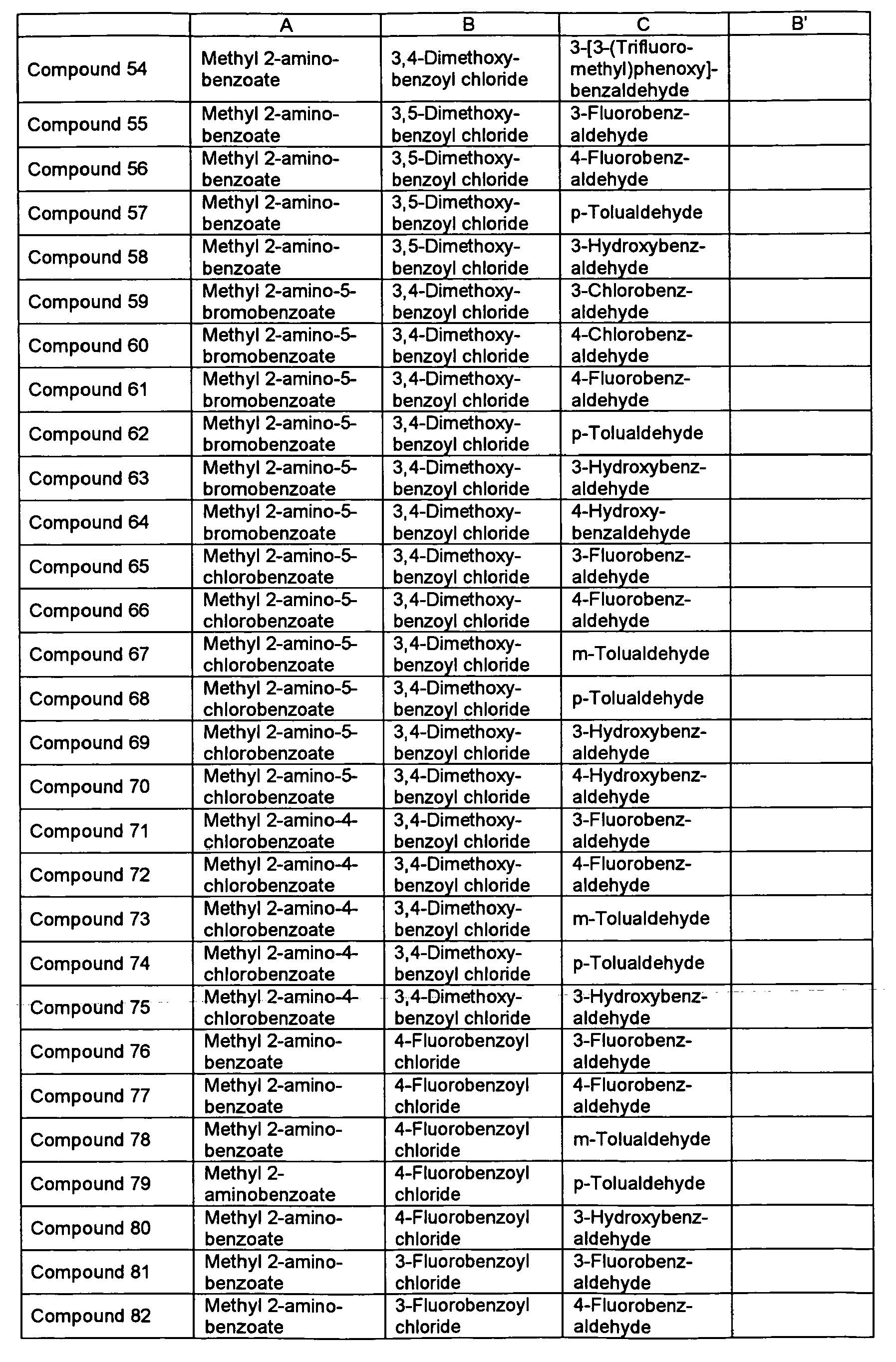


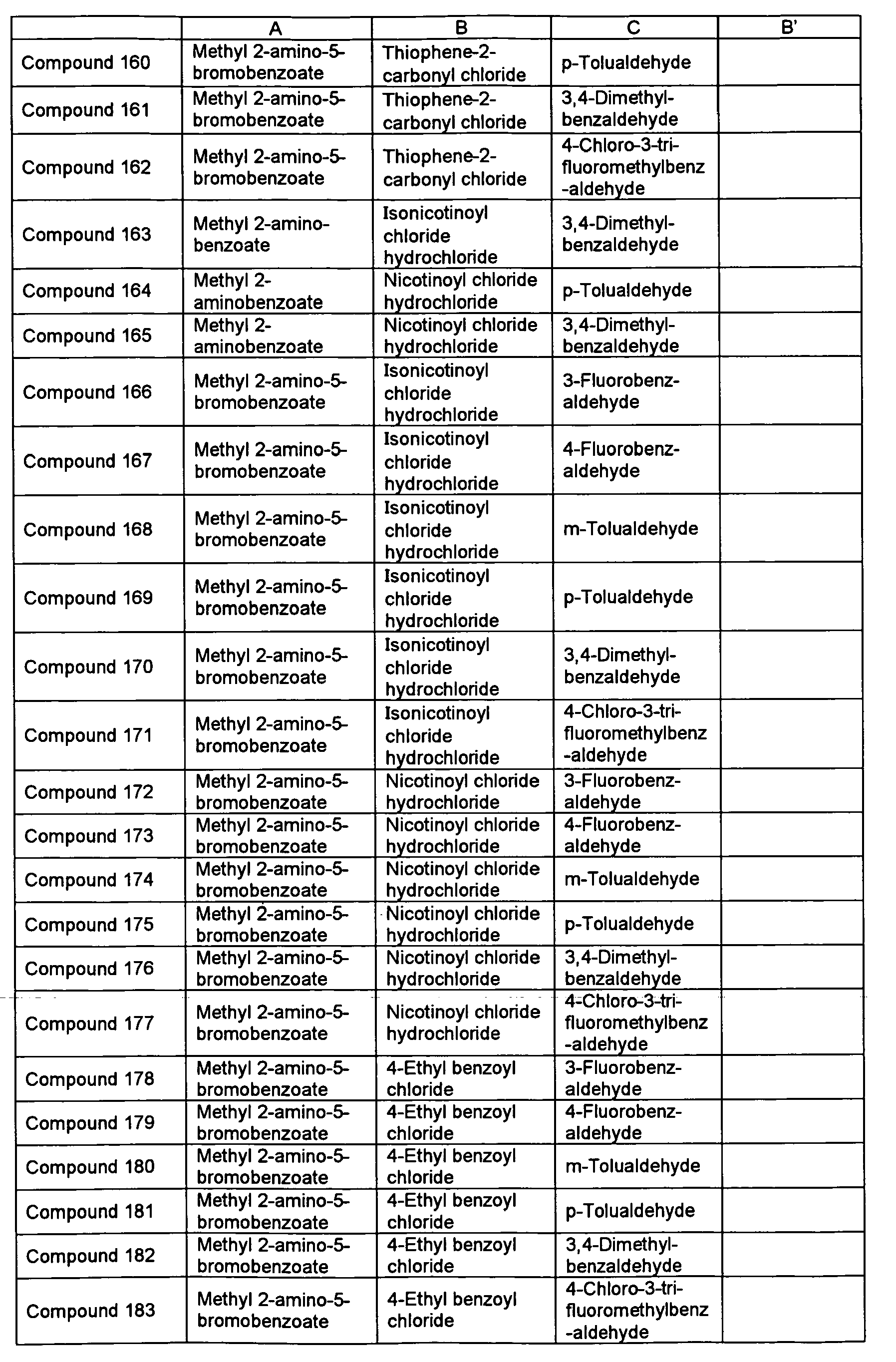


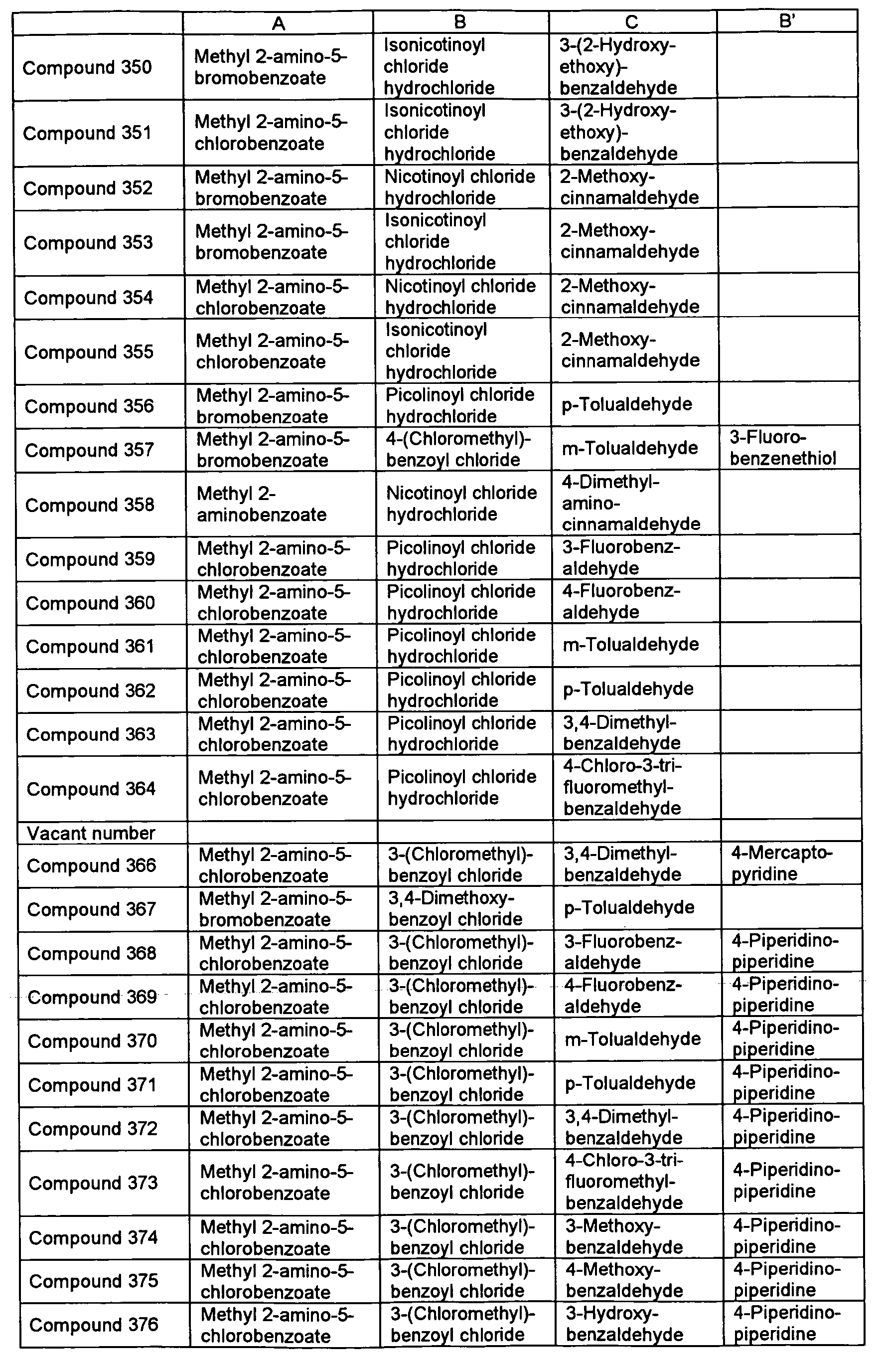


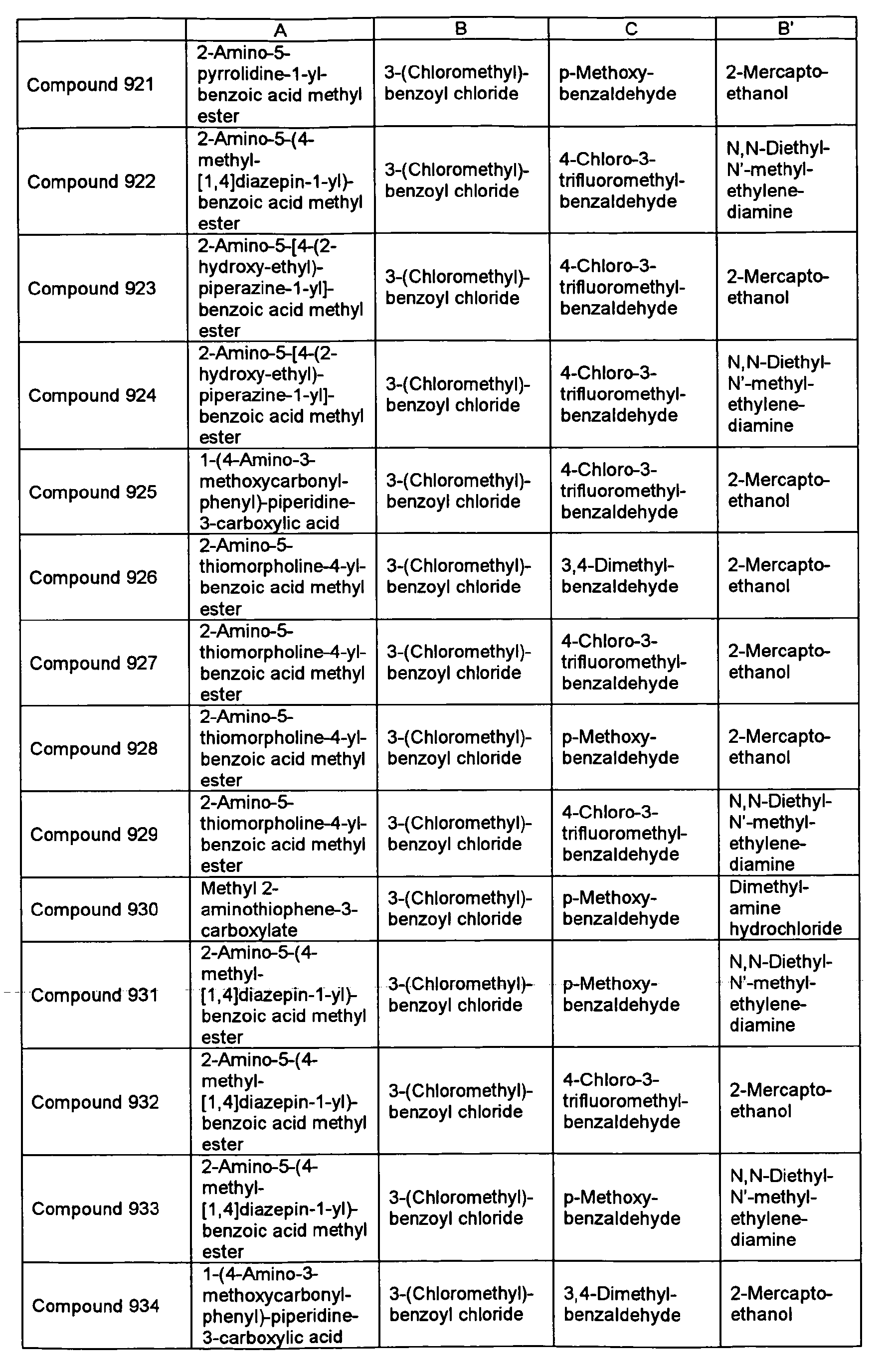


- Starting compounds and reaction paths used in the synthesis of compounds corresponding to compounds A in synthesizing compounds 853, 854, 857 to 929, 931 to 942, 944 to 948, 958 to 973, 985 to 990, 1013 to 1055, and 1057 to 1076 are shown in Table 2. In the table, compounds A', D, and E correspond to compounds described in Examples and schemes A to H.


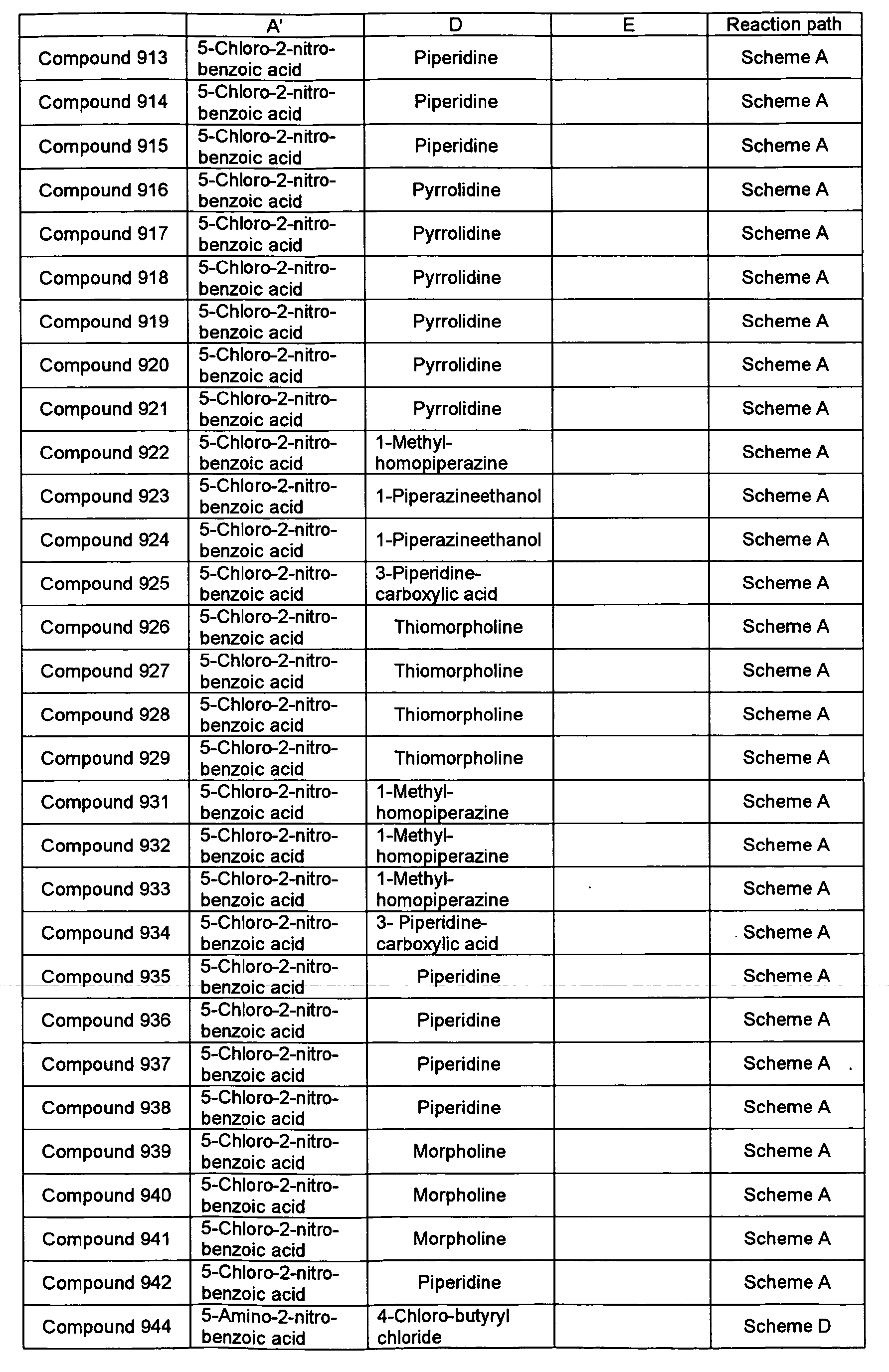


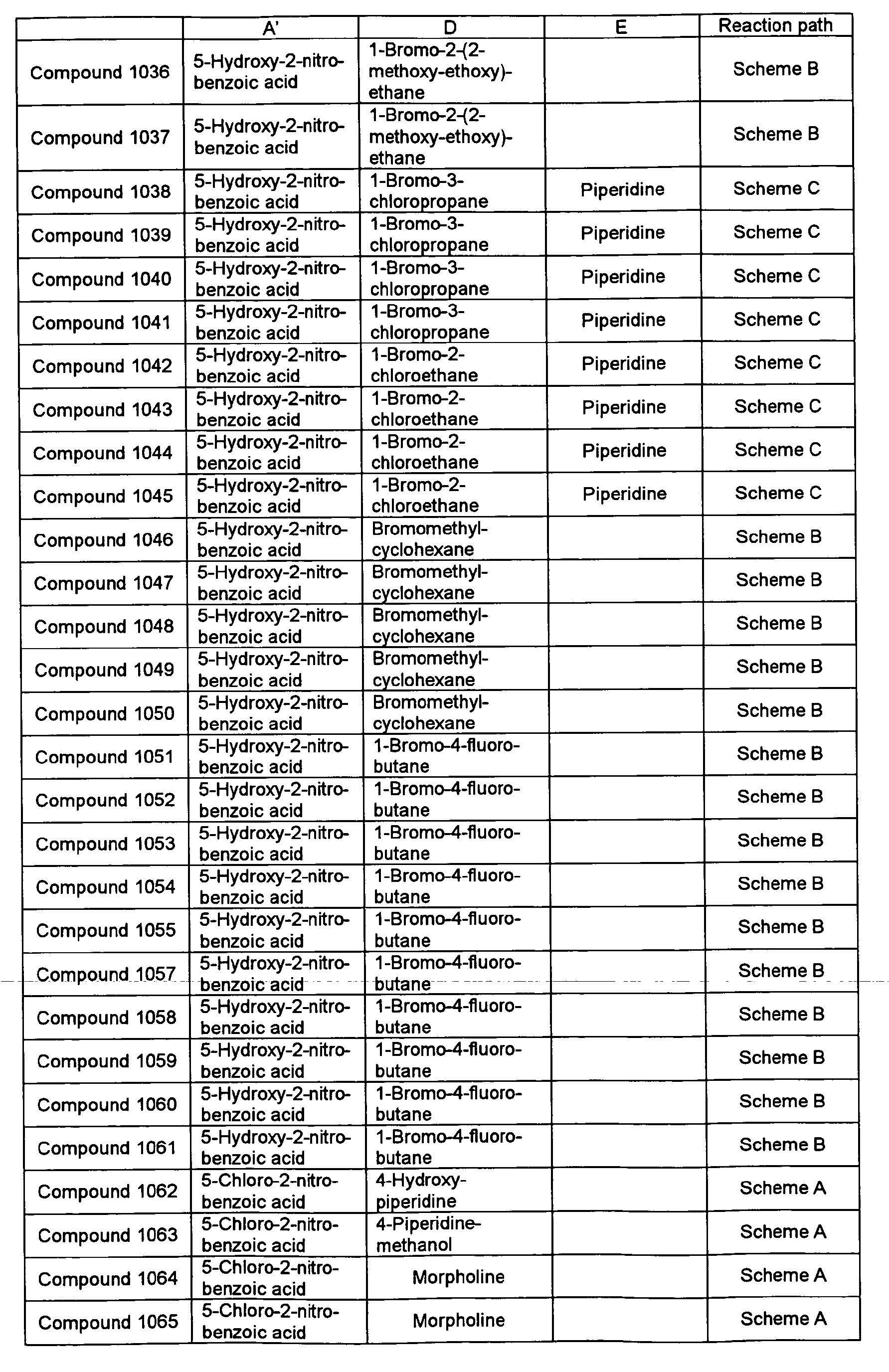


- Structures of compounds 1 to 1077 are shown in Table 3.


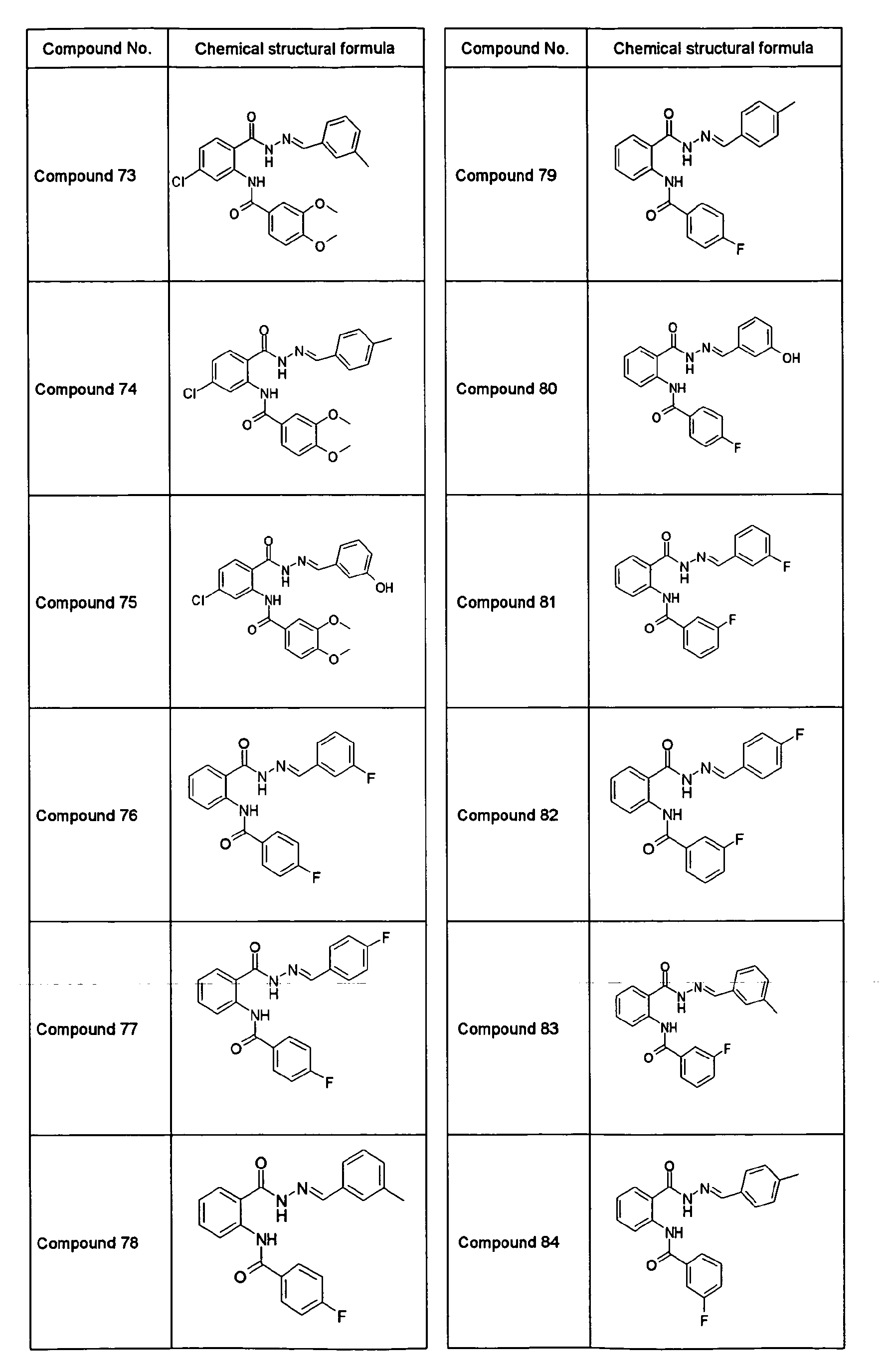

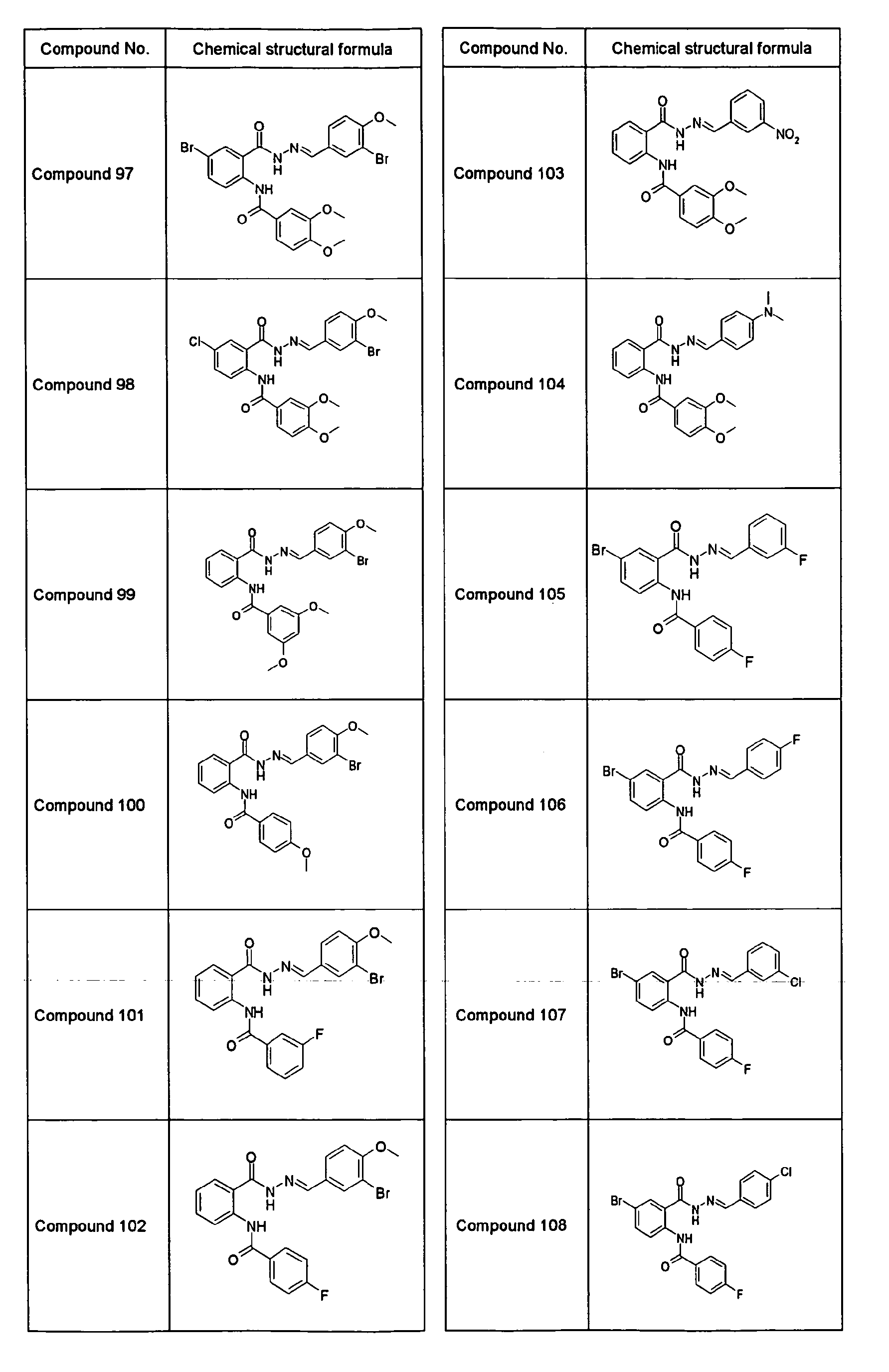


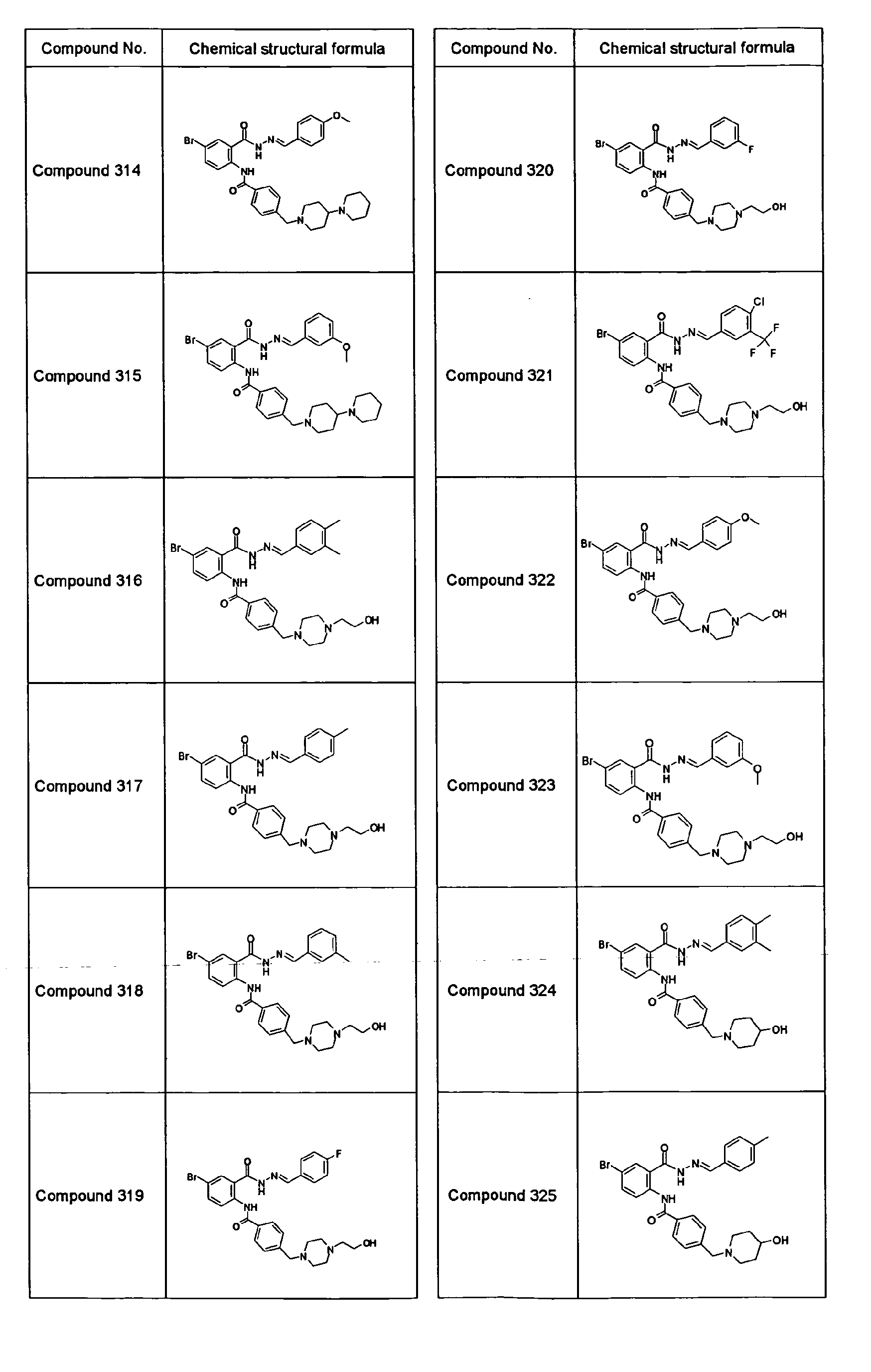


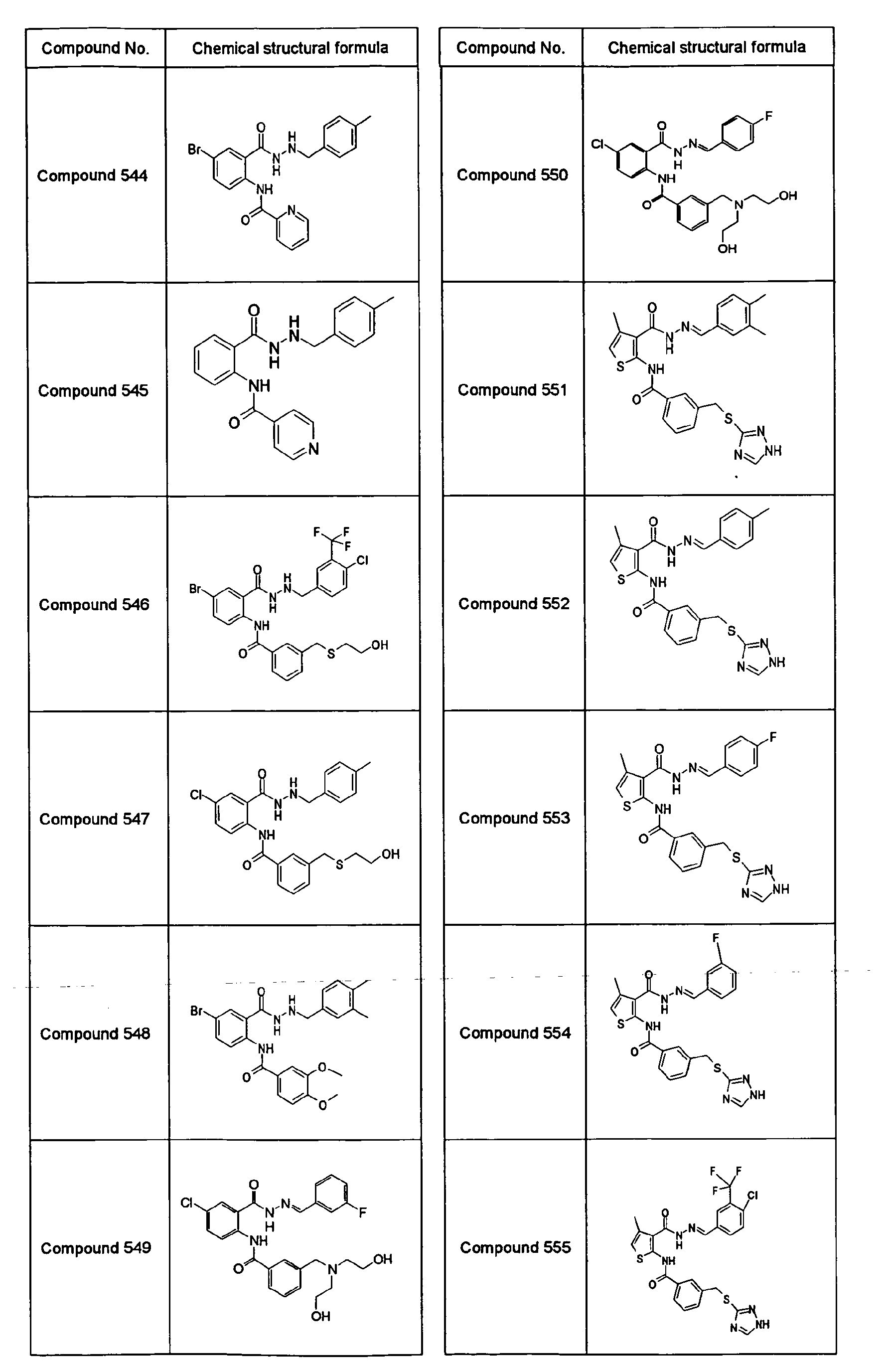


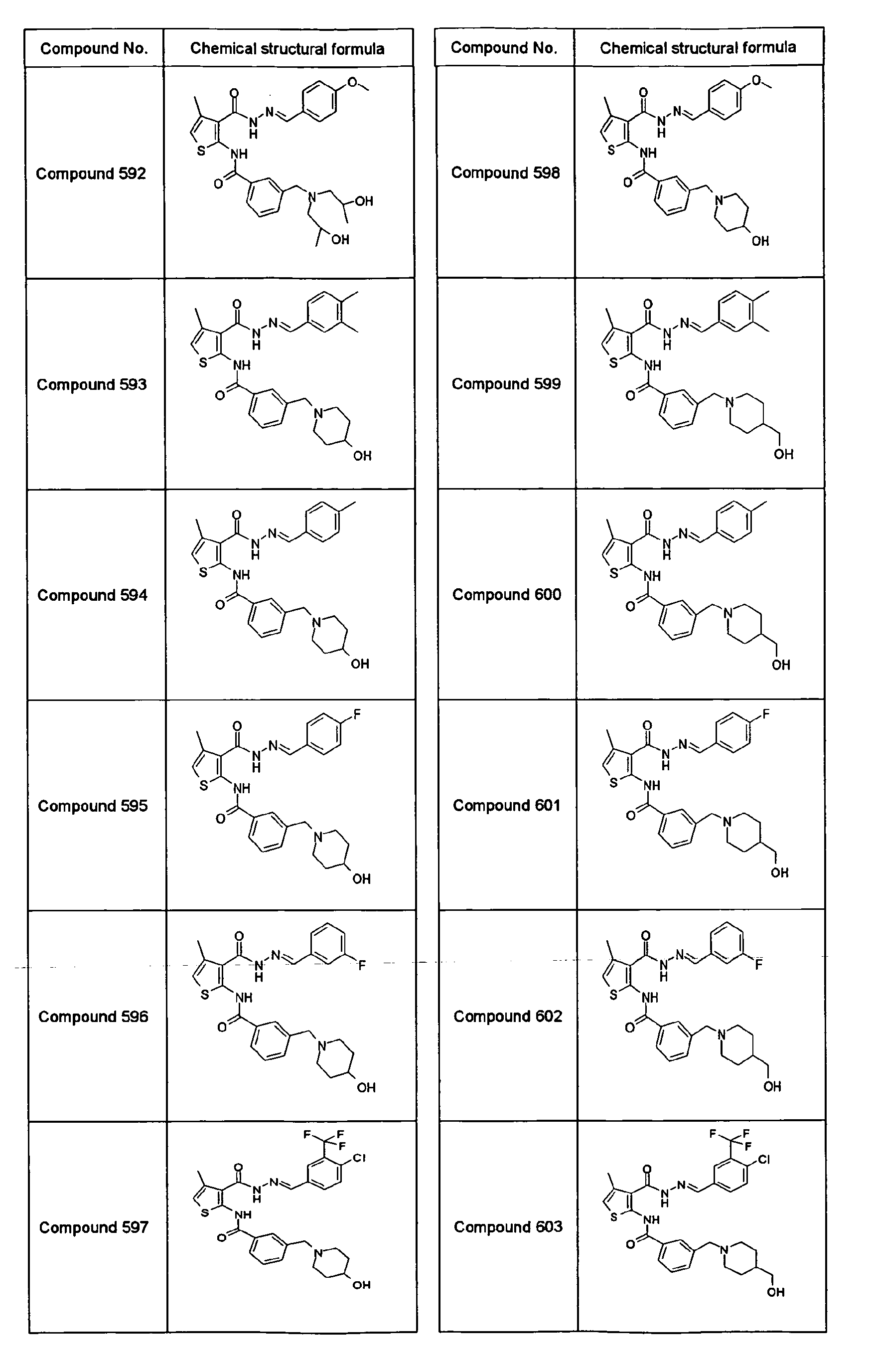


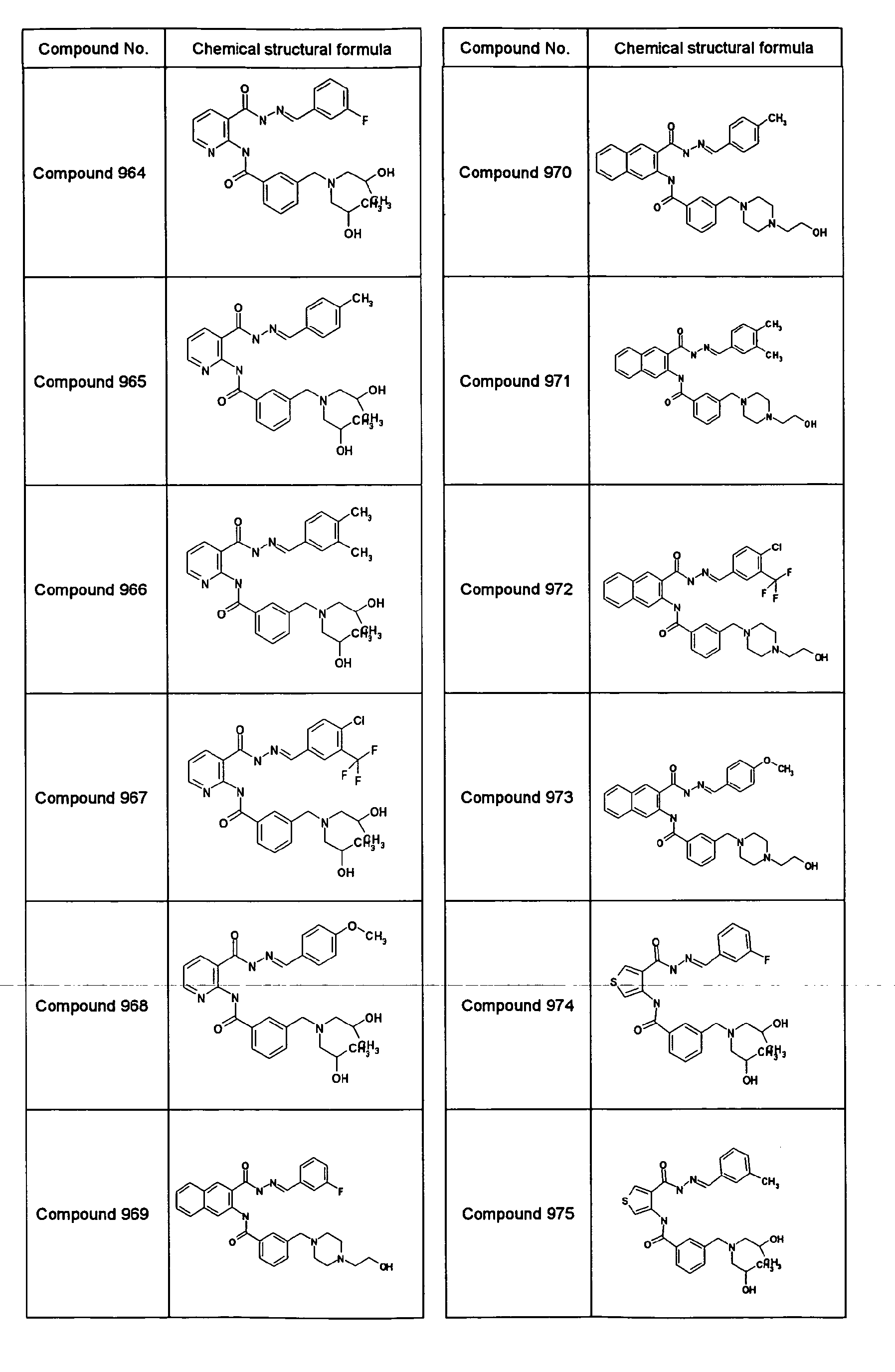
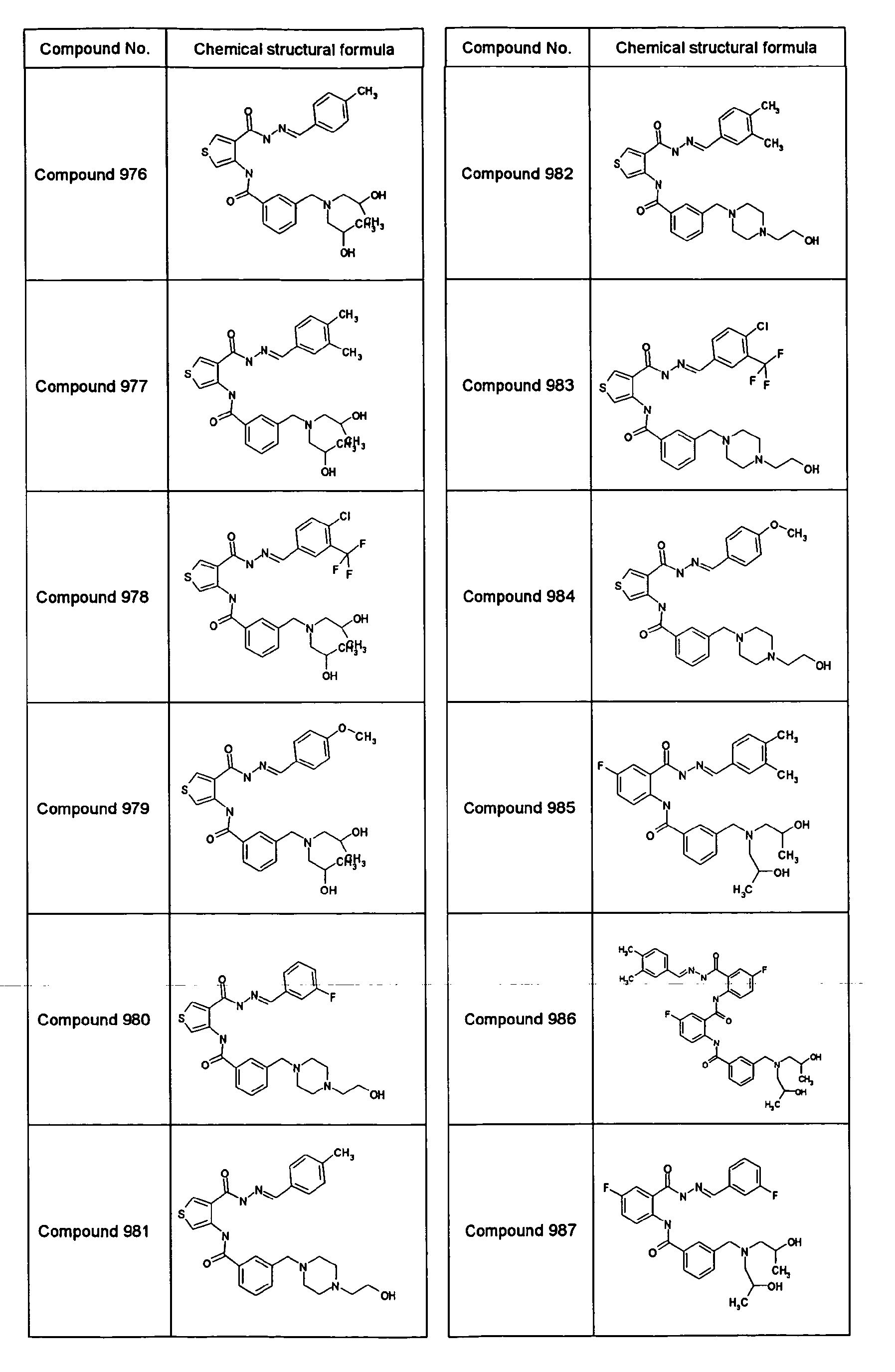


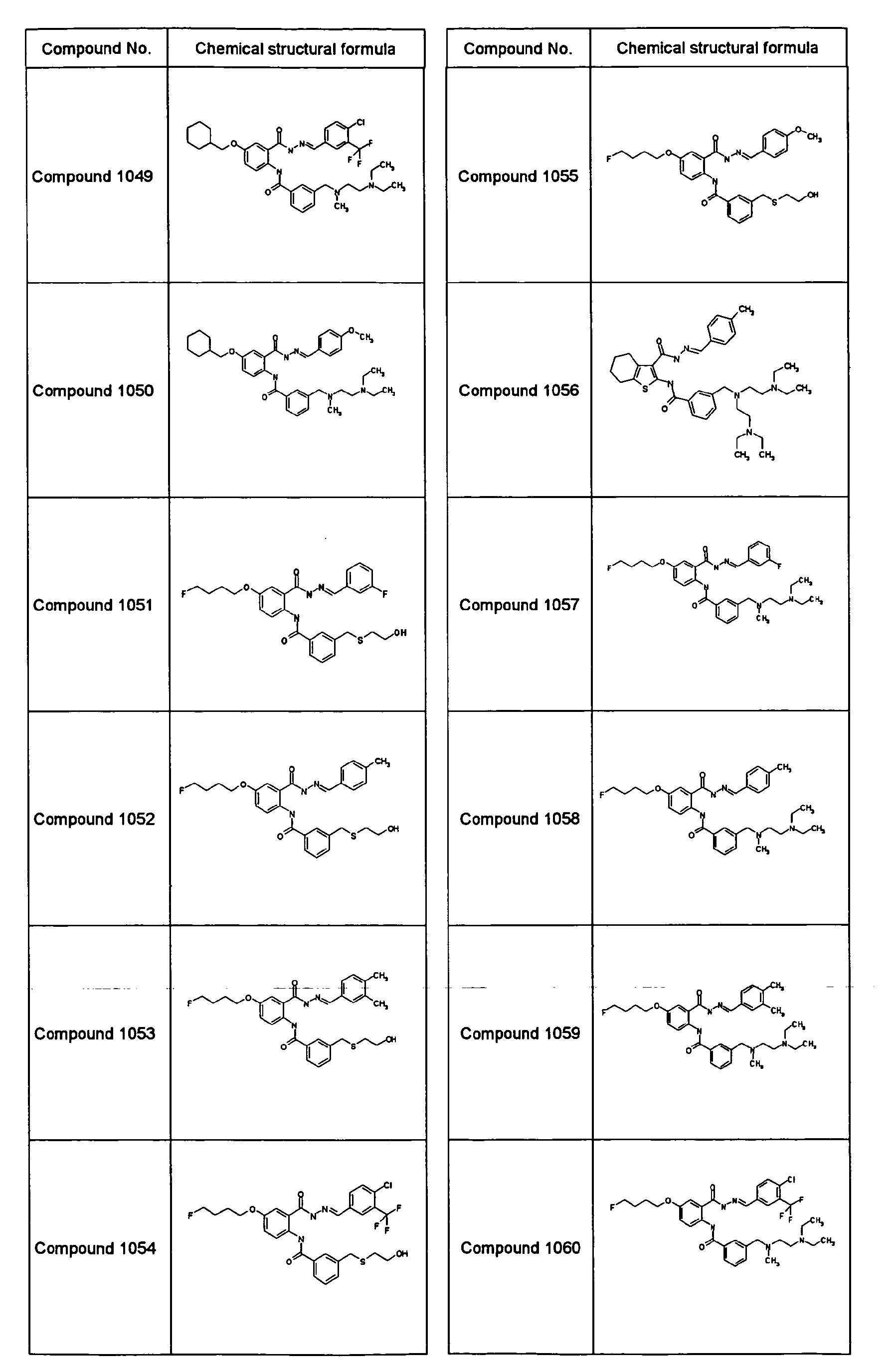


- Degenerate primers were prepared from sequences of mouse NaPi-2b disclosed in Hilfiker H. et al., Pro Natl Acad Sci USA, 95 (24): 14564-14569, 1988 and sequences of human and rat NaPi-2a disclosed in Magagnin S. et al., Proc Natl Aca Sci USA, 90 (13): 5979-5983, 1993. RNA was extracted from the rat small intestine using ISOGEN; manufactured by NIPPON GENE CO., LTD (Japan). 400 bp gene fragments were obtained by PCR using, as a template, a cDNA library prepared with a cDNA synthesis kit (manufactured by STRATAGENE (US)). Thereafter, the above rat small intestine cDNA library was screened using the gene fragment as a probe, and the whole gene sequence of rat NaPi-2b was cloned. cRNA was synthesized from the cloned rat NaPi-2b cDNA with a cRNA synthesis kit (manufactured by Ambion (US)). The synthesized cRNA was injected into Xenopus oocytes (obtained from COPACETIC (Japan)) with a liquid microinjector (manufactured by Drummond (US)) and was cultured for 2 days to express rat NaPi-2b. Thereafter, for a group of derivatives, phosphate uptake inhibitory activity were measured using the Xenopus oocytes with 32P radioactive phosphorus (manufactured by Daiichi Kagaku Inc. (Japan)). As a result, it was found that these compounds had inhibitory activity with IC50 values as shown in Table 4. IC50 values were determined by determining an inhibition curve by an approximation formula using the least square from inhibitory activity values obtained from five concentration levels of the compound and determining the concentration of the compound which exhibits 50% of the maximum inhibitory activity. The inhibitory activity for 300 µM and 100 µM was determined from the same inhibition curve and expressed in percentage inhibition (%) in Table 5.


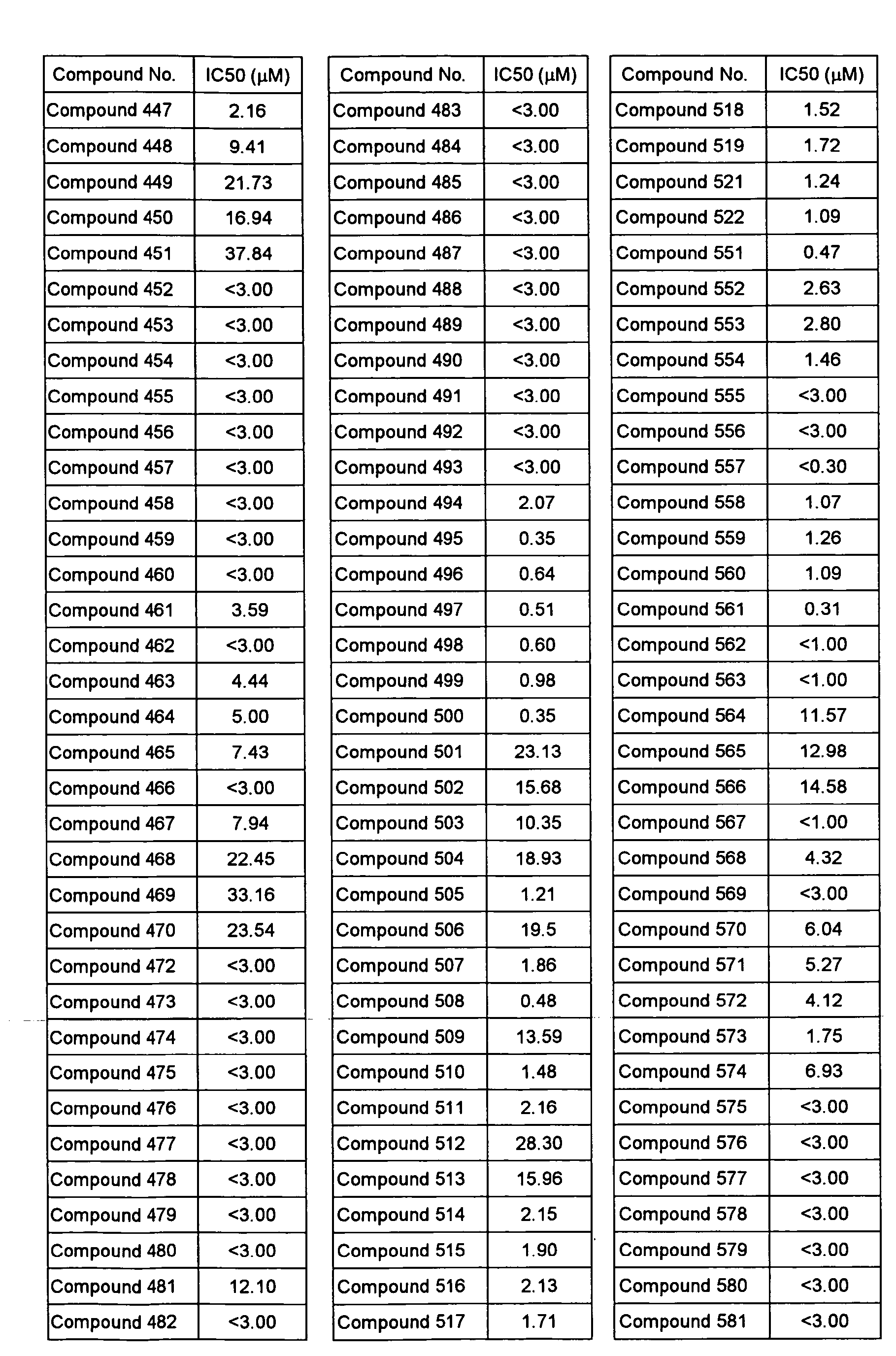


- Jejunal epithelium was obtained from New Zealand white male rabbits (7 weeks old, obtained from KITAYAMA LABES Co., Ltd. (Japan)), and brush border membrane vesicles were isolated by the calcium precipitation method described in Kanako Katai et al., J. Biochem. 121, 50-55, 1997, and Peerce B.E. et al., Biochemistry 26, 4272-4279, 1987. Thereafter, for compound 29 and compound 68, the phosphate uptake inhibitory activity was measured using the same samples with 32P radioactive phosphorus (manufactured by Daiichi Kagaku Inc. (Japan)) by the rapid filtration method described in Kanako Katai et al., J. Biochem. 121, 50-55, 1997. As a result, these compounds had concentration-dependent inhibitory activity (Fig. 1). Further, in the same experiment, nonspective inhibitory activity against glucose absorption was determined using 14C-glucose (manufactured by Moravek Biochemical Inc. (US)). As a result, these compounds did not have the inhibitory activity (Fig. 2). In both the experiments, a group with the addition of potassium chloride was used as a negative control for nonspecific uptake. All the test results given below were expressed in terms of average value ± standard error. Student's t-test was used for a significant test of the control group and the test compound group.
- cDNA of human NaPi-2a described in Magagnin S. et al., Proc Natl Aca Sci USA, 90 (13): 5979-5983, 1993 was cloned by PCR. In the same manner as in Pharmacological Test Example 1, NaPi-2a was expressed in Xenopus oocytes, and the phosphate uptake inhibitory activity was measured with 32P radioactive phosphorus. As a result, compound 1 had concentration-dependent inhibitory activity against NaPi-2a (Fig. 3). Compound 29 had inhibitory activity against not only NaPi-2b but also NaPi-2a (Fig. 4). In the test, a group with the addition of choline chloride (Choline Cl) was used as a negative control for nonspecific uptake, and PFA (phosphonoformic acid) was used as a positive control for phosphate transport inhibition.
- Further, the compounds according to the present invention had inhibitory activity with IC50 values shown in Table 6. IC50 values were determined by determining an inhibition curve by an approximation formula using the least square from inhibitory activity values obtained from five concentration levels of the compound and determining the concentration of the compound which exhibits 50% of the maximum inhibitory activity.


- SD rats (6 to 7 weeks old, obtained from Charles River Japan, Inc. (Japan)) were raised with low-phosphorus diet (phosphorus content 0.1 %, manufactured by Oriental Yeast Co., Ltd. (Japan)) for 3 to 4 days and then fasted for about 24 hr for experiment. 32P was diluted with purified water or liquid feed (CLEA JAPAN INC. (Japan)) to 0.7 to 3.5 MBq/ml and was forcibly orally administered at a dose of 5 ml/kg (administered into the gaster through an oral probe). The compounds or media were forcibly orally administered at a dose of 5 ml/kg (divided dose of twice), 30 min before the administration of 32P and simultaneously with the administration of 32P. Blood was collected from caudal artery 30 min, 45 min, or 60 min after 32P administration, and blood 32P radioactivity was measured with a liquid scintillation counter. Inhibition of an increase in blood radioactivity was used as a measure of inhibition of phosphate absorption from the intestinal tract.
- The results are expressed in terms of the percentage inhibition determined by the following equation.
(Blood radioactivity for group with the administration of medium - Blood radioactivity for group with the administration of compound)/(Blood radioactivity for group with the administration of medium) x 100 - t-Test was used for a significant test of the average value difference of blood radioactivity.
- The results are shown in Table 7. As is apparent from the table, the compounds significantly inhibited phosphate absorption from the intestinal tract.
Table 7: Inhibitory activity against 32P absorption from intestinal tract Compound Dose, mg/kg Blood radioactivity inhibition, % 91 320 28.3 92 160 25.5 88 400 29.1 163 360 57.8 130 270 22.8 157 320 20.7 164 400 55.0 165 400 27.6 252 400 29.2 253 400 39.0 254 400 68.4 315 100 42.4 372 100 63. 7 285 80 60.3 - For all the compounds, a significant difference was observed as compared with the group with the administration of medium at p < 0.05.
wherein
R6 and R7, which may be the same or different, represent a hydrogen atom, C1-6 alkyl, C2-6 alkenyl, C2-6 alkynyl, aryl, aryl C1-6 alkyl, aryl C2-6 alkenyl, or a heterocyclic group, and the C1-6 alkyl, aryl, aryl C1-6 alkyl, aryl C2-6 alkenyl, and heterocyclic groups, which may be the same or different, are optionally substituted by:
R17 represents a hydrogen atom,
R101 and R102 together represent =O, and R103 and R104 represent a hydrogen atom, or R101 and R104 together represent a bond, and R102 and R103 together represent a bond.
more preferably,
when D, E, J, L, or M represents a nitrogen atom, R8, R9, R10, R11, and R12 each are absent, or otherwise together with a nitrogen atom may form N-oxide (N → O).
wherein
wherein
R6 represents a hydrogen atom or C1-6 alkyl,
R7 represents optionally substituted aryl, optionally substituted aryl C1-6 alkyl, optionally substituted aryl C2-6 alkenyl, or optionally substituted saturated or unsaturated five- or six-membered heterocyclic group, and
R17 represents a hydrogen atom.
R5 represents formula (IIIb) or formula (IIIc)
wherein
wherein Q, X1, and R13 are as defined above, or a group of formula (V)
wherein X2, X3, R14, and R15 are as defined above, and the others represent a hydrogen atom,
Z represents group (A), group (B), or group (C):
wherein
R6 represents a hydrogen atom or C1-6 alkyl,
R7 represents optionally substituted aryl, optionally substituted aryl C1-6 alkyl, optionally substituted aryl C2-6 alkenyl, or optionally substituted saturated or unsaturated five- or six-membered heterocyclic group, and
R17 represents a hydrogen atom.
wherein
Z represents group (A), group (B), or group (C):
wherein
R6 represents a hydrogen atom or C1-6 alkyl,
R7 represents optionally substituted aryl, optionally substituted aryl C1-6 alkyl, optionally substituted aryl C2-6 alkenyl, or optionally substituted saturated or unsaturated five- or six-membered heterocyclic group, and
R17 represents a hydrogen atom.
R5 represents formula (IIIb) or formula (IIIc)
wherein
Z represents group (A), group (B), or group (C):
wherein
R6 represents a hydrogen atom or C1-6 alkyl,
R7 represents optionally substituted aryl, optionally substituted aryl C1-6 alkyl, optionally substituted aryl C2-6 alkenyl, or optionally substituted saturated or unsaturated five- or six-membered heterocyclic group, and
R17 represents a hydrogen atom.
R5 represents formula (IIIa)
wherein
Z represents group (A), group (B), or group (C):
wherein
R6 represents a hydrogen atom or C1-6 alkyl,
R7 represents optionally substituted aryl, optionally substituted aryl C1-6 alkyl, optionally substituted aryl C2-6 alkenyl, or optionally substituted saturated or unsaturated five- or six-membered heterocyclic group, and
R17 represents a hydrogen atom.
R5 represents formula (IIIb) or formula (IIIc)
wherein
Z represents group (A), group (B), or group (C):
wherein
R6 represents a hydrogen atom or C1-6 alkyl,
R7 represents optionally substituted aryl, optionally substituted aryl C1-6 alkyl, optionally substituted aryl C2-6 alkenyl, or optionally substituted saturated or unsaturated five- or six-membered heterocyclic group, and
R17 represents a hydrogen atom.
Z represents group (A), group (B), or group (C):
wherein
R6 represents a hydrogen atom or C1-6 alkyl,
R7 represents optionally substituted aryl, optionally substituted aryl C1-6 alkyl, optionally substituted aryl C2-6 alkenyl, or optionally substituted saturated or unsaturated five- or six-membered heterocyclic group, and
R17 represents a hydrogen atom.
Z represents group (A), group (B), or group (C):
wherein
R6 represents a hydrogen atom or C1-6 alkyl,
R7 represents optionally substituted aryl, optionally substituted aryl C1-6 alkyl, optionally substituted aryl C2-6 alkenyl, or optionally substituted saturated or unsaturated five- or six-membered heterocyclic group, and
R17 represents a hydrogen atom.
R5 represents formula (IIIa)
wherein
Z represents group (A), group (B), or group (C):
wherein
R6 represents a hydrogen atom or C1-6 alkyl,
R7 represents optionally substituted aryl, optionally substituted aryl C1-6 alkyl, optionally substituted aryl C2-6 alkenyl, or optionally substituted saturated or unsaturated five- or six-membered heterocyclic group, and
R17 represents a hydrogen atom.
R5 represents formula (IIIb) or formula (IIIc)
wherein
Z represents group (A), group (B), or group (C):
wherein
R6 represents a hydrogen atom or C1-6 alkyl,
R7 represents optionally substituted aryl, optionally substituted aryl C1-6 alkyl, optionally substituted aryl C2-6 alkenyl, or optionally substituted saturated or unsaturated five- or six-membered heterocyclic group, and
R17 represents a hydrogen atom.
R5 represents formula (IIIa)
wherein
Z represents group (A), group (B), or group (C):
wherein
R6 represents a hydrogen atom or C1-6 alkyl,
R7 represents optionally substituted aryl, optionally substituted aryl C1-6 alkyl, optionally substituted aryl C2-6 alkenyl, or optionally substituted saturated or unsaturated five- or six-membered heterocyclic group, and
R17 represents a hydrogen atom.
R5 represents formula (IIIb) or formula (IIIc)
wherein
Z represents group (A), group (B), or group (C):
wherein
R6 represents a hydrogen atom or C1-6 alkyl,
R7 represents optionally substituted aryl, optionally substituted aryl C1-6 alkyl, optionally substituted aryl C2-6 alkenyl, or optionally substituted saturated or unsaturated five- or six-membered heterocyclic group, and
R17 represents a hydrogen atom.
R5 represents formula (IIIa)
wherein
Z represents group (A), group (B), or group (C):
wherein
R6 represents a hydrogen atom or C1-6 alkyl,
R7 represents optionally substituted aryl, optionally substituted aryl C1-6 alkyl, optionally substituted aryl C2-6 alkenyl, or optionally substituted saturated or unsaturated five- or six-membered heterocyclic group, and
R17 represents a hydrogen atom.
R5 represents formula (IIIb) or formula (IIIc)
wherein
Z represents group (A), group (B), or group (C):
wherein
R6 represents a hydrogen atom or C1-6 alkyl,
R7 represents optionally substituted aryl, optionally substituted aryl C1-6 alkyl, optionally substituted aryl C2-6 alkenyl, or optionally substituted saturated or unsaturated five- or six-membered heterocyclic group, and
R17 represents a hydrogen atom.
Z represents group (A), group (B), or group (C):
wherein
R6 represents a hydrogen atom or C1-6 alkyl,
R7 represents optionally substituted aryl, optionally substituted aryl C1-6 alkyl, optionally substituted aryl C2-6 alkenyl, or optionally substituted saturated or unsaturated five- or six-membered heterocyclic group, and
R17 represents a hydrogen atom.
Z represents group (A), group (B), or group (C):
wherein
R6 represents a hydrogen atom or C1-6 alkyl,
R7 represents optionally substituted aryl, optionally substituted aryl C1-6 alkyl, optionally substituted aryl C2-6 alkenyl, or optionally substituted saturated or unsaturated five- or six-membered heterocyclic group, and
R17 represents a hydrogen atom.
when the carbocyclic moiety and the heterocyclic moiety are substituted by two (c) C1-6 alkyl groups, they together may form a C3-5 alkylene chain,
R5 represents C1-6 alkyl, aryl, C1-6 alkoxy, aryloxy, C1-6 alkylamino, arylamino, C1-6 alkylthio, arylthio, C3-7 cycloalkyl, or a heterocyclic group, and the C1-6 alkyl, aryl, C1-6 alkoxy, aryloxy, C1-6 alkylamino, arylamino, C1-6 alkylthio, arylthio, C3-7 cycloalkyl, or heterocyclic group represented by R5 may be the same or different, and is optionally substituted by
Z represents group A or group B wherein R6, R7, and R17 are as defined in formula (I),
R101 and R102 together represent =O, and R103 and R104 represent a hydrogen atom, or R101 and R104 together represent a bond, and R102 and R103 together represent a bond.
Claims (96)
- A compound represented by formula (I) or a pharmaceutically acceptable salt or solvate thereof:

wherein
A represents a five- to nine-membered unsaturated carbocyclic moiety or a five- to nine-membered unsaturated heterocyclic moiety, and ---- represents a single bond or a double bond,
the carbocyclic moiety and heterocyclic moiety represented by A are optionally substituted by(a) a halogen atom;(b) hydroxyl;(c) C1-6 alkyl;(d) C1-6 alkoxy;(e) aryl;(f) aryloxy;(g) arylthio;(h) alkylthio;(i) nitro;(j) amino;(k) mono- or di-arylamino;(I) mono- or di-C1-6 alkylamino;(m) C2-6 alkenyl;(n) C2-6 alkenyloxy;(o)C2-6 alkenylthio;(p) mono- or di-C2-6 alkenylamino;(q) carboxyl; or(r) C1-6 alkyl- or aryl-oxycarbonyl;(c) the C1-6 alkyl group, (d) the C1-6 alkoxy group, (e) the aryl group, (f) the aryloxy group, (g) the arylthio group, (h) the alkylthio group, (m) the C2-6 alkenyl group, (n) the C2-6 alkenyloxy group, and (o) the C2-6 alkenylthio group are optionally substituted by (1) hydroxyl, (2) thiol, (3) amino, (4) C1-6 alkoxy, (5) C1-6 alkylthio, (6) C1-6 alkylsulfonyl, (7) mono-or di-C1-6 alkylamino in which the di-C1-6 alkylamino group may form cyclic amino optionally containing 1 to 3 heteroatoms, (8) aryloxy, (9) arylthio, (10) arylsulfonyl, (11) aryl, (12) a heterocyclic group, (13) a halogen atom, (14) arylamino in which the amino group is optionally substituted by C1-6 alkyl, and the aryl group is optionally substituted by halogen, C1-6 alkyl, C1-6 alkoxy, or C1-6 alkylamino, (15) C1-6 alkoxy-(CH2CH2O)m wherein m is an integer of 1 to 6, (16) carboxyl, (17) an oxygen atom (=O), or (18) C3-7 cycloalkyl,the aryl moiety in (k) the mono- or di-arylamino group is optionally substituted by (1) hydroxyl, (2) thiol, (3) amino, (4) C1-6 alkoxy, (5) C1-6 alkylthio, (6) C1-6 alkylsulfonyl, (7) mono- or di-C1-6 alkylamino in which the di-C1-6 alkylamino group may form cyclic amino optionally containing 1 to 3 heteroatoms, (8) aryloxy, (9) arylthio, (10) arylsulfonyl, (11) aryl, (12) a heterocyclic group, (13) a halogen atom, (14) arylamino in which the amino group is optionally substituted by C1-6 alkyl, and the aryl group is optionally substituted by halogen, C1-6 alkyl, C1-6 alkoxy, or C1-6 alkylamino, (15) C1-6 alkoxy-(CH2CH2O)m wherein m is an integer of 1 to 6, (16) carboxyl, (17) an oxygen atom (=O), or (18) C3-7 cycloalkyl, and, in the case of the mono-arylamino group, the amino group is optionally substituted by C1-6 alkyl optionally substituted by hydroxyl or a halogen atom,
in (l) the mono- or di-C1-6 alkylamino, the di-C1-6 alkyl group may form cyclic amino optionally containing 1 to 3 heteroatoms, and one or two alkyl groups on the amino group and the cyclic amino moiety are optionally substituted by a halogen atom; C1-6 alkyl optionally substituted by hydroxyl, a halogen atom, or aryl optionally substituted by a halogen atom, C1-6 alkyl, or C1-6 alkyloxy, a heterocyclic group optionally substituted by a halogen atom, C1-6 alkyl, or C1-6 alkyloxy, and, when one or two alkyl groups on the amino group and the cyclic amino moiety are substituted by two C1-6 alkyl groups, they together may form C3-7 cycloalkyl; C1-6 alkoxy; C1-6 alkylthio; mono- or di-C1-6 alkylamino in which the di-C1-6 alkylamino group may form cyclic amino optionally containing 1 to 3 heteroatoms, and one or two C1-6 alkyl groups on the amino group and the cyclic amino moiety are optionally substituted by hydroxyl or a halogen atom; arylamino in which the amino group is optionally substituted by C1-6 alkyl; mono- or di-C1-6 alkylcarbamoylmethyl in which the di-C1-6 alkylamino group may form cyclic amino optionally containing 1 to 3 heteroatoms, and one or two alkyl groups on the amino group and the cyclic amino moiety are optionally substituted by hydroxyl; aryloxy; arylthio; an oxygen atom (=O); hydroxyl; carboxyl; C1-6 alkoxy- or aryloxy-carbonyl; C1-6 alkylcarbonyl; aryl optionally substituted by a halogen atom or hydroxyl; or a heterocyclic group,
in (p) the mono- or di-C2-6 alkenylamino group, the amino group of the monoalkenylamino group is optionally substituted by C1-6 alkyl optionally substituted by hydroxyl or a halogen atom, and the di-C2-6 alkenyl together may form unsaturated cyclic amino optionally containing 1 to 3 heteroatoms, and one or two alkenyl groups on the amino group or the unsaturated cyclic amino moiety are optionally substituted by a halogen atom; C1-6 alkyl optionally substituted by hydroxyl, a halogen atom, aryl optionally substituted by a halogen atom, C1-6 alkyl, or C1-6 alkyloxy, a heterocyclic group optionally substituted by a halogen atom, C1-6 alkyl, or C1-6 alkyloxy, and, when one or two alkyl groups on the amino group and the cyclic amino moiety are substituted by two C1-6 alkyl groups, they together may form C3-7 cycloalkyl; C1-6 alkoxy; C1-6 alkylthio; mono- or di-C1-6 alkylamino in which the di-C1-6 alkylamino group may form cyclic amino optionally containing 1 to 3 heteroatoms, and one or two C1-6 alkyl groups on the amino group and the cyclic amino moiety are optionally substituted by hydroxyl or a halogen atom; arylamino in which the amino group is optionally substituted by C1-6 alkyl; mono- or di-C1-6 alkylcarbamoylmethyl in which the di-C1-6 alkylamino group may form cyclic amino optionally containing 1 to 3 heteroatoms, and one or two alkyl groups on the amino group and the cyclic amino moiety are optionally substituted by hydroxyl; aryloxy; arylthio; an oxygen atom (=O); hydroxyl; carboxyl; C1-6 alkoxy- or aryloxy-carbonyl; C1-6 alkylcarbonyl; aryl optionally substituted by a halogen atom or hydroxyl; or a heterocyclic group,
when the carbocyclic moiety and hetrocyclic moiety represented by A are substituted by two (c) C1-6 alkyl groups or (m) C2-6 alkenyl groups, the alkyl or alkenyl groups together with the carbon atoms to which they are respectively attached may form an unsaturated five- to seven-membered carbocyclic ring,
R5 represents C1-6 alkyl, aryl, C1-6 alkoxy, aryloxy, C1-6 alkylamino, arylamino, C1-6 alkylthio, arylthio, C3-7 cycloalkyl, or a heterocyclic group, and the C1-6 alkyl, aryl, C1-6 alkoxy, aryloxy, C1-6 alkylamino, arylamino, C1-6 alkylthio, arylthio, C3-7 cycloalkyl, or heterocyclic group represented by R5 may be the same or different, and is optionally substituted by(I) a halogen atom;(II) C1-6 alkyl optionally containing a substituent selected from the group consisting of (1) hydroxyl, (2) thiol, (3) amino, (4) C1-6 alkoxy, (5) C1-6 alkylthio, (6) C1-6 alkylsulfinyl, (7) C1-6 alkylsulfonyl, (8) mono- or di-C1-6 alkylamino, (8') amino substituted by a heterocyclic group optionally substituted by C1-6 alkyl, (9) C1-6 alkylcarbonyloxy, (10) C1-6 alkylcarbonylthio, (11) C1-6 alkylcarbonylamino, (12) aryloxy, (13) arylthio, (14) arylsulfinyl, (15) arylsulfonyl, (16) arylamino, (17) C1-6 alkyl- or aryl-sulfonylamino, (18) C1-6 alkyl- or aryl-ureido, (19) C1-6 alkoxy- or aryloxy-carbonylamino, (20) C1-6 alkylamino- or arylamino-carbonyloxy, (21) carboxyl, (22) nitro, (23) a heterocyclic group, (23') Het-S(=O)j-wherein Het represents a heterocyclic group, j is 0, 1, or 2, and Het is optionally substituted by alkyl optionally substituted by mono- or di-C1-6 alkylamino in which the di-C1-6 alkylamino group may form cyclic amino optionally containing 1 to 3 heteroatoms and one or two alkyl groups on the amino group and the cyclic amino moiety are optionally substituted by hydroxyl, (24) cyano, and (25) a halogen atom,
wherein the alkyl moiety in (4) the C1-6 alkoxy group, (5) the C1-6 alkylthio group, (6) the C1-6 alkylsulfinyl group, and (7) the C1-6 alkylsulfonyl group is optionally substituted by a halogen atom; C1-6 alkyl; C1-6 alkoxy; C1-6 alkylthio; mono- or di-C1-6 alkylamino in which the di-C1-6 alkylamino group may form cyclic amino optionally containing 1 to 3 heteroatoms; aryloxy; arylthio; hydroxyl; carboxyl; -S(=O)2(-OH); C1-6 alkoxy- or aryloxy-carbonyl; C1-6 alkylcarbonyl; aryl; or a heterocyclic group optionally substituted by alkyl optionally substituted by mono- or di-C1-6 alkylamino in which the di-C1-6 alkylamino group may form cyclic amino optionally containing 1 to 3 heteroatoms, and one or two alkyl groups on the amino group and cyclic amino moiety are optionally substituted by hydroxy, and
in (8) the mono- or di-C1-6 alkylamino group, the di-C1-6 alkylamino group may form cyclic amino optionally containing 1 to 3 heteroatoms, and one or two alkyl groups on the amino group and the cyclic amino moiety are optionally substituted by a halogen atom; C1-6 alkyl optionally substituted by hydroxyl, a halogen atom, aryl optionally substituted by a halogen atom, C1-6 alkyl, or C1-6 alkyloxy, or a heterocyclic group optionally substituted by a halogen atom, C1-6 alkyl, or C1-6 alkyloxy, and, when one or two alkyl groups on the amino group and the cyclic amino moiety are substituted by two C1-6 alkyl groups, they together may form C3-7 cycloalkyl; C1-6 alkoxy; C1-6 alkylthio; mono- or di-C1-6 alkylamino in which the di-C1-6 alkylamino may form cyclic amino optionally containing 1 to 3 heteroatoms, and one or two alkyl groups on the amino group and the cyclic amino moiety are optionally substituted by hydroxyl; arylamino in which the amino group is optionally substituted by C1-6 alkyl; mono- or di-C1-6 alkylcarbamoylmethyl in which the di-C1-6 alkylamino group may form cyclic amino optionally containing 1 to 3 heteroatoms, and one or two alkyl groups on the amino group and the cyclic amino moiety are optionally substituted by hydroxyl; aryloxy; arylthio; an oxygen atom (=O); hydroxyl; carboxyl; C1-6 alkoxy- or aryloxy-carbonyl; C1-6 alkylcarbonyl; aryl optionally substituted by a halogen atom or hydroxyl; or a heterocyclic group, and, when one carbon atom in the cyclic amino moiety is substituted by two C1-6 alkoxy groups which may be the same or different, the two alkoxy groups together may form group -O-(CH2)p-O- wherein p is an integer of 2 to 4, and the cyclic amino group may condense with a monocyclic or bicyclic aromatic carbocyclic ring or a monocyclic or bicyclic aromatic heterocyclic ring to represent a bicyclic or tricyclic heterocyclic group;(III) C1-6 alkoxy optionally substituted by a halogen atom;(IV) C1-6 alkylthio optionally substituted by a halogen atom;(V) C3-7 cycloalkyl;(VI) aryl;(VII) aryloxy;(VIII) C1-6 alkylcarbonylamino;(VIX) C1-6 alkylcarbonyloxy;(X) hydroxyl;(XI) nitro;(XII) cyano;(XIII) amino;(XIV) mono- or di-C1-6 alkylamino in which the di-C1-6 alkylamino group may form cyclic amino optionally containing 1 to 3 heteroatoms;(XV) arylamino;(XVI) C1-6 alkyl- or aryl-sulfonylamino;(XVII) C1-6 alkyl- or aryl-ureido;(XVIII) C1-6 alkoxy- or aryloxy-carbonylamino;(XIX) C1-6 alkylamino- or arylamino-carbonyloxy;(XX) C1-6 alkoxy- or aryloxy-carbonyl;(XXI) acyl;(XXII) carboxyl;(XXIII) carbamoyl;(XXIV) mono- or di-alkylcarbamoyl;(XXV) a heterocyclic group;(XXVI) alkyl- or aryl-sulfonyl;(XXVII) C2-6 alkenyloxy group; or(XXVIII) C2-6 alkynyloxy,
Z represents group (A), group (B), or group (C):
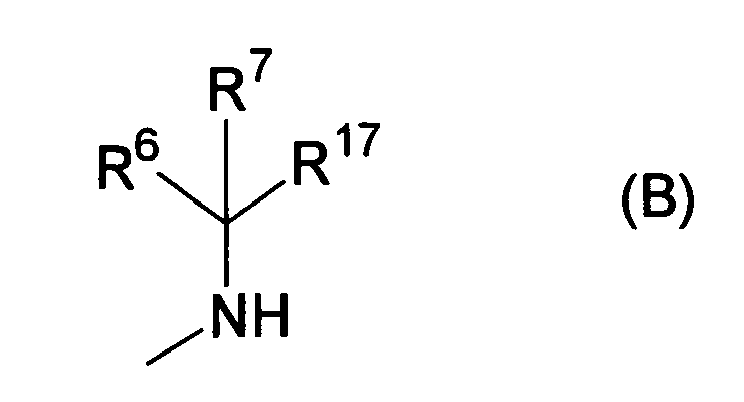

wherein
R6 and R7, which may be the same or different, represent a hydrogen atom, C1-6 alkyl, C2-6 alkenyl, C2-6 alkynyl, aryl, aryl C1-6 alkyl, aryl C2-6 alkenyl, or a heterocyclic group, and the C1-6 alkyl, aryl, aryl C1-6 alkyl, aryl C2-6 alkenyl, and heterocyclic groups, which may be the same or different, are optionally substituted by:(I) a halogen atom;(II) C1-6 alkyl optionally having a substituent selected from a group consisting of (1) hydroxyl, (2) thiol, (3) amino, (4) C1-6 alkoxy, (5) C1-6 alkylthio optionally substituted by hydroxyl, (6) C1-6 alkylsulfinyl, (7) C1-6 alkylsulfonyl, (8) mono- or di-C1-6 alkylamino in which the di-C1-6 alkylamino group may form cyclic amino optionally containing 1 to 3 heteroatoms, (9) C1-6 alkylcarbonyloxy, (10) C1-6 alkylcarbonylthio, (11) C1-6 alkylcarbonylamino, (12) aryloxy, (13) arylthio, (14) arylsulfinyl, (15) arylsulfonyl, (16) arylamino, (17) C1-6 alkyl- or aryl-sulfonylamino, (18) C1-6 alkyl- or aryl-ureido, (19) C1-6 alkoxy- or aryloxy-carbonylamino, (20) C1-6 alkylamino- or arylamino-carbonyloxy, (21) carboxyl, (22) nitro, (23) a heterocyclic group, (23') Het-S- wherein Het represents a heterocyclic group, (24) cyano, (25) a halogen atom, and (26) C1-6 alkyl- or aryl-oxycarbonyl;(III) C1-6 alkoxy optionally having a substituent selected from the group consisting of (1) hydroxyl, (2) thiol, (3) amino, (4) C1-6 alkoxy, (5) C1-6 alkylthio optionally substituted by hydroxyl, (6) C1-6 alkylsulfinyl, (7) C1-6 alkylsulfonyl, (8) mono- or di-C1-6 alkylamino in which the di-C1-6 alkylamino group may form cyclic amino optionally containing 1 to 3 heteroatoms, (9) C1-6 alkylcarbonyloxy, (10) C1-6 alkylcarbonylthio, (11) C1-6 alkylcarbonylamino, (12) aryloxy, (13) arylthio, (14) arylsulfinyl, (15) arylsulfonyl, (16) arylamino, (17) C1-6 alkyl- or aryl-sulfonylamino, (18) C1-6 alkyl- or aryl-ureido, (19) C1-6 alkoxy- or aryloxy-carbonylamino, (20) C1-6 alkylamino- or arylamino-carbonyloxy, (21) carboxyl, (22) nitro, (23) a heterocyclic group, (23') Het-S- wherein Het represents a heterocyclic group, (24) cyano, (25) a halogen atom, and (26) C1-6 alkyl-or aryl-oxycarbonyl;(IV) C1-6 alkylthio optionally substituted by a halogen atom;(V) C3-7 cycloalkyl;(VI) aryl;(VII) aryloxy;(VIII) C1-6 alkylcarbonylamino;(VIX) C1-6 alkylcarbonyloxy;(X) hydroxyl;(XI) nitro;(XII) cyano;(XIII) amino;(XIV) mono- or di-C1-6 alkylamino in which the di-C1-6 alkylamino may form cyclic amino optionally containing 1 to 3 heteroatoms;(XV) arylamino;(XVI) C1-6 alkyl- or aryl-sulfonylamino;(XVII) C1-6 alkyl- or aryl-ureido;(XVIII) C1-6 alkoxy- or aryloxy-carbonylamino;(XIX) C1-6 alkylamino- or arylamino-carbonyloxy;(XX) C1-6 alkoxy- or aryloxy-carbonyl;(XXI) acyl;(XXII) carboxyl;(XXIII) carbamoyl;(XXIV) mono- or di-alkylcarbamoyl;(XXV) a heterocyclic group;(XXVI) alkyl- or aryl-sulfonyl;(XXVII) C2-6 alkenyloxy; or(XXVIII) C2-6 alkynyloxy,
R17 represents a hydrogen atom,
R101 and R102 together represent =O, and R103 and R104 represent a hydrogen atom, or R101 and R104 together represent a bond, and R102 and R103 together represent a bond. - The compound according to claim 1, wherein A represents a five- to nine-membered unsaturated carbocyclic moiety or a five- to nine-membered unsaturated heterocyclic moiety, and-represents a double bond,
the carbocyclic moiety and heterocyclic moiety represented by A are optionally substituted by(a) a halogen atom;(b) hydroxyl;(c) C1-6 alkyl;(d) C1-6 alkoxy;(e) aryl;(f) aryloxy;(g) arylthio;(h) alkylthio;(i) nitro; or(j) amino,
(c) the C1-6 alkyl group, (d) the C1-6 alkoxy group, (e) the aryl group, (f) the aryloxy group, (g) the arylthio group, and (h) the alkylthio group are optionally substituted by (1) hydroxyl, (2) thiol, (3) amino, (4) C1-6 alkoxy, (5) C1-6 alkylthio, (6) C1-6 alkylsulfonyl, (7) mono- or di-C1-6 alkylamino in which the di-C1-6 alkylamino group may form cyclic amino optionally containing 1 to 3 heteroatoms, (8) aryloxy, (9) arylthio, (10) arylsulfonyl, (11) aryl, (12) a heterocyclic group, (13) a halogen atom, or (14) arylamino in which the amino group is optionally substituted by C1-6 alkyl, and the aryl group is optionally substituted by a halogen atom, C1-6 alkyl, C1-6 alkoxy, or C1-6 alkylamino,
when the carbocyclic moiety and the heterocyclic moiety are substituted by two (c) C1-6 alkyl groups, they together may form a C3-5 alkylene chain,
R5 represents C1-6 alkyl, aryl, C1-6 alkoxy, aryloxy, C1-6 alkylamino, arylamino, C1-6 alkylthio, arylthio, C3-7 cycloalkyl, or a heterocyclic group, and the C1-6 alkyl, aryl, C1-6 alkoxy, aryloxy, C1-6 alkylamino, arylamino, C1-6 alkylthio, arylthio, C3-7 cycloalkyl, or heterocyclic group represented by R5 may be the same or different, and is optionally substituted by(I) a halogen atom;(II) C1-6 alkyl optionally containing a substituent selected from the group consisting of (1) hydroxyl, (2) thiol, (3) amino, (4) C1-6 alkoxy, (5) C1-6 alkylthio, (6) C1-6 alkylsulfinyl, (7) C1-6 alkylsulfonyl, (8) mono- or di-C1-6 alkylamino, (8') amino substituted by a heterocyclic group optionally substituted by C1-6 alkyl, (9) C1-6 alkylcarbonyloxy, (10) C1-6 alkylcarbonylthio, (11) C1-6 alkylcarbonylamino, (12) aryloxy, (13) arylthio, (14) arylsulfinyl, (15) arylsulfonyl, (16) arylamino, (17) C1-6 alkyl- or aryl-sulfonylamino, (18) C1-6 alkyl- or aryl-ureido, (19) C1-6 alkoxy- or aryloxy-carbonylamino, (20) C1-6 alkylamino- or arylamino-carbonyloxy, (21) carboxyl, (22) nitro, (23) a heterocyclic group, (23') Het-S(=O)j-wherein Het represents a heterocyclic group, j is 0, 1, or 2, and Het is optionally substituted by alkyl optionally substituted by mono- or di-C1-6 alkylamino in which the di-C1-6 alkylamino group may form cyclic amino optionally containing 1 to 3 heteroatoms and one or two alkyl groups on the amino group and the cyclic amino moiety are optionally substituted by hydroxyl, (24) cyano, and (25) a halogen atom,
wherein the alkyl moiety in (4) the C1-6 alkoxy group, (5) the C1-6 alkylthio group, (6) the C1-6 alkylsulfinyl group, and (7) the C1-6 alkylsulfonyl group is optionally substituted by a halogen atom; C1-6 alkyl; C1-6 alkoxy; C1-6 alkylthio; mono- or di-C1-6 alkylamino in which the di-C1-6 alkylamino group may form cyclic amino optionally containing 1 to 3 heteroatoms; aryloxy; arylthio; hydroxyl; carboxyl; -S(=O)2(-OH); C1-6 alkoxy- or aryloxy-carbonyl; C1-6 alkylcarbonyl; aryl; or a heterocyclic group optionally substituted by alkyl optionally substituted by mono- or di-C1-6 alkylamino in which the di-C1-6 alkylamino group may form cyclic amino optionally containing 1 to 3 heteroatoms, and one or two alkyl groups on the amino group and the cyclic amino moiety are optionally substituted by hydroxy, and
in (8) the mono- or di-C1-6 alkylamino group, the di-C1-6 alkylamino group may form cyclic amino optionally containing 1 to 3 heteroatoms, and one or two alkyl groups on the amino group and the cyclic amino moiety are optionally substituted by a halogen atom; C1-6 alkyl optionally substituted by hydroxyl; C1-6 alkoxy; C1-6 alkylthio; mono- or di-C1-6 alkylamino in which one or two alkyl groups on the amino group are optionally substituted by hydroxyl; arylamino in which the amino group is optionally substituted by C1-6 alkyl; mono- or di-C1-6 alkylcarbamoylmethyl in which the di-C1-6 alkylamino group may form cyclic amino optionally containing 1 to 3 heteroatoms, and one or two alkyl groups on the amino group and the cyclic amino moiety are optionally substituted by hydroxyl; aryloxy; arylthio; an oxygen atom (=O); hydroxyl; carboxyl; C1-6 alkoxy- or aryloxy-carbonyl; C1-6 alkylcarbonyl; aryl optionally substituted by a halogen atom or hydroxyl; or a heterocyclic group;(III) C1-6 alkoxy optionally substituted by a halogen atom;(IV) C1-6 alkylthio optionally substituted by a halogen atom;(V) C3-7 cycloalkyl;(VI) aryl;(VII) aryloxy;(VIII) C1-6 alkylcarbonylamino;(VIX) C1-6 alkylcarbonyloxy;(X) hydroxyl;(XI) nitro;(XII) cyano;(XIII) amino;(XIV) mono- or di-C1-6 alkylamino in which the di-C1-6 alkylamino group may form cyclic amino optionally containing 1 to 3 heteroatoms;(XV) arylamino;(XVI) C1-6 alkyl- or aryl-sulfonylamino;(XVII) C1-6 alkyl- or aryl-ureido;(XVIII) C1-6 alkoxy- or aryloxy-carbonylamino;(XIX) C1-6 alkylamino- or arylamino-carbonyloxy;(XX) C1-6 alkoxy- or aryloxy-carbonyl;(XXI) acyl;(XXII) carboxyl;(XXIII) carbamoyl;(XXIV) mono- or di-alkylcarbamoyl;(XXV) a heterocyclic group;(XXVI) alkyl- or aryl-sulfonyl;(XXVII) C2-6 alkenyloxy; or(XXVIII) C2-6 alkynyloxy,
Z represents group A or group B wherein R6, R7, and R17 are as defined in claim 1,
R101 and R102 together represent =O, and R103 and R104 represent a hydrogen atom, or R101 and R104 together represent a bond, and R102 and R103 together represent a bond. - The compound according to claim 1 or 2, wherein A represents formula (IIa) or formula (IIa'):


wherein R1, R2, R3, and R4, which may be the same or different, represent(a) a halogen atom;(b) hydroxyl;(c) C1-6 alkyl;(d) C1-6 alkoxy;(e) aryl;(f) aryloxy;(g) arylthio;(h) alkylthio;(i) nitro;(j) amino;(i) nitro;(j) amino;(k) mono- or di-arylamino;(l) mono- or di-C1-6 alkylamino;(m) C2-6 alkenyl;(n) C2-6 alkenyloxy;(o)C2-6 alkenylthio;(p) mono- or di-C2-6 alkenylamino;(q) carboxyl;(r) C1-6 alkyl- or aryl-oxycarbonyl; or(s) a hydrogen atom,
(c) the C1-6 alkyl group, (d) the C1-6 alkoxy group, (e) the aryl group, (f) the aryloxy group, (g) the arylthio group, (h) the alkylthio group, (m) the C2-6 alkenyl group, (n) the C2-6 alkenyloxy group, and (o) the C2-6 alkenylthio group are optionally substituted by (1) hydroxyl, (2) thiol, (3) amino, (4) C1-6 alkoxy, (5) C1-6 alkylthio, (6) C1-6 alkylsulfonyl, (7) mono-or di-C1-6 alkylamino in which the di-C1-6 alkylamino group may form cyclic amino optionally containing 1 to 3 heteroatoms, (8) aryloxy, (9) arylthio, (10) arylsulfonyl, (11) aryl, (12) a heterocyclic group, (13) a halogen atom, or (14) arylamino in which the amino group is optionally substituted by C1-6 alkyl, and the aryl group is optionally substituted by halogen, C1-6 alkyl, C1-6 alkoxy, or C1-6 alkylamino, (15) C1-6 alkoxy-(CH2CH2O)m wherein m is an integer of 1 to 6, (16) carboxyl, (17) an oxygen atom (=O), or (18) C3-7 cycloalkyl,
the aryl moiety in (k) the mono- or di-arylamino group is optionally substituted by (1) hydroxyl, (2) thiol, (3) amino, (4) C1-6 alkoxy, (5) C1-6 alkylthio, (6) C1-6 alkylsulfonyl, (7) mono- or di-C1-6 alkylamino in which the di-C1-6 alkylamino group may form cyclic amino optionally containing 1 to 3 heteroatoms, (8) aryloxy, (9) arylthio, (10) arylsulfonyl, (11) aryl, (12) a heterocyclic group, (13) a halogen atom, (14) arylamino in which the amino group is optionally substituted by C1-6 alkyl, and the aryl group is optionally substituted by a halogen atom, C1-6 alkyl, C1-6 alkoxy, or C1-6 alkylamino, (15) C1-6 alkoxy-(CH2CH2O)m wherein m is an integer of 1 to 6, (16) carboxyl, (17) an oxygen atom (=O), or (18) C3-7 cycloalkyl, and, in the case of the mono-arylamino group, the amino group is optionally substituted by C1-6 alkyl optionally substituted by hydroxyl or a halogen atom,
in (I) the mono- or di-C1-6 alkylamino, the di-C1-6 alkyl group may form cyclic amino optionally containing 1 to 3 heteroatoms, and one or two alkyl groups on the amino group and the cyclic amino moiety are optionally substituted by a halogen atom; C1-6 alkyl optionally substituted by hydroxyl, a halogen atom, or aryl optionally substituted by a halogen atom, C1-6 alkyl, or C1-6 alkyloxy, a heterocyclic group optionally substituted by a halogen atom, C1-6 alkyl, or C1-6 alkyloxy, and, when one or two alkyl groups on the amino group and the cyclic amino moiety are substituted by two C1-6 alkyl groups, they together may form C3-7 cycloalkyl; C1-6 alkoxy; C1-6 alkylthio; mono- or di-C1-6 alkylamino in which the di-C1-6 alkylamino group may form cyclic amino optionally containing 1 to 3 heteroatoms, and one or two C1-6 alkyl groups on the amino group and the cyclic amino moiety are optionally substituted by hydroxyl or a halogen atom; arylamino in which the amino group is optionally substituted by C1-6 alkyl; mono- or di-C1-6 alkylcarbamoylmethyl in which the di-C1-6 alkylamino group may form cyclic amino optionally containing 1 to 3 heteroatoms, and one or two alkyl groups on the amino group and the cyclic amino moiety are optionally substituted by hydroxyl; aryloxy; arylthio; an oxygen atom (=O); hydroxyl; carboxyl; C1-6 alkoxy- or aryloxy-carbonyl; C1-6 alkylcarbonyl; aryl optionally substituted by a halogen atom or hydroxyl; or a heterocyclic group,
in (p) the mono- or di-C2-6 alkenylamino group, the amino group of the monoalkenylamino group is optionally substituted by C1-6 alkyl optionally substituted by hydroxyl or a halogen atom, and the di-C2-6 alkenyl together may form unsaturated cyclic amino optionally containing 1 to 3 heteroatoms, and one or two alkenyl groups on the amino group or the unsaturated cyclic amino moiety is optionally substituted by a halogen atom; C1-6 alkyl optionally substituted by hydroxyl, a halogen atom, aryl optionally substituted by a halogen atom, C1-6 alkyl, or C1-6 alkyloxy, a heterocyclic group optionally substituted by a halogen atom, C1-6 alkyl, or C1-6 alkyloxy, and, when one or two alkyl groups on the amino group and the cyclic amino moiety are substituted by two C1-6 alkyl groups, they together may form C3-7 cycloalkyl; C1-6 alkoxy; C1-6 alkylthio; mono- or di-C1-6 alkylamino in which the di-C1-6 alkylamino group may form cyclic amino optionally containing 1 to 3 heteroatoms, and one or two C1-6 alkyl groups on the amino group and the cyclic amino moiety are optionally substituted by hydroxyl or a halogen atom; arylamino in which the amino group is optionally substituted by C1-6 alkyl; mono- or di-C1-6 alkylcarbamoylmethyl in which the di-C1-6 alkylamino group may form cyclic amino optionally containing 1 to 3 heteroatoms, and one or two alkyl groups on the amino group and the cyclic amino moiety are optionally substituted by hydroxyl; aryloxy; arylthio; an oxygen atom (=O); hydroxyl; carboxyl; C1-6 alkoxy- or aryloxy-carbonyl; C1-6 alkylcarbonyl; aryl optionally substituted by a halogen atom or hydroxyl; or a heterocyclic group,
when the carbocyclic moiety and hetrocyclic moiety represented by A are substituted by two (c) C1-6 alkyl groups or (m) C2-6 alkenyl groups, the alkyl or alkenyl groups together with the carbon atoms to which they are respectively attached may form an unsaturated five- to seven-membered carbocyclic ring, and
* represents a bond to -C(=O)-N(-Z)(-R104). - The compound according to claim 1 or 2, wherein A represents formula (IIa):

wherein R1, R2, R3, and R4, which may be the same or different, represent(a) a halogen atom;(b) hydroxyl;(c) C1-6 alkyl;(d) C1-6 alkoxy;(e) aryl;(f) aryloxy;(g) arylthio;(h) alkylthio;(i) nitro;(j) amino; or(k) a hydrogen atom,
(c) the C1-6 alkyl group, (d) the C1-6 alkoxy group, (e) the aryl group, (f) the aryloxy group, (g) the arylthio group, and (h) the alkylthio group are optionally substituted by (1) hydroxyl, (2) thiol, (3) amino, (4) C1-6 alkoxy, (5) C1-6 alkylthio, (6) C1-6 alkylsulfonyl, (7) mono- or di-C1-6 alkylamino in which the di-C1-6 alkylamino group may form cyclic amino optionally containing 1 to 3 heteroatoms, (8) aryloxy, (9) arylthio, (10) arylsulfonyl, (11) aryl, (12) a heterocyclic group, (13) a halogen atom, or (14) arylamino in which the amino group is optionally substituted by C1-6 alkyl, and the aryl group is optionally substituted by halogen, C1-6 alkyl, C1-6 alkoxy, or C1-6 alkylamino, and
* represents a bond to -C(=O)-N(-Z)(-R104). - The compound according to claim 3 or 4, whereinR1, R3, and R4, which may be the same or different, represent a hydrogen atom;a halogen atom;C1-6 alkyl in which the alkyl group is optionally substituted by C1-6 alkoxy or a halogen atom;aryl optionally substituted by C1-6 alkoxy or a halogen atom;C1-6 alkoxy in which the alkoxy group is optionally substituted by C1-6 alkoxy or a halogen atom; oraryloxy optionally substituted by C1-6 alkoxy or a halogen atom,R2 representsa hydrogen atom;a halogen atom;hydroxyl;C1-6 alkyl in which the alkyl group is optionally substituted by (1) hydroxyl, (2) thiol, (3) amino, (4) C1-6 alkoxy, (5) C1-6 alkylthio, (6) C1-6 alkylsulfonyl, (7) mono- or di-C1-6 alkylamino in which the di-C1-6 alkylamino group may form cyclic amino optionally containing 1 to 3 heteroatoms, (8) aryloxy, (9) arylthio, (10) arylsulfonyl, (11) aryl, (12) a heterocyclic group, (13) a halogen atom, or (14) arylamino in which the amino group is optionally substituted by C1-6 alkyl, and the aryl group is optionally substituted by a halogen atom, C1-6 alkyl, C1-6 alkoxy, or C1-6 alkylamino; orC1-6 alkoxy in which the alkoxy group is optionally substituted by (1) hydroxyl, (2) thiol, (3) amino, (4) C1-6 alkoxy, (5) C1-6 alkylthio, (6) C1-6 alkylsulfonyl, (7) mono- or di-C1-6 alkylamino in which di-C1-6 alkylamino may form cyclic amino optionally containing 1 to 3 heteroatoms, (8) aryloxy, (9) arylthio, (10) arylsulfonyl, (11) aryl, (12) a heterocyclic group, or (13) a halogen atom.
- The compound according to claim 3 or 4, wherein R1, R2, R3, and R4, which may be the same or different, represent a hydrogen atom; a halogen atom; hydroxyl; optionally substituted C1-6 alkyl; optionally substituted C2-6 alkenyl; optionally substituted C1-6 alkoxy; optionally substituted mono- or di-arylamino; optionally substituted mono- or di-C1-6 alkylamino in which the dialkylamino together may form optionally substituted cyclic amino optionally containing 1 to 3 heteroatoms; optionally substituted mono- or di-C2-6 alkenylamino in which the di-C2-6 alkenylamino group together may form optionally substituted unsaturated cyclic amino optionally containing 1 to 3 heteroatoms, and, when R2 and R3 are optionally substituted C1-6 alkyl or optionally substituted C2-6 alkenyl, the alkyl or alkenyl groups together with the carbon atoms to which they are respectively attached may form an unsaturated five- to seven-membered carbocyclic ring.
- The compound according to claim 3 or 4, wherein R1, R2, R3, and R4, which may be the same or different, represent a hydrogen atom; a halogen atom; hydroxyl; optionally substituted C1-6 alkyl; or optionally substituted C1-6 alkoxy.
- The compound according to claim 3 or 4, wherein R1, R2, R3, and R4 represent a hydrogen atom.
- The compound according to claim 3 or 4, wherein R1 and R4 represent a hydrogen atom, any one of R2 and R3 represents a halogen atom; hydroxyl; optionally substituted C1-6 alkyl; optionally substituted C1-6 alkoxy; optionally substituted mono- or di-arylamino; optionally substituted mono- or di-C1-6 alkylamino in which the dialkylamino together may form optionally substituted cyclic amino optionally containing 1 to 3 heteroatoms; optionally substituted mono- or di-C2-6 alkenylamino in which the di-C2-6 alkenylamino group together may form optionally substituted unsaturated cyclic amino, wherein the cyclic amino groups may contain 1 to 3 heteroatoms, and the other represents a hydrogen atom.
- The compound according to claim 3 or 4, wherein R1 and R4 represent a hydrogen atom, and any one of R2 and R3 represents a halogen atom; hydroxyl; optionally substituted C1-6 alkyl; optionally substituted C1-6 alkoxy, and the other represents a hydrogen atom.
- The compound according to claim 3 or 4, wherein R1 and R4 represent a hydrogen atom, and R2 and R3, which may be the same or different, represent a halogen atom; hydroxyl; optionally substituted C1-6 alkyl; or optionally substituted C1-6 alkoxy.
- The compound according to claim 3 or 4, wherein R1 and R4 represent a hydrogen atom, and R2 and R3 together with the carbon atoms to which they are respectively attached form an unsaturated five-to seven-membered carbocyclic ring.
- The compound according to claim 3 or 4, wherein R1 and R4 represent a hydrogen atom, and R2 and R3, which may be the same or different, represent optionally substituted C1-6 alkoxy.
- The compound according to claim 3 or 4, wherein R1 and R4 represent a hydrogen atom, any one of R2 and R3 represents optionally substituted mono- or di-C1-6 alkylamino in which the di-C1-6 alkylamino may form cyclic amino optionally containing 1 to 3 heteroatoms, and the other represents a hydrogen atom.
- The compound according to claim 3 or 4, wherein R1 and R4 represent a hydrogen atom, any one of R2 and R3 represent optionally substituted C1-6 alkoxy, and the other represents a hydrogen atom.
- The compound according to claim 6 or 7, wherein R1 and R4 represent a hydrogen atom.
- The compound according to claim 1 or 2, wherein A represents formula (IIb), (IIc), or (IId):


wherein
R31, R32, R33, R34, R35, and R36, which may be the same or different, represent a hydrogen atom; a halogen atom; or C1-6 alkyl in which the alkyl group is optionally substituted by (1) hydroxyl, (2) thiol, (3) amino, (4) C1-6 alkoxy, (5) C1-6 alkylthio, (6) C1-6 alkylsulfonyl, (7) mono- or di-C1-6 alkylamino in which the di-C1-6 alkylamino may form cyclic amino optionally containing 1 to 3 heteroatoms, (8) aryloxy, (9) arylthio, (10) arylsulfonyl, (11) aryl, (12) a heterocyclic group, (13) a halogen atom, or (14) arylamino in which the amino group is optionally substituted by C1-6 alkyl, and the aryl group is optionally substituted by a halogen, C1-6 alkyl, C1-6 alkoxy, or C1-6 alkylamino; or C2-6 alkenyl,
when R31 and R32 represent alkyl or alkenyl, the alkyl or alkenyl groups together with the carbon atoms to which they are respectively attached may form an unsaturated five- to seven-membered carbocyclic ring, and, when R33 and R34 represent alkyl or alkenyl, the alkyl or alkenyl groups together with the carbon atoms to which they are respectively attached may form an unsaturated five- to seven-membered carbocyclic ring, and
* represents a bond to -C(=O)-N(-Z)(-R104). - The compound according to claim 1 or 2, wherein A represents formula (IIIb) or (IIc):


wherein
R31, R32, R33, and R34, which may be the same or different, represent a hydrogen atom; a halogen atom; or C1-6 alkyl in which the alkyl group is optionally substituted by (1) hydroxyl, (2) thiol, (3) amino, (4)C1-6alkoxy, (5) C1-6 alkylthio, (6) C1-6 alkylsulfonyl, (7) mono- or di-C1-6 6 alkylamino in which the di-C1-6 alkylamino may form cyclic amino optionally containing 1 to 3 heteroatoms, (8) aryloxy, (9) arylthio, (10) arylsulfonyl, (11) aryl, (12) a heterocyclic group, (13) a halogen atom, or (14) arylamino in which the amino group is optionally substituted by C1-6 alkyl, and the aryl group is optionally substituted by a halogen, C1-6 alkyl, C1-6 alkoxy, or C1-6 alkylamino,
when R31 and R32 represent alkyl, the alkyl groups together with the carbon atoms to which they are respectively attached may form an unsaturated five- to seven-membered carbocyclic ring, and, when R33 and R34 represent alkyl, the alkyl groups together with the carbon atoms to which they are respectively attached may form an unsaturated five- to seven-membered carbocyclic ring, and
* represents a bond to -C(=O)-N(-Z)(-R104). - The compound according to claim 17 or 18, wherein A represents formula (IIb),(i) R31 and R32 represent a hydrogen atom,(ii) any one of R31 and R32 represents a hydrogen atom, and the other represents C1-6 alkyl optionally substituted by mono- or di-C1-6 alkylamino, which may form cyclic amino, or a halogen atom, and the cyclic amino group may contain 1 to 3 heteroatoms,(iii) R31 and R32, which may be the same or different, represent C1-6 alkyl optionally substituted by mono- or di-C1-6 alkylamino, which may form cyclic amino, or a halogen atom, and the cyclic amino group may contain 1 to 3 heteroatoms, or(iv) R31 and R32 together with the carbon atoms to which they are respectively attached form an unsaturated five- to seven-membered carbocyclic ring.
- The compound according to claim 17 or 18, wherein A represents formula (IIb), R31 and R32 represent a hydrogen atom, or any one of R31 and R32 represents a hydrogen atom with the other representing C1-6 alkyl optionally substituted by a halogen atom, or R31 and R32 together with the carbon atoms to which they are respectively attached form an unsaturated five- to seven-membered carbocyclic ring.
- The compound according to claim 17 or 18, wherein A represents formula (IIc),(i) R33 and R34 represent a hydrogen atom,(ii) any one of R33 and R34 represents a hydrogen atom, and the other represents C1-6 alkyl optionally substituted by mono- or di-C1-6 alkylamino, which may form cyclic amino, or a halogen atom, and the cyclic amino group may contain 1 to 3 heteroatoms,(iii) R33 and R34, which may be the same or different, represent C1-6 alkyl optionally substituted by mono- or di-C1-6 alkylamino, which may form cyclic amino, or a halogen atom, and the cyclic amino group may contain 1 to 3 heteroatoms, or(iv) R33 and R34 together with the carbon atoms to which they are respectively attached form an unsaturated five- to seven-membered carbocyclic ring.
- The compound according to claim 17 or 18, wherein A represents formula (IIc), R33 and R34 represent a hydrogen atom, or any one of R33 and R34 represents a hydrogen atom with the other representing C1-2 alkyl optionally substituted by a halogen atom, or R33 and R34 together with the carbon atoms to which they are respectively attached form an unsaturated five- to seven-membered carbocyclic ring.
- The compound according to claim 17, wherein A represents formula (IId), R35 and R36 represent a hydrogen atom, or any one of R35 and R36 represents a hydrogen atom with the other representing C1-6 alkyl optionally substituted by a halogen atom.
- The compound according to claim 1 or 2, wherein R5 represents optionally substituted C5-7 cycloalkyl, optionally substituted aryl, an optionally substituted saturated or unsaturated five- or six-membered heterocyclic group, or an optionally substituted saturated or unsaturated nine- to eleven-membered bicyclic heterocyclic group.
- The compound according to claim 24, wherein the aryl group is phenyl or naphthyl.
- The compound according to claim 24, wherein the heterocyclic group is selected from pyridyl, furyl, thienyl, isoxazole, pyrimidyl, and quinoxalinyl.
- The compound according to claim 1 or 2, wherein R5 represents a cyclic group selected from C5-7 cycloalkyl, phenyl, pyridyl, furyl, thienyl, isoxazole, pyrimidyl, and quinoxalinyl, in which the cyclic group is optionally substituted by a halogen atom; C1-6 alkyl optionally substituted by a halogen atom; C1-6 alkoxy optionally substituted by a halogen atom; or hydroxyl.
- The compound according to claim 1 or 2, wherein R5 represents a cyclic group selected from C5-7 cycloalkyl, phenyl, pyridyl, furyl, thienyl, isoxazole, pyrimidyl, and quinoxalinyl, in which the cyclic group is optionally substituted by C1-6 alkyl optionally substituted by optionally substituted C1-6 alkoxy, optionally substituted C1-6 alkylthio, optionally substituted C1-6 alkylsulfinyl, optionally substituted C1-6 alkylsulfonyl, or optionally substituted mono- or di-C1-6 alkylamino in which the di-C1-6 alkylamino may form cyclic amino optionally containing 1 to 3 heteroatoms.
- The compound according to claim 1 or 2, wherein R5 represents a group of formula (IIIa), (IIIb), or (IIIc):


D, E, J, L, and M, which may be the same or different, represent a carbon or nitrogen atom,
G represents an oxygen or sulfur atom,
R8, R9, R10, R11, and R12, which may be the same or different, represent(I) a halogen atom;(II) C1-6 alkyl optionally containing a substituent selected from the group consisting of (1) hydroxyl, (2) thiol, (3) amino, (4) C1-6 alkoxy, (5) C1-6 alkylthio, (6) C1-6 alkylsulfinyl, (7) C1-6 alkylsulfonyl, (8) mono- or di-C1-6 alkylamino, (8') amino substituted by a heterocyclic group optionally substituted by C1-6 alkyl, (9) C1-6 alkylcarbonyloxy, (10) C1-6 alkylcarbonylthio, (11) C1-6 alkylcarbonylamino, (12) aryloxy, (13) arylthio, (14) arylsulfinyl, (15) arylsulfonyl, (16) arylamino, (17) C1-6 alkyl- or aryl-sulfonylamino, (18) C1-6 alkyl- or aryl-ureido, (19) C1-6 alkoxy- or aryloxy-carbonylamino, (20) C1-6 alkylamino- or arylamino-carbonyloxy, (21) carboxyl, (22) nitro, (23) a heterocyclic group, (23') Het-S(=O)j-wherein Het represents a heterocyclic group, j is 0, 1, or 2, and Het is optionally substituted by alkyl optionally substituted by mono- or di-C1-6 alkylamino in which the di-C1-6 alkylamino group may form cyclic amino optionally containing 1 to 3 heteroatoms and one or two alkyl groups on the amino group and the cyclic amino moiety are optionally substituted by hydroxyl, (24) cyano, and (25) a halogen atom,
wherein the alkyl moiety in (4) the C1-6 alkoxy group, (5) the C1-6 alkylthio group, (6) the C1-6 alkylsulfinyl group, and (7) the C1-6 alkylsulfonyl group is optionally substituted by a hydrogen atom; a halogen atom; C1-6 alkyl; C1-6 alkoxy; C1-6 alkylthio; mono- or di-C1-6 alkylamino in which the di-C1-6 alkylamino group may form cyclic amino optionally containing 1 to 3 heteroatoms; aryloxy; arylthio; hydroxyl; carboxyl; -S(=O)2(-OH); C1-6 alkoxy- or aryloxy-carbonyl; C1-6 alkylcarbonyl; aryl; or a heterocyclic group optionally substituted by alkyl optionally substituted by mono- or di-C1-6 alkylamino in which the di-C1-6 alkylamino group may form cyclic amino optionally containing 1 to 3 heteroatoms, and one or two alkyl groups on the amino group and the cyclic amino moiety are optionally substituted by hydroxy, and
in (8) the mono- or di-C1-6 alkylamino group, the di-C1-6 alkylamino group may form cyclic amino optionally containing 1 to 3 heteroatoms, and one or two alkyl groups on the amino group and the cyclic amino moiety are optionally substituted by a halogen atom; C1-6 alkyl optionally substituted by hydroxyl, a halogen atom, aryl optionally substituted by a halogen atom, C1-6 alkyl, or C1-6 alkyloxy, or a heterocyclic group optionally substituted by a halogen atom, C1-6 alkyl, or C1-6 alkyloxy, and, when one or two alkyl groups on the amino group and the cyclic amino moiety are substituted by two C1-6 alkyl groups, they together may form C3-7 cycloalkyl; C1-6 alkoxy; C1-6 alkylthio; mono- or di-C1-6 alkylamino in which the di-C1-6 alkylamino may form cyclic amino optionally containing 1 to 3 heteroatoms, and one or two alkyl groups on the amino group and the cyclic amino moiety are optionally substituted by hydroxyl; arylamino in which the amino group is optionally substituted by C1-6 alkyl; mono- or di-C1-6 alkylcarbamoylmethyl in which the di-C1-6 alkylamino group may form cyclic amino optionally containing 1 to 3 heteroatoms, and one or two alkyl groups on the amino group and the cyclic amino moiety are optionally substituted by hydroxyl; aryloxy; arylthio; an oxygen atom (=O); hydroxyl; carboxyl; C1-6 alkoxy- or aryloxy-carbonyl; C1-6 alkylcarbonyl; aryl optionally substituted by a halogen atom or hydroxyl; or a heterocyclic group, and, when one carbon atom in the cyclic amino moiety is substituted by two C1-6 alkoxy groups which may be the same or different, the two alkoxy groups together may form group -O-(CH2)p-O- wherein p is an integer of 2 to 4, and the cyclic amino group may condense with a monocyclic or bicyclic aromatic carbocyclic ring or a monocyclic or bicyclic aromatic heterocyclic ring to represent a bicyclic or tricyclic heterocyclic group;(III) C1-6 alkoxy optionally substituted by a halogen atom;(IV) C1-6 alkylthio optionally substituted by a halogen atom;(V) C3-7 cycloalkyl;(VI) aryl;(VII) aryloxy;(VIII) C1-6 alkylcarbonylamino;(VIX) C1-6 alkylcarbonyloxy;(X) hydroxyl;(XI) nitro;(XII) cyano;(XIII) amino;(XIV) mono- or di-C1-6 alkylamino in which the di-C1-6 alkylamino group may form cyclic amino optionally containing 1 to 3 heteroatoms;(XV) arylamino;(XVI) C1-6 alkyl- or aryl-sulfonylamino;(XVII) C1-6 alkyl- or aryl-ureido;(XVIII) C1-6 alkoxy- or aryloxy-carbonylamino;(XIX) C1-6 alkylamino- or arylamino-carbonyloxy;(XX) C1-6 alkoxy- or aryloxy-carbonyl;(XXI) acyl;(XXII) carboxyl;(XXIII) carbamoyl;(XXIV) mono- or di-alkylcarbamoyl;(XXV) a heterocyclic group;(XXVI) alkyl- or aryl-sulfonyl;(XXVII) C2-6 alkenyloxy;(XXVIII) C2-6 alkynyloxy; or(XXIX) a hydrogen atom, and
when D, E, J, L, or M represents a nitrogen atom, R8, R9, R10, R11, and R12 each are absent, or otherwise may combine with a nitrogen atom to form N-oxide (N → O). - The compound according to claim 29, wherein
R8, R9, R10, R11, and R12, which may be the same or different, represent
a hydrogen atom;
a halogen atom;
hydroxymethyl;
C1-6 alkyl optionally substituted by a halogen atom; or
C1-6 alkoxy optionally substituted by a halogen atom. - The compound according to claim 27, wherein
substituted C1-6 alkyl which may be represented by R8, R9, R10, R11, and R12 represents a group of formula (IV)
-CH2-Q-X1-R13 (IV)
wherein
Q represents an oxygen atom, a sulfur atom, sulfinyl, or sulfonyl,
X1 represents a bond or straight chain or branched chain alkylene having 1 to 5 carbon atoms,
R13 represents a hydrogen atom, a halogen atom, C1-6 alkyl, C1-6 alkoxy, C1-6 alkylthio, mono- or di-C1-6 alkylamino in which the di-C1-6 alkylamino group may form cyclic amino optionally containing 1 to 3 heteroatoms, aryloxy, arylthio, hydroxyl, carboxyl, -S(=O)2(-OH), C1-6 alkoxy- or aryloxy-carbonyl, C1-6 alkylcarbonyl, aryl, or a heterocyclic group optionally substituted by alkyl optionally substituted by mono- or di-C1-6 alkylamino in which the di-C1-6 alkylamino group may form cyclic amino optionally containing 1 to 3 heteroatoms, and one or two alkyl groups on the amino group and the cyclic amino moiety are optionally substituted by hydroxyl;
or a group of formula (V)
wherein
X2 represents a bond or straight chain or branched chain alkylene having 1 to 5 carbon atoms,
X3 represents a bond or straight chain or branched chain alkylene having 1 to 5 carbon atoms,
R14 and R15, which may be the same or different, represent a hydrogen atom; a halogen atom; C1-6 alkyl optionally substituted by hydroxyl, a halogen atom, aryl optionally substituted by a halogen atom, C1-6 alkyl, or C1-6 alkyloxy, a heterocyclic group optionally substituted by a halogen atom, C1-6 alkyl, or C1-6 alkyloxy, and, when one or two alkyl groups on the amino group and the cyclic amino moiety are substituted by two C1-6 alkyl groups, they together may form C3-7 cycloalkyl; C1-6 alkoxy; C1-6 alkylthio; mono- or di-C1-6 alkylamino in which the di-C1-6 alkylamino group may form cyclic amino optionally containing 1 to 3 heteroatoms, and one or two alkyl groups on the amino group and the cyclic amino moiety are optionally substituted by hydroxyl; arylamino in which the amino group is optionally substituted by C1-6 alkyl; mono- or di-C1-6 alkylcarbamoylmethyl in which the di-C1-6 alkylamino-may form cyclic amino optionally containing 1 to 3 heteroatoms, and one or two alkyl groups on the amino group and the cyclic amino moiety are optionally substituted by hydroxyl; aryloxy; arylthio; an oxygen atom (=O); hydroxyl; carboxyl; C1-6 alkoxy- or aryloxy-carbonyl; C1-6 alkylcarbonyl; aryl optionally substituted by a halogen atom or hydroxyl; or a heterocyclic group, provided that, when X2 represents a bond, R14 represents a hydrogen atom, or when X3 represents a bond, R15 represents a hydrogen atom, or
R14 and R15 together with a nitrogen atom to which they are respectively attached to may form a heterocyclic group that may contain 1 to 3 heteroatoms in addition to the nitrogen atom, to which R14 and R15 are attached, and is optionally substituted by hydroxyl; C1-6 alkyl optionally substituted by hydroxyl, a halogen atom, aryl optionally substituted by a halogen atom, C1-6 alkyl, or C1-6 alkyloxy, or a heterocyclic group optionally substituted by a halogen atom, C1-6 alkyl, or C1-6 alkyloxy, and, when one or two alkyl groups on the amino group and the cyclic amino moiety are substituted by two C1-6 alkyl groups, they together may form C3-7 cycloalkyl; mono- or di-C1-6 alkylamino in which the di-C1-6 alkylamino may form cyclic amino optionally containing 1 to 3 heteroatoms, and one or two alkyl groups on the amino group and the cyclic amino moiety are optionally substituted by hydroxyl; a saturated or unsaturated five- or six-membered heterocyclic group; mono- or di-C1-6 alkylcarbamoylmethyl in which the di-C1-6 alkylamino group may form cyclic amino optionally containing 1 to 3 heteroatoms, and one or two alkyl groups on the amino group and the cyclic amino moiety are optionally substituted by hydroxyl; phenyl; or an oxygen atom (=O), and, when one carbon atom in the cyclic amino moiety is substituted by two C1-6 alkoxy groups which may be the same or different, the two alkoxy groups together may form group -O-(CH2)p-O- wherein p is an integer of 2 to 4, and the cyclic amino group may condense with a monocyclic or bicyclic aromatic carbocyclic ring or a monocyclic or bicyclic aromatic heterocyclic ring to represent a bicyclic or tricyclic heterocyclic group. - The compound according to any one of claims 29 to 31, wherein D, E, J, L, and M represent a carbon atom.
- The compound according to any one of claims 29 to 31, any one or two of D, E, J, L, and M represent a nitrogen atom and the others represent a carbon atom.
- The compound according to any one of claims 29 to 31, wherein R5 represents formula (IIIa), and D, E, J, L, and M represent a carbon atom.
- The compound according to any one of claims 29 to 31, wherein R5 represents formula (IIIa), and any one or two of D, E, J, L, and M represent a nitrogen atom with the others representing a carbon atom.
- The compound according to any one of claims 29 to 31, wherein R5 represents formula (IIIb), D, E, and J represent a carbon atom, and G represents an oxygen or sulfur atom.
- The compound according to any one of claims 29 to 31, wherein R5 represents formula (IIIc), D, E, and J represent a carbon atom, and G represents an oxygen or sulfur atom.
- The compound according to claim 29, wherein
R5 represents formula (IIIa),
D, E, J, L, and M represent a carbon atom,
any one or two of R8, R9, R10, R11, and R12, which may be the same or different, represent a halogen atom; hydroxymethyl; C1-6 alkyl optionally substituted by a halogen atom; or C1-6 alkoxy optionally substituted by a halogen atom, and the others represent a hydrogen atom. - The compound according to claim 29, wherein
R5 represents formula (IIIa),
any one or two of D, E, J, L, and M represent a nitrogen atom, and the others represent a carbon atom,
any one or two of R8, R9, R10, R11, and R12, which may be the same or different, represent a halogen atom; hydroxymethyl; C1-6 alkyl optionally substituted by a halogen atom, or C1-6 alkoxy optionally substituted by a halogen atom, and the others reperesent a hydrogen atom. - The compound according to claim 29, wherein
R5 represents formula (IIIb),
D, E, and J represent a carbon atom, and G represents an oxygen or sulfur atom,
one or two of R8, R9, and R10, which may be the same or different, represent a halogen atom; hydroxymethy; C1-6 alkyl optionally substituted by a halogen atom; or C1-6 alkoxy optionally substituted by a halogen atom, and the others represent a hydrogen atom. - The compound according to claim 29, wherein
R5 represents formula (IIIc),
D, E, and J represent a carbon atom, and G represents an oxygen or sulfur atom,
one or two of R8, R9, and R10, which may be the same or different, represent a halogen atom; hydroxymethyl; C1-6 alkyl optionally substituted by a halogen atom; or C1-6 alkoxy optionally substituted by a halogen atom, and the others represent a hydrogen atom. - The compound according to claim 29, wherein
R5 represents formula (IIIa),
D, E, J, L, and M represent a carbon atom,
R8, R9, and R12 represent a hydrogen atom,
one of R10 and R11 represents a group of formula (IV)
-CH2-Q-X1-R13 (IV)
wherein Q, X1, and R13 are as defined in claim 31,
or a group of formula (V)
wherein X2, X3, R14, and R15 are as defined in claim 31,
and the other group represents a hydrogen atom. - The compound according to claim 29, wherein
R5 represents formula (IIIa),
any one or two of D, E, J, L, and M represent a nitrogen atom, and the others represent a carbon atom,
R8, R9, and R12 represent a hydrogen atom,
one of R10 and R11 represents a group of formula (IV)
-CH2-Q-X1-R13 (IV)
wherein Q, X1, and R13 are as defined in claim 31,
or a group of formula (V)
wherein X2, X3, R14, and R15 are as defined in claim 31,
and the other group represents a hydrogen atom. - The compound according to claim 29, wherein
R5 represents formula (IIIb),
D, E, and J represent a carbon atom, and G represents an oxygen or sulfur atom,
one of R8, R9, and R10 represents a group of formula (IV)
-CH2-Q-X1-R13 (IV)
wherein Q, X1, and R13 are as defined in claim 31,
or a group of formula (V)
wherein X2, X3, R14, and R15 are as defined in claim 31,
and the other groups represent a hydrogen atom. - The compound according to claim 29, wherein
R5 represents formula (IIIc),
D, E, and J represent a carbon atom, and G represents an oxygen or sulfur atom,
one of R8, R9, and R10 represents a group of formula (IV)
―CH2―Q―X1―R13 (IV)
wherein Q, X1, and R13 are as defined in claim 31,
or a group of formula (V)
wherein X2, X3, R14, and R15 are as defined in claim 31,
and the other groups represent a hydrogen atom. - The compound according to claim 1 or 2, wherein
R6 represents a hydrogen atom; optionally substituted C1-6 alkyl;
or optionally substituted aryl, R7 represents optionally substituted aryl, optionally substituted aryl C1-6 alky, optionally substituted aryl C2-6 alkenyl, or optionally substituted saturated or unsaturated five- or six-membered heterocyclic group. - The compound according to claim 46, wherein
R6 represents a hydrogen atom; C1-6 alkyl optionally substituted by a halogen atom or C1-6 alkoxy; or aryl optionally substituted by a halogen atom, C1-6 alkyl, or C1-6 alkoxy. - The compound according to claim 46, wherein R6 represents a hydrogen atom or C1-6 alkyl.
- The compound according to any one of claims 46 to 48, wherein
R7 represents a cyclic group selected from phenyl, naphthyl, furyl, pyrrolyl, and thienyl and is optionally substituted by a halogen atom; C1-6 alkyl optionally substituted by a halogen atom; C1-6 alkoxy in which the alkoxy group is optionally substituted by a halogen atom, aryloxy optionally substituted by a halogen atom and C1-6 alkyl, C1-6 alkoxy in which the alkoxy group is optionally substituted by mono- or di-C1-6 alkylamine in which the di-C1-6 alkylamino group may form cyclic amino optionally containing 1 to 3 heteroatoms, or by a halogen atom, arylthio optionally substituted by a halogen atom and C1-6 alkyl, C1-6 alkylthio in which the alkylthio group is optionally substituted by mono- or di-C1-6 alkylamine in which the di-C1-6 alkylamino may form cyclic amino optionally containing 1 to 3 heteroatoms, or by a halogen atom, arylamino optionally substituted by C1-6 alkyl, mono- or di-C1-6 alkylamine in which the di-C1-6 alkylamino may form cyclic amino optionally containing 1 to 3 heteroatoms; hydroxyl; mono- or di-C1-6 alkylamino in which the di-C1-6 alkylamino may form cyclic amino optionally containing 1 to 3 heteroatoms; nitro; C2-6 alkenyloxy; or C2-6 alkynyloxy. - The compound according to claim 1 or 2, wherein formula (I) is represented by formula (I-1)

wherein A, R5, Z, and ---- are as defined in claim 1. - The compound according to claim 50, wherein A represents formula (IIa) or formula (IIa'):


wherein R1, R2, R3, and R4 are as defined in formula (IIa) and formula (IIa') in claim 3,
R5 represents optionally substituted C5-7 cycloalkyl, optionally substituted aryl, or optionally substituted saturated or unsaturated five-or six-membered heterocyclic group,
Z represents group (A), group (B), or group (C):


wherein R6 represents a hydrogen atom or C1-6 alkyl, R7 represents optionally substituted aryl, optionally substituted aryl C1-6 alkyl, optionally substituted aryl C2-6 alkenyl, or optionally substituted saturated or unsaturated five- or six-membered heterocyclic group, and R17 represents a hydrogen atom. - The compound according to claim 50, wherein A represents formula (IIa):

wherein R1, R2, R3, and R4 are as defined in formula (IIa) in claim 3,
---- represents a double bond,
R5 represents optionally substituted C5-7 cycloalkyl, optionally substituted aryl, or optionally substituted saturated or unsaturated five-or six-membered heterocyclic group,
Z represents group (A) or group (B):

wherein R6 represents a hydrogen atom or C1-6 alkyl, R7 represents optionally substituted aryl, optionally substituted aryl C1-6 alkyl, optionally substituted aryl C2-6 alkenyl, or optionally substituted saturated or unsaturated five- or six-membered heterocyclic group, and R17 represents a hydrogen atom. - The compound according to claim 50, wherein A represents formula (IIb):

wherein R31 and R32 are as defined in formula (IIb) in claim 17,
R5 represents optionally substituted C5-7 cycloalkyl, optionally substituted aryl, or optionally substituted saturated or unsaturated five-or six-membered heterocyclic group,
Z represents group (A) or group (B):

wherein R6 represents a hydrogen atom or C1-6 alkyl, R7 represents optionally substituted aryl, optionally substituted aryl C1-6 alkyl, optionally substituted aryl C2-6 alkenyl, or optionally substituted saturated or unsaturated five- or six-membered heterocyclic group, and R17 represents a hydrogen atom. - The compound according to claim 50, wherein A represents formula (IIc):
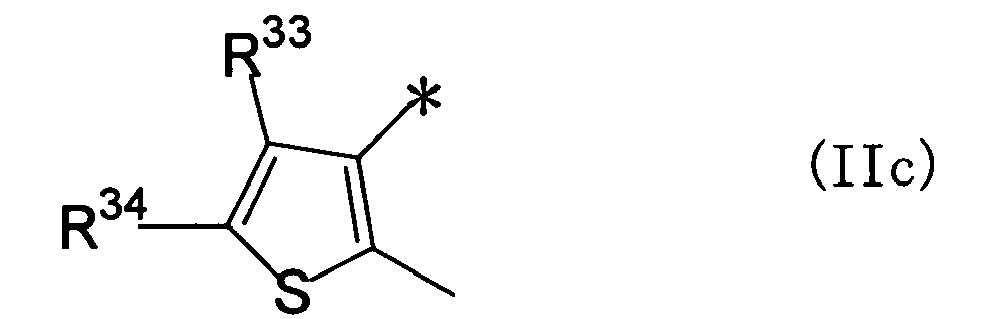
wherein R33 and R34 are as defined in formula (IIc) in claim 17,
R5 represents optionally substituted C5-7 cycloalkyl, optionally substituted aryl, or optionally substituted saturated or unsaturated five-or six-membered heterocyclic group,
Z represents group (A) or group (B):

wherein R6 represents a hydrogen atom or C1-6 alkyl, R7 represents optionally substituted aryl, optionally substituted aryl C1-6 alkyl, optionally substituted aryl C2-6 alkenyl, or optionally substituted saturated or unsaturated five- or six-membered heterocyclic group, and R17 represents a hydrogen atom. - The compound according to claim 50, wherein A represents formula (IId):

wherein R35 and R36 are as defined in formula (IId) in claim 17,
R5 represents optionally substituted C5-7 cycloalkyl, optionally substituted aryl, or optionally substituted saturated or unsaturated five-or six-membered heterocyclic group,
Z represents group (A) or group (B):

wherein R6 represents a hydrogen atom or C1-6-alkyl, R7 represents optionally substituted aryl, optionally substituted aryl C1-6 alkyl, optionally substituted aryl C2-6 alkenyl, or optionally substituted saturated or unsaturated five- or six-membered heterocyclic group, and R17 represents a hydrogen atom. - The compound according to any one of claims 51 to 55,
wherein R5 represents formula (IIIa), formula (IIIb), or formula (IIIc)

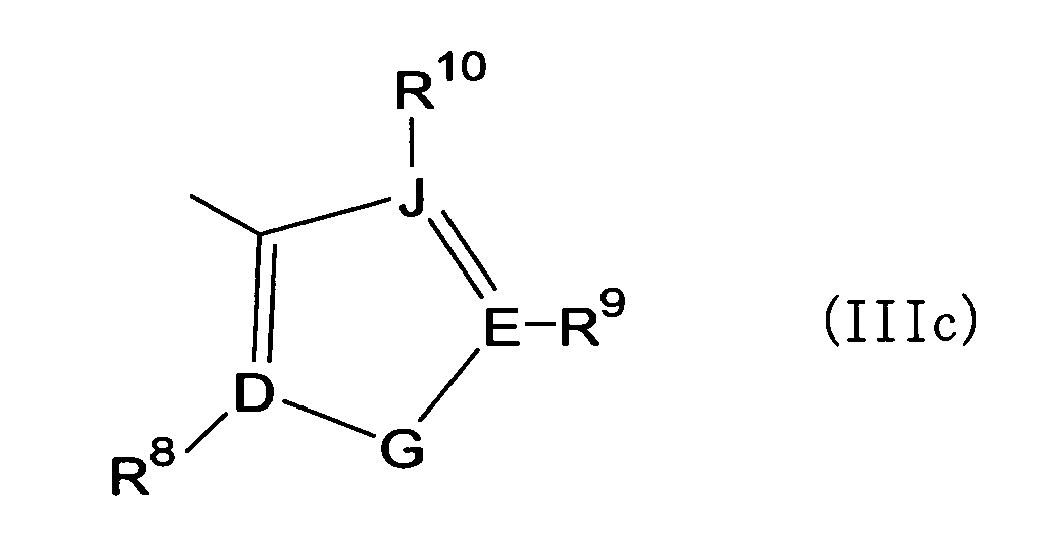
- The compound according to claim 50, wherein A represents formula (IIa) or formula (IIa'):


wherein(1) R1, R2, R3, and R4 represent a hydrogen atom,(2) R1 and R4 represent a hydrogen atom, any one of R2 and R3 represents a halogen atom; hydroxyl; optionally substituted C1-6 alkyl; optionally substituted C1-6 alkoxy; optionally substituted mono- or di-arylamino; optionally substituted mono- or di-C1-6 alkylamino in which the dialkylamino together may form optionally substituted cyclic amino optionally containing 1 to 3 heteroatoms; or optionally substituted mono-or di-C2-6 alkenylamino in which the di-C2-6 alkenylamino group together may form optionally substituted unsaturated cyclic amino optionally containing 1 to 3 heteroatoms, and the other represents a hydrogen atom,(3) R1 and R4 represent a hydrogen atom, and R2 and R3, which may be the same or different, represent a halogen atom; hydroxyl; optionally substituted C1-6 alkyl; or optionally substituted C1-6 alkoxy,(4) R1 and R4 represent a hydrogen atom, and R2 and R3 together with the carbon atoms to which they are respectively attached form an unsaturated five- to seven-membered carbocyclic ring,(5) R1 and R4 represent a hydrogen atom, any one of R2 and R3 represents optionally substituted mono- or di-C1-6 alkylamino in which the di-C1-6 alkylamino together may form optionally substituted cyclic amino optionally containing 1 to 3 heteroatoms, and the other represents a hydrogen atom, or(6) R1 and R4 represent a hydrogen atom, any one of R2 and R3 represents optionally substituted C1-6 alkoxy, and the other represents a hydrogen atom,
R5 represents formula (IIIa)
wherein(i) D, E, J, L, and M represent a carbon atom, any one or two of R8, R9, R10, R11, and R12, which may be the same or different, represent a halogen atom; hydroxymethyl; C1-6 alkyl optionally substituted by a halogen atom; or C1-6 alkoxy optionally substituted by a halogen atom, and the others represent a hydrogen atom,(ii) any one or two of D, E, J, L, and M represent a nitrogen atom, and the others represent a carbon atom, any one or two of R8, R9, R10, R11, and R12 may be the same or different and represent a halogen atom; hydroxymethyl; C1-6 alkyl optionally substituted by a halogen atom, or C1-6 alkoxy optionally substituted by a halogen atom, and the others represent a hydrogen atom,(iii) D, E, J, L, and M represent a carbon atom, R8, R9, and R12 represent a hydrogen atom, any one of R10 and R11 represents a group of formula (IV)
―CH2―Q―X1―R13 (IV)
wherein Q, X1, and R13 are as defined in claim 31,
or a group of formula (V)
wherein X2, X3, R14, and R15 are as defined in claim 31,
and the other represents a hydrogen atom, or(iv) any one or two of D, E, J, L, and M represent a nitrogen atom, and the others represent a carbon atom, R8, R9, and R12 represent a hydrogen atom, and one of R10 and R11 represents a group of formula (IV)
―CH2―Q―X1―R13 (IV)
wherein Q, X1, and R13 are as defined in claim 31,
or a group of formula (V)
wherein X2, X3, R14, and R15 are as defined in claim 31,
and the other represents a hydrogen atom,
Z represents group (A), group (B), or group (C):


wherein
R6 represents a hydrogen atom or C1-6 alkyl,
R7 represents optionally substituted aryl, optionally substituted aryl C1-6 alkyl, optionally substituted aryl C2-6 alkenyl, or optionally substituted saturated or unsaturated five- or six-membered heterocyclic group, and
R17 represents a hydrogen atom. - The compound according to claim 50, wherein A represents formula (IIa) or formula (IIa')


wherein(1) R1, R2, R3, and R4 represent a hydrogen atom,(2) R1 and R4 represent a hydrogen atom, any one of R2 and R3 represents a halogen atom; hydroxyl; optionally substituted C1-6 alkyl; optionally substituted C1-6 alkoxy; optionally substituted mono- or di-arylamino; optionally substituted mono- or di-C1-6 alkylamino in which the dialkylamino together may form optionally substituted cyclic amino optionally containing 1 to 3 heteroatoms; or optionally substituted mono-or di-C2-6 alkenylamino in which the di-C2-6 alkenylamino group together may form optionally substituted unsaturated cyclic amino optionally containing 1 to 3 heteroatoms, and the other represents a hydrogen atom,(3) R1 and R4 represent a hydrogen atom, and R2 and R3, which may be the same or different, represent a halogen atom; hydroxyl; optionally substituted C1-6 alkyl; or optionally substituted C1-6 alkoxy,(4) R1 and R4 represent a hydrogen atom, and R2 and R3 together with the carbon atoms to which they are respectively attached form an unsaturated five- to seven-membered carbocyclic ring,(5) R1 and R4 represent a hydrogen atom, any one of R2 and R3 represents optionally substituted mono- or di-C1-6 alkylamino in which the di-C1-6 alkylamino together may form optionally substituted cyclic amino optionally containing 1 to 3 heteroatoms, and the other represents a hydrogen atom, or(6) R1 and R4 represent a hydrogen atom, any one of R2 and R3 represents optionally substituted C1-6 alkoxy, and the other represents a hydrogen atom,
R5 represents formula (IIIb) or formula (IIIc)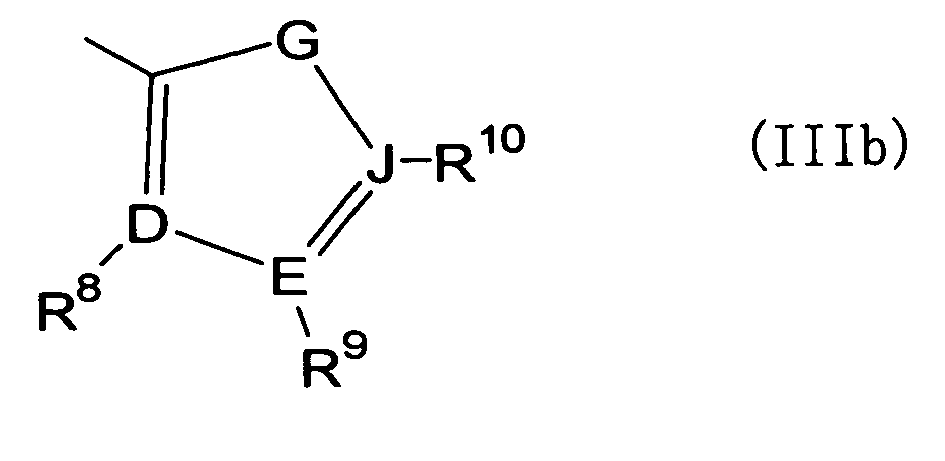

wherein(i) D, E, and J represent a carbon atom, G represents an oxygen or sulfur atom, any one or two of R8, R9, and R10, which may be the same or different, represent a halogen atom; hydroxymethyl; C1-6 alkyl optionally substituted by a halogen atom; or C1-6 alkoxy optionally substituted by a halogen atom, and the others represent a hydrogen atom, or(ii) D, E, and J represent a carbon atom, G represents an oxygen or sulfur atom, one of R8, R9, and R10 represents a group of formula (IV)
-CH2-Q-X1-R13 (IV)
wherein Q, X1, and R13 are as defined in claim 31,
or a group of formula (V)
wherein X2, X3, R14, and R15 are as defined in claim 31,
and the others represent a hydrogen atom,
Z represents group (A), group (B), or group (C):


wherein
R6 represents a hydrogen atom or C1-6 alkyl,
R7 represents optionally substituted aryl, optionally substituted aryl C1-6 alkyl, optionally substituted aryl C2-6 alkenyl, or optionally substituted saturated or unsaturated five- or six-membered heterocyclic group, and
R17 represents a hydrogen atom. - The compound according to claim 50, wherein A represents formula (IIb)

wherein(i) R31 and R32 represent a hydrogen atom,(ii) any one of R31 and R32 represents a hydrogen atom, and the other represents C1-6 alkyl optionally substituted by mono- or di-C1-6 alkylamino, which may form cyclic amino, or a halogen atom, and the cyclic amino group may contain 1 to 3 heteroatoms,(iii) R31 and R32, which may be the same or different, represent C1-6 alkyl optionally substituted by mono- or di-C1-6 alkylamino, which may form cyclic amino, or a halogen atom, and the cyclic amino group may contain 1 to 3 heteroatoms, or(iv) R31 and R32 together with the carbon atoms to which they are respectively attached form an unsaturated five- to seven-membered carbocyclic ring,
R5 represents formula (IIIa)
wherein(i) D, E, J, L, and M represent a carbon atom, any one or two of R8, R9, R10, R11, and R12, which may be the same or different, represent a halogen atom; hydroxymethyl; C1-6 alkyl optionally substituted by a halogen atom; or C1-6 alkoxy optionally substituted by a halogen atom, and the others represent a hydrogen atom,(ii) any one or two of D, E, J, L, and M represent a nitrogen atom, and the others represent a carbon atom, any one or two of R8, R9, R10, R11, and R12 may be the same or different and represent a halogen atom; hydroxymethyl; C1-6 alkyl optionally substituted by a halogen atom, or C1-6 alkoxy optionally substituted by a halogen atom, and the others represent a hydrogen atom,(iii) D, E, J, L, and M represent a carbon atom, R8, R9, and R12 represent a hydrogen atom, any one of R10 and R11 represents a group of formula (IV)
―CH2―Q―X1―R13 (IV)
wherein Q, X1, and R13 are as defined in claim 31,
or a group of formula (V)
wherein X2, X3, R14, and R15 are as defined in claim 31,
and the other represents a hydrogen atom,(iv) any one or two of D, E, J, L, and M represent a nitrogen atom, and the others represent a carbon atom, R8, R9, and R12 represent a hydrogen atom, and one of R10 and R11 represents a group of formula (IV)
―CH2―Q-X1-R13 (IV)
wherein Q, X1, and R13 are as defined in claim 31,
or a group of formula (V)
wherein X2, X3, R14, and R15 are as defined in claim 31,
and the other represents a hydrogen atom,
Z represents group (A), group (B), or group (C):

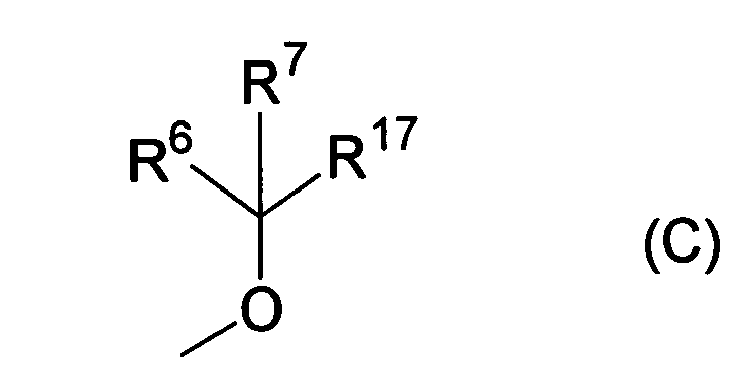
wherein
R6 represents a hydrogen atom or C1-6 alkyl,
R7 represents optionally substituted aryl, optionally substituted aryl C1-6 alkyl, optionally substituted aryl C2-6 alkenyl, or optionally substituted saturated or unsaturated five- or six-membered heterocyclic group, and
R17 represents a hydrogen atom. - The compound according to claim 50, wherein A represents formula (IIb)
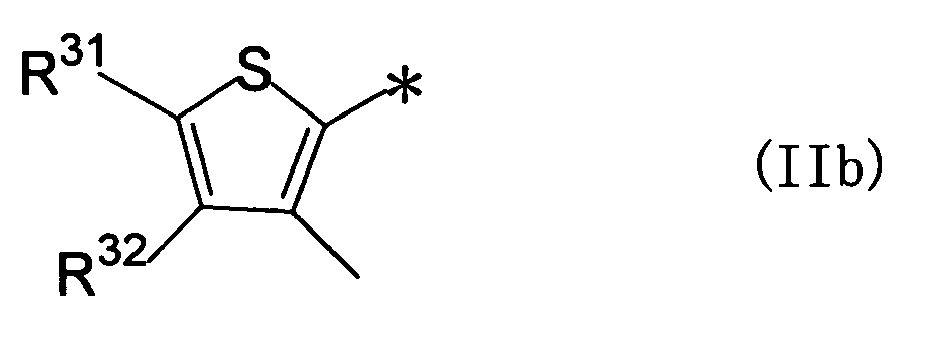
wherein(i) R31 and R32 represent a hydrogen atom,(ii) any one of R31 and R32 represents a hydrogen atom, and the other represents C1-6 alkyl optionally substituted by mono- or di-C1-6 alkylamino, which may form cyclic amino, or a halogen atom, and the cyclic amino group may contain 1 to 3 heteroatoms,(iii) R31 and R32, which may be the same or different, represent C1-6 alkyl optionally substituted by mono- or di-C1-6 alkylamino, which may form cyclic amino, or a halogen atom, and the cyclic amino group may contain 1 to 3 heteroatoms, or(iv) R31 and R32 together with the carbon atoms to which they are respectively attached form an unsaturated five- to seven-membered carbocyclic ring,
R5 represents formula (IIIb) or formula (IIIc)

wherein(i) D, E, and J represent a carbon atom, G represents an oxygen or sulfur atom, any one or two of R8, R9, and R10, which may be the same or different, represent a halogen atom; hydroxymethyl; C1-6 alkyl optionally substituted by a halogen atom; or C1-6 alkoxy optionally substituted by a halogen atom, and the others represent a hydrogen atom, or(ii) D, E, and J represent a carbon atom, G represents an oxygen or sulfur atom, one of R8, R9, and R10 represents a group of formula (IV)
-CH2-Q-X1-R13 (IV)
wherein Q, X1, and R13 are as defined in claim 31,
or a group of formula (V)
wherein X2, X3, R14, and R15 are as defined in claim 31,
and the others represent a hydrogen atom,
Z represents group (A), group (B), or group (C):

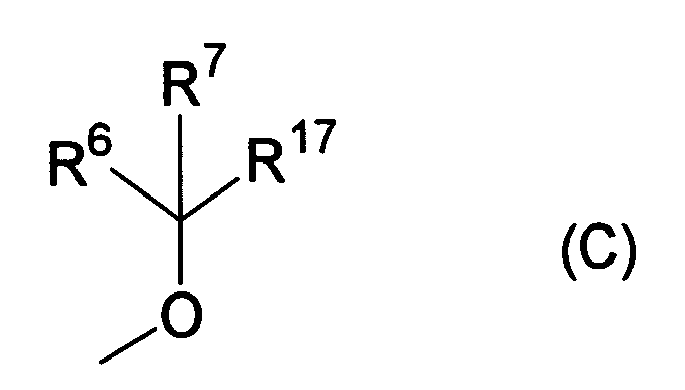
wherein
R6 represents a hydrogen atom or C1-6 alkyl,
R7 represents optionally substituted aryl, optionally substituted aryl C1-6 alkyl, optionally substituted aryl C2-6 alkenyl, or optionally substituted saturated or unsaturated five- or six-membered heterocyclic group, and
R17 represents a hydrogen atom. - The compound according to claim 50, wherein A represents formula (IIc)

wherein(i) R33 and R34 represent a hydrogen atom,(ii) any one of R33 and R34 represents a hydrogen atom, and the other represents C1-6 alkyl optionally substituted by mono- or di-C1-6 alkylamino, which may form cyclic amino, or a halogen atom, and the cyclic amino group may contain 1 to 3 heteroatoms,(iii) R33 and R34, which may be the same or different, represent C1-6 alkyl optionally substituted by mono- or di-C1-6 alkylamino, which may form cyclic amino, or a halogen atom, and the cyclic amino group may contain 1 to 3 heteroatoms, or(iv) R33 and R34 together with the carbon atoms to which they are respectively attached form an unsaturated five- to seven-membered carbocyclic ring,
R5 represents formula (IIIa)
wherein(i) D, E, J, L, and M represent a carbon atom, any one or two of R8, R9, R10, R11, and R12, which may be the same or different, represent a halogen atom; hydroxymethyl; C1-6 alkyl optionally substituted by a halogen atom; or C1-6 alkoxy optionally substituted by a halogen atom, and the others represent a hydrogen atom,(ii) any one or two of D, E, J, L, and M represent a nitrogen atom, and the others represent a carbon atom, any one or two of R8, R9, R10, R11, and R12 may be the same or different and represent a halogen atom; hydroxymethyl; C1-6 alkyl optionally substituted by a halogen atom, or C1-6 alkoxy optionally substituted by a halogen atom, and the others represent a hydrogen atom,(iii) D, E, J, L, and M represent a carbon atom, R8, R9, and R12 represent a hydrogen atom, any one of R10 and R11 represents a group of formula (IV)
―CH2―Q-X1―R13 (IV)
wherein Q, X1, and R13 are as defined in claim 31,
or a group of formula (V)
wherein X2, X3, R14, and R15 are as defined in claim 31,
and the other represents a hydrogen atom,(iv) any one or two of D, E, J, L, and M represent a nitrogen atom, and the others represent a carbon atom, R8, R9, and R12 represent a hydrogen atom, and one of R10 and R11 represents a group of formula (IV)
―CH2―Q-X1―R13 (IV)
wherein Q, X1, and R13 are as defined in claim 31,
or a group of formula (V)
wherein X2, X3, R14, and R15 are as defined in claim 31,
and the other represents a hydrogen atom,
Z represents group (A), group (B), or group (C):
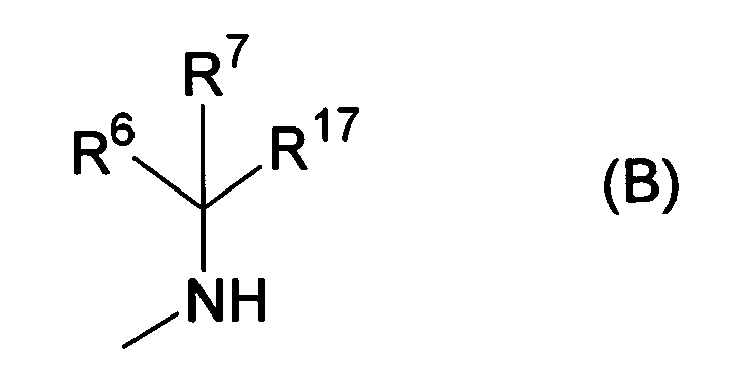

wherein
R6 represents a hydrogen atom or C1-6 alkyl,
R7 represents optionally substituted aryl, optionally substituted aryl C1-6 alkyl, optionally substituted aryl C2-6 alkenyl, or optionally substituted saturated or unsaturated five- or six-membered heterocyclic group, and
R17 represents a hydrogen atom. - The compound according to claim 50, wherein A represents formula (IIc)

wherein(i) R33 and R34 represent a hydrogen atom,(ii) any one of R33 and R34 represents a hydrogen atom, and the other represents C1-6 alkyl optionally substituted by mono- or di-C1-6 alkylamino, which may form cyclic amino, or a halogen atom, and the cyclic amino group may contain 1 to 3 heteroatoms,(iii) R33 and R34, which may be the same or different, represent C1-6 alkyl optionally substituted by mono- or di-C1-6 alkylamino, which may form cyclic amino, or a halogen atom, and the cyclic amino group may contain 1 to 3 heteroatoms, or(iv) R33 and R34 together with the carbon atoms to which they are respectively attached form an unsaturated five- to seven-membered carbocyclic ring,
R5 represents formula (IIIb) or formula (IIIc)

wherein(i) D, E, and J represent a carbon atom, G represents an oxygen or sulfur atom, any one or two of R8, R9, and R10, which may be the same or different, represent a halogen atom; hydroxymethyl; C1-6 alkyl optionally substituted by a halogen atom; or C1-6 alkoxy optionally substituted by a halogen atom, and the others represent a hydrogen atom, or(ii) D, E, and J represent a carbon atom, G represents an oxygen or sulfur atom, one of R8, R9, and R10 represents a group of formula (IV)
-CH2-Q-X1-R13 (IV)
wherein Q, X1, and R13 are as defined in claim 31,
or a group of formula (V)
wherein X2, X3, R14, and R15 are as defined in claim 31,
and the others represent a hydrogen atom,
Z represents group (A), group (B), or group (C):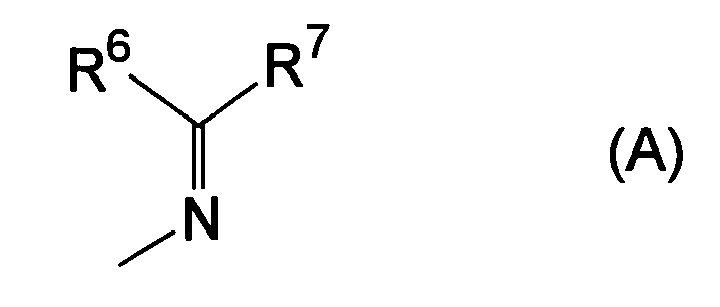


wherein
R6 represents a hydrogen atom or C1-6 alkyl,
R7 represents optionally substituted aryl, optionally substituted aryl C1-6 alkyl, optionally substituted aryl C2-6 alkenyl, or optionally substituted saturated or unsaturated five- or six-membered heterocyclic group, and
R17 represents a hydrogen atom. - The compound according to claim 50, wherein A represents formula (IId)

wherein R35 and R36 represent a hydrogen atom, or any one of R35 and R36 represents a hydrogen atom with the other representing C1-6 alkyl optionally substituted by a halogen atom,
R5 represents formula (IIIa)
wherein(i) D, E, J, L, and M represent a carbon atom, any one or two of R8, R9, R10, R11, and R12, which may be the same or different, represent a halogen atom; hydroxymethyl; C1-6 alkyl optionally substituted by a halogen atom; or C1-6 alkoxy optionally substituted by a halogen atom, and the others represent a hydrogen atom,(ii) any one or two of D, E, J, L, and M represent a nitrogen atom, and the others represent a carbon atom, any one or two of R8, R9, R10, R11, and R12 may be the same or different and represent a halogen atom; hydroxymethyl; C1-6 alkyl optionally substituted by a halogen atom, or C1-6 alkoxy optionally substituted by a halogen atom, and the others represent a hydrogen atom,(iii) D, E, J, L, and M represent a carbon atom, R8, R9, and R12 represent a hydrogen atom, any one of R10 and R11 represents a group of formula (IV)
―CH2―Q―X1―R13 (IV)
wherein Q, X1, and R13 are as defined in claim 31,
or a group of formula (V)
wherein X2, X3, R14, and R15 are as defined in claim 31,
and the other represents a hydrogen atom, or(iv) any one or two of D, E, J, L, and M represent a nitrogen atom, and the others represent a carbon atom, R8, R9, and R12 represent a hydrogen atom, and one of R10 and R11 represents a group of formula (IV)
―CH2―Q―X1―R13 (IV)
wherein Q, X1, and R13 are as defined in claim 31,
or a group of formula (V)
wherein X2, X3, R14, and R15 are as defined in claim 31,
and the other represents a hydrogen atom,
Z represents group (A), group (B), or group (C):


wherein
R6 represents a hydrogen atom or C1-6 alkyl,
R7 represents optionally substituted aryl, optionally substituted aryl C1-6 alkyl, optionally substituted aryl C2-6 alkenyl, or optionally substituted saturated or unsaturated five- or six-membered heterocyclic group, and
R17 represents a hydrogen atom. - The compound according to claim 50, wherein A represents formula (IId)

wherein R35 and R36 represent a hydrogen atom, or any one of R35 and R36 represents a hydrogen atom with the other representing C1-6 alkyl optionally substituted by a halogen atom,
R5 represents formula (IIIb) or formula (IIIc)

wherein(i) D, E, and J represent a carbon atom, G represents an oxygen or sulfur atom, any one or two of R8, R9, and R10, which may be the same or different, represent a halogen atom; hydroxymethyl; C1-6 alkyl optionally substituted by a halogen atom; or C1-6 alkoxy optionally substituted by a halogen atom, and the others represent a hydrogen atom,(ii) D, E, and J represent a carbon atom, G represents an oxygen or sulfur atom, one of R8, R9, and R10 represents a group of formula (IV)
―CH2―Q-X1―R13 (IV)
wherein Q, X1, and R13 are as defined in claim 31,
or a group of formula (V)
wherein X2, X3, R14, and R15 are as defined in claim 31,
and the others represent a hydrogen atom,
Z represents group (A), group (B), or group (C):


wherein
R6 represents a hydrogen atom or C1-6 alkyl,
R7 represents optionally substituted aryl, optionally substituted aryl C1-6 alkyl, optionally substituted aryl C2-6 alkenyl, or optionally substituted saturated or unsaturated five- or six-membered heterocyclic group, and
R17 represents a hydrogen atom. - A compound represented by formula (I-3) or a pharmaceutically acceptable salt or solvate thereof:
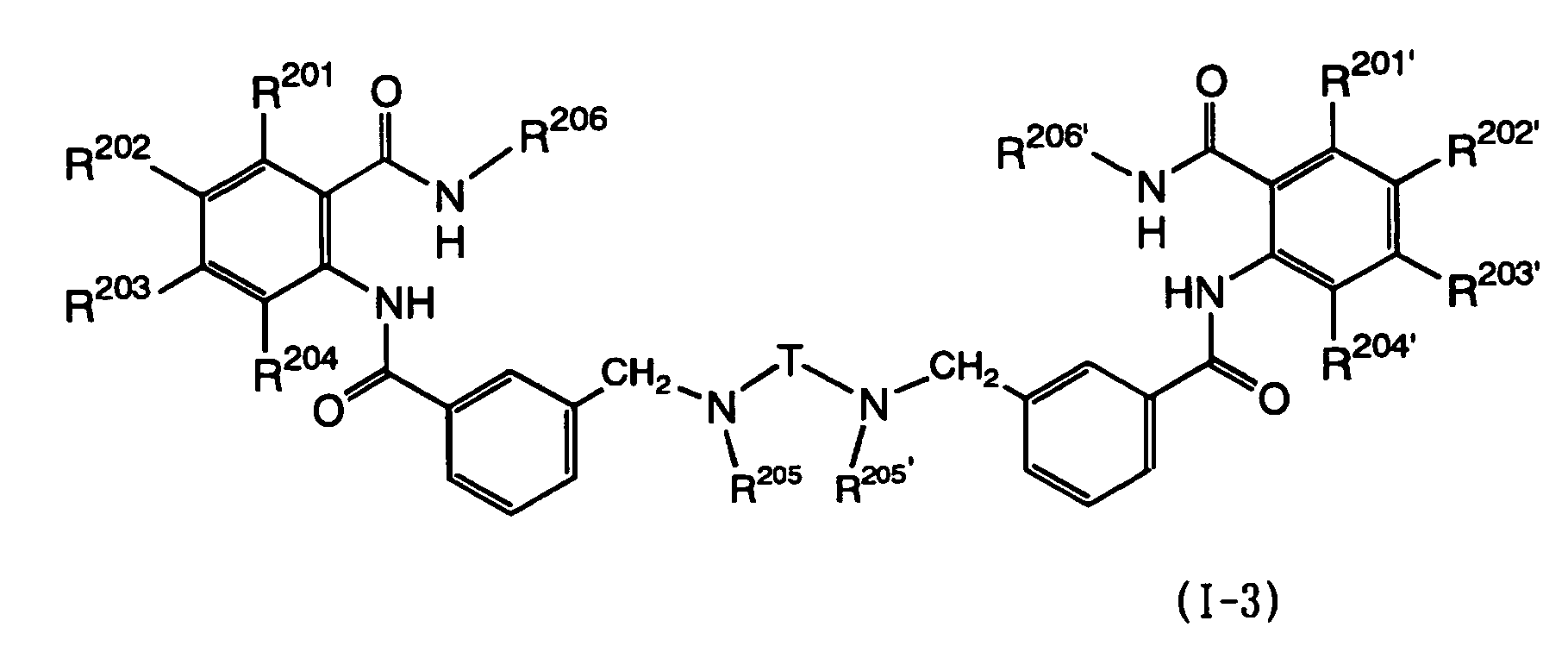
wherein R201, R202, R203, R204, R201', R202', R203', and R204', which may be the same or different, represent a hydrogen atom, a halogen atom, hydroxyl, C1-6 alkyl, or C1-6 alkoxy,
R205 and R205', which may be the same or different, represent a hydrogen atom or C1-6 alkyl,
R206 and R206', which may be the same or different, represent group A or group B

wherein R6 represents a hydrogen atom or C1-6 alkyl, R7 represents aryl or a saturated or unsaturated five- or six-membered heterocyclic group in which the aryl group and heterocyclic group are optionally substituted by a halogen atom or C1-6 alkyl optionally substituted by a halogen atom, and
T represents C2-8 alkylene chain. - A pharmaceutical composition comprising as an active ingredient a compound according to any one of claims 1 to 65 or a pharmaceutically acceptable salt or solvate thereof.
- The pharmaceutical composition according to claim 66, which can be used for the prevention or treatment of diseases for which serum phosphorus lowering action or phosphate transport inhibition is therapeutically or prophylactically effective.
- The pharmaceutical composition according to claim 67, wherein the disease for which serum phosphorus lowering action or phosphate transport inhibition is therapeutically or prophylactically effective is hyperphosphatemia.
- The pharmaceutical composition according to claim 67, wherein the disease for which serum phosphorus lowering action or phosphate transport inhibition is therapeutically or prophylactically effective is renal failure or chronic renal failure.
- The pharmaceutical composition according to claim 67, wherein the diseases for which serum phosphorus lowering action or phosphate transport inhibition is therapeutically or prophylactically effective are secondary hyperparathyroidism and primary hyperparathyroidism and diseases related thereto.
- The pharmaceutical composition according to claim 70, wherein the secondary hyperparathyroidism-related disease is renal osteodystrophy, central or peripheral nervous system damage induced by PTH increase or vitamin D lowering, anemia, myocardiopathy, hyperlipidemia, anomaly of saccharometabolism, pruritus cutaneus, tendon rupture, sexual dysfunction, muscle damage, skin ischemic ulcer, growth retardation, heart conduction disturbance, pulmonary diffusing impairment, immune deficiency, ostealgia and arthralgia, bone deformity, or fracture.
- The pharmaceutical composition according to claim 67, wherein the disease for which serum phosphorus lowering action or phosphate transport inhibition is therapeutically or prophylactically effective is calcium/phosphorus metabolic disorder, for example, metabolic osteopathy.
- The pharmaceutical composition according to claim 67, wherein the disease for which serum phosphorus lowering action or phosphate transport inhibition is therapeutically or prophylactically effective is a disease for which the suppression of calcium and/or phosphorus product is therapeutically effective.
- The pharmaceutical composition according to claim 73, wherein the disease for which the suppression of calcium and/or phosphorus product is therapeutically effective is calcification of cardiovascular system in dialysis patients, age-related arterial sclerosis, diabetic vasculopathy, calcification of soft tissue, metastatic calcification, ectopic calcification, red eye, arthralgia, myalgia, pruritus cutaneus, heart conduction disturbance, pulmonary diffusing impairment, angina pectoris, cardiac infarction, or heart failure induced by cardiac murmur or valvular disease.
- A serum phosphorus concentration lowering agent comprising a compound or a pharmaceutically acceptable salt or solvate thereof according to any one of claims 1 to 65.
- A phosphate transport inhibitor comprising a compound or a pharmaceutically acceptable salt or solvate thereof according to any one of claims 1 to 65.
- Use of the compound according to any one of claims 1 to 65 or a pharmaceutically acceptable salt or solvate thereof, for the manufacture of a medicament in the prevention or treatment of diseases for which serum phosphorus lowering action or phosphate transport inhibition is therapeutically effective.
- The use according to claim 77, wherein the disease for which serum phosphorus lowering action or phosphate transport inhibition is therapeutically or prophylactically effective is hyperphosphatemia.
- The use according to claim 77, wherein the disease for which serum phosphorus lowering action or phosphate transport inhibition is therapeutically or prophylactically effective is renal failure or chronic renal failure.
- The use according to claim 77, wherein the diseases for which serum phosphorus lowering action or phosphate transport inhibition is therapeutically or prophylactically effective are secondary hyperparathyroidism and primary hyperparathyroidism and diseases related thereto.
- The use according to claim 80, wherein the secondary hyperparathyroidism-related disease is renal osteodystrophy, central or peripheral nervous system damage induced by PTH increase or vitamin D lowering, anemia, myocardiopathy, hyperlipidemia, anomaly of saccharometabolism, pruritus cutaneus, tendon rupture, sexual dysfunction, muscle damage, skin ischemic ulcer, growth retardation, heart conduction disturbance, pulmonary diffusing impairment, immune deficiency, ostealgia and arthralgia, bone deformity, or fracture.
- The use according to claim 77, wherein the disease for which serum phosphorus lowering action or phosphate transport inhibition is therapeutically or prophylactically effective is calcium/phosphorus metabolic disorder, for example, metabolic osteopathy.
- The use according to claim 77, wherein the disease for which serum phosphorus lowering action or phosphate transport inhibition is therapeutically or prophylactically effective is a disease for which the suppression of calcium and/or phosphorus product is therapeutically effective.
- The use according to claim 83, wherein the disease for which the suppression of calcium and/or phosphorus product is therapeutically effective is calcification of cardiovascular system in dialysis patients, age-related arterial sclerosis, diabetic vasculopathy, calcification of soft tissue, metastatic calcification, ectopic calcification, red eye, arthralgia, myalgia, pruritus cutaneus, heart conduction disturbance, pulmonary diffusing impairment, angina pectoris, cardiac infarction, or heart failure induced by cardiac murmur or valvular disease.
- Use of the compound according to any one of claims 1 to 65 or a pharmaceutically acceptable salt or solvate thereof, for the manufacture of a serum phosphorus concentration lowering agent.
- Use of the compound according to any one of claims 1 to 65 or a pharmaceutically acceptable salt or solvate thereof, for the manufacture of a phosphate transport inhibitor.
- A method for preventing or treating a disease for which serum phosphorus lowering action or phosphate transport inhibition is therapeutically effective, said method comprising the step of administering a therapeutically or prophylactically effective amount of a compound according to any one of claims 1 to 65 or a pharmaceutically acceptable salt or solvate thereof to a mammal.
- The method according to claim 87, wherein the disease for which serum phosphorus lowering action or phosphate transport inhibition is therapeutically or prophylactically effective is hyperphosphatemia.
- The method according to claim 87, wherein the disease for which serum phosphorus lowering action or phosphate transport inhibition is therapeutically or prophylactically effective is renal failure or chronic renal failure.
- The method according to claim 87, wherein the diseases for which serum phosphorus lowering action or phosphate transport inhibition is therapeutically or prophylactically effective are secondary hyperparathyroidism and primary hyperparathyroidism and diseases related thereto.
- The method according to claim 90, wherein the secondary hyperparathyroidism-related disease is renal osteodystrophy, central or peripheral nervous system damage induced by PTH increase or vitamin D lowering, anemia, myocardiopathy, hyperlipidemia, anomaly of saccharometabolism, pruritus cutaneus, tendon rupture, sexual dysfunction, muscle damage, skin ischemic ulcer, growth retardation, heart conduction disturbance, pulmonary diffusing impairment, immune deficiency, ostealgia and arthralgia, bone deformity, or fracture.
- The method according to claim 87, wherein the disease for which serum phosphorus lowering action or phosphate transport inhibition is therapeutically or prophylactically effective is calcium/phosphorus metabolic disorder, for example, metabolic osteopathy.
- The method according to claim 87, wherein the disease for which serum phosphorus lowering action or phosphate transport inhibition is therapeutically or prophylactically effective is a disease for which the suppression of calcium and/or phosphorus product is therapeutically effective.
- The method according to claim 93, wherein the disease for which the suppression of calcium and/or phosphorus product is therapeutically effective is calcification of cardiovascular system in dialysis patients, age-related arterial sclerosis, diabetic vasculopathy, calcification of soft tissue, metastatic calcification, ectopic calcification, red eye, arthralgia, myalgia, pruritus cutaneus, heart conduction disturbance, pulmonary diffusing impairment, angina pectoris, cardiac infarction, or heart failure induced by cardiac murmur or valvular disease.
- A method for lowering the concentration of serum phosphorus in a blood stream, said method comprising the step of administering a therapeutically or prophylactically effective amount of a compound according to any one of claims 1 to 65 or a pharmaceutically acceptable salt or solvate thereof to a mammal.
- A method for inhibiting phosphate transport in vivo, said method comprising the step of administering a therapeutically or prophylactically effective amount of a compound according to any one of claims 1 to 65 or a pharmaceutically acceptable salt or solvate thereof to a mammal.
Applications Claiming Priority (2)
| Application Number | Priority Date | Filing Date | Title |
|---|---|---|---|
| JP2003089173 | 2003-03-27 | ||
| PCT/JP2004/004427 WO2004085382A1 (en) | 2003-03-27 | 2004-03-29 | Compound inhibiting in vivo phosphorus transport and medicine containing the same |
Publications (2)
| Publication Number | Publication Date |
|---|---|
| EP1614676A1 true EP1614676A1 (en) | 2006-01-11 |
| EP1614676A4 EP1614676A4 (en) | 2009-03-25 |
Family
ID=33095138
Family Applications (1)
| Application Number | Title | Priority Date | Filing Date |
|---|---|---|---|
| EP04724132A Withdrawn EP1614676A4 (en) | 2003-03-27 | 2004-03-29 | PHOSPHORUS TRANSPORT IN VIVO INHIBITOR COMPOUND AND MEDICAMENT CONTAINING THE SAME |
Country Status (4)
| Country | Link |
|---|---|
| US (2) | US8134015B2 (en) |
| EP (1) | EP1614676A4 (en) |
| JP (2) | JP4926473B2 (en) |
| WO (1) | WO2004085382A1 (en) |
Cited By (10)
| Publication number | Priority date | Publication date | Assignee | Title |
|---|---|---|---|---|
| KR20130073908A (en) * | 2010-04-28 | 2013-07-03 | 아스텔라스세이야쿠 가부시키가이샤 | Tetrahydrobenzothiophene compound |
| EP2591354A4 (en) * | 2010-07-07 | 2014-05-14 | Ardelyx Inc | COMPOUNDS AND METHODS FOR INHIBITING PHOSPHATE TRANSPORT |
| US8809339B2 (en) | 2010-07-07 | 2014-08-19 | Ardelyx, Inc. | Compounds and methods for inhibiting phosphate transport |
| US8815908B2 (en) | 2010-07-07 | 2014-08-26 | Ardelyx, Inc. | Compounds and methods for inhibiting phosphate transport |
| US8815910B2 (en) | 2010-07-07 | 2014-08-26 | Ardelyx, Inc. | Compounds and methods for inhibiting phosphate transport |
| US8916569B2 (en) | 2010-07-07 | 2014-12-23 | Ardelyx, Inc. | Compounds and methods for inhibiting phosphate transport |
| CN108358798A (en) * | 2018-02-12 | 2018-08-03 | 黑龙江鑫创生物科技开发有限公司 | A kind of method of micro passage reaction synthesis Tarceva intermediate |
| WO2023114824A1 (en) * | 2021-12-15 | 2023-06-22 | Bristol-Myers Squibb Company | Bicyclo [3.2.0] heptane bis(amide) rxfp1 agonists |
| WO2023114823A1 (en) * | 2021-12-15 | 2023-06-22 | Bristol-Myers Squibb Company | Benzothiophene derivatives as rxfp1 agonists |
| WO2023114819A1 (en) * | 2021-12-15 | 2023-06-22 | Bristol-Myers Squibb Company | Tetraline, phenylcyclobutane, and phenylcyclopentane analogs as rxfp1 agonists |
Families Citing this family (35)
| Publication number | Priority date | Publication date | Assignee | Title |
|---|---|---|---|---|
| US7879840B2 (en) | 2005-08-25 | 2011-02-01 | The Trustees Of Columbia University In The City Of New York | Agents for preventing and treating disorders involving modulation of the RyR receptors |
| US7718644B2 (en) | 2004-01-22 | 2010-05-18 | The Trustees Of Columbia University In The City Of New York | Anti-arrhythmic and heart failure drugs that target the leak in the ryanodine receptor (RyR2) and uses thereof |
| US7393652B2 (en) | 2000-05-10 | 2008-07-01 | The Trustees Of Columbia University In The City Of New York | Methods for identifying a chemical compound that directly enhances binding of FKBP12.6 to PKA-phosphorylated type 2 ryanodine receptor (RyR2) |
| US8022058B2 (en) | 2000-05-10 | 2011-09-20 | The Trustees Of Columbia University In The City Of New York | Agents for preventing and treating disorders involving modulation of the RyR receptors |
| US7544678B2 (en) | 2002-11-05 | 2009-06-09 | The Trustees Of Columbia University In The City Of New York | Anti-arrythmic and heart failure drugs that target the leak in the ryanodine receptor (RyR2) |
| AU2004220548A1 (en) | 2003-03-07 | 2004-09-23 | The Trustees Of Columbia University, In The City Of New York | Type 1 ryanodine receptor-based methods |
| UA89035C2 (en) * | 2003-12-03 | 2009-12-25 | Лео Фарма А/С | Hydroxamic acid esters and pharmaceutical use thereof |
| US8710045B2 (en) | 2004-01-22 | 2014-04-29 | The Trustees Of Columbia University In The City Of New York | Agents for preventing and treating disorders involving modulation of the ryanodine receptors |
| WO2006034075A1 (en) * | 2004-09-17 | 2006-03-30 | Osi Pharmaceuticals, Inc. | (hydrazido) (amino) thiophene compounds |
| US7704990B2 (en) | 2005-08-25 | 2010-04-27 | The Trustees Of Columbia University In The City Of New York | Agents for preventing and treating disorders involving modulation of the RyR receptors |
| CA2663436A1 (en) | 2006-10-04 | 2008-04-10 | Pfizer Products Inc. | Pyrido[4,3-d]pyrimidin-4(3h)-one derivatives as calcium receptor antagonists |
| US7786139B2 (en) * | 2006-11-21 | 2010-08-31 | Omeros Corporation | PDE10 inhibitors and related compositions and methods |
| CA2673683C (en) | 2007-01-11 | 2014-07-29 | Critical Outcome Technologies, Inc. | Compounds and method for treatment of cancer |
| CA2710039C (en) | 2007-12-26 | 2018-07-03 | Critical Outcome Technologies, Inc. | Semicarbazones, thiosemicarbazones and related compounds and methods for treatment of cancer |
| CA2730890C (en) | 2008-07-17 | 2018-05-15 | Critical Outcome Technologies Inc. | Thiosemicarbazone inhibitor compounds and cancer treatment methods |
| KR20170091783A (en) | 2008-12-31 | 2017-08-09 | 알데릭스, 인코포레이티드 | Compounds and methods for inhibiting nhe-mediated antiport in the treatment of disorders associated with fluid retention or salt overload and gastrointestinal tract disorders |
| WO2018129556A1 (en) | 2017-01-09 | 2018-07-12 | Ardelyx, Inc. | Compounds and methods for inhibiting nhe-mediated antiport in the treatment of disorders associated with fluid retention or salt overload and gastrointestinal tract disorders |
| EP2533641B1 (en) * | 2010-02-09 | 2016-07-13 | Bayer CropScience AG | Hydrazine-substituted anthranilic acid derivatives |
| CA2794952C (en) | 2010-04-01 | 2018-05-15 | Critical Outcome Technologies Inc. | Compounds and method for treatment of hiv |
| CN103906741B (en) * | 2011-10-27 | 2016-01-20 | 安斯泰来制药株式会社 | Aminoalkyl-substituted N-thienylbenzamide derivatives |
| WO2013129435A1 (en) * | 2012-02-28 | 2013-09-06 | 協和発酵キリン株式会社 | Fused thiophene derivative |
| US10376481B2 (en) | 2012-08-21 | 2019-08-13 | Ardelyx, Inc. | Compounds and methods for inhibiting NHE-mediated antiport in the treatment of disorders associated with fluid retention or salt overload and gastrointestinal tract disorders |
| AU2013304812B2 (en) | 2012-08-21 | 2016-06-09 | Ardelyx, Inc. | Compounds and methods for inhibiting NHE-mediated antiport in the treatment of disorders associated with fluid retention or salt overload and gastrointestinal tract disorders |
| SMT201900386T1 (en) | 2013-04-12 | 2019-09-09 | Ardelyx Inc | Nhe3-binding compounds and methods for inhibiting phosphate transport |
| TWI594975B (en) | 2013-04-24 | 2017-08-11 | 第一三共股份有限公司 | Dicarboxylic acid compound |
| KR20160042039A (en) | 2013-08-09 | 2016-04-18 | 알데릭스, 인코포레이티드 | Compounds and methods for inhibiting phosphate transport |
| CN107074793B (en) | 2014-09-26 | 2019-08-23 | 第一三共株式会社 | Salts of dicarboxylic acid compounds |
| AU2018205400C1 (en) | 2017-01-09 | 2026-01-15 | Ardelyx, Inc. | Compounds useful for treating gastrointestinal tract disorders |
| JP2020505333A (en) | 2017-01-09 | 2020-02-20 | アルデリックス, インコーポレイテッド | Inhibitors of NHE-mediated antiport |
| WO2019040869A1 (en) * | 2017-08-25 | 2019-02-28 | The Trustees Of Columbia University In The City Of New York | Inhibitors of purine import in parasites and uses thereof |
| WO2020237096A1 (en) | 2019-05-21 | 2020-11-26 | Ardelyx, Inc. | Combination for lowering serum phosphate in a patient |
| AU2020320195A1 (en) * | 2019-07-30 | 2022-03-10 | Nurix Therapeutics, Inc. | Urea, amide, and substituted heteroaryl compounds for Cbl-b inhibition |
| WO2022020714A1 (en) * | 2020-07-24 | 2022-01-27 | Inipharm, Inc. | Thiophene hsd17b13 inhibitors and uses thereof |
| EP4244210A4 (en) | 2020-11-13 | 2024-10-30 | Inipharm, Inc. | HSD17B13 DICHLOROPHENOL INHIBITORS AND USES THEREOF |
| US12617772B2 (en) | 2021-04-05 | 2026-05-05 | Inipharm, Inc. | Hydroxypyridine HSD17B13 inhibitors and uses thereof |
Family Cites Families (6)
| Publication number | Priority date | Publication date | Assignee | Title |
|---|---|---|---|---|
| FR2168136A1 (en) * | 1972-01-17 | 1973-08-31 | Ferlux | 2-aminobenzoyl hydrazones - with antiinflammatory, analgesic and antipyretic activity |
| JP2789212B2 (en) * | 1989-04-19 | 1998-08-20 | 大日精化工業株式会社 | Electrophotographic photoreceptor |
| GB9905416D0 (en) * | 1999-03-09 | 1999-05-05 | Allelix Biopharma | Small molecules having GLP-2 like activity |
| DE10012120A1 (en) * | 2000-03-13 | 2001-09-27 | Ktb Tumorforschungs Gmbh | New ligand, comprising therapeutic or diagnostic agent bonded non-covalently with substance having high affinity to transport molecule |
| DE10348023A1 (en) | 2003-10-15 | 2005-05-19 | Imtm Gmbh | New alanyl aminopeptidase inhibitors for the functional manipulation of different cells and for the treatment of immunological, inflammatory, neuronal and other diseases |
| US8090857B2 (en) * | 2003-11-24 | 2012-01-03 | Qualcomm Atheros, Inc. | Medium access control layer that encapsulates data from a plurality of received data units into a plurality of independently transmittable blocks |
-
2004
- 2004-03-29 WO PCT/JP2004/004427 patent/WO2004085382A1/en not_active Ceased
- 2004-03-29 JP JP2005508959A patent/JP4926473B2/en not_active Expired - Fee Related
- 2004-03-29 EP EP04724132A patent/EP1614676A4/en not_active Withdrawn
- 2004-03-29 US US10/550,857 patent/US8134015B2/en not_active Expired - Fee Related
-
2010
- 2010-09-14 JP JP2010205973A patent/JP2011042655A/en active Pending
-
2012
- 2012-01-18 US US13/352,979 patent/US20120115851A1/en not_active Abandoned
Cited By (18)
| Publication number | Priority date | Publication date | Assignee | Title |
|---|---|---|---|---|
| KR20130073908A (en) * | 2010-04-28 | 2013-07-03 | 아스텔라스세이야쿠 가부시키가이샤 | Tetrahydrobenzothiophene compound |
| EP2565190A4 (en) * | 2010-04-28 | 2013-08-21 | Astellas Pharma Inc | Tetrahydrobenzothiophene compound |
| US9284295B2 (en) | 2010-04-28 | 2016-03-15 | Astellas Pharma Inc. | Tetrahydrobenzothiophene compound |
| US8729068B2 (en) | 2010-04-28 | 2014-05-20 | Astellas Pharma Inc. | Tetrahydrobenzothiophene compound |
| AU2011246072B2 (en) * | 2010-04-28 | 2014-06-26 | Astellas Pharma Inc. | Tetrahydrobenzothiophene compound |
| US8916569B2 (en) | 2010-07-07 | 2014-12-23 | Ardelyx, Inc. | Compounds and methods for inhibiting phosphate transport |
| US8815908B2 (en) | 2010-07-07 | 2014-08-26 | Ardelyx, Inc. | Compounds and methods for inhibiting phosphate transport |
| US8815910B2 (en) | 2010-07-07 | 2014-08-26 | Ardelyx, Inc. | Compounds and methods for inhibiting phosphate transport |
| US8809339B2 (en) | 2010-07-07 | 2014-08-19 | Ardelyx, Inc. | Compounds and methods for inhibiting phosphate transport |
| US9278102B2 (en) | 2010-07-07 | 2016-03-08 | Ardelyx, Inc. | Compounds and methods for inhibiting phosphate transport |
| EP2591354A4 (en) * | 2010-07-07 | 2014-05-14 | Ardelyx Inc | COMPOUNDS AND METHODS FOR INHIBITING PHOSPHATE TRANSPORT |
| US9289429B2 (en) | 2010-07-07 | 2016-03-22 | Ardelyx, Inc. | Compounds and methods for inhibiting phosphate transport |
| US9289430B2 (en) | 2010-07-07 | 2016-03-22 | Ardelyx, Inc. | Compounds and methods for inhibiting phosphate transport |
| US9301951B2 (en) | 2010-07-07 | 2016-04-05 | Ardelyx, Inc. | Compounds and methods for inhibiting phosphate transport |
| CN108358798A (en) * | 2018-02-12 | 2018-08-03 | 黑龙江鑫创生物科技开发有限公司 | A kind of method of micro passage reaction synthesis Tarceva intermediate |
| WO2023114824A1 (en) * | 2021-12-15 | 2023-06-22 | Bristol-Myers Squibb Company | Bicyclo [3.2.0] heptane bis(amide) rxfp1 agonists |
| WO2023114823A1 (en) * | 2021-12-15 | 2023-06-22 | Bristol-Myers Squibb Company | Benzothiophene derivatives as rxfp1 agonists |
| WO2023114819A1 (en) * | 2021-12-15 | 2023-06-22 | Bristol-Myers Squibb Company | Tetraline, phenylcyclobutane, and phenylcyclopentane analogs as rxfp1 agonists |
Also Published As
| Publication number | Publication date |
|---|---|
| US20120115851A1 (en) | 2012-05-10 |
| JP4926473B2 (en) | 2012-05-09 |
| US20060217426A1 (en) | 2006-09-28 |
| WO2004085382A1 (en) | 2004-10-07 |
| EP1614676A4 (en) | 2009-03-25 |
| US8134015B2 (en) | 2012-03-13 |
| JP2011042655A (en) | 2011-03-03 |
| JPWO2004085382A1 (en) | 2006-06-29 |
Similar Documents
| Publication | Publication Date | Title |
|---|---|---|
| JP4926473B2 (en) | COMPOUND INHIBITING IN VIVO PHOSPHORUS TRANSPORT AND PHARMACEUTICAL COMPRISING THE SAME | |
| EP2976327B1 (en) | 3-acetylamino-1-(phenyl-heteroaryl-aminocarbonyl or phenyl-heteroaryl-carbonylamino)benzene derivatives for the treatment of hyperproliferative disorders | |
| EP1443937B1 (en) | Substituted 1,4-benzodiazepines and uses thereof for the treatment of cancer | |
| EP2651893B1 (en) | Sulfur derivatives as chemokine receptor modulators | |
| EP1786773B1 (en) | Isoindolin-1-one derivatives | |
| EP2590656B1 (en) | Compounds and methods for inhibiting phosphate transport | |
| EP2834220B1 (en) | 4-hydroxy-isoquinoline compounds as hif hydroxylase inhibitors | |
| EP0853618B1 (en) | Substituted (sulfinic acid, sulfonic acid, sulfonylamino or sulfinylamino) n- (aminoiminomethyl)phenylalkyl -azaheterocyclylamide compounds | |
| EP2591354B1 (en) | Compounds and methods for inhibiting phosphate transport | |
| EP2963027B1 (en) | Tricyclic compound and use thereof | |
| EP3239143B1 (en) | Biaryl derivative as gpr120 agonist | |
| EP0613894B1 (en) | N-Heteroaryl-N'-phenylurea derivatives, their production and use | |
| HK1049839A1 (en) | Quinoline and quinazoline derivatives and drugs containing the same | |
| EP1597248B1 (en) | Sulfonamide derivatives as ppar modulators | |
| EP2096111A1 (en) | Pyrazoles and use thereof as drugs | |
| EP2272817A1 (en) | Pai-1 inhibitor | |
| AU2002340464A1 (en) | Substituted 1,4-benzodiazepines and uses thereof for the treatment of cancer | |
| BRPI0708782A2 (en) | triazole derivative or a salt thereof | |
| EP2128156A1 (en) | Novel oxadiazole derivatives and thiadiazole derivatives having neovascularization inhibiting activity | |
| EP4324825A1 (en) | Fxr regulator, preparation method therefor, pharmaceutical composition thereof and use thereof | |
| JP2003510320A (en) | Pharmaceutically active sulfonyl amino acid derivatives | |
| EP0344577A2 (en) | Butenoic or propenoic acid derivatives | |
| EP2794009B1 (en) | Bisarylsulfonamides useful in the treatment of inflammation and cancer | |
| EP2995611B1 (en) | Alpha-substituted glycineamide derivative | |
| EP4008716A1 (en) | Novel inhibitors of insulin-like growth factor 2 mrna binding proteins |
Legal Events
| Date | Code | Title | Description |
|---|---|---|---|
| PUAI | Public reference made under article 153(3) epc to a published international application that has entered the european phase |
Free format text: ORIGINAL CODE: 0009012 |
|
| 17P | Request for examination filed |
Effective date: 20051027 |
|
| AK | Designated contracting states |
Kind code of ref document: A1 Designated state(s): AT BE BG CH CY CZ DE DK EE ES FI FR GB GR HU IE IT LI LU MC NL PL PT RO SE SI SK TR |
|
| AX | Request for extension of the european patent |
Extension state: AL LT LV MK |
|
| DAX | Request for extension of the european patent (deleted) | ||
| RAP1 | Party data changed (applicant data changed or rights of an application transferred) |
Owner name: KIRIN PHARMA KABUSHIKI KAISHA |
|
| A4 | Supplementary search report drawn up and despatched |
Effective date: 20090224 |
|
| RAP1 | Party data changed (applicant data changed or rights of an application transferred) |
Owner name: KYOWA HAKKO KIRIN CO., LTD. |
|
| STAA | Information on the status of an ep patent application or granted ep patent |
Free format text: STATUS: THE APPLICATION IS DEEMED TO BE WITHDRAWN |
|
| 18D | Application deemed to be withdrawn |
Effective date: 20151001 |