EP1613672B1 - Dosing of peroxide to a suspension process wherein styrene is polymerized - Google Patents
Dosing of peroxide to a suspension process wherein styrene is polymerized Download PDFInfo
- Publication number
- EP1613672B1 EP1613672B1 EP04725375.2A EP04725375A EP1613672B1 EP 1613672 B1 EP1613672 B1 EP 1613672B1 EP 04725375 A EP04725375 A EP 04725375A EP 1613672 B1 EP1613672 B1 EP 1613672B1
- Authority
- EP
- European Patent Office
- Prior art keywords
- initiator
- monomer
- polymerization
- process according
- initiators
- Prior art date
- Legal status (The legal status is an assumption and is not a legal conclusion. Google has not performed a legal analysis and makes no representation as to the accuracy of the status listed.)
- Expired - Lifetime
Links
- VPQXXQQNCXYPND-JCEVDUDLSA-N CCC[C@H]1[IH]2=CC(C[C@H](O)OOCC[C@H]([C@@H](C)CC3)[C@@H]4C3C=CCC4)C2CC=C1 Chemical compound CCC[C@H]1[IH]2=CC(C[C@H](O)OOCC[C@H]([C@@H](C)CC3)[C@@H]4C3C=CCC4)C2CC=C1 VPQXXQQNCXYPND-JCEVDUDLSA-N 0.000 description 1
- PZSBOHKASRITMF-UHFFFAOYSA-M [O-]OC(c1ccccc1C(OOC(c(cccc1)c1C(OC(F)(F)F)=O)=O)=O)=O Chemical compound [O-]OC(c1ccccc1C(OOC(c(cccc1)c1C(OC(F)(F)F)=O)=O)=O)=O PZSBOHKASRITMF-UHFFFAOYSA-M 0.000 description 1
Classifications
-
- C—CHEMISTRY; METALLURGY
- C08—ORGANIC MACROMOLECULAR COMPOUNDS; THEIR PREPARATION OR CHEMICAL WORKING-UP; COMPOSITIONS BASED THEREON
- C08F—MACROMOLECULAR COMPOUNDS OBTAINED BY REACTIONS ONLY INVOLVING CARBON-TO-CARBON UNSATURATED BONDS
- C08F2/00—Processes of polymerisation
- C08F2/12—Polymerisation in non-solvents
- C08F2/16—Aqueous medium
- C08F2/18—Suspension polymerisation
-
- C—CHEMISTRY; METALLURGY
- C08—ORGANIC MACROMOLECULAR COMPOUNDS; THEIR PREPARATION OR CHEMICAL WORKING-UP; COMPOSITIONS BASED THEREON
- C08F—MACROMOLECULAR COMPOUNDS OBTAINED BY REACTIONS ONLY INVOLVING CARBON-TO-CARBON UNSATURATED BONDS
- C08F257/00—Macromolecular compounds obtained by polymerising monomers on to polymers of aromatic monomers as defined in group C08F12/00
- C08F257/02—Macromolecular compounds obtained by polymerising monomers on to polymers of aromatic monomers as defined in group C08F12/00 on to polymers of styrene or alkyl-substituted styrenes
-
- C—CHEMISTRY; METALLURGY
- C08—ORGANIC MACROMOLECULAR COMPOUNDS; THEIR PREPARATION OR CHEMICAL WORKING-UP; COMPOSITIONS BASED THEREON
- C08F—MACROMOLECULAR COMPOUNDS OBTAINED BY REACTIONS ONLY INVOLVING CARBON-TO-CARBON UNSATURATED BONDS
- C08F2/00—Processes of polymerisation
- C08F2/46—Polymerisation initiated by wave energy or particle radiation
- C08F2/48—Polymerisation initiated by wave energy or particle radiation by ultraviolet or visible light
- C08F2/50—Polymerisation initiated by wave energy or particle radiation by ultraviolet or visible light with sensitising agents
Definitions
- the invention relates to an essentially vinyl chloride-free batch process for polymerizing, in a suspension, styrene monomer, or a mixture of monomers comprising styrene, for the preparation of styrene-containing (co)polymers, wherein the process comprises the step of continuously or semi-continuously dosing an initiator to the polymerization mixture at the polymerization temperature.
- GB 1,086,591 discloses a styrene suspension polymerization process comprising dosing of diisopropyl peroxydicarbonate at a temperature of 54°C. Diisopropyl peroxydicarbonate at a temperature of 54°C has a half life of more than 60 minutes.
- WO 02/14393 discloses a continuous dosing emulsion polymerization process for monomer mixtures comprising styrene using hydrogen peroxide as initiator.
- at least one initiator is used that is wholly or partially dosed while fulfilling the requirements of the present invention. More specifically, the at least one initiator being dosed is to be chosen such that, given the specific polymerization temperature profile, the half-life requirements are met. This initiator is called “the initiator" in the remainder of the application.
- the invention also encompasses a process wherein a combination of initiators is dosed, as long as the combination of intiators comprises "the initiator". It is noted that the term “the initiator” from this point on encompasses such combination of initiators. Also it is noted that “the initiator” can be used in combination with an additional initiator. In that case the latter may be dosed separately or just added, without being dosed.
- the molecular weight and the molecular weight distribution of the polystyrene in a polymerization process of styrene monomer can be controlled, while the overall space-time-yield of the polymerization equipment is increased.
- this process does not require the use of a pre-polymerization process or the addition of seed particles.
- polymer particles especially particles of an undesired particle size resulting from earlier polymerization batches, may be recycled.
- the particles are preferably dissolved in the monomer for more than 50% during the heating of the reaction mixture to the polymerization temperature.
- WO 00/17245 discloses a process wherein vinyl chloride can be copolymerized with styrene in a suspension process wherein peroxide is dosed.
- the present process differs from the process of WO 00/17245 in that it is essentially vinyl chloride-free, meaning that the amount of vinyl chloride is less than 1 % by weight, preferably less than 0.1 % by weight, based on the weight of all monomer.
- the process of the present process is completely free of vinyl chloride, to avoid pressure build-up in the process and to avoid environmental issues.
- the polymerization kinetics of a vinyl chloride polymerization differ strongly from the kinetics of other ethylenically unsaturated monomers because the chain transfer to monomer reaction is prevalent in vinyl chloride-containing polymerization processes. This results in the major difference that the molecular weight of the vinyl chloride polymer is largely determined by the polymerization temperature, whereas this is not the case when a styrene polymer is formed.
- the initiator During the process of dosing the initiator a polymerized product will be formed. Thus, after a certain period of time the initiator is dosed to a mixture of monomer and polymerized product. Preferably, the initiator is continuously or semi-continuously dosed over a period of at least 0.5, more preferably at least 1 hour. When larger quantities of polymer are made in a batchwise fashion, an addition time of up to 5 hours or more is possible, depending on the molecular weight required. From a commercial and a technical point of view, continuous dosing of the initiator is preferred over semi-continuous dosing.
- the dosing of the initiator to the polymerization mixture is semi-continuous or continuous over a period of time wherein at least 20%, preferably at least 40%, more preferably at least 70% of the monomers are polymerized. If a semi-continuous operation is selected, there are many (preferably 4 or more) moments at the polymerization temperature at which small portions of the initiator are dosed. If so desired, the semi-continuous and the continuous operation can be combined, such that the initiator is dosed a number of times over certain (longer or shorter) periods of time.
- the initiator is dosed continuously or semi-continuously from the point in time at which at least 1%, preferably at least 0.5%, more preferably at least 0.1%, most preferably none of the monomer has already been polymerized until at least 70%, preferably at least 80%, more preferably at least 90%, and most preferably essentially all of the monomer is polymerized.
- "Essentially all is polymerized” means that less than 1000 ppm of monomer is present in the final polymerized product.
- continuous also includes continuous addition at variable rates and variable time intervals.
- the addition of initiator at variable rates is beneficial for using the cooling capacity of the polymerization reaction in the most optimal way and to prevent a so-called "run away" during the polymerization reaction.
- semi-continuous means an addition method wherein a number of portions of initiator are added to the polymerization mixture. If many portions are added at short intervals, the continuous addition method is being approached.
- the process according to the invention involves the polymerization of styrene-comprising monomer mixtures, further comprising co-monomers.
- the styrene-comprising monomer mixture comprises at least 50% by weight (wt.%) of styrene, based on the weight of all monomer.
- Co-monomers that can be used are of the conventional type and are preferably selected from the group consisting of vinyl acetate, ethylene, propylene, acrylonitrile, butadiene, and (meth)acrylates and which includes ethylenically unsaturated polymers, such as polybutadiene and styrene butadiene rubber.
- vinylidene chloride can be copolymerized. More preferably, at least 80 wt.% of the monomers being polymerized is styrene, whereas the most preferred process is a process wherein essentially all monomer is styrene.
- the half-life requirement for the initiator is such that said initiator, when present in the reaction mixture at the polymerization temperature, decomposes for 50% or more (on a molar basis) in 50 minutes or less.
- the half-life is less than 40 minutes, even more preferably less than 30 minutes and most preferably less than 15 minutes in the reaction mixture at the polymerization temperature.
- the half-life preferably is more than 0.5 minutes, more preferably more than 1 minute, even more preferably more than 2.5 minutes, and most preferably more than 5 minutes in the reaction mixture at the polymerization temperature.
- the minimum half-life is 0.5 minutes or more, otherwise the initiator is not effective.
- the polymerization temperature is at most 170°C.
- the reaction temperature is 150°C or lower, more preferably 130°C or lower.
- the half-life of all initiators used can be determined by conventional thermal decomposition studies in monochlorobenzene, as is known in the art (see for instance the brochure "Initiators for high polymers” with code 10737 obtainable from Akzo Nobel).
- the same or lower residual level of monomers can be achieved compared to a conventional process that differs in that the initiators are not dosed and optimized in the dosing process.
- the half-life of each of them preferably is less than 120 minutes, more preferably less than 60 minutes, even more preferably less than 30 minutes, and most preferably less than 10 minutes, and preferably more than 0.05 minutes, more preferably more than 0.5 minutes, even more preferably more than 2.5 minutes, and most preferably more than 5 minutes, in the reaction mixture at the polymerization temperature.
- the one or more other initiators are added to the polymerization mixture at once or they are dosed to the polymerization mixture.
- essentially all of the initiators that are dosed fulfill the half-life requirement. Even more preferably, essentially all initiators used in the process fulfill the half-life requirement.
- initiator is used here in the classical sense to denominate those compounds that generate free radicals, which, in turn, initiate the polymerization reaction.
- certain thermally labile compounds are used for the purpose of (wholly or partially) surviving the polymerization conditions, e.g. such that they are present in the final polymer as a flame retardant synergist, the part that does not decompose is not to be seen as an initiator in accordance with the present invention.
- initiators examples include peroxydicarbonates, peroxycarbonates, peroxyesters, peroxyketals, diacylperoxides, dialkylperoxides, azo-initiators, ketone peroxides, and mixtures thereof. These initiators may have one or more peroxy and/or azo moieties per molecule. Optionally, these initiators are further functionalized with one or more functional groups, such as amine, phosphate, ester, ether and/or alcohol groups.
- T10 is the temperature (in °C) at which the half-life of the compound is 10 hours
- T1 is the temperature (in °C) at which the half-life of the compound is 1 hour
- Ea is the activation energy in J/mole
- A is the Arrhenius frequency factor in s -1 .
- dibenzoylperoxides 1,1-di(tert-butylperoxy)-3,3,5-trimethylcyclohexane, 2,2-di(tert-butylperoxy)butane, 1,1-di(tert-butylperoxy)cyclohexane, and azo initiators.
- dibenzoylperoxide 1,1-di(tert-butylperoxy)-3,3,5-trimethylcyclohexane
- 2,2'-azobis(isobutyronitrile) 2,2'-azobis(2-methylbutyronitrile).
- initiators are obtainable under trade names such as Trigonox® 99, Trigonox® SBP, Trigonox® EHP, Trigonox® 131, Trigonox® 141, Trigonox® 21S, and Perkadox® 16, Trigonox® 27, Trigonox® 22, Trigonox® 29, Trigonox® 25, Trigonox® 125, Trigonox® 121, Trigonox® 421, Trigonox® 425, Perkadox® AMBN, Perkadox® AIBN, Perkadox® L W-75, Perkadox® 12, and Laurox.
- the additional initiators used in the present process differ from the initiator, but may be selected from the same group of compounds.
- the warm-start process When the reaction mixture is formulated at or near the polymerization temperature, which is called the warm-start process, it is not required to add a certain amount of initiator before bringing the reaction mixture to the reaction temperature and dosing the remainder at the reaction temperature. However, also in this warm-start process it may be beneficial to at once add up to 10 wt.%, preferably up to 5 wt.% of an initiator, based on the combined weight of the monomers, to the reaction mixture prior to polymerization. The initiator can then be dosed continuously or semi-continuously at the reaction temperature. When this procedure is used, the first initiator is added as the last ingredient after the monomers, solvent, and possibly other components have been mixed.
- This procedure is particularly preferred if a certain amount of polymerization inhibitor (a radical trapping species) is present in the reaction mixture. If such radical scavenger is present, for instance because it is contained in the monomer as a constituent thereof (typically added as a stabilizer), the initially dosed initiator will react with said scavenger, thereby preventing a delayed start of the polymerization reaction.
- a radical trapping species a radical trapping species
- the type and the amount of additional initiator are selected such that the residual monomer content of the final polymerized product is less than 5,000 mg/kg of monomer, preferably less than 2,000 mg/kg of monomer, more preferably less than 1,000 mg/kg of monomer.
- the total amount of initiator to be used in the process according to the invention is within the range conventionally used in polymerization processes. Typically, it is preferred to use at least 0.01 wt.%, more preferably at least 0.05 wt.%, and most preferably at least 0.1 wt.% of all initiators and preferably at most 5 wt.%, more preferably at most 3 wt.%, and most preferably at most 1 wt.% of all initiators, based on the weight of the monomers to be polymerized.
- Dosing to the reactor is typically effected by dosing the initiator as such (neat), as a mixture or solution with one or more solvents, or as a dispersion.
- Suitable solvents are preferably selected from the group consisting of water, conventional organic solvents, monomers, blowing agents (such as pentane, isopentane, and the like), and mixtures thereof. Mixtures with monomer may not be preferred for safety or quality control reasons.
- dispersions of the initiator more preferably aqueous dispersions, are used. Most preferably a suspension of the initiator in water is used, such as a 40 wt.% dibenzoylperoxide suspension in water.
- Said suspension can be obtained commercially from Akzo Nobel Polymer Chemicals under the trade name Perkadox® L W-40.
- solvents such as alcohols
- they can be removed during working up of the polymer after the process of polymerization.
- advantageously solvents are used that do not adversely affect the thermal stability of the initiator dissolved therein, as can be verified by analyzing the half-life temperature (temperature at which the half-life is 1 h) of the initiator in said solvent.
- An example of a solvent that can be used with most initiators is isododecane. If a dispersion of the initiator is dosed, the dispersion can be a dispersion of the initiator as such or a dispersion of a solution of said initiator.
- the dispersion is an aqueous dispersion.
- dilute initiator solutions or dispersions are used that ensure rapid mixing of the initiator and the polymerization mixture, which leads to a more efficient use of the initiator. Therefore, it is preferred to use mixtures, solutions, or dispersions of the initiator having an initiator concentration of at least 0.1, more preferably at least 0.5, and most preferably at least 2 wt.%, up to at most 60, more preferably at most 25 wt.%, and most preferably at most 15 wt.%.
- the polymerization process is a suspension process wherein the reaction mixture is a dispersion of a monomer-containing phase in a medium comprising water.
- the usual additives may be used.
- the usual additives such as a surfactant, a chain transfer agent, a protective colloid, an anti-fouling agent, a pH-buffer, flame retardants, flame retardant synergists, etc.
- Blowing agents can be added at the start of or during the polymerization process. Because of the presence of styrene monomer and blowing agents such processes are at least partially carried out in a pressurized reactor.
- the combined weight of the additives preferably is at most 20 wt.%, based on the combined weight of all monomers.
- blowing agents if used, at an earlier stage than in a conventional process. More preferably, part or all of the blowing agent is introduced to the reaction mixture when the degree of polymerization of the monomer is less than 80, preferably less than 60, and most preferably less than 50%.
- a suitable process was found to be one where the blowing agent was dosed or added within one hour of the start of the polymerization.
- the most preferred process according to the invention is a batchwise suspension polymerization process involving the use of a blowing agent, for making expandable polystyrene (EPS).
- EPS expandable polystyrene
- varying the dosing speed of the initiator during the polymerization process is advantageous for obtaining an economical polymerization process and obtaining polymerized product with the desired molecular weight.
- polymers with a polymodal molecular weight distribution can be made.
- a bimodal molecular weight distribution can be produced in the same run by using two periods with varying dosing speeds.
- Such a bimodal molecular weight distributed polymer mixture has a part with low-molecular weight that is useful for improving the expandability of polystyrene and a part with high-molecular weight that improves the mechanical properties of the polymer.
- the resulting (co)polymer (or resin) is preferably treated as is usual in the art.
- Polymers so obtained can be submitted to the usual monomer reduction, drying and/or screening steps. These one or more steps can be followed by, for example, an expansion step.
- the amount of residual monomer content in the polymer product can be reduced in the usual manner; preferably by including a second step in the process wherein the reaction temperature is higher than the temperature used in the first step wherein the initiator was dosed, typically approx.
- the resulting resin is characterized in that it preferably contains less than 50 ppm of residual initiator, more preferably less than 40 ppm, and most preferably less than 25 ppm of initiator, immediately after drying for 1 hour at 60°C and screening.
- the resulting resin is further characterized in that it preferably has a weight average molecular weight (Mw) of at least 100,000 g/mol, more preferably of at least 125,000 g/mol, and most preferably of at least 150,000 g/mol, and that it has a Mw preferably of at most 500,000 g/mol, more preferably of at most 450,000 g/mol, and most preferably of at most 350,000 g/mol, measured in accordance with conventional gel permeation chromatography techniques using polystyrene standards.
- Mw weight average molecular weight
- the BPO was added as a solution in styrene and pentane (30g/15g) and the additional initiator was added as a solution in 5 g pentane after 190 minutes of polymerization time over a period of 15 minutes.
- the temperature was increased, after 190 min polymerization time at 110°C, in 30 minutes to 120°C. This temperature was maintained for 80 minutes. Then, the content of the reactor was cooled to room temperature.
- Example 1 2 3 4 A B C D + pentane no pentane + pentane no pentane Additional initiator Tx-117 Tx-131 Tx-117 Tx-131 Tx-117 Tx-131 Tx-117 Tx-131 Mw product (x 1000) g/mol 221 191 265 260 243 195 275 251 Mn product (x 1000) g/mol 79 72 85 84 85 78 101 87 D (Mw/Mn) 2.8 2.6 3.1 3.1 2.9 2.5 2.7 2.9 Residual styrene (wt.%) 1.76 4.14 0.17 0.28 0.75 0.66 0.31 0.19 Polymerization time 300 300 300 480 480 480 480 Amount BPO (meq/100g styrene) 1.24 1.24 1.24 1.24 1.24 0.98 0.98 0.98 0.98 0.98 0.98 0.98 0.98 0.98 Dosing time BPO (min) 90 90 90 90 90 0 0 0 0 Amount add.
- initiator (meq/100g styrene) 0.46 0.46 0.46 0.46 0.46 0.46 0.46 0.46 0.46 0.46 0.46 0.46 0.46 Dosing time add. initiator (min) 15 15 15 15 15 0 0 0 0 0 Initial temperature (°C) 110 110 110 90 90 90 90 90 Max. polymerization temperature (°C) 120 120 120 120 120 120 120 120 120 120 120 120 120 120 120 120 120 120 120 120 120 120 120 120 120 120 120 120 120 120 120 120 120 120 120 120 120 120 120 120 120 120 120 120 120 120 120 120 120 120 120 120 120 120 120 120 120 120 120 120 120 120 120 120 120 120 120 120 120 120 120 120 120 120 120 120 120 120 120 120 120 120 120 120 120 120 120 120 120 120 120 120 120 120 120 120 120 120 120 120 120 120 120 120 120 120 120 120 120 120 120 120 120 120 120 120 120 120 120 120 120 120 120 120 120 120 120 120 120 120 120 120 120 120 120 120 120 120 120 120 120 120 120 120 120 120 120 120 120 120 120 120 120 120 120 120 120 120 120 120 120 120
- Example 5 the temperature was increased after 190 min polymerization time at 110°C, in 15 minutes (example 5) or 30 minutes (example 8) to 120°C. This temperature was maintained for 50 minutes (example 5) or 80 minutes (example 8).
- example 7 the temperature was increased after 175 min polymerization time at 110°C, in 60 minutes to 130°C. This temperature was maintained for 100 minutes.
- example 6 the temperature was increased after 155 min polymerization time at 110°C, in 30 minutes to 120°C. This temperature was maintained for 65 minutes, followed by an increase in temperature to 150°C in 15 minutes at which this temperature was maintained for 95 minutes.
- initiator (meq/100g styrene) 0.46 0.87 0.46 0.46 0.46 0.46 0.46 Dosing time add. initiator (min) 15 0 0 5 5 0 Initial temperature (°C) 110 110 110 110 110 90 Max. polymerization temperature (°C) 120 150 130 120 120 120 120
- Example 5 The procedure of Example 5 was repeated, except that no additional initiator was used.
- Px L W40 was used.
- the peroxide suspension was dosed as a diluted suspension (in 30 g water, the intake of water at the start of the reaction was corrected for this amount).
- Perkadox® L W-75 was used in example 11 and dosed as a solution in 30 g styrene.
- the styrene solution had to be temperature controlled in order to avoid polymerization of the solution itself.
- Example 10 Example 11 Conversion (%) 99.0 83 Residual monomer (%) 1.02 17 Mw 245000 185000 Mn 88000 70000 Dispersity 2.8 2.6
Landscapes
- Chemical & Material Sciences (AREA)
- Health & Medical Sciences (AREA)
- Chemical Kinetics & Catalysis (AREA)
- Medicinal Chemistry (AREA)
- Polymers & Plastics (AREA)
- Organic Chemistry (AREA)
- Addition Polymer Or Copolymer, Post-Treatments, Or Chemical Modifications (AREA)
- Polymerisation Methods In General (AREA)
- Polymerization Catalysts (AREA)
- Graft Or Block Polymers (AREA)
Description
- The invention relates to an essentially vinyl chloride-free batch process for polymerizing, in a suspension, styrene monomer, or a mixture of monomers comprising styrene, for the preparation of styrene-containing (co)polymers, wherein the process comprises the step of continuously or semi-continuously dosing an initiator to the polymerization mixture at the polymerization temperature.
- Processes for polymerizing styrene monomers are known in the art, for instance from
US 4,363,881 andUS 6,153,658 . Here a conventional process is described wherein peroxide is added at two points in a batch suspension process, but wherein the peroxide is not dosed.US 5,189,069 suggests to dose an initiator dissolved in monomer to obtain styrene beads with a controlled particle size. Conventional initiators are used that have a half-life of more than one hour at the dosing temperature. Comparable processes are disclosed inEP-A-0 234 705 and inEP-A-0 488 025 , wherein use is made of a different method, i.e. seeding the reaction mixture with substantial amounts of polymer seed particles before the continuous addition of an initiator solution in monomer(s) is started. Also inEP-A-0 234 705 the initiators that are dosed have a half-life of more than one hour at the dosing temperature. A continuous process to prepare a suspension of polystyrene is described inUS 5,905,096 . Here a prepolymer comprising peroxide and blowing agent is formed, which is subsequently suspended and reacted to completion. All these methods are aimed at particle size control, but they suffer from the disadvantage that pre-determining the molecular weight of the polymer and controlling the rate of polymerization is difficult, if not impossible. In addition, these methods require a long polymerization time and typically comprise more than one reaction step, and often the initiator is to be added as a solution in monomer, which can show undesired (pre)polymerization before it is added to the reactor and, therefore, may not be safe.
GB 1,086,591 -
WO 02/14393 - It is an objective of the invention to provide a method of polymerizing styrene monomer for the preparation of a styrene-based (co)polymer, also referred to in the this description as "polystyrene", with good control of the molecular weight and the molecular weight distribution, so that a polymer is obtained which is comparable to the polymer of the conventional process, but requiring a shorter polymerization time. In the process at least one initiator is used that is wholly or partially dosed while fulfilling the requirements of the present invention. More specifically, the at least one initiator being dosed is to be chosen such that, given the specific polymerization temperature profile, the half-life requirements are met. This initiator is called "the initiator" in the remainder of the application. The invention also encompasses a process wherein a combination of initiators is dosed, as long as the combination of intiators comprises "the initiator". It is noted that the term "the initiator" from this point on encompasses such combination of initiators. Also it is noted that "the initiator" can be used in combination with an additional initiator. In that case the latter may be dosed separately or just added, without being dosed.
In the process of the invention the molecular weight and the molecular weight distribution of the polystyrene in a polymerization process of styrene monomer can be controlled, while the overall space-time-yield of the polymerization equipment is increased. - It is noted that this process does not require the use of a pre-polymerization process or the addition of seed particles. However, if so desired, polymer particles, especially particles of an undesired particle size resulting from earlier polymerization batches, may be recycled. If used, the particles are preferably dissolved in the monomer for more than 50% during the heating of the reaction mixture to the polymerization temperature.
- It is further noted that
WO 00/17245 WO 00/17245 - During the process of dosing the initiator a polymerized product will be formed. Thus, after a certain period of time the initiator is dosed to a mixture of monomer and polymerized product. Preferably, the initiator is continuously or semi-continuously dosed over a period of at least 0.5, more preferably at least 1 hour. When larger quantities of polymer are made in a batchwise fashion, an addition time of up to 5 hours or more is possible, depending on the molecular weight required. From a commercial and a technical point of view, continuous dosing of the initiator is preferred over semi-continuous dosing.
- Preferably, the dosing of the initiator to the polymerization mixture is semi-continuous or continuous over a period of time wherein at least 20%, preferably at least 40%, more preferably at least 70% of the monomers are polymerized. If a semi-continuous operation is selected, there are many (preferably 4 or more) moments at the polymerization temperature at which small portions of the initiator are dosed. If so desired, the semi-continuous and the continuous operation can be combined, such that the initiator is dosed a number of times over certain (longer or shorter) periods of time.
- Most preferably, the initiator is dosed continuously or semi-continuously from the point in time at which at least 1%, preferably at least 0.5%, more preferably at least 0.1%, most preferably none of the monomer has already been polymerized until at least 70%, preferably at least 80%, more preferably at least 90%, and most preferably essentially all of the monomer is polymerized. "Essentially all is polymerized" means that less than 1000 ppm of monomer is present in the final polymerized product.
- The term "continuous" also includes continuous addition at variable rates and variable time intervals. The addition of initiator at variable rates is beneficial for using the cooling capacity of the polymerization reaction in the most optimal way and to prevent a so-called "run away" during the polymerization reaction. The term "semi-continuous" means an addition method wherein a number of portions of initiator are added to the polymerization mixture. If many portions are added at short intervals, the continuous addition method is being approached.
- In one embodiment, the process according to the invention involves the polymerization of styrene-comprising monomer mixtures, further comprising co-monomers. In this embodiment it is preferred that the styrene-comprising monomer mixture comprises at least 50% by weight (wt.%) of styrene, based on the weight of all monomer. Co-monomers that can be used are of the conventional type and are preferably selected from the group consisting of vinyl acetate, ethylene, propylene, acrylonitrile, butadiene, and (meth)acrylates and which includes ethylenically unsaturated polymers, such as polybutadiene and styrene butadiene rubber. Although it is less preferred, also vinylidene chloride can be copolymerized. More preferably, at least 80 wt.% of the monomers being polymerized is styrene, whereas the most preferred process is a process wherein essentially all monomer is styrene.
- In the process according to the invention, the half-life requirement for the initiator is such that said initiator, when present in the reaction mixture at the polymerization temperature, decomposes for 50% or more (on a molar basis) in 50 minutes or less. Preferably, the half-life is less than 40 minutes, even more preferably less than 30 minutes and most preferably less than 15 minutes in the reaction mixture at the polymerization temperature. At the same time, the half-life preferably is more than 0.5 minutes, more preferably more than 1 minute, even more preferably more than 2.5 minutes, and most preferably more than 5 minutes in the reaction mixture at the polymerization temperature. The minimum half-life is 0.5 minutes or more, otherwise the initiator is not effective. It is believed that said inefficiency at a shorter half-life is due to the fact that the initiator should have time to migrate through the reaction mixture to the polymer/monomer phase, which is discontinuous, before it decomposes. Because redox-initiating systems typically give an almost instantaneous formation of radicals, also such initiating systems are less preferred.
It was surprising to find that a conventional styrene suspension polymerization process could be improved by using a combination of dosing techniques and selecting the proper initiator. Just using a conventional peroxide and making it decompose faster by raising the polymerization temperature resulted in a polymer with a reduced average molecular weight. Just dosing a conventional peroxide resulted in a slower, not faster, polymerization time. However, combining the two measures, meaning that the peroxide decomposed faster and that is was dosed, resulted in a product with an average molecular weight similar to that of the conventional product and in a shortened polymerization time. - The polymerization temperature is at most 170°C. Preferably, the reaction temperature is 150°C or lower, more preferably 130°C or lower.
- The half-life of all initiators used can be determined by conventional thermal decomposition studies in monochlorobenzene, as is known in the art (see for instance the brochure "Initiators for high polymers" with code 10737 obtainable from Akzo Nobel).
- By using one or more additional initiators, it was found that the same or lower residual level of monomers can be achieved compared to a conventional process that differs in that the initiators are not dosed and optimized in the dosing process. Hence, it is preferred to not only dose the initiator but to also use one or more additional initiators. If such additional initiators are used in the process, the half-life of each of them preferably is less than 120 minutes, more preferably less than 60 minutes, even more preferably less than 30 minutes, and most preferably less than 10 minutes, and preferably more than 0.05 minutes, more preferably more than 0.5 minutes, even more preferably more than 2.5 minutes, and most preferably more than 5 minutes, in the reaction mixture at the polymerization temperature. The one or more other initiators are added to the polymerization mixture at once or they are dosed to the polymerization mixture.
- Preferably, essentially all of the initiators that are dosed fulfill the half-life requirement. Even more preferably, essentially all initiators used in the process fulfill the half-life requirement.
- It is noted that the word initiator is used here in the classical sense to denominate those compounds that generate free radicals, which, in turn, initiate the polymerization reaction. Hence, when certain thermally labile compounds are used for the purpose of (wholly or partially) surviving the polymerization conditions, e.g. such that they are present in the final polymer as a flame retardant synergist, the part that does not decompose is not to be seen as an initiator in accordance with the present invention.
- Examples of suitable classes of initiators that can be dosed and fulfill the half-life requirement for the initiator (depending on the actual polymerization temperature) are peroxydicarbonates, peroxycarbonates, peroxyesters, peroxyketals, diacylperoxides, dialkylperoxides, azo-initiators, ketone peroxides, and mixtures thereof. These initiators may have one or more peroxy and/or azo moieties per molecule. Optionally, these initiators are further functionalized with one or more functional groups, such as amine, phosphate, ester, ether and/or alcohol groups. The greatest reduction in polymerization time, while still rendering a polymer with a conventional molecular weight, was found for products selected from peroxides with a dibenzoylperoxide moiety or a 1,1-di(tert-butylperoxy)cyclohexane moiety and azo-initiators.
- Preferred compounds with a benzoylperoxide moiety, as well as their half-lives, are presented in Table 1.
Table1 Half-life data Compound Name T10 T1 A Ea 
Bis(2-chlorobenzoyl) peroxide 66 81 5.68E+19 159 
Di(2,4-dichlorobenzoyl) peroxide 55 73 4.02E+14 121.5 
Dibenzoyl peroxide 71 91 6.94E+13 122.35 
Bis(4-chlorobenzoyl) peroxide 
Di(2-methylbenzoyl) peroxide 61 79 3.80E+14 123.4 
Bis(3-methylbenzoyl) peroxide 
Di(4-methylbenzoyl) peroxide 70 88 5.11E+15 134.3 
Bis(4-tert-butyl benzoyl) peroxide 72 90 5.49E+14 128.4 
Bis(2-acetoxybenzoyl) peroxide 
Bis(3-isopropenyl benzoyl) peroxide 
Diphthaloyl peroxide 
Bis(4-phenyl azobenzoyl) peroxide 
Bis(1-naphthoyl) peroxide 47 62 1.30E+17 133.4 
Bis(2-isobutoxycarbonyl benzoyl) peroxide 75 88 7.14E+21 176.9 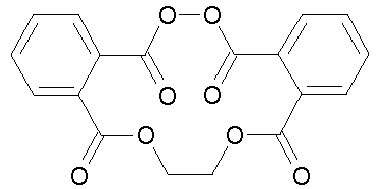
1,2,7,10-Tetraoxa-3,6,11,14-tetraoxo-4,5,12,13-dibenzocyclotetradecane 
Bis((2-cyclohexyloxycarbonyl)benzoyl ) peroxide 74 89 1.18E+20 164.7 
Bis(2-naphthoyl) peroxide 75 92 2.90E+17 147.8 - In the table T10 is the temperature (in °C) at which the half-life of the compound is 10 hours, T1 is the temperature (in °C) at which the half-life of the compound is 1 hour, Ea is the activation energy in J/mole, and A is the Arrhenius frequency factor in s-1. Using the conventional Arrhenius equation, the half-life at the polymerization temperature can be calculated.
- More preferred are substituted, or unsubstituted, dibenzoylperoxides, 1,1-di(tert-butylperoxy)-3,3,5-trimethylcyclohexane, 2,2-di(tert-butylperoxy)butane, 1,1-di(tert-butylperoxy)cyclohexane, and azo initiators. Most preferred are dibenzoylperoxide, 1,1-di(tert-butylperoxy)-3,3,5-trimethylcyclohexane, 2,2'-azobis(isobutyronitrile), and 2,2'-azobis(2-methylbutyronitrile). Commercially available initiators are obtainable under trade names such as Trigonox® 99, Trigonox® SBP, Trigonox® EHP, Trigonox® 131, Trigonox® 141, Trigonox® 21S, and Perkadox® 16, Trigonox® 27, Trigonox® 22, Trigonox® 29, Trigonox® 25, Trigonox® 125, Trigonox® 121, Trigonox® 421, Trigonox® 425, Perkadox® AMBN, Perkadox® AIBN, Perkadox® L W-75, Perkadox® 12, and Laurox.
The additional initiators used in the present process differ from the initiator, but may be selected from the same group of compounds. - When the reaction mixture is formulated at or near the polymerization temperature, which is called the warm-start process, it is not required to add a certain amount of initiator before bringing the reaction mixture to the reaction temperature and dosing the remainder at the reaction temperature. However, also in this warm-start process it may be beneficial to at once add up to 10 wt.%, preferably up to 5 wt.% of an initiator, based on the combined weight of the monomers, to the reaction mixture prior to polymerization. The initiator can then be dosed continuously or semi-continuously at the reaction temperature. When this procedure is used, the first initiator is added as the last ingredient after the monomers, solvent, and possibly other components have been mixed. This procedure is particularly preferred if a certain amount of polymerization inhibitor (a radical trapping species) is present in the reaction mixture. If such radical scavenger is present, for instance because it is contained in the monomer as a constituent thereof (typically added as a stabilizer), the initially dosed initiator will react with said scavenger, thereby preventing a delayed start of the polymerization reaction.
- Preferably, the type and the amount of additional initiator are selected such that the residual monomer content of the final polymerized product is less than 5,000 mg/kg of monomer, preferably less than 2,000 mg/kg of monomer, more preferably less than 1,000 mg/kg of monomer.
- The total amount of initiator to be used in the process according to the invention is within the range conventionally used in polymerization processes. Typically, it is preferred to use at least 0.01 wt.%, more preferably at least 0.05 wt.%, and most preferably at least 0.1 wt.% of all initiators and preferably at most 5 wt.%, more preferably at most 3 wt.%, and most preferably at most 1 wt.% of all initiators, based on the weight of the monomers to be polymerized.
- Dosing to the reactor is typically effected by dosing the initiator as such (neat), as a mixture or solution with one or more solvents, or as a dispersion. Suitable solvents are preferably selected from the group consisting of water, conventional organic solvents, monomers, blowing agents (such as pentane, isopentane, and the like), and mixtures thereof. Mixtures with monomer may not be preferred for safety or quality control reasons. Preferably dispersions of the initiator, more preferably aqueous dispersions, are used. Most preferably a suspension of the initiator in water is used, such as a 40 wt.% dibenzoylperoxide suspension in water. Said suspension can be obtained commercially from Akzo Nobel Polymer Chemicals under the trade name Perkadox® L W-40. When solvents such as alcohols are used, they can be removed during working up of the polymer after the process of polymerization. If used, advantageously solvents are used that do not adversely affect the thermal stability of the initiator dissolved therein, as can be verified by analyzing the half-life temperature (temperature at which the half-life is 1 h) of the initiator in said solvent. An example of a solvent that can be used with most initiators is isododecane. If a dispersion of the initiator is dosed, the dispersion can be a dispersion of the initiator as such or a dispersion of a solution of said initiator. Preferably, the dispersion is an aqueous dispersion. Preferably, dilute initiator solutions or dispersions are used that ensure rapid mixing of the initiator and the polymerization mixture, which leads to a more efficient use of the initiator. Therefore, it is preferred to use mixtures, solutions, or dispersions of the initiator having an initiator concentration of at least 0.1, more preferably at least 0.5, and most preferably at least 2 wt.%, up to at most 60, more preferably at most 25 wt.%, and most preferably at most 15 wt.%.
- The polymerization process is a suspension process wherein the reaction mixture is a dispersion of a monomer-containing phase in a medium comprising water. In these processes the usual additives may be used. For example, for suspensions in water, one or more of the usual additives such as a surfactant, a chain transfer agent, a protective colloid, an anti-fouling agent, a pH-buffer, flame retardants, flame retardant synergists, etc., may be present. Blowing agents can be added at the start of or during the polymerization process. Because of the presence of styrene monomer and blowing agents such processes are at least partially carried out in a pressurized reactor. The combined weight of the additives preferably is at most 20 wt.%, based on the combined weight of all monomers.
- Because of the reduced polymerization time of the present process, it is preferred to add blowing agents, if used, at an earlier stage than in a conventional process. More preferably, part or all of the blowing agent is introduced to the reaction mixture when the degree of polymerization of the monomer is less than 80, preferably less than 60, and most preferably less than 50%. A suitable process was found to be one where the blowing agent was dosed or added within one hour of the start of the polymerization. The most preferred process according to the invention is a batchwise suspension polymerization process involving the use of a blowing agent, for making expandable polystyrene (EPS).
- In addition to the fact that dosing of the initiator at variable rates is beneficial for using the cooling capacity of the polymerization reaction in the most optimal way, it was also found that varying the dosing speed of the initiator during the polymerization process is advantageous for obtaining an economical polymerization process and obtaining polymerized product with the desired molecular weight. By varying the dosing speed within one run, polymers with a polymodal molecular weight distribution can be made. For instance, a bimodal molecular weight distribution can be produced in the same run by using two periods with varying dosing speeds. Such a bimodal molecular weight distributed polymer mixture has a part with low-molecular weight that is useful for improving the expandability of polystyrene and a part with high-molecular weight that improves the mechanical properties of the polymer.
- Furthermore, it was observed that a polymer with essentially the same molecular weight as from a conventional process can be produced in less time, the only differences being the controlled dosing of the initiator and optimizing of the initiators used in the dosing process.
- After the polymerization, the resulting (co)polymer (or resin) is preferably treated as is usual in the art. Polymers so obtained can be submitted to the usual monomer reduction, drying and/or screening steps. These one or more steps can be followed by, for example, an expansion step. As in conventional EPS processes, the amount of residual monomer content in the polymer product can be reduced in the usual manner; preferably by including a second step in the process wherein the reaction temperature is higher than the temperature used in the first step wherein the initiator was dosed, typically approx. 110-170°C, preferably in the presence of one or more additional initiators with half-life temperatures as defined before, such as tert-butylperoxybenzoate, tert-butyl peroxy-2-ethylhexyl carbonate, dicumylperoxide, or tert-amyl peroxy-2-ethylhexyl carbonate. These additional initiators may be added at the start of or during the polymerization process. The resulting resin is characterized in that it preferably contains less than 50 ppm of residual initiator, more preferably less than 40 ppm, and most preferably less than 25 ppm of initiator, immediately after drying for 1 hour at 60°C and screening.
- The resulting resin is further characterized in that it preferably has a weight average molecular weight (Mw) of at least 100,000 g/mol, more preferably of at least 125,000 g/mol, and most preferably of at least 150,000 g/mol, and that it has a Mw preferably of at most 500,000 g/mol, more preferably of at most 450,000 g/mol, and most preferably of at most 350,000 g/mol, measured in accordance with conventional gel permeation chromatography techniques using polystyrene standards.
- The invention is illustrated by the following examples.
-
BPO, Px L (Perkadox® L W-75) Dibenzoyl peroxide (the initiator) ex Akzo Nobel Tx-117 (Trigonox® 117) Tert-butylperoxy 2-ethylhexylcarbonate (additional initiator) ex Akzo Nobel Tx-131 (Trigonox® 131) Tert-amylperoxy 2-ethylhexylcarbonate (additional initiator) ex Akzo Nobel
In Examples 1-4 the initiator was dosed, using a pressure pump, at a polymerization temperature of 110°C. In examples where no pentane was used, Perkadox® L W-75 was dosed in 90 minutes as a solution in 30 g styrene. The additional initiator was added as a solution in 5 g styrene after 190 minutes over a period of 15 minutes. In the examples where pentane was used, the BPO was added as a solution in styrene and pentane (30g/15g) and the additional initiator was added as a solution in 5 g pentane after 190 minutes of polymerization time over a period of 15 minutes. In all examples 1-4 the temperature was increased, after 190 min polymerization time at 110°C, in 30 minutes to 120°C. This temperature was maintained for 80 minutes. Then, the content of the reactor was cooled to room temperature. - The results are collected in the table below. It can be concluded that by dosing of the initiator (Examples 1-4), EPS with the same average molecular weight (Mw and Mn) and polydispersity can be obtained as in examples wherein the initiator is not dosed and the temperature is lower (Comp. Examples A-D). In dosing experiments where no pentane is used (Examples 3-4) also the same low residual styrene values are obtained as in non-dosing examples where no pentane is used (Comp. Examples C-D).
Example 1 2 3 4 A B C D + pentane no pentane + pentane no pentane Additional initiator Tx-117 Tx-131 Tx-117 Tx-131 Tx-117 Tx-131 Tx-117 Tx-131 Mw product (x 1000) g/mol 221 191 265 260 243 195 275 251 Mn product (x 1000) g/mol 79 72 85 84 85 78 101 87 D (Mw/Mn) 2.8 2.6 3.1 3.1 2.9 2.5 2.7 2.9 Residual styrene (wt.%) 1.76 4.14 0.17 0.28 0.75 0.66 0.31 0.19 Polymerization time 300 300 300 300 480 480 480 480 Amount BPO (meq/100g styrene) 1.24 1.24 1.24 1.24 0.98 0.98 0.98 0.98 Dosing time BPO (min) 90 90 90 90 0 0 0 0 Amount add. initiator (meq/100g styrene) 0.46 0.46 0.46 0.46 0.46 0.46 0.46 0.46 Dosing time add. initiator (min) 15 15 15 15 0 0 0 0 Initial temperature (°C) 110 110 110 110 90 90 90 90 Max. polymerization temperature (°C) 120 120 120 120 120 120 120 120 -
Px-BC (Perkadox® BC-FF) Dicumyl peroxide ex Akzo Nobel - The procedure of the previous examples was repeated, except that 260 g of water was charged. In Examples 5, 8, and 9, additional initiator was added to the polymerization reaction at 180, 160, and 135 minutes after the start of the reaction, respectively. In Examples 6, 7, and E, the additional initiator was added at once prior to the start of the polymerization.
In examples 5 and 8 the temperature was increased after 190 min polymerization time at 110°C, in 15 minutes (example 5) or 30 minutes (example 8) to 120°C. This temperature was maintained for 50 minutes (example 5) or 80 minutes (example 8).
In example 7 the temperature was increased after 175 min polymerization time at 110°C, in 60 minutes to 130°C. This temperature was maintained for 100 minutes. In example 6 the temperature was increased after 155 min polymerization time at 110°C, in 30 minutes to 120°C. This temperature was maintained for 65 minutes, followed by an increase in temperature to 150°C in 15 minutes at which this temperature was maintained for 95 minutes. - The results are collected in the table below. It can be concluded that the polystyrene obtained in a polymerization process according to the invention is comparable with respect to molecular weight and molecular weight distribution to polystyrene obtained in a conventional process, but the process of the invention requires a shorter polymerization time.
(Comparative) Example 5 6 7 8 9 E Initiator Px-L W75 Px-L W75 Px-L W75 Px-L W40 Px-L W40 Px-L W75 Additional initiator Tx-131 Tx-117 Px-BC Tx-131 Tx-131 Tx-117 Mw product (x 1000) g/mol 260 229 231 284 279 243 Mn product (x 1000) g/mol 84 75 72 92 102 101 D (Mw/Mn) 3.1 3.1 3.2 3.1 2.8 2.7 Residual styrene (wt.%) 0.28 0.10 0.50 0.17 0.07 0.31 Polymerization time 300 370 325 300 300 480 Amount BPO (meq/100g styrene) 1.24 0.83 1.53 1.24 0.98 0.98 Dosing time BPO (min) 90 90 90 75 80 0 Amount add. initiator (meq/100g styrene) 0.46 0.87 0.46 0.46 0.46 0.46 Dosing time add. initiator (min) 15 0 0 5 5 0 Initial temperature (°C) 110 110 110 110 110 90 Max. polymerization temperature (°C) 120 150 130 120 120 120 -
Px L W40 (Perkadox®-L W40-TCP) Dibenzoyl peroxide suspension ex Akzo Nobel - The procedure of Example 5 was repeated, except that no additional initiator was used. In example 10 Px L W40 was used. The peroxide suspension was dosed as a diluted suspension (in 30 g water, the intake of water at the start of the reaction was corrected for this amount). Perkadox® L W-75 was used in example 11 and dosed as a solution in 30 g styrene. The styrene solution had to be temperature controlled in order to avoid polymerization of the solution itself.
- The results were as follows:
Example 10 Example 11 Conversion (%) 99.0 83 Residual monomer (%) 1.02 17 Mw 245000 185000 Mn 88000 70000 Dispersity 2.8 2.6 - It can be concluded that the use of a suspension of BPO is preferred over the use of a solution of BPO in the process of the invention.
Claims (11)
- A suspension polymerization process for polymerizing styrene monomer, or a mixture of monomers comprising styrene, at a polymerization temperature of at most 170°C, comprising the step of dosing an initiator selected from the group consisting of peroxydicarbonates, peroxycarbonates, peroxyesters, peroxyketals, diacylperoxides, dialkylperoxides, azo-initiators, ketone peroxides, which initiators may be functionalized, and mixtures thereof,- semi-continuously by adding portions of initiator at 4 or more moments or- continuouslyto the reaction mixture at the polymerization temperature over a period of time during which at least 40% of the monomers are polymerized, wherein at least one initiator that is dosed has a half-life of 0.5 minutes or more and 50 minutes or less at said polymerization temperature, and wherein the process is essentially vinyl chloride-free, meaning that the amount of vinyl chloride is less than 1% by weight, based on the weight of all monomer.
- Process according to claim 1 wherein the composition further comprises co-monomers selected from the group consisting of vinyl acetate, ethylene, propylene, acrylonitrile, butadiene, (meth)acrylates, and ethylenically unsaturated polymers, such as polybutadiene and styrene butadiene rubber.
- Process according to claim 1 or 2 wherein said initiator is dosed continuously or semi-continuously from the point in time at which at least 0.1%, more preferably at least 0.5%, most preferably 1% of the monomer has already been polymerized until at least 70%, preferably at least 80%, more preferably at least 90%, and most preferably essentially all of the monomer is polymerized, the term "essentially all of the monomer is polymerized" meaning that less than 1,000 ppm of monomer is present in the final polymerized product.
- Process according to any one of claims 1-3 wherein the initiator is selected from the group consisting of substituted, or unsubstituted, dibenzoylperoxides, 1,1-di(tert-butylperoxy)-3,3,5-trimethylcyclohexane, 2,2-di(tert-butylperoxy)butane, 1,1-di(tert-butylperoxy)cyclohexane, azo initiators, and mixtures thereof, most preferably from dibenzoylperoxide, 1,1-di(tert-butylperoxy)-3,3,5-trimethylcyclohexane, 2,2'-azobis(isobutyronitrile), 2,2'-azobis(2-methylbutyronitrile), and mixtures thereof.
- Process according to any one of claims 1-4 wherein the reaction temperature is 170°C or lower, preferably 150°C or lower, more preferably 130°C or lower, and most preferably 120°C or lower.
- Process according to any one of claims 1-5 wherein at least part of the initiator is continuously or semi-continuously dosed over a period of at least 0.5 hour, preferably at least 1 hour.
- Process according to any one of claims 1-6 wherein at least 0.01 wt.%, more preferably at least 0.05 wt.%, and most preferably at least 0.1 wt.% of the combined weight of all initiators and preferably at most 5 wt.%, more preferably at most 3 wt.%, and most preferably at most 1 wt.% of the combined weight of all initiators, based on the weight of the monomers to be polymerized, is used.
- Process according to any one of claims 1-7 wherein a blowing agent is added or dosed to the reaction mixture when the degree of polymerization of the monomer is less than 80%, preferably less than 60%, and most preferably less than 50%.
- Process according to any one of claims 1-8 wherein the initiator, or mixture of initiators, is dosed in the form of a, preferably aqueous, dispersion.
- Process according to any one of claims 1-9 wherein an additional initiator is used to reduce the residual monomer level.
- Process according to claim 10 for the preparation of expandable polystyrene.
Priority Applications (2)
| Application Number | Priority Date | Filing Date | Title |
|---|---|---|---|
| PL04725375T PL1613672T3 (en) | 2003-04-14 | 2004-04-02 | Dosing of peroxide to a suspension process wherein styrene is polymerized |
| EP04725375.2A EP1613672B1 (en) | 2003-04-14 | 2004-04-02 | Dosing of peroxide to a suspension process wherein styrene is polymerized |
Applications Claiming Priority (5)
| Application Number | Priority Date | Filing Date | Title |
|---|---|---|---|
| EP03076088 | 2003-04-14 | ||
| US47196303P | 2003-05-20 | 2003-05-20 | |
| US53022203P | 2003-12-17 | 2003-12-17 | |
| EP04725375.2A EP1613672B1 (en) | 2003-04-14 | 2004-04-02 | Dosing of peroxide to a suspension process wherein styrene is polymerized |
| PCT/EP2004/003661 WO2004089999A2 (en) | 2003-04-14 | 2004-04-02 | Dosing of peroxide to a suspension process wherein styrene is polymerized |
Publications (2)
| Publication Number | Publication Date |
|---|---|
| EP1613672A2 EP1613672A2 (en) | 2006-01-11 |
| EP1613672B1 true EP1613672B1 (en) | 2019-06-12 |
Family
ID=33162639
Family Applications (1)
| Application Number | Title | Priority Date | Filing Date |
|---|---|---|---|
| EP04725375.2A Expired - Lifetime EP1613672B1 (en) | 2003-04-14 | 2004-04-02 | Dosing of peroxide to a suspension process wherein styrene is polymerized |
Country Status (12)
| Country | Link |
|---|---|
| US (1) | US7132485B2 (en) |
| EP (1) | EP1613672B1 (en) |
| JP (1) | JP4524279B2 (en) |
| KR (1) | KR101093477B1 (en) |
| CN (1) | CN100439406C (en) |
| AR (1) | AR043865A1 (en) |
| BR (1) | BRPI0409446B1 (en) |
| CL (1) | CL2004000789A1 (en) |
| MX (1) | MXPA05011015A (en) |
| PL (1) | PL1613672T3 (en) |
| TW (1) | TWI343924B (en) |
| WO (1) | WO2004089999A2 (en) |
Families Citing this family (16)
| Publication number | Priority date | Publication date | Assignee | Title |
|---|---|---|---|---|
| FR2879207B1 (en) * | 2004-12-10 | 2007-07-06 | Commissariat Energie Atomique | METHOD AND DEVICE FOR MANUFACTURING POLYMER FOAM BALLS OR BALLOONS |
| KR20100090287A (en) * | 2007-11-20 | 2010-08-13 | 아크조 노벨 엔.브이. | Process for preparing styrene-based (co)polymers |
| US8822610B2 (en) * | 2008-12-22 | 2014-09-02 | ATRP Solutions, Inc. | Control over controlled radical polymerization processes |
| US8815971B2 (en) | 2008-12-22 | 2014-08-26 | ATRP Solutions, Inc. | Control over controlled radical polymerization processes |
| SA110310245B1 (en) | 2009-04-03 | 2014-11-12 | اكزو نوبل كيميكا | Aqueous Solid Diacyl Peroxide Suspension |
| FR2948375B1 (en) * | 2009-07-27 | 2011-12-30 | Arkema France | PROCESS FOR THE PREPARATION OF EXPANDABLE POLYSTYRENE BY CONTINUOUS INJECTION OF A LIQUID ORGANIC PEROXIDE |
| CN102639569B (en) | 2009-12-10 | 2014-07-02 | 阿克佐诺贝尔化学国际公司 | Process for the polymerization of styrene |
| CN102603929B (en) * | 2012-02-29 | 2014-10-29 | 无锡知益微球科技有限公司 | Preparation method of polymer particles |
| KR101336251B1 (en) * | 2012-08-29 | 2013-12-03 | 포항공과대학교 산학협력단 | Method for fabrication of electrospun polystyrene nanofiber and method for fabrication of electrospun polystyrene-quantum dot hybrid nanofiber using styrene monomer |
| CN102863569B (en) * | 2012-09-29 | 2014-05-14 | 东莞新长桥塑料有限公司 | Flame-retardant expandable polystyrene resin with low volatile organic compound content and preparation method thereof |
| CN102875734B (en) * | 2012-09-29 | 2014-08-06 | 东莞新长桥塑料有限公司 | Recovery-grade expandable polystyrene and method for preparing recovery-grade expandable polystyrene by using seed polymerization method |
| KR102156109B1 (en) * | 2017-09-29 | 2020-09-15 | 주식회사 엘지화학 | Method for preparing acrylonitrile based polymer for preparing carbon fiber |
| CN117043204A (en) * | 2022-01-17 | 2023-11-10 | 株式会社Lg化学 | Methods of preparing polymers |
| US20240150504A1 (en) * | 2022-01-17 | 2024-05-09 | Lg Chem, Ltd. | Method of preparing polymer |
| KR102942737B1 (en) | 2022-01-17 | 2026-03-23 | 주식회사 엘지화학 | Method for preparing polymer |
| WO2025186291A1 (en) | 2024-03-08 | 2025-09-12 | Nouryon Chemicals International B.V. | Process for recycling polystyrene |
Family Cites Families (22)
| Publication number | Priority date | Publication date | Assignee | Title |
|---|---|---|---|---|
| US3451985A (en) * | 1964-03-26 | 1969-06-24 | Monsanto Co | Method of polymerizing vinyl monomers |
| US4173688A (en) | 1973-07-23 | 1979-11-06 | Sekisui Kagaku Kogyo Kabushiki Kaisha | Process for preparing styrenic polymer foams |
| FR2238718A1 (en) | 1973-07-27 | 1975-02-21 | Sekisui Chemical Co Ltd | Polystyrene particles of uniform size, esp. for foams - by polymerising in suspension of fine polystyrene particles, contg. catalyst and polymn retarder |
| US4363881A (en) * | 1980-11-26 | 1982-12-14 | Cellofoam A.G. | Method of making uniformly-sized expandable polymeric particles |
| ZA818026B (en) * | 1980-11-26 | 1982-10-27 | Cellofoam Ag | Method of making uniformly-sized expandable polymeric particles |
| JPS6047037A (en) * | 1983-08-24 | 1985-03-14 | Hitachi Chem Co Ltd | Production of expandable styrene resin particle |
| EP0234705A3 (en) * | 1986-01-23 | 1989-01-25 | Mitsubishi Yuka Badische Co., Ltd. | Process for producing expandable polystyrene beads |
| JP2684400B2 (en) * | 1989-01-09 | 1997-12-03 | 出光石油化学株式会社 | Styrene polymer and method for producing the same |
| JPH02255708A (en) | 1989-03-30 | 1990-10-16 | Idemitsu Petrochem Co Ltd | Production of styrene-based polymer |
| DE4029298A1 (en) * | 1990-09-15 | 1992-03-19 | Huels Chemische Werke Ag | PROCESS FOR CORE CONTROL IN THE MANUFACTURE OF EXPANDABLE STYRENE POLYMERISES BY SUSPENSION POLYMERIZATION |
| GB9020579D0 (en) * | 1990-09-20 | 1990-10-31 | Shell Int Research | Process for manufacture of poly(vinyl substituted aromatic)compounds and epdm rubber containing polymer compositions |
| JP2933707B2 (en) | 1990-11-21 | 1999-08-16 | 鐘淵化学工業株式会社 | Method for producing expandable styrene polymer particles |
| EP0492712A1 (en) | 1990-12-24 | 1992-07-01 | Akzo Nobel N.V. | Peroxide compositions with ethoxylated water-soluble polymers |
| JP3054014B2 (en) * | 1993-12-27 | 2000-06-19 | 積水化成品工業株式会社 | Method for producing expandable styrene polymer particles |
| DE19530765A1 (en) * | 1995-08-22 | 1997-02-27 | Basf Ag | Continuous process for the production of expandable styrene polymers |
| JPH1017698A (en) * | 1996-07-04 | 1998-01-20 | Shell Japan Kk | Expandable styrene resin particles |
| GB9721603D0 (en) | 1997-10-10 | 1997-12-10 | Dyno Ind Asa | Method |
| WO1999054391A1 (en) * | 1998-04-17 | 1999-10-28 | Nova Chemicals (International) S.A. | Process for the preparation of expandable polymer particles |
| AU756065B2 (en) | 1998-09-21 | 2003-01-02 | Akzo Nobel N.V. | Continuous dosing of very fast initiators during polymerization reactions |
| DE19911960A1 (en) | 1999-03-17 | 2000-09-21 | Basf Ag | Preparation of 1,2-diphenylethylene/styrene copolymer by dosing styrene and optionally copolymerizable monomers to mixture of 1,2-diphenylethene and polymerization initiator. |
| US6984702B2 (en) | 2000-03-22 | 2006-01-10 | Dynal Biotech Asa | Process for the preparation of functionalized polymer particles |
| DE10039388A1 (en) * | 2000-08-11 | 2002-02-21 | Basf Ag | Starchy polymer dispersions |
-
2004
- 2004-04-02 EP EP04725375.2A patent/EP1613672B1/en not_active Expired - Lifetime
- 2004-04-02 US US10/552,437 patent/US7132485B2/en not_active Expired - Lifetime
- 2004-04-02 BR BRPI0409446A patent/BRPI0409446B1/en not_active IP Right Cessation
- 2004-04-02 MX MXPA05011015A patent/MXPA05011015A/en active IP Right Grant
- 2004-04-02 PL PL04725375T patent/PL1613672T3/en unknown
- 2004-04-02 CN CNB2004800129074A patent/CN100439406C/en not_active Expired - Fee Related
- 2004-04-02 KR KR1020057019422A patent/KR101093477B1/en not_active Expired - Fee Related
- 2004-04-02 WO PCT/EP2004/003661 patent/WO2004089999A2/en not_active Ceased
- 2004-04-02 JP JP2006505020A patent/JP4524279B2/en not_active Expired - Fee Related
- 2004-04-13 CL CL200400789A patent/CL2004000789A1/en unknown
- 2004-04-13 AR ARP040101243A patent/AR043865A1/en unknown
- 2004-04-14 TW TW093110312A patent/TWI343924B/en not_active IP Right Cessation
Non-Patent Citations (1)
| Title |
|---|
| None * |
Also Published As
| Publication number | Publication date |
|---|---|
| EP1613672A2 (en) | 2006-01-11 |
| CN100439406C (en) | 2008-12-03 |
| KR101093477B1 (en) | 2011-12-13 |
| US7132485B2 (en) | 2006-11-07 |
| PL1613672T3 (en) | 2019-12-31 |
| KR20060012583A (en) | 2006-02-08 |
| WO2004089999A2 (en) | 2004-10-21 |
| TW200508258A (en) | 2005-03-01 |
| CL2004000789A1 (en) | 2005-01-21 |
| JP2006522844A (en) | 2006-10-05 |
| US20060111529A1 (en) | 2006-05-25 |
| AR043865A1 (en) | 2005-08-17 |
| CN1788025A (en) | 2006-06-14 |
| BRPI0409446A (en) | 2006-04-18 |
| MXPA05011015A (en) | 2005-12-12 |
| WO2004089999A3 (en) | 2005-01-06 |
| TWI343924B (en) | 2011-06-21 |
| JP4524279B2 (en) | 2010-08-11 |
| BRPI0409446B1 (en) | 2016-06-07 |
Similar Documents
| Publication | Publication Date | Title |
|---|---|---|
| US7132485B2 (en) | Dosing of peroxide to a suspension process wherein styrene is polymerized | |
| AU2010329986B2 (en) | Process for the polymerization of styrene | |
| EP1408056B2 (en) | Preparation of expandable styrene polymers | |
| US6384155B1 (en) | Continuous dosing of very fast initiators during polymerization reactions | |
| EP1495057B1 (en) | Co-metering of organic initiators and protective colloids during polymerization reactions | |
| KR20100090287A (en) | Process for preparing styrene-based (co)polymers | |
| KR100193022B1 (en) | Manufacturing method of photopolymer resin excellent in heat resistance | |
| RU2360929C2 (en) | Peroxide dosing in suspension method according to which sterol is polymerised | |
| EP1375529A1 (en) | Addition of organic initiators during a pressure drop in vinyl chloride monomer polymerization reactions | |
| JPH02240110A (en) | Polymerization initiator for vinyl monomer |
Legal Events
| Date | Code | Title | Description |
|---|---|---|---|
| PUAI | Public reference made under article 153(3) epc to a published international application that has entered the european phase |
Free format text: ORIGINAL CODE: 0009012 |
|
| 17P | Request for examination filed |
Effective date: 20050929 |
|
| AK | Designated contracting states |
Kind code of ref document: A2 Designated state(s): AT BE BG CH CY CZ DE DK EE ES FI FR GB GR HU IE IT LI LU MC NL PL PT RO SE SI SK TR |
|
| AX | Request for extension of the european patent |
Extension state: AL HR LT LV MK |
|
| DAX | Request for extension of the european patent (deleted) | ||
| 17Q | First examination report despatched |
Effective date: 20100525 |
|
| GRAP | Despatch of communication of intention to grant a patent |
Free format text: ORIGINAL CODE: EPIDOSNIGR1 |
|
| INTG | Intention to grant announced |
Effective date: 20150107 |
|
| TPAC | Observations filed by third parties |
Free format text: ORIGINAL CODE: EPIDOSNTIPA |
|
| GRAJ | Information related to disapproval of communication of intention to grant by the applicant or resumption of examination proceedings by the epo deleted |
Free format text: ORIGINAL CODE: EPIDOSDIGR1 |
|
| STAA | Information on the status of an ep patent application or granted ep patent |
Free format text: STATUS: EXAMINATION IS IN PROGRESS |
|
| INTC | Intention to grant announced (deleted) | ||
| RAP1 | Party data changed (applicant data changed or rights of an application transferred) |
Owner name: AKZO NOBEL CHEMICALS INTERNATIONAL B.V. |
|
| GRAP | Despatch of communication of intention to grant a patent |
Free format text: ORIGINAL CODE: EPIDOSNIGR1 |
|
| STAA | Information on the status of an ep patent application or granted ep patent |
Free format text: STATUS: GRANT OF PATENT IS INTENDED |
|
| INTG | Intention to grant announced |
Effective date: 20181015 |
|
| GRAJ | Information related to disapproval of communication of intention to grant by the applicant or resumption of examination proceedings by the epo deleted |
Free format text: ORIGINAL CODE: EPIDOSDIGR1 |
|
| STAA | Information on the status of an ep patent application or granted ep patent |
Free format text: STATUS: EXAMINATION IS IN PROGRESS |
|
| GRAR | Information related to intention to grant a patent recorded |
Free format text: ORIGINAL CODE: EPIDOSNIGR71 |
|
| GRAS | Grant fee paid |
Free format text: ORIGINAL CODE: EPIDOSNIGR3 |
|
| STAA | Information on the status of an ep patent application or granted ep patent |
Free format text: STATUS: GRANT OF PATENT IS INTENDED |
|
| INTC | Intention to grant announced (deleted) | ||
| INTG | Intention to grant announced |
Effective date: 20190308 |
|
| GRAA | (expected) grant |
Free format text: ORIGINAL CODE: 0009210 |
|
| STAA | Information on the status of an ep patent application or granted ep patent |
Free format text: STATUS: THE PATENT HAS BEEN GRANTED |
|
| AK | Designated contracting states |
Kind code of ref document: B1 Designated state(s): AT BE BG CH CY CZ DE DK EE ES FI FR GB GR HU IE IT LI LU MC NL PL PT RO SE SI SK TR |
|
| REG | Reference to a national code |
Ref country code: GB Ref legal event code: FG4D |
|
| REG | Reference to a national code |
Ref country code: CH Ref legal event code: EP |
|
| REG | Reference to a national code |
Ref country code: AT Ref legal event code: REF Ref document number: 1142453 Country of ref document: AT Kind code of ref document: T Effective date: 20190615 |
|
| REG | Reference to a national code |
Ref country code: DE Ref legal event code: R096 Ref document number: 602004054037 Country of ref document: DE |
|
| REG | Reference to a national code |
Ref country code: IE Ref legal event code: FG4D |
|
| RAP2 | Party data changed (patent owner data changed or rights of a patent transferred) |
Owner name: NOURYON CHEMICALS INTERNATIONAL B.V. |
|
| REG | Reference to a national code |
Ref country code: NL Ref legal event code: MP Effective date: 20190612 |
|
| PG25 | Lapsed in a contracting state [announced via postgrant information from national office to epo] |
Ref country code: ES Free format text: LAPSE BECAUSE OF FAILURE TO SUBMIT A TRANSLATION OF THE DESCRIPTION OR TO PAY THE FEE WITHIN THE PRESCRIBED TIME-LIMIT Effective date: 20190612 Ref country code: SE Free format text: LAPSE BECAUSE OF FAILURE TO SUBMIT A TRANSLATION OF THE DESCRIPTION OR TO PAY THE FEE WITHIN THE PRESCRIBED TIME-LIMIT Effective date: 20190612 |
|
| PG25 | Lapsed in a contracting state [announced via postgrant information from national office to epo] |
Ref country code: BG Free format text: LAPSE BECAUSE OF FAILURE TO SUBMIT A TRANSLATION OF THE DESCRIPTION OR TO PAY THE FEE WITHIN THE PRESCRIBED TIME-LIMIT Effective date: 20190912 |
|
| PG25 | Lapsed in a contracting state [announced via postgrant information from national office to epo] |
Ref country code: RO Free format text: LAPSE BECAUSE OF FAILURE TO SUBMIT A TRANSLATION OF THE DESCRIPTION OR TO PAY THE FEE WITHIN THE PRESCRIBED TIME-LIMIT Effective date: 20190612 Ref country code: SK Free format text: LAPSE BECAUSE OF FAILURE TO SUBMIT A TRANSLATION OF THE DESCRIPTION OR TO PAY THE FEE WITHIN THE PRESCRIBED TIME-LIMIT Effective date: 20190612 Ref country code: CZ Free format text: LAPSE BECAUSE OF FAILURE TO SUBMIT A TRANSLATION OF THE DESCRIPTION OR TO PAY THE FEE WITHIN THE PRESCRIBED TIME-LIMIT Effective date: 20190612 Ref country code: NL Free format text: LAPSE BECAUSE OF FAILURE TO SUBMIT A TRANSLATION OF THE DESCRIPTION OR TO PAY THE FEE WITHIN THE PRESCRIBED TIME-LIMIT Effective date: 20190612 Ref country code: EE Free format text: LAPSE BECAUSE OF FAILURE TO SUBMIT A TRANSLATION OF THE DESCRIPTION OR TO PAY THE FEE WITHIN THE PRESCRIBED TIME-LIMIT Effective date: 20190612 Ref country code: PT Free format text: LAPSE BECAUSE OF FAILURE TO SUBMIT A TRANSLATION OF THE DESCRIPTION OR TO PAY THE FEE WITHIN THE PRESCRIBED TIME-LIMIT Effective date: 20191014 |
|
| REG | Reference to a national code |
Ref country code: DE Ref legal event code: R097 Ref document number: 602004054037 Country of ref document: DE |
|
| REG | Reference to a national code |
Ref country code: DE Ref legal event code: R082 Ref document number: 602004054037 Country of ref document: DE Representative=s name: LKGLOBAL | LORENZ & KOPF PARTG MBB PATENTANWAE, DE |
|
| PLBE | No opposition filed within time limit |
Free format text: ORIGINAL CODE: 0009261 |
|
| STAA | Information on the status of an ep patent application or granted ep patent |
Free format text: STATUS: NO OPPOSITION FILED WITHIN TIME LIMIT |
|
| PG25 | Lapsed in a contracting state [announced via postgrant information from national office to epo] |
Ref country code: DK Free format text: LAPSE BECAUSE OF FAILURE TO SUBMIT A TRANSLATION OF THE DESCRIPTION OR TO PAY THE FEE WITHIN THE PRESCRIBED TIME-LIMIT Effective date: 20190612 |
|
| REG | Reference to a national code |
Ref country code: GR Ref legal event code: EP Ref document number: 20190402577 Country of ref document: GR Effective date: 20200511 |
|
| 26N | No opposition filed |
Effective date: 20200313 |
|
| PG25 | Lapsed in a contracting state [announced via postgrant information from national office to epo] |
Ref country code: SI Free format text: LAPSE BECAUSE OF FAILURE TO SUBMIT A TRANSLATION OF THE DESCRIPTION OR TO PAY THE FEE WITHIN THE PRESCRIBED TIME-LIMIT Effective date: 20190612 |
|
| PGFP | Annual fee paid to national office [announced via postgrant information from national office to epo] |
Ref country code: TR Payment date: 20200331 Year of fee payment: 17 |
|
| PGFP | Annual fee paid to national office [announced via postgrant information from national office to epo] |
Ref country code: DE Payment date: 20200429 Year of fee payment: 17 Ref country code: GR Payment date: 20200430 Year of fee payment: 17 Ref country code: FR Payment date: 20200427 Year of fee payment: 17 Ref country code: FI Payment date: 20200429 Year of fee payment: 17 |
|
| PGFP | Annual fee paid to national office [announced via postgrant information from national office to epo] |
Ref country code: HU Payment date: 20200407 Year of fee payment: 17 Ref country code: IT Payment date: 20200423 Year of fee payment: 17 Ref country code: PL Payment date: 20200401 Year of fee payment: 17 Ref country code: BE Payment date: 20200427 Year of fee payment: 17 |
|
| PGFP | Annual fee paid to national office [announced via postgrant information from national office to epo] |
Ref country code: AT Payment date: 20200401 Year of fee payment: 17 |
|
| PG25 | Lapsed in a contracting state [announced via postgrant information from national office to epo] |
Ref country code: MC Free format text: LAPSE BECAUSE OF FAILURE TO SUBMIT A TRANSLATION OF THE DESCRIPTION OR TO PAY THE FEE WITHIN THE PRESCRIBED TIME-LIMIT Effective date: 20190612 |
|
| REG | Reference to a national code |
Ref country code: CH Ref legal event code: PL |
|
| PG25 | Lapsed in a contracting state [announced via postgrant information from national office to epo] |
Ref country code: LU Free format text: LAPSE BECAUSE OF NON-PAYMENT OF DUE FEES Effective date: 20200402 Ref country code: CH Free format text: LAPSE BECAUSE OF NON-PAYMENT OF DUE FEES Effective date: 20200430 Ref country code: LI Free format text: LAPSE BECAUSE OF NON-PAYMENT OF DUE FEES Effective date: 20200430 |
|
| REG | Reference to a national code |
Ref country code: AT Ref legal event code: UEP Ref document number: 1142453 Country of ref document: AT Kind code of ref document: T Effective date: 20190612 |
|
| GBPC | Gb: european patent ceased through non-payment of renewal fee |
Effective date: 20200402 |
|
| PG25 | Lapsed in a contracting state [announced via postgrant information from national office to epo] |
Ref country code: GB Free format text: LAPSE BECAUSE OF NON-PAYMENT OF DUE FEES Effective date: 20200402 Ref country code: IE Free format text: LAPSE BECAUSE OF NON-PAYMENT OF DUE FEES Effective date: 20200402 |
|
| REG | Reference to a national code |
Ref country code: DE Ref legal event code: R119 Ref document number: 602004054037 Country of ref document: DE |
|
| REG | Reference to a national code |
Ref country code: FI Ref legal event code: MAE |
|
| REG | Reference to a national code |
Ref country code: AT Ref legal event code: MM01 Ref document number: 1142453 Country of ref document: AT Kind code of ref document: T Effective date: 20210402 |
|
| REG | Reference to a national code |
Ref country code: BE Ref legal event code: MM Effective date: 20210430 |
|
| PG25 | Lapsed in a contracting state [announced via postgrant information from national office to epo] |
Ref country code: AT Free format text: LAPSE BECAUSE OF NON-PAYMENT OF DUE FEES Effective date: 20210402 Ref country code: FI Free format text: LAPSE BECAUSE OF NON-PAYMENT OF DUE FEES Effective date: 20210402 Ref country code: DE Free format text: LAPSE BECAUSE OF NON-PAYMENT OF DUE FEES Effective date: 20211103 Ref country code: HU Free format text: LAPSE BECAUSE OF NON-PAYMENT OF DUE FEES Effective date: 20210403 Ref country code: FR Free format text: LAPSE BECAUSE OF NON-PAYMENT OF DUE FEES Effective date: 20210430 |
|
| PG25 | Lapsed in a contracting state [announced via postgrant information from national office to epo] |
Ref country code: GR Free format text: LAPSE BECAUSE OF NON-PAYMENT OF DUE FEES Effective date: 20211108 |
|
| PG25 | Lapsed in a contracting state [announced via postgrant information from national office to epo] |
Ref country code: CY Free format text: LAPSE BECAUSE OF FAILURE TO SUBMIT A TRANSLATION OF THE DESCRIPTION OR TO PAY THE FEE WITHIN THE PRESCRIBED TIME-LIMIT Effective date: 20190612 |
|
| PG25 | Lapsed in a contracting state [announced via postgrant information from national office to epo] |
Ref country code: BE Free format text: LAPSE BECAUSE OF NON-PAYMENT OF DUE FEES Effective date: 20210430 |
|
| PG25 | Lapsed in a contracting state [announced via postgrant information from national office to epo] |
Ref country code: IT Free format text: LAPSE BECAUSE OF NON-PAYMENT OF DUE FEES Effective date: 20200402 |
|
| PG25 | Lapsed in a contracting state [announced via postgrant information from national office to epo] |
Ref country code: PL Free format text: LAPSE BECAUSE OF NON-PAYMENT OF DUE FEES Effective date: 20210402 |
|
| PG25 | Lapsed in a contracting state [announced via postgrant information from national office to epo] |
Ref country code: TR Free format text: LAPSE BECAUSE OF NON-PAYMENT OF DUE FEES Effective date: 20210402 |
|
| PG25 | Lapsed in a contracting state [announced via postgrant information from national office to epo] |
Ref country code: IT Free format text: LAPSE BECAUSE OF NON-PAYMENT OF DUE FEES Effective date: 20210402 |