EP1613358B1 - Adducts between magnetic resonance shift reagents and substrates containing exchangeable protons for "cest" applications - Google Patents
Adducts between magnetic resonance shift reagents and substrates containing exchangeable protons for "cest" applications Download PDFInfo
- Publication number
- EP1613358B1 EP1613358B1 EP04725938A EP04725938A EP1613358B1 EP 1613358 B1 EP1613358 B1 EP 1613358B1 EP 04725938 A EP04725938 A EP 04725938A EP 04725938 A EP04725938 A EP 04725938A EP 1613358 B1 EP1613358 B1 EP 1613358B1
- Authority
- EP
- European Patent Office
- Prior art keywords
- iii
- paramagnetic
- polyaminoacids
- polysaccharides
- protons
- Prior art date
- Legal status (The legal status is an assumption and is not a legal conclusion. Google has not performed a legal analysis and makes no representation as to the accuracy of the status listed.)
- Expired - Lifetime
Links
Images





Classifications
-
- A—HUMAN NECESSITIES
- A61—MEDICAL OR VETERINARY SCIENCE; HYGIENE
- A61K—PREPARATIONS FOR MEDICAL, DENTAL OR TOILETRY PURPOSES
- A61K49/00—Preparations for testing in vivo
- A61K49/06—Nuclear magnetic resonance [NMR] contrast preparations; Magnetic resonance imaging [MRI] contrast preparations
- A61K49/08—Nuclear magnetic resonance [NMR] contrast preparations; Magnetic resonance imaging [MRI] contrast preparations characterised by the carrier
- A61K49/085—Nuclear magnetic resonance [NMR] contrast preparations; Magnetic resonance imaging [MRI] contrast preparations characterised by the carrier conjugated systems
-
- A—HUMAN NECESSITIES
- A61—MEDICAL OR VETERINARY SCIENCE; HYGIENE
- A61K—PREPARATIONS FOR MEDICAL, DENTAL OR TOILETRY PURPOSES
- A61K49/00—Preparations for testing in vivo
- A61K49/06—Nuclear magnetic resonance [NMR] contrast preparations; Magnetic resonance imaging [MRI] contrast preparations
- A61K49/08—Nuclear magnetic resonance [NMR] contrast preparations; Magnetic resonance imaging [MRI] contrast preparations characterised by the carrier
- A61K49/10—Organic compounds
-
- A—HUMAN NECESSITIES
- A61—MEDICAL OR VETERINARY SCIENCE; HYGIENE
- A61K—PREPARATIONS FOR MEDICAL, DENTAL OR TOILETRY PURPOSES
- A61K49/00—Preparations for testing in vivo
- A61K49/06—Nuclear magnetic resonance [NMR] contrast preparations; Magnetic resonance imaging [MRI] contrast preparations
- A61K49/08—Nuclear magnetic resonance [NMR] contrast preparations; Magnetic resonance imaging [MRI] contrast preparations characterised by the carrier
- A61K49/10—Organic compounds
- A61K49/14—Peptides, e.g. proteins
- A61K49/146—Peptides, e.g. proteins the peptide being a polyamino acid, e.g. poly-lysine
Definitions
- the present invention relates to paramagnetic adducts useful in Magnetic Resonance Imaging (MRI) procedures which use saturation transfer to create image contrast.
- MRI Magnetic Resonance Imaging
- CEDST agents exogenous contrast agents
- CEST agents exogenous contrast agents
- the preferred compounds are diamagnetic molecules such as sugars, aminoacids, heterocyclic compounds, nucleosides, imidazoles and derivatives, guanidine, etc.
- CEST paramagnetic contrast agents was therefore considered in WO 02/43775 , which claims the use of paramagnetic complexes having mobile protons whose saturation transfer (which is better than that of the diamagnetic compounds exemplified in US 5050609 ) can be sensitive to parameters of diagnostic interest such as pH, temperature, metabolite concentration, etc.
- CEST agents systems constituted by non-covalent adducts formed by a substrate having protons in exchange with bulk water (including types similar to those exemplified in US 5050609 ) and by a paramagnetic complex able to increase the separation of their resonance frequencies off the bulk water is not considered in the above-mentioned documents or in the literature.
- the paramagnetic agent will be chosen on the basis of its Shift Reagent (SR) characteristics in relation to the properties of the compound containing the exchangeable protons.
- SR Shift Reagent
- the present invention relates to the use of paramagnetic GEST agents comprising a diamagnetic substrate molecule (SH) containing mobile protons bound by means of electrostatic interactions having a thermodynamic constant of association Ka greater than 10 to a paramagnetic chelate containing a metal selected from iron (II) (high-spin configuration), iron (III), cobalt (II), rhodium (II), copper (II), nickel (II), cerium (III), praseodymium (III), neodymium (III), dysprosium (III), erbium (III), terbium (III), holmium (III), thulium (III), ytterbium (III) and europium (III).
- the mobile protons can belong to diamagnetic or paramagnetic substrates, provided that in the latter case their chemical shift is influenced by non-covalent interaction with the paramagnetic species.
- the invention consequently relates to paramagnetic CEST agents constituted by diamagnetic substrates containing mobile protons (SH units) bound by means of electrostatic interactions to paramagnetic chelates (SR units) which interact reversibly with the substrates.
- SH units mobile protons
- SR units paramagnetic chelates
- the invention also relates to diagnostic compositions containing CEST agents as defined above, mixed with a suitable vehicle.
- the diamagnetic substrate molecules (SH) containing mobile protons are selected from linear and macrocyclic polyamines such as cyclen (1,4,7,10-tetraazacyclododecane), polyaminoacids such as polyarginine, proteins such as human serum albumin, polysaccharides, polycyclodextrins, synthetic polymers (polyamidoamines, peramidated polyaminoacids, and dendrimers containing amide groups). Cyclen, polyarginine and albumin are particularly preferred.
- Exchangeable protons may also belong to water molecules which, following interaction with the SH substrate and due to the nature of the adduct [(SR)(SH)], are "shifted" from the bulk water signal and are in suitable exchange conditions with it.
- This category of SH substances includes polysaccharide systems, especially systems which form supramolecular aggregates able to trap molecules of water and SR units.
- a further extension of this concept includes any system wherein SR and water molecules are trapped in the same compartment, and at the same time the water molecules (whose chemical shift is influenced by the SR unit) are in suitable exchange conditions with the bulk water.
- a non-exhaustive list of systems which can be used to obtain this compartmentalisation includes liposomes, nano- and micro-vesicular systems, protein cavities and cells.
- the adducts according to the invention can be prepared by simple mixing of molecules having mobile protons with paramagnetic chelates, in suitable molar ratios which depend on the affinity between the substrate and the SR unit: SH + SR ⁇ ⁇ K A SR ⁇ SH
- thermodynamic constant of association K A
- K A thermodynamic constant of association
- the SR unit possesses chemical characteristics able to recognise the portion of the substrate molecule containing the mobile protons so as to significantly influence their chemical shift.
- the interaction takes place through electrostatic bonds.
- Recognition of the substrate-SR unit can also take place through hydrophobic (e.g. in the case of polycyclodextrins) or mixed interactions (e.g. in the case of proteins).
- the SR unit can be trapped in polymer systems with high biocompatibility such as hydrogels or cross-linked proteins in which it can perform its effect towards the slow-exchange water molecules present in those systems.
- the SR unit and SH substrate can be compartmentalised in suitable biocompatible systems such as liposomes, nanoparticles, microemulsions and protein cavities (e.g. apoferritin), in which water (unlike the SR unit and the substrate) can be freely exchanged between the inside and outside of the compartment.
- suitable biocompatible systems such as liposomes, nanoparticles, microemulsions and protein cavities (e.g. apoferritin)
- water unlike the SR unit and the substrate
- the effect of the SR unit could also be performed by means of a simple variation in magnetic susceptibility able to influence the resonance frequency of the mobile protons of the substrate in the compartment without requiring their interaction, with the advantage of making the irradiation frequency of the mobile protons of the substrate almost constant.
- the SH-SR agent is compartmentalised in a system wherein the exchange rate of water between the inside and the outside of the compartment is very slow, and the quantity of water in the compartment containing the unit is sufficient to observe it in the MR image, the effect of saturation transfer could be considerably increased due to the increase in the local concentration of SR and in the substrate containing the mobile protons.
- the shift agent could be chosen in order to influence resonance of the bulk water signal only. This effect would in any event increase the separation of the resonance frequencies between water and substrate, thus allowing irradiation of the mobile protons of the substrate.
- An example of this kind, unrelated to CEST, is reported by Otting et al. (J. Am. Chem. Soc., 1991, 113, 4363 ), who used Co(II) to "shift" the bulk water signal, thus allowing observation of the water molecules trapped in a site of protein BPTI, which the shift agent is unable to enter.
- the agents according to the invention will be formulated in appropriate compositions suitable for parenteral administration.
- the diagnostic compositions according to the invention can be used to determine the chemico-physical parameters of diagnostic interest such as temperature, pH, metabolite concentration, O 2 and CO 2 partial pressures and enzyme activity in a human or animal tissue or body by means of the CEST method.
- the preferable diagnostic composition should contain two magnetically different sets of mobile protons, whose transfer effect should preferably be different towards the chemico-physical parameter of interest. In this way, by using a ratiometric method (already described in WO 00/66180 ), it is possible to determine the diagnostic parameter independently of the local concentration of the diagnostic composition.
- Another preferred embodiment relates to the possibility of using such systems to obtain information about endothelial permeability.
- conventional diagnostic agents namely agents on T 1 or T 2 of water protons
- DCE-MRI Dynamic Contrast Enhanced
- the method involves the administration of diagnostic agents of different dimensions (as such, or after interaction with macromolecules like HSA) to evaluate the permeability of the capillaries.
- the quantitative evaluation of capillary permeability is carried out with a kinetic study which requires successive use of the different diagnostic agents.
- each SR unit or each SH unit
- the extravasation of each SR unit can be evaluated, as the contrast can be "stimulated" by selective irradiation of the signals of the diagnostic system.
- SR units of different sizes able to shift the signal of the mobile protons of substrate SH differently (e.g. by changing the paramagnetic metal) can be used. Identification of the species which pass through the endothelium allows the kinetic study to be carried out after a single administration.
- the same objective can be achieved by using the same SR unit and modulating the size and type of interacting substrate in order to vary the resonance frequency of its mobile protons.
- a similar result can be obtained by using compartmentalised systems with different dimensions wherein the diagnostic agent that passes through the endothelium can easily be identified with a suitable formulation of the solution contained in the chosen system (liposome, nanosphere, etc.).
- compositions preferably comprise an adduct according to the invention in molar concentrations of between about 0.001 and 1.0 M, in admixture with a suitable vehicle.
- Preferred forms are sterile aqueous solutions or suspensions, ready for use or in the form of lyophilisate to be reconstituted with sterile solvent immediately before use.
- the dose can range between 0.01 and 0.5 mmol/kg of body weight.
- the chart shows the considerable sensitivity of this system, which can be used to measure an ST effect of 5% at an SR unit concentration of about 40 ⁇ M.
- HSA human serum albumin
- TmDOTP [TmDOTP] 4- (312K, pH 7.4).
- Figure 8 shows the saturation transfer measured by irradiating the frequencies of the NMR spectrum between 1.3 ppm and 10 ppm, for a solution of HSA 1 mM alone ( ⁇ ) and after addition of [TmDOTP] 4- in the amount of 3mM ( ⁇ ).
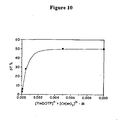
- Figure 10 illustrates the dependency of the CEST effect (ST%) according to concentration for 1:1 solutions of [TmDOTP] 4- and Co(en) 3 3+ , 298 K, pH 5.7, 7.05 T, frequency of irradiation 21,000 Hz off water, irradiation time 4 s.
- a 5% CEST effect has been obtained at an SR unit concentration of 0.1 mM.
- the maximum effect is only 9% due to the high exchange rate of the primary amine protons.
- Figure 11 indicates the dependency of the CEST effect (ST%) according to the concentration ratio between Cyclen and [TmDOTP] 4- for a 4 mM solution of the latter, 312 K, pH 6, 7.05 T, frequency of irradiation 21,000 Hz off water, irradiation time 4 s.
- the maximum effect is observable for substrate/SR unit concentration ratios of about 3-4:1. At lower substrate concentrations the effect mainly declines because of the small number of protons irradiated, while at higher concentrations the effect mainly declines because of the increase in the free fraction of cyclen, with a consequent shift of the mobile proton signal to the diamagnetic area.
- Figure 12 illustrates the dependency of the CEST effect (ST%) on the concentration of [TmDOTP] 4- , maintaining a [Cyclen]/[TmDOTP] 4- concentration ratio of 3:1, 312 K, pH 6, 7.05 T, frequency of irradiation 21,000 Hz off water, irradiation time 4 s. -
- the chart shows the considerable sensitivity of this system, which can be used to measure an ST effect of 5% at an SR unit concentration of about 60 ⁇ M.
Landscapes
- Health & Medical Sciences (AREA)
- Life Sciences & Earth Sciences (AREA)
- General Health & Medical Sciences (AREA)
- Veterinary Medicine (AREA)
- Public Health (AREA)
- Nuclear Medicine, Radiotherapy & Molecular Imaging (AREA)
- Radiology & Medical Imaging (AREA)
- Epidemiology (AREA)
- Animal Behavior & Ethology (AREA)
- Medicinal Chemistry (AREA)
- Chemical & Material Sciences (AREA)
- Proteomics, Peptides & Aminoacids (AREA)
- Medicines Containing Antibodies Or Antigens For Use As Internal Diagnostic Agents (AREA)
- Medicinal Preparation (AREA)
- Magnetic Resonance Imaging Apparatus (AREA)
- Cephalosporin Compounds (AREA)
- Compounds Of Iron (AREA)
- Soft Magnetic Materials (AREA)
Abstract
Description
- The present invention relates to paramagnetic adducts useful in Magnetic Resonance Imaging (MRI) procedures which use saturation transfer to create image contrast.
- The generation of contrast in an MRI image through irradiation of mobile protons in the tissues has already been reported in
US 5,050,609 . The use of exogenous contrast agents (originally called CEDST agents, and now called CEST agents) containing at least one mobile proton in exchange with water was disclosed inWO 00/66180 - The same document also claims methods for in vitro and in vivo determination of the pH, temperature and metabolite concentration by administering a contrast agent having two sets of magnetically non-equivalent mobile protons. Selective irradiation of the two pools and application of a ratiometric method allows a transfer effect to be measured independently of the concentration of contrast medium. Saturation transfer implies that the mobile protons of the CEST agent do not coalesce with the bulk water, which means that the separation between the resonance frequencies of the two sets of mobile protons must be greater than the exchange rate. Moreover, the extent of the transfer is directly proportional to the exchange rate of the protons of the agent, which means that an increase in separation of the resonance frequencies of the two exchanging signals increases the efficiency of saturation transfer. The use of CEST paramagnetic contrast agents was therefore considered in
WO 02/43775 US 5050609 ) can be sensitive to parameters of diagnostic interest such as pH, temperature, metabolite concentration, etc. - However, the possibility of using as CEST agents systems constituted by non-covalent adducts formed by a substrate having protons in exchange with bulk water (including types similar to those exemplified in
US 5050609 ) and by a paramagnetic complex able to increase the separation of their resonance frequencies off the bulk water is not considered in the above-mentioned documents or in the literature. With this approach, the paramagnetic agent will be chosen on the basis of its Shift Reagent (SR) characteristics in relation to the properties of the compound containing the exchangeable protons. - The present invention relates to the use of paramagnetic GEST agents comprising a diamagnetic substrate molecule (SH) containing mobile protons bound by means of electrostatic interactions having a thermodynamic constant of association Ka greater than 10 to a paramagnetic chelate containing a metal selected from iron (II) (high-spin configuration), iron (III), cobalt (II), rhodium (II), copper (II), nickel (II), cerium (III), praseodymium (III), neodymium (III), dysprosium (III), erbium (III), terbium (III), holmium (III), thulium (III), ytterbium (III) and europium (III). The mobile protons can belong to diamagnetic or paramagnetic substrates, provided that in the latter case their chemical shift is influenced by non-covalent interaction with the paramagnetic species.
- The invention consequently relates to paramagnetic CEST agents constituted by diamagnetic substrates containing mobile protons (SH units) bound by means of electrostatic interactions to paramagnetic chelates (SR units) which interact reversibly with the substrates.
- The invention also relates to diagnostic compositions containing CEST agents as defined above, mixed with a suitable vehicle.
- The diamagnetic substrate molecules (SH) containing mobile protons, are selected from linear and macrocyclic polyamines such as cyclen (1,4,7,10-tetraazacyclododecane), polyaminoacids such as polyarginine, proteins such as human serum albumin, polysaccharides, polycyclodextrins, synthetic polymers (polyamidoamines, peramidated polyaminoacids, and dendrimers containing amide groups). Cyclen, polyarginine and albumin are particularly preferred.
- Exchangeable protons may also belong to water molecules which, following interaction with the SH substrate and due to the nature of the adduct [(SR)(SH)], are "shifted" from the bulk water signal and are in suitable exchange conditions with it. This category of SH substances includes polysaccharide systems, especially systems which form supramolecular aggregates able to trap molecules of water and SR units. A further extension of this concept includes any system wherein SR and water molecules are trapped in the same compartment, and at the same time the water molecules (whose chemical shift is influenced by the SR unit) are in suitable exchange conditions with the bulk water. A non-exhaustive list of systems which can be used to obtain this compartmentalisation includes liposomes, nano- and micro-vesicular systems, protein cavities and cells.
- The adducts according to the invention can be prepared by simple mixing of molecules having mobile protons with paramagnetic chelates, in suitable molar ratios which depend on the affinity between the substrate and the SR unit:

- This affinity can be expressed by the value of the thermodynamic constant of association (KA), which must be greater than 10. The adducts can then be isolated and purified by chromatographic techniques and/or freeze-drying, precipitation, evaporation and the like.
- According to a first embodiment of the invention, the SR unit possesses chemical characteristics able to recognise the portion of the substrate molecule containing the mobile protons so as to significantly influence their chemical shift. For example, in the case of adducts between [LnDOTP]4- (Ln is a lanthanide) and the preferred substrates cyclen, polyarginine and HSA, the interaction takes place through electrostatic bonds.
- Other examples relating to the electrostatic interaction between substrate and SR unit are those in which the [LnDOTP]4- is able to influence the chemical shift value of the mobile protons of diamagnetic molecules such as Co(III)-sarcophagine, Co(III)-(ethylenediamine)3 and agmatine.
- Recognition of the substrate-SR unit can also take place through hydrophobic (e.g. in the case of polycyclodextrins) or mixed interactions (e.g. in the case of proteins).
- Alternatively, the SR unit can be trapped in polymer systems with high biocompatibility such as hydrogels or cross-linked proteins in which it can perform its effect towards the slow-exchange water molecules present in those systems.
- Other systems of interest are those wherein differentiation between the pools of exchangeable protons takes place as a result of the effects of compartmentalisation.
- According to this embodiment of the invention, the SR unit and SH substrate can be compartmentalised in suitable biocompatible systems such as liposomes, nanoparticles, microemulsions and protein cavities (e.g. apoferritin), in which water (unlike the SR unit and the substrate) can be freely exchanged between the inside and outside of the compartment. In this way, the effect of the SR unit could also be performed by means of a simple variation in magnetic susceptibility able to influence the resonance frequency of the mobile protons of the substrate in the compartment without requiring their interaction, with the advantage of making the irradiation frequency of the mobile protons of the substrate almost constant.
- If the SH-SR agent is compartmentalised in a system wherein the exchange rate of water between the inside and the outside of the compartment is very slow, and the quantity of water in the compartment containing the unit is sufficient to observe it in the MR image, the effect of saturation transfer could be considerably increased due to the increase in the local concentration of SR and in the substrate containing the mobile protons.
- Alternatively, the shift agent could be chosen in order to influence resonance of the bulk water signal only. This effect would in any event increase the separation of the resonance frequencies between water and substrate, thus allowing irradiation of the mobile protons of the substrate. An example of this kind, unrelated to CEST, is reported by Otting et al. (J. Am. Chem. Soc., 1991, 113, 4363), who used Co(II) to "shift" the bulk water signal, thus allowing observation of the water molecules trapped in a site of protein BPTI, which the shift agent is unable to enter.
- For the proposed diagnostic uses, the agents according to the invention will be formulated in appropriate compositions suitable for parenteral administration.
- The diagnostic compositions according to the invention can be used to determine the chemico-physical parameters of diagnostic interest such as temperature, pH, metabolite concentration, O2 and CO2 partial pressures and enzyme activity in a human or animal tissue or body by means of the CEST method. For this purpose, the preferable diagnostic composition should contain two magnetically different sets of mobile protons, whose transfer effect should preferably be different towards the chemico-physical parameter of interest. In this way, by using a ratiometric method (already described in
WO 00/66180 - Another preferred embodiment relates to the possibility of using such systems to obtain information about endothelial permeability. For this purpose, conventional diagnostic agents (namely agents on T1 or T2 of water protons) (Min-Ying S. et al, Magn. Res. Med. 1998, 39, 259-269) are currently used with the DCE-MRI (DCE = Dynamic Contrast Enhanced) technique. The method involves the administration of diagnostic agents of different dimensions (as such, or after interaction with macromolecules like HSA) to evaluate the permeability of the capillaries. The quantitative evaluation of capillary permeability is carried out with a kinetic study which requires successive use of the different diagnostic agents. Using the CEST procedure, however, the extravasation of each SR unit (or each SH unit) can be evaluated, as the contrast can be "stimulated" by selective irradiation of the signals of the diagnostic system. On this basis, SR units of different sizes able to shift the signal of the mobile protons of substrate SH differently (e.g. by changing the paramagnetic metal) can be used. Identification of the species which pass through the endothelium allows the kinetic study to be carried out after a single administration.
- Alternatively, the same objective can be achieved by using the same SR unit and modulating the size and type of interacting substrate in order to vary the resonance frequency of its mobile protons. A similar result can be obtained by using compartmentalised systems with different dimensions wherein the diagnostic agent that passes through the endothelium can easily be identified with a suitable formulation of the solution contained in the chosen system (liposome, nanosphere, etc.).
- The compositions preferably comprise an adduct according to the invention in molar concentrations of between about 0.001 and 1.0 M, in admixture with a suitable vehicle.
- The compositions according to the invention can be suitably administered intravascularly (e.g. by the intravenous, intra-arterial or intraventricular route) or by the intrathecal, intraperitoneal, intralymphatic, intracavitary, oral or enteral route.
- Preferred forms are sterile aqueous solutions or suspensions, ready for use or in the form of lyophilisate to be reconstituted with sterile solvent immediately before use. Depending on the specific diagnostic requirements, the dose can range between 0.01 and 0.5 mmol/kg of body weight.
- The invention is described in greater detail in the examples below.
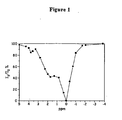
- CEST spectrum of a 0.1 mM solution of polyarginine (DP 227) at pH 6.5, 312 K, 7.05 T, irradiation time 10 s.
The spectrum (Figure 1 ) indicates the intensity of the NMR signal of the bulk water according to the irradiated frequency, expressed in ppm in relation to the water. - The two CEST peaks will be observed at around 2 ppm and 4 ppm off the water, indicating the saturation transfer caused by irradiation of the guanidine protons and the amide backbone of the polymer respectively.
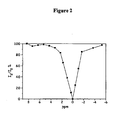
- CEST spectrum of a 0.1 mM solution of polyarginine (DP 227) at pH 7.2, 312 K, 7.05 T, irradiation time 10 s.
- The spectrum (
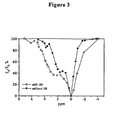
Figure 2 ) demonstrates that the increase in the exchange rate of the polymer protons caused by the increase in pH leads to their coalescence with the bulk water signal. - CEST spectrum of a 0.5 mM solution of polyarginine (DP 227) in the presence of 2.5 mM of [YbDOTP]4- at pH 6.5, 312 K, 7.05 T, irradiation time 4 s.
- The spectrum (
Figure 3 ) shows the effect of the SR unit on the resonance frequency of the substrate. - CEST spectrum of a 0.5 mM solution of polyarginine (DP 227) in the presence of 2.5 mM of [YbDOTP]4- at pH 7.2, 312 K, 7.05 T, irradiation time 4 s.
- The spectrum (
Figure 4 ) demonstrates that by increasing the pH of the solution, the effect of the SR unit allows measurement of a saturation transfer for guanidine protons by irradiating in the 5-10 ppm interval off the bulk water. - CEST spectrum of a 0.25 mM solution of polyarginine (DP 227) in the presence of 3.5 mM of [DyDOTP]4- at pH 6.5, 312 K, 7.05 T, irradiation time 4 s.
- The spectrum (
Figure 5 ) indicates that the effect of the Dy(III) ion on the resonance of the guanidine mobile protons has the opposite mathematical sign to the use of the Yb(III) ion. - CEST spectrum of a 0.1 mM solution of polyarginine (DP 227) in the presence of 1.2 mM and 2.4 mM of [TmDOTP]4- at pH 7.2, 312 K, 7.05 T, irradiation time 4 s.
- The spectrum (
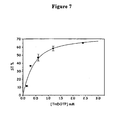
Figure 6 ) indicates the marked effect of this complex on the resonance frequency of the guanidine mobile protons, whose irradiation can be carried out in the 30-40 ppm interval (2.4 mM of SR). - Dependence of saturation transfer (ST%) on a 6.25 µM solution of polyarginine (DP 227) according to the concentration of [TmDOTP]4- at pH 7.2, 312 K, 7.05 T, frequency of irradiation 8400 Hz off water, irradiation time 4 s.
- The chart shows the considerable sensitivity of this system, which can be used to measure an ST effect of 5% at an SR unit concentration of about 40 µM.
- Dependence on pH of saturation transfer (ST%) of a 0.11 mM solution of polyarginine (DP 270) and 2 mM of [TmDOTP]4-, 312 K, 7.05 T, irradiation frequency 6000 Hz off water, irradiation time 4 s.
- The effect considerably declines at an acid pH, mainly due to the reduction in exchange rate of the guanidine protons.
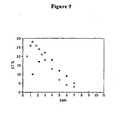
- Interaction between human serum albumin (HSA) and [TmDOTP]4- (312K, pH 7.4).
-
Figure 8 shows the saturation transfer measured by irradiating the frequencies of the NMR spectrum between 1.3 ppm and 10 ppm, for a solution ofHSA 1 mM alone (□) and after addition of [TmDOTP]4- in the amount of 3mM (■). The frequency at which the maximum transfer is observed, attributable to irradiation of the guanidine protons of the Arg protein residues, shifts by about 2 ppm. - Interaction between [TmDOTP]4- and Co(en)3 3+.
-
Figure 10 illustrates the dependency of the CEST effect (ST%) according to concentration for 1:1 solutions of [TmDOTP]4- and Co(en)3 3+, 298 K, pH 5.7, 7.05 T, frequency of irradiation 21,000 Hz off water, irradiation time 4 s. Under these experimental conditions, a 5% CEST effect has been obtained at an SR unit concentration of 0.1 mM. At physiological temperature and pH, the maximum effect is only 9% due to the high exchange rate of the primary amine protons. - Interaction between [TmDOTP]4- and Cyclen.
-
Figure 11 indicates the dependency of the CEST effect (ST%) according to the concentration ratio between Cyclen and [TmDOTP]4- for a 4 mM solution of the latter, 312 K,pH 6, 7.05 T, frequency of irradiation 21,000 Hz off water, irradiation time 4 s. The maximum effect is observable for substrate/SR unit concentration ratios of about 3-4:1. At lower substrate concentrations the effect mainly declines because of the small number of protons irradiated, while at higher concentrations the effect mainly declines because of the increase in the free fraction of cyclen, with a consequent shift of the mobile proton signal to the diamagnetic area. - Interaction between [TmDOTP]4- and Cyclen.
-
Figure 12 illustrates the dependency of the CEST effect (ST%) on the concentration of [TmDOTP]4-, maintaining a [Cyclen]/[TmDOTP]4- concentration ratio of 3:1, 312 K,pH 6, 7.05 T, frequency of irradiation 21,000 Hz off water, irradiation time 4 s. - - The chart shows the considerable sensitivity of this system, which can be used to measure an ST effect of 5% at an SR unit concentration of about 60 µM.
- Interaction between [TmDOTP]4- and Cyclen.
-
Figure 13 shows the dependency of the CEST effect (ST%) on pH for a 3:1 solution of cyclen (12 mM) and [TmDOTP]4- (4 mM), 312 T, 7.05 T, irradiation frequency 21,000 Hz off water, irradiation time 4 s. - The transfer effect reflects the dependency of the amine proton exchange rate on the pH; in other words, it decreases when it is too slow (pH < 5) or when it is too fast, approaching the condition of coalescence (pH > 7).
- The histogram in
figure 14 compares the values of ST% for a series of substrates interacting with the SR unit [TmDOTP]4-, 312 K, pH 7.4, 7.05 T, irradiation time 4 s. In all cases the concentration of [TmDOTP]4- is 4 mM, while that of the substrate varies according to the optimum concentration ratio previously evaluated. Triaza = 1,4,7-triazacyclononane 10:1; Hexaaza = 1,4,7,10,13,16-hexaazacyclooctadecane 2:1; Cyclen 3:1; Cyclam 2:1 and polyarginine 0.055:1.
Claims (8)
- The use of a paramagnetic CEST agent comprising a diamagnetic substrate molecule (SH) containing mobile protons, selected from linear and cyclic polyamines, polyaminoacids, proteins, polysaccharides, polyamidoamine, peramidated polyaminoacids, dendrimers containing amide groups, polycyclodextrins, polysaccharides and alginates, bound by means of electrostatic interactions having a thermodynamic constant of association Ka greater than 10 to a paramagnetic chelate (SR) containing a metal selected from iron (II) (high-spin configuration), iron (III), cobalt (II), rhodium (II), copper (II), nickel (II), cerium (III), praseodymium (III), neodymium (III), dysprosium (III), erbium (III), terbium (III), holmium (III), thulium (III), ytterbium (III) and europium (III), in saturation transfer based MRI procedures.
- The use according to claim 1 wherein the diamagnetic substrate (SH) is selected from polyarginine, albumin and cyclen.
- The use according to claim 1 or 2 in which the paramagnetic chelate (SR) is [LnDOTP]4- wherein the Ln metal is selected from the following: Ce(III), Pr(III), Nd(III), Eu(III), Tb(III), Dy(III), Ho(III), Er(III), Tm(III), Yb(III).
- The use according to claim 1 wherein (SR) and (SH) are compartmentalized in biocompatible systems selected from liposomes, nanoparticles, microemulsions and protein cavities.
- A paramagnetic CEST agent comprising a diamagnetic substrate molecule (SH) containing mobile protons, selected from linear and cyclic polyamines, polyaminoacids, proteins, polysaccharides, polyamidoamine, peramidated polyaminoacids, dendrimers containing amide groups, polycyclodextrins, polysaccharides and alginates, bound by means of electrostatic interactions having a thermodynamic constant of association Ka greater than 10 to a [LnDOTP]4- chelate wherein Ln is a lanthanide metal selected from the following: Ce(III), Pr(III), Nd(III), Eu(III), Tb(III), Dy(III), Ho(III), Er(III), Tm(III), Yb(III).
- A paramagnetic CEST agent according to claim 5 wherein the diamagnetic substrate molecule (SH) is selected from cyclen, polyarginine and albumin.
- A paramagnetic CHEST agent comprising a paramagnetic chelate (SR) of a metal selected from iron (II) (high-spin configuration), iron (III), cobalt (II), rhodium (II), copper (II), nickel (II), cerium (III), praseodymium (III), neodymium (III), dysprosium (III), erbium (III), terbium (III), holmium (III), thulium (III), ytterbium (III) and europium (III), bound by means of electrostatic interactions having a thermodynamic constant of association Ka greater than 10 to a diamagnetic substrate molecule (SH) containing mobile protons, selected from linear and cyclic polyamines, polyaminoacids, proteins, polysaccharides, polyamidoamine, peramidated polyaminoacids, dendrimers containing amide groups, polycyclodextrins, polysaccharides and alginates, compartmentalized in a biocompatible system selected from liposomes, nanoparticles, microemulsions and protein cavities.
- A paramagnetic CEST agent according to claim 5 comprising a diamagnetic substrate molecule (SH) containing mobile protons and selected from linear and cyclic polyamines, polyaminoacids, proteins, polysaccharides, polyamidoamine, peramidated polyaminoacids, dendrimers containing amide groups, polycyclodextrins, polysaccharides and alginates, bound by means of electrostatic interactions having a thermodynamic constant of association Ka greater than 10 to a [LnDOTP]4- chelate (SR) wherein Ln is a lanthanide metal selected from Ce(III), Pr(III), Nd(III), Eu(III), Tb(III), Dy(III), Ho(III), Er(III), Tm(III), Yb(III) wherein the exchangeable protons belong to water molecules interacting with the substrate SH that following the said interaction, are shifted from the bulk water signal and are in suitable exchange condition with it.
Priority Applications (2)
| Application Number | Priority Date | Filing Date | Title |
|---|---|---|---|
| EP04725938A EP1613358B1 (en) | 2003-04-11 | 2004-04-06 | Adducts between magnetic resonance shift reagents and substrates containing exchangeable protons for "cest" applications |
| EP09155670A EP2116267A1 (en) | 2003-04-11 | 2004-04-06 | Adducts between magnetic resonance shift reagents and substrates containing exchangeable protons for CEST applications |
Applications Claiming Priority (3)
| Application Number | Priority Date | Filing Date | Title |
|---|---|---|---|
| EP03008456A EP1466629A1 (en) | 2003-04-11 | 2003-04-11 | Adducts between magnetic resonance shift reagents and substrates containing exchangeable protons for "CEST" applications |
| EP04725938A EP1613358B1 (en) | 2003-04-11 | 2004-04-06 | Adducts between magnetic resonance shift reagents and substrates containing exchangeable protons for "cest" applications |
| PCT/EP2004/003684 WO2004089424A1 (en) | 2003-04-11 | 2004-04-06 | Adducts between magnetic resonance shift reagents and substrates containing exchangeable protons for “cest” applications |
Related Child Applications (1)
| Application Number | Title | Priority Date | Filing Date |
|---|---|---|---|
| EP09155670A Division EP2116267A1 (en) | 2003-04-11 | 2004-04-06 | Adducts between magnetic resonance shift reagents and substrates containing exchangeable protons for CEST applications |
Publications (2)
| Publication Number | Publication Date |
|---|---|
| EP1613358A1 EP1613358A1 (en) | 2006-01-11 |
| EP1613358B1 true EP1613358B1 (en) | 2009-10-07 |
Family
ID=32865006
Family Applications (3)
| Application Number | Title | Priority Date | Filing Date |
|---|---|---|---|
| EP03008456A Withdrawn EP1466629A1 (en) | 2003-04-11 | 2003-04-11 | Adducts between magnetic resonance shift reagents and substrates containing exchangeable protons for "CEST" applications |
| EP04725938A Expired - Lifetime EP1613358B1 (en) | 2003-04-11 | 2004-04-06 | Adducts between magnetic resonance shift reagents and substrates containing exchangeable protons for "cest" applications |
| EP09155670A Withdrawn EP2116267A1 (en) | 2003-04-11 | 2004-04-06 | Adducts between magnetic resonance shift reagents and substrates containing exchangeable protons for CEST applications |
Family Applications Before (1)
| Application Number | Title | Priority Date | Filing Date |
|---|---|---|---|
| EP03008456A Withdrawn EP1466629A1 (en) | 2003-04-11 | 2003-04-11 | Adducts between magnetic resonance shift reagents and substrates containing exchangeable protons for "CEST" applications |
Family Applications After (1)
| Application Number | Title | Priority Date | Filing Date |
|---|---|---|---|
| EP09155670A Withdrawn EP2116267A1 (en) | 2003-04-11 | 2004-04-06 | Adducts between magnetic resonance shift reagents and substrates containing exchangeable protons for CEST applications |
Country Status (9)
| Country | Link |
|---|---|
| US (1) | US8945512B2 (en) |
| EP (3) | EP1466629A1 (en) |
| JP (1) | JP4891763B2 (en) |
| CN (1) | CN100579583C (en) |
| AT (1) | ATE444763T1 (en) |
| AU (1) | AU2004228932B2 (en) |
| DE (1) | DE602004023492D1 (en) |
| WO (1) | WO2004089424A1 (en) |
| ZA (1) | ZA200508155B (en) |
Families Citing this family (9)
| Publication number | Priority date | Publication date | Assignee | Title |
|---|---|---|---|---|
| JP2008513533A (en) * | 2004-09-23 | 2008-05-01 | ゲルベ | Contrast medium encapsulation system for CEST imaging |
| WO2006086343A2 (en) * | 2005-02-07 | 2006-08-17 | The Johns Hopkins University | Chemical exchange saturation transfer based mri using reporter genes and mri methods related thereto |
| DE602006008604D1 (en) | 2005-04-26 | 2009-10-01 | Koninkl Philips Electronics Nv | CONTRASTING AGENTS FOR MAGNETIC RESONANCE IMAGING WITH CEST-ACTIVE PARAMAGNETIC COMPLEX |
| EP1716870A1 (en) * | 2005-04-29 | 2006-11-02 | Bracco Imaging S.p.A. | MRI contrast agents endowed with concentration independent responsiveness |
| WO2007014004A2 (en) * | 2005-07-21 | 2007-02-01 | Johns Hopkins University | Non-invasive mri measurement of tissue glycogen |
| DE102007039899B3 (en) * | 2007-08-23 | 2009-04-09 | Siemens Ag | Sensor for enabling the detection of a substance in the body of a living being |
| WO2011075476A1 (en) * | 2009-12-14 | 2011-06-23 | Arizona Board Of Regents, A Body Corporate Of The State Of Arizona, Acting For And On Behalf Of Arizona State University | Methods and compositions relating to reporter gels for use in mri techniques |
| EP2457594A1 (en) | 2010-11-05 | 2012-05-30 | Bracco Imaging S.p.A | Cest systems exhibiting a concentration independent responsiveness |
| US11357873B2 (en) | 2016-09-19 | 2022-06-14 | The Hong Kong Polytechnic University | Chiral cyclen compounds and their uses |
Family Cites Families (14)
| Publication number | Priority date | Publication date | Assignee | Title |
|---|---|---|---|---|
| US5672334A (en) * | 1991-01-16 | 1997-09-30 | Access Pharmaceuticals, Inc. | Invivo agents comprising cationic metal chelators with acidic saccharides and glycosaminoglycans |
| US5050609B1 (en) | 1987-10-04 | 1999-11-02 | Us Health | Magnetization transfer contrast and proton relaxation and use thereof in magnetic resonance imaging |
| WO1990004943A1 (en) * | 1988-11-09 | 1990-05-17 | Unger Evan C | Liposomal radiologic contrast agents |
| ATE188387T1 (en) * | 1991-02-08 | 2000-01-15 | Diatide Inc | TECHNETIUM-99M LABELED POLYPEPTIDES FOR IMAGE SHAPING |
| JP2894879B2 (en) * | 1991-10-04 | 1999-05-24 | 日本メジフィジックス株式会社 | Diagnostic contrast agent |
| GB9420390D0 (en) * | 1994-10-10 | 1994-11-23 | Nycomed Salutar Inc | Liposomal agents |
| US5707605A (en) * | 1995-06-02 | 1998-01-13 | Research Corporation Technologies | Magnetic resonance imaging agents for the detection of physiological agents |
| JP2002512942A (en) * | 1998-04-28 | 2002-05-08 | ヤーゴウテック アーゲー | Hyaluronan-based image forming agents |
| AU4656400A (en) * | 1999-04-21 | 2000-11-17 | Government of The United States of America, as represented by The Secretary Department of Health & Human Services, The National Institutes of Health, The | Method for enhancing contrast produced by mri |
| CA2322344A1 (en) * | 1999-12-08 | 2001-06-08 | Mallinckrodt Inc. | Non-covalent bioconjugates useful for magnetic resonance imaging |
| AU2002239468A1 (en) * | 2000-10-31 | 2002-05-27 | Bracco International B.V. | Conjugates of an antioxidants with metal chelating ligands |
| EP1390079A2 (en) * | 2000-11-20 | 2004-02-25 | Board of Regents University of Texas System | Paramagnetic metal ion-based macrocylic contrast agents |
| DE10135355C1 (en) * | 2001-07-20 | 2003-04-17 | Schering Ag | Conjugates of macrocyclic metal complexes with biomolecules and their use in the preparation of NMR and radiodiagnostic agents and radiotherapy |
| EP1331012A1 (en) * | 2002-01-29 | 2003-07-30 | BRACCO IMAGING S.p.A. | Responsive paramagnetic MRI contrast agents |
-
2003
- 2003-04-11 EP EP03008456A patent/EP1466629A1/en not_active Withdrawn
-
2004
- 2004-04-06 US US10/552,851 patent/US8945512B2/en not_active Expired - Fee Related
- 2004-04-06 CN CN200480009565.0A patent/CN100579583C/en not_active Expired - Fee Related
- 2004-04-06 WO PCT/EP2004/003684 patent/WO2004089424A1/en not_active Ceased
- 2004-04-06 ZA ZA200508155A patent/ZA200508155B/en unknown
- 2004-04-06 EP EP04725938A patent/EP1613358B1/en not_active Expired - Lifetime
- 2004-04-06 JP JP2006505027A patent/JP4891763B2/en not_active Expired - Fee Related
- 2004-04-06 DE DE602004023492T patent/DE602004023492D1/en not_active Expired - Lifetime
- 2004-04-06 AU AU2004228932A patent/AU2004228932B2/en not_active Ceased
- 2004-04-06 AT AT04725938T patent/ATE444763T1/en not_active IP Right Cessation
- 2004-04-06 EP EP09155670A patent/EP2116267A1/en not_active Withdrawn
Also Published As
| Publication number | Publication date |
|---|---|
| US8945512B2 (en) | 2015-02-03 |
| AU2004228932A1 (en) | 2004-10-21 |
| DE602004023492D1 (en) | 2009-11-19 |
| US20070036727A1 (en) | 2007-02-15 |
| CN100579583C (en) | 2010-01-13 |
| ZA200508155B (en) | 2007-01-31 |
| EP2116267A1 (en) | 2009-11-11 |
| WO2004089424A1 (en) | 2004-10-21 |
| AU2004228932A2 (en) | 2004-10-21 |
| ATE444763T1 (en) | 2009-10-15 |
| JP4891763B2 (en) | 2012-03-07 |
| EP1466629A1 (en) | 2004-10-13 |
| JP2006522761A (en) | 2006-10-05 |
| CN1809386A (en) | 2006-07-26 |
| AU2004228932B2 (en) | 2009-11-05 |
| EP1613358A1 (en) | 2006-01-11 |
Similar Documents
| Publication | Publication Date | Title |
|---|---|---|
| Aime et al. | Lanthanide (III) chelates for NMR biomedical applications | |
| Caravan | Strategies for increasing the sensitivity of gadolinium based MRI contrast agents | |
| Aime et al. | Prototropic and water-exchange processes in aqueous solutions of Gd (III) chelates | |
| Zhang et al. | A novel pH‐sensitive MRI contrast agent | |
| RU2102082C1 (en) | Method for examining human or animal body by applying magnetometric methods and method for detecting changes in human or animal magnetic susceptibility | |
| Muller et al. | Physicochemical characterization of MS‐325, a new gadolinium complex, by multinuclear relaxometry | |
| EP1881852B1 (en) | Mri contrast agents comprising cest active paramagnetic complex | |
| Laurent et al. | Synthesis and physicochemical characterisation of Gd‐DTPA derivatives as contrast agents for MRI | |
| US8945512B2 (en) | Adducts between magnetic resonance shift reagents and substrates containing exchangeable protons for “cest” applications | |
| Gianolio et al. | Characterization of a Manganese‐Containing Nanoparticle as an MRI Contrast Agent | |
| Ferrauto et al. | Chemical exchange saturation transfer (CEST) contrast agents | |
| Pushparaj et al. | Trinuclear Gd (III) metal complex with amide core display remarkable enhancement in relaxivity | |
| US8784778B2 (en) | MRI contrast agents endowed with concentration independent responsiveness | |
| Pushparaj et al. | Development of novel dinuclear [Gd (III) DO3VA] complexes decorated with isovaleric acid as MRI contrast agents for tumor diagnosis | |
| US20100273205A1 (en) | Magnetic resonance imaging contrast agents | |
| Cheng et al. | Thermodynamic Stability and Physicochemical Characterization of Ligand (4S)‐4‐Benzyl‐3, 6, 10‐tris (carboxymethyl)‐3, 6, 10‐triazadodecanedioic Acid (H5 [(S)‐4‐Bz‐ttda]) and Its Complexes Formed with Lanthanides, Calcium (II), Zinc (II), and Copper (II) Ions | |
| Granato et al. | The Gd3+ complex of 1, 4, 7, 10‐tetraazacyclododecane‐1, 4, 7, 10‐tetraacetic acid mono (p‐isothiocyanatoanilide) conjugated to inulin: a potential stable macromolecular contrast agent for MRI | |
| Pushparaj et al. | Synthesis and relaxivity measurements of novel Gd (III) complex of DOTVA as MRA contrast agents | |
| Terreno et al. | Paramagnetic CEST MRI contrast agents | |
| D Moore et al. | Multilanthanide systems for medical imaging applications | |
| Angelovski | Magnetic Resonance Imaging Bio-Sensors for Calcium (II) | |
| Fischer et al. | Roles for paramagnetic substances in MRI: contrast agents, molecular amplifiers, and indicators for redox and pH mapping | |
| EP1106186A2 (en) | Non-covalent bioconjugates useful for magnetic resonance imaging | |
| Geraldes | Paramagnetic NMR effects of lanthanide ions as structural reporters of supramolecular complexes | |
| Henoumont et al. | Characterization of Organic Molecules Grafted to Silica or Bismuth Nanoparticles by NMR. Appl. Nano 2021, 2, 330–343 |
Legal Events
| Date | Code | Title | Description |
|---|---|---|---|
| PUAI | Public reference made under article 153(3) epc to a published international application that has entered the european phase |
Free format text: ORIGINAL CODE: 0009012 |
|
| 17P | Request for examination filed |
Effective date: 20051103 |
|
| AK | Designated contracting states |
Kind code of ref document: A1 Designated state(s): AT BE BG CH CY CZ DE DK EE ES FI FR GB GR HU IE IT LI LU MC NL PL PT RO SE SI SK TR |
|
| AX | Request for extension of the european patent |
Extension state: AL HR LT LV MK |
|
| DAX | Request for extension of the european patent (deleted) | ||
| 17Q | First examination report despatched |
Effective date: 20070315 |
|
| GRAP | Despatch of communication of intention to grant a patent |
Free format text: ORIGINAL CODE: EPIDOSNIGR1 |
|
| GRAS | Grant fee paid |
Free format text: ORIGINAL CODE: EPIDOSNIGR3 |
|
| GRAA | (expected) grant |
Free format text: ORIGINAL CODE: 0009210 |
|
| AK | Designated contracting states |
Kind code of ref document: B1 Designated state(s): AT BE BG CH CY CZ DE DK EE ES FI FR GB GR HU IE IT LI LU MC NL PL PT RO SE SI SK TR |
|
| REG | Reference to a national code |
Ref country code: GB Ref legal event code: FG4D |
|
| REG | Reference to a national code |
Ref country code: CH Ref legal event code: EP Ref country code: CH Ref legal event code: NV Representative=s name: DR. JOACHIM LAUER PATENTANWALT |
|
| REG | Reference to a national code |
Ref country code: IE Ref legal event code: FG4D |
|
| REF | Corresponds to: |
Ref document number: 602004023492 Country of ref document: DE Date of ref document: 20091119 Kind code of ref document: P |
|
| PG25 | Lapsed in a contracting state [announced via postgrant information from national office to epo] |
Ref country code: SI Free format text: LAPSE BECAUSE OF FAILURE TO SUBMIT A TRANSLATION OF THE DESCRIPTION OR TO PAY THE FEE WITHIN THE PRESCRIBED TIME-LIMIT Effective date: 20091007 |
|
| NLV1 | Nl: lapsed or annulled due to failure to fulfill the requirements of art. 29p and 29m of the patents act | ||
| PG25 | Lapsed in a contracting state [announced via postgrant information from national office to epo] |
Ref country code: SE Free format text: LAPSE BECAUSE OF FAILURE TO SUBMIT A TRANSLATION OF THE DESCRIPTION OR TO PAY THE FEE WITHIN THE PRESCRIBED TIME-LIMIT Effective date: 20091007 Ref country code: PT Free format text: LAPSE BECAUSE OF FAILURE TO SUBMIT A TRANSLATION OF THE DESCRIPTION OR TO PAY THE FEE WITHIN THE PRESCRIBED TIME-LIMIT Effective date: 20100208 Ref country code: FI Free format text: LAPSE BECAUSE OF FAILURE TO SUBMIT A TRANSLATION OF THE DESCRIPTION OR TO PAY THE FEE WITHIN THE PRESCRIBED TIME-LIMIT Effective date: 20091007 Ref country code: ES Free format text: LAPSE BECAUSE OF FAILURE TO SUBMIT A TRANSLATION OF THE DESCRIPTION OR TO PAY THE FEE WITHIN THE PRESCRIBED TIME-LIMIT Effective date: 20100118 |
|
| PG25 | Lapsed in a contracting state [announced via postgrant information from national office to epo] |
Ref country code: PL Free format text: LAPSE BECAUSE OF FAILURE TO SUBMIT A TRANSLATION OF THE DESCRIPTION OR TO PAY THE FEE WITHIN THE PRESCRIBED TIME-LIMIT Effective date: 20091007 |
|
| PG25 | Lapsed in a contracting state [announced via postgrant information from national office to epo] |
Ref country code: BE Free format text: LAPSE BECAUSE OF FAILURE TO SUBMIT A TRANSLATION OF THE DESCRIPTION OR TO PAY THE FEE WITHIN THE PRESCRIBED TIME-LIMIT Effective date: 20091007 Ref country code: AT Free format text: LAPSE BECAUSE OF FAILURE TO SUBMIT A TRANSLATION OF THE DESCRIPTION OR TO PAY THE FEE WITHIN THE PRESCRIBED TIME-LIMIT Effective date: 20091007 |
|
| PG25 | Lapsed in a contracting state [announced via postgrant information from national office to epo] |
Ref country code: RO Free format text: LAPSE BECAUSE OF FAILURE TO SUBMIT A TRANSLATION OF THE DESCRIPTION OR TO PAY THE FEE WITHIN THE PRESCRIBED TIME-LIMIT Effective date: 20091007 Ref country code: DK Free format text: LAPSE BECAUSE OF FAILURE TO SUBMIT A TRANSLATION OF THE DESCRIPTION OR TO PAY THE FEE WITHIN THE PRESCRIBED TIME-LIMIT Effective date: 20091007 Ref country code: BG Free format text: LAPSE BECAUSE OF FAILURE TO SUBMIT A TRANSLATION OF THE DESCRIPTION OR TO PAY THE FEE WITHIN THE PRESCRIBED TIME-LIMIT Effective date: 20100107 Ref country code: NL Free format text: LAPSE BECAUSE OF FAILURE TO SUBMIT A TRANSLATION OF THE DESCRIPTION OR TO PAY THE FEE WITHIN THE PRESCRIBED TIME-LIMIT Effective date: 20091007 Ref country code: EE Free format text: LAPSE BECAUSE OF FAILURE TO SUBMIT A TRANSLATION OF THE DESCRIPTION OR TO PAY THE FEE WITHIN THE PRESCRIBED TIME-LIMIT Effective date: 20091007 |
|
| PLBE | No opposition filed within time limit |
Free format text: ORIGINAL CODE: 0009261 |
|
| STAA | Information on the status of an ep patent application or granted ep patent |
Free format text: STATUS: NO OPPOSITION FILED WITHIN TIME LIMIT |
|
| PG25 | Lapsed in a contracting state [announced via postgrant information from national office to epo] |
Ref country code: CZ Free format text: LAPSE BECAUSE OF FAILURE TO SUBMIT A TRANSLATION OF THE DESCRIPTION OR TO PAY THE FEE WITHIN THE PRESCRIBED TIME-LIMIT Effective date: 20091007 Ref country code: SK Free format text: LAPSE BECAUSE OF FAILURE TO SUBMIT A TRANSLATION OF THE DESCRIPTION OR TO PAY THE FEE WITHIN THE PRESCRIBED TIME-LIMIT Effective date: 20091007 |
|
| 26N | No opposition filed |
Effective date: 20100708 |
|
| PG25 | Lapsed in a contracting state [announced via postgrant information from national office to epo] |
Ref country code: GR Free format text: LAPSE BECAUSE OF FAILURE TO SUBMIT A TRANSLATION OF THE DESCRIPTION OR TO PAY THE FEE WITHIN THE PRESCRIBED TIME-LIMIT Effective date: 20100108 |
|
| PG25 | Lapsed in a contracting state [announced via postgrant information from national office to epo] |
Ref country code: MC Free format text: LAPSE BECAUSE OF NON-PAYMENT OF DUE FEES Effective date: 20100430 |
|
| PG25 | Lapsed in a contracting state [announced via postgrant information from national office to epo] |
Ref country code: IE Free format text: LAPSE BECAUSE OF NON-PAYMENT OF DUE FEES Effective date: 20100406 |
|
| PG25 | Lapsed in a contracting state [announced via postgrant information from national office to epo] |
Ref country code: CY Free format text: LAPSE BECAUSE OF FAILURE TO SUBMIT A TRANSLATION OF THE DESCRIPTION OR TO PAY THE FEE WITHIN THE PRESCRIBED TIME-LIMIT Effective date: 20091007 |
|
| PG25 | Lapsed in a contracting state [announced via postgrant information from national office to epo] |
Ref country code: HU Free format text: LAPSE BECAUSE OF FAILURE TO SUBMIT A TRANSLATION OF THE DESCRIPTION OR TO PAY THE FEE WITHIN THE PRESCRIBED TIME-LIMIT Effective date: 20100408 Ref country code: LU Free format text: LAPSE BECAUSE OF NON-PAYMENT OF DUE FEES Effective date: 20100406 |
|
| REG | Reference to a national code |
Ref country code: CH Ref legal event code: PCAR Free format text: DR. JOACHIM LAUER C/O RENTSCH PARTNER AG;FRAUMUENSTERSTRASSE 9 POSTFACH 2441;8022 ZUERICH (CH) |
|
| PG25 | Lapsed in a contracting state [announced via postgrant information from national office to epo] |
Ref country code: TR Free format text: LAPSE BECAUSE OF FAILURE TO SUBMIT A TRANSLATION OF THE DESCRIPTION OR TO PAY THE FEE WITHIN THE PRESCRIBED TIME-LIMIT Effective date: 20091007 |
|
| REG | Reference to a national code |
Ref country code: FR Ref legal event code: PLFP Year of fee payment: 13 |
|
| REG | Reference to a national code |
Ref country code: FR Ref legal event code: PLFP Year of fee payment: 14 |
|
| REG | Reference to a national code |
Ref country code: CH Ref legal event code: PCAR Free format text: NEW ADDRESS: BELLERIVESTRASSE 203 POSTFACH, 8034 ZUERICH (CH) |
|
| REG | Reference to a national code |
Ref country code: FR Ref legal event code: PLFP Year of fee payment: 15 |
|
| PGFP | Annual fee paid to national office [announced via postgrant information from national office to epo] |
Ref country code: DE Payment date: 20200429 Year of fee payment: 17 Ref country code: FR Payment date: 20200427 Year of fee payment: 17 |
|
| PGFP | Annual fee paid to national office [announced via postgrant information from national office to epo] |
Ref country code: GB Payment date: 20200427 Year of fee payment: 17 |
|
| REG | Reference to a national code |
Ref country code: DE Ref legal event code: R119 Ref document number: 602004023492 Country of ref document: DE |
|
| GBPC | Gb: european patent ceased through non-payment of renewal fee |
Effective date: 20210406 |
|
| PG25 | Lapsed in a contracting state [announced via postgrant information from national office to epo] |
Ref country code: DE Free format text: LAPSE BECAUSE OF NON-PAYMENT OF DUE FEES Effective date: 20211103 Ref country code: GB Free format text: LAPSE BECAUSE OF NON-PAYMENT OF DUE FEES Effective date: 20210406 Ref country code: FR Free format text: LAPSE BECAUSE OF NON-PAYMENT OF DUE FEES Effective date: 20210430 |
|
| PGFP | Annual fee paid to national office [announced via postgrant information from national office to epo] |
Ref country code: IT Payment date: 20220421 Year of fee payment: 19 |
|
| PGFP | Annual fee paid to national office [announced via postgrant information from national office to epo] |
Ref country code: CH Payment date: 20220503 Year of fee payment: 19 |
|
| REG | Reference to a national code |
Ref country code: CH Ref legal event code: PL |
|
| PG25 | Lapsed in a contracting state [announced via postgrant information from national office to epo] |
Ref country code: LI Free format text: LAPSE BECAUSE OF NON-PAYMENT OF DUE FEES Effective date: 20230430 Ref country code: CH Free format text: LAPSE BECAUSE OF NON-PAYMENT OF DUE FEES Effective date: 20230430 |
|
| PG25 | Lapsed in a contracting state [announced via postgrant information from national office to epo] |
Ref country code: IT Free format text: LAPSE BECAUSE OF NON-PAYMENT OF DUE FEES Effective date: 20230406 |