EP1613096A1 - Video coding with determination of coding order according to a minimum spanning tree - Google Patents
Video coding with determination of coding order according to a minimum spanning tree Download PDFInfo
- Publication number
- EP1613096A1 EP1613096A1 EP05105563A EP05105563A EP1613096A1 EP 1613096 A1 EP1613096 A1 EP 1613096A1 EP 05105563 A EP05105563 A EP 05105563A EP 05105563 A EP05105563 A EP 05105563A EP 1613096 A1 EP1613096 A1 EP 1613096A1
- Authority
- EP
- European Patent Office
- Prior art keywords
- images
- coding
- group
- spanning tree
- image
- Prior art date
- Legal status (The legal status is an assumption and is not a legal conclusion. Google has not performed a legal analysis and makes no representation as to the accuracy of the status listed.)
- Granted
Links
Images

Classifications
-
- H—ELECTRICITY
- H04—ELECTRIC COMMUNICATION TECHNIQUE
- H04N—PICTORIAL COMMUNICATION, e.g. TELEVISION
- H04N19/00—Methods or arrangements for coding, decoding, compressing or decompressing digital video signals
- H04N19/10—Methods or arrangements for coding, decoding, compressing or decompressing digital video signals using adaptive coding
- H04N19/169—Methods or arrangements for coding, decoding, compressing or decompressing digital video signals using adaptive coding characterised by the coding unit, i.e. the structural portion or semantic portion of the video signal being the object or the subject of the adaptive coding
- H04N19/179—Methods or arrangements for coding, decoding, compressing or decompressing digital video signals using adaptive coding characterised by the coding unit, i.e. the structural portion or semantic portion of the video signal being the object or the subject of the adaptive coding the unit being a scene or a shot
-
- H—ELECTRICITY
- H04—ELECTRIC COMMUNICATION TECHNIQUE
- H04N—PICTORIAL COMMUNICATION, e.g. TELEVISION
- H04N19/00—Methods or arrangements for coding, decoding, compressing or decompressing digital video signals
- H04N19/10—Methods or arrangements for coding, decoding, compressing or decompressing digital video signals using adaptive coding
- H04N19/102—Methods or arrangements for coding, decoding, compressing or decompressing digital video signals using adaptive coding characterised by the element, parameter or selection affected or controlled by the adaptive coding
- H04N19/103—Selection of coding mode or of prediction mode
- H04N19/114—Adapting the group of pictures [GOP] structure, e.g. number of B-frames between two anchor frames
-
- H—ELECTRICITY
- H04—ELECTRIC COMMUNICATION TECHNIQUE
- H04N—PICTORIAL COMMUNICATION, e.g. TELEVISION
- H04N19/00—Methods or arrangements for coding, decoding, compressing or decompressing digital video signals
- H04N19/10—Methods or arrangements for coding, decoding, compressing or decompressing digital video signals using adaptive coding
- H04N19/134—Methods or arrangements for coding, decoding, compressing or decompressing digital video signals using adaptive coding characterised by the element, parameter or criterion affecting or controlling the adaptive coding
- H04N19/142—Detection of scene cut or scene change
-
- H—ELECTRICITY
- H04—ELECTRIC COMMUNICATION TECHNIQUE
- H04N—PICTORIAL COMMUNICATION, e.g. TELEVISION
- H04N19/00—Methods or arrangements for coding, decoding, compressing or decompressing digital video signals
- H04N19/10—Methods or arrangements for coding, decoding, compressing or decompressing digital video signals using adaptive coding
- H04N19/134—Methods or arrangements for coding, decoding, compressing or decompressing digital video signals using adaptive coding characterised by the element, parameter or criterion affecting or controlling the adaptive coding
- H04N19/146—Data rate or code amount at the encoder output
-
- H—ELECTRICITY
- H04—ELECTRIC COMMUNICATION TECHNIQUE
- H04N—PICTORIAL COMMUNICATION, e.g. TELEVISION
- H04N19/00—Methods or arrangements for coding, decoding, compressing or decompressing digital video signals
- H04N19/10—Methods or arrangements for coding, decoding, compressing or decompressing digital video signals using adaptive coding
- H04N19/134—Methods or arrangements for coding, decoding, compressing or decompressing digital video signals using adaptive coding characterised by the element, parameter or criterion affecting or controlling the adaptive coding
- H04N19/157—Assigned coding mode, i.e. the coding mode being predefined or preselected to be further used for selection of another element or parameter
- H04N19/159—Prediction type, e.g. intra-frame, inter-frame or bidirectional frame prediction
-
- H—ELECTRICITY
- H04—ELECTRIC COMMUNICATION TECHNIQUE
- H04N—PICTORIAL COMMUNICATION, e.g. TELEVISION
- H04N19/00—Methods or arrangements for coding, decoding, compressing or decompressing digital video signals
- H04N19/50—Methods or arrangements for coding, decoding, compressing or decompressing digital video signals using predictive coding
- H04N19/503—Methods or arrangements for coding, decoding, compressing or decompressing digital video signals using predictive coding involving temporal prediction
-
- H—ELECTRICITY
- H04—ELECTRIC COMMUNICATION TECHNIQUE
- H04N—PICTORIAL COMMUNICATION, e.g. TELEVISION
- H04N19/00—Methods or arrangements for coding, decoding, compressing or decompressing digital video signals
- H04N19/60—Methods or arrangements for coding, decoding, compressing or decompressing digital video signals using transform coding
- H04N19/61—Methods or arrangements for coding, decoding, compressing or decompressing digital video signals using transform coding in combination with predictive coding
-
- H—ELECTRICITY
- H04—ELECTRIC COMMUNICATION TECHNIQUE
- H04N—PICTORIAL COMMUNICATION, e.g. TELEVISION
- H04N19/00—Methods or arrangements for coding, decoding, compressing or decompressing digital video signals
- H04N19/60—Methods or arrangements for coding, decoding, compressing or decompressing digital video signals using transform coding
- H04N19/63—Methods or arrangements for coding, decoding, compressing or decompressing digital video signals using transform coding using sub-band based transform, e.g. wavelets
Definitions
- the invention relates to a device and a method of compressing video documents.
- the invention relates more particularly to video compression adapted to archiving.
- the compression constraints of a video document are less significant when concerned with archiving the video than when concerned with compressing the video for transmission.
- a video intended to be compressed, transmitted and decompressed in real time must be compressed by taking the images one after another, in a chronological order, as done by coding methods such as MPEG-2 for example.
- the invention therefore relates to the ordering of the images of a video document prior to coding so as to increase the degree of compression.
- several methods of data compression use groupings into clusters. However, once the clusters have been finalized, the coding is performed directly on the images in their chronological order.
- the present invention makes it possible to circumvent this chronological order and to code the images while obtaining an optimized degree of compression.
- the invention relates to a process for compressing video documents comprising the steps of:
- the process comprises the steps of
- the minimum spanning tree can make it possible to modify the order of coding of the images and thus to improve the degree of compression. This is particularly suitable, but not exclusively reserved, for compression intended for archiving where the coding time is not significant and where the order of coding is not significant.
- the first coded image of the spanning tree is coded in intra mode.
- the images other than the first image are coded in predictive mode with respect to the previous image in the optimum spanning tree.
- several images spaced apart in the spanning tree are coded in intra mode.
- a video document consists of a succession of images, themselves often being able to be grouped into shots, the shots corresponding to picture breaks.
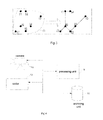
- Figure 1 represents a decomposition of a video document into shots P1, P2, P3,...,P10.
- Figure 1 will be described in parallel with Figure 2 illustrating the steps of the process making it possible to obtain the splitting of the video document illustrated in Figure 1.
- step 1 of Figure 2 Various methods of decomposing a video into shots exist, illustrated by step 1 of Figure 2. Such a method is in particular described in French Patent Application 0213978 filed on 28 October 2002 in the name of the company Thomson Licensing SA.
- This patent application also describes the extraction of key images (step 2 of Figure 2) for each shot.
- One or more key images may be extracted from each shot, this being dependent on the amount of motion of the shot, a shot exhibiting considerable motion being able to be characterized by more than one key image.
- step 4 Figure 2 the key images are grouped together as a function of their similarity.
- the similarity is calculated by a measure of distance between images.
- the measure of distance between images is based on the distance between attributes F.
- F is representative of a characteristic of the image chosen, by way of nonlimiting illustration, from among texture, colour.
- the dominant coefficients of the wavelet transform may also be taken as attribute.
- step 3 Figure 2 Various methods of calculating attributes exist (step 3 Figure 2) and are well known to the person skilled in the art.
- the distance D calculated may be a distance of Euclidian type by way of illustration.
- ⁇ which may for example be fixed as a function of the type of video document.
- the images are grouped together into groups or "clusters", step 5 of Figure 2. These groups of images then exhibit significant visual similarity.
- the number of clusters obtained depends on the predetermined threshold ⁇ of measurement of similarity and on the method used for the grouping into clusters.
- Each cluster comprises all the images of a certain number of shots.
- Each image is selected one by one and the coding cost (step 6, Figure 2) relating to each image is evaluated with respect to the others.
- a minimum spanning tree is calculated for each cluster (step 7, Figure 2). This minimum spanning tree makes it possible to find a path for browsing the whole set of images of a cluster which minimizes the coding costs.
- Kruskal algorithm is used.
- the Prim algorithm may also be used.
- the cluster Ci comprises seven images numbered I1 to I7.
- the images I1 to I7 of one and the same shot within a cluster are consecutive.
- This spanning tree gives the order in which the images must be coded to obtain a minimum coding cost, that is to say a coding cost which allows maximum compression of the video sequence.
- the images are coded in an order compatible with the spanning tree (step 8, Figure 2).
- the choice of the origin image is arbitrary; the most advantageous choice is to take the image having the shortest intra coding. Once the origin image has been chosen, the remaining images are ordered in the order of descent in the tree.
- image I4 is the first image which will be coded. This image is therefore coded according to an intra mode of coding, that is to say spatial only.
- Image I7 is coded with respect to image I7
- image I6 is coded with respect to image I3 as well as image I2.
- Image I1 is coded with respect to image I2
- image I5 is coded with respect to image I1.
- the images are coded according to a coding scheme complying with the MPEG-2 or MPEG-4 standard.
- the images are archived in a storage medium such as a hard disk for example, as well as a description of the structure of clusters and of tree making it possible to reconstitute the global video.
- Each image is identified by a time label making it possible to order the images and to reconstitute the video stream during decoding.
- the invention is for example especially suited to programmes in which a shot returns regularly. This is especially true in the case of televised magazines or newspapers where the images regularly include shots of the journalists who present the transmission.
- FIG. 4 represents a system in which the invention is implemented.
- the system comprises a camera 11.
- the camera captures an event and the video information is transmitted to a processing unit 9.
- the processing unit 9 is suitable for controlling
- the image ordering information is transmitted to the coding device 12.
- the coding device 12 is suitable for coding the video images before transmitting them to the archiving unit 10, which may be a hard disk, a DVD, etc.
Landscapes
- Engineering & Computer Science (AREA)
- Multimedia (AREA)
- Signal Processing (AREA)
- Compression Or Coding Systems Of Tv Signals (AREA)
- Television Signal Processing For Recording (AREA)
- Studio Devices (AREA)
Abstract
- decomposition (1) of the video document into shots,
- extraction (2) of images representative of the said shots,
- measurement (3,4) of the distances between the said representative images,
- grouping (5) of the images whose distance is less than a predetermined threshold into a group of images,
- calculation (6) of the relative cost of coding of each image with respect to the other images of the group of images,
- calculation (7) of a minimum spanning tree for each group of images minimizing the cost of coding of each group of images
- coding (8) of each group of images by browsing the images in the order given by the said spanning tree.
Description
- The invention relates to a device and a method of compressing video documents.
- The invention relates more particularly to video compression adapted to archiving.
- The compression constraints of a video document are less significant when concerned with archiving the video than when concerned with compressing the video for transmission.
- Specifically, a video intended to be compressed, transmitted and decompressed in real time must be compressed by taking the images one after another, in a chronological order, as done by coding methods such as MPEG-2 for example.
- When the images are intended to be recorded on storage media for long term storage, such as hard disks for example, it is possible to compress them in any order so as to optimize the quantity of information stored and thus to minimize the storage resources required. The compression constraints are therefore not the same as in the case of real time coding/decoding.
- The invention therefore relates to the ordering of the images of a video document prior to coding so as to increase the degree of compression. Actually, several methods of data compression use groupings into clusters. However, once the clusters have been finalized, the coding is performed directly on the images in their chronological order.
- The present invention makes it possible to circumvent this chronological order and to code the images while obtaining an optimized degree of compression.
- To this end, the invention relates to a process for compressing video documents comprising the steps of:
- decomposition of the video document into shots,
- extraction of images representative of the said shots,
- measurement of the distances between the said representative images,
- grouping of the images whose distance is less than a predetermined threshold into a group of images,
- calculation of the relative cost of coding of each image with respect to the other images of the group of images.
- According to the invention, the process comprises the steps of
- calculation of a minimum spanning tree for each group of images minimizing the cost of coding of each group of images
- coding of each group of images by browsing the images in the order given by the said spanning tree.
- The minimum spanning tree can make it possible to modify the order of coding of the images and thus to improve the degree of compression. This is particularly suitable, but not exclusively reserved, for compression intended for archiving where the coding time is not significant and where the order of coding is not significant.
- According to a preferred embodiment, the first coded image of the spanning tree is coded in intra mode.
- According to a preferred embodiment, the images other than the first image are coded in predictive mode with respect to the previous image in the optimum spanning tree.
- According to a preferred embodiment, several images spaced apart in the spanning tree are coded in intra mode.
- The invention will be better understood and illustrated by means of wholly nonlimiting, advantageous modes of embodiment and implementation, with reference to the appended figures in which:
- Figure 1 represents the decomposition of the video into groups of representative images,
- Figure 2 represents the steps of the process according to the invention,
- Figure 3 represents a minimum spanning tree,
- Figure 4 represents a device according to the invention.
- A video document consists of a succession of images, themselves often being able to be grouped into shots, the shots corresponding to picture breaks.
- Figure 1 represents a decomposition of a video document into shots P1, P2, P3,...,P10. Figure 1 will be described in parallel with Figure 2 illustrating the steps of the process making it possible to obtain the splitting of the video document illustrated in Figure 1.
- Various methods of decomposing a video into shots exist, illustrated by step 1 of Figure 2. Such a method is in particular described in French Patent Application 0213978 filed on 28 October 2002 in the name of the company Thomson Licensing SA. This patent application also describes the extraction of key images (
step 2 of Figure 2) for each shot. One or more key images may be extracted from each shot, this being dependent on the amount of motion of the shot, a shot exhibiting considerable motion being able to be characterized by more than one key image. - Thereafter, the key images are grouped together as a function of their similarity (step 4 Figure 2).
- The similarity is calculated by a measure of distance between images. The measure of distance between images is based on the distance between attributes F.
- F is representative of a characteristic of the image chosen, by way of nonlimiting illustration, from among texture, colour. By way of alternative, the dominant coefficients of the wavelet transform may also be taken as attribute.
- Various methods of calculating attributes exist (step 3 Figure 2) and are well known to the person skilled in the art.
- The distance D calculated may be a distance of Euclidian type by way of illustration.
- When the distance D is less than a predetermined threshold ε, which may for example be fixed as a function of the type of video document, the images are grouped together into groups or "clusters",
step 5 of Figure 2. These groups of images then exhibit significant visual similarity. - When several key images are extracted from one and the same shot, and when during the step of grouping into clusters they do not feature in the same cluster, then the clusters to which they belong are merged.
- The number of clusters obtained depends on the predetermined threshold ε of measurement of similarity and on the method used for the grouping into clusters.
- Each cluster comprises all the images of a certain number of shots.
- Thereafter, for each pair of images in each cluster, a cost of coding is calculated.
- Each image is selected one by one and the coding cost (
step 6, Figure 2) relating to each image is evaluated with respect to the others. - Thereafter, on the basis of these coding costs, a minimum spanning tree is calculated for each cluster (step 7, Figure 2). This minimum spanning tree makes it possible to find a path for browsing the whole set of images of a cluster which minimizes the coding costs.
- Among the algorithms for calculating a minimum spanning tree, the Kruskal algorithm is used.
- In other embodiments, the Prim algorithm may also be used.
- An example of such a spanning tree is given in Figure 3 in which the points represent the images of the cluster.
- The cluster Ci comprises seven images numbered I1 to I7.
- The images I1 to I7 of one and the same shot within a cluster are consecutive.
- The Kruskal algorithm applied to the cluster I1 to I7 gives the spanning tree given in the right-hand part of Figure 3.
- This spanning tree gives the order in which the images must be coded to obtain a minimum coding cost, that is to say a coding cost which allows maximum compression of the video sequence.
- When the spanning tree is calculated for each cluster, the images are coded in an order compatible with the spanning tree (
step 8, Figure 2). The choice of the origin image is arbitrary; the most advantageous choice is to take the image having the shortest intra coding. Once the origin image has been chosen, the remaining images are ordered in the order of descent in the tree. - According to this example, image I4 is the first image which will be coded. This image is therefore coded according to an intra mode of coding, that is to say spatial only.
- The subsequent images are coded according to a predictive mode with respect to the previous image in the tree. Image I7 is coded with respect to image I7, image I6 is coded with respect to image I3 as well as image I2. Image I1 is coded with respect to image I2 and image I5 is coded with respect to image I1.
- In other examples, it is possible for several images to be coded in intra mode. This is so in particular in the case where the cluster comprises a significant number of images. In this case, certain images are chosen, spaced regularly apart in the spanning tree, to be coded in intra mode.
- Several schemes for predictive coding may be envisaged. In particular, in the embodiment proposed, the images are coded according to a coding scheme complying with the MPEG-2 or MPEG-4 standard.
- Once coded, the images are archived in a storage medium such as a hard disk for example, as well as a description of the structure of clusters and of tree making it possible to reconstitute the global video.
- Each image is identified by a time label making it possible to order the images and to reconstitute the video stream during decoding.
- The invention is for example especially suited to programmes in which a shot returns regularly. This is especially true in the case of televised magazines or newspapers where the images regularly include shots of the journalists who present the transmission.
- Figure 4 represents a system in which the invention is implemented.
- The system comprises a
camera 11. The camera captures an event and the video information is transmitted to a processing unit 9. - The processing unit 9 is suitable for
- performing the decomposition of the video document into shots,
- extracting representative images of the said shots,
- measuring distances between the said representative images,
- grouping together images whose distance is less than a predetermined threshold into a group of images,
- calculating the relative cost of coding of each image with respect to the other images of the group of images,
- calculating a minimum spanning tree for each group of images minimizing the cost of coding of each group of images.
- Once this has been done, the image ordering information is transmitted to the
coding device 12. Thecoding device 12 is suitable for coding the video images before transmitting them to thearchiving unit 10, which may be a hard disk, a DVD, etc.
Claims (5)
- Process for compressing video documents comprising the steps of:- decomposition (1) of the video document into shots,- extraction (2) of images representative of the said shots,- measurement (3, 4) of the distances between the said representative images,- grouping (5) of the images whose distance is less than a predetermined threshold into a group of images,- calculation (6) of the relative cost of coding of each image with respect to the other images of the group of images,
characterized in that it comprises the steps of- calculation (7) of a minimum spanning tree for each group of images minimizing the cost of coding of each group of images- coding (8) of each group of images by browsing the images in the order given by the said spanning tree. - Process according to Claim 1, characterized in that the first coded image of the spanning tree is coded in intra mode.
- Process according to one of Claims 1 to 2, characterized in that the images other than the first image are coded in predictive mode with respect to the previous image in the optimum spanning tree.
- Process according to Claim 1, characterized in that several images spaced apart in the spanning tree are coded in intra mode.
- Device for compressing documents comprising means (9) of:- decomposition of the video document into shots,- extraction of images representative of the said shots,- measurement of the distances between the said representative images,- grouping of the images whose distance is less than a predetermined threshold into a group of images,- calculation (6) of the relative cost of coding of each image with respect to the other images of the group of images,
characterized in that it comprises- means (9) of calculation of a minimum spanning tree for each group of images minimizing the cost of coding of each group of images- means (12) of coding of each group of images by browsing the images in the order given by the said spanning tree.
Applications Claiming Priority (1)
| Application Number | Priority Date | Filing Date | Title |
|---|---|---|---|
| FR0451395A FR2872665A1 (en) | 2004-07-01 | 2004-07-01 | VIDEO COMPRESSION DEVICE AND METHOD |
Publications (2)
| Publication Number | Publication Date |
|---|---|
| EP1613096A1 true EP1613096A1 (en) | 2006-01-04 |
| EP1613096B1 EP1613096B1 (en) | 2008-07-16 |
Family
ID=34947062
Family Applications (1)
| Application Number | Title | Priority Date | Filing Date |
|---|---|---|---|
| EP05105563A Expired - Lifetime EP1613096B1 (en) | 2004-07-01 | 2005-06-22 | Video coding with determination of coding order according to a minimum spanning tree |
Country Status (7)
| Country | Link |
|---|---|
| US (1) | US8340176B2 (en) |
| EP (1) | EP1613096B1 (en) |
| JP (1) | JP4734047B2 (en) |
| KR (1) | KR101163774B1 (en) |
| CN (1) | CN1717033B (en) |
| DE (1) | DE602005008139D1 (en) |
| FR (1) | FR2872665A1 (en) |
Cited By (1)
| Publication number | Priority date | Publication date | Assignee | Title |
|---|---|---|---|---|
| EP3633991A1 (en) * | 2011-12-29 | 2020-04-08 | Swisscom AG | Method and system for optimized encoding |
Families Citing this family (6)
| Publication number | Priority date | Publication date | Assignee | Title |
|---|---|---|---|---|
| KR100754205B1 (en) * | 2006-02-07 | 2007-09-03 | 삼성전자주식회사 | Multiview video encoding apparatus and method |
| US8139877B2 (en) * | 2006-03-09 | 2012-03-20 | Pioneer Corporation | Image processing apparatus, image processing method, and computer-readable recording medium including shot generation |
| JP4898589B2 (en) * | 2007-07-26 | 2012-03-14 | 株式会社日立製作所 | Image compression method and image processing apparatus |
| EP2299717A1 (en) * | 2009-09-10 | 2011-03-23 | Thomson Licensing | Method and apparatus for image encoding using Hold-MBs, and method and apparatus for image decoding using Hold-MBs |
| CN105409207A (en) * | 2013-07-15 | 2016-03-16 | 微软技术许可有限责任公司 | Feature-based image set compression |
| KR102240570B1 (en) | 2014-05-13 | 2021-04-15 | 삼성전자주식회사 | Method and apparatus for generating spanning tree,method and apparatus for stereo matching,method and apparatus for up-sampling,and method and apparatus for generating reference pixel |
Citations (2)
| Publication number | Priority date | Publication date | Assignee | Title |
|---|---|---|---|---|
| US20010055337A1 (en) * | 2000-06-21 | 2001-12-27 | Kazuhiro Matsuzaki | Picture coding apparatus, picture coding method, and recording medium having picture coding program recorded thereon |
| FR2846502A1 (en) * | 2002-10-28 | 2004-04-30 | Thomson Licensing Sa | GERM SELECTION METHOD FOR KEY IMAGE GROUPING |
Family Cites Families (10)
| Publication number | Priority date | Publication date | Assignee | Title |
|---|---|---|---|---|
| JPH0786968B2 (en) | 1987-07-17 | 1995-09-20 | 松下電器産業株式会社 | Superconducting magnetic head |
| EP0799550B1 (en) * | 1995-10-25 | 2000-08-09 | Koninklijke Philips Electronics N.V. | Segmented picture coding method and system, and corresponding decoding method and system |
| JPH1023408A (en) | 1996-06-28 | 1998-01-23 | Nippon Telegr & Teleph Corp <Ntt> | Image signal encoding method |
| FR2753330B1 (en) * | 1996-09-06 | 1998-11-27 | Thomson Multimedia Sa | QUANTIFICATION METHOD FOR VIDEO CODING |
| US6249616B1 (en) * | 1997-05-30 | 2001-06-19 | Enroute, Inc | Combining digital images based on three-dimensional relationships between source image data sets |
| US6562077B2 (en) * | 1997-11-14 | 2003-05-13 | Xerox Corporation | Sorting image segments into clusters based on a distance measurement |
| JP2002152740A (en) | 2000-11-16 | 2002-05-24 | Matsushita Electric Ind Co Ltd | Color image encoding device, color image encoding method, and recording medium |
| US7889792B2 (en) * | 2003-12-24 | 2011-02-15 | Apple Inc. | Method and system for video encoding using a variable number of B frames |
| US7265692B2 (en) * | 2004-01-29 | 2007-09-04 | Hewlett-Packard Development Company, L.P. | Data compression system based on tree models |
| WO2005076594A1 (en) * | 2004-02-06 | 2005-08-18 | Agency For Science, Technology And Research | Automatic video event detection and indexing |
-
2004
- 2004-07-01 FR FR0451395A patent/FR2872665A1/en active Pending
-
2005
- 2005-06-14 US US11/152,611 patent/US8340176B2/en active Active
- 2005-06-16 CN CN2005100764868A patent/CN1717033B/en not_active Expired - Lifetime
- 2005-06-22 DE DE602005008139T patent/DE602005008139D1/en not_active Expired - Lifetime
- 2005-06-22 EP EP05105563A patent/EP1613096B1/en not_active Expired - Lifetime
- 2005-06-30 KR KR1020050057541A patent/KR101163774B1/en not_active Expired - Lifetime
- 2005-07-01 JP JP2005194216A patent/JP4734047B2/en not_active Expired - Fee Related
Patent Citations (2)
| Publication number | Priority date | Publication date | Assignee | Title |
|---|---|---|---|---|
| US20010055337A1 (en) * | 2000-06-21 | 2001-12-27 | Kazuhiro Matsuzaki | Picture coding apparatus, picture coding method, and recording medium having picture coding program recorded thereon |
| FR2846502A1 (en) * | 2002-10-28 | 2004-04-30 | Thomson Licensing Sa | GERM SELECTION METHOD FOR KEY IMAGE GROUPING |
Non-Patent Citations (2)
| Title |
|---|
| COOPER M ET AL: "Scene boundary detection via video self-similarity analysis", PROCEEDINGS 2001 INTERNATIONAL CONFERENCE ON IMAGE PROCESSING. ICIP 2001. THESSALONIKI, GREECE, OCT. 7 - 10, 2001, INTERNATIONAL CONFERENCE ON IMAGE PROCESSING, NEW YORK, NY : IEEE, US, vol. VOL. 1 OF 3. CONF. 8, 7 October 2001 (2001-10-07), pages 378 - 381, XP010563362, ISBN: 0-7803-6725-1 * |
| TATE S R: "Band Ordering in Lossless Compression of Multispectral Images", IEEE TRANSACTIONS ON COMPUTERS, vol. 46, no. 4, April 1997 (1997-04-01), USA, pages 477 - 483, XP002320048, ISSN: 0018-9340 * |
Cited By (1)
| Publication number | Priority date | Publication date | Assignee | Title |
|---|---|---|---|---|
| EP3633991A1 (en) * | 2011-12-29 | 2020-04-08 | Swisscom AG | Method and system for optimized encoding |
Also Published As
| Publication number | Publication date |
|---|---|
| FR2872665A1 (en) | 2006-01-06 |
| KR101163774B1 (en) | 2012-07-06 |
| JP4734047B2 (en) | 2011-07-27 |
| CN1717033A (en) | 2006-01-04 |
| EP1613096B1 (en) | 2008-07-16 |
| CN1717033B (en) | 2010-04-14 |
| KR20060048735A (en) | 2006-05-18 |
| US20060002612A1 (en) | 2006-01-05 |
| US8340176B2 (en) | 2012-12-25 |
| DE602005008139D1 (en) | 2008-08-28 |
| JP2006020330A (en) | 2006-01-19 |
Similar Documents
| Publication | Publication Date | Title |
|---|---|---|
| JP5390506B2 (en) | Video detection system and video detection method | |
| JP4138007B2 (en) | Video retrieval of MPEG compressed sequences using DC and motion codes | |
| US6842540B1 (en) | Surveillance system | |
| CN1310913A (en) | Image compression | |
| Xu et al. | Detection of double MPEG-2 compression based on distributions of DCT coefficients | |
| US20060222249A1 (en) | Image-comparing apparatus, image-comparing method, image-retrieving apparatus and image-retrieving method | |
| US6823011B2 (en) | Unusual event detection using motion activity descriptors | |
| US9087377B2 (en) | Video watermarking method resistant to temporal desynchronization attacks | |
| EP1613096B1 (en) | Video coding with determination of coding order according to a minimum spanning tree | |
| Kobla et al. | Indexing and retrieval of MPEG compressed video | |
| CN103020138A (en) | Method and device for video retrieval | |
| CN112714336B (en) | Video segmentation method and device, electronic equipment and computer readable storage medium | |
| JP5155210B2 (en) | Image comparison apparatus and method, image search apparatus, program, and recording medium | |
| Alshammary et al. | Reviewing and evaluating existing file carving techniques for jpeg files | |
| US20070258009A1 (en) | Image Processing Device, Image Processing Method, and Image Processing Program | |
| US9560365B2 (en) | Image coding device, image decoding device, image coding method, and image decoding method | |
| Su et al. | Efficient copy detection for compressed digital videos by spatial and temporal feature extraction | |
| CN115379233B (en) | Big data video information analysis method and system | |
| Altinisik et al. | Automatic generation of H. 264 parameter sets to recover video file fragments | |
| Ikusan et al. | Deep Feature Compression with Rate-Distortion Optimization for Networked Camera Systems | |
| KR101568680B1 (en) | Data restoration method using data fragment classification | |
| KR101378490B1 (en) | image data recovering apparatus and method | |
| Iida et al. | Robust image identification for double-compressed JPEG images | |
| EP1149500A1 (en) | Digital video processing method and apparatus thereof | |
| JP3571200B2 (en) | Moving image data cut detection apparatus and method, and recording medium |
Legal Events
| Date | Code | Title | Description |
|---|---|---|---|
| PUAI | Public reference made under article 153(3) epc to a published international application that has entered the european phase |
Free format text: ORIGINAL CODE: 0009012 |
|
| AK | Designated contracting states |
Kind code of ref document: A1 Designated state(s): AT BE BG CH CY CZ DE DK EE ES FI FR GB GR HU IE IS IT LI LT LU MC NL PL PT RO SE SI SK TR |
|
| AX | Request for extension of the european patent |
Extension state: AL BA HR LV MK YU |
|
| 17P | Request for examination filed |
Effective date: 20060630 |
|
| AKX | Designation fees paid |
Designated state(s): DE FR GB |
|
| GRAP | Despatch of communication of intention to grant a patent |
Free format text: ORIGINAL CODE: EPIDOSNIGR1 |
|
| GRAS | Grant fee paid |
Free format text: ORIGINAL CODE: EPIDOSNIGR3 |
|
| GRAA | (expected) grant |
Free format text: ORIGINAL CODE: 0009210 |
|
| AK | Designated contracting states |
Kind code of ref document: B1 Designated state(s): DE FR GB |
|
| REG | Reference to a national code |
Ref country code: GB Ref legal event code: FG4D |
|
| REF | Corresponds to: |
Ref document number: 602005008139 Country of ref document: DE Date of ref document: 20080828 Kind code of ref document: P |
|
| PLBE | No opposition filed within time limit |
Free format text: ORIGINAL CODE: 0009261 |
|
| STAA | Information on the status of an ep patent application or granted ep patent |
Free format text: STATUS: NO OPPOSITION FILED WITHIN TIME LIMIT |
|
| 26N | No opposition filed |
Effective date: 20090417 |
|
| REG | Reference to a national code |
Ref country code: FR Ref legal event code: PLFP Year of fee payment: 12 |
|
| REG | Reference to a national code |
Ref country code: FR Ref legal event code: PLFP Year of fee payment: 13 |
|
| REG | Reference to a national code |
Ref country code: DE Ref legal event code: R082 Ref document number: 602005008139 Country of ref document: DE Representative=s name: DEHNS, DE Ref country code: DE Ref legal event code: R082 Ref document number: 602005008139 Country of ref document: DE Representative=s name: DEHNS PATENT AND TRADEMARK ATTORNEYS, DE Ref country code: DE Ref legal event code: R082 Ref document number: 602005008139 Country of ref document: DE Representative=s name: HOFSTETTER, SCHURACK & PARTNER PATENT- UND REC, DE |
|
| REG | Reference to a national code |
Ref country code: FR Ref legal event code: PLFP Year of fee payment: 14 |
|
| REG | Reference to a national code |
Ref country code: FR Ref legal event code: TP Owner name: THOMSON LICENSING DTV, FR Effective date: 20180830 |
|
| REG | Reference to a national code |
Ref country code: GB Ref legal event code: 732E Free format text: REGISTERED BETWEEN 20180927 AND 20181005 |
|
| REG | Reference to a national code |
Ref country code: DE Ref legal event code: R082 Ref document number: 602005008139 Country of ref document: DE Representative=s name: DEHNS, DE Ref country code: DE Ref legal event code: R081 Ref document number: 602005008139 Country of ref document: DE Owner name: INTERDIGITAL MADISON PATENT HOLDINGS, FR Free format text: FORMER OWNER: THOMSON LICENSING S.A., BOULOGNE-BILLANCOURT, FR Ref country code: DE Ref legal event code: R082 Ref document number: 602005008139 Country of ref document: DE Representative=s name: DEHNS PATENT AND TRADEMARK ATTORNEYS, DE |
|
| P01 | Opt-out of the competence of the unified patent court (upc) registered |
Effective date: 20230514 |
|
| PGFP | Annual fee paid to national office [announced via postgrant information from national office to epo] |
Ref country code: GB Payment date: 20240618 Year of fee payment: 20 |
|
| PGFP | Annual fee paid to national office [announced via postgrant information from national office to epo] |
Ref country code: DE Payment date: 20240627 Year of fee payment: 20 |
|
| PGFP | Annual fee paid to national office [announced via postgrant information from national office to epo] |
Ref country code: FR Payment date: 20240625 Year of fee payment: 20 |
|
| REG | Reference to a national code |
Ref country code: DE Ref legal event code: R071 Ref document number: 602005008139 Country of ref document: DE |
|
| PG25 | Lapsed in a contracting state [announced via postgrant information from national office to epo] |
Ref country code: GB Free format text: LAPSE BECAUSE OF EXPIRATION OF PROTECTION Effective date: 20250621 |
|
| REG | Reference to a national code |
Ref country code: GB Ref legal event code: PE20 Expiry date: 20250621 |