EP1613011A1 - Channel estimation for a multi-carrier telecommunication system - Google Patents
Channel estimation for a multi-carrier telecommunication system Download PDFInfo
- Publication number
- EP1613011A1 EP1613011A1 EP04291642A EP04291642A EP1613011A1 EP 1613011 A1 EP1613011 A1 EP 1613011A1 EP 04291642 A EP04291642 A EP 04291642A EP 04291642 A EP04291642 A EP 04291642A EP 1613011 A1 EP1613011 A1 EP 1613011A1
- Authority
- EP
- European Patent Office
- Prior art keywords
- average value
- preliminary
- carrying signals
- channel
- preliminary estimates
- Prior art date
- Legal status (The legal status is an assumption and is not a legal conclusion. Google has not performed a legal analysis and makes no representation as to the accuracy of the status listed.)
- Granted
Links
Images


Classifications
-
- H—ELECTRICITY
- H04—ELECTRIC COMMUNICATION TECHNIQUE
- H04L—TRANSMISSION OF DIGITAL INFORMATION, e.g. TELEGRAPHIC COMMUNICATION
- H04L25/00—Baseband systems
- H04L25/02—Details ; arrangements for supplying electrical power along data transmission lines
- H04L25/0202—Channel estimation
- H04L25/0224—Channel estimation using sounding signals
- H04L25/0228—Channel estimation using sounding signals with direct estimation from sounding signals
- H04L25/023—Channel estimation using sounding signals with direct estimation from sounding signals with extension to other symbols
- H04L25/0232—Channel estimation using sounding signals with direct estimation from sounding signals with extension to other symbols by interpolation between sounding signals
Definitions
- the present invention relates to a method for transmitting data by means of multiple carrying signals through at least one communication channel, which method involves a computation of channel parameters representative each of a response of said communication channel to one of said carrying signals, said method including a preliminary estimation step in the course of which preliminary estimates of the channel parameters are generated, and a secondary estimation step in the course of which the preliminary estimates generated during the preliminary estimation step are to be refined.
- Such transmitting methods are likely to be used in MC-CDMA (standing for "MultiCarrier-Code Division Multiple Access") telecommunication systems, in which optimal operation of any given receiver requires accurate prior knowledge of the channel frequency response for said receiver to be able to recognize incoming information symbols.
- the preliminary estimates of the channel parameters are usually generated with the help of pilot symbols transmitted by means of each of the carrying signals, which pilot symbols are known beforehand by the receiver, so that the receiver may deduce, from a comparison between what was expected by said receiver and what was actually received, the effect of the communication channel on the transmitted symbols, said effect then being quantified by means of the preliminary estimates.
- any given preliminary estimate will have successive values deduced after transmission of successive pilot symbols by means of the carrying signal to which said given preliminary estimate corresponds, so that the preliminary estimates are generally averaged over time during the secondary estimation step, in order to produce the channel parameters.
- Such an averaging process will thus require a substantial time duration for its execution, since numerous preliminary estimates will be needed for their average value to be significant. This may prevent efficient operation of the telecommunication system described above in cases where the transmitted signals are intended to carry data packets. Indeed, in such applications, the channel response must be quantified for the whole transmission duration of each data packet on the basis of very few pilot symbols. This requires an almost instantaneaous execution of preliminary and secondary estimation steps, which the above-described known transmitting methods do not enable to perform accurately because of the time-averaging process.
- the invention aims at solving the aforementioned problems, by providing a transmitting method according to which the channel response estimation may be performed almost instantaneously on the basis of a very limited number of received pilot symbols, and which is thus suitable for data packet transmission.
- a method for transmitting data as described in the opening paragraph is characterized according to the invention in that the preliminary estimates generated during the preliminary estimation step are refined in the course of the secondary estimation step by computing at least one average value of a correlation parameter, which average value is computed over at least two different carrying signals.
- the invention makes use of the fact that neighbouring channels may have similar properties by virtue of the basic physic principle of continuity.
- the channel response of a given channel thus may give some information on channel responses of neighbouring channels, provided that said channels are sufficiently correlated together, which means that a preliminary channel estimate produced for a given channel may thus also be of interest in the evaluation of channel parameters related to neighbouring channels.
- the invention thus allows to exploit more thoroughly the whole amount of information produced by the preliminary estimation step.
- the secondary estimation step includes a weight determination sub-step in the course of which weighting coefficients to be applied to the preliminary estimates are determined by computing at least one average value of a correlation parameter, which average value is computed over at least two different carrying signals.
- Such a secondary estimation step will enable to pool together in a simple manner information produced in relation with different channel parameters.
- Such a pooling is implemented through the determination of the values of the weighting coefficients to be applied to the preliminary estimates when computing the linear combination intended to yield said given channel parameter, which determination depends on the average value of the correlation parameter related to said given channel parameter, as will be explained hereinafter.
- the weight determination sub-step involves minimizing an average value of an error criterion, which average value is computed over at least two carrying signals.
- the error criterion may be a simple difference between the estimated and real channel parameters, but will preferably be a squared value of said difference. As will be explained hereinafter, the use of such an error criterion enables to compute weighting coefficients by solving a simple equation system, which may be performed almost instantaneously by matricial computation.
- the weight determination sub-step involves determination of a correlation matrix having elements computed as average values, over at least two different carrying signals, of correlations between preliminary estimates of channel parameters related to said carrying signals.
- This first embodiment is very easy to implement, each element of the correlation matrix being obtained by computing a single average value between two preliminary estimates.
- the weight determination sub-step involves determination of a correlation matrix having elements computed as average values, over different carrying signals, of linear combinations of correlations between preliminary estimates of channel parameters related to said carrying signals.
- This second embodiment though requiring more computing power for its implemention than the first one, remains quite easy to perform and enables to involve all relevant preliminary estimates in the computation of each element of the correlation matrix, which thus allows the most extensive use of the information contained in said preliminary estimates for the determination of the channel parameters.
- a method as described hereinbefore will advantageously include a comparison step in the course of which the average value of the correlation parameter is compared to a predetermined threshold, the secondary estimation step being actually computed only if said average value exceeds said predetermined threshold.
- the comparison step enables to determine, before actually executing the secondary estimation step, if said secondary estimation step will indeed produce more accurate values for the channel parameters than the preliminary estimates.
- a significant improvement with respect to said preliminary estimates will only be obtained if neighbour channels are sufficiently linked to each other, which is expressed by an average value of the correlation parameter exceeding the predetermined threshold. If this condition is not fulfilled, the preliminary estimates being then directly selected for constituting the channel parameters.
- Another variant of the invention which may be used alternatively pr cumulatively with the previous one, enables to enhance the accuracy of the channel parameters coumputed as described above in cases where the transmitted signals are to be picked up by a multiple antenna receiver.
- This other variant thus relates to a method for transmitting data intended to be used in a telecommunication system in which at least one receiver is provided with multiple receiving antennas, each being able to pick up the multiple carrying signals by means of which data is to be transmitted, which method involves a computation of multiple groups of channel parameters, each group comprising channel parameters representative of a channel response to carrying signals picked up by a given antenna, which channel parameters are computed by carrying out a method as described above, and an averaging step, in the course of which an average value between at least two channel parameters related to a same carrying signal and to at least two different groups of channel parameters is computed for each carrying signal.
- This other variant of the invention enables to increase the amount of information related to a same carrying signal to be pooled together, which will give a higher relevance to the channel parameter whose value is averaged over multiple receiving antennas, without causing a significant increase in the computation time of this averaged value.
- the invention also relates to a telecommunication system including at least one transmitter and one receiver linked together by at least one wireless communication channel through which data is to be transmitted by means of multiple carrying signals, which receiver is to perform a computation of channel parameters representative each of a response of said communication channel to one of said carrying signals, said receiver including preliminary estimation means intended to generate preliminary estimates of the channel parameters, and secondary estimation means intended to refine the preliminary estimates generated by the preliminary estimation means, by computing linear combinations of at least two of said preliminary estimates, each linear combination being intended to yield a given channel parameter, system characterized in that the secondary estimation means are to cooperate with a weight determination module intended to determine weighting coefficients to be applied to the preliminary estimates by computing at least one average value of a correlation parameter, which average value is computed over at least two different carrying signals.
- such a system will advantageously include comparison means for comparing the average value of the correlation parameter to a predetermined threshold, and activation means for triggering computation of the linear combinations of the preliminary estimates only if said average value exceeds said predetermined threshold.
- Such activation means may simply consist in MOS switches whose grids are connected to an output of an opamp comparator, and placed between Gilbert cells intended to multiply the preliminary etimates with their respective weighting coefficients, on the one hand, and a power supply of said cells, on the other hand.
- the invention also relates to a receiving device for receiving data transmitted through at least one wireless communication channel by means of multiple carrying signals, which receiving device is to perform a computation of channel parameters representative each of a response of said communication channel to one of said carrying signals, said receiving device including preliminary estimation means intended to generate preliminary estimates of the channel parameters, and secondary estimation means intended to refine the preliminary estimates generated by the preliminary estimation means, by computing linear combinations of at least two of said preliminary estimates, each linear combination being intended to yield a given channel parameter, receiving device characterized in that the secondary estimation means are to cooperate with a weight determination module intended to determine weighting coefficients to be applied to the preliminary estimates by computing at least one average value of a correlation parameter, which average value is computed over at least two different carrying signals.
- such a receiving device will advantageously include comparison means for comparing the average value of the correlation parameter to a predetermined threshold, and activation means for triggering computation of the linear combinations of the preliminary estimates only if said average value exceeds said predetermined threshold.
- Fig.1 shows a telecommunication system SYST including at least one transmitting device TRD and at least one receiving device RCD, which include respective transmitting and receiving antenna systems TAS and RAS linked together by a plurality of communication channels CH1, CH2...CHN through which multiple carrying signals Cs 1 , Cs 2 ...Cs N are to be transmitted.
- the receiving device RCD includes channel estimation means CEM intended to compute channel parameters representative each of a response of one of said communication channels CH1, CH2...CHN to one of said carrying signals Cs 1 , Cs 2 ...Cs N .
- Fig.2 diagrammaticaly shows a receiving device including channel estimation means CEM for carrying out an estimation of channel parameters according to the invention.
- RAS receiving antenna system
- FFT Fast Fourrier Transform module
- the refining performed by the secondary estimation means SEM for producing any given secondary estimation hsn of a channel parameter related to a given carrying signal Cs n consists in computing a linear combination of preliminary estimates hp n1 ...hp n ...hp N-n2 related to a group of N-n2-n1+1 adjacent carrying signals Cs n1 ...Cs n ...Cs N-n2 enclosing said given carrying signal Cs n .
- the channel estimation means CEM included in the receiving device according to the invention comprise a weight determination module WDM intended to produce weighting coefficients w k to be applied to the preliminary estimates hp n1 ...hp n ...hp N-n2 , these weighting coefficients w k being determined by computing at least one average value of a correlation parameter, which average value is computed over at least two different carrying signals, as will be explained hereinafter.
- the weight determination module WDM includes comparison means CMP for comparing the average value of the correlation parameter to a predetermined threshold, and activation means (not shown) for triggering computation of the linear combinations of the preliminary estimates only if said average value exceeds said predetermined threshold.
- Such activation means may simply consist in MOS switches whose grids are controlled by an enable/disable signal E/D to be delivered by an output of an opamp comparator included in the comparison means CMP, which MOS switches may be arranged between Gilbert cells intended to multiply the preliminary etimates hp n1 ...hp n ...hp N-n2 with their respective weighting coefficients w n1 ...w n ...w N-n2, on the one hand, and a power supply of such multiplying cells, on the other hand.
- the vector hp n [hp n-n1 ,...hp n ,...hp n+n2 ] t is thus a reduced preliminary channel estimation vector related to the group of n2+n1+1 adjacent carrying signals Cs n-n1 ...Cs n ...Cs n+n2 enclosing a given carrying signal Cs n , the symbol "t" identifying the transpose of such a vector.
- the parameter ⁇ is thus a correlation parameter averaged over a plurality of different carrying signals, and enables to pool together information relevant to a given channel, most of this information having initially been produced in relation with other channel parameters.
- the parameter ⁇ may be optionnaly be compared to a predetermined threshold prior to the actual computation of any linear combination of the premiminary estimates described above, and even before computing the weighting coefficients vectors.
- Such a comparison sub-step will enable to determine if the linear combinations intended to be computed in the course of the secondary estimation step will indeed produce more accurate estimates of the channel parameters than the preliminary estimates hp n .
- a secondary estimate hs n produced by such a secondary estimation step will provide significant improvement with respect to the preliminary estimate hp n only if neighbour channels are sufficiently linked to each other, which is expressed by an average value ⁇ of the correlation parameter exceeding the predetermined threshold. If this condition is not fulfilled, neither the weight determination sub-step nor the computation of linear combinations of the preliminary estimates need be carried out, the preliminary estimates hp n being then directly selected for constituting the channel parameters.
- the above example may also be used for illustrating the usefulness of the invention in a situation where a given channel CHn doesn't actually feature any carrying signal Cs n , and thus no pilot symbol.
- known techniques based on the computation of an average value over time of preliminary estimates related to said carrying signal Cs n will be useless, since no pilot symbol is available for computing a preliminary estimate related to this particular signal Cs n .
- n1 and n2 may both be chosen equal to a same integer number n0.
- the weight determination sub-step may involve minimizing an average value of an error criterion, which average value is then computed over multiple carrying signals :
- the weighting coefficients to be used for computing the linear combination intended to produce the secondary estimate should thus be chosen in such a way that an average value of the difference between the estimated and real channel parameters hs n and h n , or, preferably, an average value of a squared value of said difference will be minimized, which may be expressed as : 1 N - 2.
- n 0 ⁇ n n 0 + 1 N - n 0
- each component [ ⁇ ] r1,r2 of raw r1 and column r2 of the correlation matrix ⁇ may be formed by an average value over only the two carrying signals Cs r1 and Cs r2 of a correlation between the preliminary estimates hp r1 and hp r2 related to said carrying signals Cs r1 and Cs r2 .
- Such a computation scheme of the correlation matrix will, of course, yield less accurate results but will require less computing power for its execution, because each component will result from a simple scalar product between two values instead of a matricial product between two vectors of size N-2.n0 required in the general form expressed above.
- the invention illustrated by the above described embodiments thus enables to almost instantaneously perform an accurate channel response estimation on the basis of a very limited number of received pilot symbols, and is thus particularly well-suited for data packet transmission.
- This receiving device includes multiplexing means MUX for sequencing over time the incoming signals ISm which are to be successively fed to the Fast Fourrier Transform module FFT and then processed by channel estimation means CEM identical to those described above.
- multiple channel estimation means CEM identical to those described above may be arranged in parallel for simultaneously processing all incoming signals IS1...ISm...ISM, which will of course be quicker but will require a larger processing circuit.
- This embodiment enables to increase the amount of information related to a same carrying signal Cs n to be pooled together, which will give a higher relevance to the channel parameter hs n whose value is averaged over the multiple receiving antennas, without causing a significant increase in the computation time of this averaged value.
Landscapes
- Engineering & Computer Science (AREA)
- Power Engineering (AREA)
- Computer Networks & Wireless Communication (AREA)
- Signal Processing (AREA)
- Mobile Radio Communication Systems (AREA)
- Radio Transmission System (AREA)
- Monitoring And Testing Of Transmission In General (AREA)
Abstract
Description
- The present invention relates to a method for transmitting data by means of multiple carrying signals through at least one communication channel, which method involves a computation of channel parameters representative each of a response of said communication channel to one of said carrying signals, said method including a preliminary estimation step in the course of which preliminary estimates of the channel parameters are generated, and a secondary estimation step in the course of which the preliminary estimates generated during the preliminary estimation step are to be refined.
- Such transmitting methods are likely to be used in MC-CDMA (standing for "MultiCarrier-Code Division Multiple Access") telecommunication systems, in which optimal operation of any given receiver requires accurate prior knowledge of the channel frequency response for said receiver to be able to recognize incoming information symbols. The preliminary estimates of the channel parameters are usually generated with the help of pilot symbols transmitted by means of each of the carrying signals, which pilot symbols are known beforehand by the receiver, so that the receiver may deduce, from a comparison between what was expected by said receiver and what was actually received, the effect of the communication channel on the transmitted symbols, said effect then being quantified by means of the preliminary estimates.
- In most transmitting methods known in the current state of the art, any given preliminary estimate will have successive values deduced after transmission of successive pilot symbols by means of the carrying signal to which said given preliminary estimate corresponds, so that the preliminary estimates are generally averaged over time during the secondary estimation step, in order to produce the channel parameters. Such an averaging process will thus require a substantial time duration for its execution, since numerous preliminary estimates will be needed for their average value to be significant. This may prevent efficient operation of the telecommunication system described above in cases where the transmitted signals are intended to carry data packets. Indeed, in such applications, the channel response must be quantified for the whole transmission duration of each data packet on the basis of very few pilot symbols. This requires an almost instantaneaous execution of preliminary and secondary estimation steps, which the above-described known transmitting methods do not enable to perform accurately because of the time-averaging process.
- The invention aims at solving the aforementioned problems, by providing a transmitting method according to which the channel response estimation may be performed almost instantaneously on the basis of a very limited number of received pilot symbols, and which is thus suitable for data packet transmission.
- Indeed, a method for transmitting data as described in the opening paragraph is characterized according to the invention in that the preliminary estimates generated during the preliminary estimation step are refined in the course of the secondary estimation step by computing at least one average value of a correlation parameter, which average value is computed over at least two different carrying signals.
- The invention makes use of the fact that neighbouring channels may have similar properties by virtue of the basic physic principle of continuity. The channel response of a given channel thus may give some information on channel responses of neighbouring channels, provided that said channels are sufficiently correlated together, which means that a preliminary channel estimate produced for a given channel may thus also be of interest in the evaluation of channel parameters related to neighbouring channels. The invention thus allows to exploit more thoroughly the whole amount of information produced by the preliminary estimation step.
- According to a specific embodiment of the invention, the secondary estimation step includes a weight determination sub-step in the course of which weighting coefficients to be applied to the preliminary estimates are determined by computing at least one average value of a correlation parameter, which average value is computed over at least two different carrying signals.
- Such a secondary estimation step will enable to pool together in a simple manner information produced in relation with different channel parameters. Such a pooling, is implemented through the determination of the values of the weighting coefficients to be applied to the preliminary estimates when computing the linear combination intended to yield said given channel parameter, which determination depends on the average value of the correlation parameter related to said given channel parameter, as will be explained hereinafter.
- According to a variant of the invention, the weight determination sub-step involves minimizing an average value of an error criterion, which average value is computed over at least two carrying signals.
- The error criterion may be a simple difference between the estimated and real channel parameters, but will preferably be a squared value of said difference. As will be explained hereinafter, the use of such an error criterion enables to compute weighting coefficients by solving a simple equation system, which may be performed almost instantaneously by matricial computation.
- According to a first embodiment of this variant, the weight determination sub-step involves determination of a correlation matrix having elements computed as average values, over at least two different carrying signals, of correlations between preliminary estimates of channel parameters related to said carrying signals.
- This first embodiment is very easy to implement, each element of the correlation matrix being obtained by computing a single average value between two preliminary estimates.
- According to a second embodiment of the above-described variant, the weight determination sub-step involves determination of a correlation matrix having elements computed as average values, over different carrying signals, of linear combinations of correlations between preliminary estimates of channel parameters related to said carrying signals.
- This second embodiment, though requiring more computing power for its implemention than the first one, remains quite easy to perform and enables to involve all relevant preliminary estimates in the computation of each element of the correlation matrix, which thus allows the most extensive use of the information contained in said preliminary estimates for the determination of the channel parameters.
- According to a third embodiment of the invention, a method as described hereinbefore will advantageously include a comparison step in the course of which the average value of the correlation parameter is compared to a predetermined threshold, the secondary estimation step being actually computed only if said average value exceeds said predetermined threshold.
- The comparison step enables to determine, before actually executing the secondary estimation step, if said secondary estimation step will indeed produce more accurate values for the channel parameters than the preliminary estimates. As explained above, a significant improvement with respect to said preliminary estimates will only be obtained if neighbour channels are sufficiently linked to each other, which is expressed by an average value of the correlation parameter exceeding the predetermined threshold. If this condition is not fulfilled, the preliminary estimates being then directly selected for constituting the channel parameters.
- Another variant of the invention, which may be used alternatively pr cumulatively with the previous one, enables to enhance the accuracy of the channel parameters coumputed as described above in cases where the transmitted signals are to be picked up by a multiple antenna receiver.
- This other variant thus relates to a method for transmitting data intended to be used in a telecommunication system in which at least one receiver is provided with multiple receiving antennas, each being able to pick up the multiple carrying signals by means of which data is to be transmitted, which method involves a computation of multiple groups of channel parameters, each group comprising channel parameters representative of a channel response to carrying signals picked up by a given antenna, which channel parameters are computed by carrying out a method as described above, and an averaging step, in the course of which an average value between at least two channel parameters related to a same carrying signal and to at least two different groups of channel parameters is computed for each carrying signal.
- This other variant of the invention enables to increase the amount of information related to a same carrying signal to be pooled together, which will give a higher relevance to the channel parameter whose value is averaged over multiple receiving antennas, without causing a significant increase in the computation time of this averaged value.
- According to one of its hardware-related aspects, the invention also relates to a telecommunication system including at least one transmitter and one receiver linked together by at least one wireless communication channel through which data is to be transmitted by means of multiple carrying signals, which receiver is to perform a computation of channel parameters representative each of a response of said communication channel to one of said carrying signals, said receiver including preliminary estimation means intended to generate preliminary estimates of the channel parameters, and secondary estimation means intended to refine the preliminary estimates generated by the preliminary estimation means, by computing linear combinations of at least two of said preliminary estimates, each linear combination being intended to yield a given channel parameter, system characterized in that the secondary estimation means are to cooperate with a weight determination module intended to determine weighting coefficients to be applied to the preliminary estimates by computing at least one average value of a correlation parameter, which average value is computed over at least two different carrying signals.
- According to a specific embodiment of this harware-related aspect of the invention, such a system will advantageously include comparison means for comparing the average value of the correlation parameter to a predetermined threshold, and activation means for triggering computation of the linear combinations of the preliminary estimates only if said average value exceeds said predetermined threshold.
- Such activation means may simply consist in MOS switches whose grids are connected to an output of an opamp comparator, and placed between Gilbert cells intended to multiply the preliminary etimates with their respective weighting coefficients, on the one hand, and a power supply of said cells, on the other hand.
- According to another of its hardware-related aspects, the invention also relates to a receiving device for receiving data transmitted through at least one wireless communication channel by means of multiple carrying signals, which receiving device is to perform a computation of channel parameters representative each of a response of said communication channel to one of said carrying signals, said receiving device including preliminary estimation means intended to generate preliminary estimates of the channel parameters, and secondary estimation means intended to refine the preliminary estimates generated by the preliminary estimation means, by computing linear combinations of at least two of said preliminary estimates, each linear combination being intended to yield a given channel parameter, receiving device characterized in that the secondary estimation means are to cooperate with a weight determination module intended to determine weighting coefficients to be applied to the preliminary estimates by computing at least one average value of a correlation parameter, which average value is computed over at least two different carrying signals.
- According to a specific embodiment of this other harware-related aspect of the invention, such a receiving device will advantageously include comparison means for comparing the average value of the correlation parameter to a predetermined threshold, and activation means for triggering computation of the linear combinations of the preliminary estimates only if said average value exceeds said predetermined threshold.
- The characteristics of the invention mentioned above, as well as others, will emerge more clearly from a reading of the following description given in relation to the accompanying figures, amongst which:
- Fig.1 is a schematic diagram depicting a telecommunication system including channel estimation means for carrying out an estimation of channel parameters according to the invention;
- Fig.2 is a block diagram depicting a receiving device included in such a telecommunication system; and
- Fig.3 is a block diagram depicting a receiving device according to a particular embodiment of the invention.
- Fig.1 shows a telecommunication system SYST including at least one transmitting device TRD and at least one receiving device RCD, which include respective transmitting and receiving antenna systems TAS and RAS linked together by a plurality of communication channels CH1, CH2...CHN through which multiple carrying signals Cs1, Cs2...CsN are to be transmitted. The receiving device RCD includes channel estimation means CEM intended to compute channel parameters representative each of a response of one of said communication channels CH1, CH2...CHN to one of said carrying signals Cs1, Cs2...CsN.
- Fig.2 diagrammaticaly shows a receiving device including channel estimation means CEM for carrying out an estimation of channel parameters according to the invention. This receiving device includes a receiving antenna system RAS intended to pick up and incoming signal IS including a plurality of carrying signals Csi (for i=1 to N) transmitted through respective communication channels CHi, which are to be separated from one another by a Fast Fourrier Transform module FFT to which the incoming signal IS is fed.
- The channel estimation means CEM included in the receiving device comprise preliminary estimation means PEM for generating preliminary estimates hpi (for i=1 to N) of the channel parameters, and secondary estimation means SEM for refining the preliminary estimates hpi generated by the preliminary estimation means PEM and producing secondary estimates hsn.
- In this embodiment of the invention, the refining performed by the secondary estimation means SEM for producing any given secondary estimation hsn of a channel parameter related to a given carrying signal Csn consists in computing a linear combination of preliminary estimates hpn1...hpn...hpN-n2 related to a group of N-n2-n1+1 adjacent carrying signals Csn1...Csn...CsN-n2 enclosing said given carrying signal Csn.
- To this end, the channel estimation means CEM included in the receiving device according to the invention comprise a weight determination module WDM intended to produce weighting coefficients wk to be applied to the preliminary estimates hpn1...hpn...hpN-n2, these weighting coefficients wk being determined by computing at least one average value of a correlation parameter, which average value is computed over at least two different carrying signals, as will be explained hereinafter.
- In this embodiment of the invention, the weight determination module WDM includes comparison means CMP for comparing the average value of the correlation parameter to a predetermined threshold, and activation means (not shown) for triggering computation of the linear combinations of the preliminary estimates only if said average value exceeds said predetermined threshold.
- Such activation means may simply consist in MOS switches whose grids are controlled by an enable/disable signal E/D to be delivered by an output of an opamp comparator included in the comparison means CMP, which MOS switches may be arranged between Gilbert cells intended to multiply the preliminary etimates hpn1...hpn...hpN-n2 with their respective weighting coefficients wn1...wn...wN-n2, on the one hand, and a power supply of such multiplying cells, on the other hand.
- When the computation of the linear combinations of the preliminary estimates is activated, the secondary estimate hsn of a channel parameter related to a given carrying signal Csn may be expressed as :

where bold letters identify a matrix or a vector, and "T" the conjugate transpose of such a matrix or vector. - The vector hp n =[hpn-n1,...hpn,...hpn+n2]t is thus a reduced preliminary channel estimation vector related to the group of n2+n1+1 adjacent carrying signals Csn-n1 ...Csn...Csn+n2 enclosing a given carrying signal Csn, the symbol "t" identifying the transpose of such a vector.
- In a special configuration (nl, n2) may for example be chosen equal to (1, 0), so that the secondary estimate hsn of a channel parameter related to a given carrying signal Csn may be expressed in this configuration as :

- In order to exploit a possible frequency correlation between two carrying signals, Csn-1 and Csn, the weighting coefficients vectors w -1 and w 0 are computed as :

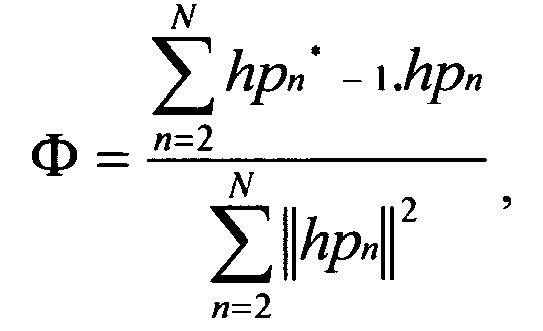
where the symbol "*" identifies the conjugate of a complex number. - The parameter Φ is thus a correlation parameter averaged over a plurality of different carrying signals, and enables to pool together information relevant to a given channel, most of this information having initially been produced in relation with other channel parameters.
- The parameter Φ may be optionnaly be compared to a predetermined threshold prior to the actual computation of any linear combination of the premiminary estimates described above, and even before computing the weighting coefficients vectors.
- Such a comparison sub-step will enable to determine if the linear combinations intended to be computed in the course of the secondary estimation step will indeed produce more accurate estimates of the channel parameters than the preliminary estimates hpn. A secondary estimate hsn produced by such a secondary estimation step will provide significant improvement with respect to the preliminary estimate hpn only if neighbour channels are sufficiently linked to each other, which is expressed by an average value Φ of the correlation parameter exceeding the predetermined threshold. If this condition is not fulfilled, neither the weight determination sub-step nor the computation of linear combinations of the preliminary estimates need be carried out, the preliminary estimates hpn being then directly selected for constituting the channel parameters.
- The above example may also be used for illustrating the usefulness of the invention in a situation where a given channel CHn doesn't actually feature any carrying signal Csn, and thus no pilot symbol. In such a case, known techniques based on the computation of an average value over time of preliminary estimates related to said carrying signal Csn will be useless, since no pilot symbol is available for computing a preliminary estimate related to this particular signal Csn. The invention, however, enables to compute a channel parameter estimate as an average value of a correlation between preliminary estimates of channel parameters related to adjacent channels, for example CHn-1 and CHn+1, in which case the channel parameter estimate representing the channel response to carrying signal Csn may be expressed as hsn=(hpn+1+hpn-1)/2, which also constitues an average value of a correlation parameter
- Other mathematical functions intended to compute average values of extended correlations between multiple preliminary estimates related to channels neighbouring a given channel for which no signal is available may, of course, be used for the same purpose as that described above in accordance with the general frequency averaging principle of the present invention.
- In another possible embodiment of the invention, n1 and n2 may both be chosen equal to a same integer number n0. In such an embodiment of the invention, the secondary estimate hsn of a channel parameter related to a given carrying signal Csn may thus be expressed as :

- As will now be explained, the weight determination sub-step may involve minimizing an average value of an error criterion, which average value is then computed over multiple carrying signals :
- The error en introduced by the estimation may be expressed as en=|hn-hsn|, where hn is the real and unknown channel parameter quantifying the frequency response of the communication channel to the carrying signal Csn. The weighting coefficients to be used for computing the linear combination intended to produce the secondary estimate should thus be chosen in such a way that an average value of the difference between the estimated and real channel parameters hsn and hn, or, preferably, an average value of a squared value of said difference will be minimized, which may be expressed as :

- As will now be explained, the use of such an error criterion enables to compute weighting coefficients by solving a simple equation system, which may be performed almost instantaneously by matricial computation.
- Indeed, the inventor has observed that the weight vector w k meeting this error criterion may be expressed as w k =I-(P/q).Φ-1, where I is the identity matrix, (P/q) is a real number representative of the variance of the interference-plus-noise adversely affecting the transmission of the carrying signal Csn, and Φ is a correlation matrix of which each component is formed by an average value of a correlation parameter, which average value may be computed over the whole group of N-2.n0 adjacent carrying signals Csn-n0...Csn...Csn+n0 enclosing the carrying signal Csn, which may be expressed as follows :

- In another example, each component [Φ]r1,r2 of raw r1 and column r2 of the correlation matrix Φ may be formed by an average value over only the two carrying signals Csr1 and Csr2 of a correlation between the preliminary estimates hpr1 and hpr2 related to said carrying signals Csr1 and Csr2. Such a computation scheme of the correlation matrix will, of course, yield less accurate results but will require less computing power for its execution, because each component will result from a simple scalar product between two values instead of a matricial product between two vectors of size N-2.n0 required in the general form expressed above.
- The invention illustrated by the above described embodiments thus enables to almost instantaneously perform an accurate channel response estimation on the basis of a very limited number of received pilot symbols, and is thus particularly well-suited for data packet transmission.
- Fig.3 diagrammatically shows another embodiment of the invention, according to which the receiving device is provided with multiple receiving antennas A1...Am...AM included in the receiving antenna system RAS, each antenna Am (for j=1 to M) being intended to pick up an incoming signal ISm including the multiple carrying signals Csi (for i=1 to N) transmitted through respective communication channels CHi. This receiving device includes multiplexing means MUX for sequencing over time the incoming signals ISm which are to be successively fed to the Fast Fourrier Transform module FFT and then processed by channel estimation means CEM identical to those described above. In other embodiments of such a receiving device, multiple channel estimation means CEM identical to those described above may be arranged in parallel for simultaneously processing all incoming signals IS1...ISm...ISM, which will of course be quicker but will require a larger processing circuit.
- In this embodiment of the invention, the channel estimation means will perform a computation of multiple groups of channel parameters hs1,m...hsn,m...hsN,m (for m=1 to M), each group comprising channel parameters hsi (for i=1 to N) representative of a channel response to carrying signals Csi (for i=1 to N) picked up by a given antenna Am.
- The receiving device further includes storage means MEM for storing each channel parameter hs1,m...hsn,m...hsN,m (for m=1 to M), of each m-th group and averaging means AVM for computing an average value hsn between at least two, and preferably, as in this example, all channel parameters hsn,1...hsn,m...hsn,M, related to a same carrying signal Csn, which may be expressed as :

- This embodiment the invention enables to increase the amount of information related to a same carrying signal Csn to be pooled together, which will give a higher relevance to the channel parameter hsn whose value is averaged over the multiple receiving antennas, without causing a significant increase in the computation time of this averaged value.
Claims (11)
- A method for transmitting data by means of multiple carrying signals through at least one communication channel, which method involves a computation of channel parameters representative each of a response of said communication channel to one of said carrying signals, said method including a preliminary estimation step in the course of which preliminary estimates of the channel parameters are generated, and a secondary estimation step in the course of which the preliminary estimates generated during the preliminary estimation step are refined by computing at least one average value of a correlation parameter, which average value is computed over at least two different carrying signals.
- A method as claimed in claim 1, in which the secondary estimation step involves computing linear combinations of at least two of said preliminary estimates, each linear combination being intended to yield a given channel parameter, the secondary estimation step including a weight determination sub-step in the course of which weighting coefficients to be applied to the preliminary estimates are determined by computing at least one average value of a correlation parameter, which average value is computed over at least two different carrying signals.
- A method as claimed in claim 2, in which the weight determination sub-step involves minimizing an average value of an error criterion, which average value is computed over at least two carrying signals.
- A method as claimed in claim 3, in which the weight determination sub-step involves determination of a correlation matrix having elements computed as average values, over at least two different carrying signals, of correlations between preliminary estimates of channel parameters related to said carrying signals.
- A method as claimed in claim 3, in which the weight determination sub-step involves determination of a correlation matrix having elements computed as average values, over different carrying signals, of linear combinations of correlations between preliminary estimates of channel parameters related to said carrying signals.
- A method as claimed in one claims 1 to 5, including a comparison step in the course of which the average value of the correlation parameter is compared to a predetermined threshold, the secondary estimation step being actually carried out only if said average value exceeds said predetermined threshold.
- A method for transmitting data intended to be used in a telecommunication system in which at least one receiver is provided with multiple receiving antennas, each being able to pick up the multiple carrying signals by means of which data is to be transmitted, which method involves a computation of multiple groups of channel parameters, each group comprising channel parameters representative of a channel response to carrying signals picked up by a given antenna, which channel parameters are computed by carrying out a method as claimed in any one of claims 1 to 6, and an averaging step, in the course of which an average value between at least two channel parameters related to a same carrying signal and belonging to at least two different groups of channel parameters is computed for each carrying signal.
- A telecommunication system including at least one transmitter and one receiver linked together by at least one wireless communication channel through which data is to be transmitted by means of multiple carrying signals, which receiver is to perform a computation of channel parameters representative each of a response of said communication channel to one of said carrying signals, said receiver including preliminary estimation means intended to generate preliminary estimates of the channel parameters, and secondary estimation means intended to refine the preliminary estimates generated by the preliminary estimation means, by computing linear combinations of at least two of said preliminary estimates, each linear combination being intended to yield a given channel parameter, system characterized in that the secondary estimation means are to cooperate with a weight determination module intended to determine weighting coefficients to be applied to the preliminary estimates by computing at least one average value of a correlation parameter, which average value is computed over at least two different carrying signals.
- A telecommunication system as claimed in claim 8, further including comparison means for comparing the average value of the correlation parameter to a predetermined threshold, and activation means for triggering computation of the linear combinations of the preliminary estimates only if said average value exceeds said predetermined threshold.
- A receiving device for receiving data transmitted through at least one wireless communication channel by means of multiple carrying signals, which receiving device is to perform a computation of channel parameters representative each of a response of said communication channel to one of said carrying signals, said receiving device including preliminary estimation means intended to generate preliminary estimates of the channel parameters, and secondary estimation means intended to refine the preliminary estimates generated by the preliminary estimation means, by computing linear combinations of at least two of said preliminary estimates, each linear combination being intended to yield a given channel parameter, receiving device characterized in that the secondary estimation means are to cooperate with a weight determination module intended to determine weighting coefficients to be applied to the preliminary estimates by computing at least one average value of a correlation parameter, which average value is computed over at least two different carrying signals.
- A receiving device as claimed in claim 10, further including comparison means for comparing the average value of the correlation parameter to a predetermined threshold, and activation means for triggering computation of the linear combinations of the preliminary estimates only if said average value exceeds said predetermined threshold.
Priority Applications (4)
| Application Number | Priority Date | Filing Date | Title |
|---|---|---|---|
| EP04291642A EP1613011B1 (en) | 2004-06-29 | 2004-06-29 | Channel estimation for a multi-carrier telecommunication system |
| AT04291642T ATE403319T1 (en) | 2004-06-29 | 2004-06-29 | CHANNEL ESTIMATION FOR A MULTI CARRIER COMMUNICATION SYSTEM |
| DE602004015437T DE602004015437D1 (en) | 2004-06-29 | 2004-06-29 | Channel estimation for a multi-carrier communication system |
| JP2005190063A JP4771758B2 (en) | 2004-06-29 | 2005-06-29 | Method for transmitting data, communication system, and receiving apparatus |
Applications Claiming Priority (1)
| Application Number | Priority Date | Filing Date | Title |
|---|---|---|---|
| EP04291642A EP1613011B1 (en) | 2004-06-29 | 2004-06-29 | Channel estimation for a multi-carrier telecommunication system |
Publications (2)
| Publication Number | Publication Date |
|---|---|
| EP1613011A1 true EP1613011A1 (en) | 2006-01-04 |
| EP1613011B1 EP1613011B1 (en) | 2008-07-30 |
Family
ID=34931205
Family Applications (1)
| Application Number | Title | Priority Date | Filing Date |
|---|---|---|---|
| EP04291642A Expired - Lifetime EP1613011B1 (en) | 2004-06-29 | 2004-06-29 | Channel estimation for a multi-carrier telecommunication system |
Country Status (4)
| Country | Link |
|---|---|
| EP (1) | EP1613011B1 (en) |
| JP (1) | JP4771758B2 (en) |
| AT (1) | ATE403319T1 (en) |
| DE (1) | DE602004015437D1 (en) |
Cited By (1)
| Publication number | Priority date | Publication date | Assignee | Title |
|---|---|---|---|---|
| CN101227440B (en) * | 2008-02-14 | 2010-07-21 | 北京创毅视讯科技有限公司 | Apparatus and method for eliminating zero-frequency interference in channel estimation |
Citations (3)
| Publication number | Priority date | Publication date | Assignee | Title |
|---|---|---|---|---|
| US5822380A (en) * | 1996-08-12 | 1998-10-13 | Ericsson Inc. | Apparatus and method for joint channel estimation |
| US5973642A (en) * | 1998-04-01 | 1999-10-26 | At&T Corp. | Adaptive antenna arrays for orthogonal frequency division multiplexing systems with co-channel interference |
| US6327315B1 (en) * | 1996-05-21 | 2001-12-04 | Nokia Telecommunications Oy | Method for estimating impulse response, and receiver |
Family Cites Families (5)
| Publication number | Priority date | Publication date | Assignee | Title |
|---|---|---|---|---|
| JP4284813B2 (en) * | 2000-02-18 | 2009-06-24 | 株式会社デンソー | OFDM receiver |
| CN100596044C (en) * | 2002-01-10 | 2010-03-24 | 富士通株式会社 | Pilot multiplexing method and OFDM receiving method in OFDM system |
| JP3735080B2 (en) * | 2002-04-09 | 2006-01-11 | パナソニック モバイルコミュニケーションズ株式会社 | OFDM communication apparatus and OFDM communication method |
| TW200401522A (en) * | 2002-05-17 | 2004-01-16 | Matsushita Electric Industrial Co Ltd | Receiving device and receiving method and transmission path characteristic measurement device |
| JP2004159084A (en) * | 2002-11-06 | 2004-06-03 | Kddi Corp | OFDM receiver for estimating propagation path |
-
2004
- 2004-06-29 DE DE602004015437T patent/DE602004015437D1/en not_active Expired - Lifetime
- 2004-06-29 AT AT04291642T patent/ATE403319T1/en not_active IP Right Cessation
- 2004-06-29 EP EP04291642A patent/EP1613011B1/en not_active Expired - Lifetime
-
2005
- 2005-06-29 JP JP2005190063A patent/JP4771758B2/en not_active Expired - Fee Related
Patent Citations (3)
| Publication number | Priority date | Publication date | Assignee | Title |
|---|---|---|---|---|
| US6327315B1 (en) * | 1996-05-21 | 2001-12-04 | Nokia Telecommunications Oy | Method for estimating impulse response, and receiver |
| US5822380A (en) * | 1996-08-12 | 1998-10-13 | Ericsson Inc. | Apparatus and method for joint channel estimation |
| US5973642A (en) * | 1998-04-01 | 1999-10-26 | At&T Corp. | Adaptive antenna arrays for orthogonal frequency division multiplexing systems with co-channel interference |
Cited By (1)
| Publication number | Priority date | Publication date | Assignee | Title |
|---|---|---|---|---|
| CN101227440B (en) * | 2008-02-14 | 2010-07-21 | 北京创毅视讯科技有限公司 | Apparatus and method for eliminating zero-frequency interference in channel estimation |
Also Published As
| Publication number | Publication date |
|---|---|
| ATE403319T1 (en) | 2008-08-15 |
| DE602004015437D1 (en) | 2008-09-11 |
| JP2006020315A (en) | 2006-01-19 |
| JP4771758B2 (en) | 2011-09-14 |
| EP1613011B1 (en) | 2008-07-30 |
Similar Documents
| Publication | Publication Date | Title |
|---|---|---|
| EP1394963B1 (en) | Apparatus and method for transmitting and receiving signals using multi-antennas | |
| US7852906B2 (en) | Wireless communication device and channel estimation and separation method in multi input system | |
| US20100054355A1 (en) | Wireless communication system | |
| KR20100122478A (en) | Mobile communication system, reception device, and method | |
| EP2267925A1 (en) | Mobile communication system, reception device, and method | |
| RU2006139645A (en) | SPATIAL PROCESSING USING CONTROL MATRICES FOR PERFORMANCE TRANSMISSION MANAGEMENT IN A MULTI-ANTENNA COMMUNICATION SYSTEM | |
| CN100405751C (en) | Synchronization acquisition circuit and receiving apparatus using the same | |
| CN106856461A (en) | A method and device for interference estimation | |
| CN103379078A (en) | Method and device for frequency domain balancing detection | |
| KR100661068B1 (en) | Channel estimating method for multi-set of code in slotted cdma system | |
| US20060056529A1 (en) | Method and system for optimization of channel estimation and synchronization in an OFDM-MIMO wireless communication system | |
| EP1613011B1 (en) | Channel estimation for a multi-carrier telecommunication system | |
| CN115865162B (en) | Antenna channel correction methods, apparatus, equipment and storage media | |
| WO2005074181A1 (en) | Transmitting/receiving apparatus and transmitting/receiving method | |
| KR20070078476A (en) | Apparatus and method for estimating carrier interference and noise ratio in broadband wireless communication system | |
| CN102315901B (en) | Method and device for determining discontinuous transmission (DTX) | |
| US9980240B2 (en) | Scheme for transmitting and receiving symbols in filter bank multi carrier system | |
| CN104753834B (en) | A kind of channel estimation methods and device | |
| US20170222835A1 (en) | Method of performing uplink channel estimation and base station using the same | |
| MXPA05013518A (en) | Reduced complexity sliding window based equalizer. | |
| CN105429925B (en) | Multi-antenna OFDMA signal decoding method based on Fast Independent Component Analysis | |
| CN113347124A (en) | Channel estimation method, system, device and storage medium | |
| EP2200188A2 (en) | Multi-carrier code division multiple access beamforming | |
| KR0139674B1 (en) | Non-coherent hadamard demodulator | |
| EP1347608A1 (en) | Interpolation for use in channel estimation |
Legal Events
| Date | Code | Title | Description |
|---|---|---|---|
| PUAI | Public reference made under article 153(3) epc to a published international application that has entered the european phase |
Free format text: ORIGINAL CODE: 0009012 |
|
| AK | Designated contracting states |
Kind code of ref document: A1 Designated state(s): AT BE BG CH CY CZ DE DK EE ES FI FR GB GR HU IE IT LI LU MC NL PL PT RO SE SI SK TR |
|
| AX | Request for extension of the european patent |
Extension state: AL HR LT LV MK |
|
| RAP1 | Party data changed (applicant data changed or rights of an application transferred) |
Owner name: MITSUBISHI ELECTRIC INFORMATION TECHNOLOGY CENTRE Owner name: MITSUBISHI DENKI KABUSHIKI KAISHA |
|
| 17P | Request for examination filed |
Effective date: 20060315 |
|
| AKX | Designation fees paid |
Designated state(s): AT BE BG CH CY CZ DE DK EE ES FI FR GB GR HU IE IT LI LU MC NL PL PT RO SE SI SK TR |
|
| 17Q | First examination report despatched |
Effective date: 20060516 |
|
| GRAP | Despatch of communication of intention to grant a patent |
Free format text: ORIGINAL CODE: EPIDOSNIGR1 |
|
| GRAS | Grant fee paid |
Free format text: ORIGINAL CODE: EPIDOSNIGR3 |
|
| GRAA | (expected) grant |
Free format text: ORIGINAL CODE: 0009210 |
|
| AK | Designated contracting states |
Kind code of ref document: B1 Designated state(s): AT BE BG CH CY CZ DE DK EE ES FI FR GB GR HU IE IT LI LU MC NL PL PT RO SE SI SK TR |
|
| REG | Reference to a national code |
Ref country code: GB Ref legal event code: FG4D |
|
| REG | Reference to a national code |
Ref country code: CH Ref legal event code: EP |
|
| REF | Corresponds to: |
Ref document number: 602004015437 Country of ref document: DE Date of ref document: 20080911 Kind code of ref document: P |
|
| REG | Reference to a national code |
Ref country code: IE Ref legal event code: FG4D |
|
| PG25 | Lapsed in a contracting state [announced via postgrant information from national office to epo] |
Ref country code: ES Free format text: LAPSE BECAUSE OF FAILURE TO SUBMIT A TRANSLATION OF THE DESCRIPTION OR TO PAY THE FEE WITHIN THE PRESCRIBED TIME-LIMIT Effective date: 20081110 Ref country code: NL Free format text: LAPSE BECAUSE OF FAILURE TO SUBMIT A TRANSLATION OF THE DESCRIPTION OR TO PAY THE FEE WITHIN THE PRESCRIBED TIME-LIMIT Effective date: 20080730 Ref country code: PT Free format text: LAPSE BECAUSE OF FAILURE TO SUBMIT A TRANSLATION OF THE DESCRIPTION OR TO PAY THE FEE WITHIN THE PRESCRIBED TIME-LIMIT Effective date: 20081230 |
|
| PG25 | Lapsed in a contracting state [announced via postgrant information from national office to epo] |
Ref country code: SI Free format text: LAPSE BECAUSE OF FAILURE TO SUBMIT A TRANSLATION OF THE DESCRIPTION OR TO PAY THE FEE WITHIN THE PRESCRIBED TIME-LIMIT Effective date: 20080730 Ref country code: AT Free format text: LAPSE BECAUSE OF FAILURE TO SUBMIT A TRANSLATION OF THE DESCRIPTION OR TO PAY THE FEE WITHIN THE PRESCRIBED TIME-LIMIT Effective date: 20080730 Ref country code: BG Free format text: LAPSE BECAUSE OF FAILURE TO SUBMIT A TRANSLATION OF THE DESCRIPTION OR TO PAY THE FEE WITHIN THE PRESCRIBED TIME-LIMIT Effective date: 20081030 Ref country code: FI Free format text: LAPSE BECAUSE OF FAILURE TO SUBMIT A TRANSLATION OF THE DESCRIPTION OR TO PAY THE FEE WITHIN THE PRESCRIBED TIME-LIMIT Effective date: 20080730 |
|
| PG25 | Lapsed in a contracting state [announced via postgrant information from national office to epo] |
Ref country code: BE Free format text: LAPSE BECAUSE OF FAILURE TO SUBMIT A TRANSLATION OF THE DESCRIPTION OR TO PAY THE FEE WITHIN THE PRESCRIBED TIME-LIMIT Effective date: 20080730 |
|
| PG25 | Lapsed in a contracting state [announced via postgrant information from national office to epo] |
Ref country code: EE Free format text: LAPSE BECAUSE OF FAILURE TO SUBMIT A TRANSLATION OF THE DESCRIPTION OR TO PAY THE FEE WITHIN THE PRESCRIBED TIME-LIMIT Effective date: 20080730 Ref country code: DK Free format text: LAPSE BECAUSE OF FAILURE TO SUBMIT A TRANSLATION OF THE DESCRIPTION OR TO PAY THE FEE WITHIN THE PRESCRIBED TIME-LIMIT Effective date: 20080730 |
|
| PG25 | Lapsed in a contracting state [announced via postgrant information from national office to epo] |
Ref country code: RO Free format text: LAPSE BECAUSE OF FAILURE TO SUBMIT A TRANSLATION OF THE DESCRIPTION OR TO PAY THE FEE WITHIN THE PRESCRIBED TIME-LIMIT Effective date: 20080730 Ref country code: CZ Free format text: LAPSE BECAUSE OF FAILURE TO SUBMIT A TRANSLATION OF THE DESCRIPTION OR TO PAY THE FEE WITHIN THE PRESCRIBED TIME-LIMIT Effective date: 20080730 Ref country code: SK Free format text: LAPSE BECAUSE OF FAILURE TO SUBMIT A TRANSLATION OF THE DESCRIPTION OR TO PAY THE FEE WITHIN THE PRESCRIBED TIME-LIMIT Effective date: 20080730 |
|
| PLBE | No opposition filed within time limit |
Free format text: ORIGINAL CODE: 0009261 |
|
| STAA | Information on the status of an ep patent application or granted ep patent |
Free format text: STATUS: NO OPPOSITION FILED WITHIN TIME LIMIT |
|
| 26N | No opposition filed |
Effective date: 20090506 |
|
| PG25 | Lapsed in a contracting state [announced via postgrant information from national office to epo] |
Ref country code: IT Free format text: LAPSE BECAUSE OF FAILURE TO SUBMIT A TRANSLATION OF THE DESCRIPTION OR TO PAY THE FEE WITHIN THE PRESCRIBED TIME-LIMIT Effective date: 20080730 |
|
| PG25 | Lapsed in a contracting state [announced via postgrant information from national office to epo] |
Ref country code: MC Free format text: LAPSE BECAUSE OF NON-PAYMENT OF DUE FEES Effective date: 20090630 Ref country code: SE Free format text: LAPSE BECAUSE OF FAILURE TO SUBMIT A TRANSLATION OF THE DESCRIPTION OR TO PAY THE FEE WITHIN THE PRESCRIBED TIME-LIMIT Effective date: 20081030 |
|
| REG | Reference to a national code |
Ref country code: CH Ref legal event code: PL |
|
| REG | Reference to a national code |
Ref country code: IE Ref legal event code: MM4A |
|
| PG25 | Lapsed in a contracting state [announced via postgrant information from national office to epo] |
Ref country code: CH Free format text: LAPSE BECAUSE OF NON-PAYMENT OF DUE FEES Effective date: 20090630 Ref country code: IE Free format text: LAPSE BECAUSE OF NON-PAYMENT OF DUE FEES Effective date: 20090629 Ref country code: LI Free format text: LAPSE BECAUSE OF NON-PAYMENT OF DUE FEES Effective date: 20090630 |
|
| PG25 | Lapsed in a contracting state [announced via postgrant information from national office to epo] |
Ref country code: PL Free format text: LAPSE BECAUSE OF FAILURE TO SUBMIT A TRANSLATION OF THE DESCRIPTION OR TO PAY THE FEE WITHIN THE PRESCRIBED TIME-LIMIT Effective date: 20080730 |
|
| PG25 | Lapsed in a contracting state [announced via postgrant information from national office to epo] |
Ref country code: GR Free format text: LAPSE BECAUSE OF FAILURE TO SUBMIT A TRANSLATION OF THE DESCRIPTION OR TO PAY THE FEE WITHIN THE PRESCRIBED TIME-LIMIT Effective date: 20081031 |
|
| PG25 | Lapsed in a contracting state [announced via postgrant information from national office to epo] |
Ref country code: LU Free format text: LAPSE BECAUSE OF NON-PAYMENT OF DUE FEES Effective date: 20090629 |
|
| PG25 | Lapsed in a contracting state [announced via postgrant information from national office to epo] |
Ref country code: HU Free format text: LAPSE BECAUSE OF FAILURE TO SUBMIT A TRANSLATION OF THE DESCRIPTION OR TO PAY THE FEE WITHIN THE PRESCRIBED TIME-LIMIT Effective date: 20090131 |
|
| PG25 | Lapsed in a contracting state [announced via postgrant information from national office to epo] |
Ref country code: TR Free format text: LAPSE BECAUSE OF FAILURE TO SUBMIT A TRANSLATION OF THE DESCRIPTION OR TO PAY THE FEE WITHIN THE PRESCRIBED TIME-LIMIT Effective date: 20080730 |
|
| PG25 | Lapsed in a contracting state [announced via postgrant information from national office to epo] |
Ref country code: CY Free format text: LAPSE BECAUSE OF FAILURE TO SUBMIT A TRANSLATION OF THE DESCRIPTION OR TO PAY THE FEE WITHIN THE PRESCRIBED TIME-LIMIT Effective date: 20080730 |
|
| PGFP | Annual fee paid to national office [announced via postgrant information from national office to epo] |
Ref country code: GB Payment date: 20140618 Year of fee payment: 11 |
|
| PGFP | Annual fee paid to national office [announced via postgrant information from national office to epo] |
Ref country code: DE Payment date: 20140619 Year of fee payment: 11 |
|
| PGFP | Annual fee paid to national office [announced via postgrant information from national office to epo] |
Ref country code: FR Payment date: 20140626 Year of fee payment: 11 |
|
| REG | Reference to a national code |
Ref country code: DE Ref legal event code: R119 Ref document number: 602004015437 Country of ref document: DE |
|
| GBPC | Gb: european patent ceased through non-payment of renewal fee |
Effective date: 20150629 |
|
| REG | Reference to a national code |
Ref country code: FR Ref legal event code: ST Effective date: 20160229 |
|
| PG25 | Lapsed in a contracting state [announced via postgrant information from national office to epo] |
Ref country code: GB Free format text: LAPSE BECAUSE OF NON-PAYMENT OF DUE FEES Effective date: 20150629 Ref country code: DE Free format text: LAPSE BECAUSE OF NON-PAYMENT OF DUE FEES Effective date: 20160101 |
|
| PG25 | Lapsed in a contracting state [announced via postgrant information from national office to epo] |
Ref country code: FR Free format text: LAPSE BECAUSE OF NON-PAYMENT OF DUE FEES Effective date: 20150630 |