EP1613005A1 - RADIO NETWORK CONTROL DEVICE AND QoS CONTROL METHOD USED FOR THE SAME - Google Patents
RADIO NETWORK CONTROL DEVICE AND QoS CONTROL METHOD USED FOR THE SAME Download PDFInfo
- Publication number
- EP1613005A1 EP1613005A1 EP04726024A EP04726024A EP1613005A1 EP 1613005 A1 EP1613005 A1 EP 1613005A1 EP 04726024 A EP04726024 A EP 04726024A EP 04726024 A EP04726024 A EP 04726024A EP 1613005 A1 EP1613005 A1 EP 1613005A1
- Authority
- EP
- European Patent Office
- Prior art keywords
- layer
- protocol
- qos
- radio network
- packet
- Prior art date
- Legal status (The legal status is an assumption and is not a legal conclusion. Google has not performed a legal analysis and makes no representation as to the accuracy of the status listed.)
- Withdrawn
Links
Images



Classifications
-
- H—ELECTRICITY
- H04—ELECTRIC COMMUNICATION TECHNIQUE
- H04L—TRANSMISSION OF DIGITAL INFORMATION, e.g. TELEGRAPHIC COMMUNICATION
- H04L69/00—Network arrangements, protocols or services independent of the application payload and not provided for in the other groups of this subclass
- H04L69/16—Implementation or adaptation of Internet protocol [IP], of transmission control protocol [TCP] or of user datagram protocol [UDP]
-
- H—ELECTRICITY
- H04—ELECTRIC COMMUNICATION TECHNIQUE
- H04L—TRANSMISSION OF DIGITAL INFORMATION, e.g. TELEGRAPHIC COMMUNICATION
- H04L47/00—Traffic control in data switching networks
- H04L47/10—Flow control; Congestion control
- H04L47/24—Traffic characterised by specific attributes, e.g. priority or QoS
- H04L47/2408—Traffic characterised by specific attributes, e.g. priority or QoS for supporting different services, e.g. a differentiated services [DiffServ] type of service
-
- H—ELECTRICITY
- H04—ELECTRIC COMMUNICATION TECHNIQUE
- H04L—TRANSMISSION OF DIGITAL INFORMATION, e.g. TELEGRAPHIC COMMUNICATION
- H04L69/00—Network arrangements, protocols or services independent of the application payload and not provided for in the other groups of this subclass
- H04L69/30—Definitions, standards or architectural aspects of layered protocol stacks
- H04L69/32—Architecture of open systems interconnection [OSI] 7-layer type protocol stacks, e.g. the interfaces between the data link level and the physical level
-
- H—ELECTRICITY
- H04—ELECTRIC COMMUNICATION TECHNIQUE
- H04W—WIRELESS COMMUNICATION NETWORKS
- H04W8/00—Network data management
- H04W8/02—Processing of mobility data, e.g. registration information at HLR [Home Location Register] or VLR [Visitor Location Register]; Transfer of mobility data, e.g. between HLR, VLR or external networks
- H04W8/04—Registration at HLR or HSS [Home Subscriber Server]
-
- H—ELECTRICITY
- H04—ELECTRIC COMMUNICATION TECHNIQUE
- H04W—WIRELESS COMMUNICATION NETWORKS
- H04W28/00—Network traffic management; Network resource management
- H04W28/16—Central resource management; Negotiation of resources or communication parameters, e.g. negotiating bandwidth or QoS [Quality of Service]
-
- H—ELECTRICITY
- H04—ELECTRIC COMMUNICATION TECHNIQUE
- H04W—WIRELESS COMMUNICATION NETWORKS
- H04W80/00—Wireless network protocols or protocol adaptations to wireless operation
- H04W80/06—Transport layer protocols, e.g. TCP [Transport Control Protocol] over wireless
-
- H—ELECTRICITY
- H04—ELECTRIC COMMUNICATION TECHNIQUE
- H04W—WIRELESS COMMUNICATION NETWORKS
- H04W88/00—Devices specially adapted for wireless communication networks, e.g. terminals, base stations or access point devices
- H04W88/12—Access point controller devices
Definitions
- the present invention relates to a radio network controller and a QoS control method used therefor and, more particularly, to an RNC (Radio Network Controller) architecture appropriate for QoS (Quality of Service) control on an IP (Internet Protocol) based UTRAN (Universal Terrestrial Radio Access Network).
- RNC Radio Network Controller
- QoS Quality of Service
- IP Internet Protocol
- UTRAN Universal Terrestrial Radio Access Network
- Fig. 6 shows a protocol stack of a U (User)-plane when an IP based UTRAN directly connects to an IP network. Shown in Fig. 6 is a protocol stack among a base station (Node B), a radio network controller (RNC) and a router as nodes which form the UTRAN.
- the U-plane is for transferring user information.
- the base station (Node B) is connected to a user equipment (UE) through a PHY (physical layer) and to the radio network controller (RNC) through an L1 (Layer 1).
- the base station (Node B) is provided with an FP (Frame Protocol), a UDP (User Datagram Protocol), an IP and an L2 (Layer 2).
- the radio network controller is connected to the base station (Node B) and the router through the L1 and is provided with, other than the above-described protocols, an IPv6 (Internet Protocol version 6), a PDCP (Packet Data Convergence Protocol), an RLC (Radio Link Control), a MAC (Medium Access Control), the FP, the UDP, the IP and the L2.
- IPv6 Internet Protocol version 6
- PDCP Packet Data Convergence Protocol
- RLC Radio Link Control
- MAC Medium Access Control
- the router is connected to the radio network controller (RNC) and a core network (CN) not shown through the L1 and is provided with the IPv6 and the L2 other than the above-described protocols.
- RNC radio network controller
- CN core network
- IP based UTRAN In the above-described IP based UTRAN, however, through the direct connection to an IP network, a user IP layer will be processed by the RNC to connect to the Node B through an IP transport.
- the above-described IP based UTRAN therefore, QoS information added in the IP network needs to be reflected on the IP transport by the RNC.
- an object of the present invention is to solve the above-described problems to provide a radio network controller which enables QoS control taking segmentation and concatenation on a layer basis into consideration and a QoS control method used therefor.
- the radio network controller according to the present invention is a radio network controller formed of a plurality of protocol layers, which includes a plurality of blocks each having a protocol layer obtained by dividing the plurality of protocol layers and a UDP (User Datagram Protocol)/IPv6 (Internet Protocol version 6) layer which connects the plurality of blocks.
- UDP User Datagram Protocol
- IPv6 Internet Protocol version 6
- the QoS control method is a QoS (Quality of Service) control method of a radio network controller formed of a plurality of protocol layers, in which the plurality of protocol layers are divided into blocks such that QoS control is executed taking an RLC (Radio Link Control) layer which segments and concatenates U(User)-plane data into consideration and the blocks are connected by a UDP (User Datagram Protocol)/IPv6 (Internet Protocol version 6) layer.
- RLC Radio Link Control
- the QoS control method of the present invention realizes QoS (Quality of Service) control of a DiffServ (Differentiated Services) system on a UTRAN (Universal Terrestrial Radio Access Network) to execute QoS control taking an RLC (Radio Link Control) layer which executes segmentation and concatenation of U(User)-plane data into consideration in QoS control in an RNC (Radio Network Controller).
- DiffServ system QoS control is not minute QoS control such as ensuring a band or the like but control executed with rough priority.
- a UDP port which connects blocks is prepared for each channel (CH) down to a UE (User Equipment) as many as the number of QoS classes supported by one channel.
- UDP ports prepared between the blocks are one-to-one correlated to form a U-plane data path which is defined as a link.
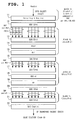
- Fig. 1 is a functional block diagram showing a structure of a radio network controller (RNC) according to one embodiment of the present invention.
- RNC radio network controller
- illustrated is a functional block which processes U(User)-plane data of the radio network controller (RNC), in which the radio network controller (RNC) is formed of blocks #1 to #4 each different for each layer and a QoS control layer 22, with the blocks #1 to # 4 connected by a UDP (User Datagram Protocol)/IPv6 (Internet Protocol version 6).
- UDP User Datagram Protocol
- IPv6 Internet Protocol version 6
- UDP ports #11, #21 and #31 which connect the blocks #1 to #4 are each prepared for each channel (CH) down to a UE (User Equipment) as many as the number of QoS (Quality of Service) classes supported by one channel.
- the UDP ports #11, #21 and #31 prepared among the blocks #1 to #4 are one-to-one correlated to form a U-plane data path which is defined as a link.
- the block #1 includes a capsuling and routing layer 11, which capsules a user IP layer by the UDP/IPv6, as well as detecting a destination IP address (which will be an IP address of a relevant UE), and specifying a QoS class from a DSCP (Differentiated Services Code Point) embedded in a TOS (Type of Service) field of an IP header of the user IP layer to transfer data to the block #2 through the UDP port correlated to a corresponding link.
- a capsuling and routing layer 11 which capsules a user IP layer by the UDP/IPv6, as well as detecting a destination IP address (which will be an IP address of a relevant UE), and specifying a QoS class from a DSCP (Differentiated Services Code Point) embedded in a TOS (Type of Service) field of an IP header of the user IP layer to transfer data to the block #2 through the UDP port correlated to a corresponding link.
- DSCP Differentiated Services Code Point
- the block #2 includes a UDP/IPv6 layer 13, a PDCP (Packet Data Convergence Protocol) layer 14 and a RLC (Radio Link Control) layer 15 and the block #3 includes a UDP/IPv6 layer 17, a MAC (Medium Access Control)-d layer 18 and an FP (Frame Protocol) layer 19.
- PDCP Packet Data Convergence Protocol
- RLC Radio Link Control
- the blocks #2 and #3 execute protocol processing divided for each of the functional blocks (the processing of the PDCP layer 14 and the RLC layer 15 for the block #2 and the processing of the MAC-d layer 18 and the FP layer 19 for the block #3) with respect to a payload part of a UDP packet obtained through each UDP port to transfer data to a block at a subsequent stage through a UDP port correlated to a corresponding link.
- the block #4 includes a UDP/IPv6 layer 21, which embeds, in a TOS field of an IP header of an IP packet obtained from each link, a DSCP value of a QoS class correlated to the link.
- the QoS control layer 22 executes QoS control based on a DSCP value.
- UDP/IPv6 layers 12, 16 and 20 are provided, respectively.
- Fig. 2 is a diagram showing U-plane data segmentation processing in the radio network controller (RNC) according to one embodiment of the present invention
- Fig. 3 is a diagram showing U-plane data concatenation processing in the radio network controller (RNC) according to one embodiment of the present invention
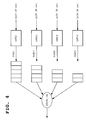
- Fig 4 is a diagram showing QoS control in the radio network controller (RNC) according to one embodiment of the present invention. Description will be made of operation of the radio network controller (RNC) according to one embodiment of the present invention with reference to Fig. 1 to Fig. 4.
- a special start packet (S-PACK#2) and a special end packet (E-PACK#2) are inserted preceding to and succeeding to a generated PDU (RLC-PDU#2) after concatenation [see Fig. 3].
- QoS control in the block #4 is executed on a basis of the above-described PACK#1 or PACK#2. More specifically, as shown in Fig. 4, at a preceding stage of a QoS scheduler, a filter function (GATE#1 ⁇ GATE#4) on a basis of a PACK called a GATE is prepared to detect a special start packet (S-PACK) and a special end packet (E-PACK) from U-plane data received from a corresponding UDP port (QoS#1 UDP port - QoS#4 UDP port).
- S-PACK special start packet
- E-PACK special end packet
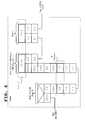
- Fig. 5 is a diagram showing operation of a GATE when QoS control is executed on a pack basis according to one embodiment of the present invention.
- Fig. 5 when receiving a packet according to a time axis, detect an end packet (E-PACK) to identify one pack at Time A, and because input is allowed as a result of comparison between the size of the one pack and a free capacity of the QoS buffer, the real packets #1, #2 and #3 in the pack are input to the QoS buffer.
- E-PACK end packet
- Time B detect an end packet (E-PACK) to identify one pack, and because input is allowed as a result of comparison between the size of one pack and a free capacity of the QoS buffer, the real packets #4 and #5 in the pack are input to the QoS buffer.
- E-PACK end packet
- QoS buffer output timing by the scheduler exists to increase a free capacity of the QoS buffer.
- input is allowed, so that the real packets #4 and #5 in the pack are input to the QoS buffer.
- the present embodiment enables QoS control in the device only through management of a UDP port number in the device, which leads to simplification of QoS control in the device.
- UE user equipment
- the respective blocks #1 to #4 can be formed of a hardware (H/W) package to enable the number of accommodated channels to be increased by package expansion.
- the present embodiment defines a pack on an RLC-PDU level noting the segmentation and concatenation function of the RLC protocol, defining a pack not in an RLC but in another layer enables QoS control taking segmentation and concatenation of the layer into consideration.
- the present invention obtains an effect of executing QoS control taking segmentation and concatenation for each layer into consideration.
Landscapes
- Engineering & Computer Science (AREA)
- Computer Networks & Wireless Communication (AREA)
- Signal Processing (AREA)
- Computer Security & Cryptography (AREA)
- Databases & Information Systems (AREA)
- Data Exchanges In Wide-Area Networks (AREA)
- Mobile Radio Communication Systems (AREA)
- Communication Control (AREA)
Abstract
Description
- The present invention relates to a radio network controller and a QoS control method used therefor and, more particularly, to an RNC (Radio Network Controller) architecture appropriate for QoS (Quality of Service) control on an IP (Internet Protocol) based UTRAN (Universal Terrestrial Radio Access Network).
- Fig. 6 shows a protocol stack of a U (User)-plane when an IP based UTRAN directly connects to an IP network. Shown in Fig. 6 is a protocol stack among a base station (Node B), a radio network controller (RNC) and a router as nodes which form the UTRAN. Here, the U-plane is for transferring user information.
- In Fig. 6, the base station (Node B) is connected to a user equipment (UE) through a PHY (physical layer) and to the radio network controller (RNC) through an L1 (Layer 1). Other than the above-described protocols, the base station (Node B) is provided with an FP (Frame Protocol), a UDP (User Datagram Protocol), an IP and an L2 (Layer 2).
- The radio network controller (RNC) is connected to the base station (Node B) and the router through the L1 and is provided with, other than the above-described protocols, an IPv6 (Internet Protocol version 6), a PDCP (Packet Data Convergence Protocol), an RLC (Radio Link Control), a MAC (Medium Access Control), the FP, the UDP, the IP and the L2.
- The router is connected to the radio network controller (RNC) and a core network (CN) not shown through the L1 and is provided with the IPv6 and the L2 other than the above-described protocols.
- In conventional mobile communication networks whose representative is a GPRS (General Packet Radio Service), there exists as a user IP layer on the CN side, an SGSN (Serving GPRS Support Node)/GGSN (Gateway GPRS Support Node), which is capsuled by GTP (GPRS Tunneling Protocol) tunneling (see e.g. Keiji Tachikawa: W-CDMA Mobile Communication System 4-4 Packet Communication System, pp. 274-279, published by Maruzen, Co., Ltd., June 25, 2001) and hidden on an UTRAN.
- In the above-described IP based UTRAN, however, through the direct connection to an IP network, a user IP layer will be processed by the RNC to connect to the Node B through an IP transport. The above-described IP based UTRAN, therefore, QoS information added in the IP network needs to be reflected on the IP transport by the RNC.
- Under these circumstances, an object of the present invention is to solve the above-described problems to provide a radio network controller which enables QoS control taking segmentation and concatenation on a layer basis into consideration and a QoS control method used therefor.
- The radio network controller according to the present invention is a radio network controller formed of a plurality of protocol layers, which includes a plurality of blocks each having a protocol layer obtained by dividing the plurality of protocol layers and a UDP (User Datagram Protocol)/IPv6 (Internet Protocol version 6) layer which connects the plurality of blocks.
- The QoS control method according to the present invention is a QoS (Quality of Service) control method of a radio network controller formed of a plurality of protocol layers, in which the plurality of protocol layers are divided into blocks such that QoS control is executed taking an RLC (Radio Link Control) layer which segments and concatenates U(User)-plane data into consideration and the blocks are connected by a UDP (User Datagram Protocol)/IPv6 (Internet Protocol version 6) layer.
- In other words, the QoS control method of the present invention realizes QoS (Quality of Service) control of a DiffServ (Differentiated Services) system on a UTRAN (Universal Terrestrial Radio Access Network) to execute QoS control taking an RLC (Radio Link Control) layer which executes segmentation and concatenation of U(User)-plane data into consideration in QoS control in an RNC (Radio Network Controller). Here, DiffServ system QoS control is not minute QoS control such as ensuring a band or the like but control executed with rough priority.
- More specifically, according to the QoS control method of the present invention, with different blocks for each layer in an RNC, these blocks are connected by a UDP (User Datagram Protocol )/IPv6 (Internet Protocol version 6).
- A UDP port which connects blocks is prepared for each channel (CH) down to a UE (User Equipment) as many as the number of QoS classes supported by one channel. UDP ports prepared between the blocks are one-to-one correlated to form a U-plane data path which is defined as a link.
- Add a start packet and an end packet to the top and the rear of a PDU (Protocol Data Unit) group generated by segmentation and concatenation in an RLC layer to define a sandwiched part as a pack. Even when bridging blocks of other layers such as a MAC (Medium Access Control) and an FP (Frame Protocol), the pack can be identified by detecting a start packet and an end packet. Therefore, it is possible to execute QoS control on a pack basis in a last-stage IP (Internet Protocol) layer of an RNC.
- According to the QoS control method of the present invention, thus noting a segmentation and concatenation function of an RLC protocol to define a pack on an RLC-PDU level not in an RLC but in another layer enables QoS control taking segmentation and concatenation for each layer into consideration.
-
- Fig. 1 is a functional block diagram showing a structure of a radio network controller (RNC) according to one embodiment of the present invention;
- Fig. 2 is a diagram showing U-plane data segmentation processing at the radio network controller (RNC) according to one embodiment of the present invention;
- Fig. 3 is a diagram showing U-plane data concatenation processing at the radio network controller (RNC) according to one embodiment of the present invention;
- Fig. 4 is a diagram showing QoS control at the radio network controller (RNC) according to one embodiment of the present invention;
- Fig. 5 is a diagram showing operation of GATE in a case when QoS control is executed on a pack basis according to one embodiment of the present invention; and
- Fig. 6 is a diagram showing a protocol stack of a U-plane in a case when an IP based UTRAN is directly connected to an IP network.
- Next, an embodiment of the present invention will be described with reference to the drawings.
- Fig. 1 is a functional block diagram showing a structure of a radio network controller (RNC) according to one embodiment of the present invention. In Fig. 1, illustrated is a functional block which processes U(User)-plane data of the radio network controller (RNC), in which the radio network controller (RNC) is formed of
blocks # 1 to #4 each different for each layer and aQoS control layer 22, with theblocks # 1 to # 4 connected by a UDP (User Datagram Protocol)/IPv6 (Internet Protocol version 6). - UDP ports #11, #21 and #31 which connect the
blocks # 1 to #4 are each prepared for each channel (CH) down to a UE (User Equipment) as many as the number of QoS (Quality of Service) classes supported by one channel. The UDP ports #11, #21 and #31 prepared among theblocks # 1 to #4 are one-to-one correlated to form a U-plane data path which is defined as a link. - The
block # 1 includes a capsuling androuting layer 11, which capsules a user IP layer by the UDP/IPv6, as well as detecting a destination IP address (which will be an IP address of a relevant UE), and specifying a QoS class from a DSCP (Differentiated Services Code Point) embedded in a TOS (Type of Service) field of an IP header of the user IP layer to transfer data to theblock # 2 through the UDP port correlated to a corresponding link. - The
block # 2 includes a UDP/IPv6 layer 13, a PDCP (Packet Data Convergence Protocol)layer 14 and a RLC (Radio Link Control)layer 15 and theblock # 3 includes a UDP/IPv6 layer 17, a MAC (Medium Access Control)-d layer 18 and an FP (Frame Protocol)layer 19. - The
blocks # 2 and #3 execute protocol processing divided for each of the functional blocks (the processing of thePDCP layer 14 and theRLC layer 15 for theblock # 2 and the processing of the MAC-d layer 18 and theFP layer 19 for the block #3) with respect to a payload part of a UDP packet obtained through each UDP port to transfer data to a block at a subsequent stage through a UDP port correlated to a corresponding link. - The
block # 4 includes a UDP/IPv6 layer 21, which embeds, in a TOS field of an IP header of an IP packet obtained from each link, a DSCP value of a QoS class correlated to the link. TheQoS control layer 22 executes QoS control based on a DSCP value. - Between the
block # 1 and theblock # 2, between theblock # 2 and theblock # 3 and between theblock # 3 and theblock # 4, UDP/IPv6 layers 12, 16 and 20 are provided, respectively. - Fig. 2 is a diagram showing U-plane data segmentation processing in the radio network controller (RNC) according to one embodiment of the present invention, Fig. 3 is a diagram showing U-plane data concatenation processing in the radio network controller (RNC) according to one embodiment of the present invention, and Fig 4 is a diagram showing QoS control in the radio network controller (RNC) according to one embodiment of the present invention. Description will be made of operation of the radio network controller (RNC) according to one embodiment of the present invention with reference to Fig. 1 to Fig. 4.
- When U-plane data segmentation and concatenation are executed at the
RLC layer 15 of theblock # 2, operation will be as shown in Fig. 2 and Fig. 3. In a case of segmentation of U-plane data, at the top of a divided PDU group (RLC-PDU#1-1 - RLC-PDU#1-4), a special start packet (S-PACK#1) is inserted and at the rear of the PDU group, a special end packet (E-PACK#1) is inserted [see Fig. 2]. - In a case of concatenation of U-plane data, a special start packet (S-PACK#2) and a special end packet (E-PACK#2) are inserted preceding to and succeeding to a generated PDU (RLC-PDU#2) after concatenation [see Fig. 3].
- Units sandwiched between these special start packets (S-
PACK# 1 and #2) and these special end packets (E-PACK# 1, #2) will be defined asPACK # 1 andPACK # 2, respectively. - QoS control in the
block # 4 is executed on a basis of the above-describedPACK# 1 orPACK# 2. More specifically, as shown in Fig. 4, at a preceding stage of a QoS scheduler, a filter function (GATE# 1 ~ GATE#4) on a basis of a PACK called a GATE is prepared to detect a special start packet (S-PACK) and a special end packet (E-PACK) from U-plane data received from a corresponding UDP port (QoS# 1 UDP port -QoS# 4 UDP port). - When detecting existence of a special start packet (S-PACK) and a special end packet (E-PACK), compare its PACK size and a free capacity of a corresponding QoS buffer. As a result of the comparison, when input is allowable, input a PACK (#1, #6, #7, #8) with the special start packet (S-PACK) and the special end packet (E-PACK) excluded to the buffer and when input is not allowed, abandon the PACK (#1, #6, #7, #8).
- Fig. 5 is a diagram showing operation of a GATE when QoS control is executed on a pack basis according to one embodiment of the present invention. As shown in Fig. 5, when receiving a packet according to a time axis, detect an end packet (E-PACK) to identify one pack at Time A, and because input is allowed as a result of comparison between the size of the one pack and a free capacity of the QoS buffer, the
real packets # 1, #2 and #3 in the pack are input to the QoS buffer. - At Time B, detect an end packet (E-PACK) to identify one pack, and because input is allowed as a result of comparison between the size of one pack and a free capacity of the QoS buffer, the
real packets # 4 and #5 in the pack are input to the QoS buffer. Here, during the transition from Time A to Time B, QoS buffer output timing by the scheduler exists to increase a free capacity of the QoS buffer. As a result, input is allowed, so that thereal packets # 4 and #5 in the pack are input to the QoS buffer. - At time C, detect an end packet (E-PACK) to identify one pack and because input is not allowed as a result of comparison between the size of one pack and a free capacity of the QoS buffer, the
real packets # 6 to #9 in the pack are abandoned. Here, during the transition from Time B to Time C, QoS buffer output timing by the scheduler exists to increase a free capacity of the QoS buffer. However, since the detected one pack size of free capacity is yet to be obtained, thereal packets # 6, #7, #8 and #9 in one pack are all abandoned. - Thus, by setting a logical path called a link for each user equipment (UE) and each QoS class, that is, for each service, between blocks, the present embodiment enables QoS control in the device only through management of a UDP port number in the device, which leads to simplification of QoS control in the device.
- Although a sequence number is assigned to each RLC-PDU by a segmentation function of an RLC, only a part of the segmented RLC-PDU is abandoned by conventional QoS control by an IP layer of a DiffServ system, so that all the other RLC-PDU will be abandoned at the time of synthesis at a user equipment, resulting in degrading transmission quality. According to the present embodiment, however, abandonment is made on a PACK basis to prevent abandonment of an RLC-PDU due to synthesis of RLC-PDU of a user equipment.
- In the present embodiment, since the
blocks # 1 to #4 are segmented for each layer and theblocks # 1 to #4 are connected by the UDP/IPv6 layers 12, 13, 16, 17, 20 and 21, therespective blocks # 1 to #4 can be formed of a hardware (H/W) package to enable the number of accommodated channels to be increased by package expansion. - Accordingly, although the present embodiment defines a pack on an RLC-PDU level noting the segmentation and concatenation function of the RLC protocol, defining a pack not in an RLC but in another layer enables QoS control taking segmentation and concatenation of the layer into consideration.
- As described in the foregoing, being thus structured and being operable, the present invention obtains an effect of executing QoS control taking segmentation and concatenation for each layer into consideration.
Claims (7)
- A radio network controller including a plurality of protocol layers, which comprises a plurality of blocks each formed of protocol layers obtained by segmenting said plurality of protocol layers and a UDP (User Datagram Protocol)/IPv6 (Internet Protocol version 6) layer which connects said plurality of blocks.
- The radio network controller according to claim 1, wherein said plurality of protocol layers include at least a PDCP (Packet Data Convergence Protocol) layer, an RLC (Radio Link Control) layer which executes U (User)-plane data segmentation and concatenation, a MAC (Medium Access Control) layer and an FP (Frame Protocol) layer.
- The radio network controller according to claim 2, wherein said plurality of protocol layers are segmented to execute QoS (Quality of Service) control taking said RLC layer into consideration.
- The radio network controller according to claim 2 or claim 3, comprising a filtering function of detecting a start packet and an end packet each set in advance from said U-plane data to input data with said start packet and end packet excluded to a buffer and abandon the data according to the detection result.
- A QoS (Quality of Service) control method of a radio network controller including a plurality of protocol layers, where said plurality of protocol layers are segmented into blocks to execute QoS control taking an RLC (Radio Link Control) layer which executes U (User)-plane data segmentation and concatenation into consideration and connect these blocks by a UDP (User Datagram Protocol)/IPv6 (Internet Protocol version 6) layer.
- The QoS control method according to claim 5, wherein said plurality of protocol layers include at least a PDCP (Packet Data Convergence Protocol) layer, said RLC layer, a MAC (Medium Access Control) layer and an FP (Frame Protocol) layer.
- The QoS control method according to claim 5 or claim 6, wherein by the control of a filtering function of detecting a start packet and an end packet each set in advance from said U-plane data, data with said start packet and end packet excluded is input to a buffer and abandoned according to the detection result.
Applications Claiming Priority (2)
| Application Number | Priority Date | Filing Date | Title |
|---|---|---|---|
| JP2003104711 | 2003-04-09 | ||
| PCT/JP2004/004976 WO2004102905A1 (en) | 2003-04-09 | 2004-04-06 | RADIO NETWORK CONTROL DEVICE AND QoS CONTROL METHOD USED FOR THE SAME |
Publications (2)
| Publication Number | Publication Date |
|---|---|
| EP1613005A1 true EP1613005A1 (en) | 2006-01-04 |
| EP1613005A4 EP1613005A4 (en) | 2010-07-21 |
Family
ID=33447042
Family Applications (1)
| Application Number | Title | Priority Date | Filing Date |
|---|---|---|---|
| EP20040726024 Withdrawn EP1613005A4 (en) | 2003-04-09 | 2004-04-06 | RADIO NETWORK CONTROL DEVICE AND SERVICE QUALITY CONTROL METHOD USED FOR THIS DEVICE |
Country Status (5)
| Country | Link |
|---|---|
| US (1) | US7826361B2 (en) |
| EP (1) | EP1613005A4 (en) |
| JP (1) | JP4449901B2 (en) |
| CN (1) | CN1768511B (en) |
| WO (1) | WO2004102905A1 (en) |
Families Citing this family (3)
| Publication number | Priority date | Publication date | Assignee | Title |
|---|---|---|---|---|
| JP4894563B2 (en) | 2007-03-07 | 2012-03-14 | 日本電気株式会社 | Communication device |
| CN103312441B (en) * | 2012-03-15 | 2017-11-17 | 华为技术有限公司 | Data pack transmission method and system, sending ending equipment and receiving device |
| EP3073691B1 (en) * | 2013-12-12 | 2020-09-16 | Huawei Technologies Co., Ltd. | Method and device for improving qos |
Family Cites Families (12)
| Publication number | Priority date | Publication date | Assignee | Title |
|---|---|---|---|---|
| US4682150A (en) * | 1985-12-09 | 1987-07-21 | Ncr Corporation | Data compression method and apparatus |
| FI107425B (en) * | 1999-03-16 | 2001-07-31 | Nokia Mobile Phones Ltd | Method and arrangement for transporting multimedia-related information in a cellular radio network |
| FI107424B (en) * | 1999-03-22 | 2001-07-31 | Nokia Mobile Phones Ltd | Method and arrangement to prepare for the transport of multimedia-related information in a cellular radio network |
| FI110831B (en) * | 1999-12-31 | 2003-03-31 | Nokia Corp | Procedure for intensifying data transfer and data transfer protocols |
| US6813252B2 (en) * | 2000-01-07 | 2004-11-02 | Lucent Technologies Inc. | Method and system for interleaving of full rate channels suitable for half duplex operation and statistical multiplexing |
| US7302497B2 (en) * | 2000-02-08 | 2007-11-27 | Telefonaktiebolaget Lm Ericsson (Publ) | Using internet protocol (IP) in radio access network |
| US7072336B2 (en) | 2000-05-26 | 2006-07-04 | Nortel Networks Limited | Communications using adaptive multi-rate codecs |
| US6845100B1 (en) | 2000-08-28 | 2005-01-18 | Nokia Mobile Phones Ltd. | Basic QoS mechanisms for wireless transmission of IP traffic |
| US7145919B2 (en) | 2001-06-01 | 2006-12-05 | Telefonaktienbolaget Lm Ericsson (Publ) | Method and apparatus for transporting different classes of data bits in a payload over a radio interface |
| CN1175601C (en) * | 2001-09-17 | 2004-11-10 | 华为技术有限公司 | Method for Distinguishing QoS of User Plane Transmission Network Layer in Radio Access Network |
| EP1315356B1 (en) * | 2001-11-24 | 2008-10-22 | Lg Electronics Inc. | Method for transmitting packet data in compressed form in a communication system |
| US7039013B2 (en) * | 2001-12-31 | 2006-05-02 | Nokia Corporation | Packet flow control method and device |
-
2004
- 2004-04-06 JP JP2005506152A patent/JP4449901B2/en not_active Expired - Fee Related
- 2004-04-06 CN CN2004800092135A patent/CN1768511B/en not_active Expired - Fee Related
- 2004-04-06 US US10/552,450 patent/US7826361B2/en not_active Expired - Fee Related
- 2004-04-06 WO PCT/JP2004/004976 patent/WO2004102905A1/en not_active Ceased
- 2004-04-06 EP EP20040726024 patent/EP1613005A4/en not_active Withdrawn
Also Published As
| Publication number | Publication date |
|---|---|
| CN1768511B (en) | 2010-12-01 |
| JPWO2004102905A1 (en) | 2006-07-20 |
| US7826361B2 (en) | 2010-11-02 |
| EP1613005A4 (en) | 2010-07-21 |
| HK1091622A1 (en) | 2007-01-19 |
| CN1768511A (en) | 2006-05-03 |
| US20060203754A1 (en) | 2006-09-14 |
| JP4449901B2 (en) | 2010-04-14 |
| WO2004102905A1 (en) | 2004-11-25 |
Similar Documents
| Publication | Publication Date | Title |
|---|---|---|
| EP1507353B1 (en) | Transmission/reception of data flows with different QoS requirements | |
| EP1049298B1 (en) | Method for classifying data acording to quality of service | |
| JP4006407B2 (en) | Apparatus and method for performing traffic flow template packet filtering according to an internet protocol version in a mobile communication system | |
| EP2383957B1 (en) | Method and apparatus for formatting headers in a communication frame | |
| FI113323B (en) | Synchronization of data packet numbers during packet switching data transfer | |
| US20100027477A1 (en) | Processing data units for transfer over the same channel | |
| EP1256213B1 (en) | Method and system for communicating data between a mobile and packet switched communications architecture | |
| EP2471223B1 (en) | Enhanced multiplexing for single rlc entity | |
| KR20040016064A (en) | Method and system for tansmitting/receiving asymmetric two-way packet data | |
| JP2012157037A (en) | Method and apparatus for packet segmentation and concatenation signaling in communication system | |
| KR20080041261A (en) | Apparatus, methods, and computer program products for configuring wireless link protocols for Internet protocol flows | |
| RU2304854C2 (en) | Method for determining matched configuration variants for radio communication line which uses network model | |
| US20070076667A1 (en) | Apparatus, method and computer program product to provide Flow_ID management in MAC sub-layer for packet-optimized radio link layer | |
| JP4741796B2 (en) | Method and apparatus for directing packet entities | |
| US7606238B2 (en) | Packet communication method, controller and mobile station | |
| US20060227752A1 (en) | Packet transmission method and apparatus | |
| US7826361B2 (en) | Radio network control device and QoS control method used for the same | |
| KR100425745B1 (en) | Packet transmission method in communication system supporting header compression of packet | |
| JP2003244223A (en) | Congestion control method, edge type packet transfer device and network | |
| US6904034B2 (en) | Method and system for communicating data between a mobile communications architecture and a packet switched architecture, each utilizing a different mode of communication | |
| HK1091622B (en) | Radio network control device and qos control method used for the same | |
| US20050249241A1 (en) | Apparatus, and an associated method, for routing data through logical layers of a communication device | |
| KR100765122B1 (en) | Transmission control device and method for total header packet and compressed header packet in communication system supporting packet header compression | |
| HK1083401B (en) | Apparatus and method for routing data through logical layers of a communication device |
Legal Events
| Date | Code | Title | Description |
|---|---|---|---|
| PUAI | Public reference made under article 153(3) epc to a published international application that has entered the european phase |
Free format text: ORIGINAL CODE: 0009012 |
|
| 17P | Request for examination filed |
Effective date: 20051007 |
|
| AK | Designated contracting states |
Kind code of ref document: A1 Designated state(s): AT BE BG CH CY CZ DE DK EE ES FI FR GB GR HU IE IT LI LU MC NL PL PT RO SE SI SK TR |
|
| AX | Request for extension of the european patent |
Extension state: AL HR LT LV MK |
|
| DAX | Request for extension of the european patent (deleted) | ||
| RBV | Designated contracting states (corrected) |
Designated state(s): DE FR GB IT SE |
|
| A4 | Supplementary search report drawn up and despatched |
Effective date: 20100618 |
|
| RIC1 | Information provided on ipc code assigned before grant |
Ipc: H04L 29/08 20060101ALI20100614BHEP Ipc: H04L 29/06 20060101ALI20100614BHEP Ipc: H04L 12/56 20060101AFI20041201BHEP |
|
| 17Q | First examination report despatched |
Effective date: 20100923 |
|
| GRAP | Despatch of communication of intention to grant a patent |
Free format text: ORIGINAL CODE: EPIDOSNIGR1 |
|
| RIC1 | Information provided on ipc code assigned before grant |
Ipc: H04L 29/06 20060101ALI20150728BHEP Ipc: H04W 80/06 20090101AFI20150728BHEP |
|
| INTG | Intention to grant announced |
Effective date: 20150825 |
|
| STAA | Information on the status of an ep patent application or granted ep patent |
Free format text: STATUS: THE APPLICATION IS DEEMED TO BE WITHDRAWN |
|
| 18D | Application deemed to be withdrawn |
Effective date: 20160105 |