EP1612727B1 - Zero knowledge proof and detection of watermarks in multimedia entities - Google Patents
Zero knowledge proof and detection of watermarks in multimedia entities Download PDFInfo
- Publication number
- EP1612727B1 EP1612727B1 EP20050291338 EP05291338A EP1612727B1 EP 1612727 B1 EP1612727 B1 EP 1612727B1 EP 20050291338 EP20050291338 EP 20050291338 EP 05291338 A EP05291338 A EP 05291338A EP 1612727 B1 EP1612727 B1 EP 1612727B1
- Authority
- EP
- European Patent Office
- Prior art keywords
- watermark
- values
- multimedia entity
- engagement
- coefficients
- Prior art date
- Legal status (The legal status is an assumption and is not a legal conclusion. Google has not performed a legal analysis and makes no representation as to the accuracy of the status listed.)
- Ceased
Links
Images


Classifications
-
- G—PHYSICS
- G06—COMPUTING OR CALCULATING; COUNTING
- G06T—IMAGE DATA PROCESSING OR GENERATION, IN GENERAL
- G06T1/00—General purpose image data processing
- G06T1/0021—Image watermarking
- G06T1/005—Robust watermarking, e.g. average attack or collusion attack resistant
-
- G—PHYSICS
- G06—COMPUTING OR CALCULATING; COUNTING
- G06T—IMAGE DATA PROCESSING OR GENERATION, IN GENERAL
- G06T2201/00—General purpose image data processing
- G06T2201/005—Image watermarking
- G06T2201/0065—Extraction of an embedded watermark; Reliable detection
-
- G—PHYSICS
- G06—COMPUTING OR CALCULATING; COUNTING
- G06T—IMAGE DATA PROCESSING OR GENERATION, IN GENERAL
- G06T2201/00—General purpose image data processing
- G06T2201/005—Image watermarking
- G06T2201/0083—Image watermarking whereby only watermarked image required at decoder, e.g. source-based, blind, oblivious
Definitions
- the present invention concerns in general terms the watermarking of multimedia entities, in particular in the context of CDMA spread spectrum watermarking schemes. More particularly, the invention concerns the detection and proof of detection of a watermark in a multimedia entity.
- a particularly advantageous favored, but not exclusive, application of the present invention is the watermarking of digital images, for example for the paid distribution of photographs over the Internet. This is because, in this type of application, it is necessary to be in a position to be able to prove the ownership of the photographs being distributed.
- the patent WO 2004/043072 describes a device having a formatting module to calculate watermarking information based on a calculated response of a transformed signal and code words associated with a message.
- a modulator modulates amplitude of a carrier coefficient by a corresponding quantity related to energy weight of the message and carriers to provide a watermarking coefficient.
- a summer adds the watermarking coefficient to the coefficient of the transformed signal.
- the formatting module calculates the response of the transformed signal during the demodulation of carriers, the carriers being defined by protection keys of the message.
- an engagement value, denoted com(WM), on the watermark WM is calculated by the Prover and sent to a so-called « Verifier »
- the homomorphic property of the engagement function enables the «Verifier » to calculate an engagement value denoted com(corr) on the correlation product solely from the data of com(WM) and the suspect image, that is to say without knowing either corr or WM .
- the watermark is formed by a set of carriers modulated by bits of information representing information inserted by the watermark.
- the carriers constitute the secret S not to be disclosed.
- the information inserted may be variable (or even unique) for each image, in particular in the case of informed watermarking schemes for which the bits of information may partly be dependent on the image, this means that a set of distinct watermarks may correspond to a set of carriers. Consequently, it becomes possible to use the secret S for a whole batch of images
- a CDMA spread spectrum watermarking scheme is known to the inventors in which the watermark insertion space may be diverse, for example, the image space, the frequency space, etc.
- Each carrier G j comprises Size points, chosen so as to be modified in the insertion space of the watermark, each point G j (i) , 1 ⁇ j ⁇ L, 1 ⁇ i ⁇ Size, being equal to -1 or 1, and Size points being typically around 10,000.
- the carriers are « modulated » by a sequence of coefficients representing information inserted ⁇ b j ⁇ 1 ⁇ j ⁇ L , b j ⁇ -1, 1 ⁇ in order to form the watermark WM :
- WM ( WM ( 1 ) , ... , WM Size )
- the secret relates to the carriers G j (i), and the coefficients by may be revealed.
- the carriers G j (i) may therefore be reused in order to watermark other images, for this purpose generating other coefficients b j .
- the present invention as disclosed in the appended claims concerns firstly a watermark detention method which is used on the Verifier side and whose requirements in terms of resources are less great compared with the prior art.
- the method according to the invention as disclosed in the appended claims for detecting a watermarks in a suspect multimedia entity is able to come from a multimedia entity in which a watermark has been inserted corresponding to a sequence of coefficients, carried by a plurality of secret carriers, the method being implemented in a watermark verification device, is characterized in that it comprises the steps of
- the invention also concerns a watermark detection device for implementing the watermark detection method described briefly above.
- the device according to the invention as disclosed in the appended claims for detecting a watermark in a suspect multimedia entity able to come from a multimedia entity in which a watermark has been inserted corresponding to a sequence of coefficients, carried by a plurality of secret carriers is characterized in that it comprises :
- the invention further concerns a watermark insertion device for implementing the watermark detection method briefly described above.
- the device according to the invention as disclosed in the appended claims for inserting a watermark in a multimedia entity comprising means of inserting a watermark in the multimedia entity, a watermark corresponding to a sequence of coefficients, carried by a plurality of secret carriers and means of proving detection of watermarking in a suspect multimedia entity able to come from said multimedia entity, is characterized in that the means of proving detection of watermarking comprise:
- the invention further comprises a storage in memory of said plurality of engagement values on said secret carriers.
- the engagement values on the secret carriers are calculated, the engagement values are calculated by means of an engagement function having a homomorphic property.
- the engagement values on the secret carriers are calculated, the engagement values are calculated so as to be included in a discrete value space composed of N engagement values.
- the number L of carriers is preferably around 128 and the number N of engagement values on the secret carriers is around 100,000, each engagement value preferably being used only once for a said secret carrier and at a maximum twice.
- the invention comprises, for a multimedia entity:
- the invention also comprises:
- the invention concerns information storage means and computer programs whose execution enables the methods of the invention described briefly above to be implemented.
- the invention also offers embodiments adapted to the processing of multimedia entities in the form of data of the multi-resolution type comprising in particular image data and/or video data and/or audio data and/or text data.
- proof of detection is given by the Prover by calculating and disclosing a correlation product corr and a value r corr transmitted to the Verifier.
- the method according to the invention comprises an initialization phase P1 and an image verification phase P2.
- the engagement values com(G) are calculated by means of a homomorphic engagement function.
- the Prover transmits to the Verifier the engagement values com(G) calculated.
- Fig.1 shows in the image verification phase P2, a single iteration of the methods of the invention corresponding to a verification between a watermark WM and a suspect image W' , each new image verification requiring the performance of such an iteration.
- a prior step E0 allows to check that the Prover and Verifier are actually sharing the same common data for the calculations to be made, namely : W', com(G) and n, g, h and the threshold value ⁇ .
- a sequence of coefficients b j ,1 ⁇ j ⁇ L which are used for calculating the watermark WM, is read.
- the coefficients b j can for example directly code an identifier, or be obtained by an error detecting or correcting coding on an identifier, this coding being able to depend itself on the image.
- the Prover transmits the coefficients b j to the Verifier.
- the integer number Size being the number of points in the watermark insertion space.
- the watermarking of the image preferably uses a spread spectrum technique of the CDMA type (Code Division Multiple Access).
- the Prover next transmits to the Verifier the correlation product corr and the value r corr , at a step E6.
- a step E7 concerning the verification of the value of corr is performed in order to finish by testing whether the value of com(corr), calculated at step E4V, is equal or not to the value g corr ⁇ h r corr mod n calculated by the Verifier from the data corr and r corr transmitted by the Prover at step E6.
- the same engagement values com(G) on the carriers, transmitted during the initialization phase P1 can be used to verify a number of suspect images W' equal at a maximum to L.Size - 1 .
- the same engagement values com(G) can serve to test up to L.Size - 80 images.
- an initialization phase P1 is necessary every L.Size - 80 images verifications.
- steps E3P, E4P and E5P on the one hand and steps E3V and E4V on the other hand are independent. These steps can therefore be performed in parallel.
- FIG.2 A second preferred embodiment of the method according to the invention is shown in Fig.2 . These steps and operations indicated at Fig.2 with the same references are similar to those in Fig.1 and are not described further below.
- proof of detection is given by the Prover without disclosing to the Verifier the value of the correlation product corr.
- a zero-knowledge proof technique is used at step E6' in order to prove sufficiently that the suspect image W' contains the watermark WM by proving that the detection quantity com(corr) calculated by the Verifier contains a value greater than or equal to a threshold value ⁇ .
- a step E7' takes a decision on the validity of the proof given.
- step E0' corresponding to step E0 of Fig.1 , the data W', com(G), n, g, h and ⁇ are common to the Prover and Verifier.
- the non-disclosure of the correlation product corr allows an unlimited use of the same engagement values com(G) on the carriers. This is because the same engagement values com(G) can here be used without any limitation on the number of times and the initialization phase P1 does therefore not need to be repeated in order to ensure a renewal of the values com(G).
- the space of the engagement values com(G) on the carriers is reduced to a certain number of given discrete values.
- the engagement values com(G) can take only N given engagement values C 1 , ..., C N .
- This characteristic of the invention allows a reduction in the volume of the data stored. Having regard to the fact that the carriers G j (i) are -1 or 1, it suffices to engage on a space engaging N values, half of these approximately being -1 and the other half being 1. Then for each image, or for each batch of images, the Prover then merely has to send the sequence of numbers on the engagement values for the Verifier to be able to calculate com(corr).
- the data stored are the N engagement values and the sequence of numbers, which makes it possible to greatly reduce, according to the number of unknowns allowed, the volume of data stored.
- This embodiment has limits. This is because, the smaller the number of data on which engagement takes place, the higher the number of redundancies generated in the engagement values on the carriers.
- each engagement value will be reused on average 1,280 times. Such a reuse of the same engagement value may weaken the watermarking scheme.
- the Prover calculates, at step EI1', the N given engagement values C 1 , ..., C N from the following equality:
- An information processing device implementing the invention is for example a microcomputer 40, or a workstation, connected to various peripherals.
- the peripherals connected to the information processing device comprise for example a digital camera 41, or a scanner or any other image acquisition or storage means, connected to an input/output card (not shown) and supplying multimedia data to the information processing device.
- the device 40 comprises a communication bus 401 to which there are connected:
- the device 40 is preferably equipped with an input/output card (not shown) which is connected to a microphone 44.
- the communication bus 401 allows communication and interoperability between the various elements included in the device 40 or connected to it.
- the representation of the bus 401 is not limiting and, in particular, the central unit 402 is able to communicate instructions to any element of the device 40 directly or by means of another element of the device 40.
- the diskettes 42 can be replaced by any information medium such as, for example, a compact disk (CD-ROM), rewritable or not, a zip disk or a memory card.
- an information storage means which can be read by a microcomputer or by a microprocessor, integrated or not into the information processing device, possibly removable, is adapted to store one or more programs whose execution enables the methods according to the invention to be implemented.
- the executable code enabling the information processing device to implement the invention can be stored either in read only memory 403, or on the hard disk 408 or on a removable digital medium such as for example a diskette 42 as described previously.
- the executable code of the programs is received by means of the telecommunications network 43 via the interface 410, in order to be stored in one of the storage means of the device 40 (such as the hard disk 408 for example) before being executed.
- the central unit 402 controls and directs the execution of the instructions or portions of software code of the program or programs of the invention, the instructions or portions of software code being stored in one of the aforementioned storage means.
- the program or programs which are stored in a non-volatile memory for example the hard disk 408 or read only memory 403, are transferred into the random access memory 404, which then contains the executable code of the program or programs of the invention, as well as registers for storing the variables and parameters necessary for implementing the invention.
- the device implementing the invention or incorporating it can also be produced in the form of a programmed apparatus.
- a device can then contain the code of the computer program or programs in a fixed form in an application specific integrated circuit (ASIC).
- ASIC application specific integrated circuit
Landscapes
- Physics & Mathematics (AREA)
- General Physics & Mathematics (AREA)
- Engineering & Computer Science (AREA)
- Theoretical Computer Science (AREA)
- Editing Of Facsimile Originals (AREA)
- Storage Device Security (AREA)
- Image Processing (AREA)
Description
- The present invention concerns in general terms the watermarking of multimedia entities, in particular in the context of CDMA spread spectrum watermarking schemes. More particularly, the invention concerns the detection and proof of detection of a watermark in a multimedia entity.
- A particularly advantageous favored, but not exclusive, application of the present invention is the watermarking of digital images, for example for the paid distribution of photographs over the Internet. This is because, in this type of application, it is necessary to be in a position to be able to prove the ownership of the photographs being distributed.
- Establishing proof of detection of a watermark poses a particular technical difficulty. This is because proof of the presence of a watermark, for example in a suspect image, must be given without disclosing the mark and without supplying any information able to be used to break a cryptographic secret and erase the watermark from the suspect image.
- The patent
WO 2004/043072 describes a device having a formatting module to calculate watermarking information based on a calculated response of a transformed signal and code words associated with a message. - A modulator modulates amplitude of a carrier coefficient by a corresponding quantity related to energy weight of the message and carriers to provide a watermarking coefficient.
- A summer adds the watermarking coefficient to the coefficient of the transformed signal. The formatting module calculates the response of the transformed signal during the demodulation of carriers, the carriers being defined by protection keys of the message.
- According to another approach, zero-knowledge techniques have been proposed in order to overcome the above technical difficulty.
- In the article « Zero-Knowledge Watermark Detection and Proof of Ownership », Proc. of Fourth International Workshop on Information Hiding, Berlin, 2001, A. Adelsbach and A-R. Sadeghi describe a watermark detection protocol. In this protocol, the presence of the watermark is proved by calculating a correlation product corr between the watermark and the suspect image, and proving that this correlation product corr is greater than a given threshold value δ. To ensure maximum security of the protocol, the correlation product corr is not disclosed by a so-called « Prover » entity.
- In the Adelsbach protocol, the proof corr ≥ δ is achieved by zero-knowledge techniques. For this purpose, it is necessary for the Prover to engage on the watermark WM without for all that disclosing it. The engagement function of E. Fujisaki and T. Okamoto, having a homomorphic property, is used.
- Thus, an engagement value, denoted com(WM), on the watermark WM, is calculated by the Prover and sent to a so-called « Verifier » The homomorphic property of the engagement function enables the «Verifier » to calculate an engagement value denoted com(corr) on the correlation product solely from the data of com(WM) and the suspect image, that is to say without knowing either corr or WM. It is the quantity com(corr), which the Prover and the Verifier then share, that is proved by the Prover, with zero knowledge, as containing a value greater than the given threshold value δ.
- In the Adelsbach protocol, for each suspect image, the Prover must engage on the watermark WM, which means that the engagement value com(WM) must be calculated and transmitted by the Prover at each new image whose ownership must be proved. In practice, this constraint constitutes a major drawback since the volume of data calculated, stored and exchanged is very great.
- In the general context of spread spectrum watermarking techniques, the principles disclosed above remain valid. Nevertheless, more generally, the watermark is formed by a set of carriers modulated by bits of information representing information inserted by the watermark. The carriers constitute the secret S not to be disclosed. Given that the information inserted may be variable (or even unique) for each image, in particular in the case of informed watermarking schemes for which the bits of information may partly be dependent on the image, this means that a set of distinct watermarks may correspond to a set of carriers. Consequently, it becomes possible to use the secret S for a whole batch of images
- A CDMA spread spectrum watermarking scheme is known to the inventors in which the watermark insertion space may be diverse, for example, the image space, the frequency space, etc. In this scheme, an original image is watermarked using carriers Gj , 1 ≤ j ≤ L, typically L = 128, which are generated randomly using a pseudo-random generator fed with a secret quantity called a « germ ». Each carrier Gj comprises Size points, chosen so as to be modified in the insertion space of the watermark, each point Gj(i), 1 ≤ j ≤ L, 1 ≤ i ≤ Size, being equal to -1 or 1, and Size points being typically around 10,000. The carriers are « modulated » by a sequence of coefficients representing information inserted {bj } 1 ≤ j ≤ L , bj ∈{-1, 1} in order to form the watermark WM :


- In this watermarking scheme, the secret relates to the carriers Gj(i), and the coefficients by may be revealed. The carriers Gj(i) may therefore be reused in order to watermark other images, for this purpose generating other coefficients bj.
- The application of the Adelsbach protocol to the above watermarking scheme entails the transmission by the Prover of engagement values com(WM) corresponding to a watermark WM comprising Size components:

- The resources required by the volume of data calculated, stored and exchanged are therefore here relatively sizeable for the verification of each suspect image.
- This is because the strict application of the Adelsbach protocol to the above watermarking scheme gives rise to an impracticable complexity in terms of time. In engaging on the watermark, it is necessary to engage on Size values, that is to say Size engagements to be calculated each time it is wished to prove the presence of a watermark in a suspect image. For example, for a single image of 100,000 points for which Size = 10,000 points will have been chosen, given that each engagement has a size of 1,024 bits if the engagement function of Fujisaki et al. is used, the Verifier must receive approximately 10 Mbits.
- The present invention as disclosed in the appended claims concerns firstly a watermark detention method which is used on the Verifier side and whose requirements in terms of resources are less great compared with the prior art.
- The method according to the invention as disclosed in the appended claims for detecting a watermarks in a suspect multimedia entity is able to come from a multimedia entity in which a watermark has been inserted corresponding to a sequence of coefficients, carried by a plurality of secret carriers, the method being implemented in a watermark verification device, is characterized in that it comprises the steps of
- obtaining said sequence of coefficients corresponding to said watermark;
- calculating a detection quantity from a plurality of engagement values calculated by means of a homomorphic engagement function on the secret carriers, said coefficients and the suspect multimedia entity ; and
- detecting the presence of the watermark in the suspect multimedia entity from the detection quantity.
- Correspondingly, the invention also concerns a watermark detection device for implementing the watermark detection method described briefly above.
- The device according to the invention as disclosed in the appended claims for detecting a watermark in a suspect multimedia entity able to come from a multimedia entity in which a watermark has been inserted corresponding to a sequence of coefficients, carried by a plurality of secret carriers, is characterized in that it comprises :
- means for obtaining said sequence of coefficients corresponding to said watermark;
- means of calculating a detection quantity from a plurality of engagement values calculated by means of a homomorphic engagement function on the secret carriers, said coefficients and the suspect multimedia entity ; and
- means of detecting the presence of the watermark in the suspect multimedia entity from the detection quantity.
According to particular characteristics, the detection is carried out by proving that the detection quantity contains a value greater than or equal to a predetermined threshold value.
With L = 128 carriers and Size = 10,000, the present invention requires the calculation of 128 x Size engagement values on the carriers, but these engagement values can be used for the verification of a large number of suspect images, typically 100,000. For a batch of suspect images to be verified typically of 100,000, the storage is approximately 1,28 Gbits for the engagement values on the carriers, that is to say only 12,8 Kbits approximately per image. According to the invention, the Prover sends the engagement values on the carriers to the Verifier only once per batch of suspect images to be verified. The reduction in communication complexity per image is therefore of the order of 1,000 compare with the prior art.
According to another particular characteristic, the invention further comprises the reception, coming from a watermark insertion device, of a sequence of coefficients corresponding to the watermark, the calculation of the detection quantity using these coefficients.
The invention preferably comprises the reception of a correlation product coming from the watermark insertion device, the correlation product having been made between the watermark of the multimedia entity and the suspect multimedia entity; and the matching of the correlation product received and the detection quantity calculated, the detection of the presence of the watermark being a function of this matching. The invention further comprises a reception of a value calculated as a function of the suspect multimedia entity, the sequence of coefficients, and random values introduced during the calculation of the engagement values.
According to yet another particular characteristic of the invention, the detection is executed at a maximum a predetermined number of times with the same plurality of engagement values on the secret carriers for different suspect multimedia entities. The invention also concerns a watermark detection proving method which is implemented on the Prover side and does not have the drawback disclosed above of a significant use of resources.
The method according to the invention for proving watermark detection in a suspect multimedia entity able to come from a multimedia entity, the method being implemented in a watermark insertion device having previously inserted, in the multimedia entity, a watermark corresponding to a sequence of coefficients, carried by a plurality of secret carriers, is characterized in that it comprises the steps of - obtaining the plurality of said secret carriers used for the insertion in the sequence of coefficients corresponding to said of the watermark;
- calculating a plurality of engagement values by means of a homomorphic engagement function on the secret carriers; and
- transmitting the plurality of engagement values on the secret carriers to a watermark detection device.
- Correspondingly, the invention further concerns a watermark insertion device for implementing the watermark detection method briefly described above.
- The device according to the invention as disclosed in the appended claims for inserting a watermark in a multimedia entity comprising means of inserting a watermark in the multimedia entity, a watermark corresponding to a sequence of coefficients, carried by a plurality of secret carriers and means of proving detection of watermarking in a suspect multimedia entity able to come from said multimedia entity, is characterized in that the means of proving detection of watermarking comprise:
- means of obtaining the plurality of secret carriers used for the insertion in the sequence of coefficients corresponding to the watermark;
- means of calculating a plurality of engagement values by means of a homomorphic engagement function on the secret carriers; and
- means of transmitting the plurality of engagement values on the secret carriers to a watermarking detection device.
- According to a particular characteristic, the invention further comprises a storage in memory of said plurality of engagement values on said secret carriers.
- According to another particular characteristic, when the engagement values on the secret carriers are calculated, the engagement values are calculated by means of an engagement function having a homomorphic property.
- According to yet another particular characteristic, when the engagement values on the secret carriers are calculated, the engagement values are calculated so as to be included in a discrete value space composed of N engagement values.
- The number L of carriers is preferably around 128 and the number N of engagement values on the secret carriers is around 100,000, each engagement value preferably being used only once for a said secret carrier and at a maximum twice.
- In the case of the watermarking of digital images, in accordance with the invention, the watermarks, secret carriers and sequence of coefficients corresponding respectively to the secret carriers, preferably satisfy the following equalities :


in which : - Size is the number of points of the watermark insertion space,
- WM(1) to WM(Size) represent the Size components of the watermark,
- G1 to GL represent a plurality of L secret carriers each having Size components, and
- b1 to bL represent a sequence of coefficients representing information inserted in the multimedia entity by the watermark.
- According to other characteristics, the invention comprises, for a multimedia entity:
- an obtaining of the watermark previously inserted for the multimedia entity;
- an obtaining of the sequence of coefficients corresponding to the watermark thus obtained; and
- a transmission of the sequence of coefficients to the watermark detection device.
- According to yet other characteristics, the invention also comprises:
- a calculation of a value according to the suspect multimedia entity, the sequence of coefficients and random values introduced during the calculation of the engagement values; and
- a transmission of the value thus calculated, to the watermark detection device.
- According to other aspects, the invention concerns information storage means and computer programs whose execution enables the methods of the invention described briefly above to be implemented.
- The invention also offers embodiments adapted to the processing of multimedia entities in the form of data of the multi-resolution type comprising in particular image data and/or video data and/or audio data and/or text data.
- Other aspects and advantages of the present invention will emerge more clearly from a reading of the following description of particular embodiments, this description being given solely by way of non-limiting example and made with reference to the accompanying drawings, in which :
-
Fig.1 shows a block diagram of a first preferred embodiment of the watermarking detection and proof of detection methods according to the invention, in which a disclosure of a correlation product between suspect image and watermark participates ; -
Fig.2 shows a block diagram of a second preferred embodiment of the watermarking detection and proof of detection methods according to the invention, without disclosure of the correlation product ; -
Fig.3 shows a block diagram concerning another embodiment of the method according to the invention able to allow an additional reduction in the stored data, as the result of a limitation in space of the values of the engagements on the carriers ; and -
Fig.4 is a block diagram showing a preferred embodiment of the watermark insertion device or of the watermark detection device according to the invention constructed around a microcomputer. - With reference to
Fig.1 , a description is now given of a first preferred embodiment of the methods according to the invention. In this first embodiment, proof of detection is given by the Prover by calculating and disclosing a correlation product corr and a value rcorr transmitted to the Verifier. - As shown in
Fig.1 , the method according to the invention comprises an initialization phase P1 and an image verification phase P2. - In the initialization phase P1, the Prover calculates, at a step EI1, a plurality of engagement values com(G) = {com(Gj (i))}1≤i≤Size, 1≤j≤L on the values of the carriers Gj (i) ∈ {-1,1}.
- According to the invention, the engagement values com(G) are calculated by means of a homomorphic engagement function. The engagement function of Fujisaki et al. which is used here and the engagement values com(G) are given by the following equality :

with, - n = p.q, p and q being « secure » and secret prime numbers,
- g and h being two generators of the cyclic sub-group G de


- r Gj(i) being an integer chosen randomly between 1 and λ(n)-1.
- At a step EI2, the Prover transmits to the Verifier the engagement values com(G) calculated.
-
Fig.1 shows in the image verification phase P2, a single iteration of the methods of the invention corresponding to a verification between a watermark WM and a suspect image W', each new image verification requiring the performance of such an iteration. - A prior step E0 allows to check that the Prover and Verifier are actually sharing the same common data for the calculations to be made, namely : W', com(G) and n, g, h and the threshold value δ.
- The steps and operations performed on the Prover side are now more particularly described below.
- At a step E1, a sequence of coefficients bj ,1 ≤ j ≤ L which are used for calculating the watermark WM, is read. According to the embodiments of the invention, the coefficients bj can for example directly code an identifier, or be obtained by an error detecting or correcting coding on an identifier, this coding being able to depend itself on the image.
- At a step E2, the Prover transmits the coefficients bj to the Verifier.
- After the generation of the coefficients bj, the Prover calculates the watermark WM, at a step E3P, by means of the following equalities :

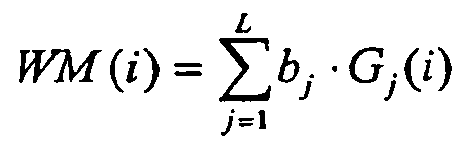
- The integer number Size being the number of points in the watermark insertion space.
- It will be noted that the watermarking of the image preferably uses a spread spectrum technique of the CDMA type (Code Division Multiple Access).
- At a step E4P, the correlation product corr between the watermark WM and the suspect image W' is calculated with the equality :

- At a step E5P, the value rcorr is calculated in the following manner:

- The Prover next transmits to the Verifier the correlation product corr and the value rcorr , at a step E6.
- The steps and operations performed on the Verifier side are now more particularly described below.
- At a step E3V, the Verifier calculates engagement values com(WM(i)) on the values of the watermark WM :

- At a following step E4V, an engagement value is calculated on the correlation, referred to as the detection quantity :

- A step E7 concerning the verification of the value of corr is performed in order to finish by testing whether the value of com(corr), calculated at step E4V, is equal or not to the value gcorr · hrcorr modn calculated by the Verifier from the data corr and rcorr transmitted by the Prover at step E6.
- In the case where com(corr) = gcorr · hrcorr modn and corr > δ, the proof of the presence of the watermark WM in the suspect image W' is considered to be given. In the case where one of these expressions is not verified, it is considered that the presence of the watermark WM in the suspect image W' is not proved.
- In this first embodiment, the same engagement values com(G) on the carriers, transmitted during the initialization phase P1, can be used to verify a number of suspect images W' equal at a maximum to L.Size - 1. Preferably, for a better guarantee of secrecy, it is considered that the same engagement values com(G) can serve to test up to L.Size - 80 images. In other words, an initialization phase P1 is necessary every L.Size - 80 images verifications.
- It should be noted that steps E3P, E4P and E5P on the one hand and steps E3V and E4V on the other hand are independent. These steps can therefore be performed in parallel.
- A second preferred embodiment of the method according to the invention is shown in
Fig.2 . These steps and operations indicated atFig.2 with the same references are similar to those inFig.1 and are not described further below. - In this second embodiment, proof of detection is given by the Prover without disclosing to the Verifier the value of the correlation product corr.
- A zero-knowledge proof technique is used at step E6' in order to prove sufficiently that the suspect image W' contains the watermark WM by proving that the detection quantity com(corr) calculated by the Verifier contains a value greater than or equal to a threshold value δ. A step E7' takes a decision on the validity of the proof given.
- As shown at step E0' corresponding to step E0 of
Fig.1 , the data W', com(G), n, g, h and δ are common to the Prover and Verifier. - In this second embodiment, the non-disclosure of the correlation product corr allows an unlimited use of the same engagement values com(G) on the carriers. This is because the same engagement values com(G) can here be used without any limitation on the number of times and the initialization phase P1 does therefore not need to be repeated in order to ensure a renewal of the values com(G).
- With reference to
Fig.3 , a description is now given of another embodiment of the methods of the invention incorporating a particular characteristic of the invention which is applied, non-exclusively, to the first and second embodiments of the method described above. - According to this characteristic of invention, the space of the engagement values com(G) on the carriers is reduced to a certain number of given discrete values. In other words, the engagement values com(G) can take only N given engagement values C1 , ..., CN .
- This characteristic of the invention allows a reduction in the volume of the data stored. Having regard to the fact that the carriers Gj(i) are -1 or 1, it suffices to engage on a space engaging N values, half of these approximately being -1 and the other half being 1. Then for each image, or for each batch of images, the Prover then merely has to send the sequence of numbers on the engagement values for the Verifier to be able to calculate com(corr). The data stored are the N engagement values and the sequence of numbers, which makes it possible to greatly reduce, according to the number of unknowns allowed, the volume of data stored.
- This embodiment has limits. This is because, the smaller the number of data on which engagement takes place, the higher the number of redundancies generated in the engagement values on the carriers.
- For example, by choosing N = 1,000 engagement values for L = 128, each engagement value will be reused on average 1,280 times. Such a reuse of the same engagement value may weaken the watermarking scheme.
- A compromise must therefore be found between the reduction in the volume of data stored and the robustness of the watermarking scheme.
- As shown in
Fig.3 , during the initialization phase P1', the Prover calculates, at step EI1', the N given engagement values C1, ..., CN from the following equality:
in which, for u ∈ {1,...,N}, there is Xu ∈ {-1,1} and ru which is a random value such that ru ∈ {1,...,λ(n)-1},
knowing that
- These values C1 , ..., CN of com(G) are then transmitted to the Verifier at step EI2'.
- It should be noted that the list of indexes of the values to be attributed to the carriers is given by : S = (S(i,j))1≤i≤Size, 1≤j≤L
with
- The calculations performed in the image verification phase P2" in the case of the application of this characteristic of reduction of the space of the engagement values com(G) to the first embodiment of the method according to the invention are similar to those described in phase P2 with reference to
Fig.1 , with the exception however of the calculations of rcorr and com(WM(i)) at steps E4P and E3V, respectively, which are detailed below : - For calculating rcorr , the Prover applies the following equality :

- For calculating com(WM(i)), the Verifier applies the following equality :

- In a similar manner to the first embodiment of the method according to the invention, in order to have better guarantee of secrecy, the same engagement values com(G) will be used to test at a maximum F=N - 80 images. A new initialization phase P1' is therefore necessary every F image verifications with at a maximum F=100,000.
- In the case of the application of the characteristic of reduction of the space of the engagement values com(G) to the second embodiment of the method according to the invention, the calculations performed in the image verification phase P2" are similar to those described in the phase P2' with reference to
Fig.2 , with the exception of the calculation of com(WM(i)) by the Verifier, at step E3V, which is detailed below :
- With reference to
Fig.4 , a description is now given by way of example of a particular hardware configuration of an information processing device able to implement the methods according to the invention. Such an information processing device, when it is equipped with a suitable program according to the invention, fully fulfils the function of a watermark insertion or watermark detection device according to the invention. - An information processing device implementing the invention is for example a
microcomputer 40, or a workstation, connected to various peripherals. - The peripherals connected to the information processing device comprise for example a
digital camera 41, or a scanner or any other image acquisition or storage means, connected to an input/output card (not shown) and supplying multimedia data to the information processing device. - The
device 40 comprises acommunication bus 401 to which there are connected: - A central
processing unit CPU 402 in the form for example of a microprocessor; - A read only
memory 403 in which there can be contained the programs whose execution enables the methods according to the invention to be implemented; - A
random access memory 404 which, after powering up of thedevice 40, contains the executable code of the programs of the invention as well as registers adapted to record variables and parameters necessary for implementing the invention; - A
screen 405 for displaying data and/or serving as a graphical interface with the user, who can thus interact with the programs of the invention, using akeyboard 406 or any other means such as a pointing device, such as for example amouse 407 or an optical pen; - A
hard disk 408 or a storage memory, such as a memory of the compact flash type, able to contain the programs of the invention as well as data used or produced during the implementation of the invention; - A
optional disk drive 409, or other removable data medium drive, able to receive adiskette 42 and to read/write therein data processed or to be processed in accordance with the invention; and - A
communication interface 410 connected to atelecommunications network 43, theinterface 410 being able to transmit and receive data. - In the case of audio data, the
device 40 is preferably equipped with an input/output card (not shown) which is connected to amicrophone 44. - The
communication bus 401 allows communication and interoperability between the various elements included in thedevice 40 or connected to it. The representation of thebus 401 is not limiting and, in particular, thecentral unit 402 is able to communicate instructions to any element of thedevice 40 directly or by means of another element of thedevice 40. - The
diskettes 42 can be replaced by any information medium such as, for example, a compact disk (CD-ROM), rewritable or not, a zip disk or a memory card. In general terms, an information storage means, which can be read by a microcomputer or by a microprocessor, integrated or not into the information processing device, possibly removable, is adapted to store one or more programs whose execution enables the methods according to the invention to be implemented. - The executable code enabling the information processing device to implement the invention can be stored either in read only
memory 403, or on thehard disk 408 or on a removable digital medium such as for example adiskette 42 as described previously. According to a variant, the executable code of the programs is received by means of thetelecommunications network 43 via theinterface 410, in order to be stored in one of the storage means of the device 40 (such as thehard disk 408 for example) before being executed. - The
central unit 402 controls and directs the execution of the instructions or portions of software code of the program or programs of the invention, the instructions or portions of software code being stored in one of the aforementioned storage means. When thedevice 40 is powered up, the program or programs which are stored in a non-volatile memory, for example thehard disk 408 or readonly memory 403, are transferred into therandom access memory 404, which then contains the executable code of the program or programs of the invention, as well as registers for storing the variables and parameters necessary for implementing the invention. - It should also be noted that the device implementing the invention or incorporating it can also be produced in the form of a programmed apparatus. For example, such a device can then contain the code of the computer program or programs in a fixed form in an application specific integrated circuit (ASIC).
Claims (33)
- A method of detecting watermarking in a suspect multimedia entity (W') able to come from a multimedia entity in which a watermark (WM) has been inserted corresponding to a sequence of coefficients (b1 to bL), carried by a plurality of secret carriers (G1 to GL), the method being implemented in a watermark verification device, and being characterized in that it comprises the steps of:obtaining said sequence of coefficients (bj) corresponding to said watermark;calculating (E3V) engagement values on the values of the watermark (com(WM(i)), using:a plurality of engagement values (com(Gi)) calculated by means of a homomorphic engagement function on said secret carriers andsaid coefficients (bj);calculating (E4V) a detection quantity (com(corr)) from said engagement values on the values of the watermark and the suspect multimedia entity (W'); anddetecting the presence of said watermark (WM) in said suspect multimedia entity (W') from said detection quantity (com(corr)) by proving that the detection quantity contains a value greater than or equal to a predetermined threshold value (δ).
- A watermarking detecting method according to claim 1, characterized in that it also comprises the steps of:receiving (E6) a correlation product (corr) coming from said watermark insertion device, the correlation product (corr) having been made between the watermark (WM) of the multimedia entity and the suspect multimedia entity (W'); andmatching (E7) the correlation product received (corr) and the detection quantity calculated, the detection of the presence of said watermark (WM) being a function of this matching.
- A watermarking detecting method according to claim 2, characterized in that it further comprises a step of:receiving (E6) a value (rcorr) calculated as a function of the suspect multimedia entity (W'), the sequence of coefficients (bj), and random values (ru) introduced during the calculation of the engagement values.
- A watermarking detecting method according to any one of claims 1 to 3, characterized in that the detection step is executed at a maximum a predetermined number of times with the same said plurality of engagement values on said secret carriers for different suspect multimedia entities (W').
- A watermarking detecting method according to any one of the preceding claims, characterized in that it further includes a step of receiving (EI2') said plurality of engagement values when transmitted by a device for proving detection of watermarking.
- A method of proving detection of watermarking in a suspect multimedia entity (W') able to come from a multimedia entity, the method being implemented in a watermark insertion device having previously inserted, in the multimedia entity, a watermark (WM) corresponding to a sequence of coefficients (b1 to bL), carried by a plurality of secret carriers (G1 to GL) and being characterized in that it comprises the steps of:obtaining (P1) the plurality of secret carriers (G1 to GL) used for inserting the sequence of coefficients corresponding to said watermark (WM);calculating (EI1) a plurality of engagement values by means of a homomorphic engagement function on said secret carriers:transmitting (E12) said plurality of engagement values on said secret carriers to a watermark verification device;calculating (E4P) a correlation product between the watermark (WM) and the suspect multimedia entity (W');proving (E6, E6') to the verification device that the correlation product is greater than a predetermined threshold.
- A method according to claim 6, characterized in that it further comprises a step of:storing in memory said plurality of engagement values on said secret carriers.
- A method according to claim 6 or 7, characterized in that, in said step of calculating said engagement values on said secret carriers, said engagement values are calculated so as to be included in a space of discrete values composed of a number N of engagement values (C1..... CN).
- A method according to claim 8, characterized in that the number L of carriers is around 128 and the number N of engagement values on said secret carriers is around 100,000, each said engagement value being used preferably only once for a said secret carrier and at a maximum twice.
- A method according to any one of claims 6 to 9, applied to the watermarking of digital images, characterized in that
said watermarks (WM), secret carriers (G) and sequence of coefficients (bj) corresponding respectively to the secret carriers (G), satisfy the following equalities:

in which:Size is the number of points in the representation of the digital images used for watermarking,WM(1) to WM(Size) represent the Size components of the watermark (WM),G1 to GL represent a plurality of L secret carriers each having Size components, andb1 to bL represent a sequence of coefficients representing information inserted in the multimedia entity by the watermark. - A method according to claim 10, characterized in that, for a multimedia entity (W'), it comprises the steps of:obtaining (E3P) the watermarks (WM) previously inserted for the multimedia entity;obtaining (E1) the sequence of coefficients (b1 to bL) corresponding to the watermark (WM) thus obtained; andtransmitting (E2) the sequence of coefficients (b1 to bL) to the watermark verification device.
- A method according to any one of claims 6 to 11, characterized in that it further comprises the steps of:calculating (E4P) a correlation product (corr) between the watermark (WM) of the multimedia entity and the suspect multimedia entity (W'); andtransmitting (E6) the correlation product thus calculated to the watermark verification device.
- A method according to any one of claims 6 to 12, characterized in that it further comprises a step of:calculating (E5P) a value (rcorr) according to the suspect multimedia entity (W'), the sequence of coefficients (bj), and random values (ru) introduced during the calculation of the engagement values;transmitting (E6) the value (rcorr) thus calculated to the watermark verification device.
- A device for detecting watermarking in a suspect multimedia entity (W') able to come from a multimedia entity in which a watermark (WM) has been inserted corresponding to a sequence of coefficients (b1 to bL), carried by a plurality of secret carriers (G1 to GL), said device being characterized in that it comprises:means for obtaining said sequence of coefficients (bj) corresponding to said watermark;means for calculating engagement values on the values of the watermark (com(WM(i)), using:a plurality of engagement values (com(Gi)) calculated by means of a homomorphic engagement function on said secret carriers andsaid coefficients (bj);means for calculating a detection quantity (com(corr)) from said engagement values on the values of the watermark and the suspect multimedia entity (W'); andmeans for detecting the presence of said watermark (WM) in said suspect multimedia entity (W') from said detection quantity (com(corr)) by proving that the detection quantity contains a value greater than or equal to a predetermined threshold value (δ).
- A watermarking detecting device according to claim 14, characterized in that it further comprises:reception means for receiving a correlation product (corr) coming from said watermark insertion device, the correlation product (corr) having been made between the watermark (WM) of the multimedia entity and the suspect multimedia entity (W'); andmeans of matching the correlation product (corr) received and the detection quantity calculated, the detection of the presence of said watermark (WM) depending on this matching.
- A watermarking detecting device according to claim 15, characterized in that it further comprises;means of receiving a value (rcorr) calculated as a function of the suspect multimedia entity (W'), the sequence of coefficients (bj), and random values (ru) introduced during the calculation of the engagement values (com(G)).
- A watermarking detecting device according to any one of claims 14 to 16, characterized in that it further includes means for receiving said plurality of engagement values when transmitted by a device for proving detection of watermarking.
- A device for inserting watermarking in a multimedia entity comprising means of inserting, in said multimedia entity, a watermark (WM) corresponding to a sequence of coefficients (b1 to bL), carried by a plurality of secret carriers (G1 to GL) and means of proving detection of watermarking in a suspect multimedia entity (W') able to come from said multimedia entity, said device for inserting watermarking being characterized in that it comprises:means for obtaining the plurality of secret carriers (G1 to GL) used for inserting the sequence of coefficients corresponding to said watermark (WM);means for calculating a plurality of engagement values by means of a homomorphic engagement function on said secret carriers;means for transmitting said plurality of engagement values on said secret carriers to a watermark verification device;means for calculating a correlation product between the watermark (WM) and the suspect multimedia entity (W');means for proving to the verification device that the correlation product is greater than a predetermined threshold.
- A device according to claim 18, characterized in that it further comprises:means of storing in memory said plurality of engagement values (com(G)) on said secret carriers.
- A device according to claim 18 or 19, characterized in that said calculation means calculate said engagement values on said secret carriers so that they are included in a space of discrete values composed of a predetermined number N of engagement values (C1, ..., CN).
- A device according to claim 20, characterized in that said means of obtaining said secret carriers (G1 to GL) obtain a number L of carriers of around 128 and a number N of engagement values (com(G)) on said secret carriers of around 100,000, each said engagement value (com(G)) preferably being used only once for a said secret carrier and at a maximum twice.
- A device according to any one of claims 18 to 21, applied to the watermarking of digital images, characterized in that
said means obtain and calculate said watermarks (WM), secret carriers (G) and sequence of coefficients (bj) corresponding respectively to the secret carriers (G), so as to satisfy the following equalities:

in which:Size is the number of points in the representation of the digital images used for the watermarking,WM(1) to WM(Size) represent the Size components of the watermark (WM),G1 to GL represent a plurality of L secret carriers each having Size components, andb1 to bL represent a sequence of coefficients representing information inserted in the multimedia entity by the watermark. - A device according to claim 22, characterized in that it further comprises, for processing a multimedia entity (W'):means of obtaining the watermark (WM) previously inserted for the multimedia entity;means of obtaining the sequence of coefficients (b1 to bL) corresponding to the watermark thus obtained; andmeans of transmitting the sequence of coefficients (b1 to bL) to the watermarking verification device.
- A device according to any one of claims 18 to 23, characterized in that it further comprises:means of calculating a correlation product (corr) between the watermark (WM) of the multimedia entity and the suspect multimedia entity (W'); andmeans of transmitting the correlation product thus calculated to the watermarking verification device.
- A device according to any of claims 18 to 24, characterized in that it further comprises:means of calculating a value (rcorr) according to the suspect multimedia entity (W'), the sequence of coefficients (bj), and random values (ru) introduced during the calculation of the engagement values;means of transmitting the value (rcorr) thus calculated to the watermarking verification device.
- An information processing device able to function as a watermarking detecting device according to any one of claims 14 to 17, comprising a central unit, a read only memory, a random access memory, an information storage unit and a communication interface for allowing connection to a telecommunications network;
characterized in that it further comprises means adapted to implement the method according to any one of claims 1 to 5. - An information processing device able to function as a watermark insertion device according any one of claims 18 to 25, comprising a central unit, a read only memory, a random access memory, an information storage unit and a communication interface for allowing connection to a telecommunication network:
characterized in that it further comprises means adapted to implement the method according to any one of claims 6 to 13. - An information storage means, characterized in that it stores a program whose execution implements the method according to any one of claims 1 to 5.
- An information storage means according to claim 28, characterized in that it can be read by a device according to claim 26.
- An information storage means, characterized in that it stores a program whose execution implements the method according to any one of claims 6 to 13.
- An information storage means according to claim 30, characterized in that it can be read by a device according to claim 27.
- A computer program on a storage means, comprising one or more sequences of instructions that can be executed by a computer, the execution of said computer program implementing the method according to any one of claims 1 to 5.
- A computer program on a storage means, comprising one or more sequences of instructions that can be executed by a computer, the execution of said computer program implementing the method according to any of claims 6 to 13.
Applications Claiming Priority (1)
| Application Number | Priority Date | Filing Date | Title |
|---|---|---|---|
| FR0407083A FR2872373B1 (en) | 2004-06-28 | 2004-06-28 | METHOD AND DEVICE FOR DETECTION AND PROOF FOR TATTOOING MULTIMEDIA ENTITIES |
Publications (2)
| Publication Number | Publication Date |
|---|---|
| EP1612727A1 EP1612727A1 (en) | 2006-01-04 |
| EP1612727B1 true EP1612727B1 (en) | 2009-02-25 |
Family
ID=34945817
Family Applications (1)
| Application Number | Title | Priority Date | Filing Date |
|---|---|---|---|
| EP20050291338 Ceased EP1612727B1 (en) | 2004-06-28 | 2005-06-22 | Zero knowledge proof and detection of watermarks in multimedia entities |
Country Status (3)
| Country | Link |
|---|---|
| EP (1) | EP1612727B1 (en) |
| DE (1) | DE602005012889D1 (en) |
| FR (1) | FR2872373B1 (en) |
Families Citing this family (1)
| Publication number | Priority date | Publication date | Assignee | Title |
|---|---|---|---|---|
| EP1891626A1 (en) * | 2005-06-03 | 2008-02-27 | Koninklijke Philips Electronics N.V. | Homomorphic encryption for secure watermarking |
Family Cites Families (1)
| Publication number | Priority date | Publication date | Assignee | Title |
|---|---|---|---|---|
| FR2846827B1 (en) * | 2002-10-30 | 2005-02-25 | Inst Nat Rech Inf Automat | DEVICE FOR MARKING AND RETRIEVING MULTIMEDIA SIGNALS |
-
2004
- 2004-06-28 FR FR0407083A patent/FR2872373B1/en not_active Expired - Fee Related
-
2005
- 2005-06-22 EP EP20050291338 patent/EP1612727B1/en not_active Ceased
- 2005-06-22 DE DE200560012889 patent/DE602005012889D1/en not_active Expired - Lifetime
Also Published As
| Publication number | Publication date |
|---|---|
| DE602005012889D1 (en) | 2009-04-09 |
| FR2872373A1 (en) | 2005-12-30 |
| FR2872373B1 (en) | 2006-12-08 |
| EP1612727A1 (en) | 2006-01-04 |
Similar Documents
| Publication | Publication Date | Title |
|---|---|---|
| JP5338668B2 (en) | Secret information distribution system, method and program, and transmission system | |
| US7471792B2 (en) | Key agreement system, shared-key generation apparatus, and shared-key recovery apparatus | |
| Deng et al. | An efficient buyer-seller watermarking protocol based on composite signal representation | |
| US7020776B2 (en) | Cryptosystem based on a Jacobian of a curve | |
| US20080098482A1 (en) | System for binding secrets to a computer system having tolerance for hardware changes | |
| US7043015B2 (en) | Methods for point compression for Jacobians of hyperelliptic curves | |
| JP2001186326A (en) | Image tampering verification data embedding method, image tampering verification method, image tampering verification device, and recording medium | |
| EP1181810B1 (en) | Digital data watermarking system using novel watermark insertion and detection methods | |
| Craver et al. | Copyright protection protocols based on asymmetric watermarking: The ticket concept | |
| US6898579B1 (en) | System, method and article of manufacture for contract term certification utilizing a network | |
| US7233663B2 (en) | Key generation performance improvement | |
| Park et al. | Cloning hardware wallet without valid credentials through side-channel analysis of hash function | |
| Li et al. | On the possibility of non-invertible watermarking schemes | |
| EP1612727A1 (en) | Zero knowledge proof and detection of watermarks in multimedia entities | |
| KR100954844B1 (en) | Digital Signature Method Using the Crt-Rss Modular Exponential Algorithm Secure Against Error Injection Attacks, Apparatus and Recording Media Recording the Same | |
| CA2288767A1 (en) | Pseudo-random generator based on a hash coding function for cryptographic systems requiring random drawing | |
| JP4748663B2 (en) | Secret calculation method and system, and program | |
| EP3482524B1 (en) | Method for generating parameters characterizing a cryptographic protocol | |
| KR100685485B1 (en) | Asymmetric Watermarking System and Method | |
| CN120710669A (en) | Information delayed output method, device, computer equipment and storage medium based on verifiable time lock puzzle | |
| Zhao et al. | A generalized method for constructing and proving zero-knowledge watermark proof systems | |
| WO2026003951A1 (en) | Watermark embedding device and program | |
| Li et al. | Practical Security of Non-Invertiblewatermarking Schemes | |
| JP3908107B2 (en) | Quantum information distributed verification method and apparatus | |
| Hossein et al. | Revisiting a primitive: analysis of approximate message authentication codes |
Legal Events
| Date | Code | Title | Description |
|---|---|---|---|
| PUAI | Public reference made under article 153(3) epc to a published international application that has entered the european phase |
Free format text: ORIGINAL CODE: 0009012 |
|
| AK | Designated contracting states |
Kind code of ref document: A1 Designated state(s): AT BE BG CH CY CZ DE DK EE ES FI FR GB GR HU IE IS IT LI LT LU MC NL PL PT RO SE SI SK TR |
|
| AX | Request for extension of the european patent |
Extension state: AL BA HR LV MK YU |
|
| 17P | Request for examination filed |
Effective date: 20060209 |
|
| AKX | Designation fees paid |
Designated state(s): DE FR GB |
|
| 17Q | First examination report despatched |
Effective date: 20060406 |
|
| GRAP | Despatch of communication of intention to grant a patent |
Free format text: ORIGINAL CODE: EPIDOSNIGR1 |
|
| GRAS | Grant fee paid |
Free format text: ORIGINAL CODE: EPIDOSNIGR3 |
|
| GRAA | (expected) grant |
Free format text: ORIGINAL CODE: 0009210 |
|
| AK | Designated contracting states |
Kind code of ref document: B1 Designated state(s): DE FR GB |
|
| REG | Reference to a national code |
Ref country code: GB Ref legal event code: FG4D |
|
| REF | Corresponds to: |
Ref document number: 602005012889 Country of ref document: DE Date of ref document: 20090409 Kind code of ref document: P |
|
| PLBE | No opposition filed within time limit |
Free format text: ORIGINAL CODE: 0009261 |
|
| STAA | Information on the status of an ep patent application or granted ep patent |
Free format text: STATUS: NO OPPOSITION FILED WITHIN TIME LIMIT |
|
| 26N | No opposition filed |
Effective date: 20091126 |
|
| REG | Reference to a national code |
Ref country code: FR Ref legal event code: PLFP Year of fee payment: 12 |
|
| REG | Reference to a national code |
Ref country code: FR Ref legal event code: PLFP Year of fee payment: 13 |
|
| REG | Reference to a national code |
Ref country code: FR Ref legal event code: PLFP Year of fee payment: 14 |
|
| PGFP | Annual fee paid to national office [announced via postgrant information from national office to epo] |
Ref country code: GB Payment date: 20220629 Year of fee payment: 18 |
|
| PGFP | Annual fee paid to national office [announced via postgrant information from national office to epo] |
Ref country code: FR Payment date: 20220630 Year of fee payment: 18 |
|
| PGFP | Annual fee paid to national office [announced via postgrant information from national office to epo] |
Ref country code: DE Payment date: 20231026 Year of fee payment: 19 |
|
| GBPC | Gb: european patent ceased through non-payment of renewal fee |
Effective date: 20230622 |
|
| PG25 | Lapsed in a contracting state [announced via postgrant information from national office to epo] |
Ref country code: GB Free format text: LAPSE BECAUSE OF NON-PAYMENT OF DUE FEES Effective date: 20230622 |
|
| PG25 | Lapsed in a contracting state [announced via postgrant information from national office to epo] |
Ref country code: FR Free format text: LAPSE BECAUSE OF NON-PAYMENT OF DUE FEES Effective date: 20230630 |
|
| REG | Reference to a national code |
Ref country code: DE Ref legal event code: R119 Ref document number: 602005012889 Country of ref document: DE |
|
| PG25 | Lapsed in a contracting state [announced via postgrant information from national office to epo] |
Ref country code: DE Free format text: LAPSE BECAUSE OF NON-PAYMENT OF DUE FEES Effective date: 20250101 |