EP1610779B1 - 3-oxo-1,3-dihydro-indazole-2-carboxylic acid amide derivatives as phospholipase inhibitors - Google Patents
3-oxo-1,3-dihydro-indazole-2-carboxylic acid amide derivatives as phospholipase inhibitors Download PDFInfo
- Publication number
- EP1610779B1 EP1610779B1 EP04723448A EP04723448A EP1610779B1 EP 1610779 B1 EP1610779 B1 EP 1610779B1 EP 04723448 A EP04723448 A EP 04723448A EP 04723448 A EP04723448 A EP 04723448A EP 1610779 B1 EP1610779 B1 EP 1610779B1
- Authority
- EP
- European Patent Office
- Prior art keywords
- dihydro
- indazole
- carboxylic acid
- oxo
- sub
- Prior art date
- Legal status (The legal status is an assumption and is not a legal conclusion. Google has not performed a legal analysis and makes no representation as to the accuracy of the status listed.)
- Expired - Lifetime
Links
- QDRMHCXMCMFGDP-UHFFFAOYSA-N 3-oxo-1h-indazole-2-carboxamide Chemical class C1=CC=C2C(=O)N(C(=O)N)NC2=C1 QDRMHCXMCMFGDP-UHFFFAOYSA-N 0.000 title 1
- 239000003428 phospholipase inhibitor Substances 0.000 title 1
- 150000001875 compounds Chemical class 0.000 claims abstract description 237
- -1 wherein the Chemical group 0.000 claims abstract description 75
- 125000001797 benzyl group Chemical group [H]C1=C([H])C([H])=C(C([H])=C1[H])C([H])([H])* 0.000 claims abstract description 62
- 125000003118 aryl group Chemical group 0.000 claims abstract description 51
- 125000001997 phenyl group Chemical group [H]C1=C([H])C([H])=C(*)C([H])=C1[H] 0.000 claims abstract description 48
- 102000019267 Hepatic lipases Human genes 0.000 claims abstract description 43
- 108050006747 Hepatic lipases Proteins 0.000 claims abstract description 43
- 239000001257 hydrogen Substances 0.000 claims abstract description 36
- 229910052739 hydrogen Inorganic materials 0.000 claims abstract description 36
- 102100031375 Endothelial lipase Human genes 0.000 claims abstract description 35
- 101710087274 Endothelial lipase Proteins 0.000 claims abstract description 35
- 125000001424 substituent group Chemical group 0.000 claims abstract description 20
- 125000000217 alkyl group Chemical group 0.000 claims abstract description 19
- 238000011282 treatment Methods 0.000 claims abstract description 15
- 125000002877 alkyl aryl group Chemical group 0.000 claims abstract description 13
- 125000000623 heterocyclic group Chemical group 0.000 claims abstract description 13
- 201000010099 disease Diseases 0.000 claims abstract description 12
- 208000037265 diseases, disorders, signs and symptoms Diseases 0.000 claims abstract description 12
- 125000000753 cycloalkyl group Chemical group 0.000 claims abstract description 11
- 125000006552 (C3-C8) cycloalkyl group Chemical group 0.000 claims abstract description 9
- 230000001404 mediated effect Effects 0.000 claims abstract description 9
- 230000002265 prevention Effects 0.000 claims abstract description 8
- 125000003545 alkoxy group Chemical group 0.000 claims abstract description 4
- 125000002887 hydroxy group Chemical group [H]O* 0.000 claims abstract 10
- 125000001475 halogen functional group Chemical group 0.000 claims abstract 6
- 125000001188 haloalkyl group Chemical group 0.000 claims abstract 5
- 125000004648 C2-C8 alkenyl group Chemical group 0.000 claims description 23
- 125000004649 C2-C8 alkynyl group Chemical group 0.000 claims description 23
- 125000000008 (C1-C10) alkyl group Chemical group 0.000 claims description 22
- 150000003839 salts Chemical class 0.000 claims description 21
- 125000004435 hydrogen atom Chemical group [H]* 0.000 claims description 15
- 239000003814 drug Substances 0.000 claims description 13
- 239000008194 pharmaceutical composition Substances 0.000 claims description 10
- 239000012453 solvate Substances 0.000 claims description 10
- 125000006710 (C2-C12) alkenyl group Chemical group 0.000 claims description 8
- 125000005865 C2-C10alkynyl group Chemical group 0.000 claims description 8
- 229910003827 NRaRb Inorganic materials 0.000 claims description 8
- 125000001495 ethyl group Chemical group [H]C([H])([H])C([H])([H])* 0.000 claims description 8
- 238000004519 manufacturing process Methods 0.000 claims description 8
- 125000002496 methyl group Chemical group [H]C([H])([H])* 0.000 claims description 8
- 125000004641 (C1-C12) haloalkyl group Chemical group 0.000 claims description 7
- PZPOHYIMHBWGMD-UHFFFAOYSA-N 2-[(2-ethyl-6-methylphenyl)methylcarbamoyl]-3-oxo-1h-indazole-7-carboxylic acid Chemical compound CCC1=CC=CC(C)=C1CNC(=O)N1C(=O)C2=CC=CC(C(O)=O)=C2N1 PZPOHYIMHBWGMD-UHFFFAOYSA-N 0.000 claims description 7
- 125000006711 (C2-C12) alkynyl group Chemical group 0.000 claims description 6
- 125000006374 C2-C10 alkenyl group Chemical group 0.000 claims description 6
- 241000124008 Mammalia Species 0.000 claims description 6
- 239000003085 diluting agent Substances 0.000 claims description 6
- ZTEOBWQMYPXVAL-UHFFFAOYSA-N 1-ethyl-2-[(2-ethyl-6-methylphenyl)methylcarbamoyl]-3-oxoindazole-7-carboxylic acid Chemical compound CCC1=CC=CC(C)=C1CNC(=O)N1C(=O)C2=CC=CC(C(O)=O)=C2N1CC ZTEOBWQMYPXVAL-UHFFFAOYSA-N 0.000 claims description 5
- VEBXWBKVOZQJCE-UHFFFAOYSA-N 2-[(2,6-diethylphenyl)methylcarbamoyl]-3-oxo-1h-indazole-4-carboxylic acid Chemical compound CCC1=CC=CC(CC)=C1CNC(=O)N1C(=O)C2=C(C(O)=O)C=CC=C2N1 VEBXWBKVOZQJCE-UHFFFAOYSA-N 0.000 claims description 5
- WZTIZSXQUVXEGH-UHFFFAOYSA-N 2-[(2-ethyl-6-methylphenyl)methylcarbamoyl]-1-methyl-3-oxoindazole-7-carboxylic acid Chemical compound CCC1=CC=CC(C)=C1CNC(=O)N1C(=O)C2=CC=CC(C(O)=O)=C2N1C WZTIZSXQUVXEGH-UHFFFAOYSA-N 0.000 claims description 5
- 125000001436 propyl group Chemical group [H]C([*])([H])C([H])([H])C([H])([H])[H] 0.000 claims description 5
- DMOSYQRJZCTMBT-UHFFFAOYSA-N 1-(3-chloropropyl)-2-[(2-methyl-6-propan-2-ylphenyl)methylcarbamoyl]-3-oxoindazole-7-carboxylic acid Chemical compound CC(C)C1=CC=CC(C)=C1CNC(=O)N1C(=O)C2=CC=CC(C(O)=O)=C2N1CCCCl DMOSYQRJZCTMBT-UHFFFAOYSA-N 0.000 claims description 4
- TZOKJHDWJDFSTL-UHFFFAOYSA-N 1-(carboxymethyl)-2-[(2-ethyl-6-methylphenyl)methylcarbamoyl]-3-oxoindazole-7-carboxylic acid Chemical compound CCC1=CC=CC(C)=C1CNC(=O)N1C(=O)C2=CC=CC(C(O)=O)=C2N1CC(O)=O TZOKJHDWJDFSTL-UHFFFAOYSA-N 0.000 claims description 4
- NBMRXBOYCOOAGG-UHFFFAOYSA-N 1-ethyl-2-[(2-methyl-6-propan-2-ylphenyl)methylcarbamoyl]-3-oxoindazole-7-carboxylic acid Chemical compound O=C1C2=CC=CC(C(O)=O)=C2N(CC)N1C(=O)NCC1=C(C)C=CC=C1C(C)C NBMRXBOYCOOAGG-UHFFFAOYSA-N 0.000 claims description 4
- QFHKRFKDFPXDHF-UHFFFAOYSA-N 1-methyl-2-[(2-methyl-6-propan-2-ylphenyl)methylcarbamoyl]-3-oxoindazole-7-carboxylic acid Chemical compound CC(C)C1=CC=CC(C)=C1CNC(=O)N1C(=O)C2=CC=CC(C(O)=O)=C2N1C QFHKRFKDFPXDHF-UHFFFAOYSA-N 0.000 claims description 4
- MGUAACFLAOQRFW-UHFFFAOYSA-N 2-(4-cyclohexylbutylcarbamoyl)-3-oxo-1h-indazole-4-carboxylic acid Chemical compound O=C1C=2C(C(=O)O)=CC=CC=2NN1C(=O)NCCCCC1CCCCC1 MGUAACFLAOQRFW-UHFFFAOYSA-N 0.000 claims description 4
- KKMBKNSCTKHZLJ-UHFFFAOYSA-N 2-[(2,6-dimethylphenyl)methylcarbamoyl]-3-oxo-1h-indazole-4-carboxylic acid Chemical compound CC1=CC=CC(C)=C1CNC(=O)N1C(=O)C2=C(C(O)=O)C=CC=C2N1 KKMBKNSCTKHZLJ-UHFFFAOYSA-N 0.000 claims description 4
- GPBGDUYCFVOPMG-UHFFFAOYSA-N 2-[(2-ethyl-6-methylphenyl)methylcarbamoyl]-3-oxo-1h-indazole-4-carboxylic acid Chemical compound CCC1=CC=CC(C)=C1CNC(=O)N1C(=O)C2=C(C(O)=O)C=CC=C2N1 GPBGDUYCFVOPMG-UHFFFAOYSA-N 0.000 claims description 4
- ZULWTIOYGRNZTG-UHFFFAOYSA-N 2-[(2-methyl-6-propan-2-ylphenyl)methylcarbamoyl]-3-oxo-1h-indazole-4-carboxylic acid Chemical compound CC(C)C1=CC=CC(C)=C1CNC(=O)N1C(=O)C2=C(C(O)=O)C=CC=C2N1 ZULWTIOYGRNZTG-UHFFFAOYSA-N 0.000 claims description 4
- MIDWPWSKAMPPDK-UHFFFAOYSA-N 2-[(2-methylphenyl)methylcarbamoyl]-3-oxo-1h-indazole-4-carboxylic acid Chemical compound CC1=CC=CC=C1CNC(=O)N1C(=O)C2=C(C(O)=O)C=CC=C2N1 MIDWPWSKAMPPDK-UHFFFAOYSA-N 0.000 claims description 4
- HROPFGWAGAUOPF-UHFFFAOYSA-N 2-[(2-methylphenyl)methylcarbamoyl]-3-oxo-1h-indazole-5-carboxylic acid Chemical compound CC1=CC=CC=C1CNC(=O)N1C(=O)C2=CC(C(O)=O)=CC=C2N1 HROPFGWAGAUOPF-UHFFFAOYSA-N 0.000 claims description 4
- DBGLHKLPCFSGQD-UHFFFAOYSA-N 2-[(2-methylphenyl)methylcarbamoyl]-3-oxo-1h-indazole-7-carboxylic acid Chemical compound CC1=CC=CC=C1CNC(=O)N1C(=O)C2=CC=CC(C(O)=O)=C2N1 DBGLHKLPCFSGQD-UHFFFAOYSA-N 0.000 claims description 4
- AJCNZSGFZQZOQK-UHFFFAOYSA-N 2-[(2-tert-butyl-6-methylphenyl)methylcarbamoyl]-3-oxo-1h-indazole-7-carboxylic acid Chemical compound CC1=CC=CC(C(C)(C)C)=C1CNC(=O)N1C(=O)C2=CC=CC(C(O)=O)=C2N1 AJCNZSGFZQZOQK-UHFFFAOYSA-N 0.000 claims description 4
- GUCMERWFIGPTRK-UHFFFAOYSA-N 2-[(4-butyl-2-methylphenyl)methylcarbamoyl]-3-oxo-1h-indazole-4-carboxylic acid Chemical compound CC1=CC(CCCC)=CC=C1CNC(=O)N1C(=O)C2=C(C(O)=O)C=CC=C2N1 GUCMERWFIGPTRK-UHFFFAOYSA-N 0.000 claims description 4
- IALMMCGGKONUNL-UHFFFAOYSA-N 2-[(4-methylnaphthalen-1-yl)methylcarbamoyl]-3-oxo-1h-indazole-4-carboxylic acid Chemical compound C12=CC=CC=C2C(C)=CC=C1CNC(=O)N1C(=O)C2=C(C(O)=O)C=CC=C2N1 IALMMCGGKONUNL-UHFFFAOYSA-N 0.000 claims description 4
- SANJICBGFOAVDS-UHFFFAOYSA-N 2-[(5-fluoro-2-methylphenyl)methylcarbamoyl]-3-oxo-1h-indazole-4-carboxylic acid Chemical compound CC1=CC=C(F)C=C1CNC(=O)N1C(=O)C2=C(C(O)=O)C=CC=C2N1 SANJICBGFOAVDS-UHFFFAOYSA-N 0.000 claims description 4
- BIFQPFMQKWRJPI-UHFFFAOYSA-N 2-[[2,6-di(propan-2-yl)phenyl]methylcarbamoyl]-3-oxo-1h-indazole-4-carboxylic acid Chemical compound CC(C)C1=CC=CC(C(C)C)=C1CNC(=O)N1C(=O)C2=C(C(O)=O)C=CC=C2N1 BIFQPFMQKWRJPI-UHFFFAOYSA-N 0.000 claims description 4
- UZGATRMRNWTNEM-UHFFFAOYSA-N 3-oxo-2-(3-phenoxypropylcarbamoyl)-1h-indazole-4-carboxylic acid Chemical compound O=C1C=2C(C(=O)O)=CC=CC=2NN1C(=O)NCCCOC1=CC=CC=C1 UZGATRMRNWTNEM-UHFFFAOYSA-N 0.000 claims description 4
- SCSVBPVVDULOSD-UHFFFAOYSA-N 3-oxo-2-(4-phenylbutylcarbamoyl)-1h-indazole-4-carboxylic acid Chemical compound O=C1C=2C(C(=O)O)=CC=CC=2NN1C(=O)NCCCCC1=CC=CC=C1 SCSVBPVVDULOSD-UHFFFAOYSA-N 0.000 claims description 4
- IOPOMDNZPAILSX-UHFFFAOYSA-N 3-oxo-2-[(2,4,6-trimethylphenyl)methylcarbamoyl]-1h-indazole-4-carboxylic acid Chemical compound CC1=CC(C)=CC(C)=C1CNC(=O)N1C(=O)C2=C(C(O)=O)C=CC=C2N1 IOPOMDNZPAILSX-UHFFFAOYSA-N 0.000 claims description 4
- IBVSSFVIFGSQOA-UHFFFAOYSA-N 3-oxo-n-[(3-phenylphenyl)methyl]-1h-indazole-2-carboxamide Chemical compound N1C2=CC=CC=C2C(=O)N1C(=O)NCC(C=1)=CC=CC=1C1=CC=CC=C1 IBVSSFVIFGSQOA-UHFFFAOYSA-N 0.000 claims description 4
- OPULIRWQLMTVHG-UHFFFAOYSA-N 4-chloro-n-[(2-methylphenyl)methyl]-3-oxo-1h-indazole-2-carboxamide Chemical compound CC1=CC=CC=C1CNC(=O)N1C(=O)C2=C(Cl)C=CC=C2N1 OPULIRWQLMTVHG-UHFFFAOYSA-N 0.000 claims description 4
- WGTKOYJWCJKVSB-UHFFFAOYSA-N 4-methyl-n-[(2-methylphenyl)methyl]-3-oxo-1h-indazole-2-carboxamide Chemical compound CC1=CC=CC=C1CNC(=O)N1C(=O)C2=C(C)C=CC=C2N1 WGTKOYJWCJKVSB-UHFFFAOYSA-N 0.000 claims description 4
- NCOXUDDYUCRART-UHFFFAOYSA-N 5-chloro-n-[(2-methylphenyl)methyl]-3-oxo-1h-indazole-2-carboxamide Chemical compound CC1=CC=CC=C1CNC(=O)N1C(=O)C2=CC(Cl)=CC=C2N1 NCOXUDDYUCRART-UHFFFAOYSA-N 0.000 claims description 4
- MNHVYZOOVYPESA-UHFFFAOYSA-N 5-hydroxy-n-[(2-methylphenyl)methyl]-3-oxo-1h-indazole-2-carboxamide Chemical compound CC1=CC=CC=C1CNC(=O)N1C(=O)C2=CC(O)=CC=C2N1 MNHVYZOOVYPESA-UHFFFAOYSA-N 0.000 claims description 4
- ZUZXNHXAAZGDQB-UHFFFAOYSA-N 6-chloro-n-[(2-methylphenyl)methyl]-3-oxo-1h-indazole-2-carboxamide Chemical compound CC1=CC=CC=C1CNC(=O)N1C(=O)C2=CC=C(Cl)C=C2N1 ZUZXNHXAAZGDQB-UHFFFAOYSA-N 0.000 claims description 4
- PJPXUYUHDSAZAA-UHFFFAOYSA-N 6-methyl-n-[(2-methylphenyl)methyl]-3-oxo-1h-indazole-2-carboxamide Chemical compound C=1C(C)=CC=C(C2=O)C=1NN2C(=O)NCC1=CC=CC=C1C PJPXUYUHDSAZAA-UHFFFAOYSA-N 0.000 claims description 4
- ITTRCFMORJLICA-UHFFFAOYSA-N 7-methoxy-n-[(2-methylphenyl)methyl]-3-oxo-1h-indazole-2-carboxamide Chemical compound COC1=CC=CC(C2=O)=C1NN2C(=O)NCC1=CC=CC=C1C ITTRCFMORJLICA-UHFFFAOYSA-N 0.000 claims description 4
- 239000003937 drug carrier Substances 0.000 claims description 4
- 125000001449 isopropyl group Chemical group [H]C([H])([H])C([H])(*)C([H])([H])[H] 0.000 claims description 4
- WNPZUAQPHHSQPZ-UHFFFAOYSA-N methyl 2-(hexylcarbamoyl)-3-oxo-1h-indazole-4-carboxylate Chemical compound C1=CC(C(=O)OC)=C2C(=O)N(C(=O)NCCCCCC)NC2=C1 WNPZUAQPHHSQPZ-UHFFFAOYSA-N 0.000 claims description 4
- DIINWDOATJGSII-UHFFFAOYSA-N methyl 2-(hexylcarbamoyl)-3-oxo-1h-indazole-7-carboxylate Chemical compound C1=CC=C2C(=O)N(C(=O)NCCCCCC)NC2=C1C(=O)OC DIINWDOATJGSII-UHFFFAOYSA-N 0.000 claims description 4
- NIWJQRRXYJUZTH-UHFFFAOYSA-N n-(2-ethylhexyl)-3-oxo-1h-indazole-2-carboxamide Chemical compound C1=CC=C2C(=O)N(C(=O)NCC(CC)CCCC)NC2=C1 NIWJQRRXYJUZTH-UHFFFAOYSA-N 0.000 claims description 4
- WGBMOSDBSZYQTB-UHFFFAOYSA-N n-[(2-ethylphenyl)methyl]-3-oxo-1h-indazole-2-carboxamide Chemical compound CCC1=CC=CC=C1CNC(=O)N1C(=O)C2=CC=CC=C2N1 WGBMOSDBSZYQTB-UHFFFAOYSA-N 0.000 claims description 4
- SMOPZPDKOXQRSA-UHFFFAOYSA-N n-[(2-methyl-6-propan-2-ylphenyl)methyl]-3-oxo-1h-indazole-2-carboxamide Chemical compound CC(C)C1=CC=CC(C)=C1CNC(=O)N1C(=O)C2=CC=CC=C2N1 SMOPZPDKOXQRSA-UHFFFAOYSA-N 0.000 claims description 4
- 230000001575 pathological effect Effects 0.000 claims description 4
- OMLODHDWBHFFLL-UHFFFAOYSA-N 1-(2-amino-2-oxoethyl)-2-[(2-methyl-6-propan-2-ylphenyl)methylcarbamoyl]-3-oxoindazole-7-carboxylic acid Chemical compound CC(C)C1=CC=CC(C)=C1CNC(=O)N1C(=O)C2=CC=CC(C(O)=O)=C2N1CC(N)=O OMLODHDWBHFFLL-UHFFFAOYSA-N 0.000 claims description 3
- AYXXORQUQWFRNW-UHFFFAOYSA-N 1-(2-methoxy-2-oxoethyl)-2-[(2-methyl-6-propan-2-ylphenyl)methylcarbamoyl]-3-oxoindazole-7-carboxylic acid Chemical compound O=C1C2=CC=CC(C(O)=O)=C2N(CC(=O)OC)N1C(=O)NCC1=C(C)C=CC=C1C(C)C AYXXORQUQWFRNW-UHFFFAOYSA-N 0.000 claims description 3
- FKSWJTALLCWJPM-UHFFFAOYSA-N 1-(cyanomethyl)-2-[(2-methyl-6-propan-2-ylphenyl)methylcarbamoyl]-3-oxoindazole-7-carboxylic acid Chemical compound CC(C)C1=CC=CC(C)=C1CNC(=O)N1C(=O)C2=CC=CC(C(O)=O)=C2N1CC#N FKSWJTALLCWJPM-UHFFFAOYSA-N 0.000 claims description 3
- ZKZQUCGNARLFAO-UHFFFAOYSA-N 1-(cyclopropylmethyl)-2-[(2-methyl-6-propan-2-ylphenyl)methylcarbamoyl]-3-oxoindazole-7-carboxylic acid Chemical compound CC(C)C1=CC=CC(C)=C1CNC(=O)N1C(=O)C2=CC=CC(C(O)=O)=C2N1CC1CC1 ZKZQUCGNARLFAO-UHFFFAOYSA-N 0.000 claims description 3
- ILTWPJPBRNNPGR-UHFFFAOYSA-N 1-benzyl-2-[(2-methyl-6-propan-2-ylphenyl)methylcarbamoyl]-3-oxoindazole-7-carboxylic acid Chemical compound CC(C)C1=CC=CC(C)=C1CNC(=O)N1C(=O)C2=CC=CC(C(O)=O)=C2N1CC1=CC=CC=C1 ILTWPJPBRNNPGR-UHFFFAOYSA-N 0.000 claims description 3
- IJQFIHJJOJHHFF-UHFFFAOYSA-N 1-benzyl-3-oxo-n-pentylindazole-2-carboxamide Chemical compound C12=CC=CC=C2C(=O)N(C(=O)NCCCCC)N1CC1=CC=CC=C1 IJQFIHJJOJHHFF-UHFFFAOYSA-N 0.000 claims description 3
- HWPLPCWNUHWCGB-UHFFFAOYSA-N 1-butyl-3-oxo-n-pentylindazole-2-carboxamide Chemical compound C1=CC=C2C(=O)N(C(=O)NCCCCC)N(CCCC)C2=C1 HWPLPCWNUHWCGB-UHFFFAOYSA-N 0.000 claims description 3
- LWCIXROGCUPZFX-UHFFFAOYSA-N 1-methyl-3-oxo-n-pentylindazole-2-carboxamide Chemical compound C1=CC=C2C(=O)N(C(=O)NCCCCC)N(C)C2=C1 LWCIXROGCUPZFX-UHFFFAOYSA-N 0.000 claims description 3
- KWWLOKQVHBDMPQ-UHFFFAOYSA-N 2-(hexylcarbamoyl)-3-oxo-1h-indazole-4-carboxylic acid Chemical compound C1=CC(C(O)=O)=C2C(=O)N(C(=O)NCCCCCC)NC2=C1 KWWLOKQVHBDMPQ-UHFFFAOYSA-N 0.000 claims description 3
- IQMPIAPYEVOQKR-UHFFFAOYSA-N 2-[(2,6-diethylphenyl)methylcarbamoyl]-1-methyl-3-oxoindazole-7-carboxylic acid Chemical compound CCC1=CC=CC(CC)=C1CNC(=O)N1C(=O)C2=CC=CC(C(O)=O)=C2N1C IQMPIAPYEVOQKR-UHFFFAOYSA-N 0.000 claims description 3
- SMAAZKGABPWYTI-UHFFFAOYSA-N 2-[(2,6-diethylphenyl)methylcarbamoyl]-3-oxo-1h-indazole-7-carboxylic acid Chemical compound CCC1=CC=CC(CC)=C1CNC(=O)N1C(=O)C2=CC=CC(C(O)=O)=C2N1 SMAAZKGABPWYTI-UHFFFAOYSA-N 0.000 claims description 3
- XUBJPMLIOFSYEM-UHFFFAOYSA-N 2-[(2,6-dimethylphenyl)methylcarbamoyl]-3-oxo-1h-indazole-7-carboxylic acid Chemical compound CC1=CC=CC(C)=C1CNC(=O)N1C(=O)C2=CC=CC(C(O)=O)=C2N1 XUBJPMLIOFSYEM-UHFFFAOYSA-N 0.000 claims description 3
- GZINIDOZHXGVIO-UHFFFAOYSA-N 2-[(2-ethyl-6-methylphenyl)methylcarbamoyl]-1-(2-methoxy-2-oxoethyl)-3-oxoindazole-7-carboxylic acid Chemical compound CCC1=CC=CC(C)=C1CNC(=O)N1C(=O)C2=CC=CC(C(O)=O)=C2N1CC(=O)OC GZINIDOZHXGVIO-UHFFFAOYSA-N 0.000 claims description 3
- FPOPCSLEJIKOCB-UHFFFAOYSA-N 2-[(2-ethyl-6-methylphenyl)methylcarbamoyl]-3-oxo-1-propylindazole-7-carboxylic acid Chemical compound O=C1C2=CC=CC(C(O)=O)=C2N(CCC)N1C(=O)NCC1=C(C)C=CC=C1CC FPOPCSLEJIKOCB-UHFFFAOYSA-N 0.000 claims description 3
- CEZYOAVAPMZJPT-UHFFFAOYSA-N 2-[(2-ethyl-6-methylphenyl)methylcarbamoyl]-3-oxo-1h-indazole-5-carboxylic acid Chemical compound CCC1=CC=CC(C)=C1CNC(=O)N1C(=O)C2=CC(C(O)=O)=CC=C2N1 CEZYOAVAPMZJPT-UHFFFAOYSA-N 0.000 claims description 3
- UBTZISMTALTMMM-UHFFFAOYSA-N 2-[(2-ethyl-6-methylphenyl)methylcarbamoyl]-3-oxo-1h-indazole-6-carboxylic acid Chemical compound CCC1=CC=CC(C)=C1CNC(=O)N1C(=O)C2=CC=C(C(O)=O)C=C2N1 UBTZISMTALTMMM-UHFFFAOYSA-N 0.000 claims description 3
- ZJPIIWSGQAUYNO-UHFFFAOYSA-N 2-[(2-methyl-6-propan-2-ylphenyl)methylcarbamoyl]-3-oxo-1-propylindazole-7-carboxylic acid Chemical compound O=C1C2=CC=CC(C(O)=O)=C2N(CCC)N1C(=O)NCC1=C(C)C=CC=C1C(C)C ZJPIIWSGQAUYNO-UHFFFAOYSA-N 0.000 claims description 3
- ABLPLOCFMWFKLZ-UHFFFAOYSA-N 2-[(2-methyl-6-propan-2-ylphenyl)methylcarbamoyl]-3-oxo-1h-indazole-7-carboxylic acid Chemical compound CC(C)C1=CC=CC(C)=C1CNC(=O)N1C(=O)C2=CC=CC(C(O)=O)=C2N1 ABLPLOCFMWFKLZ-UHFFFAOYSA-N 0.000 claims description 3
- MUICRQPPTOMMCM-UHFFFAOYSA-N 2-[(2-methylphenyl)methylcarbamoyl]-3-oxo-1h-indazole-6-carboxylic acid Chemical compound CC1=CC=CC=C1CNC(=O)N1C(=O)C2=CC=C(C(O)=O)C=C2N1 MUICRQPPTOMMCM-UHFFFAOYSA-N 0.000 claims description 3
- CYYUNHLTDOGWOH-UHFFFAOYSA-N 2-[(5-fluoro-2-methylphenyl)methylcarbamoyl]-3-oxo-1h-indazole-7-carboxylic acid Chemical compound CC1=CC=C(F)C=C1CNC(=O)N1C(=O)C2=CC=CC(C(O)=O)=C2N1 CYYUNHLTDOGWOH-UHFFFAOYSA-N 0.000 claims description 3
- AQNLZMDCVFLNTA-UHFFFAOYSA-N 2-[[2,6-di(propan-2-yl)phenyl]methylcarbamoyl]-3-oxo-1h-indazole-7-carboxylic acid Chemical compound CC(C)C1=CC=CC(C(C)C)=C1CNC(=O)N1C(=O)C2=CC=CC(C(O)=O)=C2N1 AQNLZMDCVFLNTA-UHFFFAOYSA-N 0.000 claims description 3
- SHQARDVNENTZLC-UHFFFAOYSA-N 3-oxo-2-[[2-(trifluoromethyl)phenyl]methylcarbamoyl]-1h-indazole-7-carboxylic acid Chemical compound OC(=O)C1=CC=CC(C2=O)=C1NN2C(=O)NCC1=CC=CC=C1C(F)(F)F SHQARDVNENTZLC-UHFFFAOYSA-N 0.000 claims description 3
- LBSQFBCCHUTHMI-UHFFFAOYSA-N 3-oxo-N-pentyl-1-(1-phenylethyl)indazole-2-carboxamide Chemical compound C12=CC=CC=C2C(=O)N(C(=O)NCCCCC)N1C(C)C1=CC=CC=C1 LBSQFBCCHUTHMI-UHFFFAOYSA-N 0.000 claims description 3
- JEEDQBFFUXCSHX-UHFFFAOYSA-N 3-oxo-n-[(2,4,6-trimethylphenyl)methyl]-1h-indazole-2-carboxamide Chemical compound CC1=CC(C)=CC(C)=C1CNC(=O)N1C(=O)C2=CC=CC=C2N1 JEEDQBFFUXCSHX-UHFFFAOYSA-N 0.000 claims description 3
- XVNGQFCFTJSGID-UHFFFAOYSA-N 3-oxo-n-[(3,4,5-trimethoxyphenyl)methyl]-1h-indazole-2-carboxamide Chemical compound COC1=C(OC)C(OC)=CC(CNC(=O)N2C(C3=CC=CC=C3N2)=O)=C1 XVNGQFCFTJSGID-UHFFFAOYSA-N 0.000 claims description 3
- FOEHYJIUJKUDDO-UHFFFAOYSA-N 3-oxo-n-[[2-(trifluoromethyl)phenyl]methyl]-1h-indazole-2-carboxamide Chemical compound FC(F)(F)C1=CC=CC=C1CNC(=O)N1C(=O)C2=CC=CC=C2N1 FOEHYJIUJKUDDO-UHFFFAOYSA-N 0.000 claims description 3
- YRLOCYWPAQYZCD-UHFFFAOYSA-N 3-oxo-n-[[3-(trifluoromethoxy)phenyl]methyl]-1h-indazole-2-carboxamide Chemical compound FC(F)(F)OC1=CC=CC(CNC(=O)N2C(C3=CC=CC=C3N2)=O)=C1 YRLOCYWPAQYZCD-UHFFFAOYSA-N 0.000 claims description 3
- 125000000959 isobutyl group Chemical group [H]C([H])([H])C([H])(C([H])([H])[H])C([H])([H])* 0.000 claims description 3
- CSSHMCNRSZTGGA-UHFFFAOYSA-N methyl 2-[(2-methyl-6-propan-2-ylphenyl)methylcarbamoyl]-3-oxo-1h-indazole-7-carboxylate Chemical compound COC(=O)C1=CC=CC(C2=O)=C1NN2C(=O)NCC1=C(C)C=CC=C1C(C)C CSSHMCNRSZTGGA-UHFFFAOYSA-N 0.000 claims description 3
- GWWZGBMKQOGKKF-UHFFFAOYSA-N methyl 2-[2-(hexylcarbamoyl)-3-oxoindazol-1-yl]acetate Chemical compound C1=CC=C2C(=O)N(C(=O)NCCCCCC)N(CC(=O)OC)C2=C1 GWWZGBMKQOGKKF-UHFFFAOYSA-N 0.000 claims description 3
- VHGPZGBAJVDBNX-UHFFFAOYSA-N n-(2,3-dihydro-1,4-benzodioxin-6-ylmethyl)-3-oxo-1h-indazole-2-carboxamide Chemical compound N1C2=CC=CC=C2C(=O)N1C(=O)NCC1=CC=C(OCCO2)C2=C1 VHGPZGBAJVDBNX-UHFFFAOYSA-N 0.000 claims description 3
- PUAIUOTVSZZNFH-UHFFFAOYSA-N n-(3,7-dimethylocta-2,6-dienyl)-3-oxo-1h-indazole-2-carboxamide Chemical compound C1=CC=C2C(=O)N(C(=O)NCC=C(C)CCC=C(C)C)NC2=C1 PUAIUOTVSZZNFH-UHFFFAOYSA-N 0.000 claims description 3
- LMRHIAIXPWJLAN-UHFFFAOYSA-N n-(cyclohexylmethyl)-3-oxo-1h-indazole-2-carboxamide Chemical compound N1C2=CC=CC=C2C(=O)N1C(=O)NCC1CCCCC1 LMRHIAIXPWJLAN-UHFFFAOYSA-N 0.000 claims description 3
- HAMRMNIIGNWXNG-UHFFFAOYSA-N n-(naphthalen-1-ylmethyl)-3-oxo-1h-indazole-2-carboxamide Chemical compound N1C2=CC=CC=C2C(=O)N1C(=O)NCC1=CC=CC2=CC=CC=C12 HAMRMNIIGNWXNG-UHFFFAOYSA-N 0.000 claims description 3
- LKJODPQLGQKCTL-UHFFFAOYSA-N n-[(2,4-dichlorophenyl)methyl]-3-oxo-1h-indazole-2-carboxamide Chemical compound ClC1=CC(Cl)=CC=C1CNC(=O)N1C(=O)C2=CC=CC=C2N1 LKJODPQLGQKCTL-UHFFFAOYSA-N 0.000 claims description 3
- BFMUIQQMDWGNPB-UHFFFAOYSA-N n-[(2,4-dimethoxyphenyl)methyl]-3-oxo-1h-indazole-2-carboxamide Chemical compound COC1=CC(OC)=CC=C1CNC(=O)N1C(=O)C2=CC=CC=C2N1 BFMUIQQMDWGNPB-UHFFFAOYSA-N 0.000 claims description 3
- BWBLZZSHTPSUDG-UHFFFAOYSA-N n-[(2-methylphenyl)methyl]-3-oxo-1h-indazole-2-carboxamide Chemical compound CC1=CC=CC=C1CNC(=O)N1C(=O)C2=CC=CC=C2N1 BWBLZZSHTPSUDG-UHFFFAOYSA-N 0.000 claims description 3
- OAKPJZHLOHERPB-UHFFFAOYSA-N n-[(2-methylphenyl)methyl]-5-nitro-3-oxo-1h-indazole-2-carboxamide Chemical compound CC1=CC=CC=C1CNC(=O)N1C(=O)C2=CC([N+]([O-])=O)=CC=C2N1 OAKPJZHLOHERPB-UHFFFAOYSA-N 0.000 claims description 3
- VWGVZQAZUKGCSC-UHFFFAOYSA-N n-[(2-methylsulfanylphenyl)methyl]-3-oxo-1h-indazole-2-carboxamide Chemical compound CSC1=CC=CC=C1CNC(=O)N1C(=O)C2=CC=CC=C2N1 VWGVZQAZUKGCSC-UHFFFAOYSA-N 0.000 claims description 3
- DFEJNRPWBZLANU-UHFFFAOYSA-N n-[(3,4-dihydroxyphenyl)methyl]-3-oxo-1h-indazole-2-carboxamide Chemical compound C1=C(O)C(O)=CC=C1CNC(=O)N1C(=O)C2=CC=CC=C2N1 DFEJNRPWBZLANU-UHFFFAOYSA-N 0.000 claims description 3
- TVGGOVCRVKXANQ-UHFFFAOYSA-N n-[(3-chlorophenyl)methyl]-3-oxo-1h-indazole-2-carboxamide Chemical compound ClC1=CC=CC(CNC(=O)N2C(C3=CC=CC=C3N2)=O)=C1 TVGGOVCRVKXANQ-UHFFFAOYSA-N 0.000 claims description 3
- UYBHBCCBFHQJJG-UHFFFAOYSA-N n-[(3-ethylphenyl)methyl]-3-oxo-1h-indazole-2-carboxamide Chemical compound CCC1=CC=CC(CNC(=O)N2C(C3=CC=CC=C3N2)=O)=C1 UYBHBCCBFHQJJG-UHFFFAOYSA-N 0.000 claims description 3
- VWHFYXSCNAPPPO-UHFFFAOYSA-N n-[(3-fluorophenyl)methyl]-3-oxo-1h-indazole-2-carboxamide Chemical compound FC1=CC=CC(CNC(=O)N2C(C3=CC=CC=C3N2)=O)=C1 VWHFYXSCNAPPPO-UHFFFAOYSA-N 0.000 claims description 3
- SUFNCAGMVQYUFC-UHFFFAOYSA-N n-[(3-methoxyphenyl)methyl]-3-oxo-1h-indazole-2-carboxamide Chemical compound COC1=CC=CC(CNC(=O)N2C(C3=CC=CC=C3N2)=O)=C1 SUFNCAGMVQYUFC-UHFFFAOYSA-N 0.000 claims description 3
- TYVOPPYKGVFIOZ-UHFFFAOYSA-N n-[(3-methylphenyl)methyl]-3-oxo-1h-indazole-2-carboxamide Chemical compound CC1=CC=CC(CNC(=O)N2C(C3=CC=CC=C3N2)=O)=C1 TYVOPPYKGVFIOZ-UHFFFAOYSA-N 0.000 claims description 3
- RJCNOSJPAMLFHO-UHFFFAOYSA-N n-[(4-aminophenyl)methyl]-3-oxo-1h-indazole-2-carboxamide Chemical compound C1=CC(N)=CC=C1CNC(=O)N1C(=O)C2=CC=CC=C2N1 RJCNOSJPAMLFHO-UHFFFAOYSA-N 0.000 claims description 3
- NTZQGFMGLAUDNX-UHFFFAOYSA-N n-[(4-methylnaphthalen-1-yl)methyl]-3-oxo-1h-indazole-2-carboxamide Chemical compound C12=CC=CC=C2C(C)=CC=C1CNC(=O)N1C(=O)C2=CC=CC=C2N1 NTZQGFMGLAUDNX-UHFFFAOYSA-N 0.000 claims description 3
- SGQZUMMLDUTURK-UHFFFAOYSA-N n-[(4-methylphenyl)methyl]-3-oxo-1h-indazole-2-carboxamide Chemical compound C1=CC(C)=CC=C1CNC(=O)N1C(=O)C2=CC=CC=C2N1 SGQZUMMLDUTURK-UHFFFAOYSA-N 0.000 claims description 3
- HCUKDDHWOQBLBW-UHFFFAOYSA-N n-[(5-chloro-2-methylphenyl)methyl]-3-oxo-1h-indazole-2-carboxamide Chemical compound CC1=CC=C(Cl)C=C1CNC(=O)N1C(=O)C2=CC=CC=C2N1 HCUKDDHWOQBLBW-UHFFFAOYSA-N 0.000 claims description 3
- WRCANIBEGCXNKG-UHFFFAOYSA-N n-[[4-(dimethylamino)phenyl]methyl]-3-oxo-1h-indazole-2-carboxamide Chemical compound C1=CC(N(C)C)=CC=C1CNC(=O)N1C(=O)C2=CC=CC=C2N1 WRCANIBEGCXNKG-UHFFFAOYSA-N 0.000 claims description 3
- PSXQFQVHDWBKNZ-UHFFFAOYSA-N n-hexyl-1-(2-methoxyethyl)-3-oxoindazole-2-carboxamide Chemical compound C1=CC=C2C(=O)N(C(=O)NCCCCCC)N(CCOC)C2=C1 PSXQFQVHDWBKNZ-UHFFFAOYSA-N 0.000 claims description 3
- GHGWUYHZTPPMTA-UHFFFAOYSA-N n-octyl-3-oxo-1h-indazole-2-carboxamide Chemical compound C1=CC=C2C(=O)N(C(=O)NCCCCCCCC)NC2=C1 GHGWUYHZTPPMTA-UHFFFAOYSA-N 0.000 claims description 3
- 125000000999 tert-butyl group Chemical group [H]C([H])([H])C(*)(C([H])([H])[H])C([H])([H])[H] 0.000 claims description 3
- IAJQURUWGLCPCH-UHFFFAOYSA-N 1-(carboxymethyl)-2-[(2-methyl-6-propan-2-ylphenyl)methylcarbamoyl]-3-oxoindazole-7-carboxylic acid Chemical compound CC(C)C1=CC=CC(C)=C1CNC(=O)N1C(=O)C2=CC=CC(C(O)=O)=C2N1CC(O)=O IAJQURUWGLCPCH-UHFFFAOYSA-N 0.000 claims description 2
- UCQDMEFHRAHQQZ-UHFFFAOYSA-N 1-butyl-2-[(2-methyl-6-propan-2-ylphenyl)methylcarbamoyl]-3-oxoindazole-7-carboxylic acid Chemical compound O=C1C2=CC=CC(C(O)=O)=C2N(CCCC)N1C(=O)NCC1=C(C)C=CC=C1C(C)C UCQDMEFHRAHQQZ-UHFFFAOYSA-N 0.000 claims description 2
- PXNPLCZGOZIACL-UHFFFAOYSA-N 2-(octylcarbamoyl)-3-oxo-1h-indazole-4-carboxylic acid Chemical compound C1=CC(C(O)=O)=C2C(=O)N(C(=O)NCCCCCCCC)NC2=C1 PXNPLCZGOZIACL-UHFFFAOYSA-N 0.000 claims description 2
- UQCIKSDQUNJWMV-UHFFFAOYSA-N 2-N-butan-2-yl-4-N-octan-4-yl-3-oxo-1H-indazole-2,4-dicarboxamide Chemical compound CCCC(CCCC)NC(=O)C=1C=2C(N(NC=2C=CC=1)C(=O)NC(C)CC)=O UQCIKSDQUNJWMV-UHFFFAOYSA-N 0.000 claims description 2
- PPXZIFWMXJTUMX-UHFFFAOYSA-N 2-[(2-methyl-6-propan-2-ylphenyl)methylcarbamoyl]-3-oxo-1-prop-2-ynylindazole-7-carboxylic acid Chemical compound CC(C)C1=CC=CC(C)=C1CNC(=O)N1C(=O)C2=CC=CC(C(O)=O)=C2N1CC#C PPXZIFWMXJTUMX-UHFFFAOYSA-N 0.000 claims description 2
- RQSNAQDCQJXLQP-UHFFFAOYSA-N 2-[(2-tert-butyl-6-methylphenyl)methylcarbamoyl]-1-methyl-3-oxoindazole-7-carboxylic acid Chemical compound CC1=CC=CC(C(C)(C)C)=C1CNC(=O)N1C(=O)C2=CC=CC(C(O)=O)=C2N1C RQSNAQDCQJXLQP-UHFFFAOYSA-N 0.000 claims description 2
- RYGOUPFLLGWXII-UHFFFAOYSA-N 3-oxo-n,1-diphenylindazole-2-carboxamide Chemical compound C=1C=CC=CC=1N1C2=CC=CC=C2C(=O)N1C(=O)NC1=CC=CC=C1 RYGOUPFLLGWXII-UHFFFAOYSA-N 0.000 claims description 2
- TVXJTELCFIEKPQ-UHFFFAOYSA-N 3-oxo-n-(4-phenylbut-3-enyl)-1h-indazole-2-carboxamide Chemical compound N1C2=CC=CC=C2C(=O)N1C(=O)NCCC=CC1=CC=CC=C1 TVXJTELCFIEKPQ-UHFFFAOYSA-N 0.000 claims description 2
- JAXMXMNSCWJWGL-UHFFFAOYSA-N 4,6-dichloro-3-oxo-n-phenyl-1h-indazole-2-carboxamide Chemical compound C=1C(Cl)=CC(Cl)=C(C2=O)C=1NN2C(=O)NC1=CC=CC=C1 JAXMXMNSCWJWGL-UHFFFAOYSA-N 0.000 claims description 2
- 125000005037 alkyl phenyl group Chemical group 0.000 claims description 2
- XWPKOLRSQUNLPM-UHFFFAOYSA-N methyl 2-[(2-methyl-6-propan-2-ylphenyl)methylcarbamoyl]-3-oxo-1h-indazole-4-carboxylate Chemical compound O=C1C=2C(C(=O)OC)=CC=CC=2NN1C(=O)NCC1=C(C)C=CC=C1C(C)C XWPKOLRSQUNLPM-UHFFFAOYSA-N 0.000 claims description 2
- QYHCAFQGHOGFQF-UHFFFAOYSA-N n-dodecyl-3-oxo-1h-indazole-2-carboxamide Chemical compound C1=CC=C2C(=O)N(C(=O)NCCCCCCCCCCCC)NC2=C1 QYHCAFQGHOGFQF-UHFFFAOYSA-N 0.000 claims description 2
- 125000001147 pentyl group Chemical group C(CCCC)* 0.000 claims description 2
- 125000004368 propenyl group Chemical group C(=CC)* 0.000 claims description 2
- 125000006725 C1-C10 alkenyl group Chemical group 0.000 claims 2
- 125000004178 (C1-C4) alkyl group Chemical group 0.000 claims 1
- 125000004765 (C1-C4) haloalkyl group Chemical group 0.000 claims 1
- 125000004399 C1-C4 alkenyl group Chemical group 0.000 claims 1
- 125000004650 C1-C8 alkynyl group Chemical group 0.000 claims 1
- HSFWRNGVRCDJHI-UHFFFAOYSA-N alpha-acetylene Chemical group C#C HSFWRNGVRCDJHI-UHFFFAOYSA-N 0.000 claims 1
- 125000002534 ethynyl group Chemical group [H]C#C* 0.000 claims 1
- SBXLNLXJVLZTPM-UHFFFAOYSA-N n-[(5-chloro-2-methoxyphenyl)methyl]-3-oxo-1h-indazole-2-carboxamide;n-[(2,4-dichloro-6-methylphenyl)methyl]-3-oxo-1h-indazole-2-carboxamide Chemical compound COC1=CC=C(Cl)C=C1CNC(=O)N1C(=O)C2=CC=CC=C2N1.CC1=CC(Cl)=CC(Cl)=C1CNC(=O)N1C(=O)C2=CC=CC=C2N1 SBXLNLXJVLZTPM-UHFFFAOYSA-N 0.000 claims 1
- 125000002568 propynyl group Chemical group [*]C#CC([H])([H])[H] 0.000 claims 1
- 229910052799 carbon Inorganic materials 0.000 abstract description 24
- 150000002431 hydrogen Chemical class 0.000 abstract description 19
- 235000019626 lipase activity Nutrition 0.000 abstract description 12
- 125000003342 alkenyl group Chemical group 0.000 abstract description 8
- 230000002401 inhibitory effect Effects 0.000 abstract description 7
- UFHFLCQGNIYNRP-UHFFFAOYSA-N Hydrogen Chemical compound [H][H] UFHFLCQGNIYNRP-UHFFFAOYSA-N 0.000 abstract description 2
- 125000000304 alkynyl group Chemical group 0.000 abstract 5
- 125000003282 alkyl amino group Chemical group 0.000 abstract 1
- 125000005119 alkyl cycloalkyl group Chemical group 0.000 abstract 1
- 125000006297 carbonyl amino group Chemical group [H]N([*:2])C([*:1])=O 0.000 abstract 1
- 125000000392 cycloalkenyl group Chemical group 0.000 abstract 1
- 238000000034 method Methods 0.000 description 140
- 239000007787 solid Substances 0.000 description 124
- 238000002330 electrospray ionisation mass spectrometry Methods 0.000 description 117
- 238000002360 preparation method Methods 0.000 description 90
- 239000000243 solution Substances 0.000 description 79
- 238000004458 analytical method Methods 0.000 description 75
- IAZDPXIOMUYVGZ-UHFFFAOYSA-N Dimethylsulphoxide Chemical compound CS(C)=O IAZDPXIOMUYVGZ-UHFFFAOYSA-N 0.000 description 67
- 239000000203 mixture Substances 0.000 description 54
- IJGRMHOSHXDMSA-UHFFFAOYSA-N Atomic nitrogen Chemical compound N#N IJGRMHOSHXDMSA-UHFFFAOYSA-N 0.000 description 48
- VYPSYNLAJGMNEJ-UHFFFAOYSA-N Silicium dioxide Chemical compound O=[Si]=O VYPSYNLAJGMNEJ-UHFFFAOYSA-N 0.000 description 44
- YMWUJEATGCHHMB-UHFFFAOYSA-N Dichloromethane Chemical compound ClCCl YMWUJEATGCHHMB-UHFFFAOYSA-N 0.000 description 43
- 239000000758 substrate Substances 0.000 description 37
- WYURNTSHIVDZCO-UHFFFAOYSA-N Tetrahydrofuran Chemical compound C1CCOC1 WYURNTSHIVDZCO-UHFFFAOYSA-N 0.000 description 34
- 239000000725 suspension Substances 0.000 description 31
- XLYOFNOQVPJJNP-UHFFFAOYSA-N water Substances O XLYOFNOQVPJJNP-UHFFFAOYSA-N 0.000 description 31
- IAZDPXIOMUYVGZ-WFGJKAKNSA-N Dimethyl sulfoxide Chemical compound [2H]C([2H])([2H])S(=O)C([2H])([2H])[2H] IAZDPXIOMUYVGZ-WFGJKAKNSA-N 0.000 description 30
- XEKOWRVHYACXOJ-UHFFFAOYSA-N Ethyl acetate Chemical compound CCOC(C)=O XEKOWRVHYACXOJ-UHFFFAOYSA-N 0.000 description 30
- OKKJLVBELUTLKV-UHFFFAOYSA-N Methanol Chemical compound OC OKKJLVBELUTLKV-UHFFFAOYSA-N 0.000 description 30
- ZMXDDKWLCZADIW-UHFFFAOYSA-N N,N-Dimethylformamide Chemical compound CN(C)C=O ZMXDDKWLCZADIW-UHFFFAOYSA-N 0.000 description 29
- VLKZOEOYAKHREP-UHFFFAOYSA-N n-Hexane Chemical group CCCCCC VLKZOEOYAKHREP-UHFFFAOYSA-N 0.000 description 29
- 238000003756 stirring Methods 0.000 description 29
- HEDRZPFGACZZDS-UHFFFAOYSA-N Chloroform Chemical compound ClC(Cl)Cl HEDRZPFGACZZDS-UHFFFAOYSA-N 0.000 description 28
- VEXZGXHMUGYJMC-UHFFFAOYSA-N Hydrochloric acid Chemical compound Cl VEXZGXHMUGYJMC-UHFFFAOYSA-N 0.000 description 28
- 239000004480 active ingredient Substances 0.000 description 27
- 229910052757 nitrogen Inorganic materials 0.000 description 25
- 239000003921 oil Substances 0.000 description 25
- 239000011369 resultant mixture Substances 0.000 description 23
- 238000005160 1H NMR spectroscopy Methods 0.000 description 21
- 102000004190 Enzymes Human genes 0.000 description 21
- 108090000790 Enzymes Proteins 0.000 description 21
- 239000000377 silicon dioxide Substances 0.000 description 21
- 238000003556 assay Methods 0.000 description 17
- 0 CC(*)CCCCN Chemical compound CC(*)CCCCN 0.000 description 16
- 238000006243 chemical reaction Methods 0.000 description 15
- 150000002513 isocyanates Chemical class 0.000 description 15
- LFQSCWFLJHTTHZ-UHFFFAOYSA-N Ethanol Chemical compound CCO LFQSCWFLJHTTHZ-UHFFFAOYSA-N 0.000 description 14
- 235000019439 ethyl acetate Nutrition 0.000 description 14
- 238000009472 formulation Methods 0.000 description 14
- HQKMJHAJHXVSDF-UHFFFAOYSA-L magnesium stearate Chemical compound [Mg+2].CCCCCCCCCCCCCCCCCC([O-])=O.CCCCCCCCCCCCCCCCCC([O-])=O HQKMJHAJHXVSDF-UHFFFAOYSA-L 0.000 description 14
- KIUMMUBSPKGMOY-UHFFFAOYSA-N 3,3'-Dithiobis(6-nitrobenzoic acid) Chemical compound C1=C([N+]([O-])=O)C(C(=O)O)=CC(SSC=2C=C(C(=CC=2)[N+]([O-])=O)C(O)=O)=C1 KIUMMUBSPKGMOY-UHFFFAOYSA-N 0.000 description 13
- 150000002825 nitriles Chemical class 0.000 description 13
- 239000003826 tablet Substances 0.000 description 13
- QDKGOMZIPXGDDJ-UHFFFAOYSA-N 2,3-dihydro-1h-indazole Chemical compound C1=CC=C2CNNC2=C1 QDKGOMZIPXGDDJ-UHFFFAOYSA-N 0.000 description 12
- JKMHFZQWWAIEOD-UHFFFAOYSA-N 2-[4-(2-hydroxyethyl)piperazin-1-yl]ethanesulfonic acid Chemical compound OCC[NH+]1CCN(CCS([O-])(=O)=O)CC1 JKMHFZQWWAIEOD-UHFFFAOYSA-N 0.000 description 12
- HEDRZPFGACZZDS-MICDWDOJSA-N Trichloro(2H)methane Chemical compound [2H]C(Cl)(Cl)Cl HEDRZPFGACZZDS-MICDWDOJSA-N 0.000 description 12
- 239000012043 crude product Substances 0.000 description 12
- 238000002474 experimental method Methods 0.000 description 12
- LPXPTNMVRIOKMN-UHFFFAOYSA-M sodium nitrite Chemical compound [Na+].[O-]N=O LPXPTNMVRIOKMN-UHFFFAOYSA-M 0.000 description 12
- 238000001914 filtration Methods 0.000 description 11
- 239000012948 isocyanate Substances 0.000 description 11
- BUCGZRNYKPSWMC-UHFFFAOYSA-N 3-oxo-1,2-dihydroindazole-4-carboxylic acid Chemical compound OC(=O)C1=CC=CC2=C1C(=O)NN2 BUCGZRNYKPSWMC-UHFFFAOYSA-N 0.000 description 10
- 108010010234 HDL Lipoproteins Proteins 0.000 description 10
- 102000015779 HDL Lipoproteins Human genes 0.000 description 10
- CSNNHWWHGAXBCP-UHFFFAOYSA-L Magnesium sulfate Chemical compound [Mg+2].[O-][S+2]([O-])([O-])[O-] CSNNHWWHGAXBCP-UHFFFAOYSA-L 0.000 description 10
- 229920002472 Starch Polymers 0.000 description 10
- 239000006260 foam Substances 0.000 description 10
- BWHMMNNQKKPAPP-UHFFFAOYSA-L potassium carbonate Chemical compound [K+].[K+].[O-]C([O-])=O BWHMMNNQKKPAPP-UHFFFAOYSA-L 0.000 description 10
- 239000008107 starch Substances 0.000 description 10
- 235000019698 starch Nutrition 0.000 description 10
- WTLDUEOFEHBLFJ-UHFFFAOYSA-N (4-nitrophenyl) 3-oxo-1h-indazole-2-carboxylate Chemical compound C1=CC([N+](=O)[O-])=CC=C1OC(=O)N1C(=O)C2=CC=CC=C2N1 WTLDUEOFEHBLFJ-UHFFFAOYSA-N 0.000 description 9
- BKYMFKQYOGIKIH-UHFFFAOYSA-N 3-oxo-1,2-dihydroindazole-7-carboxylic acid Chemical compound OC(=O)C1=CC=CC2=C1NNC2=O BKYMFKQYOGIKIH-UHFFFAOYSA-N 0.000 description 9
- 239000002253 acid Substances 0.000 description 9
- 150000001412 amines Chemical class 0.000 description 9
- PADWPKRXHDCZAZ-UHFFFAOYSA-N benzhydryl 2-[(2-ethyl-6-methylphenyl)methylcarbamoyl]-3-oxo-1h-indazole-7-carboxylate Chemical compound CCC1=CC=CC(C)=C1CNC(=O)N1C(=O)C2=CC=CC(C(=O)OC(C=3C=CC=CC=3)C=3C=CC=CC=3)=C2N1 PADWPKRXHDCZAZ-UHFFFAOYSA-N 0.000 description 9
- XLYOFNOQVPJJNP-ZSJDYOACSA-N heavy water Substances [2H]O[2H] XLYOFNOQVPJJNP-ZSJDYOACSA-N 0.000 description 8
- 125000004356 hydroxy functional group Chemical group O* 0.000 description 8
- 239000012044 organic layer Substances 0.000 description 8
- MPTKDOQUXZAHPJ-UHFFFAOYSA-N 2,3-dihydroindazole Chemical compound C1=CC=C2CN[N]C2=C1 MPTKDOQUXZAHPJ-UHFFFAOYSA-N 0.000 description 7
- 150000003939 benzylamines Chemical class 0.000 description 7
- 238000004587 chromatography analysis Methods 0.000 description 7
- 125000005843 halogen group Chemical group 0.000 description 7
- IXCSERBJSXMMFS-UHFFFAOYSA-N hydrogen chloride Substances Cl.Cl IXCSERBJSXMMFS-UHFFFAOYSA-N 0.000 description 7
- 229910000041 hydrogen chloride Inorganic materials 0.000 description 7
- 150000002632 lipids Chemical class 0.000 description 7
- 235000019359 magnesium stearate Nutrition 0.000 description 7
- 229940002612 prodrug Drugs 0.000 description 7
- 239000000651 prodrug Substances 0.000 description 7
- 238000012360 testing method Methods 0.000 description 7
- JPDYQCTZKNJHMJ-UHFFFAOYSA-N 2-(isocyanatomethyl)-1-methyl-3-propan-2-ylbenzene Chemical compound CC(C)C1=CC=CC(C)=C1CN=C=O JPDYQCTZKNJHMJ-UHFFFAOYSA-N 0.000 description 6
- 108010023302 HDL Cholesterol Proteins 0.000 description 6
- FAPWRFPIFSIZLT-UHFFFAOYSA-M Sodium chloride Chemical compound [Na+].[Cl-] FAPWRFPIFSIZLT-UHFFFAOYSA-M 0.000 description 6
- ZMANZCXQSJIPKH-UHFFFAOYSA-N Triethylamine Chemical compound CCN(CC)CC ZMANZCXQSJIPKH-UHFFFAOYSA-N 0.000 description 6
- HVYWMOMLDIMFJA-DPAQBDIFSA-N cholesterol Chemical compound C1C=C2C[C@@H](O)CC[C@]2(C)[C@@H]2[C@@H]1[C@@H]1CC[C@H]([C@H](C)CCCC(C)C)[C@@]1(C)CC2 HVYWMOMLDIMFJA-DPAQBDIFSA-N 0.000 description 6
- 230000000694 effects Effects 0.000 description 6
- 235000010288 sodium nitrite Nutrition 0.000 description 6
- 229910021626 Tin(II) chloride Inorganic materials 0.000 description 5
- KYAWOERKXPNVPH-UHFFFAOYSA-N benzhydryl 2-[(2-methyl-6-propan-2-ylphenyl)methylcarbamoyl]-3-oxo-1h-indazole-7-carboxylate Chemical compound CC(C)C1=CC=CC(C)=C1CNC(=O)N1C(=O)C2=CC=CC(C(=O)OC(C=3C=CC=CC=3)C=3C=CC=CC=3)=C2N1 KYAWOERKXPNVPH-UHFFFAOYSA-N 0.000 description 5
- WPYMKLBDIGXBTP-UHFFFAOYSA-N benzoic acid Chemical compound OC(=O)C1=CC=CC=C1 WPYMKLBDIGXBTP-UHFFFAOYSA-N 0.000 description 5
- 239000002775 capsule Substances 0.000 description 5
- 239000003153 chemical reaction reagent Substances 0.000 description 5
- 235000019441 ethanol Nutrition 0.000 description 5
- 239000004615 ingredient Substances 0.000 description 5
- 239000000543 intermediate Substances 0.000 description 5
- 239000007788 liquid Substances 0.000 description 5
- 229910052943 magnesium sulfate Inorganic materials 0.000 description 5
- 229910000027 potassium carbonate Inorganic materials 0.000 description 5
- 239000000843 powder Substances 0.000 description 5
- 150000003254 radicals Chemical class 0.000 description 5
- 229920006395 saturated elastomer Polymers 0.000 description 5
- 239000011734 sodium Substances 0.000 description 5
- 229910052708 sodium Inorganic materials 0.000 description 5
- 235000011150 stannous chloride Nutrition 0.000 description 5
- 239000007858 starting material Substances 0.000 description 5
- AXZWODMDQAVCJE-UHFFFAOYSA-L tin(II) chloride (anhydrous) Chemical compound [Cl-].[Cl-].[Sn+2] AXZWODMDQAVCJE-UHFFFAOYSA-L 0.000 description 5
- 238000001291 vacuum drying Methods 0.000 description 5
- OGSMLVJFIWGIEF-UHFFFAOYSA-N (2-methyl-6-propan-2-ylphenyl)methanamine Chemical compound CC(C)C1=CC=CC(C)=C1CN OGSMLVJFIWGIEF-UHFFFAOYSA-N 0.000 description 4
- YSFIDUZQUVVVLY-UHFFFAOYSA-N 1-(isocyanatomethyl)-2-(trifluoromethyl)benzene Chemical compound FC(F)(F)C1=CC=CC=C1CN=C=O YSFIDUZQUVVVLY-UHFFFAOYSA-N 0.000 description 4
- PAMLYFRUISBETG-UHFFFAOYSA-N 3-oxo-n-pentyl-1h-indazole-2-carboxamide Chemical compound C1=CC=C2C(=O)N(C(=O)NCCCCC)NC2=C1 PAMLYFRUISBETG-UHFFFAOYSA-N 0.000 description 4
- DMRMLXHFPIYVNB-UHFFFAOYSA-N 4-fluoro-2-(isocyanatomethyl)-1-methylbenzene Chemical compound CC1=CC=C(F)C=C1CN=C=O DMRMLXHFPIYVNB-UHFFFAOYSA-N 0.000 description 4
- QTBSBXVTEAMEQO-UHFFFAOYSA-N Acetic acid Chemical compound CC(O)=O QTBSBXVTEAMEQO-UHFFFAOYSA-N 0.000 description 4
- 229910004373 HOAc Inorganic materials 0.000 description 4
- CTQNGGLPUBDAKN-UHFFFAOYSA-N O-Xylene Chemical compound CC1=CC=CC=C1C CTQNGGLPUBDAKN-UHFFFAOYSA-N 0.000 description 4
- 229920004890 Triton X-100 Polymers 0.000 description 4
- DPXJVFZANSGRMM-UHFFFAOYSA-N acetic acid;2,3,4,5,6-pentahydroxyhexanal;sodium Chemical compound [Na].CC(O)=O.OCC(O)C(O)C(O)C(O)C=O DPXJVFZANSGRMM-UHFFFAOYSA-N 0.000 description 4
- 230000002378 acidificating effect Effects 0.000 description 4
- 239000002585 base Substances 0.000 description 4
- VFJQUQBDLBEKCV-UHFFFAOYSA-N benzhydryl 1-(3-chloropropyl)-2-[(2-methyl-6-propan-2-ylphenyl)methylcarbamoyl]-3-oxoindazole-7-carboxylate Chemical compound CC(C)C1=CC=CC(C)=C1CNC(=O)N1C(=O)C2=CC=CC(C(=O)OC(C=3C=CC=CC=3)C=3C=CC=CC=3)=C2N1CCCCl VFJQUQBDLBEKCV-UHFFFAOYSA-N 0.000 description 4
- 239000001768 carboxy methyl cellulose Substances 0.000 description 4
- 229940125782 compound 2 Drugs 0.000 description 4
- 229940126214 compound 3 Drugs 0.000 description 4
- 239000012954 diazonium Substances 0.000 description 4
- POCFBDFTJMJWLG-UHFFFAOYSA-N dihydrosinapic acid methyl ester Natural products COC(=O)CCC1=CC(OC)=C(O)C(OC)=C1 POCFBDFTJMJWLG-UHFFFAOYSA-N 0.000 description 4
- 238000010790 dilution Methods 0.000 description 4
- 239000012895 dilution Substances 0.000 description 4
- 150000002148 esters Chemical class 0.000 description 4
- LYCAIKOWRPUZTN-UHFFFAOYSA-N ethylene glycol Natural products OCCO LYCAIKOWRPUZTN-UHFFFAOYSA-N 0.000 description 4
- 238000000434 field desorption mass spectrometry Methods 0.000 description 4
- 239000012634 fragment Substances 0.000 description 4
- 230000005764 inhibitory process Effects 0.000 description 4
- 239000012280 lithium aluminium hydride Substances 0.000 description 4
- OAXQQRURWJDUST-UHFFFAOYSA-N n-hexyl-3-oxo-1h-indazole-2-carboxamide Chemical compound C1=CC=C2C(=O)N(C(=O)NCCCCCC)NC2=C1 OAXQQRURWJDUST-UHFFFAOYSA-N 0.000 description 4
- LJCNRYVRMXRIQR-OLXYHTOASA-L potassium sodium L-tartrate Chemical compound [Na+].[K+].[O-]C(=O)[C@H](O)[C@@H](O)C([O-])=O LJCNRYVRMXRIQR-OLXYHTOASA-L 0.000 description 4
- 239000011541 reaction mixture Substances 0.000 description 4
- 235000019812 sodium carboxymethyl cellulose Nutrition 0.000 description 4
- 229920001027 sodium carboxymethylcellulose Polymers 0.000 description 4
- 235000011006 sodium potassium tartrate Nutrition 0.000 description 4
- 239000006188 syrup Substances 0.000 description 4
- 235000020357 syrup Nutrition 0.000 description 4
- 239000000454 talc Substances 0.000 description 4
- 229910052623 talc Inorganic materials 0.000 description 4
- 235000012222 talc Nutrition 0.000 description 4
- UCPYLLCMEDAXFR-UHFFFAOYSA-N triphosgene Chemical compound ClC(Cl)(Cl)OC(=O)OC(Cl)(Cl)Cl UCPYLLCMEDAXFR-UHFFFAOYSA-N 0.000 description 4
- 239000008096 xylene Substances 0.000 description 4
- DGSRAILDFBJNQI-UHFFFAOYSA-N (2,4,6-trimethylphenyl)methanamine Chemical compound CC1=CC(C)=C(CN)C(C)=C1 DGSRAILDFBJNQI-UHFFFAOYSA-N 0.000 description 3
- HIXZJPWRAALXBT-UHFFFAOYSA-N (2,6-diethylphenyl)methanamine Chemical compound CCC1=CC=CC(CC)=C1CN HIXZJPWRAALXBT-UHFFFAOYSA-N 0.000 description 3
- CEZUZVGNRQMAFM-UHFFFAOYSA-N (2-ethyl-6-methylphenyl)methanamine Chemical compound CCC1=CC=CC(C)=C1CN CEZUZVGNRQMAFM-UHFFFAOYSA-N 0.000 description 3
- LIWMOCWQJZZTGB-UHFFFAOYSA-N (2-tert-butyl-6-methylphenyl)methanamine Chemical compound CC1=CC=CC(C(C)(C)C)=C1CN LIWMOCWQJZZTGB-UHFFFAOYSA-N 0.000 description 3
- GLWGZDIAOXPFKX-UHFFFAOYSA-N (4-butyl-2-methylphenyl)methanamine Chemical compound CCCCC1=CC=C(CN)C(C)=C1 GLWGZDIAOXPFKX-UHFFFAOYSA-N 0.000 description 3
- 125000004169 (C1-C6) alkyl group Chemical group 0.000 description 3
- BAXOFTOLAUCFNW-UHFFFAOYSA-N 1H-indazole Chemical class C1=CC=C2C=NNC2=C1 BAXOFTOLAUCFNW-UHFFFAOYSA-N 0.000 description 3
- ALYNCZNDIQEVRV-UHFFFAOYSA-N 4-aminobenzoic acid Chemical compound NC1=CC=C(C(O)=O)C=C1 ALYNCZNDIQEVRV-UHFFFAOYSA-N 0.000 description 3
- GOKXKZXHPSLIDH-UHFFFAOYSA-N 4-methyl-1,2-dihydroindazol-3-one Chemical compound CC1=CC=CC2=C1C(=O)NN2 GOKXKZXHPSLIDH-UHFFFAOYSA-N 0.000 description 3
- DLFVBJFMPXGRIB-UHFFFAOYSA-N Acetamide Chemical group CC(N)=O DLFVBJFMPXGRIB-UHFFFAOYSA-N 0.000 description 3
- VEXZGXHMUGYJMC-UHFFFAOYSA-M Chloride anion Chemical compound [Cl-] VEXZGXHMUGYJMC-UHFFFAOYSA-M 0.000 description 3
- VOPWNXZWBYDODV-UHFFFAOYSA-N Chlorodifluoromethane Chemical compound FC(F)Cl VOPWNXZWBYDODV-UHFFFAOYSA-N 0.000 description 3
- RTZKZFJDLAIYFH-UHFFFAOYSA-N Diethyl ether Chemical compound CCOCC RTZKZFJDLAIYFH-UHFFFAOYSA-N 0.000 description 3
- 108090001060 Lipase Proteins 0.000 description 3
- PAYRUJLWNCNPSJ-UHFFFAOYSA-N N-phenyl amine Natural products NC1=CC=CC=C1 PAYRUJLWNCNPSJ-UHFFFAOYSA-N 0.000 description 3
- 108010064785 Phospholipases Proteins 0.000 description 3
- 102000015439 Phospholipases Human genes 0.000 description 3
- DNIAPMSPPWPWGF-UHFFFAOYSA-N Propylene glycol Chemical compound CC(O)CO DNIAPMSPPWPWGF-UHFFFAOYSA-N 0.000 description 3
- VWRNVLHXTAZJNN-UHFFFAOYSA-N [2,6-di(propan-2-yl)phenyl]methanamine Chemical compound CC(C)C1=CC=CC(C(C)C)=C1CN VWRNVLHXTAZJNN-UHFFFAOYSA-N 0.000 description 3
- 239000000443 aerosol Substances 0.000 description 3
- 125000003917 carbamoyl group Chemical group [H]N([H])C(*)=O 0.000 description 3
- 125000004432 carbon atom Chemical group C* 0.000 description 3
- 239000003795 chemical substances by application Substances 0.000 description 3
- 125000001309 chloro group Chemical group Cl* 0.000 description 3
- 235000012000 cholesterol Nutrition 0.000 description 3
- 238000002425 crystallisation Methods 0.000 description 3
- 230000008025 crystallization Effects 0.000 description 3
- DNJIEGIFACGWOD-UHFFFAOYSA-N ethanethiol Chemical compound CCS DNJIEGIFACGWOD-UHFFFAOYSA-N 0.000 description 3
- 239000000796 flavoring agent Substances 0.000 description 3
- INQOMBQAUSQDDS-UHFFFAOYSA-N iodomethane Chemical compound IC INQOMBQAUSQDDS-UHFFFAOYSA-N 0.000 description 3
- QVVZEASMFMGIAA-UHFFFAOYSA-N n,4-dimethylnaphthalen-1-amine Chemical compound C1=CC=C2C(NC)=CC=C(C)C2=C1 QVVZEASMFMGIAA-UHFFFAOYSA-N 0.000 description 3
- 239000012038 nucleophile Substances 0.000 description 3
- QIQXTHQIDYTFRH-UHFFFAOYSA-N octadecanoic acid Chemical compound CCCCCCCCCCCCCCCCCC(O)=O QIQXTHQIDYTFRH-UHFFFAOYSA-N 0.000 description 3
- 108090000623 proteins and genes Proteins 0.000 description 3
- 102000004169 proteins and genes Human genes 0.000 description 3
- 230000009467 reduction Effects 0.000 description 3
- 238000010992 reflux Methods 0.000 description 3
- 239000011780 sodium chloride Substances 0.000 description 3
- 239000002904 solvent Substances 0.000 description 3
- 239000011550 stock solution Substances 0.000 description 3
- DTQVDTLACAAQTR-UHFFFAOYSA-N trifluoroacetic acid Substances OC(=O)C(F)(F)F DTQVDTLACAAQTR-UHFFFAOYSA-N 0.000 description 3
- SZUVGFMDDVSKSI-WIFOCOSTSA-N (1s,2s,3s,5r)-1-(carboxymethyl)-3,5-bis[(4-phenoxyphenyl)methyl-propylcarbamoyl]cyclopentane-1,2-dicarboxylic acid Chemical compound O=C([C@@H]1[C@@H]([C@](CC(O)=O)([C@H](C(=O)N(CCC)CC=2C=CC(OC=3C=CC=CC=3)=CC=2)C1)C(O)=O)C(O)=O)N(CCC)CC(C=C1)=CC=C1OC1=CC=CC=C1 SZUVGFMDDVSKSI-WIFOCOSTSA-N 0.000 description 2
- SWEICGMKXPNXNU-UHFFFAOYSA-N 1,2-dihydroindazol-3-one Chemical compound C1=CC=C2C(O)=NNC2=C1 SWEICGMKXPNXNU-UHFFFAOYSA-N 0.000 description 2
- VNHPWTGETWKSLP-UHFFFAOYSA-N 1-(isocyanatomethyl)-2-methylbenzene Chemical compound CC1=CC=CC=C1CN=C=O VNHPWTGETWKSLP-UHFFFAOYSA-N 0.000 description 2
- ONBQEOIKXPHGMB-VBSBHUPXSA-N 1-[2-[(2s,3r,4s,5r)-3,4-dihydroxy-5-(hydroxymethyl)oxolan-2-yl]oxy-4,6-dihydroxyphenyl]-3-(4-hydroxyphenyl)propan-1-one Chemical compound O[C@@H]1[C@H](O)[C@@H](CO)O[C@H]1OC1=CC(O)=CC(O)=C1C(=O)CCC1=CC=C(O)C=C1 ONBQEOIKXPHGMB-VBSBHUPXSA-N 0.000 description 2
- QUQZZHUQPWPHMC-UHFFFAOYSA-N 1-isocyanato-5-methylhexane Chemical compound CC(C)CCCCN=C=O QUQZZHUQPWPHMC-UHFFFAOYSA-N 0.000 description 2
- ZIIUUSVHCHPIQD-UHFFFAOYSA-N 2,4,6-trimethyl-N-[3-(trifluoromethyl)phenyl]benzenesulfonamide Chemical compound CC1=CC(C)=CC(C)=C1S(=O)(=O)NC1=CC=CC(C(F)(F)F)=C1 ZIIUUSVHCHPIQD-UHFFFAOYSA-N 0.000 description 2
- UZDXATQPJOOHQJ-UHFFFAOYSA-N 2-ethylbenzonitrile Chemical compound CCC1=CC=CC=C1C#N UZDXATQPJOOHQJ-UHFFFAOYSA-N 0.000 description 2
- KZHYZFXKIQQLRS-UHFFFAOYSA-N 4-butyl-1-(isocyanatomethyl)-2-methylbenzene Chemical compound CCCCC1=CC=C(CN=C=O)C(C)=C1 KZHYZFXKIQQLRS-UHFFFAOYSA-N 0.000 description 2
- NQJLVGQKPMVHTD-UHFFFAOYSA-N 4-cyclohexylbutan-1-amine Chemical compound NCCCCC1CCCCC1 NQJLVGQKPMVHTD-UHFFFAOYSA-N 0.000 description 2
- FBKYCBKRNDJLCX-UHFFFAOYSA-N 5-methylhexan-1-amine Chemical compound CC(C)CCCCN FBKYCBKRNDJLCX-UHFFFAOYSA-N 0.000 description 2
- 201000001320 Atherosclerosis Diseases 0.000 description 2
- 239000005711 Benzoic acid Substances 0.000 description 2
- VTYYLEPIZMXCLO-UHFFFAOYSA-L Calcium carbonate Chemical compound [Ca+2].[O-]C([O-])=O VTYYLEPIZMXCLO-UHFFFAOYSA-L 0.000 description 2
- KRKNYBCHXYNGOX-UHFFFAOYSA-K Citrate Chemical compound [O-]C(=O)CC(O)(CC([O-])=O)C([O-])=O KRKNYBCHXYNGOX-UHFFFAOYSA-K 0.000 description 2
- 108010010803 Gelatin Proteins 0.000 description 2
- 208000035150 Hypercholesterolemia Diseases 0.000 description 2
- DGAQECJNVWCQMB-PUAWFVPOSA-M Ilexoside XXIX Chemical compound C[C@@H]1CC[C@@]2(CC[C@@]3(C(=CC[C@H]4[C@]3(CC[C@@H]5[C@@]4(CC[C@@H](C5(C)C)OS(=O)(=O)[O-])C)C)[C@@H]2[C@]1(C)O)C)C(=O)O[C@H]6[C@@H]([C@H]([C@@H]([C@H](O6)CO)O)O)O.[Na+] DGAQECJNVWCQMB-PUAWFVPOSA-M 0.000 description 2
- SIKJAQJRHWYJAI-UHFFFAOYSA-N Indole Chemical compound C1=CC=C2NC=CC2=C1 SIKJAQJRHWYJAI-UHFFFAOYSA-N 0.000 description 2
- GUBGYTABKSRVRQ-QKKXKWKRSA-N Lactose Natural products OC[C@H]1O[C@@H](O[C@H]2[C@H](O)[C@@H](O)C(O)O[C@@H]2CO)[C@H](O)[C@@H](O)[C@H]1O GUBGYTABKSRVRQ-QKKXKWKRSA-N 0.000 description 2
- 102000004882 Lipase Human genes 0.000 description 2
- 238000003820 Medium-pressure liquid chromatography Methods 0.000 description 2
- 229920000168 Microcrystalline cellulose Polymers 0.000 description 2
- 238000005481 NMR spectroscopy Methods 0.000 description 2
- 239000007832 Na2SO4 Substances 0.000 description 2
- OFBQJSOFQDEBGM-UHFFFAOYSA-N Pentane Chemical compound CCCCC OFBQJSOFQDEBGM-UHFFFAOYSA-N 0.000 description 2
- ZLMJMSJWJFRBEC-UHFFFAOYSA-N Potassium Chemical compound [K] ZLMJMSJWJFRBEC-UHFFFAOYSA-N 0.000 description 2
- 102000005473 Secretory Phospholipases A2 Human genes 0.000 description 2
- 108010031873 Secretory Phospholipases A2 Proteins 0.000 description 2
- CDBYLPFSWZWCQE-UHFFFAOYSA-L Sodium Carbonate Chemical compound [Na+].[Na+].[O-]C([O-])=O CDBYLPFSWZWCQE-UHFFFAOYSA-L 0.000 description 2
- PMZURENOXWZQFD-UHFFFAOYSA-L Sodium Sulfate Chemical compound [Na+].[Na+].[O-]S([O-])(=O)=O PMZURENOXWZQFD-UHFFFAOYSA-L 0.000 description 2
- 235000021355 Stearic acid Nutrition 0.000 description 2
- 208000006011 Stroke Diseases 0.000 description 2
- 239000013504 Triton X-100 Substances 0.000 description 2
- XXROGKLTLUQVRX-UHFFFAOYSA-N allyl alcohol Chemical compound OCC=C XXROGKLTLUQVRX-UHFFFAOYSA-N 0.000 description 2
- 150000001408 amides Chemical class 0.000 description 2
- 239000003263 anabolic agent Substances 0.000 description 2
- 239000007864 aqueous solution Substances 0.000 description 2
- 230000008901 benefit Effects 0.000 description 2
- 235000010233 benzoic acid Nutrition 0.000 description 2
- 239000011230 binding agent Substances 0.000 description 2
- 230000015572 biosynthetic process Effects 0.000 description 2
- GZUXJHMPEANEGY-UHFFFAOYSA-N bromomethane Chemical compound BrC GZUXJHMPEANEGY-UHFFFAOYSA-N 0.000 description 2
- 125000000484 butyl group Chemical group [H]C([*])([H])C([H])([H])C([H])([H])C([H])([H])[H] 0.000 description 2
- 125000003178 carboxy group Chemical group [H]OC(*)=O 0.000 description 2
- 150000001732 carboxylic acid derivatives Chemical group 0.000 description 2
- 229920002678 cellulose Polymers 0.000 description 2
- 239000001913 cellulose Substances 0.000 description 2
- 235000010980 cellulose Nutrition 0.000 description 2
- 239000003638 chemical reducing agent Substances 0.000 description 2
- 229940125773 compound 10 Drugs 0.000 description 2
- 229940126543 compound 14 Drugs 0.000 description 2
- 229940126142 compound 16 Drugs 0.000 description 2
- 239000003636 conditioned culture medium Substances 0.000 description 2
- DOBRDRYODQBAMW-UHFFFAOYSA-N copper(i) cyanide Chemical compound [Cu+].N#[C-] DOBRDRYODQBAMW-UHFFFAOYSA-N 0.000 description 2
- 230000002939 deleterious effect Effects 0.000 description 2
- 150000001989 diazonium salts Chemical class 0.000 description 2
- IJGRMHOSHXDMSA-UHFFFAOYSA-O diazynium Chemical compound [NH+]#N IJGRMHOSHXDMSA-UHFFFAOYSA-O 0.000 description 2
- 230000006806 disease prevention Effects 0.000 description 2
- 239000002552 dosage form Substances 0.000 description 2
- 239000000839 emulsion Substances 0.000 description 2
- 238000010265 fast atom bombardment Methods 0.000 description 2
- 235000019634 flavors Nutrition 0.000 description 2
- 125000001153 fluoro group Chemical group F* 0.000 description 2
- 125000000524 functional group Chemical group 0.000 description 2
- 239000007789 gas Substances 0.000 description 2
- 239000008273 gelatin Substances 0.000 description 2
- 229920000159 gelatin Polymers 0.000 description 2
- 239000007903 gelatin capsule Substances 0.000 description 2
- 235000019322 gelatine Nutrition 0.000 description 2
- 235000011852 gelatine desserts Nutrition 0.000 description 2
- 239000008187 granular material Substances 0.000 description 2
- 230000002440 hepatic effect Effects 0.000 description 2
- 230000007062 hydrolysis Effects 0.000 description 2
- 238000006460 hydrolysis reaction Methods 0.000 description 2
- 238000001727 in vivo Methods 0.000 description 2
- 238000011534 incubation Methods 0.000 description 2
- 238000002329 infrared spectrum Methods 0.000 description 2
- 238000001990 intravenous administration Methods 0.000 description 2
- HVTICUPFWKNHNG-UHFFFAOYSA-N iodoethane Chemical compound CCI HVTICUPFWKNHNG-UHFFFAOYSA-N 0.000 description 2
- ZLVXBBHTMQJRSX-VMGNSXQWSA-N jdtic Chemical compound C1([C@]2(C)CCN(C[C@@H]2C)C[C@H](C(C)C)NC(=O)[C@@H]2NCC3=CC(O)=CC=C3C2)=CC=CC(O)=C1 ZLVXBBHTMQJRSX-VMGNSXQWSA-N 0.000 description 2
- 239000008101 lactose Substances 0.000 description 2
- 239000000314 lubricant Substances 0.000 description 2
- 235000019341 magnesium sulphate Nutrition 0.000 description 2
- 238000004949 mass spectrometry Methods 0.000 description 2
- 238000001819 mass spectrum Methods 0.000 description 2
- 239000000463 material Substances 0.000 description 2
- 238000002844 melting Methods 0.000 description 2
- 230000008018 melting Effects 0.000 description 2
- 230000004060 metabolic process Effects 0.000 description 2
- 235000019813 microcrystalline cellulose Nutrition 0.000 description 2
- 239000008108 microcrystalline cellulose Substances 0.000 description 2
- 229940016286 microcrystalline cellulose Drugs 0.000 description 2
- 238000002156 mixing Methods 0.000 description 2
- DYCFMZXYWWVQGN-UHFFFAOYSA-N n-(5-methylhexyl)-3-oxo-1h-indazole-2-carboxamide Chemical compound C1=CC=C2C(=O)N(C(=O)NCCCCC(C)C)NC2=C1 DYCFMZXYWWVQGN-UHFFFAOYSA-N 0.000 description 2
- KJOPSXNBFQXIAO-UHFFFAOYSA-N n-[(5-chloro-2-methoxyphenyl)methyl]-3-oxo-1h-indazole-2-carboxamide Chemical compound COC1=CC=C(Cl)C=C1CNC(=O)N1C(=O)C2=CC=CC=C2N1 KJOPSXNBFQXIAO-UHFFFAOYSA-N 0.000 description 2
- 125000004108 n-butyl group Chemical group [H]C([H])([H])C([H])([H])C([H])([H])C([H])([H])* 0.000 description 2
- 231100000252 nontoxic Toxicity 0.000 description 2
- 230000003000 nontoxic effect Effects 0.000 description 2
- OQCDKBAXFALNLD-UHFFFAOYSA-N octadecanoic acid Natural products CCCCCCCC(C)CCCCCCCCC(O)=O OQCDKBAXFALNLD-UHFFFAOYSA-N 0.000 description 2
- 125000000962 organic group Chemical group 0.000 description 2
- 239000003960 organic solvent Substances 0.000 description 2
- 239000000546 pharmaceutical excipient Substances 0.000 description 2
- 150000003904 phospholipids Chemical class 0.000 description 2
- 239000001267 polyvinylpyrrolidone Substances 0.000 description 2
- 235000013855 polyvinylpyrrolidone Nutrition 0.000 description 2
- 229920000036 polyvinylpyrrolidone Polymers 0.000 description 2
- 239000011591 potassium Substances 0.000 description 2
- 229910052700 potassium Inorganic materials 0.000 description 2
- 239000000047 product Substances 0.000 description 2
- 229910052938 sodium sulfate Inorganic materials 0.000 description 2
- 239000008117 stearic acid Substances 0.000 description 2
- 239000000829 suppository Substances 0.000 description 2
- 230000001225 therapeutic effect Effects 0.000 description 2
- 238000002560 therapeutic procedure Methods 0.000 description 2
- 125000001544 thienyl group Chemical group 0.000 description 2
- 238000004809 thin layer chromatography Methods 0.000 description 2
- 150000003573 thiols Chemical group 0.000 description 2
- VZCYOOQTPOCHFL-UHFFFAOYSA-N trans-butenedioic acid Natural products OC(=O)C=CC(O)=O VZCYOOQTPOCHFL-UHFFFAOYSA-N 0.000 description 2
- 229940086542 triethylamine Drugs 0.000 description 2
- AQRLNPVMDITEJU-UHFFFAOYSA-N triethylsilane Chemical compound CC[SiH](CC)CC AQRLNPVMDITEJU-UHFFFAOYSA-N 0.000 description 2
- ONDSBJMLAHVLMI-UHFFFAOYSA-N trimethylsilyldiazomethane Chemical compound C[Si](C)(C)[CH-][N+]#N ONDSBJMLAHVLMI-UHFFFAOYSA-N 0.000 description 2
- 238000005303 weighing Methods 0.000 description 2
- AOSZTAHDEDLTLQ-AZKQZHLXSA-N (1S,2S,4R,8S,9S,11S,12R,13S,19S)-6-[(3-chlorophenyl)methyl]-12,19-difluoro-11-hydroxy-8-(2-hydroxyacetyl)-9,13-dimethyl-6-azapentacyclo[10.8.0.02,9.04,8.013,18]icosa-14,17-dien-16-one Chemical class C([C@@H]1C[C@H]2[C@H]3[C@]([C@]4(C=CC(=O)C=C4[C@@H](F)C3)C)(F)[C@@H](O)C[C@@]2([C@@]1(C1)C(=O)CO)C)N1CC1=CC=CC(Cl)=C1 AOSZTAHDEDLTLQ-AZKQZHLXSA-N 0.000 description 1
- GLGNXYJARSMNGJ-VKTIVEEGSA-N (1s,2s,3r,4r)-3-[[5-chloro-2-[(1-ethyl-6-methoxy-2-oxo-4,5-dihydro-3h-1-benzazepin-7-yl)amino]pyrimidin-4-yl]amino]bicyclo[2.2.1]hept-5-ene-2-carboxamide Chemical compound CCN1C(=O)CCCC2=C(OC)C(NC=3N=C(C(=CN=3)Cl)N[C@H]3[C@H]([C@@]4([H])C[C@@]3(C=C4)[H])C(N)=O)=CC=C21 GLGNXYJARSMNGJ-VKTIVEEGSA-N 0.000 description 1
- QISTWSMZJRTDCS-UHFFFAOYSA-N (2,4-dichloro-6-methylphenyl)methanamine Chemical compound CC1=CC(Cl)=CC(Cl)=C1CN QISTWSMZJRTDCS-UHFFFAOYSA-N 0.000 description 1
- ZFDBHFFKSQCNML-UHFFFAOYSA-N (2,6-dimethylphenyl)methanamine Chemical compound CC1=CC=CC(C)=C1CN ZFDBHFFKSQCNML-UHFFFAOYSA-N 0.000 description 1
- HGPYGSKIUPWIKI-UHFFFAOYSA-N (2-diazo-1-phenylethyl)benzene Chemical compound C=1C=CC=CC=1C(C=[N+]=[N-])C1=CC=CC=C1 HGPYGSKIUPWIKI-UHFFFAOYSA-N 0.000 description 1
- JPYXQNWIQIBLJT-UHFFFAOYSA-N (2-ethylphenyl)methanamine Chemical compound CCC1=CC=CC=C1CN JPYXQNWIQIBLJT-UHFFFAOYSA-N 0.000 description 1
- QFLWZFQWSBQYPS-AWRAUJHKSA-N (3S)-3-[[(2S)-2-[[(2S)-2-[5-[(3aS,6aR)-2-oxo-1,3,3a,4,6,6a-hexahydrothieno[3,4-d]imidazol-4-yl]pentanoylamino]-3-methylbutanoyl]amino]-3-(4-hydroxyphenyl)propanoyl]amino]-4-[1-bis(4-chlorophenoxy)phosphorylbutylamino]-4-oxobutanoic acid Chemical compound CCCC(NC(=O)[C@H](CC(O)=O)NC(=O)[C@H](Cc1ccc(O)cc1)NC(=O)[C@@H](NC(=O)CCCCC1SC[C@@H]2NC(=O)N[C@H]12)C(C)C)P(=O)(Oc1ccc(Cl)cc1)Oc1ccc(Cl)cc1 QFLWZFQWSBQYPS-AWRAUJHKSA-N 0.000 description 1
- HMTSWYPNXFHGEP-UHFFFAOYSA-N (4-methylphenyl)methanamine Chemical compound CC1=CC=C(CN)C=C1 HMTSWYPNXFHGEP-UHFFFAOYSA-N 0.000 description 1
- NXLNNXIXOYSCMB-UHFFFAOYSA-N (4-nitrophenyl) carbonochloridate Chemical compound [O-][N+](=O)C1=CC=C(OC(Cl)=O)C=C1 NXLNNXIXOYSCMB-UHFFFAOYSA-N 0.000 description 1
- KDOUBUZYGVSSLM-UHFFFAOYSA-N (5-fluoro-2-methylphenyl)methanamine Chemical compound CC1=CC=C(F)C=C1CN KDOUBUZYGVSSLM-UHFFFAOYSA-N 0.000 description 1
- GHOKWGTUZJEAQD-ZETCQYMHSA-N (D)-(+)-Pantothenic acid Chemical compound OCC(C)(C)[C@@H](O)C(=O)NCCC(O)=O GHOKWGTUZJEAQD-ZETCQYMHSA-N 0.000 description 1
- NWUYHJFMYQTDRP-UHFFFAOYSA-N 1,2-bis(ethenyl)benzene;1-ethenyl-2-ethylbenzene;styrene Chemical compound C=CC1=CC=CC=C1.CCC1=CC=CC=C1C=C.C=CC1=CC=CC=C1C=C NWUYHJFMYQTDRP-UHFFFAOYSA-N 0.000 description 1
- 125000003363 1,3,5-triazinyl group Chemical group N1=C(N=CN=C1)* 0.000 description 1
- HEWOQWGYHCEXNJ-UHFFFAOYSA-N 1,3-diethyl-2-(isocyanatomethyl)benzene Chemical compound CCC1=CC=CC(CC)=C1CN=C=O HEWOQWGYHCEXNJ-UHFFFAOYSA-N 0.000 description 1
- IGERFAHWSHDDHX-UHFFFAOYSA-N 1,3-dioxanyl Chemical group [CH]1OCCCO1 IGERFAHWSHDDHX-UHFFFAOYSA-N 0.000 description 1
- JPRPJUMQRZTTED-UHFFFAOYSA-N 1,3-dioxolanyl Chemical group [CH]1OCCO1 JPRPJUMQRZTTED-UHFFFAOYSA-N 0.000 description 1
- ILWJAOPQHOZXAN-UHFFFAOYSA-N 1,3-dithianyl Chemical group [CH]1SCCCS1 ILWJAOPQHOZXAN-UHFFFAOYSA-N 0.000 description 1
- 125000005940 1,4-dioxanyl group Chemical group 0.000 description 1
- HKDFRDIIELOLTJ-UHFFFAOYSA-N 1,4-dithianyl Chemical group [CH]1CSCCS1 HKDFRDIIELOLTJ-UHFFFAOYSA-N 0.000 description 1
- ANFTXHTVPLYBPG-UHFFFAOYSA-N 1-(isocyanatomethyl)-4-methylnaphthalene Chemical compound C1=CC=C2C(C)=CC=C(CN=C=O)C2=C1 ANFTXHTVPLYBPG-UHFFFAOYSA-N 0.000 description 1
- NMWMCNUBUNUWOV-UHFFFAOYSA-N 1-ethyl-2-(isocyanatomethyl)-3-methylbenzene Chemical compound CCC1=CC=CC(C)=C1CN=C=O NMWMCNUBUNUWOV-UHFFFAOYSA-N 0.000 description 1
- OQURWGJAWSLGQG-UHFFFAOYSA-N 1-isocyanatopropane Chemical compound CCCN=C=O OQURWGJAWSLGQG-UHFFFAOYSA-N 0.000 description 1
- YMOCZBVQUMALBG-UHFFFAOYSA-N 1-tert-butyl-2-(isocyanatomethyl)-3-methylbenzene Chemical compound CC1=CC=CC(C(C)(C)C)=C1CN=C=O YMOCZBVQUMALBG-UHFFFAOYSA-N 0.000 description 1
- QINYVNTYTBIWTF-UHFFFAOYSA-N 2-(isocyanatomethyl)-1,3,5-trimethylbenzene Chemical compound CC1=CC(C)=C(CN=C=O)C(C)=C1 QINYVNTYTBIWTF-UHFFFAOYSA-N 0.000 description 1
- FWNNHAZWBVGHPW-UHFFFAOYSA-N 2-(isocyanatomethyl)-1,3-di(propan-2-yl)benzene Chemical compound CC(C)C1=CC=CC(C(C)C)=C1CN=C=O FWNNHAZWBVGHPW-UHFFFAOYSA-N 0.000 description 1
- PHVLTCGZMBJAJO-UHFFFAOYSA-N 2-(isocyanatomethyl)-1,3-dimethylbenzene Chemical compound CC1=CC=CC(C)=C1CN=C=O PHVLTCGZMBJAJO-UHFFFAOYSA-N 0.000 description 1
- RPGKFFKUTVJVPY-UHFFFAOYSA-N 2-amino-4-methylbenzoic acid Chemical compound CC1=CC=C(C(O)=O)C(N)=C1 RPGKFFKUTVJVPY-UHFFFAOYSA-N 0.000 description 1
- SZCPTRGBOVXVCA-UHFFFAOYSA-N 2-amino-6-chlorobenzoic acid Chemical compound NC1=CC=CC(Cl)=C1C(O)=O SZCPTRGBOVXVCA-UHFFFAOYSA-N 0.000 description 1
- XHYVBIXKORFHFM-UHFFFAOYSA-N 2-amino-6-methylbenzoic acid Chemical compound CC1=CC=CC(N)=C1C(O)=O XHYVBIXKORFHFM-UHFFFAOYSA-N 0.000 description 1
- SCVJRXQHFJXZFZ-KVQBGUIXSA-N 2-amino-9-[(2r,4s,5r)-4-hydroxy-5-(hydroxymethyl)oxolan-2-yl]-3h-purine-6-thione Chemical compound C1=2NC(N)=NC(=S)C=2N=CN1[C@H]1C[C@H](O)[C@@H](CO)O1 SCVJRXQHFJXZFZ-KVQBGUIXSA-N 0.000 description 1
- RWZYAGGXGHYGMB-WGGUOBTBSA-N 2-aminobenzoic acid Chemical class NC1=CC=CC=C1[14C](O)=O RWZYAGGXGHYGMB-WGGUOBTBSA-N 0.000 description 1
- RRTLQRYOJOSPEA-UHFFFAOYSA-N 2-bromo-1,3,5-trimethylbenzene Chemical compound CC1=CC(C)=C(Br)C(C)=C1 RRTLQRYOJOSPEA-UHFFFAOYSA-N 0.000 description 1
- QEOQKWIURDCGIJ-UHFFFAOYSA-N 2-bromo-1,3-di(propan-2-yl)benzene Chemical compound CC(C)C1=CC=CC(C(C)C)=C1Br QEOQKWIURDCGIJ-UHFFFAOYSA-N 0.000 description 1
- FPWGIABDOFXETH-UHFFFAOYSA-N 2-bromo-1,3-diethylbenzene Chemical compound CCC1=CC=CC(CC)=C1Br FPWGIABDOFXETH-UHFFFAOYSA-N 0.000 description 1
- CTDSMBHUQCGSOQ-UHFFFAOYSA-N 2-ethyl-6-methylbenzonitrile Chemical compound CCC1=CC=CC(C)=C1C#N CTDSMBHUQCGSOQ-UHFFFAOYSA-N 0.000 description 1
- SCEXAFDXOFZFGU-UHFFFAOYSA-N 2-ethylhexan-1-amine;hydrobromide Chemical compound Br.CCCCC(CC)CN SCEXAFDXOFZFGU-UHFFFAOYSA-N 0.000 description 1
- BVPBWGYLHIUZOB-UHFFFAOYSA-N 2-hydrazinyl-4-methylbenzoic acid Chemical compound CC1=CC=C(C(O)=O)C(NN)=C1 BVPBWGYLHIUZOB-UHFFFAOYSA-N 0.000 description 1
- AIMREYQYBFBEGQ-UHFFFAOYSA-N 2-methyl-2-nitropropane Chemical compound CC(C)(C)[N+]([O-])=O AIMREYQYBFBEGQ-UHFFFAOYSA-N 0.000 description 1
- DDTKYVBFPULMGN-UHFFFAOYSA-N 2-methyl-6-propan-2-ylaniline Chemical compound CC(C)C1=CC=CC(C)=C1N DDTKYVBFPULMGN-UHFFFAOYSA-N 0.000 description 1
- BNZIOEMEINSGNF-UHFFFAOYSA-N 2-methyl-6-propan-2-ylbenzonitrile Chemical compound CC(C)C1=CC=CC(C)=C1C#N BNZIOEMEINSGNF-UHFFFAOYSA-N 0.000 description 1
- ZBZAVEORKXFUQB-UHFFFAOYSA-N 3-aminophthalic acid;hydron;chloride Chemical compound Cl.NC1=CC=CC(C(O)=O)=C1C(O)=O ZBZAVEORKXFUQB-UHFFFAOYSA-N 0.000 description 1
- FEWJPZIEWOKRBE-UHFFFAOYSA-M 3-carboxy-2,3-dihydroxypropanoate Chemical compound OC(=O)C(O)C(O)C([O-])=O FEWJPZIEWOKRBE-UHFFFAOYSA-M 0.000 description 1
- ALKYHXVLJMQRLQ-UHFFFAOYSA-M 3-carboxynaphthalen-2-olate Chemical compound C1=CC=C2C=C(C([O-])=O)C(O)=CC2=C1 ALKYHXVLJMQRLQ-UHFFFAOYSA-M 0.000 description 1
- BHNPMIFUYRTISC-UHFFFAOYSA-N 3-isocyanatopropoxybenzene Chemical compound O=C=NCCCOC1=CC=CC=C1 BHNPMIFUYRTISC-UHFFFAOYSA-N 0.000 description 1
- JAPGBCYHMJSRNG-UHFFFAOYSA-N 3-oxo-1,2-dihydroindazole-5-carboxylic acid Chemical compound OC(=O)C1=CC=C2NN=C(O)C2=C1 JAPGBCYHMJSRNG-UHFFFAOYSA-N 0.000 description 1
- ZIWFJDWLLQBFOF-UHFFFAOYSA-N 3-oxo-n-(4-phenylbutyl)-1h-indazole-2-carboxamide Chemical compound N1C2=CC=CC=C2C(=O)N1C(=O)NCCCCC1=CC=CC=C1 ZIWFJDWLLQBFOF-UHFFFAOYSA-N 0.000 description 1
- MBDLOFIBYPSJKP-UHFFFAOYSA-N 3-oxo-n-propyl-1h-indazole-2-carboxamide Chemical compound C1=CC=C2C(=O)N(C(=O)NCCC)NC2=C1 MBDLOFIBYPSJKP-UHFFFAOYSA-N 0.000 description 1
- DXVQSHRBALIFBC-UHFFFAOYSA-N 3-phenoxypropan-1-amine Chemical compound NCCCOC1=CC=CC=C1 DXVQSHRBALIFBC-UHFFFAOYSA-N 0.000 description 1
- BDBLLWHZWCBDAR-UHFFFAOYSA-N 4-aminobenzene-1,3-dicarboxylic acid Chemical compound NC1=CC=C(C(O)=O)C=C1C(O)=O BDBLLWHZWCBDAR-UHFFFAOYSA-N 0.000 description 1
- KPFSRZVLRGZATG-UHFFFAOYSA-N 4-butyl-2-methylbenzonitrile Chemical compound CCCCC1=CC=C(C#N)C(C)=C1 KPFSRZVLRGZATG-UHFFFAOYSA-N 0.000 description 1
- KLRONPGJZULTOP-UHFFFAOYSA-N 4-chloro-1,2-dihydroindazol-3-one Chemical compound ClC1=CC=CC2=C1C(=O)NN2 KLRONPGJZULTOP-UHFFFAOYSA-N 0.000 description 1
- IUQQLRKTOFNJPZ-UHFFFAOYSA-N 4-cyclohexylbutanenitrile Chemical compound N#CCCCC1CCCCC1 IUQQLRKTOFNJPZ-UHFFFAOYSA-N 0.000 description 1
- WSOBVWCVIBTPPD-UHFFFAOYSA-N 4-isocyanatobutylbenzene Chemical compound O=C=NCCCCC1=CC=CC=C1 WSOBVWCVIBTPPD-UHFFFAOYSA-N 0.000 description 1
- XYUAVMLFKNUBGC-UHFFFAOYSA-N 4-isocyanatobutylcyclohexane Chemical compound O=C=NCCCCC1CCCCC1 XYUAVMLFKNUBGC-UHFFFAOYSA-N 0.000 description 1
- XDIWTJZAYBYKHM-UHFFFAOYSA-N 4-methylnaphthalene-1-carbonitrile Chemical compound C1=CC=C2C(C)=CC=C(C#N)C2=C1 XDIWTJZAYBYKHM-UHFFFAOYSA-N 0.000 description 1
- BTJIUGUIPKRLHP-UHFFFAOYSA-N 4-nitrophenol Chemical group OC1=CC=C([N+]([O-])=O)C=C1 BTJIUGUIPKRLHP-UHFFFAOYSA-N 0.000 description 1
- CBYAPCMTYUIARL-UHFFFAOYSA-N 4-phenylbut-3-en-1-amine Chemical compound NCCC=CC1=CC=CC=C1 CBYAPCMTYUIARL-UHFFFAOYSA-N 0.000 description 1
- AGNFWIZBEATIAK-UHFFFAOYSA-N 4-phenylbutylamine Chemical compound NCCCCC1=CC=CC=C1 AGNFWIZBEATIAK-UHFFFAOYSA-N 0.000 description 1
- QENJUGGVVMREAK-UHFFFAOYSA-N 5-chloro-1,2-dihydroindazol-3-one Chemical compound ClC1=CC=C2NNC(=O)C2=C1 QENJUGGVVMREAK-UHFFFAOYSA-N 0.000 description 1
- IWAVRNMDRLJANM-UHFFFAOYSA-N 5-hydroxy-1,2-dihydroindazol-3-one Chemical compound OC1=CC=C2NNC(=O)C2=C1 IWAVRNMDRLJANM-UHFFFAOYSA-N 0.000 description 1
- HYUKOSIGBXAOSL-UHFFFAOYSA-N 6-chloro-1,2-dihydroindazol-3-one Chemical compound ClC1=CC=C2C(=O)NNC2=C1 HYUKOSIGBXAOSL-UHFFFAOYSA-N 0.000 description 1
- XAJGLOJSIXFHBC-UHFFFAOYSA-N 6-methyl-1,2-dihydroindazol-3-one Chemical compound CC1=CC=C2C(=O)NNC2=C1 XAJGLOJSIXFHBC-UHFFFAOYSA-N 0.000 description 1
- PMWZBHMIYHQECT-UHFFFAOYSA-N 7-methoxy-1,2-dihydroindazol-3-one Chemical compound COC1=CC=CC2=C1NNC2=O PMWZBHMIYHQECT-UHFFFAOYSA-N 0.000 description 1
- QTBSBXVTEAMEQO-UHFFFAOYSA-M Acetate Chemical compound CC([O-])=O QTBSBXVTEAMEQO-UHFFFAOYSA-M 0.000 description 1
- GUBGYTABKSRVRQ-XLOQQCSPSA-N Alpha-Lactose Chemical compound O[C@@H]1[C@@H](O)[C@@H](O)[C@@H](CO)O[C@H]1O[C@@H]1[C@@H](CO)O[C@H](O)[C@H](O)[C@H]1O GUBGYTABKSRVRQ-XLOQQCSPSA-N 0.000 description 1
- QGZKDVFQNNGYKY-UHFFFAOYSA-O Ammonium Chemical compound [NH4+] QGZKDVFQNNGYKY-UHFFFAOYSA-O 0.000 description 1
- 241000416162 Astragalus gummifer Species 0.000 description 1
- BVKZGUZCCUSVTD-UHFFFAOYSA-M Bicarbonate Chemical compound OC([O-])=O BVKZGUZCCUSVTD-UHFFFAOYSA-M 0.000 description 1
- BTBUEUYNUDRHOZ-UHFFFAOYSA-N Borate Chemical compound [O-]B([O-])[O-] BTBUEUYNUDRHOZ-UHFFFAOYSA-N 0.000 description 1
- 125000000882 C2-C6 alkenyl group Chemical group 0.000 description 1
- AOLGVIBYJORXNT-UHFFFAOYSA-N CC(C)c1c(CNC(N(C(c2ccc3)=O)N(CCF)c2c3C(O)=O)=O)c(C)ccc1 Chemical compound CC(C)c1c(CNC(N(C(c2ccc3)=O)N(CCF)c2c3C(O)=O)=O)c(C)ccc1 AOLGVIBYJORXNT-UHFFFAOYSA-N 0.000 description 1
- AOLGVIBYJORXNT-UHFFFAOYSA-O CC(C)c1c(CNC(N(C(c2ccc3)=O)N(CCF)c2c3C([OH2+])=O)=O)c(C)ccc1 Chemical compound CC(C)c1c(CNC(N(C(c2ccc3)=O)N(CCF)c2c3C([OH2+])=O)=O)c(C)ccc1 AOLGVIBYJORXNT-UHFFFAOYSA-O 0.000 description 1
- YRNGQFOLDOUDAI-UHFFFAOYSA-N CC1C=CC=C(C)C1CNC(N1Nc2cc(Cl)ccc2C1=O)=O Chemical compound CC1C=CC=C(C)C1CNC(N1Nc2cc(Cl)ccc2C1=O)=O YRNGQFOLDOUDAI-UHFFFAOYSA-N 0.000 description 1
- XRWBAKDNIDPSHE-UHFFFAOYSA-N CNC(N(C1O)Nc2c1cccc2)=O Chemical compound CNC(N(C1O)Nc2c1cccc2)=O XRWBAKDNIDPSHE-UHFFFAOYSA-N 0.000 description 1
- OYPRJOBELJOOCE-UHFFFAOYSA-N Calcium Chemical compound [Ca] OYPRJOBELJOOCE-UHFFFAOYSA-N 0.000 description 1
- OKTJSMMVPCPJKN-UHFFFAOYSA-N Carbon Chemical compound [C] OKTJSMMVPCPJKN-UHFFFAOYSA-N 0.000 description 1
- 239000004215 Carbon black (E152) Substances 0.000 description 1
- BVKZGUZCCUSVTD-UHFFFAOYSA-L Carbonate Chemical compound [O-]C([O-])=O BVKZGUZCCUSVTD-UHFFFAOYSA-L 0.000 description 1
- JNVZMEVPHROJDV-UHFFFAOYSA-N Cc(cc1)c(CNC(NC(c(cccc2C(O)=O)c2[NH2+2])=O)=O)cc1F Chemical compound Cc(cc1)c(CNC(NC(c(cccc2C(O)=O)c2[NH2+2])=O)=O)cc1F JNVZMEVPHROJDV-UHFFFAOYSA-N 0.000 description 1
- PTHCMJGKKRQCBF-UHFFFAOYSA-N Cellulose, microcrystalline Chemical compound OC1C(O)C(OC)OC(CO)C1OC1C(O)C(O)C(OC)C(CO)O1 PTHCMJGKKRQCBF-UHFFFAOYSA-N 0.000 description 1
- HZZVJAQRINQKSD-UHFFFAOYSA-N Clavulanic acid Natural products OC(=O)C1C(=CCO)OC2CC(=O)N21 HZZVJAQRINQKSD-UHFFFAOYSA-N 0.000 description 1
- 229940126657 Compound 17 Drugs 0.000 description 1
- XFXPMWWXUTWYJX-UHFFFAOYSA-N Cyanide Chemical compound N#[C-] XFXPMWWXUTWYJX-UHFFFAOYSA-N 0.000 description 1
- RGHNJXZEOKUKBD-SQOUGZDYSA-M D-gluconate Chemical compound OC[C@@H](O)[C@@H](O)[C@H](O)[C@@H](O)C([O-])=O RGHNJXZEOKUKBD-SQOUGZDYSA-M 0.000 description 1
- 239000004375 Dextrin Substances 0.000 description 1
- 229920001353 Dextrin Polymers 0.000 description 1
- FEWJPZIEWOKRBE-JCYAYHJZSA-N Dextrotartaric acid Chemical compound OC(=O)[C@H](O)[C@@H](O)C(O)=O FEWJPZIEWOKRBE-JCYAYHJZSA-N 0.000 description 1
- 208000032928 Dyslipidaemia Diseases 0.000 description 1
- KCXVZYZYPLLWCC-UHFFFAOYSA-N EDTA Chemical compound OC(=O)CN(CC(O)=O)CCN(CC(O)=O)CC(O)=O KCXVZYZYPLLWCC-UHFFFAOYSA-N 0.000 description 1
- RRSNDVCODIMOFX-MPKOGUQCSA-N Fc1c(Cl)cccc1[C@H]1[C@@H](NC2(CCCCC2)[C@@]11C(=O)Nc2cc(Cl)ccc12)C(=O)Nc1ccc(cc1)C(=O)NCCCCCc1cccc2C(=O)N(Cc12)C1CCC(=O)NC1=O Chemical compound Fc1c(Cl)cccc1[C@H]1[C@@H](NC2(CCCCC2)[C@@]11C(=O)Nc2cc(Cl)ccc12)C(=O)Nc1ccc(cc1)C(=O)NCCCCCc1cccc2C(=O)N(Cc12)C1CCC(=O)NC1=O RRSNDVCODIMOFX-MPKOGUQCSA-N 0.000 description 1
- KRHYYFGTRYWZRS-UHFFFAOYSA-M Fluoride anion Chemical compound [F-] KRHYYFGTRYWZRS-UHFFFAOYSA-M 0.000 description 1
- VZCYOOQTPOCHFL-OWOJBTEDSA-N Fumaric acid Chemical compound OC(=O)\C=C\C(O)=O VZCYOOQTPOCHFL-OWOJBTEDSA-N 0.000 description 1
- WQZGKKKJIJFFOK-GASJEMHNSA-N Glucose Natural products OC[C@H]1OC(O)[C@H](O)[C@@H](O)[C@@H]1O WQZGKKKJIJFFOK-GASJEMHNSA-N 0.000 description 1
- 102000003886 Glycoproteins Human genes 0.000 description 1
- 108090000288 Glycoproteins Proteins 0.000 description 1
- 108010021075 HDL2 Lipoproteins Proteins 0.000 description 1
- CPELXLSAUQHCOX-UHFFFAOYSA-N Hydrogen bromide Chemical compound Br CPELXLSAUQHCOX-UHFFFAOYSA-N 0.000 description 1
- 208000031226 Hyperlipidaemia Diseases 0.000 description 1
- WHUUTDBJXJRKMK-VKHMYHEASA-N L-glutamic acid Chemical compound OC(=O)[C@@H](N)CCC(O)=O WHUUTDBJXJRKMK-VKHMYHEASA-N 0.000 description 1
- JVTAAEKCZFNVCJ-UHFFFAOYSA-M Lactate Chemical compound CC(O)C([O-])=O JVTAAEKCZFNVCJ-UHFFFAOYSA-M 0.000 description 1
- 235000010643 Leucaena leucocephala Nutrition 0.000 description 1
- 240000007472 Leucaena leucocephala Species 0.000 description 1
- 229910010084 LiAlH4 Inorganic materials 0.000 description 1
- 102000004895 Lipoproteins Human genes 0.000 description 1
- 108090001030 Lipoproteins Proteins 0.000 description 1
- WHXSMMKQMYFTQS-UHFFFAOYSA-N Lithium Chemical compound [Li] WHXSMMKQMYFTQS-UHFFFAOYSA-N 0.000 description 1
- FYYHWMGAXLPEAU-UHFFFAOYSA-N Magnesium Chemical compound [Mg] FYYHWMGAXLPEAU-UHFFFAOYSA-N 0.000 description 1
- AFVFQIVMOAPDHO-UHFFFAOYSA-N Methanesulfonic acid Chemical compound CS(O)(=O)=O AFVFQIVMOAPDHO-UHFFFAOYSA-N 0.000 description 1
- 229910002651 NO3 Inorganic materials 0.000 description 1
- NHNBFGGVMKEFGY-UHFFFAOYSA-N Nitrate Chemical compound [O-][N+]([O-])=O NHNBFGGVMKEFGY-UHFFFAOYSA-N 0.000 description 1
- FPJSSHDCHKBWKN-UHFFFAOYSA-N O=C(NCc1c[s]c2c1cccc2)N1Nc2ccccc2C1=O Chemical compound O=C(NCc1c[s]c2c1cccc2)N1Nc2ccccc2C1=O FPJSSHDCHKBWKN-UHFFFAOYSA-N 0.000 description 1
- MUBZPKHOEPUJKR-UHFFFAOYSA-N Oxalic acid Chemical compound OC(=O)C(O)=O MUBZPKHOEPUJKR-UHFFFAOYSA-N 0.000 description 1
- 229910019142 PO4 Inorganic materials 0.000 description 1
- 238000000297 Sandmeyer reaction Methods 0.000 description 1
- 206010040070 Septic Shock Diseases 0.000 description 1
- NINIDFKCEFEMDL-UHFFFAOYSA-N Sulfur Chemical compound [S] NINIDFKCEFEMDL-UHFFFAOYSA-N 0.000 description 1
- QAOWNCQODCNURD-UHFFFAOYSA-N Sulfuric acid Chemical compound OS(O)(=O)=O QAOWNCQODCNURD-UHFFFAOYSA-N 0.000 description 1
- 229920002253 Tannate Polymers 0.000 description 1
- 229920001615 Tragacanth Polymers 0.000 description 1
- DTQVDTLACAAQTR-UHFFFAOYSA-M Trifluoroacetate Chemical compound [O-]C(=O)C(F)(F)F DTQVDTLACAAQTR-UHFFFAOYSA-M 0.000 description 1
- 240000008042 Zea mays Species 0.000 description 1
- 235000016383 Zea mays subsp huehuetenangensis Nutrition 0.000 description 1
- 235000002017 Zea mays subsp mays Nutrition 0.000 description 1
- LNUFLCYMSVYYNW-ZPJMAFJPSA-N [(2r,3r,4s,5r,6r)-2-[(2r,3r,4s,5r,6r)-6-[(2r,3r,4s,5r,6r)-6-[(2r,3r,4s,5r,6r)-6-[[(3s,5s,8r,9s,10s,13r,14s,17r)-10,13-dimethyl-17-[(2r)-6-methylheptan-2-yl]-2,3,4,5,6,7,8,9,11,12,14,15,16,17-tetradecahydro-1h-cyclopenta[a]phenanthren-3-yl]oxy]-4,5-disulfo Chemical class O([C@@H]1[C@@H](COS(O)(=O)=O)O[C@@H]([C@@H]([C@H]1OS(O)(=O)=O)OS(O)(=O)=O)O[C@@H]1[C@@H](COS(O)(=O)=O)O[C@@H]([C@@H]([C@H]1OS(O)(=O)=O)OS(O)(=O)=O)O[C@@H]1[C@@H](COS(O)(=O)=O)O[C@H]([C@@H]([C@H]1OS(O)(=O)=O)OS(O)(=O)=O)O[C@@H]1C[C@@H]2CC[C@H]3[C@@H]4CC[C@@H]([C@]4(CC[C@@H]3[C@@]2(C)CC1)C)[C@H](C)CCCC(C)C)[C@H]1O[C@H](COS(O)(=O)=O)[C@@H](OS(O)(=O)=O)[C@H](OS(O)(=O)=O)[C@H]1OS(O)(=O)=O LNUFLCYMSVYYNW-ZPJMAFJPSA-N 0.000 description 1
- ZSKQIFWUTUZAGF-UHFFFAOYSA-N [2-(trifluoromethyl)phenyl]methanamine Chemical compound NCC1=CC=CC=C1C(F)(F)F ZSKQIFWUTUZAGF-UHFFFAOYSA-N 0.000 description 1
- ITLHXEGAYQFOHJ-UHFFFAOYSA-N [diazo(phenyl)methyl]benzene Chemical compound C=1C=CC=CC=1C(=[N+]=[N-])C1=CC=CC=C1 ITLHXEGAYQFOHJ-UHFFFAOYSA-N 0.000 description 1
- 125000002777 acetyl group Chemical group [H]C([H])([H])C(*)=O 0.000 description 1
- 150000007513 acids Chemical class 0.000 description 1
- 125000004423 acyloxy group Chemical group 0.000 description 1
- 239000000783 alginic acid Substances 0.000 description 1
- 235000010443 alginic acid Nutrition 0.000 description 1
- 229920000615 alginic acid Polymers 0.000 description 1
- 229960001126 alginic acid Drugs 0.000 description 1
- 150000004781 alginic acids Chemical class 0.000 description 1
- 125000001931 aliphatic group Chemical group 0.000 description 1
- 239000003513 alkali Substances 0.000 description 1
- 125000004453 alkoxycarbonyl group Chemical group 0.000 description 1
- 125000005907 alkyl ester group Chemical group 0.000 description 1
- 150000001350 alkyl halides Chemical class 0.000 description 1
- 230000002152 alkylating effect Effects 0.000 description 1
- XAGFODPZIPBFFR-UHFFFAOYSA-N aluminium Chemical compound [Al] XAGFODPZIPBFFR-UHFFFAOYSA-N 0.000 description 1
- 229910052782 aluminium Inorganic materials 0.000 description 1
- 229960004050 aminobenzoic acid Drugs 0.000 description 1
- WGQKYBSKWIADBV-UHFFFAOYSA-N aminomethyl benzene Natural products NCC1=CC=CC=C1 WGQKYBSKWIADBV-UHFFFAOYSA-N 0.000 description 1
- 239000003098 androgen Substances 0.000 description 1
- 229940030486 androgens Drugs 0.000 description 1
- 150000001448 anilines Chemical class 0.000 description 1
- QVGXLLKOCUKJST-UHFFFAOYSA-N atomic oxygen Chemical compound [O] QVGXLLKOCUKJST-UHFFFAOYSA-N 0.000 description 1
- ZSIQJIWKELUFRJ-UHFFFAOYSA-N azepane Chemical compound C1CCCNCC1 ZSIQJIWKELUFRJ-UHFFFAOYSA-N 0.000 description 1
- 125000002393 azetidinyl group Chemical group 0.000 description 1
- 230000009286 beneficial effect Effects 0.000 description 1
- 229940077388 benzenesulfonate Drugs 0.000 description 1
- SRSXLGNVWSONIS-UHFFFAOYSA-M benzenesulfonate Chemical compound [O-]S(=O)(=O)C1=CC=CC=C1 SRSXLGNVWSONIS-UHFFFAOYSA-M 0.000 description 1
- HXTGTNRFSMGTOQ-UHFFFAOYSA-N benzhydryl 1-[2-[(2-methylpropan-2-yl)oxy]-2-oxoethyl]-2-[(2-methyl-6-propan-2-ylphenyl)methylcarbamoyl]-3-oxoindazole-7-carboxylate Chemical compound CC(C)C1=CC=CC(C)=C1CNC(=O)N1C(=O)C2=CC=CC(C(=O)OC(C=3C=CC=CC=3)C=3C=CC=CC=3)=C2N1CC(=O)OC(C)(C)C HXTGTNRFSMGTOQ-UHFFFAOYSA-N 0.000 description 1
- NYKJYJKOXPODLN-UHFFFAOYSA-N benzhydryl 1-ethyl-2-[(2-ethyl-6-methylphenyl)methylcarbamoyl]-3-oxoindazole-7-carboxylate Chemical compound CCC1=CC=CC(C)=C1CNC(=O)N1C(=O)C2=CC=CC(C(=O)OC(C=3C=CC=CC=3)C=3C=CC=CC=3)=C2N1CC NYKJYJKOXPODLN-UHFFFAOYSA-N 0.000 description 1
- LDSMHEOVQRKWJJ-UHFFFAOYSA-N benzhydryl 1-ethyl-2-[(2-methyl-6-propan-2-ylphenyl)methylcarbamoyl]-3-oxoindazole-7-carboxylate Chemical compound O=C1C2=CC=CC(C(=O)OC(C=3C=CC=CC=3)C=3C=CC=CC=3)=C2N(CC)N1C(=O)NCC1=C(C)C=CC=C1C(C)C LDSMHEOVQRKWJJ-UHFFFAOYSA-N 0.000 description 1
- AFVROAYBMSPDHX-UHFFFAOYSA-N benzhydryl 1-methyl-2-[(2-methyl-6-propan-2-ylphenyl)methylcarbamoyl]-3-oxoindazole-7-carboxylate Chemical compound CC(C)C1=CC=CC(C)=C1CNC(=O)N1C(=O)C2=CC=CC(C(=O)OC(C=3C=CC=CC=3)C=3C=CC=CC=3)=C2N1C AFVROAYBMSPDHX-UHFFFAOYSA-N 0.000 description 1
- WOFJIVIRWXYEBW-UHFFFAOYSA-N benzhydryl 2-[(2-ethyl-6-methylphenyl)methylcarbamoyl]-1-[2-[(2-methylpropan-2-yl)oxy]-2-oxoethyl]-3-oxoindazole-7-carboxylate Chemical compound CCC1=CC=CC(C)=C1CNC(=O)N1C(=O)C2=CC=CC(C(=O)OC(C=3C=CC=CC=3)C=3C=CC=CC=3)=C2N1CC(=O)OC(C)(C)C WOFJIVIRWXYEBW-UHFFFAOYSA-N 0.000 description 1
- NTQVBPHCBNCRKM-UHFFFAOYSA-N benzhydryl 2-[(2-ethyl-6-methylphenyl)methylcarbamoyl]-1-methyl-3-oxoindazole-7-carboxylate Chemical compound CCC1=CC=CC(C)=C1CNC(=O)N1C(=O)C2=CC=CC(C(=O)OC(C=3C=CC=CC=3)C=3C=CC=CC=3)=C2N1C NTQVBPHCBNCRKM-UHFFFAOYSA-N 0.000 description 1
- OGUODXJGMQYELQ-UHFFFAOYSA-N benzhydryl 2-[(2-tert-butyl-6-methylphenyl)methylcarbamoyl]-3-oxo-1h-indazole-7-carboxylate Chemical compound CC1=CC=CC(C(C)(C)C)=C1CNC(=O)N1C(=O)C2=CC=CC(C(=O)OC(C=3C=CC=CC=3)C=3C=CC=CC=3)=C2N1 OGUODXJGMQYELQ-UHFFFAOYSA-N 0.000 description 1
- 125000000499 benzofuranyl group Chemical group O1C(=CC2=C1C=CC=C2)* 0.000 description 1
- 125000001164 benzothiazolyl group Chemical group S1C(=NC2=C1C=CC=C2)* 0.000 description 1
- 125000003354 benzotriazolyl group Chemical group N1N=NC2=C1C=CC=C2* 0.000 description 1
- 125000004541 benzoxazolyl group Chemical group O1C(=NC2=C1C=CC=C2)* 0.000 description 1
- 230000037396 body weight Effects 0.000 description 1
- 238000009835 boiling Methods 0.000 description 1
- 239000012267 brine Substances 0.000 description 1
- 125000001246 bromo group Chemical group Br* 0.000 description 1
- 125000004369 butenyl group Chemical group C(=CCC)* 0.000 description 1
- 239000011575 calcium Substances 0.000 description 1
- 229910052791 calcium Inorganic materials 0.000 description 1
- 229910000019 calcium carbonate Inorganic materials 0.000 description 1
- 239000001506 calcium phosphate Substances 0.000 description 1
- 229910000389 calcium phosphate Inorganic materials 0.000 description 1
- 235000011010 calcium phosphates Nutrition 0.000 description 1
- MIOPJNTWMNEORI-UHFFFAOYSA-N camphorsulfonic acid Chemical compound C1CC2(CS(O)(=O)=O)C(=O)CC1C2(C)C MIOPJNTWMNEORI-UHFFFAOYSA-N 0.000 description 1
- 125000000609 carbazolyl group Chemical group C1(=CC=CC=2C3=CC=CC=C3NC12)* 0.000 description 1
- 239000000969 carrier Substances 0.000 description 1
- 238000012512 characterization method Methods 0.000 description 1
- 229940090805 clavulanate Drugs 0.000 description 1
- HZZVJAQRINQKSD-PBFISZAISA-N clavulanic acid Chemical compound OC(=O)[C@H]1C(=C/CO)/O[C@@H]2CC(=O)N21 HZZVJAQRINQKSD-PBFISZAISA-N 0.000 description 1
- 229940110456 cocoa butter Drugs 0.000 description 1
- 235000019868 cocoa butter Nutrition 0.000 description 1
- 229910052681 coesite Inorganic materials 0.000 description 1
- 238000004040 coloring Methods 0.000 description 1
- 229940000425 combination drug Drugs 0.000 description 1
- 229940125758 compound 15 Drugs 0.000 description 1
- 229910052906 cristobalite Inorganic materials 0.000 description 1
- 239000010779 crude oil Substances 0.000 description 1
- 125000006622 cycloheptylmethyl group Chemical group 0.000 description 1
- 125000000113 cyclohexyl group Chemical group [H]C1([H])C([H])([H])C([H])([H])C([H])(*)C([H])([H])C1([H])[H] 0.000 description 1
- 125000004210 cyclohexylmethyl group Chemical group [H]C([H])(*)C1([H])C([H])([H])C([H])([H])C([H])([H])C([H])([H])C1([H])[H] 0.000 description 1
- 125000004851 cyclopentylmethyl group Chemical group C1(CCCC1)C* 0.000 description 1
- 230000003111 delayed effect Effects 0.000 description 1
- 238000013461 design Methods 0.000 description 1
- 238000003795 desorption Methods 0.000 description 1
- 235000019425 dextrin Nutrition 0.000 description 1
- 239000008121 dextrose Substances 0.000 description 1
- 125000005509 dibenzothiophenyl group Chemical group 0.000 description 1
- 235000014113 dietary fatty acids Nutrition 0.000 description 1
- SPCNPOWOBZQWJK-UHFFFAOYSA-N dimethoxy-(2-propan-2-ylsulfanylethylsulfanyl)-sulfanylidene-$l^{5}-phosphane Chemical compound COP(=S)(OC)SCCSC(C)C SPCNPOWOBZQWJK-UHFFFAOYSA-N 0.000 description 1
- 238000006073 displacement reaction Methods 0.000 description 1
- 238000004090 dissolution Methods 0.000 description 1
- POULHZVOKOAJMA-UHFFFAOYSA-M dodecanoate Chemical compound CCCCCCCCCCCC([O-])=O POULHZVOKOAJMA-UHFFFAOYSA-M 0.000 description 1
- 229940079593 drug Drugs 0.000 description 1
- 229940009662 edetate Drugs 0.000 description 1
- 238000000921 elemental analysis Methods 0.000 description 1
- 229950000206 estolate Drugs 0.000 description 1
- CCIVGXIOQKPBKL-UHFFFAOYSA-M ethanesulfonate Chemical compound CCS([O-])(=O)=O CCIVGXIOQKPBKL-UHFFFAOYSA-M 0.000 description 1
- LJQKCYFTNDAAPC-UHFFFAOYSA-N ethanol;ethyl acetate Chemical compound CCO.CCOC(C)=O LJQKCYFTNDAAPC-UHFFFAOYSA-N 0.000 description 1
- 239000000194 fatty acid Substances 0.000 description 1
- 229930195729 fatty acid Natural products 0.000 description 1
- 150000004665 fatty acids Chemical class 0.000 description 1
- 238000011049 filling Methods 0.000 description 1
- 239000000706 filtrate Substances 0.000 description 1
- 229940091249 fluoride supplement Drugs 0.000 description 1
- 235000013355 food flavoring agent Nutrition 0.000 description 1
- 229940050411 fumarate Drugs 0.000 description 1
- 125000002541 furyl group Chemical group 0.000 description 1
- 238000007429 general method Methods 0.000 description 1
- 229960001731 gluceptate Drugs 0.000 description 1
- KWMLJOLKUYYJFJ-VFUOTHLCSA-N glucoheptonic acid Chemical compound OC[C@@H](O)[C@@H](O)[C@H](O)[C@@H](O)[C@@H](O)C(O)=O KWMLJOLKUYYJFJ-VFUOTHLCSA-N 0.000 description 1
- 229940050410 gluconate Drugs 0.000 description 1
- 229930195712 glutamate Natural products 0.000 description 1
- 229940049906 glutamate Drugs 0.000 description 1
- 125000005842 heteroatom Chemical group 0.000 description 1
- IPCSVZSSVZVIGE-UHFFFAOYSA-M hexadecanoate Chemical compound CCCCCCCCCCCCCCCC([O-])=O IPCSVZSSVZVIGE-UHFFFAOYSA-M 0.000 description 1
- 125000004051 hexyl group Chemical group [H]C([H])([H])C([H])([H])C([H])([H])C([H])([H])C([H])([H])C([H])([H])* 0.000 description 1
- 238000004128 high performance liquid chromatography Methods 0.000 description 1
- 229930195733 hydrocarbon Natural products 0.000 description 1
- 150000002430 hydrocarbons Chemical group 0.000 description 1
- 125000001183 hydrocarbyl group Chemical group 0.000 description 1
- XMBWDFGMSWQBCA-UHFFFAOYSA-N hydrogen iodide Chemical compound I XMBWDFGMSWQBCA-UHFFFAOYSA-N 0.000 description 1
- QAOWNCQODCNURD-UHFFFAOYSA-M hydrogensulfate Chemical compound OS([O-])(=O)=O QAOWNCQODCNURD-UHFFFAOYSA-M 0.000 description 1
- WGCNASOHLSPBMP-UHFFFAOYSA-N hydroxyacetaldehyde Natural products OCC=O WGCNASOHLSPBMP-UHFFFAOYSA-N 0.000 description 1
- 208000006575 hypertriglyceridemia Diseases 0.000 description 1
- 238000003384 imaging method Methods 0.000 description 1
- 125000002883 imidazolyl group Chemical group 0.000 description 1
- 238000000338 in vitro Methods 0.000 description 1
- 238000011065 in-situ storage Methods 0.000 description 1
- 125000003453 indazolyl group Chemical group N1N=C(C2=C1C=CC=C2)* 0.000 description 1
- PZOUSPYUWWUPPK-UHFFFAOYSA-N indole Natural products CC1=CC=CC2=C1C=CN2 PZOUSPYUWWUPPK-UHFFFAOYSA-N 0.000 description 1
- RKJUIXBNRJVNHR-UHFFFAOYSA-N indolenine Natural products C1=CC=C2CC=NC2=C1 RKJUIXBNRJVNHR-UHFFFAOYSA-N 0.000 description 1
- 208000027866 inflammatory disease Diseases 0.000 description 1
- 238000001802 infusion Methods 0.000 description 1
- 239000003112 inhibitor Substances 0.000 description 1
- 150000007529 inorganic bases Chemical class 0.000 description 1
- 238000007918 intramuscular administration Methods 0.000 description 1
- 238000010253 intravenous injection Methods 0.000 description 1
- 238000011835 investigation Methods 0.000 description 1
- 125000002346 iodo group Chemical group I* 0.000 description 1
- 239000003456 ion exchange resin Substances 0.000 description 1
- 229920003303 ion-exchange polymer Polymers 0.000 description 1
- IQPQWNKOIGAROB-UHFFFAOYSA-N isocyanate Chemical compound [N-]=C=O IQPQWNKOIGAROB-UHFFFAOYSA-N 0.000 description 1
- 125000000842 isoxazolyl group Chemical group 0.000 description 1
- 238000011813 knockout mouse model Methods 0.000 description 1
- 229940001447 lactate Drugs 0.000 description 1
- 229940099584 lactobionate Drugs 0.000 description 1
- JYTUSYBCFIZPBE-AMTLMPIISA-N lactobionic acid Chemical compound OC(=O)[C@H](O)[C@@H](O)[C@@H]([C@H](O)CO)O[C@@H]1O[C@H](CO)[C@H](O)[C@H](O)[C@H]1O JYTUSYBCFIZPBE-AMTLMPIISA-N 0.000 description 1
- 229940070765 laurate Drugs 0.000 description 1
- 239000010410 layer Substances 0.000 description 1
- 239000003446 ligand Substances 0.000 description 1
- 230000037356 lipid metabolism Effects 0.000 description 1
- 239000011344 liquid material Substances 0.000 description 1
- 229910052744 lithium Inorganic materials 0.000 description 1
- 229910003002 lithium salt Inorganic materials 0.000 description 1
- 159000000002 lithium salts Chemical class 0.000 description 1
- 210000004185 liver Anatomy 0.000 description 1
- 239000007937 lozenge Substances 0.000 description 1
- 239000011777 magnesium Substances 0.000 description 1
- 229910052749 magnesium Inorganic materials 0.000 description 1
- ZLNQQNXFFQJAID-UHFFFAOYSA-L magnesium carbonate Chemical compound [Mg+2].[O-]C([O-])=O ZLNQQNXFFQJAID-UHFFFAOYSA-L 0.000 description 1
- 239000001095 magnesium carbonate Substances 0.000 description 1
- 229910000021 magnesium carbonate Inorganic materials 0.000 description 1
- 235000009973 maize Nutrition 0.000 description 1
- VZCYOOQTPOCHFL-UPHRSURJSA-N maleic acid Chemical compound OC(=O)\C=C/C(O)=O VZCYOOQTPOCHFL-UPHRSURJSA-N 0.000 description 1
- IWYDHOAUDWTVEP-UHFFFAOYSA-M mandelate Chemical compound [O-]C(=O)C(O)C1=CC=CC=C1 IWYDHOAUDWTVEP-UHFFFAOYSA-M 0.000 description 1
- 230000007246 mechanism Effects 0.000 description 1
- 239000002609 medium Substances 0.000 description 1
- 230000002503 metabolic effect Effects 0.000 description 1
- YDCHPLOFQATIDS-UHFFFAOYSA-N methyl 2-bromoacetate Chemical compound COC(=O)CBr YDCHPLOFQATIDS-UHFFFAOYSA-N 0.000 description 1
- ACEDLUKCUDYAAB-UHFFFAOYSA-N methyl 3-oxo-1,2-dihydroindazole-4-carboxylate Chemical compound COC(=O)C1=CC=CC2=C1C(=O)NN2 ACEDLUKCUDYAAB-UHFFFAOYSA-N 0.000 description 1
- RWBFECYZMYCGCY-UHFFFAOYSA-N methyl 3-oxo-1,2-dihydroindazole-7-carboxylate Chemical compound COC(=O)C1=CC=CC2=C1NNC2=O RWBFECYZMYCGCY-UHFFFAOYSA-N 0.000 description 1
- 229940102396 methyl bromide Drugs 0.000 description 1
- 229920000609 methyl cellulose Polymers 0.000 description 1
- 150000004702 methyl esters Chemical class 0.000 description 1
- LRMHVVPPGGOAJQ-UHFFFAOYSA-N methyl nitrate Chemical compound CO[N+]([O-])=O LRMHVVPPGGOAJQ-UHFFFAOYSA-N 0.000 description 1
- JZMJDSHXVKJFKW-UHFFFAOYSA-M methyl sulfate(1-) Chemical compound COS([O-])(=O)=O JZMJDSHXVKJFKW-UHFFFAOYSA-M 0.000 description 1
- 239000001923 methylcellulose Substances 0.000 description 1
- 235000010981 methylcellulose Nutrition 0.000 description 1
- 150000007522 mineralic acids Chemical class 0.000 description 1
- 125000002950 monocyclic group Chemical group 0.000 description 1
- 125000006203 morpholinoethyl group Chemical group [H]C([H])(*)C([H])([H])N1C([H])([H])C([H])([H])OC([H])([H])C1([H])[H] 0.000 description 1
- REZSQYARCRMPMD-UHFFFAOYSA-N n-[(2,4-dichloro-6-methylphenyl)methyl]-3-oxo-1h-indazole-2-carboxamide Chemical compound CC1=CC(Cl)=CC(Cl)=C1CNC(=O)N1C(=O)C2=CC=CC=C2N1 REZSQYARCRMPMD-UHFFFAOYSA-N 0.000 description 1
- FOJHSBQNVTUJDY-UHFFFAOYSA-N n-benzyl-3-oxo-1h-indazole-2-carboxamide Chemical compound N1C2=CC=CC=C2C(=O)N1C(=O)NCC1=CC=CC=C1 FOJHSBQNVTUJDY-UHFFFAOYSA-N 0.000 description 1
- 125000001280 n-hexyl group Chemical group C(CCCCC)* 0.000 description 1
- 125000000740 n-pentyl group Chemical group [H]C([H])([H])C([H])([H])C([H])([H])C([H])([H])C([H])([H])* 0.000 description 1
- 125000004123 n-propyl group Chemical group [H]C([H])([H])C([H])([H])C([H])([H])* 0.000 description 1
- 125000004433 nitrogen atom Chemical group N* 0.000 description 1
- QJGQUHMNIGDVPM-UHFFFAOYSA-N nitrogen group Chemical group [N] QJGQUHMNIGDVPM-UHFFFAOYSA-N 0.000 description 1
- 238000000655 nuclear magnetic resonance spectrum Methods 0.000 description 1
- 238000007344 nucleophilic reaction Methods 0.000 description 1
- RWZYAGGXGHYGMB-UHFFFAOYSA-N o-aminobenzenecarboxylic acid Natural products NC1=CC=CC=C1C(O)=O RWZYAGGXGHYGMB-UHFFFAOYSA-N 0.000 description 1
- 239000002674 ointment Substances 0.000 description 1
- 229940049964 oleate Drugs 0.000 description 1
- ZQPPMHVWECSIRJ-KTKRTIGZSA-N oleic acid Chemical compound CCCCCCCC\C=C/CCCCCCCC(O)=O ZQPPMHVWECSIRJ-KTKRTIGZSA-N 0.000 description 1
- 150000007524 organic acids Chemical class 0.000 description 1
- 150000007530 organic bases Chemical class 0.000 description 1
- 125000002971 oxazolyl group Chemical group 0.000 description 1
- LVSJDHGRKAEGLX-UHFFFAOYSA-N oxolane;2,2,2-trifluoroacetic acid Chemical compound C1CCOC1.OC(=O)C(F)(F)F LVSJDHGRKAEGLX-UHFFFAOYSA-N 0.000 description 1
- 229910052760 oxygen Inorganic materials 0.000 description 1
- 239000001301 oxygen Substances 0.000 description 1
- 229940014662 pantothenate Drugs 0.000 description 1
- 235000019161 pantothenic acid Nutrition 0.000 description 1
- 239000011713 pantothenic acid Substances 0.000 description 1
- 239000002245 particle Substances 0.000 description 1
- 239000001814 pectin Substances 0.000 description 1
- 235000010987 pectin Nutrition 0.000 description 1
- 229920001277 pectin Polymers 0.000 description 1
- HKOOXMFOFWEVGF-UHFFFAOYSA-N phenylhydrazine Chemical compound NNC1=CC=CC=C1 HKOOXMFOFWEVGF-UHFFFAOYSA-N 0.000 description 1
- 229940067157 phenylhydrazine Drugs 0.000 description 1
- NBIIXXVUZAFLBC-UHFFFAOYSA-K phosphate Chemical compound [O-]P([O-])([O-])=O NBIIXXVUZAFLBC-UHFFFAOYSA-K 0.000 description 1
- 239000010452 phosphate Substances 0.000 description 1
- 125000004592 phthalazinyl group Chemical group C1(=NN=CC2=CC=CC=C12)* 0.000 description 1
- 230000004962 physiological condition Effects 0.000 description 1
- 239000006187 pill Substances 0.000 description 1
- 125000004193 piperazinyl group Chemical group 0.000 description 1
- 125000003386 piperidinyl group Chemical group 0.000 description 1
- 125000003367 polycyclic group Chemical group 0.000 description 1
- 229920000137 polyphosphoric acid Polymers 0.000 description 1
- 229940074439 potassium sodium tartrate Drugs 0.000 description 1
- 239000003380 propellant Substances 0.000 description 1
- 230000000069 prophylactic effect Effects 0.000 description 1
- 239000012460 protein solution Substances 0.000 description 1
- 238000000746 purification Methods 0.000 description 1
- 239000008213 purified water Substances 0.000 description 1
- 125000000561 purinyl group Chemical group N1=C(N=C2N=CNC2=C1)* 0.000 description 1
- 125000003373 pyrazinyl group Chemical group 0.000 description 1
- 125000003226 pyrazolyl group Chemical group 0.000 description 1
- 125000004076 pyridyl group Chemical group 0.000 description 1
- 125000000714 pyrimidinyl group Chemical group 0.000 description 1
- 125000000168 pyrrolyl group Chemical group 0.000 description 1
- 125000001453 quaternary ammonium group Chemical group 0.000 description 1
- 125000002294 quinazolinyl group Chemical group N1=C(N=CC2=CC=CC=C12)* 0.000 description 1
- 125000002943 quinolinyl group Chemical group N1=C(C=CC2=CC=CC=C12)* 0.000 description 1
- 125000001567 quinoxalinyl group Chemical group N1=C(C=NC2=CC=CC=C12)* 0.000 description 1
- 230000000717 retained effect Effects 0.000 description 1
- 238000004007 reversed phase HPLC Methods 0.000 description 1
- 238000012552 review Methods 0.000 description 1
- 125000006413 ring segment Chemical group 0.000 description 1
- YGSDEFSMJLZEOE-UHFFFAOYSA-M salicylate Chemical compound OC1=CC=CC=C1C([O-])=O YGSDEFSMJLZEOE-UHFFFAOYSA-M 0.000 description 1
- 229960001860 salicylate Drugs 0.000 description 1
- 125000002914 sec-butyl group Chemical group [H]C([H])([H])C([H])([H])C([H])(*)C([H])([H])[H] 0.000 description 1
- 150000003335 secondary amines Chemical group 0.000 description 1
- 239000012056 semi-solid material Substances 0.000 description 1
- 230000036303 septic shock Effects 0.000 description 1
- 239000000741 silica gel Substances 0.000 description 1
- 229910002027 silica gel Inorganic materials 0.000 description 1
- 229910000029 sodium carbonate Inorganic materials 0.000 description 1
- HPALAKNZSZLMCH-UHFFFAOYSA-M sodium;chloride;hydrate Chemical compound O.[Na+].[Cl-] HPALAKNZSZLMCH-UHFFFAOYSA-M 0.000 description 1
- 239000011343 solid material Substances 0.000 description 1
- 238000003797 solvolysis reaction Methods 0.000 description 1
- 230000003595 spectral effect Effects 0.000 description 1
- 229910001220 stainless steel Inorganic materials 0.000 description 1
- 239000010935 stainless steel Substances 0.000 description 1
- 230000000707 stereoselective effect Effects 0.000 description 1
- 239000008223 sterile water Substances 0.000 description 1
- 229910052682 stishovite Inorganic materials 0.000 description 1
- 238000007920 subcutaneous administration Methods 0.000 description 1
- 239000000126 substance Substances 0.000 description 1
- 238000006467 substitution reaction Methods 0.000 description 1
- KDYFGRWQOYBRFD-UHFFFAOYSA-L succinate(2-) Chemical compound [O-]C(=O)CCC([O-])=O KDYFGRWQOYBRFD-UHFFFAOYSA-L 0.000 description 1
- 229910052717 sulfur Inorganic materials 0.000 description 1
- 239000011593 sulfur Substances 0.000 description 1
- 239000000375 suspending agent Substances 0.000 description 1
- 238000003786 synthesis reaction Methods 0.000 description 1
- 239000007916 tablet composition Substances 0.000 description 1
- 229940095064 tartrate Drugs 0.000 description 1
- BNWCETAHAJSBFG-UHFFFAOYSA-N tert-butyl 2-bromoacetate Chemical compound CC(C)(C)OC(=O)CBr BNWCETAHAJSBFG-UHFFFAOYSA-N 0.000 description 1
- NHFVAONVLCETEV-UHFFFAOYSA-N tert-butyl 4-isoquinolin-5-ylpiperazine-1-carboxylate Chemical compound C1CN(C(=O)OC(C)(C)C)CCN1C1=CC=CC2=CN=CC=C12 NHFVAONVLCETEV-UHFFFAOYSA-N 0.000 description 1
- YLQBMQCUIZJEEH-UHFFFAOYSA-N tetrahydrofuran Natural products C=1C=COC=1 YLQBMQCUIZJEEH-UHFFFAOYSA-N 0.000 description 1
- 125000003718 tetrahydrofuranyl group Chemical group 0.000 description 1
- 125000001412 tetrahydropyranyl group Chemical group 0.000 description 1
- 125000003507 tetrahydrothiofenyl group Chemical group 0.000 description 1
- 125000001113 thiadiazolyl group Chemical group 0.000 description 1
- 125000000335 thiazolyl group Chemical group 0.000 description 1
- 239000010409 thin film Substances 0.000 description 1
- JOXIMZWYDAKGHI-UHFFFAOYSA-N toluene-4-sulfonic acid Chemical compound CC1=CC=C(S(O)(=O)=O)C=C1 JOXIMZWYDAKGHI-UHFFFAOYSA-N 0.000 description 1
- 239000000196 tragacanth Substances 0.000 description 1
- 235000010487 tragacanth Nutrition 0.000 description 1
- 229940116362 tragacanth Drugs 0.000 description 1
- 238000011269 treatment regimen Methods 0.000 description 1
- 150000003626 triacylglycerols Chemical class 0.000 description 1
- 125000001425 triazolyl group Chemical group 0.000 description 1
- QORWJWZARLRLPR-UHFFFAOYSA-H tricalcium bis(phosphate) Chemical compound [Ca+2].[Ca+2].[Ca+2].[O-]P([O-])([O-])=O.[O-]P([O-])([O-])=O QORWJWZARLRLPR-UHFFFAOYSA-H 0.000 description 1
- 229910052905 tridymite Inorganic materials 0.000 description 1
- ITMCEJHCFYSIIV-UHFFFAOYSA-M triflate Chemical compound [O-]S(=O)(=O)C(F)(F)F ITMCEJHCFYSIIV-UHFFFAOYSA-M 0.000 description 1
- 229940070710 valerate Drugs 0.000 description 1
- NQPDZGIKBAWPEJ-UHFFFAOYSA-N valeric acid Chemical compound CCCCC(O)=O NQPDZGIKBAWPEJ-UHFFFAOYSA-N 0.000 description 1
- 239000003981 vehicle Substances 0.000 description 1
- 125000000391 vinyl group Chemical group [H]C([*])=C([H])[H] 0.000 description 1
- 229920002554 vinyl polymer Polymers 0.000 description 1
- 239000001993 wax Substances 0.000 description 1
- 238000010626 work up procedure Methods 0.000 description 1
Classifications
-
- C—CHEMISTRY; METALLURGY
- C07—ORGANIC CHEMISTRY
- C07D—HETEROCYCLIC COMPOUNDS
- C07D231/00—Heterocyclic compounds containing 1,2-diazole or hydrogenated 1,2-diazole rings
- C07D231/54—Heterocyclic compounds containing 1,2-diazole or hydrogenated 1,2-diazole rings condensed with carbocyclic rings or ring systems
- C07D231/56—Benzopyrazoles; Hydrogenated benzopyrazoles
-
- A—HUMAN NECESSITIES
- A61—MEDICAL OR VETERINARY SCIENCE; HYGIENE
- A61P—SPECIFIC THERAPEUTIC ACTIVITY OF CHEMICAL COMPOUNDS OR MEDICINAL PREPARATIONS
- A61P3/00—Drugs for disorders of the metabolism
- A61P3/06—Antihyperlipidemics
-
- C—CHEMISTRY; METALLURGY
- C07—ORGANIC CHEMISTRY
- C07D—HETEROCYCLIC COMPOUNDS
- C07D405/00—Heterocyclic compounds containing both one or more hetero rings having oxygen atoms as the only ring hetero atoms, and one or more rings having nitrogen as the only ring hetero atom
- C07D405/02—Heterocyclic compounds containing both one or more hetero rings having oxygen atoms as the only ring hetero atoms, and one or more rings having nitrogen as the only ring hetero atom containing two hetero rings
- C07D405/12—Heterocyclic compounds containing both one or more hetero rings having oxygen atoms as the only ring hetero atoms, and one or more rings having nitrogen as the only ring hetero atom containing two hetero rings linked by a chain containing hetero atoms as chain links
-
- C—CHEMISTRY; METALLURGY
- C07—ORGANIC CHEMISTRY
- C07D—HETEROCYCLIC COMPOUNDS
- C07D409/00—Heterocyclic compounds containing two or more hetero rings, at least one ring having sulfur atoms as the only ring hetero atoms
- C07D409/02—Heterocyclic compounds containing two or more hetero rings, at least one ring having sulfur atoms as the only ring hetero atoms containing two hetero rings
- C07D409/12—Heterocyclic compounds containing two or more hetero rings, at least one ring having sulfur atoms as the only ring hetero atoms containing two hetero rings linked by a chain containing hetero atoms as chain links
Definitions
- This invention relates to novel dihydro-1 H- indazole-5-carboxylic acid derivative compounds useful for the treatment and/or prevention of diseases mediated by phospholipases including hepatic lipase and endothelial lipase.
- Hepatic lipase plays an important role in lipid metabolism.
- Hepatic lipase is a glycoprotein that functions as a ligand or as an enzyme of approximately 65Kda, which has been shown to catalyze the hydrolysis of lipids including triglycerides, diglycerides and phospholipids in native lipoproteins. It has also been shown to facilitate the selective uptake of cholesterol from high-density lipoproteins and the removal of remnant particles by the liver ( Jonathan C. Cohen, et al Biochemistry 1992, 31: 8544-8551 and Neve et al Biochemistry J. 1998, 330:741-706 ).
- the inverse relationship between hepatic lipase activity and the level of HDL-cholesterol, particularly type-2 HDL-cholesterol, can be used to advantage in up-regulating the Level of HDL cholesterol-the good cholesterol.
- Endothelial lipase is a newly described member of the lipase gene family. Like hepatic lipase, endothelial lipase has been implicated in the hydrolysis of HDL phospholipids and in the reduction of HDL-cholesterol in vivo. In experiments using hepatic lipase knockout mice the infusion of a polygonal antibody inhibitory to endothelial lipase resulted in a marked increase in HDL-cholesterol levels ( Rader, D. J., et al Journal of Clinical Investigation (2003), 111(3) 357-362 .
- WO 00/7590 discloses indole sPLA2 inhibitors for inhibiting sPLA2-mediated release of fatty acids for treatment of inflammatory diseases such as septic shock.
- JP 11044927 discloses compounds useful in a heat developing recording material.
- US 4,340,662 discloses compounds useful as improved masked reducing agents for imaging compositions.
- R 1 is selected from C 5 -C 13 alkyl, C 1 -C 12 haloalkyl, C 4 -C 12 alkenyl, C 4 -C 12 alkynyl, C 1 -C 5 alkylC 3 -C 8 cycloalkyl, C 3 -C 8 cycloalkyl, C 1 -C 5 alkylheterocyclic, benzyl and aryl, wherein the cycloalkyl, heterocyclic, benzyl and aryl substituents are optionally substituted with one to three substituents independently selected from C 1 -C 8 alkyl, C 1 -C 8 haloatkyl, C 2 -C 8 alkenyl, C 2 -C 8 alkynyl, phenyl, benzyl, hydroxy, C 1 -C 5 alkoxy, -(CH 2 ) m COOC 1 -C 5 alkyl, -(
- the present invention provides a pharmaceutical composition containing a dihydro-1H-indarzole-5-carboxylic acid derivative compound according to any one of claims 1 to 9 together with a pharmaceutically acceptable carrier or diluent.
- the present invention relates to the use of a compound of claim 9 for the manufacture of a medicament for the treatment and /or prevention of hepatic lipase and/or endothelial lipase-mediated disease.
- the present invention provides a use of a dihydro-1 H -indolazole-5-carboxylic acid derivative compound according to claim 9 for the manufacture of a medicament for the treatment of a mammal to alleviate the pathological effects of low HDL.
- the present invention also provides a compound according to claim 9 for use as a medicament.
- the present invention further provides a dihydro-1H-indazole-5-carboxylic acid derivative compound of formula (I) wherein; R 1 is selected from the C 5 -C 13 alkyl, C 1 -C 12 haloalkyl, C 4 -C 12 alkenyl, C 4 -C 12 alkynyl, C 1 -C 5 alkylC 3 -C 5 cycloalkyl, C 3 -C 8 cycloalkyl, C 1 -C 5 alkylheterocyclic, benzyl and aryl, wherein the cycloalkyl, heterocyclic, benzyl and aryl substituents are optionally substituted with one to three substituents independently selected from C 1 -C 8 alkyl, C 1 -C 8 haloalkyl, C 2 -C 8 alkenyl, C 2 -C 8 alkynyl, phenyl, benzyl, hydroxy, C 1 -C 5 alkoxy,
- the present invention also relates to a use of a dihydro-1H-indazole-5-carboxylic acid derivative compound of formula (I) wherein; R 1 is selected from C 5 -C 13 alkyl, C 1 -C 12 haloalkyl, C 4 -C 12 alkenyl, C 4 -C 12 alkynyl, C 1 -C 5 alkylC 3 -C 8 cycloalkyl, C 3 -C 8 cycloalkyl, C 1 -C 5 alkylheterocyclic, benzyl and aryl, wherein the cycloalkyl, heterocyclic, benzyl and aryl substituents are optionally substituted with one to three substituents independently selected from C 1 -C 8 alkyl, C 1 -C 8 haloalkyl, C 2 -C 8 alkenyl, C 2 -C 8 alkynyl, phenyl, benzyl, hydroxy, C 1 -C
- the present invention further relates to a use of a dihydro-1H-indazole-5-carboxylic acid derivative compound of formula (I) wherein; R 1 is selected from C 5 -C 13 alkyl, C 1 -C 12 haloalkyl, C 4 -C 12 alkenyl, C 4 -C 12 alkynyl, C 1 -C 5 alkylC 3 -C 8 cycloalkyl, C 3 -C 8 cycloalkyl, C 1 -C 5 alkylheterocyclic, benzyl and aryl, wherein the cycloalkyl, heterocyclic, benzyl and aryl substituents are optionally substituted with one to three substituents independently selected from C 1 -C 8 alkyl, C 1 -C 8 haloalkyl, C 2 -C 8 alkenyl, C 2 -C 8 alkynyl, phenyl, benzyl, hydroxy, C 1 -C
- hepatic lipase and/or endothelial lipase mediated-diseases refers to diseases symptomatic of low HDL levels, caused by, modulated by, exacerbated by or induced directly or indirectly by elevated hepatic lipase and/or endothelial lipase activity, and include for example, hypercholesterolemia, hyperlipidemia, stroke, hypertriglyceridemia, atherosclerosis and related diseases.
- Treatment and/or prevention of such diseases comprises administering to a mammal in need of such treatment a therapeutically effective amount of the compound of formula I in an amount sufficient to inhibit, ameliorate and/or prevent hepatic lipase and/or endothelial lipase activity and to thereby inhibit or prevent the deleterious effects of hepatic lipase and/or endothelial lipase activity.
- Active Ingredient refers to a compound(s) of Formula (I) or a pharmaceutically acceptable salt, solvate, prodrug, racemate or enantiomer thereof either as the pure compound or delivered as a pharmaceutical formulation or a pharmaceutical composition.
- the pharmaceutical composition or formulation containing a compound of the invention and other compound(s) or treatment regimens useful for the treatment and/or prevention of diseases associated with or exacerbated by hepatic lipase and/or endothelial lipase activity (combination drugs) are contemplated to be within the meaning of the term "Active Ingredient(s)."
- indazole nucleus or "dihydro-1 H- indazole nucleus” as used herein refers to a nucleus (having numbered positions) with the structural formula (X):
- dihydro-1 H- indazole derivative compounds of the invention employ certain defining terms as follows:
- group As used herein the terms "group”, “radical” or “fragment” are synonymous and are intended to indicate functional groups or fragments of molecules attachable to a bond or other fragments of molecules.
- acetamide group represent the acetamide fragment or radical. Structures of groups, radicals or fragments unattached to the dihydro-1 H- indazole-5-carboxylic acid derivative nucleus have been drawn to show the first line as a connecting bond only. Thus, the group represents the acetamide radical or group, not the propanamide radical unless otherwise indicated.
- a most preferred R 1 is selected from the group consisting of 2, 4 or 5-substituted benzyl, 2,5 disubstituted benzyl, 2, 4-disubstituted benzyl, or 3,5-disubstitued benzyl.
- Preferred substituents on the benzyl group include methyl, ethyl, propyl, butyl, pentyl, hexyl, cyclohexylmethyl, phenyl, and cycloheptylmethyl.
- Most preferred substituents on the benzyl group include methyl, ethyl, propyl, isopropyl, isobutyl, tert-butyl, and pentane.
- R 3 , R 4 , R 5 , and R 6 are preferably independently selected from the group consisting of hydrogen, C 1 -C 6 alkyl, C 2 -C 6 alkenyl, -O-(C 1 -C 6 )alkyl, -S-(C 1 -C 6 )alkyl, -C 5 -C 12 cycloalkyl, (CH 2 ) m COOH, (CH 2 )CO(C 1 -C 10 )alkyl, (CH 2 ) m COO(C 1 -C 10 )alkyl, (CH 2 ) m COO(C 1 -C 10 )alkylaryl, C 1 -C 10 alkylamino, halo, (CH 2 ) m CONH 2 , (CH 2 ) m CONR a R b , phenyl, substituted phenyl, or aryl;.
- R 3 , R 4 , R 5 , and R 6 groups are selected from hydrogen, methyl, ethyl, propyl, chloro, fluoro, -COOH, CO(C 1 -C 10 )alkyl, COO(C 1 -C 10 )alkyl, and CONH 2 and salts thereof. More particularly hydrogen, chloro, and sodium, potassium and lithium salts of -COOH are preferred as independently selected R 3 , R 4 , R 5 , and R 6 groups.
- a preferred compound of the invention is a compound selected from the group consisting of:
- More preferred compounds of the invention are represented by the formulae (C1), (C2), (C3), (C4) and (C5): or
- salts may be formed which are more water soluble and more physiologically suitable than the parent compound.
- Representative pharmaceutically acceptable salts include but are not limited to, the alkali and alkaline earth salts such as lithium, sodium, potassium, calcium, magnesium, aluminum and the like. Salts are conveniently prepared from the free acid by treating the acid in solution with a base or by exposing the acid to an ion-exchange resin.
- salts include the relatively non-toxic, inorganic and organic base addition salts of compounds of the present invention, for example, ammonium, quaternary ammonium, and amine cations, derived from nitrogenous bases of sufficient basicity to form salts with the compounds of this invention (see, for example, S. M. Berge, et al., "Pharmaceutical Salts," J. Phar. Sci., 66: 1-19 (1977 )).
- the basic group(s) of the compound of the invention may be reacted with suitable organic or inorganic acids to form salts such as acetate, benzenesulfonate, benzoate, bicarbonate, bisulfate, bitartrate, borate, hydrobromide, camsylate, carbonate, chloride, clavulanate, citrate, chloride, edetate, edisylate, estolate, esylate, fluoride, fumarate, gluceptate, gluconate, glutamate, glycolylarsanilate, hexylresorcinate, hydrochloride, hydroxynaphthoate, hydroiodide, isothionate, lactate, lactobionate, laurate, maleate, mandelate, mesylate, methylbromide, methylnitrate, methylsulfate, mucate, napsylate, nitrate, oleate, oxalate, palm
- Certain compounds of the invention may possess one or more chiral centers, and thus, may exist in optically active forms. Likewise, when the compounds contain an alkenyl or alkenyl group, there exist the possibility of cis- and trans- isomeric forms of the compounds.
- the R- and S- isomers and mixtures thereof, including racemic mixtures as well as mixtures of cis- and trans- isomers, are contemplated by this invention. Additional asymmetric carbon atoms can be present in a substituent group such as an alkyl group. All such isomers as well as the mixtures thereof are intended to be included in the invention.
- a particular stereoisomer is desired, it can be prepared by methods well known in the art by using stereospecific reactions with starting materials which contain the asymmetric centers and are already resolved or, alternatively by methods which lead to mixtures of the stereoisomers and subsequent resolution by known methods.
- a racemic mixture may be reacted with a single enantiomer of some other compound. This changes the racemic form into a mixture of stereoisomers and diastereomers, because they have different melting points, different boiling points, and different solubilities and can be separated by conventional means, such as crystallization.
- Prodrugs are derivatives of the compounds of the invention which have chemically or metabolically cleavable groups and become by solvolysis or under physiological conditions the compounds of the invention which are pharmaceutically active in vivo .
- Derivatives of the compounds of this invention have activity in both their acid and base derivative forms, but the acid derivative form often offers advantages of solubility, tissue compatibility, or delayed release in a mammalian organism (see, Bundgard, H., Design of Prodrugs, pp. 7-9, 21-24, Elsevier, Amsterdam 1985 ).
- Prodrugs include acid derivatives well known to practitioners of the art, such as, for example, esters prepared by reaction of the parent acidic compound with a suitable alcohol, or amides prepared by reaction of the parent acid compound with a suitable amine. Simple aliphatic or aromatic esters derived from acidic groups pendent on the compounds of this invention are preferred prodrugs. In some cases it is desirable to prepare double ester type prodrugs such as (acyloxy) alkyl esters or ((alkoxycarbonyl)oxy)alkyl esters.
- esters as prodrugs are methyl, ethyl, propyl, isopropyl, n-butyl, isobutyl, tert-butyl, morpholinoethyl, and N,N-diethylglycolamido.
- 2,3-dihydro-indazole 1 may be reacted with p-nitophenylchloroformate or other suitable leaving group synthon in the presence of a suitable base to afford the compound 2 .
- the resulting compound 2 is readily reacted with an amine to effect displacement of the p -nitrophenol group affording the carbamoyl compound 3 .
- the carbamoyl compound 3 may be further alkylated or otherwise substituted with a nucleophile at the free ring nitrogen atom to afford an N-substituted dihydroindazole carboxylic acid derivative 4, a compound of the invention.
- the dihydro-indazole 1 may be reacted with an isocynate having the desired alkyl, aryl, or other substituent to afford directly the compound 3 .
- the compound 3 is a compound of the invention, which may itself be converted to an N-substituted derivative compound of the formula 4 as discussed above.
- the isocyanate reagent may be prepared as shown in Scheme 1a below wherein R is represented by the group 5-methylhexyl: Preparation of the isocyanate may be accomplished by adding a solution of the amine e.g. 5-methylhexylamine, and a proton sponge e.g. triethylamine, dropwise to a cold solution of triphosgene in anhydrous dichloromethane.
- the resulting isocyanate is typically obtained after acidic workup and purification by chromatography or crystallization.
- Benzyl derivatives of compounds of formula I may be prepared as shown in Scheme 2.
- the amide component of the compound of formula I is introduced via an isocyanate or amine prepared from the corresponding or nitrile.
- an appropriately substituted aniline is converted to the nitrile 5 following procedures described in the experimental section and/or known to one of skill in the art.
- the aniline is reacted with tert-butoxynitrite in the presence of copper cyanide in DMSO or other suitable solvent.
- the initial reaction results in a diazonium intermediate that is displaced by cyanide ion to form the nitrile 5.
- the nitrile 5 is then reduced to the benzyl amine derivative 6 using for example lithium aluminum hydride in anhydrous ethyl alcohol as a reducing agent.
- the benzyl amine derivative 6 is then reacted with an activated dihydroindazole 2 having the p - nitrophenoxy leaving group as shown in Scheme 1 and discussed previously.
- the amine 6 may be converted to the isocyanate 7 via reaction of the amine with triphosgene in the presence of a proton sponge.
- the resulting isocyanate 7 is then reacted with an appropriately substituted dihydro-indazole to afford the compound 8, a compound of the invention.
- the benzyl amine compound 6 may be reacted directly with a nucleophile source such as compound 2 to afford the desired compound 8 as shown in Scheme 3
- the reaction to form the dihydro-indazole group starting with an aminobenzoic acid 9 is believed to proceed via a diazonium salt intermediate (Sandmeyer reaction, see March, J., Advanced Organic Chemistry, 3rd Edition, Wiley Interscience, New York, New York ).
- the diazonium intermediate may be formed by adding sodium nitrite to a solution of 9.
- the diazonium salt intermediate is reduced by stannuous chloride to form a phenylhydrazine intermidate which ring closes in-situ to afford the dihydro-indazole compound 10.
- Detailed procedures are provided in the experimental section, are known to one of skill in the art, or are readily accessed by one of skill in the art via available literature and reference sources.
- the dihydro-indazole compound 10 may then be reacted with isocyanate 7 (from Scheme 3) to afford compound 11, a compound of the invention.
- the carboxylic acid side chain on the dihydro-indazole 12 may be converted to the methyl ester 13 prior to reaction with an isocyanate derivative to afford the compound 14.
- the compound 14 is a compound of the invention.
- the carboxylic acid side chain of compound 15 may be protected by reaction with diphenylmethyl diazomethane to afford the corresponding ester 16 (diphenylmethylester). Protection of the acid allows for a facile nucleophilic reaction of an alkyl halide (R 7 X) or other nucleophile source on the free dihydro-indazole ring NH proton of compound 16.
- R 7 X alkyl halide
- the resulting N alkyl or N-substituted compound 17 may be hydrolyzed under acidic conditions to afford the deprotected, N-substituted compound 18.
- dihydro-1 H -indazole-5-carboxylic acid derivative compounds described herein are believed to achieve their beneficial therapeutic action principally by direct inhibition of hepatic lipase and/or endothelial lipase activity.
- Another aspect of this invention relates to inhibition or prevention of "Hepatic Lipase-Mediated Diseases" such as hypercholesterolemia, stroke, atherosclerosis and related diseases as described earlier.
- "Hepatic Lipase-Mediated Diseases” such as hypercholesterolemia, stroke, atherosclerosis and related diseases as described earlier.
- the compounds of this invention are useful for inhibiting hepatic lipase and/or endothelial lipase activity.
- inhibiting is meant the prevention or therapeutically significant reduction in hepatic lipase and/or endothelial lipase activity by the compounds of the invention.
- pharmaceutically acceptable it is meant the carrier, diluent or excipient must be compatible with the other ingredients of the formulation and not deleterious to the recipient thereof.
- Typical daily doses will contain a non-toxic dosage level of from about 0.01 mg/kg to about 50 mg/kg of body weight of an active compound of this invention.
- compounds of the invention per Formula (I) or pharmaceutical formulations containing these compounds are in unit dosage form for administration to a mammal.
- the unit dosage form can be a capsule or tablet itself, or the appropriate number of any of these.
- the quantity of Active Ingredient in a unit dose of composition may be varied or adjusted from about 0.1 to about 500 milligrams or more according to the particular treatment involved. It may be appreciated that it may be necessary to make routine variations to the dosage depending on the age and condition of the patient. The dosage will also depend on the route of administration.
- the compound of formula I may be administered by a variety of routes including oral, aerosol, transdermal, subcutaneous, intravenous, intramuscular, or intranasal.
- compositions of the invention are prepared by combining (e.g., mixing) a therapeutically effective amount of the dihydro-1 H -indazole-5-carboxylic acid derivative compound of the invention together with a pharmaceutically acceptable carrier or diluent.
- a pharmaceutically acceptable carrier or diluent e.g., a pharmaceutically acceptable carrier or diluent.
- present pharmaceutical formulations are prepared by known procedures using well-known and readily available ingredients.
- the Active Ingredient will usually be admixed with a carrier, or diluted by a carrier, or enclosed within a carrier, which may be in the form of a capsule, sachet, paper or other container.
- a carrier which may be in the form of a capsule, sachet, paper or other container.
- the carrier serves as a diluent, it may be a solid, semi-solid or liquid material which acts as a vehicle, or can be in the form of tablets, pills, powders, lozenges, elixirs, suspensions, emulsions, solutions, syrups, aerosols (as a solid or in a liquid medium), or ointment, containing, for example, up to 10% by weight of the active compound.
- the compounds of the present invention are preferably formulated prior to administration.
- the carrier may be a solid, liquid, or mixture of a solid and a liquid.
- the compounds of the invention may be dissolved in at a concentration of 2 mg/ml in a 4% dextrose/0.5% Na citrate aqueous solution.
- Solid form formulations include powders, tablets and capsules.
- a solid carrier can be one or more substance, which may also act as flavoring agents, lubricants, solubilizers, suspending agents, binders, tablet disintegrating agents and encapsulating material.
- Tablets for oral administration may contain suitable excipients such as calcium carbonate, sodium carbonate, lactose, calcium phosphate, together with disintegrating agents, such as maize, starch, or alginic acid, and/or binding agents, for example, gelatin or acacia, and lubricating agents such as magnesium stearate, stearic acid, or talc.
- suitable excipients such as calcium carbonate, sodium carbonate, lactose, calcium phosphate
- disintegrating agents such as maize, starch, or alginic acid
- binding agents for example, gelatin or acacia
- lubricating agents such as magnesium stearate, stearic acid, or talc.
- a preferred tablet formulation for oral administration is one that affords rapid dissolution in the mouth of a patient in need thereof.
- the carrier is a finely divided solid, which is in admixture with the finely divided Active Ingredient.
- the Active Ingredient is mixed with a carrier having the necessary binding properties in suitable proportions and compacted in the shape and size desired.
- the powders and tablets preferably contain from about 1 to about 99 weight percent of the Active Ingredient, which is the novel compound of this invention.
- Suitable solid carriers are magnesium carbonate, magnesium stearate, talc, sugar lactose, pectin, dextrin, starch, gelatin, tragacanth, methylcellulose, sodium carboxymethyl cellulose, low melting waxes, and cocoa butter.
- Sterile liquid form formulations include suspensions, emulsions, syrups and elixirs.
- the Active Ingredient can be dissolved or suspended in a pharmaceutically acceptable carrier, such as sterile water, sterile organic solvent or a mixture of both.
- a pharmaceutically acceptable carrier such as sterile water, sterile organic solvent or a mixture of both.
- the Active Ingredient can often be dissolved in a suitable organic solvent, for instance aqueous propylene glycol.
- suitable organic solvent for instance aqueous propylene glycol.
- Other compositions can be made by dispersing the finely divided Active Ingredient in aqueous starch or sodium carboxymethyl cellulose solution or in a suitable oil.
- Active Ingredient refers to a compound according to Formula (I) or a pharmaceutically acceptable salt, solvate, racemate or enantiomer thereof.
- Hard gelatin capsules are prepared using the following ingredients: Quantity (mg/capsule) Active ingredient 250 Starch, dried 200 Magnesium stearate 10 Total 460 mg
- a tablet is prepared using the ingredients below: Quantity (mg/tablet) Active Ingredient 250 Cellulose, microcrystalline 400 Silicon dioxide, fumed 10 Stearic acid 5 Total 665 mg
- the components are blended and compressed to form tablets each weighing 665 mg
- An aerosol solution is prepared containing the following components: Weight Active Ingredient 0.25 Ethanol 25.75 Propellant 22 (Chlorodifluoromethane) 74.00 Total 100.00
- the active compound is mixed with ethanol and the mixture added to a portion of the propellant 22, cooled to -30°C and transferred to a filling device. The required amount is then fed to a stainless steel container and diluted with the remainder of the propellant. The valve units are then fitted to the container.
- Tablets each containing 60 mg of Active Ingredient, are made as follows: Active Ingredient 60 mg Starch 45 mg Microcrystalline cellulose 35 mg Polyvinylpyrrolidone (as 10% solution in water) 4 mg Sodium carboxymethyl starch 4.5 mg Magnesium stearate 0.5 mg Talc 1 mg Total 150 mg
- the Active Ingredient, starch and cellulose are passed through a No. 45 mesh U.S. sieve and mixed thoroughly.
- the aqueous solution containing polyvinylpyrrolidone is mixed with the resultant powder, and the mixture then is passed through a No. 14 mesh U.S. sieve.
- the granules so produced are dried at 50°C and passed through a No. 18 mesh U.S. sieve.
- the sodium carboxymethyl starch, magnesium stearate and talc, previously passed through a No. 60 mesh U.S. sieve, are then added to the granules which, after mixing, are compressed on a tablet machine to yield tablets each weighing 150 mg.
- Capsules each containing 80 mg of Active Ingredient, are made as follows: Active Ingredient 80 mg Starch 59 mg Microcrystalline cellulose 59 mg Magnesium stearate 2 mg Total 200 mg
- the Active Ingredient, cellulose, starch, and magnesium stearate are blended, passed through a No. 45 mesh U.S. sieve, and filled into hard gelatin capsules in 200 mg quantities.
- Suppositories each containing 225 mg of Active Ingredient, are made as follows: Active Ingredient 225 mg Saturated fatty acid glycerides 2,000 mg Total 2,225 mg
- the Active Ingredient is passed through a No. 60 mesh U.S. sieve and suspended in the saturated fatty acid glycerides previously melted using the minimum heat necessary. The mixture is then poured into a suppository mold of nominal 2g capacity and allowed to cool.
- Suspensions each containing 50 mg of Active Ingredient per 5 ml dose, are made as follows: Active Ingredient 50 mg Sodium carboxymethyl cellulose 50 mg Syrup 1.25 ml Benzoic acid solution 0.10 ml Flavor q.v. Color q.v. Purified water to total 5 ml
- the Active Ingredient is passed through a No. 45 mesh U.S. sieve and mixed with the sodium carboxymethyl cellulose and syrup to form a smooth paste.
- the benzoic acid solution, flavor and color are diluted with a portion of the water and added, with stirring. Sufficient water is then added to produce the required volume.
- An intravenous formulation may be prepared as follows: Active Ingredient 100 mg Isotonic saline 1,000 ml
- the solution of the above ingredients generally is administered intravenously to a subject at a rate of 1 ml per minute.
- Substrate Buffer A 100 mM Hepes, pH 8.3 at 37 °C
- Substrate Buffer B 100 mM Hepes, pH 8.3 at 37 °C with 6.83 mM Triton X100
- ThioPEG Molecular wt. of 540 Recombinant Hepatic Lipase
- Thiophospholipid about 0.42 mM thiophospholipid in chloroform DTNB Solution: about 50 nM DTNB in DMSO (dimethyl sulfoxide)
- Hepes Buffer A there is 2.4 g Hepes/100 mL water. Therefore 36 grams of Hepes is dissolved in 1500 mL of water. The mix solution's pH is adjusted to pH 8.3 at 37 °C and brought up to 1500 mL with water. 500 mL of Buffer A is retained for the Protein Buffer.
- thioPEG/mL of Substrate Buffer B For 0.42 mM substrate stock, use 0.227 mg of thioPEG/mL of Substrate Buffer B. Approximately 20 mg of sn-1 thiol substituted Phosphatidyl Ethylene Glycol (see Examples for preparation method) is weighed into a vial, such as a scintillation vial. Enough chloroform should be added to make a 2.043 mg/mL solution. Sonicate the solution briefly until well dissolved. Next, pipette 1 mL of chloroform/substrate solution into each scintillation vial. This should give enough substrate for one full 96 well plate. Each vial is dried with nitrogen until solvent removed, swirling each vial simultaneously such that a thin film of substrate will be easily reconstituted in each buffer. Each vial is then frozen.
- the enzyme is stored at -80 °C in 100 or 50 ⁇ L portions.
- a 0.406 mg/mL recombinant hepatic lipase stock requires a 50-fold dilution. Therefore, to a 50 ⁇ L or 100 ⁇ L enzyme aliquot, 2450 ⁇ L or 4900 ⁇ L, respectively, of substrate Buffer A (protein buffer) should be added.
- the enzyme should then be stored on ice until ready to use.
- the protein concentration of enzyme is about 0.406 mg/mL.
- DTNB dimethyl sulfoxide
- Table 1 below shows final assay volumes and concentrations of various components used following the above procedure.
- test compound is dissolved in pure DMSO at 1 ⁇ M (1000 nM). As shown below in Table 2, assay concentrations are 10, 1, 0.1, 0.33, 0.011, 0.0037, 0.0012 and 0.00041 ⁇ M. Table 2 shows the assay concentrations and the corresponding volume of stock and 10% DMSO for each concentration. Table 2: Assay concentrations for compound preparation Concentration ( ⁇ M) Assay Conc.
- DTNB is used as a thiol coloring reagent with an incubator temperature of 37 °C.
- Substrate Buffer B is placed in a 37 °C water bath to pre-warm. The substrate is removed from the freezer and 9 mL of substrate Buffer B, 100 mM Hepes, 6.83 mM Tx-100) is added, sonicated for 5 min. and then kept in a 37 °C water bath. Dilutions of the test compound are next made in preparation for assay.
- Control wells receive 10 ⁇ l each of 10% DMSO and enzyme solution, while blank wells receive 10 microliters of 10% DMSO and 10 microliters of saline (no enzyme).
- DTNB is weighed and diluted to 20 mg/mL with DMSO. The DTNB is then diluted 10 fold with the substrate Buffer B. 540 ⁇ l of diluted DTNB is added to 9 ml of ThioPEG and mixed well.
- the stock enzyme is diluted with Buffer A. Next, 10 microliters of protein solution is added to each well except the blank, and the wells mixed. The stock solution and test compounds are incubated at 37 °C for 10 min. At 10 minutes, 80 microliters of substrate are added to each well. The plate is then placed in the spectrometer and read at 412 nM every 2 minutes for 30 minutes.
- Hepatic lipase (HL) and endothelial lipase (EL) were expressed from AV12 cells. Aliquots from one day's collection of media were stored at-70 °C. Activity was measured for both enzymes in conditioned media, (non-purified ) where they were tested on the same plate with Thio PEG substrate (0.06 mol fraction, 7.24 mM total lipid), at 37 °C for 30 minutes.
- the HL, at 1x had an OD of 14.7.
- the OD for EL at 1x was 6.029. Therefore, when HL was used.in studies where it was compared to EL, the HL was at 0.25x and EL was used at 1x. All experiments were done in triplicate with enzyme from conditioned media.
- Temperature of the assay was varied from 26.9 °C to 37 °C with the above-mentioned conditions. This was the temperature of the incubation during the 30-minute read.
- the pH of the substrate was 8.3.
- the order of addition of reagents/enzyme was as follows: 10 ⁇ L of 10% DMSO, 80 ⁇ L of substrate and 10 ⁇ L of enzyme. Each experiment was run three times. Data is an average of these experiments.
- Substrate specificity was determined by testing the activity of HL and EL with Thio Phosphatidylethylene glycol (PEG) and Thio-phosphatidylethanolamine (PE).
- PEG Thio Phosphatidylethylene glycol
- PE Thio-phosphatidylethanolamine
- Assay conditions of assay were as follows. Both substrates for EL were run at 0.03 mol fraction, 10mM total lipid. They were dissolved in 100mM Hepes with 9.95mM TX100. Both substrates for HL were run at 0.06 mol fraction and 7.25 mM total lipid. They were dissolved in 100mM Hepes with 6.83mM Triton X100. The EL enzyme was used at 1x and the HL enzyme was used at 0.25x. The order of addition was as follows: 10 ⁇ L of 10% DMSO, 80 ⁇ L of substrate and 10 ⁇ L of enzyme. The DMSO and substrate were incubated for 10 minutes at 37°C before the addition of the enzyme. DTNB was added to the substrate prior to addition to the well at 0.096 mg/mL final plate concentration. The experiments were performed 3 times. Data represents an average of these.
- Methyl iodide (0.426 mL, 7.15 mmol) is added to a stirred suspension of 3-oxo-1,3-dihydro-indazole-2-carboxylic acid pentylamide 3-2 (70.9 mg, 0.287 mmol) and anhydrous K 2 CO 3 (39.6 mg, 0.287 mmol) in anhydrous THF (3 mL) at ambient temperature under nitrogen. The resultant mixture is stirred for 24 hours. Ethyl acetate (30 mL) and half-saturated aquous NaCl solution (10 mL) are added to the mixture. The organic layer is separated, dried over MgSO4, filtered and concentrated.
- Methyl bromoacetate (0.724 mL, 7.65 mmol) is added to a stirred suspension of 3-oxo-1,3-dihydro-indazole-2-carboxylic acid hexylamide 3-3 (200 mg, 0.765 mmol) and anhydrous K 2 CO 3 (159 mg, 1.15 mmol) in anhydrous THF (3 mL) at ambient temperature under nitrogen. The resultant mixture is stirred for 24 hours. Ethyl acetate (30 mL) and half-saturated aqueous NaCl solution (10 mL) are added to the mixture. The organic layer is separated, dried over MgSO4, filtered and concentrated.
- the resultant mixture is stirred for 30 minutes at -30 °C, then allowed to warm to ambient temperature where it is stirred for another 16 hours.
- the mixture is filtered and the white solid is washed with cold THF and vacuum dried to give a mixture of 2-hydrazino-4-methyl-benzoic acid and the title compound 9-2 (2.56 g).
- the white solid (2.48 g) is dissolved in methanol (150 mL) and the solution is heated to reflux under nitrogen for 2 days to give 2.33 g of the title compounds 9-2 (100% crude yield).
- the resultant mixture is stirred for 30 minutes at -10 °C, then allowed to warm up to ambient temperature where it is stirred for another 1 hour.
- the white solid is dissolved in DMF (20 mL) and the solution is heated at 120 °C for 2 hours. The mixture is then concentrated to a 5 mL solution at 50 °C under vacuum and diluted with xylene to form a white suspension. After filtration and vacuum drying, 803 mg of the title compounds 11-2 (96% yield) is obtained as a white solid.
- 2-Ethyl-6-methyl-benzylamine 6-4 is synthesized by the LiAlH4 reduction of 2-ethyl-6-methyl-benzonitrile according to the procedure described in Part B of Example 33. Then, by following similar procedure as described in Part A of Example 56, the title compound 7-4 is obtained as oil (91% yield) from compound 6-4 .
- 2-Isocyanatomethyl-1-isopropyl-3-methyl-benzene 7-5 (4.12 g, 21.8 mmol) is added to a stirred suspension of 3-oxo-2,3-dihydro-1 H -indazole-7-carboxylic acid 11-4 (2.58 g, 14.5 mmol) in anhydrous DMF (90 mL) at ambient temperature under nitrogen and the resultant clear solution is allowed to stir for 1.5 hours.
- the solution is treated in small portions with 1N HCl (25 mL) to form a suspension, then followed by the addition of water (100 mL).
- the white solid is collected by filtration and dried at 50 °C in vacuum oven.
- 2- tert -Butyl-6-methyl-benzylamine 6-5 is synthesized from 2- tert -butyl-6-methyl-benzobromide according to the procedure described in Part A and B of Example 33. Then, by following similar procedure as described in Part A of Example 56, the title compound 7-6 is obtained as oil from compound 6-5 (90% yield) and used for the subsequent reaction.
- 2,6-Diethyl-benzylamine 6-7 is synthesized from 2-bromo-1,3-diethyl-benzene according to the procedure described in Part A and B of Example 33. Then, by following similar procedure as described in Part A of Example 56, the title compound 7-8 is obtained as oil from compound 6-7 (100% yield).
- 2,6-Diisopropyl-benzylamine 6-8 is synthesized from 2-bromo-1,3-diisopropylbenzene according to the procedure described in Part A and B of Example 33. Then, by following similar procedure as described in Part A of Example 56, the title compound 7-9 is obtained as oil from compound 6-8 (87% yield).
- 2,4,6-Trimethyl-benzylamine 6-9 is synthesized from 2-bromo-1,3,5-trimethylbenzene according to the procedure described in Part A and B of Example 33. Then, by following similar procedure as described in Part A of Example 56, the title compound 7-10 is obtained as oil from compound 6-9 (84% yield).
- 1 H-NMR (CDCl 3 ) ⁇ 2.27 (s, 3H), 2.37 (s, 6H), 4.40 (s, 2H), 6.88 (s, 2H).
- (4-Methyl-naphthalen-1-yl)-methylamine 6-10 is synthesized from 4-methylnaphthalene-1-carbonitrile according to the procedure described in Part B of Example 33. Then, by following similar procedure as described in Part A of Example 56, the title compound 7-10 is obtained as oil from compound 6-10 (96% yield).
- 4-Cyclohexyl-butylamine is synthesized from 4-cyclohexyl-butyronitrile according to the procedure described in Part B of Example 33. Then, by following similar procedure as described in Part A of Example 56, 4-cyclohexyl-butylamine is converted to the title compound 7-13 as oil (91 % yield) and used for the subsequent reaction.
- Hydrogen chloride gas is bubbled slowly through a stirred solution of 2-(2-ethyl-6-methyl-benzylcarbamoyl)-1-methyl-3-oxo-2,3-dihydro-1 H -indazole-7-carboxylic acrid benzhydryl ester 14-1 (280 mg, 0.525 mmol) in CH 2 Cl 2 (25 mL) at ambient temperature for a few minutes and the resultant solution is allowed to stir for 1 hour.
- tert -Butyl bromoacetate (0.89 mL, 5.8 mmol) and potassium carbonate (0.24 g, 1.7 mmol) are added successively to a stirred solution of 2-(2-ethyl-6-methyl-benzylcarbamoyl)-3-oxo-2,3-dihydro-1 H -indazole-7-carboxylic acid benzhydryl ester 13 (0.30 g, 0.58 mmol) in anhydrous DMF (8 mL) at ambient temperature under nitrogen. The resultant mixture is allowed to stir for 1 hour. Xylene (10 mL) is added to the mixture.
- Ethyl iodide (0.60 mL, 7.5 mmol) and potassium carbonate (104 mg, 0.750 mmol) are added successively to a stirred solution of 2-(2-isopropyl-6-methyl-benzylcarbamoyl)-3-oxo-2,3-dihydro-1 H -indazole-7-carboxylic acid benzhydryl ester 16 (200 mg, 0.375 mmol) in anhydrous DMF (4 mL) at ambient temperature under nitrogen. The resultant mixture is allowed to stir for 5 hours. Xylene (5 mL) is added to the mixture.
- Triethylsilane (92.2 ⁇ L, 0.576 mmol)) and trifluoroacetic acid (0.222 mL, 2.88 mmol) are added successively to a stirred solution of 1-(3-chloro-propyl)-2-(2-isopropyl-6-methyl-benzylcarbamoyl)-3-oxo-2,3-dihydro-1 H -indazole-7-carboxylic acid benzhydryl ester 17-4 (176 mg, 0.288 mmol) in anhydrous CH 2 Cl 2 (3 mL) at ambient temperature under nitrogen. The resultant solution is allowed to stir for 2 hours.
Landscapes
- Chemical & Material Sciences (AREA)
- Organic Chemistry (AREA)
- Health & Medical Sciences (AREA)
- Engineering & Computer Science (AREA)
- Bioinformatics & Cheminformatics (AREA)
- Diabetes (AREA)
- Hematology (AREA)
- Obesity (AREA)
- Chemical Kinetics & Catalysis (AREA)
- General Chemical & Material Sciences (AREA)
- Medicinal Chemistry (AREA)
- Nuclear Medicine, Radiotherapy & Molecular Imaging (AREA)
- Pharmacology & Pharmacy (AREA)
- Life Sciences & Earth Sciences (AREA)
- Animal Behavior & Ethology (AREA)
- General Health & Medical Sciences (AREA)
- Public Health (AREA)
- Veterinary Medicine (AREA)
- Pharmaceuticals Containing Other Organic And Inorganic Compounds (AREA)
- Plural Heterocyclic Compounds (AREA)
Abstract
Description
- This invention relates to novel dihydro-1H-indazole-5-carboxylic acid derivative compounds useful for the treatment and/or prevention of diseases mediated by phospholipases including hepatic lipase and endothelial lipase.
- Hepatic lipase plays an important role in lipid metabolism. Hepatic lipase is a glycoprotein that functions as a ligand or as an enzyme of approximately 65Kda, which has been shown to catalyze the hydrolysis of lipids including triglycerides, diglycerides and phospholipids in native lipoproteins. It has also been shown to facilitate the selective uptake of cholesterol from high-density lipoproteins and the removal of remnant particles by the liver (Jonathan C. Cohen, et al Biochemistry 1992, 31: 8544-8551 and Neve et al Biochemistry J. 1998, 330:741-706).
- Other studies showing the inverse relationship of HDL and hepatic lipase activity include for example, Haffner S.M. et al., "Studies on the metabolic mechanism of reduced high density lipoproteins during anabolic steroid therapy," Metabolism 1983; 32:413-420; Applebauril-Bowden D, et al., "The Dyslipoproteinemia of Anabolic steroid therapy: increase in hepatic triglyceride lipase precedes the decrease in high density lipoprotein-2 cholesterol," Metabolism 1987; 36:949-952; and Kantor M.A. et al., "Androgens reduce HDL-2 cholesterol and increase hepatic triglyceride lipase activity," Med. Sci. Sport exercise 1985; 17:462-465.
- The inverse relationship between hepatic lipase activity and the level of HDL-cholesterol, particularly type-2 HDL-cholesterol, can be used to advantage in up-regulating the Level of HDL cholesterol-the good cholesterol.
- Endothelial lipase (EL) is a newly described member of the lipase gene family. Like hepatic lipase, endothelial lipase has been implicated in the hydrolysis of HDL phospholipids and in the reduction of HDL-cholesterol in vivo. In experiments using hepatic lipase knockout mice the infusion of a polygonal antibody inhibitory to endothelial lipase resulted in a marked increase in HDL-cholesterol levels (Rader, D. J., et al Journal of Clinical Investigation (2003), 111(3) 357-362.
- Chan, et al, Proceedings of the National Academy of Sciences U.S.A. (2003), 100(5), 2748-2753, has also reported the inverse relation between endothelial lipase and HDL-cholesterol.
-
WO 00/7590 -
JP 11044927 -
US 4,340,662 discloses compounds useful as improved masked reducing agents for imaging compositions. - Stadlbauer, Science of Synthesis (2002), 12, p.227-324 is a review of methods for preparation of 1H- and 2H-indazoles.
- Given the preceding information, it is desirable to discover and develop compounds that increase HDL levels by methods that may include inhibiting the activity of hepatic lipase and/or endothelial lipase in order to treat, prevent and/or ameliorate the effects of hepatic lipase and/or endothelial lipase mediated diseases. Few therapeutically desirable agents are available to accomplish the task of increasing HDL levels hence the need for and utility of the present invention.
- The present invention provides a compound of formula I

R1 is selected from C5-C13alkyl, C1-C12haloalkyl, C4-C12alkenyl, C4-C12alkynyl, C1-C5alkylC3-C8cycloalkyl, C3-C8cycloalkyl, C1-C5alkylheterocyclic, benzyl and aryl, wherein the cycloalkyl, heterocyclic, benzyl and aryl substituents are optionally substituted with one to three substituents independently selected from C1-C8alkyl, C1-C8haloatkyl, C2-C8alkenyl, C2-C8alkynyl, phenyl, benzyl, hydroxy, C1-C5alkoxy, -(CH2)mCOOC1-C5alkyl, -(CH2)mNRaRb, and C1-C4alkylC3-C8cycloalkyl; wherein Ra and Rb are independently selected from hydrogen, C1-C8alkyl, C2-C8alkenyl, C2-C8alkynyl, and C1-C5alkylC3-C8cycloalkyl;
R3, R4, R5, and R6 are independently selected from hydrogen, C1-C12alkyl, C2-C12haloalkyl, C2-C12alkenyl, C2-C12alkynyl, C2-C12alkylaryl, C1-C12alkylcyclohexyl, C1-C12alkylcyclopentyl, C1-C12alkylheterocyclic, -(CH2)mCOOH, -(CH2)mCO(C1-C10)alkyl, -(CH2)m COO(C1-C10)alkyl, -(CH2)mCOO(C1-C10)alkylaryl, C1-C10alkylamino, halo, -(CH2)mCONRaRb, phenyl, benzyl or aryl wherein each of the phenyl, benzyl or aryl groups is optionally substituted with one to three groups independently selected from C1-C8alkyl, C1-C8haloalkyl, C2-C8alkenyl, C2-C8alkynyl, phenyl, benzyl, hydroxy, C1-C5alkoxy, -(CH2)mCOOC1-C5alkyl, and C1-C4alkylC3-C8cycloalkyl; and wherein m is 0, 1, 2, or 3;
R7 is selected from hydrogen, C1-C10alkyl, C1-C10haloalkyl, C2-C10alkenyl, C2-C10alkynyl, C1-C6alkylaryl, C1-C6alkylcyclohexyl, C1-C6alkylcyclopentyl, C1-C6alkylheterocyclic, or aryl; or a pharmaceutically acceptable salt or solvate thereof, with the proviso that the compound of formula (I) is not: 4,6-dichloro-3-oxo-1,3-dihydro-indazole-2-carboxylic acid phenylamide; 3-oxo-1,3-dihydro-indazole-2,4-dicarboxylic acid-2-butylamide-4-octylamide; 2-octylcarbamoyl-3-oxo-2,3-dihydro-1H-indazole-4-carboxylic acid; 3-oxo-1,3-dihydro-indazole-2-carboxylic acid dodecylamide; 3-oxo-1,3-dihydro-indazole-2-carboxylic acid octylamide; or 3-oxo-1-phenyl-1,3-dihydro-indazole-2-carboxylic acid phenylamide; and with the further proviso that when R3, R4, R5, R6 and R7 are each hydrogen, R1 is not phenyl, an alkyl group having up to seven carbons or an alkylphenyl group where the alkyl group has up to seven carbons. - The present invention provides a pharmaceutical composition containing a dihydro-1H-indarzole-5-carboxylic acid derivative compound according to any one of claims 1 to 9 together with a pharmaceutically acceptable carrier or diluent.
- The present invention relates to the use of a compound of claim 9 for the manufacture of a medicament for the treatment and /or prevention of hepatic lipase and/or endothelial lipase-mediated disease.
- The present invention provides a use of a dihydro-1H-indolazole-5-carboxylic acid derivative compound according to claim 9 for the manufacture of a medicament for the treatment of a mammal to alleviate the pathological effects of low HDL.
- The present invention also provides a compound according to claim 9 for use as a medicament.
- The present invention further provides a dihydro-1H-indazole-5-carboxylic acid derivative compound of formula (I)
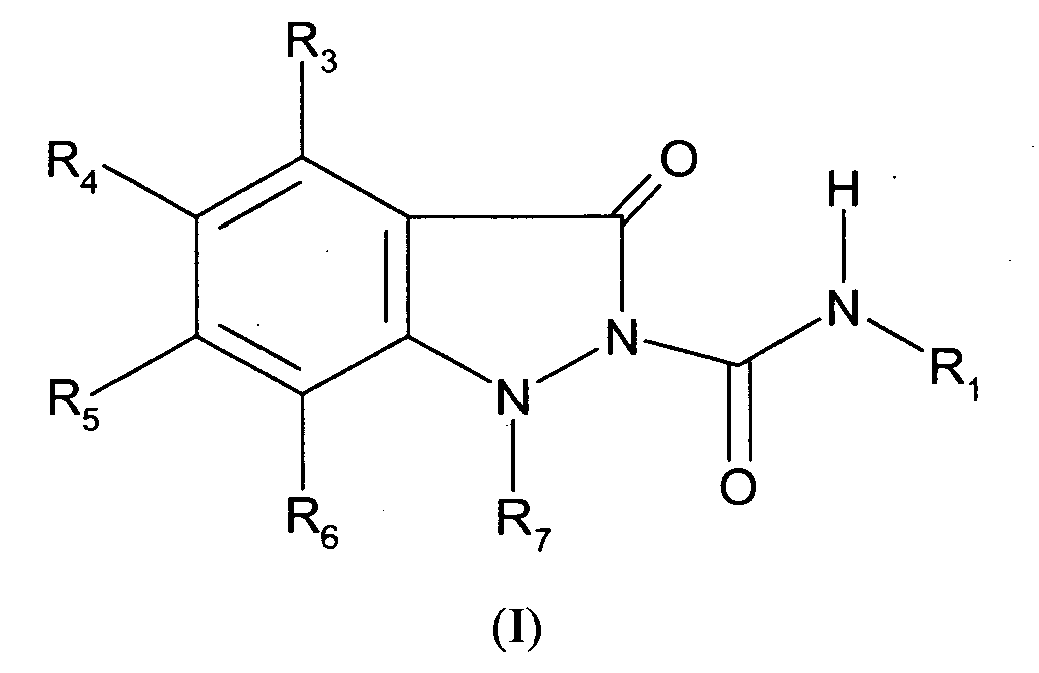
R1 is selected from the C5-C13alkyl, C1-C12haloalkyl, C4-C12alkenyl, C4-C12alkynyl, C1-C5alkylC3-C5cycloalkyl, C3-C8cycloalkyl, C1-C5alkylheterocyclic, benzyl and aryl, wherein the cycloalkyl, heterocyclic, benzyl and aryl substituents are optionally substituted with one to three substituents independently selected from C1-C8alkyl, C1-C8haloalkyl, C2-C8alkenyl, C2-C8alkynyl, phenyl, benzyl, hydroxy, C1-C5 alkoxy, -(CH2)mCOOC1-C5alkyl, -(CH2)mNRaRb, and C1-C4alkylC3-C8cycloalkyl; wherein Ra and Rb are independently selected from hydrogen, C1-C8alkyl, C2-C8alkenyl, C2-C8alkynyl, and C1-C5alkylC3-C8cycloalkyl;
R3, R4, R5, and R6 are independently selected from hydrogen, C1-C12alkyl, C2-C12haloalkyl, C2-C12alkenyl, C2-C12alkynyl, C2-C12alkylaryl, C1-C12alkylcyclohexyl, C1-C12alkylcyclopentyl, C1-C12alkytheterocyclic, -(CH2)mCOOH, -(CH2)mCO(C1-C10)alkyl, -(CH2)m COO(C1-C10)alkyl, -(CH2)mCOO(C1-C10)alkylaryl, C1-C10alkylamino, halo, -(CH2)mCONRaRb, phenyl, benzyl or aryl wherein each of the phenyl, benzyl or aryl groups is optionally substituted with one to three groups independently selected from C1-C8alkyl, C1-C8haloalkyl, C2-C8alkenyl, C2-C8alkynyl, phenyl, benzyl, hydroxy, C1-C5alkoxy, -(CH2)mCOOC1-C5alkyl, and C1-C4alkylC3-C8cycloalkyl; and wherein m is 0, 1, 2, or 3;
R7 is selected from hydrogen, C1-C10alkyl, C1-C10haloalkyl, C2-C10alkenyl, C2-C10alkynyl, C1-C6alkylaryl, C1-C6alkylcyclohexyl, C1-C6alkylcyclopentyl, C1-C6alkylheterocyclic, or aryl; or a pharmaceutically acceptable salt or solvate thereof, for use as a medicament. - The present invention also relates to a use of a dihydro-1H-indazole-5-carboxylic acid derivative compound of formula (I)

R3, R4, R5, and R6 are independently selected from hydrogen, C1-C12alkyl, C2-C12haloalkyl, C2-C12alkenyl, C2-C12alkynyl, C2-C12alkylaryl, C1-C12alkylcyclohexyl, C1-C12alkylcyclopentyl, C1-C12alkylheterocyclic, -(CH2)mCOOH, -(CH2)mCO(C1-C10)alkyl, -(CH2)m COO(C1-C10)alkyl, -(CH2)mCOO(C1-C10)alkylaryl, C1-C10alkylamino, halo, -(CH2)mCONRaRb, phenyl, benzyl or aryl wherein each of the phenyl, benzyl or aryl groups is optionally substituted with one to three groups independently selected from C1-C8alkyl, C1-C8haloalkyl, C2-C8alkenyl, C2-C8alkynyl, phenyl, benzyl, hydroxy, C1-C5alkoxy, -(CH2)mCOOC1-C5alkyl, and C1-C4alkylC3-C8cycloalkyl; and wherein m is 0, 1, 2, or 3;
R7 is selected from hydrogen, C1-C10alkyl, C1-C10haloalkyl, C2-C10alkenyl, C2-C10alkynyl, C1-C6alkylaryl, C1-C6alkylcyclohexyl, C1-C6alkylcyclopentyl, C1-C6alkylheterocyclic, or aryl; or a pharmaceutically acceptable salt or solvate thereof, for the manufacture of a medicament for the treatment of a mammal to alleviate the pathological effects of low HDL. - The present invention further relates to a use of a dihydro-1H-indazole-5-carboxylic acid derivative compound of formula (I)

R1 is selected from C5-C13alkyl, C1-C12haloalkyl, C4-C12alkenyl, C4-C12alkynyl, C1-C5alkylC3-C8cycloalkyl, C3-C8cycloalkyl, C1-C5alkylheterocyclic, benzyl and aryl, wherein the cycloalkyl, heterocyclic, benzyl and aryl substituents are optionally substituted with one to three substituents independently selected from C1-C8alkyl, C1-C8haloalkyl, C2-C8alkenyl, C2-C8alkynyl, phenyl, benzyl, hydroxy, C1-C5alkoxy, -(CH2)mCOOC1-C5alkyl, -(CH2)mNRaRb, and C1-C4alkylC3-C8cycloalkyl; wherein Ra and Rb are independently selected from hydrogen, C1-C8alkyl, C2-C8alkenyl, C2-C8alkynyl, and C1-C5alkylC3-C8cycloalkyl;
R3, R4, R5, and R6 are independently selected from hydrogen, C1-C12alkyl, C2-C12haloalkyl, C2-C12alkenyl, C2-C12alkynyl, C2-C12alkylaryl, C1-C12alkylcyclohexyl, C1-C12alkylcyclopentyl, C1-C12alkylheterocyclic, -(CH2)mCOOH, -(CH2)mCO(C1-C10)alkyl, -(CH2)m COO(C1-C10)alkyl, -(CH2)mCOO(C1-C10)alkylaryl, C1-C10alkylamino, halo, -(CH2)mCONRaRb phenyl, benzyl or aryl wherein each of the phenyl, benzyl or aryl groups is optionally substituted with one to three groups independently selected from C1-C8alkyl, C1-C8haloalkyl, C2-C8alkenyl, C2-C8alkynyl, phenyl, benzyl, hydroxy, C1-C5alkoxy, -(CH2)mCOOC1-C5alkyl, and C1-C4alkylC3-C8cycloalkyl; and wherein m is 0, 1, 2, or 3;
R7 is selected from hydrogen, C1-C10alkyl, C1-C10haloalkyl, C2-C10alkenyl, C2-C10alkynyl, C1-C6alkylaryl, C1-C6alkylcyclohexyl, C1-C6alkylcyclopentyl, C1-C6alkylheterocyclic, or aryl; or a pharmaceutically acceptable salt or solvate thereof, for the manufacture of a medicament for the treatment or prevention of hepatic lipase and/or endothelial lipase-mediated disease. - The phrase, "hepatic lipase and/or endothelial lipase mediated-diseases" refers to diseases symptomatic of low HDL levels, caused by, modulated by, exacerbated by or induced directly or indirectly by elevated hepatic lipase and/or endothelial lipase activity, and include for example, hypercholesterolemia, hyperlipidemia, stroke, hypertriglyceridemia, atherosclerosis and related diseases. Treatment and/or prevention of such diseases comprises administering to a mammal in need of such treatment a therapeutically effective amount of the compound of formula I in an amount sufficient to inhibit, ameliorate and/or prevent hepatic lipase and/or endothelial lipase activity and to thereby inhibit or prevent the deleterious effects of hepatic lipase and/or endothelial lipase activity.
- The term "Active Ingredient" as used herein refers to a compound(s) of Formula (I) or a pharmaceutically acceptable salt, solvate, prodrug, racemate or enantiomer thereof either as the pure compound or delivered as a pharmaceutical formulation or a pharmaceutical composition. The pharmaceutical composition or formulation containing a compound of the invention and other compound(s) or treatment regimens useful for the treatment and/or prevention of diseases associated with or exacerbated by hepatic lipase and/or endothelial lipase activity (combination drugs) are contemplated to be within the meaning of the term "Active Ingredient(s)."
- The term, "indazole nucleus", or "dihydro-1H-indazole nucleus" as used herein refers to a nucleus (having numbered positions) with the structural formula (X):

- The dihydro-1H-indazole derivative compounds of the invention employ certain defining terms as follows:
- ' The term, "alkyl" by itself or as part of another substituent means, unless otherwise defined, a straight or branched chain monovalent hydrocarbon radical such as methyl, ethyl, n-propyl, isopropyl, n-butyl, tertiary butyl, sec-butyl, n-pentyl, and n-hexyl.
- The term, "alkenyl" employed alone or in combination with other terms means a straight chain or branched monovalent hydrocarbon group having the stated number ranges of carbon atoms, and typified by groups such as vinyl, propenyl, crotonyl, isopentenyl, and various butenyl isomers.
- The term, "hydrocarbyl" means an organic group containing only carbon and hydrogen.
- The term, "halo" means fluoro, chloro, bromo, or iodo.
- The term, "heterocyclic radical or heterocyclic group", refers to radicals or group derived from monocyclic or polycyclic, saturated or unsaturated, substituted or unsubstituted heterocyclic nuclei having 5 to 14 ring atoms and containing from 1 to 3 hetero atoms selected from the group consisting of nitrogen, oxygen or sulfur. Typical heterocyclic, radicals are pyrrolyl, pyrrolodinyl, piperidinyl, furanyl, thiophenyl, pyrazolyl, imidazolyl, phenylimidazolyl, triazolyl, isoxazolyl, oxazolyl, thiazolyl, thiadiazolyl, benzo(b)thiophenyl, carbazolyl, norharmanyl, azabenzo(b)thiophenyl, benzofuranyl, dibenzofuranyl, dibenzothiophenyl, indazolyl, imidazo(1.2-A)pyridinyl, benzotriazolyl, anthranilyl, 1,2-benzisoxazolyl, benzoxazolyl, benzothiazolyl, purinyl, pyridinyl, dipyridylyl. phenylpyridinyl, benzylpyridinyl, pyrimidinyl, phenylpyrimidinyl, pyrazinyl, 1,3,5-triazinyl, quinolinyl, phthalazinyl, quinazolinyl, morpholino, thiomorpholino, homopiperazinyl, tetrahydrofuranyl, tetrahydropyranyl, oxacanyl, 1,3-dioxolanyl, 1,3-dioxanyl, 1,4-dioxanyl, tetrahydrothiophenyl, pentamethylenesulfadyl, 1,3-dithianyl, 1,4-dithianyl, 1,4-thioxanyl, azetidinyl, hexamethyleneiminium, heptamethyleneiminium, piperazinyl and quinoxalinyl.
- The terms "C1-C12alkylcyclopentyl," "C1-C12alkylcyclohexyl," or "C1-C12alkylheterocyclic" represent respectively a C1-C12alkyl, C1-C12alkyl, or C1-C12alkyl attached to a cylopentyl, cyclohexyl, and heterocyclic group respectively, wherein the entire group is attached to the dihydro-1H-indazole nucleus (X) or other substrate via the alkyl terminus at indicated or designated positions. The term "cycloalkyl" without more implies a cycloalkyl group having from 3 to 8 carbon atoms.
- The term "substituted group" is an organic group substituted with one or more suitable substituents. For example, substituted phenyl as used herein refers to a phenyl group having one to three substituents selected from C1-C12alkyl, C2-C12haloalkyl, C2-C12alkenyl, C2-C12alkynyl, C2-C12alkylaryl, C1-C12alkylcydohexyl, C1-C12alkylcyclopentyl, C1-C12alkylheterocyclic, (CH2)mCOOH, (CH2)mCO(C1-C10)alkyl, (CH2)m COO(C1-C10)alkyl, (CH2)m COO(C1-C10)alkylaryl, C1-C10alkylamino, halo, (CH2)m CONH2, (CH2)mCON((C1-C6)alkyl)2, phenyl, substituted phenyl, or aryl, wherein m = 0, 1, 2, or 3. Similarly, the term substituted benzyl means a benzyl group (CH2Phenyl) having substitution on the phenyl ring as described above. Analogously, the term aryl as used herein has its usual meaning and especially refers to the benzyl group.
- As used herein the terms "group", "radical" or "fragment" are synonymous and are intended to indicate functional groups or fragments of molecules attachable to a bond or other fragments of molecules. For example acetamide group represent the acetamide fragment or radical. Structures of groups, radicals or fragments unattached to the dihydro-1H-indazole-5-carboxylic acid derivative nucleus have been drawn to show the first line as a connecting bond only. Thus, the group

- Preferred R1 substituents:
- The preferred group for R1 is a substituted or unsubstituted group selected from the group consisting of C5-C13alkyl, C1-C5alkylcycloalkyl, C4-C12cycloalkenyl, cycohexylmethyl, cyclopentylmethyl, cyclohexylethyl, substituted or unsubstituted benzyl.
- A most preferred R1 is selected from the group consisting of 2, 4 or 5-substituted benzyl, 2,5 disubstituted benzyl, 2, 4-disubstituted benzyl, or 3,5-disubstitued benzyl. Preferred substituents on the benzyl group include methyl, ethyl, propyl, butyl, pentyl, hexyl, cyclohexylmethyl, phenyl, and cycloheptylmethyl. Most preferred substituents on the benzyl group include methyl, ethyl, propyl, isopropyl, isobutyl, tert-butyl, and pentane.
- R3, R4, R5, and R6 are preferably independently selected from the group consisting of hydrogen, C1-C6alkyl, C2-C6alkenyl, -O-(C1-C6)alkyl, -S-(C1-C6)alkyl, -C5-C12cycloalkyl, (CH2)mCOOH, (CH2)CO(C1-C10)alkyl, (CH2)m COO(C1-C10)alkyl, (CH2)mCOO(C1-C10)alkylaryl, C1-C10alkylamino, halo, (CH2)mCONH2, (CH2)mCONRaRb, phenyl, substituted phenyl, or aryl;. Particularly preferred R3, R4, R5, and R6 groups are selected from hydrogen, methyl, ethyl, propyl, chloro, fluoro, -COOH, CO(C1-C10)alkyl, COO(C1-C10)alkyl, and CONH2 and salts thereof. More particularly hydrogen, chloro, and sodium, potassium and lithium salts of -COOH are preferred as independently selected R3, R4, R5, and R6 groups.
- A preferred compound of the invention is a compound selected from the group consisting of:
- 3-Oxo-1,3-dihydro-indazole-2-carboxylic acid (2-ethyl-hexyl)-amide,
- 3-Oxo-1,3-dihydro-indazole-2-carboxylic acid (3,7-dimethyl-octa-2,6-dienyl)-amide,
- 3-Oxo-1,3-dihydro-indazole-2-carboxylic acid cyclohexylmethyl-amide,
- 1-Methyl-3-oxo-1,3-dihydro-indazole-2-carboxylic acid pentylamide,
- 1-Butyl-3-oxo-1,3-dihydro-indazole-2-carboxylic acid pentylamide,
- 1-Benzyl-3-oxo-1,3-dihydro-indazole-2-carboxylic acid pentylamide,
- 3-Oxo-1-phenethyl-1,3-dihydro-indazole-2-carboxylic acid pentylamide,
- 1-(2-Methoxy-ethyl)-3-oxo-1,3-dihydro-indazole-2-carboxylic acid hexylamide,
- (2-Hexylcarbamoyl-3-oxo-2,3-dihydro-indazol-1-yl)-acetic acid methyl ester,
- 3-Oxo-1,3-dihydro-indazole-2-carboxylic acid 2-methyl-benzylamide,
- 3-Oxo-1,3-dihydro-indazole-2-carboxylic acid 3-methyl-benzylamide,
- 3-Oxo-1,3-dihydro-indazole-2-carboxylic acid 4-methyl-benzylamide,
- 3-Oxo-1,3-dihydro-indazole-2-carboxylic acid 2-trifluoromethyl-benzylamide,
- 3-oxo-1,3-dihydro-indazole-2-carboxylic acid 2-ethyl-benzylamide,
- 3-Oxo-1,3-dihydro-indazole-2-carboxylic acid 3-ethyl-benzylamide,
- 3-Oxo-1,3-dihydro-indazole-2-carboxylic acid 3-fluoro-benzylamide,
- 3-Oxo-1,3-dihydro-indazole-2-carboxylic acid 3-chloro-benzylamide,
- 3-Oxo-1,3-dihydro-indazole-2-carboxylic acid 3-methoxy-benzylamide,
- 3-Oxo-1,3-dihydro-indazole-2-carboxylic acid 3-trifluoromethoxy-benzylamide,
- 3-Oxo-1,3-dihydro-indazole-2-carboxylic acid 2-methylsulfanyl-benzylamide,
- 3-Oxo-1,3-dihydro-indazole-2-carboxylic acid 4-amino-benzylamide,
- 3-Oxo-1,3-dihydro-indazole-2-carboxylic acid 4-dimethylamino-benzylamide,
- 3-Oxo-1,3-dihydro-indazole-2-carboxylic acid (biphenyl-3-ylmethyl)-amide,
- 3-Oxo-1,3-dihydro-indazole-2-carboxylic acid (naphthalen-1-ylmethyl)-amide,
- 3-Oxo-1,3-dihydro-indazole-2-carboxylic acid (4-methyl-naphthalen-1-ylmethyl)-amide,
- 3-Oxo-1,3-dihydro-indazole-2-carboxylic acid 5-chloro-2-methyl-benzylamide,
- 3-Oxo-1,3-dihydro-indazole-2-carboxylic acid 2-isopropyl-6-methyl-benzylamide,
- 3-Oxo-1,3-dihydro-indazole-2-carboxylic acid 2,4-dichloro-benzylamide,
- 3-Oxo-1,3-dihydro-indazole-2-carboxylic acid 5-chloro-2-methoxy-benzylamide
- 3-Oxo-1,3-dihydro-indazole-2-carboxylic acid 2,4-dimethoxy-benzylamide,
- 3-Oxo-1,3-dihydro-indazole-2-carboxylic acid 3,4-dihydroxy-benzylamide,
- 3-Oxo-1,3-dihydro-indazole-2-carboxylic acid (2,3-dihydro-benzo[1,4]dioxin-6-ylmethyl)-amide,
- 3-Oxo-1,3-dihydro-indazole-2-carboxylic acid 2,4,6-trimethyl-benzylamide,
- 3-Oxo-1,3-dihydro-indazole-2-carboxylic acid 4,6-dichloro-2-methyl-benzylamide,
- 3-Oxo-1,3-dihydro-indazole-2-carboxylic acid 3,4,5-trimethoxy-benzylamide,
- 3-Oxo-1,3-dihydro-indazole-2-carboxylic acid (4-phenyl-but-3-enyl)-amide,
- 4-methyl-3-oxo-1,3-dihydro-indazole-2-carboxylic acid 2-methyl-benzylamide,
- 6-methyl-3-oxo-1,3-dihydro-indazole-2-carboxylic acid 2-methyl-benzylamide,
- 4-chloro-3-oxo-1,3-dihydro-indazole-2-carboxylic acid 2-methyl-benzylamide,
- 5-Chloro-3-oxo-1,3-dihydro-indazole-2-carboxylic acid 2-methyl-benzylamide,
- 6-Chloro-3-oxo-1,3-dihydro-indazole-2-carboxylic acid 2-methyl-benzylamide,
- 7-methoxy-3-oxo-1,3-dihydro-indazole-2-carboxylic acid 2-methyl-benzylamide,
- 5-hydroxy-3-oxo-1,3-dihydro-indazole-2-carboxylic acid 2-methyl-benzylamide,
- 5-Nitro-3-oxo-1,3-dihydro-indazole-2-carboxylic acid 2-methyl-benzylamide,
- 2-(2-methyl-benzylcarbamoyl)-3-oxo-2,3-dihydro-1H indazole-4-carboxylic acid,
- 2-(2-methyl-benzylcarbamoyl)-3-oxo-2,3-dihydro-1H-indazole-5-carboxylic acid,
- 2-(2-Methyl-benzylcarbamoyl)-3-oxo-2,3-dihydro-1H-indazole-6-carboxylic acid,
- 2-(2-methyl-benzylcarbamoyl)-3-oxo-2,3-dihydro-1H-indazole-7-carboxylic acid,
- 3-Oxo-2-(2-trifluoromethyl-benzylcarbamoyl)-2,3-dihydro-1H-indazole-7-carboxylic acid,
- 2-(5-fluoro-2-methyl-benzylcarbamoyl)-3-oxo-2,3-dihydro-1H-indazole-4-carboxylic acid,
- 2-(5-Fluoro-2-methyl-benzylcarbamoyl)-3-oxo-2,3-dihydro-1H-indazole-7-carboxylic acid,
- 2-(2,6-dimethyl-benzylcarbamoyl)-3-oxo-2,3-dihydro-1H-indazole-4-carboxylic acid,
- 2-(2,6-Dimethyl-benzylcarbamoyl)-3-oxo-2,3-dihydro-1H-indazole-7-carboxylic acid,
- 2-(2-Ethyl-6-methyl-benzylcarbamoyl)-3-oxo-2,3-dihydro-1H-indazole-4-carboxylic acid,
- 2-(2-Ethyl-6-methyl-benzylcarbamoyl)-3-oxo-2,3-dihydro-1H-indazole-5-carboxylic acid,
- 2-(2-Ethyl-6-methyl-benzylcarbamoyl)-3-oxo-2,3-dihydro-1H-indazole-6-carboxylic acid,
- 2-(2-Ethyl-6-methyl-benzylcarbamoyl)-3-oxo-2,3-dihydro-1H-indazole-7-carboxylic acid,
- 2-(2-Isopropyl-6-methyl-benzylcarbamoyl)-3-oxo-2,3-dihydro-1H-indazole-4-carboxylic acid,
- 2-(2-Isopropyl-6-methyl-benzylcarbamoyl)-3-oxo-2,3-dihydro-1H-indazole-7-carboxylic acid,
- 2-(2-tert-Butyl-6-methyl-benzylcarbamoyl)-3-oxo-2,3-dihydro-1H-indazole-7-carboxylic acid,
- 2-(4-butyl-2-methyl-benzylcarbamoyl)-3-oxo-2,3-dihydro-1H-indazole-4-carboxylic acid,
- 2-(2,6-Diethyl-benzylcarbamoyl)-3-oxo-2,3-dihydro-1H-indazole-4-carboxylic acid,
- 2-(2,6-Diethyl-benzylcarbamoyl)-3-oxo-2,3-dihydro-1H-indazole-7-carboxylic acid,
- 2-(2,6-diisopropyl-benzylcarbamoyl)-3-oxo-2,3-dihydro-1H-indazole-4-carboxylic acid,
- 2-(2,6-Diisopropyl-benzylcarbamoyl)-3-oxo-2,3-dihydro-1H-indazole-7-carboxylic acid,
- 2-(2,4,6-trimethyl-benzylcarbamoyl)-3-oxo-2,3-dihydro-1H-indazole-4-carboxylic acid,
- 2-[(4-methyl-naphthalen-1-ylmethyl)-carbamoyl]-3-oxo-2,3-dihydro-1H-indazole-4-carboxylic acid,
- 3-Oxo-2-(4-phenyl-butylcarbamoyl)-2,3-dihydro-1H-indazole-4-carboxylic acid,
- 2-(4-Cyclohexyl-butylcarbamoyl)-3-oxo-2,3-dihydro-1H-indazole-4-carboxylic acid,
- 3-Oxo-2-(3-phenoxy-propylcarbamoyl)-2,3-dihydro-1H-indazole-4-carboxylic acid,
- 2-Hexylcarbamoyl-3-oxo-2,3-dihydro-1H-indazole-4-carboxylic acid,
- 2-(2-Ethyl-6-methyl-benzylcarbamoyl)-1-methyl-3-oxo-2,3-dihydro-1H-indazole-7-carboxylic acid,
- 1-Ethyl-2-(2-ethyl-6-methyl-benzylcarbamoyl)-3-oxo-2,3-dihydro-1H-indazole-7-carboxylic acid,
- 2-(2-Ethyl-6-methyl-benzylcarbamoyl)-3-oxo-1-propyl-2,3-dihydro-1H-indazole-7-carboxylic acid,
- 1-Carboxymethyl-2-(2-ethyl-6-methyl-benzylcarbamoyl)-3-oxo-2,3-dihydro-1H-indazole-7-carboxylic acid,
- 2-(2-Ethyl-6-methyl-benzylcarbamoyl)-1-methoxycarbonylmethyl-3-oxo-2,3-dihydro-1H-indazole-7-carboxylic acid,
- 2-(2-Isopropyl-6-methyl-benzylcarbamoyl)-1-methyl-3-oxo-2,3-dihydro-1H-indazole-7-carboxylic acid,
- 1-Ethyl-2-(2-isopropyl-6-methyl-benzylcarbamoyl)-3-oxo-2,3-dihydro-1H-indazole-7-carboxylic acid,
- 2-(2-Isopropyl-6-methyl-benzylcarbamoyl)-3-oxo-1-propyl-2,3-dihydro-1H-indazole-7-carboxylic acid,
- 1-(3-Chloro-propyl)-2-(2-isopropyl-6-methyl-benzylcarbamoyl)-3-oxo-2,3-dihydro-1H-indazole-7-carboxylic acid,
- 2-(2-Isopropyl-6-methyl-benzylcarbamoyl)-3-oxo-1-(prop-2-ynyl)-2,3-dihydro-1H-indazole-7-carboxylic acid,
- 1-Allyl-2-(2-isopropyl-6-methyl-benzylcarbamoyl)-3-oxo-2,3-dihydro-1H-indazole-7-carboxylic acid,
- I -Butyl-2-(2-isopropyl-6-methyl-benzylcarbamoyl)-3-oxo-2,3-dihydro-1H-indazole-7-carboxylic acid,
- 1-Cyanomethyl-2-(2-isopropyl-6-methyl-benzylcarbamoyl)-3-oxo-2,3-dihydro-1H-indazole-7-carboxylic acid,
- 1-Cyclopropylmethyl-2-(2-isopropyl-6-methyl-benzylcarbamoyl)-3-oxo-2,3-dihydro-1H-indazole-7-carboxylic acid,
- 1-Carboxymethyl-2-(2-isopropyl-6-methyl-benzylcarbamoyl)-3-oxo-2,3-dlhydro-1H-indazole-7-carboxylic acid,
- 2-(2-Isopropyl-6-methyl-benzylcarbamoyl)-1-methoxycarbonylmethyl-3-oxo-2,3-dihydro-1H-indazole-7-carboxylic acid,
- 1-Carbamoylmethyl-2-(2-isopropyl-6-methyl-benzylcarbamoyl)-3-oxo-2,3-dihydro-1H-indazole-7-carboxylic acid,
- 1-Benzyl-2-(2-isopropyl-6-methyl-benzylcarbamoyl)-3-oxo-2,3-dihydro-1H-indazole-7-carboxylic acid,
- 2-(2-tert-Butyl-6-methyl-benzylcarbamoyl)-1-methyl-3-oxo-2,3-dihydro-1H-indazole-7-carboxylic acid,
- 2-(2,6-Diethyl-benzylcarbamoyl)-1-methyl-3-oxo-2,3-dihydro-1H-indazole-7-carboxylic acid,
- 2-hexylcarbamoyl-3-oxo-2,3-dihydro-1H-indazole-4-carboxylic acid methyl ester,
- 2-Hexylcarbamoyl-3-oxo-2,3-dihydro-1H-indazole-4-carboxylic acid allyl ester,
- 2-hexylcarbamoyl-3-oxo-2,3-dihydro-1H-indazole-7-carboxylic acid allyl ester,
- 2-hexylcarbamoyl-3-oxo-2,3-dihydro-1H-indazole-7-carboxylic acid methyl ester,
- 2-(2-Isopropyl-6-methyl-benzylcarbamoyl)-3-oxo-2,3-dihydro0-1H-indazole-4-carboxylic acid methyl ester, and
- 2-(2-Isopropyl-6-methyl-benzylcarbamoyl)-3-oxo-2,3-dihydro-1H-indazole-7-carboxylic acid methyl ester.
- More preferred compounds of the invention are represented by the formulae (C1), (C2), (C3), (C4) and (C5):


- The salts of the 1H-indazole compounds represented by formula (I), are an additional aspect of the invention.
- In those instances when the compound of the invention possesses acidic or basic functional groups, various salts may be formed which are more water soluble and more physiologically suitable than the parent compound. Representative pharmaceutically acceptable salts, include but are not limited to, the alkali and alkaline earth salts such as lithium, sodium, potassium, calcium, magnesium, aluminum and the like. Salts are conveniently prepared from the free acid by treating the acid in solution with a base or by exposing the acid to an ion-exchange resin.
- Included within the definition of pharmaceutically acceptable salts are the relatively non-toxic, inorganic and organic base addition salts of compounds of the present invention, for example, ammonium, quaternary ammonium, and amine cations, derived from nitrogenous bases of sufficient basicity to form salts with the compounds of this invention (see, for example, S. M. Berge, et al., "Pharmaceutical Salts," J. Phar. Sci., 66: 1-19 (1977)). Moreover, the basic group(s) of the compound of the invention may be reacted with suitable organic or inorganic acids to form salts such as acetate, benzenesulfonate, benzoate, bicarbonate, bisulfate, bitartrate, borate, hydrobromide, camsylate, carbonate, chloride, clavulanate, citrate, chloride, edetate, edisylate, estolate, esylate, fluoride, fumarate, gluceptate, gluconate, glutamate, glycolylarsanilate, hexylresorcinate, hydrochloride, hydroxynaphthoate, hydroiodide, isothionate, lactate, lactobionate, laurate, maleate, mandelate, mesylate, methylbromide, methylnitrate, methylsulfate, mucate, napsylate, nitrate, oleate, oxalate, palmitate, pantothenate, phosphate, polygalacturonate, salicylate, stearate, subacetate, succinate, tannate, tartrate, tosylate, trifluoroacetate, trifluoromethane sulfonate, and valerate.
- Certain compounds of the invention may possess one or more chiral centers, and thus, may exist in optically active forms. Likewise, when the compounds contain an alkenyl or alkenyl group, there exist the possibility of cis- and trans- isomeric forms of the compounds. The R- and S- isomers and mixtures thereof, including racemic mixtures as well as mixtures of cis- and trans- isomers, are contemplated by this invention. Additional asymmetric carbon atoms can be present in a substituent group such as an alkyl group. All such isomers as well as the mixtures thereof are intended to be included in the invention. If a particular stereoisomer is desired, it can be prepared by methods well known in the art by using stereospecific reactions with starting materials which contain the asymmetric centers and are already resolved or, alternatively by methods which lead to mixtures of the stereoisomers and subsequent resolution by known methods. For example, a racemic mixture may be reacted with a single enantiomer of some other compound. This changes the racemic form into a mixture of stereoisomers and diastereomers, because they have different melting points, different boiling points, and different solubilities and can be separated by conventional means, such as crystallization.
- The following paragraph is provided for reference purposes only and does not form part of the invention. Prodrugs are derivatives of the compounds of the invention which have chemically or metabolically cleavable groups and become by solvolysis or under physiological conditions the compounds of the invention which are pharmaceutically active in vivo. Derivatives of the compounds of this invention have activity in both their acid and base derivative forms, but the acid derivative form often offers advantages of solubility, tissue compatibility, or delayed release in a mammalian organism (see, Bundgard, H., Design of Prodrugs, pp. 7-9, 21-24, Elsevier, Amsterdam 1985). Prodrugs include acid derivatives well known to practitioners of the art, such as, for example, esters prepared by reaction of the parent acidic compound with a suitable alcohol, or amides prepared by reaction of the parent acid compound with a suitable amine. Simple aliphatic or aromatic esters derived from acidic groups pendent on the compounds of this invention are preferred prodrugs. In some cases it is desirable to prepare double ester type prodrugs such as (acyloxy) alkyl esters or ((alkoxycarbonyl)oxy)alkyl esters. Particularly preferred esters as prodrugs are methyl, ethyl, propyl, isopropyl, n-butyl, isobutyl, tert-butyl, morpholinoethyl, and N,N-diethylglycolamido.
- Compounds useful for the invention are prepared following the general procedures outlined below. One of skill in the art is aware that minimal experimentation would be needed to modify the schemes herein provided for the preparation of other compounds of the invention. Scheme 1 provides a general method starting from available dihydroindazole-2-one compound.

- According to Scheme 1, 2,3-dihydro-indazole 1may be reacted with p-nitophenylchloroformate or other suitable leaving group synthon in the presence of a suitable base to afford the compound 2. The resulting compound 2 is readily reacted with an amine to effect displacement of the p-nitrophenol group affording the carbamoyl compound 3. The carbamoyl compound 3 may be further alkylated or otherwise substituted with a nucleophile at the free ring nitrogen atom to afford an N-substituted dihydroindazole carboxylic acid derivative 4, a compound of the invention.
- Alternatively, the dihydro-indazole 1 may be reacted with an isocynate having the desired alkyl, aryl, or other substituent to afford directly the compound 3. The compound 3 is a compound of the invention, which may itself be converted to an N-substituted derivative compound of the formula 4 as discussed above. The isocyanate reagent may be prepared as shown in Scheme 1a below wherein R is represented by the group 5-methylhexyl:

- Benzyl derivatives of compounds of formula I may be prepared as shown in Scheme 2.

- Alternatively, the amine 6 may be converted to the isocyanate 7 via reaction of the amine with triphosgene in the presence of a proton sponge. The resulting isocyanate 7 is then reacted with an appropriately substituted dihydro-indazole to afford the compound 8, a compound of the invention.
- In another procedure, the benzyl amine compound 6 may be reacted directly with a nucleophile source such as compound 2 to afford the desired compound 8 as shown in Scheme 3

- Compounds of formula I wherein the starting material dihydro-indazole is not readily available may be prepared starting with an appropriately substituted 2-aminobenzoic acid as shown in Scheme 4

- The reaction to form the dihydro-indazole group starting with an aminobenzoic acid 9 is believed to proceed via a diazonium salt intermediate (Sandmeyer reaction, see March, J., Advanced Organic Chemistry, 3rd Edition, Wiley Interscience, New York, New York). The diazonium intermediate may be formed by adding sodium nitrite to a solution of 9. The diazonium salt intermediate is reduced by stannuous chloride to form a phenylhydrazine intermidate which ring closes in-situ to afford the dihydro-indazole compound 10. Detailed procedures are provided in the experimental section, are known to one of skill in the art, or are readily accessed by one of skill in the art via available literature and reference sources.
- The dihydro-indazole compound 10 may then be reacted with isocyanate 7 (from Scheme 3) to afford compound 11, a compound of the invention. The carboxylic acid side chain on the dihydro-indazole 12 may be converted to the methyl ester 13 prior to reaction with an isocyanate derivative to afford the compound 14. The compound 14 is a compound of the invention.
- Protection of side chain substitutents may also be necessary for the purpose of alkylating or substituting on the secondary amine position of the dihydro-indazole as shown in Scheme 5:

- As shown in scheme 5, the carboxylic acid side chain of compound 15 may be protected by reaction with diphenylmethyl diazomethane to afford the corresponding ester 16 (diphenylmethylester). Protection of the acid allows for a facile nucleophilic reaction of an alkyl halide (R7X) or other nucleophile source on the free dihydro-indazole ring NH proton of compound 16. The resulting N alkyl or N-substituted compound 17 may be hydrolyzed under acidic conditions to afford the deprotected, N-substituted compound 18.
- Compounds of formula I wherein all of R3, R4, R5, and R6 are other than hydrogen are made starting with purchased starting materials having the requisite substituents or by methods known to one of skill in the art.
- The dihydro-1H-indazole-5-carboxylic acid derivative compounds described herein are believed to achieve their beneficial therapeutic action principally by direct inhibition of hepatic lipase and/or endothelial lipase activity.
- Another aspect of this invention relates to inhibition or prevention of "Hepatic Lipase-Mediated Diseases" such as hypercholesterolemia, stroke, atherosclerosis and related diseases as described earlier.
- As previously noted the compounds of this invention are useful for inhibiting hepatic lipase and/or endothelial lipase activity. By the term, "inhibiting" is meant the prevention or therapeutically significant reduction in hepatic lipase and/or endothelial lipase activity by the compounds of the invention. By "pharmaceutically acceptable" it is meant the carrier, diluent or excipient must be compatible with the other ingredients of the formulation and not deleterious to the recipient thereof.
- The specific dose of a compound administered according to this invention to obtain therapeutic or ameliorative or prophylactic effect will, of course, be determined by the particular circumstances surrounding the case, including, for example, the compound administered, the route of administration and the condition being treated. Typical daily doses will contain a non-toxic dosage level of from about 0.01 mg/kg to about 50 mg/kg of body weight of an active compound of this invention.
- Preferably compounds of the invention per Formula (I) or pharmaceutical formulations containing these compounds are in unit dosage form for administration to a mammal. The unit dosage form can be a capsule or tablet itself, or the appropriate number of any of these. The quantity of Active Ingredient in a unit dose of composition may be varied or adjusted from about 0.1 to about 500 milligrams or more according to the particular treatment involved. It may be appreciated that it may be necessary to make routine variations to the dosage depending on the age and condition of the patient. The dosage will also depend on the route of administration.
- The compound of formula I may be administered by a variety of routes including oral, aerosol, transdermal, subcutaneous, intravenous, intramuscular, or intranasal.
- Pharmaceutical formulations of the invention are prepared by combining (e.g., mixing) a therapeutically effective amount of the dihydro-1H-indazole-5-carboxylic acid derivative compound of the invention together with a pharmaceutically acceptable carrier or diluent. The present pharmaceutical formulations are prepared by known procedures using well-known and readily available ingredients.
- In making the compositions of the present invention, the Active Ingredient will usually be admixed with a carrier, or diluted by a carrier, or enclosed within a carrier, which may be in the form of a capsule, sachet, paper or other container. When the carrier serves as a diluent, it may be a solid, semi-solid or liquid material which acts as a vehicle, or can be in the form of tablets, pills, powders, lozenges, elixirs, suspensions, emulsions, solutions, syrups, aerosols (as a solid or in a liquid medium), or ointment, containing, for example, up to 10% by weight of the active compound. The compounds of the present invention are preferably formulated prior to administration.
- For the pharmaceutical formulations any suitable carrier known in the art can be used. In such a formulation, the carrier may be a solid, liquid, or mixture of a solid and a liquid. For example, for intravenous injection the compounds of the invention may be dissolved in at a concentration of 2 mg/ml in a 4% dextrose/0.5% Na citrate aqueous solution. Solid form formulations include powders, tablets and capsules. A solid carrier can be one or more substance, which may also act as flavoring agents, lubricants, solubilizers, suspending agents, binders, tablet disintegrating agents and encapsulating material.
- Tablets for oral administration may contain suitable excipients such as calcium carbonate, sodium carbonate, lactose, calcium phosphate, together with disintegrating agents, such as maize, starch, or alginic acid, and/or binding agents, for example, gelatin or acacia, and lubricating agents such as magnesium stearate, stearic acid, or talc. A preferred tablet formulation for oral administration is one that affords rapid dissolution in the mouth of a patient in need thereof.
- In powders the carrier is a finely divided solid, which is in admixture with the finely divided Active Ingredient. In tablets the Active Ingredient is mixed with a carrier having the necessary binding properties in suitable proportions and compacted in the shape and size desired. The powders and tablets preferably contain from about 1 to about 99 weight percent of the Active Ingredient, which is the novel compound of this invention. Suitable solid carriers are magnesium carbonate, magnesium stearate, talc, sugar lactose, pectin, dextrin, starch, gelatin, tragacanth, methylcellulose, sodium carboxymethyl cellulose, low melting waxes, and cocoa butter.
- Sterile liquid form formulations include suspensions, emulsions, syrups and elixirs.
- The Active Ingredient can be dissolved or suspended in a pharmaceutically acceptable carrier, such as sterile water, sterile organic solvent or a mixture of both. The Active Ingredient can often be dissolved in a suitable organic solvent, for instance aqueous propylene glycol. Other compositions can be made by dispersing the finely divided Active Ingredient in aqueous starch or sodium carboxymethyl cellulose solution or in a suitable oil.
- "Active Ingredient", refers to a compound according to Formula (I) or a pharmaceutically acceptable salt, solvate, racemate or enantiomer thereof.
- Hard gelatin capsules are prepared using the following ingredients:
Quantity (mg/capsule) Active ingredient 250 Starch, dried 200 Magnesium stearate 10 Total 460 mg - A tablet is prepared using the ingredients below:
Quantity (mg/tablet) Active Ingredient 250 Cellulose, microcrystalline 400 Silicon dioxide, fumed 10 Stearic acid 5 Total 665 mg - The components are blended and compressed to form tablets each weighing 665 mg
- An aerosol solution is prepared containing the following components:
Weight Active Ingredient 0.25 Ethanol 25.75 Propellant 22 (Chlorodifluoromethane) 74.00 Total 100.00 - Tablets, each containing 60 mg of Active Ingredient, are made as follows:
Active Ingredient 60 mg Starch 45 mg Microcrystalline cellulose 35 mg Polyvinylpyrrolidone (as 10% solution in water) 4 mg Sodium carboxymethyl starch 4.5 mg Magnesium stearate 0.5 mg Talc 1 mg Total 150 mg - The Active Ingredient, starch and cellulose are passed through a No. 45 mesh U.S. sieve and mixed thoroughly. The aqueous solution containing polyvinylpyrrolidone is mixed with the resultant powder, and the mixture then is passed through a No. 14 mesh U.S. sieve. The granules so produced are dried at 50°C and passed through a No. 18 mesh U.S. sieve. The sodium carboxymethyl starch, magnesium stearate and talc, previously passed through a No. 60 mesh U.S. sieve, are then added to the granules which, after mixing, are compressed on a tablet machine to yield tablets each weighing 150 mg.
- Capsules, each containing 80 mg of Active Ingredient, are made as follows:
Active Ingredient 80 mg Starch 59 mg Microcrystalline cellulose 59 mg Magnesium stearate 2 mg Total 200 mg - The Active Ingredient, cellulose, starch, and magnesium stearate are blended, passed through a No. 45 mesh U.S. sieve, and filled into hard gelatin capsules in 200 mg quantities.
- Suppositories, each containing 225 mg of Active Ingredient, are made as follows:
Active Ingredient 225 mg Saturated fatty acid glycerides 2,000 mg Total 2,225 mg - The Active Ingredient is passed through a No. 60 mesh U.S. sieve and suspended in the saturated fatty acid glycerides previously melted using the minimum heat necessary. The mixture is then poured into a suppository mold of nominal 2g capacity and allowed to cool.
- Suspensions, each containing 50 mg of Active Ingredient per 5 ml dose, are made
as follows: Active Ingredient 50 mg Sodium carboxymethyl cellulose 50 mg Syrup 1.25 ml Benzoic acid solution 0.10 ml Flavor q.v. Color q.v. Purified water to total 5 ml - The Active Ingredient is passed through a No. 45 mesh U.S. sieve and mixed with the sodium carboxymethyl cellulose and syrup to form a smooth paste. The benzoic acid solution, flavor and color are diluted with a portion of the water and added, with stirring. Sufficient water is then added to produce the required volume.
- An intravenous formulation may be prepared as follows:
Active Ingredient 100 mg Isotonic saline 1,000 ml - The solution of the above ingredients generally is administered intravenously to a subject at a rate of 1 ml per minute.
- The abbreviations, symbols and terms used in the examples have the following meanings.
Ac = acetyl
Anal. = elemental analysis
calcd = calculated
Cpd. = compound
DMF = dimethylformamide
DMSO = dimethylsulfoxide
Et = ethyl
EtOAc = ethyl acetate
EtOH = ethanol
EtSH = ethanethiol
ESIMS = Electospray Ionization Mass Spectrometry
FAB = Fast Atom Bombardment (Mass Spectroscopy)
FDMS = field desorption mass spectrum
Hex = hexanes
HL = Hepatic Lipase
HPLC = High Performance Liquid Chromatograph
HRMS = high resolution mass spectrum
IR = Infrared Spectrum
Me = methyl
MeI = methyl iodide
MeOH = methanol
MPLC = Medium Pressure Liquid Chromatography
NMR = Nuclear Magnetic Resonance
PPA = polyphosphoric acid
Rochelle's Salt = potassium sodium tartrate
RPHPLC = Reversed Phase High Performance Liquid Chromatography
SiO2 = silica gel
SM = starting material
Temp. = temperature
TFA = trifluoroacetic acid
THF = tetrahydrofuran
TLC = thin layer chromatography - Compounds of the present invention were found to be efficacious in-vitro in inhibiting hepatic lipase. Efficacy was determined by testing various compounds of the invention in a hepatic lipase assay discussed below, and disclosed in
U.S patent application No. 09/609, 871 filed July 3, 2000 - Substrate Buffer A: 100 mM Hepes, pH 8.3 at 37 °C
Substrate Buffer B: 100 mM Hepes, pH 8.3 at 37 °C with 6.83 mM Triton X100
ThioPEG: Molecular wt. of 540
Recombinant Hepatic Lipase
Thiophospholipid: about 0.42 mM thiophospholipid in chloroform
DTNB Solution: about 50 nM DTNB in DMSO (dimethyl sulfoxide) - For Hepes Buffer A, there is 2.4 g Hepes/100 mL water. Therefore 36 grams of Hepes is dissolved in 1500 mL of water. The mix solution's pH is adjusted to pH 8.3 at 37 °C and brought up to 1500 mL with water. 500 mL of Buffer A is retained for the Protein Buffer.
- To the remaining 1000 mL of Hepes Buffer A, 4.49 g of Triton X-100 is added and then the combination mixed on a stir plate. It is optimal that stock Buffer A not be too cold or Triton X-100 will take a long time to go into solution
- For 0.42 mM substrate stock, use 0.227 mg of thioPEG/mL of Substrate Buffer B. Approximately 20 mg of sn-1 thiol substituted Phosphatidyl Ethylene Glycol (see Examples for preparation method) is weighed into a vial, such as a scintillation vial. Enough chloroform should be added to make a 2.043 mg/mL solution. Sonicate the solution briefly until well dissolved. Next, pipette 1 mL of chloroform/substrate solution into each scintillation vial. This should give enough substrate for one full 96 well plate. Each vial is dried with nitrogen until solvent removed, swirling each vial simultaneously such that a thin film of substrate will be easily reconstituted in each buffer. Each vial is then frozen.
- Daily stock preparation is performed for 9 mL of substrate (one microtiter plate). On the day of the assay, the substrate vial is removed from the freezer and combined with 9 mL of pre-warmed (37 °C) substrate buffer (the final concentration is 0.227 mg/mL). Place the buffer in a 37 °C water bath. Sonicate for 5 minutes or vortex until solution is clear before use.
- The enzyme is stored at -80 °C in 100 or 50 µL portions. A 0.406 mg/mL recombinant hepatic lipase stock requires a 50-fold dilution. Therefore, to a 50 µL or 100 µL enzyme aliquot, 2450 µL or 4900 µL, respectively, of substrate Buffer A (protein buffer) should be added. The enzyme should then be stored on ice until ready to use. The protein concentration of enzyme is about 0.406 mg/mL.
- To make a 20 mg/mL stock solution, 2-3 mg of DTNB is weighed and then mixed with an appropriate amount of 100% DMSO (dimethyl sulfoxide) to make the desired concentration. This mixture is sonicated for five minutes.
- The above solution should be diluted 10 fold with substrate Buffer B (concentration now 2 mg/mL). Then to the thioPEG substrate solution, add 60 µl of dilute DTNB per mL of thioPEG substrate solution. Thus for 9 mL of substrate, 540 microliters of dilute DTNB (final concentration in substrate solution = 0.11 mg/mL).
- Table 1 below shows final assay volumes and concentrations of various components used following the above procedure.
Table 1: Final Assay Volumes and Concentrations Hepatic Lipase Phospholipase Assay Component Assay Volume Final Concentration HL 10 µl 12.5 nM Test Cpd. 10 µl Varies ThioPEG Substrate (stock = 80 µl 90 mM Hepes 0.42mM + substrate buffer) 5.8 mM TX100 0.336 mM ThioPEG (0.06 mol fraction) 0.088 mM DTNB/mL - The test compound is dissolved in pure DMSO at 1 µM (1000 nM). As shown below in Table 2, assay concentrations are 10, 1, 0.1, 0.33, 0.011, 0.0037, 0.0012 and 0.00041 µM. Table 2 shows the assay concentrations and the corresponding volume of stock and 10% DMSO for each concentration.
Table 2: Assay concentrations for compound preparation Concentration (µM) Assay Conc. (µM) Microliters of stock solution Diluents 100 10 50 of 1mM in straight DMSO 450 µl of WATER 10 1 5 µl of 100 µM 450 µl 10% DMSO 1 0.1 50 µl of 10 µM 450 µl 10% DMSO 0.33 0.033 200 µl of 1 µM 400 µl 10% DMSO 0.11 0.011 200 µl of 0.33 µM 400 µl 10% DMSO 0.037 0.0037 200 µl of 0.11 µM 400 µl of 10% DMSO 0.012 0.0012 200 µl of 0.037 µM 400 µl of 10% DMSO 0.0041 0.00041 200 µl of 0.012 µM 400 µl of 10% DMSO - Using a spectrometer, DTNB is used as a thiol coloring reagent with an incubator temperature of 37 °C. Substrate Buffer B is placed in a 37 °C water bath to pre-warm. The substrate is removed from the freezer and 9 mL of substrate Buffer B, 100 mM Hepes, 6.83 mM Tx-100) is added, sonicated for 5 min. and then kept in a 37 °C water bath. Dilutions of the test compound are next made in preparation for assay.
- 10 µl of the diluted test compound are transferred via pipette into the wells. Control wells receive 10 µl each of 10% DMSO and enzyme solution, while blank wells receive 10 microliters of 10% DMSO and 10 microliters of saline (no enzyme).
- Next, DTNB is weighed and diluted to 20 mg/mL with DMSO. The DTNB is then diluted 10 fold with the substrate Buffer B. 540 µl of diluted DTNB is added to 9 ml of ThioPEG and mixed well.
- The stock enzyme is diluted with Buffer A. Next, 10 microliters of protein solution is added to each well except the blank, and the wells mixed. The stock solution and test compounds are incubated at 37 °C for 10 min. At 10 minutes, 80 microliters of substrate are added to each well. The plate is then placed in the spectrometer and read at 412 nM every 2 minutes for 30 minutes.
-
Compounds IC50 (nM) 
368 ± 15 
19 ± 0.4 
67.2 ± 3.2 
59.2 ± 1.1 
97.1 ± 1.0 - Hepatic lipase (HL) and endothelial lipase (EL) were expressed from AV12 cells. Aliquots from one day's collection of media were stored at-70 °C. Activity was measured for both enzymes in conditioned media, (non-purified ) where they were tested on the same plate with Thio PEG substrate (0.06 mol fraction, 7.24 mM total lipid), at 37 °C for 30 minutes. The HL, at 1x, had an OD of 14.7. The OD for EL at 1x was 6.029. Therefore, when HL was used.in studies where it was compared to EL, the HL was at 0.25x and EL was used at 1x. All experiments were done in triplicate with enzyme from conditioned media.
- Kinetic experiments for EL were done varying the total lipid with a constant 0.044 mol fraction determining that a 10mM total lipid was optimal. In addition, kinetic experiments varying the mol fractions with a constant total lipid showed that 0.03 mol fraction was optimal. Each experiment was run three times.
- Experiments to determine proper pH of the substrate to be used with EL were performed at 37 °C with the above-mentioned conditions. The enzyme was tested at pH 7.0, 7.4 and 8.3. The order of addition of reagents/enzyme was as follows: 10µL of 10% DMSO, 80 µL of substrate and 10 µL of enzyme. Data represents an average of three experiments.
- Temperature of the assay was varied from 26.9 °C to 37 °C with the above-mentioned conditions. This was the temperature of the incubation during the 30-minute read. The pH of the substrate was 8.3. The order of addition of reagents/enzyme was as follows: 10µL of 10% DMSO, 80 µL of substrate and 10 µL of enzyme. Each experiment was run three times. Data is an average of these experiments.
- Substrate specificity was determined by testing the activity of HL and EL with Thio Phosphatidylethylene glycol (PEG) and Thio-phosphatidylethanolamine (PE).
- Assay conditions of assay were as follows. Both substrates for EL were run at 0.03 mol fraction, 10mM total lipid. They were dissolved in 100mM Hepes with 9.95mM TX100. Both substrates for HL were run at 0.06 mol fraction and 7.25 mM total lipid. They were dissolved in 100mM Hepes with 6.83mM Triton X100. The EL enzyme was used at 1x and the HL enzyme was used at 0.25x. The order of addition was as follows: 10µL of 10% DMSO, 80 µL of substrate and 10 µL of enzyme. The DMSO and substrate were incubated for 10 minutes at 37°C before the addition of the enzyme. DTNB was added to the substrate prior to addition to the well at 0.096 mg/mL final plate concentration. The experiments were performed 3 times. Data represents an average of these.
- Several compounds were tested with HL and EL to determine their ability to inhibit these enzymes. Conditions of the assay were as mentioned in the previous paragraph except for the order of addition. In these experiments, the order of addition was 10µL of drug/control, 10 µL of enzyme followed by a 10 minute incubation at 37 °C. This was followed by the addition of the 80 µL of Thio PEG substrate containing DTNB. Each experiment was performed 3 times. Data represents an average.
-
Compounds IC50 (nM) 
11.39 ± 5.17 
73.83 ± 26.2 
45.14 ± 27.53 
13.20 ± 2.83 - All of the products of the Examples described below as well as intermediates used in the following procedures showed satisfactory NMR and IR spectra. They also had the correct mass spectral values.
-

- Propyl isocyanate (88.1 µL, 0.940 mmol) is added dropwise to a stirred suspension of 1,2-dihydro-indazol-3-one (105 mg, 0.783 mmol) in anhydrous THF (3 mL) at ambient temperature under nitrogen. The resultant clear solution turns into a heavy suspension in a minute and the suspension is allowed to stir for 2 hours. After concentration and subsequent chromatography on silica (gradient 0-0.5% CH3OH in CH2Cl2), the title compound 3-1 is obtained as a white solid (156 mg, 91% yield). mp 153.0-155.0 °C; ESIMS m/e 220 (M+H)+. Analysis for C11H13N3O2: calcd: C, 60.26; H, 5.98; N, 19.17; found: C, 60.13; H, 5.91; N, 19.01.
-

- By following similar procedure as described in Example 1, the title compound 3-2 (92% yield) is obtained as a white solid. mp 119.0-120.0 °C; ESIMS m/e 248 (M+H)+. Analysis for C13H17N3O2: calcd: C, 63.14; H, 6.93; N, 16.99; found: C, 62.96; H, 6.84; N, 16.91.
-

- By following similar procedure as described in Example 1, the title compound 3-3 (93% yield) is obtained as a white solid. ESIMS m/e 262 (M+H)+. Analysis for C14H19N3O2: calcd: C, 64.35; H, 7.33; N, 16.08; found: C, 64.06; H, 7.43; N, 15.84.
-

-

- A solution of 4-nitrophenyl chloroformate (3.17 g, 15.7 mmol) in anhydrous THF (15 mL) is added to a stirred suspension of 3-oxo-1,3-dihydro-indazole (2.01 g, 15.0 mmol) in anhydrous THF (30 mL) at ambient temperature under nitrogen. The resultant mixture is stirred for two hours. Then half of THF is evaporated off at ambient temperature under vacuum. The concentrated suspension is treated with Et2O (25 mL), sonicated and filtered to give the title compound 2 as a white solid (3.26 g, 73% yield). 1H-NMR (DMSO-d6) δ7.18 (t, J = 7.8 Hz, 1H), 7.30 (d, J = 7.8 Hz, 1H), 7.66 (d, J = 8.8
Hz, 2H), 7.67 (t, J = 7.8 Hz, 1H), 7.77 (d, J = 7.8 Hz, 1H), 8.36 (d, J = 8.8 Hz, 2H), 10.87 (s, 1H). -

- 2-Ethylhexyl amine hydrobromide (211 mg, 1.00 mmol) is added to a stirred suspension of 3-oxo-1,3-dihydro-indazole-2-carboxylic acid 4-nitro-phenyl ester 2 (300 mg, 1.00 mmol) in anhydrous THF (10 mL) at ambient temperature under nitrogen. Then triethyl amine (0.140 mL, 1.00 mmol) is added to the mixture and the resultant mixture is allowed to stir for 18 hours. The mixture is concentrated and the crude product is chromatographed on silica (gradient 0-1% EtOAc in CHCl3) to give the title compound 3-4 (227 mg, 78% yield) as a white solid. ESIMS m/e 290 (M+H)+.
-

-


- A solution of 5-(methyl)hexylamine (407 mg, 3.53 mmol) and proton sponge (1.51 g, 7.06 mmol) in anhydrous CH2Cl2 (6 mL) is added dropwise to a stirred solution of triphosgene (419 mg, 1.41 mmol) in anhydrous CH2Cl2 (6 mL) at 0 °C. The resultant solution is allowed to stir at ambient temperature for 15 minutes. After dilution with CH2Cl2 (40 mL), the mixture is washed with 1N HCl (15x2 mL) and water (15 mL). The organic layer is dried over Na2SO4, filtered and concentrated to give the desired isocyanate 1 (365 mg, 73% yield) as oil. 1H-NMR (CDCl3) δ 0.88 (d, J = 6.6 Hz, 6H), 1.16-1.23 (m, 2H), 1.32-1.42 (m, 2H), 1.50-1.62 (m, 3H), 3.29 (t, J = 6.6 Hz, 2H).
-

- By following similar procedure as described in Example 1, the title compound 3-5 is obtained as a white solid. mp 134.0-136.0 °C; ESIMS m/e 276 (M+H)+.
-

- By following similar procedure as described in Example 1, the title compound 3-6 (99% yield) is obtained as a white solid. ESIMS m/e 290 (M+H)+. Analysis for C16H23N3O2: calcd: C, 66.41; H, 8.01; N, 14.52; found: C, 66.25; H, 7.90; N, 14.75.
-

- By following similar procedure as described in Example 4, the title compound 3-7 (45% yield) is obtained as a white solid. ESIMS m/e 314 (M+H)+. Analysis for C18H23N3O2: calcd: C, 68.98; H, 7.40; N, 13.41; found: C, 68.99; H, 7.30; N, 13.42.
-

- By following similar procedure as described in Example 4, the title compound 3-8 (71% yield) is obtained as a white solid. ESIMS m/e 274 (M+H)+. Analysis for C15H19N3O2: calcd: C, 65.91; H, 7.01; N, 15.37; found: C, 65.88; H, 6.96; N, 15.05.
-
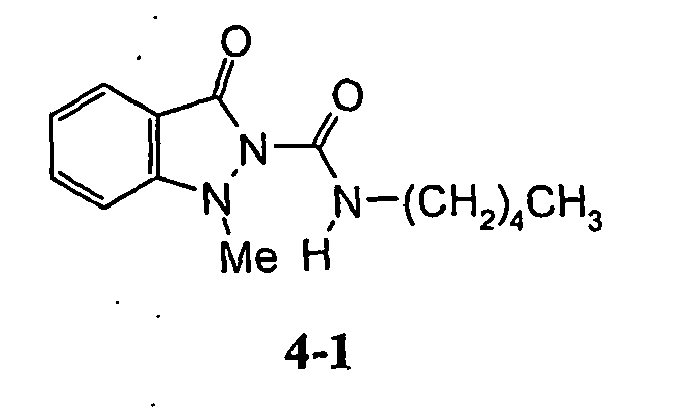
- Methyl iodide (0.426 mL, 7.15 mmol) is added to a stirred suspension of 3-oxo-1,3-dihydro-indazole-2-carboxylic acid pentylamide 3-2 (70.9 mg, 0.287 mmol) and anhydrous K2CO3 (39.6 mg, 0.287 mmol) in anhydrous THF (3 mL) at ambient temperature under nitrogen. The resultant mixture is stirred for 24 hours. Ethyl acetate (30 mL) and half-saturated aquous NaCl solution (10 mL) are added to the mixture. The organic layer is separated, dried over MgSO4, filtered and concentrated. The crude product is chromatographed on silica (gradient 0-3% CH3OH in CH2Cl2) to give the title compound 4-1 as oil (55.0 mg, 73% yield). ESIMS m/e 262 (M+H)+. Analysis for C14H19N3O2: calcd: C, 64.35; H, 7.33; N, 16.08; found: C, 64.17; H, 7.33; N, 16.04.
-

- By following similar procedure as described in Example 8, the title compound 4-2 is obtained as oil. ESIMS m/e 304 (M+H)+. Analysis for C17H25N3O2: calcd: C, 67.30; H, 8.31; N, 13.85; found: C, 67.30; H, 8.40; N, 13.98.
-
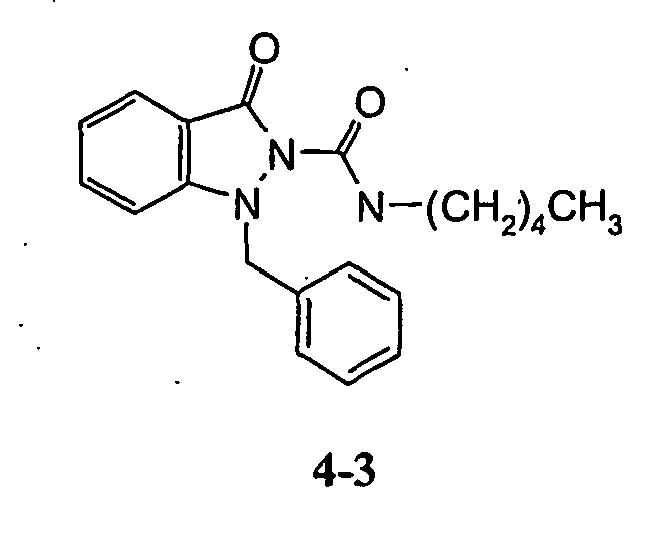
- By following similar procedure as described in Example 8, the title compound 4-3 is obtained as oil (90% yield). ESIMS m/e 338 (M+H)+. Analysis for C20H23N3O2: calcd: C, 71.19; H, 6.87; N, 12.45; found: C, 71.30; H, 6.79; N, 12.59.
-

- By following similar procedure as described in Example 8, the title compound 4-4 is obtained as oil. ESIMS m/e 352 (M+H)+.
-

- By following similar procedure as described in Example 8, the title compound 4-5 is obtained as oil. FDMS m/e 319 (M)+.
-

- Methyl bromoacetate (0.724 mL, 7.65 mmol) is added to a stirred suspension of 3-oxo-1,3-dihydro-indazole-2-carboxylic acid hexylamide 3-3 (200 mg, 0.765 mmol) and anhydrous K2CO3 (159 mg, 1.15 mmol) in anhydrous THF (3 mL) at ambient temperature under nitrogen. The resultant mixture is stirred for 24 hours. Ethyl acetate (30 mL) and half-saturated aqueous NaCl solution (10 mL) are added to the mixture. The organic layer is separated, dried over MgSO4, filtered and concentrated. The crude product is chromatographed on silica (gradient 0-0.25% CH3OH in CH2Cl2) to give the title compound 4-6 as oil (188 mg, 74% yield). ESIMS m/e 334 (M+H)+. Analysis for C17H23N3O4: calcd: C, 61.25; H, 6.95; N, 12.60; found: C, 61.12; H, 6.93; N, 12.64.
-

- By following similar procedure as described in Example 1, the title compound 8-1 (91% yield) is obtained as a white solid. ESIMS m/e 268 (M+H)+. Analysis for C15H13N3O2: calcd: C, 67.41; H, 4.90; N, 15.72; found: C, 67.18; H, 5.05; N, 15.62.
-

- By following similar procedure as described in Example 1, the title compound 8-2 (97% yield) is obtained as a white solid. mp 166.0-168.0 °C; ESIMS m/e 282 (M+H)+. Analysis for C16H15N3O2: calcd: C, 68.31; H, 5.37; N, 14.94; found: C, 67.96; H, 5.22; N, 14.77.
-

- By following similar procedure as described in Example 1, the title compound 8-3 (89% yield) is obtained as a white solid. mp 179.0-180.0 °C; ESIMS m/e 282 (M+H)+. Analysis for C16H15N3O2: calcd: C, 68.31; H, 5.37; N, 14.94; found: C, 68.36; H, 5.48; N, 14.85.
-

- 4-Methylbenzyl amine (125 mg, 1.03 mmol) is added dropwise to a stirred suspension of 3-oxo-1,3-dihydro-indazole-2-carboxylic acid 4-nitro-phenyl ester 2 (308 mg, 1.03 mmol) in anhydrous THF (10 mL) at ambient temperature under nitrogen. The resultant mixture is allowed to stir for 18 hours. After concentration, the crude product is chromatographed on silica (gradient 0-0.5% CH3OH in CH2Cl2) to give the title compound 8-4 (210 mg, 72% yield) as a white solid. ESIMS m/e 282 (M+H)+. Analysis for C16H15N3O2: calcd: C, 68.31; H, 5.37; N, 14.94; found: C, 68.04; H, 5.38; N, 14.86.
-

- By following similar procedure as described in Example 18, the title compound 8-5 is obtained as a white solid. ESIMS m/e 336 (M+H+).
-

-

- To the ice-cold 2-ethyl-benzonitrile 5-1 (2.01 g, 15.3 mmol) in anhydrous THF (20 mL) is slowly added lithium aluminum hydride (IN in THF, 19.2 mL) under nitrogen. The resultant mixture is allowed to stir at ambient temperature for 16 hr. The reaction mixture is cooled at 0 °C and treated dropwise with MeOH (6 mL), then EtOAc (60 mL) and saturated aqueous Rochelle's salt (60 mL) and water (40 mL) are added to the mixture .The resultant two-layered mixture is stirred vigorously under nitrogen for 1 hour. The organic layer is separated, dried over MgSO4, filtered and concentrated to give the title amine 6-1 (2.01 g, crude yield 98%) as light oil. 1H-NMR (CDCl3) δ1.24 (t, J = 7.4 Hz, 3H), 1.54 (br s, 2H), 2.69 (q, J = 7.4 Hz, 2H), 3.89 (s, 2H), 7.19-7.24 (m, 3H), 7.31-7:35 (m, 1H); ESIMS mle 136 (M+H)+.
-

- By following similar procedure as described in Example 18, the title compound 8-6 is obtained as a white solid. ESIMS m/e 294 (M-H)-. Analysis for C17H17N3O2: calcd: C, 69.14; H, 5.80; N, 14.23; found: C, 68.86; H, 5.70; N, 14.25.
-
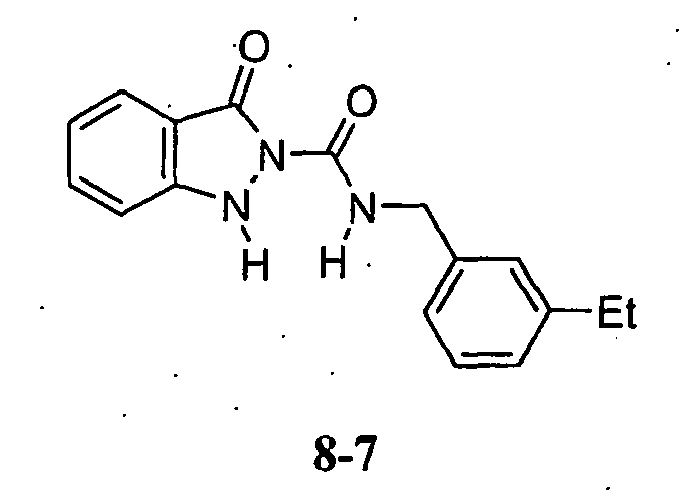
- By following similar procedure as described in Example 20, the title compound 8-7 is obtained as a white solid. ESIMS m/e 296 (M+H)+. Analysis for C17H17N3O2: calcd: C, 69.14; H, 5.80; N, 14.23; found: C, 68.99; H, 5.82; N, 14.21.
-

- By following similar procedure as described in Example 18, the title compound 8-8 is obtained as a white solid. ESIMS m/e 286 (M+H)+.
-

- By following similar procedure as described in Example 18, the title compound 8-9 is obtained as a white solid. ESIMS m/e 302 (M+H, 35Cl)+. Analysis for C15H12ClN3O2: calcd: C, 59.71; H, 4.01; N, 13.93; found: C, 59.40; H, 3.83; N, 13.75.
-

- By following similar procedure as described in Example 18, the title compound 8-10 is obtained as a white solid. mp 186.0-188.0 °C; ESIMS m/e 298 (M+H)+. Analysis for C16H15N3O3: calcd: C, 64.64; H, 5.09; N, 14.13; found: C, 64.35; H, 4.90; N, 14.13.
-
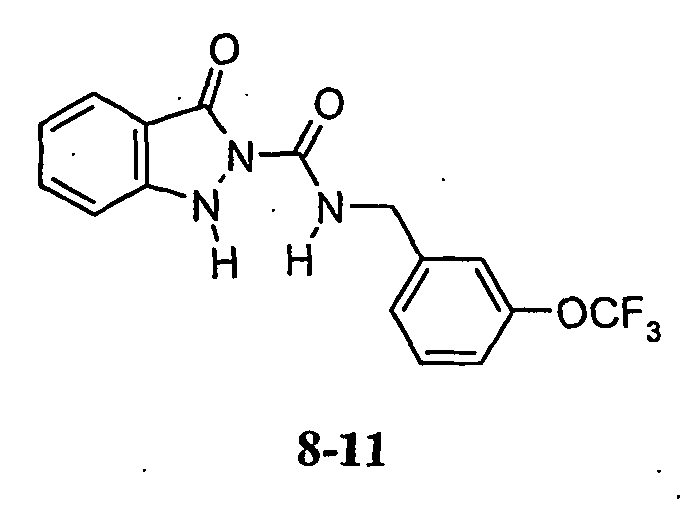
- By following similar procedure as described in Example 18, the title compound 8-11 is obtained as a white solid. ESIMS m/e 350 (M-H)-. Analysis for C16H12F3N3O3: calcd: C, 54.71; H, 3.44; N, 11.96; found: C, 55.00; H, 3.51; N, 11.88.
-

- By following similar procedure as described in Example 18, the title compound 8-12 is.obtained as a white solid. ESIMS m/e 314 (M+H)+. Analysis for C16H15N3O2S: calcd: C, 61.32; H, 4.82; N, 13.41; found: C, 61.02; H, 4.75; N, 13.31.
-

- By following similar procedure as described in Example 18, the title compound 8-13 is obtained as a white solid. ESIMS m/e 281 (M-H)-. Analysis for C15H14N4O2: calcd: C, 63.82; H, 5.00; N, 19.85; found: C, 63.47; H, 5.02; N, 19.58.
-

- By following similar procedure as described in Example 18, the title compound 8-14 is obtained as a white solid. ESIMS m/e 309 (M-H)-. Analysis for C17H18N4O2: calcd: C, 65.79; H, 5.85; N, 18.05; found: C, 65.50; H, 5.85; N, 18.01.
-

- By following similar procedure as described in Example 18, the title compound 8-15 is obtained as a white solid. ESIMS m/e 342 (M-H)-. Analysis for C21H17N3O2: calcd: C, 73.45; H, 4.99; N, 12.24; found: C, 73.07; H, 4.82; N, 12.09.
-


- By following similar procedure as described in Example 18, title compound 8-16 is obtained as a white solid. ESIMS m/e 316 (M-H)-.
-

- By following similar procedure as described in Example 18, the title compound 8-17 is obtained as a white solid. ESIMS m/e 330 (M-H)-. Analysis for C20H17N3O2: calcd: C, 72.49; H, 5.17; N, 12.68; found: C, 72.23; H, 5.10; N, 12.33.
-
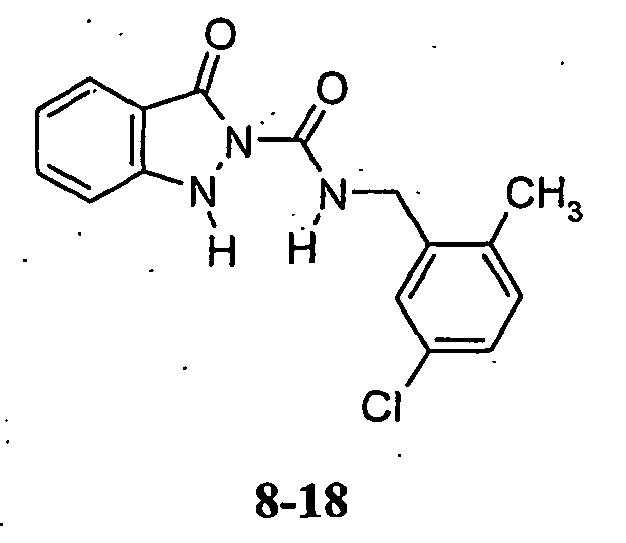
- By following similar procedure as described in Example 20, the title compound 8-18 is obtained as a white solid. ESIMS m/e 316 [(M+H)+, 35Cl], 318 [(M+H)+, 37Cl]. Analysis for C16H14ClN3O2: calcd: C, 60.86; H, 4.47; N, 13.31; found: C, 60.73; H, 4.49; N,13.21.
-

-

- CuCN (7.80 g, 87.2 mmol) is added to a stirred anhydrous DMSO (70 mL) at 60 °C to form a clear solution, and then followed by the addition of t-BuNO2 (24.0 mL, 202 mmol) all at once. A solution of 2-isopropyl-6-methylaniline (10.0 g, 67.0 mmol) in anhydrous DMSO (30 mL) is added dropwise, via an addition funnel, to the mixture. After the addition is complete, the reaction mixture is allowed to stir for 1 hour. After being cooled to 45 °C, the mixture is slowly treated with 5N HCl (100 mL). Five minutes later, the reaction mixture is cooled to ambient temperature before it is extracted with EtOAc/hexane (1:1; 500x2 mL). The combined organic layers are washed with water (100 mL) and brine (100 mL), dried, concentrated in vacuo, then chromatographed on silica (0-5% EtOAc in hexane) to give 8.43 g of the crude nitrile 5-2. IR(CHCl3) 2220 cm-1; 1H-NMR (CDCl3) δ1.30 (d, J = 6.9 Hz, 6H), 2.54 (s, 3H), 3.38 (h, J = 6.9 Hz, 1H), 7.13 (d, J = 7.8 Hz, 1H), 7.20 (d, J = 7.8 Hz, 1H), 7.41 (t, J = 7.8 Hz, 1H); ESIMS m/e 160 (M+H)+.
-

- To the crude ice-cold nitrile 5-2 (7.74 g, 48.6 mmol) in anhydrous Et2O (70 mL) is slowly added lithium aluminum hydride (IN in Et2O, 97.2 mL) under nitrogen. The resultant mixture is allowed to stir at ambient temperature for 16 hours. Then the reaction mixture is cooled at 0 °C and quenched with MeOH until the gas evolution stops. EtOAc (500 mL) and saturated aqueous Rochelle's salt are added and the two-layered mixture is stirred vigorously under nitrogen for 1 hour to give two relatively clear layers. The organic layer is separated, dried over MgSO4, filtered and concentrated, the crude oil is chromatographed on silica [20% EtOAc in hexane, then 1-2% (4.2 M Me3N in EtOH) in CHCl3]. Amine 6-2 (3.78 g, yield 48%) is obtained as a brown oil. IR(CHCl3) 3300(br) cm-1; 1H-NMR (CDCl3) δ 1.16 (d, J = 6.8 Hz, 6H), 1.55 (br s, 2H), 2.33 (s, 3H), 3.28 (h, J = 6.8 Hz, 1H), 3.71 (s, 2H), 6.92-6.95 (m, 1H), 7.03-7.10 (m, 2H); ESIMS m/e 164 (M+H)+.
-

- By following similar procedure as described in Example 18, the title compound 8-19 is obtained as a white solid (64% yield). ESIMS m/e 324 (M+H)+. Analysis for C19H21N3O2: calcd: C, 70.57; H, 6.55; N, 12.99; found: C, 70.72; H, 6.55; N, 12.90.
-

- By following similar procedure as described in Example 18, the title compound 8-20 is obtained as a white solid. ESIMS m/e 336 [(M+H)+, 35Cl, 35Cl], 338 [(M+H)+, 35Cl, 37Cl], 340 [(M+H)+; 37Cl, 37Cl].
-
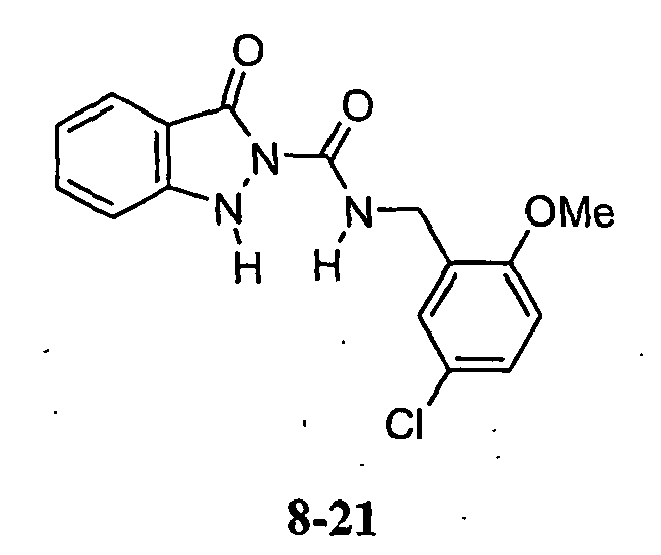
- By following similar procedure as described in Example 20, the title compound 8-21 is obtained as a white solid. ESIMS m/e 332 [(M+H)+, 35Cl], 334 [(M+H)+, 37Cl]. Analysis for C16H14ClN3O3: calcd: C, 57.93; H, 4.25; N, 12.67; found: C, 58.29; H, 4.05; N, 12.52.
-

- By following similar procedure as described in Example 18, the title compound 8-22 is obtained as a white solid (75% yield). ESIMS nile 326 (M-H)-. Analysis for C17H17N3O4: calcd: C, 62.38; H, 5.23; N, 12.84; found: C, 62.64; H, 5.20; N, 12.86.
-

- By following similar procedure as described in Example 18, the title compound 8-23 is obtained as a white solid. ESIMS m/e 300 (M+H)+.
-
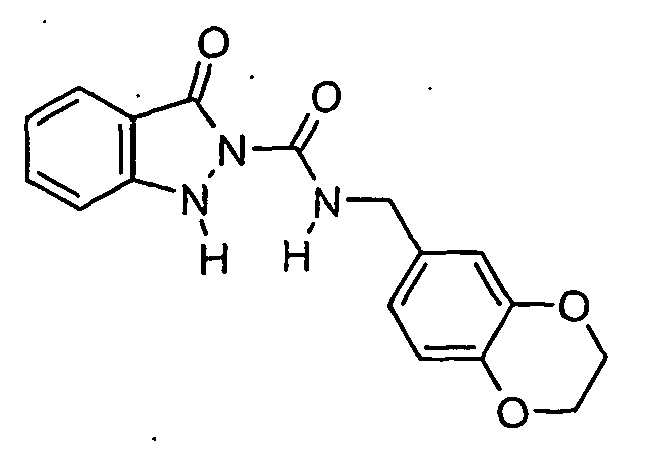

- By following similar procedure as described in Example 18, the title compound 8-24 is obtained as a white solid (73% yield). ESIMS m/e 326 (M+H)+. Analysis for C17H15N3O4: calcd: C, 62.76; H, 4.65; N, 12.92; found: C, 62.79; H, 4.66; N, 12.86.
-

- By following similar procedure as described in Example 20, the title compound 8-25 is obtained as a white solid. ESIMS m/e 310 (M+H)+. Analysis for C18H19N3O2: calcd: C, 69.88; H, 6.19; N, 13.58; found: C, 69.67; H, 6.13; N, 13.53.
-
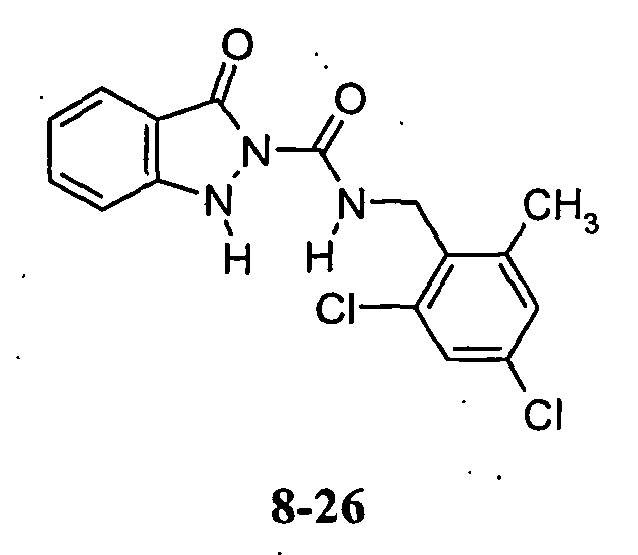
- By following similar procedure as described in Example 18, the title compound 8-26 is obtained as a white solid. FDMS m/e 349 (M+, 35Cl, 35Cl), 351 (M+, 35Cl, 37Cl), 353 (M+, 37Cl, 37Cl). Analysis for C16H13Cl2N3O2: calcd: C, 54.88; H, 3.74; N, 12.00; found: C, 54.50; H, 3.75; N, 11.72.
-

- By following similar procedure as described in Example 18, the title compound 8-27 is obtained as a white solid (78% yield). ESIMS m/e 356 (M-H)-. Analysis for C18H19N3O5: calcd: C, 60.50; H, 5.36; N, 11.76; found: C, 60.48; H, 5.35; N, 11.73.
-

- By following similar procedure as described in Example 18, the title compound 8-28 is obtained as a white solid (76% yield). ESIMS m/e 310 (M+H)+. Analysis for C18H19N3O2: calcd: C, 69.88; H, 6.19; N, 13.58; found: C, 69.93; H, 6.11; N, 13.58.
-
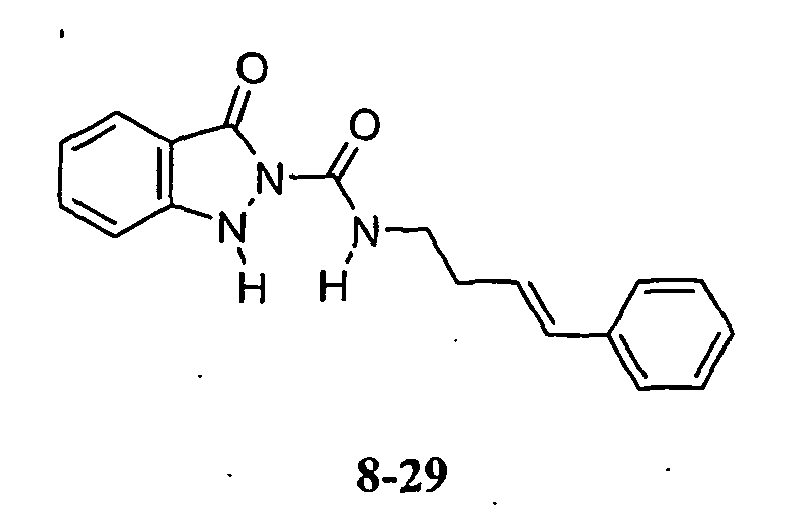
- By following similar procedure as described in Example 18, the title compound 8-29 is obtained as a white solid (56% yield). ESIMS m/e 308 (M+H)+.
-

-

- Concentrated hydrochloric acid (103 mL) is added slowly, in a period of 10 minutes, to a stirred suspension of 2-amino-6-methyl-benzoic acid (5.00 g, 33.1 mmol) in water (56 mL) at -25 °C, then a solution of sodium nitrite (2.29 g, 33.1 mmol) in water (28 mL) is added dropwise to the cold suspension. The clear solution is allowed to stir for 40 min at -25 °C before it is added in small portions to a stirred solution of Tin(II) chloride (37.6 g, 198 mmol) in concentrated hydrochloric acid (84 mL) at -35 °C. The resultant mixture is stirred for 30 minutes at -30 °C, then allowed to warm to ambient temperature where it is stirred for another 16 hours. The mixture is filtered and the white solid is washed with cold THF (200 mL) and vacuum dried to give the title compound 9-1 (2.68 g, yield 55%) as a white solid. FDMS mle 148 (M)+.
-

- 1-Isocyanatomethyl-2-methyl-benzene (0.191 mL, 1.30 mmol) is added dropwise to a stirred suspension of 4-methyl-1,2-dihydro-indazol-3-one 9-1 (200 mg, 1.35 mmol) in anhydrous THF (10 mL) at ambient temperature under nitrogen, and the resultant mixture is allowed to stir for 1 hour. After concentration and subsequent chromatography on silica (gradient 0-0.5% CH3OH in CH2Cl2), the title compound 10-1 (119 mg, 31% yield) is obtained as a white solid. ESIMS m/e 296 (M+H)+.
-
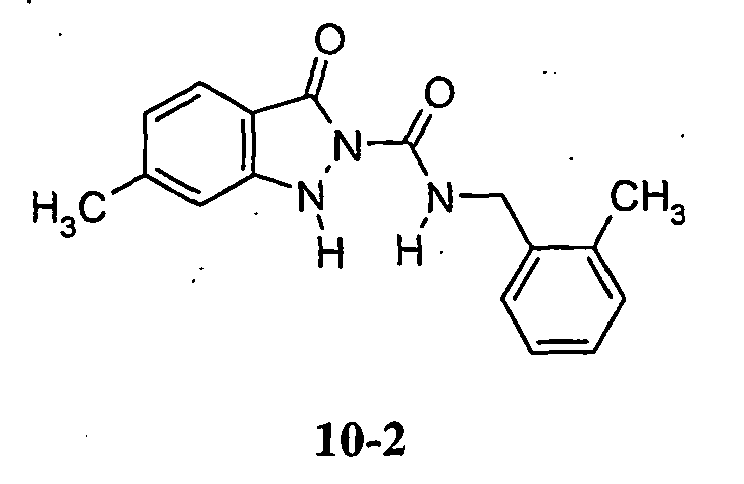
-

- Concentrated hydrochloric acid (42 mL) is added slowly, in a period of 10 minutes, to a stirred suspension of 2-amino-4-methyl-benzoic acid (2.00 g, 13.2 mmol) in water (25 mL) at -25 °C, then a solution of sodium nitrite (0.912 g, 13.2 mmol) in water (11 mL) is added dropwise to the cold suspension. The clear solution is allowed to stir for 40 min at -25 °C before it is added in small portions to a stirred solution of Tin (II) chloride (15.0 g, 79.1 mmol) in concentrated hydrochloric acid (34 mL) at -35 °C. The resultant mixture is stirred for 30 minutes at -30 °C, then allowed to warm to ambient temperature where it is stirred for another 16 hours. The mixture is filtered and the white solid is washed with cold THF and vacuum dried to give a mixture of 2-hydrazino-4-methyl-benzoic acid and the title compound 9-2 (2.56 g). The white solid (2.48 g) is dissolved in methanol (150 mL) and the solution is heated to reflux under nitrogen for 2 days to give 2.33 g of the title compounds 9-2 (100% crude yield).
-

- By following similar procedure as described in part B of Example 44, the title compound 10-2 is obtained as a white solid (39% yield). mp 235 °C (dec); ESIMS m/e 296 (M+H)+.
-

-

- Concentrated hydrochloric acid (55 mL) is added slowly, in a period of 10 minutes, to a stirred suspension of 2-amino-6-chloro-benzoic acid (3.00 g, 17.2 mmol) in water (30 mL) at 0 °C. The resultant mixture is cooled to -30 °C before it is treated dropwise with a solution of sodium nitrite (1.19 g, 17.2 mmol) in water (15 mL). The clear solution is allowed to stir for 40 min at -25 °C before it is added in small portions to a stirred solution of Tin(II) chloride (19.5 g, 103 mmol) in concentrated hydrochloric acid (44 mL) at -35 °C. The resultant mixture is stirred for 30 minutes at -30 °C, then allowed to warm to ambient temperature where it is stirred for another 16 hours. The mixture is filtered and the white solid is washed with a small amount of cold THF and vacuum dried to give 2.82 g of the title compounds 9-2 (97% crude yield). ESIMS m/e 169 [(M+H)+, 35Cl], 171 [(M+H)+, 37Cl].
-

- By following similar procedure as described in part B of Example 44, the title compound 10-3 is obtained as a white solid (48% yield). ESIMS m/e 314 [(M-H)-, 35Cl], 316 [(M-H)-, 37Cl].
-

-

- By following similar procedure as described in part A of Example 45, the title compound 9-4 is obtained as a solid (70% crude yield). 1H-NMR (DMSO-d6) □ 7.25 (d, J = 8.3 Hz, 1H), 7.30 (d, J = 8.3 Hz, 1H), 7.65 (s, 1H), 8.69 (br s, 2H).
-

- By following similar procedure as described in part B of Example 44, the title compound 10-4 is obtained as a white solid (51% yield). ESIMS m/e 316 [(M+H)+, 35Cl], 318 [(M+H)+, 37Cl]. Analysis for C16H14ClN3O2: calcd: C, 60.86; H, 4.47;N, 13.31; found: C, 60.74; H, 4.46; N, 13.16.
-

-

- By following similar procedure as described in part A of Example 45, the title compound 9-5 is obtained as a solid (94% crude yield). 1H-NMR (DMSO-d6) δ6.95 (d, J = 8.3 Hz, 1H), 7.33 (s, 1H), 7.61 (d, J = 8.3 Hz, 1H), 8.50 (br s, 2H).
-

- By following similar procedure as described in part B of Example 44, the title compound 10-5 is obtained as a white solid (44% yield). 1H-NMR (DMSO-d6) □ 2.31 (s, 3H), 4.52 (d, J = 5.3 Hz, 2H), 7.11-7.31 (m, 6H), 7.75 (d, J = 8.3 Hz, 1H), 8.98 (t, J = 5.3 Hz, 1H), 11.62 (s, 1H).
-

-

- By following similar procedure as described in part A of Example 45, the title compound 9-6 is obtained as a solid. 1H-NMR (DMSO-d6) δ3.87 (s, 3H), 7.16 (t, J = 7.8 Hz, 1H), 7.32 (d, J = 7.8 Hz, 1H), 7.53 (d, J = 7.8 Hz, 1H), 9.03 (s, 1H), 9.74 (br s, 1H).
-

- By following similar procedure as described in part B of Example 44, the title compound 10-6 is obtained as a white solid. ESIMS m/e 312 (M+H)+.
-

-

- By following similar procedure as described in part A of Example 45, the title compound 9-7 is obtained as a solid (94% crude yield).
-

- By following similar procedure as described in part B of Example 44, the title compound 10-7 is obtained as a white solid. 1H-NMR (DMSO-d6) δ2.31 (s, 3H), 4.51 (d, J = 5.9 Hz, 2H), 6.95 (s, 1H), 7.13-7.19 (m, 5H), 7.24-7.27 (m, 1H), 9.07 (t, J = 5.9 Hz, 1H), 9.52 (s, 1H), 10.59 (s, 1H).
-

- By following similar procedure as described in part B of Example 44, the title compound 10-8 is obtained as an orange solid (62% yield). ESIMS m/e 325 (M-H)-; Analysis for C16H14N4O4·2H2O: calcd: C, 58.25; H, 4.40; N, 16.98; found: C, 58.45; H, 4.27; N, 16.79.
-

-

- Concentrated hydrochloric acid (220 mL) is added slowly, in a period of 10 minutes, to a stirred suspension of 3-amino-phthalic acid hydrochloride (15.3 g, 70.3 mmol) in water (80 mL) at -10 °C. The resultant cold mixture is treated dropwise with a solution of sodium nitrite (4.86 g, 70.3 mmol) in water (60 mL). The clear solution is allowed to stir for 1 hour at -10 °C before it is added in small portions, for a period of 15 minutes, to a stirred solution of Tin(II) chloride (79.8 g, 420 mmol) in concentrated hydrochloric acid (179 mL) at -10 °C. The resultant mixture is stirred for 30 minutes at - 10 °C, then allowed to warm up to ambient temperature where it is stirred for another 16 hours. After filtration and vacuum drying, 11.0 g of the title compounds 11-1 (88% yield) is obtained as a white solid. mp >250 °C; ESIMS m/e 179 (M+H)+; 1H-NMR (DMSO-d6) δ7.49 (dd, J = 8.3 and 7.3 Hz, 1H), 7.61 (d, J = 8.3 Hz, 1H), 7.70 (d, J = 7.3 Hz, 1H), 12.14 (br s, 1H).
-

- 1-Isocyanatomethyl-2-methyl-benzene (0.095 mL, 0.68 mmol) is added dropwise to a stirred suspension of 3-oxo-2,3-dihydro-1H-indazole-4-carboxylic acid 11-1 (121 mg, 0.681 mmol) in anhydrous THF (10 mL) at ambient temperature under nitrogen, and the resultant mixture is allowed to stir for 16 hours. After concentration and subsequent chromatography on silica (0.1% HOAc and 0.5% CH3OH in CHCl3), the title compound 12-1 (85.4 mg, 39% yield) is obtained as a white solid. mp >250 °C; ESIMS m/e 326 (M+H)+. Analysis for C17H15N3O4: calcd: C, 62.76; H, 4.65; N, 12.92; found: C, 62.38; H, 4.35; N, 12.68.
-

-

- Concentrated hydrochloric acid (30 mL) is added slowly to a stirred suspension of 4-amino-isophthalic acid (0.855 g, 4.71 mmol) in water (45 mL)/THF (5 mL) at -10 °C. The resultant cold mixture is treated dropwise with a solution of sodium nitrite (0.325 g, 4.71 mmol) in water (5 mL). The clear solution is allowed to stir for 2 hours at -10 °C before it is added in small portions, for a period of 10 minutes, to a stirred solution of Tin(II) chloride (5.33 g, 28.1 mmol) in concentrated hydrochloric acid (12 mL) at -10 °C. The resultant mixture is stirred for 30 minutes at -10 °C, then allowed to warm up to ambient temperature where it is stirred for another 1 hour. After filtration and vacuum drying, the white solid is dissolved in DMF (20 mL) and the solution is heated at 120 °C for 2 hours. The mixture is then concentrated to a 5 mL solution at 50 °C under vacuum and diluted with xylene to form a white suspension. After filtration and vacuum drying, 803 mg of the title compounds 11-2 (96% yield) is obtained as a white solid. mp >250 °C; ESIMS m/e 179 (M+H)+; 1H-NMR (DMSO-d6) δ7.31 (d, J = 8.8 Hz, 1H), 7.83 (d, J = 8.8 Hz, 1H), 8.31 (s, 1H), 8.47 (br s, 1H), 11.92 (br s, 1H).
-
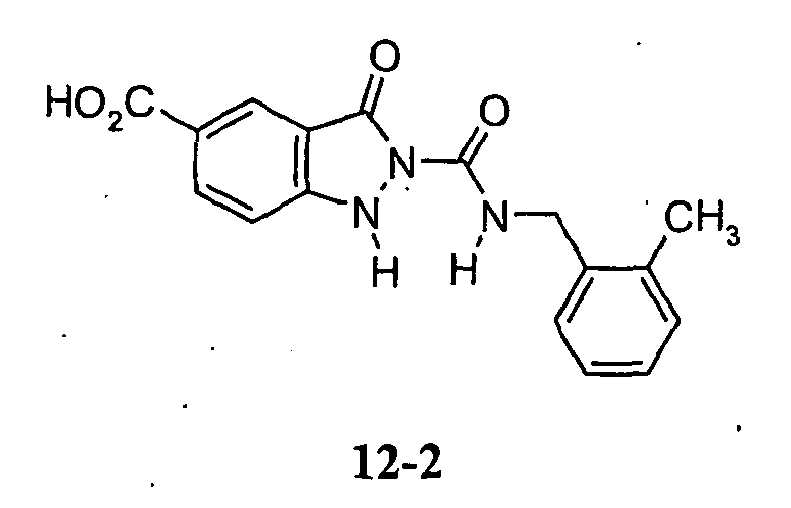
- By following similar procedure as described in part B of Example 52, the title compound 12-2 is obtained as a white solid (25% yield). mp >250 °C; ESIMS m/e 326 (M+H)+.
-

- By following similar procedure as described in Example 53, the title compound 12-3 is obtained as a white solid. mp >25.0 °C; 1H-NMR (DMSO-d6) δ2.32 (s, 3H), 4.54 (d, J = 5.9 Hz, 2H), 7.15-7.19 (m, 3H), 7.27-7.29 (m, 1H), 7.61 (d, J = 8.3 Hz, 1H), 7.79 (s, 1H), 7.83 (d, J = 8.3 Hz, 1H), 9.06 (t, J = 5.9 Hz, 1H), 11.65 (br s, 1H).
-

-

- By following similar procedure as described in Part A of Example 52, the title compound 11-4 is obtained as a white solid (94% crude yield). mp >250 °C; 1H-NMR (DMSO-d6) δ7.07 (t, J = 7.4 Hz, 1H), 7.90 (d, J = 7.4 Hz, 2H), 11.58 (br s, 1H).
-

- By following similar procedure as described in Part B of Example 52, the title compound 12-4 is obtained as a white solid (50% yield). mp >25.0 °C; ESIMS m/e 326 (M+H)+.
-

-

- A solution of 2-trifluoromethyl-benzylamine (1.00 g, 5.71 mmol) and proton sponge (2.45 g, 11.4 mmol) in anhydrous CH2Cl2 (10 mL) is added dropwise to a stirred solution of triphosgene (678 mg, 2.28 mmol) in anhydrous CH2Cl2 (10 mL) at 0 °C. The resultant solution is allowed to stir at ambient temperature for 15 minutes. After dilution with CH2Cl2 (20 mL), the mixture is washed with 1N HCl (15x2 mL) and water (15 mL). The organic layer is dried over Na2SO4, filtered and concentrated to give the desired isocyanate 7-1 (1.07 g, 93% crude yield) as oil. 1H-NMR (CDCl3) δ4.02 (s, 2H), 7.35 (t, J = 7.5 Hz, 1H), 7.52-7.60 (m, 2H), 7.63 (d, J = 8.1 Hz, 1H).
-

- A solution of 1-isocyanatomethyl-2-trifluoromethyl-benzene 7-1 (1.07 g, 5.32 mmol) in anhydrous DMF (5 mL) is added to a stirred suspension of 3-oxo-2,3-dihydro-1H-indazole-7-carboxylic acid 11-4 (700 mg, 3.93 mmol) in anhydrous DMF (15 mL) at ambient temperature under nitrogen. The resultant solution is allowed to stir for 2 hours. Then the solution is treated dropwise with 0.5N HCl solution (20 mL) to form a white suspension. After filtration and vacuum drying at 50 °C, 855 mg of the title compound 12-5 is obtained as a white solid (57% yield). ESIMS m/e 380 (M+H)+.
-

-

- By following similar procedure as described in Part A of Example 56, the title compound 7-2 is synthesized from 5-fluoro-2-methyl-benzylamine as oil and used for the subsequent reaction.
-

- A solution of 4-fluoro-2-isocyanatomethyl-1-methyl-benzene 7-2 (313 mg, 1.89 mmol) in anhydrous DMF (2.5 mL) is added to a stirred solution of 3-oxo-2,3-dihydro-1H-indazole-4-carboxylic acid 11-1 (337 mg, 18.9 mmol) in anhydrous DMF (2.5 mL) at ambient temperature under nitrogen. The resultant solution is allowed to stir for 12 hours. Then the solution is concentrated under vacuum and the crude product is treated with CH 3 OH/CH2Cl2 to from a suspension. The solid is collected by filtration. The solid is then dissolved in DMF and water is added to precipitate out the product. After filtration and vacuum drying at 50 °C, the title compound 12-6 is obtained as a white solid. mp 230 °C (dec). ESIMS m/e 344 (M+H)+. Analysis for C17H14FN3O2·0.2H2O: calcd: C, 58.70; H, 4.20; N, 12.08; found: C, 58.42; H, 3.88; N, 12.33.
-

- By following similar procedure as described in Example 57, the title compound 12-7 is obtained as a white solid. mp >250 °C; ESIMS m/e 344 (M+H)+.
-

-

- By following similar procedure as described in Part A of Example 56, the title compound 7-3 is synthesized from 2,6-dimethyl-benzylamine as oil (83% yield) and used for the subsequent reaction.
-

- By following similar procedure as described in part B of Example 52, the title compound 12-8 is obtained as a solid (27% yield). mp >250 °C; ESIMS m/e 338 (M-H)-.
-

- By following similar procedure as described in part B of Example 52, the title compound 12-9 is obtained as a solid (37% yield). mp >250 °C; ESIMS m/e 340 (M+H)+.
-


-

- 2-Ethyl-6-methyl-benzylamine 6-4 is synthesized by the LiAlH4 reduction of 2-ethyl-6-methyl-benzonitrile according to the procedure described in Part B of Example 33. Then, by following similar procedure as described in Part A of Example 56, the title compound 7-4 is obtained as oil (91% yield) from compound 6-4. 1H-NMR (DMSO-d6) δ1.16 (t, J = 7.6 Hz, 3H), 2.69 (q, J = 7.6 Hz, 2H), 4.52 (s, 2H), 7.08 (d, J = 7.6 Hz, 2H), 7.16 (t, J = 7.6 Hz" 1H).
-

- By following similar procedure as described in part B of Example 52, the title compound 12-10 is obtained as a solid (31% yield). mp >250 °C; ESIMS m/e 354 (M+H)+.
-

- By following similar procedure as described in Example 61, the title compound 12-11 is obtained as a solid. mp >250 °C; ESIMS m/e 354 (M+H)+.
-

- By following similar procedure as described in Example 61, the title compound 12-12 is obtained as a solid. mp >250 °C; ESIMS m/e 354 (M+H)+.
-

- By following similar procedure as described in Example 61, the title compound 12-13 is obtained as a solid (39% yield). mp >250 °C; ESIMS m/e 354 (M+H)+. Analysis for C19H19N3O4: calcd: C, 64.58; H, 5.42; N, 11.89; found: C, 64.36; H, 5.39; N, 11.81.
-

-

- By following similar procedure as described in Part A of Example 56, the title compound 7-5 is obtained from 2-isopropyl-6-methyl-benzylamine 6-2 as oil (99% yield). 1H-NMR (DMSO-d6) δ1.18 (d, J = 6.9 Hz, 6H), 2.35 (s, 3H), 3.24 (h, J = 6.9 Hz, 1H), 4.55 (s, 2H), 7.03-7.06 (m, 1H), 7.17-7.23 (m, 2H).
-

- By following similar procedure as described in Part B of Example 52, the title compound 12-14 is obtained as a solid (69% yield). ESIMS m/e 368 (M+H)+.
-

- 2-Isocyanatomethyl-1-isopropyl-3-methyl-benzene 7-5 (4.12 g, 21.8 mmol) is added to a stirred suspension of 3-oxo-2,3-dihydro-1H-indazole-7-carboxylic acid 11-4 (2.58 g, 14.5 mmol) in anhydrous DMF (90 mL) at ambient temperature under nitrogen and the resultant clear solution is allowed to stir for 1.5 hours. The solution is treated in small portions with 1N HCl (25 mL) to form a suspension, then followed by the addition of water (100 mL). The white solid is collected by filtration and dried at 50 °C in vacuum oven. A total of 4.69 g of the title compound 12-15 is obtained (88% yield). ESIMS m/e 368 (M+H)+. Analysis for C20H21N3O4: calcd: C, 65.38; H, 5.76; N, 11.44; found: C, 64.99; H, 5.87; N, 11.25.
-

-

- 2-tert-Butyl-6-methyl-benzylamine 6-5 is synthesized from 2-tert-butyl-6-methyl-benzobromide according to the procedure described in Part A and B of Example 33. Then, by following similar procedure as described in Part A of Example 56, the title compound 7-6 is obtained as oil from compound 6-5 (90% yield) and used for the subsequent reaction.
-

- By following similar procedure as described in Example 66, the title compound 12-16 is obtained as solid (85% yield). ESIMS m/e 382 (M+H)+.
-

-

- 4-Butyl-2-methyl-benzylamine 6-6 is synthesized from 4-butyl-2-methyl-benzonitrile according to the procedure described in Part B of Example 33. Then, by following similar procedure as described in Part A of Example 56, the title compound 7-7 is obtained as oil from compound 6-6 (88% yield) and used for the subsequent reaction.
-

- 4-Butyl-1-isocyanatomethyl-2-methyl-benzene 7-7 (0.146 mL, 0.842 mmol) is added to a stirred suspension of 3-oxo-2,3-dihydro-1H-indazole-7-carboxylic acid 11-1 (150 mg, 0.842 mmol) in anhydrous DMF (5 mL) at ambient temperature under nitrogen and the resultant mixture is allowed to stir for 16 hours. After concentration the wet solid is suspended in CHCl3 before it is collected by filtration to recover 45 mg of starting 11-1. The filtrate is concentrated and chromatographed on silica (0.1 % HOAc and 0.5% CH3OH in CHCl3) to give 36.6 mg of the title compound 12-17 as a yellowish solid (11% yield). mp 173.0-175.0 °C; ESIMS mle 382 (M+H)+. Analysis for C21H23N3O4: calcd: C, 66.13; H, 6.08; N, 11.02; found: C, 65.87; H, 5.80; N, 10.85.
-

-

- 2,6-Diethyl-benzylamine 6-7 is synthesized from 2-bromo-1,3-diethyl-benzene according to the procedure described in Part A and B of Example 33. Then, by following similar procedure as described in Part A of Example 56, the title compound 7-8 is obtained as oil from compound 6-7 (100% yield). 1H-NMR (DMSO-d6) δ1.16 (t, J = 7.8 Hz, 6H), 2.68 (q, J = 7.8 Hz, 4H), 4.54 (s, 2H), 7.08 (d, J = 7.4 Hz" 2H), 7.21 (t, J = 7.4 Hz, 1H).
-

- By following similar procedure as described in Part B of Example 68, the title compound 12-18 is obtained as a white solid (57% yield). mp >250 °C; ESIMS m/e 368 (M+H)+. Analysis for C20H21N3O4: calcd: C, 65.38; H, 5.76; N, 11.44; found: C, 65.18; H, 5.76; N, 11.32.
-

- By following similar procedure as described in Example 69, the title compound 12-19 is obtained as a white solid (42% yield). mp >250 °C; ESIMS m/e 368 (M+H)+. Analysis for C20H21N3O4: calcd: C, 65.38; H, 5.76; N, 11.44; found: C, 65.55; H, 5.86; N, 11.47.
-


-

- 2,6-Diisopropyl-benzylamine 6-8 is synthesized from 2-bromo-1,3-diisopropylbenzene according to the procedure described in Part A and B of Example 33. Then, by following similar procedure as described in Part A of Example 56, the title compound 7-9 is obtained as oil from compound 6-8 (87% yield). 1H-NMR (DMSO-d6) δ1.18 (d, J = 6.8 Hz, 12H), 3.23 (h, J = 6.8 Hz, 2H), 4.57 (s, 2H), 7.18 (d, J = 7.8 Hz,, 2H), 7.28 (t, J = 7.8 Hz, 1H).
-

- By following similar procedure as described in Part B of Example 68, the title compound 12-20 is obtained as a yellowish solid (15% yield). ESIMS m/e 396 (M+H)+. Analysis for C22H25N3O4: calcd: C, 66.82; H, 6.37; N, 10.63; found: C, 66.46; H, 6.35; N, 10.60.
-

- By following similar procedure as described in Example 71, the title compound 12-21 is obtained as a white solid (33% yield). mp >250 °C; ESIMS m/e 396 (M+H)+. Analysis for C22H25N3O4: calcd: C, 66.82; H, 6.37; N, 10.63; found: C, 66.51; H, 6.28; N, 10.59.
-

-

- 2,4,6-Trimethyl-benzylamine 6-9 is synthesized from 2-bromo-1,3,5-trimethylbenzene according to the procedure described in Part A and B of Example 33. Then, by following similar procedure as described in Part A of Example 56, the title compound 7-10 is obtained as oil from compound 6-9 (84% yield). 1H-NMR (CDCl3) δ2.27 (s, 3H), 2.37 (s, 6H), 4.40 (s, 2H), 6.88 (s, 2H).
-

- By following similar procedure as described in Part B of Example 68, the title compound 12-22 is obtained as a white solid (45% yield). ESIMS m/e 354 (M+H)+.
-

-

- (4-Methyl-naphthalen-1-yl)-methylamine 6-10 is synthesized from 4-methylnaphthalene-1-carbonitrile according to the procedure described in Part B of Example 33. Then, by following similar procedure as described in Part A of Example 56, the title compound 7-10 is obtained as oil from compound 6-10 (96% yield). 1H-NMR (DMSO-d6) δ2.64 (s, 3H), 5.00 (s, 2H), 7.35 (d, J = 7.0 Hz, 1H), 7.45 (d, J= 7.0 Hz, 1H), 7.59-7.63 (m, 2H), 8.05-8.08 (m, 2H).
-

- By following similar procedure as described in Part B of Example 68, the title compound 12-23 is obtained as a yellowish solid (24% yield). ESIMS m/e 376 (M+H)+.
-

-

- By following similar procedure as described in Part A of Example 56, the title compound 7-12 is synthesized from 4-phenyl-butylamine as oil (81% yield) and used for the subsequent reaction.
-

- By following similar procedure as described in Part B of Example 68, the title compound 12-24 is obtained as a white solid (34% yield). mp >250 °C; ESIMS m/e 354 (M+H)+. Analysis for C19H19N3O4: calcd: C, 64.58; H, 5.42; N, 11.89; found: C, 64.42; H, 5.42; N, 11.88.
-

-

- 4-Cyclohexyl-butylamine is synthesized from 4-cyclohexyl-butyronitrile according to the procedure described in Part B of Example 33. Then, by following similar procedure as described in Part A of Example 56, 4-cyclohexyl-butylamine is converted to the title compound 7-13 as oil (91 % yield) and used for the subsequent reaction.
-

- By following similar procedure as described in Part B of Example 68, the title compound 12-25 is obtained as a white solid. mp 196.0-198.0 °C; ESIMS m/e 360 (M+H)+. Analysis for C19H25N3O4·0.1H2O: calcd: C, 63.18; H, 7.03; N, 11.63; found: C, 62.96; H, 6.93; N, 11.45.
-

-

- By following similar procedure as described in Part A of Example 56, the title compound 7-14 is synthesized from 3-phenoxy-propylamine as oil (95% yield) and used for the subsequent reaction.
-

- By following similar procedure as described in Part B of Example 68, the title compound 12-26 is obtained as a white solid. mp 206.0-208.0 °C; ESIMS m/e 356 (M+H)+.
-

- By following similar procedure as described in Part B of Example 52, the title compound 12-27 is obtained as a white solid (40% yield). mp >250 °C; ESIMS m/e 304 (M-H)-.
-

-

- A solution of diphenyldiazomethane (646 mg, 3.32 mmol) in CH2Cl2 (10 mL) is added dropwise to a stirred suspension of 2-(2-ethyl-6-methyl-benzylcarbamoyl)-3-oxo-2,3-dihydro-1H-indazole-7-carboxylic acid 12-13 (1.12 g, 3.17 mmol) in CH2Cl2 (30 mL) at ambient temperature. The resultant mixture is allowed to stir for 1 hour. The clear solution is concentrated and the crude product is chromatographed on silica (gradient 0-0.5% CH3OH in CHCl3) to give 1.38 g of the title compound 13 (84% yield) as white foam. ESIMS m/e 520 (M+H)+. Analysis for C32H29N3O4: calcd: C, 73.97; H, 5.63; N, 8.09; found: C, 74.28; H, 5.90; N, 7.95.
-

- (Trimethylsilyl)diazomethane (0.42 mL, 2M in hexane) is added dropwise to a stirred solution of 2-(2-ethyl-6-methyl-benzylcarbamoyl)-3-oxo-2,3-dihydro-1H-indazole-7-carboxylic acid benzhydryl ester 13 (424 mg, 0.816 mmol) in CH3OH (5 mL)/CH2Cl2 (10 mL) at ambient temperature. The resultant solution is allowed to stir for 4 hours. The solution is concentrated and the crude product is chromatographed on silica (gradient 1-20% EtOAc in hexane) to give 309 mg of the title compound 14-1 (71% yield) as white foam. ESIMS m/e 534 (M+H)+. Analysis for C33H31N3O4: calcd: C, 74.28; H, 5.86; N, 7.87; found: C, 73.89; H, 5.74; N, 7.65.
-

- Hydrogen chloride gas is bubbled slowly through a stirred solution of 2-(2-ethyl-6-methyl-benzylcarbamoyl)-1-methyl-3-oxo-2,3-dihydro-1H-indazole-7-carboxylic acrid benzhydryl ester 14-1 (280 mg, 0.525 mmol) in CH2Cl2 (25 mL) at ambient temperature for a few minutes and the resultant solution is allowed to stir for 1 hour. After concentration, the crude product is chromatographed on silica (gradient 0.1/0.5/99.4 to 0.5/1/98.5 HOAc/CH3OH/CHCl3) to give 135 mg of the title compound 15-1 (70% yield) as a white solid. mp >250 °C; ESIMS m/e 368 (M+H)+.
-

-

- Ethyl iodide (0.52 mL, 6.5 mmol) and potassium carbonate (44 mg, 0.32 mmol) are added successively to a stirred solution of 2-(2-ethyl-6-methyl-benzylcarbamoyl)-3-oxo-2,3-dihydro-1H-indazole-7-carboxylic acid benzhydryl ester 13 (83.6 mg, 0.161 mmol) in anhydrous DMF (4 mL) at ambient temperature under nitrogen. The resultant mixture is allowed to stir for 3 hours. Xylene (5 mL) is added to the mixture. After filtration and subsequent concentration in vacuo, the crude product is chromatographed on silica (gradient 1-20% EtOAc in hexane) to give 67.8 mg of the title compound 14-2 (77% yield) as white foam. ESIMS m/e 548 (M+H)+.
-

- By following similar procedure as described in Part C of Example 79, the title compound 15-2 is obtained as a white solid (55% yield). mp >250 °C; ESIMS m/e 382 (M+H)+.
-

- By following similar procedure as described in Example 80, the title compound 15-3 is obtained as a white solid (56% yield). mp >250 °C; ESIMS m/e 396 (M+H)+. Analysis for C22H25N3O4·0.2H2O: calcd: C, 66.22; H, 6.42; N, 10.53; found: C, 66.04; H, 6.36; N, 10.45.
-

-

- tert-Butyl bromoacetate (0.89 mL, 5.8 mmol) and potassium carbonate (0.24 g, 1.7 mmol) are added successively to a stirred solution of 2-(2-ethyl-6-methyl-benzylcarbamoyl)-3-oxo-2,3-dihydro-1H-indazole-7-carboxylic acid benzhydryl ester 13 (0.30 g, 0.58 mmol) in anhydrous DMF (8 mL) at ambient temperature under nitrogen. The resultant mixture is allowed to stir for 1 hour. Xylene (10 mL) is added to the mixture. After filtration and subsequent concentration in vacuo, the crude product is chromatographed on silica (gradient 1-20% EtOAc in hexane) to give 278 mg of the title compound 14-4 (76% yield) as white foam. ESIMS m/e 634 (M+H)+. Analysis for C38H39N3O6·0.2H2O: calcd: C, 71.61; H, 6.23; N, 6.59; found: C, 71.48; H, 6.21; N, 6.62
-

- By following similar procedure as described in Part C of Example 79, the title compound 15-4 is obtained as a white solid (68% yield). mp 172.0-174.0 °C; ESIMS m/e 412 (M+H)+. Analysis for C21H21N3O6·0.2H2O: calcd; C, 60.78; H, 5.20; N, 10.12; found: C, 60.51; H, 4.84; N, 9.88.
-
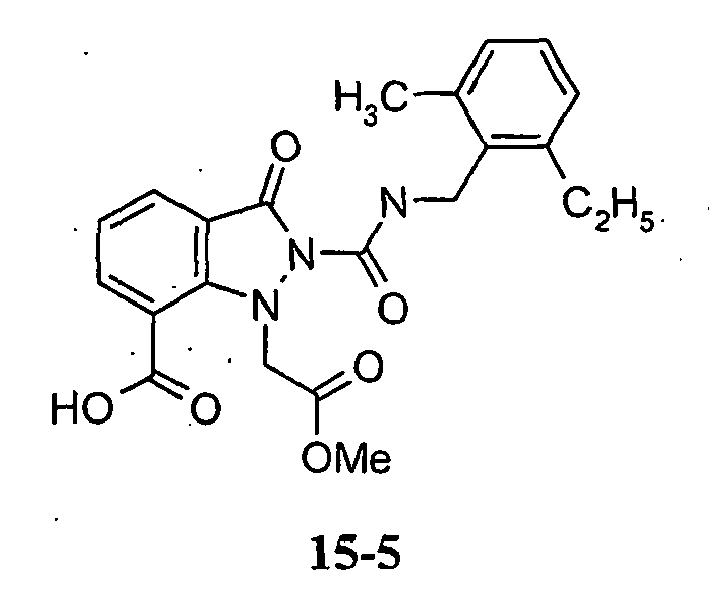
- By following similar procedure as described in Example 82, the title compound 15-5 is obtained as a white solid. mp 220.0-222.0 °C; ESIMS m/e 426 (M+H)+.
-

-

- By following similar procedure as described in Part A of Example 79, the title compound 16 is obtained as a white solid (88% yield). ESIMS m/e 532 (M-H)-. Analysis for C33H31N3O4·0.2C6H14: calcd: C, 74.57; H, 6.18; N, 7.63; found: C, 74.96; H, 5.78; N, 7.64.
-

- By following similar procedure as described in Part B of Example 79, the title compound 17-1 is obtained as white foam (79% yield). ESIMS m/e 548 (M+H)+. Analysis for C34H33N3O4: calcd: C, 74.57; H, 6.07; N, 7.67; found: C, 74.78; H, 6.19; N, 7.65.
-

- By following similar procedure as described in Part C of Example 79, the title compound 18-1 is obtained as a white solid (97% yield). ESIMS m/e 382 (M+H)+.
-

-

- Ethyl iodide (0.60 mL, 7.5 mmol) and potassium carbonate (104 mg, 0.750 mmol) are added successively to a stirred solution of 2-(2-isopropyl-6-methyl-benzylcarbamoyl)-3-oxo-2,3-dihydro-1H-indazole-7-carboxylic acid benzhydryl ester 16 (200 mg, 0.375 mmol) in anhydrous DMF (4 mL) at ambient temperature under nitrogen. The resultant mixture is allowed to stir for 5 hours. Xylene (5 mL) is added to the mixture. After filtration and subsequent concentration in vacuo, the crude product is chromatographed on silica (gradient 1-15% EtOAc in hexane) to give 167 mg of the title compound 17-2 (79% yield) as white foam. ESIMS m/e 562 (M+H)+. Analysis for C35H35N3O4: calcd: C, 74.84; H, 6.28; N, 7.48; found: C, 74.60; H, 6.14; N, 7.33.
-

- By following similar procedure as described in Part C of Example 79, the title compound 18-2 is obtained as a white solid (79% yield). ESIMS m/e 396 (M+H)+. Analysis for C22H25N3O4·0.2H2O: calcd: C, 66.22; H, 6.42; N, 10.53; found: C, 66.30; H, 6.36; N, 10.41.
-

- By following similar procedure as described in Part A and B of Example 85, the title compound 18-3 is obtained as a white solid (50% total yield). ESIMS m/e 410 (M+H)+.
-

-

- By following similar procedure as described in Part A of Example 85, the title compound 17-4 is obtained as white foam (52% total yield). ESIMS m/e 610 [(M+H)+, 36Cl], 612 [(M+H)+, 37Cl].
-

- Triethylsilane (92.2 □L, 0.576 mmol)) and trifluoroacetic acid (0.222 mL, 2.88 mmol) are added successively to a stirred solution of 1-(3-chloro-propyl)-2-(2-isopropyl-6-methyl-benzylcarbamoyl)-3-oxo-2,3-dihydro-1H-indazole-7-carboxylic acid benzhydryl ester 17-4 (176 mg, 0.288 mmol) in anhydrous CH2Cl2 (3 mL) at ambient temperature under nitrogen. The resultant solution is allowed to stir for 2 hours. After concentration, chromatography on silica [gradient 0-2% HOAc in CH3OH (8)/CH2Cl2 (92)] and subsequent crystallization from CH2Cl2/hexane, 126 mg of the title compound 18-4 is obtained as a white solid (99% yield). ESIMS m/e 444 [(M+H)+, 35Cl], 446 [(M+H)+, 37Cl]. Analysis for C23H26ClN3O4: calcd: C, 62.23; H, 5.90; N, 9.47; found: C, 62.01; H, 5.98; N, 9.39.
-

- By following similar procedure as described in Part A and B of Example 87, the title compound 18-5 is obtained as a white solid (86% total yield). ESIMS m/e 406 (M+H)+. Analysis for C23H23N3O4·0.3H2O: calcd: C, 67.24; H, 5.79; N, 10.23; found: C, 67.21; H, 5.67; N, 10.09.
-

- By following similar procedure as described in Part A and B of Example 87, the title compound 18-6 is obtained as a white solid (96% total yield). ESIMS m/e 408 (M+H)+. Analysis for C23H25N3O4·0.6H2O: calcd: C, 67.24; H, 5.79; N, 10.23; found: C, 67.21; H, 5.67; N, 10.09.
-

- By following similar procedure as described in Part A and B of Example 87, the title compound 18-7 is obtained as a white solid (70% total yield). ESIMS m/e 424 (M+H)+. Analysis for C24H29N3O4: calcd: C, 68.07; H, 6.90; N, 9.92; found: C, 67.85; H, 6.87; N, 9.83.
-

- By following similar procedure as described in Part A and B of Example 87, the title compound 18-8 is obtained as a white solid (77% total yield). ESIMS m/e 407 (M+H)+. Analysis for C22H22N4O4: calcd: C, 65.01; H, 5.46; N, 13.78; found: C, 65.01; H, 5.43; N, 13.71.
-

- By following similar procedure as described in Part A and B of Example 87, the title compound 18-9 is obtained as a white solid (77% total yield). ESIMS m/e 422 (M+H)+. Analysis for C24H27N3O4·0.2H2O: calcd: C, 67.81; H, 6.50; N, 9.88; found: C, 67.97; H, 6.56; N, 9.58.
-

-

- By following similar procedure as described in Part A Example 85, the title compound 17-10 is obtained as white foam (61% yield). Analysis for C39H41N3O6·0.1H2O: calcd: C, 72.11; H, 6.39; N, 6.47; found: C, 71.93; H, 6.18; N, 6.27.
-

- By following similar procedure as described in Part C of Example 79, the title compound 18-10 is obtained as a white solid (37% total yield). ESIMS m/e 424 (M-H)-. Analysis for C22H23N3O6·0.4H2O: calcd: C, 61.08; H, 5.54; N, 9.71; found: C, 60.96; H, 5.37; N, 9.60.
-

- By following similar procedure as described in Part A and B of Example 87, the title compound 18-11 is obtained as a white solid. ESIMS m/e 440 (M+H)+. Analysis for C23H25N3O6: calcd: C, 62.86; H, 5.73; N, 9.56; found: C, 62.91; H, 5.78; N, 9.22.
-

- By following similar procedure as described in Part A and B of Example 87, the title compound 18-12 is obtained as a white solid (55% total yield). ESIMS m/e 425 (M+H)+. Analysis for C22H24N4O5·0.35H2O: calcd: C, 61.34; H, 5.78; N, 13.01; found: C, 60.94; H, 5.38; N, 12.84.
-

- By following similar procedure as described in Part A and B of Example 85, the title compound 18-13 is obtained as a white solid (64% total yield). ESIMS m/e 458 (M+H)+. Analysis for C27H27N3O4: calcd: C, 70.88; H, 5.95; N, 9.18; found: C, 70.53; H, 5.93; N, 9.10.
-
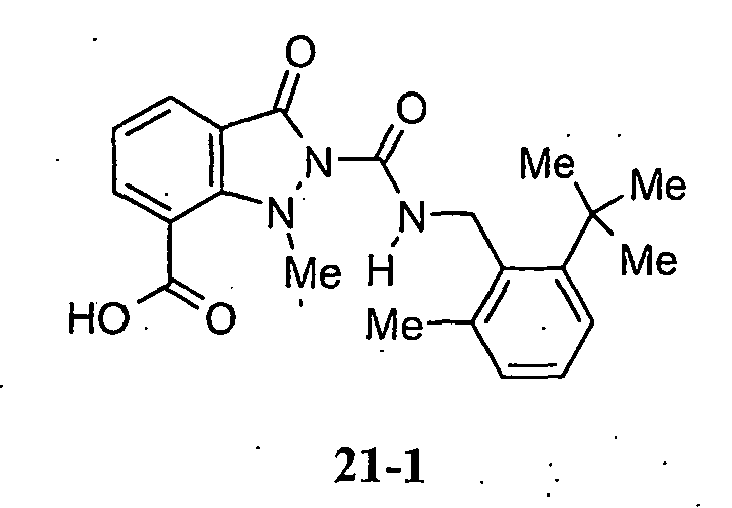
-

- By following similar procedure as described in Part A of Example 79, the title compound 19-1 is synthesized from 12-16 as white foam (52% yield). ESIMS m/e 548 (M+H)+. Analysis for C34H33N3O4: calcd: C, 74.57; H, 6.07; N; 7.67; found: C, 74.20; H, 6.05; N, 7.99.
-

- By following similar procedure as described in Part B of Example 79, the title compound 20-1 is synthesized from 19-1 as white foam (81% yield). ESIMS m/e 562 (M+H)+. Analysis for C35H35N3O4: calcd: C, 74.84; H, 6.28; N, 7.48; found: C, 74.78; H, 6.48; N, 7.26.
-

- By following similar procedure as described in Part C of Example 79, the title compound 21-1 is synthesized from 20-1 as a white solid (73% yield). mp >250 °C; ESIMS m/e 396 (M+H)+. Analysis for C22H25N3O4: calcd: C, 66.82; H, 6.37; N, 10.63; found: C, 66.54; H, 6.38; N, 10.54.
-

- By following similar procedure as described in Part A, B and C of Example 79, the title compound 21-2 is synthesized from 12-19 as a white solid. mp >250 °C; ESIMS m/e 382 (M+H)+.
-

-

- Concentrated HCl (10 mL) is added to a stirred suspension of 3-oxo-2,3-dihydro-1H-indazole-4-carboxylic acid 11-1 (5.02 g, 28.2 mmol) in anhydrous CH3OH (50 mL). The resultant mixture is heated to reflux for 4 hours. The mixture is concentrated and the crude product is chromatographed on silica (gradient 3-10% CH3OH in CHCl3) to give 3.01 g of the title compound 22-1 (55% yield) as a white solid. mp >250 °C; ESIMS m/e 193 (M+H)+. Analysis for C9H8N2O3: calcd: C, 56.25; H, 4.20; N, 14.58; found: C, 56.03; H, 4.10; N, 14.41.
-

- By following similar procedure as described in Example 1, the title compound 23-1 is synthesized from compound 22-1 as a white solid (42% yield). mp 63.0-65.0 °C; ESIMS m/e 320 (M+H)+. Analysis for C16H21N3O4·0.2H2O: calcd: C, 59.50; H, 6.68; N, 13.01; found: C, 59.36; H, 6.37; N, 13.16.
-

-

- Concentrated H2SO4 (1 mL) is added to a stirred suspension of 3-oxo-2,3-dihydro-1H-indazole-4-carboxylic acid 11-1 (6.02 g, 33.8 mmol) in anhydrous allyl alcohol (100 mL). The resultant mixture is heated to reflux for 8 hours. At ambient temperature the mixture is diluted with EtOAc (150 mL) before it is washed with cold water (80 mL x 3). The organic layer is dried over MgSO4, filtered and concentrated. After chromatography on silica (gradient 0-5% CH3OH in CHCl3), 4.10 g of the title compound 22-2 (56% yield) is obtained as a yellowish solid. mp 148.0-150.0 °C; ESIMS m/e 219 (M+H)+. Analysis for C11H10N2O3·0.1H2O: calcd: C, 60.05; H, 4.67; N, 12.73; found: C, 60.08; H, 4.45; N, 12.58.
-

- By following similar procedure as described in Example 1, the title compound 23-2 is synthesized from compound 22-2 as a white solid (67% yield). mp 67.0-69.0 °C; ESTMS m/e 346 (M+H)+.
-

-

- By following similar procedure as described in Part A of Example 100, the title compound 22-3 is synthesized from 3-oxo-2,3-dihydro-1H-indazole-7-carboxylic acid 11-4 as a yellowish solid (48% yield). mp 245.0-246.0 °C; ESIMS m/e 193 (M+H)+.
-

- By following similar procedure as described in Example 1, the title compound 23-3 is synthesized from compound 22-3 as yellowish oil (98% yield). ESIMS m/e 320 (M+H)+. Analysis for C16H21N3O4: calcd: C, 60.18; H, 6.63; N, 13.16; found: C, 60.09; H, 6.57; N, 12.82.
-

- 2-Isocyanatomethyl-1-isopropyl-3-methyl-benzene 7-5 (229 mg, 1.21 mmol) is added to a stirred solution of compound 22-1 (250 mg, 1.21 mmol) in anhydrous DMF (5 mL) at ambient temperature under nitrogen. The resultant mixture is allowed to stir for 3 hours. After concentration and subsequent chromatography on silica (gradient 0-1 % CH3OH in CH2Cl2), 394 mg of the title compound 24-1 is obtained as a yellowish solid (85% yield). ESIMS m/e 382 (M+H)+. Analysis for C21H23N3O4: calcd: C, 66.13; H, 6.08; N, 11.02; found: C, 66.29; H, 6.20; N, 11.00.
-

- By following similar procedure as described in Example 102, the title compound 24-2 is synthesized from compound 22-3 as a yellowish solid (32% yield). ESIMS m/e 382 (M+H)+. Analysis for C21H23N3O4: calcd: C, 66.13; H, 6.08; N, 11.02; found: C, 66.00; H, 6.21; N, 10.89.
Claims (16)
- A dihydro-1H-indazole-5-carboxylic acid derivative compound of formula (I)

R1 is selected from C5-C13alkyl, C1-C12haloalkyl, C4-C12alkenyl, C4-C12lalkynyl, C1-C5alkylC3-C8cycloalkyl, C3-C8cycloalkyl, C1-C5alkylheterocyclic, benzyl and aryl, wherein the cycloalkyl, heterocyclic, benzyl and aryl substituents are optionally substituted with one to three substituents independently selected from C1-C8alkyl, C1-C8haloalkyl, C2-C8alkenyl, C2-C8alkynyl, phenyl, benzyl, hydroxy, C1-C5alkoxy, -(CH2)mCOOC1-C5alkyl, -(CH2)mNRaRb, and C1-C4alkylC3-C8cycloalkyl; wherein Ra and Rb are independently selected from hydrogen, C1-C8alkyl, C2-C8alkenyl, C2-C8alkynyl, and C1-C5alkylC3-C8cycloalkyl;
R3, R4, R5, and R6 are independently selected from hydrogen, C1-C12alkyl, C2-C12haloalkyl, C2-C12alkenyl, C2-C12alkynyl, C2-C12alkylaryl, C1-C12alkylcyclohexyl, C1-C12alkylcyclopentyl, C1-C12alkylheterocyclic, -(CH2)mCOOH, -(CH2)mCO(C1-C10)alkyl, -(CH2)m COO(C1-C10)alkyl, -(CH2)mCOO(C1-C10)alkylaryl, C1-C10alkylamino, halo, -(CH2)mCONRaRb, phenyl, benzyl or aryl wherein each of the phenyl, benzyl or aryl groups is optionally substituted with one to three groups independently selected from C1-C8alkyl, C1-C8haloalkyl, C2-C8alkenyl, C2-C8alkynyl, phenyl, benzyl, hydroxy, C1-C5alkoxy, -(CH2)mCOOC1-C5alkyl, and C1-C4alkylC3-C8cycloalkyl; and wherein m is 0, 1, 2, or 3;
R7 is selected from hydrogen, C1-C10alkyl, C1-C10haloalkyl, C2-C10alkenyl, C2-C10alkynyl, C1-C6alkylaryl, C1-C6alkylcyclohexyl, C1-C6alkylcyclopentyl, C1-C6alkylheterocyclic, or aryl; or a pharmaceutically acceptable salt or solvate thereof, with the proviso that the compound of formula (I) is not: 4,6-dichloro-3-oxo-1,3-dihydro-indazole-2-carboxylic acid phenylamide; 3-oxo-1,3-dihydro-indazole-2,4-dicarboxylic acid-2-butylamide-4-octylamide; 2-octylcarbamoyl-3-oxo-2,3-dihydro-1H-indazole-4-carboxylic acid; 3-oxo-1,3-dihydro-indazole-2-carboxylic acid dodecylamide; 3-oxo-1,3-dihydro-indazole-2-carboxylic acid octylamide; or 3-oxo-1-phenyl-1,3-dihydro-indazole-2-carboxylic acid phenylamide; and with the further proviso that when R3, R4, R5, R6 and R7 are each hydrogen, R1 is not phenyl, an alkyl group having up to seven carbons or an alkylphenyl group where the alkyl group has up to seven carbons. - The compound according to claim 1 wherein R1 is selected from C5-C12alkyl, C4-C12alkenyl, C3-C7cycloalkyl, -CF3, C1-C3 alkylindole, C1-C3alkylbenzothiophene and a substituted or unsubstituted benzyl group.
- The compound according to claim 2 wherein the benzyl group is 2,4-, 3,5- or 2,5-disubsituted, or 2 or 4 monosubstituted.
- The compound according to claim 3 wherein the substituent on the benzyl group is selected from methyl, ethyl, propyl, isopropyl, isobutyl, tert-butyl and pentyl.
- The compound according to claim 1 wherein R3, R4, R5 and R6 are independently selected from hydrogen, C1-C4alkyl, C2-C4alkenyl, halo, C1-C4haloalkyl, phenyl and aryl.
- The compound according to claim 1 wherein R7 is selected from methyl, ethyl, propenyl, ethynyl, propynyl, phenyl, benzyl, and C1-C10 haloalkyl.
- A compound according to claim 1 selected from: 3-Oxo-1,3-dihydro-indazole-2-carboxylic acid (2-ethyl-hexyl)-amide, 3-Oxo-1,3-dihydro-indazole-2-carboxylic acid (3,7-dimethyl-octa-2,6-dienyl)-amide, 3-Oxo-1,3-dihydro-indazole-2-carboxylic acid cyclohexylmethyl-amide, 1-Methyl-3-oxo-1,3-dihydro-indazole-2-carboxylic acid pentylamide, 1-Butyl-3-oxo-1,3-dihydro-indazole-2-carboxylic acid pentylamide, 1-Benzyl-3-oxo-1,3-dihydro-indazole-2-carboxylic acid pentylamide, 3-Oxo-1-phenethyl-1,3-dihydro-indazole-2-carboxylic acid pentylamide, 3-Oxo-1,3-dihydro-indazole-2-carboxylic acid 2-methyl-benzylamide, 3-Oxo-1,3-dihydro-indazole-2-carboxylic acid 3-methyl-benzylamide, 3-Oxo-1,3-dihydro-indazole-2-carboxylic acid 4-methyl-benzylamide, 3-Oxo-1,3-dihydro-indazole-2-carboxylic acid 2-trifluoromethyl-benzylamide, 3-Oxo-1,3-dihydro-indazole-2-carboxylic acid 2-ethyl-benzylamide, 3-Oxo-1,3-dihydro-indazole-2-carboxylic acid 3-ethyl-benzylamide, 3-Oxo-1,3-dihydro-indazole-2-carboxylic acid 3-methoxy-benzylamide, 3-Oxo-1,3-dihydro-indazole-2-carboxylic acid 4-amino-benzylamide, 3-Oxo-1,3-dihydro-indazole-2-carboxylic acid 4-dimethylamino-benzylamide, 3-Oxo-1,3-dihydro-indazole-2-carboxylic acid (biphenyl-3-ylmethyl)-amide, 3-Oxo-1,3-dihydro-indazole-2-carboxylic acid 2-isopropyl-6-methyl-benzylamide, 3-Oxo-1,3-dihydro-indazole-2-carboxylic acid 2,4-dimethoxy-benzylamide, 3-Oxo-1,3-dihydro-indazole-2-carboxylic acid 3,4-dihydroxy-benzylamide, 3-Oxo-1,3-dihydro-indazole-2-carboxylic acid (2,3-dihydro-benzo[1,4]dioxin-6-ylmethyl)-amide, 3-Oxo-1,3-dihydro-indazole-2-carboxylic acid 2,4,6-trimethyl-benzylamide, 3-Oxo-1,3-dihydro-indazole-2-carboxylic acid 3,4,5-trimethoxy-benzylamide, 4-Methyl-3-oxo-1,3-dihydro-indazole-2-carboxylic acid 2-methyl-benzylamide, 6-Methyl-3-oxo-1,3-dihydro-indazole-2-carboxylic acid 2-methyl-benzylamide, 4-Chloro-3-oxo-1,3-dihydro-indazole-2-carboxylic acid 2-methyl-benzylamide, 5-Chloro-3-oxo-1,3-dihydro-indazole-2-carboxylic acid 2-methyl-benzylamide, 6-Chloro-3-oxo-1,3-dihydro-indazole-2-carboxylic acid 2-methyl-benzylamide, 2-(2-Methyl-benzylcarbamoyl)-3-oxo-2,3-dihydro-1H-indazole-4-carboxylic acid, 2-(2-Methyl-benzylcarbamoyl)-3-oxo-2,3-dihydro-1H-indazole-5-carboxylic acid, 2-(2-Methyl-benzylcarbamoyl)-3-oxo-2,3-dihydro-1H-indazole-6-carboxylic acid, 2-(2-Methyl-benzylcarbamoyl)-3-oxo-2,3-dihydro-1H-indazole-7-carboxylic acid, 3-Oxo-2-(2-trifluoromethyl-benzylcarbamoyl)-2,3-dihydro-1H-indazole-7-carboxylic acid, 2-(2,6-Dimethyl-benzylcarbamoyl)-3-oxo-2,3-dihydro-1H-indazole-4-carboxylic acid, 2-(2,6-Dimethyl-benzylcarbamoyl)-3-oxo-2,3-dihydro-1H-indazole-7-carboxylic acid, 2-(2-Ethyl-6-methyl-benzylcarbamoyl)-3-oxo-2,3-dihydro-1H-indazole-4-carboxylic acid, 2-(2-Ethyl-6-methyl-benzylcarbamoyl)-3-oxo-2,3-dihydro-1H-indazole-5-carboxylic acid, 2-(2-Ethyl-6-methyl-benzylcarbamoyl)-3-oxo-2,3-dihydro-1H-indazole-6-carboxylic acid, 2-(2-Ethyl-6-methyl-benzylcarbamoyl)-3-oxo-2,3-dihydro-1H-indazole-7-carboxylic acid, 2-(2-Isopropyl-6-methyl-benzylcarbamoyl)-3-oxo-2,3-dihydro-1H-indazole-4-carboxylic acid, 2-(2-Isopropyl-6-methyl-benzylcarbamoyl)-3-oxo-2,3-dihydro-1H-indazole-7-carboxylic acid, 2-(2-tert-Butyl-6-methyl-benzylcarbamoyl)-3-oxo-2,3-dihydro-1H-indazole-7-carboxylic acid, 2-(4-Butyl-2-methyl-benzylcarbamoyl)-3-oxo-2,3-dihydro-1H-indazole-4-carboxylic acid, 2-(2,6-Diethyl-benzylcarbamoyl)-3-oxo-2,3-dihydro-1H-indazole-4-carboxylic acid, ' 2-(2,6-Diethyl-benzylcarbamoyl)-3-oxo-2,3-dihydro-1H-indazole-7-carboxylic acid, 2-(2,6-Diisopropyl-benzylcarbamoyl)-3-oxo-2,3-dihydro-1H-indazole-4-carboxylic acid, 2-(2,6-Diisopropyl-benzylcarbamoyl)-3-oxo-2,3-dihydro-1H-indazole-7-carboxylic acid, 2-(2,4,6-Trimethyl-benzylcarbamoyl)-3-oxo-2,3-dihydro-1H-indazole-4-carboxylic acid, 3-Oxo-2-(4-phenyl-butylcarbamoyl)-2,3-dihydro-1H-indazole-4-carboxylic acid, 2-(4-Cyclohexyl-butylcarbamoyl)-3-oxo-2,3-dihydro-1H-indazole-4-carboxylic acid, 2-Hexylcarbamoyl-3-oxo-2,3-dihydro-1H-indazole-4-carboxylic acid, 2-(2-Ethyl-6-methyl-benzylcarbamoyl)-1-methyl-3-oxo-2,3-dihydro-1H-indazole-7-carboxylic acid, 1-Ethyl-2-(2-ethyl-6-methyl-benzylcarbamoyl)-3-oxo-2,3-dihydro-1H-indazole-7-carboxylic acid, 2-(2-Ethyl-6-methyl-benzylcarbamoyl)-3-oxo-1-propyl-2,3-dihydro-1H-indazole-7-carboxylic acid, 2-(2-Isopropyl-6-methyl-benzylcarbamoyl)-1-methyl-3-oxo-2,3-dihydro-1H-indazole-7-carboxylic acid, 1-Ethyl-2-(2-isopropyl-6-methyl-benzylcarbamoyl)-3-oxo-2,3-dihydro-1H-indazole-7-carboxylic acid, 2-(2-Isopropyl-6-methyl-benzylcarbamoyl)-3-oxo-1-propyl-2,3-dihydro-1H-indazole-7-carboxylic acid, 1-(3-Chloro-propyl)-2-(2-isopropyl-6-methyl-benzylcarbamoyl)-3-oxo-2,3-dihydro-1H-indazole-7-carboxylic acid, 2-(2-Isopropyl-6-methyl-benzylcarbamoyl)-3-oxo-1-(prop-2-ynyl)-2,3-dihydro-1H-indazole-7-carboxylic acid, 1-Allyl-2-(2-isopropyl-6-methyl-benzylcarbamoyl)-3-oxo-2,3-dihydro-1H-indazole-7-carboxylic acid, 1-Butyl-2-(2-isopropyl-6-methyl-benzylcarbamoyl)-3-oxo-2,3-dihydro-1H-indazole-7-carboxylic acid, 1-Benzyl-2-(2-isopropyl-6-methyl-benzylcarbamoyl)-3-oxo-2,3-dihydro-1H-indazole-7-carboxylic acid, 2-(2-tert-Butyl-6-methyl-benzylcarbamoyl)-1-methyl-3-oxo-2,3-dihydro-1H-indazole-7-carboxylic acid, 2-(2,6-Diethyl-benzylcarbamoyl)-1-methyl-3-oxo-2,3-dihydro-1H-indazole-7-carboxylic acid, 2-Hexylcarbamoyl-3-oxo-2,3-dihydro-1H-indazole-4-carboxylic acid methyl ester, 2-Hexylcarbamoyl-3-oxo-2,3-dihydro-1H-indazole-7-carboxylic acid methyl ester, 2-(2-Isopropyl-6-methyl-benzylcarbamoyl)-3-oxo-2,3-dihydro-1H-indazole-4-carboxylic acid methyl ester, and 2-(2-Isopropyl-6-methyl-benzylcarbamoyl)-3-oxo-2,3-dihydro-1H-indazole-7-carboxylic acid methyl ester.
- The compound according to claim 1 wherein the compound is represented by the formulae (C1), (C2), (C3), (C4), or (C5):


- A compound of formula (I)

- A pharmaceutical formulation comprising a dihydro-1H-indazole-5-carboxylic acid derivative compound according to any one of claims 1 to 9 together with a pharmaceutically acceptable carrier or diluent.
- A compound according to claim 9 for use as a medicament.
- Use of a dihydro-1H-indolazole-5-carboxylic acid derivative compound according to claim 9 for the manufacture of a medicament for the treatment of a mammal to alleviate the pathological effects of low HDL.
- Use of a dihydro-1H-indazole-5-carboxylic acid derivative compound according to claim 9 for the manufacture of a medicament for the treatment or prevention of hepatic lipase and/or endothelial lipase-mediated disease.
- A dihydro-1H-indazole-5-carboxylic acid derivative compound of formula (I)

R1 is selected from the C5-C13alkyl, C1-C12haloalkyl, C4-C12alkenyl, C4-C12alkynyl, C1-C5alkylC3-C8Cycloalkyl, C3-C8cycloalkyl, C1-C5alkylheterocyclic, benzyl and aryl, wherein the cycloalkyl, heterocyclic, benzyl and aryl substituents are optionally substituted with one to three substituents independently selected from C1-C8alkyl, C1-C8haloatkyl, C2-C8alkenyl, C1-C8alkynyl, phenyl, benzyl, hydroxy, C1-C5 alkoxy, -(CH2)mCOOC1-C5alkyl, -(CH2)mNRaRb, and C1-C4akylC3-C8cycloalkyl; wherein Ra and Rb are independently selected from hydrogen, C1-C8alky, C2-C8alkenyl, C2-C8alkynyl, and C1-C5alkylC3-C8cycloalkyl;
R3, R4, R5, and R6 are independently selected from hydrogen, C1-C12alky" C2-C12haloalkyl, C2-C11alkenyl, C1-C11alkynyl, C1-C12alkylaryl, C1-C12alkylcyclohexyl, C1-C12alkylcyclopentyl, C1-C12alkylheterocyclic, -(CH2)mCOOH, -(CH2)mCO(C1-C10)alkyl, -(CH2)m COO(C1-C10)alkyl, -(CH2)mCOO(C1-C10)alkylaryl, C1-C10alkylamino, halo, -(CH2)mCONRaRb, phenyl, benzyl or aryl wherein each of the phenyl, benzyl or aryl groups is optionally substituted with one to three groups independently selected from C1-C8alkyl, C1-C8haloalkyl, C2-C8alkenyl, C2-C8alkynyl, phenyl, benzyl, hydroxy, C1-C5alkoxy, -(CH2)mCOOC1-C5alkyl, and C1-C4alkylC3-C8cycloalkyl; and wherein m is 0, 1, 2, or 3;
R7 is selected from hydrogen, C1-C10alkyl, C1-C10haloalkyl, C1-C10alkenyl, C2-C10alkynyl, C1-C6alkylaryl, C1-C6alkylcyclohexyl, C1-C6alkylcyclopentyl, C1-C6alkylheterocyclic, or aryl; or a pharmaceutically acceptable salt or solvate thereof, for use as a medicament. - Use of a dihydro-1H-indazole-5-carboxylic acid derivative compound of formula (I)

R1 is selected from C5-C13alkyl, C1-C12haloalkyl, C4-C12alkenyl, C4-C12alkynyl, C1-C5alkylC3-C8cycloalkyl, C3-C8cycloalkyl, C1-C5alkylheterocyclic, benzyl and aryl, wherein the cycloalkyl, heterocyclic, benzyl and aryl substituents are optionally substituted with one to three substituents independently selected from C1-C8alkyl, C1-C8haloaLkyl, C2-C8alkenyl, C2-C8alkynyl, phenyl, benzyl, hydroxy, C1-C5alkoxy, -(CH2)mCOOC1-C5atkyl, -(CH2)mNRaRb, and C1-C4alkylC3-C8cycloalkyl; wherein Ra and Rb are independently selected from hydrogen, C1-C8alkyl, C2-C8atkenyl, C2-C8alkynyl, and C1-C5alkylC3-C8cycloalkyl;
R3, R4, R5, and R6 are independently selected from hydrogen, C1-C12alkyl, C2-C12haloalkyl, C2-C12alkenyl, C1-C12alkynyl, C1-C12alkylaryl, C1C12alkylcyclohexyl, C1-C12alkylcyclopentyl, C1-C12alkylheterocyclic, -(CH2)mCOOH, -(CH2)mCO(C1-C10)alkyl, -(CH2)m COO(C1-C10)alkyl, -(CH1)mCOO(C1-C10)alkylaryl, C1-C10alkylamino, halo, -(CH2)mCONRaRb, phenyl, benzyl or aryl wherein each of the phenyl, benzyl or aryl groups is optionally substituted with one to three groups independently selected from C1-C8alkyl, C1-C8haloalkyl, C2-C8alkenyl, C2-C8alkynyl, phenyl, benzyl, hydroxy, C1-C5alkoxy, -(CH2)mCOOC1-C5alkyl, and C1-C4alkylC3-C8cycloakyl; and wherein m is 0, 1, 2, or 3;
R7 is selected from hydrogen, C1-C10alkyl, C1-C10haloalkyl, C1-C10alkenyl, C2-C10alkynyl, C1-C6alkylaryl, C1-C6alkylcyclohexyl, C1-C6alkylcyclopentyl, C1-C6alkylheterocyclic, or aryl; or a pharmaceutically acceptable salt or solvate thereof, for the manufacture of a medicament for the treatment of a mammal to alleviate the pathological effects of low HDL. - Use of a dihydro-1H-indazole-5-carboxylic acid derivative compound of formula (I)

R1 is selected from C5-C13alkyl, C1-C12haloalkyl, C4-C12alkenyl, C4-C12alkynyl, C1-C5alkylC3-C8cycloalkyl, C3-C8cycloalkyl, C1-C5alkylheterocyclic, benzyl and aryl, wherein the cycloalkyl, heterocyclic, benzyl and aryl substituents are optionally substituted with one to three substituents independently selected from C1-C8alkyl, C1-C8haloalkyl, C2-C8alkenyl, C2-C8alkynyl, phenyl, benzyl, hydroxy, C1-C5alkoxy, -(CH2)mCOOC1-C5alkyl, -(CH2)mNRaRb, and C1-C4alkylC3-C8cycloalkyl; wherein Ra and Rb are independently selected from hydrogen, C1-C8alkyl, C2-C8alkenyl, C2-C8alkynyl, and C1-C6alkylC3-C8cycloalkyl;
R3, R4, R5, and R6 are independently selected from hydrogen, C1-C12alkyl, C2-C11haloalkyl, C2-C12alkenyl, C1-C12alkynyl, C2-C12alkylaryl, C1-C12alkylcyclohexyl, C1-C12alkylcyclopentyl, C1-C12alkylheterocyclic, -(CH2)mCOOH, -(CH2)mCO(C1-C10)alkyl, -(CH2)m COO(C1-C10)alkyl, -(CH1)mCOO(C1-C10)alkylaryl, C1-C10alkylamino, halo, -(CH2)mCONRaRb, phenyl, benzyl or aryl wherein each of the phenyl, benzyl or aryl groups is optionally substituted with one to three groups independently selected from C1-C8alkyl, C1-C8haloakl, C2-C8alkenyl, C2-C8alkynyl, phenyl, benzyl, hydroxy, C1-C5alkoxy, -(CH2)mCOOC1-C5alkyl, and C1-C4alkylC3-C8cycloalkyl; and wherein m is 0, 1, 2, or 3;
R7 is selected from hydrogen, C1-C10alkyl, C1-C10haloalkyl, C2-C10alkenyl, C2-C10alkynyl, C1-C6alkylaryl, C1-C6alkylcyclohexyl, C1-C6alkylcyclopentyl, C1-C6alkylheterocyclic, or aryl; or a pharmaceutically acceptable salt or solvate thereof, for the manufacture of a medicament for the treatment or prevention of hepatic lipase and/or endothelial lipase-mediated disease.
Applications Claiming Priority (2)
| Application Number | Priority Date | Filing Date | Title |
|---|---|---|---|
| US45936203P | 2003-03-31 | 2003-03-31 | |
| PCT/US2004/006092 WO2004093872A1 (en) | 2003-03-31 | 2004-03-25 | 3-oxo-1, 3-dihydro-indazole-2-carboxylic acid amide derivatives as phospholipase inhibitors |
Publications (2)
| Publication Number | Publication Date |
|---|---|
| EP1610779A1 EP1610779A1 (en) | 2006-01-04 |
| EP1610779B1 true EP1610779B1 (en) | 2009-09-09 |
Family
ID=33310703
Family Applications (1)
| Application Number | Title | Priority Date | Filing Date |
|---|---|---|---|
| EP04723448A Expired - Lifetime EP1610779B1 (en) | 2003-03-31 | 2004-03-25 | 3-oxo-1,3-dihydro-indazole-2-carboxylic acid amide derivatives as phospholipase inhibitors |
Country Status (6)
| Country | Link |
|---|---|
| US (1) | US20060211755A1 (en) |
| EP (1) | EP1610779B1 (en) |
| AT (1) | ATE442139T1 (en) |
| DE (1) | DE602004023062D1 (en) |
| ES (1) | ES2330636T3 (en) |
| WO (1) | WO2004093872A1 (en) |
Families Citing this family (28)
| Publication number | Priority date | Publication date | Assignee | Title |
|---|---|---|---|---|
| DE102004005172A1 (en) * | 2004-02-02 | 2005-08-18 | Aventis Pharma Deutschland Gmbh | Indazole derivatives as inhibitors of the hormone sensitive lipase |
| DE102005048897A1 (en) | 2005-10-12 | 2007-04-19 | Sanofi-Aventis Deutschland Gmbh | Diacylindazole derivatives as inhibitors of lipases and phospholipases |
| DE102005049953A1 (en) * | 2005-10-19 | 2007-04-26 | Sanofi-Aventis Deutschland Gmbh | Carbamoylbenzotriazole derivatives as inhibitors of lipases and phospholipases |
| DE102006014688A1 (en) * | 2006-03-28 | 2007-10-04 | Sanofi-Aventis | Azolopyridin-3-one derivatives as inhibitors of lipases and phospholipases |
| JP2010523503A (en) | 2007-04-05 | 2010-07-15 | サノフィ−アベンティス | Imidazolidinecarboxamide derivatives as lipase and phospholipase inhibitors |
| AU2008235071A1 (en) | 2007-04-05 | 2008-10-16 | Sanofi-Aventis | 5-oxo-isoxazoles as inhibitors of lipases and phospholipases |
| WO2008141385A1 (en) * | 2007-05-21 | 2008-11-27 | Biota Scientific Management Pty Ltd | Viral polymerase inhibitors |
| WO2010044441A1 (en) | 2008-10-17 | 2010-04-22 | 塩野義製薬株式会社 | Acetic acid amide derivative having inhibitory activity on vascular endothelial lipase |
| CA2784710A1 (en) | 2009-12-15 | 2011-06-23 | Shionogi & Co., Ltd. | Oxadiazole derivative having endothelial lipase inhibitory activity |
| EP2582709B1 (en) | 2010-06-18 | 2018-01-24 | Sanofi | Azolopyridin-3-one derivatives as inhibitors of lipases and phospholipases |
| WO2013014038A1 (en) * | 2011-07-26 | 2013-01-31 | Nerviano Medical Sciences S.R.L. | 3-oxo-2,3-dihydro-1h-indazole-4-carboxamide derivatives as parp-1 inhibitors |
| EP2760829B1 (en) | 2011-09-27 | 2016-05-18 | Bristol-Myers Squibb Company | Pyrrolinone carboxamide compounds useful as endothelial lipase inhibitors |
| WO2013048928A1 (en) | 2011-09-27 | 2013-04-04 | Bristol-Myers Squibb Company | Pyrrolinone carboxamide compounds useful as endothelial lipase inhibitors |
| US9249096B2 (en) | 2011-09-27 | 2016-02-02 | Bristol-Myers Squibb Company | Pyrrolinone carboxamide compounds useful as endothelial lipase inhibitors |
| US8933235B2 (en) | 2011-09-30 | 2015-01-13 | Bristol-Myers Squibb Company | Pyridinedione carboxamide inhibitors of endothelial lipase |
| US8946430B2 (en) | 2011-09-30 | 2015-02-03 | Bristol-Myers Squibb Company | Quinolinone carboxamide inhibitors of endothelial lipase |
| US8993557B2 (en) | 2011-09-30 | 2015-03-31 | Bristol-Myers Squibb Company | Pyridinedione carboxamide inhibitors of endothelial lipase |
| US9199946B2 (en) | 2012-04-03 | 2015-12-01 | Bristol-Myers Squibb Company | Pyrimidinone carboxamide inhibitors of endothelial lipase |
| EP2847174B1 (en) | 2012-04-03 | 2017-05-17 | Bristol-Myers Squibb Company | Pyrimidinone carboxamides as inhibitors of endothelial lipase |
| US9139578B2 (en) | 2012-07-09 | 2015-09-22 | Bristol-Myers Squibb Company | Amide or urea containing benzothiazole inhibitors of endothelial lipase |
| EP2870153B1 (en) | 2012-07-09 | 2016-11-02 | Bristol-Myers Squibb Company | Sulfonyl containing benzothiazole inhibitors of endothelial lipase |
| US8987314B2 (en) | 2012-07-19 | 2015-03-24 | Bristol-Myers Squibb Company | Amide, urea or sulfone amide linked benzothiazole inhibitors of endothelial lipase |
| WO2014042939A1 (en) | 2012-09-11 | 2014-03-20 | Bristol-Myers Squibb Company | Ketone linked benzothiazole inhibitors of endothelial lipase |
| US10173991B2 (en) | 2014-01-07 | 2019-01-08 | Bristol-Myers Squibb Company | Sulfone amide linked benzothiazole inhibitors of endothelial lipase |
| EP3286195A1 (en) | 2015-04-17 | 2018-02-28 | AbbVie Inc. | Indazolones as modulators of tnf signaling |
| UY36629A (en) | 2015-04-17 | 2016-11-30 | Abbvie Inc | INDAZOLONAS AS MODULATORS OF THE TNF SIGNALING |
| AR104291A1 (en) | 2015-04-17 | 2017-07-12 | Abbvie Inc | TRICYCLIC MODULATORS OF TNF SIGNALING |
| WO2017214005A1 (en) | 2016-06-06 | 2017-12-14 | Bristol-Myers Squibb Company | 2-(benzothiazol-2-yl)-2-cyano-acetamide derivatives and their use as endothelial lipase inhibitors |
Family Cites Families (3)
| Publication number | Priority date | Publication date | Assignee | Title |
|---|---|---|---|---|
| US4340662A (en) * | 1979-09-10 | 1982-07-20 | Energy Conversion Devices, Inc. | Tellurium imaging composition |
| JPH1144927A (en) * | 1997-07-28 | 1999-02-16 | Fuji Photo Film Co Ltd | Heat developing recording material |
| CA2338855A1 (en) * | 1998-08-03 | 2000-02-17 | Eli Lilly And Company | Indole spla2 inhibitors |
-
2004
- 2004-03-25 EP EP04723448A patent/EP1610779B1/en not_active Expired - Lifetime
- 2004-03-25 DE DE602004023062T patent/DE602004023062D1/en not_active Expired - Fee Related
- 2004-03-25 US US10/544,910 patent/US20060211755A1/en not_active Abandoned
- 2004-03-25 AT AT04723448T patent/ATE442139T1/en not_active IP Right Cessation
- 2004-03-25 ES ES04723448T patent/ES2330636T3/en not_active Expired - Lifetime
- 2004-03-25 WO PCT/US2004/006092 patent/WO2004093872A1/en not_active Ceased
Also Published As
| Publication number | Publication date |
|---|---|
| EP1610779A1 (en) | 2006-01-04 |
| WO2004093872A1 (en) | 2004-11-04 |
| ES2330636T3 (en) | 2009-12-14 |
| DE602004023062D1 (en) | 2009-10-22 |
| US20060211755A1 (en) | 2006-09-21 |
| ATE442139T1 (en) | 2009-09-15 |
Similar Documents
| Publication | Publication Date | Title |
|---|---|---|
| US20060211755A1 (en) | 3-oxo-1, 3-dihydro-indazole-2-carboxylic acid amide derivatives as phospholipase inhibitors | |
| CN113474338B (en) | Pyrazine derivative and application thereof in inhibiting SHP2 | |
| US7217727B2 (en) | Phospholipase inhibitors | |
| EP3893889B1 (en) | Thrb receptor agonist compound and preparation method and use thereof | |
| US7595403B2 (en) | Benzisothiazol-3-one-carboxylic acid amides as phospholipase inhibitors | |
| JP3220987B2 (en) | 1-phenylpyrazole compounds and their pharmaceutical uses | |
| EP2069342B1 (en) | 2-aryl-6-phenylimidazo[1,2-a]pyridine derivatives, preparation thereof and therapeutic use thereof | |
| AU2012312305B2 (en) | Acyclic cyanoethylpyrazoles as janus kinase inhibitors | |
| EP0613894B1 (en) | N-Heteroaryl-N'-phenylurea derivatives, their production and use | |
| EP2393809B1 (en) | Derivatives of azaspiranyl-alkylcarbamates of 5-member heterocyclic compounds, preparation thereof and therapeutic use thereof | |
| CN102325753B (en) | Carbazole carboxamide compounds useful as kinase inhibitors | |
| TWI748194B (en) | Novel lxr modulators with bicyclic core moiety | |
| EP0518731A1 (en) | Heterocyclic derivatives of substituted 2-acylamino 5-thiazole, their preparation and pharmaceutical compositions containing them | |
| EP2046791A2 (en) | Urea derivatives of tropane, their preparation and their therapeutic application | |
| KR19990007863A (en) | Indole-3-carbonyl and indole-3-sulfonyl derivatives as platelet activating factor antagonists | |
| FR2911604A1 (en) | New N-(benzo-heterocyclyl)-1H-indole-2-carboxamides, are TRPV1 receptor antagonists useful e.g. for treating pain, inflammation or gynecological, gastrointestinal or respiratory disorders, | |
| EP2356108B1 (en) | Carbamate derivatives of alkyl-heterocycles, preparation thereof and therapeutic use thereof | |
| AU2020221370A1 (en) | Substituted bicyclic compounds as farnesoid x receptor modulators | |
| EP1556382B1 (en) | 3-phenyl substituted pyridoindolone, preparation and therapeutic use thereof | |
| EP2294068B1 (en) | 1,3-dihydro-2h-pyrrolo[3,2-b]pyridin-2-one derivatives, preparation thereof and therapeutic uses thereof | |
| JP2010513395A (en) | Compound showing a combination of cannabinoid-CB1 antagonism and acetylcholinesterase inhibition | |
| CN1429223A (en) | Novel benzofuran derivatives | |
| EP3288933B1 (en) | Oxindole compounds and pharmaceutical compositions thereof | |
| JP2008537725A (en) | Phenylpiperazine derivatives exhibiting a combination of partial dopamine-D2 receptor agonism and serotonin reuptake inhibition | |
| EP1940840B1 (en) | 6-heteroarylpyridoindolone derivatives, their preparation and therapeutic use thereof |
Legal Events
| Date | Code | Title | Description |
|---|---|---|---|
| PUAI | Public reference made under article 153(3) epc to a published international application that has entered the european phase |
Free format text: ORIGINAL CODE: 0009012 |
|
| 17P | Request for examination filed |
Effective date: 20051031 |
|
| AK | Designated contracting states |
Kind code of ref document: A1 Designated state(s): AT BE BG CH CY CZ DE DK EE ES FI FR GB GR HU IE IT LI LU MC NL PL PT RO SE SI SK TR |
|
| AX | Request for extension of the european patent |
Extension state: AL LT LV MK |
|
| DAX | Request for extension of the european patent (deleted) | ||
| 17Q | First examination report despatched |
Effective date: 20060303 |
|
| GRAP | Despatch of communication of intention to grant a patent |
Free format text: ORIGINAL CODE: EPIDOSNIGR1 |
|
| GRAS | Grant fee paid |
Free format text: ORIGINAL CODE: EPIDOSNIGR3 |
|
| GRAA | (expected) grant |
Free format text: ORIGINAL CODE: 0009210 |
|
| AK | Designated contracting states |
Kind code of ref document: B1 Designated state(s): AT BE BG CH CY CZ DE DK EE ES FI FR GB GR HU IE IT LI LU MC NL PL PT RO SE SI SK TR |
|
| REG | Reference to a national code |
Ref country code: GB Ref legal event code: FG4D |
|
| REG | Reference to a national code |
Ref country code: CH Ref legal event code: EP |
|
| REG | Reference to a national code |
Ref country code: IE Ref legal event code: FG4D |
|
| REF | Corresponds to: |
Ref document number: 602004023062 Country of ref document: DE Date of ref document: 20091022 Kind code of ref document: P |
|
| REG | Reference to a national code |
Ref country code: ES Ref legal event code: FG2A Ref document number: 2330636 Country of ref document: ES Kind code of ref document: T3 |
|
| PG25 | Lapsed in a contracting state [announced via postgrant information from national office to epo] |
Ref country code: SE Free format text: LAPSE BECAUSE OF FAILURE TO SUBMIT A TRANSLATION OF THE DESCRIPTION OR TO PAY THE FEE WITHIN THE PRESCRIBED TIME-LIMIT Effective date: 20090909 Ref country code: FI Free format text: LAPSE BECAUSE OF FAILURE TO SUBMIT A TRANSLATION OF THE DESCRIPTION OR TO PAY THE FEE WITHIN THE PRESCRIBED TIME-LIMIT Effective date: 20090909 |
|
| NLV1 | Nl: lapsed or annulled due to failure to fulfill the requirements of art. 29p and 29m of the patents act | ||
| PG25 | Lapsed in a contracting state [announced via postgrant information from national office to epo] |
Ref country code: NL Free format text: LAPSE BECAUSE OF FAILURE TO SUBMIT A TRANSLATION OF THE DESCRIPTION OR TO PAY THE FEE WITHIN THE PRESCRIBED TIME-LIMIT Effective date: 20090909 Ref country code: SI Free format text: LAPSE BECAUSE OF FAILURE TO SUBMIT A TRANSLATION OF THE DESCRIPTION OR TO PAY THE FEE WITHIN THE PRESCRIBED TIME-LIMIT Effective date: 20090909 Ref country code: PL Free format text: LAPSE BECAUSE OF FAILURE TO SUBMIT A TRANSLATION OF THE DESCRIPTION OR TO PAY THE FEE WITHIN THE PRESCRIBED TIME-LIMIT Effective date: 20090909 |
|
| PG25 | Lapsed in a contracting state [announced via postgrant information from national office to epo] |
Ref country code: CY Free format text: LAPSE BECAUSE OF FAILURE TO SUBMIT A TRANSLATION OF THE DESCRIPTION OR TO PAY THE FEE WITHIN THE PRESCRIBED TIME-LIMIT Effective date: 20090909 |
|
| PG25 | Lapsed in a contracting state [announced via postgrant information from national office to epo] |
Ref country code: EE Free format text: LAPSE BECAUSE OF FAILURE TO SUBMIT A TRANSLATION OF THE DESCRIPTION OR TO PAY THE FEE WITHIN THE PRESCRIBED TIME-LIMIT Effective date: 20090909 Ref country code: RO Free format text: LAPSE BECAUSE OF FAILURE TO SUBMIT A TRANSLATION OF THE DESCRIPTION OR TO PAY THE FEE WITHIN THE PRESCRIBED TIME-LIMIT Effective date: 20090909 Ref country code: CZ Free format text: LAPSE BECAUSE OF FAILURE TO SUBMIT A TRANSLATION OF THE DESCRIPTION OR TO PAY THE FEE WITHIN THE PRESCRIBED TIME-LIMIT Effective date: 20090909 Ref country code: PT Free format text: LAPSE BECAUSE OF FAILURE TO SUBMIT A TRANSLATION OF THE DESCRIPTION OR TO PAY THE FEE WITHIN THE PRESCRIBED TIME-LIMIT Effective date: 20100111 |
|
| PGFP | Annual fee paid to national office [announced via postgrant information from national office to epo] |
Ref country code: ES Payment date: 20100322 Year of fee payment: 7 |
|
| PG25 | Lapsed in a contracting state [announced via postgrant information from national office to epo] |
Ref country code: SK Free format text: LAPSE BECAUSE OF FAILURE TO SUBMIT A TRANSLATION OF THE DESCRIPTION OR TO PAY THE FEE WITHIN THE PRESCRIBED TIME-LIMIT Effective date: 20090909 |
|
| PGFP | Annual fee paid to national office [announced via postgrant information from national office to epo] |
Ref country code: FR Payment date: 20100318 Year of fee payment: 7 Ref country code: IT Payment date: 20100324 Year of fee payment: 7 |
|
| PG25 | Lapsed in a contracting state [announced via postgrant information from national office to epo] |
Ref country code: BE Free format text: LAPSE BECAUSE OF FAILURE TO SUBMIT A TRANSLATION OF THE DESCRIPTION OR TO PAY THE FEE WITHIN THE PRESCRIBED TIME-LIMIT Effective date: 20090909 Ref country code: AT Free format text: LAPSE BECAUSE OF FAILURE TO SUBMIT A TRANSLATION OF THE DESCRIPTION OR TO PAY THE FEE WITHIN THE PRESCRIBED TIME-LIMIT Effective date: 20090909 |
|
| PGFP | Annual fee paid to national office [announced via postgrant information from national office to epo] |
Ref country code: GB Payment date: 20100208 Year of fee payment: 7 |
|
| PLBE | No opposition filed within time limit |
Free format text: ORIGINAL CODE: 0009261 |
|
| STAA | Information on the status of an ep patent application or granted ep patent |
Free format text: STATUS: NO OPPOSITION FILED WITHIN TIME LIMIT |
|
| PG25 | Lapsed in a contracting state [announced via postgrant information from national office to epo] |
Ref country code: DK Free format text: LAPSE BECAUSE OF FAILURE TO SUBMIT A TRANSLATION OF THE DESCRIPTION OR TO PAY THE FEE WITHIN THE PRESCRIBED TIME-LIMIT Effective date: 20090909 |
|
| 26N | No opposition filed |
Effective date: 20100610 |
|
| PGFP | Annual fee paid to national office [announced via postgrant information from national office to epo] |
Ref country code: DE Payment date: 20100331 Year of fee payment: 7 |
|
| PG25 | Lapsed in a contracting state [announced via postgrant information from national office to epo] |
Ref country code: GR Free format text: LAPSE BECAUSE OF FAILURE TO SUBMIT A TRANSLATION OF THE DESCRIPTION OR TO PAY THE FEE WITHIN THE PRESCRIBED TIME-LIMIT Effective date: 20091210 Ref country code: MC Free format text: LAPSE BECAUSE OF NON-PAYMENT OF DUE FEES Effective date: 20100331 |
|
| REG | Reference to a national code |
Ref country code: CH Ref legal event code: PL |
|
| PG25 | Lapsed in a contracting state [announced via postgrant information from national office to epo] |
Ref country code: IE Free format text: LAPSE BECAUSE OF NON-PAYMENT OF DUE FEES Effective date: 20100325 |
|
| PG25 | Lapsed in a contracting state [announced via postgrant information from national office to epo] |
Ref country code: LI Free format text: LAPSE BECAUSE OF NON-PAYMENT OF DUE FEES Effective date: 20100331 Ref country code: CH Free format text: LAPSE BECAUSE OF NON-PAYMENT OF DUE FEES Effective date: 20100331 |
|
| REG | Reference to a national code |
Ref country code: DE Ref legal event code: R119 Ref document number: 602004023062 Country of ref document: DE |
|
| GBPC | Gb: european patent ceased through non-payment of renewal fee |
Effective date: 20110325 |
|
| REG | Reference to a national code |
Ref country code: DE Ref legal event code: R082 Ref document number: 602004023062 Country of ref document: DE Representative=s name: DR. SCHOEN & PARTNER, DE Ref country code: DE Ref legal event code: R082 Ref document number: 602004023062 Country of ref document: DE Representative=s name: DR. SCHOEN, NEYMEYR & PARTNER MBB, DE |
|
| REG | Reference to a national code |
Ref country code: FR Ref legal event code: ST Effective date: 20111130 |
|
| PG25 | Lapsed in a contracting state [announced via postgrant information from national office to epo] |
Ref country code: FR Free format text: LAPSE BECAUSE OF NON-PAYMENT OF DUE FEES Effective date: 20110331 Ref country code: DE Free format text: LAPSE BECAUSE OF NON-PAYMENT OF DUE FEES Effective date: 20111001 |
|
| REG | Reference to a national code |
Ref country code: DE Ref legal event code: R119 Ref document number: 602004023062 Country of ref document: DE Effective date: 20111001 |
|
| PG25 | Lapsed in a contracting state [announced via postgrant information from national office to epo] |
Ref country code: IT Free format text: LAPSE BECAUSE OF NON-PAYMENT OF DUE FEES Effective date: 20110325 Ref country code: GB Free format text: LAPSE BECAUSE OF NON-PAYMENT OF DUE FEES Effective date: 20110325 |
|
| REG | Reference to a national code |
Ref country code: ES Ref legal event code: FD2A Effective date: 20120510 |
|
| PG25 | Lapsed in a contracting state [announced via postgrant information from national office to epo] |
Ref country code: ES Free format text: LAPSE BECAUSE OF NON-PAYMENT OF DUE FEES Effective date: 20110326 |
|
| PG25 | Lapsed in a contracting state [announced via postgrant information from national office to epo] |
Ref country code: BG Free format text: LAPSE BECAUSE OF FAILURE TO SUBMIT A TRANSLATION OF THE DESCRIPTION OR TO PAY THE FEE WITHIN THE PRESCRIBED TIME-LIMIT Effective date: 20090909 Ref country code: HU Free format text: LAPSE BECAUSE OF FAILURE TO SUBMIT A TRANSLATION OF THE DESCRIPTION OR TO PAY THE FEE WITHIN THE PRESCRIBED TIME-LIMIT Effective date: 20100310 Ref country code: LU Free format text: LAPSE BECAUSE OF NON-PAYMENT OF DUE FEES Effective date: 20100325 |
|
| PG25 | Lapsed in a contracting state [announced via postgrant information from national office to epo] |
Ref country code: TR Free format text: LAPSE BECAUSE OF FAILURE TO SUBMIT A TRANSLATION OF THE DESCRIPTION OR TO PAY THE FEE WITHIN THE PRESCRIBED TIME-LIMIT Effective date: 20090909 |