EP1610558A2 - Synchronizing video/audio of mobile communication terminal - Google Patents
Synchronizing video/audio of mobile communication terminal Download PDFInfo
- Publication number
- EP1610558A2 EP1610558A2 EP05013473A EP05013473A EP1610558A2 EP 1610558 A2 EP1610558 A2 EP 1610558A2 EP 05013473 A EP05013473 A EP 05013473A EP 05013473 A EP05013473 A EP 05013473A EP 1610558 A2 EP1610558 A2 EP 1610558A2
- Authority
- EP
- European Patent Office
- Prior art keywords
- time
- stamp
- rtp
- video
- ntp
- Prior art date
- Legal status (The legal status is an assumption and is not a legal conclusion. Google has not performed a legal analysis and makes no representation as to the accuracy of the status listed.)
- Withdrawn
Links
- 238000010295 mobile communication Methods 0.000 title claims abstract description 70
- 238000000034 method Methods 0.000 claims abstract description 55
- 238000005070 sampling Methods 0.000 claims abstract description 48
- 238000004904 shortening Methods 0.000 abstract description 4
- 238000010586 diagram Methods 0.000 description 6
- 230000005540 biological transmission Effects 0.000 description 2
- 238000004891 communication Methods 0.000 description 2
- 238000011161 development Methods 0.000 description 2
- 230000018109 developmental process Effects 0.000 description 2
- 238000005516 engineering process Methods 0.000 description 1
- 239000004973 liquid crystal related substance Substances 0.000 description 1
- 238000012986 modification Methods 0.000 description 1
- 230000004048 modification Effects 0.000 description 1
- 230000001360 synchronised effect Effects 0.000 description 1
Images


Classifications
-
- H—ELECTRICITY
- H04—ELECTRIC COMMUNICATION TECHNIQUE
- H04N—PICTORIAL COMMUNICATION, e.g. TELEVISION
- H04N21/00—Selective content distribution, e.g. interactive television or video on demand [VOD]
- H04N21/20—Servers specifically adapted for the distribution of content, e.g. VOD servers; Operations thereof
- H04N21/23—Processing of content or additional data; Elementary server operations; Server middleware
- H04N21/236—Assembling of a multiplex stream, e.g. transport stream, by combining a video stream with other content or additional data, e.g. inserting a URL [Uniform Resource Locator] into a video stream, multiplexing software data into a video stream; Remultiplexing of multiplex streams; Insertion of stuffing bits into the multiplex stream, e.g. to obtain a constant bit-rate; Assembling of a packetised elementary stream
- H04N21/23608—Remultiplexing multiplex streams, e.g. involving modifying time stamps or remapping the packet identifiers
-
- H—ELECTRICITY
- H04—ELECTRIC COMMUNICATION TECHNIQUE
- H04N—PICTORIAL COMMUNICATION, e.g. TELEVISION
- H04N5/00—Details of television systems
- H04N5/04—Synchronising
-
- H—ELECTRICITY
- H04—ELECTRIC COMMUNICATION TECHNIQUE
- H04B—TRANSMISSION
- H04B1/00—Details of transmission systems, not covered by a single one of groups H04B3/00 - H04B13/00; Details of transmission systems not characterised by the medium used for transmission
- H04B1/38—Transceivers, i.e. devices in which transmitter and receiver form a structural unit and in which at least one part is used for functions of transmitting and receiving
- H04B1/40—Circuits
-
- H—ELECTRICITY
- H04—ELECTRIC COMMUNICATION TECHNIQUE
- H04L—TRANSMISSION OF DIGITAL INFORMATION, e.g. TELEGRAPHIC COMMUNICATION
- H04L65/00—Network arrangements, protocols or services for supporting real-time applications in data packet communication
- H04L65/1066—Session management
- H04L65/1101—Session protocols
-
- H—ELECTRICITY
- H04—ELECTRIC COMMUNICATION TECHNIQUE
- H04L—TRANSMISSION OF DIGITAL INFORMATION, e.g. TELEGRAPHIC COMMUNICATION
- H04L65/00—Network arrangements, protocols or services for supporting real-time applications in data packet communication
- H04L65/60—Network streaming of media packets
- H04L65/65—Network streaming protocols, e.g. real-time transport protocol [RTP] or real-time control protocol [RTCP]
-
- H—ELECTRICITY
- H04—ELECTRIC COMMUNICATION TECHNIQUE
- H04L—TRANSMISSION OF DIGITAL INFORMATION, e.g. TELEGRAPHIC COMMUNICATION
- H04L65/00—Network arrangements, protocols or services for supporting real-time applications in data packet communication
- H04L65/80—Responding to QoS
-
- H—ELECTRICITY
- H04—ELECTRIC COMMUNICATION TECHNIQUE
- H04L—TRANSMISSION OF DIGITAL INFORMATION, e.g. TELEGRAPHIC COMMUNICATION
- H04L69/00—Network arrangements, protocols or services independent of the application payload and not provided for in the other groups of this subclass
- H04L69/28—Timers or timing mechanisms used in protocols
-
- H—ELECTRICITY
- H04—ELECTRIC COMMUNICATION TECHNIQUE
- H04N—PICTORIAL COMMUNICATION, e.g. TELEVISION
- H04N21/00—Selective content distribution, e.g. interactive television or video on demand [VOD]
- H04N21/20—Servers specifically adapted for the distribution of content, e.g. VOD servers; Operations thereof
- H04N21/23—Processing of content or additional data; Elementary server operations; Server middleware
- H04N21/236—Assembling of a multiplex stream, e.g. transport stream, by combining a video stream with other content or additional data, e.g. inserting a URL [Uniform Resource Locator] into a video stream, multiplexing software data into a video stream; Remultiplexing of multiplex streams; Insertion of stuffing bits into the multiplex stream, e.g. to obtain a constant bit-rate; Assembling of a packetised elementary stream
- H04N21/2368—Multiplexing of audio and video streams
-
- H—ELECTRICITY
- H04—ELECTRIC COMMUNICATION TECHNIQUE
- H04N—PICTORIAL COMMUNICATION, e.g. TELEVISION
- H04N21/00—Selective content distribution, e.g. interactive television or video on demand [VOD]
- H04N21/40—Client devices specifically adapted for the reception of or interaction with content, e.g. set-top-box [STB]; Operations thereof
- H04N21/41—Structure of client; Structure of client peripherals
- H04N21/414—Specialised client platforms, e.g. receiver in car or embedded in a mobile appliance
- H04N21/41407—Specialised client platforms, e.g. receiver in car or embedded in a mobile appliance embedded in a portable device, e.g. video client on a mobile phone, PDA, laptop
-
- H—ELECTRICITY
- H04—ELECTRIC COMMUNICATION TECHNIQUE
- H04N—PICTORIAL COMMUNICATION, e.g. TELEVISION
- H04N21/00—Selective content distribution, e.g. interactive television or video on demand [VOD]
- H04N21/40—Client devices specifically adapted for the reception of or interaction with content, e.g. set-top-box [STB]; Operations thereof
- H04N21/43—Processing of content or additional data, e.g. demultiplexing additional data from a digital video stream; Elementary client operations, e.g. monitoring of home network or synchronising decoder's clock; Client middleware
- H04N21/4302—Content synchronisation processes, e.g. decoder synchronisation
- H04N21/4305—Synchronising client clock from received content stream, e.g. locking decoder clock with encoder clock, extraction of the PCR packets
-
- H—ELECTRICITY
- H04—ELECTRIC COMMUNICATION TECHNIQUE
- H04N—PICTORIAL COMMUNICATION, e.g. TELEVISION
- H04N21/00—Selective content distribution, e.g. interactive television or video on demand [VOD]
- H04N21/40—Client devices specifically adapted for the reception of or interaction with content, e.g. set-top-box [STB]; Operations thereof
- H04N21/43—Processing of content or additional data, e.g. demultiplexing additional data from a digital video stream; Elementary client operations, e.g. monitoring of home network or synchronising decoder's clock; Client middleware
- H04N21/434—Disassembling of a multiplex stream, e.g. demultiplexing audio and video streams, extraction of additional data from a video stream; Remultiplexing of multiplex streams; Extraction or processing of SI; Disassembling of packetised elementary stream
- H04N21/4341—Demultiplexing of audio and video streams
-
- H—ELECTRICITY
- H04—ELECTRIC COMMUNICATION TECHNIQUE
- H04N—PICTORIAL COMMUNICATION, e.g. TELEVISION
- H04N21/00—Selective content distribution, e.g. interactive television or video on demand [VOD]
- H04N21/40—Client devices specifically adapted for the reception of or interaction with content, e.g. set-top-box [STB]; Operations thereof
- H04N21/43—Processing of content or additional data, e.g. demultiplexing additional data from a digital video stream; Elementary client operations, e.g. monitoring of home network or synchronising decoder's clock; Client middleware
- H04N21/434—Disassembling of a multiplex stream, e.g. demultiplexing audio and video streams, extraction of additional data from a video stream; Remultiplexing of multiplex streams; Extraction or processing of SI; Disassembling of packetised elementary stream
- H04N21/4344—Remultiplexing of multiplex streams, e.g. by modifying time stamps or remapping the packet identifiers
-
- H—ELECTRICITY
- H04—ELECTRIC COMMUNICATION TECHNIQUE
- H04N—PICTORIAL COMMUNICATION, e.g. TELEVISION
- H04N21/00—Selective content distribution, e.g. interactive television or video on demand [VOD]
- H04N21/60—Network structure or processes for video distribution between server and client or between remote clients; Control signalling between clients, server and network components; Transmission of management data between server and client, e.g. sending from server to client commands for recording incoming content stream; Communication details between server and client
- H04N21/63—Control signaling related to video distribution between client, server and network components; Network processes for video distribution between server and clients or between remote clients, e.g. transmitting basic layer and enhancement layers over different transmission paths, setting up a peer-to-peer communication via Internet between remote STB's; Communication protocols; Addressing
- H04N21/643—Communication protocols
-
- H—ELECTRICITY
- H04—ELECTRIC COMMUNICATION TECHNIQUE
- H04N—PICTORIAL COMMUNICATION, e.g. TELEVISION
- H04N21/00—Selective content distribution, e.g. interactive television or video on demand [VOD]
- H04N21/60—Network structure or processes for video distribution between server and client or between remote clients; Control signalling between clients, server and network components; Transmission of management data between server and client, e.g. sending from server to client commands for recording incoming content stream; Communication details between server and client
- H04N21/63—Control signaling related to video distribution between client, server and network components; Network processes for video distribution between server and clients or between remote clients, e.g. transmitting basic layer and enhancement layers over different transmission paths, setting up a peer-to-peer communication via Internet between remote STB's; Communication protocols; Addressing
- H04N21/643—Communication protocols
- H04N21/6437—Real-time Transport Protocol [RTP]
Definitions
- the present invention relates to a mobile communication terminal, and more particularly, to a method for synchronizing video/audio data of a mobile communication terminal capable of reducing the time to synchronize video/audio data.
- Mobile communication terminals have developed such that they are capable of more than just a simple wireless communication function.
- a camera function and a multimedia replaying function can be provided.
- the camera function and the multimedia replaying function have gained popularity simultaneously with developments in display unit technology for the mobile communication terminal and high-speed communication techniques. Specific developments include high-resolution digital cameras and mobile terminals having color LCD screens.
- Streaming video/audio data decoded by an MPEG-4 codec (coder and decoder) or video/audio data inputted by a camera may be displayed on the color LCD screen of the mobile terminal.
- MPEG-4 codec coder and decoder
- video/audio data inputted by a camera may be displayed on the color LCD screen of the mobile terminal.
- a mobile communication terminal capable of real-time transmission and reception of video/audio data inputted by a camera for video telephony is being actively researched.
- the mobile communication terminal receives video data through a video real time protocol (RTP) session and receives audio data through an audio RTP session, the received video/audio data must be synchronized with each other.
- RTP video real time protocol
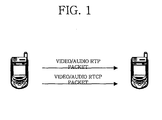
- FIG. 1 illustrates a method for transmitting video/audio data of a mobile communication terminal in accordance with the related art.
- a mobile communication terminal sets a video/audio RTP session and transmits a video/audio RTP packet through the video/audio RTP session.
- the mobile communication terminal sets a video/audio RTP control protocol (RTCP) session for controlling the video/audio RTP packet, and transmits a video/audio RTCP packet through the RTCP session.
- the video/audio RTCP packet denotes a video/audio RTCP sender report (SR) packet.
- SR video/audio RTCP sender report
- a method for synchronizing video/audio data of a mobile communication terminal comprises receiving video/audio data through a set session (S210), calculating a standard time based on the received video/audio data (S220), and synchronizing the received video/audio data based on the calculated standard time (S230).
- the mobile communication terminal receives a video RTP packet through a video/audio RTP session and receives a video RTCP packet through a video/audio RTCP session. Also, the mobile communication terminal receives an audio RTP packet through the video/audio RTP session and receives an audio RTCP packet through the video/audio RTCP session (S210). A method for transmitting the received RTP packet and the RTCP packet will be explained with reference to Figure 3.
- FIG. 3 is a block diagram illustrating the receipt of an RTP packet and an RTCP packet in accordance with the related art.
- the mobile communication terminal periodically receives the RTCP packet for controlling the RTP packet, and calculates a standard time of the received RTP packet.
- the standard time provides information on absolute time since an RTP time stamp is a relative time that can be used for a single RTP session.
- a network time protocol (NTP) time stamp may be used to calculate the standard time. Accordingly, the standard time is used for synchronizing the video/audio data based on the RTP time stamp and the NTP time stamp of the ( i + 1) th RTCP packet and the previously received i th RTCP packet.
- NTP network time protocol
- the mobile communication terminal calculates a standard time for synchronizing the received video/audio data based on the received video/audio RTCP packet by the following formula (1) (S220).
- NTP time_stamp NTP time_stamp , i +1 + ⁇ NTP time_stamp ⁇ RTP time_stamp ( RTP time_stamp - RTP time_stamp, i+ 1 )
- the RTP time_stamp, i , and RTP time_stamp, i +1 respectively denote an RTP time stamp included in the i th RTCP packet and an RTP time stamp included in the ( i + 1) th RTCP packet.
- the NTP time_stamp, i , and NTP time_stamp, i +1 respectively denote an NTP time stamp included in the i th RTCP packet and an NTP time stamp included in the ( i + 1) th RTCP packet.
- a variation value of the network time protocol (NTP) time stamp and a variation value of the real time protocol (RTP) time stamp are calculated by the following formulas (2) and (3).
- NTP time_stamp NTP time_stamp, i+ 1 -NTP time_stamp, i
- RTP time_stamp RTP time_stamp, i +1 -RTP time_stamp, i
- the mobile communication terminal can synchronize the received video/audio data based on the calculated standard time (S230).
- a standard time has to be calculated whenever video/audio data is received. Accordingly, even if the variation value of the NTP time stamp and the variation value of the RTP time stamp are constant, the time for synchronizing the video/audio data is not shortened.
- the present invention is related to a method for shortening the time to synchronize video/audio data in a mobile communication terminal of a mobile communication system.
- the present invention is embodied in a method for synchronizing video/audio data of a mobile communication terminal, the method comprising receiving video/audio data in the mobile communication terminal through a set session, determining whether a current sampling rate of the received video/audio data is consistent with a previous sampling rate of the received video/audio data, calculating a standard time according to the determination, and synchronizing the video/audio data based on the calculated standard time.
- the standard time is calculated based on a preset ratio if it is determined that the current sampling rate is consistent with the previous sampling rate.
- the preset ratio is obtained by dividing a variation value of a network time protocol (NTP) time stamp by a variation value of a real time protocol (RTP) time stamp.
- NTP network time protocol
- RTP real time protocol
- the variation value of the NTP time stamp is obtained by a formula of NTP time_stamp, i +1 -NTP time_stamp, i .
- the variation value of the NTP time stamp is 2 32 corresponding to one second.
- the variation value of the RTP time stamp is obtained by a formula of RTP time_stamp,i +1 -RTP time_stamp,i .
- the variation value of the RTP time stamp is the current sampling rate.
- the standard time is an absolute time for synchronizing the video/audio data.
- the standard time is obtained by a formula of NTP time_stamp, i +1 + ⁇ NTP time_stamp / ⁇ RTP time_stamp ( RTP time_stamp -RTP time_stamp, i+ 1 ).
- the standard time is a value of 32 bits.
- a value of a network time protocol (NTP) time stamp is scaled by the mobile communication terminal.
- NTP network time protocol
- the standard time is calculated based on a variation value of a real time protocol (RTP) time stamp and a variation value of a network time protocol (NTP) time stamp if it is determined that the current sampling rate is not consistent with the previous sampling rate.
- RTP real time protocol
- NTP network time protocol
- the variation value of the RTP time stamp is obtained by a formula of RTP time_stamp , i +1 -RTP time_stamp , i .
- the variation value of the NTP time stamp is obtained by a formula of NTP time_stamp, i +1 -NTP time_stamp, i .
- the standard time is an absolute time for synchronizing the video/audio data.
- the standard time is obtained by a formula of NTP time_stamp, i +1 + ⁇ NTP time_stamp / ⁇ RTP time_stamp ( RTP time_stamp -RTP time_stamp,i +1 ).
- the standard time is a value of 32 bits.
- a value of a network time protocol (NTP) time stamp is scaled by the mobile communication terminal.
- NTP network time protocol
- a method for synchronizing video/audio data of a mobile communication terminal comprises receiving video/audio data in the mobile communication terminal through a set session, determining whether a current sampling rate of the received video/audio data is consistent with a previous sampling rate of the received video/audio data, calculating a standard time according to the determination, and synchronizing the video/audio data based on the calculated standard time, wherein the standard time is calculated based on a preset ratio if it is determined that the current sampling rate is consistent with the previous sampling rate, wherein the standard time is calculated based on a variation value of a real time protocol (RTP) time stamp and a variation value of a network time protocol (NTP) time stamp if it is determined that the current sampling rate is not consistent with the previous sampling rate.
- RTP real time protocol
- NTP network time protocol
- FIG. 1 illustrates a method for transmitting video/audio data of a mobile communication terminal in accordance with the related art.
- FIG. 2 is a flowchart illustrating a method for synchronizing video/audio data of a mobile communication terminal in accordance with the related art.
- FIG. 3 is a block diagram illustrating the receipt of an RTP packet and an RTCP packet in accordance with the related art.
- FIG. 4 is a block diagram illustrating a method for transmitting video/audio data of a mobile communication terminal in accordance with one embodiment of the present invention.
- FIG. 5 is a block diagram illustrating a method for receiving video/audio data of a mobile communication terminal in accordance with one embodiment of the present invention.
- FIG. 6 is a flowchart illustrating a method for synchronizing video/audio data of a mobile communication terminal in accordance with one embodiment of the present invention.
- the present invention relates to a method for synchronizing video/audio data of a mobile communication terminal capable of shortening the time to synchronize the video/audio data.
- a method for synchronizing video/audio data of a mobile communication terminal capable of shortening the time for synchronizing the video/audio data will be explained.
- the method calculates a standard time for synchronizing the video/audio data by applying a preset sampling rate of the video/audio data.
- FIG. 4 is a block diagram illustrating a method for transmitting video/audio data of a mobile communication terminal in accordance with one embodiment of the present invention.
- a mobile communication terminal sets video/audio real time protocol (RTP) sessions for transmitting video/audio data, and transmits video/audio data via video/audio RTP packets during the video/audio RTP sessions.
- the mobile communication terminal sets video/audio RTP control protocol (RTCP) sessions for controlling the video/audio RTP packets, and transmits video/audio RTCP packets for controlling the video/audio RTP packets through the RTCP sessions.
- the video/audio RTCP packet denotes a video/audio RTCP sender report (SR) packet.
- SR video/audio RTCP sender report
- a receiving side mobile communication terminal depacketizes the transmitted video/audio RTP packets and synchronizes the depacketized video/audio data.
- a method for receiving the video/audio data of the mobile communication terminal according to the present invention will be explained with reference to FIG. 5.
- FIG 5 is a block diagram illustrating a method for receiving video/audio data of the mobile communication terminal in accordance with one embodiment of the present invention.
- the mobile communication terminal according to the present invention depacketizes received video/audio RTP packets into video/audio data, and calculates a standard time for synchronizing the depacketized video/audio data, thereby synchronizing the depacketized video/audio data based on the calculated standard time.
- the mobile communication terminal receives a video RTP packet through a video RTP session and receives a video RTCP packet through a video RTCP session. Also, the mobile communication terminal receives an audio RTP packet through an audio RTP session and receives an audio RTCP packet through an audio RTCP session.
- the video/audio RTCP packet denotes a video/audio RTCP send report (SR) packet.
- the mobile communication terminal depacketizes the received video/audio RTP packets into video/audio data and stores the data into a buffer.
- the mobile communication terminal synchronizes the depacketized video/audio data on the basis of an RTP time stamp value and an NTP time stamp value included in the received video/audio RTCP packets.
- the method for synchronizing the video/audio data will be explained with reference to FIG 6.
- FIG 6 is a flowchart illustrating a method for synchronizing video/audio data of a mobile communication terminal in accordance with one embodiment of the present invention.
- the method for synchronizing video/audio data of a mobile communication terminal comprises receiving video/audio data through a set session (S51 0), determining whether a current sampling rate of the received video/audio data is consistent with a previous sampling rate of the received video/audio data (S520), calculating a standard time based on a preset ratio when the current sampling rate of the received video/audio data is consistent with the previous sampling rate (S530), and synchronizing the video/audio data based on the calculated standard time (S560).
- the mobile communication terminal calculates a variation value of an RTP time stamp and a variation value of an NTP time stamp (S540), and calculates a standard time based on the calculated variation value of the RTP time stamp and the variation value of the NTP time stamp (S550).
- the mobile communication terminal receives a video RTP packet through a set video RTP session, receives a video RTCP packet through a set video RTCP session, receives an audio RTP packet through a set audio RTP session, and receives an audio RTCP packet through a set audio RTCP session (S510).
- the mobile communication terminal determines whether a current sampling rate of the video/audio data is consistent with a previous sampling rate from the received video/audio RTCP packets (S520). That is, when the current sampling rate of the received video/audio data is not consistent with the previous sampling rate, the mobile communication terminal calculates the variation value of the RTP time stamp and the variation value of the NTP time stamp as in the related art method, according to formulas (2) and (3) (S540), and calculates a standard time for synchronizing the video/audio data based on the calculated variation value of the RTP time stamp and the variation value of the NTP time stamp as in the related art method, according to formula (1)(S550).
- the mobile communication terminal calculates a standard time based on a preset ratio (S530) instead using formulas (1), (2) and (3) of the related art methods.
- the preset ratio is obtained by dividing the variation value of the NTP time stamp by the variation value of the RTP time stamp, ⁇ NTP time_stamp / ⁇ RTP time_stamp .
- a preset ratio for the video data and a preset ratio for the audio data are calculated by the following formulas (4) and (5).
- ⁇ NTP time_stamp ⁇ RTP time _ stamp 2 32 90 k ⁇ 47721.8588444 ⁇ 47722
- ⁇ NTP time_stamp ⁇ RTP time_stamp 2 32 8 k ⁇ 536870.912 ⁇ 536870
- the mobile communication terminal calculates a standard time for synchronizing the video/audio data based on the preset ratio by the following formulas (6) and (7).
- NTP time_stamp NTP time_stamp, i+ 1 + 47722 • ( RTP time_stamp - RTP time_stamp, i +1 )
- NTP time_stamp NTP time_stamp, i+ 1 + 536870 • ( RTP time_stamp - RTP time_stamp, i+ 1 )
- the mobile communication terminal synchronizes the video/audio data based on the calculated standard time (S560). Since the mobile communication terminal applies the preset ratio whenever the video/audio packets are received, the ratio, ⁇ NTP time_stamp / ⁇ RTP time_stamp does not need to be calculated each time. Accordingly, the time for calculating the standard time for synchronizing the video/audio data can be shortened.
- the mobile communication terminal may scale a value of the NTP time stamp of 64 bits into 32 bits, the same as a value of the RTP time stamp of 32 bits.
- the value of the NTP time stamp of 64 bits can be scaled into a value of 32 bits by discarding values of the uppermost 10 bits and values of the lowermost 22 bits.
- the mobile communication terminal may be implemented without repeating the 64-bit calculation or 32-bit calculation, thereby simplifying the structure and reducing the amount of calculation.
- the mobile communication terminal stores the depacketized video/audio data in the buffer and decodes the stored video/audio data, thereby displaying the decoded video/audio data on a display device such as a liquid crystal display (LCD), for example.
- a display device such as a liquid crystal display (LCD), for example.
- a standard time for synchronizing video/audio data is calculated by applying a preset sampling rate of the video/audio data. Accordingly, the time for synchronizing the video/audio data is shortened.
Landscapes
- Engineering & Computer Science (AREA)
- Multimedia (AREA)
- Signal Processing (AREA)
- Computer Networks & Wireless Communication (AREA)
- Computer Security & Cryptography (AREA)
- General Engineering & Computer Science (AREA)
- Business, Economics & Management (AREA)
- General Business, Economics & Management (AREA)
- Two-Way Televisions, Distribution Of Moving Picture Or The Like (AREA)
- Synchronisation In Digital Transmission Systems (AREA)
- Mobile Radio Communication Systems (AREA)
Abstract
Description
Claims (19)
- A method for synchronizing video/audio data of a mobile communication terminal, the method comprising:receiving video/audio data in the mobile communication terminal through a set session;determining whether a current sampling rate of the received video/audio data is consistent with a previous sampling rate of the received video/audio data;calculating a standard time according to the determination; andsynchronizing the video/audio data based on the calculated standard time.
- The method of claim 1, wherein the standard time is calculated based on a preset ratio if it is determined that the current sampling rate is consistent with the previous sampling rate.
- The method of claim 2, wherein the preset ratio is obtained by dividing a variation value of a network time protocol (NTP) time stamp by a variation value of a real time protocol (RTP) time stamp.
- The method of claim 3, wherein the variation value of the NTP time stamp is obtained by a formula of NTP time_stamp, i+1 -NTP time_stamp, i , wherein the NTP time_stamp, i and NTP time_stamp, i+1 respectively are an NTP time stamp included in an i th RTCP packet and an NTP time stamp included in an (i+1) th RTCP packet.
- The method of claim 4, wherein the variation value of the NTP time stamp is 232 corresponding to one second.
- The method of claim 3, wherein the variation value of the RTP time stamp is obtained by a formula of RTP time_stamp, i+1 - RTP time_stamp, i , wherein the RTP time_stamp, i and RTP time_stamp, i+1 respectively are an RTP time stamp included in an i th RTCP packet and an RTP time stamp included in an (i+1) th RTCP packet.
- The method of claim 6, wherein the variation value of the RTP time stamp is the current sampling rate.
- The method of claim 2, wherein the standard time is an absolute time for synchronizing the video/audio data.
- The method of claim 2, wherein the standard time is obtained by a formula of NTP time_stamp, i+1 + ΔNTP time_stamp / ΔRTP time_stamp (RTP time_stamp -RTP time_stamp , i+1), wherein the ΔNTP time_stamp is a variation value of a network time protocol (NTP) time stamp, the ΔRTP time_stamp is a variation value of a real time protocol (RTP) time stamp, the NTP time_stamp, i+1 is an NTP time stamp included in an (i+1) th RTCP packet and the RTP time_stamp, i and RTP time_stamp, i+1 respectively are an RTP time stamp included in an i th RTCP packet and an RTP time stamp included in an (i+1) th RTCP packet.
- The method of claim 9, wherein the standard time is a value of 32 bits.
- The method of claim 2, wherein a value of a network time protocol (NTP) time stamp is scaled by the mobile communication terminal.
- The method of claim 1, wherein the standard time is calculated based on a variation value of a real time protocol (RTP) time stamp and a variation value of a network time protocol (NTP) time stamp if it is determined that the current sampling rate is not consistent with the previous sampling rate.
- The method of claim 12, wherein the variation value of the RTP time stamp is obtained by a formula of RTP time_stamp,i+1 -RTP time_stamp,i , wherein the RTP time_stamp,i and RTP time_stamp, i+1 respectively are an RTP time stamp included in an i th RTCP packet and an RTP time stamp included in an (i +1) th RTCP packet.
- The method of claim 12, wherein the variation value of the NTP time stamp is obtained by a formula of NTP time_stamp, i+1 -NTP time_stamp, i , wherein the NTP time_stamp, i and NTP time_stamp, i+1 respectivey are an NTP time stamp included in an i th RTCP packet and an NTP time stamp included in an (i + 1) th RTCP packet.
- The method of claim 12, wherein the standard time is an absolute time for synchronizing the video/audio data.
- The method of claim 12, wherein the standard time is obtained by a formula of NTP time_stamp, i+1 + ΔNTP time_stamp / ΔRTP time_stamp (RTP time_stamp -RTP time_stamp, i+1), wherein the ΔNTP time_stamp is a variation value of a network time protocol (NTP) time stamp, the ΔRTP time_stamp is a variation value of a real time protocol (RTP) time stamp, the NTP time_stamp, i+1 is an NTP time stamp included in an (i+1) th RTCP packet and the RTP time_stamp, i and RTP time_stamp, i+1 respectively are an RTP time stamp included in an i th RTCP packet and an RTP time stamp included in an (i+1) th RTCP packet.
- The method of claim 16, wherein the standard time is a value of 32 bits.
- The method of claim 12, wherein a value of a network time protocol (NTP) time stamp is scaled by the mobile communication terminal.
- A method for synchronizing video/audio data of a mobile communication terminal, the method comprising:wherein the standard time is calculated based on a preset ratio if it is determined that the current sampling rate is consistent with the previous sampling rate.receiving video/audio data in the mobile communication terminal through a set session;determining whether a current sampling rate of the received video/audio data is consistent with a previous sampling rate of the received video/audio data;calculating a standard time according to the determination; andsynchronizing the video/audio data based on the calculated standard time;
wherein the standard time is calculated based on a variation value of a real time protocol (RTP) time stamp and a variation value of a network time protocol (NTP) time stamp if it is determined that the current sampling rate is not consistent with the previous sampling rate.
Applications Claiming Priority (2)
| Application Number | Priority Date | Filing Date | Title |
|---|---|---|---|
| KR1020040046697A KR100565333B1 (en) | 2004-06-22 | 2004-06-22 | Video Audio Synchronizer and Method for Mobile Devices |
| KR2004046697 | 2004-06-22 |
Publications (2)
| Publication Number | Publication Date |
|---|---|
| EP1610558A2 true EP1610558A2 (en) | 2005-12-28 |
| EP1610558A3 EP1610558A3 (en) | 2006-02-08 |
Family
ID=36081060
Family Applications (1)
| Application Number | Title | Priority Date | Filing Date |
|---|---|---|---|
| EP05013473A Withdrawn EP1610558A3 (en) | 2004-06-22 | 2005-06-22 | Synchronizing video/audio of mobile communication terminal |
Country Status (5)
| Country | Link |
|---|---|
| US (1) | US7710943B2 (en) |
| EP (1) | EP1610558A3 (en) |
| JP (1) | JP4099494B2 (en) |
| KR (1) | KR100565333B1 (en) |
| CN (1) | CN100536575C (en) |
Cited By (3)
| Publication number | Priority date | Publication date | Assignee | Title |
|---|---|---|---|---|
| WO2008086308A1 (en) * | 2007-01-08 | 2008-07-17 | Apple Inc. | Time synchronization of multiple time-based data streams with independent clocks |
| CN101123611B (en) * | 2007-09-25 | 2012-05-23 | 中兴通讯股份有限公司 | A method for sending streaming media data |
| WO2015023463A1 (en) * | 2013-08-16 | 2015-02-19 | Qualcomm Incorporated | Clock synchronization for multi-processor/multi-chipset solution |
Families Citing this family (21)
| Publication number | Priority date | Publication date | Assignee | Title |
|---|---|---|---|---|
| KR100772193B1 (en) * | 2006-07-07 | 2007-11-01 | 한국전자통신연구원 | Data generation device with GPS time information |
| US7953118B2 (en) * | 2006-12-08 | 2011-05-31 | Microsoft Corporation | Synchronizing media streams across multiple devices |
| US8849432B2 (en) | 2007-05-31 | 2014-09-30 | Adobe Systems Incorporated | Acoustic pattern identification using spectral characteristics to synchronize audio and/or video |
| EP2124449A1 (en) | 2008-05-19 | 2009-11-25 | THOMSON Licensing | Device and method for synchronizing an interactive mark to streaming content |
| JP5456029B2 (en) * | 2008-06-11 | 2014-03-26 | コーニンクレッカ フィリップス エヌ ヴェ | Media stream component synchronization |
| EP2561661B1 (en) * | 2010-06-04 | 2018-11-28 | Skype Ireland Technologies Holdings | Server-assisted video conversation |
| US8924345B2 (en) | 2011-09-26 | 2014-12-30 | Adobe Systems Incorporated | Clustering and synchronizing content |
| KR101974077B1 (en) * | 2013-05-22 | 2019-08-23 | 한화테크윈 주식회사 | Method for display time in the image being played using RTP packet |
| CN103269448A (en) * | 2013-05-24 | 2013-08-28 | 浙江工商大学 | Method for achieving synchronization of audio and video on the basis of RTP/RTCP feedback early-warning algorithm |
| CN105100963B (en) | 2014-05-22 | 2017-12-22 | 纬创资通股份有限公司 | Audio-visual media file synthesis method and service system |
| KR102051985B1 (en) | 2015-09-30 | 2019-12-04 | 애플 인크. | Synchronization of Media Rendering in Heterogeneous Networking Environments |
| CN105516118B (en) * | 2015-12-03 | 2019-06-11 | Tcl集团股份有限公司 | A time synchronization method and system based on non-RTC smart TV |
| CN105611222B (en) * | 2015-12-25 | 2019-03-15 | 北京紫荆视通科技有限公司 | Audio data processing method, device, controlled device and system |
| CN107517401B (en) * | 2016-06-15 | 2019-11-19 | 成都鼎桥通信技术有限公司 | Multimedia data playing method and device |
| CN106791271B (en) * | 2016-12-02 | 2019-08-13 | 福建星网智慧科技股份有限公司 | A kind of audio and video synchronization method |
| CN110225385B (en) * | 2019-06-19 | 2021-09-10 | 鼎桥通信技术有限公司 | Audio and video synchronization adjustment method and device |
| WO2021159329A1 (en) * | 2020-02-12 | 2021-08-19 | 深圳元戎启行科技有限公司 | Streaming media network latency determination method and apparatus, computer device, readable storage medium, and remote driving system |
| CN113747208B (en) * | 2020-05-27 | 2023-05-26 | 阿里巴巴集团控股有限公司 | Audio and video data synchronization method, server side and receiving side |
| CN112004102A (en) * | 2020-08-03 | 2020-11-27 | 杭州当虹科技股份有限公司 | Multi-camera picture synchronization method based on IP live stream |
| CN114697720B (en) * | 2020-12-31 | 2023-11-07 | 北京易掌云峰科技有限公司 | Synchronization method and device of adaptive audio and video RTP (real-time protocol) time stamps |
| CN119211082A (en) * | 2024-09-05 | 2024-12-27 | 中国移动通信集团北京有限公司 | Method, device and equipment for identifying audio and video asynchrony during video call |
Family Cites Families (6)
| Publication number | Priority date | Publication date | Assignee | Title |
|---|---|---|---|---|
| US7003794B2 (en) * | 2000-06-27 | 2006-02-21 | Bamboo Mediacasting, Inc. | Multicasting transmission of multimedia information |
| JP4649091B2 (en) * | 2002-01-30 | 2011-03-09 | 株式会社エヌ・ティ・ティ・ドコモ | Communication terminal, server device, relay device, broadcast communication system, broadcast communication method, and program |
| JP4000905B2 (en) * | 2002-05-22 | 2007-10-31 | ソニー株式会社 | Information processing system and method, information processing apparatus and method, recording medium, and program |
| JP3825416B2 (en) * | 2003-04-14 | 2006-09-27 | 国立大学法人北陸先端科学技術大学院大学 | Data synchronization method, data synchronization system, and data synchronization program |
| CN1860787A (en) * | 2003-09-29 | 2006-11-08 | 手持娱乐公司 | Method and apparatus for coding information |
| US7084898B1 (en) * | 2003-11-18 | 2006-08-01 | Cisco Technology, Inc. | System and method for providing video conferencing synchronization |
-
2004
- 2004-06-22 KR KR1020040046697A patent/KR100565333B1/en not_active Expired - Fee Related
-
2005
- 2005-06-01 JP JP2005162052A patent/JP4099494B2/en not_active Expired - Fee Related
- 2005-06-21 US US11/157,353 patent/US7710943B2/en not_active Expired - Fee Related
- 2005-06-22 EP EP05013473A patent/EP1610558A3/en not_active Withdrawn
- 2005-06-22 CN CNB2005101038276A patent/CN100536575C/en not_active Expired - Fee Related
Non-Patent Citations (1)
| Title |
|---|
| None |
Cited By (7)
| Publication number | Priority date | Publication date | Assignee | Title |
|---|---|---|---|---|
| WO2008086308A1 (en) * | 2007-01-08 | 2008-07-17 | Apple Inc. | Time synchronization of multiple time-based data streams with independent clocks |
| US7765315B2 (en) | 2007-01-08 | 2010-07-27 | Apple Inc. | Time synchronization of multiple time-based data streams with independent clocks |
| US8316147B2 (en) | 2007-01-08 | 2012-11-20 | Apple Inc. | Time synchronization of multiple time-based data streams with independent clocks |
| US8694670B2 (en) | 2007-01-08 | 2014-04-08 | Apple Inc. | Time synchronization of multiple time-based data streams with independent clocks |
| CN101123611B (en) * | 2007-09-25 | 2012-05-23 | 中兴通讯股份有限公司 | A method for sending streaming media data |
| WO2015023463A1 (en) * | 2013-08-16 | 2015-02-19 | Qualcomm Incorporated | Clock synchronization for multi-processor/multi-chipset solution |
| US9300713B2 (en) | 2013-08-16 | 2016-03-29 | Qualcomm Incorporated | Clock synchronization for multi-processor/multi-chipset solution |
Also Published As
| Publication number | Publication date |
|---|---|
| US7710943B2 (en) | 2010-05-04 |
| CN100536575C (en) | 2009-09-02 |
| KR100565333B1 (en) | 2006-03-30 |
| KR20050121536A (en) | 2005-12-27 |
| CN1738437A (en) | 2006-02-22 |
| JP4099494B2 (en) | 2008-06-11 |
| EP1610558A3 (en) | 2006-02-08 |
| JP2006014299A (en) | 2006-01-12 |
| US20050281246A1 (en) | 2005-12-22 |
Similar Documents
| Publication | Publication Date | Title |
|---|---|---|
| EP1610558A2 (en) | Synchronizing video/audio of mobile communication terminal | |
| CA2697664C (en) | Method and apparatus for determining preferred image format between mobile video telephones | |
| US9369508B2 (en) | Method for transmitting a scalable HTTP stream for natural reproduction upon the occurrence of expression-switching during HTTP streaming | |
| US20100142927A1 (en) | Audio and video synchronization apparatus and method in wireless communication network | |
| US20080133744A1 (en) | Multimedia data streaming server and method for dynamically changing amount of transmitting data in response to network bandwidth | |
| CN102893658A (en) | Remote mobile communication system, server device and control method for remote mobile communication system | |
| US20030004992A1 (en) | Data reproduction apparatus and data reproduction method | |
| CN101641941B (en) | Techniques for unidirectional disabling of audio-video synchronization | |
| US20060200577A1 (en) | Method for transmitting moving picture data to mobile terminal using pseudo-streaming technology | |
| KR100575994B1 (en) | How to process voice data in a portable terminal | |
| CN1929647B (en) | Method for executing video communication service and mobile communication terminal using the method | |
| US20160182919A1 (en) | Transmitting device and receiving device | |
| KR20130109361A (en) | Method of changing resolution of image communication function and system for it | |
| EP2043372B1 (en) | Method for audio and video synchronization, receiving and transmitting device | |
| Jung et al. | A client-driven media synchronization mechanism for RTP packet-based video streaming | |
| KR101201737B1 (en) | dynamic streaming system and method based RTSP | |
| CN100592790C (en) | Multimedia channel switching | |
| KR101094694B1 (en) | Method and apparatus for minimizing initial buffering time in streaming system | |
| CN117014624A (en) | Data transmitting method, data receiving method, electronic device and display system | |
| Kim | Smart SoftPhone Device for Networked Audio-Visual QoS/QoE Discovery & Measurement |
Legal Events
| Date | Code | Title | Description |
|---|---|---|---|
| PUAI | Public reference made under article 153(3) epc to a published international application that has entered the european phase |
Free format text: ORIGINAL CODE: 0009012 |
|
| PUAL | Search report despatched |
Free format text: ORIGINAL CODE: 0009013 |
|
| AK | Designated contracting states |
Kind code of ref document: A2 Designated state(s): AT BE BG CH CY CZ DE DK EE ES FI FR GB GR HU IE IS IT LI LT LU MC NL PL PT RO SE SI SK TR |
|
| AX | Request for extension of the european patent |
Extension state: AL BA HR LV MK YU |
|
| RIC1 | Information provided on ipc code assigned before grant |
Ipc: H04L 29/06 19900101ALI20051207BHEP Ipc: H04N 7/24 19950101AFI20051019BHEP |
|
| AK | Designated contracting states |
Kind code of ref document: A3 Designated state(s): AT BE BG CH CY CZ DE DK EE ES FI FR GB GR HU IE IS IT LI LT LU MC NL PL PT RO SE SI SK TR |
|
| AX | Request for extension of the european patent |
Extension state: AL BA HR LV MK YU |
|
| 17P | Request for examination filed |
Effective date: 20060316 |
|
| RIN1 | Information on inventor provided before grant (corrected) |
Inventor name: CHAN-WOO, KIM Inventor name: SEO, KWANG-DEOKCOMPUTER & TELECOM. ENG. DIVISION |
|
| AKX | Designation fees paid |
Designated state(s): AT BE BG CH CY CZ DE DK EE ES FI FR GB GR HU IE IS IT LI LT LU MC NL PL PT RO SE SI SK TR |
|
| RAP1 | Party data changed (applicant data changed or rights of an application transferred) |
Owner name: LG ELECTRONICS, INC. |
|
| 17Q | First examination report despatched |
Effective date: 20100415 |
|
| STAA | Information on the status of an ep patent application or granted ep patent |
Free format text: STATUS: EXAMINATION IS IN PROGRESS |
|
| RAP1 | Party data changed (applicant data changed or rights of an application transferred) |
Owner name: LG ELECTRONICS INC. |
|
| STAA | Information on the status of an ep patent application or granted ep patent |
Free format text: STATUS: THE APPLICATION IS DEEMED TO BE WITHDRAWN |
|
| 18D | Application deemed to be withdrawn |
Effective date: 20180823 |