EP1610540A1 - A method and system for executing document scanning jobs that are intended for a remote work station through using a wireless interconnection between the work station and a scanner facility - Google Patents
A method and system for executing document scanning jobs that are intended for a remote work station through using a wireless interconnection between the work station and a scanner facility Download PDFInfo
- Publication number
- EP1610540A1 EP1610540A1 EP05105465A EP05105465A EP1610540A1 EP 1610540 A1 EP1610540 A1 EP 1610540A1 EP 05105465 A EP05105465 A EP 05105465A EP 05105465 A EP05105465 A EP 05105465A EP 1610540 A1 EP1610540 A1 EP 1610540A1
- Authority
- EP
- European Patent Office
- Prior art keywords
- mobile device
- scanning
- connection
- user
- scan job
- Prior art date
- Legal status (The legal status is an assumption and is not a legal conclusion. Google has not performed a legal analysis and makes no representation as to the accuracy of the status listed.)
- Withdrawn
Links
- 238000000034 method Methods 0.000 title claims abstract description 19
- 238000004891 communication Methods 0.000 claims description 12
- 230000003993 interaction Effects 0.000 claims description 4
- 238000012546 transfer Methods 0.000 claims description 4
- 230000011664 signaling Effects 0.000 claims 2
- 230000002028 premature Effects 0.000 claims 1
- 238000013459 approach Methods 0.000 abstract 1
- 230000008569 process Effects 0.000 description 5
- 230000005540 biological transmission Effects 0.000 description 4
- 238000012545 processing Methods 0.000 description 3
- 230000001419 dependent effect Effects 0.000 description 2
- 230000003287 optical effect Effects 0.000 description 2
- 230000008520 organization Effects 0.000 description 2
- 230000003213 activating effect Effects 0.000 description 1
- 230000008859 change Effects 0.000 description 1
- 238000001514 detection method Methods 0.000 description 1
- 238000010586 diagram Methods 0.000 description 1
- 230000009429 distress Effects 0.000 description 1
- 230000006870 function Effects 0.000 description 1
- 238000012986 modification Methods 0.000 description 1
- 230000004048 modification Effects 0.000 description 1
- 238000004806 packaging method and process Methods 0.000 description 1
- 238000007781 pre-processing Methods 0.000 description 1
- 238000011160 research Methods 0.000 description 1
- 230000001960 triggered effect Effects 0.000 description 1
- 230000000007 visual effect Effects 0.000 description 1
Images


Classifications
-
- H—ELECTRICITY
- H04—ELECTRIC COMMUNICATION TECHNIQUE
- H04N—PICTORIAL COMMUNICATION, e.g. TELEVISION
- H04N1/00—Scanning, transmission or reproduction of documents or the like, e.g. facsimile transmission; Details thereof
- H04N1/00127—Connection or combination of a still picture apparatus with another apparatus, e.g. for storage, processing or transmission of still picture signals or of information associated with a still picture
-
- H—ELECTRICITY
- H04—ELECTRIC COMMUNICATION TECHNIQUE
- H04N—PICTORIAL COMMUNICATION, e.g. TELEVISION
- H04N1/00—Scanning, transmission or reproduction of documents or the like, e.g. facsimile transmission; Details thereof
- H04N1/00962—Input arrangements for operating instructions or parameters, e.g. updating internal software
- H04N1/0097—Storage of instructions or parameters, e.g. customised instructions or different parameters for different user IDs
-
- H—ELECTRICITY
- H04—ELECTRIC COMMUNICATION TECHNIQUE
- H04N—PICTORIAL COMMUNICATION, e.g. TELEVISION
- H04N1/00—Scanning, transmission or reproduction of documents or the like, e.g. facsimile transmission; Details thereof
- H04N1/32—Circuits or arrangements for control or supervision between transmitter and receiver or between image input and image output device, e.g. between a still-image camera and its memory or between a still-image camera and a printer device
- H04N1/327—Initiating, continuing or ending a single-mode communication; Handshaking therefor
- H04N1/32765—Initiating a communication
- H04N1/32771—Initiating a communication in response to a request, e.g. for a particular document
-
- H—ELECTRICITY
- H04—ELECTRIC COMMUNICATION TECHNIQUE
- H04N—PICTORIAL COMMUNICATION, e.g. TELEVISION
- H04N1/00—Scanning, transmission or reproduction of documents or the like, e.g. facsimile transmission; Details thereof
- H04N1/32—Circuits or arrangements for control or supervision between transmitter and receiver or between image input and image output device, e.g. between a still-image camera and its memory or between a still-image camera and a printer device
- H04N1/327—Initiating, continuing or ending a single-mode communication; Handshaking therefor
- H04N1/32765—Initiating a communication
- H04N1/32771—Initiating a communication in response to a request, e.g. for a particular document
- H04N1/32776—Initiating a communication in response to a request, e.g. for a particular document using an interactive, user-operated device, e.g. a computer terminal, mobile telephone
-
- H—ELECTRICITY
- H04—ELECTRIC COMMUNICATION TECHNIQUE
- H04N—PICTORIAL COMMUNICATION, e.g. TELEVISION
- H04N1/00—Scanning, transmission or reproduction of documents or the like, e.g. facsimile transmission; Details thereof
- H04N1/00127—Connection or combination of a still picture apparatus with another apparatus, e.g. for storage, processing or transmission of still picture signals or of information associated with a still picture
- H04N1/00281—Connection or combination of a still picture apparatus with another apparatus, e.g. for storage, processing or transmission of still picture signals or of information associated with a still picture with a telecommunication apparatus, e.g. a switched network of teleprinters for the distribution of text-based information, a selective call terminal
- H04N1/00307—Connection or combination of a still picture apparatus with another apparatus, e.g. for storage, processing or transmission of still picture signals or of information associated with a still picture with a telecommunication apparatus, e.g. a switched network of teleprinters for the distribution of text-based information, a selective call terminal with a mobile telephone apparatus
-
- H—ELECTRICITY
- H04—ELECTRIC COMMUNICATION TECHNIQUE
- H04N—PICTORIAL COMMUNICATION, e.g. TELEVISION
- H04N2201/00—Indexing scheme relating to scanning, transmission or reproduction of documents or the like, and to details thereof
- H04N2201/0008—Connection or combination of a still picture apparatus with another apparatus
- H04N2201/0034—Details of the connection, e.g. connector, interface
- H04N2201/0048—Type of connection
- H04N2201/0055—By radio
-
- H—ELECTRICITY
- H04—ELECTRIC COMMUNICATION TECHNIQUE
- H04N—PICTORIAL COMMUNICATION, e.g. TELEVISION
- H04N2201/00—Indexing scheme relating to scanning, transmission or reproduction of documents or the like, and to details thereof
- H04N2201/0008—Connection or combination of a still picture apparatus with another apparatus
- H04N2201/0065—Converting image data to a format usable by the connected apparatus or vice versa
-
- H—ELECTRICITY
- H04—ELECTRIC COMMUNICATION TECHNIQUE
- H04N—PICTORIAL COMMUNICATION, e.g. TELEVISION
- H04N2201/00—Indexing scheme relating to scanning, transmission or reproduction of documents or the like, and to details thereof
- H04N2201/0077—Types of the still picture apparatus
- H04N2201/0094—Multifunctional device, i.e. a device capable of all of reading, reproducing, copying, facsimile transception, file transception
-
- H—ELECTRICITY
- H04—ELECTRIC COMMUNICATION TECHNIQUE
- H04N—PICTORIAL COMMUNICATION, e.g. TELEVISION
- H04N2201/00—Indexing scheme relating to scanning, transmission or reproduction of documents or the like, and to details thereof
- H04N2201/32—Circuits or arrangements for control or supervision between transmitter and receiver or between image input and image output device, e.g. between a still-image camera and its memory or between a still-image camera and a printer device
- H04N2201/3201—Display, printing, storage or transmission of additional information, e.g. ID code, date and time or title
- H04N2201/3204—Display, printing, storage or transmission of additional information, e.g. ID code, date and time or title of data relating to a user, sender, addressee, machine or electronic recording medium
- H04N2201/3205—Display, printing, storage or transmission of additional information, e.g. ID code, date and time or title of data relating to a user, sender, addressee, machine or electronic recording medium of identification information, e.g. name or ID code
-
- H—ELECTRICITY
- H04—ELECTRIC COMMUNICATION TECHNIQUE
- H04N—PICTORIAL COMMUNICATION, e.g. TELEVISION
- H04N2201/00—Indexing scheme relating to scanning, transmission or reproduction of documents or the like, and to details thereof
- H04N2201/32—Circuits or arrangements for control or supervision between transmitter and receiver or between image input and image output device, e.g. between a still-image camera and its memory or between a still-image camera and a printer device
- H04N2201/3201—Display, printing, storage or transmission of additional information, e.g. ID code, date and time or title
- H04N2201/3212—Display, printing, storage or transmission of additional information, e.g. ID code, date and time or title of data relating to a job, e.g. communication, capture or filing of an image
Definitions
- the invention relates in general to a method for scanning of a document, the latter being taken in its broadest technical sense, such as including those that contain informal matter.
- Optical scanning is in wide use for introducing matter from outside into a computer environment without necessitating preprocessing of such matter before the scanning proper.
- the present invention relates to the use of such optical scanning viz à viz a plurality of work stations in a comprehensive administrative organization without the imposing of an extensive set of rules, and whilst allowing in particular the use of mobile workstations or mobile devices, such as laptops, PDA's and the like, that feature a wireless interconnection to the scanning facility.
- the invention relates to a system as recited in the preamble of Claim 1.
- the present invention vies to introduce a great amount of flexibility into the system for realizing an extremely friendly user interface whilst maintaining the strictest standards for safe and effective processing, and inter alia, allowing the use of a plurality of such mobile devices in a transparent and parallel manner.
- the invention is characterized according to the characterizing part of Claim 1.
- European Patent Application EP 1096775 of the same assignee as the present invention discloses a method for at a scanner facility selecting the type of a scan job to create a scan data file and associated meta data specifying the above type, for subsequently transmitting the file and the meta data, and for under control of the meta data processing the scan data file for further usage.
- Various aspects of mobility as pertaining to the work stations have not been considered in the referenced Patent Application.
- the invention also relates to a system being arranged for implementing a method as claimed in Claim 1, and featuring corresponding advantageous functionalities. Further advantageous aspects of the invention are recited in dependent Claims.
- Figure 1 illustrates a set-up of a single-user system according to the present invention.
- a user 101 with a mobile device 102 makes a scan, operating through the user interface of the multifunctional device 103, and the result of the scanning is saved on the mobile device or at the multifunctional device.
- Device 103 comprises the scanner proper 104 and storage means 105 as part of a more or less comprehensive data processing arrangement.
- Mobile device 102 and multifunctional device 103 are able to communicate with each other via a wireless link 106. Interaction of the user with mobile device and multifunctional device at respective local user interfaces is indicated with arrows 107 respectively 108. The various interactions will be more detailed described next. Presumption is that a wireless adapter in the mobile device is active.
- the mobile device enters the reception area of the multifunctional device. Automatically a connection between the multifunctional device and the mobile device is established. After establishment of the connection automatically a user id and a scan template is uploaded from the mobile device towards the multifunctional device. Generally, such scanning template operates like a job specification or "form" that has partially been filled in.
- the multifunctional device is now prepared to carry out any scan tasks in combination with the mobile device. If user 101 now starts a scan task at the local user interface of the multifunctional device, on this local user interface the scan template is presented to the user and the user either does not change or specify any of the settings and thus uses all default settings, or the user specifies or modifies one or more parameters to fully define the job as desired.
- a single user may need a plurality of scanning templates for respectively associated scan jobs.
- the user supplies the hardcopy documents, comprising one or more pages, to the scanner of the multifunctional device for scanning.
- the document is scanned and the multifunctional device saves the result of the scan in an associated file, such encompassing appropriate meta data of the scanning operation, and this file is automatically downloaded to the mobile device.
- the scanned document is saved in a mailbox, provided by the multifunctional device as part of storage means 105, or provided by a system where the multifunctional device is part of. Later on then, the user is able to download the scanned file from the mailbox.
- the scanning template remains on the multifunctional device as long as a communication channel between mobile device and multifunctional device remains open.
- the scanning template is removed from the storage means of the multifunctional device.
- the multifunctional device 103 and the mobile device 102 should have the same communication protocol.
- IEEE 802.11 g. Configurations possible in this standard are an ad hoc mode and an infrastructure mode.
- the invention brought forward here is independent of protocol, standard and configuration used.
- For the invention to be carried out what is needed from the wireless infrastructure are means for establishing a connection between the mobile device and the multifunctional device. The way in which such a connection is established, is dependent of the used standard and configuration.
- the standard IEEE 802.11g is considered to provide the necessary underlying framework. However the invention should not be considered to be limited to the usage of this standard. The invention is envisaged to be used also in combination with any future standards.
- a wireless adapter in a device when turned on or activated it begins to scan across the wireless frequencies for wireless access points or wireless clients working in ad hoc mode. In dependence of configuration parameters the wireless adapter makes a connection with an appropriate other wireless adapter on basis of signal strength and frame error rate information. Next the wireless adapter switches to the assigned channel of the selected wireless adapter and negotiates the usage of a port. Via this port, applications will communicate with each other. In the description this communication channel is referred to as a 'connection'. If the signal strength becomes too low, the error rate too high, the adapter will scan for other adapters, in case of working in the infrastructure mode, or the connection will be terminated.
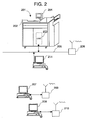
- FIG. 2 illustrates a multi-user system arrangement, through using various elements of Figure 1 of the Patent Application referenced supra.
- a multifunctional device 201 is depicted that is provided with a scanner facility 202 and a suitable controller 203, that allows a user to specify all relevant commands, parameters, etc. to the apparatus via local user interface 204.
- the scanning facility is connected to a network 205 and to a wireless adapter 206 that allows setting up wireless connections with a plurality of work stations 207, 208.
- the associated antennae Note in particular the associated antennae.
- work stations have summarily been depicted as desktop computers, they could as well be laptops or other portable or mobile devices.
- the work stations have respective wireless adapters 209, 210 with antennae shown that likewise participate in the wireless connection.
- server facility 211 that is likewise connected to network 205.
- scanner facility 202, server 211, network 205 and wireless adapter 206 constitute the multifunctional device 103 shown in Figure 1, although generally, only a limited subset of the functions present therein would already be sufficient to implement the present invention.
- Figure 3 illustrates a flow chart for steps to be carried out on the multifunctional device, delineating the general sequence of operations that pertains to a scanning job.
- Various loops have been shown that generally operate as waiting loops. If the waiting takes too long, the loop in question can be left for return to the starting block, which return for clarity has not been shown here in detail.
- the process starts in block S1, with allocating the relevant hardware and software facilities.
- the scanning application will be running in the background of possible further applications, and will become activated upon prespecified calling actions made thereto.
- the various mobile devices must be "in the neighbourhood" of the scanning facility. In accordance with a prespecified purpose, such neighbourhood may extend over a bigger or smaller office room, a so-called "office garden", or even larger, so that distances may possibly vary from 1 to some 50 metres or the like.
- the neighbourhood is implicitly defined as an area wherein the wireless signal strength attains a predetermined threshold value.
- the reaching of the threshold will automatically trigger the uploading of the scanning template in the background, without necessitating explicit user intervention.
- the realization is through an active process on the mobile device that, intermittently, actively searches for a scanner facility in the neighbourhood. Such searching process may of course be selectively deactivated by a user person.
- the realization is that in a work station according to the invention, in the background a broadcast transmission process is running that drives transceiver hardware for broadcasting an identifying signal.
- the process also allows for dynamic allocation of an address upon receiving a return signal from a scanning station, so that a plurality of work stations may be signed up in parallel to a single scan station.
- step S2 the scanner facility will receive and store a scanning template from the user, and also an appropriate unique identity, that may pertain either to the user as a person, or rather to the apparatus held by the user, such in case of the user's identity not being unique. For example, the user may have more than one work station.
- the ID received is checked against a set of acknowledged identities, by means of an authentication procedure and furthermore, a book-keeping account may be opened or accessed for subsequent usage, such as for financial or managerial purposes. Note that the above settings are effected at the scanner facility, rather than at the respective workstation.
- An additional facility is the providing of "guest accounts” that are allowed a limited set of services only.
- guest accounts are allowed a limited set of services only.
- a pertinent example of such limitation would be that immediate payment for services were be required. Such payment could be effected through a coin input facility, through a debit- or credit-card facility, or otherwise.
- the scan template could comprise one or more of the following: a time stamp, a scan job name, a destination, a transport encryption definition, and one or more scan job parameters, such as single/double sided, a zoom parameter, a source document format and a scan resolution.
- the system detects reception of a request for a scan job at the local user interface of the multifunctional device.
- the implementation of such request can be that the user selects the assigned user name on the User Interface of the scanner facility.
- the user ID is checked for correctness, possibly in combination with a secret password.
- the above accounting can be based on this authentication code.
- the actual scanning template is displayed at the local User Interface.
- Such template can be the previous scanning template pertaining to the user in question, or a scanning template pertaining to the document in question, or rather a default scanning template.
- the current user may adjust the settings of the scanning template. Note that users will not share a scanning template, inasmuch as the destination address cannot be shared among them.
- block S8 which again operates as a waiting loop, the system checks whether the scan job has now been completely defined. If positive, the scan job is effectively carried out in block S9, and the result thereof is sent to the client user.
- the scanning and transmitting can be executed serially or in parallel, such as on a per page, per line, or other basis.
- the transport speed can be made subject to the wireless signal strength.
- a visual identifier will give feedback to the user concerning the progress of uploading the scan job.
- the data transmission is stalled, inasmuch as transmitting only part of a scan job is expected to cause serious distress.
- the scanning will then nevertheless be executed, but the scan data will then be saved for a predetermined period of time, such as a few hours or a work shift.
- the scan data will then be stored under encryption e.g. with the public encryption key of the work station user. Due to actual circumstances, a communication channel may be broken temporarily. The above incomplete transfer may cause the giving of an alarm signalization to the user. Upon re-establishing of the channel, automatic transmission resume is then possible, because the work station will have the correct decryption key.
- the job is removed from the multifunctional device, where after the effective closing of the communication channel is detected in block S10, such detecting again constituting a waiting loop.
- the detection proper is triggered by the watchdog, supra.
- the communication channel could be managed in such way that the communication channel were closed at one or more of the following events occurring:
- the scan template is removed automatically from the memory of the scanner facility.
- the user ID is rendered invisible, but kept for accounting purposes.
- the process terminates.
- the diagram as shown is a simplification.
- the various waiting loops need not terminate in an identical return state; some of them could trigger an alarm to the user, such as incomplete transfer, whereas others could find that the user had cancelled the scanning purposely.
Landscapes
- Engineering & Computer Science (AREA)
- Multimedia (AREA)
- Signal Processing (AREA)
- General Engineering & Computer Science (AREA)
- Facsimiles In General (AREA)
- Mobile Radio Communication Systems (AREA)
Abstract
Description
- The invention relates in general to a method for scanning of a document, the latter being taken in its broadest technical sense, such as including those that contain informal matter. Optical scanning is in wide use for introducing matter from outside into a computer environment without necessitating preprocessing of such matter before the scanning proper. More in particular, the present invention relates to the use of such optical scanning viz à viz a plurality of work stations in a comprehensive administrative organization without the imposing of an extensive set of rules, and whilst allowing in particular the use of mobile workstations or mobile devices, such as laptops, PDA's and the like, that feature a wireless interconnection to the scanning facility. More in particular, the invention relates to a system as recited in the preamble of
Claim 1. - Prior art as documented in Research Disclosure, April 2001, p.511, # 444001 discloses such system for use with a scanning facility and only a single mobile device. The overall procedure goes with activating the mobile device in a receive mode, executing the scanning proper, packaging the document, and then wirelessly transmitting it. In particular, every step requires user intervention. However, the present inventors have recognized that especially in a larger organization, easy-to-follow procedures, security measures, and multi-station facilities are a must. In particular, the application program should better run in the background of other operations, and various settings should be attained automatically.
- Therefore, the present invention vies to introduce a great amount of flexibility into the system for realizing an extremely friendly user interface whilst maintaining the strictest standards for safe and effective processing, and inter alia, allowing the use of a plurality of such mobile devices in a transparent and parallel manner.
- Now therefore, according to one of its aspects, the invention is characterized according to the characterizing part of
Claim 1. By itself, earlier European Patent Application EP 1096775 of the same assignee as the present invention discloses a method for at a scanner facility selecting the type of a scan job to create a scan data file and associated meta data specifying the above type, for subsequently transmitting the file and the meta data, and for under control of the meta data processing the scan data file for further usage. Various aspects of mobility as pertaining to the work stations have not been considered in the referenced Patent Application. - The invention also relates to a system being arranged for implementing a method as claimed in
Claim 1, and featuring corresponding advantageous functionalities. Further advantageous aspects of the invention are recited in dependent Claims. - These and further features, aspects and advantages of the invention will be discussed more in detail hereinafter with reference to the disclosure of preferred embodiments of the invention, and in particular with reference to the appended Figures that illustrate:
- Figure 1, a set-up of a single-user system according to the present invention;
- Figure 2, a multi-user system arrangement; and
- Figure 3, a flow chart delineating the general sequence of operations of a scanning job.
-
- Figure 1 illustrates a set-up of a single-user system according to the present invention. Here, a
user 101 with amobile device 102 makes a scan, operating through the user interface of themultifunctional device 103, and the result of the scanning is saved on the mobile device or at the multifunctional device.Device 103 comprises the scanner proper 104 and storage means 105 as part of a more or less comprehensive data processing arrangement.Mobile device 102 andmultifunctional device 103 are able to communicate with each other via awireless link 106. Interaction of the user with mobile device and multifunctional device at respective local user interfaces is indicated witharrows 107 respectively 108. The various interactions will be more detailed described next. Presumption is that a wireless adapter in the mobile device is active. The mobile device enters the reception area of the multifunctional device. Automatically a connection between the multifunctional device and the mobile device is established. After establishment of the connection automatically a user id and a scan template is uploaded from the mobile device towards the multifunctional device.
Generally, such scanning template operates like a job specification or "form" that has partially been filled in. The multifunctional device is now prepared to carry out any scan tasks in combination with the mobile device. Ifuser 101 now starts a scan task at the local user interface of the multifunctional device, on this local user interface the scan template is presented to the user and the user either does not change or specify any of the settings and thus uses all default settings, or the user specifies or modifies one or more parameters to fully define the job as desired. A single user may need a plurality of scanning templates for respectively associated scan jobs. After the scan job is completely specified the user supplies the hardcopy documents, comprising one or more pages, to the scanner of the multifunctional device for scanning. The document is scanned and the multifunctional device saves the result of the scan in an associated file, such encompassing appropriate meta data of the scanning operation, and this file is automatically downloaded to the mobile device. However in another embodiment the scanned document is saved in a mailbox, provided by the multifunctional device as part of storage means 105, or provided by a system where the multifunctional device is part of. Later on then, the user is able to download the scanned file from the mailbox. After termination of the job, the scanning template remains on the multifunctional device as long as a communication channel between mobile device and multifunctional device remains open. At the moment the communication channel is closed, e.g. because the mobile device is out of the reach of the multifunctional device, the scanning template is removed from the storage means of the multifunctional device.
A few preconditions of the above procedures are that themultifunctional device 103 and themobile device 102 should have the same communication protocol. For connecting devices via a wireless link a variety of standards and configurations are in existence. The most recent standard being IEEE 802.11 g. Configurations possible in this standard are an ad hoc mode and an infrastructure mode. The invention brought forward here is independent of protocol, standard and configuration used. For the invention to be carried out what is needed from the wireless infrastructure are means for establishing a connection between the mobile device and the multifunctional device. The way in which such a connection is established, is dependent of the used standard and configuration. In the current description the standard IEEE 802.11g is considered to provide the necessary underlying framework. However the invention should not be considered to be limited to the usage of this standard. The invention is envisaged to be used also in combination with any future standards. In case of the mentioned standard, when a wireless adapter in a device is turned on or activated it begins to scan across the wireless frequencies for wireless access points or wireless clients working in ad hoc mode. In dependence of configuration parameters the wireless adapter makes a connection with an appropriate other wireless adapter on basis of signal strength and frame error rate information. Next the wireless adapter switches to the assigned channel of the selected wireless adapter and negotiates the usage of a port. Via this port, applications will communicate with each other. In the description this communication channel is referred to as a 'connection'. If the signal strength becomes too low, the error rate too high, the adapter will scan for other adapters, in case of working in the infrastructure mode, or the connection will be terminated. - Figure 2 illustrates a multi-user system arrangement, through using various elements of Figure 1 of the Patent Application referenced supra. Here, a
multifunctional device 201 is depicted that is provided with ascanner facility 202 and asuitable controller 203, that allows a user to specify all relevant commands, parameters, etc. to the apparatus vialocal user interface 204. Moreover, the scanning facility is connected to anetwork 205 and to awireless adapter 206 that allows setting up wireless connections with a plurality ofwork stations wireless adapters server facility 211 that is likewise connected to network 205. Together,scanner facility 202,server 211,network 205 andwireless adapter 206 constitute themultifunctional device 103 shown in Figure 1, although generally, only a limited subset of the functions present therein would already be sufficient to implement the present invention. - Figure 3 illustrates a flow chart for steps to be carried out on the multifunctional device, delineating the general sequence of operations that pertains to a scanning job. Various loops have been shown that generally operate as waiting loops. If the waiting takes too long, the loop in question can be left for return to the starting block, which return for clarity has not been shown here in detail.
- Generally, the process starts in block S1, with allocating the relevant hardware and software facilities. As from this moment, the scanning application will be running in the background of possible further applications, and will become activated upon prespecified calling actions made thereto. Now, in the envisaged configurations, the various mobile devices must be "in the neighbourhood" of the scanning facility. In accordance with a prespecified purpose, such neighbourhood may extend over a bigger or smaller office room, a so-called "office garden", or even larger, so that distances may possibly vary from 1 to some 50 metres or the like.
- By itself, the neighbourhood is implicitly defined as an area wherein the wireless signal strength attains a predetermined threshold value. The reaching of the threshold will automatically trigger the uploading of the scanning template in the background, without necessitating explicit user intervention. The realization is through an active process on the mobile device that, intermittently, actively searches for a scanner facility in the neighbourhood. Such searching process may of course be selectively deactivated by a user person. The realization is that in a work station according to the invention, in the background a broadcast transmission process is running that drives transceiver hardware for broadcasting an identifying signal. The process also allows for dynamic allocation of an address upon receiving a return signal from a scanning station, so that a plurality of work stations may be signed up in parallel to a single scan station.
- Now, in block S2, the presence of client work stations nearby is verified. If positive, the system goes to block S3, wherein the communication channel to a client so found will be opened, and a watchdog timer started. Thereupon, in step S4, the scanner facility will receive and store a scanning template from the user, and also an appropriate unique identity, that may pertain either to the user as a person, or rather to the apparatus held by the user, such in case of the user's identity not being unique. For example, the user may have more than one work station. In the background, the ID received is checked against a set of acknowledged identities, by means of an authentication procedure and furthermore, a book-keeping account may be opened or accessed for subsequent usage, such as for financial or managerial purposes. Note that the above settings are effected at the scanner facility, rather than at the respective workstation.
- An additional facility is the providing of "guest accounts" that are allowed a limited set of services only. A pertinent example of such limitation would be that immediate payment for services were be required. Such payment could be effected through a coin input facility, through a debit- or credit-card facility, or otherwise.
- In particular, the scan template could comprise one or more of the following: a time stamp, a scan job name, a destination, a transport encryption definition, and one or more scan job parameters, such as single/double sided, a zoom parameter, a source document format and a scan resolution.
- Next, in block S5, again constituting a waiting loop, the system detects reception of a request for a scan job at the local user interface of the multifunctional device. The implementation of such request can be that the user selects the assigned user name on the User Interface of the scanner facility. If positive, in block S6, again constituting a waiting loop, the user ID is checked for correctness, possibly in combination with a secret password. The above accounting can be based on this authentication code. If accorded, in block S7 the actual scanning template is displayed at the local User Interface. Such template can be the previous scanning template pertaining to the user in question, or a scanning template pertaining to the document in question, or rather a default scanning template. Anyway, the current user may adjust the settings of the scanning template. Note that users will not share a scanning template, inasmuch as the destination address cannot be shared among them.
- Next, in block S8, which again operates as a waiting loop, the system checks whether the scan job has now been completely defined. If positive, the scan job is effectively carried out in block S9, and the result thereof is sent to the client user. Depending on various operative parameters, the scanning and transmitting can be executed serially or in parallel, such as on a per page, per line, or other basis. As a specific aspect proper to the wireless transmission, the transport speed can be made subject to the wireless signal strength. At the work station, a visual identifier will give feedback to the user concerning the progress of uploading the scan job.
- If the signal strength is below a certain threshold, the data transmission is stalled, inasmuch as transmitting only part of a scan job is expected to cause serious distress. As a secondary measure, the scanning will then nevertheless be executed, but the scan data will then be saved for a predetermined period of time, such as a few hours or a work shift. The scan data will then be stored under encryption e.g. with the public encryption key of the work station user. Due to actual circumstances, a communication channel may be broken temporarily. The above incomplete transfer may cause the giving of an alarm signalization to the user. Upon re-establishing of the channel, automatic transmission resume is then possible, because the work station will have the correct decryption key.
- After termination of the scanning and transfer, the job is removed from the multifunctional device, where after the effective closing of the communication channel is detected in block S10, such detecting again constituting a waiting loop. The detection proper is triggered by the watchdog, supra. In particular, the communication channel could be managed in such way that the communication channel were closed at one or more of the following events occurring:
- a user request for closure at the scanner facility
- a user request at the work station
- a watchdog controlled delay period elapsing
- a signal strength pertaining to said wireless connection falling below a threshold.
- After closing the communication channel, in block S11 the scan template is removed automatically from the memory of the scanner facility. The user ID is rendered invisible, but kept for accounting purposes. Finally, in block S12 the process terminates. In several aspects, the diagram as shown is a simplification. For example, the various waiting loops need not terminate in an identical return state; some of them could trigger an alarm to the user, such as incomplete transfer, whereas others could find that the user had cancelled the scanning purposely.
- Now, the present invention has here above been disclosed with reference to preferred embodiments thereof. Persons skilled in the art will recognize that numerous modifications and changes may be made thereto without exceeding the scope of the appended Claims. In consequence, the embodiments should be considered as being illustrative, and no restriction should be construed from those embodiments, other than as have been recited in the Claims.
Claims (12)
- A method for executing document scanning jobs intended for a mobile device through using a wireless interconnection between the mobile device and a scanner facility, said method being characterized by executing the following steps:establishing a wireless connection between the mobile device and the scanner faciltiy;at the mobile device transmitting a scanning template and appropriate identifier via the established connection;at the scanner facility receiving the scanning template and the identifier via the established connection, furthermore displaying such received scanning template(s) that each comprise an at least partially completed user specification for specifying an associated scan job, and thereupon awaiting a completion to said user specification if appropriate through a user interface pertaining to the scanner facility and a job start indication, and thereupon executing the scan job as specified to create a scan job file and associated meta data;at the scanner facility transmitting the scan job file and associated meta data through the established connection to the mobile device and thereupon closing the connection and subsequently removing the scanning template.
- A system being arranged for executing a method for document scanning jobs intended for a mobile device through using a wireless interconnection between the mobile device and a scanner facility, said system being characterized by comprising:at the mobile device, means for establishing a wireless connection, means for storing at least one scanning template and transmitting such at least one scanning template and appropriate identifier via an established connection;at the scanner facility, means for establishing a wireless connection, and means for receiving the at least one scanning template and the identifier via the connection, furthermore user interaction means for displaying such received scanning template that each comprise an at least partially completed user specification for specifying a scan job, and furthermore comprising user input means for awaiting an appropriate completion signalization to said user specification and a job start indication, and scanning means activated by said job start indication for executing the scan job as specified to create a scan job file and associated meta data;at the scanner facility, transmitting means for transmitting the scan job file and associated meta data via the connection to the mobile device and connection management means for thereupon closing the connection and subsequently removing the scanning template.
- A system as claimed in Claim 2, wherein said connection management means are arranged for closing the communication channel at at least one of the list of:a user request at the scanner facilitya user request at the work stationa watchdog controlled delay period elapsing; anda signal strength pertaining to said wireless connection falling below a threshold.
- A system as claimed in Claim 2, wherein said scanning template comprises at least one parameter of the list of: a time stamp, a scan job name, a destination, a transport encryption definition; and scan job parameters, such as single/double sided, zoom parameter, source document format and scan resolution.
- A system as claimed in Claim 2, wherein upon receiving a scanning template and identifier at the scanner facility opening or accessing a book-keeping account, such as for financial or managerial purposes.
- A system as claimed in Claim 2, and having alarm signalling means for signalling a condition of incomplete and/or suspended transfer
- A system as claimed in Claim 2, wherein the wireless transport speed is made subject to the wireless signal strength.
- A system as claimed in claim 2, wherein in case of premature closure of the communication channel, the scanning is then nevertheless executed, but the scan data are saved in an appropriate manner.
- A system as claimed in one of Claims 2 - 8, wherein said identifier identifies a particular user.
- A system as claimed in one of claims 2-8, wherein said identifier identifies a particular work station.
- A mobile device being arranged for executing a method for document scanning jobs through using a wireless interconnection with a scanner facility, the mobile device being characterized by comprising:means for establishing a wireless connection with the scanner facility;means for storing at least one scanning template; andmeans for transmitting such at least one scanning template and appropriate identifier via an established connection to the scanner facility.
- A scanner facility being arranged for executing a method for document scanning jobs in cooperation with a mobile device through using a wireless interconnection between the scanner facility and the mobile device, said scanner facility being characterized by comprising:means for establishing a wireless connection with the mobile device;means for receiving an at least one scanning template and identifier via the connection from the mobile device;user interaction means for displaying such received scanning template that each comprise an at least partially completed user specification for specifying a scan job, and furthermore comprising user input means for awaiting an appropriate completion signalization to said user specification and a job start indication;scanning means activated by said job start indication for executing the scan job as specified to create a scan job file and associated meta data;transmitting means for transmitting the scan job file and associated meta data via the connection to the mobile device; andconnection management means for thereupon closing the connection and subsequently removing the scanning template.
Priority Applications (1)
| Application Number | Priority Date | Filing Date | Title |
|---|---|---|---|
| EP05105465A EP1610540A1 (en) | 2004-06-22 | 2005-06-21 | A method and system for executing document scanning jobs that are intended for a remote work station through using a wireless interconnection between the work station and a scanner facility |
Applications Claiming Priority (3)
| Application Number | Priority Date | Filing Date | Title |
|---|---|---|---|
| EP04076825 | 2004-06-22 | ||
| EP04076825 | 2004-06-22 | ||
| EP05105465A EP1610540A1 (en) | 2004-06-22 | 2005-06-21 | A method and system for executing document scanning jobs that are intended for a remote work station through using a wireless interconnection between the work station and a scanner facility |
Publications (1)
| Publication Number | Publication Date |
|---|---|
| EP1610540A1 true EP1610540A1 (en) | 2005-12-28 |
Family
ID=34940208
Family Applications (1)
| Application Number | Title | Priority Date | Filing Date |
|---|---|---|---|
| EP05105465A Withdrawn EP1610540A1 (en) | 2004-06-22 | 2005-06-21 | A method and system for executing document scanning jobs that are intended for a remote work station through using a wireless interconnection between the work station and a scanner facility |
Country Status (1)
| Country | Link |
|---|---|
| EP (1) | EP1610540A1 (en) |
Cited By (3)
| Publication number | Priority date | Publication date | Assignee | Title |
|---|---|---|---|---|
| EP1599029A3 (en) * | 2004-05-19 | 2007-04-25 | Ricoh Company, Ltd. | Image forming apparatus and method of making function settings thereto |
| US20120140267A1 (en) * | 2010-12-03 | 2012-06-07 | Samsung Electronics Co., Ltd | Scanning apparatus, mobile apparatus, and scan job performing method thereof |
| EP3326353A4 (en) * | 2015-08-21 | 2019-03-27 | HP Printing Korea Co., Ltd. | MOBILE APPARATUS, IMAGE SCANNING APPARATUS, AND METHOD FOR PROCESSING A TASK |
Citations (1)
| Publication number | Priority date | Publication date | Assignee | Title |
|---|---|---|---|---|
| EP1096775A2 (en) * | 1999-10-29 | 2001-05-02 | Océ-Technologies B.V. | Automated scan processing |
-
2005
- 2005-06-21 EP EP05105465A patent/EP1610540A1/en not_active Withdrawn
Patent Citations (1)
| Publication number | Priority date | Publication date | Assignee | Title |
|---|---|---|---|---|
| EP1096775A2 (en) * | 1999-10-29 | 2001-05-02 | Océ-Technologies B.V. | Automated scan processing |
Non-Patent Citations (1)
| Title |
|---|
| ANONYMOUS: "Scanning to a mobile device", RESEARCH DISCLOSURE, KENNETH MASON PUBLICATIONS, WESTBOURNE, GB, vol. 444, no. 1, April 2001 (2001-04-01), XP007127899, ISSN: 0374-4353 * |
Cited By (4)
| Publication number | Priority date | Publication date | Assignee | Title |
|---|---|---|---|---|
| EP1599029A3 (en) * | 2004-05-19 | 2007-04-25 | Ricoh Company, Ltd. | Image forming apparatus and method of making function settings thereto |
| US20120140267A1 (en) * | 2010-12-03 | 2012-06-07 | Samsung Electronics Co., Ltd | Scanning apparatus, mobile apparatus, and scan job performing method thereof |
| US10389891B2 (en) * | 2010-12-03 | 2019-08-20 | Hp Printing Korea Co., Ltd. | Scanning apparatus, mobile apparatus, and scan job performing method thereof |
| EP3326353A4 (en) * | 2015-08-21 | 2019-03-27 | HP Printing Korea Co., Ltd. | MOBILE APPARATUS, IMAGE SCANNING APPARATUS, AND METHOD FOR PROCESSING A TASK |
Similar Documents
| Publication | Publication Date | Title |
|---|---|---|
| US7419100B2 (en) | Method and system for executing document scanning jobs that are intended for a remote work station through using a wireless interconnection between the work station and a scanner facility | |
| EP1738529B1 (en) | A communication control method and wireless communication apparatus | |
| CN102625415B (en) | Communication apparatus, wireless communication circuit, method for controlling communication apparatus | |
| US10462319B2 (en) | Image reading apparatus transmitting device identification information and reading information to push notification server, and method for controlling the image reading apparatus | |
| CN100356734C (en) | Method and apparatus for automatically configuring wireless network device | |
| CN110312238A (en) | Information processing unit, information processing system and information processing method | |
| CN106341834A (en) | Internet-of-things device configuration method, Internet-of-things device configuration apparatus, Internet-of-things device configuration system and Internet-of-things device | |
| US20060041737A1 (en) | Relay apparatus and method of rebooting the same | |
| EP2773091A1 (en) | Terminal apparatus receiving and displaying information about communication schemes available to a function executing apparatus | |
| EP1610540A1 (en) | A method and system for executing document scanning jobs that are intended for a remote work station through using a wireless interconnection between the work station and a scanner facility | |
| EP3068098B1 (en) | Information processing system, and information processing method | |
| CN112865990B (en) | File upgrading method, system and device | |
| JP2003087479A (en) | Image reading system | |
| CN108668048B (en) | The processing method and system of image data, storage medium, processor | |
| US10277766B2 (en) | Image forming apparatus, terminal device, data providing method, and computer program | |
| JP4745773B2 (en) | COMMUNICATION DEVICE, ITS CONTROL METHOD, AND COMPUTER PROGRAM | |
| EP3185529B1 (en) | Function execution apparatus, function execution system, and computer-readable medium therefor | |
| CN109040201A (en) | A kind of document transmission method, system and file server | |
| CN107819830A (en) | A kind of IM softwares send document method and device | |
| CN104104816A (en) | Communication apparatus and control method thereof | |
| JP7714974B2 (en) | Information processing system, information processing device, mobile terminal, information processing program, and mobile terminal program | |
| JPH05145551A (en) | Communication protocol converter | |
| JPH098946A (en) | Information processing device | |
| JPS62196951A (en) | Data transmission system | |
| JP3527101B2 (en) | Control method for network facsimile communication system |
Legal Events
| Date | Code | Title | Description |
|---|---|---|---|
| PUAI | Public reference made under article 153(3) epc to a published international application that has entered the european phase |
Free format text: ORIGINAL CODE: 0009012 |
|
| AK | Designated contracting states |
Kind code of ref document: A1 Designated state(s): AT BE BG CH CY CZ DE DK EE ES FI FR GB GR HU IE IS IT LI LT LU MC NL PL PT RO SE SI SK TR |
|
| AX | Request for extension of the european patent |
Extension state: AL BA HR LV MK YU |
|
| 17P | Request for examination filed |
Effective date: 20060628 |
|
| AKX | Designation fees paid |
Designated state(s): AT BE BG CH CY CZ DE DK EE ES FI FR GB GR HU IE IS IT LI LT LU MC NL PL PT RO SE SI SK TR |
|
| STAA | Information on the status of an ep patent application or granted ep patent |
Free format text: STATUS: EXAMINATION IS IN PROGRESS |
|
| 17Q | First examination report despatched |
Effective date: 20170104 |
|
| STAA | Information on the status of an ep patent application or granted ep patent |
Free format text: STATUS: THE APPLICATION HAS BEEN WITHDRAWN |
|
| 18W | Application withdrawn |
Effective date: 20170411 |