EP1610500A1 - On chip packet-switched communication system - Google Patents
On chip packet-switched communication system Download PDFInfo
- Publication number
- EP1610500A1 EP1610500A1 EP04291588A EP04291588A EP1610500A1 EP 1610500 A1 EP1610500 A1 EP 1610500A1 EP 04291588 A EP04291588 A EP 04291588A EP 04291588 A EP04291588 A EP 04291588A EP 1610500 A1 EP1610500 A1 EP 1610500A1
- Authority
- EP
- European Patent Office
- Prior art keywords
- ring
- data packet
- source
- value
- routers
- Prior art date
- Legal status (The legal status is an assumption and is not a legal conclusion. Google has not performed a legal analysis and makes no representation as to the accuracy of the status listed.)
- Withdrawn
Links
- 238000004891 communication Methods 0.000 title claims abstract description 10
- 230000008878 coupling Effects 0.000 claims abstract description 6
- 238000010168 coupling process Methods 0.000 claims abstract description 6
- 238000005859 coupling reaction Methods 0.000 claims abstract description 6
- 230000005540 biological transmission Effects 0.000 claims abstract description 5
- 230000007704 transition Effects 0.000 claims description 21
- 238000007781 pre-processing Methods 0.000 claims description 17
- 238000000034 method Methods 0.000 claims description 6
- 230000008569 process Effects 0.000 claims description 3
- 230000006870 function Effects 0.000 description 2
- 238000013459 approach Methods 0.000 description 1
- 230000015572 biosynthetic process Effects 0.000 description 1
- 239000000872 buffer Substances 0.000 description 1
- 238000010926 purge Methods 0.000 description 1
- 238000003786 synthesis reaction Methods 0.000 description 1
Images


Classifications
-
- H—ELECTRICITY
- H04—ELECTRIC COMMUNICATION TECHNIQUE
- H04L—TRANSMISSION OF DIGITAL INFORMATION, e.g. TELEGRAPHIC COMMUNICATION
- H04L12/00—Data switching networks
- H04L12/28—Data switching networks characterised by path configuration, e.g. LAN [Local Area Networks] or WAN [Wide Area Networks]
- H04L12/42—Loop networks
Definitions
- the invention relates in general to on chip communication networks, and more particularly to packet switched networks.
- circuit switching There are two fundamental approaches towards building a network core: circuit switching and packet switching.
- circuit-switched networks the resources needed along a path (buffers, links) to provide for communication between the end systems are reserved for the duration of the communication session.
- the document EP 1 257 100 discloses a circuit switched network, partly scalable, with a number of nodes being a multiple of eight. More precisely, eight nodes form a ring. And it is necessary to connect several different rings with each other when more than eight nodes, still multiple of eight, must be used
- a deadlock is a situation wherein a group of data packets are unable to make progress because they are waiting on one another. In other words, a data packet is unable to make progress because other data packets block resources which are necessary for the data packet to progress towards its destination.
- the invention proposes a novel on-chip communication architecture based on micro-networks implementing a flexible packet-switched communication, which is deadlock free.
- Another aim of the invention is to propose a scalable packet switched system, having a low cost, even if the number of nodes is great, for example greater than eight.
- the invention proposes a system for routing data packets between elements, comprising N network interfaces respectively adapted to be connected to N elements, N being an even integer, and an on chip packet-switched communication network arranged in a unique ring structure including :
- the invention combines a unique ring whatever the value of N, two virtual channels per each ring link, and an appropriate determination of the path within the ring structure using eventually the virtual channels.
- the processing means are adapted to define said path for the transmitted data packet, such that said path includes at least one transition on the ring between two adjacent routers, or a crossing transition between two diametrically opposite routers eventually followed by a circular path on the ring having at least one transition.
- the direction of a circular path is identical for all the transitions of said circular path.
- a "circular path” is a path on the ring, whatever the geometrical form of the ring.
- the choice between the two virtual channels is for example, a function of the index of the router on the ring.
- the processing means are adapted to define said path for the transmitted data packet, such that said path comprises at the most d transitions between routers, d being equal to ceil(N/4).
- a data packet comprises a header comprising a first field defining the presence of a crossing transition and/or the direction of a circular path on said ring, and a second field defining the destination router.
- the distributed processing means comprise local preprocessing means in the network interfaces.
- the local preprocessing means of the network interface connected to the source element is adapted for determining the content of said first field and said second field.
- the processing means also comprise local routing means within the routers for routing such data packets in accordance with the content of the first and second fields.
- the successive routers are indexed with consecutive indexes
- the local preprocessing means of the source network interface comprise :
- the determining means are adapted to provide the content of said first field with :
- each routing means are adapted for :
- Each router comprises at least two queues connected to an unidirectional ring link connected to said router, each virtual channel being defined by at least one queue and the corresponding unidirectional ring link.
- routing means are adapted to process indexes only with the last ceil(log 2 (d)) bits of the indexes.
- FIG. 1 illustrates a system 1 according to an aspect of the invention, which is incorporated on a chip IC.
- Elements E 0 ,E 1 ,...,E N-1 can be for example a processor, a memory, an input, an output, a sub-system bus, or any other element.
- the routers r 0 ,r 1 ,...,r N-1 form a unique ring RG.
- Two adjacent routers r i ,r j of the ring RG are linked with a couple of opposite unidirectional ring links rl ij (from r i to r j ), rl ji (from r j to r i ).
- Each ring link rl k1 carries two virtual channels vl1 k1 ,vl2 k1 .
- FIG 2 represents three adjacent routers r i ,r j ,r k of the ring RG.
- Each router r 1 of the system comprise routing means rm 1 .
- Each router further comprises at least two queues q1 ij ,q2 ij and a multiplexer Mux ij connected to the unidirectional ring link, for transmitting a data packet from a router r i to a router r j .
- the multiplexer Mux ij is controlled by the routing means rm i .
- Each of the at least two queues q1 ij ,q2 ij permits to define, associated with the unidirectional ring link, a virtual channel.
- Each virtual channel has accordingly at least one queue. So each unidirectional ring link rl ij have two virtual channels vl1 ij ,vl2 ij .
- the system comprises processing means, which are distributed within the routers r 0 ,r 1 ,...,r N-1 , and the network interfaces NI 0 ,NI 1 ,...,NI N-1 . More precisely the processing means comprise N identical local preprocessing means ppm 0 ,ppm 1 ,...,ppm N_1 , located within the N network interfaces NI 0 ,NI 1 ,...,NI N-1 , and N identical routing means rm 0 ,rm 1 ,...,rm N-1 , located within the N routers r 0 ,r 1 ,...,r N-1 .
- the processing means are adapted to determine the path of a data packet P from a source element E source to a destination element E destination of the system.
- the path comprises at the most d transitions between routers, d being equal to ceil(N/4).
- a data packet P comprises a header H having a first field f 1 and a second field f 2 .
- the network interface NI i of a source element E source comprises preprocessing means ppm source which are capable, for a data packet P to be transmitted, of determining the content of two fields f 1 ,f 2 of the header H of the data packet P.
- the first field f 1 defines the presence of a crossing transition and/or the direction of a circular path on said ring RG. Once on the ring, the data packet keeps the same sense clockwise or anticlockwise.
- the second field f 2 contains the index of the destination router r destination corresponding to the destination network interface NI destination and the destination element E destination , with its index.
- Preprocessing means ppm 0 ,ppm 1 ,...,ppm N-1 use a specific process to determine the content of the two fields f 1 ,f 2 of the header H of a data packet P to be transmitted from a source network interface NI source to a destination network interface NI destination .
- each preprocessing means ppm i comprise determining means Det i for determining the content of said first field f 1 from the value of r. More precisely :
- a fifth value AR representative of the crossing ring direction followed by the right or clockwise direction on the ring is otherwise set to the first field f 1 , i.e. if r belongs to the set ⁇ N/2+1,N/2+2,...,N-d-1 ⁇ .
- the direction (R,L) corresponds to the increasing indexation direction of the routers r 0 ,r 1 ,...,r N-1 , and so if the indexation direction is opposite, the content of the field f 1 , has the opposite value.
- Each routing means rm i is capable of routing the data packet to its coupled network interface if the index i of the corresponding router is equal to the content (destination) of the second field f 2 of the header H of said data packet P. Otherwise, if its index i is greater than the content (destination) of the second field f 2 of the header H of the data packet p, the routing means rm i route the data packet P on the first virtual channel, and if destination is greater than its index i the routing means rm i route the data packet P on the second virtual channel.
- the choice of a virtual channel corresponds to the choice of the corresponding queue for temporary storing the data packet P before its transmission on the ring link.
- the preprocessing means and the routing means can be implemented by software within microcontrollers, or can be realized by logic circuits by using for example logic synthesis tools from the algorithm above described converted in a specific language, like VHDL.
- indexes used in this invention are binary encoded with bits.
- the routing means need to use, because there is at the most d transitions in a path, only the last ceil(log 2 (d)) bits
- the resource dependency graph here the virtual channel dependency graph has no cycle, so the corresponding network is deadlock free.
- the generic scalable network proposed in this invention has a channel dependency graph cycle free, in particular because of the use of two virtual channels per unidirectional ring link and because of the fact that a crossing transition is always performed before eventual transitions on a circular path.
- the preprocessing means ppm 0 of the network interface NI 0 set the value R in the first field f 1 of the header H of the data packet P.
- the routing means rm 0 of the router r 0 send the data packet P on the ring RG, in the right or clockwise direction R, on the second virtual channel vl2 01 .
- the router r 1 receives the data packet P.
- the routing means rm 1 of the router r 1 send the data packet P on the ring RG, in the right direction R, on the second virtual channel vl2 12 .
- this data packet P is transmitted to the network interface NI 2 , to the destination element E 2 .
- the preprocessing means ppm 1 of the network interface NI 1 set the value L in the first field f 1 of the header H of the data packet P. Then the routing means rm 1 of the router r 1 send the data packet P on the ring RG, in the left or anticlockwise direction L, on the first virtual channel vl1 10 . So the router r 0 receives the data packet P. The routing means rm 0 of the router r 0 send the data packet P on the ring RG, in the left direction L, on the second virtual channel vl2 09 . When the data packet P is received by the routing means rm 9 of the router r 9 , this data packet P is transmitted to the network interface NI 9 , to the destination element E 9 .
- the path of a data packet P from the source element E 8 to the destination element E 3 is highlighted.
- the preprocessing means ppm 8 of the network interface NI 8 set the value A in the first field f 1 of the header H of the data packet P.
- the routing means rm 8 of the router r 8 send the data packet P on the crossing link cl 83 . So the router r 3 receives the data packet P.
- the routing means rm 3 of the router r 3 then transmits the data packet P to the network interface NI 3 , to the destination element E 3 .
- the preprocessing means ppm 1 of the network interface NI 1 set the value AR in the first field f l , of the header H of the data packet P. Then the routing means rm 1 of the router r 1 send the data packet P on the crossing link cl 16 . So the router r 6 receives the data packet P. The routing means rm 6 of the router r 6 send the data packet P on the ring RG, in the right direction R, on the second virtual channel vl2 67 . When the data packet P is received by the routing means rm 7 of the router r 7 , this data packet P is transmitted to the network interface NI 7 , to the destination element E 7 .
- the preprocessing means ppm 1 of the network interface NI 1 set the value AL in the first field f 1 of the header H of the data packet P.
- the routing means rm 1 of the router r 1 send the data packet P on the crossing link cl 16 . So the router r 6 receives the data packet P.
- the routing means rm 6 of the router r 6 send the data packet P on the ring RG, in the left direction L, on the first virtual channel vl1 65 .
- this data packet P is transmitted to the network interface NI 5 , to the destination element E 5 .
Landscapes
- Engineering & Computer Science (AREA)
- Computer Networks & Wireless Communication (AREA)
- Signal Processing (AREA)
- Data Exchanges In Wide-Area Networks (AREA)
Abstract
- N routers (r0,r1,...,rN-1) respectively connected to the N interfaces (NI0,NI1,...,NIN-1) ;
- N couples of opposite unidirectional ring links (rlij,rlji), each ring link carrying two virtual channels, and one couple of ring links coupling two adjacent routers on the ring (RG) ;
- N/2 couples of opposite unidirectional crossing links (clij,clji), one couple of crossing links coupling two diametrically opposite routers of said ring (RG).
Description
- The invention relates in general to on chip communication networks, and more particularly to packet switched networks.
- There are two fundamental approaches towards building a network core: circuit switching and packet switching.
- In circuit-switched networks, the resources needed along a path (buffers, links) to provide for communication between the end systems are reserved for the duration of the communication session.
- The
document EP 1 257 100 discloses a circuit switched network, partly scalable, with a number of nodes being a multiple of eight. More precisely, eight nodes form a ring. And it is necessary to connect several different rings with each other when more than eight nodes, still multiple of eight, must be used - In packet-switched networks, these resources are not reserved. Packets use the resources on demand, and as a consequence, may have not to wait for access to a communication link.
- However, in conventional packet-switched networks, problems exist, like a lack of scalability, and deadlock.
- A deadlock is a situation wherein a group of data packets are unable to make progress because they are waiting on one another. In other words, a data packet is unable to make progress because other data packets block resources which are necessary for the data packet to progress towards its destination.
- Solutions exist, including generally a purge of resources, which however causes loss of data.
- Moreover, the current shared-bus systems show their limitation in terms of performance, scalability, power consumption and reliability.
- The invention proposes a novel on-chip communication architecture based on micro-networks implementing a flexible packet-switched communication, which is deadlock free.
- Another aim of the invention is to propose a scalable packet switched system, having a low cost, even if the number of nodes is great, for example greater than eight.
- Thus, the invention proposes a system for routing data packets between elements, comprising N network interfaces respectively adapted to be connected to N elements, N being an even integer, and an on chip packet-switched communication network arranged in a unique ring structure including :
- N routers respectively connected to the N interfaces ;
- N couples of opposite unidirectional ring links, each ring link carrying two virtual channels, and one couple of ring links coupling two adjacent routers on the ring ; and
- N/2 couples of opposite unidirectional crossing links, one couple of crossing links coupling two diametrically opposite routers of said ring ;
- So, the invention combines a unique ring whatever the value of N, two virtual channels per each ring link, and an appropriate determination of the path within the ring structure using eventually the virtual channels.
- Of course the "ring" according to the invention is not necessary circular and can have, once implemented on the chip, any geometrical form.
- According to a preferred embodiment of the invention, which permits easily to avoid any deadlock, the processing means are adapted to define said path for the transmitted data packet, such that said path includes at least one transition on the ring between two adjacent routers, or a crossing transition between two diametrically opposite routers eventually followed by a circular path on the ring having at least one transition. The direction of a circular path is identical for all the transitions of said circular path.
- According to the invention, a "circular path" is a path on the ring, whatever the geometrical form of the ring.
- Further, the choice between the two virtual channels, if necessary, is for example, a function of the index of the router on the ring.
- According to a preferred embodiment, the processing means are adapted to define said path for the transmitted data packet, such that said path comprises at the most d transitions between routers, d being equal to ceil(N/4).
- According to an embodiment, a data packet comprises a header comprising a first field defining the presence of a crossing transition and/or the direction of a circular path on said ring, and a second field defining the destination router. The distributed processing means comprise local preprocessing means in the network interfaces. The local preprocessing means of the network interface connected to the source element is adapted for determining the content of said first field and said second field. The processing means also comprise local routing means within the routers for routing such data packets in accordance with the content of the first and second fields.
- In a preferred embodiment, the successive routers are indexed with consecutive indexes, and the local preprocessing means of the source network interface comprise :
- calculating means for calculating a value r equal to the difference modulo N between the index of the destination router and the index of the source router ; and
- determining means for determining the content of said first field from the value of r.
- Advantageously, said indexes being increased in the right or clockwise direction, the determining means are adapted to provide the content of said first field with :
- a first value representative of the right or clockwise direction on the ring if said value r belongs to the set {1,2,...,d} ;
- a second value representative of the left or anticlockwise direction on the ring if said value r belongs to the set {N-d,N-d+1,...,N-1} ;
- a third value representative of the crossing ring direction if said value r is equal to N/2 ;
- a fourth value representative of the crossing ring direction followed by the left or anticlockwise direction on the ring if said value r belongs to the set {d+1,d+2...,N/2-1} ; or
- a fifth value representative of the crossing ring direction followed by the right or clockwise direction on the ring otherwise, i.e. if said value r belongs to the set {N/2+1,N/2+2,...,N-d-1}.
- Furthermore, each routing means are adapted for :
- routing the data packet to its coupled network interface if the index of the corresponding router is equal to the content of the second field of the header of said data packet ; and otherwise
- routing the data packet according to the content of the first field of the header of said data packet, on a first virtual channel if said index is greater than the content of the second field of the header of the data packet and on a second virtual channel otherwise.
- Each router comprises at least two queues connected to an unidirectional ring link connected to said router, each virtual channel being defined by at least one queue and the corresponding unidirectional ring link.
- Advantageously, indexes being binary encoded, routing means are adapted to process indexes only with the last ceil(log2(d)) bits of the indexes.
- Indeed, minimizing the size of these data optimises the use of the bandwidth of the network, and the processing time.
- Other advantages and features of the invention will appear on examining the detailed description of embodiments, these being in no way limiting, and of the appended drawings in which :
- figure 1 illustrates a system according to an aspect of the invention ;
- figure 2 illustrates some routers with virtual channels of a system according to an aspect of the invention ;
- figure 3a illustrates a network interface according to a system according to an aspect of the invention ;
- figure 3b represents a data packet according to the invention ;
- figure 4 illustrates a first path of a packet according to an aspect of the invention ;
- figure 5 illustrates a second path of a packet according to an aspect of the invention ;
- figure 6 illustrates a third path of a packet according to an aspect of the invention ;
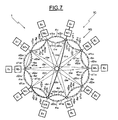
- figure 7 illustrates a fourth path of a packet according to an aspect of the invention ; and
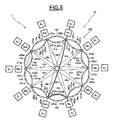
- figure 8 illustrates a fifth path of a packet according to an aspect of the invention.
- We refer now to figure 1 which illustrates a
system 1 according to an aspect of the invention, which is incorporated on a chip IC. This system comprises here N=10 routers r0,r1,...,rN-1 indexed from 0 to N-1=9 in the clockwise or right direction. Each of these routers r0,r1,...,rN-1 is connected to a respective network interface NI0,NI1,...,NIN-1. Each of these network interface NI0,NI1,...,NIN-1 is connected to a corresponding element E0,E1,...,EN-1. - Elements E0,E1,...,EN-1 can be for example a processor, a memory, an input, an output, a sub-system bus, or any other element.
- The routers r0,r1,...,rN-1 form a unique ring RG. Two adjacent routers ri,rj of the ring RG are linked with a couple of opposite unidirectional ring links rlij (from ri to rj), rlji (from rj to ri). Each ring link rlk1 carries two virtual channels vl1k1,vl2k1.
- More precisely, the figure 2 represents three adjacent routers ri,rj,rk of the ring RG. Each router r1 of the system comprise routing means rm1.
- Each router further comprises at least two queues q1ij,q2ij and a multiplexer Muxij connected to the unidirectional ring link, for transmitting a data packet from a router ri to a router rj. The multiplexer Muxij is controlled by the routing means rmi. Each of the at least two queues q1ij,q2ij permits to define, associated with the unidirectional ring link, a virtual channel. Each virtual channel has accordingly at least one queue. So each unidirectional ring link rlij have two virtual channels vl1ij,vl2ij.
- Turning now again to figure 1, two routers ri,rj, diametrically opposite ((j-i) mod N = N/2) on the ring RG, are linked with a couple of opposite unidirectional crossing links clij (from ri to rj) ,clji (from rj to ri).
- On the figure 3a, a network interface NIi is more detailed. The system comprises processing means, which are distributed within the routers r0,r1,...,rN-1, and the network interfaces NI0,NI1,...,NIN-1 . More precisely the processing means comprise N identical local preprocessing means ppm0,ppm1,...,ppmN_1, located within the N network interfaces NI0,NI1,...,NIN-1, and N identical routing means rm0,rm1,...,rmN-1, located within the N routers r0,r1,...,rN-1. The processing means are adapted to determine the path of a data packet P from a source element Esource to a destination element Edestination of the system.
- The path comprises at the most d transitions between routers, d being equal to ceil(N/4). The ceil function of a variable x, when y-1 < x ≤ y, is equal to y, with x a real number and y an integer number.
- As illustrated on figure 3b, a data packet P comprises a header H having a first field f1 and a second field f2.
- The network interface NIi of a source element Esource comprises preprocessing means ppmsource which are capable, for a data packet P to be transmitted, of determining the content of two fields f1,f2 of the header H of the data packet P. The first field f1 defines the presence of a crossing transition and/or the direction of a circular path on said ring RG. Once on the ring, the data packet keeps the same sense clockwise or anticlockwise. The second field f2 contains the index of the destination router rdestination corresponding to the destination network interface NIdestination and the destination element Edestination, with its index.
- Preprocessing means ppm0,ppm1,...,ppmN-1, use a specific process to determine the content of the two fields f1,f2 of the header H of a data packet P to be transmitted from a source network interface NIsource to a destination network interface NIdestination .
Each preprocessing means ppmi comprise calculating means Calci which calculate a value r equal to the difference between the index of the destination router and the index of the source router modulo N : r = (destination - source) modulo N.
Furthermore, each preprocessing means ppmi comprise determining means Deti for determining the content of said first field f1 from the value of r. More precisely : - If r belongs to the set {1,2,...,d}, a first value R representative of the right or clockwise direction on the ring RG is set to the first field f1.
- If r belongs to the set {N-d,N-d+1,...,N-1}, a second value L representative of the left or anticlockwise direction on the ring RG is set to the first field f1.
- If r is equal to N/2, a third value A representative of the crossing ring direction RG is set to the first field f1.
- If r belongs to the set {d+1,d+2...,N/2-1}, a fourth value (AL) representative of the crossing ring direction followed by the left or anticlockwise direction on the ring RG is set to the first field f1.
-
- At last, a fifth value AR representative of the crossing ring direction followed by the right or clockwise direction on the ring is otherwise set to the first field f1, i.e. if r belongs to the set {N/2+1,N/2+2,...,N-d-1}.
- In the present example, the direction (R,L) corresponds to the increasing indexation direction of the routers r0,r1,...,rN-1, and so if the indexation direction is opposite, the content of the field f1, has the opposite value.
- There are five possible values for the content of the first field f1. Theoretically three bits are necessary, but in fact, it is advantageously possible to encode the first field f1 on 2 bits, because the case of the third value A can be joined either with the case of the fourth value AL, or with the case of the fifth value AR. As a matter of fact, in case A, after the crossing transition, the data packet P will directly send to the corresponding network interface.
- An example of an algorithm illustrating this method, wherein the case A (only a crossing transition) is joined with the case AL (a crossing transition followed by at least one transition in the left or anticlockwise direction on the ring RG) is shown therebelow :

- Each routing means rmi is capable of routing the data packet to its coupled network interface if the index i of the corresponding router is equal to the content (destination) of the second field f2 of the header H of said data packet P. Otherwise, if its index i is greater than the content (destination) of the second field f2 of the header H of the data packet p, the routing means rmi route the data packet P on the first virtual channel, and if destination is greater than its index i the routing means rmi route the data packet P on the second virtual channel.
- In fact the choice of a virtual channel corresponds to the choice of the corresponding queue for temporary storing the data packet P before its transmission on the ring link.
- An example of an algorithm implemented in the routing means and illustrating this method is :

- The preprocessing means and the routing means can be implemented by software within microcontrollers, or can be realized by logic circuits by using for example logic synthesis tools from the algorithm above described converted in a specific language, like VHDL.
- Furthermore, all indexes used in this invention are binary encoded with bits. However the routing means need to use, because there is at the most d transitions in a path, only the last ceil(log2(d)) bits
- This topology of the network associated to the method for routing data packets permits to avoid deadlock problems. Indeed, the resource dependency graph, here the virtual channel dependency graph has no cycle, so the corresponding network is deadlock free. The generic scalable network proposed in this invention has a channel dependency graph cycle free, in particular because of the use of two virtual channels per unidirectional ring link and because of the fact that a crossing transition is always performed before eventual transitions on a circular path.
- Five cases of a data packet transmission according to the invention will be now illustrated.
- On the figure 4, the path of a data packet P from the source element E0 to the destination element E2 is highlighted. The preprocessing means ppm0 of the network interface NI0 set the value R in the first field f1 of the header H of the data packet P. Then the routing means rm0 of the router r0 send the data packet P on the ring RG, in the right or clockwise direction R, on the second virtual channel vl201. So the router r1, receives the data packet P. The routing means rm1 of the router r1, send the data packet P on the ring RG, in the right direction R, on the second virtual channel vl212. When the data packet P is received by the routing means rm2 of the router r2, this data packet P is transmitted to the network interface NI2, to the destination element E2.
- On the figure 5, the path of a data packet P from the source element E1 to the destination element E9 is highlighted. The preprocessing means ppm1 of the network interface NI1 set the value L in the first field f1 of the header H of the data packet P. Then the routing means rm1 of the router r1 send the data packet P on the ring RG, in the left or anticlockwise direction L, on the first virtual channel vl110. So the router r0 receives the data packet P. The routing means rm0 of the router r0 send the data packet P on the ring RG, in the left direction L, on the second virtual channel vl209. When the data packet P is received by the routing means rm9 of the router r9, this data packet P is transmitted to the network interface NI9, to the destination element E9.
- On the figure 6, the path of a data packet P from the source element E8 to the destination element E3 is highlighted. The preprocessing means ppm8 of the network interface NI8 set the value A in the first field f1 of the header H of the data packet P. Then the routing means rm8 of the router r8 send the data packet P on the crossing link cl83. So the router r3 receives the data packet P. The routing means rm3 of the router r3 then transmits the data packet P to the network interface NI3, to the destination element E3.
- On the figure 7, the path of a data packet P from the source element E1 to the destination element E7 is highlighted. The preprocessing means ppm1 of the network interface NI1 set the value AR in the first field fl, of the header H of the data packet P. Then the routing means rm1 of the router r1 send the data packet P on the crossing link cl16. So the router r6 receives the data packet P. The routing means rm6 of the router r6 send the data packet P on the ring RG, in the right direction R, on the second virtual channel vl267. When the data packet P is received by the routing means rm7 of the router r7, this data packet P is transmitted to the network interface NI7, to the destination element E7.
- Finally, On the figure 8, the path of a data packet P from the source element E1 to the destination element E5 is highlighted. The preprocessing means ppm1 of the network interface NI1 set the value AL in the first field f1 of the header H of the data packet P. Then the routing means rm1 of the router r1, send the data packet P on the crossing link cl16. So the router r6 receives the data packet P. The routing means rm6 of the router r6 send the data packet P on the ring RG, in the left direction L, on the first virtual channel vl165. When the data packet P is received by the routing means rm5 of the router r5, this data packet P is transmitted to the network interface NI5, to the destination element E5.
Claims (9)
- System for routing data packets (P) between elements (E0,E1,...,EN-1), comprising N network interfaces (NI0,NI1,...,NIN-1) respectively adapted to be connected to the N elements (E0,E1,...,EN-1), N being an even integer, and an on chip packet-switched communication network arranged in a unique ring structure (RG) including :the system further comprising processing means, distributed within the routers (r0,r1,...,rN-1) and the network interfaces (NI0,NI1,...,NIN-1), adapted upon the presence of a data packet (P) to be transmitted from one source element (Esource) to a destination element (Edestination) to determine the direction characteristics of the path of said data packet (P) on the ring (RG) and if necessary to determine at each router belonging to said path which virtual channel is to be used, so as to avoid deadlocks in the transmission.N routers (r0,r1,...,rN-1) respectively connected to the N interfaces (NI0,NI1,...,NIN-1) ;N couples of opposite unidirectional ring links (rlij,rlji), each ring link carrying two virtual channels, and one couple of ring links coupling two adjacent routers on the ring (RG) ; andN/2 couples of opposite unidirectional crossing links (clij,clji), one couple of crossing links coupling two diametrically opposite routers of said ring (RG) ;
- System according to claim 1, characterized in that the processing means are adapted to define said path for the transmitted data packet (P), such that said path comprises at the most d transitions between routers, d being equal to ceil(N/4).
- System according to claim 2, characterized in that the processing means are adapted to define said path for the transmitted data packet (P), such that said path includes at least one transition on the ring between two adjacent routers, or a crossing transition between two diametrically opposite routers eventually followed by a circular path on the ring (RG) having at least one transition, and by the fact that the direction of a circular path is identical for all the transitions of said circular path.
- System according to claim 2 or 3, characterized in that, a data packet (P) comprises a header (H) comprising a first field (f1) defining the presence of a crossing transition and/or the direction of a circular path on said ring (RG), and a second field (f2) defining the destination router,
and by the fact that said distributed processing means comprise local preprocessing means (ppm0,ppm1,...,ppmN_1) in the network interfaces (NI0,NI1,...,NIN-1), the local preprocessing means (ppmsource) of the network interface (NIsource) connected to the source element (Esource) being adapted for determining the content of said first field (f1) and said second field (f2), and comprise local routing means (rm0,rm1,...,rmN-1) within the routers (r0,r1,...,rN-1) for routing such data packets in accordance with the content of the first and second fields (f1,f2). - System according to claim 4, characterized in that the successive routers (r0,r1,...,rN-1) are indexed with consecutive indexes (0,1,...,N-1), and by the fact that the local preprocessing means (ppmsource) of the source network interface (NIsource) comprise :calculating means (Calcsource) for calculating a value r equal to the difference modulo N between the index (destination) of the destination router and the index (source) of the source router (rsource) ; anddetermining means (Detsource) for determining the content of said first field (f1) from the value of r.
- System according to claim 5, characterized in that, said indexes being increased in the right or clockwise direction, said determining means (Det0,Det1,...,DetN-1) are adapted to provide the content of said first field (f1) with :a first value (R) representative of the right or clockwise direction on the ring (RG) if said value r belongs to the set {1,2,...,d} ;a second value (L) representative of the left or anticlockwise direction on the ring (RG) if said value r belongs to the set {N-d,N-d+1,...,N-1} ;a third value (A) representative of the crossing ring direction if said value r is equal to N/2 ;a fourth value (AL) representative of the crossing ring direction followed by the left or anticlockwise direction on the ring (RG) if said value r belongs to the set {d+1,d+2...,N/2-1} ; ora fifth value (AR) representative of the crossing ring direction followed by the right or clockwise direction on the ring otherwise, i.e. if said value r belongs to the set {N/2+1,N/2+2,...,N-d-1}.
- System according to claim 6, characterized in that each routing means (rm0,rm1,...,rmN-1) are adapted for :routing the data packet to its coupled network interface if the index of the corresponding router is equal to the content of the second field (f2) of the header (H) of said data packet (P) ; and otherwiserouting the data packet (P) according to the content of the first field (f1) of the header (H) of said data packet (P), on a first virtual channel if said index is greater than the content of the second field (f2) of the header (H) of the data packet (P) and on a second virtual channel otherwise.
- System according to any one of claims 1 to 7, characterized in that each router comprises at least two queues connected to an unidirectional ring link connected to said router, each virtual channel being defined by at least one queue and the corresponding unidirectional ring link.
- System according to any one of claims 4 to 8, characterized in that, indexes being binary encoded, routing means (rm0,rm1,...,rmN-1) are adapted to process indexes only with the last ceil(log2(d)) bits of the indexes.
Priority Applications (2)
| Application Number | Priority Date | Filing Date | Title |
|---|---|---|---|
| EP04291588A EP1610500A1 (en) | 2004-06-24 | 2004-06-24 | On chip packet-switched communication system |
| US11/157,562 US7555001B2 (en) | 2004-06-24 | 2005-06-21 | On-chip packet-switched communication system |
Applications Claiming Priority (1)
| Application Number | Priority Date | Filing Date | Title |
|---|---|---|---|
| EP04291588A EP1610500A1 (en) | 2004-06-24 | 2004-06-24 | On chip packet-switched communication system |
Publications (1)
| Publication Number | Publication Date |
|---|---|
| EP1610500A1 true EP1610500A1 (en) | 2005-12-28 |
Family
ID=34931195
Family Applications (1)
| Application Number | Title | Priority Date | Filing Date |
|---|---|---|---|
| EP04291588A Withdrawn EP1610500A1 (en) | 2004-06-24 | 2004-06-24 | On chip packet-switched communication system |
Country Status (2)
| Country | Link |
|---|---|
| US (1) | US7555001B2 (en) |
| EP (1) | EP1610500A1 (en) |
Cited By (1)
| Publication number | Priority date | Publication date | Assignee | Title |
|---|---|---|---|---|
| WO2012103814A1 (en) * | 2011-02-02 | 2012-08-09 | Huawei Technologies Co., Ltd. | Method and apparatus for low-latency interconnection networks using hierarchical rings |
Families Citing this family (23)
| Publication number | Priority date | Publication date | Assignee | Title |
|---|---|---|---|---|
| US20090019258A1 (en) * | 2007-07-09 | 2009-01-15 | Shi Justin Y | Fault tolerant self-optimizing multi-processor system and method thereof |
| US20100158023A1 (en) * | 2008-12-23 | 2010-06-24 | Suvhasis Mukhopadhyay | System-On-a-Chip and Multi-Chip Systems Supporting Advanced Telecommunication Functions |
| US20100158005A1 (en) * | 2008-12-23 | 2010-06-24 | Suvhasis Mukhopadhyay | System-On-a-Chip and Multi-Chip Systems Supporting Advanced Telecommunication Functions |
| US20100162265A1 (en) * | 2008-12-23 | 2010-06-24 | Marco Heddes | System-On-A-Chip Employing A Network Of Nodes That Utilize Logical Channels And Logical Mux Channels For Communicating Messages Therebetween |
| US20100161938A1 (en) * | 2008-12-23 | 2010-06-24 | Marco Heddes | System-On-A-Chip Supporting A Networked Array Of Configurable Symmetric Multiprocessing Nodes |
| US20100191911A1 (en) * | 2008-12-23 | 2010-07-29 | Marco Heddes | System-On-A-Chip Having an Array of Programmable Processing Elements Linked By an On-Chip Network with Distributed On-Chip Shared Memory and External Shared Memory |
| US8787379B2 (en) * | 2011-02-02 | 2014-07-22 | Futurewei Technologies, Inc. | Destination-based virtual channel assignment in on-chip ring networks |
| JP5929902B2 (en) * | 2011-04-05 | 2016-06-08 | 日本電気株式会社 | Information processing device |
| US9781043B2 (en) * | 2013-07-15 | 2017-10-03 | Netspeed Systems | Identification of internal dependencies within system components for evaluating potential protocol level deadlocks |
| US9699079B2 (en) | 2013-12-30 | 2017-07-04 | Netspeed Systems | Streaming bridge design with host interfaces and network on chip (NoC) layers |
| US10348563B2 (en) | 2015-02-18 | 2019-07-09 | Netspeed Systems, Inc. | System-on-chip (SoC) optimization through transformation and generation of a network-on-chip (NoC) topology |
| US10218580B2 (en) | 2015-06-18 | 2019-02-26 | Netspeed Systems | Generating physically aware network-on-chip design from a physical system-on-chip specification |
| US10452124B2 (en) | 2016-09-12 | 2019-10-22 | Netspeed Systems, Inc. | Systems and methods for facilitating low power on a network-on-chip |
| US20180159786A1 (en) | 2016-12-02 | 2018-06-07 | Netspeed Systems, Inc. | Interface virtualization and fast path for network on chip |
| US10063496B2 (en) | 2017-01-10 | 2018-08-28 | Netspeed Systems Inc. | Buffer sizing of a NoC through machine learning |
| US10469337B2 (en) | 2017-02-01 | 2019-11-05 | Netspeed Systems, Inc. | Cost management against requirements for the generation of a NoC |
| US10547514B2 (en) | 2018-02-22 | 2020-01-28 | Netspeed Systems, Inc. | Automatic crossbar generation and router connections for network-on-chip (NOC) topology generation |
| US10896476B2 (en) | 2018-02-22 | 2021-01-19 | Netspeed Systems, Inc. | Repository of integration description of hardware intellectual property for NoC construction and SoC integration |
| US11144457B2 (en) | 2018-02-22 | 2021-10-12 | Netspeed Systems, Inc. | Enhanced page locality in network-on-chip (NoC) architectures |
| US10983910B2 (en) | 2018-02-22 | 2021-04-20 | Netspeed Systems, Inc. | Bandwidth weighting mechanism based network-on-chip (NoC) configuration |
| US11176302B2 (en) | 2018-02-23 | 2021-11-16 | Netspeed Systems, Inc. | System on chip (SoC) builder |
| US11023377B2 (en) | 2018-02-23 | 2021-06-01 | Netspeed Systems, Inc. | Application mapping on hardened network-on-chip (NoC) of field-programmable gate array (FPGA) |
| US11949595B2 (en) * | 2020-06-26 | 2024-04-02 | Intel Corporation | Reflection routing as a framework for adaptive modular load balancing for multi-hierarchy network on chips |
Citations (1)
| Publication number | Priority date | Publication date | Assignee | Title |
|---|---|---|---|---|
| EP1257100A2 (en) * | 2001-03-09 | 2002-11-13 | STMicroelectronics, Inc. | Octagonal interconnection network for linking processing nodes on a soc device and method of operating same |
Family Cites Families (3)
| Publication number | Priority date | Publication date | Assignee | Title |
|---|---|---|---|---|
| JP4427196B2 (en) * | 2001-02-07 | 2010-03-03 | 株式会社日立製作所 | IP packet communication apparatus and redundant configuration switching method |
| JP3606229B2 (en) * | 2001-05-30 | 2005-01-05 | 日本電気株式会社 | Protection method, layer 2 functional block, node and ring network |
| US6975588B1 (en) * | 2001-06-01 | 2005-12-13 | Cisco Technology, Inc. | Method and apparatus for computing a path through a bidirectional line switched |
-
2004
- 2004-06-24 EP EP04291588A patent/EP1610500A1/en not_active Withdrawn
-
2005
- 2005-06-21 US US11/157,562 patent/US7555001B2/en active Active
Patent Citations (1)
| Publication number | Priority date | Publication date | Assignee | Title |
|---|---|---|---|---|
| EP1257100A2 (en) * | 2001-03-09 | 2002-11-13 | STMicroelectronics, Inc. | Octagonal interconnection network for linking processing nodes on a soc device and method of operating same |
Non-Patent Citations (3)
| Title |
|---|
| DAILY W J ET AL: "Route packets, not wires: on-chip interconnection networks", PROCEEDINGS OF THE 38TH. ANNUAL DESIGN AUTOMATION CONFERENCE. (DAC). LAS VEGAS, NV, JUNE 18 - 22, 2001, PROCEEDINGS OF THE DESIGN AUTOMATION CONFERENCE, NEW YORK, NY : ACM, US, vol. CONF. 38, 18 June 2001 (2001-06-18), pages 684 - 689, XP010552473, ISBN: 1-58113-297-2 * |
| KARIM F ET AL: "On-chip communication architecture for OC-768 network processors", PROCEEDINGS OF THE 38TH. ANNUAL DESIGN AUTOMATION CONFERENCE. (DAC). LAS VEGAS, NV, JUNE 18 - 22, 2001, PROCEEDINGS OF THE DESIGN AUTOMATION CONFERENCE, NEW YORK, NY : ACM, US, vol. CONF. 38, 18 June 2001 (2001-06-18), pages 678 - 683, XP010552472, ISBN: 1-58113-297-2 * |
| YE T T ET AL: "Packetization and routing analysis of on-chip multiprocessor networks", JOURNAL OF SYSTEMS ARCHITECTURE, ELSEVIER SCIENCE PUBLISHERS BV., AMSTERDAM, NL, vol. 50, no. 2-3, February 2004 (2004-02-01), pages 81 - 104, XP004492174, ISSN: 1383-7621 * |
Cited By (2)
| Publication number | Priority date | Publication date | Assignee | Title |
|---|---|---|---|---|
| WO2012103814A1 (en) * | 2011-02-02 | 2012-08-09 | Huawei Technologies Co., Ltd. | Method and apparatus for low-latency interconnection networks using hierarchical rings |
| CN103380598A (en) * | 2011-02-02 | 2013-10-30 | 华为技术有限公司 | Method and apparatus for low-latency interconnection networks using hierarchical rings |
Also Published As
| Publication number | Publication date |
|---|---|
| US20050286543A1 (en) | 2005-12-29 |
| US7555001B2 (en) | 2009-06-30 |
Similar Documents
| Publication | Publication Date | Title |
|---|---|---|
| US7555001B2 (en) | On-chip packet-switched communication system | |
| JP5083464B2 (en) | Network-on-chip and network routing methods and systems | |
| US6967926B1 (en) | Method and apparatus for using barrier phases to limit packet disorder in a packet switching system | |
| CN102368739A (en) | Broadcast mechanism routing algorithm orienting to packet-circuit switch on-chip router | |
| JPH0372739A (en) | Communication system and routing information learning system | |
| GB2318250A (en) | A multiple output routing switch for a packet network | |
| CN104065570A (en) | Asynchronous fault-tolerant network-on-chip router design method | |
| US20040047360A1 (en) | Networked computer system and method using dual bi-directional communication rings | |
| Effiong et al. | Scalable and power-efficient implementation of an asynchronous router with buffer sharing | |
| CN109889447B (en) | Network transmission method and system based on hybrid ring networking and fountain codes | |
| KR0175499B1 (en) | Broadcast transmission method in multi-tag hierarchical interconnection network | |
| JP3591492B2 (en) | Packet distribution device and packet distribution program | |
| Matsutani et al. | Non-minimal routing strategy for application-specific networks-on-chips | |
| RU2188520C1 (en) | Multistage hierarchical radial-ring communication network | |
| CN118202631B (en) | Method for routing data packets in a ring network and ring network | |
| US7382721B2 (en) | Nodal computer network | |
| CN112631985A (en) | Link-shared network-on-chip | |
| CN1719944A (en) | Dual Ring Optical Switching System Composed of Non-blocking Optical Burst Switching Ring Switching Nodes | |
| US6625177B1 (en) | Circuit, method and/or architecture for improving the performance of a serial communication link | |
| Sridevi et al. | Label Switched based 2DNoC for streaming platform | |
| TW201204060A (en) | Implementation of switches in a communication network | |
| Cohen et al. | A new label-based source routing for multi-ring networks | |
| Mondinelli et al. | A 0.13/spl mu/m 1Gb/s/channel store-and-forward network on-chip | |
| US8315348B2 (en) | Clock extraction circuit for use in a linearly expandable broadcast router | |
| Chatmen et al. | A new network on chip design dedicated to multicast service |
Legal Events
| Date | Code | Title | Description |
|---|---|---|---|
| PUAI | Public reference made under article 153(3) epc to a published international application that has entered the european phase |
Free format text: ORIGINAL CODE: 0009012 |
|
| AK | Designated contracting states |
Kind code of ref document: A1 Designated state(s): AT BE BG CH CY CZ DE DK EE ES FI FR GB GR HU IE IT LI LU MC NL PL PT RO SE SI SK TR |
|
| AX | Request for extension of the european patent |
Extension state: AL HR LT LV MK |
|
| 17P | Request for examination filed |
Effective date: 20060602 |
|
| AKX | Designation fees paid |
Designated state(s): DE FR GB IT |
|
| 17Q | First examination report despatched |
Effective date: 20060829 |
|
| STAA | Information on the status of an ep patent application or granted ep patent |
Free format text: STATUS: THE APPLICATION IS DEEMED TO BE WITHDRAWN |
|
| 18D | Application deemed to be withdrawn |
Effective date: 20150106 |