EP1609846A1 - Use of 3-(Methoxymethyl)-2-pentylcyclopenta derivatives in perfume compositions - Google Patents
Use of 3-(Methoxymethyl)-2-pentylcyclopenta derivatives in perfume compositions Download PDFInfo
- Publication number
- EP1609846A1 EP1609846A1 EP05252810A EP05252810A EP1609846A1 EP 1609846 A1 EP1609846 A1 EP 1609846A1 EP 05252810 A EP05252810 A EP 05252810A EP 05252810 A EP05252810 A EP 05252810A EP 1609846 A1 EP1609846 A1 EP 1609846A1
- Authority
- EP
- European Patent Office
- Prior art keywords
- methoxymethyl
- compound
- products
- pentylcyclopenta
- fragrance
- Prior art date
- Legal status (The legal status is an assumption and is not a legal conclusion. Google has not performed a legal analysis and makes no representation as to the accuracy of the status listed.)
- Granted
Links
- 239000002304 perfume Substances 0.000 title claims abstract description 15
- 239000000203 mixture Substances 0.000 title claims description 17
- 150000001875 compounds Chemical class 0.000 claims abstract description 34
- 239000003205 fragrance Substances 0.000 claims abstract description 34
- 239000000126 substance Substances 0.000 claims abstract description 8
- 125000001495 ethyl group Chemical group [H]C([H])([H])C([H])([H])* 0.000 claims abstract description 6
- 125000002496 methyl group Chemical group [H]C([H])([H])* 0.000 claims abstract description 6
- 125000001183 hydrocarbyl group Chemical group 0.000 claims abstract 3
- REYJKGIGRBGGFS-UHFFFAOYSA-N 3-(methoxymethyl)-2-pentylcyclopent-2-en-1-one Chemical compound CCCCCC1=C(COC)CCC1=O REYJKGIGRBGGFS-UHFFFAOYSA-N 0.000 claims description 12
- 238000000034 method Methods 0.000 claims description 12
- 239000002537 cosmetic Substances 0.000 claims description 6
- 239000002386 air freshener Substances 0.000 claims description 4
- 239000000344 soap Substances 0.000 claims description 4
- 239000003643 water by type Substances 0.000 claims description 4
- 239000003599 detergent Substances 0.000 claims description 2
- 238000004851 dishwashing Methods 0.000 claims description 2
- 230000002708 enhancing effect Effects 0.000 claims description 2
- 238000005201 scrubbing Methods 0.000 claims description 2
- 238000004140 cleaning Methods 0.000 claims 4
- 239000004744 fabric Substances 0.000 claims 3
- YXFVVABEGXRONW-UHFFFAOYSA-N Toluene Chemical compound CC1=CC=CC=C1 YXFVVABEGXRONW-UHFFFAOYSA-N 0.000 description 18
- 239000000463 material Substances 0.000 description 9
- WQDUMFSSJAZKTM-UHFFFAOYSA-N Sodium methoxide Chemical compound [Na+].[O-]C WQDUMFSSJAZKTM-UHFFFAOYSA-N 0.000 description 8
- 238000006243 chemical reaction Methods 0.000 description 8
- OKKJLVBELUTLKV-UHFFFAOYSA-N Methanol Chemical compound OC OKKJLVBELUTLKV-UHFFFAOYSA-N 0.000 description 6
- KDLHZDBZIXYQEI-UHFFFAOYSA-N Palladium Chemical compound [Pd] KDLHZDBZIXYQEI-UHFFFAOYSA-N 0.000 description 4
- NBIIXXVUZAFLBC-UHFFFAOYSA-N Phosphoric acid Chemical compound OP(O)(O)=O NBIIXXVUZAFLBC-UHFFFAOYSA-N 0.000 description 4
- 239000004615 ingredient Substances 0.000 description 4
- QTBSBXVTEAMEQO-UHFFFAOYSA-N Acetic acid Chemical compound CC(O)=O QTBSBXVTEAMEQO-UHFFFAOYSA-N 0.000 description 3
- 241000218378 Magnolia Species 0.000 description 3
- 230000000694 effects Effects 0.000 description 3
- 239000011541 reaction mixture Substances 0.000 description 3
- 159000000000 sodium salts Chemical class 0.000 description 3
- 238000005160 1H NMR spectroscopy Methods 0.000 description 2
- ILHZVKAXFCDFMT-UHFFFAOYSA-N 2-pentylcyclopent-2-en-1-one Chemical compound CCCCCC1=CCCC1=O ILHZVKAXFCDFMT-UHFFFAOYSA-N 0.000 description 2
- 241000207199 Citrus Species 0.000 description 2
- 235000010254 Jasminum officinale Nutrition 0.000 description 2
- 240000005385 Jasminum sambac Species 0.000 description 2
- 240000007472 Leucaena leucocephala Species 0.000 description 2
- 235000010643 Leucaena leucocephala Nutrition 0.000 description 2
- UIIMBOGNXHQVGW-UHFFFAOYSA-M Sodium bicarbonate Chemical compound [Na+].OC([O-])=O UIIMBOGNXHQVGW-UHFFFAOYSA-M 0.000 description 2
- 229910000147 aluminium phosphate Inorganic materials 0.000 description 2
- 230000015572 biosynthetic process Effects 0.000 description 2
- 239000003054 catalyst Substances 0.000 description 2
- 235000020971 citrus fruits Nutrition 0.000 description 2
- SZXQTJUDPRGNJN-UHFFFAOYSA-N dipropylene glycol Chemical compound OCCCOCCCO SZXQTJUDPRGNJN-UHFFFAOYSA-N 0.000 description 2
- 238000009472 formulation Methods 0.000 description 2
- 150000002430 hydrocarbons Chemical group 0.000 description 2
- CDOSHBSSFJOMGT-UHFFFAOYSA-N linalool Chemical compound CC(C)=CCCC(C)(O)C=C CDOSHBSSFJOMGT-UHFFFAOYSA-N 0.000 description 2
- 238000004519 manufacturing process Methods 0.000 description 2
- 150000002828 nitro derivatives Chemical class 0.000 description 2
- LYGJENNIWJXYER-UHFFFAOYSA-N nitromethane Chemical compound C[N+]([O-])=O LYGJENNIWJXYER-UHFFFAOYSA-N 0.000 description 2
- 239000003921 oil Substances 0.000 description 2
- 238000002360 preparation method Methods 0.000 description 2
- 229920006395 saturated elastomer Polymers 0.000 description 2
- 238000003786 synthesis reaction Methods 0.000 description 2
- XLYOFNOQVPJJNP-UHFFFAOYSA-N water Substances O XLYOFNOQVPJJNP-UHFFFAOYSA-N 0.000 description 2
- IOCYQQQCJYMWDT-UHFFFAOYSA-N (3-ethyl-2-methoxyquinolin-6-yl)-(4-methoxycyclohexyl)methanone Chemical compound C=1C=C2N=C(OC)C(CC)=CC2=CC=1C(=O)C1CCC(OC)CC1 IOCYQQQCJYMWDT-UHFFFAOYSA-N 0.000 description 1
- 239000001490 (3R)-3,7-dimethylocta-1,6-dien-3-ol Substances 0.000 description 1
- CDOSHBSSFJOMGT-JTQLQIEISA-N (R)-linalool Natural products CC(C)=CCC[C@@](C)(O)C=C CDOSHBSSFJOMGT-JTQLQIEISA-N 0.000 description 1
- JHEPBQHNVNUAFL-AATRIKPKSA-N (e)-hex-1-en-1-ol Chemical compound CCCC\C=C\O JHEPBQHNVNUAFL-AATRIKPKSA-N 0.000 description 1
- UUFQTNFCRMXOAE-UHFFFAOYSA-N 1-methylmethylene Chemical compound C[CH] UUFQTNFCRMXOAE-UHFFFAOYSA-N 0.000 description 1
- LPRJMNVSZKGRNI-UHFFFAOYSA-N 3-(dimethoxymethyl)-2-pentylcyclopentan-1-one Chemical compound CCCCCC1C(C(OC)OC)CCC1=O LPRJMNVSZKGRNI-UHFFFAOYSA-N 0.000 description 1
- HEGOHAIYWGKAOZ-UHFFFAOYSA-N 3-(methoxymethyl)-2-pentylcyclopentan-1-one Chemical compound CCCCCC1C(COC)CCC1=O HEGOHAIYWGKAOZ-UHFFFAOYSA-N 0.000 description 1
- JNBMZPYOUPHCAT-UHFFFAOYSA-N 3-(nitromethyl)-2-pentylcyclopentan-1-one Chemical compound CCCCCC1C(C[N+]([O-])=O)CCC1=O JNBMZPYOUPHCAT-UHFFFAOYSA-N 0.000 description 1
- 235000011468 Albizia julibrissin Nutrition 0.000 description 1
- 244000144725 Amygdalus communis Species 0.000 description 1
- 235000011437 Amygdalus communis Nutrition 0.000 description 1
- 244000099147 Ananas comosus Species 0.000 description 1
- 235000007119 Ananas comosus Nutrition 0.000 description 1
- 241000205585 Aquilegia canadensis Species 0.000 description 1
- 241000167854 Bourreria succulenta Species 0.000 description 1
- 244000068485 Convallaria majalis Species 0.000 description 1
- 235000009046 Convallaria majalis Nutrition 0.000 description 1
- 235000009917 Crataegus X brevipes Nutrition 0.000 description 1
- 235000013204 Crataegus X haemacarpa Nutrition 0.000 description 1
- 235000009685 Crataegus X maligna Nutrition 0.000 description 1
- 235000009444 Crataegus X rubrocarnea Nutrition 0.000 description 1
- 235000009486 Crataegus bullatus Nutrition 0.000 description 1
- 235000017181 Crataegus chrysocarpa Nutrition 0.000 description 1
- 235000009682 Crataegus limnophila Nutrition 0.000 description 1
- 240000000171 Crataegus monogyna Species 0.000 description 1
- 235000004423 Crataegus monogyna Nutrition 0.000 description 1
- 235000002313 Crataegus paludosa Nutrition 0.000 description 1
- 235000009840 Crataegus x incaedua Nutrition 0.000 description 1
- 241000612152 Cyclamen hederifolium Species 0.000 description 1
- 240000002943 Elettaria cardamomum Species 0.000 description 1
- 241000196324 Embryophyta Species 0.000 description 1
- 241000919496 Erysimum Species 0.000 description 1
- 241000402754 Erythranthe moschata Species 0.000 description 1
- 235000016623 Fragaria vesca Nutrition 0.000 description 1
- 240000009088 Fragaria x ananassa Species 0.000 description 1
- 235000011363 Fragaria x ananassa Nutrition 0.000 description 1
- 240000001972 Gardenia jasminoides Species 0.000 description 1
- 244000215562 Heliotropium arborescens Species 0.000 description 1
- 241001632576 Hyacinthus Species 0.000 description 1
- PMGCQNGBLMMXEW-UHFFFAOYSA-N Isoamyl salicylate Chemical compound CC(C)CCOC(=O)C1=CC=CC=C1O PMGCQNGBLMMXEW-UHFFFAOYSA-N 0.000 description 1
- 240000006568 Lathyrus odoratus Species 0.000 description 1
- 241000234435 Lilium Species 0.000 description 1
- 241000220225 Malus Species 0.000 description 1
- 235000011430 Malus pumila Nutrition 0.000 description 1
- 235000015103 Malus silvestris Nutrition 0.000 description 1
- 235000014749 Mentha crispa Nutrition 0.000 description 1
- 244000246386 Mentha pulegium Species 0.000 description 1
- 235000016257 Mentha pulegium Nutrition 0.000 description 1
- 244000078639 Mentha spicata Species 0.000 description 1
- 235000004357 Mentha x piperita Nutrition 0.000 description 1
- 240000005852 Mimosa quadrivalvis Species 0.000 description 1
- 241000234479 Narcissus Species 0.000 description 1
- 241000233855 Orchidaceae Species 0.000 description 1
- 241000218657 Picea Species 0.000 description 1
- 235000008331 Pinus X rigitaeda Nutrition 0.000 description 1
- 241000018646 Pinus brutia Species 0.000 description 1
- 235000011613 Pinus brutia Nutrition 0.000 description 1
- 244000014047 Polianthes tuberosa Species 0.000 description 1
- 235000016067 Polianthes tuberosa Nutrition 0.000 description 1
- 235000014443 Pyrus communis Nutrition 0.000 description 1
- 240000001987 Pyrus communis Species 0.000 description 1
- 241001128140 Reseda Species 0.000 description 1
- 240000007651 Rubus glaucus Species 0.000 description 1
- 235000011034 Rubus glaucus Nutrition 0.000 description 1
- 235000009122 Rubus idaeus Nutrition 0.000 description 1
- 244000297179 Syringa vulgaris Species 0.000 description 1
- 235000004338 Syringa vulgaris Nutrition 0.000 description 1
- 241000219793 Trifolium Species 0.000 description 1
- 235000009499 Vanilla fragrans Nutrition 0.000 description 1
- 244000263375 Vanilla tahitensis Species 0.000 description 1
- 235000012036 Vanilla tahitensis Nutrition 0.000 description 1
- 244000172533 Viola sororia Species 0.000 description 1
- 235000009754 Vitis X bourquina Nutrition 0.000 description 1
- 235000012333 Vitis X labruscana Nutrition 0.000 description 1
- 240000006365 Vitis vinifera Species 0.000 description 1
- 235000014787 Vitis vinifera Nutrition 0.000 description 1
- 239000002671 adjuvant Substances 0.000 description 1
- 230000032683 aging Effects 0.000 description 1
- 125000000217 alkyl group Chemical group 0.000 description 1
- 235000020224 almond Nutrition 0.000 description 1
- POIARNZEYGURDG-FNORWQNLSA-N beta-damascenone Chemical compound C\C=C\C(=O)C1=C(C)C=CCC1(C)C POIARNZEYGURDG-FNORWQNLSA-N 0.000 description 1
- 235000005300 cardamomo Nutrition 0.000 description 1
- 239000003795 chemical substances by application Substances 0.000 description 1
- 235000019693 cherries Nutrition 0.000 description 1
- 239000001926 citrus aurantium l. subsp. bergamia wright et arn. oil Substances 0.000 description 1
- 239000012459 cleaning agent Substances 0.000 description 1
- 229930186364 cyclamen Natural products 0.000 description 1
- 125000004122 cyclic group Chemical group 0.000 description 1
- 125000001995 cyclobutyl group Chemical group [H]C1([H])C([H])([H])C([H])(*)C1([H])[H] 0.000 description 1
- 125000001511 cyclopentyl group Chemical group [H]C1([H])C([H])([H])C([H])([H])C([H])(*)C1([H])[H] 0.000 description 1
- 238000011161 development Methods 0.000 description 1
- 230000018109 developmental process Effects 0.000 description 1
- 238000004821 distillation Methods 0.000 description 1
- 235000013399 edible fruits Nutrition 0.000 description 1
- 239000003995 emulsifying agent Substances 0.000 description 1
- 238000001914 filtration Methods 0.000 description 1
- 239000000796 flavoring agent Substances 0.000 description 1
- 235000019634 flavors Nutrition 0.000 description 1
- 239000000499 gel Substances 0.000 description 1
- 235000001050 hortel pimenta Nutrition 0.000 description 1
- 238000005984 hydrogenation reaction Methods 0.000 description 1
- 239000005457 ice water Substances 0.000 description 1
- 238000010348 incorporation Methods 0.000 description 1
- 229930002839 ionone Natural products 0.000 description 1
- 150000002499 ionone derivatives Chemical class 0.000 description 1
- 239000010410 layer Substances 0.000 description 1
- 229930007744 linalool Natural products 0.000 description 1
- 238000012986 modification Methods 0.000 description 1
- 230000004048 modification Effects 0.000 description 1
- 125000004123 n-propyl group Chemical group [H]C([H])([H])C([H])([H])C([H])([H])* 0.000 description 1
- 125000000449 nitro group Chemical group [O-][N+](*)=O 0.000 description 1
- MCSAJNNLRCFZED-UHFFFAOYSA-N nitroethane Chemical compound CC[N+]([O-])=O MCSAJNNLRCFZED-UHFFFAOYSA-N 0.000 description 1
- -1 nitromethyl Chemical group 0.000 description 1
- BOPPSUHPZARXTH-UHFFFAOYSA-N ocean propanal Chemical compound O=CC(C)CC1=CC=C2OCOC2=C1 BOPPSUHPZARXTH-UHFFFAOYSA-N 0.000 description 1
- 239000012044 organic layer Substances 0.000 description 1
- 229910052763 palladium Inorganic materials 0.000 description 1
- 229920000642 polymer Polymers 0.000 description 1
- OSFBJERFMQCEQY-UHFFFAOYSA-N propylidene Chemical compound [CH]CC OSFBJERFMQCEQY-UHFFFAOYSA-N 0.000 description 1
- 238000010992 reflux Methods 0.000 description 1
- 229930195734 saturated hydrocarbon Natural products 0.000 description 1
- 230000035943 smell Effects 0.000 description 1
- 229910000030 sodium bicarbonate Inorganic materials 0.000 description 1
- 235000017557 sodium bicarbonate Nutrition 0.000 description 1
- 239000002904 solvent Substances 0.000 description 1
- 238000001228 spectrum Methods 0.000 description 1
- 239000007858 starting material Substances 0.000 description 1
- 239000004094 surface-active agent Substances 0.000 description 1
- 238000012360 testing method Methods 0.000 description 1
- XMLSXPIVAXONDL-UHFFFAOYSA-N trans-jasmone Natural products CCC=CCC1=C(C)CCC1=O XMLSXPIVAXONDL-UHFFFAOYSA-N 0.000 description 1
- 229930195735 unsaturated hydrocarbon Natural products 0.000 description 1
- 239000000341 volatile oil Substances 0.000 description 1
- 229930007850 β-damascenone Natural products 0.000 description 1
Classifications
-
- C—CHEMISTRY; METALLURGY
- C11—ANIMAL OR VEGETABLE OILS, FATS, FATTY SUBSTANCES OR WAXES; FATTY ACIDS THEREFROM; DETERGENTS; CANDLES
- C11C—FATTY ACIDS FROM FATS, OILS OR WAXES; CANDLES; FATS, OILS OR FATTY ACIDS BY CHEMICAL MODIFICATION OF FATS, OILS, OR FATTY ACIDS OBTAINED THEREFROM
- C11C5/00—Candles
- C11C5/002—Ingredients
-
- A—HUMAN NECESSITIES
- A61—MEDICAL OR VETERINARY SCIENCE; HYGIENE
- A61K—PREPARATIONS FOR MEDICAL, DENTAL OR TOILETRY PURPOSES
- A61K8/00—Cosmetics or similar toiletry preparations
- A61K8/18—Cosmetics or similar toiletry preparations characterised by the composition
- A61K8/30—Cosmetics or similar toiletry preparations characterised by the composition containing organic compounds
- A61K8/33—Cosmetics or similar toiletry preparations characterised by the composition containing organic compounds containing oxygen
- A61K8/35—Ketones, e.g. benzophenone
-
- A—HUMAN NECESSITIES
- A61—MEDICAL OR VETERINARY SCIENCE; HYGIENE
- A61L—METHODS OR APPARATUS FOR STERILISING MATERIALS OR OBJECTS IN GENERAL; DISINFECTION, STERILISATION OR DEODORISATION OF AIR; CHEMICAL ASPECTS OF BANDAGES, DRESSINGS, ABSORBENT PADS OR SURGICAL ARTICLES; MATERIALS FOR BANDAGES, DRESSINGS, ABSORBENT PADS OR SURGICAL ARTICLES
- A61L9/00—Disinfection, sterilisation or deodorisation of air
- A61L9/01—Deodorant compositions
-
- A—HUMAN NECESSITIES
- A61—MEDICAL OR VETERINARY SCIENCE; HYGIENE
- A61L—METHODS OR APPARATUS FOR STERILISING MATERIALS OR OBJECTS IN GENERAL; DISINFECTION, STERILISATION OR DEODORISATION OF AIR; CHEMICAL ASPECTS OF BANDAGES, DRESSINGS, ABSORBENT PADS OR SURGICAL ARTICLES; MATERIALS FOR BANDAGES, DRESSINGS, ABSORBENT PADS OR SURGICAL ARTICLES
- A61L9/00—Disinfection, sterilisation or deodorisation of air
- A61L9/015—Disinfection, sterilisation or deodorisation of air using gaseous or vaporous substances, e.g. ozone
- A61L9/04—Disinfection, sterilisation or deodorisation of air using gaseous or vaporous substances, e.g. ozone using substances evaporated in the air without heating
-
- A—HUMAN NECESSITIES
- A61—MEDICAL OR VETERINARY SCIENCE; HYGIENE
- A61Q—SPECIFIC USE OF COSMETICS OR SIMILAR TOILETRY PREPARATIONS
- A61Q13/00—Formulations or additives for perfume preparations
-
- C—CHEMISTRY; METALLURGY
- C11—ANIMAL OR VEGETABLE OILS, FATS, FATTY SUBSTANCES OR WAXES; FATTY ACIDS THEREFROM; DETERGENTS; CANDLES
- C11D—DETERGENT COMPOSITIONS; USE OF SINGLE SUBSTANCES AS DETERGENTS; SOAP OR SOAP-MAKING; RESIN SOAPS; RECOVERY OF GLYCEROL
- C11D3/00—Other compounding ingredients of detergent compositions covered in group C11D1/00
- C11D3/50—Perfumes
Definitions
- 3-(methoxymethyl)-2-pentylcyclopenta derivatives are disclosed as fragrance chemicals suitable for incorporation in fine fragrances, cosmetics, toiletries, and related applications.
- the present invention is directed to the compounds of the formula: where the dotted line represents a possible double bond; R is selected from the group consisting of methyl and ethyl; and X is selected from the group consisting of C 1 -C 7 moieties and the use of these materials as a fragrance chemical to enhance fragrance in perfumes, toilet waters, colognes, personal products and the like.
- the present invention is a method for enhancing a perfume by incorporating an olfactory acceptable amount of the compounds set forth above.
- the C 1 -C 7 hydrocarbon moiety attached to the ring.
- the hydrocarbon moiety can be straight, branched, or cyclic as well as saturated or unsaturated hydrocarbons.
- the present invention includes various isomers, which are contemplated within the scope of the present invention.
- the present invention is also directed to the use of these compounds in fragrance formulations.
- the present invention is directed to the novel compounds, 3-(methoxymethyl)-2-pentylcyclopent-2-en-1-one as depicted below: and 3-(methoxymethyl)-2-pentylcyclopenta-1-one:
- 3-(methoxymethyl)-2-pentylcyclopenta-1-one has a powerful, white floral odor, pronounced of magnolia flower and jasmine combined with a light, creamy undertone. When tested on blotters, the fragrance had a good substantivity on test blotters.
- 3-(methoxy-methyl)-2-pentylcyclopent-2-en-1-one has a strong, white floral odor, pronounced of lily of the valley and magnolia flower.
- the top note is slightly greener compared to 3-(methoxymethyl)-2-pentylcyclopenta-1-one, but has also the attractive, creamy undertone. Substantivity on blotters is also excellent.
- the compounds of the present invention are described in greater detail in the Examples below.
- the generic reaction sequence involves the reaction of the starting material such as 2-pentyl 2-cyclopentenone, with nitromethane or nitroethane as appropriate, preferably in the presence of sodium methoxide, to form the corresponding nitromethyl cylcopentanone compound, such as 3-(nitromethyl)-2-pentylcyclopentanone.
- the sodium salt of the compound is then prepared from the corresponding nitro compound through the reaction with sodium methoxide.
- the sodium salt product is then refluxed with toluene and phosphoric acid to provide the unsaturated compounds of the present invention.
- the corresponding saturated compounds are prepared by the hydrogenation of the compound using a palladium catalyst at pressures of about 200 pounds per square inch and temperatures of 100oC.
- the use of the compounds of the present invention is widely applicable in current perfumery products, including the preparation of perfumes and colognes, the perfuming of personal care products such as soaps, shower gels, and hair care products as well as air fresheners, candles and cosmetic products.
- the compound can also be used to perfume candles and cleaning agents, such as, but not limited to soaps, detergents, dishwashing materials, scrubbing compositions, window cleaners, and the like.
- the compounds of the present invention can be used alone or in combination with other fragrance compositions, solvents, adjuvants and the like.
- fragrance compositions solvents, adjuvants and the like.
- Those with skill in the art will appreciate the nature and variety of the other ingredients that can be used in combination with the compound of the present invention.
- fragrances can be employed in the present invention, the only limitation being the compatibility with the other components being employed.
- Suitable fragrances include but are not limited to fruits such as almond, apple, cherry, grape, pear, pineapple, orange, strawberry, raspberry; musk flower scents such as lavender-like, rose-like, iris-like, and carnation-like.
- Other pleasant scents include herbal and woodland scents derived from pine, spruce and other forest smells.
- Fragrances may also be derived from various oils, such as essential oils, or from plant materials such as peppermint, spearmint and the like.
- fragrances A list of suitable fragrances is provided in U.S. Patent No. 4,534,891. Another source of suitable fragrances is found in Perfumes, Cosmetics and Soaps , Second Edition, edited by W. A. Poucher, 1959.
- the fragrances provided in this treatise are acacia, cassie, chypre, cyclamen, fern, gardenia, hawthorn, heliotrope, honeysuckle, hyacinth, jasmine, lilac, lily, magnolia, mimosa, narcissus, freshly-cut hay, orange blossom, orchid, reseda, sweet pea, trefle, tuberose, vanilla, violet, wallflower, and the like.
- olfactory effective amount is understood to mean the amount of compound in perfume compositions the individual component will contribute to its particular olfactory characteristics, but the olfactory effect of the perfume composition will be the sum of the effects of each of the perfume or fragrance ingredients.
- the compounds of the invention can be used to alter the aroma characteristics of the perfume composition by modifying the olfactory reaction contributed by another ingredient in the composition. The amount will vary depending on many factors including other ingredients, their relative amounts and the effect that is desired.
- the level of compounds of the invention employed in the perfumed article varies from about 0.005 to about 10 weight percent, preferably from about 0.1 to about 8 and most preferably from about 0.5 to about 5 weight percent.
- other agents can be used in conjunction with the fragrance.
- Well known materials such as surfactants, emulsifiers, and polymers to encapsulate the fragrance can also be employed without departing from the scope of the present invention.
- Another method of reporting the level of the compound of the invention in the perfumed composition i.e., the compounds as a weight percentage of the materials added to impart the desired fragrance.
- the compounds of the invention can range widely from 0.005 to about 10 weight percent of the perfumed composition, and preferably from about 0.1 to about 5 weight percent. Those with skill in the art will be able to employ the desired level of the compound of the invention to provide the desired fragrance and intensity.
- the sodium salt of 3-(nitromethyl) 2-pentycylopentanone (1 mole) was prepared from the corresponding nitro compound and sodium methoxide.
- the nitro salt in 5 liters of methanol was added to a 1M solution of HC1 at room temperature.
- the reaction was stirred one hour and poured into ice water (2L) containing 1 liter of toluene.
- the toluene layer was separated and washed with water, (2 X 500ml).
- the toluene was removed by Rot-o-Vap to provide crude 3-(dimethoxy-methyl)-2-pentylcyclopentanone which is used in the next step of the synthesis of the compounds.
- 3-(methoxymethyl)-2-pentylcyclopent-2-en-1-one (.5 mol) was hydrogenated at 100oC and 200 pounds per square inch using 5% palladium on carbon as a catalyst. After filtration, 3-(methoxymethyl)-2-pentylcyclopentan-1-one was obtained as was confirmed by the following data; 1 HNMR (ppm): 0.90 (triplet, 3H), 1.3(multiplet, 6H), 1.60 (multiplet, 3H), 1.95 (multiplet, 1H), 2.15 (multiplet, 3H), 2.35 (multiplet, 1H), 3.40 (singlet, 3H), 3.45(doublet of doublet, 2H).
- GREEN TEA 3-(methoxymethyl)-2-pentylcyclo-pent-2-en-1-one 3-(methoxymethyl)-2-pentylcyclopenta-1-one Bergamot Oil Italy MPF "PFG" 20.00 20.00 Cardamom Oil Ceylon Ref A LMR 1.00 1.00 Damascenone Firm 2.00 2.00 Dipropylene Glycol 18.00 18.00 Helional 66.00 66.00 Hexenol,B,Gamma Extra 10% DPG 2.00 2.00 Ionone Beta Extra 30.00 30.00 3-(methoxymethyl)-2-pentylcyclopent-2-en-1-one 120.00 - Jasmone Cis 10% DPG 65.00 65.00 Linalool Syn 26.00 26.00 3-(methoxymethyl)-2-pentylcyclopenta-1-one - 120.00 TOTAL 350.00 350.00 350.00
- the Green Tea formula containing 3-(methoxymethyl)-2-pentylcyclopent-2-en-1-one has a greener, more citrus top note than the formula containing 3-(methoxymethyl)-2-pentylcyclopenta-1-one, which has more floral and less citrus character.
Landscapes
- Health & Medical Sciences (AREA)
- Life Sciences & Earth Sciences (AREA)
- Chemical & Material Sciences (AREA)
- Animal Behavior & Ethology (AREA)
- General Health & Medical Sciences (AREA)
- Public Health (AREA)
- Veterinary Medicine (AREA)
- Epidemiology (AREA)
- Oil, Petroleum & Natural Gas (AREA)
- Engineering & Computer Science (AREA)
- Chemical Kinetics & Catalysis (AREA)
- Wood Science & Technology (AREA)
- Organic Chemistry (AREA)
- Birds (AREA)
- Emergency Medicine (AREA)
- General Chemical & Material Sciences (AREA)
- Fats And Perfumes (AREA)
- Organic Low-Molecular-Weight Compounds And Preparation Thereof (AREA)
- Cosmetics (AREA)
Abstract

Description
- The use 3-(methoxymethyl)-2-pentylcyclopenta derivatives are disclosed as fragrance chemicals suitable for incorporation in fine fragrances, cosmetics, toiletries, and related applications.
- There is an ongoing need in the fragrance industry to provide new chemicals to give perfumers and others the ability to create new fragrances for perfumes, colognes and personal care products. Various commercially successful fragrance materials are known in the art including those described in U.S. patents 6,303,798 and 6,632,788.
- Despite these and other disclosures there is an ongoing need for the development of new fragrance materials to give perfumers new materials to develop new fragrance products.
- The present invention is directed to the compounds of the formula:where the dotted line represents a possible double bond; R is selected from the group consisting of methyl and ethyl; and X is selected from the group consisting of C1-C7 moieties and the use of these materials as a fragrance chemical to enhance fragrance in perfumes, toilet waters, colognes, personal products and the like.

- More specifically, the present invention is a method for enhancing a perfume by incorporating an olfactory acceptable amount of the compounds set forth above.
- These and other embodiments of the present invention will be apparent by reading the following specification.
- Those with skill in the art readily appreciate the C1-C7 hydrocarbon moiety attached to the ring. The hydrocarbon moiety can be straight, branched, or cyclic as well as saturated or unsaturated hydrocarbons.
- Representative moieties include alkyl groups such as but not limited to CH3 C2H5, C4H9 C5H11; CH(CH3)CH2CH2CH3; CH2CH(CH3)CH2CH3 and CH2CH2CH(CH3)CH3; cyclobutyl, cyclopentyl;
as well as unsaturated moieties including but not limited to:
CH = CHCH2CH2CH3; CH2CH = CHCH2CH3; CH2CH2CH = CHCH3; and CH=C(CH3)CH2CH3. Those with skill in the art will appreciate that the present invention includes various isomers, which are contemplated within the scope of the present invention. - The present invention is also directed to the use of these compounds in fragrance formulations.
- In a highly preferred embodiment, the present invention is directed to the novel compounds, 3-(methoxymethyl)-2-pentylcyclopent-2-en-1-one as depicted below:and 3-(methoxymethyl)-2-pentylcyclopenta-1-one:
 In a highly preferred embodiment of the invention, we have discovered that 3-(methoxymethyl)-2-pentylcyclopenta-1-one has a powerful, white floral odor, reminiscent of magnolia flower and jasmine combined with a light, creamy undertone. When tested on blotters, the fragrance had a good substantivity on test blotters. Similarly, 3-(methoxy-methyl)-2-pentylcyclopent-2-en-1-one has a strong, white floral odor, reminiscent of lily of the valley and magnolia flower. The top note is slightly greener compared to 3-(methoxymethyl)-2-pentylcyclopenta-1-one, but has also the attractive, creamy undertone. Substantivity on blotters is also excellent.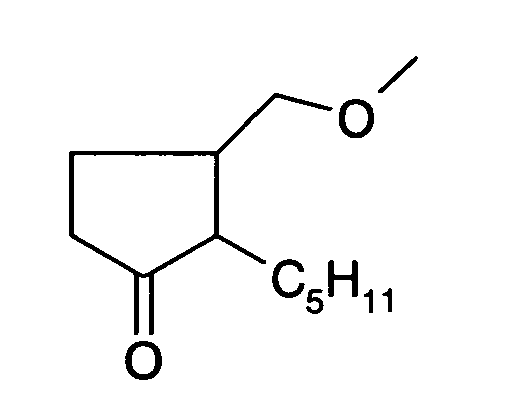
- The compounds of the present invention are described in greater detail in the Examples below. The generic reaction sequence involves the reaction of the starting material such as 2-pentyl 2-cyclopentenone, with nitromethane or nitroethane as appropriate, preferably in the presence of sodium methoxide, to form the corresponding nitromethyl cylcopentanone compound, such as 3-(nitromethyl)-2-pentylcyclopentanone. The sodium salt of the compound is then prepared from the corresponding nitro compound through the reaction with sodium methoxide. The sodium salt product is then refluxed with toluene and phosphoric acid to provide the unsaturated compounds of the present invention. The corresponding saturated compounds are prepared by the hydrogenation of the compound using a palladium catalyst at pressures of about 200 pounds per square inch and temperatures of 100ºC.
- The use of the compounds of the present invention is widely applicable in current perfumery products, including the preparation of perfumes and colognes, the perfuming of personal care products such as soaps, shower gels, and hair care products as well as air fresheners, candles and cosmetic products. The compound can also be used to perfume candles and cleaning agents, such as, but not limited to soaps, detergents, dishwashing materials, scrubbing compositions, window cleaners, and the like.
- In these preparations, the compounds of the present invention can be used alone or in combination with other fragrance compositions, solvents, adjuvants and the like. Those with skill in the art will appreciate the nature and variety of the other ingredients that can be used in combination with the compound of the present invention.
- Many types of fragrances can be employed in the present invention, the only limitation being the compatibility with the other components being employed. Suitable fragrances include but are not limited to fruits such as almond, apple, cherry, grape, pear, pineapple, orange, strawberry, raspberry; musk flower scents such as lavender-like, rose-like, iris-like, and carnation-like. Other pleasant scents include herbal and woodland scents derived from pine, spruce and other forest smells. Fragrances may also be derived from various oils, such as essential oils, or from plant materials such as peppermint, spearmint and the like.
- A list of suitable fragrances is provided in U.S. Patent No. 4,534,891. Another source of suitable fragrances is found in Perfumes, Cosmetics and Soaps, Second Edition, edited by W. A. Poucher, 1959. Among the fragrances provided in this treatise are acacia, cassie, chypre, cyclamen, fern, gardenia, hawthorn, heliotrope, honeysuckle, hyacinth, jasmine, lilac, lily, magnolia, mimosa, narcissus, freshly-cut hay, orange blossom, orchid, reseda, sweet pea, trefle, tuberose, vanilla, violet, wallflower, and the like.
- As used herein olfactory effective amount is understood to mean the amount of compound in perfume compositions the individual component will contribute to its particular olfactory characteristics, but the olfactory effect of the perfume composition will be the sum of the effects of each of the perfume or fragrance ingredients. Thus the compounds of the invention can be used to alter the aroma characteristics of the perfume composition by modifying the olfactory reaction contributed by another ingredient in the composition. The amount will vary depending on many factors including other ingredients, their relative amounts and the effect that is desired.
- The level of compounds of the invention employed in the perfumed article varies from about 0.005 to about 10 weight percent, preferably from about 0.1 to about 8 and most preferably from about 0.5 to about 5 weight percent. In addition to the compounds, other agents can be used in conjunction with the fragrance. Well known materials such as surfactants, emulsifiers, and polymers to encapsulate the fragrance can also be employed without departing from the scope of the present invention.
- Another method of reporting the level of the compound of the invention in the perfumed composition, i.e., the compounds as a weight percentage of the materials added to impart the desired fragrance. The compounds of the invention can range widely from 0.005 to about 10 weight percent of the perfumed composition, and preferably from about 0.1 to about 5 weight percent. Those with skill in the art will be able to employ the desired level of the compound of the invention to provide the desired fragrance and intensity.
- The following are provided as specific embodiments of the present invention. Other modifications of this invention will be readily apparent to those skilled in the art, without departing from the scope of this invention. As used herein, in both the specification and following examples, all percentages are weight percent unless noted to the contrary. IFF as used in the examples is understood to mean International Flavors & Fragrances Inc., and DPG is understood to mean dipropylene glycol.
- Three hundred grams of commercially available 2-pentyl 2-cyclopentenone in 300 ml of methanol was added to a mixture of 180 grams of nitromethane and 180 grams of sodium methoxide at 0ºC in a 3 liter reactor equipped with a stirrer. The reaction was allowed to take place for about three hours. After aging, the reaction mixture was quenched with 75 grams of acetic acid. The reaction mixture was added to 2 liters of a 1/1 mixture of water/toluene. The organic layer was separated and distilled to provide 3-(nitromethyl) 2-pentycylopentanone in quantitative yield.
- The sodium salt of 3-(nitromethyl) 2-pentycylopentanone (1 mole) was prepared from the corresponding nitro compound and sodium methoxide. The nitro salt in 5 liters of methanol was added to a 1M solution of HC1 at room temperature. The reaction was stirred one hour and poured into ice water (2L) containing 1 liter of toluene. The toluene layer was separated and washed with water, (2 X 500ml). The toluene was removed by Rot-o-Vap to provide crude 3-(dimethoxy-methyl)-2-pentylcyclopentanone which is used in the next step of the synthesis of the compounds.
- 3-(dimethoxymethyl)-2-pentylcycylopentan-1-one (.5 mol), toluene 250 ml and phosphoric acid (.01 mol) were charged in a reaction flask and heated to reflux for 48 hrs. The reaction mixture was cooled to room temperature and washed with 5% sodium bicarbonate. Distillation of the washed reaction crude provided 3-(methoxymethyl)-2-pentylcyclopent-2-en-1-one having the following spectra:
- 1HNMR (ppm): 0.85 (triplet, 3H), 1.3(multiplet, 6H), 2.15 (triplet, 2H), 2.35 (triplet, 2H), 2.6 (triplet, 2H), 3.35 (singlet, 3H), 4.25 (singlet, 2H).
- Using a standard autoclave pressure reactor 3-(methoxymethyl)-2-pentylcyclopent-2-en-1-one (.5 mol) was hydrogenated at 100ºC and 200 pounds per square inch using 5% palladium on carbon as a catalyst. After filtration, 3-(methoxymethyl)-2-pentylcyclopentan-1-one was obtained as was confirmed by the following data;
1HNMR (ppm): 0.90 (triplet, 3H), 1.3(multiplet, 6H), 1.60 (multiplet, 3H), 1.95 (multiplet, 1H), 2.15 (multiplet, 3H), 2.35 (multiplet, 1H), 3.40 (singlet, 3H), 3.45(doublet of doublet, 2H). - The novel compounds of the present invention were used in the following fragrance formulation.
GREEN TEA 3-(methoxymethyl)-2-pentylcyclo-pent-2-en-1-one 3-(methoxymethyl)-2-pentylcyclopenta-1-one Bergamot Oil Italy MPF "PFG" 20.00 20.00 Cardamom Oil Ceylon Ref A LMR 1.00 1.00 Damascenone Firm 2.00 2.00 Dipropylene Glycol 18.00 18.00 Helional 66.00 66.00 Hexenol,B,Gamma Extra 10% DPG 2.00 2.00 Ionone Beta Extra 30.00 30.00 3-(methoxymethyl)-2-pentylcyclopent-2-en-1-one 120.00 - Jasmone Cis 10% DPG 65.00 65.00 Linalool Syn 26.00 26.00 3-(methoxymethyl)-2-pentylcyclopenta-1-one - 120.00 TOTAL 350.00 350.00 - The Green Tea formula containing 3-(methoxymethyl)-2-pentylcyclopent-2-en-1-one has a greener, more citrus top note than the formula containing 3-(methoxymethyl)-2-pentylcyclopenta-1-one, which has more floral and less citrus character.
Claims (13)
- A method for improving, enhancing or modifying a fragrance through the addition of an olfactory acceptable amount of the compound having the structure:where:
 the dotted line represents a potential double bond;R is selected from methyl and ethyl; andX is a C1-C7 hydrocarbon moiety.
 - The method of claim 1 through the addition of an olfactory acceptable amount of a fragrance chemical 3-(methoxymethyl)-2-pentylcyclopent-2-en-1-one and 3-(methoxymethyl)-2-pentylcyclopenta-1-one.
- The method of claim 1 wherein the fragrance is incorporated into a product selected from perfumes, colognes, candles, toilet waters, cosmetic products, personal care products, fabric care products, cleaning products and air fresheners.
- The method of claim 2 or claim 3 wherein the cleaning product is selected from the group consisting of soaps, detergents, dishwashing compositions, scrubbing compounds and window cleaners.
- The method of claim 2 or claim 3 wherein the product is a personal care product.
- The method of any preceding claim wherein the level of the fragrance chemical is from about 0.005 to about 10 weight percent.
- The method of any preceding claim wherein the level of fragrance chemical is from about 0.1 to about 8 weight percent.
- The method of any preceding claim wherein the level of fragrance chemical is from about 0.5 to about 5 weight percent.
- The compound having the structure:where:
 the dotted line represents a potential double bond;R is selected from methyl and ethyl; andX is a C1-C7 hydrocarbon moiety.
 - The compound of claim 9 selected from the group consisting of 3-(methoxymethyl)-2-pentylcyclopent-2-en-1-one and 3-(methoxymethyl)-2-pentylcyclopenta-1-one.
- A composition comprising a product selected from the group consisting of perfumes, colognes, candles, toilet waters, cosmetic products, personal care products, fabric care products, cleaning products and air fresheners and an olfactory effective amount of the compound of claim 9.
- The composition of claim 11 wherein the compound is selected from the group of 3-(methoxymethyl)-2-pentylcyclopent-2-en-1-one and 3-(methoxymethyl)-2-pentylcyclopenta-1-one.
- A composition comprising a product selected from the group consisting of perfumes, colognes, candles, toilet waters, cosmetic products, personal care products, fabric care products, cleaning products and air fresheners and an olfactory effective amount of the compound of claim 9 wherein the compound is 3-(methoxymethyl)-2-pentylcyclopenta-1-one.
Applications Claiming Priority (2)
| Application Number | Priority Date | Filing Date | Title |
|---|---|---|---|
| US875752 | 1992-04-29 | ||
| US10/875,752 US7026279B2 (en) | 2004-06-24 | 2004-06-24 | Use of 3-(methoxymethyl)-2-pentylcyclopenta derivatives in perfume compositions |
Publications (2)
| Publication Number | Publication Date |
|---|---|
| EP1609846A1 true EP1609846A1 (en) | 2005-12-28 |
| EP1609846B1 EP1609846B1 (en) | 2007-09-05 |
Family
ID=34980211
Family Applications (1)
| Application Number | Title | Priority Date | Filing Date |
|---|---|---|---|
| EP05252810A Expired - Lifetime EP1609846B1 (en) | 2004-06-24 | 2005-05-06 | Use of 3-(Methoxymethyl)-2-pentylcyclopenta derivatives in perfume compositions |
Country Status (4)
| Country | Link |
|---|---|
| US (1) | US7026279B2 (en) |
| EP (1) | EP1609846B1 (en) |
| DE (1) | DE602005002304T2 (en) |
| ES (1) | ES2289665T3 (en) |
Families Citing this family (3)
| Publication number | Priority date | Publication date | Assignee | Title |
|---|---|---|---|---|
| US20090291904A1 (en) * | 2005-12-07 | 2009-11-26 | Yoel Kashman | Chemical derivatives of jasmonate, pharmaceutical compositions and methods of use thereof |
| US9284274B2 (en) | 2005-12-07 | 2016-03-15 | Ramot At Tel-Aviv University Ltd. | Chemical derivatives of jasmonate, pharmaceutical compositions and methods of use thereof |
| US9284252B2 (en) | 2009-06-09 | 2016-03-15 | Sepal Pharma Ltd. | Use of jasmonate ester derivatives for treating benign hyperproliferative skin disorders |
Citations (3)
| Publication number | Priority date | Publication date | Assignee | Title |
|---|---|---|---|---|
| US4308179A (en) * | 1971-09-01 | 1981-12-29 | Societe Anonyme Roure Bertrand Dupont | Perfumed compositions |
| US4499297A (en) * | 1982-12-06 | 1985-02-12 | Firmenich, Sa | Process for the preparation of alkylated cyclopentenones |
| US5300489A (en) * | 1993-06-11 | 1994-04-05 | International Flavors & Fragrances Inc. | Fragrance use of dihydromethyl jasmonic acid |
Family Cites Families (5)
| Publication number | Priority date | Publication date | Assignee | Title |
|---|---|---|---|---|
| US3981891A (en) * | 1972-01-18 | 1976-09-21 | Societe Anonyme Roure Bertrand Dupont | Cyclopentanone derivatives, odoriferous compositions containing them and process of preparation thereof |
| FR2168147B1 (en) * | 1972-01-18 | 1974-11-08 | Roure Bertrand Dupont Sa | |
| US4534891A (en) | 1982-11-12 | 1985-08-13 | International Flavors & Fragrances Inc. | Branched C13 -alk-1-en-5-ones and use thereof in perfumery |
| US6303798B1 (en) | 2001-02-23 | 2001-10-16 | International Flavors & Fragrances Inc. | Methylene dioxy tetrahydroindane derivative |
| US6632788B2 (en) | 2001-05-17 | 2003-10-14 | International Flavors & Fragrances Inc. | Polyalkylbicylic derivatives |
-
2004
- 2004-06-24 US US10/875,752 patent/US7026279B2/en not_active Expired - Lifetime
-
2005
- 2005-05-06 DE DE602005002304T patent/DE602005002304T2/en not_active Expired - Lifetime
- 2005-05-06 ES ES05252810T patent/ES2289665T3/en not_active Expired - Lifetime
- 2005-05-06 EP EP05252810A patent/EP1609846B1/en not_active Expired - Lifetime
Patent Citations (3)
| Publication number | Priority date | Publication date | Assignee | Title |
|---|---|---|---|---|
| US4308179A (en) * | 1971-09-01 | 1981-12-29 | Societe Anonyme Roure Bertrand Dupont | Perfumed compositions |
| US4499297A (en) * | 1982-12-06 | 1985-02-12 | Firmenich, Sa | Process for the preparation of alkylated cyclopentenones |
| US5300489A (en) * | 1993-06-11 | 1994-04-05 | International Flavors & Fragrances Inc. | Fragrance use of dihydromethyl jasmonic acid |
Also Published As
| Publication number | Publication date |
|---|---|
| DE602005002304D1 (en) | 2007-10-18 |
| US7026279B2 (en) | 2006-04-11 |
| DE602005002304T2 (en) | 2008-05-29 |
| ES2289665T3 (en) | 2008-02-01 |
| US20050288210A1 (en) | 2005-12-29 |
| EP1609846B1 (en) | 2007-09-05 |
Similar Documents
| Publication | Publication Date | Title |
|---|---|---|
| US7531489B2 (en) | Organoleptic compounds and their use in perfume compositions | |
| US7511001B2 (en) | Substituted cyclohexyl propanal compounds and their use in perfume compositions | |
| US7678748B2 (en) | Organoleptic compounds and their use in perfume compositions | |
| US9181514B2 (en) | Octahydro-benzofurans and their uses in perfume compositions | |
| EP1609846B1 (en) | Use of 3-(Methoxymethyl)-2-pentylcyclopenta derivatives in perfume compositions | |
| EP1234822B1 (en) | Methylene dioxy derivatives | |
| US7544647B1 (en) | Aldehydes and derivatives for fragrance use | |
| US6340666B1 (en) | Allyl ether | |
| US7074967B1 (en) | Derivatives of 3-cyclopropyl-1-propanone compounds and their use in perfume compositions | |
| US7419943B2 (en) | Methanoazuenofurans and methanoazulenone compounds and uses of these compounds as fragrance materials | |
| US7176324B1 (en) | Hexahydroindan acetal and ketal compounds and their use in perfume compositions | |
| US7432232B2 (en) | Compound 2-oxabicyclo[2,2,2]octane,1-methyl-4-(1,2,2-trimethylbicyclo[3,1,0]hex-3-yl)- and its uses in fragrance applications | |
| US7842659B2 (en) | Organoleptic compounds | |
| US8450265B2 (en) | 3-methyl-6-cyclohexadecen-1-one and its use in perfume compositions | |
| US8466325B2 (en) | Organoleptic compounds | |
| EP1674462B1 (en) | Methylene dioxy octahydroindene derivatives, their preparation and use as fragrance materials | |
| US7691803B1 (en) | Propanol and related compounds and their use in perfume compositions | |
| EP1930334A1 (en) | The compounds 6-oxabicylco[3.2.1] octane, 5-methyl-1-(1,2,2-trimethylbicyclo[3.1.0] hex-3-yl)-, 2-oxabicyclo[2,2,2]octane, 1-methyl-4-(1,2,2-trimethylbicyclo[3,1,0] hex-3-yl)-, and their uses in fragrance applications | |
| US20060287204A1 (en) | Cyclopropanecarbonitriles and their use in perfume compositions | |
| EP1647541B1 (en) | Cyclohexanbutanol derivative and fragrance use thereof | |
| US20080114190A1 (en) | Substituted cyclopentenone derivatives and their use in perfume compositions | |
| US7141699B1 (en) | Substituted cyclopentenone derivatives and their use in perfume compositions | |
| US7390772B2 (en) | 1-phenyl-spiro[2.5]octane-1-carbonitrile analogues their use in fragrance formulations | |
| US8080691B2 (en) | Organoleptic compounds | |
| EP1972614A1 (en) | Cyclopropanecarbonitrile analogues and their use in perfume compositions |
Legal Events
| Date | Code | Title | Description |
|---|---|---|---|
| PUAI | Public reference made under article 153(3) epc to a published international application that has entered the european phase |
Free format text: ORIGINAL CODE: 0009012 |
|
| AK | Designated contracting states |
Kind code of ref document: A1 Designated state(s): AT BE BG CH CY CZ DE DK EE ES FI FR GB GR HU IE IS IT LI LT LU MC NL PL PT RO SE SI SK TR |
|
| AX | Request for extension of the european patent |
Extension state: AL BA HR LV MK YU |
|
| 17P | Request for examination filed |
Effective date: 20060321 |
|
| 17Q | First examination report despatched |
Effective date: 20060621 |
|
| AKX | Designation fees paid |
Designated state(s): DE ES FR GB IT |
|
| GRAP | Despatch of communication of intention to grant a patent |
Free format text: ORIGINAL CODE: EPIDOSNIGR1 |
|
| RIC1 | Information provided on ipc code assigned before grant |
Ipc: A61Q 19/00 20060101ALI20070417BHEP Ipc: C11D 3/50 20060101ALI20070417BHEP Ipc: A61L 9/04 20060101ALI20070417BHEP Ipc: C11C 5/00 20060101ALI20070417BHEP Ipc: C11B 9/00 20060101AFI20070417BHEP |
|
| GRAS | Grant fee paid |
Free format text: ORIGINAL CODE: EPIDOSNIGR3 |
|
| GRAA | (expected) grant |
Free format text: ORIGINAL CODE: 0009210 |
|
| AK | Designated contracting states |
Kind code of ref document: B1 Designated state(s): DE ES FR GB IT |
|
| REG | Reference to a national code |
Ref country code: GB Ref legal event code: FG4D |
|
| REF | Corresponds to: |
Ref document number: 602005002304 Country of ref document: DE Date of ref document: 20071018 Kind code of ref document: P |
|
| ET | Fr: translation filed | ||
| REG | Reference to a national code |
Ref country code: ES Ref legal event code: FG2A Ref document number: 2289665 Country of ref document: ES Kind code of ref document: T3 |
|
| PLBE | No opposition filed within time limit |
Free format text: ORIGINAL CODE: 0009261 |
|
| STAA | Information on the status of an ep patent application or granted ep patent |
Free format text: STATUS: NO OPPOSITION FILED WITHIN TIME LIMIT |
|
| 26N | No opposition filed |
Effective date: 20080606 |
|
| REG | Reference to a national code |
Ref country code: FR Ref legal event code: PLFP Year of fee payment: 11 |
|
| PGFP | Annual fee paid to national office [announced via postgrant information from national office to epo] |
Ref country code: GB Payment date: 20150424 Year of fee payment: 11 Ref country code: DE Payment date: 20150601 Year of fee payment: 11 Ref country code: ES Payment date: 20150512 Year of fee payment: 11 |
|
| PGFP | Annual fee paid to national office [announced via postgrant information from national office to epo] |
Ref country code: IT Payment date: 20150514 Year of fee payment: 11 Ref country code: FR Payment date: 20150424 Year of fee payment: 11 |
|
| REG | Reference to a national code |
Ref country code: DE Ref legal event code: R119 Ref document number: 602005002304 Country of ref document: DE |
|
| GBPC | Gb: european patent ceased through non-payment of renewal fee |
Effective date: 20160506 |
|
| PG25 | Lapsed in a contracting state [announced via postgrant information from national office to epo] |
Ref country code: IT Free format text: LAPSE BECAUSE OF NON-PAYMENT OF DUE FEES Effective date: 20160506 |
|
| REG | Reference to a national code |
Ref country code: FR Ref legal event code: ST Effective date: 20170131 |
|
| PG25 | Lapsed in a contracting state [announced via postgrant information from national office to epo] |
Ref country code: FR Free format text: LAPSE BECAUSE OF NON-PAYMENT OF DUE FEES Effective date: 20160531 Ref country code: DE Free format text: LAPSE BECAUSE OF NON-PAYMENT OF DUE FEES Effective date: 20161201 |
|
| PG25 | Lapsed in a contracting state [announced via postgrant information from national office to epo] |
Ref country code: GB Free format text: LAPSE BECAUSE OF NON-PAYMENT OF DUE FEES Effective date: 20160506 |
|
| PG25 | Lapsed in a contracting state [announced via postgrant information from national office to epo] |
Ref country code: ES Free format text: LAPSE BECAUSE OF NON-PAYMENT OF DUE FEES Effective date: 20160507 |
|
| REG | Reference to a national code |
Ref country code: ES Ref legal event code: FD2A Effective date: 20181204 |