EP1609801A1 - Proteins of natural origin and materials made therefrom - Google Patents
Proteins of natural origin and materials made therefrom Download PDFInfo
- Publication number
- EP1609801A1 EP1609801A1 EP05005395A EP05005395A EP1609801A1 EP 1609801 A1 EP1609801 A1 EP 1609801A1 EP 05005395 A EP05005395 A EP 05005395A EP 05005395 A EP05005395 A EP 05005395A EP 1609801 A1 EP1609801 A1 EP 1609801A1
- Authority
- EP
- European Patent Office
- Prior art keywords
- adf
- protein
- proteins
- seq
- spider
- Prior art date
- Legal status (The legal status is an assumption and is not a legal conclusion. Google has not performed a legal analysis and makes no representation as to the accuracy of the status listed.)
- Withdrawn
Links
Images


Classifications
-
- D—TEXTILES; PAPER
- D01—NATURAL OR MAN-MADE THREADS OR FIBRES; SPINNING
- D01F—CHEMICAL FEATURES IN THE MANUFACTURE OF ARTIFICIAL FILAMENTS, THREADS, FIBRES, BRISTLES OR RIBBONS; APPARATUS SPECIALLY ADAPTED FOR THE MANUFACTURE OF CARBON FILAMENTS
- D01F4/00—Monocomponent artificial filaments or the like of proteins; Manufacture thereof
- D01F4/02—Monocomponent artificial filaments or the like of proteins; Manufacture thereof from fibroin
-
- A—HUMAN NECESSITIES
- A61—MEDICAL OR VETERINARY SCIENCE; HYGIENE
- A61L—METHODS OR APPARATUS FOR STERILISING MATERIALS OR OBJECTS IN GENERAL; DISINFECTION, STERILISATION OR DEODORISATION OF AIR; CHEMICAL ASPECTS OF BANDAGES, DRESSINGS, ABSORBENT PADS OR SURGICAL ARTICLES; MATERIALS FOR BANDAGES, DRESSINGS, ABSORBENT PADS OR SURGICAL ARTICLES
- A61L15/00—Chemical aspects of, or use of materials for, bandages, dressings or absorbent pads
- A61L15/16—Bandages, dressings or absorbent pads for physiological fluids such as urine or blood, e.g. sanitary towels, tampons
- A61L15/40—Bandages, dressings or absorbent pads for physiological fluids such as urine or blood, e.g. sanitary towels, tampons containing ingredients of undetermined constitution or reaction products thereof, e.g. plant or animal extracts
-
- A—HUMAN NECESSITIES
- A61—MEDICAL OR VETERINARY SCIENCE; HYGIENE
- A61L—METHODS OR APPARATUS FOR STERILISING MATERIALS OR OBJECTS IN GENERAL; DISINFECTION, STERILISATION OR DEODORISATION OF AIR; CHEMICAL ASPECTS OF BANDAGES, DRESSINGS, ABSORBENT PADS OR SURGICAL ARTICLES; MATERIALS FOR BANDAGES, DRESSINGS, ABSORBENT PADS OR SURGICAL ARTICLES
- A61L17/00—Materials for surgical sutures or for ligaturing blood vessels ; Materials for prostheses or catheters
- A61L17/06—At least partially resorbable materials
- A61L17/08—At least partially resorbable materials of animal origin, e.g. catgut, collagen
-
- A—HUMAN NECESSITIES
- A61—MEDICAL OR VETERINARY SCIENCE; HYGIENE
- A61L—METHODS OR APPARATUS FOR STERILISING MATERIALS OR OBJECTS IN GENERAL; DISINFECTION, STERILISATION OR DEODORISATION OF AIR; CHEMICAL ASPECTS OF BANDAGES, DRESSINGS, ABSORBENT PADS OR SURGICAL ARTICLES; MATERIALS FOR BANDAGES, DRESSINGS, ABSORBENT PADS OR SURGICAL ARTICLES
- A61L27/00—Materials for grafts or prostheses or for coating grafts or prostheses
- A61L27/14—Macromolecular materials
- A61L27/22—Polypeptides or derivatives thereof, e.g. degradation products
- A61L27/227—Other specific proteins or polypeptides not covered by A61L27/222, A61L27/225 or A61L27/24
-
- A—HUMAN NECESSITIES
- A61—MEDICAL OR VETERINARY SCIENCE; HYGIENE
- A61L—METHODS OR APPARATUS FOR STERILISING MATERIALS OR OBJECTS IN GENERAL; DISINFECTION, STERILISATION OR DEODORISATION OF AIR; CHEMICAL ASPECTS OF BANDAGES, DRESSINGS, ABSORBENT PADS OR SURGICAL ARTICLES; MATERIALS FOR BANDAGES, DRESSINGS, ABSORBENT PADS OR SURGICAL ARTICLES
- A61L27/00—Materials for grafts or prostheses or for coating grafts or prostheses
- A61L27/28—Materials for coating prostheses
- A61L27/34—Macromolecular materials
-
- A—HUMAN NECESSITIES
- A61—MEDICAL OR VETERINARY SCIENCE; HYGIENE
- A61L—METHODS OR APPARATUS FOR STERILISING MATERIALS OR OBJECTS IN GENERAL; DISINFECTION, STERILISATION OR DEODORISATION OF AIR; CHEMICAL ASPECTS OF BANDAGES, DRESSINGS, ABSORBENT PADS OR SURGICAL ARTICLES; MATERIALS FOR BANDAGES, DRESSINGS, ABSORBENT PADS OR SURGICAL ARTICLES
- A61L27/00—Materials for grafts or prostheses or for coating grafts or prostheses
- A61L27/36—Materials for grafts or prostheses or for coating grafts or prostheses containing ingredients of undetermined constitution or reaction products thereof, e.g. transplant tissue, natural bone, extracellular matrix
- A61L27/3604—Materials for grafts or prostheses or for coating grafts or prostheses containing ingredients of undetermined constitution or reaction products thereof, e.g. transplant tissue, natural bone, extracellular matrix characterised by the human or animal origin of the biological material, e.g. hair, fascia, fish scales, silk, shellac, pericardium, pleura, renal tissue, amniotic membrane, parenchymal tissue, fetal tissue, muscle tissue, fat tissue, enamel
-
- A—HUMAN NECESSITIES
- A61—MEDICAL OR VETERINARY SCIENCE; HYGIENE
- A61L—METHODS OR APPARATUS FOR STERILISING MATERIALS OR OBJECTS IN GENERAL; DISINFECTION, STERILISATION OR DEODORISATION OF AIR; CHEMICAL ASPECTS OF BANDAGES, DRESSINGS, ABSORBENT PADS OR SURGICAL ARTICLES; MATERIALS FOR BANDAGES, DRESSINGS, ABSORBENT PADS OR SURGICAL ARTICLES
- A61L27/00—Materials for grafts or prostheses or for coating grafts or prostheses
- A61L27/50—Materials characterised by their function or physical properties, e.g. injectable or lubricating compositions, shape-memory materials, surface modified materials
- A61L27/52—Hydrogels or hydrocolloids
-
- A—HUMAN NECESSITIES
- A61—MEDICAL OR VETERINARY SCIENCE; HYGIENE
- A61L—METHODS OR APPARATUS FOR STERILISING MATERIALS OR OBJECTS IN GENERAL; DISINFECTION, STERILISATION OR DEODORISATION OF AIR; CHEMICAL ASPECTS OF BANDAGES, DRESSINGS, ABSORBENT PADS OR SURGICAL ARTICLES; MATERIALS FOR BANDAGES, DRESSINGS, ABSORBENT PADS OR SURGICAL ARTICLES
- A61L31/00—Materials for other surgical articles, e.g. stents, stent-grafts, shunts, surgical drapes, guide wires, materials for adhesion prevention, occluding devices, surgical gloves, tissue fixation devices
- A61L31/08—Materials for coatings
- A61L31/10—Macromolecular materials
-
- C—CHEMISTRY; METALLURGY
- C07—ORGANIC CHEMISTRY
- C07K—PEPTIDES
- C07K14/00—Peptides having more than 20 amino acids; Gastrins; Somatostatins; Melanotropins; Derivatives thereof
- C07K14/435—Peptides having more than 20 amino acids; Gastrins; Somatostatins; Melanotropins; Derivatives thereof from animals; from humans
- C07K14/43504—Peptides having more than 20 amino acids; Gastrins; Somatostatins; Melanotropins; Derivatives thereof from animals; from humans from invertebrates
- C07K14/43513—Peptides having more than 20 amino acids; Gastrins; Somatostatins; Melanotropins; Derivatives thereof from animals; from humans from invertebrates from arachnidae
- C07K14/43518—Peptides having more than 20 amino acids; Gastrins; Somatostatins; Melanotropins; Derivatives thereof from animals; from humans from invertebrates from arachnidae from spiders
-
- A—HUMAN NECESSITIES
- A61—MEDICAL OR VETERINARY SCIENCE; HYGIENE
- A61B—DIAGNOSIS; SURGERY; IDENTIFICATION
- A61B17/00—Surgical instruments, devices or methods
- A61B17/04—Surgical instruments, devices or methods for suturing wounds; Holders or packages for needles or suture materials
- A61B17/06—Needles ; Sutures; Needle-suture combinations; Holders or packages for needles or suture materials
- A61B17/06166—Sutures
-
- A—HUMAN NECESSITIES
- A61—MEDICAL OR VETERINARY SCIENCE; HYGIENE
- A61F—FILTERS IMPLANTABLE INTO BLOOD VESSELS; PROSTHESES; DEVICES PROVIDING PATENCY TO, OR PREVENTING COLLAPSING OF, TUBULAR STRUCTURES OF THE BODY, e.g. STENTS; ORTHOPAEDIC, NURSING OR CONTRACEPTIVE DEVICES; FOMENTATION; TREATMENT OR PROTECTION OF EYES OR EARS; BANDAGES, DRESSINGS OR ABSORBENT PADS; FIRST-AID KITS
- A61F2/00—Filters implantable into blood vessels; Prostheses, i.e. artificial substitutes or replacements for parts of the body; Appliances for connecting them with the body; Devices providing patency to, or preventing collapsing of, tubular structures of the body, e.g. stents
- A61F2/02—Prostheses implantable into the body
- A61F2/08—Muscles; Tendons; Ligaments
-
- A—HUMAN NECESSITIES
- A61—MEDICAL OR VETERINARY SCIENCE; HYGIENE
- A61F—FILTERS IMPLANTABLE INTO BLOOD VESSELS; PROSTHESES; DEVICES PROVIDING PATENCY TO, OR PREVENTING COLLAPSING OF, TUBULAR STRUCTURES OF THE BODY, e.g. STENTS; ORTHOPAEDIC, NURSING OR CONTRACEPTIVE DEVICES; FOMENTATION; TREATMENT OR PROTECTION OF EYES OR EARS; BANDAGES, DRESSINGS OR ABSORBENT PADS; FIRST-AID KITS
- A61F2/00—Filters implantable into blood vessels; Prostheses, i.e. artificial substitutes or replacements for parts of the body; Appliances for connecting them with the body; Devices providing patency to, or preventing collapsing of, tubular structures of the body, e.g. stents
- A61F2/02—Prostheses implantable into the body
- A61F2/30—Joints
- A61F2/30756—Cartilage endoprostheses
-
- A—HUMAN NECESSITIES
- A61—MEDICAL OR VETERINARY SCIENCE; HYGIENE
- A61K—PREPARATIONS FOR MEDICAL, DENTAL OR TOILETRY PURPOSES
- A61K38/00—Medicinal preparations containing peptides
-
- C—CHEMISTRY; METALLURGY
- C12—BIOCHEMISTRY; BEER; SPIRITS; WINE; VINEGAR; MICROBIOLOGY; ENZYMOLOGY; MUTATION OR GENETIC ENGINEERING
- C12N—MICROORGANISMS OR ENZYMES; COMPOSITIONS THEREOF; PROPAGATING, PRESERVING, OR MAINTAINING MICROORGANISMS; MUTATION OR GENETIC ENGINEERING; CULTURE MEDIA
- C12N2799/00—Uses of viruses
- C12N2799/02—Uses of viruses as vector
- C12N2799/021—Uses of viruses as vector for the expression of a heterologous nucleic acid
- C12N2799/026—Uses of viruses as vector for the expression of a heterologous nucleic acid where the vector is derived from a baculovirus
Definitions
- the present invention is directed to proteins of natural origin and materials made therefrom, in particular threads, fibers, foams and gels derived therefrom.
- the invention further provides the use of these proteins/threads and materials in the field of biotechnology and/or medicine, in particular in the manufacture of wound closure or coverage systems, suture materials and in the manufacture of replacement materials, preferably artificial cartilage or tendon materials, as well as in other commercial applications.
- Spider dragline silk has extraordinary properties ( 1 ) originating in its composition as a semi crystalline polymer ( 2 ) that contains crystalline regions embedded in an amorphous matrix.
- X-ray diffraction and NMR show the crystalline regions to consist of pleated beta sheets of polyalanine stretches which are giving strength to the thread ( 3, 4 ), while the predominant secondary structure of the amorphous matrix is a glycine rich 3 1 helix providing elasticity ( 5 ).
- Freshly secreted silk proteins are stored at high concentrations ( 6 ) as a liquid crystalline dope ( 7,8 ) that is altered by changes in ionic composition, pH (from pH 6.9 to 6.3) (9,10) and water extraction (10, 11) during its passage through the spinning duct to be finally converted into a solid thread induced by extensional flow (12).
- WO03060099 relates to methods and devices for spinning biofilament proteins into fibers.
- This invention is particularly useful for spinning recombinant silk proteins from aqueous solutions and enhancing the strength of the fibers and practicality of manufacture such as to render commercial production and use of such fibers practicable.
- spider silk proteins in mammalian cells, e. g. transgenic goat mammary gland cells.
- an object of the present invention to provide an improved starting material, i.e. protein, for the manufacture of spider silk threads, fibers and other materials in high yield and superior quality. Additional objects are to provide new proteins/threads and further materials based on spider silk proteins and/or other naturally derived materials for use in biotechnology, medicine and for other commercial purposes.
- Spider dragline silk which exhibits extraordinary strength and toughness, is primarily composed of two related proteins whose role in thread assembly and whose contribution to the mechanical properties of dragline threads is largely unknown.
- ADF-3 and ADF-4 the two major dragline silk proteins of the garden spider Araneus diadematus, in host insect cells. It was shown that ADF-4, but not ADF-3 readily self-assembled into filaments in the cytosol of the cells. These ADF-4 filaments displayed the exceptional chemical stability typical for authentic spider dragline silk threads. As a result, the properties of ADF-4 show its role as the structural key player in dragline silk.
- ADF-3 and ADF-4 display surprisingly different properties.
- ADF-3 represents an intrinsically soluble protein
- ADF-4 is virtually insoluble under the experimental conditions employed and forms filamentous aggregates in the cytoplasm of Sf9 cells with a chemical stability comparable to natural dragline threads.
- the similarities between ADF-4 filaments and native dragline silk threads suggest that ADF-4 is the structural 'key player' in dragline threads providing its chemical and physical strength. Since thread formation has to be fast at natural reeling speeds of 1 - 10 cm/s (19), an easily assembling compound, such as ADF-4, is mandatory for silk formation.
- ADF-4 the tendency of ADF-4 to aggregate implies that other factors within the spinning dope are likely required to keep it from premature polymerization in the gland. These factors are likely to be post-translational modifications such as phosphorylation and glycosylation. Additionally, ADF-4's solubility could be influenced by proteins that are co-secreted and also stored in the dope. Although ADF-3 did not influence solubility of ADF-4 within the cytosol of the insect cells, it may still play an important role in regulating ADF-4 solubility during or after secretion from the spider gland. The specific conditions present in the secretory pathway of the spider gland cells as well as in the glands' lumen may lead to interactions between ADF-3 and ADF-4, which regulates silk thread assembly.
- Spider silks can be regarded as the benchmarks for future polymer design not only due to their superb quality but are also preferred since they could be produced economically and in an environment-friendly way from aqueous solvents under ambient temperatures and pressures.
- major barriers remain our ability to match the native silk fiber production process.
- the results provided herein constitute the essential basis for elucidating the function and interplay of the two major components of spider silk dragline proteins, e.g. of Araneus dragline silk, ADF-3 and ADF-4. Such knowledge is essential for spinning silk threads from recombinant proteins and for production of a new generation of fibrous materials.
- a method of producing spider silk dragline proteins derived from the major ampullate gland comprising the following steps:
- one of the major advantages offered by this method resides in the provision of an expression system for spider silk dragline proteins, i.e. the expression in insect cells. It surprisingly turned out that, as explained above, the expression of those proteins in insect cells is superior to the expression in other cells, as, for example, bacterial cells and mammalian cells. This improvement equally affects the quality, i.e. mechanical properties and the like, as well as the yield of spider silk dragline proteins.
- the dragline proteins encoded by the nucleic acid sequence provided in step a) of the above method are preferably selected from dragline proteins of orb-web spiders (Araneidae).
- Dragline proteins may be derived from one or more of the following spiders: Arachnura higginsi, Araneus circulissparsus, Araneus diadematus, Argiope picta, Banded Garden Spider (Argiope trifasciata), Batik Golden Web Spider (Nephila antipodiana), Beccari's Tent Spider (Cyrtophora beccarii), Bird-dropping Spider (Celaenia excavata), Black-and-White Spiny Spider (Gasteracantha kuhlii), Black-and-yellow Garden Spider (Argiope aurantia), Bolas Spider (Ordgarius furcatus), Bolas Spiders - Magnificent Spider (Ordgarius magnificus), Brown Sailor Spider (Neoscona nautica), Brown-Legged Spider (Neoscona rufofemorata), Capped Black-Headed Spider (Zygiella calyptrata), Common Garden Spider (
- Andrew's Cross Spider (Argiope aemula), Red Tent Spider (Cyrtophora unicolor), Russian Tent Spider (Cyrtophora hirta), Saint Andrew's Cross Spider (Argiope keyserlingi), Scarlet Acusilas (Acusilas coccineus), Silver Argiope (Argiope argentata), Spinybacked Orbweaver (Gasteracantha cancriformis), Spotted Orbweaver (Neoscona domiciliorum), St. Andrews Cross (Argiope aetheria), St.
- Nephila species e.g. Nephila clavipes, Nephila senegalensis, Nephila madagascariensis and many more (for further spider species, see also below). Araneus diadematus is most preferred.
- the dragline proteins produced by this method are the dragline proteins wild type ADF-3, ADF-4, MaSp I, and/or MaSp II.
- ADF-3/-4 is used in the context of MaSp proteins produced by Araneus diadematus (Araneus diadematus fibroin-3/-4). Both proteins, ADF-3 and -4 belong to the class of MaSp II proteins (major ampullate spidroin II).
- the present invention is directed to a spider dragline protein, which is encoded by the nucleic acid sequence of SEQ ID NO: 1 or 2, or variants of those nucleic acid sequences, which variants are each defined as having one or more substitutions, insertions and/or deletions as compared to the sequence of SEQ ID NO: 1 or 2, provided that said variants hybridize under moderately stringent conditions to a nucleic acid which comprises the sequence of SEQ ID NO: 1 or 2, or provided that said variants comprise nucleic acid changes due to the degeneracy of the genetic code, which code for the same or a functionally equivalent amino acid as the nucleic acid sequence of SEQ ID NO: 1 or 2.
- nucleic acid sequence refers to a heteropolymer of nucleotides or the sequence of these nucleotides.
- nucleic acid and polynucleotide are used interchangeably herein to refer to a heteropolymer of nucleotides.
- Stringency of hybridization refers to conditions under which polynucleotide duplexes are stable. As known to those of skill in the art, the stability of duplex is a function of sodium ion concentration and temperature (see, for example, Sambrook et al., Molecular Cloning: A Laboratory Manual 2 nd Ed. (Cold Spring Harbor Laboratory, (1989)). Stringency levels used to hybridize can be readily varied by those of skill in the art.
- moderately stringent conditions refers to conditions that permit DNA to bind a complementary nucleic acid that has about 60% identity, preferably about 75% identity, more preferably about 85% identity to the DNA; with greater than about 90% identity to said DNA being especially preferred.
- moderately stringent conditions are conditions equivalent to hybridization in 50% formamide, 5 x Denhart's solution, 5 x SSPE, 0.2% SDS at 42°C, followed by washing in 0.2 x SSPE, 0.2% SDS, at 65°C.
- ADF-3 and ADF-4 coding sequences are contemplated in this invention: first, the already published sequence of ADF-3 and ADF-4 (herein: "wild type” sequence) and, second, a variant thereof, encoded by SEQ ID NO: 1 (ADF-3) and 2 (ADF-4).
- wild type sequences were already published and are available under the accession numbers U47855 and U47856 (SEQ ID NO: 3 and 4).
- the silk fiber has crystalline regions of ⁇ -sheets interspersed with elastic amorphous segments similar to liquid crystalline polymers. These two segments are represented by two different proteins, MaSp I (major ampullate spidroin I) and MaSp II (major ampullate spidroin II) coded by different genes.
- the nucleic acid sequence of the present invention is preferably ADF-3, ADF-4 (SEQ ID NO: 1 and 2) or a variant thereof.
- SEQ ID NO: 3 and 4 are showing the corresponding amino acid sequences of the wild type sequences.
- the method of the present invention provides spider silk proteins consisting of a polymer, the building blocks thereof being defined as one or more of the proteins as defined above or a variant of said proteins.
- the amino acid sequences of the proteins of the present invention also encompass all sequences differing from the herein disclosed sequences by amino acid insertions, deletions, and substitutions.
- amino acid substitutions are the result of replacing one amino acid with another amino acid having similar structural and/or chemical properties, i.e., conservative amino acid replacements.
- Amino acid substitutions may be made on the basis of similarity in polarity, charge, solubility, hydrophobicity, hydrophilicity, and/or the amphipathic nature of the residues involved.
- nonpolar (hydrophobic) amino acids include alanine, leucine, isoleucine, valine, proline, phenylalanine, tryptophan, and methionine;
- polar neutral amino acids include glycine, serine, threonine, cysteine, tyrosine, asparagine, and glutamine;
- positively charged (basic) amino acids include arginine, lysine, and histidine; and negatively charged (acidic) amino acids include aspartic acid and glutamic acid.
- “Insertions” or “deletions” are typically in the range of about 1 to 5 amino acids, preferably about 1, 2 or 3 amino acids. Amino acid additions typically are not more than 100, preferably not more than 80, more preferably not more than 50, most preferred not more than 20 amino acids, which are added on and/or inserted into the proteins of the present invention. It is noted that only those additions are contemplated in this invention, which do not negatively affect the mechanical and further characteristics of the proteins disclosed herein.
- the variation allowed may be experimentally determined by systematically making insertions, deletions, or substitutions of amino acids in a protein using recombinant DNA techniques and assaying the resulting recombinant variants for activity. This does not require more than routine experiments for the skilled artisan.
- one or more of the nucleic acid sequences defined above are contained in a vector.
- this vector is an expression vector, which comprises the nucleic acid sequence coding for one or more dragline proteins as defined above and one or more regulatory sequences.
- regulatory sequences may preferably comprise promoters p10 and/or polyhedrin, but other late and very late baculoviral promoters can be used as well.
- the vector is more preferably a viral vector, most preferably a baculovirus vector system or a vaccinia virus vector system. Further viral vector systems may also be used in this invention. From case to case, a modification of the vector may be needed. Examples for further viral vectors are adenoviruses and all negative-strand RNA-viruses, e.g. rabies, measles, RSV, etc.
- Lepidoptera insect cells may preferably be used, more preferably cells from Spodoptera frugiperda and from Trichoplusia ni. Most preferably, the insect cell is a Sf9, Sf21 or high five cell.
- insect cell expression system for example regarding bacterial systems, resides in the fact that the proteins produced are glycosylated, thereby being a target for degradation by microorganisms.
- This characteristic may be of importance, for example, in the field of medicine, whenever the silk proteins are intended for an in vivo use, in which biological degradation is desired.
- This characteristic may in particular find application in suture materials and wound closure and coverage systems.
- the only dragline protein expressed is wild type ADF-4 or ADF-4 encoded by SEQ ID NO: 2.
- the only dragline protein expressed is wild type ADF-3 or an amino acid encoded by the nucleic acid of SEQ ID NO: 1 as a dragline protein.
- a dragline silk consisting of only ADF-3 and, preferably, only ADF-4, is a preferred embodiment of the invention.
- Class MaSp I can be distinguished from MaSp II by the content of amino acid proline. Within the class of MaSp II, no further official subranges are existing. However, ADF-3 and ADF-4 are differing from each other by their content of amino acid glutamine and in the spacing and length of the poly-alanine regions. Therefore, one of skill in the art can easily determine those regions in MaSp II, which are corresponding to ADF-3 and ADF-4, respectively.
- the expression of said dragline proteins occurs by secretory expression.
- the expression occurs by cytoplasmatical production.
- the conditions, which are present in the insect cells used for expression led to the surprising result that - as mentioned above - spider silk proteins were expressed in high yield an good quality and, moreover, a self-assembly of those proteins to threads occurred already in the cytoplasm without any further production step.
- a method for producing spider dragline protein threads comprising the following steps:
- step c) spinning methods may be used, which are per se known in the art.
- a dope solution of spider silk protein is extruded through a spinneret to form a biofilament.
- the resulting biofilament can be drawn or stretched. Whenever both crystalline and amorphous arrangements of molecules exist in biofilaments, drawing or stretching will apply shear stress sufficient to orient the molecules to make them more parallel to the walls of the filament and increase the tensile strength and toughness of the biofilament.
- the dope solution may contain a mixture of silk proteins from one or more spider species, or silk proteins from different silk-producing genera, for example, a mixture of silk proteins from spiders and B. mori.
- the silk proteins are dragline silks from N. clavipes or A. diadematus, particularly the proteins MaSpI, MaSpII, ADF-3, and ADF-4.
- the dope solution contains a mixture of silk proteins and one or more synthetic polymers or natural or synthetic biofilament proteins.
- the dope solution is at least 1%, 5%, 10%, 15% weight/volume (w/v) silk protein. More preferably, the dope solution is as much as 20%, 25%, 30%, 35%, 40%, 45%, or 50% w/v silk protein. In preferred embodiments, the dope solution contains substantially pure spider silk protein. In preferred embodiments, the dope has a pH of approximately 6.9.
- dope solution any liquid mixture that contains silk protein and is amenable to extrusion for the formation of a biofilament or film casting.
- Dope solutions may also contain, in addition to protein monomers, higher order aggregates including, for example, dimers, trimers, and tetramers.
- dope solutions are aqueous solutions of pH 4.0-12. 0 and having less than 40% organics or chaotropic agents (w/v).
- the dope solutions do not contain any organic solvents or chaotropic agents, yet may include additives to enhance preservation, stability, or workability of the solution.
- filament is meant a fiber of indefinite length, ranging from microscopic length to lengths of a mile or greater.
- Silk is a natural filament, while nylon and polyester as an example are synthetic filaments.
- biofilament is meant a filament created (e. g., spun) from a protein, including recombinantly produced spider silk protein.
- the invention further encompasses a spider dragline protein or thread, comprising an amino acid sequence encoded by the nucleic acid of SEQ ID NO: 1 and/or 2; or a variant thereof.
- the spider dragline protein/thread only comprises wild type ADF-4 or an amino acid encoded by the nucleic acid of SEQ ID NO: 2 as a dragline protein.
- the spider dragline protein/thread only comprises wild type ADF-3 or an amino acid encoded by the nucleic acid of SEQ ID NO: 1 as a dragline protein.
- the invention provides a gel or a foam comprising or consisting of a protein as defined hereinabove.
- a gel or a foam comprising or consisting of a protein as defined hereinabove.
- the present invention is directed to coatings for implants and stents comprising or consisting of a protein of the invention as defined above.
- the coatings can be made of soluble proteins, films, gels, foams, nanofibrils, and threads, depending on the respective usage.
- protein coatings on non-biological materials such as ceramics, metal, plastic, etc. "hide" the non-biological surface preventing inflammatory response or rejection by the body.
- the protein coatings will allow cell binding, which will enclose the non-biological material.
- a reduction of implantation-related inflammation can be effected by selection of those graft materials that are inherently more biocompatible than those heretofore employed in stent-graft devices.
- Conventional graft materials such as PET polyester and nylon have high solubility factors which indicate that the material is prone to higher rates of solubilization within native vessels and therefore more prone to inflammatory responses.
- the materials of the present invention exhibit desirable characteristics which inhibit the inflammatory responses observed with other conventional polymeric materials used in stent-graft applications.
- the invention further provides a thread or fiber, comprising a protein, thread or fiber as defined above and a further material or fiber, not being of spider origin and preferably being a plant derived material or fiber.
- a thread or fiber comprising a protein, thread or fiber as defined above and a further material or fiber, not being of spider origin and preferably being a plant derived material or fiber.
- a mixed fiber of spider silk proteins and cotton could be advantageous.
- Fibers to be used include one or more of nylon, aramide, kevlar, wool, carbon fibers, collagen fibres, cellulose, keratin fibers, elastin fibers, gum and the like.
- a vector which comprises a nucleic acid coding for wild-type ADF-4 as only dragline protein or which comprises the nucleic acid of SEQ ID NO: 1 and/or SEQ ID NO: 2 is provided in the present invention as a further aspect.
- a baculovirus vector which comprises a nucleic acid coding for one or more dragline proteins, preferably for the dragline proteins ADF-3, ADF-4 (wild type), ADF-3 (SEQ ID NO: 1) and/or ADF-4 (SEQ ID NO:2).
- proteins/threads as defined herein may be used in the field of biotechnology and/or medicine, preferably for the manufacture of wound closure or coverage systems, suture materials for use in neurosurgery or ophthalmic surgery.
- the proteins of the present invention and the fibers, threads and further materials made therefrom show anti-microbial, in particular antibacterial properties. Bearing in mind their inherent biodegradability, they have the optimal characteristics for in vivo applications in humans or animals. Thus, by using the present proteins and the materials derived therefrom, noxious influences on the body during surgery may be minimized, additional surgery may be avoided and reconvalescence following surgery may be accelerated.
- proteins/threads may preferably be used for the manufacture of replacement materials, preferably artificial cartilage or tendon materials.
- a further use is for the stabilization of artificial replacements, preferably artificial replacement lungs.
- the threads/fibers of the invention can be used in the manufacture of medical devices such as medical adhesive strips, skin grafts, replacement ligaments, and surgical mesh; and in a wide range of industrial and commercial products, such as clothing fabric, bullet-proof vest lining, container fabric, bag or purse straps, cable, rope, adhesive binding material, non-adhesive binding material, strapping material, vehicle covers and parts, construction material, concrete, paint, polysiloxane, weatherproofing material, flexible partition material, sports equipment; and, in fact, in nearly any use of fiber or fabric for which high tensile strength and elasticity are desired characteristics.
- Adaptability and use of the stable fiber product in other forms, such as a dry spray coating, bead-like particles, or use in a mixture with other compositions is also contemplated by the present invention.
- the improvement provided herein was based on the idea to express and study the two major protein constituents of Araneus diadematus dragline silk simultaneously. Since insects belong to the same phylum as spiders, the inventors chose the insect cell line Sf9 (derived from the fall armyworm Spodoptera frugiperda ), for the expression of adf-3 and adf-4 using baculoviruses as vectors. Recombinant baculoviruses were generated containing partial cDNAs of adf-3 and adf-4 (14). In order to monitor synthesis, both proteins were provided with a His 6 -Tag. To exclude artificial influences caused by the tag, versions without His 6 -Tag were also employed.
- the recombinant viruses were used to infect Sf9 cells for production of the spider silk proteins in the cytoplasm. After 3 days of incubation, infected cells were lyzed by sonification and insoluble cell contents were separated from soluble material by sedimentation. The sediment was dissolved in guanidinium thiocyanate (GdmSCN) prior to analysis by immunoblotting.
- GdmSCN guanidinium thiocyanate
- the inventors generated a recombinant baculovirus containing both adf-3 (SEQ NO: 1) and adf-4 (SEQ NO: 2) under different and independent promoters, using the pFastbacDUAL donor plasmid.
- Infection of Sf9 cells with this virus resulted in synthesis of both proteins and the formation of protein filaments that showed similar appearance in comparison to the filaments formed by synthesis of ADF-4 alone (Fig.4B).
- filaments assembled in the DUAL expression system were entirely formed by ADF-4 with no incorporated or stably associated ADF-3 (Fig. 1C and data not shown).
- the inventors created a recombinant baculovirus coding for a secreted form of His 6 -ADF-4. Infection of cells with this virus led to accumulation of ADF-4 in the culture media of the cells (Fig.1D). Immunofluorescence revealed the abundance of ADF-4 containing secretory vesicles at the cell surface of the infected cells (Fig. 1E). Strikingly, the inventors did not observe any formation of ADF-4 filaments neither in compartments of the host cells nor in the culture media.
- Silk thread formation generally depends on the protein concentration as well as on additional factors.
- the intracellular pH 6.3 of Sf9 cells corresponds to the pH in the spinning dope prior to silk thread assembly (19).
- Further factors required for ADF-4 filament assembly in the cytosolic environment remain elusive.
- Soluble ADF-4 was readily obtained by dissolving filaments in 6 M GdmSCN.
- ADF-4 Dissolved ADF-4 rapidly aggregated upon removal of GdmSCN by dialysis or dilution.
- the ADF-4 aggregates formed in vitro showed neither fibrillar structures nor did they display the chemical stability of ADF-4 filaments formed inside the Sf9 cells (see below and Fig.4E, F).
- the above findings indicate the importance of the specific cytosolic environment, which may include additional, so far unresolved, cytoplasmatic factors important for controlled self-assembly.
- ADF-4 filaments The diameters of filaments ranged from 200 nm to 1 ⁇ m, however for each single filament the diameter was found to be constant. Furthermore, the filaments showed lengths up to 100 ⁇ m and often terminated in knots, branches or formed closed circles (Fig.2A, D, E). Filaments displayed a smooth surface and were often associated with nanofibers (diameter ⁇ 5 nm) and other protein aggregates (Fig.2). Immunoblotting, and immunoelectron microscopy indicated that filaments and associated assembly forms were composed of ADF-4 (Fig.2C, 3A).
- the size of the filaments formed in the Sf9 cells seemed to be constrained by the volume of the cells making them too short for mechanical force measurements typically performed with silk threads (21).
- the inventors were able to analyze the chemical stability of wet and dry ADF-4 filaments in comparison to natural dragline silk threads of A. diadematus .
- Dragline threads have been reported to be insoluble in many denaturing agents ( 22 ).
- Application of 2% sodium dodecylsulfate (SDS) and 8 M urea apparently had no effect on the structure of ADF-4 filaments and dragline threads after 30 s of exposure (Fig.3 and data not shown).
- the cDNAs of SEQ NO: 1 and 2 were cloned into pFastBacTM donor plasmids from Invitrogen. Sequences coding for peptide tags were provided 5'-terminal to the gene fragments. For His 6 -tagged proteins, genes were excised from the host vector using Spel / XhoI and ligated with equally digested pFastBacTMHTa. For T7-taged (23) proteins, genes were first cloned into pET21 from Novagen using XhoI and EcoRI.
- the insert including the T7-Tag coding region was then excised with BglII and XhoI and ligated with pFastBacTM1 digested with BamHI / XhoI .
- adf-3 SEQ NO: 1
- adf-4 SEQ NO: 2
- both genes were cloned into pFasBacTMDUAL and provided with sequences coding for T7- and S-Tags (24).
- the adf-4 (SEQ NO: 2) gene was excised from pET21- adf-4 (SEQ NO: 2) with BglII / XhoI and ligated with pFasBacTMDUAL cleaved with NheI / BamHI.
- Two synthetic oligonucleotides (MWG Biotech) were annealed to provide an S-Tag coding sequence, which resulted in double stranded DNA with NheI / BamHI -compatible single strand extensions: pET21- adf-3 (SEQ NO: 1) was digested with NheI / BamHI to remove the T7-Tag coding region.
- the vector was then ligated with the S-tag encoding DNA.
- the S-tagged adf-3 (SEQ NO: 1) was cloned into pFasBacTMDUAL- adf-4 (SEQ NO: 2) using XhoI / XmaI.
- adf-3 and adf-4 were under the control of the independent p10 ( 25 ) and Polyhedrin ( 26 ) promoters.
- the sequence coding for the secretion signal of Honeybee melittin was amplified by PCR using the pMIB/V5-HisA vector (Invitrogen) as template and the following primers containing CpoI restriction sites:
- the resulting PCR product was cut with CpoI and ligated into pFastBacTMHTa- adf-4 (SEQ NO: 2) digested likewise. Positive clones were checked for orientation and correctness by sequencing.
- Sf9 Spodoptera frugiperda; ATCC#: CRL-1711
- BIOINSECT-1 serum-free insect cell culture medium Biological Industries.
- Sf9 cells were grown either as monolayers on cover slips in 6 well plates or in shaker flasks agitated at 80 rpm.
- Competent E. coli DH10BAC cells containing bacmid (baculovirus shuttle vector plasmid) and a helper plasmid, were used to generate recombinant bacmids according to the manufacturer's protocol (Invitrogen). Insertion of the gene into the bacmid was verified by PCR. Sf9 cells were transfected with recombinant bacmid DNA using ESCORT transfection reagent (Sigma-Aldrich) in 6-well plates. The cells were incubated for 5 h at 27°C, rinsed, and incubated for another 72 h. Media were harvested, centrifuged, and the virus-containing supernatant was tittered by plaque assays.
- ESCORT transfection reagent Sigma-Aldrich
- Sf9 cells (3 ⁇ 10 6 cells/ml) were infected with the recombinant viruses at various MOIs (multiplicity of infection) ranging from 0.1 to 10. Three days post infection (PI), cells were harvested by centrifugation at 500 ⁇ g for 5 min.
- Cells were resuspended at 1.2 ⁇ 10 7 cells/ml in 100 mM NaCl, 20 mM N -(2-hydroxyethyl)piperazine-N'-(2-ethanesulfonic acid) (HEPES), pH 7.5 and lyzed by sonification. Soluble and insoluble components were separated by centrifugation at 125,000 ⁇ g for 30 min. For further analysis, pellets were resuspended in 6 M GdmSCN and dialyzed against 8 M Urea. Supernatant and pellet derived from 1.5 ⁇ 10 5 cells were loaded on 10% Tris-Glycine polyacrylamide gels under reducing conditions and blotted onto PVDF membranes (Millipore).
- HEPES N -(2-hydroxyethyl)piperazine-N'-(2-ethanesulfonic acid)
- Spider silk proteins were detected using a mouse anti-His 6 monoclonal antibody (Sigma-Aldrich, 1:10,000) or a mouse anti-T7 monoclonal antibody (Novagen, 1:10,000) and anti-mouse IgG peroxidase conjugate (Sigma-Aldrich, 1:5,000) as secondary antibody.
- An S-Protein peroxidase conjugate (Novagen, 1:5,000) was used to directly detect S-tagged ADF-3.
- Cells were resuspended at 1.2 ⁇ 10 7 cells/ml in 100 mM NaCl, 20 mM HEPES, pH 7.5 and lyzed by adding 2% w/v sodium dodecylsulfate followed by incubation at 95°C for 5 min. Threads were sedimented at 5,000xg followed by washing with 8 M urea and water bidest .
- Purified filaments were resuspended in water bidest and incubated for 3 min on freshly cleaved mica (AFM) or loaded on Thermanox® plastic cover slips (Nalgene Nunc) (SEM).
- AFM samples were rinsed with water bidest four times and air-dried prior to contact mode imaging using a Multimode SPM (Veeco).
- SEM samples were air dried after removal of the solution, vacuum coated with a gold layer and analyzed with a JSM-5900LV (JEOL Ltd.) at 20 kV.
- JSM-5900LV JSM-5900LV
- TEM TEM
- filaments were adsorbed onto formvar coated grids and negatively stained with uranyl acetate.
- immunostaining fibers were incubated with mouse anti-His 6 antibodies followed by labeling with 18nm gold-conjugated goat anti mouse IgG.
- T7-tagged ADF-4 was synthesized in Sf9 cells.
- the filament formation of T7-tagged ADF-4 was apparently indistinguishable to that of His 6 -tagged ADF-4 (Fig. 4A).
- filaments could be detected that displayed an apparently indistinguishable morphology in comparison to filaments formed in cells producing only ADF-4 (Fig. 4B).
- the resulting aggregates did not display any fibrillar morphology (Fig. 4E).
- Testing chemical stability revealed that in contrast to ADF-4 filaments, formed in the cytosol, the aggregates formed in vitro were soluble in 2 % SDS or 8 M Urea (Fig. 4F).
- Protein spheres displaying diameters ranging between 0.5 and 2 ⁇ m were generated by adding 0.8 M ammonium sulphate to a 0.2% (w/v) ADF-4 based protein solution.
- Nanofibrils displaying diameters between 0.7 and 4 nm were formed by incubating a 1% (w/v) ADF-4 based protein solution at room temperature for 2 weeks.
- microfibrils 5 - 10 ⁇ l of a 25% (w/v) ADF-3 based protein solution was slowly injected into 0.5 M potassium phosphate pH 8.0, forming a stable drop of protein solution. After incubation for 1 min the protein drop was removed from the solution using tweezers. After an additional incubation time of 1 min in air a protein fibril could be drawn from the protein drop at a rate of approximately 2 cm/s using a second set of tweezers. The fibrils displayed a round cross section with a diameter of 4 ⁇ m (Fig 5c,d).
- Protein foams (Fig. 5e,f) were generated from solutions containing 2.5 mM ammonium peroxodisulfate (APS), 100 ⁇ M tris(2,2'-bipyridyl)dichlororuthenium(II) (Rubpy) and 10% (w/v) ADF-3 based protein or 2% (w/v) ADF-4 based protein.
- the protein solutions were frothed up with air.
- To stabilize the resulting foam structure proteins were crosslinked by exposition to visible light from a tungsten lamp for 1 min (28). Foams were subsequently dried at 95°C.
- ADF-4 based nanofibrils at 1% (w/v) concentration displayed a gel like appearance which easily could be disrupted by agitation or shearing.
- APS and Rubpy were allowed to enter the gel by diffusion to yield final concentrations of 10 mM APS and 100 ⁇ M Rubpy. After light induced crosslinking (see section 4) dimensionally stable gels could be obtained (Fig. 5g).
- ADF-3 derived protein was dissolved in 1,1,1,3,3,3-Hexafluor-2-propanol at 20 mg/ml concentration. 200 ⁇ l of the solution were spread on a polystyrene surface (ca. 20 cm 2 ). After evaporation of the solvent a transparent protein film could be pulled off (see Fig. 6).
Landscapes
- Health & Medical Sciences (AREA)
- Life Sciences & Earth Sciences (AREA)
- Chemical & Material Sciences (AREA)
- General Health & Medical Sciences (AREA)
- Animal Behavior & Ethology (AREA)
- Epidemiology (AREA)
- Public Health (AREA)
- Veterinary Medicine (AREA)
- Engineering & Computer Science (AREA)
- Medicinal Chemistry (AREA)
- Transplantation (AREA)
- Oral & Maxillofacial Surgery (AREA)
- Dermatology (AREA)
- Zoology (AREA)
- Chemical Kinetics & Catalysis (AREA)
- Insects & Arthropods (AREA)
- Molecular Biology (AREA)
- Biomedical Technology (AREA)
- Vascular Medicine (AREA)
- Surgery (AREA)
- Materials Engineering (AREA)
- Botany (AREA)
- Organic Chemistry (AREA)
- Toxicology (AREA)
- Dispersion Chemistry (AREA)
- Biophysics (AREA)
- Genetics & Genomics (AREA)
- Gastroenterology & Hepatology (AREA)
- Proteomics, Peptides & Aminoacids (AREA)
- Textile Engineering (AREA)
- Tropical Medicine & Parasitology (AREA)
- Hematology (AREA)
- Biochemistry (AREA)
- Heart & Thoracic Surgery (AREA)
- General Chemical & Material Sciences (AREA)
- Urology & Nephrology (AREA)
- Peptides Or Proteins (AREA)
- Materials For Medical Uses (AREA)
- Artificial Filaments (AREA)
- Preparation Of Compounds By Using Micro-Organisms (AREA)
Abstract
The present invention is directed to proteins of natural origin and materials made therefrom, in particular to threads, fibers, foams and gels derived therefrom. The invention further provides the use of these proteins/threads and materials in the field of technology, biotechnology and/or medicine, in particular in the manufacture of wound closure or coverage systems, suture materials and in the manufacture of replacement materials, preferably artificial cartilage or tendon materials, as well as in other commercial applications.
Description
The present invention is directed to proteins of natural origin and materials made
therefrom, in particular threads, fibers, foams and gels derived therefrom. The invention
further provides the use of these proteins/threads and materials in the field of
biotechnology and/or medicine, in particular in the manufacture of wound closure or
coverage systems, suture materials and in the manufacture of replacement materials,
preferably artificial cartilage or tendon materials, as well as in other commercial
applications.
Spider dragline silk has extraordinary properties (1) originating in its composition as a
semi crystalline polymer (2) that contains crystalline regions embedded in an
amorphous matrix. X-ray diffraction and NMR show the crystalline regions to consist of
pleated beta sheets of polyalanine stretches which are giving strength to the thread (3, 4),
while the predominant secondary structure of the amorphous matrix is a glycine rich 31
helix providing elasticity (5). Freshly secreted silk proteins are stored at high
concentrations (6) as a liquid crystalline dope (7,8) that is altered by changes in ionic
composition, pH (from pH 6.9 to 6.3) (9,10) and water extraction (10, 11) during its
passage through the spinning duct to be finally converted into a solid thread induced by
extensional flow (12).
All dragline silks studied so far consist of at least two different proteins with molecular
masses of up to several hundred kDa (13). The individual contribution of the two major
dragline silk proteins of Araneus diadematus, ADF-3 and ADF-4, to dragline thread
assembly and structure has not been determined so far. Analyzing the primary structures
revealed that ADF-3 and ADF-4 (14,15) have similar proline contents and polyalanine
motifs, but they differ in glutamine and serine content as well as in length of the
glycine-rich regions. Importantly, the properties of silk threads cannot be inferred from
the underlying protein sequences. Although the quality of a silk thread is based on the
primary structure of the involved proteins, it further depends on the silk assembly
process (8), which necessitates experimental analysis of structural and assembly
properties.
Scientific and commercial interest initiated the investigation of industrial scale
manufacturing of spider silk. Native spider silk production is impractical due to the
cannibalism of spiders, and artificial production has encountered problems in achieving
both sufficient protein yield and quality thread-assembly. Bacterial expression yielded
low protein levels (16), likely caused by a different codon usage in bacteria and in
spiders. Synthetic genes with a codon usage adapted to the expression host led to higher
yields (13,17), but the proteins synthesized thereof showed different characteristics in
comparison to native spider silks. Expression of partial dragline silk cDNAs in
mammalian cell lines did yield silk proteins (e.g. ADF-3) that could be artificially spun
into 'silken' threads, albeit as yet of inferior quality (18).
WO03060099 relates to methods and devices for spinning biofilament proteins into
fibers. This invention is particularly useful for spinning recombinant silk proteins from
aqueous solutions and enhancing the strength of the fibers and practicality of
manufacture such as to render commercial production and use of such fibers practicable.
Therein, it is disclosed to express spider silk proteins in mammalian cells, e. g.
transgenic goat mammary gland cells.
Therefore, it is an object of the present invention to provide an improved starting
material, i.e. protein, for the manufacture of spider silk threads, fibers and other
materials in high yield and superior quality. Additional objects are to provide new
proteins/threads and further materials based on spider silk proteins and/or other
naturally derived materials for use in biotechnology, medicine and for other commercial
purposes.
These objects are solved by the subject-matter of the independent claims. Preferred
embodiments are set forth in the dependent claims.
Regarding the drawbacks of the prior art methods, which are related to the production of
spider silk proteins and threads derived therefrom, a different and more efficient route to
synthesize authentic spider silk proteins may be used.
Spider dragline silk, which exhibits extraordinary strength and toughness, is primarily
composed of two related proteins whose role in thread assembly and whose contribution
to the mechanical properties of dragline threads is largely unknown.
In order to elucidate this role, a baculovirus expression system was used by the
inventors to produce recombinant ADF-3 and ADF-4, the two major dragline silk
proteins of the garden spider Araneus diadematus, in host insect cells. It was shown that
ADF-4, but not ADF-3 readily self-assembled into filaments in the cytosol of the cells.
These ADF-4 filaments displayed the exceptional chemical stability typical for
authentic spider dragline silk threads. As a result, the properties of ADF-4 show its role
as the structural key player in dragline silk.
Thus far, little is known about the structure, function and possible interplay between the
two major protein components of spider dragline silk threads. The inventors observed
that, despite their similarities in primary structure, ADF-3 and ADF-4 display
surprisingly different properties. Whilst, ADF-3 represents an intrinsically soluble
protein, ADF-4 is virtually insoluble under the experimental conditions employed and
forms filamentous aggregates in the cytoplasm of Sf9 cells with a chemical stability
comparable to natural dragline threads. The similarities between ADF-4 filaments and
native dragline silk threads suggest that ADF-4 is the structural 'key player' in dragline
threads providing its chemical and physical strength. Since thread formation has to be
fast at natural reeling speeds of 1 - 10 cm/s (19), an easily assembling compound, such
as ADF-4, is mandatory for silk formation. However, the tendency of ADF-4 to
aggregate implies that other factors within the spinning dope are likely required to keep
it from premature polymerization in the gland. These factors are likely to be post-translational
modifications such as phosphorylation and glycosylation. Additionally,
ADF-4's solubility could be influenced by proteins that are co-secreted and also stored
in the dope. Although ADF-3 did not influence solubility of ADF-4 within the cytosol
of the insect cells, it may still play an important role in regulating ADF-4 solubility
during or after secretion from the spider gland. The specific conditions present in the
secretory pathway of the spider gland cells as well as in the glands' lumen may lead to
interactions between ADF-3 and ADF-4, which regulates silk thread assembly.
Spider silks can be regarded as the benchmarks for future polymer design not only due
to their superb quality but are also preferred since they could be produced economically
and in an environment-friendly way from aqueous solvents under ambient temperatures
and pressures. However, major barriers remain our ability to match the native silk fiber
production process. The results provided herein constitute the essential basis for
elucidating the function and interplay of the two major components of spider silk
dragline proteins, e.g. of Araneus dragline silk, ADF-3 and ADF-4. Such knowledge is
essential for spinning silk threads from recombinant proteins and for production of a
new generation of fibrous materials.
In the context of the present invention, a method of producing spider silk dragline
proteins derived from the major ampullate gland may be used, comprising the following
steps:
Thus, as mentioned above, one of the major advantages offered by this method resides
in the provision of an expression system for spider silk dragline proteins, i.e. the
expression in insect cells. It surprisingly turned out that, as explained above, the
expression of those proteins in insect cells is superior to the expression in other cells, as,
for example, bacterial cells and mammalian cells. This improvement equally affects the
quality, i.e. mechanical properties and the like, as well as the yield of spider silk
dragline proteins.
As an example, according to the method of ref. 16, 4 mg/l of cells were obtained, which
could not be spun into threads; in ref. 18, 25 mg/l of cells (threads were obtained,
however, had poor quality). By the present method, > 30 mg/l of cells could be obtained
(self-assembling, stabile thread).
The dragline proteins encoded by the nucleic acid sequence provided in step a) of the
above method are preferably selected from dragline proteins of orb-web spiders
(Araneidae).
Such dragline proteins may be derived from one or more of the following spiders:
Arachnura higginsi, Araneus circulissparsus, Araneus diadematus, Argiope picta,
Banded Garden Spider (Argiope trifasciata), Batik Golden Web Spider (Nephila
antipodiana), Beccari's Tent Spider (Cyrtophora beccarii), Bird-dropping Spider
(Celaenia excavata), Black-and-White Spiny Spider (Gasteracantha kuhlii), Black-and-yellow
Garden Spider (Argiope aurantia), Bolas Spider (Ordgarius furcatus), Bolas
Spiders - Magnificent Spider (Ordgarius magnificus), Brown Sailor Spider (Neoscona
nautica), Brown-Legged Spider (Neoscona rufofemorata), Capped Black-Headed Spider
(Zygiella calyptrata), Common Garden Spider (Parawixia dehaani), Common Orb
Weaver (Neoscona oxancensis), Crab-like Spiny Orb Weaver (Gasteracantha
cancriformis (elipsoides)), Curved Spiny Spider (Gasteracantha arcuata), Cyrtophora
moluccensis, Cyrtophora parnasia, Dolophones conifera, Dolophones turrigera, Doria's
Spiny Spider (Gasteracantha doriae), Double-Spotted Spiny Spider (Gasteracantha
mammosa), Double-Tailed Tent Spider (Cyrtophora exanthematica), Aculeperia
ceropegia, Eriophora pustulosa, Flat Anepsion (Anepsion depressium), Four-spined
Jewel Spider (Gasteracantha quadrispinosa), Garden Orb Web Spider (Eriophora
transmarina), Giant Lichen Orbweaver (Araneus bicentenarius), Golden Web Spider
(Nephila maculata), Hasselt's Spiny Spider (Gasteracantha hasseltii), Tegenaria atrica,
Heurodes turrita, Island Cyclosa Spider (Cyclosa insulana), Jewel or Spiny Spider
(Astracantha minax), Kidney Garden Spider (Araneus mitificus), Laglaise's Garden
Spider (Eriovixia laglaisei), Long-Bellied Cyclosa Spider (Cyclosa bifida), Malabar
Spider (Nephilengys malabarensis), Multi-Coloured St Andrew's Cross Spider (Argiope
versicolor), Ornamental Tree-Trunk Spider (Herennia ornatissima), Oval St. Andrew's
Cross Spider (Argiope aemula), Red Tent Spider (Cyrtophora unicolor), Russian Tent
Spider (Cyrtophora hirta), Saint Andrew's Cross Spider (Argiope keyserlingi), Scarlet
Acusilas (Acusilas coccineus), Silver Argiope (Argiope argentata), Spinybacked
Orbweaver (Gasteracantha cancriformis), Spotted Orbweaver (Neoscona domiciliorum),
St. Andrews Cross (Argiope aetheria), St. Andrew's Cross Spider (Argiope
Keyserlingi), Tree-Stump Spider (Poltys illepidus), Triangular Spider (Arkys clavatus),
Triangular Spider (Arkys lancearius), Two-spined Spider (Poecilopachys australasia),
Nephila species, e.g. Nephila clavipes, Nephila senegalensis, Nephila madagascariensis
and many more (for further spider species, see also below). Araneus diadematus is most
preferred.
Preferably, the dragline proteins produced by this method are the dragline proteins wild
type ADF-3, ADF-4, MaSp I, and/or MaSp II. The term ADF-3/-4 is used in the context
of MaSp proteins produced by Araneus diadematus (Araneus diadematus fibroin-3/-4).
Both proteins, ADF-3 and -4 belong to the class of MaSp II proteins (major ampullate
spidroin II).
Further spider silk proteins, which can be produced by this (i.e. alone or in combination
with further proteins) and their database accession numbers are:
The invention is in particular directed to the following aspects and embodiments:
According to a first aspect, the present invention is directed to a spider dragline protein,
which is encoded by the nucleic acid sequence of SEQ ID NO: 1 or 2, or variants of
those nucleic acid sequences, which variants are each defined as having one or more
substitutions, insertions and/or deletions as compared to the sequence of SEQ ID NO: 1
or 2, provided that said variants hybridize under moderately stringent conditions to a
nucleic acid which comprises the sequence of SEQ ID NO: 1 or 2, or provided that said
variants comprise nucleic acid changes due to the degeneracy of the genetic code, which
code for the same or a functionally equivalent amino acid as the nucleic acid sequence
of SEQ ID NO: 1 or 2.
The term "nucleic acid sequence" refers to a heteropolymer of nucleotides or the
sequence of these nucleotides. The terms "nucleic acid" and "polynucleotide" are used
interchangeably herein to refer to a heteropolymer of nucleotides.
Stringency of hybridization, as used herein, refers to conditions under which
polynucleotide duplexes are stable. As known to those of skill in the art, the stability of
duplex is a function of sodium ion concentration and temperature (see, for example,
Sambrook et al., Molecular Cloning: A Laboratory Manual 2nd Ed. (Cold Spring Harbor
Laboratory, (1989)). Stringency levels used to hybridize can be readily varied by those
of skill in the art.
As used herein, the phrase "moderately stringent conditions" refers to conditions that
permit DNA to bind a complementary nucleic acid that has about 60% identity,
preferably about 75% identity, more preferably about 85% identity to the DNA; with
greater than about 90% identity to said DNA being especially preferred. Preferably,
moderately stringent conditions are conditions equivalent to hybridization in 50%
formamide, 5 x Denhart's solution, 5 x SSPE, 0.2% SDS at 42°C, followed by washing
in 0.2 x SSPE, 0.2% SDS, at 65°C.
It is noted that two different kinds of ADF-3 and ADF-4 coding sequences are
contemplated in this invention: first, the already published sequence of ADF-3 and
ADF-4 (herein: "wild type" sequence) and, second, a variant thereof, encoded by SEQ
ID NO: 1 (ADF-3) and 2 (ADF-4). The wild type sequences were already published and
are available under the accession numbers U47855 and U47856 (SEQ ID NO: 3 and 4).
As explained above, the silk fiber has crystalline regions of β-sheets interspersed with
elastic amorphous segments similar to liquid crystalline polymers. These two segments
are represented by two different proteins, MaSp I (major ampullate spidroin I) and
MaSp II (major ampullate spidroin II) coded by different genes.
The nucleic acid sequence of the present invention is preferably ADF-3, ADF-4 (SEQ
ID NO: 1 and 2) or a variant thereof. SEQ ID NO: 3 and 4 are showing the
corresponding amino acid sequences of the wild type sequences.
According to a preferred embodiment, the method of the present invention provides
spider silk proteins consisting of a polymer, the building blocks thereof being defined as
one or more of the proteins as defined above or a variant of said proteins. The amino
acid sequences of the proteins of the present invention also encompass all sequences
differing from the herein disclosed sequences by amino acid insertions, deletions, and
substitutions.
Preferably, amino acid "substitutions" are the result of replacing one amino acid with
another amino acid having similar structural and/or chemical properties, i.e.,
conservative amino acid replacements. Amino acid substitutions may be made on the
basis of similarity in polarity, charge, solubility, hydrophobicity, hydrophilicity, and/or
the amphipathic nature of the residues involved. For example, nonpolar (hydrophobic)
amino acids include alanine, leucine, isoleucine, valine, proline, phenylalanine,
tryptophan, and methionine; polar neutral amino acids include glycine, serine,
threonine, cysteine, tyrosine, asparagine, and glutamine; positively charged (basic)
amino acids include arginine, lysine, and histidine; and negatively charged (acidic)
amino acids include aspartic acid and glutamic acid.
"Insertions" or "deletions" are typically in the range of about 1 to 5 amino acids,
preferably about 1, 2 or 3 amino acids. Amino acid additions typically are not more than
100, preferably not more than 80, more preferably not more than 50, most preferred not
more than 20 amino acids, which are added on and/or inserted into the proteins of the
present invention. It is noted that only those additions are contemplated in this
invention, which do not negatively affect the mechanical and further characteristics of
the proteins disclosed herein.
The variation allowed may be experimentally determined by systematically making
insertions, deletions, or substitutions of amino acids in a protein using recombinant
DNA techniques and assaying the resulting recombinant variants for activity. This does
not require more than routine experiments for the skilled artisan.
According to a preferred embodiment, one or more of the nucleic acid sequences
defined above are contained in a vector. Preferably, this vector is an expression vector,
which comprises the nucleic acid sequence coding for one or more dragline proteins as
defined above and one or more regulatory sequences. Such regulatory sequences may
preferably comprise promoters p10 and/or polyhedrin, but other late and very late
baculoviral promoters can be used as well.
The vector is more preferably a viral vector, most preferably a baculovirus vector
system or a vaccinia virus vector system. Further viral vector systems may also be used
in this invention. From case to case, a modification of the vector may be needed.
Examples for further viral vectors are adenoviruses and all negative-strand RNA-viruses,
e.g. rabies, measles, RSV, etc.
As insect cells, Lepidoptera insect cells may preferably be used, more preferably cells
from Spodoptera frugiperda and from Trichoplusia ni. Most preferably, the insect cell is
a Sf9, Sf21 or high five cell.
One advantage of insect cell expression system, for example regarding bacterial
systems, resides in the fact that the proteins produced are glycosylated, thereby being a
target for degradation by microorganisms. This characteristic may be of importance, for
example, in the field of medicine, whenever the silk proteins are intended for an in vivo
use, in which biological degradation is desired. This characteristic may in particular find
application in suture materials and wound closure and coverage systems.
According to a further preferred embodiment, the only dragline protein expressed is
wild type ADF-4 or ADF-4 encoded by SEQ ID NO: 2.
As an alternative, the only dragline protein expressed is wild type ADF-3 or an amino
acid encoded by the nucleic acid of SEQ ID NO: 1 as a dragline protein.
The inventors surprisingly found out that, in contrast to the conviction of the prior art,
only one of the two known major dragline proteins (preferably ADF-4) is needed for the
manufacture and assembly of a dragline silk thread. Therefore, the already known
approaches for the manufacture of dragline silks can be considerably simplified by
using only one component for preparing the dragline silk instead of two, as it is known
in the art. Thus, a dragline silk consisting of only ADF-3 and, preferably, only ADF-4,
is a preferred embodiment of the invention.
Class MaSp I can be distinguished from MaSp II by the content of amino acid proline.
Within the class of MaSp II, no further official subranges are existing. However, ADF-3
and ADF-4 are differing from each other by their content of amino acid glutamine and
in the spacing and length of the poly-alanine regions. Therefore, one of skill in the art
can easily determine those regions in MaSp II, which are corresponding to ADF-3 and
ADF-4, respectively.
Preferably, the expression of said dragline proteins occurs by secretory expression. For
further explanation, see chapter Examples. Alternatively, the expression occurs by
cytoplasmatical production. As it is shown in the Examples, the conditions, which are
present in the insect cells used for expression led to the surprising result that - as
mentioned above - spider silk proteins were expressed in high yield an good quality
and, moreover, a self-assembly of those proteins to threads occurred already in the
cytoplasm without any further production step.
In the context of the present invention a method for producing spider dragline protein
threads can be used, comprising the following steps:
In step c), spinning methods may be used, which are per se known in the art. For
example, a dope solution of spider silk protein is extruded through a spinneret to form a
biofilament. The resulting biofilament can be drawn or stretched. Whenever both
crystalline and amorphous arrangements of molecules exist in biofilaments, drawing or
stretching will apply shear stress sufficient to orient the molecules to make them more
parallel to the walls of the filament and increase the tensile strength and toughness of
the biofilament.
The dope solution may contain a mixture of silk proteins from one or more spider
species, or silk proteins from different silk-producing genera, for example, a mixture of
silk proteins from spiders and B. mori. In the most preferred embodiments, the silk
proteins are dragline silks from N. clavipes or A. diadematus, particularly the proteins
MaSpI, MaSpII, ADF-3, and ADF-4. In alternate embodiments, the dope solution
contains a mixture of silk proteins and one or more synthetic polymers or natural or
synthetic biofilament proteins.
Preferably, the dope solution is at least 1%, 5%, 10%, 15% weight/volume (w/v) silk
protein. More preferably, the dope solution is as much as 20%, 25%, 30%, 35%, 40%,
45%, or 50% w/v silk protein. In preferred embodiments, the dope solution contains
substantially pure spider silk protein. In preferred embodiments, the dope has a pH of
approximately 6.9.
By "dope solution" is meant any liquid mixture that contains silk protein and is
amenable to extrusion for the formation of a biofilament or film casting. Dope solutions
may also contain, in addition to protein monomers, higher order aggregates including,
for example, dimers, trimers, and tetramers. Normally, dope solutions are aqueous
solutions of pH 4.0-12. 0 and having less than 40% organics or chaotropic agents (w/v).
Preferably, the dope solutions do not contain any organic solvents or chaotropic agents,
yet may include additives to enhance preservation, stability, or workability of the
solution.
By "filament" is meant a fiber of indefinite length, ranging from microscopic length to
lengths of a mile or greater. Silk is a natural filament, while nylon and polyester as an
example are synthetic filaments.
By "biofilament" is meant a filament created (e. g., spun) from a protein, including
recombinantly produced spider silk protein.
Further information regarding how to spin spider silk protein fibers may be found in
WO03060099 (Karatzas et al.), published July 24, 2003, which is incorporated herein
by reference.
The invention further encompasses a spider dragline protein or thread, comprising an
amino acid sequence encoded by the nucleic acid of SEQ ID NO: 1 and/or 2; or a
variant thereof.
In a preferred embodiment, the spider dragline protein/thread only comprises wild type
ADF-4 or an amino acid encoded by the nucleic acid of SEQ ID NO: 2 as a dragline
protein.
As an alternative, the spider dragline protein/thread only comprises wild type ADF-3 or
an amino acid encoded by the nucleic acid of SEQ ID NO: 1 as a dragline protein.
According to a further aspect, the invention provides a gel or a foam comprising or
consisting of a protein as defined hereinabove. An example on how to produce such
foams and gels may be found in the Examples, see chapter "Assembly of spider silk
derived proteins" below.
Furthermore, the present invention is directed to coatings for implants and stents
comprising or consisting of a protein of the invention as defined above. The coatings
can be made of soluble proteins, films, gels, foams, nanofibrils, and threads, depending
on the respective usage. In general, protein coatings on non-biological materials such as
ceramics, metal, plastic, etc. "hide" the non-biological surface preventing inflammatory
response or rejection by the body. The protein coatings will allow cell binding, which
will enclose the non-biological material. Furthermore, a reduction of implantation-related
inflammation can be effected by selection of those graft materials that are
inherently more biocompatible than those heretofore employed in stent-graft devices.
Conventional graft materials such as PET polyester and nylon have high solubility
factors which indicate that the material is prone to higher rates of solubilization within
native vessels and therefore more prone to inflammatory responses.
The materials of the present invention exhibit desirable characteristics which inhibit the
inflammatory responses observed with other conventional polymeric materials used in
stent-graft applications.
The invention further provides a thread or fiber, comprising a protein, thread or fiber as
defined above and a further material or fiber, not being of spider origin and preferably
being a plant derived material or fiber. For example, a mixed fiber of spider silk
proteins and cotton could be advantageous.
Further fibers to be used include one or more of nylon, aramide, kevlar, wool, carbon
fibers, collagen fibres, cellulose, keratin fibers, elastin fibers, gum and the like.
A vector, which comprises a nucleic acid coding for wild-type ADF-4 as only dragline
protein or which comprises the nucleic acid of SEQ ID NO: 1 and/or SEQ ID NO: 2 is
provided in the present invention as a further aspect.
In a still further aspect, a baculovirus vector is provided, which comprises a nucleic acid
coding for one or more dragline proteins, preferably for the dragline proteins ADF-3,
ADF-4 (wild type), ADF-3 (SEQ ID NO: 1) and/or ADF-4 (SEQ ID NO:2).
As already explained above, the proteins/threads as defined herein may be used in the
field of biotechnology and/or medicine, preferably for the manufacture of wound
closure or coverage systems, suture materials for use in neurosurgery or ophthalmic
surgery.
Surprisingly, it turned out that the proteins of the present invention and the fibers,
threads and further materials made therefrom, show anti-microbial, in particular antibacterial
properties. Bearing in mind their inherent biodegradability, they have the
optimal characteristics for in vivo applications in humans or animals. Thus, by using the
present proteins and the materials derived therefrom, noxious influences on the body
during surgery may be minimized, additional surgery may be avoided and
reconvalescence following surgery may be accelerated.
Furthermore, the proteins/threads may preferably be used for the manufacture of
replacement materials, preferably artificial cartilage or tendon materials.
A further use is for the stabilization of artificial replacements, preferably artificial
replacement lungs.
Additionally, the threads/fibers of the invention can be used in the manufacture of
medical devices such as medical adhesive strips, skin grafts, replacement ligaments, and
surgical mesh; and in a wide range of industrial and commercial products, such as
clothing fabric, bullet-proof vest lining, container fabric, bag or purse straps, cable,
rope, adhesive binding material, non-adhesive binding material, strapping material,
vehicle covers and parts, construction material, concrete, paint, polysiloxane,
weatherproofing material, flexible partition material, sports equipment; and, in fact, in
nearly any use of fiber or fabric for which high tensile strength and elasticity are desired
characteristics. Adaptability and use of the stable fiber product in other forms, such as a
dry spray coating, bead-like particles, or use in a mixture with other compositions is
also contemplated by the present invention.
Unless otherwise defined, all technical and scientific terms used herein have the same
meaning as commonly understood by one of ordinary skill in the art to which this
invention pertains. All publications, patent applications, patents, and other references
mentioned herein are incorporated by reference in their entirety. In case of conflict, the
present specification, including definitions, will control. In addition, the materials,
methods, and examples are illustrative only and not intended to be limiting.
The invention is now further illustrated by Examples and the accompanying drawings,
which are showing the following:
The improvement provided herein was based on the idea to express and study the two
major protein constituents of Araneus diadematus dragline silk simultaneously. Since
insects belong to the same phylum as spiders, the inventors chose the insect cell line Sf9
(derived from the fall armyworm Spodoptera frugiperda), for the expression of adf-3
and adf-4 using baculoviruses as vectors. Recombinant baculoviruses were generated
containing partial cDNAs of adf-3 and adf-4 (14). In order to monitor synthesis, both
proteins were provided with a His6-Tag. To exclude artificial influences caused by the
tag, versions without His6-Tag were also employed.
The recombinant viruses were used to infect Sf9 cells for production of the spider silk
proteins in the cytoplasm. After 3 days of incubation, infected cells were lyzed by
sonification and insoluble cell contents were separated from soluble material by
sedimentation. The sediment was dissolved in guanidinium thiocyanate (GdmSCN)
prior to analysis by immunoblotting.
While a large fraction of ADF-3 was found to be soluble, ADF-4 was almost entirely
insoluble three days after infection under the conditions employed (Fig.1A) and
independent from the presence of the His6-Tag (Fig.4A). Surprisingly, investigating the
aggregates in adf-4 (SEQ NO: 2) expressing cells revealed filaments that coiled
throughout the cytoplasm, whereby most of the cells contained only one or few
filaments of a uniform width (Fig.1B). In contrast, cells infected with control viruses or
the adf-3 (SEQ NO: 1) encoding virus never produced such filaments (Fig.4C, D).
Immunofluorescence performed on the infected cells using anti-His6 antibodies showed
specific staining of the filaments thus confirming that the filaments were composed of
ADF-4 (Fig.1B).
Next, the inventors investigated whether ADF-3 and ADF-4 can co-assemble into
filaments. The inventors generated a recombinant baculovirus containing both adf-3
(SEQ NO: 1) and adf-4 (SEQ NO: 2) under different and independent promoters, using
the pFastbacDUAL donor plasmid. Infection of Sf9 cells with this virus resulted in
synthesis of both proteins and the formation of protein filaments that showed similar
appearance in comparison to the filaments formed by synthesis of ADF-4 alone
(Fig.4B). Interestingly, filaments assembled in the DUAL expression system were
entirely formed by ADF-4 with no incorporated or stably associated ADF-3 (Fig. 1C and
data not shown).
In order to study whether the apparent self-assembly is solely based on properties of
ADF-4 or whether additional factors or modifications are involved, the inventors
created a recombinant baculovirus coding for a secreted form of His6-ADF-4. Infection
of cells with this virus led to accumulation of ADF-4 in the culture media of the cells
(Fig.1D). Immunofluorescence revealed the abundance of ADF-4 containing secretory
vesicles at the cell surface of the infected cells (Fig. 1E). Strikingly, the inventors did not
observe any formation of ADF-4 filaments neither in compartments of the host cells nor
in the culture media.
Silk thread formation generally depends on the protein concentration as well as on
additional factors. Interestingly the intracellular pH 6.3 of Sf9 cells corresponds to the
pH in the spinning dope prior to silk thread assembly (19). Further factors required for
ADF-4 filament assembly in the cytosolic environment remain elusive. Investigating the
self-assembling properties of ADF-4 in vitro stressed the importance of additional
factors. Soluble ADF-4 was readily obtained by dissolving filaments in 6 M GdmSCN.
Dissolved ADF-4 rapidly aggregated upon removal of GdmSCN by dialysis or dilution.
However, the ADF-4 aggregates formed in vitro showed neither fibrillar structures nor
did they display the chemical stability of ADF-4 filaments formed inside the Sf9 cells
(see below and Fig.4E, F). The above findings indicate the importance of the specific
cytosolic environment, which may include additional, so far unresolved, cytoplasmatic
factors important for controlled self-assembly.
Next the inventors characterized the morphology of ADF-4 filaments. The diameters of
filaments ranged from 200 nm to 1 µm, however for each single filament the diameter
was found to be constant. Furthermore, the filaments showed lengths up to 100 µm and
often terminated in knots, branches or formed closed circles (Fig.2A, D, E). Filaments
displayed a smooth surface and were often associated with nanofibers (diameter ~ 5 nm)
and other protein aggregates (Fig.2). Immunoblotting, and immunoelectron microscopy
indicated that filaments and associated assembly forms were composed of ADF-4
(Fig.2C, 3A). Besides ADF-4 no other abundant protein could be detected in filaments
as visualized by SDS-PAGE analysis followed by silver staining (Fig.3A). The low
number of filaments per cell and the recruitment of almost the entire cellular ADF-4
into the aggregates indicated that self-assembly of ADF-4 in Sf9 cells is likely to be a
nucleated process, which previously has been also suggested for the silk spinning
process of Bombyx mori (20).
The size of the filaments formed in the Sf9 cells seemed to be constrained by the volume
of the cells making them too short for mechanical force measurements typically
performed with silk threads (21). However, the inventors were able to analyze the
chemical stability of wet and dry ADF-4 filaments in comparison to natural dragline silk
threads of A. diadematus. Dragline threads have been reported to be insoluble in many
denaturing agents (22). Application of 2% sodium dodecylsulfate (SDS) and 8 M urea
apparently had no effect on the structure of ADF-4 filaments and dragline threads after
30 s of exposure (Fig.3 and data not shown). Immersion of the filaments in 6 M
guanidinium chloride (GdmCl) did not lead to solubilization of either ADF-4 filaments
or dragline threads, although it did lead to swelling of dragline silk. Such swelling is
likely caused by fibre supercontraction (21) which has previously been described for
spider silks immersed in aqueous solutions and which results from reformation of
hydrogen bonds in the amorphous matrix (21). In contrast to the denaturants mentioned
above, a small drop of 6 M GdmSCN completely dissolved ADF-4 filaments as well as
dragline threads within seconds (Fig.3). In consequence the inventors conclude that both
structures share molecular interactions, which are responsible for chemical resistance to
specific denaturants.
The cDNAs of SEQ NO: 1 and 2 were cloned into pFastBac™ donor plasmids from
Invitrogen. Sequences coding for peptide tags were provided 5'-terminal to the gene
fragments. For His6-tagged proteins, genes were excised from the host vector using Spel
/ XhoI and ligated with equally digested pFastBac™HTa. For T7-taged (23) proteins,
genes were first cloned into pET21 from Novagen using XhoI and EcoRI. The insert
including the T7-Tag coding region was then excised with BglII and XhoI and ligated
with pFastBac™ 1 digested with BamHI / XhoI. For co-expressing adf-3 (SEQ NO: 1)
and adf-4 (SEQ NO: 2), both genes were cloned into pFasBac™DUAL and provided
with sequences coding for T7- and S-Tags (24). The adf-4 (SEQ NO: 2) gene was
excised from pET21-adf-4 (SEQ NO: 2) with BglII / XhoI and ligated with
pFasBac™DUAL cleaved with NheI / BamHI. Two synthetic oligonucleotides (MWG
Biotech) were annealed to provide an S-Tag coding sequence, which resulted in double
stranded DNA with NheI / BamHI-compatible single strand extensions:

 pET21-adf-3 (SEQ NO: 1) was digested with NheI / BamHI to remove the T7-Tag
coding region. The vector was then ligated with the S-tag encoding DNA. The S-tagged
adf-3 (SEQ NO: 1) was cloned into pFasBac™DUAL-adf-4 (SEQ NO: 2) using
XhoI / XmaI. In the dual construct, adf-3 and adf-4 were under the control of the independent
p10 (25) and Polyhedrin (26) promoters. The sequence coding for the secretion signal of
Honeybee melittin was amplified by PCR using the pMIB/V5-HisA vector (Invitrogen)
as template and the following primers containing CpoI restriction sites:
pET21-adf-3 (SEQ NO: 1) was digested with NheI / BamHI to remove the T7-Tag
coding region. The vector was then ligated with the S-tag encoding DNA. The S-tagged
adf-3 (SEQ NO: 1) was cloned into pFasBac™DUAL-adf-4 (SEQ NO: 2) using
XhoI / XmaI. In the dual construct, adf-3 and adf-4 were under the control of the independent
p10 (25) and Polyhedrin (26) promoters. The sequence coding for the secretion signal of
Honeybee melittin was amplified by PCR using the pMIB/V5-HisA vector (Invitrogen)
as template and the following primers containing CpoI restriction sites:


The resulting PCR product was cut with CpoI and ligated into pFastBac™HTa-adf-4
(SEQ NO: 2) digested likewise. Positive clones were checked for orientation and
correctness by sequencing.
Sf9 (Spodoptera frugiperda; ATCC#: CRL-1711) cells were propagated at 27°C in
BIOINSECT-1 serum-free insect cell culture medium (Biological Industries). Sf9 cells
were grown either as monolayers on cover slips in 6 well plates or in shaker flasks
agitated at 80 rpm.
Competent E. coli DH10BAC cells, containing bacmid (baculovirus shuttle vector
plasmid) and a helper plasmid, were used to generate recombinant bacmids according to
the manufacturer's protocol (Invitrogen). Insertion of the gene into the bacmid was
verified by PCR. Sf9 cells were transfected with recombinant bacmid DNA using
ESCORT transfection reagent (Sigma-Aldrich) in 6-well plates. The cells were
incubated for 5 h at 27°C, rinsed, and incubated for another 72 h. Media were harvested,
centrifuged, and the virus-containing supernatant was tittered by plaque assays.
Sf9 cells (3×10⁶ cells/ml) were infected with the recombinant viruses at various MOIs
(multiplicity of infection) ranging from 0.1 to 10. Three days post infection (PI), cells
were harvested by centrifugation at 500×g for 5 min.
Cells were resuspended at 1.2×10⁷ cells/ml in 100 mM NaCl, 20 mM N-(2-hydroxyethyl)piperazine-N'-(2-ethanesulfonic
acid) (HEPES), pH 7.5 and lyzed by
sonification. Soluble and insoluble components were separated by centrifugation at
125,000×g for 30 min. For further analysis, pellets were resuspended in 6 M GdmSCN
and dialyzed against 8 M Urea. Supernatant and pellet derived from 1.5×10⁵ cells were
loaded on 10% Tris-Glycine polyacrylamide gels under reducing conditions and blotted
onto PVDF membranes (Millipore). Spider silk proteins were detected using a mouse
anti-His6 monoclonal antibody (Sigma-Aldrich, 1:10,000) or a mouse anti-T7
monoclonal antibody (Novagen, 1:10,000) and anti-mouse IgG peroxidase conjugate
(Sigma-Aldrich, 1:5,000) as secondary antibody. An S-Protein peroxidase conjugate
(Novagen, 1:5,000) was used to directly detect S-tagged ADF-3.
Cells grown on cover slips at 50% confluency were infected with adf-3 (SEQ NO: 1) or
adf-4 (SEQ NO: 2) containing recombinant viruses at MOI=10. Three days PI cells
were fixed with methanol at -20°C. Cover slips were incubated with mouse anti-His6
monoclonal antibody (Roche) at a 1:300 dilution followed by Texas Red conjugated
anti-mouse secondary IgG at 1:500 dilution. Cells were observed with an Olympus
BX51 fluorescence microscope and images were taken with a Magnafire SP camera or
analyzed by confocal microscopy.
Cells were resuspended at 1.2×10⁷ cells/ml in 100 mM NaCl, 20 mM HEPES, pH 7.5
and lyzed by adding 2% w/v sodium dodecylsulfate followed by incubation at 95°C for
5 min. Threads were sedimented at 5,000xg followed by washing with 8 M urea and
waterbidest.
Purified filaments were resuspended in waterbidest and incubated for 3 min on freshly
cleaved mica (AFM) or loaded on Thermanox® plastic cover slips (Nalgene Nunc)
(SEM). For AFM, samples were rinsed with waterbidest four times and air-dried prior to
contact mode imaging using a Multimode SPM (Veeco). For SEM, samples were air
dried after removal of the solution, vacuum coated with a gold layer and analyzed with a
JSM-5900LV (JEOL Ltd.) at 20 kV. For TEM (JEOL Ltd.) analysis, filaments were
adsorbed onto formvar coated grids and negatively stained with uranyl acetate. For
immunostaining, fibers were incubated with mouse anti-His6 antibodies followed by
labeling with 18nm gold-conjugated goat anti mouse IgG.
To rule out possible influences of the His6-tag on filament formation, T7-tagged ADF-4
was synthesized in Sf9 cells. The filament formation of T7-tagged ADF-4 was
apparently indistinguishable to that of His6-tagged ADF-4 (Fig. 4A).
In Sf9 cells co-expressing adf-3 and adf-4, filaments could be detected that displayed an
apparently indistinguishable morphology in comparison to filaments formed in cells
producing only ADF-4 (Fig. 4B).
Although immunocytochemistry revealed fluorescent foci in adf-3 (SEQ NO: 1)
expressing cells, filament-like structures could not be observed (Fig. 4C,D).
Importantly, ADF-3 synthesized in Sf9 cells was largely soluble. Therefore foci
formation represented sub-cellular accumulation rather than protein aggregation.
ADF-4 aggregated upon removal of denaturants by dialysis or after dilution into
aqueous buffers. The resulting aggregates did not display any fibrillar morphology (Fig.
4E). Testing chemical stability revealed that in contrast to ADF-4 filaments, formed in
the cytosol, the aggregates formed in vitro were soluble in 2 % SDS or 8 M Urea (Fig.
4F).
The following experiments were performed to demonstrate that proteins derived from
spider silk sequences ADF-3 (SEQ ID NO:1) or ADF-4 (SEQ ID NO:2) can be
assembled into morphological distinct forms. Proteins based on ADF-3 and ADF-4
were constructed, produced and prepared in aqueous solutions as described in
Biochemistry 2004 Vo1.43 pp.13604-11362 (27). If not otherwise mentioned protein
solutions contained 10 mM Tris-(hydroxymethyl)-aminomethan (Tris) pH 8.0.
Protein spheres displaying diameters ranging between 0.5 and 2 µm (Fig. 5a) were
generated by adding 0.8 M ammonium sulphate to a 0.2% (w/v) ADF-4 based protein
solution.
Nanofibrils displaying diameters between 0.7 and 4 nm (Fig. 5b) were formed by
incubating a 1% (w/v) ADF-4 based protein solution at room temperature for 2 weeks.
For the formation of microfibrils 5 - 10 µl of a 25% (w/v) ADF-3 based protein solution
was slowly injected into 0.5 M potassium phosphate pH 8.0, forming a stable drop of
protein solution. After incubation for 1 min the protein drop was removed from the
solution using tweezers. After an additional incubation time of 1 min in air a protein
fibril could be drawn from the protein drop at a rate of approximately 2 cm/s using a
second set of tweezers. The fibrils displayed a round cross section with a diameter of 4
µm (Fig 5c,d).
Protein foams (Fig. 5e,f) were generated from solutions containing 2.5 mM ammonium
peroxodisulfate (APS), 100 µM tris(2,2'-bipyridyl)dichlororuthenium(II) (Rubpy) and
10% (w/v) ADF-3 based protein or 2% (w/v) ADF-4 based protein. The protein
solutions were frothed up with air. To stabilize the resulting foam structure proteins
were crosslinked by exposition to visible light from a tungsten lamp for 1 min (28).
Foams were subsequently dried at 95°C.
ADF-4 based nanofibrils at 1% (w/v) concentration (see section 2) displayed a gel like
appearance which easily could be disrupted by agitation or shearing. To improve the
mechanical properties of the gel APS and Rubpy were allowed to enter the gel by
diffusion to yield final concentrations of 10 mM APS and 100µM Rubpy. After light
induced crosslinking (see section 4) dimensionally stable gels could be obtained (Fig.
5g).
ADF-3 derived protein was dissolved in 1,1,1,3,3,3-Hexafluor-2-propanol at 20 mg/ml
concentration. 200 µl of the solution were spread on a polystyrene surface (ca. 20 cm2).
After evaporation of the solvent a transparent protein film could be pulled off (see Fig.
6).


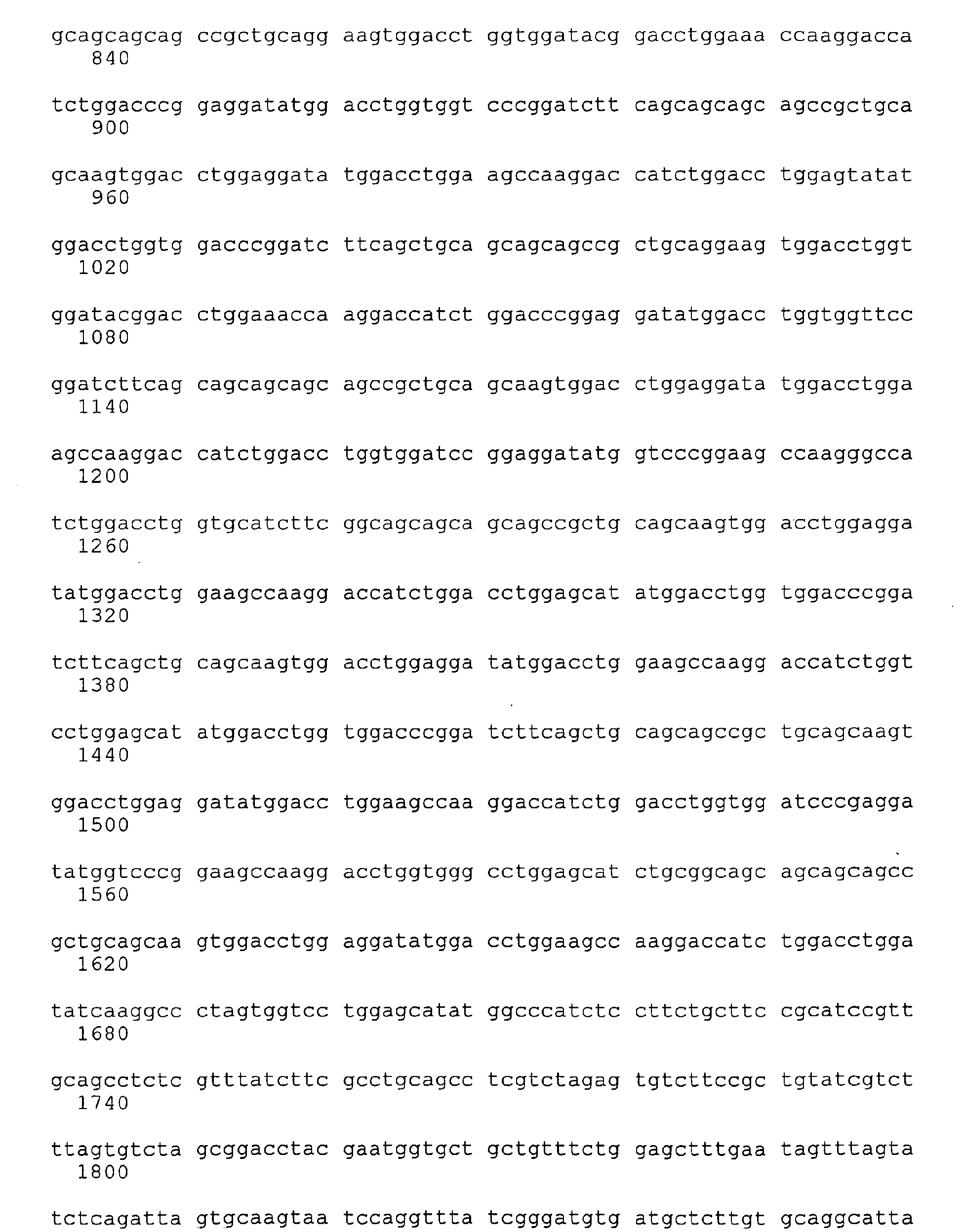
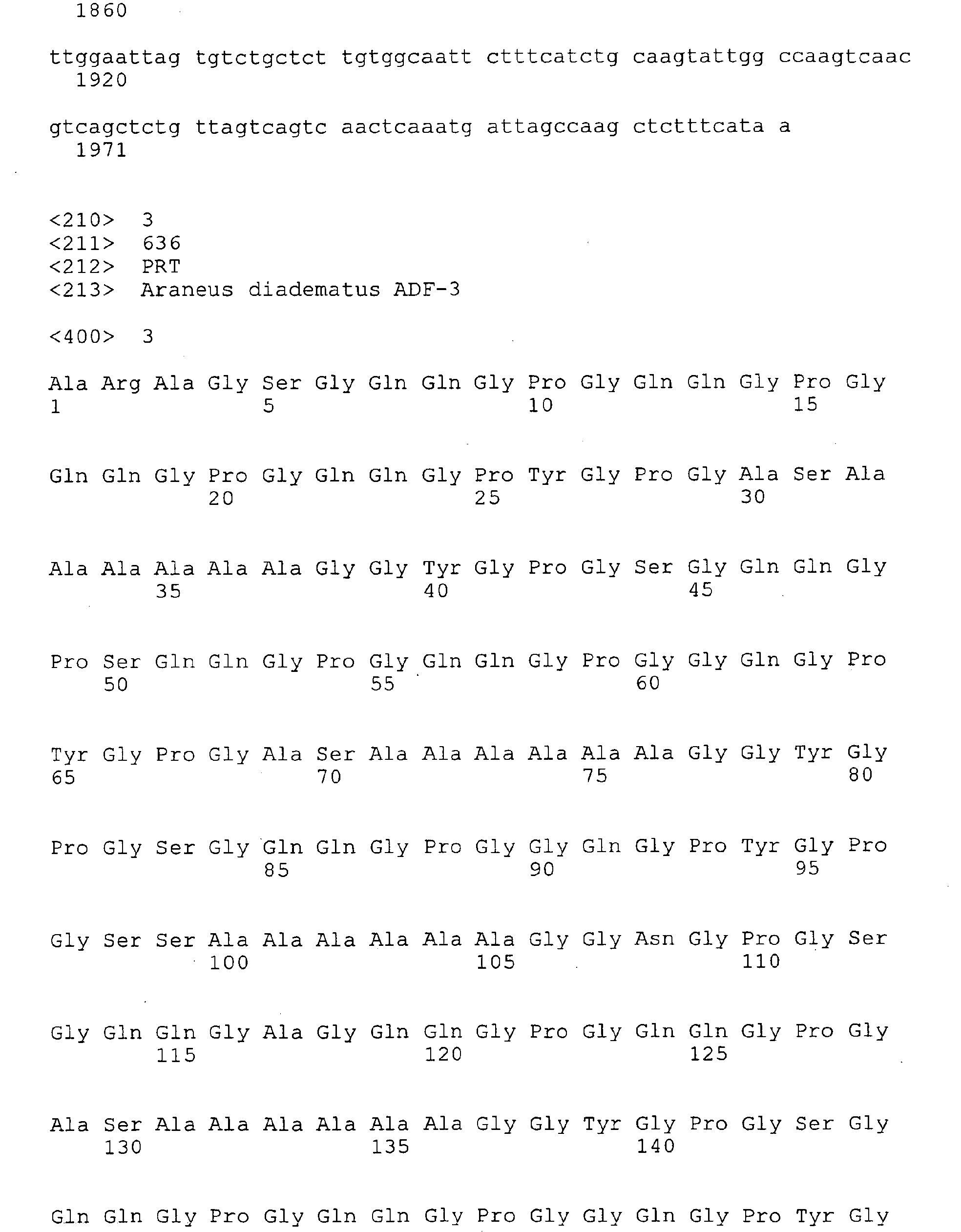
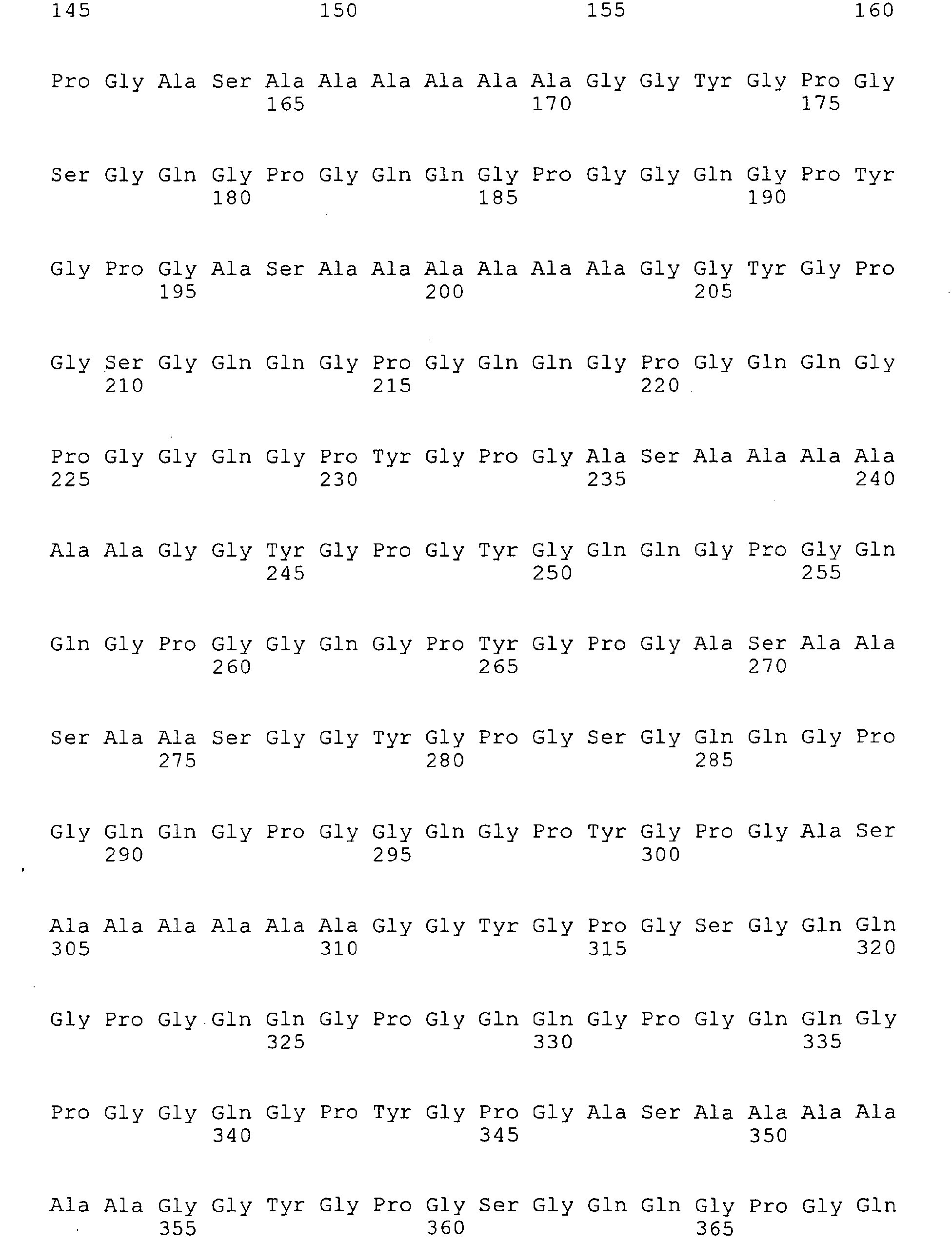
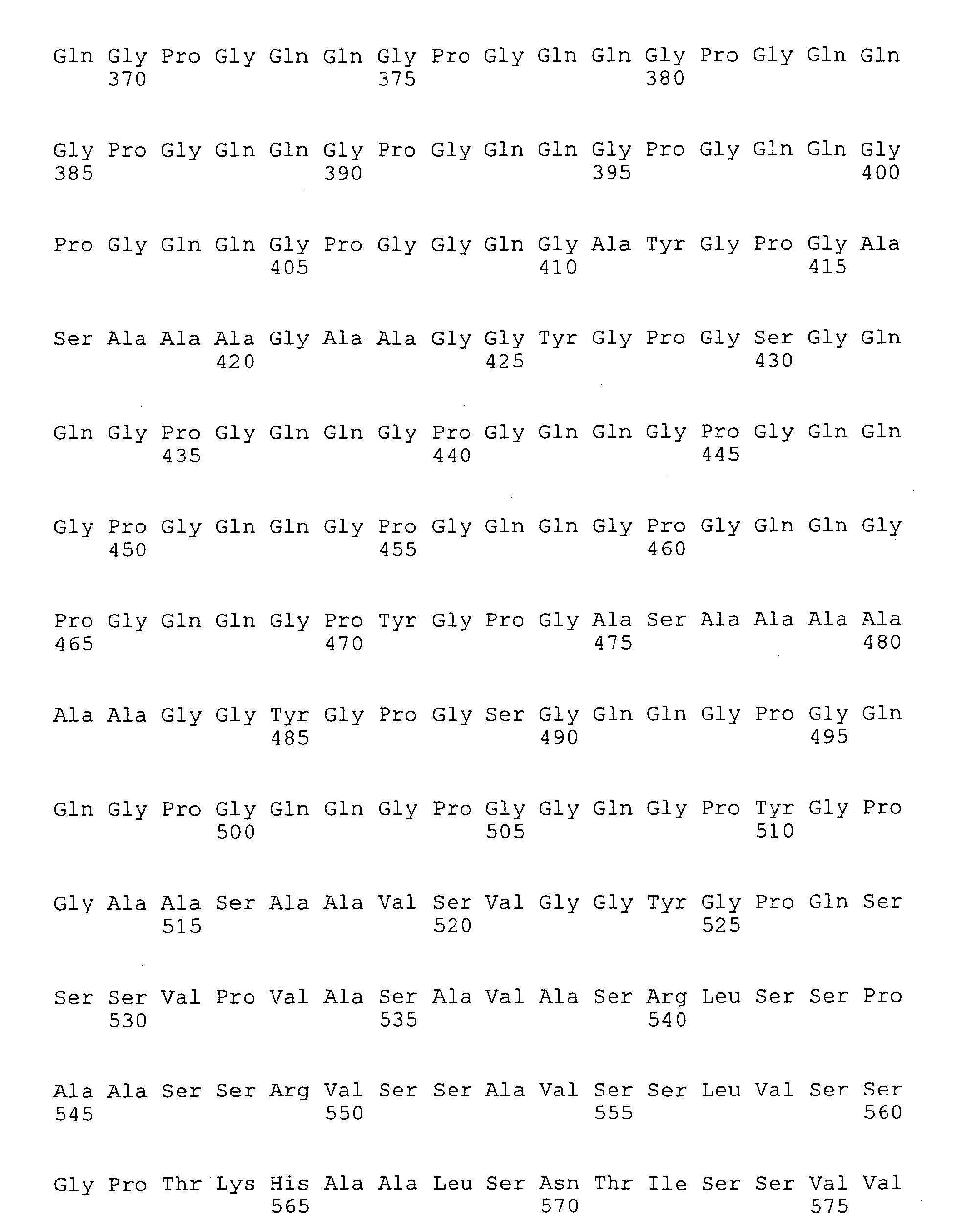

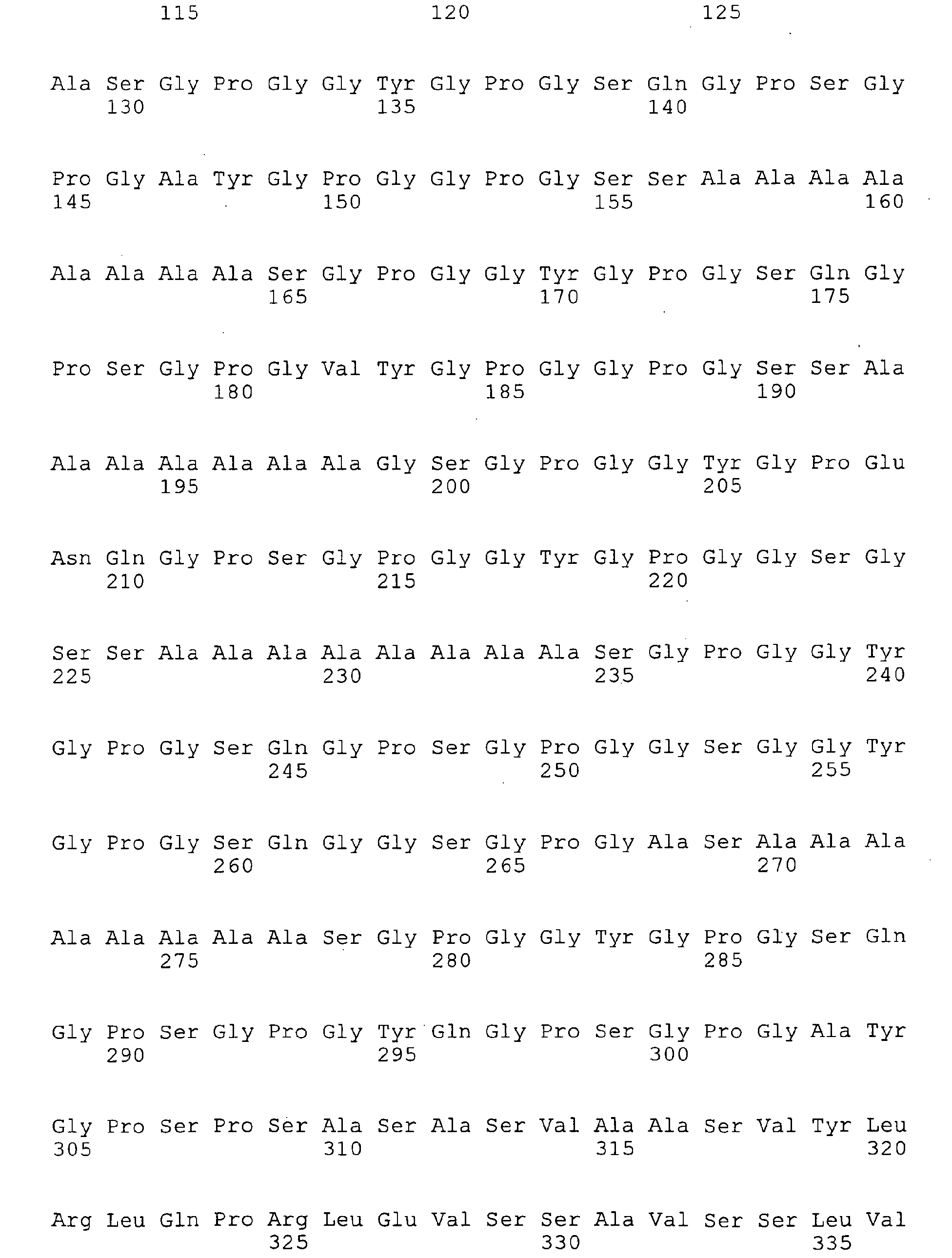


Claims (15)
- A spider dragline protein, which is encoded by the nucleic acid sequence of SEQ ID NO: 1 or 2, or variants of those nucleic acid sequences, which variants are each defined as having one or more substitutions, insertions and/or deletions as compared to the sequence of SEQ ID NO: 1 or 2, provided that said variants hybridize under moderately stringent conditions to a nucleic acid which comprises the sequence of SEQ ID NO: 1 or 2, or provided that said variants comprise nucleic acid changes due to the degeneracy of the genetic code, which code for the same or a functionally equivalent amino acid as the nucleic acid sequence of SEQ ID NO: 1 or 2.
- A spider dragline protein or thread, comprising the spider dragline protein of claim 1.
- The spider dragline protein/thread of claims 1 or 2, which only comprises wild type ADF-4 or an amino acid encoded by the nucleic acid of SEQ ID NO: 2 as a dragline protein.
- The spider dragline protein/thread of claims 1 or 2, which only comprises wild type ADF-3 or an amino acid encoded by the nucleic acid of SEQ ID NO: 1 as a dragline protein.
- A gel or a foam comprising or consisting of a protein of one or more of claims 1-4.
- Coatings for implants and stents comprising or consisting of a protein of one or more of claims 1-4.
- A thread or fiber, comprising a protein/thread of one or more of claims 1-4 and further fiber, the fiber not being of spider origin and preferably being a plant derived fiber or a synthetic fiber.
- A film comprising or consisting of a protein of one or more of claims 1-4.
- Wound closure or coverage systems, suture materials, replacement materials, preferably artificial cartilage or tendon materials, which are obtainable using a thread/protein of one or more of claims 1 to 4.
- A vector, which comprises a nucleic acid coding for wild-type ADF-3 and/or ADF-4 as only dragline protein or which comprises the nucleic acid of SEQ ID NO: 1 and/or SEQ ID NO: 2.
- A baculovirus vector, which comprises a nucleic acid coding for one or more dragline proteins, preferably for the dragline proteins ADF-3, ADF-4 (wild type), ADF-3 (SEQ ID NO: 1) and/or ADF-4 (SEQ ID NO:2).
- Use of the proteins/threads of one or more of claims 1 to 4 in the field of technology, biotechnology and/or medicine.
- Use of the proteins/threads of one or more of claims 1 to 4 for the manufacture of wound closure or coverage systems, preferably for the manufacture of suture materials, the suture material being more preferably intended for use in neurosurgery or ophthalmic surgery.
- Use of the proteins/threads of one or more of claims 1 to 4 for the manufacture of replacement materials, preferably artificial cartilage or tendon materials.
- The use of the proteins/threads of one or more of claims 1 to 4 for the stabilization of artificial replacements, preferably artificial replacement lungs.
Priority Applications (4)
| Application Number | Priority Date | Filing Date | Title |
|---|---|---|---|
| EP05753637A EP1778722A1 (en) | 2004-06-25 | 2005-06-23 | Proteins of natural origin and materials made therefrom |
| PCT/EP2005/006799 WO2006002827A1 (en) | 2004-06-25 | 2005-06-23 | Proteins of natural origin and materials made therefrom |
| JP2007517202A JP4990763B2 (en) | 2004-06-25 | 2005-06-23 | Spider dragline protein, thread and material containing it, vector encoding it, and method of using spider dragline protein and thread containing the same |
| US11/643,200 US8097583B2 (en) | 2004-06-25 | 2006-12-21 | Proteins of natural origin and materials made therefrom |
Applications Claiming Priority (2)
| Application Number | Priority Date | Filing Date | Title |
|---|---|---|---|
| US58322704P | 2004-06-25 | 2004-06-25 | |
| US583227P | 2004-06-25 |
Publications (1)
| Publication Number | Publication Date |
|---|---|
| EP1609801A1 true EP1609801A1 (en) | 2005-12-28 |
Family
ID=34934219
Family Applications (3)
| Application Number | Title | Priority Date | Filing Date |
|---|---|---|---|
| EP05005395A Withdrawn EP1609801A1 (en) | 2004-06-25 | 2005-03-11 | Proteins of natural origin and materials made therefrom |
| EP05753637A Ceased EP1778722A1 (en) | 2004-06-25 | 2005-06-23 | Proteins of natural origin and materials made therefrom |
| EP05766766A Ceased EP1778849A1 (en) | 2004-06-25 | 2005-06-27 | Synthesis of spider dragline and/or flagelliform proteins |
Family Applications After (2)
| Application Number | Title | Priority Date | Filing Date |
|---|---|---|---|
| EP05753637A Ceased EP1778722A1 (en) | 2004-06-25 | 2005-06-23 | Proteins of natural origin and materials made therefrom |
| EP05766766A Ceased EP1778849A1 (en) | 2004-06-25 | 2005-06-27 | Synthesis of spider dragline and/or flagelliform proteins |
Country Status (5)
| Country | Link |
|---|---|
| US (2) | US8097583B2 (en) |
| EP (3) | EP1609801A1 (en) |
| JP (1) | JP4990763B2 (en) |
| CN (1) | CN101133080A (en) |
| WO (2) | WO2006002827A1 (en) |
Cited By (11)
| Publication number | Priority date | Publication date | Assignee | Title |
|---|---|---|---|---|
| DE102005043609A1 (en) * | 2005-09-13 | 2007-03-22 | Technische Universität München | Method and apparatus for producing a thread of silk proteins |
| WO2007078239A3 (en) * | 2005-12-30 | 2007-12-21 | Jan Johansson | Spider silk proteins and methods for producing spider silk proteins |
| DE102006038445A1 (en) * | 2006-08-16 | 2008-02-21 | Gustav Pirazzi & Comp. Kg | Use of artificially produced spider silk |
| WO2008083841A1 (en) * | 2007-01-10 | 2008-07-17 | Gustav Pirazzi & Comp. Kg | Use of synthetically produced spider silk |
| WO2008108838A3 (en) * | 2006-11-21 | 2008-10-23 | Draper Lab Charles S | Microfluidic devices and methods for fabricating the same |
| WO2014037453A1 (en) * | 2012-09-06 | 2014-03-13 | Amsilk Gmbh | Methods for producing high toughness silk fibres |
| US9024394B2 (en) | 2013-05-22 | 2015-05-05 | Transient Electronics, Inc. | Controlled transformation of non-transient electronics |
| EP3334754A4 (en) * | 2015-08-10 | 2019-01-16 | Seevix Material Sciences Ltd. | COMPOSITIONS AND METHODS FOR MANUFACTURING SYNTHETIC SPIDER ROPE WIRE |
| EP3495381A1 (en) * | 2009-12-08 | 2019-06-12 | AMSilk GmbH | Silk protein coatings |
| US11345727B2 (en) | 2016-02-11 | 2022-05-31 | Seevix Material Sciences Ltd. | Composite materials comprising synthetic dragline spider silk |
| US12453688B2 (en) | 2020-04-23 | 2025-10-28 | Seevix Material Sciences Ltd. | Cosmetic compositions comprising dragline spider silk |
Families Citing this family (25)
| Publication number | Priority date | Publication date | Assignee | Title |
|---|---|---|---|---|
| EP1609801A1 (en) * | 2004-06-25 | 2005-12-28 | Technische Universität München | Proteins of natural origin and materials made therefrom |
| WO2007141131A1 (en) * | 2006-06-08 | 2007-12-13 | Technische Universitaet Muenchen | Microfluidic device for controlled aggregation of spider silk |
| WO2008155304A1 (en) * | 2007-06-20 | 2008-12-24 | Basf Se | Synthetic repetitive proteins, the production and use thereof |
| CN102812036B (en) * | 2009-08-26 | 2016-08-03 | 联邦科学工业研究组织 | For the method producing yarn spinning liquid |
| CA2795541C (en) * | 2010-04-12 | 2020-05-26 | Spiber Technologies Ab | Spider silk protein scaffolds for eukaryotic cell culture |
| DE202013003445U1 (en) | 2012-04-11 | 2013-04-26 | Amsilk Gmbh | anther |
| US10478520B2 (en) | 2012-08-17 | 2019-11-19 | Amsilk Gmbh | Use of self-assembling polypeptides as tissue adhesives |
| WO2014062134A1 (en) | 2012-10-17 | 2014-04-24 | Nanyang Technological University | Compounds and methods for the production of suckerin and uses thereof |
| EP2940066B1 (en) | 2012-12-26 | 2020-02-05 | Spiber Inc. | Spider silk protein film, and method for producing same |
| WO2015061079A1 (en) | 2013-10-21 | 2015-04-30 | The North Face Apparel Corp. | Functional biomaterial coatings for textiles and other substrates |
| US9394355B2 (en) | 2014-08-20 | 2016-07-19 | Silk Technologies, Ltd. | Fibroin-derived protein composition |
| EP3395860A4 (en) | 2015-12-25 | 2019-05-29 | Spiber Inc. | PROCESS FOR PRODUCING POLYMER AGGREGATE |
| US10953132B2 (en) | 2016-04-08 | 2021-03-23 | Cornell University | Method to enhance wound healing using silk-derived protein |
| US20190233481A1 (en) | 2016-06-23 | 2019-08-01 | Spiber Inc. | Modified Fibroin |
| AU2017310520A1 (en) | 2016-08-12 | 2019-03-21 | Silk Technologies, Ltd. | Silk-derived protein for treating inflammation |
| US20180096033A1 (en) * | 2016-10-04 | 2018-04-05 | International Business Machines Corporation | Query management in database management systems |
| WO2018087239A1 (en) | 2016-11-11 | 2018-05-17 | Amsilk Gmbh | Use of a shrinkable biopolymer fiber as sensor |
| DE102016222480B4 (en) | 2016-11-16 | 2020-02-13 | Adidas Ag | Garment that has spider silk or shoe that has spider silk and a corresponding manufacturing process |
| WO2018229341A1 (en) * | 2017-06-13 | 2018-12-20 | Aalto University Foundation Sr. | Method for producing a condensed adhesive phase of silk fusion proteins |
| WO2019194263A1 (en) * | 2018-04-03 | 2019-10-10 | Spiber株式会社 | Highly contracted synthetic fibroin twisted yarn and production method therefor, and synthetic fibroin twisted yarn and method for contracting same |
| EP3556914A1 (en) | 2018-04-20 | 2019-10-23 | Lenzing Aktiengesellschaft | Regenerated cellulose moulded bodies and method for producing regenerated cellulose moulded bodies |
| MX2021000041A (en) * | 2018-06-22 | 2021-03-25 | Natura Cosmeticos Sa | Cosmetic composition for treating keratin fibers. |
| TWI911309B (en) | 2020-10-20 | 2026-01-11 | 喬治 史特勞赫 | Coated hair and use thereof |
| CN112680884A (en) * | 2020-12-30 | 2021-04-20 | 苏州经贸职业技术学院 | Preparation method of antibacterial mask material |
| CN116446064B (en) * | 2022-12-29 | 2025-04-04 | 宜宾惠美纤维新材料股份有限公司 | A kind of cordyceps protein fiber and preparation method thereof |
Citations (2)
| Publication number | Priority date | Publication date | Assignee | Title |
|---|---|---|---|---|
| WO2003057727A1 (en) * | 2002-01-11 | 2003-07-17 | Nexia Biotechnologies, Inc. | Methods of producing silk polypeptides and products thereof |
| WO2003060099A2 (en) * | 2002-01-11 | 2003-07-24 | Nexia Biotechnologies, Inc. | Methods and apparatus for spinning spider silk protein |
Family Cites Families (6)
| Publication number | Priority date | Publication date | Assignee | Title |
|---|---|---|---|---|
| US5994099A (en) | 1997-12-31 | 1999-11-30 | The University Of Wyoming | Extremely elastic spider silk protein and DNA coding therefor |
| FR2774588B1 (en) | 1998-02-11 | 2000-05-05 | Oreal | COSMETIC OR DERMATOLOGICAL COMPOSITION CONTAINING AT LEAST ONE NATURAL, RECOMBINANT ARACHNID SILK PROTEIN OR THE LIKE |
| US7157615B2 (en) | 1998-03-17 | 2007-01-02 | Nexia Biotechnologies, Inc. | Production of biofilaments in transgenic animals |
| WO2003020916A2 (en) | 2001-08-29 | 2003-03-13 | University Of Wyoming | Spider silk protein encoding nucleic acids, polypeptides, antibodies and method of use thereof |
| EP1609801A1 (en) * | 2004-06-25 | 2005-12-28 | Technische Universität München | Proteins of natural origin and materials made therefrom |
| ES2525095T3 (en) * | 2004-07-22 | 2014-12-17 | Amsilk Gmbh | Recombinant spider silk proteins |
-
2005
- 2005-03-11 EP EP05005395A patent/EP1609801A1/en not_active Withdrawn
- 2005-06-23 WO PCT/EP2005/006799 patent/WO2006002827A1/en not_active Ceased
- 2005-06-23 CN CNA2005800243750A patent/CN101133080A/en active Pending
- 2005-06-23 EP EP05753637A patent/EP1778722A1/en not_active Ceased
- 2005-06-23 JP JP2007517202A patent/JP4990763B2/en not_active Expired - Lifetime
- 2005-06-27 WO PCT/EP2005/006905 patent/WO2006002853A1/en not_active Ceased
- 2005-06-27 EP EP05766766A patent/EP1778849A1/en not_active Ceased
-
2006
- 2006-12-21 US US11/643,200 patent/US8097583B2/en not_active Expired - Lifetime
- 2006-12-21 US US11/643,569 patent/US8030024B2/en active Active
Patent Citations (2)
| Publication number | Priority date | Publication date | Assignee | Title |
|---|---|---|---|---|
| WO2003057727A1 (en) * | 2002-01-11 | 2003-07-17 | Nexia Biotechnologies, Inc. | Methods of producing silk polypeptides and products thereof |
| WO2003060099A2 (en) * | 2002-01-11 | 2003-07-24 | Nexia Biotechnologies, Inc. | Methods and apparatus for spinning spider silk protein |
Non-Patent Citations (4)
| Title |
|---|
| GUERETTE P A ET AL: "SILK PROPERTIES DETERMINED BY GLAND-SPECIFIC EXPRESSION OF A SPIDER FIBROIN GENE FAMILY", SCIENCE, AMERICAN ASSOCIATION FOR THE ADVANCEMENT OF SCIENCE,, US, vol. 272, no. 5258, 5 April 1996 (1996-04-05), pages 112 - 115, XP008018215, ISSN: 0036-8075 * |
| HINMAN M B ET AL: "Synthetic spider silk: a modular fiber", TRENDS IN BIOTECHNOLOGY, ELSEVIER, AMSTERDAM, NL, vol. 18, no. 9, 1 September 2000 (2000-09-01), pages 374 - 379, XP004214264, ISSN: 0167-7799 * |
| HUEMMERICH D ET AL: "Novel Assembly Properties of Recombinant Spider Dragline Silk Proteins", CURRENT BIOLOGY, CURRENT SCIENCE,, GB, vol. 14, no. 22, 23 November 2004 (2004-11-23), pages 2070 - 2074, XP004653121, ISSN: 0960-9822 * |
| MASAFUMI YAMAO ET AL: "Gene targeting in the silkworm by use of a baculovirus/GENE TARGETING IN THE SILKWORM BY USE OF A BACULOVIRUS", GENES AND DEVELOPMENT, COLD SPRING HARBOR LABORATORY PRESS, NEW YORK, US, vol. 13, no. 5, 1999, pages 511 - 516,1, XP002945820, ISSN: 0890-9369 * |
Cited By (24)
| Publication number | Priority date | Publication date | Assignee | Title |
|---|---|---|---|---|
| DE102005043609A1 (en) * | 2005-09-13 | 2007-03-22 | Technische Universität München | Method and apparatus for producing a thread of silk proteins |
| US7868146B2 (en) | 2005-09-13 | 2011-01-11 | Amsilk Gmbh | Method and device for producing a thread from silk proteins |
| US8618255B2 (en) | 2005-12-30 | 2013-12-31 | Spiber Technologies Ab | Spider silk proteins and methods for producing spider silk proteins |
| WO2007078239A3 (en) * | 2005-12-30 | 2007-12-21 | Jan Johansson | Spider silk proteins and methods for producing spider silk proteins |
| EP2899204A1 (en) * | 2005-12-30 | 2015-07-29 | Spiber Technologies AB | Support for cell culture comprising spider silk proteins and methods for producing the same |
| US8729235B2 (en) | 2005-12-30 | 2014-05-20 | Spiber Technologies Ab | Spider silk proteins and methods for producing spider silk proteins |
| US8173772B2 (en) | 2005-12-30 | 2012-05-08 | Spiber Technologies Ab | Spider silk proteins and methods for producing spider silk proteins |
| US8278416B1 (en) | 2005-12-30 | 2012-10-02 | Spiber Technologies Ab | Spider silk proteins and methods for producing spider silk proteins |
| DE102006038445A1 (en) * | 2006-08-16 | 2008-02-21 | Gustav Pirazzi & Comp. Kg | Use of artificially produced spider silk |
| US8975073B2 (en) | 2006-11-21 | 2015-03-10 | The Charles Stark Draper Laboratory, Inc. | Microfluidic device comprising silk films coupled to form a microchannel |
| WO2008108838A3 (en) * | 2006-11-21 | 2008-10-23 | Draper Lab Charles S | Microfluidic devices and methods for fabricating the same |
| DE102007002222A1 (en) | 2007-01-10 | 2008-07-17 | Gustav Pirazzi & Comp. Kg | Use of artificially produced spider silk |
| WO2008083841A1 (en) * | 2007-01-10 | 2008-07-17 | Gustav Pirazzi & Comp. Kg | Use of synthetically produced spider silk |
| EP3495381A1 (en) * | 2009-12-08 | 2019-06-12 | AMSilk GmbH | Silk protein coatings |
| WO2014037453A1 (en) * | 2012-09-06 | 2014-03-13 | Amsilk Gmbh | Methods for producing high toughness silk fibres |
| US20150284565A1 (en) * | 2012-09-06 | 2015-10-08 | Amsilk Gmbh | Methods for Producing High Toughness Silk Fibres |
| US10072152B2 (en) * | 2012-09-06 | 2018-09-11 | Amsilk Gmbh | Methods for producing high toughness silk fibres |
| US9024394B2 (en) | 2013-05-22 | 2015-05-05 | Transient Electronics, Inc. | Controlled transformation of non-transient electronics |
| EP3334754A4 (en) * | 2015-08-10 | 2019-01-16 | Seevix Material Sciences Ltd. | COMPOSITIONS AND METHODS FOR MANUFACTURING SYNTHETIC SPIDER ROPE WIRE |
| US10981959B2 (en) | 2015-08-10 | 2021-04-20 | Seevix Material Sciences Ltd. | Compositions and methods for fabricating synthetic dragline spider silk |
| US11345727B2 (en) | 2016-02-11 | 2022-05-31 | Seevix Material Sciences Ltd. | Composite materials comprising synthetic dragline spider silk |
| US12030919B2 (en) | 2016-02-11 | 2024-07-09 | Seevix Material Sciences Ltd. | Composite materials comprising synthetic dragline spider silk |
| EP4375403A3 (en) * | 2016-02-11 | 2024-08-28 | Seevix Material Sciences Ltd. | Composite materials comprising synthetic dragline spider silk |
| US12453688B2 (en) | 2020-04-23 | 2025-10-28 | Seevix Material Sciences Ltd. | Cosmetic compositions comprising dragline spider silk |
Also Published As
| Publication number | Publication date |
|---|---|
| CN101133080A (en) | 2008-02-27 |
| WO2006002827A1 (en) | 2006-01-12 |
| WO2006002853A1 (en) | 2006-01-12 |
| JP2008507260A (en) | 2008-03-13 |
| US8030024B2 (en) | 2011-10-04 |
| US20080021553A1 (en) | 2008-01-24 |
| EP1778722A1 (en) | 2007-05-02 |
| EP1778849A1 (en) | 2007-05-02 |
| JP4990763B2 (en) | 2012-08-01 |
| US8097583B2 (en) | 2012-01-17 |
| US20070196429A1 (en) | 2007-08-23 |
Similar Documents
| Publication | Publication Date | Title |
|---|---|---|
| US8097583B2 (en) | Proteins of natural origin and materials made therefrom | |
| US8034897B1 (en) | Recombinant spider silk proteins | |
| EP1919938B1 (en) | Modified spider silk proteins | |
| Doblhofer et al. | To spin or not to spin: spider silk fibers and more | |
| Fu et al. | Animal silks: their structures, properties and artificial production | |
| Mori et al. | New silk protein: modification of silk protein by gene engineering for production of biomaterials | |
| EP3334754B1 (en) | Compositions and methods for fabricating synthetic dragline spider silk | |
| JP2018531040A6 (en) | Compositions and methods for making synthetic dragline spider silks | |
| US8461301B2 (en) | Synthetic dragline spider silk-like proteins | |
| CA2473772A1 (en) | .alpha.-helical protein based materials and methods for making same | |
| Vollrath et al. | The route to synthetic silks | |
| Turner et al. | Advanced spider silk fibers by biomimicry | |
| Grip | Artificial spider silk | |
| Turner et al. | ADVANCED SPIDER SILK FIBERS BY |
Legal Events
| Date | Code | Title | Description |
|---|---|---|---|
| PUAI | Public reference made under article 153(3) epc to a published international application that has entered the european phase |
Free format text: ORIGINAL CODE: 0009012 |
|
| AK | Designated contracting states |
Kind code of ref document: A1 Designated state(s): AT BE BG CH CY CZ DE DK EE ES FI FR GB GR HU IE IS IT LI LT LU MC NL PL PT RO SE SI SK TR |
|
| AX | Request for extension of the european patent |
Extension state: AL BA HR LV MK YU |
|
| AKX | Designation fees paid | ||
| STAA | Information on the status of an ep patent application or granted ep patent |
Free format text: STATUS: THE APPLICATION IS DEEMED TO BE WITHDRAWN |
|
| 18D | Application deemed to be withdrawn |
Effective date: 20060629 |
|
| REG | Reference to a national code |
Ref country code: DE Ref legal event code: 8566 |