EP1608667B1 - Method of the preparation of phosphonium salt with a non-halide anion - Google Patents
Method of the preparation of phosphonium salt with a non-halide anion Download PDFInfo
- Publication number
- EP1608667B1 EP1608667B1 EP04718497A EP04718497A EP1608667B1 EP 1608667 B1 EP1608667 B1 EP 1608667B1 EP 04718497 A EP04718497 A EP 04718497A EP 04718497 A EP04718497 A EP 04718497A EP 1608667 B1 EP1608667 B1 EP 1608667B1
- Authority
- EP
- European Patent Office
- Prior art keywords
- butyl
- methyl
- phosphonium salt
- hydrocarbyl
- iso
- Prior art date
- Legal status (The legal status is an assumption and is not a legal conclusion. Google has not performed a legal analysis and makes no representation as to the accuracy of the status listed.)
- Expired - Lifetime
Links
- 238000000034 method Methods 0.000 title claims description 51
- -1 halide anion Chemical class 0.000 title claims description 39
- 150000004714 phosphonium salts Chemical class 0.000 title claims description 38
- 238000002360 preparation method Methods 0.000 title description 9
- 125000002496 methyl group Chemical group [H]C([H])([H])* 0.000 claims description 32
- 150000001875 compounds Chemical class 0.000 claims description 26
- 125000001183 hydrocarbyl group Chemical group 0.000 claims description 25
- 125000004432 carbon atom Chemical group C* 0.000 claims description 22
- XLYOFNOQVPJJNP-UHFFFAOYSA-N water Substances O XLYOFNOQVPJJNP-UHFFFAOYSA-N 0.000 claims description 15
- KKUKTXOBAWVSHC-UHFFFAOYSA-N Dimethylphosphate Chemical compound COP(O)(=O)OC KKUKTXOBAWVSHC-UHFFFAOYSA-N 0.000 claims description 12
- 150000002148 esters Chemical class 0.000 claims description 12
- 125000001495 ethyl group Chemical group [H]C([H])([H])C([H])([H])* 0.000 claims description 10
- 125000004437 phosphorous atom Chemical group 0.000 claims description 10
- 229910052698 phosphorus Inorganic materials 0.000 claims description 10
- 125000000959 isobutyl group Chemical group [H]C([H])([H])C([H])(C([H])([H])[H])C([H])([H])* 0.000 claims description 9
- 125000001449 isopropyl group Chemical group [H]C([H])([H])C([H])(*)C([H])([H])[H] 0.000 claims description 9
- 125000004108 n-butyl group Chemical group [H]C([H])([H])C([H])([H])C([H])([H])C([H])([H])* 0.000 claims description 9
- 125000004123 n-propyl group Chemical group [H]C([H])([H])C([H])([H])C([H])([H])* 0.000 claims description 9
- 125000000999 tert-butyl group Chemical group [H]C([H])([H])C(*)(C([H])([H])[H])C([H])([H])[H] 0.000 claims description 9
- WVLBCYQITXONBZ-UHFFFAOYSA-N trimethyl phosphate Chemical group COP(=O)(OC)OC WVLBCYQITXONBZ-UHFFFAOYSA-N 0.000 claims description 9
- HFQFBVMMDKNQNV-UHFFFAOYSA-M cyclohexyl(trimethyl)phosphanium;dimethyl phosphate Chemical group COP([O-])(=O)OC.C[P+](C)(C)C1CCCCC1 HFQFBVMMDKNQNV-UHFFFAOYSA-M 0.000 claims description 6
- 229910052739 hydrogen Inorganic materials 0.000 claims description 6
- 239000001257 hydrogen Substances 0.000 claims description 6
- 125000004435 hydrogen atom Chemical group [H]* 0.000 claims description 6
- 125000000217 alkyl group Chemical group 0.000 claims description 5
- 229910019142 PO4 Inorganic materials 0.000 claims description 4
- 125000003118 aryl group Chemical group 0.000 claims description 4
- HVGAXQRFZIXHRT-UHFFFAOYSA-M dicyclohexyl(dimethyl)phosphanium;dimethyl phosphate Chemical group COP([O-])(=O)OC.C1CCCCC1[P+](C)(C)C1CCCCC1 HVGAXQRFZIXHRT-UHFFFAOYSA-M 0.000 claims description 4
- DHAVNVCEBRABBT-UHFFFAOYSA-M dimethyl-bis(2-methylpropyl)phosphanium;dimethyl phosphate Chemical group COP([O-])(=O)OC.CC(C)C[P+](C)(C)CC(C)C DHAVNVCEBRABBT-UHFFFAOYSA-M 0.000 claims description 4
- 125000005010 perfluoroalkyl group Chemical group 0.000 claims description 4
- 239000010452 phosphate Substances 0.000 claims description 4
- 125000000113 cyclohexyl group Chemical group [H]C1([H])C([H])([H])C([H])([H])C([H])(*)C([H])([H])C1([H])[H] 0.000 claims description 3
- 125000001511 cyclopentyl group Chemical group [H]C1([H])C([H])([H])C([H])([H])C([H])(*)C1([H])[H] 0.000 claims description 3
- VAYGXNSJCAHWJZ-UHFFFAOYSA-N dimethyl sulfate Chemical group COS(=O)(=O)OC VAYGXNSJCAHWJZ-UHFFFAOYSA-N 0.000 claims description 3
- 125000000623 heterocyclic group Chemical group 0.000 claims description 3
- 125000002868 norbornyl group Chemical group C12(CCC(CC1)C2)* 0.000 claims description 3
- 125000002023 trifluoromethyl group Chemical group FC(F)(F)* 0.000 claims description 3
- 125000000923 (C1-C30) alkyl group Chemical group 0.000 claims description 2
- 125000006552 (C3-C8) cycloalkyl group Chemical group 0.000 claims description 2
- 125000000739 C2-C30 alkenyl group Chemical group 0.000 claims description 2
- 125000000304 alkynyl group Chemical group 0.000 claims description 2
- 125000003710 aryl alkyl group Chemical group 0.000 claims description 2
- VUQUOGPMUUJORT-UHFFFAOYSA-N methyl 4-methylbenzenesulfonate Chemical group COS(=O)(=O)C1=CC=C(C)C=C1 VUQUOGPMUUJORT-UHFFFAOYSA-N 0.000 claims description 2
- XYFCBTPGUUZFHI-UHFFFAOYSA-N phosphine group Chemical group P XYFCBTPGUUZFHI-UHFFFAOYSA-N 0.000 description 45
- 238000006243 chemical reaction Methods 0.000 description 30
- 229910000073 phosphorus hydride Inorganic materials 0.000 description 21
- IJGRMHOSHXDMSA-UHFFFAOYSA-N Atomic nitrogen Chemical compound N#N IJGRMHOSHXDMSA-UHFFFAOYSA-N 0.000 description 14
- HEDRZPFGACZZDS-MICDWDOJSA-N Trichloro(2H)methane Chemical compound [2H]C(Cl)(Cl)Cl HEDRZPFGACZZDS-MICDWDOJSA-N 0.000 description 11
- 239000002904 solvent Substances 0.000 description 10
- 239000004094 surface-active agent Substances 0.000 description 10
- 239000002253 acid Substances 0.000 description 9
- 238000007792 addition Methods 0.000 description 8
- 230000008569 process Effects 0.000 description 8
- 239000011541 reaction mixture Substances 0.000 description 8
- 238000005160 1H NMR spectroscopy Methods 0.000 description 7
- 238000004679 31P NMR spectroscopy Methods 0.000 description 7
- 239000007788 liquid Substances 0.000 description 7
- 229910052757 nitrogen Inorganic materials 0.000 description 7
- 238000003756 stirring Methods 0.000 description 7
- 125000001424 substituent group Chemical group 0.000 description 7
- 239000000203 mixture Substances 0.000 description 6
- 238000004992 fast atom bombardment mass spectroscopy Methods 0.000 description 5
- 238000002844 melting Methods 0.000 description 5
- 230000008018 melting Effects 0.000 description 5
- 239000007858 starting material Substances 0.000 description 5
- 238000005481 NMR spectroscopy Methods 0.000 description 4
- 150000001450 anions Chemical class 0.000 description 4
- 229910052799 carbon Inorganic materials 0.000 description 4
- 238000001704 evaporation Methods 0.000 description 4
- 239000002608 ionic liquid Substances 0.000 description 4
- XYFCBTPGUUZFHI-UHFFFAOYSA-O phosphonium Chemical compound [PH4+] XYFCBTPGUUZFHI-UHFFFAOYSA-O 0.000 description 4
- 239000000047 product Substances 0.000 description 4
- 238000004458 analytical method Methods 0.000 description 3
- 239000004599 antimicrobial Substances 0.000 description 3
- 150000001768 cations Chemical class 0.000 description 3
- 230000008020 evaporation Effects 0.000 description 3
- 238000010265 fast atom bombardment Methods 0.000 description 3
- 125000005842 heteroatom Chemical group 0.000 description 3
- 239000012071 phase Substances 0.000 description 3
- 238000000746 purification Methods 0.000 description 3
- 230000035484 reaction time Effects 0.000 description 3
- 150000003839 salts Chemical class 0.000 description 3
- 238000005406 washing Methods 0.000 description 3
- 238000001644 13C nuclear magnetic resonance spectroscopy Methods 0.000 description 2
- OKTJSMMVPCPJKN-UHFFFAOYSA-N Carbon Chemical compound [C] OKTJSMMVPCPJKN-UHFFFAOYSA-N 0.000 description 2
- VEXZGXHMUGYJMC-UHFFFAOYSA-M Chloride anion Chemical compound [Cl-] VEXZGXHMUGYJMC-UHFFFAOYSA-M 0.000 description 2
- KDLHZDBZIXYQEI-UHFFFAOYSA-N Palladium Chemical compound [Pd] KDLHZDBZIXYQEI-UHFFFAOYSA-N 0.000 description 2
- NBIIXXVUZAFLBC-UHFFFAOYSA-N Phosphoric acid Chemical compound OP(O)(O)=O NBIIXXVUZAFLBC-UHFFFAOYSA-N 0.000 description 2
- QAOWNCQODCNURD-UHFFFAOYSA-N Sulfuric acid Chemical compound OS(O)(=O)=O QAOWNCQODCNURD-UHFFFAOYSA-N 0.000 description 2
- 150000001350 alkyl halides Chemical class 0.000 description 2
- 239000012298 atmosphere Substances 0.000 description 2
- 125000004429 atom Chemical group 0.000 description 2
- 230000002051 biphasic effect Effects 0.000 description 2
- 150000001721 carbon Chemical group 0.000 description 2
- 239000007795 chemical reaction product Substances 0.000 description 2
- 239000003153 chemical reaction reagent Substances 0.000 description 2
- 238000001816 cooling Methods 0.000 description 2
- PTLIZOFGXLGHSY-UHFFFAOYSA-N dibutylphosphane Chemical compound CCCCPCCCC PTLIZOFGXLGHSY-UHFFFAOYSA-N 0.000 description 2
- HDULBKVLSJEMGN-UHFFFAOYSA-N dicyclohexylphosphane Chemical compound C1CCCCC1PC1CCCCC1 HDULBKVLSJEMGN-UHFFFAOYSA-N 0.000 description 2
- 230000000694 effects Effects 0.000 description 2
- 239000000835 fiber Substances 0.000 description 2
- 238000004817 gas chromatography Methods 0.000 description 2
- 230000002209 hydrophobic effect Effects 0.000 description 2
- 229910052751 metal Inorganic materials 0.000 description 2
- 239000002184 metal Substances 0.000 description 2
- JZMJDSHXVKJFKW-UHFFFAOYSA-N methyl sulfate Chemical compound COS(O)(=O)=O JZMJDSHXVKJFKW-UHFFFAOYSA-N 0.000 description 2
- 235000021317 phosphate Nutrition 0.000 description 2
- 150000003003 phosphines Chemical class 0.000 description 2
- BASFCYQUMIYNBI-UHFFFAOYSA-N platinum Chemical compound [Pt] BASFCYQUMIYNBI-UHFFFAOYSA-N 0.000 description 2
- 239000002798 polar solvent Substances 0.000 description 2
- 239000002244 precipitate Substances 0.000 description 2
- 239000007787 solid Substances 0.000 description 2
- 238000009987 spinning Methods 0.000 description 2
- 125000001731 2-cyanoethyl group Chemical group [H]C([H])(*)C([H])([H])C#N 0.000 description 1
- QJCMAJXWIAFFED-UHFFFAOYSA-N 9-phosphabicyclo[3.3.1]nonane Chemical compound C1CCC2CCCC1P2 QJCMAJXWIAFFED-UHFFFAOYSA-N 0.000 description 1
- LSNNMFCWUKXFEE-UHFFFAOYSA-M Bisulfite Chemical compound OS([O-])=O LSNNMFCWUKXFEE-UHFFFAOYSA-M 0.000 description 1
- 101150041968 CDC13 gene Proteins 0.000 description 1
- 238000005698 Diels-Alder reaction Methods 0.000 description 1
- 238000007341 Heck reaction Methods 0.000 description 1
- UFHFLCQGNIYNRP-UHFFFAOYSA-N Hydrogen Chemical compound [H][H] UFHFLCQGNIYNRP-UHFFFAOYSA-N 0.000 description 1
- 102000004882 Lipase Human genes 0.000 description 1
- 108090001060 Lipase Proteins 0.000 description 1
- 239000004367 Lipase Substances 0.000 description 1
- 238000006845 Michael addition reaction Methods 0.000 description 1
- ABLZXFCXXLZCGV-UHFFFAOYSA-N Phosphorous acid Chemical compound OP(O)=O ABLZXFCXXLZCGV-UHFFFAOYSA-N 0.000 description 1
- QAOWNCQODCNURD-UHFFFAOYSA-L Sulfate Chemical compound [O-]S([O-])(=O)=O QAOWNCQODCNURD-UHFFFAOYSA-L 0.000 description 1
- NINIDFKCEFEMDL-UHFFFAOYSA-N Sulfur Chemical compound [S] NINIDFKCEFEMDL-UHFFFAOYSA-N 0.000 description 1
- 239000005864 Sulphur Substances 0.000 description 1
- YUCAAHIAYJUATP-UHFFFAOYSA-M [Ca+].COP([O-])(=O)OC Chemical compound [Ca+].COP([O-])(=O)OC YUCAAHIAYJUATP-UHFFFAOYSA-M 0.000 description 1
- FNCNHALJTRAHOC-UHFFFAOYSA-N [PH4+].[PH4+].[PH4+].[O-]P([O-])([O-])=O Chemical class [PH4+].[PH4+].[PH4+].[O-]P([O-])([O-])=O FNCNHALJTRAHOC-UHFFFAOYSA-N 0.000 description 1
- 125000000218 acetic acid group Chemical group C(C)(=O)* 0.000 description 1
- 230000002411 adverse Effects 0.000 description 1
- 229910052784 alkaline earth metal Inorganic materials 0.000 description 1
- 229910001860 alkaline earth metal hydroxide Inorganic materials 0.000 description 1
- 125000003545 alkoxy group Chemical group 0.000 description 1
- 230000002152 alkylating effect Effects 0.000 description 1
- 230000029936 alkylation Effects 0.000 description 1
- 238000005804 alkylation reaction Methods 0.000 description 1
- 229910000147 aluminium phosphate Inorganic materials 0.000 description 1
- 239000008346 aqueous phase Substances 0.000 description 1
- 239000004760 aramid Substances 0.000 description 1
- 229920003235 aromatic polyamide Polymers 0.000 description 1
- QVGXLLKOCUKJST-UHFFFAOYSA-N atomic oxygen Chemical compound [O] QVGXLLKOCUKJST-UHFFFAOYSA-N 0.000 description 1
- RQPZNWPYLFFXCP-UHFFFAOYSA-L barium dihydroxide Chemical compound [OH-].[OH-].[Ba+2] RQPZNWPYLFFXCP-UHFFFAOYSA-L 0.000 description 1
- 229910001863 barium hydroxide Inorganic materials 0.000 description 1
- LREAZWJEBORMTB-UHFFFAOYSA-N bis(2-methylpropyl)phosphane Chemical compound CC(C)CPCC(C)C LREAZWJEBORMTB-UHFFFAOYSA-N 0.000 description 1
- 238000009835 boiling Methods 0.000 description 1
- 239000006227 byproduct Substances 0.000 description 1
- AXCZMVOFGPJBDE-UHFFFAOYSA-L calcium dihydroxide Chemical compound [OH-].[OH-].[Ca+2] AXCZMVOFGPJBDE-UHFFFAOYSA-L 0.000 description 1
- 229910001861 calcium hydroxide Inorganic materials 0.000 description 1
- 239000000920 calcium hydroxide Substances 0.000 description 1
- 125000003178 carboxy group Chemical group [H]OC(*)=O 0.000 description 1
- 239000003054 catalyst Substances 0.000 description 1
- 238000006555 catalytic reaction Methods 0.000 description 1
- 230000008859 change Effects 0.000 description 1
- 239000003795 chemical substances by application Substances 0.000 description 1
- 238000002512 chemotherapy Methods 0.000 description 1
- 238000004587 chromatography analysis Methods 0.000 description 1
- 230000008878 coupling Effects 0.000 description 1
- 238000010168 coupling process Methods 0.000 description 1
- 238000005859 coupling reaction Methods 0.000 description 1
- ZBCKWHYWPLHBOK-UHFFFAOYSA-N cyclohexylphosphane Chemical compound PC1CCCCC1 ZBCKWHYWPLHBOK-UHFFFAOYSA-N 0.000 description 1
- 125000000640 cyclooctyl group Chemical group [H]C1([H])C([H])([H])C([H])([H])C([H])([H])C([H])(*)C([H])([H])C([H])([H])C1([H])[H] 0.000 description 1
- 239000003599 detergent Substances 0.000 description 1
- IEJIGPNLZYLLBP-UHFFFAOYSA-N dimethyl carbonate Chemical compound COC(=O)OC IEJIGPNLZYLLBP-UHFFFAOYSA-N 0.000 description 1
- YOTZYFSGUCFUKA-UHFFFAOYSA-N dimethylphosphine Chemical compound CPC YOTZYFSGUCFUKA-UHFFFAOYSA-N 0.000 description 1
- ATLPLEZDTSBZQG-UHFFFAOYSA-L dioxido-oxo-propan-2-yl-$l^{5}-phosphane Chemical compound CC(C)P([O-])([O-])=O ATLPLEZDTSBZQG-UHFFFAOYSA-L 0.000 description 1
- 239000003792 electrolyte Substances 0.000 description 1
- 239000003995 emulsifying agent Substances 0.000 description 1
- 238000006911 enzymatic reaction Methods 0.000 description 1
- 238000001914 filtration Methods 0.000 description 1
- 125000001153 fluoro group Chemical group F* 0.000 description 1
- 239000007789 gas Substances 0.000 description 1
- 150000004820 halides Chemical class 0.000 description 1
- 125000005843 halogen group Chemical group 0.000 description 1
- 238000010438 heat treatment Methods 0.000 description 1
- 238000005984 hydrogenation reaction Methods 0.000 description 1
- XLYOFNOQVPJJNP-UHFFFAOYSA-M hydroxide Chemical compound [OH-] XLYOFNOQVPJJNP-UHFFFAOYSA-M 0.000 description 1
- 238000011534 incubation Methods 0.000 description 1
- 230000003993 interaction Effects 0.000 description 1
- 238000005342 ion exchange Methods 0.000 description 1
- 150000002500 ions Chemical class 0.000 description 1
- 238000002955 isolation Methods 0.000 description 1
- 125000001972 isopentyl group Chemical group [H]C([H])([H])C([H])(C([H])([H])[H])C([H])([H])C([H])([H])* 0.000 description 1
- 235000019421 lipase Nutrition 0.000 description 1
- 125000000040 m-tolyl group Chemical group [H]C1=C([H])C(*)=C([H])C(=C1[H])C([H])([H])[H] 0.000 description 1
- 150000002739 metals Chemical class 0.000 description 1
- 238000005649 metathesis reaction Methods 0.000 description 1
- JZMJDSHXVKJFKW-UHFFFAOYSA-M methyl sulfate(1-) Chemical compound COS([O-])(=O)=O JZMJDSHXVKJFKW-UHFFFAOYSA-M 0.000 description 1
- 239000000693 micelle Substances 0.000 description 1
- 125000001421 myristyl group Chemical group [H]C([*])([H])C([H])([H])C([H])([H])C([H])([H])C([H])([H])C([H])([H])C([H])([H])C([H])([H])C([H])([H])C([H])([H])C([H])([H])C([H])([H])C([H])([H])C([H])([H])[H] 0.000 description 1
- 125000001280 n-hexyl group Chemical group C(CCCCC)* 0.000 description 1
- 125000000740 n-pentyl group Chemical group [H]C([H])([H])C([H])([H])C([H])([H])C([H])([H])C([H])([H])* 0.000 description 1
- 230000003472 neutralizing effect Effects 0.000 description 1
- 150000002894 organic compounds Chemical class 0.000 description 1
- 229910052760 oxygen Inorganic materials 0.000 description 1
- 239000001301 oxygen Substances 0.000 description 1
- 229910052763 palladium Inorganic materials 0.000 description 1
- 125000001147 pentyl group Chemical group C(CCCC)* 0.000 description 1
- 229910052697 platinum Inorganic materials 0.000 description 1
- 229920000728 polyester Polymers 0.000 description 1
- 238000010992 reflux Methods 0.000 description 1
- 230000000630 rising effect Effects 0.000 description 1
- 229920006395 saturated elastomer Polymers 0.000 description 1
- 238000001228 spectrum Methods 0.000 description 1
- 239000000126 substance Substances 0.000 description 1
- 229910052717 sulfur Inorganic materials 0.000 description 1
- 125000004434 sulfur atom Chemical group 0.000 description 1
- 230000007704 transition Effects 0.000 description 1
- 239000002699 waste material Substances 0.000 description 1
- 239000000080 wetting agent Substances 0.000 description 1
Images

Classifications
-
- C—CHEMISTRY; METALLURGY
- C07—ORGANIC CHEMISTRY
- C07F—ACYCLIC, CARBOCYCLIC OR HETEROCYCLIC COMPOUNDS CONTAINING ELEMENTS OTHER THAN CARBON, HYDROGEN, HALOGEN, OXYGEN, NITROGEN, SULFUR, SELENIUM OR TELLURIUM
- C07F9/00—Compounds containing elements of Groups 5 or 15 of the Periodic Table
- C07F9/02—Phosphorus compounds
- C07F9/28—Phosphorus compounds with one or more P—C bonds
- C07F9/54—Quaternary phosphonium compounds
- C07F9/5407—Acyclic saturated phosphonium compounds
-
- C—CHEMISTRY; METALLURGY
- C07—ORGANIC CHEMISTRY
- C07F—ACYCLIC, CARBOCYCLIC OR HETEROCYCLIC COMPOUNDS CONTAINING ELEMENTS OTHER THAN CARBON, HYDROGEN, HALOGEN, OXYGEN, NITROGEN, SULFUR, SELENIUM OR TELLURIUM
- C07F9/00—Compounds containing elements of Groups 5 or 15 of the Periodic Table
- C07F9/02—Phosphorus compounds
- C07F9/28—Phosphorus compounds with one or more P—C bonds
- C07F9/54—Quaternary phosphonium compounds
-
- C—CHEMISTRY; METALLURGY
- C07—ORGANIC CHEMISTRY
- C07C—ACYCLIC OR CARBOCYCLIC COMPOUNDS
- C07C309/00—Sulfonic acids; Halides, esters, or anhydrides thereof
- C07C309/63—Esters of sulfonic acids
- C07C309/64—Esters of sulfonic acids having sulfur atoms of esterified sulfo groups bound to acyclic carbon atoms
- C07C309/65—Esters of sulfonic acids having sulfur atoms of esterified sulfo groups bound to acyclic carbon atoms of a saturated carbon skeleton
-
- C—CHEMISTRY; METALLURGY
- C07—ORGANIC CHEMISTRY
- C07F—ACYCLIC, CARBOCYCLIC OR HETEROCYCLIC COMPOUNDS CONTAINING ELEMENTS OTHER THAN CARBON, HYDROGEN, HALOGEN, OXYGEN, NITROGEN, SULFUR, SELENIUM OR TELLURIUM
- C07F9/00—Compounds containing elements of Groups 5 or 15 of the Periodic Table
- C07F9/02—Phosphorus compounds
- C07F9/06—Phosphorus compounds without P—C bonds
- C07F9/08—Esters of oxyacids of phosphorus
- C07F9/09—Esters of phosphoric acids
- C07F9/11—Esters of phosphoric acids with hydroxyalkyl compounds without further substituents on alkyl
-
- C—CHEMISTRY; METALLURGY
- C07—ORGANIC CHEMISTRY
- C07F—ACYCLIC, CARBOCYCLIC OR HETEROCYCLIC COMPOUNDS CONTAINING ELEMENTS OTHER THAN CARBON, HYDROGEN, HALOGEN, OXYGEN, NITROGEN, SULFUR, SELENIUM OR TELLURIUM
- C07F9/00—Compounds containing elements of Groups 5 or 15 of the Periodic Table
- C07F9/02—Phosphorus compounds
- C07F9/28—Phosphorus compounds with one or more P—C bonds
- C07F9/38—Phosphonic acids [RP(=O)(OH)2]; Thiophosphonic acids ; [RP(=X1)(X2H)2(X1, X2 are each independently O, S or Se)]
-
- C—CHEMISTRY; METALLURGY
- C07—ORGANIC CHEMISTRY
- C07F—ACYCLIC, CARBOCYCLIC OR HETEROCYCLIC COMPOUNDS CONTAINING ELEMENTS OTHER THAN CARBON, HYDROGEN, HALOGEN, OXYGEN, NITROGEN, SULFUR, SELENIUM OR TELLURIUM
- C07F9/00—Compounds containing elements of Groups 5 or 15 of the Periodic Table
- C07F9/02—Phosphorus compounds
- C07F9/28—Phosphorus compounds with one or more P—C bonds
- C07F9/38—Phosphonic acids [RP(=O)(OH)2]; Thiophosphonic acids ; [RP(=X1)(X2H)2(X1, X2 are each independently O, S or Se)]
- C07F9/40—Esters thereof
-
- C—CHEMISTRY; METALLURGY
- C07—ORGANIC CHEMISTRY
- C07F—ACYCLIC, CARBOCYCLIC OR HETEROCYCLIC COMPOUNDS CONTAINING ELEMENTS OTHER THAN CARBON, HYDROGEN, HALOGEN, OXYGEN, NITROGEN, SULFUR, SELENIUM OR TELLURIUM
- C07F9/00—Compounds containing elements of Groups 5 or 15 of the Periodic Table
- C07F9/02—Phosphorus compounds
- C07F9/28—Phosphorus compounds with one or more P—C bonds
- C07F9/54—Quaternary phosphonium compounds
- C07F9/5435—Cycloaliphatic phosphonium compounds
-
- C—CHEMISTRY; METALLURGY
- C07—ORGANIC CHEMISTRY
- C07F—ACYCLIC, CARBOCYCLIC OR HETEROCYCLIC COMPOUNDS CONTAINING ELEMENTS OTHER THAN CARBON, HYDROGEN, HALOGEN, OXYGEN, NITROGEN, SULFUR, SELENIUM OR TELLURIUM
- C07F9/00—Compounds containing elements of Groups 5 or 15 of the Periodic Table
- C07F9/02—Phosphorus compounds
- C07F9/28—Phosphorus compounds with one or more P—C bonds
- C07F9/54—Quaternary phosphonium compounds
- C07F9/5442—Aromatic phosphonium compounds (P-C aromatic linkage)
-
- D—TEXTILES; PAPER
- D06—TREATMENT OF TEXTILES OR THE LIKE; LAUNDERING; FLEXIBLE MATERIALS NOT OTHERWISE PROVIDED FOR
- D06M—TREATMENT, NOT PROVIDED FOR ELSEWHERE IN CLASS D06, OF FIBRES, THREADS, YARNS, FABRICS, FEATHERS OR FIBROUS GOODS MADE FROM SUCH MATERIALS
- D06M13/00—Treating fibres, threads, yarns, fabrics or fibrous goods made from such materials, with non-macromolecular organic compounds; Such treatment combined with mechanical treatment
- D06M13/244—Treating fibres, threads, yarns, fabrics or fibrous goods made from such materials, with non-macromolecular organic compounds; Such treatment combined with mechanical treatment with compounds containing sulfur or phosphorus
- D06M13/282—Treating fibres, threads, yarns, fabrics or fibrous goods made from such materials, with non-macromolecular organic compounds; Such treatment combined with mechanical treatment with compounds containing sulfur or phosphorus with compounds containing phosphorus
- D06M13/288—Phosphonic or phosphonous acids or derivatives thereof
-
- D—TEXTILES; PAPER
- D06—TREATMENT OF TEXTILES OR THE LIKE; LAUNDERING; FLEXIBLE MATERIALS NOT OTHERWISE PROVIDED FOR
- D06M—TREATMENT, NOT PROVIDED FOR ELSEWHERE IN CLASS D06, OF FIBRES, THREADS, YARNS, FABRICS, FEATHERS OR FIBROUS GOODS MADE FROM SUCH MATERIALS
- D06M7/00—Treating fibres, threads, yarns, fabrics, or fibrous goods made of other substances with subsequent freeing of the treated goods from the treating medium, e.g. swelling, e.g. polyolefins
-
- D—TEXTILES; PAPER
- D06—TREATMENT OF TEXTILES OR THE LIKE; LAUNDERING; FLEXIBLE MATERIALS NOT OTHERWISE PROVIDED FOR
- D06M—TREATMENT, NOT PROVIDED FOR ELSEWHERE IN CLASS D06, OF FIBRES, THREADS, YARNS, FABRICS, FEATHERS OR FIBROUS GOODS MADE FROM SUCH MATERIALS
- D06M2101/00—Chemical constitution of the fibres, threads, yarns, fabrics or fibrous goods made from such materials, to be treated
- D06M2101/16—Synthetic fibres, other than mineral fibres
- D06M2101/30—Synthetic polymers consisting of macromolecular compounds obtained otherwise than by reactions only involving carbon-to-carbon unsaturated bonds
- D06M2101/34—Polyamides
-
- D—TEXTILES; PAPER
- D06—TREATMENT OF TEXTILES OR THE LIKE; LAUNDERING; FLEXIBLE MATERIALS NOT OTHERWISE PROVIDED FOR
- D06M—TREATMENT, NOT PROVIDED FOR ELSEWHERE IN CLASS D06, OF FIBRES, THREADS, YARNS, FABRICS, FEATHERS OR FIBROUS GOODS MADE FROM SUCH MATERIALS
- D06M2200/00—Functionality of the treatment composition and/or properties imparted to the textile material
- D06M2200/40—Reduced friction resistance, lubricant properties; Sizing compositions
-
- Y—GENERAL TAGGING OF NEW TECHNOLOGICAL DEVELOPMENTS; GENERAL TAGGING OF CROSS-SECTIONAL TECHNOLOGIES SPANNING OVER SEVERAL SECTIONS OF THE IPC; TECHNICAL SUBJECTS COVERED BY FORMER USPC CROSS-REFERENCE ART COLLECTIONS [XRACs] AND DIGESTS
- Y02—TECHNOLOGIES OR APPLICATIONS FOR MITIGATION OR ADAPTATION AGAINST CLIMATE CHANGE
- Y02P—CLIMATE CHANGE MITIGATION TECHNOLOGIES IN THE PRODUCTION OR PROCESSING OF GOODS
- Y02P20/00—Technologies relating to chemical industry
- Y02P20/50—Improvements relating to the production of bulk chemicals
- Y02P20/54—Improvements relating to the production of bulk chemicals using solvents, e.g. supercritical solvents or ionic liquids
Definitions
- the present invention relates to phosphonium salts and their methods of preparation.
- Phosphonium salts may be used in a wide range of applications, including: as surfactants; as a component in spinning finish agents for aromatic polyamide fibers ( JP11172577 A2, published June 29, 1999 ); as antimicrobial agents ( Kanazawa et al. (1994) Antimicrobial Agents and Chemotherapy, vol. 38(5), p. 945-952 ); and as polar solvents known as "ionic liquids" (for a recent review, see Thomas Welton (Chem. Rev. 1999, 99, 2071-2083 )).
- Phosphonium non-halide salts can be prepared by a conventional two-step process, comprising the steps of (a) reacting a tertiary phosphine with an alkylhalide to obtain a quaternary phosphonium halide salt, and (b) exchanging the halide anion with a suitable anion (by ion exchange or metathesis) to generate a quaternary phosphonium salt having a non-halide anion.
- the alkylhalides used to quaternize the tertiary phosphine are expensive and some are corrosive and difficult to prepare and use.
- the tertiary phosphine may be expensive or difficult to make, the preparation thereof sometimes involving several steps and starting materials that are expensive and pyrophoric (see for example Kanazawa et al., supra, and Hugh R. Hays, J. Org. Chem. Vol. 31, pp. 3871-3820 , which describe methods for preparing trimethylalkylphosphonium halides).
- the two-step process generates large amounts of waste, as salt or acid by-products are usually removed by washing with water.
- the two-step process is inconvenient on an industrial scale.
- the end-product of the two-step process can be contaminated with residual halide ion, which may interfere with the intended utility of the phosphonium salt.
- halide ions such as chloride ions coordinate with group VII metals such as palladium and platinum and as a result, the presence of chloride ion can interfere with the activity of group VII metal catalysts. If a phosphonium salt is to be used in an environment where halide ions are unacceptable, even at low levels, halide salts should not be used in the starting materials or a further process must be used which ensures removal of halide ions from the phosphonium salt.
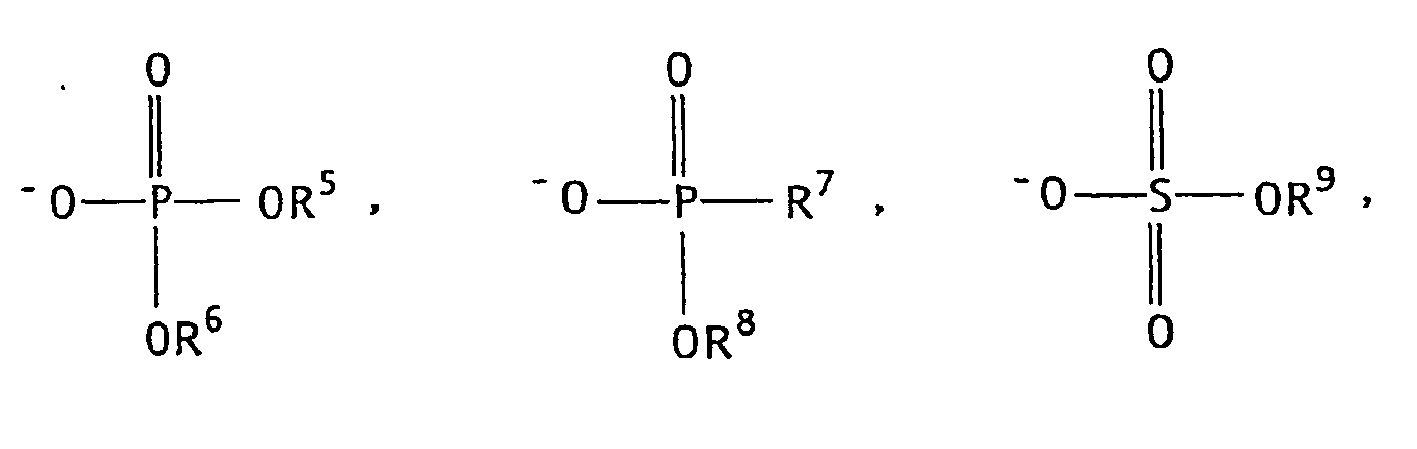
- the present invention provides a method of preparing a phosphonium salt, the method comprising reacting a compound of formula I: wherein R 1 is hydrogen, R 2 is hydrogen or hydrocarbyl, and R 3 is hydrocarbyl, with an ester compound defined by one of the following formulae: or wherein each of R 4 , R 5 , R 6 , R 7 , R 8 , R 9 , and R 10 is ) independently hydrocarbyl, to form a phosphonium salt of formula VII: wherein R Q is selected from R 4 and R 2 when R 2 is hydrocarbyl, R x is selected from R 4 and R 3 , each of R Y and R Z is independently R 4 , and X - is or
- a phosphonium salt of formula VII can be prepared by reacting a phosphine of formula I (hereinafter referred to as the "starting phosphine") with an ester compound selected from the group consisting of: a phosphate triester of formula II; a phosphonate diester of formula III; a sulfate diester of formula IV; and a sulfonate ester of formula V.
- the overall reaction generates a quaternary phosphonium salt of formula VII and an acid counterpart of the ester (i.e. phosphoric acid, phosphonic acid; sulfuric acid, or sulfonic acid, respectively).
- the current method may be used for preparing a phosphonium of formula VII that has one or more methyl groups (i.e. one, two, three, or four methyl groups) attached to the phosphorus atom.
- the current method may be especially suitable for preparing compounds of formula VII that are substantially free of halide ions.
- the ester is present in about three-fold or two-fold molar excess, respectively, relative to the starting phosphine, so as to provide roughly stoichiometric amounts of reagents.
- the starting phosphine is a primary phosphine (i.e. has a one hydrocarbyl group and two hydrogens attached to the phosphorus atom)
- the ester is present in about 3-fold molar excess of ester relative to starting phosphine.
- the starting phosphine is a secondary phosphine (i.e.
- ester has two hydrocarbyl groups and one hydrogen attached to the phosphorus atom
- the ester is present in about 2-fold molar excess of ester relative to starting phosphine.
- yields may be improved by using an excess of ester, for example in the range of about 1.05 to about 3.0 fold excess relative to the stoichiometry of the overall reaction and preferably about 1.1 to about 1.2 fold excess relative to the stoichiometric amount.
- the temperature of the reaction is not critical and may range from about room temperature to about 260°C or higher, although lower temperatures will result in longer reaction times. In general, the reaction proceeds readily at elevated temperature, say between about 80°C to about 220°C, preferably in the range of 100-190°C, and is often complete in 8 hours at these temperatures.
- R 4 groups on the ester increase in size (i.e. steric bulk), the reaction may become less efficient and higher temperatures or longer reaction times may be necessary to increase yield. Therefore, suitable values for R 4 include but are not limited to: methyl, ethyl, n-propyl, isopropyl, n-butyl, iso-butyl, and tert-butyl. Certain esters, such as dimethyl-sulfate, are very active alkylating reagents and may be used for reactions carried out at moderate temperatures.
- the properties of the starting phosphine may affect the overall rate of the reaction.
- Secondary phosphines tend to be more reactive than primary phosphines.
- reactions involving primary phosphine are carried out at higher temperatures or for longer times or both than are counterpart reactions involving secondary phosphines.
- the starting phosphine can be added directly to an ester (a phosphate triester, a phosphonate diester, a sulfate diester, or a sulfonate ester), with stirring.
- an ester a phosphate triester, a phosphonate diester, a sulfate diester, or a sulfonate ester
- the overall reaction is exothermic. Therefore, in order to control the temperature of the reaction mixture, it may be desirable to control the rate of addition in some cases and perhaps also to apply external cooling during the addition step.
- alkylphosphines may be pyrophoric, it may be desirable to control the rate of addition of mono- or di-alkylphosphine so as to avoid having a large amount of unreacted mono- or di-alkylphosphine present in the reaction mixture, especially when the reaction is being carried out at elevated temperatures, for example over 100°C.
- the pressure of the reaction is not critical, and the reaction may be conveniently carried out at atmospheric pressure, under an inert atmosphere, such as nitrogen.
- Some primary and secondary phosphines that have short chain alkyl groups such as dimethylphosphine have low boiling points and may be gaseous and the temperature to be used for carrying out the reaction.
- the reaction is suitably carried out under pressure (e.g. in an autoclave) under an inert atmosphere, such as nitrogen.
- the reaction can be carried out in the absence of solvent, in order to avoid a further step of purifying product away from solvent. However, the reaction may also be carried out in the presence of a solvent. In some cases, the presence of a solvent may be preferred as the solvent may enhance the rate at which the reaction proceeds.
- any unreacted starting materials may be removed, for example, by evaporating under vacuum.
- the method of the invention produces a mixture of phosphonium salt and acid which may be used directly, for example as a solvent for chemical reactions.
- the mixture of phosphonium salt and acid may be subjected to purification steps to isolate the phosphonium salt.
- dimethylphosphoric acid and methyl hydrogen sulfate can be removed from the reaction mixture by evaporation, for example under vacuum at elevated temperatures (dimethylphosphoric acid decomposes at 172-176°C, and methyl hydrogen sulfate decomposes at 130-140°C; see Handbook of Chemistry and Physics, 57th Edition, CRC Press, Inc., copyright 1976, pages C-435 and C-508 ).
- the acid product can be removed by neutralizing the acid with a hydroxide of a Group II metal (i.e. an alkaline earth metal hydroxide, such as calcium hydroxide or barium hydroxide) to form a precipitate and recovering the precipitate by suitable means, such as filtration.
- a hydroxide of a Group II metal i.e. an alkaline earth metal hydroxide, such as calcium hydroxide or barium hydroxide
- suitable means such as filtration.
- calcium dimethylphosphate a chemical that finds utility in polyester fibre processing ( JP2001164461 )
- the phosphonium salt forms a two-phase system when mixed with water, it may be possible to remove acid by washing the phosphonium salt with water.
- Other purification processes known in the art, such as chromatography can also be used to purify the phosphonium salt from the reaction mixture.
- the hydrocarbyl groups for R Q , R X , R Y , R Z , R 2 , R 3 , R 4 , R 5 , R 6 , R 7 , R 8 , R 9 , and R 10 include: substituted or unsubstituted C 1 -C 30 alkyl, substituted or unsubstituted C 3 -C 8 cycloalkyl, substituted or unsubstituted C 2 -C 30 alkenyl, substituted or unsubstituted C 2 -C 30 alkynyl, substituted or unsubstituted C 6 -C 18 aryl, or substituted or unsubstituted C 7 -C 35 aralkyl, although hydrocarbyl groups with not more than 20 carbon atoms are preferred.
- R 2 and R 3 together with the phosphorus atom to which R 2 and R 3 are bonded can form a five- to eight-membered heterocycle or a heterobicycle, such as 9-phosphabicyclo[3.3.1]nonane. It is noted that R 2 and R 3 can be perfluoroalkyl. It is possible for the R groups (R Q , R X , R Y , R Z , R 2 and R 3 when not perfluoroalkyl and R 4 to R 10 ) to bear substituents, or to include heteroatoms, provided that the substituents or heteroatoms do not interfere with the preparation of the compounds of the invention, and do not adversely affect the desired properties of the compound.
- Acceptable substituents may include alkoxy, halo, carboxy, and acetyl,and heteroatoms that may be acceptable include nitrogen, oxygen and sulphur.
- Substituents are likely to increase the cost of the compounds of the invention and as the compounds are often used in industrial applications (as solvents, surfactants, etc.), they are used in such volume that cost is a significant factor. Hence, it is contemplated that, for the most part, substituents will not be present, except for compounds in which one or more of R 2 and R 3 is perfluoroalkyl. If necessary, one of skill in the art can readily determine whether substituents or heteratoms of the hydrocarbyl groups interfere with preparation or desired properties of the compounds by routine experimentation that does not involve the exercise of any inventive faculty.
- R Q , R X R Y , R Z , R 2 , R 3 , R 4 , R 5 , R 6 , R 7 , R 8 , R 9 , and R 10 will be substituted or unsubstituted alkyl groups of 1 to 20 carbon atoms.
- R Q , R X , R Y , R Z , R 2 , R 3 , R 4 , R 5 , R 6 , R 7 , R 8 , R 9 , and R 10 include: methyl, ethyl, n-propyl, isopropyl, n-butyl, iso-butyl, tert-butyl, n-pentyl, cyclopentyl, iso-pentyl, n-hexyl, cyclohexyl, norbornyl, 3-methylphenyl (2,9,4'-trimethyl)pentyl, cyclooctyl, tetradecyl, etc.
- R 2 and R 3 can also be trifluoromethyl.
- R 2 and R 3 Mention is made of the following examples of values for R 2 and R 3 : methyl, trifluoromethyl, ethyl, n-propyl, iso-propyl, n-butyl, iso-butyl, tert-butyl, cyclopentyl, cyclohexyl, and norbornyl, and the case where R 2 and R 3 together with the phosphorus atom to R 2 and R 3 are bonded form 9-phosphabicyclo[3.3.1]nonyl.
- R 4 , R 5 , R 6 , R 7 , R 8 , R 9 , and R 10 methyl, ethyl, n-propyl, isopropyl, n-butyl, iso-butyl, and tert-butyl. It is noted that R 10 can also be p-toluenyl.
- suitable esters for use in the inventive method include but are not limited to: trimethylphosphate, dimethylsulfate, dimethylmethanephosphonate, and methyltosylate.
- R Q , R X , R Y , and R Z Phosphonium cations in which R Q , R X , R Y , and R Z are not identical are referred to as "asymmetric" .
- R Q , R X , R Y , and R Z shall not be identical and in particular, that at least one of R Q , R X , R Y , and R Z shall contain a significantly higher number of carbon atoms (for example 14 to 20 carbon atoms) than the others of R Q , R X , R Y , and R Z .
- R Q , R X , R Y , and R Z shall contain a low number of carbon atoms (for example 1 to 3 carbon atoms, more preferably 2 carbon atoms, and even more preferably one carbon atom).
- R Q , R X , R Y , and R Z can be methyl.
- Phosphonium salts with a low carbon content, say between 5 to 12 carbon atoms, may find utility as ionic liquids or electrolytes in cases where a high ratio of charge to molecular weight is required.
- Phosphonium salts that may be used as surfactants include those in which three of R Q , R X , R Y , and R Z are each independently methyl or ethyl, preferably methyl, and the other is a saturated hydrocarbyl having an unbranched chain of a higher number of carbon atoms, say 12 to 30 carbon atoms, more preferably 12 to 20 carbon atoms.
- a "surfactant” we mean a surface-active agent that reduces surface tension when dissolved in water or water solutions, or that reduces interfacial tension between two liquids, or between a liquid and a solid.
- Surfactants include detergents, wetting agents, and emulsifiers. Surfactants may form micelles.
- the hydrocarbyl chain on the phosphonium may bear substituents that do interfere with intended utility of the compound as a surfactant, including but not limited to fluoro.
- At least one of R Q , R X , R Y , R Z or R 5 to R 10 contains a higher number of carbon atoms, for example 14 or more.
- the presence of one or more long alkyl chains may increase the ability of a phosphonium salt to dissolve nonpolar organic compounds.
- the presence of one or more long alkyl chains may render the phosphonium salt "water immiscible".
- Water immiscible is intended to describe compounds that form a two phase system when mixed with water but does not exclude compounds that dissolve in water nor compounds that will dissolve water, provided that the two phase system forms. Water immiscibility is a desirable feature of a phosphonium salt not only because it renders the compound useful as a solvent for biphasic reactions with an aqueous phase, but also because it facilitates purification and isolation of the phosphonium salt when prepared according to certain methods.
- the acid when the method of the invention produces a water-immiscible phosphonium salt and an acid, the acid can be removed from the reaction products by washing the phosphonium salt with water.
- Compounds of formula VII that have a large total number of carbons, say equal to or greater than 20 and in particular greater than 25 or 26, or have at least one aryl group are more hydrophobic. There is no critical upper limit on the total number of carbon atoms that may be present in a compound of formula VII. However, it is unlikely that the total will exceed 50.
- the compound of formula VII is intended for use as a solvent, then in general, it is preferred that the compound is a liquid below 100°C, more preferably below 50°C, and most preferably at or below room temperature.
- Values for R Q , R X R Y , R Z , R 2 , R 3 , R 4 , R 5 , R 6 , R 7 , R 8 , R 9 , and R 10 can be selected to yield compounds that are liquid at room temperature.
- Branching can occur at the alpha or omega carbon or at any intermediate point.
- the melting point of the salt will tend to decrease as steric bulk increases around either or both of the phosphorus atom of the cation and the central atom of the anion (the sulfur atom or phosphorus atom or carbon atom); for this reason, it may be preferred for one or more of R groups on either or both of the cation and anion (i.e. R Q , R X , R Y , R Z , R 5 , R 6 , R 7 , R 8 , R 9 , and R 10 ) to have three or more carbon atoms.
- the method according to the current invention contemplates compounds of formula VII where properties may be modified by varying the values of the R groups present on either the anion or the cation. Selection of particular values for R Q , R X , R 1 , R Z , and R 2 to R 10 to achieve particular melting points, degrees of water immiscibility, or surfactant properties is within the competence of a person skilled in the art, although it may require some routine experimentation.
- chiral compounds of formula VII include compounds containing a phosphonium cation wherein R Q , R X , R Y , and R Z , are all different or wherein one of R Q , R X , R Y , and R Z , is an enantiomer, such as 2,4,4'-trimethylpentyl, which group has one chiral atom.
- Phosphonium salts described herein may find utility in a wide range of applications.
- phosphonium salts in which three of R Q , R X , R Y , and R Z are methyl and the other is a saturated or unsaturated hydrocarbyl having an unbranched chain of a higher number of carbon atoms, say 12 to 30 carbon atoms may find utility as antimicrobial agents (Kanazawa, supra ) or surfactants.
- Phosphonium phosphates may find utility as a component of spinning finish ( JP11172577 ).
- the phosphonium salts prepared by the method of the current invention may also be used as polar solvents known as "ionic liquids" for chemical reactions such as Michael additions, aryl coupling, Diels-Alder, alkylation, biphasic catalysis, Heck reactions, hydrogenation, or for enzymatic reactions, for example lipase reactions (for a recent review of ionic liquids, see Thomas Welton (Chem. Rev. 1999, 99, 2071-2083 )).
- ionic liquids for chemical reactions such as Michael additions, aryl coupling, Diels-Alder, alkylation, biphasic catalysis, Heck reactions, hydrogenation, or for enzymatic reactions, for example lipase reactions (for a recent review of ionic liquids, see Thomas Welton (Chem. Rev. 1999, 99, 2071-2083 )).
- starting material phosphines are made by Cytec Canada, Inc. and their purity determined by gas chromatography (GC). The remaining starting materials were purchased from Aldrich and used as they were purchased. Structures were confirmed by NMR (nuclear magnetic resonance spectrometry) and by FAB MS (Fast Atom Bombardment mass spectrometry), as indicated.
- Cyclohexylphosphine (14.5 g, 98%, 0.1255 mole) was added by dripping through an addition funnel over a period of 10 minutes to a flask containing trimethylphosphate (95 g, 97%, 0.6578 mole, b.p. 197°C) preheated to 140°C under nitrogen, with stirring. There was no sudden change in temperature associated with addition. The mixture was heated to reflux (about 165°C).
- the temperature of the mixture gradually increased to 210°C and was maintained at this temperature with stirring for 15 minutes.
- the total reaction time was about 8 hours.
- reaction mixture was then cooled and decanted into a flask. Excess trimethylphosphate was removed from the reaction mixture by heating to 180°C under vacuum 5mm Hg.
- the product was a glassy, colourless liquid with a pH of about 2-3 pH units.
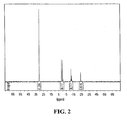
- the presence of cyclohexyltrimethylphosphonium dimethylphosphate and dimethylphosphoric acid was confirmed by 1 H (see Figure 1 ), 13 C, and 31 P (see Figure 2 ) NMR and FAB MS analysis.
- a 500 ml 2 neck round-bottomed flask fitted with a condenser was charged with 108.0 g (0.77 mole) trimethylphosphate and heated to 135°C under nitrogen with stirring.
- Di-n-butylphosphine (93.2 g, 0.64 mole) was added to the flask over a period of 8 hours.
- the temperature of the contents of the flask increased to 155°C during the addition of a first 6.6 g of the total 93.2 g of di-n-butylphosphine.
- the reaction was maintained at 150°C for 2 hours.
- a round-bottomed flask fitted with a condenser was charged with 280.3 g (1.9 mole) trimethylphosphate and heated to 100°C under nitrogen with stirring.
- Dicyclohexylphosphine (277.2 g, 1.4 mol) was gradually added to the flask over a period of 7.5 hour.
- the reaction was exothermic, with the temperature of the contents of the flask rising rapidly to 150-160°C during the addition of dicyclohexylphosphine.
- the reaction mixture was maintained at a temperature of 150-160°C for 2 hours, then cooled to room temperature.
- a round-bottomed flask was charged with 136.0 g (0.96 mol) trimethylphosphate and heated to 140 °C under nitrogen with stirring. While stirring vigorously, a solution of 70.3 g (0.48 mol) diisobutylphosphine and 11.0 g of dimethylcarbonate were added to the flask over a period of 2.5 hours at 135 °C. The reaction was exothermic during the addition of the phosphine. The reaction mixture was maintained at 135 °C for a total of 8 hours, then cooled to room temperature. 31 P, 1 H, and 13 C NMR analyses confirmed the presence of the diisobutyldimethylphosphonium dimethylphosphate and dimethylphosphoric acid.
Landscapes
- Chemical & Material Sciences (AREA)
- Organic Chemistry (AREA)
- Health & Medical Sciences (AREA)
- Life Sciences & Earth Sciences (AREA)
- Biochemistry (AREA)
- General Health & Medical Sciences (AREA)
- Molecular Biology (AREA)
- Engineering & Computer Science (AREA)
- Textile Engineering (AREA)
Description
- The present invention relates to phosphonium salts and their methods of preparation.
- Phosphonium salts may be used in a wide range of applications, including: as surfactants; as a component in spinning finish agents for aromatic polyamide fibers (
JP11172577 A2, published June 29, 1999 - For many purposes, a phosphonium salt having a non-halide anion is desirable. Phosphonium non-halide salts can be prepared by a conventional two-step process, comprising the steps of (a) reacting a tertiary phosphine with an alkylhalide to obtain a quaternary phosphonium halide salt, and (b) exchanging the halide anion with a suitable anion (by ion exchange or metathesis) to generate a quaternary phosphonium salt having a non-halide anion.
- However, this two-step process has several drawbacks. For example, the alkylhalides used to quaternize the tertiary phosphine are expensive and some are corrosive and difficult to prepare and use. Also, the tertiary phosphine may be expensive or difficult to make, the preparation thereof sometimes involving several steps and starting materials that are expensive and pyrophoric (see for example Kanazawa et al., supra, and Hugh R. Hays, J. Org. Chem. Vol. 31, pp. 3871-3820, which describe methods for preparing trimethylalkylphosphonium halides).
- In addition, the two-step process generates large amounts of waste, as salt or acid by-products are usually removed by washing with water. Thus, the two-step process is inconvenient on an industrial scale.
- Further, the end-product of the two-step process can be contaminated with residual halide ion, which may interfere with the intended utility of the phosphonium salt. For instance, halide ions such as chloride ions coordinate with group VII metals such as palladium and platinum and as a result, the presence of chloride ion can interfere with the activity of group VII metal catalysts. If a phosphonium salt is to be used in an environment where halide ions are unacceptable, even at low levels, halide salts should not be used in the starting materials or a further process must be used which ensures removal of halide ions from the phosphonium salt.
- In one aspect, the present invention provides a method of preparing a phosphonium salt, the method comprising reacting a compound of formula I:

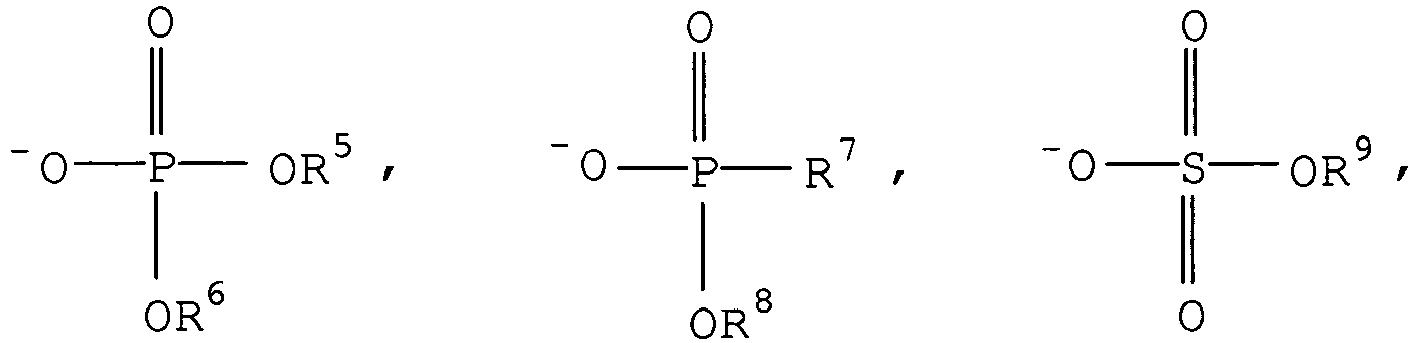
with an ester compound defined by one of the following formulae:

to form a phosphonium salt of formula VII:

- Some of the compounds of formula VII that can be prepared by the foregoing process are novel:


with the provisos that: - (i) when X- is a phosphonate anion, then RQ, RX, RY, and RZ each has three or more carbon atoms;
- (ii) when X- is a sulfate then the sum of carbon atoms in RQ, RX, RY, and RZ is greater than 4; and
- (iii) when X- is methylsulfate, and one of RQ, RX, RY, and RZ is methyl, the other of RQ, RX, RY, and RZ cannot all be 2-cyanoethyl.
-
-
Figure 1 is a 1H-NMR (proton nuclear magnetic resonance) spectrum of a mixture of cyclohexyltrimethylphosphonium dimethylphosphate and dimethylphosphoric acid. -
Figure 2 is a 31P-NMR of a mixture of cyclohexyltrimethylphosphonium dimethylphosphate and dimethylphosphoric acid. - In general, a phosphonium salt of formula VII can be prepared by reacting a phosphine of formula I (hereinafter referred to as the "starting phosphine") with an ester compound selected from the group consisting of: a phosphate triester of formula II; a phosphonate diester of formula III; a sulfate diester of formula IV; and a sulfonate ester of formula V. The overall reaction generates a quaternary phosphonium salt of formula VII and an acid counterpart of the ester (i.e. phosphoric acid, phosphonic acid; sulfuric acid, or sulfonic acid, respectively).
- In one embodiment, the current method may be used for preparing a phosphonium of formula VII that has one or more methyl groups (i.e. one, two, three, or four methyl groups) attached to the phosphorus atom.
- The current method may be especially suitable for preparing compounds of formula VII that are substantially free of halide ions.
- In general, when the starting phosphine is a primary phosphine or a secondary phosphine, the ester is present in about three-fold or two-fold molar excess, respectively, relative to the starting phosphine, so as to provide roughly stoichiometric amounts of reagents. Specifically, when the starting phosphine is a primary phosphine (i.e. has a one hydrocarbyl group and two hydrogens attached to the phosphorus atom), the ester is present in about 3-fold molar excess of ester relative to starting phosphine. When the starting phosphine is a secondary phosphine (i.e. has two hydrocarbyl groups and one hydrogen attached to the phosphorus atom), the ester is present in about 2-fold molar excess of ester relative to starting phosphine. However in some cases, yields may be improved by using an excess of ester, for example in the range of about 1.05 to about 3.0 fold excess relative to the stoichiometry of the overall reaction and preferably about 1.1 to about 1.2 fold excess relative to the stoichiometric amount.
- The temperature of the reaction is not critical and may range from about room temperature to about 260°C or higher, although lower temperatures will result in longer reaction times. In general, the reaction proceeds readily at elevated temperature, say between about 80°C to about 220°C, preferably in the range of 100-190°C, and is often complete in 8 hours at these temperatures.
- However, as R4 groups on the ester increase in size (i.e. steric bulk), the reaction may become less efficient and higher temperatures or longer reaction times may be necessary to increase yield. Therefore, suitable values for R4 include but are not limited to: methyl, ethyl, n-propyl, isopropyl, n-butyl, iso-butyl, and tert-butyl. Certain esters, such as dimethyl-sulfate, are very active alkylating reagents and may be used for reactions carried out at moderate temperatures.
- Also, the properties of the starting phosphine may affect the overall rate of the reaction. Secondary phosphines tend to be more reactive than primary phosphines. Thus, in general, reactions involving primary phosphine are carried out at higher temperatures or for longer times or both than are counterpart reactions involving secondary phosphines.
- The starting phosphine can be added directly to an ester (a phosphate triester, a phosphonate diester, a sulfate diester, or a sulfonate ester), with stirring. However, the overall reaction is exothermic. Therefore, in order to control the temperature of the reaction mixture, it may be desirable to control the rate of addition in some cases and perhaps also to apply external cooling during the addition step. In addition, since alkylphosphines may be pyrophoric, it may be desirable to control the rate of addition of mono- or di-alkylphosphine so as to avoid having a large amount of unreacted mono- or di-alkylphosphine present in the reaction mixture, especially when the reaction is being carried out at elevated temperatures, for example over 100°C.
- When the starting phosphine is a liquid at the temperature to be used for carrying out the reaction, the pressure of the reaction is not critical, and the reaction may be conveniently carried out at atmospheric pressure, under an inert atmosphere, such as nitrogen. Some primary and secondary phosphines that have short chain alkyl groups (such as dimethylphosphine) have low boiling points and may be gaseous and the temperature to be used for carrying out the reaction. When the starting phosphine is a gas at the temperature to be used for carrying out the reaction, the reaction is suitably carried out under pressure (e.g. in an autoclave) under an inert atmosphere, such as nitrogen.
- The reaction can be carried out in the absence of solvent, in order to avoid a further step of purifying product away from solvent. However, the reaction may also be carried out in the presence of a solvent. In some cases, the presence of a solvent may be preferred as the solvent may enhance the rate at which the reaction proceeds.
- If desired, any unreacted starting materials may be removed, for example, by evaporating under vacuum.
- The method of the invention produces a mixture of phosphonium salt and acid which may be used directly, for example as a solvent for chemical reactions. Alternatively, the mixture of phosphonium salt and acid may be subjected to purification steps to isolate the phosphonium salt. For example, dimethylphosphoric acid and methyl hydrogen sulfate can be removed from the reaction mixture by evaporation, for example under vacuum at elevated temperatures (dimethylphosphoric acid decomposes at 172-176°C, and methyl hydrogen sulfate decomposes at 130-140°C; see Handbook of Chemistry and Physics, 57th Edition, CRC Press, Inc., copyright 1976, pages C-435 and C-508). Alternatively, the acid product can be removed by neutralizing the acid with a hydroxide of a Group II metal (i.e. an alkaline earth metal hydroxide, such as calcium hydroxide or barium hydroxide) to form a precipitate and recovering the precipitate by suitable means, such as filtration. Of note, calcium dimethylphosphate, a chemical that finds utility in polyester fibre processing (
JP2001164461 - The hydrocarbyl groups for RQ, RX, RY, RZ, R2, R3, R4, R5, R6, R7, R8, R9, and R10 include: substituted or unsubstituted C1-C30 alkyl, substituted or unsubstituted C3-C8 cycloalkyl, substituted or unsubstituted C2-C30 alkenyl, substituted or unsubstituted C2-C30 alkynyl, substituted or unsubstituted C6-C18 aryl, or substituted or unsubstituted C7-C35 aralkyl, although hydrocarbyl groups with not more than 20 carbon atoms are preferred. R2 and R3 together with the phosphorus atom to which R2 and R3 are bonded can form a five- to eight-membered heterocycle or a heterobicycle, such as 9-phosphabicyclo[3.3.1]nonane. It is noted that R2 and R3 can be perfluoroalkyl. It is possible for the R groups (RQ, RX, RY, RZ, R2 and R3 when not perfluoroalkyl and R4 to R10) to bear substituents, or to include heteroatoms, provided that the substituents or heteroatoms do not interfere with the preparation of the compounds of the invention, and do not adversely affect the desired properties of the compound. Acceptable substituents may include alkoxy, halo, carboxy, and acetyl,and heteroatoms that may be acceptable include nitrogen, oxygen and sulphur. Substituents are likely to increase the cost of the compounds of the invention and as the compounds are often used in industrial applications (as solvents, surfactants, etc.), they are used in such volume that cost is a significant factor. Hence, it is contemplated that, for the most part, substituents will not be present, except for compounds in which one or more of R2 and R3 is perfluoroalkyl. If necessary, one of skill in the art can readily determine whether substituents or heteratoms of the hydrocarbyl groups interfere with preparation or desired properties of the compounds by routine experimentation that does not involve the exercise of any inventive faculty.
- In many cases, RQ, RX RY, RZ, R2, R3, R4, R5, R6, R7, R8, R9, and R10 will be substituted or unsubstituted alkyl groups of 1 to 20 carbon atoms. Thus, specific examples of values for RQ, RX, RY, RZ, R2, R3, R4, R5, R6, R7, R8, R9, and R10 include: methyl, ethyl, n-propyl, isopropyl, n-butyl, iso-butyl, tert-butyl, n-pentyl, cyclopentyl, iso-pentyl, n-hexyl, cyclohexyl, norbornyl, 3-methylphenyl (2,9,4'-trimethyl)pentyl, cyclooctyl, tetradecyl, etc. R2 and R3 can also be trifluoromethyl.
- Mention is made of the following examples of values for R2 and R3: methyl, trifluoromethyl, ethyl, n-propyl, iso-propyl, n-butyl, iso-butyl, tert-butyl, cyclopentyl, cyclohexyl, and norbornyl, and the case where R2 and R3 together with the phosphorus atom to R2 and R3 are bonded form 9-phosphabicyclo[3.3.1]nonyl.
- Mention is made of the following examples of values for R4, R5, R6, R7, R8, R9, and R10: methyl, ethyl, n-propyl, isopropyl, n-butyl, iso-butyl, and tert-butyl. It is noted that R10 can also be p-toluenyl. Examples of suitable esters for use in the inventive method include but are not limited to: trimethylphosphate, dimethylsulfate, dimethylmethanephosphonate, and methyltosylate.
- Phosphonium cations in which RQ, RX, RY, and RZ are not identical are referred to as "asymmetric" . In some cases, it is desired that RQ, RX, RY, and RZ shall not be identical and in particular, that at least one of RQ, RX, RY, and RZ shall contain a significantly higher number of carbon atoms (for example 14 to 20 carbon atoms) than the others of RQ, RX, RY, and RZ.
- For some applications, it is desired that at least one of RQ, RX, RY, and RZ shall contain a low number of carbon atoms (for example 1 to 3 carbon atoms, more preferably 2 carbon atoms, and even more preferably one carbon atom). For example, one, two, three or all of RQ, RX, RY, and RZ can be methyl. Phosphonium salts with a low carbon content, say between 5 to 12 carbon atoms, may find utility as ionic liquids or electrolytes in cases where a high ratio of charge to molecular weight is required.
- Phosphonium salts that may be used as surfactants include those in which three of RQ, RX, RY, and RZ are each independently methyl or ethyl, preferably methyl, and the other is a saturated hydrocarbyl having an unbranched chain of a higher number of carbon atoms, say 12 to 30 carbon atoms, more preferably 12 to 20 carbon atoms. By a "surfactant" we mean a surface-active agent that reduces surface tension when dissolved in water or water solutions, or that reduces interfacial tension between two liquids, or between a liquid and a solid. Surfactants include detergents, wetting agents, and emulsifiers. Surfactants may form micelles. The hydrocarbyl chain on the phosphonium may bear substituents that do interfere with intended utility of the compound as a surfactant, including but not limited to fluoro.
- In some cases, it is preferred that at least one of RQ, RX, RY, RZ or R5 to R10 contains a higher number of carbon atoms, for example 14 or more. For example, the presence of one or more long alkyl chains may increase the ability of a phosphonium salt to dissolve nonpolar organic compounds. In addition, the presence of one or more long alkyl chains may render the phosphonium salt "water immiscible".
- Compounds according to formula VII that are hydrophobic or "water immiscible" are preferred for some purposes. The term "water immiscible" is intended to describe compounds that form a two phase system when mixed with water but does not exclude compounds that dissolve in water nor compounds that will dissolve water, provided that the two phase system forms. Water immiscibility is a desirable feature of a phosphonium salt not only because it renders the compound useful as a solvent for biphasic reactions with an aqueous phase, but also because it facilitates purification and isolation of the phosphonium salt when prepared according to certain methods. By way of illustration, when the method of the invention produces a water-immiscible phosphonium salt and an acid, the acid can be removed from the reaction products by washing the phosphonium salt with water. Compounds of formula VII that have a large total number of carbons, say equal to or greater than 20 and in particular greater than 25 or 26, or have at least one aryl group are more hydrophobic. There is no critical upper limit on the total number of carbon atoms that may be present in a compound of formula VII. However, it is unlikely that the total will exceed 50.
- If the compound of formula VII is intended for use as a solvent, then in general, it is preferred that the compound is a liquid below 100°C, more preferably below 50°C, and most preferably at or below room temperature. Values for RQ, RX RY, RZ, R2, R3, R4, R5, R6, R7, R8, R9, and R10 can be selected to yield compounds that are liquid at room temperature. Increasing the total number of carbon atoms present in the hydrocarbyl groups RQ, RX, RY, RZ, and R2 to R10 will tend to increase the melting point, although this effect can be counteracted somewhat by asymmetry, branching of the hydrocarbyl groups RQ, RX, RY, RZ, and R2 to R10, and the tendency of sterically bulky ions to coordinate poorly. Specifically, the melting point tends to decrease as the degree of asymmetry around the phosphorus atom increases. Also, the melting point of the salt will tend to decrease as the degree of branching of the hydrocarbyl groups RQ, RX, RY, RZ, and R2 to R10 increases. Branching can occur at the alpha or omega carbon or at any intermediate point. In addition, the melting point of the salt will tend to decrease as steric bulk increases around either or both of the phosphorus atom of the cation and the central atom of the anion (the sulfur atom or phosphorus atom or carbon atom); for this reason, it may be preferred for one or more of R groups on either or both of the cation and anion (i.e. RQ, RX, RY, RZ, R5, R6, R7, R8, R9, and R10) to have three or more carbon atoms.
- Thus, the method according to the current invention contemplates compounds of formula VII where properties may be modified by varying the values of the R groups present on either the anion or the cation. Selection of particular values for RQ, RX, R1, RZ, and R2 to R10 to achieve particular melting points, degrees of water immiscibility, or surfactant properties is within the competence of a person skilled in the art, although it may require some routine experimentation.
- Compounds according to formula VII that have chirality provide a chiral environment for chemical reactions and may be especially suitable for certain purposes, such as a reaction having an asymmetric or chiral transition state that can be stabilized by interaction with a suitable solvent. Examples of chiral compounds of formula VII include compounds containing a phosphonium cation wherein RQ, RX, RY, and RZ, are all different or wherein one of RQ, RX, RY, and RZ, is an enantiomer, such as 2,4,4'-trimethylpentyl, which group has one chiral atom.
- Mention is made of the following examples of compounds of formula VII:
- cyclohexyltrimethylphosphonium dimethylphosphate;
- dibutyldimethylphosphonium dimethylphosphate;
- dicyclohexyldimethylphosphonium dimethylphosphate; and
- diisobutyldimethylphosphonium dimethylphosphate.
- Phosphonium salts described herein may find utility in a wide range of applications. For example, phosphonium salts in which three of RQ, RX, RY, and RZ are methyl and the other is a saturated or unsaturated hydrocarbyl having an unbranched chain of a higher number of carbon atoms, say 12 to 30 carbon atoms, may find utility as antimicrobial agents (Kanazawa, supra) or surfactants. Phosphonium phosphates may find utility as a component of spinning finish (
JP11172577 - In the following examples, starting material phosphines are made by Cytec Canada, Inc. and their purity determined by gas chromatography (GC). The remaining starting materials were purchased from Aldrich and used as they were purchased. Structures were confirmed by NMR (nuclear magnetic resonance spectrometry) and by FAB MS (Fast Atom Bombardment mass spectrometry), as indicated.
- Cyclohexylphosphine (14.5 g, 98%, 0.1255 mole) was added by dripping through an addition funnel over a period of 10 minutes to a flask containing trimethylphosphate (95 g, 97%, 0.6578 mole, b.p. 197°C) preheated to 140°C under nitrogen, with stirring. There was no sudden change in temperature associated with addition. The mixture was heated to reflux (about 165°C).
- As the reaction proceeded, the temperature of the mixture gradually increased to 210°C and was maintained at this temperature with stirring for 15 minutes. The total reaction time was about 8 hours.
- The reaction mixture was then cooled and decanted into a flask. Excess trimethylphosphate was removed from the reaction mixture by heating to 180°C under vacuum 5mm Hg.
- The product was a glassy, colourless liquid with a pH of about 2-3 pH units. The presence of cyclohexyltrimethylphosphonium dimethylphosphate and dimethylphosphoric acid was confirmed by 1H (see
Figure 1 ), 13C, and 31P (seeFigure 2 ) NMR and FAB MS analysis. 1H-NMR (CDC13, 300.13Hz, δ) signals for the characteristic methyl groups are: 1.96 (d, J=14.2 Hz, P-CH3), 3.62 (d, J=10.8 Hz, O=P-O-CH3) ; 31P-NMR (CDCl3, 81.015 Hz, δ) : 30.60 (P+), 1.63 (O=P-O-CH3). - A 500 ml 2 neck round-bottomed flask fitted with a condenser was charged with 108.0 g (0.77 mole) trimethylphosphate and heated to 135°C under nitrogen with stirring. Di-n-butylphosphine (93.2 g, 0.64 mole) was added to the flask over a period of 8 hours. The temperature of the contents of the flask increased to 155°C during the addition of a first 6.6 g of the total 93.2 g of di-n-butylphosphine. The reaction was maintained at 150°C for 2 hours.
- Following the incubation period, unreacted trimethylphosphate was removed by evaporation for 6 hours at 100°C under reduced pressure (20 mmHg).
- A colourless and viscous liquid (180.7 g) was obtained. 31P, 13C and 1H NMR and FAB MS confirmed the presence of dibutylphosphonium dimethylphosphate and dimethylphosphoric acid. 1H-NMR (CDCl3, 300.13 Hz, δ) signals for the characteristic methyl groups are: 1.65 (d, J=13.8 Hz, P-CH3), 3.20 (d, J=10.6 Hz, O=P-O-CH3); 31P-NMR (CDCl3, 81.015 Hz, δ) : 30.36 (P+), 2.06 (O=P-O-CH3).
- A round-bottomed flask fitted with a condenser was charged with 280.3 g (1.9 mole) trimethylphosphate and heated to 100°C under nitrogen with stirring. Dicyclohexylphosphine (277.2 g, 1.4 mol) was gradually added to the flask over a period of 7.5 hour. The reaction was exothermic, with the temperature of the contents of the flask rising rapidly to 150-160°C during the addition of dicyclohexylphosphine. The reaction mixture was maintained at a temperature of 150-160°C for 2 hours, then cooled to room temperature.
- Upon cooling to room temperature, the product crystallized into a clear, colourless solid. Unreacted trimethylphosphate was removed by evaporation under reduced pressure (5 mmHg) at 170°C for 12 hour.
- Analysis by 31P and 1H NMR and MS confirmed the presence of dicyclohexyldimethylphosphonium dimethylphosphate and dimethylphosphoric acid. 1H-NMR (CDCl3, 300.13 Hz, δ) signals for the characteristic methyl groups are: 1.76 (d, J=13. Hz, P-CH3), 3.39 (d, J=10.6 Hz, O=P-O-CH3) ; 31P-NMR (CDCl3, 81.015 Hz, δ) : 34.48 (P+), 2.28 (O=P-O-CH3).
- A round-bottomed flask was charged with 136.0 g (0.96 mol) trimethylphosphate and heated to 140 °C under nitrogen with stirring. While stirring vigorously, a solution of 70.3 g (0.48 mol) diisobutylphosphine and 11.0 g of dimethylcarbonate were added to the flask over a period of 2.5 hours at 135 °C. The reaction was exothermic during the addition of the phosphine. The reaction mixture was maintained at 135 °C for a total of 8 hours, then cooled to room temperature. 31P, 1H, and 13C NMR analyses confirmed the presence of the diisobutyldimethylphosphonium dimethylphosphate and dimethylphosphoric acid.
Claims (29)
- A method of preparing a phosphonium salt, the method comprising reacting a compound of formula I:


to form a phosphonium salt of formula VII:

R1 is hydrogen, R2 is hydrogen or hydrocarbyl, and R3 is hydrocarbyl,
where hydrocarbyl means substituted or unsubstituted C1-C30 alkyl, substituted or unsubstituted C3-C8 cycloalkyl, substituted or unsubstituted C2-C30 alkenyl, substituted or unsubstituted C2-C30 alkynyl, substituted or unsubstituted C6-C18 aryl, or substituted or unsubstituted C7-C35 aralkyl,
or R2 and R3 together with the phosphorus atom to which R2 and R3 are bonded can form a five- to eight-membered heterocycle or a heterobicycle, or R2 and R3 can be perfluoroalkyl. - The method of claim 1, wherein R2 is hydrogen and R3 is a hydrocarbyl.
- The method of claim 1, wherein R2 and R3 are both hydrocarbyl.
- The method of claim 2 or 3, wherein the hydrocarbyl is a substituted or unsubstituted alkyl group of 1 to 20 carbon atoms.
- The method of claim 4, wherein the hydrocarbyl is selected from the group consisting of: methyl, trifluoromethyl, ethyl, n-propyl, iso-propyl, n-butyl, iso-butyl, tert-butyl, cyclopentyl, cyclohexyl, and norbornyl.
- The method of claim 3, wherein R2 and R3 together with the phosphorus atom to which R2 and R3 are bonded form a five- to eight-membered heterocycle or heterobicycle.
- The method of claim 6, wherein the heterobicycle is 9-phosphabicyclo[3.3.1]nonyl.
- The method of any one of claims 1 to 7, wherein the ester compound is a phosphate triester.
- The method of claim 8, wherein R4 is selected from the group consisting of: methyl, ethyl, n-propyl, iso-propyl, n-butyl, iso-butyl, and tert-butyl.
- The method of claim 9, wherein R4 is methyl.
- The method of claim 8, wherein the phosphate triester is trimethylphosphate.
- The method of any one of claims 1 to 7, wherein the ester compound is a phosphonate ester.
- The method of claim 12, wherein R4 is selected from the group consisting of: methyl, ethyl, n-propyl, iso-propyl, n-butyl, iso-butyl, and tert-butyl.
- The method of claim 13, wherein R4 is methyl.
- The method of any one of claims 1 to 7, wherein the ester compound is a sulfate ester.
- The method of claim 15, wherein R4 is selected from the group consisting of: methyl, ethyl, n-propyl, iso-propyl, n-butyl, iso-butyl, and tert-butyl.
- The method of claim 16, wherein R4 is methyl.
- The method of claim 15, wherein the sulfate ester is dimethyl sulfate.
- The method of any one of claims 1 to 7, wherein the ester is a sulfonate ester.
- The method of claim 19, wherein R4 is selected from the group consisting of: methyl, ethyl, n-propyl, iso-propyl, n-butyl, iso-butyl, and tert-butyl.
- The method of claim 20, wherein R4 is methyl.
- The method of claim 19, wherein the sulfonate ester is methyl tosylate.
- The method of any one of claims 1 to 22, wherein the phosphonium salt has a total number of carbon atoms between 20 and 50.
- The method of claim 23, wherein the phosphonium salt has a total number of carbon atoms between 25 and 50.
- The method of claim 23 or 24, wherein the phosphonium salt is water immiscible.
- The method of claim 1, wherein the phosphonium salt is cyclohexyltrimethylphosphonium dimethylphosphate.
- The method of claim 1, wherein the phosphonium salt is dibutyldimethylphosphonium dimethylphosphate.
- The method of claim 1, wherein the phosphonium salt is dicyclohexyldimethylphosphonium dimethylphosphate.
- The method of claim 1, wherein the phosphonium salt is diisobutyldimethylphosphonium dimethylphosphate.
Applications Claiming Priority (3)
| Application Number | Priority Date | Filing Date | Title |
|---|---|---|---|
| CA002424215A CA2424215C (en) | 2003-03-31 | 2003-03-31 | Phosphonium salts and methods of their preparation |
| CA2424215 | 2003-03-31 | ||
| PCT/US2004/006961 WO2004094438A1 (en) | 2003-03-31 | 2004-03-08 | Phosphonium salts and methods of their preparation |
Publications (2)
| Publication Number | Publication Date |
|---|---|
| EP1608667A1 EP1608667A1 (en) | 2005-12-28 |
| EP1608667B1 true EP1608667B1 (en) | 2012-12-19 |
Family
ID=33034975
Family Applications (1)
| Application Number | Title | Priority Date | Filing Date |
|---|---|---|---|
| EP04718497A Expired - Lifetime EP1608667B1 (en) | 2003-03-31 | 2004-03-08 | Method of the preparation of phosphonium salt with a non-halide anion |
Country Status (7)
| Country | Link |
|---|---|
| US (4) | US7829744B2 (en) |
| EP (1) | EP1608667B1 (en) |
| KR (1) | KR101074256B1 (en) |
| CN (2) | CN103694275A (en) |
| BR (1) | BRPI0408799A (en) |
| CA (1) | CA2424215C (en) |
| WO (1) | WO2004094438A1 (en) |
Families Citing this family (6)
| Publication number | Priority date | Publication date | Assignee | Title |
|---|---|---|---|---|
| CA2598156C (en) | 2002-08-16 | 2011-02-08 | Cytec Canada Inc. | Phosphonium and imidazolium salts and methods of their preparation |
| DE102004060075A1 (en) | 2004-12-14 | 2006-07-06 | Merck Patent Gmbh | Process for the preparation of onium salts with dialkyl phosphate, dialkyl phosphinate or (halo) -alkyl (O-alkyl) alkyl or alkyl phosphonate anions |
| JP5063025B2 (en) * | 2006-04-14 | 2012-10-31 | 日本化学工業株式会社 | Method for producing curing accelerator for deep ultraviolet transmissive epoxy resin |
| CN102791771B (en) * | 2010-02-24 | 2014-12-10 | 三菱瓦斯化学株式会社 | curable resin composition |
| EP2952518A1 (en) * | 2014-06-05 | 2015-12-09 | Cytec Canada Inc. | Organic Phosphonium Salts, a Method for their Preparation, and their Use in Electrochemical Systems |
| CN116284107A (en) * | 2022-08-31 | 2023-06-23 | 安徽丰原发酵技术工程研究有限公司 | A kind of phosphorus-based ionic liquid and its preparation method and application |
Family Cites Families (23)
| Publication number | Priority date | Publication date | Assignee | Title |
|---|---|---|---|---|
| US3976566A (en) * | 1975-04-23 | 1976-08-24 | Vojislav Petrovich | Froth flotation method for the recovery of minerals by means of quaternary phosphonium nitrites and ternary phosphine dinitrites |
| US4017610A (en) * | 1975-10-31 | 1977-04-12 | Stauffer Chemical Company | Inhibiting growth of bacteria, fungi and algae with a lower alkyl tri-n-octyl phosphonium diphenyl phosphate |
| EP0029003B1 (en) | 1979-11-01 | 1984-12-05 | Ciba-Geigy Ag | Salts of cationic brighteners, their preparation and their use on organic materials as well as their concentrated aqueous solutions |
| DE3569533D1 (en) | 1984-01-14 | 1989-05-24 | Ciba Geigy Ag | Phosphonic-acid salts |
| US4496643A (en) | 1984-03-23 | 1985-01-29 | Eastman Kodak Company | Two-component dry electrostatic developer composition containing onium charge control agent |
| JPH0762021B2 (en) | 1986-11-05 | 1995-07-05 | 第一工業製薬株式会社 | Method for producing fourth phosphonium compound |
| DE3702233A1 (en) * | 1987-01-27 | 1988-08-04 | Espe Stiftung | A PREPARATION CONTAINING AZIRIDINE FOR DENTAL PURPOSES |
| US4837394A (en) * | 1988-08-05 | 1989-06-06 | Eastman Kodak Company | electrostatographic toner particle comprising a polyester containing a covalently bound quaternary phosphonium salt |
| US5030766A (en) | 1990-05-04 | 1991-07-09 | Technology Corporation | Catalysts for producing 1,3-diols and/or 3-hydroxyaldehydes, and processes for making and using same |
| ES2185644T3 (en) | 1993-08-26 | 2003-05-01 | Teijin Ltd | PROCEDURE OF PRODUCTION OF STABILIZED POLYCARBONATE. |
| JP3467307B2 (en) | 1994-03-31 | 2003-11-17 | 信越化学工業株式会社 | Method for producing phosphonium salt |
| US5734085A (en) | 1995-12-21 | 1998-03-31 | Minnesota Mining And Manufacturing Company | Fluorinated phosphonium salts |
| DE19734446A1 (en) | 1997-08-08 | 1999-02-11 | Basf Ag | Process for the preparation of phosphonium salts |
| JP3810037B2 (en) | 1997-12-10 | 2006-08-16 | 竹本油脂株式会社 | Spinning oil for aromatic polyamide fiber |
| GB9820698D0 (en) | 1998-09-24 | 1998-11-18 | Bp Chem Int Ltd | Ionic liquids |
| JP2001164461A (en) | 1999-12-09 | 2001-06-19 | Teijin Ltd | Method for producing polytrimethylene terephthalate-based polyester fiber |
| CA2308896A1 (en) * | 2000-05-18 | 2001-11-18 | Allan James Robertson | Phosphonium salts |
| EP1182197A1 (en) | 2000-08-24 | 2002-02-27 | Solvent Innovation GmbH | Single step preparation of ionic fluids |
| US20040106823A1 (en) * | 2001-03-30 | 2004-06-03 | Roberstson Allan James | Novel phosphonium phosphinate compounds and their methods of preparation |
| CA2343456A1 (en) * | 2001-03-30 | 2002-09-30 | Cytec Technology Corp. | Novel phosphonium phosphinate compounds and their methods of preparation |
| CA2356709A1 (en) * | 2001-09-05 | 2003-03-05 | Kenneth R. Seddon | Use of phosphonium salts |
| WO2003051894A1 (en) | 2001-12-14 | 2003-06-26 | Cytec Canada Inc. | Preparation of ionic liquids |
| CA2598156C (en) * | 2002-08-16 | 2011-02-08 | Cytec Canada Inc. | Phosphonium and imidazolium salts and methods of their preparation |
-
2003
- 2003-03-31 CA CA002424215A patent/CA2424215C/en not_active Expired - Fee Related
-
2004
- 2004-03-08 CN CN201310513449.3A patent/CN103694275A/en active Pending
- 2004-03-08 EP EP04718497A patent/EP1608667B1/en not_active Expired - Lifetime
- 2004-03-08 BR BRPI0408799-2A patent/BRPI0408799A/en not_active Application Discontinuation
- 2004-03-08 US US10/549,223 patent/US7829744B2/en not_active Expired - Fee Related
- 2004-03-08 WO PCT/US2004/006961 patent/WO2004094438A1/en not_active Ceased
- 2004-03-08 CN CNA2004800081520A patent/CN1764666A/en active Pending
-
2005
- 2005-09-29 KR KR1020057018468A patent/KR101074256B1/en not_active Expired - Fee Related
-
2010
- 2010-10-06 US US12/899,097 patent/US8748668B2/en not_active Expired - Fee Related
-
2014
- 2014-01-10 US US14/152,551 patent/US8901339B2/en not_active Expired - Fee Related
- 2014-01-10 US US14/152,477 patent/US8901338B2/en not_active Expired - Fee Related
Also Published As
| Publication number | Publication date |
|---|---|
| US8901339B2 (en) | 2014-12-02 |
| CN1764666A (en) | 2006-04-26 |
| CN103694275A (en) | 2014-04-02 |
| KR101074256B1 (en) | 2011-10-14 |
| BRPI0408799A (en) | 2006-03-28 |
| US20110021838A1 (en) | 2011-01-27 |
| KR20050123129A (en) | 2005-12-29 |
| US7829744B2 (en) | 2010-11-09 |
| CA2424215A1 (en) | 2004-09-30 |
| US20140128630A1 (en) | 2014-05-08 |
| CA2424215C (en) | 2008-11-18 |
| US20070149482A1 (en) | 2007-06-28 |
| US20140128629A1 (en) | 2014-05-08 |
| US8901338B2 (en) | 2014-12-02 |
| US8748668B2 (en) | 2014-06-10 |
| EP1608667A1 (en) | 2005-12-28 |
| WO2004094438A1 (en) | 2004-11-04 |
Similar Documents
| Publication | Publication Date | Title |
|---|---|---|
| EP1587813B1 (en) | Phosphonium and imidazolium salts and methods of their preparation | |
| US8901338B2 (en) | Phosphonium salts and methods of their preparation | |
| US7202379B2 (en) | Process for the preparation of bis(perfluoroalkyl)phosphinic acids and salts thereof | |
| JP5666535B2 (en) | Diarylalkylphosphonates and methods for their preparation | |
| WO2003051894A1 (en) | Preparation of ionic liquids | |
| EP1287007A1 (en) | Phosphonium salts | |
| JP2001525326A (en) | Alkylation of elemental phosphorus | |
| US3325546A (en) | Process for the preparation of detergent phosphine oxides | |
| US6815558B1 (en) | Process for preparing (metal) alkylphosphonites II | |
| KR100697966B1 (en) | Method for alkylation of elemental phosphorus | |
| EP1940855A2 (en) | Diaryl alkylphosphonates and methods for preparing same | |
| US4189449A (en) | Production of quaternary phosphonium hydroxides | |
| US6806383B1 (en) | Process for preparing (metal) alkylphosphonites I | |
| US4760191A (en) | Preparation of bis(4-halophenyl)phenylphosphine oxide | |
| US3426073A (en) | Mesomeric phosphonium salts | |
| CN104710475B (en) | A kind of preparation method of quaternary salt | |
| EP0248491A2 (en) | Method for preparing diesters of phosphonic acids |
Legal Events
| Date | Code | Title | Description |
|---|---|---|---|
| PUAI | Public reference made under article 153(3) epc to a published international application that has entered the european phase |
Free format text: ORIGINAL CODE: 0009012 |
|
| 17P | Request for examination filed |
Effective date: 20050921 |
|
| AK | Designated contracting states |
Kind code of ref document: A1 Designated state(s): AT BE BG CH CY CZ DE DK EE ES FI FR GB GR HU IE IT LI LU MC NL PL PT RO SE SI SK TR |
|
| AX | Request for extension of the european patent |
Extension state: AL LT LV MK |
|
| RIN1 | Information on inventor provided before grant (corrected) |
Inventor name: ZHOU, YUEHUI Inventor name: BRADARIC-BAUS, CHRISTINE, J. |
|
| DAX | Request for extension of the european patent (deleted) | ||
| 17Q | First examination report despatched |
Effective date: 20100325 |
|
| GRAP | Despatch of communication of intention to grant a patent |
Free format text: ORIGINAL CODE: EPIDOSNIGR1 |
|
| GRAS | Grant fee paid |
Free format text: ORIGINAL CODE: EPIDOSNIGR3 |
|
| GRAA | (expected) grant |
Free format text: ORIGINAL CODE: 0009210 |
|
| AK | Designated contracting states |
Kind code of ref document: B1 Designated state(s): AT BE BG CH CY CZ DE DK EE ES FI FR GB GR HU IE IT LI LU MC NL PL PT RO SE SI SK TR |
|
| REG | Reference to a national code |
Ref country code: GB Ref legal event code: FG4D |
|
| REG | Reference to a national code |
Ref country code: CH Ref legal event code: EP |
|
| REG | Reference to a national code |
Ref country code: AT Ref legal event code: REF Ref document number: 589374 Country of ref document: AT Kind code of ref document: T Effective date: 20130115 |
|
| REG | Reference to a national code |
Ref country code: DE Ref legal event code: R096 Ref document number: 602004040448 Country of ref document: DE Effective date: 20130221 |
|
| PG25 | Lapsed in a contracting state [announced via postgrant information from national office to epo] |
Ref country code: FI Free format text: LAPSE BECAUSE OF FAILURE TO SUBMIT A TRANSLATION OF THE DESCRIPTION OR TO PAY THE FEE WITHIN THE PRESCRIBED TIME-LIMIT Effective date: 20121219 Ref country code: SE Free format text: LAPSE BECAUSE OF FAILURE TO SUBMIT A TRANSLATION OF THE DESCRIPTION OR TO PAY THE FEE WITHIN THE PRESCRIBED TIME-LIMIT Effective date: 20121219 Ref country code: ES Free format text: LAPSE BECAUSE OF FAILURE TO SUBMIT A TRANSLATION OF THE DESCRIPTION OR TO PAY THE FEE WITHIN THE PRESCRIBED TIME-LIMIT Effective date: 20130330 |
|
| REG | Reference to a national code |
Ref country code: NL Ref legal event code: VDEP Effective date: 20121219 Ref country code: AT Ref legal event code: MK05 Ref document number: 589374 Country of ref document: AT Kind code of ref document: T Effective date: 20121219 |
|
| PG25 | Lapsed in a contracting state [announced via postgrant information from national office to epo] |
Ref country code: GR Free format text: LAPSE BECAUSE OF FAILURE TO SUBMIT A TRANSLATION OF THE DESCRIPTION OR TO PAY THE FEE WITHIN THE PRESCRIBED TIME-LIMIT Effective date: 20130320 Ref country code: SI Free format text: LAPSE BECAUSE OF FAILURE TO SUBMIT A TRANSLATION OF THE DESCRIPTION OR TO PAY THE FEE WITHIN THE PRESCRIBED TIME-LIMIT Effective date: 20121219 |
|
| PG25 | Lapsed in a contracting state [announced via postgrant information from national office to epo] |
Ref country code: BG Free format text: LAPSE BECAUSE OF FAILURE TO SUBMIT A TRANSLATION OF THE DESCRIPTION OR TO PAY THE FEE WITHIN THE PRESCRIBED TIME-LIMIT Effective date: 20130319 Ref country code: CY Free format text: LAPSE BECAUSE OF FAILURE TO SUBMIT A TRANSLATION OF THE DESCRIPTION OR TO PAY THE FEE WITHIN THE PRESCRIBED TIME-LIMIT Effective date: 20121219 Ref country code: SK Free format text: LAPSE BECAUSE OF FAILURE TO SUBMIT A TRANSLATION OF THE DESCRIPTION OR TO PAY THE FEE WITHIN THE PRESCRIBED TIME-LIMIT Effective date: 20121219 Ref country code: EE Free format text: LAPSE BECAUSE OF FAILURE TO SUBMIT A TRANSLATION OF THE DESCRIPTION OR TO PAY THE FEE WITHIN THE PRESCRIBED TIME-LIMIT Effective date: 20121219 Ref country code: BE Free format text: LAPSE BECAUSE OF FAILURE TO SUBMIT A TRANSLATION OF THE DESCRIPTION OR TO PAY THE FEE WITHIN THE PRESCRIBED TIME-LIMIT Effective date: 20121219 Ref country code: CZ Free format text: LAPSE BECAUSE OF FAILURE TO SUBMIT A TRANSLATION OF THE DESCRIPTION OR TO PAY THE FEE WITHIN THE PRESCRIBED TIME-LIMIT Effective date: 20121219 Ref country code: AT Free format text: LAPSE BECAUSE OF FAILURE TO SUBMIT A TRANSLATION OF THE DESCRIPTION OR TO PAY THE FEE WITHIN THE PRESCRIBED TIME-LIMIT Effective date: 20121219 |
|
| PG25 | Lapsed in a contracting state [announced via postgrant information from national office to epo] |
Ref country code: RO Free format text: LAPSE BECAUSE OF FAILURE TO SUBMIT A TRANSLATION OF THE DESCRIPTION OR TO PAY THE FEE WITHIN THE PRESCRIBED TIME-LIMIT Effective date: 20121219 Ref country code: NL Free format text: LAPSE BECAUSE OF FAILURE TO SUBMIT A TRANSLATION OF THE DESCRIPTION OR TO PAY THE FEE WITHIN THE PRESCRIBED TIME-LIMIT Effective date: 20121219 Ref country code: PL Free format text: LAPSE BECAUSE OF FAILURE TO SUBMIT A TRANSLATION OF THE DESCRIPTION OR TO PAY THE FEE WITHIN THE PRESCRIBED TIME-LIMIT Effective date: 20121219 Ref country code: PT Free format text: LAPSE BECAUSE OF FAILURE TO SUBMIT A TRANSLATION OF THE DESCRIPTION OR TO PAY THE FEE WITHIN THE PRESCRIBED TIME-LIMIT Effective date: 20130419 |
|
| PLBE | No opposition filed within time limit |
Free format text: ORIGINAL CODE: 0009261 |
|
| STAA | Information on the status of an ep patent application or granted ep patent |
Free format text: STATUS: NO OPPOSITION FILED WITHIN TIME LIMIT |
|
| PG25 | Lapsed in a contracting state [announced via postgrant information from national office to epo] |
Ref country code: DK Free format text: LAPSE BECAUSE OF FAILURE TO SUBMIT A TRANSLATION OF THE DESCRIPTION OR TO PAY THE FEE WITHIN THE PRESCRIBED TIME-LIMIT Effective date: 20121219 Ref country code: MC Free format text: LAPSE BECAUSE OF NON-PAYMENT OF DUE FEES Effective date: 20130331 |
|
| REG | Reference to a national code |
Ref country code: CH Ref legal event code: PL |
|
| 26N | No opposition filed |
Effective date: 20130920 |
|
| PG25 | Lapsed in a contracting state [announced via postgrant information from national office to epo] |
Ref country code: IT Free format text: LAPSE BECAUSE OF FAILURE TO SUBMIT A TRANSLATION OF THE DESCRIPTION OR TO PAY THE FEE WITHIN THE PRESCRIBED TIME-LIMIT Effective date: 20121219 |
|
| REG | Reference to a national code |
Ref country code: IE Ref legal event code: MM4A |
|
| REG | Reference to a national code |
Ref country code: DE Ref legal event code: R097 Ref document number: 602004040448 Country of ref document: DE Effective date: 20130920 |
|
| PG25 | Lapsed in a contracting state [announced via postgrant information from national office to epo] |
Ref country code: LI Free format text: LAPSE BECAUSE OF NON-PAYMENT OF DUE FEES Effective date: 20130331 Ref country code: IE Free format text: LAPSE BECAUSE OF NON-PAYMENT OF DUE FEES Effective date: 20130308 Ref country code: CH Free format text: LAPSE BECAUSE OF NON-PAYMENT OF DUE FEES Effective date: 20130331 |
|
| PG25 | Lapsed in a contracting state [announced via postgrant information from national office to epo] |
Ref country code: TR Free format text: LAPSE BECAUSE OF FAILURE TO SUBMIT A TRANSLATION OF THE DESCRIPTION OR TO PAY THE FEE WITHIN THE PRESCRIBED TIME-LIMIT Effective date: 20121219 |
|
| PG25 | Lapsed in a contracting state [announced via postgrant information from national office to epo] |
Ref country code: LU Free format text: LAPSE BECAUSE OF NON-PAYMENT OF DUE FEES Effective date: 20130308 Ref country code: HU Free format text: LAPSE BECAUSE OF FAILURE TO SUBMIT A TRANSLATION OF THE DESCRIPTION OR TO PAY THE FEE WITHIN THE PRESCRIBED TIME-LIMIT; INVALID AB INITIO Effective date: 20040308 |
|
| REG | Reference to a national code |
Ref country code: FR Ref legal event code: PLFP Year of fee payment: 13 |
|
| REG | Reference to a national code |
Ref country code: FR Ref legal event code: PLFP Year of fee payment: 14 |
|
| PGFP | Annual fee paid to national office [announced via postgrant information from national office to epo] |
Ref country code: DE Payment date: 20170228 Year of fee payment: 14 Ref country code: FR Payment date: 20170213 Year of fee payment: 14 |
|
| PGFP | Annual fee paid to national office [announced via postgrant information from national office to epo] |
Ref country code: GB Payment date: 20170308 Year of fee payment: 14 |
|
| REG | Reference to a national code |
Ref country code: DE Ref legal event code: R119 Ref document number: 602004040448 Country of ref document: DE |
|
| GBPC | Gb: european patent ceased through non-payment of renewal fee |
Effective date: 20180308 |
|
| PG25 | Lapsed in a contracting state [announced via postgrant information from national office to epo] |
Ref country code: DE Free format text: LAPSE BECAUSE OF NON-PAYMENT OF DUE FEES Effective date: 20181002 |
|
| PG25 | Lapsed in a contracting state [announced via postgrant information from national office to epo] |
Ref country code: GB Free format text: LAPSE BECAUSE OF NON-PAYMENT OF DUE FEES Effective date: 20180308 |
|
| PG25 | Lapsed in a contracting state [announced via postgrant information from national office to epo] |
Ref country code: FR Free format text: LAPSE BECAUSE OF NON-PAYMENT OF DUE FEES Effective date: 20180331 |