EP1608179A1 - Motion vector determination using plural algorithms - Google Patents
Motion vector determination using plural algorithms Download PDFInfo
- Publication number
- EP1608179A1 EP1608179A1 EP05105130A EP05105130A EP1608179A1 EP 1608179 A1 EP1608179 A1 EP 1608179A1 EP 05105130 A EP05105130 A EP 05105130A EP 05105130 A EP05105130 A EP 05105130A EP 1608179 A1 EP1608179 A1 EP 1608179A1
- Authority
- EP
- European Patent Office
- Prior art keywords
- blocks
- block
- frame
- sub
- motion vector
- Prior art date
- Legal status (The legal status is an assumption and is not a legal conclusion. Google has not performed a legal analysis and makes no representation as to the accuracy of the status listed.)
- Withdrawn
Links
Images



Classifications
-
- H—ELECTRICITY
- H04—ELECTRIC COMMUNICATION TECHNIQUE
- H04N—PICTORIAL COMMUNICATION, e.g. TELEVISION
- H04N19/00—Methods or arrangements for coding, decoding, compressing or decompressing digital video signals
- H04N19/50—Methods or arrangements for coding, decoding, compressing or decompressing digital video signals using predictive coding
- H04N19/503—Methods or arrangements for coding, decoding, compressing or decompressing digital video signals using predictive coding involving temporal prediction
- H04N19/51—Motion estimation or motion compensation
- H04N19/53—Multi-resolution motion estimation; Hierarchical motion estimation
-
- H—ELECTRICITY
- H04—ELECTRIC COMMUNICATION TECHNIQUE
- H04N—PICTORIAL COMMUNICATION, e.g. TELEVISION
- H04N19/00—Methods or arrangements for coding, decoding, compressing or decompressing digital video signals
- H04N19/50—Methods or arrangements for coding, decoding, compressing or decompressing digital video signals using predictive coding
- H04N19/503—Methods or arrangements for coding, decoding, compressing or decompressing digital video signals using predictive coding involving temporal prediction
- H04N19/51—Motion estimation or motion compensation
- H04N19/56—Motion estimation with initialisation of the vector search, e.g. estimating a good candidate to initiate a search
Definitions
- the present invention relates to a video compression method comprising determining motion vectors for blocks in a first frame relative to a second frame and to a video compression apparatus comprising memory means for storing first and second frames and processing means configured for determining motion vectors for blocks in a first frame, stored in the memory means, relative to a second frame, stored in the memory means.
- a moving pictures have temporal redundancy, spatial redundancy and code redundancy by their nature, so that the compressibility of a moving picture can be improved by exploiting these redundancies.
- motion estimation algorithms are used to eliminate temporal redundancy
- a discrete cosine transform (DCT) is used to eliminate spatial redundancy
- variable length coding is used to eliminate probability correlation between codes.
- a block-matching algorithm is used in most standard moving picture compression methods such as H.261/262/263, MPEG-1, MPEG-2, MPEG-4, etc.
- the block-matching algorithm divides the current frame into several blocks (hereinafter, referred to as “reference blocks”) and searches a predetermined region (hereinafter, referred to as the "search region") of a prior frame for the most similar block (hereinafter, referred to as the "matching block”) to the reference block, and calculating a motion vector relating the position of the reference block with respect to the matching block. Only the motion vector and a pixel value difference between the reference block and the matching block are transmitted.
- a sum of squared difference (SSD), a sum of absolute difference (SAD), a mean absolute difference (MAD), a mean square error (MSE), etc. can be used in searching for the block "most similar' to the reference block.
- the block-matching algorithm uses the SAD which can be implemented by a simple hardware component without a multiplier.
- the SAD can be represented by equation (1). where, N ⁇ M indicates the size of the reference block, R(i,j) indicates a pixel positioned at an i th line and a j th row of the reference block, and S(i,j) indicates a pixel positioned at an i th line and an j th row of the search region.
- the motion vector is defined by the coordinates (u,v) when SAD(u,v) has a minimum value, that is, by the following equation (2).
- ( u, v ) min ⁇ SAD ( u, v ) ⁇
- block-matching algorithms are classified as full search or fast search algorithms.
- a full search algorithm applies a SAD operation to the whole of the search region in order to find the matching block.
- Full search algorithms have a problem in that the number of operations increases with the size of the moving picture to be compressed and the frame transmission speed.
- the SAD operation is performed 4p 2 times when applying a full search algorithm to one reference block.
- the SAD operation must be performed 4p 2 ⁇ n ⁇ f times for each frame.
- the reference block comprises N ⁇ M pixels, subtraction, absolute-value operation and addition are performed 4p 2 ⁇ n ⁇ f ⁇ N ⁇ M times respectively.
- Fast search algorithms can be classified as selective search algorithms and pixel sub-sampling algorithms.
- the selective search algorithm exploits the fact that the number of SAD operations is proportionally increased as the motion vector becomes apart from the matching block.
- the selective search algorithm several search positions are selected with respect to a predetermined starting position, and the SADs of the search positions are calculated. Then, the next search positions are selected with respect to the search positions having the minimum SAD.
- Such a selective search algorithms includes a three step search (TSS) algorithm, a logarithmic search (LS) algorithm, a conjugate search (CS) algorithm, a diamond search (DS) algorithm, a gradient search (GS) algorithm, etc.
- the pixel subsampling block matching algorithm uses some of the pixels included in the reference block for calculating the SADs on the assumption that all pixels are moved by the same distance, and compares the SADs with each other, thereby calculating the motion vector.
- the fast search algorithm has an advantage in that the amount of processing is reduced because only some of blocks included in the search region or only some of pixels included in the reference block are compared.
- the foregoing assumption for fast search algorithms is not always realized. That is, in the fast search algorithms, the motion vector is likely to be calculated corresponding to a local minima of the SAD not from the whole search region but from the local search region thereof, so that performance thereof is degraded. If a fast search algorithm is applied to all search positions of the search region, it is hard to get into the local minima. However, even though a fast search algorithm is applied to all search positions of the search region, because only some of the pixels in the reference block are compared with each other, performance thereof is still degraded in the case where the reference block includes a horizontal or vertical linear image.
- a video compression method is characterised by said motion vectors being determined using a full search algorithm to find a best match block in the second frame for each block in a first subset of the blocks of the first frame and using a fast search algorithm to find matching blocks for each block of a second subset of the blocks of the first frame, the intersection of the first and second subsets being an empty set and the start positions for the fast search algorithm being determined by interpolating between matching blocks that were located using the full search algorithm.
- a video compression apparatus is characterised in that the processing means is configured to determine said motion vectors using a full search algorithm to find a best match block in the second frame for each block in a first subset of the blocks of the first frame and using a fast search algorithm to find matching blocks for each block of a second subset of the blocks of the first frame, starting at positions determined by interpolating between matching blocks that were located using the full search algorithm, wherein the intersection of the first and second subsets being an empty set.
- the blocks in the first subset are separated from each other by blocks not in the first subset.
- the second subset is the difference of the set of all blocks in the first frame from the first subset.
- said interpolating between matching blocks is performed by interpolating between corresponding motion vectors.
- a signal representing computer control codes for controlling a computer to perform a method according to the present invention A record of such a signal may be provided on a data carrier.
- a motion estimation apparatus comprises a first memory 10, a second memory 20, a precision searching part 30, a rapid searching part 40 and a compression part 50.
- the first memory 10 stores the pixel values of a first frame to be compressed and the second memory 20 stores the pixel values of a second frame, offering a search region for the sub-blocks forming the first frame.
- the second frame precedes the current first frame. Therefore, a frame delay 60 precedes the second memory 20 to delay the second frame by one frame period.
- the precision searching part 30 applies a full search motion estimation method (hereinafter, referred to as the "full search algorithm") to a predetermined number of sample blocks (hereinafter, referred to as the "full search blocks”) from among the sub-blocks forming the first frame to calculate a motion vectors therefor.
- the full search blocks are spaced apart from each other and arranged at regular intervals.
- the precision searching part 30 comprises a sampling part 31 and a full searching part 32.
- the sampling part 31 selectively samples a predetermined number of full search blocks from among the sub-blocks forming the first frame in the first memory 1.
- the full searching part 32 uses at least one portion of the second frame in the second memory 20 as the search region, calculates motion vectors by applying the full search algorithm to the full search blocks and outputs the calculated motion vectors to the rapid searching part 40.
- the rapid searching part 40 applies a fast search motion estimation method (hereinafter, referred to as the "fast search algorithm”) to the other sub-blocks (hereinafter, referred to as the "fast search blocks”), i.e. the blocks other than the full search blocks.
- the fast search algorithm a fast search motion estimation method
- the other sub-blocks hereinafter, referred to as the "fast search blocks”
- the "starting position" of a fast search block, to which the fast search algorithm is applied, is selected to be near to the block position indicated by the motion vector of the full search block adjacent to the corresponding fast search block.
- a matching block of the fast search block, adjacent to the full search block in which an optimum motion vector is calculated, is likely to be near to the block position indicated by the motion vector of the full search block.
- the optimum matching block is rapidly found when the fast search algorithm is applied to the full search block by employing a block position near to the motion vector of the adjacent full search block as the starting position.
- the starting position of the fast search algorithm can by set by applying the displacement between the fast search block and the adjacent full search block to the motion vector of the full search block.
- the motion vector of the adjacent fast search block can be estimated by interpolation on the basis of the motion vectors of the full search blocks, thereby setting the motion vector of the starting position. That is, a first motion vector of the fast search block, calculated by interpolation, is estimated on the basis of the matching block, so that the fast search algorithm can be applied by employing the estimated position as the starting position.
- the rapid searching part 40 comprises an interpolation part 41 and a fast searching part 42.
- the interpolation part 41 applies the interpolation using the motion vector of the full search block, calculated by the precision searching part 30, and estimates the first motion vector based on the matching block of the fast search block.
- the interpolation may be classified as a nearest neighbour interpolation, a bilinear interpolation, a cubic convolution interpolation, a B-spline interpolation, etc. according to the number of motion vectors of the fast search block.
- the fast searching part 42 applies the fast search algorithm using the block position indicated by the first motion vector calculated by the interpolation part 41 as the starting position, thereby calculating a second motion vector.
- the "starting position" can be selected as one of the block positions which is located a predetermined distance from the block position indicated by the motion vector of the full search block.
- the predetermined distance is set in proportion to the distance between the fast search block and the adjacent full search block.
- the compression part 50 detects the difference in pixel values between the reference block and the matching block and transmits the motion vectors of all sub-blocks.
- the first memory 10 stores the first frame and the second memory 20 stores the second frame delayed for the processing time of the first frame.
- the sampling part 31 selects a predetermined number of full search blocks from among the plurality of sub-blocks, forming the first frame, and outputs the selected full search blocks to the full searching part 32.
- the full searching part 32 calculates the motion vectors, indicating the matching blocks of the full search blocks by applying the full search algorithm to the search region of the second frame from the second memory 20.
- the full search blocks are selected by the sampling part 31 so as to be arranged at regular intervals.
- the number of full search blocks is increased, the number of sub-blocks having the optimum matching block is increased but the amount of processing is increased. Therefore, the number of blocks should be properly determined in consideration of the amount of operation.
- the second frame comprises a search region having a predetermined size.
- the size of the search region can be expanded to include the entire second frame but is preferably limited to a suitable size in consideration of the amount of processing.
- the interpolation part 41 estimates/calculates the first motion vector of the fast search block using an interpolation based on the motion vector of a full search block.
- the full searching part 32 calculates the motion vector fMV of each full search block. Furthermore, the interpolation part 41 estimates the motion vector iMV of the fast search block by employing an interpolation based on the motion vector fMV of the full search block.
- the fast search part 42 applies the fast search algorithm to each fast search block by employing the block position indicated by the estimated motion vector of the fast search block as the starting position.
- the motion vector of each sub-block of the first frame is completely calculated and is output to the compression part 50.
- the compression part 50 detects the difference in the pixel values between the sub-block and the matching block and then outputs it together with the motion vector, thereby completing compression.
- the matching blocks are more precisely searched as compared with that of when one fast search algorithm is conventionally used. Therefore, even though the amount of operation can be increased by a little, the amount of operation is sharply decreased as compared with that of when one full search algorithm is conventionally used.
- the estimation of the matching block is sharply improved in precision with respect to the amount of operation.
Landscapes
- Engineering & Computer Science (AREA)
- Multimedia (AREA)
- Signal Processing (AREA)
- Compression Or Coding Systems Of Tv Signals (AREA)
Abstract
Description
- The present invention relates to a video compression method comprising determining motion vectors for blocks in a first frame relative to a second frame and to a video compression apparatus comprising memory means for storing first and second frames and processing means configured for determining motion vectors for blocks in a first frame, stored in the memory means, relative to a second frame, stored in the memory means.
- A moving pictures have temporal redundancy, spatial redundancy and code redundancy by their nature, so that the compressibility of a moving picture can be improved by exploiting these redundancies. Generally, motion estimation algorithms are used to eliminate temporal redundancy, a discrete cosine transform (DCT) is used to eliminate spatial redundancy and variable length coding is used to eliminate probability correlation between codes.
- A block-matching algorithm is used in most standard moving picture compression methods such as H.261/262/263, MPEG-1, MPEG-2, MPEG-4, etc. The block-matching algorithm divides the current frame into several blocks (hereinafter, referred to as "reference blocks") and searches a predetermined region (hereinafter, referred to as the "search region") of a prior frame for the most similar block (hereinafter, referred to as the "matching block") to the reference block, and calculating a motion vector relating the position of the reference block with respect to the matching block. Only the motion vector and a pixel value difference between the reference block and the matching block are transmitted.
- A sum of squared difference (SSD), a sum of absolute difference (SAD), a mean absolute difference (MAD), a mean square error (MSE), etc. can be used in searching for the block "most similar' to the reference block. Generally, the block-matching algorithm uses the SAD which can be implemented by a simple hardware component without a multiplier. The SAD can be represented by equation (1).where, N×M indicates the size of the reference block, R(i,j) indicates a pixel positioned at an ith line and a jth row of the reference block, and S(i,j) indicates a pixel positioned at an ith line and an jth row of the search region.

- Here, the motion vector is defined by the coordinates (u,v) when SAD(u,v) has a minimum value, that is, by the following equation (2).
- Further, the block-matching algorithms are classified as full search or fast search algorithms.
- A full search algorithm applies a SAD operation to the whole of the search region in order to find the matching block. Full search algorithms have a problem in that the number of operations increases with the size of the moving picture to be compressed and the frame transmission speed.
- When the allowable motion vector corresponds to the reference block ranges from (-p) to (p-1) in both x- and y-axes as shown in Figure1, the SAD operation is performed 4p2 times when applying a full search algorithm to one reference block.
- Furthermore, when the number of reference blocks included in one frame is n and the frame transmission speed is f frame/sec, the SAD operation must be performed 4p2×n×f times for each frame. Also, when the reference block comprises N×M pixels, subtraction, absolute-value operation and addition are performed 4p2×n×f×N×M times respectively.
- For example, when a full search algorithm is performed under the conditions of a screen comprising 720×480 pixels, a frame transmission speed of 30 frame/sec, a reference block comprising 16×16 pixels and a motion vector of a P-picture range from -32 to 31 in both the x- and y-axes, the subtraction, that absolute-value operation and the addition are each performed 4.25×10¹⁰ times.
- To complement the full search algorithm, that has to perform the large amount of processing, there has been proposed a fast search algorithm. Fast search algorithms can be classified as selective search algorithms and pixel sub-sampling algorithms.
- The selective search algorithm exploits the fact that the number of SAD operations is proportionally increased as the motion vector becomes apart from the matching block. In the selective search algorithm, several search positions are selected with respect to a predetermined starting position, and the SADs of the search positions are calculated. Then, the next search positions are selected with respect to the search positions having the minimum SAD. Such a selective search algorithms includes a three step search (TSS) algorithm, a logarithmic search (LS) algorithm, a conjugate search (CS) algorithm, a diamond search (DS) algorithm, a gradient search (GS) algorithm, etc.
- The pixel subsampling block matching algorithm uses some of the pixels included in the reference block for calculating the SADs on the assumption that all pixels are moved by the same distance, and compares the SADs with each other, thereby calculating the motion vector.
- The fast search algorithm has an advantage in that the amount of processing is reduced because only some of blocks included in the search region or only some of pixels included in the reference block are compared. However, the foregoing assumption for fast search algorithms is not always realized. That is, in the fast search algorithms, the motion vector is likely to be calculated corresponding to a local minima of the SAD not from the whole search region but from the local search region thereof, so that performance thereof is degraded. If a fast search algorithm is applied to all search positions of the search region, it is hard to get into the local minima. However, even though a fast search algorithm is applied to all search positions of the search region, because only some of the pixels in the reference block are compared with each other, performance thereof is still degraded in the case where the reference block includes a horizontal or vertical linear image.
- A video compression method, according to the present invention, is characterised by said motion vectors being determined using a full search algorithm to find a best match block in the second frame for each block in a first subset of the blocks of the first frame and using a fast search algorithm to find matching blocks for each block of a second subset of the blocks of the first frame, the intersection of the first and second subsets being an empty set and the start positions for the fast search algorithm being determined by interpolating between matching blocks that were located using the full search algorithm.
- A video compression apparatus, according to the present invention, is characterised in that the processing means is configured to determine said motion vectors using a full search algorithm to find a best match block in the second frame for each block in a first subset of the blocks of the first frame and using a fast search algorithm to find matching blocks for each block of a second subset of the blocks of the first frame, starting at positions determined by interpolating between matching blocks that were located using the full search algorithm, wherein the intersection of the first and second subsets being an empty set.
- Preferably, the blocks in the first subset are separated from each other by blocks not in the first subset.
- Preferably, the second subset is the difference of the set of all blocks in the first frame from the first subset.
- Preferably, said interpolating between matching blocks is performed by interpolating between corresponding motion vectors.
- According to the present invention, there is also provided a signal representing computer control codes for controlling a computer to perform a method according to the present invention. A record of such a signal may be provided on a data carrier.
- Preferred and optional features of the present invention are set forth in claims 11 to 24 appended hereto.
- An embodiment of the present invention will now be described, by way of example, with reference to Figures 2 to 5 of the accompanying drawings, in which:
- Figures 1 is a view illustrating a full search algorithm;
- Figures 2 is a block diagram of a motion estimation apparatus according to the present invention;
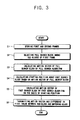
- Figures 3 is a flowchart of a motion estimation method according to the present invention;
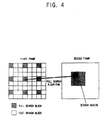
- Figures 4 illustrates the arrangement of sub-blocks forming a first frame and the search region of a second frame; and
- Figures 5 is a view illustrating a motion vector field of a full search block according to the full search algorithm, and an estimated motion vector field of a fast search block according to interpolation.
-
- Referring to Figures 2, a motion estimation apparatus comprises a
first memory 10, asecond memory 20, aprecision searching part 30, a rapid searchingpart 40 and acompression part 50. - The
first memory 10 stores the pixel values of a first frame to be compressed and thesecond memory 20 stores the pixel values of a second frame, offering a search region for the sub-blocks forming the first frame. The second frame precedes the current first frame. Therefore, aframe delay 60 precedes thesecond memory 20 to delay the second frame by one frame period. - The
precision searching part 30 applies a full search motion estimation method (hereinafter, referred to as the "full search algorithm") to a predetermined number of sample blocks (hereinafter, referred to as the "full search blocks") from among the sub-blocks forming the first frame to calculate a motion vectors therefor. Preferably, the full search blocks are spaced apart from each other and arranged at regular intervals. - The
precision searching part 30 comprises asampling part 31 and a full searchingpart 32. - The
sampling part 31 selectively samples a predetermined number of full search blocks from among the sub-blocks forming the first frame in thefirst memory 1. - The full searching
part 32 uses at least one portion of the second frame in thesecond memory 20 as the search region, calculates motion vectors by applying the full search algorithm to the full search blocks and outputs the calculated motion vectors to therapid searching part 40. - The
rapid searching part 40 applies a fast search motion estimation method (hereinafter, referred to as the "fast search algorithm") to the other sub-blocks (hereinafter, referred to as the "fast search blocks"), i.e. the blocks other than the full search blocks. - The "starting position" of a fast search block, to which the fast search algorithm is applied, is selected to be near to the block position indicated by the motion vector of the full search block adjacent to the corresponding fast search block.
- A matching block of the fast search block, adjacent to the full search block in which an optimum motion vector is calculated, is likely to be near to the block position indicated by the motion vector of the full search block. Hence, the optimum matching block is rapidly found when the fast search algorithm is applied to the full search block by employing a block position near to the motion vector of the adjacent full search block as the starting position.
- The starting position of the fast search algorithm can by set by applying the displacement between the fast search block and the adjacent full search block to the motion vector of the full search block.
- Alternatively, the motion vector of the adjacent fast search block can be estimated by interpolation on the basis of the motion vectors of the full search blocks, thereby setting the motion vector of the starting position. That is, a first motion vector of the fast search block, calculated by interpolation, is estimated on the basis of the matching block, so that the fast search algorithm can be applied by employing the estimated position as the starting position.
- For this, the
rapid searching part 40 comprises aninterpolation part 41 and a fast searchingpart 42. - The
interpolation part 41 applies the interpolation using the motion vector of the full search block, calculated by theprecision searching part 30, and estimates the first motion vector based on the matching block of the fast search block. Here, the interpolation may be classified as a nearest neighbour interpolation, a bilinear interpolation, a cubic convolution interpolation, a B-spline interpolation, etc. according to the number of motion vectors of the fast search block. - The fast searching
part 42 applies the fast search algorithm using the block position indicated by the first motion vector calculated by theinterpolation part 41 as the starting position, thereby calculating a second motion vector. - Alternatively, the "starting position" can be selected as one of the block positions which is located a predetermined distance from the block position indicated by the motion vector of the full search block. Here, the predetermined distance is set in proportion to the distance between the fast search block and the adjacent full search block.
- Referring to Figures 2, the
compression part 50 detects the difference in pixel values between the reference block and the matching block and transmits the motion vectors of all sub-blocks. - The operation of the motion estimation apparatus of Figures 2 will now be described with reference to Figures 3.
- First, when the second frame and the first frame are input in sequence, at operation S1, the
first memory 10 stores the first frame and thesecond memory 20 stores the second frame delayed for the processing time of the first frame. - At operation S2, the
sampling part 31 selects a predetermined number of full search blocks from among the plurality of sub-blocks, forming the first frame, and outputs the selected full search blocks to the full searchingpart 32. - At operation S3, the full searching
part 32 calculates the motion vectors, indicating the matching blocks of the full search blocks by applying the full search algorithm to the search region of the second frame from thesecond memory 20. - Referring to Figures 4, the full search blocks are selected by the
sampling part 31 so as to be arranged at regular intervals. When the number of full search blocks is increased, the number of sub-blocks having the optimum matching block is increased but the amount of processing is increased. Therefore, the number of blocks should be properly determined in consideration of the amount of operation. - The second frame comprises a search region having a predetermined size. The size of the search region can be expanded to include the entire second frame but is preferably limited to a suitable size in consideration of the amount of processing.
- At operation S4, the
interpolation part 41 estimates/calculates the first motion vector of the fast search block using an interpolation based on the motion vector of a full search block. - Referring to Figures 5, the full searching
part 32 calculates the motion vector fMV of each full search block. Furthermore, theinterpolation part 41 estimates the motion vector iMV of the fast search block by employing an interpolation based on the motion vector fMV of the full search block. - At operation S5, the
fast search part 42 applies the fast search algorithm to each fast search block by employing the block position indicated by the estimated motion vector of the fast search block as the starting position. Thus, the motion vector of each sub-block of the first frame is completely calculated and is output to thecompression part 50. - At operation S6, the
compression part 50 detects the difference in the pixel values between the sub-block and the matching block and then outputs it together with the motion vector, thereby completing compression. - Thus, in the foregoing embodiment, the matching blocks are more precisely searched as compared with that of when one fast search algorithm is conventionally used. Therefore, even though the amount of operation can be increased by a little, the amount of operation is sharply decreased as compared with that of when one full search algorithm is conventionally used.
- As described above, according to an embodiment of the present invention, the estimation of the matching block is sharply improved in precision with respect to the amount of operation.
Claims (24)
- A video compression method comprising determining motion vectors for blocks in a first frame relative to a second frame, characterised by said motion vectors being determined using a full search algorithm to find a best match block in the second frame for each block in a first subset of the blocks of the first frame and using a fast search algorithm to find matching blocks for each block of a second subset of the blocks of the first frame, the intersection of the first and second subsets being an empty set and the start positions for the fast search algorithm being determined by interpolating between matching blocks that were located using the full search algorithm.
- A method according to claim 1, wherein the blocks in the first subset are separated from each other by blocks not in the first subset.
- A method according to claim 1 or 2, wherein the second subset is the difference of the set of all blocks in the first frame from the first subset.
- A method according to claim 1, 2 or 3, wherein said interpolating between matching blocks is performed by interpolating between corresponding motion vectors.
- A video compression apparatus comprising memory means (10, 20) for storing first and second frames and processing means (40) configured for determining motion vectors for blocks in a first frame, stored in the memory means (10, 20), relative to a second frame, stored in the memory means (10, 20), characterised in that the processing means (40) is configured to determine said motion vectors using a full search algorithm to find a best match block in the second frame for each block in a first subset of the blocks of the first frame and using a fast search algorithm to find matching blocks for each block of a second subset of the blocks of the first frame, starting at positions determined by interpolating between matching blocks that were located using the full search algorithm, wherein the intersection of the first and second subsets being an empty set.
- An apparatus according to claim 5, wherein the blocks in the first subset are separated from each other by blocks not in the first subset.
- An apparatus according to claim 5 or 6, wherein the second subset is the difference of the set of all blocks in the first frame from the first subset.
- An apparatus according to claim 5, 6 or 7, wherein processing means is configured to perform said interpolating between matching blocks by interpolating between corresponding motion vectors.
- A signal representing computer control codes for controlling a computer to perform a method according to any one of claims 1 to 4.
- A data carrier carrying a record of a signal according to claim 9.
- A method of estimating motion of a plurality of sub-blocks forming a frame, the method comprising:selecting a predetermined number of the plurality of sub-blocks as a full search blocks, and selecting other sub-blocks of the plurality of sub-blocks, excluding the sub-blocks of the full search blocks as fast search blocks;calculating a motion vector of a full search block by performing full search motion estimation algorithm;calculating a first motion vector of a fast search block by interpolation based on the calculated motion vector of the full search block; andcalculating a second motion vector of the fast search block by performing a fast search motion estimation algorithm, using a block position indicated by the first motion vector as a starting position.
- The method according to claim 11, wherein the full search blocks are selected to be non-adjacent to each other.
- A method of estimating motion of a plurality of sub-blocks forming a frame, the method comprising:applying a full search motion estimation algorithm to a predetermined number of sample blocks selected among the plurality of sub-blocks, and calculating a motion vector of each sample block; andapplying a fast search motion estimation algorithm to other sub-blocks of the plurality of sub-blocks excluding the sample blocks, and calculating a motion vector of each other sub-block on the basis of a starting position being located at a predetermined distance from a block position indicated by the motion vector of an adjacent sample block.
- The method according to claim 13, wherein the predetermined distance is in proportion to a distance between the sub-block to which the fast search motion estimation algorithm is applied and the adjacent sample block.
- The method according to claim 13, wherein the starting position includes the block position indicated by the motion vector of the other sub-block, calculated by interpolation based on the motion vector of the sample block.
- The method according to claim 13, wherein the sample blocks are selected to be apart from each other by a predetermined distance.
- A method of estimating motion of a plurality of sub-blocks forming a frame, the method comprising:applying a full search motion estimation algorithm to a predetermined number of sample blocks selected among the plurality of sub-blocks, and calculating a motion vector of each sample block;calculating a first motion vector of each of the other sub-blocks of the plurality of sub-blocks excluding the sample blocks by interpolation based on the motion vectors of the sample blocks; andapplying a fast search motion estimation algorithm to the other sub-blocks excluding the sample blocks, and calculating a second motion vector of each of the other sub-blocks excluding the sample blocks on the basis of a block position indicated by the first motion vector.
- An apparatus comprising:a first memory which stores a first frame and a second memory which stores a second frame;a sampling part which selects a predetermined number of sub-blocks of the first frame as sample blocks;a full searching part which calculates a motion vector of each sample block selected by the sampling part by applying a full search motion estimation algorithm to the sample blocks, regarding the second frame as a search region;an interpolation part which calculates a first motion vector of each of the other sub-blocks of the plurality of sub-blocks excluding the sample blocks by interpolation based on the motion vector of the sample blocks; anda fast searching part which calculates a second motion vector of each of the other sub-blocks excluding the sample blocks by applying a fast search motion estimation algorithm to each of the sub-blocks excluding the sample blocks on the basis of a block position in the second frame indicated by the first motion vector.
- An apparatus comprising:a first memory which stores a first frame and a second memory which stores a second frame;a precision searching part which applies a full search motion estimation algorithm to a predetermined number of sample blocks of sub-blocks of the first frame by regarding the second frame as a search region, and calculates a motion vector of each of the sample blocks; anda rapid searching part which applies a fast search motion estimation algorithm to each of the other sub-blocks of the plurality of sub-blocks excluding the sample blocks on the basis of a starting position located a predetermined distance from a block position indicated by the motion vector of an adjacent sample block, and calculating a motion vector of each of the other sub-blocks excluding the sample blocks.
- The apparatus according to claim 19, wherein the starting position is selected on the basis of displacement between the sub-block to which the fast search motion estimation algorithm is applied and the adjacent sample block.
- The apparatus according to claim 19, wherein the rapid searching part comprises an interpolation part to calculate an estimation motion vector of each of the other sub-blocks excluding the sample blocks by interpolation based on the motion vector of the sample blocks, and to use a block position indicated by the estimation motion vector as a starting position.
- The apparatus according to claim 19, wherein the sample blocks are selected to be a predetermined distance apart from each other.
- The apparatus according to claim 18, further comprising a frame delayer which delays the first frame to be stored as the second frame in the second memory.
- The apparatus according to claim 19 further comprising a frame delayer which delays the first frame to be stored as the second frame in the second memory.
Applications Claiming Priority (2)
| Application Number | Priority Date | Filing Date | Title |
|---|---|---|---|
| KR2004044342 | 2004-06-16 | ||
| KR1020040044342A KR20050119285A (en) | 2004-06-16 | 2004-06-16 | Apparatus and method for hybrid block-based motion estimation |
Publications (1)
| Publication Number | Publication Date |
|---|---|
| EP1608179A1 true EP1608179A1 (en) | 2005-12-21 |
Family
ID=34940149
Family Applications (1)
| Application Number | Title | Priority Date | Filing Date |
|---|---|---|---|
| EP05105130A Withdrawn EP1608179A1 (en) | 2004-06-16 | 2005-06-10 | Motion vector determination using plural algorithms |
Country Status (4)
| Country | Link |
|---|---|
| US (1) | US20050281335A1 (en) |
| EP (1) | EP1608179A1 (en) |
| KR (1) | KR20050119285A (en) |
| CN (1) | CN1713731A (en) |
Cited By (2)
| Publication number | Priority date | Publication date | Assignee | Title |
|---|---|---|---|---|
| GB2483294A (en) * | 2010-09-03 | 2012-03-07 | Canon Kk | Motion estimation of video data coded according to a scalable coding structure |
| GB2497812A (en) * | 2011-12-22 | 2013-06-26 | Canon Kk | Motion estimation with motion vector predictor list |
Families Citing this family (9)
| Publication number | Priority date | Publication date | Assignee | Title |
|---|---|---|---|---|
| US9743078B2 (en) | 2004-07-30 | 2017-08-22 | Euclid Discoveries, Llc | Standards-compliant model-based video encoding and decoding |
| KR100644629B1 (en) * | 2004-09-18 | 2006-11-10 | 삼성전자주식회사 | Hybrid Block Matching-based Motion Estimation Method and Applied Frame Rate Conversion Apparatus |
| KR101337206B1 (en) * | 2007-10-12 | 2013-12-06 | 삼성전자주식회사 | System and method for mostion estimation of image using block sampling |
| JP2011259040A (en) * | 2010-06-04 | 2011-12-22 | Sony Corp | Image processing system and method |
| US9621917B2 (en) * | 2014-03-10 | 2017-04-11 | Euclid Discoveries, Llc | Continuous block tracking for temporal prediction in video encoding |
| US10091507B2 (en) | 2014-03-10 | 2018-10-02 | Euclid Discoveries, Llc | Perceptual optimization for model-based video encoding |
| US10097851B2 (en) | 2014-03-10 | 2018-10-09 | Euclid Discoveries, Llc | Perceptual optimization for model-based video encoding |
| CN105225247B (en) * | 2014-06-19 | 2019-06-21 | 深圳力维智联技术有限公司 | Motion information method for catching and its device, encoder |
| US10284875B2 (en) * | 2016-08-08 | 2019-05-07 | Qualcomm Incorporated | Systems and methods for determining feature point motion |
Citations (2)
| Publication number | Priority date | Publication date | Assignee | Title |
|---|---|---|---|---|
| US5210605A (en) * | 1991-06-11 | 1993-05-11 | Trustees Of Princeton University | Method and apparatus for determining motion vectors for image sequences |
| US5398068A (en) * | 1993-09-02 | 1995-03-14 | Trustees Of Princeton University | Method and apparatus for determining motion vectors for image sequences |
Family Cites Families (7)
| Publication number | Priority date | Publication date | Assignee | Title |
|---|---|---|---|---|
| KR0126871B1 (en) * | 1994-07-30 | 1997-12-29 | 심상철 | HIGH SPEED BMA FOR Bi-DIRECTIONAL MOVING VECTOR ESTIMATION |
| JPH10336668A (en) * | 1997-06-02 | 1998-12-18 | Sharp Corp | Motion vector detection device |
| JP3813320B2 (en) * | 1997-08-27 | 2006-08-23 | 株式会社東芝 | Motion vector detection method and apparatus |
| WO2001081115A1 (en) * | 2000-04-20 | 2001-11-01 | Lord Corporation | Automatic calibration method for a suspended seat system |
| US6842483B1 (en) * | 2000-09-11 | 2005-01-11 | The Hong Kong University Of Science And Technology | Device, method and digital video encoder for block-matching motion estimation |
| US20030161400A1 (en) * | 2002-02-27 | 2003-08-28 | Dinerstein Jonathan J. | Method and system for improved diamond motion search |
| EP1376471A1 (en) * | 2002-06-19 | 2004-01-02 | STMicroelectronics S.r.l. | Motion estimation for stabilization of an image sequence |
-
2004
- 2004-06-16 KR KR1020040044342A patent/KR20050119285A/en not_active Withdrawn
-
2005
- 2005-06-10 EP EP05105130A patent/EP1608179A1/en not_active Withdrawn
- 2005-06-16 CN CNA2005100779806A patent/CN1713731A/en active Pending
- 2005-06-16 US US11/153,347 patent/US20050281335A1/en not_active Abandoned
Patent Citations (2)
| Publication number | Priority date | Publication date | Assignee | Title |
|---|---|---|---|---|
| US5210605A (en) * | 1991-06-11 | 1993-05-11 | Trustees Of Princeton University | Method and apparatus for determining motion vectors for image sequences |
| US5398068A (en) * | 1993-09-02 | 1995-03-14 | Trustees Of Princeton University | Method and apparatus for determining motion vectors for image sequences |
Non-Patent Citations (2)
| Title |
|---|
| FULVIO MOSCHETTI: "A Statistical Aprroach to Motion Estimation", 31 January 2001 (2001-01-31), Lausanne, EPFL, XP002346537, Retrieved from the Internet <URL:http://lts1pc19.epfl.ch/repository/Moschetti2001_648.pdf> [retrieved on 20050926] * |
| LIU B., ZACCARIN A.: "New fast algorithms for the estimation of block motion vectors", IEEE TRANSACTIONS ON CIRCUITS AND SYSTEMS FOR VIDEO TECHNOLOGY, vol. 3, no. 2, 1 April 1997 (1997-04-01), pages 148 - 157, XP002346536, Retrieved from the Internet <URL:http://ieeexplore.ieee.org/iel4/76/5557/00212720.pdf?tp=&arnumber=212720&isnumber=5557> [retrieved on 20050926] * |
Cited By (5)
| Publication number | Priority date | Publication date | Assignee | Title |
|---|---|---|---|---|
| GB2483294A (en) * | 2010-09-03 | 2012-03-07 | Canon Kk | Motion estimation of video data coded according to a scalable coding structure |
| US20120057631A1 (en) * | 2010-09-03 | 2012-03-08 | Canon Kabushiki Kaisha | Method and device for motion estimation of video data coded according to a scalable coding structure |
| GB2483294B (en) * | 2010-09-03 | 2013-01-02 | Canon Kk | Method and device for motion estimation of video data coded according to a scalable coding structure |
| GB2497812A (en) * | 2011-12-22 | 2013-06-26 | Canon Kk | Motion estimation with motion vector predictor list |
| GB2497812B (en) * | 2011-12-22 | 2015-03-04 | Canon Kk | Motion estimation with motion vector predictor list |
Also Published As
| Publication number | Publication date |
|---|---|
| KR20050119285A (en) | 2005-12-21 |
| CN1713731A (en) | 2005-12-28 |
| US20050281335A1 (en) | 2005-12-22 |
Similar Documents
| Publication | Publication Date | Title |
|---|---|---|
| US8625916B2 (en) | Method and apparatus for image encoding and image decoding | |
| US9674548B2 (en) | Device and method for fast block-matching motion estimation in video encoders | |
| EP1960967B1 (en) | Motion estimation using prediction guided decimated search | |
| US8451898B2 (en) | Motion vector estimation apparatus | |
| EP0658057A2 (en) | Moving image coder | |
| US20030161403A1 (en) | Apparatus for and method of transforming scanning format | |
| US20040252895A1 (en) | Pixel-data selection device to provide motion compensation, and a method thereof | |
| KR20020001331A (en) | Apparatus for stabilizing digital video | |
| US6867714B2 (en) | Method and apparatus for estimating a motion using a hierarchical search and an image encoding system adopting the method and apparatus | |
| WO2000070879A1 (en) | Adaptive motion estimator | |
| US8041134B2 (en) | Apparatus to provide block-based motion compensation and method thereof | |
| EP1608179A1 (en) | Motion vector determination using plural algorithms | |
| US6556718B1 (en) | Video pictures compression and coding with decision step for field/frame and motion vectors DCT | |
| US20040264572A1 (en) | Motion prediction compensating device and its method | |
| US20050123039A1 (en) | Motion estimation method for motion picture encoding and recording medium having program recorded thereon to implement the motion estimation method | |
| EP0661887B1 (en) | Moving image coder | |
| US20070133683A1 (en) | Motion vector estimation device and motion vector estimation method | |
| US20070098075A1 (en) | Motion vector estimating device and motion vector estimating method | |
| US20070092007A1 (en) | Methods and systems for video data processing employing frame/field region predictions in motion estimation | |
| EP2237560A1 (en) | Halo reducing motion-compensated interpolation | |
| US8184706B2 (en) | Moving picture coding apparatus and method with decimation of pictures | |
| US20070104274A1 (en) | Fast mode-searching apparatus and method for fast motion-prediction | |
| EP1420595B1 (en) | Motion vector selection in a video motion estimator based on a preferred reference point | |
| US8340350B2 (en) | Information processing device and method, and program | |
| US6671420B1 (en) | Method for processing saturated intervals in video sequences |
Legal Events
| Date | Code | Title | Description |
|---|---|---|---|
| PUAI | Public reference made under article 153(3) epc to a published international application that has entered the european phase |
Free format text: ORIGINAL CODE: 0009012 |
|
| AK | Designated contracting states |
Kind code of ref document: A1 Designated state(s): AT BE BG CH CY CZ DE DK EE ES FI FR GB GR HU IE IS IT LI LT LU MC NL PL PT RO SE SI SK TR |
|
| AX | Request for extension of the european patent |
Extension state: AL BA HR LV MK YU |
|
| AKX | Designation fees paid | ||
| 17P | Request for examination filed |
Effective date: 20060621 |
|
| RBV | Designated contracting states (corrected) |
Designated state(s): GB NL |
|
| REG | Reference to a national code |
Ref country code: DE Ref legal event code: 8566 |
|
| 17Q | First examination report despatched |
Effective date: 20090930 |
|
| STAA | Information on the status of an ep patent application or granted ep patent |
Free format text: STATUS: THE APPLICATION IS DEEMED TO BE WITHDRAWN |
|
| 18D | Application deemed to be withdrawn |
Effective date: 20100105 |