EP1607938B1 - Gain-constrained noise suppression - Google Patents
Gain-constrained noise suppression Download PDFInfo
- Publication number
- EP1607938B1 EP1607938B1 EP05105055A EP05105055A EP1607938B1 EP 1607938 B1 EP1607938 B1 EP 1607938B1 EP 05105055 A EP05105055 A EP 05105055A EP 05105055 A EP05105055 A EP 05105055A EP 1607938 B1 EP1607938 B1 EP 1607938B1
- Authority
- EP
- European Patent Office
- Prior art keywords
- noise
- gain factors
- noisy
- speech
- smoothing
- Prior art date
- Legal status (The legal status is an assumption and is not a legal conclusion. Google has not performed a legal analysis and makes no representation as to the accuracy of the status listed.)
- Expired - Lifetime
Links
Images




Classifications
-
- G—PHYSICS
- G11—INFORMATION STORAGE
- G11B—INFORMATION STORAGE BASED ON RELATIVE MOVEMENT BETWEEN RECORD CARRIER AND TRANSDUCER
- G11B20/00—Signal processing not specific to the method of recording or reproducing; Circuits therefor
- G11B20/10—Digital recording or reproducing
-
- G—PHYSICS
- G10—MUSICAL INSTRUMENTS; ACOUSTICS
- G10L—SPEECH ANALYSIS TECHNIQUES OR SPEECH SYNTHESIS; SPEECH RECOGNITION; SPEECH OR VOICE PROCESSING TECHNIQUES; SPEECH OR AUDIO CODING OR DECODING
- G10L21/00—Speech or voice signal processing techniques to produce another audible or non-audible signal, e.g. visual or tactile, in order to modify its quality or its intelligibility
- G10L21/02—Speech enhancement, e.g. noise reduction or echo cancellation
- G10L21/0208—Noise filtering
-
- G—PHYSICS
- G11—INFORMATION STORAGE
- G11B—INFORMATION STORAGE BASED ON RELATIVE MOVEMENT BETWEEN RECORD CARRIER AND TRANSDUCER
- G11B20/00—Signal processing not specific to the method of recording or reproducing; Circuits therefor
- G11B20/24—Signal processing not specific to the method of recording or reproducing; Circuits therefor for reducing noise
-
- G—PHYSICS
- G10—MUSICAL INSTRUMENTS; ACOUSTICS
- G10L—SPEECH ANALYSIS TECHNIQUES OR SPEECH SYNTHESIS; SPEECH RECOGNITION; SPEECH OR VOICE PROCESSING TECHNIQUES; SPEECH OR AUDIO CODING OR DECODING
- G10L21/00—Speech or voice signal processing techniques to produce another audible or non-audible signal, e.g. visual or tactile, in order to modify its quality or its intelligibility
- G10L21/02—Speech enhancement, e.g. noise reduction or echo cancellation
- G10L21/0208—Noise filtering
- G10L21/0216—Noise filtering characterised by the method used for estimating noise
- G10L21/0232—Processing in the frequency domain
Definitions
- the invention relates generally to digital audio signal processing, and more particularly relates to noise suppression in voice or speech signals.
- Noise suppression (NS) of speech signals can be useful to many applications.
- noise suppression can be used to remove background noise to provide more readily intelligible speech from calls made in noisy environments.
- noise suppression can improve perceptual quality and speech intelligibility in teleconferencing, voice chat in on-line games, Internet-based voice messaging and voice chat, and other like communications applications.
- the input audio signal is typically noisy for these applications since the recording environment is less than ideal.
- noise suppression can improve compression performance when used prior to coding or compression of voice signals (e.g., via the Windows Media Voice codec, and other like codecs). Noise suppression also can be applied prior to speech recognition to improve recognition accuracy.
- MMSE Minimum Mean Square Error
- US-A-6507623 discloses smoothing of the gain on a channel-by-channel basis, wherein the smoothing is stronger if the gain is more important.
- noise suppression may introduce artificial distortions (audible "artifacts") into the speech signal, such as because the spectral gain applied by the noise suppression is either too great (removing more than noise) or too little (failing to remove the noise completely).
- One artifact that many NS techniques suffer from is called musical noise, where the NS technique introduces an artifact perceived as a melodic audio signal pattern that was not present in the input. In some cases, this musical noise can become noticeable and distracting, in addition to being an inaccurate representation of the speech present in the input signal.
- a novel gain-constrained technique is introduced to improve noise suppression precision and thereby reduce occurrence of musical noise artifacts.
- the technique estimates the noise spectrum during speech, and not just during pauses in speech, so that the noise estimation can be kept more accurate during long speech periods.
- a noise estimation smoothing is used to achieve better noise estimation. The listening test shows this gain-constrained noise suppression and noise estimation smoothing techniques improve the voice quality of speech signals significantly.
- the gain-constrained noise suppression and smoothed noise estimation techniques can be used in noise suppressor implementations that operate by applying a spectral gain G(m, k) to each short-time spectrum value S(m, k).
- G(m, k) the spectral gain
- S(m, k) the short-time spectrum value
- m the frame number
- k the spectrum index
- the input voice signal is divided into frames.
- An analysis window is applied to each frame and then the signal is converted into a frequency domain signal S(m, k) using the Fast Fourier Transform (FFT).
- FFT Fast Fourier Transform
- the spectrum values are grouped into N bins for further processing.
- a noise characteristic is estimated for each bin when it is classified as being a noise bin.
- An energy parameter is smoothed in both the time domain and the frequency domain to get better noise estimation per bin.
- the gain factors G(m, k) are calculated based on the current signal spectrum and the noise estimation.
- a gain smoothing filter is applied to smooth the gain factors before they are applied on the signal spectral values S(m, k). This modified signal spectrum is converted into time domain for output.
- the gain smoothing filter performs two steps to smooth the gain factors before they are applied to the spectrum values.
- a noisy factor ⁇ ( m ) ⁇ [0,1] is computed for the current frame. It is determined based on a ratio of the number of noise bins to the total number of bins.
- this noisy factor is used to alter the gain factors G(m, k) to produce smoothed gain factors G s (m, k). In the example noise suppressor implementation, this is done by applying the FFT on G(m, k), then cutting off the high frequency components.
- this gain-constrained noise suppression technique can be applied to a speech signal 115 as a pre-process (by the noise suppressor 120) in a gain-constrained noise suppression system 100 prior to processing the resulting noise-suppressed speech signal 125 by various kinds of audio signal processors 130 (such as coding or compression, voice chat or teleconferencing, speech recognition, and etc.).
- the audio signal processor produces processed signal output 135 (such as a speech or audio signal, speech recognition or other analysis parameters, and etc.), which may be improved (e.g., in perceptual quality, recognition or analysis precision, etc.) by the gain-constrained noise suppression.
- FIG 2 illustrates a gain-constrained noise suppression processing 200 that is performed in the noise suppressor 120 ( Figure 1).
- the gain-constrained noise suppression processing 200 begins with input 210 of a speech signal, such as from a microphone or speech signal recording.
- the speech signal is digitized or time-sampled at a sampling rate, F s , which can typically be 8000, 11025, 16000, 22050 Hz or other rate suitable to the application.
- F s sampling rate
- the input speech signal then has the form of a sequence or stream of speech signal samples, denoted as x(i).
- this input speech signal ( x(i) ) is processed to emphasize speech, e.g., via a high-pass filtering (although other forms of emphasis can alternatively be used).
- framing is performed to group the speech signal samples into frames of a preset length, N , which may be 160 samples.
- the framed speech signal is denoted as x(m,n) , where m is the frame number, and n is the number of the sample within the frame.
- a windowing function 300 (shown in Figure 3) is then applied on an overlap frame function of the speech-emphasized signal at overlap stage 230 and window stage 231.
- the speech signal is transformed via a frequency analysis (e.g., using the Fast Fourier Transform (FFT) 240 or other like transform) to the frequency domain.
- FFT Fast Fourier Transform
- This yields a set of spectral coefficients or frequency spectrum for each frame of the signal, as shown in the following equation: S m ⁇ k FFT L s w m ⁇ n
- the spectral coefficients are complex values, and thus represent both the spectral amplitude ( S A ) and phase ( S P ) of the speech signal according to the following relationships:
- S A m ⁇ k S m ⁇ k
- S P m ⁇ k tan -1 S ( m , k )
- the spectral amplitude is analyzed in the following process to provide a more accurate estimate of the gain to be used in noise suppression, whereas the phase is preserved for use in the inverse FFT .
- frequency and time domain smoothing is performed on the energy bands of the spectrum for each frame.
- ⁇ ⁇ F s N / - 1 ⁇ F s N / + 1
- the value of ⁇ is a parameter that can be variably chosen to control the amount of smoothing.
- Stages 260 and 261 calculate the frame energy and historical lowest energy, respectively.
- the noise suppressor 120 judges whether to update noise statistics of the speech signal that are tracked on a frequency bin basis.
- the noise suppressor 120 groups the spectrum values of the speech signal frames into a number of frequency bins.
- the spectrum values (k) are grouped one spectrum value per frequency bin.
- various other groupings of the frames' spectrum values into frequency bins can be made, such as more than one spectrum value per frequency bin, or non-uniform groupings of spectrum values into frequency bins.
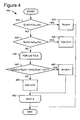
- Figure 4 illustrates a procedure 400 used at the update checking stage 262 ( Figure 2) by the noise suppressor 120 ( Figure 1) to determine whether and how noise statistics for the speech signal are updated.
- the noise suppressor determines whether to reset the noise statistics in the current speech signal frame, and also determines whether to update the noise statistics of individual frequency bins. The noise suppressor executes this procedure on each frame of the speech signal.
- the noise suppressor at block 263 updates the noise spectrum statistics per frequency bin according to the update determinations made at block 262.
- the noise statistics tracked per frequency bin include the noise mean and noise variance.
- Figure 5 illustrates a procedure 500 for updating the noise mean for a speech signal frame.
- the noise suppressor updates the noise mean for the frequency bins according to their update flags. In "for" loop 520, 550, the noise suppressor checks the update flag of each frequency bin (decision 530).
- Figure 6 illustrates a procedure 600 for updating the noise variance for a speech signal frame.
- the noise suppressor updates the noise variance for the frequency bins according to their update flags. In "for" loop 620, 650, the noise suppressor checks the update flag of each frequency bin (decision 630).
- the noise suppressor in the next stages 270-271 of the gain constrained noise suppression processing 200 calculates and smoothes gain factors ( G(m,k) ) based on the current signal spectrum and noise estimation from stage 263 to be applied as a gain filter to modify the speech signal spectrum at stage 272.
- the noise suppressor then smoothes the gain factors according to a calculation of the "noisy"-ness (herein termed a "noisy factor”) of the frame, where a stronger smoothing is applied to more noisy frames than is applied to speech frames.
- the noise suppressor applies smoothing in the frequency domain, using the FFT to transform the gain filter to the frequency domain.
- the expanded gain factors thus effectively copy the gain factors from 0 to K-1 , and copy a mirror image of the gain factors from K to L-1 .
- the noise suppressor then smoothes the gain filter by zeroing high frequency components of the gain spectrum.
- This FFT based smoothing effectively produces little or no smoothing for a smoothing factor near zero (e.g., with no or few "noisy" frequency bins marked by the update flag in the frame), and
- the gain factors applied to noisy bins should be much lower relative to non-noise frequency bins, such that noise in the speech signal is suppressed.
- the above described noise suppression system 100 ( Figure 1) and gain-constrained noise suppression processing 200 can be implemented on any of a variety of devices in which audio signal processing is performed, including among other examples, computers; audio playing, transmission and receiving equipment; portable audio players; audio conferencing; Web audio streaming applications; and etc.
- the gain-constrained noise suppression can be implemented in hardware circuitry (e.g., in circuitry of an ASIC, FPGA, etc.), as well as in audio processing software executing within a computer or other computing environment (whether executed on the central processing unit (CPU), or digital signal processor, audio card or like), such as shown in Figure 7.
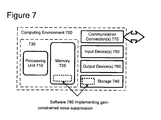
- FIG. 7 illustrates a generalized example of a suitable computing environment (700) in which the described gain-constrained noise suppression may be implemented.
- the computing environment (700) is not intended to suggest any limitation as to scope of use or functionality of the invention, as the present invention may be implemented in diverse general-purpose or special-purpose computing environments.
- the computing environment (700) includes at least one processing unit (710) and memory (720).
- the processing unit (710) executes computer-executable instructions and may be a real or a virtual processor. In a multi-processing system, multiple processing units execute computer-executable instructions to increase processing power.
- the memory (720) may be volatile memory (e.g., registers, cache, RAM), non-volatile memory (e.g., ROM, EEPROM, flash memory, etc.), or some combination of the two.
- the memory (720) stores software (780) implementing the described gain-constrained noise suppression techniques.
- a computing environment may have additional features.
- the computing environment (700) includes storage (740), one or more input devices (750), one or more output devices (760), and one or more communication connections (770).
- An interconnection mechanism such as a bus, controller, or network interconnects the components of the computing environment (700).
- operating system software provides an operating environment for other software executing in the computing environment (700), and coordinates activities of the components of the computing environment (700).
- the storage (740) may be removable or non-removable, and includes magnetic disks, magnetic tapes or cassettes, CD-ROMs, CD-RWs, DVDs, or any other medium which can be used to store information and which can be accessed within the computing environment (700).
- the storage (740) stores instructions for the software (780) implementing the gain-constrained noise suppression processing 200 ( Figure 2).
- the input device(s) (750) may be a touch input device such as a keyboard, mouse, pen, or trackball, a voice input device, a scanning device, or another device that provides input to the computing environment (700).
- the input device(s) (750) may be a sound card or similar device that accepts audio input in analog or digital form, or a CD-ROM reader that provides audio samples to the computing environment.
- the output device(s) (760) may be a display, printer, speaker, CD-writer, or another device that provides output from the computing environment (700).
- the communication connection(s) (770) enable communication over a communication medium to another computing entity.
- the communication medium conveys information such as computer-executable instructions, compressed audio or video information, or other data in a modulated data signal.
- a modulated data signal is a signal that has one or more of its characteristics set or changed in such a manner as to encode information in the signal.
- communication media include wired or wireless techniques implemented with an electrical, optical, RF, infrared, acoustic, or other carrier.
- Computer-readable media are any available media that can be accessed within a computing environment.
- Computer-readable media include memory (720), storage (740), communication media, and combinations of any of the above.
- the fast headphone virtualization techniques herein can be described in the general context of computer-executable instructions, such as those included in program modules, being executed in a computing environment on a target real or virtual processor.
- program modules include routines, programs, libraries, objects, classes, components, data structures, etc. that perform particular tasks or implement particular abstract data types.
- the functionality of the program modules may be combined or split between program modules as desired in various embodiments.
- Computer-executable instructions for program modules may be executed within a local or distributed computing environment.
Landscapes
- Engineering & Computer Science (AREA)
- Signal Processing (AREA)
- Human Computer Interaction (AREA)
- Quality & Reliability (AREA)
- Health & Medical Sciences (AREA)
- Audiology, Speech & Language Pathology (AREA)
- Computational Linguistics (AREA)
- Physics & Mathematics (AREA)
- Acoustics & Sound (AREA)
- Multimedia (AREA)
- Compression, Expansion, Code Conversion, And Decoders (AREA)
- Noise Elimination (AREA)
- Control Of Amplification And Gain Control (AREA)
Abstract
Description
- The invention relates generally to digital audio signal processing, and more particularly relates to noise suppression in voice or speech signals.
- Noise suppression (NS) of speech signals can be useful to many applications. In cellular telephony, for example, noise suppression can be used to remove background noise to provide more readily intelligible speech from calls made in noisy environments. Likewise, noise suppression can improve perceptual quality and speech intelligibility in teleconferencing, voice chat in on-line games, Internet-based voice messaging and voice chat, and other like communications applications. The input audio signal is typically noisy for these applications since the recording environment is less than ideal. Further, noise suppression can improve compression performance when used prior to coding or compression of voice signals (e.g., via the Windows Media Voice codec, and other like codecs). Noise suppression also can be applied prior to speech recognition to improve recognition accuracy.
- There are some well-known techniques for noise suppression in speech signals, such as spectral subtraction and Minimum Mean Square Error (MMSE). Almost all of these known techniques suppress the noise by applying a spectral gain G(m, k) based on an estimate of noise in the speech signal to each short-time spectrum value S(m, k) of the speech signal, where m is the frame number and k is the spectrum index. (See, e.g., S.F. Boll, A. V. Oppenheim, "Suppression of acoustic noise in speech using spectral subtraction," IEEE Trans. Acoustics, Speech and Signal Processing, ASSP-27(2), April 1979; and Rainer Martin, "Noise Power Spectral Density Estimation Based on Optimal Smoothing and Minimum Statistics," IEEE Transactions on Speech and Audio Processing, Vol. 9, No. pp. 504-512, July 2001.) A very low spectral gain is applied to spectrum values estimated to contain noise, so as to suppress the noise in the signal.
- US-A-6507623 discloses smoothing of the gain on a channel-by-channel basis, wherein the smoothing is stronger if the gain is more important.
- Unfortunately, the use of noise suppression may introduce artificial distortions (audible "artifacts") into the speech signal, such as because the spectral gain applied by the noise suppression is either too great (removing more than noise) or too little (failing to remove the noise completely). One artifact that many NS techniques suffer from is called musical noise, where the NS technique introduces an artifact perceived as a melodic audio signal pattern that was not present in the input. In some cases, this musical noise can become noticeable and distracting, in addition to being an inaccurate representation of the speech present in the input signal.
- The invention is as set out in
independent claims 1 and 8. - In a speech noise suppressor implementation described herein, a novel gain-constrained technique is introduced to improve noise suppression precision and thereby reduce occurrence of musical noise artifacts. The technique estimates the noise spectrum during speech, and not just during pauses in speech, so that the noise estimation can be kept more accurate during long speech periods. Further, a noise estimation smoothing is used to achieve better noise estimation. The listening test shows this gain-constrained noise suppression and noise estimation smoothing techniques improve the voice quality of speech signals significantly.
- The gain-constrained noise suppression and smoothed noise estimation techniques can be used in noise suppressor implementations that operate by applying a spectral gain G(m, k) to each short-time spectrum value S(m, k). Here m is the frame number and k is the spectrum index.
- More particularly in one example noise suppressor implementation, the input voice signal is divided into frames. An analysis window is applied to each frame and then the signal is converted into a frequency domain signal S(m, k) using the Fast Fourier Transform (FFT). The spectrum values are grouped into N bins for further processing. A noise characteristic is estimated for each bin when it is classified as being a noise bin. An energy parameter is smoothed in both the time domain and the frequency domain to get better noise estimation per bin. The gain factors G(m, k) are calculated based on the current signal spectrum and the noise estimation. A gain smoothing filter is applied to smooth the gain factors before they are applied on the signal spectral values S(m, k). This modified signal spectrum is converted into time domain for output.
- The gain smoothing filter performs two steps to smooth the gain factors before they are applied to the spectrum values. First, a noisy factor ξ(m) ∈ [0,1] is computed for the current frame. It is determined based on a ratio of the number of noise bins to the total number of bins. A zero-valued noisy factor ξ(m) = 0 means only using constant gain for all the spectrum values, whereas a noisy factor ξ(m) = 1 means no smoothing at all. Then, this noisy factor is used to alter the gain factors G(m, k) to produce smoothed gain factors Gs(m, k). In the example noise suppressor implementation, this is done by applying the FFT on G(m, k), then cutting off the high frequency components.
- Additional features and advantages of the invention will be made apparent from the following detailed description of embodiments that proceeds with reference to the accompanying drawings.
-
- Figure 1 is a block diagram of a speech noise suppressor that implements the gain-constrained noise suppression technique described herein.
- Figure 2 is a flow diagram illustrating a gain-constrained noise suppression process performed in the speech noise suppressor of Figure 1.
- Figure 3 is a graph illustrating an overlapped windowing function applied to the input speech signal in the gain-constrained noise suppression process of Figure 2.
- Figure 4 is a flow chart showing an update determination check performed in the gain-constrained noise suppression process of Figure 2.
- Figures 5 and 6 are flow charts showing updating of noise statistics (mean and variance, respectively) based on the update determination check performed in the gain-constrained noise suppression process of Figure 2.
- Figure 7 is a block diagram of a suitable computing environment for implementing the speech noise suppressor of Figure 1.
- The following description is directed to gain-constrained noise suppression techniques for use in audio or speech processing systems. As illustrated in Figure 1, this gain-constrained noise suppression technique can be applied to a
speech signal 115 as a pre-process (by the noise suppressor 120) in a gain-constrained noise suppression system 100 prior to processing the resulting noise-suppressedspeech signal 125 by various kinds of audio signal processors 130 (such as coding or compression, voice chat or teleconferencing, speech recognition, and etc.). The audio signal processor produces processed signal output 135 (such as a speech or audio signal, speech recognition or other analysis parameters, and etc.), which may be improved (e.g., in perceptual quality, recognition or analysis precision, etc.) by the gain-constrained noise suppression. - Figure 2 illustrates a gain-constrained
noise suppression processing 200 that is performed in the noise suppressor 120 (Figure 1). The gain-constrainednoise suppression processing 200 begins withinput 210 of a speech signal, such as from a microphone or speech signal recording. The speech signal is digitized or time-sampled at a sampling rate, Fs , which can typically be 8000, 11025, 16000, 22050 Hz or other rate suitable to the application. The input speech signal then has the form of a sequence or stream of speech signal samples, denoted as x(i). - At a
pre-emphasis stage 220, this input speech signal (x(i)) is processed to emphasize speech, e.g., via a high-pass filtering (although other forms of emphasis can alternatively be used). First, framing is performed to group the speech signal samples into frames of a preset length, N, which may be 160 samples. The framed speech signal is denoted as x(m,n), where m is the frame number, and n is the number of the sample within the frame. A suitable high-pass filtering for emphasis can be represented in the following formula:

- A windowing function 300 (shown in Figure 3) is then applied on an overlap frame function of the speech-emphasized signal at
overlap stage 230 andwindow stage 231. In one example implementation, the windowing function w(n) with window length (L=256) and frame overlap (Lw=48) is given by:

- The multiplication produces a windowed signal, sw(m,n), as in the following equation:

- After windowing, the speech signal is transformed via a frequency analysis (e.g., using the Fast Fourier Transform (FFT) 240 or other like transform) to the frequency domain. This yields a set of spectral coefficients or frequency spectrum for each frame of the signal, as shown in the following equation:


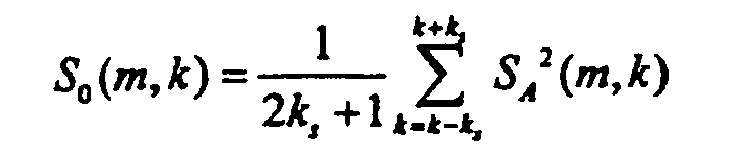
- At stages 250-251, frequency and time domain smoothing is performed on the energy bands of the spectrum for each frame. A sliding window smoothing in the frequency domain is first performed is as in the following equation:


-
Stages 

- At an
update checking stage 262, thenoise suppressor 120 judges whether to update noise statistics of the speech signal that are tracked on a frequency bin basis. Thenoise suppressor 120 groups the spectrum values of the speech signal frames into a number of frequency bins. In the illustrated implementation, the spectrum values (k) are grouped one spectrum value per frequency bin. However, in alternative implementations, various other groupings of the frames' spectrum values into frequency bins can be made, such as more than one spectrum value per frequency bin, or non-uniform groupings of spectrum values into frequency bins. - Figure 4 illustrates a
procedure 400 used at the update checking stage 262 (Figure 2) by the noise suppressor 120 (Figure 1) to determine whether and how noise statistics for the speech signal are updated. In thisprocedure 400, the noise suppressor determines whether to reset the noise statistics in the current speech signal frame, and also determines whether to update the noise statistics of individual frequency bins. The noise suppressor executes this procedure on each frame of the speech signal. - First, in determining whether to reset the noise statistics, the noise suppressor checks (decision 410) whether the frame energy is below a first threshold multiple (λ 1 ) of the historical lowest energy for the speech signal (which generally indicates a pause in speech), as shown in the following equation:

- Otherwise, the noise suppressor proceeds to check whether to update the frequency bins. For this check (decision 420), the noise suppressor checks whether the frame energy is below a second (higher) threshold multiple (λ 2 ) of the historical lowest energy (which generally indicates a continuing speech pause), as in the following equation:

- Otherwise (inside "for" loop blocks 430, 460), the noise suppressor makes determination on a per frequency bin basis whether to update the respective frequency bin. For each frequency bin, the noise suppressor checks whether the frame energy is lower than a function of the noise mean and noise variance of the respective frequency bin in the preceding frame (decision 440), as shown in the following equation:

block 445. The update flag for the current frequency bin is otherwise set to zero (U(m,k)=0) for no update, atblock 445. - With reference again to Figure 2, the noise suppressor at
block 263 updates the noise spectrum statistics per frequency bin according to the update determinations made atblock 262. The noise statistics tracked per frequency bin include the noise mean and noise variance. - Figure 5 illustrates a
procedure 500 for updating the noise mean for a speech signal frame. At aninitial decision 510 of the noisemean update procedure 500, the noise suppressor checks whether the reset flag indicates that the noise statistics for the franne are to be reset (i.e., if R(m)=1). If so, the noise suppressor resets the noise mean calculation for the frequency bins (0≤k<K), as in the following equation:
- Otherwise, if the reset flag for the frame is not set (R(m)≠1), the noise suppressor updates the noise mean for the frequency bins according to their update flags. In "for"
loop 

- Figure 6 illustrates a
procedure 600 for updating the noise variance for a speech signal frame. At aninitial decision 610 of the noisemean update procedure 600, the noise suppressor checks whether the reset flag indicates that the noise statistics for the frame are to be reset (i.e., if R(m)=1). If so, the noise suppressor resets the noise variance calculation for the frequency bins (0≤k<K), as in the following equation:
- Otherwise, if the reset flag for the frame is not set (R(m)≠1), the noise suppressor updates the noise variance for the frequency bins according to their update flags. In "for"
loop 

- With reference again to Figure 2, the noise suppressor in the next stages 270-271 of the gain constrained
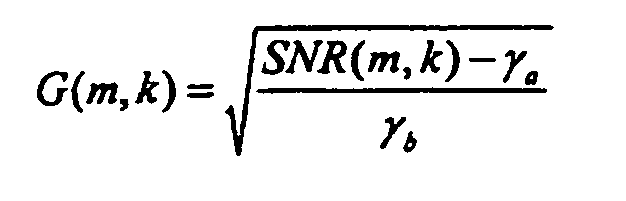
noise suppression processing 200 calculates and smoothes gain factors (G(m,k)) based on the current signal spectrum and noise estimation fromstage 263 to be applied as a gain filter to modify the speech signal spectrum atstage 272. - In a Signal-to-Noise Ratio (SNR)
gain filter stage 270, the noise suppressor initially calculates the SNR of the frequency bins, as in the following equation:

- In a
gain smoothing stage 271, the noise suppressor then smoothes the gain factors according to a calculation of the "noisy"-ness (herein termed a "noisy factor") of the frame, where a stronger smoothing is applied to more noisy frames than is applied to speech frames. The noise suppressor calculates a noise ratio for the frame as a ratio of the number of noisy frequency bins (i.e., the bins flagged for update) to the total number of bins, as follows:
- The noise suppressor then calculates a smoothing factor for the frame (clamped to the
range 0 to 1), as follows:

- In this implementation, the noise suppressor applies smoothing in the frequency domain, using the FFT to transform the gain filter to the frequency domain. For the frequency domain transform, the noise suppressor calculates a set of expanded gain factors (G'(m,k)) from the gain factors (G(m,k)), as follows:

- The noise suppressor then calculates a gain spectrum (g(Λ)) via the FFT of the expanded gain factors, as follows:


- The noise suppressor then smoothes the gain filter by zeroing high frequency components of the gain spectrum. The noise suppressor retains a number of gain spectrum coefficients up to a number based on the smoothing factor (M(m)) and zeroing the components above this number, according to the following equation:


- At a
next stage 272, the noise suppressor applies the resulting smoothed gain filter to the spectral amplitude of speech signal frame, as follows:
- At
stage 280, the noise suppressor applies the inverse transform to the spectrum of the speech signal as modified by the gain filter, as follows:
stages final output 290 of the noise suppressor, as per the following formulas:

- The above described noise suppression system 100 (Figure 1) and gain-constrained
noise suppression processing 200 can be implemented on any of a variety of devices in which audio signal processing is performed, including among other examples, computers; audio playing, transmission and receiving equipment; portable audio players; audio conferencing; Web audio streaming applications; and etc. The gain-constrained noise suppression can be implemented in hardware circuitry (e.g., in circuitry of an ASIC, FPGA, etc.), as well as in audio processing software executing within a computer or other computing environment (whether executed on the central processing unit (CPU), or digital signal processor, audio card or like), such as shown in Figure 7. - Figure 7 illustrates a generalized example of a suitable computing environment (700) in which the described gain-constrained noise suppression may be implemented. The computing environment (700) is not intended to suggest any limitation as to scope of use or functionality of the invention, as the present invention may be implemented in diverse general-purpose or special-purpose computing environments.
- With reference to Figure 7, the computing environment (700) includes at least one processing unit (710) and memory (720). In Figure 7, this most basic configuration (730) is included within a dashed line. The processing unit (710) executes computer-executable instructions and may be a real or a virtual processor. In a multi-processing system, multiple processing units execute computer-executable instructions to increase processing power. The memory (720) may be volatile memory (e.g., registers, cache, RAM), non-volatile memory (e.g., ROM, EEPROM, flash memory, etc.), or some combination of the two. The memory (720) stores software (780) implementing the described gain-constrained noise suppression techniques.
- A computing environment may have additional features. For example, the computing environment (700) includes storage (740), one or more input devices (750), one or more output devices (760), and one or more communication connections (770). An interconnection mechanism (not shown) such as a bus, controller, or network interconnects the components of the computing environment (700). Typically, operating system software (not shown) provides an operating environment for other software executing in the computing environment (700), and coordinates activities of the components of the computing environment (700).
- The storage (740) may be removable or non-removable, and includes magnetic disks, magnetic tapes or cassettes, CD-ROMs, CD-RWs, DVDs, or any other medium which can be used to store information and which can be accessed within the computing environment (700). The storage (740) stores instructions for the software (780) implementing the gain-constrained noise suppression processing 200 (Figure 2).
- The input device(s) (750) may be a touch input device such as a keyboard, mouse, pen, or trackball, a voice input device, a scanning device, or another device that provides input to the computing environment (700). For audio, the input device(s) (750) may be a sound card or similar device that accepts audio input in analog or digital form, or a CD-ROM reader that provides audio samples to the computing environment. The output device(s) (760) may be a display, printer, speaker, CD-writer, or another device that provides output from the computing environment (700).
- The communication connection(s) (770) enable communication over a communication medium to another computing entity. The communication medium conveys information such as computer-executable instructions, compressed audio or video information, or other data in a modulated data signal. A modulated data signal is a signal that has one or more of its characteristics set or changed in such a manner as to encode information in the signal. By way of example, and not limitation, communication media include wired or wireless techniques implemented with an electrical, optical, RF, infrared, acoustic, or other carrier.
- The fast headphone virtualization techniques herein can be described in the general context of computer-readable media. Computer-readable media are any available media that can be accessed within a computing environment. By way of example, and not limitation, with the computing environment (700), computer-readable media include memory (720), storage (740), communication media, and combinations of any of the above.
- The fast headphone virtualization techniques herein can be described in the general context of computer-executable instructions, such as those included in program modules, being executed in a computing environment on a target real or virtual processor. Generally, program modules include routines, programs, libraries, objects, classes, components, data structures, etc. that perform particular tasks or implement particular abstract data types. The functionality of the program modules may be combined or split between program modules as desired in various embodiments. Computer-executable instructions for program modules may be executed within a local or distributed computing environment.
- For the sake of presentation, the detailed description uses terms like "determine," "generate," "adjust," and "apply" to describe computer operations in a computing environment. These terms are high-level abstractions for operations performed by a computer, and should not be confused with acts performed by a human being. The actual computer operations corresponding to these terms vary depending on implementation.
- In view of the many possible embodiments to which the principles of our invention may be applied, we claim as our invention all such embodiments as may come within the scope of the following claims.
Claims (14)
- A speech noise suppression method, comprising:transforming a frame of an input speech signal to a frequency domain representation having a plurality of spectral values;classifying a plurality of frequency bins as noisy or non-noisy;calculating a plurality of gain factors for the frequency bins;calculating a noisy factor based on a ratio of a number of noisy frequency bins to a total number of frequency bins, varying from a value indicative of no smoothing to a value indicative of smoothing the gain factors to a constant gain;smoothing the gain factors in accordance with the noisy factor; andmodifying the spectral values by applying the gain factors to corresponding spectral values; andinverse transforming the modified spectral values to the time domain to produce an output speech signal.
- The speech noise suppression method of claim 1, wherein the smoothing the gain factors comprises:transforming the gain factors to a frequency domain representation;cutting off high frequency components of the frequency domain representation of the gain factors in accordance with the noisy factor; andinverse transforming the frequency domain representation of the gain factors.
- The speech noise suppression method of claim 1, wherein classifying the frequency bins comprises:calculating frame energy;tracking an estimate of noise mean and variance for the frequency bins; classifying a frequency bin as noisy when the frame energy is lower than a function of the estimate of noise mean and variance of the respective frequency bin for the preceding frame; andupdating the estimate of noise mean and variance for frequency bins classified as noisy.
- The speech noise suppression method of claim 3, further comprising:smoothing the spectral values; andusing the smoothed spectral values in calculating the frame energy and the estimate of noise mean and variance.
- The speech noise suppression method of claim 3, wherein the smoothing the spectral values comprises performing both time and frequency domain smoothing of the spectral values.
- The speech noise suppression method of claim 3, further comprising:calculating a historical low frame energy measure;determining to reset the estimate of noise mean and variance if the frame energy measure is lower than a first threshold multiple of the historical low frame energy measure;determining to update the estimate of noise mean and variance for the frequency bins if the frame energy measure is lower than a second threshold multiple of the historical low frame energy measure.
- The speech noise suppression method of claim 3, wherein the calculating the gain factors comprises:calculating the gain factors as a function of the estimate of noise mean and the spectral value for the respective frequency bin.
- A speech noise suppressor, comprising:means (240) for transforming a frame of an input speech signal to a frequency domain representation having a plurality of spectral values;mean (262) for classifying a plurality of frequency bins as noisy or non-noisy;means (270) for calculating a plurality of gain factors for the frequency bins;means (262) for calculating a noisy factor based on a ratio of a number of noisy frequency bins to a total number of frequency bins, varying from a value indicative of no smoothing to a value indicative of smoothing the gain factors to a constant gain;means (271) for smoothing the gain factors in accordance with the noisy factor, andmeans for modifying the spectral values by applying the gain factors corresponding spectral values; andmeans (289) for inverse transforming the modified spectral values to the time domaine to produce an output speech signal.
- The speech noise suppressor of claim 8, wherein the means for smoothing the gain factors comprises:means for transforming the gain factors to a frequency domain representation;means for cutting off high frequency components of the frequency domain representation of the gain factors in accordance with the noisy factor, andmeans for inverse transforming the frequency domain representation of the gain factors.
- The speech noise suppressor of claim 8, wherein the means for classifying the frequency bins comprises:means for calculating frame energy;means for tracking an estimate of noise mean and variance for the frequency bins; means for classifying a frequency bin as noisy when the frame energy is lower than a function of the estimate of noise mean and variance of the respective frequency bin for the preceding frame; andmeans for updating the estimate of noise mean and variance for frequency bins classified as noisy.
- The speech noise suppressor of claim 10, further comprising:means for smoothing the spectral values; andmeans for using the smoothed spectral values in calculating the frame energy and the estimate of noise mean and variance.
- The speech noise suppressor of claim 10, wherein the means for smoothing the spectral values comprises means for performing both time and frequency domain smoothing of the spectral values.
- The speech noise suppressor of claim 10, further comprising:means for calculating a historical low frame energy measure;means for determining to reset the estimate of noise mean and variance if the frame energy measure is lower than a first threshold multiple of the historical low frame energy measure;means for determining to update the estimate of noise mean and variance for the frequency bins if the frame energy measure is lower than a second threshold multiple of the historical low frame energy measure.
- The speech noise suppressor of claim 10, wherein the means for calculating the gain factors comprises:means for calculating the gain factors as a function of the estimate of noise mean and variance and the spectral value for the respective frequency bin.
Applications Claiming Priority (2)
| Application Number | Priority Date | Filing Date | Title |
|---|---|---|---|
| US10/869,467 US7454332B2 (en) | 2004-06-15 | 2004-06-15 | Gain constrained noise suppression |
| US869467 | 2004-06-15 |
Publications (2)
| Publication Number | Publication Date |
|---|---|
| EP1607938A1 EP1607938A1 (en) | 2005-12-21 |
| EP1607938B1 true EP1607938B1 (en) | 2007-02-07 |
Family
ID=34940130
Family Applications (1)
| Application Number | Title | Priority Date | Filing Date |
|---|---|---|---|
| EP05105055A Expired - Lifetime EP1607938B1 (en) | 2004-06-15 | 2005-06-09 | Gain-constrained noise suppression |
Country Status (7)
| Country | Link |
|---|---|
| US (1) | US7454332B2 (en) |
| EP (1) | EP1607938B1 (en) |
| JP (1) | JP4861645B2 (en) |
| KR (1) | KR101120679B1 (en) |
| CN (1) | CN1727860B (en) |
| AT (1) | ATE353466T1 (en) |
| DE (1) | DE602005000539T2 (en) |
Families Citing this family (48)
| Publication number | Priority date | Publication date | Assignee | Title |
|---|---|---|---|---|
| ES2349718T3 (en) * | 2004-09-16 | 2011-01-10 | France Telecom | TREATMENT PROCESS OF NOISE ACOUSTIC SIGNS AND DEVICE FOR THE PERFORMANCE OF THE PROCEDURE. |
| CA2581810C (en) * | 2004-10-26 | 2013-12-17 | Dolby Laboratories Licensing Corporation | Calculating and adjusting the perceived loudness and/or the perceived spectral balance of an audio signal |
| JP4423300B2 (en) * | 2004-10-28 | 2010-03-03 | 富士通株式会社 | Noise suppressor |
| WO2006116132A2 (en) * | 2005-04-21 | 2006-11-02 | Srs Labs, Inc. | Systems and methods for reducing audio noise |
| US8520861B2 (en) * | 2005-05-17 | 2013-08-27 | Qnx Software Systems Limited | Signal processing system for tonal noise robustness |
| US7555075B2 (en) * | 2006-04-07 | 2009-06-30 | Freescale Semiconductor, Inc. | Adjustable noise suppression system |
| JP4912036B2 (en) * | 2006-05-26 | 2012-04-04 | 富士通株式会社 | Directional sound collecting device, directional sound collecting method, and computer program |
| EP2038882A2 (en) * | 2006-06-29 | 2009-03-25 | Nxp B.V. | Decoding sound parameters |
| JP4827661B2 (en) * | 2006-08-30 | 2011-11-30 | 富士通株式会社 | Signal processing method and apparatus |
| JP4836720B2 (en) * | 2006-09-07 | 2011-12-14 | 株式会社東芝 | Noise suppressor |
| FR2906071B1 (en) * | 2006-09-15 | 2009-02-06 | Imra Europ Sas Soc Par Actions | MULTIBAND NOISE REDUCTION WITH NON-ACOUSTIC NOISE REFERENCE |
| US9058819B2 (en) * | 2006-11-24 | 2015-06-16 | Blackberry Limited | System and method for reducing uplink noise |
| GB0703275D0 (en) * | 2007-02-20 | 2007-03-28 | Skype Ltd | Method of estimating noise levels in a communication system |
| JP5186510B2 (en) * | 2007-03-19 | 2013-04-17 | ドルビー ラボラトリーズ ライセンシング コーポレイション | Speech intelligibility enhancement method and apparatus |
| ATE454696T1 (en) * | 2007-08-31 | 2010-01-15 | Harman Becker Automotive Sys | RAPID ESTIMATION OF NOISE POWER SPECTRAL DENSITY FOR SPEECH SIGNAL IMPROVEMENT |
| RU2470385C2 (en) * | 2008-03-05 | 2012-12-20 | Войсэйдж Корпорейшн | System and method of enhancing decoded tonal sound signal |
| KR101597752B1 (en) * | 2008-10-10 | 2016-02-24 | 삼성전자주식회사 | Apparatus and method for noise estimation and noise reduction apparatus employing the same |
| JP5245714B2 (en) * | 2008-10-24 | 2013-07-24 | ヤマハ株式会社 | Noise suppression device and noise suppression method |
| WO2010046954A1 (en) * | 2008-10-24 | 2010-04-29 | 三菱電機株式会社 | Noise suppression device and audio decoding device |
| JP5415739B2 (en) * | 2008-10-31 | 2014-02-12 | 宮本工業株式会社 | Magnesium alloy for forging |
| EP2226794B1 (en) * | 2009-03-06 | 2017-11-08 | Harman Becker Automotive Systems GmbH | Background noise estimation |
| JP2012058358A (en) * | 2010-09-07 | 2012-03-22 | Sony Corp | Noise suppression apparatus, noise suppression method and program |
| KR101173980B1 (en) * | 2010-10-18 | 2012-08-16 | (주)트란소노 | System and method for suppressing noise in voice telecommunication |
| KR101176207B1 (en) | 2010-10-18 | 2012-08-28 | (주)트란소노 | Audio communication system and method thereof |
| EP2463856B1 (en) | 2010-12-09 | 2014-06-11 | Oticon A/s | Method to reduce artifacts in algorithms with fast-varying gain |
| KR20120080409A (en) * | 2011-01-07 | 2012-07-17 | 삼성전자주식회사 | Apparatus and method for estimating noise level by noise section discrimination |
| JP5757104B2 (en) | 2011-02-24 | 2015-07-29 | 住友電気工業株式会社 | Magnesium alloy material and manufacturing method thereof |
| JP2013148724A (en) * | 2012-01-19 | 2013-08-01 | Sony Corp | Noise suppressing device, noise suppressing method, and program |
| CN103325386B (en) | 2012-03-23 | 2016-12-21 | 杜比实验室特许公司 | The method and system controlled for signal transmission |
| CN103325380B (en) | 2012-03-23 | 2017-09-12 | 杜比实验室特许公司 | Gain for signal enhancing is post-processed |
| US9159336B1 (en) * | 2013-01-21 | 2015-10-13 | Rawles Llc | Cross-domain filtering for audio noise reduction |
| US20140270249A1 (en) | 2013-03-12 | 2014-09-18 | Motorola Mobility Llc | Method and Apparatus for Estimating Variability of Background Noise for Noise Suppression |
| US20140278393A1 (en) | 2013-03-12 | 2014-09-18 | Motorola Mobility Llc | Apparatus and Method for Power Efficient Signal Conditioning for a Voice Recognition System |
| EP3011561B1 (en) | 2013-06-21 | 2017-05-03 | Fraunhofer-Gesellschaft zur Förderung der angewandten Forschung e.V. | Apparatus and method for improved signal fade out in different domains during error concealment |
| GB201401689D0 (en) | 2014-01-31 | 2014-03-19 | Microsoft Corp | Audio signal processing |
| US9721580B2 (en) * | 2014-03-31 | 2017-08-01 | Google Inc. | Situation dependent transient suppression |
| JP6446893B2 (en) * | 2014-07-31 | 2019-01-09 | 富士通株式会社 | Echo suppression device, echo suppression method, and computer program for echo suppression |
| WO2016034915A1 (en) * | 2014-09-05 | 2016-03-10 | Intel IP Corporation | Audio processing circuit and method for reducing noise in an audio signal |
| CN104242850A (en) * | 2014-09-09 | 2014-12-24 | 联想(北京)有限公司 | Audio signal processing method and electronic device |
| JP6596236B2 (en) * | 2015-05-27 | 2019-10-23 | 本田技研工業株式会社 | Heat-resistant magnesium alloy and method for producing the same |
| CN105280195B (en) * | 2015-11-04 | 2018-12-28 | 腾讯科技(深圳)有限公司 | The processing method and processing device of voice signal |
| US9881630B2 (en) * | 2015-12-30 | 2018-01-30 | Google Llc | Acoustic keystroke transient canceler for speech communication terminals using a semi-blind adaptive filter model |
| WO2020079957A1 (en) * | 2018-10-15 | 2020-04-23 | ソニー株式会社 | Audio signal processing device and noise suppression method |
| CN113470674B (en) * | 2020-03-31 | 2023-06-16 | 珠海格力电器股份有限公司 | Voice noise reduction method and device, storage medium and computer equipment |
| CN114387983A (en) * | 2020-10-21 | 2022-04-22 | 大众问问(北京)信息科技有限公司 | Noise suppression parameter processing method and device and computer equipment |
| CN113707170B (en) * | 2021-08-30 | 2025-03-28 | 展讯通信(上海)有限公司 | Wind noise suppression method, electronic device and storage medium |
| US12456476B2 (en) | 2022-12-14 | 2025-10-28 | Google Llc | Noise suppression for speech data with reduced power consumption |
| CN119229886B (en) * | 2024-11-28 | 2025-03-21 | 浙江大华技术股份有限公司 | Audio gain method, electronic device and computer readable storage medium |
Family Cites Families (23)
| Publication number | Priority date | Publication date | Assignee | Title |
|---|---|---|---|---|
| US4630305A (en) * | 1985-07-01 | 1986-12-16 | Motorola, Inc. | Automatic gain selector for a noise suppression system |
| EP0226613B1 (en) | 1985-07-01 | 1993-09-15 | Motorola, Inc. | Noise supression system |
| US4628529A (en) * | 1985-07-01 | 1986-12-09 | Motorola, Inc. | Noise suppression system |
| US4811404A (en) * | 1987-10-01 | 1989-03-07 | Motorola, Inc. | Noise suppression system |
| IL84948A0 (en) * | 1987-12-25 | 1988-06-30 | D S P Group Israel Ltd | Noise reduction system |
| FI92535C (en) * | 1992-02-14 | 1994-11-25 | Nokia Mobile Phones Ltd | Noise canceling system for speech signals |
| FI100154B (en) | 1992-09-17 | 1997-09-30 | Nokia Mobile Phones Ltd | Noise cancellation method and system |
| JP3626492B2 (en) * | 1993-07-07 | 2005-03-09 | ポリコム・インコーポレイテッド | Reduce background noise to improve conversation quality |
| US5768473A (en) * | 1995-01-30 | 1998-06-16 | Noise Cancellation Technologies, Inc. | Adaptive speech filter |
| SE505156C2 (en) | 1995-01-30 | 1997-07-07 | Ericsson Telefon Ab L M | Procedure for noise suppression by spectral subtraction |
| US5706395A (en) * | 1995-04-19 | 1998-01-06 | Texas Instruments Incorporated | Adaptive weiner filtering using a dynamic suppression factor |
| JP3454403B2 (en) * | 1997-03-14 | 2003-10-06 | 日本電信電話株式会社 | Band division type noise reduction method and apparatus |
| US6144937A (en) * | 1997-07-23 | 2000-11-07 | Texas Instruments Incorporated | Noise suppression of speech by signal processing including applying a transform to time domain input sequences of digital signals representing audio information |
| US6415253B1 (en) * | 1998-02-20 | 2002-07-02 | Meta-C Corporation | Method and apparatus for enhancing noise-corrupted speech |
| US6088668A (en) | 1998-06-22 | 2000-07-11 | D.S.P.C. Technologies Ltd. | Noise suppressor having weighted gain smoothing |
| US6122610A (en) * | 1998-09-23 | 2000-09-19 | Verance Corporation | Noise suppression for low bitrate speech coder |
| US6289309B1 (en) * | 1998-12-16 | 2001-09-11 | Sarnoff Corporation | Noise spectrum tracking for speech enhancement |
| US6507623B1 (en) * | 1999-04-12 | 2003-01-14 | Telefonaktiebolaget Lm Ericsson (Publ) | Signal noise reduction by time-domain spectral subtraction |
| US6766292B1 (en) * | 2000-03-28 | 2004-07-20 | Tellabs Operations, Inc. | Relative noise ratio weighting techniques for adaptive noise cancellation |
| US6523003B1 (en) * | 2000-03-28 | 2003-02-18 | Tellabs Operations, Inc. | Spectrally interdependent gain adjustment techniques |
| JP4282227B2 (en) * | 2000-12-28 | 2009-06-17 | 日本電気株式会社 | Noise removal method and apparatus |
| US6775337B2 (en) | 2001-08-01 | 2004-08-10 | M/A-Com Private Radio Systems, Inc. | Digital automatic gain control with feedback induced noise suppression |
| JP2004012884A (en) * | 2002-06-07 | 2004-01-15 | Sharp Corp | Voice recognition device |
-
2004
- 2004-06-15 US US10/869,467 patent/US7454332B2/en not_active Expired - Fee Related
-
2005
- 2005-06-09 AT AT05105055T patent/ATE353466T1/en not_active IP Right Cessation
- 2005-06-09 EP EP05105055A patent/EP1607938B1/en not_active Expired - Lifetime
- 2005-06-09 DE DE602005000539T patent/DE602005000539T2/en not_active Expired - Lifetime
- 2005-06-15 JP JP2005175166A patent/JP4861645B2/en not_active Expired - Fee Related
- 2005-06-15 KR KR1020050051309A patent/KR101120679B1/en not_active Expired - Fee Related
- 2005-06-15 CN CN2005100922467A patent/CN1727860B/en not_active Expired - Fee Related
Also Published As
| Publication number | Publication date |
|---|---|
| DE602005000539D1 (en) | 2007-03-22 |
| US20050278172A1 (en) | 2005-12-15 |
| CN1727860A (en) | 2006-02-01 |
| DE602005000539T2 (en) | 2007-06-06 |
| ATE353466T1 (en) | 2007-02-15 |
| US7454332B2 (en) | 2008-11-18 |
| JP2006003899A (en) | 2006-01-05 |
| CN1727860B (en) | 2010-05-05 |
| KR101120679B1 (en) | 2012-03-23 |
| EP1607938A1 (en) | 2005-12-21 |
| JP4861645B2 (en) | 2012-01-25 |
| KR20060046450A (en) | 2006-05-17 |
Similar Documents
| Publication | Publication Date | Title |
|---|---|---|
| US7454332B2 (en) | Gain constrained noise suppression | |
| US7359838B2 (en) | Method of processing a noisy sound signal and device for implementing said method | |
| US7379866B2 (en) | Simple noise suppression model | |
| US9142221B2 (en) | Noise reduction | |
| US6351731B1 (en) | Adaptive filter featuring spectral gain smoothing and variable noise multiplier for noise reduction, and method therefor | |
| US7313518B2 (en) | Noise reduction method and device using two pass filtering | |
| US9064498B2 (en) | Apparatus and method for processing an audio signal for speech enhancement using a feature extraction | |
| JP5302968B2 (en) | Speech improvement with speech clarification | |
| EP2164066B1 (en) | Noise spectrum tracking in noisy acoustical signals | |
| US8352257B2 (en) | Spectro-temporal varying approach for speech enhancement | |
| US8737641B2 (en) | Noise suppressor | |
| JP2003517624A (en) | Noise suppression for low bit rate speech coder | |
| US20110125490A1 (en) | Noise suppressor and voice decoder | |
| JP2023536104A (en) | Noise reduction using machine learning | |
| CN113593599A (en) | Method for removing noise signal in voice signal | |
| WO2006123721A1 (en) | Noise suppression method and device thereof | |
| JPH11265199A (en) | Transmitter | |
| CN115527550A (en) | Single-microphone subband domain noise reduction method and system | |
| Elshamy et al. | Two-stage speech enhancement with manipulation of the cepstral excitation | |
| Puder | Kalman‐filters in subbands for noise reduction with enhanced pitch‐adaptive speech model estimation | |
| Rehman et al. | Speech Enhancement in Multi-Source Environments | |
| Xu et al. | Elimination of musical noise phenomenon with Burg-based a priori SNR estimator | |
| Das et al. | Single-channel speech enhancement by NWNS and EMD | |
| Anderson et al. | NOISE SUPPRESSION IN SPEECH USING MULTI {RESOLUTION SINUSOIDAL MODELING |
Legal Events
| Date | Code | Title | Description |
|---|---|---|---|
| PUAI | Public reference made under article 153(3) epc to a published international application that has entered the european phase |
Free format text: ORIGINAL CODE: 0009012 |
|
| AK | Designated contracting states |
Kind code of ref document: A1 Designated state(s): AT BE BG CH CY CZ DE DK EE ES FI FR GB GR HU IE IS IT LI LT LU MC NL PL PT RO SE SI SK TR |
|
| AX | Request for extension of the european patent |
Extension state: AL BA HR LV MK YU |
|
| 17P | Request for examination filed |
Effective date: 20060503 |
|
| GRAP | Despatch of communication of intention to grant a patent |
Free format text: ORIGINAL CODE: EPIDOSNIGR1 |
|
| AKX | Designation fees paid |
Designated state(s): AT BE BG CH CY CZ DE DK EE ES FI FR GB GR HU IE IS IT LI LT LU MC NL PL PT RO SE SI SK TR |
|
| GRAS | Grant fee paid |
Free format text: ORIGINAL CODE: EPIDOSNIGR3 |
|
| GRAA | (expected) grant |
Free format text: ORIGINAL CODE: 0009210 |
|
| AK | Designated contracting states |
Kind code of ref document: B1 Designated state(s): AT BE BG CH CY CZ DE DK EE ES FI FR GB GR HU IE IS IT LI LT LU MC NL PL PT RO SE SI SK TR |
|
| PG25 | Lapsed in a contracting state [announced via postgrant information from national office to epo] |
Ref country code: FI Free format text: LAPSE BECAUSE OF FAILURE TO SUBMIT A TRANSLATION OF THE DESCRIPTION OR TO PAY THE FEE WITHIN THE PRESCRIBED TIME-LIMIT Effective date: 20070207 Ref country code: NL Free format text: LAPSE BECAUSE OF FAILURE TO SUBMIT A TRANSLATION OF THE DESCRIPTION OR TO PAY THE FEE WITHIN THE PRESCRIBED TIME-LIMIT Effective date: 20070207 Ref country code: PL Free format text: LAPSE BECAUSE OF FAILURE TO SUBMIT A TRANSLATION OF THE DESCRIPTION OR TO PAY THE FEE WITHIN THE PRESCRIBED TIME-LIMIT Effective date: 20070207 Ref country code: SI Free format text: LAPSE BECAUSE OF FAILURE TO SUBMIT A TRANSLATION OF THE DESCRIPTION OR TO PAY THE FEE WITHIN THE PRESCRIBED TIME-LIMIT Effective date: 20070207 Ref country code: AT Free format text: LAPSE BECAUSE OF FAILURE TO SUBMIT A TRANSLATION OF THE DESCRIPTION OR TO PAY THE FEE WITHIN THE PRESCRIBED TIME-LIMIT Effective date: 20070207 Ref country code: BE Free format text: LAPSE BECAUSE OF FAILURE TO SUBMIT A TRANSLATION OF THE DESCRIPTION OR TO PAY THE FEE WITHIN THE PRESCRIBED TIME-LIMIT Effective date: 20070207 Ref country code: LI Free format text: LAPSE BECAUSE OF FAILURE TO SUBMIT A TRANSLATION OF THE DESCRIPTION OR TO PAY THE FEE WITHIN THE PRESCRIBED TIME-LIMIT Effective date: 20070207 Ref country code: DK Free format text: LAPSE BECAUSE OF FAILURE TO SUBMIT A TRANSLATION OF THE DESCRIPTION OR TO PAY THE FEE WITHIN THE PRESCRIBED TIME-LIMIT Effective date: 20070207 Ref country code: CH Free format text: LAPSE BECAUSE OF FAILURE TO SUBMIT A TRANSLATION OF THE DESCRIPTION OR TO PAY THE FEE WITHIN THE PRESCRIBED TIME-LIMIT Effective date: 20070207 |
|
| REG | Reference to a national code |
Ref country code: GB Ref legal event code: FG4D |
|
| REG | Reference to a national code |
Ref country code: CH Ref legal event code: EP |
|
| REG | Reference to a national code |
Ref country code: IE Ref legal event code: FG4D |
|
| REF | Corresponds to: |
Ref document number: 602005000539 Country of ref document: DE Date of ref document: 20070322 Kind code of ref document: P |
|
| PG25 | Lapsed in a contracting state [announced via postgrant information from national office to epo] |
Ref country code: SE Free format text: LAPSE BECAUSE OF FAILURE TO SUBMIT A TRANSLATION OF THE DESCRIPTION OR TO PAY THE FEE WITHIN THE PRESCRIBED TIME-LIMIT Effective date: 20070507 Ref country code: BG Free format text: LAPSE BECAUSE OF FAILURE TO SUBMIT A TRANSLATION OF THE DESCRIPTION OR TO PAY THE FEE WITHIN THE PRESCRIBED TIME-LIMIT Effective date: 20070507 |
|
| PG25 | Lapsed in a contracting state [announced via postgrant information from national office to epo] |
Ref country code: ES Free format text: LAPSE BECAUSE OF FAILURE TO SUBMIT A TRANSLATION OF THE DESCRIPTION OR TO PAY THE FEE WITHIN THE PRESCRIBED TIME-LIMIT Effective date: 20070518 |
|
| PG25 | Lapsed in a contracting state [announced via postgrant information from national office to epo] |
Ref country code: IS Free format text: LAPSE BECAUSE OF FAILURE TO SUBMIT A TRANSLATION OF THE DESCRIPTION OR TO PAY THE FEE WITHIN THE PRESCRIBED TIME-LIMIT Effective date: 20070607 |
|
| PG25 | Lapsed in a contracting state [announced via postgrant information from national office to epo] |
Ref country code: PT Free format text: LAPSE BECAUSE OF FAILURE TO SUBMIT A TRANSLATION OF THE DESCRIPTION OR TO PAY THE FEE WITHIN THE PRESCRIBED TIME-LIMIT Effective date: 20070709 |
|
| NLV1 | Nl: lapsed or annulled due to failure to fulfill the requirements of art. 29p and 29m of the patents act | ||
| REG | Reference to a national code |
Ref country code: CH Ref legal event code: PL |
|
| ET | Fr: translation filed | ||
| PG25 | Lapsed in a contracting state [announced via postgrant information from national office to epo] |
Ref country code: SK Free format text: LAPSE BECAUSE OF FAILURE TO SUBMIT A TRANSLATION OF THE DESCRIPTION OR TO PAY THE FEE WITHIN THE PRESCRIBED TIME-LIMIT Effective date: 20070207 |
|
| PLBE | No opposition filed within time limit |
Free format text: ORIGINAL CODE: 0009261 |
|
| STAA | Information on the status of an ep patent application or granted ep patent |
Free format text: STATUS: NO OPPOSITION FILED WITHIN TIME LIMIT |
|
| PG25 | Lapsed in a contracting state [announced via postgrant information from national office to epo] |
Ref country code: CZ Free format text: LAPSE BECAUSE OF FAILURE TO SUBMIT A TRANSLATION OF THE DESCRIPTION OR TO PAY THE FEE WITHIN THE PRESCRIBED TIME-LIMIT Effective date: 20070207 Ref country code: RO Free format text: LAPSE BECAUSE OF FAILURE TO SUBMIT A TRANSLATION OF THE DESCRIPTION OR TO PAY THE FEE WITHIN THE PRESCRIBED TIME-LIMIT Effective date: 20070207 |
|
| 26N | No opposition filed |
Effective date: 20071108 |
|
| PG25 | Lapsed in a contracting state [announced via postgrant information from national office to epo] |
Ref country code: MC Free format text: LAPSE BECAUSE OF NON-PAYMENT OF DUE FEES Effective date: 20070630 |
|
| PG25 | Lapsed in a contracting state [announced via postgrant information from national office to epo] |
Ref country code: LT Free format text: LAPSE BECAUSE OF FAILURE TO SUBMIT A TRANSLATION OF THE DESCRIPTION OR TO PAY THE FEE WITHIN THE PRESCRIBED TIME-LIMIT Effective date: 20070207 |
|
| PG25 | Lapsed in a contracting state [announced via postgrant information from national office to epo] |
Ref country code: GR Free format text: LAPSE BECAUSE OF FAILURE TO SUBMIT A TRANSLATION OF THE DESCRIPTION OR TO PAY THE FEE WITHIN THE PRESCRIBED TIME-LIMIT Effective date: 20070508 |
|
| PG25 | Lapsed in a contracting state [announced via postgrant information from national office to epo] |
Ref country code: IE Free format text: LAPSE BECAUSE OF NON-PAYMENT OF DUE FEES Effective date: 20070611 |
|
| PG25 | Lapsed in a contracting state [announced via postgrant information from national office to epo] |
Ref country code: EE Free format text: LAPSE BECAUSE OF FAILURE TO SUBMIT A TRANSLATION OF THE DESCRIPTION OR TO PAY THE FEE WITHIN THE PRESCRIBED TIME-LIMIT Effective date: 20070207 |
|
| PG25 | Lapsed in a contracting state [announced via postgrant information from national office to epo] |
Ref country code: CY Free format text: LAPSE BECAUSE OF FAILURE TO SUBMIT A TRANSLATION OF THE DESCRIPTION OR TO PAY THE FEE WITHIN THE PRESCRIBED TIME-LIMIT Effective date: 20070207 |
|
| PG25 | Lapsed in a contracting state [announced via postgrant information from national office to epo] |
Ref country code: LU Free format text: LAPSE BECAUSE OF NON-PAYMENT OF DUE FEES Effective date: 20070609 |
|
| PG25 | Lapsed in a contracting state [announced via postgrant information from national office to epo] |
Ref country code: TR Free format text: LAPSE BECAUSE OF FAILURE TO SUBMIT A TRANSLATION OF THE DESCRIPTION OR TO PAY THE FEE WITHIN THE PRESCRIBED TIME-LIMIT Effective date: 20070207 Ref country code: HU Free format text: LAPSE BECAUSE OF FAILURE TO SUBMIT A TRANSLATION OF THE DESCRIPTION OR TO PAY THE FEE WITHIN THE PRESCRIBED TIME-LIMIT Effective date: 20070808 |
|
| REG | Reference to a national code |
Ref country code: DE Ref legal event code: R082 Ref document number: 602005000539 Country of ref document: DE Representative=s name: GRUENECKER, KINKELDEY, STOCKMAIR & SCHWANHAEUS, DE |
|
| REG | Reference to a national code |
Ref country code: GB Ref legal event code: 732E Free format text: REGISTERED BETWEEN 20150115 AND 20150121 |
|
| REG | Reference to a national code |
Ref country code: DE Ref legal event code: R082 Ref document number: 602005000539 Country of ref document: DE Representative=s name: GRUENECKER PATENT- UND RECHTSANWAELTE PARTG MB, DE Effective date: 20150126 Ref country code: DE Ref legal event code: R081 Ref document number: 602005000539 Country of ref document: DE Owner name: MICROSOFT TECHNOLOGY LICENSING, LLC, REDMOND, US Free format text: FORMER OWNER: MICROSOFT CORP., REDMOND, WASH., US Effective date: 20150126 |
|
| REG | Reference to a national code |
Ref country code: FR Ref legal event code: TP Owner name: MICROSOFT TECHNOLOGY LICENSING, LLC, US Effective date: 20150724 |
|
| REG | Reference to a national code |
Ref country code: FR Ref legal event code: PLFP Year of fee payment: 12 |
|
| REG | Reference to a national code |
Ref country code: FR Ref legal event code: PLFP Year of fee payment: 13 |
|
| PGFP | Annual fee paid to national office [announced via postgrant information from national office to epo] |
Ref country code: FR Payment date: 20170511 Year of fee payment: 13 Ref country code: GB Payment date: 20170607 Year of fee payment: 13 |
|
| PGFP | Annual fee paid to national office [announced via postgrant information from national office to epo] |
Ref country code: IT Payment date: 20170619 Year of fee payment: 13 |
|
| GBPC | Gb: european patent ceased through non-payment of renewal fee |
Effective date: 20180609 |
|
| PG25 | Lapsed in a contracting state [announced via postgrant information from national office to epo] |
Ref country code: GB Free format text: LAPSE BECAUSE OF NON-PAYMENT OF DUE FEES Effective date: 20180609 Ref country code: IT Free format text: LAPSE BECAUSE OF NON-PAYMENT OF DUE FEES Effective date: 20180609 Ref country code: FR Free format text: LAPSE BECAUSE OF NON-PAYMENT OF DUE FEES Effective date: 20180630 |
|
| PGFP | Annual fee paid to national office [announced via postgrant information from national office to epo] |
Ref country code: DE Payment date: 20190528 Year of fee payment: 15 |
|
| REG | Reference to a national code |
Ref country code: DE Ref legal event code: R119 Ref document number: 602005000539 Country of ref document: DE |
|
| PG25 | Lapsed in a contracting state [announced via postgrant information from national office to epo] |
Ref country code: DE Free format text: LAPSE BECAUSE OF NON-PAYMENT OF DUE FEES Effective date: 20210101 |